Please cite as: Solaja, Oludele Mayowa. (2026). “Waste Sovereignty and Plastic Colonialism: Environmental Power and Populism in the Global Political Economy of Waste.” Journal of Populism Studies (JPS). June 11, 2026. https://doi.org/10.55271/JPS000124
Abstract
Plastic pollution is one of the most pressing environmental problems of the twenty-first century, but the governance of global plastic waste is remarkably unequal. Significant volumes of plastic waste from developed countries are exported to developing countries in the Global South, where waste management infrastructure and regulatory capacity are often limited. While this movement of waste across borders is frequently discussed in terms of recycling efficiency or waste management capacity, these transactions are deeply embedded in unequal power relations within the global political economy. This article proposes a theoretical framework called Waste Sovereignty Theory (WST), which explains how international waste trade reproduces environmental power asymmetries between exporting and importing nations. Drawing on political ecology, environmental justice, postcolonial environmental governance, and emerging scholarship on environmental populism, the paper conceptualizes transboundary plastic waste flows as a form of plastic colonialism in which the ecological costs of production and consumption in wealthy countries are displaced onto less powerful states. The article introduces a Waste Sovereignty Theory Framework (WST Framework) that links four key dynamics—plastic production, transnational waste trade, governance inequality, and sovereignty claims—to explain contemporary struggles over environmental authority in the Global South. Using illustrative cases from Southeast Asia and Africa, the article demonstrates how states and communities respond through waste import bans, stricter regulatory regimes, waste repatriation policies, and the promotion of domestic recycling industries. These responses are interpreted not only as efforts to reclaim environmental governance but also as expressions of environmental populism, whereby affected populations challenge environmental burdens perceived as imposed by distant political, economic, and technocratic elites. Waste sovereignty thus emerges as both a claim to environmental justice and a form of political resistance against unequal structures of global environmental governance. The article argues that addressing the global plastic crisis requires more than technological improvements in waste management; it demands institutional reforms capable of confronting the structural inequalities embedded in contemporary systems of production, consumption, and environmental governance.
Keywords: Waste Sovereignty, Plastic Colonialism, Environmental Populism, Global Waste Trade, Environmental Governance, Political Ecology, Environmental Justice, Circular Economy, Global South
Plastic waste constitutes one of the leading contemporary environmental problems in the 21st century. Over the last decades, production of plastics in the global South have rapidly increase from less than 1 million tons per year in the 1950s to more than 400 million tons in a year and rapidly growing international plastic waste trade networks (Geyer et al., 2017; Zhao et al., 2021; Clapp, 2022). Although plastic waste is created around the globe, its environmental burden has been distributed unevenly, that is, wealthy industrialized countries ship vast amounts of their waste to the Global South countries whose institutions and capabilities are often unable to manage this commodity (Brooks et al., 2018; Clapp, 2021). This paper considers that what often appears as technical problems with waste management or efficiency of recycling, are the consequences of underlying structural power relations within political economy that shaped global politics of waste management.
The political ecology literature frames such dynamics within a politics of unequal access to environmental resources. International industrial and consumer economies are producing vast flows of unwanted materials whose disposal is often externalized, whereby they can find an outlet within the weaker regulatory systems found in some Global South countries, leading to environmental contamination and informal dumping and recycling networks (Pellow, 2018; Liboiron, 2021). This is a pattern of waste colonialism where environmental harm produced by global industrial capitalism can be displaced from wealthy consumer economies to the periphery through the waste trade (Pellow, 2018; Liboiron, 2021). This in turn constitutes ecological distribution conflicts, whereby environmental burdens and their subsequent harm fall unevenly between social groups and geographic territories (Martinez-Alier, 2002).
Emergent trends in international waste markets highlight the politicization of these dynamics. The closure of the Chinese market to the majority of foreign waste exports under the National Sword policy in 2018 led to the redirection of massive flows of plastic waste to countries in Southeast Asia and Africa, overwhelming the existing domestic waste management systems of these recipient countries. Consequently, governments from the Global South such as Malaysia, Indonesia, Philippines and a host of African states have since imposed new regulations and repatriated illegal shipments of plastic waste, showing the burgeoning politics of the waste system.
Most academic literature on the global plastic crisis frames plastic waste as a technical problem of recycling efficiency or waste management systems, however there is an important politics of why environmental problems and the burden of waste are distributed unevenly. More focus has not been paid to the issue of environmental sovereignty – a State’s/Community’s authority over their environmental resource system, including regulation of trans-boundary flows and their control over development pathways, as a source of environmental power and control within global waste flows governed by the trade regime, global corporate supply chains, and disparities in regulation.
This article theorizes the politics of global waste governance by developing the Waste Sovereignty Theory (WST), which frames global waste systems as arenas of political struggle over authority where States and communities contest the uneven distribution of ecological burden. Waste Sovereignty Theory framework links four key mechanisms-production, trade networks, disparity in regulation, and sovereignty claims-to illuminate the operation of environmental power within current waste regimes. Waste sovereignty, within WST, signifies the authority of States, communities and social movements to assert control over the management of waste systems, including import flows, domestic recycling industry development and environmental common preservation.
In this article, waste sovereignty is defined as the capacity of states, communities, and social institutions to exercise political, ecological, and economic authority over the governance of waste within their territories. This includes the power to regulate transboundary waste flows, control domestic recycling infrastructures, determine environmental standards, and shape the economic systems through which waste materials are managed or transformed into resources. Within the Waste Sovereignty Theory Framework (WST Framework), waste sovereignty therefore represents a form of environmental authority through which political actors contest the unequal distribution of ecological burdens generated by global production and consumption systems.
The theory of Waste Sovereignty extends the field of environmental governance in three main ways; first, situating the plastic crisis within the politics of production, consumption and the externalization of environmental impact. Second, it develops the discourse of environmental justice by placing issues of ecological inequity alongside control over environmental governance systems. Third, it theorizes responses to plastic waste in the Global South as claims to sovereignty from the peripheries in the form of restrictions on imports, new legislation, domestic recycling industries development etc.
Therefore this paper answers the questions: how does global plastic waste trade create a power disparity and how can the Waste Sovereignty Theory frame the emergence of fights for environmental governance in the Global South? Showing the dynamics of the WST through cases from Southeast Asia and Africa, the paper argues that plastic waste has become a politically embedded global issue and its solutions need to transcend purely technical strategies of waste management and recycling, and include the politics of environmental power and sovereignty within the waste system.
Lightcap, Tracy. (2026). “Do Economic and Identity Cleavages Account for the Differences Between Left and Right Populism? Hungary, Venezuela, and the United States.” Journal of Populism Studies (JPS). May 27, 2026. https://doi.org/10.55271/JPS000123
Abstract
Right- and left-wing populism are widely used concepts, but they lack a coherent theoretical framework. In this paper, I describe a new model developed by Dani Rodrik for understanding how right- and left-wing populist regimes function, and I test the model empirically. First, I describe some aspects of populism in both its left- and right-wing varieties and briefly outline the development of populism research. Second, I present the cleavage model proposed by Rodrik. Third, I examine two cases—the PSUV regime in Venezuela (left-wing populism) and the Fidesz regime in Hungary (right-wing populism)—as examples of the two populist trends. Fourth, I test the cleavage model using a classic computer-generated content analysis by creating dictionaries based on the manifestos of the PSUV and Fidesz in order to analyze speeches by the leaders of left- and right-wing populist regimes, Hugo Chávez and Viktor Orbán. Finally, I test the model on out-of-sample cases using speeches by Barack Obama and Donald Trump. I conclude that the model shows promising results and offer reflections on how the cleavage model advances our understanding of the differences between right- and left-wing populist regimes.
Populism is a difficult concept to define. Populist movements embrace the entire spectrum of conventional politics but have a similar core appeal. Dani Rodrik defines them this way: “What all these (populist movements) share is an anti-establishment orientation, a claim to speak for the people against elites, opposition to liberal economics and globalization, and often (but not always) a penchant for authoritarian governance,” (Rodrik, 2018: 1).[1]
Judis (2016) divides such regimes into right-wing and left-wing varieties. However, the difficulties in defining different tendencies in populism are reflected in the difficulties in conducting empirical research on the phenomena. There have been both qualitative (see, for example, Aslandis, 2016a, 2016b; Bánkuti et al., 2012, Mudde & Kaltwasser, 2013) and quantitative (see Fernández-Gracia & Leungo, 2018; Popping, 2018; Hawkins, 2009; Ernst et al., 2017) efforts to distinguish right and left populist regimes from each other. A distinguishing aspect of these studies, however, is that they are descriptive in character, dividing populist regimes generally by reference to a historical inheritance of populism or to particular aspects of the political history of the countries examined. Theoretical explanations for right and left populism are less common.[2] This shortfall creates a problem for research on varieties of populism going forward.
In his papers Rodrik (2018, 2019) has presented a convincing model for how different populist regimes arise in different situations. Their scheme divides society into three main groups: elites, majorities of the middle class and poor, and minorities identified by ethnic, religious, or citizen status differences. This leads to two major potential divisions that populist movements exploit: economic (income/social class) and identity (ethnic-nationalist/cultural) cleavages. He argues that these cleavages shape the anti-establishment politics that Judis (2016) identifies in right- and left-wing populist regimes, but in different ways.
This paper aims to test the cleavages model proposed by Rodrik. The identification of economic and identity cleavages with right- and left-wing populist regimes will constitute a significant theoretical advance if the model proves valid. However, the identification of income/class and ethnic-national identity cleavages with, respectively, left- and right-wing populist regimes has yet to be tested empirically. I will test these hypothetical linkages through an empirical examination of the appeals made by populist regimes themselves.
First, I will provide a short overview of Rodrik’s model. I will then examine the two cases used to develop the analysis in this paper: the Fidesz regime in Hungary as an example of right-wing populism and the United Socialist Party of Venezuela (PSUV) in Venezuela as an example of left-wing populism.
Then, applying the framework suggested by Rodrik, I examine Fidesz and PSUV manifestos in order to develop dictionaries of abstract terms distinguishing right- and left-wing regimes along cleavage lines. I use a classic content analysis of speeches by the leaders of the regimes in Hungary and Venezuela to determine how closely their public discourse tracks the differences proposed by Rodrik.
I then test the model beyond the initial cases by comparing speeches by Barack Obama and Donald Trump with those of Hugo Chávez and Viktor Orbán. Finally, I offer a few remarks about what has been learned and the future direction of the research.
[1] The difficulty with defining populism is, I think, a product of the way the politics in these movements works. There is an intentional unwillingness to express any general policy that would allow easy identification of a populist movement with establishment politics. Instead, the concerns of populist adherents are distracted by elite/mass divisions, concern about national economic and political independence, and, in right-wing populism, extreme nationalism and ethnic scapegoating. This is why some scholars (Aslandis, 2016b, Moffitt & Tormey, 2014) have refused to see populism as an ideology at all.
Please cite as: Ragheb, Ali. (2026). “Silenced Voices in a Democratic Dawn: How Iranian Constitutionalists Weaponized ‘the People’ Against Minorities.” Populism & Politics (P&P). European Center for Populism Studies (ECPS). May 20, 2026. https://doi.org/10.55271/pp0054
Abstract
The Iranian Constitutional Revolution (1905–1911) marks the genesis of modern Iranian political discourse, introducing concepts like nation, liberty, and the people as citizen rather than ra’iyat (in landlord-peasant system). Conventional explanations attribute its failure to foreign intervention, elite factionalism, or ideological extremism. A closer look shows another perspective: the revolution collapsed due to the leadership’s deliberate post-victory narrowing of “the people” as an empty signifier, excluding women, the urban poor, and religious/ethnic minorities who had fueled initial mobilization. Employing qualitative content analysis of primary sources – including underground leaflets, parliamentary debates, police and spy reports, photographs, historical books and memoirs – coded via Atlas.ti, the study traces discursive and institutional mechanisms of exclusion. Integrating Laclau’s theory of populism (empty signifier), Rancière’s “part of no part,” and Chatterjee’s civil/political society distinction, it identifies four causal pathways: class interests, clerical hegemony, legal fixing, and performative contempt. These exclusions eroded the multiclass coalition, rendering the Parliament indefensible in 1908 and 1911. By reframing failure as coalition disintegration, the article contributes theoretically to populist rupture studies and empirically to Iranian historiography, offering a cautionary global lesson on revolutions that mobilize broadly but consolidate narrowly.
Keywords: Iranian Constitutional Revolution, populism, the people, political exclusion, social movements, democracy, Qajar Iran, Women, Urban Poor, Minorities.
By Ali Ragheb*
A Brief Historical Overview of the Constitutional Revolution in Iran
The Constitutional Revolution was a pivotal event in modern Iranian history, interpreted in sharply divergent ways. Traditional accounts focus on liberty and constitutionalism, while Marxist historiography (Jazani, 2009) sees it as a bourgeois revolution. Neither fully captures its social complexity. The movement was driven by intellectuals, artisans, traders, and urban workers, with clergy and merchants playing indispensable but ambivalent roles. Protests in 1905–1906 forced Moẓaffar al-Dīn Shah to grant a constitution and national assembly, with Tehran and Tabriz as strongholds. The telegraph spread the uprising, and a flourishing press expanded political speech. However, suppression of protesters and the royalist coup of June 1908 by the Cossack Brigade broke the fragile equilibrium. The court mobilized the urban poor through poverty and clerical influence. Tabriz became the radicalized resistance center; in Gilan, constitutionalist leaders restrained peasant uprisings. A rift widened between secular intellectuals and conservative clergy like Shaykh Fażl-Allāh Nūrī, who was executed in 1909. Conservative forces then gained influence, and factional strife between Moderates and Democrats (later Social Democrats) paralyzed reform. Russian military intervention, accepted by Britain, led to the dissolution of the Second parliament in December 1911 and the revolution’s defeat. The revolution thus shows a paradox: high mobilization and political innovation could not sustain the coalition that made them possible. Understanding this requires examining social diversity, political strategy, and institutional choices over time, beyond narratives privileging ideas or class alone.
Introduction and Research Problem
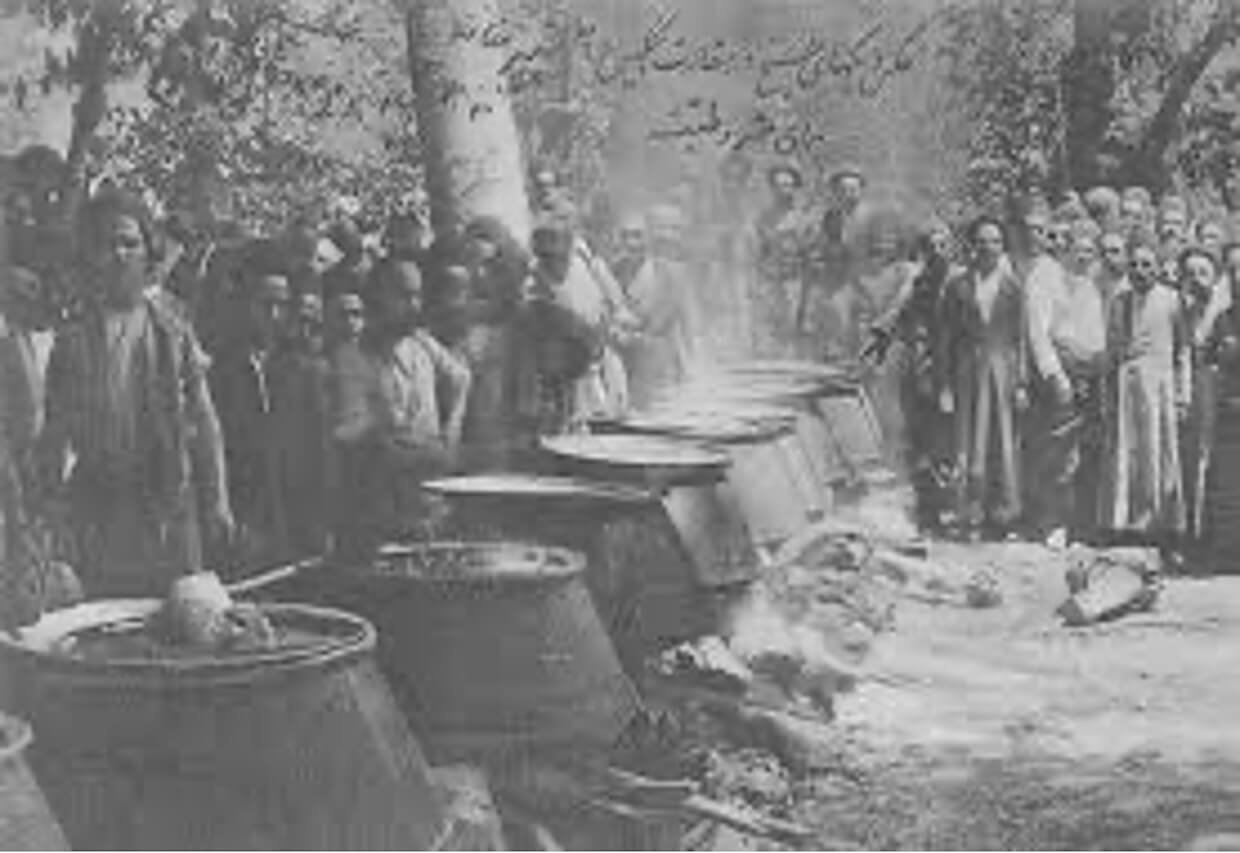
The most iconic photographs of the Constitutional Revolution (Rostami, 2006; Tabatabaei, 2011; Purhossein Khoniq, 2020) depict the sanctuary-taking (bast-nishīnī) or general strike at the British Embassy in the summer of 1906 as the movement’s turning point. According to accounts, “around 14,000 people” participated in this scene, a figure close to one-third of Tehran’s workforce (Afary, 1996: 55). Yet, these photographs only capture the urban protesters in Tehran, whereas historical narratives indicate that vast populations in other major Iranian cities, such as Tabriz and Rasht, also joined the revolutionaries.
General strike in British Embassy in Tehran.
What is most striking about these scenes is not merely their scale, but their diversity. The social composition of this crowd was notably diverse, encompassing clergy and students, intellectuals, merchants, guild members, traders, artisans, and both skilled and unskilled laborers. As one eyewitness recounted, “I saw over 500 tents; every craft, even shoemakers, nut-sellers, and tinsmiths, had at least one tent,” (Abrahamian, 1969: 133). Similar reports from the supplementary constitutional protests speak of “one hundred thousand people” in the streets (Abrahamian, 1979: 411). This sheer scale of participation lends significance to the concept of “the people,” despite its inherent ambiguity, within the social context of the time.
This broad solidarity, however, proved short-lived. The constitutionalists secured their initial demands with remarkably little bloodshed, yet less than two years later, on 23 June 1908, when Colonel Liakhov shelled the Parliament on the Shah’s orders, the great crowds had vanished. Only a small core of committed revolutionaries remained to resist -a disappearance that cannot be explained solely by repression, because mass mobilization had previously withstood severe violence.
The central question of this study is therefore straightforward: why did “the people” disappear from the scene, and why was the Revolution unable to withstand the counter-revolutionary assault? Although the populace returned to the fray and recaptured Tehran after the Minor Tyranny 1908–1909, the Second Parliament suffered the same fate as the first.
I approach this question by examining the concept of “the people” not as a fixed social category, but as a politically constructed and contested one. It argues that the meaning of “the people” shifted over time, shaped by competing discourses and strategic considerations. These shifts were not merely semantic; they had concrete political consequences, influencing patterns of inclusion, exclusion, and mobilization. I examine the concept of “the people” in juxtaposition with “statesmen,” “revolutionaries,” and “revolutionaries in power,” demonstrating that the term possesses a fluid meaning whose referents shift depending on the prevailing discourses. This fluidity was not accidental but politically weaponized. In pre-Constitutional Iran, society was defined by the binary of arbāb and ra’iyat (landlord and peasant), and reforms from above (such as the activities of Amīr Kabīr and Sipahsālār) were implemented without the engagement of the masses. Yet, the expansion of new relationships and the influx of modern concepts, including law and parliament, fractured the ancient structure and allowed for the emergence of “the people” as rightful holders of political rights.
To comprehend this transition, one must consider the landlord-peasant structure and patrimonialism, where the Shah was the “Shadow of God” and the source of justice and security. The Constitutional movement challenged this system by introducing concepts such as the nation, law, and representation. Even religious scholars such as Mīrzā Muhammad Hossein Nāʾīnī sought to reconcile sharīʿa with ʿurf in order to legitimize the new understanding of the people. However, this reconciliation remained partial and elite driven. This dialogue between traditional and modern forces was evident in the First and Second Parliaments, though the mechanism of dialogue gradually eroded with the ascendancy of landowners and the gentry, and the language of power was once again reproduced from above. The Constitutional experience thus revealed that the transition from ra’iyat to citizen was the outcome of intense intellectual and social struggle, but that transition was never institutionalized. Although law, suffrage, and parliament temporarily reshaped popular political consciousness, internal divisions and external pressures combined to arrest the process before it could mature.
The present study focuses on this rupture, by re-examining primary documents and tracing social dynamics after the initial victory. The analysis therefore proceeds along two axes: first, identifying which groups were incorporated into the revolutionary category of “the people” during the initial phase of mobilization; and second, tracing how and why certain groups were subsequently marginalized or excluded. By answering these interrelated questions, I offer a new internalist theory of revolutionary failure that complements – but does not dismiss – existing externalist and structural accounts.
Here, I argue that the failure of the Iranian Constitutional Revolution cannot be fully explained by external intervention, ideological radicalization, or institutional weakness alone. Instead, it resulted from the progressive narrowing of “the people” as a political category after the initial revolutionary victory. During mobilization (1905–1906), “the people” functioned as an expansive and flexible category that enabled the formation of a broad, multi-class urban coalition. However, once the constitutional order was established, this inclusive category was gradually restricted through legal design, institutional practices, and political discourse. This narrowing excluded key segments of the original coalition -particularly the urban poor, women, religious minorities, and peripheral populations- undermining the Revolution’s social base. As a result, when the counter-revolutionary assault occurred in 1908 and again in 1911, the constitutional regime was unable to remobilize the mass support that had initially secured its success. What becomes visible here is that this process was not merely incidental but partly deliberate, driven by elite concerns over order, property, and political control. The central claim is therefore that exclusion was not a by-product of failure- it was one of its primary causes.
Background and Mapping Gaps
Scholarship on the Constitutional Revolution has adopted social, discursive, and political perspectives, all of which confirm that reconstructing the role of social forces is inseparable from analyzing mechanisms of representation and exclusion. Najmabadi (2005), through close reading of speeches and clandestine leaflets, shows that even at the height of mobilization the dominant discourse constructed a male addressee and symbolically excluded women. This selective logic operated on a far wider scale. Afary (1996) has demonstrated that decisions about what enters the official record and what is omitted are never neutral; they silence groups that were effective participants but later deemed inconvenient.
Many dominant narratives – whether presented as the “true history” or as Iran’s “first national uprising”- have relegated local, regional, or transnational dimensions to the margins. Examples abound: the sale of girls in Quchan eclipsed by the killing of theology students (Najmabadi, 1998); the ideas of educated elites privileged over the actions of the popular classes; local movements judged solely by their alignment with “national” events. All such choices constitute acts of cultural power. De Groot (2010) illustrates how Constitutional historiography has redistributed agency among groups according to subsequent ideological needs, while Cronin (2010) interprets the Revolution as a state-building project in which tension between elites and popular forces shaped the emerging power structure. Abrahamian (1969), finally, emphasizes collective action and street mobilization as the movement’s driving force.
Despite this rich body of work, no study has yet systematically traced how the victorious revolutionary leadership actively narrowed the meaning of “the people” after 1905 in order to consolidate power, nor has the causal link between such exclusion and the Revolution’s inability to defend the parliament in 1908 and 1911 been rigorously established.
I address that gap by advancing a more focused argument: that one of the key factors in the revolution’s failure was the inability or unwillingness of the victorious leadership to sustain the broad coalition that had enabled its success. Once in power, revolutionary actors faced competing demands from a highly heterogeneous base. Rather than accommodating this diversity, they often responded by narrowing the scope of political inclusion, excluding certain groups for both political and material reasons.
This perspective engages directly with alternative explanations. A common argument in the literature is that exclusion emerged unintentionally, as a by-product of ideological radicalization or external pressures. While such factors were undoubtedly present, the evidence suggests that exclusion was frequently more deliberate and strategic than is often assumed. It was not merely something that happened to the revolution; it was, in part, produced from within. By foregrounding these internal dynamics, I propose a reinterpretation of the revolution’s trajectory. It suggests that the collapse of the popular coalition -and the contradictions among the groups that initially formed it- played a more central role than is typically acknowledged.
Theoretical Framework and Method
In studies of the Constitutional Revolution, the “crowd” or “street force” is an ever-present yet under-theorized actor. Despite the decisive role played by popular mobilization in modern Iranian history, neither historians nor sociologists have subjected it to systematic analysis. Contemporaries either celebrated the crowd as heroic defenders of liberty and justice or dismissed it as “riff-raff” and “vagrants” manipulated by rulers or foreign powers. European observers produced caricatures that ranged from exotic fascination to outright contempt, while literary representations cast the crowd as a fickle, uncontrollable force capable of toppling governments overnight. In short, the crowd has remained an abstract symbol -admired, feared, or ridiculed- rather than an object of empirical investigation (Abrahamian, 1969: 128–129).
Classical studies of popular collective action, notably George Rudé’s (1964) studies of European crowds, as well as more recent theories of “the people” as a performative and always contested political subject (Laclau, 2005; Rancière, 1999, 2016; Chatterjee, 2020), provide a useful starting point by demonstrating that crowds are not inherently irrational but operate within recognizable patterns shaped by social and economic conditions.
The descriptions related to the crowds active in the Revolution are mainly extracted from Persian and English historical sources: works by Browne (1910), Dawlatābādī (1983), the British Foreign Office correspondence on Iran, newspapers like Ḥabl al-Matīn and Ṣūr-i Isrāfīl, as well as Constitutional histories by Kasravi (1975), Malekzadeh (1984), Sharif Kashani (1983) and Nazem-al-Islam Kermani (1978) among others. Together these texts provide a rich, if heterogeneous, portrait of crowd behavior and social composition, making clear that understanding the role of “the people” demands moving beyond the stereotypes of “thugs” or “national heroes.”
Equally ambiguous and closely related is the Persian term mardom (“people”). No conception of “the people” ever includes the entire population within a given territory; every version excludes and marginalizes some groups even as it claims universality (Rockhill, 2014; Chatterjee, 2020). Didi-Huberman (2016) reminds us that there are always multiple, coexisting “peoples” whose unity is far less coherent than imagined. Rancière (2016) goes further: the people have no existence independent of the conflicting representations produced of it, each with its own attributes, beliefs, and practices.
In Iranian culture, the closest conceptual equivalent to the word mardom in the Persian language is the term mellat(“nation”). When the European concept of “nation” was first translated into Persian, mellat was chosen, yet before the Constitutional period mellat retained its pre-modern meaning of religious community or sect. Only during the Revolution did it begin to acquire its modern sense.
Therefore, this study rests on three interconnected theoretical pillars to theorize the populist dynamics of “the people”:
(1) Ernesto Laclau’s concept of the empty signifier (Laclau, 2005): During the revolutionary upsurge, “the people” (mardom/mellat) functioned as an empty signifier, flexibly uniting heterogeneous demands against the patrimonial order. Post-victory, it was differentially filled with particular content (male, propertied, Shiʿi), producing necessary exclusions in the populist chain of equivalence.
(2) Jacques Rancière’s “the part of no part” (Rancière, 1999): Women, the urban poor, and religious minorities embodied those with no countable part in the pre-revolutionary police order, briefly disrupting it through egalitarian claims. Their post-victory “disqualification” was a reimposition of police logic, rendering them invisible in the new perceptual distribution of the sensible.
(3) Partha Chatterjee’s distinction between civil and political society (Chatterjee, 2004): The Revolution forged a narrow civil society of literate, propertied males while relegating the subaltern majority to a managed “political society,” whose mobilizations were tactical and revocable.
Taken together, these perspectives provide a framework for analyzing the shifting meaning of “the people” during the Constitutional Revolution. They allow us to move beyond static definitions and instead examine how this category was constructed, contested, and redefined over time.
Methodologically, I employed qualitative content analysis, combining thematic and discourse-analytic coding performed with Atlas.ti 24. The analysis draws on a diverse corpus of primary sources, including newspapers, memoirs, parliamentary debates, police and intelligence reports, underground leaflets, communiqués, historical works and visual materials.
Discursive construction of “the people”; public debate
Parliamentary Debates
Proceedings of the First National Assembly
1906–1908
Institutional decisions; legal exclusion
Memoirs & Chronicles
Dawlatābādī, Kermani, Kasravi
Retrospective
Elite perceptions; narrative framing
Leaflets & Proclamations
Underground publications, political declarations
1905–1908
Mobilization language
Archival Reports
British Foreign Office reports
1905–1911
External observation; social reactions
Local Anjumans
Tabriz Association records
1906–1908
Centre–periphery dynamics
These sources offer multiple vantage points on the revolution, though they also reflect the biases and limitations of their respective contexts. The corpus selection inevitably reflects archival survival biases, and contemporary police/intelligence reports often exaggerate disorder to justify repression. To address these limitations, the study adopts a strategy of triangulation, comparing different types of sources in order to identify recurring patterns and discrepancies.
The coding scheme includes three primary clusters:
Exclusion Codes: explicit or implicit boundary-making (e.g., references limited to Muslims, men, propertied groups, or “respectable” citizens)
Delegitimation Codes: representations of segments of the population as ignorant, disorderly, or politically unfit
These codes are applied across source types to identify shifts in discourse and their alignment with institutional decisions. Analytical emphasis is placed on moments where discursive narrowing coincides with legal or political exclusion.
Findings
Social Configuration and the Revolutionary Construction of “the People”
Qajar Iran was characterized by an exceptional degree of social, ethnic, and religious diversity. This diversity was not merely demographic but structurally embedded in geography, economic organization, and patterns of political authority. Mountain ranges, deserts, and regional isolation had long preserved distinct local identities, resulting in a mosaic of linguistic, ethnic, and sectarian communities. Persians, Bakhtiyārī, Qashqāʾī, Lurs, and Arabs inhabited the central plateau; Baloch and Afshār communities were scattered across the southeast; Kurds, Lurs, and smaller Arab groups lived in the west; Azerbaijanis, Shahsevans, Armenians, and Assyrians dominated the northwest; Gilaks, Talesh, and Mazandaranis lined the Caspian shores; while the northeast contained Persians alongside Turkmen, Kurds, Afshārs, Taymūrīs, Baloch, Tajiks, and Jamshīdīs. Political unity thus coexisted with profound cultural and linguistic fragmentation. This extreme heterogeneity constitutes the essential backdrop for understanding why an apparently inclusive revolutionary discourse of “the people” could so rapidly become a weapon of exclusion.
Within such a context, Iran’s social structure was also complex and multi-layered. At the dawn of the nineteenth century, Iranian society could be categorized into four principal classes. The highest was the large-landowning class: the Shah and Qajar princes, courtiers, tīyūldārān [holders of land grants], mustawfīyān [financial administrators], ministers, governors, and a collection of government officials. This central elite, alongside local aristocrats, tribal khans, and chiefs, formed a network of political and economic power. A segment of the official clergy, such as judges, Friday Prayer leaders, and Shaykh al-Islāms, were also intertwined with this class. The second class consisted of the wealthy middle class: merchants, small landowners, artisans, and bazaar traders. The bazaar was not only the center of the urban economy but also the lifeblood of religious and educational institutions. Many mosques, religious schools and mourning centers were funded by the capital of merchants and artisans. This fostered a complex, reciprocal relationship between the bazaar and the clergy, from preachers to high-ranking mujtahids. Alongside them, some bazaar merchants were recognized as Sayyids and held significant religio-social roles.
The third class was made up of urban wage laborers: journeymen, apprentices, skilled workers, servants, construction workers, bathhouse attendants and porters. Finally, the fourth class, the majority of society, comprised villagers and īlāt (nomadic tribes): landless or smallholding peasants caught in the landlord-peasant structure, living far from the center of political power (Abrahamian, 1979; Ashraf & Banuazizi, 1992). The extraordinary occupational diversity of the period is vividly illustrated by the 1877 tax register of Isfahan, which recorded some two hundred independent guilds ranging from silversmiths and bookbinders to bath attendants and porters (Taḥvīldār, 2009).
Religious diversity further complicated the social landscape. Twelver Shi‘ism predominated, yet Sunni minorities -Kurds, Turkmen, Arabs, and Baloch- coexisted alongside non-Muslim communities of Armenians, Assyrians, Jews, and Zoroastrians. Even within Shi‘ism, sectarian divisions persisted between Ni‘matī and Ḥaydarī orders, orthodox believers, Shaykhīs, Ismā‘īlīs, and followers of the Karīmkhānī lineage. Urban space reflected these cleavages: Shiraz was divided into Ni‘matī, Ḥaydarī, and Jewish quarters; mid-nineteenth-century Tabriz comprised distinct aristocratic, orthodox believers, Armenian, guild, and laboring neighborhoods.
Qajar society, in sum, was a mosaic of ethnicities, languages, sects, neighborhoods, classes, and power networks -a structure that simultaneously enabled coexistence and harbored deep fissures, and no satisfactory interpretation of the movement is possible without grasping its underlying diversity.
An investigation of social forces during the Constitutional Revolution shows that the primary nucleus of change emerged from cities, with artisans, tradesmen, urban laborers, and intellectuals forming the revolutionary core against the Court, landowners, and Russian/British influence. The clergy and merchants, initially supportive, became fragmented, with some defecting to the counter-revolution. Tribes shifted allegiances based on local interests, while peasants and ‘ashāyir played no decisive national role beyond limited uprisings (e.g., in Gilan). Thus, the revolution was an urban, multiclass, popular movement sustained by a heterogeneous, brittle, and tactically inclusive coalition vulnerable to post-victory pruning.
The counter-revolutionary front coalesced around the court, landowners, conservative clergy, dependent tribes, and segments of the urban poor. The 1908 coup relied on the Cossack Brigade and court pensioners; in Tabriz, royalist crowds from impoverished neighborhoods were mobilized by high bread prices and clerical authority. Contrary to older narratives of peasant neutrality, rural unrest did occur in Gilan, villagers attacked landlords, believing constitutionalism meant absolute freedom, but constitutionalist deputies in Tehran ordered their suppression. Elsewhere, clerical or landlord pressure turned peasants against the revolution. Rural participation was real but localized and weak. In cities, the cleavage widened between secular intellectuals and conservative clerics. Intellectuals promoted legal equality, an end to despotism, and liberation from foreign domination via newspapers, but traditionalist clergy resisted. Large merchants and foreign-dependent capitalists also weakened initial unity.
In the Second Parliament, the share of artisans and intellectuals decreased, while landowners, tribal chiefs, and Qajar bureaucrats gained dominance. The suppression in Tabriz revealed this trend: most of the 35 executed were artisans and shopkeepers (Foran, 1991). Concurrently, royalists exploited religious and ethnic differences to prevent the spread of independent associations and the press in many regions.
The Urban Poor and the Economic Logic of Mobilization
The precarious economic situation of the Qajar era -poverty, unemployment, and injustice- brought the urban poor into the scene from the outset. These groups were motivated primarily by the hope for bread, work, and social security (Momeni, 1966: 15–19). Many of them did not understand the meaning and function of the “Constitution.” Majd al-Islam Kermani (2017: 44) reported, “One in a thousand knew the meaning of Constitution; that is, in Tehran and other cities of Iran, one in a hundred thousand did not know the meaning … Some rioted for the dismissal of Ain al-Dawleh, a group for the dismissal of Monsignor Naus, some to collect treasury receipts they held from Mushir al-Saltaneh, and others with other motives.”
Among the lower classes, the Constitutional Revolution was perceived in a profoundly economic sense, to the extent that Motahhari (1999: 382) wrote, “In the Constitutional era, some people were propagated with the idea that Constitution means that every morning fresh bread and kebab will be delivered to everyone’s house.” A similar account is recorded in Tabriz, stating that “Constitution means cheap kebab” (Khalili, 2022: 46).
These satirical anecdotes are not merely amusing anecdotes; they reveal a profound mismatch between elite political objectives and popular material expectations -a mismatch the victorious leadership never attempted to bridge and instead exploited to demobilize the poor when convenient. This mindset is also evident in popular literature and the poetry of Nasīm-i Shomāl and Iraj Mirza. English translation of Persian poems: In the turmoil of Tehran, the clamor was at the Parliament, / Because the seekers of the Constitution were a chain of destitutes. / Behold the fervor and tumult of the poor, / Behold the commotion of the weak (Hosseini, 1991: 362). Or: The poor are entrapped by subsistence, / They are striving for their nightly bread. / The reason they sometimes speak the word ‘law’ (qānūn), / Is because the last letter of ‘law’ is Nūn [which suggests nūn (bread)]. / If they enter politics, / It is for the sake of job, work, and high office (Iraj Mirza, 1993: 94).
The Tehran poor -day laborers and the unemployed- initially joined the constitutional movement influenced by preachers and clerics, but their lack of organization and clear ideology made their political behavior volatile. Both sides deliberately engineered this volatility through selective distribution of food, cash, and religious rhetoric. Their presence in events like the destruction of the Russian Bank and sanctuary-taking at the British Embassy required such material incentives.
Victory and the First Parliament raised expectations, but economic deterioration -soaring bread prices, shortages, unemployment- spread disillusionment. Shaykh Fazlollāh Nūrī’s anti-constitution fatwa found support among those with traditional religious loyalties. Moḥammad-ʿAlī Shah worsened the crisis by withholding court salaries and subsidizing anti-parliamentary agitation. During the Artillery Square clashes, segments of the poor fought on both sides.
Lūṭīs and Jāhilān (neighborhood toughs) played a dual role: some supported the revolution, but many, bribed by the Court, joined the opposition with slogans like “We want the Prophet’s religion, not a constitution” -though these same groups had previously defended the Parliament. The bombardment of Parliament by the Russian Cossacks ended the revolution’s first phase; some lūṭīs received military rewards. Many poor had sincerely sought social justice, but lacking organization and political awareness, they became victims of elite competition and foreign maneuvering.
Intellectuals focused on law and liberty, not the subsistence needs of the lower classes. Thus, the urban poor were instrumentalized as revolutionary “muscle,” then deliberately abandoned and re-mobilized against the revolution -because their inclusion threatened the property and status of the new parliamentary elite. Poverty, political inexperience, unawareness, and disorganization fundamentally altered the revolution’s course, rendering it fragile against the royalist coalition and Russian intervention.
Fractures, Exclusion, and the Collapse of the Popular Coalition
The initial unity of the constitutionalist coalition unraveled soon after the establishment of the new political order, most notably with the formulation of the Electoral Law. Rather than preserving broad inclusivity, the law restricted participation: women, lower classes, and the illiterate were disenfranchised. Only six classes (Qajar princes, clergy, aristocracy, landowners, merchants, and guild members) could enter Parliament, and only if they met property or business criteria (Abrahamian, 1979: 407-408).
This was the first deliberate act of legal exclusion, transforming “the people” from a broad revolutionary subject into a narrow propertied and Muslim male citizenry. The First Parliament’s composition confirmed this: affluent bazaar and wealthy middle-class strata secured 60 percent of seats, while lower classes had no role. Victors’ indifference to the poor -refusing tax reductions or addressing bread prices- deepened the fissure. As the British Minister reported, Parliament lost its “general credit.” Constitutionalists lost poor support, alienated cautious religious leaders, and retained only the bourgeoisie and petty bourgeoisie. Middle-class neighborhoods remained revolutionary centers, while lower-class poor neighborhoods became counter-revolutionary strongholds.
The revolutionary leadership chose class consolidation over coalition maintenance, directly causing the disappearance of crowds in June 1908. This class division was acutely visible in Tabriz: constitutionalists drew strength from affluent neighborhoods like Amirkhīz (merchants, artisans, tradesmen), while royalists based themselves in poorer districts like Davahchī and Surkhāb (porters, muleteers, laborers, unemployed). Religious sectarianism compounded the cleavage: many middle-class constitutionalists followed the Shaykhī school, whereas the orthodox tendency predominated among lower classes, turning the conflict into a quasi-religious war (Abrahamian, 1969: 142–144).
The Center–Periphery Divide
A second structural fracture separated Tehran from the provinces. Tehran was allotted sixty-two deputies, Azerbaijan only twelve, and major provinces such as Fārs, Kermān, and Khorāsān a mere six each. Tribes, who constituted roughly one-third of the population, and rural areas were granted no representation whatsoever (Kermani, 2017: 56). Ethnic and linguistic minorities were thus structurally erased from the new political imaginary of “the nation.”
This inequality was exacerbated when the First Parliament began its work solely with Tehran representatives -a revolutionary strategy to deny the counter-revolution an opportunity- with delegates from other cities joining late. Meanwhile, the Tehran assembly operated under the direct pressure of enormous crowds of spectators. Majd al-Eslām Kermani observed that “the entire population of Tehran intervened in the Iranian Parliament,” compelling deputies to vote according to shouted demands from the galleries (Ibid: 62). Although public access was eventually restricted, the early chaos left a lasting imprint.
Distance and poor communications further marginalized the provinces. Remote regions struggled to form effective anjumans (association), and where such associations emerged, they frequently remained subordinate to local notables. Even royalists established rival anjumans—Anjuman-i Khidmat, Anjuman-i Akābir, Anjuman-i Aʿyān—that competed for allegiance with promises of patronage (Kharabi, 2020: ch. 13). The democratic potential of the anjuman movement was thus neutralized, and power remained concentrated along an unequal center–periphery axis.
Exclusion of Religious Minorities and the Curtailment of Liberties
A third fracture concerned religious minorities. Conservative clerics insisted only Muslims could sit in parliament. Secular revolutionaries, anxious to retain clerical support, initially acquiesced, making Sayyid ʿAbd-Allāh Behbahānī and Sayyid Muḥammad Ṭabāṭabāʾī proxies for non-Muslims. Armenians and Jews accepted, but Zoroastrians protested and secured a single dedicated seat (Shāhrukh, 2002: 72).
The draft Supplementary Constitutional Law originally declared “all Muslims equal before the law”; sustained protests forced amendment to “The inhabitants of the Iranian realm shall be equal in the possession of their rights before the state law” (Ibid: 73) -a reluctant concession revealing that equality was never a principled commitment but a tactical retreat.
During these phases, victorious clergy and revolutionaries began restricting liberties. Revolutionary tools before victory were criminalized afterward. Bihbahānī opposed underground leaflets -a principal revolutionary tool- declaring in Parliament: “If they have a word or a speech, they should write it and bring it to the Parliament… the Parliament must… prohibit these corrupt and malicious persons from these ugly movements” (Session 16, 18 December 1906).
After victory, leaflets took on an intimidating tone: “Whoever reads this proclamation and fails to circulate it… shall be deemed a traitor and a despot” (Mu‘izzī, 1999: 304). Many armed associations threatened the populace by using the label “despot.” Kermani (2017: 73–74) wrote: “Any poor wretch who fell short in executing what was demanded of him was immediately called a despot… and was branded as invalid.”
Some leaflets showed contempt for the people, e.g., regarding the June 1908 bombardment, the people of Tehran were addressed as: “Die, O less than animals… Let the women of Tabriz acquire freedom for you! Let the children of Azerbaijan sacrifice their lives for the preservation of your religion, honor, and liberty” (Mu‘izzī, 1999: 301). This illustrates how the revolutionary elite shifted from mobilizing “the people” to despising them once they ceased to be useful.
Prominent intellectuals also held this view: Yaḥyā Dawlatābādī (1983, V. 2: 84) wrote that except for a few, others do not know what law, parliament, or constitution are. Majd al-Islām Kermani (2017: 119, 144–145, 162, 223, 319) described the people as “self-serving,” “wildly ignorant,” “tyrannical and malicious,” “lazy,” and “parasitic.” Thus, intellectuals who had invoked “the people” as sovereign now recoded them as an obstacle to enlightened governance, deepening the chasm between elite and social body.
Women as Active (but Silenced) Subjects
Women were also practically excluded in this discourse. Most leaflets and communiqués addressed only men: “O religious brothers and O zealous men of Iran” (Mu‘izzī, 1999: 281), or “O companions and O brothers…” (Ibid: 282). Women were only mentioned when listed alongside orphans or widows. Although revolutionary discourse was overwhelmingly male-addressed, women were far from passive recipients of exclusion. Women participated in some demonstrations and helped with strikes and sit-ins. Also, from earlier times, women were the vanguard of protests and bread riots (Cronin, 2018). They played a prominent role in the plan to establish a national bank and boycott foreign goods. Moreover, secret women’s anjumans, organized economic boycotts against foreign goods, and even armed themselves during the Tabriz siege of 1908 (Afary, 1996: Ch 7).
Figures like Bibi Maryam Amjadi and Sedigheh Dowlatabadi led petitions for suffrage, framing women’s inclusion as essential to the egalitarian “people.” Yet, the Electoral Law and Supplementary Fundamental Laws explicitly barred them, justified by claims of unreadiness for civil society (Bayat-Phillip, 1978). This intersectional exclusion -gender compounded by class- highlights how the new police order silenced active disruptors, further eroding the populist coalition.
Similarly, religious minorities were effectively ignored in many texts through addresses like “The Nation of Islam.” The revolutionary “people,” therefore, was performatively constructed as male, Muslim, and Persian-speaking from the very first days of victory. For instance, in a leaflet entitled “The Request of the Hidden Well-wisher…” (Ibid: 277–278), or in a telegram from “The Constitutionalist Clergy of Tabriz Regarding the Fatwa of the Marja‘s of Najaf and the Opening of the National Consultative Assembly,” signed by city elders, it is written: “It will not be within the honor of the possessor of the sharī‘at that the Nation of Islam be so degraded and the lives, property, and honor of Muslims become the prey of the oppressive group’s sword… and a revolution will occur that will inflict great damage upon the great monarchy, and all the Nation of Iran is prepared to obey the decrees of the Imām; moreover, all Shī‘a co-religionists will become agitated and tumultuous.” (Jamshidiyān, 2016: 139).
As is evident from this statement, while the language refers to “all the Nation of Iran,” the concrete referent is nothing but Muslims and Shī‘a. In other words, the letter writers, by emphasizing Islam and Shī‘a, firstly exclude and marginalize all Iranians adhering to other religions (Judaism, Zoroastrianism, and Armenians) and, secondly, all non-Shī‘a Muslims. Furthermore, terms such as “Nation” (Millat), “Public” (‘Umūm), and Ra‘iyat are highly ambiguous in these texts, and it is unclear exactly who they encompass. Even in the Parliament, representatives rarely spoke specifically of the people in their constituencies.
Parliamentarians Indifference and Structural Constraints
Another clear sign of the rupture between the Parliament and the people was the representatives’ indifference to daily, common issues. In the fourteenth session of the First Parliament, when Ḥājjī Sayyid Ibrāhīm warned about the high price of meat, he was answered: “The issue of meat is related to the government… it has nothing to do with the Parliament.” The same pattern repeated with the Anzalī fishermen’s complaint about the Lianazov contract. This indifference was also structural: incorrect delineation of īyālat and vilāyat boundaries deprived Bāndar-i Langah, Muḥammarah, Anzalī, and Ṭālish of a Provincial Association, allowing only a Municipal Association. Protests of Rasht residents claiming “Rasht is a Province (īyālat), not a District (vilāyat)” yielded no result (Kermani, 2017: 56–58).
The Law of Associations prohibited all unofficial local associations, restricting local self-organization instead of strengthening popular participation. The contemporary press mirrored this rift. The newspaper Rūḥ al-Qudus initially criticized the government but soon turned on Parliament, writing, “For nearly two years, they have assumed a name without form, a body without a soul—meaning a constitution without reality,” and regarding the Parliament Speaker, stated that “The Speaker of the Parliament must be knowledgeable of the necessities of the time… not deaf…” (No. 27, 4th June 1908: 4).
Ali-Akbar Dehkhoda, in Charand-o Parand, complained about representatives’ disarray and inexperience. Sayyid Jamāl al-Dīn Vā‘iẓ wrote: “The Sacred National Consultative Assembly… must all be united and of one accord…” (Al-Jamal, No. 15, 27th June 1907). But by late 1907, he attributed Parliament’s inefficiency to hasty election and delegate inexperience (Ibid, No. 26, 22th November 1907).
The newspaper Musāwāt, despite defending the constitution, criticized the “ignorance of the delegates” (No. 2, 27th October 1907: 4), wrote “We have been deceiving ourselves for two whole years…” (No. 13, 16th February 1908: 1), labeled Parliament as “incapable of defending the poor” and “a tool in the hands of the malicious,” and asked representatives why they used to hide “like veiled women” until yesterday and now shout so brazenly? (No. 18, 22th March 1908: 2–3). Its conclusion: when Tehran is so chaotic, the condition of other cities is self-evident (Ibid: 5).
In Tabriz, the Tabriz Association repeatedly protested delays in sending the Constitutional Law and Tehran’s passivity. City clerics warned: “As long as they do not dispatch the Constitution towards Azerbaijan… we will not leave the telegraph office” (Tabriz Association, No. 81, 6th May 1907). The Association’s summary of parliamentary debates showed divergence between perception and reality: “The inhabitants have conceived that we are constitutionalized so that we may now commit aggression and injustice ourselves” (Ibid, No. 39, 24th January 1907). A Christian complained that even the purchase of “one kilo of grapes” was forbidden to him, contrary to liberty and equality (Ibid, No. 7, 14th October 1907). The Tabriz Association cited extravagance (No. 6), currency depreciation, population growth without income growth, hoarding, weak transport, and “ignorance” as the “first cause” of economic turmoil. In No. 25, quoting the people of Tabriz, it wrote that Christians had been placed in customs offices without competence instead of Muslims, and another stated: “The Constitutional nature of the government in Iran is a statement, not an action” (Ibid, No. 25).
The Erosion of the Revolution’s Social Base
The murder of the Zoroastrian Farīdūn and the impunity of his killers struck another blow to the Parliament’s credibility. Majd al-Islām Kermani (2017: 321–322) recounts that following this incident, “all devout and civilized souls” turned away from the Parliament, attributing this distrust to the actions of “irreligious clerics,” “dishonorable orators,” and judiciary components who took bribes and “took an axe to the root of Constitutionalism.” He traced the problem to the electoral structure, which sent “bankrupt merchants” and “money-collecting clerics” to Parliament to pursue personal interests.
At the societal level, for many people, the Constitution meant nothing but chaos and anarchy. Every disturbance was interpreted with the phrase “Mashrūṭeh (Constitution) became reality”: “Gradually, the businesses of hat-making [a derogatory reference to Westernized constitutionalists] and mujāhid [freedom fighter] games expanded, leading to a loss of trust in the Constitution and the constitutionalists; moreover, the word Mashrūṭeh was translated among the people as murder and plunder, so that whoever killed anyone or plundered anywhere, they would say: Mashrūṭeh became reality.”(Mardūkh Kurdistānī, 2000: 549–550). Some constitutionalists regretted that a “plague should have come and they had died” before the Constitution was realized (Afshār, 1980: 52).
Fiscal mismanagement further undermined confidence: the Finance Commission failed to balance the budget or curb inflation, and soaring bread prices turned roughly a third of the urban population against the assembly. The resulting backlash culminated in the royalist riot at Artillery Square, where court muleteers, neighborhood poor, and followers of Shaykh Fażl-Allāh Nūrī converged to demand abolition of constitutional rule (Kermani, 2017: 276).
Despite these transformations, constitutionalist historians typically reduced anti-revolution gatherings to “hired thugs,” “gamblers,” and “paid hooligans,” without questioning motivations. Only Malik al-Shuʿarāʾ Bahār briefly mentioned that a segment of the “upper class and lower classes” supported despotism, and only the middle class backed the revolution, but failed to explain factors shaping this alignment (Abrahamian, 1969: 136). Based on Abrahamian, three forces were present in royalist demonstrations: aristocrats and employees dependent on the palace economy; conservative clergy and their students; and segments of the lower classes. Crucially, the lower classes who joined the counter-revolution were often the same people who had earlier filled the streets for the revolution -demonstrating that their “volatility” was produced by deliberate elite abandonment rather than inherent backwardness. This pattern appeared elsewhere: court-dependent muleteers in Tabriz, the retinue of Qawām al-Mulk in Shiraz, and Kermanshah’s division into the “People’s Party” and the “Aristocrats’ Party.”
Conservative clerics played a decisive role: Sheikh Fazlollah and Ḥājjī Mīrzā Ḥasan mobilized students, mullahs, and religious employees. A British Foreign Office report indicated that “a large portion” of the clergy sympathized with conservatives on minority issues. Lūṭīs and pahlavāns linked to guilds and religious institutions were active in Tabriz disturbances and the Artillery Square gathering. The urban poor -dyers, carpet weavers, bricklayers, peddlers, porters, laborers- were easily drawn to this counter-movement due to poverty, unrest, and distrust. Kasravi wrote that Fazlollah’s secession was a severe blow because he was “respected by the people.” Malikzādih admitted his provocations affected the “common people.” Amīrkhīzī confirmed bazaar commoners followed Fazlollah. Low-income guilds felt, as early as the sanctuary-taking at the British Embassy, that they would gain nothing from the Revolution. Field gatherings included a mix of the poor, clergy and students, lūṭīs, courtiers, and palace-dependent workers (Abrahamian, 1969: 138–144).
Even in the National Bank project, public distrust was evident: Sa’d al-Dawlah complained in Parliament that people who days before had “sacrificed life and property” for the bank, now not even ten had taken steps to buy shares, warning this inaction would “cause insult” to Parliament in the eyes of the world (Session 6, 1 December 1906). The evidence reveals that popular disaffection was neither abrupt nor reducible to a single event, but unfolded through cumulative political missteps, economic hardship, heightened insecurity, and religio-ideological competition. Contrary to the narrative blaming “mass ignorance,” this distancing was a rational response rooted in lived experience. A revolution that was supposed to bring the “rule of law” became, in many eyes, a source of instability and a lived experience of betrayal, exclusion, and inefficiency, which ultimately eroded its social base.
Causal Mechanisms of Exclusion
The transformation of “the people” from an inclusive mobilizing category into a more restricted political constituency did not occur through a single process. Rather, it resulted from the interaction of several mechanisms, each of which contributed to the gradual erosion of the revolutionary coalition.
1. Class Interest and Fear of Anarchy (Chatterjee’s Political Society): The propertied leadership -merchants, landowners, and intellectuals- prioritized protecting guild privileges and private property over addressing the urban poor’s demands for bread subsidies or wage guarantees. As Chatterjee (2004, 2020) argues, subaltern groups in political society are mobilized for disruption but governed through exception; here, the fear of “anarchy” justified suppression. The Gilan peasant uprisings of 1906 exemplify this: villagers, interpreting constitutionalism as land redistribution, seized estates, only to be crushed by Tehran deputies who viewed them as threats to order (Afary, 1996: ch. 6). This mechanism demobilized rural and poor urban elements, fracturing the chain of equivalence Laclau (2005) describes as essential to populism.
2. Clerical–Secular Competition for Hegemony (Laclau’s Empty Signifier):Conservative clerics like Shaykh Fażl-Allāh Nūrī contested the signifier “mellat” by filling it with Islamic content, defining “the people” as true Muslims against secular “Western imitations.” He actively accused Muslim revolutionaries of being Bābī Azalī, or Bahā’ī, and of holding anti-Islamic sentiments. Secular leaders, who needed clerical legitimacy in their struggle against the court, ultimately acquiesced to the clerics’ demand to deny parliamentary representation to religious minorities. This hegemonic struggle (Laclau, 2005) thus produced exclusion as a bargaining chip: Nūrī’s fatwas against non-Muslims gained traction among the poor, effectively splitting the revolutionary coalition along sectarian lines.
3. Legal-Institutional Fixing (Rancière’s Police Logic): The Electoral Law of 1906 and Supplementary Fundamental Laws of 1907 legally codified exclusion, restricting suffrage to propertied males and assigning minorities token seats. As Rancière (1999) posits, this was police work: re-partitioning the sensible to count only the “countable” (propertied Shiʿi men), disqualifying the “part of no part.” Archival evidence from parliament debates shows delegates explicitly debating -and rejecting-women’s and illiterates’ inclusion to prevent chaos.
4. Performative Contempt and Demobilization (Integrated Framework): Post-victory discourses shifted from adulation to derision, with leaflets and speeches labelling the masses “ignorant parasites” or “less than animals.” This performative disqualification justified demobilization, turning former allies into counter-revolutionary recruits via bribes and fatwas. Economic data corroborates bread price hikes from 1907–1908 correlated with poor neighborhood defections.
These mechanisms were intertwined, sometimes deliberate, sometimes reactive. The result is a populist revolution that imploded from within, unable to summon “the people” in 1908. These mechanisms and concepts operationalize the analysis as a populist rupture followed by exclusionary consolidation. In this sense, exclusion was not merely a by-product of the revolution; it became part of its trajectory (see Table 2).
Table 2 – Theorising the Changing Meaning of “the People”
Phase
Dominant Signifier
Included Groups
Excluded Groups
Mechanism (Laclau/Rancière/Chatterjee)
Pre-1905
raʿiyat (peasant)
None
Everyone
Traditional police order
Mobilisation 1905–06
mardom (people)
All urban classes + some tribes
–
Populist rupture (empty signifier)
Consolidation 1907–08
mellat (nation)
Propertied male Shiʿi citizens
Women, urban poor, non-Shiʿi, rural
Filling signifier + re-policing (part of no part)
Collapse 1908-09
ʿavām /ʿubāsh (riff-raff/vagrants)
Only loyal subjects
Former revolutionaries
Managed political society
A clear example of the exclusionary mechanism can be observed in the relationship between discourse, institutional design, and social response. First, revolutionary discourse initially mobilized a broad and undifferentiated notion of “the people,” encompassing diverse urban groups. Second, the Electoral Law and parliamentary practices restricted political participation to propertied male groups, formally excluding large segments of the population. Third, these exclusions coincided with increasing elite dissatisfaction with mass participation, reflected in discourses portraying the lower classes as disorderly or politically immature. Finally, this combination of institutional exclusion and discursive delegitimation contributed to the withdrawal -or reversal- of popular support, particularly among the urban poor, thereby weakening the Revolution’s capacity to resist the 1908 coup. This sequence illustrates how exclusion operated not as an isolated decision but as a cumulative process linking discourse, institutions, and political outcomes.
Comparative Perspective
The pattern observed in the Iranian case -broad mobilization followed by more selective forms of political inclusion- finds parallels in other historical contexts. In several major revolutions, expansive coalitions formed around shared opposition to existing regimes, only to fragment once the question of institutional consolidation arose.
In the French Revolution (1789–1791), the Third Estate’s empty signifier “the nation” united sans-culottes and bourgeoisie against absolutism, but post-Bastille, suffrage was restricted to propertied males, alienating the urban poor and leading to Thermidorian reaction (Soboul, 1974). Similarly, the Young Turk Revolution (1908) mobilized diverse Ottoman subjects under “liberty and equality,” yet ethnic Turks quickly filled the signifier with Turkic-Muslim content, marginalizing Armenians and Arabs and fracturing the coalition against the Sultan (Zürcher, 2010). More recently, Egypt’s 2011 uprising invoked “the people” to topple Mubarak, but the Supreme Council of Armed Forces and Muslim Brotherhood’s power-sharing excluded labor unions and Copts, paving the way for Sisi’s counter-revolution (El-Mahdi, 2011).
Comparative examples suggest that this trajectory is not unique. In different settings, the category of “the people” has often functioned as a unifying but indeterminate concept during periods of mobilization. Its strength lies precisely in its flexibility, allowing diverse groups to align temporarily. However, this same flexibility can become a source of tension when more precise definitions are required.
What distinguishes the Iranian case is not the existence of such dynamics, but their particular configuration. The relatively rapid institutionalization of exclusion, combined with the interaction of religious, social, and regional factors, shaped a specific way of coalition breakdown. The role of clerical authority, the structure of urban society, and the balance between central and provincial actors all contributed to this outcome.
Rather than treating the Constitutional Revolution as an isolated case, this perspective situates it within a broader pattern of revolutionary politics. It highlights a recurring tension between the inclusive language of mobilization and the more limited realities of political consolidation. Understanding how this tension is managed -or fails to be managed- offers insight not only into the Iranian experience but into the dynamics of revolutionary change more generally.
Conclusion
The Constitutional Revolution did not collapse simply because of external intervention, ideological radicalization, or the limitations of social development -although all of these factors played a role. What ultimately proved decisive was a more gradual and internally driven process: the weakening of the broad social coalition that had made the revolution possible, and the inability to stabilize an inclusive and durable understanding of “the people” within the new political order.
The evidence suggests, through systematic analysis of primary sources, that the revolutionary leadership actively narrowed the meaning of “the people” after victory in order to protect class, gender, religious, and ethno-national privileges, thereby destroying the only force capable of defending the parliament in 1908 and 1911.
Early intellectuals had sought to elevate the raʿiyat from powerless subject to political agent, yet this conceptual leap never translated into durable practice. The parties that emerged in the Second parliament -whether moderate or democrat- proved incapable of forging lasting ties with a largely illiterate society. Their political vocabulary remained alien, their rhetoric opaque, and their programs offered no tangible place for the subaltern majority.
In reality on the ground, the active forces of the revolution, contrary to the exaggerated “thuggish” image some writers portrayed, were mainly composed of the urban middle class, merchants, tradesmen, artisans, and various social, religious, and ethnic groups. It was the middle class and the poor who ignited the engine of the revolution, but subsequently, the rift between intellectuals carrying Western ideas, clerics with religious concerns, and merchants with demands for economic security, eroded the initial cohesion.
The confrontation between the Democrats and the Moderates is a prime example of this cleavage, where traditional bazaar forces were able to marginalize the radical discourse of the intellectuals and reclaim the political trajectory. The result was that even historians like Kasravi and Nazem-al-Islam Kermani, who deemed the revolution a product of intellectual awakening, ultimately attributed its failure to the “ignorance” of the masses -an analysis that this study rejects as ideologically convenient elite self-absolution.
Moreover, no fundamental restructuring of class relations occurred. The old elites -monarchy, clergy, landowners, tribal khans- donned constitutional garb yet retained effective power. “Political brokers” whose sole concern was personal advantage neutralized attempts at genuine democratic institution-building (Kāveh, No. 1: 2). The Constitutional Revolution thus amounted to a limited rotation of elites rather than a social revolution.
This structural incapacity was accompanied by a kind of theoretical ambiguity regarding the “people” -a concept that carried heavy normative weight in the constitutionalists’ discourse but lacked precise definition and political clarity in practice. It was unclear which groups the “people” included: women? religious minorities? villagers? the lower classes? ethnic groups? The result of this ambiguity was the political misuse of the term. Before the revolution’s victory, all these groups were called upon for general mobilization; however, immediately after the establishment of the parliament, the first political act -the electoral law- was to exclude these very segments from the right to participate.
The exclusion of women, the lower classes, minorities, smaller cities, and the law restricting associations amounted, effectively, to throwing a large portion of society off the revolutionary train. The forces that were the mainstays of resistance, protest, and mobilization for the revolution, not only remained unrewarded after the victory but were cast out of the political structure and gradually joined the opposition. This process, coupled with the intensification of the economic crisis, caused a segment of the urban poor -who were the initial driving force of the revolution- to gravitate toward counter-revolutionary forces. This shift was not a sign of instability or ignorance; it was a sign of disillusionment with unfulfilled promises and a political structure that had no place for them.
The failure of the revolution was determined not from the outside but from within: the elimination of pluralism, the inability to hold together the multi-class coalition, and the absence of a clear, inclusive definition of political belonging. By showing that exclusion was deliberate, systematic, and causally linked to collapse, I offer a new internalist explanation that challenges both nationalist hagiography and external-determinist accounts.
Combining Laclau’s empty signifier, Rancière’s police logic, and Chatterjee’s political society, has demonstrated that exclusion was not an unfortunate by-product but the central mechanism that transformed a broad populist rupture into a narrow civil-society regime incapable of defending itself. This failure did, however, leave a legacy of new political consciousness -a legacy that reappeared in the movement for the nationalization of oil and subsequently in the 1979 Revolution.
Yet, the Constitutional Revolution experience still holds a clear historical warning, not only for Iran but internationally: no movement or revolution can survive without preserving social pluralism, without rigorously defining its constituency, and without genuinely sharing power among those who made victory possible. Triumph achieved through mass mobilization yet consolidated through exclusion is doomed to internal collapse. The lesson is universal: any revolution that mobilizes “the people” as an empty signifier yet consolidates power by filling that signifier with particular content is doomed to internal collapse.
The contribution of this article has been to highlight the central role of processes of inclusion and exclusion in shaping the revolution’s trajectory. By tracing how the meaning of “the people” shifted over time, and how these shifts were linked to institutional and political developments, it offers an internal perspective on revolutionary failure that complements existing explanations.
More broadly, the analysis suggests that the durability of revolutionary change depends not only on the capacity to mobilize, but also on the ability to sustain inclusive forms of political belonging. Where the gap between the language of mobilization and the structure of governance becomes too wide, the foundations of the revolutionary project may gradually erode. The experience of the Constitutional Revolution illustrates this dynamic with clarity, offering insights that extend beyond its immediate historical context.
(*) Dr. Ali Ragheb has a Ph.D. in Cultural Sociology, Department of Sociology, Faculty of Social Sciences, University of Tehran, Iran, ali.ragheb@ut.ac.ir, ORCID: https://orcid.org/0000-0003-4213-2960)
Abrahamian, E. (1979). The causes of the Constitutional Revolution in Iran. International Journal of Middle East Studies, 10(3), 381–414. http://www.jstor.org/stable/162146
Afary, J. (1996). The Iranian Constitutional Revolution, 1906–1911. Columbia University Press.
Afshar, I. (1980). Oraq-e tazeyab-e mashrutiyat va naqsh-e Taqizadeh (Newly found documents on the Constitutional Revolution and the role of Taqizadeh). Tehran: Javidan.
Ashraf, A., & Banuazizi, A. (1992). Classes in the Qajar period. Encyclopaedia Iranica, 5, 667–672.
Bayat-Phillip, Mangol (1978). Women and Revolution in Iran, 1905-1911. in Women in the Muslim World, ed. Lois Beck and Nikkie Keddie. Harvard University Press.
Browne, E. G. (1910). The Persian Revolution of 1905–1909. Cambridge University Press.
Chatterjee, P. (2004). The politics of the governed: Reflections on popular politics in most of the world. Columbia University Press.
Chatterjee, P. (2020). I am the people: Reflections on popular sovereignty today. Columbia University Press. https://doi.org/10.7312/chat19548
Cronin, S. (2010). The Constitutional Revolution, popular politics, and state-building in Iran. In H. Chehabi & V. Martin (Eds.), Iran’s constitutional revolution (pp. 15–32). I. B. Tauris.
Cronin, S. (2018). Bread and justice in Qajar Iran: the moral economy, the free market and the hungry poor. Middle Eastern Studies, 54(6), 843–877. https://www.jstor.org/stable/48543815
De Groot, J. (2010). Whose revolution? In H. Chehabi & V. Martin (Eds.), Iran’s constitutional revolution (pp. 15–32). I. B. Tauris.
Didi-Huberman, G. (2016). To render sensible. In B. Bosteels & K. Olson (Eds.), What is people? Columbia University Press.
Dowlatabadi, Y. (1983). Hayat-e Yahya (The life of Yahya) (Vols. 1–4). Tehran: Ferdowsi.
El-Mahdi, R. (2011). Labour protests in Egypt: causes and meanings. Review of African Political Economy, 38(129), 387–402. http://www.jstor.org/stable/23055362
Foran, J. (1991). The strengths and weaknesses of Iran’s populist alliance. Theory and Society, 20(6), 795–823. http://www.jstor.org/stable/657604
Hosseini, S. A. G. (1991). Divan-e Nasim-e Shomal (Collected poems of Nasim-e Shomal). Tehran: Hosseini Press.
Iraj Mirza (1993). Tahqiq dar ahval o afkar… (Research on the life and works of Iraj Mirza) (M. J. Mahjub, Ed.). Tehran: Roshdiyeh.
Jamshidian, S. (2016). Ruzshomar-e mohasere-ye Tabriz va e’ade-ye mashruteh (Chronology of the siege of Tabriz and the restoration of the Constitution). Tehran: Safir Ardehal.
Jazani, B. (2009). Enqelab-e mashrutiyat-e Iran; niruhā va hadafhā (The Constitutional Revolution of Iran: Forces and goals). Paris: Organization of Iranian Fadaiyan.
Kermani, A. M. (2017). Tarikh-e enhetat-e majles (History of the decline of the parliament). Tehran: Ashiyan.
Kasravi, A. (1975). Tarikh-e mashrute-ye Iran (History of the Persian Constitution). Tehran: Amir Kabir.
Keddie, N. (1980). Iran: Religion, politics and society. Frank Cass.
Khalili, M. (2022). Mashruteh yani chelokabab arzan! (Constitution means cheap chelow-kabab!). In A. Masoudi & M. Nouri (Eds.), Goftarhayi darbāre-ye mashruteh-ye Irani. Tehran: Hezareh-ye Sevom.
Kharabi, F. (2020). Anjomanha-ye asr-e mashruteh (Associations of the Constitutional Era). Tehran: Negarestan-e Andisheh.
Laclau, E. (2005). On populist reason. Verso.
Malekzadeh, M. (1984). Tarikh-e enqelab-e mashrutiyat-e Iran (History of the Constitutional Movement in Iran). Tehran: Elmi.
Mu‘izzī, F. (1999). Shabnameha va elamiyehha-ye mashruteh (leaflets and proclamations of the Constitutional Revolution). Iranian Contemporary History Quarterly, 10, 275–304.
Momeni, B. (1966). Iran dar astaneh-ye enqelab-e mashruteh (Iran on the eve of the Constitutional Revolution). Tehran: Amir Kabir.
Mardūkh Kurdistānī, M. (2000). Tarikh-e Mardūkh (History of Mardūkh). Tehran: Karang.
Motahhari, M. (1999). Yaddasht-hā-ye Ostād Motahhari (Notes of Motahhari). Tehran: Sadra.
Najmabadi, A. (1998). The story of the daughters of Quchan. Syracuse University Press.
Nazem-al-Islam Kermani, M. (1978). Tarikh-e bidari-ye Iranian (History of the awakening of Iranians). Tehran: Bonyad-e Farhang-e Iran & Agah.
Purhossein Khoniq, E. (2020). Mashruteh be bayān-e tasvir (Photographs of the constitutional revolution). Akhtar.
Rancière, J. (1999). Disagreement: Politics and philosophy. University of Minnesota Press.
Rancière, J. (2016). The populism that is not to be found. In B. Bosteels & K. Olson (Eds.), What is people? Columbia University Press.
Rockhill, G. (2014). Radical history and the politics of art. Columbia University Press.
Rostami, F., & Hadidi, M. (2006). Vaqāye‘negār-e tārikh-e mashruteh (Chronicle of the history of the Constitutional Revolution). Institute for Iranian Contemporary Historical Studies.
Rudé, G. (1964). The Crowd in History. A Study of Popular Disturbances in France and England, 1730–1848. Wiley & Sons.
Sharif Kashani, M. M. (1983). Vaqaye‘āt-e ettefaqieh dar ruzgar (Events that occurred in those days). Tehran: Nashr-e Tarikh-e Iran.
Shāhrukh, K. (2002). Khaterat-e Arbab Keykhosrow Shahrokh (Memoirs of Arbab Keykhosrow Shahrokh). Tehran: Maziar.
Soboul, Albert. (1974). The French Revolution, 1787-1799: from the storming of the Bastille to Napoleon. London: NLB.
Tabatabaei, M. H. (2011). Mashruteh dar tasvir (The Constitutional Revolution in images). Tehran: Nashr-e Abi.
Taḥvīldār, A. (2009). Joghrafiyā-ye Esfahān: Joghrafiyā-ye tabii va ensāni va āmār-e asnāf-e shahr (Geography of Isfahan: Physical and human geography and urban guild statistics). Tehran: Akhtaran.
Zürcher, E. J. (2010). The Young Turk legacy and nation building: From the Ottoman Empire to Atatürk’s Turkey. I. B. Tauris. https://doi.org/10.5040/9780755622082
Please cite as: Zlosilo, Miguel & Benedikter, Roland. (2026). “The OutKast: Can José Antonio Kast Lead Chile into 2030 – And Thereby Revive Transatlanticism?” Populism & Politics (P&P). European Center for Populism Studies (ECPS). May 19, 2026. https://doi.org/10.55271/pp0053
Abstract
José Antonio Kast’s 2026–30 presidency in Chile, which began in March 2026, is destined to mark a sensitive political transition phase that will lead the nation to 2030 and set the country’s conditions for the post-2030 agenda. The start of the presidency has been characterized by moderate public expectations, favorable economic conditions, and a fragmented legislature, offering Chilean democracy the potential for pragmatic governance and a revitalized transatlantic relationship with Europe, i.e. for a coming of age of democracy after decades of adolescence since the 1990s. The risks for this phase stem from Kast’s clear populist and right-wing reputation, ideological and geopolitical pressures from Trump’s “Shield of the Americas,” internal coalition tensions, fiscal austerity challenges, and US-China rivalry as a source of lasting global instability. Kast’s success in this phase of Chilean democracy hinges on his ability to balance these factors with the surrounding re-globalization process while choosing a decisively post-populist course by steering Chile toward the political center, i.e. toward sustainable development, systemic futures competency, and strengthened international cooperation with Europe and UNESCO. This means that while, geopolitically, cooperation with the MAGA-US will be unavoidable during Trump’s term, with regard to social and societal futures Kast should move in a more pro-European and UNESCO-oriented direction in his own interest. Reviving the political center through Transatlanticism and educational, scientific, and cultural ties is not an option, but a necessity in the current international environment. It is a basic prerequisite for Kast to overcome his populist and right-wing perception internationally and domestically in order to stabilize his standing. Implementing post-populism not in one, but in multiple social, economic, and political facets of society through a pragmatic and down-to-earth step-by-step policy will be decisive for Kast in achieving a successful presidency. In this sense, this article offers some condensed advice for Kast’s administration.
Keywords: Populism in Latin America, Chile, Presidents of Chile, Right-Wing Politics, Transition toward Post-Populism, Politics of Reputation, Imaginal Politics, Latin America Foreign Relations, Transatlantic Relations, UNESCO System, Re-Globalization, Anticipatory Innovation Governance, José Antonio Kast.
Transatlanticism, which since the Obama era of 2009–2017 had slumped into a minor role, has experienced a partial yet remarkable resurgence in international relations since the start of the 2020s. This is due first to the increasing competition for Latin American markets and resources among the rival powers of China (Ellis, 2025), the US, Europe, and Russia (Berg et al., 2025) (the latter especially since the Ukraine war began in February 2022 and as a substitute for international sanctions). The revival of Transatlanticism as a serious political option (Aliende & Romero-Tarin, 2026) also has to do with Donald Trump’s sudden and rather unilateral launch of the “Shield of the Americas” in February 2026 (US Department of State, 2026), which has intensified the neo-colonial debate attributed to the MAGA administration and the “Trump corollary” outside the US, and has brought many estranged Latin American nations indirectly and directly closer to Europe. The return of Transatlanticism also involves the eventual signing of the MERCOSUR free trade agreement on January 17, 2026, after decades of negotiations, thereby impacting views on society in Latin America and triggering the request currently brought forward throughout the continent for a more comprehensive societal development concept aimed at being less ideological and more pragmatic than in the past (Levin, 2026).
The question, in the view of many Latin American citizens nowadays, is this: Should a Latin America that is seeking its own viability amid Trump’s expansionist MAGA frenzy become more China-like or more Europe-like over the coming decades, particularly when it comes to improving participatory civil involvement, the need for intelligent sustainability, the broadest possible social application of new technologies, and the equality-based enhancement of health provision and social cohesion? And should it isolate itself or strengthen its ties with international educational, scientific, and cultural trends and developments, as represented, in its global “medium” form, by the United Nations’ specialized unit UNESCO, which has traditionally been strongly present in the Andean nation?
These questions are increasingly shaping the future not only of Chile, but of the continent; and some governments branded as conservative to populist may now consider orienting themselves toward a surprisingly moderate pragmatism of neo-Transatlantic traits if they try to see the bigger picture. In turn, an increasing number of Latin American decision-makers “from below” seem to be willing to be less oriented toward class struggle than their predecessors and instead undertake a more sober, practical, and problem-solving cooperation strategy in the interest of their societies. The prerequisite for such a newly ratio-oriented policy is that all sides move toward the political center, instead of fighting at the wings, by relying on best social practices and by actively embracing educational, scientific, and cultural strategies which are a balancing factor per se.
José Antonio Kast’s Presidency
Chile’s administration under President José Antonio Kast, who began his term in March 2026, could be one of those Latin American governments clinging to a new pragmatism and, to this end, considering a shift from populism toward significantly more moderate and balanced strategies (Villegas & Cambero, 2026). Due to both domestic and international framework pressures, Kast’s presidency, over its four years from March 11, 2026 until March 10, 2030, could mark a revival of Transatlantic and UN relations in order to stabilize itself by de facto gradually shifting toward pragmatic centrist policies. The main reason is that Kast’s time in office will be judged less in terms of ideology or grand visions, which in the past have proven to be mostly illusory for the population, and more in terms of political decision-making aimed at affecting daily life. Based on the existing strategic conditions, a stronger Transatlantic inclination during his tenure could be a successful strategy, since renewed ties with Europe and its current leadership present many options for Kast to reach a post-populist stage not to be found anywhere else.
To understand the role, conditions, and outlook of Kast’s presidency, it makes sense, first, to compare it with Sebastián Piñera’s second government from 2018 to 2022, whose conservative administration preceded his. Second, the president’s starting environment in 2026 reveals the momentum Kast could have to further evolve due to moderated expectations, positive economic trends, and a fragmented legislature. At the same time, there are risks, such as the continuation of his populist-rightist reputation and dubious friendships, internal coalition tensions, and practical governance challenges. Third, and perhaps most importantly, Chile’s social and economic conditions during Kast’s presidency are what, in the eyes of many among his voters, should favor an exemplary new relationship with Europe. This is because the EU presents the best offer to satisfy Chile’s popular demand for concrete day-to-day improvements with regard to civic policies, sustainability, and fair, equal, and just regulation. In essence, it will be the implementation of European experiences and strengths in “mature democracy,” or the failure to do so, that will co-determine the fate of Kast. This could, in the ideal case, trigger a new, less ideological and strictly pragmatic win-win cooperation through a new Transatlantic bridge to which the Kast presidency should actively contribute to its own interest.
Be that as it may, during Kast’s era and until the start of the 2030s, Chile could become a pathmaker and perhaps even an innovative laboratory for a new Latin America-Europe pact on social, economic, and political matters, closely observed by its Latin American neighbors and partners. It could thus create the conditions for an original, balanced, and more moderate Latin American conservatism based on broader consensus and greater long-term stability.
The Conditions Surrounding Kast’s Term of Office
The political and strategic conditions surrounding the beginning of the José Antonio Kast administration in Santiago in March 2026 presented an ambiguous picture full of potentials and risks, which to some extent remain exemplary of the global reorientation in which most of Latin America’s ANA (actively non-aligned) nations are embedded in the second half of the 2020s. Kast has been regarded as a pronounced populist, or at least a “strong” conservative, a self-positioning that plays into the notorious pendulum politics of Latin America, which have to some extent been part of its “adolescent democracy” for decades, creating a constant undermining factor for stable and evolving domestic and international relations (Heine, 2025).
“Adolescent democracy” consists of the recurring, cyclical replacement of “strong” leftist governments by “strong” rightist governments, and vice versa, both constantly tempted by populist simplification for voter gains and tending to nullify the programs and achievements of their predecessors due to strict ideological considerations, thereby leading public policy toward paralysis, stagnation, and constant public dissatisfaction. This has all too often led Latin American nations into unwanted, contraction-ridden patterns, and it has forced parties on both the left and the right too often to assume “strong” or even extremist positions and rhetoric. The question is whether this can change and, if so, whether a more balanced and continuous path can emerge through the introduction of learning steps based on the comparison of Transatlantic best practices.
The answers to these questions depend on a spectrum of variables, which can be exemplarily demonstrated by analysing the case of contemporary Chile, whose governmental evolution in the 21st century we have covered for more than a decade, both in its structural proximity to and distance from international organizations, such as UNESCO, and from Europe (Benedikter & Siepmann, 2015). To assess the chances of success of the era of Chile’s president José Antonio Kast (2026–2030), a comparative framework with the second government of Sebastián Piñera (2018–2022) is suggested. Through the lens of the two artificially created, opposed buzzwords, 1) “humble momentum” (Kast) versus 2) “the illusion of oasis” (Piñera), we examine how the moderation of public expectations, a favorable economic cycle, and a fragmented legislative branch have created a unique window of opportunity for the president-elect. This could open up a new historical cycle for reviving Transatlantic relations, yet it is a window that will not remain open indefinitely.
We argue that, unlike previous right-wing mandates, Kast’s options for political viability are bolstered by a weakened opposition and a general societal aversion to social unrest following Chile’s 2019 crisis (Toni et al., 2026). The demand for better participation, citizen involvement, social equality, and normative justice makes closer ties with Europe, and thus a new Transatlanticism, attractive, as they make a self-moderation of populism, its retreat into more centrist positions, and a rhetoric of reconciliation unavoidable for stable government and citizen acceptance.
However, our analysis also identifies significant internal structural risks, including Kast’s reputation as a “strong” populist rightist, which de facto distances him from large parts of the public, who, like in any democracy, at the end of the day cling to the center because of their desire for calm, stability, and continuity as the basic conditions for thriving. Further elements of risk to consider for Kast are internal tensions within the governing coalition, potential governance challenges arising from fiscal austerity measures, and the fragility of “borrowed” electoral trust, given that large parts of his voters chose him mainly because of the lack of an alternative.
Our reflection concludes by questioning whether Kast’s administration can effectively discipline its inner circle, gradually distance itself from populism, and integrate the perceptions of moderate sectors of society to ensure long-term stability leading into the 2030s, and to what extent the intensification of Transatlantic connectivity, with special regard to social integration and futures competency, may be a factor in his success or failure. Our following analysis is articulated across two fundamental dimensions, the domestic and the foreign policy trajectory, each of which comprises sub-dimensions that act either as catalysts for or impediments to the administration’s strategic success.
The First Dimension: Domestic Key Drivers and Structural Constraints
Skyline of Santiago de Chile at sunset, photographed from Cerro San Cristóbal. Photo: Sara Winter / Dreamstime.
Within the domestic sphere, the favorable sub-dimensions include the strong leadership figure of Kast, the positive macroeconomic trajectory, parliamentary consent, the cohesion of the governing party, the fragmentation of the opposition, and low citizen expectations. Conversely, the primary challenges are:
– The temptation of “fast money,” or presenting immediate success, by falling back in traditional patterns.
– Mal de Altura, or “Altitude Sickness” – the risk of institutional hubris and detachment of Kast’s team from political reality.
– The “internal enemy” – the danger of fracturing within the governing coalition.
– Fiscal tightness – the narrow margin for maneuver in public spending.
– Sustainability versus resilience: the volatile capacity to integrate structural reforms to prevent systemic shocks with a normative long-term program of systemic change.
Humble Momentum or A Calculated Reset
Before his victory, many regarded Chile’s new President José Antonio Kast as “the OutKast Candidate.” During the 2025 election campaign, substantial parts of the population said they could never vote for him (Molina, 2021) due to Kast’s “strong” and often populist rightist stance on an array of public matters and his much-disputed mediatic and personal proximity to right-wing leaders in Latin America (Navia, 2026). Since his election in November 2025, Kast has immediately started doing everything to change this perception in his favor.
The signal term “momentum” has been widely used in Chilean media to refer to the specific set of conditions that, together with his change of course regarding his affiliations, ideological fervor, and ability to compromise, could facilitate a successful mandate. Conversely, the buzzword “oasis illusion” has been used effectively in the Chilean public debate to allude to the possibility that these favorable conditions are merely a mirage, echoing the late President Sebastián Piñera’s famous assertion that Chile was an “oasis of progress” in Latin America, a statement that vanished immediately with the social unrest of October 18, 2019 and, by turning into its opposite, badly damaged Piñera by making him an easy-to-target laughing stock, and with him Chile, for the rest of his term (Cooperativo, 2019).
Candidate Kast: Scaling Back Promises and Lowering Expectations
While a biographical analysis of Kast is beyond the scope of this article, it is essential to acknowledge the initial governing conditions of the president-elect versus those of the preceding right-wing administration in Chile. The implementation of Kast’s strategic campaign during the presidential runoff pointed to the design of a moderate strategy that aimed at lowering expectations and was reflected in his straightforward, modest, and consciously humble victory speech (Guzmán, 2025). The challenge for Kast lies in the disciplined execution of this reserved and downplaying attitude in practice. Restraining his verbal and behavioral impulses will be a critical variable throughout his presidency, something that was not always sufficiently considered, as the case of Sebastián Piñera (1949–2024) showed.
Indeed, high expectations were placed on Piñera, president of Chile from 2010 to 2014 and for a second time from 2018 to 2022, due to his perceived intellectual and managerial capacities. However, his slogan-promise of tiempos mejores(“Better Times”) created a burden of expectations that ultimately hindered his administration to succeed (DF, 2010). Furthermore, an adverse international economic cycle and deep-seated public issues of uncertainty and insecurity—which were unlikely to be resolved through the superficial measures typical of his mandate characterized by big but unrealistic visions—eroded his credibility as an economic engine and political reformer not only one time, but twice.
In contrast, intellectual expectations regarding José Antonio Kast are more modest, and his executive capacity remains untested (Gómez, 2025). Consequently, his public focus on a streamlined “emergency government” targeted at specific issues rather than a broad spectrum of national problems appears strategically sound. His focus on practically restoring security and economic growth step by step and without grand narratives places him in a favorable position compared to Piñera, as the threshold for success is lower.
Chile’s Economy: Upward Trends and Positive External Factors
The economic cycle supports the hypothesis of a favorable momentum. Chile’s Central Bank projects growth of up to 3% for Kast’s first year (Troncoso R., 2025), and the financial and trade tailwinds typically generated by right-wing administrations in public psychology could allow the government to exceed these targets without the need for structural reforms, thereby claiming economic success to carry on. Unlike Piñera, Kast’s lack of private business ties reduces political friction within certain sectors of the nation’s business elite, potentially also fostering bigger private investment (Emol, 2024).
Furthermore, favorable copper prices, improved terms of regional trade, and the finalization of the Codelco-SQM agreement – alongside other public-private partnerships initially rejected by Kast’s advisors but initiated by the current administration – may provide leverage for his economic management (Nogales, 2025). Paradoxically, with all this just as Piñera’s actions paved the way for Boric, the Boric administration 2022-2026 has been establishing socio-economic conditions that may benefit Kast.
In addition, the positive momentum that characterizes the onset of the José Antonio Kast administration consists in the fact that Chile presents a scenario of monetary stabilization unprecedented in the last five years. At the end of 2025, inflation reached its lowest level in half a decade, dropping below the 3% threshold for the first time since 2021. This phenomenon positions Chile as a regional benchmark for price control within Latin America, validating the Central Bank’s projections that anticipated a consolidated convergence toward the 3% target during the first half of 2026 and beyond (Vega & Alonso, 2026). This environment of low inflationary pressure acts as a catalyst for Kast’s “emergency government,” allowing for an initial margin of maneuver that favors private investment and reduces doubts in domestic consumption.
However, from the prism of economic realism this “oasis” of apparent internal stability faces a threat from exogenous factors derived from the geopolitical volatility in the Middle East which is probably not going to end soon. The outbreak of military conflict in Iran and the resulting instability in the Strait of Hormuz emerge as primary systemic risks that could dismantle the new administration’s fiscal planning well beyond its end (Laborde, 2026). The rise in international oil prices not only pressures Chile’s logistical cost structure but also acts as an “imported tax” that could rapidly erode the inflationary gains achieved in 2025. For Kast’s economic team led by Jorge Quiroz, the ability to contain this spiral of external costs without compromising the US$6 billion fiscal austerity pillar gained by the government’s replenishment into its sovereign wealth funds destined to strengthen its fiscal buffers will define whether the economic cycle of Kast’s starting phase will result as a sustainable impulse or merely a transitory reprieve in the face of a more difficult global supply system, ridden by the uncertainties of re-globalization (Benedikter, 2021) and its “levelling out” of structured differences in favor of a more complex and chaotic multipolarity (O’Sullivan, 2019).
Chile’s Political Perspective: Congressional Fragmentation and Project Alignment
People gather in front of La Moneda Palace in Santiago, Chile. Originally opened in 1805 as a colonial mint, the building later became the presidential palace. Photo: Dreamstime.
With regard to Chile’s internal political balance of power between the camps President Kast faces a fragmented Congress without a clear majority in either the Senate or the Chamber of Deputies (Ex-Ante, 2025). The lower house exhibits atomization combined with individualized “caudillismo,” which erodes party discipline and heightens tensions within coalitions.
Against this backdrop generally favorable for “strong government,” if Kast’s administration achieves economic growth and reduces crime it will likely align legislators around its basic projects stably until the next elections. However, there is no institutional mandate for this government to pass major reforms rapidly. Unlike the second Bachelet administration 2014-2018 (Emol, 2013), where a clear and unified parliamentary majority created high expectations for structural change, Kast faces no such pressure because of internal political “individualization” (Benedikter & Zlosilo, 2017). His “grounded” impulse for step-by-step reform and development responds to this situation and is, as a consequence, closely tied to his personal profile, which helps to diminish general expectations regarding his government even among parlamentarians.
At the same time, Kast’s administration commences its mandate with a significant institutional advantage, having secured the presidencies of both the Chamber of Deputies and the Senate. This achievement was a result of exceptionally narrow voting margins, particularly in the lower house, where the government coalition managed a last-minute victory over the leftist candidate. The strategic control of the legislative leadership provides the executive with a critical starting advantage, potentially mitigating the risks of parliamentary obstructionism and allowing for a more streamlined management of the “emergency government” legislative agenda. The more important it will be for Kast to try to maintain this advantage throughout his full four-year charge.
Seen from the lens of institutional realism, the election of Paulina Núñez (RN) as President of the Senate and Jorge Alessandri (UDI) as President of the Chamber of Deputies represents a strategic consolidation of parliamentary power for the governing coalition (Olguín, 2026). These victories, secured through cross-party negotiations that displaced opposition candidates, grant Kast’s executive unprecedented control over the political processes in both chambers. This mitigates the risk of repeating the usual Chilean parliamentary dispersion of energies, if the situation is wisely administrated over time.
The Governing Republican Party: The Advantage of Inexperience?
A notable difference from Piñera’s second term is that Kast’s power stems not from the old avant-gardes, but from newly formed parties. This reduces the immediate pressure to display a pre-established, highly qualified bureaucratic corps. While Piñera’s “Government of the Best” slogan created counterproductive expectations, Kast’s status as a newcomer to power provides a relative advantage in terms of initial performance pressure, a luxury his predecessor Gabriel Boric did not have. This allows for a strategic blend of new faces with a vocation for public service with experienced former officials from the Piñera administration. Furthermore, Kast possesses greater maneuvering room in appointments compared to Piñera, who was constrained by the “cuoteo” (political quota system) within the Chile Vamos coalition. The inclusion of political outsiders willing to contribute to Kast’s overall performance could lead to more efficient and more broadly backed state management, which was a core campaign promise of the Kast team (Stevenson Flaño, 2025).
The Opposition: Post-defeat Debilitation
During the first half of Kast’s mandate, the opposition needs time to recover from its severe electoral defeat, which further favors the government’s prospects. Opposition party leaders, particularly within the Frente Amplio, have shown limited self-criticism following the Chilean left’s most significant electoral setback since the transition to democracy. This lack of introspection increases the likelihood of repeating the error of “maximalist” visions and “refoundational” dreams, thus potentially opening a path for the political right to secure two consecutive terms (Fuentes, 2025). The opposition presents itself as a bloc devoid of a common narrative or leadership capable of articulating a coherent alternative, thereby facilitating the consolidation of the Republican Party administration. Its disarticulation, exacerbated by the exceptional magnitude of the previous electoral defeat, allows Kast’s executive to advance its structural reforms with diminished parliamentary resistance. Consequently, the inherent inexperience of the new governing coalition is transformed into a tactical advantage against an adversary whose elites are still present and have yet to process their departure from power.
In sum, while the opposition lacks individual and programmatic strength, Kast’s success will hinge on his ability to avoid offering it “easy targets” through unforced errors or incendiary rhetoric that could serve as catalysts for a new leftist unity. In this sense, the challenge for the ruling coalition lies in capitalizing on this parliamentary “grace period” to institutionalize its changes before the opposition manages to reconfigure with new faces, preventing the risk that the current power vacuum on the left devolves into a false sense of security of La Moneda. Nevertheless, the emergence of a potent and charismatic opposition leader capable of unifying the opposition remains unlikely in a context of eroded leadership and repeated corruption scandals which have undermined public trust in the established leftist political actors.
Social Mobilization: The Public’s Aversion to Chaos
A final element of momentum for Kast is the still lingering societal impact of the 2019 unrest. Public opinion regarding “Octubrismo,” i.e. the systemic disruption caused by the Estallido Social(Social Outburst) that began in October 2019 and represented a massive protest movement against inequality and the established political order, is largely negative (T13, 2025); citizens remember the disruption of daily life, such as the destruction of metro stations and increased commuting times. This collective memory of excess and violence may isolate the continuing protest calls against Kast from communist sectors (Cooperativa, 2025), especially given the leftist’s Frente Amplio’s unproven capacity for territorial mobilization.
Instead of mass mobilization against an acting government, sociologist Roberto Méndez, founder of the UC Bicentennial Survey, describes a Chilean society marked by a profound structural pessimism that challenges the stability of any new political cycle (Mascaro, 2026). Méndez argues that citizen’s expectations regarding social mobility signal the perception of a stalled “social elevator” which not only erodes fundamental trust in institutions but also distorts the perception of the very foundation of the social contract, casting doubt on the concept of meritocracy. Méndez’ diagnosis aligns with our “the illusion of oasis” risk perception, since he warns that while an electoral momentum for Kast exists, it coexists with a long accumulated frustration that could devolve into chronic disaffection if the Kast administration fails to restore a sense of tangible progress in people’s daily lives.
Taken together, this means that the social mobility crisis acts as a factor of fragility that requires extremely precise management of expectations to prevent public pessimism from translating into a new wave of social unrest. For Méndez, the success of the Kast administration will not depend solely on favorable macroeconomic indicators, but on its ability to offer a narrative of resilience and security that resonates with a population that feels stagnant (Mascaro, 2026). Thus, Kast’s governability is predicated on his capacity to reactivate expectations of individual development within a social environment that, following the 2019 crisis, remains skeptical of promises of “better times.”
Psychological Risks: “Altitude Sickness” or Governing Hubris
A psychological risk which has taken many victims in the past of Chilean politics potentially involving Kast’s inner circle is suffering from “altitude sickness.” There is a chronic potential of Latin American seconds in command for verbal or behavioral gaffes following their ascent to power. Given that many of Kast’s votes are fragile, any such expletives could have a disproportionately negative impact. Viral symbolic phrases like “wake up earlier” or “buy flowers” (Jara, 2019), which wantedly or unwantedly plagued the Piñera administration, remain a latent threat.
In fact, some of such easy-to-exploit phrases have already been issued by members of the new government and have generated tensions. For example, the Minister of Housing and Urbanism, Iván Poduje, was the protagonist of a tense public exchange during a seminar titled “In times of resilience and reconstruction.” In this instance he addressed the progress of the reconstruction works in the city of Viña del Mar following the devastating 2024 fires. In his speech, the architect stated that there were paralyzed works in the region caused by environmental activism. In his presentation, the minister literally stated: “The works are paralyzed by environmental activism, environmental fanatics in the government who have stopped housing reconstruction because they found a tree. We have a Cancer Hospital which was stopped for 18 months because they found a nest of field mice,” (PubliMetro, 2026).
Furthermore, he announced that the government led by José Antonio Kast will promote a substantive reform of the National Monuments Council, an institution that, as he indicated, keeps projects halted due to archaeological findings. Poduje’s aggressive remarks alienated large parts of the – already not many – young voters of the Kast administration and set an example of negative discourse about long-term progressive issues like sustainability and climate change, which Kast aimed to avoid at any cost by concentrating on a decisively positive discourse of progression and balanced vision.
Good Governance versus the Rhetoric of An “Internal Enemy”
Significant risks also emerge from potential allies. Chile Vamos, as the center-right coalition accustomed to lead since 2015, may perceive a successful “new” Kast government as a threat to its own survival. Simultaneously, “libertarian” sectors in Kast’s environment might engage in rhetorical excesses that increase social tension and jeopardize governability. The hypothetical appointment of figures such as Johannes Kaiser illustrates the risk of communication errors that could alienate centrist voters (Rosas & Latorre, 2025). To mitigate this, Kast could avoid Piñera’s hyper-presidentialism and instead utilize cabinet members as “fuses” to absorb political fallout.
The fact that right-wing deputy Johannes Kaiser ruled out joining the cabinet or the group of undersecretaries of the Kast administration because his party, the National Libertarian Party (PNL), was not to be treated as a “third category force,” pointed to the dangers of a fragile executive (T13, 2026). By opting to remain a simple deputy, Kaiser positioned himself as a facilitator for the advancement of Kast’s agenda within a highly fragmented and atomized Congress, where the management of “caudillismo” will remain critical. Kaiser’s decision mitigates the risk of introducing controversial figures directly into the state apparatus—something that could intensify “internal enemy” rhetoric—and ultimately worked in favor of Kast’s political stability.
Fiscal Expenditure Challenges
Chilean pesos being counted in a cash-counting machine. Photo: Dreamstime.
On the financial front, Kast’s promises to reduce public spending could generate conflict both within the civil service and on the streets (Pardo, 2025). Although public employees possess limited capacity for large-scale self-mobilization, they may nonetheless undermine service delivery, thereby negatively affecting citizens’ perceptions of the government’s administrative competence. To mitigate such risks, Kast’s administration will need to moderate its anti-public servant rhetoric (Laborde, 2025), which could otherwise become a catalyst for broader mobilization against his government.
Intervention-wise, Kast began his term with a package of economic shock measures centered on austerity and the mitigation of external risks, most notably reflected in Finance Minister Jorge Quiroz’s announcement of an official directive to cut public spending by US$4 billion (San Juan, 2026). This cut, which represents approximately 3% of the budget across all ministries, is intended to achieve the fiscal savings target of US$6 billion within an 18-month period—a central pillar of Kast’s state-efficiency strategy aimed at substantially reducing the waste of public funds.
Simultaneously, the executive has convened emergency meetings to address the international rise in oil prices derived from the 2026 Iran conflict, attempting to contain an imported inflation that threatens the purchasing power of the middle class and the viability of medium-term financial planning. Chile is hit hard by any fluctuation of oil prices since it imports most of its fuel, and has therefore created its Mecanismo de Estabilización de Precios de los Combustibles (Fuel Price Stabilization Mechanism, MEPCO) as a government-run instrument in 2014 (Law Nº 20.765) to reduce the volatility of domestic fuel prices caused by fluctuations in international oil markets. Yet, given Kast’s austerity measures, opposition senators have raised concerns about the continuity of the MEPCO mechanism, questioning whether the government’s liberal orthodoxy will permit rising fuel costs to be passed on to consumers or whether more pragmatic interventions will be adopted to avoid social unrest (Cisternas, 2026).
Sustainability and Related Public Policy Communication
One often underestimated or even forgotten, yet crucial, aspect of the overall picture is that Kast’s and Chile’s prospects are closely tied to the UN’s Sustainability Agenda 2030, which is scheduled to be formally completed in 2030, when Kast’s mandate will end. Chile faces environmental degradation and water-related problems due to climate change, posing a threat to agriculture, mining, energy production, and social cohesion. Therefore, intelligent and well-communicated sustainability measures will play an important role in shaping public perceptions of Kast’s government. Chile’s progress regarding the SDGs has been steady but uneven since 2015 (Sustainable Development Report, n.d.). Although the inclusion of systemic sustainability in the reform of the national constitution failed, international data indicate that since 2015 there has been notable progress particularly in SDGs 1 (poverty reduction), 7 and 9 (access to energy and infrastructure), and 16 (institutional effectiveness) (Benedikter & Zlosilo, 2022).
On the other hand, the—particularly from the perspective of the middle class, even more pressing—need to tackle SDGs 10 (inequality), 13 (climate adaptation and water security), 15 (biodiversity and land use), and 11 (urban sustainability) has partly or largely failed or stagnated. There is a risk that further delays will aggravate these problems and negatively affect the country’s overall resilience outlook. There is a risk that further delays will aggravate these problems and undermine the country’s overall resilience outlook. At the same time, this situation offers considerable room for progress in sustainability and resilience, which Kast could use to his advantage by presenting himself as a rational and “green” “conservative-progressive” where it truly matters—somewhat akin to Arnold Schwarzenegger during his tenure as Governor of California (2003–2011).
So far, Kast does not seem to have understood the full importance and political potential of progressive signals in this field. On the contrary, the administration’s commitment to dismantling “permisología” (alleged overregulation) is poised to generate significant friction regarding sustainability among social camps, potentially triggering protracted conflicts with local communities, NGOs, and conservationist associations opposed to developmental projects connected with significant environmental degradation (Troncoso R., 2026). In contrast, Kast’s economic leadership argues that regulatory overreach and permit-related bureaucracy have become primary inhibitors of investment in Chile—a diagnosis shared by large segments of the country’s business elite.
Consequently, Kast’s government intends to implement a coordinated strategy between the Ministries of Finance and Economy to streamline these processes. A pivotal element of this rhetoric has been President Kast’s viral mantra: “Chao guías ambientales, chao ideología” (“Goodbye environmental guidelines, goodbye ideology”). According to regional environmental organizations such as Terram, this phrase encapsulates a campaign narrative that unjustly frames environmental protection as an “extreme ideology” obstructing national economic progress (Terram, 2026). This ideological framing of sustainability policies constitutes a negative cornerstone of the administration’s internal analysis of growth and represents one of its most regressive aspects, since it threatens Chile’s natural environment and runs counter to the logic of balance promised by the president’s “humble momentum” approach.
The designated Minister of Finance, Jorge Quiroz, announced an expedited timeline, summoning the Council of Ministers within the first 45 days of government to resolve investment projects totaling US$12 billion (Pivotes, 2026). These initiatives already possess approved Environmental Qualification Resolutions (RCA) but remain stalled while awaiting executive clearance. To mitigate the risk of judicial paralysis, Quiroz introduced a legislative proposal inspired by the Brazilian model: a system in which judicial appeals in the name of sustainability and nature protection do not inherently halt project development, provided the investor holds a valid RCA.
On his first day in office, President Kast issued a direct mandate to resolve delays within the Environmental Impact Assessment System (SEIA). The administration identified 51 pending procedures linked to investments (Guzmán, 2026). Under the premise that “Chile’s progress requires putting the person at the center,” Kast tasked the Minister of the Environment, Francisca Toledo, with delivering a diagnosis and formal proposal to address unresolved environmental claims. This strategy represents a high-stakes gamble: prioritizing immediate job creation and individual initiative through attracting investment, while navigating the complex waters of environmental resilience and related social legitimacy.
In sum, falling back into outdated habits with regard to sustainability and nature is the exact opposite of what will help Kast over time. As an effect of Kast’s early measures, Chile’s most important green hydrogen-related project, HNH Energy – comprising AustriaEnergy, among others – is paralyzed. If Kast’s government prioritizes traditional extractive projects, such as mining, salmon farming, pulp, and forestry, in order to generate money and visible job creation quickly after taking office, then we might be in for a rude awakening.
“Futures Resilience” Between Chances and Pitfalls
Partly as a result of backward-oriented strategies, the state of the art of global future reports and future projections regarding Chile until 2030 indicates another serious yet underestimated meta-problem of the country. It consists of the lack of specialized futures studies and their proper institutionalization. On the international level, there is broad consensus that national institutes of statistics and planning are increasingly unable to work with “the future” properly since futures—in the plural, not the singular anymore—are accelerating and becoming more complex (UNESCO, 2025). At the same time, futures are playing an increasingly crucial role in “Imaginal Politics” (Bottici, 2014), i.e., those “contextual” politics which are an ever more impactful element within the attention economy (Goldhaber, 1997) that dominates elections in the 21st century.
Therefore, futures thinking is becoming a priority for all globalized (and globalizing) societies (Benedikter, 2025), with Chile lagging dangerously behind. The prospects of the country foreseen by national scientific research (government advisors, think tanks) are still mostly tied to traditional approaches to the future, i.e., planning and forecasting, but lack proper modernization, which consists of foresight and anticipation, i.e., working with futures in the present and the systematic inclusion of AI in public affairs (Benedikter & Cruz-Infante, 2026). For being one of the most advanced economies in the world, Chile is particularly weak with regard to theorizing and institutionalizing contemporary applied futures thinking (Benedikter, 2025), futures science, and transformation design for specific governmental purposes (Benedikter, 2025a).
Therefore, Kast’s innovation task is to systematically embed futures resilience into macroeconomic and sectoral planning, not least by founding and installing respective specialized institutions, which could be, for example, a national “Institute for the Future” of a multi-, inter-, and trans-disciplinary character, including risk prevention studies and futures opportunities reports (Dubai Future Foundation, 2025). A bold modernization of public administration towards anticipation and transformation design could become a beacon of application-oriented progress and a substitute for the half-hearted constitutional reform attempt. Globally integrated anticipation studies in science and education, including the introduction of futures literacy in schools and universities, could produce a strong fallout on national enterprises and governmental research and innovation capacities (UNESCO, nd). If well implemented, they would shine as an example for the rest of Latin America and thereby also attract international excellence. Kast should not underestimate the reputation gain of being perceived as a rational moderate who, originally and as a pioneer in his country’s history, stands for the combination of “futures,” transformation, sustainable development, and applied science. Measuring the impact of this combination after four years could help Kast draw a positive conclusion regarding his tenure, because just the fact of the implementation and practical start of such a combination could be easily sold as a success.
The Second Dimension — Foreign Policy Trajectories and Multipolar Interfaces: Kast’s Options within the Foreseeable Global System Dynamics
Photo: Alexander Filon / Dreamstime.
The second grand dimension is the foreign policy front. Kast’s foreign policy must consider Chile’s geopolitical positioning, with particular regard to the crucial trajectory of transatlantic relations. Chile’s integration into a re-globalizing international order (Benedikter, 2025b) over the coming years must pass through four critical sub-dimensions:
The relationship with the United States: focused on economic and security cooperation and the “Shield of the Americas” doctrine.
The relationship with China: navigating the tensions between trade dependency, resource exploitation and technological decoupling.
The relationship with Europe as a balancing counterweight to the US and China: leveraging the EU-Chile Advanced Framework Agreement and the EU’s Global Gateway approach which is the European Union’s strategic initiative to mobilize up to €400 billion by 2027 for infrastructure development worldwide, focusing on digital, energy, transport, health, and education sectors.
Diplomacy with Latin American Presidents: The formation of a regional meta-ideological axis, particularly with the Cono Sur (Latin America’s Southern Cone).
The Task: Seizing the Geopolitical Momentum and Relating It to the Domestic Momentum
Just as with our domestic assessment, the foreign policy landscape presents elements associated with a specific momentum that could catalyze the success of José Antonio Kast’s administration. This momentum is primarily anchored in his proximity to Donald Trump, who, in the view of many Latin American politicians, has emerged as a preeminent global leader, particularly when it comes to concrete action. The relationship with him bolsters a fundamental pillar of Kast’s “emergency government”: the reduction of perceived insecurity through the “Shield of the Americas” initiative launched in March 2026 (Gonzalez, 2026). This regional framework aims to combat narcotrafficking by aligning right-leaning regional presidents as strategic allies of the White House.
The Shield and the Hegemon: Hard Power and Resource Security
The inauguration of José Antonio Kast as Chile’s president marked a strategic shift of the Andean nation toward defensive realism and a preferential alignment with the Trump administration, configuring a new axis for security and resource procurement. Within this sphere, Chile’s integration into the “Anti-Cartel Coalition of the Americas” – a 17-nation alliance authorizing the use of lethal military force against transnational criminal organizations – positions the country as a pivotal operational hub for the “Shield of the Americas” (Castro, 2026).
This commitment not only seeks the neutralization of criminal networks through tactical and technological cooperation with Washington but also restores the relevance of an updated Monroe Doctrine, now called Trump’s Donroe Doctrine, wherein Chile acts as a regional guardian of hemispheric stability against extra-regional influences. Simultaneously, Kast capitalizes on the US imperative for nearshoring and friend-shoring of critical minerals. By signing bilateral agreements on copper, lithium, and rare earths with the US, the administration seeks to displace Chinese hegemony in high-tech supply chains, transforming Chile’s geological comparative advantages into national security assets for the Western bloc. This “active alignment” is further evidenced by the rejection of sensitive Chinese-led infrastructure projects, such as the Hong Kong fiber optic cable project in 2026, following political disputes since 2020.
The Milei Factor: Conservative Libertarian Realism versus the “Chainsaw”
President José Antonio Kast of Chile and President Javier Milei of Argentina hold a bilateral working meeting at the Casa Rosada alongside their ministers to establish the priorities of Chile-Argentina relations on April 6, 2026. Courtesy of Prensa Presidencia.
Continentally speaking, the consolidation of an ideological and pragmatic axis between Kast and Javier Milei represents a tectonic shift in Southern Cone geopolitics, moving from fragmented regionalism toward an alliance of “libertarian realism.” This relationship transcends rhetorical affinity by establishing a bilateral roadmap for economic deregulation and transborder security.
However, a critical analytical distinction exists between the two with regard to the method of structural reform. While the Argentine model is defined by the “chainsaw,” an accelerated and disruptive dismantling of the state, Kast has opted for “executive gradualism” or institutional realism. As Kast stated at the ICARE summit, “We do not use chainsaws,” marking a tactical distance that prioritizes fiscal efficiency over organic demolition (Laborde, 2026a). Instead of the chainsaw, under the guidance of Jorge Quiroz, the administration seeks, as mentioned, a US$6 billion spending cut over 18 months while safeguarding social transfers and public service stability. Thus, Chile positions itself as the institutionalized, austere version of the regional right-wing shift, trying to mitigate the risks of social destabilization inherent in extreme shock therapies.
Meloni’s “Third Way”: A Bridge to a New Transatlantic Pact?
Kast’s relationship with Giorgia Meloni represents the consolidation of a “new conservative contract” that seeks to transcend reactive populism in favor of institutional order and identity-based sovereignty. This “tactical shift” toward the Meloni model defines a right-wing policy that is firm on border control and security yet operates with fiscal responsibility and pragmatism within multilateral frameworks.
During their meeting in Rome, collaboration opportunities crystallized around a “hard power” agenda focused on the migratory crisis and prison reform, where Chile seeks to emulate Italian management of external perimeters and high-security penitentiary architecture (Villaseñor, 2026). This alignment also serves as a critical differentiator: the strategy is “less Trump and more Meloni.” It prioritizes a state-based conservatism that recovers institutional authority rather than dismantling it. Furthermore, Meloni acts as a vital bridge to Europe, providing Kast with a platform for international validation and potentially softening the friction between China and the US by presenting a pragmatic, transatlantic alternative for global economic cooperation.
The China Tension: Digital Infrastructure as a Battleground
Among the geopolitical frictions and systemic vulnerabilities is Chile’s strategic decision to tender a subsea fiber optic cable connecting South America to Asia. This has emerged as a critical friction point in the global competition for technological hegemony. Originally intended to link Valparaíso with Hong Kong, the project faced fierce opposition from the Donald Trump administration (Caro, 2026). Washington articulated its rejection based on national security and cyber espionage risks, asserting that the integration of Chinese technology into critical infrastructure compromised data integrity within the Western Hemisphere, which would ultimately also affect the “Shield of the Americas.”
Diplomatic pressure—documented by international outlets such as El País (Sanhueza, 2026) and The Japan Times (Garip & Attwood, 2026)—escalated into direct coercive measures, including the revocation of US visas for high-ranking Chilean officials following the signing of decrees favoring the Asian route. This scenario forced Santiago into a complex exercise of geopolitical balancing. Ultimately, the Chilean government opted for the alternative “Humboldt” project via Australia. This was a move interpreted by Chinese analysts as a strategic concession to US security demands at the expense of a more direct route to China. This episode illustrates the “strategic autonomy dilemma”: the difficulty for middle-income nations like Chile to maintain commercial neutrality with Beijing while preserving security alignments with the US, setting a precedent for how digital infrastructure redefines 21st-century spheres of influence, thus playing into the “Donroe Doctrine.”
Oil Price Increase and the Fundamental Paradox of Neo-Conservatism
The outbreak of military conflict in Iran has precipitated a supply crisis that presents José Antonio Kast’s administration with a premature “trial by fire,” threatening the viability of his austerity-based social contract. The sustained rise in oil prices, exacerbated by instability in the Strait of Hormuz, has forced Finance Minister Jorge Quiroz into anticipated “crisis mode” even before completing his first quarter in office (Laborde, 2026). The upward pressure on fuel prices not only erodes the purchasing power of the middle class, the key electoral base for the Republican Party, but also disrupts the fiscal planning of the government.
For Chile, this risk transcends accounting to become a fundamental challenge to governance and internal security. The lack of robust financial stabilization mechanisms, following the depletion of fiscal buffers by previous administrations, places Kast at a crossroads between libertarian orthodoxy and the pragmatic necessity of state intervention to prevent social unrest (Guzmán, 2026a). Implementing emergency subsidies would require postponing tax reforms and spending reductions, thereby weakening the self-reliance and entrepreneurial pillar that defines Kast’s political identity. Consequently, the war in the Middle East acts as an amplifier of fragility, exposing Chile’s foreign energy dependency as the Achilles’ heel of a project that aspires to sovereignty but remains highly exposed to global resource disruptions – which is one of the fundamental paradoxes that the new libertarian conservatism around the world faces in the era of re-globalization (Benedikter, 2022). It is the paradox that, in the 21st century, autonomy needs interdependence, and connectivity needs sovereignty – an equation which most right-wing governments have not yet properly understood, including the Trump administration, while the European conservative faction around Meloni in this regard seems to be a step further.
In reality, the highly dynamic paradox of autonomy-interconnectivity and sovereignty-interdependency constitutes the central founding challenge for every progression toward “balanced conservatism” in the first half of the century. Given the geopolitical situation, it is one of the most important arguments for why a new Atlanticism is necessary for countries like Chile: because the US under Trump is incapable of integrating both parts of the equation, while European leaders seem to be paving the way for it, although in imperfect ways that must be adapted by Latin American nations, as always in international relations.
Connecting the Dots: The Importance of Post-Populist Ideological Balance and the Need for a New Transatlanticism
In all these regards, in the coming years the EU-MERCOSUR Agreement might play a role, perhaps an even more significant one than expected (Bonini, 2025). Chile is not a full member of the Mercado Común del Sur, or MERCOSUR (the Southern Common Market), i.e. the South American free trade zone established in 1991, but only an associate member (estado asociado). This means that it has free trade agreements with the MERCOSUR bloc and participates in meetings, but it is not a full member of the bloc like Argentina, Brazil, Paraguay, Uruguay, or Bolivia. So, will the long-disputed (Infante & Benedikter, 2023), but eventually epochal, EU-MERCOSUR agreement affect Chile, and if so, how?
Yes, indirectly – economically, and even more so politically. Transatlanticism, put into economic terms, may become the most significant moderating factor for Chile in the coming years, irrespective of whether the Kast administration actively promotes it or not. Since 2024, Chile has had a fresh, modern free trade agreement with the EU, the Advanced Framework Agreement, which is already a strong tie. Almost all tariffs have been eliminated, and there are strong incentives for sustainability and investment. Once the full effects of the EU-MERCOSUR agreement, signed on January 17, 2026, in Paraguay, come to the fore, the MERCOSUR countries will have similar access to the EU as Chile already has.
This means tougher competition for Chilean exports in the EU (e.g. wine, fruit, copper, salmon), because particularly Brazil and Argentina could offer cheaper prices. But Chile remains at a clear advantage in trade within South America, and as an associate member of MERCOSUR it continues to enjoy free trade with the bloc, which in toto will strengthen its ties with Europe. This will inevitably trigger a growing impact of EU ways of government and social development all over the geopolitical area, which could be a positive signal for the regional populations.
In short: Chile will face a bit more competition in Europe, but the Kast government could benefit from the popular perception of a more European-leaning and thus more rule-based, greener, and more participatory-oriented administration. Many even see the “European connection” as an incentive for the region as a whole to become more attractive – exactly at a time when expansive Trumpism is sweeping in from the North.
Therefore, reviving Transatlanticism can be key to new forms of more enduring government in Chile amidst the ongoing process of global reorientation – during the Kast term, and beyond. It is here that Kast’s need to credibly overcome his rightist and populist reputation returns to the fore. Europe is historically and socially adverse to “strong” rightist positions. Kast’s “natural” affinity with Argentinian far-right president Javier Milei (Castro, 2025), to whom he symbolically traveled on his first foreign visit after his election, stands in contrast to his distance from Brazilian leftist president Luiz Inácio Lula da Silva. Instead, Kast has participated in activities with former rightist president of Brazil Jair Bolsonaro and has criticized his legal conviction (Fuentes, S., 2025). Therefore, to the extent that the Argentine president acts as the promoter of Kast’s integration into what is perceived as the middle ground of contemporary Latin American state leadership, Kast will have to ponder his new proximity to a more European flavor of Latin American policymaking with caution and intelligence.
Reforging Ties with the UN System
In all this, reforging ties with the United Nations system can be a welcome asset, since the UN and Europe have probably the closest ties when it comes to envision a sustainable and balanced societal future in today’s rapidly changing world. This is valid especially for the UN’s educational, scientific and cultural organization UNESCO. Kast should not forget that Chile has been one of the few countries which has actively incorporated elements related to UNESCO conventions and mandates into its legal framework, primarily through the ratification of treaties that hold high authority, often interpreted in conjunction with the nation’s 1980 Constitution (revised 2021). Key UNESCO-related elements included in Chile’s legal framework are the
Protection of Cultural Property (1970 UNESCO Convention): Chile ratified this convention in 2014, assuming a commitment to implement legislative measures to prevent illicit import, export, and transfer of cultural property. This includes specific commitments to protect cultural heritage and prevent looting, as evidenced by agreements on archaeological materials.
Intangible Cultural Heritage:Chile actively works on safeguarding its living heritage, with elements such as the “Baile Chino” (2014) inscribed on the UNESCO Representative List.
Right to Education: The 1980 Constitution (revised in 2021) guarantees the right to education, which is a core principle mandated by UNESCO.
Human Rights Treaties Hierarchy:The Supreme Court of Chile has interpreted that, under Article 5(2) of the Constitution, international human rights treaties ratified by Chile (which can include education and cultural rights promoted by UNESCO) have the same hierarchy as the constitution itself.
Cultural and Creative Initiatives:Chile participates in the UNESCO Creative Cities network, with Valparaíso recognized in the Music category.
These elements are often integrated into national legislation through decrees from the Ministry of Foreign Affairs or the Ministry of Cultures, Arts and Heritage.
Summary and Outlook
For Kast, as for any president in his first term, the questions to address are many. Kast has been associated with Latin American rightist and populist leaders but needs integration into and support from the moderate international community, especially Europe and UNESCO, to find the “right balance” both domestically and in foreign policy. As a consequence, one of his crucial challenges is to credibly overcome his populist reputation by positioning himself in the middle ground of rational center-conservative politics, integrating progressive elements such as offensives in sustainability and futures, located at the interface of the global and the local, and strengthening relations with Europe and UNESCO – both of which have already been present in Chile’s public debate for a long time – while not neglecting the pressure from its Northern companion, Trump. The step-by-step realization of Kast’s strategy of “humble momentum” will be crucial to avoid the temptations of the “illusion of oasis.” Kast’s destiny will depend on the respective learning capacity of his team, which requires a conscious revival of Atlanticism for the reasons of ideological balancing and the practical use of the EU’s new instruments of transcontinental cooperation.
In all this, three key questions will define the future of Kast’s administration:
Which version of Kast will govern: the hard-core or the moderate one?
Will he be able to discipline his inner circle and integrate non-ideological outsiders into key positions, which could help to get rid of populism both reputation-wise and in practice?
To which extent can Kast mobilize the Transatlantic and the UNESCO bridge to put more moderate, participatory and sustainable policies in place and increment a balanced futurism in institutionalized ways, for example by making Chile a global beacon of “Sustainable Futures Science” (Benedikter, 2025a) and “Futures Literacy” (Miller, 2018), thus making the process of shaping the future a social movement (Baumgartner and Hechensteiner, 2022) and leaving his mark beyond his charge and satisfying the moderate center-part of his votership?
If so, Kast’s opportunity lies in self-restraint in order to overcome his reputation as the “OutKast” right-wing populist. By integrating sustainability and futures into his arsenal, he could reshape the “Imaginal Politics” that surround him. Governing quietly, avoiding provocation, and delivering modest but tangible improvements could allow Kast to leave office in 2030, i.e. at the formal end of the UN Agenda for Sustainability, having stabilized Chile, even without pretending to have solved its most fundamental long-term issues.
The Italian administration of Giorgia Meloni, in charge since October 22, 2022, the third longest-serving government in post-war Italy, was initially considered, like Kast, as clinging to “strong” rightist and populist positions (Bruno, 2025). Yet it has shown that publicly decoupling ideology from pragmatic day-to-day problem-solving and continuity, while remaining silent on divisive matters and overly grand visions, can work to publicly mainstream former rightists toward the center.
The key is to choose moderate policies without much rhetoric while pursuing practical goals with continuity, constantly seeking balance. Most probably, this is not the ideal or explicit, but rather a manageable and implicit model for Kast to follow. On the exact ways of making it his own, and thereby ultimately overcoming populism for a more serious conservatism that can last, a good part of the future of democracy in Chile will rely (Benedikter et al., 2021). Perhaps even the recent evolution of the rapidly declining relationship between Meloni and Trump, against the backdrop of their serious dispute over the Catholic Pope in April 2026, might hold some lessons for the Catholic Kast for the years to come.
(*) Miguel Zlosilo, MA, is the former director of communication of public policies for the President of Chile (Sebastián Piñera Echenique) at the presidential residence La Moneda. He is the Co-Founder of Artool, a market and data strategy communication enterprise in Santiago de Chile.
There were and are no ethically relevant aspects in the making of this article to be considered. No human or animal studies were carried out, and there is no informed consent needed. There are no conflicts of interests or incompatibilities to report. This research received no funding, and the authors have no financial or non-financial interests.
References
Aliende, José & Romero-Tarin, Adela. (2026). “The New International Political Context and the Relationship Between the European Union and Latin America.” In: Public Policy and Research in Latin America, (pp.115-125) 10.1007/978-3-031-90649-7_6.
Benedikter, Roland. (2021). “What is Re-Globalization?” New Global Studies, 2021-04, Vol.15 (1), p.73-84. DOI: 10.1515/ngs-2020-0051
Benedikter, Roland; Infante, Carlos Cruz & Zlosilo, Miguel. (2021): “The Future of
Democracy in Chile.” Challenge, DOI: 10.1080/05775132.2021.1881294
Benedikter, Roland. (2022). “Re-Globalization – Aspects of a Heuristic Umbrella Term Trying to Encompass Contemporary Change – An Introductory Overview.” In: Re-Globalization. Routledge
Benedikter, R. (2025a). “What is transformation design? Applying transdisciplinarity to govern change.” Humanit Soc Sci Commun. 12, 1869. https://doi.org/10.1057/s41599-025-05640-y
Benedikter, R. & Cruz-Infante, C. (2026). “AI in Latin America: Attempts of regulating Artificial Intelligence within the geopolitical paradigm of Active Non-Alignment (ANA). A critical review.” J Transatl Stud, 24, 11. https://doi.org/10.1057/s42738-026-00156-y
Berg, Ryan C.; Hernandez-Roy, Christopher; Hu Jessie and Ziemer, Henry. (2025).
Bottici, Chiara. (2014). Imaginal Politics – Images Beyond Imagination and the Imaginary. Columbia University Press.
Bruno, V. A. (2025). “Meloni government’s strategic narratives vis-à-vis global financial markets: on the path of economic sovereignism?” European Politics and Society, 26(3), 661–679. https://doi.org/10.1080/23745118.2024.2389938
Caro, Isabel. (2026). “El cable chino de fibra óptica que rompió la transición de gobierno entre Boric y Kast en Chile (y por el que EE.UU. sancionó a funcionarios del país).” BBC News Mundo. 4 marzo 2026. https://www.bbc.com/mundo/articles/c8d554v943lo
Guzmán, José Tomás. (2026a). “Ajuste fiscal, inversiones y Mepco: Los temas con los que Quiroz marcó el pulso de la agenda seminal.” Emol. 21 de Marzo de 2026.
Heine, Jorge. (2025). “Not Picking Sides and the “New Neutrals”: Active Nonalignment, Great Power Competition, and the Global South.” Journal of World Affairs: Voice of the Global South. March 16, 2025. Volume 1, Issue 1.
Toni, E.; Paniagua, P. & Órdenes, P. (2026). “Policy changes and growth slowdown: assessing Chile’s lost decade.” Public Choice 206, 425–454 (2026). https://doi.org/10.1007/s11127-025-01318-w
This commentary examines Hungary’s 2026 political rupture through the paradox of Péter Magyar: a former Fidesz insider now positioned as the possible dismantler of Orbánism. Rather than romanticizing the defeat of Viktor Orbán as automatic democratic restoration, Professor İbrahim Öztürk situates Hungary alongside the US, Brazil, and Poland to show that authoritarian-populist systems often survive electoral defeat through media ecosystems, patronage networks, institutional residues, and polarized identities. Magyar’s supermajority creates a rare “Cincinnatus moment”: he can either rebuild pluralist institutions or reproduce Orbán’s majoritarian methods under a pro-European vocabulary. The commentary argues that Hungary’s democratic opening is real but fragile, and that its future depends on institutional restraint, EU conditionality, civic vigilance, and genuine democratic reconstruction.
Péter Magyar’s Tisza Party ended Orbán’s sixteen-year rule in the April 12, 2026, parliamentary election and, after the final count, secured 141 of the 199 seats in Hungary’s National Assembly—comfortably above the two-thirds threshold required for constitutional change. As a result, Viktor Orbán’s regime, carefully constructed since 2010 and ideologically legitimized under the banner of “illiberal democracy,” has for the first time been seriously shaken by a figure produced within its own political architecture. Such a political rupture cannot be reduced to an ordinary electoral defeat or a conventional alternation of power.
Although Hungary is relatively small in population, economic weight, and geopolitical scale, Orbán’s era in power has become one of the most visible laboratories of authoritarian populism in Europe. Even more damaging than Hungary’s domestic democratic regression was the corrosive perception it created: Hungary is in permanent conflict with Brussels over the rule of law, media freedom, migration, Ukraine, Russia, and EU funds. In 2022, the European Parliament declared that Hungary could no longer be considered a full democracy, describing it instead as an “electoral autocracy” resulting from the government’s deliberate and systematic efforts to undermine European values. As a result, the message was that the European Union could no longer serve as a reliable democratic anchor, even for its own members.
Yet Péter Magyar’s rise should not be romanticized as a straightforward victory of democratic opposition. Tisza’s electoral landslide undoubtedly reflected accumulated fatigue with Orbánism: economic stagnation, perceptions of endemic corruption, deteriorating relations with Europe, and growing frustration with the cartel-like fusion of party, state, media, and oligarchic capital. But the bearer of this anti-Orbán moment is not a pristine liberal democrat emerging from civil society. Magyar is a product of the Fidesz world itself: someone who knows the regime’s language, networks, reflexes, vulnerabilities, and internal codes.
Hungary’s paradox lies precisely here. The first actor capable of breaking the Orbán system did not come from outside it but from within. The possibility of dismantling a hybrid-authoritarian regime has emerged not through a “clean” outsider but through an insider who understands the machinery of power because he was once close to it. This is both promising and dangerous. It is promising because authoritarian systems often fracture when insiders defect. It is dangerous because those who know how such systems work may also be tempted to reproduce their techniques under a new moral vocabulary.
For this reason, Hungary should be read not merely as a national case of regime change but as a broader laboratory for understanding the contemporary democratic crisis. As emphasized at the ECPS Fifth Annual International Symposium on “Reforming and Safeguarding Liberal Democracy: Systemic Crises, Populism, and Democratic Resilience,” (Hereafter, ECPS Symposium), the crisis of democracy today cannot be understood through a single discipline, region, or causal factor. It is political, institutional, ideological, economic, technological, and geopolitical. The ECPS symposium report likewise frames the contemporary crisis of liberal democracy in terms of systemic pressures, populist mobilization, institutional erosion, and democratic resilience. Hungary concentrates all of these dynamics into a single case: electoral competition, media capture, judicial dependence, party-state fusion, EU conditionality, nationalist-populist discourse, and the unresolved problem of post-authoritarian reconstruction.
The Orbán Regime: From State Capture to Party-State Fusion
Former Hungarian Prime Minister Viktor Orban.
Understanding Magyar’s challenge requires understanding the nature of the regime he inherits. Orbán’s Hungary was not a classical military dictatorship. Elections continued. Opposition parties were not formally banned. Courts existed. Parliament functioned. Civil society survived, though under pressure. Yet the substantive capacity of these institutions to promote fair competition, constrain power, protect the rule of law from political influence, and sustain pluralism was steadily weakened.
Hungary became one of the most instructive examples of contemporary authoritarianization. Elections took place, but the electoral field was tilted. Media existed, but large parts of it were controlled by government-friendly capital and state resources. Courts remained, but key appointments increasingly reflected political loyalty. Universities, foundations, media councils, prosecution offices, regulatory bodies, and constitutional institutions continued to exist formally, but their internal logic was increasingly subordinated to the party-state.
The House of Commons Library notes that Orbán held power from 2010 until 2026 and was widely criticized by domestic opponents and international bodies for moving Hungary in an authoritarian direction. It also recalls Orbán’s own 2014 declaration that his government was building an “illiberal” state and emphasizes that Fidesz’s long-standing two-thirds majority enabled far-reaching constitutional changes that repeatedly brought Hungary into conflict with the EU.
This illustrates one of the broader mechanisms highlighted at the ECPS symposium: democratic erosion does not proceed only through electoral manipulation. It advances through the transformation of political language, the weakening of judicial authority, the loss of neutrality in public institutions, the narrowing of media pluralism, and the reshaping of civic imagination. Orbánism, in this sense, was never merely a governing style. It was an attempt to reorganize the state, society, and public reason around a durable nationalist-populist order.
This architecture was also designed to survive electoral defeat. Long-term appointments in the prosecution service, constitutional court, media authorities, university foundations, public companies, and regulatory bodies created a state structure capable of resisting a new government. In such a system, winning an election does not mean automatically taking control of the state. It opens the first gate; the deeper struggle begins inside the bureaucracy, the judiciary, public finance, and media infrastructure.
Magyar’s victory is therefore not an endpoint but the beginning of a difficult transition. Orbán may have lost office, but the institutional residues of Orbánism—its economic networks, media ecology, bureaucratic habits, legal traps, and cultural reflexes—are likely to persist. The crucial question is whether Magyar will dismantle these structures or make them more usable for himself. Before focusing directly on Magyar, a comparative perspective would provide further insight into the personality, ideology, and experience of the leadership that might lead to the transformation of power.
Comparative Lessons: Trump, Lula, Tusk, and the Difficult Art of Defeating Authoritarian Populists
Hungary can only be properly understood through comparative and historical analysis. As the ECPS Symposium emphasized, populism and democratic backsliding do not take identical forms everywhere. Yet across cases, recurring mechanisms can be identified: humiliation, polarization, institutional weakening, executive aggrandizement, cultural backlash, strategic disinformation, and the political exploitation of uncertainty. Reading Hungary alongside the United States, Brazil, and Poland helps clarify not only how authoritarian-populist incumbents can be defeated, but also why democratic restoration remains fragile after electoral victory.
In the ideal world of democratic theory, one might expect a principled, pluralistic, and untainted civil-society leader to rise against an “authoritarizing” regime. Real politics rarely works that way. Where media space has been captured, opposition actors have been criminalized, electoral rules tilted, and public resources converted into partisan instruments, a “clean” outsider may never effectively reach the electorate. The European Parliament’s 2022 finding that Hungary had become a “hybrid regime of electoral autocracy” captures precisely this kind of distorted competitive environment.
Hungary’s 2022 opposition experiment around Péter Márki-Zay is instructive in this respect. The Guardian describedMárki-Zay as a conservative outsider backed by a broad opposition alliance to challenge Orbán. Yet he was rapidly damaged by Orbán’s media and propaganda apparatus. The lesson was blunt: in a captured information environment, a plausible candidate is not enough. The opposition must also find a way to penetrate the regime’s communicative architecture.
Magyar’s rise did precisely that, though not because it was the product of a carefully designed opposition strategy. It resembled an unexpected explosion from within the regime’s own crisis. His “surprise candidate” effect rested on two sources of credibility. First, insider testimony carries a distinctive political force. Corruption allegations repeated for years by Hungary’s opposition had limited impact on Fidesz voters; similar accusations voiced by a former insider produced a different kind of rupture. Second, Magyar escaped the exhaustion associated with the traditional opposition. He appeared outside its record of fragmentation, ideological baggage, and repeated failure.
This suggests a broader pattern: authoritarian-populist regimes are rarely defeated by pristine figures alone. Success often requires three conditions: a broad democratic front, a credible figure capable of puncturing the incumbent’s information monopoly, and a pragmatic promise of transition that reduces voter fear.
The US: The Return of Trump and the Failure of Liberal Restoration
Trump supporters marched toward Capitol Hill on January 6, 2021, in Washington, D.C., USA. Photo: Dreamstime / Bgrocker
The United States offers the most important first comparison because it shows that defeating an authoritarian-populist leader at the ballot box does not necessarily defeat the political formation he has created. Donald Trump lost the presidency in 2020, but Trumpism did not disappear. It survived as a mass political identity, a media ecosystem, a party-capturing force, and a movement built around resentment, grievance, distrust of institutions, and the claim that the system had been stolen by hostile elites.
The trauma of January 6, 2021, seemed at the time to mark a possible rupture. The Final Reportof the House Select Committee to Investigate the January 6th Attack described a sustained effort to overturn the 2020 election result and placed Trump at the center of that campaign. Yet the institutional reckoning remained incomplete. The Republican Party did not decisively break with Trump; conservative media did not abandon the stolen-election narrative; and the broader social grievances that sustained Trumpism were neither politically absorbed nor materially addressed.
This is why Trump’s return in 2024 is so analytically important. The National Archives’ official Electoral Collegeresults recorded Trump’s victory over Kamala Harris by 312 electoral votes to 226, while AP described his victory as a remarkable political comeback rooted in appeals to frustrated voters. His second inauguration as the 47th president on January 20, 2025, confirmed not merely a Republican electoral victory but the return of a populist movement that many had prematurely assumed would be exhausted after 2020.
The American case, therefore, reveals a central post-populist trap. Joe Biden’s presidency defeated Trump electorally in 2020, restored a measure of institutional normality, and defended NATO, administrative professionalism, and democratic procedure. But it did not fundamentally transform the socioeconomic, cultural, and institutional conditions that had produced Trumpism in the first place: regional decline, working-class insecurity, border anxiety, distrust of expertise, racial and cultural backlash, media fragmentation, and the perception that liberal institutions served insulated elites rather than ordinary citizens.
In this sense, Trump’s comeback was not only a personal return. It was the revenge of an unresolved political formation. The Brennan Center’s analysis of Project 2025 warned that the conservative governing blueprint associated with Trump’s return aimed at a major expansion of executive power. The Carnegie Endowment’s comparative analysis of US democratic backsliding similarly situates the second Trump presidency within a wider global pattern of democratic erosion, comparing developments in the United States with cases such as Hungary, India, Poland, and Turkey.
Trump’s comeback shows that authoritarian populism is not merely a government; it is an ecosystem. It can survive defeat through party capture, alternative media, loyal courts, donor networks, grievance politics, and a disciplined narrative of betrayal. Unless the post-populist government delivers visible reform and democratic renewal, the defeated populist can return as the voice of unfinished revenge.
The American case also sharpens the central dilemma of reform. If democratic successors move too cautiously, they appear weak and irrelevant. If they move too aggressively, they may be accused of weaponizing institutions and confirming the populist claim of elite persecution. Biden’s difficulty was precisely this: restoring procedural normality was not enough to rebuild democratic confidence. Voters who experience insecurity, disorder, or decline do not reward the process alone. They demand protection, direction, and visible change.
Brazil: Lula’s Broad Coalition and the Survival of Bolsonarism
Luiz Inacio Lula da Silva walks among supporters on Augusta Street at São Paulo on the eve of the brazillian election on October 1, 2022. Photo: Yuri Murakami.
Brazil’s 2022 election offers a second powerful comparison. Luiz Inácio Lula da Silva was not a new or immaculate candidate. He was a former two-term president, a deeply polarizing figure, and someone who had been imprisoned on corruption charges later annulled on procedural and judicial impartiality grounds. Yet he proved to be the most effective candidate against Jair Bolsonaro, a radical right-wing populist who attacked institutions, questioned the electoral system, and polarized society. AP described Lula’s victory as an extremely tight election that marked an about-face after four years of far-right politics.
Lula’s success rested on strategic coalition-building rather than ideological purity. By choosing Geraldo Alckmin, a former center-right rival, as his running mate, he reassured markets, moderates, conservative voters, and institutional actors. The contest was thereby reframed not as a conventional left-right struggle, but as a choice between Bolsonaro’s destabilizing authoritarian populism and democratic normalization.
Lula also benefited from powerful social memory. For millions of poorer voters, workers, trade unionists, northeastern Brazilians, and beneficiaries of earlier social programs, he was associated not merely with ideology but with concrete improvements in living standards. Just as importantly, Brazil’s electoral institutions held firm against Bolsonaro’s efforts to delegitimize the result. Bolsonaro delayed full acceptance, but the institutional outcome held; The Guardian reportedthat Bolsonaro broke his silence without conceding, while his chief of staff indicated that the transition process would begin.
As I argued in an earlier article,Lula’s return should not be read merely as the return of the left. It represented a broad coalition for democratic normalization: workers, poorer voters, environmental constituencies, institutional actors, moderates, and democracy-minded conservatives converging around a minimum democratic agenda. In a former commentary at the ECPS, I further argued that the decisive question in confronting authoritarian populists is not simply whether the incumbent has produced economic crisis, corruption, or institutional decay. It is whether the opposition can construct a credible, governable, and inclusive alternative in the eyes of voters.
The lesson for Hungary is clear. Authoritarian-populist regimes are not always defeated by flawless candidates. Sometimes they are defeated by figures who can reassure broad social blocs, understand how the state works, and pierce the regime’s information monopoly. Lula did this through historical legitimacy and social memory. Magyar has done it through insider credibility. Yet the difference is equally important: Lula was the carrier of a long political movement, party tradition, and social program; Magyar still leads a movement largely organized around his person, with limited ideological and institutional depth.
Lula’s example, therefore, offers both hope and a warning. It shows that authoritarian populists can be defeated at the ballot box and that broad democratic fronts still matter. But it also shows that defeating authoritarian populism does not automatically eliminate its social base, media networks, economic interests, or institutional residues. Bolsonaro lost, but Bolsonarism survived. AP’s reporton Brazil’s Congress overriding Lula’s veto of a bill reducing Bolsonaro’s coup-related sentence demonstrates the Bolsonaro camp’s continuing institutional and political resilience.
Poland: Democratic Restoration in a Minefield
President-elect Karol Nawrocki campaigning ahead of Poland’s 2025 presidential election in Łódź, Poland, on April 27, 2024. Photo: Tomasz Warszewski.
Poland offers a third instructive case, but it should not be read as a simple story of populist defeat followed by democratic restoration. The last five years reveal a more uneven trajectory: PiS retained the presidency in 2020, lost its ability to govern in 2023, continued to shape the reform environment through institutional legacies, and regained strategic leverage through the 2025 presidential election.
The starting point matters. Poland’s presidential archive records that Andrzej Duda was re-elected in 2020 with 51.03 percent of the vote, keeping the presidency in the hands of a PiS-aligned figure and preserving a powerful veto point inside the Polish political system. This mattered greatly after the 2023 parliamentary election. Although PiS won the largest share of the vote, Freedom House notes that it secured only 194 Sejm seats, while Civic Coalition, Third Way, and The Left won a combined 248 seats and formed a governing majority. Freedom House also emphasizes that turnout reached 74.3 percent, the highest since 1989, signaling not only anti-PiS mobilization but also a powerful democratic re-engagement by Polish society.
Donald Tusk’s return to power in December 2023, therefore, ended eight years of PiS-led nationalist-populist rule, but it did not amount to a clean institutional break. Tusk was not a new civil-society outsider; he was a former prime minister and former president of the European Council. His strength lay not in novelty but in governability, experience, international credibility, and coalition-building.
The Polish case shows that opposition forces do not always need to merge into a single ideological bloc. Tusk’s Civic Coalition, Third Way, and The Left preserved distinct identities while mobilizing different constituencies: urban liberals, moderate conservatives, agrarian centrists, young voters, women, and citizens concerned with the rule of law. This flexible democratic majority proved more effective than forced ideological homogenization. For Hungary, this is a crucial point: defeating authoritarian populism may require not a single purified opposition identity, but a broad, strategically plural coalition capable of reassuring different social blocs.
Yet Poland also reveals the fragility of democratic restoration after victory. Tusk’s government moved quickly to repair relations with the EU. The European Commission’s February 2024 decision paved the way for Poland to access up to €137 billion in EU funding, citing rule-of-law reforms and immediate steps toward strengthening judicial independence. But the domestic process of institutional repair proved far more difficult. President Duda, still aligned with PiS, remained able to block key reforms and frustrate the government’s efforts to reverse the institutional legacy of the previous era.
The public media crisis illustrated the dilemma sharply. Tusk’s government argued that it was restoring impartiality after years of PiS control over state media. Critics, however, claimed that the government was stretching legal procedures. AP reported that Duda vetoed a spending bill that included 3 billion zlotys for public media, turning media reform into an early constitutional and political confrontation. Poland thus became a real-time laboratory of the central post-populist dilemma: how can a new democratic government undo politicized institutions without itself appearing to politicize them further?
The 2025 presidential election then exposed the limits of Tusk’s restoration project. Le Monde reported that Karol Nawrocki, backed by PiS, narrowly defeated Tusk’s ally Rafał Trzaskowski by 50.89 percent to 49.11 percent. This did not remove Tusk from government, but it weakened his coalition politically and gave the populist right a renewed institutional platform. AP’s assessmentof Nawrocki’s victory underlined that Tusk’s multiparty coalition now faced serious questions about its capacity to survive and pursue reform under a president with veto power. In the Financial Times, Jarosław Kuisz similarly argued that Nawrocki’s win reflected not only PiS’s resilience but also Tusk’s own errors, poor management of expectations, and the danger of liberal complacency after electoral victory.
Poland, therefore, offers Hungary both encouragement and warning. It shows that nationalist-populist governments can be removed from office despite media bias, state resources, polarization, and institutional asymmetry. But it also shows that electoral victory does not dissolve the old regime’s social base, cultural influence, presidential veto points, or judicial and media legacies. Democratic restoration survives only if it produces tangible results, preserves public trust, and neutralizes the populist claim that “nothing has changed.”
For Hungary, the comparison is sobering. If Magyar wins the state but fails to deliver visible institutional and social repair, Fidesz may retain or rebuild its political force from outside government, much as PiS did after 2023. Conversely, if Magyar moves too aggressively against captured institutions, he may reproduce the very majoritarian logic he claims to overcome. Poland’s last five years, therefore, sharpen the central lesson of this article: defeating authoritarian populism is only the first stage; the harder task is governing the transition without either paralysis or overreach.
Europe’s Wider Crisis of Liberal-Democratic Governability
Row of EU Flags in front of the European Union Commission building in Brussels. Photo: VanderWolf Images.
This problem is not confined to countries emerging directly from authoritarian-populist rule. The faltering performance of Emmanuel Macron’s Renaissance-led centrist presidency in France, Keir Starmer’s Labor government in the United Kingdom, and Friedrich Merz’s CDU/CSU–SPD grand coalition in Germany suggests that Europe faces a broader crisis of liberal-democratic governability. In Britain, YouGov’s April 2026 voting-intention poll showed Reform UK leading on 26 percent, ahead of both Conservatives and Labor. In Germany, PolitPro’s poll trend showed the AfD ahead of the CDU/CSU in early May 2026. In France, The Guardian’sassessmentof the 2027 race framed the crowded anti–National Rally field as a potential gift to Jordan Bardella and the far right.
The difficulty is no longer simply that authoritarian-populist actors are hard to defeat, or that their institutional legacies are hard to dismantle once defeated. The deeper problem is that liberal-centrist governments, even when they reach office, often fail to address the underlying structures that generate resentment: stagnant living standards, insecure work, housing shortages, deindustrialization, bureaucratic sclerosis, regional abandonment, elite insulation, and the perception that public authority no longer protects ordinary citizens. The Draghi report on European competitiveness makes a related structural point: Europe faces slowing productivity, demographic challenges, rising energy costs, global competition, and the need for unprecedented investment, yet EU decision-making remains slow, fragmented, and difficult to coordinate at scale.
They promise competent management after populist chaos, but competence without transformation quickly becomes another name for managed decline. This is why defeated or marginalized populists often regain momentum: they can present liberal restoration as the return of the same establishment that produced the crisis in the first place. In this sense, the post-populist trap is circular. Populists are difficult to defeat; their legacies are difficult to undo; and when their successors fail to deliver visible reform, they help rebuild the emotional and political conditions for the next populist surge.
These Cases Suggest Three Lessons for Hungary
First, authoritarian-populist regimes are often defeated not by morally pure outsiders but by pragmatic figures capable of building broad alliances. Trump’s return shows what happens when a defeated populist movement is not structurally dislodged; Lula shows how broad democratic normalization can defeat an incumbent populist; Tusk shows the value and limits of experienced coalition-building; and Magyar represents the risky but potentially effective figure of the regime insider turned challenger. Their legitimacy does not derive from purity, but from their ability to connect with constituencies that traditional opposition forces could not reach.
Second, electoral victory requires breaking information blockades. Lula did so through social memory and organized constituencies; Tusk through the mobilization of plural opposition; and Magyar through the credibility of insider defection. Trump’s return, however, shows the reverse side of the same lesson: if the populist media ecosystem and grievance machine remain intact after defeat, they can convert loss into martyrdom and return to power with even greater determination.
Third, the defeat of an authoritarian-populist leader is not the end of authoritarian-populist politics. Trump lost in 2020 but returned in 2024. Bolsonaro lost, but Bolsonarism survived. PiS left the government but remained institutionally and socially powerful. Hungary is likely to face a similar pattern: Orbán’s defeat will not automatically dissolve Orbánism.
The synthesis is therefore sobering. Democratic breakthroughs in hybrid regimes often emerge from morally ambiguous conditions: insider defections, imperfect candidates, broad but uneasy coalitions, and pragmatic compromises. These are not defects of democratic transition; they are often its real-world preconditions. But they also explain why transition moments are so unstable. The very actors capable of defeating an authoritarian-populist regime may lack the ideological clarity, institutional depth, or self-limiting discipline needed to rebuild democracy.
This comparative frame helps assess Magyar more realistically. His lack of purity does not doom him. On the contrary, his insider background may have enabled him to break Fidesz’s information monopoly in a way Hungary’s traditional opposition could not. But the same background makes skepticism legitimate. The democratic meaning of his victory will not be determined by the fact that Orbán lost, nor by Magyar’s current pro-European language. It will be determined by what follows: whether he dismantles authoritarian infrastructures or repurposes them; whether he builds institutions or concentrates authority; whether he transforms anti-Orbán momentum into democratic pluralism or into a new form of leader-centered politics.
In that sense, the comparative lesson is clear: elections can open the door to democratic renewal, but they do not walk through it on their own. The decisive struggle begins after victory, when the new leadership must choose between restoration and replacement, between institutionalization and personalization, between dismantling authoritarianism and inheriting its tools.
Magyar’s ‘Cincinnatus Moment’: Three Possible Paths After Orbán
Tisza Party volunteer collecting signatures in Mosonmagyaróvár, Hungary on June 5, 2024 during a nationwide campaign tour ahead of the European Parliament elections. Photo: Sarkadi Roland / Dreamstime.
Péter Magyar’s premiership begins with a classical democratic dilemma: can a leader who receives extraordinary power to rescue damaged institutions later restrain himself and return authority to those very institutions? This is the Cincinnatus question. In the Roman republican myth, Cincinnatus accepts emergency authority to save the republic but relinquishes it once the crisis is over. The moral force of the story lies not in the acquisition of power, but in the discipline to give it up.
Magyar now faces a comparable test. Tisza’s parliamentary supermajority gives him the capacity to reverse key Orbán-era legal arrangements, pursue anti-corruption measures, and redesign Hungary’s constitutional order. After the final count, Tisza secured 141 of the 199 parliamentary seats, giving Magyar a two-thirds majority capable of effecting constitutional change. Yet the same majority could become a vehicle for new majoritarian dominance if used without restraint. The central question, therefore, is not simply whether Magyar can defeat Orbánism, but whether he can dismantle it without reproducing its political logic.
This question is sharpened by Magyar’s origins. He is not an idealistic liberal democrat who emerged from outside Orbán’s system. He came from the center, not the margins, of the Fidesz universe. His former marriage to Judit Varga, Orbán’s former justice minister, his connections to governing elites, and his proximity to state-linked positions place him in a different category from Hungary’s traditional opposition figures. Magyar has been characterized as a figure once inspired by Orbán who broke with the ruling bloc after the 2024 pardon scandal and rapidly became the leader of the pro-European, center-right Tisza movement.
That scandal was the decisive rupture. The 2024 presidential pardon controversy involving a child-abuse cover-up forced President Katalin Novák’s resignation and ended Varga’s frontline political career. The Guardian describedNovák’s resignation as an unusual and serious setback for Orbán’s ruling party. The episode pierced Fidesz’s moral armor: a political project that had long justified itself through the language of family, Christianity, national protection, and conservative values suddenly appeared hypocritical even to parts of its own milieu. It also gave Magyar the opening to convert insider knowledge into political rupture.
A past inside the ruling bloc does not automatically disqualify a politician from contributing to democratic transformation. Many regime transitions begin when elites within the regime defect, split, or turn against one another. Internal rupture is often the beginning of authoritarian collapse. Yet Magyar’s trajectory still requires caution. His break appears to have been driven less by a long-standing ideological conversion to liberal democracy than by Fidesz’s handling of its own crisis, especially the political sacrifice of Varga. Put differently, Magyar did not leave when the system functioned smoothly for him; he left when its costs reached his own inner circle.
This does not make him illegitimate. It does, however, clarify the risk. Personal grievance, whistleblowing, and revenge can destabilize authoritarian power in the short run. They cannot, by themselves, supply the patience, restraint, institutional imagination, and legal discipline required for democratic reconstruction.
Magyar’s strength and weakness are therefore inseparable: he understands the Orbán system from within. He knows its corruption networks, propaganda techniques, loyalty chains, legal engineering, and bureaucratic traps. This knowledge allowed him to make visible what Hungary’s traditional opposition had long diagnosed but struggled to communicate persuasively. Yet it also raises the transition’s most important second-order question: will Magyar dismantle the machinery of Orbánism, or merely redirect it toward new ends?
The ideological thinness of Tisza makes this question more urgent. Magyar’s current rhetoric centers on European standards, transparency, judicial independence, media freedom, anti-corruption, and the rule of law. A recent Al Jazeera reportshowsthat he vowed to overhaul state media and urged the pro-Orbán president to resign, while Euronews reported that he promised to join the European Public Prosecutor’s Office to investigate the misuse of EU funds. These commitments are essential to Hungary’s democratic renewal. The harder question is whether they are deeply internalized principles or simply the most effective instruments for defeating Orbánism.
Democratic language does not always produce democratic character. As the Turkish case under Recep Tayyip Erdoğan illustrates, movements that rise against old authoritarian or oligarchic orders may deploy democracy as a language of transition, only to build their own centralized power structures once in office. When charismatic leadership, weak party institutionalization, and a “mission to dismantle the system” converge, democratic restoration can slide into a new personalist regime.
Tisza’s rapid ascent deepens this danger. The party gathered anti-Orbán energy with extraordinary speed, but it remains ideologically and institutionally shallow. A block from the LSE’s Zsófia Barta and Jan Rovny argue that Tisza’s victory opens a historic opportunity while leaving major questions about how the party will govern after such a rapid rise. Magyar’s political image can be read as a promise of a “corruption-free Fidesz,” a cleaner center-right alternative, or a pro-European Hungarian nationalism. That may be enough to defeat Orbánism electorally; it is not enough to reconstruct democracy.
Hungary needs more than a change of rulers. It requires the separation of state from ruling party, media from political capital, courts from partisan loyalty, public procurement from oligarchic networks, and national identity from executive domination. The European Parliament’s 2022 assessment that Hungary had become a “hybrid regime of electoral autocracy” points to the depth of institutional distortion Magyar must now confront.
The danger is that institutional repair may require pressure on institutions already hollowed out by partisan capture. A post-Orbán government cannot simply leave Fidesz-era appointees untouched if they are positioned to obstruct reform from day one. Yet if it intervenes too aggressively, democratic restoration may begin to resemble a political purge. Le Monde reported that Magyar said his government would legislate to remove President Tamás Sulyok if he did not resign—an episode that captures the tension between institutional repair and institutional pressure. The task is not merely to act decisively, but to transform emergency authority into durable constitutional restraint.
Three broad paths now stand before Magyar.
The first is democratic restoration. On this path, Magyar uses his supermajority to rebuild the rule of law, restore judicial independence, pluralize the media, make public procurement transparent, dismantle oligarchic networks, and redesign the constitutional order along pluralist lines. He investigates the abuses of the old regime without turning accountability into revenge. Most importantly, he transfers political energy away from his own leadership and into institutions capable of constraining future governments, including his own. In this scenario, Magyar becomes a transitional leader rather than a new founding father. The Center for European Reform describes Orbán’s departure as a unique but time-limited opportunity to restore democracy and strengthen Europe, capturing both the promise and urgency of this path.
The second is controlled center-right normalization. Here, the crudest forms of Orbán-era corruption and propaganda are reduced; relations with the EU improve; some frozen funds are released; economic management becomes more predictable; and Hungary moves away from open confrontation with Brussels. Yet the deeper structures of centralized power remain largely intact. The media becomes less brutal but not genuinely pluralistic; public procurement becomes less scandalous but not fully transparent; courts become less openly politicized but not truly independent. Hungary exits hard Orbánism without achieving deep democratization. Magyar’s talkswith Ursula von der Leyen over frozen EU funds illustrate both the opportunity and risk of this scenario: EU relations may normalize quickly while domestic transformation remains shallower than the rhetoric suggests.
The third is a new leader-centered regime. In this scenario, Magyar begins by promising to dismantle Orbánism but gradually recentralizes authority around himself. Fidesz loyalists are replaced by Tisza loyalists. Media pluralism gives way to a new communication apparatus. Judicial independence is invoked rhetorically while new forms of political influence emerge. Anti-corruption becomes selective. The language changes from illiberal nationalism to Europeanized renewal, but the political technology remains familiar: personalization of power, control over institutions, and the fusion of national destiny with the leader’s project. TheGuardian’s reporton Orbán-linked wealth networks shows why dismantling the old order will require confronting entrenched economic power; the danger is that such confrontation becomes selective redistribution rather than genuine institutional cleansing.
It is too early to know which path Magyar will follow. His promises are encouraging, and Hungary now has a rare opportunity to reverse democratic decline. Yet his past, personal style, ideological ambiguity, and Tisza’s institutional thinness demand caution. The real test is not whether Magyar speaks the language of Europe, transparency, and the rule of law. The test is whether he can build institutions strong enough to limit himself.
As the ECPS Symposium states, democratic erosion is not destiny, but democratic resilience is neither automatic nor linear. It survives in institutions that resist capture, civil societies that continue to mobilize, scholarship that clarifies rather than obscures, and public debate that refuses fear, simplification, and authoritarian temptation.
Magyar’s Cincinnatus moment has therefore arrived. The question is not whether he can use power to defeat the remnants of Orbánism. The question is whether; after using that power, he will have the discipline to limit it.
Lessons for Europe: Institutions, Not Personalities
Flags of Hungary and the European Union displayed together in Budapest. Hungary has been an EU member since 2004. Photo: Jerome Cid / Dreamstime
Magyar’s victory creates a major opportunity for the European Union. Orbán’s government had spent years in conflict with Brussels over the rule of law, media freedom, migration, Ukraine, Russia, and EU funds. Magyar’s post-election talks with European Commission President Ursula von der Leyen focused on the release of frozen EU funds, including recovery funds blocked over rule-of-law concerns. Magyar described the talks as constructive, while the Commission emphasized anti-corruption and rule-of-law measures.
But the EU must be careful. If Brussels rushes to declare that “Hungary has returned to democracy,” it will repeat an old mistake: personalizing democratization and losing leverage over institutional reform. The EU’s priority should not be Magyar as a personality but Hungary as a constitutional order. Pro-European rhetoric should not be enough. The release of funds should remain tied to concrete, measurable, reversible reforms: judicial independence, public procurement transparency, anti-corruption enforcement, media pluralism, and institutional accountability.
This approach reflects a broader lesson from the ECPS symposium: in difficult times, serious scholarship and public debate are not luxuries; they are components of democratic defense. Europe’s engagement with Hungary should be grounded not in sympathy, geopolitical relief, or the emotional satisfaction of Orbán’s defeat, but in institutional verification. Otherwise, the language of “return to democracy” may become another illusion, substituting rhetoric for reform.
Hungary’s democratization will not be completed by Orbán’s defeat. The real question is how much of Orbán’s system can be dismantled and what kind of constitutional architecture replaces it. Europe’s approach to Magyar should therefore be neither romantic embrace nor cynical distance. The right posture is conditional support and institutional scrutiny.
Conclusion
Hungary’s historical threshold lies between the ideal and the possible. Péter Magyar is not a Scandinavian-style institutional democrat: calm, ideologically coherent, and unburdened by proximity to the old order. He is better understood as a pragmatic, charismatic, partly populist transition figure who knows the authoritarian system from the inside and can use its vulnerabilities against it.
This does not diminish his significance. But it makes his sanctification dangerous. Magyar is an opportunity, not a guarantee. He may accelerate the collapse of the Orbán system; he may not become the architect of liberal-democratic reconstruction. Hungary’s real test did not end on election night. It began there. The ballot box has weakened an authoritarian regime, but power networks, media monopolies, oligarchic interests, and judicial-bureaucratic linkages remain entrenched. Magyar’s historical role will be judged by whether he dismantles these structures and limits his own power.
If he uses his two-thirds majority not for a new majoritarian domination but to distribute power, autonomize institutions, and place law above politics, Hungary may enter a genuinely new democratic phase. If he reproduces Orbán’s methods under a different moral justification, Hungary’s story will become not democratic restoration but elite replacement.
Hungary, therefore, reveals both the fragility and the possibility of democratic politics. As argued in the closing reflections of the ECPS Fifth Annual International Symposium, democratic erosion is not destiny, but democratic resilience becomes durable only when institutions, civil society, critical scholarship, and public debate work together. Magyar’s historical test lies here: will he transform anti-Orbán momentum into a personal power project, or into a pluralist, accountable, institutionalized democratic order?
This is why Hungary’s hope is also its danger. The insider who can break an authoritarian system may also reproduce its reflexes in a new form. The central question for Europe, Hungarian society, and Magyar himself is therefore this: will this victory mark the end of Orbánism, or the birth of a more refined, more acceptable post-Orbán version of it?
A high-level roundtable convened by the European Center for Populism Studies (ECPS) at the Center for American Progress (CAP) on April 20, 2026, brought together leading scholars and policy experts to examine how populism is reshaping transatlantic relations. Held under the Chatham House Rule, the discussion highlighted growing concerns over declining trust, institutional erosion, and the shift toward more transactional and unpredictable forms of diplomacy. Participants emphasized that populism operates less as a coherent ideology than as a governing style marked by rule-breaking and strategic uncertainty, with far-reaching consequences for global cooperation. The exchange pointed to an evolving transatlantic partnership—more selective, fragile, and contingent—while underscoring the need for renewed democratic coordination, institutional resilience, and sustained engagement beyond government channels.
Reported by ECPS Staff
On April 20, 2026, the European Center for Populism Studies (ECPS), in collaboration with the Center for American Progress (CAP), convened a closed expert roundtable in Washington, D.C., to examine the evolving nexus between populism and transatlantic relations. Bringing together a select group of scholars, policy analysts, and practitioners, the discussion focused on how contemporary political transformations—particularly the resurgence of populist leadership in the United States—are reshaping the strategic, institutional, and normative foundations of the transatlantic partnership.
Building on ECPS’s prior engagements in European policy circles, the Washington meeting shifted analytical attention toward the United States as a central agenda-setter in transatlantic relations. The discussion was structured around three thematic blocks: (1) US strategic reorientation, (2) populism and commitment to liberal democracy, and (3) pathways to re-engagement.
Framing the Discussion: A Relationship at a Turning Point
The roundtable opened with reflections on the ECPS report, which framed the current moment as a potential turning point in transatlantic relations. Participants broadly agreed that the relationship is undergoing a qualitative transformation, characterized by declining trust, shifting strategic priorities, and growing uncertainty about the durability of shared norms.
A central theme emerging from the introductory presentations was the distinction between structural and contingent explanations. While some developments—such as the US pivot to the Indo-Pacific and the relative rise of other global powers—reflect long-term structural changes, others appear closely tied to the political agency of contemporary populist leadership.
The discussion underscored that these dynamics are not mutually exclusive. Instead, structural pressures and political contingencies interact in ways that amplify uncertainty. In particular, the return of a populist administration in the United States has accelerated tendencies toward unilateralism, transactional diplomacy, and skepticism toward multilateral institutions.
Participants noted that, unlike earlier periods of tension, current disruptions are compounded by a deeper erosion of trust. European actors increasingly perceive the transatlantic relationship as subject to abrupt shifts across electoral cycles, undermining its reliability as a strategic anchor.
Populism as Political Agency: Rule-Breaking and Uncertainty
A key analytical contribution of the discussion concerned the conceptualization of populism. Rather than treating populism as a coherent ideology, participants emphasized its manifestation through political agency—specifically, the capacity of populist leaders to disrupt established norms and institutional constraints.
In this regard, populism was associated with a distinctive governing style characterized by rule-breaking behavior and the strategic use of uncertainty. As one participant argued, populist leaders often derive power from their willingness to challenge established rules, thereby reshaping the expectations that underpin international cooperation.
This dynamic has profound implications for the transatlantic system. The postwar order was built on a rules-based framework that enabled long-term planning, reduced transaction costs, and facilitated stable cooperation. When key actors repeatedly violate or reinterpret these rules, the system’s self-correcting mechanisms begin to erode.
Participants highlighted the cascading effects of such behavior. Even when most actors continue to adhere to established norms, the actions of rule-breaking leaders can disrupt dispute-resolution mechanisms, fragment global value chains, and generate systemic instability.
This perspective shifts attention from populism as rhetoric to populism as practice—an approach that foregrounds the operational consequences of leadership choices in shaping international relations.
Trade, Institutions, and the Erosion of Multilateralism
The discussion devoted significant attention to the impact of populist governance on international economic and institutional frameworks. In the domain of trade, participants noted that recent policy shifts—particularly the imposition of unpredictable tariffs—have undermined the predictability essential to global commerce.
These developments reflect a broader move toward transactionalism, in which economic relations are subordinated to short-term political objectives. While the majority of international trade continues to follow established rules, the weakening of dispute-resolution mechanisms has diminished the system’s capacity to manage conflicts effectively.
A parallel erosion was observed in multilateral institutions. Participants emphasized that these institutions depend not only on formal rules but also on the willingness of major powers to support and sustain them. When leading actors withdraw resources or disengage from cooperative frameworks, institutional effectiveness declines.
Examples discussed included the consequences of reduced US participation in global governance structures, which can create funding gaps, disrupt information-sharing networks, and weaken collective problem-solving capacities.
Importantly, participants noted that the current crisis of multilateralism is not solely the result of populist leadership. It also reflects longstanding concerns about representation and legitimacy within global institutions. Populist actors have capitalized on these grievances, framing institutional disengagement as a defense of national sovereignty.
Strategic Reorientation: Competition, Cooperation, and Fragmentation
The first thematic block of the discussion addressed the strategic dimension of transatlantic relations. Participants debated whether recent shifts represent a temporary deviation or a more durable realignment.
Several contributors argued that the United States is undergoing a strategic reorientation driven by both domestic politics and global competition. The increasing emphasis on the Indo-Pacific, coupled with a more transactional approach to alliances, suggests a recalibration of priorities that may persist beyond any single administration.
At the same time, the discussion highlighted the risks of fragmentation. As global value chains are reconfigured to enhance resilience and reduce dependency, they may become less compatible across regions. This process could lead to a form of “competitive strategic autonomy,” in which major actors develop parallel economic systems with limited interoperability.
For Europe, this presents a complex challenge. On one hand, there is a growing recognition of the need to reduce reliance on the United States and to enhance strategic autonomy. On the other hand, the transatlantic relationship remains a critical pillar of security and economic cooperation.
Participants suggested that the most plausible scenario is neither full decoupling nor a return to previous levels of integration, but rather a narrower and more selective partnership.
Populism and Liberal Democracy: Normative Divergence
The second thematic block focused on the normative dimension of transatlantic relations, particularly the status of shared democratic values. Participants expressed concern that populist politics are contributing to a divergence in commitments to liberal democratic principles.
Key tensions identified included the relationship between geopolitics and democracy promotion, the credibility of values-based foreign policy, and the role of non-state actors in sustaining democratic norms.
One line of argument emphasized that populist leaders often frame international institutions as constraints on national sovereignty, thereby weakening support for multilateral cooperation. Another perspective highlighted the internal contradictions of populist governance, noting that nationalist policies can lead to conflicts even among ideologically aligned actors.
The discussion also explored the potential for an alternative conception of transatlantic relations grounded in civilizational or cultural affinities rather than universalist values. While such narratives may resonate with certain political constituencies, participants questioned their viability as a basis for stable cooperation.
At the same time, the discussion acknowledged that populism is not inherently antithetical to democracy. Some participants emphasized its roots in legitimate grievances, including perceptions of inequality, corruption, and elite unresponsiveness. This perspective suggests that addressing the underlying drivers of populism is essential for restoring democratic legitimacy.
Pathways to Re-Engagement: Actors and Strategies
The final thematic block examined potential pathways for stabilizing and renewing transatlantic relations. Participants identified a range of actors and mechanisms that could mitigate political volatility and sustain cooperation.
At the governmental level, there was recognition of the need for pragmatic engagement across political divides. While ideological differences may limit the scope of cooperation, targeted initiatives in areas of mutual interest—such as security, trade, and technology—could provide a basis for continued collaboration.
Civil society and academic networks were highlighted as particularly important buffers against political disruption. Universities, think tanks, and research collaborations play a crucial role in maintaining dialogue, generating knowledge, and fostering mutual understanding.
Policy networks and economic stakeholders were also identified as key actors. Business communities, advocacy groups, and transnational partnerships can help sustain cooperation by emphasizing shared interests and interdependencies.
Participants emphasized that these actors are not substitutes for governmental engagement but rather complementary forces that can enhance resilience and adaptability.
Policy Reflections: Toward a More Resilient Partnership
In the concluding segment, participants were invited to propose concrete steps for improving transatlantic relations over the next two to three years.
Several recurring themes emerged:
Rebuilding Trust: Restoring predictability in policy and communication was identified as a critical priority. This includes strengthening institutional mechanisms that can endure political transitions.
Enhancing Strategic Autonomy: European actors should continue to develop independent capabilities while maintaining cooperation with the United States.
Reforming Multilateral Institutions: Addressing concerns about representation and effectiveness could help restore confidence in global governance frameworks.
Investing in Non-State Networks: Expanding collaboration among civil society, academia, and the private sector can provide stability in times of political uncertainty.
Addressing Domestic Drivers of Populism: Tackling inequality, corruption, and governance deficits is essential for mitigating the appeal of populist narratives.
Conclusion
The ECPS roundtable provided a multidimensional assessment of the challenges facing transatlantic relations in an era of populist resurgence. While the discussion highlighted significant risks—including institutional erosion, normative divergence, and strategic fragmentation—it also identified opportunities for adaptation and renewal.
A central conclusion of the meeting is that the transatlantic relationship is unlikely to return to its previous form. Instead, it is evolving into a more contingent and selective partnership shaped by both structural transformations and political agency.
At the same time, the discussion underscored the enduring importance of shared interests and values. Even as these foundations are contested, they continue to provide a basis for cooperation and resilience.
Ultimately, the future of transatlantic relations will depend not only on the actions of governments but also on the capacity of societies to sustain democratic norms, foster inclusive growth, and engage constructively across borders. In this sense, the challenge is not merely to defend existing institutions but to reimagine them in ways that reflect the complexities of a changing world.
The roundtable thus reaffirmed the need for sustained dialogue, critical reflection, and collaborative action, and essential ingredients for navigating the uncertain terrain of contemporary global politics.
This collection distills the core insights of the ECPS Fifth Annual International Symposium, offering a comprehensive and interdisciplinary assessment of contemporary democratic crisis. Bringing together leading scholars, the symposium interrogates how systemic pressures—ranging from populist mobilization and institutional erosion to algorithmic politics and global economic disruption—reshape the conditions of democratic governance. From the conceptual reframing of anti-pluralism to comparative regional analyses and structural accounts of strongman politics, the contributions collectively move beyond surface-level diagnosis. Instead, they advance a deeper understanding of democratic resilience as a multidimensional project grounded in institutional integrity, civic agency, social cohesion, and transnational cooperation, highlighting both the fragility and the enduring adaptive capacity of liberal democracy.
Compiled by ECPS Staff
This collected file brings together the reports of the ECPS Fifth Annual International Symposium, “Reforming and Safeguarding Liberal Democracy: Systemic Crises, Populism, and Democratic Resilience,” held online on April 21–22, 2026. Across two intellectually rich days, the symposium examined one of the defining political questions of our time: how liberal democracy can be defended, renewed, and reimagined amid accelerating autocratization, systemic crises, populist mobilization, and institutional fragility.
The symposium opened with remarks by Irina von Wiese, ECPS Honorary President, followed by a keynote lecture by Professor Staffan I. Lindberg, who situated the global crisis of democracy within the empirical findings of the V-Dem Democracy Report-2026 and foregrounded anti-pluralism as a central driver of contemporary autocratization. The first panel, “From Grievance to Radicalization,” explored how rhetoric, religion, humiliation, and international institutions shape the transformation of social discontent into exclusionary and anti-democratic politics. The second panel, “Institutions Under Pressure,” turned to courts, executive power, rule of law, bureaucratic autonomy, and coordinated democratic defense.
The third panel, “Normalizing Authoritarian Populism,” examined how authoritarian tendencies become embedded through institutional erosion, algorithmic media environments, and exclusionary political identities, while also considering multicultural nationalism as a democratic alternative. On the second day, Professor Richard Youngsdelivered a keynote on democratic resilience in Europe, assessing the EU’s emerging tools—such as the Democracy Shield, digital regulation, rule-of-law conditionality, civil society support, and participatory mechanisms—while emphasizing their uneven and incomplete character.
Panel 4, “Comparative Regional Pathways of Democratic Backsliding and Far-Right Mobilization,” widened the lens to Turkey, the United States, South Korea, East Asia, and Latin America, underscoring the need for conceptual precision and regional sensitivity. The final panel, “Democratic Resistance in a Hardening World,” addressed structural inequality, private power, neoliberal transformation, strongman politics, penal populism, and weaponized trade policy as core challenges to democratic legitimacy.
Overall, these reports offer a comprehensive scholarly record of a symposium that moved beyond diagnosis toward reflection on democratic renewal. They show that democratic resilience cannot depend on institutions alone; it also requires civic capacity, social trust, economic fairness, inclusive belonging, and transnational cooperation. This collection therefore stands as both an analytical resource and a call for sustained democratic imagination.
The opening session of the ECPS Fifth Annual International Symposium offered a timely and intellectually rigorous entry point into one of the central dilemmas of contemporary politics: how liberal democracy can be defended, renewed, and reimagined amid systemic crisis and accelerating autocratization. Moderated by Professor Ibrahim Ozturk, the session combined normative urgency with empirical depth. In her opening remarks, Irina von Wiese underscored the geopolitical immediacy of democratic strain, while Professor Staffan I. Lindberg’s keynote, grounded in V-Dem data, traced the global scale of democratic erosion and challenged simplistic readings of populism by foregrounding anti-pluralism as a more precise analytical category. The discussion that followed further enriched the session, probing the measurement, lived experience, and reversibility of democratic decline across contexts.
This panel offered a concise yet conceptually rich account of how contemporary populism transforms diffuse grievances into structured political radicalization. Bridging discourse analysis, religious studies, international political economy, and historical sociology, the discussion illuminated the multi-layered processes through which democratic erosion unfolds. Rather than locating the problem solely within institutional decline, the panel foregrounded the interplay of rhetoric, identity, and emotional mobilization—particularly the roles of humiliation, status anxiety, and perceived loss of recognition. Contributions by Professors Ruth Wodak, Julie Ingersoll, Stephan Klingebiel, and Benjamin Carter Hett collectively demonstrated that populist dynamics are sustained by both narrative construction and structural change. The session thus advanced a nuanced analytical framework for understanding how anti-pluralist politics emerge, normalize, and gain legitimacy across diverse contexts.
Second panel of ECPS Fifth Annual International Symposium examined how democracies confront coordinated pressures on courts, bureaucracies, electoral systems, and constitutional safeguards. Moderated by Yavuz Baydar, the session brought together Professor Susan C. Stokes, Dr. Robert Benson, Professor Barry Sullivan, and Professor Stephen E. Hanson to analyze both democratic erosion and possibilities for recovery. The panel moved from comparative evidence on how backsliding leaders leave office, to the transnational coordination of illiberal actors, the expansion of executive power under Trump’s second administration, and the patrimonial assault on rational-legal state institutions. Together, the speakers underscored that democratic defense requires coordinated resilience, institutional renewal, civic mobilization, and a renewed commitment to rule-bound governance.
The third panel of the ECPS Fifth Annual International Symposium examined how authoritarian populism becomes normalized across institutions, media ecosystems, and political identities. Bringing together perspectives from political science, media studies, and political theory, the session highlighted the interplay between executive overreach, institutional erosion, and algorithmically amplified communication. Contributions by Professor Larry Diamond and Professor Bruce Cain underscored the dynamics of democratic backsliding and “autocratic drift” within the United States, while Assoc. Prof. Ibrahim Al-Marashi demonstrated how AI-driven media and “slopaganda” reshape populist mobilization in a hyperreal digital environment. Concluding the panel, Professor Tariq Modood proposed multicultural nationalism as a unifying alternative to exclusionary populism. Collectively, the panel offered a multidimensional framework for understanding and resisting contemporary authoritarian trajectories.
Professor Richard Youngs’ keynote examined the European Union’s evolving response to democratic backsliding, populism, and institutional fragility. Professor Youngs argued that the EU has developed important tools—including the Democracy Shield, digital regulation, rule-of-law conditionality, civil society funding, and participatory mechanisms—but that its approach remains uneven and incomplete. He emphasized that democratic resilience must address not only external threats such as disinformation and foreign interference, but also internal dysfunctions, including weakened civic space, far-right normalization, migration politics, and democratic recovery after state capture. The ensuing discussion underscored the need for a more coherent and holistic EU strategy that effectively connects institutional reform, grassroots mobilization, and long-term democratic renewal across member states.
Panel 4 of ECPS Fifth Annual International Symposium examined democratic backsliding as a globally connected yet regionally differentiated phenomenon. Moderated by Professor Reinhard Heinisch, the session brought together comparative insights from Turkey, the United States, South Korea, East Asia, and Latin America. Professor Henri J. Barkey analyzed how personalistic leadership, institutional capture, and politicized law enable authoritarian consolidation in the cases of Trump and Erdoğan. Professor Hannes Mosler challenged the routine application of “populism” to East Asia, arguing that South Korea’s democratic erosion is better understood through far-right mobilization, historical revisionism, anti-feminism, and transnational networks. Professor María Esperanza-Casullo explored Latin American right-wing populism through narratives of grievance, hyper-masculinity, cultural antagonism, and elite collaboration, highlighting the need for conceptually precise and regionally sensitive democratic responses.
Panel 5 of the ECPS Fifth Annual International Symposium, moderated by Professor Jocelyne Cesari, offered a comprehensive examination of democratic resistance amid intensifying global pressures. Bringing together perspectives from political sociology, democratic theory, criminology, and international political economy, the panel illuminated how structural inequality, cultural backlash, institutional erosion, and coercive economic practices converge to sustain contemporary strongman politics. Contributions by Professor Jack A. Goldstone, Professor Steven Friedman, Professor John Pratt, and Professor Kent Jones underscored that democratic backsliding is not reducible to leadership alone but reflects deeper transformations in governance, legitimacy, and global order. The panel ultimately highlighted the urgent need to rethink democratic resilience beyond institutional safeguards toward structural and societal renewal.
Please cite as: ECPS Staff. (2026). “ECPS Symposium 2026 / Panel 5: Democratic Resistance in a Hardening World — Civic Capacity, Strongmen, and Economic Coercion.” European Center for Populism Studies (ECPS). April 28, 2026. https://doi.org/10.55271/rp00154
Panel 5 of the ECPS Fifth Annual International Symposium, moderated by Professor Jocelyne Cesari, offered a comprehensive examination of democratic resistance amid intensifying global pressures. Bringing together perspectives from political sociology, democratic theory, criminology, and international political economy, the panel illuminated how structural inequality, cultural backlash, institutional erosion, and coercive economic practices converge to sustain contemporary strongman politics. Contributions by Professor Jack A. Goldstone, Professor Steven Friedman, Professor John Pratt, and Professor Kent Jones underscored that democratic backsliding is not reducible to leadership alone but reflects deeper transformations in governance, legitimacy, and global order. The panel ultimately highlighted the urgent need to rethink democratic resilience beyond institutional safeguards toward structural and societal renewal.
Reported by ECPS Staff
Panel 5, titled “Democratic Resistance in a Hardening World: Civic Capacity, Strongmen, and Economic Coercion,”concluded on April 22, 2026, the second day of the ECPS Fifth Annual International Symposium, “Reforming and Safeguarding Liberal Democracy: Systemic Crises, Populism, and Democratic Resilience.” Moderated by Professor Jocelyne Cesari, Professor and Chair of Religion and Politics at the University of Birmingham and Senior Fellow at Georgetown University’s Berkley Center, the panel examined the structural, ideological, institutional, and economic forces driving contemporary democratic erosion and the resurgence of strongman politics.
Professor Cesari’s moderation situated the panel within the symposium’s broader concern with democratic resilience under conditions of systemic crisis. The session brought together four distinguished scholars whose presentations approached the hardening global political environment from complementary disciplinary perspectives: historical sociology, political theory, criminology, and international political economy. Together, they explored how economic insecurity, democratic disillusionment, punitive politics, cultural backlash, and coercive trade policy have reshaped the terrain on which liberal democracy must now defend itself.
Professor Jack A. Goldstone, Virginia E. and John T. Hazel, Jr. Professor of Public Policy at George Mason University and Senior Fellow of the Mercatus Center, opened the panel with “Structural Pressures Behind Strongman Politics.”Professor Goldstone argued that the rise of authoritarian-populist leaders cannot be explained simply by demagoguery or declining democratic values. Rather, it reflects long-term structural pressures, including globalization, technological displacement, regional inequality, immigration surges, cultural diversification, fiscal stress, and declining confidence in mainstream institutions.
Professor Steven Friedman, Research Professor of Politics at the University of Johannesburg and former Director of the Centre for the Study of Democracy, followed with “Changing Democracy’s Address.” Professor Friedman challenged the assumption that contemporary democratic crises reflect a popular rejection of democracy itself. Instead, he argued that the dominant post-Cold War model of democracy has failed by neglecting private power and by presenting democracy as inherently Western, thereby weakening its legitimacy both in established democracies and across the Global South.
Professor John Pratt, Emeritus Professor of Criminology at Victoria University of Wellington, then presented “The Return of the Strong Men.” Professor Pratt traced the contemporary rise of populist strongmen to the neoliberal restructuring of the 1980s, the resulting legitimacy deficit, and the emergence of penal populism, anti-expert politics, enemy construction, and strongman promises of protection.
Professor Kent Jones, Professor Emeritus of International Economics at Babson College, concluded the presentations with “Weaponized Trade Policy: Tariffs, Industrial Policy, and the Future of Global Economic Governance.” Professor Jones analyzed how Trump’s populist trade agenda undermined the rules-based global trading system, transforming tariffs into instruments of executive power, coercion, and institutional destabilization.
Thıs, Panel 5 offered a wide-ranging account of democratic resistance in an era marked by structural insecurity, institutional erosion, and globalized authoritarian repertoires.
Professor Jack A. Goldstone: Structural Pressures Behind Strongman Politics
Professor Jack A. Goldstone, one of the world’s leading scholars of revolutions and social change, holds the Virginia E. and John T. Hazel, Jr. Chair in Public Policy at George Mason University. He is also a Senior Fellow at the Mercatus Center and Director of the Center for the Study of Social Change, Institutions and Policy (SCIP).
Professor Jack A. Goldstone’s presentation offered a structural account of the contemporary rise of strongman politics, situating it within long-term global transformations rather than attributing it to short-term political manipulation or individual leadership alone. Professor Goldstone began by emphasizing that authoritarian-populist leadership is now a genuinely global phenomenon, visible across the United States, Europe, Asia, and Latin America. This global spread, he argued, necessitates a shift in analytical focus: rather than concentrating solely on leaders or rhetoric, scholars and policymakers must examine the underlying structural pressures that have made such leadership politically viable and electorally successful.
Rejecting explanations that attribute democratic erosion to a simple decline in civic values or generational amnesia, Professor Goldstone noted that support for authoritarian-populist movements often comes disproportionately from older voters rather than younger cohorts. Nor, he argued, can the phenomenon be reduced to the manipulative success of demagogues. While acknowledging that leaders such as Donald Trump, Jair Bolsonaro, and Recep Tayyip Erdoğan have pursued personalistic and patrimonial forms of governance once in power, Professor Goldstone insisted that their ascent reflects genuine electoral demand for change. This demand, in turn, is rooted in structural transformations that have unfolded over several decades.
At the theoretical level, Professor Goldstone reaffirmed a key insight of modernization theory: rising prosperity and autonomy tend, over the long term, to foster demands for democratic accountability. However, he stressed that this trajectory is not linear. Periods of widespread anxiety and insecurity can reverse democratic inclinations, pushing citizens toward leaders who promise order, protection, and decisive action. Drawing historical parallels, Professor Goldstone suggested that the present moment resembles earlier waves of global instability, particularly the 1930s, when fear and uncertainty contributed to the erosion of democratic norms.
Structural Pressures Behind Strongman Politics
Professor Goldstone identified four principal structural pressures driving this contemporary wave. The first concerns the long-term economic transformations associated with globalization and technological change since the 1980s. These processes have disproportionately harmed working-class communities, particularly those dependent on manufacturing and mid-skill employment. While globalization generated aggregate economic gains, including lower consumer prices and expanded opportunities in high-skill service sectors, its benefits were unevenly distributed. Major metropolitan areas prospered, while rural and small-town regions experienced economic decline, reduced social mobility, and loss of status. Professor Goldstone highlighted the emergence of stark regional inequalities across countries, from the United States to Germany and the United Kingdom. These inequalities have been compounded by policy responses that prioritized corporate competitiveness—through deregulation, tax reductions, and the weakening of labor unions—over the protection of vulnerable communities. The result has been rising inequality, declining life prospects for many citizens, and a growing sense of economic insecurity.
The second structural pressure identified by Professor Goldstone relates to surges in immigration. While acknowledging that immigration can be economically beneficial and socially enriching, he argued that sudden and large-scale increases in migration generate widespread anxiety, even among populations that are generally supportive of immigration. These surges create perceptions of insecurity and loss of control, particularly when political elites fail to respond in ways that address public concerns. According to Professor Goldstone, elite discourse often emphasized tolerance and openness without adequately recognizing the psychological and social impact of rapid demographic change. This disconnect contributed to social tensions, anti-immigrant backlash, and growing distrust toward political elites.
A third factor concerns the broader increase in ethnic, cultural, and religious diversity. Professor Goldstone noted that diversification has been a global trend, but its political consequences vary depending on how it is managed. In many cases, right-wing actors have framed diversity as a threat to social cohesion and national identity. At the same time, Professor Goldstone argued that both progressive and conservative elites have struggled to respond effectively. In particular, he pointed to a widening cultural gap between elites and ordinary citizens, especially in relation to religion. Contrary to earlier expectations of secularization, religious identity remains a significant source of meaning and dignity for many individuals. Elite dismissiveness toward religious values, combined with policies perceived as privileging minorities, has fueled resentment and reinforced perceptions of cultural marginalization.
The fourth structural pressure identified by Professor Goldstone involves fiscal constraints and rising public debt. Increasing expenditures on pensions, healthcare, and interest payments have placed significant strain on government budgets. At the same time, political systems have struggled to address these challenges effectively, leading to persistent deficits and intensifying conflicts over resource allocation. According to Professor Goldstone, this fiscal environment has contributed to perceptions of governmental inefficiency and corruption, further eroding public trust in democratic institutions.
Erosion of Trust and the Rise of Populism
Taken together, these structural developments have produced a broad-based decline in confidence in political institutions, mainstream parties, and traditional media. This erosion of trust creates fertile ground for outsider candidates and anti-establishment movements. Professor Goldstone addressed the question of why this discontent has more often translated into right-wing rather than left-wing populism. While acknowledging the presence of left-wing populist movements, he argued that right-wing actors have been more effective in directing public anger toward cultural, intellectual, and political elites, rather than toward economic elites alone. In the current context, many citizens perceive professional and globalist elites as more directly responsible for their grievances than corporate actors.
Professor Goldstone also questioned the adequacy of the concept of “democratic backsliding” in describing recent developments, particularly in long-established democracies. In the case of the United States, he suggested that current dynamics more closely resemble a form of political transformation akin to a revolutionary shift, in which longstanding democratic arrangements are being fundamentally challenged. This perspective underscores the depth of the crisis and the extent of institutional change underway.
Despite this diagnosis, Professor Goldstone rejected the notion that such developments are inevitable or irreversible. Drawing on historical experience, he emphasized that periods of democratic erosion can be countered and reversed. However, he cautioned that removing individual leaders from power is insufficient. Lasting democratic recovery requires addressing the structural conditions that generated widespread discontent in the first place. This includes restoring social mobility, reducing inequality, strengthening public goods provision, and rebuilding trust in political institutions.
Professor Goldstone argued that democratic resilience ultimately depends on the ability of political systems to respond effectively to citizens’ concerns. Policies perceived as favoring corporate interests over workers, or prioritizing minority groups at the expense of broader societal cohesion, risk further undermining public confidence. Conversely, political strategies that focus on widely shared concerns—such as economic security, affordability, and corruption—may help rebuild support for democratic governance.
In his concluding remarks, Professor Goldstone emphasized that the current crisis reflects not only political failures but also deeper misjudgments by global elites in the post-Cold War era. The assumption that economic growth and globalization alone would ensure social and political stability proved misguided. By neglecting issues such as inequality, cultural identity, and social cohesion, elites contributed to the conditions that have enabled the rise of authoritarian-populist movements. Addressing these structural imbalances, Professor Goldstone concluded, is essential for restoring democratic legitimacy and resilience in the years ahead.
Professor Steven Friedman: Changing Democracy’s Address
Steven Friedman is Research Professor of Politics, University of Johannesburg; former Director, Centre for the Study of Democracy.
Professor Steven Friedman’s presentation offered a critical reflection on the contemporary crisis of democracy from the vantage point of South Africa and the Global South. He situated his remarks within his own experience of having lived under an undemocratic system before South Africa’s democratic transition in the mid-1990s. That transition occurred during the height of the global democratization wave and was accompanied by considerable optimism about the possibilities of democratic renewal. For Professor Friedman, the ideas associated with transition-to-democracy scholarship were deeply inspiring because they appeared to offer a way out of authoritarian rule. Yet, three decades later, he argued, the democratic model that generated such hope is itself in crisis.
Professor Friedman framed his central argument around the collapse of the particular model of democracy that became dominant in the 1990s. He stressed that the current moment should not be understood as a wholesale rejection of democracy itself. Rather, many citizens are rejecting a specific model of democracy that has failed to constrain certain forms of power and has presented democracy as essentially Western. This distinction, for Professor Friedman, is crucial: the problem is not democracy as such, but the limitations of the version of democracy that was globalized after the Cold War.
To illustrate the changing democratic landscape, Professor Friedman recounted an anecdote from his own academic experience. After publishing a book on Jewish identity and Palestine-related issues, he was invited by colleagues in Germany to present his work. Shortly before the seminar, he was informed that several colleagues would not participate because they feared losing their jobs if they joined the discussion. Others were prepared to attend but unwilling to ask questions for the same reason. Professor Friedman found this striking, given that he had once lived in a country without freedom of speech and had envied countries where open debate was possible. He now found himself in a South Africa where he felt able to speak freely, while European colleagues appeared increasingly constrained. This anecdote served as an entry point into his broader argument about the erosion of democratic freedoms in established democracies.
The Failure to Constrain Private Power
Professor Friedman challenged the common explanation that contemporary authoritarian-populist advances reflect majorities turning against democracy. He argued that this claim does not withstand empirical scrutiny. Donald Trump, he noted, was elected with approximately 31 percent of the voting-age population. If 69 percent did not vote for him, the key question is not why the majority chose authoritarianism, but why a minority was able to impose itself politically. Professor Friedman extended this point comparatively, observing that anti-democratic right-wing parties often do not win majority support. Even Narendra Modi, at the height of his power, secured a parliamentary majority with 42 percent of the vote. The problem, therefore, is not necessarily that majorities have embraced authoritarianism, but that minority forces are being enabled to dominate political systems, sometimes because majorities withdraw or disengage.
Professor Friedman attributed this disengagement to two core conditions embedded in the dominant post-1990s model of democracy. The first is the failure to democratize private power. In the prevailing model, democracy is understood mainly as a relationship between government and citizens: public power is held accountable by citizens, while citizens are assumed to be powerless political equals. Yet Professor Friedman argued that this conception ignores the reality that some citizens possess immense private power. Figures such as Elon Musk, Jeff Bezos, and Mark Zuckerberg cannot plausibly be understood simply as powerless citizens trying to hold government to account. They exercise power over others and shape public life in profound ways. A workable democratic model, Professor Friedman argued, must therefore constrain private power just as it constrains public power.
According to Professor Friedman, the 1990s model largely excluded this dimension. It coincided with a broader hollowing out of democracy in older Western democracies, where parties that had previously constrained private power increasingly stopped doing so. He cited the Clinton administration in the United States and New Labour under Tony Blair in the United Kingdom as examples of this shift. The postwar idea that government should ensure private power remained accountable to citizens gradually eroded. Whether theory followed practice or practice followed theory, Professor Friedman argued, the result was the same: democracy became less capable of meeting people’s needs.
This failure, he suggested, helps explain political disengagement. When citizens find that voting does not change their material conditions, labor market exclusion, or exposure to economic insecurity, they lose motivation to participate. Professor Friedman referred to research suggesting that Trump’s 2024 victory was shaped not only by active support but by the fact that millions who had voted against him in 2020 did not vote against him in 2024. He also noted evidence that Democratic candidates who challenged private power—by addressing high prices, exploitation, and unfair commercial practices—performed significantly better than those who did not. For Professor Friedman, this indicates that democratic renewal requires confronting private power within a liberal democratic framework. He emphasized that constraining private power is not contrary to liberal democracy; rather, it is integral to it when done within the rule of law.
Democracy as a Western Construct: A Contested Assumption
The second condition Professor Friedman identified is the assumption that democracy is inherently Western. He argued that the post-Cold War model often presented democracy as a gift from the West to the rest of the world. While this was rarely stated crudely, it was embedded in scholarly and policy frameworks, particularly in democratic consolidation theory. In his view, such approaches often asked not whether democracies were genuine or durable, but whether they were “Western enough.” This assumption has had damaging consequences, especially in the Global South.
Professor Friedman illustrated this through African debates in which anti-Western actors reject democracy precisely because they view it as Western. He referred to military coups in West Africa, where opposition to French influence has been linked to claims that democracy itself is a Western imposition. In Burkina Faso, he noted, the country’s leader recently dismissed democracy as unsuitable because it is allegedly Western. For Professor Friedman, those who defend democracy in Africa are not helped when Western scholars and policymakers reproduce the same assumption that democracy belongs to the West.
Professor Friedman connected this issue to multiculturalism in Western democracies. He argued that Western elites have struggled to adjust to multicultural realities partly because of an underlying assumption that democracy is culturally Western and that too much non-Western participation creates a problem. This, he suggested, can be empirically demonstrated in debates over immigration, rights, and citizenship.
The Palestine issue, for Professor Friedman, brings together both failures: the inability to constrain private power and the Westernization of democracy. He argued that Palestine has become a core democratic issue in established democracies for two reasons. First, support by Western elites for Israeli state actions in Palestine has provided a rationale for the retrenchment of democratic rights, including restrictions on protest, academic freedom, freedom of speech, and freedom to organize. Second, Palestine reveals a widening gap between citizens and elites. Polls after October 7, 2023, showed significant majorities in many established democracies supporting a ceasefire and an end to violence, yet political leadership often ignored these preferences. Professor Friedman suggested that one reason for this gap is the failure to constrain private power: politicians become more responsive to those with money than to those who vote for them.
Elite Responsibility and the Rightward Drift
Professor Friedman also rejected the tendency to blame ordinary citizens for democratic erosion. He argued that much of the responsibility lies with elites, especially the movement of the democratic center and conservative parties toward the right. In several countries, the traditional alternation between center-left and democratic center-right has weakened because the center-right itself has shifted or collapsed. He cited the United Kingdom, where the political choice increasingly appears to be between Labour and Reform, and France, where the alternative to Macron is no longer a Gaullist democratic right but the far right. This, he suggested, echoes the 1930s, when democratic collapse was substantially an elite failure rather than simply a popular one.
In the final section of his presentation, Professor Friedman developed the metaphor of democracy’s “change of address.” For those outside the West, he argued, the assumption that democracy is inherently Western has lost credibility. The future of democracy can no longer be understood as something decided primarily in the West. This does not mean that Global South democracies are all healthy or that Western democracies are uniformly failing. Rather, because democratic crisis is global, the idea of the West as democracy’s natural beacon has become untenable.
Professor Friedman concluded by calling for a renewed understanding of democracy grounded in its intrinsic value rather than its association with Western modernity, prosperity, or sophistication. Democracy should be embraced because people everywhere desire a share in the choices that affect their lives and because they value the freedoms that make such participation possible. For Professor Friedman, the task facing democratic actors in South Africa, the Global South, and beyond is to defend democracy not as a Western import, but as the most desirable form of social organization yet invented.
Professor Kent Jones: Weaponized Trade Policy — Tariffs, Industrial Policy, and the Future of Global Economic Governance
Kent Jones is Professor Emeritus of International Economics at Babson College and author of Populism and Trade: The Challenge to the Global Trading System.
Professor Kent Jones’ presentation offered a focused analysis of the relationship between populism, trade policy, and the destabilization of the global trading system under President Donald Trump. Speaking as a trade economist rather than a specialist in populism, Professor Jones explained that his interest in the subject emerged after Trump’s first term, when it became clear that populist politics had become deeply entangled with trade conflict and institutional disruption.
Professor Jones argued that the Trump case represents a special and highly consequential form of populism: one in which a populist leader was uniquely positioned to undermine the institutional foundations of the global trading order. This was possible because the United States had historically been the principal architect, champion, and guarantor of that system. Under Trump, however, the same country that once sustained multilateral trade rules became the central force weakening them.
Populist Narratives and the Politicization of Trade
Professor Jones began by noting that Trump’s populist rhetoric consistently exploited the division between “the people” and “elites.” In the trade context, this meant portraying globalization as a project controlled by foreign and domestic elites at the expense of ordinary Americans. Trump linked trade anxiety to other grievances, especially immigration, presenting both imports and migrants as forms of external invasion. In this narrative, trade deficits became evidence that foreign countries were “cheating” the United States and extracting American wealth.
As an economist, Professor Jones rejected this framing, emphasizing that imports are not exploitation but voluntary exchanges that provide value to consumers and support economic growth. Yet he argued that Trump successfully transformed trade into a populist grievance by presenting imports as part of what Professor Jones described as a “trade-driven replacement theory.” Much like cultural replacement narratives, this economic version encouraged fear that globalization was displacing American workers, industries, and communities.
Professor Jones then distinguished between Trump’s first and second terms. During the first term, several institutional guardrails still constrained trade policy, including WTO rules, negotiated tariff commitments, NAFTA, and domestic trade law. Trump pursued a more aggressive version of traditional trade remedies, such as anti-dumping and countervailing duty cases, but generally operated within recognizable legal frameworks.
However, Professor Jones identified Trump’s first major attack on the global trading system in his use of the national security clause under Article XXI of the GATT. By claiming that lower employment and reduced output in certain industries constituted a national security emergency, Trump used a rarely invoked exception to justify unilateral trade restrictions. For Professor Jones, this exposed a major weakness in the WTO system: once a country defines an issue as a national security concern, it becomes difficult to challenge through dispute settlement. This opened the door for abuse, since any country could potentially invoke national security to justify protectionist measures.
Trump’s second term, in Professor Jones’ account, marked a far more radical phase. Trump became convinced that he could remove the remaining guardrails and assert near-total presidential control over tariffs. Professor Jones emphasized that Trump had long been fascinated by tariffs, dating back to his public statements in the 1980s about Japanese automobile imports. In office, this fascination merged with a broader drive to expand executive power and bypass institutional constraints.
Tariffs as Instruments of Discretionary Power
A key turning point came with the “Liberation Day” tariffs announced on April 2 of the previous year. These were justified through the International Emergency Economic Powers Act, based on Trump’s claim that trade deficits constituted an emergency caused by foreign cheating. Professor Jones described the tariff formula used to justify these measures as economically nonsensical. Nevertheless, it enabled the president to impose tariffs of any level, against any country, for any duration.
For Professor Jones, this amounted to a fundamental violation of the core principles of the GATT and WTO system. It undermined non-discrimination by imposing different tariff rates on different countries, ignored binding tariff commitments, and weakened the dispute settlement framework. Trump also used tariffs as leverage to pressure countries into bilateral trade deals, including with the European Union, demanding preferential access for American goods while maintaining US tariffs on European products.
This strategy, Professor Jones argued, effectively gave Trump control over the global trading system insofar as countries traded with the United States. It also generated anger among long-standing American partners that had previously relied on stable, rules-based access to US markets. Average US tariffs, once around 2–3 percent, rose dramatically to roughly 18–19 percent, creating both direct costs and deep uncertainty for businesses and governments.
Professor Jones described this as a “dictatorship of the tariff.” Trump reserved the right to alter tariffs at will, often in response to personal reactions or political moods. This unpredictability, he argued, reflected the autocratic dimension of Trump’s trade policy: tariffs became not merely economic tools but instruments of discretionary presidential power.
A central populist myth in Trump’s trade policy, Professor Jones noted, was the repeated claim that tariffs are paid by foreigners. This claim, despite being economically false, remained politically useful because it allowed Trump to present tariffs as costless punishment of foreign actors. Yet the economic consequences became increasingly visible, including higher costs, uncertainty, and failure to revive US manufacturing and employment as promised.
Patrimonialism and the Politicization of Trade Governance
Professor Jones connected these developments to Max Weber’s concept of patrimonialism. In Trump’s administration, loyalty often outweighed competence, producing corruption, administrative weakness, and policy failure. The tariff regime itself, he argued, was poorly managed and increasingly vulnerable to legal challenge. The Supreme Court’s decision overturning the Liberation Day tariffs provided an important legal backstop, demonstrating that constitutional and judicial limits still retained some force.
Yet Professor Jones warned that Trump responded by attempting to revive his tariff agenda through other legal mechanisms, particularly Section 301. This would enable new tariff measures based on alleged violations of trade practice, including forced labor content in global trade. Professor Jones emphasized the irony that such accusations could apply broadly, including to the United States itself, but would be used selectively to punish other countries. Europe, he noted, was especially concerned about this new route to expanded presidential tariff power.
In the final part of his presentation, Professor Jones turned to the future of the global trading system. He argued that the United States has forfeited its leadership role. This creates a profound challenge because the postwar trading system depended heavily on American hegemonic leadership: an open US market, a deep financial system, and the dollar’s role as a reserve currency helped stabilize global trade and finance.
The question now, according to Professor Jones, is whether the European Union or another coalition of countries can assume leadership. He expressed doubt that any actor can easily replace the United States, while also stressing that the rest of the world still appears committed to preserving a rules-based trading system.
Professor Jones concluded by identifying the need for WTO reform. The existing system, especially its consensus rule and single-undertaking model for multilateral agreements, has become increasingly difficult to sustain. Populism has intensified these challenges by turning globalization into a highly charged political issue. For Professor Jones, the central task is therefore not only to repair trade institutions, but also to understand how populist grievances have transformed trade from a technical policy domain into a battlefield over sovereignty, identity, and democratic authority.
Professor John Pratt: The Return of the Strong Men
John Pratt is Emeritus Professor of Criminology, Victoria University of Wellington.
Professor John Pratt’s presentation offered a historically grounded and theoretically rich account of the contemporary rise of populist strongmen, situating this development within the long-term transformation of democratic societies. Professor Pratt began by invoking a striking 1961 opinion poll in the United Kingdom, which found that 91 percent of young respondents believed the world would be a better place within a decade. For Professor Pratt, this optimism was not naïve but reflective of a broader post-war democratic settlement characterized by economic security, institutional trust, and a shared belief in progressive improvement.
This post-war order, as Professor Pratt outlined, was built on a combination of full employment policies, expansive welfare states, large public sectors, and significant investment in science and expertise. Governments were also committed to protecting citizens from abuses of state power, particularly in response to the lessons of totalitarian regimes such as Nazi Germany. These commitments were institutionalized through criminal justice reforms that limited the punitive capacity of the state and elevated the role of academic experts in shaping public policy. In this context, demagogues of the interwar period were widely believed to have been relegated permanently to history.
Neoliberal Transformation and the Rise of “Casino Economies”
Professor Pratt then posed the central question of his presentation: how did societies move from this optimistic and relatively stable democratic moment to the present resurgence of strongman politics? His answer centered on the transformative impact of neoliberal restructuring beginning in the 1980s. According to Professor Pratt, this shift fundamentally altered the economic and social foundations of democratic life, particularly in Anglo-American societies. The transition toward deregulated, market-driven economies created what he described as “casino economies,” in which the distribution of benefits became highly uneven. While some individuals and sectors thrived, many more experienced declining security, reduced opportunities, and a sense of marginalization.
This growing precarity, Professor Pratt argued, generated a profound legitimacy deficit between governments and their electorates. Citizens increasingly felt that democratic institutions were no longer responsive to their needs or capable of ensuring stable and predictable lives. In response, governments sought to restore their authority and credibility through a turn toward punitive governance, most notably through “tough on crime” policies. These policies represented an early manifestation of contemporary populism, as political leaders attempted to demonstrate responsiveness to public anxieties by targeting crime as a visible and emotionally resonant threat.
However, as Professor Pratt emphasized, this turn to penal populism did not resolve the underlying legitimacy crisis. Instead, it contributed to dramatic increases in imprisonment, particularly in Anglo-American democracies from the 1990s onward, while failing to restore public trust. The persistence of economic insecurity and social fragmentation ensured that populist sentiment continued to grow. This process was further intensified by two major developments: the global financial crisis of 2008, which deepened existing inequalities, and rising hostility toward immigration, particularly following increased mobility from Eastern Europe after the end of the Cold War.
Within this context, Professor Pratt identified four core themes that define contemporary populist discourse. The first is a commitment to destroying the establishment, often expressed through hostility toward experts, scientists, and technocratic governance. Populist leaders frame the establishment as corrupt and detached, responsible for the insecurities faced by ordinary citizens. In this framework, the strongman leader presents himself as possessing intuitive or innate knowledge that renders expert advice unnecessary.
Restoring Dignity Through Strongman Protection
The second theme is the systematic targeting of critical voices, particularly in the media and political opposition. Professor Pratt noted that in some cases, such as Hungary, this strategy has been largely successful, while in others, including the United States, it remains an ongoing project. By delegitimizing independent sources of information and critique, populist leaders seek to consolidate control over public discourse.
The third theme involves the construction and expansion of “enemies of the people.” Professor Pratt stressed that such enemies are essential to populist politics, as they justify the existence and authority of the strongman. Initially, these enemies were framed as criminals or individuals perceived as threatening public order, such as beggars and the homeless. Over time, however, the category has expanded to include immigrants, asylum seekers, political opponents, and various minority groups. This dynamic reinforces a narrative of constant threat, requiring strong leadership for protection.
The fourth theme is the promise to defend and restore the dignity of “the people,” understood as victims of both crime and broader social change. Populist leaders position themselves as protectors not only against physical threats but also against cultural and demographic transformations perceived as destabilizing. Professor Pratt highlighted how Donald Trump has extended this logic by presenting himself as a victim of institutional persecution, thereby aligning his personal narrative with that of his supporters.
Turning to the consequences of these dynamics, Professor Pratt offered a critical assessment of populist governance. He argued that key populist projects, such as Brexit, have failed to address the grievances that fueled their emergence. Instead of resolving social tensions, they have often exacerbated uncertainty and division. At the same time, Professor Pratt observed signs of democratic resilience, including electoral pushback against populist movements in parts of Europe.
In the case of the United States, Professor Pratt expressed concern about the potential trajectory of Trump’s leadership, particularly in light of suggestions that he might seek to extend his tenure beyond constitutional limits. Such a development, he argued, would represent a profound departure from democratic norms, challenging the very foundations of constitutional governance. This scenario would invert the optimistic vision of democratic consolidation articulated by Francis Fukuyama at the end of the Cold War.
Limits and Contradictions of Strongman Populism
Despite these concerns, Professor Pratt concluded on a cautiously optimistic note. He suggested that the internal contradictions of strongman populism—its reliance on charismatic authority, its policy failures, and its inability to deliver on its promises—may ultimately undermine its durability. In his view, Trump’s political success has depended heavily on personal charisma, which is unlikely to be replicated by potential successors who lack comparable appeal.
As a result, Professor Pratt argued that democratic systems may experience a form of reprieve once the current wave of populist leadership subsides. However, he emphasized that such a reprieve should not be mistaken for a return to the stable and optimistic conditions of the post-war era. The structural conditions that gave rise to populism—particularly economic precarity and the erosion of institutional trust—remain in place.
For Professor Pratt, the central lesson is that democracy’s resilience depends on its capacity to maintain legitimacy in the eyes of its citizens. If the legitimacy deficit that emerged during the neoliberal era is allowed to persist or deepen, democratic institutions will remain vulnerable to future populist challenges. The task, therefore, is not merely to resist individual strongmen but to address the underlying conditions that make their rise possible.
Discussions
Jocelyne Cesari is Professor and Chair of Religion and Politics and Director of Research at the Edward Cadbury Centre for the Public Understanding of Religion at the University of Birmingham, and Senior Fellow at Georgetown University’s Berkley Center for Religion, Peace, and World Affairs.
The discussion session of the fifth panel brought together the central analytical threads of the preceding presentations and situated them within a broader comparative and theoretical framework. Modearor Professor Jocelyne Cesari opened the discussion by offering a synthetic assessment of the panel’s contributions, emphasizing that the diversity of disciplinary approaches reflected the current state of scholarship on democratic backsliding, authoritarianism, and populism. Professor Cesari identified several major explanatory frameworks that have emerged in the literature and were echoed in the panel’s presentations, while also pointing to key gaps and tensions within these approaches.
Professor Cesari first underscored the importance of structural economic transformations, particularly those associated with neoliberal restructuring. Drawing attention to themes raised by Professor John Pratt, Professor Cesari noted that the dualization of labor markets, regional economic decline, and the concentration of wealth have produced a growing imbalance within societies. This imbalance is not merely a matter of generalized impoverishment but rather reflects a widening divergence between those who benefit from globalized economic structures and those who experience diminished opportunities. Professor Cesari emphasized that this structural divergence constitutes a critical background condition for contemporary political discontent. However, she also cautioned against overly deterministic interpretations, noting that existing scholarship does not support a direct causal relationship between inequality and authoritarianism. Instead, economic grievances operate within a more complex constellation of political and cultural dynamics.
Hybrid Regimes and the Erosion of Democratic Standards
Building on this point, Professor Cesari introduced a second analytical perspective centered on cultural backlash. While not always explicitly foregrounded in the panel, she argued that several presentations implicitly engaged with this framework. Drawing on influential empirical studies, Professor Cesari highlighted that political mobilization is often driven less by material deprivation per se than by perceptions of status loss and cultural displacement. In this context, feelings of resentment, moral injury, and loss of social centrality can become powerful drivers of political behavior, even in cases where objective economic conditions are not the sole determinant. Professor Cesari suggested that this dimension is essential for understanding why populist movements are able to mobilize diverse constituencies across different socioeconomic contexts.
Professor Cesari then situated these dynamics within a broader historical trajectory, emphasizing the transformation of the global political order since the end of the Cold War. She noted that the post-Cold War period was marked by a widespread sense of optimism, encapsulated in narratives such as the “end of history,” which posited the universalization of liberal democracy as both inevitable and desirable. However, Professor Cesari argued that the current moment represents a profound backlash against this earlier consensus. The limitations and contradictions of the neoliberal order have become increasingly visible, yet traditional political actors, including mainstream parties and institutional elites, have largely failed to address these shortcomings. In contrast, populist leaders and, notably, religious actors have been more effective in articulating critiques of inequality, dignity, and redistribution. Professor Cesari emphasized that the political appeal of religious discourse in this context should not be dismissed as merely emotional or irrational, but rather understood as a response to perceived deficiencies in the prevailing economic and political order.
Turning to the nature of contemporary authoritarianism, Professor Cesari challenged conventional dichotomies between democracy and dictatorship. She argued that the current wave of democratic backsliding differs fundamentally from earlier historical experiences. Unlike the overtly coercive regimes of the twentieth century, contemporary authoritarian leaders operate within formally democratic frameworks. Elections remain central to their legitimacy, yet electoral competition alone is no longer a sufficient criterion for democratic quality. Professor Cesari pointed to additional dimensions, including elite turnover, redistribution, and the protection of civil liberties, as essential components of democratic governance. In many cases, these dimensions are being eroded not only by overtly authoritarian actors but also by mainstream political forces.
Personalized Leadership in the Digital Age
Professor Cesari further emphasized that contemporary authoritarianism is characterized less by abrupt institutional rupture than by gradual erosion and reorientation of existing institutions. Leaders such as those referenced throughout the panel—including figures in Turkey, India, and Hungary—operate within democratic systems while systematically reshaping them to consolidate power. This process is often accompanied by a shift away from comprehensive ideological frameworks toward more flexible, context-specific forms of populism. In this regard, Professor Cesari highlighted the concept of “thin” ideology, which allows populist movements to adapt to local cultural and social contexts. Religion, in particular, emerges as a key resource in this process, providing a readily available framework for articulating collective identity and political legitimacy.
Another significant transformation identified by Professor Cesari concerns the increasing personalization of political leadership. While charismatic authority has long been a feature of authoritarian regimes, its contemporary manifestations are amplified by the dynamics of the digital media environment. The proliferation of social media and continuous information flows has shifted political communication from traditional propaganda to interactive spectacle. Leaders are required to maintain a constant presence, with style and performance becoming as important as substantive policy content. This transformation, Professor Cesari suggested, has not yet been fully incorporated into existing analytical frameworks, despite its centrality to contemporary political dynamics.
In synthesizing these observations, Professor Cesari concluded that the current global landscape is best understood in terms of “hybrid” regimes, rather than a simple opposition between democracy and authoritarianism. Drawing on comparative insights, she argued that even established Western democracies exhibit significant deficiencies across key dimensions, including electoral participation, redistribution, and civil liberties. These shortcomings contribute to the broader legitimacy crisis that underpins the rise of populist and authoritarian actors. For Professor Cesari, a more productive analytical approach requires a systematic reassessment of democratic performance across multiple dimensions, rather than reliance on idealized models.
Competitive Authoritarianism and Limited Legitimacy
Following this comprehensive synthesis, Professor Jack Goldstone offered a response that introduced a more cautiously optimistic perspective. Professor Goldstone agreed that contemporary regimes are best characterized as competitive authoritarian systems, in which electoral processes remain meaningful, albeit constrained. He emphasized that support for authoritarian leaders typically constitutes a minority of the electorate, often ranging between one-quarter and one-third. This core base is driven by deep resentment toward perceived elite betrayal and seeks transformative leadership capable of disrupting existing institutions.
However, Professor Goldstone highlighted the importance of a broader group of “middling” or swing voters, whose support is more contingent and instrumental. These voters may support authoritarian-leaning leaders not out of ideological commitment but as a response to perceived failures of incumbent governments, particularly in areas such as economic inequality, immigration, and inflation. Crucially, this group remains open to shifting its support, as evidenced by electoral volatility in recent years. For Professor Goldstone, this dynamic suggests that authoritarian leaders remain vulnerable to electoral defeat if they fail to deliver on their promises. In this sense, the persistence of electoral competition provides a potential mechanism for democratic correction, even within constrained systems.
The discussion then moved to a question posed by ECPS-ECRN member Yacine Boubia, which addressed the puzzling tendency for individuals experiencing economic hardship to direct their grievances toward political and cultural elites rather than economic elites. Professor Goldstone responded by emphasizing the role of perception in shaping political attribution. According to Professor Goldstone, many individuals view economic competition as a legitimate “game” in which success is admired rather than resented. As a result, those who succeed within this framework, including wealthy economic actors, are often not perceived as responsible for inequality. Instead, blame is directed toward those who are seen as setting the rules of the game—namely governments and political elites.
Professor Goldstone further noted that this attribution dynamic is reinforced by the narratives advanced by right-wing populists, who emphasize themes such as immigration, globalization, and cultural change. These narratives provide clear and emotionally resonant targets for political mobilization, whereas critiques of economic elites are often less salient or more difficult to translate into effective political messaging. Consequently, left-wing populist movements have generally been less successful in directing public attention toward structural economic inequalities, despite the objective significance of these issues.
The discussion concluded with closing remarks by Professor Ibrahim Öztürk, who formally ended the panel and the broader symposium. The exchanges during the discussion session underscored the complexity of contemporary democratic challenges, highlighting the interplay between structural economic conditions, cultural dynamics, institutional transformations, and evolving forms of political communication. Collectively, the contributions of Professor Cesari and Professor Goldstone, along with the audience engagement, reinforced the need for multidimensional analytical frameworks capable of capturing the hybrid and evolving nature of modern political regimes.
Conclusion
Panel 5 illuminated the multidimensional nature of contemporary democratic crisis, underscoring that the resilience of liberal democracy cannot be secured through institutional defense alone, but requires a deeper engagement with the structural, cultural, and political transformations reshaping societies. Across the presentations, a common thread emerged: the erosion of democratic legitimacy is rooted not merely in the rise of charismatic strongmen, but in long-term shifts that have weakened the social and normative foundations of democratic governance.
Professor Jack A. Goldstone’s structural analysis highlighted how globalization, inequality, and demographic change have generated enduring pressures that fuel demand for authoritarian-populist leadership. Complementing this, Professor Steven Friedman’s critique of the post-Cold War democratic model exposed the failure to regulate private power and the limitations of framing democracy as a Western construct, both of which have undermined its global credibility. Professor John Pratt’s historical perspective further demonstrated how neoliberal restructuring has produced a legitimacy deficit that populist leaders exploit through punitive, anti-establishment, and exclusionary narratives. Meanwhile, Professor Kent Jones’s examination of trade policy revealed how economic governance itself has become a terrain of populist contestation, with significant implications for the stability of the global order.
The discussion, guided by Professor Jocelyne Cesari, reinforced the need to move beyond binary understandings of democracy versus authoritarianism and to recognize the prevalence of hybrid regimes characterized by gradual institutional erosion, personalization of power, and the strategic mobilization of cultural and economic grievances. At the same time, Professor Goldstone’s intervention suggested that democratic systems retain mechanisms of correction, particularly through electoral competition and the volatility of “middling” voters.
Ultimately, the panel underscored that democratic resistance must be grounded in restoring legitimacy—through addressing inequality, rebuilding trust, regulating power, and reimagining democratic inclusion in a global context. Without confronting these underlying conditions, liberal democracy will remain vulnerable to recurring waves of populist challenge.
Please cite as: ECPS Staff. (2026). “ECPS Symposium 2026 / Panel 4: Comparative Regional Pathways of Democratic Backsliding and Far-Right Mobilization.” European Center for Populism Studies (ECPS). April 28, 2026.https://doi.org/10.55271/rp00153
Panel 4 of ECPS Fifth Annual International Symposium examined democratic backsliding as a globally connected yet regionally differentiated phenomenon. Moderated by Professor Reinhard Heinisch, the session brought together comparative insights from Turkey, the United States, South Korea, East Asia, and Latin America. Professor Henri J. Barkey analyzed how personalistic leadership, institutional capture, and politicized law enable authoritarian consolidation in the cases of Trump and Erdoğan. Professor Hannes Mosler challenged the routine application of “populism” to East Asia, arguing that South Korea’s democratic erosion is better understood through far-right mobilization, historical revisionism, anti-feminism, and transnational networks. Professor María Esperanza-Casullo explored Latin American right-wing populism through narratives of grievance, hyper-masculinity, cultural antagonism, and elite collaboration, highlighting the need for conceptually precise and regionally sensitive democratic responses.
Reported by ECPS Staff
Panel 4 of the ECPS Fifth Annual International Symposium, “Reforming and Safeguarding Liberal Democracy: Systemic Crises, Populism, and Democratic Resilience,” convened on April 22, 2026, under the title “Comparative Regional Pathways of Democratic Backsliding and Far-Right Mobilization.” Moderated by Professor Reinhard Heinisch, Professor of Comparative Austrian Politics at the University of Salzburg, the panel examined how democratic backsliding and far-right mobilization unfold across distinct regional contexts, while also interrogating the conceptual vocabularies through which these phenomena are analyzed.
Professor Heinisch framed the panel around a central comparative premise: while democratic backsliding appears as a broadly shared global trend, its manifestations differ significantly across regions. He emphasized that regional variation concerns not only what is empirically observed, but also how scholars conceptualize and interpret developments such as populism, far-right politics, authoritarianism, and democratic erosion. His moderation therefore situated the panel as both an empirical and conceptual inquiry into the regional pathways through which democratic systems come under pressure.
The panel brought together distinguished scholars working on different geographical and theoretical terrains. Professor Henri J. Barkey, Cohen Professor of International Relations Emeritus at Lehigh University, opened with “Building an Authoritarian Edifice Step-By-Step,” offering a comparative analysis of Donald Trump and Recep Tayyip Erdoğan. Professor Barkey explored how personalistic leadership, institutional capture, attacks on expertise, and the politicization of law contribute to the gradual construction of authoritarian power.
Professor Hannes B. Mosler, Professor at Universität Duisburg-Essen’s Institute of Political Science and affiliated with the Institute of East Asian Studies (IN-EAST), shifted the focus to East Asia in “Populism and Transnational Ties of the Far Right in East Asia: Recent Developments in South Korea.” Professor Mosler questioned the applicability of populism as an analytical category in East Asia and argued that South Korea’s democratic challenges are better understood through the lens of far-right mobilization, historical revisionism, anti-feminism, and transnational ideological circulation.
Professor María Esperanza Casullo, Professor at the Institute of Political Science, Faculty of History, Geography and Political Science, Pontifical Catholic University of Chile, concluded with “Populist Narratives and Democratic Backsliding: Perspectives from Latin America.” Professor Esperanza-Casullo examined contemporary Latin American right-wing populism through the concept of the populist myth, highlighting narratives of grievance, cultural antagonism, hyper-masculinity, and elite collaboration.
Together, the panel offered a comparative account of democratic erosion as a globally connected but regionally differentiated phenomenon, underscoring the need for precise concepts, contextual analysis, and transnational democratic responses.
Professor Henri J. Barkey: Building an Authoritarian Edifice Step-By-Step
Professor Henri Barkey is an Adjunct Senior Fellow for Middle East Studies at the Council on Foreign Relations and holder of the Bernard L. and Bertha F. Cohen Chair in International Relations at Lehigh University.
In his presentation, Professor Henri J. Barkey offered a comparative analysis of populist leadership through the cases of US President Donald Trump and Turkish President Recep Tayyip Erdoğan. Professor Barkey framed his intervention around a central analytical question: whether populist politics is primarily driven by ideology or by the personalistic ambitions of leaders. Drawing on the trajectories of both figures, Professor Barkey argued that personalism ultimately outweighs ideological coherence, shaping both the methods and outcomes of contemporary populist governance.
Professor Barkey began by emphasizing the distinct societal contexts from which Trump and Erdoğan emerged, while noting striking similarities in how both leaders constructed and maintained their populist authority. Despite operating within different institutional and cultural environments, Professor Barkey underscored that their approaches to consolidating power, managing opposition, and restructuring state-society relations display notable convergence. Both leaders, he argued, have had profound domestic and international consequences, albeit to varying degrees due to structural constraints.
Erdoğan’s Turn to Personalism
Focusing first on Erdoğan, Professor Barkey highlighted the transformation of his political trajectory since coming to power in 2003. At that time, Erdoğan presented himself as a democratic reformer, committed to pluralism and coexistence between religious and secular segments of Turkish society. According to Professor Barkey, this early democratic posture was not merely ideological but strategic. Faced with a powerful military establishment that had historically intervened in politics, Erdoğan cultivated domestic liberal support and international backing, particularly from Europe, as a means of safeguarding his position.
Professor Barkey noted that this strategy proved effective, especially following the political turning point of 2007, when Erdoğan successfully confronted the military and secured an overwhelming electoral mandate. With the military effectively neutralized, Professor Barkey observed a gradual but decisive shift in Erdoğan’s governance style. Over time, Erdoğan moved toward a more assertive form of Muslim nationalism, increasingly aligning political identity with his own leadership. Yet, Professor Barkey emphasized that even this ideological turn remained subordinate to a broader imperative: the preservation and aggrandizement of personal power.
In Professor Barkey’s analysis, Erdoğan’s invocation of Turkey’s geopolitical importance and civilizational role functioned not only as a national project but also as a vehicle for enhancing his own global stature. By framing Turkey as a central actor in international politics, Erdoğan simultaneously elevated his personal authority. This fusion of national ambition and personal aggrandizement, Professor Barkey argued, is a defining feature of contemporary populist leadership.
Trump’s Escalation of Executive Power
Turning to Donald Trump, Professor Barkey identified both parallels and divergences. While Trump’s first term was marked by a degree of unpredictability and inconsistency, Professor Barkey argued that his second term revealed a more pronounced and consequential pattern of governance. Trump, like Erdoğan, exhibited strong nationalist tendencies, particularly in economic policy and immigration. However, he noted that Trump’s ideological framework appeared less systematically developed and more dependent on the actions of advisors and institutional actors during his first term.
In contrast, Professor Barkey described Trump’s second term as characterized by intensified personalism and a more direct challenge to institutional norms. Central to this evolution, according to him, was a pronounced hostility toward expertise. Trump illustrated this through proposed budgetary cuts to major scientific and research institutions, including the National Science Foundation, the National Institutes of Health, and the scientific components of NASA. These measures, combined with broader attacks on universities, non-governmental organizations, and the federal bureaucracy, signaled a systematic effort to undermine institutional sources of independent authority.
Professor Barkey argued that this anti-expert orientation reflects a broader populist logic that prioritizes loyalty over competence. In both the American and Turkish cases, professional civil servants and institutional actors are recast as obstacles to the will of the leader. The erosion of expertise thus becomes a key mechanism through which populist leaders consolidate control.
Across both cases, Professor Barkey identified a set of common targets that define populist strategies of power consolidation. These include the judiciary and rule of law institutions, the press, universities, civil society organizations, and opposition parties. In addition, both leaders rely on narratives of foreign and domestic conspiracies, often invoking external interference or internal enemies to justify repressive measures. Disloyal minorities and professional elites are similarly portrayed as threats to national unity, while patronage networks are constructed to reward loyal supporters and sustain political control.
Undermining Institutions through Legal Control
Professor Barkey devoted particular attention to the instrumentalization of the judiciary. In Turkey, he argued, constitutional changes—especially after 2017—have enabled Erdoğan to exert comprehensive control over the legal system. Judges and prosecutors are appointed through mechanisms aligned with executive authority, allowing for the selective application of laws. Broad and ambiguous legal provisions, such as those related to disinformation or insults against the president, provide a flexible toolkit for repressing dissent.
Through illustrative examples, Professor Barkey demonstrated how these legal instruments operate in practice, including the prosecution of journalists and the retroactive use of social media posts as evidence. He further highlighted the expansion of bureaucratic mechanisms designed to monitor and regulate civil society, enabling the state to scrutinize and potentially suppress independent organizations.
The targeting of opposition figures constituted another central theme in Professor Barkey’s analysis. He described a systematic pattern in which prominent political leaders are subjected to legal pressures, arrests, and prolonged judicial processes. In this context, Professor Barkey emphasized the role of fabricated or exaggerated charges, supported by compliant judicial actors, in neutralizing political competition.
Drawing a comparison with the United States, Professor Barkey argued that while institutional constraints remain stronger, similar tendencies are observable. Trump’s efforts to delegitimize political opponents, challenge independent agencies, and exert pressure on figures such as the Federal Reserve Chair reflect analogous strategies. Although differing in intensity and effectiveness, these actions reveal a shared inclination to weaken institutional autonomy in favor of executive authority.
A recurring theme in Professor Barkey’s presentation was the paradox inherent in populist rhetoric. Both Erdoğan and Trump claim to represent authentic democratic forces, portraying themselves as defenders of the marginalized. Yet, as he argued, their governance practices often undermine the very institutional foundations that sustain democratic systems. This contradiction is particularly evident in their frequent denunciations of a so-called “deep state,” even as they construct parallel systems of control that replicate and intensify the dynamics they criticize.
In concluding his speech, Professor Barkey reiterated that the comparative analysis of Trump and Erdoğan underscores the centrality of personalism in contemporary populism. While ideological elements remain present, they are consistently subordinated to the imperative of maintaining individual power. The erosion of institutional checks, the targeting of opposition, and the restructuring of state apparatuses all serve this overarching goal.
Professor Barkey’s intervention thus provided a comprehensive account of how populist leaders navigate different political environments while employing remarkably similar strategies. By situating these developments within a broader analytical framework, Professor Barkey illuminated the mechanisms through which democratic institutions are gradually transformed, highlighting the enduring tension between electoral legitimacy and institutional integrity in modern political systems.
Professor Hannes Mosler: Populism and Transnational Ties of the Far Right in East Asia — Recent developments in South Korea
Hannes B. Mosler is Professor at Universität Duisburg-Essen, Institut für Politikwissenschaft (IfP), Institute of East Asian Studies (IN-EAST).
Professor Hannes Mosler’s presentation shifted the geographical focus from Europe and North America to East Asia, with particular attention to South Korea. Professor Mosler set out to examine whether the concept of populism, as commonly used in comparative political analysis, adequately captures recent political developments in East Asia. His answer was deliberately cautious: in most East Asian cases, he argued, the label “populism” is often invoked but rarely withstands rigorous analytical scrutiny. In the South Korean case, Professor Mosler proposed that the far-right framework offers a more accurate and empirically grounded lens for understanding democratic erosion.
Professor Mosler organized his presentation around two connected arguments. First, he argued that populism is frequently misapplied in East Asia. Although the term is used regularly in discussions of political leadership, electoral rhetoric, and democratic stress, many of these usages rely on anecdotal evidence, eclectic definitions, or locally specific political standards rather than internationally recognized criteria. Second, Professor Mosler contended that South Korea’s recent democratic challenges are better explained through the rise and institutional embedding of far-right politics than through populism. This distinction, he emphasized, matters not only conceptually but also practically, because democratic defense requires an accurate diagnosis of the threat.
Situating his argument in the broader East Asian context, Professor Mosler noted that liberal democracies such as Japan, Taiwan, and South Korea have received relatively little attention in the comparative literature on populism. This absence, he suggested, is not accidental. The cases are relatively weak when measured against strict definitional standards. Japan has produced figures such as Koizumi, Hashimoto, and Koike, whose theatrical styles and antagonistic rhetoric may appear populist on the surface. Yet Professor Mosler argued that they do not consistently articulate the core populist claim: the exclusive representation of a unified, morally pure people against a corrupt elite. Taiwan comes somewhat closer, especially given the role of China-related identity politics and cases such as Han Kuo-yu and the Sunflower Movement. Even there, however, Professor Mosler argued that the fit remains partial and risks conceptual stretching.
Far-Right Dynamics without Populist Mobilization
South Korea, in Professor Mosler’s account, presents the most revealing puzzle. Liberal presidents such as Roh Moo-hyun, Moon Jae-in, and Lee Jae-myung have often been labeled populists, but Professor Mosler argued that such labeling usually functions more as a political smear term than as an analytical category. Conservative and far-right opponents use “populism” to delegitimize progressive political actors, rather than to identify a clearly defined populist phenomenon.
The puzzle is especially striking because the demand-side conditions for populism appear to be present in South Korea. Professor Mosler identified high socioeconomic inequality, low institutional trust, acute intergenerational grievances, and an intensely connected digital public sphere as conditions that could plausibly sustain populist mobilization. Survey evidence also suggests widespread populist dispositions, including mistrust of elites and strong identification with popular sovereignty. Yet, importantly, Professor Mosler noted that anti-pluralist attitudes are not central to these dispositions. For this reason, he described South Korea as a case of “phantom populism”: despite frequent references to populism and the presence of enabling conditions, there is no clear supply-side crystallization in the form of populist parties, movements, or leaders.
Professor Mosler argued that democratic backsliding is nevertheless occurring in South Korea, but not through a populist mechanism. To explain this, he insisted on distinguishing between populism and the far right. While the two often appear together in cases such as Trump, Orbán, or Meloni, where far-right ideology provides the political content and populism supplies the rhetorical vehicle, South Korea presents a different configuration. In this case, Professor Mosler argued, the far-right ideological “cargo” is clearly present, but the populist “vehicle” is absent. The Yoon Suk Yeol administration and the People Power Party did not organize politics around the claim that a pure people must reclaim power from a corrupt elite. Rather, they framed opponents as security threats, pro-North Korean sympathizers, or enemies of the state. This, for Professor Mosler, reflects an authoritarian friend-enemy logic rather than a populist architecture.
Five Drivers of Democratic Erosion in South Korea
To clarify what is actually threatening democracy in South Korea, Professor Mosler identified five recent developments. The first was historical revisionism. He discussed the New Right movement, which for roughly two decades has sought to rehabilitate Korea’s colonial and authoritarian pasts by reframing them as periods of modernization and anti-communist heroism. This memory politics, Professor Mosler argued, challenges the democratization narrative that forms a key normative foundation of South Korean liberal democratic identity. For the far right, control over historical memory becomes a means of legitimizing its present political role.
The second development was anti-feminist mobilization. Professor Mosler highlighted the 2022 presidential campaign, during which Yoon Suk Yeol and the People Power Party targeted young men in their twenties and thirties through narratives of male victimhood, reverse discrimination, and the promise to abolish the Ministry of Gender Equality. This strategy mobilized gendered resentment and brought together disparate social groups in opposition to liberal egalitarian norms. Professor Mosler located this within a wider far-right pattern, where hierarchical social arrangements are defended against feminist and egalitarian challenges.
The third development was the martial law crisis of December 3, 2024, when President Yoon declared martial law. Professor Mosler noted that the Constitutional Court later ruled this action a violation of the Free Democratic Basic Order. From the perspective of far-right typology, he described this as a textbook movement from radicalism to extremism: a government operating at the edge of constitutional norms crossed into active subversion of constitutional order. The response of the governing party was equally significant. Professor Mosler argued that the People Power Party remained passive during the crisis, later sabotaged the constitutional process, refused meaningful apology, and maintained alliances with extreme-right civil society actors.
The fourth development concerned transnational far-right linkages. Professor Mosler emphasized the growing ties between South Korean far-right forces and counterparts in Japan and the United States. The Japanese connection, he argued, provides financial resources, cooperation, and intellectual fuel for historical revisionism. The American connection supplies financial, organizational, rhetorical, and symbolic resources. Professor Mosler situated these developments within broader patterns of far-right diffusion, describing them as trans-Pacific rather than transatlantic forms of ideological and organizational circulation.
The fifth development was the growing resemblance between South Korean far-right repertoires and Western far-right practices. Professor Mosler pointed to election denialism, xenophobic hate demonstrations, and violent attacks on judicial institutions as new phenomena in South Korea. He noted that such actions had previously been almost unthinkable in the Korean context, but now increasingly resemble patterns associated with Western far-right mobilization.
Rethinking South Korea through the Far-Right Lens
In his concluding reflections, Professor Mosler argued that shifting the analytical lens from populism to the far right clarifies the South Korean case on three levels. First, it unmasks the far right’s strategic use of populist rhetoric. Second, it sharpens the diagnosis of the actual threat: not a charismatic outsider undermining institutions from outside, but a far-right formation embedded within the democratic system, rewriting memory, normalizing extremism, and engaging in constitutional subversion. Third, it directs attention to structural and agency factors, including the cartelized party system, affective polarization, far-right intellectual infrastructures, and choices made by political actors such as Yoon Suk Yeol.
For populism research, Professor Mosler argued that South Korea demonstrates that populism and the far right do not always come together. The case invites scholars to ask which component is doing the explanatory work. In South Korea, he suggested, it is far-right content rather than populist rhetoric. For resilience research, Professor Mosler emphasized that standard safeguards—judicial independence, legislative oversight, and civil society mobilization—remain essential, and South Korea’s institutional response shows that they can still hold. Yet the far-right lens adds attention to slower and less visible battlegrounds: memory politics, normalization of extremism, and anti-liberal norms embedded in established parties.
Professor Mosler concluded that South Korea should not simply be added to existing maps of populism or the far right. Rather, it asks scholars to redraw those maps. Democratic erosion has more faces than current frameworks often recognize, and East Asia reveals some of them. For him, this requires a more differentiated analytical vocabulary, one that takes non-Western cases seriously on their own terms rather than forcing them into pre-existing categories. At the same time, he warned that regional differences should not obscure global convergence. Far-right repertoires are increasingly traveling across borders, and democratic actors will need more sophisticated transnational alliances to respond effectively.
Professor Maria Esperanza-Casullo: Populist Narratives and Democratic Backsliding — Perspectives from Latin America
María Esperanza Casullo is a Professor at the Institute of Political Science, Faculty of History, Geography and Political Science, Pontifical Catholic University of Chile.
As last panelist of the panel, Professor Maria Esperanza-Casullo’s presentation offered a conceptually rich analysis of the current wave of right-wing populism in Latin America, situating it within both regional political history and wider global patterns of authoritarian-populist convergence. Building on the previous presentation, Professor Esperanza-Casullo began by noting striking parallels across regions, suggesting that contemporary societies increasingly appear to inhabit a shared political condition shaped by right-wing or outright populism. Her intervention focused on why, in the Latin American case, the term “populism” remains analytically useful, particularly when distinguishing the current wave of right-wing leaders from earlier forms of right-wing rule.
Professor Esperanza-Casullo argued that Latin America has experienced multiple varieties of right-wing politics. The current wave differs both from the technocratic right-wing governments of the 1990s and from the openly authoritarian regimes of the late 1970s. For this reason, she suggested, the concept of right-wing populism helps capture both continuity and novelty: the continuity lies in the broader right-wing orientation, while the novelty lies in the specific discursive, affective, and mobilizational forms adopted by contemporary leaders.
The Populist Myth and Shifting Narratives
A central theme of Professor Esperanza-Casullo’s presentation was the importance of studying populist discourse as an early warning system for democratic threats. She emphasized that right-wing populist leaders are often remarkably explicit about their intentions. Their discourse before coming to power already reveals the policies, enemies, and political transformations they intend to pursue. Yet she observed that much of the literature on democratic erosion tends to focus on what happens after such leaders take office, paying insufficient attention to the moment of movement formation. In this regard, Professor Esperanza-Casullo drew attention to the importance of populist discourse as a tool for constructing a political movement and framing the policies that will later be implemented.
Professor Esperanza-Casullo revisited her own earlier work on the “populist myth,” a concept she developed to analyze populist narrative structures. Although this framework was originally applied to left-wing populism, particularly the Latin American “pink tide” of the early twenty-first century, she argued that it remains highly useful for understanding contemporary right-wing populism. The populist myth, in her account, is not a syllogistic or technocratic discourse but a narrative structure built around a hero, a damage, a villain, and a promise of redemption. The populist “people” are defined as the totality of those who have been harmed by the same antagonist. Populism, therefore, is centrally organized around conflict with a common adversary.
In the earlier left-wing populist wave, Professor Esperanza-Casullo argued, the villain was typically located “above”: banks, landed interests, the International Monetary Fund, imperial powers, and socioeconomic elites. The promise of redemption was linked to sovereignty, redistribution, national dignity, and popular mobilization. The current right-wing wave retains the narrative structure of the populist myth but changes its content. The adversary is now largely cultural rather than socioeconomic. The villains are “gender ideology,” “cultural Marxism,” “wokeness,” feminists, migrants, Indigenous groups, queer people, academics, public servants, and other groups portrayed as beneficiaries of illegitimate privilege.
Professor Esperanza-Casullo stressed that this shift in the definition of the adversary also transforms the policy agenda. Whereas left populism was distributive and mobilizational, contemporary right-wing populism is pro-business, strongly pro-American, and increasingly connected to global networks of Trumpian conservatism. She highlighted the participation of Latin American right-wing populists in transnational forums and circuits, including conferences and gatherings in Madrid, Miami, Israel, and other locations. These networks, she argued, help circulate repertoires, resources, and ideological frames across national boundaries.
A particularly important part of Professor Esperanza-Casullo’s analysis concerned the figure of the populist hero. In the right-wing populist myth, she argued, the hero is dual: both the leader and the people. The leader often presents himself as a “wounded messiah,” someone who has been mistreated, marginalized, humiliated, or excluded, but who now stands near or within power as the vehicle of collective revenge. Javier Milei represents an especially clear example of this structure. His discourse highlights resentment, outsider status, and personal grievance as sources of political authenticity.
Hyper-Masculinity and the Entrepreneurial Hero
At the same time, the right-wing populist hero includes businessmen, billionaires, especially tech billionaires, and figures associated with capitalist entrepreneurship. Professor Esperanza-Casullo described an almost religious veneration of the entrepreneur within this discourse. She also emphasized the gendered dimension of this heroic universe: the celebration of the “manly man,” aggression, sacrifice, toughness, and the capacity to endure hardship. In this narrative, sacrifice is moralized. Economic pain is not merely an unfortunate consequence of reform but is framed as necessary, deserved, and purifying.
Professor Esperanza-Casullo examined Javier Milei as the most extreme current example of this populist configuration. In Milei’s discourse, she argued, one finds the themes of parodic hyper-masculinity, relentless aggression on social media, attacks on women and queer people, and the absence of any substantive promise of economic prosperity. Instead of promising technocratic competence, better governance, or state reform, Milei frames economic punishment as a moral project. Poverty, hardship, and sacrifice become part of a broader narrative of cleansing and redemption.
Professor Esperanza-Casullo then situated the rise of this new right-wing populism within the failure of moderate center-right projects in Latin America during the 2010s. Governments and leaders such as Michel Temer in Brazil, Mauricio Macri in Argentina, and Sebastián Piñera in Chile did not succeed in consolidating a stable moderate right-wing alternative. Their failure opened space for more radical right-wing forces that thrive on polarization, aggression, and cultural antagonism.
She further argued that these movements “punch downward” rather than upward. Unlike left populisms that targeted socioeconomic elites, contemporary right-wing populists direct hostility toward feminists, Indigenous peoples, migrants, queer communities, public servants, academics, scientists, and vulnerable groups, including people with disabilities. This downward aggression is central to their political appeal. Performances of aggression, cultural vulgarity, and hyper-masculinity become not incidental but constitutive features of the movement.
New Actors and Fragmented Political Arenas
Professor Esperanza-Casullo also noted the emergence of new political actors supporting these movements. These include Pentecostal networks, young men mobilized through social media, and the manosphere. These actors help reshape political alignments and reinforce the affective appeal of resentment, anti-feminism, and cultural backlash. Politically, however, she suggested that these movements may not be seeking long-term hegemonic party-building in the older Peronist sense. Rather, they may be adapting to fragmented political systems, thriving in conditions of chaos, low participation, and party disintegration, where winning elections with relatively limited vote shares becomes possible.
Turning to democratic threats, Professor Esperanza-Casullo argued that the danger posed by contemporary right-wing populism in Latin America differs from older authoritarian seizures of power through military coups. The primary threat is the creation of an indirect climate of violence and fear. Through aggressive discourse, stochastic violence, and the mobilization of followers, opposition figures are harassed, hounded, intimidated, or pushed out of public life. The state itself may be used to target opponents, not necessarily through overt dictatorship, but through intimidation, exclusion, and fear.
A second threat is the formation of authoritarian collaborative networks that channel resources, strategies, and repertoires toward aspiring despots across the region. A third is what Professor Esperanza-Casullo called “populist learning by elites.” Whereas Latin American economic elites were often anti-populist in the twentieth century, many have now learned to support and benefit from populist politics. Rather than backing technocrats with elite credentials and ties to economic institutions, business elites are increasingly willing to support figures like Milei or Bolsonaro, even when these leaders openly contribute to democratic erosion.
In closing, Professor Esperanza-Casullo outlined possible responses. First, she stressed the importance of empowering women and youth. Across the region, she argued, women constitute the core of resistance against this form of right-wing populism, as polling consistently shows. Yet this creates a structural challenge because women remain less empowered within political systems. Strengthening their voices and political capacity is therefore essential for democratic defense.
Second, she argued that electoral competition remains viable in much of Latin America and should still be prioritized. Courts, by contrast, are often highly politicized and polarized, and therefore cannot always serve as reliable venues for democratic resistance, except in specific cases such as Brazil.
Finally, she emphasized the need to confront global networks of authoritarian collaboration. Pro-democracy and progressive actors lack an equivalent to CPAC or to the transnational networks of billionaires funding right-wing populist convergence. Professor Esperanza-Casullo concluded that scholars and democratic actors must recognize that policy convergence among these leaders is being driven from above and that nationally bounded comparative studies are no longer sufficient to understand or counter the phenomenon.
Discussions
The discussion at the end of the fourth panel extended the comparative scope of the session by drawing together the presentations on Turkey and the United States, South Korea and East Asia, and Latin American right-wing populism. Moderated by Professor Reinhard Heinisch, the exchange returned to the panel’s central premise: although democratic backsliding appears as a broadly shared trend, its forms, vocabularies, and mechanisms differ significantly across regions. Professor Heinisch emphasized that these differences concern not only empirical developments but also the concepts through which scholars interpret them, particularly the categories of populism, far-right politics, authoritarianism, and democratic resilience.
The first substantive question came from Professor İbrahim Öztürk, who addressed Professor Mosler’s argument about the limited applicability of populism to East Asia. Drawing on his own interest in Japanese political economy and referring to the work of Axel Klein on Japanese politics, Professor Öztürk noted the claim that the “problem” of populism in Japan has often been its absence. Yet he also pointed to recent developments, including the emergence of a new party using populist rhetoric and the leadership of Prime Minister Takaichi, whom he described as right-wing-oriented and populist-leaning. He asked Professor Mosler to comment on whether these developments suggest that Japan may be moving closer to the kinds of populism observed elsewhere.
Professor Hannes Mosler responded by first clarifying that he was not a Japan specialist, while acknowledging that he could comment based on his collaboration and reading. He emphasized that Japan and Taiwan differ from South Korea, and that his argument was not that populism is entirely absent in East Asia. Rather, his point was that the diagnosis depends heavily on how populism is defined and operationalized. Populism, he noted, should not be treated as a simple binary category. Political actors may display partial or limited populist features without meeting the full criteria of populism as used in comparative scholarship. In this sense, Japanese cases such as Takaichi or smaller parties may show certain populist rhetorical tendencies, but they remain analytically distinct from the more fully developed populist formations commonly discussed in Europe, North America, or Latin America.
Professor Mosler concluded that there is potential for more recognizable forms of populism to develop in Japan or East Asia, but that such developments remain limited at present. For now, he argued, the more pressing threat is the far right rather than populism as such. This distinction matters because democratic defense requires accurate diagnosis. If the actual problem is far-right revisionism, anti-liberalism, or authoritarian radicalization, then framing it as populism may obscure the nature of the threat and weaken the design of appropriate responses.
Opposition Fragmentation under Authoritarian Pressure
The discussion then turned to Turkey and the United States through a question by Dr. Bulent Kenes addressed primarily to Professor Barkey. Dr. Kenes observed that Turkish society appears divided into ideological, social, and communal “neighborhoods” that exist in parallel universes, with limited cooperation among them. He suggested that even those who suffer under the current system continue to “otherize” other victims of the system, making it difficult to build the kind of broad opposition coalition seen in Poland or Hungary. He asked whether a similar situation exists in the United States and how such polarization among the opponents of authoritarian-populist systems might be overcome in both Turkey and the United States.
Professor Henri Barkey first interpreted the question as asking whether groups in the United States can coalesce in ways that seem difficult in Turkey because of the depth of polarization. Turning briefly to Turkey, Professor Barkey noted that the Kurdish question currently produces an unusual political configuration. The Kurds are “somewhere in between”: on one hand, they seek a peace process with the government; on the other, they clearly do not agree with the government and face undemocratic treatment. Professor Barkey suggested that five years earlier, the Kurds and the main opposition might have been more able to collaborate, whereas today the political terrain is more ambiguous.
By contrast, Professor Barkey argued that the United States differs because opposition can emerge not only through political parties but also through institutions. The federal system itself creates forms of resistance. State-level actors, including Republicans in federal states, may resist Trump’s pressures even if they do not formally join the Democratic opposition. Thus, institutional differentiation provides additional channels of opposition that Turkey lacks. Professor Barkey also suggested that the extent of defections from the governing coalition in the United States may be greater than is visible. He pointed to Trump’s policy reversals and contradictions, especially the fact that a leader who claimed to oppose wars is now associated with conflicts producing serious economic consequences. In his view, these developments may be weakening the ruling coalition, with the depth of this weakening likely to become clearer in upcoming elections.
Dr. Kenes then clarified that his concern was also about Turkey: whether Professor Barkey agreed that the opposition itself continues to reproduce otherization among those already excluded by the regime. He mentioned reservations within the CHP toward Kurds, so-called Gülenists, and Muslim groups not aligned with Erdoğan. Professor Barkey responded by emphasizing the scale of repression in Turkey. He argued that the current level of repression indicates that Erdoğan knows he has lost much of his support base. People can find themselves jailed for merely saying something, and may remain in detention for long periods before trial. For Professor Barkey, this level of repression suggests fear of political defeat. Diverse groups may remain divided, but many are likely to vote against Erdoğan in one way or another. He also noted that Hungary may have reinforced Erdoğan’s awareness of the risks faced by entrenched leaders.
Professor Barkey further highlighted the impact of Erdoğan’s long tenure. After 24 years in power, an entire generation of younger adults has known no other leader in their conscious political life. This may produce fatigue that is difficult to measure empirically but politically significant. Professor Barkey suggested that Erdoğan’s increasing repression reflects this exhaustion and the weakening of his coalition. Yet because Erdoğan remains in power and controls public discourse, the full extent of coalition disintegration is difficult to observe.
Women as a Counterforce to Populist Politics
Professor Kent Jones then shifted the discussion to the role of women in populist politics. Speaking as a non-specialist in populism but from an interest in its sociological dimensions, Professor Jones asked whether women play a systematic role either in supporting or opposing populism. He noted that cultural populism often politicizes women’s roles, while many populist leaders project strong masculine or macho styles. Referring to President Trump’s war against Iran, Professor Jones suggested that this may have generated particular opposition among women who did not believe they were voting for a warmonger. He asked whether there is a systematic way to study populism through the lens of feminism and gender.
Professor Maria Esperanza-Casullo answered first, framing her response around a sociological and quantitative observation. In every country she follows, she argued, women constitute the main base of opposition to right-wing populist governments. In Argentina, depending on the poll, there is a 17- to 20-point gender gap in support for Milei. Similar patterns appear in Brazil, Colombia, and Chile. The central question, for Professor Esperanza-Casullo, is how this gendered opposition can be politically leveraged.
Professor Esperanza-Casullo emphasized that while women may form the strongest base of democratic resistance, they participate less in politics, occupy fewer positions of power, and often have their voices suppressed. She noted that President Milei engages in intense harassment of female critics, including journalists and public figures, in ways that male critics do not experience to the same degree. Yet she also stressed that right-wing populist movements do include women leaders. Indeed, she observed that being an anti-feminist woman can be a viable political career within such movements.
For Professor Esperanza-Casullo, these developments pose a challenge to theories of political representation. Classical theories of political cleavages did not anticipate political systems structured so explicitly around gender as a cleavage. She raised the possibility that parties may increasingly be divided along gendered lines, with some parties attracting women and pro-women constituencies while others are disproportionately supported by men. This cleavage, she noted, cuts through private life itself, including families in which women and men vote for opposing political projects. She concluded that gender must be made central both to analysis and to new forms of democratic political practice.
Professor Öztürk then posed a question to Professor Esperanza-Casullo concerning Brazil and the transition from Bolsonaro to Lula. He argued that Lula’s success depended crucially on coalition-building, including the mobilization of civil society, elements of the top bureaucracy, and major opposition parties to ensure a peaceful power transition. Yet he suggested that coalition-building, while necessary, is not sufficient. It must be combined with charismatic leadership, convincing and legitimate rhetoric capable of unifying citizens, and an ability to persuade voters that the national interest can be protected. He asked Professor Esperanza-Casullo to reflect on these additional requirements for peaceful transition after authoritarian or populist rule.
Professor Esperanza-Casullo agreed with Professor Öztürk’s interpretation and stressed that the Brazilian case is difficult to replicate precisely because it involved such a rare combination of factors. Coalition formation was crucial, but so was the fact that segments of the business elite turned against Bolsonaro, something she noted is not yet visible with Milei. The presence of a charismatic leader such as Lula was also indispensable. At the same time, Professor Esperanza-Casullo suggested that the region may be moving toward a more permanent structure of competition between a populist left and a populist right. This raises the question of whether Latin American party systems may stabilize around a recurring confrontation between two populist coalitions rather than returning to previous patterns of party competition. She noted that this was an unexpected development and remains analytically unresolved.
Converging Pressures, Divergent Outcomes
Professor Heinisch then intervened with a broader comparative reflection tying together the panel’s regional cases. He asked what is fundamentally driving the phenomena under discussion. In Europe, he noted, explanations often point to modernity, globalization, modernization, and fears among social groups that their futures are worsening. In Latin America, older theories linked populism to modernization pressures and institutional incapacity, where leaders appealed directly to the masses as savior figures. He wondered whether contemporary politics still revolves around expectations of salvation, now expressed through competing left-wing and right-wing saviors.
Professor Heinisch contrasted this with Asia, where some ingredients common in other regions—such as immigration or similar patterns of societal marginalization—appear less central. In Professor Mosler’s account, the South Korean case is better understood through the far right than through populism, with some elements also infused through external or transnational connections. Professor Heinisch therefore asked whether the cases share common ingredients or whether they are fundamentally different stories developing in parallel under loosely similar external conditions.
Professor Hannes Mosler responded by suggesting that there is a strong common denominator: the global polycrisis of the last decade. Around the 2010s, and especially since the period associated with the fourth wave of far-right or populist politics, multiple global crises have exerted pressure on national political systems. These crises create common stress across countries, but each national context reacts differently depending on its own institutions, histories, party systems, and social structures. Some reactions therefore resemble one another, while others diverge significantly. Professor Mosler argued that the external factor has increasingly become internalized, shaping domestic political dynamics in different ways. The result is both convergence and variation: shared pressures, transnational connections, and regionally specific outcomes.
Conclusion
The deliberations of Panel 4 underscore a central paradox in contemporary debates on democratic backsliding: while the phenomenon appears globally pervasive, its drivers, expressions, and trajectories remain deeply conditioned by regional contexts and institutional configurations. Under the moderation of Professor Reinhard Heinisch, the panel illuminated both convergence and divergence, demonstrating that democratic erosion cannot be adequately captured through a single analytical lens. Instead, it requires a multidimensional framework attentive to personalistic leadership, ideological transformations, institutional resilience, and transnational linkages.
Across the contributions, a recurring theme was the tension between global structural pressures and locally mediated political outcomes. Professor Henri J. Barkey’s analysis highlighted the centrality of personalism in shaping authoritarian trajectories, showing how leaders strategically manipulate institutions to consolidate power. Professor Hannes Mosler’s intervention complicated dominant narratives by demonstrating that the analytical category of populism does not travel seamlessly across regions, and that in some contexts—such as South Korea—the far right provides a more precise explanatory framework. Professor María Esperanza-Casullo, in turn, revealed how populist narratives in Latin America operate through evolving mythologies that redefine antagonisms and reshape political alignments.
The panel also pointed to emerging dynamics that cut across regions, including the role of transnational networks, the politicization of gender, and the fragmentation of traditional party systems. At the same time, it emphasized that democratic resilience remains contingent upon context-specific factors, ranging from institutional safeguards to coalition-building capacities and social mobilization.
In sum, Panel 4 highlighted the need for greater conceptual precision, comparative sensitivity, and transnational awareness in the study of democratic backsliding. It suggested that future research and policy responses must move beyond one-size-fits-all explanations, instead engaging with the complex interplay between global pressures and regional political realities shaping the contemporary crisis of liberal democracy.
Please cite as: ECPS Staff. (2026). “ECPS Symposium 2026 / Keynote by Prof. Richard Youngs: Democratic Resilience in Europe — Can It Be Effective?” European Center for Populism Studies (ECPS). April 28, 2026. https://doi.org/10.55271/rp00152
Professor Richard Youngs’ keynote examined the European Union’s evolving response to democratic backsliding, populism, and institutional fragility. Professor Youngs argued that the EU has developed important tools—including the Democracy Shield, digital regulation, rule-of-law conditionality, civil society funding, and participatory mechanisms—but that its approach remains uneven and incomplete. He emphasized that democratic resilience must address not only external threats such as disinformation and foreign interference, but also internal dysfunctions, including weakened civic space, far-right normalization, migration politics, and democratic recovery after state capture. The ensuing discussion underscored the need for a more coherent and holistic EU strategy that effectively connects institutional reform, grassroots mobilization, and long-term democratic renewal across member states.
Reported by ECPS Staff
The keynote session on the second day of the Fifth Annual International Symposium, “Reforming and Safeguarding Liberal Democracy: Systemic Crises, Populism, and Democratic Resilience,” featured Professor Richard Youngs, Senior Fellow in the Democracy, Conflict, and Governance Program at Carnegie Europe and leader of the European Democracy Hub. In his keynote, “Democratic Resilience in Europe: Can It Be Effective?” Professor Youngs offered a focused and policy-oriented assessment of the European Union’s evolving efforts to respond to democratic malaise, backsliding, and the broader challenge of democratic renewal.
Moderated by Professor İbrahim Öztürk, the session situated Professor Youngs’ analysis within the symposium’s wider debates on democratic vulnerability, populism, and institutional resilience. Professor Öztürk guided the discussion by opening the floor to critical questions and reflections, enabling participants to connect the keynote’s policy analysis to pressing concerns over civic freedoms, migration, far-right influence, transatlantic lesson-learning, and democratic recovery after autocratization.
Professor Youngs argued that EU democratic resilience policy has advanced considerably in recent years, especially through initiatives such as the Democracy Shield, the Centre for Democratic Resilience, digital regulation, rule-of-law conditionality, civil society funding, and participatory mechanisms. Yet his assessment remained deliberately balanced: while the EU has become more active, its approach remains partial, uneven, and marked by significant blind spots. It has been strongest in addressing online disinformation, foreign interference, and formal rule-of-law concerns, but weaker in supporting bottom-up democratic mobilization, developing systematic strategies for democratic recovery, confronting internal democratic dysfunctions, and reforming the EU’s own institutional architecture.
The discussion following the keynote extended these themes into politically sensitive terrain. Participants raised questions about Europe-wide restrictions on pro-Palestinian activism, the mainstreaming of far-right influence in migration and climate policy, the erosion of the cordon sanitaire, and the relevance of Polish and Hungarian experiences for democratic recovery. Professor Youngs emphasized that Europe’s democratic resilience challenge is not only external but deeply internal, involving unresolved tensions over civic rights, identity conflicts, policy accommodation, and institutional credibility. Taken together, the keynote and discussion provided a nuanced account of both the promise and the limits of the EU’s emerging democratic resilience agenda.
Democratic Resilience in Europe
Professor Richard Youngs delivered the keynote speech with a focused and policy-oriented analysis of the European Union’s evolving approach to democratic resilience. Speaking from the perspective of his work at Carnegie Europe in Brussels, where he leads the European Democracy Hub, Professor Youngs framed his intervention as an assessment of recent practical policy initiatives developed by the EU to address democratic malaise, democratic backsliding, and the broader challenge of democratic renewal across Europe. Rather than approaching democratic resilience purely as an abstract or conceptual question, Professor Youngs sought to connect concrete EU policy developments to the more theoretical debates that had animated the symposium’s earlier panels.
At the outset, Professor Youngs emphasized that EU efforts in the field of democratic resilience have advanced significantly in recent years, but that these advances remain uneven, partial, and marked by important blind spots. European responses to democratic decline, he argued, were slow to emerge. Many of the initiatives now gaining prominence arrived relatively late, despite years of concern about democratic erosion within and around the EU. Nevertheless, over the last couple of years, democratic resilience has become a much more visible and urgent part of the EU agenda. A wide range of initiatives is now being developed to help contain, mitigate, and potentially reverse Europe’s democratic challenges.
Professor Youngs’s central assessment was therefore balanced: the EU has made important policy advances, but its approach remains patchy and incomplete. The Union has developed relatively strong instruments in some areas of democratic resilience, especially digital regulation and protection of the information space, but has been weaker in other domains, particularly bottom-up democratic mobilization, democratic recovery, and reform of the EU’s own institutional architecture. In this sense, Professor Youngs suggested that EU democratic resilience policy reflects aspects of different conceptual approaches, yet suffers from imbalances within each.
To establish the analytical framework for his discussion, Professor Youngs defined democratic resilience in two stages. The first concerns the capacity of democratic systems to resist immediate threats and crises while preserving their core democratic elements. The second is more forward-looking and concerns democratic renewal: the improvement of democratic quality in ways that reduce vulnerability to future crises. This two-level model allowed Professor Youngs to distinguish between short-term defensive measures and deeper, longer-term reforms aimed at strengthening democracy’s foundations.
Professor Youngs also emphasized that democratic resilience depends on multiple levels and actors. It may be provided through formal institutional actors, state bodies, political parties, civil society, local authorities, and, in the European context, the EU’s transnational dimension. A key question, therefore, is whether these different actors are acting in effective coordination with one another. This issue of coordination became one of the recurring themes of Professor Youngs’s keynote.
He further noted that much of the policy discussion in Europe is framed less explicitly in terms of “democratic resilience” and more in terms of how to respond to the far right. This distinction matters because it shapes the kinds of policies that are prioritized. While democratic resilience implies a broad concern with institutional quality, civic participation, political legitimacy, and democratic renewal, a narrower focus on the far right may lead to more defensive or tactical measures aimed primarily at containment.
From Stability to Strain
Professor Youngs distinguished between two ways of assessing the state of European democracy. If one looks at the immediate snapshot, the situation is not catastrophic. Democracy indices suggest that overall democratic levels in Europe have held up reasonably well, with only slight deterioration in several countries. Europe has not experienced wholesale democratic collapse. Yet the deeper concern is prospective: democratic quality may suffer significantly in the future unless more ambitious renewal efforts are undertaken. Thus, the EU’s resilience challenge is not only to resist immediate democratic breakdown but also to stave off future crises and assist democratic recovery in countries that have already undergone sustained backsliding.
The major policy development identified by Professor Youngs was the EU’s Democracy Shield, introduced as a key initiative to strengthen democratic resilience. The Democracy Shield is intended to bring together various strands of EU work aimed at defending and renewing democracy. Under this rubric, the EU has also opened a new Centre for Democratic Resilience. Professor Youngs described these initiatives as promising and tangible signs that the EU is beginning to take democratic resilience more seriously.
However, Professor Youngs also highlighted the main criticism directed at the Democracy Shield: its initial framing was overly defensive and externally focused. It tended to define the principal threat to European democracy as coming from non-democratic actors outside the EU, especially through foreign interference and online manipulation. This framing, Professor Youngs argued, risks placing too much emphasis on external threats while underplaying endogenous democratic weaknesses within European political systems. Although he acknowledged that this criticism remains partly valid, he also noted that the EU has gradually broadened its focus. The Democracy Shield now includes policies on elections, civic participation, civil society, and democratic resilience more generally.
Still, Professor Youngs argued that democratic resilience efforts across Europe remain scattered. Many initiatives exist at different levels, but they are not sufficiently joined together. Policy activity is expanding, but it has not yet been integrated into a holistic framework capable of addressing the full range of democratic challenges identified in academic debates.
Six Pillars of Resilience
Professor Youngs organized the main body of his keynote around six dimensions of EU democratic resilience policy: the online information space and foreign information manipulation and interference; rule of law conditionality; democratic hardball and alliances against far-right actors; civil society and participatory tools; democratic mobilization through protest; and reform of the EU itself.
The first and most developed area, according to Professor Youngs, is the online information space. He argued that this is where EU tools have advanced furthest and where the Union has the most concrete leverage. The EU has developed what it refers to as its “digital suite,” including the Digital Services Act and related measures, aimed at regulating large technology platforms and moderating their impact on democratic information spaces. These policies are being implemented increasingly assertively and form a central part of the EU’s democratic resilience agenda.
Professor Youngs noted that much of the work in this area is carried out through the new Centre for Democratic Resilience, which focuses on sharing lessons and best practices for countering online threats. This is the domain in which the EU possesses real institutional weight, particularly through legal and regulatory instruments. However, Professor Youngs also acknowledged criticism that the EU remains relatively cautious. More ambitious proposals—such as promoting pro-democratic algorithms, taxing anti-democratic disinformation, or moving toward public-interest digital infrastructure—remain part of policy debate but have not yet been fully adopted.
For Professor Youngs, the EU’s digital strategy is therefore significant but limited. It is strongest in containing the worst effects of online threats, but less developed in addressing the deeper structural model through which large technology platforms undermine democratic agency. The EU has done comparatively less to foster digital empowerment or use online tools to improve democratic deliberation. Thus, even in its most advanced area of policy, the EU’s democratic resilience strategy remains more regulatory than transformative.
The second major area Professor Youngs addressed was rule of law conditionality. He observed that the EU has gradually become tougher in using financial leverage against member states where rule of law concerns are acute. Since 2022, the EU has withheld large amounts of funding from Poland and Hungary on rule of law grounds. In Poland, this amounted to around €110 billion in support in the run-up to the 2023 elections. In Hungary, approximately €30 billion remains withheld, equivalent to roughly 14–15 percent of Hungarian GDP.
Professor Youngs argued that withholding funds has not been a primary driver of democratic resilience but has acted as a meaningful secondary factor. In Poland, for example, the EU’s withholding of funding may have played a relevant role in shaping the pro-democratic electoral outcome of 2023. However, he also stressed the limitations of this approach. EU conditionality remains relatively narrow and technical, focused on rule of law concerns that affect the functioning of the EU, rather than broader democracy conditionality. Moreover, the EU has not been able to use Article 7 effectively to suspend voting rights for member states that violate fundamental rule of law principles.
Professor Youngs noted that this may change under proposals for the next EU budget, which could extend rule of law conditionality to all EU funding and broaden the scope of rule of law pressure. If implemented, this would represent a significant policy development, potentially increasing the EU’s leverage over member states that backslide democratically.
The third area concerned emerging debates over democratic hardball and tactics against far-right parties. Professor Youngs observed that some member states have begun using more assertive tools against far-right leaders and parties, including legal provisions, increased surveillance, and multi-party alliances designed to prevent far-right actors from gaining power. These developments remain limited and ad hoc. There is no common EU-level strategy for dealing with the far right in this way.
Professor Youngs stressed that academic research does not prescribe a single approach to the far right. The appropriate balance between ostracism, confrontation, containment, and pragmatic engagement depends heavily on national political context. This diversity of analytical thinking is reflected in the diversity of strategies pursued across Europe. Still, Professor Youngs suggested that a hybrid EU approach may be emerging, combining tougher tactics against anti-democratic actors with pragmatic centrism as part of democratic resilience.
The fourth dimension was civil society and participation. Professor Youngs described this as an increasingly important and promising area. The EU has developed new funding streams for democratic groups working inside Europe—funding that did not previously exist at this scale. There are proposals to double these funds in the next budget, which would significantly increase the resources available for democratic resilience work.
In addition, the EU now organizes several citizen panels each year to promote citizen engagement in democratic debates. At national and subnational levels, there has also been significant growth in citizens’ assemblies, juries, and participatory panels. While these mechanisms are not entirely new, their number has increased notably. Professor Youngs also pointed to the rise of civil society-led participation initiatives, which are becoming more prevalent and influential.
Yet he also acknowledged skepticism about this area. Critics argue that these initiatives remain small-scale and that their concrete political impact is not yet visible at the overarching political level. Thus, while participatory democracy has gained attention, it has not yet become a fully transformative force in European democratic renewal.
The fifth dimension was democratic mobilization through protest. Professor Youngs noted that Europe has witnessed a wave of pro-democratic protests over the last two or three years, with most member states experiencing some form of democratic mobilization. Yet EU policy in this area has been cautious, and sometimes even negative. Governments have tended to contain or suppress protests rather than actively support them. In some countries, civic space has narrowed, making it harder for protests to be organized effectively.
This, for Professor Youngs, reveals a crucial imbalance in the EU’s democratic resilience approach. The EU remains more comfortable with top-down initiatives, regulation, and standard-setting than with genuinely bottom-up grassroots pluralism. Democratic resilience is therefore being supported from above more than cultivated from below.
The sixth dimension was reform of the European Union itself. Professor Youngs emphasized that many analysts argue democratic resilience measures will remain limited unless the EU addresses its own democratic deficit. Concerns about the EU’s democratic deficit have deepened in recent years and contribute to wider feelings of disenfranchisement among citizens. Although debates on EU reform have intensified, with many governments acknowledging the need for structural change, little has been done concretely.
Professor Youngs argued that placing democracy at the core of EU reform is a frequently expressed aspiration but remains underdeveloped in practice. This is one of the weakest links in the EU’s democratic resilience strategy: the Union seeks to strengthen democracy in member states without sufficiently democratizing its own structures and decision-making procedures.
The EU’s Unfinished Agenda
Professor Youngs then turned to democratic recovery, especially in relation to Poland and Hungary. He noted that the EU does not yet have a systematic strategy for helping countries re-democratize after sustained autocratization. This question has become more urgent because of developments in Poland after the 2023 elections and, more recently, Hungary. The EU was not especially effective in preventing democratic regression in either country, but some of the funding it kept in place for pro-democratic actors may now help democratic recovery.
Professor Youngs emphasized the central dilemma: how to recover democracy without using undemocratic means after periods of autocratization. Poland illustrates this difficulty, as the post-2023 government has faced significant challenges in restoring democratic norms. The EU, he argued, still lacks a well-developed line on democratic recovery.
He also noted that the EU’s response to Poland may have been overly generous and rapid. The Union released funds quickly to reward the new government’s pro-EU orientation, but some observers argue that this may have reduced the EU’s leverage over democratic recovery. This lesson is now shaping debates about Hungary, where the EU may be more cautious and severe in setting conditions before releasing withheld funds.
In concluding, Professor Youngs summarized five key imbalances in EU democratic resilience policy. First, the EU remains more focused on external threats than on internal democratic dysfunctions, though this imbalance is beginning to shift. Second, the EU is better at setting standards through regulation than at supporting local-level citizen participation. Third, it focuses more on rule of law than on broader indicators of democratic quality. Fourth, it is stronger in top-down regulation than in fostering bottom-up pluralism. Fifth, its approach to the far right remains pragmatic and fragmented rather than systemic.
Professor Youngs concluded that the EU’s democratic resilience agenda is becoming more prominent and has developed significantly, especially in the areas of disinformation, foreign interference, digital regulation, and formal civic participation. However, it remains mixed and uneven. It is less developed in relation to assertive responses to far-right parties, bottom-up democratic contestation, democratic recovery, and EU reform itself.
Ultimately, Professor Youngs argued that the EU still lacks a fully comprehensive understanding of democratic resilience. Its policies reflect partial elements of what democratic resilience requires, but not yet a holistic strategy. Much of the policy debate has focused on explaining the causes of democratic problems, while less attention has been given to developing operational frameworks for democratic resistance and renewal. The EU’s current approach, though promising, still needs a more coherent analytical framework against which its effectiveness can be judged.
Discussions
The discussion following Professor Youngs’ keynote speech deepened and extended the central themes of his presentation, particularly the tensions between democratic resilience, internal dysfunctions within Europe, the rise of the far right, civic freedoms, transatlantic lesson-learning, and the challenge of democratic recovery after periods of autocratization. Moderated by Professor Öztürk, the exchange moved from questions of Europe’s response to pro-Palestinian activism to the impact of far-right influence on EU policy, the comparative lessons of Hungary and Poland, the weakening of cordon sanitaire strategies, and the dilemmas faced by liberal-centrist governments attempting to reverse democratic backsliding without losing public support.
Opening the discussion, Professor Öztürk invited questions, comments, and criticism from the participants. The first intervention came from Professor Cengiz Aktar, who posed what he described as a straightforward but politically charged question concerning Europe-wide restrictions on pro-Palestinian narratives and activism. He asked Professor Youngs to assess the weight and impact of such repression on Europe’s democratic credentials and normative claims. Professor Aktar further emphasized that many European far-right parties, which democratic actors are ostensibly seeking to contain, have become increasingly pro-Israel, often as an extension of their anti-Islam orientation. In this sense, he framed the issue as a clear example of what Professor Youngs had earlier termed an “internal dysfunction” within European democracy. Rather than merely facing external democratic threats, Europe was, in Professor Aktar’s formulation, tolerating or even accommodating internal contradictions each time pro-Palestinian rallies were restricted in London, Berlin, or elsewhere.
Professor Youngs responded by acknowledging that this is indeed a growing democratic problem. He distinguished the impact of the Middle East conflict from the war in Ukraine, arguing that unlike the Ukrainian case, the Middle East conflict has had a negative effect on the quality of European democracy. In his assessment, Europe has effectively imported the tensions of the conflict into its own political systems. Restrictions on pro-Palestinian protests, he noted, have already been registered in democracy indices and help explain why civic rights indicators have deteriorated in several member states. Professor Youngs linked this directly to a point from his keynote: European governments have often failed to positively encourage democratic mobilization and have instead attempted to contain or hold protests at bay.
At the same time, Professor Youngs recognized the complexity of the issue. Were EU or national government officials present, he suggested, they would likely justify restrictions as necessary to limit antisemitism within some protests. This creates a difficult balancing act between protecting minority communities and safeguarding protest rights. Yet Professor Youngs emphasized that the issue also reinforces another theme from his keynote: the absence of a common European line. Some countries, such as Spain, have adopted more favorable positions toward the Palestinian issue, while others have imposed stricter limits. For Professor Youngs, this illustrates how external crises can expose internal democratic weaknesses and how the EU struggles to respond in an agile and democratically coherent fashion when member states diverge sharply.
Far-Right Influence and Strategic Dilemmas
Dr. Bulent Kenes then raised a question about whether the EU itself is genuinely moving in the right direction in reforming and strengthening democratic resilience. He asked whether, given recent shifts in EU migration policy, the Union can be considered immune to far-right influence or “contamination.” He further asked whether these policy adjustments reflect a deeper normative accommodation to far-right projects within the European project.
Professor Youngs responded by broadening the issue beyond migration to include climate policy as another area where far-right influence has become visible. He noted that the radical right and far right now have significant representation in the European Parliament, and this has begun to affect policy debates and outcomes. However, he cautioned that it is more complicated to determine whether such policy impacts are intrinsically anti-democratic. One may profoundly disagree with the policy positions adopted by far-right actors, but whether these positions directly undermine European democracy depends on the specific parties, countries, and policy areas involved.
Professor Youngs connected this question to ongoing debates over tactics against the far right. Academic research has long examined whether democratic actors should adopt constitutional hardball and assertive measures against anti-democratic parties, or whether they should pursue a more pragmatic and consensual approach that attempts to understand and address the root causes of far-right support. In practice, he argued, no common European line has emerged. Even some relatively liberal parties would argue that ostracizing far-right parties may increase their appeal among disaffected voters. Others contend that the greater danger lies in mainstream center-right parties becoming increasingly open to cooperation with far-right policy agendas. Professor Youngs concluded that the evidence is not yet conclusive as to which approach is more effective. However, the divergence itself reveals how difficult it is for the EU to develop a full-spectrum democratic resilience strategy while member states and political families remain divided on these tactical questions.
Transatlantic Lessons and Limits
Professor Kent Jones then introduced a comparative transatlantic perspective. Speaking as an American observer, he reflected on the different dimensions along which democratic resilience is being tested in the United States. He noted that federal courts have often provided a degree of resistance, even if the Supreme Court has sometimes been less helpful. Public backlash has also played a role in raising awareness, while the federal structure of the United States has limited some illiberal reforms during the Trump years. Against this background, Professor Jones asked whether there is a useful path for exchanging lessons between Europe and the United States. He asked what elements of the European experience might be transferable to the United States and what aspects of the American experience might be informative for Europe’s own resilience agenda.
Professor Youngs described this as a particularly important question and noted that Carnegie has been working with colleagues in the United States on precisely this issue. However, he argued that there has been a “woeful insufficiency” of lesson-learning not only across the Atlantic but also among European states themselves. This, he suggested, is an area in urgent need of development. For many years, both the EU and the United States had relatively well-developed external democracy support policies, but very little aimed inward at protecting their own democratic norms and institutions. This rested on the assumption that democracy was not seriously at risk internally. Recent trends have shattered that assumption.
Professor Youngs explained that the policy equation has now shifted. More European attention is being directed toward democratic resilience within Europe itself. Initial efforts are emerging to share lessons among member states, and he suggested that this could be extended to transatlantic cooperation. Given the political situation in the United States, this may not currently involve governmental actors, but there is considerable room for exchange among civic actors, protest movements, electoral experts, and digital democracy specialists. Professor Youngs identified the EU’s regulatory experience in the digital sphere as potentially relevant for the American context. At the same time, he emphasized that both Europe and the United States face the challenge of supporting many small grassroots efforts while ensuring that they acquire larger political significance. This, he suggested, is one of the weakest points in both contexts and perhaps the most promising area for mutual learning.
Professor Jones added that many Americans have drawn hope from the recent experiences of Hungary and Poland. In the United States, he argued, the struggle is increasingly coming down to voting, especially in the next midterm elections. The ability of Hungarian voters to remove a populist leader after 16 years has generated interest and even amazement among some American observers. Professor Jones suggested that the European experience may be most useful for the United States in showing how grassroots mobilization and effective voting can remove entrenched populist leaders. He added that while grassroots mobilization has been relatively successful in the United States, the political system has made it difficult to translate that energy into effective day-to-day opposition in Washington.
Professor Youngs responded by explaining how the Hungarian election is being interpreted in Brussels. The dominant reading, he said, is that the opposition made the right strategic choice by focusing intensely on corruption and avoiding being drawn into identity-war battles. He acknowledged that the reality is likely more complex, and that only some elements of the Hungarian experience are relevant to the United States. He also noted that Hungary’s EU membership likely acted as a secondary constraint on Orbán. Had Orbán attempted to falsify the elections in an overt way, Hungary’s EU membership would have been seriously jeopardized. In that sense, the EU functioned as a kind of external buttress, helping preserve enough political space for the opposition to retain a competitive chance.
Cordon Sanitaire and Electoral Signals
ECPS Chair Selçuk Gültaşlı then asked two related questions. First, he asked about the state of the cordon sanitaire against the far right in Europe and EU institutions, particularly given cooperation between the European People’s Party (EPP) and far-right blocs in the European Parliament. Second, he asked for Professor Youngs’ reading of Orbán’s defeat in Hungary and whether its implications for the future of far-right politics in Europe are being exaggerated or underestimated.
Professor Youngs responded by noting that the cordon sanitaire varies significantly across institutional and national contexts. In the European Parliament, there is clear concern because the traditional pro-EU coalition that had long dominated parliamentary dynamics has weakened. The center-right’s willingness to cooperate with far-right groups on some policy files has disrupted this earlier pro-EU bloc. In many national parliaments, however, the cordon sanitaire remains more firmly in place. Professor Youngs emphasized the difficulty of the challenge: if mainstream parties cooperate with the far right, far-right policies risk becoming normalized; if all other forces coalesce against the far right, the far right may use exclusion to strengthen its anti-establishment appeal.
Professor Youngs stated that the key question is whether cooperation between center-right and far-right parties on specific policy issues will become a systemic threat to democracy. He did not believe that this conclusion can yet be drawn definitively, but warned that such cooperation may open a slippery slope toward a broader democratic impact.
Returning to the question of Orbán’s defeat, Professor Youngs cautioned against interpreting it as a complete watershed moment for the European far right. The defeat is clearly good news for liberal democracy, but far-right fortunes across Europe fluctuate according to national circumstances. A far-right party may lose in one country and perform strongly in another soon afterward. The Bulgarian elections, he noted, point in a different direction from Hungary. Thus, he argued, Europe is likely to see continued fluctuation rather than either an inexorable rise or a uniform decline of far-right politics.
Poland’s Recovery Dilemma
The final question came from Matin Nikookar Ardestani, who drew on the Polish context. He observed that although the centrist, liberal-democratic, pro-EU coalition won the parliamentary election, the populist right returned through the presidential election, while the anti-populist coalition appears to have declined in support. At the same time, liberal-centrist parties seem to be adopting positions on migration, LGBTQ issues, and other cultural questions that were previously associated with right-wing populists. He asked how Professor Youngs would explain this policy shift and its correlation with declining support for liberal-centrist forces.
Professor Youngs responded by situating Poland within the broader EU dilemma of democratic recovery. He argued that fear of the far right returning to power encouraged the EU to provide generous and rapid support to Poland after the 2023 election, even before the government had fully implemented its promised democratic reforms. The new government faces the enormous challenge of dismantling or reforming a captured state apparatus built over many years by its predecessor, while doing so without violating core democratic procedures. Because of concern that the far right could return, the EU has been highly supportive of Poland, despite the fact that its democratic reform record still leaves room for improvement.
Professor Youngs suggested that this experience may shape the EU’s approach to Hungary, where it may impose tougher conditions before releasing withheld funds. He acknowledged that expectations for the Polish government after 2023 were very high, and that frustration has grown because reforms have not progressed as quickly or fully as many hoped. For Professor Youngs, the Polish case illustrates a difficult balancing act: the EU wants to support governments that move in a pro-European direction, but if it releases leverage too quickly, it may weaken its ability to encourage deeper democratic recovery.
Taken together, the discussion following Professor Youngs’ keynote underscored the complexity of democratic resilience in Europe. The exchange showed that the EU’s challenge is not only to defend democracy against external threats but also to confront internal contradictions: restrictions on protest rights, the mainstreaming of far-right policy preferences, the erosion of the cordon sanitaire, and the difficulty of restoring democracy after state capture. The discussion also highlighted the importance of comparative and transatlantic learning, especially around grassroots mobilization, electoral strategy, and institutional safeguards. Throughout the exchange, Professor Youngs maintained the balanced assessment that characterized his keynote: EU democratic resilience policy has advanced, but it remains incomplete, uneven, and often more reactive than transformative.
Conclusion
Professor Richard Youngs’ keynote and the ensuing discussion offered a nuanced assessment of the European Union’s emerging democratic resilience agenda. The central insight was that the EU has moved beyond rhetorical concern and begun to develop concrete instruments—such as the Democracy Shield, digital regulation, rule-of-law conditionality, civic participation mechanisms, and support for democratic actors. Yet these initiatives remain uneven, fragmented, and more advanced in some areas than others.
A key contribution of Professor Youngs’ analysis was his insistence that democratic resilience cannot be reduced to defensive responses against external threats. While disinformation, foreign interference, and digital manipulation remain serious concerns, Europe’s democratic vulnerabilities are also internal: weakened civic space, contested protest rights, far-right normalization, migration politics, declining trust, and the EU’s own democratic deficit. The discussion on pro-Palestinian activism, migration policy, and the cordon sanitaire underscored how difficult it is for the EU to defend democracy while managing sharp political divisions among member states.
The session also highlighted the unresolved challenge of democratic recovery. Poland and Hungary illustrate that removing or weakening autocratizing actors does not automatically restore democratic norms. Rebuilding institutions after state capture requires careful strategies that avoid reproducing undemocratic methods. Professor Youngs’ warning that the EU may have released leverage too quickly in Poland points to the need for a more systematic recovery framework.
In sum, the keynote showed that European democratic resilience is possible but not yet fully operationalized. The EU has developed promising tools, but it still lacks a holistic strategy connecting rule of law, civic mobilization, institutional reform, democratic recovery, and bottom-up pluralism. The task ahead is not merely to shield democracy from crisis, but to renew it.