When queried about the correlation between populism and democracy and the potential jeopardy to democracy in South Korea, Profesor Sang-Jin Han argues the potential threat to democracy in South Korea does not come from populist citizens, but from neoliberal ones. By sharing insights from his 2018 empirical study, he elucidated, “My research aimed to discern which citizens genuinely endorse autocracy and strong leadership. Surprisingly, the findings unveiled that those meeting specific criteria for populism did not inherently endorse robust autocratic leadership. Rather intriguingly, it was the neo-liberal citizens who exhibited a tendency to endorse such authoritarian leadership.”
Giving an exclusive interview to the European Center for Populism Studies (ECPS) on Monday,Profesor Sang-Jin Han, Emeritus Professor of Sociology at Seoul National University in South Korea, says the potential threat to democracy in South Korea does not come from populist citizens, but from neoliberal ones.
When queried about the correlation between populism and democracy and the potential jeopardy to democracy in the nation, Professor Sang-Jin Han shared insights from his 2018 empirical study. He elucidated, “My research aimed to discern which citizens genuinely endorse autocracy and strong leadership. Surprisingly, the findings unveiled that those meeting specific criteria for populism did not inherently endorse robust autocratic leadership. Rather intriguingly, it was the neo-liberal citizens who exhibited a tendency to endorse such authoritarian leadership.”
According to Professor Han, the perplexing aspect is why neo-liberal citizens, who typically enjoy the benefits of political liberty and economic liberalism, would support authoritarian leadership. One possible explanation is that they perceive a threat from a powerful civil society and civil movements, fearing that these forces could potentially hinder democracy. In their view, embracing a strong leader is a means to mitigate this perceived threat and safeguard against the influence of civil society.
This puzzling phenomenon raises questions about the motivations of neoliberal citizens, who, despite enjoying political and economic liberties, rally behind authoritarian leaders. Professor Han suggests that their support may stem from a perceived threat posed by powerful civil society and civil movements, which they fear could hinder democracy.
The interview delves into various aspects of populism in South Korea, exploring its historical roots, manifestations, and implications for democracy. Professor Han also challenges the traditional left-wing/right-wing dichotomy often applied to populism, arguing that populism in Korea transcends ideological boundaries and is more about emotion than specific political positions. He highlights the rise of a populist leader, Cho Kuk, and the emotional fervor observed during recent elections, signaling a potential threat to democracy.
Moreover, Professor Han sheds light on the genealogy of populism in Korea, tracing its origins to the aftermath of the Korean War and its enduring influence on the country’s political landscape. He emphasizes the unique context of Korean populism, distinct from Western models, and the role of digital media in shaping public discourse.
Here is the transcription of the interview with Profesor Sang-Jin Han with minor edits.
Two Pillars of Populism: Distrust to Political Elites and Advocacy of the People as Source of Political Legitimacy
Professor Han, thank you so very much for your time and for joining our interview series. Let me start with the first question. How do you define populism in the context of South Korean politics, and what are the key criteria you use to identify populist movements?
Professor Sang-Jin Han: I propose two criteria for a theory of populism: a high degree of distrust towards political elites and conventional politicians, coupled with the advocacy of the people as the genuine source of political legitimacy. I define populism based on these overarching criteria.
Why do you think Derrida’s concept of hauntology is useful to the study of populism not only in Western Europe or Latin America but also globally?
Professor Sang-Jin Han: I was very fascinated by Derrida’s concept of hauntology because we can say that the specter of populism is spreading, haunting the world today, much like Marx and Engels declared the specter of Communism haunting Europe in 1848. Now, living in Asia, I find an interesting overlapping imagination. In East Asia, when someone passes away, we wish for their soul to rest in peace. However, sometimes these specters emerge, wandering around sensitizing attention to their deep-seated sorrows, resentment, or anguish. We feel compelled to address to this anguish in order for them to rest in peace. In a similar way, Derrida argues that the specter of Marxism resurfaces to express their desperate anguish over the lost future which is related to the normative principle of democracy. Thus, Derrida attempts to reconstruct the specific specter of Marxism as critique because it contributes to democracy while deconstructing other specters arising from the genealogical traces of orthodox Marxism or historical materialism. I find this hauntological approach very intriguing.
Profesor Sang-Jin Han, Emeritus Professor of Sociology at Seoul National University in South Korea.
In your article The Hauntological Approach to Populism, you argue that: “Thus, there is no reason for the hauntological approach to treat populism in itself as an intrinsic danger to democracy. On the contrary, in many historical examples, populist orientations and movements have paved the road to democracy until modern democratic institutions became rooted there.” Can you please give concrete examples to clarify the assumption that populism is not intrinsically danger to democracy?
Professor Sang-Jin Han: To start, democracy operates on the normative principle that the people are the genuine source of legitimacy in political power. Populism often taps into this appeal. However, the empirical reality often diverges from this normative ideal, leading to the emergence of populism in the real world. This disjuncture serves as the starting point for analysis. Derrida, naturally, acknowledges this complexity. Populism arises as a response to this gap, representing a longing for a future that never quite materialized, yet refusing to relinquish hope for it.
What does this hope for the future entail in the context of populism? Primarily, it involves recognizing the people as the true source of political legitimacy. This underscores the importance of scrutinizing which aspects of populism contribute positively to democracy. While populism can bolster democracy by emphasizing the primacy and advocacy of the people, it also poses dangers. If populism breeds hatred, it becomes a threat to democracy. History provides ample examples. Many experiences in Latin America during the 1930s, 1940s, and 1950s, as well as instances in Southern Europe and Korea in the 1980s, illustrate how populism can either serve as a catalyst for furthering democracy or undermine it, depending on its manifestations.
Role of “Minjung” in Shaping History of South Korean Populism
What are the basic historical milestones in the formation of the significant genealogical traces of populist imagination in modern Korean history?
Professor Sang-Jin Han: I believe one of the most significant occurrences in the 1980s was the transition towards political democracy in our country. The primary actors were the students and the protestant church, advocating a form of emancipation theology. Together, they played a pivotal role in shaping the history of populism. At the heart of this movement was the concept of “Minjung,” representing the grassroots people. The students endeavored to revitalize Minjung culture through various forms of expression such as art, folk dancing, and pop performances, all the while spearheading the democratization process.
Their advocacy extended to marginalized and oppressed individuals under military leadership and dictatorship. Thus, the 1980s stand out as a crucial milestone in Korea’s history. During this period, students ventured into urban shanty towns, rural areas, and factories, actively engaging with workers to help organize labor unions. Through these efforts, they contributed significantly to shaping a constructive image of populism in Korea’s democratization process.
Candlelight March Movement versus National Flag Movement
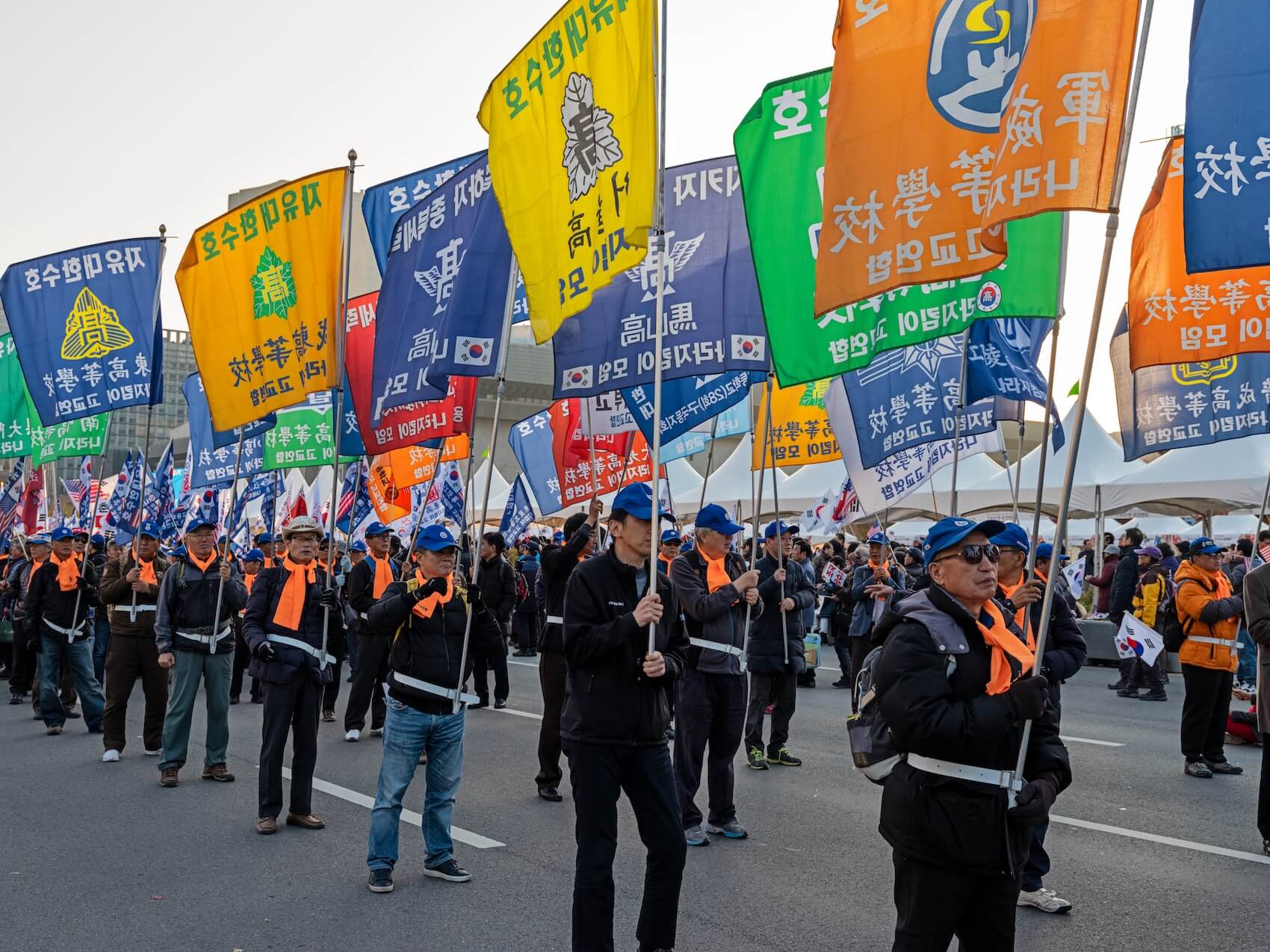
Ranks of men carry banners to protest against the policies of South Korea President Moon Jae-In in Seoul on November 16, 2019. Photo: Matt Ragen.
You state that, populism in itself involves both pro-democratic and anti-democratic streams. Yet, in the case of South Korea, the historical experience as well as the empirical analysis shows that the pro-democratic streams, exemplified by candlelight vigils, have been so far much stronger than the anti-democratic ones like hatred populism. Can you please elaborate on the pro-democratic streams that help consolidate democracy in South Korea?
Professor Sang-Jin Han: As observed by foreign onlookers, South Korea stands as a compelling example of political democracy despite enduring periods of military or authoritarian rule. The peaceful transition of government through elections in 1988, roughly four decades ago, marked a significant milestone. With two robust political parties, an active opposition, a vibrant political culture, and a strong civil society and public sphere, Korea doesn’t fit the mold of a populist country. However, there are populist tendencies evident among citizens, actors, and popular movements.
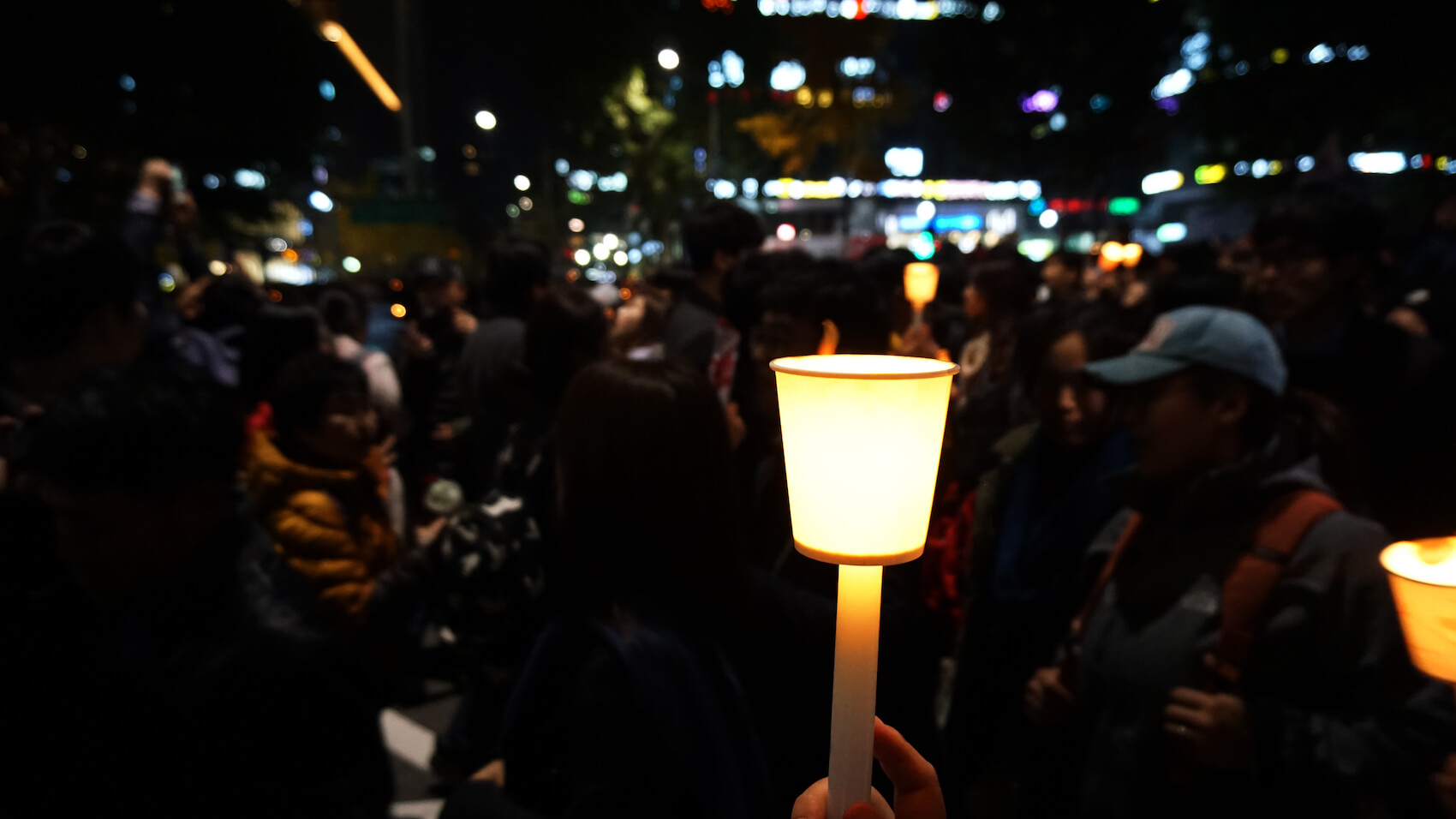
Notably, events like the Candlelight March and the National Flag Movement in 2016 and early 2017 showcased dramatic instances of populist movements. These gatherings, occurring in the same downtown streets of Seoul for months, remarkably remained peaceful with no clashes or violence. Despite their differences, with the Candlelight March predominantly composed of young, progressive, and liberal individuals advocating for democracy, and the National Flag Movement comprising older, conservative individuals leaning towards authoritarianism. They peacefully coexisted, competing for attention.
Interestingly, supporters of the Candlelight March emphasized the primacy of the people, while backers of the National Flag Movement harbored significant distrust towards politicians. This dichotomy suggests that populist movements advocating for the people, albeit in a republican sense, tend to bolster democracy, as demonstrated by the events of 2016 in Korea.
Your research distinguishes between the Candlelight movement and the National Flag movement. Could you explain the differences between these two movements and their respective impacts on democracy in South Korea?
Professor Sang-Jin Han: The Candlelight March Movement has a deep-rooted history in Korea, often emerging as a form of populism during periods of democratic regression. In the case of 2016, our government was under the control of President Park Geun-hye, the daughter of former President and military leader Park Chung-hee. Her administration sought to revert to a bureaucratic authoritarian regime by exerting control over civil society through a well-organized bureaucracy.
However, Korean society had undergone significant progressiveness since the democratization movements of the 1980s. The main energy within civil society had become younger, more dynamic, and increasingly committed to principles of freedom of expression, freedom of assembly, and democratic governance. This growing disparity between the political establishment and civil society eventually culminated in clashes, notably in downtown areas.
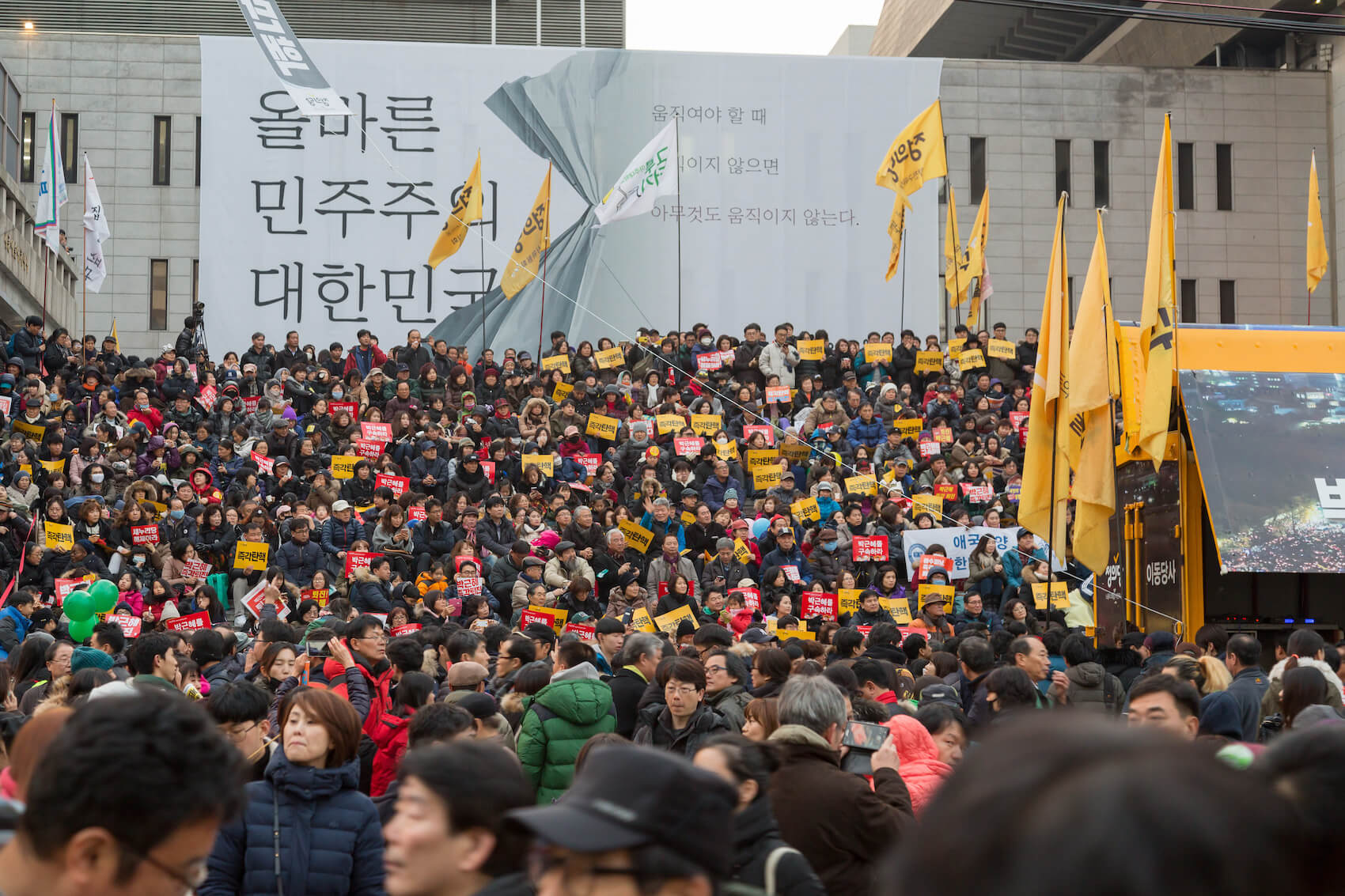
These clashes symbolize a recurrent pattern: whenever our democracy faces a threat of backsliding, energy within civil society surges, manifesting in movements like the Candlelight March. While not unprecedented, the 2016 protests were particularly decisive and successful. Ultimately, Parliament moved to impeach the President—a decision upheld by the Constitutional Court. This peaceful, progressive process demonstrated the power of people to advance democracy by countering threats and sources of democratic regression.
The events of 2016 stand as a remarkable chapter in Korean history, showcasing the resilience and efficacy of democratic movements in safeguarding and advancing democratic principles.
In your view, what are the main threats to democracy in South Korea, and how do these threats relate to populist movements such as the National Flag movement?
Professor Sang-Jin Han: I’d like to clarify that the National Flag Movement in 2016 didn’t pose a direct threat to democracy; rather, it represented a genuine voluntary effort by individuals, predominantly with conservative leanings, to defend Korea’s freedom against perceived threats from North Korea. Unlike past movements orchestrated by the government or conservative factions, this movement arose more spontaneously, indicating a positive evolution in democracy. However, its advocacy wasn’t inherently pro-democratic; instead, it focused on safeguarding freedom against North Korean threats.
Central to this movement was a strong aversion to the political elite, particularly those perceived as aligning too closely with North Korea. This sentiment, characterized by a sense of hatred or animosity towards certain political figures, rather than a commitment to democratic principles, has the potential to impede democratic progress. The National Flag Movement thus exemplifies this trend. While the movement’s intentions to defend national sovereignty and freedom are commendable, its emphasis on anti-North Korean sentiments and distrust of political elites may detract from broader democratic objectives.
Neo-Liberals as a Threat to Democracy
A group of demonstrators sit on the steps of a downtown building, chanting in protests against president Park Geun-hye in Seoul, South Korea on December 3, 2016. Photo: Kaitlyn McLachlan.
What were the findings of your empirical research regarding the association between populist movements in South Korea and support for democracy? How do these findings inform our understanding of the relationship between populism and democracy in the country? You argue; in the case of South Korea, the potential threat to democracy does not come from populist citizens, but from neoliberal citizens. Can you please explain why this is the case?
Professor Sang-Jin Han:Explaining this question in a simple yet insightful manner is indeed challenging. My empirical research, conducted in 2018, aimed to understand which citizens truly support autocracy and a strong leader. Interestingly, the findings revealed that those citizens meeting certain criteria for populism did not actually support a strong autocratic leader. Instead, it was the neo-liberal citizens who tended to favor such leadership.
The perplexing aspect is why neo-liberal citizens, who typically enjoy the benefits of political liberty and economic liberalism, would support authoritarian leadership. One possible explanation is that they perceive a threat from a powerful civil society and civil movements, fearing that these forces could potentially hinder democracy. In their view, embracing a strong leader is a means to mitigate this perceived threat and safeguard against the influence of civil society.
Despite being relatively privileged and satisfied compared to other groups in South Korea, these neo-liberal citizens still rally behind an autocratic leader. It’s a puzzle, but it’s the reality we uncovered through our research.
What is your response to the arguments that South Korea is democratically backsliding and in the middle of a democratic depression?
Professor Sang-Jin Han:As I previously mentioned, during moments of democratic backsliding, we often witness spontaneous societal movements pushing back against threats to democracy, ultimately succeeding in overcoming these challenges. Currently, while I don’t believe South Korea is facing democratic backsliding, there are concerning signs that suggest we may be heading in that direction.
In recent national elections held in April, both ruling and opposition parties and their leaders heavily relied on populist rhetoric, fueled by a sense of animosity towards each other. Unlike previous elections where strategists led the charge, this time, political leaders themselves actively advocated populist ideas, portraying their opponents not just as political adversaries, but as enemies deserving of punishment, even imprisonment. Consequently, the electoral atmosphere became emotionally charged, marked by harsh and unrestrained confrontations.
This heightened emotional struggle and the unprecedented level of confrontation during the election could potentially set the stage for democratic backsliding in the future. However, it’s worth noting that South Korea has overcome many difficulties in maintaining democracy thus far.
How will the elections held last month influence the political landscape in terms of right-wing and left-wing populism? What implications do you see for South Korean politics in terms of the polarization and demonization observed between the ruling conservative party and the progressive opposition party?
Professor Sang-Jin Han:I’m skeptical about the concept of left-wing populism versus right-wing populism, particularly in the context of South Korea. In my observation, neither left nor right ideology dominates the content of populism here. Populism, by its nature, tends to be more about emotion than adhering to specific ideological positions. Of particular concern is the cultivation of hatred, which I observed flourishing during the last general election.
A notable development during this election was the rise of a specific populist leader, Cho Kuk, a former law professor at Seoul National University and a close aide to former President Moon Jae-in. Over the years, for some understandable reasons related to the legal prosecution of himself and his wife, Cho Kuk has gained public sympathy as a symbol of political oppression and resentment. Just before the election he created a political party which became surprisingly the third party in national congress. He continues to employ aggressive rhetoric, labeling opponents as enemies deserving punishment. The emergence of such a populist leader and party may signal a potential threat to democracy in Korea.
This observation is intriguing, and while I can’t make a definitive judgment, I’m closely monitoring the role of this populist politician and party. Despite being a colleague and friend, his transformation into a popular populist figure underscores a significant shift in Korean politics. Unlike in the past, we now witness the emergence of a strong populist politician and party as a notable departure from previous political landscapes.
South Korea Follows Its Own Trajectory vis-à-vis Populism
Does the surge in populist movements in Europe and the US have any impact on South Korean populism?
Professor Sang-Jin Han:When examining the genealogy of populism in Korea, I find little influence from either Europe or the US. The roots of populism in Korea can be traced back to strong emotions, particularly those that emerged during the Korean War from 1950 to 1953 and its aftermath. During this period, anti-communist sentiment proliferated, heavily influenced by American Cold War policies. While we’ve moved past this era, remnants of this anti-communist fervor persist, shaping the political landscape.
However, today’s populism in Korea is not directly tied to past influences from Europe or America. Rather, it’s evolving in its own context, influenced by the country’s unique historical trajectory. Populism is no longer neatly categorized into left or right ideological frameworks. Instead, it’s become more of a visually driven phenomenon, especially in the age of social media. Korean society is emotionally charged and deeply divided, and politicians and other actors capitalize on this by leveraging digital media to create and disseminate compelling images.
Korea’s advanced digital technology allows for effective image production and dissemination, shaping public perceptions and discourse. While foreign observers may attempt to apply labels like left populism or right populism, these dichotomies just reflect political slogans or flags but don’t necessarily capture the nuances of Korean populism. Korea follows its own trajectory, distinct from Western models, and its populism reflects this unique context.
Pretorius, Christo & Valev, Radoslav. (2024). “Populist Authoritarianism in China – National and Global Perspectives.” European Center for Populism Studies (ECPS). May 2, 2024. https://doi.org/10.55271/rp0055
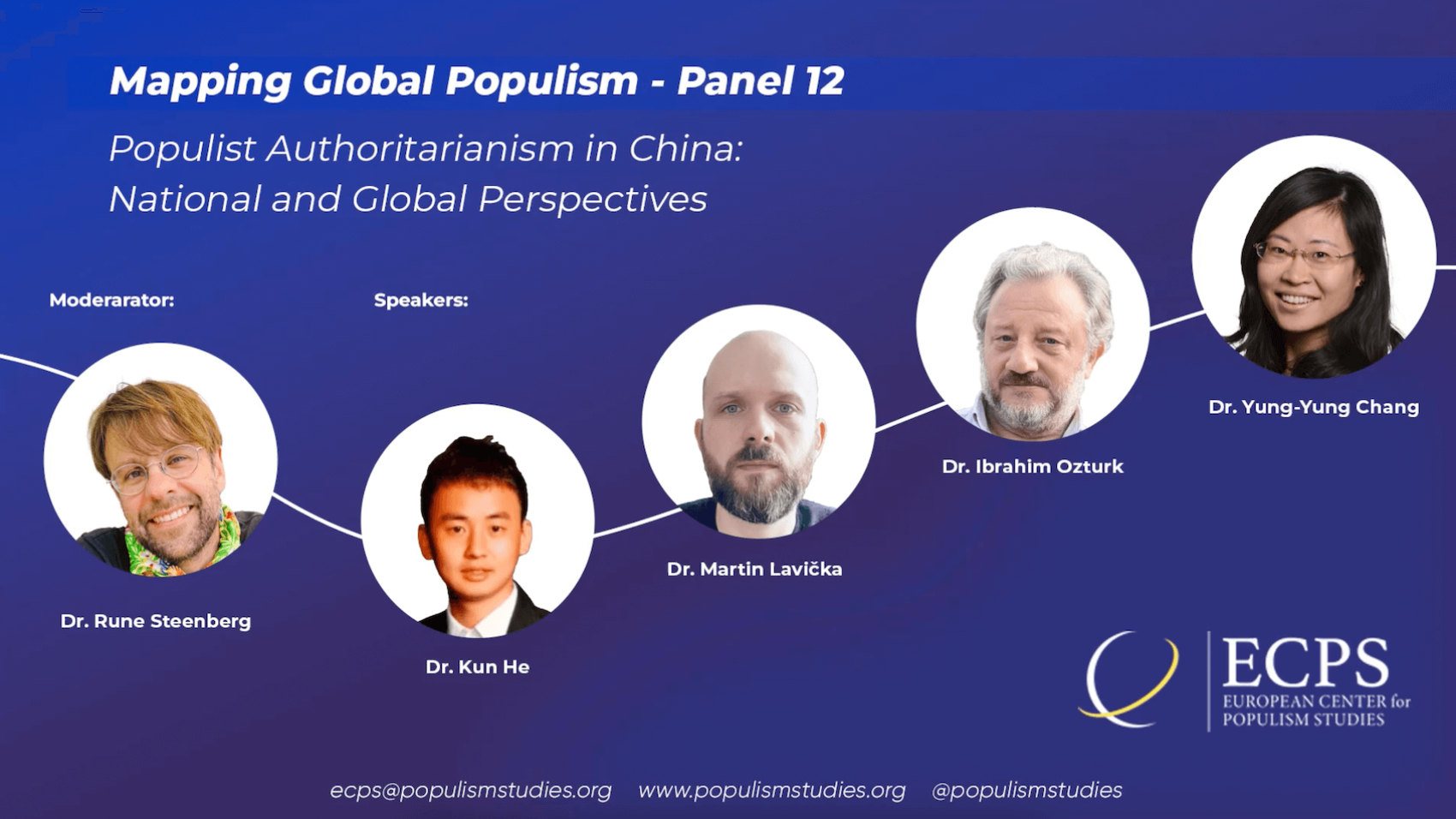
This report provides a summary of the presentations delivered during the twelfth installment of ECPS’s monthly Mapping Global Populism (MGP) panel series, titled “Populist Authoritarianism in China – National and Global Perspectives.” The event, held online on April 25, 2024, undertook a comprehensive examination of China’s dynamic political terrain. Dr. Rune Steenberg, an esteemed anthropologist and Principal Investigator at Palacký University Olomouc, adeptly moderated the panel, which featured a distinguished lineup of scholars. Each expert contributed unique insights into China’s populist authoritarianism, drawing from diverse disciplinary perspectives.
The twelfth event in ECPS’s monthly Mapping Global Populism (MGP) panel series, titled “Populist Authoritarianism in China – National and Global Perspectives,” convened online on April 25, 2024, delving into a multifaceted exploration of China’s evolving political landscape. Moderated by Dr. Rune Steenberg, an esteemed anthropologist and Principal Investigator at Palacký University Olomouc, the panel assembled a distinguished line-up of scholars, each offering unique insights into China’s populist authoritarianism from diverse disciplinary lenses.
Dr. Steenberg initiated the discussion by contextualizing the rise of populism within China, tracing its trajectory over the past decade under Xi Jinping’s leadership. Highlighting themes of nationalism, surveillance, and internal suppression, Dr. Steenberg elucidated the complex interplay between populist rhetoric, state power, and societal transformation, emphasizing China’s assertive global posture and its implications for domestic governance.
Subsequent presentations delved into specific dimensions of China’s populist authoritarianism. Dr. Kun He, Postdoctoral Researcher at the Computational Linguistics Group within the University of Groningen, scrutinized the intricate dynamics of populism within China’s socio-political landscape, delineating its manifestations and distinguishing features. Dr. Martin Lavička, Visiting Research Fellow at the Centre for East and South-East Asian Studies at Lund University, illuminated the state’s regulation of religion under Xi Jinping, underscoring its implications for religious practitioners and broader societal dynamics. Dr. Ibrahim Ozturk, Professor of Economy and visiting fellow at the University of Duisburg-Essen, elucidated China’s global populist endeavors through the lens of the Belt and Road Initiative (BRI), unraveling its geopolitical implications and coercive strategies. Lastly, Dr. Yung-Yung Chang, Assistant Professor at Asia-Pacific Regional Studies at the National Dong Hwa University, explored the intersection of technology and populism, shedding light on China’s digital authoritarianism and its ramifications for global governance.
Through nuanced analyses and interdisciplinary perspectives, the panelists navigated the contours of China’s populist authoritarianism, unraveling its complexities and global reverberations. As geopolitical landscapes continue to evolve, understanding China’s populist authoritarian trajectory assumes paramount importance, offering critical insights into the unfolding dynamics of global politics and governance.
Dr. Rune Steenberg: “Rise of Populist Authoritarianism in China”
Although the global-oriented policies of Deng Xiaoping played a part, according to Dr. Rune Steenberg, the pivotal moment that has put China on its current path was the economic crash of 2008. Furthering this theory, he highlighted that the hardening of borders, refugee crises, the environmental crisis, rising global inequality, and the attack on personal freedoms and liberties globally, have all been the context for both other populist leaders to gain popularity and power across the world, and the breakdown of the liberal world order. This has allowed power to shift towards China and its interests and offers scholars a wealth of avenues from which they can investigate the minute details of how and why this shift is occurring.
The panel moderator, Dr. Rune Steenberg, started the session by stating that he has seen the rise of populist authoritarianism in China during his work as an anthropologist, which has allowed him to investigate the issue from a broader anthropological perspective. He indicated that populist authoritarianism in China has been on the rise for at least ten years, often connected to Xi Jinping’s rise to power and his ‘Wolf Warrior Diplomacy,’ certain forms of nationalistic propaganda, competition to the United States, which all coincided with internal suppression of individual rights, freedom of expression, and the expansion of surveillance. Dr. Steenberg also noted that there is a popular support for ‘imperial ambitions’ on Hong Kong, Mongolia, Tibet, and Xinjiang that is often hard for outside commentators to understand.
Highlighting one strain of analysis, Dr. Steenberg notes that the use a Chinese historical perspective to explain China’s rise to power is often used – notably the economic reforms under Deng Xiaoping in the 1970s, which emphasized hiding one’s strength until become strong enough to assert oneself on the global scene. Commentators, such as Andre Gunder Frank, state that China is currently emerging from the shadows, a narrative often linked to the reversal of the ‘Century of Humiliation.’ In connection to this is China’s policies to go abroad, such as the Belt and Road Initiative (BRI), its connection and cooperation with Latin American and African countries, and the framing of China as an anti-colonial power, all while furthering its own colonial policies in the process.
Dr. Steenberg questioned how much of these policies come from grassroot elements compared to state elements. To frame this question, he indicated that there are certain reminders of the joint state and grassroot “Cultural Revolution” that can be found in the re-education camps in Xinjiang, which can be coupled with the breaking up of traditional society to the advantage of a modernization policy pursued by the Chinese government. Scapegoats, both internal and external, are a major part of populism, and in China modern scapegoats take on a different context than they did during the “Cultural Revolution,” especially as China becomes a major global power both economically and militarily.
Although noting that the global-oriented policies of Deng Xiaoping played a part, according to Dr. Steenberg, the pivotal moment that has put China on its current path was the economic crash of 2008. Furthering this theory, he highlighted that the hardening of borders, refugee crises, the environmental crisis, rising global inequality, and the attack on personal freedoms and liberties globally, have all been the context for both other populist leaders to gain popularity and power across the world, and the breakdown of the liberal world order. This has allowed power to shift towards China and its interests and offers scholars a wealth of avenues from which they can investigate the minute details of how and why this shift is occurring.
Dr. Kun He: “Who Are the People, Populist Articulation of the People in Contemporary China”
According to Dr. Kun He, three categories exist in China to define the ‘people.’ First it is the group that fight against those are defined as ‘foreign others’ and the elites who betray Chinese identity, whilst the idea of a Chinese nation functions as an ideological glue to unite those of the Chinese nationality. These ideas tie into historical contexts of China as ‘victor’ and ‘victim’ to mobilize and protest against the external ‘others.’ The second category of mass resistance is an anti-intellectual emotional appeal, with people rejecting elite dominated cultural production and their institutions, as well as established norms and values. The third category of the people are the netizens who are impoverished, vulnerable, and marginalized in society.
To start his presentation, Dr. Kun He gave examples of successful populist campaigns across the world, stating that ‘populism’ itself is, however, a contested concept. He goes on to give examples used to define populism, including: the ‘pure people’ vs. the ‘elites,’ criticism of established power structures, and its rhetoric and left- and right-wing orientations. Because of the diverse understanding of what populism is, multiple approaches to its study can be found, including populism as an ideology, strategy, discourse, and social movement. Populism’s ability to adapt to changing political and socio-economic circumstances further makes it difficult to pin down an all-encompassing definition.
Continuing, Dr. He demonstrates that in democratic countries populism often takes a top-down approach, with populist leaders acting as mediators in the name of the people against the elite. However, in China populism takes a more bottom-up approach, with grassroot movements often using collectivist languages – such as ‘we are the 99%.’ According to Dr. He, this difference of perspective is what was needed to pin down a more precise definition of populism, which, according to him, can indeed be understood as ‘the people’ vs. ‘the elite.’ Within China, populism has adapted to fit a Chinese context. By using the anonymity of the internet, Chinese netizens can collectively express their grievances towards the government, which they perceive as corrupt elite with established power. A key characteristic of this approach to populism is that it is decentralized, unlike what is found in democracies. Populism therefore relies on spontaneous and collaborative efforts for collective actions such as disseminating contested information.
By using a video example of Donald Trump’s inauguration speech, which itself is steeped in populist rhetoric, Dr. He demonstrated how Trump managed to tap into a general feeling of discontent that many voters felt – the political system was broken, and the government was not serving the people. He goes on to discuss generalities in western populism: a vertical axis of power, and a horizontal axis of boundaries. Modern democratic theory proposes that legitimacy of political power rests on the ‘sovereign people,’ which is why populist leaders can argue that politics should be an expression of the general will of the people. The populist leader therefore represents this will against the corrupt elite who have leading positions in every aspect of society. The ‘people’ is also, therefore, an inclusive and exclusive concept, and contributes to the ambiguity of where the line can be drawn between elites and the people. Dr. He highlights that on larger scales of investigation ‘the people’ should therefore be seen as a united abstract construct.
According to Dr. He, three categories exist in China to define the ‘people.’ First it is the group that fight against those are defined as ‘foreign others’ and the elites who betray Chinese identity, whilst the idea of a Chinese nation functions as an ideological glue to unite those of the Chinese nationality. These ideas tie into historical contexts of China as ‘victor’ and ‘victim’ to mobilize and protest the external ‘others.’ The second category of mass resistance is an anti-intellectual emotional appeal, with people rejecting elite dominated cultural production and their institutions, as well as established norms and values. The third category of the people are the netizens who are impoverished, vulnerable, and marginalized in society.
Dr. Martin Lavička: “Religion with Chinese Characteristics – Regulating Religions under Xi Jinping’’
Dr. Martin Lavička emphasized that the Chinese government regards religion with suspicion, fearing its potential exploitation by foreign entities to undermine central authority. Consequently, China pursues a strategy of “dereligionizing” religious practices and restructuring religious institutions to conform to the CCP’s centralized control. These regulatory efforts are geared toward preserving the dominance of communist ideology and preempting both internal and external challenges to the party’s power. Moreover, China not only seeks to exert control over religion but also aims to leverage it for its own strategic advantage.
Dr. Martin Lavička began his presentation by arguing that the steady rise of religious believers in China not only poses a significant challenge but also an opportunity for the central government’s leadership. Therefore, the purpose of the presentation was to uncover the Chinese regulatory policies aimed at religious practitioners in China.
Dr. Lavička stated that the Constitution of the Chinese People’s Republic (CPR) prohibits any discrimination based on nationality or religious affiliation. Furthermore, as part of the UN Security Council, China should have a leading role in promoting the UN Bill of Rights. Despite these legal obligations, independent observers such as UN bodies or NGOs have consistently found a more troubling reality regarding religious freedom in China. What is reported specifically is the mistreatment of Uyghurs (a predominantly Muslim ethnic group living in the Xinjian Autonomous region). In 2022, the UN Human Rights Office concluded that China might be responsible for committing crimes against humanity. However, it seems that the strategy of blaming and shaming someone to make them comply with international obligations does not work, especially when it comes to global powers such as China.
According to Dr. Lavička, even though the majority of the media attention goes to the Muslim Uyghurs, that does not mean that the other religious groups in China are free from oppression and control. The religious restrictions from the Chinese government have intensified since Xi Jinping took office. However, Chinese leaders have not really changed their attitude since the 1980s. Document 19 which was published in 1982 from the Chinese Communist Party (CCP) stated that religion is a tool for oppression by feudalists and capitalists and the eradication of religion in China would be a lengthy process. However, it appears that the Xi Jinping administration would like to accelerate that process of eradication. In 2016, in a conference relating to religious affairs, Xi Jinping stated that CCP members must consolidate their believes and remain unyielding Marxists and atheists which stands in contrast to the Chinese Constitution and religious freedom.
Dr. Lavička further argued that the Chinese government views religion with suspicion and believes that foreign forces could use it to undermine the power of the central government. Therefore, the government believes that religion should obey and respect the CCP and adapt to the path of the so-called Socialism with Chinese characteristics. This is also signified by the decision to incorporate the State Administration of Religious Affairs to the United Front Work Department which shows that the CCP wants greater control over religious affairs. However, China not only wants to control religion but also use it for its own benefit.
According to Dr. Lavička, China has been increasingly attempting to regulate the religious institutions. One of the most important objectives is to ensure that the religious teachings do not undermine the party’s ideology. This means that the religious personnel are carefully selected to convey the right ideas to the religious followers. However, the central government is not only concerned with the religious content and the religious personnel’s loyalty but also with the materialization of the foreign influence. For example, the ban of religious attire such as the head coverings of Muslim women or the removal of architectural features of religious venues such as the domes and minarets of mosques. The central government views those features as bearing foreign influence and undermining the Chinese characteristics.
Dr. Lavička concluded his presentation by examining the future trajectory of religion in China. He underscored China’s ongoing efforts to “dereligionize” religious practices and reshape religious structures to align with the CCP’s centralized administration. The regulatory measures implemented aim to safeguard the primacy of communist ideology and preempt internal and external challenges to the party’s authority. Ultimately, these initiatives seek to ensure that China’s purported 200 million religious adherents do not place any authority above that of the CCP.
Dr. Ibrahim Ozturk: “Unveiling China’s Global Populism – Sharp Power Politics Along the Belt and Road Initiative”
Dr. Ibrahim Ozturk highlighted several outcomes of the BRI, including debt-trap diplomacy and the transfer of strategic national interests. To exert influence over countries along the BRI, China employs sharp-power politics, utilizing manipulation, coercion, infiltration, and misinformation to shape societies. Dr. Ozturk emphasized the imperative for democratic nations to reject China’s flawed transnational populist rhetoric. It’s crucial to raise awareness among the populace to counter disinformation and reduce economic reliance on China.
At the outset of his presentation, Dr. Ibrahim Ozturk began by arguing that populism is defined by the enhancement of people’s representation in politics. Therefore, when discussing populism, there is an electoral and competitive aspect wherein the balance of power can shift due to both fair and unfair elections. However, this paradigm does not apply in China, given its one-party system, ensuring the perpetual dominance of the CCP. Consequently, discussing populism in China poses challenges. To effectively analyze the Belt and Road Initiative (BRI), a shift in perspective is required, moving from national populism to transnational populism.
In the transnational populist approach, the national citizens are replaced with transnational citizens and the national elite with transnational elite. Furthermore, the unit of analysis is on a global scale rather than the national level. There has been one such political effort in Europe, namely the political movement of the former Greek Finance Minister, Yanis Varoufakis. He wanted to construct a transnational left-wing project with the objective to democratize Europe which would decouple Europeans from their national identities and towards a European one. This European society would vote in European elections and would have a European constitution that would represent them.
However, Dr. Ozturk aimed to adopt the approach of transnational populism and apply it to China, particularly within the context of the BRI. In this scenario, the ‘elite’ would encompass the capitalist West, namely the US and Europe. China employs critical rhetoric against global corporations and designates them as scapegoats. Additionally, China selectively critiques Western multilateral organizations, highlighting the absence of Chinese representation within them rather than acknowledging their status as global institutions.
Dr. Ozturk argued that there was a principal-agent problem, claiming that China criticizes the global economy and its principal institutions, however China was benefitting from those to a large extent and saw great success because of them. Therefore, it is not clear who China is blaming in terms of global elites. In terms of defining the transnational people, the Chinese approach also fails to conceptualize this idea. China does not advocate globally for the interest of the masses and its diplomacy is based on a state-to-state approach.
In general, said Dr. Ozturk, China advocates for sovereignty and independence in the international affairs of each state while also promoting collaborative globalization through the BRI. China endeavors to shape discourse around a “global community with a shared destiny and harmonious society,” advancing a win-win nation-state approach encapsulated by “One Belt, Many Recipes.” The BRI stands out for its cooperation model, lacking clear-cut rules and established institutions like Western multilateral organizations. Instead, it operates through Memorandums of Understanding (MoUs), offering a flexible framework subject to continuous negotiations and adjustments.
The BRI primarily focuses on projects in extraction, construction, and transportation. However, the complexity and scale of these endeavors, coupled with government involvement and opacity, create opportunities for skimming, corruption, and money laundering. As authoritarian governments seek to benefit from the BRI, they often compromise their sovereignty, undermining their administration and ultimately harming global citizens.
In conclusion, Dr. Ozturk highlighted several outcomes of the BRI, including debt-trap diplomacy and the transfer of strategic national interests. To exert influence over countries along the BRI, China employs sharp-power politics, utilizing manipulation, coercion, infiltration, and misinformation to shape societies. Dr. Ozturk emphasized the imperative for democratic nations to reject China’s flawed transnational populist rhetoric. It’s crucial to raise awareness among the populace to counter disinformation and reduce economic reliance on China.
Dr. Yung-Yung Chang: “The Expanding Reach of China’s Authoritarian Influence: Shaping a New Illiberal Digital Order”
Dr. Yung-Yung Chang highlights China’s ambition to become a cyber superpower, noting its persistent efforts to regulate the digital space. China has promoted the “Digital Silk Road,” aimed at establishing digital infrastructure along the BRI participants and promoting Chinese tech giants. This initiative underscores China’s leadership in a novel form of digital governance, where digital technologies serve both economic advancement and the extension of political power. Consequently, the distinction between Chinese companies’ pursuit of commercial interests and the state’s pursuit of strategic objectives has become increasingly blurred. Some Chinese firms have received subsidies from the central government and collaborated on projects related to military and security.
Dr. Yung-Yung Chang’s presentation centered on delineating the intersection of technology and populism. Dr. Chang initiated by categorizing scholars’ perspectives on the crisis of the liberal world order into two camps. The first group perceives the crisis as temporary, advocating for the continued importance of US rule and influence to uphold the liberal order. Conversely, the second group contends that the crisis has persisted for an extended period and has undergone substantial transformation. According to this perspective, the liberal world order is irreversibly altered and unlikely to revert to its previous state. In this context, China’s influence emerges as pivotal, as a major power dissatisfied with the current global order and actively seeking to reshape it.
Dr. Chang specifically aimed to examine China’s impact on the digital order within the broader context of its emerging influence. The primary concern surrounding the new digital order revolves around whether it will bolster people’s freedom or amplify autocratic influence. Consequently, two main discourses emerge. On one hand, the liberal digital order posits that digital technologies can promote democratic values, freedom of expression, and individual autonomy. On the other hand, digital authoritarianism contends that digital technologies enable governments to exert control over their populace, manipulating and disseminating disinformation. In this narrative, state security and stability take precedence over internet freedom.
In China, according to Dr. Chang, we can already see upcoming ambitions that the country wants to become a cyber superpower. China has been attempting to continuously regulate the digital space. Furthermore, there has been the promotion of the so-called Digital Silk Road which establishes digital infrastructure along the participants of the BRI and promotes Chinese big digital companies. China has been the leader of a new form of digital governance where digital technologies not only advance the economy but also serve as a tool to extend political power. Therefore, the line between the pursuit of Chinese companies towards commercial interests and the state’s pursuit of achieving strategic objectives has been blurred. Some Chinese companies have been subsidized by the central government and have worked together on projects relating to military and security. Therefore, digital technologies can also be used for the advancement of military hardware and not only for economic advancement.
Dr. Chang’s research delved into the case of Huawei’s “safe city” project, designed to enhance urban safety and reduce crime rates. Participating cities typically share similar characteristics: they are located in Asia or Africa, exhibit limited political liberalism, and fall within the lower-middle income bracket. This underscores China’s influence in establishing a digital authoritarian paradigm. The rationale behind Huawei’s safe city initiative is straightforward. Cities facing public order challenges and high crime rates demand solutions, prompting Chinese companies to offer digital technologies as a remedy. These companies are particularly attractive to states due to their ability to provide enhanced capacity and legibility.
A notable case study is Huawei’s sponsored safe city project in Nairobi, Kenya. In response to the city’s high crime rate, thousands of cameras were installed throughout the urban area to collect and transmit information to local law enforcement agencies. However, despite these efforts, there has been no significant reduction in the crime rate. Additionally, the absence of data protection laws in Kenya raises concerns about the relationship between the government and its citizens, potentially exacerbating tensions.
In conclusion, Dr. Chang asserted that the safe city project should be examined from both demand and supply perspectives, as China did not impose these technological assets on participating countries. Moreover, Dr. Chang contended that deploying surveillance technologies does not necessarily lead to the advancement of authoritarian leadership. Looking ahead, this digital order has the potential to facilitate not only authoritarianism but also democracy. However, it’s crucial to recognize that liberal and authoritarian digital ecosystems cannot coexist indefinitely within the same environment. Political leaders must make a decisive choice between the two paradigms.
The Ventotene Manifesto beautifully weaves together the aspirations for a united Europe with the principles of (federalist) liberalism. Its legacy should encourage European citizens to ponder the significance of European values and to defend them. How? By promoting a system both market-based and social; that rejects collectivism and embraces individualism; that prompts personal responsibility and denounces populism; that promotes transparent, efficient, and democratic governance; that acknowledges liberal democracy’s flaws but knows that the authoritarian pathway – fostered by populist forces – is ruinous. This is federalist liberalism.
The European Union (EU) has historically been seen as a beacon of peace, cooperation, and shared values. However, in recent years, there has been a noticeable rise in populist movements – from the right to the left – across several EU countries. The use of nationalist discourse, the unabashed use of demagogy and populism as a method of political offer, and the recourse to the “protection” of the state, are elements which demonstrate today’s crisis in the EU. These elements typically belong to the populist discourse and weaken the EU as a whole. In particular, the surge in right and far-right movements has led to increased polarization in the member states (Roberts, 2022), with political discourse becoming more confrontational. Alongside the rise of far-right ideologies, euroscepticism has also gained momentum. Eurosceptics often criticize the EU’s institutions for being bureaucratic, undemocratic, and infringing upon national sovereignty.
A general sense of dissatisfaction concerning the economic conditions in some EU countries, immigration, the post-Covid-19 pandemic, and the Russian war in Ukraine are among the conditions that enable right- and left-wing populism and anti-Europeanism to gain popularity. Growing eurosceptic sentiment fuels debates about the EU’s future, with traditional debates on supranationalism – that is, supranational actors promote integration through the spillover effect – and intergovernmentalism – that is, member states, following national interests, dictate control (Schmidt, 2016). Modern Europe has a decade-long legacy of fighting against totalitarian regimes and defending democratic values; and this should remind the EU about its determination to overcome internal divisions and continue to promote peace, prosperity, and solidarity.
The 80th anniversary of the Ventotene Manifesto, penned by Altiero Spinelli and Ernesto Rossi (2006 [1944]) is being celebrated this year and continues to stand as an inspirational cornerstone text of the EU and its values. However, it is also a useful guide for dealing with the multiple crises plaguing the EU. Conceived in 1941 while the two authors were confined on the island of Ventotene, the document was initially distributed covertly. Eugenio Colorni later published it, adding a preface. Secretly printed in Rome in January 1944, it was later complemented with two essays by Spinelli, “The United States of Europe and the Various Political Tendencies” (1942) and “Marxist Politics and Federalist Politics” (1942-1943). While Richard Coudenhove-Kalergi’s Pan-Europe (1997 [1923]) advocated for a European union steered by technocrats (thus more functionalist), the Manifesto proposed a European Federation with a parliament and a government wielding substantial powers in areas like economics and foreign policy.
While this article reviews Spinelli’s and Rossi’s work, it starts from the Manifesto and its legacy to outline some priorities for the EU to return to the federal spirit and the renewal of liberal ideas in a federalist key considering the EU’s current political context. The Manifesto proposed the creation of a “United States of Europe” as a solution to avoid future conflicts on the continent and to promote peace and prosperity through greater political and economic integration between European nations (D’Auria, 2011). The document, which has had a major impact on the federalist movement (Vayssière, 2005), is still a roadmap towards an unfinished project in today’s EU, threatened in its cohesion and unity by internal – populists – and external actors – autocrats. The Manifesto’s principles and ideals might serve as a guide to strengthen the European integration process and face the current challenges with determination and common vision.
In his preface, anti-fascist Italian philosopher Eugenio Colorni cautioned against merely rearranging populations after the Second World War, advocating instead for a genuine European Federation, more advanced than the ineffective League of Nations. Mindful of the 1930s they experienced, Spinelli and Rossi argued that an integralist principle of non-intervention among European nations was absurd; and no country should freely opt for an authoritarian regime – as this would have, as it had, dramatic consequences for its neighbors. Thus, they emphasized the need to establish a new transnational political entity, a European Federation. Colorni called for the establishment of a unified federal army, a single currency, the elimination of customs barriers and migration restrictions between states, representation of citizens in federal institutions, and a cohesive foreign policy.
There is little point in listing the Manifesto’s achieved and unachieved policies, as the world today is significantly different from the mid-1940s’. It is rather useful instead to focus on the major insights set out by the authors and to understand how these can be adapted today and how they can benefit the European governance. At the Manifesto’s core lies the principle of freedom and the four liberties – free movement of goods, people, capitals, and services. For Spinelli and Rossi, a free and united Europe represented the path to rekindling the development of modern civilization oriented on liberal democracy. They envisioned a federal union enhanced by the close cooperation among member states, democratic representation for European citizens, and an unwavering respect for the continent’s cultural diversity.
The authors started by proposing to overcome territorial selfishness, both at the national and European levels, and to eliminate obstacles to the free movement of people and goods. They aspired to a reduction of state interference in citizens’ lives, openly criticizing authoritarian approaches (2006 [1944]). A significant section of the Manifesto addresses economic issues. The authors argued that given the global economic interconnectedness, the entire world has become the living space for people eager to maintain a modern way of life. In an age of economic interdependence, the authors argued, trade wars are counterproductive and unnecessary. Rossi and Spinelli highlighted how the total nationalization of the economy was seen as a liberating utopia by the working classes; however, once realized, it did not lead to the desired goal, but rather to a system in which the population is subservient to the bureaucratic managerial class.
A Europe that is truly free and ready to face future challenges is also one that values the free market and assigns the state an appropriate role, one that does not see it as a protagonist in the lives of citizens. On these notes, without mentioning it, the Manifesto was to designate federalist liberalism as the way forward for a future European construction – not by chance, both federalism and liberalism champion individual freedom, advocate for the autonomy of local communities, checks and balances. Federalist liberalism aims to strike a harmonious balance between the sovereignty of member states, and prioritizes safeguarding individual rights, while fostering economic growth and welfare. Within this framework, European federalism emerges as an indispensable system for securing peace, stability, and progress across the continent, harmonizing the individual nations’ autonomy with collaborative efforts at the European level.
The federalist vision of a united, free, and democratic Europe shines as a beacon of hope, and serves as both compass and inspiration. The Manifesto’s relevance endures today for several reasons, each aligning with five EU’s key priorities: an effective European Federation, the emphasis on peace and democracy, the spirit of solidarity, the quest for a shared European identity, and the promotion of democratic governance.
The vision of a European Federation has seen significant realization with the gradual formation of today’s EU. Given today’s global challenges, there’s an amplified need for increased integration and cooperation among EU member states. But most of all, there is still much to be done in terms of the EU’s efficiency and integration (Schimmelfennig et al.,2023) – for example fiscal union, cooperation in the energy sector, policies for high-tech companies. Today’s EU needs Spinelli’s and Rossi’ enthusiasm to reinvigorate, enhancing cohesion and cross-collaboration among its member states. It is in times of change that the concept of a European Federation might renew its significance. While deepening integration in key areas like defense, health, and foreign policy will pave the way for more effective EU as local and global actor. Just as in the early days of the European Community, when nations pooled coal and steel within the supranational organization European Coal and Steel Community (Glockner-Rittberger, 2012).
Secondly, the Manifesto underscored the pivotal role of peace and democracy in averting conflicts and ensuring the citizens’ welfare. Peace in Europe is not a given; and it is indispensable for forging a united and prosperous Europe. However, geopolitical tensions, regional crises, and autocratic and terrorist threats still test the continent’s security. Thus, upholding democratic values and fostering unity among European nations remain crucial for peace and stability. There cannot be peace without rule of law. European-style democracy is not merely a political system; it embodies a set of values, principles, and rights safeguarding well-being and freedom. But again: without the rule of law, democracy is also vacuous. It is from freedom that peace and democracy are achieved, not the other way around. See, for example, the accession of some former Warsaw Pact countries to the European Community in 2004: only under conditions of freedom they were able to develop a modern economy and liberal democracy, thus true peace, and welfare.
Solidarity is emphasized in the Manifesto as a vital principle binding the peoples of Europe together and it continues to resonate in today’s European political discourse. Solidarity – an ethical guideline and element of integration – is a hidden principle of federalist liberalism: the better-off helps the weaker – not only out of a spirit of charity, but because it may be in its interest to deal with partners in the best conditions to cooperate. Effective solidarity transcends national divisions. A unified response from EU member states, solidarity is also sharing responsibility in the current challenges. It encompasses respecting human rights, but it is also pivotal in the economic sphere as well, fostering also growth, dignity, and prosperity.
The Ventotene Manifesto advocated for a European identity rooted in shared values, cultures, and a common historical legacy. Federalist liberalism would preach that fostering European identity might be an answer to rising nationalism. The concept of European identity is not necessarily at odds with the idea of nationhood and national identity. It offers a pathway to a united yet open and uncertain future, complementing – and not substituting – national identities. It offers a shared platform where diverse European cultures and traditions coexist, fostering mutual enrichment and collaboration. While the European identity has been and still is object of debate (Wallace-Strømsnes, 2008), the European identity is an identity among other global identities. It is on this common ground that European states came together and federated; and today it needs further integration via a new European governance model (Kaplan, 2018).
A fifth element is a governance system grounded in democratic principles and transparency. Amid ongoing critiques of EU bureaucracy, the Manifesto – again – offers valuable perspectives on this. The transparency of European institutions cannot only be a matter of fact but must also be perceived by the population (Brandsma, 2019, Font-Pérez-Durán, 2022). Such a governance framework would prioritize European citizens’ democratic representation and their interests, ensuring that European-level decisions resonate with people’s interests and values. Transparency empowers citizens with access to information and involve them in decision-making processes, expanding their rights, bolstering the legitimacy and efficacy of European institutions to get the new European governance more efficient and accountable.
Today the Manifesto underscores the significance of a free and open society, a fundamental framework cherishing individual freedom, market economy, and the rule of law. The Ventotene Manifesto beautifully weaves together the aspirations for a united Europe with the principles of (federalist) liberalism. Its legacy should encourage European citizens to ponder the significance of European values and to defend them. How? By promoting a system both market-based and social; that rejects collectivism and embraces individualism; that prompts personal responsibility and denounces populism; that promotes transparent, efficient, and democratic governance; that acknowledges liberal democracy’s flaws but knows that the authoritarian pathway – fostered by populist forces – is ruinous. This is federalist liberalism. Spinelli and Rossi could not have imagined today’s EU, which has made huge strides from post-World War Two Europe, but they wanted a transnational and social, open, and transparent European federalist movement.
The Manifesto stands as a symbol of the quest for a European identity anchored in cooperation, unity, and solidarity. Federalist liberalism not only represents a perfect synthesis between supranationalism and intergovernmentalism, but it might reinvigorate the current EU. Spinelli and Rossi envisioned a federation as the output of a new governance. However, the realization of this project has been gradual, and the journey remains unfinished. The Ventotene Manifesto is not only a historical reference point, but also a source of inspiration and a call to action for who believe in the European project. It is a reminder of the need to overcome national divisions and to work together to enhance a united, free, and prosperous Europe. It offers both a history lesson and a roadmap for the future. Its federalist viewpoint, rooted in liberal and democratic principles, is still valid today for us to recognize the compatibility of cooperation and freedom.
References
Brandsma, Gijs J. (2019). “Transparency of EU informal trilogues through public feedback in the European Parliament: promise unfulfilled.” Journal of European Public Policy, Volume 26, Issue 10, pp. 1464-1483, DOI: 10.1080/13501763.2018.1528295
Coudenhove-Kalergi, Richard Nicolaus. (1997 [1923]). Pan-Europa. Un grande progetto per l’Europa unita. Rimini: Il Cerchio Iniziative Editoriali.
D’Auria, Matthew. (2011). “The Ventotene manifesto: The crisis of the nation state and the political identity of Europe.” In: Spiering, Menno; Wintle, Michael (Ed.). European identity and the second world war. Basingstoke: Palgrave Macmillan.
Font, Nuria; Pérez-Durán, Ixchel. (2022). “Legislative Transparency in the European Parliament: Disclosing Legislators’ Meetings with Interest Groups.” Journal of Comon Market Studies. Volume 61, Issue 2, pp. 379-296, 10.1111/jcms.13371.
Glockner, Iris; Rittberger, Berthold. (2012). “The European Coal and Steel Community (ECSC) and European Defence Community (EDC) Treaties.” In: Laursen, Fin (Ed.). Designing the European Union. London: Palgrave Macmillan.
Kaplan, Yılmaz (2018). “(Re)considering sovereignty in the European integration process.” Asian Journal of German and European Studies. Volume 3, Issue 1, DOI: 10.1186/s40856-017-0023-4.
Roberts, Kenneth M. (2022). “Populism and Polarization in Comparative Perspective: Constitutive, Spatial and Institutional Dimensions.” Government and Opposition. Volume 57, Issue 4, pp. 680-702, DOI: 10.1017/gov.2021.14.
Schimmelfennig, Frank; Leuffen, Dirk; De Vries, Caterine. E. (2023). “Differentiated integration in the European Union: Institutional effects, public opinion, and alternative flexibility arrangements.” European Union Politics. Volume 24, Issue 1, pp. 3-20, DOI: 10.1177/14651165221119083.
Spinelli, Altiero; Rossi, Ernesto. (2006 [1944]). Il Manifesto di Ventotene. Milan: Mondadori.
Vayssière, Bertrand. (2005). “Le manifeste de Ventotene (1941) : acte de naissance du fédéralisme européen.” Guerres mondiales et conflits contemporains. Volume 217, Issue 1, pp. 69-76, DOI: 10.3917/gmcc.217.0069.
Wallace, Claire; Strømsnes, Kristin. (2008). “Introduction: European Identities.” Perspectives on European Politics and Society. Volume 9, Issue 4, pp. 378-380, DOI: 10.1080/15705850802416762
Bachtiar, Hasnan; Shakil, Kainat & Smith, Chloe. (2024). “Use of Informal Sharia Law for Civilizational Populist Mobilization in the 2024 Indonesian Elections.” Populism & Politics (P&P). European Center for Populism Studies (ECPS). April 26, 2024. https://doi.org/10.55271/pp0035
Abstract
The Defenders Front of Islam or the Front Pembela Islam (FPI) is an Islamist civilizational populist movement in Indonesia. Its religious and political blueprints have been a challenge to the elites in power. In 2017 and 2019, it was involved in the contest of electoral politics to fight against the elites by implementing the populist politics that tends to undermine the democratic process. As a result, it was banned in 2020 but re-established a year later. In 2024 elections, it supports for Anies Baswedan-Muhaimin Iskandar to compete against Prabowo Subianto-Gibran Rakabuming and Ganjar Pranowo-Mahfud MD. The findings suggest that by applying the Islamist civilizational populism, the FPI instrumentalizes the informal religious law to support its political mobilization. It emphasizes the legal-centric perspective of “sharia,” which gives the FPI’s activists and its wider audience only one imperative option to solve the problem: join in the populism. We arguably state that the informal religious law can contribute to the process of Islamist civilizational populist mobilization.
The Defenders Front of Islam or the Front Pembela Islam (FPI) is an Islamist civilizational populist movement in Indonesia (Barton et al., 2021; Yilmaz et al., 2022). It was born on August 17, 1998, in Jakarta when the country was undergoing political reform and transition from authoritarian to democracy. The FPI emerged as an Islamist movement that upholds the mission of fighting against immorality such as thuggery, prostitution, alcohols, drugs, gambling, and other street evils, while other Muslim organizations did not spread the Islamic messages in this level (Facal, 2020). In addition, when immorality tended to increase crime during the Reformasi, the police were seen as unable to solve the social problem (Jahroni, 2004: 222-227). To carry out its religious mission, the FPI has frequently implemented violent and vigilante methods to ensure the safety of society.
The FPI wants to Islamize state and society. It desires Indonesia to be a modern state based on the Islamic sharia. It’s ideal, similar to that of the Islamist party Masyumi (1943-1960), is to install the Islamist phrases in the first principles of the state, Pancasila. The FPI wants to transform the principle of “Belief in one Almighty God” (Ketuhanan Yang Maha Esa) to become “Belief in one Almighty God with the obligation to carry out the sharia Islam for its adherents.” In 2002, the FPI attempted to transform (Islamize) constitution, but failed (Wilson, 2015). However, it has maintained its ideal persistently by implementing the Islamization of society. In 2012, its top leader, Muhammad Rizieq Shihab published his book “Wawasan Kebangsaan Menuju NKRI Bersyariah” (The National State of Mind towards the Shariatized NKRI/Indonesia). This book presents the FPI’s thoughts on Islamist politics, suggesting that the Islamist struggle is crucial to establishing a religious society. Accordingly, some scholars identify the FPI as the Islamist populist movement (Hadiz, 2016; Hadiz and Robison, 2017; Hadiz, 2018; Mietzner, 2018; Mietzner & Muhtadi, 2018; Aspinall & Mietzner, 2019; Mietzner, 2020).
The FPI’s Islamist da’wa blueprints have been a challenge to the government. In 2016, the FPI was involved in the cross-class alliances of the populist rally that brought together more than five hundred thousand masses to oust Ahok (a Hakka name for Basuki Tjahaya Purnama) a Chinese-Christian governor of Jakarta. At the time, Rizieq was hailed by the populists as their “Grand Imam” (Imam Besar), leading the pure people in their fight against the corrupt elites. As a result, the FPI’s chosen leader, Anies Baswedan had won the chairmanship of the capital in the 2017 gubernatorial election (Bachtiar, 2023a). With Ahok having the backing of President Jokowi, the FPI was also forging a message that the central government is the next target to be overthrown. In the 2019 election, the FPI endorsed Jokowi’s rival, a retired Indonesia special forces general, Prabowo.
The government banned the FPI in 2020 because of the issue of its relationship with the Islamist extremist groups and its radical campaign to Islamize the republic (Yilmaz et al., 2022; Yilmaz, 2023). In addition, its leader, Rizieq was imprisoned for violating the health quarantine during the Covid-19 pandemic, although he was released on parole in July 2022. Since then, the police have continued to prohibit the FPI’s political actions both in the public sphere and the cyber space. In January 2021, however, the neo-FPI was reborn, changing its name to the Front of Islamic Brotherhood or Front Persaudaraan Islam (FPI) (Tsauro & Taufiq, 2023; Taufiq & Tsauro, 2024). In this new form, Rizieq handed over leadership to his son-in-law, a young and charismatic Muslim preacher, Muhammad Husein al-Attas. In the 2024 Indonesian elections, the FPI backed Anies to run as one of the presidential candidates. Even after its dissolution, the FPI still can play a crucial role in the country’s electoral politics.
This paper aims to analyze the role of the FPI in the context of the 2024 elections in Indonesia. We argue that by implementing the Islamist civilizational populism, the FPI is instrumentalizing the informal religious law to support its populist political mobilization. It emphasizes the legal-centric perspective of sharia, which gives the FPI’s supporters and the public only one imperative option to solve the problem: join in the populism. It is in line with the populist promise that populism is the only solution to the crises. The subsequent section discusses the theory of Islamist civilizational populism and informal religious law. It is followed by the context of the 2024 elections in Indonesia, the FPI’s Islamist civilizational populism, and the FPI’s instrumentalization of the informal religious law in its Islamist civilizational populist mobilization.
Islamist Civilizational Populism and Informal Religious Law
The mass demonstration “Jogja Bergerak untuk Keadilan dan HAM” in Yogyakarta, Indonesia, on December 18, 2020, demands the release of Rizieq Shihab and an investigation into the shooting incident involving FPI members. Photo: Hariyanto Surbakti.
Populism, theoretically, is non-monolithic. There are many definitions of it. In this paper, however, we use the minimal definition of populism that is developed further by Yilmaz and Morieson (2023) which includes not only the vertical element of populism but also its horizontal element so-called civilizationism as a thicker ideology that contributes to the populist identification of ‘self’ and ‘the other.’ They define civilizational populism as a set of ideas that collectively hold that politics must serve the people’s general will, and that “society is ultimately separated into two homogenous and antagonistic groups, ‘the pure people’ versus ‘the corrupt elite,’ who collaborate with the ‘dangerous others’ belonging to other civilizations and who pose a clear and present danger to the civilization and way of life of the pure people” (Yilmaz and Morieson, 2023: 4).
In civilizational populism, the role of religion is crucial. It is because civilizationism highly frequently includes religious aspects such as particularly informal religious law (Yilmaz, 2022). It is the law that the religious society has implemented in an informal way beyond the legal system of the state. Accordingly, we define this informal religious law “as a legal entity outside the formal legal system of a state, and the people of that state uphold and respect this law as it governs all aspects of their lives.” In the context of Muslim society, this informal religious law can be sharia and the other legal entities derived from it such as fiqh (Islamic jurisprudence) and fatwa (Islamic legal opinion), as the sharia is considered the most significant source of guidance for the lives of Muslims (Yilmaz, 2022: 20). Sharia also contributes significantly to shaping the legal centric perspective among Muslims (Said, 1994).
The Context of the 2024 Elections in Indonesia
There are three pairs of presidential and vice-presidential candidates for the 2024 elections in Indonesia. The first is Anies Baswedan-Muhaimin Iskandar (AMIN), while the second and the third are Prabowo Subianto-Gibran Rakabuming Raka and Ganjar Pranowo-Mahfud MD respectively.
In the 2019 elections, the FPI supported Prabowo Subianto-Sandiaga Uno to compete against Jokowi-Ma’ruf Amin. At that time, Prabowo-Sandi was defeated. However, after the FPI experienced political difficulties – the dissolution of the organization, the imprisonment of its leader, the death of its six laskars – Prabowo accepted the Jokowi’s offer to join his cabinets. Prabowo was appointed Defense Minister. This led the FPI to perceive Prabowo as betraying the ummah including in the context of the 2024 elections.
Prabowo’s running mate, Gibran, is the son of Jokowi. Ganjar Pranowo, a member of the Indonesian Democratic Party of Struggle (PDIP), backed Jokowi in both the 2014 and 2019 elections. Mahfud MD, Jokowi’s Coordinating Minister for Politics, Legal, and Security Affairs, has aligned with Ganjar’s candidacy. Despite their prior support for Jokowi’s administration, Ganjar and Mahfud oppose the Prabowo-Gibran ticket because they perceive Jokowi’s endorsement of his son’s candidacy as a bid to extend his political influence (Bachtiar, 2023b).
The FPI’s support for AMIN is strengthened by the political frauds allegedly committed by the Prabowo-Gibran camp, especially through Jokowi’s political power. These include the perpetuation of Jokowi’s political dynasty, legal manipulation by the Constitutional Court, abuse of authority and power as a state official, and vote counting fraud (Yilmaz et al., 2024a; Yilmaz et al., 2024b; Slater, 2024).
The FPI’s Islamist Civilizational Populism
The FPI is an Islamist civilizational populist movement that is considered still influential in shaping the political dynamics of the Indonesia’s 2024 election. This movement plays a crucial role in supporting one of the pairs of the presidential and vice-presidential candidates, Anies Baswedan and Muhaimin Iskandar (AMIN), who are competing with Ganjar Pranowo and Mahfud MD, and mainly Prabowo Subianto and Gibran Rakabuming Raka.
Although all the candidates tend to build their image as pro-diversity nationalists, the FPI helps promote AMIN as the pious leaders of the ummah. The FPI’s image-building of AMIN purposes at retaining the Islamist voters and attracting the public attention, as most of the country’s population is Muslim.
By supporting AMIN, the FPI produces Islamist civilizational populist narratives and rhetoric that guarantee its populist identification of “the self” and “the other” to distinguish those who are on the side of the ummah from those who are not. Accordingly, the FPI defines certain boundaries between those who can be identified as Islamist civilizational populists and those who are their adversaries.
The FPI perceives that AMIN’s opponents are its populist enemies. They are the other electoral candidates that have been supported by “corrupt elites.” The FPI directs its identification towards Ganjar-Mahfud, Prabowo-Gibran, and their backers. Ganjar-Mahfud has been proposed by the winning political party in the last election, the Indonesian Democratic Party of Struggle (PDIP), which is also a political force that recommended the banning of the FPI. Meanwhile, Prabowo-Gibran has been supported by incumbent president Jokowi, who backed Ahok, the FPI’s most hated political figure in the 2017 gubernatorial election (Yilmaz et al., 2024a; Yilmaz et al., 2024b).
The two enemies of the FPI, the PDIP politicians and Jokowi, had been working together in the context of the 2019 elections. The FPI perceives them as the corrupt elites who have invited foreign powers such as the West and China to participate in the exploitation of the country’s natural resources (Yilmaz et al., 2022). Those powers, as the FPI claimed, are categorized as the dangerous others.
The FPI’s view of the corrupt elites and its civilizational enemies is reflected in a statement by one of its leaders, Munarman: “Currently, we are witnessing that those who are in power, are those who are anti-Islam, anti-Islamic teachings, anti-Muslims, and even accuse the teachings of Islam of being a lie. In terms of global geopolitics, we should not hope for anyone, because it is precisely the power of the White Wolf (the West) that has been a place of dependence for compradors, foreign accomplices. Indonesia has been in contact with the White Wolf. Now the compradors are also accomplices of the Red Dragon (China)” (Munarman, 2016).
Since then, as well as in the context of the 2024 elections, according to the FPI, the elites have involved the Muslim ummah’s civilizational enemies (the dangerous others) in the social, cultural, political, and economic destructiveness, primarily in a way of undermining the ummah’s general will. The FPI claims that because of the civilizational threats of foreign forces, the ummah have remained marginalized with no access to economic resources or social welfare.
FPI’s Instrumentalization of the Informal Religious Law in Its Islamist Civilizational Populist Mobilization
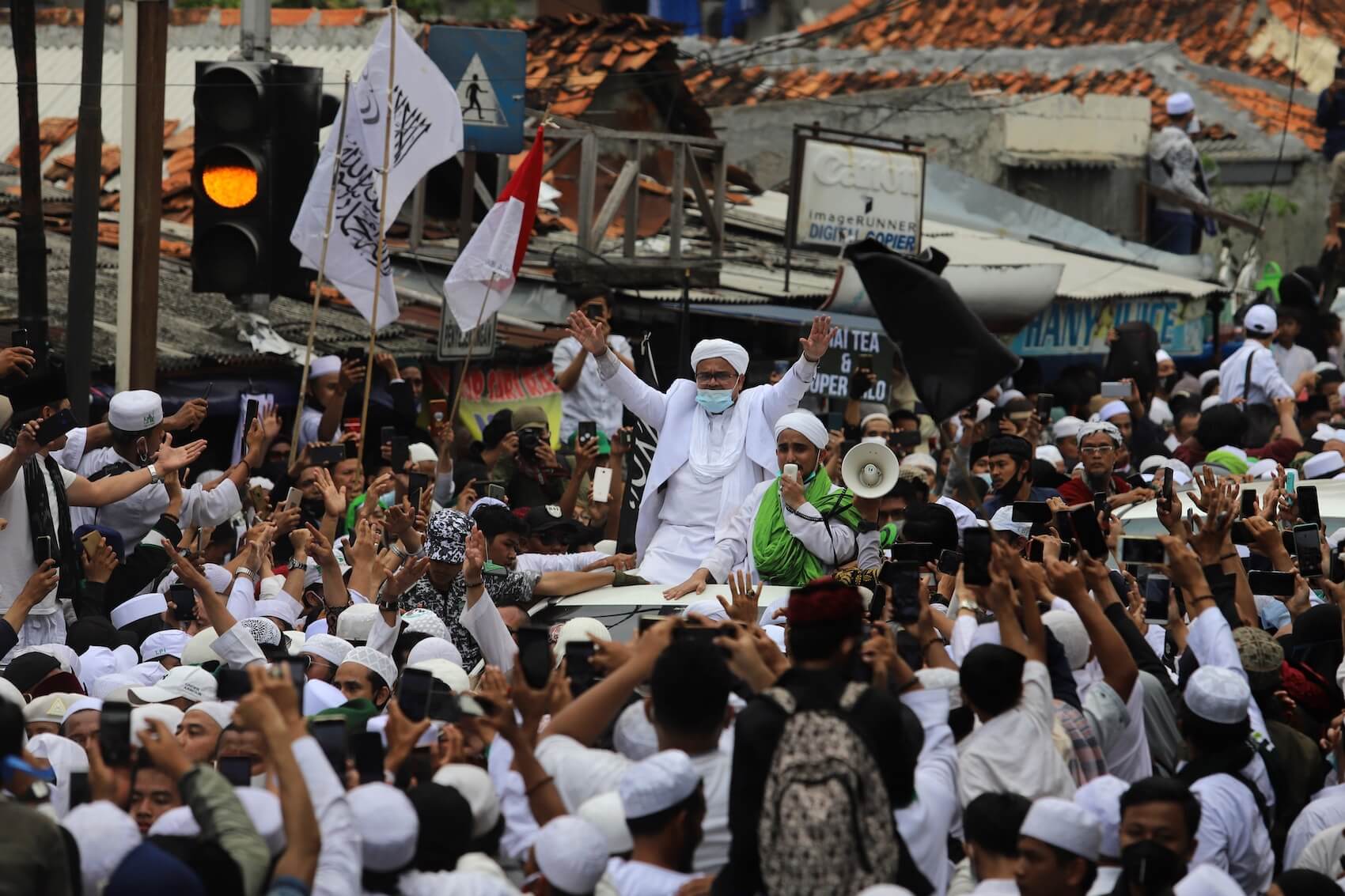
The Grand Imam of the Islamic Defenders Front (FPI), Habib Rizieq Shihab, upon his arrival in Jakarta on November 10, 2020. Photo: Angga Budhiyanto.
In its mission to combat perceived threats against the ummah, the FPI actively urges its activists and the public to participate in its populist agenda. The FPI frames this mission as a religious obligation, asserting that it is incumbent (wajib) upon Muslims to engage in it. We contend that the FPI strategically utilizes informal religious laws such as sharia, fiqh, and fatwa to ensure the success of its Islamist populist mobilization efforts.
The FPI employs informal religious law through three primary methods: Firstly, it implements a legal-centric perspective in applying its Islamist doctrine of “commanding good and forbidding evil” (amar ma’ruf nahi munkar), particularly in its populist political struggle. Additionally, the FPI mobilizes the masses by advocating adherence to Sharia principles in electing leaders, often based on outcomes from deliberative consultations (musyawarah) among Ijtima’ Ulama. Lastly, the FPI rallies its supporters and the public to combat alleged political fraud perpetrated by its adversaries.
First, the FPI perceives politics as the arena for its religious struggle in which this Islamist civilizational populist movement must implement its Islamist doctrine of amar ma’ruf nahi munkar. This doctrine urges Muslims to command good and at the same time to forbid evil. It is rooted in the Islamic scripture, Surah Ali Imran verse 104, “And let there be among you a group of people who call to virtue, commanding the good and forbidding the evil; they are the fortunate ones.” Other verses such as Ali Imran 110 and 114, Al-Araf 157, Al-Taubah 71, Al-Haj 41, and Al-Luqman 17 substantively also emphasize this doctrine. According to the FPI’s top leader, Rizieq Shihab, the level of obligation to implement amar ma’ruf nahi munkar is fardu ‘ain (individual obligation) for those in authority, and fardu kifayah(communal obligation) for those who are not (Shihab, 2024). When the authority undermines his or her obligation, however, it becomes the duty of everyone in the Muslim community, including the FPI, to conduct the amar ma’ruf nahi munkar. Therefore, in order to implement it, it is imperative to emphasize the fight against the populist enemies in the context of the electoral politics.
Second, the FPI trusts the informal religious institution that enables “Islamist” scholars (ulama) from across the country to engage in the collective Islamic legal reasoning (ijtihad) to find a solution to the political problem and select the best leaders from among the available candidates. On November 18, 2023, in the Adz Dzikro Mosque, Sentul, Bogor, West Java, the Ijtima’ Ulama concluded their ijtihad and decided that AMIN was the candidate to vote for (Faktakini, 2023). Rizieq Shihab claims that the result of the Ijtima’ Ulama is based on the Islamic practice of deliberative consultation (musyawarah) which is commanded by God. At length, he expresses his thought that:
“In matters of struggle, including social and political matters, we have upheld musyawarah. First of all, musyawarah is a command from Allah in the Qur’an. Allah says, ‘wa shawirhum fi al-amri,’ inviting them to deliberate on important matters, especially for the benefit of many people. In another verse, Allah subhanahu wa ta’ala makes deliberation the identity of the believers. Allah says, ‘wa amruhum shura’ bainahum,’ meaning that the affairs of the believers are discussed among themselves. …So, decisions made by musyawarah, that’s the advantage, Insha Allah, will be much better than personal decisions because many opinions are taken into account. And that’s not all. Decisions made through musyawarah become a shared responsibility. So, even if there are mistakes or shortcomings in the future, we won’t point fingers (not blame anyone). But if it’s a personal decision, it can be pointed at (personally blamed). That’s the advantage of reflection. And musyawarah is because of Allah’s command, if we carry it out, it will be blessed. Well, a blessed decision, God willing, is not wrong. That is why many people have asked me, what is our attitude towards the 2024 presidential elections? I have answered that I am waiting for the decision of the Ijtima’ Ulama,” (Shihab 2023).
Based on this FPI’s informal religious law, one of its leaders, Hanif Alatas had mobilized the FPI supporters and the public in various religious assemblies across the country. He strongly promoted the Ijtima’ Ulama’s decision to vote for AMIN. He stated that: “Are you ready to follow the command of the ulama? Are you ready to follow the ulama who are highly consistent (istiqamah)? Are you ready to follow the direction of the Ijtima’ Ulama? We obey the Ijtima’ Ulama! 2024, Anies becomes the president. Takbir!!!” (Alatas, 2024). Ultimately, the FPI organized the massive religious gathering (Istighotsah Kubro) at Benyamin Suaeb Stadium, Kemayoran, Central Jakarta on February 8, 2024, to mobilize Islamist masses to vote for AMIN.
Third, by using the informal religious law, the FPI mobilizes its supporters and the public to fight against its enemies that who are allegedly involved in political fraud. Rizieq Shihab calls on the masses to fight the political fraud that is taking place, while at the same time building mass confidence that the pure ummah can win against Ahok in the 2017 gubernatorial election, despite not being supported by a large political force. According to Rizieq Shihab, the FPI’s resistance to political fraud and confidence in implementing amar ma’ruf nahi munkar is part of an effort to uphold the sharia. He said:
“Well, because of that, if you want AMIN (Anies-Muhaimin) to win, that’s why I invite you, let’s fight fraud. …Don’t be afraid if there are other candidates supported by economic power, political power… We have experience in Jakarta. In Jakarta, when we fought Ahok, what did we have? …Ahok was supported by the President, supported by the Chief of Police, supported by the TNI Commander, supported by all mainstream TV media, supported by major parties, supported by Taipan conglomerates, supported by the Nine Dragons, supported by survey institutions, brothers. … Those who supported Anis at that time were only parties, brother, whose votes were actually not as big as the parties that supported Ahok. Ahok was backed by foreign powers, brother. On paper, Ahok won. But what happened after that? It turned out that God’s will was different. …Allah Subhanahu wa taala still forced Ahok to resign. The Muslims won, brother. Right? Takbir!!! If we obey Allah, we don’t have to worry. ‘Intansurullah, yansurkum.’ If you defend Allah, uphold His law, uphold His sharia, ‘yansurkum,’ surely Allah will win you all this. Allah’s promise is sure to be true, Allah’s promise is impossible to miss, ya Ikhwan!” (Shihab, 2024b).
The FPI accused the Prabowo-Gibran political carriage of fraud because they are backed by Jokowi who has committed abuses of power as a state official. Gibran, Jokowi’s son, does not actually meet the requirements of the election law to run for vice-president, mainly because he is under 40. As a result, the Prabowo-Gibran political force filed a judicial review with the Constitutional Court to change the age for vice-presidential candidacy. They managed to change this requirement, especially as the Chief Justice of the Constitutional Court is Anwar Usman, Jokowi’s brother-in-law. Their success is suspected to have been due to a collusive and nepotistic practice that manipulated the country’s highest judicial system. In addition, according to the FPI, Jokowi used his social, political, and economic resources to support his son. Jokowi ordered his ministers, police and military chiefs and other officials to mobilize the masses to ensure they voted for Prabowo-Gibran. In addition, they (state officials) were also mobilized to distribute social aid to society, which certainly contained certain political messages in favor of Prabowo-Gibran’s victory.
Conclusion
Despite its disbandment in 2020, the FPI underwent a resurgence as a similar Islamist civilizational populist movement in early 2021, emerging as a significant extra-parliamentary force in Indonesia’s 2024 elections. Endorsing Anies Baswedan-Muhaimin Iskandar (AMIN) as the presidential and vice-presidential candidates against Prabowo Subianto-Gibran Rakabumin and Ganjar Pranowo-Mahfud MD, the FPI positioned itself prominently. Its support for AMIN stems from its perception of the other candidates and their supporters as populist political adversaries. Specifically, the FPI identifies the Prabowo-Gibran political alliance, endorsed by Jokowi, as representing corrupt elites who allegedly align with dangerous external influences, particularly Western powers and China, posing a threat to the ummah’s civilization.
We contend that in mobilizing its supporters during the 2024 elections, the FPI utilized informal religious law, encompassing sharia, fiqh, and fatwa. The FPI employed this legal framework in three keyways: Firstly, it adopted a law-centric approach in applying the principle of amar ma’ruf nahi munkar, particularly within its political activism. Secondly, the FPI mobilized the masses by advocating adherence to Sharia principles in selecting leaders, often guided by deliberative consultations (musyawarah) among Ulama during Ijtima’ gatherings. Thirdly, the FPI rallied its supporters and the public to combat alleged political fraud perpetrated by its adversaries.
We also arguably state that the FPI uses informal religious law as an ideological expression that helps its populist mobilization. This has to do with the legalistic nature of sharia law, which has nuances of halal (permissible) and haram(forbidden) or black and white. Furthermore, according to the FPI’s sharia-centric perspective, politics tends to be positioned as a field of da’wah (religious proselytization). Thus, for the FPI, politics must have a religious mission. If there is a concept of Islamic politics, then in this context it is sharia-based populist politics.
So far, in the case of the FPI in Indonesia, we have seen this as part and parcel of Islamist civilizational populism. However, is this also the case for other civilizational populist movements elsewhere in the world?
Funding: We acknowledge that this research is supported by the Australian Research Council (ARC) the Discovery Project – DP220100829, titled “Religious Populism, Emotions and Political Mobilisation: Civilisationism in Turkey, Indonesia and Pakistan” (2022-2025).
References
Alatas, H. (2024). “Habib Hanif Bersama Jutaan Umat Islam Dukung Amin, Capres Cawapres Pilihan Ijtima Ulama.” Islamic Brotherhood Television. YouTube.https://www.youtube.com/watch?v=O4uT9Lhafek (accessed on April 23, 2024).
Aspinall, E. & Mietzner, M. (2019). “Indonesia’s Democratic Paradox: Competitive Elections Amidst Rising Illiberalism.” Bulletin of Indonesian Economic Studies. 55(3), pp. 295-317. https://doi.org/10.1080/00074918.2019.1690412
Bachtiar, H. (2023a). “Indonesian Islamist populism and Anies Baswedan.” Populism & Politics (P&P). European Center for Populism Studies (ECPS). https://doi.org/10.55271/pp0025
Bachtiar, H. (2023b). “Ganjar Pranowo’s Quest: Resisting Islamist Civilizational Populism in Indonesia.” Populism & Politics (P&P). European Center for Populism Studies (ECPS). https://doi.org/10.55271/pp0028
Barton, G.; Yilmaz, I. & Morieson, N. (2021). “Religious and Pro-Violence Populism in Indonesia: The Rise and Fall of a Far-Right Islamist Civilisationist Movement.” Religions. 12(6) 397. https://doi.org/10.3390/rel12060397
Facal, G. (2020). “Islamic Defenders Front Militia (Front Pembela Islam) and Its Impact on Growing Religious Intolerance in Indonesia.” Trans-regional and -National Studies of Southeast Asia. 8(1), pp. 7-20. https://doi.org/10.1017/trn.2018.15
Hadiz, V.R. & Robison, R. (2017). “Competing Populisms in Post-authoritarian Indonesia.” International Political Science Review. 38(4), pp. 488-502. https://doi.org/10.1177/0192512117697475
Hadiz, V.R. (2016). Islamic Populism in Indonesia and the Middle East. Cambridge: Cambridge University Press.
Hadiz, V.R. (2018). “Imagine All the People? Mobilising Islamic Populism for Right-Wing Politics in Indonesia.” Journal of Contemporary Asia. 48(4), pp. 566-583. https://doi.org/10.1080/00472336.2018.1433225
Jahroni, J. (2004). “Defending the Majesty of Islam: Indonesia’s Front Pembela Islam (FPI) 1998-2003.” Studia Islamika. 11(2), pp. 197-256. https://doi.org/10.15408/sdi.v11i2.601
Mietzner, M. & Muhtadi, B. (2018). “Explaining the 2016 Islamist Mobilisation in Indonesia: Religious Intolerance, Militant Groups and the Politics of Accommodation.” Asian Studies Review. 42(3), pp. 479-497. https://doi.org/10.1080/10357823.2018.1473335
Mietzner, M. (2018). “Fighting Illiberalism with Illiberalism: Islamist Populism and Democratic Deconsolidation in Indonesia.” Pacific Affairs. 91(2), pp. 261-282. https://doi.org/10.5509/2018912261
Mietzner, M. (2020). “Rival Populisms and the Democratic Crisis in Indonesia: Chauvinists, Islamists and Technocrats.” Australian Journal of International Affairs. 74(4), pp. 420-438. https://doi.org/10.1080/10357718.2020.1725426
Said, A.H. (1994). Al-Thabit wa al-Mutahawwil, Vol. 1. Beirut: Dar al-Saqi.
Shihab, R. (2024a). “Merinding! HRS Bebas! Dicecar RH 1 Jam, Keluar Semuanya: Konseptual, Jauh dari Radikal.” Refly Harun. YouTube. https://www.youtube.com/watch?v=1o2UwKDOZgA (accessed on April 21, 2024).
Shihab, R. (2024b). “Musuh Paslon Anies Baswedan-Muhaimin Hanyalah Kecurangan.” Islamic Brotherhood Television. YouTube.https://www.youtube.com/watch?v=HutlOcXicHU (accessed on April 21, 2024).
Syihab, M.R.H. (2012). Wawasan Kebangsaan Menuju NKRI Bersyariah. Jakarta: Suara Islam Press.
Taufiq, F. & Tsauro, A. (2024) “Radical Turn: The Case of Front Persaudaraan Islam (Neo-FPI) in Indonesia.” Journal of Asian Wisdom and Islamic Behavior. 2(1), pp. 11-23. https://jawab.web.id/index.php/JAWAB/article/view/67
Tsauro, A. & Taufiq, F. (2023). “What Neo-FPI offers toward the Muslim Community: Exploring a New Face of Islamic Activism and Populism in Indonesia.” At-Tafkir. 16(2) (2023), pp. 119-138. https://doi.org/10.32505/at.v16i2.7365
Wilson, I.D. (2015). The Politics of Protection Rackets in Post-New Order Indonesia: Coercive Capital, Authority and Street Politics. London: Routledge.
Yilmaz, I. (ed.). (2023). Civilizational Populism in Democratic Nation-States. London: Palgrave Macmillan.
Yilmaz, I.; Hasnan, B.; Smith, C. & Shakil, K. (2024b). “Fluctuating Populism: Prabowo’s Everchanging Populism Across the Indonesian Elections.” Populism & Politics (P&P). European Center for Populism Studies (ECPS). https://doi.org/10.55271/pp0030
Yilmaz, I. & Morieson, N. (2023). Religions and the Global Rise of Civilizational Populism. Singapore: Palgrave Macmillan.
Yilmaz, I.; Morieson, N. & Bachtiar, H. (2022). “Civilizational Populism in Indonesia: The Case of Front Pembela Islam (FPI).” Religions 13(12) 1208. https://doi.org/10.3390/rel13121208
Yilmaz, I.; Triwibowo, W.; Bachtiar, H. & Barton, G. (2024a). “Competing Populisms, Digital Technologies and the 2024 Elections in Indonesia.” Populism & Politics (P&P). European Center for Populism Studies (ECPS). https://doi.org/10.55271/pp0029
Please cite as: Smith, Chloe; Bachtiar, Hasnan; Shakil, Kainat; Morieson, Nicholas & de Groot Heupner, Susan. (2024). “Appealing to a Religiously Defined ‘the People’: How Religion Was Performatively Operationalized in the 2019 and 2024 Election Campaigns of Indonesia’s President-Elect.” Populism & Politics (P&P). European Center for Populism Studies (ECPS). April 25, 2024. https://doi.org/10.55271/pp0034
Abstract
Observers widely acknowledged the lack of divisive Islamist populism in Indonesia’s 2024 Presidential Elections. This was in stark contrast to the 2019 elections in which Prabowo Subianto, the case study of this article and new leader of Indonesia, led a campaign that overtly supported Islamist interests and actors, and deepened religio-ethnic tensions in society. Despite this acknowledgement, it remains unclear if religion was still operationalized – albeit differently – in his most recent campaigning efforts. This article therefore seeks to examine if religion was politicized and performed by Prabowo in 2024 and contrast the findings with 2019 to address how and why his instrumentalization of religion varied significantly. Applying a discursive-performative lens, discourse analysis will be used to determine if and how religion featured in a sample of Prabowo Subianto’s speeches (six speeches in total, three from each election campaign). Specifically, this analysis will explore how references to religion and a religious community reflect a) his political goals and b) the political community he is attempting to engage. It will also discuss these findings in the context of contemporary populism studies.
Although there has been significant progress in recent years, the study of religious populism in non-Western democratic campaigning remains underdeveloped (Sumiala et al., 2023; Zuquete, 2017; Beuter et al, 2023). This is an important gap to address, because understanding the role of religion in electoral politics is important when religion and religious majoritarianism are tightly entangled in national identity, culture, and society and resulting in an inherently more complex phenomenon (Yabanci, 2020: 93; Yilmaz & Morieson, 2022).
Electoral campaigns in these countries may feature both exclusionary populist appeals in which the religiously defined in-group is often used as a juxtaposition with ‘evil’ elites and ‘others’ (DeHanas & Shterin, 2018). What has been examined less, particularly in empirical research, is the politicization of religion to link together and homogenize a range of interests and identities (Laclau & Mouffe, 2001), influence the perception of the leader, and create enthusiasm for their political mission.
Indonesia’s 2024 presidential election – and its winner – provides a fascinating account of the instrumentalization of religion in political campaigning. To better understand Indonesia’s new leader and how he may command over the county’s religio-political space, this article considers Prabowo Subianto’s populist orientation toward Islamism in 2019 and compares it with his use of religion in 2024’s campaign, when Islamist rhetoric was notably absent. This has not yet been addressed adequately, nor supported by empirical research, although the change has been widely observed in political commentaries of the recent election (Ismail & Koh, 2024; Chaplin & Jurdi, 2024; Rozy, 2024).
A Brief Note on Indonesia’s Recent Religious-Political Context
In cases of Islamist populism, researchers have found that ‘the people’ are a collectivized identity group (‘pious Muslims’) consisting of a range of Muslim identities and interests that are grouped together and politicized (Susanto, 2019; Hadiz, 2018). In Indonesia, the literature indicates that in recent history, a range of actors have interacted with or influenced religious populism in Indonesia: from politicians and parties, social media influencers and online preachers, through to grassroots movements and organizations (Mietzner, 2020; Hadiz, 2018; Barton et al., 2021; Kayane, 2020; Widian et al., 2022).
In 2019, Prabowo Subianto constructed his political image, narratives, and performances in response to the socio-political tensions that had been heightening for some time in Indonesia. Although beyond the limitations of this article to explain in detail, it is suffice to note here that polarization in recent years had been exacerbated by various populist and extreme actors who used religion to inflame tensions, push for social and political change, and destabilize conditions for religious minorities (Mietzner, 2020; Widian et al., 2022; Temby, 2019).
The most notable period of intensification occurred during the ‘anti-Ahok’ mass protest movement, born in the lead up to the 2017 gubernational elections. The then Christian-Chinese governor of Jakarta, Busaki Tjahaja Purnama (‘Ahok’) was accused of blasphemy after citing a single verse from the Qur’an, and this shared grievance brought together a range of Islamist actors and many Indonesians in a significant period of populist mobilization (Mietzner, 2020; Hadiz, 2018; Mietzner & Muhtadi, 2018; Jaffrey, 2021: 224-225). Mietzner (2020) notes that Prabowo attached himself to this mobilization event, and incorporated Islamist populism and Islamist actors into his campaigning effort. Operationalizing religious populism in his election campaign, Prabowo became a highly influential player in one of the most divisive political contestations in Indonesia’s history (Ismail & Koh, 2024).
This article contributes to the developing field of religious populism by studying its manifestation in the discourses and performances of Prabowo Subianto in the last two Indonesian elections (2019 and 2024). In both election cycles, Prabowo makes references to religion and conveys religious meaning to the audience he is seeking support from. Yet, scholars widely agree that in 2019, Prabowo used Islamist populism to further his political agenda, mobilize supporters and exploit religio-ethnic tensions in Indonesia (Mietzner, 2020; Hadiz, 2018; Barton et al., 2021). In 2024 however, observers noted that Prabowo refrained from religious populism’s polarizing and antagonistic accounts of people in society (Ismail & Koh, 2024; Chaplin & Jurdi, 2024; Rozy, 2024), although there is little written about his broader incorporation – or eradication – of religion in his most recent political performances.
Equally, by using Indonesia as a case study, this article underlines how religious populism in the socio-political context of more religious societies usually presents quite differently from democracies of the secularized Western variety (Wawrzynski & Marszalek-Kawa, 2022: 2; Falki, 2022: 227).
Methodology
This research employs a deductive qualitative approach, in which the theoretical framework of this paper will guide the analysis of collected data (Widian et al., 2022: 354). Discourse analysis will be used to identify and compare the rhetorical religious elements of a sample of Prabowo’s communications.
The article will ultimately explore how Prabowo’s political style has pivoted away from an exclusionary religious populist style – and what it can teach us about the under-studied role of religion in electoral campaigning.
Sample Data Collection
This article will use a sample of Prabowo’s campaign speeches which were selected based on a number of considerations, including: Prabowo discussing his campaign and policies, the length of the speech – longer speeches were favored because they provided more data to analyze, and speeches that occurred shortly (in the three months maximum prior) before the election when a leader is likely to most powerfully perform their political persona.
Sample 1: Prabowo’s official national speech, ‘Indonesia Menang’ at the Jakarta Convention Center, Jakarta, 2019.
Sample 2: Opening campaign speech in Kotabaru, Gondokusuman – Yogyakarta, 2019.
Sample 3: Prabowo. CNN Indonesia. Pidato Berapi-Api GBK, 2019.
Sample 4: Prabowo’s political speech in Stadion Gelora Bandung, Bandung, West Java, on February 8, 2024.
Sample 5: The People Party for the Progress of Indonesia (Pesta Rakyat untuk Indonesia Maju) in Gelora Bung Karno (GBK) Stadium, Senayan, Jakarta, February 10, 2024.
Sample 6: Prabowo Subianto’s speech at a volunteer consolidation event at the Pekanbaru Youth Center, Riau, 2024.
Data Analysis
Each author contributing to this research is familiar with and currently undertaking scholarship into the context of Indonesia and Indonesian politics, and religious populism. Our analyses have been guided by our understanding of the socio-political context these speeches have been presented in. One contributor is a native Indonesian and has assisted in ensuring the integrity of the transcribed and translated speeches.
The four speeches were read in full several times before selecting the passages that have been used for the following analyses. These passages were selected based on their relationship with key themes of religion, religious populism, and religious association. This process resulted in the identification of certain key narrative themes, which the passages have been categorized under below.
References to God, Prophet Muhammad, and Religion
Prabowo Subianto gives a speech about the vision and mission of the 2019 Indonesian presidential candidate in front of a crowd of supporters on the campaign in Yogyakarta, Indonesia on April 8, 2019. Photo: Aidil Akbar.
In all sets of 2019 and 2024 speeches, Prabowo references Islam as a shared religion with the Indonesian people, and in each case, he opens with an Islamic greeting to the crowd.
In the 2019 speeches, Prabowo drew attention to his personal affinity with God and religion. In sample one (2019), he frames his concluding comments by declaring himself “a proud son of the nation and of Islam.” Similarly, in sample two (2019), he greets the crowd and immediately declares himself a Muslim:
“I pray that Yogyakarta is in a state of health and well-being. As a Muslim, let us send prayers and peace to our beloved Prophet Muhammad, who has enlightened us all.”
Populism often involves the personalization of politics, where voters connect with a political actor and their representation rather than strictly the set of policies and party affiliation they have (Soare, 2017; Weyland, 2017). In the above examples, Prabowo is drawing attention to himself as a Muslim and son of Islam, which supports his attempts at presenting himself as a pious religious figure throughout the 2019 campaign, and as will be demonstrated below, the savior of Indonesia.
In sample 3 (2019) Prabowo demonstrates this personalization again and links his happiness with serving the Indonesian people. He owes this to God for providing him with the opportunity to serve:
“And I invite all my friends to do the same. We are devoted, we serve the state and the nation and the people. And I am already 68 years old. The Almighty has given me too much. I am determined. The rest of my life is for the people of Indonesia. My happiness, my joy, if I can see the wealth of Indonesia returning to the people of Indonesia. I am happy.”
In one of the 2024 sample speeches (sample 4), Prabowo ends his speech with a prayer:
“I close my remarks with my prayer, I pray for the presence of Allah, subhanahu wa taala, God the Great, God the Almighty, who rules all the worlds. It is only to You that we pray, only to You that we ask for help. O Allah, O Lord, give us strength, amen, so that we are strong to receive the mandate from the people of Indonesia, so that we have the ability, wisdom, intelligence, courage, honesty, sincerity to protect the people of Indonesia … O Allah, give us the strength, give us the power to continue to be loyal to the nation and the people of Indonesia, amen. Thank you, O Allah, thank you for everything you have given, thank you for your favor, thank you for all the gifts you have given. Thank you. Wassalamualaikum warahmatullahi wabarakatuh.”
This prayer frames the Prabowo and the audience as collective Muslims who are seeking the right direction for Indonesia from God. While the sincerity of this prayer is not for our judgement, we can comment that religion is politicized to create unity and to frame Prabowo’s seeking of power as a holy and pious mission.
In sample 6 (2024) Prabowo expresses moral absolutisms of right, wrong and evil to highlight the virtuous path he is on:
“I got teachings from my ustaz-ustaz, from my kiai-kiai, from my teachers. If you are insulted, if you are mocked, if you are slandered, return it to the almighty. I believe that right is right, wrong is wrong, evil is evil, I continue on the right path, I have no doubt, O God, O Allah subhanahu wa ta’ala.”
The Discursive Construction of Crisis, Breakdown, and Threat
The sample speeches show Prabowo constructing a rhetorical crisis to a much greater degree in 2019 than he did in 2024 campaigning. Although these passages are not always inherently related to religion, the analysis will demonstrate how these crises can be used to augment an image of saviorhood by the political actor from ‘evil’ elites, which tends to lean on religious ideals and association.
A key narrative theme in the 2019 samples is that Indonesia is weak, threatened and at a crucial crossroads for its survival. This is most pronounced in the first sample, in which he shares a tragic story of a farm laborer and father who died by suicide because of the burden of his debts, and of the one in three Indonesian children who are malnourished, the ordinary people who can’t afford to live, and the debt Indonesia keeps accruing on a global scale. In the second sample, Prabowo evocatively claims that “our country is sick” and “Mother Earth is being raped” and “the rights of people are being trampled on.”
This state of crisis is attributed to the “handful of elites in Jakarta” that “do as they please.” Prabowo personalizes this state of crisis such as in sample 2 (2019) when he declares:
“I speak what’s in my heart. I’m fed up, fed up with the antics of the evil elite in Jakarta. Fed up. Always lying, always lying, lying, lying. Lying to the people.”
Religious populism is often used, as it has been here, to create moral distinctions between the ‘good’ people and the ‘evil’ others (e.g. DeHanas and Shterin, 2018).
The perpetuation of crisis, threat and blame was almost absent in the most recent election. In a significant pivot in 2024, Prabowo became allies with and endorsed by his former opposition President Jokowi, despite Prabowo having spread unfounded rumors about Jokowi secretly being a Chinese Christian who was selling out Indonesia in the former election (Lam, 2023). This consequently saw a change in Prabowo’s rhetoric, in which he stopped performing a state of despair when discussing Indonesia and blaming the political elites and government. For example, in sample 3 (2024), Prabowo claimed that Indonesia will become great and prosperous:
“Brothers and sisters, on the 14th of February, all of us, brothers and sisters, will determine the future of your children and grandchildren, brothers and sisters. We are now at a crossroads. Do we want to improve, do we want to progress, do we want to become a prosperous country, or do we want to become a mediocre country? Ladies and gentlemen, Prabowo Gibran and Koalisi Indonesia Maju, we are determined to continue all the foundations that have been built.”
In sample 4 (2024) Prabowo again optimistically describes Indonesia and the state of the country left by President Jokowi:
“We are also grateful to President Joko Widodo, ladies and gentlemen, ladies and gentlemen, ladies and gentlemen, the Indonesian nation is a great nation, not just a great territory, not just a great population, but a great heart, a great soul, a great character, ladies and gentlemen.”
We can see a clear change in Prabowo’s strategy from the above passages, from claiming that Indonesia is facing imminent threats from internal and external factors and urgently needing a leader to save the country and its people, to portraying Indonesia as being on the right track but needing a leader to lead it to greatness.
Prabowo as the Savior of Indonesia
Former Minister of Defense and winner of the February 14, 2024, Presidential election, Prabowo Subianto, pictured at the 77th-anniversary celebration of the Indonesian Air Force in Jakarta on April 9, 2023. Photo: Donny Hery.
Political actors using a populist style generally rely on constructing a state of crisis, and then portraying themselves as the one – perhaps the only one – that can lead the people through the crisis or breakdown (Moffitt, 2016; Moffitt, 2020).
When religion is incorporated into this rhetoric, it can enhance and add credibility to these claims by sacralizing the leader (as the ‘savior’) and consequently, their politics take on a transcendent nature (Zuquete, 2017; Yilmaz, Morieson & Demir, 2021; Yabanci, 2020). Furthermore, when a leader references the majority religion, and appeals to the religious community, they are lending legitimacy and authenticity to their political agenda. We can see this in sample 1 (2019) when Prabowo ends his speech with:
“As a proud son of the nation and of Islam, allow me to proclaim the takbir, ‘Allahu Akbar! Allahu Akbar! Allahu Akbar! Independence! Independence!’ ‘Good luck fighting, together for a victorious Indonesia’.”
In this passage, Prabowo is creating a connection between himself (a son of Islam), God and religion of ‘the people’ (Allahu Akbar! God is Greatest!) and Indonesia’s independence (exclaiming and repeating Independence! following the takbir). Prabowo concludes his address in sample 2 (2019) in similar terms:
“Then, after voting, guard the counting until it’s finished. God willing, the people will win, Indonesia will win. Allahu Akbar, Allahu Akbar, Allahu Akbar, Independence, Independence, Independence. Thank you.”
In sample 3 (2019) Prabowo once again portrays his political career as a sacred mission that has been granted by God. This example highlights his perceived role as fighting for justice and against those he opposes (the elite government):
“I am grateful. I am grateful. To God Almighty. God is great. Thank you, God. You gave me the opportunity. To defend the people. Danio. You gave me a chance. With these noble figures. You gave me a chance. To stand up for truth and justice. Thank you, Lord. You gave me the opportunity. To fight against the budget of wrath. To fight against injustice. To fight against leaders who deceive their own people.”
Interestingly, while Prabowo’s 2024 speeches did not construct a vision of Indonesia in crisis like they did in 2019, the most pronounced instance of Prabowo performing as the savior of Indonesia came from one of the 2024 campaign speeches (sample 3). In this example, Prabowo narrates to the crowd:
“Ladies and gentlemen, from the young age of 18, I have pledged that I am ready to die for the nation and people of Indonesia. Ladies and gentlemen, my ustaz, my kiai, taught me, ‘Prabowo, as a Muslim, before you spend your last breath, you must say two sentences of shahada.’ And I have said it in my life, because I should have been called by God. It turns out that God still gives, Allah subhanahu wa ta’ala still gives me breath, still gives me strength, still gives me health. That means I have to fulfil my duty to the nation and the people of Indonesia. And I, at this moment, after I have risked my life for decades for this republic, I am not willing to still see poor people in Indonesia.”
In this passage, Prabowo describes his political career as a sacred mission. Claiming that he is ready to die for the nation to fulfil this religious duty from God, Prabowo is making a passionate appeal to the emotions of the audience.
This is an interesting finding. It is quite evident that Prabowo was operationalizing exclusionary religious populism in 2019 to engage with the surging popularity of Islamist sentiment at the time. Yet in 2024, the above examples highlight Prabowo performatively and discursively communicating his religious identity and appealing to the religious identity of his audience.
Support for Islamist Actors and Collectives
Across the two election cycles, Prabowo expressed his support for very different political and social actors. In 2019 Prabowo clearly signaled to and supported to Islamist influences in Indonesian society. In sample 2 (2019) for example, Prabowo directly endorses the National Movement to Guard Ulama’s Religious Edicts (GNPF Uluma) and the populist Islamist group the Islamic Defenders Front (FPI):
“Ladies and gentlemen, thank you GNPF, thank you 212, thank you FPI. They want to accuse you of being radical. I say you are not radical. Why, do they want to pit Islam against Nationalism? Why do they want to pit Islam against Pancasila? Islamic leaders who participated in the birth of Pancasila, ladies and gentlemen.”
This quote demonstrates how Prabowo aligned himself with Islamist groups and movements that were widely acknowledged as accelerating religio-ethnic tensions and hostilities in Indonesian society, particularly against ethnic Chinese Christians. However, in this passage, Prabowo is implying that ‘they’ (the ‘others’) are responsible for these tensions by pitting Islam (Islamists) against the state and its ideology. Later in the speech, he directly places himself in the Islamist camp, stating:
“To say we are radical Islamists is an overstatement; we respect and protect all religions, all ethnic groups, and ethnicities.”
Although Prabowo is attempting to portray his mission as one of inclusivity, in this same statement he is also drawing attention to his association with the populist Islamist movement and the figures attached to it. As pointed out above, these figures are known to work against various types of pluralism in society.
In sample 3 (2019), Prabowo once again casts a blurry shadow of his position towards Islamism, which likely reflects an attempt to appeal to a broader support base. We also note an attempt to minimize negative perceptions of the Islamist actors he has associated with:
“Ladies and gentlemen. I am with Sandiaga Uno. We have no intention. We have no intention. Apart from working, serving, and devoting to all the people of Indonesia. Some say Prabowo-Sandi, the Coalition of Indonesia Adil Makmur, will change the Pancasila state. Lies! We will establish a khilafah state. Lies! This I say is slander. Cruel slander. Cruel slander. Cruel slander. But it doesn’t sell. The Indonesian people will not be affected, brothers and sisters. That’s right. That’s right. Our Ustadz-ustadz, our kiai-kiai, always teach that Indonesian Islam is Islam rahmatan lil alamin. Our Islam, peaceful Islam.”
By the 2024 election, Prabowo had publicly cut all ties with Islamist figures and instead allied himself with more moderate religious figures and organizations, including the leadership of one of Indonesia’s largest Islamic organizations, Nahdlatul Ulama (NU) (Chaplin & Jurdi, 2024; Lam, 2023). As demonstrated in earlier passages analyzed, he redirected his support to the mainstream and became a vocal supporter of his predecessor – and former opponent – President Jokowi.
Calling for Unity and Inclusivity
Instead of the polarizing religious rhetoric Prabowo became known for in his 2019 campaigning, 2024 saw the leader operationalize religion to strengthen his new political agenda of unity and inclusion. For instance, in sample 3 (2024), he claimed:
“Prabowo, Prabowo, Prabowo, ladies and gentlemen, our ustadz-ustadz, our kiai-kiai, our religious leaders, teach us, religious people, pious people, you can’t demonize others, you can’t insult others, you can’t slander others, you can’t fight against each other, right, ladies and gentlemen…”
Prabowo is still displaying a people-centeredness here, and addressing those who follow and study Islam. Religion here becomes a driver for Prabowo’s new agenda for the de-polarization of Indonesian society (Arifianto & Budiatri, 2024). In sample 4 (2024), Prabowo expresses a similar desire and need for peace and the unification of the Indonesian people, although he steers away from using religious justifications:
“The condition is that we must get along, we must unite, we must be peaceful, we must not fight anymore, we must not divide, we must not suspect each other, demonize each other, ridicule each other, slander each other. No, we must unite so that we become a great country, our people prosper, we eliminate poverty from the land of Indonesia, ladies, and gentlemen.”
In sample 4 (2024) we also see Prabowo making a rhetorical effort to include the ethnic Chinese Christians he had vilified in the past. Although staying away from religious categorization, he stated:
“Firstly, I would like to congratulate all Muslims for celebrating the great day of Isra Mikraj, and also to wish our brothers and sisters of Chinese ethnicity who are celebrating the Lunar New Year. If I am not mistaken, today is exactly the Lunar New Year for the Chinese ethnic group, ladies, and gentlemen.”
These samples are a clear demonstration of Prabowo’s decision to move away from polarizing and antagonistic discourses and performances. There are several reasons why he has changed his strategy (Yilmaz et al., 2024 discuss these in their recent work) but this discourse analysis has also demonstrated that he continues to rely on the mobilizing and legitimizing power of religion in addressing and collectivizing ‘the people’ and connecting his political agenda with the beliefs and culture of the majority religion.
Concluding Remarks and Future Research
Whether or not Prabowo will return to a religious populist style that antagonizes ‘elites’ and ‘others’ and aligns itself with Islamist actors and ideals cannot yet be determined. What we can identify is that his political style in the most recent election was distinctly flavored by a characteristically populist effort to appeal to ‘the people,’ achieved by communicative strategies that sought the approval of various segments of society (see Yilmaz et al., 2024). Most relevant to this article was Prabowo’s use of religious rhetoric which, as this discourse analysis highlighted, continues to play a central role in his campaign speeches and efforts and showed a distinct effort to appeal to a (shared) collective Muslim identity. With recent polling showing that religious affiliations and identities continue to inform how many Indonesians vote (Chaplin & Jurdi, 2024), this undoubtedly contributed to his electoral success.
Ultimately, we note a shift from Islamist mobilization to a mobilization directed towards Indonesian Muslims. Like other politicized religions, Islamist ideals are often far removed from the religion it is associated with. Islamist movements and parties have developed their ideologies based on a range of factors such as the political, institutional, and historical legacies of colonialism and nation-building, Pan-Arabism and Pan-Islamism, and in response to authoritarian regimes (Cesari, 2021).
Funding: We acknowledge that this research is supported by the Australian Research Council (ARC) the Discovery Project – DP220100829, titled “Religious Populism, Emotions and Political Mobilisation: Civilisationism in Turkey, Indonesia and Pakistan” (2022-2025).
Barton, G; Yilmaz, I. and Morieson, N. (2021a). “Authoritarianism, democracy, Islamic movements and contestations of Islamic religion ideas in Indonesia.” Religions. 12. https://doi.org/10.3390/rel12080641
Barton, G; Yilmaz, I. and Morieson, N. (2021b). “Religious and pro-violence populism in Indonesia: The rise and fall of a far-right Islamist civilisationist movement.” Religions. 12. https://doi.org/10.3390/rel12060397
Beuter, C; Kortmann, M.; Netter, LK. and Rucktaschel, K. (2023). “Populism and Religion: an intricate and varying relationship.” Politics and Religion. 16: 346-350.
Chaplin, C. and Jurdi, S. (2024). “Faith, democracy, and politics in Indonesia: Explaining the lack of Islamic mobilisation in 2024.” The London School of Economics and Political Science. https://blogs.lse.ac.uk/religionglobalsociety/2024/02/faith-democracy-and-politics-in-indonesia-explaining-the-lack-of-islamic-mobilisation-in-2024/ (accessed on April 21, 2023).
Falki, SM. (2022). “The strands of religious populism and otherization of Muslims in India” Journal of Indian Studies.8(2):227-240.
Hadiz, VR. (2018a). “Imagine all the people? Mobilising Islamic populism for right-wing politics in Indonesia.” Journal of Contemporary Asia 48(4):566-583. https://doi.org/10.1080/00472336.2018.1433225
Jaffrey, S (2021). “Right-wing populism and vigilante violence in Asia.” Studies in Comparative International Development. 56:223-249. https://doi.org/10.1007/s12116-021-09336-7
Kayane, Y. (2020). “The populism of Islamist preachers in Indonesia’s 2019 presidential elections.” The Muslim World.110:605-624. https://doi.org/10.1111/muwo.12368
Laclau and Mouffe. (2001). Hegemony and socialist strategy: Towards a radical democratic politics. 2nd edn, Verso, London.
Mietzner, M. and Muhtadi, B. (2018). “Explaining the 2016 Islamist mobilisation in Indonesia: Religious intolerance, militant groups and the politics of accommodation.” Asian Studies Review. 42(3): 479-497. https://doi.org/10.1080/10357823.2018.1473335
Mietzner, M. (2020). “Rival populisms and the democratic crisis in Indonesia: Chauvinists, Islamists and technocrats.” Australian Journal of International Affairs. 74(4): 420-438. https://doi.org/10.1080/10357718.2020.1725426
Moffitt. B. (2016). The global rise of populism: Performance, political style, and representation, Stanford University Press, Redwood City.
Soare, S. (2017). “Populism and leadership: Is there anything new under the sun?” Studia Europaea. 62(3).
Sumiala, J.; Hoover, SM. and Laughlin, C. (2023). “Religious populism? Rethinking concepts and consequences in a hybrid media age.” International Journal of Communication. 2795-2804.
Susanto, NH. (2019). “Politicization of religion and the future of democracy in Indonesia in populism theory.” Journal for the Study of Religions and Ideologies. 18(54): 139-158.
Temby, Q. (2019). “Disinformation, violence, and anti-Chinese sentiment in Indonesia’s 2019 elections.” ISEAS Yusof Ishak Institute. (67).
Wawrzynski, P. and Marszalek-Kawa, J. (2022). “Emotional dynamics of populism and its non-populist alternatives: Discussing the role of compassion and pride.” Polish Political Science Yearbook. 51. https://doi.org/10.15804/ppsy202267
Weyland, K. (2017). “Populism: A political-strategic approach.” In: Kaltwasser CR, Taggart P, Espejo PO, Ostiguy P (eds). The Oxford Handbook of Populism. Oxford University Press, Oxford.
Widian, R.; Satya, Panip & Yazid, S. (2022). “Religion in Indonesia’s elections: An implementation of a populist strategy?” Politics and Religion. 16(2): 351-373. https://doi.org/10.1017/S1755048321000195
Yabanci, B. (2020). “Fuzzy borders between populism and sacralized politics: Mission, leader, community and performance in ‘New’ Turkey’.” Politics, Religion & Ideology. 21(1): 92-112. https://doi.org/10.1080/21567689.2020.1736046
Yilmaz, I.; Bachtiar, H.; Smith, C. & Shakil, K. (2024). “Fluctuating Populism: Prabowo’s Everchanging Populism Across the Indonesian Elections.” Populism & Politics (P&P). European Center for Populism Studies (ECPS). March 15, 2024. https://doi.org/10.55271/pp0030
Yilmaz, I.; Morieson, N. and Demir, M. (2021). “Exploring religions in relation to populism: A tour around the world.” Religions. 12(5). https://doi.org/10.3390/rel12050301
Yilmaz, I. and Morieson, N. (2022). “Civilizational populism: Definition, literature, theory and practice.” Religions.13(1026). https://doi.org/10.3390/rel13111026
Zúquete, JP. (2017). “Populism and religion.” In: Kaltwasser, CR; Taggart, P.; Espejo, PO.; Ostiguy, P. (eds). The Oxford Handbook of Populism. Oxford University Press, Oxford.
Although not perfect, as no government form ever is, Athenian democracy allowed citizens to have the greatest say in how they were governed, giving them necessary legal and economic protections to do so. One can see why modern scholars define Athens as having a ‘radical’ democracy, as actions such as changing the surnames of citizens to incorporate the name of their deme, having a highly complex jury selection system, and even paying individuals for public service, were all radical ideas when compared to the oligarchic systems of other city-states and kingdoms such as Macedonia.
It’s hard to miss the stark warnings from a variety of sources about the dangers of populist leaders and how democracy is currently on decline around the world (Freedom House, 2024; Netherlands Helsinki Committee, 2022; Pengelly, 2022). It would perhaps surprise many that, what we consider to be current contemporary issues are not necessarily new, and we can draw from the past a rich collection of political discourse and historical conflict.
The term “Democracy” originates from the Ancient Greek world, derived from the Greek words demos, meaning ‘people,’ and kratos, meaning ‘rule’ (Kofi, 2015). In the Classical Period of Ancient Greek history, various city-states adopted different forms of government, often influenced by local and foreign circumstances. By the 4th Century, there was a general consensus on three main types of political systems: autocracy, oligarchy, and democracy. As the Greek statesman Aeschines pointed out, “Autocracies and oligarchies are administered according to the tempers of their lords, but democratic states according to established laws” (Aeschines, 1.4). Similarly, Aristotle writes his views on the different systems: ‘…The deviations from these are as follows: from kingship, tyranny; From aristocracy, oligarchy; from constitutional government, democracy. For tyranny is a kind of monarchy, which looks to the interests of the ruler; oligarchy looks to the interests of the wealthy; and democracy to the interests of the poor: none of these looks to the common good of the people as a whole’ (Aristotle, Pol., 1279b4).
This passage raises an interesting question that is worth exploring – what political rights did the average person have under these different systems of government? For the purpose of this article, three aspects closely related to political freedoms will be investigated: Political participation, legal equality, and social mobility. Political participation ties into the ideas of freedom of speech, and the means for individuals to make changes to the way they are governed; Social mobility would indicate whether individuals have the ability to achieve a greater political status within the state; Legal equality would allow us to use the rule of law as a measure of political freedom.
For optimal analysis, this article is divided into two parts. The first part will contextualize the three different government systems, drawing from case examples within the Ancient Aegean. This will be particularly helpful for readers who might not be familiar with Ancient Greece. The second part of this article will then do a cross-comparative study focusing on the three afore mentioned factors, before a conclusion can be made on which system allowed for the greatest amount of individual choice and freedom in the public sphere. The risk with doing an analysis such as this is the danger of over generalization. As such, to the extent that the sources allow, each political system will have a case study state, all found within the same period of time – namely democratic Athens, monarchical Macedonia, and the oligarchic Boeotian Confederation.
Athenian Democracy
Ancient Athens has provided modern scholars a wealth of archaeological and literary sources that allow us to better understand how a highly developed ‘radical’ democratic system in the ancient world functioned (Leppin, 2013). Chief among these sources is Aristotle’s Constitution of the Athenians, a late 4th century work detailing the history and development of city-state’s political system (Aristotle, Const. Ath.). The Athenian government consisted of three primary institutions which were supported by numerous smaller ones of lesser importance (Blackwell, 2003). As a result of the reforms of the Athenian statesman Pericles in the 5th century, most of the political power in the state was given to what was known as the ‘Assembly of the Demos.’ This institution consisted of Athenian males over the age of 18 and gave every participant the right to discuss and vote on decrees that pertained to every aspect of Athenian life (Aristotle, Const. Ath. 27.1/41.2; Dem. 15.1). In the sources we have examples where we can see the Assembly voting on everything from whether or not to go to war (Dem. 15.4), to the laws governing the proper qualifications of ferry-boat captains (Aeschin. 3.158). In theory this institution represented the core of Athenian democracy.
‘The Council of 500’ is the second of the three main institutions, and represented the full-time government of Athens (Blackwell, 2003). It was made up of 500 citizens, 50 from each of the ten tribes, or demes, delineated by the Athenian lawmaker Cleisthenes in the 6th century (Aristotle, Const. Ath. 21.3). Importantly, these demes were created to encourage a new political social group where individuals were not designated by family names, but officially used their deme as a surname both in public and private life (Aristotle, Const. Ath. 21.4/28.3). Upon reaching the age of eighteen, Athenian male citizens were enrolled on a deme list, and had the opportunity to participate for one year as a member of the Council. From Aristotle it is inferred that there was an expectation for individuals to serve at least once in their lifetime, and provisions were in place that prohibited individuals from serving on the Council more than twice (Aristotle, Const. Ath. 42.1/43.2/62.3).
The final institution discussed is the People’s Court. This was the primary judicial body in Ancient Athens and had elaborate mechanisms to ensure complete randomness in juror selection for both civic and domestic cases (Aristotle, Const. Ath. 64-69). The jurors themselves were selected from Athenian citizens over the age of 30 and had the requirement that they not be in debt or disenfranchised (Aristotle, Const. Ath. 63.3). Most courts consisted of 500 jurors, but when the need arose, two courts could be combined to have 1,000 jurors, with the most serious cases being brought before the maximum of 1,500 (Aristotle, Const. Ath. 68).
On the surface level, one can make the assessment that Athenian democracy strove to involve nearly all Athenian male citizens within every aspect of civic life, with different checks and balance mechanisms in place to ensure an element of randomness in both judicial and political office selection.
Hellenistic Kingship
While Athenian Democracy boasted a high level of citizen participation, kingship represented its polar opposite. Macedonian kingship, and similar authoritarian regimes in the successor states to Alexander the Great’s short -lived empire, are the best examples of these autocratic states. Arthur Eckstein (2009: 249) highlights that ruler legitimacy in these kingdoms relied heavily on conquest and military governance, with institutions that reflected this fact. A royal court acted as the central hub for governance headed by the king himself and his philoi, or ‘friends,’ who would manage both the military and administrative affairs of the state (Eckstein, 2009: 250). These philoi seemed to have been from minor noble houses, high-ranking military officials or experts drawn from within the kingdom or abroad (Weber, 2009: 86). Within this court culture, a web of personal relationships maintained a balance of power between the philoi and the monarch. Gregor Weber (2009: 87) demonstrates in his article that during the reign of King Philip II, he had virtually monopolized all power within the court without much opposition, employing ‘each man according to his abilities, as the occasion demanded.’
In relation to Macedonia’s legal system, there are very few sources that we can use to construct a clear picture of their judicial institutions. In Plutarch’s account on the life of Alexander we find him mention: ‘[Alexander] would spend the day in hunting, or administering justice, or arranging his military affairs, or reading’ (Plut. Alex. 23.2). The Roman historian Quntius Curtius Rufus highlights: ‘In accordance with the ancient custom of the Macedonians, the king conducted the inquiry into criminal cases, and the army passed judgement – in time of peace it was a duty of the common people – and the power of the king availed to nothing’ (Curt. 6.8.25). Modern historian Joseph Roisman (2012: 133) presents that, as a result of the lack of sources, modern scholarship on the topic is divided into two camps – with one using examples from Alexander’s life, such as Plutarch, as evidence of the Macedonian king’s role as the supreme legal authority within the state, whilst others draw from Rufus’ account that while kings acted as judges, they would still heed the verdict of an assembly.
Oligarchy in Ancient Greece
Unlike Democracy and Autocracy which has been subject to extensive investigation by scholars, ancient oligarchic regimes have not received the same amount of attention due to the scarcity of sources and the greater interest in the alternatives. Of the work that has been written on oligarchies, the primary focus of debate has been defining the line which separates a democracy from an oligarchy (Simonton, 2017; Leppin, 2013).
Aristotle indicates to us that oligarchies share similarities to democracies, as they are ruled by the majority, but a key difference is that a democracy can be defined where the ‘free are sovereign,’ and in an oligarchy ‘when the rich and more well born are few and sovereign’ (Aristot. Pol. 4.1290b). He continues to say that these oligarchic states are democratic in nature, and thus share the similar institutions with democratic states, but ‘may be administered in an oligarchic fashion’ (Aristot. Pol. 4.1295a).
The Oxyrhynchus Historian’s Boeotian Constitution supports Aristotle’s claims and gives us a rare glimpse into the political institutions of an oligarchic system. Boeotia consisted of ten sovereign states, or eleven district wards, that each contributed individuals to the central government – The Boule (Council) (Oxyrhynchus Historian, Boeotian Constitution XI.2-4). In the text it is mentioned that each city had a local government which consisted of four smaller boulai. Decisions were passed unanimously, and only landed individuals with a certain undisclosed amount of land could partake in these councils. Unlike the Athenian government, the Boeotian Confederation’s central government did not pay individuals for participation in civic life, but rather the text highlights that ‘The wards provided the magistrates in this way, and together with each [magistrate] they supplied sixty members of the central Boule and paid their expenses themselves.’
Matthew Simonton (2013: 82-83), who has provided the most comprehensive study of oligarchies in the last few years, comments that the Boeotian system of local governance displays an ‘anxiety’ of the oligarchs that larger meetings could result in a ‘mob mentality,’ and thus by rotating oligarchs in and out, ‘the oligarchs figured out a way to be active citizens all of the time… while avoiding the problem of large, chaotic meetings’ that one finds in democracies.
An important aspect within oligarchic regimes was the need for the elite to regulate each other’s political influence and power, lest the one group, family or individual becomes too powerful and assumes autocratic control. Thus, the adoption of democratic institutions with checks and balances helped oligarchs regulate each other. Hartmut Leppin (2013: 202)highlights that one thesis on Greek oligarchies is that they were ‘mostly restrictive democracies, with a variously limited citizen body.’
Although we do not have concrete evidence for how an oligarchic legal system worked, one prominent theory is that oligarchs empowered officials to settle disputes for them. Xenophon indicates this in his Constitution of the Lacedaimonians, where the Spartans employed Ephors as independent judges that could settle legal disputes by enforcing fines, stripping individuals from serving as a magistrate, and even have the authority to imprison individuals (Xen. Const. Lac. 8). However, Xenophon later comments that these ephors do not allow elected officials to rule however they want as they do in other cities, which contradicts Leppin’s findings by making them unique to Sparta (Xen. Const. Lac. 10.3).
When it came to the relationship between the ruling oligarchs and the ordinary person, the oligarchs had a higher legal standing within the state, yet Simonton (2013:120) provides ample evidence to suggest that regulations were put in place to limit the power oligarchs had by imposing higher fines in some areas on an oligarch, should they abuse their position against the common person. Of course, in practice, the adherence to these regulations varied, and there are some examples of oligarchic regimes collapsing due to the abuse of legal authority – a lesson for other Greek city-states on why oligarchic power had to be controlled for the survival of their authority, best summarized by Isocrates as: ‘oligarchies as well as the others—have the longest life when they best serve the masses’ (Isocrates, 2.16).
Political Agency
Turning to the comparative analysis of the three discussed political systems, ordinary individuals had little to no say over how they were ruled within Macedonia and/or other Hellenistic kingdoms, that is, unless they managed to usurp the throne through military means. Becoming one of the king’s philoi was the only way one could gain some form of political agency, but unfortunately, we have no way of knowing how much political freedom these philoi actually had, since the sources do not indicate whether or not Macedonia could be considered a constitutional monarchy or an outright autocracy (King, 2010). Weber (2009: 88-89) presents an interesting argument that the interdependence between king and the aristocracy meant that mutual cooperation was necessary, and thus competing interests had to be balanced between the king himself, and the groups that would form within the court from likeminded nobles seeking to push their agenda (See also Plut. Alex. 47).
We do know greater political agency was afforded to individuals within democratic and oligarchic city-states, yet restrictions still applied. Notably, it was universal across all city-states that women were not permitted to partake in public life (Katz, 1992). Slaves were another group without political agency, who had little to no rights at all within any state (Cuffel, 1966). Therefore, political life was dominated by men. Within oligarchies these men were either wealthy, fulfilled some legal requirement, owned land, or some combination of these three factors.
Whereas in Athens, participation in public life was based on citizenship and age. Aristotle gives us a clearer insight into how these different citizenship statuses apply, highlighting that in some oligarchies foreigners were permitted to partake in politics, as the only excluding factor was not being wealthy and owning land. In democracies citizen-women bore citizen-children, and in some instances this citizenship status would pass onto a child even if the father was a slave (Aristot. Pol. 3.1278a).
At the time of Aristotle’s work, he mentions that foreigners, known as metics in Athens, were excluded from political affairs due to lack of citizenship, but James Watson (2010) makes a compelling argument that in practice the granting of citizenship to metics was not as clear cut. In his article, he proposes that the granting of citizenship status depended on the demes themselves when creating their citizenship lists, with some taking a hardline anti-immigrant stance, whilst others granted citizenship to metics up until the mid-5th century. This date coincides with the citizenship reforms of the prominent Athenian stateman Pericles, changing the laws so that citizenship was only conferred to children whose mother and father both were Athenians (Aristot. Const. Ath. 26.3). Unique to Athens was payment for public duties, which was also introduced in the mid-5th century, and allowed those living further away from the city, and with lesser financial means, to participate in all the democratic institutions (Aristot. Const. Ath. 62.2; Podes, 1993: 499).
Of the three systems, Athens actively attempted to involve the greatest number of individuals to participate within civic life, and although the system was exclusively dominated by free men of Athenian birth, they had a much greater say in how they were governed compared to individuals found in oligarchies and Macedonia.
Social Mobility
In this article, social mobility ties into the concept of achieving greater political agency and examines the barriers that existed in each separate government form. Democratic Athens once again afforded the greatest amount of political agency to the largest amount of people, especially when considering the existence of the Assembly, which allowed citizens from various economic backgrounds to partake in politics. The only real barrier to participation was monetary reasons, but we see a clear attempt to solve this problem with the aforementioned payment for attendance to the Assembly – which was increased over time from one obol to three (Aristot. Const. Ath. 41.3).
The Macedonian kingdom offered little to no real means for political advancement within its autocratic system, rather it was the whim of the king that decided whether you would be permitted to the court. In seeking to tie his conquered territories closer to his kingdom, Philip displays the willingness to incorporate foreigners into his court, a trend that would be followed by Alexander during his conquest of Persia (Polyb. 8.10; Arr. An. 3.16.41). The aristocratic class themselves were drawn from local and foreign nobles and leaders. Service in the military would allow another avenue for individuals to get closer to the court, but ultimately there would only ever be one king. Unfortunately, it is once again hard to comment on Greek oligarchies without drawing from multiple sources. In theory, individuals could be drawn into the oligarchic class through any number of means depending on the system of election in place. Andrew Alwine (2018) preformed a cross-oligarchic survey and found that in many ways oligarchic systems of election resembled democratic systems – which is perhaps unsurprising given that previously it was highlighted that many of these oligarchies share close characteristics with democratic states. The drawing of lots, a small electorate council that weighs the ‘virtues’ of individuals, and having a polis-wide election where citizens write down the names of three men ‘regarded in all respects as the best’, are but some of the ways that oligarchic regimes maintained their number and power (Alwine, 2018: 248-251).
Legal Systems
Although we cannot be certain of the characteristics of the Macedonian legal system, we do know that the king played a large role. We can assume that in a means to maintain a balance of power and the status quo, kings would attempt to be fair in judgement, lest it would disrupt their ability to effectively rule. An anecdote from Plutarch supports this, as Philip II fell asleep during his judgement of one Machaetas, who proceeded to appeal the judgement to the king because of the unfair trial (Plut. Moral. 178-179). Although the verdict wasn’t changed, Philip decided to pay the fine, thus maintaining the authority of his judgement, but acting ‘morally’ in the dispensing of justice. Similarly, Plutarch also reports that Alexander fined his friends whom he caught gambling illegally, a minor but important example that Macedonian kings had to dispense perceived justice in a fair manner (Plut. Moral. 181d).
Fair and unbiased justice was just as important in oligarchies, particularly considering their precarious political position. Although Alwine (2018) is critical of applying Sparta’s ephors to other city-states, he does argue that oligarchies either had top-down regulations, often with the oligarchic class regulating itself, or had an external judge to settle legal disputes. Prolonged civil strife within the oligarchic class nearly always threatened to break out into civil wars, and thus strong legal regulations were needed to prevent not only oligarchs from abusing each other, but also the demos themselves. Simonton (2017) demonstrates exactly this in chapter 6 of his book, highlighting the need to uphold a strong legal system between the oligarchic class and the demos, and an even stronger legal system between oligarchs, lest the entire system collapses into a democracy.
Contrasting this, the Athenian legal system didn’t rely on an independent or controlled judiciary, rather they relied on an extensive and complicated system built on randomness and a large number or judge-jurors. Aristotle goes into extensive detail on how legal procedures took place in Athens, but from it we can see three important factors: A large number of citizens make up what we could equate to a modern-day jury, who would all pass verdict on the case anonymously; Jurors, randomly selected after a complicated process, did not know which case they would sit in on until the same day; The jurors were all paid a salary (Aristot. Const. Ath.). These systems all allowed for an unbiased, and hopefully fair trial that was difficult to tamper with.
Conclusion
Of the three government forms looked at, Athenian democracy appears to give the greatest political freedoms to its citizens. Although not perfect, as no government form ever is, Athenian democracy allowed citizens to have the greatest say in how they were governed, giving them necessary legal and economic protections to do so. One can see why modern scholars define Athens as having a ‘radical’ democracy, as actions such as changing the surnames of citizens to incorporate the name of their deme, having a highly complex jury selection system, and even paying individuals for public service, were all radical ideas when compared to the oligarchic systems of other city-states and kingdoms such as Macedonia.
References
Aeschines. (1919). Against Timarchus. Translated by Adams C.D.. Harvard University Press; Cambridge.
Alwine, A.T. (2018). “The Soul of Oligarchy: The Rule of the Few in Ancient Greece.” TAPA, 148:2, pp. 235-267. https://www.jstor.org/stable/26695493
Aristotle. (2010). “Politics.” In:Dillon M. and Garland L. Ancient Greece: Social and Historical Documents from Archaic Times to the Death of Alexander the Great. Routledge: London, p. 4.
Aristotle. (1944). “Politics.” In: H. Rackham (trans.). Aristotle in 23 Volumes, Vol. 21, Harvard University Press: Cambridge.
Aristotle. (1935). The Athenian Constitution. Translated by Rackham. Harvard University Press: Cambridge. pp. 4–5.
Cuffel, V. (1966). “The Classical Greek Concept of Slavery.” In: Journal of the History of Ideas, 27:3, pp. 323-342. https://doi.org/10.2307/2708589
Demosthenes. (1926). On the Liberty of the Rhodians. Translated by Vince, C.A, & Vince, J.H. Harvard University Press; London.
Eckstein, A.M. (2009). “Hellenistic Monarchy in Theory and Practice.” In: Balot, R.K. (ed.) A Companion to Greek And Roman Political Thought, Wiley-Blackwell: Oxford, pp. 247-265.
Isocrates. (1980). To Nicocles. Translated by Norlin, G. In: Isocrates with an English Translation in three volumes. Harvard University Press: Cambridge.
Katz, M. (1992). “Ideology and ‘The Status of Women’ in Ancient Greece.” In: History and Theory, 31:4; Beiheft 31: History and Feminist Theory, Wiley-Blackwell: Oxford, pp. 70-97.
King, Carol J. (2010). “Macedonian Kingship and Other Political Institutions.” In: Roisman, Joseph; Worthington, Ian (eds.). A Companion to Ancient Macedonia. Wiley-Blackwell: Oxford, pp. 373–391.
Leppin, H. (2013). “Unlike(ly) Twins? Democracy and Oligarchy in Context.” In: Beck, H. (ed.) A Companion to Ancient Greek Government, Wiley & Sons: Oxford.
Oxyrhynchus Historian. (1975). The Boeotian Constitution. Translated by Moore, J.M. In: Aristotle and Xenophon on Democracy and Oligarchy. University of California Press: Los Angles. pp. 127-133.
Plutarch. (1919). Alexander. Translated by Perrin, B.. Harvard University Press: Cambridge.
Plutarch. (1919). Plutarch’s Lives. Translated by Perrin, B.. Harvard University Press: Cambridge.
Podes, S. (1993). “Pay and Political Participation in Classical Athens: An Empirical Application of Rational Choice Theory.” In: Journal of Institutional and Theoretical Economics (JITE) / Zeitschrift für die gesamte Staatswissenschaft, 149:3, pp. 495-515. https://www.jstor.org/stable/40751630
Polybius. (1889). The Histories. Translated by Shuckburgh, E.S.. Macmillan and Co.: London.
Quintus Curtius Rufus. (1946). History of Alexander. Translated by Rolfe, J.C.. Harvard University Press: Cambridge.
Simonton, M. (2017). Classical Greek Oligarchy: A Political History. Princeton University Press: New Jersey.
Watson, J. (2010). “The Origin of Metic Status at Athens.” In: The Cambridge Classical Journal, 56, pp. 259-278. Available from: https://www.jstor.org/stable/44698389
Weber, G. (2009). “The Court of Alexander the Great as a Social System.” In: Heckel, W. & Tritle, L. (eds.) Alexander the Great: A New History, Wiley-Blackwell: Oxford, pp. 83-98.
Xenophon. (1925). Constitution of the Lacedaimonians. Translated by Marchant E.C. & Bowersock, G.W. In: Xenophon in Seven Volumes. Harvard University Press: Cambridge.
Professor Meredith Shaw of the University of Tokyo discussed the issue of “autocratization” in South Korea, highlighting concerns about authoritarian tendencies even within progressive political circles. She pointed out that some progressive politicians on the left have at times exhibited authoritarian behavior. For example, they have proposed laws in mimicry of the existing national security law, which aimed to penalize statements perceived as supportive of North Korea. These include recent proposals for laws targeting the misrepresentation of historical events, such as the Japanese colonial rule or the democratic movements, including the Kwangju massacre under the military dictatorship.
Giving an exclusive interview to European Center for Populism Studies (ECPS), Dr. Meredith Shaw, a research professor at the University of Tokyo’s the Institute of Social Science (社研) and the managing editor of Social Science Japan Journal, talked on “autocratization” in South Korea and stated that “Unfortunately, in the democratic era, some progressive politicians on the left have occasionally displayed authoritarian tendencies, though not to the same extent.”
According to Professor Shaw, even these progressive politicians in South Korea employed authocratic tactics, such as proposing laws like the national security law, which aimed to penalize statements perceived as supporting North Korea. “More recently, there have been proposals for laws punishing the misrepresentation of historical events like the Japanese colonial rule or the democratic movements, such as the Kwangju massacre under the military dictatorship. While preventing the spread of false historical narratives is essential, such laws could potentially enable governments to selectively dictate acceptable historical interpretations, ripe for manipulation by either side,” said Professor Shaw.
In this exclusive interview, Professor Shaw delves into the complex landscape of South Korean politics. With a wealth of knowledge spanning historical contexts, socio-political dynamics, and the intricacies of populism and authoritarianism, Professor Shaw offers insightful analyses and nuanced perspectives on the challenges and trends shaping contemporary South Korea.
South Korea’s political landscape is deeply influenced by its historical context, marked by a transition from anti-communism to a burgeoning anti-Japanese sentiment. Against this backdrop, the rise of populism and authoritarian tendencies presents multifaceted challenges. Professor Shaw sheds light on the historical and socio-political factors contributing to these phenomena, exploring how they intersect with the dueling antagonisms of anti-Japanism and anti-communism.
Throughout the interview, Professor Shaw navigates through the intricate dynamics of South Korean politics, examining how populist leaders frame their rhetoric and policies to resonate with the populace. She elaborates on the utilization of historical events and symbols by different factions to shape political messaging, providing insights into the evolving political discourse.
Furthermore, Professor Shaw discusses the impact of populist and authoritarian tendencies on democratic institutions and processes in South Korea. As the interview progresses, Professor Shaw explores the influence of nationalism in South Korean politics, particularly during election campaigns. She assesses the strategies employed by political parties to maintain relevance and examines the role of securitization theory in shaping political rhetoric and decision-making.
Drawing on her expertise in North Korean politics and literature, Professor Shaw also offers intriguing insights into the readership and dissemination of state-produced fiction within North Korea. She analyzes how these literary works intersect with the regime’s control over information and ideology, providing valuable perspectives on understanding the reception and interpretation of foreign interactions among North Korean society.
Here is the transcription of the interview with Professor Meredith Shaw with minor edits.
US Supported Authoritarian Military Dictators in South Korea
Professor Shaw,thank you very much for joining our interview series. I want to start right away with the first question.Given the historical context of South Korea’s democracy emerging from a period of severe anti-communism and anti-Japanese sentiment, what historical and socio-political factors have contributed to the rise of populism and authoritarian tendencies in South Korea? How have anti-Japanism and anti-communism shaped the South Korean politics as two dueling antagonisms?
Meredith Shaw: South Korea has emerged from a long period of Cold War classic anti-communism. Anti-Japan sentiment is a relatively newer phenomenon, and it has escalated over time. I perceive it as a response to anti-communism posing a threat to left-wing parties in South Korea in broad strokes, leading them to seek an equivalent emotional trigger to shift the discourse. With North Korea situated nearby, and with a liberal party in power, their left-leaning counterparts in South Korea often find themselves associated with North Korea. There are numerous reasons why this association occurs, but evidently, any party advocating for a redistributive welfare state is susceptible to accusations from the opposing side, much like in Europe. People assert, “this is socialism in South Korea.”
Some left-leaning parties have countered this by proposing a different vision of redistribution. They advocate for reclaiming wealth accumulated through ill deeds—be it from the colonial era or military dictatorships—and redistributing it to benefit the entire country. Instead of simply taking from the rich and giving to the poor, they may frame it as reclaiming wealth gained from ancestors who worked for colonial authorities. This approach aims to circumvent the traditional accusation of leftist policies being communist. Whether this strategy is a sound solution, given recent events showcasing various phenomena, remains debatable.
Additionally, this addresses the aspect of authoritarian tendencies, albeit in a roundabout manner. We must also consider the role of the United States over decades, supporting fairly authoritarian military dictators in the South, under the guise of necessity to counter Communism. This has led even fairly centrist individuals to believe that measures such as the national security law and government censorship are essential for the state’s safety and security. Such beliefs may find easier acceptance in a country like South Korea, which faces an immediate, threatening neighbor.
Both Righ- and Left-Wing Parties Engage in Dueling Narrative of Weaponization of History
Visitors and mourners tie yellow ribbons to tents in remembrance of the victims of the Sewol ferry tragedy in Seoul, South Korea on May 5, 2014. Photo: Joshua Davenport.
How do populist leaders in South Korea typically frame their rhetoric and policies to resonate with the populace? What messaging and discourse strategies do they employ to appeal to the grievances of the people they intend to exploit? For example, how do different factions utilize historical events and symbols to shape their political messaging? Is there any indication of an eagerness to move beyond colonial history?
Meredith Shaw: Great question. In South Korean politics, there are many symbols that hold significant importance for both the left and the right. Traditionally, the left-wing tends to emphasize symbols connected to traditional culture. Some left-wing politicians often appear wearing traditional Korean Hanbok attire and deliver speeches at historical sites linked to Korea’s premodern past. Alternatively, they may have a backdrop of young schoolgirls dressed in traditional costumes. This might seem counterintuitive from a European perspective, but in South Korea, it’s the progressive left that embraces traditional values and art forms, while the conservative right tends to adopt a more modernist, utilitarian approach. They typically opt for business attire, focusing on economic growth and technological advancement, showing little interest in the raucous religious or traditional dancing and cultural displays favored by left-wing activists.
It might sound somewhat counterintuitive, but I’ve observed that the left-wing in South Korea also employs symbolism in response to recent tragedies, such as the 10th anniversary of the tragic sinking of the Sewol ferry. Associated with this tragedy is the symbol of the yellow ribbon, prominently displayed in downtown Seoul around a shrine dedicated to the students who lost their lives. Interestingly, another tragedy occurred two years ago during the Halloween crush in Itaewon, where numerous young people were fatally crushed at a party. In South Korea, when such tragedies occur, people often look to the highest levels of leadership for accountability far more than they might in America. In both the ferry incident and the Itaewon crush, people wear yellow ribbons as an activist response directly challenging the conservative president in office at the time. Those displaying the yellow ribbon symbol are likely progressives or, at the very least, disapprove of the current president. It’s a curious connection to make from tragedies stemming from lax regulations over many years, attributing blame to the sitting president. But such is often the nature of events in South Korea.
On the right, certain far-right groups have weaponized anti-feminist sentiments, with men’s rights becoming a significant symbol. One such online community in South Korea is ILBE Jeojangso, openly far-right and primarily focused on anti-feminism and anti-immigrant rhetoric. Often regarded as the trolls of South Korea, they wield influence over the extreme right and shape political discourse, particularly concerning colonial history. However, it’s worth noting that everything right of center in Korea generally seeks to move beyond colonial history, as dwelling on it isn’t a winning message for them. Nevertheless, right-wing politicians are still often associated with that history and perceived as descended from collaborators, whether rightly or wrongly.
Interestingly, many politicians on both sides have family connections to collaborators. However, the progressive left tends to openly address and recount these stories from the past, emphasizing the importance of remembering history. While it’s crucial not to forget the past, it often becomes a political tool, with personal histories being used to assign blame by association for actions during the colonial era. On the right side, there’s a counteraction by pointing out whose ancestors were involved in certain activities during the Korean War or had connections to North Koreans, creating a dueling narrative of weaponization of history on both sides. Both sides have moments in history they would prefer to forget, yet they continually keep these discussions alive in the political discourse.
Favoring Cronies Is Acceptable Among Political and Business Leaders
From a historical perspective, how have populist and authoritarian tendencies impacted democratic institutions and processes in South Korea, including governance, civil liberties, the rule of law, and the broader implications for democracy in the country?
Meredith Shaw: As mentioned, the military dictatorship period, spanning from the post-war era through the 1980s and supported by the US as a bulwark against encroaching Communism, established a society accustomed to government crackdowns on various aspects of public speech and subcultures, such as hippie culture and rock and roll. This regime controlled what people could read and imprisoned individuals for owning certain books, ticking all the classic authoritarian boxes. One could argue that even before this period, during the Japanese occupation, a framework of authoritarianism was established in the country from which they never truly recovered. While the historical connection may be debated, it’s undeniable that prior to 1986, there were few instances when South Koreans could openly express themselves without fear of reprisal.
Unfortunately, in the democratic era, some progressive politicians on the left have occasionally displayed authoritarian tendencies, though not to the same extent. They’ve employed similar tactics, such as proposing laws like the national security law, which aimed to penalize statements perceived as supporting North Korea. More recently, there have been proposals for laws punishing the misrepresentation of historical events like the Japanese colonial rule or the democratic movements, such as the Kwangju massacre under the military dictatorship. While preventing the spread of false historical narratives is essential, such laws could potentially enable governments to selectively dictate acceptable historical interpretations, ripe for manipulation by either side.
There are factors like the national security law that are deeply entrenched and challenging to remove. Additionally, there’s a prevalent concept of guilt by association in South Korean society. If one’s parents or grandparents were involved in wrongdoing, there’s a belief that individuals should, at the very least, not benefit from their actions. This leads to a permisevness for punishing people based on family or friend connections. On the flip side, it fosters a mentality among political and business leaders that it’s acceptable to favor cronies, as everyone could face punishment together if things go wrong. In essence, there’s a perception that it’s preferable to mutually benefit one another while there’s an opportunity. I believe this tendency is deeply ingrained in South Korean politics.
All Perceived Shortcomings Are Attributed to the Current President
The election is viewed by many as a crucial midterm evaluation of President Yoon Suk-yeol’s government. President Yoon Suk-yeol (center) is pictured attending the NATO summit in Madrid, Spain on June 30, 2022. Photo: Shutterstock.
In its 2024 Democracy Report, the V-Dem Institute of Sweden ranked South Korea under Mr. Yoon as one of the 42 countries undergoing “autocratization.” What factors have contributed to the autocratization of South Korea?
Meredith Shaw: I’ve read the report, and I agree with their conclusion. However, I question the internal logic they used to arrive there. Based on what I read, it seems like they’re suggesting that a transition from a progressive administration to a conservative one automatically constitutes democratic backsliding. Additionally, they mention current President Yoon Suk Yeol’s predecessor Moon Jae-in as being a human rights lawyer in the 1980s, but they don’t provide much further context about him. This gives the impression of a human rights lawyer being replaced by a right-wing leader who has made efforts to prosecute the previous administration. While this is true, it presents a somewhat one-sided view of the situation. South Korean democracy is in trouble. While it may not be backsliding yet, there are tendencies on both sides to target their opponents when they are in power and then to distribute benefits to their cronies.
The Moon administration also implemented stringent restrictions on freedom of speech, particularly concerning the North Korean Human Rights Movement and North Korean defectors attempting to discuss North Korea in a negative light. The Moon Jae-in Administration was cautious about such discourse because they were advocating for closer inter-Korean ties and feared upsetting North Korea. Consequently, they imposed both direct and indirect limitations on the publication of certain reports, the writing of memoirs, and discussions about experiences on television. These restrictions were lifted when Yoon Suk Yeol came into power, leading to a resurgence in discussions about North Korean human rights abuses. However, discussing efforts to promote inter-Korean relations remains challenging. Thus, neither side is effectively upholding freedom of speech; instead, each prioritizes certain types of speech while suppressing others.
I would say that Korean politics has long grappled with issues surrounding free journalism and press freedom. There are significant challenges regarding media access, with certain media outlets receiving preferential treatment for offering favorable reporting, leading to clear biases. Most major media organizations in Korea are associated with either the left or the right, lacking a truly impartial centrist perspective. Consequently, the party in power tends to reward media outlets aligned with their own party, a trend observed on both sides of the political spectrum.
In short, the transition from Moon to Yoon Suk Yeol marked a shift from a left-wing to a right-wing leader, which in itself isn’t necessarily problematic. However, the deeper issue lies in widespread disappointment and disenchantment with the political process, irrespective of who holds power. There’s a tendency to attribute all perceived shortcomings to the current president. There’s a tendency to blame the current president for all perceived shortcomings, leading to rapid shifts in party favorability. As evidenced by the significant loss of Yoon Suk Yeol’s party in the recent election, there’s volatility in South Korean politics. While V-Dem might view this as a positive turnaround on the surface, the reality of the recent election was messy. There’s much complexity at play.
The former President of the Republic of Korea Moon Jae-in took a group photo with visitors who came to visit in Cheongwadae (Blue House) in Seoul, South Korea on August 30, 2019. Photo: Chintung Lee.
Both Sides of Political Spectrum Promote Nationalist Messages
How has nationalism been used during the election campaign both by the People Power Party and the opposition the Democratic Party? Can you elaborate on specific strategies or actions taken by these parties to maintain their political relevance? Furthermore, could you assess the role of these strategies in recent elections?
Meredith Shaw: Both parties have made nationalist appeals to the electorate. In the most recent election, the focus appeared to be more on domestic issues rather than regional tensions, given the significant domestic controversies driving the Conservative party’s message. The People Power Party engaged in actions early in the election cycle that aligned with their anti-North Korea, pro-nationalist stance. There was a brief story where the People Power Party warned of signs indicating North Korea’s potential interference in the election, alleging the possibility of a cyber attack. It remains unclear whether this warning was based on credible information or intended to escalate fear towards North Korea.
There was also a recent story I came across stating that the same party issued a directive to the regional election centers to emphasize an anti-North Korea message in this campaign. However, this directive faced resistance from some of the regional candidates, who didn’t perceive it as a winning strategy. If true, this represents a notable shift. In the previous two General Assembly elections, both sides enthusiastically promoted nationalist messages concerning the North Korean threat and Japan. However, in this most recent election, there seemed to be a change in focus. Perhaps they sensed that people were growing weary of such rhetoric, or maybe they found more productive messages centered around the economy. Regardless, this recent election appeared to be relatively more focused on domestic, internal, and economic issues compared to previous ones.
Dueling Antagonisms of Anti-Japanism and Anti-Communism
In one of your past articles, you applied securitization theory to analyze how domestic actors construct foreign threats, particularly concerning Japan and North Korea, within South Korean politics. Could you elaborate on how these securitizing speech acts contribute to the dueling antagonisms of anti-Japanism and anti-communism, and what implications they hold for political rhetoric and decision-making in the country?
Meredith Shaw: In that paper, I argued that politicians don’t only discuss the North Korean threat or engage in anti-Japanese rhetoric in reaction to actions by North Korea or Japan. They also tend to employ such rhetoric reactively in response to criticism from the opposing side. For instance, if North Korea conducts an attack or engages in a provocative action at the border, people immediately turn to left-wing politicians, expecting them to adopt a defensive stance due to their perceived association, whether justified or not.
In response, you see them turning to Japan as a way to bolster their reputation in handling Japan-related issues. There’s a sentiment of questioning whether one should trust those who appear overly friendly with Japan. Similarly, on the right, during the trade dispute with Japan about five years ago, Japan was frequently in the news, leading people to look to the political right-wing and expect them to face repercussions due to their perceived stance favoring better ties with Japan. Consequently, some right-wing politicians pivoted to North Korea, emphasizing its threat as a counterpoint. When individuals instinctively retreat to their comfort zones, it keeps both Japan and North Korea constantly in the public eye. When Japan takes action, the conversation shifts to North Korea, and vice versa. Internally, politicians cannot influence the actions of either country. However, these dynamic prompt reactive responses that often keep the conversation excessively focused on these external threats.
There’s also the issue of excessive scrutiny on family relations, as I discussed earlier. Past history is consistently brought up in every election cycle, which keeps memories of that history fresh and allows grievances to grow. While it’s important not to forget the lessons of history, consider a European example: if there were a highly competitive party in Belgium today with a past history of affiliations with the Nazi party, they would always be associated with that past by virtue of their lineage. It’s somewhat similar, in South Korea, past history remains ever-present in the political conversation, ensuring it is never forgotten.
South Korea Aims to Avoid Being Associated with Leaders Like Orbán
Presidential candidate Lee Jae-myung of the Democratic Party of Korea speaks in front of supporters for his election campaign in Jeonju-si, North Jeolla Province, South Korea on on February 19, 2022. Photo: Yeongsik Im.
How will the elections held last week influence the political landscape in terms of right-wing and left-wing populism? Does the surge in populist movements in Europe have any impact on South Korean populism? What are the potential avenues for countering the challenges posed by populism and authoritarianism and strengthening democratic norms in South Korea?
Meredith Shaw: Last week’s election marked a significant victory for South Korea’s mainstream center-left party, often dubbed progressive by some, though its level of progressiveness remains a subject of debate. This outcome is somewhat surprising considering the recent turmoil within the left-wing camp, with notable defections and attempts to establish new political entities. Amidst this, allegations of corruption and immorality were rife, tarnishing the image of the mainstream center-left party. Just weeks prior, the Conservative party appeared more composed and in control. However, the election revealed that these splinter groups from the left, including defectors, fared poorly, while the mainstream center-left party exceeded expectations.
The implications of this outcome may lead to a period of gridlock, as the mainstream center-left party, along with the third-largest party, nearly commands a supermajority in the legislature, enabling them to push their agenda with greater ease. Nonetheless, lacking sufficient numbers to override a presidential veto could result in political stalemate. This scenario might compel President Yoon Suk Yeol to adopt a more conciliatory approach, as evidenced by his recent offer to meet with the leader of the center-left Democratic Party, Lee Jae-myung, a gesture he had staunchly refused for two years. Such developments may hint at a potential shift towards more cooperative and compromising politics from both sides. It remains to be seen whether the defector politicians will reconcile and return to the fold, adding another layer of intrigue to the evolving political landscape.
In terms of the influence of populist movements in Europe, I haven’t observed significant connections, though I acknowledge this isn’t my expertise. South Korea seems to look to the West and Europe with a sense of pride in its democratic achievements, aspiring to be recognized as a leader among smaller democracies. Just last month, Seoul hosted a summit for democracy, garnering considerable media attention and support from President Yoon Suk Yeol and President Biden of the US. This event, promoted by various democratic nations, underscored South Korea’s desire to play a pivotal role in the global democratic movement. In this regard, South Korea looks to Europe as a model and aims to avoid being associated with leaders like Viktor Orbán. This aspiration serves as a deterrent against democratic backsliding and reinforces their commitment to democratic values.
There Isn’t Samizdat Tradition of Dissident Writers in North Korea
Caricatures of US President Donald Trump and North Korean Leader Kim Jong-Un. Photo: Willrow Hood.
Lastly, as an expert on North Korean politics and literature, could you provide insights into the readership and dissemination of state-produced fiction within North Korea? How does the distribution of literary works intersect with the regime’s control over information and ideology, and what implications does this hold for understanding the reception and interpretation of foreign interactions among different segments of North Korean society?
Meredith Shaw: This is my favorite topic: North Korean literature and how it affects the view of the outside world. So, I can share what I’ve learned and understood from conversations with a few North Korean defectors who’ve been involved in this industry, and also from reading the works of South Korean scholars who study it. North Korea has an impressive system of state-run, state-produced literature and art, which in some ways dates back to the early Soviet-controlled era right after the war, or even the Japanese colonial era. One could argue this because they also had some institutions created during that era for producing literature. But anyway, there’s not what you would call a Samizdat tradition in North Korea of dissident writers. The idea of that doesn’t make any sense; how would they even publish? Where would they find a press?
However, the State boasts a vast and seemingly efficient system for identifying talent. Talented young writers from all over the country are encouraged to compete for literary awards, thereby gaining recognition. Moreover, there’s a system in place where individuals can sign up to become what is known as literary correspondents. While maintaining their day jobs, they also write stories about their workplaces, be it a factory or a farm. If these stories are published by the party and garner attention, there’s a chance of transitioning into full-time writers. This includes the possibility of relocating to Pyongyang and enjoying a significantly better quality of life. In some respects, it appears to be a fairly functional system. Undoubtedly, many individuals are excluded from this system for political reasons. Nonetheless, they have an effective method of incentivizing potentially talented writers to produce work in support of the regime.
When you read these works, they tend to reside on the more mundane end of the Socialist-realist tradition. All the characters are meant to be role models for either extremely good behavior or extremely bad behavior, with the message at the end. The breakthrough always occurs when the leader encourages people, or when the leader comes up with the idea for the breakthrough they were seeking. Then, everyone exclaims, ‘Oh, it’s such a fantastic leader we have.’ An individual never comes up with the idea without some kind of help from the leader.
There’s a relatively small portion of this literature that discusses foreign events and foreigners, such as past US presidents or depictions of Perestroika in Moscow, or portrayals of traders at a convention in Singapore. Every once in a while, you’ll encounter a story where, for some reason, they have to depict a foreigner or a foreign setting. It’s really interesting because these authors have clearly never seen the things they’re describing. Perhaps they have some idea from the limited amount of foreign media they might be allowed to access. However, their depictions are obviously colored by their understanding of the world from within the confines of their environment. So, it’s an interesting phenomenon to analyze and to observe how they interpret foreign events.
To illustrate, consider the depictions of summits with foreign leaders that have occurred in the past. One might expect these portrayals to be somewhat adversarial, especially the meeting between the North Korean leader and former US President Jimmy Carter in the 1990s. However, in these depictions, President Carter is always presented as a relatively nice guy, especially for an American. He is portrayed as a positive character because he interacts with Kim Il-Sung, listens to him speak, and is immediately won over by the greatness of the North Korean leader in the story. Thus, depictions of foreigners who have actually met and conversed with the North Korean leader are consistently positive.
I think they haven’t written the story yet about the Donald Trump-Kim Jong-un summits, but I can predict that, regardless of their approach, they will portray the American President as being very impressed by the North Korean leader and immediately becoming amicable as a result of meeting him. Additionally, I anticipate they will enjoy writing about President Trump keeping Kim Jong-Un’s letters. I can envision how they might frame that particular news story, with the idea that the American President cherished the letters so much that he would break the law to retain them. That message could be seen as pure gold for them. With all the material I’ve read, I could practically write that story myself.
Please cite as: Yilmaz, Ihsan & Morieson, Nicholas. (2024). “The Rise of Authoritarian Civilizational Populism in Turkey, India, Russia and China.” Populism & Politics (P&P). European Center for Populism Studies (ECPS). April 14, 2024. https://doi.org/10.55271/pp0033
Abstract
This paper comparatively analyses the phenomenon of civilizationalism within the discourse of authoritarian populism in four distinct political contexts: Turkey under Recep Tayyip Erdogan, India under Narendra Modi, China under Xi Jinping, and Russia under Vladimir Putin. We find that “authoritarian civilizational populism” has become a prominent feature in the discourses of leaders and ruling parties across China, Russia, India, and Turkey, serving as a multifunctional tool to construct national identity, delegitimize domestic opposition, and challenge Western hegemony. Across these nations, ‘the West’ is uniformly depicted as a civilizational ‘other’ that subaltern peoples must overcome to rejuvenate their respective civilizations. Also, civilizationalist discourses serve as a legitimizing tool for domestic authoritarianism and aggressive foreign policies. We also find while religion plays a central role in distinguishing ‘the people’ from ‘others’ in India and Turkey, and in grounding the cultural identity of ethnic Russians in Russia, China’s officially atheistic state utilizes a more syncretistic approach, emphasizing traditional beliefs while marginalizing ‘foreign’ religions perceived as threats to the Communist Party’s ideology.
The 21st century witnesses the rise of authoritarian regimes that claim to speak, not merely for citizens of their own nations, but for a broader transnational ‘people’ bound together through the common bonds of civilization. In Russia – where elections are held but opposition candidates regularly prevented from running and, in some cases, imprisoned and murdered – Vladimir Putin portrays his nation as a multi-cultural empire and a civilization deeply at odds with the liberal West. Putin himself claims to uniquely interpret the will of the Russian people, and to be their champion in a dangerous world dominated by the United States, a nation he claims that desires nothing more than the erasure of Russia’s traditional Christian values.
In China, since coming to power in 2013, Xi Jinping has portrayed himself as a simple man of the people fighting the corruption of Communist Party ‘princelings’ and ‘tigers,’ and moreover as a fatherly figure dedicated to protecting the Chinese people from both internal and external threats. Key to understanding China under Xi’s rule is his claim to be rejuvenating the great Chinese nation (or alternatively ‘race’), a nation that, according to Xi, incorporates so-called overseas Chinese and excludes some Chinese citizens, particularly Uyghur Muslims in Xinjiang province.
In semi-democratic yet increasingly authoritarian Turkey and India, ruling populist leaders claim that their respective nations are contemporary manifestations of great religion-defined civilizations, and that the key to making their nations great is to return to the principles and values that made their respective civilizations powerful. At the same time, populist leaders portray certain religious and ethnic minorities as obstacles on the road to national and civilizational rejuvenation.
There is thus an intrinsic link between populism and civilizationalism in the respective discourses of ruling populists in China, India, Russia, and Turkey, insofar as the leader claims to represent the will of the people and therefore be above petty checks and balances on their power and democratic norms such as observing term limits, and further claim that ‘the people’ are not merely contained within the nation, but incorporate all peoples who belong to Chinese, Hindu, Russian (Christian Orthodox), and Ottoman (Islamic) civilization respectively.
In this article, then, we examine civilizationalism in authoritarian populism in four polities: Turkey and India, where authoritarian populism is emerging, and China and Russia, which have long been authoritarian but more recently turned toward populism under Xi and Putin respectively.
Populism and Authoritarianism
We may not ordinarily think of populism as a phenomenon occurring in non-democratic societies, or itself a non-democratic or at least non-electoral democratic phenomenon. However, since scholars began to identify political parties, movements, and leaders as ‘populist,’ authoritarian leaders and regimes have been identified as ‘populist.’ For example, Isaiah Berlin (1967: 14), reflecting on what he heard from other scholars, at the famous 1967 LSE populism conference admits that there exists a form of populism that “believes in using elites for the purpose of a non-elitist society,” and a type of populist “who has a ferocious contempt for his clients, the kind of doctor who has profound contempt for the character of the patient whom he is going to cure by violent means which the patient will certainly resist, but which will have to be applied to him in some very coercive fashion,” and who is in this way “on the whole ideologically nearer to an elitist, Fascist, Communist etc. ideology than he is to what might be called the central core of populism.”
Authoritarian populism was later discussed by Dix (1985), who found it in Latin American parties such as the National Popular Alliance in Columbia, and in Peronism in Argentina. Dix argued that it was possible to discern ‘democratic populism’ from ‘authoritarian populism.’ Authoritarian populism was led by military and/or the upper classes, drew support not from intellectuals or organized labour, but rather from the great mass of people. Moreover, it “mildly anti-imperialist” and was dependent on a single leader and the “leader’s myth.” Democratic populism was supported by intellectuals and organized labour, had less of a need for a single god-like leader, and possessed a strong ideology that was “well-articulated” (Dix, 1985: 47).
The concept of authoritarian populism fell largely into disuse outside of Latin America in the 1990s and 2000s. However, the concept has re-emerged and is today used to refer to “political phenomena in hybrid regimes and emerging democracies that share the core tenets of populism (namely, the construction of “the people”) while describing idiosyncratic trajectories distinct from that of populism in fully realized Western democracies (Guan & Yang, 2021). Mamonova (2019: 562), for example, argues that authoritarian populism combines “a coercive, disciplinary state, a rhetoric of national interests, populist unity between ‘the people’ and an authoritarian leader, nostalgia for ‘past glories’ and confrontations with ‘others’ at home and/or abroad.”
Other scholars, although observing key differences between populisms argue that all populisms are “susceptible to authoritarian tendencies over time,” a problem that “becomes apparent and radical when a populist movement takes state power and must navigate groups of influence among classes and balance the two basic and often contradictory state functions of capital accumulation and political legitimacy (McKay & Colque, 2021). Be this as it may, it remains possible to differentiate between democratic populism and authoritarian populism, and the latter is now an increasingly important concept in political science. For example, Guan and Yang (2021) observe that both Mamonova (2019) and Oliker (2017) “utilized the core definitions of authoritarian populism to deconstruct the popular support of the current Putin regime; namely, a powerful state, authoritarian leadership, nostalgia for past glories, and a rhetoric of “us versus them.” The Communist Party of China, led by the increasingly powerfull Xi Jinping, has also been described as ‘authoritarian populist’ (Tang, 2016), and indeed populism has a long history in China, rooted in Maoism if not in earlier rebellions of ‘the people’ against elites.
Based on Mamonova’s (2019) definition of authoritarian populism, and bearing in mind the tendency of populists to turn authoritarian once in power, it is possible to surmise that once democratic India and Turkey are in the process of turning toward authoritarian populism – a process that might be reversed – and that China and Russia are led by authoritarian populist regimes.
However, we argue that something else important unites these populisms in Turkey, India, China, and Russia: civilizationalism, or the belief that there are multiple world civilizations with incompatible values, and which often clash with one another (Yilmaz & Morieson, 2023a; Yilmaz & Morieson 2023b). We have previously defined civilizational populism as a group of ideas that together considers that politics should be an expression of the volonté générale (general will) of the people, and society to be ultimately separated into two homogenous and antagonistic groups, ‘the pure people’ versus ‘the corrupt elite’ who collaborate with the dangerous others belonging to other civilizations that are hostile and present a clear and present danger to the civilization and way of life of the pure people” (Yilmaz & Morieson, 2022: 19; 2023a: 5), a definition we apply here.
Civilizationalism is a component, though one not always recognized, of the authoritarian populisms of India, Turkey, Russia, and China. This is not merely because Russia and China, in particular, have sometimes been described as ‘civilization states,’ and at times wish to be perceived in this manner (Bajpai, 2024; Blackburn, 2021; Therborn, 2021; Acharya, 2020). Rather, it is because the type of authoritarian populism practised in each respective polity draws on nostalgia for a ‘golden age’ of ‘our’ civilization, and on claims that to become great again ‘our’ nation must return to the values of this golden age, to justify itself and because they each apply a civilizational categorization of peoples in order to determine ingroup from outgroup, and ‘the people’ from the ‘elite,’ or the betrayers of ‘our’ civilization.
Turkey
President Erdogan greeted the citizens who showed great interest after the Friday prayer in Istanbul, Turkey on April 14, 2019. Photo: Mehmet Ali Poyraz.
Perhaps the most studied example of civilizationalism in authoritarian populism is the President Erdogan’s Justice and Development Party (AKP) in Turkey (Yilmaz, 2021; Yilmaz & Morieson, 2023c; Uzer, 2020; Hazir, 2022). The AKP – under the guise of liberating ‘the people’ from elite misrule – set about dismantling Kemalist control over institutions such as the judiciary, bureaucracy and military, and following this installed their own supporters and allies within them. Çınar (2018) makes an interesting observation, noting that even in the first decade of its rule, the AKP possessed a civilizational perspective on international relations, and framed “Turkey’s integration with the EU in terms of a ‘reconciliation of civilizations’” (see also Bashirov & Yilmaz, 2020). In this way, the AKP “had from the very beginning identified Turkey with an unnamed non-Western civilization, but without explicitly rejecting the liberal political norms of European democracy” (Çınar, 2018).
A turning point came in 2013 when Erdogan began to lose popular support and AKP rule was challenged by mass protests. “When young people began to protest against a development planned for Gezi Park in Istanbul,” Erdogan “crushed the protests with violent force and demonized the protestors as anti-Muslim” and working with Western interests to subjugate Turkey (Yilmaz & Morieson, 2023a). And even greater turning point came in 2016 when a mysterious military coup attempt, plotted (according to the AKP and its allies) by the Gulen Movement – an ally (2002-2012) of Erdogan turned opponent – failed to remove Erdogan from power (Tas, 2018). In response, AKP officials claimed that the movement was not the sole mastermind behind the coup, but that the United States and broader Western world was ultimately responsible (Kotsev & Dyer, 2016).
Then, the AKP has increasingly implemented a strategy described by Yilmaz and Bashirov (2018: 1812) as “electoral authoritarianism as the electoral system, neopatrimonialism as the economic system, populism as the political strategy, and Islamism as the political ideology” (Yilmaz & Bashirov, 2018: 1812). This strategy also portrayed Turkey as “the legitimate inheritor of Ottoman legacies and power, the leader of the Islamic world, and the protector of Palestine” (Hintz, 2018: 37, 113). As his government pivoted toward Islamism, Erdogan began to present himself as the leader of all Muslims globally in their fight against the West, and in this way transnationalized and externalized his populism, making ‘the West’ the ultimate ‘elite’ and all Sunni Muslims the downtrodden ‘people’ requiring a champion to defend their interests (Yilmaz & Demir, 2023). As part of this strategy, the AKP attempts to construct a new ‘desired citizen,’ termed “Homo Erdoganistus” by Yilmaz (2021: 165), and described by him as “a practicing Sunni Muslim, believes in absolute authority, sees the Ottoman rule as the greatest era, believes their social purpose is to spread Islam in the public sphere, to provide aid to and deepen ties with Muslim and former Ottoman peoples and to regain Ottoman glory” (Yilmaz, 2021: 165).
Erdogan’s civilizational restoration efforts resulted in the politicizing of Turkish foreign policy by constructing foreign threats (Taş, 2022a; 2022b). Turkey’s foreign policy efforts are justified on the basis that Turkey is heir to the Ottoman legacy and thus the leader of the ummah, and therefore ought to act to ‘defend’ Muslims across the Middle East and North Africa (Dogan, 2020; Özkan, 2015).
The AKP’s foreign and domestic policies thus reflect its civilizational populism. Erdogan and his party justify growing authoritarianism through claims that their marginalization of rivals and religious minorities as necessary to ‘protect’ the ummah from Western threats to Turkey and Islam, and as part of a civilization restoration project that promises to rejuvenate Ottoman civilization. Equally, they legitimize their bellicosity and imperialism abroad through claims that Erdogan is the leader of the global ‘ummah’ and Turkey heir to the Ottoman Empire and thus responsible for protecting the global ummah from Western aggression.
India
India’s Prime Minister, Shri Narendra Modi visits Gurdwara Rakabganj Sahib to pay tribute to Guru Teg Bahadur in New Delhi on December 20, 2020. Photo: Shutterstuck.
Following their election victory in 2014, India’s Bharatiya Janata Party (BJP) has set about transforming India, de-secularizing and Hinduizing the nation, removing checks and balances on government power, replacing the old secular Congress Party-aligned ‘elite’ from the bureaucracy with BJP supporters and allies, and reaching out to Hindus globally to create closer ties between them and India’s government and people. The result is a less democratic, less plural, and more authoritarian and aggressively ‘Hindu’ India.
BJP’s ideology, Hindutva, proposes that India belongs to the Hindu people, who are defined in ethnic and cultural terms rather than as followers of a particular religious code. Hindutva defines “Indianness exclusively in religious terms: an Indian is someone who considers India as their holy land” (Ahmad, 2007).
Leidig (2020) argues that “Hindutva was not truly ‘mainstreamed’ until the [2014] election victory of the BJP and current prime minister Narendra Modi. Modi’s populism and ability to create a mass movement are based on exploiting ressentiment and anger toward the Hindu people’s historical oppressors (Muslims, the British) and promising to revive and rejuvenate Hindu civilization (McDonnell & Cabrera, 2019). Modi styled himself as a man of the people, the son of a chai wallah, and a pious Hindu. Moreover, Modi won power by promising to end the allegedly corrupt role of the secular Congress Party, to fast-track India’s economic development, and to govern in the interest of ‘the people’ (Saleem, 2021; McDonnell & Cabrera, 2019). Modi’s conception of ‘the people’ did not include certain non-Hindu groups, including Muslims – 200 millions of whom live in India. Indeed, the party regards Muslims and secularists, in particular, as threats to their civilizational rejuvenation project (Saleem, 2021; McDonnell & Cabrera, 2019; Tepe & Chekirova, 2022).
Perceived as a threat to Hindu cultural hegemony on the basis that they belong to a foreign civilization that once dominated the Hindu majority, the BJP and their allies in the Hindutva movement encourage Hindus to fear and despise Muslims, demonizing them through accusations that they are waging “Jihad” against Hindus, including a ‘love Jihad’ in which Muslim men supposedly marry Hindu women to forcefully convert them to Islam, and for “spreading the coronavirus, for buying land, for selling vegetables (“Corona Jihad,” “Land Jihad,” “Vegetable Seller Jihad”) (Kaul, 2023). Secularists, too, have suffered under the BJP’s authoritarian populism, particularly perceived members of the old ‘elite’ (Ellis-Petersen, 2023).
The BJP conflates “westernized Indian elites and foreign others” (Hulu, 2022), who together pose a “collaborative threat to ‘the people’” and stand in the way of ‘the realization of a strong and monolithic Hindu identity” (Wojczewski, 2019; Plagemann & Destradi, 2019). The belief that Western ideas should be purged from India led the BJP to “saffronize” the foreign service, a process in which India’s political institutions are refashioned “to reflect [Hindu] majoritarian ideals” and civilizationalism, forcing ‘elite’ diplomats to either abandoned their attachments to ‘foreign’ ideas such as secularism and pluralism and conform to Hindutva ideals or leave the service (Huju, 2022: 423).
Journalists who dare to criticize Modi’s government have also been attacked by the BJP. The party has increasingly sought to intimidate domestic and international media operating in India, including the BBC, which the BJP accused of having a “colonial mindset” (The Guardian, 2023). Thus, journalists are portrayed as a part of a cultural ‘elite,’ or in the case of Muslim journalists as a dangerous ‘other’ that is either opposed to Hindu nationalism or insufficiently supportive of Modi’s civilization restoration project and are therefore subjected to campaigns of abuse intended to silence them. These acts are legitimized – as in many other cases – by the BJP’s Hindu Nationalist ideology, and the party’s claims that Muslims and secularists are preventing the nation from restoring itself to its former glory.
The BJP’s civilizational populism thus helps the party to frame its opponents as belonging to threatening foreign civilizations – whether Islam or the neo-colonial West, or even China – and to portray Modi as a protective and powerful leader who will stand up for the interests of Hindu ethnic Indians globally and within India.
Russia
The head of the Russian Orthodox Church, Patriarch Kirill and Russian President Vladimir Putin as they attended a ceremony celebrating the 1025 anniversary of the Baptism of Kievan Rus in Kiev, Ukraine on July, 27, 2013. Photo: Shutterstock.
Since 2012, the Putin regime in Russia has increasingly sought to identify the nation as a civilization-state (Blackburn, 2021; Marten, 2014; Teper, 2015). Putin portrays Russia as a state that is also heir to two multi-ethnic, multi-religious empires (i.e. the Russian Empire and Soviet Union) that accommodated minorities. Moreover, he portrays Russia as a civilization distinct from the Western civilization, yet not wholly Eastern. Putin’s imagined Russia is multicultural, but not liberal, conservative in its values, respectful of all religions and cultures within its boundaries, but faces implacable hostility from the liberal West. The liberal West is Russia’s key enemy, especially insofar as it is bent on pushing liberal values onto Russia and invading its sphere of influence, for example by expanding NATO to incorporate former Soviet territories and previously neutral nations.
Although there is debate over whether Putin ought to be called a populist, even critics of labelling Putin a populist admit that he at times performs as a populist. For example, March (2023), who considers it misleading to call Putin a populist, admits that the Russian President uses populist rhetoric when he wishes to present himself – most often disingenuously – as a ‘man of the people’ fighting corrupt elites, and in order to draw support from different elements within Russian society who share little but a common resentment towards the oligarchs (March, 2023). Putin also portrayed himself – like other populists – as the savior of the nation and its people, and as a powerful, masculine leader who would restore Russia’s prestige following the collapse of the Soviet Union (Eksi & Wood, 2019).
As Western liberal democracy became increasingly cited by Putin as the enemy of the Russian people and their traditional Orthodox Christian culture, so too did the notion that Russia was separate from the West – and perhaps its own particular civilization – become an important element in Putin’s populist discourse. Once Putin had established himself in power and destroyed the influence of his oligarchic enemies (he permitted, of course, the existence of tamed oligarchs who supported his rule), he leaned heavily on a new populist discourse: dividing society between authentic Russians and the pro-Western liberals who sought to undermine traditional culture and impose Western culture on the Russian people. In a related development, Blackburn (2021) observes a turn in Putin discourse in 2012, after which the Russian president became enamored with the notion of Russia as a ‘civilization state’ distinct from the West, and that possesses certain values that are inherently at odds with Western liberal values (Novitskaya, 2017; Edenborg, 2019). As a result, “Russian foreign policy was recalibrated” to portray Russia not as “a potential partner of the West,” as it had been previously, but as “an independent, revisionist Eurasian power” (Blackburn, 2021; Newton, 2010; Trenin, 2015). Moreover, “concepts of civilizations in competition and multipolarity were soon promoted to explain this new direction” (Blackburn, 2021; Verkhovsky & Pain 2012; Pain, 2016; Laruelle, 2017; Ponarin & Komin, 2018).
Putin’s ‘state-civilization’ thus encourages Russians to feel a kinship with one another “without forced Russification or reduction of ethnic and cultural diversity” (Blackburn, 2021) and loyalty toward the state and Putin, and to perceive this unity and loyalty as part of Russia’s traditional values and indeed part of its imperial and Soviet History (despite many examples to the contrary, and in which minorities were persecuted). The ’state-civilization’ discourse is useful for Putin and is easily incorporated into his wider populist discourse. Putin’s rhetoric on the Russia-Ukraine war provides a demonstration of Putin’s populist use of the state-civilization discourse. In 2022, Russia launched a full-scale invasion of Ukraine. Shortly before the war, Putin claimed that Ukraine was part of Russia, and that Ukrainians and Russians were “one people” with “spiritual” and “civilizational ties” (Putin, 2021). Explaining this assertion, Putin (2021) looked back at the history of Slavic peoples and claimed that “Russians, Ukrainians, and Belarusians are all descendants of Ancient Rus, which was the largest state in Europe. Slavic and other tribes across the vast territory – from Ladoga, Novgorod, and Pskov to Kiev and Chernigov – were bound together by one language (which we now refer to as Old Russian), economic ties, the rule of the princes of the Rurik Dynasty, and – after the baptism of Rus – the Orthodox faith. …The Tale of Bygone Years captured for posterity the words of Oleg the Prophet about Kiev, ‘Let it be the mother of all Russian cities.’”
In 2023, Putin gave a speech to the Valdai discussion club specifically on the concept of civilization and took questions from the audience on the topic. It is very revealing of Putin’s thoughts on the matter, and why he believes civilization-states will determine the political future of the globe (Putin, 2023). According to Putin, “relying on your civilization is a necessary condition for success in the modern world” insofar as “humanity is not moving towards fragmentation into rivalling segments, a new confrontation of blocs, whatever their motives, or a soulless universalism of a new globalization. On the contrary, the world is on its way to a synergy of civilization-states, large spaces, communities identifying as such” (Putin, 2023). Rejecting any notion of universal values, Putin claimed that “civilization is not a universal construct, one for all – there is no such thing. Each civilization is different, each is culturally self-sufficient, drawing on its own history and traditions for ideological principles and values” (Putin, 2023).
Putin portrays himself as a defender of Russian civilization and the Russian people. At the same time, he portrays the West as the manipular of Ukrainian elites, and an increasingly godless and decadent society that not only turned its back on its traditional Christian values but refuses to respect other civilizations. Portraying ‘the people’ as ‘pure’ is a part of populism, and Putin’s populism is no different to other populisms in this respect, even as its focus on portraying Russia as a multi-ethnic, multi-religious civilization respectful of other civilizations and of the diverse peoples within its borders – with the ethnic Russian Orthodox Christian people as its core, defining group – and lack of anti-immigration rhetoric sets it apart from similar right-wing populisms in Europe and North America.
China
President of the People’s Republic of China, Xi Jinping during the G20 summit in Hangzhou, China on May 9, 2016. Photo: Gil Corzo.
Scholars have observed how Chinese conceptions of democracy have often been essentially populist, insofar as if the government is perceived to serve the will or interests of the people it is classed as democratic, regardless of whether elections are held. Populist understandings of democracy are so ingrained in Chinese, some scholars argue, that even the pro-democracy campaigners of the 1980s conceived of democracy largely in a populist manner and were less interested in holding elections than in forcing the government to serve the authentic interests of the people. Scholars have also identified two key forms of populism operating in China. Both incorporate nationalism (Li, 2021; Miao, 2020; Guo, 2018, Eaton & Müller, 2024) and grievances related to China’s growing economic inequality (Eaton & Müller, 2024; Li, 2021; Miao, 2020; Guan & Yang, 2021). However, according to Guan and Yang (2021) a key difference between populisms in China lies in their relationship to the government. One type of populism, they argue (Guan & Yang, 2021) is essentially top-down and “pro-system” and presents the CCP as the people’s champion and defender against their enemies, while another is “anti-system,” largely online, and is the product of anger toward the CCP’s due to the party’s corruption and the economic inequality its permits to increase.
Eaton and Müller (2024) point out that other scholars have also come to a similar conclusion that multiple populisms operate in China, including He & Broersma (2021: 3015) who argue that a form of ‘classical communist populism’ …coexists with an online “bottom-up populism” which ‘highlights antagonism between the people and corrupt elites’.” Undoubtedly, the most pervasive and important form of populism in China is the top-down, pro-system form associated with Xi Jinping, who presents himself as a man of the people fighting a corrupt elite within the party, but also as a loyal Communist Party member fighting on behalf of the entire Chinese people – globally – and against American hegemony.
Populism is not new to China. Indeed, some scholars refer to Communist China as a society dominated by “populist authoritarianism” (Tang, 2016). Under Mao’s long rule (1949-1976) populist conceptions of democracy were employed alongside a cult of personality centered on Mao, which presented him as the Great Helmsman (Chinese: 伟大的舵手; pinyin: Wěidà de duòshǒu) who had the unique ability to unite the Chinese people and govern them accordance with their interests. Mao’s political legitimacy was thus not conferred on him via elections, but rather through his ability to know the will of the people and fight for their interests against the Chinese ‘elite’ (e.g. landowners, businesspeople, Kuomintang (Nationalist Party) leaders and supporters, educated people in cities). Mao, of course, was following an authoritarian populist model set by Lenin and Stalin in the Soviet Union, who similarly argued that legitimacy was conferred upon their regimes not through elections but insofar as they represented the interests of ‘the people,’ (e.g. the proletariat, intellectuals who supported the revolution) and sought to eliminate or re-educate their ‘elite’ enemies (i.e. White Russians, landowners, the merchant class, Kulaks, business people). These authoritarian populists sought to discipline their societies and educate ‘the people’ to become good citizens in a workers’ state, often using violent coercion to achieve these goals. Mao’s acts of coercion during the Great Leap Forward and the chaotic violence he unleashed during the Cultural Revolution – a form of top-down populist mobilization – are extreme examples of the violence he encouraged in order to ‘complete’ his revolution.
Mao described the ‘new’ form of democracy he was creating in China as a “people’s democratic dictatorship.” Mao’s concept is inherently populist, insofar as in his people’s democratic dictatorship the people live in a democracy (i.e. the government does the will of the people), but the ‘others’ live in a dictatorship in which they are subject to violence and extreme forms of discipline unless they accept the dictatorship of the people. Of course, the people in Mao’s China did not directly rule. Rather, as in the Soviet Union, the Communist Party substituted itself for ‘the people’ and then a single leader – Mao – substituted himself for the Communist Party, essentially ruling as a dictator although always in the name of the people.
Following Mao’s death and a brief leadership struggle, Deng Xiaoping emerged as paramount leader and – among his many economic and political reforms – sought to ensure that no future party leader could establish a personality cult and rule with arbitrary power, that the educated and merchant class ‘elites’ repressed by Mao would now be encouraged to become entrepreneurs in the new capitalist China, and that a kind of deliberate democracy might exist within the Communist Party in order to prevent leaders from making foolish decisions. Deng might be understood as attempting to turn China away from authoritarian populism and towards a kind of authoritarian, meritocratic, and development focused technocracy ruled by a ‘wise’ elite in which – to use his famous dictum – it didn’t matter whether a cat was black or white, only whether it could catch mice. However, Tang (2016) argues that the CCP has remained as a “populist authoritarian” party due to its Mao era concept of the “mass line” (群众路线), an organizational and ideological principle that insists that the CCP must listen to ‘the people,’ pool their wisdom, and formulate theories and then policies based on their demands (Lin, 2006: 142, 144, 147). The ‘mass line’ insists to the party leaders that the people, although inarticulate, have innate wisdom that must be listened to and to which the party must attend, an idea which Shils (1956: 101) identified in populist discourses when he observed that populism was “tinged” with the idea that in certain respects the people were superior to their rulers.
Although in the Deng era the ‘mass line’ ideology was de-emphasized, under Xi Jinping’s leadership the concept has returned to prominence, and the CCP has arguably returned to authoritarian populist rule. Indeed, while Jiang Zemin and Hu Jintao conformed largely to the rules set in place by Deng and governed as authoritarian technocrats, Xi Jinping has in certain respects re-oriented China towards authoritarian populism while increasing emphasis on the civilizational identity of the Chinese ‘people’ and their opponents. Under Xi’s rule, according to Guan and Yang (2021: 463), the ‘mass line’ has grown in importance, and now serves a discourse that “glorifies the contribution of ordinary people to modern Chinese history in order to create a unified ‘great Chinese identity’.”
The return of the mass line is part of a wider return to authoritarian populism under the rule of Xi Jinping since 2013. Following an internal election which saw him become CCP General Secretary and national leader in 2013, Xi declared the importance of the ‘mass line’ and his intention to listen to ‘the people’ and represent their interests. Xi presented himself as a man of the people from humble beginnings (despite his own father being a high-ranking CCP official, albeit one who fell afoul of the regime and was sent down to the countryside to live as a peasant) and who would fight against ‘elites’ within the CCP in order to protect the people.
For example, as national leader, Xi demanded the “purification” of the CCP, often interpreted as an attack on the extravagance of the hedonistic and corrupt party ‘elite.’ Xi himself called for party members to live more Spartan lifestyles, and punished thousands party officials who were seen to be wasting public money or acting corruptly and illegally. In this way, Xi appeared to be sincerely fighting against their avarice of the ‘elite’ that had gained power during the post-Mao period and attempting to return the nation to the authoritarian populist ‘democracy’ it had been under Mao.
Xi increasingly gained power within the CCP by presenting himself as the people’s savior and his enemies within the party as ‘tigers’ such as Bo Xilai alleged to have illegitimately gained power and who did not serve the interests of ‘the people.’ Although it may appear that Xi was sincere in his attempts to end avarice and corruption, he appears to be corrupt himself, and he largely targeted opponents and rivals within the CCP, ignoring the corruption of his allies. Thus, populism was thus a useful means through which Xi could establish himself in power and destroy potential political rivals from within his own party.
A key element of Xi’s populism is the increased emphasis he places on restoring Chinese civilization and the Chinese (Han) people to their rightful place at the center of world affairs. Indeed, as we shall see, Xi’s civilizational narrative has a populist element insofar as he portrays himself and the CCP as rejuvenating the Chinese people via an agenda that stresses the long civilizational history of the Chinese people, the superiority of this tradition to the far newer civilization of the West, and amid claims that the West is waging a civilizational war on China by refusing to permit China’s peaceful rise to hegemon in Asia. In this narrative the Chinese people are the Han people globally and tolerated minorities within China’s borders, and the enemy ‘elites’ are largely external, and consist of the United States, the broader West, and Japan – or the global powers that support American hegemony and try to keep China from displacing the United States as global hegemon. The civilization narrative not only defines the character of the Chinese people and their global enemies, but it legitimizes Xi’s authoritarianism at home and his bellicosity abroad, insofar as he portrays himself as the democratic instrument of the will of the Chinese people, and his repression of domestic minority groups and aggression toward foreign nations as necessary for China’s civilizational rejuvenation and to defend the Chinese people from the hostile West and Japan.
The CCP has a complex relationship with China’s cultural heritage, and with what we might call ‘Chinese civilization.’ As historian C. P. Fitzgerald (1977) observed, although Mao transformed China by destroying not merely the capitalist republican regime and its nationalist (Kuomintang) government, but also by attempted to destroy the element of Chinese culture which he thought most pernicious: Confucianism. Thus Mao, according to Fitzgerald (1971: 483), was not aiming to destroy Chinese civilization and culture (wen hua) – elements of which he admired. At the same time, Mao encouraged archaeological excavations which he used to glorify Chinese civilization and show that Communists were not indifferent to art and beauty (Fitzgerald, 1971: 489) and “shared the opinion of the mass of Chinese that the long duration and continuity of Chinese civilization, proved by its magnificent and unbroken historical records, was a clear proof of superiority” (Fitzgerald, 1971: 490-491).
The revival and rehabilitation of Confucianism following Mao’s death and accelerating and transforming into a civilizational ethos under Xi, is perhaps a demonstration of the failure of Mao’s attacks on Confucianism, as is, perhaps, Samuel P. Huntington’s description of China belonging to “Confucian civilization” (Huntington, 1993). Deng Xiaoping and his successors, recognizing the failure of Maoism to develop China, turned the nation sharply away from Maoism and drew on Confucianism and its focus on social harmony, order and tradition in order to construct a new national ideology, which later became known as “Socialism with Chinese characteristics.” Where Mao though that Chinese civilization had fallen low due to the backward-looking nature of Confucianism, Deng saw positive things in Confucianism. Indeed, Prosekov (2018) describes – arguably in a somewhat exaggerated manner – contemporary China as “a socialist state in which Marxism-Leninism as an ideology is harmoniously combined with the traditional philosophical doctrine – Confucianism.” The ‘new’ Confucianism became part of the identity of the Chinese people, binding them to China’s grand history and, to a degree, also provided them with a moral system – something lacking in Maoism. Instead of marking a radical break, Deng’s and his successors’ adding of Confucianism into Chinese state ideology meant the Communist revolution became another development of Chinese civilization, one which would ensure China would again be a powerful state.
Under Xi, the term “has undergone both a promotion and a facelift” insofar as Xi stresses “the uniqueness of the Chinese civilization and the notion of proud nation framework-building” (Brown & Bērziņa-Čerenkova, 2018). The spiritual civilization Xi is building is uniquely Chinese. He dismisses Western values as non-universal and thus unsuitable for China (Brown & Bērziņa-Čerenkova, 2018). Thus, Xi’s concept of ‘spiritual civilization’ represents an attempt to contribute an indigenous Chinese alternative to Western liberal democracy and capitalism and mixes traditional culture (especially ideas drawn from Confucianism) “with Socialist ethos-in-transition, known as the Socialist core value outlook (shehui hexin jiazhiguan)” (Brown & Bērziņa-Čerenkova, 2018).
In a narrative that demonstrates Xi’s ability “to adopt traditional culture,” borrowing “the Confucian family-country parallel” and merging it into Chinese socialism, he claims that in order to construct this “spiritual civilization” the Chinese people, according to Xi, must have “faith” so that China may have “hope” and that this faith and hope will lead to the nation possessing great “power” (Brown & Bērziņa-Čerenkova, 2018). Global power can thus only “be achieved by constructing a spiritual civilization, spreading ‘excellent Chinese traditional culture’ (Zhongguo youxiu chuantong wenhua) and core Socialist values” (Brown & Bērziņa-Čerenkova, 2018).
This is just one example of a trend occurring under Xi’s leadership of the CCP, namely, the growing emphasis placed on the long history of Chinese civilization, the invocation of its “five thousand years of continuous civilization,” and the inherently civil and cultured (wenming) nature of its people in order to counter the notion that China is “backward and undeveloped” (Brown & Bērziņa-Čerenkova, 2018). The notion of five thousand unbroken years of history is useful for Xi insofar as it proves that Chinese civilization is superior to all others due to its longevity. It also legitimizes the CCP by portraying the party as leading Chinese people – and thus Chinese civilization – toward the zenith of its power and influence. Equally, by describing China as a civilization and not merely a nation-state, Xi is able to include all Han people globally within China. The Chinese diaspora has been very important post-Mao to China’s economic development. However, Xi also seeks to mobilize Han Chinese globally to intimidate China’s critics, to commit acts of espionage, and to influence foreign governments.
China’s development and increasing international influence – and at times bellicosity – is framed in civilizational terms by Xi, and as ‘the great rejuvenation of the Chinese people’ (i.e. the Han people). However, Xi Jinping does not discuss at length, as in the manner of Putin, the nature of civilizations and the exact nature of Chinese civilization. Rather, he discusses the importance of “harmony” between civilizations and criticizes the West for not respecting civilizational differences and behaving in an antagonistic manner toward China (Xinhua, 2021). Moreover, Xi warns that conflict will ensue if the United States and its allies (i.e., the West and Japan) intervene should China invade Taiwan, and he encourages the Chinese people to resist “foreign, imperialist influence.” Xi, thus, tells the Chinese people that they are in a civilizational conflict with the West in which China is the rising power determined to break free of constraints and take back a central role of global affairs and reunite the two Chinas (i.e. the PRC and Taiwan) and the West – particularly the United States – is attempting to prevent China’s rise to regional if not global hegemon.
Like Putin, Xi does not consider China only the property of a single ethnic group. China’s occupation of Tibet was justified on the basis that the region was part of historical Chinese civilization, and that therefore by invading the territory China was liberating Tibetans (Sen, 1951: 112). If Tibetans do not wish to be part of China, the CCP perceives their acts of rebellion as illegitimate insofar as their lands are an intrinsic part of China. Ethnic minorities that seek independence are punished by the CCP, which moves large numbers of Han Chinese into those regions in an attempt to make the inhabitants a minority and the Han the majority, and in the case of Xinjiang province, through large-scale so-called re-education campaigns sometimes involving concentration camps.
Conclusion
The notion that the world can be divided into several distinct civilizations, and that these civilizations often clash with each other due to possessing opposing values, is present in the discourses of authoritarian populists in non-democratic China and Russia, as well as in competitive authoritarian India and Turkey. Civilizationalism is, therefore, a key element in state discourses in the two largest nations on earth (China and India), in major power Russia, and regional power Turkey, where it plays several important roles.
First, civilizationalism helps authoritarian populists to construct a ‘people’ and their ‘elite’ enemies, as well as ‘dangerous others.’ We find that religion plays an important but not always decisive role in civilizational populist identity making. In Turkey and India, religion plays the key role in distinguishing ‘the people’ from ‘others,’ but also from the domestic secular ‘elites’ who abandoned the authentic religion of their civilization and allied themselves with foreigners, and thus betrayed ‘the people.’ Although Putin claims that Russian is a multi-religious civilization, Russian Orthodoxy is a key element in the cultural identification of ‘the core people of Russian civilization,’ the ethnic Russians. In China, where the state is officially atheist, the typically syncretistic beliefs of the Chinese people are tolerated insofar as they are considered traditional and indigenous to China, Confucianism (not a religion per se, but an ideology that condones Daoist and Chinese folk religion, religious worship) is encouraged, and ‘foreign’ religions Islam and Christianity, along with religious movements perceived to be hostile toward the CCP and/or communism, marginalized and sometimes outlawed.
In all cases ‘the West’ is considered a civilizational ‘other’ and it is only in India where the domestic Muslim population is the ultimate ‘other’ rather than the West. The West represents, in the international sphere, the ‘elite’ power that the subaltern peoples must overcome in order to return their respective civilizations to greatness. Thus, we witness the formation of a loose alliance among non-liberal, predominantly non-Western regimes. They assert that supposed ‘universal values’ are actually specific Western values, arguing that concepts such as liberalism and cosmopolitanism are ill-suited for non-Western societies. They contend that the adoption of these values by non-Western societies inhibits the revitalization of non-Western civilizations. Consequently, we observe Erdogan advocating for a ‘war of liberation’ against the dominant West, while China and Russia seek to challenge Western liberal hegemony wherever possible. Indeed, leaders such as Putin, Xi, Modi, and Erdogan aspire to liberate their societies from ‘universal values’ and to revive the values that historically empowered their respective civilizations.
Second, civilizational populist discourses are used by authoritarian leaders to legitimize authoritarianism at home and bellicosity abroad. In Modi’s India, the repression of Muslims is framed as necessary to protect Hindu cultural and political hegemony, and the removing of the old secular elite is framed as decolonization, and thus the liberating of Hindus from Western imperialism, an act that allegedly leaves Hindus free to restore the greatness of Hindu civilization.
In Xi’s China, minorities and dissidents are ‘re-educated’ in brutal conditions, and neighboring countries are threatened with China’s military might, to defend Han-Chinese cultural hegemony and to rejuvenate Chinese civilization, including the recovery of territories supposedly possessed by China during its imperial period, and before the so-called century of humiliation. Non-Chinese religions are suppressed and depicted as foreign imperialist impositions on China or as non-indigenous and therefore inferior forms of state organization.
Putin’s repression of sexual minorities and his invasion of Ukraine are presented by the Russian leader as necessary acts to protect the Russian people from ‘the West’ and its corrosive liberal ideology. Erdogan portrays repression of dissidents, people associated with the Gulen Movement, and marginalization of non-Sunni Muslims, non-Muslims, and the old secular-nationalist (Kemalist) governing elite as necessary to protect Turkey from the foreign and domestic forces that wish to dismember the nation and to “liberate” the nation from Western ideologies and return it to the greatness of the Ottoman period by embracing Islamist nationalism.
Finally, of the four leaders discussed in this article, only Putin explicitly challenges the nation-state paradigm, while the others merely conflate state and civilization and remain nationalist. Moreover, only Putin speaks at length about the concept of civilization states, which he alone claims will dominate the future of global politics. Be this as it may, the fact that regimes in India, Russia, Turkey, and China, use authoritarian civilizational populist discourses – discourses that are inherently anti-Western and anti-liberal – tell important things about the shape global politics is likely to take in the future. The rise of authoritarian regimes using civilizational populist discourses suggests that the concept of universal values is likely to come under further pressure, as non-Western civilization states or nation states that also identify as heirs to particular civilizations, increasingly challenge Western hegemony and liberal democratic norms both domestically and in the international sphere. The close relationship between China and Russia suggests a joint front of two authoritarian and civilizational populist regimes against a shared enemy: The liberal democratic West.
Funding: This work was supported by the Australian Research Council [ARC] under Discovery Grant [DP220100829], Religious Populism, Emotions and Political Mobilisation.
References
Acharya, Amitav. (2020). “The Myth of the ‘Civilization State’: Rising Powers and the Cultural Challenge to World Order.” Ethics & International Affairs. 34.2 (2020): 139–156. doi: 10.1017/S0892679420000192.
Bashirov, Galib and Yilmaz, Ihsan. (2020). “The rise of transactionalism in international relations: evidence from Turkey’s relations with the European Union.” Australian Journal of International Affairs, 74(2), 165–184. https://doi.org/10.1080/10357718.2019.1693495
Çınar, Menderes. (2018). “From Moderation to De-moderation: Democratic Backsliding of the AKP in Turkey.” In: The Politics of Islamism. Middle East Today. Edited by J. Esposito, L. Zubaidah Rahim and N. Ghobadzadeh. Cham: Palgrave Macmillan.
Dix. Robert H. (1985). “Populism: Authoritarian and Democratic.” Latin American Research Review, 20(2), 29–52. http://www.jstor.org/stable/2503519
Dogan, Recep. (2020). “The Political Theology of Political Islamists of Turkey. In: Political Islamists in Turkey and the Gülen Movement.” Middle East Today. Palgrave Macmillan, Cham. https://doi.org/10.1007/978-3-030-29757-2_6
Edenborg, E. (2019). “Russia’s spectacle of ‘traditional values’: Rethinking the politics of visibility.” International Feminist Journal of Politics, 1–21. https://doi.org/10.1080/14616742.2018.1560227.
Eksi, Betul & Wood, Elizabeth A. (2019). “Right-wing populism as gendered performance: Janus-faced masculinity in the leadership of Vladimir Putin and Recep T. Erdogan.” Theory and Society, 48 (5):733-751. https://www.jstor.org/stable/45219741
Fitzgerald, Charles Patrick. (1971). Communism Takes China: How the Revolution Went. Published by McGraw-Hill.
Fitzgerald, C. P. (1977). Mao Tse-tung and China. Harmondsworth, England ; New York : Penguin Books.
Guan, T. & Yang, Y. (2021). “Rights-oriented or responsibility-oriented? Two subtypes of populism in contemporary China.” International Political Science Review, 42(5), 672-689. https://doi.org/10.1177/0192512120925555
Hazir, Umit Nazmi. (2022). “Anti-Westernism in Turkey’s Neo-Ottomanist Foreign Policy under Erdoğan.” Russia in Global Affairs, 20: 164–83. DOI: 10.31278/1810-6374-2022-20-2-164-183.
Hintz, Lisel. (2018). Identity Politics Inside Out: National Identity Contestation and Foreign Policy in Turkey. New York: Oxford University Press.
Huju, Kira. (2022). “Saffronizing diplomacy: the Indian Foreign Service under Hindu nationalist rule.” International Affairs. Volume 98, Issue 2, March 2022. Pages 423–441. https://doi.org/10.1093/ia/iiab220.
Huntington, S. P. (1993). “The clash of civilizations?” Foreign Affairs, 72(3), 22-49.
Lin, Chun. (2006). The transformation of Chinese socialism. Durham [N.C.]: Duke University Press. pp. 142, 144, 147.
Mamonova, Natalia. (2019) “Understanding the Silent Majority in Authoritarian Populism: What can we learn from popular support for Putin in rural Russia?” The Journal of Peasant Studies. 46(3): 561–585. https://doi.org/10.1080/03066150.2018.1561439
McKay, B. M. & Colque, G. (2021). “Populism and Its Authoritarian Tendencies: The Politics of Division in Bolivia.” Latin American Perspectives, 0(0). https://doi.org/10.1177/0094582X211052980
Newton, Julie. (2010). “Shortcut to Great Power: Russia in Pursuit of Multipolarity.” In: Institutions, Ideas and Leadership in Russian Politics, edited by Newton, Julie and Tompson, William, 88–115. London: Palgrave MacMillan.
Novitskaya, Alexandra. (2017). “Patriotism, Sentiment, and Male Hysteria: Putin’s Masculinity Politics and the Persecution of Non-Heterosexual Russians.” NORMA. 12, no. 3–4 (2017): 302–18. doi:10.1080/18902138.2017.1312957.
Oliker, Olga. (2017). “Putinism, Populism and the Defence of Liberal Democracy.” Survival. 59, no. 1 (2017): 7–24. doi:10.1080/00396338.2017.1282669.
Özkan, Behlül. (2015). “Turkey’s Islamists: From power-sharing to political incumbency.” Turkish Policy Quarterly, 14, no. 1: 72-83.
Pain, Emil. (2016). “The Imperial Syndrome and Its Influence on Russian Nationalism.” In: The New Russian Nationalism: Imperialism, Ethnicity and Authoritarianism, 2000–2015, edited by Kolstø, Pål and Blakkisrud, Helge, 46–74. Edinburgh: Edinburgh University Press
Plagemann, Johannes & Destradi, Sandra. (2019). “Populism and Foreign Policy: The Case of India.” Foreign Policy Analysis, April 2019, Volume 15, Issue 2, Pages 283–301, https://doi.org/10.1093/fpa/ory010
Ponarin, Eduard and Komin, Michael. (2018). “Imperial and Ethnic Nationalism: A Dilemma of the Russian Elite.” In: Russia Before and After Crimea: Nationalism and Identity, edited by Kolstø, Pål and Blakkisrud, Helge, 50–68. Edinburgh: Edinburgh University Press.
Prosekov, S. (2018, July). “Confucianism and Its Influence on Deng Xiaoping’s Reforms.” In: 3rd International Conference on Contemporary Education, Social Sciences and Humanities (ICCESSH 2018). Atlantis Press.
Putin, Vladimir. (2021). “Article by Vladimir Putin on the Historical Unity of Russians and Ukrainians.” President of Russia website. http://en.kremlin.ru/events/president/news/66181 (accessed on April 11, 2024).
Taş, Hakkı. (2022a). “Erdoğan and the Muslim Brotherhood: An Outside-in Approach to Turkish Foreign Policy in the Middle East.” Turkish Studies, 23, no. 5 (2022): 722–42. doi:10.1080/14683849.2022.2085096
Taş, Hakkı. (2022b). “The Chronopolitics of National Populism.” Identities, 29, no. 2 (2022): 127–45. doi:10.1080/1070289X.2020.1735160.
Tepe, Sultan and Chekirova, Ajar. (2022). “Faith in Nations: The Populist Discourse of Erdogan, Modi, and Putin.” Religions, 13, no. 5: 445. https://doi.org/10.3390/rel13050445
Teper, Yuri. (2015). “Official Russian Identity Discourse in Light of the Annexation of Crimea: National or Imperial?” Post-Soviet Affairs, 32 (4): 378–396. https://doi.org/10.1080/1060586X.2015.1076959
Trenin, Dmitri. (2015). Rossiya i mir v XXI veke [Russia and the World in the 21st Century]. Moscow: Eksmo.
Uzer, Umut. (2020). “Conservative Narrative: Contemporary Neo-Ottomanist Approaches in Turkish Politics.” Middle East Critique. 29, no. 3: 275–90. doi:10.1080/19436149.2020.177044
Verkhovsky, Aleksandr and Pain, Emil. (2012). “Civilizational Nationalism: The Russian Version of the ‘Special Path.’” Russian Politics and Law. 50 (5): 52–86. https://doi.org/10.2753/RUP1061-1940500503
Wojczewski, Thorsten. (2019). “Populism, Hindu Nationalism, and Foreign Policy in India: The Politics of Representing ‘the People’.” International Studies Review. Volume 22, Issue 3, September 2020, pp. 396–422. https://doi.org/10.1093/isr/viz007.
Yilmaz, Ihsan & Morieson, Nicholas. (2023a). Civilizationalism. Religions and the Global Rise of Civilizational Populism. Palgrave Macmillan, Singapore. https://doi.org/10.1007/978-981-19-9052-6_2
Yilmaz, Ihsan & Morieson, Nicholas. (2023b). Religions and the Global Rise of Civilizational Populism.Singapore: Palgrave Macmillan.
Yilmaz, Ihsan and Morieson, Nicholas. (2023c). “Civilizational Populism in Domestic and Foreign Policy: The Case of Turkey.” Religions. 14, no. 5: 631. https://doi.org/10.3390/rel14050631.
The 22nd general election in South Korea offers a pivotal perspective for examining the interactions of populism, nationalism, and xenophobia within the nation’s political fabric. It sheds light on persistent issues such as confronting authoritarianism, bridging societal divides, and integrating foreign nationals more deeply into the societal framework. This election marks a critical juncture in South Korea’s political development, with implications that extend far into the realms of democratic governance, social unity, and the broader political landscape.
On April 10, 2024, South Korea stood at a pivotal juncture, undertaking its 22nd general election. In the latest general election for the 300-seat National Assembly, the opposition Democratic Party (DP) emerged victorious, securing 175 seats and thus commanding 58.33% of the legislature. Meanwhile, the governing People Power Party (PPP) managed to secure 108 seats, equating to 36% of the assembly. This election, seen by many as a crucial midterm evaluation of President Yoon Suk-yeol’s government, has been interpreted by a range of media outlets as a clear call from voters for enhanced judgement on the government.
Far from being a mere democratic procedure, this election represented a critical point in South Korea’s intricate political saga, particularly following President Yoon Suk-yeol’s marginally secured victory in the presidential election, the narrowest in the country’s electoral annals. This scenario provides the groundwork for a detailed examination of the election’s ramifications, with a focus on the narratives of populism, nationalism, and nativism, while deliberately sidestepping a general overview of Korea’s political chronicles or party mechanisms. This analysis endeavours to unpack these themes within the context of South Korea’s rapidly inclining authoritarian landscape, ominously suggested by the V-Dem data’s bell curve.
Populism: The Two-Edged Blade
In South Korea, populism has emerged across the political spectrum, acting as a tactical instrument that capitalises on public sentiment for electoral advantage. The Democratic Party (DP), epitomising left-wing populism, directed its campaign efforts towards addressing economic disparity and advocating for social justice. It proposed an augmentation of the public sector, enhanced welfare initiatives, and rigorous regulation of conglomerates, with the aim of garnering support from the working class and economically disadvantaged demographics. The manifesto of the DP was a clarion call for the rejuvenation of livelihoods, economic innovation, democratic progression, and the restoration of peace, covering a broad spectrum of societal ambitions. In contrast, the right-wing populism, championed by the incumbent People Power Party (PPP), offered a divergent narrative, accentuating nationalism, conservative ideologies, and a firm stance on immigration and law enforcement. This strategy was tailored to appeal to the middle-class and conservative electorate, with an objective to uphold social and cultural norms, and the values traditionally held. The PPP’s campaign underscored the importance of national security and societal stability, committing to political reforms and the betterment of societal welfare as central tenets to solidify its foundation.
In the recent general election, the discourse dominating the media spotlight has leaned more towards highlighting an antagonistic rivalry between the parties, rather than delving into specific policies or local issues. The opposition leveraged a narrative of ‘government judgment,’ tapping into the public’s disillusionment amid a cost-of-living crisis and a series of political scandals. The populist tendencies of the opposition became evident, particularly with their focus on major issues like the high cost of living. President Yoon Suk-yeol’s attempts to stabilize prices of essentials like spring onions and apples through subsidies did not meet the desired effects, leading to intensified public criticism. Opposition candidates seized the opportunity to use the spring onion price issue as a powerful tool to strengthen their campaign against the government.
Conversely, the ruling party framed “the shameless opposition leaders” as a legal risk, particularly focusing on the day before the election when Lee Jae-myung, the leader of the DP, was required to attend court, and Cho Kuk, leader of the newly formed Rebuilding Korea Party, awaited a Supreme Court review. The PPP emphasized a narrative contrasting law-abiding ‘my fellow citizens’ against the allegedly less scrupulous opposition leaders, suggesting that such figures should not be elected. A notable aspect of the conservative campaign was Han Dong-hoon, the PPP’s Acting Chairman, emphasizing ‘my fellow citizens’ in his speeches and the party’s manifesto. In theory, this term was envisioned to project a mature liberal democracy built on camaraderie among citizens. However, as legal controversies involving significant figures from both sides emerged, the potential for substantive political dialogue faded, leading to heightened partisan division. Thus, this term became a classic example of ‘othering,’ used as a populist mobilization strategy to unite conservative forces.
Nationalism and Its Diverse Implications
Nationalism became a central strategy for both the government and opposition, utilising the ‘politics of memory’ to reinterpret historical narratives for contemporary political benefit. In the lead-up to the election, there was a conservative movement to reassess the contributions of historical figures like President Syngman Rhee, through documentaries and other forms of media, thereby accentuating conservative nationalist ideologies. “The Birth of Korea” stands out as a testament to the sacrifices and endeavours of President Syngman Rhee and the pioneering nation-builders who, over the past seven decades, have strived to forge and safeguard the Republic of Korea as it is known today. This documentary received acclaim from numerous conservative commentators and politicians, including Han Dong-hoon, the PPP’s Acting Chairman, who lauded Rhee’s land reform achievements. Nevertheless, this approach attracted criticism for resembling government-endorsed propaganda, especially when it was revealed that the Mayor of Ulsan had organised for civil servants to watch the film as part of Public Officials Membership Training. This incident ignited a debate, highlighting concerns over the appropriateness of such actions.
Conversely, left-wing nationalism found momentum through critical analyses of the effects of Japanese imperialism on Korea, illustrating the adaptable nature of nationalist sentiment in electoral strategy formulation. During the electoral period, the progressive faction countered the nationalist rhetoric prompted by “The Birth of Korea” with the cinematic portrayal in “Exhuma.” This horror film delves into the tale of a traditional Korean shaman confronting and dispelling the malevolent spirits tormenting a family, with a narrative deeply intertwined characters’ name with independence activists from the era of Japanese colonial rule. Such thematic elements garnered significant attention from progressive critics and the general public.
“The Birth of Korea” and “Exhuma” fulfil different roles within the cultural sphere, as a propaganda documentary and a horror film, respectively. While “The Birth of Korea” champions ‘Koreanism,’ predicated on Rhee’s Ilminism with a strong pro-American and anti-communist narrative, aiming to side-line North Korea from the discourse, “Exhuma” presents a stance of anti-imperialist nationalism, based on the concept of ‘one nation, two states’ and underscores anti-Japanese sentiment. These distinctions have attracted varied audiences to each production, leading to a rivalry at the box office.
During the campaign, Lee Jae-myung, the DP’s leader, critiqued the government and ruling party for perpetuating what he termed as ‘diplomatic subservience to Japan,’ including the approval of the discharge of Fukushima’s contaminated water. He also drew attention to the controversy surrounding Sung Il-jong, a PPP member, who had praised Itō Hirobumi, the Japanese resident-general of Korea from 1905-1909, as an exemplar of talent development and scholarship. Lee Jae-myung’s declaration that “Even though Itō Hirobumi may be a hero to Japanese politicians and people, he is an unforgivable invader from the perspective of the Korean people. […] This election could indeed morph into a ‘New Korea-Japan War’” underscored the revival of the intertwining of left-wing populism and nationalism within the Korean electoral narrative. This campaign period witnessed a resurgence in the linkage between left-wing populism and nationalism in Korea, strategically leveraged within the electoral discourse. This was followed by an outpouring of social media content juxtaposing Admiral Yi Sun-sin, a historical Korean hero instrumental in defeating the Japanese invasions of Korea (1592-1598), against the conservative parties accused of neglecting to address the remnants of the Japanese colonial legacy.
Xenophobia: A Nascent Theme in the Electoral Discourse
The political landscape in South Korea has historically favoured candidates with deep-rooted connections to the nation, be it through heritage, birth, or significant contributions and residency, emphasising a predilection for individuals with a steadfast dedication to the nation’s welfare. In this electoral cycle, Ihn Yohan (John Alderman Linton) assumed the role of the new innovation committee chairman for the People Power Party (PPP), and was elected as a proportional representative. Stemming from a lineage of foreign missionaries in Korea, his service to Korean society and his medical expertise are anticipated to offer meaningful contributions to policy development. Yet, it remains uncertain how fervently he will engage with and advocate for the equitable treatment of multicultural families and foreigners.
This election has cast a spotlight on xenophobia towards foreigners, revealing entrenched societal and political prejudices. While Western European elites and foreigners expressing a robust interest in Korea are met with widespread popularity and representation in the media, discernible biases against ethnic minorities and Muslims are evident, particularly in conservative locales. The pronounced resistance to the establishment of an Islamic mosque in Daegu, coupled with a candidate’s assertive approach towards undocumented migrant workers, has accentuated xenophobia as a prominent electoral concern, necessitating a reassessment of societal perspectives towards foreign nationals.
Independent of the government’s position on the waning birth rate and the embracement or expansion of foreign immigration, this matter is set to significantly impact the political vista of South Korea going forward. Although there are 58,000 individuals who have completed social integration programs out of the 2.5 million foreign residents (as of 2023), the prevailing attitudes of the Korean populace and governmental stance towards foreigners will ultimately shape policy directions.
The Aftermath: Implications for Yoon’s Administration
The landscape following the election poses significant challenges for President Yoon’s government, notably with the National Assembly now dominated by the opposition. The outcomes of the election serve as a public referendum on the government’s inclination towards authoritarianism and its curtailment of media freedoms, casting doubts on the future trajectory of substantial reforms across key sectors.
The 22nd general election in South Korea thus offers a pivotal perspective for examining the interactions of populism, nationalism, and xenophobia within the nation’s political fabric. It highlights the persistent issues in confronting authoritarianism, bridging societal divides, and weaving foreign nationals more integrally into the societal framework. This election marks a critical juncture in South Korea’s political development, with implications that stretch far into the realms of democratic governance, social unity, and the broader political milieu.
Moreover, the election’s focus on ‘fellow citizens’ and its subsequent descent into legal disputes underscores a squandered opportunity to cultivate a more inclusive and unified political dialogue. The escalation of legal battles, especially those involving prominent members of both the DP and the PPP, has shifted focus away from potential enhancements in political communication and understanding, solidifying a landscape marred by divisiveness and conflict.Additionally, the sophisticated employment of nationalism by both political factions, from the invocation of historical narratives to the articulation of current geopolitical predicaments, unveils a complex weave of identity, memory, and political strategy. The election’s accent on both conservative and progressive interpretations of nationalism emphasizes the profound influence of historical consciousness in molding contemporary political dialogues and strategies.
The pronounced focus on xenophobia within the election discourse, especially against the backdrop of South Korea’s socio-political landscape, necessitates a thorough reassessment of societal attitudes and policies towards foreign nationals and ethnic minorities. This issue, manifested through public resistance to Islamic mosques and aggressive approaches towards undocumented workers, underscores an urgent requirement for a societal ethos that is more inclusive and tolerant.
In summation, the 22nd general election encapsulates the varied challenges and dynamics within South Korean politics, from the ascendancy of populism and nationalism to the disconcerting trends of xenophobia. As South Korea progresses on its trajectory of political and societal development, the results of this election and the related discussions provide vital insights into the enduring efforts for democratic integrity, societal harmony, and a comprehensive national identity. The repercussions of this electoral process extend beyond the immediate political outcomes, heralding a phase of reflection, discourse, and potentially transformative shifts in the nation’s democratic journey.
Populism – a term frequently used in the media, politics, law, as well as in academia in social sciences and political science studies – aims to describe a particular concept, ideology, and strategy to explain mechanisms closely related to democracy and the far-right and far-left as well as extremism. Populism is often referred to as a comprehensive and flexible term. But where strictly does it come from, and how is it still relevant?
Populism has changed massively in its conceptualization and methodology over the last 50 years. However, mainly because of its recent popularity and academic discourse, a vast range of criticism from researchers, politicians and media emerged. To make sense of this development, this article will outline different waves of populism and analyze its general relevance today. This will be followed by explaining scientific and political criticisms of populism. Lastly, the specific relevance of populism in the fields of law and activism will be investigated.
Development of “Populism”
Populism experienced multiple waves of development methodologically and content-wise. In the late 19th century, the term populism was already used within party politics by the People’s Party in North America and the Narodniki in Russia (Akkerman, 2003). In the following, the term was introduced to the French discourse and party system in the 1920s (Allcock, 1971). No particular political party claimed populism as an exclusive description or characterizing element of their party as such at the beginning of the term’s expansion (Canovan, 1981). This contributed to the broad and multi-faceted development of populism.
The first wave was characterized by a conference set up by the London School of Economics in 1967, where scholars specifically met to define the phenomenon (Allcock, 1971; Ionescu & Gellner, 1969). This research then further developed in the 1970s and 1980s. The focus was the determination of a unifying underlying unity of a definition. However, the contradicting emergence of populism, including the Narodniki in imperial Russia; nondemocratic regimes, such as Latin America’s postwar autocracies; interwar peasant movements in Eastern Europe and the Balkans; and anti-capitalist and anti-colonial movements in Africa made it difficult to find one specific definition (Ionescu & Gellner, 1969; MacRae, 1969). According to Ionescu & Gellner (1969), the focus was pro-democratic, nondemocratic, and anti-liberal political populism.
The second wave of populism constitutes “classical populism” and started its development in the 1970s and 1980s, pushed by scholars in Latin America. This research study mainly investigated socio-economic reasons for mass political movements and why lower social classes participated in populist movements (Germani, 1978). Malloy (1977) explained that such research resulted in the modernization theory, which describes that populism is used as a tool to get the urban working and middle class active within politics. Contrary, Cardoso & Faletto (1979) investigated the developing structural Marxist theory, describing populism as a multiclass political movement. Criticism about this scholarly work is that the findings are very context-specific and incomparable (Germani, 1978).
The third wave, developing as a reaction to classical populism, uses neoliberal populism, which defines politicians implementing neoliberal policies but still gaining a lot of popular support. Blaikie (2000) says that this research was mainly focused on Latin America. Scholars also call this phenomenon “neo-populism” (Roberts, 1995). Lastly, the fourth wave of populism research in recent years focused on the concept of populist “zeitgeist” and Western democracies, particularly political parties, institutions and parliamentary systems and social conditions that increase populism (Mudde, 2004).
Turning from its development to its current relevance, Stavrakakis (2017) found that populism and its research gave valuable insight into how populism frames and constructs realities and discourses, which is crucial for politics, journalism, and academia. Additionally, populism studies and the knowledge about those mechanisms can help detect, analyze and discredit fascist and anti-democratic as well as illegitimate behavior of political parties and shape the critical thinking and mindsets of populations (Hammersley, 2021). Moving from critical engagement with fascist and anti-democratic movements towards climate movements, Meyer (2024) discovered significant influence of populist social movements on climate policies. This means that populist mechanisms of movements mobilizing for climate protection can have an influence in shaping and creating climate policy (Meyer, 2024).
Criticism on “Populism”
When we look at relevant criticism of populism, a vast range of methodological and content-specific critiques can be identified. One of them is the unspecified empirical spectrum of populism, also known as the Summun Genus Problem. It refers to the issue that no inclusive class (unit or entity) of the matter needs to be studied. It makes comparison within the concept of populism difficult (Pappas, 2016).
Secondly, the lack of historical and cultural context specificity can be problematic since it makes comparisons difficult. Populism is such a context-specific and time-specific phenomenon that conceptualizing and narrowing down the definition is challenging (Pappas, 2016; Gerring & Barresi, 2003). Thirdly, there is a lack of essentialism since, throughout the diverse definitions and frameworks of populism, no concrete “essence” of populism has been identified yet. Thus, a consistent pattern to measure and investigate populism is missing (Taggart, 2000).
Additionally, conceptual stretching is an issue since it expands the boundaries of a concept so much that the concept becomes too undefined and vague. The term has become too flexible and loose, and people misuse it (Pappas, 2016; Canovan, 1981). Moreover, populism has an unclear negative contrasting pole, making conceptualization and definition even harder. If a concept can identify a clear negative antidote, the meaning of this concept is more straightforward to establish. According to Aslanidis (2015), the reasons already mentioned above, and the lack of a clear negative pole all contribute to the difficulty of differentiating populism from other related concepts.
The sixth criticism is degreeism, as populism is difficult to quantify a certain degree of, as definition and conceptualization are lacking (Sartori, 1984). Thus, when looking at populism, it is hard to pinpoint exactly which action or behavior would constitute which kind of level or degree of populism (Aslanidis, 2015).
Furthermore, an empirical operationalization must be included, which is necessary for laying out conditions to verify the concept (Sartori, 1970). Elster (1993) claims that populism neglects micro-mechanisms, including charismatic leadership and symbolic framing, which could help better understand the concept of populism in its existing form and future developments.
To add on to that, populism shows poor data and inattention to crucial cases, which means that the data conducted can lead to poor, meaningless results because of the loose framework and contextual specificity. In the following, such data then impacts the meaning and power of the theory created. It has to be pointed out that researchers sometimes tend to study and focus on a subfield in the realm of populism that is more familiar and relatively easy rather than unknown. This can create a particular case selection bias, influencing what is researched and what is not (Sartori, 1970).
Research by Sartori (1970) and Canovan (1981) shows that populism also does not allow for normative indeterminacy. Many scholars believe that populism is a rather negative symptom of political democracy, especially in conjunction with democracy and social mobilization. This can potentially negatively impact research (Stengel, 2019).
Consequently, the political argument against populism and its research is, that it is dangerous to categorically claim populism as a negative or dangerous concept, which happens partly within its research (Stengel, 2019). It generalizes the nuances of populism, increases polarization and tension between parties and neglects the positive impacts of populism on critical thinking, mass mobilization and political participation (Stengel, 2019). Mudde & Kaltwasser (2012) suggest that populism tends to be used as a buzzword in recent years. Moreover, scholars such as Dean & Maiguasca (2020) indicate that populism should re-orient itself since the party sustains existing relations of power and ideology through its discourse (including its scholarly discourse).
Activism and Law: Relevance
Even though research suggests such a vast range of criticism regarding populism and its studies, this exact gap and un-specificity in the literature shows that more research should be done. The question of the positive effects of populism has not been researched enough yet. Since the research focused partly on the negative effects of populism conducted by authoritarian regimes, the focus should shift towards positive examples of populism, significantly beyond Europe and the Western world. An example could be Japanese populism, which can be identified as more liberal than its Western counterparts. Local politicians call for more liberal-democratic reforms to challenge the “conservative elite” (Miyazawa, 2008; Fahey et al., 2021).
Furthermore, research should pay attention to left-wing populism as well. We can also see, specifically when we look at law, mass mobilization, and democratization, that populism can have an immense positive impact on legal systems, legislation, politicians, and society. Scientifically, research studies of populism help significantly improve studies about democracy and the process of democratization on a theoretical and empirical level (Mudde & Kaltwasser, 2012).
Examples of populism influencing legislation positively or negatively can be found regarding climate policy and the alteration of criminal codes. Recent climate policies were specifically affected by mass movements using populist narratives (Dean & Maiguashca, 2020). Concretely, Lockwood & Lockwood (2022) found that right-wing populist parties have significant influence on climate and renewable energy policies in OECD countries. Another example is the Chilean criminal code, which was massively impacted by penal populism, where politicians compete about tougher prison sentences in the media (Acuña, 2023; Aslanidis, 2015).
This shows that populism can improve the communication of crucial messages towards the public and can mobilize them to take action in the following. Meyer (2024) found that populism can help convey messages against the elite and big corporations. Matus (2023) supports this claim by showing that populism can help to delineate and adjudge where there should be limits and where not regarding the development and changes regarding imprisonment and legal systems, such as in Chile.
Conclusion
To conclude, populism and its research are still fundamentally crucial for today’s society, especially in law, politics, activism, and academia. However, populism and its studies should aim to understand specific mechanisms and fill in the gaps of certain incomprehensive developments. More research should be done on the positive impacts of populism and left-wing populism. Scholars should not be afraid to research populism because it is a flexible term, but they should be aware of its implications.
Aslanidis, P. (2015). “Is populism an ideology? A refutation and a new perspective.” Political Studies, 64(1_suppl), 88–104. https://doi.org/10.1111/1467-9248.12224
Blaikie, P. (2000). “Development, post-, anti-, and populist: A Critical review.” Environment and Planning A: Economy and Space, 32(6), 1033–1050. https://doi.org/10.1068/a3251
Canovan, M. (1981). Populism. Houghton Mifflin Harcourt P. (1st ed.) New York: Harcourt Brace Jovanovuch.
Cardoso, F. H., & Faletto, E. (1979). Dependency and development in Latin America. Berkeley: University of California Press.
Dean, J., & Maiguashca, B. (2020). “Did somebody say populism? Towards a renewal and reorientation of populism studies.” Journal of Political Ideologies, 25(1), 11–27. https://doi.org/10.1080/13569317.2020.1699712
Fahey, R. A.; Hino, A.; Pekkanen, R. J. & Pekkanen, S. A. (2021). “Populism in Japan.” In: The Oxford Handbook of Japanese Politics (pp. 316-350). Oxford: Oxford University Press.
Germani, G. (1978). Authoritarianism, fascism, and national populism. New Brunswick, NJ: Transaction Books.
Gerring, J., & Barresi, P. A. (2003). “Putting ordinary language to work: A min-max strategy of concept formation in the social sciences.” Journal of Theoretical Politics, 15(2), 201–232.
Hammersley, M. (2021). “Karl Mannheim on Fascism: Sociological lessons about populism and democracy today?” Sociological Research Online, 28(2), 320–335. https://doi.org/10.1177/13607804211042032
Heinisch, R.; Holtz-Bacha, C. & Mazzoleni, O. (Eds.). (2017). Political Populism. Nomos eLibrary.
Ionescu & Gellner (1969). Populism: Its Meaning and National Characteristics. (New York: Macmillan. 1969.
Lockwood, B., & Lockwood, M. (2022). “How Do Right-Wing Populist Parties Influence Climate and Renewable Energy Policies? Evidence from OECD Countries.” Global Environmental Politics, 22(3), 12-37. https://doi.org/10.1162/glep_a_00659
MacRae, D. (1969). “Populism as an ideology.” In: G. Ionescu & E. Gellner (Eds.), Populism: Its meanings and national characteristics (pp. 153–165). London: Weidenfeld and Nicolson.
Malloy, J. (1977). “Authoritarianism and corporatism in Latin America.” In: J. Malloy (Ed.), Authoritarianism and Corporatism in Latin America (pp. 3–23). Pittsburgh, PA: University of Pittsburgh Press
Meyer, J. M. (2024). “‘The People’ and Climate Justice: Reconceptualizing Populism and Pluralism within Climate Politics.” Polity, 000. https://doi.org/10.1086/729277
Miyazawa, S. (2008). “The politics of increasing punitiveness and the rising populism in Japanese criminal justice policy.” Punishment & Society, 10(1), 47-77.
Mudde, C. (2004). “The populist Zeitgeist.” Government and Opposition, 39(4), 542–563.
Roberts, K. M. (2015). “Populism, political mobilization, and crises of political representation.” In: C. de la Torre (Ed.), The promise and perils of populism: Global perspectives (pp. 140–158). Lexington: University Press of Kentucky.
Sartori, G. (1970). “Concept misformation in comparative politics.” American Political Science Review, 64(4), 1033–1053.
Sartori, G. (1984). “Guidelines for concept analysis.” In: G. Sartori (Ed.), Social science concepts; a systematic analysis.Beverly Hills, CA: SAGE.