LisaZanotti2

Asst. Prof. Zanotti: Presidential Systems Ease Populists’ Rise to Power in Latin America

In an interview with ECPS, Dr. Lisa Zanotti—Assistant Professor at Diego Portales University and researcher at COES and Ultra-Lab—offers a sharply focused analysis of the far right’s accelerating rise in Latin America and its implications for Chile’s 2025 election. She underscores a crucial structural insight: “presidential systems ease populists’ rise to power in Latin America,” helping figures like José Antonio Kast gain rapid executive influence. While Chile’s rightward shift appears dramatic, Dr. Zanotti cautions that it is driven less by ideological conversion than by strong anti-elite and anti-incumbent sentiment. She also highlights the authoritarian core of the Latin American PRR, warning that “when the far right remains in power for an extended period, democratic backsliding occurs.”

Interview by Selcuk Gultasli

Giving an interview to the European Center for Populism Studies (ECPS), Dr. Lisa Zanotti—an Assistant Professor at Diego Portales University in Santiago, an adjunct researcher at the Center for the Study of Social Conflict and Cohesion (COES), and a researcher at the Laboratory for the Study of the Far Right (Ultra-Lab)—offers one of the most analytically rich and empirically grounded assessments of Chile’s rapidly shifting political landscape. Her comparative research on democratic backsliding, authoritarian value orientations, and the ideological evolution of the Latin American populist radical right (PRR) provides an indispensable framework for understanding the stakes of Chile’s 2025 presidential contest. As she succinctly puts it, “presidential systems ease populists’ rise to power in Latin America,” a structural insight that defines the broader context in which José Antonio Kast is poised to ascend.

In this interview, Dr. Zanotti situates Chile within the region’s accelerating rightward turn, connecting domestic dynamics to a fourth wave of radical-right expansion across Latin America. While acknowledging the ideological coherence of certain far-right constituencies, she emphasizes that Chile’s electoral realignment is driven less by ideological conversion than by powerful anti-elite and anti-incumbent sentiment. As she notes, “there is clearly a shift occurring, but I would not describe it primarily as an ideological one… Ideology plays a role, but it does not fully account for this transformation.”This perspective helps illuminate the surprising convergence of voters behind right-wing candidates in the first-round results, as well as the immediate endorsements Kast received from figures such as Johannes Kaiser and Evelyn Matthei.

A central theme in Dr. Zanotti’s scholarship—and in her interpretation of Kast’s rise—is the distinctively authoritarian character of the Latin American PRR. Chile, she argues, represents a partial exception due to Kast’s unusually explicit anti-immigrant discourse, yet his worldview still fits squarely within an authoritarian framework. “Those who disrupt that order must be punished severely,” she explains, underscoring Kast’s fusion of conservative moral hierarchies, punitive security policies, and anti-liberal social views.

Dr. Zanotti also challenges conventional assumptions about digital populism. While acknowledging the role of disinformation, she cautions: “I don’t think there is compelling evidence that far-right or populist radical-right leaders use digital media… significantly more than other parties.” Instead, disengaged voters gravitate toward whichever camp dominates the agenda—this year, Kast on crime and immigration, and Franco Parisi on anti-establishment appeals.

The conversation concludes with a sobering reflection on democratic erosion. Drawing on comparative cases such as Hungary and Poland, Dr. Zanotti warns: “when the far right remains in power for an extended period, democratic backsliding occurs.” Chile’s future therefore hinges on the durability of its institutions, the fragmentation of its party system, and the evolving attitudes of an electorate increasingly shaped by insecurity and disaffection.

Here is the edited transcript of our interview with Assisstant Professor Lisa Zanotti, slightly revised for clarity and flow.

Richard Youngs

Professor Youngs: We Are in an Interregnum Between the Liberal Global Order and Whatever Comes Next

In his interview with ECPS, Professor Richard Youngs (Carnegie Europe; University of Warwick) offers a sharp assessment of today’s democratic crisis. Highlighting a “qualitative shift” in autocratization, he points to two transformative forces: digital technologies and a rapidly changing international order. As he observes, “we are in an interregnum between the liberal global order and whatever comes next.” Professor Youngs warns that democratic erosion is driven not only by structural pressures but by the “incremental tactics” of illiberal leaders who steadily undermine checks and balances—often learning directly from one another. Looking ahead, he argues that mere institutional survival is insufficient: democracies must pursue renewal and resilience, noting that “it is much easier to undo democracy than to reassemble good-quality democratic norms.”

Interview by Selcuk Gultasli

In a wide-ranging and analytically rich interview with the European Center for Populism Studies (ECPS), Professor Richard Youngs—Senior Fellow in the Democracy, Conflict, and Governance Program at Carnegie Europe and Professor of International Relations at the University of Warwick—offers a compelling diagnosis of the global democratic landscape at a moment of profound uncertainty. Reflecting on accelerating autocratization, shifts in global power, EU democratic dilemmas, and the prospects for democratic renewal, Professor Youngs provides both conceptual clarity and sobering realism. As he puts it, “we are in an interregnum between the liberal global order and whatever comes next”—a liminal period in which the rules, norms, and institutional anchors of the past three decades no longer hold firm, even as no coherent alternative has yet emerged.

Professor Youngs identifies two forces that make the current wave of democratic regression qualitatively distinct from earlier cycles: the disruptive role of digital technologies and far-reaching structural changes in the international order. Both realms, he argues, remain fluid, capable of generating either deeper democratic decay or future sources of resilience. Although digital platforms currently “carry very negative implications for democracy,” Professor Youngs reminds us that past expectations of their democratizing potential need not be abandoned entirely if regulation becomes more effective. Similarly, while rising non-democratic powers are reshaping global geopolitics, there remains “many democratic powers that might coordinate more effectively in the future” to safeguard liberal norms within a reconfigured global system.

This transitional moment is further complicated by the rise of radical-right populism, the diffusion of illiberal tactics across borders, and democratic backsliding in core Western states. Professor Youngs emphasizes that the potency of contemporary autocratization stems not from structural shifts alone but from the “very skillful way in which many leaders have deployed incremental tactics to undermine democratic equality.” Autocrats, he notes, actively learn from one another—sometimes “copying and pasting” repressive legal templates—creating a transnational ecosystem of illiberal innovation.

The interview also probes dilemmas within the European Union, from the risks of technocratic overreach in “defensive democracy” measures to the strategic tensions posed by engaging or isolating radical-right parties. Professor Youngs is clear-eyed about the difficulty of balancing pluralism with the defense of liberal norms, describing the EU’s predicament as a “catch-22.”

Looking ahead, Professor Youngs argues that scholarship and policy must shift from diagnosing democratic decline to theorizing and cultivating democratic resilience. Yet this resilience must go beyond “pure survival” and involve deeper processes of reform, renewal, and societal empowerment. As he cautions, “it is much easier to undo democracy than to reassemble good-quality democratic norms,” and the work of rebuilding will require sustained, coordinated effort at both national and international levels.

Here is the edited transcript of our interview with Professor Richard Youngs, slightly revised for clarity and flow.

Barry Sullivan

Professor Sullivan: The Separation of Powers in the US Does Not Function as the Framers Anticipated

In a penetrating interview with ECPS, Professor Barry Sullivan warns that “the separation of powers does not function as the Framers anticipated,” offering one of the starkest legal assessments yet of America’s constitutional crisis. Drawing on the Supreme Court’s ruling in Trump v. United States, he argues that “the constitutional doctrine and the man have met the moment,” producing a presidency with “virtually total control, without suffering any consequences.” Sullivan traces this shift to a revival of a “Nixonian” view of executive authority—summarized in Nixon’s infamous claim, “If the President does it, it is not illegal.” Such developments, he cautions, create “enclaves of unaccountable power” and dramatically heighten the risk of democratic backsliding, especially amid polarized parties and eroding constitutional conventions. 

Interview by Selcuk Gultasli

In a wide-ranging and incisive interview with the European Center for Populism Studies (ECPS), Professor Barry Sullivan—the Raymond and Mary Simon Chair in Constitutional Law and the George Anastaplo Professor of Constitutional Law and History at Loyola University—offers one of the most sobering legal assessments to date of the United States’ ongoing constitutional transformation. As he warns, “the separation of powers does not function as the Framers anticipated,” and the consequences for American democracy are profound.

Speaking against the backdrop of the Supreme Court’s landmark decision in Trump v. United States, Professor Sullivan argues that “the constitutional doctrine and the man have met the moment.” Over the last fifteen years, the Supreme Court has steadily expanded presidential authority, culminating in an immunity doctrine that grants the President “virtually total control, without suffering any consequences.” This shift, Professor Sullivan notes, aligns disturbingly well with Donald Trump’s populist narrative of a personalized leader whose will supersedes institutional constraint.

Calling this new jurisprudence a revival of a “Nixonian” conception of executive power, Professor Sullivan underscores the danger. If the Court has effectively embraced the claim that “if the President does it, it is not illegal,” then the risk of democratic backsliding—especially when paired with the pardon power—becomes “very great.” This combination, he stresses, allows a President not only to immunize himself but “in effect, to grant immunity to those whose efforts on his behalf he needs,” creating what constitutional theorists call enclaves of unaccountable authority.

Throughout the interview, Professor Sullivan situates these developments within broader populist dynamics: the weaponization of “retribution” narratives, the erosion of constitutional conventions, and the increasing collapse of the administrative state under a muscular unitary executive model. His warning is stark: under the Court’s interpretation, the President possesses “virtually unlimited power,” and recent behavior shows “there is nothing that is too great or too small to capture his imagination,” from foreign policy decisions to symbolic renovations of federal buildings.

Crucially, Professor Sullivan emphasizes that the Framers never anticipated the rise of disciplined, polarized political parties—developments that have hollowed out checks and balances. As he notes, the Founders “would be absolutely aghast” at how party alignment now disables Congress and the courts from restraining executive overreach.

Finally, Professor Sullivan stresses that reversing democratic backsliding will require not only judicial recalibration but also broader political and civic reform. The core problem, he argues, is “not a constitutional problem but a political problem” rooted in polarization, unified government, and the abandonment of institutional good faith.

This interview offers an essential window into how constitutional design, judicial interpretation, and populist leadership together shape the current crisis of American democracy.

Here is the edited transcript of our interview with Professor Barry Sullivan, slightly revised for clarity and flow.

Patricio Navia

Professor Navia: Chileans Vote For Radicals, but Expect Moderate Governance

In an interview with the ECPS, Professor Patricio Navia underscores a defining paradox of Chile’s 2025 election: “Chileans ended up voting for two radical candidates in the first round, but they want them to govern as moderates.” He stresses that the apparent right-wing surge is less ideological than punitive, describing the first round as “a punishment vote against the left-wing ruling party.” Professor Navia highlights how insecurity reshaped the campaign, noting that the right “successfully turned the migration issue into an issue of insecurity and crime,” yet simultaneously embraced moderate positions on social rights. While Kast’s discourse may appear Trumpian, Professor Navia cautions that “Trump is a protectionist; Kast is a free-market advocate.” Ultimately, he argues, Chileans remain centrist in expectations: “They expect those candidates to govern as moderates.”

Interview by Selcuk Gultasli

In a wide-ranging interview with the European Center for Populism Studies (ECPS), Professor Patricio Navia — Full Professor of Liberal Studies and Adjunct Assistant Professor in the Center for Latin American and Caribbean Studies at New York University — offers a penetrating analysis of Chile’s 2025 presidential election, an election defined, paradoxically, by radical electoral choices and enduring moderate expectations. As Professor Navia succinctly puts it, “Chileans ended up voting for two radical candidates in the first round, but they want them to govern as moderates.” This apparent contradiction lies at the heart of his interpretation of Chile’s shifting political dynamics, voter psychology, and institutional constraints.

Professor Navia begins by challenging simplified readings of the first-round results. While over 70% of voters opted for right-wing presidential candidates, he warns that this does not signal a deep ideological realignment. Rather, it reflects what he calls “a punishment vote against the left-wing ruling party,” noting that legislative voting patterns remained more balanced. This reflects a chronic feature of Chilean politics: electorates punish incumbents but do not necessarily embrace the ideological alternatives they vote for.

A central axis of Professor Navia’s argument is the politicization of insecurity. The right has, in his words, “successfully turned the migration issue into an issue of insecurity and crime,” capitalizing on fears that have intensified alongside Chile’s unprecedented migration influx. Yet even here, the story is not one of unbounded radicalization. Professor Navia notes that right-wing candidates simultaneously “promised to keep the social rights and the growing welfare system” and signaled restraint on moral issues—evidence of a moderated right adapting to a centrist electorate.

In discussing José Antonio Kast’s rise, Professor Navia cautions against superficial comparisons to Donald Trump. “Trump is a protectionist; Kast is a free-market advocate,” he argues, stressing both the distinct historical context of Chilean immigration and the ways Kast has fused crime-control narratives with nativist appeals. Still, he highlights the limits of this strategy: policy promises such as deporting large numbers of undocumented migrants are unrealistic and risk generating “discontent against this government that promised easy solutions.”

Crucially, Professor Navia emphasizes the resilience of Chile’s institutions. Despite concerns about authoritarian drift, he argues that “Congress will curtail the president significantly,” given its growing assertiveness and Kast’s lack of a congressional majority. For that reason, he sees no scenario in which Kast successfully expands executive power or revives Pinochet-era nostalgia: “If he says Pinochet was good, then he’s going to lose popular support.”

Ultimately, Professor Navia’s analysis underscores the stability of Chile’s political center—less visible electorally, but palpable in voter expectations. Voters may choose radicals, he argues, but “they expect those candidates to govern as moderates.” This tension will shape not only a Kast administration but the trajectory of Chilean politics in the years ahead.


Here is the edited transcript of our interview with Professor Patricio Navia, slightly revised for clarity and flow.

Axel Klein

Prof. Klein: It Is Difficult to Label Japanese PM Takaichi a Populist, Despite Her Nationalism and Anti-Feminism

In this incisive interview for the ECPS, Professor Axel Klein offers a nuanced assessment of Japanese Prime Minister Sanae Takaichi’s ideological profile. While her blend of nationalism, anti-feminism, and strong-leader rhetoric has led some observers to categorize her as a populist, Professor Klein cautions against this simplification. As he notes, “nationalism and anti-feminism… are trademarks of a conservative or right-wing politician, but they are not necessarily populist phenomena per se.” Instead, he situates PM Takaichi within Japan’s broader political culture—one shaped by nostalgia, stability-seeking voters, and the enduring dominance of the LDP—arguing that her conservatism reflects continuity more than populist rupture.

Interview by Selcuk Gultasli

Sanae Takaichi’s rise to the premiership marks one of the most significant ideological shifts in Japanese politics in recent decades. Her ascent has sparked debates not only within Japan but also among scholars of comparative populism who are examining whether her blend of nationalism, anti-feminism, and assertive leadership constitutes a new populist moment in East Asia. In this wide-ranging interview with the European Center for Populism Studies (ECPS), Dr. Axel Klein— Professor for Social Sciences of East Asia / Japanese Politics at Institute of East Asian Studies and Faculty of Social Science, University of Duisburg-Essen and one of Europe’s leading specialists on Japanese politics and populism—offers a nuanced interpretation of her leadership style and ideological positioning.

Reflecting on the definitional complexities of populism, Professor Klein begins by cautioning against the automatic classification of PM Takaichi as a populist merely because she deploys rhetoric familiar from global right-wing movements. As he notes, “I think you would find it difficult to label her a populist… nationalism and anti-feminism… are trademarks of a conservative or right-wing politician, but they are not necessarily populist phenomena per se.” This observation forms the conceptual backbone of the interview. It foregrounds a tension between PM Takaichi’s affective, backward-looking appeals and the analytical criteria political scientists typically use to identify populist actors.

Several sections of the interview explore the symbolic and strategic dimensions of her conservatism. PM Takaichi’s frequent invocation of Margaret Thatcher, for instance, is not simply an ideological alignment but part of a deliberate performance of decisiveness and moral clarity. Professor Klein situates this “Thatcherian” posture within Japan’s evolving political culture, noting that a significant segment of the electorate has come to desire a strong, assertive leader capable of cutting through bureaucratic inertia. Her rejection of feminist policy is similarly framed as part of a broader moral and nostalgic project rather than a carefully structured ideological program.

The interview further scrutinizes PM Takaichi’s positioning in domestic and international contexts: her recourse to economic protectionism toward China, her appeal to Japan’s aging conservative base, and her relationship to emergent right-wing actors such as Sanseito. Professor Klein’s long-term analysis of Japanese democratic institutions raises critical questions about whether her brand of conservative moralism represents a stabilizing force or a potential risk for democratic quality. While Japan’s electoral patterns and party system differ markedly from Western cases of democratic backsliding, Professor Klein argues that structural conservatism, low youth engagement, and a dominant-party landscape may create conditions in which moralizing politics can flourish without substantial opposition.

Taken together, the interview provides an analytically rich and contextually grounded assessment of PM Takaichi’s leadership, situating her not as a straightforward populist but as a figure whose political significance lies in the interplay between nostalgia, nationalism, and Japan’s institutional continuity.


Here is the edited transcript of our interview with Professor Axel Klein, slightly revised for clarity and flow.

Jan Kubik

Professor Kubik: Populism in CEE Is Rooted in Deep Feudal Structures Rather Than in the Communist Past

In a compelling interview with ECPS, Professor Jan Kubik challenges one of the most persistent assumptions about Central and Eastern Europe: that right-wing populism is primarily a legacy of communism. Instead, he argues, its roots lie in far older social hierarchies. “Many people say populists are stronger in East-Central Europe because of communism. I think that misses the point. It is much deeper. It is actual feudalism… long before communism,” he explains. Professor Kubik outlines how these deep-seated structures—traditional authority patterns, weak middle classes, and historically delayed modernization—interact with neo-traditionalist narratives deployed by parties like PiS and Fidesz. The result, he warns, is a durable populist ecosystem requiring both organic civic renewal and, potentially, a dramatic institutional reset.

Interview by Selcuk Gultasli

In this wide-ranging and analytically rich conversation, Distinguished Professor Jan Kubik—a leading scholar of political anthropology and Central and Eastern European (CEE) politics—offers a profound rethinking of the foundations of right-wing populism in the region. Drawing on insights from two major European Commission–funded projects, FATIGUE and POPREBEL, Professor Kubik challenges one of the most enduring explanations for the region’s democratic backsliding: the legacy of communism. Instead, he underscores that the roots run far deeper. As he succinctly puts it, “Many people say populists are stronger in East-Central Europe because of communism. I think that misses the point. It is much deeper. It is actual feudalism, in a sense, and the structural composition of these societies… which started forming long before communism.”

The interview traces how this neo-feudal inheritance—characterized by hierarchical authority structures, traditionalist cultural norms, and weakly developed middle classes—interacts with the neo-traditionalist narratives mobilized by contemporary right-wing populists. Professor Kubik describes neo-traditionalism as a deliberate attempt to revive or manufacture tradition, often through cultural engineering, to legitimize a new political–economic order. In this context, parties like Fidesz and PiS sacralize national identity through education, religion, heritage, and memory politics, exploiting societies in which, as he notes, “authority is… male-chauvinistic… and that person simply belongs there… because this is how it is.” These deeply rooted cultural logics, he argues, help explain why symbolic interventions resonate so powerfully in Poland and Hungary, but far less in an urbanized and secularized Czech Republic.

Professor Kubik also provides conceptual clarity on the interdependence of political and economic power in right-wing populist regimes. POPREBEL identifies a “neo-feudal” regime type marked by weak business actors, strong political actors, and legitimation through neo-traditionalist, anti-market narratives. Programs such as Poland’s 500+—which “dramatically reduced childhood poverty”—are not merely economic interventions but cultural–political tools for consolidating authority.

A significant part of the interview concerns the durability of these systems. Professor Kubik warns that entrenched cultural substructures and polarized value systems make right-wing populism unusually resilient. This resilience is reinforced institutionally through the capture of courts, media, and cultural institutions—producing distinct patterns in Poland, Hungary, and Czechia.

Finally, the interview concludes with a discussion of democratic renewal. Professor Kubik’s twin proposal combines “organic, society-wide work”—especially civic education from an early age—with, on the other hand, “a dramatic institutional reset.” While the latter may sound radical, he argues that moments of deep crisis sometimes require systemic reinvention, citing Charles de Gaulle’s 1958 constitutional overhaul as precedent.

Taken together, Professor Kubik’s insights offer a compelling and ambitious reframing of populism in CEE—not as a post-communist aberration, but as a twenty-first-century expression of far older structural legacies.

Here is the edited transcript of our interview with Professor Jan Kubik, slightly revised for clarity and flow.

DamonLinker

Dr. Linker: Trump Is the Worst Possible Example of a Right-wing Populist

In this interview for the ECPS, Dr. Damon Linker delivers a stark assessment of Trumpism’s place in the global surge of right-wing populism. Dr. Linker argues that Donald Trump is “the worst possible example of a right-wing populist,” not only for his ideological extremism but for a uniquely volatile mix of narcissism, vindictiveness, and disregard for constitutional limits. Central to his warning is Trump’s assault on what he calls the democratic “middle layer”—the professional civil servants who “act as a layer of defense” against executive tyranny. By “uniting the bottom and the top to crush that middle layer,” Dr. Linker contends, Trumpism pushes the United States toward an authoritarian model unprecedented in its modern political history.

Interview by Selcuk Gultasli

In this wide-ranging interview with the European Center for Populism Studies (ECPS), Dr. Damon Linker—Senior Lecturer in Political Science at the University of Pennsylvania, Senior Fellow in the Open Society Project at the Niskanen Center, columnist, and author of The Theocons and The Religious Test—offers one of the clearest and most sobering analyses of Trumpism’s evolving place within the global wave of right-wing populism. Across the conversation, Dr. Linker advances a central contention: Donald Trump is “the worst possible example of a right-wing populist,” not only because of ideological extremism but because of a personally distinctive mix of narcissism, vindictiveness, and strategic opportunism that intensifies the authoritarian tendencies inherent in contemporary populist governance.

A recurring theme in the interview—and the one that speaks most directly to the headline—is Dr. Linker’s argument that Trumpism seeks to eliminate what he calls the “middle layer” of democratic states. In his formulation, liberal democracies depend on “informed, intelligent, educated… people in that middle layer of the state” who carry out laws, uphold norms, and prevent the executive from “acting like a tyrant.” Trump, by contrast, “tries to unite the bottom and the top in an effort to crush that middle layer—leaving only ‘the people’ and the strongman running the country.” This dynamic, Dr. Linker warns, places the United States closer to the logic of authoritarian rule than at any point in the modern era.

The interview situates Trumpism within both historical cycles and global patterns. Dr. Linker argues that the Republican Party is returning to an older “rejectionist” impulse rooted in its reaction to the New Deal. Yet Trump’s version is more expansive and more radical, because what the right now seeks to overturn is far larger: the post-war regulatory, administrative, and cultural state. At the same time, Dr. Linker stresses that while Trumpism shares features with “authoritarian populism abroad, Trump himself stands out for being “personally irresponsible… rage-fueled… corrupt… [and] willing to use state power… to hurt his enemies and help his friends.”

The interview also maps the institutional consequences of this project. Dr. Linker shows how Trumpism simultaneously directs bottom-up grievance and top-down coercion to pressure universities, law firms, media, bureaucratic agencies, and cultural institutions. Some actors, he notes, resist, while others “capitulate” under threat of political or financial retaliation. The overall pattern reveals an increasingly fragmented institutional landscape marked by selective vulnerability rather than systemic resilience.

Finally, Dr. Linker reflects on the future of American party politics. If Democrats cannot adapt—by embracing a modestly populist reformism and distancing themselves from the “old, discredited establishment”—they risk long-term marginalization. Yet he remains cautiously optimistic: “As long as we have free and fair elections… my very strong suspicion is [the Democrats] will win again. We just have to be a little patient about it.”

This interview thus offers a penetrating, historically informed account of Trumpism as both a symptom and accelerant of democratic decay in the US—and a warning about what may come next.

Here is the edited transcript of our interview with Dr. Damon Linker, slightly revised for clarity and flow.

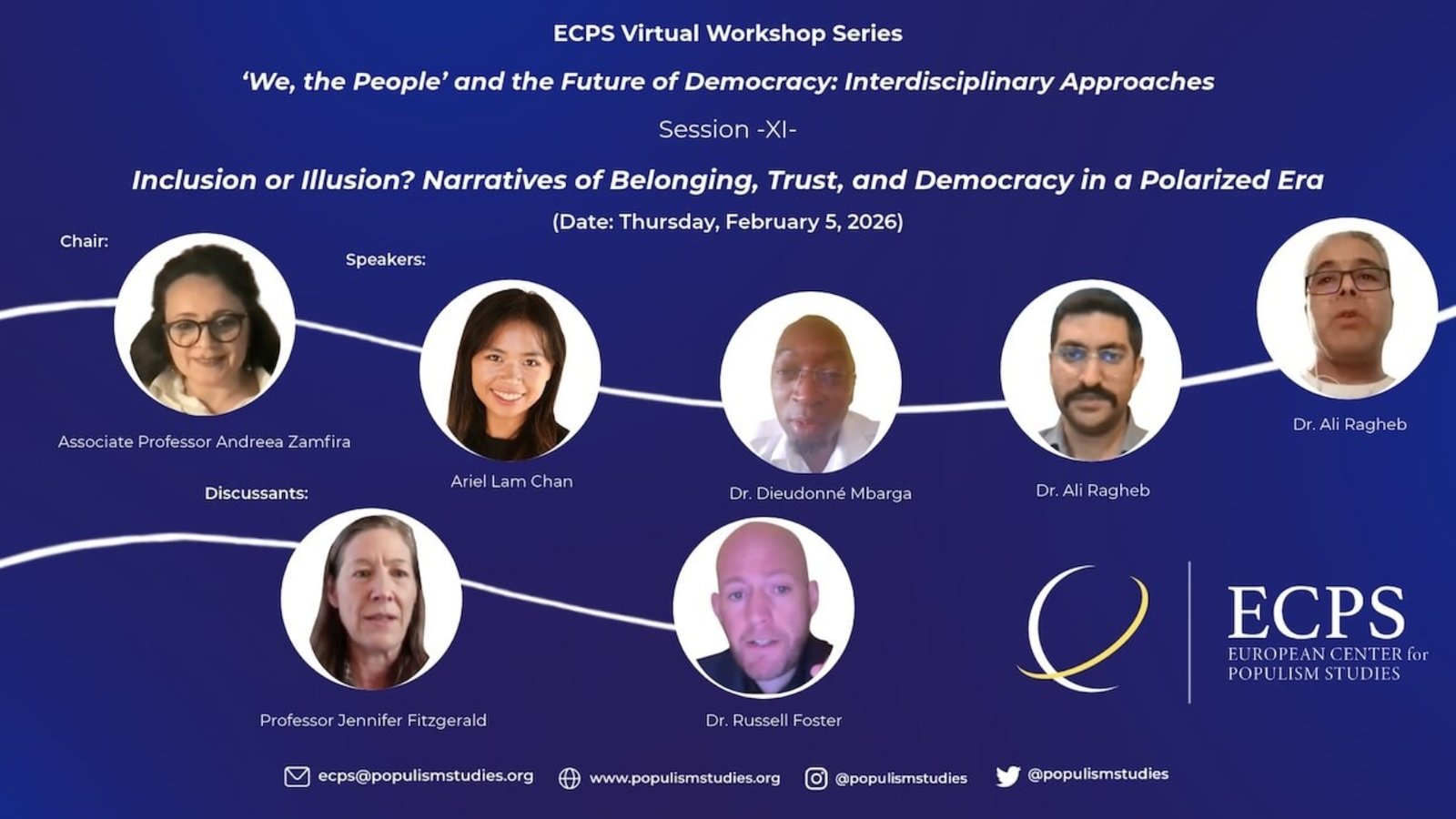
VirtualWorkshops-Session6

Virtual Workshop Series — Session 6: “Populism and the Crisis of Representation –Reimagining Democracy in Theory and Practice”

Please cite as:
ECPS Staff. (2025). “Virtual Workshop Series — Session 6: Populism and the Crisis of Representation –Reimagining Democracy in Theory and Practice.” European Center for Populism Studies (ECPS). November 13, 2025. https://doi.org/10.55271/rp00118


On November 13, 2025, the ECPS, in collaboration with Oxford University, held the sixth session of its Virtual Workshop Series, “We, the People” and the Future of Democracy: Interdisciplinary Approaches. Under the skillful moderation of Professor Ilhan Kaya (Wilfrid Laurier University, Canada), the session featured Dr. Jonathan Madison, Dr. João Mauro Gomes Vieira de Carvalho, and Associate Professor Andreea Zamfira, who examined how populism both mirrors and magnifies democracy’s crisis of representation. Their analyses, complemented by insightful discussant interventions from Dr. Amir Ali and Dr. Amedeo Varriale, generated a vibrant dialogue on institutional resilience, digital disruption, and the reconfiguration of democratic legitimacy in an age of populist contention.

Reported by ECPS Staff

On November 13, 2025, the European Center for Populism Studies (ECPS), in collaboration with Oxford University, convened Session 6 of its ongoing Virtual Workshop Series, “We, the People” and the Future of Democracy: Interdisciplinary Approaches. This session, titled Populism and the Crisis of Representation: Reimagining Democracy in Theory and Practice,” brought together a distinguished group of scholars from political science, sociology, and democratic theory to examine one of the defining questions of our age—how populism both reflects and reshapes the crisis of democratic representation.

Under the capable and engaging chairmanship of Professor Ilhan Kaya (Visiting Professor at Wilfrid Laurier University, Canada; formerly of Yildiz Technical University, Turkey), the session unfolded with remarkable intellectual rigor and fluidity. Professor Kaya’s moderation ensured a balanced and inclusive dialogue among the presenters, discussants, and participants, fostering an atmosphere of critical reflection and open exchange.

The session featured three compelling presentations. Dr. Jonathan Madison (Governance Fellow, R Street Institute) opened with “De-Exceptionalizing Democracy: Rethinking Established and Emerging Democracies in a Changing World.” His paper challenged conventional hierarchies between “established” and “emerging” democracies, arguing that institutional resilience—particularly the robustness of liberal institutions—rather than wealth or longevity, determines a democracy’s ability to withstand populist pressures.

Next, Dr. João Mauro Gomes Vieira de Carvalho (LabPol/Unesp and GEP Critical Theory, Brazil) presented “Mobilizing for Disruption: A Sociological Interpretation of the Role of Populism in the Crisis of Democracy.” His intervention explored populism as a sociological manifestation of democracy’s structural contradictions, emphasizing the interplay of economic inequality, charismatic leadership, and digital communication in the destabilization of representative institutions.

Finally, Associate Professor Andreea Zamfira (University of Bucharest) delivered “Daniel Barbu’s and Peter Mair’s Theoretical Perspectives on Post-Politics and Post-Democracy.” She advanced a sophisticated conceptual framework distinguishing between democratic and strategic populisms and called for reclaiming political science’s critical vocation amid the hollowing of democratic politics in the neoliberal era.

The presentations were followed by incisive discussant interventions from Dr. Amir Ali (Jawaharlal Nehru University, New Delhi) and Dr. Amedeo Varriale (University of East London) whose reflections broadened the theoretical and comparative scope of the session. Their critiques and elaborations inspired an engaging debate that continued into the Q&A session, where Professor Kaya adeptly guided a lively, cross-regional discussion on the transnational diffusion of populism and the institutional responses to democratic backsliding.

In sum, Session 6 stood out as an exemplary exercise in interdisciplinary dialogue—anchored by Professor Kaya’s thoughtful moderation and enriched by a diverse array of perspectives that collectively illuminated the multifaceted relationship between populism, representation, and the evolving fate of democracy in the twenty-first century.

Read the Full Report

LauraRovelli2

Dr. Rovelli: Milei’s Anti-Science and Denialist Policies Undermine Argentina’s Scientific Institutions

Argentina is facing an unprecedented assault on its scientific and educational institutions under President Javier Milei’s libertarian administration. Sweeping budget cuts, halted research careers, and the dismantling of science and human rights agencies have destabilized the country’s knowledge ecosystem. As Dr. Laura Rovelli warns, “the government has deployed anti-science and denialist rhetoric that seeks to discredit and undermine the institutions of science and higher education.” This interview explores how Milei’s radical anti-statist agenda erodes academic autonomy, weakens evidence-based policymaking, and reshapes public education amid growing attacks on universities accused of being “ideologically captured.” Dr. Rovelli also highlights emerging networks of resistance—unions, students, feminist groups, and scholars—mobilizing to defend academic freedom, public knowledge, and democratic life.

Interview by Selcuk Gultasli

Argentina is experiencing one of the most turbulent periods for its scientific, educational, and democratic institutions since the return of democracy in 1983. The administration of President Javier Milei—elected on a platform of radical libertarianism, state retrenchment, and market fundamentalism—has initiated sweeping transformations that profoundly reshape the country’s knowledge ecosystem. As part of these reforms, universities, research councils, and scientific bodies have faced defunding, institutional downgrading, and political delegitimization. According to Dr. Laura Rovelli, an independent researcher at CONICET and Professor at the National University of La Plata (UNLP), the government’s approach is not merely administrative restructuring but a broader ideological project. As she warns, “the government has deployed anti-science and denialist rhetoric that seeks to discredit and undermine the institutions of science and higher education.”

In this extensive interview, Dr. Rovelli analyzes how Milei’s program of market deregulation, dollarization, and shrinking of the state challenges the very idea of knowledge as a public good in Argentina’s democracy. She describes a context in which political fragmentation and austerity policies deepen long-standing inequalities and erode the social meaning of rights—especially the right to education. University autonomy, she explains, is being weakened through severe budget cuts, salary reductions, canceled scholarships, and halted research careers, leaving more than 1,200 approved researchers unable to take up their positions.

Beyond material erosion, Dr. Rovelli highlights the symbolic and epistemic dimensions of the crisis. The dismantling of ministries and agencies devoted to science, gender equality, and human rights is accompanied by a discursive offensive aimed at delegitimizing academic expertise. Denialist narratives—targeting gender, climate change, inequality, and public health—have become central to Milei’s political identity and echo global far-right trends linked to Donald Trump and Jair Bolsonaro. This, she argues, represents a broader pattern of “global anti-statist populism,” even as Milei introduces a uniquely Argentine “anti-national component.”

Yet, amid the crisis, Dr. Rovelli identifies emerging forms of resistance and democratic renewal. Trade unions, student organizations, feminist movements, and academic networks have mobilized nationwide and internationally. Universities remain “privileged loci of dispute and possibility,” capable of defending epistemic diversity and rebuilding the common good through legal challenges, collective action, and alliances with social movements.

By foregrounding the struggles surrounding knowledge, education, and public goods, this interview offers a timely and nuanced perspective on Argentina’s democratic future. It reveals how the battle over science and universities has become a defining arena in the contest between neoliberal retrenchment and democratic-popular visions of society.

Here is the edited transcript of our interview with Dr. Laura Rovelli, slightly revised for clarity and flow.

KoenVossen2

Dr. Vossen: The Anti-Islam Core Is the Most Important Part of Wilders’s PVV

In an in-depth interview with the ECPS, Dr. Koen Vossen, political historian and lecturer at Radboud University, analyzes the ideological evolution and endurance of Geert Wilders’s Party for Freedom (PVV). He stresses that “The anti-Islam core is absolutely the most important part of this party,” noting that despite tactical moderation, its fundamental worldview remains unchanged. According to Dr. Vossen, the PVV’s “one-man structure” and lack of internal democracy make it both flexible and fragile. Wilders’s “clash of civilizations” narrative, rooted in his early attachment to Israel, continues to shape his politics. As Dr. Vossen observes, media normalization, cultural anxieties, and declining institutional barriers have allowed the PVV to become a lasting—though polarizing—force in Dutch politics.

Interview by Selcuk Gultasli

In a wide-ranging interview with the European Center for Populism Studies (ECPS) following the Dutch general elections of October 29, 2025, Dr. Koen Vossen, a political historian and lecturer in political science at Radboud University, offers a nuanced analysis of the ideological evolution, strategic positioning, and organizational structure of Geert Wilders’s Party for Freedom (PVV). Dr. Vossen, a leading scholar on Dutch populism and right-wing movements, situates the PVV within a broader European radical-right context while emphasizing its distinctly Dutch trajectory.

As Dr. Vossen underscores, “The anti-Islam core is absolutely the most important part of this party.” While the PVV has, over time, expanded its platform to include positions on welfare, housing, and law and order, these remain secondary to its central ideological fixation. The PVV, he explains, “is really basically one man… It is purely a matter of what Wilders wants, what he does, and what he likes.” This personalization of power, combined with the party’s lack of internal democracy, explains both its tactical flexibility and its chronic difficulty in governance.

Dr. Vossen traces Wilders’s ideological consistency to what he calls a “clash of civilizations” worldview, deeply informed by his “special connection with Israel.” Having worked on a kibbutz as a young man, Wilders came to see Israel as “the main buffer against Islamization.” This perspective not only anchors the PVV’s foreign policy but also shapes its domestic narrative of cultural defense. According to Dr. Vossen, Wilders’s “absolute core ideology is this anti-Islam ideology,” while his steadfast pro-Israel stance serves as both a symbolic and programmatic pillar in PVV discourse.

On the domestic front, Dr. Vossen attributes the PVV’s durability to a combination of structural and contingent factors: the decline of pillarized institutions, the fragmentation of the Dutch party system, and the normalization of far-right rhetoric through mediaamplification. “Over the last ten years,” he notes, “we’ve seen the clear emergence of a very right-wing media… strongly conservative and very much anti-left. ‘Left’ as a word, as a concept, has almost become an insult in the Netherlands.” The weakening of social intermediaries and the culturalization of political conflict, he argues, have made space for a stable radical-right electorate of roughly 30%.

Despite periodic moderation—what Wilders once called putting his ideas “in the freezer”—Dr. Vossen believes the PVV’s ideological substance remains intact. Even temporary participation in government, he argues, only suspends rather than transforms its radicalism. The 2025 elections, he concludes, show both the limits and persistence of Dutch populism: a movement still revolving around one man, one message, and one enduring enemy.

Here is the edited transcript of our interview with Dr. Koen Vossen, slightly revised for clarity and flow.