From a historical perspective, Dr. Othon Anastasakis acknowledged that the rise of far-right parties in the European elections does not represent a significant rupture from the past. The mainstream political context still dominates European politics, which he finds reassuring. However, he sees two main risks for the future: the unification of far-right parties within the European Parliament and the potential alliance of center-right parties with far-right elements, which could normalize extremist rhetoric.
Following the European Parliament elections,Dr. Othon Anastasakis gave an interview to ECPS, discussing the risks confronting the European Union and European liberal democracies. Dr. Anastasakis, the Director of the European Studies Centre and South East European Studies at Oxford (SEESOX) at St Antony’s College, Oxford University, stated, “What I see in Europe today is a process of securitization and the geopoliticization of the European Union. This shift is largely a response to the wars in neighboring regions, especially Russia’s full-scale invasion of Ukraine. In the face of these realities and a multipolar global environment, there is a turn towards a defense-oriented agenda.” He emphasized that this process of geopoliticization is shaping the EU’s future direction.
Dr. Anastasakis underscored the significant risk to the EU’s normative agenda, noting that the EU, as a democratic club, shares specific values, rules, and procedures. He expressed concern that as the EU faces increased geopolitical and security challenges, it may struggle to maintain its commitment to these normative values, particularly in external relations, trade, and foreign policy decisions. He highlighted the risk that the EU might compromise its democratic credentials to bring in countries that may not yet be ready for membership.
Another risk Dr. Anastasakis highlighted is the potential for far-right parties in Europe to unite within the European Parliament to create obstacles on issues such as migration and climate change. He also pointed out the risk that center-right parties, particularly those in the Christian Democrat bloc, might be tempted to ally with far-right parties on certain issues or adopt parts of their discourse, leading to the mainstreaming of far-right rhetoric. He noted that this has already been observed in the field of migration, where mainstream parties are often influenced by far-right narratives.
However, from a historical perspective, Dr. Anastasakis acknowledged that the rise of far-right parties in the European elections does not represent a significant rupture from the past. The mainstream political context still dominates European politics, which he finds reassuring. Overall, Dr. Anastasakis cautioned that while the current situation does not mirror the catastrophic rise of far-right movements in the early 20th century, it poses significant challenges that require vigilant attention to safeguard the EU’s democratic values and stability.
Here is the transcription of the interview with Dr. Othon Anastasakis with some edits.
Populism and the Far-Right Are Broad Umbrella Concepts
How do you see the historical evolution of populism and far-right movements in Europe influencing current political landscapes, particularly in the context of the recent European Parliament elections?
Dr. Othon Anastasakis: Populism and the far right are two broad umbrella concepts that encompass a wide variety of parties and formations. Due to their broad nature, they are understood in different ways and include many different far-right parties and movements. This makes it very challenging to group them together or understand them as a single entity.
Far-right parties themselves are not united as a whole. Their intrinsic nationalism means they have very specific goals related to their own nation-states. When observed collectively, especially in contemporary Western and European politics, they can be highly disruptive and reactionary to mainstream democratic politics, which has been the norm in Europe for the past eight decades or so.
Far-right politics are also evolving, often softening their positions when they are close to power. As long as nationalism and the nation-state remain central in international politics, far-right parties will continue to advocate their extreme nationalistic, racist and populist discourse. They are particularly influential during times of low economic growth and increasing economic inequality, as they find audiences receptive to their messages.
Finally, when democratic leadership is weak or lacks determination, it creates an environment where far-right parties can infiltrate, penetrate and promote their ideas.
What happened in the European Parliament elections regarding populism and the far-right? Is this a watershed moment in European history?
Dr. Othon Anastasakis: I wouldn’t call it a watershed moment. Yes, there was an expectation and a lot of publicity about the rise of far-right politics during these European elections. However, the outcomes showed no massive change overall. While there was some rise of far-right parties in various national European settings, the Christian Democrats managed to increase their position in the Parliament, the Liberals lost somewhat, and the Social Democrats remained more or less the same. Mainstream parties maintained their numbers and power within the European Parliament.
That said, what we did see was significant: the rise of the far right in two particularly influential countries in Europe. In France, the far right gained ground, impacting national politics and leading to immediate elections under Macron. Similarly, in Germany, the AfD’s rise weakened the Social Democratic Party. These developments in France and Germany, which are often pivotal in shaping European politics, are more indicative of the rise of the far right than the overall European Parliament spectrum.
One Lesson from History Is the Danger of Appeasement
Poster of Vladimir Putin looking like Hitler in a demonstration against the invasion of Ukraine by Russia in Valencia, Spain on February 27, 2022. Photo: Shutterstock.
Considering the rise of far-right parties across Europe as proved once again by EP elections, can we draw parallels with similar movements in the early 20th century? What historical lessons should we keep in mind to understand and address these modern developments?
Dr. Othon Anastasakis: First, let me say that history never repeats itself in exactly the same way, which is important to keep in mind. We never encounter identical circumstances that produce the same outcomes repeatedly. However, understanding what happened in the past helps us comprehend why the present has unfolded as it has.
Given that history doesn’t repeat itself precisely, we can still draw valuable lessons from it. One common question we face today is whether we are seeing a repeat of the 1930s with the rise of the far right, and to what extent. The 1930s were unique in European history due to the circumstances that led to the rise of many fascist parties, especially the Nazi party in Germany.
One lesson from history is the danger of appeasement during moments of aggressive behavior. The 1938 appeasement of Hitler serves as a lesson not to follow a similar path with someone like Putin, who has invaded Ukraine. Negotiating with aggressive behavior can lead to further territorial ambitions.
Another lesson is that persistent economic inequality, especially during times of economic crisis, can bolster the strength of far-right parties. This was evident in the 1930s following the 1929 economic crisis. These historical insights remind us to address economic disparities and avoid appeasement to prevent similar political outcomes today.
In your 2001 article “Post-communist extremism in Eastern Europe: The nature of the phenomenon,” you discussed the emergence of far-right parties in Eastern Europe, particularly in Poland and Hungary, years before the governments of Kaczynski and Victor Orbán. Do you think the dynamics that led to the rise of far-right parties have changed in Eastern Europe? What patterns can you identify?
Dr. Othon Anastasakis: First, let me say that while far-right politics is a wider European phenomenon, it is not exclusively a Central European issue. In my reading of the European continent, three main factors may create divergences between Western Europe and Eastern Europe.
First, there is the Communist legacy. This long and totalitarian history has created circumstances that can sometimes lend themselves to a lingering appeal of authoritarianism. The Communist legacy remains a significant point of reference in these regions.
Second, we must consider the legacy of empires versus those who were colonized. When discussing post-Empire Europe, we often assume all countries were colonizers, which is not the case. Western European countries like Britain, France, Italy, Spain, and the Netherlands had overseas empires. In contrast, many Eastern European countries, from Poland down to Greece, were part of empires. This division affects the development of politics, particularly nationalistic politics.
Third, connected to the second point, is the division between civic and ethnic nationalism. The understanding of national development and the way citizens are embedded within this context vary significantly. In Western Europe, there is often a more civic understanding of nationalism, whereas, in Eastern Europe, there is a longer historical experience of ethnic nationalism. This influences how far-right nationalism behaves and forms its ideology in these regions.
How has the narrative and strategy of far-right parties evolved from the post-communist era in Eastern Europe to the present day? Are there historical factors that continue to play a significant role in their resurgence?
Dr. Othon Anastasakis: Even in Eastern Europe, where we can roughly divide nationalism into civic versus ethnic types, history plays a very important role in the development of far-right parties and politics in general. The national experiences of these countries significantly impact how their politics evolve.
For example, Hungary, part of the Austro-Hungarian Empire, became a nation-state after World War I, leaving many ethnic Hungarians outside its borders. This created a unique brand of Hungarian nationalism. In contrast, Poland, which also faces issues with the rule of law similar to Hungary, has a different historical background. Poland, often caught between Russia and Germany, has experienced its territory being divided and annexed by these powers. This historical context results in a far-right experience that can be either anti-German or very much anti-Russian.
Thus, the historical experiences of these countries influence how far-right parties develop and form their own versions of nationalism.
Meloni Is Not Mussolini, the AfD Is Not Comparable to Hitler’s Germany
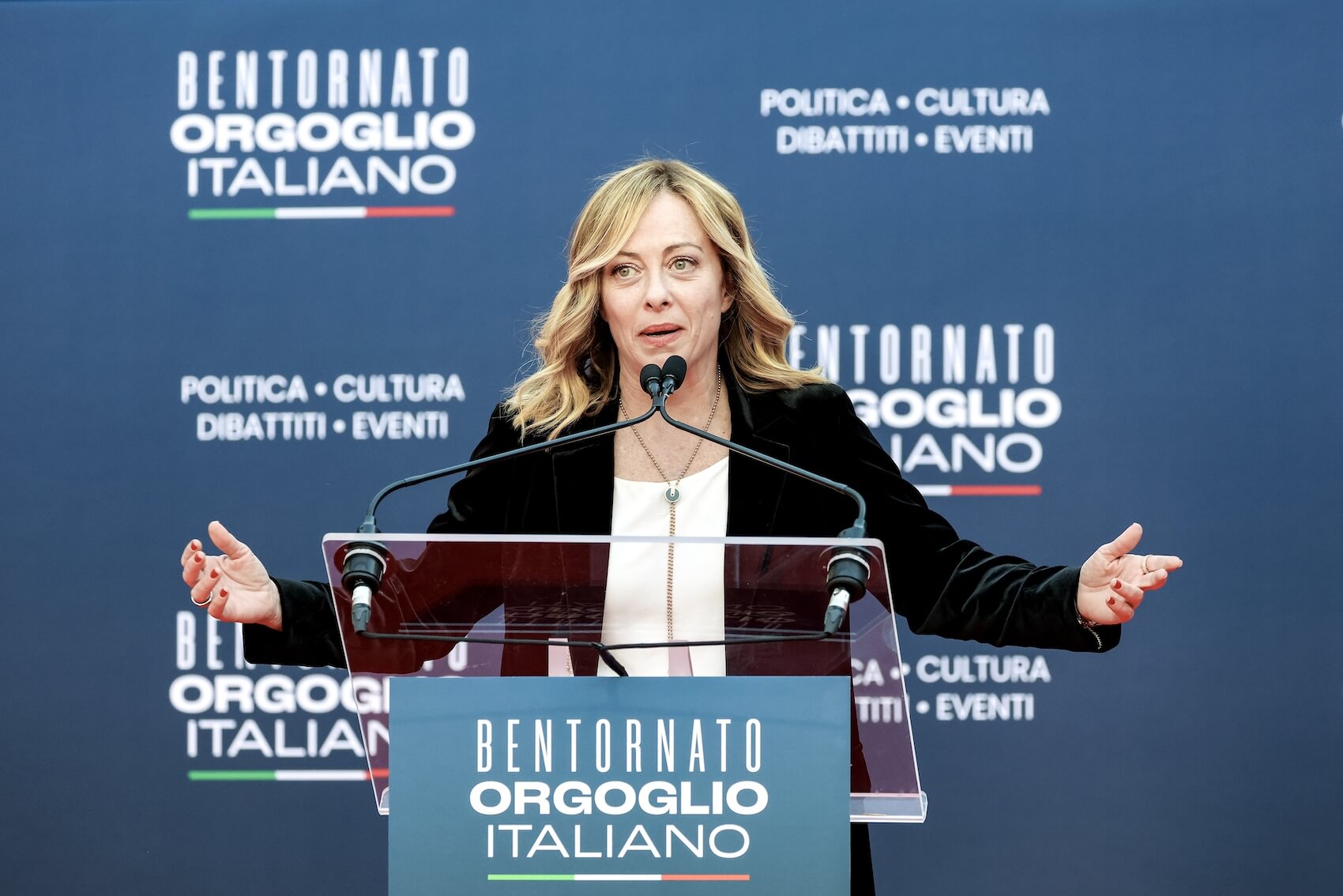
Giorgia Meloni, Italy’s prime minister, speaks at the Atreju convention in Rome, Italy on December 16, 2023. Photo: Alessia Pierdomenico.
In the same article, you discuss four theses about the rise of far-right extremism, one of which is the revival of the fascist era. With the rise of Giorgia Meloni in Italy and her party, Brothers of Italy, and the rise of the AfD in Germany, do you see a revival of the fascist era?
Dr. Othon Anastasakis: Not in the way that it happened in the 1930s. As I mentioned earlier, history doesn’t repeat itself exactly. There are lessons to be learned, but the context is always different. In the 1930s, the aftermath of World War I played a significant role. The experience of being winners or losers, especially in Germany’s case, where it was a clear loser, defined how the country developed during the turbulent interwar period. This era saw the testing and eventual failure of liberal politics, leading to the authoritarian regimes of the 1930s.
Today, the background is very different. We have the European Union, which provides a unique context of political and economic integration among its member countries. Any attempt by far-right parties or anti-European, protectionist forces to gain power would first have to involve dismantling the EU, which is not an easy task.
In this sense, we are in a different historical moment. Meloni is not Mussolini, and the AfD is not comparable to Hitler’s Germany. However, these parties do contain elements that make them susceptible to fascist ideas, language, and rhetoric.
One important and common issue that enables these parties to develop their discourses is migration. Unlike in the 1930s, today’s migration context has been developing for a few decades, but under conditions of crisis, it becomes a significant scapegoat. Migration is an issue that many far-right parties across Europe use to their advantage.
In your article “Europeanization of the Balkans,” you underline how the EU membership process has transformed Balkan countries in terms of consolidating democracy and the rule of law. When you consider the surge of far-right populism in Western Europe, can we talk about the Balkanization of Europe?
Dr. Othon Anastasakis: Overall, I don’t use the term “Balkanization” because I think it’s a stereotypical and simplistic way of understanding a region. It doesn’t accurately reflect the true complexity of the area. My thesis back then was that the conditionality imposed by the European Union, particularly in the political context, was crucial. This conditionality made the countries accept and adopt certain norms required for EU membership. In this sense, Europeanization—a much broader concept—was able to take root in those countries.
What I see in Europe today is not Balkanization, but a process of securitization and the geopoliticization of the European Union. This shift is largely a response to the wars in neighboring regions, especially Russia’s full-scale invasion of Ukraine. In the face of these realities and a multipolar global environment, there is a turn towards a defense-oriented agenda. This shift could change the nature and spirit of the EU, moving it beyond its historical focus on economic integration and soft power.
One significant risk I see is the potential impact on the EU’s normative agenda. The EU is a democratic club, a group of countries that share specific values, rules and procedures. As the EU faces increased geopolitical and security challenges, it may struggle to maintain its commitment to these normative values. This concern is particularly relevant in its external relations, trade and foreign policy decisions. Even with the enlargement agenda, there is a risk that the EU may compromise some of its democratic credentials to bring in countries that may not yet be ready for membership.
So, while I do not fear Balkanization, I do see a process of geopoliticization that is shaping the future direction of the European Union.
In your doctoral thesis “Authoritarianism in 20th Century Greece,” you examine the authoritarian ideology and educational policy of two dictatorial regimes in 20th century Greece: the Metaxas dictatorship of 1936-1941 (the 4th of August regime) and the military junta of 1967-1974 (the 21st of April regime). What interactions do you observe between these two periods and the rise of Golden Dawn in the 2010s and the Greek Solution party now?
Dr. Othon Anastasakis: Dictatorships, particularly in the Greek context, belong to the past and do not present themselves as viable alternatives for political power and governance after the transition from dictatorship to democracy in 1974. The periods of the 1930s and 1960s were different as the military was a significant force in Greek politics. During political or party crises, the military often positioned itself as an alternative, intervening in politics multiple times. For instance, Metaxas, a military man, managed to influence politics in the interwar years, and the colonels in 1967 abruptly halted the democratic process.
The rise of far-right parties like Golden Dawn in Greece is not reminiscent of those military interventions. Golden Dawn, which gained prominence during the severe economic crisis in Greece, is also a criminal organization and most of its members are now imprisoned, rendering it unable to operate as a political party. Other nationalistic and far-right parties, such as the Greek Solution, exist but are often not sustainable. Over the past three decades, we have seen how some far-right parties have managed to raise their percentages. For instance, the Orthodox Popular Rally led by Georgios Karatzaferis in the 1990s and early 2000s, and the Independent Greeks, who cooperated with Syriza during the mid-2010s crisis. These far-right parties experienced a rise but eventually descended, demonstrating a pattern of emergence and decline.
These parties tend to be disruptive, reactionary and extremely nationalistic. They often gain support during times of political crisis or when mainstream parties struggle to address issues. This pattern of rise and fall is evident in the Greek Solution and two other extreme nationalist parties that secured seats in recent elections. The fact that these three far-right parties collectively garnered around 18-19% of the vote is concerning, indicating a particular situation in the Greek political context.
Populism and Populist Leaders Will Continue to Exist
In your research on authoritarian regimes in Greece, what historical patterns do you see re-emerging in contemporary European politics? What impact do you think, as an historian, the resurgence of far-right populism will have on the future of European integration and the EU’s democratic values? Are we witnessing a cyclical pattern of populist surges similar to previous historical periods?
Dr. Othon Anastasakis: Populism and populist leaders will continue to exist, whether they are on the far-right, far-left or somewhere in between. Populism, as a broad umbrella term, encompasses various parties and movements, making it an enduring feature of the political landscape. A specific example of this is Brexit, which was a significant populist moment in Europe. Brexit challenged the European edifice as the UK, driven by populist sentiments, decided to leave the EU. This move was representative of both Euroscepticism and Europhobia.
Brexit demonstrates both the potential and the drawbacks of populism. On one hand, it successfully led a country out of the EU, showcasing populism’s power. On the other hand, it highlighted the immense challenges and turbulence associated with such a move. This experience serves as a lesson to other Eurosceptic parties that exiting the EU is not a straightforward endeavor.
Today’s far-right parties, which are often very Eurosceptic and reactionary, face a dual challenge. They must navigate their national political landscapes, creating an environment of opposition to their own elites while also dealing with the supranational context of Europe. They are limited in how reactionary they can be because pushing too hard against the EU could lead to their countries leaving the union, something that most populations do not desire. This tension makes it difficult for far-right parties to fully adopt their reactionary, nationalistic and racist rhetoric.
From a historical perspective, how concerned are you about the rise of far-right parties in the European elections? Many pundits argue that the center-right and center-left have held strong, and there is not much to worry about. Do you agree with these pundits?
Dr. Othon Anastasakis: I agree that this is not a significant rupture from the past. We haven’t seen a massive surge that could radically change the landscape. The mainstream context still dominates European politics, which is reassuring. However, I see two risks for the future.
The first risk is whether far-right parties in Europe will decide to unite within the European Parliament to create obstacles on issues such as migration or climate change. While it’s challenging for them to achieve unity, it is not entirely out of the question.
The second risk involves the extent to which center-right parties, particularly those in the Christian Democrat bloc, might be tempted to ally with far-right parties on certain issues or adopt parts of their discourse. This could lead to the mainstreaming of far-right rhetoric. We have already seen this in the field of migration, where mainstream parties are often influenced by far-right narratives.
A notable example is the European People’s Party (EPP), which for many years included Hungary’s Fidesz party. Although they eventually decided to expel Viktor Orbán’s party, they tolerated his presence for some time to maintain their numbers and votes. This indicates a potential risk where center-right parties might seek alliances with far-right parties to further their own interests.
Please cite as: Yilmaz, Ihsan & Kenes, Bulent. (2023). “Digital Authoritarianism in Turkish Cyberspace: A Study of Deception and Disinformation by the AKP Regime’s AKtrolls and Akbots.” Populism & Politics (P&P). European Center for Populism Studies (ECPS). November 13, 2023. https://doi.org/10.55271/pp0026
Abstract
This article explores the evolving landscape of digital authoritarianism in Turkish cyberspace, focusing on the deceptive strategies employed by the AKP regime through AKtrolls, AKbots and hackers. Initially employing censorship and content filtering, the government has progressively embraced sophisticated methods, including the weaponization of legislation and regulatory bodies to curtail online freedoms. In the third generation of information controls, a sovereign national cyber-zone marked by extensive surveillance practices has emerged. Targeted persecution of critical netizens, coupled with (dis)information campaigns, shapes the digital narrative. Central to this is the extensive use of internet bots, orchestrated campaigns, and AKtrolls for political manipulation, amplifying government propaganda and suppressing dissenting voices. As Turkey navigates a complex online landscape, the study contributes insights into the multifaceted tactics of Erdogan regime’s digital authoritarianism.
Since the last decade, authoritarian governments have co-opted social media, compromising its potential for promoting individual liberties (Yilmaz and Yang, 2023). In recent years, President Recep Tayyip Erdogan-led Turkish government has staunchly endeavoured to control online platforms and manipulate digital spaces to consolidate power, stifle dissent, and shape public opinion. Given the large online user base and the declining influence of traditional media, the internet has become a crucial platform for opposition voices. In response, President Erdogan’s “authoritarian Islamist populist regime” (Yilmaz and Bashirov, 2018) has implemented various measures to regulate and monitor the digital space to suppress dissent (Bellut, 2021).
Turkey’s domestic internet policy under the Erdogan regime has shown a convergence towards information control practices observed in countries like Russia and China, despite Turkey’s nominal compliance with Euro-Atlantic norms on cyber-security (Eldem, 2020). This convergence is characterized by increasing efforts to establish “digital sovereignty” and prioritize information security, often serving as a pretext for content control and internet censorship (Eldem, 2020). The Erdogan regime takes a neo-Hobbesian view of cyberspace and seeks to exert sovereignty in this realm through various information controls (Eldem, 2020). Under the Erdogan regime, there has been an increase in the surveillance of online activities, leveraging the surveillance and repression tools provided by social media and digital technologies. Once the regime established its hegemony over the state, it expanded its surveillance tactics to govern society.
In Turkey, a combination of actors including riot police, social media monitoring agents, intelligence officers, pro-government trolls, hackers, secret witnesses, informants, and collaborators work together to identify and target individuals deemed “risky.” This surveillance apparatus follows the hierarchical structure of the Turkish authoritarian state, with President Erdogan overseeing its developments (Topak, 2019).
The article examines the Turkish government’s pervasive use of trolls, internet bots, orchestrated campaigns, and transnational manipulations that have shaped the country’s online environment. Social media platforms, especially Twitter, are central to these manipulation efforts in Turkey. While Twitter has taken action against thousands of accounts associated with the ruling party’s youth wing, the resistance from the government highlights the significance of these online campaigns.
The use of fake accounts, compromised profiles, and silent bots further deepens the complexities of digital authoritarianism in Turkey. These accounts serve as vehicles for spreading disinformation, astroturfing, and manipulating social media trends. While efforts have been made to identify and remove such accounts, the adaptability of these manipulative actors poses a significant challenge. Many of these bots remain dormant for extended periods, resurfacing strategically to create and promote fake trends while evading conventional detection methods (Elmas, 2023). These software applications play a pivotal role in amplifying government propaganda, countering opposition discourse, and creating an illusion of widespread support. From replicating messages to retweeting content across hundreds of accounts, these automated bots have become instrumental in shaping online narratives and suppressing dissenting voices (Yesil et al., 2017; Eldem, 2023).
Digital Authoritarianism and Information Controls
The Erdogan regime appointed trustee to Zaman daily in Istanbul, Turkey on March 4, 2016. Photo: Shutterstock.
Digital authoritarianism is extensive utilization of information control measures by authoritarian regimes to shape and influence the online experiences and behaviors of the public (Howells and Henry, 2021). These regimes have adeptly adapted to the mechanisms of internet governance by exploiting the vast reach of new media platforms. They employ various forms of censorship, both overt and covert, to suppress dissent and control the dissemination of information.
The literature on digital authoritarianism extensively explores how China has effectively utilized digital technology to maintain and strengthen its rule (Polyakova & Meserole, 2019; Dragu & Lupu, 2021; Sherman, 2021). While China relies on sophisticated surveillance systems and targeted persecution of individuals, the people of Russia experience the impact of digital authoritarianism through internet censorship, manipulation of information flow, the spread of disinformation, and the mobilization of trolls and automated bots (Yilmaz, 2023; Timucin, 2021).
In the realm of digital authoritarianism, disinformation has become a favored tool (Diamond, 2021; Tucker et al., 2017). Authoritarian regimes obscure information, engage in deception, and manipulate the context to shape public opinion (Bimber and de Zúñiga, 2020). It is important to note that digital authoritarianism is not a uniform strategy; different regimes adopt various approaches. Some directly restrict access to the internet, while others rely on heavy censorship and disinformation campaigns (Timucin, 2021; Polyakova & Meserole, 2019).
The Russian model of digital authoritarianism operates with subtlety. Manipulating social media networks is easier to accomplish and maintain compared to comprehensive monitoring systems (Timucin, 2021). In these cases, the open nature of social media becomes a double-edged sword, enabling the widespread distribution of both accurate information and misinformation while amplifying voices from various ends of the political spectrum (Brown et al., 2012).
Digital Authoritarianism and Information Controls in Turkey
During the third term of the AKP (Justice and Development Party) in 2011, Turkey witnessed a shift towards increasing populist authoritarianism. Since then, the dissidents and critics of the AKP government have been framed and demonised as the enemies of the Turkish people (Yilmaz and Bashirov, 2018).
Initially, the government targeted conventional media outlets, subjecting them to various tactics employed by President Erdogan (Yanardagoglu, 2018). Many critical media organizations were forced out of business, and their assets were taken over by pro-government entities. The persecutions both preceding and after the state of emergency in 2016 heightened, leading to the confiscation of media groups like the Gulen-linked Samanyolu Group, Koza Ipek Group, and Feza Publications (Timucin, 2021; BBC 2016). These actions effectively created a clientelist relationship between the government and the media, as anti-government entities were closed and transferred or sold to pro-government supporters (Yilmaz and Bashirov, 2018).
The government’s dominance over traditional media outlets served as the foundation for Erdogan’s digital authoritarianism, granting the government control over the “formal” form of digital media (Timucin, 2021). Faced with limitations in conventional media, the public turned to online sites, alternative media, and social media platforms in search of reliable news and information.
The Gezi Park protests in 2013 marked a significant moment in Turkey’s social movements and the role of social media activism. These protests initially started as a peaceful sit-in at Gezi Park to oppose the demolition of trees for a shopping mall construction but quickly escalated into one of the largest civil unrests in Turkey’s recent history. During the early days of the protests, traditional media outlets did not provide adequate coverage, leading people to seek alternative sources of information. Social media platforms played a crucial role as a source of news, organization, and political expression, particularly among urban, tech-savvy youth (Yesil et al., 2017). The number of Twitter users in Turkey skyrocketed from an estimated 2 million to 12 million during the protests (Ozturk, 2013; Varnalı and Görgülü, 2015). Social media allowed for a more decentralized and inclusive form of communication during the protests, as it facilitated the rapid dissemination of information and bypassed traditional media gatekeepers (O’Donohue et al., 2020).
The corruption scandal in December 2013 was another event where social media played a crucial role in shaping public opinion and disseminating information. Government opponents utilized social media platforms to share incriminating evidence of corruption involving President Erdogan, his party, and his cabinet. In response, the ruling AKP adopted a heavy-handed approach, detaining Twitter users and implementing bans on platforms such as Twitter and YouTube. The government positioned social media as a threat to Turkey’s national unity, state sovereignty, social cohesion, and moral values (Yesil et al., 2017; Kocer, 2015).
In recent years, Turkey has made efforts to assert control over social media platforms and internet service providers. In 2020, a “disinformation law” was introduced, pressuring these entities to remove “disinformation” from online platforms. Proposed changes to Article 19 in 2022 aim to enhance control over the cyber space, granting more powers to the Information and Communication Technologies Authority (BTK) to regulate the internet. These developments indicate Turkey’s increasing efforts to curb the flow of information, maintain a favorable narrative, and suppress dissenting voices, potentially impacting freedom of expression and the right to access information in the country.
The increasing level of digital governance in Turkey has manifested in various forms, leading to significant consequences. Content regulation has played a crucial role in the government’s efforts to control the internet. Bodies such as BTK have been granted the power to block access to online content deemed threatening. This has created a climate of increased pressure on internet service providers to comply with the state’s requests regarding content removal and access to personal user data. Failure to adhere to these obligations can result in penalties or even the revocation of licenses. There are also speculations that service providers may face bandwidth reduction and limitations on advertisements as a means of exerting further control.
Furthermore, cybercrime provisions intended to safeguard against hacking and online harassment have been instrumentalized by the state to gather user information for investigation, prosecution, and cooperation with “international entities.” Individuals found guilty of online offenses can be brought to court and punished under specific articles of the Turkish Penal Code.
In summary, the government introduced legal restrictions, content removal requests, website and social media platform shutdowns, prosecution of internet users, state surveillance, and disinformation campaigns. These measures have resulted in a significant decline in internet freedom and the rise of digital authoritarianism in Turkey between 2013 and the controversial coup attempt in July 2016.
Technical Instruments and Surveillance Methods to Monitor and Control Cyberspace
The Erdogan regime has employed various technical instruments and surveillance methods to monitor and control online activities. Reports indicate that Western companies provided spyware tools to Turkish security agencies, which have been in use since at least 2012. These tools include Deep Packet Inspection (DPI) technology, enabling surveillance of online communications, blocking of online content, and redirecting users to download spyware-infected versions of software like Skype and Avast. Additionally, the Remote-Control System and FinFisher spyware programs are used for extracting emails, files, passwords, and controlling audio and video recording systems on targeted devices (Privacy International, 2014; Yesil et al., 2017; CitizenLab, 2018; AccessNow, 2018).
The Erdogan regime also established a “Social Media Monitoring Unit,” a specialized police force responsible for monitoring citizens’ social media posts. There is also a group known as AKtrolls, who can act as informants and report social media posts of targeted users to security agencies, potentially leading to arrests. The AKP has also formed a team of “white hat” hackers, ostensibly for enhancing Turkey’s cyber-defense. Furthermore, civilian informants have been mobilized for internet surveillance, with ordinary citizens encouraged to spy on each other online, creating a culture of “online snitching” (Yesil et al., 2017). This pervasive surveillance approach, utilizing both software and social-user-based surveillance, creates a climate of self-censorship and vigilance among users (Saka, 2021; Morozov, 2012).
The National Intelligence Organization of Turkey (MİT) has been granted extended surveillance powers, both online and offline, following the post-Gezi Park protests. Law No. 6532 allowed MİT to collect private data and information about individuals without a court order from various entities. The law also granted legal immunity to MİT personnel and criminalized the publication and broadcasting of leaked intelligence information. MİT operates within the authoritarian state’s chain of command. Given MİT’s lack of autonomy, it is highly likely that the Erdogan regime exploits the agency’s expanded powers for unwarranted surveillance, political witch hunts of dissidents, journalists, and even ordinary online users, aiming to suppress any online criticism (Yeşil, 2016).
In October 2015, the AKP implemented the “Rewards Regulation,” which offered monetary rewards to informants who assisted security agencies in the arrest of alleged terror suspects. This measure encouraged journalists, NGOs, and citizens to monitor online communications and report dissenting individuals (Zagidullin et al., 2021).
The Turkish police introduced a smartphone app and a dedicated webpage that allowed citizens to report social media posts they deemed as terrorist propaganda. The main opposition party claimed that the police prepared summaries of proceedings for 17,000 social media users, and they were attempting to locate the addresses of 45,000 others (Eldem, 2023). Consequently, the state of emergency (SoE) decrees following controversial coup attempt in 2016 further tightened the government’s control over the internet. Decree 670 granted “all relevant authorities” access to all forms of information, digital or otherwise, about alleged coup suspects and their families. Decree 671 empowered the government to take any necessary measures regarding digital communications provided by ISPs, data centers, and other relevant private entities in the name of national security and public order. Finally, Decree 680 expanded police powers to investigate cybercrime by requiring ISPs to share personal information with the police without a court order (Topak, 2019; Yesil et al., 2017; Eldem, 2023).
Prior to Turkey’s presidential and parliamentary elections in 2023, Turkish prosecutors initiated investigations into social media users accused of spreading disinformation aiming to create fear, panic, and turmoil in society. The Ankara Chief Public Prosecutor’s Office launched an investigation into the Twitter account holders who allegedly collaborated to spread disinformation, potentially reaching around 40 million social media users (Turkish Minute, 2023).
The Erdogan regime has significantly expanded its online censorship toolkit through legislative amendments passed in October 2022 (HRW, 2023). As an example of the restrictions imposed, on May 14, 2023, Twitter announced that it was restricting access to certain account holders in Turkey to ensure the platform remains available to the people of Turkey.
AKtrolls
The Erdogan regime responded to critical voices on social media during the Gezi Protests by employing political trolls. This strategy of political trolling, whether carried out by humans or algorithms, is closely associated with Russia and has been adopted by AKP’s trolls, known as AKtrolls, who exhibit similarities to Kremlin-operated networks. The deep integration of political trolling within the political system and mainstream media in Turkey has been highlighted in a study by Karatas and Saka (2017). These trolling practices are facilitated through the collaboration of political institutions and media outlets. Trolls act as precursors, disseminating propaganda and testing public opinion before mainstream political figures introduce favored populist policies and narratives.
The AKP’s troll army was initially established by the vice-chairman of the AKP and primarily consisted of members from AKP youth organizations. Over time, it has grown into an organization of 6,000 individuals, with 30 core members responsible for setting trending hashtags that other members then promote. Many of these trolls are graduates of pro-AKP Imam Hatip schools. It is worth noting that these trolls receive financial compensation, and there are indications that pro-AKP networks provide additional benefits to successful trolls, including entities like TRT (Turkish Radio and Television) and mobile phone operator Turkcell.
The first network map of AKtrolls was provided by Hafiza Kolektifi, a research collective based in Ankara, in October 2015. This map revealed the close connections among 113 Twitter accounts, including not only ordinary trolls but also politicians, advisors to President Erdogan, and pro-government journalists. The map was created based on the analysis of a popular and aggressive troll named @esatreis, who was identified as a youth member of the AKP. By monitoring the users followed by @esatreis using the Twitter Application Programming Interface (API) and conducting in-depth network analysis, two distinct groups were identified. The first group consisted of politicians, Erdogan’s advisors, and pro-government journalists, while the second group comprised anonymous trolls using pseudonyms. The study demonstrated that @esatreis acted as a bridge between the troll group and the politicians/journalists, with Mustafa Varank, an advisor to Erdogan and currently the Minister of Industry and Technology, serving as a central connection node between these two groups (Karatas & Saka, 2017).
It was revealed that politicians and state officials maintained their own anonymous troll accounts, in addition to their official ones. Instances have surfaced where AKP officials were caught promoting themselves through fake accounts. For instance, Minister of the Environment and Urbanization Mehmet Ozhaseki and AKP’s Bursa Mayor Recep Altepe were exposed for sharing supportive tweets mentioning themselves mistakenly from their official accounts instead of their fake ones. Another case involved AKP deputy Ahmet Hamdi Çamlı, who inadvertently opened his front camera while live-streaming parliamentary discussions with a fake account using a female name (@YelizAdeley) and a teenager’s profile photo. Within the AKP, different trolls seem to specialize in specific subjects aligned with the party’s policies and strategies. For example, accounts such as @WakeUpAttack and @UstAkilOyunlari fabricate conspiracy theories related to international affairs, while @AKKulis shares tweets from state officials and provides updates on AKP’s latest news and activities. Another troll account, @Baskentci, shared lists of journalists to be detained and media outlets to be shut down, as well as advanced information on post-coup attempt decisions (Tartanoglu, 2016).
AKP trolls specifically target and disrupt social media users who express opposition to the ruling party, openly identifying themselves as its supporters. While they are known within party circles, they remain anonymous to outsiders. However, some trolls, driven by rewards and recognition within their social networks, choose not to conceal their identities. In fact, Sözeri (2016) describes how certain pro-government journalists themselves act as political trolls and even lead the attacks. It is important to note that political trolls are not necessarily anonymous or isolated individuals. When aligned with a ruling party led by a president with increased powers, many trolls shed their anonymity, and some even threaten legal action when called out as trolls (Saka, 2021). Realizing that such tactics were not improving the AKP’s popularity, the party changed its approach just before the 2015 general elections by establishing the New Turkey Digital Office, which focused on more conventional forms of online propaganda (Benedictus, 2016).
The proliferation of digital disinformation coordinated networks of fake accounts, and the deployment of political trolls have had a significant impact on online discourse in Turkey, hindering the free expression of critical voices and fostering an environment of manipulation and propaganda. Much like the Russian “web brigades,” which consist of hundreds of thousands of paid users who post positive comments about the Putin administration, Erdogan regime also recruited an “army of trolls” to reinforce the declining hegemony of the ruling party shortly after the Gezi Park protests in 2013 (Bulut & Yoruk, 2017). Their objective is to discredit, intimidate, and suppress critical voices, often resorting to labelling journalists and celebrities as “traitors,” “terrorists,” “supporters of terrorism,” and “infidels.” Consequently, Twitter has transformed into a medium of government-led populist polarization, misinformation, and online attacks since the Gezi protests (Bulut & Yoruk, 2017). The situation worsened after the events of 2016, exposing critical voices to open cyberbullying by trolls and intensifying their persecution (Saka, 2021).
One prevalent form of political trolling is the deliberate disruption of influential voices on Twitter who contribute to politically critical hashtags or share news related to potential emergencies. Trolls and hackers primarily target professional journalists, opposition politicians, activists, and members of opposition parties. AKtrolls repeatedly attack and disturb these individuals using offensive and abusive language, labelling them as terrorists or traitors, intimidating them, and even threatening arrest. However, ordinary citizens who participate on Twitter with non-anonymous profiles are also vulnerable targets for AKtrolls. Being targeted by trolls often leads to individuals quitting social media, practicing self-censorship, and ultimately participating less in public debates (Karatas & Saka, 2017).
AKtrolls specifically target critical voices that share undesirable content or use specific hashtags. They employ tactics such as posting tweets with humiliating, intimidating, and sexually abusive insults. Doxxing, the act of revealing personal and private information about individuals, including their home addresses and phone numbers, is also a common strategy employed by AKtrolls. In some cases, AKtrolls may have connections to the security forces, particularly the police. Additionally, hacking and leaking private direct messages have been popular tactics used to discredit opposing voices on Twitter. Pro-AKP hackers affiliated with the AKtrolls have targeted numerous journalists. The initial stage often involves hacking into the journalist’s Twitter account and posting tweets that apologize to Erdogan for criticism or betrayal. Furthermore, AKtrolls frequently engage in collective reporting to Twitter in an attempt to suspend or block targeted Twitter handles (Karatas & Saka, 2017).
A significant event within the ruling AKP was the forced resignation of then-Prime Minister Ahmet Davutoglu by Erdogan. Prior to his resignation, an anonymous WordPress blog titled the “Pelikan Declaration” emerged, accusing Davutoglu of attempting to bypass Erdogan’s authority and making various allegations against him. This declaration was widely circulated by a group of AKtrolls who later became known as the “Pelikan Group.” It is worth noting that this group had close ties to a media conglomerate managed by the Albayrak Family, particularly Berat Albayrak, Erdogan’s son-in-law and Turkey’s former Minister of Economy, as well as his elder brother and media mogul Serhat Albayrak (Saka, 2021).
AKbots
The Erdogan regime extensively utilizes internet bots, which are software applications running automated tasks over the Internet, to support paid AKtrolls (Yesil et al., 2017). Researchers have demonstrated that during the aftermath of the Ankara bombings in October 2015, the heavy use of automated bots played a crucial role in countering anti-AKP discourse. Twitter even took action to ban a bot-powered hashtag that praised President Erdogan, leading Turkish ministers to claim a global conspiracy against Erdogan (Hurriyet Daily News, 2016; Lapowsky, 2015).
The use of automated bots differs from having multiple accounts in terms of scale. The presence of bots becomes noticeable when a message is replicated or retweeted to more than a few hundred other accounts. It is worth noting that as of November 2016, Istanbul and Ankara ranked as the top two cities for AKbot usage, according to the major internet security company Norton (Paganini, 2016; Yesil et al., 2017; Eldem, 2020).
Furthermore, DFRLab(2018) has revealed that many tactics, including doxing (revealing personal information), are employed through cross-platform coordination. It is important to recognize that in the Turkish context, the influence of AKtrolls extends beyond internet platforms and involves close cooperation with conventional media outlets under Erdogan’s control (Saka, 2021). In October 2019, DFRLab identified a network of inauthentic accounts that aimed to mobilize domestic support for the Turkish government’s fight against the Kurdish People’s Protection Units (YPG) in Syria (Grossman et al., 2020). This network involved fabricated personalities created on the same day with similar usernames, several pro-AKP retweet rings, and centrally managed compromised accounts that were utilized for AKP propaganda. The tweets originating from these accounts criticized the pro-Kurdish HDP, accusing it of terrorism and employing social media manipulation. The tweets also targeted the main opposition party, CHP.
Additionally, the accounts promoted the 2017 Turkish constitutional referendum, which consolidated power in Erdogan, and sought to increase domestic support for Turkish intervention in Syria. Some English-language tweets attempted to bolster the international legitimacy of Turkey’s offensive in October 2019, praising Turkey for accepting Syrian refugees and criticizing the refugee policies of several Western nations. The dataset of accounts included individuals who appeared to be leaders of local AKP branches, members of digital marketing firms, sports fans, as well as clearly fabricated personalities or members of retweet rings (Grossman et al., 2020).
In 2019, a significant proportion of the daily top ten Twitter trends in Turkey were generated by fake accounts or bots, averaging 26.7 percent. The impact was even higher for the top five Twitter trends, reaching 47.5 percent (Elmas, 2023). State-organized hate speech, trolls, and online harassment often go unchecked (Briar, 2020).
In 2020, Twitter took action to remove over 7,000 accounts associated with the youth wing of the ruling AKP. These accounts were responsible for generating more than 37 million tweets, which aimed to create a false perception of grassroots support for government policies, promote AKP perspectives, and criticize its opponents. Many of these accounts were found to be fake, while others belonged to real individuals whose accounts had been compromised and controlled by AKP supporters. Fahrettin Altun, Erdogan’s communications director, issued threats against Twitter for removing this large network of government-aligned fake and compromised accounts (Twitter Safety, 2020; HRW, 2023a).
A study published in the ACM Web Conference 2023 identified Turkey as one of the most active countries for bot networks on Twitter. These networks were found to be pushing political slogans as part of a manipulation campaign leading up to the 2023 elections. Alongside the reactivated bots, the main opposition presidential candidate, Kilicdaroglu, warned about the circulation of algorithmically fabricated audio or video clips aimed at discrediting him (Karatas & Saka, 2017).
Bots on social media engage in malicious activities such as amplifying harmful narratives, spreading disinformation, and astroturfing. Elmas (2023) detected over 212,000 such bots on Twitter targeting Turkish trends, referring to them as “astrobots.” Twitter has purged these bots en masse six times since June 2018. According to Elmas’ study, the percentage of fake trends on Twitter varied over time. Between January 2021 and November 2021, the average daily percentage of fake trends was 30 percent. After Twitter purged bots around November 2021, the share of fake trends decreased to 10 percent in March 2022. However, it started to rise again and reached 20 percent by November 2022. As of April 7, 2023, just before the 2023 Turkish election, the attacks continued, and the percentage of fake trends fluctuated between 35 percent and 9 percent (on weekends). Notably, many bots in the dataset were silent, meaning they did not actively post tweets. Instead, they were used to create fake trends by posting tweets promoting a trend and immediately deleting them. This silent behaviour makes it challenging for bot detection methods to identify them, with 87 percent of the bot accounts remaining silent for at least one month (Elmas, 2023).
In May 2023, during the election month, Turkey saw 145 million tweets shared from 12,479,000 accounts, with 23 percent of these identified as bot accounts by the Turkish General Directorate of Security. An examination of the top 10 trending hashtags revealed that 52 percent of accounts using these hashtags were bot accounts (Bulur, 2022). It was also reported that approximately 12,000 Russian- and Hungarian-speaking Twitter accounts had been reactivated, along with reactivated Turkish-speaking accounts, accompanied by numerous bot followers to amplify their posts. Although only 27 percent of the Turkish population is believed to use Twitter, the impact is significant, with 20 percent of the trending topics on Turkish Twitter in 2023 being manipulated and not reflective of public discourse. A dataset covering the period from 2013 to 2023 indicated that 20 to 50 percent of trending topics in Turkey were fake and primarily propelled by bots (Soylu, 2023, Unker, 2023).
Hackers
Photo: Shutterstock.
The Erdogan regime’s extensive investments in domestic and global information operations, include the recruitment of hackers worldwide. The regime has also established a “white hat” hacker team ostensibly for enhancing Turkey’s cyber-defense (Yeşil et al., 2017). However, there are suspicions that this team has been utilized offensively to silence government critics (Cimpanu, 2016).
The private Cihan News Agency, known for its accurate and swift reporting of Turkish election results since the 1990s, faced a significant cyberattack for the first time during the local elections on March 30, 2014, raising concerns about election security (Haber Turk, 2014). Opposition newspapers, including Zaman, Taraf, and Cumhuriyet, which faced similar cyberattacks, pointed to Ankara as the source of these attacks, raising discussions about the state and service providers’ negligence and potential involvement (Akyildiz, 2014).
A similar situation recurred during the 2015 general elections when concerns about the Erdogan regime manipulating election results intensified. On the evening of June 7, 2015, during the ballot counting, a cyberattack targeted the Cihan News Agency, disrupting its services. Zaman newspaper reported that the attack was linked to a special team established within TÜBİTAK, with connections to foreign countries established through TÜBİTAK computers and botnet networks used to direct the attacks and obscure the source (Internet Haber, 2015).
Starting from 2009, Erdoganist hackers also targeted numbers of western countries whose politicians expressed anti-Islamic views or criticized Erdogan regime in Turkey (Souli, 2018; Hern, 2017; Space Watch, 2018; Goud, 2018). In a striking illustration of how cyber activities often align with geopolitics, the Turkish hacktivist group Ayyildiz Tim faced accusations of hacking and taking control of the social media accounts of prominent US journalists in 2018. Their aim was to disseminate messages in support of President Erdogan. These cyber incidents unfolded amidst a period of notably strained US-Turkish ties. Additionally, Turkey grappled with an economic crisis, widely attributed to Erdogan’s ill-advised economic policies, although he consistently laid the blame on the US. The US-based cybersecurity firm CrowdStrike exposed the activities of Ayyildiz Tim, a group active since 2002. There is evidence indicating potential ties between Ayyildiz Tim and security forces loyal to Erdogan (Space Watch, 2018; Goud, 2018).
In January 2023, a Turkish hacker collective known as “Türk hackteam” initiated a call for cyberattacks targeting Swedish authorities and banks, coupled with a warning, stating, “If you desecrate the Quran one more time, we will begin spreading sensitive personal data of Swedes” (Hull, 2023). Several prominent Swedish websites reportedly suffered temporary outages due to DDoS attacks, with responsibility for these attacks claimed by the Turkish hacker group Türk Hack Team. Identifying themselves as nationalists, they alleged their lack of affiliation with Erdogan, who had previously stated that Sweden should not expect Turkish NATO support after the Quran incident (Skold, 2023).
Meanwhile, in the lead-up to the 2023 presidential elections, Turkey’s primary opposition leader and presidential candidate, Kilicdaroglu, made allegations that the ruling AKP had engaged foreign hackers to orchestrate an online campaign against him, employing fabricated videos and images (Turkish Minute, 2023a).
Demonstrating the Erdogan regime’s keen interest in hacking endeavors, an annual event known as “Hack Istanbul” has been hosted by Turkey since 2018. This unique competition challenges hackers worldwide with sophisticated real-world cyberattack scenarios crafted under the guidance of leading global experts (Hurriyet Daily News, 2021). The Turkish Presidency’s Digital Transformation Office has been responsible for organizing these hacking competitions, which offer substantial financial rewards. Furthermore, the regime has initiated Cyber Intelligence Contests as part of its training campaigns, effectively expanding the pool of individuals with cybersecurity skills (Cyber Intelligence Contest, 2021).
Conclusion
The evolution of information controls in Turkey began with first-generation techniques, such as censorship and content filtering, aimed at restricting access to specific websites and online platforms. However, as technology advanced, the government adopted more sophisticated methods. One prevalent tool has been the instrumentalization of legislation, through which laws have been enacted to curtail online freedoms and enable state surveillance. Additionally, regulatory bodies, originally intended to ensure fair practices, have been weaponized to enforce censorship and impose restrictions, eroding the independence of online platforms. Furthermore, the Turkish government has resorted to tactics like shutdowns, throttling, and content removal requests to suppress dissenting voices and control the flow of information.
In the third generation of information controls, Turkey has focused on establishing a sovereign national cyber-zone characterized by extensive surveillance practices. Advanced technologies have been employed to monitor online activities, creating a pervasive atmosphere of surveillance and curtailing privacy rights. Critical netizens, including activists, journalists, and dissidents, have faced targeted persecution, enduring harassment, intimidation, and legal prosecution to silence opposition and stifle open discourse. Moreover, regime-sponsored (dis)information campaigns have played a significant role in shaping the digital narrative.
Central to the concept of digital authoritarianism in Turkey is the extensive deployment of internet bots and automated tools. The use of internet bots, fake accounts, and orchestrated campaigns for political manipulation is indeed pervasive in Turkey, particularly in shaping public opinion, supporting government policies, and undermining political opponents. Numerous studies have revealed the extensive deployment of automated bots by the Erdogan regime and its supporters to amplify government propaganda, counter anti-government narratives, and create a false perception of grassroots support.
The deployment of individuals known as “AKtrolls” has been used to disseminate pro-government propaganda and attack dissenting voices. Automated bots have been utilized to amplify certain narratives while suppressing opposing viewpoints, distorting the digital discourse, and undermining the integrity of online discussions.
As the Turkish political landscape evolves, the role of social media in shaping public opinion and electoral outcomes remains a critical concern. The elections intensified the battle for online influence, with the government attempting to purchase accounts and engage with dark web groups. The landscape of online manipulation in Turkey is further complicated by the prevalence of fake accounts, compromised profiles, and silent bots that intermittently generate and promote false trends. Silent accounts, which quickly delete tweets, evade detection, making it challenging to identify them.
Additionally, the manipulation of social media in Turkey has a transnational dimension, with instances of foreign interference and coordinated campaigns coming to light. The use of extensive networks of fake or compromised accounts to amplify certain political views or spread false information on social media has become increasingly prevalent, particularly during politically sensitive periods like elections. Many of these coordinated networks are dedicated to promoting pro-Erdogan perspectives, and the regime occasionally presents their artificial presence as evidence of grassroots support for its policies.
Funding: This research was funded by Gerda Henkel Foundation, AZ 01/TG/21, Emerging Digital Technologies and the Future of Democracy in the Muslim World.
Bulut E. & E. Yoruk. (2017). “Digital populism: Trolls and political polarization of Twitter in Turkey,” International Journal of Communication. 11: 4093–4117.
Diamond, Larry. (2021). “Rebooting Democracy.” Journal of Democracy. 32: 179–83;
Dragu, Tiberiu & Yonatan Lupu. (2021). “Digital authoritarianism and the future of human rights.” International Organization. 75(4), 991-1017;
Ebert H. & T. Maurer. (2013). “Contested cyberspace and rising powers,” Third World Quarterly. 34(6), 1054–1074. doi:10.1080/01436597.2013.802502.
Eldem, Tuba. (2020). “The Governance of Turkey’s Cyberspace: Between Cyber Security and Information Security.” International Journal of Public Administration. Vol. 43, No. 5, 452–465 https://doi.org/10.1080/01900692.2019.1680689
Elmas, Tugrulcan. (2023). “Analyzing Activity and Suspension Patterns of Twitter Bots Attacking Turkish Twitter Trends by a Longitudinal Dataset.” ArXiv. April 16, 2023. https://arxiv.org/pdf/2304.07907.pdf
Grossman, Shelby; Fazil Alp Akis, Ayça Alemdaroğlu, Josh A. Goldstein & Katie Jonsson. (2020). “Political Retweet Rings and Compromised Accounts: A Twitter Influence Operation Linked to the Youth Wing of Turkey’s Ruling Party,” Stanford Internet Observatory, June 11, 2020.
Howells, Laura and Laura A. Henry. (2021). “Varieties of Digital Authoritarianism: Analyzing Russia’s Approach to Internet.” Governance Communist and Post-Communist Studies. 54: 1–27.
Karataş, Duygu & Erkan Saka. (2017). “Online political trolling in the context of post-Gezi social media in Turkey.” International Journal of Digital Television. (2017). Volume 8 Number 3. doi: 10.1386/jdtv.8.3.383_1
Kocer, Suncem. (2015). “From the ‘Worst Menace to Societies’ to the ‘Robot Lobby’: A Semantic Views of Turkish Political Rhetoric on Social Media.” In: Lemi Baruh & Banu Baybars Hawks (Eds.). New Media Politics: Rethinking Activism and National Security in Cyberspace Account. Newcastle upon Tyne: Cambridge Scholars Publishing.
Lapowsky, Issie. (2015). “Why Twitter Is Finally Taking a Stand against Trolls,” Wired, April 21, 2015. https://www.wired.com/2015/04/twitter-abuse/ (accessed on May 11, 2023).
Morozov, Evgeny. (2012). The Net Delusion: The Dark Side of Internet Freedom. New York: Public Affairs.
Polyakova, Anna & Chris Meserole. (2019). “Exporting digital authoritarianism: The Russian and Chinese models,” Policy Brief, Democracy and Disorder Series. Washington, DC: Brookings. 1-22.
Saka, Erkan. (2021). “Networks of Political Trolling in Turkey after the Consolidation of Power Under the Presidency” (pp. 240-255). In: Digital Hate. The Global Conjuncture of Extreme Speech. Indiana University Press. https://iupress.org/9780253059253/digital-hate/
Sherman, Justin. (2021). “Digital Authoritarianism and Implications for US National Security,” The Cyber Defense Review. 6:1. 107- 118.
Timucin, Fatma. (2021). 8-Bit Iron Fist: Digital Authoritarianism in Competitive Authoritarian Regimes: The Cases of Turkey and Hungary. (Master’s thesis, Sabanci University, Istanbul, Turkey, 2021). https://research.sabanciuniv.edu/42417/ (accessed on May 11, 2023).
Topak, Ozgün E. (2019). “The authoritarian surveillant assemblage: Authoritarian state surveillance in Turkey.” Security Dialogue. 50: 454–72.
Tucker, Joshua A.; Yannis Theocharis, Margaret E. Roberts, and Pablo Barberá. (2017). “From Liberation to Turmoil: Social Media and Democracy.” Journal of Democracy. 28: 46–59.
Varnalı K. and V. Görgülü. (2015). “A social influence perspective on expressive political participation in Twitter: The case of #occupyGezi.” Information, Communication & Society. 18(1): 1–16.
Yanardagoglu, Eylem. (2018). “Communication as Political Action: Gezi Park and Online Content Producer.” In: Alternative Media in Contemporary Turkey: Sustainability, Activism, and Resistance. Murat Akser & Victoria McCollum (eds.). Rowman & Littlefield Publishers.
Yeşil, Bilge. (2016). Media in New Turkey: The Origins of an Authoritarian Neoliberal State. Champaign: University of Illinois Press.
Yesil, Bilge; Efe Kerem Sözeri & Emad Khazraee. (2017). “Turkey’s Internet Policy After the Coup Attempt: The Emergence of a Distributed Network of Online Suppression and Surveillance.” Internet Policy Observatory. February 28, 2017. https://repository.upenn.edu/internetpolicyobservatory/22 (accessed on May 11, 2023).
Zagidullin, Marat; Aziz, Nergis and Kozhakhmet, Sanat. (2021). “Government policies and attitudes to social media use among users in Turkey: The role of awareness of policies, political involvement, online trust, and party identification.” Technology in Society. https://doi.org/10.1016/j.techsoc.2021.101708
Yilmaz, Ihsan. (2023). “Digital Authoritarianism and Religion in Democratic Polities of the Global South.” In: Ihsan Yilmaz (eds.), Digital Authoritarianism and Its Religious Legitimization: The Cases of Turkey, Indonesia, Malaysia, Pakistan, and India. Singapore: Palgrave Macmillan.
Yilmaz, Ihsan & Fan Yang. (2023). “Digital Authoritarianism and Religious Populism in Turkey.” In: Ihsan Yilmaz (eds.) Digital Authoritarianism and Its Religious Legitimization: The Cases of Turkey, Indonesia, Malaysia, Pakistan, and India. Singapore: Palgrave Macmillan.
Yilmaz, Ihsan and Galib Bashirov. (2018). “The AKP after 15 years: Emergence of Erdoganism in Turkey.” Third World Quarterly 39: 1812–30.
Yilmaz, Ihsan; Akbarzadeh, Shahram & Bashirov, Galib. (2023). “Strategic Digital Information Operations (SDIOs).” Populism & Politics (P&P). European Center for Populism Studies (ECPS). September 10, 2023. https://doi.org/10.55271/pp0024a
Abstract
In this paper, we introduce the concept of “Strategic Digital Information Operations” (SDIOs), discuss the tactics and practices of the SDIOs, explain the main political goals of state and non-state actors in engaging with SDIOs at home and abroad, and suggest avenues for new research. We argue that the concept of the SDIOs presents a useful framework to discuss all forms of digital manipulation at both domestic and international levels organized by either state or non-state actors. While the literature has examined the military-political impacts of the SDIOs, we still don’t know much about societal issues that the SDIOs influence such as emotive political mobilization, intergroup relations, social cohesion, trust, and emotional resonance among target audiences.
By Ihsan Yilmaz, Shahram Akbarzadeh* and Galib Bashirov**
Introduction
In recent years, the convergence of the digital realm and political sphere has created a dynamic environment where a wide range of state and non-state actors try to leverage digital platforms to pursue their political goals. This trend includes diverse cases, spanning from the continual targeting of autonomous media establishments in nations like Egypt and Turkey to the deliberate manipulation of electoral processes in democratic countries such as the United States (US) and the United Kingdom (UK), while also extending its reach to include extremist groups such as ISIS who use digital platforms for their propaganda endeavours (see Ingram, 2015; Theohary, 2011). These “Strategic Digital Information Operations (SDIOs),” as we call them here, refer to efforts by state and non-state actors to manipulate public opinion as well as individual and collective emotions by using digital technologies to change how people relate and respond to events in the world. As such, SDIOs involve deliberate alteration of the information environment by social and political actors to serve their interests.
We use this term – SDIOs – because it combines several facets of digital manipulation at both national and international levels. “Information Operations” is a term social media companies like Facebook have adopted to describe organized communicative activities that attempt to circulate problematically inaccurate or deceptive information on their platforms. These activities are strategic because rather than being purely communicative, they are driven by the political objectives of state and non-state actors (see Starbird et al., 2019; Hatch, 2019). We add the concept ‘digital’ to emphasize the distinction between the old ways of information operations and the new ones that operate almost specifically in the digital realm and use much more sophisticated tools such as artificial intelligence (AI), machine learning, and algorithmic models to disseminate information. Of course, some aspects of digital information operations have been carried over from the non-digital environments that have been mastered over the past century. Nonetheless, the affordances of the digital environment have provided not only radically new and sophisticated tools but also an opportunity for much wider dissemination and reach for strategic information operations.
The SDIOs involve various tactics used by political groups who try to shape the online environment in their favour. Their goal is to control the flow of information, where politics and social actions meet. We note that these tactics can cross borders between countries: these operations don’t just target people within a country; they also aim to reach people in other nations. In this article, we briefly discuss the tactics and practices of the SDIOs, explain the main political goals of state and non-state actors in engaging with SDIOs at home and abroad, and present venues for new research.
Tactics and Practices of SDIOs
As researchers started to examine the many ways in which state actors have tried to manipulate domestic and foreign public opinion in their favour, disinformation has become the main focus of their analysis with an emphasis on spreading fake news, conspiracy theories, and outright lies. Various forms of disinformation have been used in order to create doubt and confusion among the consumers of malign content. Spreading conspiracy theories makes people doubt the truth, which weakens trust in social and political institutions. Moreover, sharing fake news or other fabricated stories weaves a web of lies that shapes what people think. While the latter has certainly been effective in manipulating public opinion, observers have noted recently a shift in emphasis from disinformation to more sophisticated and less discernable means of manipulation.
The aforementioned shift has taken place due to the growing awareness of the fake news and lies in digital environments on the part of both users and digital platforms. As platforms such as Twitter and Facebook have increased their clampdown on such content and as users have become more capable in spotting them, state and non-state actors have moved to more sophisticated means of digital manipulation where content is carefully designed to change how people see things. For example, instead of outright lies or fake news, strategic actors have started to spread half-truths that create a specific version of events by conveying only part of the truth (Iwuoha, 2021). Moreover, these actors have made massive investments on smart public relations messages and clever advertisements to prop up their messages. An important tactical goal has become not simply to deceive the audience but more so to ‘flood’ the information space with not just false, but also distracting, irrelevant, and even worthless pieces of information with the help of trolls and bots, hired social media consultants and influencers, as well as genuine followers and believers (Mir et al., 2022).
For example, observers noted how a prominent strategy of the Chinese domestic propaganda is to ‘drown out’ dissident voices through incessant propagation of the government messaging, a campaign called ‘positive energy’ (Chen et al., 2021). The Orwellian campaign involved not only the use of a massive influencer and troll army to promote government messaging but also the forceful testimony of the Uyghur people. In one instance for example, seven people of Uighur descent were brought to a press conference to share their stories of “positive energy” and made-up hype against China to disprove allegations of mistreatment by the Chinese government (Mason, 2022). As such, SDIOs encompass all these tactics and practices rather than merely focusing on means of disinformation that have so far dominated the research into digital manipulation. It also shows the ability of SDIOs to adapt and change over time based on the operational context. While disinformation through direct messages remains a consistent approach, actors increasingly move towards using subtler tactics to create distractions and cause confusion among their audience, which weakens the basis of well-informed political discussions. For example, the Egyptian government has flooded the information space with the news of the ‘electricity surplus’ and the future of Egypt as ‘an electricity carrier for Europe’ amidst an ongoing economic crisis in the country that has left millions of Egyptians without access to reliable electricity (Dawoud, 2023).
At the heart of discussions about strategic digital information operations lies the creation of narratives carefully designed to connect with their intended audiences. These narratives aren’t random; instead, they’re tailored to match how the recipients think. The interaction between these narratives and their audiences involves psychology, culture, and emotions. How the audience reacts depends not only on how convincing the content is, but also on their existing beliefs, biases, and cultural contexts (Bakir and McStay, 2018). While some people might approach these narratives with doubt, others could be drawn into self-reinforcing cycles, giving in to confirmation bias and manipulation. This back-and-forth underlines the close link between creators and consumers of strategic narratives in the digital era.
Among the many narrative tropes that SDIOs use, we want to note the increasing role ascribed to historical and religious notions to influence public opinion and political discussions. SDIOs mix past grievances and religious beliefs to make their stories more impactful and believable. Bringing up old injustices can stir up strong patriotic feelings or strengthen shared memories. At the same time, using religious stories can tap into deeply held beliefs, making people think there is divine approval or a connection to common values. This blend of history and religion makes their stories powerful and emotional, making them more effective. In Turkey, for example, the state authorities have disseminated victimhood narratives that largely rested on conspiracy theories and half-truths in order to legitimize their rule and quash dissent (Yilmaz and Shipoli, 2022). Research has noted that Islamic religious ideas and the reconstructed history of the Ottoman collapse have been strategically inserted into such narratives to elevate their influence among the Turkish masses (Yilmaz and Albayrak, 2021; Yilmaz and Demir, 2023).
Finally, it’s important to stress that these information operations aren’t always coordinated by automated bots or pre-planned campaigns. Sometimes, they happen naturally through implicit coordination among various participants, which makes the situation even more complex. Starbird et al.’s (2020) research demonstrates that online information operations involve active participation by human actors. The messages these operations spread are disseminated by utilizing online communities and various sources of information. As such SDIOs can be ‘cooperative’ endeavours in that they do not always rely on mere “bots” and “trolls,” but also encompass the contribution of online crowds (both knowingly and unknowingly) in the propagation of false information and political propaganda. For example, during the Russian information operations in the wake of the 2016 US Presidential elections, agents of the Internet Research Agency (RU-IRA) based in St. Petersburg worked together through the operation of more than 3.000 accounts that presented themselves as people and organizations belonging to the American political spectrum (such as the Black Lives Matter and the Patriotic Journalist Network). While undertaking such ‘orchestrated’ activity, the RU-IRA also managed to integrate organic communities by impersonating activists within those online communities, building networks within those communities, and even directly contacting ‘real’ activists. In some cases, RU-IRA agents directly collaborated with activists to organize physical protests in the US (see Walker, 2017).
Goals of SDIOs
Illustration: Shutterstock.
SDIOs span both national and international contexts, targeting domestic and foreign audiences through an array of tactics to achieve the political goals of their organizers. Looking at the domestic realm, SDIOs have influenced the functioning of the government and social and political institutions. In many instances, authoritarian governments use digital platforms to influence individuals’ opinions through stories, emotions, and viewpoints that are carefully designed to resonate with specific groups of the population. Their toolkit includes a range of elements, such as conspiracy theories that legitimize a government policy or deflect attention from a government failure, or that create doubt on the arguments of the opposition parties and social actors. Governments may also present narratives where they portray themselves as victims, manipulate facts, and spread distorted statements. For example, in Egypt, the government’s digital narratives have portrayed independent media outlets as agents of Western conspiracies designed to infiltrate and destroy the Egyptian social and political fabric. Similarly, the civilian presidential candidates against President Sisi have been labelled Western puppets created to destabilize Egypt (Michaelson, 2018). In China, the CCP government has used media management platforms such as iiMedia to control public opinion, including providing early warnings for ‘negative’ public opinions and helping guide the promotion of ‘positive energy’ online (Laskai, 2019).
It must also be noted that these narratives, particularly those that employ victimhood tropes, are strategically employed to trigger various emotions among the masses. In Turkey, for example, the Erdogan regime has consistently abused a victimhood claim that rested mainly on the already-existing emotions of the masses such as envy, disgust, humiliation, hatred, anxiety, and anger (Yilmaz, 2021). These emotions are triggered and aroused by government elites as well as government-controlled media in order to legitimize the Erdogan regime’s authoritarian rule and deflect attention from its failures (see Yilmaz, 2021; Tokdogan, 2019).
While both sets of actors pursue political goals through digital manipulation, there are certain differences between state and non-state actors when it comes to utilizing the SDIOs. On the one hand, the state actors tend to be well-resourced and possess good infrastructure of human and technological capital. They tend to have access to a range of digital tools to be used in domestic and foreign contexts, whether to silence the critics and legitimize their rule at home or destabilize their adversaries and extend their geopolitical influence abroad. They tend to carefully plan campaigns to infiltrate foreign information systems, reshape stories, and generate social conflicts, all of which take long-term thinking and strategic foresight. On the other hand, non-state actors, including hacktivist groups and extremist organizations, may lack resources but they tend to be more adaptable to new environments. They use digital platforms to promote their causes, attract supporters, and amplify their voices. These players manoeuvre through the digital world with agility, reflecting the changing nature of the medium.
Research has noted the implications of information operations for democratization as authoritarian and populist governments have leveraged digital media’s features to advance their political objectives. The calculated manipulation of digital platforms by these actors serves as a conduit for amplifying narratives that bolster their policies, worldviews, and perspectives. Authoritarian governments utilize digital censorship and surveillance to suppress dissenting voices and exert control over digital narratives. Populist leaders, in turn, harness the immediacy and interactive nature of social media to establish direct, emotional connections with their constituents, bypassing traditional gatekeepers (Perloff, 2021). By capitalizing on the resonance of online platforms, these actors perpetuate narratives that exploit societal grievances, positioning themselves as advocates for the marginalized while vilifying opposing viewpoints (Postill, 2018).
A Specific, International SDIO: Sharp Power
SDIOs undergo a transformation into tools of geopolitical orchestration and influence projection. In this context, digital strategies manifest as instruments designed to strike a chord with international audiences. They sow seeds of social and political division in target countries that perpetrators try to destabilize. These efforts generate support for both domestic and foreign policy objectives of the perpetrators, often exceeding the boundaries of the conventional notion of soft power and giving rise to what is termed “sharp power” (Walker, 2018). This variant of influence extends beyond the benign strategies commonly associated with “soft power,” taking on a more coercive character where “it seeks to pierce, penetrate, or perforate the political and information environment” (Walker, 2018: 12; Fisher, 2020; Elshaw and Alimardani, 2021).
The emergence of “sharp power” has denoted a significant shift in the dynamics of external influence, as digital platforms are being used to coercively reshape geopolitical interactions between major powers such as the US, China, and Russia, as well as middle powers such as Australia, Turkey, and Egypt. For example, over the last decade, Australia, its public authorities, media entities, and civil society organizations have been systematically targeted by Chinese sharp power operations that included lavish donations to campaigns of useful political candidates, harassment of journalists, and spying on Chinese students in university campuses (The Economist, 2017).
Social Impacts of SDIOs
The study of strategic information operations is not new as scholars noted the US and Soviet attempts at influencing each other’s information environment since the start of the Cold War (see Martin, 1982). Nonetheless, we note that the strategic information operations have been used mostly in two fields of study: military influence and social media analysis, with the political science literature mostly discussing the elements of the concept without fully operationalizing it.
On the one hand, scholars working within military studies have rightly pointed out the strategic reasoning of information operations for international politics (see Rattray, 2001; Kania and Costello, 2018). For example, Kania and Costello (2018: 105) showed how the creation of the Strategic Support Force within the Chinese army structure was aimed at “dominance in space, cyberspace, and the electromagnetic domain,” thus generating synergy among these three domains, and building capacity for strategic information operations. States have also been manipulating the information environment to influence the internal affairs of their adversaries for decades. This has led to discussion of information operations as a potential threat to national security and stability (Hatch, 2019).
On the other hand, those working on social media analysis have tried to explain how these information operations have been carried out in social media environments. Researchers have identified technical means through which sophisticated tools of manipulation have been put in place in platforms such as Twitter and Facebook that led to the spread of dis/misinformation (see Starbird et al., 2019). Among other things, this literature has also helped us to understand why certain pieces of information resonate with users and generate a response (such as those that are more surreal, exaggerated, impressive, emotional, persuasive, clickbait, and shocking images tend to generate better results).
The political science literature has noted various ways in which specific forms of mis/disinformation have affected political discussions in mostly democratic countries without utilizing the SDIOs as an umbrella term. In democratic contexts, the rapid dissemination of misinformation and divisive narratives poses a substantial threat, corroding informed decision-making and hindering the robust exchange of ideas. Trust, a cornerstone of functional democracies, becomes fragile as manipulation proliferates, eroding institutional credibility and undermining the fundamental tenets of democratic governance. For example, in the US, the Russian information operations around the 2016 Presidential Elections targeted key political institutions such as the political parties, the Congress, and the Constitutional Court through hacking, manipulative messaging, and social media campaigns, leading to erosion of trust among American citizens on these institutions (see Benkler et al., 2018).
While the literature covered such issues, we note that social aspects have not received as much discussion so far. We have seen that the SDIOs create significant social impact in terms of social cohesion, polarization, intergroup relations, and radicalization just to name a few. However, the literature’s discussion of these concepts has been limited to technical or political aspects. For example, when the literature examines polarization, they either try to demonstrate how these operations polarize the discourse on the internet, or they focus on political polarization (e.g. between the left and the right, or the majority and the minorities) (e.g., Howard et al., 2018; Neyazi, 2020) while overlooking the wider societal polarization and corruption. Moreover, we need further investigations into how social media platforms amplify the impact of information operations on group dynamics, specifically, whether the content on social media exacerbates polarization and reinforces group identities. This is premised on the fact that the impact of SDIOs extends beyond individual psychology, permeating the collective fabric of societies and democratic institutions. By exploiting digital platforms, these operations can foster polarization, exacerbate existing divisions, and undermine the foundations of social cohesion.
Impacts of SDIOs on Individual and Collective Emotions
Illustration: Shutterstock / Vchal.
In the context of social issues, an important underexplored aspect is the emotional dimension. The SDIOs aim to provoke a wide range of emotions among their targets, including negative, positive, and ambivalent feelings. They aim to generate these emotional responses to achieve various political goals such as gaining support for their political causes, undermining opposing groups, eroding trust in society, marginalizing minority groups, and making people question the credibility of independent media outlets. These operations are usually planned to trigger specific emotional reactions that align with the intentions of the perpetrators. For example, Ghanem et al. (2020) found that the propagation of fake news in social media aims to manipulate the feelings of readers “by using extreme positive and negative emotions, triggering a sense of ‘calmness’ to confuse the readers and enforce a feeling of confidence.” However, we need further research to understand how such emotional responses generate social impacts such as intergroup resentment, xenophobic fear, and anger, potentially leading to societal dissent and upheaval. Conversely, positive emotions like empathy and camaraderie can foster social unity and rally support around social causes. Therefore, the strategic coordination of emotional experiences stands as an important dimension of SDIOs that needs further research.
The final underexplored area we want to emphasize pertains to the content of strategic narratives, including the social and political reasons behind their resonance within target societies. For example, in addition to the content of conspiracy narratives, new research needs to identify why and how certain narratives work in specific social contexts and not in others. Research needs to investigate how historical events, cultural norms, and collective memories shape the reception and resonance of strategic narratives. For instance, narratives that invoke historical grievances might gain traction in societies with unresolved historical conflicts. Further research can explore how strategic narratives tap into individuals’ sense of identity and belonging. Narratives that align with or reinforce a group’s identity can gain more resonance, as they validate existing beliefs and foster a sense of unity.
Conclusion
In this paper, we introduced the concept of the Strategic Digital Information Operations (SDIOs), discussed the tactics and practices of the SDIOs, explained the main political goals of state and non-state actors in engaging with SDIOs at home and abroad, and presented avenues for new research. We highlighted that the concept of the SDIOs present a useful framework to discuss all forms of digital manipulation at both domestic and international levels organized by either state or non-state actors. We noted that while the literature has examined military-political impacts of the SDIOs, we still don’t know much about societal issues that the SDIOs influence such as intergroup relations, social cohesion, trust, and emotional resonance among target audiences.
Understanding how audiences perceive and react forms the foundation for generating effective countermeasures against the harmful impacts of SDIOs. Initiatives aimed at promoting digital literacy, critical thinking, and the ability to discern media authenticity will empower individuals to navigate the potentially deceptive terrain of manipulated information. Additionally, creating transparency and accountability in algorithms that digital platforms use and rely on, along with dedicated fact-checking initiatives, will enhance the tools necessary to distinguish between truth and deceit. Furthermore, collaborative efforts involving governments, technology companies, and civil society entities can serve as a strong defense against the corrosive effects of manipulation, safeguarding the integrity of democratic discourse and the informed participation of citizens.
Finally, we note that the examination of SDIOs demands a comprehensive range of methodologies that arise from various disciplines including, quantitative and qualitative analysis that aims at revealing patterns of engagement and shifts in emotions, tracing the pathways of information dissemination, and mapping the networks of influence. Ethnographic investigations that delve into the personal experiences of participants can provide a human-centred perspective, showing the psychological, emotional, and cognitive dimensions of manipulation. Effective collaboration among technology experts, academic scholars, and policymakers can foster a deeper understanding of digital operations work and generate influence.
Funding: This research was funded by Gerda Henkel Foundation, AZ 01/TG/21, Emerging Digital Technologies and the Future of Democracy in the Muslim World.
(*) Dr. Shahram Akbarzadeh is Convenor of Middle East Studies Forum (MESF) and Deputy Director (International) of the Alfred Deakin Institute for Citizenship and Globalisation, Deakin University (Australia). He held a prestigious ARC Future Fellowship (2013-2016) on the Role of Islam in Iran’s Foreign Policy-making and recently completed a Qatar Foundation project on Sectarianism in the Middle East. Professor Akbarzadeh has an extensive publication record and has contributed to the public debate on the political processes in the Middle East, regional rivalry and Islamic militancy. In 2022 he joined Middle East Council on Global Affairs as a Non-resident Senior Fellow. Google Scholar profile: https://scholar.google.com.au/citations?hl=en&user=8p1PrpUAAAAJ&view_op=list_works Twitter: @S_Akbarzadeh Email: shahram.akbarzadeh@deakin.edu.au
(**) Dr Galib Bashirov is an associate research fellow at Alfred Deakin Institute for Citizenship and Globalization, Deakin University, Australia. His research examines state-society relations in the Muslim world and US foreign policy in the Middle East and Central Asia. His previous works have been published in Review of International Political Economy, Democratization, and Third World Quarterly. Google Scholar profile: https://scholar.google.com/citations?user=qOt3Zm4AAAAJ&hl=en&oi=ao Email: galib.bashirov@deakin.edu.au
Bakir, V. & McStay, A. (2018). “Fake news and the economy of emotions: Problems, causes, solutions.” Digital Journalism, 6(2), 154-175.
Benkler, Y., Faris, R. & Roberts, H. (2018). Network propaganda: Manipulation, disinformation, and radicalization in American politics. Oxford University Press.
Chen, X., Valdovinos Kaye, D. B. & Zeng, J. (2021). “#PositiveEnergy Douyin: Constructing “playful patriotism” in a Chinese short-video application.” Chinese Journal of Communication, 14(1), 97-117.
Elswah, M. & Alimardani, M. (2021). “Propaganda Chimera: Unpacking the Iranian Perception Information Operations in the Arab World.” Open Information Science. 5(1), 163-174.
Fisher, A. (2020). Manufacturing Dissent: The Subtle Ways International Propaganda Shapes Our Politics (Doctoral dissertation, The George Washington University).
Ghanem, B., Rosso, P., & Rangel, F. (2020). “An emotional analysis of false information in social media and news articles.” ACM Transactions on Internet Technology (TOIT), 20(2), 1-18.
Hatch, B. (2019). “The future of strategic information and cyber-enabled information operations.” Journal of Strategic Security, 12(4), 69-89.
Ingram, H. J. (2015). “The strategic logic of Islamic State information operations.” Australian Journal of International Affairs, 69(6), 729-752.
Iwuoha, V. C. (2020). “‘Fake News’ and ‘Half-truths’ in the Framings of Boko Haram Narrative: Implications on International Counterterrorism Responses.” The International Journal of Intelligence, Security, and Public Affairs, 22(2), 82-103.
Kania, E. B., & Costello, J. K. (2018). “The strategic support force and the future of Chinese information operations.” The Cyber Defense Review, 3(1), 105-122.
Martin, L. J. (1982). “Disinformation: An instrumentality in the propaganda arsenal.” Political Communication, 2(1), 47-64.
Mir, Asfandyar, Tamar Mitts and Paul Staniland. (2022). “Political Coalitions and Social Media: Evidence from Pakistan.” Perspectives on Politics, 1-20.
Neyazi, T. A. (2020). “Digital propaganda, political bots and polarized politics in India.” Asian Journal of Communication, 30(1), 39-57.
Perloff, R. M. (2021). The dynamics of political communication: Media and politics in a digital age. Routledge.
Postill, J. (2018). “Populism and social media: a global perspective.” Media, culture & society, 40(5), 754-765.
Rattray, G. J. (2001). Strategic warfare in cyberspace. MIT press.
Starbird, K., Arif, A. & Wilson, T. (2019). “Disinformation as collaborative work: Surfacing the participatory nature of strategic information operations.” Proceedings of the ACM on Human-Computer Interaction, 3(CSCW), 1-26.
Theohary, C. A. (2011). Terrorist use of the internet: Information operations in cyberspace. Diane Publishing.
Tokdoğan, N. (2020). “Reading politics through emotions: Ontological ressentiment as the emotional basis of current politics in Turkey.” Nations and Nationalism, 26(2), 388-406.
Walker, C. (2018). “What Is ‘Sharp Power’?” Journal of Democracy, 29, 9.
Yilmaz, I. (2021). Creating the Desired Citizen: Ideology, State and Islam in Turkey. Cambridge University Press.
Yilmaz, I. & Albayrak, I. (2021). “Instrumentalization of Religious Conspiracy Theories in Politics of Victimhood: Narrative of Turkey’s Directorate of Religious Affairs.” Religions, 12(10), 841.
Yilmaz, I. & Demir, M. (2023). “Manufacturing the Ummah: Turkey’s transnational populism and construction of the people globally.” Third World Quarterly, 44(2), 320-336.
Yilmaz, I. & Shipoli, E. (2022). “Use of past collective traumas, fear and conspiracy theories for securitization of the opposition and authoritarianisation: the Turkish case.” Democratization, 29(2), 320-336.
Ahmed, Zahid Shahab; Yilmaz, Ihsan; Akbarzadeh, Shahram & Bashirov, Galib. (2023). “Digital Authoritarianism and Activism for Digital Rights in Pakistan.” European Center for Populism Studies (ECPS). July 20, 2023. https://doi.org/10.55271/rp0042
In recent years, Pakistan has witnessed the emergence of digital authoritarianism as a governing strategy. This involves using digital technologies and surveillance mechanisms to control and monitor online activities. The government has implemented legislation like the Prevention of Electronic Crimes Act (PECA) to regulate cyberspace. However, the vague definitions of cybercrime within PECA and the broad surveillance powers granted to agencies such as the FIA and ISI raise apprehensions about potential abuses of power.
By Zahid Shahab Ahmed*, Ihsan Yilmaz, Shahram Akbarzadeh** and Galib Bashirov***
Executive Summary
With the Pakistani government implementing rules and regulations to control the online sphere, particularly through the Prevention of Electronic Crimes Act (PECA), digital authoritarianism has emerged as a significant governance tool in the country. Concerns have been raised regarding potential abuses stemming from the vague definitions of cybercrime within PECA and the extensive monitoring authority granted to intelligence services. However, despite the rise of digital authoritarianism, a countervailing force exists. Pakistan’s judiciary has displayed resistance, and the nation boasts a robust civil society that includes human rights organizations focusing on digital rights. These groups express concerns regarding data security, privacy regulations, and the internet access of marginalized communities. This study aims to examine the dynamics of digital authoritarianism in Pakistan and evaluate the role of civil society organizations in promoting and protecting digital rights.
Initially, communications in Pakistan were governed by colonial-era legislation, such as the Pakistan Telecommunication (Re-organization) Act of 1996 and the Telegraph Act of 1885. The Fair Trial Act of 2013 enabled the extensive collection of evidence through monitoring. These regulations, coupled with the absence of a comprehensive digital governance bill, have facilitated continuous online surveillance. Pakistan has witnessed remarkable growth in internet penetration, with approximately one-third of the population now having internet access.
In 2016, Pakistan introduced the Prevention of Electronic Crimes Act (PECA) to address internet governance. The act imposes severe penalties for various offences, including hacking, cyberstalking, and cyberterrorism. However, concerns have been raised regarding issues such as misuse, limitations on expressive rights, and privacy violations. PECA grants increased authority to institutions like the Pakistan Telecommunication Authority (PTA) and the Federal Investigation Agency (FIA) for digital surveillance and prosecution. The PTA possesses extensive powers to block and remove content, often justifying these actions based on the grounds of promoting vulgarity or corrupting the youth. Social media companies are also required to comply with specific regulations.
Pakistan benefits from a strong network of civil society organizations that actively collaborate with international counterparts to raise awareness about digital rights. Within Pakistan, several prominent organizations are dedicated to advocating for digital rights, internet freedom, privacy, and digital literacy.
The Digital Rights Foundation is a notable non-profit organization that focuses on promoting digital rights and addressing issues such as online harassment, data security, freedom of speech, and women’s digital rights. They conduct research, provide legal support, and deliver training and awareness programs on digital security.
Bolo Bhi is another civil society organization committed to internet freedom, digital security, and open access to information. Alongside policy advocacy, research, and digital literacy initiatives, they raise public awareness about internet censorship, surveillance, and privacy concerns.
Media Matters for Democracy is a group that works on freedom of expression, digital rights, and media development in Pakistan. Through research, policy advocacy, and capacity-building initiatives, they strive to enhance online civic spaces, promote digital literacy, and safeguard digital rights.
The Internet Policy Observatory Pakistan, a research project, offers policy recommendations on issues such as data privacy, monitoring, and censorship. They track and analyse internet governance challenges in Pakistan.
Privacy International, a global organization, advocates for privacy rights and opposes intrusive monitoring practices, including in Pakistan.
These civil society organizations play crucial roles in promoting and safeguarding digital rights in Pakistan, both through local advocacy efforts and international collaborations. These organizations actively engage in research, lobbying, and capacity-building initiatives to interact with politicians, raise public awareness, and protect digital rights in Pakistan. They also address the issue of inadequate internet access, particularly in rural and underserved areas. Their initiatives serve as a reminder of the significance of inclusive policies, digital literacy programs, bridging the digital divide, and ensuring that technological advancements are guided by human rights principles.
By conducting research, these organizations generate valuable insights into the challenges and opportunities related to digital rights in Pakistan. They utilize this research to advocate for policies that protect individuals’ online freedoms and privacy. Through lobbying efforts, they aim to influence policymakers and lawmakers, urging them to enact laws and regulations that promote digital rights and address concerns regarding internet access, privacy, and surveillance. Capacity-building initiatives undertaken by these organizations involve educating individuals and communities about digital rights, empowering them to understand their rights and navigate the online world safely. These efforts are particularly vital in rural and underserved areas, where access to information and digital literacy may be limited. The organizations’ commitment to addressing the digital divide highlights the importance of ensuring equal and affordable internet access for all citizens, regardless of their geographical location or socioeconomic status. Furthermore, these organizations emphasize the need for human rights principles to underpin technological advancements. They advocate for a responsible and ethical approach to digital development, wherein individual privacy, freedom of expression, and other fundamental rights are respected and protected.
Policy Implications
– The ambiguous definitions of cybercrime within the Prevention of Electronic Crimes Act (PECA) give rise to concerns regarding potential abuses and violations of privacy. To address these issues and ensure the protection of individual rights, it is imperative for the government to undertake a thorough review and modification of the Act. This review should involve establishing precise definitions for cybercrimes and implementing stringent regulations governing the collection, storage, and utilization of personal data. Additionally, robust data protection laws need to be put in place to safeguard the privacy of individuals.
– Given the wide-ranging monitoring authority granted to intelligence services under PECA, there is a pressing need for stronger supervision and accountability mechanisms. To prevent the potential abuse of surveillance powers and protect individual rights, it is crucial to establish independent authorities tasked with overseeing and regulating the operations of intelligence services. Transparency and accountability should be prioritized through regular audits and reporting procedures, ensuring that the actions of these services align with legal and ethical standards. By implementing robust oversight measures, we can safeguard against potential abuses and maintain the balance between security concerns and individual privacy rights.
– The resilience displayed by the judiciary in Pakistan against digital authoritarianism is commendable. However, there is still room for improvement in terms of enhancing judicial independence and equipping courts with the necessary tools to effectively address matters related to digital rights. To enhance the judiciary’s understanding of the complexities involved, it is crucial to implement judicial training programs focused on technology and digital issues. These training initiatives can provide judges with the knowledge and skills needed to navigate the intricacies of digital matters and make informed decisions. By bolstering judicial comprehension in this field, the judiciary’s ability to uphold and protect digital rights in Pakistan can be strengthened.
– The government should prioritize initiatives aimed at closing the digital divide and improving internet access, especially in rural and underserved areas. This requires making substantial investments in infrastructure development, expanding broadband availability, and reducing internet service costs. Additionally, implementing digital literacy programs is crucial to equip individuals with the necessary skills to navigate the digital realm securely and effectively. By addressing these issues, the government can empower marginalized communities, bridge the digital gap, and create equal opportunities for all citizens to participate in the digital age.
– Civil society groups in Pakistan are at the forefront of promoting digital rights. Recognizing their expertise and advocacy efforts, the government should actively engage with these organizations and seek their advice and insights in formulating rules and regulations. Collaborating with civil society groups allows for a comprehensive and inclusive approach to addressing the diverse issues and viewpoints related to digital rights. By fostering meaningful dialogue and incorporating the perspectives of various stakeholders, the government can develop more effective policies that uphold and protect digital rights in Pakistan.
– Extensive public awareness campaigns are essential to educate the public about their digital rights, emphasizing the importance of online privacy and security. These awareness efforts should be inclusive, targeting various social groups, with a particular focus on marginalized communities. The aim is to equip individuals with the knowledge and skills to protect their personal information online, recognize potential risks, and take appropriate legal action if their rights are violated. By empowering people with this information, we can foster a safer and more informed digital environment, ensuring that individuals are aware of their rights and can actively safeguard their online privacy and security.
– Pakistan should actively engage in international forums and collaborate with other nations to establish best practices and standards in addressing digital rights issues, recognizing the global nature of these challenges. By participating in these forums, Pakistan can benefit from shared knowledge and experiences, leading to more effective approaches in protecting digital rights. Collaborating with organizations like Privacy International can be instrumental in leveraging their expertise and assistance to strengthen privacy rights and oppose intrusive surveillance practices. By working together on an international scale, Pakistan can contribute to the development of robust frameworks for digital rights protection and ensure that privacy and individual freedoms are upheld in the digital realm.
Introduction
Policemen stand guard to avoid any untoward incident at Kati Pahari road as security has been tightened in city due to violence on July 06, 2011 in Karachi. Photo: Asianet-Pakistan.
Pakistan’s political landscape has been profoundly shaped by its historical trajectory, which has been marred by violence, religious divisions, and an intricate struggle for identity. The country has faced challenges in establishing a stable democracy, with periods of military dictatorship undermining democratic processes. Governance issues, such as limited freedom of the press, restricted right to protest, and interference from the military establishment, have cast a shadow on Pakistan’s democratic credentials. Furthermore, the rise of digital authoritarianism has added a new dimension to the country’s political landscape.
To govern the digital sphere, the government has implemented laws and regulations, with the Prevention of Electronic Crimes Act (PECA) serving as foundational legislation. However, concerns arise from the ambiguous definitions of cybercrime in PECA, and the extensive surveillance powers granted to civil and military intelligence agencies, raising the potential for abuse of power. The state has invested in technological capabilities for online monitoring, including web monitoring systems and social media monitoring cells. This digital surveillance infrastructure, combined with the expanded role of state institutions, reinforces the government’s control over cyberspace and its citizens’ privacy.
While digital authoritarianism is on the rise, characterized by increased surveillance, internet shutdowns, and restrictions on dissent, there exists a counterbalancing force. Pakistan’s judiciary has demonstrated resistance to encroachments on digital rights, and a robust civil society, including human rights organizations focusing on digital rights, actively advocates for the protection of digital rights in the country. These organizations voice concerns regarding data protection and privacy laws, as well as advocating for equitable access to the internet, especially for marginalized populations in regions like ex-FATA and Balochistan.
This report aims to delve into the various dynamics of digital authoritarianism in Pakistan and examine the role of civil society organizations in promoting and safeguarding digital rights within the country.
Pakistan is a country that has seen violence and brutality since its formation in 1947. Following World War II, the British Raj withdrew from the Indian Subcontinent, creating independent states of India and Pakistan. Pakistan was created as a homeland for the Muslims of the Indian Subcontinent, leading to millions of people migrating across the newly created borders between India and Pakistan. The Great Partition became the largest mass migration event of the twentieth century, but it was also marred by violent hate crimes based on faith, resulting in mass murder, mob lynching, looting, and rape of citizens on both sides of the borders (Talbot, 2009; Menon, 2012; Khan, 2017).
In addition to its traumatic inception, Pakistan has constantly struggled with its identity as a young nation-state. Despite being a ‘Muslim’ state, Pakistan at the time of its creation hosted a 23 percent population of non-Muslims, which has dwindled to 4 percent at present, and newly independent India did and still houses millions of Muslims (Mehfooz, 2021). Adding to this, the 1971 civil war led to the separation of East Pakistan from the union resulting in the creation of Bangladesh (Hossain, 2021, 2018). This breakdown of the idea of ‘a land for Muslims’ since its formation has been in jeopardy. Another interesting part is that while Pakistan was championed as a homeland for Muslims, legally it remains a highly colonial-inspired state in terms of its laws and constitution (Yilmaz, 2016). While it does use Sharia’s guiding principles to form laws, it remains democratic and not purely ‘Islamic’ in its legal and governance aspects (Yilmaz, 2016). This for many hard-line clerics and right-wing groups has added to the identity crises. The exclusive emphasis during its creation on the idea of a ‘land for Muslims’ and the later paradoxes has taken the shape of an ontological crisis for the country. Its foundation of a ‘Muslim land for Muslims’ over the year has been jolted. This existentialist crisis has led to various forms of political and social turmoil in the country for the last seven decades.
While Pakistan remains a democracy, its track record is tarnished by several military authoritarian regimes. The country has spent decades under four different military dictatorships, one of which took place during 1969-1971, under General Yahya Khan, when Pakistan was facing a civil war in East Pakistan (Sheikh and Ahmed, 2020). The latest military rule was that of General Pervez Musharraf from 1999 to 2008. While the 2008 general elections have paved the wave for a successive period of democracy the country’s ranking on democratic measures and indexes has remained murky (see Table 1). Various issues such as the lack of freedom of the press, barring the right to protest, arbitrary arrests, enforced disappearances, and gag order on media are a few of the issues apart from poor governance. The military referred to as “the establishment” regularly interferes with democratic processes in the country (Shafqat, 2019). Due to its closeness to the military establishment, Imran Khan’s government during 2018-2022 was called a hybrid regime and similar is the case now under the government-led Pakistan Democratic Movement.
Table 1 Overview of Democracy in Pakistan
The Freedom House (2023)
Overall score 37/100
Political Rights 15/40
Civil Liberties 22/60
Democracy Index (2022)
Overall score 4.13/10
Electoral process and pluralism 5.67/10
Functioning of government 5/10
Political participation 2.78/10
Political culture 2.5/10
Civil liberties 4.71/10
Human Freedom Index (2022)
Overall rank 146 out of 165 countries
Personal freedom 5.2/10
Human freedom 5.44/10
Economic freedom 6.03/10
Reporters Without Borders– World Press Freedom Index (2023)
Rank 150 out of 180 countriesScore is 39.95
Political indicator rank 139/180
Economic indicator 136/180
Legislative indicator 130/180
Social indicator 140/180
Security indicator 176/180
Data sources: (FH 2023; RWB 2023; FI 2022; Economist 2022)
In addition to these troubles, the country has been facing waves of home-grown terrorism and mushroom growth in far-right vigilantism from right-wing Islamist groups since the early 2000s. Despite successive military operations and some ‘peace building’ efforts the year 2023 marks the return of radical Islamists (Tehrik-e-Taliban Pakistan and other armed groups) in various areas of the country which results in numerous violent incidents such as conflicts with security forces or targeting civilians by suicide bombing (Jadoon, 2021). Similarly, radical Islamic groups, in both urban and rural areas have spread a culture of vigilantism or ‘mob justice’ where vandalism, physical attacks on people and at times mob lynching have become common practice to show discontent over blasphemous comments by international leaders, local politicians and many times average citizens accused of blasphemy (Yilmaz and Shakil, 2022). In addition, targeting non-Muslims and sectarian minorities in the name of ‘protection of Islam’ these violent mobs has resulted in deaths, vandalism of worship places and loss of property of the victim’s (Yilmaz and Shakil, 2022).
The overview of the country’s current political situation is quite grim. During this chaos surrounding poor governance, a tradition of authoritarianism, military interference, radicalization and disregard of human rights, the country has become a fertile ground for digital authoritarianism as well. Since the late 2000s and through the 2010s the state has replicated its oppressive tactics on the online realm as well. The last section of this report presents the history and current situation of digital authoritarianism.
The way modern humans interact with information has been fundamentally transformed by the Internet. Nowadays, anyone with a secure connection to the World Wide Web has access to a wealth of information that is freely and readily available. However, this easy access to information has led to an increasing demand for internet governance (Kurbalija, 2016), which refers to the creation and management of rules, policies, and practices in the digital realm. How internet governance is carried out varies from country to country. For example, in India, internet blackouts are commonly employed to suppress protests against the government, thereby violating citizens’ right to protest (Momen and Das, 2021). Yang and Muller’s research on China’s internet censorship demonstrates how authoritarian governments can shape public opinion and quell potential resistance through cyberspace governance. Even in Western democracies, internet governance has sparked significant debates, particularly concerning the state’s surveillance of citizens (Zajko, 2016). Despite concerns about overreaching internet governance, its implementation is justifiable as it helps combat hate speech online, restricts access to child pornography, and flags other potential criminal activities (Kurbalija, 2016). There are also various institutions involved in shaping the internet governance framework, including state institutions, telecommunication companies, international organizations, digital businesses such as social media giants, and civil society.
Pakistan is governed under the 1973 Constitution. Under this legal document, Article 14 of the Constitution of Pakistan guarantees the right to privacy to its citizens (GOP, 2012). The concept of “privacy of the home” in the article is extended and interpreted to digital communications. However, in the article, the freedom or right to privacy is subject to law under various circumstances, which means this freedom is not absolute. In addition, before the advent of the internet, the colonial law Telegraph Act from 1885 and the colonial-inspired Pakistan Telecommunication (Re-organization) Act, of 1996 governed the communication (PTA, 2023). Both Acts under clauses allowed for mass surveillance over the telephone and other forms of communication. Even before 2016, when the first law to govern digital space came into being, the Fair Trial Act, 2013 allows for the mass gathering of surveillance evidence of the accused which has enabled a culture of mass surveillance in the country. The country’s roots in colonial laws, which was itself authoritarian and its continued use of surveillance through successive laws ensured that even without a digital governance bill, their plenty of room for constantly monitoring online activities.
It is also important to understand who uses the internet in Pakistan, so it is clear who are the ones most impacted by a host of new laws and programs designed for the internet governance in Pakistan. In 2005, the internet penetration rate was 6.3 percent but it almost tripled to 15.51 percent in 2017 and was 36.7 percent at the start of 2023 (Kemp, 2023). While this rate might be lower than the global South it is a significant number as over 87.35 million Pakistanis use the internet and, nearly 4.4 million people started using the internet just between 2022 and 2023 (Kemp, 2023). This exponential growth can be explained by not only the increase in the presence of the facility but also by the fact that during the last census, conducted in 2017, nearly 40 percent of Pakistani citizens are under the age of 14 years (UNDP, 2019). This census also indicates a youth dividend in the country saying that “64 percent of the nation is younger than 30 and 29 percent of Pakistanis are between 15 and 29” (UNDP, 2019). This youth bulge can be responsible for an increased appetite for intent consumption. Despite the rapid increase in internet unsafe, it is important to remember that two-thirds of the population does not have access to the internet (Kemp, 2023). Despite this gap, over the last decade, the government has focused its energy on extending its governance to the digital realm.
It is also important to note that Islamist elements enshrined by political parties in power along with the “establishment” (military involved in the politics of the country) also reflect in digital governance. While it is common to use cyber tools to curb freedom of speech of civilian protests and political opposition, it has also become common practice to justify closing websites such as Wikipedia and platforms such as Facebook and YouTube out of respect for “Islamic values and sentiments” (Yilmaz and Saleem, 2022; Yilmaz, 2023). For instance, former Prime Minster Imran Khan has openly advocated for banning content he deems “dangerous” for Muslim youth’s consumption. He said, “Character building is very crucial in the modern tech-savvy era. The proliferation of tech gadgets and 3G/4G internet technology has made all sorts of content available to everyone […] We need to protect our youth, especially kids, from being exposed to immoral and unethical content available online” (Jamal, 2021). Khan is not alone as various other political parties have a history of banning social media platforms because of accusation of publishing “blasphemous” content. This practice of banning websites or issuing them ultimatums to remove blasphemous content has been set in motion since the first ban of Wikipedia in 2010 (Zaccaro, 2023). At the same time, the establishment has been using its public relations agency, Inter-Services Public Relations Pakistan (ISPR), to let citizens know of the bangers of “foreign” content in online space. They term this a “fifth generation warfare” which is propagated by the alleged “Jewish lobby,” “India” and other “foreign powers” to hurt and misguide Pakistani citizens (Yilmaz and Saleem, 2022). To curb this “fifth generation warfare” the ISPR has mixed jingoism with Islamist jihadist ideals to ensure that the public remains “safe” from these influences on online platforms. In such an eco-system, the state actively targets political opposition leaders, journalists, and human rights defenders, through its vast web of cyber governance which makes the state activities digital authoritarian.
Digital Governance
In 2014, the government of Pakistan addressed internet governance by developing a legal framework. This resulted in the creation of the Prevention of Electronic Crimes Act (PECA), which aimed to combat the misuse of electronic media and technology. The Act was passed by the Pakistani parliament in August 2016 and became effective in November of the same year. Pakistan, like many other countries, experienced a significant increase in the use of electronic media and technology. While these developments brought numerous benefits, they also posed challenges such as cybercrime, extremist propaganda, and hate speech on the internet. The PECA was formulated to tackle these challenges and establish a legal structure for addressing cybercrime while safeguarding the rights of citizens in the digital realm.
The Act encompasses a wide range of offences, including hacking, identity theft, cyberstalking, and cyberterrorism. It imposes strict penalties for those found guilty of committing such crimes. It is important to note that at the time, Pakistan was dealing with severe terrorism issues, and the PECA was presented as a vital measure for counterterrorism efforts. This context played a significant role in its swift approval within approximately a year and a half of the draft bill being presented in the National Parliament. However, critics have expressed concerns about the potential for abuse, the impact on freedom of expression, and the privacy implications of the Act. Some argue that it could be used to suppress dissenting voices and restrict access to information (Aziz, 2022). Criticisms also focus on the Act’s vague definitions of offences, lack of oversight, and accountability in its implementation.
PECA includes several key components of internet governance. It grants increased authority to public institutions such as the Pakistan Telecommunication Authority (PTA) and the Federal Investigation Agency (FIA) for digital surveillance, data collection, and prosecution. The PTA has broad powers under Section 37 of PECA to block and remove content based on ambiguous criteria, often justifying these actions by claiming certain platforms promote “vulgarity” or “corruption of youth.” Additionally, the Act requires social media companies operating in Pakistan to comply with the law and remove any unlawful content within 24 hours of being notified by authorities. Failure to do so can result in significant fines. The government has also mandated these companies to establish local offices in Pakistan and appoint designated representatives to collaborate with law enforcement agencies.
Pakistan has invested resources to strengthen its control over the use of digital technologies in the country. PECA established a comprehensive legal framework for identifying and addressing electronic crimes, including methods for investigation, prosecution, and adjudication. Some articles of the Act specifically focus on terrorism-related online material, including hate speech. While the implementation of PECA is viewed by the state as a crucial step in counterterrorism efforts, its controversial aspects and potential impact on freedom of expression have raised concerns. Nonetheless, the Act received unanimous approval in both the Senate and the National Assembly, as all political stakeholders recognized the significance of counterterrorism measures.
Since 2016, Pakistan has created a host of laws and amendments to existing laws to specifically govern cyberspace. The foundational law which governs cyberspace is called the Prevention Electronic Crimes Act (PECA). According to Section 21 (d) of this legislation, “Whoever intentionally and publicly exhibits or displays or transmits any information which cultivates, entices or induces a natural person to engage in a sexually explicit act, through an information system to harm a natural person or his reputation, or to take revenge, or to create hatred or to blackmail, shall be punished with imprisonment for a term which may extend to five years or with fine which may extend to five million rupees or with both” (GOP, 2016, 11). While on the surface the law seems a needed measure to curb cybercrime has cyberbullying, hacking and a tool to curb child pornography rings as well as a means to combat terrorism, it is quite ambiguous in its definition of a “cybercrime” which makes it rampart available for abuse in the hands of the oppressive state apparatus (Shad, 2022).
In addition to being vague, the laws grant the Federal Investigation Agency (FIA) unrested powers when it comes to surveillance on social media as well as grant the permission to retain data and seize digital tools (GOP, 2016). This law has paved the way for the state to heavily invest in technology to govern cyberspace. For instance, in 2018 the Pakistan Telecom Authority (PTA) purchase a “web monitoring system” from Sandvine which uses DPI technology (Ali & Jahangir, 2019). Again, the hands of FIA and the military-operated Inter-Services Intelligence (ISI) have been used to carry out mass surveillance of anyone deemed a threat via well-established social media monitoring cells as a means to counter “threats” and “terrorists” (Pasha, 2017).
In addition to legal measures, the state has redefined the role of the National Database and Registration Authority (NADRA). The agency is a national database, but its role has been expanded. In a shocking revelation in a WikiLeaks document, biometric data of Pakistani citizens from NADRA was provided to Government Communications Headquarters (GCHQ) and National Security Agency (NSA) to investigate “terrorists” (Digital Rights Foundation, 2022). In 2016 and 2018, various ‘safe city projects’ were launched in Islamabad and Lahore, respectively. These projects were part of the China-Pakistan Economic Corridor (CEPC) which ushered in a new wave of collaboration between the two countries. The safe city projects were built on a loan from the Export–Import Bank of China and featured a collaboration between Huawei, National Engineering Services Pakistan (NESPAK) and Arup which installed mass surveillance devices to track criminal activities but also record citizens’ movements via cameras, vehicle number plate tracking, tracing telecommunication communication, drone footage, facial recognition software, etc. (Ahmed, 2021).
Again, while these efforts are showcased as means to curb crime, there has been little proof of this. For instance, in Islamabad, the crime rate rose by 33 percent in 2016, a year after the system was implemented and the country’s national crime rate rose by 11 percent by 2018 (Hillman and McCalpin, 2019). The surveillance system aids the state in mass monitoring citizen activities which often targets political and social opposition from both political and non-political resistance groups.
In addition to laws and technologies to aid cyber governance, the state has showcased a history of blocking internet access to maintain “law and order” since the early 2010s. The PTA has been the manager of this domain where it often restricts internet access at certain times and in specific regions. One of the most frequent justifications for this action is curbing terrorism. For instance, during religious gatherings (e.g., Ashura for the Shi’as) and political demonstrations, internet shutdowns have become a norm in the main law and order (Kamran, 2017). These shutdowns are quite often targeted to remove the spread of information regarding political opposition. While in power, the Pakistan Tehreek-i-Insaf (PTI) used the same mechanism to curb online coverage rallies by its political opposition the Pakistan Muslim League- Nawaz (PLM-N), now out of power, PTI gatherings in Lahore are victim to internet blackouts in the same manner (Raza, 2023).
Examples of Digital Authoritarianism
Photo: Aleksandar Malivuk.
One of the most prominent examples of digital authoritarianism in Pakistan is showcased via its banning and blocking of content on the internet. As discussed, the most prominent reason for this gaging is the need to protect people from blasphemous or false information. YouTube was banned between 2012-2016 in the country when a video surfaced mocking Prophet Muhammad (Wilkers, 2016). Similarly, TikTok was also banned on two separate occasions, in 2020 and 2021, for “immorality and obscenity in the country” for a few days each time (Masood, 2020). PTA has also banned Twitter several times over the last ten years for various periods in years 2012 and 2021 and all times it was banned because of the spread of sacrilegious content (Verma, 2021; Reuters, 2012).
In addition to gaging websites, internet blackouts are a routine procedure. Historically internet shutdowns were usually put in place to stop terrorist activities on days of religious significance when people gathered in mass such as the processions at Ashura, rallies of Eid Milad-un-Nabi, (Prophet Muhammad’s birthday) or events where people gathered for mass payers such as Eid-ul-Fitr and Eid-ul-Adha. However, these have now expanded to the government using these bans to target the opposition. For instance, in 2021 former Prime Minister Nawaz Sharif was invited to give a talk at an event called Asma Jahangir Conference. Due to a self-imposed exile, Sharif took part in the event via an online address which was blacked out via a targeted internet shutdown since the politician voiced his discontent with the establishment and the then-ruling PTI-led government (The News, 2021a). Conversely, in 2023, with PTI out of power, the former opposition formed an alliance government and in May 2023 Imran Khan was arrested for not appearing in several court cases. After this arrest mass protests by PTI supporters sprang across major cities in the provinces of Punjab and KP (Mao, 2023). This led to a blanket internet shutdown to curb protests for over four days (Mao, 2023). In addition, internet blockage is quite a routine matter in Western Pakistan in regions of Swat, FATA, adjoining areas, and parts of Baluchistan where military security forces regularly clash with terrorist groups ranging from separatist groups to jihadist factions (Yilmaz and Saleem, 2022).
Internet surveillance has also peaked in Pakistan and the Pakistan military has been the major stakeholder involved in this process. In 2021, a bill was passed ensuring anyone who abused the military could face jail time and hefty fines (Abbasi, 2021). This bill has been instrumental in expanding surveillance on “anti-state” activities and punishing the accused. In May 2023, PTI protesters led to the rioting of public property, which resulted in the Prime Minster promising that “all technology available” would be used to punish vandals or some Ministers have been calling them “terrorists” (Sharif, 2023). Similarly, after the unrest calmed down, various videos have surfaced showcasing security forces and agencies using surveillance data to target peaceful protestors as well (Haq, 2022).
Furthermore, the use of technology for national security purposes has also been employed to suppress dissent, creating another dimension to the issue. The state’s overwhelming focus on national security, particularly in countering terrorism, has resulted in neglecting its responsibilities under domestic laws, as well as international agreements like the International Covenant on Civil and Political Rights and the Convention against Torture. Despite frequent incidents of data breaches and scandals involving the unauthorized release of audio and video recordings of influential political figures, judges, and journalists, there are no laws in place to safeguard against the collection of personal data and protect privacy. Civil society organizations in Pakistan have expressed concerns regarding the increasing surveillance of both the public and specific individuals such as journalists, politicians, and human rights activists (PI, 2015). They view these measures as infringements on the right to privacy. Intelligence agencies like the FIA (Federal Investigation Agency) and Inter-Services Intelligence (ISI), along with other authorities overseeing safe city projects, have enhanced their surveillance capabilities by establishing social media monitoring cells (Ahmed, 2021; Azeem, 2019; Yousafzai, 2023). While legal provisions permit digital surveillance for counterterrorism purposes such as blocking hate speech content, it appears that the state is utilizing its expanded surveillance capacity to suppress dissent (Aziz, 2022; Rehman, 2020).
Safe cities employ video cameras and other digital technologies to monitor and identify suspicious activities. Although safe cities encompass various ICT capabilities used in urban areas, the concept of ‘Smart Cities’ goes beyond that of ‘Safe Cities.’ The notion of Smart Cities involves providing internet connectivity and may progress to include electronic payment options for essential services and AI-controlled monitoring devices. Smart cities utilize technologies like high-speed communication networks, sensors, and mobile apps to enhance service delivery, improve mobility and connectivity, stimulate the digital economy, and overall enhance the well-being of citizens (Muggah, 2021; Goulding, 2019). To achieve this, vast amounts of data are leveraged to optimize various city functions, such as utilities, services, traffic management, and pollution control. The rapid expansion of smart city infrastructures globally has sparked controversy due to concerns over the widespread collection, retention, and manipulation of personal data by entities ranging from law enforcement agencies to private enterprises.
In Pakistan, successive administrations have collaborated closely with China to develop secure city infrastructure across urban areas. The Punjab Safe Cities Authority (PSCA), headquartered in Lahore, is a well-known initiative in this regard. With over 6,000 cameras and sensors installed at more than 1,500 locations in Lahore, the Punjab Police, with assistance from the PSCA, can manage traffic, combat crime, and respond to emergencies (Malik, 2022). Notably, Huawei from China has been responsible for constructing all secure city systems in Pakistan. The first safe city system in Islamabad was completed in 2016 through collaboration between the National Database and Registration Authority (NADRA) of Pakistan and Huawei, with funding from China’s EX-IM Bank (Hong, 2022). Another safe city system was established in Lahore in 2018, with Huawei leading the construction and National Engineering Services Pakistan (NESPAK) and UK-based multinational firm Arup providing consultancy and technical support (Ahmed, 2021).
The safe city infrastructure gathers information across several categories, including personal data, vehicle and traffic data, criminal profiles, crime statistics, and parking information. Given the past instances of data breaches within the NADRA database, experts have raised concerns about data security risks. In 2019, several CCTV camera images from Lahore were posted online, featuring inappropriate sexual content (Azeem, 2019). Pakistan’s safe city surveillance systems incorporate facial recognition, artificial intelligence, vehicle number plate tracking, dedicated telecommunication networks, data centers, drones, mobile applications, and intelligent transportation systems.
The effectiveness of Huawei’s safe city infrastructure in reducing urban crime has been subject to debate. Huawei has claimed in a questionable presentation that its safe city solutions significantly reduce crime, increase case clearance rates, shorten emergency response times, and enhance citizen satisfaction. However, investigations by the Center for Strategic and International Studies (CSIS) have indicated that these claims have been greatly exaggerated, if not entirely fabricated (Hillman and McCalpin, 2019). In Islamabad, the crime rate continues to grow and there was an increase of 141.2 percent recorded from 2021 to 2022 (Azeem, 2022). Participants in research studies have expressed skepticism, stating that they have not witnessed any positive outcomes or reduction in crime rates because of the safe city projects. A local journalist shared the following views: “For example, in Islamabad, we see that more than 2,200 cameras are installed in only one city. But if we talk about Lahore city there are more than 6,000 cameras installed. They enable the government to monitor the movement of people. They claim that they have installed them to control the law and security situation in cities and to control the crime rate in Pakistan, but we have not seen any positive outcome in that regard through a reduction in the crime rate” (Baloch, 2022).
Despite the state’s justification that safe city projects primarily serve counterterrorism efforts, it is evident that surveillance technology is being selectively employed. While it is used to counter terrorism and publicly release videos of terrorists involved in major attacks, such as the one in Peshawar in 2023, it is also increasingly utilized to target individuals critical of the government, its officials, and state institutions like the army (Gul, 2022). Examples have emerged of facial recognition technology being used to track down and apprehend individuals who verbally attacked government figures (Nadeem, 2022). Numerous cases have been documented where people have been detained by authorities for posting critical comments on social media. In these instances, individuals are subjected to torture and coerced into making public apologies, with videos of their apologies subsequently released on social media platforms (Dawn, 2022a).
The level of surveillance implemented in Pakistan is linked to an authoritarian approach. Surveillance capabilities are being employed for political purposes rather than solely for the defense of the country or public good. Recorded videos obtained through surveillance serve as leverage for those working behind the scenes, allowing them to exert control by capturing and disseminating compromising material (Khan, 2023; Dawn, 2022b). The timing of the video releases is crucial. Detailed records are maintained on important politicians, indicating a potentially illegal and unconstitutional practice that is incompatible with a democratic society. The impact of these authoritarian measures is evident, as journalists increasingly practice self-censorship and exercise caution in their smartphone usage. Awareness of traceability and concerns over the hacking of email and social media accounts have led to heightened vigilance among social media activists, journalists, and political leaders. However, despite the challenges, Pakistanis continue to find ways to express their opinions, often resorting to satire as a means of circumventing restrictions. Notable media personalities, such as Anwar Maqsood, have managed to avoid trouble by indirectly criticizing state institutions.
The judiciary in Pakistan has been a significant source of resistance against the growing digital authoritarianism and digital control measures implemented by the state. This ongoing process involves various legal cases under the PECA, the authority of institutions like the Federal Investigation Agency (FIA), and concerns related to data protection and privacy. The PECA Amendment of 2022, which primarily aims to criminalize defamation and make it a non-bailable offence, has faced critical scrutiny from local courts. Human Rights Watch has pointed out that expanding PECA’s already extensive provisions on criminal defamation to online statements about government institutions violates Pakistan’s international obligations. Media organizations in Pakistan challenged the PECA Amendment in the Islamabad High Court, where Justice Athar Minallah declared the new legal provisions a violation of freedom of speech as guaranteed by Article 19 of the Constitution of Pakistan (Naseer, 2022). The court also instructed the interior ministry to investigate the conduct of the FIA’s Cyber Crime Wing due to concerns of power abuse and infringement of individuals’ fundamental rights. Justice Minallah emphasized that no one should fear criticism, particularly in relation to defamation and concerns raised by public officeholders regarding social media attacks. As a result, the FIA closed nearly 7,000 cases, primarily related to defamation.
Civil Society Activism for Digital Rights in Pakistan
In many ways, there are still not enough laws in Pakistan to deal with digital rights, but the pressure is growing on policymakers to pay attention to the issues of privacy and data protection. This is mainly because Pakistan is home to a strong network of civil society organizations that also work closely with relevant international organizations to raise awareness on issues relevant issues, i.e., digital rights. There are several organizations in Pakistan that work for digital rights and strive to protect internet freedom, and privacy, and promote digital literacy. Let us look at some of the prominent organizations in this space in Pakistan. Digital Rights Foundation (DRF) is a non-profit organization that focuses on the advocacy of digital rights in Pakistan. They work on various issues, including online harassment, data protection, freedom of expression, and women’s digital rights. DRF conducts research, provides legal assistance, and offers digital security training and awareness programs.
Bolo Bhi is a civil society organization that advocates for open access to information, digital security, and internet freedom in Pakistan. They engage in policy advocacy, conduct research, and provide digital literacy training. Bolo Bhi also works to raise awareness about online censorship, surveillance, and privacy issues.
Media Matters for Democracy (MMfD) is a non-profit organization that focuses on media development, digital rights, and freedom of expression in Pakistan. They work towards promoting online civic spaces, digital literacy, and defending digital rights through research, policy advocacy, and capacity-building programs.
Internet Policy Observatory Pakistan (iPOP) is a research-based initiative that aims to monitor and analyze internet governance issues in Pakistan. They conduct policy research, produce reports, and provide recommendations on topics such as data protection, surveillance, and censorship. iPOP also engages in advocacy efforts to promote a free and open internet.
Although not based in Pakistan, Privacy International is a global organization that advocates for privacy rights and challenges surveillance practices worldwide. They work with local partners and provide support in the context of Pakistan to raise awareness, carry out research, and advocate for stronger privacy protections. These organizations actively engage with policymakers, raise public awareness, and work towards protecting digital rights in Pakistan through research, advocacy, and capacity-building activities.
Internet Access
Internet connection in Pakistan. llustration Contributor: AlexLMX
With the proliferation of the internet worldwide, several civil society organizations have dedicated their efforts to shed light on the significant issue of inadequate internet access within Pakistan. These organizations aim to amplify the voice of society, urging the government to invest in improving internet access. In this vein, Bytes for All, Pakistan (B4A), is a well-known digital rights organization, that seeks to secure digital rights and freedom of expression for civil liberties. In the end, they organize seminars, workshop training and produce various publications. For example, B4A has published annual reports on internet access in Pakistan (Haque, 2023). The 2022 report shows that there has been some progress in terms of internet access in Pakistan, but the country is still behind many Asian countries. One key finding of the report reveals that despite increased internet penetration, around 15 percent of the population remains without any access, while others face challenges such as slow speeds and inconsistent service, hindering meaningful internet access (Haque, 2023: 5). Pakistan ranks 118th in mobile broadband and 150th in fixed broadband, as per the B4A report (Haque, 2023: 9). The organization also raises concerns about the government’s attempts to restrict the internet and control cyberspace, including filing cases against journalists, activists, and political opponents for expressing unfavorable views on social media and proposing stricter defamation laws to counter dissent. To enhance internet access in Pakistan, B4A provides several important recommendations. These include recognizing fixed broadband as critical infrastructure and developing a national broadband strategy with a fiber plan. Additionally, improving the investment climate and financing options within the digital ecosystem and streamlining government administration are identified as essential actions for expediting implementation.
Media Matters for Democracy (MMfD) is another Pakistani organization focused on media literacy, digital democracy, progressive media, and internet regulation. They also work on integrating digital media and journalism technologies and creating sustainable initiatives in the media-tech sector. They provide several online free courses in different subjects. For example, their course “understanding citizen journalism” includes 54 lessons and “Digital Disinformation and Journalistic Responsibilities” encompasses 82 lessons (Arsalan, 2023; Khan, Mindeel and Shaukat, 2023). Also, this organization publish research investigations and policy papers. In one of their comprehensive reports, titled “Connecting the disconnected: mapping in digital access in Pakistan,” MMfD highlights that approximately 52.79 percent of Pakistan’s population, equivalent to 116 million people, has access to some form of internet (Kamra et al., 2022: 7). However, the report suggests that despite high tele density indicating cellular service connectivity for nearly 88 percent of the population, there remains a significant gap in internet access, particularly in mobile and broadband services across most parts of the country (Kamra et al., 2022: 16). Accordingly, the number of broadband subscribers stands at 116 million, 3G/4G mobile internet subscriptions at 113 million, and basic telephon subscribers at 2 million, representing only 1.14 percent of the total population (Kamra et al., 2022: 17). This reveals that over 47 percent of the population remains disconnected from the internet (Kamra et al., 2022: 25).
The report stresses that various factors contribute to this gap, with disparities evident between urban and rural areas. The available data does not offer a breakdown based on rural/urban or gender demographics, which are significant barriers to internet connectivity. They also argue that the COVID-19 lockdown further exacerbated these disparities, with individuals in peripheral and rural areas facing challenges due to limited infrastructure, while low-income communities struggled to afford smartphones and internet connections. The organization advocates for ensuring that human and social justice values drive technical development and use in Pakistan by providing some key recommendations. They emphasize the need for policies and regulations related to internet access to follow a rights-respecting model. Also, it is underlined that a core focus should be bridging the digital divide across class, gender, age, and geography as well as increasing digital literacy. In addition, they urge the government to make the Internet economy inclusive, address the need for online social norms, and empower individuals to shape their futures. Finally, the report emphasizes that building robust, secure, and resilient networks is crucial (Kamra et al., 2022).
Moreover, the efforts of civil society organizations to advocate for internet access are evident in various initiatives. One significant area of concern raised by these organizations is the Citizens Protection (Against Online Harm) Rules, issued in 2020. In terms of the obstacles of this law to internet access, a report published by DRF argued that these rules violate fundamental and constitutional rights, particularly Articles 14 and 19. The analysis emphasizes that these regulations impede the free movement of data, creating artificial barriers to information sharing and hindering global communication. Additionally, they exacerbate the lack of accessibility and affordability of internet connectivity for individuals and businesses. This issue is particularly detrimental as reducing connectivity costs is vital for expanding economic opportunities, promoting the digital economy, and generating wealth in Pakistan (DRF, 2020b).
Bolo Bhi, another digital rights organization, has also expressed concerns about the Citizen Protection laws, highlighting their attempt to gain jurisdiction over social networking platforms and access data. Their objective extends beyond content restriction to encompass accessing communication content and filtering technology. Bolo Bhi points out aspirations to establish local offices and data servers for unrestricted data access, which has been a recurring theme in previous attempts (Bolo Bhi, 2020).
The Human Rights Commission of Pakistan (HRCP), the country’s leading independent human rights body, advocates for internet access and freedom of expression as fundamental human rights in their reports. In a collaborative study titled ‘Freedom of Peaceful Assembly in Pakistan: A Legislative Review,’ released in partnership with the International Federation for Human Rights (FIDH) in March 2022, the HRCP called for a reassessment of the existing legislative framework, which still reflects policing strategies from the colonial era. Regarding internet access, the report proposes granting unrestricted media and digital access during assemblies, promoting freedom of speech and movement, rather than imposing content-based restrictions or blocking routes (HRCP, 2020).
It should also be noted that addressing the significant digital divide in Pakistani society is one of the key challenges in internet access. While limited access to technology is commonly associated with the digital divide, factors such as poverty, illiteracy, lack of computer literacy, and language barriers contribute to this issue in Pakistan. In response, the Internet Policy Observatory Pakistan (iPOP) takes concrete actions beyond workshops and reports. According to their website, they provide computers, communication equipment, software, and training to tackle the digital divide. The organization reports that most low-income households in the country find themselves on the disadvantaged side of the digital and knowledge divide. Consequently, their ability to participate effectively in the knowledge society remains significantly underdeveloped and underutilized. This situation puts these households at risk of further marginalization in a knowledge-driven society, where access to and utilization of information technology are just a fraction of the broader challenges they face (IPOP, 2023).
By and large, civil society organizations play a crucial role in advocating for improved internet access and reducing the digital divide in Pakistan. These organizations act as catalysts for change by advocating for policies and initiatives that promote equitable access to technology and bridge the gap between different segments of society. As discussed above, civil society organizations raise awareness about the importance of internet access as a fundamental right and a driver of socio-economic development. They highlight the disparities in access and the barriers faced by marginalized communities, such as low-income households, women, and rural populations. By bringing these issues to the forefront, civil society organizations can create a sense of urgency among policymakers and stakeholders to address the digital divide and make internet access more inclusive.
Moreover, civil society organizations actively engage in research, advocacy, and capacity-building activities to promote digital literacy and skills development. They organize workshops, training programs, and awareness campaigns to empower individuals with the necessary knowledge and tools to navigate the digital landscape. By enhancing digital literacy, these organizations enable individuals to fully participate in the digital age, access online opportunities, and leverage technology for personal and professional growth.
Eventually, civil society organizations play a critical role in monitoring and influencing policy development and implementation. They provide expert analysis, recommendations, and feedback on laws, regulations, and initiatives related to internet access and digital rights. Through their engagement with government agencies, regulatory bodies, and other stakeholders, these organizations attempt to ensure that policies are inclusive, rights-based, and responsive to the needs of diverse communities.
Privacy
Privacy is an essential aspect of individuals’ rights, encompassing their ability to maintain control over personal information, safeguard it from unauthorized access, and prevent unwanted intrusions. In Pakistan, the right to privacy is constitutionally protected under Article 14, which upholds individuals’ dignity and personal autonomy. However, despite this recognition, several challenges hinder people in Pakistan from effectively protecting their privacy, particularly in cyberspace.
One key challenge is the limited digital literacy among most of the population. In response, civil society organizations play a crucial role in educating the public through campaigns, seminars, research publications, policy reports, workshops, and awareness programs. For example, DRF has published a report, titled “Young People and Privacy in Online Space”, which aims to raise concern about the privacy of youth in cyberspace (DRF, 2021b). The report acknowledges that despite the ongoing increase in the number of young people users on the internet, and particularly social media, they face insufficient protection and have limited awareness of their privacy rights. The organization suggests that young generations recognize the gendered nature of online harm, particularly impacting women. Therefore, the report emphasizes that it is crucial to foster collaboration to enhance legal frameworks and establish effective mechanisms to safeguard young people’s rights. DRF has also published privacy-related reports that provide up-to-date information regarding digital privacy. They include ‘How to keep your social media secure and anonymous,’ ‘Understand cyber-harassment,’ ‘What to do when there is a privacy breach?’, ‘Protect against viruses and malware’ and ‘Two-factor authentication’ (DRF, 2020a).
Another privacy concern in Pakistan stems from the government surveillance system, which has advanced in recent years. In this vein, civil society organizations and activists in Pakistan have been advocating for stronger digital privacy protections. They have called for greater transparency in government surveillance activities, improvements in data protection practices, and the need for comprehensive privacy legislation aligned with international standards. In 2019, Bolo Bhi raised concerns about the Web Monitoring System (WMS) deployed by the Pakistan Telecommunications Authority (PTA). The WMS aims to monitor and control internet traffic for commercial and security purposes. However, the organization underlined that the lack of safeguards and judicial oversight raises concerns about the potential misuse of surveillance capabilities (BoloBhi, 2019). Bolo Bhi urged the government to take concrete steps to demonstrate the veracity and reliability of its claims that the WMS will not restrict internet freedom. Moreover, the director of this civil society organization suggested that transparency regarding the technology provider, Sandvine Inc, and its security audit is crucial. Public accountability and corporate responsibility should be upheld to align with international principles of human rights, freedom of expression, and privacy (BoloBhi 2019).
Digital Rights Monitor, a project under MMfD, has attempted to contribute to improving digital privacy in Pakistan. They have produced a series of videos, titled ‘Privacy-in-Law: Legal Framework of Digital Privacy Laws in Pakistan’ (Kamran, 2019). These videos provide information about the enacted laws that protect citizens’ privacy and assess their implementation in Pakistan. The videos cover important legislation such as the ‘NADRA Ordinance, 2000,’ ‘The Investigation for Fair Trial Act, 2013,’ ‘The Pakistan Telecommunication (Re-Organization) Act, 1996,’ and the ‘Prevention of Electronic Crimes Act 2016 (PECA).’ They seek to uncover the details of the laws that are aimed at framing data security regulations, regulating law enforcement and intelligence agencies’ power to investigate criminal cases, and countering increasing crime originating from cyberspace.
Bytes for All (B4A) has also been active in highlighting the importance of privacy in the virtual world. In 2020, the organization published a report titled, ‘The Scope of Privacy Commission in Pakistan,’ which strongly advocated for the establishment of an independent and autonomous Privacy Commission free from political or executive influence (Raza and Baloch, 2020). This commission is deemed essential for protecting citizens’ digital data and providing redressal for privacy-related violations. B4A has also conducted personal training sessions on digital privacy and raised public awareness by addressing topics such as the ‘Dangers of Digital Surveillance’ (Raza and Baloch, 2020). To enhance online privacy in Pakistan, digital rights advocates in this organization, have put forth several recommendations for the government to consider. These recommendations can be summarized as follows (Baloch and Qammar, 2020):
– Revise laws to limit intelligence agencies’ powers in intercepting digital communications and private data of journalists and human rights defenders.
– Define clear criteria for digital surveillance in the context of national security and counterterrorism.
– Cease mass digital surveillance on citizens.
– Promote encrypted communications for the safety of vulnerable groups.
– Include secure communications training in public sector education, especially in journalism and law.
– Respect citizens’ right to privacy, especially journalists and human rights defenders, to strengthen democracy, freedom of speech, and information access.
Civil society organizations actively participate in policy discussions and provide valuable input during the development of privacy-related laws and regulations. They bring the perspectives and concerns of the public to the attention of policymakers, advocating for privacy-focused policies that strike a balance between security and individual rights. Their involvement aims to assess to what extent the government measures align with the principles of transparency, accountability, and respect for privacy. In Pakistan, with the new wave of internet penetration, particularly among young generations, the effort of civil society organizations is essential for fostering a privacy-conscious society and holding governments accountable for protecting individuals’ digital privacy rights. Through their persistent advocacy, these organizations can contribute to a more informed and balanced policy-making process. They provide expertise and recommendations based on research and analysis, offering practical solutions that protect privacy rights while addressing security challenges. Their efforts underscore the importance of privacy as a fundamental right, even in the face of increasing surveillance measures.
Data Protection
Illustration Contributor: PX Media.
Data protection entails safeguarding personal information against unauthorized access, use, or disclosure. It encompasses obtaining consent, employing data for specific purposes, minimizing data collection, ensuring accuracy, implementing security measures, respecting individual rights, and safeguarding data during transfers. Upholding privacy and cultivating trust with individuals is both a legal and ethical obligation. While data protection and privacy are closely related, they carry distinct meanings. Data protection focuses on safeguarding personal information, whereas privacy centers on maintaining control over one’s personal life and information. Data protection ensures the secure handling of data, while privacy encompasses broader aspects of personal autonomy and limiting unwarranted intrusion.
Currently, Pakistan lacks comprehensive legislation specifically governing the processing of personal data. However, like the privacy domain, the Prevention of Electronic Crimes Act, 2016 (PECA) serves as a legal framework to address electronic crimes and unauthorized access to personal data. Under PECA, the Ministry of Information Technology and Telecommunications (MOITT) has established the Removal and Blocking of Unlawful Online Content Rules 2021, granting the Pakistan Telecommunication Authority (PTA) the authority to remove or block access to information systems (Rehman, 2022). The Personal Data Protection Bill 2021, which is awaiting enactment, will become the primary legislation regulating the processing of personal data in Pakistan. It will apply to individuals and entities that control, process, or authorize the processing of personal data within the country.
Digital rights organizations have actively campaigned for data protection in Pakistan. The Digital Rights Foundation (DRF), for instance, has been proactive in providing feedback on the Personal Data Protection Bill (PDPB). They have submitted various reports to the government to enhance the bill to align with international standards. The organization, Digital Rights Foundation (DRF), has identified several persistent issues in the bill since 2018 that must be addressed to align with global data protection standards and privacy rights. According to DRF, concerns have been raised regarding the broad powers granted to the Federal Government, which could lead to self-interested interpretation and evasion of regulation. They have also expressed concerns about the lack of independence of the National Commission for Personal Data Protection (NCPDP), as it remains under the administrative control of the Federal Government, compromising its autonomy and failing to meet international standards (DRF, 2021a).
DRF has stressed that the requirement for ‘critical personal data’ to be processed within Pakistani servers is impractical and akin to data localization, which could hinder business operations and investment. Ambiguities exist in terms like ‘national interest’ and ‘national security’ without clear definitions, granting the government wide discretion in implementing the law. DRF highlights that the bill also lacks provisions addressing emerging technologies such as automated decision-making and artificial intelligence, necessitating further elaboration and the inclusion of non-discrimination safeguards. DRF emphasizes the need for specific language, defined terms, and adequate safeguards to ensure that the law aligns with legislative intent and effectively protects digital rights.
In addition, B4A Pakistan has published at least 13 comprehensive reports on data protection in Pakistan. These reports encompass various aspects, including submissions to the government for consultation and the creation of training materials. One of their reports, titled ‘Electronic Data Protection in Pakistan,’ provides a thorough analysis of the country’s data protection status and offers key recommendations (Gilani et al., 2017). B4A highlights the concerning absence of data protection legislation in Pakistan, particularly given the increasing volume of citizens’ data being processed daily. Urgent action is required to establish clear and effective data protection laws that meet the demands of the digital era. Failure to do so may lead foreign companies to perceive Pakistan as an unsafe business environment, deterring them from outsourcing their services to the country. B4A provides several recommendations to address these concerns, including (Gilani et al., 2017):
– Amendment to PTA is necessary. The Protection of Privacy Act (PTA) of Pakistan is incompatible with Article 17 of the ICCPR.
– There is an urgent need for an independent authority to oversee data protection compliance.
– A system of accountability for data breaches should be established.
– The Electronic Data Protection Bill of 2005 is not fit for purpose.
– Pakistan should investigate adopting data protection legislation similar to the GDPR.
– Education of citizens about personal data and its value is urgently needed.
– The principle of individual consent for processing data should be included in any new legislation.
– The use of data anonymization mechanisms should be strongly encouraged.
Furthermore, Bolo Bhi has allocated a dedicated section on its website to address issues concerning data protection. The organization actively publishes research-based reports to advocate for the implementation of enhanced legislation in the field of data protection. In one of their reports, they conducted a comparative analysis between the draft Personal Data Protection Bill 2020 in Pakistan and similar laws such as the GDPR, the Malaysian Personal Data Protection Act 2010, the UK’s Data Protection Act (DPA) 2018, and India’s Personal Data Protection Bill 2019 (Shahani, 2020). The comparison revealed several shortcomings in the draft Bill proposed in Pakistan, including:
– The Authority set up under the draft Bill lacks independence and autonomy.
– The exemptions to the prohibition of processing of ‘personal data’ including ‘sensitive personal data’ are too broad.
– The Bill does not cover intelligence agencies’ collection, storage, and use of data.
Overall, despite Pakistan’s increasing participation in the digital sphere, the government must move quickly to prioritize data protection due to the country’s rapidly expanding online population. In fact, as Bolo Bhi urged, Pakistan should take note of what other developed nations have to say. The government can take the required actions to strengthen data protection safeguards and ensure the privacy and security of its citizens’ personal information by taking note of successful practices already in place abroad. By enacting effective policies and regulations that adhere to international standards, Pakistan must give priority to the rights and well-being of its citizens in the digital sphere.
As a final point regarding the role of civil society organizations in Pakistan in promoting digital rights, internet access, privacy, and data protection, it should be emphasized that they tirelessly raise awareness about these important issues, attempt to facilitate fruitful dialogue between citizens and policymakers, and actively work towards holding those responsible accountable. Through their diligent work, they hope to greatly contribute to the creation of efficient laws and procedures that uphold the rights of people and promote a safe and welcoming online environment for everyone. To influence decision-makers to meet the requirements of the populace, these organizations offer insightful research-based studies, policy suggestions, workshops, seminars, online and offline training sessions, and periodical audits of internet legislation and privacy rules. Or to put it another way, they try to help.
Conclusion
Pakistan’s historical trajectory has been marked by a series of challenges, including violence, religious divisions, and an ongoing struggle to define its national identity. These factors have significantly shaped the current political landscape of the country. Despite its aspirations to establish a stable democracy, Pakistan has faced recurring periods of military rule, which have undermined democratic processes and institutions.
The governance challenges in Pakistan include limitations on press freedom, restrictions on the right to protest, and interference from the military establishment. These issues have raised concerns about the strength and integrity of Pakistan’s democratic system. Furthermore, the military’s influence has often overshadowed civilian governance, leading to complex power dynamics within the country.
In recent years, Pakistan has witnessed the emergence of digital authoritarianism as a governing strategy. This involves using digital technologies and surveillance mechanisms to control and monitor online activities. The government has implemented legislation like the Prevention of Electronic Crimes Act (PECA) to regulate cyberspace. However, the vague definitions of cybercrime within PECA and the broad surveillance powers granted to agencies such as the FIA and ISI raise apprehensions about potential abuses of power.
To enforce digital authoritarianism, the state has invested in advanced technological capabilities for monitoring online communications. This includes the acquisition of web monitoring systems and the establishment of social media monitoring cells. These measures aim to consolidate the state’s control over cyberspace and curtail citizens’ digital privacy.
Nevertheless, Pakistan’s democratic fabric is not entirely eroded. In addition to push back from the judiciary, Pakistan has a strong civil society and there are various human rights organizations, including the ones that exclusively focus on digital rights. Human rights organizations, including those specifically focused on digital rights, play a crucial role in advocating for the protection of digital freedoms in Pakistan. These organizations voice concerns about the need for stronger legislation on data protection and privacy and advocate for equitable access to the internet, especially for marginalized communities in remote regions like ex-FATA and Balochistan.
By highlighting these concerns and advocating for digital rights, civil society organizations and the judiciary serve as important checks and balances against the encroachment of digital authoritarianism. Their efforts contribute to promoting transparency, accountability, and respect for individual rights in the digital sphere, despite the challenges posed by the current political landscape in Pakistan.
Funding: This research was funded by Gerda Henkel Foundation, AZ 01/TG/21, Emerging Digital Technologies and the Future of Democracy in the Muslim World.
(*) Dr Zahid Shahab Ahmed is a Senior Research Fellow at Alfred Deakin Institute for Citizenship and Globalization, Deakin University, Australia. He is also a Non-Resident Research Fellow at the Institute of South Asian Studies, National University of Singapore. During 2017-19, Dr Ahmed was a Non-Resident Research Fellow with the University of Southern California’s Center on Public Diplomacy. During 2013-16, he was an Assistant Professor at the Centre for International Peace and Stability, National University of Sciences and Technology in Pakistan. His work focuses on political developments (e.g., democratization, authoritarianism and political Islam), foreign affairs, peace and security in South Asia and the Middle East. He has published extensively in leading journals, such as Politics and Religion, Democratization, Asian Studies Review, and Territory, Politics, Governance. He is the author of Regionalism and Regional Security in South Asia: The Role of SAARC (Routledge, 2013). He is a co-author of Iran’s Soft Power in Afghanistan and Pakistan (Edinburgh University Press, 2023). Email: zahid.ahmed@deakin.edu.au
(**) Shahram Akbarzadeh is Convenor of Middle East Studies Forum (MESF) and Deputy Director (International) of the Alfred Deakin Institute for Citizenship and Globalisation, Deakin University (Australia). He held a prestigious ARC Future Fellowship (2013-2016) on the Role of Islam in Iran’s Foreign Policy-making and recently completed a Qatar Foundation project on Sectarianism in the Middle East. Prof Akbarzadeh has an extensive publication record and has contributed to the public debate on the political processes in the Middle East, regional rivalry and Islamic militancy. In 2022 he joined Middle East Council on Global Affairs as a Non-resident Senior Fellow. Google Scholar profile: https://scholar.google.com.au/citations?hl=en&user=8p1PrpUAAAAJ&view_op=list_works Twitter: @S_AkbarzadehEmail: shahram.akbarzadeh@deakin.edu.au
(***) Dr Galib Bashirov is an associate research fellow at Alfred Deakin Institute for Citizenship and Globalization, Deakin University, Australia. His research examines state-society relations in the Muslim world and US foreign policy in the Middle East and Central Asia. His previous works have been published in Review of International Political Economy, Democratization, and Third World Quarterly. Google Scholar profile: https://scholar.google.com/citations?user=qOt3Zm4AAAAJ&hl=en&oi=aoEmail: galib.bashirov@deakin.edu.au
DRF. (2020b). Removal and Blocking of Unlawful Online Content (Procedure, Oversight and Safeguards) Rules, 2020: Legal Analysis. Lahore: Digital Rights Foundation.
DRF. (2021a). “Personal data protection bill 2021: Civil society submission to the ministry of information technology and telecommunication.” Digital Rights Foundation. https://digitalrightsfoundation.pk/wp-content/uploads/2021/09/PDPB-2021-Submission-by-DRF.pdf
DRF. (2021b). Young people and privacy in online space. Lahore: Digital Rights Foundation.
Hong, Caylee. (2022). “’Safe Cities’ in Pakistan: Knowledge Infrastructures, Urban Planning, and the Security State.” Antipode, 54 (5):1476-1496. doi: https://doi.org/10.1111/anti.12799
Hossain, Naomi. (2018). “The 1970 Bhola cyclone, nationalist politics, and the subsistence crisis contract in Bangladesh.” Disasters, 42 (1):187-203. doi: https://doi.org/10.1111/disa.12235
Hossain, Naomi. (2021). “The geopolitics of bare life in 1970s Bangladesh.” Third World Quarterly, 42 (11):2706-2723. doi: 10.1080/01436597.2021.1954902
HRCP. (2020). “Freedom of peaceful assembly in Pakistan: A legislation review.” Human Rights Commission of Pakistan. https://hrcp-web.org/hrcpweb/wp-content/uploads/2020/09/2022-Freedom-of-peaceful-assembly-in-Pakistan.pdf
Jadoon, Amira. (2021). The Evolution and Potential Resurgence of the Tehrik-i-Taliban Pakistan. Washington: United States Institute of Peace.
Kamra, Hija, Sadaf Kha, Salwa Ran, Zoya Rehma, and Maria Malik. (2022). Connecting the disconnected: mapping in digital access in Pakistan. Islamabad: Media Matters for Democracy.
Mehfooz, Musferah. (2021). “Religious Freedom in Pakistan: A Case Study of Religious Minorities.” Religions, 12 (1):51.
Menon, Jisha. (2012). The performance of nationalism: India, Pakistan, and the memory of partition. New York: Cambridge University Press.
Momen, Md Nurul, Harsha S. and Debobrata Das. (2021). “Mediated democracy and internet shutdown in India.” Journal of Information, Communication and Ethics in Society, 19 (2):222-235. doi: 10.1108/JICES-07-2020-0075
Shafqat, Saeed. (2019). “Pakistan Military: Sustaining Hegemony and Constructing Democracy?” Journal of South Asian and Middle Eastern Studies, 42 (2):20-51.
Sheikh, Md Ziaul Haque and Zahid Shahab Ahmed. (2020). “Military, Authoritarianism and Islam: A Comparative Analysis of Bangladesh and Pakistan.” Politics and Religion, 13 (2):333-360. doi: 10.1017/S1755048319000440
Talbot, Ian. (2009). “Partition of India: The Human Dimension.” Cultural and Social History, 6 (4):403-410. doi: 10.2752/147800409X466254.
Yilmaz, Ihsan. (2016). Muslim laws, politics and society in modern nation states: Dynamic legal pluralisms in England, Turkey and Pakistan. Abingdon: Routledge.
Yilmaz, Ihsan & Saleem, Raja Ali M. (2022). “The nexus of religious populism and digital authoritarianism in Pakistan.” Populism & Politics. European Center for Populism Studies (ECPS). December 2, 2022. https://doi.org/10.55271/pp0016
Yilmaz, Ihsan & Shakil, Kainat. (2022) “Religious Populism and Vigilantism: The Case of the Tehreek-e-Labbaik Pakistan.” Populism & Politics. January 23, 2022. European Center for Populism Studies (ECPS). https://doi.org/10.55271/pp0001
Yilmaz, Ihsan. (2023). Digital Authoritarianism and its Religious Legitimization – The Cases of Turkey, Indonesia, Malaysia, Pakistan, and India. Singapore: Palgrave Macmillan.
Yousafzai, Fawad. (2023). “Govt to restart Gwadar Safe City Project with escalated cost.” The Nation, 31 January. https://www.nation.com.pk/31-Jan-2023/govt-to-restart-gwadar-safe-city-project-with-escalated-cost.
Zajko, Mike. (2016). “Telecom Responsibilization: Internet Governance, Surveillance, and New Roles for Intermediaries.” Canadian Journal of Communication, 41 (1):75-93. doi: 10.22230/cjc.2016v41n1a2894
Our collective history offers stories of war, resistance, intolerance, and perseverance. ECPS’ Never Again initiative prompts us to look back at these memories of conflict and democratic backsliding so that we, citizens, can be better informed of their causes and realities. A wealth of research has highlighted how mainstream media, i.e., TV, film, radio & news, have shaped the collective memory of these conflict narratives. However, as media technology evolves rapidly, the research studying collective memory must evolve with it.
The Collective Memory Through Online Games (COMTOG) project has emerged under this Never Again initiative to showcase the educational and social potential of serious, transformative gaming (video games, LARPs, tabletop roleplaying games) relaying the realities of conflict through a nuanced, well-researched, and empathetic lens. COMTOG is set to publish a series of interviews exploring the research process, artistic direction, and dissemination of these conflict-centred games. The game creator’s insights are included in interviews alongside the experience of diverse experts in the field (i.e. historians, policymakers, activists), thus creating a resource improving historical serious games’ ability to aid active remembering.
Moreover, serious gaming can provide the population with an immersive experience that can be used for educational purposes such as raising awareness, boosting ethical values, and preserving collective memory. Existing research has found their integration into educational programmes promising and positively impactful. We aim to understand how serious games discussing and portraying the victims of the conflict were researched and developed to stimulate interest in creating similar kinds of games.
Bury Me My Love is a game about distance. It is a game which places front and center relationships between humans, how they interact, and what drives people to take a leap into the unknown and risk their lives in the hope of reaching safety. The eponymous phrase, ‘Bury Me My Love,’ is an Arabic expression to take care roughly meant to signify, “don’t think about dying before I do.” The game is inspired by but does not tell, the real-life story of Dana, a Syrian woman having left her country in September 2015.
My Memory of Us is a narrative-driven puzzle-adventure video game developed by Juggler Games. The game is set in a fictional version of Poland during World War II and tells the story of a young boy and girl who must navigate through a city that has been divided into two parts: one for Jews and one for non-Jews. The game features hand-drawn art, puzzle-solving, and stealth elements, as well as a unique memory-manipulation mechanic that allows players to change the past to solve puzzles and progress through the story. The game received positive reviews for its story and art. Overall, My Memory of Us is a touching and emotional game that tells a story of friendship, love, and survival during a war.
Luc Bernard’s The Light in the Darkness is a narrative-driven, educational game about the Holocaust written by a survivor of the 1942 Vel’ d’Hiv’ Roundup. It tells the story of a working-class immigrant family of Polish Jews in Vichy France during World War II from before the occupation up until the Vel’ d’Hiv’ Roundup. The game conveys the painful, tragic, real-life stories of Jews in vivid detail and helps to keep them alive in the hearts and minds of generations to come by teaching their stories in ways that will help others learn and help humanity avoid repeating its worst mistakes. Directed by Bernard, The Light in the Darkness can not only educate future generations but also inspire game developers to create video games about one of the darkest periods in human history.
Path Outis an example of a successful game that employs its format to express the consequences of conflict effectively. The autobiographical adventure game recounts the story of a young Syrian man’s life before the war when the war started and how he had to flee his home country in the wake of the Syrian uprising and civil war. The game was created by Vienna-based production company, Causa Creations, in collaboration with its refugee protagonist, (now called) Jack Gutmann. The game’s playful yet honest tone has been very well received by players and critics alike and has even been adapted into a teaching aid by the UNHCR for lessons on refugees and migration.
Tusor, Anita.(2023). “COMTOG Report on ‘The Light in the Darkness’.” Never Again Initiative. European Center for Populism Studies (ECPS). April 12, 2023. https://doi.org/10.55271/rp0038
Video games can be used to counter extremist ideologies by highlighting the dangers of hate speech and promoting tolerance and understanding. This can be done through educational games and by incorporating messages of inclusivity and diversity into the gameplay and storyline.Holocaust education through video games make people to learn about the events of the Holocaust more interactively and engagingly. It allows players to experience the stories of individuals who lived through the Holocaust, better understand its impact on the world and make connections to present-day political events, and understand what democracy is and why it is crucial to protect it.
By Anita Tusor*
Introduction
Luc Bernard’s The Light in the Darkness is a narrative-driven, educational game about the Holocaust written by a survivor of the 1942 Vel’ d’Hiv’ Roundup. It tells the story of a working-class immigrant family of Polish Jews in Vichy France during World War II from before the occupation up until the Vel’ d’Hiv’ Roundup. The game conveys the painful, tragic, real-life stories of Jews in vivid detail and helps to keep them alive in the hearts and minds of generations to come by teaching their stories in ways that will help others learn and help humanity avoid repeating its worst mistakes. Directed by Bernard, The Light in the Darkness can not only educate future generations but also inspire game developers to create video games about one of the darkest periods in human history.
The player experiences every step the government took to oppress Jews in France from different characters’ points of view and sees how NPCs (side characters) react differently towards the player before and during the occupation. The gameplay is a mix of adventure games without any choices affecting the story. This artistic decision is to simulate the lack of control that Jews experienced during the Holocaust and to remain faithful to the truth.
Although this free-to-play game is still in early access, and an educational mode will be only available at full launch for use in classrooms, if someone would prefer to watch the story instead of playing it, Luc Bernard has provided a full playthrough on his Youtube channel.
With the recent rise in antisemitism and people forgetting that the Holocaust was not that long ago, the game highlights the importance of collective historical memory of mass tragedies and shows what hate can lead to. Since our Never Again Initiative’s goal is to establish a dialogue between past and present by investing in tools that raise our collective historical consciousness, the present report discusses video games as well as other tools like the Neuberger Holocaust Education Centre’s projects and Dr Alexis Lerner’s Jews by the Number course and her work with Liberation75.
This report aims to demonstrate how video games such as The Light in the Darkness can effectively raise awareness of historical events and promote the preservation of historical memory. The semi-structured interviews conducted for this purpose had the following key themes: (1) youth radicalisation and its platforms, (2) contemporary antisemitism, (3) online hate and gaming, (4) historical memory of the Holocaust; and asked crucial questions as (1) how we can learn from the dynamics of past conflicts which are casting light on threats to democracy today, and (2) what tools do we have to educate the youth about the Holocaust and to counter online hate.
As part of the The Collective Memory Through Online Games (COMTOG)Project’s goal to bring together different but complementary voices of the field, four individuals were interviewed about the game, The Light in the Darkness and its adjacent subject matters. Luc Bernard is the Co-Founder & Executive Director for Voices of the Forgotten and the director, creative and art director of the game, The Light in the Darkness. Étienne Quintal and Daniel Collen are researchers from the Sarah and Chaim Neuberger Holocaust Education Centre, who are responsible for the Online Hate Research and Education Project (OHREP) and Hatepedia project of the Centre. Finally, Dr Alexis M. Lerner is an Assistant Professor of Political Science at the US Naval Academy who has surveyed North American youth about the Holocaust and antisemitism.
Gaming and the Holocaust
Over 15 years, Luc Bernard has developed an original idea to create a video game that would teach the history of the Holocaust to a new generation who cannot listen to the testimonies of a decreasing number of survivors. Knowing the story of his maternal grandmother, who looked after a kindertransport child, he had detailed knowledge of the atrocities of the Holocaust. He also had a growing concern that the impact of the Holocaust was being progressively minimised and education about it increasingly ignored. Therefore the objective of his video game is to get the audience curious to learn about the Holocaust again and to remember those who are forever lost. The Light in the Darkness can be considered an educational and remembrance project targeting mainly teenagers and anyone who would like to play it.
WWII games are often criticised for being solely created for entertainment purposes and not being accurate. The representation of war and the way most games glorify conflict while neglecting the victims’ perspective, especially first-person shooter games, is commonly criticised and has been mentioned by all four interviewees. Alternatively, some games avoid the mention or existence of tragedies that came from historical conflict. In this way, these games contribute to misshaping and misconstruing the collective memory of the period.
Bernard’s game does not shy away from the subject matter and shows the player all the steps leading up to the deportation of French Jews. It starts with the failed Évian Conference, which addressed the problem of the high number of Jewish refugees who wished to flee the Third Reich and ends with the Vel’ d’Hiv’ Roundup, when the ‘unwanted’ refugees of France (foreign Jewish families) were mass arrested and later deported by the French police in a joint operation between German and collaborating French administrators. Not many know today that it was not the Nazis who rounded up the Jews (including 4000 children) in Paris but the French Vichy-government.
Regarding the artistic direction of the game, the director elaborates that animated film is viewed as the best format to tell stories and has a worldwide appeal, as studios like Pixar have proved it. Bernard has decided to go with the French comic book style since France has already published comic books on the Holocaust, confirming that animation/comics are able to transfer serious subjects. “If it were too realistic, it would discourage certain audiences, but animation has a more general allure and can convey emotions very well.” At the same time, the game shows real-life footage, photos and survivor’s testimonies to bring back some of the ‘realisticness’ of the subject, making it all the more powerful.
Accuracy and realism were key for this game. One interesting choice made by Bernard is that the game intentionally does not contain choice-based mechanics to simulate a “lack of control” feeling to emulate the powerless experience during the Holocaust. Instead, the game is more about the story and witnessing these dark times through the eyes of the family to humanise the victims and show the kind and heroic actions of those around them. In the game, you play as multiple characters, and you get to experience hatred and antisemitism (even as a child); you are fully immersed. There are a couple of choices, but the story won’t change “as everything was a bit of luck,” as explained by Bernard.
The music adapts well to the mood of the game and follows its narrative but carefully retains overly emotional tones to make the right impact. At the round-up scene, we can hear a dark-toned version of the French national anthem ‘La Marseillaise’ which represents how the government has betrayed its own citizens by deporting them and sending them to their death; a small detail which can make a great impact on the audience.
In the interview, Bernard states, “In a way, every country is responsible for the Holocaust who refused to help and accept refugees, including the United States” (the United States Holocaust Memorial Museum, n.d.). The European population went along with the Holocaust. “This is left out of history; you don’t see it in movies or games. In the US and France, people think they did well during WWII.” Although the French government has apologised, and French cinema, in general, tackled the subject with respect, the far-right still does not admit the responsibility of Vichy France in the Holocaust (Sayer, 2018; Mcdonell, 2017). This affects Holocaust survivors on a financial level, too, as they cannot claim compensation and live in poor socioeconomic conditions. Furthermore, there is a danger that Holocaust education might change if the far-right comes to power in France.
“When you study the Holocaust, you cannot be anti-refugees.”
The project’s intention has changed over time as rising antisemitism and white supremacy in the US has gained public attention. Educating people about the damage hatred can do becomes one of the focus points. Luc Bernard was determined to show where racism can lead us.
He warns that (1) Holocaust distortion is more dangerous than denial as it’s more accepted, even amplified through the use of digital tools, and (2) when there are no more survivors left, it’s likely going to be a turning point in the rise of Holocaust denial – something which we are already experiencing. In fact, in the US, Holocaust denial is “constitutionally protected free speech” because of the First Amendment, and there is no law against it or criminalisation of the promotion of Nazi ideology or any form of hate speech (Germain, 2022). Therefore recent years’ statistics showing a growing number of young people having distorted or deficient views of the Holocaust is not surprising (Claims Conference, 2020;Pew Research Center, 2020). To address this problem, Bernard proposes to be at more cultural and social places (Twitter, TikTok) to reach wider audiences as many first encounters the Holocaust because of pop cultures like movies or social platforms like TikTok.
In addition, most people in the world are not living close to Holocaust museums or archives, so getting them curious about the topic in the first place is the main goal of the game. People living in underprivileged areas from lower socio-economic strata can benefit the most from projects like The Light in the Darkness. In rural or urban classrooms, the game can be easily introduced as it is quite short (1-1.5h of playtime) and/or students can play it on their own as well as it has minimal requirements to run. This is reflected in Dr Lerner’s experience as well. The Assistant Professor believes that video games can address tragic events like the Holocaust; and games with historical settings and ethical considerations strictly taken into account can function as effective educational tools.
All four of Lerner’s grandparents are Holocaust survivors; learning about the Shoah at home was natural for her, and many Jewish people acquire their knowledge about it through their family members first, as well as later in schools. “However, in Canada and in the majority of US states, genocide education is not yet a curricular requirement. While some teachers introduce Holocaust education through history or literature, many students first encounter the Holocaust and other state-sanctioned and systematic mass murders through non-traditional sources, such as comic books, social media accounts, video games, and television shows,” (Lerner, 2021: 9). Her research with Liberation75, a Survey of North American Teens on the Holocaust and Antisemitism found that 40 percent of students learnt about the Holocaust outside of the classroom on social media and 11percent of these students reported to have met with the Holocaust through video games. It is important to highlight that the age of responders was, on average, between 11 and 14 because one of the issues is that those video game players, the target demographic, are usually looking for entertainment, violence and aggression, so using video games to teach about tolerance can be complicated. Further questions we must ask are: In these games, are you saving a group of people, and if you do so, what does it imply? Are students seeking these games out on their own or is it part of the curriculum?
Lerner used video games in the classroom in the context of the Palestinian-Israeli conflict, which was found to be effective for college students who thoroughly enjoyed it. In the world of Holocaust education, new learning modalities are essential and opening for newer, more robust approaches -including video games- around the topic is much needed.
Both Daniel Collen and Étienne Quintal, researchers of the Sarah and Chaim Neuberger Holocaust Education Centre, had positive views on Luc Bernard’s game: “I am excited for The Light in the Darkness most importantly because it does not just address the setting in a very meaningful way, not just as an atmosphere but as a main theme. And focuses on story over action and knowledge over entertainment, making it a much more accessible game to recommend. A game which is free and runs on school laptops is the best choice since top-end hardware and the latest generation of consoles are not widely available.”
The development of the game, The Light in the Darkness, relied on extensive background research, including consulting survivors and double and triple-checking every detail. Although big Holocaust organisations were careful to support projects like this given the sensitivity of the subject and some museums remained hard to approach, the Shoah Foundation (which helps similar projects) allowed access to its archives along with Yad Vashem, which provided extensive support for the game’s creator. “We had access to things on Yad Vashem’s website, and also on the US Holocaust website, but no official help. However, people at the US Holocaust Museum have given me advice not officially,” Bernard said.
Just the development of the story took one year. To balance between personal stories and larger history, multiple survivors’ stories were melted into one story. Bernard has chosen to depict a Polish immigrant family who had integrated well into French society by the end of the 1930s, a profile describing the majority of Jewish families who were rounded up in 1942. Despite their integration effort, they were never entirely accepted; they remained the ‘others’ and the first to be deported. This experience of ‘otherness’ connects the history of the Holocaust with contemporary populism, which has achieved electoral success in the last decade in Europe while running on a platform of exclusionary policies. Actors like Orban in Hungary, National Rally in France, and Fratelli d’Italia in Italy utilise divisionary rhetoric, and their intolerant ideologies have been successful in inciting conflict between different cleavages in society while the memory of Europe’s authoritarian history remain fairly distant and passive as we forget the efforts required to keep authoritarianism and fascism at bay.
Stories like The Light in the Darkness are important because, as Bernard reminds us:
“We never talk about the lives of Jews during WWII; we only talk about their death. We need to humanise them.”
Video games are an excellent platform for this. It has a multi-generational appeal; it can change the world as these games can reach anyone. They are interactive, live on longer and are more timeless and immersive than television. On the other hand, the gaming industry has a huge responsibility as the biggest media industry of our times. Yet subject matters like the Holocaust are being ignored, and “this ignorance is the worst on the field,” according to Luc Bernard, who believes one possible explanation behind this is the fact that in the United States, Jews are not considered traditional minorities, the Holocaust is viewed as a white on white crime and the American audience does not understand racism, particularly European racism the same way as the European one.
Collen and Quintal also see the educational potential of serious games but highlight that movies and books are more commonly understood to be useful for preserving collective historical memory. Video games are less reliable platforms as they require a computer and internet connection which is not available for everyone. Moreover, some video games do not have cutscenes, and sometimes players skip these cinematic scenes, which makes the experience much more specific for the individual than watching a movie and can affect the level of immersion. Nevertheless, as time goes on, video games are likely to be adopted for historical memory projects due to their uncovered potential and broad appeal. All together, serious historical games might be more attractive for students than traditional classroom materials.
The Neuberger Centre has also studied the depiction of concentration camps in video games, especially in the Wolfenstein: The New Order game. Although WWII games, in general, rarely address the Holocaust, as an anti-fascist game, Wolfenstein at least tried to touch on the subject by including a segment inside a forced labour camp. According to Collen, “depictions of labour camps are not achievable for video games in a way it is really resonating with people emotionally and teaches them historically.” However, indie games (games created by independent developers) are on the rise and with these games comes a new market. As teachers and parents realise that there is a gap in knowledge and awareness about Holocaust education, and many of them have not caught up with new technologies, the need for games boosting society’s collective historical memory is on the rise.
Online Hate, Radicalization and Modern Antisemitism
Gaming has many positive economic, health, social, and psychological benefits that are often overlooked (ADL, 2019;Schrier, 2019). For adults, video games can provide a unique medium familiar and engaging to them and “can be used to deliver [empathy] training at scale” (Kral et al., 2018: 1). While for younger demographics, prosocial and interpersonal video game play was related to greater social satisfaction, peer support, and prosocial behaviour, which led to increased well-being, whereas violent video game play was related to increased school bullying, and lower social satisfaction and prosociality. Secure attachment was related to increased empathic concerns and higher levels of prosocial and interpersonal interactions in video game use (Shosani et al., 2021). Online gaming has also been particularly beneficial during the COVID-19 pandemic when people have had to endure prolonged periods of social isolation. Players have reported positive experiences such as forming new friendships, feeling a sense of belonging to various communities, discovering new interests, and gaining insights about themselves (ADL, 2019). Nevertheless, new challenges continue to arise as technology advances, and associated risks must be considered. These include online hate, radicalisation and contemporary antisemitism.
The intersection between gaming and violent extremism has become a growing concern in recent years. As stated in the EU Terrorism Situation and Trend Report by Europol (2021: 90), there has been a growing trend of using video games, gaming platforms and forums, as well as gamer channels to disseminate right-wing extremist propaganda and to spread their ideologies (Suraj, 2021). One of the most notorious examples is using online gaming platforms to recruit young people into far-right extremist groups. In these instances, individuals are drawn into gaming groups that espouse extremist views and then gradually radicalised through exposure to hate speech, propaganda, and violent imagery.
Another concern is the use of video games by extremist groups to train their members in combat and tactical skills. Some far-right groups have created custom-built games that simulate real-life combat situations, which are then used to train members in tactics and weapons handling, while certain radical groups created exclusively antisemitic games. Luc Bernard pointed out that some of the white supremacist terrorist attacks in the US and New Zealand are examples of successful radicalisation through the latter tactic, while other commercially successful games themselves have been criticised for promoting extremist views or perpetuating harmful stereotypes. For example, games that allow players to assume the roles of terrorists or play out scenarios involving extremist violence can be seen as normalising these behaviours and beliefs.
Lastly, gaming adjacent online platforms are also utilised by violent far-right extremists and white nationalist movements. This is why Luc Bernard has refused to release his game on Steam, where white supremacists could openly express their ideology, call for violence and deny the Holocaust for a long time with little repercussions (see in detail Vaux et el.,2021). Daniel Collen explained, “Steam has a problem (see in detail ADL, 2020), and it is a quite difficult problem to address as in gaming history Steam – up until recently – was ‘too big to fail.’ Gamers might have a bit more influence to protect themselves from hate speech over newer platforms like Epic. But we will see how it develops over the next 5-10 years because, sadly, improvements are happening slowly, especially on large platforms.”
In addition, gaming adjacent places (like Steam, Twitch or Discord) are not only used by hate movements but “a lot of their propaganda, a lot of their memes are even discussing or referencing games.” Therefore we see that video games are important to these groups and play a significant function in how these movements operate. Gaming and memes are considered mediums of ‘fun’ and ‘cool’ compared to traditional propaganda, and they offer a low threshold to interact with extremist ideas (Fielitz & Ahmed, 2021). Quintal and Collen have studied internet memes in detail and created a Guide to Online Hate, which helps to identify the symbols, terms, characters, and themes that often appear in the expression of hatred, online and off.
Hateful memes are found on all major social media platforms. Quintal talked about the Hatepedia project and its importance in detail: “Memes are considered the form of modern political pamphlets. People might not understand its political aspect and function, just find it funny.” They have conducted on and offline research since there are a lot of cross-references between both. The Neuberger Centre also organised public workshops to promote critical thought and teach people about digital literacy, the features of social media, and how memes can promote online hate. “We also point out how to differentiate between what we see and what it truly means. Hateful memes use a veil of humour to hide their intention and meaning,” stressed Quintal.
Regarding misinformation and hateful propaganda, one side is dedicated to protecting the truth; the other does not. We need to be able to learn about the tactics of hate movements. Recognise how they use humour to cover up their wrongful and harmful messages. Humour can have a political function, and the other side has a vested interest in you not being aware of their intentions in order to convince you of ‘their truth.’
The gaming community is vulnerable. It’s a ‘home’ for far-right radicals; they effectively mobilised for a long time, relying on online communities more than offline ones. Collen explained the evolution of this persuasive strategy in detail: “Since the beginning of developing video games, these games were mainly promoted for young men. So when the modern men’s movement formed its identity along with different hate activists, video games were a natural choice to rally around. Young male gamers were given the narrative that women players were taking away the identity which was theirs, and it worked. For example, Pac-Man was designed to increase the market size for video games by appealing to women in particular, drawing them into the game rooms that had in some ways seemed forbidding to female players or to opposite sex couples. Misogyny was at the root of a lot of things they believed in, and it acted as a catalyst for other types of hate.”
Regarding harassment, what we see on gaming platforms, there is a bullying aspect behind it to keep those spaces exclusive to men. Hate groups tend to attack subcultural spaces to grow their ranks. “That is true for a number of different communities we have studied,” reveals Quintal. Gaming spaces tend to be majority male, but the issue goes beyond identity; hate movements and hate-promoting individuals are not only focusing on gaming places but adjacent, surrounding places as well.
They understand the rituals of gamers. For instance, gamers like to listen to music or stream videos while they are playing and many of the very popular -if not the most popular- hate speakers are using streaming platforms or are making music videos to get into the ears of players who are vulnerable as they are focusing on entertainment more than critical thought. As the Online Hate Research & Education Project manager, Quintal, explains: “People will be listening to this information not realising the political nature of the speeches, just internalising it in a way that completely disarms you to the message and its intent.”
Fighting Hate Effectively
In response to these concerns, some gaming companies have taken steps to combat extremism on their platforms. Theseinclude measures such as banning users who engage in hate speech or promoting positive values such as diversity and inclusivity within their games. Nonetheless, the intersection between extremism and gaming remains a complex issue that requires continued attention and vigilance.
Both Collen and Quintal emphasised the importance of culturally appropriate solutions since hate groups know how to reach out to the youth; they understand their “social bubbles and language.” At the same time, there exists a disconnection in language and culture between teachers, parents and children which helps far-right hate groups to reach younger gamers. This generates a cultural need to create educational video games that are attractive to younger generations.
Overlap between gaming communities and hate movements is targeting the former’s demographic. They are increasingly successful at reaching younger and younger audiences. Quintal talked with teachers who brought up the issue during workshops. But “we have hard evidence/data in the Canadian context as well; young people are disproportionately represented in hate crime statistics. This is very concerning. We need to reach young people in real life and in virtual places they inhabit. And instead of listening to racist hate speeches on Twitch or DLive, we should make sure that players are listening to something more healthy, appropriate, enriching, and fun. Games should also be not only enjoyable to play but accurate and informational,” stresses the researcher of the Centre.
Among the solutions, both Dr Lerner and the Neuberger Centre’s researchers agreed that there are new lesson plans and simply listening to the feedback of teachers and students. The Canadian Holocaust Centre’s first Evergreen presentation addressed the relationship between TikTok and the Holocaust and how content creators discuss and educate about the Holocaust – whether they are accurate or aim to misinform. This included hate propaganda and videos made for youth which tried to normalise holocaust denial as part of a radicalisation process and misinformation which was made for other reasons. TikTok was chosen because of requests from teachers and parents received by the Centre. They had fears and anxieties about how their students and children navigate on the platform. Moreover, teachers were also asking about video games and platforms like Roblox, which allows users to create their own games, making gaming and social media the two most burning concerns for online hate, radicalisation and modern antisemitism.
Quintal also mentioned that “Fighting hate in the context of video games is not necessarily a classroom task, but, when it comes to gaming culture and anti-racism in general, I think these are things we should not just react to. We should not only teach children how to fight hate, fascism and racism, but we should teach about fighting hate as a thing we should all be doing. What hate movements did quite well, unfortunately, is to treat games like Roblox and Minecraft, which are not necessarily racist or hateful, as their playground where they ‘can live their fascist fantasies’ and create alternative societies where holocaust denial is accepted.” The researcher stresses that the opposite should be done as well. “We should encourage children to be anti-fascist in the classroom but outside of it as well in the online space. The values thought should be displayed outside of the classroom.” This gamification in the classroom, however, is challenging as a lot of the games are not appropriate for educational purposes. “We have to be anti-hate even when hate is not in front of us because that is how we build a society which is better for everyone in the long run.”
Dr Lerner talked about the relationship between holocaust education and intolerance. Due to her work with Liberation75, she helped to develop a survey to monitor holocaust education and examine what students knew ahead of a two-day virtual conference called Education Days, organised by Liberation75, based on their secondary school curricula and after this training. Her other course, Jews by the Numbers, enabled students from all fields to utilise data science in Jewish Studies. Students learned to build datasets from archival material from the USC Visual History Archive and form their own arguments based on data. “Historical archives were traditionally used to help people make sense of what happened to the Jews. Today it is not necessarily the archives we rely on as there was a major turning point: now we think more in numbers, using data science.” Dr Lerner paid special attention to the ethics of doing research. “Jews were reduced to numbers, dressed off their humanity. We must avoid making this mistake.” This problem at the crossroads of data science, statistics and Jewish studies was also addressed in her paper, which helps develop statistics courses for students in non-quantitative fields (Lerner & Gelman, 2022).
The emergence of antisemitism stems from the continuous reinforcement of prejudiced beliefs, unfounded speculations, and inaccurate knowledge regarding both conventional and contemporary forms of hostility. It is of utmost importance to distinguish between the diverse expressions of antisemitism and adapt the strategy to address each one appropriately (Bjola & Manor, 2020). In the media, there are lots of catchy headlines; Lerner mentions Unz’s (2012) allegations that Jews are overrepresented at Ivy League universities in The American Conservative, but when we look into the numbers behind these headlines examining its legitimacy using data science and accurate statistics, the titles turn out to be a harmful clickbaits which are designed to provoke an emotional response from the reader, such as fear, outrage, anxiety or prejudice, often at the expense of accuracy or truthfulness.
People react to emotional experiences, and this is why until now, survivor’s testimonies have been effective. But as survivors are passing away and no longer alive, it is a major question of how we continue to build that emotional connection and reaction to the subject. One of the resolutions is what the Shoah Foundation did through their iWitness program, “which is kind of a version of a video game” since you can interact with it and ask questions. Dr Lerner suggested that this program could be developed into a video game integrating the Holocaust. Another idea is to discuss the topic in depth: it cannot be just a one-off classroom discussion. “We need to see the connection between the Holocaust and the rally-around-the-flag effect and decaying democracy, heightened polarisation and how regimes like the Third Reich come about. It has to be integrated into the curriculum and used as a teaching tool to educate about other subjects, e.g. what it means to be a democracy.”
Conclusion
With the expansion of its market, quality, and audience, COMTOG aims to uncover video games’ potential to raise historical consciousness. The discussions in the interviews of the present report have demonstrated how serious educational games such as The Light in the Darkness can be relevant in the context of Collective Historical Memory, promote it and stimulate empathetic emotions and interest in players. Moreover, the report connected issues such as online youth radicalisation, contemporary antisemitism, online hate groups, memes and gaming to the historical memory of the Holocaust, showcasing how relevant the Shoah is for the upcoming generations.
Holocaust education through video games allows people to learn about the events of the Holocaust more interactively and engagingly. It allows players to experience the stories of individuals who lived through the Holocaust, better understand its impact on the world and make connections to present-day political events, and understand what democracy is and why it is crucial to protect it. Arguments about why using video games as an educational tool for the Holocaust can be controversial were addressed during the interviews, as mainstream games may trivialise the events that took place. However, when designed and executed properly, like The Light in the Darkness, these games can be an effective way to educate people about the Holocaust and its impact on society.
Video games can be used to counter extremist ideologies by highlighting the dangers of hate speech and promoting tolerance and understanding. This can be done through educational games and by incorporating messages of inclusivity and diversity into the gameplay and storyline. Overall, video games can be a powerful tool in the fight against antisemitism when designed with an educative purpose, well-researched, and ethics are considered. Video games can help create a more empathic, progressive and compassionate society by promoting education, representation, inclusivity, and community engagement.
ECPS’ Never Again initiative and COMTOG project
Our collective history offers stories of war, resistance, intolerance, and perseverance. ECPS’ Never Again initiative prompts us to look back at these memories of conflict and democratic backsliding so that we, citizens, can be better informed of their causes and realities. A wealth of research has highlighted how mainstream media, i.e., TV, film, radio & news, have shaped the collective memory of these conflict narratives. However, as media technology evolves rapidly, the research studying collective memory must evolve with it.
The Collective Memory Through Online Games (COMTOG) project has emerged under this Never Again initiative to showcase the educational and social potential of serious, transformative gaming (video games, LARPs, tabletop roleplaying games) relaying the realities of conflict through a nuanced, well-researched, and empathetic lens. COMTOG is set to publish a series of interviews exploring the research process, artistic direction, and dissemination of these conflict-centred games. The game creator’s insights are included in interviews alongside the experience of diverse experts in the field (i.e. historians, policymakers, activists), thus creating a resource improving historical serious games’ ability to aid active remembering.
Moreover, serious gaming can provide the population with an immersive experience that can be used for educational purposes such as raising awareness, boosting ethical values, and preserving collective memory. Existing research has found their integration into educational programmes promising and positively impactful. We aim to understand how serious games discussing and portraying the victims of the conflict were researched and developed to stimulate interest in creating similar kinds of games.
(*) Anita Tusor is a recent graduate of the Double Master’s Program of King’s College London and Renmin University of China in Asian and European Affairs. She also holds a M.A. in Applied Linguistics and a B.A. in Hungarian and Chinese Studies. Previously, she has worked with different think tanks and is currently working as a Research Assistant at the ECPS and the International Institute of Prague. Anita’s research interests include the processes of democratisation and de-democratisation, populist constitutionalism, political parties and their systems, and foreign malign influence operations.
— (2020). First-Ever 50-State Survey On Holocaust Knowledge Of American Millennials And Gen Z Reveals Shocking Results. Claims Conference. September 16, 2020. https://www.claimscon.org/millennial-study/ (accessed on April 7, 2023).
Bjola, Corneliu & Manor, Ilan. ( 92020. “Combating Online Hate Speech and Anti-Semitism.” DigDiploROx Working Paper No 4. https://www.qeh.ox.ac.uk/sites/www.odid.ox.ac.uk/files/DigDiploROxWP4.pdf
Kral, Tammi R.A.; Stodola, Diane E.; Birn, Rasmus M. et al. (2008). “Neural correlates of video game empathy training in adolescents: a randomized trial.” NPJ Science Learn 3 (13): 1-10. https://doi.org/10.1038/s41539-018-0029-6
Lerner, Alexis M. (2021). “2021 Survey of North American Teens on the Holocaust and Antisemitism.” Liberation75. https://www.liberation75.org/2021survey (accessed on April 7, 2023).
Shoshani, Anat; Braverman, Shahar & Meirow, Galya. (2021). “Video Games and Close Relations: Attachment and Empathy as Predictors of Children’s and Adolescents’ Video Game Social Play and Socio-Emotional Functioning.” Computers in Human Behavior 114 (January): 106578. https://doi.org/10.1016/j.chb.2020.106578
Lukasz Janczuk is the co-founder and lead designer at Juggler Games and a former Design Manager at CI Games. Janczuk was ‘My Memory of Us’ lead designer. My Memory of Us is a narrative-driven puzzle-adventure video game developed by Juggler Games. The game is set in a fictional version of Poland during World War II and tells the story of a young boy and girl who must navigate through a city divided into two parts: one for Jews and one for non-Jews. The game features hand-drawn art, puzzle-solving, stealth elements, and a unique memory-manipulation mechanic that allows players to change the past to solve puzzles and progress through the story. The game received positive reviews for its story and art. Overall, My Memory of Us is a touching and emotional game about friendship, love, and survival during a war.
Dr Angus Mol is a Games Studies scholar from Leiden University. ‘Bury Me My Love‘ is a game about distance. It is a game which places front and centre relationships between humans, how they interact, and what drives people to take a leap into the unknown and risk their lives in the hope of reaching safety. The eponymous phrase, ‘Bury Me My Love’, is an Arabic expression to take care roughly meant to signify, “don’t think about dying before I do.” The game is inspired by but does not tell, the real-life story of Dana, a Syrian woman having left her country in September 2015. Both the journalist who wrote the article on Dana’s story and Dana herself working as part of the game’s editorial team (Le Monde, 2015). Developed by The Pixel Hunt in 2015, Bury Me My Love is a branching text-based narrative based around the story of people on the move during the 2015 Syrian refugee crisis. Its main characters are Nour and Majd, a young couple from Homs, Syria. The player takes on the role of Majd, having stayed behind in Syria to take care of his mother and grandfather, while his partner, Nour, goes on to attempt the journey to Germany in order to receive refugee status there. Much of the game is based on three core mechanics which impact the outcomes of choices made throughout Nour’s journey: Time; the itinerary; and finally, Nour’s own variables of morale, budget, her relationship with Majd, and what she has or does not have on her person in key moments. With this expansive and branching narrative, there are 50 different locations to go through and nineteen possible endings for Nour’s journey, with widely divergent outcomes.
Tigs Louis-Puttick, Communications and Advocacy Coordinator for Samos Volunteers, a non-profit organisation supporting refugees and asylum-seekers on Samos. ‘Bury Me My Love‘ is a game about distance. It is a game which places front and centre relationships between humans, how they interact, and what drives people to take a leap into the unknown and risk their lives in the hope of reaching safety. The eponymous phrase, ‘Bury Me My Love’, is an Arabic expression to take care roughly meant to signify, “don’t think about dying before I do.” The game is inspired by but does not tell, the real-life story of Dana, a Syrian woman having left her country in September 2015. Both the journalist who wrote the article on Dana’s story and Dana herself working as part of the game’s editorial team (Le Monde, 2015). Developed by The Pixel Hunt in 2015, Bury Me My Love is a branching text-based narrative based around the story of people on the move during the 2015 Syrian refugee crisis. Its main characters are Nour and Majd, a young couple from Homs, Syria. The player takes on the role of Majd, having stayed behind in Syria to take care of his mother and grandfather, while his partner, Nour, goes on to attempt the journey to Germany in order to receive refugee status there. Much of the game is based on three core mechanics which impact the outcomes of choices made throughout Nour’s journey: Time; the itinerary; and finally, Nour’s own variables of morale, budget, her relationship with Majd, and what she has or does not have on her person in key moments. With this expansive and branching narrative, there are 50 different locations to go through and nineteen possible endings for Nour’s journey, with widely divergent outcomes.
Jakub Jablonski is the co-owner and co-founder, art director, and creative director of Juggler Games. ‘My Memory of Us‘ is a narrative-driven puzzle-adventure video game developed by Juggler Games. The game is set in a fictional version of Poland during World War II and tells the story of a young boy and girl who must navigate through a city divided into two parts: one for Jews and one for non-Jews. The game features hand-drawn art, puzzle-solving, stealth elements, and a unique memory-manipulation mechanic that allows players to change the past to solve puzzles and progress through the story. The game received positive reviews for its story and art. Overall, My Memory of Us is a touching and emotional game about friendship, love, and survival during a war.