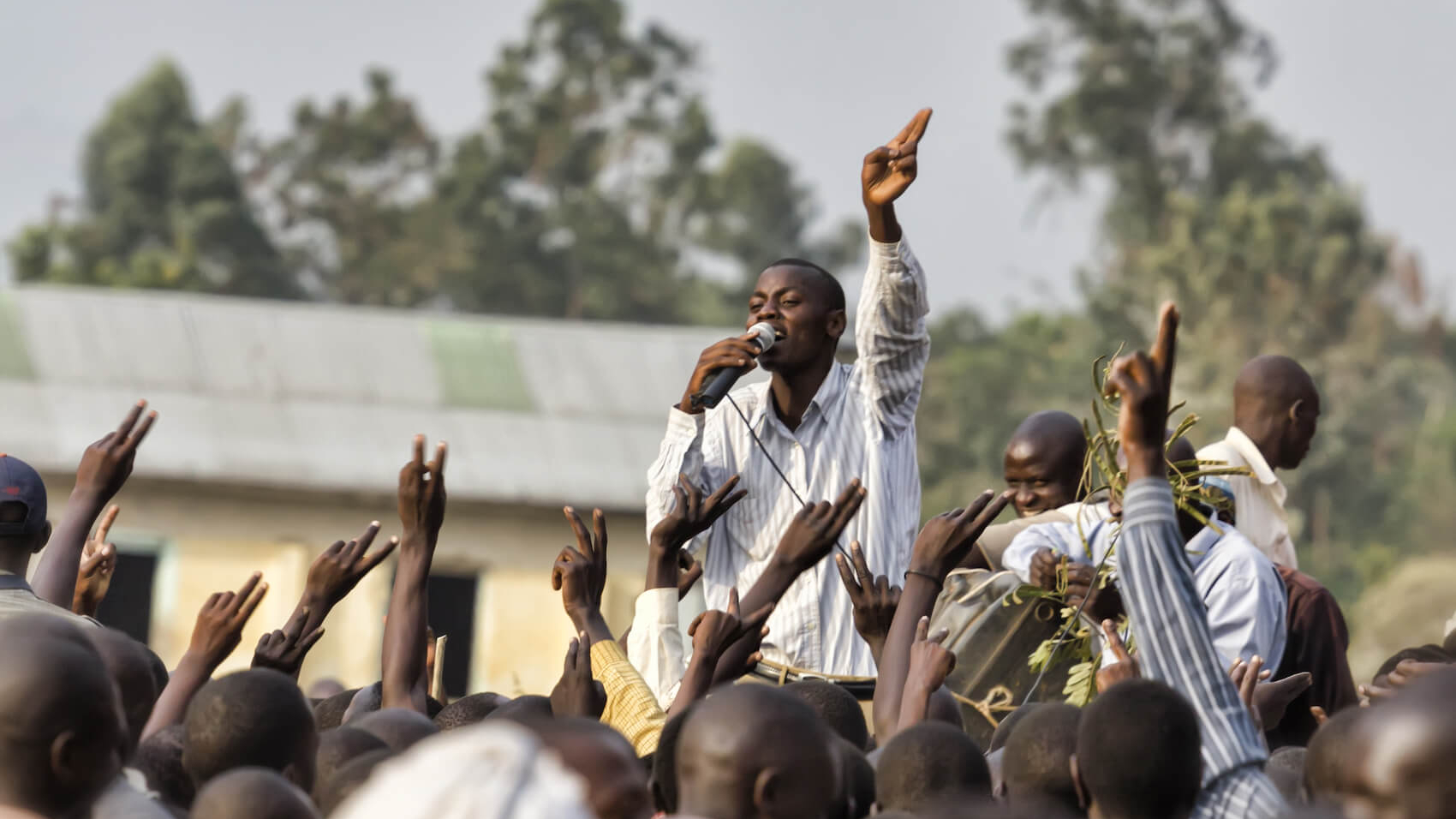
Prabowo Subianto sings during a grand campaign at GBK Stadium in Jakarta on March 23, 2014. After four attempts, Prabowo was finally elected President of Indonesia in 2024. Photo: MRNPic.

From Political Pariah to President: Prabowo Subianto and the Perils of Populism in Indonesia

Please cite as:
Watmough, Simon P. (2021). “From Political Pariah to President: Prabowo Subianto and the Perils of Populism in Indonesia.” ECPS Leader Profiles. European Center for Populism Studies (ECPS). October 24, 2024. https://doi.org/10.55271/lp0011


Prabowo Subianto’s victory in Indonesia’s February 2024 presidential election marks a pivotal moment in the nation’s democratic evolution, echoing a global shift towards nationalist populism. As Indonesia’s eighth president, Prabowo’s political journey and ideological stance have sparked concerns about the future of the country’s democratic institutions. His controversial military past, including allegations of human rights abuses in East Timor and Aceh during the 1990s, continues to raise alarms about the potential for authoritarianism under his leadership. Critics fear his presidency may signal a return to repressive practices, with threats to civil liberties and increased polarization. Prabowo’s background as a former military general adds to concerns about a consolidation of power and the erosion of democratic checks and balances in one of the world’s largest democracies.

By Simon P. Watmough

Introduction

Prabowo Subianto’s[1] stunning victory in Indonesia’s presidential elections in February marks a significant moment in the country’s democratic journey, reflecting a global trend towards authoritarian nationalist populism. As he assumes the presidency of the world’s third-largest democracy, Prabowo’s political career and ideological stance have ignited conversations about the potential implications for Indonesia’s democratic institutions and pluralistic society, prompting observers at home and abroad to scrutinize the trajectory Indonesia might take under his administration. This profile joins that conversation, asking: Who is Prabowo Subianto, Indonesia’s eighth president?

If the “peculiarity of populist discourse is to frame politics as an antagonistic confrontation between the people and the oligarchy” (de la Torre, 2007: 389), then Prabowo hits the mark. Known for his assertive rhetoric and strongman persona, Prabowo – a retired lieutenant general in the Indonesian Armed Forces (Tentara Nasional Indonesia, TNI) – has successfully tapped into a vein of nationalist sentiment in Indonesia, promising robust leadership in the face of mounting economic and security challenges.

It is scarcely surprising that Prabowo embodies all the qualities of a “warrior populist” in the vein of Venezuela’s Hugo Chavez, as he has publicly declared his admiration for the late Venezuelan general-turned-dictator (Aspinall, 2015: 2). Equally, as the brother of one of Indonesia’s richest men (and a multimillionaire in his own right), we can see him as the paradigmatic “pluto-populist” in the vein of Donald Trump, the late Silvio Berlusconi and of course, Thailand’s Thaksin Shinawatra, whom Prabowo openly admires (ibid.).

The country itself is no stranger to populism, which has “deep roots in Indonesia” (Aspinall, 2015: 3). “Diffuse” forms of populist mobilization have played an outsized role in the country’s mass politics since the beginning, even during the “Guided Democracy” of the founding president, Sukarno, and the authoritarian “New Order” period under Suharto (ibid.). Some have even located the roots of Indonesian populism in the country’s birth as an independent nation (van Klinken, 2020). However, Indonesia’s current “populist moment” reflects conditions that have emerged in the 21st century, not least the attenuation of party functioning in the campaigns of political actors and the rise of “media-based populism,” which is “now the default mode of electioneering” (Gammon, 2023: 442). The allure of authoritarian nationalist populism, with its promise of decisive action and appeal to traditional values, poses questions about the future of Indonesia’s open and inclusive political climate. Critics argue that this could lead to a regression in human rights, freedom of the press and minority protections, elements that are foundational to Indonesia’s democratic framework.

This profile offers a comprehensive overview of the factors that have shaped Prabowo’s outlook and approach, including his early life, his military career (including his close links with the Suharto regime and his role in the transition to democracy in 1998) as well as his subsequent business and political ventures, all of which have led him to the seat of ultimate power. Charting his move from political pariah to perennial contender and now president, it sketches the key influences that have shaped his authoritarian populist outlook and the controversies that continue to devil him and give his critics pause for concern. Ultimately, it suggests he is likely to work to centralize power in the hands of the presidency, undermine Indonesia’s independent institutions, take the country backwards and possibly threaten to ignite conflicts far and wide.

A Cosmopolitan “Third Culture Kid” Forged in Exile

Indonesian presidential candidate Prabowo Subianto greets the public during a 2024 general election campaign in Bengkulu City, Indonesia, on January 11, 2024. Photo: Shutterstock.

Prabowo Subianto Djojohadikusumo was born on 17 October 1951, in Jakarta, Indonesia, into an aristocratic Javanese family “line that goes back centuries” (Connelly & Laksmana, 2018). His grandfather, Margono Djojohadikusumo (1894–1978), a prominent economist and founder of Bank Negara Indonesia (also serving as its first president), was a leading figure in Indonesia’s independence movement, while his father, Sumitro Djojohadikusumo (1917–2001), held key positions as Indonesia’s minister of trade and industry. Growing up amidst this political and economic elite exposed Prabowo to the inner workings of government and economics from a very young age (Purdey, 2016).

In the late 1950s, at just seven years of age, Prabowo was forced into exile with his family, his father and grandfather having been central players in an internal rebellion against Sukarno. Exile took the family first to Singapore, Malaysia and Thailand, then Switzerland and later to the United Kingdom, where Prabowo studied, graduating from the prestigious American School in London (ASL) in 1968 (Tanu, 2004). This international journey at a young age had a profound impact on Prabowo, exposing him to a wide range of cultures and shaping him into a “third culture kid” (Pollock & Reken, 2009), one who learned precisely how to navigate elite cosmopolitan circles (Tanu, 2004).

After the fall of Sukarno and the rise of the New Order regime in 1966 (headed by Suharto), the family were no longer political exiles. As Aspinall (2015: 3) notes, Prabowo returned to Indonesia “more comfortable speaking English than Indonesian, yet with powerful ambitions” to make something of himself in the country of his birth. Indeed, from a young age, Prabowo displayed a natural aptitude for strategy and a strong aspiration to the grand exercise of political power – a particular fascination in his youth was the Turkish general-turned-founding father Kemal Mustafa Ataturk (Friend, 2003: 323). Recognizing his teenage son’s leadership potential, Sumitro encouraged Prabowo to attend the military academy and pursue a career in the armed forces.

Military Career and Accusations of Human Rights Abuses

Understanding Prabowo’s military career is central to understanding both his outlook and style and the controversies that have dogged him in politics since 2004. His military journey began in 1970 when he enrolled in the Indonesian Military Academy in Magelang. He graduated in 1974, alongside fellow cadets who would go on to hold senior leadership positions, including Indonesia’s sixth president, Susilo Bambang Yudhoyono (widely known as SBY).

After graduation, Prabowo served in elite regiments of the TNI, first in the Indonesian Special Forces (known as Kopassus), which he joined in 1976 and where he gained experience in counterinsurgency operations (Aspinall, 2015: 6). Indeed, during his several tours of East Timor after the Indonesian invasion in December 1975, he was responsible for many human rights violations. At just 26 years old, Prabowo became the youngest commander of a key commando unit operating in East Timor and was implicated in the execution of East Timor’s first prime minister and freedom fighter, Nicolau dos Reis Lobato, in December 1978 (van Klinken, 2014).

Prabowo’s career took off after his marriage to Siti Hediati Hariyadi (“Titiek”) – the daughter of Indonesia’s strongman President Suharto – in 1983. His marriage to Titiek further elevated his status within the ruling political elite and gave him access to important networks and resources, allowing him to rise through the ranks of the Indonesian military more swiftly than many of his peers.

In the early 1990s, Prabowo, now a Major General, led Kopassus Group 3 in its attempts to suppress the East Timorese independence movement. His methods included using irregular troops, known as “ninja” gangs, and militias directed by Kopassus commanders, leading to a rise in human rights abuses. He has also been implicated in killings in Indonesia’s restive province of West Papua, particularly targeting the region’s independence activists (Nairn, 2024). During the dying days of his father-in-law’s regime, “Prabowo emerged as the leader of a palace guard of generals most willing to use coercion to defend the regime” (Aspinall, 2015: 6). In March 1998, Prabowo was appointed as the head of the 27,000-strong Army Strategic Reserve Command (Kostrad) – a position Suharto himself once held, which he used to topple Sukarno and propel himself to power in 1965.

Just three months into this role, during the May 1998 riots, Prabowo sought to deploy Kostrad units to restore order in Jakarta. This move was met with controversy as it involved hundreds of individuals trained by Kopassus, Prabowo’s former command. Accusations of importing trouble and seeking to discredit rivals were raised, with some arguing that Prabowo was putting pieces in place for a military coup in which he would assume command of Indonesia. These events escalated tensions and played a role in the resignation of President Suharto on May 21, 1998 (Aspinall, 2005: 212).

In the aftermath of the 1998 riots, investigations revealed allegations of human rights abuses and kidnappings involving Prabowo’s troops, including the torture of democracy activists. He acknowledged responsibility for the abductions (although he continues to deny any role in the activists’ deaths), leading to his discharge from military service in August 1998 (Nairn, 2024).

Second Exile and Business Empire

As soon as he was expelled from the military, Prabowo again went into exile (this time self-imposed), residing in Jordan (Prabowo is reportedly close to King Abdullah). During this time, he downplayed involvement in the 1998 riots and maintained that he was not responsible for betraying his country or its leaders (Tesoro, 2000). On his return to Indonesia in 2004, he immediately began to plot a path to the presidency (Aspinall & Mietzner, 2014: 352).

At the same time, Prabowo ventured into the business world, collaborating with his younger brother, Hashim Djojohadikusumo. His business interests reflect a pattern endemic to Indonesia’s “oligarchic” political economy (Winters, 2013). Today, Prabowo’s Nusantara Group oversees an extensive portfolio of 27 companies operating both within Indonesia and internationally. These companies cover a diverse range of sectors, including Nusantara Energy (focusing on oil, natural gas, and coal), Tidar Kerinci Agung (engaged in palm oil plantations), and Jaladri Nusantara (operating in the fishery industry) (Purdey, 2016).

From Political Pariah to Perennial Presidential Candidate

Even as a solider, Prabowo Subianto had established a reputation as a political player, leveraging his connections with President Suharto in the 1990s to engage in efforts to suppress critics in the journalistic and political spheres. In the dying days of the New Order, Prabowo attempted to sway Goenawan Mohamad to sell his controversial Tempo magazine (a leading mouthpiece of popular dissent) and warned various influential figures, including Abdurrahman Wahid (popularly known as Gus Dur, who served as Indonesia’s fourth president from 1999 to 2001) and Nurcholish Madjid, against taking a public stand against the regime (Friend, 2003: 203).

By 2004, Prabowo’s political aspirations led him to vie for the Golkar party’s presidential candidacy, but he received minimal support. He speaks of this campaign as a “trial run” that gave him the experience he needed to move forward. In this period, he also began to create grassroots networks, especially among farmers, small traders, and a wide range of other organizations, including “veterans’ associations, labor unions and organizations of village heads, which could provide him with access to a mass base” (Aspinall, 2015: 9) on which to ground a populist political movement.

In 2008, Prabowo’s inner circle established the Great Indonesia Movement Party (Gerindra), supporting his presidential run in 2009. Hashim Djojohadikusumo serves as party chairman. Despite not winning enough parliamentary seats, Prabowo ran as a vice-presidential candidate alongside Megawati Sukarnoputri, daughter of Sukarno. The pair, known as Mega–Pro, lost to SBY, who succeeded Megawati as Indonesia’s sixth president on 20 October 2004. Unbowed by this failure, Prabowo doubled down on building up Gerindra, his business interests, and his populist networks (Mao, 2024).

The 2014 Presidential Election: The “Battle of the Populists”
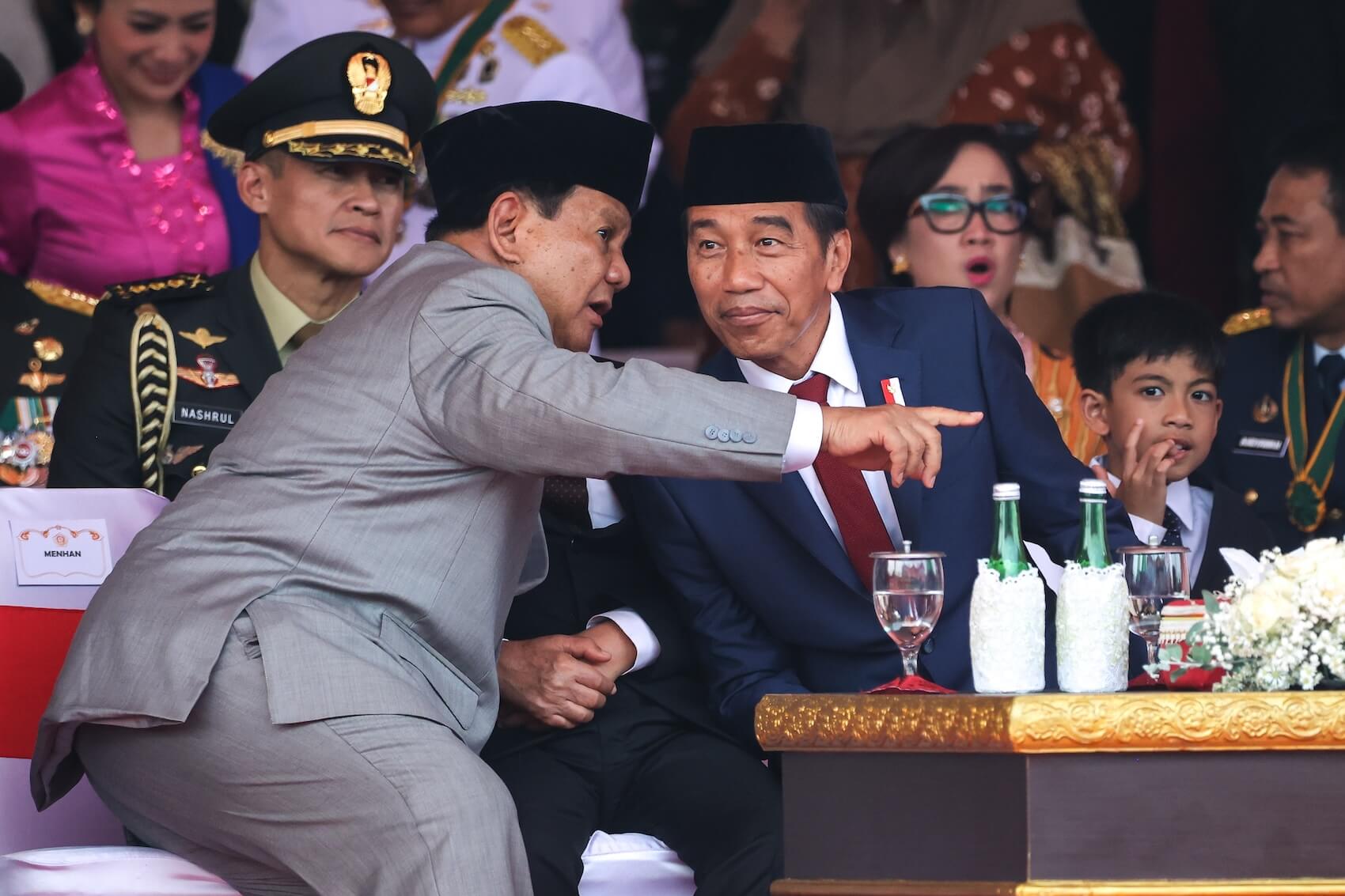
President-elect Prabowo Subianto with the 7th President of Indonesia, Joko Widodo, at the 79th Indonesian National Armed Forces Anniversary in Jakarta, Indonesia, on October 5, 2024. Photo: Donny Hery.

By 2014, Indonesian politics had reached a critical juncture, one that was ripe for populist mobilization. While SBY’s ten years in office had seen the country bed down several important reforms, recover fully from the 1997 Asian financial crisis, and resolve some longstanding regional conflicts, they were largely seen as a lost opportunity, mainly due to the vacillating leadership of President Yudhoyono himself (Aspinall et all., 2015: 1–2). The period of political indecision and policy stagnation that characterized the last years of his presidency set the stage for the rise of a “populist challenger” in Indonesian politics, something “political scientists had been predicting for years” (Aspinall & Mietzner, 2014: 351; see also Anugrah, 2020: 5). Indeed, as Aspinall has rightly noted, “The rise of an authoritarian populist challenger like Prabowo was almost overdetermined in contemporary Indonesia” (Aspinall, 2015: 3)

Scholars widely agree that 2014 was a “watershed” and a “turning point” in Indonesian democracy in the post-Suharto era (see, for example, Anugrah, 2020: 6; Aspinall & Mietzner, 2014: 347). It was the year that saw Indonesia join “the new wave of illiberal populist mobilization in both established and newer democracies” (Anugrah, 2020: 11). The result was an epic “battle of the populists” – Joko Widodo (“Jokowi”), the incumbent governor of Jakarta, and Prabowo – in the presidential elections in July. While both were clearly populist, each had a distinctive populist style that contrasted with the other. For his part, Jokowi showcased a provincial “everyman” populist style (he promised to meet Yudhoyono’s do-nothing elitism with workaday governance on a platform of good governance and populist policies like cheap healthcare and education). As Aspinall & Mietzner (2014: 351) have noted: “In Jokowi, Indonesians found someone who possessed a popular touch that was the antithesis of Yudhoyono’s wooden formality.” In stark contrast stood Prabowo, who instead offered “‘firm leadership’ as the antidote to Yudhoyono’s hesitant style of leadership” (Ibid.). Despite his impeccable establishment credentials, Prabowo cast himself in classical populist terms as an “outsider” ready to take on the Indonesian elite.

Prabowo ran a lavish campaign funded mostly by his brother, Hashim, a wildly successful businessman and one of Indonesia’s dollar billionaires. Notwithstanding his claims of wanting to fight a corrupt oligarchy, Prabowo’s campaign was “organized using a pattern of cash-driven informal networking” (Aspinall, 2015: 3) that drew in many constituencies. Despite a campaign levelled at “corrupt elites,” Prabowo managed to perfect the game of “patronage democracy” that Indonesia has become known for (Van Klinken, 2009).

Consistent with a turn to “media-based populism” in Indonesia (Gammon, 2023: 442), Prabowo campaigned “with relentless media advertising and set piece mass rallies all stressing a simple message: Prabowo was the man Indonesia needed to lead it towards a desperately needed national renaissance” (Aspinall & Mietzner, 2014: 357). Prabowo’s appeal was enhanced by a “widespread – though diffuse – mood of nostalgia for the certainties of the New Order” regime of his father-in-law Suharto, Indonesia’s longest-serving president (Aspinall, 2015: 3).

His campaign adopted classic populist discursive frames, and he cast himself as Indonesia’s “savior” with promises to rescue the country from a rapacious elite in cahoots with foreigners seeking to exploit Indonesia’s vast natural resources (Hellmann, 2019: 13). His style was avowedly nationalist and sought to both burnish his credentials as a “strong leader” and draw on the symbolism of the populist Sukarno era: “His campaign appearances had a highly theatrical character, with lots of uniforms, marching, and fiery oratory, and with much of the styling obviously based on that of Sukarno and other nationalist leaders from the 1940s, 1950s, and 1960s” (Aspinall & Mietzner, 2014: 352).

Moreover, despite his claims to be the answer to the corruption and money politics of the Indonesian campaign system, Prabowo himself marshalled a wide range of constituencies through vote buying. In this way, he was able to galvanize Islamic groups, small businessmen and other mass constituencies. As Aspinall & Mietzner (2014: 359) note, “like his Thai role model Thaksin Shinawatra,” Prabowo “appealed mainly to the rural poor for support” (although in the end, he garnered as much or more urban support). Despite his mass appeal and backing from the outgoing SBY (the president reportedly held Prabowo “unfit to be president” but bowed to pressure and opinion polling to swing his weight behind the former general at the last minute), Jokowi won with 53% of the vote, after a late scramble to get out his base of his voters to the polls.

In the aftermath of the elections, both candidates declared victory. Jokowi’s claim was backed by most independent quick counts, showing a slight lead over Prabowo. The latter, however, citing different polls, also claimed victory, a strategy he would repeat in 2019. However, he withdrew from the race on the day the official tally was to be announced, citing “massive cheating” and declaring the election unconstitutional, a move that sparked legal and political controversies, culminating in an appeal to the Constitutional Court alleging significant voting irregularities, which the court unanimously rejected.

The 2019 Rematch: Islamic Populism and a Promise to “Make Indonesia Great Again”
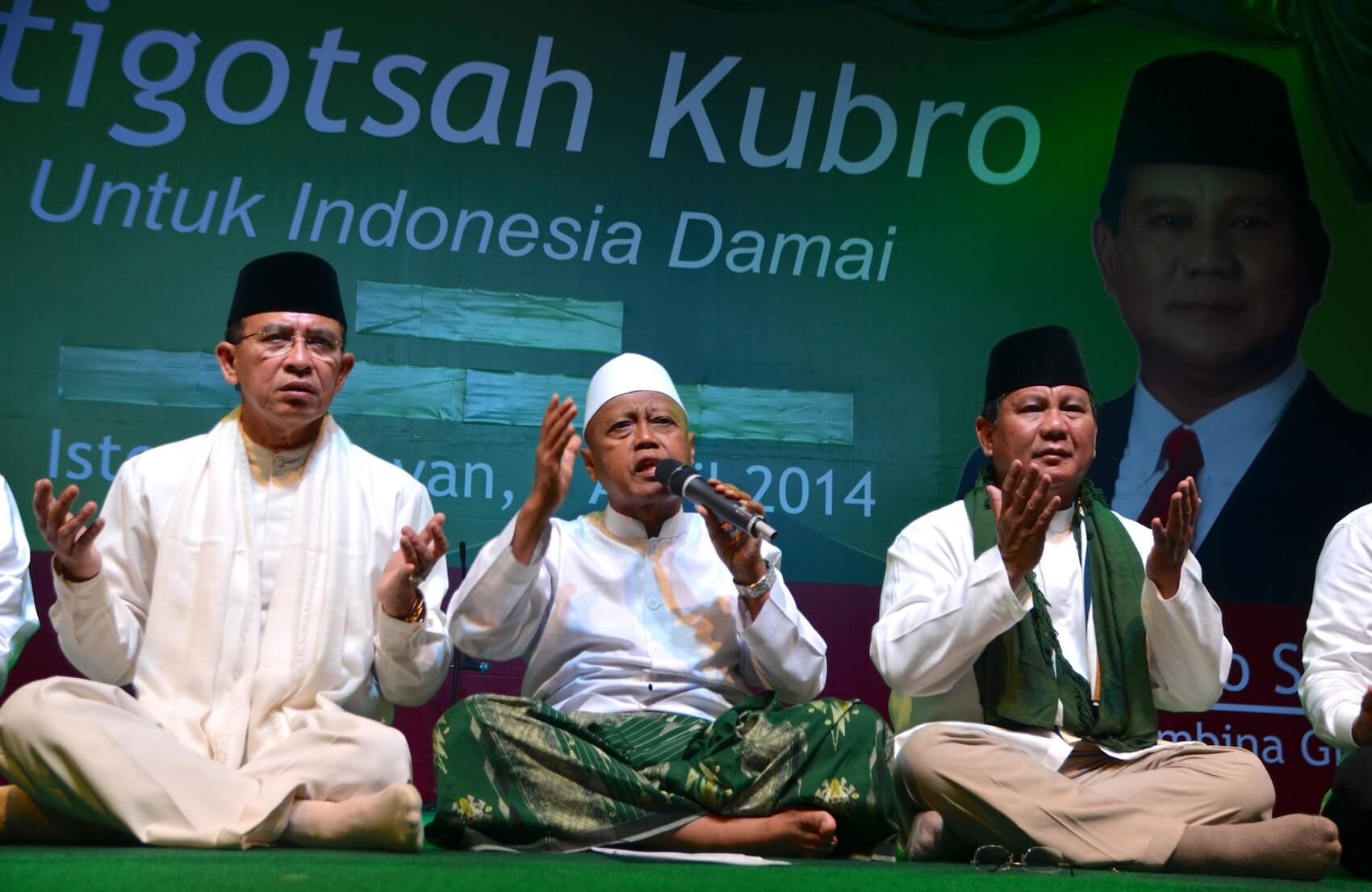
Indonesian presidential candidate Prabowo Subianto at a campaign event in Jakarta, Indonesia, on April 4, 2014. Photo: Simon Roughneen.

The 2019 campaign set up a “rematch” between the two populists and was even more divisive than their 2014 contest (Arifianto, 2019: 46). As had been the case in 2014, Prabowo’s participation in the 2019 campaign was contentious. He initially claimed victory despite independent counts favoring Jokowi (he was eventually declared the winner with 55.5% of the vote), who later faced violent protests from his supporters challenging the results, which were ultimately upheld by the Constitutional Court (Jakarta Globe, 2019). During the campaign, Prabowo was accused of emulating the tactics used by Donald Trump in his 2016 bid for the US presidency, particularly in emphasizing economic inequalities and foreigners ripping the country off. In a speech given in October 2018, Prabowo echoed Trump’s infamous slogan by declaring his desire to “Make Indonesia Great Again.”

In a pattern that has recurred across his presidential campaigns, Prabowo reinvented himself going into the election campaign, in this case as a pious Muslim, appearing at religious festivals and Islamist rallies and actively courting Muslims: “Unlike in the 2014 election, when the Islamists were just a small contingent of Prabowo’s mainly ultranationalist coalition, the Islamists had now become an integral part of his campaign team” (Arifianto, 2019: 47). He made much of his connections with hardline Muslim groups, notably exemplified by his relationship with Muhammad Rizieq Shihab of the Islamic Defenders Front. Rizieq, in self-imposed exile in Mecca at the time, was a vocal critic of Jokowi and supporter of Prabowo. The former general pledged to facilitate Rizieq’s return to Indonesia if he won the election. Prabowo’s courting of the populist Islamic vote shifted the entire tenor of the campaign, forcing Jokowi to select the “conservative cleric Ma’ruf Amin” (Arifianto, 2019: 46) as his running mate.

Amidst a rancorous campaign, voter turnout in the 2019 elections reached record highs, fueled largely by the populist mobilization of Islam by the two leading contenders: “Religious-based polarization conducted by both sides during their campaigns helped boost total voter turnout to 154 million—approximately 80% of the electorate” (Arifianto, 2019: 49). This was up from the 69% who turned out to vote in the 2014 presidential poll (Anugrah, 2020: 9).

Rapprochement, Political Reinvention, and “Digital Populism” in the 2024 Presidential Campaign

Despite the bitterly fought campaign and Prabowo’s alleged role in violent post-election riots in Jakarta that killed six people (Soeriaatmadja & Chan, 2019), the ex-general opportunistically sought a rapprochement and approached Megawati and Jokowi to see if Gerindra could be included in the governing coalition (Indonesia’s party system is highly cartelized and parties often bandwagon in exchange for spoils; see Slater, 2018). In turn, and notwithstanding the rancor that had characterized their relations for half a decade, Jokowi appointed Prabowo his defense minister in October 2019 “as a gesture of national unity” (Anugrah, 2020: 1). Moreover, “[d]espite earlier tensions, Prabowo and Jokowi found common ground in a nationalist vision that emphasized sovereignty, defense, food security and energy security” (Utama, 2023).

His appointment as defense minister resurfaced criticisms of his past human rights abuses and comments praising charismatic populists who later became dictators, such as Hugo Chavez. Dogged by these criticisms, Prabowo sought to shed his image as a firebrand strongman (see below) in the run-up to the 2024 campaign, which culminated in a landslide win on February 14 (Prabowo took over 58% of the vote with another record turnout of 82%; Strangio, 2024).

Prabowo’s 2024 triumph after successive failed attempts rested on three central (and interrelated) dimensions, all of which contributed to his landslide win. The first was the backing of President Jokowi and the full force of the Indonesian state, which deployed a mix of “retail corruption” and “wholesale coercion” on a scale not seen in Indonesia since the 1970s (Nairn, 2024). This approach was coupled with a populist policy of offering one free meal to every child of school age in order to address malnutrition and stunting. A laudable policy on the face of it, it remains to be seen whether the US$30 billion price tag can be met from Indonesia’s strained central budget (Lindsey, 2024). Jokowi, who was term-limited, saw in Prabowo a chance to “carry forward his plans for a political dynasty and, with it, continued influence” (Utama, 2023). In late 2023, Prabowo skillfully wooed the president, offering the second spot on his ticket to Jokowi’s eldest son, Gibran Rakabuming Raka, whose constitutional ineligibility for the office was overruled by Indonesia’s Supreme Court, headed by none other than Gibran’s maternal uncle, Anwar Usman, in October 2023. Secondly, Prabowo had the backing of Indonesia’s elite, in particular his brother and “an alliance of mining oligarchs and several giant capitalists who … supported the pair behind the scenes” (Hermawan, 2024).

Finally, Prabowo reinvented himself yet again – this time as a “gemoy” (cute) grandpa – and launched a campaign of “digital populism” on social media (primarily the video platform TikTok), featuring him “dad dancing” on campaign stages and adopting an approach vaguely reminiscent of Trump’s rally antics. This “reinvention tour” appealed to thrill Indonesia’s GenZ and millennial voters, who make up the majority of the country’s electorate and have little or no memory of Indonesia’s authoritarian past or Prabowo’s role in the violent end to the New Order in 1998. Here, too, Jokowi’s backing was also critical, not only in furnishing the young Gibran as Prabowo’s campaign sidekick. As Ary Hermawan (2024) has noted, “Prabowo’s new persona as a ‘cuddly grandpa’ [was] manufactured by an army of cybertroopers,” the majority of which were inherited from Jokowi’s political outfit and which the Prabowo camp deftly used to blunt “campaigns targeting the former general’s checkered human rights record—a key issue in the 2014 election” that Prabowo, ironically enough, lost to Jokowi (Ibid.)

Political Style and Controversies

Presidential candidate Prabowo Subianto and vice-presidential candidate Gibran Rakabuming Raka deliver a speech to their supporters in Jakarta, Indonesia, on February 14, 2024. Photo: Prayoga Nugroho.

Prabowo has been famously described as a chameleon, presenting different colors depending on the audience. As one profile put it on the eve of the 2014 presidential campaign, “The pro-business cosmopolitan who can ‘knock Indonesia together’ is the one who shows up to events at posh Jakarta hotels with diplomats and investors. The fist-shaking demagogue is the one who appears in front of the voters” (Tanu, 2004). Prabowo’s past has been a subject of scrutiny, particularly during his presidential campaigns in 2014, 2019 and 2024, with many organizations calling for investigations into his actions during this period. As far as personality is concerned, he is often described as “temperamental,” with “a propensity for outbursts of rage that sometimes involve physical violence, with reports circulating widely of him throwing cellphones, ashtrays, and even punches when angered by his associates or underlings” (Aspinall, 2015: 8–9).

His political style is emblematic of a broader global trend towards authoritarian nationalist populism, a mode of governance characterized by strong leadership, assertive nationalism, and, often, a skepticism towards liberal democratic norms. In Indonesia, Prabowo has cultivated an image of a decisive leader, one who promises to restore order, enhance national pride and protect Indonesian interests from foreign encroachment. This approach has garnered substantial support, particularly among voters disillusioned with the perceived inefficacies of previous administrations.

Despite his impeccable elite credentials (he descends from Javanese aristocracy on his father’s side and is the scion of one of Indonesia’s wealthiest and best-connected families), Prabowo loves to style himself as an “outsider” and a “maverick.” The latter is not actually far from the truth, a personality trait that has been in evidence since his days at the military academy in the early 1970s, where — despite his impressive mastery of military lore and practice — he quickly developed a reputation for independence (his graduation was delayed because he spent some time AWOL), most likely a reflection of his experience as a “third culture kid” in exile around the world in the 1960s.

However, this same political style raises concerns about the potential erosion of democratic principles, including checks and balances, freedom of speech and minority rights. Prabowo’s emphasis on nationalism and sovereignty taps into deep-seated sentiments among the populace, yet it also risks inflaming divisions within Indonesia’s ethnically and religiously diverse society. The manifesto of his Gerindra Party calls for a rollback of the post-Suharto constitutional reforms and a return to Indonesia’s original 1945 Constitution, which Indonesia’s first two presidents, Sukarno and Suharto, had used to establish authoritarian regimes over five decades.

Prabowo’s approach to governance also reflects a skepticism towards liberal internationalism, favoring instead a more insular, Indonesia-first policy. This stance is evident in his critiques of foreign investment and his proposals to reevaluate Indonesia’s participation in international trade agreements, which he argues disadvantage Indonesian workers and compromise national sovereignty. Such positions resonate with nationalist sentiments within Indonesia, promising economic sovereignty and the protection of local industries against global market forces. However, this economic nationalism has sparked debates about the practical implications for Indonesia’s economy, with critics cautioning that protectionist policies could isolate Indonesia from global supply chains and hinder economic growth.

Conclusion: What Can We Expect from a Prabowo Presidency?

After decades of aspiring to lead Indonesia, we can be sure that Prabowo has a clear idea of where he wants to take the country and a clear plan of how to do so. Volatile and mercurial, he is equally pragmatic and will almost certainly be looking to cut deals and build alliances, not least with his major opponent, Megawati’s Indonesian Party of Struggle (PDI–P), which has the largest number of seats in Indonesia’s House of Representatives (DPR). But at 72 years of age and in less-than-robust health, time is not on his side, and he is likely to quickly lose patience with Indonesia’s messy consensus-building approach or overt political opposition, be it in the DPR or on the streets.

Throughout his political career, Prabowo Subianto has faced numerous controversies, many of which stem from his tenure in the Indonesian military, as detailed above. Allegations of human rights abuses during his leadership of the special forces in the 1990s, particularly in regions like East Timor and Aceh, have dogged him, casting a long shadow over his subsequent political endeavors. While Prabowo has consistently denied any wrongdoing, these allegations have been a focal point for critics who argue that his presidency could signal a return to the repressive practices of Indonesia’s past. This history, combined with his current political rhetoric, feeds into fears of an authoritarian drift should Prabowo consolidate power, potentially leading to a curtailment of civil liberties and a crackdown on dissent.

Prabowo’s casual disregard for democracy has also been on display during his successive presidential bids. For example, his 2014 campaign “espoused an authoritarian populist message suggesting he wanted to recentralize power and dismantle key democratic institutions” (Aspinall & Mietzner, 2014: 347). He has also floated the idea that “the country to do away with direct elections of executive government leaders—which he described as a Western product inappropriate for Indonesia” (Ibid.: 352). Before constitutional reforms in the 2000s instituted popular elections of Indonesia’s president and regional governors, they were appointed by their respective legislatures. As Tim Lindsey (2024) has recently pointed out, much of the work of dismantling the reforms of the last 30 years has already been accomplished: “Many of the elements of the New Order are already in place. Much of the work of dismantling Indonesia’s liberal democracy has already been done by the outgoing president” Jokowi, who has overseen an “illiberal turn in Indonesian democracy” over the last decade (Anugrah, 2019).

These points underscore concerns about the erosion of democratic norms and the potential for increased polarization within one of the world’s most diverse countries. Prabowo’s background as a former military general with a controversial record further compounds fears about the centralization of power and the undermining of checks and balances in governance. As this profile shows, these fears are hardly overblown – Prabowo’s record offers clear pointers as to how he is likely to attempt to govern.

Indonesia now stands at a crossroads. President Prabowo’s leadership will test the resilience of the country’s democratic institutions and its capacity to navigate the tension between strongman governance and pluralistic values. Prabowo’s tenure could bring decisive action on issues like economic sovereignty and national security, but at what cost to civil liberties and political freedoms? His legacy will be determined not just by the policies he enacts but by how he handles the delicate balance between authority and accountability, nationalism and inclusivity. The question that now lingers is whether Prabowo’s leadership will unite Indonesia under a shared vision or deepen the divisions that have long shaped the nation’s complex political landscape.


References

Anugrah, I. (2020). “The Illiberal Turn in Indonesian Democracy.” The Asia-Pacific Journal: Japan Focus18(8), 1–17.

Arifianto, A. R. (2019). “What the 2019 Election Says About Indonesian Democracy.” Asia Policy26(4), 46–53. 

Aspinall, E. (2005). Opposing Suharto: Compromise, Resistance and Regime Change in Indonesia. Stanford University Press.

Aspinall, E. (2015). “Oligarchic Populism: Prabowo Subianto’s Challenge to Indonesian Democracy.” Indonesia99, 1–28. https://doi.org/10.5728/indonesia.99.0001

Aspinall, E., & Mietzner, M. (2014). “Indonesian Politics in 2014: Democracy’s Close Call.” Bulletin of Indonesian Economic Studies50(3), 347–369. https://doi.org/10.1080/00074918.2014.980375

Aspinall, E., Mietzner, M., & Tomsa, D. (2015). The Yudhoyono Presidency: Indonesia’s Decade of Stability and Stagnation. Institute of Southeast Asian Studies.

Connelly, Evan A., & Laksmana, A. (2024, 14 March). “Jokowi Offers Prabowo a Piece of the Pie.” Foreign Policyhttps://foreignpolicy.com/2019/10/31/indonesia-democracy-general-jokowi-offers-prabowo-a-piece-of-the-pie/

De la Torre, C. (2007). “The Resurgence of Radical Populism in Latin America.” Constellations14(3), 384–397.

Friend, T. (2003). Indonesian destinies. Belknap Press of Harvard University Press.

Gammon, L. (2023). “Strong ‘Weak’ Parties and ‘Partial Populism’ in Indonesia.” Contemporary Southeast Asia: A Journal of International and Strategic Affairs45(3), 442–464.

Hellmann, O. (2019). “Populism in East Asia.” In: C. Rovira Kaltwasser, P. A. Taggart, P. Ochoa Espejo, & P. Ostiguy (Eds.), The Oxford Handbook of Populism (pp. 161–178). Oxford University Press.

Hermawan, A. (2024, 19 June). “How Indonesia’s Cyberspace Entrenches Oligarchic Power.” Asialinkhttps://asialink.unimelb.edu.au/insights/how-indonesias-cyberspace-entrenches-oligarchic-power

Jakarta Globe (2019, 17 April). “Indonesia Sees Record Turnout in Historic Election, Braces for Fallout.” https://jakartaglobe.id/context/indonesia-sees-record-turnout-in-historic-election-braces-for-fallout

Lindsey, T. (2024, 19 October). “Indonesia’s New President, Prabowo Subianto, Finds Democracy ‘Very Tiring’. Are Darker Days Ahead for the Country?” The Conversationhttp://theconversation.com/indonesias-new-president-prabowo-subianto-finds-democracy-very-tiring-are-darker-days-ahead-for-the-country-241256

Mao, F. (2024, 15 February). “Prabowo Subianto: The tainted ex-military chief who will be Indonesia’s new leader.” BBChttps://www.bbc.com/news/world-asia-68237141

Nairn, A. (2024, 10 February). “Indonesia State Apparatus Is Preparing to Throw Election to a Notorious Massacre General.” The Intercept. https://theintercept.com/2024/02/10/indonesia-election-results-prabowo-fraud-stolen-election/

Pollock, D. C., & Reken, R. E. V. (2009). Third Culture Kids: Growing Up Among Worlds (2nd edition). Nicholas Brealey America.

Purdey, J. (2016). “Narratives to Power: The Case of the Djojohadikusumo Family Dynasty over Four Generations.” South East Asia Research24(3), 369–385. https://doi.org/10.1177/0967828X16659728

Slater, D. (2018). “Party Cartelization, Indonesian-style: Presidential Power-sharing and the Contingency of Democratic Opposition.” Journal of East Asian Studies18(1), 23–46. https://doi.org/10.1017/jea.2017.26

Soeriaatmadja, W., & Chan, F. (2019, 22 May). “6 Killed, 200 Injured in Jakarta Election Protests that Police Say are ‘By Design’.” The Straits Timeshttps://www.straitstimes.com/asia/se-asia/security-forces-use-tear-gas-to-disperse-small-groups-of-rioters-in-jakarta

Strangio, S. (2024, 21 March). Indonesian Election Commission Affirms Prabowo’s Landslide Victoryhttps://thediplomat.com/2024/03/indonesian-election-commission-affirms-prabowos-landslide-victory/

Tanu, D. (2014, 26 June). “Prabowo the Chameleon.” New Mandalahttps://www.newmandala.org/prabowo-the-chameleon/

Tesoro, J. M. (2000, 3 March). “The Scapegoat.” Asiaweek26(8), http://www-cgi.cnn.com/ASIANOW/asiaweek/magazine/2000/0303/cover1.html

Utama, V. R. (2023, 15 December). “Prabowo Subianto: Indonesia’s Perennial Strongman Recast as the Adorable Grandpa.” Indonesia at Melbourne. Retrieved 21 October 2024, from https://indonesiaatmelbourne.unimelb.edu.au/prabowo-subianto-indonesias-perennial-strongman-recast-as-the-adorable-grandpa/

van Klinken, G. (2009). “Patronage Democracy in Provincial Indonesia.” In: O. Törnquist, N. Webster, & K. Stokke (Eds.), Rethinking Popular Representation (pp. 141–159). Palgrave Macmillan. https://doi.org/10.1057/9780230102095_8

van Klinken, G. (2014, 17 April). “Prabowo and Human Rights.” Inside Indonesiahttps://www.insideindonesia.org/editions/elections-2014/prabowo-and-human-rights

van Klinken, G. (2020). “The Origins of Indonesian Populism: Public Debate in Java, March–June 1945.” Indonesia110(1), 43–72.

Winters, J. A. (2013). “Oligarchy and Democracy in Indonesia.” Indonesia96(1), 11–33.


[1] Indonesian naming conventions differ significantly from the Western model of first, middle and last names. Names may consist of one or more words, with one-word names particularly common among the Javanese (e.g., Suharto). Prabowo Subianto is commonly referred to by his first name, “Prabowo,” which aligns with Indonesian naming conventions, where individuals with multiple names are often identified with a single, unique personal name. Thus, he does not generally use the family name “Djojohadikusumo,” in contrast to his father and brother, Hashim. In this profile I introduce each politician with his or her first and second names and refer subsequently to their most commonly used one-word identifier.
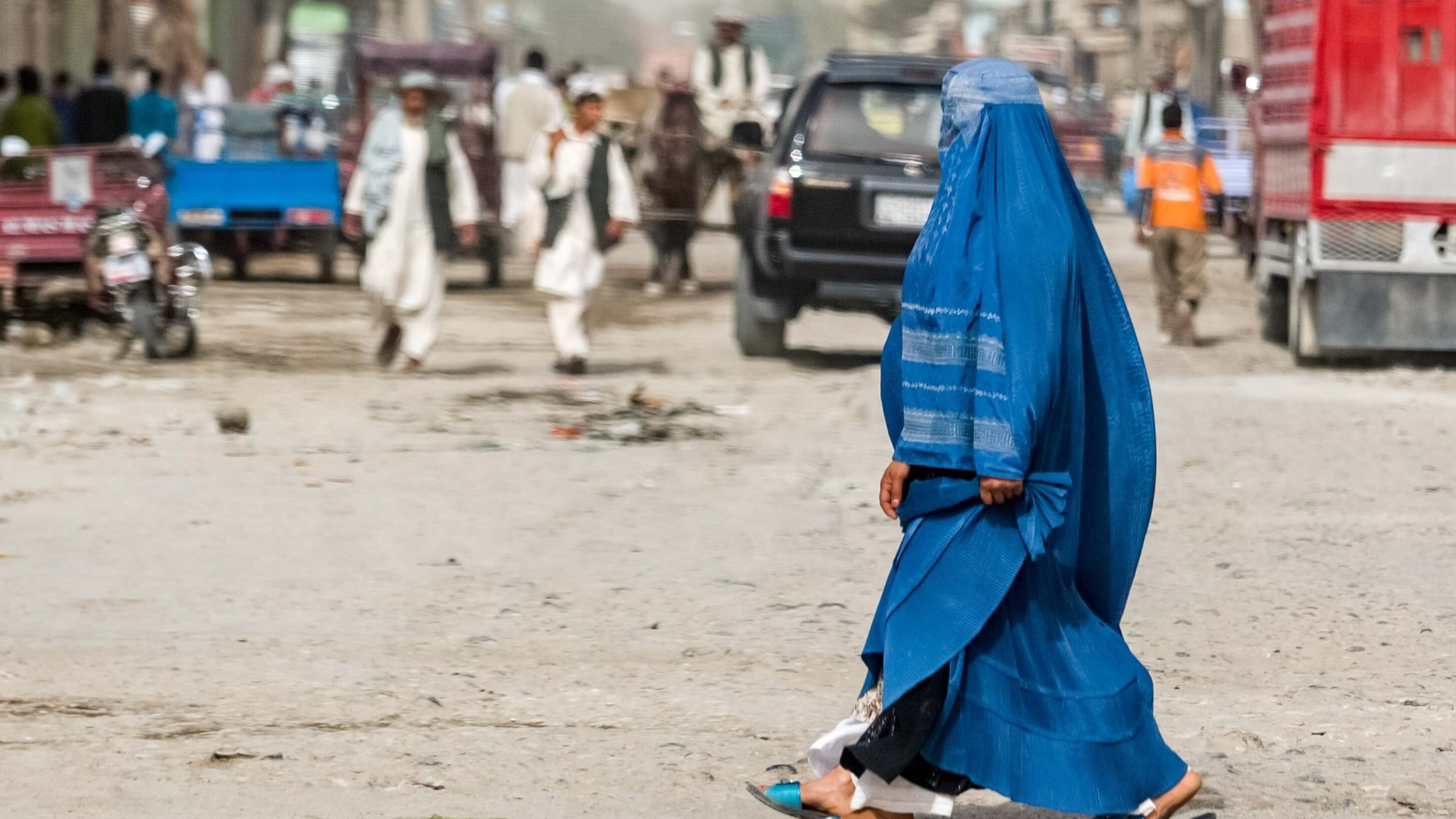
 

An Afghan woman in a burqa and locals are seen on the streets of Kabul. Photo: Shutterstock.

Theocracy, Radicalism and Islamist/Secular Populism in Iran, Afghanistan and Tajikistan 

Please cite as:

Bottura, Beatrice. (2024). Theocracy, Radicalism and Islamist/Secular Populism in Iran, Afghanistan & Tajikistan. European Center for Populism Studies (ECPS). October 18, 2024. https://doi.org/10.55271/rp0089


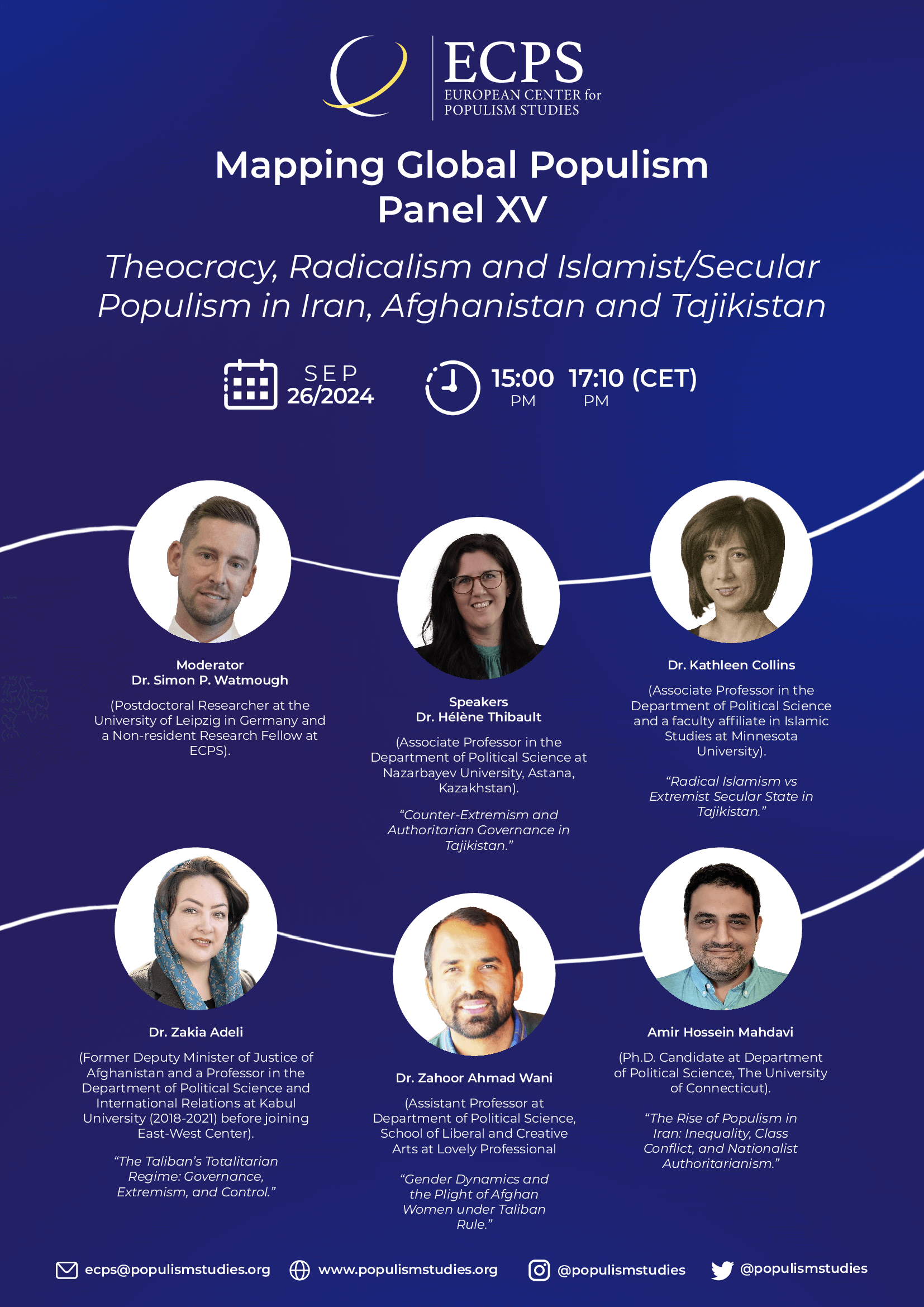
“Theocracy, Radicalism and Islamist/Secular Populism in Iran, Afghanistan & Tajikistan” was the 15th session of the “Mapping Global Populism” panel series hosted by the European Center for Populism Studies’ (ECPS). The session was held online on the 26th of September and was moderated by Dr. Simon P. Watmough. The panel featured an extensive and diverse analysis on the manifestations of authoritarianism, extremism, and populism from distinguished scholars.

Report by Beatrice Bottura

The 15th session of the European Center for Populism Studies’ (ECPS) “Mapping Global Populism” panel series, aimed at creating a comprehensive understanding of populism worldwide, was held online on September 26, 2024. Titled “Theocracy, Radicalism, and Islamist/Secular Populism in Iran, Afghanistan & Tajikistan,” the session featured insights from distinguished scholars on various manifestations of authoritarianism, extremism, and populism in these countries. This report provides an overview of the topics analyzed, with detailed accounts of each speaker’s contributions.

The panel was moderated by Dr. Simon P Watmough, a postdoctoral researcher at the University of Leipzig and a non-resident research fellow in ECPS’ research program on authoritarianism. Dr. Hélène Thibault, Associate Professor in the Department of Political Science at Nazarbayev University, illustrated the authoritarian nature of Tajikistan’s anti-extremism policies. Dr. Zakia Adeli, former Deputy Minister of Justice of Afghanistan and a professor at Kabul University (2018–2021), explored the Taliban regime’s government structure and impositions in Afghanistan. Dr. Zahoor Ahmad Wani, Assistant Professor in Political Science at Lovely Professional University, focused his presentation on gender issues under Taliban rule. Finally, Amir Hossein Mahdavi, a Ph.D. candidate at the University of Connecticut, discussed the potential rise of populist actors in Iran. Originally, Dr. Kathleen Collins, a Professor in the Department of Political Science and a faculty affiliate in Islamic Studies at the University of Minnesota, was scheduled to present on “Radical Islamism vs. Extremist Secular State in Tajikistan.” However, due to her absence, Dr. Thibault covered several key aspects of her colleague’s presentation during the session.

Dr. Hélène Thibault: “Counter-extremism and Authoritarian Governance in Tajikistan”

Having discussed the repressive aspect of counter-extremism policies in Tajikistan, Dr. Thibault then proceeded to cover its performative facet. She described how anti-extremism is used as a tool to promote lifestyles considered “safe” and “in line with national traditions.” To this end, she discussed how the regulation of female clothing is utilized to ensure the secularization of the state. She provided examples such as the ban on the hijab in schools and state institutions, as well as the prohibition of wearing, importing, or selling “foreign clothing” in public places, which international organizations have recognized as a violation of religious rights. She also mentioned restrictions on religious education.

Dr. Hélène Thibault commenced her presentation by addressing the presence and extent of extremism in Tajikistan, with the aim of depicting an accurate picture of the evolution of Islamic radicalization since independence in 1991. She began by demonstrating that the level of radical Islamization in Central Asia is, in practice, less extensive than originally predicted by the media and scholars. Citing works by Edward Lemon (particularly a 2018 report), she highlighted that most recruitment and attacks occur abroad. Based on this information, Dr. Thibault argued that the threat of extremism is exaggerated to create a perception of danger and is used to “eliminate political opponents of all allegiances,” including Islamist parties or other political mobilizations. In other words, the threat of extremism has been used to “sideline all sorts of political mobilization” in a repressive and authoritarian manner, which has become characteristic of politics in Tajikistan.

Dr. Thibault provided examples to support her case. First, the classification of the legally registered Islamic Revival Party as an extremist organization in 2015 led to the imprisonment, persecution, or exile of party members, their families, and lawyers. Second, she cited the harsh repressions and imprisonments during protests in the autonomous region of Gorno-Badakhshan.

Having discussed the repressive aspect of counter-extremism policies in Tajikistan, Dr. Thibault then proceeded to cover its performative facet. She described how anti-extremism is used as a tool to promote lifestyles considered “safe” and “in line with national traditions.” To this end, she discussed how the regulation of female clothing is utilized to ensure the secularization of the state. She provided examples such as the ban on the hijab in schools and state institutions, as well as the prohibition of wearing, importing, or selling “foreign clothing” in public places, which international organizations have recognized as a violation of religious rights. She also mentioned restrictions on religious education. By analyzing these aspects, Dr. Thibault addressed the concept of “authoritarian secularization,” central to Dr. Kathleen Collins’ work, thus connecting her presentation to that of her colleague.

Dr. Thibault concluded her presentation by stating that the exploitation of the concept of extremism, used as a tool for authoritarian and repressive politics, does not address the root causes of extremism—namely unfairness and feelings of exclusion from socio-economic well-being—which she also discussed in one of her 2018 publications.

Dr. Zakia Adeli: “The Taliban’s Totalitarian Regime: Governance, Extremism, and Control”

Dr. Zakia Adeli emphasized how the Taliban’s removal of democratic processes—such as the suppression of elections and political opposition, along with a shift toward decision-making concentrated in the hands of a small religious group—has established a theocratic totalitarian system. This system is characterized by the complete control of the leader, the erosion of human rights, and the restriction of individual and civil freedoms. Examples include the detention, torture, and intimidation of journalists and activists, as well as control over the media and women’s bodies and activities.

Dr. Zakia Adeli introduced her lecture by providing an overview of its core themes, particularly focusing on how the Taliban regime has “systematically centralized power, without any electoral process or legal accountability,” and the consequences of this trend. Hence, the subtitle of her lecture: “Analyzing the Features and Impact of the Taliban’s Rule in Afghanistan.”

The presentation outlined the characteristics of the Taliban’s totalitarian regime: centralization of power, suppression of dissent, the use of ideology to control public and private life, strict censorship, media control, and the homogenization of people. Dr. Adeli expanded on this last point by addressing the enforcement of uniformity through fear and violence, control over institutions (media, civil society, education, and culture), and the imposition of ideological conformity through decrees.

She then described the processes undertaken by the regime to dismantle democratic institutions, including the abolition of:

– Constitutional Law, the core framework of democracy ensuring legal representation and civil rights;

– Parliament, representing the removal of legislative authority;

– The Independent Commission for Overseeing the Implementation of the Constitution;

– The Independent Election Commission of Afghanistan;

– The Ministry of Women’s Affairs;

– Political Parties.

The author explained that, by doing so, the Taliban ensured a lack of checks and balances within the country, which allowed them to centralize power. Under the regime, there are no democratic processes to elect officials, and power is “centralized under the exclusive authority of Hibetullah Akhundzada” (the Taliban’s religious leader), who alone makes and ratifies all political and legal decisions. The institutions and individuals involved in governance—such as ministers—act under the direct orders of the Taliban leader. This structure enforces a “highly centralized and non-electoral regime” with no transparency or accountability, as power is concentrated in one individual, excluding citizens from governance.

Having provided an overview of the Taliban regime’s governance structure, Dr. Adeli focused on the monopolization of power, particularly analyzing the abolition of all political activities. She described how Afghanistan is now a one-party state, with the Taliban controlling media and communication while suppressing political opposition. She noted that in 2022, the Taliban approved a decree banning gatherings not previously approved, leading to the breakup of over 100 peaceful protests, with some individuals disappearing. These practices are enforced with religious justifications, often accompanied by extremist tactics, such as public executions of both previous political actors and individuals not conforming to the Taliban Regime’s ways. 

Following this, the presentation covered the importance of ideology in the totalitarian Taliban regime. Ideology is used as a tool to justify the extreme concentration of power, the elimination of opposition, and the enforcement of obedience from the population. In practice, this destruction of cultural diversity in favor of a singular way of life is executed through:

– Cultural suppression: replacing traditional cultural symbols with their own […];

– Destruction of Historical Heritage: eliminating ancient statues and monuments;

– Ban on Music and Arts: suppressing music, dance, and other forms of artistic expression.

This “homogenization of the people” comprises the core aspects of the Taliban regime, which the speaker carefully outlined throughout the presentation: the enforcement of unity through fear and violence, control of institutions (media, society, education, and culture), and the imposition of ideological conformity. These practices allow the Taliban regime to control both public and private life, depriving people of individual freedoms. In this context, Dr. Adeli highlighted the condition of women under the regime, providing examples such as mandatory dress codes and restrictions on women appearing in public spaces without men.

Dr. Adeli concluded with a brief summary of the main aspects of her presentation. She emphasized how the Taliban’s removal of democratic processes—such as the suppression of elections and political opposition, along with a shift toward decision-making concentrated in the hands of a small religious group—has established a theocratic totalitarian system. This system is characterized by the complete control of the leader, the erosion of human rights, and the restriction of individual and civil freedoms. Examples include the detention, torture, and intimidation of journalists and activists, as well as control over the media and women’s bodies and activities.

Dr. Zahoor Ahmad Wani: “Gender Dynamics and the Plight of Afghan Women under Taliban Rule”

Dr. Zahoor Ahmad Wani emphasized the role of external powers and how their attempts to maintain an imperial presence contribute to understanding the complexity of the region’s cultural, economic, and military heritage. He argued that these external actors destabilized social, tribal, and customary practices in a nearly Manichean manner, leading to decades of conflict, which form the backdrop to the current regime. Dr. Wani continued his historical approach by describing the systematic discrimination faced by Afghan women throughout history, often exacerbated by war and social norms influenced by foreign involvement in national conflicts.

Dr. Zahoor Ahmad Wani’s presentation consisted of a brief history of Afghanistan, aimed at providing context for his analysis, followed by a description of the characteristics of external intervention in Afghanistan and their relation to the current regime, and concluding with an analysis of how language affects the social condition of women. 

Dr. Wani began by discussing Afghanistan’s location, describing it as a crossroads in Central Asia and highlighting how this has given the country a crucial multicultural and multiethnic background. He explained how the high level of cultural and ethnic diversity across regions—intrinsically tied to Afghanistan’s geography—has shaped the complexity of external relations, as outsiders often required different, sometimes conflicting, approaches to connect with various regions. This factor, according to the speaker, has made Afghanistan a frequent site of “geopolitical entanglements” and internal conflicts, evidenced by the presence of different internal and external powers throughout history. 

Dr. Wani emphasized the role of external powers and how their attempts to maintain an imperial presence contribute to understanding the complexity of the region’s cultural, economic, and military heritage. He argued that these external actors destabilized social, tribal, and customary practices in a nearly Manichean manner, leading to decades of conflict, which form the backdrop to the current regime.

Dr. Wani then asserted that, within this political context shaped by “historical diversity and ongoing struggles for power,” one of the most pressing issues has always been the inequality between men and women. He continued his historical approach by describing the systematic discrimination faced by Afghan women throughout history, often exacerbated by war and social norms influenced by foreign involvement in national conflicts. Dr. Wani focused on the importance of terminology, referencing Richard Rorty’s “Philosophy and the Mirror of Nature” (1979), explaining how identity is socially constructed through language. He emphasized how this applies to the current Taliban regime, where both policy and informal institutions (social norms, customs, and discursive narratives) shape the daily lives of women.

Note: Due to connection issues, a more in-depth reporting of Dr. Wani’s presentation was challenging.

Amir Hossein Mahdavi: “The Rise of Populism  in Iran: Inequality, Class Conflict, and Nationalist Authoritarianism”

Mr. Amir Hossein Mahdavi’s presentation began with an overview of how left-wing and right-wing populism can be defined in the Iranian context.He first associated left-wing populism with Iran’s past politics, particularly following the 2005 elections and Mahmoud Ahmadinejad’s presidency, and right-wing populism as a possibility in today’s politics in Iran. The speaker contends that, given Iran’s current political context, right-wing populism is more likely to develop. Mr. Mahdavi argues that due to the current government’s limited capacity and resources, left-leaning rhetoric on redistribution may be less credible to the public.

Mr. Amir Hossein Mahdavi’s presentation began with an overview of how left-wing and right-wing populism can be defined in the Iranian context. He first associated left-wing populism with Iran’s past politics, particularly following the 2005 elections and Mahmoud Ahmadinejad’s presidency, and right-wing populism as a possibility in today’s politics in Iran. Mr. Mahdavi then proceeded with an in-depth analysis of both left- and right-wing populism and how they could manifest in the current Iranian context.

Mr. Mahdavi defined left-wing populism as focusing on “anti-austerity measures, social justice, opposition to economic inequality, and the perceived dominance of large corporations and financial elites.” Consequently, its main ideas are economic equality, social justice, opposition to neoliberalism and austerity policies, advocacy for the rights of marginalized groups, and criticism of global capitalism and large corporations.

He then explained how these ideas could manifest in the current Iranian context and how left-wing populists might leverage them:

  1. Economic inequality and social justice: Left-wing populists could exploit the growing socio-economic inequalities in Iran. The combination of economic sanctions, particularly those tied to Iran’s nuclear program that have intensified since Donald Trump’s presidency, and poor domestic management has increased inequality. Currently, the ratio of income in the top 1% compared to the bottom 10% is among the highest in the world. Meanwhile, 25-30% of the population lives in severe poverty, unable to secure 2,000 calories per day.
  2. Opposition to neoliberalism and austerity policies: Left-wing populists could tie the rising inequalities to neoliberalism and austerity measures. The speaker emphasized the skyrocketing inflation, now over 40%, as a potential target for linking mismanagement and government deficit to neoliberal policies.
  3. Advocacy for the rights of marginalized groups: The economic disparities have prompted marginalized groups to form active social movements, such as the “labor and teacher movement,” which seeks greater political representation and rights—potential support bases for left-wing populist rhetoric.
  4. Criticism of global capitalism and large corporations: In Iran, major corporations are government-controlled, but privatization has been on the rise. Left-wing populists could now tie labor issues to capitalist policies and actions, attributing problems to both private corporations and the government.

To conclude on left-wing populism, the author pointed out how the neglect of fundamental rights, such as those of gender and sexual minorities, could increase people’s receptiveness to any form of left-wing populism that may emerge from the current Iranian context.

Concerning right-wing populism, the author defined it as often emphasizing “nationalism, anti-immigration policies, and a strong stance against political elites, globalism, and multiculturalism.” Its main ideas are: “nationalism and anti-immigration sentiments, opposition to political elites and globalism, preservation of traditional cultural values.” 

The speaker then explained how these ideas manifest in the current Iranian context and how right-wing populists might leverage them:

  1. Nationalism and anti-immigration sentiments: The large influx of Afghan migrants and refugees after the Taliban came to power has sparked heated debate in Iran. Many images and videos showing the presence of these immigrants and refugees in public spaces (such as streets, schools, and health settings) have fueled this debate further, especially in the context of employment and tax contributions. Right-wing populists could exploit these fears to fuel anti-immigration sentiments and gain support.
  2. Opposition to political elites and globalism: Public disenchantment with political elites is widespread in Iran, evidenced by the lowest voter turnout in 46 years during the June presidential elections. The speaker argues that in this context, right-wing populists could present themselves as a “new political voice” against established political elites, gaining momentum and power.
  3. Preservation of traditional cultural values: The author suggests that right-wing populists could appeal to the era before the Islamic regime to gather voter support. Instead of upholding the current state-enforced values, they could draw on older traditions to gain influence.

Finally, the speaker contends that, given Iran’s current political context, right-wing populism is more likely to develop. Mr. Mahdavi argues that due to the current government’s limited capacity and resources, left-leaning rhetoric on redistribution may be less credible to the public.

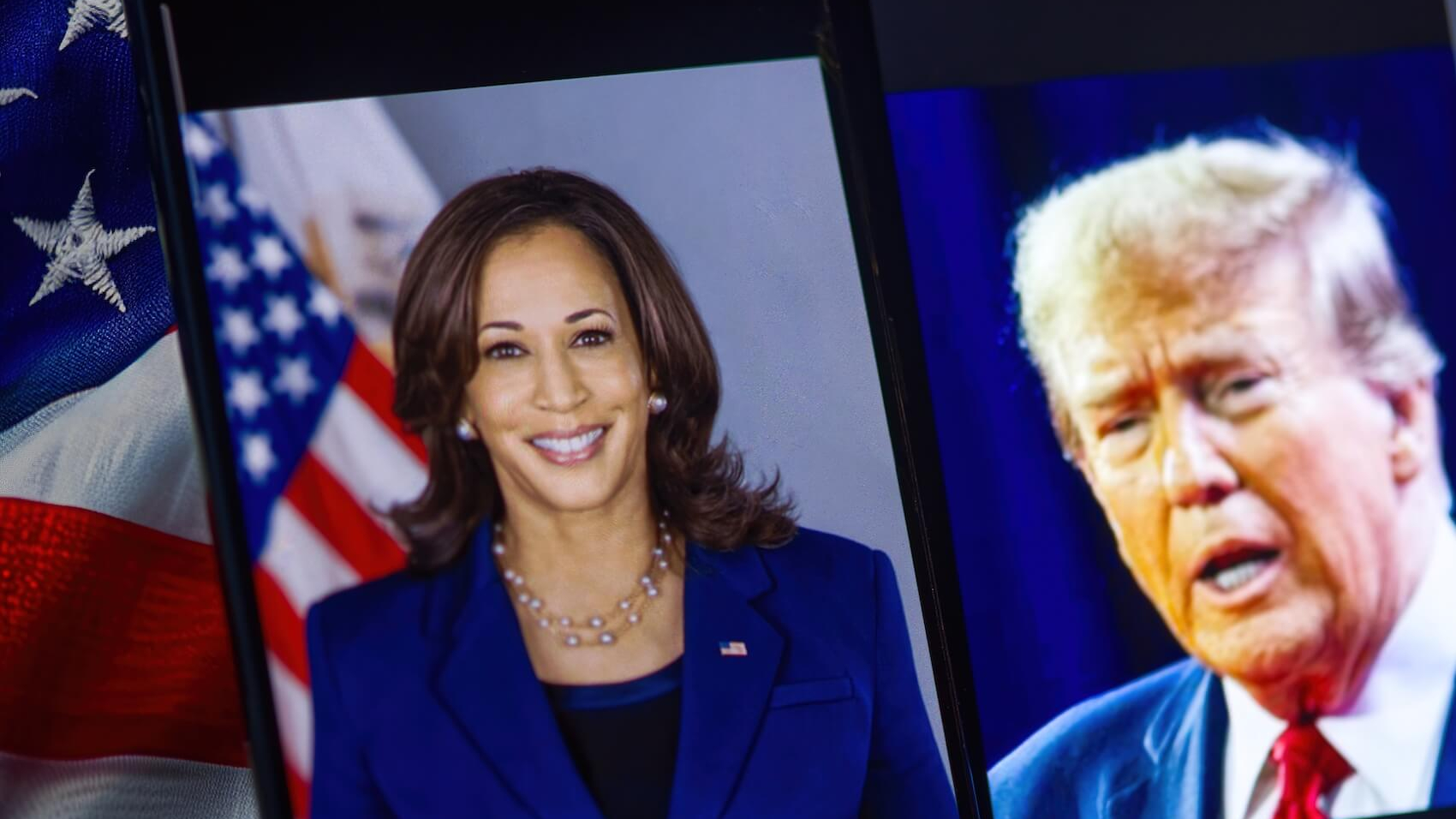
US presidential candidates Kamala Harris and Donald Trump. Photo: Shutterstock.

Revising the Trumpian Legacy in the US Foreign Policy towards Latin America*

DOWNLOAD POLICY PAPER

Please cite as:

Ronco, Massimo & Pretorius, Christo. (2024). “Revising the Trumpian Legacy in the US Foreign Policy towards Latin America.” Policy Papers. European Center for Populism Studies (ECPS). September 16, 2024. https://doi.org/10.55271/pop0003


Abstract 

This paper revisits the legacy of former US President Donald Trump’s foreign policy towards Latin America and the Caribbean (LAC), with a particular focus on economic policies and their long-term impact. It argues that Trump’s policies eroded US soft power in the region and failed to adequately address China’s expanding influence. Although the Joe Biden administration sought to reset US relations with LAC, it retained the bulk of Trump’s protectionist policies, perpetuating ongoing trade volatility and regional instability. This paper emphasizes the need for a revised US economic strategy in Latin America that both counters China’s influence and fosters deeper economic integration across the region. The authors propose three policy scenarios for the future: a more aggressive protectionist stance under a second Trump administration, a continuation of Biden-era policies under potential future Democratic leadership, or a more integrative approach that enhances regional cooperation and infrastructure development.


Authored by Massimo Ronco & Christo Pretorius

Edited by Angelica Lisa Rossi-Hawkins

Introduction 

Although the US influence in Latin America and the Caribbean (LAC) has been undermined by a lack of targeted engagement following the Cold War (McKinley, 2023), at the beginning of Donald Trump’s presidency, US policy choices in LAC rapidly eroded American soft power and compromised the US’s regional interests by inadequately addressing China’s growing regional influence. The paper intends to outline the features of a revised American foreign policy towards LAC by focusing on the economic policies enacted by Trump. The aim of this brief is to provide recommendations on how to develop a strategy to rebuild trust with Latin American countries and prevent China from further increasing its influence on the continent. While the focus is on Trump’s policies, this paper remains highly relevant, as much of the former president’s foreign policy has been maintained by President Joe Biden. Many protectionist policies remain in place – and some tariff barriers and subsidies to national companies have even increased. The paper argues that any responsible economic policy launched in the region should be integrated into a comprehensive strategy which acknowledges that the main obstacle to unlocking the region’s potential as a partner remains the trade volatility between North and Global South economies, in this case, between the US and the LAC. 

The paper’s focus on economic policies is warranted by three considerations. The first is that trade constitutes the foundation for future, deeper cooperation and the conditions for developing political and strategic partnerships (Kehonane & Nye, 2011; Haas, 1964). Second, economic agreements are more palatable to foreign allies. Against the backdrop of Trump’s rhetorical resort to the Monroe Doctrine (PBS NewsHour, 2018), economic policy is perceived as less damaging to state sovereignty than agreements of a political, military or strategic nature. The third reason has to do with the nature of the regimes of some countries in Latin America, which display some socialist tendencies and may offer reduced margins for cooperation in the political or military fields. This paper also emphasizes the connection between the economic policies enacted in the region under Trump and the populist character of the broader strategy from which they emerged, which approaches foreign policy issues as opportunities to appeal to the domestic base (Cadier, 2024; Hall, 2021). 

Revising Trump’s Economic Policy

Although outspoken about how the US would ‘reject the interference of foreign nations in this hemisphere’ during his 2018 address to the United Nations General Assembly (UNGA),  the Trump administration’s general approach to Central and Latin America was marked by a blend of strategic disinterest in the region and isolationist closure, as exemplified by the barriers established at the border with Mexico in 2018 or by Trump’s stated intention of withdrawing from the NAFTA (PBS NewsHour, 2018). The US’s relative indifference to the LAC region is to be contextualized within a progressive loss of appeal following the collapse of the Soviet Union (Campos & Prevost, 2019: 22; Gurtov, 2021), which originally comprised three components: free trade and economic liberalization, democracy and governance, and security. Trump’s rise to power meant the restructuring of such a triad and a weakening of the first two pillars. The economic policy choices made by Trump’s administration were mainly motivated by the desire to correct the terms of trade relations that were considered detrimental to US interests and American workers and to curb the expansion of China’s influence on the continent. 

This paper proposes to revise and mitigate some populist elements of Trump’s foreign policy in the region, which are considered counterproductive and weakening the US influence. 

The first amendable element is the transactional and short-term approach to dealing with trade agreements and, more broadly, the economic issues of the continent. The promise to withdraw from NAFTA and the imposition of tariffs on items like steel and aluminum resulted in negative consequences, as the volatility of Latin American countries’ markets increased due to the uncertainty of access to the US market or aid assistance, Latin American countries became more vulnerable to the Chinese debt trap and, finally, during Trump’s tenure China became Latin America’s largest trading partner, with the exception of Mexico. (Stuenkel, 2020; Roy, 2023). 

The second element worthy of scrutiny is the Trump presidency’s anti-globalist rhetoric and adoption of old-style protectionist policies. Trump’s economic policies were guided by the objective of reducing US dependency on other productive economies, such as China and South Korea, without fully taking into account that reducing dependency does not necessarily translate into autonomy because value chains still have an important global dimension. The result of this approach was a substantial blow to US credibility in the eyes of Latin American countries, even those considered more aligned, such as Brazil. In fact, despite former Brazilian President Jair Bolsonaro’s anti-Chinese stance and ideological affinities with Trump, the US president still imposed barriers on products and metals from Brazil, such as steel and aluminum (Gilardi, 2019).

Assessing Three Policy Options

At the moment of the writing, three policy scenarios can be envisaged: 

The first policy option, likely to be implemented if Trump is elected in the 2024 US presidential elections on November 5, will consist of putting pressure on Mexico to review the United States-Mexico-Canada Agreement (USMCA) in view of its renegotiation scheduled for 2026. In this case, further restrictions on rules of origin would be included with the intention both to bar China from accessing the Mexican market and to continue to shrink trade deflection, which would otherwise allow some imported goods from non-USCMA countries to enter the US market via Mexico without paying tariffs. 

Furthermore, Trump may engage in a trade war with some other countries in the region. He may suspend the Free Trade Agreement (FTA) with Nicaragua if its policies towards illegal migration do not change, while relations with Colombia, the US’s closest partner in the region, which in 2022 saw the first leftist government of the country’s modern history, may cool due to ideological divergences. Likely, the result of the will to impose tariff barriers, introduce reinforced rules of origin and subside the American national industry would damage US interests by precipitating higher domestic inflation, reallocation of market shares towards less efficient domestic producers, lower capital investment, the decline of the demand for domestic goods, and a loss of jobs in the USMCA area.

The second option would be to multiply the number of economic agreements and partnerships in the region while maintaining or doubling down on protectionist policies. This scenario would be most likely in the case of Democratic nominee Kamala Harris’ victory in the presidential elections. As Biden’s vice president with limited previous experience in foreign policy (Ashford & Kroenig, 2024) and with not a dominating character (Jenkins, 2024), Harris may seek to preserve some of Biden’s economic policies in the region, founded on subsidies to national industry, tariffs and “Buy American” rules (White House, 2021). For instance, the new partnerships negotiated by the Democratic presidency, such as the “Americas Partnership for Economic Prosperity” (APEP), did not foresee provisions of preferential access to the US market, thus denying the eleven Latin American countries who signed the pact to benefit from a reduction of tariffs or a significant increase in trade flow (Hufbauer & Hoogan, 2021). If, on the one hand, Biden rejected the populist character of his predecessor’s strategy, on the other hand, he did not substantially change the US’s economic approach, including towards Latin America. Closer economic cooperation between the US and Latin America ties into supranationalist and intergovernmentalist theories of integration, reinforcing regional ties whilst maintaining peace and stability (Leuffen et al., 2022).

The third option, recommended by the writers of this paper, is to implement a set of measures which would aim to offset the disparity of trade relations between Northern and Global South economies. Indeed, in 2023, the relations between the US and Latin American countries were characterized by low levels of trade in comparison with those between the US and other advanced economies, such as European countries or Japan. In other words, Northern American countries record a higher level of economic integration (EI) than Latin American countries. This third scenario would entail a mitigation process of the dragging effect of the protectionist policies enacted by the last two presidencies with the aim of gaining the trust of Latin American countries. One step in this direction would be the enlargement of the USCM, an FTA to which the US, Mexico, and Canada are already signatories, to other Latin American countries (de la Calle, 2023). The USMCA could be extended to Chile, which has a solid market-oriented economy and stable democratic institutions; Panama, which constitutes a major distribution center for goods moving between North and South America; and Costa Rica, given its economic stability, strong regulatory alignment, and existing close ties with the US and Canada. The enlargement of the market would allow Mexico to offset the economic loss derived from the imports coming from extra-USCMA countries, especially the EU and China, by exporting to the FTA products with a higher level of foreign backward participation originating from Costa Rica and Panama.

Secondly, the US should support a modification of the economic agreement, which will discipline the expansion of the free trade area in order to reduce the instability of preferential market access. The targets of the amendments should concern three provisions of the current agreement. The first is the sunset clause, which foresees the agreement’s expiration after sixteen years since its entry into force and a review period after six years, weakening the investors’ trust for long-term investments. Regarding this point, the US should introduce automatic renewal mechanisms and extend review periods to create stability in the markets and members of the USMCA. The second provision concerns the limitation of Investor-State Dispute Settlement (ISDS) to only certain sectors with high upfront costs, including oil and gas. In future negotiations, the US should consider extending the protection to a higher number of economic sectors to provide more guarantees to investors. 

Finally, the third provision established three new rules concerning automotive rules of origin: the extension of the Regional Value Contents (RVCs) to core parts of vehicles, the requirement that 70% of a vehicle’s steel be sourced from North America and, finally, the requirement that the production of 40/45% of a vehicle or a truck occur in factory plants where the Mexican workers’ wage is five to eight times higher than average (Ludovic, 2023: 365). These measures contributed to a decline in investments and a 0.971% reduction in Mexico’s annual real GDP in 2020, other than an estimated loss of US GDP of 0.12% compared to NAFTA (Manak, 2020). There is evidence to suggest the objective of strengthening the North American value chains was not achieved, as, between 2019 and 2022, imports from the USMCA area (29%) rose less than imports from the rest of the world (32%) (Sarukhán et al., 2023). To counter the negative impact of the tightening of the rules of origin, the US should negotiate an enlargement of the USMCA with Chile, Costa Rica, and Panama, as already mentioned above, and provide incentives to small and medium-sized companies of the members of the expanded USMCA.

Thirdly, the US should launch a long-term program of targeted investments in the construction and improvement of infrastructure in Latin American countries. The construction of ports, airports, canals and highways is an essential condition for reaching the objective of offsetting the structural volatility of trade relations between the US and Latin American countries, but also within Latin America. Investments in the infrastructure field would equip Latin American countries with the appropriate platforms, hubs and roads to increase the trade flows within the continent. 

Conclusion

The paper tackled not only the economic policy choices towards Latin America undertaken during Trump’s presidency but, by embracing a broader timeline, analyzed the more problematic subject of the legacy of Trump’s foreign policy in Latin America. Despite Biden’s entry into office and the current president’s stated intention to reset relations with Latin American countries and increase cooperation, relatively scarce attention has been given to the Latin American strategic quadrant in the past four years. 

The fact that after the first six months of the Democratic administration, the position of Assistant Secretary for Western Hemisphere Affairs was still vacant indicates what little priority Latin America has for current US policymakers. As the Western Hemisphere can be considered the US’s “backyard,” it is a region in which the emergence of a hegemonic country – like China- cannot be tolerated, and current US foreign policy does not seem suited to address this challenge. 

This paper emphasized the cruciality of the Latin American strategic quadrant for the US’ interests by recommending a set of economic policy measures which should respond to an organic and coherent economic-strategic logic, aimed at increasing trade flows and boosting regional economic integration. Since the 1950s, scholars have tried to find a solution for the trade volatility between LAC countries and industrialized countries, such as the US or EU. They proposed implementing measures aimed at privileging intra-regional trade and building a regional integration process (Goodman & Schneider, 2023).

Nonetheless, the failure of economic integration from the inside should make the US consider how it can foster both trade flows with LAC countries and favorable conditions for building a regional integration process. Such a strategy would also counter China’s growing influence, derived from their FTAs already negotiated with four countries and the Belt & Road Initiative (BRI) (Duckworth, 2023). Chinese funding for infrastructure projects leveraged LAC countries’ structural need to build a regional integration space to face the low levels of trade with more advanced economies such as the US and EU and the uncertainty of access to their markets. 


(*) This policy paper is based on research conducted by Andrea Sanchez, Angelica Lisa Rossi-Hawkins, Christo Pretorius, Massimo Ronco, and Muhmmed Sihabudheen during the ECPS Case Competition “US Foreign Policy and Populism,” held as part of the ECPS Summer School from July 1-5, 2024. 


Authors’ Biographies

Massimo Ronco is a Researcher and International Policy Analyst with a master’s degree in international studies from Turin and a master’s degree in EU external relations from the Brussels School of International Studies of Kent. He is currently working in Brussels in the field of EU research and project management. In 2023, he became a member of the “German-Italian Young Leaders Dialogue,” a forum promoted by the Italian and German Ministries of Foreign Affairs. Also, in 2023, he obtained a diploma in Geopolitics at the Italian Institute for International Political Studies. His areas of interest and research are geopolitics, US foreign policy, European security, Russian foreign policy, politics and culture of the Middle East, and political philosophy.

Christo Pretorius graduated with an MSc in International Public Policy and Diplomacy from University College Cork and was the first student to receive a postgraduate “Student of the Year” award from the Department of Government. His dissertation was published and acquired by the Bar of Ireland’s Law Library and has gone on to support Irish policymakers. Stemming from his undergraduate degree in Ancient and Medieval History and Culture from Trinity College Dublin, his research interests include the mechanisms for authoritarian power and control, as well as democratic backsliding, particularly when viewed from a historical lens. 

Angelica Lisa Rossi-Hawkins is a second-year Ph.D. researcher at the University of Oxford. Her research primarily concerns studies of masculinity and elite culture in post-WWII Italy. By examining a number of clusters of upper-middle-class male networks of solidarity from 1945 to the mid-1970s, she hopes to understand the fabric of the post-war democratic ‘classe dirigente.’ While working on her thesis, she also continues to research the development of Christian Democratic politics in the 20th century and remains broadly interested in the history of gender, the history of friendship, and – when time allows — 19th and 20th-century art history.


References

— (2018). “Watch: President Donald Trump’s full address to the United Nations General Assembly.” PBS NewsHour.September 25, 2018. https://www.youtube.com/watch?v=wGK4DPn2R58 (accessed on August 9, 2024).

Arnaud, L. (2024). “From NAFTA to USMCA: revisiting the market access – policy space trade-off.” New Political Economy29(3), 356–369. https://doi.org/10.1080/13563467.2023.2260986

Ashford E. & Kroenig M. (2024). “Does Harris Have a Foreign Policy?” Foreign Policy. August 30, 2024. https://foreignpolicy.com/2024/08/30/harris-ukraine-gaza-israel-lebanon-dnc-hezbollah-foreign-policy/ (accessed on August 10, 2024).

Cadier, D. (2023). “Foreign Policy as the Continuation of Domestic Politics by Other Means: Pathways and Patterns of Populist Politicization.” Foreign Policy Analysis20(1). https://doi.org/10.1093/fpa/orad035

Campos, C. O. & Prevost, G. (2019). “The Trump Administration in Latin America: Continuity and Change.” The International Journal of Cuban Studies11(1), 13–23. https://doi.org/10.13169/intejcubastud.11.1.0013

De la Calle, L. (2023). “Time to Analyze Expansion of USMCA? Costa Rica and Uruguay Would Be Potential Candidates.” Wilson Center. January 12, 2023. https://www.wilsoncenter.org/article/time-analyze-expansion-usmca-costa-rica-and-uruguay-would-be-potential-candidates (accessed on August 9, 2024).

Duckworth, E. (2023). “Latin American and Caribbean Participation in China’s Belt and Road Initiative.” Cornell International Affairs Review. 16(1), 115–161. https://doi.org/10.37513/ciar.v16i1.710

Gilardi, J. (2019). “Brazil and Argentina Surprised by Tariff Announcement: What Comes Next?” Atlantic Council. December 3, 2019. https://www.atlanticcouncil.org/blogs/new-atlanticist/brazil-and-argentina-surprised-by-tariff-announcement-what-comes-next/ (accessed on August 9, 2024).

Goodman, L.W. & A. Schneider. (2023). “Conflict, Competition, or Collaboration? China and the United States in Latin America and the Caribbean.” In: Schneider A. & Teixeira A.G. (eds.) China, Latin America, and the Global Economy. Cham: Palgrave Macmillan.  pp 163–185. https://doi.org/10.1007/978-3-031-18026-2_8

Gurtov, M. (2021). America in Retreat. Foreign Policy under Trump. Rowman & Littlefield. 

Haas, E.B. (1964). Beyond the Nation-State: Functionalism and International Organization. Stanford: Stanford University Press.

Hall, J. (2021). “In search of enemies: Donald Trump’s populist foreign policy rhetoric.” Politics (Manchester, England)41(1), 48–63. https://doi.org/10.1177/0263395720935377

Hufbauer, G.C. & Hogan, M. (2023). “Biden Embraces Buy America, Doubles Down on Trade Protection.” Promarket.February 21, 2023. https://www.promarket.org/2023/02/21/biden-embraces-buy-america-doubles-down-on-trade-protection/ (accessed on August 9, 2024).

Jensens, S. (2024). “Kamala Harris is no dominating leader – and that may be her biggest strength.” The Guardian. July 22, 2024. https://www.theguardian.com/commentisfree/article/2024/jul/22/kamala-harris-democrats-us-presidential-election-donald-trump (accessed on August 8, 2024).

Keohane, R. O. & Nye, J. S. (1987). “Power and Interdependence revisited.” International Organization41(4), 725–753. https://doi.org/10.1017/S0020818300027661

Leuffen, D., Rittberger B., & Schimmelfennig F. (2022). “Supranationalism.” In: Integration and Differentiation in the European Union. Palgrave Macmillan: Switzerland, (pp.89-116). https://doi.org/10.1007/978-3-030-76677-1_4  

Manak, I. (2020). “Canada Evaluates USMCA, Raises More Questions than Answers.” CATO Institute. February 28. 2020. https://www.cato.org/blog/canada-evaluates-usmca-raises-more-questions-answers#:~:text=Howe%20Institute%2C%20a%20Canadian%20think,0.097%25%20for%20the%20United%20States. (accessed on August 9, 2024).

McKinley P.M. (2023). “Inflection Point: The Challenges Facing Latin America and U.S. Policy in the Region”. Center for Strategic and International Studieshttps://www.cato.org/blog/canada-evaluates-usmca-raises-more-questions-answers#:~:text=Canada%20Evaluates%20USMCA%2C%20Raises%20More%20Questions%20than%20Answers,-By%20Inu%20Manak&text=This%20week%2C%20Canada%20released%20its,referred%20to%20in%20Canada%2C%20CUSMA (accessed on August 10, 2024).

Roy, D. (2023). “China’s Growing Influence in Latin America, Council on Foreign Relations.” Council on Foreign Relations. June 15, 2023. https://www.cfr.org/backgrounder/china-influence-latin-america-argentina-brazil-venezuela-security-energy-bri (accessed on August 9, 2024).

Sarukhán, A.; Rangel, B.; McCoy, M.; Ciuriak, D. & Huenemann, J.E. (2023). “How Well Is the USMCA Working After Three Years.” The Dialogue. June 22, 2023. https://www.thedialogue.org/analysis/how-well-is-the-usmca-working-after-three-years/#:~:text=Formal%20analysis%20of%20the%20USMCA’s,percent%20compared%20to%20the%20NAFTA (accessed on August 9, 2024). 

Stuenkel, O. (2020). “Trump Drove Latin America Into China’s Arms.” Foreign Affairs, November 13. https://www.foreignaffairs.com/articles/south-america/2020-11-13/trump-drove-latin-america-chinas-arms (accessed on August 9, 2024).

White House. (2021). Biden-⁠Harris Administration Issues Proposed Buy American Rule, Advancing the President’s Commitment to Ensuring the Future of America is Made in America by All of America’s Workers, July 28, 2021. https://www.whitehouse.gov/briefing-room/statements-releases/2021/07/28/fact-sheet-biden-harris-administration-issues-proposed-buy-american-rule-advancing-the-presidents-commitment-to-ensuring-the-future-of-america-is-made-in-america-by-all-of-americas/ (accessed on August 9, 2024).

Further Reading

— (2024). Text – S.3878 – 118th Congress (2023-2024): Americas Act. Congress. March 6, 2024. https://www.congress.gov/bill/118th-congress/senate-bill/3878/text/is (accessed on August 9, 2024).

Cheng, D. (2023). “U.S. Needs to Invest More in Latin America to Counteract China in the Region.” United States Institute of Peace. https://www.usip.org/publications/2023/10/us-needs-invest-more-latin-america-counteract-china-region (accessed on August 9, 2024).

Marczak, J.; Bozmoski, M.F. & Kroenig, M. (2024). Redefining US strategy with Latin America and the Caribbean for a new era. Atlantic Council. February 26, 2024. https://www.atlanticcouncil.org/in-depth-research-reports/report/redefining-us-strategy-with-latin-america-and-the-caribbean-for-a-new-era/ (accessed on August 9, 2024).

Meltzer, J.P. (2021). Developing a roadmap for USMCA success. Brooking’s Institute. https://www.brookings.edu/wp-content/uploads/2021/09/Developing-roadmap-USMCA.pdf (accessed on August 9, 2024).

Photo: Som YuZu.

EU Employment Law and the AI Act: A Policy Brief Putting the Human Back in ‘Human-Centric’ Policy

DOWNLOAD POLICY PAPER

Please cite as:

Pretorius, Christo. (2024). “EU Employment Law and the AI Act: A Policy Brief Putting the Human Back in ‘Human-Centric’ Policy.” Policy Papers. European Center for Populism Studies (ECPS). September 11, 2024.https://doi.org/10.55271/pop0002


This policy paper analyzes the European Union’s (EU) AI Act, aimed at regulating Artificial Intelligence (AI) through four risk classifications related to data protection, privacy, security, and fundamental rights. While the Act establishes regulatory frameworks, it neglects employment security, a critical factor behind public mistrust of AI. The paper warns that failure to address this issue could deepen socio-economic inequalities and lead to political unrest. Recommendations include promoting collective negotiation between workers and employers, advocating for legislation on redundancies linked to AI, and launching information campaigns to educate workers, thus ensuring fair working conditions and improving trust in AI technology.

By Christo Pretorius

Executive Summary

The European Union (EU) is attempting to regulate the deployment of Artificial Intelligence (AI) through the recently passed AI Act. Overall, the Act outlines four distinct classifications for AI systems, categorizing them on the risk they pose on an individual’s data protection, privacy, security, and fundamental rights. It further provides regulations and guidance to member states on each category and calls for the establishment of national and EU level regulatory bodies to enforce the Act. However, ultimately the Act overlooks the critical issue of employment security, which is the main cause behind mistrust of AI. This gap could exacerbate socio-economic inequalities and fuel political unrest in the short to long term if it is not addressed promptly.

Research indicates that AI will have a disruptive effect on employment overall as certain types of work is automated and augmented, but the effects of this will be felt most in clerical, secretarial, and para-professional roles, which poses a risk to vulnerable groups including women and those with lower educational attainment. There is a pressing need for proactive measures to mitigate the harmful effects of the technology’s implementation on workers and their families, specifically the protection against unjustified dismissal and the assurance of fair working conditions. The following recommendations are proposed to address the Act’s shortcomings:

    Collective Negotiation: Encourage cooperation between workers, employers, and worker associations to assess AI’s impact on jobs. This could lead to agreements on redeployment, education opportunities, or redundancy notices, providing workers with clearer timelines and reducing workplace disruption.

      Advocacy for New Legislation: Push for legislation that mandates notice periods for redundancies due to technological innovation, building on the EU Directive on Transparent and Predictable Working Conditions. The International Labor Organization’s 1982 Termination of Employment Convention offers a valuable template for such legislation.

        Information Campaigns: Launch campaigns to educate workers on AI systems, their potential benefits, and available upskilling opportunities. These efforts would enhance trust in AI, aligning with the AI Act’s goal of ensuring human-centric, safe, and lawful AI deployment.


        Context: The Problem with the AI Act

        The discussion about AI regulation in the European Union (EU) began with Ursula von der Leyen’s 2019-2024 agenda for Europe, A Union that Strives for More (2019)It stated that she would ‘put forward legislation for a coordinated European approach on the human and ethical implications of Artificial Intelligence’ (von der Leyen, 2019: 13). What followed was a call for greater focus on enabling more investment in, and the better coordination of the development and deployment of AI in the EU, alongside a call for a clear definition of what high-risk AI systems are (General Secretariat of the Council to Delegations, 2020). Jointly, the Coordinated Plan on Artificial Intelligence was published to help foster trust in AI systems yet failed to address the real consideration that such a disruptive technology would have on the world of work (European Commission, 2021). The purpose of this policy brief is to advocate for greater attention to be given to the area of employment law, so that action may be taken to ease the concerns over job loss relating to AI, and thus, foster greater trust in this new technology.

        A report from the International Labor Organization estimated that the introduction of AI systems would have an overall disruptive effect worldwide, highlight that an important share of clerical, secretarial, and para-professional jobs would be most affected (Gmyrek et al., 2023). These findings are supported by similar ones from PricewaterhouseCoopers International Limited (PWC), the US-based National Bureau of Economic Research, and the Pew Research Centre, which also found that women and individuals with lower levels of education are most vulnerable to job loss due to automation (Hawksworth, Berriman, & Goel, 2018; Acemoglu, & Restrepo, 2021; Kochhar, 2023). Although this is an evolving issue, as AI indeed has the potential to increase economic growth and improve lives, the disruptive impact of AI systems on the world of work has yet to be felt. Therefore, it is important to take the necessary steps now to mitigate the harmful affect this technology can have on workers and their families and provide a safety net to individuals during this period of transition.

        Currently the EU’s AI Act states that it is trying to ensure ‘a high level of protection of health, safety, fundamental rights as enshrined in the Charter of Fundamental Rights (2012) of the European Union (hereby referred to as the ‘Charter’), including democracy, the rule of law and environmental protection, to protect against the harmful effects of AI systems in the Union…’. However, one of the fundamental rights not addressed was that of Articles 30 (Protection in the event of unjustified dismissal) and 31 (Fair and just working conditions) of the Charter (European Union, 2012). The focus on adopting AI throughout the EU, whilst highlighting the issues of data protection, privacy, and security of individuals in the long term, has left the area of employment concerns unaddressed. 

        The EU has highlighted that this area is one that should be legislated on in the future, stating in their 2022 report on artificial intelligence in the digital age: ‘[The European Parliament] emphasises that the use of AI in this area gives rise to a number of ethical, legal and employment related challenges… [and] stresses that AI is currently already substituting or complementing humans in a subset of tasks but that it is not yet having detectable significant aggregate labour market consequences’ (European Parliament, 2022). The report also highlights that strong links between AI and the rising socio-economic inequality has been found, and researchers warn that unregulated AI will further increase the wealth gap within society, a finding supported by other academic publications (Rotman, 2022; Bushwick, 2023). MEP Brando Benifei indicates that a proposal for a directive on AI at the workplace is something to be discussed in the future, but at present there is not much information from Benifei or anyone else on what policy discussions in this area will look like (Publyon, 2024). This uncertainty continues following von der Leyen’s announcement that more research investments will be made into AI, leaving commentators to speculate what will actually be funded (Wold, 2024). Much like the events of 2008, people that feel left behind by the increasing automatization and augmentation of the workplace could be persuaded into more extreme populist politics, which is why delaying discussions on this topic are problematic (Steiner et al., 2023). While the EU continues to refine policy, the implementation of AI into the workplace is happening now, and the situation for workers could change rapidly as new technology hits the market. Just as the EU attempted to get ahead of AI by defining it, they should attempt to get ahead of employment concerns before they evolve past being concerns alone.

        The AI Act in Brief

        To understand the shortcomings of the AI Act (2024), it is helpful to summarize the contents of the regulation first. The European Union’s AI Act came into force on the 13th of June 2024, seeking to create rules that would govern the development, employment, and use of artificial intelligence (AI) systems within the Union. The rules define four levels of risk regarding AI systems, offering only a description of what each category is, and indicate what systems are I place to regulate them within the common market:

        Unacceptable Risk: These AI are banned within the EU, except in limited circumstances.

          [Article 5.1(a/b)] Manipulative AI that can deceive, subvert, or impair autonomy, decision-making and free choice. This includes AI that may exploit disadvantaged persons whether through socio-economic vulnerabilities or take advantage of a disability. Notable exceptions to this are AI used in the context of medical treatment such as psychological treatment of a mental disease or physical rehabilitation, or within advertisement.

            [Article 5.1(c)] AI systems that provide social scoring as it may lead to discrimination and exclusion.

              [Article 5.1(d)] Risk assessment or predictive AI systems in the context of law enforcement. 

                [Article 5.1(e)] AI systems that scrape footage to expand facial recognition databases.

                  [Article 5.1(g/h)] Biometric categorization systems that are based on natural persons’ biometric data, such as an individual person’s face or fingerprint, to deduce or infer an individuals’ political opinions, trade union membership, religious or philosophical beliefs, race, sex life or sexual orientation. The notable exception to this rule is biometric categorization systems employed by law enforcement agencies for anti-terrorism and missing persons.

                  High Risk: [Preamble (paragraph 48)] These systems are defined as having a negative effect on safety or the following fundamental rights, the latter of which is in this case a person’s access to education, employment, public or private services, legal representation, and administrative or democratic processes:

                  The protection of personal data,  The rights of persons with disabilities, 
                  Freedom of expression and information, Gender equality, 
                  Freedom of assembly and of association,  Intellectual property rights, 
                  The right to non-discrimination,  Workers’ rights,
                  The right to an effective remedy and a fair trial, The right to education,
                  Consumer protection,  The right to good administration
                  The right of defense and the presumption of innocence,  

                  High risk systems are also classified as that related to critical infrastructure and biometric identification systems.

                  Limited Risk: [Preamble (paragraph 53)] AI systems that do not materially influence the outcome of decision-making, and/or augment tasks that are either automated or conducted by humans are considered to be limited risk. This category is highlighted as needing further guidelines in the future.

                  Minimal Risk: Most AI systems currently available fall under this category – they provide solutions with minimal risk, and are therefore not regulated, nor will be moving forward.

                  The regulation achieved most of the mandated aims, creating clear definitions for different levels of risk, whilst focusing on the impact different AI systems could have on individuals. 

                  Recommendations

                  The need to deal with the issue of job loss and employment law concerns are real and present and must be addressed in a timely manner during these early stages of AI implementation. Although further training opportunities is an avenue that the EU is pursuing, to contribute to the Commission’s call for the development of an ecosystem of trust by proposing a legal framework for trustworthy AI, this paper proposes three different avenues the issue of employment security could be addressed:

                    Collective Negotiation: Close cooperation between worker associations, the groups represented by them, and employers, can allow for investigation on the potential disruptive impact that AI systems can have on various professions. This will allow them to make informed decisions so that they may take steps to reach collective agreement that would allow for either redeployment of workers, advertise or make available further education opportunities, or have a guaranteed period of redundancy notice with regards to the implementation of AI systems. Similarly, management could make available to workers a clear AI implementation plan so that workplace disruption is reduced, and workers know in advance the time they have should their work be made redundant. 

                      Advocacy For the Adaption/Adopting of New Legislation: If no provisions are currently in place, countries within the EU must take active steps to create or adapt legislation that will allow workers to have a notice period that they will be made redundant due to technological innovation. The EU Directive on Transparent and Predictable Working Conditions in the European Union, 2019, set a precedent that the EU was willing to use its competency in the area of social rights to address new forms of employment to protect EU workers from unpredictable employment (Official Journal of the European Union, 2019). 

                      Given the close relationship between the International Labor Organization (ILO) and the EU, the ILO’s 1982 -Termination of Employment Convention (C158) would provide a good basis for text that could be incorporated into the EU Directive on Transparent and Predictable Working Conditions in the European Union (Pretorius, 2023). Only nine nations have ratified the convention, which contains the following article that could either be incorporated into EU law, or provide an example that can be followed:

                      ‘[Article 13.1.] When the employer contemplates terminations for reasons of an economic, technological, structural or similar nature, the employer shall:

                      (a) provide the workers’ representatives concerned in good time with relevant information including the reasons for the terminations contemplated, the number and categories of workers likely to be affected and the period over which the terminations are intended to be carried out;

                      (b) give, in accordance with national law and practice, the workers’ representatives concerned, as early as possible, an opportunity for consultation on measures to be taken to avert or to minimise the terminations and measures to mitigate the adverse effects of any terminations on the workers concerned such as finding alternative employment’ (ILO, 1982).

                        Information Campaigns: At the moment, the uncertainty surrounding AI systems in the workplace is fuelling distrust in the technology (Chakravorti, 2024). Campaigns that inform workers not only of the capabilities of implemented AI systems and how to utilize their potential, but also about opportunities to upskill, are essential moving forward. Regardless of how these campaigns are run, giving workers more accessible information would go a long way towards realizing the ‘human centric’ ideals of the AI Act – ‘so that people can trust that the technology is used in a way that is safe and compliant with the law, including the respect of fundamental rights’ (European Commission (2021).


                        (*) Christo Pretorius graduated with a MSc in International Public Policy and Diplomacy from University College Cork and was the first student to receive a postgraduate “Student of the Year” award from the Department of Government. His dissertation was published and acquired by the Bar of Ireland’s Law Library and has gone on to support Irish policy makers. Stemming from his undergraduate in Ancient and Medieval History and Culture from Trinity College Dublin, his research interests include the mechanisms for authoritarian power and control, and democratic backsliding, particularly when viewed with a historical lens.


                        References 

                        — (1982). C158 – Termination of Employment Convention. International Labour Organization. 1982 (No. 158).  https://normlex.ilo.org/dyn/normlex/en/f?p=NORMLEXPUB:12100:0::NO::P12100_ILO_CODE:C158 (accessed on August 18, 2024).

                        — (1997). Organisation of Working Time Act 1997. Irish Statute Book. https://www.irishstatutebook.ie/eli/1997/act/20/section/23/enacted/en/html#sec23 (accessed on August 17, 2024).

                        — (2012). Charter of Fundamental Rights of the European Union. 326/02. http://data.europa.eu/eli/treaty/char_2016/oj(accessed on August 18, 2024).

                        — (2020) Special meeting of the European Council (1 and 2 October 2020) – Conclusions. General Secretariat of the Council to Delegations. Brussels. https://www.consilium.europa.eu/media/45910/021020-euco-final-conclusions.pdf

                        — (2021). Coordinated Plan on Artificial Intelligence 2021 ReviewEuropean Commission. https://digital-strategy.ec.europa.eu/en/library/coordinated-plan-artificial-intelligence-2021-review (accessed on August 19, 2024).

                        — (2021). Document 52021PC0206: Proposal for a Regulation of The European Parliament and of the Council Laying Down Harmonised Rules on Artificial Intelligence (Artificial Intelligence Act) and Amending Certain Union Legislative Acts (COM(2021) 206 final). European Commission. https://eur-lex.europa.eu/legal-content/EN/ALL/?uri=CELEX:52021PC0206 (accessed on August 17, 2024).

                        — (2022). Report on artificial intelligence in a digital age (2020/2266(INI)). European Parliament. https://www.europarl.europa.eu/doceo/document/A-9-2022-0088_EN.html (accessed on August 17, 2024).

                        — (2024). Artificial intelligence. European Commission.  https://www.consilium.europa.eu/en/policies/artificial-intelligence/ (accessed on August 17, 2024).

                        — (2024). Corrigendum to Regulation (EU) 2024/… of The European Parliament and of the Council of laying down harmonised rules on artificial intelligence and amending Regulations (EC) No 300/2008, (EU) No 167/2013, (EU) No 168/2013, (EU) 2018/858, (EU) 2018/1139 and (EU) 2019/2144 and Directives 2014/90/EU, (EU) 2016/797 and (EU) 2020/1828 (Artificial Intelligence Act) (cor01)European Parliament.  https://www.europarl.europa.eu/doceo/document/TA-9-2024-0138-FNL-COR01_EN.pdf

                        — (2024) The future of AI in the European Union: a chat with the AI Act’s co-rapporteur Brando Benifei. Publyon. https://publyon.com/the-future-of-ai-in-the-european-union-a-chat-with-the-ai-acts-co-rapporteur-brando-benifei/ (accessed on August 17, 2024).

                        Acemoglu D. & Restrepo P. (2021). Tasks, Automation, and the Rise in US Wage Inequality (NBER Working Paper 28920). National Bureau of Economic Research. https://doi.org/10.3386/w28920

                        Al Naam, Y.A.; Elsafi, S.; Al Jahdali, M.H.; Al Shaman, R.S.; Al-Qurouni, B.H. & Al Zahrani E.M. (2022). “The Impact of Total Automaton on the Clinical Laboratory Workforce: A Case Study.” Journal of Healthcare Leadership. 14, pp. 55-62.  https://doi.org/10.2147/JHL.S362614

                        Chakravorti, B. (2024). AI’s Trust Problem. Harvard Business Review. https://hbr.org/2024/05/ais-trust-problem (accessed on August 17, 2024).

                        Gmyrek P., Berg J., & Bescond D. (2023). Generative AI and jobs: A global analysis of potential effects on job quantity and quality (ILO Working Paper 96). International Labour Organization. https://doi.org/10.54394/FHEM8239

                        Hawksworth J.; Berriman R. & Goel S. (2018). Will robots really steal our jobs? An international analysis of the potential long term impact of automation. PWC. https://www.pwc.co.uk/economic-services/assets/international-impact-of-automation-feb-2018.pdf

                        Jensen, C.L.; Thomsen, L.K.; Zeuthen, M.; Johnsen, S.; Jashi, R.E.; Nielsen, M.F.B.; Hemstra, L.E. & Smith, J. (2024) “Biomedical laboratory scientists and technicians in digital pathology – Is there a need for professional development?” Digital Health. 10. https://doi.org/10.1177/20552076241237392

                        Kochhar, R. (2023) Which U.S. Workers Are More Exposed to AI on Their Jobs?. Pew Research Center. https://www.pewresearch.org/social-trends/wp-content/uploads/sites/3/2023/07/st_2023.07.26_ai-and-jobs.pdf

                        Pretorius, P.C. (2023) “Can Irish Industrial Relations Still be Called ‘Voluntarist’? An investigation into Irish Employment Law”. Irish Employment Law Journal, 20(1), pp. 11-21.

                        von der Leyen, U. (2019). A Union that strives for more: My agenda for Europe: political guidelines for the next European Commission 2019-2024, Luxembourg: Publication Office of the European Union.https://commission.europa.eu/system/files/2020-04/political-guidelines-next-commission_en_0.pdf

                        Wold, J.F. (2024). “Von der Leyen gives nod to €100 billion ‘CERN for AI’ proposal.” Euroactiv. July 25, 2024.https://www.euractiv.com/section/digital/news/von-der-leyen-gives-nod-to-e100-billion-cern-for-ai-proposal/ (accessed on August 10, 2024).

                        SummerSchool

                        ECPS Summer School 2024 — Populism and Foreign Policy: How Does Populist Politics Influence Foreign Affairs?

                        ECPS organized its fourth virtual Summer School on July 1-5, 2024, focusing on the relationship between populism and foreign policy. The five-day program offered young participants a dynamic, engaging, and interdisciplinary learning environment. Presented by world-class scholars of populism, this intellectually stimulating program helped participants develop as future academics, intellectuals, activists, and public leaders. It also provided an opportunity to gain valuable cross-cultural perspectives and foster knowledge exchange beyond European borders, preparing them for future endeavors.

                        By Radoslav Valev

                        ECPS organized its fourth virtual Summer School on July 1-5, 2024, focusing on the relations between populism and foreign policy. The goal was twofold: to examine the theories related to the influence of populism on international relations and analyze case studies such as the US, Turkey, India, Brexit, and Israel to see how leaders use populist instruments in external politics. 

                        Populism has often been studied as a subject of political science and investigated as a topic of domestic affairs, namely party politics and elections. Nevertheless, a growing body of literature suggests that this phenomenon is not confined to the borders of nation-states; it interferes with international relations thanks to populist leaders’ desire to shape foreign affairs with a populist and mostly revisionist view. Trump’s threats to withdraw the US from NATO, Modi’s handling of India’s relations with Pakistan, Erdogan’s diaspora politics towards European countries, Orbán’s instrumentalization of migration in the EU, Netanyahu’s approach to the Israeli-Palestinian conflict, Johnson’s management of the Brexit process and numerous attempts by populist leaders to undermine or subvert international or supranational organizations, such as the UN, WTO, and EU, are among many examples that showcase how external relations can be blended with populism. 

                        Considering the current political landscape in which the number of populist figures is on the rise, we may witness more similar instances in the international political arena in the period to come. Populism in international relations has the potential to complicate existing problems, create new ones and bring about repercussions for the multilateral liberal global system. In this light, this year, the summer school examined the theoretical background of the interplay between populism and foreign affairs and examined a number of case studies from different parts of the world with a view to see similarities as well as differences between the ways populist leaders craft external politics.

                        The lecturers for this year’s summer school were Professor Sandra Destradi, Associate Professor Angelos Chryssogelos, Associate Professor Jessica Greenberg, Dr. Thorsten Wojczewki, Dr Georg Loefflman, Professor Cengiz Aktar, Professor Emeritus Louis Kreisberg, Professor Bertjan Verbeek, ECPS President Irina Von Wiese, Professor Craig Calhoun and Professor Joanna Dyduch. Each session was moderated by a scholar. Hence, the moderators were Dr Rubrick Biegon, Dr Gustav Meibauer, Dr Jonny Hall, Professor Ana E. Juncos Garcia, Professor Franco Zappettini, Professor Allison Carnegie, Dr Ajay Gudavarthy, Dr Aleksandra Spancerska, Professor Alexandra Homolar and Dr Andrei Zaslove.

                        The opening lecture by Professor Destradi examined the international implications of populism, first by outlining how populism has been conceptualized in comparative politics and political theory. It also introduced the current state of research on the global effects of populism, particularly its potential impact on foreign policy, international disputes, contributions to global public goods, participation in multilateral institutions, and the formation of partnerships with authoritarian and populist governments. The following lecture by Dr Angelos Chryssogelos examined the global rise of populism and how it sparked debate about its impact on the liberal international order. He argued that a deeper understanding of populism is needed to appreciate its varied effects on the international system. 

                        On the second day, the first lecture by Dr Jessica Greenberg explored the paradox of increasing reliance on international legal institutions to address conflict and bolster governance while populists use these same institutions to authorize antidemocratic policies. The lecture discussed the conditions under which this paradox emerged and how to address it, examining the relationship between populism and the rule of law and how populists subvert the law from within. 

                        The following two lectures by Dr Georg Loefflman and Dr Thorsten Wojczewski examined the practical manifestations of populism on foreign policy in the cases of the United States and India. 

                        On the third day, Professor Cengiz Aktar examined another practical populist case, namely Turkey. The following lecture by Professor Louis Kriesberg examined populism as non-governmental actions aimed at changing the conduct of resistant groups, often influencing established institutions. The presentation also examined such actions in the US, Europe, and other countries, assessing their constructiveness or destructiveness based on conflict resolution research, including factors like persuasion, promised benefits, and coercion.

                        On the fourth day, Professor Bertjan Verbeek and Irina Von Wiese’s lectures examined the role of populism in the EU’s foreign policy and what the EU could do as a foreign affairs actor. 

                        On the final fifth day, the opening lecture by Professor Craig Calhoun examined Britain’s withdrawal from the EU in the context of populist politics and argued that it stemmed from contingent circumstances, mobilizations, and deeper political shifts, notably influenced by national conservatism and English nationalism prioritizing ethnonationalist identity. The final lecture by Professor Joanna Dyduch gave insights on populism and foreign policy based on the example of Israel, distinguishing between ‘liberalist’ and ‘historicist’ orientations, highlighting how historical memory drives state actions, with ‘Foreign Policy Historicism’ emphasizing a hawkish, emotionally charged approach tied to national identity and othering.

                        This year’s program was enriched by the participation of around 60 attendees from diverse backgrounds and various parts of the world. They found the opportunity to engage in discussions with the lecturers on the topics mentioned, and they networked with each other in small groups and practiced peer-to-peer learning in a truly international environment.

                        The Summer School also featured a unique learning opportunity in the form of a case competition, held over five days from 1-5 July. The competition was designed to help participants transform their academic knowledge into practical policy suggestions, providing a hands-on learning experience. 

                        The competition tackled a real-life problem within the broad topic of populism, specifically populism and US foreign policy. The groups were expected to focus on a specific foreign policy or action Trump has carried out during his past presidency, or that he may carry out if he were to be re-elected in Autumn. These included the withdrawal from the Paris Climate Accord, the renegotiation of NAFTA to USMCA, the trade war with China, immigration policies and the border wall, North Korea diplomacy, the withdrawal from the Iran Nuclear Deal (JCPOA), NATO relations and defense spending, the response to the Syrian civil war, and US relations with Russia. 

                        The participants could position themselves as think tank members preparing policy suggestions for the US Department of State, the EU, or NATO; advisors to the Secretary of State, the Secretary of Defense or the Vice President; lobbyists aiming to change a policy in a particular direction; or academics drawing policy suggestions from their research on a specific foreign policy topic.

                        Participants were divided into teams to work together on solving the case and were expected to prepare policy suggestions. The proposals of the participants were then rigorously evaluated by an assessment committee composed of scholars and experts. The committee assessed the proposals based on criteria such as creativity, feasibility, and presentation skills, ensuring a high standard of competition. On the first day of summer school, ECPS provided the groups with an information pack that included documents and sources that outlined the case and its context. Moreover, each day, a one-hour-long consultation session was arranged for the competitors when the teams could discuss their progress and partake in the case-solving activity together. On the final day of the competition, short presentations were carried out and thoroughly evaluated by the assessing committee, which gave valuable feedback to the attendees.

                        The participants were divided into ten working groups, each named after a US state, and examined the various populist policies enacted by Trump. Two teams, the Texas group and the Utah-Kansas group, finished with the same number of points. Utah-Kansas group (Chiara Cerisola, Martina Micozzi, Muhammad Muhammad, Junsoek Lee, Adriana Duthon, Mohammad Shakib, Sana Akhter, Syed Waqas Bokhari) positioned themselves as a think-thank, examined the populist aspects of US migration policy and designed national and regional policy suggestions to address migration issue and brought recommendations to ensure the continuity of policies across different administrations. Texas group (Anton Miguel De Vera, Olivia Gheyselinck, Giada Pasquettaz, Reka Koleszar, George Kutty, Viktoriia Hamaiunova, M. Fahmi Asshidgy, Sara Torabian) brought suggestions for the EU to strengthen its technology security resilience in light of US technology policy towards China during Trump administration. Taking this opportunity, ECPS congratulates the teams for their diligence and professionalism in research and great talent in presenting their policy suggestions. 

                        All in all, our five-day schedule provided young people with a dynamic, engaging, and interdisciplinary learning environment. This intellectually challenging program, presented by world-class scholars of populism, allowed them to grow as future academics, intellectuals, activists, and public leaders. Participants had the opportunity to develop invaluable cross-cultural perspectives and facilitate a knowledge exchange beyond European borders, empowering them for their future endeavors.

                        ECPS Academy Summer School 2024

                        A rally on the main square of Bishkek. Photo:  Omurali Toichiev.

                        Tracing the Pathways of Autocracy and Authoritarianism across Central Asia

                        Valev, Radoslav. (2024). “Tracing the Pathways of Autocracy and Authoritarianism across Central Asia.” European Center for Populism Studies (ECPS). July 10, 2024. https://doi.org/10.55271/rp0058


                        The fourteenth event in ECPS’s monthly Mapping Global Populism (MGP) panel series, titled “Tracing the Pathways of Autocracy and Authoritarianism Across Central Asia,” convened online on June 20, 2024. This event delved into the evolving autocratic political landscape of Central Asian countries. Moderated by Dr. David Lewis, a respected professor of Politics at the University of Exeter, the panel featured insightful presentations that dissected various aspects of autocracy and authoritarianism from multiple disciplinary perspectives.

                        Report by Radoslav Valev

                        In a comprehensive examination of Central Asia’s political landscape, the European Center for Populism Studies (ECPS) hosted the fourteenth and final event of its academic year in the monthly Mapping Global Populism (MGP) panel series. Titled “Tracing the Pathways of Autocracy and Authoritarianism Across Central Asia,” this online event convened on June 20, 2024, bringing together a distinguished panel of scholars to discuss the region’s evolving dynamics. Moderated by Dr. David Lewis, a respected professor of Politics at the University of Exeter, the panel featured insightful presentations that dissected various aspects of autocracy and authoritarianism from multiple disciplinary perspectives.

                        Dr. Lewis set the stage by reflecting on the evolving discourse around authoritarianism and democracy in Central Asia. He noted the increasing complexity of political systems influenced by populism and regional dynamics, underscoring the shift in international engagement shaped by geopolitical factors rather than clear democratic promotion strategies. Dr. Lewis emphasized the importance of understanding the nuanced aspects of authoritarian regimes, including informal economics, clan politics, and power struggles, beyond mere repression.

                        The subsequent presentations offered deep dives into specific manifestations of autocracy in the region. Dr. Aksana Ismailbekova, a Postdoctoral Researcher at Leibniz-Zentrum Moderner Orient, analyzed Sadyr Japarov’s rise to power in Kyrgyzstan, attributing his sustained popularity to his portrayal as a “man of the people” and his strategic adaptation to different cultural contexts despite authoritarian measures. Dr. Dinissa Duvanova, Associate Professor at Lehigh University, examined Kazakhstan’s shift towards populism under President Tokayev, arguing that it is a strategic adaptation to maintain autocratic rule by balancing elite interests with popular demands. Oguljamal Yazliyeva, a Ph.D. researcher at Charles University, explored how Turkmenistan’s autocratic system, influenced by Soviet legacy and tribal traditions, cultivates a personality cult around its leaders through controlled media and traditional respect for authority.

                        Although one of the speakers, Dr. Diana T. Kudaibergen(ova), could not join due to connectivity issues, the panel provided a rich exploration of Central Asian political systems. Dr. Lewis concluded by highlighting the value of this nuanced approach to understanding governance in the region, moving beyond simplistic binaries of democracy and autocracy, and expressed enthusiasm for the ongoing research in this complex field.

                        Moving Beyond Simplistic Binaries of Democracy and Autocracy 

                        Dr. David Lewis, the moderator of the panel, gave an overview of the context of the topic of the panel. He began by reflecting on the evolution of discourse surrounding authoritarianism, democracy, and liberal values in Central Asia over the past two decades. Initially, in the early 21st century, liberal democracy was seen as the dominant global paradigm, but this has been increasingly challenged. The rise of populism in Western democracies and a more nuanced understanding of political systems in regions like Central Asia have contributed to a more complex view of authoritarianism and democracy.

                        Dr. Lewis noted that populism, once associated with revolutionary movements, is now also prevalent in regime politics and authoritarian systems. He highlighted the shift in international engagement with Central Asia, often driven by geopolitical factors rather than a clear strategy for promoting democracy. Dr. Lewis emphasized the importance of understanding the complexities of authoritarian regimes beyond simple repression. This includes examining informal economics, clan politics, regional dynamics, and power struggles that persist even in non-democratic systems.

                        He remarked that the new generation of political scientists in Central Asia is providing more nuanced insights into these political systems, contributing to a more complex body of literature on the topic. Dr. Lewis concluded by expressing enthusiasm for the panel’s focus on this subject, seeing it as an opportunity to explore the latest research on Central Asian political systems. He emphasized the value of this more intricate approach to understanding governance in the region, moving beyond simplistic binaries of democracy and autocracy.

                        Dr. Aksana Ismailbekova: “Clean Politics: Kyrgyzstan between Informal Governance and Democracy”

                        Dr. Aksana Ismailbekova discussed Sadyr Japarov’s rise to power in Kyrgyzstan following the October 2020 revolution. She began by arguing that despite implementing authoritarian measures, Japarov has maintained popularity by portraying himself as a “man of the people” and leveraging his personal history of suffering and injustice. Japarov has demonstrated a talent for speaking the language of local people and using simple language that resonates with them. Dr. Ismailbekova argued that Japarov’s success lies in his ability to wear “several hats” simultaneously. He presents himself as a simple man, a Native Son, while proposing authoritarian power.

                        The presentation by Dr. Aksana Ismailbekova discussed Sadyr Japarov’s rise to power in Kyrgyzstan following the October 2020 revolution. She began by arguing that despite implementing authoritarian measures, Japarov has maintained popularity by portraying himself as a “man of the people” and leveraging his personal history of suffering and injustice. Kyrgyzstan has experienced three revolutions in recent history (2005, 2010, and 2020), driven by public dissatisfaction with government corruption, fraudulent elections, and mismanagement. The 2020 revolution, sparked by the mishandling of the COVID-19 pandemic, led to the overthrow of President Jeenbekov and the rise of Japarov to power.

                        According to Dr. Ismailbekova, Japarov, who was released from prison during the 2020 protests, quickly seized the opportunity to become acting president and prime minister. He criticized previous leaders for corruption and mismanagement while promising justice. However, he soon began consolidating power by amending the constitution to increase presidential authority, restricting media freedom, and taking control of the judiciary and foreign policy. Dr. Ismailbekova attributed this to Japarov’s ability to mobilize mass support by playing on emotions and using strategies of kinship. His personal suffering and tragic life story have become key elements in his political narrative, allowing many Kyrgyz citizens to identify with him.

                        Japarov’s biography plays a crucial role in his political appeal. In 2013, he organized protests to nationalize a gold company, leading to criminal charges and forcing him into exile. He often refers to this experience, claiming to understand the hardships faced by millions of Kyrgyz migrants, primarily in Russia. Dr. Ismailbekova emphasized how Japarov has become an “embodiment of injustice” in Kyrgyzstan. His attempted suicide in prison, which he claimed was a protest against the corrupt court system, resonated with many citizens. Furthermore, Japarov’s personal tragedies, such as losing his son and parents while in prison, have garnered sympathy and support from the public.

                        Dr. Ismailbekova underscored that Japarov’s suffering has been translated into political capital. He is perceived as more relatable than other candidates, someone who has experienced the injustices of the system firsthand. This narrative of suffering has been cultivated as a necessary virtue for being a good president. Dr. Ismailbekova noted that Japarov has positioned himself as the “hope of the nation” in a failed democracy. This narrative has been well-received by many of his constituents.

                        Interestingly, since Japarov became president, historians have begun searching for his ancestors to legitimize his right to lead Kyrgyzstan. Some claim that Japarov is a direct descendant of the Khans (a title historically given to rulers and military leaders in Central Asia), suggesting that the search for justice is “in his blood.” Dr. Ismailbekova highlighted how Japarov adapts his image to different situations. For example, when visiting southern Kyrgyzstan, he wore the hat of Iskhak Razzakov, the first Secretary of the Communist Party of Kyrgyzstan, appealing to villagers and relatives by claiming to continue Razzakov’s mission.

                        Japarov has demonstrated a talent for speaking the language of local people and using simple language that resonates with them. Dr. Ismailbekova argued that Japarov’s success lies in his ability to wear “several hats” simultaneously. He presents himself as a simple man, a Native Son, while proposing authoritarian power. 

                        The international media has taken notice of Japarov’s rise to power, with many articles focusing on his journey “from prison to presidency.” This narrative reinforces his image as someone who has overcome adversity. 

                        In conclusion, Dr. Ismailbekova suggested that the popularity of Japarov stems from citizens’ identification with his tragic life story and his ability to tap into the emotional experiences of the Kyrgyz people. Japarov’s political strategy involves constantly referring to his personal history, particularly during elections. Dr. Ismailbekova concluded that Japarov’s approach has maintained his popularity. His ability to understand cultural nuances and to present himself as one of the people have been key to his success. 

                        Dr. Dinissa Duvanova: “Autocracy’s Past and Present in Kazakhstan”

                        Dr. Dinissa Duvanova argued that the seeming populist pivot in Kazakhstan is better understood as a strategic adaptation within a stable autocratic framework. The balance between elite interests and popular demands, mediated through regulatory constraints and economic management, continues to define the country’s political landscape. The increase in state capacity and regulatory oversight, influenced by economic conditions, highlights the nuanced strategies employed by the regime to maintain its authority.

                        Dr. Dinissa Duvanova began her presentation by stating that in Kazakhstan, the link between the autocratic nature of its political regime and populism appears tenuous compared to other cases. After the January 2022 protests, President Kassym-Jomart Tokayev addressed the joint session of the Senate and Mazhilis (The Lower House of the Parliament in Kazakhstan) via a Zoom call. In his speech on January 11, 2022, he criticized powerful elites and profitable companies in Kazakhstan, suggesting it was time they paid their dues to the people. Tokayev proposed establishing a National Fund to collect these debts and redistribute them to the population. Dr. Duvanova suggested that this can be seen as a potential shift towards a populist style of governance, though it may also reflect a continuation of established strategies to maintain autocratic stability.

                        Following the protests, Tokayev initiated a crackdown on elite leaders behind the unrest, leading to the imprisonment and asset seizure of key figures. However, the extent of asset seizures varied significantly; for instance, only a small fraction of the estimated wealth of members of former President Nazarbayev’s family was confiscated. This indicates that while there was a response to popular demands, it may not represent a deep-rooted commitment to populism but rather a tactical move within a broader autocratic framework.

                        Dr. Duvanova added that in her research, detailed in her book “Thieves, Opportunists, and Autocrats,” she argued that what appears as a populist pivot in Kazakhstan is actually another iteration of maintaining stable autocratic power perfected during Nazarbayev’s era. This involves strengthening and institutionalizing authoritarian state mechanisms, balancing elite interests with those of the masses. This balance is crucial for autocrats to sustain their rule, ensuring both elite support and popular acquiescence.

                        Moreover, Dr. Duvanova argued that one way to think about state-building by autocrats is the need to balance the particularistic demands of elites with the promotion of collective goods. Neglecting the latter can lead to economic decline, intensifying competition for rents and destabilizing the regime. Therefore, autocrats must invest in economic performance, benefiting the national economy and, by extension, the populace.

                        A notable quote from Tokayev’s January 11, 2024 speech highlights this balancing act: “For my friends, everything; for my enemies, the law.” This saying, originally attributed to Latin American politician Oscar Benavides, encapsulates the Kazakh autocracy’s approach to governance, rewarding loyal elites while maintaining a facade of legal accountability for others.

                        The concept of a regulatory authoritarian state, which Dr. Duvanova explored in her research, involves the systematic construction of formal regulatory constraints on state agencies. These constraints ensure more predictable and accountable bureaucratic behavior. Data from Kazakhstan show a significant increase in formal regulatory constraints since the mid-2000s, driven primarily by ministerial orders rather than legislative statutes. This regulatory expansion corresponds with fluctuations in oil revenues, with more stringent regulations emerging during times of declining oil rents and vice versa.

                        Popular protests, such as those in January 2022, often prompt autocrats to streamline state institutions to improve responsiveness and effectiveness. Additionally, declining resources necessitate a focus on enhancing economic performance to maintain regime stability. The Russian invasion of Ukraine in February 2022, leading to rising oil prices, provided Kazakhstan with increased resources, potentially alleviating some pressures to pursue populist policies aggressively.

                        Dr. Duvanova’s quantitative research demonstrates that in times of economic difficulty, characterized by declining state resources, there is an increase in regulatory oversight to curb bureaucratic opportunism. Overall, Kazakhstan has emerged as a high-capacity autocracy, evidenced by its regulatory quality and state capacity ratings. This increase in state capacity has occurred alongside systemic corruption and favoritism towards regime associates. Despite the heavy-handed use of regulations to manage economic activity, these regulations are often biased towards private interests.

                        The signs of liberalization under Tokayev can also be seen as the rise of digital authoritarianism, with increased digitalization of state services improving efficiency and state capacity. However, there is little evidence of reliance on transparency, public accountability, and oversight, as restrictions on press freedom and an independent judiciary persist.

                        In conclusion, Dr. Duvanova argued that the seeming populist pivot in Kazakhstan is better understood as a strategic adaptation within a stable autocratic framework. The balance between elite interests and popular demands, mediated through regulatory constraints and economic management, continues to define the country’s political landscape. The increase in state capacity and regulatory oversight, influenced by economic conditions, highlights the nuanced strategies employed by the regime to maintain its authority.

                        Oguljamal Yazliyeva: “Autocracy in Turkmenistan and the Role of Media in Cultivating Personality Cult”

                        Oguljamal Yazliyeva argued that Turkmenistan’s autocratic system is deeply entrenched, supported by a tightly controlled media apparatus that perpetuates a strong personality cult. The government’s use of historical tribal traditions recycled Soviet methods, and modern media techniques has created a robust system of authoritarian control. While this system appears stable, the lack of alternative media and independent information sources poses significant challenges for potential democratic development in the country.

                        Oguljamal Yazliyeva began her presentation by stating that Turkmenistan’s autocratic system and the role of media in cultivating a personality cult is a complex topic that intertwines historical, political, and cultural elements. The country, one of the five Central Asian republics, gained independence in 1991 after the collapse of the Soviet Union. Since then, it has developed into one of the most isolated nations in the region, with a political system characterized by authoritarianism and a strong personality cult surrounding its leaders.

                        Yazliyeva argued that the foundations of Turkmenistan’s current political culture can be traced back to two main sources: the recycling of the Soviet system and the historical tribal traditions of the Turkmen people. The first president of independent Turkmenistan, Saparmurat Niyazov, promised to develop the country towards democracy but emphasized that it would be a step-by-step process. In reality, this approach led to the state maintaining control over every aspect of life, including the media system.

                        The Turkmen government has utilized various strategies to legitimize its power and consolidate its authoritarian rule. One such method is the use of national symbols, such as the five patterns on the Turkmen flag representing the country’s five provinces. This symbolism serves to connect the current political system with the tribal history of the Turkmen people.

                        Yazliyeva also importantly noted that the media plays a crucial role in strengthening and consolidating the authoritarian regime in Turkmenistan. All media channels, including television, radio, print media, and the internet, are under strict state control. The constitution of Turkmenistan nominally guarantees freedom of speech and prohibits censorship, but in practice, the government exercises complete control over all media outlets.

                        Television remains a significant platform for the government to disseminate information about its policies. A survey conducted by Yazliyeva among Turkmen people revealed that more than 25% of media consumption is through television. Interestingly, over 50% of respondents prefer Russian-language media, which the government also uses to spread its message.

                        The Turkmen government employs the media to create a cult of personality around its leaders. This is particularly evident in the use of specific epithets and phrases to glorify the president, such as “Father of the Nation, be healthy.” In news broadcasts, these glorifying phrases are repeated multiple times, even in short reports about mundane events like sports.

                        According to Yazliyeva, the media landscape in Turkmenistan is characterized by repression, propaganda, and suppression. Academic literature on the subject is limited, but existing studies describe a system where all media channels are under state control. Even the single platform considered “private” was launched under government leadership and remains under strict official control.

                        Yazliyeva  added that the government uses media to consolidate its power through various means. One strategy involves broadcasting content that instills fear in the population. For example, television shows often depict the wrongdoings and subsequent imprisonment of individuals who deviate from government policy. Another tactic involves showcasing acts of extreme deference to the leader, such as hand-kissing or bowing, which are not traditional in Turkmen culture.

                        Yazliyeva underscored that the personality cult surrounding Turkmenistan’s leaders is a central feature of the country’s political culture. This phenomenon takes root in the historical tribal conditions, the legacy of Soviet communist control, and the idiosyncratic personality of the state leaders. The media consistently promotes the key role of the state leader in Turkmen society by glorifying them on various platforms.

                        Interestingly, Yazliyeva argued that the consolidation of this authoritarian regime is not solely the work of the political elite. Ordinary citizens also participate in and accept this system, partly due to traditional respect for patriarchal structures and tribal kinship. This acceptance makes it easier for the government to maintain its grip on power.

                        The development of Turkmenistan’s political system and media landscape since independence has resulted in a unique model of political culture. This model, based on authoritarianism and one-man rule, has played a significant role in building and maintaining the cult of personality around the country’s leaders, from the first president Saparmurat Niyazov to his son and current president, Gurbanguly Berdimuhamedov.

                        In conclusion, Yazliyeva argued that Turkmenistan’s autocratic system is deeply entrenched, supported by a tightly controlled media apparatus that perpetuates a strong personality cult. The government’s use of historical tribal traditions recycled Soviet methods, and modern media techniques has created a robust system of authoritarian control. While this system appears stable, the lack of alternative media and independent information sources poses significant challenges for potential democratic development in the country. As such, the introduction of alternative media could be crucial in providing Turkmen citizens with diverse perspectives and information about their country and the world at large.

                        Russian President Vladimir Putin observed amidst soldiers during the military parade in Belgrade, Serbia on October 16, 2014. Photo by Dimitrije Ostojic.

                        Resurgence of Expansionist Tsarism: Populist Autocracy in Russia

                        Please cite as:

                        Valev, Radoslav. (2024). Resurgence of Expansionist Tsarism: Populist Autocracy in Russia. European Center for Populism Studies (ECPS). June 14, 2024. https://doi.org/10.55271/rp0057     


                        The thirteenth event in ECPS’s monthly Mapping Global Populism (MGP) panel series, titled “Resurgence of Expansionist Tsarism: Populist Autocracy in Russia,” convened online on May 30, 2024. This event delved into the evolving political landscape of Russia. Moderated by Dr. Maxine David, a respected lecturer in European Studies at Leiden University and a foreign policy analyst specializing in Russian and EU foreign policy, the panel featured a distinguished line-up of scholars who provided unique insights into Russia’s populist autocracy from diverse disciplinary perspectives.

                        Report by Radoslav Valev

                        The thirteenth event in ECPS’s monthly Mapping Global Populism (MGP) panel series, titled “Resurgence of Expansionist Tsarism: Populist Autocracy in Russia,” convened online on May 30, 2024, delving into a multifaceted exploration of Russia’s evolving political landscape. Moderated by Dr. Maxine David, an esteemed lecturer in European Studies at Leiden University and foreign policy analyst specializing in Russian and EU foreign policy, the panel assembled a distinguished line-up of scholars, each offering unique insights into Russia’s populist Autocracy from diverse disciplinary lenses. 

                        Dr. David initiated the discussion by reviewing the deteriorating EU-Russia relations, emphasizing the need to understand domestic politics and the impact of populism in both regions. She also highlighted the importance of including gender and minority perspectives in research to better understand these dynamics globally.

                        The subsequent presentations delved into more specific discussions in Russia’s political landscape. Dr. Luke March, Professor and Personal Chair of Post-Soviet and Comparative Politics at the University of Edinburg, argued that while populist elements exist in Russia, they are outweighed by Putin’s overarching ideological foundations of statism, imperialism and nationalism, as well as his leadership approach prioritizing state control over populist mobilization. Dr. Alexandra Yatsyk, Researcher at IRHIS-CNRS at the University of Lille and a lecturer at Sciences Po, France, argued that Putinism’s populist rhetoric extends beyond political discourse and is actively supported and disseminated by various allies. Dr. Yulia Gradskova, Associate Professor, Researcher at Södertörn University, Sweden, focused on how the Russian government uses “Traditional Values” to justify restrictive policies, particularly against the LGBTQ+ community, to control women’s reproductive capacities, intertwining these values with militarism and patriotism to support the war against Ukraine. Finally, Dr. Dóra Győrffy, Professor of Economy at Institute of Economics, Corvinus University of Budapest, provided a comprehensive analysis of Russia’s economic prospects in the aftermath of the Ukraine war and the impact of Western sanctions.

                        Through comprehensive analyses and interdisciplinary perspectives, the panellists examined the intricacies of Russia’s authoritarian practices and their global implications. As geopolitical landscapes shift, understanding Russia’s trajectory is essential for gaining critical insights into the evolving dynamics of international politics and governance.

                        Dr. Maxine David, the moderator of the panel, provided an overview of the panel’s topic. She began by noting that her academic focus is primarily on EU-Russia relations, stressing the importance of understanding both domestic politics in Russia and within EU member states. She highlighted the disbanding of the EU-Russia Expert Network (EURAN) in February 2022 as a sign of deteriorating relations, which has halted valuable dialogue among experts.

                        Dr. David stressed the necessity of a clear understanding of populism and autocracy, cautioning against overemphasizing populism’s role in contemporary Russian politics given the state’s dominance in Putin’s discourse. However, she pointed out that populism significantly impacts EU member states, where right-wing populist parties often echo Russian narratives. Despite a noted decline in positive views of Russia among right-wing populist supporters in countries like Italy, France, Hungary, and Germany, Dr. David warned against complacency, as these supporters still tend to view Russia and Putin favourably. Maintaining solidarity in supporting Ukraine and condemning Russia requires a focused attention on the far-right, and also on the far-left, as was suggested by Dr. Luke March.

                        Dr. David also reflected on the need for introspection among those involved in EU-Russia relations, acknowledging that certain perspectives, such as gender and minority issues, have been underrepresented in past work. Dr. David commended Dr. Gradskova’s emphasis on gender, noting that women and minority groups, including indigenous peoples, have not been sufficiently centered in research on Russia and populism. This conversation is deemed crucial not only for understanding Russia but also for its implications in a broader global context, where the division between autocratic and democratic regimes remains significant, despite being a somewhat simplistic binary.

                        Dr. Luke March: “Why Putin Is Not a Populist, But Worse” 

                        Dr. Luke March emphasized that while Putin exhibits some populist elements, they are not systematic or central to his ideology and leadership. Instead, Putin’s core ideology revolves around statism, imperialism, conservatism, and nationalism, with populism serving as a selective and strategic tool rather than a defining feature. Putin’s anti-mobilizational approach and the Russian political system’s aversion to grassroots mobilization make him fundamentally different from populist leaders who seek to rally the people against elites. Putin’s primary concern is maintaining state control and depoliticizing the population, which contrasts sharply with the mobilizational nature of populism.

                        Dr. Luke March began his presentation by acknowledging that Putin exhibits certain populist elements in his communication style and leadership persona. Putin presents himself as a macho, taboo-breaking outsider who identifies with the common person while also portraying superhuman qualities. This approach aligns with the populist playbook of leaders like Jair Bolsonaro and Donald Trump, as he cultivates a cult-like following through mass events and portrays himself as a voice for the people.

                        However, Dr. March argued that focusing solely on these populist elements provides an incomplete portrayal of Putin’s leadership. Putin also adopts a statist, organizational persona as the sober CEO and state-builder, invoking Russia’s historical traditions and continuity with Soviet structures. This non-populist style involves more high-blown rhetoric, quoting philosophers, and positioning himself as the guardian of Russia’s statehood rather than an outsider.

                        While Putin holds mass events that could be seen as populist, the Dr. March contended that these are often stage-managed and rely on paid activists, lacking true spontaneity and grassroots mobilization. Crucially, Dr. March’s analysis of Putin’s speeches and rhetoric revealed a limited emphasis on core populist elements like anti-elitism and popular sovereignty. Putin is people-centric, identifying with the masses, but he does not consistently mobilize this identity against domestic elites or empower the people against them. His anti-elitism is primarily directed at foreign, Western elites, but even then, it is packaged within a broader anti-Western narrative rather than a populist call for popular empowerment.

                        Dr. March concluded that while Putin exhibits some populist elements, they are not systematic or central to his ideology and leadership. Instead, Putin’s core ideology revolves around statism, imperialism, conservatism, and nationalism, with populism serving as a selective and strategic tool rather than a defining feature. Putin’s anti-mobilizational approach and the Russian political system’s aversion to grassroots mobilization make him fundamentally different from populist leaders who seek to rally the people against elites. Putin’s primary concern is maintaining state control and depoliticizing the population, which contrasts sharply with the mobilizational nature of populism.

                        While there may be populist elements in Russian media or opposition, the presentation focused on Putin himself, concluding he is not a populist leader at his core. Dr. March concluded that while populist elements exist, they are outweighed by Putin’s overarching ideological foundations of statism, imperialism and nationalism, as well as his leadership approach prioritizing state control over populist mobilization. Portraying Putin primarily as a populist is selective and misleading.

                        Dr. Alexandra Yatsyk: “Katechontintic Sovereignty of Z-Populism in Putin’s Russia” 

                        Dr. Alexandra Yatsyk argued that Putinism’s populist rhetoric extends beyond political discourse and is actively supported and disseminated by various allies, including the Russian Orthodox Church, neo-conservative thinkers, and popular culture figures, who collectively promote the ideas of Russian sovereignty, nuclear Orthodoxy, and Russia’s sacred mission as the Katechon. This collective effort contributes to the normalization and aestheticization of these narratives in Russian society.

                        Dr. Alexandra Yatsyk’s presentation discussed the concept of “Putinism” and its populist rhetoric, focusing on the ideas of Russian sovereignty and the role of nuclear weapons. It argues that while Putinism may not be a populist rhetoric per se, it contains populist arguments, particularly in its portrayal of enemies – both external (the West) and internal (those disloyal to the state, liberals, LGBTQ+ individuals).

                        According to Dr. Yatsyk, the key rhetoric of Putinism revolves around the notions of security and sovereignty, drawing from the concept of “Katechon” – a figure who restrains apocalyptic forces. This idea, rooted in theosophy and Russian philosophy, portrays Russia as the “Third Rome” and the Russian leader as the Katechon, tasked with protecting the world from evil.

                        This concept of Russia as the Katechon and defender of sovereignty has been actively developed by Russian neo-conservative thinkers like Alexander Dugin and projects like the Izborsky Club. Dugin, in particular, has become an influential figure in promoting the idea of Russia’s “special military operation” in Ukraine as a final battle between the forces of God and Satan, with Russia playing a sacred role.

                        The presentation also highlighted the idea of “nuclear Orthodoxy,” which portrays Russia as having a divine nature and nuclear weapons as enabling the country to protect its sovereignty. This notion has been reinforced by the Russian Orthodox Church, with Patriarch Kirill stating that Russia’s nuclear weapons were invented with God’s help to safeguard the nation’s sovereignty.

                        Dr. Yatsyk then examined how these ideas of sovereignty and nuclear Orthodoxy are disseminated through popular culture, particularly by “Z singers” – artists who actively promote the idea of Russian imperialism and mission. Dr. Yatsyk gave examples of singers like Julia Chicherina, Akim Apachev and Shaman, whose lyrics and aesthetics reinforce the narratives of Russia as a great, strong country with a sacred mission to defend itself, including through the use of nuclear weapons.

                        The presentation also discussed the “normalization and aestheticization” of nuclear explosions in popular culture, with references to Shaman’s work depicting nuclear blasts in an aesthetic manner, drawing parallels with fascist aesthetics. Interestingly, Dr. Yatsyk mentioned how some Z singers, like Apachev, attempt to reinterpret Ukrainian cultural legacy from a Russian imperial perspective. For instance, Apachev has rewritten the lyrics of a famous Ukrainian song, “Plyve Kacha,” to portray Ukrainian fighters as demons fighting against the “right country,” while also singing in Ukrainian as a Mariupol native.

                        In conclusion, Dr. Yatsyk argued that Putinism’s populist rhetoric extends beyond political discourse and is actively supported and disseminated by various allies, including the Russian Orthodox Church, neo-conservative thinkers, and popular culture figures, who collectively promote the ideas of Russian sovereignty, nuclear Orthodoxy, and Russia’s sacred mission as the Katechon. This collective effort contributes to the normalization and aestheticization of these narratives in Russian society.

                        Dr. Yulia Gradskova: “‘Traditional Values’: Gendered and (New)Imperial Dimensions in Russia” 

                        Dr. Yulia Gradskova underscored that the convergence of actors spreading “traditional values,” including religious groups and state-supported women’s organizations, aims to control women’s reproductive capacities and strengthen Russia’s geopolitical position. It silences the suffering of women and children in Ukraine, presenting women as responsible for providing human and economic resources for the “Imperial War.” This ideology gains strength despite open rejection by part of the population, as contestation and resistance are difficult in an authoritarian dictatorship. The demographic problem has transformed into portraying women as responsible for the lack of resources for the war against Ukraine.

                        Dr. Yulia Gradskova began her presentation by stating that the Russian government promotes “Traditional Values” as a value system based on social cohesion, family values, and traditional family life. However, these values are used to justify policies that restrict individual rights and freedoms, particularly targeting the LGBTQ+ community. There is a demographic anxiety in Russia surrounding low birth rates, with “traditional values” emphasizing the importance of motherhood. Organizations like the Patriarchal Commission and Sanctity of Motherhood actively promote these values, sometimes controversially discouraging abortions.

                        Since the full-scale invasion of Ukraine in 2022, “traditional values” have become increasingly intertwined with militarism and patriotism. Measures incentivize motherhood, such as reestablishing the “Heroine Mother” status and new public holidays. Simultaneously, laws criminalizing LGBTQ+ expression as “extremism” and effectively outlawing trans identities have been introduced. “Traditional values” place significant expectations on women to have multiple children for “reproducing the nation,” serve as primary caregivers, and instil patriotic values. This is facilitated by state-dependent women’s organizations like the Women’s Union of Russia, which promote “traditional values” through campaigns, courses, and events focused on motherhood and women’s health.

                        These organizations have also been involved in supporting the war effort, encouraging women to volunteer, produce items for soldiers, and participate in patriotic events that involve children in militaristic displays. They combine rhetoric about caring for women’s welfare with promoting “traditional values” and instilling patriotism in children. The Women’s Union of Russia is particularly influential, with regional chapters across Russia ensuring control over diverse populations. It organizes campaigns discouraging abortions, trains psychologists to convince women against having abortions, and promotes courses on “traditional values” for pregnant women.

                        The convergence of actors spreading “traditional values,” including religious groups and state-supported women’s organizations, aims to control women’s reproductive capacities and strengthen Russia’s geopolitical position. It silences the suffering of women and children in Ukraine, presenting women as responsible for providing human and economic resources for the “Imperial War.” This ideology gains strength despite open rejection by part of the population, as contestation and resistance are difficult in an authoritarian dictatorship. The demographic problem has transformed into portraying women as responsible for the lack of resources for the war against Ukraine. 

                        The Women’s Union actively promotes the “happiness of motherhood” through campaigns like “Plus One” instead of abortion. It trains psychologists to convince women not to have abortions and organizes events, festivals, and seminars on women’s health, often focused on future mothers. “Traditional values” are integrated into mandatory courses for pregnant women on how to raise children. Beyond promoting motherhood, the Union diversifies its activities to support the war effort. 

                        Other state-dependent women’s groups like “Mothers of Russia” similarly combine “traditional values” rhetoric about caring for women’s welfare with support for the war. They host photo exhibitions honouring wives and mothers of soldiers fighting in Ukraine, inviting them to be proud and show their relatives’ military uniforms to children. Dr. Gradskova argued that this convergence of actors spreading “traditional values,” with open state support through presidential grants and local administration involvement, aims to control women’s reproductive capacities for strengthening Russia’s geopolitical position. The suffering of Ukrainian women and children has been silenced, even as Russia faces criminal persecution for abducting Ukrainian children.

                        Dr. Gradskova concluded by saying that despite open rejection by some, this ideology gains strength in an authoritarian context where contestation is difficult. What was once framed as a demographic problem is now portrayed as women being responsible for providing human and economic resources for the “Imperial War” against Ukraine. 

                        Dr. Dóra Győrffy: “The Economic Costs of Autocracy in Putin’s Russia”

                        Dr. Dóra Győrffy’s presentation emphasized that Putin’s autocracy in Russia carries severe economic costs in the medium and long term. Russia has become asymmetrically dependent on China, which is primarily interested in procuring raw materials rather than fostering Russia’s economic development. Although state spending on the war sustains short-term economic growth, the long-term outlook for the Russian economy is dire. The war in Ukraine has undermined every essential factor for long-term growth, including capital, labor, technology, institutions, and freedom.

                        Dr. Dóra Győrffy’s presentation provided a comprehensive analysis of Russia’s economic prospects in the aftermath of the Ukraine war and the impact of Western sanctions. It highlighted the initial resilience of the Russian economy, with a 3.6% growth rate in 2023 and a projected 3.2% growth for the current year, defying expectations of an economic collapse due to sanctions. This resilience is attributed to Russia’s ability to redirect energy trade, particularly oil, to countries like China, India, and Turkey, aided by a “shadow fleet” that circumvents the G7 oil price cap. Additionally, widespread evasion of sanctions through complex trade networks has allowed Russia to import battlefield goods and other essential items from countries like China.

                        However, the long-term economic outlook for Russia appears grim. The presentation drew upon theoretical frameworks, such as the Solow Growth Model and the work of Nobel laureates like Paul Krugman and Douglass North, to analyze the factors that determine long-term economic growth: physical capital, human capital, technology, institutions, and culture.

                        Regarding physical capital, Russia has lost access to Western financial markets, faced asset freezes, and witnessed the exodus of Western companies, resulting in losses of around $107 billion. Foreign direct investments have dried up, with Greenfield investments in Russia plummeting to near zero. Russia’s current account surplus, fueled by energy exports, has been steadily decreasing since its peak in 2022, while imports have become more expensive due to increased transaction costs associated with sanctions evasion.

                        The labor force in Russia is also facing significant challenges. The country’s population decline, exacerbated by the COVID-19 crisis and the Ukraine war, has been partially offset by migrants from former Soviet republics. However, the war has led to an estimated 350,000 to 450,000 Russian casualties and the emigration of around 900,000 Russians, including many educated professionals and IT engineers. Measures to address population decline, such as limiting abortion access and increasing payments for having children, are unlikely to produce sustainable results.

                        Russia’s access to technology has been hampered by its dependence on Western inputs in sectors like computers, electronics, motor vehicles, and machinery. Import substitution efforts have proven problematic, and while sanction evasion has allowed Russia to procure some high-tech products, China’s unwillingness to provide advanced technology remains a significant obstacle.

                        Institutionally, Russia has been steadily deteriorating in terms of governance quality, property rights protection, and accountability, as indicated by the World Governance Indicators. The war has further entrenched state control over the economy, stifling private initiative and innovation. The mobilization of troops has forced companies to negotiate for retaining their workforce, and the potential return of decentralized corruption and violent groups poses additional threats to business activity.

                        The presentation concluded that autocracy has severe economic costs in the medium and long term. Russia has become asymmetrically dependent on China, which is primarily interested in procuring raw materials rather than fostering Russia’s economic development. While state spending on the war sustains economic growth in the short-term, the long-term outlook for the Russian economy is dire, as the war has undermined every factor essential for long-term growth, including capital, labor, technology, institutions, and freedom.

                        Young activists participate in an opposition rally during the Ugandan presidential elections, organized by the FDC (Forum for Democratic Change), opposing the ruling party NRM in Mbale, Uganda on February 14, 2011. Photo: Shutterstock.

                        Crisis of Democratic Political Legitimacy and Emerging Populism in Africa

                        Please cite as:
                        Sithole, Neo; Nguijol, Gabriel Cyril & Micozzi, Martina. (2024). Crisis of Democratic Political Legitimacy and Emerging Populism in Africa. European Center for Populism Studies (ECPS). May 2, 2024. https://doi.org/10.55271/rp0056    


                        This report provides an overview of the second regional panel organized by the ECPS titled “Crisis of Democratic Political Legitimacy and Emerging Populism in Africa,” which took place online on May 9, 2024. Moderated skillfully by Dr. Chipo Dendere, the panel included experts from Southern Africa, Central Africa, and beyond. They offered a comprehensive examination of the largely overlooked phenomenon of populism in Africa. Through their insightful presentations, the panelists analyzed the various forms and behaviors of populism on the continent, tracing its historical role as a galvanizer during anti-colonial struggles for self-determination to its current impacts on social and political affairs. A common theme emerged: as both Africa and the globe witness a decline in democratic integrity despite the rise in populist movements, it is crucial to understand the complex roles populism plays—both beneficial and detrimental—in shaping local political landscapes.

                        Report by Neo SitholeGabriel Cyril Nguijol & Martina Micozzi

                        This report summarizes the second regional panel organized by the ECPS titled “Crisis of Democratic Political Legitimacy and Emerging Populism in Africa,” held online on May 9, 2024. Expertly moderated by Dr. Chipo Dendere, an assistant professor of Africana Studies at Wellesley College in Massachusetts, who studies the factors that influence party survival and democratization in the developing world, the panel featured experts from Southern Africa, Central Africa, and beyond. Each provided a diverse look into the understudied phenomenon of populism on the African continent.

                        Dr. Dendere forwent an opening speech to dive straight into the presentations, allowing more time for discussions. The panelists examined various unique aspects of populism in Africa. In order of presentation, Dr. Henning Melber, Professor, Nordic Africa Institute, Uppsala; Extraordinary Professor at the Department of Political Sciences at the University of Pretoria and the Centre for Gender and Africa Studies at the University of the Free State in Bloemfontein, gave an introductory overview of populism’s historical place in Africa, focusing on the narratives used by populist actors, particularly in Southern Africa.  Dr. Sergiu Mișcoiu, researcher and Professor of Political Science at the Faculty of European Studies, Babeș-Bolyai University in Cluj-Napoca, explored the possibility of progressive populism in Africa. Dr. Edouard Epiphane Yogo, a political scientist specializing in international relations and strategic studies at the University of Yaoundé II, illuminated the relationship between populism and the challenges in African governance, emphasizing the tendency of populists to erode institutional stability.

                        Continuing the theme of governance from populism’s ‘supply side,’ Dr. Nchofua Anita Nyitioseh, an English law lecturer at the University of Bertoua, Faculty of Law and Political Science, discussed how government failures in services, welfare, and employment create fertile ground for populist support. Dr. Derick Fai Kinang, a Political Scientist, Jurist, Conflict Resolution Specialist, and Crime Expert with the Cameroon National Council of Crime Experts, reviewed how populist narratives further inflame hate speech and fuel societal divisions. Lastly, Dr. Ama-Ambo Chefor, a senior lecturer at the University of Dschang, Cameroon, examined how African populist actors reinforce patriarchal norms, undermining women’s and girls’ rights and undoing decades of gender-based societal progress.

                        Through their insightful presentations, each panelist provided thorough analyses of the shape and behaviors of populism in Africa, from its historical role as a galvanizer and unifier during the continent’s anti-colonial struggles for self-determination to its contemporary impacts on societal and political affairs. A unifying thread emerged: as the continent, and indeed the globe, experiences growing democratic decline despite the rise in populist expression, it is vital to understand the multifaceted roles populism plays—both positive and negative—in shaping Africa’s local political realities.

                        Dr. Henning Melber: “Various Facets of Populist, Authoritarian, and Nationalist Trends in Africa”

                        According to Dr. Henning Melber, the populist parties in Africa frequently rely on the continued heroic narrative of former liberation movements, seeking to connect the electorate with the country’s past to legitimize the present political realities. They appeal to a still-present struggle against foreign domination, marketing themselves as the only true alternative and promise of a better future—a concept Dr. Melber labeled ‘retrospectively applied populism.’ African liberation movements still retain a movement-like character while in government, often combining this with charismatic leaders and vivid individuals who make politics personal and immediate instead of remote and bureaucratic.

                        In the opening presentation, Dr. Henning Melber emphasized that populism in politics is far from a new phenomenon, despite the recent increase in scholarly attention likely driven by new communication technologies that enhance populism’s reach (such as ‘new media’ which are often effective tools for spreading populist messages). He pointed out that populism’s presence in the political sphere is not limited to African contexts. In reality, populist politics has manifested in various historical settings across numerous societies and ideological frameworks worldwide.

                        As is customary when discussing populism, Dr. Melber explained his understanding of the term. He stated that beyond its specific subjective content, which is typically context-dependent, populism operates through a distinctive kind of rhetoric that addresses the people simply and directly. According to Dr. Melber, populism gives people the impression that they matter, count, and are more important to the populist actors. He also noted that populist forms of mobilization are not necessarily despotic or authoritarian, as they are often perceived. Sometimes, populism can promote liberal democracy (either intentionally or deceptively) while remaining illiberal at its core.

                        Next, Dr. Melber shifted focus to populism in Africa, unpacking the behaviors and narratives of populist messages. In Africa, the transmission of populist messages often relies on personal appearances and face-to-face mobilization, highlighting a vital aspect of populism: the presence of leaders who personify populist policies and invite identification with individuals as much as with policy programs. Generally, there is a close affinity between forms of populism and strong nationalist-oriented forms of government and governance. Dr. Melber argued that this connection is rooted in the continent’s political history, where the fight for political self-determination cultivated strong nationalist tendencies that played a substantial role in nation-building. He further articulated that contemporary forms of populism on the continent are situated within established democracies, where populist figures mobilize against the establishment and appeal to the sentiments of those who are suspicious of the elites in the government.

                        To provide a mental picture of populist messaging and its relationship to Africa’s history of self-determination, Dr. Melber referred to former liberation movements in Southern Africa that now stand as the ruling parties in their respective governments, such as the African National Congress in South Africa and the South West Africa People’s Organization in Namibia. These parties frequently rely on the continued heroic narrative of former liberation movements, seeking to connect the electorate with the country’s past to legitimize the present political realities. They appeal to a still-present struggle against foreign domination, marketing themselves as the only true alternative and promise of a better future—a concept Dr. Melber labeled ‘retrospectively applied populism.’ Additionally, Dr. Melber articulated that outside of retrospectively applied populism, African liberation movements still retain a movement-like character while in government, often combining this with charismatic leaders and vivid individuals who make politics personal and immediate instead of remote and bureaucratic. 


                        Dr. Sergiu Mișcoiu: “Taming the Lion: On the Conditions of Possibility of a Progressive Populism in Sub-Saharan Africa”

                        Dr. Sergiu Mișcoiu shared results from research conducted in 23 sub-Saharan African states aimed at understanding the conditions necessary for the emergence of progressive populist movements. The findings revealed a generalized mistrust in existing leaders, perceived to be under Western influence, alongside support for movements focused on improving material conditions and removing current elites from power. Respondents emphasized the need for former colonial powers to fully acknowledge their historical responsibility and support development projects effectively and impartially.

                        Our second panelist, Dr. Sergiu Mișcoiu, began by revisiting the centrality of nationalist-popular sovereignty for liberation movements in sub-Saharan Africa. He noted that many of these movements included authoritarian or even totalitarian components, whether from extreme ideas of Marxist-Leninism or ultra-nationalism. In this context, Dr. Mișcoiu posed the question, “Is progressive populism possible in sub-Saharan Africa?” and if so, what would its articulatory form and discursive contents be, and where would its main proponents emerge from?

                        Before answering, Dr. Mișcoiu unpacked how populism is understood in the context of his presentation. He explained that his understanding is derived from populism ‘discourse theory,’ built on the works of Ernesto Laclau, Chantal Mouffe, and Jacques Ranciere. Dr. Mișcoiu emphasized that populism can be defined not as an ideology but rather as a discursive register with a hegemonic vocation. Aligning with the general consensus, it is based on an “us vs. them” narrative, where on one side there is “the people,” who should align with populist leaders, parties, intellectuals, and those expressing demands for justice, redistribution, and morality. On the other side are the “non-people,” comprising the elites, the rich, foreigners, and minorities who are perceived as preventing the people from being themselves.

                        Progressive populism, however, was described as the virtuous articulation of the popular identity that includes all groups and individuals who were previously oppressed or marginalized, or as Ranciere calls them, “the part of no part.” Progressive populism is not devoid of exclusion; those excluded are the forces that prevent unity and democratic consistency among the people. In this case, progressive populism can be emancipatory, aiming at the economic and political empowerment of the people, as well as being liberal democratic, establishing a tolerant and inclusive participatory system of collective decision-making.

                        In setting the scene, Dr. Mișcoiu reviewed the evolution of populism across the continent, beginning in the 1950s with the first emancipatory anti-colonial platforms. He highlighted the 1960s wave of independence, which initially sparked societal enthusiasm but soon waned as democracy was sacrificed on the altar of Cold War alignments. This period led to the rise of populist movements under Marxist-Leninist or ethno-nationalist ideologies, culminating in the 1980s with the growth of authoritarianism and widespread political repression.

                        Having established a conceptual foundation of progressive populism and contextualized the historical background of African populism, Dr. Mișcoiu addressed his earlier question by examining the case of Senegal’s recently elected president, Ousmane Sonko. Sonko has exhibited aspects of progressive populism by advocating for a political platform rooted in deliberative democracy, social and economic progressivism, and a stance against elitism, corruption, stagnation, and neo-colonial dependence. His foreign policy prioritizes state interests over broader African values. However, Sonko’s platform falls short of being fully progressive due to its ambiguity around cultural and societal emancipation and its moral and cultural conservatism, particularly concerning women’s rights.

                        In closing, Dr. Mișcoiu shared results from research conducted in 23 sub-Saharan African states aimed at understanding the conditions necessary for the emergence of progressive populist movements. The findings revealed a generalized mistrust in existing leaders, perceived to be under Western influence, alongside support for movements focused on improving material conditions and removing current elites from power. Respondents emphasized the need for former colonial powers to fully acknowledge their historical responsibility and support development projects effectively and impartially. However, they also noted that while reconciliation and tolerance are essential, they cannot come at the expense of radical reforms. 

                        Conversely, these results also highlight more harmful aspects, such as support for populist movements rooted in essentialist ethno-religious traditions and skepticism about the sustainability of democracy in Africa. Some respondents advocated for strong leadership, order, and discipline as necessary guarantees of freedom. 


                        Dr. Edouard Epiphane Yogo: “Populism and the Challenges of Democratic Governance in Africa”

                        According to Dr. Yogo, who examined the strategies contributing to the success of prominent populist leaders in Africa, these leaders often employ nationalist rhetoric that emphasizes national pride and sovereignty, tapping into sentiments of patriotism to gather support. They capitalize on anti-elite rhetoric, portraying themselves as champions of the people against corrupt or out-of-touch political elites. Furthermore, populist leaders in Africa frequently promise simple solutions to complex issues, offering quick fixes to deep-seated problems such as poverty, unemployment, and inadequate public services.

                        Dr. Edouard Epiphane Yogo’s contribution to the panel focused on the link between the rise of populism and the challenges of democratic governance in Africa. Dr. Yogo began by mapping the African political landscape, which he characterized by various challenges, including governance issues, socio-economic disparities, and post-colonial legacies. He noted a recent rise in populism in Africa, structured around charismatic leaders leveraging popular grievances to gain power. This trend has significant implications for democratic governance in Africa, shaping political discourse and influencing policy decisions.

                        Dr. Yogo noted that populism in Africa can be seen as a political movement emphasizing the interests and needs of the common people against those of established elites or perceived outsiders. Populism generally involves charismatic leaders employing discourses that appeal to emotions, identity, nationalist rhetoric, anti-elite sentiment, and promises of rapid changes or transformation, rather than rational policy solutions.

                        Dr. Yogo further explained that populism in Africa can be better understood through several factors, such as socio-economic and historical contexts. Persistent socio-economic inequalities foster the rise of populist discourses, as marginalized populations express their grievances. Corruption also plays a significant role, weakening trust in traditional political institutions and prompting people to seek alternative leaders who promise to eradicate corruption. Additionally, post-colonial legacies, including ethnic divisions and weak state institutions, exacerbate social tensions and provide opportunities for populist leaders to exploit identity politics.

                        Dr. Yogo also examined the strategies contributing to the success of prominent populist leaders in Africa. These leaders often employ nationalist rhetoric that emphasizes national pride and sovereignty, tapping into sentiments of patriotism to gather support. They capitalize on anti-elite rhetoric, portraying themselves as champions of the people against corrupt or out-of-touch political elites. Furthermore, populist leaders in Africa frequently promise simple solutions to complex issues, offering quick fixes to deep-seated problems such as poverty, unemployment, and inadequate public services.

                        Dr. Yogo further discussed the consequences of populism on democratic governance in Africa. According to him, populism weakens democratic institutions, such as the separation of powers, which is essential for maintaining checks and balances within a democratic system. Populist leaders may attempt to consolidate power by undermining the independence of the judiciary, sidelining legislative bodies, and concentrating authority in the executive branch. They also contribute to political polarization and social fragmentation by framing political discourse in terms of “us” versus “them.” Populist leaders often appeal to a narrow segment of the population, fostering divisions along ethnic, religious, or regional lines. Additionally, populism impacts the rule of law and human rights by resorting to repression, such as the arbitrary detention of political opponents, censorship of the media, and restrictions on freedom of expression. 

                        To address the dynamics of populism in Africa, Dr. Yogo elaborated on several perspectives. He emphasized that African states should:

                        1.         Strengthen democratic institutions and inclusive governance:

                        – Promote the separation of powers.

                        – Guarantee the independence of the judicial system.

                        – Protect civil liberties, including freedom of speech, assembly, and association.

                        2.         Promote transparency and accountability:

                        – Implement robust mechanisms such as oversight bodies and whistleblower protections.

                        – Rebuild citizens’ trust in the political system.

                        3.         Combat misinformation and political manipulation:

                        – Invest in promoting media liberty and critical thinking skills to empower citizens to discern fact from fiction and resist manipulation.

                        – Promote collaborative efforts between governments, civil society, and technological companies to combat misinformation and preserve the integrity of democratic elections and public discourse.

                        4.         Encourage citizen participation and political education:

                        – Facilitate access to information through transparent government communication channels and public forums.

                        – Foster dialogue and collaboration between government officials and citizens through public consultations and participation in decision-making processes.

                        In wrapping up, Dr. Yogo called for action to fight against populism in Africa. He emphasized that these actions should focus on preserving democracy and strengthening democratic institutions. He advocated for collaborative efforts between governments, civil society, and citizens to uphold democratic principles, protect human rights, and promote inclusive governance.


                        Dr. Nchofua Anita Nyitioseh: “Democratizing Africa: Navigating Populist Trends, Building Trust in Institutions, and Promoting Stability through Inclusive Governance”

                        Dr. Nchofua Anita Nyitioseh outlined, much like Dr. Yogo, that populist leaders are often charismatic figures who exploit public disappointment with the status quo and challenge established institutions. Dr. Nyitioseh described populism in Africa as a political approach that appeals to ordinary people who feel their concerns are disregarded by established elite groups. She explained that populism manifests in various forms and ideologies but often involves simplifying complex issues and using emotional rhetoric to gain support.

                        In her presentation, Dr. Nchofua Anita Nyitioseh introduced the triangulation between populist trends, the strengthening of institutions, and the promotion of stability through inclusive governance. According to her, this triangulation renders the democratization process in Africa very complex and fragile. She outlined, much like Dr. Yogo, that populist leaders are often charismatic figures who exploit public disappointment with the status quo and challenge established institutions. Dr. Nyitioseh described populism in Africa as a political approach that appeals to ordinary people who feel their concerns are disregarded by established elite groups. She explained that populism manifests in various forms and ideologies but often involves simplifying complex issues and using emotional rhetoric to gain support. Dr. Nyitioseh highlighted this form of populism during the Kenyan elections in 2017, where President Uhuru Kenyatta used populist rhetoric to consolidate his power base.

                        During the field trip, Dr. Nyitioseh navigated the delicate situation surrounding the causes and consequences of populism in Africa. According to her, populism is driven by socio-economic inequalities, characterized by a growing gap between the rich and the poor, and reinforced by resentment toward elites perceived as indifferent to the struggles of ordinary people. She illustrated this by referencing the Gini coefficient in South Africa, which has been used to indicate significant income inequality between the elites and the general population. The Gini coefficient was around 0.63 in 2009, remained the same in 2022, and continues to reflect substantial disparities in income distribution in the country.

                        Corruption is also a significant factor in the rise of populism in Africa, as it weakens institutions and destroys public trust. Dr. Nyitioseh cited examples such as Zimbabwe, where the Mugabe regime’s corruption and mismanagement led to economic collapse, driving public disappointment and paving the way for populist movements. In Nigeria, widespread corruption among political elites favored support for populist figures like Muhammadu Buhari, who promised to tackle corruption. In South Africa, the ANC’s corruption scandals under Jacob Zuma’s presidency contributed to the rise of populist opposition parties like the Economic Freedom Fighters (EFF).

                        Youth unemployment also creates fertile ground for populism in Africa, as disillusioned young people may turn to charismatic leaders offering simple solutions. Populist leaders often exploit these frustrations by simplifying complex issues and identifying scapegoats. While they may initially appear responsive to citizen concerns, their rhetoric can exacerbate social divisions and undermine democratic institutions. Dr. Nyitioseh illustrated this with the example of Julius Malema in South Africa, who gained popularity among unemployed youth by advocating for radical economic policies and land redistribution. In Nigeria, the “Not Too Young to Run” movement emerged partly in response to high youth unemployment rates, reflecting a desire for political change among the younger generation. A similar trend was observed in Zimbabwe with the creation of the “This Flag” movement, led by Pastor Evan Mawarire, who highlighted youth frustrations with unemployment and government corruption, calling for united support for change.

                        Dr. Nyitioseh then outlined the best strategies to combat populism in Africa. She emphasized the importance of establishing and consolidating the rule of law through the fair and impartial application of laws, regardless of social status. For instance, South Africa has undertaken constitutional reforms to strengthen institutions and uphold the rule of law, while Liberia has made efforts to reform its judicial system after the civil war. Ensuring that the judiciary is free from political influence is crucial in this regard.

                        She said Rwanda and Ghana have implemented robust anti-corruption measures, essential for promoting transparency and accountability, key elements of the rule of law. In Kenya, vibrant civil society movements advocating for legal reforms and accountability have contributed to a stronger rule of law. Dr. Nyitioseh also highlighted the importance of promoting human rights and fighting corruption as vital components in eradicating populism in Africa. Countries like Rwanda, Botswana, and Mauritius have established anti-corruption commissions to address these issues effectively.

                        Dr. Nyitioseh reminded us that African countries must promote good governance by empowering civil society and encouraging effective decentralization, as seen in Kenya, South Africa, and Ethiopia. She stressed the need for investing in mass education, as democratization in Africa is an ongoing process. In conclusion, Dr. Nyitioseh asserted that if African countries address the root causes of populism, foster trust in institutions, and promote inclusive governance, they can build more stable and democratic societies free from populism.


                        Dr. Derick Fai Kinang: “Populism Discourse and the Proliferation of Hate during Elections in Central African Sub-region.”

                        Dr. Derick Fai Kinang pointed out that the use of ethno-tribal stereotypes and hateful clichés during the election periods in Africa undermines social cohesion, fuels tensions, and can lead to conflict. He emphasized the need for reforms to promote justice, democratic values, and socio-economic development to counteract the harmful effects of populism and hate speech. By implementing these measures, societies can become more resilient and capable of discerning between populist and democratic ideologies, ultimately fostering sustainable peace and development.

                        Dr. Derick Fai Kinang’s presentation focused on the relationship between populist discourse and the proliferation of hate speech during elections in the Central African sub-region. He began by noting that populism has existed in Africa in various waves, particularly in Sub-Saharan Africa. According to Dr. Kinang, one of the most dangerous waves emerged in the early 1990s with the advent of multi-party politics in Africa. During this period, the use of populist discourse became prevalent as rulers sought to conquer and exercise power.

                        Dr. Kinang referenced Danielle Resnick (2010) to highlight how the imposition of multi-party politics led to the adoption of populist strategies, often accompanied by hate speech, as a means to achieve and maintain power. This approach, he argued, has significantly impacted the political landscape in the Central African sub-region, contributing to increased tensions and undermining democratic processes.

                        Before delving into the intersection between populism and hate speech during elections, Dr. Kinang defined populism. Citing Jane Mansbridge and Stephen Macedo, he explained that populism involves the people in a moral battle against the elites. This dynamic, where political leaders using a populist approach encourage people to see their political engagement as part of this moral battle, can sometimes devolve into hate speech.

                        Dr. Kinang noted that there is no universally accepted definition of hate speech but often refers to the one provided by the United Nations. According to the UN, hate speech is “any form of communication in speech, writing, or behavior that attacks or uses pejorative and discriminatory language concerning someone’s religion, ethnicity, color, descent, nationality, gender, or identity factor.” In Dr. Kinang’s opinion, hate speech is any form of communication that attacks, discriminates against, or denigrates someone because of their background.

                        Furthermore, Dr. Kinang emphasized the significance of elections, highlighting their crucial role in understanding how populist discourse, particularly through the use of hate speech, manifests during election periods. Using Ewang’s (2008) definition, he stated, “elections can be considered as the mechanism by which power is given to certain individuals to govern the people.” Populist discourse, through the use of hate speech, has been a widely used political strategy to conquer and exercise power during elections in Africa, especially in the Central African sub-region. During the electoral calendar, political populism often reaches its peak during presidential elections.

                        Dr. Kinang highlighted the 2018 presidential elections in Cameroon as an example of deep national polarization. He pointed out that the use of ethno-tribal stereotypes and hateful clichés during these periods undermines social cohesion, fuels tensions, and can lead to conflict. He emphasized the need for reforms to promote justice, democratic values, and socio-economic development to counteract the harmful effects of populism and hate speech. By implementing these measures, societies can become more resilient and capable of discerning between populist and democratic ideologies, ultimately fostering sustainable peace and development.


                        Dr. Ama-Ambo Chefor: “The Protection of Female Rights and the Rise of Populism in African Democracies: A Need for a Reformed Society”

                        Dr. Ama-Ambo Chefor emphasized that the rule of law is essential for maintaining societal order and ensuring gender equality, highlighting its incorporation into many African constitutions. For example, Dr. Chefor mentioned the Maputo Protocol, which protects women’s rights and sets a minimum age for marriage to prevent early marriages. Despite these legal frameworks, cultural norms and biases in Africa continue to suppress women’s voices, affecting their rights and status.

                        Panel’s last presenter, Dr. Ama-Ambo Chefor, focused her presentation on the challenging intersection between the protection of women’s rights and the rise of populism in African democracies. She divided the presentation into four parts, each highlighting populism’s implications on women’s rights, the rule of law, and democracy. Dr. Chefor began by defining populism, noting that while the concept can carry various meanings, she adopted a simpler approach, viewing populism as “the will of the people” and equating it with public opinion. By adopting this definition, Dr. Chefor aimed to illustrate how populism contrasts with traditional democratic representation. She described populism as a system where politicians or political leaders tend to depend on the will of the people, often against their representatives, whom they portray as corrupt.

                        Dr. Chefor raised the question of whether populism is legal or has legal backing. She noted that while populism appears to be legally supported by the Universal Declaration of Human Rights, particularly its provisions for freedom of expression and opinion, it raises doubts about its impact on society. Specifically, she pointed out that populism can either benefit or harm societal values, particularly by undermining the rule of law.

                        Subsequently, Dr. Chefor proceeded with the second part of her presentation, examining the rule of law and arguing that it is a system where law is supreme, and society should be governed by the statute of law. She emphasized that the rule of law is essential for maintaining societal order and ensuring gender equality, highlighting its incorporation into many African constitutions. For example, Dr. Chefor mentioned the Maputo Protocol, which protects women’s rights and sets a minimum age for marriage to prevent early marriages. Despite these legal frameworks, cultural norms and biases in Africa continue to suppress women’s voices, affecting their rights and status.

                        Dr. Chefor argued that these difficulties persist due to the advent of populism, which tends to reinforce traditional patriarchal beliefs that women should not have a voice or an opinion. This led to the third part of her presentation, where she addressed the implications of the failure of democracy. Dr. Chefor explained how populist tendencies can disrupt the rule of law, leading to failures in democratic processes. This disruption is evident in outdated or biased laws, such as those in Cameroon’s penal code before 2016, which reflected deep-seated societal biases that hinder gender equality and justice.

                        To counter these challenges, Dr. Chefor emphasized the need for accurate and necessary information for a successful society. An informed public can better navigate the challenges posed by populism and ensure the effective implementation of democracy and the rule of law.

                        ECPS-MGP12-China

                        Populist Authoritarianism in China: National and Global Perspectives

                        Please cite as:

                        Pretorius, Christo & Valev, Radoslav. (2024). “Populist Authoritarianism in China – National and Global Perspectives.” European Center for Populism Studies (ECPS). May 2, 2024. https://doi.org/10.55271/rp0055      


                        This report provides a summary of the presentations delivered during the twelfth installment of ECPS’s monthly Mapping Global Populism (MGP) panel series, titled “Populist Authoritarianism in China – National and Global Perspectives.” The event, held online on April 25, 2024, undertook a comprehensive examination of China’s dynamic political terrain. Dr. Rune Steenberg, an esteemed anthropologist and Principal Investigator at Palacký University Olomouc, adeptly moderated the panel, which featured a distinguished lineup of scholars. Each expert contributed unique insights into China’s populist authoritarianism, drawing from diverse disciplinary perspectives.

                        By Christo Pretorius Radoslav Valev

                        The twelfth event in ECPS’s monthly Mapping Global Populism (MGP) panel series, titled “Populist Authoritarianism in China – National and Global Perspectives,” convened online on April 25, 2024, delving into a multifaceted exploration of China’s evolving political landscape. Moderated by Dr. Rune Steenberg, an esteemed anthropologist and Principal Investigator at Palacký University Olomouc, the panel assembled a distinguished line-up of scholars, each offering unique insights into China’s populist authoritarianism from diverse disciplinary lenses.

                        Dr. Steenberg initiated the discussion by contextualizing the rise of populism within China, tracing its trajectory over the past decade under Xi Jinping’s leadership. Highlighting themes of nationalism, surveillance, and internal suppression, Dr. Steenberg elucidated the complex interplay between populist rhetoric, state power, and societal transformation, emphasizing China’s assertive global posture and its implications for domestic governance.

                        Subsequent presentations delved into specific dimensions of China’s populist authoritarianism. Dr. Kun He, Postdoctoral Researcher at the Computational Linguistics Group within the University of Groningen, scrutinized the intricate dynamics of populism within China’s socio-political landscape, delineating its manifestations and distinguishing features. Dr. Martin Lavička, Visiting Research Fellow at the Centre for East and South-East Asian Studies at Lund University, illuminated the state’s regulation of religion under Xi Jinping, underscoring its implications for religious practitioners and broader societal dynamics. Dr. Ibrahim Ozturk, Professor of Economy and visiting fellow at the University of Duisburg-Essen, elucidated China’s global populist endeavors through the lens of the Belt and Road Initiative (BRI), unraveling its geopolitical implications and coercive strategies. Lastly, Dr. Yung-Yung Chang, Assistant Professor at Asia-Pacific Regional Studies at the National Dong Hwa University, explored the intersection of technology and populism, shedding light on China’s digital authoritarianism and its ramifications for global governance.

                        Through nuanced analyses and interdisciplinary perspectives, the panelists navigated the contours of China’s populist authoritarianism, unraveling its complexities and global reverberations. As geopolitical landscapes continue to evolve, understanding China’s populist authoritarian trajectory assumes paramount importance, offering critical insights into the unfolding dynamics of global politics and governance.

                        Dr. Rune Steenberg: “Rise of Populist Authoritarianism in China”

                        Although the global-oriented policies of Deng Xiaoping played a part, according to Dr. Rune Steenberg, the pivotal moment that has put China on its current path was the economic crash of 2008. Furthering this theory, he highlighted that the hardening of borders, refugee crises, the environmental crisis, rising global inequality, and the attack on personal freedoms and liberties globally, have all been the context for both other populist leaders to gain popularity and power across the world, and the breakdown of the liberal world order. This has allowed power to shift towards China and its interests and offers scholars a wealth of avenues from which they can investigate the minute details of how and why this shift is occurring.

                        The panel moderator, Dr. Rune Steenberg, started the session by stating that he has seen the rise of populist authoritarianism in China during his work as an anthropologist, which has allowed him to investigate the issue from a broader anthropological perspective. He indicated that populist authoritarianism in China has been on the rise for at least ten years, often connected to Xi Jinping’s rise to power and his ‘Wolf Warrior Diplomacy,’ certain forms of nationalistic propaganda, competition to the United States, which all coincided with internal suppression of individual rights, freedom of expression, and the expansion of surveillance. Dr. Steenberg also noted that there is a popular support for ‘imperial ambitions’ on Hong Kong, Mongolia, Tibet, and Xinjiang that is often hard for outside commentators to understand. 

                        Highlighting one strain of analysis, Dr. Steenberg notes that the use a Chinese historical perspective to explain China’s rise to power is often used – notably the economic reforms under Deng Xiaoping in the 1970s, which emphasized hiding one’s strength until become strong enough to assert oneself on the global scene. Commentators, such as Andre Gunder Frank, state that China is currently emerging from the shadows, a narrative often linked to the reversal of the ‘Century of Humiliation.’ In connection to this is China’s policies to go abroad, such as the Belt and Road Initiative (BRI), its connection and cooperation with Latin American and African countries, and the framing of China as an anti-colonial power, all while furthering its own colonial policies in the process. 

                        Dr. Steenberg questioned how much of these policies come from grassroot elements compared to state elements. To frame this question, he indicated that there are certain reminders of the joint state and grassroot “Cultural Revolution” that can be found in the re-education camps in Xinjiang, which can be coupled with the breaking up of traditional society to the advantage of a modernization policy pursued by the Chinese government. Scapegoats, both internal and external, are a major part of populism, and in China modern scapegoats take on a different context than they did during the “Cultural Revolution,” especially as China becomes a major global power both economically and militarily. 

                        Although noting that the global-oriented policies of Deng Xiaoping played a part, according to Dr. Steenberg, the pivotal moment that has put China on its current path was the economic crash of 2008. Furthering this theory, he highlighted that the hardening of borders, refugee crises, the environmental crisis, rising global inequality, and the attack on personal freedoms and liberties globally, have all been the context for both other populist leaders to gain popularity and power across the world, and the breakdown of the liberal world order. This has allowed power to shift towards China and its interests and offers scholars a wealth of avenues from which they can investigate the minute details of how and why this shift is occurring.

                        Dr. Kun He: “Who Are the People, Populist Articulation of the People in Contemporary China”

                        According to Dr. Kun He, three categories exist in China to define the ‘people.’ First it is the group that fight against those are defined as ‘foreign others’ and the elites who betray Chinese identity, whilst the idea of a Chinese nation functions as an ideological glue to unite those of the Chinese nationality. These ideas tie into historical contexts of China as ‘victor’ and ‘victim’ to mobilize and protest against the external ‘others.’ The second category of mass resistance is an anti-intellectual emotional appeal, with people rejecting elite dominated cultural production and their institutions, as well as established norms and values. The third category of the people are the netizens who are impoverished, vulnerable, and marginalized in society.

                        To start his presentation, Dr. Kun He gave examples of successful populist campaigns across the world, stating that ‘populism’ itself is, however, a contested concept. He goes on to give examples used to define populism, including: the ‘pure people’ vs. the ‘elites,’ criticism of established power structures, and its rhetoric and left- and right-wing orientations. Because of the diverse understanding of what populism is, multiple approaches to its study can be found, including populism as an ideology, strategy, discourse, and social movement. Populism’s ability to adapt to changing political and socio-economic circumstances further makes it difficult to pin down an all-encompassing definition. 

                        Continuing, Dr. He demonstrates that in democratic countries populism often takes a top-down approach, with populist leaders acting as mediators in the name of the people against the elite. However, in China populism takes a more bottom-up approach, with grassroot movements often using collectivist languages – such as ‘we are the 99%.’ According to Dr. He, this difference of perspective is what was needed to pin down a more precise definition of populism, which, according to him, can indeed be understood as ‘the people’ vs. ‘the elite.’ Within China, populism has adapted to fit a Chinese context. By using the anonymity of the internet, Chinese netizens can collectively express their grievances towards the government, which they perceive as corrupt elite with established power. A key characteristic of this approach to populism is that it is decentralized, unlike what is found in democracies. Populism therefore relies on spontaneous and collaborative efforts for collective actions such as disseminating contested information.

                        By using a video example of Donald Trump’s inauguration speech, which itself is steeped in populist rhetoric, Dr. He demonstrated how Trump managed to tap into a general feeling of discontent that many voters felt – the political system was broken, and the government was not serving the people. He goes on to discuss generalities in western populism: a vertical axis of power, and a horizontal axis of boundaries. Modern democratic theory proposes that legitimacy of political power rests on the ‘sovereign people,’ which is why populist leaders can argue that politics should be an expression of the general will of the people. The populist leader therefore represents this will against the corrupt elite who have leading positions in every aspect of society. The ‘people’ is also, therefore, an inclusive and exclusive concept, and contributes to the ambiguity of where the line can be drawn between elites and the people. Dr. He highlights that on larger scales of investigation ‘the people’ should therefore be seen as a united abstract construct. 

                        According to Dr. He, three categories exist in China to define the ‘people.’ First it is the group that fight against those are defined as ‘foreign others’ and the elites who betray Chinese identity, whilst the idea of a Chinese nation functions as an ideological glue to unite those of the Chinese nationality. These ideas tie into historical contexts of China as ‘victor’ and ‘victim’ to mobilize and protest the external ‘others.’ The second category of mass resistance is an anti-intellectual emotional appeal, with people rejecting elite dominated cultural production and their institutions, as well as established norms and values. The third category of the people are the netizens who are impoverished, vulnerable, and marginalized in society.

                        Dr. Martin Lavička: “Religion with Chinese Characteristics – Regulating Religions under Xi Jinping’’

                        Dr. Martin Lavička emphasized that the Chinese government regards religion with suspicion, fearing its potential exploitation by foreign entities to undermine central authority. Consequently, China pursues a strategy of “dereligionizing” religious practices and restructuring religious institutions to conform to the CCP’s centralized control. These regulatory efforts are geared toward preserving the dominance of communist ideology and preempting both internal and external challenges to the party’s power. Moreover, China not only seeks to exert control over religion but also aims to leverage it for its own strategic advantage.

                        Dr. Martin Lavička began his presentation by arguing that the steady rise of religious believers in China not only poses a significant challenge but also an opportunity for the central government’s leadership. Therefore, the purpose of the presentation was to uncover the Chinese regulatory policies aimed at religious practitioners in China.

                        Dr. Lavička stated that the Constitution of the Chinese People’s Republic (CPR) prohibits any discrimination based on nationality or religious affiliation. Furthermore, as part of the UN Security Council, China should have a leading role in promoting the UN Bill of Rights. Despite these legal obligations, independent observers such as UN bodies or NGOs have consistently found a more troubling reality regarding religious freedom in China. What is reported specifically is the mistreatment of Uyghurs (a predominantly Muslim ethnic group living in the Xinjian Autonomous region). In 2022, the UN Human Rights Office concluded that China might be responsible for committing crimes against humanity. However, it seems that the strategy of blaming and shaming someone to make them comply with international obligations does not work, especially when it comes to global powers such as China. 

                        According to Dr. Lavička, even though the majority of the media attention goes to the Muslim Uyghurs, that does not mean that the other religious groups in China are free from oppression and control. The religious restrictions from the Chinese government have intensified since Xi Jinping took office. However, Chinese leaders have not really changed their attitude since the 1980s. Document 19 which was published in 1982 from the Chinese Communist Party (CCP) stated that religion is a tool for oppression by feudalists and capitalists and the eradication of religion in China would be a lengthy process. However, it appears that the Xi Jinping administration would like to accelerate that process of eradication. In 2016, in a conference relating to religious affairs, Xi Jinping stated that CCP members must consolidate their believes and remain unyielding Marxists and atheists which stands in contrast to the Chinese Constitution and religious freedom. 

                        Dr. Lavička further argued that the Chinese government views religion with suspicion and believes that foreign forces could use it to undermine the power of the central government. Therefore, the government believes that religion should obey and respect the CCP and adapt to the path of the so-called Socialism with Chinese characteristics. This is also signified by the decision to incorporate the State Administration of Religious Affairs to the United Front Work Department which shows that the CCP wants greater control over religious affairs. However, China not only wants to control religion but also use it for its own benefit. 

                        According to Dr. Lavička, China has been increasingly attempting to regulate the religious institutions. One of the most important objectives is to ensure that the religious teachings do not undermine the party’s ideology. This means that the religious personnel are carefully selected to convey the right ideas to the religious followers. However, the central government is not only concerned with the religious content and the religious personnel’s loyalty but also with the materialization of the foreign influence. For example, the ban of religious attire such as the head coverings of Muslim women or the removal of architectural features of religious venues such as the domes and minarets of mosques. The central government views those features as bearing foreign influence and undermining the Chinese characteristics. 

                        Dr. Lavička concluded his presentation by examining the future trajectory of religion in China. He underscored China’s ongoing efforts to “dereligionize” religious practices and reshape religious structures to align with the CCP’s centralized administration. The regulatory measures implemented aim to safeguard the primacy of communist ideology and preempt internal and external challenges to the party’s authority. Ultimately, these initiatives seek to ensure that China’s purported 200 million religious adherents do not place any authority above that of the CCP.

                        Dr. Ibrahim Ozturk: “Unveiling China’s Global Populism – Sharp Power Politics Along the Belt and Road Initiative”

                        Dr. Ibrahim Ozturk highlighted several outcomes of the BRI, including debt-trap diplomacy and the transfer of strategic national interests. To exert influence over countries along the BRI, China employs sharp-power politics, utilizing manipulation, coercion, infiltration, and misinformation to shape societies. Dr. Ozturk emphasized the imperative for democratic nations to reject China’s flawed transnational populist rhetoric. It’s crucial to raise awareness among the populace to counter disinformation and reduce economic reliance on China.

                        At the outset of his presentation, Dr. Ibrahim Ozturk began by arguing that populism is defined by the enhancement of people’s representation in politics. Therefore, when discussing populism, there is an electoral and competitive aspect wherein the balance of power can shift due to both fair and unfair elections. However, this paradigm does not apply in China, given its one-party system, ensuring the perpetual dominance of the CCP. Consequently, discussing populism in China poses challenges. To effectively analyze the Belt and Road Initiative (BRI), a shift in perspective is required, moving from national populism to transnational populism.

                        In the transnational populist approach, the national citizens are replaced with transnational citizens and the national elite with transnational elite. Furthermore, the unit of analysis is on a global scale rather than the national level. There has been one such political effort in Europe, namely the political movement of the former Greek Finance Minister, Yanis Varoufakis. He wanted to construct a transnational left-wing project with the objective to democratize Europe which would decouple Europeans from their national identities and towards a European one. This European society would vote in European elections and would have a European constitution that would represent them. 

                        However, Dr. Ozturk aimed to adopt the approach of transnational populism and apply it to China, particularly within the context of the BRI. In this scenario, the ‘elite’ would encompass the capitalist West, namely the US and Europe. China employs critical rhetoric against global corporations and designates them as scapegoats. Additionally, China selectively critiques Western multilateral organizations, highlighting the absence of Chinese representation within them rather than acknowledging their status as global institutions.

                        Dr. Ozturk argued that there was a principal-agent problem, claiming that China criticizes the global economy and its principal institutions, however China was benefitting from those to a large extent and saw great success because of them. Therefore, it is not clear who China is blaming in terms of global elites. In terms of defining the transnational people, the Chinese approach also fails to conceptualize this idea. China does not advocate globally for the interest of the masses and its diplomacy is based on a state-to-state approach. 

                        In general, said Dr. Ozturk, China advocates for sovereignty and independence in the international affairs of each state while also promoting collaborative globalization through the BRI. China endeavors to shape discourse around a “global community with a shared destiny and harmonious society,” advancing a win-win nation-state approach encapsulated by “One Belt, Many Recipes.” The BRI stands out for its cooperation model, lacking clear-cut rules and established institutions like Western multilateral organizations. Instead, it operates through Memorandums of Understanding (MoUs), offering a flexible framework subject to continuous negotiations and adjustments.

                        The BRI primarily focuses on projects in extraction, construction, and transportation. However, the complexity and scale of these endeavors, coupled with government involvement and opacity, create opportunities for skimming, corruption, and money laundering. As authoritarian governments seek to benefit from the BRI, they often compromise their sovereignty, undermining their administration and ultimately harming global citizens.

                        In conclusion, Dr. Ozturk highlighted several outcomes of the BRI, including debt-trap diplomacy and the transfer of strategic national interests. To exert influence over countries along the BRI, China employs sharp-power politics, utilizing manipulation, coercion, infiltration, and misinformation to shape societies. Dr. Ozturk emphasized the imperative for democratic nations to reject China’s flawed transnational populist rhetoric. It’s crucial to raise awareness among the populace to counter disinformation and reduce economic reliance on China.

                        Dr. Yung-Yung Chang: “The Expanding Reach of China’s Authoritarian Influence: Shaping a New Illiberal Digital Order”

                        Dr. Yung-Yung Chang highlights China’s ambition to become a cyber superpower, noting its persistent efforts to regulate the digital space. China has promoted the “Digital Silk Road,” aimed at establishing digital infrastructure along the BRI participants and promoting Chinese tech giants. This initiative underscores China’s leadership in a novel form of digital governance, where digital technologies serve both economic advancement and the extension of political power. Consequently, the distinction between Chinese companies’ pursuit of commercial interests and the state’s pursuit of strategic objectives has become increasingly blurred. Some Chinese firms have received subsidies from the central government and collaborated on projects related to military and security.

                        Dr. Yung-Yung Chang’s presentation centered on delineating the intersection of technology and populism. Dr. Chang initiated by categorizing scholars’ perspectives on the crisis of the liberal world order into two camps. The first group perceives the crisis as temporary, advocating for the continued importance of US rule and influence to uphold the liberal order. Conversely, the second group contends that the crisis has persisted for an extended period and has undergone substantial transformation. According to this perspective, the liberal world order is irreversibly altered and unlikely to revert to its previous state. In this context, China’s influence emerges as pivotal, as a major power dissatisfied with the current global order and actively seeking to reshape it.

                        Dr. Chang specifically aimed to examine China’s impact on the digital order within the broader context of its emerging influence. The primary concern surrounding the new digital order revolves around whether it will bolster people’s freedom or amplify autocratic influence. Consequently, two main discourses emerge. On one hand, the liberal digital order posits that digital technologies can promote democratic values, freedom of expression, and individual autonomy. On the other hand, digital authoritarianism contends that digital technologies enable governments to exert control over their populace, manipulating and disseminating disinformation. In this narrative, state security and stability take precedence over internet freedom.

                        In China, according to Dr. Chang, we can already see upcoming ambitions that the country wants to become a cyber superpower. China has been attempting to continuously regulate the digital space. Furthermore, there has been the promotion of the so-called Digital Silk Road which establishes digital infrastructure along the participants of the BRI and promotes Chinese big digital companies. China has been the leader of a new form of digital governance where digital technologies not only advance the economy but also serve as a tool to extend political power. Therefore, the line between the pursuit of Chinese companies towards commercial interests and the state’s pursuit of achieving strategic objectives has been blurred. Some Chinese companies have been subsidized by the central government and have worked together on projects relating to military and security. Therefore, digital technologies can also be used for the advancement of military hardware and not only for economic advancement. 

                        Dr. Chang’s research delved into the case of Huawei’s “safe city” project, designed to enhance urban safety and reduce crime rates. Participating cities typically share similar characteristics: they are located in Asia or Africa, exhibit limited political liberalism, and fall within the lower-middle income bracket. This underscores China’s influence in establishing a digital authoritarian paradigm. The rationale behind Huawei’s safe city initiative is straightforward. Cities facing public order challenges and high crime rates demand solutions, prompting Chinese companies to offer digital technologies as a remedy. These companies are particularly attractive to states due to their ability to provide enhanced capacity and legibility.

                        A notable case study is Huawei’s sponsored safe city project in Nairobi, Kenya. In response to the city’s high crime rate, thousands of cameras were installed throughout the urban area to collect and transmit information to local law enforcement agencies. However, despite these efforts, there has been no significant reduction in the crime rate. Additionally, the absence of data protection laws in Kenya raises concerns about the relationship between the government and its citizens, potentially exacerbating tensions.

                        In conclusion, Dr. Chang asserted that the safe city project should be examined from both demand and supply perspectives, as China did not impose these technological assets on participating countries. Moreover, Dr. Chang contended that deploying surveillance technologies does not necessarily lead to the advancement of authoritarian leadership. Looking ahead, this digital order has the potential to facilitate not only authoritarianism but also democracy. However, it’s crucial to recognize that liberal and authoritarian digital ecosystems cannot coexist indefinitely within the same environment. Political leaders must make a decisive choice between the two paradigms. 

                        Symposium

                        The Future of Multilateralism Between Multipolarity and Populists in Power 

                        Please cite as:

                        Sithole, Neo; Pretorius, Christo; Valev, Radoslav; Guidotti, Andrea & Duman, Hilal. (2024). The Future of Multilateralism Between Multipolarity and Populists in Power. European Center for Populism Studies (ECPS). April 28, 2024. https://doi.org/10.55271/rp0055     


                        ECPS’ Third Annual International Symposium on the Future of Multilateralism Between Multipolarity and Populists in Power, conducted online from March 19-20, 2024, raised the question of whether populist policies are contributing to a new wave of illiberal world order, marked by economic protectionism and political isolation. The symposium also aimed to explore the mechanisms that bolster the resilience of populist movements and the implications of their actions for the advancement of a necessary new-generation globalization.

                        BNeo SitholeChristo Pretorius, Radoslav ValevAndrea Guidotti Hilal Duman

                        Introduction 

                        The evolving dynamics of multipolarity and the shifts in global power dynamics have cast shadows on the relevance, legitimacy, and effectiveness of established international cooperation platforms, such as the UN, G-20, World Bank, IMF, EBRD, WTO, and WHO. Concurrently, the rise of initiatives such as BRICS, the Shanghai Cooperation Organization (SCO), and China’s Belt and Road Initiative (BRI), spearheaded by authoritarian and populist leaders, raises questions about their role in shaping the future of global governance. Thus, calls for reform of the post-war global governance architecture, often perceived as “weak” and “disingenuous,” have largely remained unanswered. These developments have far-reaching implications, impacting the ability to address global challenges such as climate change, food security, conflict resolution, and humanitarian crises. As a result, proxy conflicts, political oppression, terrorism, and displacement have triggered irregular and uncontrolled migration, contributing to the rise of far-right parties in developed nations. 

                        Meanwhile, populist leaders, often prioritizing arbitrariness and contingency over rule-based “multilateral” governance, have operated under the assumption that their actions bear no consequences. What’s concerning is that despite facing numerous economic challenges compounded by the COVID-19 pandemic, several populist governments have managed to maintain their grip on power. In our increasingly fragmented world, characterized by diverse actors and factors, these leaders have devised alternative strategies to prolong their tenures, sometimes exacerbating systemic challenges. They have resonated with their constituents by attributing their failures to non-economic factors such as independence and sovereignty.

                        Hence, the objective of ECPS’ “Third Annual International Symposium on the Future of Multilateralism Between Multipolarity and Populists in Power,” held online between March 19-20, 2024, was to question whether a new wave of illiberal world order, characterized by economic protectionism and political isolation, is perpetuated by populist policies. The symposium aimed to address the mechanisms reinforcing their resilience and the implications of their actions on the necessary new-generation globalization.

                        You can peruse the report, which comprises summaries of the presentations and speeches delivered throughout the ECPS’ two-day symposium.

                        Opening Session 

                        Irina VON WIESE, the Honorary President of the ECPS, delivered the opening speech, setting the stage for deliberations.  Dr. Barrie AXFORD (Professor Emeritus of Politics at Oxford Brookes University), delivered the first keynote speech of the symposium, exploring “The Implications of Rising Multipolarity for Authoritarian Populist Governance, Multilateralism, and the Nature of New Globalization.”

                        Opening Speech by Irina von WIESE 

                        The honorary president of the ECPS, Irina von Weise, opened the symposium by drawing the audience’s attention first to the Brexit campaign and Donald Trump’s election in 2016, both of which were successful full-scale populist campaigns. Von Weise added that as a result of these successes, we can not only expect a potential second term for Trump but also a record number of attacks on people’s freedom coinciding with a record number of elections across the world in 2024. According to her, human rights, including the right of freedom of opinion, expression, and association, and the freedom of the press, are the foundations of democracy but have come increasingly under attack across the world. Quoting a German saying, von Weise issued a stark warning: ‘Beware of the beginnings,’ for while countries like the UK and Germany have not reached the point where they have become totalitarian dictatorships like Russia, there has been an erosion of people’s rights. 

                        Using the UK as a case study, von Wiese highlighted that, in her view, the populist agenda amounts to an attack on democracy and the rule of law in Britain. She notes that Boris Johnson’s attempt in 2019 to see if a hold could be put hold Brexit was a crude assault on the democratic process but ultimately prevented by the UK Supreme Court. In response, the populist media and rhetoric vilified the Supreme Court as members of the ‘ruling elite’ whilst championing Johnson as defending the people since he only wanted to ‘get Brexit done.’ The second attack on the rule of law also came from Johnson’s government when they ignored the treaty, they had just signed with the European Union regarding the post-Brexit trade terms in Northern Ireland, damaging the UK’s international credibility. As a final example, von Wiese indicated that the threat of withdrawal from the European Convention on Human Rights by Prime Minister Sunak, made in an attempt to appease the far-right wing, would also help enable a nationalist populist immigration policy. Underpinning all these attacks were populist tactics aimed at spreading disinformation, anti-elitist rhetoric, and fostering international polarization among the British people, pitting ethnicities, and religious communities against each other. However, von Wiese ended her speech on a hopeful note, expressing her belief that liberal democracy in the UK is resilient to such attacks. She emphasized that civic education would continue to immunize people against populist manipulation, and we should remain mindful of these beginnings, which often lead down a slippery slope.

                        Report by Christo Pretorius

                        Keynote Speech 1

                        Dr. Barrie AXFORD: “The Implications of Rising Multipolarity for Authoritarian Populist Governance, Multilateralism, and the Nature of New Globalization”

                        Dr. Barrie Axford’s keynote speech elaborated on the complex interplay between rising multipolarity, authoritarian populist governance, multilateralism, and globalization’s evolving nature. His paper has since been published in ECPS’ digital journal Politics & Populismhttps://doi.org/10.55271/pp0031.

                        Acknowledging the vastness of the topic and its diverse perspectives, Dr. Axford highlighted the current challenges facing the liberal international order, such as the rise of multipolarity, the retreat of multilateralism, and the resurgence of populism. After giving an overarching panorama of the scholarship, and his take on the policy world, he set the stage for a deeper exploration of these themes.

                        Dr. Axford’s comprehensive speech delivered a critical analysis of multilateralism within the framework of the liberal international order, exploring the ambiguity surrounding the concept of the liberal international order and multipolarity. The emergence of multipolarity and its implications for the existing world order was critical to understanding the use and abuse of the liberal order. Besides relatively more obvious challenges to liberal order from authoritarian powers like China and Russia, “the Western world” poses a threat to liberal values, as evidenced by Donald Trump’s presidency. Yet, the growing calls for a more multipolar world order challenge the dominance of Western values and institutions as the existing liberal order relies on Western powers and institutions. 

                        According to Dr. Axford, tensions within the liberal international order include the coexistence of state sovereignty and liberal principles and the challenges of defining and implementing multilateral cooperation. Yet, the abuse of liberalism is complex. At this juncture, the rise of populism can be seen as a response to the globalized world’s interconnectivity and rejecting its borderless narrative. Populism represents a broader struggle between national and global imaginaries, signaling a shift away from neoliberal globalization narratives. 

                        Dr. Axford deepened his analysis of globalization and populism by discussing the evolving nature of security in the context of globalization. He referenced previous research on existential security and compared it with the current sense of volatility and insecurity, especially in wealthy countries. This shift in security perceptions contributes to the broader backlash against globalization. The digital world and technologies have contributed to globalizing crises and polarization. 

                        Observing a shift in individuals’ perceptions of security and existential certainty, Dr. Axford, classified this as part of the crisis of second modernity, which is characterized by increased awareness of risks and uncertainties in the contemporary world. Despite advancements in technology and knowledge, modern societies grapple with profound existential insecurities driven by factors such as declining real incomes, job insecurity, income inequality, environmental degradation, health crises, and perceived threats from immigration. These challenges fuel fears about survival and rights, leading to a resurgence of xenophobic, populist, and authoritarian movements.

                        This crisis of second modernity has led to a rejection of Western modernity and its associated neoliberal globalization narrative, manifesting in various forms such as anti-globalization, neo-statist rhetoric, and populist movements that seek to reclaim national identities and sovereignty. In this sense, populism is reactive to the perceived failure of reflexive modernization and the inability of institutions to address everyday challenges effectively.

                        Moving forward, Dr. Axford discussed the implications of globalization and digitalization for contemporary politics and society, commenting that the emergence of diverse forms of globalization challenges the hegemony of the West. Additionally, he emphasized the role of digitalization in reshaping global interactions, economies, and cultures, as it facilitates connectivity, and generates new social dynamics, power structures, and modes of governance. However, this coincides with concerns about surveillance, homogenization, and the erosion of human connections.

                        The concept of “multipolar globalization” was also discussed by Dr. Axford. This idea paves the way for alternative development and governance models globally, to him, especially as economic power shifts from the West to the East. Delving deeper into the interplay between populism, globalization, and the shifting dynamics of contemporary politics, Dr. Axford focused on the resurgence of “sovereignty” in contemporary politics, highlighting the idea of “sovereigntism,” which represents a longing for a more internalized version of sovereign power that emphasizes mutually exclusive territories and a retrenchment of the national dimension. However, Dr. Axford noted that sovereignty does not necessarily entail a complete withdrawal from globalization but rather seeks to fortify national identity and autonomy within the international system.

                        Dr. Axford next evaluated the effectiveness of the nation-state in addressing the challenges posed by globalization and populism. The COVID-19 pandemic served as a test of state capacity and resilience, challenging the perception of the state as a guarantor of security and well-being. Despite the vulnerabilities exposed by the pandemic, Dr. Axford suggested that the nation-state remains a significant actor in global affairs, particularly in terms of resource management and governance.

                        Emphasizing the diversity and complexity of contemporary global politics, Dr. Axford argues against labels such as “global capitalism” or “neoliberal order” and emphasizes the need for critical descriptions that account for globalization’s diverse origins and temperaments.

                        Concluding, Dr. Axford stated that he views populism as a response to economic and cultural insecurities exacerbated by globalization and modernity and reflected on the implications of populism and insecurity for global politics. He acknowledged the deep-seated anger and polarization fueling populist movements but questioned the sustainability of radical solutions in the long term, suggesting that populism may be symptomatic of broader ontological, political shifts, reflecting a reconfiguration of identity and collective consciousness in response to global uncertainties.

                        Report by Hilal Duman

                        Panel 1: Interactions Between Multilateralism, Multi-Order World, and Populism

                        Moderated by Dr. Albena AZMANOVA (Professor, Chair in Political and Social Science, Department of Politics and International Relations and Brussels School of International Studies, University of Kent), the first panel focused on: “The Interactions Between Multilateralism, The Multi-Order World, and Populism.” Dr. Stewart PATRICK (Senior Fellow and Director, Global Order and Institutions Program, Carnegie Endowment for International Peace) opened the panel with a discussion titled “Reimagining Global Economic Governance and the State of Global Governance.” Following him, Dr. Viktor JAKUPEC (Honorary Professor of International Development, Faculty of Arts and Education, Deakin University, Australia; Faculty of Economics and Social Sciences, Potsdam University, Germany) presented on “Multipolarity and a Post-Ukraine War New World Order: The Rise of Populism.”

                        Dr. Stewart PATRICK: “Reimagining Global Economic Governance and the State of the Global Governance” 

                        Dr. Stewart Patrick gave a speech on the crisis of neoliberalism and on whether it is possible to imagine a new model of global economic governance that is resilient, sustainable, and able to deliver essential global public goods. The starting point was the assumption that the neoliberal ideology has often failed to provide economic prosperity and political stability because of the financialization of the world economy. Additionally, shocks such as the financial crisis, the Covid-19 pandemic, and the resurgence of geopolitical conflicts, opened new avenues for major institutional change. In this sense, some governments started to renegotiate the terms of their integration within the global economy, particularly as they try to reassert their sovereignty. 

                        According to Dr. Patrick, different from the past, prominent critics are coming from former supporters of globalization, such as the United States, and the increasing conviction that the major institutions for global economic governance are not fit any more for their purposes, as they are unable to represent shifts in power relations around the world. While certifying these developments, the UN Secretary-General, Antonio Guterres, and the Managing Director of the IMF, Kristalina Georgieva, referred to the need for a new ‘Bretton Woods moment’ to restore the social bargain among international actors. 

                        To fulfil the outlined purposes, the Dr. Patrick remarked that we need new rules and institutions, and a narrative that sustains and legitimizes them appropriately. Moreover, we must remember that we are also facing a crisis of multilateralism alongside neoliberalism, as multiple governments have lost faith in the ability of current international cooperation frameworks from a security, and accountability driven point of view. Within this context, Dr. Patrick posed the following question: Is it realistic to envision a more equitable and responsive globalization that can balance the realities of global pluralism and diverse preferences, given these dynamics? This would entail giving more voice and weight to the worldwide majority under the guidance of standard rules of international cooperation. The critical challenge lies in reconciling the domestic and international aspects of this balance while updating multilateral institutions to help mitigate the negative spillovers of national policy choices. 

                        Before answering this question, Dr. Patrick explained more specifically what the Global World Order currently stands for. At a minimum, it implies a degree of predictability or pattern regularity in interstate relations. In other words, it has to rely on a stable power distribution and, hence, the accompanying normative principles of conduct that help to drain the spontaneous anarchy of the system. The distinctiveness of the post-war global order is the proliferation of international organizations’ frameworks, regimes, and treaties across every global domain. This process accelerated after the end of the Cold War and has been complemented by transnational networks of non-governmental actors. The US and its allies have been the main drivers of integration within the order, following the goal of fostering capitalism, democracy and collective defense. 

                        One point Dr. Patrick stressed is that the crisis of the multilateral world order does not only concern competing and conflicting material interests of its members, but it increasingly involves fundamental divergences of different world order visions over the purposes that global governance should advance, and, therefore, the rules and principles to be followed to grant these interests. Some of the diverging ideas pertain to governing financial development and investments, managing the global commons, and addressing the Earth system concerning climate change and biodiversity, global health, as well as upholding democracy and human rights as essential values. We are witnessing both a resurgence of the East-West divide, particularly in relation to Russia and China, and a deterioration in North-South relations between wealthy and developing countries. Emerging powers like India and Brazil are increasingly assertive, seeking to transition from being mere rule-takers to becoming rule-makers themselves. To conclude, all of these new trends are suggesting the development of a new world order that is normatively thinner. Put another way, global governance will need to aspire less in the domain of global governance. 

                        Exploring some of the other major issues the global world order is currently facing, Dr. Patrick highlighted a second factor complicating the international world order. Backlash to globalization comes in the argument that it ultimately did not bind nations closer together due to increasing inequalities among and within them. The main losers in this trend have been the lower and middle classes in rich countries, while the big winners are the already wealthy. The third major shock, as a by-product of reducing people living in extreme poverty and increasing their living standards, has been climate change, which is shaping the Earth system. In the face of it, there is an increasing understanding that the cause is at least partially coming from the acquired benefits caused by increased living conditions. 

                        A fourth challenge is the demographic mismatch between young and old people: while some countries are well below replacement levels, others are booming in practically uncontrolled fertility rates. New risks posed by innovation and technological improvements are related to massive dislocation in knowledge-based sectors, and monopolistic developments. The sixth trend, and the most related to our symposium, is democratic backlash around the global and the parallel rising of populism. This has reinforced the retreat from a common civil and political culture and provided authoritarian governments with an unprecedented surveillance capability. Moreover, a vacuum of leadership, mainly coming from the US, favored skepticism and fueled uncertainty in the multilateral system, marking a qualitative departure from decades of internationalism. 

                        To conclude his speech, Dr. Patrick tried to offer five solutions to these problems: First, we should learn from history on how relevant policy-oriented ideas, including the empowerment of social movements and the mobilization of broad coalitions, gain political prominence. Dramatic institutional change often occurred during policy failure moments and where crises discredited established orthodoxies, opening a window of opportunity for new models and frameworks of thinking. 

                        Second, any reimagining and reforming of the system of global economic governance would require building a world economy that rewards labor as much as capital to ensure that the gains from globalization are fairly and equitably shared. Put differently, it is a kind of embedded liberalism along the lines of the post-war period. 

                        Third, we must invest equally in natural capital as human, physical, and financial capital. That is to say, we need to manage the collision between the Earth and the international systems, remembering that nature is a precondition for human well-being and rethinking environmental damage differently from an unavoidable externality of market activities. The battle against climate change has not to be seen as a costly distraction from the imperative of development but as one of its crucial components. 

                        Fourth, it’s crucial to expand the benefits of the digital revolution beyond its current winner-take-all dynamics. AI holds the potential to become as widespread and transformative as electricity, but we must ensure its development and accessibility are inclusive for all. This requires the establishment of secure, interoperable digital public infrastructures governed by trusted systems that citizens can access for public services.

                        Finally, we need to free up space at the top of the global governing system for rising powers within multilateral institutions such as the World Bank, IMF, and UN Security Council. They will gain legitimacy if relevant adjustments, and not necessarily drastic changes, are implemented. 

                        Dr. Viktor JAKUPEC: “Multipolarity and a Post-Ukraine War New World Order: The Rise of Populism” 

                        Dr. Viktor Jakupec, who explored the shifts in power relations and ideological preferences, examined multipolarity in the aftermath of the post-Ukraine war and the new world order, with a specific focus on populism. His main thesis is that after the Russian-Ukrainian war, we will end up in a post-war setting composed of two different orders: a liberal rule-based order and a multipolar populist world order. The war between Russia and Ukraine has catalyzed significant political paradigm shifts, particularly regarding the shifts from liberalism to populism across various global contexts. The primary reason is that a growing portion of the population in the EU is experiencing economic hardship and growing disillusionment with the sanctions imposed on Russia and their consequences. From the point of view of the wider population, the liberal political leadership is focusing on Western liberal values and ideologies at the expense of national interests, while the populist political leadership is directing its attention towards national economic issues and alleviating the negative impacts of the sanctions. 

                        This divide in priorities sets the stage for significant political shifts, which become evident in the discourse surrounding the 2024 elections in both Europe and the US. The cumulative paradigm shift that is carried by EU elections consists of the weakening of the liberal rules-based world order and the strengthening of the rise of a multipolar populist world order. In this respect, the Russia-Ukraine conflict is causing multiple effects: it is catalyzing a further rise of populism, eroding neoliberalism globally, highlights weaknesses in liberal institutions, and shows the inability of liberal institutions to address complex international relations. Ultimately this causes widespread and general disillusion in liberal ideologies, increasing the appeal of populist movements, and a parallel turn to national interests and sovereignty. 

                        From the geopolitical point of view, the conflict has had a significant impact on liberal entities such as NATO, the EU, and the UN, especially as it forces nations to align themselves, exacerbating tensions, and prompting diplomatic recalibration. In addition, the Global South criticized the EU and the US’ involvement as a case of neo-colonialism, being in parallel, for many countries, non-compliant with Western sanctions. Taken more broadly, the Global South is moving away from the Washington consensus and is becoming closer to the Beijing one, thus creating new alliances in the global arena and reshaping the multipolar world order. The alliance that currently stands as prominent in criticizing the liberal world order is represented by the BRICS, that, with the addition of countries such as Egypt, Ethiopia, Iran, Saudi Arabia, and the UAE, is now almost counting for half the size of the global population. 

                        In conclusion, Dr. Jakupec first discussed the tendency for the populist multipolar order to counterbalance the liberal rules-based world order, highlighting that there is a coexistence between these two orders. He further stated that there is a possibility for the resurgence of an in-out bloc division along the lines of the Cold War divide. Dr. Jakupec also theorized that the complex interplay of geopolitical dynamics and domestic political forces will result in political and military power distribution among multiple actors, enhancing the sovereign capabilities of nation-states from a realist perspective, while also providing a greater diversity of geopolitical and geoeconomic perspectives. This will provide more resilience against the hegemony of a specific country, while also empowering grassroots movements and the protection of socio-cultural identities. 

                        Report by Andrea Guidotti  

                        Panel 2: The Future of Democracy Between Resilience & Decline

                        The second panel, moderated by Dr. Nora FISHER-ONAR (Associate Professor of International Studies at the University of San Francisco), delved into “The Future of Democracy Between Resilience and Decline.” She emphasized that this panel aimed to gather insights from experts across various global regions, focusing on the intersection of material concerns in International Political Economy and normative issues such as democratic resilience and human rights.

                        Dr. James BACCHUS (Distinguished Professor of Global Affairs; Director of the Center for Global Economic and Environmental Opportunity, School of Politics, Security, and International Affairs, University of Central Florida, Former Chairman of the WTO Appellate Body) was the panel’s first speaker, delivering a speech on “The Impact of Populist Authoritarian Politics on the Future Course of Globalization, Economics, the Rule of Law, and Human Rights.” Following him, Dr. Kurt WEYLAND (Mike Hogg Professor in Liberal Arts, Department of Government, University of Texas at Austin) presented on “Resilience of Democracies Against Authoritarian Populism.” Concluding the panel, Dr. Marina NORD (Postdoctoral Research Fellow at V-Dem Institute, University of Gothenburg) delivered a speech entitled “Global Trends for Democracy and Autocracy: On the Third Wave of Autocratization and Cases of Democratic Reversals.”

                        Dr. James BACCHUS: “The Impact of Populist Authoritarian Politics on the Future Course of Globalization, Economics, the Rule of Law and Human Rights”

                        Dr. Bacchus began by stating that he is an optimist influenced by the philosopher Sir Karl Popper, who believes humans are inherently good. However, continuing, he said it’s hard to remain an optimist in the face of the current collective global issues, such as climate change and the need for sustainable development. According to him, the danger of being pessimistic about populism is that we might start to accept the premise that widespread involvement in politics is harmful and would legitimize the concerns of populists that people who hold those views are “elitists.” 

                        According to Dr. Bacchus, public participation can be positive as well as negative globally, and the need to look at political and geopolitical events in context is what’s needed. He found that in the United States, the consensus amongst historians, including himself, is that the populist movement in the 19th century had a positive influence on broadening and deepening American democracy and justice. Although the populists never won the presidency, their ideas were adopted by both the Democratic and, to a lesser extent, the Republican parties at the time – ideas such as the direct election of senators and personal income tax, which were all part of the Ocala Demands which originated from a convention of the Populist Party in Ocala, Florida, in 1890. This example highlights Dr. Bacchus’ previous statement that one of our challenges is galvanizing popular participation in a way that produces positive results, not negative ones.

                        Over the last decade, since the global recession, dangerous forms of populism have grown, which has only been exacerbated by the COVID-19 pandemic. Dr. Bacchus focuses on Donald Trump as one of these individuals, remarking that his comments during a rally for Senate candidate Bernie Moreno in Ohio on March 16, 2024, where he predicted a bloodbath if he does not win the presidential election, are not traditionally found in American politics but have become increasingly common. This highlights the highly divisive nature of recent populist rhetoric that aim to polarize public opinion. Trump wants to showcase that with multilateralism America will lose its national industry which will negatively impact the American economy. By creating a climate of fear and attributing economic challenges to multilateralism, a potential victory for Trump in the upcoming elections could result significant shifts in open trade and economic cooperation between nations. 

                        With the high popularity of Trump in America, right-wing populism is undoubtedly the prevailing populist movement. However, Dr. Bacchus highlighted that there is also a potential for left-wing populism in the United States. So far, no political party has tried to engage with the legitimate concerns of the people – such as the proposed higher taxes on upper-income individuals to provide greater services to those in need. In Dr. Bacchus’ opinion, the US has not seen a president like Franklin Delano Roosevelt, who he believes is currently the type of leadership the country needs. There is a positive outcome to this, however, as Dr. Bacchus believes that current events will strengthen democracy in the long term.

                        Dr. Bacchus looked to the global stage and highlights emerging democracies worldwide in Indonesia and Brazil. The need for a “strong democracy” is a proposed democracy by the philosopher Benjamin Barber, who called for a much more participatory system. These democracies are much more suitable for facing the current global crises. The need to promote affirmative kinds of citizenship and participation is needed. The form of this, which Dr Bacchus suggested, is that trust needs to either be restored or created towards the system, and the right kind of leadership is needed, as opposed to a ‘finger in the wind.’

                        Dr. Kurt WEYLAND: “Resilience of Democracies Against Authoritarian Populism” 

                        To start his talk, Dr. Kurt Weyland highlighted that the concern of populism arose around Brexit and the election of Donald Trump. The fear is that if movements like this can occur in the United States, which is often seen as the paragon of liberal democracy, then it can certainly happen in other countries. The crux of his argument is that the focus on cases where populist leaders have strangled democracy can be misleading because the majority of populists do not actually end up destroying democracy.

                        His research started by defining populism – a movement that revolves around a personalistic plebiscitary leadership, a domineering figure that claims to fight for the people. Two key factors are present in this definition: First, these figures are a threat because they not only run up against the checks and balances that liberal democracy has in place to try and constrain people like them, and second, they base their power on mass support from the people, and thus try to establish a direct personal emotional connection to them. This kind of pandering means that a populist “supercharges” their appeals, rallying them around the flag that they are fighting against the elite. Supporting these populist leaders undermines civil electoral democratic competition, as it alienates democratic competitors not as legitimate alternatives but as enemies to be fought.

                        Because Dr. Weyland argued that populism’s threat to democracy is real and serious but not as severe as it is depicted. He believes that populism is an inherently dangerous movement, he investigated forty cases of populist leaders that won power in Latin America and Europe over the last four decades and found that only seven had destroyed their respective country’s democracies. This number is so low because when populist leaders come to power, they face a high risk of being overturned. Investigating the cases where populists managed to destroy democracies would, therefore, shed light on the conditions they needed to do so. Dr. Weyland found that when a country has weak institutions, populist leaders have more opportunities to concentrate power, which means that in countries with a tradition of strong institutions, such as Western Europe or the US, there is less chance for a populist to damage the democratic system. However, this doesn’t paint the full picture because there are cases where populists did not destroy a country’s democracy despite weak institutions – such as Pedro Castillo’s election in Peru. 

                        The second factor Weyland focuses on is popular support, which has proven difficult for many populists to gain. For example, Nayib Bukele in El Salvador reportedly had 80-90% support. This support can come in two types, according to Dr. Weyland. The first is a massive resource windfall, such as in the cases of Hugo Chavez, Evo Morales, and Rafael Correa, where the government has an enormous revenue source from which they can roll out generous social programs, buy off businesspeople and politicians through juicy contracts and corruption respectively. Economic windfalls are significant for left-wing populists who want to lift people out of poverty, but the conditions also allow them to destroy and strangle democracy. 

                        On the other hand, there are severe economic crises, such as hyperinflation. Populist leaders can use this as the catalyst to launch their campaign as the people’s savior by controlling the situation. Alberto Fujimori is one such populist who solved hyperinflation and gained major support. According to Dr. Weyland these economic crises are essential for the rise of right-wing populists, as their appeal is typically order and stability, with numerous examples of right-wing populist leaders being elected in the wake of the 2008 financial crash – such as in Hungry – and Erdogan in Turkey following a crisis in 2001. 

                        Dr. Weyland argued that his findings hold validity, especially when using South America as a case example, because right-wing populism is less likely on the continent, except in the cases of Alberto Fujimori and Nayib Bukele, who both utilized economic crises to come to power. Both also solved a serious public security threat by decapitating the Shining Path guerrilla insurgency and fighting serious gang crime, respectively. This focus on public security is another critical factor for right-wing populists and adds another crisis for the populist to solve, thus increasing his popularity. Dr. Weyland added that sometimes solving one crisis isn’t enough, as in the case of Álvaro Uribe Vélez in Columbia who tackled a public security challenge but was ultimately voted out after his second term, and Carlos Menem of Argentina who was voted out even though he had gained popularity by fighting hyperinflation. 

                        Dr. Weyland ended his presentation by recapping his talk – highlighting that institutional weakness and a unique conjunctive opportunity are the key ingredients needed for a populist to destroy a democracy, and thus in his opinion, Western European populist leaders such as Marine Le Pen, and US populist Donald Trump cannot be considered a serious threat to American democracy. Paradoxically, Weyland found that a report from Freedom House found that former Italian populist leader Silvio Berlusconi improved Italian democracy because his opposition mobilized more participation. In conclusion while populist leaders do present a threat, Dr. Weyland warns we should be too alarmed by them because democratic resilience is stronger than one thinks. 

                        Dr. Marina NORD: “Global Trends for Democracy and Autocracy: On the Third Wave of Autocratization and the Cases of Democratic Reversals”

                        Based on the latest report from the V-Dem Institute, Dr. Marina Nord’s presentation focused on the global changes in democracies and autocracies. According to the report, there are the same number of democracies worldwide as in 1985, with an overall trend of democracy regressing. Since 2009, for fifteen years in a row, the number of people living in autocracies has overshadowed those living in democracies. Political systems, as interpreted by V-Dem, are categorized in different ways – Closed Autocracy, Electoral Autocracy, Electoral Democracy, and Liberal Democracy – with a grey zone between the broadly defined autocratic systems and democratic systems, which encompass countries that are harder to classify due to confidence intervals overlapping. From these definitions, V-Dem has found that Closed Autocracies have increased since 2013, while the number of liberal democracies has decreased. Conversely, there are more electoral democracies currently than electoral autocracies. 

                        Based on population levels, more people, about 71%, live under autocratic regimes than democratic regimes, extensive in part due to India’s changing political situation. This statistic highlights the growth of authoritarianism globally, as in 2003, only 50% of the world’s population lived under an autocratic regime. V-Dem focuses on specific ‘democracy indices’ when compiling their reports, such as voting, regional elections, freedom of association, clean elections and freedom of expression, with a net positive increase in 2013 for all these indices globally. However, in 2023, nearly all these indices saw a net negative decrease, with clean elections and freedom of expression most affected by global political changes.

                        When looking at the top-20 declining indicators: government censorship, freedom of expression, harassment of journalists, and free and fair elections- they are all in decline this year. Dr Nord highlights that this is probably because they are the first aspects governments target as they were autocratic. 

                        Regarding regional changes, Dr. Nord showed that autocratizing countries are mainly in Eastern Europe, North Africa, India, and Central Asia, especially with larger populations. The trends in regime change highlight that in 1992, the number of democratizing countries reached its apex, which coincides with Francis Fukuyama’s book ‘The End of History,’ but since then, the trend has reversed with more countries autocratizing increasing during what has been called ‘the third wave of autocratization.’ Today, according to V-Dem, there are 42 autocratic countries, of which 28 were once democracies, and only 15 have chosen to remain democracies in 2023. 

                        A distinction is made between ‘stand-alone’ autocracies, in which countries continuously slide into autocratization, of which 8 out of 10 investigated countries, such as Greece and Poland, started as democracies and slowly autocratized. On the other hand, ‘Bell-turn’ autocratization represents failed democracies, where an attempt was made to democratize, but ultimately the country returned to being an autocracy. Examples of these include South Korea, Indonesia and Mali. Dr. Nord indicated that one of the reasons behind this is the decline of freedom of expression, which generally only survives in a later stage of democratization. 

                        Today, only 18 countries are democratizing, with Brazil being the country with the largest population represented. Once again, V-Dem differentiates between ‘stand-alone’ democratizers and ‘U-turn’ democratizers, with the latter being more important to study as autocratic policies and institutes were reversed. On average, 70% of autocratic countries have been found to have democratized once again in the last 30 years. Because the ‘U-turn’ examples were essential to investigate, Dr. Nord found that large-scale popular mobilization, judicial independence and action, a unified opposition, critical elections and events, and support and protection for democratic ideas were some of the main reasons for countries to democratize again. 

                        To conclude, Dr. Nord talked about this year’s election, showing that most countries have autocratized during elections. 

                        Report by Christo Pretorius

                        Keynote Speech 2

                        Dr. Robert KUTTNER: “How Globalization, under Neoliberal Auspices, Has Stimulated Right-wing Populism and What Might Be Done to Arrest That Tendency?”   

                        The second keynote speech of the symposium featured Dr. Robert KUTTNER, Meyer and Ida Kirstein Professor in Social Planning and Administration at Brandeis University’s Heller School, Co-Founder and Co-Editor of The American Prospect. It revolved around populism and its connection to globalization, with a focus on understanding its origins, manifestations, and implications for democracy. Dr. Kuttner, offered a comprehensive analysis of the subject matter, critiquing neoliberal policies and their role in stimulating right-wing populism while advocating for alternative approaches to economic governance.

                        Dr. Kuttner discussed the nexus between globalization, neoliberalism, and the rise of right-wing populism, drawing from historical contexts and contemporary political landscapes. The discussion aimed to unravel the intricate relationship between these phenomena and their implications for democratic governance in the 21st century. Through a meticulous examination of past movements, economic theories, and policy frameworks, Dr. Kuttner offers a nuanced perspective on the complex dynamics shaping modern democracies.

                        Dr. Kuttner traced populism’s roots to the late 19th century, emphasizing its dual nature encompassing both progressive and right-wing elements. He distinguished between left-wing and right-wing populism, highlighting their respective ideological underpinnings and socio-political dynamics. 

                        Analyzing historical precedents, Dr. Kuttner underscored the impact of economic crises, austerity measures, and nationalist sentiments in fostering right-wing movements, citing examples from Europe and the United States. He emphasized the significance of post-World War II recovery programs in curbing far-right extremism and promoting social democratic principles. By contextualizing contemporary developments within a historical framework, Dr. Kuttner illuminated the cyclical nature of populist mobilization and its resonance with periods of socio-economic upheaval.

                        Dr. Kuttner critiqued the neoliberal paradigm, citing its role in exacerbating economic inequality, weakening labor movements, and privileging corporate interests. He highlighted the adverse effects of globalization, particularly the erosion of national sovereignty and the exacerbation of socio-economic disparities. By interrogating the underlying assumptions of neoliberal economics, Dr. Kuttner challenged the prevailing orthodoxy and called for a reevaluation of economic priorities. In contrast, he praises post-World War II recovery programs for curbing far-right extremism and promoting social democratic principles.

                        Linking neoliberal policies to the rise of right-wing populism, Dr. Kuttner discussed how economic insecurity, coupled with cultural anxieties and immigration, fueled populist movements. He analyzed the electoral successes of far-right parties and leaders across Europe and the United States, attributing their appeal to disillusionment with mainstream politics and neoliberalism. 

                        Proposing alternatives to neoliberalism, Dr. Kuttner advocated for a return to managed capitalism, tighter regulations, and inclusive economic policies. He cited examples of progressive measures undertaken by the Biden administration, including industrial policies and support for trade unions, as potential remedies to address socio-economic grievances. By offering concrete policy recommendations, Dr. Kuttner sought to bridge the gap between theoretical analysis and practical policymaking, emphasizing the importance of political will and collective action in effecting meaningful change.

                        Throughout his presentation, Dr. Kuttner engaged with the ideas of various scholars to support his arguments. He references John Maynard Keynes’ warnings about the consequences of austerity economics and Karl Polanyi’s analysis of the pitfalls of unregulated capitalism. Additionally, Dr. Kuttner drew on the works of contemporary scholars such as Danny Rodrik to propose alternative frameworks for economic governance.

                        The seminar conducted by Dr. Robert Kutner provides a deep dive into the multifaceted relationship between populism and globalization, shedding light on its historical underpinnings, contemporary manifestations, and socio-political implications. Through a meticulous examination of past movements, economic theories, and policy frameworks, Dr. Kuttner offers a nuanced perspective on the complex dynamics shaping modern democracies. His critique of neoliberalism and advocacy for alternative policy approaches contribute to a richer understanding of the challenges posed by right-wing populism in an era of globalization. By engaging with scholarly literature and advancing novel perspectives, Dr. Kuttner enriches the discourse surrounding populism and globalization, laying the groundwork for informed policymaking and democratic renewal.

                        Report by Radoslav Valev

                        Panel 3: Globalization in Transition

                        Moderated by  Dr. Anna SHPAKOVSKAYA (Postdoctoral Research Fellow, China Research Analyst at Institute of East Asian Studies, Duisburg-Essen University), the third panel of the symposium explored “Globalization in Transition.”  Dr. Steven R. DAVID (Professor of Political Science at The Johns Hopkins University) presented the first speech titled “China’s Appeal to Populist Leaders: A Friend in Need is a Friend Indeed.” Dr. Jinghan ZENG (Professor of China and International Studies at Lancaster University) followed with a presentation titled “Belt and Road Initiative: China’s Vision for Globalization.” The third speech of this panel was presented by Humphrey HAWKSLEY (Author, Commentator and Broadcaster) on “Predicting the Nature of the Next Generation Globalization under China, Multipolarity, and Authoritarian Populism.” A special commentator alongside the speakers was Dr. Ho Tze Ern BENJAMIN (Rajaratnam School of International Studies in Singapore, Coordinator at the China Program, and International Relations Program).

                        In her brief introduction to the panel, Dr. Shpakovskaya highlighted that despite the topic of globalization’s age, its relevance should not be underemphasized, particularly given the volatility of the international arena in light of geopolitical events. This underscores the importance of conversations around globalization, which have become increasingly critical. Few actors in these conversations have become as vital and pivotal to the changing international dynamic as China.

                        Dr. Steven R. DAVID: “China’s Appeal to Populist Leaders: A Friend in Need is a Friend Indeed” 

                        Dr. Steven R. David’s speech dealt with China’s appeal to populist leaders and why it matters in terms of the competition for influence between China and the United States, a competition that is estimated to involve close to 40% of the world’s leaders. Prefacing his talk, Dr. David stated that in this competition, China holds several key advantages and looks not only at what these advantages are but also at what can be done to respond to them. 

                        To understand why populist leaders may turn to China, it’s first necessary to understand what the interests of these leaders are- to do this utilize the theory of omni-balancing. Omni-balancing was developed as a correction to the traditional balance of power theory. In the traditional balance of power theory, states’ heads pursue the national interest, often protecting their countries from external threats like invasions, war, or conquest. Dr. David offers some of the ways omni-balancing differs from traditional balance of power approaches. These include the argument that it’s not so much the national interest that drives the way leaders behave but rather their interest. Here, what is central to the leaders, is maintaining power, and in trying to achieve this end, leaders are hyper-focused on finding countries that are best suited in terms of a willingness and the capacity to assist in helping the leader remain at the helm. Chief among these is the recognition that the most serious threats are not those posed to the state’s security, but rather those directed towards the leaders’ grip on power. While the traditional balance of power theory primarily concerns itself with external threats, omni-balancing theory shifts the focus to domestic challenges. This shift occurs because what concerns populist leaders most urgently are domestic issues such as mass protests, coups, insurgencies, and assassination attempts. According to the omni-balancing theory, populist leaders are inclined to seek assistance in deterring internal threats, much like China would be poised to do.

                        Having explored China’s appeal as an international partner for populist regimes seeking to maintain power, Dr. David posed a rhetorical question: “How does China achieve this?” The primary reason cited is the extensive export of digital technology, which Dr. David contended has been honed domestically, affording the Chinese government nearly complete surveillance capabilities over its citizens in various forms.

                        It is suggested that China has globally provided populist regimes with the necessary technology to replicate this surveillance infrastructure, including facial recognition, social media monitoring, data collection, and censorship. Dr. David argued that these tools empower populist regimes to monitor their citizens, suppress dissent, and control access to information. Statistical research indicates that leaders utilizing such digital technologies encounter fewer protests and challenges to their authority than those who do not.

                        Furthermore, these technologies enable leaders to monitor potential challenges from elites that could incite a coup, a fear shared by many of these leaders. This surveillance capacity is augmented by artificial intelligence, allowing a relatively small number of individuals within a country to monitor the entire population. This capability is particularly crucial during mass protests, which have emerged as the primary catalyst for forcible regime changes in the past decade. 

                        In this line of thought, Dr. David provided a brief overview of the issue of controlling political preferences and the role of digital technologies in shaping them. China emerged as the favored candidate for international partnership among populist leaders in this context. However, it’s worth noting that Dr. David appeared to show less enthusiasm for the United States, despite its own history of utilizing the internet to influence the political preferences, particularly among its right-wing population.

                        It is crucial to discuss China’s behavior on the international stage. Often, discussions surrounding China’s international actions assume it operates as a unilateral actor, particularly in the context of initiatives like the Chinese Belt and Road project. However, as Dr. David astutely points out, this is not the case. Like other global powers, China is influenced by various political forces within the country, each with its own interests, agendas, and interpretations of globalization and how to pursue it. Therefore, when analyzing China’s behavior on the global stage, it’s essential to recognize that it is not always driven by a clear, coherent strategy from the central government.

                        Dr. Jinghan ZENG: “Belt and Road Initiative: China’s Vision for Globalization?” 

                        Dr. Jinghan Zeng opened his speech by introducing a sentiment that, while not explicitly stated, underlies the discussion: In the collective perception of the West, the Belt and Road Initiative (BRI) and Chinese foreign policy are often seen through the lens of geopolitical competition among states. While this perspective holds some validity, Dr. Zeng suggests that the similarities between the Chinese authoritarian state and the US democratic system outweigh the differences.

                        The Belt and Road Initiative, since its inception and more since its launch, has been widely spoken of as China’s version of globalization, with historical roots in the ancient Silk Road trade routes. Dr. Zeng displayed, however, the existence of two contrasting BRI interpretations. The first sees the initiative as a top-down geopolitical strategy to reshape global order, and the second, which is the focus of Dr. Zeng’s presentation, views the BRI as a political slogan open to interpretation and subject to change. 

                        The first perspective on the Belt and Road Initiative (BRI) is commonly adopted by the US and numerous other international observers. They perceive the BRI as a meticulously crafted grand strategy intended to bolster Chinese geopolitical dominance and challenge American power in the process. However, Dr. Zeng contends that this viewpoint requires a more balanced assessment of the initiative. There is a need to recognize the evolving nature of the BRI, marked by shifts in focus and alterations in its narrative. These changes have led to a lack of coherence and objective consensus regarding what the BRI truly entails.

                        This leads us to the second viewpoint. Dr. Zeng posits that the BRI is rooted in decentralization and competitiveness, emerging as a result of competition among various domestic actors, including state enterprises, provincial governments, and the private sector. Contrary to being a unified national endeavor, the BRI is shaped by diverse interests and is not a singular, centrally coordinated effort. For instance, different Chinese provinces vie to position themselves as the starting points or hubs of BRI projects, leading to internal competition and fragmented initiatives. This structural competition reflects China’s distinctive form of federalism and underscores the intricacies within Chinese domestic politics.

                        Furthermore, the trajectory of the BRI evolves over time as shifting contexts influence its geopolitical and domestic priorities. This notion aligns with Dr. David’s argument that Chinese engagement in the international arena is not solely dictated by central government planning. Instead, the BRI exemplifies a multifaceted initiative driven by various actors with differing interests and objectives. Thus, China’s participation in multilateral cooperation cannot always be attributed solely to its state-centric interests but also reflects the interests of other stakeholders within China.

                        The presentation culminates with a final point concerning the future trajectory of the BRI. As previously noted, the BRI has undergone evolution, and this evolution is expected to persist in the future. Chinese President Xi Jinping has explicitly expressed his vision for the BRI to become more focused, targeted, and sustainable moving forward.

                        Dr. Zeng concluded by emphasizing that the Belt and Road Initiative is not a monolithic, top-down strategy but rather a nuanced and dynamic phenomenon influenced by a multitude of domestic and international factors. Recognizing this complexity is essential for comprehending China’s global role and devising effective policies to engage with China on trade, investment, and infrastructure development. This understanding is pivotal for shaping the trajectory of multilateralism and fostering mutually beneficial cooperation between China and other global stakeholders.

                        Humphrey Hawksley: “Predicting the Nature of the Next Generation Globalization under China, Multipolarity, and Authoritarian Populism” 

                        Mr. Humphrey Hawksley gave us a refreshing approach not only by granting into the viewpoint of journalism but also because he stated towards the end of his talk that he does not believe China is an existential threat, a change in narrative from the previous two speakers. Mr. Hawksley explains that, unlike the political sciences, journalism encourages ‘getting the message out to the widest possible audience and in doing so requires a dumbing down and speeding up.’ It reminded us that regardless of what is central to the discussion is the ‘phraseology of the elite’ and when speaking of multi-syllable words like globalization, multipolarity, authoritarianism and populism that originate in academia and think tanks of Western democracies, the values and the glue of Europe and North America, we are forced to confront the difference in perception of them between these two regions, and the Global South. 

                        Hawksley provided a grounding to better grasp the message conveyed in his presentation. He illustrated the Indo-Pacific region, consisting of approximately 50 nations, where five developed democracies exist, depending on how one measures democracy. Among these, Australia and New Zealand are essentially viewed as European satellites, while Japan, South Korea, and Taiwan are generally considered American proteges with East Asian work ethics, having emerged from or currently facing war-related circumstances.

                        The majority of states in the Indo-Pacific, however, represent a diverse tapestry of values and systems, ranging from military oligarchs to various forms of communism, sultanates, and authoritarian regimes. These entities coexist, sometimes uncomfortably, hoping to maintain stability without resorting to violent conflict. Given this intricate landscape, it was argued that many nations in the region cannot readily adopt lofty ideological phrases like “democracy,” “freedom,” and “human rights” to address their realities and meet their day-to-day needs.

                        To underscore this point, Hawksley recounted an experience from 2019 while in Indonesia during the peak of the Hong Kong protests. He queried a colleague about the lack of support for the Hong Kong Democracy protests in Southeast Asia, to which he was informed that it stemmed from contrasting living conditions between Hong Kong residents and those in the rest of Southeast Asia.

                        During his presentation, Mr. Hawksley introduced the concept of ‘Asian pragmatism,’ which appears to be a significant factor differentiating electoral and populist support in the Indo-Pacific from that in the West. According to Hawksley, ‘Asian pragmatists’ tend to gravitate towards solutions that offer the most benefit while minimizing risks. For instance, in Taiwan’s recent presidential election, voters supported the governing party’s policy stance against China’s interference and intimidation. However, they also opted for a compromise that signaled their reluctance to provoke Beijing into escalating hostility or inciting war. In essence, Asian voters exhibit what could be termed as electoral ‘common sense’—they eschew idealistic pursuits often associated with liberal ideals and instead seek pragmatic approaches that work within existing systems. They prioritize leaders with a proven track record of achieving tangible results.

                        As Hawksley highlights, this pragmatic approach starkly contrasts with the more rigid and uncompromising efforts backed by the West, such as the attempts made a decade ago to promote democracy in the Middle East and North Africa without adequate preparation.

                        When considering the future trajectory of China’s role, Mr. Hawksley suggests that by embracing Indo-Pacific pragmatism, China can reclaim the middle ground. This entails China entering into agreements that foster greater accountability to other Indo-Pacific nations.

                        Special Comments by Dr. Ho Tze Ern BENJAMIN

                        In delivering what could be considered the closing statements for this panel, Dr. Ho Tze Ern Benjamin offered a concise, yet comprehensive summary of the key points discussed by the speakers. He also shed light on the underlying threat revealed in the presentations regarding global perceptions of Chinese relations. Dr. Ern particularly emphasized how much of the discourse surrounding populism and its impact on global multipolarity is influenced by US attitudes towards China’s presence in the international arena.

                        In echoing the sentiments expressed in Dr. David’s presentation, Dr. Ern reflected on how American attitudes towards China are largely shaped by American self-perception. He emphasized that these relations are rooted in US values and how they appear in contrast to Chinese values. However, the fundamental disparity in the international perception of these values lies in how they are implemented at the level of domestic governance, as previously highlighted by Mr. Hawksley.

                        This becomes increasingly apparent as more players in the international arena scrutinize developments in American domestic politics, observing a perceived decline in local conditions. Global reporting highlights spikes in poverty, crime, homelessness, drug use, and a growing lack of gun regulation, particularly evident in the prevalence of public shootings. These factors have reshaped perceptions of the USA, both domestically and internationally, from its previous image as the “golden land of opportunity,” a transformation especially pronounced among Asian populations, as noted by Dr. Ern. For many Asian states, global prestige is no longer solely about perceived dominance and influence in the international order. Instead, it hinges on which country’s government reliably provides essential services and security at home, encompassing metrics such as safety, economic stability, social services, and housing.

                        Dr. Ern noted that while populism presents certain challenges, the broader issue concerning multipolarity revolves around how domestic values are upheld, as this determines their potential for emulation. Indeed, in the international arena, the primary means of expansion has been through the exportation and replication of values. Dr. Ern poses the question: “If America’s political values are so highly esteemed and worthy of emulation, why is this not reflected in domestic American governance?” Continuing, Dr. Ern stressed that the disconnect between international and domestic governments should not be overlooked. This discrepancy was the initial reason for Asian compliance with US international leadership, as they witnessed positive outcomes in US domestic political life.

                        Dr. Ern also weighed in on Dr. Zeng’s accurate description of the Belt and Road Initiative (BRI) as a collection of diverse plans and projects by various competing actors, rather than a monolithic program solely executed by the Chinese government, as it is often portrayed.

                        Reported by Neo Sithole

                        Closing Session: Economic Implications of Rising Populism and Multipolarity

                        The closing session of the symposium was moderated by Dr. Patrick HOLDEN (Associate Professor in International Relations at School of Society and Culture, University of Plymouth), and explored the “Economic Implications of Rising Populism and Multipolarity.” Dr. Giorgio SACERDOTI (Professor of Law, Bocconi University; Former Chairman of the WTO Appellate Body) presented his speech titled: “Demise of Multilateralism and Politicization of International Trade Relations and the Multilateral Trading System.” For the symposium’s closing remarks, Dr. Cengiz AKTAR (Adjunct Professor of Political Science at the University of Athens and ECPS Advisory Board Member) reflected on the key insights and discussions from the previous two days, highlighting the challenges facing multilateralism, including external constraints and domestic populist movements. He emphasized the global trend of growing populism leading to a shift towards independence among mid-sized powers, amidst diminishing faith in neoliberal governance and the rise of authoritarian tendencies.

                        Dr. Giorgio SACERDOTI: “Demise of Multilateralism and Politicization of International Trade Relations and the Multilateral Trading System”

                        Professor Giorgio Sacerdotti began his presentation by providing background on the optimism towards increasing globalization and international cooperation in economic matters. He also discussed the shift towards protectionism, starting with the financial crisis and the Trump administration’s stance against multinationalism on economic issues, prioritizing ‘America First’ and bringing jobs back to the US. He highlights the perception of foreign economies, particularly China, as unfair competitors harming the American economy and workers despite the benefits of international trade and foreign investment for established and developing countries.

                        Professor Sacerdotti outlined the challenges faced by the WTO, the pillar of multilateralism, in governing international trade. These include the failure of the Doha Round, addressing non-trade issues like labour, environment, and human rights, and the difficulty of combining free trade with protecting non-trade values. He also mentioned the need for WTO instruments for new aspects of international trade, such as the digital economy.

                        Professor Sacerdotti emphasized the politicization of international trade relations as a significant issue, contrasting with the post-World War II philosophy of managing trade relations based on equal legal rules independent of political clashes. He discussed the principles of removing border barriers, reducing barriers through mutual exchange, equal treatment (with exceptions for developing countries), and the dispute settlement system. However, these principles were challenged by the Trump administration’s protectionist measures, such as the trade war with China and increased duties on steel and aluminium imports, disregarding WTO rules.

                        Economic security was also discussed as a measure that the WTO only allows in cases where countries face great financial crises. However, the definition of economic security has been extended, especially by the US. This has happened through subsidies to industries and quotas for exports. However, the EU has also had to justify specific measures such as CBAM or the deforestation regulation, saying that they are non-protectionists but rather protect the environment or human rights. This results in the increased politicization of trade. Even though the WTO has the instruments available to enforce specific rules, these have not been used effectively, and often, certain restrictions are wholly disregarded by more prominent countries like the US.

                        Concluding Remarks By Dr. Cengiz AKTAR

                        Dr. Cengiz Aktar made the conclusory remarks for the panel. He argued that multilateralism is externally trapped and is domestically challenged by populists. He also claimed that present-day multilateralism seems to polarise rather than synergise. Furthermore, he quoted other scholars saying that the Global North is losing faith in neoliberal governance and ideology, and Global North voters are turning to the national populist movements in the Global South. Meanwhile, the Global South perceives the global geopolitical and economic problems caused by the West. 

                        Only less than 30% of the global population is governed by democratic governments, and autocracy often continues after democratic breakdowns, taking countries further into more harsh dictatorships. Finally, Professor Aktar remarked that it seems that growing populism is pushing leaders of mid-size powers to become more independent instead of relying on the hegemons. 

                        Reported by Radoslav Valev

                        Conclusion

                        The conclusion shed light on external and domestic challenges to multilateralism. Externally, multilateralism is constrained by the Orwellian concept of multipolarity, while domestically, populist movements are gaining power. Present-day multilateralism seems to polarize rather than synergize, feeding into populist dynamics at home. We cannot ignore the alarming rise of populist, illiberal tendencies in Europe and beyond, as highlighted by ECPS’ Honorary President Irina von Wiese.

                        Dr. Axford observed that the current surge in populism is intertwined with the emergence of a new globalization paradigm, indicating its significance as a global political force. Dr. Patrick emphasized how the crisis of the rules-based order complicates international cooperation, particularly in global economic governance. Dr. Sacerdoti highlighted the trend towards “deglobalization” driven by the need for economic security and national control. At the same time, Dr. Kuttner provided a political reading of this trend, linking it to the erosion of prosperity and the rise of neo-fascist tendencies.

                        Meanwhile, Dr. Jakupec pointed out the dilemma of a world where populism reshapes domestic politics and multipolarity, potentially leading towards a shift away from liberal democratic governance. The research presented by Dr. Nord underscored the global trend of autocratization, highlighting the decline in democracy and the rise of harsh dictatorships in many countries.

                        On a more optimistic note, Dr. Weyland suggested that advanced industrialized countries may withstand the threat of populism due to their institutional strength. However, Dr. Azmanova cautioned against complacency, particularly in ailing democracies. Finally, Dr. Kuttner reminded us of the importance of distinguishing between neo-fascism and populism conceptually and semantically while also noting that growing populism is pushing leaders of mid-size powers towards greater independence in global governance.

                        In conclusion, the rise of populism presents significant challenges to multilateralism and global governance, requiring careful consideration and concerted efforts to address the underlying issues and promote inclusive and democratic solutions.

                        By Hilal Duman