Please cite as: Stamoglou, Anastasia. (2025). “The Sectarian Populist Playbook: Populism in Iraq, Syria, and Kurdish Regions.” European Center for Populism Studies (ECPS). May 29, 2025. https://doi.org/10.55271/rp0099
This report presents the key insights from the 21st session of the Mapping Global Populism Panel Series, hosted by the European Center for Populism Studies (ECPS). Focused on Iraq, Syria, and the Kurdish regions, the panel examined how populism operates through ethnic and sectarian divisions in societies marked by authoritarian legacies and conflict. Drawing on political theory, field data, and comparative case studies, the session revealed how authoritarian leaders adapt populist strategies to manipulate communal fears, centralize power, and erode democratic institutions.
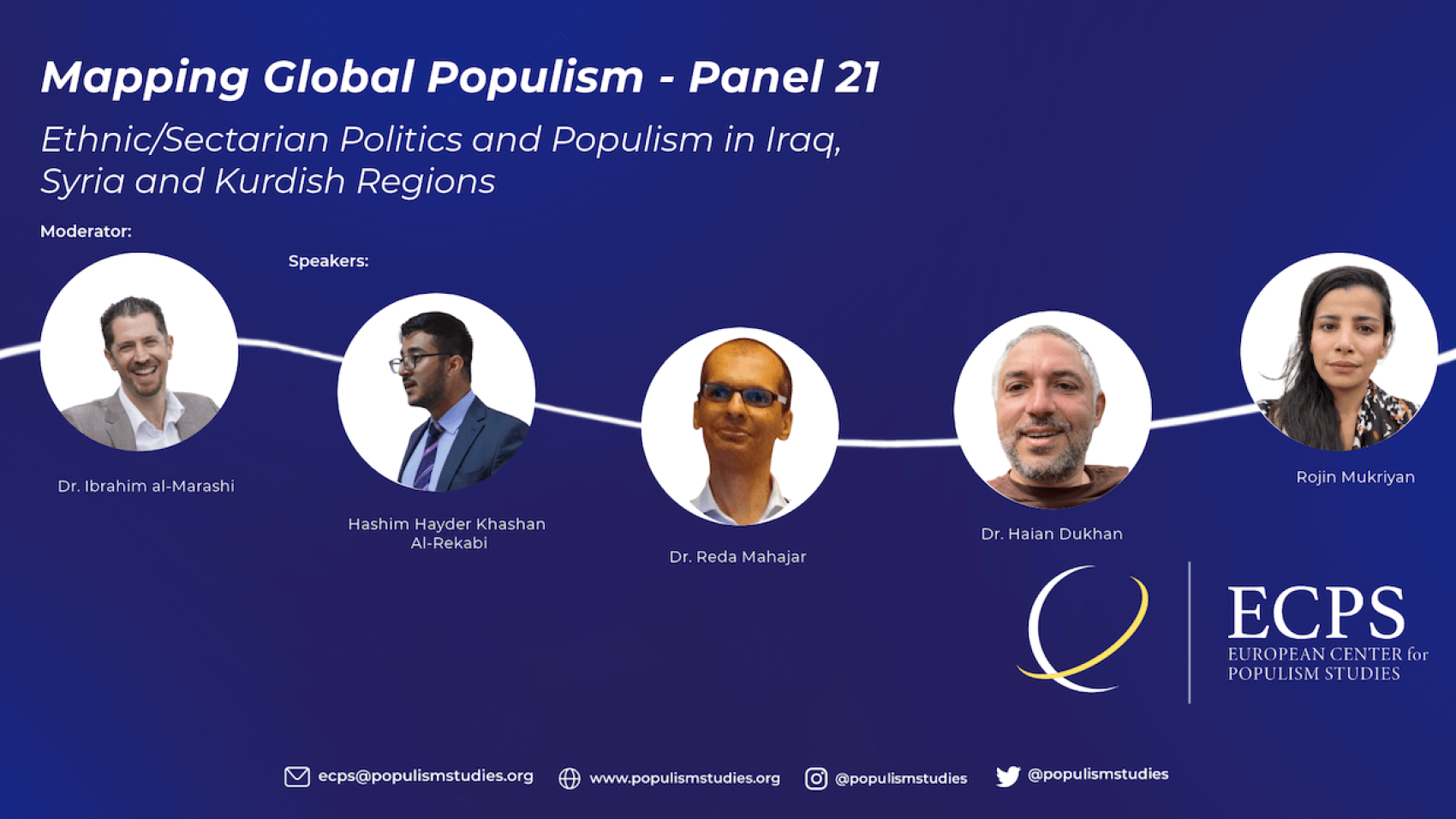
The 21st session of the Mapping Global Populism Panel Series, titled “Ethnic & Sectarian Politics and Populism in Iraq, Syria and Kurdish Regions,” brought together scholars to examine the complex interplay between populist politics and identity-based cleavages in some of the Middle East’s most conflict-affected contexts. Organized by the European Center for Populism Studies (ECPS) and moderated by Dr. Ibrahim al-Marashi(Associate Professor of History, California State University), the panel focused on how populist leaders and movements in Iraq, Syria, and Kurdish regions instrumentalize ethnic and sectarian divisions to sustain power, suppress opposition, and assert exclusionary visions of national belonging.
Featuring contributions from Dr. Reda Mahajar (Research Fellow at The Conflict Analysis Research Centre (CARC) at the University of Kent), Hashim Hayder Khashan Al-Rekabi (Lecturer, University of Baghdad), Dr. Haian Dukhan (Lecturer in Politics & International Relations, SSSHL Department of Humanities and Social Sciences, Teeside University), and Rojin Mukriyan (PhD candidate in the department of Government and Politics at University College Cork, Ireland), the session offered a timely and critical interrogation of memory, fear, gendered politics, and identity formation within the frameworks of populism and authoritarian governance.
Populism and Sectarian Calculations in Iraq and Syria
The panel opened with Dr. Reda Mahajar’s incisive critique of Bashar al-Assad’s regime in a presentation titled “Syrian Sunni Jihadi Chickens Come Home to Roost.” Dr. Mahajar argued that Assad’s support for Sunni jihadist elements in Iraq from 2003 to 2010 was not only deliberate but strategically framed to undermine the US occupation by making Iraq ungovernable. This short-sighted geopolitical gambit, he contended, ultimately backfired. The networks Assad helped empower, most notably al-Qaeda in Iraq, mutated into ideological and military adversaries, including Hay’at Tahrir al-Sham, which would go on to play a central role in Syria’s civil war.
Dr. Mahajar emphasized the historical irony in Assad’s strategy: a secular Alawite regime that presented itself as modern and pluralistic nonetheless perpetuated a Sunni-centric educational framework that reinforced sectarian binaries. These state-sponsored narratives later became fertile ground for jihadist mobilization. By embedding sectarian discourse into national identity, Assad’s regime unwittingly cultivated the ideological terrain upon which its own enemies would rise. The case stands as a stark example of blowback: a regime’s instrumental use of sectarianism ultimately incubated the forces that would threaten to dismantle it.
Expanding on the dynamics of populism in Iraq, Hashim Hayder Khashan Al-Rekabi traced three waves of populist discourse since 2003. The first phase, from 2003 to 2014, was marked by sectarian populism, as Shia, Sunni, and Kurdish parties capitalized on identity politics and the muhasasa (power-sharing) system to consolidate ethno-sectarian blocs. This period saw the institutionalization of communal divisions, with political legitimacy grounded in confessional affiliation rather than policy performance.
The second phase, from 2014 to 2019, saw the rise of anti-establishment populism. Figures like Muqtada al-Sadr employed anti-corruption rhetoric and attacked state institutions, despite being deeply embedded within them. Al-Rekabi noted the paradox of elected officials publicly denouncing the very parliament or ministries they served in, a strategy that blurred the line between opposition and governance. The final phase, emerging after 2019, introduced what he termed “illiberal democracy,” a context in which populist leaders, including al-Sadr, leverage democratic processes not to deepen pluralism, but to centralize authority and marginalize dissent.
Interestingly, Al-Rekabi shared findings from field research indicating that approximately 70% of Iraqis associate democracy not with institutional pluralism or civil liberties, but with the delivery of basic services. This utilitarian understanding of governance fuels nostalgia for authoritarianism and strongman rule, suggesting that democratic legitimacy remains fragile and conditional in post-2003 Iraq.
Kurdish Populism and the Tension Between Ideals and Institutions
Turning to the Kurdish context, Ms. Rojin Mukriyan offered a comparative analysis of populist dynamics in Rojava (northeast Syria) and the Kurdistan Regional Government (KRG) in Iraq. Drawing on Ernesto Laclau’s theory of populism as a discursive construction of “the people” against “the elite,” Mukriyan argued that the Democratic Union Party (PYD) in Rojava exemplifies left populism through its use of unifying signifiers such as “democracy” and “gender equality.” In contrast to conventional state-building models, the PYD’s project, grounded in Abdullah Ocalan’s theory of democratic confederalism, seeks to transcend national borders and ethnonationalist frameworks by promoting decentralized, pluralistic governance.
In Rojava, populism is not merely oppositional but visionary. Its aim is to unite a multi-ethnic coalition including Kurds, Arabs, Assyrians, and others under a shared commitment to local autonomy and egalitarian principles. Mukriyan acknowledged, however, the criticisms of Rojava’s ambiguity and contradictions, especially from within libertarian and anarchist circles who question its simultaneous engagement with state actors like the Assad regime.
By contrast, the KRG in Iraq presents a case of populism devoid of transformative ambition. The dominant parties, the Kurdistan Democratic Party (KDP) and the Patriotic Union of Kurdistan (PUK), continue to operate through clientelist networks and dynastic leadership. Their governance reflects a neoliberal, exclusionary model in which dissent is stifled, and party loyalty is rewarded with patronage. Mukriyan noted that while the rhetoric of reform occasionally surfaces (i.e. during election campaigns) these promises rarely materialize into structural change. The result is a hollowed-out democracy where elite families maintain control, replicating the very state-centric authoritarianism they once opposed.
Memory, Fear, and Sectarianism Among Syrian Christians
Dr. Haian Dukhan’s pre-recorded presentation focused on Christian communities in al-Hasakah, Syria, offering a layered analysis of sectarianism from both “above” and “below.” He argued that Assyrian and Syriac Christians in this region are shaped by collective memory and historical trauma including genocide, marginalization, and displacement. These long-standing fears were reignited during the Syrian civil war, particularly by ISIS’s attacks on Christian villages.
In response, some Christian groups aligned with the Assad regime and joined militias like Sutoro, seeking protection through militarized solidarity. Dr. Dukhan labelled this phenomenon as “sectarianism from below,” a grassroots survival response driven by existential anxiety. Simultaneously, the Assad regime manipulated these fears to reinforce its legitimacy, portraying itself as the only viable guardian of minority rights. This elite-driven manipulation, or “sectarianism from above,” not only entrenched dependency but also deepened mistrust among Syria’s diverse communities. Dr. Dukhan’s analysis underscores how authoritarian regimes weaponize identity and trauma to fragment civil society and maintain control.
Conclusion
Across the cases discussed, three common themes emerged. First, both Iraq and Syria illustrate how populist strategies become institutionalized through sectarian quotas and identity-based governance structures. The muhasasa system in Iraq and the sectarian entrenchment in Syria formalize the very divisions that populists exploit, making political reform deeply challenging. Second, authoritarian leaders in the region have proven adept at adopting the language of populism. Figures like Bashar al-Assad and Muqtada al-Sadr, while operating in different systems, share a similar rhetorical playbook: portraying themselves as defenders of the majority identity against both foreign enemies and domestic “elites.”
Finally, the Kurdish case highlights the limits and possibilities of populist governance. Rojava’s model of inclusive left populism contrasts starkly with the KRG’s elite-dominated politics, raising important questions about the viability of democratization within nationalist movements. Yet even Rojava is not immune to the contradictions of populist nationalism, particularly when faced with geopolitical constraints and regional authoritarian pressures.
Follow-Up Questions
The panel concluded with several pressing questions that warrant further exploration:
Can Rojava’s decentralized, inclusive governance model inspire institutional reform in the hierarchical, patronage-driven structures of the KRG?
How do external powers such as Turkey and Iran exacerbate or manipulate ethnic and sectarian populism, and how does their influence compare to Russia’s populist interventions in Europe?
Please cite as: Yilmaz, Ihsan; Mamouri, Ali; Morieson, Nicholas & Omer, Muhammad. (2025). “The Transnational Diffusion of Digital Authoritarianism: From Moscow and Beijing to Ankara.” European Center for Populism Studies (ECPS). May 12, 2025. https://doi.org/10.55271/rp0098
This report examines how Turkey has become a paradigmatic case of digital authoritarian convergence through the mechanisms of learning, emulation, and cooperative interdependence. Drawing on Chinese and Russian models—and facilitated by Western and Chinese tech companies—Turkey has adopted sophisticated digital control strategies across legal, surveillance, and information domains. The study identifies how strategic partnerships, infrastructure agreements (e.g., Huawei’s 5G and smart city projects), and shared authoritarian logics have enabled the Erdoğan regime to suppress dissent and reshape the digital public sphere. Through legal reforms, deep packet inspection (DPI) technologies, and coordinated digital propaganda, Turkey exemplifies how authoritarian digital governance diffuses globally. The findings highlight an urgent need for international accountability, cyber norms, and ethical tech governance to contain the expanding influence of digital repression.
This research explores the diffusion of digital authoritarian practices in Turkey as a prominent example of the Muslim world, focusing on the three mechanisms of learning, emulation, and cooperative interdependence, covering four main domains: Legal frameworks, Internet censorship, urban surveillance, and Strategic Digital Information Operations (SDIOs). The study covers both internal and external diffusion based on a wide range of sources. These include domestic precedents, examples from authoritarian regimes like China and Russia, and the role of Western companies in spreading digital authoritarian practices.
The study had several findings. The key findings are detailed below:
Learning: Turkey, like other regional countries that experienced public unrest, has learned from previous experience in order to impose power and control on people using different digital capabilities. Countries like China and Russia played significant roles in this learning process across the region, including in Turkey. The research highlights the importance of both internal learning from past protest movements and external influences from state and non-state actors.
Emulation: Authoritarian regimes in Turkey and across the Muslim world have emulated China and Russia’s internet governance models in all four aforementioned domains. The Turkish government has developed its own surveillance and censorship techniques, influenced by the experiences of authoritarian states and bolstered by training and technology transfers from China and Russia, and certain western companies.
Cooperative interdependence: Turkey’s economic challenges have led it to forge closer ties with China, particularly through the Belt and Road Initiative (BRI). This cooperation often comes with financial incentives, promoting the adoption of China’s digital governance practices, including urban surveillance systems and censorship technologies.
Role of private technology companies: Western companies have played a significant role in facilitating the spread of digital authoritarianism, often operating independently of their governments’ policies. Companies like Sandvine and NSO Group have provided tools that support the Turkish government’s digital control strategies, contributing to a complex landscape of censorship and surveillance.
Diffusion of SDIOs: The diffusion process of digital authoritarian practice is not limited to importing and using digital technologies. It also includes the spreading of legal frameworks to restrict digital freedom and also running Strategic Digital Information Operations (SDIOs), including state propaganda and conspiracy theories that China and Russia had a significant role in.
Based on these findings, the study proposes several recommendations to counteract the spread of digital authoritarian practices:
– Strengthening international cyber norms and regulations to define and regulate digital governance, particularly in countries with strong ties to the West.
– Enhancing support for digital rights and privacy protections by advocating for comprehensive laws and supporting civil society organizations in Turkey.
– Encouraging responsible corporate behavior among technology firms to ensure compliance with human rights standards.
– Fostering regional and global cooperation on digital freedom to counter digital authoritarianism through joint initiatives and technical assistance.
– Leveraging economic incentives to promote ethical technology use and partnerships with human rights-aligned providers.
– Using strategic diplomatic channels to encourage Turkey to adopt responsible surveillance practices and align with global digital governance norms.
The research illustrates the dynamics of digital authoritarianism in Turkey, revealing a complex interplay of emulation, learning, and economic incentives that facilitate the spread of censorship and surveillance practices. The findings underscore the need for international cooperation and proactive measures to safeguard digital freedoms in an increasingly authoritarian digital landscape.
Photo: Hannu Viitanen.
Introduction
Research suggests that a significant number of countries in the Muslim world, specifically those in the Middle East, are often characterized by authoritarian governance (Durac & Cavatorta, 2022; Yenigun, 2021; Stepan et al., 2018; Yilmaz, 2021; 2025). The rise of the internet and social media during the late 2000s provided immense capacities to civil society and individual activists in the Muslim world. This development burst into political action during the late 2000s and the early 2010s in the instances of the Gezi protests in Turkey and other examples in the region, including the Green Movement in Iran and the Arab Spring protests across the Arab world (Iosifidis & Wheeler, 2015; Demirhan, 2014; Lynch, 2011; Gheytanchi, 2016).
The fact that the protesters in all these cases have extensively used the internet and associated technologies (e.g., social media, digital messaging, and navigation) has led many observers to declare the latter as ‘liberation technology’ due to their role in facilitating anti-government movements across non-democratic countries (Diamond & Plattner, 2012; Ziccardi, 2012). Advocates of the internet as a liberation tool have also pointed to enhanced social capacity to mobilize and organize through the spread of dramatic videos and images, instigating attitudinal change, and countering government monopoly over the production and dissemination of information (Breuer, 2012; Ruijgrok, 2017). These qualities have been seen as giving the internet an equalizing power between the state and society. In the early 2000s, when the Internet and social media were spreading across the developing world, authoritarian governments were generally unable to control the digital sphere; they lacked the technical expertise and the digital infrastructure to curb the internet. So, they typically relied on completely shutting it down (Cattle, 2015; Gunitsky, 2020).
However, authoritarian regimes gradually learned how to use the digital space for empowering their control on the society and have even started using it for transnational repression and sharp power (Yilmaz, 2025, Yilmaz et al., 2024; Yilmaz, Akbarzadeh & Bashirov 2023; Yilmaz, Morieson & Shakil, 2025; Yilmaz & Shakil, 2024). Scholars such as Sunstein (2009) and Negroponte (1996) have warned against the capacity of the internet to fragment the public sphere into separate echo chambers and thus fundamentally impede ‘deliberative democracy,’ which is supposed to be based on debates of ideas and exchange of views.
Furthermore, the breakthroughs in deep learning, neural network, and machine learning, together with the widespread use of the internet, have accelerated the growth of artificial intelligence (AI), providing more capability to authoritarian regimes to impose control on people. In a Pew poll, almost half of the respondents believed that the ‘use of [modern] technology will mostly weaken core aspects of democracy and democratic representation in the next decade’ (Anderson & Rainie, 2020). This pessimism is driven by an unprecedented degree of surveillance and digital control brought forward by digital technologies, undermining central notions of freedom, individuality, autonomy, and rationality at the center of deliberative democracy (Radavoi, 2019; Stone et al., 2016; Bostrom, 2014; Helbing et al., 2019; Damnjanović, 2015). Tools of the governments to digitally repress democracy include smart surveillance using facial recognition applications, targeted censorship, disinformation and misinformation campaigns, and cyber-attacks and hacking (Feldstein, 2019).
Research as to how digital technologies such as high-speed internet, social media, AI, and big data affect, enable or disable democracy, human rights, freedom, and electoral process is in its infancy (Gardels & Berggruen, 2019; Margetts, 2013; Papacharissi, 2009). Further, most of this scant literature is focused on Western democracies. The existing literature on Muslim-majority countries is mostly focused on traditional social media (Jenzen et al., 2021; Wheeler, 2017; Tusa, 2013). This is despite the fact that extensive digital capabilities, especially AI and big data, offer governments of these countries the capabilities to exert control over their citizens, with disastrous outcomes for democracy. Indeed, we may be facing the rise of a new type of authoritarian rule: digital authoritarianism, that is, ‘the use of digital information technology by authoritarian regimes to surveil, repress, and manipulate domestic and foreign populations’ (Polyakova & Meserole, 2019; see also Ahmed et al., 2024; Akbarzadeh et al., 2024; 2025).
With the expansion of the internet in developing countries, authoritarian governments derive a similar benefit from technological leapfrogging with the capacity to selectively implement new surveillance and control mechanisms from the burgeoning supply of market-ready advanced AI and big-data-enabled applications. As one internet pioneer foreshadowed to Pew “by 2030, as much of 75% of the world’s population will be enslaved by AI-based surveillance systems developed in China and exported around the world” (Anderson & Rainie, 2020). Developing countries often experience technological leapfrogging; they shift to advanced technologies directly, skipping the middle, more expensive and less efficient stages because modern technologies, by the time of their implementation within those countries, become more economical and effective than the initial technology. This leapfrogging is demonstrated via the adoption lifecycle of mobile phones to that of landlines. It took less than 17 years, from the early 2000s to 2017, for mobile phones to be extensively adopted in Turkey, from 25% to 96%. (Our World in Data, 2021).
After the crises of the early 2010s, both democratic and authoritarian regimes worldwide started to invest heavily in sophisticated equipment and expertise to monitor, analyze, and ultimately crack down on online and offline dissent (Aziz & Beydoun, 2020; Feldstein, 2021). In addition to curtailing independent speech and activism online, authoritarian regimes have sought to deceive and manipulate digital environments in order to shape their citizens’ views. They have flooded the digital realm with propaganda narratives using trolls, bots, and influencers under their control (Tan, 2020).
More importantly, thanks to authoritarian diffusion, governments in developing countries are learning from and emulating the experiences of their peers of surveillance technologies such as China and Russia. However, there has been limited research on the political mechanisms through which such digital authoritarian practices spread. Against this backdrop, this report examines the mechanisms through which digital authoritarian practices diffuse in Turkey as an example of authoritarian regimes in the Middle East. We ask: What kind of authoritarian practices have the governments enacted in the digital realm? How have these practices diffused across the region? To address these questions systematically, we develop an analytical framework that examines the mechanisms of diffusion of digital authoritarian practices. Our framework identifies three mechanisms of diffusion: emulation, learning, and cooperative interdependence. We focus on four groups of digital authoritarian practices: legal frameworks, Internet censorship, urban surveillance, and Strategic Digital Information Operations (SDIOs). We aim to show how emulation, learning and cooperative interdependence take place in each of these four digital authoritarian practices. In addition to the above, the report will explore the international dimension of this phenomenon, discovering how Western companies, in addition to totalitarian systems like Russia and China, played a role in empowering the Turkish government to claim the digital space.
We first discuss our analytical framework which integrates the scholarship of digital authoritarian practices and authoritarian diffusion, and explain the concepts of learning, emulation, and as prominent diffusion mechanisms. We then move to the empirical section where we first identify convergent outcomes that are comparable between earlier and later adopters and then we will elucidate the mechanisms through which the diffusion process occurred by showing contact points and plausible channels through which decision-makers were able to adopt from one another.
Analytical Framework
To explore the phenomenon of diffusion, we follow best practices laid out in the literature (see Ambrosio, 2010; Ambrosio & Tolstrup, 2019; Bank & Weyland, 2020). We begin by identifying convergent outcomes that are comparable between earlier and later adopters. As part of this, we will also establish feasible connections between the two parties, which may take the form of physical proximity, trade linkages, membership in international organizations, bilateral arrangements, historical ties, cultural similarities, or shared language. Then, we will elucidate the mechanisms through which the diffusion process occurred by identifying contact points and plausible channels through which decision-makers were able to adopt from one another.
We will follow three good practices that have been advised by scholars (e.g., Ambrosio & Tolstrup, 2019; Strang & Soule, 1998; Gilardi, 2010; 2012). First, we adopt a comparative design that involves four middle powers (see Strang & Soule, 1998). There are important similarities and differences among the four cases that make comparison a useful exercise. Second, we provide extensive data to showcase the workings of diffusion mechanisms despite the challenge of working on authoritarian settings. As Ambrosio and Tolstrup (2019: 2752) noted, “the relevant evidence needed can be hard to acquire in authoritarian settings.” It is much more likely to gain access to strong evidence in liberal democratic settings where much of the current diffusion research has accumulated. Our article contributes to the literature on diffusion in authoritarian settings with Turkey as a prominent example. Finally, we provide smoking gun evidence based on several leaked documents to support our assertions.
In the empirical section, we follow the convention (see Ambrosio & Tolstrup, 2019) and start with identifying convergent outcomes among the major political actors in regard to the practices of restrictive legal frameworks, Internet censorship, urban surveillance and SDIOs. This section involves demonstrating the items that have been diffused between earlier and later adopters. Not only is there a substantial amount of similarity between the practices among these political systems, but also, we show a temporal sequence between earlier and later adopters that point at convergence.
We then move on to explain plausible mechanisms of diffusion, following the model provided by Bashirov et al. (2025): Learning, Emulation, and Cooperative Interdependence. It’s important to highlight from the outset that these three mechanisms functioned together in Turkey settings. As was observed in other settings (see Sharman, 2008), it is not feasible to examine the impact of these mechanisms independently. Instead of existing as separate entities or operating in a simple additive manner, these mechanisms are inherently interconnected, and they do overlap. We follow this understanding in our empirical analysis and discuss how each mechanism worked in tandem with other mechanisms.
Types of Digital Authoritarianism
Illustration: Shutterstock / Skorzewiak.
We identified four main domains of digital authoritarianism in general, and examples of them could be found in Turkey’s case as well.
Restrictive Legal Frameworks
The legal framework includes a variety of practices. We identified the following:
1- Laws that mandated internet service providers to establish a system allowing real-time monitoring and recording of traffic on their networks. These legislations mandated internet service providers to establish a system allowing real-time monitoring and recording of traffic on their networks (Privacy International, 2019). Moreover, all censorship laws refer to national security and terrorism as vague criteria to enforce widespread censorship of undesirable content. In Turkey, a Presidential decree (No 671) in 2016 granted the government extensive power to restrict internet access, block websites, and censor media (IHD, 2017). Under the decree, telecommunications companies are required to comply with any government orders within two hours of receiving them. In recent years, the Turkish government also prosecuted thousands of people for criticizing President Erdogan or his government in print or on social media (Freedom House, 2021).
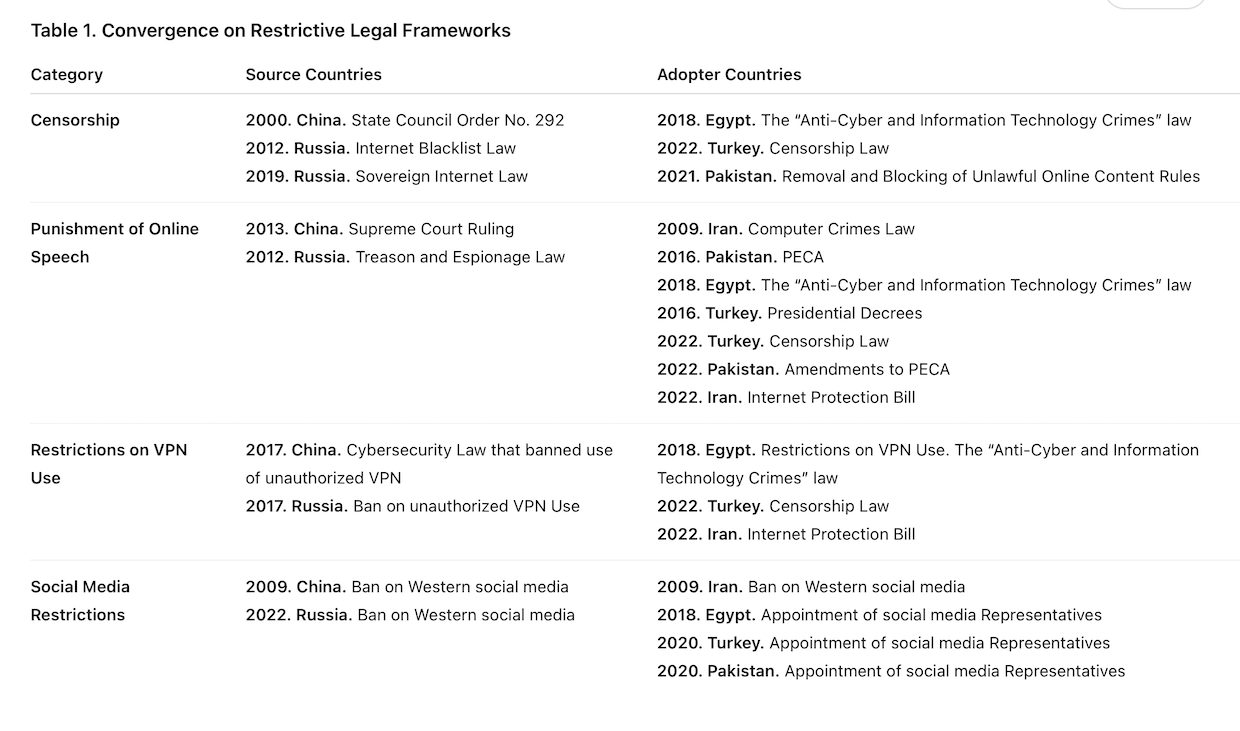
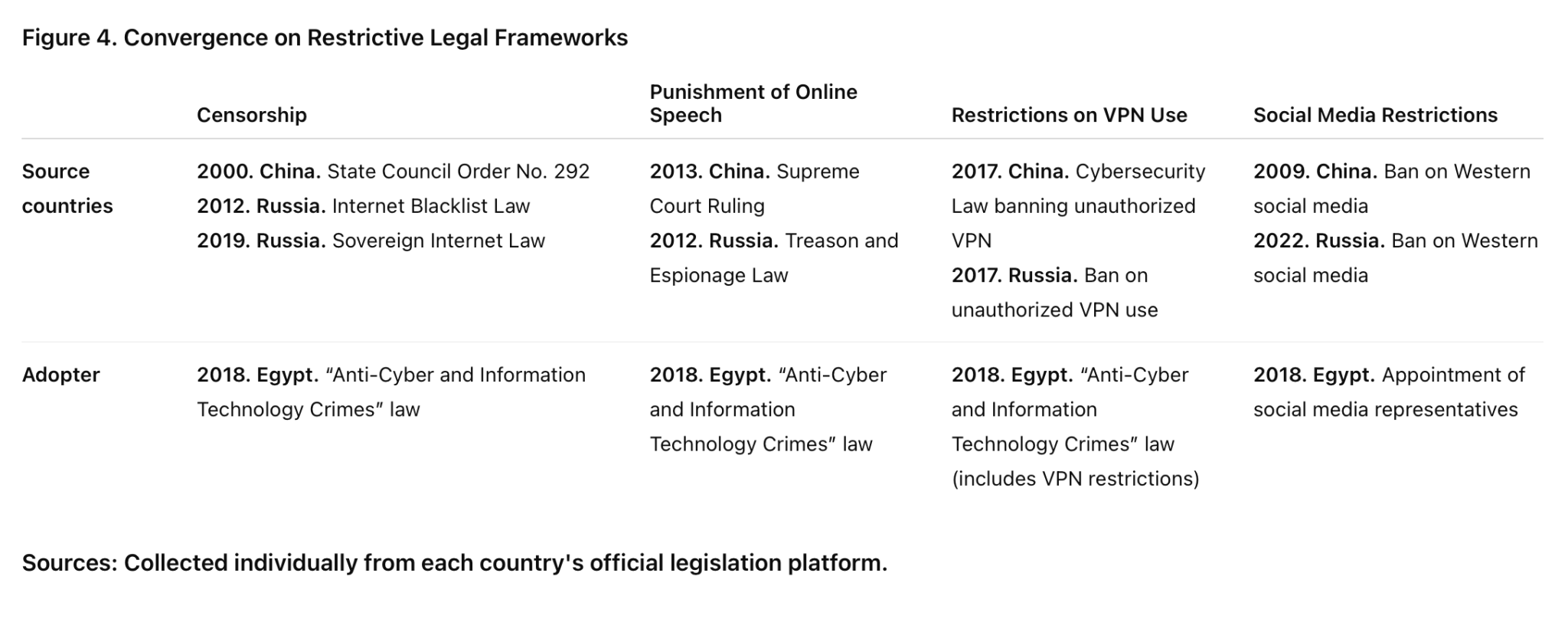
2- Laws that have converged around penalization of online speech, referring to concepts such as national identity, culture, and defamation. It is hard to miss similarities between the laws in Turkey among other regional countries and those enacted in China earlier. In 2013, China’s Supreme People’s Court issued a legal interpretation that expanded the scope of the crime of defamation to include information shared on the internet (Human Rights Watch, 2013). In 2022, the Turkish Parliament passed new legislation that criminalized “disseminating false information,” punishable by one to three years in prison, and increased government control over online news websites. Article 23 of the law was particularly controversial as it stated that “Any person who publicly disseminates untrue information concerning the internal and external security, public order and public health of the country with the sole intention of creating anxiety, fear or panic among the public, and in a manner likely to disturb public peace, shall be sentenced to imprisonment from one year to three years” (Human Rights Watch, 2022). This clearly shows the pattern of diffusion from China and Russia by leaving vague and broad provisions of what constitutes “national security,” “peace” and “order” (Weber, 2021: 170-171; Yilmaz, Caman & Bashirov, 2020; Yilmaz, Shipoli & Demir, 2023; Yilmaz & Shipoli, 2022).
3- Laws that ban or restrict the use of VPNs following China and Russia’s lead. In Turkey, VPNs are legal, but many of their servers and websites are blocked. China banned unauthorized VPN use in 2017 in a new Cybersecurity Law. Russia introduced a similar ban the same year. The Information and Communication Technologies Authority (BTK), national telecommunications regulatory and inspection authority of Turkey, issued a blocking order targeting 16 Virtual Private Networks (VPNs). These VPNs, including TunnelBear, Proton, and Psiphon, are popular tools used by audiences seeking to access news websites critical of the government.
While entirely banning VPN access remains a challenge, governments can employ Deep Packet Inspection (DPI) technology to identify and throttle VPN traffic. Countries like Iran, China, and Russia are indulging in such practices. Users in Iran and Turkey, for example, have reported extensive blockage of VPN apps and websites since 2021. Engaging in efforts to access blocked content through a VPN can potentially result in imprisonment (Danao & Venz, 2023). Simon Migliano, research head at Top10VPN.com, acknowledges that blocking VPN websites in Turkey makes it harder to download and sign up for new services. Moreover, individual VPN providers like Hide.me, SecureVPN, and Surfshark confirm technical difficulties for their users in Turkey. Proton, on the other hand, maintains that their services haven’t been completely blocked.
As such, the report “Freedom on the Net 2023” by Freedom House (2023) reflects the aforesaid harsh reality, ranking Turkey as “not free” in terms of internet access and freedom of expression. However, it is worth noting that the Turkish government’s censorship efforts are met with a determined citizenry. Audiences, even young schoolchildren according to Ozturan (2023), have become adept at using VPNs to access banned content. Media outlets themselves sometimes promote VPNs to help their audiences bypass restrictions. Examples abound: VOA Turkish and Deutsche Welle (DW), upon being blocked, directed their audiences towards Psiphon, Proton, and nthLink to access their broadcasts. Diken, a prominent news website, even maintains a dedicated “VPN News” section offering access to censored content dating back to 2014.
4- Laws that tighten control on social media companies. While Western social media platforms remain accessible in Turkey, in recent years the government has introduced similar laws and regulations that increase their grip over the content shared on these platforms. They do so by threatening the social media companies with bandwidth restrictions and outright bans if they fail to comply with the governments’ requests. Moreover, in 2020, the Turkish Parliament passed a new law that mandated tech giants such as Facebook and Twitter (now X) to appoint representatives in Turkey for handling complaints related to the content on their platforms. Companies that decline to assign an official representative have been subject to fines, advertising prohibitions, and bandwidth restrictions that would render their networks unusable due to slow internet speeds. Facebook complied with the law in 2021 and assigned a legal entity in Turkey after refusing to do so the previous year (Bilginsoy, 2021).
Since the early 2010s, many countries in the region including Turkey have enacted a series of legal reforms that converged around similar concepts and restrictions. As Table 1 shows, these laws follow the Chinese and Russian laws in temporal order. The table makes a comparison with some other countries in the region as well, in order to see Turkey’s position in this field.
Internet Shutdown
All governments in the region have resorted to shutting down the internet as a simple solution over the past 20 years, mostly during the times of mass protests, social unrest or military operations. In Turkey, in 2015, access to Facebook, Twitter and YouTube as well as 166 other websites were blocked when an image of a Turkish prosecutor held at gunpoint was circulated online. The internet was also cut off multiple times during the July 15, 2016 coup attempt, as well as during the Turkish military’s operations in the Southeastern regions of the country. In many instances, the government has used bandwidth throttling to deny its citizens access to the internet. However, internet shutdown is costly as it affects the delivery of essential public and private services and has been dubbed as the Dictator’s Digital Dilemma. Therefore, even when it is practiced, the shutdown is limited to a certain location, mostly a city or a region, and would typically last only few days. According to Access Now (2022), an internet rights organization, no internet shutdown has taken place in Turkey in 2021.
Given the high cost of switching off the internet and thanks to the rise of sophisticated technologies to filter, manipulate and re-direct internet content, censorship has become a more widely used digital authoritarian practice over the last decade. Countries have converged on the use of DPI technology. DPI is “a type of data processing that looks in detail at the contents of the data being sent, and re-routes it accordingly” (Geere, 2012). DPI inspects the data being sent over a network and may take various forms of actions, such as logging the content and alerting, as well as blocking or re-rerouting the traffic. DPI allows comprehensive network analysis. While it can be used for innocuous purposes, such as checking the content for viruses and ensuring the correct supply of content, it can also be used for digital eavesdropping, internet censorship, and even stealing sensitive information (Bendrath & Mueller, 2011).
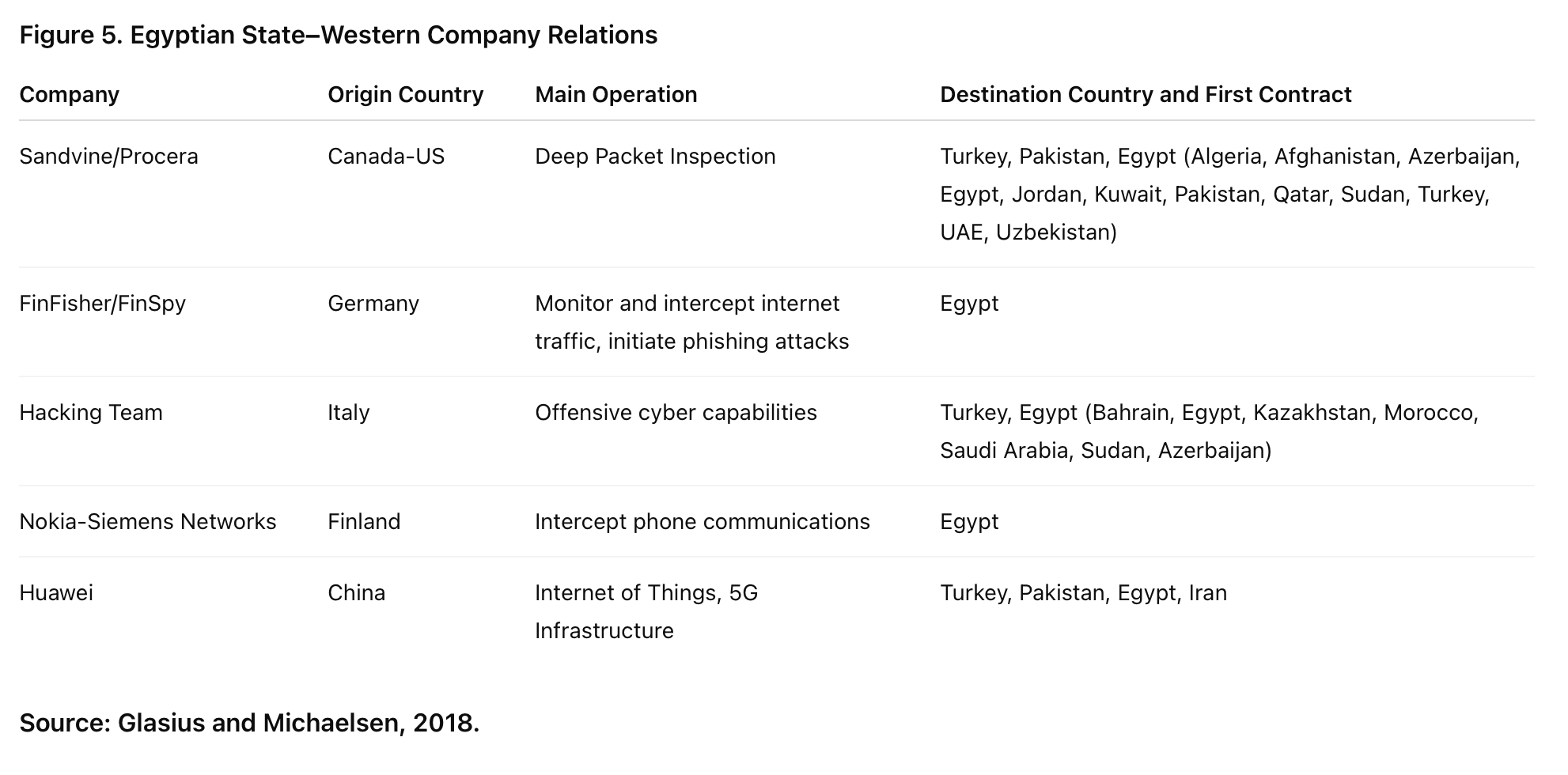
Countries across the Muslim world including Turkey started in the mid-2010s to acquire DPI technology from Western and Chinese companies who have become important sources of diffusion. US-Canadian company Sandvine/Procera has provided DPI surveillance equipment to national networks operating in Turkey (Turk Telekom). This system operates over connections between an internet site and the target user and allows the government to tamper with the data sent through an unencrypted network (HTTP vs. HTTPS). Sandvine and its parent company Francisco Partners emerged at the center of the diffusion of DPI technology in the Middle East. Recent revelations show that the company has played significant role in facilitating the spread of ideas between countries. Through their information campaign, Sandvine contributed to learning by governments. As such, Sandvine and Netsweeper’s prominent engagement in provision of spying technology shows that it is not merely Chinese companies that enable digital authoritarianism. Western companies have been just as active.
Turkey made its first purchase from Sandvine (then Procera) in 2014 after the Gezi protests and corruption investigations rocked the AKP government the previous year. The government later used these devices to block websites, including Wikipedia, and those belonging to unwanted entities, such as independent news outlets and certain opposition groups in later years. The governments in the region including Turkey have gathered widespread spying and phishing capabilities sourced from mostly Western companies. For example, in Turkey, FinFisher used FinSpy in 2017 on a Turkish website disguised as the campaign website for the Turkish opposition movement and enabled the surveillance of political activists and journalists. FinSpy allowed the MIT to locate people, monitor phone calls and chats and mobile phone and computer data (ECCHR, 2023). This could link in with our discussion in emulation more clearly as well regarding private companies being key actors (Marczak et al., 2018).
Urban Surveillance
Three high-definition video surveillance cameras operated by the city police. Photo: Dreamstime.
With the advance of CCTV and AI technology, urban surveillance capabilities have grown exponentially over the past ten years. Dubbed as “safe” or “smart” cities, these urban surveillance projects are “mainly concerned with automating the policing of society using video cameras and other digital technologies to monitor and diagnose “suspicious behavior” (Kynge et al., 2021). The concept of Smart city captures an entire range of ICT capabilities implemented in an urban area. This might start with the simple goal of bringing internet connectivity and providing electronic payment solutions for basic services and evolve to establishing AI-controlled surveillance systems, as we have seen in many Chinese cities (Zeng, 2020). Smart cities deploy a host of ICT—including high-speed communication networks, sensors, and mobile phone apps—to boost mobility and connectivity, supercharge the digital economy, increase energy efficiency, improve the delivery of services, and generally raise the level of their residents’ welfare (Hong, 2022). The “smart” concept generally involves gathering large amounts of data to enhance various city functions. This can include optimizing the use of utilities and other services, reducing traffic congestion and pollution, and ultimately empowering both public authorities and residents.
The rapid development of smart city infrastructures across world has led to controversies as critics argued that the surveillance technology enables pervasive collection, retention, and misuse of personal data by everything from law enforcement agencies to private companies. Moreover, in recent years, China has been a major promoter of the ‘safe city’ concept that focuses on surveillance-driven policing of urban environments – a practice that has been perfected in most Chinese cities (Triolo, 2020). Several Chinese companies have been at the forefront of China’s effort to export its model of safe city: Huawei, ZTE Corporation, Hangzhou Hikvision Digital Technology, Zhejiang Dahua Technology, Alibaba, and Tiandy (Yan, 2019).
China has been a significant exporter of surveillance technology worldwide, including to countries like Turkey. Chinese firms such as Hikvision and Dahua have supplied surveillance equipment, including facial recognition systems, to various nations. Reports indicate that Turkey has utilized facial recognition software to monitor and identify individuals during protests (Radu, 2019; Bozkurt, 2021).
Holistically, the global expansion of China’s urban surveillance model sparks significant concerns, particularly in relation to its potential to increase authoritarian practices in adopting countries. In the absence of robust counter mechanisms, the adoption of Chinese surveillance model by authoritarian states is only likely to augment.
Strategic Digital Information Operations (SDIOs)
Another interesting aspect of authoritarian regimes is the use of digital technologies in creating and spreading pro-regime propaganda and conspiracy narratives that benefit the regimes. This is happening extensively in the region, including Turkey, as a part of the manipulation of the people in order to impose control on them and silence the opposition. The pro-regime propaganda machine uses conspiracy theories with a dual strategy, defensive and offensive, to shape the public perception of the regime. Defensively, it seeks to portray the regime as a legitimate national authority, emphasising its adherence to the nation’s interests and well-being in a way that no legitimate alternative is imaginable. In these narratives, leaders are portrayed as heroic figures with exceptional qualities, and the system is presented as flawless and well-suited to the country’s needs. On the offensive front, the propaganda machine works to discredit any alternative to the current regime. Opposition figures are either assassinated, arrested or labelled as traitors, criminals, or foreign agents so they can be eliminated politically. To reach to this end, conspiracy theories link opposition figures to nefarious plots or foreign intervention, thus undermining the credibility of opposition narratives.
In recent years, propaganda and conspiracy theories have played a significant role in Turkey’s political landscape, influencing political narratives and public opinion. The Turkish government, particularly under President Erdoğan and his ruling party (AKP), has been known for using state-controlled or pro-government media to push certain narratives. The government’s media strategy includes promoting nationalistic themes, highlighting Turkey’s achievements under AKP rule, and portraying the government as the protector of national interests against both internal and external threats. The government often emphasizes Turkey’s sovereignty and positions itself against perceived Western interference, such as criticisms from the European Union or the United States. By doing so, it strengthens a nationalist image, resonating with citizens who view Turkey as being unfairly targeted by foreign powers. Propaganda often incorporates Islamic and conservative values to appeal to the AKP’s core voter base. Erdoğan’s speeches and media outlets supportive of the government emphasize the defense of Islamic culture and values, framing the AKP as a protector of both religion and national identity. Government narratives frequently depict opposition groups as threats to national stability. This includes not only political rivals but also groups like the Kurdish population, the Gülen movement (which is accused by Erdogan regime of being behind the 2016 coup attempt), and the pro-Kurdish HDP party, who are often associated with terrorism or disloyalty.
Additionally, conspiracy theories have been pervasive in Turkish political culture, often used to explain domestic unrest or justify political decisions. Here, pro-government media often propagate conspiracies about the opposition, portraying them as aligned with foreign powers or terrorist organizations. A persistent theme in Turkish political discourse is the idea that foreign powers or global financial institutions are working to undermine Turkey’s economy and political stability. Moreover, the failed coup attempt in July 2016 became a fertile ground for conspiracy theories. While the Turkish government attributed the coup attempt to Fethullah Gülen, a cleric who lived in exile in the United States for decades until his death, alternative theories continue to circulate. Some claim that foreign powers, particularly the US, were involved in the coup plot, while others suggest that elements within the Turkish government may have allowed the coup to proceed as a means to justify a subsequent crackdown on opposition. In the same vein, many conspiracy theories center around the idea that Western powers, particularly the US and Europe, are conspiring against Turkey to prevent it from becoming a major regional power. These theories often cite Turkey’s geopolitical location, its military interventions in the region, or its aspirations to become an independent economic powerhouse.
A significant portion of the mainstream media in Turkey is either directly controlled by the government or aligned with it. These outlets often echo government narratives, downplaying criticisms, and emphasizing government achievements or conspiracy-laden stories about opposition and foreign interference. Despite the dominance of pro-government media, social media platforms have become spaces for both opposition voices and pro-government voices. The government has sought to control these platforms through legal means, introducing laws to regulate social media and threatening to block access to platforms that do not comply with government requests to remove content.
Mechanisms of Diffusion
We observed that the diffusion of digital authoritarianism occurs in three main mechanisms: learning, emulation and cooperative interdependence.
Learning
It has been widely argued that countries across the globe learned from domestic and foreign experience to adopt various forms of digital authoritarian practices. This is more prominent in countries experiencing public unrest, like Turkey and Egypt. For example, they both have learned lessons from the Gezi Park and Tahrir Square protests, respectively. Despite many indications to this effect, for a long time there was a lack of smoking gun evidence pointing at this type of learning. In 2016, a series of leaked emails from Erdogan’s son-in-law and then Energy Minister Berat Albayrak’s account revealed that in the aftermath of the Gezi Park protests, the Erdogan regime identified its lack of control of digital space as a problem and sought solutions in the form of “set[ting] up a team of professional graphic designers, coders, and former army officials who had received training in psychological warfare” (Akis, 2022). In later years, the regime built one of the world’s most extensive internet surveillance networks on social media, particularly on X, according to Norton Symantec.
In regard to external learning, China (and Chinese companies) and Western private companies have been at the forefront of actors promoting internet censorship practices. China has been not only a major promoter but also a source of learning for middle powers when it comes to internet surveillance, data fusion, and AI. The Shanghai Cooperation Organization (SCO) has become a key vehicle that drives these efforts. For example, during the 2021 SCO summit, Chinese officials led a panel titled the Thousand Cities Strategic Algorithms, which trained the international audience that included many developing country representations on developing a “national data brain” that integrates various forms of financial and personal data and uses artificial intelligence to analyze it. The SCO website reported that 50 countries are engaged in discussions with the Thousand Cities Strategic Algorithms initiative (Ryan-Mosley, 2022). China has also been active in providing media and government training programs to representatives from BRI-affiliated countries. In one prominent example, Chinese Ministry of Public Security instructed Meiya Pico, a Chinese cybersecurity company, to train government representatives from Turkey, Pakistan, Egypt, and other countries on digital forensics (see Weber, 2019: 9-11).
Moreover, the spread of internet censorship and surveillance technologies points to a highly probable learning event facilitated by western corporate entities. Specifically, Sandvine, NSO Group, and their parent company Francisco Partners, emerged at the center of the diffusion of DPI technology in most Middle Eastern countries except for Iran where the company is not allowed to operate. Recent revelations show that the company has played a significant role in facilitating the spread of ideas between countries. Alexander Haväng, the ex-Chief Technical Officer of Sandvine, explained in an internal newsletter addressed to the company’s employees that their technology can appeal to governments whose surveillance capacities are hampered by encryption. Haväng wrote that Sandvine’s equipment could “show who’s talking to who, for how long, and we can try to discover online anonymous identities who’ve uploaded incriminating content online” (Gallagher, 2022).
The spread of DPI practices in general and Sandvine’s technology in particular is also evidenced by the chronology of acquisition by developing countries. The list of countries contracted to buy Sandvine’s DPI technology includes Turkey, Algeria, Afghanistan, Azerbaijan, Egypt, Eritrea, Jordan, Kuwait, Pakistan, Qatar, Russia, Sudan, Thailand, the United Arab Emirates, and Uzbekistan (Gallagher, 2022). There is a clear trend here, both in terms of regime susceptibility and chronology of adoption. Turkey purchased Sandvine’s DPI technology in 2014, Egypt in 2016, and Pakistan did so in 2018 (Malsin, 2018; Ali & Jahangir, 2019).
It is highly likely that later adopters of this technology reviewed its performance in early adopters and decided upon their own adoption. We know from previous research that private companies can “influence the spread of state policies by encouraging the exchange of substantive and procedural information between states” (Garrett & Jansa, 2015: 391). Governments are required to understand details about the content of a technology and relevant institutional mechanisms to use it effectively. Corporations facilitate communication about these details. The existence of extensive links between Sandvine and authoritarian regimes, the similarities of how the tech has been used, and the sheer prominence of this company and its technology demonstrate a plausible argument for diffusion.
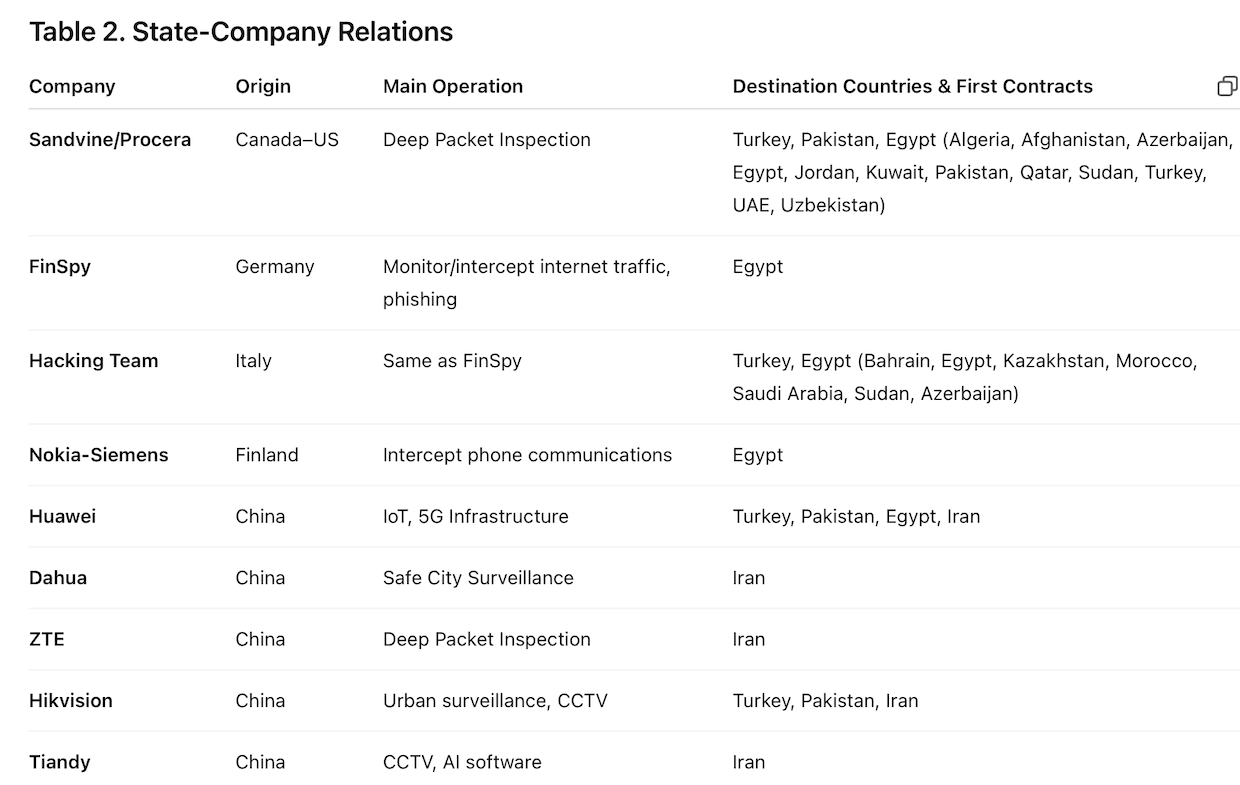
Using practice framework, we focus on ‘configurations of actors’ who are involved in enabling authoritarianism (Glasius & Michaelsen, 2018). In most instances, these actors are not states, but private companies (see Table 2). Moreover, contrary to perceived active role of Chinese companies, with the prime exception of Iran, it was Western tech companies that provided most of the high-tech surveillance and censorship capabilities to authoritarian regimes in the Muslim world including Turkey. These included, inter alia, US-Canadian company Sandvine, Israeli NSO Group, German FinFisher and Finland’s Nokia Networks.
Emulation
There’s evidence that authoritarian countries in the region like Turkey have emulated major powers, as well as each other, when it comes to internet censorship practices. Among other things, homophily of actors played important role as actors prefer to emulate models from reference groups of actors with whom they share similar cultural or social attributes (Elkins & Simmons, 2005). Political alignment and proximity among nations foster communication and the exchange of information (Rogers, 2010). We observe the influence of this dynamic between China and Russia, and political regimes in the Muslim world who are susceptible to authoritarian forms of governance to varying degrees.
Research noted that states tend to harmonize their policy approaches to align with the prevailing norms of the contemporary global community, irrespective of whether these specific policies or institutional frameworks align with local conditions or provide effective solutions. Notably, since most transfers originate from the core to the periphery, policy transfers to developing regions might be ill-suited and consequently ineffective. There’s evidence that adoption of city surveillance is driven by the desire for conformity rather than the search for effective solutions. China’s CCTV-smart city solutions are considered in the region to be “bold innovations” as they’ve gathered disproportionate attention from the developing countries across the world. However, there’s evidence that the countries adopt this technology because of their apparent promise rather than demonstrated success. For example, there has been a controversy about whether Huawei’s safe city infrastructure actually helps to reduce urban crime. In a dubious presentation in 2019, Huawei claimed that its safe city systems have been highly effective in reducing crime, increasing the case clearance rate, reducing emergency response time, and increasing citizen satisfaction. However, research by CSIS revealed that these numbers have been grossly exaggerated if not completely fabricated (Hillman & McCalpin, 2019).
Emulation and learning appear to be the major mechanisms through which such practices spread. First, by demonstrating the effectiveness of disinformation campaigns and propaganda – such as Russian interference in US presidential elections in 2016 and China’s propaganda around the Covid-19 pandemic – these countries have shown other regimes that similar tactics can be used to control their own populations and advance their interests (Jones, 2022). Second, China and Russia have acted as important sources of learning for authoritarian regimes. China has hosted thousands of foreign officials and members of media from BRI countries in various training programs on media and information management since 2017 (Freedom House, 2022). For example, in 2017, China’s Cyberspace Administration held cyberspace management seminars for officials from BRI countries. Chinese data-mining company iiMedia presented its media management platform which is advertised as offering comprehensive control of public opinion, including providing early-warnings for “negative” public opinions and helping guide the promotion of “positive energy” online (Laskai, 2019).
The governments in the Muslim world learned how to use the social media and other digital technologies for ‘flooding,’ which helps strengthen and legitimize their political regime. This is a part of a broader objective of shaping the information environment domestically and internationally (Mir et al., 2022). At home, these governments are attempting to mold their citizens’ conduct online. They hired social media consultants and influencers to do their propaganda. They learned how to flood the information space with propaganda narratives using troll farms and bots. For example, in Turkey, the AKP government created a massive troll army in response to the Gezi Protests in 2013. A 2016 study published by the cyber security company Norton Symantec shows that among countries in Europe, the Middle East and Africa, Turkey is the country with the most bot accounts on Twitter (Akis, 2022). In 2020, Twitter announced that it was suspending 7,340 fake accounts that had shared over 37 million tweets from its platform. Twitter attributed the network of accounts to the youth wing of the ruling AKP.
Through the aforementioned techniques, Turkey moved beyond strategies of “negative control” of the internet, in which the government attempt to block, censor, and suppress the flow of communication, and toward strategies of proactive co-optation in which social media serves regime objective. The opposite of internet freedom, therefore, is not necessarily internet censorship but a deceptive blend of control, co-option, and manipulation. As the public debate is seeded with such disinformation, this makes it hard for the governments’ opponents to convince their supporters and mobilize (Gunitsky, 2020).
Here, the practices appear to be a mixed bag of diffusion, convergence and even innovation on the part of some regional countries. There is some proof of learning on the part of the Turkish regime: Berat Albayrak’s emails reveal the government’s learning from the Gezi protests and intentional establishment of their own troll farms (Akis, 2022). Similarly, the Sisi regime learnt from the Arab Spring protests as well. While it is hard to find a smoking gun evidence of these regimes copying Russian or Chinese playbook, extensive links between some of these countries (such as Pakistan and Turkey), as well as between some of these countries and Russia/China (Turkey and Russia; China and Pakistan/Iran) brings some evidence of diffusion.
Cooperative Interdependence
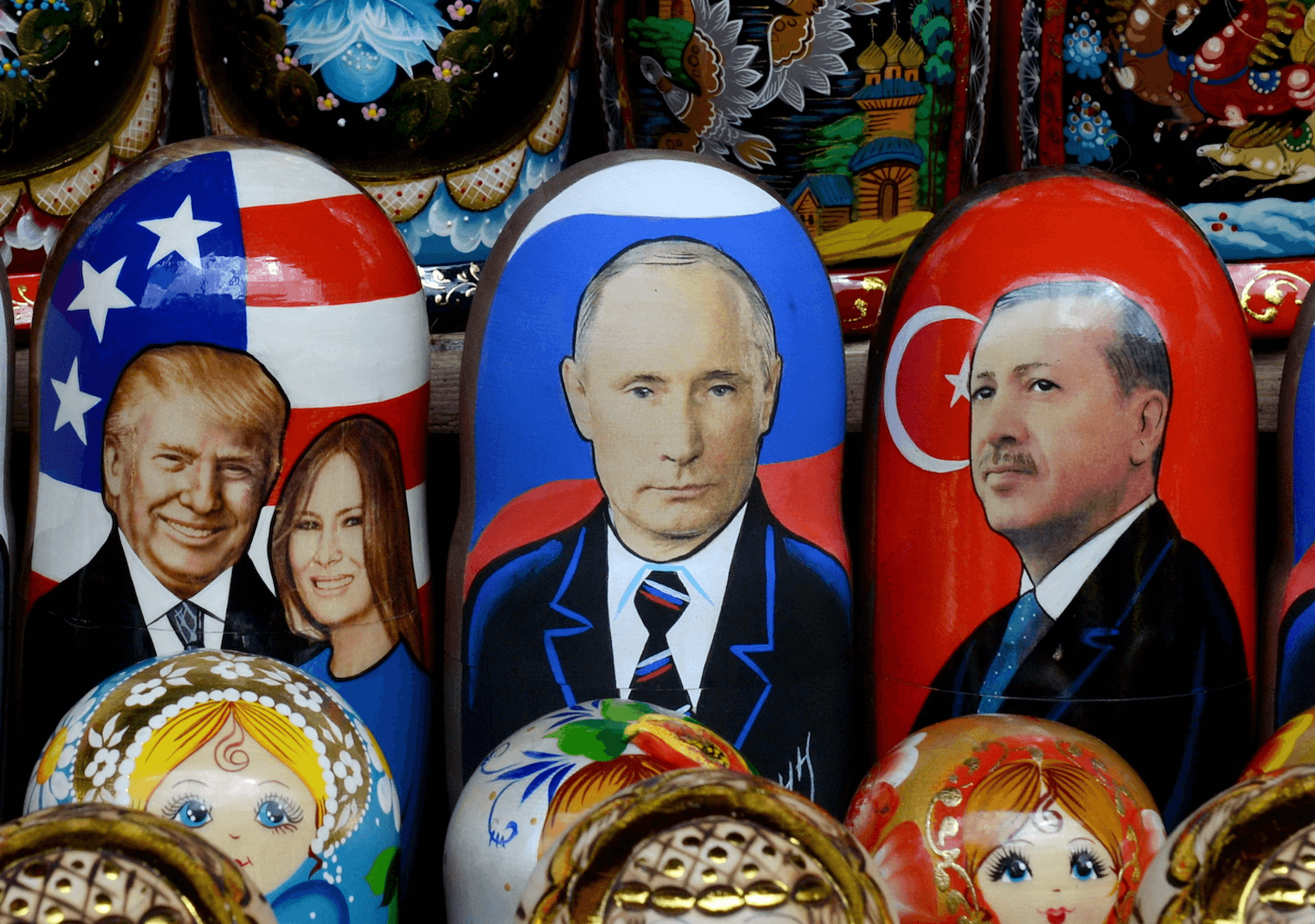
Nested dolls depicting authoritarian and populist leaders Vladimir Putin, Donald Trump, and Recep Tayyip Erdogan displayed among souvenirs in Moscow on July 7, 2018. Photo: Shutterstock.
We have observed that a cooperative interdependence has been at play when it comes to the diffusion of internet censorship practices from China to developing countries. Countries like Turkey are facing serious economic challenges and are in dire need of foreign direct investment. When tracing China’s technology transfer in these countries, a common thread emerges that tie most of the Chinese engagement to various forms of aid, trade negotiations, or grants. Prominently, China uses its Digital Silk Road (DSR) concept under the banner of the Belt and Road Initiative (BRI) to push for adoption of its technological infrastructure and accompanying policies of surveillance and censorship in digital and urban environments (Hillman, 2021). For example, at the 2017 World Internet Conference in China, representatives from Turkey, Egypt, Saudi Arabia, and the UAE signed a “Proposal for International Cooperation on the ‘One Belt, One Road’ Digital Economy,” an agreement to construct the DSR to improve digital connectivity and e-commerce cooperation (Laskai, 2019). The core components of the DSR initiative are smart (or “safe cities”), internet infrastructure, and mobile networks.
We do not argue that China is “forcing” these countries to adopt internet censorship practices. Rather, a cooperative interdependence works through changing incentive structures of BRI-connected states where financial incentives by China, coupled with technology transfer, promote China’s practical approach to managing the cyberspace as well. Indeed, BRI’s digital dimensions include many projects such as 5G networks, smart city projects, fiber optic cables, data centers, satellites, and devices that connect to these systems. In addition to having commercial value in terms of expanding China’s business of information technology, these far-reaching technologies have strategic benefit as they help the country achieve geoeconomic and geopolitical objectives that involve promotion of digital authoritarian practices and Chinese model of internet governance (Malena, 2021; Tang, 2020).
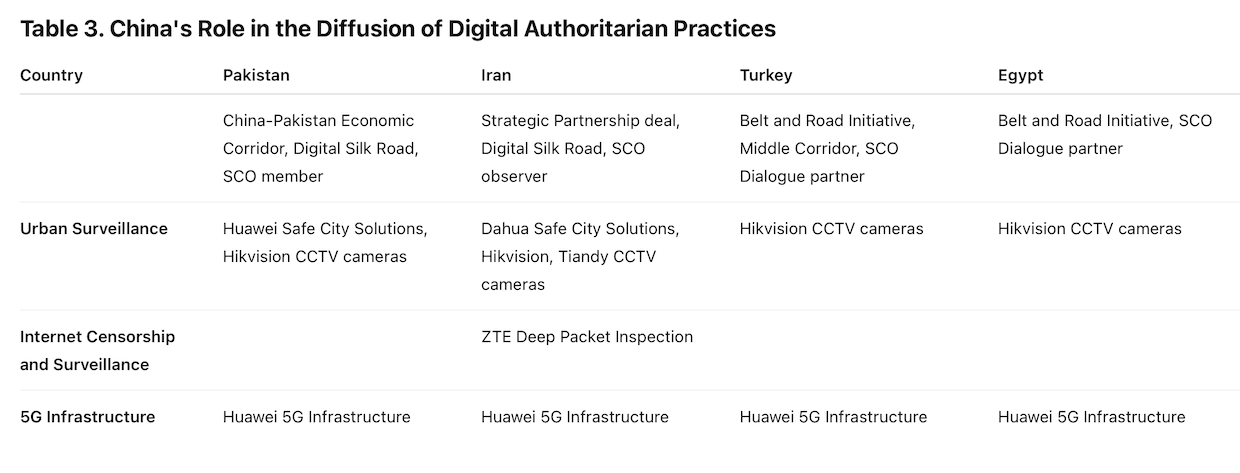
For example, Huawei’s growing influence in Turkey, and other regional countries such as Iran, Egypt, Pakistan, and particularly in the context of building their 5G infrastructure, is tied to these countries’ involvement in DSR projects. As mentioned above, all the abovementioned countries have signed agreements to cooperate with Huawei to build their 5G infrastructure. The latter is not merely an advanced technology, but also a vehicle of promoting an entire legal and institutional infrastructure for China. In 2017 the Standardization Administration of China (SAC) released the “BRI Connectivity and Standards Action Plan 2018-2020” which aims at promoting Chinese technical standards and improving related policies among BRI-recipient states across technologies including AI, 5G, and satellite navigation systems (Malena, 2021).
Cooperative interdependence such as loans, commercial diplomacy and other state initiatives are prominent mechanisms through which China spreads its urban surveillance practices. The Table 2 also demonstrates this process.
In the Muslim world, countries converged on importing China’s smart city platforms in recent years. A close collaboration between Chinese technology companies and authoritarian governments has led to the development of smart city infrastructures in multiple urban settings. Several Chinese companies have been at the forefront of this endeavor: Huawei, Hikvision, ZTE Corporation, Alibaba, Dahua Technology, and Tiandy (Yan, 2019). Huawei is a key source of diffusion of urban surveillance practices.
Huawei has established partnerships with major Turkish telecom companies, Turkcell and Vodafone TR, to implement smart city technologies in Samsun and Istanbul, respectively (KOTRA, 2021). Additionally, Turkey hosts one of Huawei’s 19 global Research and Development centers. In 2020, Turkcell became the first telecom operator outside China to adopt Huawei’s mobile app infrastructure, a system developed by Huawei in response to US sanctions that limited the use of certain Google software on Huawei devices. In 2022, Turk Telekom signed a contract with Huawei to build Turkey’s complete 5G network (Hurriyet, 2022). This infrastructure, known as Huawei Mobile Services (HMS), encompasses a suite of applications, cloud services, and an app store, which Huawei describes as “a collection of apps, services, device integrations, and cloud capabilities supporting its ecosystem” (Huawei, 2022).
Countries have also emulated China as the role model when it comes to urban surveillance practices. Indeed, China’s influence was highly discernible in the area of urban surveillance, where it has emerged as a role model and a key provider of high-tech tools (Germanò et al., 2023). To begin with, there are extensive linkages between sender (mostly China) and adopter countries in political and economic areas. These include the growing presence of China in regional economies, participation in China-dominated organizations such as the Shanghai Cooperation Organization (SCO), and cooperation with China on internet governance issues such as the statement in the UN by several countries. Moreover, China has long acted as a laboratory to observe the results of its unique blend of high-tech authoritarianism that combined extensive urban surveillance with control of the internet under the pretext of national security and sovereignty (see Mueller, 2020). The perceived success of Chinese officials in curbing crime, ensuring stability and efficient management of urban settings, including their draconian measures to control the spread of COVID-19, have elevated China as a role model to be emulated by many authoritarian countries, including those in the Muslim world (Barker, 2021).
The table below demonstrates China’s role in the diffusion of digital authoritarianism in the region including Turkey:
Conclusion
This research illustrates how Turkey’s adoption of digital authoritarian practices—encompassing restrictive legal frameworks, internet censorship, urban surveillance, and strategic digital information operations—has been propelled by a combination of learning from domestic unrest, emulating paradigms set by major authoritarian players like China and Russia, and capitalizing on cooperative interdependence forged through economic and strategic partnerships. Despite Turkey’s NATO membership and other Western affiliations, the government has selectively borrowed from authoritarian models, integrating advanced surveillance technologies and normative frameworks that restrict civic freedoms in the digital realm. In this ecosystem, private Western companies, operating with limited oversight, have facilitated the supply of censorship and surveillance tools, challenging conventional expectations that illiberal digital governance is primarily state-driven.
These findings highlight the urgent need to establish robust international cyber norms and regulations that delineate clear boundaries on digital governance, particularly in states with deep ties to the West. Multilateral fora, including the United Nations and the Council of Europe, can take the lead by defining the scope of “digital authoritarianism,” instituting transparent guidelines on surveillance exports, and ensuring that technology providers are held accountable for the potential misuse of their products. Greater emphasis on privacy protections and digital rights is equally critical, calling for comprehensive legislation within Turkey that shields citizens from unwarranted data collection. Support from the international community—through funding, awareness campaigns, and legal assistance—can empower local civil society groups to advocate for these rights, educate citizens on online privacy, and hold authorities to account.
A second imperative is responsible corporate behavior, where companies must be compelled—via legal and reputational mechanisms—to adhere to human rights standards and disclose how their technologies are deployed in countries like Turkey. Establishing an independent monitoring entity to track repressive digital practices, publicize violations, and elevate them to international organizations can reinforce such accountability. Equally important, regional and global cooperation on digital freedom can help counter Turkey’s authoritarian trajectory; governments committed to open societies should launch joint initiatives aimed at improving cybersecurity, combating disinformation, and expanding transparent governance models that respect human rights. Technical assistance and knowledge-sharing will be particularly valuable where Turkey’s domestic institutions seek alternatives to purely repressive tools.
Moreover, economic incentives can be used strategically to steer Turkey away from partnerships that reinforce authoritarian tendencies. By prioritizing trade relationships and development aid tied to ethical technology practices, major economic powers and international financial institutions can encourage Turkey to align more closely with suppliers committed to democratic values. Such an approach has the added benefit of opening the market to innovators developing privacy-enhancing products, thus providing viable alternatives to invasive surveillance systems. Finally, the use of strategic diplomatic channels remains a powerful lever. Dialogue within NATO, discussions at the European Union level, and broader diplomatic engagements allow Turkey’s partners to advocate for transparent, responsible digital practices. Joint resolutions or multilateral condemnations of authoritarian behaviors can further raise the political costs of continued repression.
Taken together, these initiatives underscore that countering digital authoritarianism in Turkey requires a proactive, holistic strategy. While local factors—such as domestic protest movements and longstanding elite interests—play a crucial role, the role of international actors and private corporations is equally significant. Each dimension, whether it be legal reform, corporate accountability, economic leverage, or diplomatic pressure, offers a piece of the puzzle. Coordinated action that weaves these elements into a cohesive approach is essential not only for Turkey but for the broader effort to preserve the open, rights-respecting nature of the global digital landscape. By challenging the unchecked diffusion of repressive technologies and policies, the international community can mitigate the risks posed by an ever-expanding authoritarian playbook and ensure that the internet remains a domain of freedom and democratic possibility.
Funding:This work was supported by Australian Research Council [Grant Number DP230100257]; Gerda Henkel Foundation [Grant Number AZ 01/TG/21]; Australian Research Council [Grant Number DP220100829].
Authors
Ihsan Yilmaz is Deputy Director (Research Development) of the Alfred Deakin Institute for Citizenship and Globalisation (ADI) at Deakin University, where he also serves as Chair in Islamic Studies and Research Professor of Political Science and International Relations. He previously held academic positions at the Universities of Oxford and London and has a strong track record of leading multi-site international research projects. His work at Deakin has been supported by major funding bodies, including the Australian Research Council (ARC), the Department of Veterans’ Affairs, the Victorian Government, and the Gerda Henkel Foundation.
(*) Ali Mamouri is a scholar and journalist specializing in political philosophy and theology. He is currently a Research Fellow at the Alfred Deakin Institute for Citizenship and Globalisation at Deakin University. With an academic background, Dr. Mamouri has held teaching positions at the University of Sydney, the University of Tehran, and Al-Mustansiriyah University, as well as other institutions in Iran and Iraq. He has also taught at the Qom and Najaf religious seminaries. From 2020 to 2022, he served as a Strategic Communications Advisor to the Iraqi Prime Minister, providing expertise on regional political dynamics. Dr. Mamouri also has an extensive career in journalism. From 2016 to 2023, he was the editor of Iraq Pulse at Al-Monitor, covering key political and religious developments in the Middle East. His work has been featured in BBC, ABC, The Conversation, Al-Monitor, and Al-Iraqia State Media, among other leading media platforms. As a respected policy analyst, his notable works include “The Dueling Ayatollahs: Khamenei, Sistani, and the Fight for the Soul of Shiite Islam” (Al-Monitor) and “Shia Leadership After Sistani” (Washington Institute). Beyond academia and journalism, Dr. Mamouri provides consultation to public and private organizations on Middle Eastern affairs. He has published several works in Arabic and Farsi, including a book on the political philosophy of Muhammad Baqir Al-Sadr and research on political Salafism. Additionally, he has contributed to The Great Islamic Encyclopedia and other major Islamic encyclopedias.
Nicholas Morieson is a Research Fellow at the Alfred Deakin Institute for Citizenship and Globalisation, Deakin University. He was previously a Lecturer at the Australian Catholic University in Melbourne. His research interests include populism, religious nationalism, civilizational politics, intergroup relations, and the intersection of religion and political identity.
(**) MuhammadOmer is a PhD student in political science at the Deakin University. His PhD is examining the causes, ideological foundations, and the discursive construction of multiple populisms in a single polity (Pakistan). His other research interests include transnational Islam, religious extremism, and vernacular security. He previously completed his bachelor’s in politics and history from the University of East Anglia, UK, and master’s in political science from the Vrije University Amsterdam.
Ahmed, Zahid Shahab; Yilmaz, Ihsan; Akbarzadeh, Shahram & Bashirov, Galib. (2023). “Digital Authoritarianism and Activism for Digital Rights in Pakistan.” European Center for Populism Studies (ECPS). July 20, 2023. https://doi.org/10.55271/rp0042
Akbarzadeh, S., Mamouri, A., Bashirov, G., & Yilmaz, I. (2025). “Social media, conspiracy theories, and authoritarianism: between bread and geopolitics in Egypt.” Journal of Information Technology & Politics, 1–14. https://doi.org/10.1080/19331681.2025.2474000
Ambrosio, Thomas, and Jakob Tolstrup. (2019). “How Do We Tell Authoritarian Diffusion from Illusion? Exploring Methodological Issues of Qualitative Research on Authoritarian Diffusion.” Quality & Quantity 53(6): 2741-2763.
Ambrosio, Thomas. (2010). “Constructing a Framework of Authoritarian Diffusion: Concepts, Dynamics, and Future Research.” International Studies Perspectives 11(4): 375-392.
Aziz, Sahar. F., & Beydoun, Khalid. A. (2020). “Fear of black and brown internet: policing online activism.” Boston University Law Review, 100(3), 1151-1192.
Bank, André, and Kurt Weyland, eds. (2020). Authoritarian Diffusion and Cooperation: Interests vs. Ideology. Routledge.
Barker, Tyson. (2021). “Withstanding the Storm: The Digital Silk Road, Covid-19, and Europe’s Options.” China after Covid-19 Economic Revival and Challenges to the World, Institute for International Political Studies and Italian Ministry of Foreign Affairs and International Cooperation.
Bashirov, G., S. Akbarzadeh, I. Yilmaz, and Z. Ahmed. (2025). “Diffusion of Digital Authoritarian Practices in China’s Neighbourhood: The Cases of Iran and Pakistan,” Democratization, DOI: 10.1080/13510347.2025.2504588
Bendrath, Ralf, and Milton Mueller. (2011). “The End of the Net as We Know It? Deep Packet Inspection and Internet Governance.” New Media & Society 13(7): 1142-1160.
Breuer, Anita. (2012). “The Role of Social Media in Mobilizing Political Protest: Evidence from the Tunisian Revolution.” German Development Institute Discussion Paper 10: 1860-0441.
Cattle, Amy E. (2015). “Digital Tahrir Square: An Analysis of Human Rights and the Internet Examined through the Lens of the Egyptian Arab Spring.” Duke J. Comp. & Int’l L. 26: 417.
Damnjanović, Ivana. (2015). Polity without Politics? Artificial Intelligence versus Democracy: Lessons from Neal Asher’s Polity Universe. Bulletin of Science, Technology & Society, 35(3-4), 76-83.
Demirhan, Kamil. (2014). “Social Media Effects on the Gezi Park Movement in Turkey: Politics Under Hashtags.” In: Pătruţ B., Pătruţ M. (eds) Social Media in Politics. Public Administration and Information Technology, New York: Springer
Diamond, Larry, and Marc F. Plattner, eds. (2012). Liberation Technology: Social Media and the Struggle for Democracy. JHU Press.
Durac, Vincent, and Francesco Cavatorta. (2022). Politics and Governance in the Middle East. Bloomsbury Publishing.
Gardels, Nathan., & Berggruen, Nicolas. (2019). Renovating Democracy: Governing in the Age of Globalization and Digital Capitalism. Berkeley: University of California Press.
Garrett, Kristin N., and Joshua M. Jansa. (2015). “Interest Group Influence in Policy Diffusion Networks.” State Politics & Policy Quarterly. 15(3): 387-417.
Germanò, Marco André, Ava Liu, Jacob Skebba, and Bulelani Jili. (2023). “Digital Surveillance Trends and Chinese Influence in Light of the COVID-19 Pandemic.” Asian Journal of Comparative Law, 1-25.
Gheytanchi, Elham. (2016). “Iran’s Green Movement, social media, and the exposure of human rights violations.” In: M. Monshipouri (Ed.), Information Politics, Protests, and Human Rights in the Digital Age (pp. 177-195). Cambridge: Cambridge University Press.
Gilardi, Fabrizio. (2010). “Who learns from what in policy diffusion processes?” American Journal of Political Science.54(3): 650-666.
Gilardi, Fabrizio. (2012). “Transnational Diffusion: Norms, Ideas, and Policies.” Handbook of International Relations 2: 453-477.
Gunitsky, Seva. (2020) “The Great Online Convergence: Digital Authoritarianism Comes to Democracies .” War on the Rocks. February 18, 2020. https://warontherocks.com/2020/02/the-great-online-convergence-digital-authoritarianism-comes-to-democracies/.
Iosifidis, Petros, and Mark Wheeler. (2015). “The Public Sphere and Network Democracy: Social Movements and Political Change?.” Global Media Journal 13(25): 1-17.
Jenzen, Olu., et al. (2021). The symbol of social media in contemporary protest: Twitter and the Gezi Park movement. Convergence, 27(2), 414-437.
Laskai, Lorand. (2019). How China Is Supplying Surveillance Technology and Training Around the World. Privacy International.
Lynch, Marc. (2011). “After Egypt: The Limits and Promise of Online Challenges to the Authoritarian Arab State.” Perspectives on Politics. 9(2): 301-310.
Malena, Jorge. (2021). “The extension of the digital silk road to Latin America: Advantages and potential risks.” Brazilian Center for International Relations.
Margetts, H. (2013). “The Internet and Democracy.” In: The Oxford Handbook of Internet Studies. Edited by W. H. Dutton, New York: Oxford University Press.
Michaelsen, Marcus. (2018). “Transforming Threats to Power: The International Politics of Authoritarian Internet Control in Iran.” International Journal of Communication. 12: 3856-3876.
Mir, Asfandyar, Tamar Mitts and Paul Staniland. (2022). “Political Coalitions and Social Media: Evidence from Pakistan.” Perspectives on Politics, 1-20.
Mueller, Milton L. (2020). “Against Sovereignty in Cyberspace.” International Studies Review22(4): 779-801.
Negroponte, Nicholas. (1996). Being digital. New York: Vintage Books.
Polyakova, Alina., & Meserole, Chris. (2019). “Exporting digital authoritarianism: The Russian and Chinese models.” Policy Brief, Democracy and Disorder Series (Washington, DC: Brookings, 2019), 1-22.
Radavoi, Ciprian. N. (2019). “The Impact of Artificial Intelligence on Freedom, Rationality, Rule of Law and Democracy: Should We Not Be Debating It?” Texas Journal on Civil Liberties & Civil Rights, 25, 107.
Sharman, Jason C. (2008). “Power and Discourse in Policy Diffusion: Anti-money Laundering in Developing States.” International Studies Quarterly. 52 (3): 635-656.
Stepan, Alfred, eds. (2018). Democratic transition in the Muslim world: a global perspective (Vol. 35). Columbia University Press.
Stone, Peter., et al. (2016). One Hundred Year Study on Artificial Intelligence: Report of the 2015-2016 Study Panel. Stanford University, Stanford, CA: http://ai100.stanford.edu/2016-report.
Strang, David, and Sarah A. Soule. (1998). “Diffusion in Organizations and Social Movements: From Hybrid Corn to Poison Pills.” Annual Review of Sociology.24(1): 265-290.
Sunstein, C. R. (2009). Republic.com 2.0. Princeton: Princeton University Press.
Tan, Netina. (2020). “Digital Learning and Extending Electoral Authoritarianism in Singapore.” Democratization, 27(6): 1073-1091.
Tang, Min. (2020). “Huawei Versus the United States? The Geopolitics of Exterritorial Internet Infrastructure.” International Journal of Communication, 14, 22.
Triolo, Paul. (2020). “The Digital Silk Road: Expanding China’s Digital Footprint.” Eurasia Group.https://www.eurasiagroup.net/files/upload/Digital-Silk-Road-Expanding-China-Digital-Footprint.pdf.
Tusa, Felix. (2013). “How Social Media Can Shape a Protest Movement: The Cases of Egypt in 2011 and Iran in 2009.” Arab Media and Society, 17, 1-19.
Weber, Valentin. (2019). “The Worldwide Web of Chinese and Russian Information Controls.” Center for Technology and Global Affairs, University of Oxford.
Weber, Valentin. (2021). “The diffusion of cyber norms: technospheres, sovereignty, and power.” PhD diss., University of Oxford.
Wheeler, Deborah. (2017). Digital Resistance in the Middle East: New Media Activism in Everyday Life. Edinburgh: Edinburgh University Press.
Yenigun, Halil Ibrahim. (2021). “Turkey as a Model of Muslim Authoritarianism?” In: Routledge Handbook of Illiberalism (840-857). Routledge.
Yilmaz, I., Caman, M. E., & Bashirov, G. (2020). “How an Islamist party managed to legitimate its authoritarianization in the eyes of the secularist opposition: the case of Turkey.” Democratization, 27(2), 265–282. https://doi.org/10.1080/13510347.2019.1679772
Yilmaz, I. (2021). Creating the Desired Citizen: Ideology, State and Islam in Turkey. Cambridge University Press.
Yilmaz, I. (2025). Intergroup emotions and competitive victimhoods: Turkey’s ethnic, religious and political emigrant groups in Australia. Palgrave Macmillan Singapore.
Yilmaz, I. & Shipoli, E. (2022). “Use of past collective traumas, fear and conspiracy theories for securitization of the opposition and authoritarianisation: the Turkish case.” Democratization. 29(2), 320-336.
Yilmaz, I., Shipoli, E., & Demir, M. (2023). Securitization and authoritarianism: The AKP’s oppression of dissident groups in Turkey. Palgrave Macmillan Singapore.
Yilmaz, Ihsan; Akbarzadeh, Shahram & Bashirov, Galib. (2023). “Strategic Digital Information Operations (SDIOs).” Populism& Politics (P&P). European Center for Populism Studies (ECPS). September 10, 2023. https://doi.org/10.55271/pp0024
Yilmaz, Ihsan; Akbarzadeh, Shahram & Bashirov, Galib. (2023). “Strategic Digital Information Operations (SDIOs).” Populism & Politics (P&P). European Center for Populism Studies (ECPS). September 10, 2023. https://doi.org/10.55271/pp0024a
Yilmaz, I., Akbarzadeh, S., Abbasov, N., & Bashirov, G. (2024). “The Double-Edged Sword: Political Engagement on Social Media and Its Impact on Democracy Support in Authoritarian Regimes.” Political Research Quarterly, 0(0). https://doi.org/10.1177/10659129241305035
Yilmaz, I. and K. Shakil. 2025. Reception of Soft and Sharp Powers: Turkey’s Civilisationist Populist TV Dramas in Pakistan. Singapore:Palgrave Macmillan.
Yilmaz, I., Morieson, N., & Shakil, K. (2025). “Authoritarian diffusion and sharp power through TV dramas: resonance of Turkey’s ‘Resurrection: Ertuğrul’ in Pakistan.” Contemporary Politics, 1–21. https://doi.org/10.1080/13569775.2024.2447138
Ziccardi, Giovanni. (2012). Resistance, Liberation Technology and Human Rights in the Digital Age. Vol. 7. Springer Science & Business Media.
Please cite as: Yilmaz, Ihsan; Mamouri, Ali; Akbarzadeh, Shahram & Omer, Muhammad. (2025). “Authoritarian Diffusion in the Cyberspace: How Egypt Learns, Emulates, and Cooperates in Digital Authoritarianism.” European Center for Populism Studies (ECPS). May 9, 2025. https://doi.org/10.55271/rp0097
Egypt has emerged as a key adopter and regional diffuser of digital authoritarian practices. Once limited by weak digital infrastructure, the Sisi regime has transformed the country into a technologically repressive state through sweeping legal reforms, censorship mechanisms, and expansive surveillance networks. Drawing heavily from the models of China and Russia—particularly in urban monitoring and information control—Egypt actively emulates their approaches. Crucially, both Chinese and Western technology firms have facilitated this transformation, revealing a broader pattern of global complicity. This report demonstrates how Egypt’s trajectory illustrates the transnational diffusion of digital authoritarianism through mechanisms of learning, emulation, and interdependence—and offers a stark warning to democracies about the rising threat of state-enabled digital repression.
By Ihsan Yilmaz, Ali Mamouri*, Shahram Akbarzadeh**, Muhammad Omer***
Executive Summary
This report examines the rise and entrenchment of digital authoritarianism in Egypt, spotlighting how the regime systematically reclaims and militarizes the digital space to suppress dissent and erode democratic freedoms. Digital authoritarianism in Egypt spans four key domains: restrictive legal frameworks, internet censorship, urban surveillance, and strategic digital information operations (SDIOs).
Drawing on a wide array of sources—including academic literature, human rights reports, institutional data, and credible news coverage—the report demonstrates how the Egyptian government has aggressively expanded its control over digital life. This control includes deep surveillance tactics, the criminalization of online expression, and state-sponsored manipulation of digital discourse, all contributing to the shrinking of civic space and the violation of fundamental rights to privacy and free speech.
The regime employs advanced tools such as Deep Packet Inspection (DPI), widespread website blocking, and targeted internet shutdowns to neutralize opposition. These repressive tactics are reinforced by an expansive legal arsenal that frames digital expression as a threat to national security—penalizing dissent, limiting VPN use, and compelling tech companies to align with government mandates.
At the urban level, AI-driven CCTV networks and Smart City initiatives—often developed in partnership with Chinese and Western firms—create a pervasive surveillance infrastructure, enabling real-time monitoring of public behaviour. Meanwhile, through coordinated SDIO campaigns, the regime floods social media and state-aligned platforms with pro-government narratives, systematically silencing alternative viewpoints. These operations blend defensive strategies (legitimizing the regime and quelling criticism) with offensive disinformation that delegitimizes opposition groups.
The diffusion of these practices is not solely domestically engineered. Egypt’s digital authoritarian model is transnational in character, built through mechanisms of learning, emulation, and technological dependence. China has emerged as a central enabler, exporting both surveillance infrastructure and governance models. Yet, Western corporations—including Sandvine, NSO Group, FinFisher, and Nokia Networks—have also contributed significantly, supplying critical technologies that bolster Egypt’s repressive digital architecture, often with little regard for ethical implications.
Egypt’s model of digital control illustrates a dangerous global trend: the normalization and globalization of digital authoritarianism, where regimes exploit emerging technologies and international complicity to entrench power, silence dissent, and undermine democratic norms.
Recommendations
To effectively counter the growing threat of digital authoritarianism in Egypt and beyond, a comprehensive, multi-pronged strategy must be adopted. The following recommendations highlight key interventions to safeguard digital freedoms, enhance democratic resilience, and hold both states and corporations accountable:
1. Strengthen International Cyber Norms and Regulatory Frameworks: Establish binding international standards and protocols to govern the use of digital technologies by states. These norms must explicitly prohibit mass surveillance, politically motivated internet shutdowns, and the deployment of spyware against civilians. Multilateral organizations—such as the United Nations, the European Union, and regional bodies—must play a central role in enforcing these norms through treaties, sanctions, and export control regimes that restrict the transfer of surveillance technologies to authoritarian regimes.
2. Defend Digital Rights and Data Privacy at the National and Global Levels:Push for robust data protection legislation that empowers individuals and protects them from arbitrary state surveillance. Promote digital literacy campaigns and citizen awareness programs to strengthen public understanding of online rights and safety. Support grassroots civil society organizations, independent media, and digital rights defenders who expose abuses and advocate for open, secure, and rights-respecting digital environments.
3. Enforce Corporate Accountability and Ethical Tech Governance: Hold technology firms—both domestic and transnational—legally and morally accountable for their role in enabling repression. Establish international watchdog bodies to investigate, name-and-shame, and penalize companies complicit in human rights violations through the export or maintenance of surveillance technologies. Implement mandatory human rights impact assessments for all technology exports to high-risk regimes and enhance supply chain transparency in the tech sector.
4. Promote Strategic International Collaboration to Safeguard Digital Democracy: Strengthen multilateral coalitions of democracies to share intelligence, technological tools, and policy approaches for combating disinformation, propaganda, and transnational repression. Support cross-border investigations into Strategic Digital Information Operations (SDIOs) and develop joint early warning systems to detect digital repression tactics. Extend technical and legal support to countries resisting authoritarian encroachment into their digital spheres.
5. Leverage Economic Incentives to Deter Authoritarian Partnerships: Use trade agreements, investment flows, and development aid as tools to condition engagement with states on the basis of their digital human rights records. Encourage private and public institutions to divest from companies involved in digital repression and prioritize investment in technologies that strengthen democratic institutions, secure communications, and civil society networks.
6. Deploy Diplomatic and Legal Instruments to Challenge Repression:Utilize bilateral and multilateral diplomacy to pressure authoritarian regimes to reform their surveillance laws and practices. Sponsor UN resolutions, global forums, and high-level summits that spotlight digital repression and mobilize international consensus. Support international legal actions against regimes and actors who violate digital human rights, using forums such as the International Court of Justice (ICJ) and regional human rights courts.
7. Build Resilience Through Innovation and Empowerment: Invest in the development of privacy-preserving technologies, secure communication platforms, and censorship circumvention tools. Support the creation of local digital infrastructures that resist surveillance, especially in vulnerable democracies. Back innovation ecosystems that empower civic tech, independent media, and digital rights advocacy to thrive even under authoritarian pressure.
Addressing digital authoritarianism requires more than reactive measures—it demands proactive, coordinated, and sustained global action. The recommendations above provide a roadmap for governments, international institutions, civil society, and the private sector to reclaim the digital domain as a space of freedom, accountability, and democratic possibility.
Photo: Dreamstime.
Introduction
In recent years, scholars have increasingly focused on the diffusion of authoritarianism (Ambrosio, 2010; Bank, 2017), a process where authoritarian institutions, practices, policies, strategies, rhetorical frames, and norms spread from one regime to another (Ambrosio & Tolstrup, 2019). This phenomenon is particularly pronounced in the Middle East and Muslim World, where many countries exhibit authoritarian governance (Durac & Cavatorta, 2022; Yenigun, 2021; Stepan et al., 2018; Ahmed et al., 2023; Akbarzadeh et al., 2024; Yilmaz et al., 2024).
The advent of the internet and social media in the developing world in the late 2000s significantly empowered civil society and individual activists in these regions, creating an equalizing power between the state and society (Breuer, 2012; Ruijgrok, 2017). The extensive use of these technologies by protesters led many to consider them as “liberation technology,” facilitating anti-government movements across non-democratic countries (Diamond & Plattner, 2012; Ziccardi, 2012).
Initially, authoritarian governments struggled to control the digital sphere due to a lack of technical expertise and digital infrastructure. They often resorted to internet shutdowns, as seen in Egypt during the Arab Spring 2011 protests (Cattle, 2015). However, as digital technologies evolved, so did the capabilities of authoritarian regimes. Therefore, despite the internet’s potential as a tool for liberation, its use by authoritarian regimes to disseminate propaganda, conduct surveillance, and control information has led to a new form of authoritarianism (Polyakova, 2019).
This transformation is driven by advancements in artificial intelligence (AI), big data, and the widespread use of the internet, which have enabled unprecedented levels of surveillance and control. As Wael Ghonim, an Egyptian activist, has reminded us: “The Arab Spring revealed social media’s greatest potential, but it also exposed its greatest shortcomings. The same tool that united [people] to topple dictators eventually tore [us] apart through echo-chamber polarization, misinformation, toxic hate speech” (Gardels, 2019).
Such widespread adoption of digital control measures has led to the emergence of “digital authoritarianism” literature (Polyakova & Meserole, 2019; Dragu & Lupu, 2021; Khalil, 2020; Lilkov, 2020; Mare, 2020; Feldstein, 2019; Ahmed et al., 2023; Akbarzadeh et al., 2024; Yilmaz et al., 2024). This literature posits that as regimes leverage AI and other digital tools to monitor and control dissent, the need for policymakers and civil society organizations to counter these practices has become critical. The pessimism surrounding the potential of modern technology to undermine democracy is growing, with concerns about misinformation, data collection, surveillance, spread of conspiracy theories and propagation of authoritarian governance models (Radavoi, 2019; Stone et al., 2016; Bostrom, 2014; Helbing et al., 2019; Damnjanović, 2015; Yilmaz et al., 2025; Yilmaz & Shakil 2025). In a poll conducted by Pew, almost half of participants believed that the “use of [modern] technology will mostly weaken core aspects of democracy and democratic representation in the next decade” (Anderson, 2020).
Extant literature mainly focuses on countries such as China and Russia and their technology companies facilitating and promoting digital authoritarian practices (Khalil, 2020; Taylor, 2022; Zhang, Alon, & Lattemann, 2020). Moreover, the literature has treated policies, norms, and technological tools in a general manner as phenomena analysing authoritarian regimes’ use of tools like filtering and digital surveillance (Hellmeier, 2016; Xu, 2021) and examining policies governing the internet (Kerr, 2018). However, policies, norms, and technologies cannot be separated as they are usually interlinked among government entities, private companies, and international organizations across global networks (Dragu & Lupu, 2021). Therefore, as Adler and Pouliot (2011: 5) stated, practices are “patterned actions that are embedded in particular organized contexts,” this study chose a more holistic analysis, investigating norms, policies, and technologies employed by governments and non-state entities in an integrated manner.
This report examines the digital authoritarian practices in Egypt (see Akbarzadeh et al., 2025) and the diffusion of these practices by investigating the norms, policies, and technologies employed by the Egyptian government. What we mean by diffusion is the process that Gilardi (2012: 454) describes as what “leads to the pattern of adoption, not the fact that at the end of the period, all (or many) countries have adopted the policy.” As such, diffusion refers to the use of digital technologies by authoritarian regimes to surveil, repress, and manipulate populations (Feldstein, 2021). Therefore, diffusion does not necessarily require an absolute convergence of practices; rather, an increase in policy similarity across countries generally follows diffusion processes (Gilardi, 2010; 2012), which we demonstrate here. Egypt, similar to other authoritarian regimes, utilize digital technology—often sourced from abroad, including from Western countries—such as the internet, social media, and artificial intelligence to maintain control and suppress dissent.
We aim to understand how these practices spread and what can be done to counter them. Egypt, like other authoritarian regimes, have become adept at using sophisticated digital tools to monitor and control the internet rather than simply shutting it down. Technologies like DPI, “a type of data processing that looks in detail at the contents of the data being sent, and re-routes it accordingly” (Geere, 2012), allow for comprehensive network analysis and can be used for digital eavesdropping, internet censorship, and data theft (Bendrath & Mueller, 2011). This report will explore these dynamics in detail, providing a comprehensive analysis of the diffusion of digital authoritarianism in Egypt.
Data Analysis of the Digital Space in Egypt
Egypt, with a total population of 116 million by mid-2024 and a USD476.7 billion GDP as of 2022 (Worldometer, 2024), is considered one of the most important countries in the Middle East and has a wide influence on the Arab world. It was among the first countries to witness the Arab Spring Movement and go through dramatic changes in the political system. The internet played a significant role in this period and also in the aftermath of the military’s cope in 2013. The table below shows the rise of internet usage in Egypt.
The brief political openings in the late 2000s and the early 2010s were fuelled by the internet and social media’s empowerment of social mobilization and the authoritarian regimes’ inability to control the digital sphere as they lacked technical expertise and digital infrastructure to rein in on the internet (Cattle, 2015). However, as the use of the internet was on the rise in Egypt, the government’s efforts to control the digital space and impose more surveillance on people have been increasingly on the rise as well. Freedom House has reported a significant rise of government control on digital space in Egypt. The Freedom House Index shows that, on average, internet freedom has declined by about 40% in Egypt.
Freedom House’s World Index shows that Egypt has experienced declines in freedom of expression and belief, associational and organizational rights, the rule of law, and personal autonomy and individual rights (Freedom House, 2022). As a result, Egypt scored 26 on a scale of 0 (least free) to 100 (most free) in 2020, according to Freedom House (2021).
Tracing the pattern of practising digital authoritarianism in the world indicates that China and Russia play a significant role in leading this conduct, setting an effective example for authoritarian regimes in the Middle East, including Egypt, to follow the same pathway. The table in Figure 4 shows how Egypt followed the pathway of Chinese and Russian legislation in imposing digital authoritarianism.
The diffusion of digital authoritarian practice in Egypt is not limited to China. Many Western companies have contributed to providing the Egyptian government with sufficient technologies to impose control on digital space. The table in Figure 5 provides details about the source of technologies used in Egypt.
Digital Authoritarian Strategies, Policies, andPractices
In this section, we explore a variety of strategies and policies the Egyptian government has adopted to impose a digital authoritarian regime in the country. The Egyptian government worked on four domains: restrictive legal frameworks, internet censorship, urban surveillance, and SDIOs. By leveraging these four domains, the Egyptian government has constructed a comprehensive system of digital authoritarianism. This system not only fortifies its grip on power but also serves as a blueprint for other authoritarian regimes seeking to exploit digital technologies to suppress dissent and maintain control.
Restrictive Legal Frameworks
Digital authoritarian regimes implement four main types of legal restrictions, and examples of all of these can be found in Egypt. First, laws that mandate internet service providers to establish systems for real-time monitoring and recording of traffic on their networks. This enables continuous surveillance of online activities. Second, legal frameworks that penalize online speech under the guise of protecting national identity, culture, and preventing defamation. This often results in the suppression of dissenting opinions and freedom of expression. Third, VPN Restrictions, which follow the lead of countries like China and Russia to ban or restrict the use of Virtual Private Networks (VPNs). While VPNs are technically legal in Egypt, many VPN servers and websites are blocked, hindering their practical use. Fourth, control over social media companies in various methods. Although Western social media sites remain accessible in Egypt, the government has introduced laws that increase its control over the content shared on these platforms. This is achieved by threatening social media companies with bandwidth restrictions and outright bans if they fail to comply with government requests. Moreover, Egypt’s 2018 Cybercrime Law requires foreign companies handling personal data within the country to designate a representative located in Egypt (Fatafta, 2020).
Despite the Egyptian Constitution guaranteeing freedom of the internet to some extent (for example, Articles 57, 68, 71, and 72), by prohibiting blocking websites, surveilling digital space, and harassing and prosecuting journalists and activists, the authorities continued to develop legislation in this direction and implement it on a large scale. Multiple legislations have been passed and applied to reach above goals.
The “cybercrime law” in Egypt, signed by President Sisi in 2018, legalizes and reinforces the existing censorship and blocking of websites (Freedom House, 2021). The new law treats all social media accounts with more than 5,000 followers as “media outlets,” making them eligible for censorship (RSF, 2018). The laws also mandated internet service providers to establish a system allowing real-time monitoring and recording of traffic on their networks (Privacy International, 2019). The cybercrime law criminalizes any form of speech that is against ‘national security’ which is defined so broadly that it covers “all that is related to the independence, stability, and security of the homeland and its unity and territorial integrity” and anything to do with the president’s office and all defence and security departments. The law permits the search of citizens’ personal devices and social media accounts can be blocked without judicial authorization, ostensibly for disseminating “false” information or inciting unlawful activities (Manshurat, 2018). Article 2 mandates that service providers retain and store records of their information systems, including all user-related data, for a period of 180 days. This information must be made available to any government agency upon request. Article 7 outlines the procedure for blocking websites that publish content deemed threatening to national security or detrimental to the country’s security or economy. Article 9 grants the Public Prosecutor the authority to issue travel bans and bring individuals accused of violating Article 7 before the Criminal Court.
The cybercrime law has led to increased penalties and harassment of journalists and activists on social media platforms (Freedom House, 2022). Consequently, there is minimal political opposition in Egypt, as expressing dissenting views on social media can lead to criminal prosecution and harsh punishments. Furthermore, there are significant restrictions and harassment of civil liberties, including freedom of expression, assembly, and the press. Security forces also engage in widespread violations against marginalized groups, including homosexuals and minorities, under the guise of national security concerns.
The Anti-Terrorism Law, passed in 2015, encompasses broad forms of criminalization and grants extensive powers to address electronic activities, including the arrest of journalists and activists, digital surveillance, and the closure and blocking of websites (Manshurat, 2020). Article 49 of this law empowers the Public Prosecution or relevant investigative authority to halt or block websites specified in Article 29 or any other aspect of online usage outlined in the legislation, as well as to confiscate devices and equipment used in the commission of such offenses. For instance, the Cairo Court of Urgent Matters issued an order to seize and freezethe assets, accounts, and properties of “Mustafa Mukhtar Mohamed Saqr,” the president of “Business News,” the company that owns the two Daily News Egypt websites.
Moreover, at the end of 2022, the Telecom Law amendments were made to expand telecommunication equipment restrictions (Rezk & Hashish, 2023). Now, not only is the importation, manufacturing, assembly of such equipment prohibited without a permit, but also possession, use, operation, installation, or marketing is prohibited without obtaining permission from relevant authorities like the NTRA (The National Telecommunications Regulatory Authority) and national security agencies. The penalty for violating these requirements has been increased to a fine ranging from 2 million to 5 million Egyptian pounds.
Internet Censorship
Photo: Dreamstime.
According to Access Now, a leading internet research organization, at least 182 internet shutdowns occurred in 34 countries in 2021 (Access Now, 2022). The Mubarak regime famously switched off the country’s internet during the mass protests in Cairo in January 2011. In recent years, however, internet shutdowns have been rare in Egypt. In 2018, the Egyptian Armed Forces ordered a region-wide shutdown of internet and telecommunication services in the Sinai Peninsula and adjacent areas during the army’s military campaign against ISIS-affiliated insurgents in the region (SMEX, 2018). One reason behind the reduction of internet shutdowns is that they are costly as they affect the delivery of essential public and private services and have been dubbed the Dictator’s Digital Dilemma (Hussain, Howard & Agarwal, 2011). Therefore, even when it is practised, the shutdown is limited to a certain location and typically lasts only a few days. According to Access Now (Hernández et al., 2023), no internet shutdown occurred in Egypt in 2021.
Common methods of censorship, which Deibert et al. (2010) highlighted as “first generation” are filtering and site blocking, which became more common in the late 2000s. IP blocking/filtering and DNS tampering are the common methods of filtering. IP filtering is used to block or filter objectionable content by restricting access to specific IP addresses. Freedom House reported in 2022 that Egypt was a not-free country in relation to the use of digital technologies, ranking it 27 out of 100, identifying three major issues: obstacles to access, limits to contents, and violation of users’ rights (Freedom House, 2022).
Since the imposition of a “state of emergency” in Egypt in 2017 (Atlantic Council, 2019), which directly granted the authorities the power to impose censorship and monitor all forms of online communication, Egypt blocked over 500 websites (AFTE Egypt, 2020). This includes independent news websites that publish articles criticising the Egyptian government, such as Mada Masr, Al-Manassa and Daily News Egypt, in addition to international news websites, such as Al-Jazeera, Al-Arabiya, and Huffington Post Arabic. The blocking also included well-known Egyptian blogs that had previously warned since Sisi took power that he was rebuilding an authoritarian regime. The banned blogs included Fahmi Huwaidi’s blog (including his column in Shorouk News), Jawdell’s blog, Manal’s blog, Alaa’s blog, Bahia’s blog, and Ahmed Gamal Ziada’s personal blog. Manal and Alaa had previously won awards (Welle, 2005) from Reporters Without Borders. The blocking expands websites that provide content related to human rights and civil society, such as the website of Reporters Without Borders, the Arabic Network for Human Rights Information (ANHRI), the Egyptian Commission for Rights and Freedoms, the Journalists Against Torture Observatory, and the website of Human Rights Watch, one day after the organisation released a report documenting the systematic use of torture in prisons in September 2017. The blocking was not limited to news sites only but also went on to block 261 VPN and proxy sites, including “Tunnelbear,” “CyberGhost,” “HotspotShield,” and messaging application Signal.
Censorship sometimes occurs via prosecution measures, which come in conjunction with punishing the authors or contributors. Egyptian authorities severely undermined media freedom and the right to access information and punished the publication of opinions on news sites and social media posts. For example, in February 2023, the Public Prosecution referred three journalists (Welle, 2023) from Mada Masr to trial in a case related to publishing a report alleging corruption in the pro-Sisi “Nation’s Future Party,” and in June, the authorities blocked two independent news websites, “Egypt 360” and “The Fourth Estate” (Access Now, 2023). In September 2023, security forces arrested two individuals from their homes in Menoufia and Mansoura governorates after they published tweets on the “X” website, supporting Tantawi and democratic change. In October 2023, the Supreme Council for Media Regulation referred workers (“x.com,” n.d.) at the independent media website “Mada Masr” to the prosecution, with the charge of “practising media activities without a license” and “spreading false news without verifying its sources.”
Authoritarian regimes have tended to use more subtle and insidious forms of censorship, which also use surveillance techniques and rely on quasi-democratic legal mechanisms (Deibert & Rohozinski, 2010). This has included using DPI surveillance technology acquired from Western and Chinese companies, which have become essential sources of diffusion of authoritarian practices. Companies such as Sandvine Corporation, a US-Canadian company, have provided tech to over a dozen countries, including Egypt. DPI is “a type of data processing that looks in detail at the contents of the data being sent and re-routes it accordingly” (Geere, 2012). DPI inspects the data being sent over a network and may take various forms of action, such as logging the content and alerting, as well as blocking or rerouting the traffic. DPI allows comprehensive network analysis. While it can be used for innocuous purposes, such as checking the content for viruses and ensuring the correct supply of content, it can also be used for digital eavesdropping, internet censorship, and even stealing sensitive information (Bendrath & Mueller, 2011).
Urban Surveillance
In addition to digital monitoring, the government has significantly expanded its surveillance capabilities within urban areas. Advanced surveillance systems, including extensive CCTV networks equipped with facial recognition technology, have been deployed. These systems are integrated with AI-powered analytics capable of tracking and identifying individuals, monitoring public gatherings, and analysing behavioural patterns. This pervasive surveillance infrastructure not only deters public dissent but also enables the rapid identification and apprehension of activists and protesters.
Egypt has employed extensive surveillance technologies such as Smart City/Safe City platforms, facial recognition systems, and smart policing, as highlighted in the AI Global Surveillance (AIGS) Index. These technologies have been instrumental in suppressing democratic movements (Wheeler, 2017). During the 2010s, Egypt witnessed increased internet technology adoption and a concurrent decline in democratic practices. Data from the International Telecommunication Union (ITU) indicates a dramatic rise in internet usage in Egypt since 2019, which led the Egyptian government to more investment in urban surveillance.
The aforementioned DPI technology acquired from the American company Sandvine/Procera Networks enabled the Egyptian government to monitor citizens’ internet activities, hack accounts, and reroute internet traffic. This technology allows Telecom Egypt to spy on users and block human rights and political content (Marczak et al., 2018). Additionally, Egypt’s General Intelligence Service has conducted sophisticated cyber-spying operations on opposition and civil society activists by installing software on their phones, granting access to files, emails, GPS coordinates, and contact lists (Bergman, 2019).
Safe or smart cities are another policy that Egypt is undertaking in order to increase its urban surveillance capabilities. The “Smart” concept generally involves gathering large amounts of data to enhance various city functions. This can include optimizing the use of utilities and other services, reducing traffic congestion and pollution, and ultimately empowering both public authorities and residents. According to a Huawei report, “Safe cities are an essential pillar supporting the future development of smart cities” (Hillman & McCalpin, 2019). These cities deploy high-speed communication networks, sensors, and mobile apps to enhance mobility, connectivity, energy efficiency, service delivery, and overall resident welfare (Hong, 2022). Becoming “smart” typically involves harnessing troves of data to optimize city functions—from more efficient use of utilities and other services to reducing traffic congestion and pollution—all with a view to empowering public authorities and residents (Muggah, 2021). With the advance of CCTV and AI technology, urban surveillance capabilities have grown exponentially over the past ten years. Dubbed “safe” or “smart” cities, these urban surveillance projects are “mainly concerned with automating the policing of society using video cameras and other digital technologies to monitor and diagnose suspicious behaviour” (Kynge et al., 2021).
Egypt’s most significant smart city project under the Sisi government is the New Administrative Capital (NAC) east of Cairo (Al-Hathloul, 2022). The NAC is designed with a full suite of smart/safe city solutions, including 6,000 CCTV cameras and a surveillance system by American company Honeywell, which monitors crowds, traffic congestion, theft, and suspicious activities and triggers automated alarms during emergencies (Mourad & Lewis, 2021). Honeywell also has contracts for Saudi Arabia’s NEOM megaproject. Huawei’s presence in Egypt has also been growing. In 2018, Huawei signed a memorandum with Telecom Egypt to establish a $5 million data centre for a cloud computing network, aiming to develop one of the five largest cloud networks globally and the first in MENA. Egypt and Huawei are also negotiating to bring Huawei’s 5G infrastructure to the country (Blaubach, 2021). The surveillance infrastructure includes Schneider Electric’s EcoStruxure platform, which connects various systems for optimization and sustainability (Egypt Today, 2022).
The development of smart city infrastructures has sparked controversies, with critics arguing that these technologies enable pervasive collection, retention, and misuse of personal data by law enforcement and private companies. The NAC, which is being built by China State Construction Engineering Corporation (CSCEC) (Al-Hathloul, 2022), has been driven by an attempt by the authoritarian Sisi government to isolate and protect itself from a revolutionary scenario that befell the Mubarak regime in 2011. By moving government offices 50 km away from central Cairo and Tahrir Square, the regime aims to ensure its structures are safeguarded even during unrest. All the surveillance capabilities in the NAC will be further helpful in protecting the regime (see Middle East Monitor, 2021; Bergman & Walsh, 2021; Menshawy, 2021).
Strategic Digital Information Operations (SDIOs)
Banners supporting Egyptian President Abdel-Fattah El-Sisi’s bid for a second term during the presidential elections, displayed along the crowded Al Moez Street in the Gamalia district of Cairo, Egypt, on March 25, 2018. Photo: Halit Sadik.
The Egyptian government employs a sophisticated network of SDIOs. SDIOs refer to “efforts by state and non-state actors to manipulate public opinion as well as individual and collective emotions by using digital technologies to change how people relate and respond to events in the world” (Yilmaz et al., 2023). Thus, the Egyptian government does not only rely on randomized acts of internet shutdowns but carefully manipulates and alters the information environment to serve its motives.
Egypt has begun to move beyond strategies of ‘negative control’ of the internet, in which regimes attempt to block, censor, and suppress the flow of communication and toward strategies of proactive co-optation in which social media serves regime objectives. The opposite of internet freedom, therefore, is not necessarily internet censorship but a deceptive blend of control, co-option, and manipulation. Scholars call this phenomenon ‘flooding’ as the governments try to ‘flood’ the informational space with false, distracting or otherwise worthless pieces of information (Roberts, 2018; Mir et al., 2022). As the public debate is seeded with such disinformation, this makes it hard for the governments’ opponents to convince their supporters and mobilize.
The Egyptian government employs a robust propaganda machine to shape public perception and maintain control over the narrative. This involves the strategic use of state-controlled media, social media platforms, and online influencers to disseminate pro-regime content and discredit opposition. The regime propagates conspiracy theories that portray political dissenters as foreign agents or terrorists, thereby justifying its repressive measures. As Akbarzadeh et al. (2025) demonstrates, “President Abdul Fattah al-Sisi frequently talks about conspiracies against the Arab World and Egypt in particular, thanking Egyptians who stood against these conspiracies and prevented the country from falling in the direction of Iraq, Syria, and Libya, all that were intervened by the US and other Western allies.” In the same way “Sisi used the consequences of the Western role in Iraq, Syria, and Libya as a method to promote his rule in Egypt and scare Egyptians from seeking change in their country, which would lead them to get trapped in conspiracies undertaken in other Middle Eastern countries” (Akbarzadeh et al., 2025).
Egyptian officials commonly instil fear among citizens to ensure their loyalty to the current government, often by amplifying concerns about potential conspiracies against the nation. This rhetoric tends to escalate as elections approach (Akbarzadeh et al., 2025). State-run TV channels, newspapers, and online portals play a crucial role in this information warfare, ensuring that the regime’s message reaches a broad audience. The Sisi regime, for example, employs troll armies to be used in political astroturfing operations. In 2020, Twitter banned over 9,000 accounts that were spreading misleading information. Another report found that the Sisi government used automated/bot accounts to promote its popular hashtags on Twitter (DFRLab, 2023).
The regime usually employs defensive and offensive approaches in this regard. The dual strategy, seamlessly blending defensive and offensive tactics, creates a narrative that reinforces the regime’s image and marginalizes any alternatives, fostering an environment of public trust and unity under the existing leadership.
Defensively, it seeks to portray the regime as a legitimate national authority, emphasising its adherence to the nation’s interests and well-being in a way that no legitimate alternative is imaginable. In these narratives, government leaders are portrayed as heroic figures with exceptional qualities, and the system is presented as flawless and well-suited to the country’s needs. Like many examples Igor Golomstock provided in his book Totalitarian Art (1990), Egyptian propaganda presents the head of state as the father of the nation, and any attempt to criticise him or his authority is introduced as a betrayal to Egypt. Egyptian TV channels frequently host Arab leaders praising Sisi and portraying him as the savour of Egypt and the Arab nation.
On the offensive front, the propaganda machine works to discredit any alternative to the current regime. Opposition figures or movements are subjected to character assassinations and labelled as traitors, criminals, or foreign agents. Conspiracy theories are propagated, linking opposition figures to nefarious plots or foreign interference, thereby undermining the credibility of opposing narratives. Additionally, the propaganda machine manipulates national unity sentiments to marginalise dissent, presenting the regime as a unifying force and framing opposition as divisive threats to the country’s unity. This comprehensive approach aims to fortify public support for the current regime while systematically diminishing the credibility of dissenting voices. In conjunction with the magnification and glorification of the president’s image, extensive work has been done to demonise the image of the opposition as a whole, generalising all under the unsightly titles of “traitors” cooperating with foreign enemies, “terrorism,” “riot” and “suspicious calls,” slamming all attempts of demonstrations or criticising the government.
One significant rationale lies in the inherent lack of genuine legitimacy, coupled with a substantial disconnect between the state and society. Consequently, the fabrication of imaginary adversaries becomes a tool for fostering national unity and identity under the regime’s rule. A parallel goal of this strategy is the cultivation of a cult of leadership. Totalitarian regimes craft an image of leaders as defenders against external enemies, fostering a cult of personality that solidifies their control over the narrative and the populace. This narrative, in turn, rallies support for the militarization of both the state and society. Moreover, the identification of enemies becomes a rationale for increased militarization and defence spending. Totalitarian regimes leverage perceived external threats to justify allocating resources to the military, enhancing capabilities, and maintaining control over the security apparatus. Consequently, these regimes effectively maintain fear and control over the population. Ultimately, the perpetual portrayal of an external threat or identification of internal enemies sustains a climate of fear among citizens, discouraging challenges to the regime.
In authoritarian regimes, conspiracy theories play a crucial role in consolidating power by channelling public discontent toward perceived external or internal threats. These narratives function as propaganda tools, allowing governments to justify repression, delegitimize critics, and deflect attention from governance failures. Unlike in democratic contexts, where conspiracy theories are often propagated by fringe actors, authoritarian regimes institutionalize them, presenting them as official truths that shape political realities. A key tactic involves accusing dissidents of affiliations with groups like the Muslim Brotherhood to suppress freedom of speech, protest, and independent media. By framing opposition figures as existential threats to national unity, regimes cultivate public trust and reinforce their own legitimacy while silencing alternative voices (Akbarzadeh et al., 2025).
Collectively, the sophisticated implementation of SDIOs manipulate feelings of national unity to marginalise the opposition, presenting the regime as a unifying force and framing the opposition as a divisive threat to the country’s unity. This comprehensive approach aims to strengthen popular support for the current regime while systematically diminishing the credibility of opposition voices. The dual strategy, which seamlessly blends defensive and offensive tactics, creates a narrative that enhances the regime’s image and marginalises any alternatives, fostering an environment of public trust and unity under the current leadership.
Diffusion of Authoritarian Practices
Photo: Dreamstime.
Diffusion mechanisms are systematic sets of statements that provide a plausible explanation of how policy decisions in one country are influenced by prior policy choices made in other countries (Braun & Gilardi, 2006; 299). The literature on this topic often highlights areas of convergence and contact points between early and later adopters (see Kerr, 2018). Diffusion is any process where earlier adoption or practice within a population increases the likelihood of adoption among non-adopters (Strang, 1991: 325). It occurs when policy decisions in one country are systematically influenced by previous policy choices in other countries (Dobbin et al., 2007: 787; Gilardi, 2012). Traditionally, research on diffusion has focused on the spread of popular uprisings against autocratic leaders (Koesel & Bunce, 2013; Beissinger, 2007). However, more recently, scholars have shifted their focus to the diffusion of authoritarian practices (Ambrosio, 2010; Bank, 2017). The diffusion process occurs through three main mechanisms: learning, emulation, and cooperative interdependence (Bashirov et al., 2025).
Learning
The process of learning can be driven internally, where actors learn from their own experiences, evaluating and adopting innovations based on the success of prior applications. It can also be externally driven, with an external actor facilitating the learning process. The role of the external actor can range from small, such as selling or installing technological tools, to extensive, involving large-scale activities like seminars and training programs to promote a policy or practice. Using a practice framework, we focus on ‘configurations of actors’ involved in enabling authoritarianism (Michaelsen, 2018). Often, these actors are private companies rather than states.
Contrary to the perceived active role of Chinese companies, it was Western tech companies that provided most of the high-tech surveillance and censorship capabilities to authoritarian regimes in the Muslim world. Notable examples include the US-Canadian company Sandvine, the Israeli NSO Group, German FinFisher, and Finland’s Nokia Networks. Internet surveillance has been facilitated through the cooperation between adopter countries willing to purchase the technology and companies like Sandvine willing to sell it. Sandvine’s willingness is evidenced by the company’s chief technology officer, who stated, “We don’t want to play world police. We believe that each sovereign country should be allowed to set their own policy on what is allowed and what is not allowed in that country” (Gallagher, 2022).
Regarding external learning, China, along with Chinese and Western private companies, has been leading the promotion of internet censorship practices. China has become a major advocate and a learning source for middle powers in internet surveillance, data fusion, and AI. The Shanghai Cooperation Organization (SCO) has become a crucial platform for these efforts. For instance, at the 2021 SCO summit, Chinese officials led a panel called the Thousand Cities Strategic Algorithms, training an international audience, including many representatives from developing countries, on creating a “national data brain” that integrates various forms of financial and personal data and employs artificial intelligence for analysis. According to the SCO website, 50 countries are involved in discussions with the Thousand Cities Strategic Algorithms initiative (Ryan-Mosley, 2022). China has also been proactive in offering media and government training programs to representatives from countries affiliated with the Belt and Road Initiative (BRI). A notable example includes the Chinese Ministry of Public Security directing Meiya Pico, a Chinese cybersecurity company, to train government representatives from Turkey, Pakistan, Egypt, and other nations on digital forensics (see Weber, 2019: 9-11).
Russia is another leading source of diffusion of digital authoritarianism in the Middle East. Russia’s brazen attempts at disinformation and propaganda lend support to the emergence of digital manipulation as an acceptable practice across authoritarian countries. By demonstrating the effectiveness of disinformation campaigns and propaganda – such as Russian interference in US presidential elections in 2016 – the country has shown other regimes that similar tactics can be used to control their own populations and advance their interests (Day, 2022).
The role in the diffusion of digital authoritarian practice in the Middle East is not limited to China and Russia. Western countries, in fact, played significant roles as well. Despite Huawei’s involvement in projects like the $5 million data centre with Telecom Egypt and discussions about 5G infrastructure, Egypt has shown a preference for Western technology in its major smart city projects, like the New Administrative Capital (NAC). The adoption of urban surveillance capabilities in Egypt is thus a result of both internal and external learning mechanisms. The Sisi regime’s strategies, especially in the NAC, reflect an attempt to insulate the government from potential unrest.
US-Canadian company Sandvine/Procera has provided DPI surveillance equipment (hardware and software) to national networks operating in Egypt (Telecom Egypt). This system operates over connections between an internet site and the target user and allows the government to tamper with the data sent through an unencrypted network (HTTP vs. HTTPS). Moreover, recent revelations show that the company has played a significant role in facilitating the spread of ideas between countries. In an internal newsletter sent to employees, Sandvine Chief Technical Officer Alexander Haväng wrote Sandvine’s equipment could “show who’s talking to who, for how long, and we can try to discover online anonymous identities who’ve uploaded incriminating content online.” Through their information campaign, Sandvine contributed to learning by governments. In Egypt, the government has been using Sandvine’s devices “to block dozens of human rights, political, and news websites, including Human Rights Watch, Reporters Without Borders, Al Jazeera, Mada Masr, and HuffPost Arabic” (Marczak et al., 2018: 8).
Emulation
Emulation can be defined as “the process whereby policies diffuse because of their normative and socially constructed properties instead of their objective characteristics” (Gilardi 2012: 467). Research has shown that in complex and uncertain environments, policymakers respond by emulating the structural models of recognized leaders in the domain (Barnett & Finnemore, 2005). This behaviour is primarily driven by the pursuit of legitimacy and harmonization. International organizations, both governmental and non-governmental, play a crucial role in spreading commonly accepted standards of behaviour and organizational structures among countries.
Emulation has been significant in the diffusion of legal norms regarding internet restrictions and, to a lesser extent, in adopting Chinese urban surveillance infrastructures. Chinese corporations have established training hubs and research initiatives to disseminate expertise in artificial intelligence, internet surveillance, and digital space management (Kurlantzick, 2022). For instance, Huawei set up an OpenLab in Egypt in 2017, focusing on smart city, public safety, and smart government solutions. China has been a major promoter of the ‘safe city’ concept, which focuses on surveillance-driven policing of urban environments. This approach has been refined in many Chinese cities (Triolo, 2020). Companies such as Huawei, ZTE Corporation, Hangzhou Hikvision Digital Technology, Zhejiang Dahua Technology, Alibaba, and Tiandy are leading the export of this model (Yan, 2019).
Moreover, homophily, in the form of cultural and political alignment, as well as China’s emergence as an authoritarian role model, contributed to the emulation process. Homophily among actors played an important role, as actors prefer to emulate models from reference groups with whom they share similar cultural or social attributes (Elkins & Simmons, 2005). Political alignment and proximity among nations foster communication and the exchange of information (Rogers, 2010). This dynamic is observed between China and Russia and political regimes in the Muslim world including Egypt, which are susceptible to varying degrees of authoritarian governance. Loan conditionalities and trade negotiations within the context of China’s Belt and Road Initiative (BRI) have also played a role in enabling the spread of censorship and surveillance technologies from China to the Muslim world.
The Egyptian government has gathered widespread spying and phishing capabilities sourced from mostly Western companies. An obscure wing of the General Intelligence Directorate called the Technical Research Department (TRD) has purchased equipment from Finland-based Nokia-Siemens Networks (now Nokia Networks) that permits dial-up internet connection, enabling users to access the internet even if the primary national infrastructure is offline. Furthermore, Nokia Siemens Networks has provided the Egyptian government with an interception management system and a surveillance hub for fixed and mobile networks, granting the government mass surveillance capabilities to intercept phone communications (Privacy International, 2019). Another company involved in Egypt was the Italian surveillance technology company Hacking Team. In 2015, the latter was contracted by both the TRD (Technical Research Department) affiliated with Egyptian intelligence, and the Mansour Group (a conglomerate belonging to the second richest family in Egypt) to provide malware that grants the attacker complete control of the target computer (Privacy International, 2019).
In a brazen example of emulation of the practices of other authoritarian states, the Egyptian government started a widespread phishing campaign called Nile Phish in 2016 against the country’s civil society organizations implicated in the Case 173 crackdown (Scott-Railton et al., 2017). The campaign involved sending predatory emails and text messages to members of civil society to hack into their devices and accounts. An Amnesty International Report (2020) revealed that the Egyptian government used spying technology called FinSpy supplied by German company FinFisher Gmbh. FinSpy is a computer spyware suite sold exclusively to governments to monitor and intercept internet traffic, as well as to initiate phishing attacks against targeted users. FinSpy Trojan has been in use in Egypt to spy on opposition movements and enable the surveillance of political activists and journalists (ECCHR, 2023). In addition, denial-of-service (DoS) or packet injection practices are common in Egypt. For example, between May and September 2023, former Egyptian MP Ahmed Eltantawy was targeted by Cytrox’s Predator Spyware via links sent on SMS and WhatsApp. Eltantawy had announced he would be running in the 2024 presidential elections. Citizen Lab found that the network injection attack could be attributed to the Egyptian government and Sandvine’s PacketLogic product (Marczak et al., 2018).
Cooperative Interdependence
The practice of cooperative interdependence in the context of digital technologies refers to how internet censorship and surveillance are enabled through collaboration among adopting countries and state actors and private companies like Sandvine and NSO Group. Both Sandvine and NSO Group have faced significant controversy in their home countries, the US and Israel, over selling surveillance products to authoritarian regimes in the Middle East and beyond, Egypt in particular as explained in this report. NSO Group has been banned by the Israeli government from selling its products to major clients in the Middle East, including Saudi Arabia and the UAE (Staff, 2021). Similarly, Sandvine ceased operations in Russia following US sanctions after Russia’s invasion of Ukraine in 2022 and was forced to stop selling equipment to Belarus after reports revealed its technology was used by the Lukashenko regime to suppress protests in 2021 (Gallagher, 2022).
The broad process of digital authoritarian diffusion has created cooperative interdependence between the involved parties. Through cooperation with global actors, both corporate and state-level, Egyptian governments have imported sophisticated technologies enabling comprehensive internet and urban surveillance. Cooperative interdependence occurs when the policy choices of some governments create externalities that others must consider, leading to mutual benefits from adopting compatible policies (Braun & Gilardi, 2006). This dynamic incentivizes decision-makers to adopt policies chosen by others, enhancing efficiency and yielding mutual benefits. Here, China leverages its Digital Silk Road (DSR) under the BRI to promote the adoption of its technological infrastructure and accompanying surveillance and censorship policies (Hillman, 2021).
For instance, at the 2017 World Internet Conference in China, representatives from Egypt, Turkey, Saudi Arabia, and the UAE signed a “Proposal for International Cooperation on the ‘One Belt, One Road’ Digital Economy” to construct the DSR, enhancing digital connectivity and e-commerce cooperation (Laskai, 2019). Core components of the DSR include smart cities, internet infrastructure, and mobile networks. Rather than forcing these countries to adopt internet censorship practices, China alters the incentive structures of BRI-connected states. Financial incentives, coupled with technology transfer, promote China’s practical approach to managing cyberspace. The DSR’s digital projects—such as 5G networks, smart cities, fibre optic cables, data centres, satellites, and connecting devices—have commercial value and strategic benefits, helping China achieve its geoeconomic and geopolitical objectives by promoting digital authoritarian practices and its internet governance model (Malena, 2021; Tang, 2020).
Conclusion
Photo: Hannu Viitanen.
This research has demonstrated the mechanisms through which digital authoritarian practices diffuse in Egypt. We found that Egypt has enacted multiple policies, including restrictive legal frameworks, internet censorship, urban surveillance, and strategic digital information operations (SDIOs), to reclaim the digital space from opposition and civil society, thereby entrenching digital authoritarianism in the country. The models adopted by the Egyptian regime closely emulate China and Russia’s paradigms of internet sovereignty and information control. China’s extensive political and economic linkages with Egypt, its strategic role in regional economies, and its leadership in forums like the Shanghai Cooperation Organization (SCO) have facilitated this trend. Through initiatives such as the Belt and Road Initiative (BRI), China has exported its digital governance model while positioning itself as a global leader in information technology (Ryan-Mosley, 2022; Weber, 2019).
The diffusion of surveillance and censorship technologies also reflects a complex learning process involving both state and corporate actors. While China has played a critical role in promoting internet censorship practices, private Western companies have equally enabled Egypt’s digital authoritarian turn. Companies such as Sandvine, NSO Group, FinFisher, and Nokia Networks have supplied surveillance infrastructure independently of state policy, a departure from conventional diffusion literature that associates such practices with national strategic interests (Gallagher, 2022; Marczak et al., 2018; Privacy International, 2019). For instance, Sandvine’s DPI technology has been used in Egypt to block dozens of news and human rights websites, while its executives openly dismiss responsibility by deferring to national sovereignty (Gallagher, 2022). This corporate-led diffusion challenges the notion that digital authoritarianism is solely state-driven and reveals an under-regulated global market in repressive technologies.
Our findings have three broader implications. First, while Chinese influence is significant, the role of Western technology firms in enabling authoritarian diffusion should not be underestimated. Their operations in Egypt have not been directly aligned with their home states’ policies, contradicting earlier findings that firms facilitating authoritarian practices often act under state guidance (Arslan, 2022). Second, these private firms are not only exporters of tools but are actively involved in implementing government-sanctioned strategies, including malware distribution and interception systems (Appuhami et al., 2011; Teets & Hurst, 2014). Third, the study identifies the mechanisms of diffusion—learning, emulation, and cooperative interdependence—as key to understanding how regimes adapt digital authoritarian tactics to shifting political and technological contexts (Braun & Gilardi, 2006; Dobbin et al., 2007; Gilardi, 2012; Strang, 1991; Kerr, 2018).
Developing states may increasingly adopt practices such as national firewalls, smart city surveillance, and social credit systems modelled on early adopters like China and Russia. As they become embedded in transnational authoritarian networks—whether through SCO summits or Digital Silk Road initiatives—these regimes are incentivized to replicate practices that strengthen regime durability and evade democratic scrutiny (Hillman, 2021; Malena, 2021; Tang, 2020; Laskai, 2019).
Given these trends, addressing the entrenchment and diffusion of digital authoritarianism requires a coordinated, multi-level response. There is an urgent need to institutionalize international cyber norms and regulations that clearly define and prohibit practices such as mass surveillance, politically motivated internet shutdowns, and spyware exports. Multilateral institutions, including the United Nations and the European Union, must lead the effort to develop enforceable standards, promote transparency, and strengthen export control regimes. This would include holding corporations accountable through mandatory human rights due diligence, transparency disclosures, and legal sanctions when they contribute to repression.
Defending digital rights also requires robust national privacy protections and support for civil society organizations operating under authoritarian conditions. These groups need financial resources, digital tools, and international solidarity to resist surveillance, educate the public, and pursue legal redress where possible. Supporting democratic actors in repressive environments is essential for countering the normalization of authoritarian digital governance.
Private companies must no longer operate in a legal and ethical vacuum. Regulatory mechanisms should ensure that firms exporting surveillance technologies are held accountable for complicity in human rights violations. Public pressure campaigns and state-level policy interventions—such as targeted sanctions or procurement restrictions—can help enforce these norms. At the same time, incentives should be offered for ethical innovation and secure technology development that supports open societies.
International cooperation among democracies must deepen through the sharing of intelligence, technologies, and best practices in countering cyber repression and disinformation. Cross-national partnerships can create rapid response frameworks to detect and disrupt strategic digital information operations. Capacity-building programs should support governments seeking to manage their digital ecosystems in ways that uphold civil liberties and protect against authoritarian creep.
Economic leverage should be strategically employed. Trade policies, investment frameworks, and development aid must be conditioned on adherence to digital rights standards. This includes shifting financial relationships away from authoritarian technology providers and toward partners committed to democratic norms. Financial institutions and donor agencies must integrate digital governance benchmarks into their programming.
Diplomacy should play a more assertive role in exposing and isolating regimes that abuse digital technologies. Bilateral engagements, international resolutions, and public diplomacy should be used to condemn repressive practices, promote digital transparency, and advocate for global standards of accountability. Countries like Egypt must be pressured to reform not only through external criticism but through coordinated global action that combines legal, economic, and diplomatic tools.
In conclusion, the diffusion of digital authoritarianism is a multi-dimensional and complex phenomenon driven by both state and corporate actors, operating through networks of learning, emulation, and cooperative interdependence. The Egyptian case exemplifies how these processes work in practice and the urgent need for a sustained, global response. Confronting this challenge will require a blend of regulation and resistance, innovation and accountability, diplomacy and solidarity. Only through such an approach can the digital realm be reclaimed as a space of freedom, rights, and democratic resilience.
Funding: This work was supported by the Gerda Henkel Foundation, AZ 01/TG/21, Emerging Digital Technologies and the Future of Democracy in the Muslim World.
Authors
Ihsan Yilmaz is Deputy Director (Research Development) of the Alfred Deakin Institute for Citizenship and Globalisation (ADI) at Deakin University, where he also serves as Chair in Islamic Studies and Research Professor of Political Science and International Relations. He previously held academic positions at the Universities of Oxford and London and has a strong track record of leading multi-site international research projects. His work at Deakin has been supported by major funding bodies, including the Australian Research Council (ARC), the Department of Veterans’ Affairs, the Victorian Government, and the Gerda Henkel Foundation.
(*) Ali Mamouri is a scholar and journalist specializing in political philosophy and theology. He is currently a Research Fellow at the Alfred Deakin Institute for Citizenship and Globalisation at Deakin University. With an academic background, Dr. Mamouri has held teaching positions at the University of Sydney, the University of Tehran, and Al-Mustansiriyah University, as well as other institutions in Iran and Iraq. He has also taught at the Qom and Najaf religious seminaries. From 2020 to 2022, he served as a Strategic Communications Advisor to the Iraqi Prime Minister, providing expertise on regional political dynamics. Dr. Mamouri also has an extensive career in journalism. From 2016 to 2023, he was the editor of Iraq Pulse at Al-Monitor, covering key political and religious developments in the Middle East. His work has been featured in BBC, ABC, The Conversation, Al-Monitor, and Al-Iraqia State Media, among other leading media platforms. As a respected policy analyst, his notable works include “The Dueling Ayatollahs: Khamenei, Sistani, and the Fight for the Soul of Shiite Islam” (Al-Monitor) and “Shia Leadership After Sistani” (Washington Institute). Beyond academia and journalism, Dr. Mamouri provides consultation to public and private organizations on Middle Eastern affairs. He has published several works in Arabic and Farsi, including a book on the political philosophy of Muhammad Baqir Al-Sadr and research on political Salafism. Additionally, he has contributed to The Great Islamic Encyclopedia and other major Islamic encyclopedias.
(**) Shahram Akbarzadehis Convenor of Middle East Studies Forum (MESF) and Professor of International Politics, Deakin University (Australia). He held a prestigious ARC Future Fellowship (2013-2016) on the Role of Islam in Iran’s Foreign Policy-making and recently completed a Qatar Foundation project on Sectarianism in the Middle East. Professor Akbarzadeh has an extensive publication record and has contributed to the public debate on the political processes in the Middle East, regional rivalry and Islamic militancy. In 2022 he joined Middle East Council on Global Affairs as a Non-resident Senior Fellow.
(***) MuhammadOmer is a PhD student in political science at the Deakin University. His PhD is examining the causes, ideological foundations, and the discursive construction of multiple populisms in a single polity (Pakistan). His other research interests include transnational Islam, religious extremism, and vernacular security. He previously completed his bachelor’s in politics and history from the University of East Anglia, UK, and master’s in political science from the Vrije University Amsterdam.
Ahmed, Zahid Shahab; Yilmaz, Ihsan; Akbarzadeh, Shahram & Bashirov, Galib. (2023). “Digital Authoritarianism and Activism for Digital Rights in Pakistan.” European Center for Populism Studies (ECPS). July 20, 2023. https://doi.org/10.55271/rp0042
Akbarzadeh, S.; Mamouri, A.; Bashirov, G., & Yilmaz, I. (2025). Social media, conspiracy theories, and authoritarianism: between bread and geopolitics in Egypt. Journal of Information Technology & Politics, 1–14. https://doi.org/10.1080/19331681.2025.2474000
Ambrosio, Thomas, and Jakob Tolstrup. (2019). “How Do We Tell Authoritarian Diffusion from Illusion? Exploring Methodological Issues of Qualitative Research on Authoritarian Diffusion.” Quality & Quantity 53(6): 2741-2763.
Ambrosio, Thomas. (2010). “Constructing a Framework of Authoritarian Diffusion: Concepts, Dynamics, and Future Research.” International Studies Perspectives 11(4): 375-392.
Appuhami, Ranjith; Perera, Sujatha and Perera, Hector. (2011). “Coercive policy diffusion in a developing country: The case of public-private partnerships in Sri Lanka.” Journal of Contemporary Asia 41(3): 431-451.
Arslan, Melike. (2022). “Legal Diffusion as Protectionism: The Case of the US Promotion of Antitrust laws.” Review of International Political Economy 1-24. https://doi.org/10.1080/09692290.2022.2158118
Bank, André. (2017). “The Study of Authoritarian Diffusion and Cooperation: Comparative Lessons on Interests Versus Ideology, Nowadays and in History.” Democratization 24(7): 1345-1357.
Barnett, Michael., and Finnemore, Martha. (2005). “The power of liberal international organizations.” Power in Global Governance 161: 163-171.
Bashirov, G.; Akbarzadeh, S.; Yilmaz, I. and Ahmed, Z. (2025). “Diffusion of Digital Authoritarian Practices in China’s Neighbourhood: The Cases of Iran and Pakistan.” Democratization, DOI: 10.1080/13510347.2025.2504588
Beissinger, Mark. (2007). “Structure and Example in Modular Political Phenomena: The Diffusion of Bulldozer, Rose, Orange and Tulip Revolutions.” Perspectives on Politics 5(2): 259–76.
Bendrath, Ralf, and Mueller, Milton. (2011). “The End of the Net as We Know It? Deep Packet Inspection and Internet Governance.” New Media & Society 13(7): 1142-1160.
Blaubach, Thomas. (2021). “Chinese Technology in the Middle East: A Threat to Sovereignty or an Economic Opportunity?” MEI Policy Center.
Bostrom, N. (2014). Superintelligence: Paths, Dangers, Strategies. New York: Oxford University Press.
Braun, Dietmar, and Gilardi, Fabrizio. (2006). “Taking ‘Galton’s Problem’ Seriously: Towards a Theory of Policy Diffusion.” Journal of theoretical politics 18(3): 298-322.
Breuer, Anita. (2012). “The Role of Social Media in Mobilizing Political Protest: Evidence from the Tunisian Revolution.” German Development Institute Discussion Paper 10: 1860-0441.
Cattle, Amy E. (2015). “Digital Tahrir Square: An Analysis of Human Rights and the Internet Examined through the Lens of the Egyptian Arab Spring.” Duke J. Comp. & Int’l L. 26: 417.
Damnjanović, I. (2015). “Polity without Politics? Artificial Intelligence versus Democracy: Lessons from Neal Asher’s Polity Universe.” Bulletin of Science, Technology & Society, 35(3-4), 76-83.
Deibert, Ronald, John Palfrey, Rafal Rohozinski, and Jonathan L. Zittrain. (2010). “Access Controlled: The Shaping of Power, Rights, and Rule in Cyberspace.” The MIT Press.
Diamond, Larry, and Marc F. Plattner, eds. (2012). Liberation Technology: Social Media and the Struggle for Democracy. JHU Press.
Dobbin, Frank, Beth Simmons, and Geoffrey Garrett. (2007). “The Global Diffusion of Public Policies: Social Construction, Coercion, Competition, or Learning?” Annual Review of Sociology. 33: 449-472.
Dragu, Tiberiu, and Yonatan Lupu. (2021). “Digital Authoritarianism and the Future of Human Rights.” International Organization 75(4): 991-1017.
Durac, Vincent, and Francesco Cavatorta. (2022). Politics and Governance in the Middle East. Bloomsbury Publishing.
Elkins, Zachary, and Beth Simmons. (2005). “On waves, clusters, and diffusion: A conceptual framework.” The Annals of the American Academy of Political and Social Science 598(1): 33-51.
ECCHR (European Center for Constitutional and Human Rights). (2023).https://www.ecchr.eu/en/
Gardels, Nathan, & Berggruen, Nicolas. (2019). Renovating Democracy: Governing in the Age of Globalization and Digital Capitalism. Berkeley: University of California Press.
Gilardi, Fabrizio. (2010). “Who learns from what in policy diffusion processes?” American Journal of Political Science.54(3): 650-666.
Gilardi, Fabrizio. (2012). “Transnational Diffusion: Norms, Ideas, and Policies.” Handbook of International Relations. 2: 453-477.
Golomshtok, Igor. (1990). Totalitarian Art in the Soviet Union, the Third Reich, Fascist Italy, and the People’s Republic of China. https://ci.nii.ac.jp/ncid/BA21226005
Hellmeier, Sebastian. (2016). “The dictator’s digital toolkit: Explaining Variation in Internet Filtering in Authoritarian Regimes.” Politics & Policy. 44(6): 1158-1191.
Hernández, Marianne Díaz, Felicia Anthonio, Sage Cheng, and Alexia Skok. (2023). “Internet Shutdowns in 2021: The Return of Digital Authoritarianism.” Access Now. https://www.accessnow.org/internet-shutdowns-2021/
Hillman, Jonathan E. (2021). The Digital Silk Road: China’s Quest to Wire the World and Win the Future. Profile Books.
Hillman, Jonathan E, and Maesea McCalpin. (2019). “Watching Huawei’s safe cities”. Center for Strategic and International Studies (CSIS).
Hong, Caylee. (2022). “Safe Cities in Pakistan: Knowledge Infrastructures, Urban Planning, and the Security State.” Antipode 54(5): 1476-1496.
Julien, Giry and Doğan Gürpınar. (2020). “Functions and uses of conspiracy theories in authoritarian regimes.” In: Routledge Handbook of Conspiracy Theories.
Kerr, Jaclyn A. (2018). “Authoritarian Practices in the Digital Age| Information, Security, and Authoritarian Stability: Internet Policy Diffusion and Coordination in the Former Soviet Region.” International Journal of Communication 12: 21.
Khalil, Lydia. (2020). “Digital authoritarianism, China and COVID.” Lowy Institute.
Koesel, Karrie J., and Valerie J. Bunce. (2013). “Diffusion-proofing: Russian and Chinese Responses to Waves of Popular Mobilizations Against Authoritarian Rulers.” Perspectives on Politics. 11(3): 753-768.
Laskai, Lorand. (2019). “How China Is Supplying Surveillance Technology and Training Around the World.” Privacy International.
Lilkov, Dimitar. (2020). “Made in China: Tackling Digital Authoritarianism.” European View19(1): 110-110.
Malena, Jorge. (2021). “The extension of the digital silk road to Latin America: Advantages and potential risks.” Brazilian Center for International Relations.
Mare, Admire. (2020). “Internet Shutdowns in Africa| State-Ordered Internet Shutdowns and Digital Authoritarianism in Zimbabwe.” International Journal of Communication, 14, 20.
Michaelsen, Marcus. (2018). “Transforming Threats to Power: The International Politics of Authoritarian Internet Control in Iran.” International Journal of Communication. 12: 3856-3876.
Mir, Asfandyar, Tamar Mitts and Paul Staniland. (2022). “Political Coalitions and Social Media: Evidence from Pakistan.” Perspectives on Politics, 1-20.
Muggah, Robert. (2021). “Digital Privacy Comes at a Price.” Agenda. https://www.weforum.org/agenda/2021/09/how-to-protect-digital-privacy
Polyakova, A., & Meserole, C. (2019). “Exporting digital authoritarianism: The Russian and Chinese models.” Policy Brief, Democracy and Disorder Series, Brookings, 1-22.
Radavoi, C. N. (2019). “The Impact of Artificial Intelligence on Freedom, Rationality, Rule of Law and Democracy: Should We Not Be Debating It?” Texas Journal on Civil Liberties & Civil Rights, 25, 107.
Stepan, Alfred, eds. (2018). Democratic transition in the Muslim world: a global perspective (Vol. 35). Columbia University Press.
Stone, P., et al. (2016). One Hundred Year Study on Artificial Intelligence: Report of the 2015-2016 Study Panel. Stanford: Stanford University Press. http://ai100.stanford.edu/2016-report.
Strang, David. (1991). “Adding Social Structure to Diffusion Models: An Event History Framework.” Sociological Methods & Research19(3): 324-353.
Tang, Min. (2020). “Huawei Versus the United States? The Geopolitics of Exterritorial Internet Infrastructure.” International Journal of Communication. 14, 22.
Taylor, Monique. (2022). “China’s Digital Authoritarianism Goes Global.” In: China’s Digital Authoritarianism: A Governance Perspective, pp. 111-130. Cham: Springer International Publishing.
Teets, Jessica C, and William Hurst. (2014). “Introduction: The Politics and Patterns of Policy Diffusion in China.” In: Local Governance Innovation in China, pp. 1-24. Routledge.
Weber, Valentin. (2019). “The Worldwide Web of Chinese and Russian Information Controls.” Center for Technology and Global Affairs, University of Oxford.
Xu, Xu. (2021). “To Repress or to Co‐opt? Authoritarian Control in the Age of Digital Surveillance.” American Journal of Political Science 65(2): 309-325.
Yenigun, Halil Ibrahim. (2021). “Turkey as a Model of Muslim Authoritarianism?” In: Routledge Handbook of Illiberalism, pp. 840-857. Routledge.
Yilmaz, Ihsan; Shahram Akbarzadeh, and Galib Bashirov. (2023). “Strategic Digital Information Operations (SDIOs).” Populism & Politics (P&P). European Center for Populism Studies (ECPS).
Yilmaz, I.; Akbarzadeh, S.; Abbasov, N. & Bashirov, G. (2024). “The Double-Edged Sword: Political Engagement on Social Media and Its Impact on Democracy Support in Authoritarian Regimes.” Political Research Quarterly, 0(0). https://doi.org/10.1177/10659129241305035
Yilmaz, I. and K. Shakil. (2025). Reception of Soft and Sharp Powers: Turkey’s Civilisationist Populist TV Dramas in Pakistan. Singapore: Palgrave Macmillan.
Yilmaz, I.; Morieson, N., & Shakil, K. (2025). “Authoritarian diffusion and sharp power through TV dramas: resonance of Turkey’s ‘Resurrection: Ertuğrul’ in Pakistan.” Contemporary Politics, 1–21.https://doi.org/10.1080/13569775.2024.2447138
Zhang, Wenxian; Ilan Alon, and Christoph Lattemann, eds. (2020). Huawei Goes Global: Volume I: Made in China for the World. Springer International Publishing.
Ziccardi, Giovanni. (2012). Resistance, Liberation Technology and Human Rights in the Digital Age, vol. 7. Springer Science & Business Media.
Pretorius, Christo. (2025). “Post-Election Germany: Democracy, Populism and the Far-Right Surge.” European Center for Populism Studies (ECPS). March 26, 2025. https://doi.org/10.55271/rp0096
Following Germany’s pivotal 2025 federal election, the ECPS hosted a high-level panel exploring the rise of the far-right AfD, democratic resilience, and the broader political shifts underway. Held on March 13, 2025, the event featured leading scholars, offering critical insights into the AfD’s electoral surge, its normalization and radicalization, and the East-West divide shaping German politics. Speakers examined key voter demographics—especially youth, working-class, and immigrant voters—and dissected issues like immigration, identity, gender, and economic anxiety that have fueled the far-right narrative. The session also addressed the implications for Germany’s transatlantic ties, institutional stability, and future party strategies. This report captures the panel’s core arguments, raising essential questions about how liberal democracies can respond to populist and authoritarian threats without compromising democratic norms or alienating significant voter blocs.
The 2025 federal election in Germany on February 23, 2025 marked a watershed moment in the nation’s postwar political landscape. Amid record-high voter turnout and deepening societal divides, the far-right Alternative for Germany (AfD) achieved its most significant electoral gains to date. Against this backdrop, the European Center for Populism Studies (ECPS) convened a special panel titled “Post-Election Germany: Democracy, Populism and the Far-Right Surge” to assess the causes, consequences, and wider implications of the vote. Held online on March 13, 2025, the session brought together leading political scientists from Germany and beyond, each offering unique insights into one of Europe’s most closely watched political stories.
Moderated by Dr. Cengiz Aktar, Adjunct Professor of Political Science at the University of Athens and ECPS Advisory Board Member, the discussion delved into the normalization and radicalization of the AfD, the party’s growing impact on Germany’s democratic institutions, and the broader realignment of the country’s political and social order. The panel also explored the East-West divide in voting patterns, the role of identity politics, youth and working-class engagement, and how key issues—such as immigration, economic anxiety, and gender—have been instrumentalized by the far right.
Moreover, speakers raised concerns about foreign influence on German politics, the future of the transatlantic alliance, and whether traditional parties should seek to exclude or accommodate the AfD. With contributions from Dr. Eric Langenbacher, Teaching Professor and Director of the Senior Honors Program in the Department of Government at Georgetown University, Dr. Kai Arzheimer, Professor of Political Science at the University of Mainz, Dr. Hannah M. Alarian, Assistant Professor of Political Science at the University of Florida, Dr. Conrad Ziller, Assistant Professor of Political Science at the University of Duisburg-Essen, and Dr. Sabine Volk, Postdoctoral Researcher at the Chair of Political Science and Comparative Politics, Faculty of Social and Educational Sciences at the University of Passau, the panel offered a comprehensive and sobering look at a country grappling with both internal polarization and global geopolitical uncertainty.
This report summarizes the session’s key discussions and analytical takeaways, providing an in-depth overview of the far-right surge in Germany and its implications for democracy, governance, and European politics at large.
To start off this special session off, Dr. Cengiz Aktar highlighted two major trends that he noticed within Germany’s 2025 federal election results. First, was the rise of populism itself in Germany, and second was the interference of American decision makers, ‘both elected and unelected,’ in the election. He then gave the floor to the first speaker.
How Worried Should We Be About the AfD and the Transatlantic Relationship?
Dr. Eric Langenbacher’s presentation on “The AfD and the Transatlantic Relationship” began with an overview of the election results which highlighted the East-West divide in the country, with the former primarily serving as the Alternative for Germany’s (AfD) voter base in the election. This was followed by a quick look at important factors that affected the final result, such as age demographics of voters, and pointing out that this was the highest turnout since 1987’s election.
Turning to his own takeaways from the election result, Dr. Langenbacher notes that the AfD has normalized within German politics but also radicalized in their policies. He notes that although the AfD does not have a majority in the Bundestag, they now have a blocking minority, which will make any action requiring a super majority, such as amending the constitution, difficult to do. He also notes that the results show a clear divide in German politics stemming from the old Cold War divisions, and that on a smaller scale these divisions affect AfD candidates from both the East and West. Western members are, in Dr. Langenbacher’s opinion, more pragmatic and willing to compromise if it meant joining a coalition government, juxtaposing their more hardline eastern counterparts.
Moving onto his analysis of the Transatlantic Relationship, Dr. Langenbacher highlighted Elon Musk’s intervention in German politics but points out that there is no evidence suggesting that his endorsement of AfD had any effect on the result. He questions the Republican Party and right-leaning individuals from the United States’ support of the AfD in general, especially as the party contains many anti-American politicians that speak out against what they see as US hegemony over Germany. Dr. Langenbacher theorizes that this might be due to similarities in the AfD and Trump’s policies, especially regarding Russia and the Ukraine, but it could just as likely be a strategy to weaken the EU’s geo-political power. To conclude, Dr. Langenbacher finds that German foreign policy towards the US has been damaged beyond the point of fixing, and elected officials now seek alternative means to strengthen Germany on the global stage without US support, especially as it remains uncertain whether or not the US will continue to maintain a military presence in Europe and/or support NATO moving into the future.
How Can We Explain the Rise of the AfD?
The next speaker was Dr. Kai Arzheimer, who investigated the question: “How Can We Explain the Rise of the AfD in the 2025 Election?” Also pointing out the stark East-West divide in voter support for the AfD, Dr. Arzheimer notes the map most commonly used to highlight the political divisions within Germany is misleading – especially as East Germany is less populated with only one sixth of Germany’s overall population (without Berlin) and only made up a quarter of the total vote. The increase of AfD’s support in Western Germany is more important to analyze. Younger voters made up a significant proportion of the party’s support in the election, especially with young men, but this gender gap seems to be narrowing. The working class also supported the AfD more this time around, mobilizing 1.8 million former non-voters which joined the additional voters the AfD won from the Christian Democrats and Liberal Democrats.
Immigration was still the most important policy issue for voters, especially the rejection of Muslims who are often mistakenly linked to terrorism and an increase in crime. Dr. Arzheimer points out that the AfD tends to play up terrorism and crime as out of control, even though evidence shows that it has gone down. Other ‘Culture War’ issues such as gender and the green transformation also played a part in AfD’s success, but economic anxiety is what pushed many working-class voters towards the party.
According to Dr. Arzheimer, from a geo-political perspective, the AfD had a near monopoly on peace politics, especially as Russia’s renewed attack on Ukraine made it difficult to maintain their main pro-Russian narrative. To this end, they focused on the economy as an issue, and how it became worse after Germany’s involvement with the war, and how Germany’s energy security was being undermined.
Unlike neighboring country’s right-wing parties, Dr. Arzheimer points out that the AfD is becoming ever more radical in their politics, using examples such as the party’s leader being convicted twice for using Nazi slogans during the European Parliament election campaign, and right-wing extremists from outside the party being staffed in the Bundestag. Identity politics has also radicalized, with some AfD members using the issue of immigration as a means to push their desired agenda of expelling Germans with a so-called ‘migration background’ from Germany. Despite this, their popularity has grown.
Dr. Arzheimer went on to show a timeline of events in the last few years affecting the AfD’s popularity and concluded that he would estimate 50% of AfD voters have consistently voted for the party, and the other 50% of voters might still be swayable to other parties. He goes on to recommend that Germany’s other political parties should focus on their own policy issues, rather than compete with the AfD ‘on their field’ as they try to win back voters.
Accommodation or Exclusion?
The third presentation focused on “Accommodation or Exclusion? Immigration, the AfD, and Democratic Challenges in the 2025 Election,” and was presented by Dr. Hannah Alarian. Building on the previous presentations, she sought to investigate the question of what will happen after the election. Focusing once again on immigration as a key policy issue, Dr. Alarian highlighted the persistence of this issue for the electorate, with as many as one in six voters mentioning it as an important political problem. In the eastern states, more people favored greater restrictions on immigration, which correlates with their vote for AfD. Voters turned to the AfD as they were the party that was most eager to talk about the issue. The AfD’s 2021 party manifesto made more references to the issue than any other comparable party, and this trend continued into the 2025 election where most other parties seemed to have dismissed the issue altogether since they did not want to talk about it lest they draw attention to the AfD. This left a lot of voters to turn to the AfD as the only party addressing this key policy issue, and they controlled the narrative with various anti-migration media, some of which Dr. Alarian presents in her talk by sharing anti-immigration campaign posters used by the AfD.
Looking forward, Dr. Alarian points out that the questions of democratic legitimacy, and party and government strategy are important – namely, do we accommodate, or do we exclude the AfD? By choosing to exclude the AfD, it excludes a large portion of the voting population, but inclusion allows the AfD access to the policy making space. Exclusionary tactics are already being used, such as the CDU’s refusal to enter a coalition with the AfD, but after the CDU relied on the AfD’s vote for an anti-migration measure, the people came out to protest in mass across the country. Dr. Alarian indicates that perhaps the people can be the ‘firewall’ then. However, according to her data, these made no real change towards people’s attitude of AfD. Similarly, AfD’s exclusion, nor other party’s adaptation to the political climate, also made no real change.
To conclude, Dr. Alarian makes some recommendations for moving forward, including an acknowledgement of immigration as a political issue by other parties, and addressing socio-economic concerns of voters. In effect this will provide an alternative to the alternative vote.
Patterns of Realignment and Political Implications
Dr. Conrad Ziller started his presentation on “The AfD’s Surge in the 2025 Germany Federal Election: Patterns of Realignment and Political Implications,” by focusing on who are the new voters, and what motivates them to vote for the AfD. He repeated some of the information from the previous presentations as to why the AfD doubled their votes in a lot of places compared to the last election – mainly the non-voters and policy issues such as immigration, internal security and the economy.
Three surprising allies who voted for the AfD include immigrant voters, blue collar workers and young men. 10.4% of immigrant voters and 40.2% of post-soviet re-settlers voted for AfD, doubling since the last election. The number of voters lost by the SPD correlates with the amount gained by the AfD, highlighting how the working class shifted to the party this election. Finally, young men aged 18-24 voted overwhelmingly for the AfD. Dr. Ziller highlighted some explanatory frameworks for why these three groups voted the way they did, including: Cultural backlash against universalism, lack of social recognition, nostalgic appeal of the far right, a declining middle, structural transformations in the knowledge economy, transformations of the left parties, and group identities and out-group perceptions.
Focusing in-depth on some of these frameworks, Dr. Ziller highlights academic research that might explain why the three highlighted groups voted the way they did. Social identity could be a factor as research found that marginalized people didn’t feel that they gained as much from a redistribution party, but by voting of a nationalist one with anti-immigrant views, they believed they would achieve a higher status in society. Arguments made for social belonging highlights how people can find a sense of community in right wing groups, which in particular attracts young men. Progressive policies are found to alienate blue collar workers who often feel they stand to lose from such policies. And finally, those who feel left behind turn to alternative parties to show their discontent at established parties and politics.
Dr. Ziller provides some empirical insights from a survey he ran on a website in the days leading up to and after the election. 2,568 people responded, and the results closely reflected the election results. Predictors of an AfD vote include a low level of social trust, threat perception particularly against Muslims, and people who felt left behind. How this correlated to the three groups in focus paints the picture that all three groups felt left behind and displayed Islamophobia, although each one had different underlining reasons for voting AfD. To conclude he suggests that investment in left-behind places could regain the trust of disenfranchised voters, but the underlining question is whether or not we can roll back the ‘need for chaos’ preference in radical right-wing populist and authoritarian politics.
Germany’s Far Right and Antifeminism
The final speaker, Dr. Sabine Volk, focused on the topic “The German Far Right: Antifeminism Sells.” Highlighting that the AfD were already campaigning in 2013 that there is a clear gender divide between men and women, the talk focused on gender issues which became more prominent within the AfD over successive elections. Dr. Volk presented the clear gender gap within the AfD party, which is comprised roughly of 19% women members overall. In the new Bundestag only 11.8% of the AfD’s group are women, and Alice Weidel is the only female AfD member in the Bundesvorstand(Federal Executive Board). As the face of the AfD, Alice Weidel juxtaposes a lot of AfD’s stances on gender and family, especially as she has a same-sex partner.
AfD’s antifeminist stances have partially modernized on gender equality and sexual diversity, reacting on the processes of emancipation and seeking to maintain heteronormative power relations. Their key messages are heteronormative family relations, ‘Trans panic,’ and the mobilization of masculinity. The topic of gender is important to the AfD, but there is regional diversity within the party, with some more extreme factions being located in eastern Germany. According to Dr. Volk, what is missing from the discussion is the idea of female nationalism and the mobilization of women’s rights as part of an anti-Islam agenda present in previous elections. This allows for antifeminist alliances to be built with conservative and religious actors and groups and appeals to people with antifeminist attitudes – mostly located in eastern Germany. Gender is therefore of particular importance, and Dr. Volk predicts that discussions surrounding this policy area will only grow in the coming years.
Stamoglou, Anastasia. (2025). “The Impact of Religious and Nationalist Populism in Israel.” European Center for Populism Studies (ECPS). March 24, 2025. https://doi.org/10.55271/rp0095
This report examines the key discussions from the 19th session of the Mapping Global Populism (MGP) Panel Series, hosted by the ECPS on February 27, 2025. The session explored the influence of religious and nationalist populism on Israeli politics, media, and education. Prominent scholars analyzed how judicial overhauls, security-driven rhetoric, media manipulation, and educational policy shifts contribute to democratic erosion in Israel. The report highlights the increasing concentration of power, the delegitimization of opposition voices, and the broader global implications of Israel’s populist trends. By drawing comparisons with other global populist movements, the discussion underscored the necessity of protecting democratic institutions, ensuring media freedom, and preserving independent education.
The 19th session of the Mapping Global Populism Panel Series, hosted by the European Center for Populism Studies (ECPS), examined the influence of religious and nationalist populism in Israel. The discussion highlighted how populist rhetoric, policy decisions, and institutional changes have shaped the country’s political, educational, and media landscapes. As populist leaders consolidate power, the balance between democratic governance and nationalist ideologies is increasingly at risk. The panel, moderated by Dr. Guy Ziv, Associate Professor at American University’s School of International Service, featured experts including Dr. Yaniv Roznai, Dr. Haleli Pinson, Dr. Shai Agmon, Yonatan Levi, Dr. Ayala Panievsky, and Dr. Tom Lourie. Their insights provided a comprehensive analysis of the challenges facing Israel’s democracy and the broader implications of populist movements.
The Institutional Vulnerabilities of Israeli Democracy
Dr. Yaniv Roznai, Professor of Constitutional Law at Harry Radzyner Law School, Reichman University, opened the discussion by addressing the institutional weaknesses that make Israeli democracy particularly susceptible to populist influence. Unlike many democracies with rigid constitutional frameworks, Israel’s legal system is built upon Basic Laws that can be easily amended by a simple parliamentary majority. This structural fragility allows populist leaders to implement sweeping judicial overhauls and consolidate executive power with relative ease.
Dr. Roznai argued that recent attempts to weaken judicial oversight, particularly through proposed reforms aimed at curbing the powers of the Supreme Court, illustrate the dangers of this malleable legal framework. The Israeli government’s judicial overhaul efforts have been widely criticized as a direct assault on democratic institutions. Proponents of these measures frame them as necessary corrections to an overly interventionist judiciary, while critics warn that they enable executive overreach and threaten the rule of law. The public backlash against these proposed reforms, including large-scale protests, underscores the importance of an independent judiciary in maintaining democratic integrity.
Populism and the Transformation of Israeli Education
Dr. Halleli Pinson,Associate Professor at the School of Education at Ben-Gurion University, examined the role of right-wing populism in reshaping Israel’s education system. Education serves as a powerful tool for ideological reinforcement, and the rise of nationalist and religious populism has had a profound impact on curriculum design and policy decisions. Dr. Pinson identified three key trends in this transformation: the exclusion of critical perspectives, the promotion of nationalist narratives, and the increasing influence of religious ideology in state education.
One of the most notable examples of this shift is the banning of Breaking the Silence, an NGO composed of former Israeli soldiers who provide testimonies on the ethical dilemmas of military service in the occupied territories. The exclusion of such organizations from schools reflects a broader effort to limit exposure to dissenting views and reinforce a singular national narrative. Additionally, right-wing organizations have exerted pressure on the higher education system, targeting academics perceived as left leaning and promoting legislative efforts to curtail academic freedom.
Pinson also highlighted the growing presence of religious-nationalist ideology in Israeli schools. Policies favoring religious institutions over secular ones have facilitated the integration of theological perspectives into public education, further intensifying nationalist discourse. This shift has long-term implications, as it influences young generations’ understanding of national identity, democracy, and civic engagement. The suppression of alternative viewpoints and the promotion of a singular ideological framework contribute to a more polarized society, limiting the space for critical discussion and democratic engagement.
Security and Populist Political Strategy
Dr. Shai Agmon, Assistant Professor in Political Philosophy at UCL, and Yonatan Levi, PhD candidate at European Institute, LSE, explored the intersection of security and populist politics in Israel. Populist leaders frequently use security threats—both real and perceived—to justify policies that concentrate power and marginalize political opponents. Netanyahu’s political strategy has consistently framed opposition voices, civil society organizations, and minority groups as existential threats to national security, reinforcing a sense of urgency that legitimizes authoritarian measures.
Levi emphasized that this security-driven populism creates a climate in which dissent is equated with national disloyalty. Arab citizens, left-wing activists, and human rights organizations are often portrayed as internal threats, weakening their political legitimacy and restricting their participation in public discourse. This strategy not only consolidates power for the ruling elite but also fosters an ‘us vs. them’ mentality that deepens societal divisions.
Dr. Agmon further noted that security populism has led to the normalization of emergency measures that restrict civil liberties. Policies initially implemented as temporary responses to security crises—such as increased surveillance, restrictions on protests, and limitations on press freedoms—have gradually become permanent fixtures of Israel’s political landscape. This entrenchment of security-driven policies reflects a broader global trend in which populist leaders use crisis rhetoric to justify democratic backsliding.
The Role of Media in the Rise of Populism
Dr. Ayala Panievsky, Presidential Fellowship at School of Communication & Creativity, City University of London,provided a critical analysis of how populist leaders manipulate media narratives to control public discourse. The decline of independent journalism in Israel has been exacerbated by both state interference and the rise of alternative media platforms that amplify populist messaging.
One of the most effective strategies used by Netanyahu and his allies is the delegitimization of traditional media. Critical journalists and independent news organizations are frequently labeled as ‘leftist’ or ‘anti-Israel,’ eroding public trust in factual reporting. Simultaneously, government-affiliated media outlets promote a narrative that aligns with the populist agenda, reinforcing partisan divisions.
Social media has also played a crucial role in the spread of populist rhetoric. Netanyahu’s use of direct communication channels, such as Twitter and Facebook, allows him to bypass traditional media and address his supporters unfiltered. This direct engagement fosters a sense of loyalty and reinforces populist claims that mainstream media cannot be trusted. However, it also contributes to the spread of misinformation and the erosion of journalistic integrity.
Dr. Panievsky warned that the combination of media suppression, state influence, and social media manipulation creates an environment in which critical voices are drowned out. The decline of media independence undermines democratic accountability, allowing populist leaders to operate with minimal scrutiny.
Populism as a Survival Strategy
Dr. Tom Lourie, Researcher, Political Science, UC Irvine, examined how populism serves as a political survival strategy for embattled leaders. Netanyahu’s use of populist rhetoric has intensified in response to legal challenges, particularly his ongoing corruption trials. By framing himself as a victim of an elitist conspiracy, Netanyahu has successfully mobilized his base and delegitimized judicial institutions that threaten his hold on power.
Dr. Lourie compared Netanyahu’s tactics to those of other populist leaders, including Donald Trump, Viktor Orbán, and Jair Bolsonaro. A common pattern emerges when faced with legal or political crises, populist leaders adopt an anti-elitist stance, rallying their supporters against perceived enemies within the judiciary, media, and opposition parties. This strategy not only diverts attention from legal troubles but also reinforces the populist leader’s position as the true representative of the people.
The personalization of political power in populist movements poses a significant challenge to democratic institutions. Dr. Lourie emphasized that as long as populist leaders successfully frame themselves as indispensable to the survival of the nation, their supporters will continue to defend them against institutional checks and balances. This dynamic creates a feedback loop in which democratic erosion accelerates, making institutional recovery increasingly difficult.
Conclusion
The 19th session of the MGP Panel Series provided a comprehensive exploration of the impact of religious and nationalist populism in Israel. The discussions highlighted how populist rhetoric shapes policy, undermines democratic institutions, and fosters societal divisions. From the erosion of judicial independence and academic freedom to the manipulation of media and the securitization of political discourse, populism has fundamentally altered Israel’s democratic landscape.
The insights shared by the panelists underscore the urgent need for institutional safeguards against democratic backsliding. Strengthening judicial independence, protecting media freedom, and ensuring educational plurality are essential to countering the influence of populist movements. As Israel navigates these challenges, the lessons drawn from this discussion serve as a valuable resource for policymakers, scholars, and civil society organizations committed to preserving democratic governance.
Through its interdisciplinary approach, the session reinforced ECPS’s commitment to fostering critical discourse on the global impact of populism. By examining the mechanisms and consequences of populist governance, the panel contributed to a broader understanding of the threats facing democratic societies worldwide.
Hussain, Shilan Fuad. (2025). “Violence Against Women: Towards a Policy Understanding of the Patriarchy.” Policy Papers. European Center for Populism Studies (ECPS). February 5, 2025. https://doi.org/10.55271/pop0005
Abstract
Violence Against Women (VAW) and girls can take many forms globally, from the absence of personal agency to sexual violence and domestic abuse. To better understand how VAW affects women in the Middle East in particular, this policy brief addresses various instances of violence against Kurdish women in the Kurdistan Region of Iraq (KRI). A particular focus is given to forced/arranged marriages, honour-based violence, and female genital mutilation, which form a ‘patriarchal trifecta’ of oppression: a phenomenon that the author has identified and researched extensively. The policy brief recommendations informed by this research are relevant to policymakers both in the KRI and beyond, including European Union member states that have dealt with troubling cases of violence against women in immigrant communities and are facing similar challenges to women’s rights. Examining violations against women is relevant for many parts of the Middle East, and more broadly societies and communities where patriarchal values and norms produce a social milieu where the main justification for VAW is the protection of a social construct of honour. This policy brief is informed by fieldwork conducted in the KRI; 55 qualitative interviews with policymakers, United Nations officials, attorneys, academics, activists, civil society members, plus women and male survivors and perpetrators of VAW; and a quantitative survey conducted among 200 women and men to gauge their opinions on this multi-faceted phenomenon. The goal of this policy brief is to give the public institutions responsible for monitoring women’s welfare a better picture of the challenges to equality that women still face and offer ways forward in terms of addressing these challenges.[1]
Women and girls experience numerous forms of gender-based violence (GBV) on a global scale. This policy brief examines specific cases of GBV against Kurdish women in the Kurdistan Region of Iraq (KRI) to shed light on the unique impact of GBV on Middle Eastern women. During my research I observed, defined, and examined a trinity of oppression, which I have coined the ‘patriarchal trifecta’ (Hussain, 2024). This trio includes forced/arranged marriages, female genital mutilation (FGM), and so-called ‘honour killings’/honour-based violence (HBV); phenomena which I believe operate symbiotically and merit special attention from a public policy standpoint (Payton, 2019; Beghikhani, 2015; Haig et al., 2015; Ruba, 2010; Brown & Romano, 2016; Ahmady, 2018; Burrage, 2016; Barrett et al., 2021).
The findings and recommendations of this policy brief are based on research conducted between 2022 and 2024. In 2023, I carried out fieldwork in the cities of Erbil, Duhok, Sulaymaniyah, Kelar, and Xanaqin, conducting interviews with 55 women and men that have been either survivors or perpetrators of GBV, policymakers, United Nations (UN) officials, attorneys, academics, activists, and civil society members. I also conducted a quantitative survey with 200 randomly selected women and men, as a control variable to ascertain their views on the different phenomena examined in this policy brief.
This policy brief is significant beyond the KRI because the wider Middle East region faces comparable obstacles to women’s equality. This issue also gains prescience in diasporic communities because of the growing tension between conservative, traditionalist understandings of Islam in the Middle East and liberal modernist ‘Anglo-European’ views of women’s rights enshrined in EU legislation. Such an ideological environment shared by the KRI and diasporas in Western European states means that many women survivors are ostracised from society and forced to endure these injustices in silence. Given these challenges, this policy brief includes seven general recommendations that address violations of women’s rights.
The policy brief aims to offer governmental agencies that are responsible for tracking women’s well-being further insights on how to better guarantee women’s equality in society through putting forward cohesive strategies. The recommendations of this policy brief align closely with UN Sustainable Development Goal (SDG) 5 on gender equality and the SDG 16 on peace, justice, and strong institutions.[2]
Forced and Arranged Marriages
My data collection in the KRI revealed that the forced marriage rate among girls who married at ages 14-17 and 18-24 was 20% for both groups. Child and forced marriages stem from various factors, including tribal and patriarchal norms, cultural practices, lack of formal education, household power imbalances, and harmful masculine expectations (Khan, 2020; Erman et al., 2021). These marriages often occur in rural areas governed by customs that disregard state laws.
The prevalence of child marriage in the KRI is difficult to quantify, but a UNFPA survey found that 20.53% of women aged 20-24 in the Kurdistan region and 23.02% in wider Iraq were married before age 18 (UNFPA, 2016). Contributing factors include outdated customs, poverty, and low education levels, which leave girls vulnerable to exploitation and economic dependence (UN Women, 2018; 2019; El Ashmawy et al., 2020). Men are also affected, as young husbands often face the pressure of supporting households without stable careers or incomes (Hussain, 2024).
Following the rise of the Islamic State (IS) in 2014, economic hardship and declining living standards in the KRI led to increased violence against women. Many girls were forced to leave school and marry young due to financial strain, family pressure, or forced labour environments where they faced sexual exploitation and harassment.
Families often viewed early marriage as a way to “protect” daughters from greater harm, despite objections from the girls. Physical abuse within marriages was normalized by parents as a better alternative to their daughters being “unclaimed” and potentially vulnerable to multiple abuses. Arranged marriages were perceived as opportunities for social mobility, leveraging patriarchal structures to improve a daughter’s material prospects. However, such unions often lacked love and empathy, reducing marriages to transactional arrangements where women were treated as property or servants, leading to isolation and confinement.
In rural and tribal regions, male dominance shaped all aspects of life. Men often justified their control through religious beliefs, rejecting secular laws protecting women as corrupting influences. Obedience from girls and women was seen as a moral imperative, and defiance of parental choices in marriage was considered dishonourable. Ultimately, my research highlighted that forced marriage practices were deeply rooted in cultural norms.
Violence Based on Perceived Dishonour
Honour-based violence (HBV) remains prevalent in the KRI, rooted in patriarchal and tribal norms as well as cultural perceptions of women’s ‘proper’ roles. Official data shows that 44 women were killed for ‘honour’ in 2022. Many others allegedly committed suicide under suspicious circumstances, often by self-immolation, with speculation that some were honour killings staged as suicides. As one NGO representative in Sulaymania explained, “it is very easy for a woman to be a victim of honour killing by family members in the KRI or Iraq and get away with it.”
Triggers for honour killings include premarital sexual relations, being a victim of rape, refusing an arranged marriage, or marrying someone disapproved of by the family. While murder is the most severe form, other abuses, such as mutilation and facial disfigurement, are also inflicted to render women ‘undesirable.’
Iraqi law addresses honour killings but allows reduced sentences for such crimes, often treating them as lesser offenses. In wider Iraq, sentences can be as low as six months, compared to life imprisonment or death for non-honour-related murders (AlKhateeb, 2010). This leniency perpetuates the idea that honour killings are ‘natural’ reactions to perceived family shame. In contrast, KRI authorities abolished laws allowing such reduced sentences in 2000.
Unlike forced marriages, HBV cuts across socioeconomic backgrounds. A UNICEF survey revealed that 59% of women aged 15-59 found physical abuse by husbands acceptable (AlKhateeb, 2010). Many women internalise patriarchal norms, perceiving these dangers as relevant only to ‘others.’ Interviews highlighted how older women, including mothers and aunts, often viewed honour killings as justified for ‘grave’ moral transgressions like perceived sexual promiscuity, believing such actions tarnish family honour.
Policy Recommendations
The ‘patriarchal trifecta’—forced/arranged marriages (Hussain, 2024), honour-based violence (HBV), and female genital mutilation (FGM)—is a complex issue requiring holistic solutions. To address these abuses, the KRI government must implement a comprehensive national strategy. While progress, such as a decline in FGM, has been noted, these phenomena continue to have catastrophic consequences for women, families, and communities.
On an institutional level, policy proposals include expanding state-funded gender-based violence (GBV) response services, such as healthcare, psychological support, housing assistance, and legal protections (Waylen, 2014; Piscopo, 2020). Eliminating sexist practices that limit women’s access to the workplace and resources is critical to enhancing their economic agency, offering alternatives to arranged marriages, and reducing the risk of honour killings (Chenoweth & Zoe, 2022; Hussain, 2024).
Key objectives to achieve these aims include:
Strengthening legislation to challenge harmful gender norms and beliefs.
Reducing societal acceptance of violence against women (VAW) by promoting gender-equitable norms.
Collaborating with women-led organisations, NGOs, and community leaders to drive meaningful change.
Prioritising health-related laws and accountability measures to mitigate violence and foster gender equality.
Enhancing women’s access to skills training, formal employment, and labour rights to improve their economic opportunities.
Encouraging inclusive economic growth by supporting firms that prioritise women’s leadership and entrepreneurship.
Coordinating cross-sectoral efforts to support adolescents in addressing child marriages, FGM, and HBV.
Structural reforms should include integrating these measures into the education system. Comprehensive reproductive health education can inform young people about the dangers of FGM, while ensuring equal access to mandatory education until 18 can combat economic desperation (EGER, 2021). Schools could also employ female administrators and nurses to address girls’ unique challenges and provide guidance on personal and safety concerns (World Food Program USA, 2022).
Legislative action is essential. Clerics must be prohibited from registering marriages outside formal courts, and HBV and FGM should incur stricter penalties. Special units should investigate such offences, and divorce processes for abused women must be simplified, with state assistance provided during their transition. As one young woman in the KRI stated, “We need men to feel the urgency to do so.” Dismantling the ‘patriarchal trifecta’ (Hussain, 2024) requires participation from those it benefits (Levtov et al., 2015; Dabla-Norris & Kochhar, 2019). The limitations on women’s rights are interconnected, demanding holistic solutions that address root causes rather than merely alleviating symptoms. These insights and recommendations hold relevance far beyond the KRI, extending to global contexts.
(*) Dr. Shilan Fuad Hussain is a Research Fellow in Gender Studies and Cultural Analysis. She was previously a Marie Sklodowska-Curie Postdoctoral Fellow (2022-2024, UKRI), a Visiting Fellow at the Washington Kurdish Institute (US), and a Doctoral Fellow at the Geneva Centre for Security Policy (Switzerland). She is an interdisciplinary academic and works on a variety of topics, among them: cultural representation, production, and practices; gender-based violence; state policies enhancing female equality; FGM and arranged/forced marriages; the social impacts of masculinity; and multi-identity and culture in the diaspora diasporas. Her current work sits at the intersection of sociology and cultural analysis, and its symbiotic relevance to modern society. More information is available on her personal website: https://www.shilanfuadhussain.com/
References
Ahmady, K. (2018). “The Politics of Culture-Female Genital Mutilation/Cutting in Iran.” Journal of Humanity. Vol 4(1) (March):1-022.
AlKhateeb, Basma. (2010). Persistent gender-based violence an obstacle to development and peace. Developing Programs for Women and Youth Iraqi. Al-Amal Association, Social Watch Poverty Eradication and Gender Justice. https://www.socialwatch.org/node/12087
Barrett, H. R.; Bedri, N. & Krishnapalan, N. (2021). “The Female Genital Mutilation (FGM) – migration matrix: The case of the Arab League Region.” Health Care for Women International, 42(2), 186–212. https://doi.org/10.1080/07399332.2020.1789642
Beghikhani, N. (2015). Honour Based Violence. Gill & Hague.
Brown, L., & Romano, D. (2006). “Women in Post-Saddam Iraq: One Step Forward or Two Steps Back?” NWSA Journal, 18(3), 51–70. https://doi.org/10.2979/NWS.2006.18.3.51
Burrage, H. (2016). Female Mutilation: The Truth Behind the Horrifying Global Practice of Female Genital Mutilation, New Holland Publishers.
Erman, Alvina; De Vries Robbe, Sophie Anne; Thies, Stephan Fabian; Kabir, Kayenat; Maruo, Mirai. (2021). Gender Dimensions of Disaster Risk and Resilience: Existing Evidence. World Bank, Washington, DC. http://hdl.handle.net/10986/35202
Haig, G. L. J.; Öpengin, E.; Hellinger, M. & Motschenbacher, H. (2015). “Gender in Kurdish: Structural and socio-cultural dimensions.” In: Gender Across Languages (Vol. 36, pp. 247–276). John Benjamins Publishing Company. https://doi.org/10.1075/impact.36.10hai
Hussain, S. F. (2024). Protecting women’s agency in the Middle East: Interventions and reforms to ensure women’s rights. CWS Policy Insights No. 1. Center for War Studies.
Khan, A. R.; Ratele, K. & Arendse, N. (2020). “Men, Suicide, and Covid-19: Critical Masculinity Analyses and Interventions.” Postdigital Science and Education, 2(3), 651–656. https://doi.org/10.1007/s42438-020-00152-1
Levtov, R.; van der Gaag, N.; Greene, M.; Kaufman, M. & G. Barker. (2015). “State of the World’s Fathers: A Men Care Advocacy Publication.” Washington, DC: Promundo, Rutgers, Save the Children, Sonke Gender Justice, and the Men Engage Alliance. https://www.fatherhood.gov/sites/default/files/resource_files/e000003287.pdf
Payton, J. (2019). Honour and Political Economy of Marriage. Rutgers University Press.
Piscopo, Jennifer. (2020). The Impact of Women’s Leadership in Public Life and Political Decision-Making. Prepared for UN Women’s Expert Group Meeting for the 65th Session of the Committee on the Status of Women. New York: UN Women.
Ruba, S. (2010). Transnational Public Spheres from ‘Above’ and from Below’, Feminist Networks across the Middle East and Europe, Transnational Public Spheres.
UN Women. (2019). Women’s Full and Effective Participation and Decision-Making in Public Life, as Well as the Elimination of Violence, for Achieving Gender Equality and the Empowerment of All Women and Girls. New York: UN Women, 2019: https://digitallibrary.un.org/record/3898140?ln=en
[1] Funding Details: This project was funded by UKRI, Grant Number: EP/X024857/1, carried out by Shilan Fuad Hussain at the Department of Law and Social Science, Middlesex University, United Kingdom.
[2] Geneva International Centre for Justice (GICJ), published by CEDAW – UN Committee on the Elimination of Discrimination Against Women, ‘Shadow Report on Iraq submitted by Geneva International Centre for Justice (GICJ) to the Committee of the Elimination of All Forms of Discrimination Against Women; 74th Session; 21 October – 8 November 2019; Geneva, Switzerland’, 10 October 2019. United Nations Population Fund, UN Children’s Fund, UN Women, ‘Protecting Girls in Iraq from Female Genital Mutilation’, 6 February 2019, from: https://reliefweb.int/report/iraq/protecting-girls-iraq-female-genital-mutilation-enarku. The United Nations have put forward multiple documents on the elimination of violence against women, including forced marriages, e.g., the 1993 Declaration on the Elimination of Violence against Women (UN Doc. A/Res/48/104). United Nations Statistics Division. United Nations Global SDG Database. Data retrieved July 2022. From: https://unstats.un.org/sdgs/dataportal.
Shewan, Molly. (2025). “Populism and Autocracy in the Gulf Countries.” European Center for Populism Studies (ECPS).January 10, 2025. https://doi.org/10.55271/rp0094
On December 19, 2024, ECPS hosted the 18th session of the Mapping Global Populism (MGP) Panel Series, titled “Populism and Autocracy in the Gulf Countries.” This session examined a number of key contemporary dynamics at the intersection of populism and authoritarianism in the Gulf region. A distinguished panel of experts presented on a wide range of topics, including the evolution of social contracts in Gulf states; autocratization processes; the environmental dimension of authoritarian leadership; and the role of religion in shaping both domestic and international politics. The session thus offered many key critical insights into both the nebulous features of populism itself and the importance of bringing the Gulf region into scholarly conversation regarding populism’s impact across the globe.
The European Center for Populism Studies (ECPS) hosted the 18th session of the Mapping Global Populism (MGP) Panel Series, “Populism and Autocracy in the Gulf Countries,” on December 19, 2024. The session explored the complex dynamics surrounding populism and authoritarianism across the Gulf region. Bringing together a distinguished panel of scholars and practitioners, the discussion focused on a number of key developments, including the environmental and religious dimensions of autocratic leadership in the Gulf States, as well as the evolution of the social contract, in order to examine the diverse causes, manifestations and impacts of populism and authoritarianism in the region.
Moderated by Dr. Courtney Freer, Assistant Professor at the Department of Middle Eastern and South Asian Studies-Emory University, the panelists included Dr. Thomas Demmelhuber, Professor of Middle East at the Friedrich Alexander University, Erlangen-Nürnberg-Germany; Dr. Gail Buttorff, Hobby School of Public Affairs-University of Huston; Dr. Tobias Zumbraegel, senior researcher and lecturer at the Department for Human Geography at Heidelberg University-Germany; Mr. Kardo Kareem Rached, University of Human Development-Iraq, and Dr. Kristin Smith Diwan, senior resident scholar at the Arab Gulf States Institute in Washington.
The panel made a multidisciplinary, wide-ranging, and insightful contribution to the scholarly exploration of populism and autocracy in the rapidly evolving social and political context of the Gulf region. Therefore, this session constitutes a significant and timely addition to the panel series overall, aiding in its goal of generating a more complete understanding of the diverse impact of populism and authoritarianism across the globe.
Panel Overview
Dr. Thomas Demmelhuber opened the panel with his presentation on “Key Drivers of Autocratization in the Gulf Region.” Dr. Demmelhuber began by arguing that Gulf regimes are often much too complex to be neatly categorized into a binary division between democracy and authoritarian governance. Rather, he regards autocratization as a fluid, multifaceted process which can occur within a variety of regime types in notably different ways. Dr. Demmelhuber argued that autocratization is primarily driven through the actions of prominent elites at the domestic, regional and international levels.
At the domestic level, populist discourses can be utilized as a means of consolidating regime power, utilizing affective appeals to the citizenry as a united collective in order to strengthen the legitimacy of the regime. At the regional level, regimes often learn from one another and adapt their political strategies to mirror their neighbors, which is linked to the emergence of authoritarian gravity centers. On the international level, norm diffusion can occur through transnational networks, promoting authoritarian practices across the globe. Dr. Demmelhuber concluded his insightful presentation by flagging the need for greater scholarly interrogation of the non-material dimension of populist appeals, as well as of the populism which emerges “from below.”
Our second speaker, Dr. Gail Buttorff, a researcher of gender and political participation in the Middle East, followed with an engaging talk titled “The Evolving Social Contract in the GCC” with a particular focus on gender as a key factor. Dr. Buttorf began by offering a succinct overview of the social contract in the GCC up to the 2000s, which was heavily reliant upon strong wealth redistribution and a generous welfare state in exchange for limited political participation by the citizenry. She then went on to note a variety of factors that have put pressure on this institutional arrangement since then: declining oil rents, lower revenue, and growing populations, which led Gulf states to embrace austerity while unemployment was rising.
In an effort to renegotiate their social contracts in this new contemporary context, Gulf regimes have deployed policies of labor renationalization, which in turn resulted in a significant increase in female employment, as well as “vision statements” which explicitly emphasize “mutuality” between state and citizen responsibility. The gendered impact of these adjustments was particularly visible during the COVID-19 outbreak, as a number of states – including the UAE and Bahrain – passed legislation which illustrated the intersection between labor nationalization and women’s participation in public life.
Overall, Dr. Buttorff effectively explored the ways in which Gulf states have attempted to retain legitimacy in uncertain economic conditions by adjusting their social contracts, with particularly significant implications for women across the region.
Dr. Tobias Zumbraegel, who has written extensively on the environmental dimension of state power in the Gulf, turned to focus on the environmental dimension in his presentation: “The New Green Autocrats: How Saudi Arabia and the UAE Redefine Environmental Leadership.” He, too, began by examining the social contract in the Gulf, emphasizing the enhanced role of provision and protection by regimes—made possible through the vast income generated by the oil and gas industries—in exchange for a lack of participation by their citizens. In the wake of growing pressures to lessen their dependence on fossil fuels, Dr. Zumbraegel argued that the emerging “Green Gulf Model” is characterized by strong, personalistic leadership, a techno-utopian vision which perhaps over-exaggerates the potential for new technologies to reverse environmental harm, strong emphasis on the continuing importance of fossil fuels; and a close alignment of environmental goals with other economic diversification projects, such as in sports and entertainment. Dr. Zumbraegel further sought to locate the role of these “green autocrats” in influencing global environmental governance, supported by a strong alliance of transnational corporations whose goals align with those of the Gulf regimes.
To conclude, Dr. Zumbraegel argued that autocratic regimes in the Gulf have embraced a top-down approach to sustainability. By gradually pivoting towards green energy yet continuing to protect their oil and gas interests, Gulf states are attempting to maintain the rentier welfare state system whilst neglecting the environmental and social justice dimensions of sustainability altogether.
Mr. Kardo Kareem Rashed, an expert on the intersection between religion and politics in the Middle East, discussed the intersection between religion and authoritarianism in his talk: “The Role of Salafism in the National and International Politics of Gulf Monarchies.” Taking a historical-analytical approach, Mr. Rashed began by tracing the roots of Salafism back to Saudi Arabia, emphasizing its complex role in shaping Saudi Arabian domestic and international politics since 9/11 due to links with Jihadism. He went on to note the relevance of the political decision-making process in Saudi Arabia, a strictly patrimonial regime, wherein power flows downwards through a hierarchical model of authority from the King to tribal sheikhs and army leaders.
As Saudi Arabia evolved into a rentier state, Mr. Rached argues, Salafism became institutionalized; post-World War II, Salafism was a powerful tool used by Saudi King Faisal to oppose and suppress Arab nationalist movements, bolstered through the establishment of new educational institutions. The Gulf War marked a key turning point, however, as the Salafist movement rejected the presence of US troops on Saudi soil. As a result, the Saudi state began to tighten control over religious institutions and strengthened alliances with other nations on the basis of shared Islamist ideology. Overall, Mr. Rached argued, in a supposedly post-Salafi era, a complex relationship remains between the Saudi state and transnational religious dynamics.
Finally, Dr. Kristin Smith Diwan, a leading scholar on the politics of Arab Gulf States, presented on the topic “Populism in Gulf Monarchies: Suppression, Cooptation, Adoption,” concluding our discussion with a more direct interrogation of populism itself, its varying definitions and its contemporary manifestations across the Gulf region.
Dr. Diwan began by discussing salient conceptualizations of populism as a theory of international relations, an approach to economic policy, and a style of political leadership before arguing that populism appears particularly prominently as a discursive form of rhetoric in the Gulf region. Populist rhetoric frequently features direct appeals to “the people” as a virtuous citizenry and depicts a cultural, economic or political elite as a corrupt “establishment.” Dr Diwan aptly noted that populist rhetoric is also often tightly entwined with nationalism, as it punches both downwards, outwards the “undeserving” unproductive class, as well as outwards, targeting migrants and non-citizens too.
While it might be surprising to see populism emerge in the Gulf states, considering their strong track record of resource distribution, Dr. Diwan argued that both increasing wealth inequality and the emergence of communication technology – e.g. social media – are both important factors in explaining the emergence of populism from below. Detailing a number of examples of populist rhetoric by opposition figures, Dr. Diwan argued that different Gulf Monarchies have responded with varying strategies of suppression, cooptation and adoption. In a particularly interesting case, she noted that Saudi Arabian elites have deployed populist rhetoric from above in an attempt to consolidate their state power, emphasizing the fluid nature of populist discursive strategies.
Conclusion
The 18th session of the Mapping Global Populism (MGP) Panel Series provided an engaging examination of some of the key contemporary features of populism and authoritarianism in the Gulf region. Each speaker presented an insightful contribution to this theme, from conceptualizing autocratization to gendering the social contract to the intersection between autocracy, environmentalism, and religion. Overall, the panel highlighted the pressing need for greater scholarly attention on the region within the field of populism studies, owing largely to the rapidly evolving social, political and environmental landscape of the Gulf states. In particular, scholars emphasized the need to consider both the material and non-material causal factors at play in furthering populist or autocratic trends. For instance, changes in wealth redistribution and affective emotional or discursive appeals were both highlighted as particularly relevant.
The highly engaging and insightful analysis shared throughout the panel was, therefore, not only successful in representing a number of key developments within current scholarship on the region but also in signposting important avenues for further research.
Overall, this session constituted an effective contribution to ECPS’s broader goal of advancing our understanding of populism across the globe. It will undoubtedly prove a valuable resource for those looking to enhance their understanding of the way in which populism and autocracy manifest and interact within the Gulf region today.
Sithole, Neo. (2025). “What Do the US Election Results Tell Us about the Global Trajectory of Populism?” European Center for Populism Studies (ECPS). January 8, 2025. https://doi.org/10.55271/rp0093
The ECPS panel provided an in-depth exploration of how the 2024 US Presidential Election reflects and impacts global populism. Experts analyzed key dynamics, including economic grievances, cultural shifts, and political polarization. Moderated by Ali H. Aslan, the discussion highlighted the role of evangelical populism, Trumpism’s transatlantic influence, and global democratic erosion. Distinguished panelists emphasized the need for liberal democracies to counter autocratic trends by offering compelling solutions and reinforcing institutions. This timely dialogue shed light on the interplay between economic, cultural, and institutional forces shaping contemporary populist movements worldwide.
The European Center for Populism Studies (ECPS) convened an insightful panel discussion to analyze the implications of the 2024 US Presidential Election on the global trajectory of populism. This critical event, held on Thursday, November 14, 2024,featured leading scholars and experts exploring how the election results reflect shifting political dynamics in the United States and their ripple effects worldwide.
Moderated by Ali H. Aslan, a seasoned Washington-based journalist and former Washington correspondent for Zaman Daily, the panel brings together prominent voices in political science and sociology to dissect key themes shaping contemporary populism.Dr. Alan Abramowitz, Professor Emeritus of Political Science at Emory University, delves into the economic underpinnings of the election with his presentation, “It Was (Mostly) the Economy, Stupid: Explaining Trump’s Victory.” Dr. Jennifer McCoy, Regent’s Professor of Political Science at Georgia State University and Research Affiliate at CEU’s Democracy Institute, examines the broader implications of the election for global populism in her talk, “Explaining the US Election Outcome and Its Implications for Global Populism.”Dr. Marcia Pally, a scholar at New York University and Humboldt University-Berlin, sheds light on the pivotal role of white evangelical voters in shaping the 2024 electoral landscape in her presentation, “The Role of White Evangelicals in the 2024 US Presidential Election: What We Know So Far.”Dr. Mabel Berezin, Distinguished Professor at Cornell University and Director of the Institute for European Studies, extends the discussion to transatlantic populist trends with her analysis, “Does Trumpism Cross the Atlantic?”Dr. Marina Nord, Postdoctoral Research Fellow at the V-Dem Institute at the University of Gothenburg, explores the long-term implications of Trump’s return to power for global democracy in her presentation, “The Return of Trump and the Future of Global Democracy.”
This timely panel offered a comprehensive examination of the US election’s domestic and international implications, emphasizing how populist movements and ideologies influence governance, democracy, and political discourse across the globe. Attendees gained valuable insights into the interplay of economic, cultural, and religious factors shaping contemporary populism and its global manifestations.
Mr. Aslan: ‘Trump’s Campaign Successfully Leveraged Anti-establishment Rhetoric, Economic Promises, and Nationalist Appeals’
Moderator Ali H. Aslan began by providing an overview of the constitutional, federal, and governmental structure of the United States, emphasizing that, while minor parties exist, the US predominantly functions as a two-party democracy, with the conservative-leaning Republican Party and the liberal-leaning Democratic Party as the primary contenders. He noted that the recent US elections marked a significant political shift, with voters replacing Democratic President Joe Biden with Republican nominee Donald Trump.
Mr. Aslan recounted growing concerns about Biden’s age and health, which led him to withdraw from the race months before the election and endorse Vice President Kamala Harris as the Democratic candidate. Trump’s victory over Harris was decisive, securing 312 Electoral College votes and winning the national popular vote by over 3 million. His campaign successfully leveraged anti-establishment rhetoric, economic promises, and nationalist appeals, expanding support among traditionally Democratic groups, including Hispanic, African American, and Muslim voters. The election also saw the Republican Party flipping the Senate with 53 seats and narrowly regaining control of the House of Representatives, consolidating significant political power.
Mr. Aslan noted that this consolidation raises concerns about the potential erosion of democratic institutions, given the Supreme Court’s conservative majority and Trump’s anti-establishment approach. He highlighted that critics warn of authoritarian risks, while others express confidence in the resilience of US constitutional traditions. Trump’s unpredictable leadership style adds further uncertainty as his administration begins shaping policies and making key appointments.
Professor Abramowitz: ‘Democrats’ Electoral Loss Was Primarily Driven by Economic Concerns’
The first contribution to this session was made by Professor Alan Abramowitz who analyzed how the 2024 US Presidential Election underscored critical dynamics shaped in part by Incumbent President Joe Biden’s low approval rating, with a net disapproval of -20%. He argued that the decisive factor in the Democratic Party’s defeat was largely economic, encapsulated in the phrase, “It was (mostly) the Economy, Stupid.” Professor Abramowitz pointed out that the Democrats’ electoral loss was primarily driven by economic concerns, particularly the high inflation that persisted throughout Biden’s term. This followed historical trends in which unpopular presidents often lead their parties to electoral defeats. While recent improvements in job growth, easing inflation, and a resilient labor market offered positive economic indicators, these developments failed to alter public perceptions of economic instability, which were deeply entrenched among key voting blocs and created fertile ground for demands for change.
Professor Abramowitz illustrated how President-elect Donald Trump effectively tapped into this discontent, narrowly winning the national popular vote by 1–2% and flipping pivotal swing states by razor-thin margins. His victory highlighted the enduring polarization of the American electorate, with turnout patterns reflecting deep demographic and geographic divides. While both parties continued to dominate their respective strongholds, competition in battleground states showcased the intensity of partisan loyalties. The election results reflected broader challenges in bridging ideological divides and navigating an electorate fractured along economic and cultural lines. Despite significant policy debates and contrasting visions for the country, economic perceptions and presidential approval ratings remained the dominant forces driving voter behavior, ultimately shaping the trajectory of this closely contested election.
Professor McCoy: ‘Economic Stress and Cultural Disruption Drive Political Shifts’
Professor Jennifer McCoy was the second panelist who explored how sustained duress—whether in the form of threats, economic hardship, or perceived loss—often fosters an “us vs. them” mentality. Professor McCoy highlighted that this psychological shift is a common human response, where the perceived source of harm becomes the target of suspicion and blame. Consequently, individuals may distance themselves from outsiders to protect their own group. This dynamic is particularly evident in populist movements, where economic stress and cultural disruption drive political shifts. She referenced a study of 800 elections across 20 democracies from the 1870s to 2014, demonstrating how financial crises have consistently resulted in significant gains for both far-right and left-wing populist parties. Under such conditions, people often turn to leaders who promise to restore security and address their fears, especially when threats are perceived as originating from outsiders.
Professor McCoy addressed the global trend of anti-incumbent voting, observing that in the US, this phenomenon has skewed rightward due to narrow electoral margins and the structure of the two-party system. She emphasized the need to distinguish between campaign rhetoric and actual policies, raising questions about who benefits from Republican agendas: upper-income earners or working-class voters. She characterized the Republican coalition as a mix of wealthy elites, middle-class supporters, and the religious right. In conclusion, Professor McCoy argued that the same anti-authoritarian and community-focused principles that once contributed to America’s vibrancy have, under current pressures, evolved into suspicion, division, and polarization.
Professor Pally: ‘Anti-authoritarianism, Theological Distrust of Government, and Perceived Cultural Losses Intensify White Evangelicals’ Alignment with Right-wing Populism’
Professor Marcia Pally delivered the third presentation and examined the historical, cultural, and political forces shaping American and white evangelical populism. Professor Pally explained that white evangelicals in the US are influenced by historical and doctrinal frameworks, such as Covenantal Political Theory, Aristotelian Republicanism, and Liberalism, which emphasize skepticism toward government, elites, and outsiders. These traditions, coupled with cultural and economic distress, have fostered deep distrust of authority. The Puritan and covenantal ideals brought to the US emphasized community governance and personal responsibility, with a strong reluctance to depend on external authorities. This perspective has been compounded by a sense of cultural and religious loss in the face of increasing secularism, leading white evangelicals to adopt a defensive “us vs. them” worldview, often perceiving secular government and liberal society as antagonistic.
Professor Pally identified economic stress, technological changes, demographic shifts, and cultural anxieties as key drivers of populism among white evangelicals. She highlighted their struggle with declining cultural dominance in an increasingly secular society, noting that legal changes, such as the legalization of same-sex marriage, have heightened fears of marginalization. For white evangelicals, a mix of anti-authoritarianism, theological distrust of government, and perceived cultural losses has intensified their alignment with right-wing populism. Professor Pally also pointed out the irony that evangelical values, once a force for community and anti-authoritarianism, now contribute to divisive rhetoric in a polarized political climate, further exacerbating challenges to American democracy.
Professor Berezin: ‘Trumpism Emboldened Paramilitary Groups, Fostering a Culture of Intimidation and Fear’
Following Professor Pally was Professor Mabel Berezin who delivered a presentation titled “Does Trumpism Cross the Atlantic?” Acknowledging the evolving nature of the discussion, Professor Berezin noted that the recent US election results had reframed many issues, leaving several aspects too early to fully assess. Reflecting on previous presentations, she traced the rise of anti-democratic, right-wing nationalist trends in Europe while emphasizing the distinct dangers posed by the American context.
Professor Berezin highlighted the global trend of democratic backsliding, where skepticism toward democracy is growing, but she pointed out that the US faces unique “dangerous pulse points.” These include the rise of paramilitary groups, judicial realignments, and intellectual movements advocating for social authoritarianism. She particularly emphasized the concerning legitimization of paramilitary groups under Trump, which had previously been relegated to the fringes of society. Trumpism emboldened these groups, fostering a culture of intimidation and fear. Recalling personal experiences in campaign areas marked by gun culture and economic hardship, Berezin underscored the growing normalization of such groups.
In addition, Professor Berezin warned about the rise of intellectual and institutional movements aimed at dismantling regulatory frameworks and traditional family structures. These movements, she argued, pose an even greater threat than paramilitary groups due to their organized and legally entrenched influence. She also highlighted the weakening of democratic protections and the erosion of international institutions. She cited Marine Le Pen’s call for Europe to defend its interests as an example of the broader challenges posed by Trump’s presidency, warning of its implications for global democratic stability.
Dr. Nord: ‘Many Countries Experience Rising Political Polarization, Disinformation, and Weakening Democratic Standards’
The final presentation was delivered by Dr. Marina Nord who discussed the decline of democracy in the United States, comparing it to global trends and the Liberal Democracy Index. She highlighted that while the US once ranked above the Western European and North American average for democracy, it now falls below, particularly after the Trump presidency. The sharp drop in democratic accountability since 2016 has not been fully reversed under Biden’s administration. Dr. Nord showcased declines in key indicators such as deliberative processes, electoral integrity, and the spread of misinformation, illustrating the significant challenges facing US democracy. She explained that globally, many countries—including the US—are experiencing rising political polarization, disinformation, and weakening democratic standards, all of which contribute to a broader trend of democratic erosion.
This shift aligns with the growing influence of autocracies, with countries like those in the BRICS bloc gaining economic and political power. Dr. Nord concluded by emphasizing the need for liberal democracies to counter populist and autocratic narratives by offering more persuasive solutions. She cited research on the dividends of democracy, particularly in areas like security and media freedom, underscoring the necessity for democracies to adapt to global challenges and strengthen their institutions to prevent further decline.
This ECPS panel highlighted how the 2024 election reflects broader global trends in populism, polarization, and democratic erosion. Through insightful presentations, scholars dissected the interplay of economic, cultural, and institutional factors shaping contemporary populist movements. From economic grievances driving political shifts, as Dr. Abramowitz explained, to the complex role of cultural identity and evangelical populism discussed by Dr. Pally, the event underscored the multifaceted nature of populist influence. The panelists collectively stressed the urgency for liberal democracies to adapt and counter autocratic narratives to safeguard democratic institutions worldwide.
Yilmaz, Ihsan & Morieson, Nicholas. (2024). Authoritarian Populist ‘Civilization-States’ and Their Influence in Africa: Hard and Soft Powers of TRIC. European Center for Populism Studies (ECPS). December 11, 2024. https://doi.org/10.55271/rp0092
Turkey, Russia, India, and China (TRIC) are reshaping the power dynamics in Africa, challenging Western dominance and promoting alternative development models. These nations leverage their untarnished histories with Africa and emphasize shared anti-colonial struggles to position themselves as allies of the Global South. However, their competition is far from altruistic. Beneath promises of “no-strings-attached” aid lies a strategic pursuit of resources, trade, and influence. While they share a common goal of diminishing Western power, TRIC nations also compete fiercely with each other, making Africa a critical battleground in the quest for a multipolar world order.
Africa has become the focal point of a new great power struggle, reminiscent of the Cold War but with a distinctly civilizational dimension. Unlike the colonial powers of the past, today’s major actors—Turkey, Russia, India and China (TRIC)—position themselves as allies of the Global South, presenting alternative paths to modernization that challenge Western dominance. This competition is driven by the pursuit of Africa’s vast natural resources, strategic geographic positions, and potential economic partnerships.
The new great power competition in Africa is reshaping the continent’s political, economic, and security landscape. Unlike the colonial era, this competition is characterized by a narrative of anti-Western solidarity, TRIC states present themselves as alternatives to the Western model of development. Each position itself as a partner of Africa, offering infrastructure investments, trade, and security assistance without the liberal democratic conditions often attached to Western aid. At stake are billions of dollars in trade, access to critical minerals, and influence over strategic regions.
Turkey leverages its Ottoman heritage and cultural ties, combining soft power initiatives like education and humanitarian aid with increasing defense exports. Russia, through its Wagner Group and strategic partnerships, combines military assistance with anti-colonial rhetoric. India emphasizes historical ties and South-South cooperation while expanding its trade and energy partnerships across Africa. China leads this competition with extensive infrastructure projects, debt financing, and its Belt and Road Initiative, offering a model of authoritarian modernization.
These nations share a common goal: diminishing Western influence and promoting a multipolar world order. Their efforts resonate in Africa, where Western powers are criticized for their colonial past and for attaching conditions to aid. However, the involvement of these new great powers is not purely altruistic. Their strategies often involve competing among themselves for resources, markets, and geopolitical influence, with some adopting hard power tactics that echo the imperialism of the past.
This report provides actionable recommendations for policy makers, NGOs, and academics in both liberal democracies and African nations, aiming to navigate this evolving geopolitical landscape while prioritizing Africa’s autonomy and development goals. It underscores the importance of collaboration, transparency, and shared values to ensure a balanced and equitable future for Africa in the global order.
Shared Motivations: Turkey, Russia, India and China seek to diminish Western influence, particularly that of the United States, in Africa. Each nation emphasizes a historical absence of colonial exploitation in Africa, contrasting their engagement with the imperialist history of the West.
Civilizational Narratives: China and Turkey assert the superiority of their civilizational values over Western norms, presenting themselves as models of development without liberal democratic constraints. Russia and India leverage their shared anti-colonial history with Africa, portraying themselves as partners in the broader fight against Western imperialism.
Strategies: Soft Power – All four nations employ development aid, infrastructure projects, and educational programs to gain influence. China leads in infrastructure, while Turkey and India focus on cultural and educational ties. Hard Power – increasing military engagements, such as China’s Djibouti base and Turkey’s defense agreements with African states, demonstrate a willingness to use force to secure interests. Russia’s Wagner Group and India’s naval presence underscore their strategic ambitions.
Opportunities and Risks: These powers offer no-strings-attached aid and economic partnerships, appealing to African leaders wary of Western conditionality. However, their growing use of hard power raises concerns about neo-imperialism, resource exploitation, and authoritarian influence, challenging the narrative of altruistic partnership.
Competing Interests: Despite a shared goal of diminishing US hegemony, China, Russia, Turkey, and India increasingly compete with one another for influence, creating potential flashpoints in regions like East Africa.
The new great power competition in Africa represents a complex struggle involving economics, geopolitics, and ideology. While China, Russia, Turkey, and India align in their opposition to Western dominance, they also vie against each other for strategic advantage. This competition challenges the liberal democratic order, offering Africans alternative development models rooted in authoritarian governance and civilizational narratives.
As these powers expand their presence, the risk of militarization and resource-driven exploitation grows, underscoring the complexity of Africa’s geopolitical landscape. For liberal democracies, this competition highlights the need for a recalibrated approach to African engagement. Transparent partnerships, infrastructure investments, and strengthened support for democratic institutions can counterbalance authoritarian models.
For African nations, this dynamic presents both opportunities and challenges. Leveraging this competition to secure fairer terms for trade, development aid, and security assistance is essential to preserving sovereignty and fostering sustainable growth. Engaging with these emerging powers could accelerate development, but it may also erode democratic governance and foster dependency.
Meanwhile, the United States and its allies must reassess their strategies to remain relevant in a multipolar Africa. This evolving contest reflects a broader global shift toward multipolarity, with Africa positioned as a pivotal arena in the battle to reshape the post-Cold War world order.
Statue of a child slave in Zanzibar. Photo: Shutterstock.
In the 19th century, the competition among Europe’s major powers led to the invasion and colonization of almost the entire African continent. However, drawing a direct analogy between today’s great power competition in Africa and the colonial era oversimplifies the dynamics at play. Unlike the previous scramble for Africa, the so-called “New Scramble for Africa” (The Economist, 2019) might bring tangible benefits to ordinary Africans.
Africa, despite being the poorest inhabited continent, remains a region of immense potential. Its vast oil and mineral wealth, coupled with significant agricultural resources, are juxtaposed with widespread poverty. Yet, there are reasons for cautious optimism about Africa’s future. The continent is increasingly recognized as a region of strategic importance by global powers such as China, Russia, and the United States, as well as regional actors like Turkey and India. Africa’s importance is rooted in its rapidly growing population—projected to be the largest globally by the end of the century—and its abundant natural resources, including minerals essential for emerging technologies like electric vehicles and mobile phones. While much of the developed world grapples with aging populations and declining fertility rates—some, like China, even confronting the paradox of growing old before achieving widespread prosperity—Africa’s demographic trends point to a youthful and dynamic future.
Between 2000 and 2020, African nations experienced stable economic growth (Zajączkowski & Kumar, 2020), a trend that has continued largely uninterrupted in sub-Saharan Africa, except during the COVID-19 pandemic. By the mid-2010s, Africa’s economic performance surpassed that of other developing regions such as Latin America and Southeast Asia (UNECA, 2015; African Development Bank, 2014, 2015). This growth has often been driven by internal demand, including private consumption, public infrastructure investment, and expanding trade ties with emerging markets (African Development Bank, 2019). Projections estimate that by 2060, Africa’s middle class will reach 1.1 billion people—approximately 50% of the continent’s population (UNECA, 2015; African Development Bank, 2012).
Despite these promising trends, Africa currently accounts for just 3% of global trade (African Development Bank, 2012; UNECA, 2013). However, the continent’s youthful population, rapid urbanization, and expanding educated middle class are transforming it into an increasingly attractive destination for foreign investment. Nations such as China, Russia, India, Turkey, the United States, and European powers are deepening their engagement with Africa, driven by a mix of strategic, economic, and geopolitical interests.
The competition among these major powers has the potential to create a win-win scenario for Africans. By leveraging rivalries, African nations could secure better investment deals and improved terms of engagement. However, there are risks. This competition could result in increased external support for corrupt or oppressive leaders as foreign powers prioritize their strategic goals over good governance. Nevertheless, the potential benefits are evident: increased investment can create jobs, improve infrastructure, and enhance Africa’s influence within global institutions. For emerging global powers, Africa represents an opportunity not only to boost national wealth and secure access to critical raw materials but also to expand their global influence and military reach, often at the expense of established powers like the United States.
China, Russia, Turkey, and India, in particular, are deepening their economic, diplomatic, and military ties with African states using a mix of soft power, sharp power, and, occasionally, hard power.
The civilizational populism promoted by emerging powers like Turkey, China, and others provides a distinct alternative to the Western liberal democratic model. These nations seek to position themselves as “civilization-states,” claiming to reconnect with the values and traditions that historically made their societies great. This strategic positioning not only challenges the hegemony of liberal democratic norms but also resonates with African states seeking development paths that reject Western-imposed conditions and values.
In Turkey, the ruling Justice and Development Party (AKP) under Recep Tayyip Erdogan exemplifies this civilizational populism. Erdogan’s leadership employs a dual narrative: domestically, he positions himself as the defender of Islamic values against secularist elites, and internationally, he portrays Turkey as the protector of Muslim interests against Western dominance (Yilmaz & Bashirov, 2018; Yilmaz & Morieson, 2022). By framing Turkey as the heir to Ottoman-Islamic civilization, Erdogan not only consolidates his domestic support but also positions Turkey as a leader of the Muslim world (Yilmaz & Morieson, 2023). Central to this strategy is the AKP’s rhetoric, which invokes collective historical traumas and fears. This securitization narrative portrays Turkey as a nation under constant threat from internal and external enemies, including Western powers, secularists, and minority groups (Yilmaz & Shipoli, 2021). By doing so, Erdogan legitimizes authoritarian measures, silences dissent, and garners support for Turkey’s active role in global anti-Western coalitions (Yilmaz, Shipoli, & Demir, 2021).
In addition, civilizational populism heavily relies on narratives of victimhood. Erdogan’s political strategy has evolved to incorporate both national and manufactured victimhood narratives, which resonate deeply with his base. These narratives amplify historical grievances and create a sense of solidarity among supporters, portraying the AKP and its leader as the only forces capable of defending the “true” Turkish identity (Morieson, Yilmaz, & Kenes, 2024). These strategies extend beyond domestic politics to foreign policy. By aligning with anti-colonial sentiments and emphasizing solidarity with historically marginalized nations, Turkey appeals to African states as a partner that understands their struggles. Unlike the West, which ties aid and investment to democratic reforms, Turkey offers “no-strings-attached” assistance, furthering its influence in regions seeking alternatives to Western conditionalities (Yilmaz & Morieson, 2022). This model of civilizational populism not only undermines liberal democratic norms but also demonstrates the AKP’s ability to adapt its messaging to different audiences. By emphasizing shared grievances and cultural pride, the AKP constructs a narrative of unity and resistance that resonates globally while reinforcing its domestic authority (Yılmaz, 2021).
These civilization-states emphasize anti-colonial solidarity and highlight their success in achieving economic growth without adhering to Western norms. Their strategies are designed not only to challenge American hegemony but also to position their governance models as viable alternatives to liberal democracy.
This report examines the strategies employed by China, Russia, Turkey, and India in Africa, focusing on their use of soft and hard power and their framing of themselves as civilization-states offering alternatives to Western liberalism. By analyzing their approaches, this report seeks to understand how these powers influence Africa’s development trajectories and what this means for the future of global power dynamics.
The Turkish Islamist humanitarian aid foundation IHH serves as one of the key instruments of the Erdogan regime’s policies in Africa. African children participate in activities promoting IHH in Niamey, Niger, on December 20, 2017. Photo: Burak Tumler.
Turkey’s Erdogan-led AKP government has demonstrated unprecedented interest in Africa, establishing 26 new embassies and 12 consulates across the continent since 2010, bringing the total to 44 (The Economist, 2019). This outreach aligns with Erdogan’s increasingly anti-Western national ideology, which portrays Turkey as both a defender of Islam and the downtrodden peoples of the global south (Yilmaz and Morieson, 2023). For Erdogan, Africa represents a region with deep-seated resentment toward Western powers and a positive perception of Turkey and the Ottoman Empire, offering opportunities to cultivate trade partnerships and secure diplomatic support in international bodies, including the United Nations.
Historically, Turkey’s engagement with Africa was limited. While the Ottoman Empire maintained ties with North Africa, the Republic of Turkey largely ignored the continent, focusing instead on Europe until the 1990s (Tepecikliogu, 2017). This neglect was shaped by Africa’s colonial history, Turkey’s pro-European orientation under Kemalist rule, and Cold War dynamics that placed much of Africa under American or Soviet influence.
Erdogan has contrasted Turkey’s approach with that of Western powers, emphasizing solidarity over exploitation. During the COVID-19 pandemic, he criticized Europe’s failure to provide vaccines to Africa, contrasting it with Turkey’s medical aid (Aydın-Düzgit, 2023). He has frequently highlighted Europe’s selective application of universal values, pointing to the neglect of African refugees and Western double standards on human rights. According to Erdogan, “The EU is not in a position to defend all its self-proclaimed universal moral values while it turns a blind eye to sinking boats in the Mediterranean, building wire fences, and adopting a push-back policy” (Aydın-Düzgit, 2023).
Erdogan positions Turkey as a country free from colonial baggage, committed to anti-imperialism, and sharing values with Africa. He frames Turkey’s engagement as rooted in sincerity, brotherhood, and solidarity, rejecting “old colonial practices with new methods” (Aydın-Düzgit, 2023). Erdogan’s rhetoric emphasizes a “unique economic and development model” that Turkey can export to help Africa prosper without adopting exploitative or neo-colonial practices.
This narrative blend promises of mutual economic growth with appeals to shared values and opposition to the West. Erdogan adeptly connects Europe’s colonial legacy with its modern policies, particularly in redistributive justice. For instance, he has contrasted Turkey’s pandemic aid with Europe’s vaccine withholding, presenting Turkey as a genuine partner in Africa’s development (Aydın-Düzgit, 2023).
Turkey’s African policy underwent a significant transformation in the post-Cold War era. After the European Union (EU) rejected Turkey’s membership, Ankara adopted a multidimensional foreign policy, moving away from exclusive Western alignment (Tepecikliogu, 2017). The “Opening to Africa Policy” of 1998 marked the beginning of this shift, with economic priorities playing a growing role. This approach intensified under the AKP government, which, after facing resistance to EU membership, turned to cultivating alliances in non-Western regions, including Africa.
In 2005, Erdogan’s government declared “The Year of Africa,” with Erdogan becoming the first Turkish prime minister to visit Sub-Saharan Africa. Turkey’s economic growth under AKP leadership enabled the country to pursue a proactive foreign policy, focusing on the African continent as a region of strategic importance (Tepecikliogu, 2017). Today, Turkey positions itself as a reliable partner, offering an alternative to Western dominance while strengthening its presence in Africa through economic, cultural, and diplomatic initiatives.
Turkey’s soft power initiatives in Africa have been complex, leveraging humanitarian aid, education, religion, media, and infrastructure development. This aligns with President Erdogan’s increasingly anti-Western national ideology, which frames Turkey as both a defender of its people and Islam, as well as a spokesperson for the downtrodden peoples of the global south (Yilmaz & Morieson, 2023). In Africa, Erdogan perceives a continent harboring understandable resentment toward Western powers and views it as a region where Turkey and the Ottoman Empire are remembered positively. This creates opportunities for Turkey to gain trade partnerships and secure diplomatic support in international organizations such as the United Nations.
Historically, the Ottoman Empire maintained close ties with North Africa, but the Republic of Turkey largely ignored the continent, focusing instead on Europe until the 1990s (Tepecikliogu, 2017). This neglect stemmed from Africa’s colonial history, Turkey’s pro-European orientation under Kemalist rule, and Cold War dynamics that left Africa under American or Soviet influence. However, Turkey’s interest in Africa increased following the Cold War, particularly as its relevance to the US and Europe waned and its bid for EU membership was rejected. In 1997, Turkey adopted a multidimensional foreign policy, diversifying its alliances beyond the West (Tepecikliogu, 2017). This shift included the 1998 “Opening to Africa Policy,” which coincided with the rise of a new Turkish bourgeoisie influencing foreign policy through economic priorities.
Under the Erdogan-led AKP government, which came to power in 2002, efforts to enhance trade and relations with non-Western states, including African nations, accelerated. When it became clear that the EU was reluctant to accept majority-Muslim Turkey, Erdogan sought to build alliances in regions like Africa. Economic growth under AKP rule enabled a proactive foreign policy, and 2005 was declared “The Year of Africa.” Erdogan became the first Turkish prime minister to visit Sub-Saharan Africa, signaling Turkey’s increasing focus on the continent.
In a 2011 speech in Mogadishu, Erdogan underscored Turkey’s commitment to Africa, describing the continent as “the cradle of civilization and one of the epicenters of the future of humanity.” He expressed support for “African ownership of African issues” and highlighted Turkey’s role as a “strategic partner of the rising Continent of Africa” (Ministry of Foreign Affairs, 2011). This rhetoric emphasized Turkey’s distinction from Western powers often viewed as exploitative (Voice of America, 2024). Unlike Western nations, Turkey’s aid comes with few or no conditions regarding governance or human rights reforms, a stance that resonates with many African governments (GIS Reports, 2024). Erdogan has presented Turkey as an alternative to the West, emphasizing sincerity and partnership rather than exploitation (Voice of America, 2024).
Turkey’s engagement in Africa has primarily centered on humanitarian aid and development assistance, which complement its commercial interests (Tepecikliogu, 2017). Selin Gucum of the Observatory of Contemporary Turkey noted that Turkey has capitalized on African efforts to reduce reliance on former colonial powers for aid and security (Voice of America, 2024). Analysts like Teresa Nogueira Pinto highlight that Turkey avoids making its assistance conditional on governance or human rights, a key factor distinguishing it from Western aid models (GIS Reports, 2024).
Education has played a pivotal role in Turkey’s soft power strategy. Initially, the Gulen movement opened schools across Africa, but following the failed 2016 coup, which the AKP blamed on Gulen, these schools were replaced by the Maarif Foundation, which now operates 140 schools in Africa, educating 17,000 students (Daily Sabah, 2021). Additionally, approximately 60,000 African students currently study in Turkey, fostering cultural and educational ties (TRT Africa, 2023).
Religion is another significant element of Turkey’s approach, particularly in Muslim-majority countries or those with sizable Muslim minorities. Turkey-funded mosques and schools promote socially conservative values that resonate with many Africans, especially in opposition to Western liberal norms. Erdogan’s rhetoric against LGBTQ+ rights and his emphasis on traditional family values often find a receptive audience in Africa (Voice of America, 2024).
Media has become an avenue for Turkish influence, with state broadcaster TRT reaching African audiences in multiple languages, including local African dialects. This allows Turkey to promote pro-Turkish narratives and portray itself as a friend to Africa while casting its adversaries as enemies of the African people.
Turkey has also invested in diplomatic training to strengthen ties with African nations. Since 1992, its Diplomacy Academy has trained 249 African diplomats through its International Junior Diplomats Training Program, aimed at capacity building and enhancing human resources upon requests from African foreign ministries (Ministry of Foreign Affairs, 2022).
Infrastructure development further cements Turkey’s presence in Africa. Turkish Airlines (THY), for example, flies to 62 African cities, including Mogadishu, Somalia, where its planes land at an airport built with Turkish funds and expertise. This demonstrates Turkey’s commitment to connecting Africa with global markets and boosting tourism (Němečková & Varkočková, 2024).
Humanitarian aid, particularly disaster relief, has been another cornerstone of Turkey’s soft power. During Somalia’s 2011 famine, Turkey provided substantial aid, with Erdogan himself visiting the country to highlight the crisis and Turkey’s role in alleviating it. This not only improved Turkey’s image but also opened doors for Turkish businesses and NGOs to contribute to Somalia’s reconstruction. Somalia became a litmus test for Turkey’s Africa policy, with Ankara playing a mediating role in the country’s internal conflicts (Tepecikliogu, 2017).
Turkey’s initiatives extend beyond aid. It is exploring oil and gas opportunities off the coasts of Libya and Somalia in partnership with local governments (Daily Sabah, 2024). Like other rising powers, Turkey’s involvement in Africa is driven by both economic ambitions and a desire to expand its influence on the continent.
Erdogan’s rhetoric and policies have effectively positioned Turkey as a unique and reliable partner for African nations, contrasting sharply with Western approaches and emphasizing shared values, solidarity, and mutual growth. Through complex soft power initiatives, Turkey has carved a significant role for itself in Africa’s development narrative while pursuing its broader geopolitical and economic interests.
Turkey’s engagement in Africa extends well beyond disaster and famine aid. Today, Turkey is actively exploring oil and gas opportunities off the coasts of Libya and Somalia in collaboration with local governments (Daily Sabah, 2024). Like the BRICS group and Western powers, Turkey’s initiatives in Africa aim to achieve both economic gains and growing geopolitical influence on the continent.
Turkey has earned a reputation as a reliable partner in delivering major projects on time, which has enhanced its value across Africa. According to the Turkish Ministry of Foreign Affairs, Turkey-Africa trade reached $34.5 billion annually in 2022, up from $5.4 billion in 2003—an extraordinary increase that underscores the economic rise of African nations and Turkey’s expanding interest in the region (Ministry of Foreign Affairs, 2022). President Erdogan’s anti-colonial rhetoric further positions Turkey as a trusted ally of Africa, contrasting its sincerity with the perceived exploitation by Western powers. Erdogan also emphasizes Turkey’s unique economic model as a potential roadmap for Africa’s development (Aydın-Düzgit 2023).
Turkey’s hard power approach became more prominent in the 2010s, particularly during the Arab Uprisings and subsequent conflicts. The 2020 Libyan civil war marked a significant shift in Turkey’s foreign policy, as Ankara supported the Tripoli-based government by deploying unmanned aerial vehicles (UAVs) and naval forces to counter Russian-backed factions. This intervention showcased the effectiveness of Turkish military technology, especially drones, which have since become highly sought after by African nations (GIS Reports, 2024).
The defense industry has been a major beneficiary of improved Turkey-Africa relations. Turkey has increasingly signed arms deals with African governments, leading to a fivefold growth in defense and aerospace exports to the continent—from $82.9 million in 2020 to $460.6 million in 2021 (Ministry of Foreign Affairs, 2022; Demirdirek & Talebian, 2022). While still a small fraction of total arms sales to African states, this growth highlights Turkey’s expanding role as a defense partner. Despite its focus on humanitarian assistance and economic partnerships, Turkey’s security and defense sectors see Africa as a growing market for military goods.
Turkey’s intervention in Libya likely had two main objectives: securing access to the Libyan coast and maritime boundaries, and countering Arab and Russian influence in the region. Turkey’s successful defense of the Tripoli government relied heavily on-air superiority and UAV technology, demonstrating both the effectiveness of its military prowess and the utility of its hardware in modern conflicts.
Following the Libya intervention, Turkish UAVs gained popularity in Africa. Analysts note that Turkish defense products offer significant advantages to African countries—they are affordable, reliable, and battle-tested in Libya, Syria, and Ukraine (GIS Reports, 2024). For nations grappling with insurgent movements, porous borders, and under-resourced armies—such as Togo, Niger, Nigeria, and Somalia—Turkey’s drones and counterterrorism expertise have become especially valuable.
Turkey is primarily a supplier of arms and military training rather than an active combatant in Africa’s wars. It has signed defense agreements with countries including Somalia, Ethiopia, Ghana, Kenya, Nigeria, and Rwanda, with expected agreements in Uganda and Mozambique. These agreements often encompass security provisions, technical support, and arms sales, though some, like the Mozambique deal, also involve sharing military intelligence (GIS Reports, 2024).
Somalia remains Turkey’s closest partner in Africa. In 2017, Turkey established a large foreign military base in Mogadishu and has since provided extensive training to Somali soldiers engaged in the fight against al-Shabaab, a terrorist group linked to al-Qaeda (Atlantic Council, 2024). Such defense agreements serve not only Turkey’s strategic interests but also reinforce its image as a significant ally of African stability. Alper Aktas, Turkey’s ambassador to Somalia, remarked, “[Turkey] never considered Somalia’s stability separately from our own country’s stability” (ADF, 2024). Erdogan describes Turkey as an “Afro-Eurasian” country, sharing common values and interests with African nations (Politics Today, 2022).
Turkey has positioned itself as a reliable alternative to Russia, China, France, and the United States in supplying arms to Africa. Abel Abate Demissie, an associate fellow at Chatham House, observes that “Turkey provides a means of actually purchasing military hardware” (DW, 2022a). African nations are particularly interested in Turkish-manufactured armored vehicles, naval equipment, infantry weapons, and drones (DW, 2022a).
By deepening its defense partnerships and increasing arms sales, Turkey not only enhances its influence in Africa but also pushes back against competing powers like Russia and China. These efforts underscore Turkey’s broader strategy to carve out its sphere of influence on the continent while presenting itself as a reliable and cooperative partner to African states.
T-shirts for sale at Windhoek Market alongside a portrait of Putin in Windhoek, Namibia, on March 26, 2023. Photo: Shutterstock.
Russia developed strong relationships with African states during the Soviet era, competing with the United States to gain influence across the continent and spread its communist ideology. The Soviets offered development aid and, crucially, solidarity with leftist regimes fighting colonialism and Western imperialism, effectively capitalizing on widespread anti-Western sentiment in Africa (Bienen, 1982). After the collapse of communism, however, Russia struggled to compete with the United States in terms of soft and hard power, as it lacked the resources and global reach of its Soviet predecessor. Nonetheless, because Russia had minimal involvement in the colonization of Africa in the 19th and early 20th centuries, it continued to be perceived by many Africans as a friend to their people and an opponent of Western colonialism and exploitation.
In the post-Soviet era, Russia has consistently sought to maintain its influence in Africa, with efforts expanding significantly under Vladimir Putin’s regime. Putin’s government emphasizes Russia’s historic ties to Africa and its opposition to Western colonialism. For instance, at the second annual Russia–Africa Summit held in St. Petersburg in July 2023, Dmitry Medvedev, Deputy Chairman of the Security Council of Russia, declared that Russia would “pursue avenues that would liberate sovereign states from their colonial heritage.” This statement underscored Russia’s ongoing strategy of supporting anti-Western dictatorships and regimes that defy liberal norms. In exchange for Russian development and military aid, these regimes provide diplomatic backing for Russian initiatives in international bodies, including the United Nations Security Council.
In a 2022 speech in Moscow, Putin elaborated on his anti-Western narrative, blaming the “West,” particularly the “Anglo-Saxons,” for colonialism and the slave trade (Meduza, 2022; President of Russia, 2022). He portrayed the Soviet Union and Russia as leaders of the 20th-century anti-colonial movement—a legacy, he argued, that the West has never forgiven. Putin framed Russia’s current opposition to Western liberalism and atheism as a continuation of its historic resistance to colonialism. According to this narrative, the West seeks to eradicate traditional ways of living and religious practices, while Russia, as a civilization-state, stands as a protector of Orthodox Christianity, Islam, and other faiths (Meduza, 2022; President of Russia, 2022).
Putin further claimed that the promises of democracy and wealth from the West have consistently led to poverty, imperialism, and the erosion of cultural and religious traditions in societies they influence. He argued that the West’s quest for “total domination” drives it to eliminate “sovereign centers of global development,” even by force if necessary (Meduza, 2022; President of Russia, 2022). While this rhetoric may not carry the same ideological weight as it did during the Soviet era—when communism provided a compelling alternative to capitalism—it resonates in regions like Africa, where anti-Western sentiments remain strong, and where Western promises of democracy and development often fail to meet expectations.
In Africa, Putin’s anti-Western narrative finds an audience, particularly in areas with strong religious conservatism and enduring memories of colonial humiliation. Russia’s framing of itself as a champion of traditional values and a defender against Western imperialism bolsters its appeal, even as its actual resources and influence remain limited compared to its Soviet predecessor. This narrative continues to shape Russia’s engagement with African states, aligning with its broader geopolitical goals of challenging Western hegemony and asserting its role as a sovereign center of global influence.
The Putin regime does not, of course, rely solely on rhetoric to spread its influence across the African continent. Instead, it employs a range of soft and hard power programs designed to elicit support and back friendly nations in Africa. However, the institutions that Russia builds across Africa consistently promote a narrative blaming the West for Africa’s challenges and portraying Russia as an opponent of Western imperialism.
Russia’s overall strategy in Africa can be summarized as a combination of stabilizing the region to facilitate mineral extraction, opening alternative markets for its energy exports, and leveraging anti-colonial rhetoric and aid to win the support of African nations. While Russia does not actively seek to suppress democracy in Africa, the Putin regime has no qualms about supporting repressive regimes and often prefers dealing with authoritarian governments over democracies. Russia is particularly interested in competing with other global powers, including the United States, France, China, and Turkey, for influence in Africa. To this end, it portrays itself as a long-standing ally of the African people, emphasizing its history of supporting independence movements.
The Putin regime maintains ties with friendly African states by fostering collaboration between Russian and African educational institutions, building schools and training facilities, and assisting in securing mining operations and combating insurgencies. This latter aspect often involves the Wagner Group, whose activities in Africa have a mixed record. In 2024, the Wagner Group’s operations were incorporated into Russia’s Ministry of Defense’s African Corps.
Russia’s soft power efforts in Africa primarily focus on spreading Russian culture and language. Russian cultural centers operate in over 80 countries, including South Africa, Tanzania, and Ethiopia, offering Russian language courses and promoting Russian literature. Since 2019, Russia has expanded its language education initiatives to include 28 nations, with a goal of reaching at least 50. It also aims to follow the lead of China and France in admitting talented Africans to its universities to strengthen Africa-Russia ties.
Although Russia has succeeded in garnering support from some African states, including abstentions during votes condemning Russia’s invasion of Ukraine, it would be misleading to assume uniform support across the continent or consistent alignment with Russia in UN General Assembly voting (Carnegie Endowment, 2023). Russia’s popularity is not universal in Africa. Despite mostly positive relationships with some countries, it faces competition from wealthier nations better equipped to facilitate development.
Since 2003, Russia has established physical Russian language schools in Africa under the Russky Mir Foundation (Russian World Foundation). These schools teach Russian language and culture, often in collaboration with African governments and universities, such as those in the Democratic Republic of Congo, Zambia, and Namibia (African Digital Democracy Observatory, 2024). In return, Russia has pledged to teach African languages in Moscow schools, signaling respect for African cultures and languages (African Digital Democracy Observatory, 2024).
Russia has also increased its engagement with higher education institutions in Africa, launching the Russian-African Network University consortium in 2023. This initiative includes agreements with various Malian institutions, such as the National School of Engineering, the University of Humanities and Social Sciences, and the Private University Ahmed Baba (African Digital Democracy Observatory, 2024). These projects complement earlier Soviet-era initiatives, such as the university established in Egypt in 1960, underscoring Russia’s historical and ongoing interest in African education.
Olena Snigyr argues that Russian educational and cultural initiatives aim to expand a shared knowledge base and foster ideological alignment. Educational cooperation, Russian language and culture programs, and journalist training are central to Russia’s strategy of disseminating its narratives and ideas (FPRI, 2024). According to Snigyr, Russia’s narrative of “modernization with Russia” appeals to African nations struggling with poverty despite resource wealth, offering a partnership model distinct from the conditional aid frameworks of Western countries.
Russia positions itself as a protector of African interests, advocating for fairer representation in international organizations such as the UN, opposing foreign interference in political regimes, and supporting traditional values in African societies (FPRI, 2024). However, its impact remains limited. Only about 35,000 African students are currently enrolled in Russian universities, and the Russian-African Network University involves just 75 Russian and 27 African institutions, with significant participation from Zimbabwe (FPRI, 2024). Nonetheless, initiatives like the Consortium of Universities “Subsoil of Africa” at St. Petersburg Mining University, which includes over 130 organizations from 42 African countries, demonstrate Russia’s ambition to deepen collaboration with Africa on its own terms (FPRI, 2024).
In 2023, Russia diversified its educational initiatives, including courses in religion and journalism. For example, it signed an agreement with Burkina Faso to collaborate on secular and Islamic education to combat radical Islam (Russian Mufties Council, 2023). Additionally, partnerships with Nigeria focus on advanced technological education, such as robotics, microelectronics, and 3D printing, while negotiations with South Sudan involve constructing a refinery (African Digital Democracy Observatory, 2024). Events like robotics and astronomy workshops in Tanzania, which featured a cosmonaut and attracted 800 students, further underscore Russia’s investment in portraying itself as a technological power in Africa (RT, 2023; Daily News, 2023).
These soft power efforts, while not unique to Russia, are integral to its strategy of portraying itself as a non-imperialist, anti-colonial partner to Africa. Russian Foreign Minister Sergei Lavrov has emphasized Russia’s appreciation for African states that resist Western pressure, framing the partnership as one of mutual respect and shared interests (Kornegay, 2023). This rhetoric has helped Moscow persuade some African states to resist Western sanctions imposed on Russia after its invasion of Ukraine. However, many African states continue to trade with Russia out of necessity, as food and energy shortages leave them little choice but to prioritize their immediate needs over geopolitical alignments.
Russian use of hard power in Africa has become increasingly prominent since 2017, largely through the activities of the Wagner Group, a private military company advancing Russian interests across the continent, often in opposition to Western priorities. The Wagner Group has been active in several African states, most notably the Central African Republic (CAR), Sudan, and Libya.
The Wagner Group, founded by Yevgeny Prigozhin, gained prominence during Russia’s 2014 invasion of Ukraine and annexation of Crimea. While commonly referred to as a single entity, it is better described as a complex network of businesses and mercenary groups operating in conflict zones and even in alleged peacekeeping operations worldwide (Council on Foreign Relations, 2023). Before 2023, the Wagner Group operated somewhat independently of the Kremlin. However, following its apparent rebellion against the Putin regime and Prigozhin’s mysterious death in an air crash, the group has operated as an instrument of the Russian state, with much of its operations absorbed into the Ministry of Defense in 2024. Even prior to these events, the Wagner Group was closely aligned with Kremlin objectives, despite its profit-driven motivations.
In Africa, the Wagner Group has approximately 5,000 personnel, including former Russian soldiers, convicts, and foreign nationals (Council on Foreign Relations, 2024). Among its most significant campaigns is its involvement in CAR, where Wagner soldiers were deployed in 2018, initially as military instructors. Their numbers later swelled to 1,500–2,000, transforming into a fighting force tasked with securing the country’s lucrative mining industry and protecting the pro-Russian government from rebels (Granta, 2024).
In 2019, Wagner began stationing forces around gold mines in central and eastern CAR and later expanded its presence to the north. Russian officials claim their operations have brought “peace and security” to CAR, but these claims are contested. The US State Department reports that Wagner has engaged in indiscriminate killings, abductions, and sexual violence in its efforts to control mining areas near Bambari (US State Department, 2024). UN experts further accuse Wagner of harassing journalists, aid workers, and international peacekeepers (OHCHR, 2021).
For instance, in October 2024, Wagner forces reportedly executed at least a dozen civilians in the gold-mining town of Koki, allegedly targeting artisanal miners. Witnesses recounted how Russian paramilitaries arrived by helicopter, indiscriminately opening fire on locals (Al Jazeera, 2024). Such violence is not isolated; it aligns with a broader pattern of Wagner’s operations, where violence often accompanies lucrative mining agreements between Russian companies and the CAR government. For example, the CAR government revoked mining licenses from a Canadian company and awarded them to Midas Resources, a Wagner-affiliated entity (Al Jazeera, 2024).
At times, Wagner’s priorities in CAR appear more focused on securing mineral resources than protecting the government. Wagner reportedly collaborated with the rebel group Union for Peace (UPC) to ensure the safety of its mining operations but later turned against the group, launching a counteroffensive targeting both rebels and local civilians (Al Jazeera, 2024).
CAR’s former Prime Minister Martin Ziguele expressed regret over inviting Wagner into the country, describing the group as a “criminal organization” now dominating CAR’s economic, security, and political spheres (BBC, 2023). Despite these criticisms, many in CAR view Wagner’s presence favorably, believing it has brought a degree of stability. In Bangui, the CAR government erected a monument honoring Wagner forces, depicting Russian troops protecting a woman and her children, accompanied by tributes to Yevgeny Prigozhin (BBC, 2023).
The Wagner Group’s activities in CAR exemplify both the potential and the pitfalls of Russia’s paramilitary strategy in Africa. On one hand, it highlights the failure of US and European initiatives to bring security and democracy to the continent. On the other hand, it demonstrates how Russian soft power effectively garners local support for the presence of its hard power. This growing influence strengthens Russia’s alliances in Africa, securing votes in the UN General Assembly and helping to shield Russia from Western economic sanctions and diplomatic pressures. However, these developments also underscore the precarious balance between Russian objectives and the well-being of African states under Wagner’s shadow.
India’s Prime Minister Shri Narendra Modi greets heads of delegations at the alighting point during the 3rd India-Africa Forum Summit in New Delhi on October 29, 2015. Photo: Shutterstock.
India’s relationship with post-colonial Africa is longstanding and predates that of many other nations, including Turkey. Since the 1950s, India has actively engaged with African nations, with Prime Minister Nehru famously describing Africa as a “sister” continent. The establishment of the Non-Aligned Movement (NAM), which included India and all African nations except South Sudan, further solidified this bond. Shared opposition to European colonialism provided a strong foundation for collaboration, fostering a sense of solidarity and shared purpose.
In the post-World War II period, India and African states were united by their mutual aspiration to chart independent foreign policies, a vision that became even more pronounced during the Cold War era (Kidwai, 2023: 359). During this time, both India and African nations sought to strengthen bilateral and regional ties to advance their collective interests. India has been a consistent partner, offering humanitarian aid, disaster assistance, and cooperating on defense and security matters. For example, as early as 1956, Emperor Haile Selassie requested India’s assistance in establishing a military academy in Harar, marking the beginning of India’s significant security cooperation with African states (Kidwai, 2023: 359).
Since the end of the Cold War, India’s engagement with Africa has deepened, especially under Prime Minister Narendra Modi, who assumed office in 2014. Modi has portrayed himself as a leader of the ‘Global South’ and has positioned India as a steadfast ally of developing nations. This approach has been reflected in Modi’s initiatives, such as his advocacy for the African Union’s inclusion in the G20 during India’s presidency of the group. Modi’s rhetoric underscores the importance of Africa in India’s global strategy. “When we say we see the world as a family, we truly mean it,” Modi stated, emphasizing Africa’s significance in shaping a more inclusive global dialogue (CNN, 2023).
The inclusion of the African Union in the G20 was, according to Modi, a “significant stride towards a more inclusive global dialogue” (X., 2023). While this move demonstrated India’s commitment to amplifying African voices on the global stage, India’s interest in Africa is not purely altruistic. Like other major powers, India seeks to bolster its influence and expand trade relations with Africa to further its own strategic and economic interests.
Africa has become India’s fourth-largest trading partner among global regions. Trade between India and sub-Saharan Africa has grown significantly, rising from $47 billion in 2012 to nearly $90 billion in recent years (African Business, 2023). Total trade with all African nations reached $98 billion in 2024 (Confederation of Indian Industry, 2024). Energy is a cornerstone of this relationship, with African nations supplying roughly a quarter of India’s crude oil imports. Nigeria, in particular, has become India’s largest supplier of oil (African Business, 2023).
This increasing dependency on African energy resources underscores the continent’s importance to India’s economic security and growth. Consequently, the Indian government has prioritized building stronger ties with African nations through trade, security partnerships, and diplomatic initiatives. India’s strategy also seeks to challenge the influence of other powers, such as the United States, China, Europe, and Russia, in the region. Africa’s growing economic potential and its strategic significance make it a focal point for India’s foreign policy ambitions.
India’s soft power in Africa is rooted in a shared history of anti-colonialism, trade, and humanitarian assistance. While India has historically provided aid to African nations, its primary focus has been on neighboring countries or, paradoxically, on receiving aid itself, such as from Great Britain. However, under Prime Minister Narendra Modi, India has increasingly directed aid to African nations, particularly Tanzania, Kenya, and Mozambique—countries where China also has a significant aid presence. This reflects growing competition between India and China for influence in Africa.
Prime Minister Modi emphasizes that India’s engagement in Africa is aimed at fostering cooperation rather than rivalry. He stated, “As global engagement in Africa increases, [India and Africans must work] together to ensure that Africa does not once again turn into a theatre of rival ambitions but becomes a nursery for the aspirations of Africa’s youth” (Ministry of External Affairs, 2020). This sentiment underscores India’s aim to position itself as a sincere partner to Africa, untainted by exploitative motives.
India’s foreign aid to Africa has grown significantly, with a compound annual growth rate of 22% over the past decade. Initiatives like the Indian Technical and Economic Cooperation (ITEC) program exemplify this approach, offering training and education to leaders and scholars from developing countries. With 40,000 alumni globally, ITEC serves as a soft power tool to cultivate goodwill and a generation of leaders with favorable views of India.
India’s soft power also extends to trade. Modi has often emphasized that India’s development partnership with Africa will be guided by African priorities. For example, he remarked that India’s support will “liberate your potential and not constrain your future” (Nantulya, 2023). India seeks to leverage its expertise in areas like the digital revolution to support Africa’s development, including expanding financial inclusion, improving education and health services, and mainstreaming marginalized communities.
Although trade between India and Africa is growing, it remains overshadowed by China-Africa trade. In 2023, China-Africa trade amounted to $282 billion, significantly surpassing India’s $90 billion in trade with sub-Saharan Africa and $98 billion overall (Indian Confederation of Industry, 2024). Nevertheless, certain sectors illustrate the growing depth of India-Africa economic ties. India imports significant amounts of minerals from Africa, while African nations benefit from India’s mining expertise and investment. Conversely, African countries import pharmaceuticals from India, with $3.8 billion worth of medicines and healthcare products purchased in 2020-2021.
India’s trade imbalance with Africa, particularly in manufacturing, is utilized as a soft power advantage. Modi has promised to keep Indian markets open to African goods and to support Indian industries investing in Africa. Furthermore, India is making strides in exporting green energy technology to Africa, positioning itself as a valuable partner in addressing climate change.
One of India’s unique advantages in Africa is the presence of a significant Indian diaspora in countries like Seychelles, South Africa, and Mauritius. Modi’s visits to African countries with large Indian communities underscore this connection. Under Bharatiya Janata Party (BJP) rule, India has sought to engage the diaspora to advance its foreign policy objectives, including addressing security concerns and facilitating trade. However, Modi’s message to African audiences diverges from his focus on Hindu civilizational rejuvenation for the diaspora. Instead, he portrays himself as a leader of the Global South, emphasizing solidarity with Africa in advocating for a “just, representative and democratic global order” (Ministry of External Affairs, 2020).
In sum, India’s soft power in Africa is a mix of historical ties, developmental cooperation, and strategic engagement. While India’s initiatives are dwarfed by China’s influence, they are nonetheless significant in cultivating goodwill and expanding India’s footprint across the continent. Through trade, aid, and a focus on shared aspirations, India positions itself as a genuine partner and advocate for Africa on the global stage.
India is not a major military power in Africa. Instead, its strength lies in its soft power—the perception that India is a trustworthy and benevolent partner to African nations—which gives it an advantage over rivals like China and the United States. Nevertheless, as India’s economic power grows, so too does its military capacity, and it is increasingly likely that India will expand its hard power presence in areas of strategic importance, including parts of Africa.
India’s hard power in Africa is primarily focused on the Indian Ocean region, which acts as a strategic corridor between the African continent and the Indian subcontinent. Indian military facilities have been established in key locations, including Madagascar, which hosts a radar and listening facility; Oman, where Indian Navy vessels have docking rights; Mauritius, where India is constructing an airfield and facilities for stationing soldiers; and the Seychelles, where India has installed a surveillance system to monitor surrounding waters (Military Africa, 2023; Voice of America, 2024; Deccan Herald, 2024; The Geostrata, 2021). These facilities, while modest compared to the expansive presence of the United States or even Russia in Africa, serve critical functions. They help India secure its interests in the region, combat piracy, and contribute to the stability of vital maritime routes.
India’s hard power initiatives are deeply tied to its aspirations as an Indo-Pacific power. The Modi administration has emphasized the importance of securing Indian influence in the region to counter the expanding presence of China and, to a lesser extent, the United States. India’s strategic focus on the Indo-Pacific includes establishing partnerships with African nations along the eastern shores of Africa, particularly in areas near the Indian Ocean.
Indian military engagements in Africa also highlight its collaborative approach to regional security. Prime Minister Modi has underscored India’s commitment to addressing shared security concerns, stating that India will prioritize “strengthen[ing] …cooperation and mutual capabilities [between India and Africa] in combating terrorism and extremism; keeping our cyberspace safe and secure; and supporting the UN in advancing and keeping peace” (Ministry of External Affairs, 2020). Modi’s rhetoric often emphasizes that Indian military activities are driven by the need for stability and collaboration rather than competition, asserting that “the world needs cooperation and not competition in the eastern shores of Africa and the eastern Indian Ocean” (Ministry of External Affairs, 2020).
While India’s military footprint in Africa is currently limited, its actions signal a gradual but deliberate increase in its regional hard power. India’s presence in the Indian Ocean is likely to expand further, as the country seeks to position itself as a key player in global maritime security and a counterbalance to Chinese and American influence in the region. Partnerships with African nations on counterterrorism, cybersecurity, and peacekeeping missions will likely be pivotal in shaping India’s military strategy in Africa.
A Chinese yuan placed on a map of Africa symbolizes trade, tourism, economy, and investment between China and African countries. Photo: Oleg Elkov.
China’s rise is arguably the most consequential event of the late 20th and early 21st centuries. Before the 2000s, it was commonplace in Western capitals to believe that China’s embrace of market capitalism would inevitably transform the country into a liberal democracy. This ahistorical and naïve belief shaped American policy towards China throughout the 1980s and 1990s, which facilitated China’s economic growth by dismantling barriers to trade. However, this approach failed to transform China into either a democracy or a reliable ally of the United States. Instead, following a period of economic reform and relative social liberalization under Deng Xiaoping, Jiang Zemin, and Hu Jintao, Xi Jinping’s leadership has transformed China into a surveillance state governed by an authoritarian populist regime, which portrays itself as the culmination of “5,000 years of Chinese civilization” (Liu Qingzhu, 2023).
China’s growing economic strength, while it has created a large middle class, has not led to its transition into a liberal democracy. Although China’s middle class enjoys economic freedom, it remains either unwilling or unable to demand freedom of expression and other liberal reforms. From one perspective, it would seem irrational for Chinese citizens to challenge a regime that has delivered unprecedented prosperity. Indeed, China is arguably the world’s largest economic powers and its second greatest military power, giving its citizens a sense of prestige and influence not experienced for centuries. The Communist Party of China (CCP) continuously reinforces this narrative of national ascendancy, framing China’s increasingly assertive behavior in Asia—including its claims over maritime territories belonging to Vietnam and the Philippines—as part of a legitimate effort to reclaim territories historically taken from China by imperial powers (Zhang, 2019).
Simultaneously, China positions itself as a model for the Global South and is instrumental in building economic blocs such as BRICS (Brazil, Russia, India, China, and South Africa), aimed at countering the influence of the US and EU in global economic affairs (Char, 2024). For the CCP and its supporters, China’s rise is evidence of the superiority of its civilizational model over Western civilization and proof that modernization can occur without Westernization (Char, 2024). The CCP adopts a deeply civilizational perspective on global affairs and has repeatedly urged the US to respect civilizational differences and cease imposing liberal democratic values on non-Western nations (Brown & Bērziņa-Čerenkova, 2018).
China appears to recognize that liberal democracies tend to act peacefully toward one another but view the rise of non-liberal powers as existential threats, often responding with hostility. Xi Jinping has warned the US not to provoke a “clash of civilizations” by attempting to stifle China’s rise. Instead, he has called for an acceptance of China’s autocratic system and its hegemony in Asia as natural outcomes of its civilizational rejuvenation. To achieve harmony between civilizations, Xi advocates replacing “estrangement with exchange, clashes with mutual learning, and superiority with coexistence” (Zhang, 2019: 19).
China’s rise serves as an inspiration to many developing nations, particularly in Africa, as it demonstrates rapid development achieved without capitulating to Westernization. Aware of this, China leverages its position as a rising non-Western power through soft power initiatives, presenting itself as a non-Western civilization that has risen above the West. The CCP claims that China is inherently more peaceful and civilized, emphasizing that it has never colonized or invaded other nations. While this narrative is not entirely accurate, it resonates with many Africans who continue to feel the historical pain of colonization. China’s claim of never having invaded African territory is particularly appealing, as it contrasts sharply with the history of European colonial powers.
China’s relationship with Africa is shaped by this self-image. The CCP portrays China not merely as a nation-state but as a rejuvenated 5,000-year-old civilization capable of serving as a role model for other developing, non-Western societies. By positioning itself as an alternative to Western imperialism, China fosters goodwill and deepens its influence across the African continent.
Chinese soft power in Africa, particularly in sub-Saharan Africa, is considerable. China has opened more than 50 embassies across the continent—more than the United States—and has become the most significant trade and aid partner for a variety of African nations (Committee on Foreign Affairs, 2022).
China provides infrastructure, including roads and railways, in areas where the US often does not, and facilitates development through aid and debt forgiveness. However, China also offers a different path to development and modernity, one that does not insist on compliance with liberal democratic norms and at times challenges, rather than imitates, Africa’s former colonial masters.
China is heavily involved in infrastructure development in Africa. For instance, in Kenya, China was responsible for the construction of the Nairobi to Mombasa Standard Gauge Railway, a project costing $4.7 billion, with plans to build industrial parks connected by the railway, which was also supposed to extend to Uganda (BBC, 2023). However, the railway is underused and widely considered unnecessary, leading to accusations that China has deliberately trapped Kenya in unmanageable debt to gain influence over the African state (BBC, 2023). Despite this, only 19.4% of Kenya’s debt is owed to China (BBC, 2023).
In Ethiopia, China has invested in hundreds of projects valued at over $4 billion (Cabestan, 2019). China has been instrumental in constructing roads and railways. Beyond infrastructure, China supported the Ethiopian government in December 2021 by voting against a UN resolution condemning human rights abuses in the Tigray region (South China Morning Post, 2021).
China also constructed the African Union headquarters in Addis Ababa, Ethiopia, at a cost of $200 million (South China Morning Post, 2018). Unsurprisingly, the building was reportedly bugged, and its servers were regularly hacked by CCP operatives (South China Morning Post, 2018). Nevertheless, China continues to build critical infrastructure across the continent. In 2018, China announced plans to build the Economic Community of West African States (ECOWAS) headquarters in Abuja, Nigeria (Xinhua, 2022). In 2022, China completed construction of the African Centre for Disease Control Headquarters (CIDCA, 2023). Additionally, Chinese-owned companies have built or financed dozens of presidential, prime ministerial, and other government buildings throughout Africa (Heritage Foundation, 2020).
China is also seeking control over African ports. For instance, Djibouti nationalized its Doraleh Container Terminal in 2018 (Bloomberg, 2018). However, China owns 25% of the port, gaining significant control over regional shipping. Chinese companies have also established large cargo facilities near the port, and hundreds of Chinese soldiers are stationed there. The People’s Liberation Army Navy uses the terminal for anti-piracy and anti-terrorism operations and likely other intelligence and power-projection activities (Bloomberg, 2018).
Reports suggest that China is looking to build a large maritime base, potentially in Malabo, Equatorial Guinea, or Gabon (The Diplomat, 2024). Although these plans have not yet materialized, they indicate China’s intent to expand its military power in African waters to protect its lucrative fishing industry and extend its influence over African states (The Diplomat, 2024).
China has also invested in space programs in nine African states as part of its Belt and Road Space Information Corridor. China launches satellites for African states and trains Africans to work in the space industry (United States Institute of Peace, 2023).
Huawei, a Chinese telecommunications technology company, is thought to provide around 70% of Africa’s telecommunications and information infrastructure (DW, 2022; Feldstein, 2020). Across the continent, Chinese companies build telecommunication networks, including government networks. Nine African countries have adopted Chinese-designed and built surveillance projects as part of China’s “Smart City Surveillance” initiative, involving the installation of vast numbers of cameras. Whether the CCP has access to these cameras remains unclear (Financial Times, 2021; The Wall Street Journal, 2019).
China does not merely build infrastructure in Africa but also invites Africans to live and study in China, often at the Chinese state’s expense. This effort aims to create a generation of educated African elites with favorable opinions of China and its development model. For example, Xi Jinping’s approach to Africa, articulated in an editorial by China’s ambassador to the Seychelles, emphasizes “South-South cooperation” and building a China-Africa community based on “sincerity, real results, amity, and good faith” (Embassy of the People’s Republic of China in the Seychelles, 2023).
China’s efforts to develop relationships with emerging African elites align with its broader goal of exporting the “China model” of development, which emphasizes industrialization and modernization without democratization or the adoption of Western liberal values. Initiatives like the Sino-Africa Political Party Leaders program bring young African politicians to China for training in governance and economic development based on Chinese principles (Brookings, 2016). Additionally, in 2022, the CCP financed the Mwalimu Julius Nyerere Leadership School in Tanzania, which educates political leaders from six Southern African countries (FPRI, 2022).
Confucius Institutes, which aim to teach Chinese language and promote Chinese culture, are widespread in Africa, though they have been criticized for spreading CCP propaganda. China has overtaken the United States in hosting African students, making it the second most popular destination after France for Africans pursuing higher education.
China measures its success in Africa partly by examining voting patterns in international organizations. African states are increasingly aligning with China in the UN, with many voting against resolutions critical of Beijing’s policies, such as its South China Sea claims or human rights abuses in Xinjiang (Committee on Foreign Affairs, 2022).
China’s growing popularity in Africa reflects its strategy of combining infrastructure development, educational outreach, and alignment with African priorities. Despite criticisms of its authoritarian model and accusations of debt-trap diplomacy, many Africans view China as a reliable partner offering an alternative path to development. As African nations increasingly adopt aspects of the “China model,” it becomes evident that China’s influence in Africa is reshaping the continent’s political and economic landscape.
Military relations between the People’s Republic of China and Africa began during the Cold War, as China sought to combat both Soviet and American influence across the continent and portray itself as a fellow non-white society resisting white global power. During this period, China encouraged national liberation and socialist movements in Africa. Although it no longer attempts to foment communist revolutions in Africa, China continues to present itself as a non-white power naturally aligned with and sympathetic to Africans.
Under Deng Xiaoping, China adopted a policy of “hiding our capabilities” and projecting a friendly or benign face to the world. This approach meant that, while China was a significant arms supplier to African nations, it rarely involved itself directly or indirectly in African conflicts. Xi Jinping has broken with this policy, declaring that “China now stands tall and firm in the East” and should “take center stage” in global affairs (Nantulya, 2019).
As a result, China has adopted a more assertive foreign policy, particularly in Southeast Asia and along its border with India, largely driven by efforts to reclaim land and maritime territories that once belonged to the Chinese Empire (e.g., Taiwan and the South China Sea). At the same time, China has long been involved in African conflicts and is eager to assert its military might in support of its national interests, as well as to “protect” ethnic Chinese and Chinese nationals living in Africa. China’s use of hard power in Africa is deeply tied to the CCP’s civilizational rejuvenation project, its conception of all Chinese globally as belonging to the “Chinese people,” and its efforts to restore China to its rightful place at the center of global affairs. For example, Xi (2017) emphasizes China’s “more than 5,000 years of civilized history,” portraying the Chinese as a people who “created a brilliant civilization, made outstanding contributions to mankind, and became a great nation of the world.” Xi claims that the Chinese people are now being “rejuvenated” and will soon achieve a “moderately prosperous society” while becoming a global power.
Expanding its hard power influence in Africa helps China present itself as a global power and a civilization with its own development models and norms, which other nations may follow to achieve similar prosperity. Furthermore, this expansion allows China to protect friendly African regimes, prevent American-led coups or interventions, and secure its strategic interests.
China is also exporting its governance model to African states, most notably to Ethiopia, often referred to as the “China of Africa.” Many African countries, including Angola, Ethiopia, Mozambique, and Tanzania, have made “observable changes to their governance styles and models as a result of these deepening engagements.” These changes reflect the adoption of elements from the Chinese development model, including strong export-led growth, significant state involvement in the economy, and the promotion of labor-intensive industries (Nantulya, 2018). China is also believed to be exporting principles like “democratic centralism,” the establishment of special economic zones, and the concept that the military should remain loyal to the ruling party rather than the state or its citizens (Nantulya, 2018).
Despite considerable attention to China’s military footprint in Africa, it remains relatively small compared to that of the United States, which maintains military bases in 26 African nations under the auspices of the United States Africa Command. In contrast, China has just one military base in Africa, located in Djibouti. Nevertheless, given China’s global ambitions, it is likely to establish additional bases in Africa to defend its interests and challenge US, Russian, and Turkish influence in the region.
Though China has only one base in Africa, it has conducted military drills in Cameroon, Gabon, Ghana, and Nigeria. Its military medical units have collaborated with counterparts in Ethiopia, Sierra Leone, Sudan, and Zambia to improve combat casualty care as part of long-standing relationships involving arms sales and intelligence cooperation (Nantulya, 2019). China is also developing military ties with Burkina Faso, which recently ceased recognizing Taiwan as a sovereign state (Nantulya, 2019).
In 2018, China held a Defense and Security Forum with officials from 50 African nations, resulting in a comprehensive security framework. Through this framework, China pledged to provide military and intelligence support to combat pirates, terrorists, and criminals, as well as to participate in peacekeeping operations. China committed $100 million toward building the African Union Standby Force and the African Capacity for Immediate Response to Crisis and contributed to the China-UN Peace and Development Fund and various training programs (ISPI, 2018).
China’s increasing interest in African security and defense reflects its desire to protect friendly regimes, facilitate trade, ensure the success of the Belt and Road Initiative (BRI), and safeguard ethnic Chinese and Chinese nationals in Africa. While China’s actions often align with African interests, such as infrastructure development and security enhancement, the establishment of Chinese police stations and other security facilities across Africa is also part of projecting China as a civilization-state that protects Chinese people globally and maintains their loyalty to the CCP.
China has openly expressed its intentions in Africa. A 2015 Chinese policy paper emphasized “deepened military engagement, technological cooperation, and capacity building for Africa’s security sectors” (Nantulya, 2019). As a result, China has become sub-Saharan Africa’s largest weapons supplier (SIPRI, 2018). Its exports include not only small arms but also tanks, armored personnel carriers, maritime patrol craft, aircraft, missiles, unmanned aerial vehicles, and artillery (Nantulya, 2019).
China is also deeply involved in educating African military officers. Approximately 2,000 African officers train annually with the People’s Liberation Army (PLA), with an additional 500 attending the PLA Naval Medical University and another 2,000 receiving policing and law enforcement training at China’s People’s Armed Police (PAP) schools (Nantulya, 2023). The PLA and PAP, as extensions of the CCP, advance the party’s ideological and political goals in Africa.
While China avoids direct military intervention in Africa, it increasingly leverages UN Peacekeeping Operations (UNPKOs) to expand its influence. In West Africa, China has steadily increased the number and variety of personnel it contributes, including medics, engineers, and armed infantry. In Mali, China’s involvement in the MINUSMA mission is seen as symbolic but marks a new willingness to deploy combat troops (Merics, 2020). China’s peacekeeping activities are not politically neutral. Instead, they aim to promote a “Chinese approach” to peacekeeping, prioritizing regime stability and economic development while avoiding interventionism and democratization (Merics, 2020).
Not all Africans welcome China’s growing influence. For example, Khalil Ibrahim, leader of Sudan’s Justice and Equality Movement, once complained that “China is trading petroleum for our blood” (Pant & Haidar, 2017). Anti-China violence has occurred in Ethiopia, Mali, and other nations, demonstrating that China’s activities are not universally accepted. Nonetheless, China continues to strengthen its position in Africa, often at the expense of democratic norms. These developments are part of the CCP’s broader civilizational rejuvenation project, aimed at reshaping the global order in favor of a multipolar world with China at its center.
The Debswana Jwaneng Diamond Mine pit in Jwaneng, Botswana, on November 15, 2022. Photo: Bashi Kikia.
The new great power struggle for influence in Africa contains a distinct civilizational element. However, rather than claiming to bring civilization to Africa, each non-African nation involved in this struggle presents itself as a representative of a broader civilization in conflict with the West, offering a new, non-Western path to development. At stake in this competition are billions of dollars in trade revenue, access to vital minerals, and control over key military staging points and geographically strategic areas.
Turkey, Russia, India and China (TRIC) share a common goal: to expand their influence across the African continent and weaken Western—particularly American—power in Africa. Their advantage over the West lies in their relatively untarnished history with Africa, their lack of a colonial legacy tainted by bloodshed, and their ability to point to their own economic successes as evidence that nations can achieve wealth and power without adhering to Western norms and governance models.
Each of these nations offers Africa—often addressing it as though it were a monolithic culture—friendship and ostensibly “no-strings-attached” development aid and direct investment, something the liberal West has traditionally refused to provide. They frequently cite the evils of the colonial period and the West’s insistence that aid be contingent on liberal democratic reforms as examples of Western arrogance and imperialism.
Turkey and China claim that their own civilizations possess values superior to those of the West, demonstrated by their peaceful engagement with Africa. Meanwhile, Russia and India emphasize their shared anti-colonial struggle and present themselves as allies of the Global South in its resistance to Western imperialism. All four nations position themselves as voices for the Global South in its ongoing struggle against the global North.
Yet, these nations are not altruistic actors. They, too, seek Africa’s mineral wealth and view the continent as a key territory for expanding their influence. Although their methods are not as violent or oppressive as those of the European colonial powers, their actions reveal a similar underlying motivation. The increasing reliance on hard power by Turkey, Russia, India and China in Africa highlights that these “new” great powers are not so different from the old ones.
Ultimately, the competition for influence in Africa pits Turkey, Russia, India and China not just against the West but also against one another. Yet, these four nations share a critical objective: constructing a multipolar world in which American power is no longer hegemonic. Winning greater influence in Africa is integral to this project, as is persuading Africans to reject reliance on Western assistance for economic growth and infrastructure development. Instead, the emerging powers argue that Africans should turn away from the values of their former colonial masters and draw on the experiences of rising civilization-states to develop their economies and construct vital infrastructure. Given the West’s failure to facilitate African development and the ongoing challenges faced by liberal democratic societies globally, it would not be surprising if Africans began to distance themselves from liberal democratic norms.
However, the United States remains by far the most powerful foreign nation in Africa, capable of projecting hard power across the continent at a level unmatched by any other nation.
From an Anglo-American—and broadly Western—perspective, the competition between the West and its old and new rivals may appear to be a confrontation between democratic and autocratic regimes. To some extent, the language used by states like TRIC, when presenting themselves as “civilization-states” with unique values, serves to legitimize authoritarianism. However, these regimes perceive the competition differently. They view it as a struggle to construct a new world order in which the US is no longer the central power and the ancient civilizations of TRIC regain the power and prestige they enjoyed before.
These nations are serious about displacing the US and dismantling the liberal norms and global order that have defined the world since the end of the Cold War. They, along with their growing number of allies, believe this shift is desirable, marking the end of Western imperialism and the notion that Western values—such as liberal democracy—are universal. At the same time, they compete with one another in Africa. For instance, if China’s base in Djibouti signals plans to establish further bases in East Africa, India may feel compelled to respond by increasing its military presence to counter Chinese influence, lest it risk an East Africa dominated by China and potentially hostile to Indian interests.
While it is possible that TRIC could find avenues for cooperation in Africa, it is far more likely that their competition will intensify. Despite sharing the common goal of diminishing American power in Africa and globally, their conflicting interests are likely to make Africa a critical arena of rivalry among these new global powers.
– Liberal democracies should emphasize the unique value of transparent, accountable governance and rule of law as part of their development partnerships.
– Shift from conditionality-based aid to partnerships that prioritize mutual benefits without sacrificing democratic values.
Strengthen Infrastructure Investments!
– Compete with China and others by funding large-scale infrastructure projects with transparent terms to counter debt-trap diplomacy narratives.
– Prioritize renewable energy, digital infrastructure, and transport networks to align with Africa’s long-term goals.
Increase Support for Democratic Governance!
– Offer robust support for democratic institutions in Africa through capacity-building programs for judiciary, electoral, and civil society.
– Collaborate with African governments to counter the spread of authoritarian governance models, such as China’s “democratic centralism.”
Develop Cultural and Educational Ties!
– Expand scholarships and exchange programs for African students in liberal democracies to compete with Chinese and Turkish educational initiatives.
– Support local language media and cultural initiatives to counter disinformation and propaganda from authoritarian states.
Enhance Military Cooperation!
– Strengthen military partnerships focused on combating terrorism, piracy, and organized crime while avoiding neo-imperialist optics.
– Support African-led peacekeeping missions and regional security initiatives to offer alternatives to Russian mercenary involvement.
Collaborate with African Nations on Resource Management!
– Promote sustainable development models by partnering with African nations on equitable resource extraction and environmental conservation.
– Ensure that development initiatives include local community benefits to counter the exploitative practices of other powers.
Support Multipolar Engagement!
– Avoid framing the engagement as a “new Cold War”; instead, focus on inclusive global partnerships where African nations have agency in decision-making.
– Advocate for reforms in international institutions (e.g., UN, IMF) to increase African representation.
– Use the competition between great powers to negotiate better terms for aid, trade, and investment agreements.
– Insist on infrastructure projects that prioritize local employment, technology transfer, and long-term sustainability.
Diversify Economic Partners!
– Avoid over-reliance on any single country (e.g., China) by fostering diversified trade relationships with liberal democracies, BRICS nations, and regional blocs.
– Strengthen intra-African trade through the African Continental Free Trade Area (AfCFTA) to reduce dependence on external powers.
Protect Sovereignty and Avoid Dependency!
– Resist pressures to adopt authoritarian governance models in exchange for development aid.
– Develop robust legal frameworks to prevent resource exploitation and ensure fair terms for foreign investments.
Invest in Regional Security Cooperation!
– Strengthen African Union (AU) and regional security mechanisms to reduce reliance on external military support, such as Russia’s Wagner Group.
– Build partnerships with global allies that respect African sovereignty and promote peacekeeping capabilities.
Promote Transparency in Aid and Trade Deals!
– Publicize the terms of agreements with external powers to foster public accountability and prevent corruption.
– Work with civil society organizations to monitor the social and environmental impacts of foreign-funded projects.
Expand Educational and Technological Opportunities!
– Collaborate with all partners to build higher education institutions, vocational training centers, and tech incubators.
– Develop programs to train a new generation of African leaders who can engage strategically with global powers.
Strengthen Civil Society and Democratic Institutions!
– Support NGOs and academic institutions to monitor and counter authoritarian influences from foreign actors.
– Foster dialogue on governance models that prioritize African values while safeguarding individual freedoms.
Build Alliances with Liberal Democracies!
– Partner with liberal democracies to balance authoritarian influences and ensure that Africa’s development aligns with global democratic values.
– Engage in diplomatic efforts to ensure African nations have a greater voice in multilateral forums like the G20 and UN Security Council.
These recommendations aim to balance the opportunities presented by the new great power competition with safeguards against exploitation, authoritarianism, and loss of sovereignty. Both liberal democracies and African nations must work collaboratively to create a mutually beneficial, sustainable, and democratic framework for Africa’s development.
Funding: This work was supported by the Australian Research Council [ARC] under Discovery Grant [DP220100829], Religious Populism, Emotions and Political Mobilisation and ARC [DP230100257] Civilisationist Mobilisation, Digital Technologies and Social Cohesion and Gerda Henkel Foundation, AZ 01/TG/21, Emerging Digital Technologies and the Future of Democracy in the Muslim World.
Aydın-Düzgit, Senem. (2023) “Authoritarian middle powers and the liberal order: Turkey’s contestation of the EU.” International Affairs, Volume 99, Issue 6, November 2023, Pages 2319–2337, https://doi.org/10.1093/ia/iiad225
BBC. (2024). “Wagner in Africa: How the Russian mercenary group has rebranded”. BBC Newsnight & BBC Eye Investigation. Joe Inwood & Jake Tacchi.February 20, 2024. https://www.bbc.com/news/world-africa-68322230.
Bienen, Henry. (1982) “Soviet political relations with Africa.” International Security 6, no. 4: 153-173. https://doi.org/10.2307/2538682.
Brown, Kerry, and Una Aleksandra Bērziņa-Čerenkova. (2018). “Ideology in the era of Xi Jinping.” Journal of Chinese Political Science 23, no. 3: 323-339.
Cabestan, Jean-Pierre. (2019). “China’s Military Base in Djibouti: A Microcosm of China’s Growing Competition with the United States and New Bipolarity.” Journal of Contemporary China. 29. 1-17. 10.1080/10670564.2019.1704994.
Char, James. (2024). “China, the Global South and the Struggle for Hegemony.” In: Braveboy-Wagner, J.A. (eds) Diplomatic Strategies of Rising Nations in the Global South. Palgrave Macmillan, Cham. https://doi.org/10.1007/978-3-031-52629-9_3
Demirdirek, M., & Talebian, H. (2022). “Bolstering the Bromances: Turkey’s and Iran’s Tightening Ties with Africa”. (GIGA Focus Global, 6). Hamburg: German Institute for Global and Area Studies (GIGA) – Leibniz-Institut für Globale und Regionale Studien. https://doi.org/10.57671/gfgl-22062
Liu, Qingzhu. (2023). “Introduction: Interpreting ‘China’s Un-fractured Civilization of 5000 Years’.” In: A History of Un-fractured Chinese Civilization in Archaeological Interpretation, pp. 1-24. Singapore: Springer Nature Singapore.
Maalım, S. A. (2023). “Implications of Realist Defensive Foreign Policy: Towards a Turkish Intervention in Libya During the First and Second Libyan Crises.” Journal of International Relations and Political Science Studies, (8), 27-50. https://dergipark.org.tr/en/download/article-file/3116665.
Morieson, Nicholas; Yilmaz, Ihsan & Kenes, Bulent. (2024). “From National to Manufactured: The Evolution of the AKP’s Victimhood Narratives.”Populism & Politics (P&P). European Center for Populism Studies (ECPS). September 6, 2024. https://doi.org/10.55271/pp0040
Němečková, Tereza, and Martina Varkočková. (2024). “Turkish Airlines: Facilitating Türkiye’s Soft Power in Africa.” Canadian Journal of African Studies / Revue Canadienne Des Études Africaines, 1–23. doi:10.1080/00083968.2024.2353605.
Russian Mufties Council. (2023). “Muslims of Russia and Burkina Faso signed a Cooperation Agreement.” September 23, 2023. https://www.muslim.ru/articles/283/38018/.
Tepecikliogu, Elem Eyrice. (2017). “Economic relations between turkey and Africa: challenges and prospects.” Journal of Sustainable Development Law and Policy (The) 8, no. 1: 1-33. https://dx.doi.org/10.4314/jsdlp.v8i1.2
X. (2023). Narendra Modi on X: “The inclusion of @_AfricanUnion in the G20 underscores its pivotal role in global progress. We stand ready to further collaborate and boost our shared aspirations. We will keep working closely for global well-being.” https://x.com/narendramodi/status/1700692438501990480?s=20.
Yilmaz, I., & Bashirov, G. (2018). “The AKP after 15 years: Emergence of Erdoganism in Turkey.” Third World Quarterly, 39(9), 1812–1830. https://doi.org/10.1080/01436597.2018.1447371
Yilmaz, I., & Shipoli, E. (2021). “Use of past collective traumas, fear and conspiracy theories for securitization of the opposition and authoritarianisation: the Turkish case.” Democratization, 29(2), 320–336. https://doi.org/10.1080/13510347.2021.1953992
Yilmaz, I., Shipoli, E., & Demir, M. (2021). “Authoritarian resilience through securitization: an Islamist populist party’s co-optation of a secularist far-right party.” Democratization, 28(6), 1115–1132. https://doi.org/10.1080/13510347.2021.1891412
Yilmaz, Ihsan, and Nicholas Morieson. 2023. “Civilizational Populism in Domestic and Foreign Policy: The Case of Turkey.” Religions 14, no. 5: 631. https://doi.org/10.3390/rel14050631
Yılmaz, I. (2021). Creating the Desired Citizen: Ideology, State and Islam in Turkey. Cambridge: Cambridge University Press.
Zajączkowski, Kumar, & Kumar, Arvind. (2020). “Prospects of India-European Union Cooperation in Africa.” International Studies, 57(3), 240-258. https://doi.org/10.1177/0020881720934338
Zhang, Feng. (2019). “The Xi Jinping Doctrine of China’s International Relations.” Asia Policy. 14(3): 7–24. https://www.jstor.org/stable/26773952.
Zhang, Ketian. (2019). “Cautious bully: reputation, resolve, and Beijing’s use of coercion in the South China Sea.” International Security 44(1): 117-159. https://doi.org/10.1162/isec_a_00354.
This paper examines the intricate relationship between populism, culture wars, and fundamental rights. It explores how the rise of populist movements and the intensification of culture wars reshape the interpretation and implementation of fundamental rights, often polarizing societal values and threatening democratic principles. By delving into the mechanisms underlying these phenomena, the paper highlights how populism amplifies ideological divides, leveraging culture wars to contest principles of equality, freedom of expression, and social justice. The study categorizes populism into economic, political, and cultural strands, analyzing their combined effects with culture wars on the discourse and practices of democracy. Using examples such as the rollback of reproductive rights in the United States and the use of nationalist narratives in Brazil and India, the paper underscores the tangible consequences of these dynamics. This exploration reveals the challenges these contentious forces pose to the principles of democracy, human rights, and social cohesion, as well as their influence on competing democratic models: liberal, majoritarian, and minoritarian.
Keywords: populism, culture wars, fundamental rights, democracy.
By João Ferreira Dias
Introduction
Populism, characterized by its dynamic appeal to ‘the people’ against perceived elite or establishment forces, has gained significant traction worldwide, manifesting in diverse forms. These range from economic populism, with its emphasis on wealth redistribution and anti-establishment sentiments, to political populism, which focuses on governance and anti-elite narratives, and cultural populism, which capitalizes on identity politics and nationalistic sentiments. Each strand intersects uniquely with culture wars, conflicts that revolve around competing values, beliefs, and identities, deepening societal polarization.
The synergy between populism and culture wars presents substantial challenges to interpreting and protecting fundamental rights such as freedom of expression, equality, and the right to privacy—cornerstones of democratic and human rights principles. Within this polarizing framework, these rights are contested, their interpretation shaped by ideological biases that reflect broader political struggles.
Furthermore, this dynamic interplay fuels competing concepts of democracy. The traditional model of liberal democracy, defined by individual rights, checks and balances, and inclusive governance, now contends with majoritarian democracy, which emphasizes the will of the majority, and minoritarian democracy, which seeks to protect marginalized groups and their social identities over common ground.
This paper aims to explore the intricate connections between populism and culture wars and their collective impact on fundamental rights. By examining how these forces challenge the principles of democracy, human rights, and social cohesion, we provide a framework for understanding and addressing the threats they pose to safeguarding fundamental rights in an era marked by these ideological confrontations.