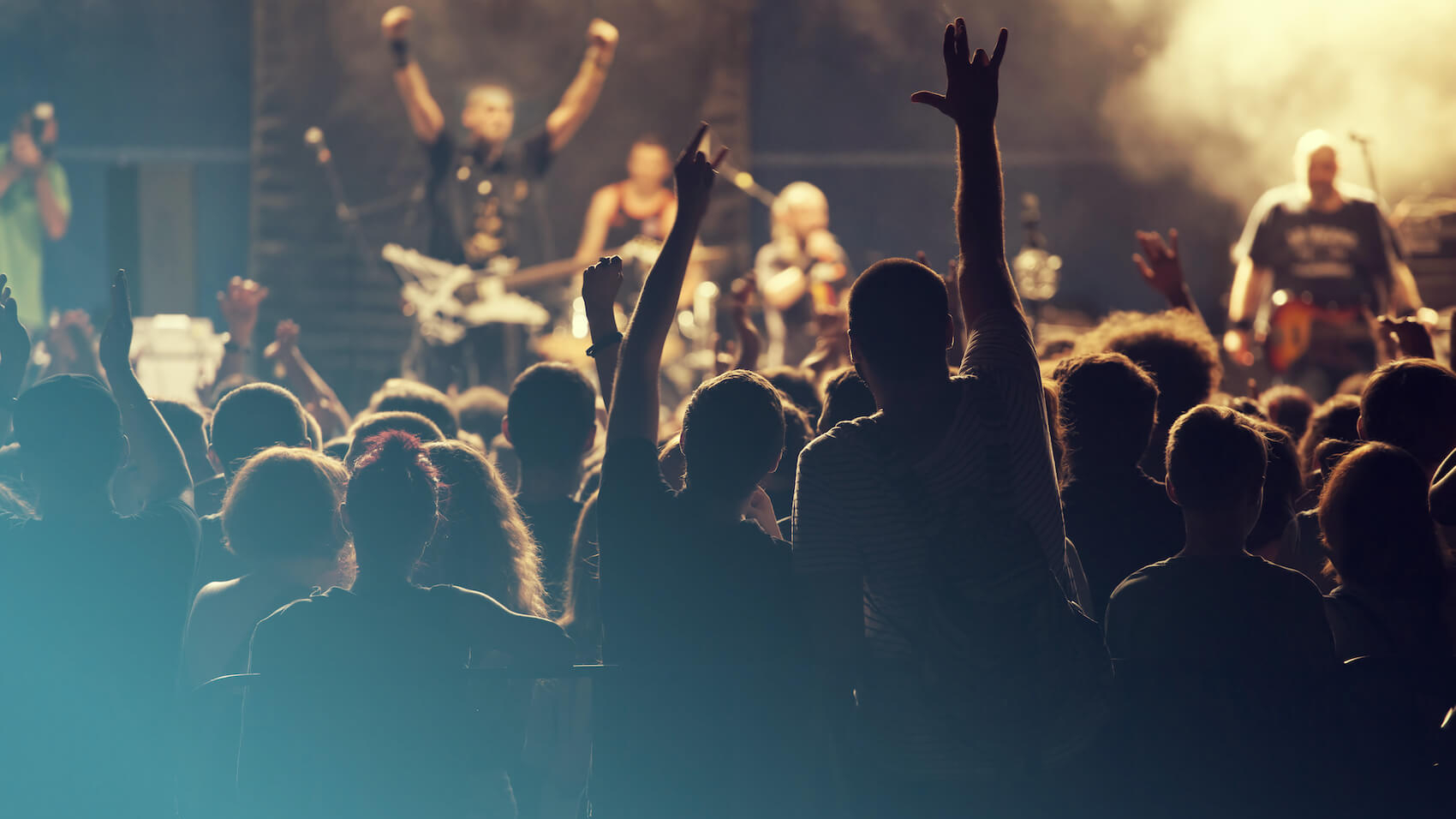
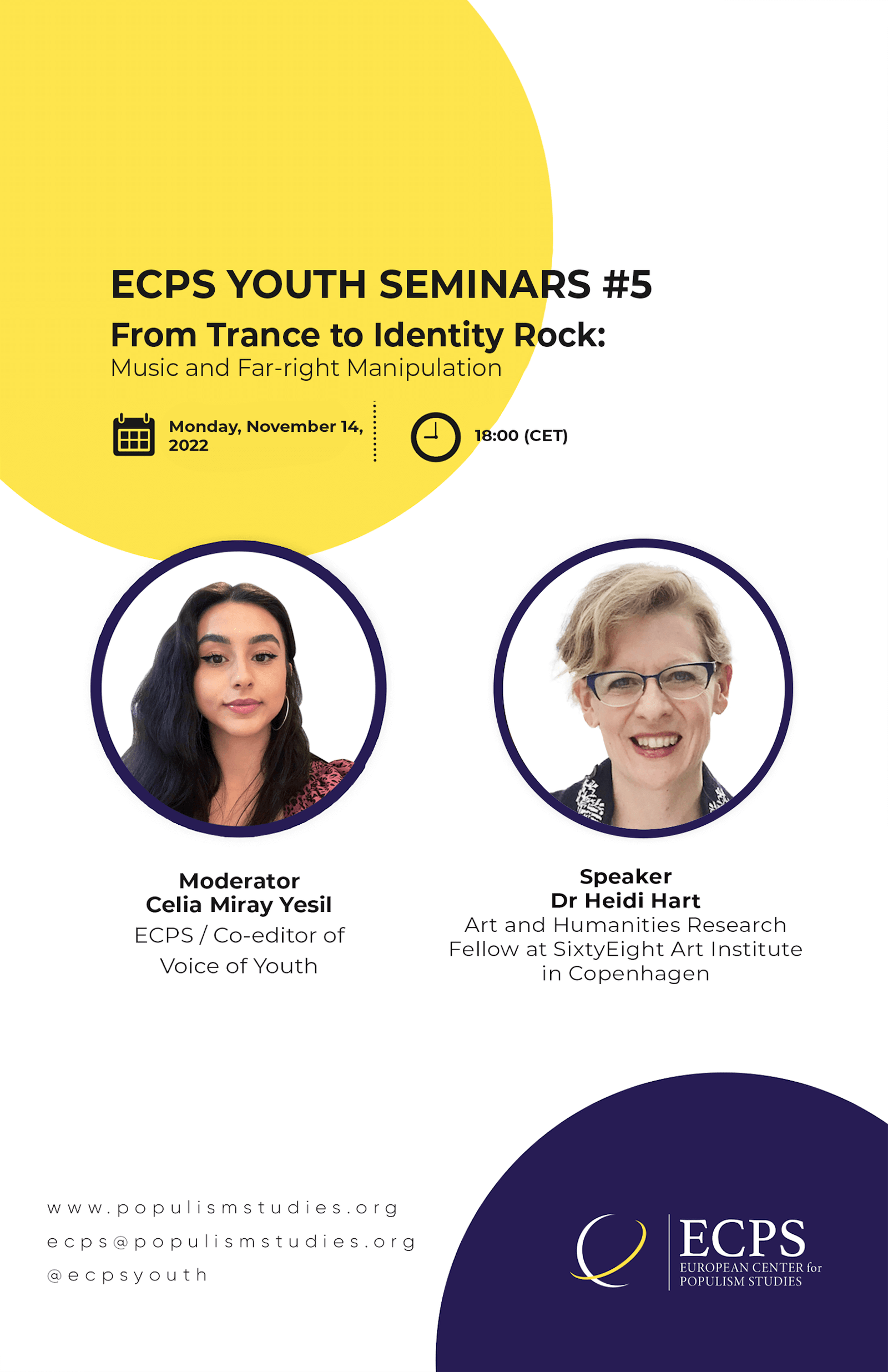
This talk will explore the wide range of musical genres and styles used in populist and particularly far-right propaganda in European context. From feel-good folk songs appealing to young people in Germany to nationalist mehter band music in Turkey and “identity rock” and political chants in Italy, musical forms that appeal to a sense of belonging, heritage, and ressentiment are especially powerful when they hook into embodied cultural associations. Dr Heidi Hart will illustrate the phenomenon of “entrainment” or rhythmic synchronization between body and sound, as well as culturally dependent forms of sonic association that take on new ideological meanings in a world veering toward authoritarianism. Because music can reach the body more directly than text by itself, it is an effective tool for manipulation, especially among young people who are still forming a sense of purpose and identity.
Dr Heidi Hart is an arts researcher based in Denmark and in North Carolina, US. She holds an MFA from Sarah Lawrence College and a Ph.D. in German Studies from Duke University (2016). Her research focus ranges from ideology in words and music to sound and music in environmental art. She has published monographs on Hanns Eisler’s activist art songs and on music in climate-crisis narrative, as well as numerous articles on sound in environmental art, film, and literature. Her book Climate Thanatology was published in August 2022. Dr Hart serves as an Art and Humanities Research Fellow at SixtyEight Art Institute in Copenhagen and as a Non-resident Senior Research Fellow in the Environment & Climate sector of the European Center for Populism Studies. In 2022-23 she will complete the research project, “Instruments of Repair,” with Crawford Foundation funding through the Centre for Intermedial and Multimodal Studies, Linnaeus University, Sweden.
Celia Miray Yesil is a master’s student of International Political Economy at Warwick University. Her undergraduate degree was in European Politics at King’s College London, where she studied the historical background of Europe in the global context. Miray is interested in the impact of far-right populism on foreign policy, the political language of populist leaders, and its political economy.
The 2022 election results from Sweden testify to the fact that the far-right has reached governmental power. The Tidö agreement conveys several illiberal policy recommendations. It seems futile to suggest that the small Liberal party in the government will stop the realization of these policies. The immediate future looks indeed bleak both for Swedish and international politics.
By Anders Hellström*
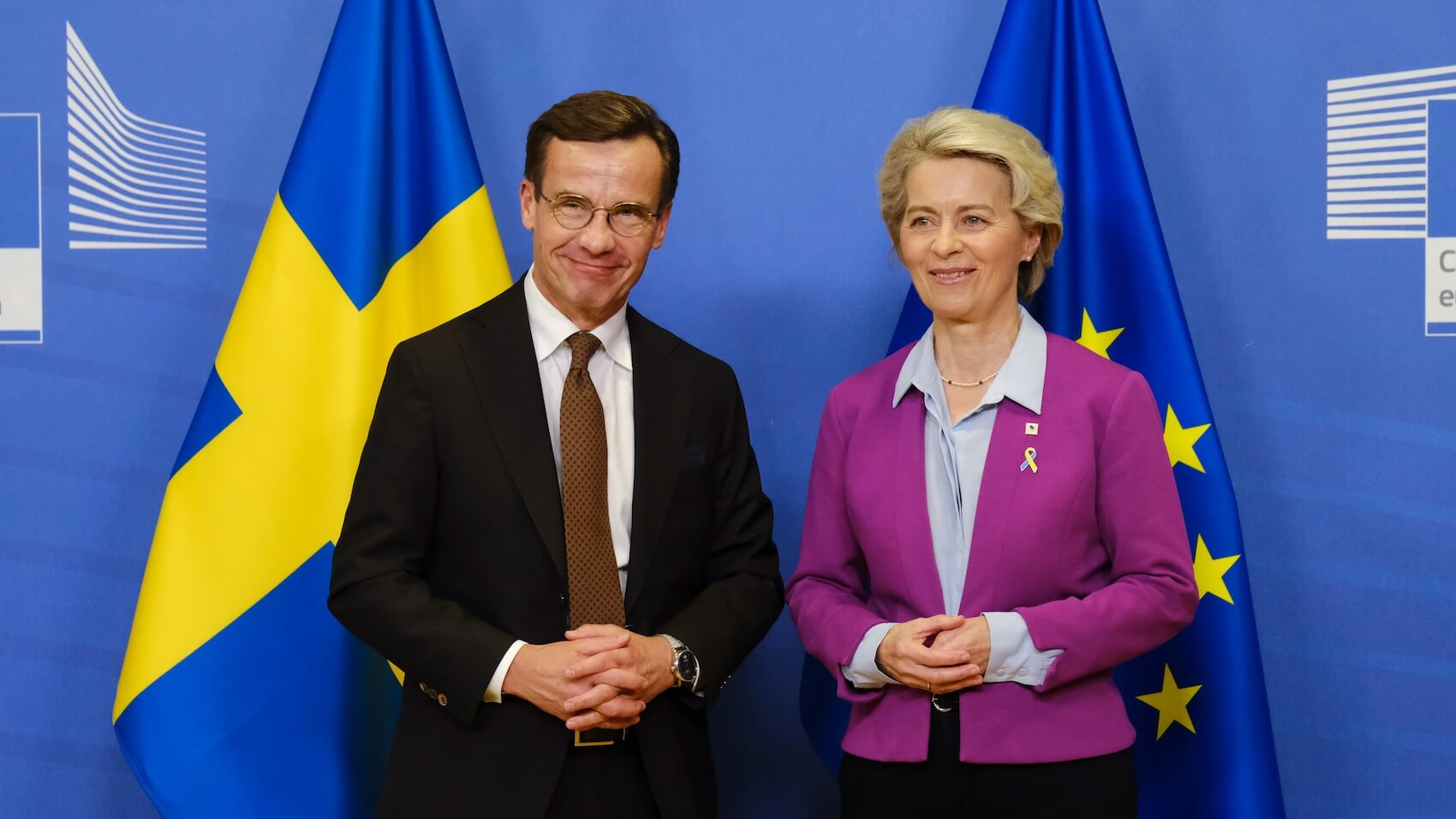
On October 17, 2022, Ulf Kristersson, party leader of Moderaterna, became Sweden’s Prime Minister. He will lead a coalition government, which apart from his own party consists of the Christian Democratic party and the Liberals. The losers (in terms of electoral support) can govern thanks to the support of the Sweden Democrats (SD), founded in 1988 by members of the white Aryan movement, the far-right music industry, and neo-Nazism. In this commentary, I will present three arguments behind why this government took office: 1. Crisis framing; 2. Credibility; and 3. Original versus copy.
From Pariah to Mainstream Party
This rather remarkable journey from the murky shadows of the far right as a pariah party to now become a kingmaker in Swedish politics can thus be understood as sign of populist normalcy, according to Cas Mudde (2019). In short, the mainstream has become extreme.
In 2010, the SD crossed the parliamentary threshold, and its members were seated in the Swedish parliament. Since then, the party’s support has continued to increase. After the 2022 elections, the SD has become kingmaker in Swedish politics. The process of normalization has gone on for decades and is clearly not a new phenomenon, when the SD is now the largest opposition party. What were refuted as extremist views on immigration yesterday have become accepted as mainstream ideas today –common-sense knowledge shared by much of the public, by respectable mainstream politicians, and by editorial writers.
According to Mudde (2019), despite their many differences and failure to communicate a joint common message, the populist parties and movements could be seen before as normal pathologies and normalcounter-reactions. Following Mudde’s genealogy of the development of far-right parties in Europe, the advent of the current wave follows from the eruption of three crises that the far-right parties, electorally, have profited from (ibid: 20). These are the terrorist attacks of September 11, 2001, the Great Recession of 2008, and the refugee crisis of 2015.
The Swedish National Elections of 2022
Let us begin by returning to the national elections Sweden held on September 11 of this year.
According to the editors on a volume about the mainstream right and the populist wave, Tim Bale and Cristóbal Rovira Kaltwasser (2021:11) explained that the mainstream right — although divided between liberals, conservatives, and Christian democrats — hold two main attributes in common: 1. all inequalities in society are natural; and 2. defending existing norms and values is intrinsic to a liberal democratic society.
Moderaterna(19.1 percent of the vote, down 0.74 percent from the last election) adheres toliberal economic policies and usually rallies against high taxes and — in their view — too much public spending. Additionally, the party also espouses conservative values of national defence and the family. Their emphasis in the election campaign was centred on “law and order” — frequently associated with immigration — and investments in nuclear energy. The Christian Democratic party (5.34 percent of the vote, down 0.98 percent) has, traditionally, focused on social welfare. The third party in the government coalition, Liberalerna (4.61 percent of the vote, down 0.88 percent), is internally split between a fraction propagating for high levels of foreign aid (similar to the Christian Democrats), protecting the right to asylum, and generally progressive ideas against a faction who wants to replace the Social Democrats at any costs. The latter fraction won.
Bale & Kaltwasser (2021: 1) begin their book on the mainstream right in crisis by noting that Social Democracy is in decline, while the populist radical right has gained a massive amount of electoral support, especially following the refugee crisis of 2015. While the second assertion is at least partly right (I will return to this later), the first statement does not apply to the Swedish national elections of 2022. The Social Democrats became by far the largest party, with 30.33 percent of all electoral votes (up 2.07 percent from the 2018 elections).
This is confusing. How is it possible that the losing parties are now going to run the country? The answer lies in the results from the far-right party, the Sweden Democrats (SD) who won 20.54% of the vote (up 3.01%) — fewer votes than the Social Democrats but more than Moderaterna. The SD will not take part in the government but is part of Kristersson’s winning team and supports him as the new prime minister.
In the negotiations, the SD was successful at having their own policies elevated into governmental policies (specifically through the Tidö agreement) without having assigned seats in the new government. For instance, foreign aid will decrease, there will no longer be a special department devoted to environmental issues, the quota of refugees to Sweden will decrease from 6400 annually to 900, repatriation programs for immigrants will be encouraged, family re-unification will become harder, and a wage demand will be introduced to limit labour migration. Immigrants also risk expulsion if they misbehave and do not live up to Swedish norms. All these proposals can be found in the election manifesto of the SD and will now become official governmental policies.
Jimmie Åkesson is Happy
SD Leader Jimmie Åkesson is happy. He should be. He appears to have attained a golden seat: not being part of the government but having achieved almost all his party’s political goals without having to take full responsibility for the consequences. The party can remain a radical underdog; at the same time, it can have most of its policies implemented by other parties. Jimmie Åkesson leads, but Ulf Kristersson will be ultimately responsible.
How did this happen? Of course, we cannot foretell the results yet without resorting to speculation. But we can look at what has happened in other countries. Not being part of the government has been detrimental to the Danish People’s Party (currently 3 percent at the polls). Being part of the government has been detrimental to Italy’s Matteo Salvini (party leader of the League), who was deputy minister and interior minister; his party won only 8.9 percent in recent parliamentary elections, clearly beaten by the newly elected prime minister, Giorgia Meloni, whose party Brothers of Italy won approximately 25 percent of the votes. Salvini was in the previous Italian government, whereas Meloni was not. What we learn from this, is that it can be good or bad for a far-right party to be in the government.
Reasons for the Electoral Outcome
We do not know what will happen in the future in terms of electoral support for the SD. But I will now present three reasons for why the SD has continued to gain electoral support.
First: The political agenda centred around gang violence and fuel prices. Even if the crime rate in many categories has declined according to statistics presented by the Swedish National Council for Crime Prevention, the number of murders has increased significantly. More policemen and tougher stances on law and order have been suggested by almost all the parties. If it was depicted as extreme to link this development to immigration and integration ten years ago, it is seen as rather mainstream today. This emphasis on law and order — rather than on the climate crisis, the Coronavirus pandemic, NATO, or the illegitimate Russian invasion of Ukraine– has most benefitted the SD.
Second: When Ulf Kristersson says that the SD was right and warns the Swedish people of the lethal consequences of a generous immigration policy, he also says that a vote for the SD is a credible option. And though other parties now mimic his tone, why should voters prefer the copy over the original?
Three: As mentioned before, all parties present in the new coalition government experienced electoral losses in 2022. Ulf Kristersson, for instance, could have focused on more traditional mainstream right views, like the economy, but he did not. Instead, he continuously linked deplorable murder rates with immigration. When Ulf Kristersson barks, Jimmie Åkesson gains votes.
Hope on the Horizon
It is easy and perhaps also understandable to become puzzled and dispirited about the recent political developments in Sweden. But I would say that there are several reasons to hope
First, a lot of things have changed. Sweden does not look the same today as it did in the past. Society is dynamic and this requires continuous reflection, as well as reconceptualization of the analytical instruments and categories needed for studying contemporary European societies. What became apparent– not least with the refugee crisis of 2015– was the rise of both progressive and regressive forces (Bevelander & Hellström 2019), which cling on to meta narratives of both nostalgia and hope (Norocel et. al 2020).
This isn’t the first-time events have changed values. The resistance to value changes in post-Industrial societies, as a result of the 1968 student protests, was labelled by Ignazi (1992) as the “silent counter-revolution,” which he associated with the rise of Jean-Marie Le Pen and la novelle droite (the new right) in France in the early 1970s.[1]
Second, the crisis, which dominated the electoral campaign in 2022, was based on law and order and the link between criminality and immigration. This link became normal to voters. The climate crisis has attracted massive global attention. In an election campaign, there is only space for one crisis at a time. This brings forward an important lesson: there are several latent crises that might or might not erupt as the crisis in a future election. Empirically, there are many examples of latent movements in Swedish society that want to help refugees to integrate into their new home country (Bevelander & Hellström, 2019). There are examples of countries hostile to immigrants—like Poland—that have become more accepting towards refugees from Ukraine. Additionally, there are today many more companies who would like to invest in fossil-free fuel. According to Margaret Canovan (2005), across history, the “people” has been used as an authority in reserve– “an authority to be drawn on in an emergency…” (ibid: 20).
Third, does the new immigration policy mean a veritable paradigm shift in Swedish politics? The end of Swedish exceptionalism? Maybe – but maybe not. The new policies still need to live up to signed international treaties, such as the Paris agreement and respect the universal and individual right to seek asylum.
The 2022 election results from Sweden testify to the fact that the far-right has reached governmental power. The Tidö agreement conveys several illiberal policy recommendations. It seems futile to suggest that the small Liberal party (which, at the time of writing faces expulsion from the liberal group in the European parliament due to collaboration with the SD) in the government will stop the realization of these policies. The immediate future looks indeed bleak both for Swedish and international politics. What is important to remember is that the future is not set in stone, though. A deeper investigation of progressive elements in civil society shows that there are several emancipatory initiatives and potential latent crises that might pop up and become the crisis in future elections.
(*) Anders Hellström is an associate professor in political science and a senior lecturer in IMER. He is an affiliated member of the research institute Malmö Institute for Studies of Migration, Diversity and Welfare (MIM) at Malmö University. His research interests include discourse theory and representation of migration, populism, and nationalism. He has published widely in academic journals, such as Government and Opposition, Journal of International Migration and Integration, and Ethnicities. His most recent article is “Populism as Mythology of the People: Anti-Immigration Claims in the Swedish Socially Conservative Online Newspaper Samtiden from 2016 to 2019” (forthcoming 2022) and will be made available to open access. His most recent monograph is Trust Us: Reproducing the Nation and the Scandinavian Nationalist parties. His most recent anthology is Nostalgia and Hope: Intersections between Politics of Culture, Welfare, and Migration in Europe together with Ov. Cristian Norocel and Martin Bak-Jørgensen.
References
Bale, Tim. & Kaltwasser, Cristóbal Rovira. (eds). (2021). Riding the Populist Wave: Europé’s mainstream right in crisis.Cambridge: Cambridge University Press. Chapters
Bevelander, Pieter & Hellström, Anders. (2019). “Pro- And Anti-Migrant Mobilizations in Polarized Sweden.” In: Rea, A., Martinello, M, Mazzola, A. and Meuleman, B. (eds.) The refugee reception crisis in Europe: Polarized Opinions and Mobilizations. Bruxelles: Éditions de l´Université de Bruxelles (available open access).
Canovan, Margaret. (2005). The People. Cambridge: Polity.
Ignazi, Pierro. (1992). “The Silent counter-revolution: Hypotheses on the emergence of extreme right-wing parties in Europe.” European Journal of Political Research 22.
Mudde, Cas. (2019). The Far Right Today.
Norocel, Ov Cristian; Hellström, Anders & Bak Jørgensen, Martin. (2020). Nostalgia and Hope: Intersections between Politics of Culture, Welfare, and Migration. Cham: Springer (available open access).
[1] Bale and Kaltwasser (2021) provide further elaboration on the silent-counter revolution and the various manifestations of both reactions and counter reactions to this in different countries.
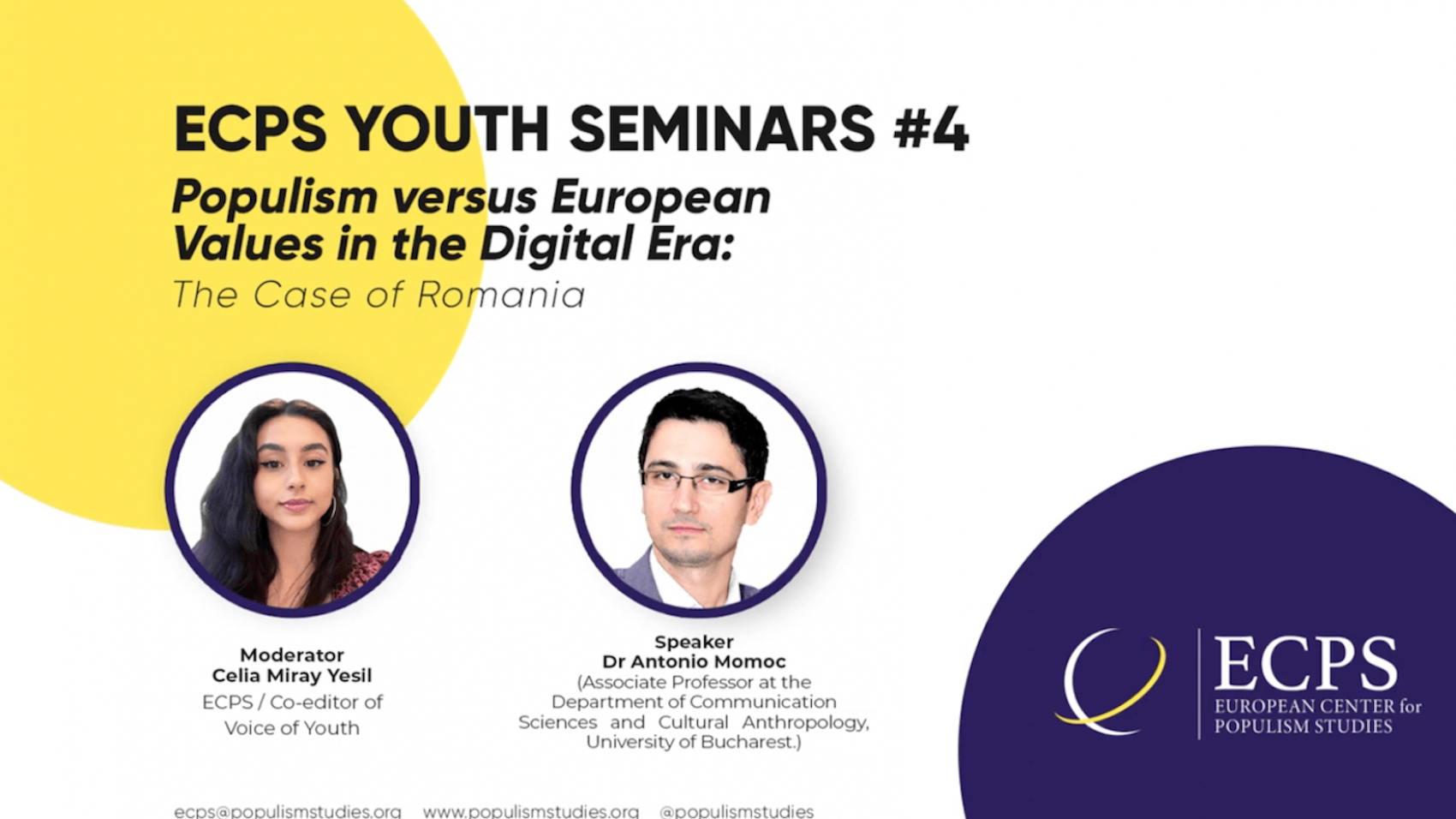
The decline of trust in the political institutions of liberal democracy and in traditional journalism (print, radio, television) has been fueled by populists and anti-liberal ideologies. The rise of digital populism has especially generated “a cultural chaos of fake news” that is tremendously damaging the democratic culture. Populist leaders accused conventional media of generating fake news or of “being fake news.” In Central and Eastern Europe (CEE), the people’s loss of trust in the media amplified as they became poorly financed, unprofessional, increasingly politicised, and partisan. Meanwhile, digital populists successfully convince these people of possible opportunities created by direct democracy thanks to the online environment. At this ECPS Youth Seminar Dr Antonio Momoc speaks on “Populism versus European Values in the Digital Era: The Case of Romania.”
Dr. Antonio Momoc is an Associate Professor at the Department of Communication Sciences and Cultural Anthropology. He is also the Dean of the Faculty of Journalism and Communication Sciences at the University of Bucharest. Dr. Momoc teaches various aspects of communication and media, the new media theories and political communication, fashion, branding and politics, and electoral campaigns.
Moderator Celia Miray Yesil is a master’s student of International Political Economy at Warwick University. Her undergraduate degree was in European Politics at King’s College London, where she studied the historical background of Europe in the global context. Miray is interested in the impact of far-right populism on foreign policy, the political language of populist leaders, and its political economy.
Despite some attempts of extolling individualism, human history has already proven that humans, through cooperation and alliances, can overcome any challenge posed by life. Therefore, ECPS is looking to empower PhD candidates and early-stage post-docs by launching the Early Career Researchers Network (ECRN) platform that ultimately aims at boosting cooperation, knowledge-sharing, and socialization amongst like-minded individuals.
Our contemporary society is becoming increasingly interconnected granting us unprecedented access to international knowledge. Having said that, this has also transformed academia, forcing scholars to become more competitive and innovative. This has resulted in academics having to be constantly up to date with the most advanced methods and theories. Hence, one vital element of current times is carrying out an ongoing dialogue between one’s work and other inspiring thinkers’ insights.
The ECPS recognizes the importance of a constant bilateral exchange of ideas, and it is acting accordingly. This time, we have decided to help PhD candidates and early-stage post-docs to connect, exchange perspectives, and collaborate with other candidates for their professional work. We want to make young researchers an integral component in the mosaic of ideas that are currently explaining the world we are living in.
Young researchers have to face a myriad of challenges and problems when doing their work. Suffering from mental health issues, lacking a professional network or being unaware of job and project opportunities are all concerns that are exacerbated by the solitary nature of research work. This is why belonging to a multidisciplinary network that is comprised of a wide variety of scholars from different fields is believed to be very beneficial to PhD candidates and early-stage post-docs.
With this in mind, we are looking to empower PhD and post-doc candidates by launching an international researchers’ network. We are happy to present our latest initiative: the Early Career Researchers Network (ECRN), a platform for PhD candidates and early-stage post-docs that ultimately aims at boosting cooperation, knowledge-sharing, and socialization amongst like-minded individuals.
What do you gain from becoming an ECRN member?
By becoming an ECRN member, you will get immediate access to inspirational discussions with other scholars from diverse disciplines. Moreover, you will have the chance to propose events aligned with your interests, as well as help in their design, elaboration, and execution. Further, ECRN members will enjoy the possibility of attending seminars, workshops and conferences that will increase their knowledge on multidisciplinary methodologies and new theoretical trends as well as provide them with career advisory focused on both the public and private sectors.
In addition to the aforementioned benefits, this network for PhD candidates and early-stage post-docs will be used to share job opportunities and potential collaborations with the media, specialized magazines, and other research institutes. It will also serve as a reminder for upcoming events, call for papers in academic journals, and deadlines for job applications!
Do you want to contribute to ECRN? If so, do not hesitate to contact us through our email ecps@populismstudies.org if you want more information about the next steps in becoming a member of this network.
Traditionally, caste and religion have been the two most prominent cleavages in India. Before 2014, upper-caste people used to identify strongly with the ideology of Hindu nationalism. However, the rise of Hindu nationalism (Hindutva) and the socio-political mobilization of lower caste people happened during the same period, post-2014, and both received massive public support. It is no longer possible to separate populism from caste, religion, and democracy. Therefore, as Rahul Mukherji noted, Indian democracy is more about populism rather than welfare.
By Saurabh Raj*
One of the historic grounds in the world’s largest democracy and the traditional host of the Jay Prakash (JP) movement[1]—Gandhi maidan, Patna (state capital of Bihar, India)—was full of saffron flags and caps during the 2019 parliamentary elections. A 23-year-old young man who was holding a Bharatiya Janata Party (BJP) flag and had a locket of the Hindu lord Krishna around his neck was shouting, “Modi-Modi-Modi & Jai Shri Ram.”[2] India’s prime minister and the most popular leader Narendra Modi was just about to come on stage. This young man looked impossibly excited to see Modi for the first time. The name of this young boy was Rakesh Yadav (his first name has been changed). Yadav belonged to the “Yadav caste”—socially and politically one of the most influential and historically disadvantaged[3] castes in Bihar.
Being a Yadav and cheering for Modi tells a lot about the shift happening in the socio-political landscape in India: this caste used to be traditional voters for their caste group leader, like Lalu Yadav. Any political scientist would have been surprised to see that many youths like Rakesh Yadav from the Yadav caste would have shifted their political leaning towards Bharatiya Janata Party (BJP) from the Rashtriya Janta Dal (RJD). Like any curious and politically active citizen, I asked Rakesh Yadav, “Why are you here? I mean shouldn’t you be at Tejasvi Yadav’s (the son of Lalu Yadav) rally?” He bluntly told me, “Bhaiya jaat-paat bahut dekh liye, ab desh aur dharam dekhna hai”—I am done with caste politics and now it’s time to focus on my religion.
His prompt answer was a surprise: caste has always been an integral part of the Indian political system, and most of the voters used to prefer only voting for their caste leaders. Nevertheless, Narendra Modi’s populist Hindutva[4] nationalism changed the caste calculus in Bihar to some extent; religion has become a wider political plank. One could not imagine that a Yadav would vote against Lalu Prasad Yadav and his party Rashtriya Janta Dal. Also, if someone would vote, she/he couldn’t afford to be vocal about this before 2014.
Narendra Modi’s populist style of leadership has changed the socio-political equations in the world’s largest democracy. The line of caste has been blurred, and “caste populism” has been taken over by “Hindu nationalist populism,” at least with respect to electoral behaviour. This is one of the biggest shifts in Indian democracy we have witnessed. Before 2014, especially in North Indian states, caste played a primary role in voting behaviour; this has changed (Verniers, 2022). This article attempts to understand this shift and its implications for democracy in India, specifically through the lens of populism. The first part will discuss layers of populism, giving examples from the caste system to understand Hindu populism. In the second part, I will discuss caste populism and my focus will be specifically on the Yadav community. The third part will explain the rise of Hindu populism and its implications for Indian democracy. I will end by looking at the contemporary impact on democracy of these two cleavages.
Indian Democracy and Populism
Caste and religion are the two most prominent cleavages in Indian democracy. There are six main religions, around 3000 castes, and more than 25,000 sub-castes in India (BBC News, 2019). These groups were united under the same roof post-independence, in 1947; democracy was described as “perhaps the only mechanism to hold India together” (Mehta, 2017). Nonetheless, these cleavages have often influenced Indian democracy. The question of the rights of the Scheduled Caste and Scheduled Tribes (the lowest and the historically disadvantaged groups) was settled right after independence: they were granted reservation as a constitutional right. But the concerns of historically disadvantaged classes/castes—also known as Other Backward Classes, or OBCs[5]—and religious minorities were left unaddressed, as their demands for reservation were unfulfilled. Due to such diverse pluralism and these unaddressed concerns, populism has played a crucial factor in maintaining the existing social frictions in Indian democracy. Political parties, caste leaders, and religious groups are used as tools to mobilize one group against another.
After the 1970s, historically disadvantaged class leaders started mobilizing and demanding their rights, and Yogendra Yadav called this “the second democratic upsurge” (Yadav, 1996). During this period, democracy had taken social root, and many unheard communities started speaking out. Nonetheless, community leaders also made it a battle between the “forward caste vs historically disadvantaged castes.” The Hindu-Muslim fight had already been an integral part of democracy. Therefore, it is difficult to separate the element of “populism” from caste, religion, and democracy. According to Rahul Mukherji, Indian democracy is more about populism rather than welfare (Mukherji, 2014). The author argues that post-independence policies cater to the electoral voter bank instead of promoting the equitable welfare of the masses.
Caste Populism and the Socio-political Rise of Yadav
The Mandal commission movement (a movement to demand reservation in government jobs for historically disadvantaged caste groups) was largely led by the Yadav community in Uttar Pradesh (UP) & Bihar during the 1980s. Leaders like Mulayam Singh Yadav and Lalu Yadav mobilized the historically disadvantaged classes (OBCs). After the successful implementation of the B.P. Mandal recommendations, (27 percent of central and state government jobs should be reserved for OBCs), the Yadav community suddenly emerged as a hero among the OBCs and lower caste people. In one of the largest states in India, Bihar, Yadav is the largest caste, with more than 14 percent of the population.
Lalu Yadav founded Rashtriya Janta Dal (RJD) in 1997. RJD is an entirely Yadav caste-dominated political party, most prominent in Bihar. He mobilized Yadav, Muslims, and some other castes and formed a formidable equation to win elections.[6] He raised a popular slogan against upper caste people: “bhoora baal saaf karo” (Removing the Brown Hair)—a Hindi slogan referring to acting against upper castes[7]—to win elections. His populist rhetoric separated society into two separate groups: “the forward caste vs the historically disadvantaged caste.” His populist style of campaigning helped in the mobilization of the historically disadvantaged castes. He became the first OBC chief minister in Bihar, and the socio-political structure changed irrevocably. “When a caste captures the space in the political space as ‘samaj (society)’ is mobilized by a political party, rather than weakening the democratic process, it actually strengthens and deepens it” (Michelutti, 2020), and this is exactly what happened in Bihar.
After becoming the Chief Minister of Bihar, Yadav gave special attention to the Yadav community and used democracy as a tool in their socio-economic uplift. The Yadav were given preference in government jobs. There used to be special wards for Yadavs in public hospitals, where they received free treatments. A caste that had been unheard of and unrepresented in Indian democracy since independence suddenly started ruling one of the largest states in India.
This would’ve been impossible without the Yadav’s electoral alliance with Muslims, forged during the 1990s. This was an important shift that changed the socio-political landscape of democracy in India.
The political rise of Yadav also influenced other castes as well. Many lower castes started speaking out, and beliefs in Indian democracy deepened as the ‘elite capture’ of political spaces started disseminating and trickling down to the masses. Ram Vilas Paswan founded a Scheduled caste-dominated political party—Lok Janshakti Party—in 2002, and Nitish Kumar founded Janta Dal United—largely a Kurmi-based[8] party—in 2003. The power dynamics shifted from upper-caste people to historically disadvantaged castes.
Local people throwing flowers on Volunteers of Hindu nationalist Rashtriya Swayamsevak Sangh (RSS) during march past in Vasundhara, Ghaziabad, Uttar Pradesh on October 19, 2018.
Hindu Nationalism and the New Caste Calculus
The Ram Temple movement[9] was a game-changer for India’s politics. This movement is partly responsible for the rise of both the BJP and Hindu nationalism. In a 1991 manifesto, the BJP promised to construct the Ram Temple to restore a symbolic righting of historical wrongs and to end the long and unhappy chapter of the supposed Muslim suppression of Hindus. Since the Ram Temple was highly sensitive, with a strong religious and emotional meaning, even non-BJP parties like the Indian National Congress, Samajwadi Party, and Bahujan Samajwadi Party, did not openly oppose the idea of constructing the temple on controversial land—even though many of those parties relied on Muslim electoral support (Rashid, 2021). Between 1989 to 1991, during the Ram Temple movement, the BJP saw the biggest jump in its vote share: it increased its stake 1.8 times, winning 20.1 percent of the vote nationally (Kishore, 2019). This made the BJP a national player in Indian politics and mainstreamed the sentiment of Hindu nationalism.
Nevertheless, despite its significant rise, the BJP was known as the party of Brahman and Bania (the upper and privileged caste groups of the Hindu community). Hindu nationalism was viewed as an upper-caste movement. The rise of Hindu nationalism and the socio-political mobilization of lower caste people happened mostly in the last decade (Jaffrelot, 2002). During the parliamentary elections in 2014, the BJP successfully mobilized non-Yadav historically disadvantaged groups’ votes in their favour, all while running on the plank of Hindutva. Under the umbrella of Hindutva, Narendra Modi played the ‘politics of presence’ card to attract other castes, many of whom felt unrepresented during the wave of caste populism. According to KM Panikkar, “many social groups earlier unaware of this political change suddenly realized their strengths…that even they can also come to power” (Mehta, 2017).
The image of Modi as a chaiwala (tea seller) who could become the Prime Minister resonated with the lower strata of society; he was their voice as opposed to the elite Congress which was caught in several scams in 2014.Many ‘backward’ castes like Kurmi, Koeri, Kushwaha, etc. could not get a share in power in the state or central governments. BJP tapped this unfulfilled desire and mobilized these castes against Yadav in the UP. The Lokniti-CSDS survey data suggests that this new social engineering of Hindu nationalism has worked quite well. BJP bagged over 40 percent of the OBC votes in the 2019 parliamentary election (Banerjee, 2018). BJP mobilized these castes against Yadav and Muslims, specifically on the plank of Hinduism, and united a more extensive section of castes under the umbrella of Hindu nationalism. For instance, the BJP’s main promise in 2014 was employment and everyone’s social and economic development (“Sabka Sath, Sabka Vikas”). However, in 2019 the BJP’s main electoral agendas were aggressive nationalism (as there was high tension between India and Pakistan)[10], the construction of the Ram Temple, and the abrogation of article 370.[11] As per the study, Modi’s speeches focused on aggressive national security, and the vote share of the BJP increased by 4.6 percentage points in the home constituencies of soldiers killed in the India and Pakistan violence (Arya & Bhatiya, 2021).
Hindus have rarely, if ever, been so united post-independence. This unity also influenced the Yadav community to some extent. Data from the Trivedi Political Centre, Ashoka University, suggests that the BJP-NDA alliance has more than 50 Yadav MLAs (Members of the Legislative Assembly) in their camp, which is around 23 percent of the total MLAs in the Bihar state assembly (Nissa, 2020). The major takeaway from this data is that Hindu nationalist populism has blurred the line of caste populism, and a large section of the population has started identifying more with religion than caste. I believe the Narendra Modi-led BJP understood the new aspirations of these social groups earlier than other opposition political parties. As many opposition parties, including the Indian National Congress, are seen as pro-Muslim parties, Modi establishes this narrative among the majority of Hindus in his electoral speeches (Rao, 2018). Therefore, they are able to form new social identities under the umbrella of Hindu nationalism.
New Power Dynamics and a Majoritarian Democracy
This new caste calculus has directly influenced the nature of Indian democracy, and I believe now all political parties want to dock with “the majoritarian horse” and mobilize Hindus against others. For instance, while all political parties used to appease Muslims for their votes, Muslims are now mostly ignored. This is also reflected in the Modi government’s policies like CAA-NRC[12], the abolition of article 370, etc. Recently, the Samajwadi Party leader and a very well know Yadav, Akhilesh Yadav said, “Lord Krishna comes in his dreams every night and tells that he will set up Ram Rajya (the rule of Lord Ram) in Uttar Pradesh” (Press Trust of India, 2022). By using the names of Lord Krishna and Ram together, even he is also trying to fuse Yadav and the entire Hindu community together for the coming UP state assembly election. Congress leader Rahul Gandhi also started visiting temples across the country and claimed that he is a Kashmiri Brahmin (The Economic Times, 2018).
Changes in socio-political power relations and the expansion of democracy across the castes and communities have penetrated the Indian political imagination and have “begun to corrode the authority of the social order” (Khilnani, 1999). There should not be any debate in saying that democracy has changed the fate of many lower castes in India. Many unheard voices have been heard and shared in state power. But this current form of Hindutva nationalism’s populist politics has overshadowed other cleavages within Indian democracy like Muslims, Tribals, etc. Hindus have mobilized and have also started voicing their unheard historical pain[13] and grief against the imposition of “secular India” on them.
Nevertheless, what about those who have been left behind because of this democratic upsurge? What about the largest minority of the world’s largest democracy—a group currently living under fear and threat? If democracy is perhaps the only tool to hold India together, then why is it failing to provide a safe environment to other minorities like Muslims, Tribals, and women? I don’t know what the solution is. I am not sure whether there is a need for another democratic upsurge or not, but I firmly believe that the solution lies in democracy itself. As in the words of PB Mehta, “When we praise or blame democracy, we are often like the person looking for his lost key under the lamp post—not because he has lost it there, but because it is bright there.”
(*) Saurabh Raj is a student of M.A. in Public Policy & Governance at Azim Premji University, India. He was also a participant in ECPS Civic Leadership Program, in 2021. His area of interest is party politics, far-right populism, and electoral & democratic reforms. He has also work experience in political and democratic reforms for more than five years.
Arya, Y. & Bhatiya, A. Y. (2021). “The Salience of Political Messages: Evidence from Soldier Deaths in India.” SSRN Electronic Journal. https://doi.org/10.2139/ssrn.3955198
Mehta, P. B. (2017). Burden Of Democracy. India Penguin.
Michelutti, L. (2020). The Vernacularisation of Democracy. Taylor & Francis.
Mudde, C., & Kaltwasser, R. C. (2017). Populism: A Very Short Introduction (Very ShortIntroductions) (2nd ed.). Oxford University Press.
Mukherji, R. (2014). Political Economy of Reforms in India: Oxford India ShortIntroductions (Oxford India Short Introductions Series) (1st ed.). Oxford University Press.
Yadav, L. P. (2019). Gopalganj to Raisina Road (Hindi Edition). Rupa Publications India.
Yadav, Y. (1996). “Reconfiguration in Indian Politics-State Assembly Elections, 1993-95.” In: Economic andPolitical Weekly: Vol. Vol. 31 (Issue Issue No. 2-3).
Footnotes
[1] The JP (Jay Prakash) movement was against Emergency and the Indira Gandhi-led Congress government in 1975-77. It was the first nation-wide movement against the Indian National Congress post-independence.
[2] Lord Sri Ram is a mythological Hindu God, and the slogan “Jay Shri Ram” has become a war cry of the BJP against Muslims.
[3] I will be using “historically disadvantaged groups” to refer to Other Backward Classes (OBCs) in this piece-
[4] A modern political ideology that advocates for Hindu supremacy and seeks to transform India into a Hindu nation (Outlook India, 2022).
[5] The Indian Constitution categorizes three classes in India – Forward/Upper caste, Other Backward Caste and Scheduled Caste and Tribes
[6] Electoral alliances between Muslims (17%) and Yadav (14%).
[7] BhooRa Baal represents four upper castes of Bihar – Bhumihar (Bhoo), Rajput(Ra), Brahman(Baa), and Lala(L).
[8] Kurmi is also one of the influteinal castes in Bihar after Yadav and they also belong to the historically disadvantaged class
[9] Ram is Hindu mythological god and Hindus believe that Ayoydhya was his birthplace, where Babri Mosque was built. Hindutva supporters demolished Babri Mosque in 1992. The case about Ram Temple eventually went to the Supreme Court of India. Recently, Hindus won the case, and the Ram Temple construction got a green light to proceed.
[10] A terrorist attack on an army convoy in Pulwama (Kashmir) in 2019 just a few months before the parliamentary elections of 2019. In response, the Modi government launched counter airstrikes in Balakot (Pakistan Occupied Kashmir).
[11] The 1954 presidential order constituted a founding legal document for Jammu and Kashmir (as it was a disputed land between India and Pakistan at that moment); Article 370 and 35A protected the exclusive law—such as the bar on outsiders buying property and women marrying non-Kashmiris losing their property rights—of the State. The Modi Government revoked this in 2019.
[12] CAA stands for Citizenship (Amendment) Act (2019) that was passed in Parliament on December 11, 2019. The Modi government amended the Citizenship law to grant citizenship to religious minorities of Afghanistan, Pakistan, and Bangladesh but not Muslims (Press Information Bureau, 2019).
[13] The narrative of the politics of Muslims’ appeasement. BJP claims that Congress was/is a pro-Muslim party. Hence, Hindus’ concerns were ignored by the Congress governments in the name of secularism.
Sharp Power is a new concept that emphasizes the policy transition from “soft” to “hard” in a global/local context. The European Centre for Populism Studies (Brussels), in collaboration with the Alfred Deakin Institute for Citizenship and Globalization (ADI), and Deakin University (Melbourne), is proud to announce a new Talk Series on the topic of Sharp Power.
Public and cultural diplomacy are hugely employed by global powers to project their soft powers. In the hands of autocratic regimes, these concepts have been instrumentalized to serve autocratic interests. Such autocratic regimes have widely used the concepts of public diplomacy and cultural diplomacy to achieve their foreign policy objectives.
Sharp Power is a new concept that emphasizes the policy transition from “soft” to “hard” in a global/local context. Chris Walker and Jessica Ludwig defined sharp power as authoritarian influence techniques used by countries such as China and Russia that, while not openly coercive, are also not “soft.”
The European Centre for Populism Studies (Brussels), in collaboration with the Alfred Deakin Institute for Citizenship and Globalization (ADI), and Deakin University (Melbourne), is proud to announce a new Talk Series on the topic of Sharp Power. These series aim to explore and broaden the existing scholarship on ‘sharp power,’ an innovative and emerging field of research.
Having found a gap between the concepts of hard- and soft-power, scholars from across many disciplines have sought to dissect the authoritarian regimes’ new and harmful tactics and activities in third countries. Thus, the concept of sharp power is developed to frame harmful transnational activities of some certain, authoritarian powers, predominantly coming from countries like Russia and China. This growing scholarship has the additional vocation to alert liberal democracies against the subversive activities of authoritarian regimes who are hostile to democratic institutions and values that they seem as existential threats to their ‘authoritarian values’ and stability of their regimes.
The talk series will make up of eight live-streamed seminars every Wednesday starting from October until mid-December. The live streams will be also published on the YouTube channel. During the sessions, theoretical background, country contexts (China and Russia), European and Asian cases, impacts on digital environment, and human rights perspectives will be held by distinguished experts in the field.
Event I – Seminar
Christopher Walker: “Authoritarian mobilization and sharp power”
Wednesday, November 9, 2022 / 12:00 (CET)
China, Russia, and other countries ruled by repressive regimes have dramatically scaled up their investment into spheres commonly associated with soft power, including into media, education, technology, and entertainment. Most free societies are still not adequately prepared to meet the multidimensional sharp-power strategies applied by China, Russia, and like-minded states. Open societies will be vulnerable so long as they maintain a blind spot about the compromising and corrosive aspects of such forms of authoritarians’ outward-facing influence.
Christopher Walker is Vice President for Studies and Analysis at the National Endowment for Democracy, an independent, nonprofit foundation dedicated to the growth and strengthening of democratic institutions around the world. In this capacity, he oversees the department that is responsible for NED’s multifaceted analytical work. Prior to joining the NED, Walker was Vice President for Strategy and Analysis at Freedom House. Walker has testified before legislative committees, appears regularly in the media, and frequently conducts briefings on critical issues relating to democratic development.
Walker has been at the forefront of the discussion on authoritarian influence on democratic systems. His articles have appeared in numerous publications, including the Financial Times, Wall Street Journal, New York Times, Washington Post, Foreign Affairs, and the Journal of Democracy. He is co-editor (with Larry Diamond and Marc Plattner) of the edited volume Authoritarianism Goes Global: The Challenge to Democracy (2016), and co-editor (with Jessica Ludwig) of the reports Sharp Power: Rising Authoritarian Influence (2017), and Sharp Power and Democratic Resilience (2021). His article, “Rising to the Sharp Power Challenge,” appears in the October 2022 issue of the Journal of Democracy.
Event II – Seminar
Gavin Wilde: “Russia’s information warfare as regime insecurity”
Wednesday, November 16, 2022 / 11:00 (CET)
If a unified theory of Russian information warfare exists, its core tenet might well be its historic indivisibility from regime security in Russian strategic thought. Rather than as an aggressive or expansionist expression of Moscow’s foreign policy, the Kremlin’s “information war” should primarily be viewed through a domestic political and security prism—as much a counterinsurgency as an expeditionary strategy, less an escalation than a projection.
Gavin Wilde is a senior fellow in the Technology and International Affairs Program at the Carnegie Endowment for International Peace, where he applies his expertise on Russia and information warfare to examine the strategic challenges posed by cyber and influence operations, propaganda, and emerging technologies. He previously served on the US National Security Council, and in analytic and leadership roles in the US intelligence community for 15 years—including as a coauthor of the IC assessment of Russia’s interference in the 2016 presidential election. He is also an adjunct lecturer on information conflict at the Johns Hopkins University School of Advanced International Studies.
Event III – Seminar
Julia Bader: “The Chinese Communist Party’s international networks”
Wednesday, November 23, 2022 / 11:00 (CET)
The talk addresses a largely overlooked actor in China’s foreign relations, the International Department of the Communist Party of China. Building on an intense travel diplomacy, the ID-CPC maintains a widely stretched network topolitical elites across the globe. The ID-CPC’s engagement is not new; but since Xi Jinping took office, the CPC has bolsteredits efforts to reach out to other parties. Party relations not only serve as an additional channel to advance China’sforeign policy interests. Since President Xi has come to power, party relations also emerged as a key instrument to promoteChina’s vision for reforming the global order. Moreover, China increasingly uses the party channel as a vehicle of authoritarianlearning by sharing experiences of its economic modernization and authoritarian one-party regime. The cross-regionalanalysis of the CPC’s engagement with other parties helps us to better understand the role of the CPC in Chinese foreignpolicymaking, pointing to a new research agenda at the intersection of China’s foreign relations, authoritarian diffusion, andtransnational relations.
Julia Bader is Associate Professor in the Department of Political Science at the University of Amsterdam. Before joining UvA in July 2012, she worked as a research fellow at the German Development Institute / Deutsches Institut für Entwicklungspolitik (DIE) in Bonn (Germany). Dr Bader holds a MA in Politics and Management from Konstanz University and a PhD in Political Science from Heidelberg University.
Dr Bader’s research focuses on China’s foreign relations, regime transition and autocratic stability, international relations and foreign policy, development assistance and human rights. Dr Bader is the author of the monograph China’s Foreign Relations and the Survival of Autocracies which has been published with Routledge. Her work has appeared in academic journals such as International Studies Quarterly, European Journal of Political Research, Journal of Peace Research, Foreign Policy Analysis, Democratization, International Studies Review, Contemporary Politics, and in several collective book projects. Her research on the Chinese Communist Party’s International Department has been featured in The Economist and in the South China Morning Post. She has been interviewed for the VPRO’s Tegenlicht Future Shock Podcast (in Dutch).
Event IV – Seminar
Vincent Charles Keating: “Sharp Power, or something more? Conceptualizing Russian influence beyond ‘unwanted flows of information’”
Wednesday, November 30, 2022 / 11:00 (CET)
Sharp power is one of several recent attempts to conceptualize the influence that illiberal states have on liberal states. Characterized as not ‘hard power,’ involving direct military or potentially economic coercion, sharp power attempts to theorize coercion, that although not as severe as hard power, nonetheless has the potential to undermine and damage liberal states. This talk aims to show how this conceptualization of illiberal state influence, one that can be grouped together with other similar concepts under the heading ‘unwanted flows of information,’ has led to a cognitive blind spot in our understanding of the scope of Russian influence in the West. By focusing on manipulation and subversion, it rejects the possibility that the messages coming out of the Russian state can be more than this – that they can also be ideologically attractive. In making this claim, this talk suggests that we need to characterize the influence of illiberal states not simply as ‘unwanted flows of information,’ such as sharp power, but consider how the influence is also ideological, and how that changes how we might think of solutions to this problem.
Vincent Charles Keating is an Associate Professor and Head of Section for International Politics, Center for War Studies, University of Southern Denmark. He holds an MSc in Nationalism Studies from the University of Edinburgh and a PhD in International Politics from Aberystwyth University. Dr Keating’s co-authored work on Russian soft power has been published in International Politics and the Journal of International Relations and Development. Before coming to SDU, he held a previous position at the University of Durham and has been an invited guest professor at Université Paris-Panthéon-Assas (Paris II). In addition to Russian soft power, Keating’s research spans a number of other topics, including the challenges of the War on Terror on international human rights, the role of trust and distrust in international security, and how international non-governmental organizations maintain their global legitimacy.
Event V – Panel
Tihomira Doncheva, Viktor Denisenko and Grigorij Mesežnikov
Wednesday, December 7, 2022 / 11:00 (CET)
Viktor Denisenko: “Kremlin’s information war against the ‘collective West’: View from Lithuania”
The Baltic States, including Lithuania, were between first states that faced attacks of re-born Kremlin propaganda in the 90s of the XX century. Many narratives (about discrimination of Russian-speaking communities, neo-Nazism, Russophobia) used later against Ukraine firstly were tested in information warfare against Lithuania (as well Latvia and Estonia). Today, the challenge of Kremlin information warfare become very hot not only for former Soviet states. Moscow is waging a global information war against the “collective West”. In this situation very important is to discuss traditions (i.e. some stable narratives) and transformations (i.e. vanished boundaries between disinformation and diplomacy) of Kremlin propaganda and disinformation.
Viktor Denisenko is an Associate Professor at General Jonas Žemaitis Military Academy of Lithuania and Vilnius University. He got PhD in communication and information in 2016 at Vilnius University. The field of his scientific and professional interests includes propaganda, information warfare, and political communication. Viktor Denisenko is the author of the book “In the Encirclement of Propaganda” (Vilnius University Press, 2021).
Grigorij Mesežnikov: “Russia’s sharp power in post-communist Europe: From disinfo narratives to military aggression”
Promoting its interests abroad, Russian state does not focus primarily on championing their own positive, attractive and viable alternatives but rather on undermining and destroying socio-political models that exist in the countries where it tries to advertise its concepts, therefore such a model of asserting influence abroad can be referred to as “sharp power.” Russia strives to debilitate or dismantle liberal democracy as a system, which is why it considers almost every enemy of liberal democracy around the world and particularly in Europe, including central Europe to be their ally – either a strategic or a situational.
The mission of Russian sharp power mechanism is to encourage mutual mistrust between people, relativize distinctions between democratic and non-democratic systems of government, blur differences between facts and fiction, between truth and lies, between trustworthy knowledge and its “alternative” interpretations in peoples’ perception and thus create an atmosphere of precarity. Since 2014, the year of annexation of Crimea and occupation of part of the Eastern Ukraine, Russia is leading the information aggression against the post-communist Central European countries. Actors of this aggression try to spin the narratives that the very concept of liberal democracy is not suitable for Central European nations, that it is obsolete and should be replaced by another concept based on national, traditional, conservative, collectivist and ethnic values. According to such and interpretation, liberal democracy is not a system that creates optimum conditions for citizens’ freedom, democratic system of governance and implementation of human rights but rather merely a tool to promote power interests of large states while simultaneously harming vital interests of small European nations. Sharp power is a tool used by Russian expansionist authoritarian regime in efforts to reach its ultimate goal – to disconnect Central European nations from the West, to revise and reverse the results of their transformation processes and thus to reconstruct the past.
Grigorij Mesežnikov is a political scientist, president of the Institute for Public Affairs (IVO), Bratislava, Slovakia. He has published numerous expert studies on party systems’ development and political aspects of transformation in post-communist societies, illiberal and authoritarian tendencies, populism, extremism, nationalism and hybrid threats in various monographs, collections and scholarly journals in Slovakia and other countries. He regularly contributes analyses of Slovakia’s political scene to domestic and foreign media. Since 1993, he has been an external correspondent for Radio Liberty/Radio Free Europe. He has edited and authored dozens of books, including the Global Reports on Slovakia (1995 – 2011), the comprehensive analysis of country’s development in all relevant sectors of society. He was a key author of the report on Slovakia in Nations in Transit published by Freedom House (1998 – 2014). In 2006 he was awarded by Reagan-Fascell Fellowship by the National Endowment for Democracy (Washington, D.C.), in 2012 he was a research fellow of Taiwan Fellowship Program at the Department of Political Science of National Taiwan University in Taipei where he researched similarities and differences of democratization and civil society development in Taiwan and in Central Europe. In 2019 – 2020 he was a fellow of the Institute for Human Science – Institut für die Wissenschaften vom Menschen (Vienna) at the Europe’s Futures program.
Tihomira Doncheva: “Russia’s footprint in the western Balkan information environment”
This talk will be about information influence activities in the Balkans as an example of sharp power. Doncheva will go in-depth into what are some of the factors that enable information influence activities, as well look into specific examples of Russian case.
Tihomira Doncheva is director of Center for Information, Democracy, and Citizenship (CIDC). She is an experienced communicator, researcher and project manager on multi-disciplinary topics related to the problems and challenges, opportunities and values of a liberal democratic society. She has joined AUBG in the summer of 2022, heading the university’s flagship initiative to reinvigorate AUBG’s founding mission. Through the CIDC, Doncheva aims to educate students and interested stakeholders to be engaged, informed, critical democratic citizens who will be committed to the rule of law, pluralism and inclusiveness, and open discussion, free press, and respect for human rights.
Doncheva has worked as a journalist for one of Bulgaria’s most professional media outlets, Capital, and has been a Researcher for the NATO Strategic Communications Center of Excellence in Riga, working on malign influence across the Western Balkans. Over the last three years, she worked for a strategic communications company based in London, the UK, where her portfolio included a variety of projects from countering disinformation and propaganda, media development and information resilience, to countering violent extremism and terrorism in countries across the Middle East, Africa, Eastern Europe, and Central Asia. She is a published author of reports on information influence activities in the Western Balkans and has also developed two separate apps on countering disinformation for journalists.
Tihomira has a First-Class Honours BA degree in Journalism from the University of Robert Gordon (Aberdeen, the UK) and a BA Honours degree in Europe in the World from the Hogeschool Utrecht and the Danish School of Media and Journalism (Utrecht, the Netherlands and Aarhus, Denmark). She has also completed an MA degree in Strategic Communications from the War Department at King’s College London (London, the UK).
As the Director at the newly founded CIDC, Doncheva will focus her efforts on strategizing and developing the CIDC as a think, talk, and act platform to provide academic opportunities for students and faculty, to generate new resources in collaboration with the civil society, business and public sector, and elevate AUBG as the go-to place for shared resources, partnerships, research and advocacy efforts within Bulgaria and the region.
Event VI – Panel
Ibrahim Öztürk and Imdat Oner
Wednesday, December 14, 2022 / 12:00 (CET)
Ibrahim Ozturk: China’s heading towards sharp power politics
Sharp power is defined as the ability of countries to influence others to achieve the desired outcome, not by attracting them as in soft power, but by influencing them, disseminating and manipulating information. In this seminar, we are interested in the sharp power politics of authoritarian regimes because, as underlined by several experts like J. P. Cardenal (2017) and later J. Nye (2018), they are increasingly taking recourse to it in pursuing not only their national interests but also the interest of their particular type of regime. As a combination of soft, smart, and hard power politics, China has been implementing sharp power politics to gradually and systemically penetrate developing and developed countries and legitimize and disseminate its authoritarian state capitalism globally. This aspect of China has become more visible, particularly after Xi Jinping’s ascendance into power in 2013. During his governance, China has been actively pursuing “sharp power politics” through
(1) investing significant political capital and monies,
(2) the use of various organs of its government -the United Work Front, Ministries of Public Security, State Security and Foreign Affairs,
(3) deploying media, culture, academia, tourists, and the diaspora abroad,
(4) implementing coercion, persuasion, political power, and inducements
As a result, China’s foreign policy has transitioned in recent years from soft power (attraction-based) to sharp power, leveraging mainly its economic might to manipulate and co-opt culture, education systems, and media. The Belt and Road Initiative (BRI), the most comprehensive and long-term project China has developed in its long history, including the historic Silk Road, should be considered entirely within this context.
BRI was initially seen as an opportunity, especially by governments who distanced themselves from the West, the embattled populist leaders of poor countries, and finally by some developed Western countries in the hope of finding financing for big projects, more penetrating the Chinese market, and jointly entering projects with China. However, the BRI implementations in the falsifying and fake Chinese contracts, especially in Sri Lanka, Pakistan, Kenya and Macedonia, have increasingly turned into a debt trap diplomacy and have begun to be seen as a threat as many strategic national assets come under the control of China. Several examples of sharp power “tactics” and “manoeuvres” used by China have taken attention in the mentioned process.
Besides, the Chinese approach also takes advantage of the asymmetry between systemic differences. In that regard, the Communşist party shields China from outside influence through censorship, eliminating free expression, and use of manipulation to undermine the integrity of independent institutions whereas distorting political environments in democracies.
The international community allowed China’s increasing integration into the liberal multilateral global order, mainly, through membership in global organizations like the WTO in 2001, with the belief that China will continue “normalizing” through further opening based on reciprocity and “converging” to the rule of the game. However, empirical pieces of evidence both in (Honk-Kong, Tibet, and Xinjiang internment camps) as well as outside China have shown that the view of “China as an opportunity” has been falsified and, instead, “China as threat” school is gaining prominence globally. Today, we come to the stage where ignorance of China’s use of sharp power to prioritize profit and Chinese market access is not sustainable anymore when China crosses the line of national security in many countries.
Ibrahim Oztürk has been a visiting professor of economics at the University of Duisburg Essen (Germany) since 2017.Since his PhD at Keio University (Tokyo, Japan, 1998) with a dissertation on the rise and decline of Japan’s developmental institutions post-WWII, Dr Öztürk has been working on the Japanese, Chinese and Turkish economies. He has been working at (1) the UDE since 2017 as a visiting research fellow and (2) the European Center for Populism Studies (ECPS) since October 2020 as a senior economic researcher.
Before, he worked at both Marmara University (full-time: 1993-2016) and Bosporus University (part-time: 2003-2014) (İstanbul, Turkey), at Tokyo University (2004), Institute of Developing Economies (Tokyo, Japan, 2005), at North American University, (Houston/Texas, the USA, 2014-2015). He is one of the founders of the Istanbul Japan Research Association and Asian Studies Center of Bosporus University.
He served as a consultant to business associations, companies, and the government. Also, he was a columnist and TV commentator in Turkey at different media outlets for long years.
His research area includes Japanese economic development, China and the Belt and Road Initiative (BRI), governance, the political economy of Turkey, and the role of institutions in economic development.His native language is Turkish, and he is fluent in English, advanced (C1) in German and Lower intermediate in Japanese as a spoken language.
Imdat Oner: Great power competition in Latin America through strategic narrative
China, Russia, and the US are globally competing for political leadership and spheres of influence. This discussion, in particular, focuses on the instrumental role of narrative power projected through social media and international broadcasting in great power competition and rivalry for global influence. How do China, Russia and the US seek to undermine each other through negative messaging in their respective state-led media outlets? To answer this question, this discussion will offer an analysis of the narrative conveyed by China’s CGTN, Russia’s Sputnik and the US’s Voice of America. In addition, this discussion will also provide a context of narrative convergence between China and Russia against the United States.
Imdat Oner is a former Turkish diplomat who recently served as Deputy of Head of Mission and Political Officer at the Turkish Embassy in Caracas, Venezuela. He is currently a Senior Policy Analyst at the Jack D. Gordon Institute for Public Policy at Florida International University, where he is a Ph.D. candidate in International Relations.
For further information register via the link below and join the trending discussions.
In a few months, indignant citizens will probably forget their fascist fear, while Meloni’s supporters, after the “honeymoon period”, will become progressively more critical toward their leader – because rhetoric is rhetoric, but politics is politics. In five years, but probably less, everything will start over – only with more national debts on the shoulder of the young people. “Everything must change for everything to remain the same,” Giuseppe Tomasi di Lampedusa wrote in The Leopard (1958). That is Italy, and it has always been.
“From the Italians, a clear indication came in these general elections for a centre-right government led by Fratelli d’Italia (Brothers of Italy)” Giorgia Meloni said in the early morning of the 26th of September, as exit polls presented a first image of the Italian vote. “Now it is time for responsibility,” she added. In the face of criticism and doubts resounding in foreign media, Meloni aimed to reassure both national and international audiences that she will govern in the name of all Italians.
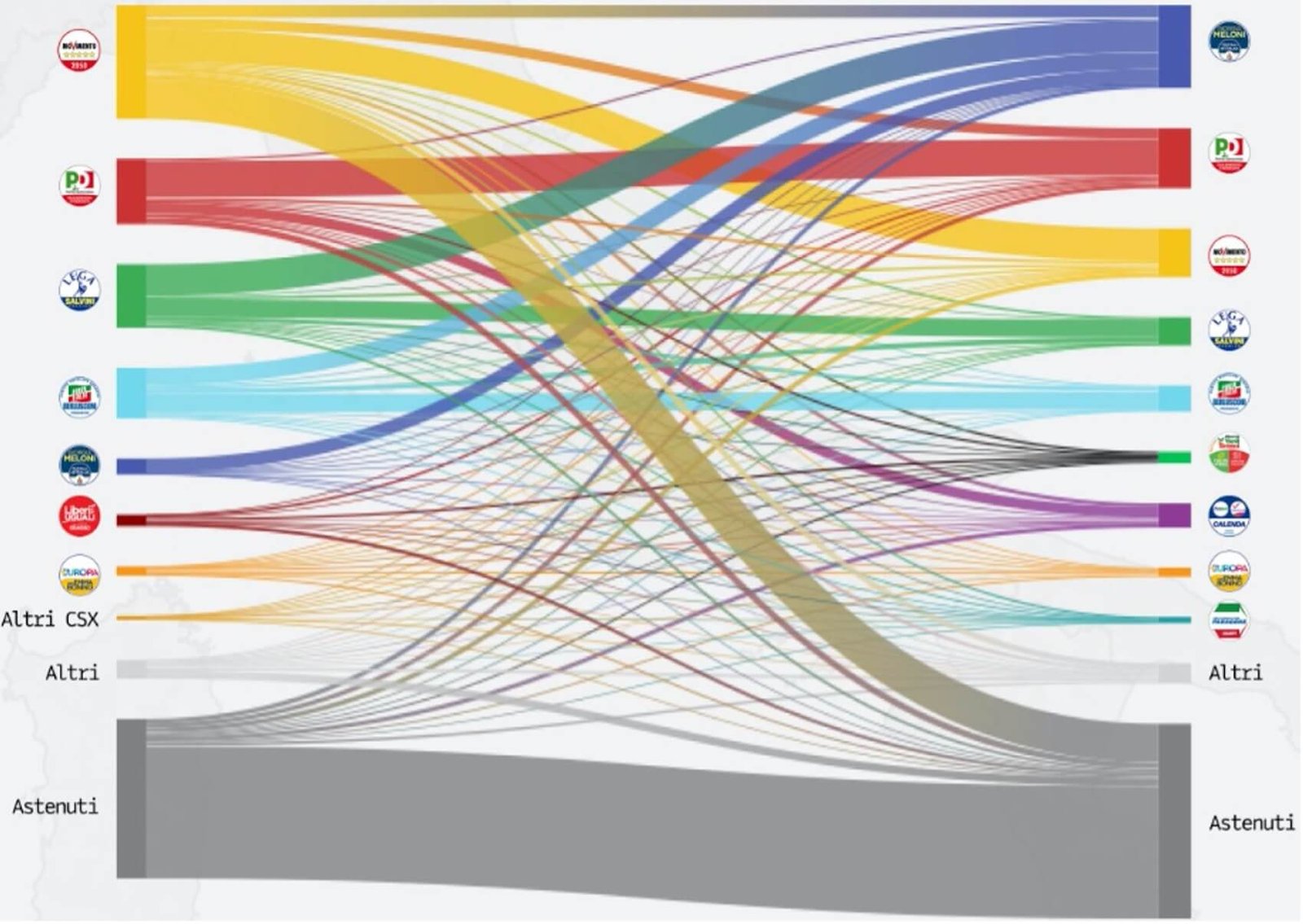
The percentual distribution of vote (Source: SKY TG24).The flux of votes between the 2018 and 2022 elections (Source: YouTrend).
The winning coalition – consisting of Fratelli d’Italia, Matteo Salvini’s Lega, and Silvio Berlusconi’s Forza Italia – reached a majority of 235 MPs thanks to their combined 43.79 percent of the vote. While Italian media has described this coalition as “centre-right”, the foreign press categorises their movement as being dominantly populist radical right, with only Berlusconi holding moderate and pro-European positions relative to his coalition partners.
While Meloni’s triumph was largely predicted, the level of electoral success (25.99 percent) came as a surprise in comparison to the party’s 2018 score (4.35 percent). Fratelli d’Italia managed to monopolize its role as the dominant opposition party to Mario Draghi’s grand coalition government in the last year and a half. After all, in a government of national unity composed of leftist, centrist and rightist parties, it is quite easy to bring out the political ambivalences and hypocrisies of both opponents and allies. Berlusconi’s party reached an unexpected 8.11 percent, despite polls preceding the vote predicting it to be around 5%. Matteo Salvini failed to reach previous successes as the Lega achieved 8.77 percent of the vote. This result represents a loss of almost 10 points from the 2018 domestic elections and 26 from the 2019 European vote. This dissatisfaction with Salvini’s leadership started growing within the Lega’s electorate, following his decision to join Draghi’s government in February 2021.
The geographical distribution of votes (Source: YouTrend).
The Five Stars Movement, led by former Prime Minister Giuseppe Conte, did better than expected compared to opinion polls prior to the election. This surprising result of 15.43 percent was achieved through its strong showing in the south of Italy. The greatest losses came at the expense of the centre-left alliance led by Enrico Letta’s Democratic Party (PD). Independently, the party garnered 19.07 percent of the vote, however it lacked support from its junior partners, who only contributed an additional 7.06 percent to the alliance. Rounding out the Parliament is the so-called “third pole”, the centrist alliance between Carlo Calenda’s Azione and Matteo Renzi’s Italia Viva (7.79 percent), who collectively gained 21 seats.
Distribution of seats in the Lower house (Source: YouTrend).Distribution of seats in the Higher house (Source: YouTrend).
Background to the Vote
Since the last time Italians voted, the 4th of March 2018, three governments have gone by – two of which were led by Giuseppe Conte (Movimento 5 Stelle and Lega (2018), M5S and Democratic Party (2019)) and one by Mario Draghi. In July of this year, M5S, Lega, and Forza Italia withdrew their confidence in the executive, causing a crisis which resulted in the collapse of the Draghi government.
Draghi’s resignation on the 21st of July, dissolved the grand national unity coalition which featured internal divisions, constant struggles, and a sense of perennial electoral campaigns. The subsequent election occurred in the shadow of the Ukrainian war, a burgeoning energy crisis, management of the Next Generation EU funds, and the aftermath of the COVID-19 pandemic. The elections were further complicated by the reduced number of MPs following the 2020 constitutional referendum and the upcoming deadline for the 2023 economic and financial plan (DEF).
However, what kind of campaign has it been?
Mario Draghi, Italy’s prime minister, listens during a debate at the Senate in Rome, Italy on June 21, 2022. Photo: Alessia Pierdomenico.
A Short, Summer Campaign
In a nutshell, the campaign has followed an inconsistent pace: vacuous during August and frenetic in September. The opinion polls favouring the populist radical right rendered opposing citizens and parties demoralized to compete effectively with Meloni’s rising popularity. In particular, the centre-left seemed resigned to a defeat, content to “lose with style,” as Columbia University professor Nadia Urbinati stated in an op-ed in “Domani”.
While there has not been a strong central theme throughout the electoral campaign, as reddito di cittadinanza was in 2018, some notable themes can still be identified. These include the energy crisis, the populist radical right’s “flat tax” and fiscal relief, the polarization between populist radical right and Democratic Party on the necessity of Atlanticism and Europeanism, and the management of the Next Generation EU funds.
The energy crisis and its economic consequences on all levels of Italian society served as one of the main battlegrounds for the electoral campaign. While all parties agreed on a necessary price cap on oil and gas, marked differences emerged on alternative sources of energy. While the right-wing coalition pushed for nuclear energy, Calenda’s Azione stood for regasification plants, and the left-wing groups advocated for renewable energy sources. Additionally, no consensus was found concerning national debt and financial support for citizens struggling the most with inflation.
Second, the relationship between the frontrunning right-wing parties and Putin was brought into question. This was combined with debates on Italy’s stance to continue economic sanctions on Russia. However, every party attempted to present itself as pro-Europe and pro-NATO, even Fratelli d’Italia and the Lega, historically more sceptic and critical of Europe. The political debate was exacerbated by US leaks regarding Russia’s funding of European parties. This brought about a tumultuous climate of mutual accusations regarding who received Russian funds and who did not. Particularly scandalous were Berlusconi’s words justifying Vladimir Putin’s invasion.
Finally, the campaign picked up where Draghi’s government left off: the distribution of the Next Generation EU (NGEU) funds in the National Plan of Recovery and Resilience (PNRR). Meloni strengthened her political aura and authority over the right-wing coalition by repeatedly stating her intention to go to Brussels and “renegotiate” the NGEU details, despite this being neither legally nor politically feasible. Her populist approach failed to mention the European Green Deal, in spite of sustainability’s significance in the NGEU fund. Across the political axis, environmental concerns were lacking, and only considered by Sinistra Italiana-Verdi and some minor left-wing parties. Meanwhile, PD and M5S’ programmes were largely environmentalist in name only and could even be categorised as greenwashing. Geopolitically speaking, instead, major problems were the migration flow from Libya and the absence of any agreements with the African country and within the EU’s member states (cf. Dublin Regulation III).
In terms of the approach to campaigning, there was a significant push to mobilise the youth vote. Parties turned en-masse to social media networks to create numerous, and often blatant, posts targeting this electorate. Most notably, political leaders across the spectrum used TikTok to post surreal, if not ridiculous, videos in an attempt to achieve virality. For instance, Salvini used to do long live streams on this social, chatting with users and allowing them to apply a variety of filters during his chats.
Giorgia Meloni’s Heavy Post-Fascist Burden
Since the morning of the 26th of September, the front pages of Italian and particularly foreign newspapers presented Meloni’s win as a revival of fascism. Although Giorgia Meloni is likely to become the first female Prime Minister in Italian history, media attention has focused instead on her victory being a symptom of democratic decay in Italy.
Fratelli d’Italia’s relationship to fascism is clear and undeniable. Starting with the tricolour flame as the party’s symbol – this imagery is derived from the Italian Social Movement party, a political successor to the fascist Salò Social Republic. Throughout the party’s history, there has always been a respect for Benito Mussolini. Whether it be the words of a 19-years old Giorgia Meloni on the political skills of the dictator, or Gianfranco Fini’s (one of the founders of Fratelli d’Italia) statement that Mussolini was the greatest statist of the 20th century. Although the party leaders have been openly against any fascist recalls, it is clear that Fratelli d’Italia’s roots drawn from such symbolic and historical imagery.
“Fascism” is not the only peculiarity of this party, which needs further analysis. Fratelli d’Italia’s nature as a populist radical right party (according to Cas Mudde’s definition presented in the book Populist Radical Right Parties in Europe) requires thorough exploration and deeper analysis. Indeed, Meloni’s strategies and communications reflect the dimensions of (1) populism, (2) nativism, and (3) authoritarianism. Opponents generally use the fascist element to denigrate Fratelli d’Italia, but risk overlooking and obscuring its more complex articulations.
According to Bologna University’s professor Salvatore Vassallo, Fratelli d’Italia has a revisionist view of the twenty years of fascist dictatorship in Italy, but leaders of the party have more than once declared the absolute condemnation and distance themselves from such a phenomenon. I would consider the role of fascism in the ideology of Fratelli d’Italia as the “theoretical premise” that influences the authoritarian dimensions of the populist radical right under the banner of authoritarian “law and order” and nativist aspects conjugated in the form of secure national borders or economic protectionism. It means that we should not expect a “fascist backlash” but, rather, an exacerbation or a polarisation of those themes that feature populist radical right’s political programmes – where the fascist rhetoric would be used, if used, by supporters of Fratelli d’Italia and not by its leaders. Considering this, it remains convenient for leftist parties and media to label and condemn Meloni’s triumph as the win of fascism, thanks to her populist and demagogue rhetoric.
What is missing in such media and political analyses is consideration of the causes behind this electoral result. If Meloni reached the 26% of the vote and won in constituencies that have voted for leftist parties since the birth of the Italian Republic, her triumph probably is a consequence of a democratic malaise, not a cause. Furthermore, I argue that defeated parties and columnists should confront the reasons behind the highest record of abstentionism in Republican history, which reached 64 percent.
Geographical distribution of turnout (Source: YouTrend).
The lethargic politics of Draghi’s government may offer insight to the sharp rise of the extreme right; the centrist decision-making, technocratic disengagement, and the opaque management of the Next Generation EU’s tasks prevented necessary political debate between the left and right. As Chantal Mouffe lucidly explains in her The Democratic Paradox, this tendency to operate on a “radical centre” anesthetises the political environment and indirectly favours and nourishes extremisms – be they of left or right.
What Now?
If Meloni succeeds in receiving the primary responsibility from the national president Sergio Mattarella to form a government, the new executive will be staunchly conservative. We can expect attacks on civil rights in the fields of abortion, euthanasia, gay adoption, racial and homophobic discrimination, as well as stricter immigration policy. After all, Fratelli d’Italia’s slogan states “God, Family, and Homeland”.
However, the absence of new laws does not mean eliminating the old ones. The Italian Constitution boasts robust checks and balances to constrain executive power. Consequently, the populist radical right majority cannot bypass these controls without holding regular referenda. Additionally, in such a geopolitical and historical context, it is hard to imagine a decline of Italian democracy towards a “Polish” or “Hungarian” model – even if a worried Ursula von der Leyden has warned about the EU’s dissuading tools.
Last but certainly not least, we should expect some theatrical shows of strength at the EU’s expense to impress domestic supporters. For instance, Meloni is already pushing for revisions of the PNRR’s expense details in line with current inflation rates. Similarly, we can expect attempts to pressure the EU to adopt new internal regulation on migration flows through operations like naval blockades targeting NGO’s transporting migrants. Finally, on the economic front, neoliberal measures for tax relief, like the controversial “flat tax”, will be difficult to approve due to constitutional issues and a lack of funds.
The most pressing deadline facing the incoming government is the submission of the 2023 economic and financial planning document (DEF) to Brussels. Given the short time frame, it is likely that Draghi’s outgoing government will work with the new executive to draft the DEF. In light of Italy’s historical national debt problems, Meloni’s first objective will be to reassure the international markets of her moderate profile through a “Europeanism of convenience.”
Finally, it is essential to remember that, since 1948, Italy has had 67 governments, lasting, on average, 414 days. In a few months, indignant citizens will probably forget their fascist fear, while Meloni’s supporters, after the “honeymoon period,” will become progressively more critical toward their leader – because rhetoric is rhetoric, but politics is politics. In five years, but probably less, everything will start over – only with more national debts on the shoulder of the young people.
“Everything must change for everything to remain the same,” Giuseppe Tomasi di Lampedusa wrote in The Leopard (1958). That is Italy, and it has always been.
Yilmaz, Ihsan & Morieson, Nicholas. (2022). “Nationalism, Religion, and Archaeology: The Civilizational Populism of Benjamin Netanyahu and Likud.” Populism & Politics. European Center for Populism Studies (ECPS). October 10, 2022. https://doi.org/10.55271/pp0015
Abstract
This paper examines civilizational populism in Israel and focuses on the largest and most powerful party in Israel since the 1980s, National Liberal Movement (Likud), and its most significant leader of the past twenty years, the populist politician Benjamin Netanyahu. We show how Netanyahu incorporates ‘civilizationism’ into his populist discourses by, first, using the notion that Jewish civilization predates all others in the region to establish the legitimacy of the state of Israel, the hegemony of Jewish culture within Israel, and at times his own political decisions. Second, through his portrayal of the Arab-Muslim world as an antisemitic and barbaric bloc that, far from being a civilization, threatens Western civilization through its barbarism. Equally, this paper shows how Netanyahu argues that Israel is akin to protective wall that protects Western Civilization from the Islamist barbarians who wish to destroy it, and therefore on this basis calls for Europeans and North Americans to support Israel in its battle for civilization and against “the forces of barbarism.”
This paper examines civilizational populism in Israel and focuses on the country’s largest and most powerful party since the 1980s, the National Liberal Movement (Likud), and its most significant leader of the past twenty years, Benjamin Netanyahu. Netanyahu is widely regarded as a populist and, since becoming party chairman in 1993, to have moved Likud toward right-wing populism. This move toward right-wing populism has proven electorally successful for Likud, although it has proven deleterious for many Israelis and Palestinians.
Civilizationism posits that the peoples of the world can be divided into ‘civilizations.’ When civilizationism is mixed with populism, the result is a set of ideas that defines the self and other not primarily in national terms but in civilizational terms (Brubaker, 2017). Civilizational populism—a growing force in domestic and international politics the world over (Kaya, 2019; Brubaker, 2017; Barton, Yilmaz & Morieson, 2021; Blackburn, 2021; Kaya & Tecman, 2019; Yilmaz & Morieson, 2022a; Shakil & Yilmaz, 2021; Yilmaz, Demir & Morieson, 2021; Kaya)—might therefore be understood “as a group of ideas that together considers that politics should be an expression of the volonté générale (general will) of the people, and society to be ultimately separated into two homogenous and antagonistic groups, ‘the pure people’ versus ‘the corrupt elite’ who collaborate with the dangerous others belonging to other civilizations that are hostile and present a clear and present danger to the civilization and way of life of the pure people” (Yilmaz & Morieson, 2022).
Civilizational populism defines populism’s key signifiers (‘the people,’ ‘elites,’ and ‘dangerous others’) first by categorizing all people via civilizational identity. Secondly, civilizational populism describes ‘the people’ as authentic and morally good insofar as the civilization to which they belong is superior and the product of superior moral values — derived chiefly from religion. Civilizational populism describes ‘others’ within the same society as inauthentic and morally ‘bad’ because they belong to a foreign civilization with inferior values, and which is the product of an inferior religion. Equally, civilizationism mixed with populism permits populists to describe ‘elites’ as morally bad actors who have betrayed and abandoned the values and culture of their own civilization.
This paper shows how Netanyahu incorporates civilizationism into his populist discourses by, first, using the notion that Jewish civilization predates all others in the region to establish the legitimacy of the state of Israel, the hegemony of Jewish culture within Israel, and, at times, his own political decisions. He also mixes civilizationism and populism through his portrayal of the Arab-Muslim world as an antisemitic and barbaric bloc that, far from being a civilization, threatens Western civilization through its barbarism. This paper shows how Netanyahu argues that Israel is akin to protective wall that protects Western Civilization from the Islamist barbarians and calls for Europeans and North Americans to support Israel in its battle for civilization and against the forces of barbarism. This idea is discussed by Slabodsky (2014: 153-56) who analyses the text of Old Land/New Land and shows how Jews are traditionally positioned as a civilizing force or ‘buffer’ between the West and oriental subjects of the East. According to Slabodsky (2014), this core belief –of Orientals as symbols of barbarianism– has been retained and has only been reframed and reintroduced in the post 9/11 context.
These narratives assist Netanyahu in his populist division of Israeli society into three antagonistic groups: ‘the people,’ the ‘elite,’ and ‘others.’ These ‘others’ are non-civilized Arab-Muslims who desire the destruction of both the Jewish people and Western civilization; ‘elites’ are left-wing parties and liberal Jews who Netanyahu portrays as abandoning Jewish culture and helping Arabs destroy civilization; ‘the people’ are all the Jewish people, who are authentic and morally good: authentic because their ancestors were the first people of the land, and morally good because they are civilized Jews.The paper begins with an overview of Israel’s history, which is followed by a discussion on civilizationism in Israel and, following this, an examination of the use of civilizationism within the populist rhetoric of Likud Party leader Benjamin Netanyahu.
Civilizationism in Israel
Does Israel belong to Western civilization? Samuel P. Huntington (1996) was uncharacteristically silent about Israel and did not identify a specific Jewish civilization among the world civilizations he described in The Clash of Civilizations and the Remaking of World Order. In his critique of Huntington’s book, realist scholar of international relations, Stephen Walt, remarked that it is difficult to place, from Huntington’s civilizational approach, Israel within ‘Western civilization.’ According to Walt (1997: 186), “Israel is not a member of the West (at least not by Huntington’s criteria) and is probably becoming less ‘Western’ as religious fundamentalism becomes more salient and as the Sephardic population becomes more influential. A ‘civilizational’ approach to US foreign policy can justify close ties with Europeans (as the common descendants of Western Christendom) but not Israelis.” This has not prevented political actors from classifying Israel and the Jewish people as Western. Many European and North American civilizational populist parties appear to claim if not the Jewish people, then at least the Jewish scriptures to be part of ‘Judeo-Christian civilization’ (Yilmaz & Morieson, 2021; Yilmaz & Morieson, 2022; Brubaker, 2017).
Israelis walk next an Israeli election billboard of Likud Party showing US President Donald Trump shaking hands with Likud chairman and Israeli Prime minister Benjamin Netanyahu in Beth Shemesh, Israel on September 8, 2019. Photo: Gil Cohen Magen.
The Trump Administration, for example, emphasized America’s closeness to Israel, and appeared to regard the country as part of a broader Judeo-Christian civilization which required defending from Islam (Haynes, 2021). The notion that Western civilization encompasses Israel is at times, reflected in the words of Israel’s leaders. Following the 2015 murder of four Jews in a Paris kosher supermarket, and the mass murder of Charlie Hebdo cartoonists by an Islamist group, Netanyahu called upon Europeans to “wake up” and act to defend “our common civilization” (The New York Times, 2015). Linking the murder of cartoonists in France with the Israeli-Palestinian conflict, Netanyahu said, “Israel stands with Europe; Europe must stand with Israel” (The New York Times, 2015). Netanyahu’s claims that Israel is part of the West make sense insofar as Israel was partly a creation of the Western powers and populated largely by European Jews. One cannot be conclusive about where a civilization begins and ends. In the case of Israel, the nation is at once a product of Western civilization but also the product of the Nazi Holocaust, a genocide perpetrated by Europeans who believed Jews threatened Aryan civilization. Some ambiguity about Israel’s civilizational classification is thus unavoidable, although it is arguably foolish if not dangerous to classify nations in this manner.
There are considerable links between the state of Israel and conceptions of Jewish civilization, both ancient and modern. According to Israeli politician and academic Yossi Shain (2019; Ferziger, 2020) “Since its establishment in 1948, the State of Israel has gradually situated itself as the most important factor in all areas of worldwide Jewish life… The nation of Israel and Jewish civilization are defined today more than ever through the political, military, and cultural power of the sovereign Jewish state.” At the same time, Israel’s legitimacy lies, in part, on its claim to be the modern manifestation of the ancient Jewish civilization that existed — and indeed pre-dates– the coming of Arabs and Islam to the Land of Israel. While Israel was founded as a modern, European-style secular nationalist nation-state, its leaders also sought to connect Jewish people –who spoke many different languages– with their ancient past by making Modern Hebrew the official language of Israel and teaching it to all schoolchildren (Nevo & Verbov, 2011). In addition to Hebrew, another cultural feature that has been part of Israeli civilizationism is the preference given to the Jewish calendar over the Gregorian calendar. Israel’s Declaration of Independence (1948) was composed by Jews who had spent most of their life in Europe and living under the Gregorian calendar, yet the document shows clear indications of favouring the use of the Jewish calendar as a marker of identity politics (Saleem, 2022 forthcoming).
Israel is a product of the 19th century Zionist movement, which removed itself somewhat from Orthodox Judaism and, influenced by European nationalism, sought to create a nation for the Jewish people. Zionism –and by extension Israel– has always possessed a “Romantic nationalist culture with a strong expressivist dimension; that is, a strong emphasis on self-expression and notions such as authenticity,” at least compared to Orthodox Judaism where “the Torah and God’s commandments are imposed externally on the Jew” (Fischern, 2014). Jewish nationalism in its Zionist and neo-Zionist forms has often been a powerful political force in Israel, especially in the shape of right-wing populist discourse (Pinson, 2021; Rogenhofer & Ayala Panievsky, 2020). The Declaration of Independence of 1948 serves as evidence for the presence of civilizational elements in Zionism. Saleem (2022, forthcoming) notes that “The references to the Jewish religion can be found all over the document. The word ‘Jews’ has been mentioned five times while the word ‘Jewish’ has been mentioned nineteen times in the one-page declaration. Israel is used twenty-seven times and the combination ‘Eretz-Israel’ twelve times.” Thus, while the Israeli state might appear rooted in the modern principles of the nation-state, its core is surprisingly religious. Agbaria (2021: 360), for example, argues that “Israeli policies, as evident in the Nation-State Law, are driven by a lure of religious imagery that obscures the boundaries between the State of Israel, as a recognized political entity, and the Land of Israel, as a religious ideal that awaits materialization.”
Furthermore, because the legitimacy of Israel rests on the history of Jewish people in the land, political groups have instrumentalized archaeology to ‘prove’ that Jewish civilization in the region predates all others. For example, Israeli archaeologist Raphael Greenberg claims that “in order to answer the continuing demands of mainly politics actors,” Israeli “archaeologists have given up many of their best practices” (Reuters, 2010). Greenberg claims that the Ir David foundation, which encourages Jewish settlement in Palestinian territories, is funding archaeological digs intended to find ‘evidence’ of prior Jewish settlement and thus to define those areas as belonging to the state of Israel (Reuters, 2010). The desire to ‘prove’ that Jewish civilization predates Arab civilization in Israel, and thus legitimize the Jewish state via a connection between modern Israel and ancient Jewish civilization, is so important to Netanyahu that he gleefully tweeted to his followers the results of Deoxyribonucleic acid (DNA) tests which he claims prove that the Palestinians are relative newcomers to the region compared with Jews (Jerusalem Post, 2019).
National Liberal Movement (Likud)’s Civilizational Populism
Populism has long been present in Israel but has been part of mainstream politics since the 1990s (Ben-Porat et al., 2021: 6). The mainstreaming of populism is largely the product of the right-wing populist Likud party’s rise to power — and in particular of its leader and former Israeli Prime Minister, Benjamin Netanyahu. Likud was formed in 1973 by Menachem Begin and Ariel Sharon. The party drew support from several other right-wing parties and eventually formed a coalition which pushed the once dominant Labor Party from government and into opposition in 1977 (Porat & Filc, 2022). According to Porat and Filc (2022), Likud was initially a nationalist — though not illiberal — party that sought greater inclusion of the Mizrahim within Israeli society, a group marginalized by Labor. The support of Mizrahi Jews enabled Likud to defeat the once hegemonic Labor and to establish themselves as the new ruling party (Porat & Filc, 2022).
Over time, Likud transformed into a right-wing populist party which, far from calling for equal rights for Arabs and non-Jews, sought their exclusion from society. This change was crystalized by the election of Benjamin Netanyahu as party chairman in 1993. Under Netanyahu’s leadership, the Likud-led, right-wing coalition gained traction with voters through its conservative nationalist rhetoric and policies and through its promotion of economic neo-liberalism supported by a ‘strong man image’ perpetuated through political authoritarianism (ECPS, 2020; Filc, 2009). In 1996, Netanyahu became Prime Minister by using populist right-wing “rhetoric dominated by ethnic nationalism, xenophobia, and anti-elite sentiment against the academia, the media, and the country’s left-wing parties” (ECPS, 2020; also see Rogenhofer & Panievsky, 2020; Bagaini, 2019: 6). His religious nationalism marked a break from the secularism of the Labor period in Israeli politics.
During its terms in power in the 2000s and 2010s, Likud has often relied on populist nationalism, the party has attempted to divide society between ‘the people’ — Jews who were historically persecuted and who must now defend their homeland –and ‘others’– intruders in the land of the Jews, and who are often responsible for terrorist attacks and other forms of anti-Jewish violence (ECPS, 2020; Prota & Filc, 2020). By 2015, the idea that ‘Netanyahu is good for the Jews’ had become a powerful re-election tool for Likud, and the notion that Muslim Arabs — who were portrayed by Likud as ‘infiltrators’ and a ‘Trojan Horse’ — might be expelled became mainstream (Ghanem & Khatib, 2017). Likud’s discourse encouraged the growth of nativism in Israeli society and, correspondingly, their own populist discourse became more nativist.
Rogenhofer and Panievsky (2020), who explored the authoritarian populism of Netanyahu, Modi, and Erdogan in a comparative analysis, observe that “Netanyahu’s emphasis on Israel’s Jewishness all point to a conflation of religion with the national vision” (Rogenhofer & Panievsky, 2020: 1395). As a result, “religious language and symbols accentuate fears and shape demands for action, to protect the nation and its borders…consequently, more and more leaders, not only in the Likud, adopt religious tropes and symbols to demonstrate loyalty and garner support” (Porat & Filc, 2022: 74). At the same time, opposition parties and critics of Likud and Netanyahu were portrayed by the party “as detached elites not committed to Jewish nationality and to the Jewish State” (Porat & Filc, 2022).
Levi and Agmon (2021) note that during the peak of Netanyahu’s tenure ‘otherization’ of Jewish parities or individuals who did not agree with the ruling government was severe. Left-wing parties have been ‘othered’ by Likud and transformed into enemies of the state and Jewish faith (Levi & Agmon, 2021).For example, during the 2015 election campaign, Netanyahu accused the center-left political opposition of picking a “list of radical left, anti-Zionist candidates” (Lis, 2015). Likud’s official Spokesperson, Erez Tadmor, went a step further and labelled left-wing opposition as “pampered, thankless spoilt kids who were born to the right families in the right neighborhoods […] don’t have ‘infiltrators’ [migrants] in their neighborhoods, no one throws stones or Molotov cocktails at them. Their children don’t serve in Golani or Givati [IDF military brigades] … They milk the state in every way possible and appoint one another to all key positions” (Levi & Agmon, 2021: 299).
Levi and Agmon (2021) also note that this otherisation went beyond politics and muffled critical media groups. Newspapers that were critical of the regime were labelled as ‘Auto-antisemitic’ or self-haters accused of spreading hatred towards Judaism. Bennette (2017) observed that a news outlet was bullied by a state minister for being critical of the regime using this very framework: “In 2017, Secretary of Education Naftali Bennett (The Jewish Home) accused Haaretz, Israel’s leading left-wing newspaper, of pathological self-hatred. ‘Auto-antisemitism’, explained Bennett, ‘is a socio-psychological phenomenon in which a Jew develops obsessive hostility and disdain for the Jewish tradition’.” In a sense, Likud has carried out “the monopolisation of patriotism” (Levi and Agmon, 2021) where another party is aggressively ‘otherized’ as it can never work for the good of the country’s people.
Benjamin Netanyahu, Prime Minister of Israel visits the Synagogue of Copacabana in Rio de Janeiro, Brazil on December 28, 2018.
In 2018, Netanyahu made certain that ethnoreligious nationalism would dominate Israeli politics through the Nation State Law. The Nation State Law effectively destroyed the secular state envisioned by early Zionism and made Israel a “Jewish Nation State of the Jewish people” (Halbfinger & Kershner, 2018). It mandated that Jerusalem be recognized as the “complete and united…capital of Israel” and claims the “development of Jewish settlement” is of great “national value,” language that led to escalating violence between Palestinians and Israelis(BBC News, 2018).The passage of the bill also contradicted the spirit of the state’s foundation, which promised equality for all, by downgrading Arabic from an official language to a language with “special status” and leaving Hebrew as the only official language of Israel (Halbfinger & Kershner, 2018). Combined, these measures emphasize how Likud has often relied on religion to define Israeli identity and the identity of Israel’s enemies.
Israel’s school system also perpetuates civilizationism. Traditionally, there were four types of schooling systems, which ranged from secular to religious schools of Jewish and non-Jewish community members. Under former Minister of Education Naftali Bennett, major changes were made to add elements of “Jewish culture” to the curriculum of secular schools (Silberberga & Agbaria, 2021). Silberberga and Agbaria (2021: 321) note this development, “shows that the escalating efforts to advance a particularistic hyper-ethnonationalist ideology in the Israeli education system, and a complete segregation between Jews and Palestinians in the school system, have eroded liberal and democratic sensibilities among Jewish youth.” This new emphasis on ‘cultural’ education is visible in increased funding spent on ‘cultural’ programs: “19.2% of the ministry’s annual budget to fund external education programmes, was spent in favor of Jewish culture education programmes. This is in sharp contrast to the NIS 10 million (1.1% of the budget) spent on science and technology programmes, or the mere NIS 1.5 million (0.15% of the budget) for democracy and shared society programmes” (Silberberga & Agbaria, 2021: 325).
Silberberga and Agabaria, (2021: 326) noted that the mandatory Social Studies for grade one to six, “lack any direct reference to the existence of the Al-Aqsa Mosque, and students are not exposed to any alternative or multi-layered narrative about Israel’s holy sites. Moreover, the religious approach to the Third Temple disregards the existence of the State of Israel and instead uses the biblical term ‘the Land of Israel’.” Silberberga and Agbaria (2021: 326) describe the “emphasis on religious ideals in populist politics of education” as “a strategic move towards enclosing the national identity of the Jewish majority within what are purely religious boundaries,” and therefore as an attack on religious pluralism and secularism in Israel.
Netanyahu and Likud lost control of the government following the 2021 legislative election, and the new government was a coalition between right-wing and centrist parties (including the secularist Yesh Atid party and conservative nationalist Yamina) and which established a rotation government. Thus, while Netanyahu was no longer Prime Minister, Israel remained government by largely right-wing forces which continued Netanyahu’s demonization of Arabs and Muslims. For example, Naftali Bennett, leader of the Yamina coalition who served as Prime Minister between 13 June 2021 and 30 June 2022, is regarded as more right-wing and nationalist than Netanyahu, and has stated the establishment of a Palestinian state would be a “terrible mistake” (Jerusalem Post, 2021).
Civilizationism in Netanyahu’s Populist Discourse and Policies
Netanyahu’s civilizational populism has two major components. First, he uses the notion that Jewish civilization predates all others in the region to establish the legitimacy of the state of Israel, the hegemony of Jewish culture within Israel, and, at times, his own political decisions. Second, he describes the Arab-Muslim world as an antisemitic and barbaric bloc that, far from being a civilization, threatens Western civilization. Israel, he argues, is a protective wall that defends Western civilization from Muslim barbarians who wish to destroy it; on this basis, Netanyahu calls for Europeans and North Americans to support Israel in its battle for civilization and against the forces of barbarism. Combined, these narratives assist Netanyahu in his populist division of Israeli society into three antagonistic groups: ‘the people,’ the ‘elite,’ and ‘others.’
In Netanyahu’s discourse, ‘others’ are non-civilized Arab-Muslims who wish to destroy the Jewish people and Western civilization; ‘elites’ are left-wing parties and liberal Jews who Netanyahu portrays as abandoning Jewish culture and helping Arabs destroy civilization; ‘the People’ are all Jewish people, who are authentic and morally good — authentic because their ancestors were the first people of the land, and morally good because they are civilized Jews.
Archaeological site close to City of David in Jerusalem, Israel.
Archaeology has long been an instrument through which Israeli political actors have sought to legitimize the nation and, in some cases, Jewish settlement in Palestinian territories (Greenberg, 2007; 2009; 2021; Desjarlais, 2013). Desjarlais, for example, argues that “archaeological practice in Palestine/Israel is part of a spatial and temporal project that serves to produce a continuous link between the ancient Israelite past and the modern Israeli nation-state, justifying the creation of the Israeli state by reference to the past and through familiar frontier myths.” Saleem (2022, forthcoming) notes that Jews have not been a majority in the region since 70 CE when the Second Temple was destroyed. He adds that even before Muslims populated the region of present-day Israel, many other civilizations — such as the Byzantines, Roma, and Persians–left their mark before the Muslims conquered the lands in seventh century. The last rulers in the area were the Ottomans, who lost the territories following their defeat in the First World War. Before the Zionist nationalist movement took power, the territory was under British control; this period is called the Mandate period. This snapshot of history suggests that the region has been home to various cultures over the centuries.
Archaeological practice in Israel, then, brings together two key civilizational narratives: first, that the Jewish people uniquely and solely belong to the Land of Israel due to an ancestral and cultural connection to ancient Jewish civilization; and second, the frontier narrative that asserts that Jewish people brought civilization to Israel, which was in a state of barbarism before their arrival. Desjarlais (2013) describes the case of Silwan (Wadi Hilwe), which was gradually transformed into an archaeology park, the ‘City of David,’ with multiple sites declared archaeologically significant. Under the guise of archaeology, villagers from the Wadi Hilwe and Bustan neighborhoods were forcefully evacuated and harassed; children were even arrested (Desjarlais, 2013). The gradual influx of tourists after the conversion to an archaeological park led authorities to use the Kidron Valley of Silwan as a dump for waste. This region was declared unclean and filthy and was largely populated by Palestinians. Using this as a pretext, Israeli authorities have justified the land-grabbing practices: “The irony of the imagery this neglect, and waste dumping create–that of an unhygienic town strewn with trash heaps–is that Israel uses the very wasteland it creates to justify its land acquisition.”
The ‘City of David’ site is run by the Ir David Foundation, known as Elad in Hebrew, which also finances archaeological excavations across the Old City of Jerusalem. Elad wishes to uncover proof of ancient Jewish civilization in Jerusalem through projects, including the disputed ‘City of David’ archaeological park and the Temple Mount Sifting Project (The Times of Israel, 2017; The Palestinian Chronicle, 2016). The purpose of these project is to establish the Temple Mount area as a historically Jewish area and to deny any connection between Palestinians and the Old City of Jerusalem. The identification of the Silwan (Wadi Hilwe) site as the ‘City of David’ appears to be politically motivated. Greenberg (2009: 37), for example, observes that ‘City of David’ was “rarely employed in the literature; excavators generally preferred ‘Ophel,’ another biblical term that appears to refer to the northernmost part of the spur.” Rather, there has been, according to Greenberg (2009: 38), a deliberate sanctification of the site, a “secular and political sanctification, and as such its character and content are open to reinterpretation to a far greater extent than is the case with holy places proper, where the authority for the validation of historical claims is embedded in a chain of command that resists academic scrutiny.” It is interesting to note that Ir David’s website insists that “when David Be’eri (David’le) first visited the City of David in the mid-1980’s, the city was in such a state of disrepair and neglect that the former excavations that had once been conducted were once again concealed beneath garbage and waste” (Ir David, n.d.). […] Ir David spins a narrative of the redemption of the uncultivated frontier as justification for the confiscation of Palestinian land and the expansion of Jewish settlements” (Desjarlais, 2013: 13).
It is not merely the Israeli right but also Christian Zionists who have developed an interest in Biblical archaeology. Indeed, the two have worked together to ‘uncover’ historical sites which ‘prove’ the continuous and ancient occupation of Israel by Judeo-Christian peoples. Scholz (2022), for example, describes how the Tel Shiloh site has been a contested ground for right-wing Christian and Jewish archaeology– who believe the site is the first capital of Israel and proof of the inerrant truth of the Bible and resident Palestinian. In 2017, a team of right-wing evangelical Christian archaeologists from the United States also took part in the excavations; these archaeologists have questionable educational qualifications and clearly lack objectivity (Scholz, 2022: 129). Despite the excavations, the group has not published any findings, yet they are content to endorse Israel’s position that Jewish settlement occurred prior to all others in the region: “I can say with 100 percent certainty that there were Israelites in Shiloh because of the many indicators we have,” Dr. Stripling told Breaking Israel News (Scholz, 2022: 132). “The pottery shows that they were there when the Bible says they were there” (Scholz, 2022: 132). Scholz (2022) suggests that excavations such as these are designed to legitimize Israeli occupation and writes that “Stripling’s apologetic Christian-Zionist convictions have direct geopolitical and religious implications in the militarily occupied West Bank because they align smoothly with the interests of the settler community of Shiloh.” Scholz (2022: 134) explains that this is a mutually beneficial archaeological union. While Israel finds grounds to solidify its civilizational convictions and agendas in the region, the right-wing Christian conservatives, “could not have found more fertile ground than at Tel Shiloh, although another settler-managed site in East Jerusalem, the City of David, seems also to receive considerable Christian tourism support. Whenever the goal is to prove the literal historicity of the Hebrew Bible with archaeology and historical fervor, the Christian right is already there.”
One of the Ir David Foundations projects involves sifting soil on the sensitive Temple Mount area sacred to all three Abrahamic faiths. According to the Temple Mount Sifting Project website, the project “is under the auspices of Bar-Ilan University and is funded by private donors through the Israel Archaeology Foundation. The sifting activity operated during the years 2005-2017 at the Emek Tzurim national park with the cooperation and funding of the Ir-David foundation. In June 2019 the sifting facility moved to the Masu’ot Lookout with generous support from American Friends of Beit Orot” (Temple Mount Sifting Project, 2022). While the project may do good work in uncovering the ancient and medieval history of the area, the involvement of the Ir David Foundation is a sign that the project may be used to create an impression of continuous Jewish presence in the area and portray Palestinians as inauthentic residents.
In 2016, when funds for the project began to run out, then Prime Minister Netanyahu intervened and used taxpayers’ money to continue the project (Hasson, 2016). When the United Nations Educational, Scientific and Cultural Organization (UNESCO) was critical of the project for politicizing the historical record and essentially Judaizing the Temple Mount, Netanyahu used the occasion to defend the project and, in what he called a “crushing response” to the United Nations body’s denial of Jewish history, announced that his government would fund the project to ensure that its work continued (Hasson, 2016). In this way, Netanyahu and his government were using the Ir David Foundation to promote the narrative that the Temple Mount belongs to the Jewish people and that Arabs and others are mere newcomers who have no rights to the area.
An outstanding feature about the Ir David Foundation is its demographical composition. Since the 1960s, all excavation work in the region of Jerusalem has been exclusively carried out by Israeli archaeologists; virtually no Palestinians have been part of these explorations (Greenberg, 2009: 44). This is quite interesting as the most adversely impacted people by these explorations are the Palestinians, who are often displaced as a result of the excavations and are not part of the development projects (Greenberg, 2009). The Foundation’s work is quite pivotal for the populist civilizational agendas of the Israeli right. For example, Amit (2022: 44) observes how “on November 17, 2013, Naftali Bennett, Economic Minister and leader of The Jewish Home Party that represents the religious right-wing and the settlers, gave an interview to CNN. When asked about the settlements in the occupied territories, he waved an ancient coin and told Christiane Amanpour: “this coin, which says ‘Freedom of Zion’ in Hebrew, was used by Jews 2,000 years ago in the state of Israel, in what you call occupied. One cannot occupy his own home’.”
Another means of ‘rediscovering’ Israel’s ‘true’ Jewish past has been linked with renaming places (Desjarlais, 2013). For the first project, many Palestinian villages that were occupied or evacuated over the years have been given Hebrew names (Desjarlais, 2013). This process is claimed to be ‘scientific’ as it returns the ‘original’ names to said places. In addition, the state plants gardens or forested areas to discourage the return of Palestinians who fled their villages during periods of war or turmoil. By introducing a vegetative cover to some of the abandoned villages, it’s impossible for Palestinians to return (Desjarlais, 2013).
Civilizationism is also used to legitimize Netanyahu’s political actions by portraying Islam as a non-civilization bent on destroying the Jewish people and European civilization. This takes the form of a ‘frontier’ narrative, in which Israel is described as a barbarous land which the Jewish people tamed and turned into a paradise. One cannot deny the economic and scientific achievements of the Israeli people. However, the frontier myth denies the existence of Palestinian history in the region and portrays them as an uncivilized people squatting on Jewish land (Desjarlais, 2013). According to Desjarlais (2013), “Like other nationalist movements, the Israeli national narrative seeks to construct a shared history (although only for its Jewish population), develop a myth of origin that traces the roots of the modern nation to noble forbearers, and describe the development of the nation’s history in terms of a ‘golden age’ and a ‘dark age’ when the nation was ruled by foreigners.” Put simply, the national myth of Israel involves claims that the establishment of the State of Israel made the desert bloom (George, 1979).
It is also interesting to contrast Netanyahu’s responses when it comes to endorsing or distancing Israel from the West. In cases where countries or institutions support him, as mentioned above, he describes Israel as part of Western civilization. For example, in a 2016 press conference in Berlin with then German Chancellor Angela Merkel, Netanyahu called Israel “the protective wall of Western civilization” (EFE, 2016). By defending itself from Islamic radicals, Netanyahu suggests, Israel is also defending Western values in a region in which they are threatened by barbarism and primitivism. In another example, the appalling murder of four French Jews in a Kosher supermarket in Paris prompted Netanyahu to first demand that the French and moreover the European Union “wake up” to the threat of Islamist terrorism and act to protect “our common civilization” (The New York Times, 2015). However, at the same time he also, as political economist and commentator Bernard Avishai points out, called on Jews to “self-segregate:affirm, in principle, the liberal values of the West, but deny that they ever worked well enough for diaspora Jews; insist that we fight for our freedoms from our own ground” (The New York Times, 2015).
In a 2022 interview, Netanyahu claimed “there is a constant battle between the forces of modernity and the forces of medievalism. That’s what we face today in the Middle East facing militant Islam. Facing militant Islam is only not only Israel, but many of our Arab neighbors will understand that their future also could be compromised and endangered and crushed by these forces that hark back to a very dark past. So, I would say that you can continue to move the arc forward… if you have the necessary will and power to protect civilization and to nurture it, but it could easily be wiped away by larger forces” (Netanyahu, 2022). In the same interview, he praised Winston Churchill, saying “Churchill’s worldview as I see it, was not simply that he was belonging to the British empire, was a 19th century example of a patriot of the British empire. I think it was more than that. I think… he had a civilizational view,” (Netanyahu, 2022).
The notion that Israel represents civilization in a battle against barbarism is a hallmark, according to Tuastad (2003) and Linklater (2020), of neo-Orientalism and neo-barbarism, discourses which became mainstream in the United States after the 9/11 attacks. Yet the ‘civilizational portrayal’ of Israel as an ‘outpost’ of Western civilization is often “embraced by Israel’s detractors and supporters alike” Slabodsky (2014: 147). For example, Zionism as a project sought to give the Jewish people a homeland but used the European colonial model as the basis of a Jewish state. Thus, nineteenth and early twentieth century style European colonialism in the form of Zionism “was applied in its extreme in the 1940s and since at least the 1970s has reinforced systemic patterns of domination and ultimately naturalized the Jewish state as a Western outpost against barbarism” (Slabodsky, 2014: 146). In constructing their own European-style state, Slabodsky (2014: 157) argues, the Zionists were seeking to overcome their status as barbarians within Western civilization by becoming members of a “civilized nation among civilized nations” like “any other Western people.” In doing so, Slabodsky (2014) suggests, they inadvertently replicated the barbaric-civilized dichotomy within Israel, turning the Palestinians into barbarians and themselves into civilized Westerners. Netanyahu and his party have been effective at using this added layer of hostility to shape the narrative surrounding the role of Jews in civilizing the region as opposed to Arabs who are constantly shown as barbaric and culturally negligent.
Conclusion
Netanyahu’s civilizational populist discourse involves the division of Israel into three categories: ‘the people,’ or the Jewish people who belong to Israel; ‘elites,’ or Labor and the center-left parties who are immoral insofar as they refuse to defend Jewish hegemony in Israel; and ‘dangerous others,’ or the Arab Muslims who are barbaric and hateful and seek to destroy not merely Israel but Western civilization. In order to ‘prove’ that the Jewish people alone belong to Israel and to legitimize their political actions, Netanyahu and Likud politicize archaeology and use questionable archaeological methods to prove that Jewish civilization existed before all others in Israel. By weaponizing archaeology, Likud and Netanyahu have been able to both legitimize Jewish cultural hegemony in Israel but also defend the exclusion of Arab Muslims from society by demonstrating that they are relative newcomers to the region and therefore have no legitimate claim to exist in Israel.
Equally, by portraying the Arab-Muslim world as an antisemitic and barbaric anti-civilization, Netanyahu is able to portray Israel as not merely a successful outpost of Western civilization in a barbaric region but a protective wall which prevents Muslims barbarians from infiltrating the West and destroying civilization. Yet, as we have seen, there are times when Netanyahu does not describe Israel as part of the West but rather as a unique culture and civilization which was rejected by the West and must therefore rely on itself for defense. Either way, Netanyahu always portrays Israel as fighting for civilization and against the barbarism represented by Arab Muslims.
The rise of Likud since the late 1970s and emergence of Netanyahu as the most powerful and influential politician of his generation has had a lasting and powerful effect on Israel and on the Palestinians. Likud has successfully ended the hegemony of the Israeli left and Labor Party and paved the way for an Israel that is increasingly de-secularized and right-wing and which perceives Arabs and Muslims as dangerous enemies of civilization. The manifestation of the ‘clash of civilizations’ in domestic politics has had devastating outcomes. Walt (1999) cautioned that this political outlook is a “self-fulfilling prophecy” which leads to conflict because “the more we believe it and make it the basis for action, the more likely it is to come true.” In Israel’s case, Likud’s use of populist civilizations has helped bind the country to a turbulent and conflict-ridden future.
References
— (2009). C1. Pm Benjamin Netanyahu, Speech to the Un General Assembly, New York, 24 September 2009 (Excerpts). (2010). Journal of Palestine Studies, 39(2), 208–210. https://doi.org/10.1525/jps.2010.xxxix.2.208
— (2010) C1. Pm Benjamin Netanyahu, Speech to the Un General Assembly, New York, 24 September 2009 (Excerpts). (2010). Journal of Palestine Studies, 39(2), 208–210. https://doi.org/10.1525/jps.2010.xxxix.2.208
— (2010). “Shas Spiritual Leader: Abbas and Palestinians Should Perish.” Haaretz. August 29, 2010. https://www.haaretz.com/1.5106595
Agbaria, A. (2021). “The Nation-State Law, Populist Politics, Colonialism, and Religion in Israel: Linkages and Transformations.” Journal of Ecumenical Studies. Vol. 56, no. 3, 347-362. 10.1353/ecu.2021.0022
Bagaini, Anna. (2019). “The Origins of Right-Wing Populism in Israel: Peace Process and Collective Identities’ Struggle.” Panel Paper presented at The Populism-Identityhttps://ecpr.eu/Events/Event/PaperDetails/47201 (accessed on September 30, 2022).
Barton, Greg; Yilmaz, Ihsan & Morieson, Nicholas. (2021). “Religious and Pro-Violence Populism in Indonesia: The Rise and Fall of a Far-Right Islamist Civilisationist Movement.” Religions 12, 397. https://doi.org/10.3390/rel12060397.
Ben-Porat, Guy. (2000). “In a State of Holiness.” Alternatives. 25, 223- 246.10.1177/030437540002500203
Blackburn, Matthew. (2021) “The persistence of the civic–ethnic binary: competing visions of the nation and civilization in western, Central and Eastern Europe.” National Identities. DOI: 10.1080/14608944.2021.2006169.
Campbell, Heidi. (2011).“Religion and the Internet in the Israeli Orthodox context”. Israel Affairs. Vol. 17, no. 3, 364-383. DOI: 10.1080/13537121.2011.584664
Damqatum. (2021). The CEHAO Newsletter.www.uca.edu.ar/Damqatum (accessed on September 30, 2022).
Davis, N. J. & Robinson, R. V. (2012). Claiming society for God: Religious movements and social welfare in Egypt, Israel, Italy, and the United States. Bloomington: Indiana University Press.
Davis, N. J., and Robinson, R. V. (2009). “Overcoming Movement Obstacles by the Religiously Orthodox: The Muslim Brotherhood in Egypt, Shas in Israel, Comunionee Liberazione in Italy, and the Salvation Army in the United States.” American Journal of Sociology. Vol. 114, no.5, 1302-1349.
Fischer, Sholom. (2014). “Two Orthodox Cultures: ‘Centrist’ Orthodoxy and Religious Zionism.” In: Reconsidering Israel-Diaspora Relations. Leiden, The Netherlands: Brill. doi:https://doi.org/10.1163/9789004277076_00
Filc, Dani. (2013). The political Right in Israel. Different faces of Jewish populism. Routledge.
Filc, Dani. (2009). “Radicalization of inclusion, radicalization of exclusion: The Shas party.” In: The Political Right in Israel. London: Routledge.
Ghanem, As’ad & Khatib, Ibrahim. (2017). “The Nationalisation of the Israeli Ethnocratic Regime and the Palestinian Minority’s Shrinking Citizenship.” Citizenship Studies. Vol. 21, no. 8, 89–902.
Hassan, S. Shamir. (1998). “Development of Zionist Ideology.” Proceedings of the Indian History Congress. Vol.59, 924–933.www.jstor.org/stable/44147065.
Coakley, John. (2004). “Mobilizing the Past: Nationalist Images of History.” Nationalism and Ethnic Politics. Vol.10, no.1, 531-560.
Desjarlais, Peige. (2013). “Excavating Zion: Archaeology and Nation-making in Palestine/Israel.” Totem: The University of Western Ontario Journal of Anthropology. Vol. 21, no.1. https://ir.lib.uwo.ca/totem/vol21/iss1/2
Ferziger, A. S. (2020). “Israelization and Lived Religion: Conflicting Accounts of Contemporary Judaism.” Vol.40, no.3, 403-430. doi: 10.1007/s12397-020-09324-4.
George, A. (1979). “Making the Desert Bloom: A Myth Examined.” Journal of Palestine Studies. Vol.8, no. 2, 88–100. https://doi.org/10.2307/2536511
Greenberg, Raphael. (2021). “Pompeo in Silwan: Judeo-Christian Nationalism, Kitsch, and Empire in Ancient Jerusalem.” Forum Kritische Archäologie. Vol.10, 55–66. http://www.kritischearchaeologie.de DOI ISSN 2194-346X.
Greenburg, Raphael. (2009). “Towards an Inclusive Archaeology in Jerusalem: The Case of Silwan/The City of David.” Public Archaeology. Vol. 8, no. 1, 35- 50.
Kaya, Ayhan & Tecmen, Ayşe. (2019). “Europe versus Islam? Right-wing Populist Discourse and the Construction of a Civilizational Identity.” The Review of Faith & International Affairs. 17:1, 49-64 DOI:10.1080/15570274.2019.1570759.
Kaya, Ayhan. (2021). “The use of the past by the Alternative for Germany and the Front National: heritage populism, Nostalgia and Jeanne D’Arc.” Journal of Contemporary European Studies. DOI: 10.1080/14782804.2021.1981835.
Leon, Nissim. (2015). “Rabbi Ovadia Yosef, the Shas Party, and the Arab-Israeli Peace Process.” Middle East Journal.Vol. 69, no. 3, 379–395. www.jstor.org/stable/43698259
Leon, N. (2011). “The Political Use of the Teshuva Cassette Culture in Israel.” Contemporary Jewry. Vol.31, no. 2, 91-106.
Lintl, Peter. (2016). “The dynamics of a right-wing coalition: How the failure of the peace process encourages domestic populism inIsrael.” Stiftung Wissenschaft und Politik -SWP- DeutschesInstitutfür Internationale Politik und Sicherheit.https://www.ssoar.info/ssoar/handle/document/48905# (accessed on September 30, 2022).
Linklater, Andrew. (2020). “The Return of Discourses of Civilization and Barbarism.” In: The Idea of Civilization and the Making of the Global Order. Bristol: Policy Press Scholarship Online. https://doi.org/10.1332/policypress/9781529213874.003.0002
Nevo, N. & Verbov, D. (2011). “Hebrew Language in Israel and the Diaspora.” In: Miller, H., Grant, L., Pomson, A. (eds) International Handbook of Jewish Education. International Handbooks of Religion and Education. vol. 5. Springer: Dordrecht. https://doi.org/10.1007/978-94-007-0354-4_25
Porat, B. Guy & Filc, Dani. (2020). “Remember to be Jewish: Religious Populism in Israel.” Politics and Religion. 1-24. doi:10.1017/S1755048320000681
Pinson, Halleli. (2021). “Neo Zionist right-wing populist discourse and activism in the Israel education system.” Globalisation, Societies and Education. DOI:10.1080/14767724.2021.1872372
Raz-Krakotzkin, Amnon. (2000). “Rabin’s Legacy: On Secularism, Nationalism and Orientalism.” In: Contested Memory: Myth, Nationalism and Democracy. Editors: Grinberg, L. Beersheba. Humphrey Institute: Ben-Gurion University.
Rogenhofer, M. Julius. & Panievsky, Ayala. (2020). “Antidemocratic populism in power: comparing Erdoğan’s Turkey with Modi’s India and Netanyahu’s Israel.” Democratization. Vol. 27, no. 8, 1394-1412. DOI: 10.1080/13510347.2020.1795135
Saleem, A. M. R. (2022, forthcoming). “Civilizational Populism in Israel.” In: Religion, Populism and Civilisationalism in Asia Pacific.
Sapir, Gideon & Daniel Statman. (2015). “Minority Religions in Israel.” Journal of Law and Religion. 30 (1): 65–79.
Scholz, Susanne. (2022). “The Disneyfication of Shiloh: Biblical Historiography and Archaeology as Methodological Regimes of Military Occupation.” Scandinavian Journal of the Old Testament. Vol. 36, no. 1, 112-137. DOI: 10.1080/09018328.2022.2085904
Sharon, Jeremy. (2021). “Shas spiritual leader: Boycott Israel’s government.” The Jerusalem Post. June 15, 2021. https://www.google.com/amp/s/m.jpost.com/israel-news/politics-and-diplomacy/shas-spiritual-leader-boycott-israels-government-671084/amp (accessed on September 30, 2022).
Shumsky, Dmitry. 2018. “Theodor Herzl: A Non-Jewish State of Jew.” In: Beyond the Nation-State. New Haven: Yale University Press. https://doi.org/10.12987/9780300241099-004
Silberberga, R. & Agbaria, A. (2021). “Legitimising populist education in Israel: The role of religion.” British Educational Research Journal. Vol. 47, no. 2, 316–331.
Slabodsky, S. (2014). “Barbaric Paradoxes: Zionism from the Standpoint of the Borderlands.” In: Decolonial Judaism. Palgrave Macmillan, New York. DOI: 10.1057/9781137345837_1
Tuastad, Dag. (2003). “Neo-Orientalism and the New Barbarism Thesis: Aspects of Symbolic Violence in the Middle East Conflict(s).” Third World Quarterly. Vol. 24, no. 4, 591–599. http://www.jstor.org/stable/3993426
Walt, M. S. (1997). “The Clash of Civilizations and the Remaking of World Order by Samuel P. Huntington Source.” Foreign Policy. No. 106, 176-189. http://www.jstor.org/stable/1149181
Shakil, Kainat & Yilmaz, Ihsan. 82021). “Religion and Populism in the Global South: Islamist Civilisationism of Pakistan’s Imran Khan.” Religions. 12: 777. https:// doi.org/10.3390/rel12090777
Yilmaz, Ihsan; Morieson, Nicholas & Demir, Mustafa. (2021). “Exploring Religions in Relation to Populism: A Tour around the World.” Religions. Vol. 12, 301. https://doi.org/10.3390/rel12050301/
Yilmaz, Ihsan; Demir, Mustafa & Morieson, Nicholas. (2021). “Religion in Creating Populist Appeal: Islamist Populism and Civilizationism in the Friday Sermons of Turkey’s Diyanet.” Religions. 12: 359. https:// doi.org/10.3390/rel12050359
Yilmaz, Ihsan & Morieson, Nicholas. (2022). “Civilizational Populism Around the World.” Populism & Politics.European Center for Populism Studies (ECPS). July 31, 2022. https://doi.org/10.55271/pp0012
Yilmaz, Ihsan & Morieson Nicholas. (2022a). “Religious Populisms in the Asia Pacific.” Religions. 13, no. 9: 802. https://doi.org/10.3390/rel13090802
Zúquete, P. Jose. (2017). “Populism and Religion.” In: The Oxford Handbook of Populism. Edited by Cristóbal Rovira Kaltwasser, Paul Taggart, Paulina Ochoa Espejo, and Pierre Ostiguy. Oxford University Press. DOI: 10.1093/oxfordhb/9780198803560.013.22
Far from the view that populism in Europe had peaked during the Covid era, rising migration and worsening economic inequality will continue to inflate populist sentiment in years to come. As the meteoric rise of the Sweden Democrats and the Brothers of Italy has shown, we cannot ignore the concerns of those turning to populist sentiment who feel left behind and ignored.
Jake Moran*
Just over a year ago, I submitted my dissertation on the role of English populism in the Brexit referendum result. Fast-forward to today, I am living in Stockholm, Sweden, where the right-wing populist Sweden Democrats recently emerged as the de facto victor in an election which ousted the centre-left bloc from Sweden’s government. The parallel between the subject of my dissertation and the election result here is obvious: a growing electorate dissatisfied with high levels of immigration at a time when cosmopolitan liberalism and globalisation are viewed as marginalising forces in traditional communities.
But what separates this continuing upward trend in populism across Europe – evidenced further by the recent victory of the far-right Brothers of Italy – from the populist forces that sprung during the 2010s, is that the implementation of Brexit, the defeats of Donald Trump and Marine Le Pen, and the paralysing effect of Covid, all contributed to a sense that the 2016 fever of populism had been contained.
Wrong.
Far from being contained, it has in fact quietly grown in many of the places where right-wing populism was thought to be defeated. While Marine Le Pen was again defeated in the French Presidential election, her populist party gained nearly 10% on the previous presidential election, and her ability to maintain enough support to reach the second ballot is a clear sign that populism in Europe is here to stay. The explanation for this is simple: the issues that began the populist revolt of 2014-16 have not simply gone away as a result of Donald Trump being deposed or Brexit being ‘done.’ They remain largely unsolved, and I predict, will grow to become even more significant issues.
Matthew Goodwin, author of several books on the rise of populism in Europe and the UK – many of which I cited in my own dissertation on populism – recently argued that the scale of the challenges facing European democracies today, will dwarf those that sparked the populist revolt of 2014-16. In an interview with Konstantin Kisin and Francis Foster, Goodwin predicts that the gap created by the ineffective response of traditional conservatives to the economic and sociocultural crisis of today will spark a right-wing populist backlash greater than in the 2010s.
From my own research, I agree. As I remarked earlier in this article, the issues created by migration and globalisation have not disappeared in the last few years and will grow in salience as the economic conditions of ordinary voters and the migration crisis worsens. In fact, the view in Britain that Brexit ‘solved’ immigration as an issue of salience for voters is deeply complacent given the persistence of migration across The Channel, the liberalisation of immigration rules from outside the EU by the Johnson government, and the probable impending rise in migration as a direct result of the climate crisis. Immigration has not gone away as an issue and will continue to grow, despite Brexit appearing to have ‘taken back control.’
Far from the view that populism in Europe had peaked during the Covid era, I estimate that rising migration and worsening economic inequality will continue to inflate populist sentiment in years to come. As the meteoric rise of the Sweden Democrats and the Brothers of Italy has shown, we cannot ignore the concerns of those turning to populist sentiment who feel left behind and ignored. The mainstream of politics has to find radical new solutions to the problems caused by the present crisis, especially on the left which has the most to lose from the growth of populism. Failure to do so will give the populists of Europe a route straight to power.
(*) Jake Moran is a graduate of International Relations from the University of Leeds, specialising in populist studies and the politics of national identity, particularly around Brexit.
At this ECPS Youth Seminar, Dr Koen Slootmaeckers speaks on “The others of Europe: The migrants, refugees, minorities and LGBTQ+ on the eyes of right-wing populists” and beyond.
Dr Koen Slootmaeckers is a Senior Lecturer in International Politics at the Department of International Politics at City University of London. He has a multidisciplinary background and combines insights from sociology and political science into his work. His research focusses on gender and sexuality politics in Europe and is particularly interested in analysing hierarchies within the international system. More specifically, Koen has studied the EU accession of Serbia and how this process affects LGBT politics and activism. And his more recent project is interested in the transnational politics of LGBT Pride Parades. His work has been widely published, including a (co-)edited volume ‘EU Enlargement and Gay Politics’ (Palgrave 2016; with Heleen Touquet and Peter Vermeersch), and articles in, amongst others, East European Politics, Politics, Contemporary South-eastern Europe, Journal of Homosexuality, and Europe-Asia Studies.
Moderator Celia Miray Yesil is a master’s student of International Political Economy at the Warwick University. She gained her undergraduate degree in European Politics at King’s College London, studying the historical background of European nations and its relationships with the rest of the world. Miray is considering focussing more on the impact of far-right populism in foreign policy, particularly looking at the political language and communication of populist leaders in the international political economy.