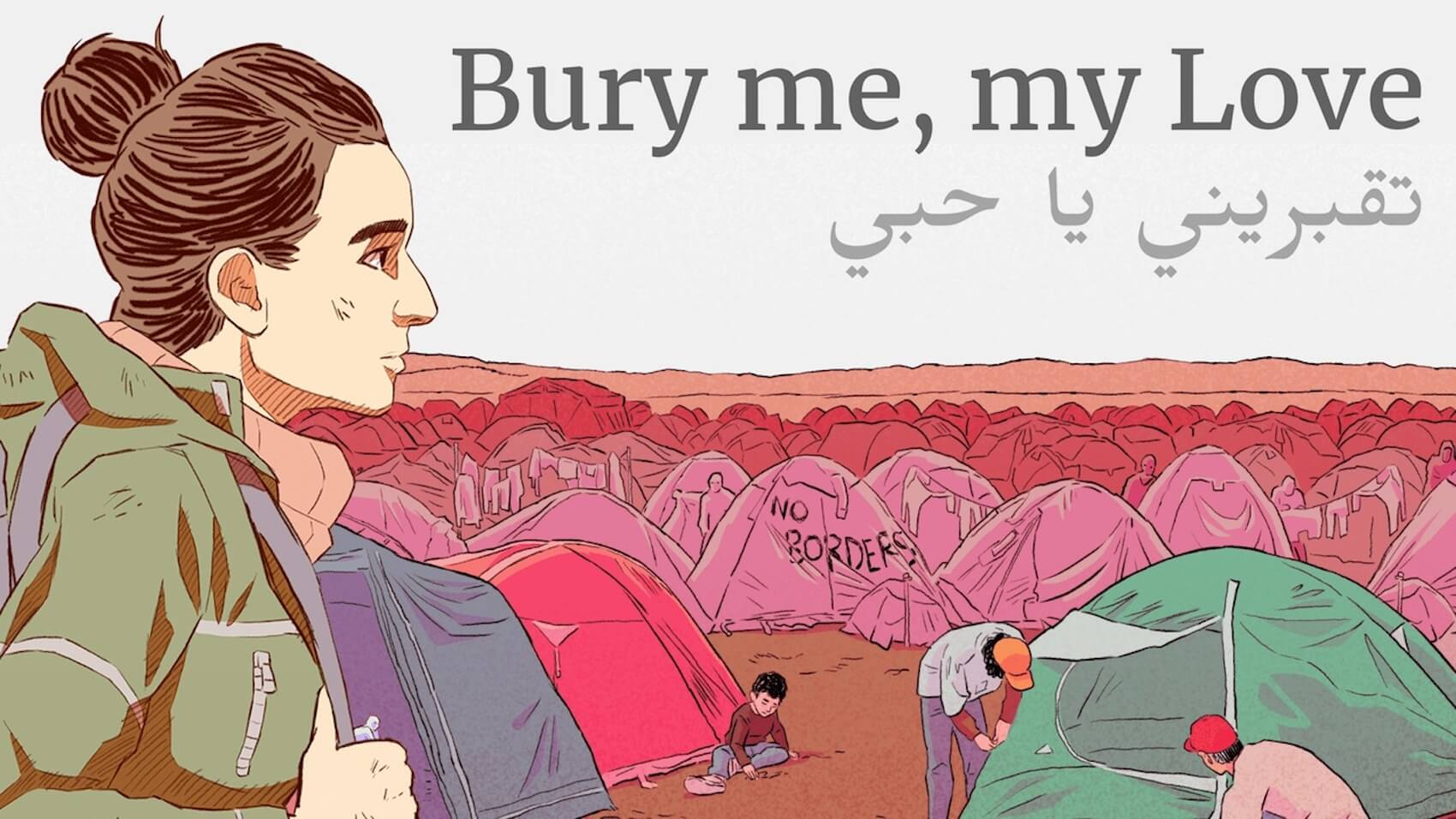
Tigs Louis-Puttick, Communications and Advocacy Coordinator for Samos Volunteers, a non-profit organisation supporting refugees and asylum-seekers on Samos. ‘Bury Me My Love‘ is a game about distance. It is a game which places front and centre relationships between humans, how they interact, and what drives people to take a leap into the unknown and risk their lives in the hope of reaching safety. The eponymous phrase, ‘Bury Me My Love’, is an Arabic expression to take care roughly meant to signify, “don’t think about dying before I do.” The game is inspired by but does not tell, the real-life story of Dana, a Syrian woman having left her country in September 2015. Both the journalist who wrote the article on Dana’s story and Dana herself working as part of the game’s editorial team (Le Monde, 2015). Developed by The Pixel Hunt in 2015, Bury Me My Love is a branching text-based narrative based around the story of people on the move during the 2015 Syrian refugee crisis. Its main characters are Nour and Majd, a young couple from Homs, Syria. The player takes on the role of Majd, having stayed behind in Syria to take care of his mother and grandfather, while his partner, Nour, goes on to attempt the journey to Germany in order to receive refugee status there. Much of the game is based on three core mechanics which impact the outcomes of choices made throughout Nour’s journey: Time; the itinerary; and finally, Nour’s own variables of morale, budget, her relationship with Majd, and what she has or does not have on her person in key moments. With this expansive and branching narrative, there are 50 different locations to go through and nineteen possible endings for Nour’s journey, with widely divergent outcomes.
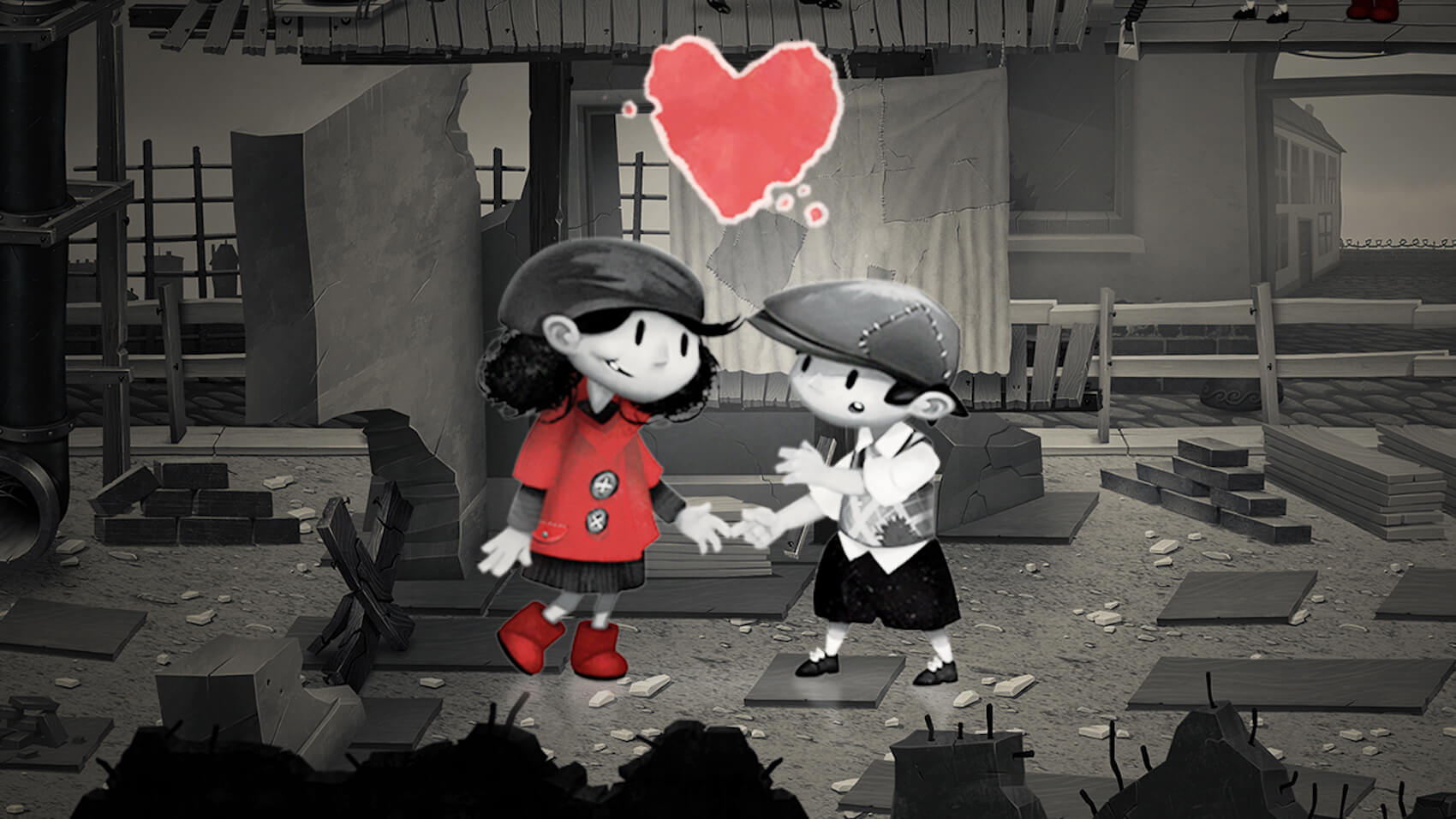
Jakub Jablonski is the co-owner and co-founder, art director, and creative director of Juggler Games. ‘My Memory of Us‘ is a narrative-driven puzzle-adventure video game developed by Juggler Games. The game is set in a fictional version of Poland during World War II and tells the story of a young boy and girl who must navigate through a city divided into two parts: one for Jews and one for non-Jews. The game features hand-drawn art, puzzle-solving, stealth elements, and a unique memory-manipulation mechanic that allows players to change the past to solve puzzles and progress through the story. The game received positive reviews for its story and art. Overall, My Memory of Us is a touching and emotional game about friendship, love, and survival during a war.
Fernández, Iván Escobar. (2023). “COMTOG Report: ‘My Memory of Us’ — Boosting Historical Memory Through Implicit Visual Metaphors.” Never Again Initiative. European Center for Populism Studies (ECPS). April 3, 2023. https://doi.org/10.55271/rp0037
My Memory of Us is a narrative-driven puzzle-adventure video game developed by Juggler Games. The game is set in a fictional version of Poland during World War II and tells the story of a young boy and girl who must navigate through a city that has been divided into two parts: one for Jews and one for non-Jews. The game features hand-drawn art, puzzle-solving, and stealth elements, as well as a unique memory-manipulation mechanic that allows players to change the past to solve puzzles and progress through the story. The game received positive reviews for its story and art. Overall, My Memory of Us is a touching and emotional game that tells a story of friendship, love, and survival during a war.
By Iván Escobar Fernández*
Introduction
Collective memory has been approached by scholars in two main ways. One definition, put forth by Olick (1999), views collective memory as the symbols that are publicly accessible and maintained by society. On the other hand, other researchers have defined collective memory as the collection of individual memories shared among members of a community that contribute to the formation of the community’s collective identity (see Hirst & Manier, 2008 and Wertsch & Roediger, 2008). Indeed, Collective Memory plays a crucial role in contemporary societies, not only in forging individuals’ and nations’ identities (see Sierp, 2014) but also in shaping states’ foreign and security policies (Rosoux, 2019: 194). In any case, despite being defined and addressed differently, what can be seen in the existing literature is that there is a rich pluralism of mnemonic devices individuals and collectivities use to remember the past (Conway, 2010).
The rich diversity of mnemonic devices used by individuals and organizations highlights the fact that there is no one-size-fits-all approach to addressing Collective Historical Memory (see Erll, 2022). According to the literature, it can be approached in two ways: explicitly, through the conscious and official creation of memorials, monuments, sculptures, and festivities, among others, and implicitly, by using visual symbols without directly referencing historical facts and dates (see Erll, 2022; Trodd, 2013; Keifer-Boyd et al., 2007; Schacter, 1987). This latter approach, known as implicit memory, can take different pathways, such as visual history or visual culture, which underscores the significant role that visual artefacts such as paintings, photographs, films, and video games play in shaping our perception of the past (Keifer-Boyd et al., 2007), or national narratives, which exalts some particular events or facts in order to create unconscious feelings and stories among the society (Erll, 2022). Nonetheless, approaching Collective Historical Memory as a visual subject has not been free of criticisms since it has been argued that it can lead to Manichean narratives and banalize the evil, thus distorting memory, decontextualizing suffering, and disassembling it from history (Ibrahim, 2009).
Regarding the relationship between video games and Historical Collective Memory, the formers have become an important tool for exploring and shaping the latter through visual culture and national narratives. As interactive experiences, video games allow players to engage with historical events and characters in ways that are more immersive and personal than other forms of media. Moreover, the visual elements of video games, such as character designs and environments, can play a significant role in how players perceive, recreate, and remember history (see Lee & Probert, 2010; Parks, 2008). Furthermore, it is believed that video games can reflect and reinforce national narratives, perpetuating dominant interpretations of historical events and shaping the Collective Memory of society, playing a key role in preserving, challenging, and/or shaping how we understand and remember the past (Chapman, 2016).
The aim of the report is to analyze video games that tackle historical events from an implicit perspective and explore the potential impact of such games on historical awareness and preservation. Through the examination of a case study, namely “My Memory of Us”, the report will evaluate whether they can effectively raise awareness of historical events and promote the preservation of historical memory. The implicit approach of the games will be considered as a means to engage players and encourage them to learn about historical events in a more interactive and immersive way. Ultimately, the report aims to determine whether video games can be an effective tool for educating players about the history and contributing to historical preservation efforts.
To determine if utilizing visual metaphors in video games can enhance historical collective memory without explicitly referencing specific historical facts and dates, we interviewed four experts on the subject. Jakub Jablonskiis the co-owner and co-founder, art director, and creative director of Juggler Games. Lukasz Janczukis the co-founder and lead designer at Juggler Games and a former Design Manager at CI Games. Janczuk was My Memory of Us’ lead designer. David Kirschneris an Associate Professor of Sociology and Chair of the Department of Human Services and Cultural Studies at Georgia Gwinnett College. Wojciech Soczewica is the Chief Executive Officer of the Auschwitz-Birkenau Foundation.
Analysis
It is worth reminding that the aim of this branch of the COMTOG Project was to assess the strengths and weaknesses of using video games to approach Collective Historical Memory from an implicit perspective. In sum, after conducting the semi-structured interviews, all four interviewees agreed that video games could be an effective tool in boosting Collective Historical Memory. However, there are some considerations that must be pointed out.
During the interviews, both game developers, Jakub Jablonski and Lukasz Janczuk, unanimously stressed the importance of video games as a learning tool and as a medium for inspiring people and opening up avenues for further discussion. Beyond being a product meant for entertainment, they believe that video games have the power to spark imagination and creativity in players, as well as encourage critical thinking and problem-solving skills. Additionally, they have argued that video games can be used to explore complex themes and issues in a way that is engaging and accessible to a wide audience. In their point of view, video games can make players start asking questions about past and contemporary complex issues, thus opening the floor for further discussions and boosting players’ interest in the topic. In this same line, Dr Kirschner argued that games could be a priceless learning tool not only for younger generations but for all cohorts in society, being able to teach not only historical facts and events but also reasoning through experience.
On the other hand, Wojciech Soczewica showed some concerns regarding the usefulness and applicability of video games in addressing traumatic past events like the Holocaust. Although he stressed the importance of integrating new technologies and strategies in preserving Collective Historical Memory, he mentioned that there are several ethical considerations to be borne in mind when reconstructing such a traumatic past, even digitally. In his opinion, in order for video games to properly address the past and therefore preserve Collective Historical Memory, they should focus on education rather than on entertainment. Without disagreeing with Soczewica’s statement, Dr Kirschner emphasized the necessity of integrating guidance from a teacher or professor when using video games for educational purposes. By doing so, some of the weaknesses involved in implicitly conveying historical facts through video games and visual metaphors can be overcome, thereby enhancing their potential as learning tools. This view was also shared by the creators of the game, Jakub Jablonski and Lukasz Janczuk, who argued that video games can be used for educational purposes but not in isolation. Specifically, both Jablonski and Janczuk emphasized that, while presenting “My Memory of Us” to audiences around the world, they encountered some players from different countries, especially the United States, who could not make a connection between the visual metaphors used in the game and the Second World War and the Nazi invasion of Poland. This underscores the importance of integrating guidance from an expert, as advocated by Dr Kirschner.
Furthermore, all four interviewees agreed that individual perspectives are an important part of Collective Historical Memory and that a nuanced understanding of past events requires an appreciation of the perspectives of all those involved. This idea is particularly evident in the game “My Memory of Us,” which integrates real stories from individuals into its fictional narrative. By including these stories, the game’s creators, Jablonski and Janczuk, were able to give players a more personal and emotional connection to the events of the Second World War and the Nazi invasion of Poland. Even Soczewica, who expressed some reservations about the use of video games to address traumatic past events, acknowledged the importance of personal stories in shaping our Collective Memory. By incorporating individual perspectives into its narrative, “My Memory of Us” highlights the importance of preserving and sharing these stories as a way of enhancing our collective historical memory.
Last but not least, it is also worth noting that the game developers and Dr Kirschner put emphasis on the capacity of video games to transmit universal emotions and feelings that can travel across time and space. Beyond depicting historical events, video games also have the potential to convey emotions and feelings associated with historical events without explicitly referring to them. By immersing the player in a virtual world and allowing them to experience the narrative firsthand, video games can create a powerful emotional connection that other forms of media may not be as effective at achieving. This is especially relevant in the context of Collective Historical Memory, as it can stimulate empathetic emotions in players that can then be transmitted into the real world, helping us sympathize with past victims and recognize the traumatic nature of historical events as well as preventing future similar atrocities from happening. In this same line, while Dr Kirschner and the game developers emphasized the potential of video games in promoting empathetic connections with the past, Soczewica also recognized the importance of Collective Historical Memory in shaping the future. From a different perspective, Soczewica sees that memory and remembrance serve not only to honour the past but also to pose warnings and morally inspire us to take action in the present. By reflecting on our shared history, we can learn from the mistakes of the past and work to prevent similar atrocities from happening again in the future.
Conclusion
In conclusion, aligned with the existing literature (see Chapman, 2016; Lee & Probert, 2010; Parks, 2008), it has been found that video games have the potential to approach historical collective memory implicitly, and all interviewees agreed on the importance of video games as a tool to boost Collective Historical Memory. However, as some scholars have previously pointed out, some challenges, such as misinterpretations and decontextualization of narratives, may arise (see Ibrahim, 2009). We have found that by integrating theoretical and professional guidance, these challenges can be overcome, enhancing the potential of video games as learning tools. Furthermore, it can be said that integrating individual perspectives is essential to address Historical Memory implicitly, and this was emphasized by the creators of “My Memory of Us,” who integrated real stories from individuals in the game’s fictional story. In sum, combining the power of video games with theoretical and professional guidance and individual perspectives can be a successful strategy to promote empathy and understanding towards past events, contributing to preventing future similar atrocities from happening. The main findings of these interviews are summarized below:
Video games can be an effective tool for boosting collective historical memory, even without explicitly referring to specific historical facts and dates, but some ethical considerations must be taken into account when addressing traumatic past events and the emotions stemming from them.
Video games can be used as a learning tool for teaching historical facts and events, as well as critical thinking and problem-solving skills.
Integrating guidance from an expert or teacher can enhance the potential of video games as educational tools.
Video games have the potential to create a powerful emotional connection with players and promote empathetic connections with the past.
Considering the increasing popularity and outreach of video games, their potential should be unveiled to prevent new atrocities from happening, as they can help foster empathetic connections with the past, promote critical thinking and problem-solving skills, and encourage further discussions on complex themes and issues, all of which can contribute to the prevention of future similar events. Reflecting on our shared history through the use of video games can, therefore, be a valuable tool in educating younger generations and the wider public, shaping Collective Historical Memory, and creating a more empathetic and informed society.
ECPS’ Never Again initiative and COMTOG project
Our collective history offers stories of war, resistance, intolerance, and perseverance. ECPS’ Never Again initiative prompts us to look back at these memories of conflict and democratic backsliding so that we, citizens, can be better informed of their causes and realities. A wealth of research has highlighted how mainstream media, i.e., TV, film, radio & news, have shaped the collective memory of these conflict narratives. However, as media technology evolves rapidly, the research studying collective memory must evolve with it.
The Collective Memory Through Online Games (COMTOG) project has emerged under this Never Again initiative to showcase the educational and social potential of serious, transformative gaming (video games, LARPs, tabletop roleplaying games) relaying the realities of conflict through a nuanced, well-researched, and empathetic lens. COMTOG is set to publish a series of interviews exploring the research process, artistic direction, and dissemination of these conflict-centred games. The game creator’s insights are included in interviews alongside the experience of diverse experts in the field (i.e. historians, policymakers, activists), thus creating a resource improving historical serious games’ ability to aid active remembering.
Moreover, serious gaming can provide the population with an immersive experience that can be used for educational purposes such as raising awareness, boosting ethical values, and preserving collective memory. Existing research has found their integration into educational programmes promising and positively impactful. We aim to understand how serious games discussing and portraying the victims of the conflict were researched and developed to stimulate interest in creating similar kinds of games.
(*) Ivan Escobar Fernandez graduated in International Studies from Carlos III University of Madrid (2020) and a Master’s in Humanitarian Action and Conflict from Uppsala University (2021) and is currently pursuing a Master’s (MSc) in Social Sciences and Human Security from Aarhus University. He simultaneously works as a research assistant at the European Center for Populism Studies (ECPS) and is a member of the think tank International Youth Think Tank (IYTT). Ivan is the chief editor of the international affairs magazine The Global Vision and has collaborated with different media outlets such as The Defence Horizon Journal. His interests range from geopolitics, international relations, political science, and democratization processes to national and international security. He also collaborates with Versión Original: Revista de cine as a film analyst.
References
Chapman, A. (2016). Digital Games as History: How Videogames Represent the past and Offer Access to Historical Practice. Routledge, New York.
Conway, B. (2010). “New Directions in the Sociology of Collective Memory and Commemoration.” Sociology Compass 4, 442–453.
Erll, A. (2022). “The hidden power of implicit collective memory.” Memory, Mind & Media 1, 1–17.
Hirst, W., Manier, D. (2008). “Towards a psychology of collective memory.” Memory 16, 183–200.
Ibrahim, Y. (2009). “Holocaust as the Visual Subject: The Problematics of Memory Making through Visual Culture.” Nebula 6, 94–113.
Keifer-Boyd, K.; Amburgy, P.M.; Knight, W.B. (2007). “Unpacking Privilege: Memory, Culture, gender, Race, and Power in Visual Culture.” Art Education 60, 19–24.
Lee, J.K.; Probert, J. (2010). “Civilization III and Whole-Class Play in High School Social Studies.” Journal of Social Studies Research 34, 1–28.
Olick, J.K. (1999). “Collective Memory: The Two Cultures.” Sociological Theory 17, 333–348.
Parks, N.S. (2008). “Video Games as Reconstructionist Sites of Learning in Art Education.” Studies in Art Education 49, 235–250.
Rosoux, V. (2019). “The role of memory in the desecuritization of inter-societal conflicts.” In: Securitization Revisited. Routledge, pp. 194–217.
Schacter, D.L. (1987). “Implicit Memory: History and Current Status.” Journal of Experimental Psychology 13, 501–518.
Sierp, A. (2014). History, Memory, and Trans-European Identity: Unifying DivisionsFirst. ed, Routledge Studies in Modern European History. Routledge, New York & London.
Trodd, Z. (2013). “Am I Still Not a Man and a Brother? Protest Memory in Contemporary Antislavery Visual Culture.” Slavery & Abolition 34, 338–352.
Wertsch, J.V.; Roediger III, H.L. (2008). “Collective memory: Conceptual foundations and theoretical approaches.” Memory 16, 318–326.
Galland, Martin. (2023). “COMTOG Report on ‘Bury Me My Love’.” Never Again Initiative. European Center for Populism Studies (ECPS). April 3, 2023. https://doi.org/10.55271/rp0036
Bury Me My Love is a game about distance. It is a game which places front and center relationships between humans, how they interact, and what drives people to take a leap into the unknown and risk their lives in the hope of reaching safety. The eponymous phrase, ‘Bury Me My Love,’ is an Arabic expression to take care roughly meant to signify, “don’t think about dying before I do.” The game is inspired by but does not tell, the real-life story of Dana, a Syrian woman having left her country in September 2015.
By Martin Galland*
Introduction
Bury Me My Love is a game about distance. It is a game which places front and center relationships between humans, how they interact, and what drives people to take a leap into the unknown and risk their lives in the hope of reaching safety. The eponymous phrase, ‘Bury Me My Love,’ is an Arabic expression to take care roughly meant to signify, “don’t think about dying before I do.” The game is inspired by but does not tell, the real-life story of Dana, a Syrian woman having left her country in September 2015. Both the journalist who wrote the article on Dana’s story and Dana herself working as part of the game’s editorial team (Le Monde, 2015).
Developed by The Pixel Hunt in 2015, Bury Me My Love is a branching text-based narrative based around the story of people on the move during the 2015 Syrian refugee crisis. Its main characters are Nour and Majd, a young couple from Homs, Syria. The player takes on the role of Majd, having stayed behind in Syria to take care of his mother and grandfather, while his partner, Nour, goes on to attempt the journey to Germany in order to receive refugee status there. Much of the game is based on three core mechanics which impact the outcomes of choices made throughout Nour’s journey: Time; the itinerary; and finally, Nour’s own variables of morale, budget, her relationship with Majd, and what she has or does not have on her person in key moments. With this expansive and branching narrative, there are 50 different locations to go through and nineteen possible endings for Nour’s journey, with widely divergent outcomes.
As part of the COMTOG project’s goal to bring together different but complementary voices of the field, three individuals were interviewed about the game Bury Me My Love and its subject matter. These included Florent Maurin, President of The Pixel Hunt and one of the game’s lead developers; Dr Angus Mol, a Games Studies scholar from Leiden University; and Tigs Louis-Puttick, Communications and Advocacy Coordinator for Samos Volunteers, a non-profit organisation supporting refugees and asylum-seekers on Samos. Keeping in mind the intent of the project – which was to “showcase the educational and social potential of video games relaying the realities of conflict” – I first formalised my approach towards Bury Me My Love and the interviews I conducted around two main themes. The first and most important which informed most of my questions as the interviews were conducted was the difference between authenticity and accuracy of the experience of people on the move. The second was the necessary emphasis on empathy towards people on the move and their experiences and the engagement of players in those narratives.
The discussion around authenticity is the one that is most discussed academically and theoretically in Games Studies. In this burgeoning field, scholars note that creative designers (big studios, indie developers, social media influencers) “design their versions of the past, purely or mostly, as entertainment products, where the focus is on making money through designing fun.” This becomes a three-fold issue when such actors “(1) have not traditionally been and are frequently still not taken seriously in their role in shaping our collective understanding of the past, (2) are not primarily (or at all) concerned with teaching about the past and (3), more and more, the connection many people have with the past is partly or even primarily shaped by video games, including how they learn or teach others about it” (Boom et al., 2020: 28-29). These challenges highlight the importance of bridging the gap between stakeholders beyond those in the video game-making sphere and including activists on the ground and researchers alike.
Authenticity vs Accuracy
In the interview with Dr Mol, an important theme which emerged from the conversation was the difference between authenticity and accuracy when it comes to portraying the experience of people on the move. For Dr Mol, what really interests players is this notion of an ‘authentic past’ more so than focusing on the accuracy of the past portrayed. Bury Me My Love strongly engages with the player’s sense of empathy, providing an experience that emulates the challenges, thoughts, and problems people face on the move. Of course, this experience can only go so far in accurately visualising these very issues which thousands of people faced and still face today. Part of the game’s intention, as explained by Maurin, was to replicate this sense of anxiety and distance through the text-message thread between Nour and Majd, with the player often left with information streaming in progressively, missing context until it is later explained, and no answers from Nour until a given time when she can respond back.
In order to best showcase the sort of journey people on the move can undertake, the game developers went through numerous documentations on the subject: including testimonies, articles, news reports, and documentaries, and themselves interviewed people in refugee camps in France. Maurin comments that the first four months of production of the game were solely dedicated to documenting, reading, and watching different sources. This was in order to get a firmer idea of the game and story they wished to tell and to account for the different paths people on the move take to get to Europe. For Dr Mol, this sort of emphasis on research and fact-checking is something that has become more prevalent and noticeable in the industry in the past ten or so years. It also reflects a shift in academia with regard to video games. As Dr Mol attests, the ways to study video games and the medium, in general, have greatly advanced and evolved in recent years, and while there is still some level of disconnect between developers and academics, there is an increasing number of projects which try to bring both sides together in the research and development of games.
One crucially important aspect brought up by Louis-Puttick is the game’s inability to truly replicate the sense of time that people on the move go experience. It is true that comparatively speaking, Nour’s (and Dana’s) journey is very short compared to the length of time now spent by people on the move in camps – where months and years go by with little to no change in their status. While the game does include both a path which discusses this major issue in the refugee camp, and an ending which does see Nour stuck in a camp indefinitely, the player does not experience these in real-time, and so this crucial part of the experience of people on the move cannot be passed on. However, the game does not shy away from portraying some of the intense hardships faced by people on the move during their journeys. Whether it is the cold realisation that death is always a possibility, or being antagonised, chased, and beaten up by a neo-Nazi group in Greece, or the lack of care shown by European authorities as they either condemn people to a camp or deport them back to Syria.
Ultimately, what is missing the most from this report with regard to the authenticity of Bury Me My Love is a voice from people on the move and their testimony, and whether they feel as though the game reflects enough of their experience. While the game was inspired by and involved the editorial input of a person on the move, this project would have benefited far more from involving someone with the direct experience of travelling to Europe under difficult conditions.
Empathy and Engagement
When it comes to a subject matter such as the one on the experiences of people on the move, it is difficult to discuss Bury Me My Love in terms of ‘enjoyment’ and ‘entertainment.’ Few would describe the journey undertaken by people on the move, even vicariously, as being ‘fun,’ and it was not at all in the intention of the developers to portray it as such. For Maurin, it was difficult to balance the stark tone that the game takes with the way people would cope with this experience through levity and humour. With several thousand lines of dialogue, much of the game’s focus was on the story and the characters and the ways in which they interact with the world around them as events unfold. From personal experience with the game, both main characters were truly well-fleshed-out and felt real in their emotions, thoughts, and worries for one another. Those who meet Nour along her journey also reflect a multitude of people and how they would act towards her plight.
It is difficult to assume how different players will engage with Bury Me My Love, as the game’s several endings make it so gameplay experience can wildly vary from person to person. Criticism of the game can be found on the game’s Steam (an online game distribution platform) page, where one particular comment lists that they found the game far too upbeat and treated with too much levity with regard to the subject material. When addressing feedback of that nature, Maurin comments that, while the commenter appears to be hyperbolising, it is entirely possible that they experienced the trek replicating Dana’s journey, which was comparatively easier and with fewer issues than other possible paths – which is an outlier. Dr Mol comments on this notion of making a game engaging enough for players to want to play it while respecting the subject matter enough to consider and internalise the message. In my experience with Bury Me My Love, the game is ‘entertaining’ in the sense that it does engage you with the challenges presented in front of Nour; it is also equally heart-breaking in the lowest lows of the story and does leave one with more awareness of the life of people on the move.
Ultimately, the game is not one meant to be entertaining in the literal sense of the term. It provides a story, a human story, one that is anchored in reality, and pushes the player to learn about the hardships faced by people on the move. News cycles and mass information have been noted to desensitise individuals of distant (and not so distant) occurrences and Bury Me My Love works to try to fight that antipathy by providing a deeply empathetic experience about the Syrian Refugee Crisis and inspiring the player to do something with the feelings they feel and receive after having played the game.
Conclusion
In closing the interview, all three interviewees were asked whether or not they felt video games could contribute to helping address common memory of certain conflict-centric events, such as the Syrian Refugee Crisis. Maurin puts it best that the game and its themes of adversity, displacement, struggle, and distance, are still very much relevant today. There are still important migrant flows of people fleeing conflict and disaster, and as such, the game Bury Me My Love remains, unfortunately, relevant and contemporary. This sentiment is echoed by Dr Mol and Louis-Puttick, who both see potential in video games, though with addendums on the intent and the goals set out by the developers in making such charged games.
This set of COMTOG interviews was designed to bring together different stakeholders and actors who have only to gain by interacting with each other. This project also placed front and center the importance of discussing and grasping the notion of ‘authenticity’ and how games can provide empathetic perspectives on still ongoing challenges for countless people. Maurin addresses it by humorously commenting on the ‘God-complex’ of developers and that their total control over the world in which the game is placed is misleading. If there was an attempt by developers to portray a very pointed perspective (in terms of values, convictions, etc.), it would feel very forced and could be spotted immediately by players. What developers like Maurin try to do is portray a collection of stories which are sourced from documentation; they do not provide a moral or a lesson but the tools for the players to internalise the experiences they have vicariously lived through and hopefully do something about it.
ECPS’ Never Again initiative and COMTOG project
Our collective history offers stories of war, resistance, intolerance, and perseverance. ECPS’ Never Again initiative prompts us to look back at these memories of conflict and democratic backsliding so that we, citizens, can be better informed of their causes and realities. A wealth of research has highlighted how mainstream media, i.e., TV, film, radio & news, have shaped the collective memory of these conflict narratives. However, as media technology evolves rapidly, the research studying collective memory must evolve with it.
The Collective Memory Through Online Games (COMTOG) project has emerged under this Never Again initiative to showcase the educational and social potential of serious, transformative gaming (video games, LARPs, tabletop roleplaying games) relaying the realities of conflict through a nuanced, well-researched, and empathetic lens. COMTOG is set to publish a series of interviews exploring the research process, artistic direction, and dissemination of these conflict-centred games. The game creator’s insights are included in interviews alongside the experience of diverse experts in the field (i.e. historians, policymakers, activists), thus creating a resource improving historical serious games’ ability to aid active remembering.
Moreover, serious gaming can provide the population with an immersive experience that can be used for educational purposes such as raising awareness, boosting ethical values, and preserving collective memory. Existing research has found their integration into educational programmes promising and positively impactful. We aim to understand how serious games discussing and portraying the victims of the conflict were researched and developed to stimulate interest in creating similar kinds of games.
(*) Martin Galland is a Master’s graduate in both European Policy and History, from the University of Amsterdam and KU Leuven, after having done a Bachelor in International Studies at Leiden University. His most recent thesis analysed the presence of (banal) nationalistic discourses present in a historical theme park in France, and how a specific vision of a French identity emerges from the theme park’s various shows. His research interests lie in the banal nationalism of contemporary populist movements, and the strengthening of right-wing populist discourse in interpretations of the past and history.
Boom, K. H. J.; Ariese, C. E.; van den Hout, B.; Mol, A. A. A. and Politopoulos, A. (2020). “Teaching through Play: Using Video Games as a Platform to Teach about the Past.” In: Hageneuer, S. (ed.) Communicating the Past in the Digital Age: Proceedings of the International Conference on Digital Methods in Teaching and Learning in Archaeology (12–13 October 2018). Pp. 27–44. London: Ubiquity Press. DOI: https://doi.org/10.5334/bch.c. License: CC-BY 4.0.
Politopoulos, A.; Mol, A. A. A.; Boom, K. H. J. & Ariese, C. E. (2019). “History is our playground”: action and authenticity in Assassin’s Creed: Odyssey. Advances In Archaeological Practice, 7(3), 317-323. doi:10.1017/aap.2019.30.
Dr David Kirschner is an Associate Professor of Sociology and Chair of the Department of Human Services and Cultural Studies at Georgia Gwinnett College. My Memory of Us is a narrative-driven puzzle-adventure video game developed by Juggler Games. The game is set in a fictional version of Poland during World War II and tells the story of a young boy and girl who must navigate through a city divided into two parts: one for Jews and one for non-Jews. The game features hand-drawn art, puzzle-solving, stealth elements, and a unique memory-manipulation mechanic that allows players to change the past to solve puzzles and progress through the story. The game received positive reviews for its story and art. Overall, My Memory of Us is a touching and emotional game about friendship, love, and survival during a war.
Developed by The Pixel Hunt in 2015, Bury Me My Love is a branching text-based narrative based around the story of people on the move during the 2015 Syrian refugee crisis. Its main characters are Nour and Majd, a young couple from Homs, Syria. The player takes on the role of Majd, having stayed behind in Syria to take care of his mother and grandfather, while his partner, Nour, goes on to attempt the journey to Germany in order to receive refugee status there. Much of the game is based on three core mechanics which impact the outcomes of choices made throughout Nour’s journey: Time; the itinerary; and finally, Nour’s own variables of morale, budget, her relationship with Majd, and what she has or does not have on her person in key moments. With this expansive and branching narrative, there are 50 different locations to go through and nineteen possible endings for Nour’s journey, with widely divergent outcomes.
Meret, Susi. (2023). “The impact of the Russia-Ukraine War on Right-Wing Populism in Europe. The case of Denmark.” In: The Impacts of the Russian Invasion of Ukraine on Right-wing Populism in Europe. (eds). Gilles Ivaldi and Emilia Zankina. European Center for Populism Studies (ECPS). March 8, 2023. Brussels. https://doi.org/10.55271/rp0016
At the referendum held in Denmark on June 1st, 2022 (Indenrigsministeriet, 2022), two-thirds of the electorate (66.9 %) voted for the removal of the Danish EU opt-out on Common Security and Defense Policy. This result was noteworthy, and it must be understood within the context of the Russian invasion of Ukraine, and in the light of the situation of instability and insecurity sparked by an international crisis, that added up to the effects of the global health crisis. The populist right-wing parties in parliament were against the removal, arguing Denmark would renounce decisional power on key military and security areas. Instead, these parties advocate for the strengthening of the military within the NATO-alliance, starkly opposing further development at EU level. The impact of the Russia-Ukrainian war opens new opportunities for the populist right, whose electoral support has been waning over the past years. The newly established party, The Denmark Democrats can gain from the situation to strengthen and consolidate their position. The New Right and the crisis ridden Danish People’s Party can exploit the situation to gain voters’ support, playing on feelings of insecurity and international crisis.
Biancalana, Cecilia. (2023). “Italy’s multiple populisms facing the Russo-Ukrainian war.” In: The Impacts of the Russian Invasion of Ukraine on Right-wing Populism in Europe. (eds). Gilles Ivaldi and Emilia Zankina. European Center for Populism Studies (ECPS). March 8, 2023. Brussels. https://doi.org/10.55271/rp0022
Italy has been defined as a laboratory for populism and a “populist paradise.” Indeed, multiple forms of populism coexist in Italy, covering the entire political spectrum. From the “left-wing” Movimento 5 Stelle to the right-wing coalition composed of Fratelli d’Italia, Forza Italia and the Lega, we can be sure that populism is very popular in Italy. We can be equally sure that, over the last few years, all these parties have had links to the Putin regime. Suffice it to mention the decades-long friendship between Silvio Berlusconi and Vladimir Putin or the admiration Matteo Salvini, the head of the Lega, has demonstrated for the president of the Russian Federation. However, the Russian invasion and the extensive popular and institutional support evinced for Ukraine in its wake changed everything, leaving populist parties scrambling to review their positions and modify their discourse. In the report, I will examine the ties between the main Italian populist parties (Fratelli d’Italia, Forza Italia, Lega, Movimento 5 Stelle) and Russia and the shifts in their positions towards President Putin in the aftermath of the invasion. Against this backdrop, the September 2022 elections in Italy can be considered as a “test case” to measure the success of the populist parties’ strategies to negotiate the crisis and to shed light on the changing balance of power within the broad populist field.
Keywords: Italy; Fratelli d’Italia; Lega; Berlusconi; Movimento 5 Stelle.
Lahti, Yannick & Palonen, Emilia. (2023). “The impact of the Russia–Ukraine war on right-wing populism in Finland.” In: The Impacts of the Russian Invasion of Ukraine on Right-wing Populism in Europe. (eds). Gilles Ivaldi and Emilia Zankina. European Center for Populism Studies (ECPS). March 8, 2023. Brussels. https://doi.org/10.55271/rp0018
As Finland’s neighbour, Russia, attacked its neighbour, Ukraine, the response across the political spectrum in Finland was universal. All the parties underscored the importance of patriotism and sovereignty and messages of solidarity and support for Ukraine (alongside condemnation of Russia). Support for Putin or the war is basically non-existent in Finland. Still, the Finns Party (FP), which is part of the populist Radical Right milieu in Finland, polls extremely well. Moreover, groups combining anti-COVID-19 measures with pro-Putin leanings have registered as political parties in preparation for elections in spring 2023. Still, their combined support is in single digits. The concrete consequences of the war include a U-turn in foreign policy from long-standing neutrality to NATO membership, with all parties—including the FP—supporting the government’s pending application to join alongside neighbouring Sweden. Interestingly, as the conflict heated up in early 2022, “Niikkogate”—a scandal in which a parliamentary committee chair from the FP was replaced after tweeting pro-Kremlin sentiments—has indicated the degree of pro-Ukraine support across the political spectrum.
Keywords: Finns Party (FP); Finland; Russia–Ukraine war; populist Radical Right; digital counterpublics; disinformation.
Nijhuis, Chris; Verbeek, Bertjan & Zaslove, Andrej. (2023). “Disagreement among populists in the Netherlands: The diverging rhetorical and policy positions of Dutch populist Radical Right parties following Russia’s invasion of Ukraine.” In: The Impacts of the Russian Invasion of Ukraine on Right-wing Populism in Europe. (eds). Gilles Ivaldi and Emilia Zankina. European Center for Populism Studies (ECPS). March 8, 2023. Brussels https://doi.org/10.55271/rp0032
The Netherlands boasts a wide array of populist Radical Right parties, from the Freedom Party (PVV) and Forum for Democracy (FvD) to Correct Alternative 2021 (JA21). To complicate matters further, the left-wing Socialist Party (SP) is also considered a populist party. Mirroring the diversity of responses to the Russian invasion of Ukraine in the rest of Europe, Dutch populist parties have reacted in myriad ways. Whereas the PVV condemned the Russian invasion, the FvD remained highly supportive of Putin. Interestingly, while many European populist Radical Right leaders, following public opinion, pivoted away from support for Russia, the FvD has maintained its support for Putin’s regime throughout 2022. JA21, on the other hand, has followed the non-populist parties, calling for tougher sanctions on Russia. This report maps the diverse positions of the three populist Radical Right parties regarding Russia. However, we also seek to explain why they have chosen such diverse paths. The report focuses on supply-side considerations, such as the impact of the parties’ relative degree of populism, their attaching ideology, and their position in the highly fragmented party system.
Keywords: Populism, Foreign policy, the Netherlands, Russia–Ukraine war, Party for Freedom (PVV), Forum for Democracy (FvD).