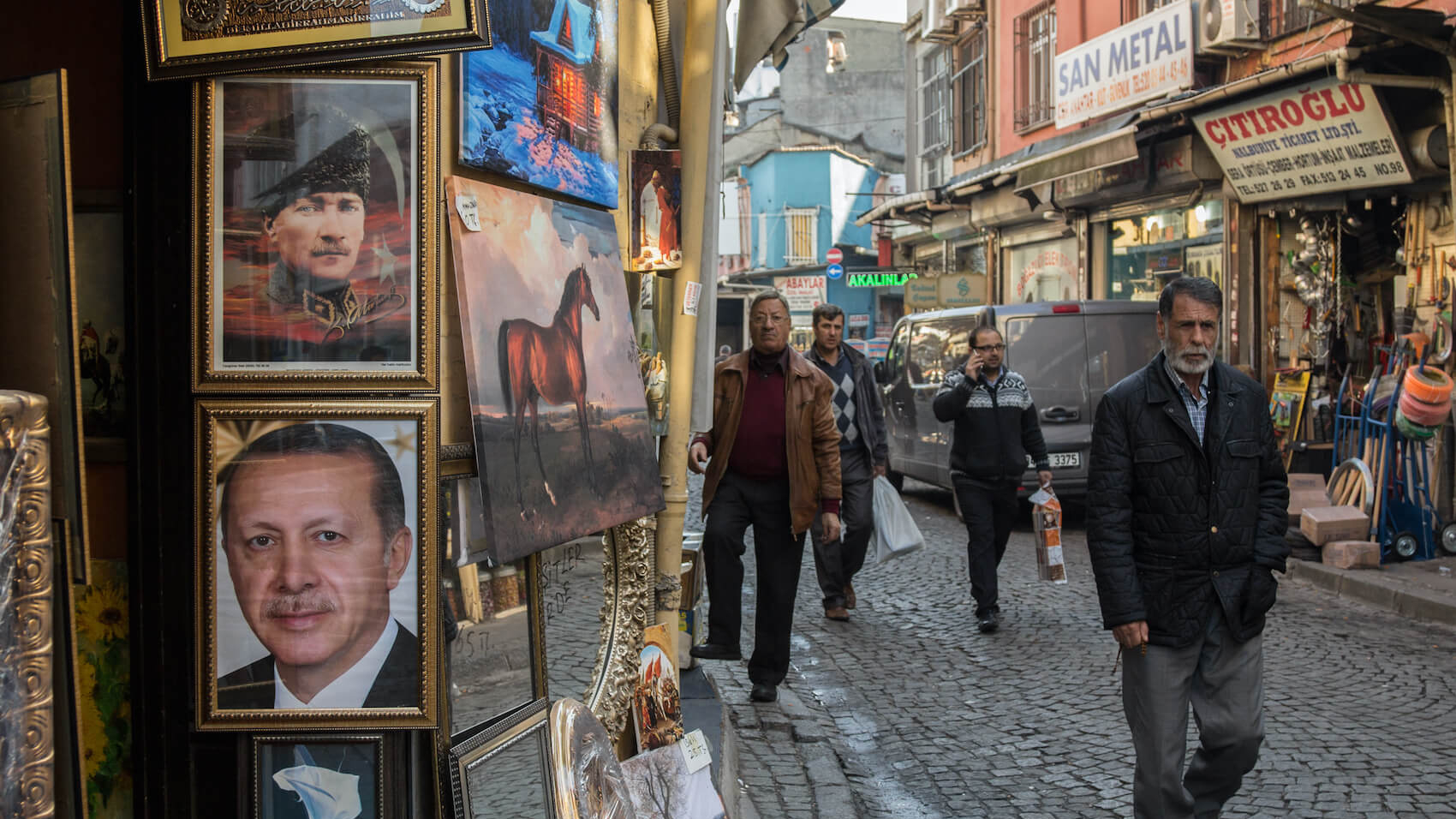
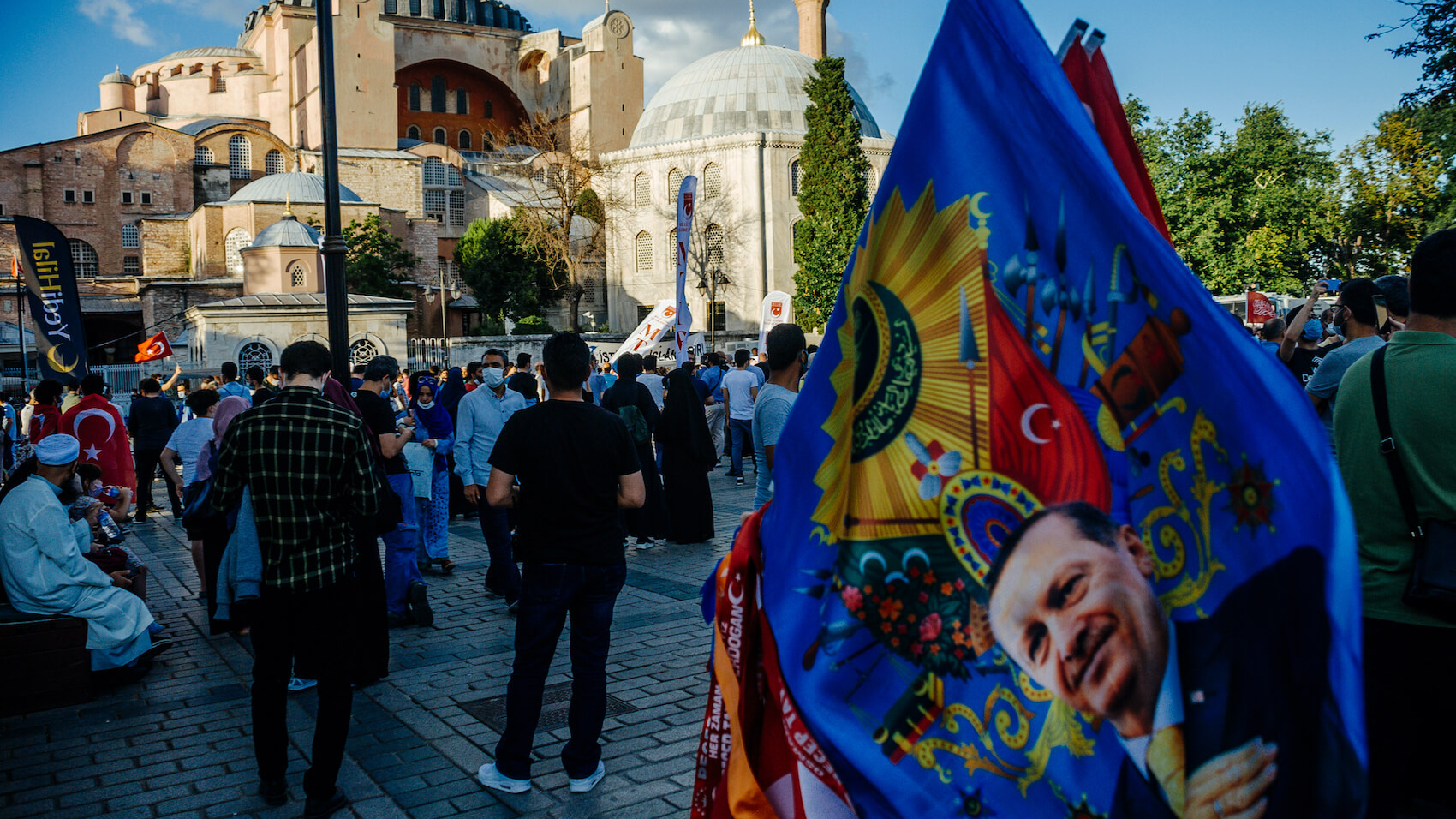
Hagia Sophia was converted into a mosque by the Erdogan regime in Turkey on July 10, 2020. Following the decision, several groups gathered in front of Hagia Sophia to celebrate. Photo: Ugur Ferhat Baloglu.

Claiming the People’s Past: Populist Politics of History in the Twenty-First Century

Kenes, Bulent. (2024). “Claiming the People’s Past: Populist Politics of History in the Twenty-First Century.” ECPS Book Reviews. European Center for Populism Studies. August 21, 2024. https://doi.org/10.55271/br0015


The book examines the populist use of history through a blend of case studies and thematic analyses spanning various geographical and socio-cultural contexts. It highlights how populist politics often adopt an anti-elitist stance, particularly against academic historians. Populists tend to favor simplified, decontextualized, or ambiguous historical narratives infused with strong emotional appeals—such as pride, anger, fear, or nostalgia—over the rigorous, evidence-based approach of professional historiography. Despite populism’s strong orientation toward the past, the academic exploration of its relationship with history has been relatively sparse so far. This book makes a notable contribution to addressing and bridging that gap.

Reviewed by Bulent Kenes

How do populists relate to history and address the past? How do they represent history and frame particular historical events, periods, or the dimensions of the past, present, and future? Why is the politics of history an important aspect of populism? What drives populists to engage in the politics of history, and what exactly is the appeal of history for populist politics? How do practices of ‘past presencing’ facilitate a populist political logic? What political and emotional mechanisms facilitate the mobilization of historical knowledge in populism? How do emotions like patriotism, fear, guilt, comfort, and indifference contribute to this mobilization, and what role do they play in populist narratives? Conversely, what emotions are avoided, and why? These are the questions that the editors and authors of the comprehensive volume “Claiming the People’s Past: Populist Politics of History in the Twenty-First Century” seek to answer.

The book edited by Berber Bevernage, Eline Mestdagh, Walderez Ramalho and Marie-Gabrielle Verbergt offers a rich array of concepts related to its central themes, including ‘fake history,’ ‘fictionalization of politics,’ ‘historiographic emotivism,’ ‘emotive historiography,’ ‘collective emotions,’ ‘collective narcissism,’ ‘past presencing,’ ‘presentism,’ ‘teleological presentism,’ ‘emotivism,’ ‘emotional truth,’ ‘memorial populism,’ ‘Manichean nostalgia,’ ‘progressive nostalgia,’ ‘nostalgia for the future,’ ‘reactionary nostalgia,’ ‘moral remembrance,’ ‘chronosophies,’ ‘updatism,’ ‘historical Russia,’ ‘deep people,’ ‘mutual deception,’ and ‘identity fusion,’ among many others.

The book explores the populist politics of history through a combination of case studies and thematic analyses across diverse geographical and socio-cultural contexts. Divided into two parts, the first part presents case studies that examine how specific populist parties, movements, or leaders engage with history. These cases cover a range of populisms globally, including the AfD in Germany, Islamic populism in East Africa, Vox and Podemos in Spain, and populists in power such as the Kirchners in Argentina, the Awami League in Bangladesh, Erdogan in Turkey, Trump in the US, Bolsonaro in Brazil, and Putin in Russia.

The second part focuses on thematic reflections that highlight key aspects of populist historical politics. These include the emotional and affective dimensions of populism’s approach to history, the use of ‘affective repertoires’ to promote specific historical narratives, and the role of emotions like nostalgia in right-wing mobilization. The book also examines the concept of ‘historiographic emotivism’ and the intertwined relationship between ethnic nationalism and populism. Additionally, it discusses how populists claim or reject epistemic authority, often showing a disregard for academic historiography. 

Ensuring consistency in an edited volume is challenging, as it can be difficult to review such collections from a unified perspective. However, the editors of this book have successfully met that challenge, distilling the essence of 16 articles that combine case studies with thematic and theoretical discussions. The editors also successfully overcome the ‘Atlantic bias’ in populism studies by offering a global perspective with case studies from the Americas, Africa, Asia, and Europe. The book also effectively represents both right- and left-wing populisms, as well as those in opposition and in power. From the case studies and conceptual analyses, the editors identify five recurring features of how populists engage with history: (a) vagueness and decontextualization, (b) a logic of equivalence, (c) antagonism, (d) moral and emotional appeals, and (e) rejection of representational pluralism.

As Jan-Werner Müller noted in the book’s foreword, populists often invoke specific historical events or figures to represent their vision of ‘the people’ while also signaling exclusions. They rewrite history textbooks, invest in monuments, and reshape the built environment to evoke past glories and reinforce symbolic exclusions—such as Erdogan’s transformation of Turkish urban landscapes in the Seljuk-Ottoman style. The book provides numerous examples of this glorification of the past, including populist reinterpretations by Narendra Modi, the AfD, PiS, and Donald Trump. Many right-wing populists promise a “rebirth” through these historical re-imaginings.

The book notes that it is common for politicians to engage with history to support their policies, and this is true for both right-wing populists like Narendra Modi and left-wing populists like Evo Morales. Despite their differing agendas, they share a similar approach: using history in the name of the people, against the elite, to divide society into opposing camps. From Holocaust revisionism in Germany to anti-communism in Viktor Orban’s Hungary and PiS’s Poland, far-right populists frequently push controversial historical interpretations. In the US and Brazil, Trump and Bolsonaro’s populist uses of the past have drawn criticism from historians. Similarly, left-wing populist leaders in Argentina, Venezuela, Ecuador, and Bolivia have used history to focus on the legacies of colonialism and military dictatorships.

According to the editors, populists present the past in a decontextualized and vague manner, drawing equivalences between otherwise unrelated historical events while antagonistically representing history and historians. Their relationship to the past is driven by emotion, and they reject pluralism in historical representation. Populist references to history are often anachronistic, too. Additionally, the book argues that populists do not present history chronologically. Instead, they organize a heterogeneous mix of events, periods, and figures around empty signifiers like ‘heroism,’ ‘resistance,’ ‘foreignness,’ and ‘threat,’ weaving them into a narrative of equivalence. Unlike ideologies such as nationalism or socialism, which invest heavily in creating their own historiographies, populists generally show little interest in developing distinct historical narratives. Notable exceptions include Hindutva in India and PiS’s authoritarian conservative populism in Poland, where there is significant investment in historiographical production. However, even in these cases, the book finds that populist historical revisionism relies more on judicial or physical repression of dissent than on scholarly debate. 

The book underscores that most populist depictions of history revolve around morally charged binaries of ‘us’ versus ‘them.’ Populists often claim to protect history from being stolen, corrupted, or erased, or they present themselves as restoring a glorious past. For instance, the book cites a comic published by Austria’s FPÖ that depicts Heinz-Christian Strache alongside 17th-century Prinz Eugen defending Vienna from the Turks in 1683, echoing similar rhetoric seen in the Brexit campaign, which invoked Britain’s resistance to ancient Roman invasion. Donald Trump accused those advocating of the removal of Confederate statues of erasing history, positioning himself and his supporters as defenders of American heritage. Similarly, Erdogan regime claims to ‘give back’ history to the people, suggesting it was stolen by the West and previous governments. The book highlights how both left- and right-wing populists engage in this narrative hijacking, often targeting ‘the elite’ as the culprits behind the neglect or corruption of historical consciousness.

Populist politics of history frequently involve an anti-elitist stance against academic historians. According to the book, populists prefer unambiguous, decontextualized, or vague histories filled with strong emotional overtones such as pride, anger, fear, or nostalgia, rather than engaging with the fact-finding mission of professional historiography. For example, Pawel Machcewicz’s chapter discusses how Poland’s PiS promotes narratives of Polish heroism in helping Jews during World War II to counteract the negative affects of critical historiography. Populists often frame themselves as liberators, returning a glorious past to the people, making pride and nostalgia key elements in their historical narratives.

The book highlights how populist people, leaders and parties, such as Rodrigo Duterte, Lega Nord, Vox, and the Kirchnerists, often reject pluralism in historical representation. The book reminds readers that populists tend to mythologize history, rejecting alternative narratives not because they are factually incorrect, but because they conflict with the moral and emotional narratives they promote. Beyond tales of heroism, stories of victimhood and suffering are also effective tools for populists to moralize politics. Decontextualized narratives of historical victimhood can emphasize the innocence of ‘the people’ and highlight the evilness of the enemy, helping populist leaders maintain an underdog status even while in power. For example, the book discusses the reconversion of Hagia Sophia into a mosque, showing how Erdogan and his regime use decontextualized narratives of historical victimhood to legitimize their rule and distract from present-day human rights abuses.

The empirical chapters of the book offer numerous examples of how right-wing populists selectively and effectively use the past. For instance, Klaus Neumann’s chapter on the AfD shows that their approach to history is driven by two aims: to create a genealogy for themselves and to contrast the problematic present with an idealized past that promises a better future. To achieve this, the AfD downplays the Nazi past, instead aligning themselves with the Conservative Revolution and claiming the legacy of Claus Schenk Graf von Stauffenberg, who attempted to assassinate Hitler in 1944. Despite this, they still attack Germany’s Holocaust memorial culture.

Chintia Bale and Gustavo Guille emphasize in their chapter on Argentina that memory plays a crucial role in power struggles, defining who belongs on each side of the political divide. They describe “memorial populism” as a subtype where the memory of a specific event is emptied of its original meaning, and a past charismatic leader is resurrected as the “eternal sovereign,” akin to the sovereignty of God in theocratic populism. 

Julian Kuttig and Bert Suykens, in their chapter on Sheikh Mujibur Rahman of Bangladesh, highlight how the manipulation of history and memory is central to Bangladeshi politics. According to the chapter, Mujib’s personal legacy (body personal) has been downplayed, allowing a populist memory of his political legacy (body politics) to dominate.

Pawel Machcewicz’s chapter on Poland illustrates how PiS has used history as a key tool to shape political and emotional narratives, defining enemies and rallying grassroots support. Central to PiS’s cultural agenda is the portrayal of Poland’s glorious past as under constant threat from corrupt elites and external foes who undermine Polish martyrdom and heroism. PiS’s “politics of history” involves accusing liberal elites and professional historians of promoting a “pedagogy of shame,” which critically examines darker episodes of Polish history, particularly Polish wrongdoings against other nationalities like Jews, Germans, and Ukrainians.

Neeladri Bhattacharya, in his chapter on the Hindu right, argues that populist regimes worldwide seek to reshape what is considered history. He describes how, under nationalist pressure, authors and publishers have faced attacks leading to apologies, book destructions, and increasing hostility since Modi and the Hindu right came to power in 2014. The assault extends beyond professional history writing to all academic institutions. Violence, including book burnings, online abuse, physical attacks, and even killings of thinkers and journalists, has become commonplace. According to the chapter, while secular nationalism in India aimed to create a multicultural memory, the Hindu right builds its nationalism on memories of religious antagonism. Professional historians are seen as obstacles to the Hindutva agenda, raising inconvenient questions and offering counter-narratives. As a result, they face sustained attacks, stigmatization, and accusations of being anti-national. This new regime of “historical truth” silences intellectual inquiry, normalizes censorship, and forges a connection between the populist ‘savior’ and the people.

Yagmur Karakaya, in her chapter on Erdogan’s neo-Ottoman nostalgia, argues that nostalgic populism is a common feature of populist historicities. Focusing on Erdogan’s speech during the reopening of Hagia Sophia as a mosque, Karakaya identifies three key discursive elements of nostalgic populism in Turkey: the legalization of history, the monopolization of history, and the revival of a “stolen” past. This analysis provides insight into the deeply rooted and comprehensive authoritarian Islamist populism of Erdogan.

In her chapter, Felicitas Becker notes that in East Africa, particularly in Tanzania and Kenya, most populist Islamist spokespeople are outsiders to the political establishment. 

In Oz Frankel’s chapter on the Trump era, right-wing populists accuse elites of betraying the American people and erasing the nation’s glorious past, fostering shame and guilt among the young, particularly white Americans. The chapter explores Trump’s populist portrayal, linking him to biblical figures, prophecies, and conspiracy theories. Frankel also examines key works of racist, far-right, and alt-right literature.

In their chapter, Mateus Henrique de Faria Pereira and Valdei Lope de Araujo explore the “updatist” use of history, a key element of Bolsonarist populism that underpins its historical denialism and spread of fake news. According to the authors, Bolsonaro’s far-right authoritarian populism in Brazil relies on denying and falsifying history, labeling all political opponents as ‘leftists’ or communists. This approach revives Cold War-era rhetoric, allowing Bolsonaro’s supporters to falsely depict Nazism as a left-wing movement and portray any opposition as communist.

Andrey Oleynikov’s chapter on Vladimir Putin’s Russia highlights the conservative and presentist use of history, centered on the concept of “historical Russia.” Oleynikov argues that Putin legitimizes his rule by claiming a mandate from a supposed “thousand-year-old historical state,” positioning contemporary Russia as the successor to both pre-revolutionary and Soviet Russias. This construction of “historical Russia” also serves foreign policy interests, justifying actions like the annexation of Crimea in 2014 and the invasion of Ukraine in 2022. Additionally, Putin’s regime has crafted the notion of a “deep people” to reinforce the belief that the nation is on the right path under his leadership.

In his chapter on Spain, Pablo Sanchez Leon examines the relationship of left-wing populist Podemos and right-wing populist Vox, which has voiced fears of an Islamic reinvasion of Andalusia, a region with a significant North African Muslim immigrant population, with the past and history. Leon argues that Vox’s historical narratives shed light on the overlap between nationalism and populism, two distinct yet often intertwined ideologies. Vox actively promotes counter-narratives against the so-called Black Legend, which highlights Spain’s cruelties in America. Leon also emphasizes that understanding populism requires attention to its use of historical narratives.

Laurajane Smith, in the first chapter of the thematic section, highlights nostalgia as a central emotion in the mobilization of revisionist history. She argues that nostalgia is key to the appeal and expression of various forms of populism, particularly right-wing populism. By invoking revisionist, mythologized, or selective histories that emphasize heroism and national pride while avoiding ambiguity, these narratives manage present-day emotions. Heritage, too, plays a similar role by historicizing emotions to legitimize contemporary ideologies. Alongside nostalgia, fear is also crucial for right-wing populism, which often rejects nuance to avoid feelings of shame and guilt.

Aviezer Tucker, in his chapter titled “Historiographic Populist Emotivism,” argues that populists view historiography as a narrative driven by passions rather than facts. For populists, the more emotionally charged a historical narrative, the more “authentic” it is. Tucker contends that populists lack the will to control their passions, leading to self-destructive policies. This is evident in the rise of “post-truth” (old “wishful thinking”) where beliefs are shaped by strong emotions rather than evidence. As a result, populist historiography cannot be evaluated through traditional historiographic methods. Populists may exert power by dismissing professional historians, as seen in Hungary, or by inciting social media “lynch mobs.” According to Tucker, to advance their agendas, populist leaders encourage historical amnesia, erasing inconvenient truths. In her chapter, Lea David echoes this sentiment, noting that official memory requires both the art of forgetting and remembering to be effective.

Allan Megill notes in his chapter that academic historians rarely attract the attention of populists, who typically use “the past” to evoke emotions that unite “the people” and motivate them toward action. Another chapter’s author, Chris Lorenz, adds that populist leaders, consistently framing the present as a time of crisis, aim to restore their people’s supposed past greatness. Leaders like Trump, Putin, Orban, and Erdogan frequently invoke a narrative of past glory, recent decline, and future resurrection, shaping a populist timeline of rise, fall, and redemption.

As we look at the other (namely critical) side of the coin, the editors of the book adopt Ernesto Laclau’s formal definition of populism as a ‘political logic’ and allowed the chapter authors to choose the approach that best suited their case studies. As a result, many chapters are preoccupied with lengthy and repetitive discussions on the definition of populism, alongside deep philosophical deliberations that can feel excessive. Additionally, since some chapters were written in 2020 and 2021, the book does not address the most recent political developments in countries like Brazil, US and Argentina, where the situation has changed dramatically. Furthermore, as Megill points out in his chapter, some of the empirical studies in the book focus more on nationalist ‘historicity’ than on populist narratives. 

As one of the chapter authors notes, although populism is ‘essentially past-directed,’ the academic literature on its relationship with history has remained limited so far. From an overall perspective, this book represents a significant attempt to address and fill that gap.

—-

Berber Bevernage, Eline Mestdagh, Walderez Ramalho and Marie-Gabrielle Verbergt. (2024). Claiming the People’s Past: Populist Politics of History in the Twenty-First Century. (Cambridge University Press). 343 pp. $110, ISBN: 978-1-009-45363-9
Photo: Dmitry Demidovich.

The Wrecking of the Liberal World Order 

Guidotti, Andrea. (2024). “The Wrecking of the Liberal World Order.” ECPS Book Reviews. European Center for Populism Studies. January 17, 2024. https://doi.org/10.55271/br0013


In his book, “The Wrecking of the Liberal World Order,” Vittorio Emanuele Parsi argues that the neoliberal distortion of democracy has led to its erosion, giving rise to populism. This phenomenon has permeated both public discourse and the political culture of mainstream parties. Faced with this challenge, these parties find themselves at a crossroads, having to decide between a defensive response to the surge of populist movements or adapting and converging with their political platforms to prevent substantial losses in electoral support.

Reviewed by Andrea Guidotti

Some major shifts are shaping international politics in recent decades. Firstly, there is a noticeable decline in American leadership as the primary global force, accompanied by the simultaneous ascent of authoritarian powers such as China and Russia, altering the power dynamics among major nations. Secondly, terrorism, particularly its religiously charged variants, has gained increasing relevance and urgency, raising concerns in some regions, with the Mediterranean standing out prominently. Thirdly, during Donald Trump’s presidency, the United States veered away from the multilateral system, exhibiting unprecedented revisionist stances. Lastly, the ascent of nationalist and, more significantly, populist movements has tainted political discourse, disengaging citizens from liberal and, particularly, democratic principles in distinct yet interconnected ways.

In his book “The Wrecking of the Liberal World Order” Vittorio Emanuele Parsi, Professor of International Relations at the Catholic University of Milan, Italy, delves into the current state of the international political and liberal system. With a keen focus on the ongoing changes within the system, potentially jeopardizing its stability, Parsi’s central argument posits that since the 1980s, the Liberal World Order has gradually given way to the Neoliberal World Order, fundamentally altering its intrinsic nature.

The book contends that the foundational pillars of the system face challenges from various political and ideological movements: (i) Neoliberalism, which highlights the shortcomings of ‘big governments’ in terms of resource mismanagement and hindrance to the efficiency of market mechanisms; (ii) Neoconservatism, countering the ‘progressive’ agenda by emphasizing traditional values and principles of law and order; and (iii) Ordo-liberalism, utilized to justify state policies favoring capital at the detriment of labor.

The Liberal World Order is grounded in two fundamental objectives: firstly, the establishment of a system that is both open and institutionalized, ensuring the potential for democracies to flourish and prosper; and secondly, the reinforcement of the domestic political and socioeconomic systems upon which the overarching system is constructed. These goals were envisioned to materialize through the establishment of the United Nations, a universal and comprehensive institution replacing the ineffective League of Nations. It acknowledged the privileged status of the great powers that emerged victorious in World War II – the United States, the Soviet Union, China, the United Kingdom, and France.

The fundamental distinction between Liberalism and Neoliberalism lies in the nuanced relationship they establish between democracy and the market economy. Democracy, built on the premise of equality despite inherent individual differences, contrasts with the free market economy’s tendency to thrive on inequality, rewarding the most efficient entities and individuals based on their abilities/capabilities, productivity, and merits. The Neoliberal project, therefore, deviated by downplaying concerns related to inequality and fostering a system where increased productivity, driven by technological advancements, exclusively rewarded capital investments. This shift was not isolated; it emerged as a response to the widespread perception among politicians of stagnant wages and growing job insecurities.

The underlying logic was as follows: ‘income does not matter; consumption does.’ In simpler terms, as long as the middle class could maintain its consumption levels due to the newly implemented policies, it might not be overly concerned about the growing levels of inequality. What tends to be overlooked in these arguments is the reality that, even if there is no deliberate attempt to eliminate economic inequality with the aim of preventing political inequality, people do not need convincing that their unequal economic power translates into political disparities. Consequently, public policies geared towards creating more favorable conditions to attract international capital began to progressively fuel unemployment among the middle class, heighten job insecurities, erode the Welfare State, and bring an end to redistributive policies. In essence, an ideological clash between economic freedom and political sovereignty (the efficacy of democracy) emerged within and from the framework of the Liberal World Order.

According to Parsi’s book, the first problematic dimension of the current Liberal World Order is its altered distribution of power, coinciding with the transition from a unipolar to a multipolar system, where the US no longer stands as the sole global great power. On one hand, China is growing more assertive in the Pacific and Indian Ocean, implementing a ‘String of Pearls Strategy’ that involves cultivating privileged diplomatic, commercial, and military relations with certain countries, aiming to control vital sea lines of communication and strategic logistical supplies. Specifically, China seeks to assure its neighbors that it is a reliable actor, refraining from unnecessary threats as long as its perceived interests remain intact. On the other hand, Russia, exemplified by the annexation of Crimea and the invasion of Ukraine, is endeavoring to expand its sphere of influence, willing to employ military means if deemed necessary. Additionally, both China and Russia are strategically involved in the Middle East, where the American presence has become increasingly problematic. While not explicitly sharing a strategy against the US, it is evident that Russia and China have been striving to establish a common platform against American hegemony.

The second problematic dimension involves the ‘molecularization and privatization of the threat,’ a consequence of the proliferation of terrorist groups that particularly destabilizes Western public opinions and political elites. In particular, Islamist terrorism has demonstrated a significant capacity for deconstruction within the Liberal World Order. Two noteworthy aspects emerge here. Firstly, the Mediterranean region has regained significant importance, serving as a focal point for indirect strategic actions against European countries to undermine their political stability. Secondly, Russia has reopened the front of contention in the Baltic Sea with respect to NATO.

The third problematic dimension is the American shift concerning the system during Trump’s presidency. Trump built his political credibility by addressing concerns about the emergence of ‘jobless growth,’ where economic expansion fails to translate into an expansion of job opportunities. In another light, argues Parsi, there’s the phenomenon of the ‘rentierization of the capitalistic system,’ which significantly favors financial investments over productive ones. Moreover, Trump pledged to deconstruct the Liberal World Order from within to rectify these distortions. Within Trump’s framework, the US revealed itself as a revisionist power within the system. By rejecting multilateral practices as a means to express its vision of a ‘constraint-free’ America, the US administration undermined the foundations of its own credibility in the eyes of both partners and allies, as well as adversaries.

The fourth problematic dimension revolves around democratic contamination caused by sovereigntist populism and technocratic oligarchies. The emergence of populist movements has led to a democratic deformation wherein opinions are simplistically and systematically transformed into decisions. The neoliberal distortion of democracy and its erosion have fostered populism, intoxicating both public discourse and the political culture of mainstream parties. These parties are then confronted with the choice of either defensively responding to the rise of these populist movements or adapting and converging with their political platforms to avoid significant loss in electoral support. According to the book, two strands of populism are crucial to this analysis: one targeting economic and financial elites, advocating for policies perceived as betraying the interests of American workers, and the other embodied in Trump’s politics, characterized by racial and ethnic-based nationalism and the notion of a ‘true America’ with distinct political inclinations. In a broader sense, populism can be viewed as a signal of discontent but also as a call to restore the balance between elites and the common people. Crucially, even when acknowledging that economic and social inequality naturally arises from individual differences in abilities and resources, this acceptance should not be used as a justification for the perpetuation of existing political inequality.

Professor Parsi concludes the book with a chapter on the pandemic and its relationship with the current (Neo)Liberal World Order, exploring potential solutions to the issues discussed throughout the book. Covid-19 showed that we were not all equally vulnerable to the virus, as its impact is asymmetric both for natural and especially economic reasons. This asymmetry mirrors the asymmetries, imbalances and inequalities inherent in the (Neo)Liberal World Order, where a few dictate its political and economic structure, disregarding the interests of the many and violating the foundational principles established post-WWII. Consequently, three key takeaways are proposed as potential remedies or paths worth pursuing: (i) rebuilding an up-to-date Liberal World Order by way of revitalizing democratic regimes in such a way that they can gain back control of market dynamics; (ii) the premise of the project should be a privileged relationship between the two sides of the Atlantic, i.e. democratic powers; (iii) We must not forsake values in favor of interests only, ensuring that those with underrepresented political strength are not overlooked or allowed those to wield power solely based on their economic and status position, influencing and shaping the rules of the game regarding the functioning of the system.


The Wrecking of the Liberal World Order by Vittorio Emanuele Parsi (Palgrave Macmillan, 2021). 325 pp. €139,09 (Hardback), ISBN: 3030720454, 9783030720452

Davao City officials, including Vice President Sara Duterte, celebrated Philippine Independence Day on stage in Davao City, Philippines, on June 12, 2024. Photo: Elvie Lins.

The Philippines: From ‘People Power’ to Democratic Backsliding

Kenes, Bulent. (2023). “The Philippines: From ‘People Power’ to Democratic Backsliding.” ECPS Book Reviews. European Center for Populism Studies. June 14, 2023. https://doi.org/10.55271/br0014


In his recently released book, scholar Mark R. Thompson underscores how the “people power” narrative gradually lost credibility in the Philippines, as evidenced by the opposition’s resounding defeat in the 2022 elections. This outcome demonstrated the diminishing appeal of this discourse among the majority of Filipinos. Given Thompson’s assessment of Duterte’s election and his populist legacy as the latest iteration of a cyclical pattern in Philippine politics, his book represents a valuable contribution to the literature on populism.

Reviewed by Bulent Kenes

On May 9, 2016, Rodrigo Roa Duterte was elected as the 16th President of the Philippines by the Filipino people. Despite his controversial reputation, which he had acquired during his long political career as the mayor of Davao City, Duterte emerged victorious. He pledged to establish a regime similar to the one he had implemented in Davao City, with the goal of restoring “law and order” throughout the entire country. Following his inauguration, public trust in him soared to an astonishing 91 percent. What factors contributed to Duterte’s remarkable success as an illiberal and penal populist leader? How did the socio-economic environment and troubled political history of the Philippines play a role in the frequent rise of populist strongmen like Duterte? In his recently published book, “The Philippines: From ‘People Power’ to Democratic Backsliding,” Mark R. Thompson explores the socio-political, economic, and structural factors behind the convergence of democratic backsliding and the rise of strongman leaders within the Filipino context.

Thompson’s book utilizes a structuration approach to analyze the country’s recent shift towards strongman rule within the historical backdrop of nearly a century of Philippine presidential politics. The Philippines stands as one of the few global cases of “hyper-presidentialism.” The book highlights the fact that Philippine presidents possess significantly more formal power than their counterparts in the United States, particularly when it comes to their wide discretion over budgetary matters, which is essential in a patronage-driven democracy, making them the “patrons-in-chief.” They can subordinate the legislature, the courts, and independent bodies, despite theoretically being coequal branches of government or constitutionally mandated agencies, thus establishing the President’s authority as nearly omnipresent throughout the state apparatus.

Thompson’s book traces this “tyrannical potential” of Philippine presidents back to the American colonial era. One section of the book explores how a patronage-driven democracy facilitated executive aggrandizement by three transgressive presidents – Quezon, Marcos, and Duterte – who employed strongman messaging as they disregarded weak formal democratic checks. It also examines the stronger but uncertain informal constraints imposed on presidential power by elite strategic groups that employed a liberal reformist discourse. This dynamic first emerged after the manipulated 1949 presidential elections and resulted in Magsaysay’s victory four years later. However, a similar effort two decades later failed to prevent Ferdinand E. Marcos from imposing martial law. Yet, Marcos was later ousted by a people powermovement with a similar elite “hegemonic bloc” at the forefront. Following Marcos’ downfall, corruption scandals, which seemed inevitable in a patronage-dominated system, undermined the promise to restore “good governance” and also discredited the elite strategic groups promoting it. With the weakening of reformism and elite guardianship, a political opportunity arose for Duterte’s highly illiberal messaging. Duterte swiftly regressed Philippine democracy after winning the presidency in 2016. As a pioneer in political violence, Duterte fundamentally transformed Philippine politics by making violent populism appealing to the majority of Filipinos.

The first authoritarian leader in the Philippines was Commonwealth President Quezon, and three decades later, Marcos followed in Quezon’s footsteps. Even before declaring martial law in 1972, Marcos had already become the most powerful president since the country gained independence in 1946. He crafted an elaborate justification for martial law, citing not only threats from the far-left (communists) and far-right (oligarchs), but also utilizing strongman messaging that promised to address poverty, injustice, and bring about political change. Marcos argued that authoritarian rule was necessary to restore order and accelerate development. He imposed strict restrictions on the previously free press, which was factionalized and oligarchical, suppressing opposition criticism of nepotism and favoritism. The Marcos regime quickly transformed into a highly “sultanistic” system, blurring the boundaries between the public treasury and the private wealth of the ruler. Marcos and his wife Imelda became the wealthiest couple in the Philippines and among the richest in the world.

Meanwhile, Thompson emphasizes the presence of four influential non-governmental strategic groups (the Catholic Church hierarchy, big business leaders, civil society activists, and top military brass) that have played pivotal roles in constraining presidential power since independence in 1946, particularly during the later stages of the Marcos dictatorship and in the post-people power era. While not directly part of the government, these groups maintain close ties to the state, with representatives from big business and civil society often holding high-ranking positions in presidential cabinets. They possess extensive organizations that enable them to mobilize supporters in favor of or against a president, either through nonviolent means such as demonstrations or, in the case of the military, through a show of force via military intervention.

The book also integrates three key themes from existing literature – patronage democracy, political violence, and widespread impoverishment – to provide a comprehensive understanding of the Philippines’ recurring democratic crises. From a structuralist perspective, according to Thompson, the democratic transition that commenced after Marcos’ downfall in 1986 was only temporary. The “people power” uprising in Metro Manila in February 1986 captured global media attention and received praise from world leaders. This peaceful overthrow of an authoritarian ruler by civilian protesters demanding democratic restoration demonstrated the potential for change. However, Thompson argues that the perception of people power has undergone a remarkable metamorphosis in the Philippines, particularly since the time of Corazon C. Aquino, the widow of the assassinated opposition politician Benigno “Ninoy” S. Aquino, Jr., who assumed the presidency after the heavily manipulated snap presidential elections in early February 1986 that triggered the uprising. 

Author recalls that two additional crises unfolded in the subsequent three decades. Another “people power” style uprising took place, but this time it was directed against the freely and fairly elected President Joseph E. Estrada in 2001. His successor, Gloria Macapagal Arroyo, faced immediate and long-term legitimacy issues throughout her scandal-ridden tenure. In 2016, Duterte was elected, pledging a brutal “war on drugs.” Duterte’s popularity during his term created a strong political demand for a presidential candidate with a similar strongman image. Surveys indicated that 85 percent of Filipinos preferred “partial” or “full continuity” of his rule. Ferdinand Romualdez Marcos, Jr., the son of the Marcos dictatorship’s ruling couple, positioned himself as the rightful heir to Duterte’s legacy and won the May 2022 presidential elections with ease. Running alongside Duterte’s daughter as his vice-presidential candidate, the Marcos-Duterte tandem successfully positioned themselves as the successors to Duterte. Despite hopes from opponents that “Dutertismo” would fade away in 2022, there is little indication that Marcos intends to deviate from Duterte’s illiberal path. 

According to Thompson, this democratic backsliding occurred against the backdrop of historically rooted structural conditions in which neoliberal economic strategies revived economic growth but failed to significantly alleviate poverty, thereby enabling Duterte to secure power. The author highlights the fact that while post-dictatorship presidents in the Philippines restored financial stability and stimulated economic growth, they were unsuccessful in eradicating mass poverty. “Proletarian populists” who promised to help the majority of Filipinos who identified themselves as poor were either overthrown or subject to electoral fraud. This created an opportunity, according to Thompson, for Duterte to present himself as the last hope for Filipinos. By convincing many that they had been betrayed by the “irresponsible ‘yellow’ elites,” Duterte, as president, initiated a “war on drugs” that resulted in thousands of extrajudicial killings by the police and vigilantes linked to law enforcement. He justified these murders by dismissing liberalism and human rights as “Western” concepts. By late 2018, the Chair of the Philippine Commission on Human Rights estimated that up to 27,000 suspected drug users and dealers had been killed in the drug war. Duterte even targeted mayors and local officials accused of having drug links – by June 2021 more than half of the forty-four mayors, vice mayors, and other local officials identified by the Philippine president as being “narco politicians” had been killed.

Despite his obvious illiberalism, Duterte claimed democratic legitimacy, aligning with larger global trends. Unlike Trump and right-wing populists in developed countries who targeted immigrants, Duterte identified drug users and dealers as “enemies of the people.” His violent populism went beyond the typical “penal populism” seen in the West, representing an extreme form of illiberal rule that embraced an aggressive “us versus them” mentality. Thompson reminds that through his “war on drugs,” Duterte garnered massive popular support, surpassing the levels achieved by other illiberal populists globally. However, according to him, Duterte was not the first Philippine president to extensively employ political violence to consolidate power. Quirino relied on local warlords to intimidate the opposition during his presidential election campaign in 1949. As a young man Marcos, Sr., was convicted of killing his father’s chief political rival. In his controversial reelection campaign in 1969, Marcos employed not just local paramilitaries but also national military force, which he had increasingly brought under his personal control in the run-up to declaring martial law in 1972.

Thompson highlights that while many contemporary illiberal populist leaders have marginalized, imprisoned, or even assassinated those targeted and othered by their rhetoric, Duterte stands out for instigating state-led mass murder against his own country’s civilian population through his war on drugs. While Recep Tayyip Erdogan in Turkey intensified attacks against Kurdish rebels and Vladimir Putin in Russia waged the brutal Second Chechen War and later invaded Ukraine, these are military campaigns rather than “peacetime” massacres, as clarified by Thompson, although Erdogan’s campaigns against Kurds have also involved attacks during peacetime. These strongman presidents effectively crafted messaging to justify their concentration of power, often resorting to political violence and exploiting persistent poverty as a pretext for their power grabs. As poverty rates and unemployment remained high during the post-Marcos era, the liberal reformist discourse appeared uncaring and morally self-righteous.

Furthermore, Duterte eroded democracy through less violent means as well, eroding judicial independence, marginalizing independent institutions, and bullying local leaders, according to the book. His patronage politics undermined institution-building. The country’s bureaucracy has a history tainted by political interference and corrupt practices, with widespread perception of corruption in the courts. Duterte capitalized on a “legally cynical public” that lacked trust in a flawed judicial system, where drug offenders often had their cases dismissed on technicalities and bribery and manipulation were common accusations. Duterte, a former prosecutor, presented his drug crackdown as a silver bullet, appealing to the belief that the corrupt legal system needed cleansing before meaningful reforms could be introduced.

The rise of Duterte’s violent populism was also facilitated by the weakening of key elite strategic groups mentioned earlier in the book. For example, Duterte effectively outmaneuvered the church by threatening to expose its sex scandals, claiming personal childhood abuse by a priest. Institutional barriers were swiftly sidelined, resulting in the emergence of an illiberal democracy. As a political innovator, Duterte drew from and transformed traditions of local political violence in the Philippines, which he continued during his presidency. He also employed the strategy of securitizing problems and scapegoating the urban poor in other policy areas, notably in his highly militarized but ineffective response to the pandemic.

The book argues that the Philippines’ recent democratic backsliding is a result of Duterte’s violation of democratic norms in a patronage-driven democracy with weak institutionalization, following the patterns of Quezon and Marcos before him. The book also closely examines pseudo-reform programs used to divert attention from the persistence of mass poverty. Recently, Duterte’s drug war has primarily targeted the poor, with urban residents who are petty drug users and dealers becoming the focus, while mass poverty continues to endure. However, this approach proved effective in legitimizing his highly illiberal rule.

Like previous presidents, according to the author, Duterte did not harbor a general hostility towards the oligarchy; rather, he used such rhetoric as a means to attack his political enemies and favor his own allies. However, the broken promises of his predecessors to combat corruption and alleviate poverty had paved the way for simplistic solutions to the country’s complex social problems, exemplified by Duterte’s “dystopian narrative” of the drug war. The drug war’s popularity across class lines indicated that Duterte had successfully redirected the grievances of the poor away from the failures of social reform. In line with Marcos and Quezon before him, Duterte exploited the persistence of poverty to justify the erosion of democratic values. Employing pseudo-social reforms, Duterte portrayed his drug war as a panacea for the nation’s social issues, garnering support across different social strata, despite the fact that it harmed and disproportionately targeted the poor.

As a strategy of legitimation, Duterte relied on extravagant but largely hollow promises of implementing social reform, eradicating corruption, and eliminating illegal drugs, which proved remarkably effective as political tools. His “brute force governance,” characterized by personalized strongman rule, blame-shifting, and securitization, undermined the mechanisms of accountability. This enabled him to maintain public approval, despite the drug war’s failure to effectively address substance abuse and the ineffectiveness of widespread lockdowns in curbing the spread of the pandemic. Despite the highly illiberal nature of Duterte’s rule, he continued to claim democratic legitimacy based on competitive elections and high approval ratings, while adhering to constitutional norms. This undermined electoral opposition and weakened resistance from critical figures such as Catholic bishops, influential business groups, and civil society activists. According to Thompson, among the major strategic groups in the Philippines, only the military remained a significant check on Duterte’s power.

In conclusion, Thompson underscores how the “people power” narrative gradually lost credibility, as evidenced by the opposition’s resounding defeat in the 2022 elections, particularly with Marcos, Jr.’s victory. This outcome demonstrated the diminishing appeal of this discourse among the majority of Filipinos. The recent democratic backsliding in the Philippines serves as a cautionary tale about the failure of a liberal reformist project to improve the lives of ordinary people and fundamentally reshape the political system to reduce reliance on patronage, strengthen institutions, and mitigate political violence. Given Thompson’s assessment of Duterte’s election and his populist legacy as the latest iteration of a cyclical pattern in Philippine politics, this book represents a valuable contribution to the literature on populism.


Mark R. Thompson. The Philippines: From ‘People Power’ to Democratic Backsliding. As part of “Elements in Politics and Society in Southeast Asia.” (Cambridge University Press).  May 25, 2023. 86 pp. 21,24  ISBN: ‎ 1009398482. DOI: 10.1017/9781009398466  

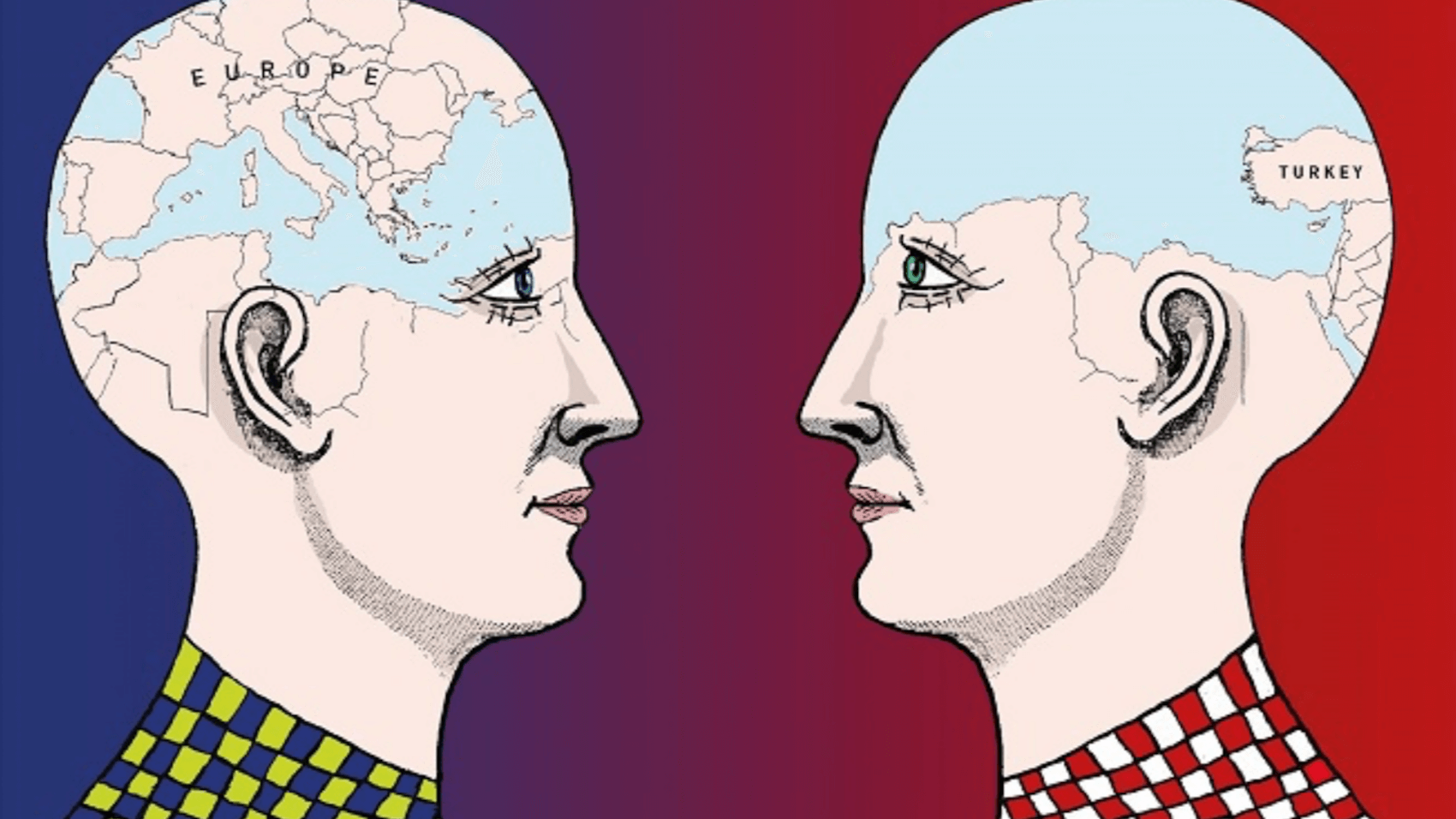
TurkishMalaise

The Turkish Malaise – A Critical Essay

Girdap, Hafza. (2022). “The Turkish Malaise – A Critical Essay.” ECPS Book Reviews. European Center for Populism Studies (ECPS). April 6, 2022. https://doi.org/10.55271/br0012


Author Cengiz Aktar argues that Turkey is witnessed a victory of a non-democratic system—and the majority of society supports this transition. The regime consolidates its discriminatory, oppressive, autocratic politics by gaining the support of non-AKP constituents through the discourse of “native and national.” Thus, the situation in Turkey is not a simple deviation from the norm; it is a more complex socio-political conundrum. In other words, the regime represented by Recep Tayyip Erdogan, is not the reason for but the result of society’s mindset which is a reasonable part of the “Turkish malaise.” 

Reviewed by Hafza Girdap

Power holders claim power through different means such as traditions, religions, ideologies, and economic dynamics. And when these leaders consolidate their power, it becomes a necessity for them to keep that power. They want to eliminate even a tiny risk or threat. Drawing on the strongman concept in The Turkish Malaise – A Critical Essay Professor Cengiz Aktar highlights the impact of the end of Turkey’s European Union accession process, the return of political Islamism, the Gezi Park protests, and the December 2013 corruption investigation. These milestones mark the authoritarian turn in the Turkish regime, triggering threats that resulted in a crackdown on all opposition—not only political actors but also all dissidents regardless of their affiliations.

Laying out Turkey’s historical roots in the Ottoman Empire, and its fluctuating relations with Europe and the West, Aktar investigates the recent Turkish malaise, touching on these ongoing relations. At the end of the book, readers are provided with the insights of two prominent scholars: a sociologist, Nilufer Gole, and a historian, Etienne Copeaux, both of whom Aktar interviews.

Throughout the book, Aktar theorizes on three striking points to summarize the nature of Turkish authoritarianism. The first aspect is the mass support for the AKP and Recep Tayyip Erdogan. This support differs from historical examples, including the pre-1950, one-party era. Considering the fact that the AKP administration holds 30 percent of total votes, imposing their discourses, ideologies, and even injustices on the rest of society accommodates the regime’s oppressive nature. 

Secondly, the weakness of Turkey’s institutions plays a significant role in Turkish authoritarianism. The most apparent example is the “Turkish-style” presidential system which has almost no checks and balances. Aktra argues that almost all of Turkey’s institutions—judiciary, law enforcement, even Parliament—bow to the strongman and have become like sub-offices of one man. 

At a “book talk” event I attended, Professor Aktar stated that even in Russia, people are protesting Vladimir Putin and his war crimes. In Turkey, the only people standing up to Erdogan are women’s and feminist movements and those unjustly dismissed by emergency decrees following the supposed July 15th coup attempt. Yet these groups have not been sufficiently and efficiently united to make their voices more powerful. 

The last point Professor Aktar mentions is society’s (non)response to past persecutions, pogroms, and genocide. This, I believe, is where Aktar highlights and supports his proposition of a “Turkish malaise.” Aktar has stated that since such crimes against humanity—including the Armenian genocide—have been “swallowed” by the majority of Turkish society, Turkish authoritarianism has been nurtured and strengthened inherently by not only the leader(s) but also the people. Referring to Hannah Arendt’s theory of the masses, Aktar explains this phenomenon as the regime’s legitimacy, which is formed by the majoritarian constituency.  

Furthering his argument on the impact of mass support, Aktar asserts that Turkey is witnessing the victory of a non-democratic system with which a majority of the society agrees. The regime consolidates its discriminatory, oppressive, autocratic politics by gaining the support of non-AKP constituents, too, through the discourse of “native and national (yerli ve milli).” Thus, the situation in Turkey is not a simple deviation from the norm; it is a more complex socio-political conundrum. In other words, the regime represented by Recep Tayyip Erdogan, is not the reason for but the result of society’s mindset, which is a reasonable part of the “Turkish malaise.” 

In addition to the discussion of the relationship between authoritarianism and society’s content, Aktar also explores the de-westernization process—predominantly through the derailment of the EU accession process. As a well-known expert on EU-Turkey relations, Aktar defines this break as missing a golden opportunity for democratization. “Unmooring” from Europe has strengthened Erdogan’s move towards neo-Ottomanism as well as political Islam. In correspondence with feeding Turkish authoritarianism, institutional collapses due to “undemocratization” have been aggravated since the end of the accession process. This could be interpreted as the “last step towards the West,” one of the chapter titles in the book. The collapse of institutions has also aided Erdogan, allowing him to establish a monolithic, Islamist, nationalist discourse that eventually became an authoritarian regime. The most recent manifestations of Turkey’s dictatorial one-man rule are the conversion of Hagia Sophia to a mosque, the withdrawal from the Istanbul Convention (which provides protections for LGBTQ+ citizens), and the unconstitutional appointment of a regime-friendly president to Bogazici University, arguably Turkey’s finest university. 

Professor Aktar argues the Turkish malaise as linked to the West’s approach and describes this situation as “between misunderstanding and blind detachment, appeasement and complicity, containment and the fear of seeing this large country implode and disintegrate” (p. 66).

As a gender studies scholar, I would also like to touch on the gendered lens on the issue provided by Professor Nilufer Gole. Professor Gole problematizes the implications of two notions in her discussion: “mahrem” (sacred, private) and “meydan” (public). Even though the debate on the return of political Islam has mostly been based on the headscarf (veil) issue, and despite the regime’s oppressive and subjugating attitude towards women, conservative (pious) women have become more active politically and more visible in modern life, which makes them the “agents of change” in both their private and public lives. In other words, the notions of “mahrem” and “meydan” play a significant role in challenging their implications and realms. Gole describes this paradoxical turn as a challenge to patriarchy with preserved pious agency. “Meydan” also refers to the uprising in Gezi Park, in which masses from different segments of Turkish society protested against the Erdogan regime’s oppressive policies. In both referrals, “meydan” represents a resistance against political Islamist oppression. Gole argues that the “soul of contemporary Turkey” cannot be comprehended without “understanding the manifestations of mahrem and meydan which express both the malaise of modernity and its transcendence.” (p. 85)

To conclude, the Turkish malaise can be ascribed to both domestic issues and foreign relations and embodies immensely complicated concerns. Internally, a vicious correlation between the regime’s increasingly authoritarian tendencies entrenched with nationalistic and political Islamist proxies, and society’s belief in a national will and the notion of Turkey as a “blessed nation”—along with their pathetic contentment with the idea of a strongman—diminishes the chances of revitalizing democracy and democratic institutions. Externally, even if the gates are closed for Turkey to march to the West, “transactional” deals are still on the table, and this dilemma worsens the “malaise” for Europe, since relations relating to security issues and geopolitical necessities (e.g. refugee issues, economic interests, etc.) are still important.


The Turkish Malaise – A Critical Essay by Cengiz Aktar (Transnational Press London, 2021). 99 pp. £14,50 (Paperback), ISBN: 978-1-80135-076-1

Anti-vaccine activists protest outside Governor Andrew Cuomo's official residence in Albany, New York on June 14, 2020. Photo: Wirestock Creators.

The Great Recoil: Politics after Populism and the Pandemic 

Wolf, Maximilian. (2022). “The Great Recoil: Politics after Populism and the Pandemic.” ECPS Book Reviews. European Center for Populism Studies. March 9, 2022. https://doi.org/10.55271/br0011


Paolo Gerbaudo’s Great Recoil presents a timely, wide-ranging and perspicacious, yet focused and detail-attentive summary of the present political conjuncture leading up to the Covid-19 pandemic, an incisive prognosis of the political terrain of the years that will follow it and offers a bold new approach to combating the illiberal populist discourse plaguing the West today — while laying the groundwork for the progressive transformations that need to replace it. 

Reviewed by Maximilian Wolf*

The Covid-19 pandemic has not been an easy time to be a populist. Those in power, whether it is Donald Trump in the United States, Jair Bolsonaro in Brazil, or Boris Johnson in the UK, quickly demonstrated the dangerous insufficiencies of populist governance — from corrupt PPE deals to unsubstantiated accusations against China and the peddling of dangerous conspiracy theories. Those still vying for influence in their respective democracies, meanwhile, were forced to change tactics as lockdown measures proved, overall, popular in most Western countries and new alliances with the ‘anti-vax’ crowd made for some strange bedfellows. 

Today, two years from its onset, the pandemic has ushered in some significant and lasting changes in populist discourse throughout the world; populist popularity has largely stabilized — Johnson and Bolsonaro, though weakened, remain in power, Trump lost his election but still received well over 74 million votes (the second highest tally ever, behind Biden’s 81 million) — but their reputation has, on the whole, been lastingly damaged by record case and death numbers, fiscal mismanagement and alarmist discourse regarding vaccines that has struggled to mobilize more than the most conspiratorial among their followers. For all its damage, Covid seems to have provided democracies with an overdue booster shot of healthy skepticism towards populist politics. 

The flipside of this coin, however, is that global politics (not least since the recent invasion of Ukraine by Russian forces) have remained in a state of prolonged crisis — and crises breed populists. The political landscape, especially in the liberal West where two years of strict distancing measures and curfews were met with the greatest resistance, has been irrevocably altered by Covid-19; unaccustomed to such degrees of political uncertainty, the ground remains rife for the populist seed to sprout. As Dr. Aline Burni noted on a recent panel for ECPS: “The impact of the pandemic [on populism] has not been homogeneous,” adding that prolonged crisis can “create new conditions and open up new discursive opportunities for populists.”

In The Great Recoil: Politics after Populism and the Pandemic (Verso, 2021), Paolo Gerbaudo of King’s College London has put forth a perspicacious and timely new take on what this post-Covid political landscape in the West might look like. His “diagnostic of the present” (Gerbaudo, Loc 105)[1] examines the most critical ideological shifts that characterized the ‘populist moment’ of the last decade, and how these currents will shift as we feel the aftershocks of the pandemic. In so doing, he not only introduces an intriguing new vocabulary to elucidate those macroscopic transformations that precipitated the rise of the populist wave of the 2010s but speculates on how the pandemic might — or might not — alter their course in the coming years. 

Gerbaudo’s core contention is that the era of unchallenged hegemony of the neoliberal consensus is over: already weakened and slowed down by successive crises, diminishing growth and growing disillusionment among working class voters throughout the West, the pandemic has brought the centrifugal, expansive tendencies of globalized capitalism to a grinding halt, triggering in its place a centripetal impulse, a reorientation inwards and the return of what he calls a “protective neo-Statism” (Gerbaudo, Loc 101) — Covid as a watershed moment, the birth of a new hegemonic era of endopolitics (Gerbaudo, Loc 179).

The Covid-19 pandemic and the attendant, heretofore unseen emergency measures mobilized in response to it — from closed borders to huge financial interventions as businesses faltered and millions were furloughed, to massive expansions of nation-state powers to control, track and surveil its citizens — constituted the perfect storm for the already embattled exopolitics of Western neoliberalism. Gerbaudo however explicitly affirms that, while Covid provided the “tipping point,” (Gerbaudo, Loc 764) the resonance of such inward-looking, nationalistic, and security-centered discourses has been steadily growing over at least the past decade — one need looks no further than the immensely successful slogan to ‘Take Back Control’ championed by the Brexit campaign years before the pandemic. While the growing salience of ‘illiberal’ and anti-globalization discourse is nothing new, Gerbaudo approaches it from a phenomenological angle, as he defines this era of the ‘Great Recoil’ as one characterized, above all, by a state of “global agoraphobia” (Gerbaudo, Loc 1129). This agoraphobia — the fear of open spaces — was already the driving force behind the endopolitical impulse which found its expression in the global popularity of authoritarian and nativist populist discourse. 

As this agoraphobia is experienced, it manifests itself in the three triadic ‘master signifiers’ that, in Gerbaudo’s view, already anchor and delimit the endopolitics of the Great Recoil: sovereigntyprotection and control (Gerbaudo, Chapters 3, 4 and 5). He dives deep into the origin, genealogy and contemporary inflection of each of the three terms over the course of three chapters, and outlines their relation to the current sociopolitical conjuncture, arguing that, so far, only the populist right has effectively moulded its discourse to match this neo-Statist impulse. 

Whether it is Brexit, Le Pen, Salvini, or Trump: Gerbaudo locates the origin of their recent popularity in their ability to recognize the growing salience of endopolitical (or anti-exopolitical) discourse and articulate it in reference to an excluded “Other” — be it immigrants, the European Union or the ‘cabal.’ In line with the recent ‘affective turn’ in the literature on populism, Gerbaudo thus views populist popularity as in large part determined by their ability to inflect their discourse in relation to the master signifiers that emerge out of collective emotional experiences; in the era of global agoraphobia, the discourse promising to ‘take back control,’ re-establish borders and protect its citizens proved a powerful discursive tool, particularly among working-class voters and those who felt left behind by the liberal exopolitics of the last 50 years. 

Importantly, however, it must be borne in mind that these master signifiers are not a priori reserved for right-wing, exclusionary discourse: populist left actors, like Syriza or Podemos in Europe — and albeit nowhere near as successfully as its counterpart — have also managed to penetrate a largely similar bloc of alienated voters employing a globalization-critical and anti-capitalist discourse surrounding economic and social security and democratic control — in Gerbaudo’s terms, a “socialism that protects” (Gerbaudo, Loc 267). Although the content of their endopolitics differs strongly, both have tapped into the same rising disillusionment with the globalized exopolitics of the neoliberal center while articulating their resistance in different ways. In this view, the populist moment was just the democratic expression of this growing agoraphobia related to the demand for sovereignty, protection, and control, with different populisms simply representing differing ways of inflecting this “neo-statist trinity” of signifiers within the same social context (Gerbaudo, Loc 4203).

For Gerbaudo, this presents an opportunity. Looking to the future, the second half of his book applies its discourse analysis to develop strategic insights for a progressive politics in the neo-statist era of the Great Recoil. The centripetal impulse, cemented by the ‘return to the nation-state’ we have witnessed throughout the pandemic, is here to stay; rather than rejecting national politics out of hand — as the orthodoxy of internationalist progressivism has largely maintained — Gerbaudo’s final chapter aims to re-situate the question of the nation within the progressive discourse of tomorrow. He argues for a “progressive reclaiming” of nationalist terminology as a way to hegemonically combat its capture by the right-wing ethno-nationalist imaginary (Gerbaudo, Loc 3795). Although his notion of a “democratic patriotism” as a way to “overcome the false opposition” between modern cosmopolitanism and a retrograde nationalism remains opaque, Gerbaudo makes a strong and convincing case for a deepening and reinvigoration of democratic processes and the re-articulation of the nation as a “protective structure” as the means of embedding the master signifiers of protection, sovereignty and control at the heart of a progressive discourse suited for the challenges of the post-Covid era (Gerbaudo, Loc 4000).

Overall, Gerbaudo’s Great Recoil presents a timely, wide-ranging and perspicacious, yet focused and detail-attentive summary of the present political conjuncture leading up to the Covid-19 pandemic, an incisive prognosis of the political terrain of the years that will follow it and offers a bold new approach to combating the illiberal populist discourse plaguing the West today — while laying the groundwork for the progressive transformations that need to replace it. 


The Great Recoil: Politics after Populism and the Pandemic by Paolo Gerbaudo (Verso, 2021). 288 pp. £13,59 (Hardback), ISBN: 9781788730501 


(*) Maximilian Wolf, MPhil, is an intern at the European Center for Populism Studies. Maximilian was born and raised in Vienna, Austria. After receiving his BA in Politics at the University of Exeter (UK), he completed his MPhil in Political Sociology at St. Edmund’s College, University of Cambridge (UK). His work has focussed on discourse analyses of both right- and left-wing populist phenomena, and an abridged version of his Master’s thesis, entitled Locating the Laclausian Left: Progressive Strategy and the Politics of Anxiety, has been accepted for publication in issue 3/2022 of the Interdisciplinary Journal of Populism (forthcoming). Besides ECPS, Maximilian now works for a governance think-tank in Vienna. Beyond populism, he is passionate about health and fitness, rugby, chess and science fiction. 


[1] Gerbaudo’s book is, at the time of writing, only available in eBook format; the present review will therefore have to rely on Kindle ‘locations’ in place of page numbers.

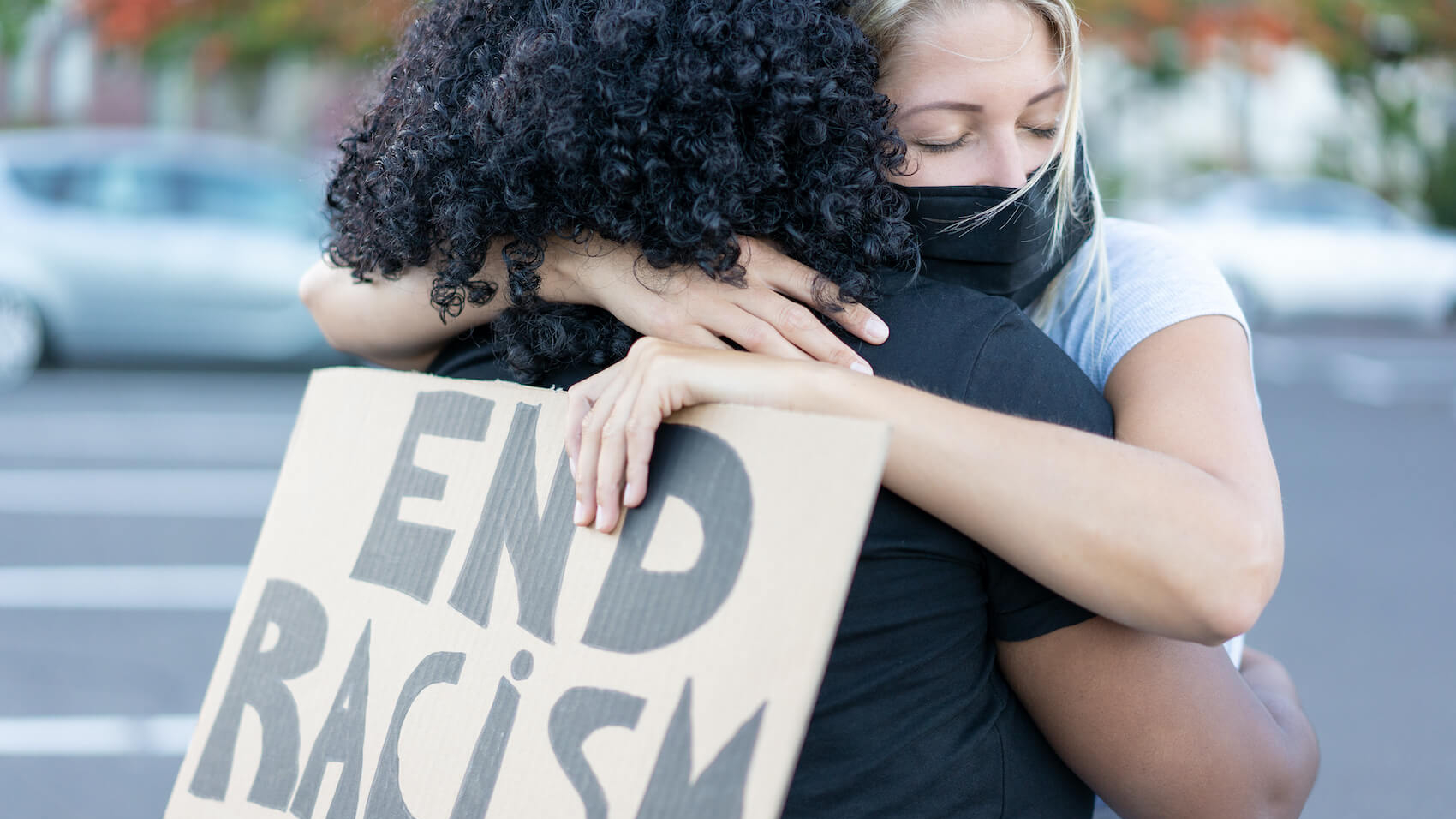
A young African woman hugging a white northern woman after a protest. Photo: Sabrina Bracher.

Nice White Ladies: The Truth about White Supremacy, Our Role in It, and How We Can Help Dismantle It 

In her book, Jessie Daniels deconstructs whiteness and scrutinizes individuals’ contributions to and relationships with it, making “Nice White Ladies” an excellent work of literature for those who understand that the practice of anti-racism cannot be disentangled from self-work. However much one may already know about the subject matter, Daniels’ confronting, academic, and personal approach will surely provide her readers with fresh insights.    

Reviewed by Shirin Ananda Dias*

In her book “Nice White Ladies,” Jessie Daniels deconstructs white womanhood and details how it is historically and culturally linked to the inter-generational perpetuation of everyday, systemic, and institutional racism by white women in both the United Kingdom (UK) and, most notably, in the United States (US). Both by drawing on existent literature on race, gender, cultural and blackness studies and by giving detailed ethnographic and personal examples, Daniels details how white women – often with good intentions – contribute to the cycle of racism and demonstrates their complicity in the infliction of everyday micro-aggressions on communities of color. 

Although the book is largely a cultural critique, it also serves as a “self-help book” for those seeking to break free from the toxic chains of whiteness, which inflict pain and suffering not only upon BIPOC (black, indigenous, people of color), but also upon white women and their families, through generational guilt and self-destructive defense mechanisms transmitted throughout decades. The book’s six chapters take the reader through Daniels’ personal and academic journeys, zeroing in on her experiences with white womanhood and racism throughout her life and academic career. She furthermore provides the reader with alternative constructive modes of ‘being white’ in a diverse and multicultural society.

In the first chapter of the book Daniels places white womanhood in historical context and lays bare, through a cultural and historical lens, how and why white women often feel threatened by and entitled to protection from the ‘other.’ Without vilifying the ‘Karens’ of today’s society, Daniels details how their (sometimes subconscious) feelings of white supremacy, entitlement to protection, and (lethal) power over the ‘other’, are surviving legacies of the colonial period. Within white supremacist society, black men were often lynched to protect white women –the underlying sentiment has survived through generations, resulting in instances of modern-day women weaponizing their white womanhood by using police and law enforcement against BIPOC. Daniels hereby demonstrates and emphasizes how white women’s actions perpetuate colonial cultural legacies to this day, and how they are consequently beneficiaries of colonialism and slavery.

In chapter two, Daniels illustrates how white feminists on both the left and right of the political spectrum tend to perpetrate and exacerbate racial inequalities through their supposedly universal and neutral feminist activism. From the pink pussy hats to the #metoo movement and other movements aiming for women’s liberation and “equal representation, compensation and power in the public sphere as men” (Daniels, 2021: 86), Daniels shows that these movements for women’s rights are far from universally inclusive. On the contrary, these feminist movements tend to engage in gender-only, (neoliberal) feminism that is oblivious to white privilege, race, and institutionalized racism (as well as other relevant intersections). Daniels therefore criticizes so-called liberal feminists on their lack of intersectionality and calls for the inclusion of critical race theory in feminist activism with the objective of the liberation of all women.

In chapter three, “The Shallow Promise of the Wellness Industry,” Daniels shows how women are targeted by all sorts of ‘self-care’ trends – clean eating, skincare products, yoga, mindfulness – which promise fulfillment and inner peace in a capitalist society.  In one sense, these trends are shallow in their failure to deliver true fulfillment; in fact, their intertwinement with the capitalist system ensures that fulfillment is ever out of reach. Daniels, however, focuses on a different source of shallowness: namely, that purveyors of the wellness industry create white-only spaces, and construct a specific normative identity, namely the white-hetero-lady who is in need of care. In creating and orienting itself around this identity, the wellness industry excludes communities of color and obscures the reasons for their struggles. Wellness is portrayed as a product for consumption, instead of something that is contingent upon larger structural issues like systemic racism and poverty.  Daniels also touches upon the wellness industry’s self-help books and criticizes renowned authors such as Brené Brown, for her work’s blindness to whiteness and white-shame, and Eat-Pray-Love author Elizabeth Gilbert, for romanticizing her soul-seeking journey to India without reflecting upon the white privilege that afforded her the means leave everything behind, travel, and ‘find herself.’ 

Chapters four and five discuss identity and kinship. In chapter four, “Love and Theft,” Daniels investigates the psychological and cultural reasons behind certain white women’s appropriation of BIPOC identities. Here Daniels discusses female academics such as Rachel Dolezal and Jessica Krug. She argues that it is the underlying emptiness that resides in whiteness, and, furthermore, white guilt, which drive white women to appropriate non-white identities, so that they can be seen and heard, or to deal with the psychological trauma of being white. Daniels furthermore details how white women, through ‘blackfishing’ or appropriating indigenous Cherokee identities, become the beneficiaries of policies like affirmative action, whereby their successes rest on the backs of those communities who need those policies most. 

Not all white women deal with whiteness and white guilt in the same way as the Rachel Dolezals of the world. Daniels shows how many white women engage in white saviorism in order to assuage their white guilt. An example she discusses is the adoption of BIPOC children by white families, where an undercurrent of white saviorism can perpetuate microaggressions towards communities of color, with the indirect message being that white mothers are more capable of motherhood. As is furthermore shown in the chapter “Protecting White Families,” white women often engage in practices that benefit white families and disadvantage communities of color, by raising their adopted children in a “color blind”, household, rather than a “color aware” one, thereby implicitly downplaying racism’s existence. One’s own contribution to and participation in cyclical institutionalized racism and racial segregation often goes unnoticed; well-meaning and protective mothers, who accumulate wealth within their white families and shield their children from education in multi-racial settings, which Daniels coins as the “new Jim Crow,” seem unaware of the implications of their actions. In all examples, from white women physically protecting their homes with guns from Black Lives Matter demonstrators to those well-meaning women who accumulate wealth and education for their white families, Daniels emphasizes and illustrates how white families are “one of the most powerful forces of reproducing white supremacy” (Daniels, 2021: 193). 

In the last chapter, “The Lie that is Killing All of Us,” Daniels details, through myriad examples of mental health cases (including her own mother’s), how whiteness not only poses a lethal threat to communities of color, but, even more so, how it threatens white communities. She argues that although white people are the beneficiaries of white supremacy (in that they have, for example, greater access to healthcare than communities of color do), white communities are also plagued by higher rates of depression than communities of color, and increasing addiction, mortality, and suicide rates. Daniels illustrates how nice white ladies suffer under the burden of white guilt. Building on this, Daniels exemplifies the impact white guilt has on the individual and collective health of white people and communities. In this vein, Daniels demonstrates how feelings of emptiness – inherent to whiteness – are often the root cause for infliction of harm of others, and for self-destructive behavior. 

In the concluding section, Daniels refers back to previous chapters and provides the reader with detailed methods to develop an alternate, more constructive and justform of whiteness and white womanhood. Jessie Daniels herself strives to be “white without going white, to not take up all the space, to swerve away from the supremacy of whiteness” (Daniels, 2021: 234). The suggested liberators methods include, for example, rethinking social relationships with people who actively participate in the oppression of BIPOC, giving agency to women of color, and being their accomplice in dismantling white supremacy, amongst many other suggestions.

A potential critique of the book is that certain argumentations are rather reductionist, such as Daniels’ proclamations that the Kardashians’ cultural appropriation derives from their white guilt, or that the suicide of a white health worker during COVID-19 was motivated by the burden of white survival guilt. This is where Daniels draws hasty conclusions and appears to disregard the complexity of the human psyche despite her background in critical social psychology. Although I concur that there lays trauma in whiteness, not all behavior is necessarily attributable to whiteness and its discontents. 

Despite this criticism, the book does insightfully deconstruct whiteness and scrutinizes individuals’ contributions to and relationships with it, making “Nice White Ladies” an excellent work of literature for those who understand that the work of anti-racism cannot be disentangled from self-work. However much one may already know about the subject matter, Daniels’ confronting, academic, and personal approach will surely provide her readers with fresh insights.  It is a work that I would highly recommend to both academics and laymen seeking to understand the complexities of white womanhood and racism. I would especially recommend the book to white women, as no matter how “woke” one might be, there might be a “Nice White Lady, whether big or small, in all of us.


Jessie Daniels, Nice White Ladies: The Truth about White Supremacy, Our Role in It, and How We Can Help Dismantle It, Seal Press, 2021, 304 pp., $28, ISBN: 9781541675865


(*) Shirin Ananda Dias is an alumna of SOAS university London, where she obtained her bachelor’s degree in Social Anthropology. Her two main regions of academic interest are the Middle East and South Asia, where she indulges in political anthropology focusing on ethnic and religious nationalism and populism in the broader framework of globalization and contemporary international relations. She is currently enrolled in the MA program “Social and Cultural Anthropology” at the University of Amsterdam where she is finishing writing her master dissertation on the expression of Hindu nationalism in right wing Hindu nationalist Facebook groups during the COVID-19 pandemic. 


People passing by portraits of Mustafa Kemal Ataturk and Recep Tayyip Erdogan in Istanbul, Turkey on December 28, 2015.

Creating the Desired Citizen: Ideology, State and Islam in Turkey

Demir, Mustafa, (2022). “Creating the Desired Citizen: Ideology, State and Islam in Turkey by Ihsan Yilmaz.” ECPS Book Reviews. European Center for Populism Studies (ECPS). February 17, 2022. https://doi.org/10.55271/br0008


Ihsan Yılmaz’s new book presents a detailed analysis of Turkey’s political and sociological evolution, from the country’s anxious birth as a “fearful nation,” preoccupied and weighed down by historical traumas to the present. Yılmaz’s study provides a detailed account of the polity’s “never-ending” nation-building process and offers keen insights into why this process is intransient. His book highlights the political nature of defining citizens as either “desired,” “tolerated,” or “undesired” and the way this definitional process functions as a tool in hegemonic rivalries between “political tribes” in polities such as Turkey.

Reviewed by Mustafa Demir

Ihsan Yılmaz is Research Professor and Chair of Islamic Studies and Intercultural Dialogue at the Alfred Deakin Institute for Citizenship and Globalisation. In his most recent book Creating the Desired Citizen: Ideology, State, and Islam in Turkey, published with Cambridge University Press in 2021, Yılmaz presents a highly detailed analysis of modern Turkish history. Not only does this engaging book provide fresh insights into the emergence and development of modern Turkish political culture, but also a new theoretical framework that incorporates emotions into the sociological analysis in a highly innovative way. Each chapter is arguably worthy of its own book-length treatment, and Yılmaz’s ability to cover much ground in a single monograph is commendable.

The scholarship on Turkey, especially on its emergence and its process of nation-building, provides a fascinating case study for social and political scientists. This is reflected in the vast literature on the case, with thousands of theses, articles, and books written on this very topic. Nevertheless, gaps in our understanding remain. One such gap, I believe, is the incomplete and controversial nature of Turkey’s nation-building project. Contested efforts in this regard have created pronounced political and ideological fault-lines in Turkish society. The nature of Turkey’s political process has kept this historical dynamic intact; it is not merely a research subject but rather an enduring game of political brinkmanship. In this game, those wielding power all too often point to those on the other side as “undesired citizens.” 

Against this backdrop, Yılmaz weaves his own personal story through the narrative in this weighty (in terms of both coverage and impact) book. In so doing, he critically reflects on the emotional aspects of the political decisions and socio-political “transitions” that have roiled his homeland. Yet Yılmaz’s critical reflection gives the book a crucial degree of objectivity, allowing him to transcend his own experience and reach out to (and draw on) other, often divergent, scholarly perspectives on Turkish political developments and decisions. This is well reflected in the book’s diverse bibliography (As those familiar with Turkish academia will know, the field is characterized by sharp divisions—even tribalism—with tribes forming virtual “citation cartels” that prefer to explore contentious social and political developments only through the lenses they feel comfortable with, making no attempt to understand one another).

A New Frame to Analyze Turkish Political History

As mentioned, Yılmaz deftly instrumentalizes his personal story in developing a novel framework to map many of the key socio-political “transitions” in Turkey. The first such transition —to Kemalist secularism — is one Yılmaz encountered when he became “a religiously observant [university student] in a staunchly laicist state that was not comfortable with religious expression in the public sphere.” Yılmaz then frames Turkey’s transition to Erdoğanist Islamism through the lens of his own experience as a university professor teaching students from all segments of Turkish society. As an academic and columnist, Yılmaz wrote many articles in daily newspapers in Turkey criticizing the Islamist AKP government in power after 2003. He was fired from his university position due to growing government pressure in early 2016.

At first glance, Kemalism and Erdoğanism appear antithetical, one staunchly secular, the other avowedly Islamist. However, Yılmaz demonstrates that they are connected by a central element they share — a commitment to Turkish nationalism. Drawing once again upon his personal history, Yılmaz recounts how he awoke only later in life to the exclusive, illiberal, sharp, and destructive nature of Turkish nationalism through his experiences and observations during his years as a university lecturer between 2008 and 2016.

Indeed, Yılmaz’s role as an educator is highly salient since education — or, more precisely, its role in nation-building — is a through-line across the book. In the preface, Yılmaz references another book, Füsun Ustel’s “Makbul Vatandaş” ın Peşinde (In Pursuit of the “Acceptable Citizen”), published in 2004. Ustel’s book focuses on how education was instrumentalized in building a nation in the initial period of the Kemalist Republic of Turkey. As he highlights, Ustel’s book inspired him to tie his story, experiences, observations, and travails to the story of Turkish politics and political history.

Yılmaz builds on Ustel’s insights but takes the matter further, looking not only at education but other sectors such as religion and media. While Ustel’s work focuses more on the Kemalist mission of re-dressing and creating an “acceptable” model of modern citizenship via education, Yılmaz’s work focuses more on the political and hegemonic aspects beyond the early Kemalist mission of modernization. It is also important to highlight that Yılmaz treats the notion of “desirable” as dynamic and in transition. Thus, the definition of “desired citizens” is political and highly changeable. Yılmaz also introduces two new terms, “tolerated” and “undesired” citizens. These additional categories allow him to avoid the trap of dichotomizing, familiar in much Turkish, scholarship and provide a subtle degree of analytical flexibility that opens up space for exploring “gray zones” in between the desirable and the undesirable. Thus, he is able to show how changing political landscapes bring shifts in how these definitions are applied to one kind of Turkish group or another, as observed during the transition from Kemalism to Erdoğanism. Yılmaz also highlights the Erdoğanist attempt to redefine what is a “desired citizen” in Turkey. In doing so, he provides not only fresh insight but a robust new conceptual framework to analyze the uncompleted process of nation-building in Turkey.

A further appeal of the book is its approach to Turkish political history, which appears very close to Erik Zurcher’s. Like Zurcher, Yılmaz does not separate political and historical periods sharply; rather, he focuses on the ‘transitions,’ highlighting how even as the new emerges, it draws heavily on what has gone before. For example, distinct from the established view on modern Turkish political history — which rehearses the idea of a radical break with the past in the establishment of the Turkish Republic in 1923 — Zurcher’s account presents Turkey as always, already in transition, in a continuous process of evolution. Here, elements of the Ottoman past were brought through into the Kemalist Republic, whose core elements were also retained, to a greater or lesser extent, in later transitions to multi-party democracy and through into the present. Similar to this approach, Yılmaz’s account considers Erdoğanism less a radical break than yet another transition in a long historical process of social and political change.

What Sets Yılmaz’s Account Apart?

The book is structured around the concept of citizenship, which, rather than being treated as a legal definition, is taken as a dynamic concept responsive to hegemonic movements within the polity. As the title of the book suggests, creating desired citizens is unthinkable without its obverse: eliminating undesired elements. Thus, the book is equally, if not more, a story of undesired citizens. Again, however, Yılmaz’s frame is not black and white. Creating the Desired Citizen, as mentioned, establishes the category of “tolerated” citizens, alongside desired and undesired ones.

Providing a synopsis of the chapters in this book is difficult as each one is complex and polysemic enough to warrant a book of its own. It seems more productive, then, to conceive of this book in its entirety as a corpus of Turkey’s modern history. Beginning with the ontological insecurities shaping the political culture and guiding the strategic mind of the founding elite in the first chapter, the second traces the roots of these anxieties through history, providing a “thick description” of the historical context in which these anxieties and insecurities were born. The following three chapters examine the core components of Kemalism and its conception of the desired/ideal Turkish citizen, followed by an interrogation of the changing identity of desired and undesired citizens as Kemalism itself changed. The second half of the book then follows this approach in dealing with Erdoğanism—its rise, hegemonic move to power, and attempt to define its own desired, tolerated, and undesired citizens.

In a nutshell, this book presents a detailed analysis of Turkey’s political and sociological evolution, from the country’s anxious birth as a “fearful nation,” preoccupied and weighed down by historical traumas, to the present. Yılmaz’s study provides a detailed account of the polity’s “never-ending” nation-building process and offers keen insights into why this process is intransient. His book highlights the political nature of defining citizens as either “desired,” “tolerated,” or “undesired” and the way this definitional process functions as a tool in hegemonic rivalries between “political tribes” in polities such as Turkey.


Creating the Desired Citizen: Ideology, State, and Islam in Turkey by Ihsan Yılmaz, Cambridge University Press, 2021, 250 pp., $80.19 (hardcover), ISBN: ‎978-1108832557

English Defence League (EDF) stages a rally to protest the "Islamisation" of the UK in Birmingham on April 8, 2017. Photo: Alexandre Rotenberg.

Liberal Roots of Far Right Activism – The Anti-Islamic Movement in the 21st Century

Girdap, Hafza. (2022). “Liberal Roots of Far Right Activism – The Anti-Islamic Movement in the 21st Century.” ECPS Book Reviews. European Center for Populism Studies (ECPS). January 24, 2022. https://doi.org/10.55271/br0007


Lars Erik Berntzen aims to probe the growth of far-right and anti-Islamic twist in Western Europe and North America since 2001 through his book “Liberal roots of Far Right Activism – The Anti-Islamic Movement in the 21st Century” by focusing on a specific context in terms of spatial and temporal meanings. According to his book, through “framing Islam as a homogenous, totalitarian ideology which threatens Western civilization” far-right seems to abandon the old, traditional, radical, authoritarian attitude towards a more liberal, modern, rights-based strategy. 

Reviewed by Hafza Girdap

Focusing on a specific context in terms of spatial and temporal meanings, Lars Erik Berntzen aims to probe the growth of far-right and anti-Islamic twist in Western Europe and North America since 2001 through his book Liberal roots of Far Right Activism: The Anti-Islamic Movement in the 21st Century.

The book sheds a light on the shift from a positive approach to an adversary attitude towards Islam and Muslims following the 9/11 terrorist attacks in the United States in 2001. Highlighting the transnational impact of these incidents, Berntzen delves into anti-Islamic activism conducted by pioneering movements and political parties in Europe, such as Stop Islamization, Defense League, Patriotic Europeans against the Islamization of the West (PEGIDA), Dutch Pin Fortuyn List (LPF) and Geert Wilders’ Freedom Party (PVV). The author also draws attention to the hypocrisy of far-right politicians and activists who portray themselves as liberals to avoid stigmatization by using certain discourses of human rights as proxies to exploit anti-Islamic agendas. As a very convenient issue, women’s and gender-based rights are claimed by Marine Le Pen of the National Rally (FN), for instance, to “denigrate Muslim men” (Berntzen, 2020: 2). 

Laying out the background of the book, Berntzen states his research questions in the first chapter. The initial purpose is to explore the background of leaders, their official ideology, organizational networks, and the mobilization of sympathizers. In order to conduct such a research, he also presents four steps. First, he focuses on “tracing evolution of anti-Islamic expansion between 2001 and 2017” specifically in Britain, the US, Netherlands, Germany, Norway and Denmark. Subsequently, a frame analysis of eleven anti-Islamic initiatives from Norway, Britain and Germany is raised covering the time period of 2010-2016. His third step in this research is a network analysis of those anti-Islamic initiatives. And finally, the book investigates mobilization of anti-Islamic groups “that were active during the summer of 2016.” 

Berntzen’s overall finding which he shares in the first chapter is that a significant change is observed within the approach of far right towards Islam and Muslims. He explains such a change as a shift from authoritarian and ethnocentric to a modern, liberal, and transnational anti-Islamic activism. In other words, far right takes on a liberal attitude and appearance by a “transformation as a partial decoupling between authoritarianism and the radical right through an adoption of liberal positions on many issues” such as free speech, democracy, gender equality, animal rights, preservation of Christian and Jewish heritage. However, the author addresses this situation as an ideological duality considering the view of Islam as a threat to Western civilization along with the profiles of anti-Islamic activists and politicians. Hege Storhaug, a Norwegian feminist activist, is given an example of aforesaid hypocrisy since she aligns with Hungarian politician Viktor Orban’s and the Polish Law and Justice Party’s policies which do certainly not prioritize gender equality and gender-based rights. 

As a scholar focusing on identity representations of Muslim immigrant women in Europe and North America, Berntzen’s work stood out to me in terms of drawing on the most influential concepts on identity formation in resettlements of Muslim immigrants: Islamophobia, anti-Islam and anti-Muslim. The way he differentiates these concepts through the social movement theory is also striking since framing and mobilization play an important role in identity politics. As far as I am concerned, Islamophobia represents an irrational, emotional fear; whereas, the author argues, anti-Islam refers to the “shift the theoretical focus from reaction to action, in line with the agency-oriented perspective dominant in social movement analysis” (Berntzen, 2020: 38). At this point, inclusion of liberal positions which portrays Islam as an existential threat to Western civilization and as an ideology not compatible with democratic and progressive issues; anti-Islam justifies and legitimizes transnational mobilization of far-right organizations. Among the most influential discourses of this liberal far-right are women’s rights, LGBTQ rights and their perception in Islamic tradition. Berntzen maps the ideology of anti-Islamic far-right combining with not only the expansion of collective action and networks but also with party politics. While doing so, he draws on both international critical incidents such as 9/11 terror attacks and Prophet Muhammed cartoon crisis and local incidents to demonstrate the anti-Islamic expansion of the far-right in different contexts and circumstances. 

To sum up; Liberal Roots of Far Right Activism – The Anti-Islamic Movement in the 21st Century scrutinizes anti-Islamic ideology and movements of far-right by diving into distinctive conceptualization of Islamophobia, anti-Muslim and anti-Islam. Claiming it to be an ideological duality, the author of the book highlights that anti-Islamic far right posits a semi-liberal worldview and action towards Islam presenting it to be incompatible with modernity, human rights and liberal issues. In other words, by “framing Islam as a homogenous, totalitarian ideology which threatens Western civilization” (Berntzen, 2021: 11) far right seems to abandon the old, traditional, radical, authoritarian attitude towards a more liberal, modern, rights-based strategy. Such a strategy, seemingly, focuses on more the ideology (Islam) rather than the individuals (identities). As he puts in several parts of the book while explaining why he favors “anti-Islam” concept rather than “anti-Muslim” and “Islamophobia”; this distinction represents the new transnational anti-Islamic movement to be transforming from ethnic based nationalism, oppressive authoritarianism which focuses on Muslims towards a liberal position which promotes equality, justice and democratic values putting an ideological standpoint forward.


 Liberal Roots of Far Right Activism – The Anti-Islamic Movement in the 21st Century, By Lars Erik Berntzen, Routledge, 2020. 228 pp., £27.99 (paperback), ISBN: 9780367224660


RedMilk1

Red Milk: A Cautionary Tale

Hart, Heidi. (2021). “Red Milk: A Cautionary Tale.” ECPS Book Reviews. European Center for Populism Studies. January 20, 2022. https://doi.org/10.55271/br0006


This piece reviews Sjón’s novel Red Milk, now available in English translation. The book depicts a young man’s absorption into a neo-Nazi group in Iceland in the 1950s. 

By Heidi Hart

The Icelandic writer Sjón is known for surreal tales on topics as diverse as “whaling, alchemy and the history of cinema” (Anderson, 2022), as well as for his opera libretti and collaborations with Björk. In his introduction to the 2017 anthology Out of the Blue: New Short Fiction from Iceland, he writes that the subject of philosophy was not introduced for university students there until 1971. “In place of philosophy, the Icelanders had poetry and tales … Debates on the interaction of body and soul, for example, could be conducted through the medium of verses or stories about birds” (Mitsios, 2017: X). As a novelist, Sjón finds inspiration in the creatures outside his fisherman’s cottage, as he imagines a fox that multiplies into four of itself or a man transformed into a butterfly. 

But Sjón’s work is not just whimsical. In his recent novel Red Milk, he confronts two painful discoveries: that his grandfather was a spy for the Germans in World War II, and that a neo-Nazi movement took root in Iceland in the 1950s. In an afterword to the book, he acknowledges that his previous novels dealing with the Nazi period and its aftermath (The Whispering Muse and CoDex 1962) took an “ironic” and even “flippant” approach to characters’ “obsession with Nordic culture to inflate their own sense of importance in the world” (Sjón, 2021: 141). He also recalls an episode in his childhood when, perhaps as a way to push against the painful, silent story in his family, he found himself drawing swastikas. 

Though Red Milk does not tell Sjón’s grandfather’s story but imagines a semi-fictional young man who gets caught up in toxic nationalism after the war, it is haunted by the writer’s own grappling with history. Gunnar, an ordinary child growing up in the war years, is later found dead on a train in England, with a swastika on a paper found in his pocket. In order to tell this tale with both critical distance and narrative intimacy, Sjón changes positions. The novel begins with the train scene and moves backwards into Gunnar’s childhood, described in third-person past tense. As Gunnar grows up and acts on his right-wing fascinations, he does so in the book’s middle section, written as letters – so that the main character’s “I” is clearly separate from the narrator’s. 

Sjón’s magic-realist bent only shows in glimmers in this brief, dark book. In one striking scene, Gunnar the child overhears his father sobbing over his radio through a closed door. But instead of simply including this scene in the trajectory of a boy’s life on the edge of Reykjavik, Sjón slips it forward, as a dying memory. One moment Gunnar is describing a birch stick that his father kept, ostensibly to remember his own father’s beatings, and the next, “now that death has freed the grandson’s body from its incurable disease and Gunnar is slumped lifeless on a seat in a train compartment in a siding at Cheltenham Spa Station … his brain is still working” (Sjón, 2021: 16). This passage reads less like writerly sleight-of-hand than like the actual mystery of consciousness, with one last pang of conscience, too: what Gunnar recalls last is this exchange with his sister, when overhearing their father’s sobs: “Daddy’s looking at the birch.” “No, you idiot; Daddy’s frightened of Hitler” (17). 

Gunnar is not just an “idiot” in thrall to the local German teacher and cycling enthusiast, however. He is ordinary in the same sense Hannah Arendt described in her 1963 reports on the Eichmann trial, using the “banality of evil” term that became controversial for downplaying the “demonic” or “monstrous” aspects of Nazism (Kirsch and Galchen, 2013). Showing how easily average citizens can become agents of evil is Sjón’s project as well, however painful it may be to “look for what I have in common with my characters” (Sjón, 2021: 143). At the same time, his “clinical” strategy in shifting narrative positions and beginning with Gunnar’s death (“It is easier to deal with a dead Nazi than a living one” [Ibid.]), offsets too much sympathy. The anti-Muslim and antisemitic passages in Gunnar’s letters would be even more difficult to read if spoken in dialogue or overheard in his third-person head. 

The neo-Nazi group that Gunnar joins in the decade after the war is based on Sjón’s research, which also turned up the group’s wide-reaching supporters, including “Savitri Devi, George Lincoln Rockwell, Colin Jordan, and Göran Asser Oredsson – the very people who laid the foundation for the international network of far-right movements as we know it today” (Sjón, 202: 142). Gunnar is based on “one of the main actors” in this group, “who died from cancer at a young age while fanatically working on the foundation of their World Union of National Socialists” (Ibid.). His fictional letters show him to be as uncomfortably human as he is fanatical, writing humorous, simple notes to his mentally disabled brother and then rhapsodizing to Oredsson that “We, the Icelandic Nationalists, greet you with arms raised high and palms outstretched …” (76) before complaining, “Nothing is being done to safeguard our Icelandic cultural heritage” (79).

Much of Gunnar’s language in his letters (at least in English translation) sounds like current xenophobic, populist rhetoric in Europe and the US. Even phrases like “criminal hordes” (80) are not surprising in the age of Trumpian crudity, though some 21st-century right-wing groups have attempted to show a veneer of respectability (Silman, 2016). What is most frightening about Sjón’s novel is how mainstream many of Gunnar’s epistolary opinions have become (Feffer, 2019; Miller-Idriss, 2022). Though this character and his cohort may be “under the spell of Hitlerism, racism, and white supremacy” (Sjón, 2021: 142), they are not “special” (145) in that many ordinary people (including most of my neighbors in the American West) continue to find themselves hooked by xenophobic news propaganda, conspiracy theories, and resistance to public health measures, often linking this with far-right ideology. 

Like the “negative example” of Mother Courage in Bertolt Brecht’s play, which used a mercenary character from the Thirty Years War to speak to 1930s Germany, Gunnar Kampen is a cautionary figure for our time. The danger in good storytelling, though, is that even a bad example can become appealing (as has often been a problem in Mother Courage stagings, for all Brecht’s efforts at distancing effects). Narrative itself is not a saving strategy in times of fascist threats; even Eichmann was an “avid storyteller,” as Hannah Arendt discovered, for all of his clichés (Norberg, 2013). At its best, Red Milk evokes a sense of threat through its slips in time and striking images, as in this moment in Gunnar’s childhood, on a car trip to Raudavatn or “Red Water”: “Halfway between the west end of Reykjavik and their destination, this unintelligible word finally conjured up a picture in his mind: A glass, brimming with red milk” (Sjón, 2021: 21). Beware the conjuring. 

References

Mitsios, Helen (Ed.) (2017). Out of the Blue: New Short Fiction from Iceland. University of Minnesota Press. Sjón. (2021). Red Milk. Translated by Victoria Cribb. Farrar, Straus and Giroux.

Man surrounded by crowd holding a banner with the message about racism in a peaceful protest against racism and US police brutality in Palma de Mallorca, Spain on June 07 2020.

Why Race Still Matters?

Colak, F.Zehra. (2021). “Why Race Still Matters?” ECPS Book Reviews. European Center for Populism Studies (ECPS). December 20, 2021. https://doi.org/10.55271/br0005


Alana Lentin’s book Why Race Still Matters offers key insights on how racism is denied and why naming racism is seen as offensive based on cases in politics and media across US and Australia. These cases, Lentin clearly explains, underlie the systemic redefinition of racism to serve white agendas and make it challenging to bring racial literacy into public discourse.

Reviewed by F. Zehra Colak

“How to be both free and situated; how to convert a racist house into a race-specific yet nonracist home. How to enunciate race while depriving it of its lethal cling?” Toni Morrison asks this question in her essay called “Home,” published in 1997. More than two decades after Morrison, Alana Lentin, a race critical scholar, partly answers this question as she calls on her readers to be race-cognizant while defying its terms of reference: “How do we explain race and oppose the dehumanization and discrimination committed in its name if we do not speak about it?” This is the key question that Lentin thoroughly engages with in Why Race Still Matters.* Her main argument draws on the view that dismantling racism and unpacking its impact can only be possible by speaking about it as leaving racism out of the conversation harms those exposed to it. Most importantly, she does this at a time when there is increasing backlash against academic studies of race, gender, post-colonialism, and scholars working in these fields are being targeted by right-wing governments across and beyond western Europe (Colak & Toguslu, 2021). 

Drawing on the work of influential scholars like Stuart Hall, Lentin defines racism as “a technology for the management of human difference” which produces, reproduces, and sustains white supremacy at various levels (p. 5). Her work underlines how approaching racism as a pathology fails to acknowledge the role of institutions, structures, processes, and practices in upholding a racially categorized view of the world. More and better racial literacy pedagogy among public, Lentin rightly argues, can challenge such individualized notions of racism and normalize conversations about (institutional) whiteness. Racial literacy “emphasizes the relationship between race and power … [and] constantly interrogates the dynamic relationship among race, class, geography, gender, and other explanatory variables” (Guinier, 2004: 114–15, as cited in Lentin, 2020: 11). Nevertheless, western educational systems fail to acknowledge the importance of racial literacy as they attempt at practicing neutrality and color-blindness that reproduces Eurocentric notions of race. This, Lentin underlines, deprives us from acquiring the tools that we need to counter pseudoscience racial ideas and myths (e.g., White genocide) that are taking a strong hold on social media and in the public sphere.  

How can then an anti-racist discourse challenges the recent resurgence of ‘race realists’ and their false premises of racial science beyond proposing that race is a social construct? This is an especially relevant question that offers valuable insights to move beyond the limited explanatory frameworks that are currently adopted by anti-racist scholars and activists. 

As noted by Lentin, “antiracists are very good at denying the biological facticity of race, but not very good at explaining what is social about race” (p. 31). Entering an insightful dialogue with scholars of race, Lentin discusses various critiques of social constructionist approach, which emphasizes that race needs to be discussed within the political context that reproduces it along with ideas about how it can be dismantled. Still, Lentin shows how race is present in medical practice, biomedical research, and genetics as can be seen in associations of certain diseases such as sickle cell anemia with the Black people despite obvious evidence to the contrary. At the same time, Lentin recognizes the ways racialization processes unequally impact on groups, requiring specific forms of treatment. In other words, race is not biology, but racial rule has biological effect due to persistence of white supremacy, colonization, and structural inequities. Increasing control of migration along racial lines and discriminatory policies that reproduce race by western governments exemplify nativist racialized body politics that construct ‘Others’ as out of place, which is also noted by scholars of far right and nationalism (Wodak, 2021).

Why Race Still Matters offers key insights on how racism is denied and why naming racism is seen as offensive based on cases in politics and media across US and Australia. These cases, Lentin clearly explains, underlie the systemic redefinition of racism to serve white agendas and make it challenging to bring racial literacy into public discourse. As such, “the question of who can control the definition of racism has grown in importance almost as a function of the lack of control that many racialized people have over the determination of their life course” (p. 58). Lentin critically engages with the historical roots of racism in Europe, showing that the commitment to racial equality was mainly associated with critiquing antisemitism and did not imply rejection of racism against colonized peoples. The current understanding of racism in Europe still relies strongly on the associations made between Holocaust and racism, leading therefore to the rejection of racism as a system of power and domination that explains ongoing anti-blackness, Islamophobia, and the criminalization of immigrants. Such common views of racism in public, Lentin suggests, are informed, and shaped by a group of academics who psychologize race and equate racism to individual attitudes while presenting critical race studies as unempirical and unscientific. 

“Why do you always make it about race?” This, Lentin explains, is a question asked not only by the right but also by ‘the white left,’ to criticize the centralization of race, gender, and sexuality in making sense of complex political questions. However, refusing “to see race is to choose simplicity and ignore the layers of power in and resultant complicity required in dealing with what race continues to do” (p. 96). Exposing the ignorance among the ‘white left’ about the challenges of antiracists, Lentin underlies the little-understood diversity of the antiracism movement. By construction of racism as a concern of ‘aloof cosmopolitan urban elites’ and racialization of working classes as white, the question of how racialized power structures function at the intersection of class, gender, and nationality is overlooked. Lentin’s thoughtful engagement with issues around anti-racism movement and identity politics drawing on discussions around contemporary Islamophobia and ongoing settler domination of Indigenous lands provides unique insights into ongoing academic and media debates. Particularly noteworthy in this discussion is her emphasis on how demands by racialized groups of people are treated as “victimhood performances” by those in power who then call themselves “victims” struggling with such demands. 

One of the interesting contributions in Lentin’s Why Race Still Matters relates to the question of how antisemitism and Islamophobia feed off one another as two forms of racism. While antisemitism is politically instrumentalized in the name of defending Jews from Muslims and anti-Zionists, Islamophobia is often seen invalid. Lentin underlies, for instance, the adoption of “Judeo-Christianity” by the right to construct Muslims and Islam in opposition to European values while concealing Christianity’s own antisemitism. At the same time, rising antisemitism in Hungary, for instance, and the attacks against the well-known Jewish philanthropist George Soros are often accompanied by anti-refugee and anti-Muslim racism. Still, “antisemitism is excused if opposition to Muslims and support for Israel are present” (p. 145), as shown by various vignettes discussed in the book. She furthermore engages deeply with questions around ‘Cultural Marxism,’ internal struggles within Jewish communities, and the persistence of antisemitism in different forms such as reduction of “the Jews” to a homogenous identity. Lentin’s insights on how European states declared their commitment to fight Judeophobia after Holocaust while continuing racial colonization abroad and exploitation of migrants at home are particularly insightful.

The conclusion offers a powerful summary of contemporary debates on racism by outlining differences among race realists (i.e., racists), race-critical anti-racists who are fighting racism, and those who remain silent about race as a way of challenging it. Lentin addresses this silent group when she argues that “talking in euphemisms or pretending that race belongs to the past” will not make race matter less (p. 172). Engaging with the root causes of why race is a difficult subject to study and talk about, she particularly underlies the role of white fragility, methodological whiteness, epistemic Eurocentrism and institutional racism, all of which contribute to the lack of racial literacy among public. For instance, an epistemically racist positivist stance argues that race cannot be understood objectively by those who experience it while imposing certain boundaries around what counts as (superior) knowledge. While calling on its readers to be attentive to race as a tool of analysis, the book ends with a hopeful message noting critical conversations that are taking place and being attended by white people engaged in challenging racial hierarchy. 

Overall, this is a valuable contribution and resource for scholars and students of race studies interested in a critical, engaging, and deeply informative analysis of historical and contemporary academic and public debates on race and racism. 


(*) Why Race Still Matters, by Alana Lentin, Polity Press, 2020. 184 pp., €17.00 (paperback), ISBN: 9781509535712


References 

Colak, F. Z. & Toguslu, E. (2021). “France’s attack on academics is an attempt to silence debate on race.” ECPS. https://www.populismstudies.org/frances-attack-on-academics-is-an-attempt-to-silence-debate-on-race/

Guinier, L. (2004). “From Racial Liberalism to Racial Literacy: Brown v. Board of Education and the Interest-Divergence Dilemma.” Journal of American History. 91(1): 92­­–118.

Morrison, T. (1997). “Home.” In: The House that Race Built: Black Americans, U.S. Terrain. Edited by Wahneema Lubiano. 3–12. New York: Pantheon Books.

Wodak, R. (2021). The politics of fear: The shameless normalization of far-right discourse. London: SAGE.