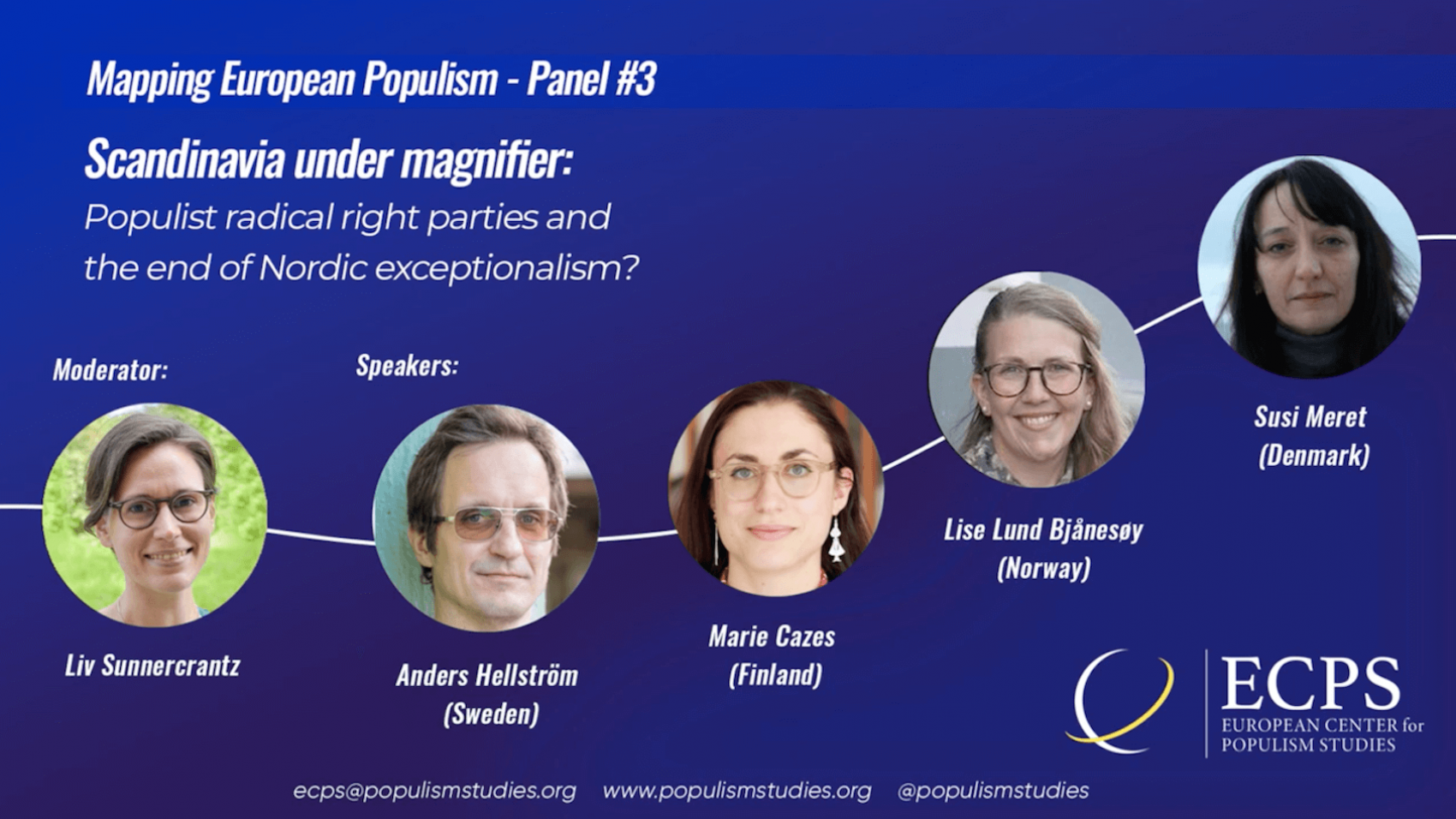
Moderator Dr. Liv Sunnercrantz (Department of Media and Social Sciences, University of Stavanger, Norway)
Speakers “The Sweden Democrats in Swedish politics – the mainstreaming of extremism,” by Dr. Anders Hellström (Department of Global Political Studies, Malmö University, Sweden).
“From rural to radical right: a brief perspective on Finnish populism,” by Marie Cazes (Doctoral Researcher, University of Jyväskylä, Finland).
“Public perceptions of the populist radical right in Norway,” by Dr. Lise Lund Bjånesøy (Department of Administration and Organization Theory, University of Bergen, Norway).
“From success to failure? The recent developments of the radical and populist right in Denmark,” by Dr. Susi Meret (Department of Politics and Society, University of Aalborg, Denmark).
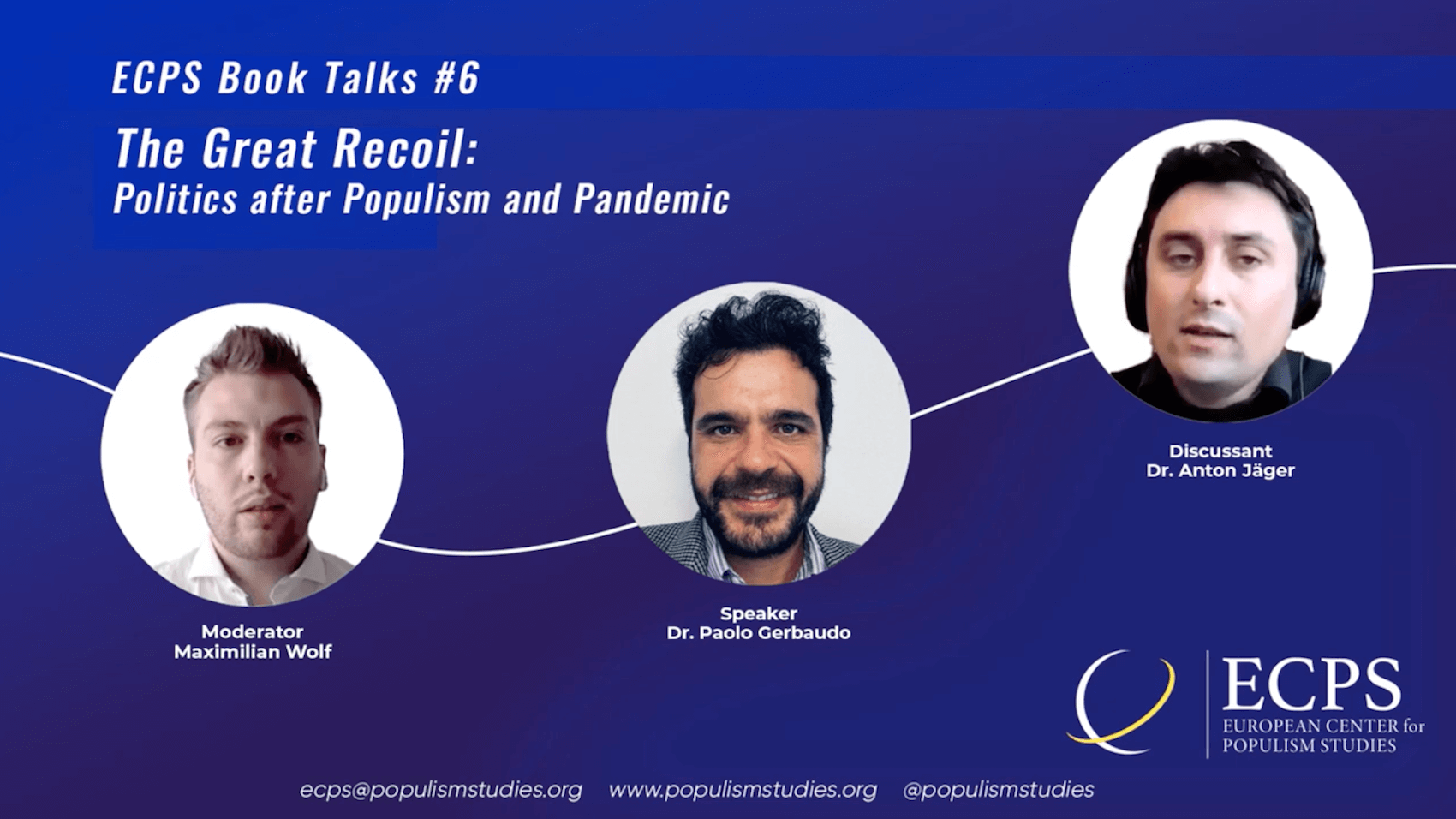
Author Dr. Paolo Gerbaudo will discuss his book The Great Recoil: Politics after Populism and Pandemic (Verso, 2021) with Dr. Anton Jäger of KU Leuven.
The Great Recoil focusses on the political and ideological transformations of the last two decades that have seen a turn away from the triumphalist, universalist attitudes towards globalisation and free trade, fuelled by a shift towards nationalist and nativist attitudes in a number of Western democracies, often called the ‘populist moment’ of the 2010s. Gerbaudo’s contention is that, while the appeal of such inward-focussed discourses was growing for over a decade, the Covid-19 crisis produced the perfect storm for what he terms the exopolitics of globalisation; in his eyes, the coming decades will be dominated, instead, by the endopolitics of a new ‘neo-statist’ impulse.
Examining the origin and changes in the three ‘master signifiers’ of this Great Recoil, sovereignty, protection and control, he argues that the success of populist radical right parties over the past decade was due to their recognition of the growing salience for this endopolitical discourse, fuelled by what he calls a ‘global agoraphobia.’ Gerbaudo then, in the final part of the book, argues for a strategy of progressive contention, re-capture and re-articulation of the signifiers of sovereignty, protection and control, arguing for a ‘progressive nationalism’ that re-engages the nation and its signifiers external both to nativist impulses and its ‘withering away’ amid a globalised cosmopolitanism. Instead, the nation must become a ‘protective structure’ that actively combats agoraphobia and drives reinstates feelings of control among the population.
Euroscepticism and far-right politics: The populist challenge to EU norms, institutions and values
Are you an early-career academic researcher in the social sciences or humanities at Bachelor’s or Master’s level? Are you passionate about European politics and understanding the dynamics that shape it? Are you looking for a way to expand your knowledge under the supervision of leading experts, seeking options to have your work published by a European research institute, or simply in need of a few extra ECTS credits for your studies? Then consider applying to ECPS Academy Future Leaders Program! The European Center for Populism Studies (ECPS) is looking to select a handful of outstanding young researchers for a unique opportunity to assess the populist challenge to European politics in a five-day, interactive Summer course led by global experts from a variety of backgrounds. This rigorous program will provide a state-of-the-art introduction to a number of key issues in the field of populism studies and enable successful candidates to explore their own ideas under the supervision of our experts. You gain not only an opportunity to have your work published and a handful of ECTS points but also a unique opportunity to broaden your horizons and deepen your understanding of the challenges facing European politics in the 21st century.
Overview
European politics have witnessed, over the last 20 years, a subversive wave of Eurosceptic, nativist, populist far-right politics. Beginning as a phenomenon on the socio-political fringes, populism has found fertile ground in the post-industrial economies of the West, attaching itself to nationalist and de-modernising movements threatening core European values of democracy, openness, tolerance and non-discrimination – and, in the process, taking many democracies by storm. In Donald Trump and the successful ‘Brexit’ campaign in the United Kingdom, many saw right-wing populism reaching its political apex and the 2010s to be the ‘populist decade’, marking populism’s entry into the political mainstream; today, although Covid-19, in a sense, undermined support for right-wing populist governance, the economic and social uncertainties that remain mean the spectre of exclusionary populism is never far.
This trend threatens the European Union on both the institutional and the normative level. EU values such as democracy, freedom, human rights, justice, and equality are under greater threat today than perhaps at any point in the Union’s 50 years of history. Understanding the drivers and the impact of populist right politics on liberal democracy is key to tackling the most critical challenges facing European identity, institutions and values. The ECPS Academy Future Leaders Program seeks to empower future generations by helping the exceling young scholars of tomorrow to understand the nature and dynamics of the populist moment, and thereby facilitate the development of constructive and effective responses. As Europe celebrates the EU Year of Youth in 2022, our five-day Future Leaders Program offers young people a dynamic, engaging and interdisciplinary learning environment with an intellectually challenging program presented by world class scholars of populism, allowing them to grow as future academic, intellectual, activist and public leaders.
Over the course of five days, interactive lectures by world-leading practitioners and experts from a number of backgrounds will introduce populism from a variety of angles and explore the fundamental questions and potent tensions its popularity raises. The lectures are complemented by discussions, group interactions and assignments on selected key issues to develop critical and openminded engagement with some of the most pressing questions of European politics, and to introduce participants to cutting-edge qualitative and quantitative approaches to populism reflective of the state of social science research today. Participants have the opportunity to collaborate with those from different socio-political contexts, developing invaluable cross-cultural perspectives and facilitating a knowledge exchange that goes beyond European borders.
Who should apply?
This unique course is addressed to outstanding candidates interested in gaining a more comprehensive and critical understanding of how the rise of far-right populism, and related trends like Euroscepticism, nativism, authoritarianism and exclusionary politics subvert the European Union’s basic pillars and essential European values. A select group of participants will be chosen based on merit, with applications welcomed from students pursuing bachelor’s and master’s degrees of any discipline, as well as early career professionals between the ages of 18 and 30. You will be selected on the basis of a letter of motivation, a CV and a research proposal of between 500 and 1000 words. The proposal should give a brief analysis of populism’s relationship to one or more core European value, and ideally outline a plan to investigate this relationship further. Drawing upon and correctly citing academic sources is desirable.
We value the high level of diversity on our courses, welcoming applications from people of all backgrounds. The deadline for submitting applications is June 20, 2022. Reflecting the properly pan-European character of the ECPS Academy Future Leaders Program – but unfortunately also the difficulties of organising in-person events in times of pandemic – the 2022 Program will take place on Zoom, consisting of two sessions each day.
Topics and Lecturers
“Populism in Europe: Origins and causes of the populist moment,” by Paul Taggart, Professor of Politics, University of Sussex.
“Nativist Populism: Political discourse between othering and inclusion,” by Ruth Wodak, Emeritus Distinguished Professor of Discourse Studies, Lancaster University.
“Populism and nationalism: Challenges to the idea of European Union,” by Daphne Halikiopoulou, Professor of Comparative Politics, University of Reading.
“Populism and the rule of law,” by Bojan Bugarič, Professor of Law, University of Scheffield.
“Populism and economic performance: Implications on institutions and good governance,” by Ibrahim Ozturk, Professor of Economics, University of Duisburg-Essen.
“Russia’s populist discourse and its invasion of Ukraine: Challenges for the EU,” by Neil Robinson, Professor of Comparative Politics, University of Limmerick.
“Populism and participation: Democracy by the People, for the People?” by Susana Salgado, Professor of Political Communication, Principal Researcher at the Institute of Social Sciences, University of Lisbon
“Populism and new media: Understanding challenges online and offline,” by Dr Eviane Leidig, Research Fellow, International Center for Counter-Terrorism.
“Populism and gender: Gender identity in populist discourse,” by Dr Haley McEwen, Researcher, Wits Centre for Diversity Studies, University of the Witwatersrand.
Evaluation Criteria
Meeting the assessment criteria is required from all participants aiming to successfully complete the program and receive a certificate of attendance in the end. These evaluation criteria include full attendance, active participation in lectures, and the successful completion of an individual written assignment, ideally (but not necessarily) linked to your research proposal.
Participants are expected to write an article or essay on a topic of their choice based on one of the themes discussed during the program. They are expected to plan and produce original work that presents arguments in a clear and balanced way drawing on multiple sources and incorporating and citing them consistent with academic standards. For this process, they will be supervised by one of our in-house experts to complete this assignment successfully. The articles will be between 2,000 and 3,000 words and need to be submitted within a month from the end of the program; selected papers will be considered for publication on the ECPS website and ECPS Youth blog.
Credit
This course is worth 5 ECTS in the European system. If you intend to transfer credit to your home institution, please check the requirements with them before you apply. We will be happy to assist you in any way we can, however, please be aware that the decision to transfer credit rests with your home institution.
Certificate of Attendance
Awarded after program to all participants based on the satisfactory participation in, and completion of, the course assignments. Certificates are sent to students only by email.
Please submit your application: ecps@populismstudies.org
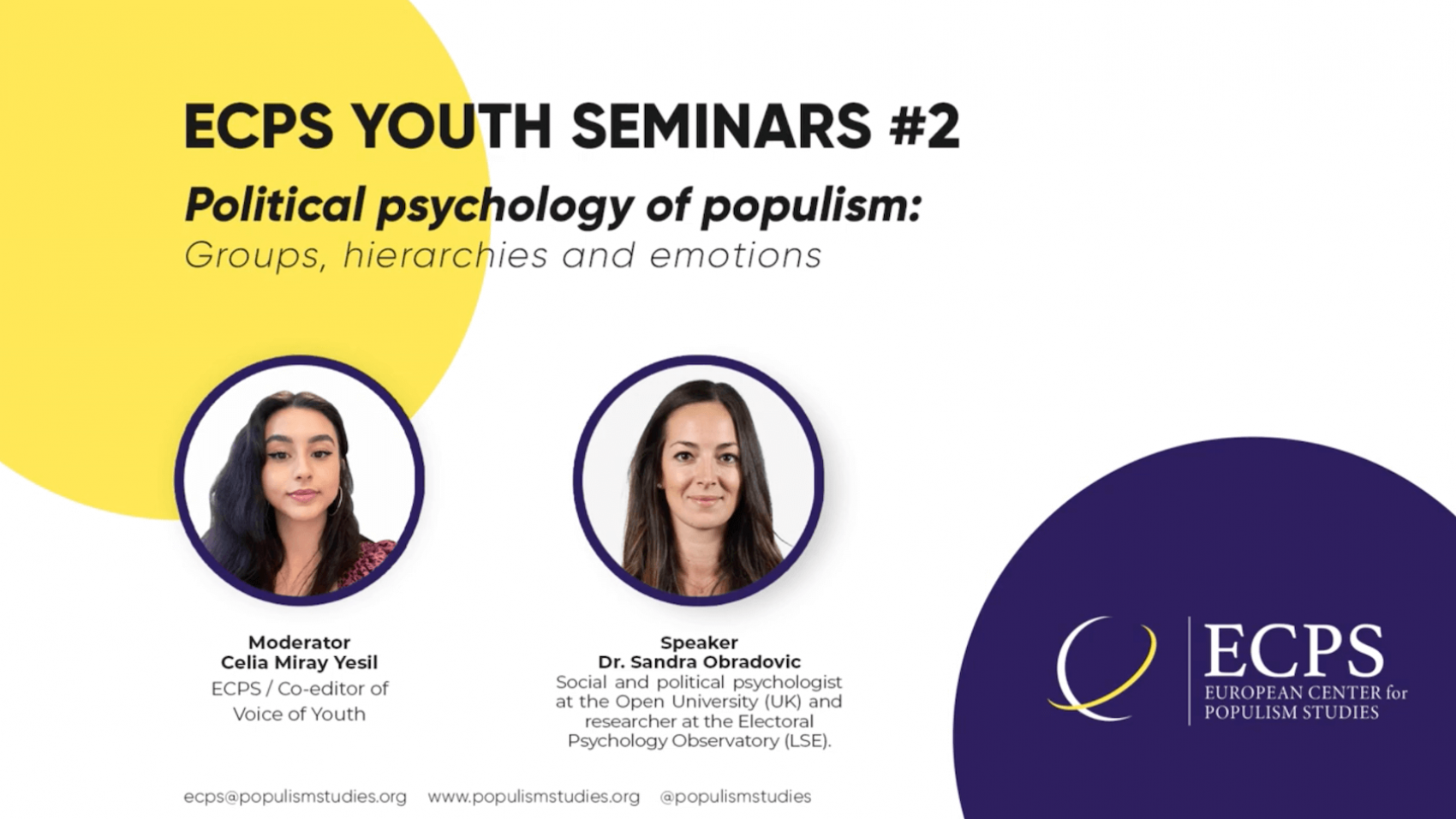
At this ECPS Youth Seminar, Dr. Sandra Obradovic presents the findings of a research paper titled “Understanding the psychological appeal of populism” which is jointly written by Obradovic, Séamus A. Power and Jennifer Sheehy-Skeffington. According to the paper, psychology can play an important role in expanding our understanding of the demand-side of populism by revealing its underlying relational logic. Social psychological perspectives on populism are beginning to show how: 1) the division between us (‘the good people’) and them (‘the corrupt elites’/ ‘foreign others’) taps into core intergroup dynamics, 2) economic and cultural processes are construed in terms of basic status concerns, and 3) collective emotions become mobilised through political communication. Taking these insights into consideration, the authors reflect on psychology’s contribution to the study of populism thus far and chart out an ambitious role for it at the heart of this interdisciplinary field.
Dr. Sandra Obradovic is a social and political psychologist in the UK. She is a lecturer in Psychology at the Open University and a researcher at the Electoral Psychology Observatory at the London School of Economics. Her work examines how group boundaries are constructed and defined, and their impact on identities, intergroup relations, and political attitudes. In bringing this focus to research on populism she works with colleagues in Denmark and the UK, examining and comparing populist and mainstream rhetoric and highlighting the role of hierarchies, emotions, and temporalities in constructing the common people as under threat. At the Electoral Psychology Observatory, she works with colleagues on research on electoral atmosphere and hostility: how voters experience elections and its impact on interpersonal relationships and overall satisfaction with democracy.
Celia Miray Yesil (Moderator) is a master’s student of International Political Economy at the Warwick University. She gained her undergraduate degree in European Politics at King’s College London, studying the historical background of European nations and its relationships with the rest of the world. Miray is considering focussing more on the impact of far-right populism in foreign policy, particularly looking at the political language and communication of populist leaders in the international political economy.
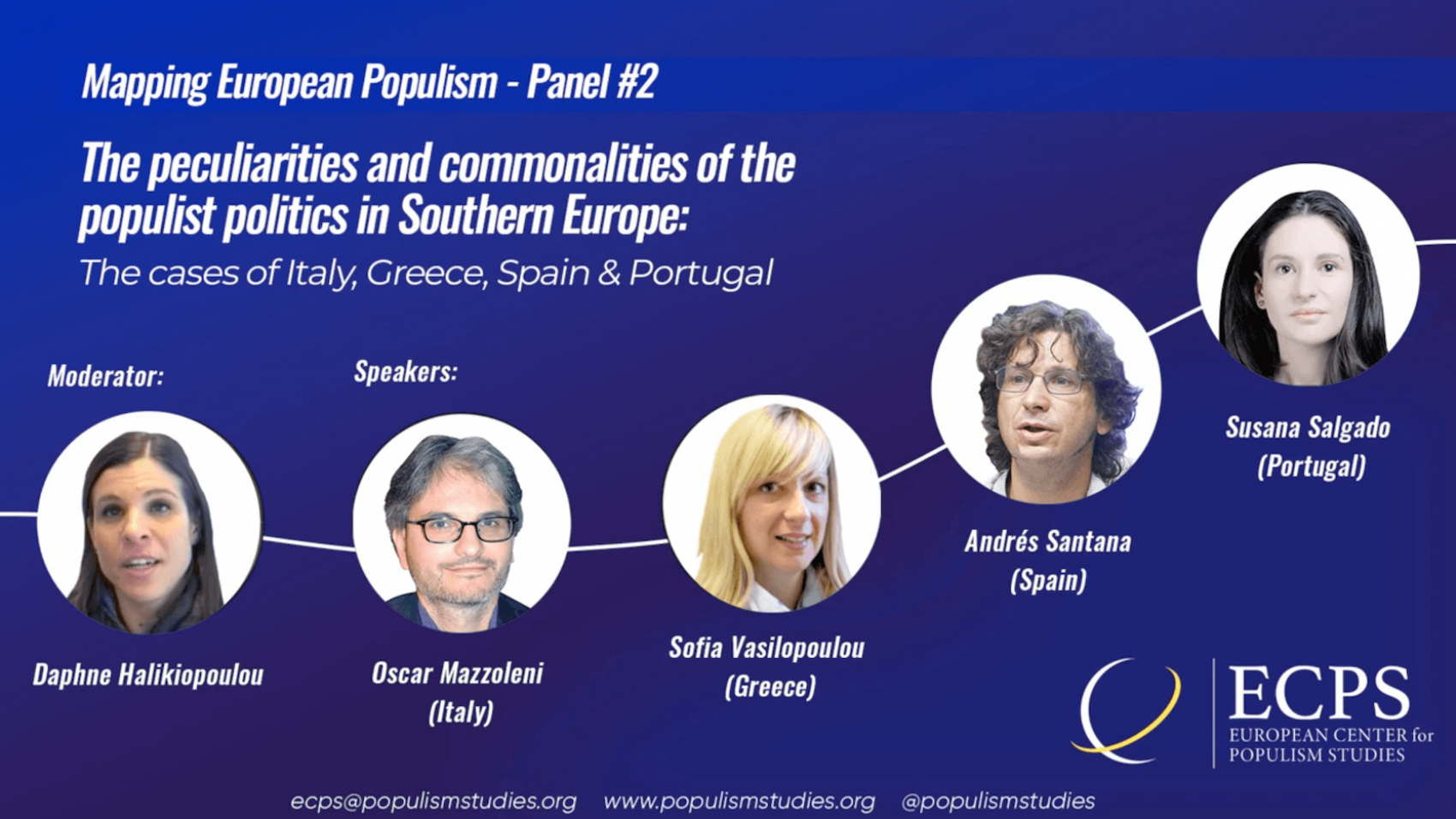
Daphne Halikiopoulou (Professor of Comparative Politics, the University of Reading).
Speakers
“Greece: A case of populism in decline?” by Sofia Vasilopoulou (Professor of Politics, the University of York).
“Multiple populism in Italy between opposition and government,” by Oscar Mazzoleni (Professor of Political Science, Institute of Political, Historical and International Studies, University of Lausanne).
“Podemos and Vox: Opportunities and challenges posed by left- and right-wing populism in Spain,” by Andrés Santana (Professor of Political Science, Autonomous University of Madrid).
“Support for Right-Wing Populism in Portugal: Protest or Deep-Rooted Attitudes?” by Susana Salgado (Professor of Political Communication, Principal Researcher at the Institute of Social Sciences, University of Lisbon).
Dr. Liv Sunnercrantz (Department of Media and Social Sciences, University of Stavanger, Norway)
Speakers
“The Sweden Democrats in Swedish politics – the mainstreaming of extremism,” by Dr.Anders Hellström (Department of Global Political Studies, Malmö University, Sweden)
“From rural to radical right: a brief perspective on Finnish populism,”by Marie Cazes (Doctoral Researcher, University of Jyväskylä, Finland)
“Public perceptions of the populist radical right in Norway,” by Dr. Lise Lund Bjånesøy (Department of Administration and Organization Theory, University of Bergen, Norway)
“From success to failure? The recent developments of the radical and populist right in Denmark,” by Dr.Susi Meret (Department of Politics and Society, University of Aalborg, Denmark)
Girdap, Hafza. (2022). “The Turkish Malaise – A Critical Essay.” ECPS Book Reviews. European Center for Populism Studies (ECPS). April 6, 2022. https://doi.org/10.55271/br0012
Author Cengiz Aktar argues that Turkey is witnessed a victory of a non-democratic system—and the majority of society supports this transition. The regime consolidates its discriminatory, oppressive, autocratic politics by gaining the support of non-AKP constituents through the discourse of “native and national.” Thus, the situation in Turkey is not a simple deviation from the norm; it is a more complex socio-political conundrum. In other words, the regime represented by Recep Tayyip Erdogan, is not the reason for but the result of society’s mindset which is a reasonable part of the “Turkish malaise.”
Power holders claim power through different means such as traditions, religions, ideologies, and economic dynamics. And when these leaders consolidate their power, it becomes a necessity for them to keep that power. They want to eliminate even a tiny risk or threat. Drawing on the strongman concept in The Turkish Malaise – A Critical Essay Professor Cengiz Aktar highlights the impact of the end of Turkey’s European Union accession process, the return of political Islamism, the Gezi Park protests, and the December 2013 corruption investigation. These milestones mark the authoritarian turn in the Turkish regime, triggering threats that resulted in a crackdown on all opposition—not only political actors but also all dissidents regardless of their affiliations.
Laying out Turkey’s historical roots in the Ottoman Empire, and its fluctuating relations with Europe and the West, Aktar investigates the recent Turkish malaise, touching on these ongoing relations. At the end of the book, readers are provided with the insights of two prominent scholars: a sociologist, Nilufer Gole, and a historian, Etienne Copeaux, both of whom Aktar interviews.
Throughout the book, Aktar theorizes on three striking points to summarize the nature of Turkish authoritarianism. The first aspect is the mass support for the AKP and Recep Tayyip Erdogan. This support differs from historical examples, including the pre-1950, one-party era. Considering the fact that the AKP administration holds 30 percent of total votes, imposing their discourses, ideologies, and even injustices on the rest of society accommodates the regime’s oppressive nature.
Secondly, the weakness of Turkey’s institutions plays a significant role in Turkish authoritarianism. The most apparent example is the “Turkish-style” presidential system which has almost no checks and balances. Aktra argues that almost all of Turkey’s institutions—judiciary, law enforcement, even Parliament—bow to the strongman and have become like sub-offices of one man.
At a “book talk” event I attended, Professor Aktar stated that even in Russia, people are protesting Vladimir Putin and his war crimes. In Turkey, the only people standing up to Erdogan are women’s and feminist movements and those unjustly dismissed by emergency decrees following the supposed July 15th coup attempt. Yet these groups have not been sufficiently and efficiently united to make their voices more powerful.
The last point Professor Aktar mentions is society’s (non)response to past persecutions, pogroms, and genocide. This, I believe, is where Aktar highlights and supports his proposition of a “Turkish malaise.” Aktar has stated that since such crimes against humanity—including the Armenian genocide—have been “swallowed” by the majority of Turkish society, Turkish authoritarianism has been nurtured and strengthened inherently by not only the leader(s) but also the people. Referring to Hannah Arendt’s theory of the masses, Aktar explains this phenomenon as the regime’s legitimacy, which is formed by the majoritarian constituency.
Furthering his argument on the impact of mass support, Aktar asserts that Turkey is witnessing the victory of a non-democratic system with which a majority of the society agrees. The regime consolidates its discriminatory, oppressive, autocratic politics by gaining the support of non-AKP constituents, too, through the discourse of “native and national (yerli ve milli).” Thus, the situation in Turkey is not a simple deviation from the norm; it is a more complex socio-political conundrum. In other words, the regime represented by Recep Tayyip Erdogan, is not the reason for but the result of society’s mindset, which is a reasonable part of the “Turkish malaise.”
In addition to the discussion of the relationship between authoritarianism and society’s content, Aktar also explores the de-westernization process—predominantly through the derailment of the EU accession process. As a well-known expert on EU-Turkey relations, Aktar defines this break as missing a golden opportunity for democratization. “Unmooring” from Europe has strengthened Erdogan’s move towards neo-Ottomanism as well as political Islam. In correspondence with feeding Turkish authoritarianism, institutional collapses due to “undemocratization” have been aggravated since the end of the accession process. This could be interpreted as the “last step towards the West,” one of the chapter titles in the book. The collapse of institutions has also aided Erdogan, allowing him to establish a monolithic, Islamist, nationalist discourse that eventually became an authoritarian regime. The most recent manifestations of Turkey’s dictatorial one-man rule are the conversion of Hagia Sophia to a mosque, the withdrawal from the Istanbul Convention (which provides protections for LGBTQ+ citizens), and the unconstitutional appointment of a regime-friendly president to Bogazici University, arguably Turkey’s finest university.
Professor Aktar argues the Turkish malaise as linked to the West’s approach and describes this situation as “between misunderstanding and blind detachment, appeasement and complicity, containment and the fear of seeing this large country implode and disintegrate” (p. 66).
As a gender studies scholar, I would also like to touch on the gendered lens on the issue provided by Professor Nilufer Gole. Professor Gole problematizes the implications of two notions in her discussion: “mahrem” (sacred, private) and “meydan” (public). Even though the debate on the return of political Islam has mostly been based on the headscarf (veil) issue, and despite the regime’s oppressive and subjugating attitude towards women, conservative (pious) women have become more active politically and more visible in modern life, which makes them the “agents of change” in both their private and public lives. In other words, the notions of “mahrem” and “meydan” play a significant role in challenging their implications and realms. Gole describes this paradoxical turn as a challenge to patriarchy with preserved pious agency. “Meydan” also refers to the uprising in Gezi Park, in which masses from different segments of Turkish society protested against the Erdogan regime’s oppressive policies. In both referrals, “meydan” represents a resistance against political Islamist oppression. Gole argues that the “soul of contemporary Turkey” cannot be comprehended without “understanding the manifestations of mahrem and meydan which express both the malaise of modernity and its transcendence.” (p. 85)
To conclude, the Turkish malaise can be ascribed to both domestic issues and foreign relations and embodies immensely complicated concerns. Internally, a vicious correlation between the regime’s increasingly authoritarian tendencies entrenched with nationalistic and political Islamist proxies, and society’s belief in a national will and the notion of Turkey as a “blessed nation”—along with their pathetic contentment with the idea of a strongman—diminishes the chances of revitalizing democracy and democratic institutions. Externally, even if the gates are closed for Turkey to march to the West, “transactional” deals are still on the table, and this dilemma worsens the “malaise” for Europe, since relations relating to security issues and geopolitical necessities (e.g. refugee issues, economic interests, etc.) are still important.
The Turkish Malaise – A Critical Essay by Cengiz Aktar (Transnational Press London, 2021). 99 pp. £14,50 (Paperback), ISBN: 978-1-80135-076-1
Wolf, Maximillian; Grueso, Gadea Mendez; Robinson, Tom; Lortkipanidze, Mariam; Schutz, Imke; Sezer, Julide; Aelbrecht, Heloise and Blink, Melissa. (2022). “Symposium Report—The Future Course of Populism in the Post-Pandemic Era: The State of Globalization, Multilateral Governance, and Democracy.” European Center for Populism Studies (ECPS). April 2, 2022. https://doi.org/10.55271/rp0002
The ECPS’s First Annual International Symposium, titled “The Future Course of Populism in the Post-Pandemic Era: The State of Globalization, Multilateral Governance, and Democracy,” was held online in Brussels on February 18, 2022, and brought together scholars from the political, social, and economic sciences, as well as populism experts and civil society audiences, to discuss the impact of populist policies on the national, regional, and global management of the Covid-19 pandemic. In doing so, the symposium aimed at contributing to informed predictions on the post-pandemic international political landscape. This report is the product of these fruitful conversations and is intended to keep the record of the Symposium. It includes brief summaries of the speeches and, also, links to the full videos of presentations.
Introduction
This report is based on the ECPS’s First Annual International Symposium titled “The Future Course of Populism in the Post-Pandemic Era: The State of Globalization, Multilateral Governance, and Democracy,” which was held online in Brussels on February 18, 2022.
The symposium brought together scholars from the political, social, and economic sciences, as well as populism experts and civil society audiences, to discuss the impact of populist policies on the national, regional, and global management of the Covid-19 pandemic—i.e., how populist leaders handled the pandemic, to what extent they could use populist strategies and tactics while dealing with pandemic-related issues, and what kind of challenges populist policies pose to global governance and democracy. In doing so, the symposium aimed at contributing to informed predictions on the post-pandemic international political landscape. This report is the product of these fruitful conversations and is intended to keep the record of the symposium. It includes brief summaries of the speeches and, also, links to the full videos of presentations.
The symposium was held under the auspices of Sir Graham Watson, Honorary President of ECPS, who delivered the opening remarks. Distinguished scholars in the field contributed their insightful speeches: Mark Findlay (Professor, Director of the Centre for Artificial Intelligence and Data Governance, Singapore Management University), Manuel Funke (Kiel Institute for the World Economy), Aline Burni (German Development Institute), Eckart Woertz (Professor of Contemporary History and Politics, The University of Hamburg), Neil Robinson (Professor of Comparative Politics, The University of Limerick), Axel Klein (Professor of Social Sciences on East Asia / Japanese Politics, Institute of East Asian Studies, Duisburg-Essen University), Jens Maesse (Institute of Sociology, Justus-Liebig-University Gießen), Brett Meyer (Tony Blair Institute for Global Change), and Sheri Berman (Professor of Political Science, Barnard College, Columbia University). The closing remarks were delivered by Hercules Milas (ECPS Advisory Board Member).
The symposium panels were moderated by: Eser Karakas (Professor of Economics, Strasbourg University, ECPS Advisory Board Member and Senior Research Fellow), Werner Pascha (Emeritus Professor of Economics, Institute of East Asian Studies, Duisburg-Essen University), and Naim Kapucu (Pegasus Professor, School of Public Administration & School of Politics, Security, and International Affairs, University of Central Florida).
Last, but not least, Professor Ibrahim Ozturk (Director, Resident Senior Research Fellow at ECPS) chaired the organization committee composed of ECPS staff members and interns. We would like to thank everyone who contributed to the event and made it a real success.
Keynote Address
Professor Mark Findlay: “Rehabilitating Globalization, Repositioning Populism, Proportioning Pandemics – Does Law Have a Place?”
To counteract mythologies, divisive languages and the structures of hate and exclusion, it is necessary to create safe spaces for informed dissent, the exercise of common sense, considered challenges to obsessive rationality, and allow for prudent doubts – a space for the collective flourishing of human consciousness.
Beginning with globalization, Findlay argued that critics and pessimists—whether populists or not—had fundamentally misunderstood what the term meant; globalization, he argued, is a process, one incredibly effective at tackling global crises. As such, it is not in itself good or bad; rather, how it is employed, what structures it engenders, and who benefits from them, are the more important questions. Findlay noted that the globalization of today has developed into a mechanism for proliferating a neo-colonial and neoliberal economic order—as such, it is seen by many, including but not limited to radical, disenfranchised protest movements, as the cause of savage exploitation, rather than as an opportunity to arrest the true sources of marginalization. Globalization, Findlay argued, has become a scapegoat, catching the blame for the insidious effects of neoliberal free trade, radical individualism, and co-option of legal protections for exclusionary private property rights which exploit the global North-South divide. Legally speaking, he argued that global law has become an accomplice to neoliberal expansionism, a consequence of neo-colonial political domination from the North and focused almost entirely on the protection of private property, rather than the defence of human rights.
Climate change and more recently the Covid-19 pandemic, however, have shown us that the shared consequences of global crises cannot be avoided through national protectionism. Globalization, Findlay suggested, needs to be re-thought as a process for international engagement which might provide legitimate legal pathways for wider representative governance and universal democratic rights. The internet has proven valuable in this regard, he argues, as it disrupted previous understandings of intellectual property and has changed the way in which we understand the concept of property itself; this has led to large-scale transformations in a number of legal structures and presents the ability of the law to adapt and transition. It is these transitions that might allow us to combat populist anxieties, and come to represent, he believes, “a new global moral culture,” away from the dysfunctional, individualist structures that fuel populist resentment and towards a communal understanding of wealth as well as of crises.
Law, if reformulated as a communal resource, can provide the foundational background for a transition into a normality that is more concerned about human dignity than it is about individualist and exclusive wealth creation, which has been the heart of populist politics in recent decades.
Thus, a new understanding of the law—and the necessary transitions it must undergo—might reclaim and rehabilitate globalization. At the moment, Findlay maintained, neoliberal globalization promotes power asymmetries and disaffection; cultural identity has become a battlefield—populism and ‘cancel culture’ are used as languages of criticism, and the necessity of multiculturalism is ignored. This new emotional grammar, a “taxonomy of disaffection,” aims to give a voice and a language to the experiences of resentment, indignation, and anger that a structurally flawed global system engendered. The issue is that, as it stands, this emotionally charged discourse misses the mark: neoliberalism, the true culprit in his eyes, is let off the hook in favour of superficial cultural grievances. So again, Prof. Findlay asked, how can we rehabilitate globalization? His answer: by settling the sources of disaffection with globalization. He expressed the hope that the ‘neo-statist’ impulse witnessed throughout the pandemic proved the insufficiency, rather than the usefulness, of protectionist logics.
Regarding populism, Prof. Findlay noted a number of paradoxes. Authoritarian populist politics are driven by a sense of economic injustice and exclusion, yet this is the essence of neoliberal wealth creation, which most right-wing populists nonetheless celebrate. Populism rejects conventional, establishment political remedies, but neoliberal elites capture political institutions and processes under populist governments. Findlay argued that inequality is essential for populism in order for an ‘other’ to emerge and the Manichean ‘us’ vs. ‘them’ discourse to function. In power, populists thus often perpetuate the very conditions they claim to combat.
The process that allows this apparent contradiction to sustain itself in paternalistic authoritarian regimes like Trump’s or Bolsonaro’s is what Prof. Findlay termed ‘anxiety governance.’ It is what got Trump elected and was the driving force behind the ‘Brexit’ movement. It is a sense of anxiety, set in the context of radical technological transformation and ever-accelerating economic shifts, fuelling a fear amongst populist voters that they are unable to access political spaces and will thus be left behind. The Canadian truckers’ protest, argued Prof. Findlay, is an example of this: the physical attempt to overtake the traditional spaces of governance occurred under the facade of ‘reclaiming liberal rights,’ when the protest was, in many respects, fed by populism, anxiety, and anger.
Populist populations have been told that their space is restricted, their economic power is shrinking, and that they must, therefore, rely on the authoritarians of the world to give that power back to them. In other words, Findlay explained, populist politics creates anxiety—and an anger against that anxiety—then offers a ‘politics of hope’ as an answer to it. It is the power of populist charisma, however, that Prof. Findlay considers the truly challenging dimension. This power rests on populist leaders’ mass-legitimized ability to create political narratives, name enemies, and bring “new tonalities into the political conversation.” Social media is crucial to these dynamics: ‘Twitter populism’ demonstrates the anxiety, echo-chambers, toxic feedback loops, and crowd-sourced funding that enable and strengthen populist leaders. Unfortunately, Findlay said, artificial intelligence (AI) has been co-opted into the populist machine.
What, then, can be done? And what is an antidote to anxiety? Findlay suggested a return to considerations of human dignity. It is essential, according to Findlay, that the inequality that underlies neoliberal economic politics, driving discrimination and exclusion, be revealed. Anxiety politics, he said, is the product of collective experiences, but it is bound together by a constructed confusion and maintains a mythological dimension. It is important, then, to expose and acknowledge the genuine risks to be feared and talk back at the voices who stir up misplaced anxieties for populist gain. He cited vaccine scepticism as an example of such misplaced fear; besides the danger inherent in such a public health discourse, we must combat the underlying structures that enable and strengthen the resonance of discourses of that kind. For this reason, finding and occupying (actual or digital) safe communal spaces is critical—transformed law, he says, might provide helpful signposting for this shift.
The pandemic, Prof. Findlay argued, proved a double blow against human dignity in two almost contradictory fashions: on one hand, the right-wing populists charge that public safety measures have eroded our libertarian rights grows stronger as the ‘new normal’ of day-to-day pandemic management lingers on; on the other, the facts two years into the crisis speak of an untold suffering and a lack of consideration for those populations, especially in the Global South, who are dying in their thousands due to lack of vaccines and effective protective equipment as global logistics’ slowdowns and ‘panic protectionism’ have again exposed the unequal dividing lines in the neoliberal economy Only by recovering human dignity as a guiding principle, enshrined in an adaptable and effective legal framework, can we provide the platform by which globalization could be turned into a positive tool that might yet engage the threats and challenges posed by the pandemic, global warming, and other global crises. This, in turn, should be embedded in a broader return to what Findlay termed ‘sociability’: pandemic risk, vaccine scepticism, and ‘economic realism’ are all products of a neoliberal individualist logic which diverts attention away from the importance of globalized sociability and solidarity. Human dignity can only be understood as collective and universal.
Reported by Maximillian Wolf
Panel 1
Populism and Governance in the Time of Pandemic
Dr. Manuel Funke: “Populist leaders, the economy, and the pandemic: What can we expect?”
Populists are bad for the long-term health of certain nations, with key economic and institutional indicators all suffering. This, however, does not mean that populism as a phenomenon will disappear. The key focus of the research on populism over the coming years has to look into the factors that more directly determine populist leaders’ success or failure in getting re-elected, as neither reduced growth nor excess mortality seemed to lastingly affect populist popularity.
The first panel of the symposium came from Dr. Manuel Funke of the Kiel Institute for the World Economy in Kiel, Germany. Dr. Funke began his talk by addressing the fact that, although the academic scholarship on populism as a political phenomenon has grown exponentially over the past years, the research of what happens when populists are in power—and in particular, what happens to economies under populist leadership—remains somewhat undertheorized.
Much of Dr. Funke’s attempt at remedying this deficit centred around a 2020 paper co-authored with two Kiel Institute colleagues, Prof. Dr. Christoph Trebesch and Dr. Moritz Schularick, and succinctly titled “Populist Leaders and the Economy.” Their paper, he explained, sought to provide some concrete empirical data on whether the impact of populist governance was detectable in a number of key economic metrics. To achieve this, they sampled a vast database of articles on populism spanning some 60 countries over 120 years, finally classifying over 1500 leaders into a two-by-two matrix: ‘populist’ or ‘not populist,’ and ‘left-wing’ or ‘right-wing.’ Out of this mountain of data, said Dr. Funke, emerged 50 clear-cut populist actors. Some immediate trends became clear: populism reached its ‘peak’ popularity—primarily owing to the wave of Latin American populist regimes—in the 1950s and 60s; there has, however, also been a discernible uptick in instances of populist leadership since the 2000s, as new forms of right-wing populism spread throughout Western democracies. Dr. Funke added that the average time in power for populist leaders, at around seven and a half years, was nearly double that of non-populist leaders assessed in the same time span, and their rate of re-election, at around 30 percent, was also twice as high as their non-populist counterparts.
As concerning as those numbers are, they at least provide clear-cut timeframes in which Dr. Funke, and his team were able to accurately assess the economic impact of those populist leaders’ governance respective to control cases elsewhere. Dr. Funke noted that not only are populist campaign promises often centred around redistributive policies in favour of the ‘little man,’ but that those proposals often come in tandem with protectionism and economic nationalism. Overspending and fiscal mismanagement is rife, and checks and balances aimed to limit the power of government and restrict the leaders’ options with regards to monetary policy often come under threat over the course of prolonged populist rule.
While such tendencies are well-known and documented, Dr. Funke’s team sought to establish just how significant the impact of populist rule was in real terms. Turning their eyes to perhaps the most influential economic determinant of all, economic growth, the team examined national output indicators from those countries under populist rule and comparing them to the global average growth rate over the same period, finding a 1 percent output loss—a “growth gap”—over that period. The trend became even more pronounced after the team took a more rigorous methodology, constructing hypothetical counterfactuals—which Funke terms “doppelganger economies”; in such cases, populist leadership shows up to a 10-percentage point gap in economic growth indicators over a 15-year timespan. Their findings also showed a 10-percentage point increase in import tariffs, a greater debt-to-GDP ratio, and a marked erosion in indexes highlighting the functionality of the judiciary.
Although this historical approach is not completely compatible with the post-Covid landscape, Dr. Funke cited another paper by the Kiel Institute on the impact of populist governance on Covid management. That paper, assessing 11 populist leaders compared to 42 non-populist ones, found reduced containment efforts and an excess mortality rate that was twice as high in populist-run states at the end of 2020, per data by the Oxford University Covid-19 Government Response Tracker.
It is, therefore, reasonable to conclude, argued Dr. Funke, that populists are bad for the long-term health of certain nations, with key economic and institutional indicators all suffering. This, however, does not mean that populism as a phenomenon will disappear; the key focus of the research on populism over the coming years has to look into the factors that more directly determine populist leaders’ success or failure in getting re-elected, as neither reduced growth nor excess mortality seemed to lastingly affect populist popularity. The ‘dual crisis’ of economy and public health precipitated by the Covid-19 pandemic and the numerous factors at play, means that even scientists have no access to the full picture; as Dr. Funke concluded: “We will have to wait and see.”
Reported by Gadea Mendez Grueso
Dr. Aline Burni: “Will the pandemic bring an end to populism? What are the lessons from the pandemic in a comparative perspective?”
From the outset I believed the claim that ‘the pandemic would bring an end to populism […] is too strong to be held, and it is too early to reach meaningful conclusions’ with the pandemic still ongoing in many countries… On the whole, the prolonged crisis can create new conditions and open up new discursive opportunities for populists. How effectively they can capture those new discursive openings, and how easily they can be countered by centrist actors, will have to remain to be seen.
Second on the panel examining the ties between the pandemic and populist politics was Dr. Aline Burni, researcher for the German Development Institute. Dr. Burni’s sought to illuminate, in a comparative perspective, how the political transformations brought about by the emergence of the Covid-19 pandemic two years ago have shaped populist discourse and its popularity.
In response to more hopeful commentators, Dr. Burni stated from the outset that she believed the claim that “the pandemic would bring an end to populism […] is too strong to be held, and it is too early to reach meaningful conclusions” with the pandemic still ongoing in many countries. She noted that the impact of Covid-19 on populist movements differed substantially from region to region and depending on whether the movement was in government or in opposition. While early evidence suggested that populists had lost popularity as a result of their own mismanagement of the crisis when compared to non-populists, for example, those initial studies focus on populists mainly in Europe and predominantly during the first wave of the pandemic; it would be premature, she argued, to draw long-term conclusions from these short-term trends.
According to Dr. Burni, the pandemic was, in many ways, new territory for all global political actors, not just populists. While the link between the emergence of crises and the resonance of populist discourse is well-documented, data from the early months of the pandemic showed a noticeable decline in popularity of populists in power, as scientific denialism and early mismanagement undermined the legitimacy of many populist governments in the West and elsewhere. While populists in opposition also struggled, their popularity stabilized rather quickly. Overall, however, Dr. Burni diagnosed a clear difficulty among populists to capitalize on the Covid-19 crisis: next to the inherent difficulties of mobilizing against a health crisis, she argued that citizens valued, above all, expertise and decisive leadership throughout the pandemic, and that most governments experienced a drastic ‘rally around the flag effect,’ particularly in the early months. Staples of populist discourse, like anti-immigration stances, also quickly faded into the background as many nations shut their borders to prevent the spread of the virus. All these factors, combined with obvious showcases of populist mismanagement in the United States (US), United Kingdom (UK), or Brazil, made for a potent anti-populist surge in many democracies worldwide.
As the Covid-19 crisis progressed, however, and the initial shocks made way to a ‘new normal’ of pandemic management, data—especially from Europe—showed a stabilizing of populist movements. While some populist-right actors, like the Alternative für Deutschland (AfD) managed to weather the early stages of the pandemic without suffering much loss of support, others, like Chega in Portugal even gained support in the months that followed, with the party going from one MP to twelve in the 2021 elections. As pandemic politics persisted throughout many Western democracies and lockdown measures and vaccine mandates proved less and less popular, most populist actors in the West consolidated their positions. Populists in government were hit more lastingly, with Donald Trump losing the 2020 presidential election, but even then, he received the second highest electoral tally in US history with over 74 million votes, behind only Joe Biden’s 81 million; Bolsonaro and Johnson, though weakened, remain in power. “Populists in government have been resilient despite their mismanagement of the pandemic, at least in these prototypical cases,” Dr. Burni concluded. “Therefore, in a nutshell, I do not think that [populism] will be defeated by the pandemic.”
To explain this stabilization, Dr. Burni pointed to several factors. First, the pandemic will likely aggravate economic and political conditions that populists thrive in—for example, see the impact of post-Covid inflation, slowed GDP growth, rising income inequality and shocks in the job market. Additionally, populists will likely bring cultural issues like immigration back on the agenda, especially in Europe. Other extant political conditions troubling many democracies—such as corruption, lack of trust, polarization, and cultural cleavages—remain and have, at times, been aggravated by the pandemic. The ‘anti-vax’ movement in the West, largely already captured by far-right populist actors, is a key example of old anti-system discourses receiving a fresh coat of post-Covid paint.
The old fault lines that energized the pre-pandemic ‘culture war’ discourse in the West not only remain in place but have been invigorated by a new anti-authoritarian thrust in response to lockdown measures and mandates. As mainstream parties who so successfully channelled the initial ‘rally around the flag’ effect mismanage the ‘new normal,’ the easier it will be for populist actors to adjust to their own ‘new normal’ and incorporate more failures of the status quo parties into their existing anti-elite discourse. As Dr. Burni concluded, “On the whole, the prolonged crisis can create new conditions and open up new discursive opportunities for populists.” How effectively they can capture these new discursive openings, and how easily they can be countered by centrist actors, remains to be seen.
Reported by Tom Robinson
Panel 2 Pandemic of Authoritarianism/Populism: The State of Democratic Institutions, Rights and Freedoms
Professor Eckart Woertz: “The need for multilateral institutions against global challenges: The impact of populism on Euro-Mediterranean Cooperation 25 years after the Barcelona Process”
The 2021 EU Agenda for the Mediterranean is an area where populism has had a marked influence. It largely bypasses the issue of migration, with its wording essentially trying not to cause too much disagreement from the Eastern European side, while the Palestinian cause is not even mentioned. With ‘resilience’ becoming the new mantra of the EU, it has somewhat downgraded its earlier discourse on the export of democracy in favour of a much more malleable technocratic notion, compatible with more authoritarian forms of government.
Panel II was inaugurated by Dr. Eckart Woertz, professor of Contemporary History and Politics at the University of Hamburg and Director of the GIGA institute for Middle East Studies. Dr. Woertz talked about the impact of populism on Euro-Mediterranean cooperation. To begin, Dr. Woertz pointed out that the idea of Mediterranean cooperation is not a politically neutral one. Indeed, the notion of ‘Mediterraneanism’ reverberated in Mussolini’s ideas and French colonial policies, and this baggage should be considered to a greater extent by the European Union (EU) and European politicians in general.
The 1990s marked the pinnacle of Mediterranean cooperation, with the Barcelona Process or Euro-Mediterranean Partnership that started in 1995 at the Barcelona Euro-Mediterranean Conference. After the great European disunity regarding the Iraq war, European ‘Mediterranean cooperation’ shifted into a neighbourhood policy—a kind of ‘privilege bilateralism,’ where some countries (like Morocco, Tunisia, Jordan, etc.) were regarded and treated as ‘good pupils,’ and others as ‘bad students’ (e.g., Algeria).
Another landmark was the establishment of the Union of the Mediterranean in Barcelona, which to this day functions as a vehicle of projects between European states and other regional actors. Here we find a tension between a drive towards a re-nationalization of policies by conceptualizing this as an exclusively Mediterranean union, and a push to make it a broader European initiative—which is why, today, we find non-Mediterranean countries like Sweden or Finland part of the Union for the Mediterranean. Therefore, increased institutionalization does not necessarily mean increased consensus when it comes to Euro-Mediterranean policy.
How has populism affected Euro-Mediterranean cooperation? Dr. Woertz argued that most of the impact has come from right-wing populism, with the topic of migration being a major stumbling stone. Populist leaders in Eastern European countries, in particular, have opposed the refugee quota system proposed by Angela Merkel. Hungary’s Viktor Orban has become a kind of bugbear of the EU, actively torpedoing a more unified stance and damaging the core brand of the EU as a model of democratic cooperation. Thus, it has been very difficult for the EU to push forward initiatives, for example regarding human rights and NGOs, not just in the Mediterranean, like in Egypt or Turkey, but also in Hong Kong, where Orban openly sided with European adversaries. As Dr. Woertz explained, this kind of personalistic populist approach can exacerbate existing tensions that are rooted in diverging national interests. Euro-Mediterranean cooperation is also affected, however, when Europe is on the receiving side of populism from the MENA region (e.g., Turkey, Israel under Netanyahu, Tunisia under Kais Saied).
The 2021 EU Agenda for the Mediterranean is an area where populism has had a marked influence, argued Dr. Woertz. It largely bypasses the issue of migration, with its wording essentially trying not to cause too much disagreement from the Eastern European side, while the Palestinian cause is not even mentioned. With ‘resilience’ becoming the new mantra of the EU, it has somewhat downgraded its earlier discourse on the export of democracy in favour of a much more malleable technocratic notion, compatible with more authoritarian forms of government.
In summary, Dr. Woertz outlined the extent of populist influence on Euro-Mediterranean cooperation. Whether in power (most notably Eastern Europe but also in Italy, with Salvini as Minister of Foreign Affairs), or in opposition, populists still have considerable influence in terms of agenda-setting, perhaps best illustrated by French President Macron’s own co-opting of populist rhetoric on migration. Nevertheless, the weight of institutions behind Mediterranean cooperation has somewhat mediated the impact of populism, and the pre-existing national interests that remain provide a potent counterweight to the new wave of nationalisms taking hold. The situation remains dynamic, however: we have seen that the personalization of power within populism can exacerbate existing tensions and lead to the relative emasculation of the diplomacy-making bureaucracy necessary for cooperation.
Reported by Mariam Lortkipanidze
Professor Neil Robinson: “Future course of global governance under the rising hybrid regimes that cohabitate with populism”
According to Professor Robinson, possible solutions to populist problems will be the restoration of a global social contract or dealing fairly with the consequences of economic change on a global level. However, even this might only solve the populist problem in some countries, but not in all. Mechanisms used to solve such problems in Western liberal democracies might even exacerbate the problems and causes elsewhere.
Next was Professor Neil Robinson of the University of Limerick, who spoke of the undertheorized connection between populism and what he called “hybrid regimes.” Introducing his subject matter, Robinson pointed to two ways in which populism today threatens the existing liberal order. First, populism is a threat to globalization as a process: in general, economic actors demand the facilitation of international trade and its regulation, as a key driver for creating and maintaining global governance; populists, as a threat to economic liberalism, jeopardize the economic actors’ ability to press for global mechanisms of regulation. Second, populism is a threat to political liberalism: while often themselves creating a demand for global governance issues like human rights, populists undermine the liberal NGOs and IOs that advocate for such values. Pointing out that populism in established democracies is predominantly driven by domestic changes, Prof. Robinson briefly explained the economic motivations that mobilize the economically disadvantaged. Referring to Trump voters or to supporters of Brexit, he described how communities that support populist main narratives frequently promote forms of sovereigntism.
Prof. Robinson then turned towards the cases where politicians use populism to exacerbate crises of democracy. Two cases were distinguished: in the first case, populists come to power and use this to make significant changes to the democratic order, leading to a “hybridization” of the political regime. He cited examples of such a turn in Venezuela, Hungary, or Poland. In the second case, politicians in power use populist discourse to secure power and to consolidate their position against challengers. Here, the political space gets constricted. In addition, their use of the populist logic of social and political antagonism often reformulates the basis of legitimate political agency. From the post-Soviet space to nowadays, Russia exemplifies this shift to authoritarian law. These countries are normally not perceived as being a threat to the international liberal order and to global governance because of their alleged peripheral or small economic position. Furthermore, they are not seen as actually affecting global governance or playing major roles in international organizations, or indeed, as is the case with Russia today, become pariahs whose very resistance consolidates the organizations themselves.
It is sometimes argued that such countries reject so-called Western modernity, because the international liberal order is based on its rules rather than on brute power. However, for Professor Robinson, it would be too simplistic to break this down into some form of revolt against the West and modernity. According to him, there are two key issues that need to be considered when trying to assess the impact of hybrid populist regimes on the liberal international order. First, one must differentiate between states that are “rule-benders” and states that are “rule-breakers.” In short, rule-breakers (e.g., Russia) endeavour to become the centre of new regional projects, both in terms of security and economy, carving out a zone of influence that lies considerably outside the liberal international order. The rule-benders (e.g., Hungary), on the other hand, are more constrained by a greater degree of relative democracy and international commitments with neighbouring states.
The second key issue of which to be aware is hybridization as a political rather than an economic revolt. Global governance and a liberal international order seek to enforce certain standards of political behaviour and promote certain types of issues in politics, such as human rights. Rather than opposing the global economy, hybrid states would reject the political elements of global governance. Being part of global financial systems and benefiting through revenues from global trade, hybrid regimes are economic actors. Thus, these hybrid regimes wish to decouple political issues or perceived political issues such as security from value-driven politics, which are often cherished by Western states. In short, depending on the power, type, and immediate environment of the hybrid regime, the degree of revolt against global governance varies.
The standard solution to populist problems is to advise the affected countries to sort out their problems at home, to get rid of their basis for populism. This answer, according to Professor Robinson, needs to be revised. Possible solutions would be the restoration of a global social contract or dealing fairly with the consequences of economic change on a global level. However, even this might only solve the populist problem in some countries, but not in all. Mechanisms used to solve such problems in Western liberal democracies might even exacerbate the problems and causes elsewhere.
Reported by Imke Schutz
Professor Axel KLEIN: “Is there populism in Japan? A closer look at Asia’s oldest democracy.”
Polarization might be the missing link in the Japanese population: political education in Japan does not encourage people to become critical and question their own stance; the Japanese system is a very closed and competitive market, with very few people being encouraged to become involved in politics, while the media does not like to be overly critical of the government. Thus, populism may be a latecomer to Japan, but the political and sociocultural predispositions of Japanese society make its emergence relatively less likely.
Dr. Axel Klein, Professor of Social Sciences on East Asian and Japanese politics at the Institute of East Asian Studies of the Duisburg-Essen University, dealt with the topic of populism in Japan, or, more concretely, the conspicuous lack thereof. As Dr. Klein pointed out in his introduction, Japan is not discussed when scholars talk about populism. In fact, some scholars, such as Ian Buruma and Jennifer Lind, have argued that there is no populism in Japan. Their arguments focus on the lack of elites in the country’s population, its society’s egalitarianism, its low immigration, and the government’s contribution to Japan’s economic growth. Another key for understanding Japanese politics is its political system: Japan has a one-party-dominant regime, in which the Liberal Democratic Party (LDP) has been in power for sixty-two years.
Nevertheless, some figures have been labelled as ‘populist’ in the Japanese public discourse. For instance, Shinzo Abe (2012- 2020), the longest-serving prime minister, is an example of such a politician. Indeed, Abe tried to push his opinions on national security legislation, and consequently, one of the biggest newspapers in Japan, Vox, labelled him a populist. Another example was prime minister Koizumi Junichiro (2001- 2006): his different leadership style, clashing with people in his own party for being too inflexible and against reform, as well as his media savvy and his ambitious reform projects, all led to him being called a populist. This is because, Dr. Klein explained, in Japanese public discourse, populism has come to refer to ‘mass opportunism.’ The discourse of mass opportunism occurs when the politician engages with the public generously, shows attention to public opinion, and tries to satisfy the target audience. So, promises to raise the child allowance or reduce taxes would be enough for a politician to be seen as a populist in the Japanese political landscape.
To counter this, Prof. Klein aimed to clarify this conceptual confusion by focusing on two of the more prominent definitions of populism in the literature today. First, the political-strategic approach sees populism as a strategy through which a leader gains support from unorganized followers and comes to encompass governmental power by establishing, or claiming to establish, unmediated links to these otherwise weakly attached mass constituencies. Second, the ideational approach pioneered by Cas Mudde and others sees populism as a ‘thin-centred ideology’ that divides society into two opposed groups, the ‘pure people’ and ‘the elite.’ The ideational approach sees populism as always aiming to be the expression of the general will of the people. Applying these two important concepts of populism to the Japanese politicians most often labelled as populist, Prof. Klein concluded that, in the absence of a ‘pure people vs. elite’ discourse, and of serious anti-pluralism or illiberalism, it would be difficult to seriously consider them as actual populists.
Prof. Klein therefore introduced the concept of ‘Populist In Name Only’ (PINO), to refer to such figures that may be called populist by those who seek to attack them politically but are not actually populists. Examples of this phenomenon include the Reiwa Shinsengumi Party and its leader Tarō Yamamoto, who argue that Japanese people lack love and money from the state; the Okinawa Party, whose goal was to remove US military bases; and Hashimoto Toru, the former leader of the Japan Restoration Party who was aggressive in attacking bureaucracy. But none of these have populist tendencies in the theoretical sense.
Consequently, the cultural and political background of countries plays a crucial role in determining and measuring populist figures and actions. Due to the political culture in Japan, some ways of competing politically and being outwardly in favour of reformist ideas may brand one a populist, whereas similar strategies may be seen as acceptable (and not populist) in a Western democracy. In fact, Dr. Klein concludes, there are no serious populist politicians or populist parties in Japan, according to any serious theoretical definition found in the literature today. The small number of phenomena discussed in Prof. Klein’s speech allows Japan to be considered as ‘low on populism.’ This, however, raises the question why there is so little populism in Japan. If one looks closely at the country, there are multiple opportunities to have populism in the territory: there is rising social inequality, one dominant party, and a ministerial bureaucracy that could be categorized as a ‘corrupt elite.’ Furthermore, Dr. Klein observed, the economic crises and negative effects of globalization should lead the population towards some political frustration that would eventually open space for populism.
Dr. Klein’s presentation demonstrated that polarization might be the missing link in the Japanese population: political education in Japan does not encourage people to become critical and question their own stance; the Japanese system is a very closed and competitive market, with very few people being encouraged to become involved in politics, while the media does not like to be overly critical of the government. Thus, Prof. Axel Klein concluded that populism may be a latecomer to Japan, but the political and sociocultural predispositions of Japanese society make its emergence relatively less likely.
Reported by Julide Sezer
Panel 3
What’s Next in a Post-COVID-19 World?
Professor Jens Maesse: “Post-neoliberalism in Europe? How economic discourses have changed through COVID-19 pandemic”
New institutional structures have been formed in the EU since the pandemic’s onset. The system of economic observation was rearranged, and new elements were introduced. For example, rescue packages were adopted according to the needs of the pandemic situation; a short-time allowance, ‘Kurzarbeitergeld,’ was established as a global model; a €750 billion investment fund was created; taxes within the EU have changed; European supply chains are constructed with transnational economic awareness; and, finally, the role of the ECB as a crisis manager has been confirmed once again. Thus, EU economic institutions were further developed, and some were extensively modified. These developments prove problematic for populism as it has changed the context.
In his presentation, Professor Jens Maesse from the Institute of Sociology at the Justus Liebig University in Gießen, Germany, presented his research and explained how economic discourses have changed throughout the COVID-19 pandemic. Professor Maesse outlined three different levels of neoliberal influence and analysed how they were impacted by the pandemic. In doing so, he examined the discursive logic and structure of institutions within the European Union, as well as the EU economy in the world global economy.
First, the Professor Maesse explained the context that allowed the collapse of neoliberalism during COVID-19, outlining a number of key reasons: the rise of China as a major economic partner, technological competitor, and systemic rival; Brexit-populism—a shock experience which changed the political majorities in the EU; various ambivalent experiences with crisis management since 2009; and, finally, climate change and the changing production chains within Europe since the 1990s. As such, he concluded, “the neoliberal competition state does not make sense anymore.”
Indeed, since the Covid crisis, there has been a sharp change in economic discourse in Europe. The first, according to Maesse, was one of temporality. Previously, institutional temporality created space for categorizations and evaluations over longer timespans; today, the virus has replaced discursive temporality in a logic of what he called “crisis-deixis,” a process of specification and localization. Second, the authority is no longer the same: during the pre-crisis period, in the neoliberal EU-Maastricht system, the authorities were in competition. However, the crisis has become a master signifier and a discursive authority. It has become a dominant element that challenges the neoliberal balance. Finally, the ethical themes within economic discourse have radically altered: there has been a shift from professional objectivity to more emotional investment and, indeed, sometimes hysteria. Thus, Professor Maesse holds, one of the pandemic’s consequences has been a major transformation in the way EU economic experts perceive the EU and its economic policy. There is a new discursive logic in Europe, based on reasoning, and it is this discursive shift that has further occluded populist discursive logics.
Moreover, he elaborated, new institutional structures have been formed in the EU since the pandemic’s onset. The system of economic observation was rearranged, and new elements were introduced. For example, rescue packages were adopted according to the needs of the ‘Corona’ situation; a short-time allowance, Kurzarbeitergeld, was established as a global model; a €750 billion investment fund was created; taxes within the EU have changed; European supply chains are constructed with transnational economic awareness; and, finally, the role of the European Central Bank (ECB) as a crisis manager has been confirmed once again. Thus, EU economic institutions were further developed, and some were extensively modified. These developments prove problematic for populism as it has changed the context in which it previously existed and thrived. In the world economy, however, there is a perpetuation of existing trends. Brexit, the crisis of the North Italian industrial structure, the ‘under-stratification’ of the central and Eastern European industrial suppliers, and the tourism crisis in Southern Europe show us that the world has not really changed, and that familiar problems persist. Professor Maesse argued that we, now, “observe an intensified path-dependency and further splits and fissures among European regions, classes and sub-economies,” a state of affairs that remains quite similar to the old one.
Professor Maesse concludes that Covid has had many consequences for European economic discourse. Firstly, according to him, “economic experts [now] speak in the name of the ‘crisis’ as authorization device and take measures that no longer follow a clear economic theory.” Second, institutions and their structures are constantly changing, and “there is no longer any decency and continuity possible in the institutional path.” Third, national societies and communities are now “dis-embedded and reticulated along post-national spaces of inequality.” Finally, the structures of the European and global economy are constantly creating new crisis events. Thus, he concludes that the post-neoliberal ‘new normal’ lies between the old and the new structure.
Reported by Heloise Aelbrecht
Dr. Brett Meyer: “An analysis of populist leaders’ responses to Covid-19”
Many populist leaders have been in power for a long time. Blaming establishment figures for everything that goes wrong is an essential strategy of the populist playbook; once populists themselves become the establishment politicians, however, no-one else remains to blame and citizens’ patience may eventually run out.
Dr. Brett Meyer, research fellow at the Tony Blair Institute for Global Change, presented his research on populists’ performance during the COVID-19 pandemic. Dr Meyer’s research tracked the types of policies populist leaders pursued, how their countries fared in terms of cases and deaths, and how the pandemic affected support for populists.
At the start of the pandemic, many believed that the nature of the crisis would prove a problem for populist leaders, who tend to eschew expert advice and favour show over substance. Indeed, Dr Meyer found that 2021 saw the biggest decline in the number of populist leaders ever, down from seventeen to thirteen populist leaders in power, the lowest number since 2004. Correlation does not equal causation, but this trend provided an interesting topic for investigation.
In August 2020, Dr. Meyer published a report detailing populist leaders’ responses to the pandemic in its first few months. Most headlines stating that populists were doing poorly during the pandemic focused on the US’s Donald Trump and Brazil’s Jair Bolsonaro, both of whom downplayed COVID-19. However, only five of the world’s eighteen populists downplayed the pandemic during the early months. The remaining thirteen took it seriously: most responded similarly to non-populist democratically elected leaders. Five of the thirteen, however, took ‘illiberal responses,’ involving punishing lockdowns, excessive emergency powers, and biased enforcement. Dr Meyer also looked into the responses of populists in Northern and Western Europe. Although there are no populists currently in power there, there are many right-wing populist parties. Like most populists around the world, they took COVID quite seriously.
Dr. Meyer also elaborated how COVID affected support for populists. In 2020, he looked at support for different types of parties in Western Europe over the first few months of COVID. He found that the lead parties in government enjoyed big boosts in support, but that other mainstream parties did not benefit from COVID. Right-wing populist parties suffered most. Dr. Meyer later expanded his sample to track support for leaders in both Western and Eastern Europe. He found that before the pandemic populist-led governments enjoyed higher support than non-populist governments. This immediately changed upon the onset of the pandemic and remained so throughout. Towards the end of the collected sample support flipped in favour of populists again, but by this time several populists in Eastern Europe had lost power.
Dr. Meyer also investigated how populist- and non-populist led governments polled against death rates in corresponding countries. He found that, at the first spike in mortality numbers during the pandemic, support for non-populists shot up, and remained at a high point throughout the pandemic. Support for populists suffered a gradual decline after the first mortality spike, a trend that continued after the second spike. Dr. Meyer referred to this as a “flight to seriousness,” foreshadowing the consequences COVID might have for populism. During crises like pandemics there is increased support for established politicians, perhaps because they are the ones who appear to follow experts’ advice and take responsible approaches to the crisis. Puzzlingly, populists did worse even when they took COVID seriously. This might, again, be explained as a lack of patience for populist leadership styles during uncertain times.
Finally, Dr. Meyer discussed populists’ prospects going forward and how the opposition might counteract populism. For one, many populist leaders have been in power for a long time. Blaming establishment figures for everything that goes wrong is an essential strategy of the populist playbook; once populists themselves become the establishment politicians, however, no-one else remains to blame and citizens’ patience may eventually run out. Furthermore, Dr. Meyer found that of three of the four elections that populist leaders lost in 2021, the opposition parties had focused their campaigns entirely on ousting the populist leader, despite their very different goals and commitments. This was successful in Bulgaria, the Czech Republic, and Israel.
An issue, however, is that an ideologically diverse opposition uniting may dislodge populism but lack the stability to form a lasting government once the populist has been ousted. Israel’s extremely diverse government is taking strategic policy steps, focused on implementing institutional changes designed to prevent populist retrenchment. Another issue appears in countries like Turkey, where populist leaders have set up significant institutional roadblocks, granting them institutional protection and increasing the chance of electoral corruption. Again, strategic institutional changes appear an advisable tactic.
Reported by Melissa Blink
Dr Sheri Berman: “Populist and non-populist governance performance during the Covid pandemic and prospects for democracy in the West going forward”
Studies show that the higher the levels of self-reported ‘pandemic fatigue’—that is, tiredness of dealing with Covid and restrictions on freedom—the more people grow dissatisfied with their governments and with democracy itself. Even in places with relatively high levels of trust and compliance, like Germany or Canada, we are now seeing that “restrictions on individual freedom can have very obvious, very serious negative political consequences.”
Dr. Sheri Berman, Professor of Political Science at the Department of Political Science at Barnard College, Columbia University, began her talk with a basic observation: COVID-19 appeared as a crisis at a particularly difficult time for democracy. Since approximately 2010, scholars have observed a period of backsliding or ‘autocratization’ during which numerous countries seemed to turn their backs to democracy. Data from Cambridge University’s Bennett Institute also shows that satisfaction with democracy has been in decline over the past decades, a decline that is particularly prevalent in the US.
One manifestation of this dissatisfaction with democracy is growing support for populism, which tends to feed off dissatisfaction with the establishment. At the beginning of the pandemic some feared that the crisis would accelerate these negative trends. However, data sources like V-Dem and others did not find any broad trend towards leaders, populist or otherwise, using the pandemic to further erode the foundations of democracy. Particularly in Europe there was no acceleration of autocratization or general increase in support for populist parties. In the US, however, the health of democracy did continue to decline during the pandemic, and the populist portion of the Republican Party grew ever stronger, to the point where it is now a dominant tenor in the party. Neither, though, did the pandemic boost the fortunes of democracy; dissatisfaction with democracy remains quite high.
Professor Berman mentioned two notable connections. The first is that satisfaction with democracy is partially dependent on performance. She explains that democracy enjoys ‘systemic legitimacy’—people value it not only for its outcomes, but because they value its central goals and tenets. As such, democracy does not rely on performance legitimacy as much as contemporary dictatorships do, for example. Nevertheless, performance also matters. Dr. Berman cites data from the Bennett Institute, which found strong connections between actual crises and levels of satisfaction with democracy. When crises hit and governments seem unable or unwilling to deal adequately with incoming problems, satisfaction with democracy goes down. This was observed throughout the Euro and refugee crises, and again during the pandemic. Leaders who seemed to react clearly, effectively, and rationally were generally rewarded.
One might wonder why some leaders were better able to respond to the needs of their population than others. This leads to the second significant connection: both satisfaction and performance are linked to the variable of trust. One study, recently published in The Lancet, found that when citizens were more trusting both towards their government institutions and towards fellow citizens, pandemic outcomes were better because, Dr. Berman argued, individual citizens are more willing to sacrifice for the common good when they can expect politicians and fellow citizens to do the same. Trust creates a feedback effect, enabling governments to do better. The United States, Dr. Berman notes, is anomalous here: trust in government has plummeted, reflected in the way the pandemic played out in the US, as people were hesitant to follow rules, and suspicions about leaders’ and experts’ directions persisted. The politicization of vaccines was, according to Dr. Berman, another tragic result of this mistrust.
Finally, Dr. Berman commented on the contemporary situation: studies show that the higher the levels of self-reported ‘pandemic fatigue’—that is, tiredness of dealing with Covid and restrictions on freedom—the more people grow dissatisfied with their governments and with democracy itself. Even in places with relatively high levels of trust and compliance, like Germany or Canada, we are now seeing that “restrictions on individual freedom can have very obvious, very serious negative political consequences.” They can trigger right-wing fears, for example, as seen in the US and Canada. She also noted that these restrictions have negative effects on the left, too, where increasingly, many people are willing to support severe punishments for people who disagree with their views on necessary health measures.
Dr. Berman warned that we do not want to end up in a situation where the long-term implications of extensive government restrictions on freedom are tested: hardening views on the left and further triggering populist attitudes on the right and dissatisfaction with democracy overall. As such, Dr. Berman concluded, scholars and analysts would do well to turn their attention increasingly to the potential long-term consequences of the crisis on populism and other social and political trends.
Yilmaz, Ihsan & Morieson, Nicholas. (2022). “Religious populism in Israel: The case of Shas.” Populism & Politics. European Center for Populism Studies (ECPS). March 30, 2022. https://doi.org/10.55271/pp0011
Abstract
Since the 1990s, populism has become increasingly prevalent in Israeli politics. While scholars and commentators have often focused on the populist rhetoric used by Benjamin Netanyahu, his is hardly the only manifestation of populism within Israel. For example, Shas, a right-wing populist party which seeks to represent Sephardic and Haredi interests within Israel, emerged in the 1980s and swiftly became the third largest party in the country, a position it has maintained since the mid 1990s. Shas is unique insofar as it merges religion, populism, and Sephardic and Haredi Jewish identity and culture. Indeed, Shas is not merely a political party, but a religious movement with its own schools and religious network, and it possesses both secular and religious leaders. In this article, we examine the religious populism of Shas and investigate both the manner in which the party constructs Israeli national identity and the rhetoric used by its secular and religious leadership to generate demand for the party’s religious and populist solutions to Israel’s social and economic problems. We show how the party instrumentalizes Sephardic ethnicity and culture and Haredi religious identity, belief, and practice, by first highlighting the relative disadvantages experienced by these communities and positing that Israeli “elites” are the cause of this disadvantaged position. We also show how Shas elevates Sephardic and Haredi identity above all others and claims that the party will restore Sephardic culture to its rightful and privileged place in Israel.
Populism, once rare in Israel, has become “central to Israeli politics” since the 1990s (Ben-Porat et al. 2021: 6). While Likud leader Benjamin Netanyahu has been identified as a populist who uses religion to define Israeli identity (Rogenhofer & Panievsky, 2020; Ben-Porat et al. 2021), the emergence of Shas, a populist and ethno-religious movement, proved that religious populist parties could enjoy political success in the country. Shas possesses the typical features of a right-wing populist party: it is anti-elite, constructs an imagined community (“the people”) based on religious and ethnic identification, and consistently “others” and disparages those who fall outside this community. In this article we explore the religious populism of Shas, which rose from obscure beginnings in the mid-1980s, reached its zenith in the late 1990s and early 2000s—when its leader Aryeh Deri became known as the kingmaker of Israeli politics—and finally declined into a junior coalition partner of the dominant Likud party in the 2010s. We focus, in particular, on its ethno-religious cleaving of society and the manner in which the party generates public demand for its populist agenda. To do this we examine the political rhetoric of Shalom Cohen, a rabbi and spiritual leader of Shas, and party chairman Aryeh Deri and show how their emotional rhetoric plays an important role in creating the atmosphere required for their religious populism to succeed.
Relationship Between Zionism, Judaism, and Populism in Israel
The relationship between Judaism and populism is somewhat different than the relationship between other monotheisms and populism: “the link between the Jewish religion and populism in Israel does not require mediation between religion’s universal and populism’s particular claims, since for Jewish orthodoxy there is an absolute correspondence between Judaism as a religion and the Jewish people” (Filc, 2016: 167). Indeed, Israel is the only country in which a majority of citizens identify with Judaism. Moreover, within Israel, national identity is often intertwined with “Jewishness,” a notion which played an important role in the country’s creation and subsequent development.
Israel is a product of the 19th century Zionist movement, which removed itself somewhat from Orthodox Judaism and, influenced by European nationalism, sought to create a nation for the Jewish people. Thus Zionism, and by extension Israel, has always possessed a “Romantic nationalist culture with a strong expressivist dimension; that is, a strong emphasis on self-expression and notions such as authenticity,” at least compared to Orthodox Judaism where “the Torah and God’s commandments are imposed externally on the Jew” (Fischern, 2014).
By the end of the 19th century, religion and a sense of Jewish spirituality played an important role in the Zionist movement, but the movement was always strongly and predominately nationalist (Hassan, 1988). The rise of Zionism was largely a response to growing anti-Semitism in Europe. Theodor Herzl, an Austrian Jewish journalist, responding to the growing darkness in Europe, lobbied for a Jewish homeland in the hills of ancient Jerusalem (Zion), where settlers from Eastern Europe were already settling after feeling unwelcomed in their European homesteads (Berry & Philo, 2006; Hassan, 1988). Shumsky (2018) notes that Herzl’s vision was a homeland with “cultural–national” aspects, or a kind of “non-Jewish” homeland “for Jews” in the ancient heartland. Prota & Filc (2020) admit that, to a degree, Herzl’s dream remains alive in Israel in the form of the detachment between synagogue and state. However, the authors point out that “Zionism could not completely detach itself from its religious roots, as religion was indispensable as a marker of boundaries and a mobilizing force” (Prota & Filc, 2020). The turbulent events that followed the Ottoman Empire’s collapse left a power vacuum in the Arab peninsula that allowed the Zionist movement to take a more aggressive nationalist stance and begin to create a Jewish state. The early political leadership of the Israeli Labour Party propagated a narrative of self-defence, legitimizing the idea that Zionism meant protecting the Jewish nation from hostile foreign forces (Prota & Filc, 2020). The importance of protecting the Jewish nation oriented early Israeli politics toward nationalism; however, Zionism remained attached to Judaism and “continued to be directed by powerful religious structures” (Prota & Filc, 2020; Raz-Krakotzkin, 2000; Ben-Porat, 2000).
Jewish nationalism in its religious forms has often been a powerful political force in Israel (Pinson, 2021; Rogenhofer & Panievsky, 2020). While Ashkenazi Zionism has proven the most potent religio-cultural political force in Israel, other forms of religious nationalism exist alongside it—and at times play an important role in Israeli political culture. For example, the Sephardim Shomrei Torah / Sephardi Torah Guardians (Shas), formed in 1984, rooted its populism in religious notions of Jewishness rather than in Zionist nationalism. Shas has consistently sought to represent the interests of Haredi and Sephardic Jews in Israel, relatively disadvantaged groups, and to give them a voice within the Knesset. While Shas has never been able to form a majority government, it became a major force within the Knesset in the 1990s, and although its popularity has since declined, it retains several seats in parliament and regularly forms governing coalitions with larger parties.
Campaign signs for the Israeli government “Shas” party head by Arye Deri, depicting Rabbi Ovadia Yosef, prior to the April 2019 elections in Safed, Israel on March 10, 2019. Photo: David Cohen.
Shas’ Religious Populism
Founded in 1984 by Rabbi Ovadia Yosef, the Sephardic Chief Rabbi of Israel, Shas, from its beginnings, sought to represent the interests of Mizrahi and Sephardic Jews, who often felt ignored by mainstream political parties (Knesset Official, 2020; Britannica, 2013). The party thus represented the interests of ethnic Middle Eastern and North African Jews of Israel and Jews who settled in rural areas and who belonged to the ultra-Orthodox Haredi sect (Howson, 2015). As Usher (1998, 35) observes, Shas grew quickly from its beginnings as an “obscure religious movement” in 1984 and became by 1998 “Israel’s third largest political force and the most influential religious party in Israeli politics, a party without which neither Labour nor Likud can govern.”
In 1984, in its first election, Shas won four seats in the Knesset. In 1988, it won six seats, followed by ten in 1996 and 17 in 1999. While the rise of Shas effectively concluded in 1999, it continues to exert influence over Israeli politics despite its declining share of the vote, which has been partly due to party infighting and the jailing of its chairman, Aryeh Deri, on corruption charges and his later resignation from the Knesset due to allegations of tax fraud.
In the post-1999 period, Shas settled into the role of a junior coalition partner in Likud- or Labour-led governments, although it refused to join the Bennett-Lapid rotating government in 2021, maintaining its alliance with Likud and entering the opposition. Throughout the 38 years in which Shas has held seats in the Knesset, the party has attempted to restore the power and prestige of Sephardic culture in Israel and to represent the interests of Sephardic and Haredi Jews, who are fewer in number and more likely to be impoverished than Ashkenazi Jews. At the same time, the party has sought to marginalize LGBTQ+ Israelis, and increasingly supports the aggressive policies of Likud toward Palestinians.
The key to Shas’ ongoing success has been its populist exploitation of key ethnic and religious divides within Israel, particularly the rift between different ethnic and religious elements within the Jewish community, and between the dominant Ashkenazi and the relatively disadvantaged Sephardic community (Howson, 2015). Sephardic and Haredi voters—orthodox and non-orthodox—are often drawn to the party because its leaders speak openly of the plight of Middle Eastern Jews in Israel, who often feel like second-class citizens. Shas’ populism is therefore multidimensional insofar as it dichotomizes society along religious and ethnic lines (Yadgar, 2003; Peled, 1998).
Porat and Filc (2020) describe the core of the party’s populism as being “built around three Manichean oppositions between “us and them”: Sephardic religious versus secular Jews, Mizrahim versus Ashkenazim, and Jews versus non-Jews. For Shas, Jewish religious and national belonging are one, and no national existence is possible for Israel outside religion (Porat & Filc, 2020). Like other populist parties, Shas claims society can be divided between “elites” and “the people.” Elites, according to the party, include secular Jews and the Ashkenazi ethnic group and their political, business, and religious (including the ultra-orthodox) representatives, who are alleged to discriminate against the Mizrahi Jews and prevent them from achieving economic advancement (Porat & Filc, 2020; Filc, 2016; Howson, 2015; Yadgar, 2003; Peled, 1998). Thus, what Taguieff (1995: 32-35) might describe as the vertical dimension of Shas’ populism identifies enemy “others” largely within the Israeli Jewish community.
Shas is opposed to the Europeanised idea of secular Zionism that separates the state and religion, rejects the notion of a “neutral state and a pluralistic society,” and advocates for a Judaism-inspired society where norms are defined by, and notions of “common good” built on, Judaism (Filc, 2016: 173). Thus, rather than simply asserting the primacy of ethnic Jewish identity, Shas promotes the idea of “Israelness” based on a “Sephardic ultra-Orthodox worldview” (Filc, 2016: 176). Curiously, unlike the right-wing Zionist parties such as Likud, Shas shows some sympathy toward Arab Israelis (Porat & Filc, 2020; Filc, 2016). Given their shared ethnic roots in the Middle East, it is understandable that Shas leadership—particularly early in the party’s existence—empathized with the Palestinians’ economic disadvantages. For example, while the party has more recently hardened against the idea of a Palestinian state, earlier the party supported statehood for the Palestinians, and argued that Israeli–Palestinian human lives were more important than a piece of land, and therefore did not initially support the idea of settlements (Porat & Filc, 2020; Filc, 2016).
If Shas has, at times, expressed sympathy for the Palestinians, they have shown little empathy for migrant groups in Israel, particularly Africans. Shas directs its rhetorical attacks on migrants who are ethnically and racially different, such as Africans. The party also opposes the admission of Muslim or Christian asylum seekers into Israeli society (Shafir, 2012). Furthermore, in line with Israel’s right-wing nationalist parties, Shas now advocates for the unification of Jerusalem and opposes the idea of religiously and racially “mixed neighbourhoods” (Filc, 2016: 182; Leon, 2015). These changes in Shas compel Leon (2015) to term Shas as an organization that is part of “an ultra-Orthodox stream of Zionism.”
While a “complete” populist party—insofar as it possesses a vertical anti-elite dimension and a horizontal anti-Muslim, anti-secular, anti-African migrant dimension—these categories are ultimately a blend of complex populist religious inclusions and exclusions (Zúquete, 2107). Filc (2009) describes Shas’ “dynamics” of “inclusion and exclusion” by noting that these are “complex”:
Shas’s claim to Mizrahi inclusion is much more radical than Likud’s, and much more challenging of the mainstream Zionist worldview. At the same time, its ultraorthodox interpretation of Jewish religion makes for a much more exclusionary approach toward non-Jews (whether Palestinians or migrant workers). Shas started its activism at the municipal level as a reaction to the exclusion and segregation of Mizrahim within the ultra-orthodox world. Nonetheless, since its inceptions its growth was fuelled by anger at the exclusion and marginalization of Mizrahim in Israeli society as a whole.
Despite its complex nature and inconsistencies Shas has, since the 1984 elections, been able to secure seats in the Israeli parliament, where it has formed coalitions with both Labour and Likud. Throughout the 2010s, Shas consistently supported Netanyahu, including in the 2021 elections when the party, in coalition with United Torah Judaism (UTJ), used its 9 parliamentary seats to aid Likud (France 24, 2021). Its presence in the previous governing coalitions granted it power outside the Sephardic community, where it used its position to lobby for “increasing the influence of the Jewish religious law in the judicial system and across Israeli society, as well as promoting an Orthodox Jewish lifestyle” (ECPS, 2020). The party’s political survival has often hinged on its willingness to make compromises with its coalition partners. This being so, Shas has no concrete economic policy, but sides at times with the left and at other times with the right, promoting neo-liberal reform at one time and welfarism at another (Porat & Filc, 2020). However, the party has always shared a right-wing worldview on cultural issues which draws it toward the similarly conservative Likud. Thus, its anti-immigration policies and conflation of Zionism with Orthodox Judaism has united religious populism with right-wing nationalism in Israel’s parliament (Filc, 2016; Leon, 2015).
Shas leadership uses religio-cultural dichotomization of society, though one deeply rooted in religion, to selectively include or exclude the disparate elements of Israeli society within its core ingroup. Indeed, religion is very important to the party. Shas’ internal structure gives a central role to the synagogue by maintaining a Sephardi rabbi as its spiritual leader. Shas is, thus, not merely a political party but is also involved in spiritual, education, and welfare work. Working mostly in rural and impoverished towns, the Shas network has founded and funded its own education system governed according to a religious education model called the Maayan Hahinuch Hatorani (Wellspring of Torah Education) (Feldman, 2013). The schools are hubs for the grassroots propagation of Sephardi Orthodoxy and provide a counter to the hegemony of the Ashkenazi ultra-orthodox in Israel’s religious education landscape (Davis & Robinson, 2012: 71).
These schools are part of an attempt to restore to the Sephardic community feelings of religious and ethnic pride and to challenge the dominance of European Zionism in Israel (Usher, 1998). The party’s electoral success, however, is the result of its ability to address “the very real social problems of inequality and discrimination facing Mizrahi’s in contemporary Israeli society” (Usher, 1998: 34).
Dome of the rock, temple mount and wailing wall at sunset in Jerusalem, Israel in September 2019.
Shas’ Political Discourse and Emotional Manipulation
Shas’ core message—that the Sephardic community’s poor economic and social position within Israel is not accidental but the result of Ashkenazi and secularist repression—is designed to encourage followers to perceive themselves as “victims” of economic injustice in the form of Ashkenazi economic monopolization and to thus evoke feelings of “resentment” within the Israeli Sephardic ultra-Orthodox community (Sarfati, 2009; Kimmerling, 1999). Thus, the Mizrahi and Sephardic Jews are portrayed by Shas’ leaders as the authentic people of Israel but also as an “oppressed” people who must band together to restore Sephardic culture to “its former glory” (Shalev, 2019). Increasingly Shas’ leaders have encouraged their followers to express resentment toward Arabs, Muslims, and Christians in Israel. Shas’ leadership has often used negative emotions to legitimize its construction of outgroups and to demonize internal and external enemies. At the same time, it has instrumentalized positive emotions—sometimes connected to religion and the divine—to justify its construction of an ingroup (“the people”).
Ovadia Yosef, who founded Shas in 1984, acted as the party’s spiritual leader until his death in 2013. As Shas embraced anti-Arab Muslim and anti-African discourses and policies, Yosef’s rhetoric toward Shas’ designated Israeli outgroups hardened. For example, by 2001 Yosef no longer expressed any sympathy for the plight of Palestinians but instead labelled them “evil, bitter enemies of Israel” and preached that “it is forbidden to be merciful to them. You must send missiles to them and annihilate them. They are evil and damnable” (BBC, 2001). In this sermon, Yosef claimed that Arabs are “murderers” and terrorists and implied that they were the source of the ontological insecurity of the Jewish state (BBC, 2001). He relied on religion to justify his dehumanization of Arab Muslims by claiming that “God should strike them with a plague” and “The Lord shall return the Arabs’ deeds on their own heads, waste their seed and exterminate them, devastate them and vanish them from this world” (Haaretz Service, 2010; BBC, 2001).
Later, the Rabbi backtracked from these statements and said these were only directed at terrorists and not all Arabs (Ettinger, 2010). However, his comments have almost certainly contributed to the legitimization of the use of state violence against Palestinians. The Rabbis in the party also use a news media network to spread the idea of an Arab threat to Israel to further instil fear in their followers. Shas’ newspaper editor, Rabbi Moshe Shafir, for example, believes that the integration of Arabs into the Jewish homeland is “a threat to the institution of marriage, to the decent family” (Shafir, 2012). In making this somewhat strange claim, Shafir attempts to frighten his followers into believing that Arabs pose a threat to the Jewish family, increasing the feelings of ontological insecurity felt by many Israelis and legitimizing their anxieties.
Shlomo Benizri, another Shas politician, stated that “Israel is a nation only through the Torah” and a “sacred homeland” where all non-Jews are not welcome (Porat & Filc, 2020). Part of being Jewish, for Shas, though, is following a “correct” religious lifestyle. Thus, as part of their anti-secular stance, many Shas members have directed hatred towards the LGBTQ+ community. An example of this occurred when a gay youth centre in Tel Aviv was attacked by an orthodox mob, leading to the death of two people and injuries to ten others (Meranda, 2009). This incident took place after a Shas member, Nissim Ze’ev, blamed the gay community for “carrying out the self-destruction of Israeli society and the Jewish people” and went as far as labelling homosexuals “a plague as toxic as bird flu” (Meranda, 2009). Ze’ev distanced himself from the violence, saying he never called for “blood” to be spilled, but he also claimed it is Shas’ “duty” to inform Jewish people about the dangers of homosexuality: “It is our duty in any case to warn against this lifestyle. As far as we are concerned, we must not authorize or recognize it, but this has nothing to do with murder. Murder is the most serious and shocking thing. It’s madness, and the murderer must face trial. There are no doubts whatsoever” (Meranda, 2009).
Israeli minister of Internal Affairs, Arye Deri, attends the “Yosef Daat School Dinner” in Safed, Israel on October 19, 2017. Photo: David Cohen.
Aryeh Deri
Aryeh Deri was an obscure Yeshiva student who rose to political prominence and ultimately became “the kingmaker” of Israeli politics in the 1990s, when his party was able to secure 17 seats in the Knesset (David & Robinson, 2009). Deri was born in a Sephardic community in Morocco but was by the age of five living in Israel. In 1984, he became a founding member of Shas and had a decisive impact on the party, ensuring that it remained grounded in Sephardic ethnicity. Howson (2014: 195), for example, notes that “Deri represented a new form of religious orthodoxy: neither the closed isolationism of the ultra-orthodox nor the religious Zionist/nationalist axis concerned with the territorial expansion of the state. Instead, he was a populist who mixed ethnic pride with a wider language of socioeconomic equality and consensus ‘one nation’ politics that resonated outside of the traditional Shas’s votership.” Deri framed the victimization of Shas’ members and followers as the production of the non-Sephardic domination of politics, religion, and the economy in Israel.
Secular Ashkenazi Jews have been targeted by Deri. It’s a group he perceives to be a liability to “Israeliness” due to their lack of religion. Deri appears to believe that secular Ashkenazi Jews have forgone the ways of the Torah and that their powerful position in society has led to the decline of Jewish culture in Israel. The Mizrahi, on the other hand, are portrayed by Deri as the “real” Jews, with an authentic culture and religious understanding of the Torah. For example, in an interview Deri expressed these ideas, saying, “But why should I be ashamed of being Mizrahi? […] Which tradition did they [Secular Ashkenazi] bring here, the ills of American culture?” (Porat & Filc, 2020).
Deri also embodied the idea that due to their authentic understanding of the Torah, Sephardic Jews have been side-lined in Israeli politics and civil society, thus generating a sense of victimhood and resentment in Sephardic Jews. In an interview, Deri claimed “[Secular Ashkenazis] claim that they are Israeliness. They took over Israeliness, they want to be the ones who determine the agenda for being Israeli. They want to decide what an Israeli has to look like, and anyone who does not adhere to their style and standards is not a ‘true’ Israeli; he is a fanatic, a Mizrahi, a fool” (Ben Hayiim, 2002). Deri, in making these statements, claims that the purity of Mizrahi Judaism is the cause of the oppression of Mizrahi people. Deri also claimed, during the peak of the COVID outbreak in Israel, that waywardness from true Jewish values was the cause of the virus and hinted that it was divine punishment: “God is telling us something.” At the time, 70 percent of the country’s cases were detected in Haredim communities (Times of Israel, 2020).
Adapting to the pressures caused by African immigration to Israel, Deri began to target African migrants in his rhetoric and in his support for anti-African legislation. Shas has supported Likud’s efforts to deport African migrants, who are primarily Muslim and Christian rather than Jewish. Deri, as the country’s Interior Minister, has given the group “two options only: voluntary deportation or sitting in prison” (Beaumont, 2018). Africans are thus framed as a security threat, and right-wing Israelis have at times chanted angry slogans toward Africans such as “Infiltrators, get out of our homes” and “Our streets are no longer safe for our children” (Sherwood, 2012). While Deri does not himself use hateful language toward Africans, he has provided channels to “legitimately” express anger towards the group. There are also reports that Deri lied to Israeli citizens, exaggerating the scale of immigration that was occurring (Eldar, 2018). In his defence, Deri claimed he has “compassion toward them [migrants], but I am responsible for the poor of my city. Little Israel can’t include everyone” (Eldar, 2018). Thus, Deri has moved, when speaking of African immigrants, from a discourse emphasizing Sephardic victimhood, to one which calls for the defence of Israel from invaders. Defending his anti-immigrant stance, Deri remarked, “This is the right policy to ease the suffering of residents in south Tel Aviv and other neighbourhoods where the infiltrators reside […] My duty is to return peace and quiet to south Tel Aviv and many neighbourhoods across the country” (Berger, 2017). This frames Tel Aviv as a capital for those who demonstrate “Israeliness” and where intruders are not welcome.
In line with Shas’s softer stance on Arabs and Palestinians, Deri has shown sympathy toward Arabs. For example, in 2013 he visited Abu Ghosh where a vandalized wall read “Arabs out,” which Deri criticized by saying that it was morally equal to “Jews out” (Ynet, 2013). “This is not a phenomenon within religious Zionism or in the Haredi sector,” Deri said of the vandalization, rather “the people at whom this was directed have lived with us for centuries. They even fought in our ranks” (Ynet, 2013). The presence of Palestinian workers has also been justified by Deri, who remarked that “they [the Palestinians] don’t come to live here in Tel Aviv. Palestinians are the ‘poor of your city’—when they have it better, we’ll have it better” (Eldar, 2018). However, at the same time Shas has also expressed anti-Arab sentiments. In 2017, as Interior Minister, Deri made the decision to strip Alaa Raed Ahmad Zayoud, an Arab Israeli, of his citizenship after he want on a rampage with a knife injuring four people (Wilfor, 2018). Bennett (2017) notes that this step of taking away citizenship of non-Jews citizens is a highly problematic trend in Israel and is used by ultra-Zionists in order to “purify” the land of non-Jews.
Having risen to power, the charismatic Deri, once the “kingmaker” of Israeli politics, was embroiled in a corruption scandal for accepting bribes while he was the Interior Minister. After nearly two years in prison, he was released in 2002. Jail, however, did not end his political career. Deri’s party rallied behind him and denied the bribery accusations and later claimed the conviction was part of an Ashkenazi conspiracy targeting Deri because he was a “rising Sephardic star” (Leon, 2011: 102). This victimhood narrative was used to propagate the idea that secularists and Ashkenazis were again persecuting Shas and the Sephardic community. Deri made a comeback to politics in 2013 and, through Shas’ coalition with Likud, secured significant positions in the government for members of his party. However, when the Likud government lost power in the 2021 elections, Deri and Shas elected to enter Knesset as part of the opposition. In 2022, Deri was forced to leave politics after being accused of tax fraud.
Shalom Cohen
Rabbi Shalom Cohen assumed Shas’ spiritual leadership in 2014 following Ovadia Yosef’s death. Despite this, Ovadia Yosef remains a key figure whose image is often displayed by the party, and Rabbi Cohen does not enjoy the same esteem or popularity as his predecessor (Hoffman, 2022). Rabbi Cohen is known for his unapologetic stance on Modern Orthodox Judaism and secular Israeli Jews (Ettinger, 2014a; Ungar-Sargon, 2014). A Sephardi himself with links to the Iraqi Jewish community, Cohen is nearing his 90s but maintains a hold on the day-to-day running of the Sephardic community’s religious schools and is involved in spiritually guiding Shas (Ettinger, 2014c). Cohen represents a side of Shas cruder in its religious populism, and less diplomatic and more dogmatic in nature. Unlike Deri, who is a seasoned and pragmatic politician, the rabbi is less accepting of deviations from Sephardic Orthodoxy and openly hostile toward certain migrant groups and Arab Muslims.
The most prominent targets of Cohen’s ire have been the Bayit Yehudi party and Naftali Bennett, the present Prime Minster of Israel. Before rising to power in the Knesset, Bennet was a member of the Bayit Yehudi (Jewish Home Party) and the Yamina coalition of far-right parties, both rooted in Modern Orthodox Judaism. Rabbi Cohen opposed Yamina and the Jewish Home, comparing the latter to the “tribe of Amalek,” a people the Torah claims were wiped out by the Israelites (Ungar-Sargon, 2014). Rabbi Cohen’s quarrel with Modern Orthodox Judaism, and the political parties associated with the movement, are the product of the movement’s combining Judaism, Zionism, and a program of secular modernization (Eleff &Schacter, 2016; Singer, 1989). This movement is thus antithetical to Haredi Judaism and its rigid approach to the halakha (Jewish law) and culture. This has led Rabbi Cohen to condemn Modern Orthodox Judaism in extremely negative terms and to criticize the political parties with which it is associated. Soon after assuming the position of Shas’ spiritual leader in 2014, Cohen told followers that the “Bayit Yehudi party is going to hell…God wants us to stay away from them. They will pursue their nonsense. We will pursue our holy Torah” (Ungar-Sargon, 2014). This defensive posture is a clear indication of their drawing a line between the culture and beliefs of the “others” and the correct beliefs of the “pure people.”
Activists of different Israeli political parties agitating to vote for the their party by the elections polling station in Holon, Israel on March 23, 2021. Photo: Roman Yanushevsky.
The long-lasting period of Likud-led coalition governments came to an end in 2021. Having lost their position in a government coalition, Shas’ spiritual leader warned all party members to maintain a distance from the government and urged them to believe in a God of “divine providence.” After the 2021 elections the rabbi warned,
Someone who turns [to the government] to get assistance or [to advance] his interests desecrates God’s name and no blessing will come to him […] There is absolutely no need to turn to the government [for assistance], God will ensure that we will not want from anything (Sharon, 2021).
Cohen further warned party members that the new government was anti-Judaic, claiming that it was “a government for uprooting religion and Judaism,” and that Shas must be united to topple “this wicked government” and preserve Judaism and its traditions in the Land of Israel, “for the sake of the pure education of the children of Israel and to strengthen the yeshivas” (Sharon, 2021).
After the sermon the attending Shas MPs vowed that they would “not allow those who denounce us to confuse and divide us with tricks, excuses and different explanations, as if their goal is really to take care of those who fear God” (Sharon, 2021).
In addition to defining Shas’s political direction, the rabbi has been quite active in defining for his followers what is and what is not permitted in Judaism. Cohen’s sermons have thus focused on demonizing the lifestyles and ideological approaches embraced by other orthodox Jewish communities, Zionists, and secularists. He has opposed many aspects of modernity, calling upon young men to avoid smartphone use and instead to use that time to study the Torah; he also warned women not to enter higher education because it is not the “way of the Torah” (The Economist, 2015; Ettinger, 2014b). Rabbi Cohen commanded “women students” to “not even think of enrolling in academic studies in any setting whatsoever” (Ettinger, 2014b). Because Shas adheres to an ultra-orthodox doctrine, their use of internet is presumably limited—nor are there any investigations into this aspect of their discourse (Fader, 2017; Campbell, 2011).
Campbell (2011) suggests that “Fears expressed, primarily by ultra-Orthodox groups, shows religious leaders often attempt to constrain Internet use to minimize its potential threat to religious social norms and the structure of authority,” and the author concludes that this area remains under-researched. An opponent of mainstream Israeli Zionism, Cohen questioned the need for an Israeli army, when it was obvious that “it is God almighty who protects Israel” through the prayers of his supporters (Jerusalem Post, 2014).
In 2021, when over 200 Palestinians were killed in the escalating Gaza conflict, the rabbi met UAE’s ambassador to Israel (New Arab, 2021). During this meeting, in line with the orthodox school of Sephardi theology, Rabbi Cohen referred to the unrest around the Al-Aqsa Mosque by saying, “The issue of the Temple Mount isn’t for us. The Arabs are in charge there” (New Arab, 2021). This is an important point: anti-Arab rhetoric is never expressed by Cohen, suggesting his major enemies are within the Jewish faith and community itself. Thus, his populism is primarily concerned with creating a division not between Jewish people and Arabs, but between his Jews who follow the “correct” form of Judaism—a Judaism rooted in Shas’ understanding of Sephardic culture and its belief systems—and Jews who follow the incorrect form of Judaism. At the same time, Shas is a deeply pragmatic party, and has tempered its populism and challenge to Ashkenazi political and economic power by joining forces with Likud and other parties in coalition governments and supporting much of their legislation.
Conclusion
Shas’ religious populism is based upon religious and ethnic classifications of groups, yet it contains strange tensions and contradictions. At times, Shas constructs an ingroup which includes the entire Jewish population of Israel, especially when the party’s officials claim that African immigrants are a threat to Israeli society, or when Ovadia Yosef called upon Israel to destroy the Palestinians (Filc, 2016; BBC, 2001). Most often, however, the party is very specific about which peoples belong within its ingroup, and which must be excluded. The core members of Shas’ ingroup are the Sephardic community, especially economically disadvantaged Sephardic Jews, and members of the Haredi community. Shas claims that this ingroup represents both the oppressed people of Israel, who suffer under the rule of religious and secular Ashkenazi elites, but also the people who practice Judaism in its pure and correct form. Thus, it is these non-Sephardic “elites” who represent, for Shas, the ultimate “other.”
Arabs and Muslims, while not included within the core ingroup, are rarely—at least under the party’s present leadership—demonized by Shas. Moreover, at times Aryeh Deri has expressed empathy for the Arabs, in whom he appears to see a reflection of the Sephardic people’s weak social and economic position within Israel. In a similar way, Rabbi Shalom Cohen’s major quarrel is not with Muslims or Palestinians but with forms of Judaism and Zionism he believes to be antithetical to the “true” Judaism of his own Haredi community.
Shas’ populism is therefore somewhat enigmatic but may be said to possess a vertical dimension in which an ethno-religious Ashkenazi “elite” is said to be economically and socially dominating “the people” (i.e. the Sephardic and Haredi communities), and a horizontal dimension in which misguided Jews who follow incorrect forms of Judaism, secularists, African immigrants, and sometimes Arab Muslims and Palestinians, are portrayed as threats to the “true” Judaism represented by the ultra-Orthodox Shas party.
For Shas, Israel is not merely a nation-state in which many Jewish people live. It is a sacred land which ought to be run according to authentic Jewish laws and customs. Secularism and modern Orthodox Judaism are antithetical, according to Shas, to the “true” Judaism which the party represents—and therefore must be opposed. Moreover, Shas “is not beholden to mainstream ideas of ‘Israeliness’ defined by ‘secular European Zionism,’ but is rather closer to the ‘Sephardic ultra-Orthodox worldview’” (Filc, 2016: 176). Thus, the party’s leaders sometimes express scepticism of national anthems, national armies, and anything which comes out of modern secular nationalism rather than Sephardic Jewish traditions. And Shas’ goal of “Restoring the Crown—of the Torah—to its Ancient Glory” presupposes the destruction of secular nationalism in Israel and its replacement with (Sephardic) Jewish religious nationalism. Ultimately, though, Shas is a pragmatic party happy to work with Likud and other Ashkenazi-dominated Zionist parties in the Knesset and to pass their legislation when in power.
Shas demonstrates a unique case of a well synchronized relationship between a political party and the synagogue, which together have constructed a religious populism. Religion, above all, gives Shas’ leaders the power to evoke dangerous and powerful emotions in their followers. Shas’ leaders attempt to evoke negative feelings in followers by using scriptural references to attack secularists and adherents of modern Orthodox Judaism, portraying them as impure followers of an incorrect religious doctrine antithetical to authentic Judaism. Deri and Cohen portray secular Ashkenazi “elites” as the enemies of the Sephardic community and tell their followers that they are oppressed and kept poor because these “elites” despise their religious views and identity. The Sephardic and Haredi communities are thus encouraged to feel a sense of victimhood and to believe that their enemies are conspiring to keep them impoverished. This sense of victimhood is then further used to legitimize Shas’ rhetoric and policies. Ashkenazi secularists, in particular, are held to be a danger to not merely the Sephardic community but to Israel itself because they do not trust in God; instead, they put their faith in armies and weapons.
Modern Orthodox Judaism, too, according to Rabbi Cohen, is a danger to Israeli society. He claims that the new Naftali Bennett-led Israeli government is attacking Judaism, and that therefore Shas must oppose his evil government at every turn. At the same time, Deri portrays African immigrants—most of whom are Christian or Muslim—as a threat to Israeli society as a whole and demands their eviction from the country. In exaggerating the threat posed by Africans, Deri seeks to create a sense of fear in his followers and to convince them that they face an immigration crisis which has the potential to destroy Israel’s economy. It is important to note that while there is an ethno-religious aspect to Deri’s call for the expulsion of (non-Jewish) Africans from Israel, his primary justification for his anti-immigrant policies is that African immigrants are bad for the Israeli economy and a major source of violent crime. In other words, being non-Jewish is not the primary reason Deri calls for Africans’ expulsion from Israel.
While Shas’ present leadership choose not to demonize Palestinians in their respective discourses, the party’s alliance with Likud and past comments by Rabbi Yosef indicate an underlying hostility to the Palestinian people. Yosef sought to encourage feelings of hate toward Palestinians among his followers in order to justify Israeli military action in Gaza and the West Bank. Rabbi Moshe Shafi, editor of Shas’ newspaper, even claimed that Arab Israelis were somehow a threat to the Jewish family, an attempt to create a sense of fear and panic in supporters which might justify his exclusionary rhetoric. Shas, therefore, at times supports and at other times demonizes Arabs. When demonizing them as intruders or terrorists, Shas’ leaders seek to use the Arab “threat” to create a sense of fear and crisis in their followers; conversely, when showing sympathy for Arabs they seek to use them as yet another example of Ashkenazi secular-nationalist oppression.
Equally, LBGTQ+ Israelis are portrayed by Shas’ leaders as deviants who pose a threat to Israel and the Jewish way of life and must therefore be feared and despised. This language has led indirectly to violence and murder, which demonstrates the power and significance of Shas’ emotional rhetoric and the party’s ability to evoke feelings of fear and rage in their supporters. While Shas demonizes its enemies, it portrays its supporters as a virtuous community that represents the true Judaism and seeks to restore Sephardic pride and power within Israel. In doing so, it attempts to evoke feelings of pride and self-righteousness within its key constituencies, which can be instrumentalized when Shas seeks to mobilize its supporters.
Since its high point in 1999, Shas has consistently failed to increase its share of the vote and struggles to win more than eight or nine seats in the Knesset. Unable to appeal beyond the Sephardic and Haredi communities, it has largely accepted its role as a junior partner in Likud-dominated coalitions or in opposition. Despite this, the party continues to rely on a populist appeal to its key religio-ethnic constituency to galvanize support and maintain its position in the Knesset. And despite another scandal engulfing Deri, it is likely that a large number of his supporters will interpret Deri’s removal from parliament as further proof that Israel’s “elites” are all too eager to persecute Haredi and Sephardic Jews.
— (2010). “Shas Spiritual Leader: Abbas and Palestinians Should Perish.” Haaretz(Haaretz Service). August 29, 2010. https://www.haaretz.com/1.5106595 (accessed on March 23, 2022).
Campbell, Heidi. (2011). “Religion and the Internet in the Israeli Orthodox context.” Israel Affairs. 17, no. 3, 364-383, DOI: 10.1080/13537121.2011.584664
DellaPergola, Sergio. (2019). “World Jewish Population, 2019.” In: The American Jewish Year Book. Editors Arnold Dashefsky and Ira M. Sheskin, Volume 119. Cham, Switzerland: Springer.
Davis, N. J., & Robinson, R. V. (2012). Claiming Society for God: Religious movements and social welfare in Egypt, Israel, Italy, and the United States. Bloomington: Indiana University Press.
Davis, N. J., and Robinson, R. V. 2009. “Overcoming Movement Obstacles by the Religiously Orthodox: The Muslim Brotherhood in Egypt, Shas in Israel, Comunione e Liberazione in Italy, and the SalvationArmy in the United States.” American Journal of Sociology, 114, no.5, 1302-1349.
Eleff, Zev, and Schacter, J. Jacob. (2016). Modern Orthodox Judaism: A Documentary History. University of Nebraska Press. www.jstor.org/stable/j.ctt1d4v0sk
Ettinger, Yair. (2010). “Ovadia Yosef Atones to Mubarak After Declaring Palestinians Should Die.” Haaretz. 16 September 16, 2010. https://www.haaretz.com/1.5114146 (accessed on March 23, 2022).
Feldman, Anat. (2013). “The establishment of a political-educational network in the State of Israel: Maayan Hahinuch Hatorani.” Israel Affairs. 19, no. 3, 526-541, DOI: 10.1080/13537121.2013.799863
Fischer, Sholom. (2014). “Two Orthodox Cultures: ‘Centrist’ Orthodoxy and Religious Zionism.” In: Reconsidering Israel-Diaspora Relations. Leiden, The Netherlands: Brill. doi: https://doi.org/10.1163/9789004277076_00
Filc, Dani. (2013). The political Right in Israel. Different faces of Jewish populism. Routledge.
Filc, Dani. (2009). “Radicalization of inclusion, radicalization of exclusion: The Shas party.” In: The Political Right in Israel. London: Routledge.
Ghanem, As’ ad, and Khatib, Ibrahim. (2017). “The Nationalisation of the Israeli Ethnocratic Regime and the Palestinian Minority’s Shrinking Citizenship.” Citizenship Studies. 21, no. 8, 89–902.
Leon, Nissim. (2015). “Rabbi Ovadia Yosef, the Shas Party, and the Arab-Israeli Peace Process.” Middle East Journal. 69, no. 3, 379–395. www.jstor.org/stable/43698259
Leon, N. (2011). “The Political Use of the Teshuva Cassette Culture in Israel.” Contemporary Jewry 31, no, 2, 91-106.
Levi, Yonatan, and Shai Agmon. (2020). “Beyond culture and economy: Israel’s security-driven populism.” Contemporary Politics 26.
Lintl, Peter. (2016). “The dynamics of a right-wing coalition: How the failure of the peace process encourages domestic populism inIsrael.”. Stiftung Wissenschaft und Politik – SWP- DeutschesInstitutfür Internationale Politik und Sicherheit. https://www.ssoar.info/ssoar/handle/document/48905# (accessed on March 23, 2022).
Nathan, Emmanueland Topolski, Anya eds. (2016). Is There a Judeo-Christian Tradition? A European Perspective. Berlin and Boston: DeGruyter.
Peled, Yoav. (1998). “Towards a redefinition of Jewish nationalism in Israel? The enigma of Shas.” Ethnic and Racial Studies 21, no. 4, 703-727. DOI: 10.1080/014198798329838
Porat, B. Guy, & Filc, Dani. (2020). “Remember to be Jewish: Religious Populism in Israel.” Politics and Religion. 1-24. doi:10.1017/S1755048320000681
Pinson, Halleli. (2021). “Neo Zionist right-wing populist discourse and activism in the Israel education system.” Globalisation, Societies and Education. DOI: 10.1080/14767724.2021.1872372
Rogenhofer, Julius Maximilian, and Ayala Panievsky. (2020). “Antidemocratic populism in power: Comparing Erdoğan’s Turkey with Modi’s India and Netanyahu’s Israel.” Democratization. 27: 1394–412.
Shumsky, Dmitry. (2018). “Theodor Herzl: A Non-Jewish State of Jews.” In Beyond the Nation-State. New Haven: Yale University Press. https://doi.org/10.12987/9780300241099-004
Singer, David. (1989). “The New Orthodox Theology.” Modern Judaism. 9, no. 1, 35–54. www.jstor.org/stable/1396432
Raz-Krakotzkin, Amnon. (2000). “Rabin’s Legacy: On Secularism, Nationalism and Orientalism.” In: Contested Memory: Myth, Nationalism and Democracy. Editors: Grinberg, L. Beersheba. Humphrey Institute: Ben-Gurion University.
Yadgar, Yaakov. (2003). “Shas as A Struggle to Create a New Field: A Bourdiean Perspective of an Israeli Phenomenon.” Sociology of Religion. 64, no.2. 223–246.
Yilmaz, Ihsan; Morieson, Nicholas and Demir, Mustafa. (2021). “Exploring Religions in Relation to Populism: A Tour around the World.” Religions. 12, 301. https://doi.org/10.3390/rel12050301/
Zúquete, P. Jose. (2017). “Populism and Religion.” In: The Oxford Handbook of Populism. Edited by Cristóbal Rovira Kaltwasser, Paul Taggart, Paulina Ochoa Espejo, and Pierre Ostiguy. Oxford University Press. DOI: 10.1093/oxfordhb/9780198803560.013.22
At this ECPS Youth Seminar, Professor Alessandro Nai is presentäng results from his recent research on how voters perceive the (dark) personality of political candidates. Who likes dark politicians? His research article investigates whether voters showcasing populist attitudes are more likely to appreciate candidates that score high on dark personality traits (narcissism, psychopathy, and Machiavellianism) and low on agreeableness.
Professor Nai’s investigation leverages evidence from an international survey that includes expert-ratings for personality profile of 49 top candidates having competed in 22 national elections, matched with standardized survey data gathered in the aftermath of those same elections that include self-ratings of populist attitudes and candidate likeability (CSES data, N = 70,690). Even controlling for important covariates that drive candidate likeability (e.g., the ideological distance between the voter and the candidate), the results strongly confirm the expectations: populist voters are significantly more likely to appreciate candidates high on the Dark triad and low on agreeableness. The effects, especially for (low) agreeableness, are quite substantial.
Alessandro Nai is an Assistant Professor of Political Communication at the Department of Communication Science, University of Amsterdam. His research focuses on the drivers and consequences of election campaigning, political communication, and the psychology of voting behaviour. His recent work deals more specifically with the dark sides of politics, the use of negativity and incivility in election campaigns in a comparative perspective, and the (dark) personality traits of political figures. He is currently directing a research project that maps the use of negative campaigning in elections across the world.
Moderator Celia Miray Yesil is a master’s student of International Political Economy at the Warwick University. She gained her undergraduate degree in European Politics at King’s College London, studying the historical background of European nations and its relationships with the rest of the world. Miray is considering focussing more on the impact of far-right populism in foreign policy, particularly looking at the political language and communication of populist leaders in the international political economy.