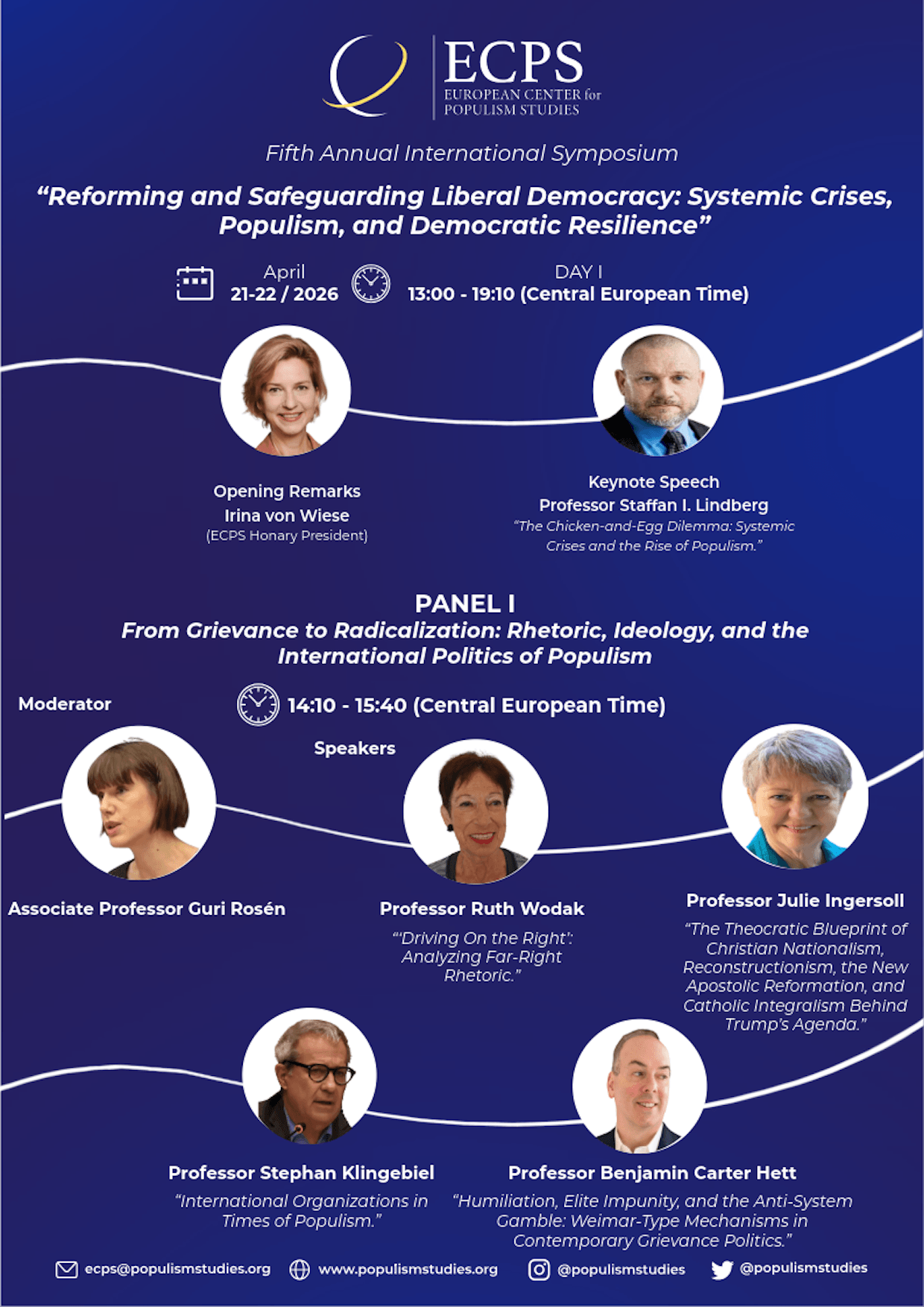
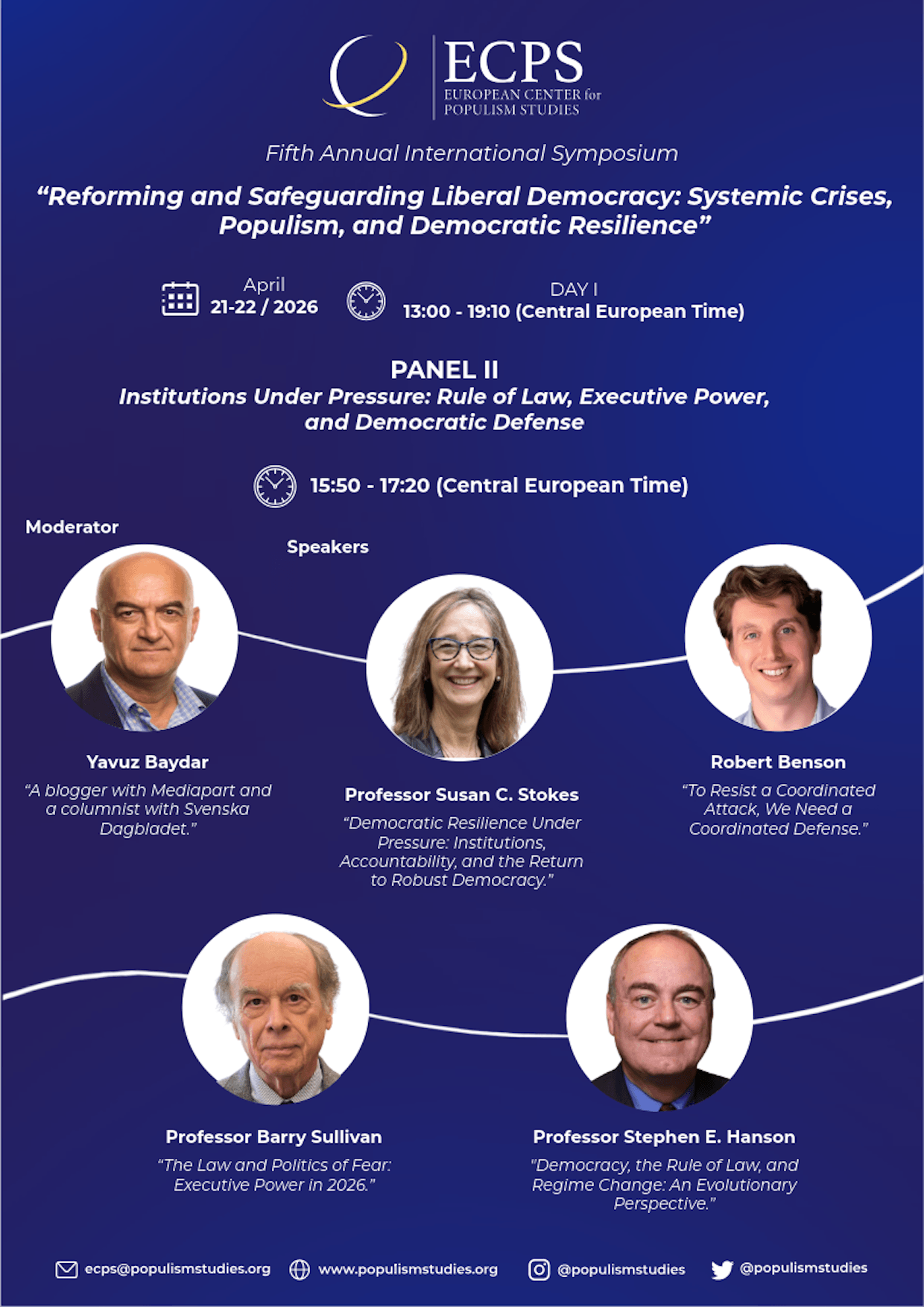
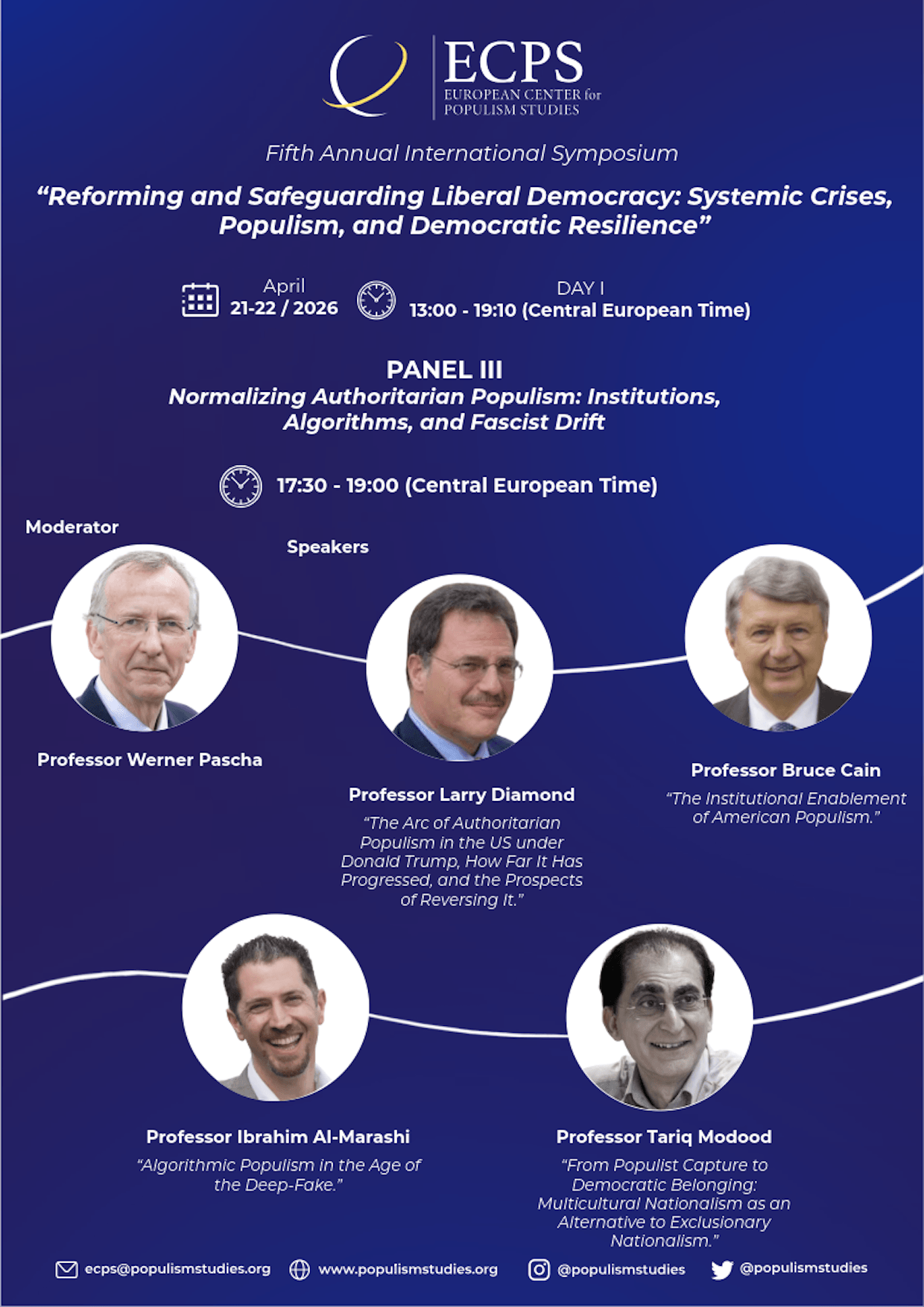
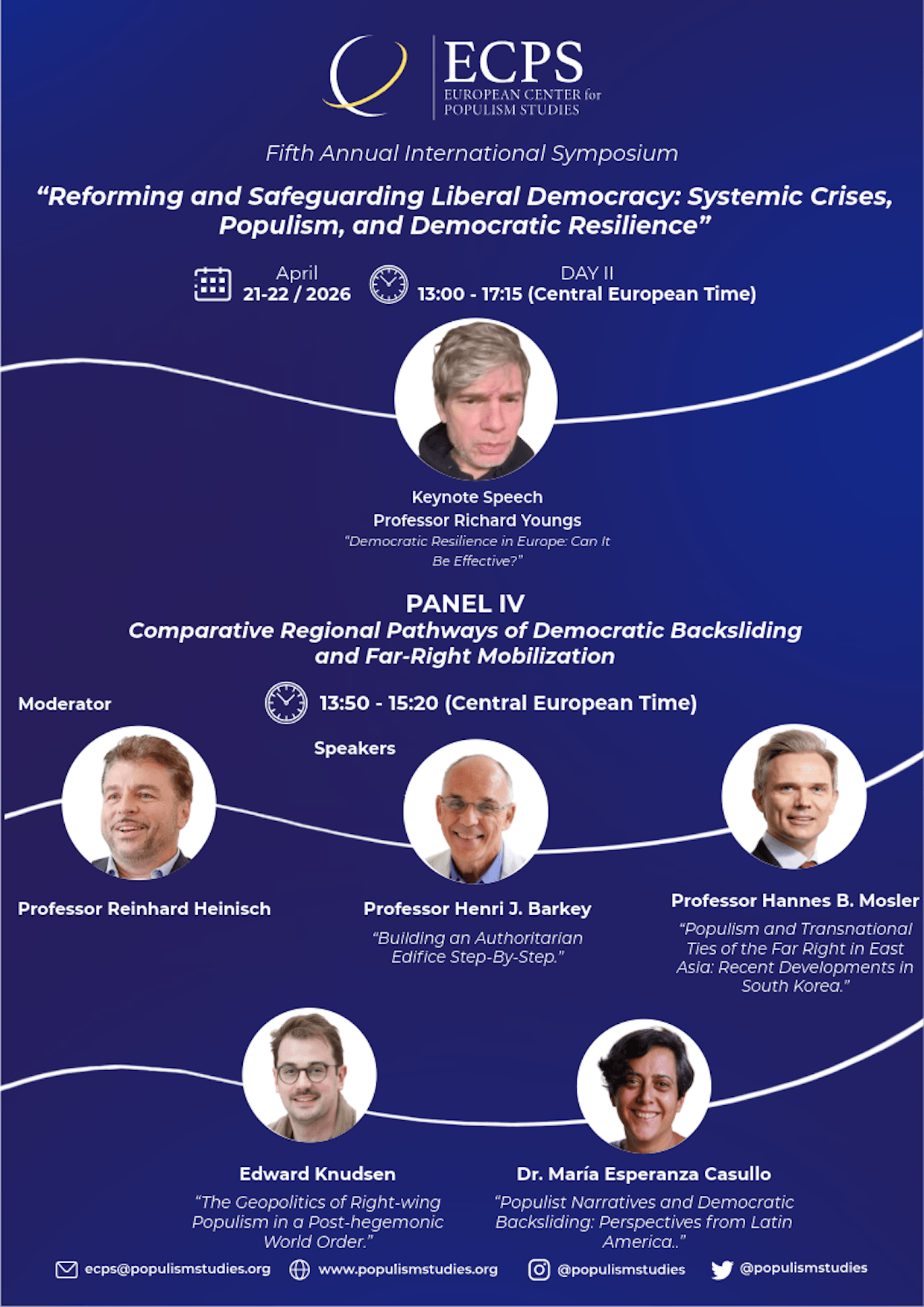
Virtual Programme: September 4, 2025 – April 16, 2026 via Zoom
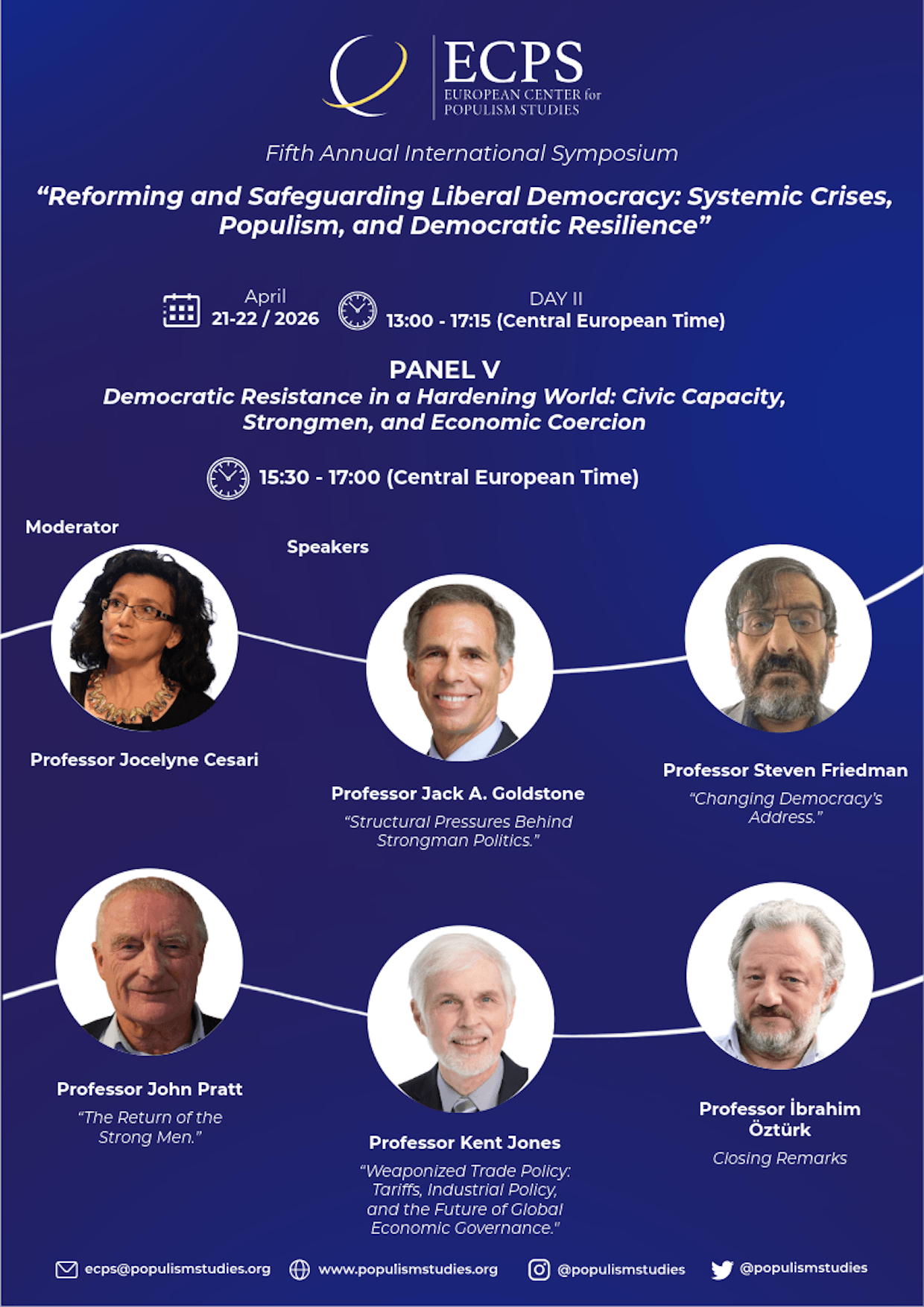
Between 2012 and 2024, one-fifth of the world’s democracies disappeared. During this period, “us vs. them” rhetoric and divisive politics have significantly eroded social cohesion. Yet in some instances, democracy has shown remarkable resilience. A key factor in both the rise and decline of liberal democracies is the use—and misuse—of the concept of “the people.” This idea can either unify civil society or deepen social divisions by setting “the people” against “the others.” This dichotomy lies at the heart of populism studies. However, the conditions under which “the people” become a force for democratization or a tool for majoritarian oppression require deeper, comparative, and interdisciplinary analysis. Understanding this dynamic is crucial, as it has profound implications for the future of democracy worldwide. This programme aims to foster a broad and interdisciplinary dialogue on the challenges of democratic backsliding and the pathways to resilience, with a focus on the transatlantic space and global Europe. It aims to bring together scholars from the humanities, arts, social sciences, and policy research to explore these critical issues.
Organiser
European Center for Populism Studies (ECPS)
Partners
The Humanities Division, Oxford University

Rothermere American Institute

Oxford Network of Peace Studies (OxPeace)
European Studies Centre, St Antony’s College, Oxford University
Oxford Democracy Network
Special thanks to Phil Taylor, Pádraig O’Connor, Freya Johnston, Heidi Hart, David J. Sanders, Clare Woodford, Anthony Gardner, Liz Carmichael, Harry Bregazzi, Hugo Bonin, Benjamin Gladstone, Doris Suchet, Jenny Davies, Justine Shepperson, Daniel Rowe, Katy Long, Julie Adams, Réka Koleszar, Stella Schade, Louise Lok Yi Horner, Jacinta Evans, Contestation of the Liberal Script (SCRIPTS), Network for Constitutional Economics and Social Philosophy (NOUS), and Centre for Applied Philosophy, Politics and Ethics (CAPPE).
Session 1
The Rise of Populist Authoritarianism around the World
Date/Time: Thursday, September 4, 2025 – 15:00-17:00 (CET)
Chair
Oscar Mazzoleni (Professor, Political Science, University of Lausanne; Editor-in-Chief, Populism & Politics).
Introduction
David J. Sanders (Regius Professor of Political Science, University of Essex, Emeritus).
Speakers
“The Rise of Populist Authoritarianism in India and the US: Do Family Dynasties and Big Businesses Really Control Democracy?” by Dinesh Sharma, Shoshana Baraschi-Ehrlich, Britt Romagna, Ms. Ayako Kiyota (Fordham University, NYC), Amartya Sharma (Student, George Washington University, D.C.)
“Out-groups and Elite Cues: How Populists shape Public Opinion,” by Michael Makara (Associate Professor of Comparative Politics and International Relations, University of Central Missouri) and Gregory W. Streich (Professor of Political Science and Chair of the School of Social Sciences and Languages, University of Central Missouri).
“From Economic to Political Catastrophe: Four Case Studies in Populism,” by Akis Kalaitzidis, (Professor of Political Science, Department of Government, Law, and International Studies, University of Central Missouri).
“Populism, Clientelism, and the Greek State under Papandreou,” by Elizabeth Kosmetatou (Professor of History, University of Illinois Springfield) and Akis Kalaitzidis (Professor of Political Science, Department of Government, Law, and International Studies, University of Central Missouri).
Discussant
João Ferreira Dias (Researcher at the International Studies Centre of ISCTE, in the Research Group Institutions, Governance and International Relations).
Session 2
The ‘Nation’ or just an ‘Accidental Society’: Identity, Polarization, Rule of Law and Human Rights in 1989-2025 Poland
Date/Time: Thursday, September 18, 2025 – 15:00-17:00 (CET)
Chair
Speakers
“Varieties of Polish Patriotism: Experience of “Solidarity” 1980-1989 in Context of History and Anthropology of Ideas,” by
Joanna Kurczewska (Professor in the humanities, Head of the Sociology and Anthropology of Culture Team at the Institute of Philosophy and Sociology of the Polish Academy of Sciences).
“
Single Text, Clashing Meanings: Political Polarization, Constitutional Axiology and the Polish Constitutional Quagmire,” by
Kamil Jonski (Economist, PhD in law at the University of Lodz).
“Protection of Human Rights and Its Implications for Women’s and Minority Rights,” by
Malgorzata Fuszara (Professor of humanities in the field of sociology, Institute of Applied Social Sciences (IASS), University of Warsaw).
“Who Speaks for Whom: The Issue of Representation in the Struggle for the Rule of Law,” by Jacek Kurczewski (Professor of humanities in the field of Sociology, Lecturer at the Department of Sociology and Anthropology of Customs and Law at the University of Warsaw).
Discussants
Magdalena Solska (Assistant Professor, Department of European Studies and Slavic Studies, University of Fribourg).
Barry Sullivan (Professor, Institute For Racial Justice, Loyola University Chicago School of Law).
Krzysztof Motyka (Professor, Institute of Sociological Sciences, John Paul II Catholic University of Lublin)
Session 3
Populism, Freedom of Religion and Illiberal Regimes
Date/Time: Thursday, October 2, 2025 – 15:00-17:00 (CET)
Chair
Marietta D.C. van der Tol (PhD, Landecker Lecturer, Faculty of Divinity, University of Cambridge; Senior Postdoctoral Researcher, Trinity College)
Speakers
“Religious Freedom as Hungaricum Hungarian iIliberalism and the Political Instrumentalization of Religious Freedom,” by Marc Loustau (PhD., Independent Scholar).
“Religious or Secular Freedom? On Pragmatic Politicization of Religion in Post-socialist Slovakia,” by Juraj Buzalka (Associate Professor of Social Anthropology, Faculty of Social and Economic Sciences at Comenius University).
“Illiberal Theocracy in Texas? The Incorporation of Evangelical Christian Theology into State Law,” by Rev. Dr. Colin Bossen (First Unitarian Universalist of Houston and Harris Manchester College, University of Oxford).
Discussants
Simon P. Watmough (Freelance academic researcher and editor and serves as a non-resident research fellow at ECPS).
Erkan Toguslu (PhD, Researcher at the Institute for Media Studies at KU Leuven, Belgium).
Session 4
Performing the People: Populism, Nativism, and the Politics of Belonging
Date/Time: Thursday, October 16, 2025 – 15:00-17:15 (CET)
Chair
Oscar Mazzoleni (Professor, Political Science, University of Lausanne).
Speakers
“We, the People: Rethinking Governance Through Bottom-Up Approaches,” by Samuel Ngozi Agu (Ph.D., Dean of the MJC Echeruo Faculty of Humanities at Abia State University, Uturu, Nigeria).
“Uses and Meanings of ‘the People’ in Service of Populism in Brazil,” by Eleonora Mesquita Ceia (Professor at the National Faculty of Law of the Federal University of Rio de Janeiro (UFRJ), Brazil).
“The Idea of ‘People’ Within the Domain of Authoritarian Populism in India,” by Shiveshwar Kundu (Jangipur College, University of Kalyani).
“We, the People: The Populist Subversion of a Universal Ideal,” by Mouli Bentman, Mike Dahan (Sapir College, Israel).
Discussants
Abdelaaziz Elbakkali (Associate Professor of Media and Cultural Anthropology, SMBA University, Fes; Post-Doc Fulbright visiting scholar at Arizona State University).
Azize Sargin (Director for External Affairs, ECPS).
Session 5
Constructing the People: Populist Narratives, National Identity, and Democratic Tensions
Date/Time: Thursday, October 30, 2025 – 15:00-17:00 (CET)
Chair
Heidi Hart (PhD, Arts Researcher and Practitioner based in Utah, US and Scandinavia).
Speakers
“The Romanian and Hungarian People in Populist Leaders’ Narratives between 2010-2020,” by Gheorghe Andrei (PhD Student, University of Bucharest and Ecole des Hautes Etudes en Sciences Sociales, Paris).
“The Application of the Concepts of ‘People’ and ‘Nation’ in Recent Political Developments in Germany: Theoretical Sensitivities and Their Implications for Democracy,” by Yazdan Keikhosrou Doulatyari (Researcher at the Institute of Sociology, Technische Universität Dresden).
“Ripping off the People: Populism of the Fiscally Tight-fist,” by Amir Ali (Jawaharlal Nehru University, New Delhi).
Discussants
Hannah Geddes (PhD Candidate, University of St. Andrews).
Amedeo Varriela (PhD, University of East London).
Session 6
Populism and the Crisis of Representation: Reimagining Democracy in Theory and Practice
Date/Time: Thursday, November 13, 2025 – 15:00-17:00 (CET)
Chair
Ilhan Kaya (PhD, Visiting Professor at Wilfrid Laurier University in Canada; Former Professor at Yıldız Technical University in Turkey).
Speakers
“De-Exceptionalizing Democracy: Rethinking Established and Emerging Democracies in an Age of Liberal Backsliding,” by Jonathan Madison (Governance Fellow at the R Street Institute).
“Mobilizing for Disruption: A Sociological Interpretation of the Role of Populism in the Crisis of Democracy,” by João Mauro Gomes Vieira de Carvalho (Member of the Research Committee of Sociological Theory at the International Sociological Association (ISA) and a researcher at LabPol/Unesp and the GEP Critical Theory: Technology, Culture, and Education).
“Daniel Barbu’s and Peter Mair’s Theoretical Perspectives on Post-politics and Post-democracy,” by Andreea Zamfira (Associate Professor with the Department of Political Science, University of Bucharest).
Discussants
Amedeo Varriela (PhD, University of East London).
Amir Ali (PhD, Jawaharlal Nehru University, New Delhi).
Session 7
Rethinking Representation in an Age of Populism
Date/Time: Thursday, November 27, 2025 – 15:00-17:00 (CET)
Chair
Christopher N. Magno (Associate Professor, Department of Justice Studies and Human Services, Gannon University).
Speakers
“Beyond Fairness: Meritocracy, the Limits of Representation, and the Politics of Populism,” by Elif Başak Ürdem (PhD candidate in political science at Loughborough University).
“Memetic Communication and Populist Discourse: Decoding the Visual Language of Political Polarization,” by Gabriel Bayarri Toscano (Assistant Professor, Department of Audiovisual Communication, Rey Juan Carlos University).
“Paradigms of ‘Popular Sovereignty’: Populism as Part of the Transformative History of the Concept,” by Maria Giorgia Caraceni (PhD Candidate in the History of Political Thought, Guglielmo Marconi University of Rome; Researcher at the Institute of Political Studies San Pio V).
Discussants
Sanne van Oosten (Postdoctoral Researcher at the University of Oxford).
Thibaut Dauphin (PhD, Research Associate at the Montesquieu Research Institute, University of Bordeaux).
Session 8
Fractured Democracies: Rhetoric, Repression, and the Populist Turn
Date/Time: Thursday, December 11, 2025 – 15:00-17:00 (CET)
Chair
Azize Sargin (Ph.D., Director for External Affairs, ECPS).
Speakers
Charismatic Populism, Suffering, and Saturnalia,” by Paul Joosse (Associate Professor in the Department of Sociology at the University of Hong Kong).
“The Evolution of the Rhetoric of the “Alternative for Germany”: A Comparative Analysis of the Election Campaigns for the European Parliament in 2019 and 2024,” by Artem Turenko (PhD Candidate, Political Science at the National Research University Higher School of Economics, Moscow).
Discussants
Helena Rovamo (Postdoctoral Researcher at the University of Eastern Finland).
Jonathan Madison (Governance Fellow at the R Street Institute).
Session 9
Populism, Crime, and the Politics of Exclusion
Date/Time: Thursday, January 8, 2026 – 15:00-17:00 (CET)
Chair
Helen L. Murphey (Post Doctoral Scholar at the Mershon Center for International Security Studies at The Ohio State University).
Speakers
“From Crime Shows to Power: The Rise of Criminal Populism,” by Christopher N. Magno (Associate Professor in the Department of Justice Studies and Human Services at Gannon University).
“The Legitimization Process of the FPÖ’s and the NR’s Migration Policies,” by Russell Foster (Senior Lecturer in British and International Politics at King’s College London, School of Politics & Economics, Department of European & International Studies).
“Anti-Party to Mass Party? Lessons from the Radical Right’s Party Building Model,” by Saga Oskarson Kindstrand (PhD candidate, Centre for European Studies and Comparative Politics, Sciences Po).
Discussants
Hannah Geddes (PhD Candidate, University of St. Andrews).
Vlad Surdea-Hernea (Postdoctoral researcher at the University of Natural Resources and Life Sciences in Vienna).
Session 10
Resisting the Decline: Democratic Resilience in Authoritarian Times
Date/Time: Thursday, January 22, 2026 – 15:00-17:00 (CET)
Chair
Amedeo Varriela (PhD, University of East London).
Speakers
“Resilience in Market Democracy,” by Peter Rogers (Senior lecturer in Sociology at Macquarie University).
“The Contradictory Challenges of Training Local Elected Officials for the Future of Democracy,” by Pierre Camus (Postdoctoral Fellow, Nantes University).
“The Rise of Women-Led Radical Democracy in Rojava: Global Democratic Decline and Civil Society Resilience Amidst Middle Eastern Authoritarianism,” by Soheila Shahriari (École des Hautes Études en Sciences Sociales, (EHESS)).
“Feminist Diaspora Activism from Poland and Turkey: Resisting Authoritarianism, Anti-Gender Politics, and Reimagining Transnational Solidarity in Exile,” by Ecem Nazlı Üçok (PhD Candidate at the Institute of Sociological Studies, Charles University).
Discussants
Gwenaëlle Bauvois (Ph.D., a sociologist based at the University of Helsinki).
Gabriel Bayarri Toscano (Assistant Professor, Department of Audiovisual Communication, Rey Juan Carlos University).
Session 11
Inclusion or Illusion? Narratives of Belonging, Trust, and Democracy in a Polarized Era
Date/Time: Thursday, February 5, 2026 – 15:00-17:00 (CET)
Chair
Andreea Zamfira (Associate Professor with the Department of Political Science, University of Bucharest).
Speakers
“When Identity Politics and Social Justice Procedures Contribute to Populism,” by Saeid Yarmohammadi (University of Montreal).
“Why Do We Trust The DMV? Exploring the Drivers of Institutional Trust in Public-facing Government Agencies,”by Ariel Lam Chan (PhD student in the Department of Sociology at Stanford University).
“Active Citizenship, Democracy and Inclusive Governance in Sub-Saharan Africa. Nexus, Challenges and Prospects for a Sustainable Development,” by Dr Dieudonne Mbarga (Independent Researcher).
“Silenced Voices in a Democratic Dawn: How the Iranian Constitutional Revolutionaries (1905–1906) Weaponized “the People” Against Minorities,” by Ali Ragheb (PhD., University of Tehran).
Discussants
Jennifer Fitzgerald (Professor of Political Science at the University of Colorado).
Russell Foster (Senior Lecturer in British and International Politics at King’s College London, School of Politics & Economics, Department of European & International Studies).
Session 12
Decolonizing Democracy: Governance, Identity, and Resistance in the Global South
Date/Time: Thursday, February 19, 2026 – 15:00-17:00 (CET)
Moderator
Neo Sithole (PhD candidate at the University of Szeged in Hungary).
Speakers
“Africa at the Test of Populism: Identity Mobilisations, Crises of Political Alternation, and the Trial of Democracy,” by Yves Valéry Obame (The University of Bertoua, Global Studies Institute & Geneva Africa Lab) and Salomon Essaga Eteme (The University of Ngaoundéré, Laboratoire camerounais d’études et de recherches sur les sociétés contemporaines (Ceresc)).
“Decolonial Environmentalism and Democracy: A Comparative Study of Resource Governance in Nigeria and the United Kingdom,” by Oludele Mayowa Solaja (Faculty member in the Department of Sociology at Olabisi Onabanjo University) and Mr. Busayo Olakitan Badmos (Postgraduate student in the Department of Sociology at Olabisi Onabanjo University).
“Viral but Powerless? Digital Activism, Political Resistance, and the Struggle for Governance Reform in Kenya, by Dr. Asenath Mwithigah (United States International University-Africa).
Discussants
Dr. Gabriel Cyril Nguijol (Researcher at the National Institute of Cartography (NIC), and lecturer at the Cameroonian Institute of Diplomatic and Strategic Studies (ICEDIS)).
Dr. Edouard Epiphane Yogo (Executive Director and Principal Researcher at the Bureau of Strategic Studies — BESTRAT, Yaoundé, Cameroon).
Session 13
Constructing and Deconstructing the People in Theory and Praxis
Date/Time: Thursday, March 5, 2026 – 15:00-17:00 (CET)
Chair
Leila Aliyeva (Associate of REES, Oxford School for Global and Area Studies (OSGA)).
Speakers
“Reimagining Populism: Ethnic Dynamics and the Construction of ‘the People’ in Bosnia and Herzegovina,” by Jasmin Hasanović (Assistant Professor and researcher at the Department for Political Science at the University of Sarajevo – Faculty of Political Science).
“Institutionalizing the Assembled People,” by Sixtine Van Outryve (Postdoctoral Researcher, Radboud Universiteit; UCLouvain).
“Re-imagining Diplomatic Representation as a Pillar of Democracy,” by Nieves Fernanda Cancela Sánchez (Global Advocacy Officer at UNPO, the Unrepresented Nations and Peoples Organization).
Discussants
Christopher N. Magno (Associate Professor in the Department of Justice Studies and Human Services at Gannon University).
Amedeo Varriela (PhD, University of East London).
Session 14
From Bots to Ballots: AI, Populism, and the Future of Democratic Participation
Date/Time: Thursday, March 19, 2026 – 15:00-17:00 (CET)
Chair
Dr. Paolo Gerbaudo
(Department of Political Science and Administration, Complutense University of Madrid).
Speakers
“Conceptions of Democracy and Artificial Intelligence in Administration and Government: Who Wants an Algorithm to Govern Us?” by Joan Font (Research Professor, Institute of Advanced Social Studies (IESA-CSIC).
“How Does ChatGPT Shape European Cultural Heritage for the Future of Democracy?” by Alonso Escamilla (PhD Student on Cultural Heritage and Digitalisation, The Catholic University of Ávila in Spain) and Paula Gonzalo (Researcher, University of Salamanca, Spain).
“The New Elite: How Big Tech is Reshaping White Working-Class Consciousness,” by Aly Hill, (PhD candidate, Department of Communication at The University of Utah).
“Bubbles, Clashes and Populism: “The People” in an algorithmically mediated world,” by Amina Vatreš (Teaching Assistant, Department of Communication Studies and Journalism, Faculty of Political Sciences, University of Sarajevo).
Discussants
Jasmin Hasanović (Assistant Professor and researcher at the Department for Political Science at the University of Sarajevo – Faculty of Political Science).
Alparslan Akkuş (PhD, Teaching Fellow at Institute of Political Science, Eberhard Karls Universität Tübingen).
Session 15
From Populism to Global Power Plays: Leadership, Crisis, and Democracy
Date/Time: Thursday, April 2, 2026 – 15:00-17:00 (CET)
Chair
Amir Ali (PhD, Jawaharlal Nehru University, New Delhi).
Speakers
“Can Democracy (or Anything Else) Rescue Civilization While the Rules Keep Changing?” by Robert R. Traill (PhD in Cybernetics/Psychology at Brunel).
“The Politics of Manipulated Resonance: Personalised Leadership in Populism,” by Lorenzo Viviani (Professor, Political Sociology, Department of Political Science, University of Pisa, Italy).
Discussants
Azize Sargin (Director for External Affairs, ECPS).
Ibrahim Ozturk (ECPS, Senior Economic researcher, Professor of Economics, Duisburg-Essen University, Institute of East Asian Studies (IN-EAST)).
Session 16
Voices of Democracy: Art, Law, and Leadership in the Era of Polarization
Date/Time: Thursday, April 16, 2026 – 15:00-17:00 (CET)
Chair
Joni Doherty (PhD, Senior program officer for Democracy and the Arts at Kettering Foundation).
Speakers
“’ I Miss My Name’: Why Black American Election Workers Like Ruby Freeman Turn to Defamation Law to Defend Democracy,” by Ciara Torres-Spelliscy (Brennan Center Fellow and Professor of Law at Stetson University).
“State Institutions in Divided Societies: Religious Policy and Societal Dissatisfaction in the Israeli Military,” by Niva Golan-Nadir (Postdoctoral Fellow at Reichman University) and Michael Freedman (Postdoctoral Fellow, Department of Political Science and International Relations, Hebrew University of Jerusalem).
“Pericles’ Funeral Oration: A Populist Rhetoric for War and Politics,” by Elizabeth Kosmetatou (Professor, History Faculty,University of Illinois, Springfield).
“The Exclusionary Identity of ‘The People’ in Radical Right Populism,” by Cristiano Gianolla (Researcher, Center for Social Studies, University of Coimbra; Lisete S. M. Mónico (Associate Professor, Faculty of Psychology and Education Sciences, the University of Coimbra) and Manuel João Cruz (Post-doctoral researcher, Center for Social Studies, University of Coimbra).
Discussants
Justin Patch (Associate Professor and Chair of Music at Vassar College).
Amedeo Varriela
(PhD, University of East London).
Biographies & Abstracts
Session 1
The Rise of Populist Authoritarianism around the World
Date/Time: Thursday, September 4, 2025 – 15:00-17:00 (CET)
Chair
Oscar Mazzoleni is a professor in political science and political sociology at the University of Lausanne where he leads the Research Observatory for regional research. He is currently the principal investigator the international project “Populism and Conspiracy” funded by the Swiss National Science Foundation and the Austrian Science Fund. He is co-director of the international research laboratory ‘Parties, political representatives, and sustainable development, at the University of Lausanne in collaboration with Laval University.
His works have been published in several peer-reviewed journals as European Politics and Society, Government and Opposition, Political Studies, Party Politics, Swiss Political Science Review, Nationalism and Ethnic Politics, Territory, Politics, Governance, Comparative European Politics, Contemporary Italian Politics, Socio-economic Review, Regional and Federal Studies, Journal of Borderlands studies, Revue française de Science politique, and Populism amongst others. He has published 45 books in 4 languages (English, Italian, French and German). His latest volumes include “The People and the Nation. Populism and Ethno-Territorial Politics in Europe (ed. with R. Heinisch and E. Massetti Routledge 2019), “Political Populism. Handbook of Concepts, Questions and Strategies of Research” (ed. with R. Heinisch and C.Holtz-Bacha, Nomos, 2021); “Sovereignism and Populism : Citizens, Voters and Parties in Western European Democracies” (ed. with L. Basile, Routledge 2022); “National Populism and Borders: The Politicisation of Cross-border Mobilisations in Europe” (Elgar 2023); “Populism and Key Concepts in Social and Political Theories” (ed with. C. De la Torre, Brill, 2023), and “Territory and Democratic Politics. A Critical Introduction” (Palgrave-Macmillan, 2024).
He was the principal investigator of many research projects, including four funded by the Swiss National Science Foundation. He has pursued an interdisciplinary educational path, earning a degree in sociology and anthropology, as well as a PhD in contemporary history, from the universities of Lausanne and Turin. He was a visiting professor and research fellow at the Universities of Columbia, Laval, Geneva, Groningen, Torino, Sorbonne-Panthéon- Paris, Science-Po-Paris, Valencia, Salzburg, European University Institute of Florence, Cornell University, and La Tuscia. His interests are devoted on political parties, populism, nationalism, regionalism, and Swiss politics in comparative perspective.
Introduction
David J. Sanders is a professor emeritus of political science at the University of Essex. Professor Sanders is an internationally renowned expert on British politics and was appointed the UK’s first Regius Professor of Political Science. Professor Sanders has been a key figure in the achievements of Essex’s Department of Government, which has topped the UK politics rankings for the quality of its research in every national research assessment in the last 25 years.
After studying at Essex as a postgraduate student, Professor Sanders started teaching politics at the University in 1975. He is author of numerous influential books and articles on UK politics, including Lawmaking and Cooperation in International Politics, 1986 and Losing an Empire, Finding a Role, 1990. He co-authored Political Choice in Britain, 2004, Performance Politics and the British Voter, 2009, Affluence, Austerity and Electoral Change in Britain, 2013 and The Political Integration of Ethnic Minorities in Britain, 2013.
He also co-edited the top UK political science journal, the British Journal of Political Science, between 1990 and 2008.
Professor Sanders is a Fellow of the British Academy and received a Special Recognition Award from the Political Studies Association in 2012 for his commitment to outstanding research, which has shaped public understanding of politics. From 2000 to 2012, he was a Principal Investigator for the British Election Study, which is conducted at every General Election to study electoral behaviour and how elections contribute to the operation of our democracy. This prestigious study was based at Essex from 1974 to 1983 and from 2000 to 2012.
Paper 1: The Rise of Populist Authoritarianism in India and the US: Do Family Dynasties and Big Businesses Really Control Democracy?
Abstract: Both India and the US seem to be in the grip of a populist movement that seems to share power with political dynasties and big business. How is this possible in a democracy? We examine this question by comparing families and dynasties in both countries — Kennedy vs Gandhi, currently out of power; Trump vs Modi, now in power. Both nations claim to be vibrant democracies, where populist nationalists have swept into power. Historically, India has been led by charismatic members of one dynastic family, namely the Gandhis; while the US definitely has political families (such as the Adams, Bushs, Rockerfellers, Clintons and now Trumps) it has not been dominated by one or two family dynasties in the way Asian democracies have been after colonialism ended.
Similarly, businesses have played a major role in politics of India and the US, but the business takeover of democratic institutions has had a bigger hand in the US politics than in India until recently; India was a quasi-socialist country till the 1990s. Both polities seem to be moving closer to big business, playing a major role in shaping policy and trade. Thus, we ask the question: are democracies at this populist moment in global politics controlled by the patricians (robber barons, big-tech, oligarchs) – big business and political dynasties? Our methodological approach is psycho-historical and biographical, while staying abreast of demographic data.
We compare the Kennedys vs. the Gandhis; and Trump vs Modi. The Gandhi family has dominated Indian politics for half of its modern history since gaining independence from British rule in 1947; while at least one member of the Kennedy family has been in power for at least the past fifty years in local or federal office, they’ve never held power in the way the Gandhi family did in India. Here we compare women leaders in both family histories, Indira Gandhi vs Kennedy female leaders. In comparing Trump vs. Modi we see a clear difference between two societies; Modi is not a billionaire, unlike Trump, rather a tea-seller from very humble origins. Yet, their populist governments have given power sharing arrangements to the big-business and big-tech oligarchs. When we compare the narrative of these two leaders we see a strong nationalistic streak that mobilizes populism in favor of nativism and an anti-globalist agenda. The key question is are these societies converging or diverging? On the question of authoritarianism and populism they are converging, as India rises as an economic power and the US tries to remain a global democratic power, even though their local cultural politics are remarkably different.
Dinesh Sharma,Ph.D., is a social scientist with a Doctorate from Harvard University in human development and psychology. He is currently Director and Chief Research Officer at SteamWorksStudio in Central-Southern Jersey (an edu-tech venture), consultant at Fordham Institute for Research Service and Teaching (FIRST), and contributing faculty at Walden University. He was associate research professor at the Institute for Global Cultural Studies, Binghamton University, SUNY; a senior fellow at the Institute for International and Cross-Cultural Research in New York City; and a columnist for Asia Times Online, Al Jazeera English and the Global Intelligence among other syndicated publications. His biography, titled “Barack Obama in Hawaii and Indonesia: The Making of a Global President,” was rated a Top 10 Book of Black History for 2012 by the American Library Association. His next book, “The Global Obama” has been widely reviewed and received the Honorable Mention on the Top 10 Black History Books for 2014. His book on Hillary Clinton examined the rise of women politicians before the “Me Too” movement, “The Global Hillary: Women’s Political Leadership in Cultural Context” (Routledge, 2016) and was favorably reviewed.
Shoshana Baraschi-Ehrlich, is a graduate student from New York City, currently studying at Fordham’s Graduate School of Education. Her academic interests focus on the psychological impacts of early-life trauma and the integration of mindfulness techniques in clinical settings to support emotional, cognitive, and physical integration. She is also engaged in research exploring the relationship between trauma and democracy. Shoshana is passionate about bridging psychological theory with real-world practice and plans to pursue a career in clinical psychology.
Paper 2: Out-groups and Elite Cues: How Populists Shape Public Opinion
Abstract: Populist leaders claim they are the true representative of “the people” against corrupt elites and various out-groups (very often immigrants) who are thought to threaten the well-being of the nation. If this is so, the leader is simply reflecting the will of the people as they ascend to power and carry out their agenda. From this view, the populist leader answers the call of the people and uses power to protect and restore the country by targeting the elites and out-groups that threaten it. However, populist leaders do not just reflect the will of the people, they actively cultivate public support for their political agenda. From this view, populist leaders deploy their rhetorical powers to persuade, and even manipulate, the people, by tapping into anxieties that build public support for the populist leader’s agenda. Moreover, the power of populist leaders to focus the attention of voters on the threats to their well-being enables them to tap into in-group fears of various socio-demographically different out-groups. Indeed, truly gifted populist orators can manufacture fear and anxiety by targeting specific out-groups as the “cause” of the economic, social, or political problems that, in their view, threaten the nation.
In this paper, we examine results from a nationally representative survey conducted in the U.S. in October of 2024 to measure the ability of U.S. President Donald Trump to influence public opinion. We examine his ability to increase or decrease public support for a range of policies, specifically refugees and trade. Our survey allows us to compare how respondents view refugees depending on whether those refugees are from Ukraine or from Gaza, and how respondents view trade from Europe or from China. Moreover, our survey allows us to assess whether public opinion is more readily shaped by the cues provided by political leaders (what we call “follow-the-leader” effects) or by the social attributes of the “out-group” (what we call “social attributes” effects), both of which are important components of populist rhetorical appeals.
Michael Makara is an Associate Professor of Comparative Politics and International Relations. He received his Ph.D. and M.A. in Political Science from the Maxwell School of Citizenship and Public Affairs at Syracuse University, and his B.A. from Virginia Tech. Professor Makara’s research focuses on politics in authoritarian regimes and civil-military relations, with a regional focus on the Middle East. His research appears in Democracy and Security, Defense and Security Analysis, and the Journal of the Middle East and Africa. At UCM he teaches a variety of courses related to comparative politics and politics of the Middle East. Every year, he leads a study abroad program to Jordan and Israel that aims to challenge students’ perceptions of the region. He recently published an article in the Journal of Political Science Education (with Kinsey Canon) that explores the impact of this program on the extent to which students adhere to common stereotypes of the Middle East. Dr. Makara also sits on the Board of Directors for the International Relations Council (IRC) of Kansas City and is the director the Mideast meets Midwest project to expand opportunities for university students to pursue Middle Eastern Studies.University of Central Missouri & Dr. Gregory W. Streich, University of Central Missouri.
Gregory W. Streich is Professor of Political Science and Chair of the School of Social Sciences and Languages. He has published on a range of topics, including democratic theory, social capital, justice, and American Exceptionalism. Most notably, he has authored or co-edited three books: Justice Beyond “Just Us”: Dilemmas of Time, Place, and Difference in American Politics, U.S. Foreign Policy: A Documentary and Reference Guide, and Urban Social Capital: Civil Society and City Life. Additionally, he has won several awards for his teaching and research, including the Distinguished Faculty Award from the College of Arts, Humanities, and Social Sciences. He holds a Ph.D. in Political Science from the University of Wisconsin–Madison.
Paper 3: From Economic to Political Catastrophe: Four Case Studies in Populism
Abstract: This paper is meant to be a comparative study between four international crises: the Asian Financial Crisis of 1997, Argentina’s 2001, the US’s Great Recession of 2008, and Greece’s Great Depression of 2010. It has been argued by economists, historians, and political scientists that economic crises produce populist movements in the countries that experience them (Kindleberger, 2005; Ferguson, 2012; Hartleb, 2012). Kindleberger argues that all economic crises are a product of a “bubble” or a “mania” and as such the corrective response is an economic crisis in the country that experiences such market inflation. As an economist, however, he says nothing of the impact of the crisis on the politics of the country or the responses to said crisis.
Generally speaking, populism has been at the forefront of countries with great inequalities in places like Latin America or India or in countries under severe socio-economic stress such as Weimar Germany. Yet the European Union may be in a recession but it could hardly be justification for the multitude of populist (anti-EU, anti-globalization, xenophobic, and racist) movements that have sprung up even in countries with solid economies such as Finland, Denmark, and UK. It is thus important to analyze the types of responses to these crises and the types of populism, if any, each country experiences as a result of a given crisis, accounting for its severity and the administrative and decision-making capacity of the state apparatus.
The association of economic crisis and populism seems to hold true in modern times in many areas of the world. In Thailand after the catastrophic collapse of the Thai Baht in 1997, in Argentina in 2001, and in the US after 2010, one can debate whether the bursting of the dot com bubble constitutes a crisis, but mostly after the collapse of the real estate market bubble of 2008 and more recently in Greece in 2010. Yet, in all those countries the experience with populism is different and the pressure created by the economic condition on the ground leads to different outcomes in the politics of those countries. In Thailand, the reaction to post-crisis populism was a coup, in Argentina was an extended period of “Kirchnerismo” , in the US the rise of what Hofstadter the “Paranoid Style in American Politics”, as well as the more traditional non-party political movements hat put enormous pressure on the traditional party structure pushing liberal democracy to the brink, while in Greece populism which is more associated with European populist tradition as experienced in most pre-and post-WWII countries created a hybrid nationalist-leftist populism more akin to early twentieth century European Corporatism. This research intends to highlight the political processes, Institutions, and leaders who have influenced the course of politics and argue that in all four cases, the best predictor for post-crisis behavior is the national political culture.
Akis Kalaitzidis is a professor of political science at the Department of Government, Law, and International Studies, University of Central Missouri. He received his B.A. from the University of Tennessee-Knoxville in Economics and Political Science, and his M.A. and Ph.D. from Temple University in Philadelphia in Political Science. He joined the UCM faculty in 2004. He teaches a variety of classes, including American Government, The European Union, World Politics, International Organizations, and American Foreign Policy. He was Rotary Peace Fellow at the Rotary Peace Center Chulalongkorn University’s Program in Conflict Resolution and has been the director of the Missouri Ghana program (2011) and Missouri Greece program (2015). He is the author of Europe‘s Greece: A Giant in the Making, published by Palgrave McMillan (2010) and co-edited with Dr. Streich US Foreign Policy: A Documentary and Reference Guide (Greenwood 2012) among others. His work appears in a variety of journals, book reviews/contributions, and conference publications.
Paper 4: Populism, Clientelism, and the Greek State under Papandreou
Abstract: This paper explores the role of populism and clientelism in shaping the Greek state under the leadership of Andreas Papandreou, one of Greece’s most influential political figures. Papandreou served as Prime Minister from 1981 to 1989 and again from 1993 to 1996. His tenure coincided with a period of profound political and economic transformation following the restoration of democracy in 1975. His governance combined populist rhetoric with clientelist practices, crafting a distinctive political strategy that left a lasting impact on Greek politics. At the core of Papandreou’s political success was his ability to mobilize popular support through populist appeals, emphasizing social justice, nationalism, anti-Americanism, and the welfare state. He positioned himself as a champion of the common people, presenting the Socialist Party as the defender of workers’ rights and national sovereignty, even as he reversed course on many of his programmatic policies.
Papandreou’s populism resonated deeply with the large segment of the Greek population that right-wing establishments had marginalized following the Greek Civil War (1946-1949) and the collapse of the military junta (1967-1974). As these disenfranchised groups leaned politically to the left, Papandreou shifted his stance from the center to the left, incorporating a more left-wing faction within his party. His message of social and economic justice empowered these communities, offering them a sense of inclusion and challenging the longstanding dominance of conservative elites. In parallel with his populist narrative, Papandreou employed clientelism as a tool for political stability. The distribution of state resources and public sector jobs—particularly after Greece acceded to the EEC and the influx of investment funds—was often based on loyalty rather than merit. This system of patronage not only secured votes but also fostered a political culture of dependence on the state for material rewards.
This study explores the interaction between populism and clientelism in shaping the Greek state. It investigates Papandreou’s policies’ influence on Greece’s political culture, governance frameworks, and public administration and their enduring effects on the nation’s journey within the European Union. The analysis ultimately provides a critical evaluation of how populist rhetoric and clientelist strategies reinforced democratic institutions in Greece and altered state-society dynamics during the late 20th century.
Elizabet Kosmetatou is a Professor of History at the University of Illinois Springfield.
Session 2
The ‘Nation’ or just an ‘Accidental Society’: Identity, Polarization, Rule of Law and Human Rights in 1989-2025 Poland
Date/Time: Thursday, September 18, 2025 – 15:00-17:00 (CET)
Abstract: In principle, the Polish transition to democracy initiated in 1981 was understood as liberation from Soviet colonialism, Communist totalitarian state ideology at the national level and “the resurrection of rights” (Kurczewski, 1993) at the individual level.
In practice, it quickly became controversial how the “will” of the nation should be determined and whose rights should be resurrected. The problem was nicely captured by a Christian member of the Polish Parliament, voicing objection to the abortion referendum on the grounds that such fundamental and morally-loaded issues could not be decided by “the accidental society” (in other words, the voting public).
Two decades later, opening debate that will be called “the four hours of anti-philosophy of law” (Safjan, 2015) the honorary speaker of Polish Parliament proclaimed that “law shall serve us. Law that does not serve the nation is lawlessness”. “Poland’s constitutional breakdown” (Sadurski, 2019) dutifully followed, beginning with “war” with the Constitutional Tribunal and ordinary courts.
Panellists will discuss:
-the concept of nation – civil and national} underpinning “Solidarity’s” resistance to the communist rule, and its evolutions after the 1989 breakthrough (Joanna Kurczewska),
-the shifting patterns of the political polarization and its impact on key liberal-democratic institutions like Parliamentary law-making process, Presidency and the Constitutional Court (Kamil Jonski),
-the sociological dimensions of the “rule of law” including the democratic transition, post-2015 backsliding and post-2023 restoration in context of doctrine of separation of powers (Jacek Kurczewski),
-the implications for the protection of human rights, with particular emphasize on woman’s rights (including access to the abortion) and minorities rights (Malgorzata Fuszara).
Varieties of Polish Patriotism: Experience of “Solidarity” 1980-1989 in Context of History and Anthropology of Ideas
Joanna Kurczewska is a full professor in the humanities and head of the Sociology and Anthropology of Culture Team at the Institute of Philosophy and Sociology of the Polish Academy of Sciences. Graduated University of Warsaw, Ph.D. at the Institute of Philosophy and Sociology of the Polish Academy of Sciences (The Problem of the Nation in Polish Sociology at the Turn of the 19th and 20th Centuries. A Comparative Analysis of Selected Concepts), habilitated doctor (Technocrats and the Social World – Analysis of Technocratic Ideas).
In 1981, co-operated with the Centre for Social and Professional Work at the National Commission of NSZZ “Solidarity” Trade Union as co-chair of the Union History Group.
A corresponding member of the Second Faculty of History and Philosophy of the Polish Academy of Arts and Sciences (since 2011) and vice-president, formerly president of the Commission on Civilization Threats of the above Academy, a member of the Warsaw Scientific Society (since 2009), In 2007, she was awarded the Officer’s Cross of the Order of Polonia Restituta. Selected publications: National Identities vis-a-vis Democracy and Catholicism – The Polish Case after 1989 (2005), Researcher vis-a-vis the Local Community (2008), Squeezing Brussels Sprouts? On the Europeanization of Local Communities in the Borderlands (2009).
Single Text, Clashing Meanings: Political Polarization, Constitutional Axiology and the Polish Constitutional Quagmire
Kamil Joński is an economist who graduated from SGH Warsaw School of Economics with a Ph.D. in law at the University of Lodz (Constitutional Tribunal and the Political Conflict – Law & Economics Perspective). He is an assistant at the Collegium of Socio-Economics, SGH Warsaw School of Economics. He works at several research projects financed by Polish National Science Centre, at Cracow University of Economics, SGH Warsaw School of Economics and Adam Mickiewicz University in Poznan. Jónski worked on Regulatory Impact Assessments (RIA) in Polish Ministry of Justice (2012-2016) and on economic analysis of judicial system in MoJ’s supervised Institute of Justice (2016-2017). Since 2017, he is employed at Polish Supreme Administrative Court.
Selected papers: Return to Power: The Illiberal Playbook from Hungary, Poland and the United States (2024), Legislative inflation in Poland: bird’s eye view on three decades after the the1989 breakthrough (2024), Evidence-Based policymaking during the COVID-19 Crisis: Regulatory Impact Assessments and the Polish COVID-19 Restrictions (2023), Assessments of the Polish Constitutional Tribunal performance: effects of the survey administration method (2023). Co-author of the 2022 report summarizing European Network of Councils for the Judiciary (ENCJ) survey of European judges about their independence.
Protection of Human Rights and Its Implications for Women’s and Minority Rights
Małgorzata Fuszara is full professor of humanities in the field of sociology, Institute of Applied Social Sciences (IASS) University of Warsaw, habilitated doctor in the Sociology of Law, Ph.D. in law. Served two terms as Director of the IASS, joint founder of Poland’s first Gender Studies Program at IASS, head of its Sociology and Anthropology of Custom and Law Chair. In 2014-2015 Plenipotentiary of Polish Government for Equal Treatment. President of Council of Women’s Congress Association, Chairwoman of the Women’s Council under the Mayor of Warsaw, Rafał Trzaskowski, awarded the Knight’s Cross of the Order of Polonia Restituta. Authored, co-authored and edited numerous publications in Polish, English, French and German, among others: Polish Disputes and Courts (2004), Women in politics (2007), New men? Changing models of masculinity in contemporary Poland (2008), Cooperation or conflict? The State, the Union and Women (2008), Women, elections, politics (2013), Disputes and their resolution (2017), Mass Aid in Mass Escape. Polish Society and War Migration from Ukraine (2022).
Who Speaks for Whom: The Issue of Representation in the Struggle for the Rule of Law
Jacek Kurczewski is full professor of humanities in the field of sociology, Lecturer at the Department of Sociology and Anthropology of Customs and Law at the University of Warsaw. Editor-in-chief of Societas/Communitas. Specializing in the sociology and anthropology of law and customs, continuator of the Leon Petrażycki’s Polish school of sociology, a student of Adam Podgórecki. Former Academic Director of the Oñati International Institute for the Sociology of Law. Member of Warsaw Academic Society.
In 1980–1992 an advisor on Rule of Law to the “Solidarity” Trade Union, member of Lech Wałęsa’s Citizens Committee, participant of the Round Table negotiations of 1989 (sub-table for freedom of association). Judge of the Tribunal of the State (1989-1991). Member of Parliament and Deputy Speaker of the Sejm of the Republic of Poland of the first term (1991–1993). Coauthor of the draft laws: limiting censorship (1981), the law on counteracting drug addiction (1987), the law on assemblies (1990) and the Civil Service Code (2003). In 2007 awarded the Officer’s Cross of the Order of Polonia Restituta. Member of the Program Councils of the Polish public TV broadcaster and pollster CBOS Foundation. Author of The Resurrection of Rights in Poland (1993) and numerous research papers.
Chair
Mavis Maclean is a Senior Research Fellow of St Hilda’s College and a Research Associate at Department of Social Policy and Intervention. She has carried out Socio Legal research in Oxford since 1974, and was a founding director of OXFLAP in 2001. She has acted as the Academic Adviser to the Lord Chancellor’s Department, and served as a panel member on the Bristol Royal Infirmary Inquiry between 1998 and 2001, a major public inquiry into the National Health Service. Commander of the Most Excellent Order of the British Empire
Discussants
Dr. Magdalena Solska is an assistant professor of political science at the University of Fribourg. She currently directs the research project “Political opposition in post-communist democracies and authoritarianisms,” funded by the Swiss National Science Foundation (PRIMA Grant) in the period of 2023-2027. Her research focuses on political systems after communism and specifically on forms, strategies and institutionalization of opposition in selected countries in Central and Eastern Europe.
Professor Barry Sullivan is the Raymond and Mary Simon Chair in Constitutional Law and the George Anastaplo Professor of Constitutional Law and History. Before joining the Loyola faculty, Professor Sullivan had a varied career in the private practice of law, government legal practice, the teaching of law and public policy, and university administration. Professor Sullivan was Dean of the School of Law at Washington and Lee University from 1994 to 1999 and Vice-President of the University in 1998-99. He was also a long-time litigation partner at Jenner & Block (1981-94, 2001-09), where he focused on appellate practice.
Professor Krzysztof Motyka is a legal philosopher and sociologist of law, Chair of Human Rights and Social Work (earlier: Sociology of Law and Morality) at John Paul II Catholic University of Lublin. Fulbright senior scholar in the Center for the Study of Law and Society, University of California, Berkeley (1994/1995), visiting researcher at the George Washington University, Washington, D.C. (July-October 2015). Member of the Minister of Foreign Affairs’ Advisory Board on Human Rights (2001 -2002) and of the European Commission against Racism and Intolerance (2007-2012). Editor of “KUL Research Bulletin,” organizer of annual “Human Rights Days Conference.”
Session 3
Populism, Freedom of Religion and Illiberal Regimes
Date/Time: Thursday, October 2, 2025 – 15:00-17:00 (CET)
Chair
Marietta D.C. van der Tol is Landecker Lecturer at the Faculty of Divinity, Affiliated Lecturer in Politics and International Studies, and Senior Postdoctoral Researcher at Trinity College, Cambridge.
She studied law and history at Utrecht University (LLM, MA) and the history of Christianity at Yale (MAR) before completing her PhD at Cambridge (2020) on Politics of Religious Diversity, examining tolerance and visibility of religion in constitutional law and politics in France, Germany, and the Netherlands.
She has held research and teaching positions at Oxford (Blavatnik School of Government, St Peter’s, Lincoln College) and Cambridge (Leverhulme Early Career Fellow, 2024–25).
Her current projects include leading interdisciplinary networks on religion, nationalism, and democracy, and co-directing research on Protestant political thought. She has co-edited special issues in Religion, State & Society and The Journal of the Bible and its Reception and convenes the annual Political Theologies conference series.
Discussants
Simon P. Watmough (PhD) is a freelance academic researcher and editor and serves as a non-resident research fellow in the research program on authoritarianism at ECPS. He was awarded his Ph.D. from the European University Institute in April 2017 with a dissertation titled “Democracy in the Shadow of the Deep State: Guardian Hybrid Regimes in Turkey and Thailand.” Dr. Watmough’s research interests sit at the intersection of global and comparative politics and include varieties of post-authoritarian states, the political sociology of the state, the role of the military in regime change, and the foreign policy of post-authoritarian states in the Middle East and Southeast Asia.
Erkan Toguslu (PhD) is a researcher at the Institute for Media Studies at KU Leuven, Belgium. He received his M.A. and Ph.D. in sociology from Ecole des Hautes Etudes en Sciences Sociales (EHESS) in Paris. His research focuses on transnational Muslim networks in Europe, the emergence of Islamic intellectuals, interfaith dialogue, the debate on public-private Islam, and the nexus of religion and radicalization.
ErkanToguslu is co-editor of Journal of Populism Studies (JPS) and the editor of Everyday Life Practices of Muslims in Europe (Leuven University Press); Europe’s New Multicultural Identities (Leuven University Press and co-edited with J. Leman and I. M. Sezgin); and Modern Islamic Thinking and Islamic Activism (Leuven University Press and co-edited with J. Leman). His recent publications on violent extremism and Muslim extremism include: “Caliphate, hijrah, and martyrdom as a performative narrative in ISIS’ Dabiq magazine,” Politics, Religion and Ideology, 20 (1), 94-120; and “Capitalizing on the Koran to fuel online violent radicalization: A taxonomy of Koranic references in ISIS’s Dabiq,” Telematics and Informatics, 35 (2), 491-503 (co-authored).
Paper 1: Religious Freedom as Hungaricum Hungarian Illiberalism and the Political Instrumentalization of Religious Freedom
Abstract: In 2025, the Hungarian government announced it was creating a “Religious Freedom” caucus in the European Parliament. Domestically, Hungary has claimed a special relationship to the value of religious freedom since at least 2020, when the Hungarian parliament voted to enshrine religious freedom as an intangible value of Hungarian heritage (Hungarikum). On the one hand, the rising prominence of this discourse of religious freedom was precipitated by immediate political concerns as the Hungarian government has tried to distract attention from negative judgements at the European Court of Human Rights. On the other, this paper will go beyond journalistic accounts of political strategizing in order to sketch an outline of the emerging illberal political institutionalization of religious freedom. I will focus on the network of Hungarian institutional political actors that enact this discourse at the European and domestic levels, and detail the forms of publicly acceptable religious practice enabled by these institutions.
Marc Loustau is a cultural anthropologist and journalist reporting on religion and nationalism in Eastern Europe. Based in Budapest, Hungary, he is fluent in English and Hungarian and proficient in Romanian. His reported features and commentary have appeared in major U.S. and European newspapers and magazines. Drawing on his academic research, he provides smart and surprising fact-based commentary on contemporary events. He has delivered invited lectures at universities across Europe and North America and has presented at numerous international conferences. His book Hungarian Catholic Intellectuals in Romania: Reforming Apostles examines how contemporary Hungarian Catholic intellectuals are forging an ethical concept of nationhood.
Paper 2: Religious or Secular Freedom? On Pragmatic Politicization of Religion in Post-socialist Slovakia
Abstract: Since 1989, elements of radical Christian activism in Slovakia that have been frequently characterized as representing the ‘culture of life’ have been challenging the regime of post-socialist liberal constitutionalism represented by the European status quo. This challenge has primarily consisted of accusations that the latter suppresses newly acquired religious freedoms. The most significant counterpart of this radicalism – secular progressivism – has been arguing against expanding ecclesiastical privileges in the sphere of financing, education, and culture. Traditional social-confessional divisions in Slovak society have weakened, reshaping the discussion away from political freedom for all and toward a debate about who is suffering more oppression. In this conflict, the most profitable have been political entrepreneurs, especially current Prime Minister Robert Fico, who utilizes “culture war” discourse in his populist mobilizations.
Juraj Buzalka is Associate Professor of Social Anthropology at Comenius University in Bratislava, Slovakia, where he has taught since 2006. His research focuses on the anthropology of political movements, exploring intersections of nationalism, populism, religion, and politics, particularly in Eastern and Central Europe. He is also interested in the politics of memory and the cultural dimensions of wine and food movements. Since 2013, he has been based at the Institute of Social Anthropology within the Faculty of Social and Economic Sciences.
Paper 3: Illiberal Theocracy in Texas? The Incorporation of Evangelical Christian Theology into State Law
Abstract: This year, Texas marks three consecutive decades of governance by the Republican Party. In that time, the party has built up what can be described as a theocratic illiberal regime. The theological positions of many of the state’s evangelical Christians have been incorporated into state law, often under the guise of religious freedom. In his paper, our third panelist, the Rev. Dr. Colin Bossen, himself a Texas-based clergyman, will reflect how the rhetoric of religious freedom has been used to further the construction of an illiberal state within the United States federal system, eroded supposed the separation of church and state, and undermined freedom of religion itself.
Rev. Dr. Colin Bossen, First Unitarian Universalist of Houston and Harris Manchester College, University of Oxford. He earned a Ph.D. in American Studies and an A.M. in History from Harvard University. A graduate of Meadville-Lombard Theological School, he was ordained by the Unitarian Universalist Church of Long Beach in 2007. Since 2018, he has served the First Unitarian Universalist Church of Houston. Before moving to Texas, he served congregations in California, Massachusetts, and Ohio. He has held non-residential fellowships at Rice University and Princeton University. A scholar and social justice activist he has helped organize multiple labor unions—including acting as one of the founders of the Harvard Graduate Student Union. He currently has three books under contract. The first is on contemporary Unitarian Universalist theology (Brill). The second collects his 2019 Minns lectures on American Populism and Unitarian Universalism (Palgrave Macmillan). And the third is focused on the political theologies of populism (Wayne State University Press).
Session 4
Performing the People: Populism, Nativism, and the Politics of Belonging
Date/Time: Thursday, October 16, 2025 – 15:00-17:30 (CET)
Chair
Oscar Mazzoleni is a professor of political science and political sociology at the University of Lausanne, where he leads the Research Observatory for Regional Research. He is currently the principal investigator of the international project “Populism and Conspiracy” funded by the Swiss National Science Foundation and the Austrian Science Fund. He is co-director of the international research laboratory ‘Parties, political representatives, and sustainable development, at the University of Lausanne in collaboration with Laval University.
Discussants
Abdelaaziz El Bakkali is an associate professor of Media and Cultural Anthropology at SMBA University in Fes, Morocco, and a Post-Doc Fulbright visiting scholar at Arizona State University in the US (2024/25), a PhD Joint-Sup at SIU, Illinois (2009/10), and a US Dept of State Fulbright Visiting P4T at UD Delaware (2007/2008). He obtained his PhD (2014) in media and communication from MVU, Rabat. His works focus on cultural studies and anthropology, primarily in the areas of media, gender, and religious studies. He has edited some books in these related research areas. Aziz has also written many articles in these related fields. El Bakkali has conducted other educational research, having taught English for over 24 years. He has published numerous articles in this field, which are featured on Publons, Google Scholar, SSRN, and other highly indexed works.
Azize Sargin is an independent researcher and consultant on external relations for non-governmental organisations. She holds a doctorate in International Relations, with a focus on Migration Studies, from the Brussels School of International Studies at the University of Kent. Her research interest covers migrant belonging and integration, diversity and cities, and transnationalism. Azize had a 15-year professional career as a diplomat in the Turkish Ministry of Foreign Affairs, where she held various positions and was posted to different countries, including Romania, the United States, and Belgium. During her last posting, she served as the political counsellor at the Permanent Delegation of Turkey to the EU.
Paper 1: We, the People: Rethinking Governance Through Bottom-Up Approaches
Abstract: Democracy is often celebrated as a governance system that ensures citizen participation and accountability. However, in practice, centralized power structures often alienate the people and limit genuine participation, leading to political exclusion, inefficiency, and social unrest. This paper advocates for bottom-up approaches to governance as essential for realizing inclusive democracy and sustainable development. Using Nigeria as a case study, it highlights the limitations of top-down governance, as seen in widespread corruption, economic disparities, and rising public discontent. The study explores key strategies for enhancing participatory governance, including decentralization, civic education, community-based development, digital democracy, and legislative reforms. By shifting decision-making closer to the grassroots, these approaches empower citizens, enhance transparency, and promote equitable resource distribution. Empirical evidence from global case studies, such as participatory budgeting in Brazil and decentralized governance in Uganda, supports the argument that bottom-up models lead to improved governance outcomes. It further demonstrates the interdependence of participatory governance and sustainable development, as nations that prioritize inclusivity experience greater political stability, economic growth, and social cohesion. The persistent challenges in Nigeria – ranging from separatist movements to youth-led protests like #EndSARS – underscore the urgent need for governance reforms that integrate local voices into policymaking. Ultimately, this paper advocates for a fundamental shift in governance – one that places the power of decision-making in the hands of the people. By adopting citizen-driven governance, nations can close the gap between leaders and the governed, ensuring greater accountability, inclusivity, and democratic integrity.
Samuel Ngozi Agu is a distinguished academic and the Dean of the MJC Echeruo Faculty of Humanities at Abia State University, Uturu, Nigeria. With a Doctor of Philosophy in Social and Political Philosophy from the University of Port Harcourt, he is also an Inaugural Lecture Laureate, recognized for his impactful scholarship. He holds a postgraduate certificate in Mediation and Democratic Dialogue from the Central European University, Budapest, and a Professional Certificate in Mediation and Democratic Dialogue from the Benjamin Cardozo and Hamline Universities’ Schools of Law, in collaboration with the American Bar Association. With over 16 peer-reviewed journal articles, 15 contributions to university research books, seven authored books, and two co-authored books, Professor Agu’s work spans critical areas in social and political philosophy, with a focus on democracy, good governance, logic, critical thinking and youth entrepreneurship. He has presented his research at numerous national and international conferences, reflecting his commitment to advancing thought leadership in his fields. Professor Agu had served as Director of the Business Resource Centre (Entrepreneurship) and Director of the University Examination Centre at Abia State University. His leadership and academic endeavors continue to shape both the intellectual and administrative landscape of the institution.
Paper 2: Uses and Meanings of ‘The People’ in Service of Populism in Brazil
Abstract: The implementation of populism is not homogenous among South American countries so populism in this particular region has many variations. Yet, they are similarly determined by episodes of political and social transition – for instance, the crisis of traditional political elites and the appearance of new political actors – along with variables of economic force or instability. Brazil serves as a good example. From the classical populism of Getúlio Vargas in the decade of 1930s until the far-right authoritarian populism of Jair Bolsonaro, all populist experiences in Brazil are linked to important changes in society.
Brazil has experienced several particular populist leaders: some with marked populist features than others; some exposing a reactionary antagonism while others a mitigated one. This empirical variation produced different uses and meanings of “the people” in service of populism in order to try to secure political support and gain elections. But is this variation observed in the rhetoric of the same populist leader over time? Luiz Inácio Lula da Silva, a democratic and liberal populist leader, is in his third presidential term (2003-2006; 2007-2010; 2023-). He faced three presidential campaigns forged by the particular contexts and crises of each period. The goal of the paper is to identify and explain the uses and meanings of “the people” by Lula in his three political moments. Do they vary according to social demands and the political context of each period, or does the content of the idea of “the people” remain unchanged because it is used by the same populist leader?
As to the methods, the qualitative approach is adopted based on bibliographic and documentary research, including online news materials, official campaign speeches and political programmes. This empirical research aims to contribute to the debate on the concept of ‘people’ as a discursive construction, drawing on the work of Ernesto Laclau. Moreover, the paper argues that the Lula case offers complexity that challenges the view within populism studies that populism is committed to opposing liberal democracies.
Eleonora Mesquita Ceia is a Doctor of Law at the Faculty of Law and Economics, Saarland University, Saarbrücken, Germany. Professor of State Theory at the Federal University of Rio de Janeiro (UFRJ), Brazil. Professor in the Postgraduate Program in Contemporary Legal Theories at UFRJ. Currently her research focuses on transitional justice, constitutionalism, democracy, and populism. Her most recently published article was ‘Populism and Constitutionalism in Brazil: An Enduring or Transitional Relationship in Time?’ in Populism and Time: temporalities of a Disruptive Politics edited by Andy Knott.
Paper 3: The idea of ‘People’ within the domain of Authoritarian Populism in India
Abstract: Democracy is considered to be as motherhood and apple pie of any political system (Adam Swift,2014). Till a few years ago, this assumption was challenged mainly by Islamic countries, who were predominantly of the opinion that the West was imposing a liberal democratic set-up on their countries through coercion. Interestingly, during the second decade of the 21st century, the critique of democracy emerged not externally but from the internal system of the democratic political framework.
The socio-political context of this internal critique is Populism of specific variety. It was the origin of a process of disaffection and disgust with liberal institutions, manifested in the increasing level of abstention and apathy (Chantal Mouffe, 2018). From the triumph of liberal democracy to its failure and its insufficient response toward the aspirations of the public, it created an apolitical social sphere. This vacuum was filled up by populist forces in India in 2014.
This upsurge of Hindu Nationalism is a variant of populism based on the emotional appeal to the psychological dimension of Indian society. Along with the failure of the liberal elites, the subalternisation of the political culture has created fertile ground for this variant of populism to develop (Ashutosh Varshney, 2022). Just like all other variants, Hindu Nationalism is essentially anti-institutionalist and restructuring the logic of liberal institutions is one of its objectives (Ajay Gudavarthy,2019). One of the specificities of this populism in India is its organic emergence from the Unconscious domain of Indian society (Ashis Nandy, 2020). Gradually, it acquires authoritarian tendencies of unique character, which we haven’t witnessed till now.
It is in this context this paper will try to delve on the four sets of questions. Firstly, How the political mobilisation of Hindutva is based on politics of emotion? Secondly, in what ways Populist politics within the framework of Hindu Nationalism is unique (authoritarian) in its form and content? Thirdly, can we think of any ‘alternative’ of Populism within the context of India in particular and the world in general? Lastly, theoretically, what would be the sphere of the revolutionary subject (the idea of people) within the space of re-imagined progressive politics (alternative) that this paper intends to think through?
Shiveshwar Kundu is an Assistant Professor of Political Science at the University of Kalyani, West Bengal. His academic interests encompass political philosophy, Indian politics, and psychoanalysis. Kundu has contributed opinion pieces and scholarly articles to publications such as Forward Press, Newslaundry, and The Telegraph India, where he addresses issues related to democracy, caste, and ideological movements in India.
Paper 4: We, the People: The Populist Subversion of a Universal Ideal
Abstract: This paper examines the populist redefinition of We, the People and its implications for liberal democracy. Historically an inclusive foundation for democratic citizenship, the phrase has been appropriated by populist movements to delineate a “true people” in opposition to perceived outsiders. Rather than viewing this shift as mere rhetorical manipulation, the paper argues that it reflects a deeper crisis within the liberal-democratic tradition itself. The erosion of a shared conception of citizenship and the common good—exacerbated by identity-driven politics and post-liberal critiques—has facilitated this populist reinterpretation. While populist leaders exploit these fractures, their rise is symptomatic of broader ideological shifts in liberalism, which increasingly prioritizes particular identities over universal democratic ideals. Engaging with contemporary political theory and populism studies, this paper advocates for reclaiming We, the People as a genuinely inclusive democratic principle, emphasizing equality, pluralism, and civic participation as essential to the resilience of liberal democracy.
Mouli Bentman is a researcher and lecturer at Sapir Academic College, specializing in political philosophy and democracy studies. He holds a Ph.D. in Political Science from the Hebrew University of Jerusalem and a DEA from the École des hautes études en sciences sociales (EHESS) in Paris. His research explores the philosophical foundations of democracy, the relationship between political authority and legitimacy, and the intersection of classical and contemporary political thought. Dr. Bentman’s academic work engages with fundamental questions in political philosophy, including the nature of sovereignty, the evolution of democratic governance, and the role of political myths in shaping collective identities. His scholarship examines both historical and contemporary theories of democracy, with a particular focus on Political Imagination. At Sapir Academic College, he teaches courses on political theory, democratic institutions, and the philosophical underpinnings of modern politics, emphasizing critical engagement with canonical and contemporary texts.
Michael Dahan received his PhD in political science from the Hebrew University of Jerusalem in 2001. Currently his research focuses on two primary areas – the impact of technology on democracy as well as big data, algorithmic regimes and political participation. He provides grounded analysis on a regular basis in both areas and advises on policy issues in his areas of expertise. He is a regular contributor to the media on issues related to technology and politics. Dr. Dahan has extensive first-hand experience in the security and development fields in both policy and practice. At present he lectures on the political and social aspects of hacking and cyber warfare, politics and technology and political populism. He is a senior lecturer in the departments of Public Policy and Public Administration, and Communication Studies, Sapir College, Israel. He has also taught at the Hebrew University, Ben Gurion University, Bar Ilan University, and the University of Cincinnati.
Session 5
Constructing the People: Populist Narratives, National Identity, and Democratic Tensions
Date/Time: Thursday, October 30, 2025 – 15:00-17:00 (CET)
Chair
Dr. Heidi Hart is an arts researcher and practitioner based in Utah, US and Scandinavia. She holds an M.F.A. from Sarah Lawrence College and a Ph.D. in German Studies from Duke University. She is a Pushcart Prize-winning poet who has also received an ACLS-Mellon Fellowship and local funding for a 2019 conference on the Anthropocene. She completed a postdoc at Utah State University and is a regular guest instructor at Linnaeus University in Sweden.
Dr. Hart has a dual research focus, on political music during and after the Nazi period, and on sound in environmental media today. Her publications include two recent monographs, Hanns Eisler’s Art Songs and Music and the Environment in Dystopian Narrative. She also does curatorial work and coordinates the Ecopoetic Salon, an international platform for artists and researchers in the environmental humanities. She is currently working with the 68 Art Institute in Copenhagen to develop a project on climate grief and new imaginaries for the future.
Discussants
Hannah Geddes is a PhD candidate at the University of St Andrews; her research explores how UK policies surrounding support for asylum seekers are understood, reshaped, and delivered at the local level, against the background of outsourcing and high levels of politicisation. She previously completed an MSc in Refugee and Forced Migration Studies at the University of Oxford and a BSc in Political Science at the University of Amsterdam. Hannah has experience working in public sector auditing, and in NGO community organisations which support displaced people in Greece and the UK.
Dr. Amedeo Varriale earned his Ph.D. from the University of East London in March 2024. His research interests focus on contemporary populism and nationalism. During his academic career, Dr. Varriale contributed as a research assistant to the development of a significant textbook project on the global resurgence of nationalism, titled“The New Nationalism in America and Beyond,” co-authored by Robert Schertzer and Eric Taylor Woods. He has written for ECPS before but has also been published by other academic outlets ranging from the Journal of Dialogue Studies to UEL’s Crossing Conceptual Boundaries. Currently, he is also an “affiliated researcher” for the Centre for the Study of Global Nationalisms (CSGN).
Paper 1: The Romanian and Hungarian People in Populist Leaders Narratives between 2010-2020
Abstract: The paper will analyze the construction of the Romanian and Hungarian people in the speeches of the political leaders of the ruling parties in the two countries between 2010-2020. Considering the centrality of the concept of the people for populist theory, the main question of the paper is how it was constructed and what resources were used in this construction. The hypothesis suggested is that the political leaders used narratives about the past which reflect a historical clash between two visions about how the Romanian and Hungarian people to be built. In order to test the hypothesis will be used the qualitative analysis in a deductive approach. The analysis will try to unravel the narratives and expose the characteristics attributed to the Romanian and Hungarian people. The speeches will be selected considering the significance of the moment when were delivered, like national commemorative or celebration days as well as during electoral campaigns or related to important events.
Gheorghe Andrei is a PhD Student at University of Bucharest and Ecole des Hautes Etudes en Sciences Sociales Paris. His research interests include comparative analysis, social studies, local development, and case studies. He has authored a publication titled Discursive Strategies of a Populist Leader in 2020 Romanian Legislative Elections: The Rhetoric and Political Style of George Simion, which examines the rhetorical approaches of populist leaders in Romania.
Paper 2: The Application of the Concepts of ‘People’ and ‘Nation’ in Recent Political Developments in Germany: Theoretical Sensitivities and Their Implications for Democracy
Abstract: This study analyzes the concept of “people” and “nation” within the social and political context of recent years in Germany, focusing on how these concepts have been employed by right-wing groups to create social divisions, particularly in East Germany. The use of these concepts as tools for reinforcing identity distinctions has led to the emergence of “us vs. them” social dichotomies, presenting threats to social cohesion and democracy. This process, particularly in the context of social crises such as the migration crisis, has contributed to the erosion of democratic structures.
Drawing on the philosophical anthropology of Arnold Karl Franz Gehlen, this research emphasizes the human condition of vulnerability and the necessity for social and cultural institutions. This need for belonging, in specific contexts, can transform into a tool for establishing authoritarian orders, while simultaneously holding the potential to significantly strengthen democratic capacities. The study highlights this duality and examines how groups, without fully considering this theoretical sensitivity, have employed the concepts of “people” and “nation,” often inadvertently weakening democratic frameworks.
A deeper understanding of the theoretical foundations of Gehlen’s work has been significantly advanced through the opportunity to engage in scholarly dialogues and academic collaborations with Professor Karl-Siegbert Rehberg, the final assistant of Arnold Gehlen and editor of his collected works, in the Chair of Theoretical Sociology at the University of Dresden. This intellectual engagement facilitated a more profound exploration and development of Gehlen’s concepts in philosophical anthropology, while also linking them to their broader political and social implications for democracy.
Yazddan Keikhosrou Doulatyari is a researcher at the Institute of Sociology, Technische Universität Dresden. As the first place in the Tehran University Entrance Written Exam for the PhD Program in “Iranian Studies” (2010), and studied in the field of “International Relations” at Allameh Tabataba’i University (2017)’; Keikhosrou Doulatyari mainly dealt with the topic of “Emancipation of Human Subjects” during his PhD period. These engagements led him to the completion of a book in 4 volumes “Avay-e-lasst Dar Gûlistan-e-allast”; The essence of his experience in the decade 2010-2020 also included correspondence and active collaboration with Some prominent university professors. His project at the Technical University of Dresden focuses on indicators of social integration. Finding integration indicators and testing the criteria with the principles of MIPEX (The Migrant Integration Policy Index): Basic rights, Equal opportunities, and a Secure Future. Parallel to these criteria, the features of host countries are also crucial, which is why the project also offers preliminary insights into similarities with regard to a historical perspective.
Paper 3: Ripping off the People: Populism of the Fiscally Tight-fist
Abstract: This paper argues that contemporary populism is characterised by three oppositional stances: its being anti-elite, anti-establishment and anti-intellectual. This is then offset by an exaggeratedly pro-people stance that contemporary populism assumes. This is far from being a faithful representation of the people and is more of a deceitful caricaturing. This caricaturing of the people is actually a point borrowed from Hannah Arendt’s 1951 book The Origins of Totalitarianism. The people caricatured, quickly assume the form of an ochlocracy that again, to borrow from Arendt’s argument, form a temporary alliance with the elite. The paper further argues that the anti-elitism of contemporary populism tends to displace an earlier established elite with a new, often worse one, this becoming the proverbial case of the people falling out of the frying pan and into the fire.
For purposes of historical analysis, the paper will divide populism into two phases. The first was an early to mid-twentieth century phase of predominantly Latin American and more specifically Argentinian populism (Laclau 2005); and the second, a contemporary, 21st century phase of populism. The conceptual distinction between these phases is in terms of a lose fiscally profligate earlier 20th century Latin American form and a tight fiscally prudent 21st century populism. An instance of a more recent fiscally profligate Latin American populism in the first decade of the 21st century would be the significant redistributive element in Hugo Chavez’s Venezuela.
Recent examples of populism induced by fiscal prudence that will particularly form the focus of the paper are the Brexit referendum that according to Thimo Fetzer (2019) was created by the austerity cuts of the David Cameron led Conservative government; and the brutal ‘chainsaw’ austerity cuts of Xavier Milei in Argentina (Ovyat, Oncu & Rabinovich, 2025), the transference of which we are witnessing to the US in the Elon Musk led Department of Government Efficiency (DOGE). The paper will also bring into consideration the populism of Narendra Modi’s India, where the government’s stance is typically pro-populist in terms of targeting elites and intellectuals, and at the same time partakes of the fiscal prudence that it is argued is a hallmark of contemporary 21st century populism. The Modi government has created a class of beholden beneficiaries of its welfarist largesse that in Hindi are called labharthis who are likely to continue voting for the government. What the Modi government’s populism has done is to transform welfarism from redistributive egalitarian to minimal subsistence.
Amir Ali has been a faculty member at the Centre for Political Studies, Jawaharlal Nehru University (JNU), New Delhi since 2007. Prior to this he taught at the Department of Political Science, Jamia Millia Islamia University, New Delhi for three years. He was Agatha Harrison Memorial Visiting Fellow at St. Antony’s College, Oxford between the years 2012 to 2014. He has authored two books South Asian Islam and British Multiculturalism (Routledge, 2016) and Brexit and Liberal Democracy: Populism, Sovereignty and the Nation-State (Routledge, 2022). His areas of teaching, research and writing are political theory, multiculturalism, group rights, British politics and political Islam. His work has been published in journals such as Economic and Political Weekly, Ethnic and Racial Studies and the Journal of Human Values. His regularly written political commentary on Indian and global politics has appeared in the Economic and Political Weekly, Al Jazeera English, the Indian periodical Outlook and in Indian broadsheet newspapers such as The Indian Express, The Hindu, and The Telegraph. He has written over 30 book reviews in varied publications.
Session 6
Populism and the Crisis of Representation: Reimagining Democracy in Theory and Practice
Date/Time: Thursday, November 13, 2025 – 15:00-17:00 (CET)
Chair
Dr. Ilhan Kaya is a human geographer whose scholarship centers on identity politics, migration, ethnicity, and spatial structures in Turkey, the Middle East, and the wider diaspora. He currently serves as a Remote Visiting Researcher at Wilfrid Laurier University (Canada) and has previously held academic appointments at Ghent University (Belgium) and Yıldız Technical University (Turkey), where he was Professor of Geography.
Dr. Kaya’s research and publications explore the complex intersections of minority politics, democratization, and belonging, with a particular focus on the Muslim minorities in the West and Kurds and other marginalized communities in Turkey. His analyses of Muslim immigration to the West, Kurdish identity politics, and Turkish diaspora formations have been widely recognized for their critical and comparative perspectives.
He is the author of several books, including Immigration, Identity, and Integration: The Case of Turkish Americans and Muslim American: Migration, Identity, and Integration, and co-author of Kurdish Question and Peace Process and Kurdish Question in the International Media. His edited works, such as Pluralism, Multicultural and Multilingual Education, reflect his long-standing engagement with questions of cultural diversity and education policy.
Dr. Kaya has presented his research internationally and has served as a consultant and media commentator on migration, minorities, and regional politics in Turkey. Through his work, Dr. Kaya offers nuanced insights into how space, power, and identity shape the experiences of minorities—particularly Kurds and other ethnic and religious groups—in both Turkey and the diaspora. of Turkey to the EU.
Discussants
Dr. Amedeo Varriale earned his Ph.D. from the University of East London in March 2024. His research interests focus on contemporary populism and nationalism. During his academic career, Dr. Varriale contributed as a research assistant to the development of a significant textbook project on the global resurgence of nationalism, titled“The New Nationalism in America and Beyond,” co-authored by Robert Schertzer and Eric Taylor Woods. He has written for ECPS before but has also been published by other academic outlets ranging from the Journal of Dialogue Studies to UEL’s Crossing Conceptual Boundaries. Currently, he is also an “affiliated researcher” for the Centre for the Study of Global Nationalisms (CSGN).
Dr. Amir Ali has been a faculty member at the Centre for Political Studies, Jawaharlal Nehru University (JNU), New Delhi since 2007. Prior to this he taught at the Department of Political Science, Jamia Millia Islamia University, New Delhi for three years. He was Agatha Harrison Memorial Visiting Fellow at St. Antony’s College, Oxford between the years 2012 to 2014. He has authored two books South Asian Islam and British Multiculturalism (Routledge, 2016) and Brexit and Liberal Democracy: Populism, Sovereignty and the Nation-State (Routledge, 2022). His areas of teaching, research and writing are political theory, multiculturalism, group rights, British politics and political Islam. His work has been published in journals such as Economic and Political Weekly, Ethnic and Racial Studies and the Journal of Human Values. His regularly written political commentary on Indian and global politics has appeared in the Economic and Political Weekly, Al Jazeera English, the Indian periodical Outlook and in Indian broadsheet newspapers such as The Indian Express, The Hindu, and The Telegraph. He has written over 30 book reviews in varied publications.
Paper 1: De-Exceptionalizing Democracy: Rethinking Established and Emerging Democracies in an Age of Liberal Backsliding
Abstract: For much of the modern era, the world has viewed the United States as a paragon of liberal democracy, standing in contrast to developing democracies that struggle with institutional weaknesses, corruption, and executive overreach. However, recent patterns of democratic backsliding suggest a fundamental shift: As American institutions erode under polarization, populism, and elite norm-breaking, the United States is de-exceptionalizing and beginning to resemble the very democracies it was once contrasted against. At the same time, many developing democracies—while still flawed—are showing signs of institutional strengthening, electoral integrity, and greater civic engagement. This paper argues that these two trends represent a global realignment of democratic norms, in which the traditional hierarchy between “established” and “emerging” democracies is increasingly outdated. As Laurence Whitehead suggests, democratization is an “open-ended” process subject to reversals and detours. The erosion of democracy in developed countries like the United States demonstrates that democratic institutions in all contexts—whether long-standing or newly emerging—are vulnerable to similar pressures and should be studied accordingly.
Jonathan Madison is a historian and political analyst specializing in democracy, elections, and governance in Latin America and the United States. He holds a PhD in Global and Imperial History from the University of Oxford, where his research focused on 20th-century democracy in Brazil. His dissertation, The Fourth Republic and the Practicing of Democracy in Brazil, 1930-1968, reexamines Brazil’s post-war democratic experiment and its impact on the country’s political trajectory. Jonathan is currently a Governance Fellow at the R Street Institute, where he researches and advocates for election reforms aimed at improving candidate quality and political incentives. He also provides analysis on political risk, foreign policy, and democratization. His writing appears in Democracy’s Sisyphus, his Substack newsletter, where he explores foreign policy as well as historical and contemporary challenges to democratic governance. He has also contributed to multiple media outlets, podcasts, and newspapers in both the United States and Brazil. Additionally, Jonathan is part-time history instructor at Brigham Young University.
Paper 2: Mobilizing for Disruption: A Sociological Interpretation of the Role of Populism in the Crisis of Democracy
Abstract: Public discussion about the crisis of democracy has been focused on the institutional approach of politics, normally leading to a dichotomic diagnosis either affirming that we live in an authoritarian tendency, or that the institutions are proving to be resilient, safeguarding democracy. That approach helps to diagnose the present situation of existing democracies. Still, it doesn’t explain the causes of democratic crisis and the non-institutional causes for democratic erosion. This work intends to articulate the institutionalist approach with a sociological interpretation of the causes of the democratic crisis. Drawing back to the construction of democratic State and institutions as a product of modernization, the sociological approach interprets the present crisis as a turning point in the dynamics of social reproduction and trends of social change. It thus analyses populist action as a disruptive force that tries to mobilize popular support in deconstructing institutions and mechanisms of checks and balances for gathering power and excluding opponents. An analysis of populist discourse provides empirical evidence of how populist discourse constructs an image of “the people” as a morally pure and identifiable entity, using it in such a mobilization against democratic institutions. The analysis should not only point to aspects already discussed in the literature about populism, such as the counterposition of “us vs. them”, but also reconstruct how populist discourse gives meaning to the inherent, structural contradictions of modern society to direct political action, outlining a theoretical framework for the interpretation of democratic crisis.
João Mauro Gomes Vieira de Carvalho is a Brazilian social scientist. He earned his Ph.D. in Social Sciences in 2019, at the State University of São Paulo (Unesp), where he also taught Political Theory. He is a member of the Research Committee of Sociological Theory at the International Sociological Association (ISA) and a researcher at LabPol/Unesp and the GEP Critical Theory: Technology, Culture, and Education. Currently, he is researching populism and political authoritarianism, focusing on the emergence of the new radical right and its form of online mobilization, as well as the impact of digital media on democracy. His main research interests are Sociological Theory and Political Theory.
Paper 3: Daniel Barbu’s and Peter Mair’s Theoretical Perspectives on Post-Politics and Post-Democracy
Abstract: This paper aims to contribute to a multicausal, comprehensive analysis of the erosion of (representative) democracy, and of the relationship between this process and the one of rising (new) populism in Europe, by exploring mainly the theoretical perspectives advanced by two important political scientists, Daniel Barbu and Peter Mair. In their search for an in-depth understanding of this regressive process of de-democratization, Barbu and Mair have observed and described in detail a series of unexpectedly comparable changes, that have occurred in Western, respectively post-communist countries, since the 1990s: the precarization of the relationship between politics and society; the destructuring and delegitimization of parties as representative bodies; the de-parliamentarization and the tendency towards apoliticism; the personalization of political will; the weakening or hollowing out of res publica; the emergence of new “wooden languages” and “civil religions” (such as the one of “the rule of law”); the pre-eminence of the market logic in relation to the democratic constitutional order; the increasing recourse to unelected entities; the “government by cartel”; the curtailment of individual freedoms and of people’s sovereignty, etc. Against the already general (research) practice, Mair and Barbu suggested that (new) populism needed to be examined first as an associated symptom of the decline of politics and of representative institutions, and second as a cause.
Andreea Zamfira is an associate professor in the Department of Political Science at the University of Bucharest, an associate researcher at the Regional Centre for Advanced Francophone Studies in Social Sciences, and a member of the editorial board of Studia Politica. Romanian Political Science Review and Studia Securitatis. She conducted research and completed professional internships at Sciences Po Paris, the University of Lyon, and the Free University of Brussels, among others. Her research interests focus on democracy studies (competing conceptions of democracy, the erosion of party democracy, transnationalization and de-democratization of politics) and ethnic studies (nation-building, nationalism, national minorities, national/ethno-cultural identities, politics of identity). She has a PhD in political and social sciences at the University of Bucharest and the Free University of Brussels.
Session 7
Rethinking Representation in an Age of Populism
Date/Time: Thursday, November 27, 2025 – 15:00-17:00 (CET)
Chair
Christopher N. Magno is an Associate Professor in the Department of Justice Studies and Human Services at Gannon University. He holds a Ph.D. in Criminal Justice from Indiana University Bloomington, with research focusing on criminology, spatial justice, and state violence. His work examines the epidemiology of violence, the intersection of crime and politics, and the criminalization of poverty and race. He coined the term criminal populism to describe how politicians exploit crime as political capital, a concept explored in his publication Criminal Populism: Crime as Political Capital in the Philippines and the United States. His Epidemiology of Violence project has mapped over 7,000 cases of extrajudicial killings in the Philippines using GIS. His research is published in leading criminology journals, and his forthcoming article, From Sociology of Poverty to Criminology of the Elite, explores elite criminality. Dr. Magno has served as a Research Fellow at Philippine Normal University and a Visiting Research Associate at Ateneo de Manila University. A dedicated educator, he has received multiple teaching and service awards for student engagement and community-based learning.
Discussants
Sanne van Oosten (PhD, University of Amsterdam) is a Postdoctoral Researcher at the University of Oxford, where she is involved in the EqualStrength project. This project explores the cumulative and structural forms of discrimination faced by ethnic, racial, and religious minorities in Europe, with a particular focus on Muslims, Roma, and Black minorities. Her work examines how prejudice and hate crimes accumulate across different life domains and generations, as well as the intersection of race, ethnicity, and religion with other forms of inequality such as gender, sexual orientation, and immigration status.
Dr. van Oosten’s PhD research, completed in October 2024 at the University of Amsterdam, investigated the political representation of minority, especially Muslim, politicians in European parliaments. Using quantitative methods and meta-analysis, she explored how voter preferences for politicians with shared religious, migration, and gender backgrounds affect their electoral success. Her findings revealed that the religion of politician and voter plays a significant role in voter preferences; while stereotyping and projection impact the dynamics of political representation.In addition to her academic work, Dr. van Oosten has published widely in both academic and non-academic outlets, including Legislative Studies, Electoral Studies, and The New York Times. She has provided strategic advice to various political bodies and NGOs, including Amnesty UK and the UK Home Office. Dr. van Oosten is also a frequent media contributor, with appearances on BBC, NPR, New York Times and Dutch outlets like Volkskrant, Nieuwsuur and NOS. Link to van Oosten’s CV
Thibaut Dauphin holds a PhD in political science and is a research associate at the Montesquieu Research Institute (University of Bordeaux) and at the CNRS Research Unit 6240 LISA (University of Corsica). He has been certified by the National Council of Universities to serve as a lecturer in political science and philosophy. A specialist in political ideas, particularly the Enlightenment and Voltaire, to whom he devoted his doctoral thesis, he now focuses on republicanism, revolutions, sovereignty and secularism, exploring the inexhaustible connections between modern thought and contemporary aporias.
Paper 1: Beyond Fairness: Meritocracy, the Limits of Representation, and the Politics of Populism
Abstract: Meritocracy is often celebrated as a fair mechanism for social mobility, yet it functions as a legitimizing ideology that deepens inequalities and restricts democratic representation. By positioning education as both an equalizer and a sorting mechanism, meritocracy imposes an impossible paradox—tasking education with ensuring fairness while simultaneously justifying exclusion. This paper critically examines meritocracy’s political function, arguing that its promise of delayed justice transforms demands for equality into technocratic concerns rather than political struggles.
Building on Clare Chambers’ “moment of equal opportunity,” I show how meritocracy distorts the purpose of education, shifting its role from emancipating individuals to fitting them into predetermined social and economic hierarchies. Instead of empowering people to voice demands and contest inequalities, education under meritocracy serves as an instrument for maintaining the status quo. Drawing on Jacques Rancière’s argument that equality is an axiom rather than an outcome, I argue that meritocracy’s reliance on future-oriented fairness masks its ongoing reproduction of structural exclusion.
This paper’s original contribution is to reframe meritocracy as a mechanism of depoliticization, not only by justifying inequality but by restricting political representation itself. Using Nancy Fraser’s framework of redistribution, recognition, and representation, I demonstrate how meritocratic discourse forecloses egalitarian demands within technocratic governance, making them inexpressible through institutionalized politics. As a result, these unmet demands resurface through populist mobilization, not as a rejection of democracy, but as an attempt to reclaim representation from meritocratic elites. Following Ernesto Laclau’s theory of populist articulation, I theorize how populism emerges as a re-politicization of grievances that meritocracy systematically silences. By foregrounding the conceptual contradictions of meritocracy as a political ideal, this paper offers a political theoretical account of how stratified education systems sustain hierarchies, depoliticize inequality, and ultimately contribute to democratic destabilization.
Elif Başak Ürdem is a PhD candidate in political science at Loughborough University, specializing in political theory and data science. Her research explores the intersections of meritocracy, populism, and democratic representation, with a particular focus on how meritocratic ideals legitimize inequalities and depoliticize social struggles. Drawing on theories of justice, recognition, and redistribution, their work critically examines how stratified education systems shape political agency and democratic participation. Başak holds an MA in Legal and Political Theory from University College London (UCL), by being funded by the Jean Monnet Scholarship, and a BA in Political Science from Istanbul Bilgi University, graduating top of their class. She has previously worked as a Senior Child Protection Officer at Refugee Rights Turkey and has research experience at Bilkent University and Infakto Research Workshop. Her broader interests include democratic theory, refugee rights, and the philosophy of education.
Paper 2: Memetic Communication and Populist Discourse: Decoding the Visual Language of Political Polarization
Abstract: This study explores how memetic communication serves as a critical tool for understanding the core dynamics of populist discourse in contemporary politics. Focusing on right-wing populist movements in Latin America—specifically Brazil, Argentina, Guatemala, and El Salvador—the research examines how memes produced and disseminated using generative AI tools (e.g., Stable Diffusion, DALL-E, MidJourney) encapsulate and propagate the central narratives of populism.
Through the analysis of visual data collected between September 2022 and February 2024, this research identifies how memes simplify complex political ideas into emotionally resonant messages that mobilize supporters and reinforce the dichotomous “us vs. them” framework central to populist rhetoric. These memes not only polarize public opinion but also act as bridges, transferring violent and exclusionary narratives into offline political arenas, including parliamentary discourse.
By combining digital ethnography with fieldwork, this study highlights how populist movements utilize generative AI to craft a visual language that dehumanizes marginalized groups—such as women, LGBTQ+ individuals, and racialized communities—while amplifying their populist agendas.This research contributes to understanding the role of digital communication in shaping and sustaining populist discourse, offering insights into how these visual narratives resonate with audiences and impact political processes in under-researched regions.
Gabriel Bayarri Toscano is an Assistant Professor in the Department of Audiovisual Communication at the Rey Juan Carlos University. He is an interdisciplinary researcher working at the intersection of communication and social sciences. His research focuses on the so-called “far right” and current polarized discourses in the public sphere. In recent years, Gabriel has worked in European and Latin American contexts. He has taught regular and master classes at various international centers. He has been a Newton International Fellow of the British Academy at the University of London, and a Centre for Latin American and Caribbean Studies. Gabriel Bayarri also has applied political experience working with the United Nations in Rio de Janeiro and as a councilor in the Autonomous Community of Madrid. He is involved with the following research groups and centers: the COMMRADES Group at Rey Juan Carlos University, the Centre for Right-Wing Studies (University of California, Berkeley), the Centre for Research into Global Power, Inequality and Conflict (RGPIC, Macquarie University), the Psychosociology of Social and Gender Violence research group (Complutense University), and the Technopolitics research group (Open University of Catalonia). Gabriel Bayarri has been a member of the editorial board of the Journal of Iberian and Latin American Research (JILAR) since 2020.
Paper 3: Paradigms of ‘Popular Sovereignty’: Populism as Part of the Transformative History of the Concept
Abstract: The literature on populism, especially that produced by political scientists and sociologists, is rich with empirical studies focusing on individual cases. In all these studies, when faced with the need to explain the emergence and success of populist politics, scholars tend to refer to the socio-economic transformations that have affected liberal political systems for the past few decades. On the other hand, political theory has tried to contribute by attempting to overcome the fragmentation caused by this vast amount of case-specific studies and deepen the understanding of this heterogeneous phenomenon, trying to identify general concepts through which it can be described. My research, situated within the framework of theoretical studies, aims to take a further step by adopting a long-term perspective. Starting from the assumption that populism can be considered part of the evolutionary history of the concept and practices of popular sovereignty, and using interpretative categories from the history of political thought, I analyse populism as a peculiar answer to the dialectic between the need to affirm or recognize the principle of popular sovereignty, and the need to limit it in order to avoid its excesses. This tension originated with the establishment of the modern principle of sovereignty, which occurred following the modern revolutions. It can be traced back to the earliest theoretical and political reflections on the topic, which can be attributed to Rousseau and Madison. Keeping this in mind, it is possible to transcend explanations based solely on the analysis of contingencies and enrich our understanding.
Maria Giorgia Caraceni a PhD Candidate in the History of Political Thought at Guglielmo Marconi University of Rome and a contract researcher at the Institute of Political Studies San Pio V. She conceived and launched the Permanent Transdisciplinary Seminar for PhD candidates and early-career researchers, held annually since 2024 at Guglielmo Marconi University in collaboration with the University of Foggia. In this context, she coordinates both organizational and scientific aspects, and oversees the publication of the seminar proceedings. Maria earned her B.A. and her M.A. cum laude in Philosophy from the University of Rome Tor Vergata, where she also obtained a post-graduate diploma. After graduation, she taught courses in History of Philosophy and Political Philosophy at the People’s University of Rome for four years. Additionally, she serves as an editor for two academic journals: “Dialegesthai”, an online journal of the Department of Philosophy at the University of Tor Vergata, and “Power and Democracy. International Journal of Politics, Philosophy, and Law”, a journal of the Centro Studi Tocqueville-Acton. Her research interests focus on Political Theory, particularly Democratic Theory and the History of Concepts in Political and Democratic Lexicon.
Session 8
Fractured Democracies: Rhetoric, Repression, and the Populist Turn
Date/Time: Thursday, December 11, 2025 – 15:00-17:00 (CET)
Chair
Dr. Azize Sargin is an independent researcher and consultant on external relations for non-governmental organisations. She holds a doctorate in International Relations, with a focus on Migration Studies, from the Brussels School of International Studies at the University of Kent. Her research interest covers migrant belonging and integration, diversity and cities, and transnationalism. Azize had a 15-year professional career as a diplomat in the Turkish Ministry of Foreign Affairs, where she held various positions and was posted to different countries, including Romania, the United States, and Belgium. During her last posting, she served as the political counsellor at the Permanent Delegation of Turkey to the EU.
Discussants
Helena Rovamo is a postdoctoral researcher at the University of Eastern Finland. In her doctoral thesis, she studied lay people’s perceptions of populism in Finland, focusing particularly on how voters for the radical-right populist Finns Party and other parties constructed social divisions in interview material.
In her studies, Dr. Rovamo utilizes qualitative methods and discursive analytical approaches. She is particularly interested in examining, through qualitative research, how people’s representations of themselves and others shape their actions in society and in intergroup relations.
Currently, Dr. Rovamo is working on a research project, “Intergroup relations and local encounters,” that examines how Ukrainian, Middle Eastern, and Finnish young people living in the Savo area perceive one another, their lives, and their futures in multicultural Savo.
Jonathan Madison is a historian and political analyst specializing in democracy, elections, and governance in Latin America and the United States. He holds a PhD in Global and Imperial History from the University of Oxford, where his research focused on 20th-century democracy in Brazil. His dissertation, The Fourth Republic and the Practicing of Democracy in Brazil, 1930-1968, reexamines Brazil’s post-war democratic experiment and its impact on the country’s political trajectory. Jonathan is currently a Governance Fellow at the R Street Institute, where he researches and advocates for election reforms aimed at improving candidate quality and political incentives. He also provides analysis on political risk, foreign policy, and democratization. His writing appears in Democracy’s Sisyphus, his Substack newsletter, where he explores foreign policy as well as historical and contemporary challenges to democratic governance. He has also contributed to multiple media outlets, podcasts, and newspapers in both the United States and Brazil. Additionally, Jonathan is part-time history instructor at Brigham Young University.
Paper 1: Charismatic Populism, Suffering, and Saturnalia
Abstract: This paper draws on the Nietzschean underlay to Weber’s theory of charismatic revolution—specifically, the saturnalian reversal of values that occurs under the influence of ressentiment—in order to account for the ability of Trump and his followers to undercut and reinvent American moral culture. Reversing what Weber called the “theodicy of good fortune,” charismatic leaders frequently adopt postures of moral abjection within present value systems while at the same time envisioning new social arrangements that will lift them into positions of authority. The condemnation of opponents is key to this process: from the devotionally-skewed perch where charismatic sightlines originate, such rebukes from moral authorities are rendered in parallax view, gaining a function that is opposite to condemnation’s intended purpose insofar as it authenticates the righteousness of the one being condemned. In such circumstances, new charismatic identities are forged, existing amid an exclusive intimacy between leader and follower. Drawing on fieldwork and interviews with Trump supporters throughout the 2024 Presidential campaign, the presentation examines the salience of “garbage” to Trump’s moral entrepreneurship. The case displays the importance of ressentiment for interpreting charismatic revolution, and it illustrates the reactive “thinness” of charismatic identitarian content. Recognition of this feature is, in turn, important for integrating charisma studies with studies of populism (which is itself usually characterized as being ideologically “thin”).
Paul Joosse is an Associate Professor in the Department of Sociology at the University of Hong Kong. His work examines Weber’s theory of domination as it interacts with social movement theory and (critical) criminology. Recent projects have included theorizing the link between gender and charismatic power, using the example of Trump to develop a typology of charismatic counter-roles, and weaving Stanley Cohen’s concept of moral panic with Weber’s theory of charisma to show how charismatic acclamation is intimately linked to the aspersion of ‘folk devils.’ This work has been published in Social Forces, Sociological Theory, Theory and Society, Journal of Classical Sociology, and Sociology of Religion, among others. In connection with his sociological work, he is Chair of the American Sociological Association’s Section for the History of Sociology and Social Thought and he currently serves on the executive board of the International Sociological Association’s Sociological Theory research cluster (RC16).
Paper 2: The evolution of the rhetoric of the “Alternative for Germany”: a comparative analysis of the election campaigns for the European Parliament in 2019 and 2024
Abstract: The article focuses on the transformation of the rhetoric of the “Alternative für Deutschland” (AfD) during two election campaigns to the European Parliament – 2019 and 2024. The author proceeds from the assumption that there is a certain relationship between electoral success and the level of populism expressed in terms of the language the party uses. The populist party will soften its rhetoric during the election campaign when it does not expect electoral success to expand the potential electorate. Otherwise, the rhetoric will be tougher when the party is expected to win. This is clearly the case in the 2024 campaign, when the political weight of the AfD in the European arena has increased compared to 2019. Using various kinds of content analysis, among which sentiment analysis is of key importance, the author points out that the rhetoric shown in electoral programs and posters is in line with the positions of the party and fraction “Identity and Democracy” that is being scrutinized in the article as well. The negative sentiment prevailed in two campaigns, but it has changed slightly. The thematic focus of both programs has not altered much. A distinctive feature of the rhetoric of right-wing populists is still the focus on migration issues. The received results at the junction of linguistics, political science and international affairs may be applicable for a more complex study of the campaigns to the European Parliament employing data from 2014. This article could also be a help for research on German populism, especially in the context of entering the mainstream by a populist actor.
Artem Turenko is a PhD candidate in Political Science at the National Research University Higher School of Economics in Moscow. His thesis examines “The impact of electoral cycles on the rhetoric of right-wing parties: transformations of the populist agenda (the case of the Alternative für Deutschland).
Session 9
Populism, Crime, and the Politics of Exclusion
Date/Time: Thursday, January 8, 2026 – 15:00-17:00 (CET)
Chair
Helen L. Murphey is a Post Doctoral Scholar at the Mershon Center for International Security Studies at The Ohio State University. She earned a PhD in International Relations from the University of St Andrews in 2023, where she was a Carnegie PhD Scholar. She has previously held an appointment as a Visiting Assistant Professor of Politics at Whitman College. She is a Research Associate at the Institute of Middle East, Central Asia and Caucasus Studies at the University of St Andrews and an Affiliate at the Center for the Study of Religion at the Ohio State University. Her research interests include populism, conspiracy theories, religious social movements and migration.
Discussants
Hannah Geddes is a PhD candidate at the University of St Andrews; her research explores how UK policies surrounding support for asylum seekers are understood, reshaped, and delivered at the local level, against the background of outsourcing and high levels of politicisation. She previously completed an MSc in Refugee and Forced Migration Studies at the University of Oxford and a BSc in Political Science at the University of Amsterdam. Hannah has experience working in public sector auditing, and in NGO community organisations which support displaced people in Greece and the UK.
Vlad Surdea-Hernea is a postdoctoral researcher at the University of Natural Resources and Life Sciences in Vienna. He holds a Master’s degree in Public Policy from the Hertie School of Governance in Berlin and a Ph.D. in Political Science from the Central European University. Vlad is a quantitative political scientist with interests in political behaviour, party politics, and historical political economy. His research examines the interaction between proximate and distal factors in shaping how individuals express their political preferences through voting, protesting, or climate change related activism. His work has previously been published in the European Political Science Review, the European Journal of Political Research, Comparative Political Studies, and the Economics of Transition and Institutional Change. Outside of academia, Vlad has worked as a project manager and consultant in projects funded by the World Bank, the European Commission or the German Development Agency on energy and climate policy issues.
Paper 1: From Crime Shows to Power: The Rise of Criminal Populism
Abstract: This study examines criminal populism, a political strategy where leaders gain popularity by exploiting crime, both through direct involvement and by shaping public perceptions of law, justice, and disorder. While many populist politicians use their legal troubles to bolster their outsider image, others leverage media platforms, such as crime-focused television and radio programs, to build public trust and legitimacy before transitioning into political power.
The study explores the rise of politicians who, before holding office, hosted crime and dispute-focused media programs, portraying themselves as champions of justice and order. By sensationalizing crime, offering simplistic solutions, and positioning themselves as the voice of the people against corrupt elites, these figures cultivate a loyal following that translates into electoral success. Case studies include figures from the Philippines and beyond, demonstrating how media-driven crime narratives fuel political ambition.
By blurring the lines between crime reporting, entertainment, and governance, criminal populism subverts democratic institutions and reshapes public perceptions of law and justice. This study critically assesses the long-term implications of media-driven criminal populism, highlighting its role in eroding institutional trust and legitimizing authoritarian tendencies under the guise of law and order.
Christopher N. Magno is an Associate Professor in the Department of Justice Studies and Human Services at Gannon University. Also see page 43.
Paper 2: The Legitimization Process of the FPÖ’s and the NR’s Migration Policies
Abstract: The Freedom Party of Austria (Freiheitliche Partei Österreichs-FPÖ), one of the first radical right and populist parties established in Europe after World War II, and the National Rally (known as the Front National from 1972 to 2018) exhibit notable differences due to their distinct historical, cultural, and political backgrounds. However, these two radical right and populist parties, both founded by politicians associated with the Nazis, also share significant commonalities. This is one of the key reasons why we place them at the centre of our research. These two political parties were among the first radical right and populist parties to emerge in the EU member states after World War II, serving as models for their peers. For instance, the Front National was the first radical right party to win local government in 1983. It was also the first radical right party to enter the national parliament after World War II, securing 35 seats in 1986. Similarly, the FPÖ became the first radical right party after World War II to win an election in 1999 and subsequently form a coalition government in an EU member state. Also, both radical right and populist parties gained legitimacy through the support of mainstream political parties. Although they initially embraced anti-communist and anti-Semitic rhetoric and policies, they gradually shifted their focus toward targeting Muslim immigrants, marking another point of convergence. This paper examines the legitimization process of the FPÖ’s and the NR’s migration policies and their electoral success through the lens of Gramscian hegemony theory.
Russell Foster is a Senior Lecturer in British and International Politics at King’s College London, School of Politics & Economics, Department of European & International Studies. He has an interdisciplinary academic background. From 2003 to 2006, he studied history at Corpus Christi College, Cambridge, specializing in modern European political history and imperial history. He later earned MA degrees in international politics and human geography from Newcastle University (2008–2010). From 2015 to 2016, Russell was a Marie Skłodowska-Curie International Fellow at the University of Amsterdam’s Department of European Studies, researching the relationship between the EU’s symbols and European identity. From 2016 to 2019, he was a Leverhulme Early Career Fellow at King’s College London, where he studied nationalism, European identity, and Brexit. His current research focuses on the relationship between the far right and European identity, the far right and LGBTQ+ politics, the legacy of the British Empire in contemporary politics, and the evolving relationship between identity and politics in the UK, the EU, and beyond.
Paper 3: Anti-Party to Mass Party? Lessons from the Radical Right’s Party Building Model
Abstract: This paper contributes to recent research showing that, contrary to the view of populist parties embodying direct, unmediated representation, some European PRRPs are cultivating robust local networks and reintroducing elements of the 20th-century mass party. While documented across Europe, its implications for populist theory remain unresolved. One key antimony remains unresolved: while the mass party is celebrated as the epitome of representative democracy, defined by party-based linkage, the populist form of representation—with its ‘anti-institutional impulse’—is associated with direct, unmediated forms of linkage.
To address this tension, I advance the concept of ‘linkage’ as a key framework for understanding how this seemingly contradictory party model functions in practice, focusing on members’ perceptions of their role within the party and the wider democratic system. It draws on an ethnographic study of the PRRP the Sweden Democrats, including interviews and participant observations of party meetings. The analysis concludes that it was the fundamentally populist party-member relationship that most strongly echoed the ethos of the 20th-century mass party, positioning the party as an intermediary between citizens and the state. This raises the broader question of whether populism, emphasising the unity and common interests of ‘the people’ against perceived elites, may provide a foundation for mass-party-like structures to re-emerge, even under postmodern conditions often associated with declining political engagement and partisan identification. By uniquely uniting empirical data with populist theory, this study not only enriches our understanding of how PRRPs mobilise citizens but also offers new insights into the intersection between populism and party organisation.
Saga Oskarson Kindstrand is a first-year doctoral candidate at Sciences Po’s Centre for European Studies and Comparative Politics, supervised by Professor Colin Hay. Her research examines how political parties function as intermediaries between society and the state, with a particular focus on how European populist radical right parties (PRRPs) develop party-based linkages. She explores how these parties mobilise active memberships despite broader trends of political disengagement and how their claim to represent ‘the people’ is reflected in party organisation.
Session 10
Resisting the Decline: Democratic Resilience in Authoritarian Times
Date/Time: Thursday, January 22, 2026 – 15:00-17:00 (CET)
Chair
Dr. Amedeo Varriale earned his Ph.D. from the University of East London in March 2024. His research interests focus on contemporary populism and nationalism. During his academic career, Dr. Varriale contributed as a research assistant to the development of a significant textbook project on the global resurgence of nationalism, titled“The New Nationalism in America and Beyond,” co-authored by Robert Schertzer and Eric Taylor Woods. He has written for ECPS before but has also been published by other academic outlets ranging from the Journal of Dialogue Studies to UEL’s Crossing Conceptual Boundaries. Currently, he is also an “affiliated researcher” for the Centre for the Study of Global Nationalisms (CSGN).
Discussants
Gwenaëlle Bauvois is a sociologist based at the University of Helsinki (University Researcher) studying the discursive and digital dimensions of right-wing populism, extremist and far-right movements, conspiracy theories, counter-media, and post-truth politics. She currently contributes to the EU-funded Horizon Europe project
ARENAS (Analysis and Responses to Extremist Narratives), which analyses the evolution and societal impact of extremist narratives across Europe. In 2026, she will start in the KOMKRIS project – Governance and resilience under antagonistic threats in the NB8 region in times of complex crisis. She is also an expert in the
EU Knowledge Hub on Preventation of Radicalisation, Thematic Panel 1: Ideologies and Conspiracy Narratives, supporting European efforts to understand and prevent radicalisation. She is affiliated to
HEPP-Helsinki Hub on Emotions, Populism and Polarisation,
Gabriel Bayarri Toscano is an Assistant Professor in the Department of Audiovisual Communication at the Rey Juan Carlos University. He is an interdisciplinary researcher working at the intersection of communication and social sciences. His research focuses on the so-called “far right” and current polarized discourses in the public sphere. In recent years, Gabriel has worked in European and Latin American contexts. He has taught regular and master classes at various international centers. He has been a Newton International Fellow of the British Academy at the University of London, and a Centre for Latin American and Caribbean Studies. Gabriel Bayarri also has applied political experience working with the United Nations in Rio de Janeiro and as a councilor in the Autonomous Community of Madrid. He is involved with the following research groups and centers: the COMMRADES Group at Rey Juan Carlos University, the Centre for Right-Wing Studies (University of California, Berkeley), the Centre for Research into Global Power, Inequality and Conflict (RGPIC, Macquarie University), the Psychosociology of Social and Gender Violence research group (Complutense University), and the Technopolitics research group (Open University of Catalonia). Gabriel Bayarri has been a member of the editorial board of the Journal of Iberian and Latin American Research (JILAR) since 2020.
Paper 1: Resilience in Market Democracy
Abstract: Many people speak about democratic decline and the resilience of democracy in hard times. In this discussion, resilience has gained traction but consistently defies attempts to unify theories or confine the concept to a singular research or policy portfolio. Instead of seeking to unify resilience, this paper draws on a theory of polysemy to tease out the diversity of encounters one may have. Findings over a decade of research into resilience of different types are used to reframe resilience as an ’emergent institution’ of democracy today. The emerging resilience is becoming a many-headed-hydra – or, in theoretical terms, a ‘polysemic institutional characteristic’ of contemporary democracies. Should we engage with this as a research agenda then futures research into resilience should emphasise the transformative potential, for good or ill, of a fundamental challenge traditional democratic values posed by an ‘institutionalised’ sense of resilience.
Dr. Peter Rogers is a Senior Lecturer in Sociology at Macquarie University. He previously served as Co-Director of Climate Futures at Macquarie University (2012–2015). His primary research interests focus on resilience (in its various forms), surveillance, social order, and mechanisms of control. In addition, his work explores tabletop role-playing games (TTRPGs), with particular attention to creativity and empathy.
Paper 2: The Contradictory Challenges of Training Local Elected Officials for the future of Democracy
Abstract: Today in France, local elected officials have two training rights to facilitate the execution of their mandates and contribute to the renewal of the local political class. Two funding mechanisms coexist: a collective right funded directly by local authorities, and an individual right of €400 per year, with a maximum cumulative limit of €800. The training market is controlled by the French state, which accredits 240 training providers.
Training of elected officials is regularly presented as a tool for “re-enchanting” local democracy, as it aims to make holding office accessible to everyone. In this sense, it would serve as a skills equalizer, theoretically enabling anyone to “level up” to assume the role. The primary beneficiaries would be those citizens who are less predisposed to handle political responsibilities, finding in it a way to compensate for “gaps” and to catch up with those who can just rely on tacit socialization once in office.
Nevertheless, the training of elected officials carries a paradox. In seeking to re-enchant political engagement, it also contributes to disenchantment. On one hand, it validates the very principle it aims to combat. By claiming to make holding local office accessible to all, it inherently suggests a prerequisite of skills. Local functions would not be accessible to just anyone without prior preparation or continuous training. On the other hand, since this training is reserved solely for local elected officials, it contributes to the distinction between elected officials and the rest of the citizens by reinforcing their specialization through the acquisition of specific knowledge and skills.
Ultimately, based on statistical data related to the training practices of local elected officials in France in recent years (n=30 000) and several dozen interviews, the aim of this contribution is to show that, although the training of elected officials represents a strategic project to strengthen democracy, its implementation contributes to reinforcing the weak representativeness of local elected officials compared to the rest of the population by reserving the knowledge related to the management of local authorities for a certain “elite.”
Pierre Camus is a Postdoctoral Fellow at Nantes University. He holds a doctorate in sociology from the University of Nantes – CENS (UMR 6025). He is also co-president of the National Observatory for the Training of Local Elected Officials (ONFEL).
Paper 3: The Rise of Women-Led Radical Democracy in Rojava: Global Democratic Decline and Civil Society Resilience Amidst Middle Eastern Authoritarianism
Abstract: This article investigates the rise of a women-led radical democracy in the region known as Rojava within the context of the Syrian civil war since 2012. Governed under the framework of the Autonomous Administration of North and East Syria (AANES), this development is widely referred to by scholars as the “Rojava Revolution.” This shift has unfolded through a bottom-up political project known as democratic confederalism, sustained by diverse forms of civil society resistance in Rojava. This has occurred despite the broader context of war-torn Syria, which has become a battleground for various Islamist opposition groups such as Islamist State of Iraq and Syria (ISIS), Hay’at Tahrir al-Sham (HTS), Free Syrian Army (FSA), Ahrar al-Sham, Jaysh al-Islam, Hurras al-Din and Al-Tawhid Brigade all of whom have fought both each other and the government of Bashar al-Assad. Despite their nuanced ideological and tactical differences, all these groups share the common objective of establishing an Islamic state founded on Sharia law, marked by gender inequality.
Despite the rise of Islamic fundamentalism and the escalation of political violence and chaos, many studies have proved successful and responsive feminist interventions made by Kurdish women activists and academics in Rojava. These interventions have been accompanied by a strong receptivity to the Rojava project among all its national minorities, as well as “the fierce loyalty of its defenders and its people.” Rojava has survived significant challenges, including civil war, the fight against the ISIS, enduring occupation, embargoes, a challenging humanitarian situation, and ongoing Turkish invasions. Rojava remains firmly opposed to the former Baath regime, underlying the maximalist involvement of all national minorities in society. This includes engagement in a wide range of local and social activities, “from communes and councils to work in the health sector, women’s movements, and self-defense structures.” So much so that academics such as Michel Knapp, Anja Flach, and Ercan Ayboga have described Rojava as “one of the most radically progressive societies on the planet.”
This article argues that the global decline of democracy, particularly in the West, led to the abandonment of Rojava’s nascent democracy, despite Rojava having been a Western ally in the fight against Islamist extremism and sharing democratic values with the West, during the two major Turkish invasions in 2018 and 2019. Despite these challenges, the people of Rojava have continued to resist maintaining their democracy.
Soheila Shahriari holds a doctorate in political science, awarded by the École des Hautes Études en Sciences Sociales (EHESS) in 2024. Her PhD thesis, entitled “Transnational political engagement and gendered reconfiguration of the national imaginary among Kurds in the West in the post-Rojava revolution era”, examines the underlying rationales behind commitment to Rojava by looking at the political socialization of research participants, the rearrangement of the Kurdish political spectrum and the multifaceted dynamics shaping Kurdish political engagement in the transnational context in the aftermath of the Rojava revolution. She has identified three central dynamics: the vigorous mobilization of Kurdish diaspora communities in the West to advocate the removal of the PKK from Western terrorist lists, the transformative ripple effects of the Rojava revolution across the Middle East and its role in the feminization of Kurdish politics, and the emergence of Kurds as an emphatic driving force behind democratization in the region. Furthermore, she brings to the fore the transformative power of the gender revolution in Rojava, in relation to its deep influence on reshaping the Kurdish national imaginary in the West around the principles of gender equality, pluralism and secularism, marked by a decisive rejection of patriarchy, political intolerance, Islamism and Sharia law. Shahriari holds two master’s degrees: one in sociology from Tehran University in Iran and another in political sociology from Sorbonne University Paris in France.
Paper 4: Feminist Diaspora Activism from Poland and Turkey: Resisting Authoritarianism, Anti-Gender Politics, and Reimagining Transnational Solidarity in Exile
Abstract: This paper examines feminist migrant activism in Poland and Turkey against the backdrop of rising authoritarianism and anti-gender policies (Gwiazda, 2021; Özkazanç, 2020). Under the PiS government in Poland and the AKP regime in Turkey, intensified attacks on gender equality, LGBTQ+ rights, and feminist movements have created increasingly hostile environments, forcing many activists into self-exile. This study examines how these activists, through their migration, cultivate new forms of feminist solidarity that transcend national borders while responding to the distinct political contexts of their home and host countries. Drawing on 40 in-depth interviews and three focus groups, the study examines how these women navigate the dual pressures of political repression and displacement, crafting spaces of resistance that challenge both patriarchal norms and nationalist ideologies. These activists embody a transformative politics of possibility (Escobar, 2020), fostering networks of care, solidarity, and alternative visions of belonging in their diasporic communities. The study draws on frameworks of pluriversal political praxis (Escobar, 2020) and prefigurative politics (Monticelli, 2022) to analyze how these women envision and enact futures beyond exclusionary systems. By focusing on the personal and collective experiences of feminist migrant activists, this paper highlights the resilience and creative strategies they employ to reclaim political agency. It emphasizes how their activism not only confronts oppressive structures in their countries of origin but also contributes to reshaping the sociopolitical landscapes of their new environments, offering insights into the broader implications of feminist diaspora activism in times of political uncertainties.
Ecem Nazlı Üçok is a PhD Candidate at the Institute of Sociological Studies, Charles University in Prague. She holds a Master of Science in Sociology and Gender Studies from Lund University, Sweden, and teaches both master’s and bachelor’s level courses at Charles University and ARCHIP. She has been a doctoral fellow at the University of Vienna and Scuola Normale Superiore, Italy. Her research interests include political sociology and psychology, urban sociology, social movements, political activism, anti-gender movements in Europe, far-right politics, transnational migration, and the study of men and masculinities.
Session 11
Inclusion or Illusion? Narratives of Belonging, Trust, and Democracy in a Polarized Era
Date/Time: Thursday, February 5, 2026 – 15:00-17:00 (CET)
Chair
Andreea Zamfira is an associate professor in the Department of Political Science at the University of Bucharest, an associate researcher at the Regional Centre for Advanced Francophone Studies in Social Sciences, and a member of the editorial board of Studia Politica. Romanian Political Science Review and Studia Securitatis. She conducted research and completed professional internships at Sciences Po Paris, the University of Lyon, and the Free University of Brussels, among others. Her research interests focus on democracy studies (competing conceptions of democracy, the erosion of party democracy, transnationalization and de-democratization of politics) and ethnic studies (nation-building, nationalism, national minorities, national/ethno-cultural identities, politics of identity). She has a PhD in political and social sciences at the University of Bucharest and the Free University of Brussels.
Discussants
Jennifer Fitzgerald is Professor of Political Science at the University of Colorado. A specialist in comparative political behavior, much of Fitzgerald’s work examines the ways in which social context shapes political attitudes and vote choice in advanced democratic societies. Her most recent book, entitled Close to Home: Local Ties and Voting Radical Right in Europe (Cambridge University Press 2018), was published in the Cambridge Series in Public Opinion and Political Psychology. The book develops and tests a localist model of radical right support that roots individuals within their communities. The research is based in part on field work conducted as a Fulbright Scholar to France. Close to Home was named the Best Book of 2018 by the American Political Science Association’s European Politics and Societies Organized Section. Fitzgerald has also been working closely with researchers at Örebro University in Sweden to understand the political behavior of young democratic citizens. Her publications include the book Partisan Families: The Social Logic of Bounded Partisanship in Germany and Britain (with Alan Zuckerman and Josip Dasovic, Cambridge University Press) and articles in journals such as The Journal of Politics, Comparative Political Studies, World Politics, Political Behavior, Electoral Studies, and International Migration Review.
Russell Foster is a Senior Lecturer in British and International Politics at King’s College London, School of Politics & Economics, Department of European & International Studies. He has an interdisciplinary academic background. From 2003 to 2006, he studied history at Corpus Christi College, Cambridge, specializing in modern European political history and imperial history. He later earned MA degrees in international politics and human geography from Newcastle University (2008–2010). From 2015 to 2016, Russell was a Marie Skłodowska-Curie International Fellow at the University of Amsterdam’s Department of European Studies, researching the relationship between the EU’s symbols and European identity. From 2016 to 2019, he was a Leverhulme Early Career Fellow at King’s College London, where he studied nationalism, European identity, and Brexit. His current research focuses on the relationship between the far right and European identity, the far right and LGBTQ+ politics, the legacy of the British Empire in contemporary politics, and the evolving relationship between identity and politics in the UK, the EU, and beyond.
Paper 1: When identity politics and social justice procedures contribute to populism
Abstract: The ethnographic perspective as modern initiator of the ‘us’ and ‘them’ dichotomy, identity politics as upside-down governing power and the popular formation of social justice principles are three paths, among others, through which the expansion of populist discourses in liberal democratic contexts could be explored. Although ethnography, the tradition of studying ‘others’ in their respective contexts, and later sociological methodology, has shifted slightly towards Western societies, it has retained its colonial perspective. Identity politics, meanwhile, by essentializing their core values and ignoring others, reinforces the ‘us’ and ‘them’ dichotomy, which might be juxtaposed with other approaches to otherness, such as that of Carl Schmitt et al. (2005). The third factor is the increasing challenge for bottom-up movements to contribute to principles of social justice. The failure of this process is reflected in a “worldwide erosion of liberal democratic norms, soaring inequality, and intensified anger and anomie” (Lefebvre, 2021). In this ‘zombie liberalism’ scenario, which lies between dead and living states, fundamental human rights are violated, including by public institutions. As a result, a ‘spiritual exercise’, as Rawls (1971) describes it, aimed at seeking principles of justice is problematized and, by undermining people’s agency, the impact of civil society on the liberal democratic sphere diminishes.
Identifying We the People and others as distinct groups, as well as identity politics and the problematic popular quest for principles of social justice, provide fertile ground for populism. By synthesizing these processes, this paper seeks to provide an interdisciplinary analysis of the future of democracy.
Saeid Yarmohammadi is a PhD candidate in religious studies at the Institute of Religious Studies, University of Montreal, Canada. He is currently writing a thesis on individual understandings of social justice in the Iranian context among Shiite Muslim adults living in Tehran. His areas of interest include politics and religion, culture and religion, social inequalities and social justice in its various forms, including the origins and history of this notion. His dissertation proposes an analysis of theories of social justice in different contexts, including liberal democracies, to provide a portrait of the place given to this notion in the context of my research. His thesis project includes an assessment of politics of identity in the context of Iran, which contribute to understandings of social justice in this context. Having training in political science and anthropology in addition to my areas of study and adopting a multidisciplinary approach, he is interested in the analysis of social justice in political contexts, including liberal democracies. Talking about conference participation, He has taken part in several international conferences organized by the International Sociological Association and by different universities in Canada and elsewhere.
Paper 2: Why do We Trust The DMV? Exploring the Drivers of Institutional Trust in Public-facing Government Agencies
Abstract: Scholars widely agree that institutional trust is in crisis across Western developed countries, yet the causes of this decline remain elusive. While extensive research has examined institutional performance and procedural fairness, far less attention has been given to the frontline federal workers who serve as the face of government in daily citizen interactions. This study posits that public trust is not solely a function of institutional structure but is also shaped by the characteristics and behavior of government workers. To assess institutional trust, this study employs a conjoint experimental design, varying six institutional attributes: (1) efficiency, (2) expectations, (3) transparency, (4) accountability, (5) perceived moral disposition of workers, and (6) political affiliation of workers. This study hypothesizes that efficiency will be the strongest predictor of institutional trust, operationalized by the public’s preference to seek assistance from one agency over another. Additionally, it anticipates that citizens will prefer bureaucrats who are perceived as caring and personal, yet politically neutral and impersonal. As institutional legitimacy is increasingly contested in an era of political polarization and social fragmentation, this research highlights the need for governance strategies that go beyond structural reforms, emphasizing the critical role of street-level bureaucrats in fostering public institutional trust.
Ariel Lam Chan is a third-year PhD student in the Department of Sociology at Stanford University. Her current research focuses on understanding the causes of institutional trust in U.S. public-service agencies, exploring how factors such as bureaucratic performance, internal processes, and moral/ political disposition of workers influence public confidence in government institutions. Additionally, Ariel is working on a comparative study of Hong Kong’s educational landscape, particularly examining the National Security Law’s impact on curriculum reform and how it shapes students’ critical thinking and understanding of national identity. In addition to her work on educational policy, Ariel is also conducting research on the consequences of nondisclosure agreements (NDAs) in cases of sexual harassment and discrimination in the workplace. Her study investigates how NDAs silence survivors and hinder their ability to seek justice, while also impacting their career trajectories, financial situations, and emotional well-being. Ariel’s interdisciplinary research blends sociological theory with practical policy implications, and she is dedicated to addressing pressing issues of governance, institutional trust, and social justice.
Paper 3: Active Citizenship, Democracy and Inclusive Governance in Sub-Saharan Africa. Nexus, Challenges and Prospects for a Sustainable Development
Abstract: This research explores the relevance of active citizenship in supporting processes of transformation and sustainable development in sub-Saharan Africa. It starts from the observation that democratic and governance deficits stem from non-inclusive public policies (in their formulation, implementation and assessment), leading to corruption, social inequalities and undermining peace. In response, she proposes to consider active citizenship as a strategic lever. By valuing non-state social actors, this concept is likely to strengthen participatory dynamics and promote inclusive governance. Active citizenship is thus emerging as an essential paradigm and mechanism for improving the development performance of sub-Saharan African states. A benchmarking of relevant experiences of active citizenship in the West and elsewhere (such as in Canada, the United States or Germany after the fall of the Berlin Wall), is the approach envisaged for its achievement.
Dieudonne Mbarga is an Independent Researcher.
Paper 4: Silenced Voices in a Democratic Dawn: How the Iranian Constitutional Revolutionaries (1905–1906) Weaponized “the People” Against Minorities
Abstract: The Iranian Constitutional Revolution (1905–1906), often celebrated as a foundational moment for democracy in the Middle East, paradoxically entrenched exclusionary notions of “the people” that resonate with contemporary challenges to liberal democracies. This study interrogates how constitutionalist rhetoric, while invoking unity and citizenship, systematically marginalized religious minorities, ethnic groups, and the working class—a dynamic mirroring modern populist discourses that pit “the true people” against “others.” Employing Pierre Machery’s concept of “the unsaid” and historical discourse analysis, this article examines parliamentary debates, protest narratives, spy reports, photographs and memoirs to reveal how revolutionary elites instrumentalized a vague, Persian-centric nationalism to exclude minorities and consolidate power. Findings demonstrate that the constitutionalists’ strategic ambiguity around “the people” enabled majoritarian oppression, sidelining religious groups (e.g., Zoroastrians, Jews) as sectarian pawns, suppressing labor voices in favor of merchant elites, and erasing ethnic identities (e.g., Kurds, Azeris) from national imaginaries. By situating Iran’s revolution within global patterns of democratic erosion—where appeals to “the people” fracture civil society—this research underscores the enduring tension between democratization and exclusion. It argues that inclusive democratic resilience requires confronting historical legacies of ideological erasure, offering lessons for contemporary struggles against illiberal majoritarianism and divisive populism.
Ali Ragheb is a sociologist with a PhD, Master’s, and Bachelor’s degree from the University of Tehran, Iran. Ranked 1st in the national PhD entrance exam (2019) and 4th in the Master’s exam (2015), he is a recognized talent by the Iranian National Elites Foundation. His research explores economic inequality, cultural sociology, and critical theory, focusing on Iran’s urban middle class. He is the author of Pasdaran-e Nabarabari (Guardians of Inequality), Mashrute-ye Hamegan (The Constitutional Revolution for All), and Tohi-Shodan az Mashrute (The Erosion of Constitutionalism), alongside numerous peer-reviewed articles. He has also translated works on democracy, digital divides, and Max Weber’s sociology of religion. Ali serves as a regional editorial board member for Global Dialogue (ISA) and is a member of the ISA’s Research Committee on Social Stratification. He is a member of the Iranian Sociological Association (since 2017) and has held editorial roles, including assistant editor of the Journal of Sociology of Art and Literature (University of Tehran, 2021-2022). As president of the University of Tehran’s Sociology Student Scientific Association (2018-2019), he managed the journal Sareh. His work bridges critical cultural studies, historical sociology, and political economy, offering insights into inequality and social transformation.
Session 12
Decolonizing Democracy: Governance, Identity, and Resistance in the Global South
Date/Time: Thursday, February 19, 2026 – 15:00-17:00 (CET)
Moderator
Neo Sithole is a PhD candidate at the University of Szeged in Hungary, working on a thesis that explores the history and trends of populism and political communication in sub-Saharan Africa. He has contributed to publications addressing topics such as democracy and democratic legitimation, the influence of populism on Western liberal democracies, and has a keen interest in European populism, Afro-European diplomacy, foreign policy, regional and global security concerns, and the promotion of global solidarity.
Discussants
Dr. Edouard Epiphane Yogo is a political scientist specializing in international relations and strategic studies at the University of Yaoundé II. He is also Executive Director and Principal Researcher at the Bureau of Strategic Studies — BESTRAT. He also teaches at military academies in Cameroon, including the War School, the Staff College in Yaoundé, the Gendarmerie Officers’ School, and the Center for Advanced Techniques in Law Enforcement (CPTMO). With ten scholarly books and over thirty scientific articles to his name, Dr. Yogo is a prominent scholar in his field. Through his teaching, research, and extensive consultations with the United Nations system, he is dedicated to enriching academic, military, and international arenas with valuable perspectives and insights into political science and international relations.
Dr. Gabriel Cyrille Nguijoi, a Cameroonian researcher, boasts a broad spectrum of research interests. His areas of focus encompass international relations, regional cooperation, security studies, intelligence, governance, socio-spatial dynamics, terrorism, and para-terrorism across Africa. His Ph.D. studies centered on constructing intelligence cooperation to combat terrorism within the Lake Chad Basin Region. Since 2018, he has been actively involved as a researcher at the National Institute of Cartography (NIC), and starting in 2021, he has been instructing a course titled “Introduction to Security Studies” at the Cameroonian Institute of Diplomatic and Strategic Studies (ICEDIS). Gabriel’s research endeavors find their niche within the overarching context of international and strategic relations. More precisely, he delves into the dynamics of (in)security, conflicts, risks, and socio-spatial challenges, both in Africa and abroad. His work’s primary objective is to unearth perspectives that bring to life the evolution of security situations in Africa, spotlighting the risks and players in local, national, transnational, regional, cross-border, and international spaces. His approach is deeply interdisciplinary and multidisciplinary, intertwining political science, geopolitics, geostrategy, and political geography. This fusion allows him to dissect issues with a lens that accounts for the geographical facets of (in)security, as well as the stakeholders involved in shaping and overseeing contemporary security policies. Notably, his work has already yielded several scientific articles published in national and international journals.
Paper 1: Africa at the Test of Populism: Identity Mobilisations, Crises of Political Alternation, and the Trial of Democracy
Abstract: In a context in which African democracies struggle to consolidate, communal and identity-based populism plays an ambivalent role, serving both as a force of contestation and a tool for reinforcing power. This panel examined its influence on elections, political transitions, and democratic institutions in Africa. Three main areas structure the discussion: the study of populist strategies during electoral periods and their connections to identity-based mobilisations and clientelism; the analysis of populism’s role in political polarisation and the contestation of electoral outcomes; and the exploration of digital media as platforms for the dissemination of populist discourses and political radicalisation. Drawing on case studies and comparative approaches, this panel aims to understand how populism fluctuates between strengthening democratic participation and threatening institutional stability while proposing ways to enhance democratic resilience in the face of the rise of identity-based populism in Africa.
Yves Valéry Obame is a sociologist, holding a doctorate/Ph.D in political sociology obtained from the University of Yaoundé I in 2022. Lecturer-Researcher at the University of Bertoua in the Department of Political Science and also Associate Lecturer in the Department of Sociology at the University of Yaoundé I in Cameroon, he is also a member of the Cameroonian Laboratory for Studies and Research on Contemporary Societies (CERESC).His research focuses primarily on how electoral technologies (particularly biometrics), public policies and, more generally, socio-technical transformation processes structure electoral governance, the dynamics of citizenship and political behavior. A Swiss Confederation Excellence Scholar, he joined the Geneva Africa Lab and the Global Studies Institute to lead a postdoctoral project entitled “The making of citizen monitoring of voting in the era of biometrics in Cameroon: the experience of the ’11 Million Citizens’ Movement.” He examined, at ground level, the way in which an associative actor works, in an unprecedented way, to fight against electoral fraud to guarantee the authenticity of the results from the ballot boxes in a context deemed constrained and despite the biometric reform introduced into the electoral process in 2013. More broadly, this project reports on the dynamics of institutionalization of electoral biometrics and the contemporary transformations of political citizenship that they induce, revealing how, in Cameroon, the dominant group in power governs through biometrics.
Salomon Essaga Eteme is a sociologist with a Ph.D. in sociology. He serves as a lecturer at the University of Ngaoundere and an associate lecturer at the Catholic University of Central Africa (UCAC). His research adopts an interdisciplinary approach, focusing on the intersections of social dynamics, environmental issues, and development. He is a researcher at the CERESC Laboratory at the University of Yaoundé I and an associate researcher at the Centre for Environment and Development (CED). Dr ESSAGA ETEME also works as a social engineer and environmental consultant, offering his expertise to field-based projects that integrate social science insights with ecological challenges. He is currently a postdoctoral fellow under the RESSAC project, implemented by the CIFOR–ICRAF–GDA–UYI consortium, where he contributes to the sociological analysis of relationships between local communities and natural resource management policies.
Paper 2: Decolonial Environmentalism and Democracy: A Comparative Study of Resource Governance in Nigeria and the United Kingdom
Abstract: One-fifth of the democracies saw erosion between 2012 and 2024, with ‘us or them ‘ polarisation rising. At the heart of this process lies using ‘the people’ as a unifying force of civil society or as a divider. This paper aims to discuss the contribution of the people in either the democratization process or majoritarian domination, using Nigeria and the United Kingdom as reference countries. The failure of Nigeria to diversify its economy and the UK’s transition to renewable resources are examples of contrasting experiences of resource nationalism impacting environmental structural adjustment. Drawing from the decolonial environmentalism perspective, this paper explored how coloniality persists in shaping resource management, democracy, and socio-spatial injustice. This study adopts a qualitative research methodology through a systematic review of existing literature, policy documents, and case studies on Nigeria and the United Kingdom.
Using a decolonial environmentalism lens, the paper critically analyzes scholarly debates, reports, and empirical findings to assess democracy, resource governance, and socio-environmental justice. Through focusing on community-based conservation in Nigeria and energy transition in the UK, the paper stresses the social inclusion of indigenous people’s knowledge base in development processes. The studies examined strengthen the principles of decolonial environmentalism in negating the division of the North from the South and the demission of despotic policies as opposed to egalitarianism. Thus, this paper has called for policy reforms in Nigeria’s resource governance, utilization of renewable energy, and fair international cooperation. By positioning justice at the centre of a pyrrhic vision, this paper presents a critical view of what democracy and post-colonial, ecologically just and sustainable environments can mean in the future.
Oludele Mayowa Solaja is a faculty member in the Department of Sociology at Olabisi Onabanjo University. His research focuses on addressing plastic waste pollution, promoting environmental sustainability, and advancing development and green practices.
Mr. Busayo Olakitan Badmos is a postgraduate student in the Department of Sociology at Olabisi Onabanjo University. His research interests span sustainability studies, environmental crime, deforestation, conflict, illegal mining, and development. He is committed to exploring the complex intersections between environmental sustainability and socio-economic challenges, contributing to research that informs policy and promotes sustainable development.
Paper 3: Viral but Powerless? Digital Activism, Political Resistance, and the Struggle for Governance Reform in Kenya
Abstract: As digital activism reshapes civic engagement globally, African Gen Z activists are leading a new wave of political resistance. In Kenya, movements like #RejectFinanceBill2024 and #OccupyParliament have leveraged social media to challenge state policies, mobilising unprecedented digital dissent. Yet, despite their viral success, these movements struggle to translate online mobilisation into tangible governance reforms. This paradox, persistent digital resistance versus limited institutional change, raises urgent questions about the effectiveness of digital activism in strengthening democratic accountability. This study offers a theoretical examination of Kenya’s digital activism through a tri-theoretical lens: Political Process Theory (PPT), Digital Contention Theory (DCT), and Connective Action Theory (CAT). It critically investigates:
• What structural barriers and political opportunities shape the trajectory of digital activism in Kenya?
• Why digital movements persist online despite repression but struggle to institutionalize change?
• How Gen Z activists challenge traditional leadership models by mobilising through
decentralised digital networks?
By situating Kenya’s digital activism within broader global debates on digital resistance, governance, and democratic resilience, this theoretical inquiry develops a conceptual framework for understanding the evolving relationship between online political engagement and structural constraints. It provides insights relevant not only to Africa but also to global policymakers, scholars, and activists seeking to bridge the gap between digital mobilisation and sustainable political transformation.
This paper will provoke critical discussions on the future of digital resistance-can online activism move beyond momentary disruption to drive lasting institutional change?
Asenath Mwithigah is a Graduate student, United States International University-Africa. She is a social development expert with over 10 years of professional experience in working with non-profits organizations nationally, and internationally to strengthen their programming and unlock the organizational potential on Environmental, Social and Governance sectors to contribute to the Development Goals. She is currently the Technical Director of a national youth organization working to document the progress made by young people in Kenya in various sectors contributing to SDGs.
Session 13
Constructing and Deconstructing the People in Theory and Praxis
Date/Time: Thursday, March 5, 2026 – 15:00-17:00 (CET)
Chair
Leila Alieva is an Associate of REES, Oxford School for Global and Area Studies (OSGA), previously Senior Common Room Member and Academic Visitor at St. Antony’s College, Oxford University. She holds a PhD from Moscow University. Originally from Azerbaijan, she founded and directed two think tanks in Baku and held fellowships at Harvard University, UC Berkeley, the Kennan Institute (Washington, DC), the NATO Defence College (Rome), and the IFK (Institut Für Kulturwissenschaften) in Vienna. My research and publications cover Azerbaijan, the Caucasus, Russia, and the broader Former Soviet Union, and range thematically from energy security and conflicts to democracy in oil-rich states, as well as issues surrounding
integration into the EU (ENP and EaP) and NATO. Currently, Leyla is analysing the role of religious identities in transition, as well as comparing the role of the opposition in rentier states.
Discussants
Christopher N. Magno is an Associate Professor in the Department of Justice Studies and Human Services at Gannon University. He holds a Ph.D. in Criminal Justice from Indiana University Bloomington, with research focusing on criminology, spatial justice, and state violence. His work examines the epidemiology of violence, the intersection of crime and politics, and the criminalization of poverty and race. He coined the term criminal populism to describe how politicians exploit crime as political capital, a concept explored in his publication Criminal Populism: Crime as Political Capital in the Philippines and the United States. His Epidemiology of Violence project has mapped over 7,000 cases of extrajudicial killings in the Philippines using GIS. His research is published in leading criminology journals, and his forthcoming article, From Sociology of Poverty to Criminology of the Elite, explores elite criminality. Dr. Magno has served as a Research Fellow at Philippine Normal University and a Visiting Research Associate at Ateneo de Manila University. A dedicated educator, he has received multiple teaching and service awards for student engagement and community-based learning.
Dr. Amedeo Varriale earned his Ph.D. from the University of East London in March 2024. His research interests focus on contemporary populism and nationalism. During his academic career, Dr. Varriale contributed as a research assistant to the development of a significant textbook project on the global resurgence of nationalism, titled“The New Nationalism in America and Beyond,” co-authored by Robert Schertzer and Eric Taylor Woods. He has written for ECPS before but has also been published by other academic outlets ranging from the Journal of Dialogue Studies to UEL’s Crossing Conceptual Boundaries. Currently, he is also an “affiliated researcher” for the Centre for the Study of Global Nationalisms (CSGN).
Paper 1: Reimagining Populism: Ethnic Dynamics and the Construction of ‘the People’ in Bosnia and Herzegovina
Abstract: The study aims to present the multifaceted nature of ‘the people’ within the ethnopolitical context of contemporary Bosnia and Herzegovina (BiH). Departing from the traditional focus on ethno-nationalism in the populist framing of ‘the people’ in BiH, the main argument is that understanding ‘the people’ in BiH requires a dialectical relationship encompassing three forms of populism: inter-ethnic, intra-ethnic, and cross-ethnic. While inter-ethnic populism constructs ‘the people’ through an agonistic frontier among ethnic groups in the most common sense, intra-ethnic populism establishes agonistic frontiers within them, positioning ‘the people’ in opposition to their political elites. Finally, cross-ethnic populism seeks to construct ‘the people’ around populist demands that transcend ethnic divisions, uniting groups through shared claims that cannot be expressed within the ethnic framework. By tracing these patterns, this approach offers new insights into conceptualizing populism, seeing it not as a disruptive force but as a potential catalyst for democratic renewal. It highlights how populism may enhance political pluralism by challenging the status quo and affirming democratic capacities around new subjectivities beyond ethnicity.
Jasmin Hasanović is an Assistant Professor and researcher at the Department for Political Science at the University of Sarajevo – Faculty of Political Science. His field of research encompasses social and political movements, socialism, (post)Yugoslav studies as well as geopolitics and cyberpolitics. He is also interested in critical political theory, dealing with contemporary debates on democracy and the relationship between activism and the idea of emancipation in contemporary political theory.
Paper 2: Institutionalizing the Assembled People
Abstract: For centuries, the task of establishing a democratic system has been monopolised by specialists. The task of making decisions on public affairs has also been reserved for a professional political ruling class. This paper is based on the hypothesis that, in the face of this monopolisation of both instituting and instituted political activity, ordinary individuals are able not only to decide but also to decide how they are going to decide – in other words, to create their own rules collectively.
The contribution will test this hypothesis based on fieldwork conducted over two years within the radical democracy movement in Commercy (Meuse), from the start of the Gilets jaunes assemblies in November 2018 to the presentation of a list in the March 2020 municipal elections, aimed at empowering the popular assembly gathering local residents. Mobilising ethnography, semi-directive interviews and collation of materials, this paper aims to reconstruct the direct democracy system of assemblies both imagined and instituted by Commercy’s actors to replace representative democracy. Since the start of the Yellow Vests movement, the group has carried out extensive theoretical imagining of how this new system might work, the practical problems the assembly would face, as well as the fundamental rules that would frame the assembly’s exercise of power. The aim here is to give an account of this instituting activity by the movement, based on its practice of direct democracy in assemblies.
While their direct democracy practices of assemblies have been instituted since the beginning of the Gilets Jaunes movement, it is in its electoral phase that the movement will institutionalise what the democratic system it practices could look like if it came to power. It would do what representative government has always refused to do: “give an institutional role to the assembled people”, according to Bernard Manin in Principles of Representative Government. During the election campaign, the Commercy group thus collectively drafted a local Constitution and a Charter of Commitment, created from their practices during the Yellow Vests, which aimed to organise the exercise of power by the popular assembly if their list were to be elected. The group thus reinterpreted fundamental political concepts through the prism of assembly direct democracy. If the concepts of constituent paradox, constituent power, constitutional text (both its interpretation and revision), but also self-limitation, deliberation, representation, execution of decisions and participation, have a particular meaning under representative government, the aim here is to explore the meaning attributed to them in the context of this experiment in assembly direct democracy, and to see how they relate to other democratic conceptions. This chapter therefore takes the actors’ reflections on these fundamental political concepts seriously, as they represent a movement’s reinvention of the political, based on its own practices.
By showing the system devised by the Commercy group, this paper takes seriously Castoriadis’ injunction that “creating forms of democracy that are not alienating, where people participate in modern society, can only be the work of the whole people, not of a theorist”. It aims to show how a movement can create new forms of democracy and answer institutional questions traditionally left either to theorists or to policy-makers, in a perspective of democratising the theorisation of the political.
Sixtine Van Outryve is a J.S.D. candidate at Yale Law School, where she obtained her LL.M. degree as a BAEF fellow in 2018. She is also a lecturer at Radboud Universiteit in The Netherlands, teaching political theory to master’s students. In March 2024, Sixtine defended her Ph.D. in Law at the Centre for Philosophy of Law of U.C.Louvain in Belgium, her home country. In her dissertation, she developed a normative theory of communalist direct democracy – defending that public power be exercised by the assembled people at the local level – and analyzed its practice by social movements through qualitative research methods. During her doctoral journey, she was a visiting researcher at the School of Social and Political Science of Edinburgh University in the United Kingdom (2021-2022) and at the CERAPS of Université de Lille in France (Spring 2023). She also holds a master’s degree in Law from K.U.Leuven in Belgium (2015), as well as a bachelor’s degree in Philosophy (2014) and in Law (2013), both from U.C. Louvain, where she became a teaching assistant in Law at the beginning of her career.
Paper 3: Re-imagining Diplomatic Representation as a Pillar of Democracy
Abstract: This paper examines representation and the right to diplomacy as fundamental pillars of democracy, emphasizing their role in ensuring the meaningful inclusion of all peoples in policy formulation and decision-making processes. Diplomacy is often reserved to sovereign states, leaving many unrepresented nations, indigenous groups, and minority communities without access to critical international and institutional platforms. The exclusion of these groups from diplomatic engagement undermines democratic principles by reinforcing a model that fails to reflect the diversity of political and cultural identities.
By analyzing cases where communities are denied representation, this study will focus on the Hmong community in Laos, who face systemic discrimination through an indigenous rights lens; the Ogoni in Nigeria, whose lack of representation is tied to environmental and climate justice struggles; and the people of Guam, who remain disenfranchised under the U.S. territorial rule, highlighting the challenges of decolonization and self-determination. The study will also explore the institutionalization of representation through case studies of organizations such as the Unrepresented Nations and Peoples Organization (UNPO) and Minority Rights Group (MRG), which seek to secure spaces for participation and representation.
The closure of spaces diplomatic spaces contributes to the erosion of democratic participation, the silencing of historically marginalized voices, and reinforces unequal power structures in global governance. Recognizing diplomacy and representation as fundamental rights strengthens democratic resilience by fostering dialogue, inclusion, and peaceful conflict resolution.
This paper argues that establishing frameworks for broader participation is essential for the future of democracy, advocating for mechanisms that go beyond state-centered diplomacy and amplify all voices.
Nieves Fernanda Cancela Sánchez is is a human rights advocate with experience in international advocacy, civil society engagement, and diplomatic affairs. She is global advocacy officer at UNPO, the Unrepresented Nations and Peoples Organization where she works directly with representatives of minority communities to support their advocacy efforts. Nieves has experience in consular affairs, particularly on migration issues, as well as in cooperation for development and youth participation in public policy-making. She holds an MSt in Diplomatic Studies from the University of Oxford and has a background in diplomatic engagement, focusing on capacity-building, advocacy, and international cooperation. She is also the co-author of the chapter “The Border Issue: From Policy to Cultural Identity” in Continuum Investigativo y diversidad lingüístico-cultural del sur de México (2021), which examines how the delineation of borders has shaped national identities at a nation-state level, often marginalizing identiteis that do not align with political boundaries.
Session 14
From Bots to Ballots: AI, Populism, and the Future of Democratic Participation
Date/Time: Thursday, March 19, 2026 – 15:00-17:00 (CET)
Chair
Dr. Paolo Gerbaudo is a sociologist and political theorist at Department of Political Science and Administration and senior researcher in Social Science at Complutense University in Madrid and lead researcher for the After Order project at Alameda Institute.
Discussants
Jasmin Hasanović is an Assistant Professor and researcher at the Department for Political Science at the University of Sarajevo – Faculty of Political Science. His field of research encompasses social and political movements, socialism, (post)Yugoslav studies as well as geopolitics and cyberpolitics. He is also interested in critical political theory, dealing with contemporary debates on democracy and the relationship between activism and the idea of emancipation in contemporary political theory.
Dr. Alparslan Akkus is a Teaching Fellow at the Institute of Political Science, Eberhard Karls University Tübingen, Germany. He is an international journalist with more than 20 years’ experience in the field. Akkus has published a Turkish-English edition of The New York Times. As a blogger for The Huffington Post, he writes mainly about freedom of expression, human rights and foreign policy issues. He is the author of “Gezi Park Protestolari ve Twitter Diplomasisi”, or “Gezi Park Protests and Twitter Diplomacy”, a monograph derived from his PhD thesis. Scholarly he focuses on immigration studies and social policy research. His fields of interest are political communication, populism, public diplomacy and networked social movements.
Paper 1: Conceptions of Democracy and Artificial Intelligence in Administration and Government: Who Wants an Algorithm to Govern Us?
Abstract: This paper examines how varying conceptions of democracy influence citizens’ support for the use of artificial intelligence (AI) at different levels of decision-making authority. We draw on original survey data (June 2023) from over 3,000 individuals in Spain. The survey was designed to capture participants support for AI‐based decision-making across different levels of authority: from administrative tasks to informing political decisions or standing for election. In general, respondents are sceptical about this possibility and show low support for almost all the situations posed – except for routine administrative tasks, where there is a (slim) majority of respondents who would support it. We analyse to what extent distinct democratic conceptions shape support for algorithmic decision-making at these levels, while controlling for other relevant socio-demographic and attitudinal variables (including personality and self-perception). Our findings reveal that individuals who endorse representative and populist-oriented conceptions of democracy are significantly less inclined to support AI in political decision-making, with the former supporting it only for the administrative level and the latter in any case. Conversely, those with authoritarian-oriented conceptions exhibit a higher level of support when AI is used at higher levels of decision-making. Finally, individuals endorsing expert-oriented conceptions support algorithmic decision-making at all levels. These results broadly align with prior research (except in the case of expert-oriented conceptions) and suggest that scepticism towards AI in governance is not uniform but is crucially mediated by citizens’ normative views on democracy.
Joan Font is research professor at the Institute of Advanced Social Studies (IESA-CSIC). His research interests involve any of the different ways public administrations have to know citizen preferences, including elections, surveys, local participation processes, citizen juries, deliberative polls, referendums or advisory councils. His papers about participatory institutions have been published in journals as European Journal of Political Research, International Journal of Urban and Regional Research, Politics, Public Administration, Political Studies, Politics & Policy or Administration & Society. His books include Font, J, della Porta, D and Sintomer, Y (eds) (2014): Participatory democracy in Southern Europe: causes, characteristics and consequences, Plymouth: Rowman and Littlefield or Font, J and Méndez, M (eds) (2013): Surveying ethnic minorities and immigrant populations: methodological challenges and research strategies, Amsterdam University Press Research series, Amsterdam.
Paper 2: How does ChatGPT shape European cultural heritage for the future of Democracy?
Abstract: Cultural heritage plays an essential role in shaping our identities and understanding our past, present, and future. However, it is also fragile and vulnerable to the ravages of time, conflict, natural disasters, and now, artificial intelligence.
The launch of ChatGPT has sparked immense interest both in the opportunities it offers and for the risks involved in its generative artificial intelligence linguistic model. To date, research has been conducted on its use in various fields, from natural language processing to customer service or content creation, as well as in the education and public health sectors. Nevertheless, little has been addressed in the field of cultural heritage.
Based on the above, this article presents the results of a study in which ChatGPT-4 was commissioned to generate thoughts, written representations and visual productions about the importance of European Cultural Heritage values in the future of Democracy. To this end, a battery of tests was developed to assess their interaction, understanding, production and dissemination in relation to European Cultural Heritage and democratic values.
According to an interpretive-comparative analysis of 30 interactions, ChatGPT-4, while providing answers of sufficient quality to address European Cultural Heritage, is unaware of the values underlying this heritage and the future importance of its preservation for European identity and democracy.
Alonso Escamilla is Manager of European Projects and Research at the Catholic University of Ávila (Spain). For this same institution, he is a PhD Student on Cultural Heritage and Digitalisation and a Member of the Research Group: Territory, History and Digital Cultural Heritage. He have successfully designed, implemented and evaluated numerous projects for, among others, the following international organisations: Council of Europe, European Commission, European Trade Union Confederation, Foundation for European Progressive Studies, European Youth Forum, and United Nations Development Programme.
Paula Gonzalo is Projects Coordinator of the Foundation for Cooperation and Community Development of El Salvador (CORDES) and Researcher at the University of Salamanca (Spain). She has successfully designed, implemented, and evaluated numerous projects for, among others, the following international organisations: the Council of Europe, the European Commission, the European Trade Union Institute, the SALTO Participation and Information Resource Centre, and the Ibero-American Social Security Organisation.
Paper 3: The New Elite: How Big Tech is Reshaping White Working-Class Consciousness
Abstract: While Silicon Valley elites were once synonymous with liberal, white-collar startup culture, big tech has strategically realigned with the political right during the second Trump Administration. Elon Musk’s leadership in the Department of Government Efficiency highlights the consequences of this shift on U.S. conservatism. Drawing on three case studies—the Trump administration’s mass firing of federal workers, DOGE’s takeover of key government systems, and DOGE’s mass emails to federal employees—I examine how Musk’s outsized role in the second Trump Administration has challenged the working-class consciousness and white identity politics that have fueled Trump’s contemporary success.
I argue that Musk’s reliance on tech-driven logics of efficiency and optimization to purge so-called ‘elites’ from the federal government has simply replaced technocrats with technology itself, reinforcing the very institutional and bureaucratic structures the political right opposes. By prioritizing technological efficiency at the expense of low- and middle-income federal employees, I show how these logics challenges Trump’s alignment with his white working class by substituting a people-versus-elite framework with an emerging people-versus-tech alternative. The resulting bipartisan dissatisfaction underscores the limits of right-wing populism in the age of big tech.
Aly Hill is a third-year Ph.D. candidate in the Department of Communication at The University of Utah. She specializes in political extremism, harassment, and mass shootings, with a focus on democratic institutions and public discourse. She has published and presented on topics including the Alt-right, QAnon’s digital migration, mass shooting news coverage, the U.S. anti-immigration movement, online harassment, and far-right memes. Aly holds an M.A. in Communication with a concentration in political communication from Johns Hopkins University and a B.S. in Political Science and Communication from The University of Utah. Outside of academia, Aly collaborates with experts in education, government, public policy, and data science to develop frameworks aimed at improving diplomacy and community investment.
Paper 4: Bubbles, Clashes and Populism: “The People” in an algorithmically mediated world
Abstract: This paper examines how algorithms perpetuate the “us/them” antagonism by creating filter bubbles that isolate users in echo chambers and filter out clashes that intensify conflict between opposing groups. It investigates the implications of these dynamics in the digital realm and their spillover into analogue democratic interactions. By shaping information flows, algorithms redefine collective identity and challenge the cohesion of democratic societies. Populism amplifies these effects by harnessing algorithmic divisions to mobilize support, yet it also serves as a lens to understand how people seek representation in fragmented publics. Focusing on insights from communication science, the aim is to illuminate populism’s complex role in an algorithmically mediated world.
Amina Vatreš is a teaching assistant at the Department of Communication Studies/Journalism at the University of Sarajevo – Faculty of Political Sciences. She was awarded with the “Silver Badge of the University of Sarajevo” twice for academic excellence, as one of the best students of both undergraduate and MA studies. Currently she is a PhD candidate enrolled in the interdisciplinary doctoral program, with her dissertation focusing on the field of artificial intelligence and its communicological-philosophical implications. She is the author and co-author of several scientific papers and book reviews indexed in international scientific databases, and has actively participated in a significant number of organizational committees for both international and domestic conferences, as well as in conducting PR activities and promoting numerous scientific events. Her research interests encompass critical topics at the intersection of communication, technology, and society, including algorithmic censorship, the societal impact of artificial intelligence, AI-driven disinformation, and the sociopolitical challenges posed by advanced machine learning systems.
Session 15
From Populism to Global Power Plays: Leadership, Crisis, and Democracy
Date/Time: Thursday, April 2, 2026 – 15:00-17:00 (CET)
Chair
Amir Ali has been a faculty member at the Centre for Political Studies, Jawaharlal Nehru University (JNU), New Delhi since 2007. Prior to this he taught at the Department of Political Science, Jamia Millia Islamia University, New Delhi for three years. He was Agatha Harrison Memorial Visiting Fellow at St. Antony’s College, Oxford between the years 2012 to 2014. He has authored two books South Asian Islam and British Multiculturalism (Routledge, 2016) and Brexit and Liberal Democracy: Populism, Sovereignty and the Nation-State (Routledge, 2022). His areas of teaching, research and writing are political theory, multiculturalism, group rights, British politics and political Islam. His work has been published in journals such as Economic and Political Weekly, Ethnic and Racial Studies and the Journal of Human Values. His regularly written political commentary on Indian and global politics has appeared in the Economic and Political Weekly, Al Jazeera English, the Indian periodical Outlook and in Indian broadsheet newspapers such as The Indian Express, The Hindu, and The Telegraph. He has written over 30 book reviews in varied publications.
Discussants
Dr. Azize Sargin is an independent researcher an d consultant on external relations for non-governmental organisations. She holds a doctorate in International Relations, with a focus on Migration Studies, from the Brussels School of International Studies at the University of Kent. Her research interest covers migrant belonging and integration, diversity and cities, and transnationalism. Azize had a 15-year professional career as a diplomat in the Turkish Ministry of Foreign Affairs, where she held various positions and was posted to different countries, including Romania, the United States, and Belgium. During her last posting, she served as the political counsellor at the Permanent Delegation of Turkey to the EU.
Professor Ibrahim Ozturk is a visiting fellow at the University of Duisburg-Essen since 2017. He is studying developmental, institutional, and international economics. His research focuses on the Japanese, Turkish, and Chinese economies. Currently, he is working on emerging hybrid governance models and the rise of populism in the Emerging Market Economies. As a part of that interest, he studies the institutional quality of China’s Modern Silk Road Project /The Belt and Road Initiative (BRI), its governance model, and implications for the global system. He also teaches courses on business and entrepreneurship in the Emerging Market Economies, such as BRICS/MINT countries. Ozturk’s Ph.D. thesis is on the rise and decline of Japan’s developmental institutions in the post-Second WWII era.
Paper 1: Can Democracy (or Anything Else) Rescue Civilization While the Rules Keep Changing?
Abstract: This paper explores the decision-making process as described by Ross Ashby in his “Design for a Brain”. This explains how we can build a simple decider-mechanism into a highly adaptive brain-like system, and indeed it tallies with Piaget’s developmental hierarchy of human development. Stafford Beer showed the same development for “collective brains” of social groups. On these models, I discuss (i) the thinking and voting processes within democracy, especially the “panic” (populist) choice, when none of the options available seem relevant, and (ii) the options for authoritarian rulers (benign or otherwise) plus their likely decisions, and the reasons for them. I also consider conflicts of interest within a democracy; and (following Aslaksen) I extend the Ashby/Beer model into international politics — with a table comparing all three. I then apply this approach to two key problems (barely-solvable politically): (1) Climate-change and (2) Limits-to-Growth, and argue that these two causes are largely responsible for ●immigration difficulties, ●minor wars,
●Cost-of-living — and are hence THE CAUSE OF POPULIST “PANICS”. Next, I consider the power of Mega-Companies, and how we might deal with them — preferably at an international level.
I conclude by endorsing some basic revisions of democratic procedures, including
●use of AI (to overcome some serious obstacles such as objections to universal pensions),
●Ranked choice voting, and
●Compulsory voting (which also makes identity and fraud checks much easier).
Robert R. Traill has a PhD in Cybernetics and Psychology at Brunel, while also serving a one-year fellowship in the social sciences at Birmingham University. While teaching science in high schools, he developed an interest in the shortcomings of the political system. Thus, he went back to Melbourne University to do a BA in Economics, Political Science, Psychology, after which he worked in the corporate world. At North Thames Gas Board in London, he negotiated a Buyer-Decision-Model project with Professor Gordon Pask and his “System Simulation” company. Within NTGB, he also worked in Market Research, and on the side, attended a course on “Biological Bases of Behaviour” with the Open University. He published in the Journal of Psychiatry and Psychiatric Disorders and developed his research interests in Economics and Sociology.
Paper 2: The Politics of Manipulated Resonance: Personalised Leadership in Populism
Abstract: This article examines the role of personalised leadership in populism, focusing on its impact on the construction of political hegemony within the process of signifying the people. Adopting a political sociological perspective, it integrates theoretical frameworks on the personalisation of politics, leadership, disintermediation, and populism, exploring how populist leaders construct an imagined ‘people’ and establish direct, emotionally charged connections with them. The study highlights how populist leadership represents a specific trajectory within the broader phenomenon of personalisation, shaped by its distinctive conception of politics and democracy. Through the strategic manipulation of resonance, populist leaders politicise social resentment and frame ‘the people’ as a symbolic and homogeneous community, characterised by anti-elitism and anti-pluralism. This dynamic is reinforced through symbolic and performative strategies that unify fragmented societies, leveraging the politics of similarity to forge strong, direct bonds with their constituencies.
A key example of this dynamic is Donald Trump’s leadership, which exemplifies how populist leaders engage in disintermediation, bypassing traditional institutions and media filters to establish an unmediated connection with their supporters. Trump’s rhetoric and communicative style—marked by anti-establishment narratives, the rejection of political correctness, and the strategic use of social media—illustrate how populist leaders transform disintermediation into a challenge to liberal democracy.
While primarily theoretical, this article lays the groundwork for further empirical investigations into the mechanisms and consequences of populist leadership across different cultural and political contexts. By advancing the discourse on political sociology, it offers a nuanced understanding of how populist leaders manipulate resonance and redefine political representation, shedding light on the broader implications of populism for contemporary democracy.
Lorenzo Viviani is Full Professor of Political Sociology at the Department of Political Science, University of Pisa, Italy. He serves as Secretary of the Political Sociology Section of the Italian Sociological Association (AIS) and is an active member of several other international sociological associations. Currently, he is the Editor-in-Chief of Società Mutamento Politica – Italian Sociological Review (Class A, ANVUR). His recent publications include books, book chapters, and journal articles focusing on the rise of populism in the context of post-representative democracy, with a particular emphasis on the sociology of political parties and leadership.
Session 16
Voices of Democracy: Art, Law, and Leadership in the Era of Polarization
Date/Time: Thursday, April 16, 2026 – 15:00-17:00 (CET)
Chair
Joni Doherty is senior program officer for Democracy and the Arts at Kettering Foundation. Doherty develops, manages, and evaluates programs involving the intersection of democracy and the arts with the aim of supporting the mission, vision, and values of the foundation. Because human experiences involve all the senses, the arts engage with aspects of being human overlooked by analytically based methodologies. This multisensory approach to research can offer fresh insights into democracy’s challenges and the struggle to realize its ideals.
Doherty’s past experiences as a studio artist, teaching in the American studies program at Franklin Pierce University, and conducting research at the intersections of aesthetics and ethics have offered her opportunities to work collaboratively with artists, curators, communities, organizations, and institutions. Since coming to the Kettering Foundation in 2015, she has led research projects that explored the ways in which higher education institutions, humanities councils, libraries, and museums have contributed to strengthening democracy. For example, the multi-year Historic Decisions project involved writing and editing guides for deliberation about historical issues, working with museums across the country as they developed their own historic decisions issue guides and associated programs, leading workshops, and organizing conference presentations.
Doherty’s reviews and essays have been published in Art New England, Deliberative Pedagogy, Deliberation and the Work of Higher Education, First-Year Civic Engagement, Connections, and the Higher Education Exchange.
Doherty earned a BFA in painting at the University of New Hampshire in Durham, an MA in cultural studies at Simmons College, Boston, and a PhD in philosophy and art theory from the Institute for Doctoral Studies in the Visual Arts in Portland, Maine.
Discussants
Dr. Justin Patch studies music in American politics; sound studies; East Asian art music; and music in the African diaspora. He is currently engaged in two projects, a monograph on the artistic practices of contemporary American populism and an ethnographic study of sound and religion in the post-industrial areas of the Hudson Valley. His monograph, Discordant Democracy: Noise, Affect, Populism and the Presidential Campaign, was published by Routledge in 2019, and a sound studies text book Re-Making Sound: An Experiential Approach to Sound Studies, co-authored with Tom Porcello, was published by Bloomsbury in 2021.
Dr. Amedeo Varriale earned his Ph.D. from the University of East London in March 2024. His research interests focus on contemporary populism and nationalism. During his academic career, Dr. Varriale contributed as a research assistant to the development of a significant textbook project on the global resurgence of nationalism, titled“The New Nationalism in America and Beyond,” co-authored by Robert Schertzer and Eric Taylor Woods. He has written for ECPS before but has also been published by other academic outlets ranging from the Journal of Dialogue Studies to UEL’s Crossing Conceptual Boundaries. Currently, he is also an “affiliated researcher” for the Centre for the Study of Global Nationalisms (CSGN).
Paper 1: ‘I Miss My Name’: Why Black American Election Workers Like Ruby Freeman Turn to Defamation Law to Defend Democracy
Abstract: After the 2020 election, President Trump’s personal lawyer Rudy Giuliani said many outrageous statements about the election which eventually led to his disbarment in two jurisdictions. Giuliani also defamed two election workers in Georgia named Ruby Freeman and Shaye Moss, concocting a bizarre and untrue conspiracy that they added suitcases of outside ballots into the official count in Georgia. They had done nothing of the sort. But based on this defamatory lie, these women’s lives were turned upside down. They faced verbal and physical threats.
This paper will explore the approach by the legal nonprofit Protect Democracy to fight disinformation by using defamation law in the United States and plaintiffs who are election workers, including Freeman and her daughter Moss. Protect Democracy found that disinformation about the 2020 election was being spread online by a handful of superspreaders like Giuliani, who had large followings on social media. This legal approach on relying on defamation law has been criticized by First Amendment scholar Professor RonNell Jones. Still, this piece will argue that defamation law is an important and effective tool in fighting disinformation like the Big Lie that Donald Trump was the true winner of the 2020 presidential election.
The victory that Freeman and Moss won against Rudy Giuliani was so eye-poppingly large at over $145 million that it serves as a potent deterrent for other would-be defamatory election deniers. And in a world where other mechanisms of accountability, like the criminal justice systems at the state and federal levels, have been slow or ineffective at holding those who tried to overthrow the 2020 election liable, several defamation cases about 2020 have either settled or ended with impactful judgments. This piece will also note how the attacks on Ms. Freeman and her daughter were racialized and why having access to compensation is particularly needed for middle- and lower-class Black victims of defamatory campaigns.
Ciara Torres-Spelliscy is a Brennan Center Fellow and Professor of Law at Stetson University. She was counsel in the Brennan Center for Justice at NYU School of Law and an associate at Arnold & Porter. She is a graduate of Harvard and Columbia Law. She has testified before Congress as an expert on campaign finance. She has also helped draft Supreme Court briefs. She is the author of the books Corporate Citizen (Carolina 2016) and Political Brands (Elgar 2019), and Corporatocracy: How to Protect Democracy from Dark Money and Corrupt Politicians (NYU 2024). She published over 20 law review articles and hundreds of legal op-eds. She was a legal contributor to CNN for the 2024 election. She has been published in Washington Post, New York Times, Slate, L.A. Times, Boston Review, Roll Call, Business Week, Forbes, The Atlantic, USA Today, San Francisco Chronicle, The Hill, Huffington Post, Judicature, The Nation, Salon, Talking Points Memo, Tampa Bay Times, The Progressive, Medium, and Shondaland. She has also been quoted by the media in Wall Street Journal, The Economist, Time, Bloomberg, Mother Jones, SCOTUS Blog, Politico, Slate, L.A. Times, Boston Globe, NBC.com, Vox, VICE, Sirius Radio, NPR, Fox, CSPAN, DNA TV, and NY1.
Paper 2: State Institutions in Divided Societies: Religious Policy and Societal Dissatisfaction in the Israeli Military
Abstract: This study examines state institutional dissatisfaction in democracies, focusing on military institutions in religiously divided societies. We argue that all-encompassing societal dissatisfaction occurs when a state institution in a heterogeneous society applies a single policy to diverse groups with discretion and secrecy. Using a mixed methods design and an original survey, we investigate the Israeli Defense Forces (IDF) as a case study in a democracy without full separation of state and religion. Our findings reveal significant dissatisfaction with the IDF’s religious practices among both secular and religious Israeli Jews. Paradoxically, this shared dissatisfaction may contribute to institutional stability by preventing any group from feeling privileged. The study contributes to understanding policy implementation in divided societies and has implications for military integration strategies in diverse contexts.
Niva Golan-Nadir is a Postdoctoral Fellow at Reichman University. She received her Ph.D. from the school of Political Science at the University of Haifa, where she further completed a post-doctoral fellowship at the division of Public Administration and Policy. She is currently a Research Associate at the Center for Policy Research, Rockefeller College of Public Affairs & Policy, The University at Albany and at the Institute for Liberty and Responsibility at Reichman University. Her research focuses on a comparative analysis of enduring gaps between public preferences and legal-institutional arrangements in democracies. Her research interests also include comparative politics, public administration, state-religion relations and Israel studies. Her recent book, ‘Public Preferences and Institutional Designs: Israel and Turkey compared’ (2022, Palgrave Macmillan), has been awarded final list and honorary mention (second place) by the Azrieli Institute of Israel Studies and Concordia University Library. During 2024-2025, she is a visiting scholar at the Taub Center for Israel Studies at New-York University.
Michael Freedman is a postdoctoral fellow in the Departments of Political Science and International Relations at the Hebrew University of Jerusalem. He holds a Ph.D. in political science from MIT. His research focuses on religion and conflict in Israel and the Muslim world, examining the political behavior of religious actors – including rabbis, imams, and religious social movements – and inquires how they perceive the state, whether they collaborate with it, and how they behave towards actors they perceive as enemies. His research uses sermons and legal rulings produced by religious leaders to explain why some leaders confer the state with legitimacy while others choose to challenge it.
Paper 3: Pericles’ Funeral Oration: A Populist Rhetoric for War and Politics
Abstract: Pericles’ Funeral Oration, delivered in 431 BCE during the Peloponnesian War, is often celebrated as a powerful tribute to Athenian democracy, extolling the virtues of the city-state’s political system and its citizens. However, this paper argues that the oration should not be viewed solely as a celebration of democratic ideals, but rather as a populist and manipulative rhetorical strategy employed by Pericles to justify his failure to achieve a swift resolution to the war, which he had initially promised when persuading the Athenians to engage in the conflict.
Pericles is traditionally depicted as the ideal democratic leader whose populism did not fuel ochlocracy. His nuanced emotional appeal to the Athenian demos, whose decision-making he controlled, ensured that governance remained structured and reasoned.
Drawing on political philosophy, particularly the concept of populism, this paper posits that Pericles’ speech was a political maneuver designed to sustain his authority and maintain public support for a war that was escalating beyond his initial expectations. Political philosophy often reveals how, in the early stages of war, politicians frame it as a manageable, short-term endeavor with limited costs. However, wars frequently spiral out of control, becoming protracted and costly due to miscalculations, shifting political realities, and unforeseen consequences.
Having initially convinced the Athenians that the Peloponnesian War would be a quick victory, Pericles faced mounting criticism as the war dragged on. In this context, the Funeral Oration was not so much a celebration of democratic values but rather a tactical effort to rally the populace by evoking patriotic sentiments and framing the sacrifices of the dead as part of a noble and necessary cause. By emphasizing the greatness of Athens and its citizens, Pericles attempted to redirect public dissatisfaction, portraying the war as essential to preserving Athenian ideals, even though it was straying further from the swift, decisive victory he had once promised.
In this way, the oration serves not so much as an exaltation of democracy, but as a populist tactic designed to manipulate the masses into supporting a war that was increasingly seen as spiralling beyond the leader’s control. Consequently, Pericles’ rhetoric shifts from celebrating democracy to prioritizing the consolidation of power and shaping public opinion in the face of an escalating and uncontrollable conflict.
Elizabeth Kosmeratou is a Professor in the History Department at the University of Illinois, Springfield.
Paper 4: The exclusionary identity of ‘the People’ in Radical Right Populism
Abstract: The growth of radical right politics raises concerns about authoritarian and exclusionary scenarios, while populism is understood as a logic that articulates democratic demands and strengthens political engagement. There is a lack of research on the democratic views of radical right populism. Moreover, the burgeoning literature on these phenomena generally examines either the supply or demand side of politics, neglecting the narrative dimension that emerges from the two intertwining. This article aims to fill these gaps by using the heuristic of the “emotion narrative” that circulates between the supply and demand sides of radical right populist parties to examine their political culture.
Assuming that populism creates social identities through the affective articulation of popular demands, focusing on the “narrative of emotions” (and not only on the narrative dimension of particular emotions) allows us to analyse how social and political objects, facts, ideas, and scenarios generate political culture. Through a mixed-methods comparative study of Portugal and Italy, this article assesses the emotion narratives of the parties Chega and Fratelli d’Italia. The dataset includes 14 semi-structured interviews with MPs and an original survey with 1,900 responses regarding political realities (on the democratic system, power structures, ethnic diversity, political history, and role of the media) and hypothetical scenarios (on authoritarianism, the rise of migration and diversity, anti-corruption, securitisation of the state, and expanded use of referendums). The emotion narratives of radical right populist political cultures engender democratic visions rooted in exclusionary identities with positive affection for centralism, authoritarianism, and securitisation of the state, as opposed to innovation and participation.
Cristiano Gianolla is a researcher at the Centre for Social Studies (CES) of the University of Coimbra (UC), where he integrates research thematic line on Democracy, Justice and Human Rights. He obtained a PhD in Sociology and Political Science (cum laude) from Coimbra and Sapienza University of Rome, with a dissertation on Gandhi’s democratic theory and a comparative study of emerging political parties in India and Italy. Cristiano is the Principal Investigator and Work Package leader of PROTEMO (Horizon Europe, 2024-2026) and CO3 (Horizon Europe, 2024-2027, with Vanda Amaro Dias) projects. He was the Principal Investigator (PI) of the UNPOP project (FCT, 2021-2025) and a team member of the ECHOES (H2020, 2018-2021), ALICE (ERC, 2011-2016), and FRANET (2021-2022) projects. He is a co-founding and co-coordinating member of the ‘Inter-Thematic group on Migrations’, editor of e-cadernos scientific journal and a reviewer for scientific journals. Cristiano coordinates the PhD course ‘Democratic Theories and Institutions’ and the MA course ‘Critical Intercultural Dialogue’ at the Faculty of Economics of the UC, where he also teaches on the PhD course ‘State, Democracy and Legal Pluralism’. His publications include authored and edited books, chapters, and articles on democratic theory, populism, emotion, narrative, postcolonialism, intercultural dialogue, citizenship, and migration.
Lisete S. M. Mónico is an Associate Professor at the Faculty of Psychology and Education Sciences of the University of Coimbra, Portugal, Ph.D. in Social Psychology from University of Coimbra, European Diploma of Advanced Studies in Social Psychology (DEEAPS, Università degli Studi di Bari), teaches courses in Research Methods and Social Psychology since 1999. Mobility Coordinator (2017-2023) and Coordinator of the BSc in Psychology (2021-) at the Faculty of Psychology and Education Sciences. Member of The Center for Research in Neuropsychology and Cognitive and Behavioral Intervention (CINEICC), dedicates her professional activity to research in the field of Social Sciences. Author of several books, book chapters, and articles in international peer-reviewed journals.
Manuel João Cruz has a PhD in Communication Sciences and is a post-doctoral researcher at the Center for Social Studies (CES) at the University of Coimbra (UC), where he is part of the Democracy, Justice and Human Rights thematic line. His research focuses on the instrumentalization of trauma in political communication. At CES, Manuel João Cruz was part of the project “UNPOP: Dismantling Populism: Comparing the formation of narratives of emotion and their effects on political behavior”, which has already been completed, and is currently collaborating on the project CO3 – COntinuous COnstruction of resilient social COntracts through societal transformations. He has published on populism, narrative and affect in politics. Her main research interests include Media, Populism, Democracy and Narrative Studies.