Please cite as:
Newman, Saul. (2026). “Illiberalism and Democracy: The Populist Challenge to Transatlantic Relations.” In: Populism and the Future of Transatlantic Relations: Challenges and Policy Options. (eds). Marianne Riddervold, Guri Rosén andJessica R. Greenberg. European Center for Populism Studies (ECPS). January 20, 2026. https://doi.org/10.55271/rp00135
DOWNLOAD CHAPTER 14
Abstract
The election of the paradigmatic populist Donald Trump to his second term as president of the United States raises serious questions, not only for transatlantic relations but also for the democratic values supposedly shared by the United States and much of Europe. The new Trump administration has not only upended normal diplomatic relations with many European countries and the European Union (EU) – particularly over trade tariffs, its commitment to NATO and its support for Ukraine – but has sought to interfere in internal political debates, and even to call into question democratic procedures, as we saw in the case of Romania. This chapter will seek to understand these developments by exploring the central tension between populism and democracy. While populists claim to speak directly on behalf of the ‘people’ and against the ‘elites’, their understanding of the people is a homogeneous one that excludes not only the elites but also minorities. Moreover, populism proposes an authoritarian model of politics that endangers pluralism, the rule of law, judicial independence and the intermediary procedures and institutions of liberal democracy. Recent and ongoing tensions in transatlantic relations must be seen in the context of a global right-wing populist assault on liberal democratic norms and values.
Keywords: democracy; illiberalism; populism; security; transatlantic relations; Trumpism
By Saul Newman*
Introduction
Relations between the United States and much of Europe have soured under the first, and, particularly, the second Trump administration. The ‘golden age’ of transatlantic relations that emerged after the end of the Second World War and with the establishment of a rules-based international legal and trading order now seems a distant memory. The United States’ imposition of trade tariffs on the European Union (EU) and uncertainties about Washington’s commitment to NATO and its support for Ukraine have caused a major rupture in relations with Europe. The Trump administration has shown an open hostility and contempt for Europe, referring to European countries as ‘freeloaders’ and admonishing European leaders for their abandonment of the principles of ‘free speech’. Trump himself has at times seemed more sympathetic to Putin than to Zelenskyy, and his style of governing is more akin to Viktor Orbán (a self-described ‘illiberal democrat’) than to the leader of the ‘free world.’
These developments – previously unthinkable – have upended normal relations between the United States and Europe, leaving many European leaders questioning the reliability of their once close ally and strategic partner. The post-Cold War international order is fragmenting, and a new global (dis)order is emerging, comprised of competing power blocs – the United States, China and Russia – in which the EU is regarded by the US administration as an irrelevance, or even as a potential enemy. However, this state of affairs is more than simply the consequence of a transactional president with an America First agenda. The fraught state of US–European relations represents a new ‘clash of civilizations’ – to invoke Samuel Huntington’s famous term – between competing visions of democracy. In other words, the recent fracturing of transatlantic partnerships must be understood in the broader context of the global rise of right-wing populism and the particular challenge it presents to the once-hegemonic liberal democratic model.
This chapter will explore the contemporary phenomenon of populism, which has become a defining (and perhaps permanent) feature of political life globally, and the extent to which it opposes liberal democratic institutions, norms and values. Populism proposes an alternative and, as I shall argue, an authoritarian model of democracy, one based on the unmediated ‘will of the people’ and largely hostile to political pluralism, the rule of law and the rights of minorities. My focus here will be on right-wing populism – that is, a populist model of politics allied to far-right ideologies. Right-wing populism might be seen as a form of radical conservatism, combining economic libertarianism, political authoritarianism, nativism and xenophobia, strong religious identity and socially and culturally conservative values; essentially an antiliberalism, which accounts for its hostility to supranational projects like the EU, as well as to what is perceived as the secular permissiveness of many European societies and their tolerance of multiculturalism, open borders and mass immigration.
Of course, populism is a dominant presence on the European political landscape, with right-wing populist and Eurosceptic parties either in government (e.g., in Italy and Hungary) or knocking on its doors (e.g., France, Germany and the United Kingdom). Moreover, there is a growing ideological alignment between these European populist forces and those in other parts of the world, particularly the United States. My chapter seeks to understand the spread of right-wing populist ideology beyond national borders and to see it as part of a global political realignment that has succeeded in disrupting the liberal status quo. This realignment represents a significant shift in transatlantic relations, affecting its basic pillars of security, trade, international institutions, and, especially, democratic values, which will be the focus of my chapter. It is too early to predict whether the ascendancy of nationalist populism – which is opposed to the idea of a liberal global order as the previously shared normative commitment of the United States and Europe – constitutes a permanent break in relations or a temporary moment of instability. But the rise of populist currents on both sides of the Atlantic is already causing major stresses and fractures in the transatlantic framework.
What Is Populism?
Populism is a notoriously slippery concept, and the vast and ever-growing literature on the topic testifies both to its importance and impact on politics, as well as to its conceptual vagueness. Populism has been studied as an ideology (albeit a ‘thin-centred’ one; see Mudde and Kaltwasser 2017); a discourse (see Laclau 2005); a performative style of politics (see Moffit 2017, 2020); an antisystem mobilization (see Canovan 1999); and as a political strategy (Weyland 2017). Some studies have focused on populism as an anti-establishment protest (see Albertazzi, McDonnell and Aslanidis 2024), while others have focused on populism in government (see Albertazzi and McDonnell 2015; Venizelos 2023). Populism can be defined by so many, or so few, characteristics as to render it often either too specific or too general a concept to be useful (see Arato and Cohen 2022, 7). Yet, my aim here is not to present a survey of different theoretical approaches to populism, but to identify some of its core elements.
I take an ‘ideational’ approach to populism, seeing it as a certain way of imaging social relations as being based on a central opposition between ‘the people’ and ‘the elites’ (see Mudde and Kaltwasser 2017). This is a moral opposition, where ‘the people’ are seen as morally pure, authentic, honest, hardworking, etc and as being deceived and exploited by duplicitous elites, who have betrayed their economic interests to a liberal, globalizing agenda. Populists claim to be on the side of the people against these nefarious and corrupt elites and to want to restore sovereignty and self-determination to the people. In this sense, populists claim to affirm a more genuine democracy – based on the unmediated will of the people – in opposition to the elites who provide only the fig leaf of democracy, behind which they pursue their own economic and political interests. The elites, it is claimed, have nothing in common with the people and do not share their values and interests. When Trump complains about the ‘Washington establishment’ whose policies have led to American decline – through ‘unfair’ free trade agreements and mass immigration – and when he promises to restore manufacturing and industry and to bring jobs back to the rustbelt; when he promises to ‘Make America Great Again’ through protectionist policies and trade tariffs, he is essentially playing the populist card. This basic narrative of the people vs the elites is shared by all populisms, from Trump in the United States, Erdoğan in Türkiye, Le Pen in France, to Morales in Bolivia and Lula in Brazil. Indeed, left-wing populism – as typified by the last two examples – also sees the people pitted against financial oligarchies and the political class that serves their interests.
How Does Populism Endanger Democracy?
Why, then, is populism a potential threat to democracy? After all, democracy is all about popular sovereignty and the ‘will of the people’. Populists work within democratic systems, run in elections and even support referendums and popular plebiscites. Populist leaders claim to espouse a more genuine form of democracy by giving the people ‘what they really want’ and expressing their desires in a direct and unmediated fashion, bypassing the usual channels of parliamentary procedure and the mainstream media. However, it is precisely this emphasis on the ‘will of the people’ that makes populism dangerously ambivalent towards democracy. However, the problem with this sort of direct relationship with the people – characteristic of populism – is that it undermines and weakens the mediating functions and procedures central to liberal representative democracy. In a liberal democracy, institutions like parliaments, the independent judiciary, and the media act as intermediary bodies between the people and power; their function is to mediate the popular will into a form of governance that can take into account a diversity of views, opinions, and interests. The will of the people – as articulated by the populist leader – cannot, and should not, be absolute; popular opinion must be limited by the rule of law and filtered through the representative function of political parties. The weakening of these norms – which usually happens under a populist-led government – leads to the ‘disfigurement’ of democracy (see Urbinati 2014).
In populist discourse, ‘the people’ are defined in absolute terms, as a homogeneous identity that necessarily excludes other identities that are seen as not genuinely part of ‘the people’. Such exclusion refers not only to the nefarious elites, who are in any case often vaguely defined – financial and political elites, but also various cultural elites who support a ‘woke agenda’ and who do not share the same values as the ‘real’ people – but also to minorities, with whom the elites are seen to be complicit. These minorities tend to be immigrants, who are seen to weaken national identity, come from different cultures with incompatible values, steal jobs from locals, pose a security threat or become a drain on resources. Indeed, mass immigration and ‘illegal’ border crossing is emerging as the central political issue in the United Kingdom, much of Europe and, under Trump, in the United States. The immigration issue gives rise to populist currents on both sides of the Atlantic. However, in populist discourse, other minorities – such as cultural, sexual and gender minorities – can also be positioned as ‘enemies of the people’. Indeed, there is seen to be a kind of conspiracy between the establishment and the minorities they enable. When right-wing populists condemn the ‘woke agenda’ supposedly pushed by ‘out of touch’ cultural, intellectual and political elites (the mainstream media, academics, Hollywood celebrities, liberal politicians, the judiciary, human rights advocacy groups, ‘leftist’ lawyers, etc) it is in the belief that they unfairly support the interests and rights of minorities over those of the majority. – For populists, the people – usually defined as the natives – necessarilypresupposes homogeneity, as well as supremacy concerning other ‘outsider’ groups. Now, if one’s view of democracy is that the interests and rights of majorities should always be placed above those of minorities, then the populist understanding of the people makes sense and is consistent. However, the liberal democratic tradition – centred around the problematic of the ‘tyranny of the majority’ – believes that democracy involves more than just the popular will, but also a respect for the pluralism of values, interests and identities and that it must defend the rights of minorities as equal to those of majorities.
Not only is populism, in its homogenizing notion of the people, largely hostile to pluralism and minority rights (see Müller 2017), but it is also dominated by the figure of the leader, who is seen to directly embody and channel the will of the people. The populist leader sees him- or herself as the ‘people’s tribune’, who shares their values, understands their suffering and gives them what they really want. Populist parties are not like normal political ‘catch-all’ parties that represent a diversity of interests, views and factions, but rather are entirely leader-centric; the party is the leader and the leader is the party. Think of the one-man political party of Geert Wilders in the Netherlands (the Party for Freedom) and think of the hold that Trump has over the Republican Party, which has essentially become the official arm of his MAGA movement. Indeed, Trump is a perfect example of the populist leader who claims to speak directly for and to the people – which is why he tends to bypass the normal channels of political communication, preferring mass rallies and social media to galvanize his supporters. This close relationship that populism seeks to establish between the people and the leader is what political theorists like Nadia Urbinati have referred to as ‘direct representation’ (see Urbinati 2019). The MAGA–Republican movement is more like a religious cult than a political party, and to his supporters, Trump can do no wrong. Trump once boasted that he could shoot someone in broad daylight and people would still vote for him, and there is no reason to believe he was wrong. The faith invested in the figure of the leader allows him to attack the ‘deep state’ and to promise to cut through the mire of bureaucratic inertia and complexity that obstructs the sovereign will of the people. The populist leader thus presents him- or herself as the ‘strong man’ type who is unafraid to violate the norms and procedures of politics, to say what everyone is really thinking, and to play fast and loose with the democratic rules of the game in order to ‘get the job done.’
There have been many studies over recent years of populism in power. Populism has gone from being an oppositional politics challenging the establishment, to becoming the new establishment. So what do populists do when they get into power? How do they govern? And how do they sustain an anti-establishment position when they effectively become part of the establishment? This tension, between populism as an anti-establishment mobilization and populism as a form of government, partly accounts for the chaos of the first months of the Trump administration, with incoherent announcements over tariffs and foreign policy, the mass sacking (and then rehiring) of federal government employees, and hundreds of executive orders that have been overturned by federal court judges. The tendency of populists in power is to still play the part of the outsider, continue their attacks on the ‘deep state’, the media, the judiciary, and entrenched interests, and to blame their policy failures on ‘the establishment’. Yet, behind the scenes, populist governments meddle with the constitution, undermine the independence of the judiciary, attack journalists and universities, restrict the rights of minorities and seek to establish a form of strong executive rule that is largely unhinged from the rule of law. Populist governments form ‘hybrid regimes’, or ‘democratorships’ (see Rosanvallon 2021; see also Keane 2020): they retain the semblance of democracy in the form of parliaments, elections and an independent media, but behind this veneer, political opponents are harassed, the judiciary and media are intimidated, and power becomes centralized in the executive.
Populism is thus a challenge to the idea of constitutional democracy (see Arato and Cohen 2022). The paradigm cases would be Hungary under Viktor Orbán and Türkiye under Erdoğan. But increasingly the United States is coming to resemble a democratorship, or at least an increasingly contested and ambiguous democracy. Illegal and unconstitutional executive orders, arbitrary arrests and mass deportations by U.S. Immigration and Customs Enforcement (ICE) agents, attacks on universities – all these are signs that the United States is descending into authoritarianism, and there is real concern about whether the institutions of American democracy will survive this onslaught.
The Global Far Right
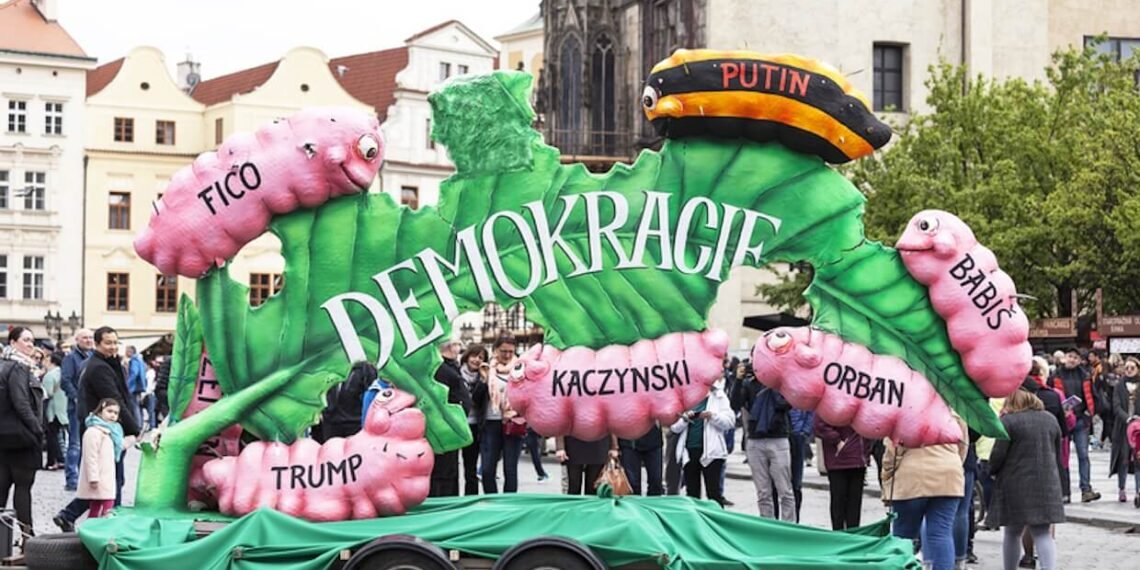
Looking at Project 2025 – the ideological manifesto of Trumpism – it is clear that strong executive rule, draconian border control, isolationism, and the return to conservative and patriarchal values all form part of the agenda of the new US administration, constituting a right-wing assault on liberal secularism and pluralism. However, my point is that this ideological agenda is not unique to the United States: ‘illiberalism’ – driven by the forces of populism – is part of a political realignment whose effects are being felt around the world, and particularly in Europe. Orbán’s version of democracy is looked upon as a model to emulate by Trump supporters: Steve Bannon, Elon Musk, and other figures of the US far right regularly address rallies in Europe and find favour with populist parties like Germany’s Alternative for Germany (AfD); populist parties in Europe form right-wing alliances in the European Parliament; populist views on immigration – driven by fears of the ‘great replacement’ – become part of the political mainstream and gain legitimacy in the eyes of many voters; journalists and media organizations are condemned as ‘fake news’; climate science, net zero policies, and, indeed, scientific expertise generally, are attacked; and far-right populist politicians, political entrepreneurs and influencers – with powerful social media platforms at their disposal – continue to foment political polarization and sow distrust in the establishment.
Such factors do not bode well for transatlantic relations; nor do they bode well for the future of liberal democracy. We need to see these developments as part of a far-right ideological project which – while it is opposed to globalization – nevertheless has global dimensions and projects an alternative, socially conservative vision of the world that is very different from the liberal, rules-based order that we once knew and to which the transatlantic relationship, based on shared liberal values, was central. It may be that a new transatlantic relationship will emerge on the ashes of the old, formed of power blocs led by nationalist-populist governments. Whatever the case, the populist groundswell on both sides of the Atlantic is testing the former liberal democratic settlement to breaking point.
Conclusion and Policy Implications
In a recent book, Anne Applebaum (2024) has argued that autocratic regimes around the world have formed an ideological bloc united against a common enemy: the ‘liberal democratic West’ and its institutions, such as NATO and the EU. My claim would be that the United States’ place within this schema is now, under Trump, highly ambiguous; is it still part of the ‘liberal West’ or is it part of the new ‘illiberal’ authoritarian alliance that targets it? Moreover, I do not propose a clear-cut division between autocracy and liberal democracy. It is more useful to see all regimes on a kind of sliding scale in which the difference between liberalism and authoritarianism is now a matter of degree rather than an absolute conceptual distinction. Many well-established liberal democracies have implemented security, law-and-order and border-control measures that would not be out of place in recognizably authoritarian regimes. In a sense, democracy is an increasingly contested space. Populism is largely a symptom of this democratic dysfunction. While it endangers liberal democracy – for the reasons I have outlined above – it also has an important message for us: that democracy is not (and perhaps never can be) perfect, and that while there is mass citizen dissatisfaction with politics as usual, while many continue to feel under-represented by their elected officials, and while huge inequalities in power and wealth continue to exist (and indeed are becoming worse) populism will always be a feature of the political landscape. The populist challenge to liberal democracy is therefore also an invitation to rethink and reform it.
My work is part of the Horizon-funded ‘Reclaiming Liberal Democracy in the Post-Factual Age’ project, which has explored the central role ‘post-truth’ narratives and disinformation campaigns play in populist politics. This dynamic is regarded as a serious challenge to the resilience of European liberal democracies, and the EU has responded with a series of policy and regulatory frameworks designed to bolster democratic institutions. These have included the European Democracy Action Plan or EDAP (2020) which is committed to the protection of open political debate from malign interference; the creation of a transparent and accountable digital ecosystem; the promotion of an enabling civic space that ensures inclusive and effective engagement between public authorities, civil society organizations, and citizens; and the defence of the EU’s democratic sphere from covert external influence (see García-Guitián and Bouza – forthcoming 2026). Whether regulatory frameworks such as these will themselves be enough to head off the threat from authoritarian populism is doubtful – but they are examples of the kinds of policy innovation needed to bolster liberal democracies on both sides of the Atlantic.
(*) Saul Newman is Full Professor of Politics at Goldsmiths University of London. His research is in the area of contemporary political and democratic theory, including topics such radical politics and anarchism, human rights, political theology, populism and post-truth politics. He is the author and editor of over a dozen books, including Order, Crisis and Redemption: Political Theology after Schmitt (with Peter Langford) (SUNY Press 2022), The Anarchist Before the Law: Law without Authority (with Massimo La Torre) (Edinburgh University Press 2024) and Post-Truth Populism: a New Political Paradigm (with Maximilian Conrad eds.) (Palgrave Springer 2024).
References
Albertazzi, Daniele, and Duncan McDonnell. 2015. Populists in Power. 1st ed. Routledge.
Albertazzi, Daniele, Duncan McDonnell, and Paris Aslanidis. 2024. Populist Mobilization. Oxford University Press.
Applebaum, Anne. 2024. Autocracy, Inc.: The Dictators Who Want to Run the World. Allen Lane.
Arato, Andrew, and Jean L. Cohen. 2022. Populism and Civil Society: The Challenge to Constitutional Democracy. Oxford University Press.
Canovan, Margaret. 1999. “Trust the People! Populism and the Two Faces of Democracy.” Political Studies 47(1): 2–16.
García-Guitián, Elena, and Luis Bouza. 2026. “The European Union Strategy to Fight Disinformation: Democratic Justification, Policies and Regulation.” In Reclaiming Liberal Democracy in the Postfactual Age, edited by Maximilian Conrad and Saul Newman. De Gruyter. (Forthcoming).
Keane, John. 2020. The New Despotism. Harvard University Press.
Laclau, Ernesto. 2005. On Populist Reason. Verso.
Moffitt, Benjamin. 2017. The Global Rise of Populism. Stanford University Press.
Moffitt, Benjamin. 2020. Populism: Key Concepts in Political Theory. John Wiley & Sons.
Mudde, Cas, and Cristóbal Rovira Kaltwasser. 2017. Populism: A Very Short Introduction. Oxford University Press.
Müller, Jan-Werner. 2017. What Is Populism? Penguin.
Rosanvallon, Pierre. 2021. The Populist Century: History, Theory, Critique. Translated by C. Porter. Polity.
Urbinati, Nadia. 2014. Democracy Disfigured: Opinion, Truth and the People. Harvard University Press.
Urbinati, Nadia. 2019. Me the People: How Populism Transforms Democracy. Harvard University Press.
Venizelos, Georgios. 2023. Populism in Power: Discourse and Performativity in SYRIZA and Donald Trump. Routledge.
Weyland, Kurt. 2017. “Populism: A Political-Strategic Approach.” In The Oxford Handbook of Populism, edited by Cristóbal Rovira Kaltwasser, Paul Taggart, Paulina Ochoa Espejo, and Pierre Ostiguy, 48–72. Oxford University Press.
- Term: Right-Wing Populism
- Term: Left-Wing Populism
- Term: Political Polarization
- Term: Post-Truth Politics
- Term: Liberal Democracy
- Term: Authoritarianism
- Term: Multiculturalism
- Term: Immigration
- Term: Social Media
- Term: Populism
- Term: The People
- Term: Nativism
- Term: Status Quo
- Term: Media
- Term: Fake News
- Term: Autocracy