DOWNLOAD PROGRAM
Date: April 21–22, 2026
Online Event | All Sessions in Brussels Time (CEST, UTC+2)
Click here to register!
Day One
(April 21, 2026 / 13:00-19:10)
Opening Remarks
(13:00–13:10)
Irina von Wiese (ECPS Honorary President)
Keynote Speech
(13:10–14:00)
“The Chicken-and-Egg Dilemma: Systemic Crises and the Rise of Populism,” by Staffan I. Lindberg (Professor of Political Science, University of Gothenburg, Founding Director (2012–2025) of V-Dem Institute).
Coffee Break
(14:00–14:10)
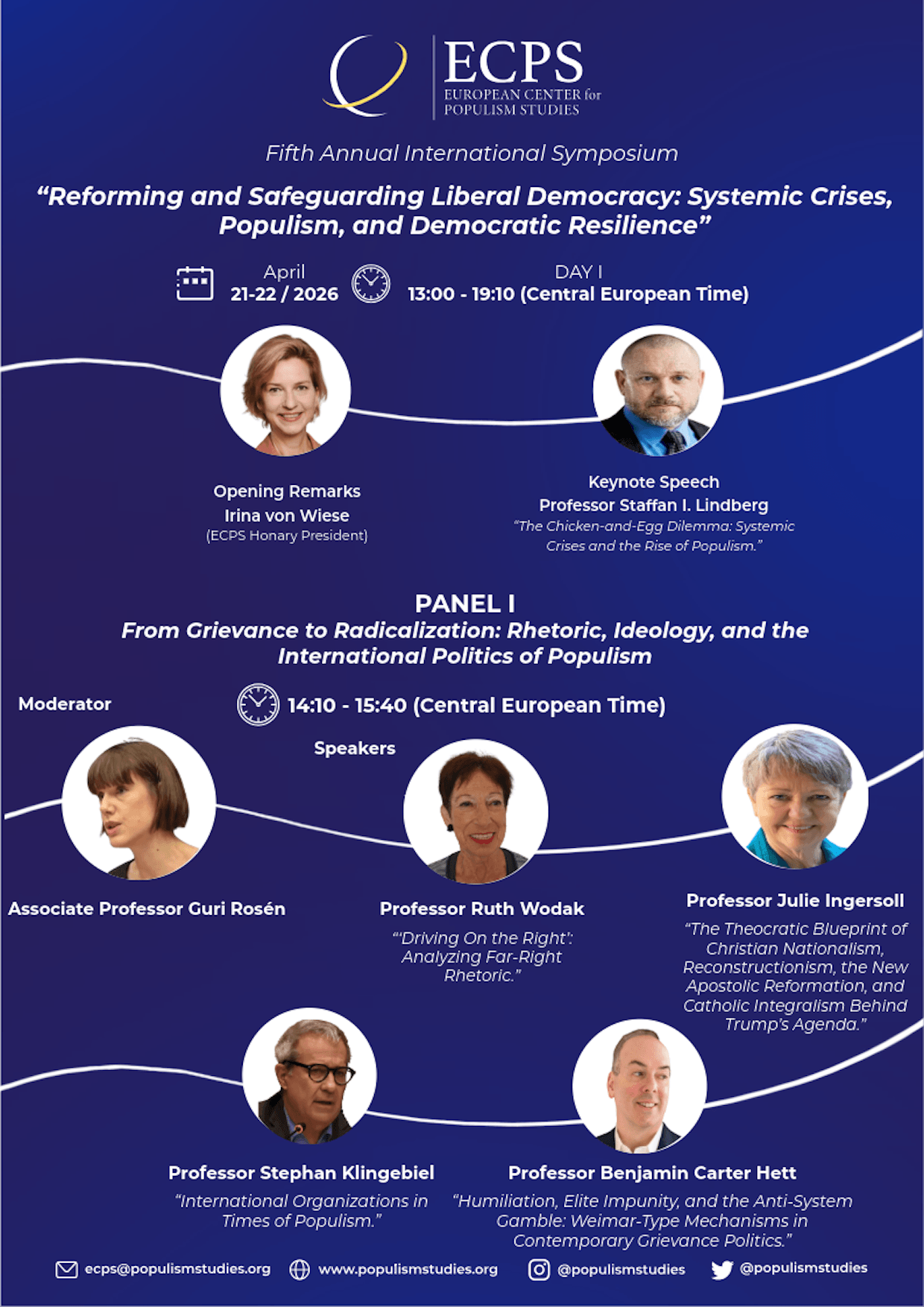
Panel 1
From Grievance to Radicalization: Rhetoric, Ideology, and the International Politics of Populism
(14:10–15:40)
Moderator
Guri Rosén (Associate Professor at the Department of Political Science, University of Oslo).
Speakers
“‘Driving On the Right’: Analyzing Far-Right Rhetoric,” by Ruth Wodak (Distinguished Professor and Chair in Discourse Studies, Lancaster University; University of Vienna).
“The Theocratic Blueprint of Christian Nationalism, Reconstructionism, the New Apostolic Reformation, and Catholic Integralism Behind Trump’s Agenda,” by Julie Ingersoll (Professor of Philosophy & Religious Studies and Religious Studies Program Coordinator at the University of North Florida).
“International Organizations in Times of Populism,” by Stephan Klingebiel (Head of the Department of Inter- and Transnational Cooperation at the German Institute of Development and Sustainability (IDOS)).
“Humiliation, Elite Impunity, and the Anti-System Gamble: Weimar-Type Mechanisms in Contemporary Grievance Politics,” by Benjamin Carter Hett (Professor of History, Hunter College & The Graduate Center, CUNY).
Coffee Break
(15:40–15:50)
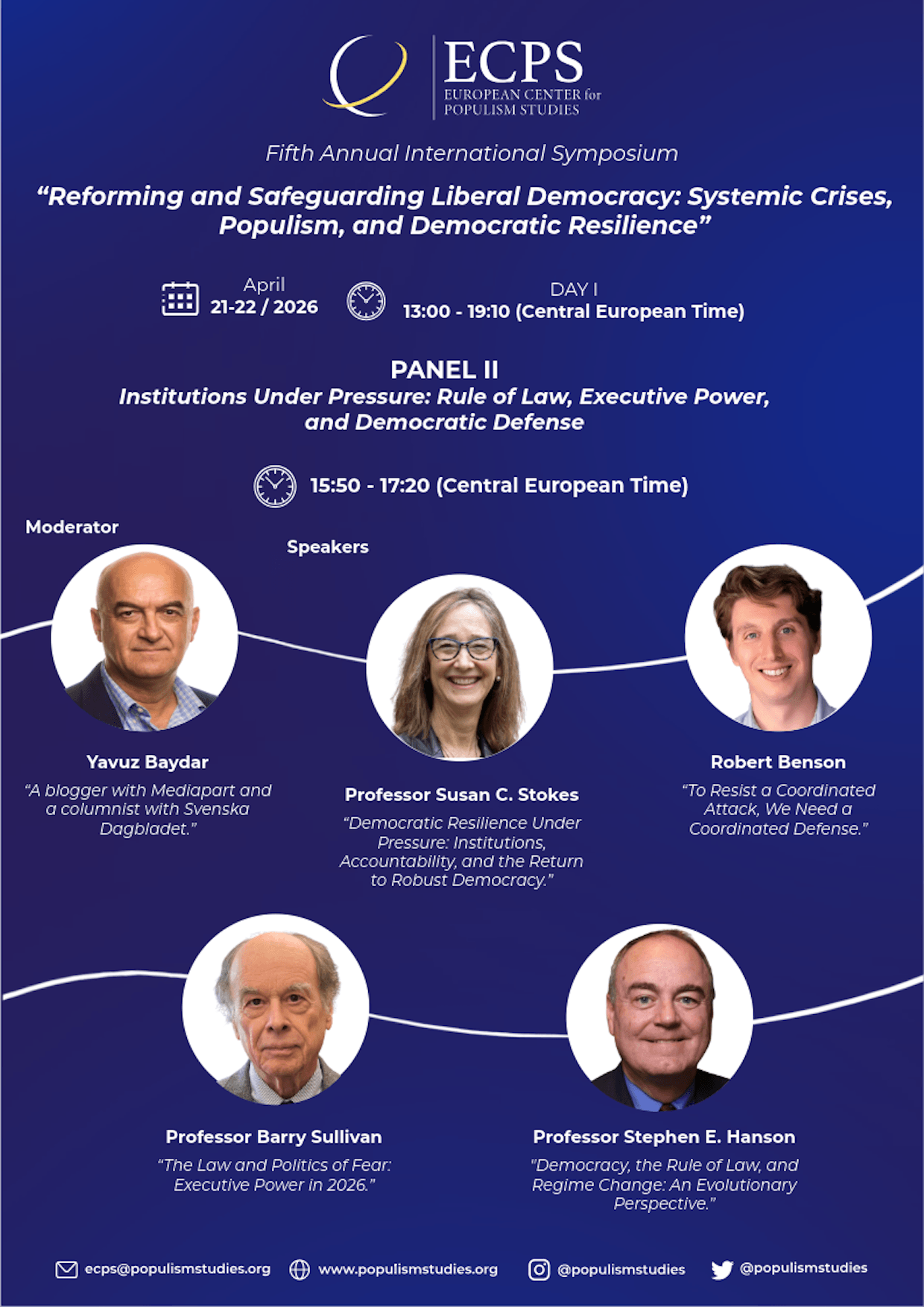
Panel 2
Institutions Under Pressure: Rule of Law, Executive Power, and Democratic Defense
(15:50–17:20)
Moderator
Yavuz Baydar (A blogger with Mediapart and a columnist with Svenska Dagbladet).
Speakers
“Democratic Resilience Under Pressure: Institutions, Accountability, and the Return to Robust Democracy,” by Susan C. Stokes (Tiffany and Margaret Blake Distinguished Service Professor and Director of the Chicago Center on Democracy at the University of Chicago).
“To Resist a Coordinated Attack, We Need a Coordinated Defense,” by Robert Benson (Associate Director for National Security & International Policy, Center for American Progress (CAP)).
“The Law and Politics of Fear: Executive Power in 2026,” by Barry Sullivan (The Raymond and Mary Simon Chair in Constitutional Law and the George Anastaplo Professor of Constitutional Law and History at Loyola University).
"Democracy, the Rule of Law, and Regime Change: An Evolutionary Perspective,” by Stephen E. Hanson (Lettie Pate Evans Professor of Government, William & Mary (USA)).
Coffee Break
(17:20–17:30)
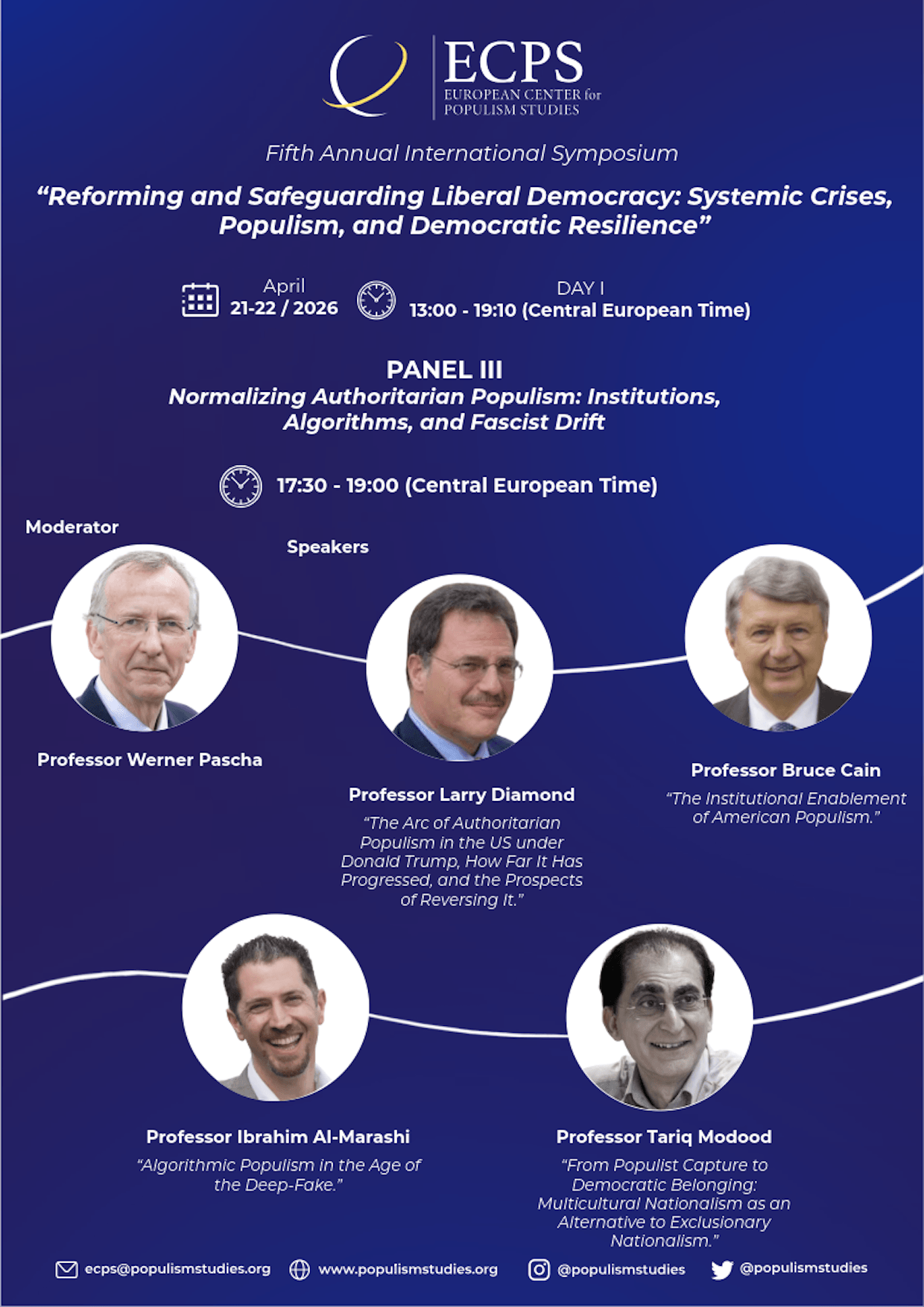
Panel 3
Normalizing Authoritarian Populism: Institutions, Algorithms, and Fascist Drift
(17:30–19:00)
Moderator
Speakers
“The Arc of Authoritarian Populism in the US under Donald Trump, How Far It Has Progressed, and the Prospects of Reversing It,” by Larry Diamond (William L. Clayton Senior Fellow, Hoover Institution; Mosbacher Senior Fellow in Global Democracy, Freeman Spogli Institute (FSI); Bass University Fellow).
“The Institutional Enablement of American Populism,” by Bruce Cain (Professor of Political Science, Stanford University; Director, Bill Lane Center).
“Algorithmic Populism in the Age of the Deep-Fake,” by Ibrahim Al-Marashi (Associate Professor at the American College of the Mediterranean, and the Department of International Relations at Central European University).
“From Populist Capture to Democratic Belonging: Multicultural Nationalism as an
Alternative to Exclusionary Nationalism,” by Tariq Modood (Professor of Sociology, Politics and Public Policy at the University of Bristol).
Wrap-up
(19:00–19:10)
Day Two
(April 22, 2026 / 13:00-17:15)
Opening
(13:00–13:05)
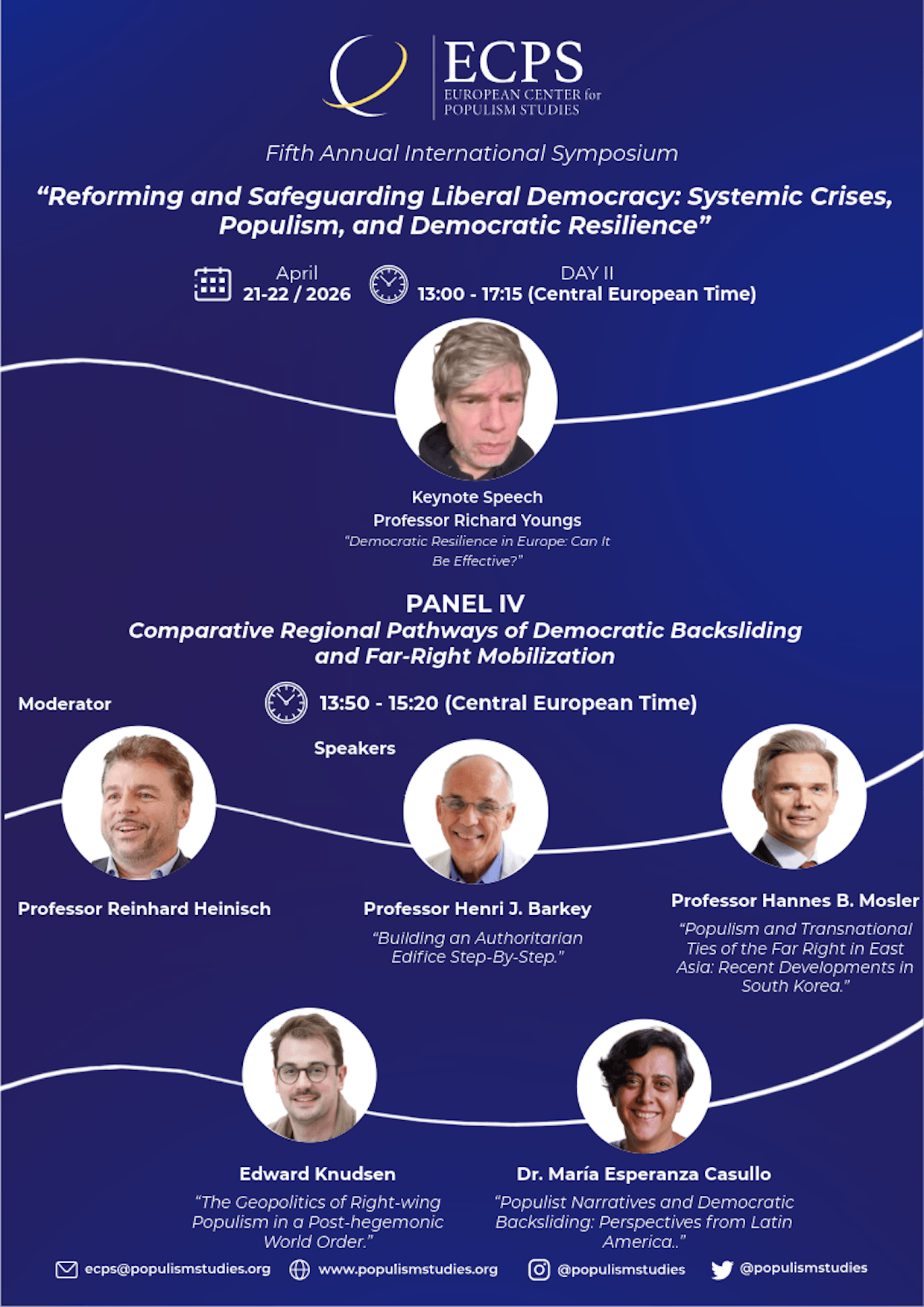
Keynote Speech
(13:05–13:50)
“Democratic Resilience in Europe: Can It Be Effective?” by Richard Youngs (Professor, Senior Fellow at Democracy, Conflict, and Governance Program at Carnegie Europe).
Panel 4
Comparative Regional Pathways of Democratic Backsliding and Far-Right Mobilization
(13:50–15:20)
Moderator
Reinhard Heinisch (Professor of Comparative Austrian Politics, University of Salzburg).
Speakers
“Building an Authoritarian Edifice Step-By-Step,” by Henri J. Barkey (Cohen Professor of International Relations (Emeritus), Department of International Relations, Lehigh University).
“Populism and Transnational Ties of the Far Right in East Asia: Recent Developments in South Korea,” by Hannes B. Mosler (Professor, Universität Duisburg-Essen, Institut für Politikwissenschaft (IfP), Institute of East Asian Studies (IN-EAST)).
"The Geopolitics of Right-wing Populism in a Post-hegemonic World Order," by Edward Knudsen (A doctoral researcher in international relations at the University of Oxford and an Affiliate Policy Fellow in European political economy at the Jacques Delors Centre in Berlin).
“Populist Narratives and Democratic Backsliding: Perspectives from Latin America,” by María Esperanza Casullo (Professor at the Institute of Political Science, Faculty of History, Geography and Political Science, Pontifical Catholic University of Chile).
Coffee Break
(15:20–15:30)
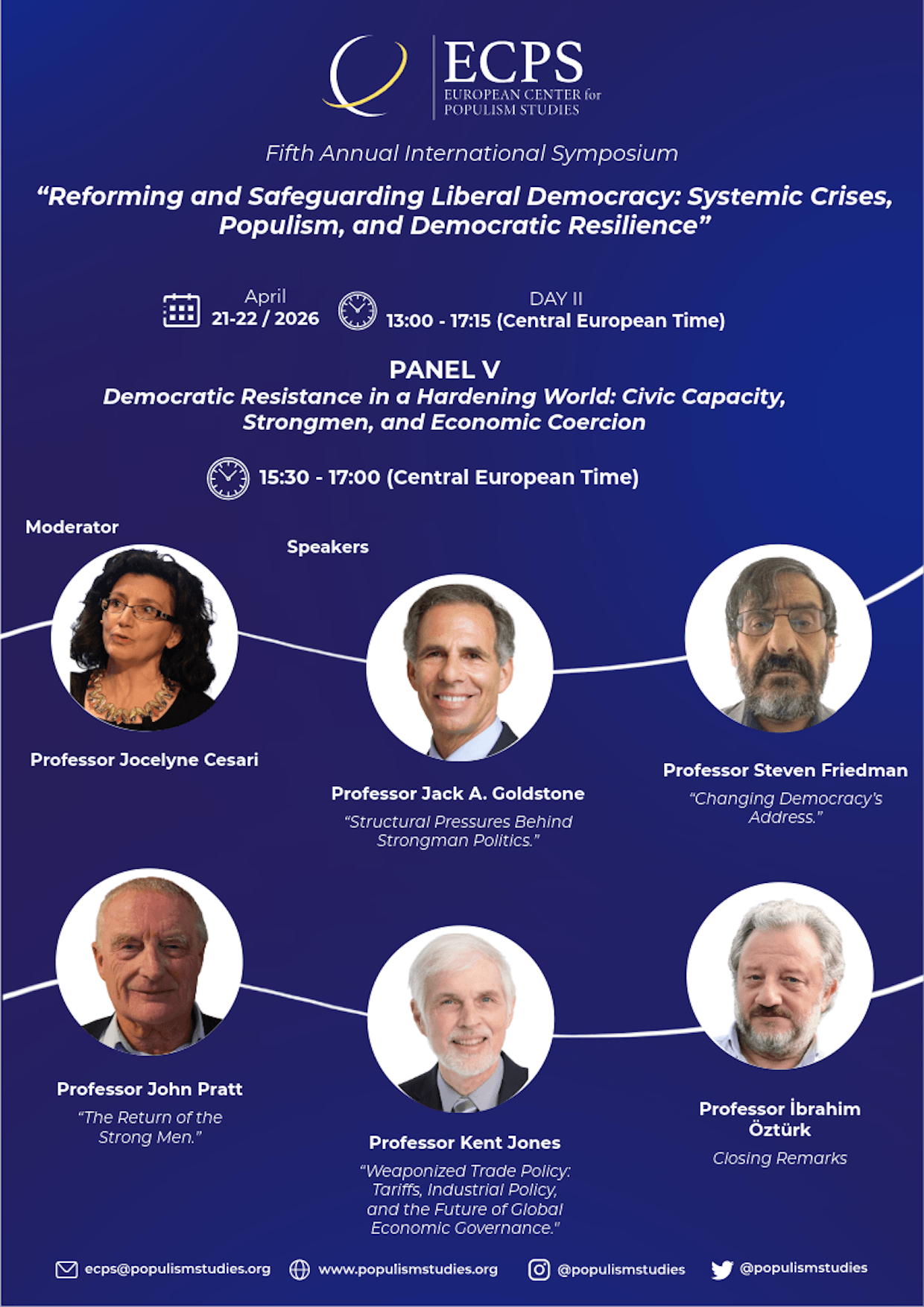
Panel 5
Democratic Resistance in a Hardening World: Civic Capacity, Strongmen, and Economic Coercion
(15:30–17:00)
Moderator
Jocelyne Cesari (Professor and Chair of Religion and Politics and Director of Research at the Edward Cadbury Centre for the Public Understanding of Religion at the University of Birmingham, and Senior Fellow at Georgetown University’s Berkley Center for Religion, Peace, and World Affairs).
Speakers
"Structural Pressures Behind Strongman Politics," by Jack A. Goldstone (The Virginia E. and John T. Hazel, Jr., Professor of Public Policy at George Mason University, and a Senior Fellow of the Mercatus Center).
“Changing Democracy’s Address,” by Steven Friedman (Research Professor of Politics, University of Johannesburg; former Director, Centre for the Study of Democracy).
“Return of the Strong Men,” by John Pratt (Emeritus Professor of Criminology, Victoria University of Wellington).
“Weaponized Trade Policy: Tariffs, Industrial Policy, and the Future of Global Economic Governance,” by Kent Jones (Professor Emeritus of International Economics, Babson College.)
Closing Remarks
(17:00-17:15)
İbrahim Öztürk (ECPS, Senior Economic researcher, Professor of Economics, Duisburg-Essen University, Institute of East Asian Studies (IN-EAST)).
Click here to register!
Abstracts and Brief Bios
Keynote Speech
Staffan I. Lindberg: “The Chicken-and-Egg Dilemma: Systemic Crises and the Rise of Populism”
Abstract: In this keynote Professor Staffan I. Lindberg discuss the most recent trends in democracy, autocracy, and regime transformation based on Democracy Report 2026. He will show how by some measure the level of democracy is back to 1985; that the global wave of autocratization is intensifying, with 44 countries autocratizing and only 18 democratizing. The outlook is worse than in the last 25 years, includes weakening of democracy in established democracies. These trends are closely tied to increasing disinformation and polarization and driven primarily by far-right, nationalist parties and leaders around the world. Finally, Lindberg will touch on the ongoing process of autocratization in the United States of America (USA) under President Trump, and show that his administration is doing away with American democracy.
Panel 1
From Grievance to Radicalization: Rhetoric, Ideology, and the International Politics of Populism
Moderator
Guri Rosén is Associate Professor of Political Science at the Department of Political Science at the University of Oslo, Norway. She is also a senior researcher at Arena, Centre for European Studies at the University of Oslo, Norway.
Speakers
Ruth Wodak: “‘Driving On the Right’: Analyzing Far-Right Rhetoric”
Abstract: Much research in EU member-states, the US, and beyond, illustrates that formerly taboo subjects and expressions in mainstream discourse are being accepted more and more (‘normalization’) and have become part and parcel of mainstream politics. Such normalization goes hand in hand with a certain ‘shamelessness‘: the limits of the sayable are shifting regarding both the frequency of lies and the violating of discourse and politeness conventions – as well as regarding repeated attacks on salient democratic institutions.
Discursive strategies of provocation, blame avoidance, denial, Manichean division, victim-perpetrator reversal as well as eristic argumentation and conspiracy theories dominate official communication, accompanied by ever more nativist nationalism and the racialization of space. For example, normalizing the assessment of migrants and refugees (all labelled as "illegal migrants") as a threat to inner security, a burden on the welfare state and education system must be perceived as an international development – generally instrumentalizing a "politics of fear" and reinforcing a "coarse civility" [rohe Bürgerlichkeit] (@Heitmeyer).
Ruth Wodak is Emerita Distinguished Professor of Discourse Studies, Lancaster Univ. and retired Professor of Applied Linguistics, Univ. Vienna. She is the recipient of many awards such as the Wittgenstein-Prize for Outstanding Research 1996. She has honorary doctorates from Univ. Örebro 2010, Warwick Univ. 2020; since 2020 honorary member of the Senate, Univ. Vienna. She is member of the British Academy of Social Sciences and the Academia Europeae.
She is co-editor of Discourse & Society and Critical Discourse Studies.
Research interests
Discourse studies, identity politics and politics of the past, populism, media– and political communication, racism and antisemitism.
Recent book publications
“Babyelefant und Hausverstand". Wie Krisen produziert werden (Picus; with Markus Rheindorf)
Das kann noch immer in Wien passieren. (Czernin Verlag 2024).
Identity Politics Past and Present. Political Discourses from Post-war Austria to the Covid Crisis (Exeter Press 2022: with Markus Rheindorf).
The Politics of Fear. The Shameless Normalisation of Far-right Discourses. (Sage 2021).
Österreichische Identitäten im Wandel (with Rudolf de Cillia, Markus Rheindorf & Sabine Lehner; Springer 2020).
Sociolinguistic Perspectives on Migration Control (edited with Markus Rheindorf; Multilingual Matters 2020).
Julie Ingersoll: “The Theocratic Blueprint of Christian Nationalism, Reconstructionism, the New Apostolic Reformation, and Catholic Integralism Behind Trump’s Agenda”
Abstract: The groups making up the MAGA coalition in the U.S. are varied and contradictory. This talk will focus on three of those groups that solidify the support of Christian Nationalists and provide an underlying shared opposition to social equality and government by consent. Sidestepping discussions of whether or Christian Nationalists are "really Christian," I’ll suggest rethinking how we understand religion as theology; a step that helps makes sense of why these three divergent groups have a shared ant-democratic vision.
Julie Ingersoll is Professor of Religious Studies at the University of North Florida. She teaches and writes about religion and politics, violence and the Christian right. She is an occasional contributor to Religion Dispatches, The Huff Post, and The Conversation and her work has been widely cited including in the New Yorker, the Washington Post, and the New York Times.
Her books include “Evangelical Christian Women: War Stories in the Gender Battles” (New York University Press, 2003) and “Building God’s Kingdom: Inside the World of Christian Reconstruction” (Oxford University Press, 2015).
Stephan Klingebiel: “International Organizations in Times of Populism”
Benjamin Carter Hett: “Humiliation, Elite Impunity, and the Anti-System Gamble: Weimar-Type Mechanisms in Contemporary Grievance Politics”
Abstract: The historical example of the Nazi rise to power in Germany can provide some useful insights into the question of what can fuel authoritarian politics in a liberal democracy. In the Weimar Republic the most significant element fueling the Nazi rise was the pervasive sense of humiliation which millions of Germans experiences in the aftermath of the First World War, combined with the adjacent concept of status anxiety. These feelings operated at both elite and relatively modest levels, and the Nazis were skillful at exploiting them. When this phenomenon is understood it can also provide key insights for understanding authoritarian politics in modern democracies in the 21st century, in North America, Europe, and elsewhere.
Benjamin Carter Hett earned a B.A. at the University of Alberta and a J.D. at the University of Toronto and practiced litigation in Toronto before going back to obtain an MA in history from U of T and finally a Ph.D. in history at Harvard. He has taught at Harvard College and the Harvard Law School and, since 2003, at Hunter College and the Graduate Center, City University of New York (CUNY). He is the author of 6 books, including The Death of Democracy: Hitler’s Rise to Power and the Downfall of the Weimar Republic (Henry Holt, 2018), winner of the 2019 Vine Award for History, named one of the year’s best books by The Times of London and the Daily Telegraph, and was a Jeopardy clue in 2025; and The Nazi Menace: Hitler, Churchill, Roosevelt, Stalin, and the Road to War (Henry Holt, 2020) named an editors’ choice by the New York Times Book Review. He is presently finishing a book on criminal policing in Nazi Germany and moving on to a project on Nazi feature films.
Panel 2
Institutions Under Pressure: Rule of Law, Executive Power, and Democratic Defense
Moderator
Yavuz Baydar is a blogger with Mediapart and a columnist with Svenska Dagbladet. He publishes his commentary on politics and culture in Substack.
Speakers
Susan Stokes: “Democratic Resilience Under Pressure: Institutions, Accountability, and the Return to Robust Democracy”
Abstract: The world has experienced a spate of democratic erosion in the past quarter century. In two dozen democracies, presidents and prime ministers have come to power through free and fair elections, only to undermine their own democratic institutions. What have we learned about the causes of democratic backsliding. And, though we are still in the midst of this drama, what have we learned about forces and factors that put the brake on backsliding?
Susan Stokes is Blake Distinguished Service Professor of Political Science and Faculty Chair of the Chicago Center on Democracy. She is the author of books and articles about democracy, development, political behavior, and Latin American politics. Among her single- and co-authored books are Mandates and Democracy (Cambridge University Press 2001), Brokers, Voters, and Clientelism (CUP 2013), and Why Bother? Rethinking Participation in Elections and Protests (CUP 2019). Her most recent book, The Backsliders: Why Leaders Undermine Their Own Democracies, was published by Princeton University Press in September, 2025. Stokes is the current president of the American Political Science Association. She is a member of the National Academy of Sciences, the American Academy of Arts and Sciences, and a co-founder of Bright Line Watch.
Robert Benson: “To Resist a Coordinated Attack, We Need a Coordinated Defense”
Abstract: Democratic backsliding rarely unfolds through a single institutional rupture. Instead, it advances through coordinated pressure on multiple pillars of the system—courts, bureaucracies, electoral administration, and oversight institutions. This talk examines the vulnerabilities such strategies exploit and the conditions under which bureaucratic actors, civil society, and democratic institutions can mount effective resistance. Using the upcoming U.S. midterm elections as a focal point, the presentation explores scenarios in which democratic norms come under stress, including potential electoral breaches, the use of intimidation or political violence, and attempts to undermine the legitimacy of electoral administration. It assesses the institutional safeguards designed to respond to these challenges and highlights the critical role that professional civil servants, courts, and civil society networks play in defending democratic procedures. The talk argues that authoritarian actors succeed when democratic institutions respond in isolation. If the attack on the rule of law operates as a coordinated strategy, democratic resilience must also take a coordinated form—linking bureaucratic resistance, institutional safeguards, and civic mobilization. Finally, the presentation situates these developments within a broader geopolitical context. If democratic norms are tested in the United States, the implications will extend beyond domestic politics. The talk considers how such scenarios could shape transatlantic relations, influence political strategy in Brussels and European capitals, and prompt European progressives to articulate a clearer position toward a potential Trump administration.
Robert Benson, D.Phil., is the associate director for National Security and International Policy at American Progress. Prior to joining American Progress, Benson worked as a global relations consultant at the Organization for Economic Cooperation and Development in Paris and as a research fellow at the Social Science Center Berlin. He holds a Master of Science in global politics from the London School of Economics and a doctorate from the Free University of Berlin. Benson is an avid traveler who enjoys a good book and even better food on the road.
Barry Sullivan: “The Law and Politics of Fear: Executive Power in the US in 2026”
Abstract: President Trump was recently interviewed by a group of journalists from the New York Times. During the interview, the President expressed the belief that he is not bound by international law, and that he is indeed limited by only “one thing. My own morality. My own mind. It’s the only thing that can stop me.” That sentiment may well account for the President’s impulse to upend the post-War international legal order, bully friends and foes alike, both at home and abroad, and deploy American military power on a scale and for purposes that seem unprecedented in modern times. But it does not explain why the President has been so successful in seeing those impulses take root and change the world.
In his presentation, Professor Sullivan will explore some of the reasons why President Trump has been so successful (and so much more successful than in his first term) in altering political discourse and political reality both domestically and internationally in the relatively brief time since he returned to power. Professor Sullivan will explore some of the factors that may account for that success, such as: the four year period when he was out of office, which gave him ample time to plot revenge against his “enemies” and to reflect on what he considered the shortcomings of his first term, such as choosing advisors who would restrain his impulses and plotting against his enemies; the lessons he learned in his first term about “flooding the zone,” which was a proven technique for keeping his opponents off balance by creating so many issues of major and minor importance to which they felt compelled to respond; the work done by the Heritage Foundation to provide him with an agenda as well as recommendations as to the personnel necessary to carry it out that a majority of the Supreme Court effectively gave him a blank check by immunizing him from criminal liability for virtually anything he might do as President; congressional disfunction and the fact that the separation of powers does not function as the founders intended, at least when there is substantial political polarization, internal party cohesion, and the presidency and at least one House of Congress is in the hands of one political party.
It is also the case that the President admires and respects leaders who are strong in the sense that he understands strength. He belittles and ridicules others. And he seeks to instill fear in those he does not respect, whether they are leaders of allied governments or members of his own party in the legislative branch.
Barry Sullivan is the Raymond and Mary Simon Chair in Constitutional Law and the George Anastaplo Professor of Constitutional Law and History at Loyola University Chicago (USA). He previously served as an Assistant to the Solicitor General of the United States, Vice President and Dean of the Law School at Washington and Lee University, and a partner in the law firm of Jenner & Block, where he was co-chair of the Supreme Court and Appellate Practice. Professor Sullivan has taught at various law schools in the United States, Canada, and Europe, including Alberta, Bayreuth, Bologna, Dublin, and Warsaw.
Stephen E. Hanson: “Democracy, the Rule of Law, and Regime Change: An Evolutionary Perspective”
Abstract: The global erosion of democracy and of the rule of law over the past two decades has been amply documented in every major database that tracks regime change over time. Yet the most common definitions of “regime” in the political science discipline themselves remain surprisingly static. “Democracy” and “authoritarianism” are implicitly understood as poles on a universal linear spectrum that can be used to determine the placement of political regimes around the world throughout human history. In this talk, I will argue that this schema is not well suited to the task of determining with precision how to differentiate distinct types of democracy and distinct types of authoritarianism, nor does it help us pinpoint just when one “regime” has changed into another. An alternative approach to regime taxonomy, one based on a return to evolutionary theorizing about social and political change, can help us better understand the origin, development, and collapse of regimes over time. I will conclude with a discussion of how an evolutionary approach to regime change can help us better understand how to resist the global wave of anti-liberalism.
Stephen E. Hanson is Lettie Pate Evans Professor in the Department of Government at William & Mary. He served as Vice Provost for International Affairs at W&M from 2011–2021, and as Vice Provost for International & Academic Affairs in 2021–2022. From 2009–2011, he served as Vice Provost for Global Affairs at the University of Washington, Seattle. Hanson received his B.A. in Social Studies from Harvard University (1985) and his Ph.D. in Political Science from the University of California, Berkeley (1991). A specialist in Russian, post-communist, and comparative politics, Hanson is the author of numerous books and scholarly articles, including Post-Imperial Democracies: Ideology and Party Formation in Third Republic France, Weimar Germany, and Post-Soviet Russia (Cambridge University Press, 2010) and Time and Revolution: Marxism and the Design of Soviet Institutions (University of North Carolina Press, 1997). His books include The Assault on the State: How the Attack on Modern Governance Threatens Our Futures (Polity, 2024) and The Evolution of Regimes (Cambridge University Press, forthcoming). In 2014, Hanson served as President of the Association for Slavic, East European and Eurasian Studies (ASEEES).
Stephen E. Hanson is Lettie Pate Evans Professor in the Department of Government at William & Mary. He served as Vice Provost for International Affairs at W&M from 2011-2021, and as Vice Provost for International & Academic Affairs in 2021-2022. From 2009-2011, he served as Vice Provost for Global Affairs at the University of Washington, Seattle. Hanson received his B.A. in Social Studies from Harvard University (1985) and his Ph.D. in Political Science from the University of California, Berkeley (1991). A specialist in Russian, post-communist, and comparative politics, Hanson is the author of numerous books and scholarly articles, including Post-Imperial Democracies: Ideology and Party Formation in Third Republic France, Weimar Germany, and Post-Soviet Russia (Cambridge University Press, 2010) and Time and Revolution: Marxism and the Design of Soviet Institutions (University of North Carolina Press, 1997). His forthcoming books include The Assault on the State: How the Attack on Modern Governance Threatens Our Futures(Polity, 2024) and The Evolution of Regimes (Cambridge University Press, forthcoming). In 2014, Hanson served as President of the Association for Slavic, East European and Eurasian Studies (ASEEES).
Panel 3
Normalizing Authoritarian Populism: Institutions, Algorithms, and Fascist Drift
Moderator
Werner Pascha is an Emeritus Professor of East Asian Economic Studies, Japan and Korea, and an Associate Member of the Institute of East Asian Studies (IN-EAST) of the University of Duisburg-Essen. He has studied economics at Freiburg University in Germany, the London School of Economics, and Nagoya University. Over the years, he has been invited to several other institutes and universities, including Kyoto University (Japan Foundation Fellowship, 1996), Korea Institute for International Economic Policy (KIEP Scholarship, 2007), Doshisha University (JSPS Fellowship, 2011), and Busan National University in South Korea (2013). Among other functions, he is the Vice President of the Japanese-German Centre Berlin (JDZB) and an Honorary Fellow of EastAsiaNet, the European Research School Network of Contemporary East Asian Studies. His research interests include the political economy of institutional change in Japan and Korea, and international economic relations of the region.
Speakers
Larry Diamond: “The Arc of Authoritarian Populism in the US under Donald Trump, How Far It Has Progressed, and the Prospects of Reversing It”
Abstract: Donald Trump’s second term as President of the United States poses a much more serious challenge to democracy than his first term because he lacks the internal restraints on his conduct within his Administration; his authoritarian agents and acolytes had four years out of office to strategize on how to eliminate constraints and achieve authoritarian power the second time; there is significantly greater concentration of wealth and media power now compared to eight years ago; the digital technology entrepreneurs and companies are more favorable to him or at least more subservient; and the Supreme Court has significantly expanded the scope of presidential power along with legal immunity for its abuse.
Fifteen months into the second Trump presidency, there are significant manifestations of authoritarianism, including widespread fear and intimidation; brazen politicization of the Justice Department and other federal agencies; rampant corruption at high levels with impunity for those responsible; the conscious development for the first time in American history of a cult of personality around the President; the dramatic expansion of a poorly trained and rights-abusing federal force (ICE) to detain undocumented immigrants; extensive violation of court orders regarding the Administration’s treatment of immigrants; efforts to construct a vast archipelago of federal detention centers for undocumented immigrants, which could someday be deployed to detain and repress other targeted groups as well; acquiescence if not active cooperation and support from peak sectors of the business community; and abuse of federal power to obtain the compliance or restraint of important nongovernmental institutional actors like universities and law firms—to name only a few examples.
However, the federal courts have been pushing back against many of these abuses, and recently the Supreme Court as well in its decision on tariffs; civil society has mobilized extensively, including the largest single-day turnouts for protests in American history; and the President, his party, and his policy agenda have become extremely unpopular.
I argue that the most effective way of halting the incremental slide of a democratic system toward autocracy is through the defeat of the incipient authoritarian project at the ballot box. This talk will then assess the prospects and conditions for this, noting the multitude of ways in which the authoritarian populist project in the US seems intent on trying to frustrate a free and fair election in November 2026, and more consequentially, in the presidential election two years later.
Finally, I note that even a decisive set of defeats of the authoritarian project in November 2026 and 2028 will not represent a final victory for democracy because 1) the underlying causal drivers of illiberal populism remain; and 2) as in Poland and Hungary, the democratic alternative, if it comes to power in 2029, will face significant challenges in trying to purge the system of authoritarian mentalities, personalities, precedents, and traps.
Larry Diamond is the William L. Clayton Senior Fellow at the Hoover Institution, the Mosbacher Senior Fellow in Global Democracy at the Freeman Spogli Institute for International Studies (FSI), and a Bass University Fellow in Undergraduate Education at Stanford University. He is also professor by courtesy of Political Science and Sociology at Stanford. He co-chairs the Hoover Institution’s project on Taiwan in the Indo-Pacific Region and a new Israel Studies Program at FSI.
Diamond’s principal research focus is on democratic trends and conditions around the world and on policies and reforms to defend and advance democracy. His book, Ill Winds: Saving Democracy from Russian Rage, Chinese Ambition, and American Complacency, analyzes the challenges confronting liberal democracy in the United States and around the world at this potential “hinge in history.”
Diamond served for 32 years as the founding co-editor of the Journal of Democracy and co-chaired the International Forum for Democratic Studies of the National Endowment for Democracy.
Bruce E. Cain: “The Institutional Enablement of American Populism”
Abstract: Many US political reforms are enacted in the immediate aftermath of representative government failure. Scandals and bad policies open opportunity windows for institutional change as reformers seek to prevent the same problems from occurring in the future. One appealing solution is to open government up to more transparency, public participation and letting the people decide matters directly. The US has proliferated direct party primaries for candidates, enacted strong public participation rules for legislative and agency hearings and transformed its political parties into a loose party network of factions and interests. Populist reforms breed more populist candidates. There are of course more angles to the populist story, but the institutional pathway is one important enabler.
Bruce E. Cain is the Charles Louis Ducommun Professor in Humanities and Sciences at Stanford University. He holds appointments in the Political Science Department, the Public Policy Program, and the Stanford Doerr School for Sustainability. He is also a Senior Fellow at the Stanford Woods Institute for the Environment, the Stanford Institute for Economic Policy Research, and the Precourt Institute for Energy. Before accepting his current position at Stanford, he taught at the California Institute of Technology (1976-1988) and the University of California, Berkeley (1989-2012). Professor Cain was elected to the American Academy of Arts and Sciences in 2000, and has won various awards for teaching, research, and public service over the course of his career. His book, Democracy More or Less: America’s Political Reform Quandry, examines the unintended consequences of attempts to make government more democratic, including opening the door to more populism.
Ibrahim al-Marashi: “Algorithmic Populism in the Age of the Deep-Fake”
Ibrahim al-Marashi is an Associate Professor of History at California State University, visiting faculty at The American College of the Mediterranean, and the Department of International Relations at Central European University. His publications include Iraq’s Armed Forces: An Analytical History (2008), The Modern History of Iraq (2017), and A Concise History of the Middle East (2024).
Tariq Modood: “From Populist Capture to Democratic Belonging: Multicultural Nationalism as an Alternative to Exclusionary Nationalism”
Abstract: Populist, exclusionary nationalism charges that multiculturalism privileges minorities and neglects the normative status of majorities. It is not enough to simply analyse or even oppose these views, one needs to offer a positive, unifying alternative that values majorities and minorities. This does not involve giving up on multiculturalism but, rather, developing a multicultural national identity, to which all citizens can have a sense of belonging without giving up other identities that are important to them. The goal should be that such a multicultural sense of the national can be adapted to be part of an electoral majority on a stable, continuing basis; above all, such a sense of the national allows one to be sensitive to minority identity vulnerabilities and majority identity anxieties within an integrated theoretical and political framework.
Tariq Modood is Professor of Sociology, Politics and Public Policy and the founding (former) Director of the Centre for the Study of Ethnicity and Citizenship at the University of Bristol and the co-founder of the international journal, Ethnicities. He has held over 40 grants and consultancies, has over 35 (co-)authored and (co-)edited books and reports and over 350 articles and chapters. He was awarded an MBE by the Queen for services to social sciences and ethnic relations in 2001, was made a Fellow of the Academy of Social Sciences (UK) in 2004 and elected a Fellow of the British Academy in 2017. In 2022 he was ranked in the top 20 UK cited scholars in Politics, Law, Sociology and Social Policy. He served on the Commission on Religion and Belief in British Public Life and has been an advisor to the All-Party Parliamentary Group on British Muslims, the European Commission on Racism and Intolerance (ECRI) and to the Muslim Council of Britain (MCB). His latest books are Essays on Secularism and Multiculturalism (2019) and with T. Sealy, The New Governance of Religious Diversity (2024). He has a You Tube Channel and his website is tariqmodood.com
Keynote Speech
Richard Youngs: “Democratic Resilience in Europe: Can It Be Effective?”
Richard Youngs is a senior fellow in the Democracy, Conflict, and Governance Program, based at Carnegie Europe. He is also a professor of international relations at the University of Warwick and previously held positions in the UK Foreign and Commonwealth Office and as director of the FRIDE think-tank in Madrid. He is co-founder and director of the European Democracy Hub.
Youngs has authored seventeen books, the most recent of which are Democratic Crossroads: Transformations in Twenty First-Century Politics (Oxford University Press, 2024), Geoliberal Europe and the Test of War (Agenda Publishing, 2024), Rebuilding European Democracy: Resistance and Renewal in an Illiberal Age (Bloomsbury/Tauris, 2021) and The European Union and Global Politics (Macmillan, 2021).
Panel 4
Comparative Regional Pathways of Democratic Backsliding and Far-Right Mobilization
Moderator
Reinhard Heinisch is a Professor of Comparative Austrian Politics at the University of Salzburg and head of the Department of Political Science. He received his academic training in the US where he completed his PhD at Michigan State University and then taught at the University of Pittsburgh from 1994 to 2009. Heinisch’s research focuses on the rise of the radical right, populism, democracy, and political parties.
Dr. Heinisch is the author of over 40 research articles and more than 50 other scholarly publications including 14 books. His research appeared in journals such as Journal of European Political Research, Political Studies, Journal of Common Market Studies, Party Politics, West European Politics, Democratization, Representation, and many others.
His book publications include Understanding Populist Party Organization: The Radical Right in Western Europe (Palgrave 2016); The People and the Nation: Populism and Ethno-Territorial Politics in Europe (Routledge 2019), Political Populism. A Handbook, Nomos (2021), and Politicizing Islam in Austria (Rutgers University Press 2024).
He has funded his research with various project grants by including Marie Curie research fellowship by the European Union (2010), a European Union Horizon 2020 grant to study populism and counterstrategies, and a grant by the Austrian Research Fund (2022) on studying populism and conspiracy theories.
Dr. Heinisch is the recipient of Austrian National Science Prize by the Austrian parliament (2017), past president of the Austrian political Science association, and served as the head of Working Group on Democracy by the Austrian Research Association. He continues to be a faculty associate of the University of Pittsburgh and has been a regular visiting scholar with the Renmin University of China in Beijing.
Speakers
Henri J. Barkey: “Building an Authoritarian Edifice Step-by-Step”
Abstract: Populist authoritarianism has the great advantage of being able to construct and institutionalize a dominating structure at a pace that often escapes attention or is overlooked by the population as a whole. Focusing on the use of the judicial system, this paper will compare the recent U.S. experience with Turkey’s travails under Erdogan.
Henri J. Barkey is an adjunct senior fellow for Middle East studies at the Council on Foreign Relations and the Bernard L. and Bertha F. Cohen chair in international relations at Lehigh University (Emeritus). At CFR he works on the strategic future of the Kurds in the Middle East. Previously he was the director of the Middle East Center at the Woodrow Wilson Center for International Scholars (2015-2017). Barkey served as chair of the Department of International Relations at Lehigh University for thirteen years. He served on the State Department Policy Planning Staff (1998-2000) working on the Eastern Mediterranean, the Middle East, and intelligence-related issues. He was a non-resident senior associate at the Carnegie Endowment for International Peace (2008-2011). Currently, he also serves on the board of trustees of the American University in Iraq, Sulaimani. He has written extensively on Turkey, the Kurds, and other Middle East issues.
Hannes B. Mosler: “Populism and Transnational Ties of the Far Right in East Asia: Recent Developments in South Korea”
Abstract: This presentation explores the evolving political landscape of East Asian liberal democracies by evaluating the comparative utility of "populism" and "far-right" frameworks in the contemporary South Korean context, assessing which conceptual approach better captures the current trajectory of the South Korean landscape. The analysis focuses on three core dimensions: the radicalization of political actors through anti-constitutional activities, a profound resurgence of historical revisionism regarding authoritarian legacies, and the strategic mobilization of gendered grievances —specifically the role of anti-feminism.
Hannes B. Mosler serves as Chair of East Asian Social Sciences, specializing in Korean politics and society, at the University of Duisburg–Essen (UDE), where he is affiliated with the Institute of East Asian Studies (IN-EAST) and the Institute of Political Science (IfP). His research interests include political systems, civic education, memory politics, foreign policy, and social and political institutional change in East Asia, especially the Korean peninsula. Recent publications include “Causes and sources of South Korea’s fragile democracy” (2025), “Rewriting history, undermining democracy. The role of the New Right in South Korean memory politics” (2025), and “The Incurious Approach to East Asian Populism: Why Studies on Japan, South Korea and Taiwan are Often Overlooked in Political Science” (2025, co-author).
Edward Knudsen: “The Geopolitics of Right-wing Populism in a Post-hegemonic World Order“
Abstract: What happens to global politics—and the use of “soft power” in particular—when the liberal international order loses its central architect and nationalism is rising across the globe? This talk explores the geopolitics of right-wing populism in an increasingly post-hegemonic world. Drawing on comparative analysis across major powers, it argues that both the rise of European nationalism and the retreat of US soft power has accelerated a shift toward a more fragmented, zero-sum international environment, in which cultural diplomacy and external cultural policy are repurposed for national assertion rather than mutual exchange. On one hand, this is an opportunity for Europe, as it could partially step into the vacuum left by the US. On the other, however, a foreign policy hobbled by right-wing populism poses risks for constructive engagement abroad.
Edward Knudsen is a doctoral researcher in international relations at the University of Oxford and an Affiliate Policy Fellow in European political economy at the Jacques Delors Centre in Berlin. His research focuses on the political economy and economic history of the US and Europe in the 20th century, specifically how the historical memory of economic events is constructed and deployed. Previously, he worked in the US and the Americas Programme at Chatham House think tank in London on projects which explored the future of transatlantic economic and security relations. He holds a master’s in international political economy from the London School of Economics and Political Science and a Bachelor’s degree with majors in history and economics from the University of Wisconsin-Madison.
María Esperanza Casullo:“Populist Narratives and Democratic Backsliding: Perspectives from Latin America”
Abstract: The entire world is undergoing a process of democratic backsliding. It is probably not a coincidence that there is an upsurge in populism happening at the same time. In this presentation, it will be shown how populist narratives are a central driver of the process of democratic backsliding, through their effect on affective polarization, distribution of eliminationist discourses, and legitimation of anti-illiberal movements.
María Esperanza Casullo is a professor at the Institute of Political Science, Pontifical Catholic University of Chile. She has published extensively on populist narratives and performances. Her most recent article is “When the strongman is a woman: female leadership in right wing populism,” in International Journal of Public Leadership. She is currently working on a project centered on the populist baroque.
Panel 5
Democratic Resistance in a Hardening World: Civic Capacity, Strongmen, and Economic Coercion
Moderator
Jocelyne Cesari is Professor and Chair of Religion and Politics and Director of Research at the Edward Cadbury Centre for the Public Understanding of Religion at the University of Birmingham, and Senior Fellow at Georgetown University’s Berkley Center for Religion, Peace, and World Affairs. She has also served as T. J. Dermot Dunphy Visiting Professor of Religion, Violence, and Peacebuilding at Harvard Divinity School. An internationally recognized scholar of religion and politics, her work focuses on Islam, democracy, nationalism, and comparative religion, and her forthcoming book is We God’s Nations: Political Christianity, Islam and Hinduism in the World of Nations.
Speakers
Jack A. Goldstone: “Structural Pressures Behind Strongman Politics”
Steven Friedman: “Changing Democracy’s Address”
John Pratt: Return of the Strong Men: Populism, Punishment and the Threat to Democratic Order
Abstract: Western liberal democracy seems in retreat, assailed by the emergence of an autocratic ‘strong man’ politics, mistakenly thought to have been consigned to the dustbin of history after the defeat of Nazi Germany in 1945. This strong man politics is now seen most clearly in the second US presidency of Donald Trump where a different political order altogether is being constructed: one where cardinal principles of liberal democracy such as the rule of law and due process can be discarded as suits, scientific knowledge is discredited, any criticisms of the strong man leader will not be tolerated, and where democratic allies can be tossed aside in favour of the company of other strong men around the globe. This paper examines the rise of this new authoritarianism and its implications for democratic order.
John Pratt is Professor of Criminology at the Institute of Criminology, Victoria University of Wellington, New Zealand. His fields of research are comparative penology and the history and sociology of punishment. He has published in eleven languages and has been invited to lecture at universities in South America, North America, Europe, Asia and Australia. His books include Punishment and Civilization (2002), Penal Populism (2007) and Contrasts in Punishment (2013). In 2009 he was awarded the Sir Leon Radzinowicz Prize by the Editorial Board of the British Journal of Criminology. In 2012 he was elected to a Fellowship of the Royal Society of New Zealand and was awarded the Society’s Mason Durie Medal, given ‘to the nation’s pre-emiment social scientist.’
Kent Jones: “Weaponized Trade Policy and the Future of Global Economic Governance”
Abstract: Trade policy in the era of Donald Trump has added a new dimension to populism studies: the dismantling of global trade institutions by the populist hegemonic leader of the system. In his second term as President, Trump has made absolute control over tariffs the centerpiece of his international economic policy, abandoning core principles of non-discrimination and tariff binding. The challenge for the global trading system is to find a modus vivendi for trade among countries that wish to support a rules-based system in the midst of US unilateralism and intimidation. Internal political and legal challenges to Trump’s power are growing, and the recent US Supreme Court decision has curbed his tariff power. Yet even after his departure from the scene, geopolitical and economic faultlines in the global economy will challenge countries to establish new institutional structures to facilitate mutually beneficial trade.
Kent Jones is Professor Emeritus of Economics at Babson College, Massachusetts, USA. He completed his M.A.L.D. degree at the Fletcher School of Law and Diplomacy, Tufts University and his Dr. ès sci. pol. (international economics) degree at the Graduate Institute of International and Development Studies at the University of Geneva. He is the author of several books on trade policy and the WTO, including Populism and Trade (2021). Most recently, he published a chapter, “Transatlantic Trade, the Trump Disruption and the World Trade Organization,” in the recent ECPS volume, Populism and the Future of Transatlantic Relations.
Closing Remarks
İbrahim Öztürk is ECPS Senior economic researcher & associate member of the Duisburg-Essen University, Institute of East Asian Studies(IN-EAST). He is studying developmental, institutional, and international economics. His research focuses on the Japanese, Turkish, and Chinese economies. Currently, he is working on emerging hybrid governance models and the rise of populism in the Emerging Market Economies. As a part of that interest, he studies the institutional quality of China’s Modern Silk Road Project /The Belt and Road Initiative (BRI), its governance model, and implications for the global system. He also teaches courses on business and entrepreneurship in the Emerging Market Economies, such as BRICS/MINT countries. Ozturk’s Ph.D. thesis is on the rise and decline of Japan’s developmental institutions in the post-Second WWII era. https://orcid.org/0000-0002-8069-4721