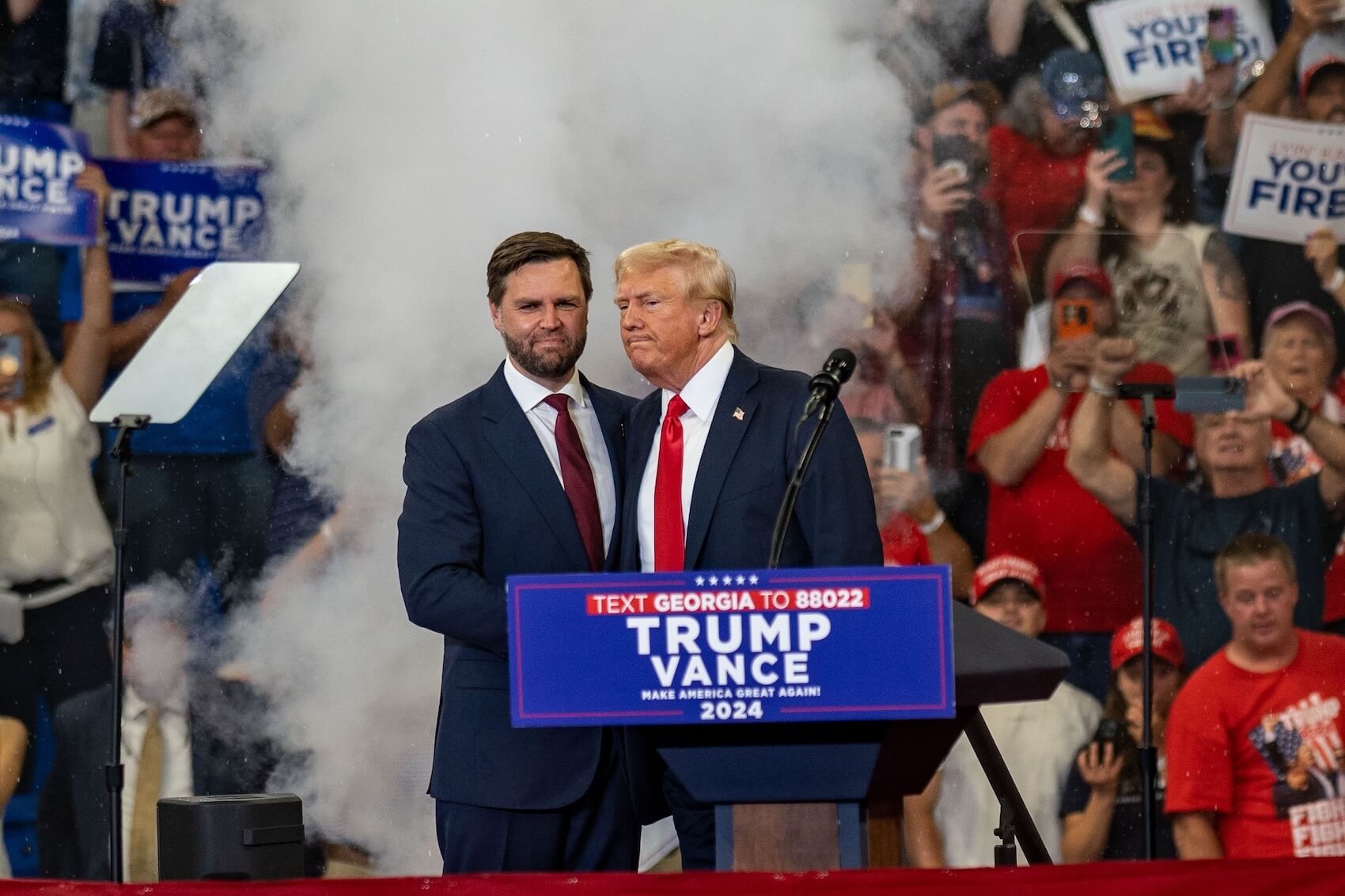
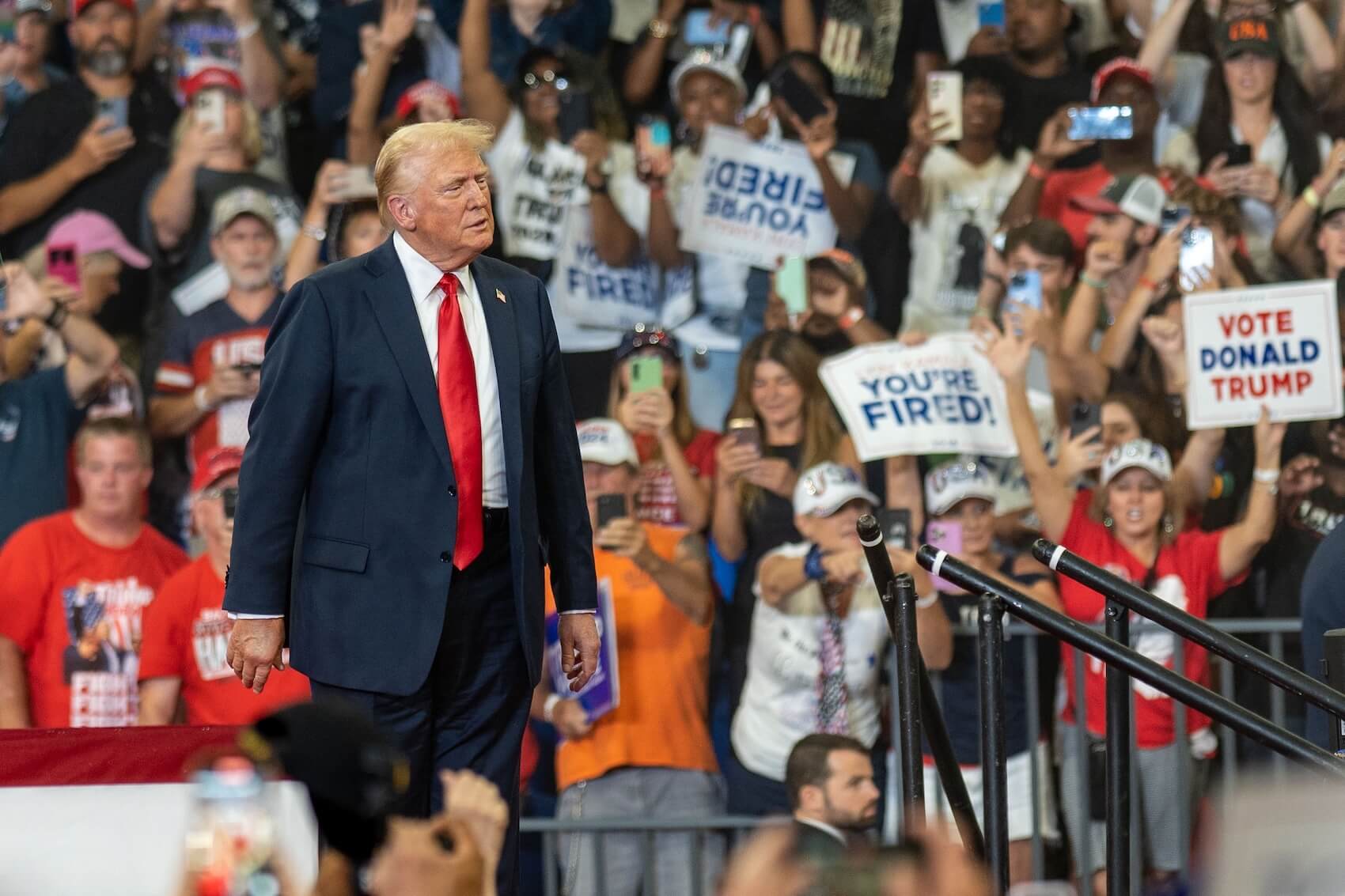
Former U.S. President Donald Trump and vice-presidential nominee J.D. Vance at a rally in Atlanta, GA, on August 3, 2024. Photo: Phil Mistry.

Anticipating the Trump Effect: Strengthening the EU Pact on Migration and Asylum Amid Populist Pressures

DOWNLOAD POLICY PAPER

Please cite as:
Bottura, Beatrice; O’Keeffe-Johnston, Paris; Gkampeta, Pinelopi; Malai, Ludmila; Lynch, Matt; Park, Joon & Gräf, Leon. (2024). “Anticipating the Trump Effect: Strengthening the EU Pact on Migration and Asylum Amid Populist Pressures.” Policy Papers. European Center for Populism Studies (ECPS). October 24, 2024. https://doi.org/10.55271/pop0001


This policy paper analyzes the potential effects of the 2024 US presidential election on EU politics, particularly the EU Pact on Migration and Asylum. A Trump victory may intensify Euroscepticism and lead to more restrictive migration policies among his European allies. Conversely, a Trump defeat could fuel distrust in electoral processes, potentially triggering events similar to the 2021 Capitol attack. The paper recommends regular in-depth country reviews (ICRs) to develop tailored migration strategies, anticipating that either election outcome could increase fragmentation and populist influence within EU member states, though with varying degrees of impact.

Authored by Beatrice Bottura, Paris O’Keeffe-Johnston, Pinelopi Gkampeta, Ludmila Malai, Matt Lynch, Joon Park & Leon Gräf

Edited by Beatrice Bottura & Paris O’Keeffe-Johnston

Executive Summary

As the “Common Implementation Plan” for the EU Pact on Migration and Asylum was adopted by the European Commission in June 2024 (European Commission, 2024a), the European and international political landscape was changing. The results of the EU 2024 parliamentary elections revealed a rise of Right-wing populist parties (RPP) on the European scene, a trend which mirrors recent national electoral results (Europe Elects, 2024; Europe Politique, 2024). This right-wing shift is causing a tightening of migration policy across EU countries and affecting the viability of the EU Pact on Migration, with almost half EU countries openly contesting its initiatives and some countries even considering an opt-out, following the Netherlands’ recent opt-out request (Carlson, 2024; Liboreiro, 2024). Simultaneously, former president Donald Trump is running for office once again. 

This policy paper examines how the results of the 2024 presidential election might affect EU politics, especially in regard to the EU Pact on Migration and Asylum. Though a horizon scanning methodology, the paper found that Trump’s previous presidency coincided with a period of increased Euroscepticism within member countries (Langlois, 2021; Löfflmann, 2019). Additionally, Trump has built strong connections with RPP leaders which, in the past, have become more vocal as Trump gained power (Fusiek & Marconi, 2021). Given Trump’s stance on political elites, supra-national organizations and migration, the paper predicts that:

– in the case of Trump’s victory: Eurosceptic sentiments and restrictive migration policies might increase across the EU, especially among Trump’s European supporters

– in the case of Trump’s loss: events similar to the 2021 Capitol attack might occur (Abramowitz, 2024) which could further distrust in electoral processes both in the US and the EU. This could be leveraged by populist actors, which, to a lesser extent compared to a Trump victory, could still increase fragmentation across EU member states

Finally, given these findings, the paper provides policy options for the European Commission to take into consideration for a successful implementation of the plan. Among these, the paper focuses on the introduction of regular in-depth country reviews (ICRs) which are aimed at creating country-tailored implementation strategies for the Pact. In practice, by shedding light onto nation-specific issues when it comes to migration and asylum, these ICRs would allow national leaders to have more control over the actual implementation of the Pact. This should increase the willingness to cooperate of RPPs as it brings together both national sovereignties, an important value to these parties, and European policy.


1. Introduction

Migration is one of the most discussed political and security challenges today. Worsening conflicts, natural disasters, and the hopes of better economic opportunities bring people from across the world to migrate to other areas that are deemed more prosperous or can offer something their homeland cannot. The nature of migration is transboundary, often exacerbating geopolitical issues among countries that are expected to share the burden. This can be illustrated by Trump’s abandonment of the EU during the refugee crisis, leaving Europe alone in dealing with the issue (Koppa, 2017). 

As of 2022, there are 46.1 million migrants in the US (Geiger, 2024). Anti-migration and its link to nationalism are core aspects of Trump’s political campaigns and of his past presidency (Löfflmann, 2019). Indeed, during his past campaigns, Trump had made promises for stricter migration policies. Quotes such as “America First” and “Make America Great Again” were commonplace in his speeches and rallies (Lacatus, 2021; Löfflmann, 2022; Magcamit, 2017; Mirza et al., 2021). Unlike other populists, Trump succeeded in passing several anti-migration policies while in office (Table 1).

Europe has also faced difficulties controlling the increasing numbers of its migrant population. According to the International Organization for Migration (McAuliffe & Oucho, 2024), there are approximately 87 million migrants living in Europe. In the context of migration crises, which often disproportionately impact EU member states, balancing European cohesion has fragmented the Union. Additionally, in recent years, Western politics has witnessed a trend of a right-wing shift (see Figure 1) and increased support for populist leaders, which exacerbates this fragmentation (Europe Elects, 2024; Europe Politique, 2024).

Trump’s US presidency coincided with a period of EU instability which saw the rise of right-wing populist parties (RPP) in Europe and the significant decision for Britain to leave the EU, with migration a core topic for the Leave campaign (Langlois, 2021; Löfflmann, 2019). Authors such as Fusiek & Marconi (2021) argue that the popularity of a nationalistic populist in the US gave confidence to populist political actors in Europe to become more vocal and gather support. In the face of EU fragmentation, the Union must be prepared for leniency with its Pact on Migration and Asylum if it wishes to maintain cohesion. 

Note: Data sourced from European parliament election 2024, by Europe Elects, 2024 (https://europeelects.eu/ep2024/). Data sourced from Parliament Européen (2019, 2014, 2009, 2004, 1999, 1994, 1989, 1984, 1979), by Europe Politique, 2024.(https://www.europe-politique.eu/parlement-europeen.htm).

This paper delivers policy suggestions for the successful implementation of the Pact, especially in the context of the 2024 US Presidential elections and of its possible repercussions. To do so, the paper briefly delves into the 2024 EU Pact on Migration and Asylum, focusing on its strengths, its weaknesses, and how it is perceived by EU member states. Following, the paper conducts a horizon scanning methodology to discuss the possible outcomes of the 2024 US elections and how they could affect international politics and the implementation of the Pact. Finally, the paper provides recommendations to the European Commission to ensure readiness and resilience in the implementation of the Pact in any scenario deriving from the result of the upcoming US elections.

2. The EU and Migration

The EU has faced difficulties in dealing with migration, especially as the issue disproportionately affects certain member states. In dealing with this issue, the EU has developed the EU Pact on Migration, for all EU member states to adhere to.

2.1 The Pact on Migration and Asylum

The 2024 EU Pact on Migration and Asylum establishes a comprehensive and flexible framework that addresses border management, asylum processes, and migrant integration while introducing a mandatory yet adaptable solidarity mechanism (European Commission, 2024b). This framework, as shown in Figure 2, aims to distribute responsibilities more fairly among member states, allowing contributions through relocations, financial support, or alternative measures (Ibid.). However, the Pact faces significant challenges, including bureaucratic complexity, varying political will, and potential conflicts with member states resistant to migration, such as those of the Visegrád Group (V4: Poland, Czechia, Slovakia, and Hungary), which will be discussed in section 2.2 of the paper. 

Note: From Pact on Migration and Asylum, by European Commission, 2024b. (https://home-affairs.ec.europa.eu/policies/migration-and-asylum/pact-migration-and-asylum_en). Copyright 2024 by the European Union.

A SWOT analysis of the Pact (Figure 3) was made by the authors which found that the resource-intensive nature of the Pact may strain member states’ capacities, particularly amid shifting political priorities. Nonetheless, it offers opportunities for enhanced cooperation, stronger external partnerships, and economic benefits through managed migration. These potential gains are counterbalanced by threats such as geopolitical instability, rising anti-immigration sentiment, legal disputes within the EU, and the risk of migrants resorting to more dangerous routes due to increased border controls. The success of the pact will depend on its ability to navigate these complexities while ensuring the protection of human rights and fair distribution of responsibilities.

Note: Authors’ creation.

2.2 Backlash from Member States

The Pact has received severe backlash from a number of actors within the EU for very different reasons. On the one hand, due to its attempt at regulating and partially restricting immigration, many on the political left view the Pact as giving too many concessions to the far right, and failing to protect fundamental rights (Griera, 2024). For example, the German Left MEP Cornelia Ernst called the pact “a pact of shame and disgrace,” while other MEPs from Left and Green parties considered the Pact to be a model for a fortress of Europe and a victory for the far-right (Ibid.). Many NGOs also criticized the Pact, with Amnesty International attesting a “surge in suffering” for asylum seekers, if the Pact was to enter into effect (Nattrass, 2024). On the other hand, right-wing governments and parties across the EU also greatly criticized the Pact.

However, contrary to the above-mentioned examples, their main concern is that the Pact is not strict enough on immigration regulation and forces every EU member state to contribute and show solidarity, hence overruling national sovereignty (Nattrass, 2024). The Visegrád countries in particular – namely: Poland, Czechia, Slovakia, and Hungary – heavily criticized the Pact and its solidarity mechanisms, with Polish Prime Minister Donald Tusk promising that Poland will “find ways so that even if the migration pact comes into force in a roughly unchanged form, we will protect Poland against the relocation mechanism” (Nattrass, 2024), while the Hungarian government also pledged to find ways to avoid taking in immigrants and called the Pact “another nail in the coffin of the European Union” (Nattrass, 2024). 

In addition to the Visegrád Group, an increasing number of member countries is expressing its discontent with the Pact, a trend tied to the rise of RPPs throughout Europe (Vinocur et al., 2024). In particular, this is manifesting through a push for tighter deportation and border control measures across Europe (Vinocur et al., 2024). 17 countries in the Schengen area – Austria and the Netherlands and endorsed by Croatia, the Czech Republic, Denmark, Finland, France, Germany, Greece, Italy, Luxembourg, Malta, Slovakia and Sweden. Norway, Switzerland and Liechtenstein – have recently signed an appeal to the EU executive to toughen return policies when asylum applications are rejected as well as increasing European coordination when it comes to deportations (Carlson, 2024; Liboreiro, 2024). Additionally, numerous countries in the Schengen area – i.e. Austria, Denmark, France, Italy, Norway, Slovenia, and Sweden (Dell’Anna, 2024) – are increasing border controls, which hinders the right to freedom of movement. In addition to these general trends, in countries where RPPs are gaining executive positions, the stance on migration policy is toughening even more (Carlson, 2024; Stekić, 2024; Vinocur et al., 2024). Recent examples of this trend – including the extreme example of the Netherlands’ request to opt-out of the Pact – are shown visually in Figure 4 and a full table is available in Appendix A.

Note: Authors’ creation.

This restrictive stance appears also at the European level where, as illustrated in section 1, right-leaning groups have gained more influence (Vinocur et al., 2024). In particular, members of the European Conservatives and Reformists (ECR) and of the European People’s Party (EPP) support the toughening of deportation mechanisms, the increase of asylum-seeker reception centers outside of the EU, and the funding for extra EU border control (Ibid.). 

In sum, the Migration Pact, which is supposed to offer a compromise, is seen negatively by both sides of the political spectrum for respectively leaning too much into the opposite political spectrum, a trend that has led countries to push for a re-draft of the pact (Vinocur et al., 2024). In this context, the main challenge to the successful implementation of the Pact remains to satisfy parties and voters on the left-wing and pro-immigration side and on the right-wing anti-immigration side concurrently. This challenge will be addressed in section 5 of this policy paper, where policy options and recommendations are provided. 

3. Methodology

Horizon scanning is used by building on early warning signs and predictions based on current events, by analyzing political discourse. Geopolitical issues are increasingly complex and interconnected. With such challenges, the use of horizon scanning is crucial to prepare and inform policymakers and decision-makers about potential opportunities and threats (Amanatidou et al., 2012). There are two core aspects of horizon scanning: alerting and creating. Alerting includes the early identification of emerging issues, whereas the creative aspect refers to the reassembly of current issues into a prediction for what might develop into a policy problem. Current political discourse in Europe has centered around a migration debate and discontent towards failing solutions to handle the issue, simultaneously the US Presidential debate has Donald Trump potentially returning for a second term. 

4. Examinations of Findings: The US 2024 Presidential Elections

As a two-party system, there exists only two possible results of the US Presidential election – a Trump victory, or a Harris victory. Regardless, there shall be a possibility of outcomes in either scenario. Having conducted horizon scanning, there are two possible scenarios that may impact European politics on migration: whether Trump should achieve victory, or whether Trump reacts poorly and encourages disruption in the event of a loss.  

4.1 A Trump Victory

In the event that Trump achieves victory, there are two core aspects that will shape the political landscape around migration. Trump has demonstrated an ability to influence and encourage populists in the EU to be more vocal and gather support, as illustrated in Figure 5 (Fusiek & Marconi, 2021). In this regard, it can be expected that the political landscape in Europe will continue to favor populism during a revival of right-wing shift while Trump would have his second term. A second Trump presidential term would likely embolden European populist leaders such as Viktor Orbán, Marine Le Pen, Matteo Salvini, Jarosław Kaczyński, and even populist parties such as the Alternative for Germany (AfD) or Austria’s Freedom Party (FPÖ) by validating their nationalist, anti-EU, and illiberal policies (Naughtie, 2024). During his first presidency, Trump openly praised some of these leaders, especially Viktor Orbán, Trump was quoted saying “Let me just say about world leaders, Viktor Orbán, one of the most respected men, they call him a strong man” and undermined multilateral bodies, sending a clear signal that illiberal governance and nationalist policies are able to thrive without any significant repercussions from the US (Euractiv, 2024).

Note: Authors’ creation. Purple shows the Visegrád Group countries and yellow shows Western European states.
Politicians who have a direct link or friendship with Trump are highlighted in red.

Trump’s alignment with right-wing ideologies would also likely embolden these leaders to promote policies that further marginalize minority groups, restrict immigration, and consolidate political power by undermining judicial independence and press freedoms. In a second term, Trump’s open disdain for international organizations like NATO and the EU would likely reduce pressure on these populist leaders to adhere to democratic norms (Stekić, 2024). By downplaying concerns over democratic backsliding and encouraging isolationist policies, Trump would create an EU environment where these leaders and parties continue to push their nationalist agendas further, almost completely free from the fear of diplomatic or economic consequences. 

Further issues that may surface from a Trump victory is the implementation of Project 2025: a Republican policy mantra with strict consequences for migration (The Heritage Foundation, n.d.). Core proposals of the project include continued and increased funding of the ‘Border Wall’, the deportation of migrants, and the removal of visa categories for victims of crime and human trafficking (Wendling, 2024). The project calls for the dissemination of the Department of Homeland Security to be replaced with stronger immigration enforcement bodies for stricter border control (Ibid.). Legal migration would also face stricter measures, through increased fees for visa applications (Ibid.). Donald Trump, as a form of populism, has been linked to the Brexit debate and fueling the “politics of anger”, a concept which some believe has contributed to euroscepticism across the Union (Smorag, 2020; Wind, 2017). If Trump were to be re-elected, it could be expected such sentiments may become prevalent in European political discourse again.

Should Trump win and implement Project 2025, the EU could mirror a restrictive stance again. This prediction is increasingly plausible (Vinocur et al., 2024), especially given the latest trends highlighted in section 2b. Overall, Trump’s influence has the power to destabilize democracies through the use of disinformation which causes greater distrust. Trump may prompt RPP leaders and their parties to entrench their power through policies aimed at curbing media freedom, overhauling the judicial system and the rule of law both at the national and supranational level, and even denouncing opposition parties.

4.2 Reactions to A Trump Loss

On the contrary, should Harris be elected as the first woman President, implications will lead to different roads. It is possible that the post-election events of January 2021 – i.e. the Capitol attacks – could have a sequel (Abramowitz, 2024). Many EU leaders took to the media to condemn the attack on the Capitol, denouncing the use of violence in any form of democratic process. Most were outright with their criticism of Trump’s handling of the situation and the consequences of his words. Common responses from RPP leaders and members – i.e. Marine Le Pen, Giorgia Meloni, and Victor Orbán- were to include a condemning of violence, protecting democracy, whilst simultaneously illustrating Trump in a positive light, often as a ‘peacemaker’ for his limited calls to avoid violent attacks during the protest, whilst others excused Trump of any wrongdoing (Herszenhorn et al., 2021). Should a similar situation arise, where Trump would instigate a protest after losing the election, it is expected that the previously mentioned EU leaders would follow similar actions as before. In this scenario, European leaders are likely to hold a consensus view that democracy is the forefront of our political system, not to be undermined. Likewise, it is expected that Harris would share the same sentiments for democracy and condemn his final attempt at power.

Regardless of the outcome of the 2024 US presidential election, Europe is undeniably fragmented politically, which significantly impacts the practical implementation of the EU Migration Pact. In recent months, in Germany, the far-right party Alternative for Germany (AfD) has been vocal about its opposition to migration. It further supports a “remigration” implementation (Hockenos, 2024) that has surged in federal elections. In Austria, the Freedom of Austria Party (FPÖ) won in the recent election. The FPÖ is expected to push a hardline stance on immigration and resist EU-level initiatives. The FPÖ will likely join forces with other mainstream populist parties (Cameron & and Goldstein, 2024). 

In addition to the success of far-right parties across Europe, the ongoing war in Ukraine continues to drive a wedge between nations more friendly and dependent on Russia to take a harder line on accepting Ukrainian refugees, let alone migrants from the Middle East or North Africa. Nations such as Greece and Italy continue to deal with the Mediterranean migration crisis, which is expected to continue for years. These existing crises continue to be a launch pad for far-right populist parties’ rhetoric. 

5. Policy Options 

At the time of writing, there was around one month remaining until the 2024 US Presidential election would be held. Three policy options were created for the European Commission to consider for a smooth and coherent implementation of the 2024 EU Pact on Migration and Asylum. 

  1. The European Commission must organize a commonly managed and coordinated European asylum system centered around the wellness of human beings: the EU should work on the defense of fundamental human rights, immigrants’ safety and dignity. It is also suggested that the Union ought to use the reservation of migrants as a last resort and try to create other effective solutions, like open reception centers, since prolonged detention results in devastating effects on migrants’ mental health (International Rescue Committee, 2023).
  2. The European Commission should strengthen the resettlement of refugees in the Union Resettlement Framework (URF): this includes timely and just handling of the reception and integration of refugees and immigrants from day one. More specifically, the Union must offer decent reception conditions throughout the EU, such as providing education and healthcare. Moreover, the Union ought to worry about the progress with an organized and transparent mechanism for monitoring the fundamental rights of asylum seekers. 
  3. The European Commission should fund and conduct regular in-depth country reviews (ICRs) to track the impact of the Pact on Migration and Asylum at a national level and allow for country-tailored implementation strategies:similar reviews are already conducted by the Commission such as European Semester reports, the Environmental Implementation Review and economic IDRs annually. These reviews would provide a mechanism for member states to detail the impact of migration in areas that are core concerns for countries. Each country review should conclude with action points and priorities at the member state and EU-level. 

Though all three policy options are of equal importance to ensure the successful and coherent implementation of the plan, this paper proceeds to focus on the last policy option as a strong recommendation to the European Commission, in order to ensure preparedness for the ongoing implementation of the Pact in this time of political uncertainty. The reasons and specifics behind this recommendation follow in the next subsection. 

5.1 Recommendations

The recommendation of ICRs within the context of the implementation of the Pact acts as a preventative method which focuses on three areas and values that are important for European RPPs with the aim of ensuring their increased cooperation in the implementation of the Pact. First, the country-specific analyses yielded by the IDRs would allow national leaders to suggest implementation strategies tailored to each nation’s socio-economic needs and capabilities. These tailored solutions will preserve national sovereignty. Second, through these country-specific analyses and implementation strategies, it would be possible to put a specific attention on a proper cultural integration of migrants, ensuring their wellbeing within society whilst preserving national traditions. This possibility could strengthen social cohesion, hence appeasing any anti-immigration sentiments that are likely to be strengthened by Trump’s influence. Finally, IDRs would strengthen national agency and allow for national interests to be at the heart of policy implementation whilst EU’s core objectives and values are upheld.

In particular, to ensure their above-mentioned purpose, we envision ICRs to present key sections as follows. First, an Economic Contributions and Challenges of Migration section of the review would report statistics relating to the economy, workforce and their welfare states. This will allow member states to further detail shortages in the job market where migration of people with work experiences related to the field are required. For example, countries experiencing shortages of agricultural workers, healthcare, or otherwise may request that their migrant quota includes those able to contribute to those sectors. Migration is often talked about as a burden by RPPs, highlighting the skills and benefits migrants can bring to suffering industries should mitigate this issue.

Second, a section dedicated to reporting on Social Dynamics and Community Integration would allow states to report statistics related to socio-cultural data, such as attendance to language courses, educational attendance, and integration into society through work or social programmed. This would address the common concerns of RPP tied to the erasure of national identity and traditions due to immigration. It is hoped that providing member states an avenue to report on socio-cultural impacts of migration will demonstrate an effort to protect national identity whilst promoting integration  

Finally, a section for Impacts Not Otherwise Stated is proposed. This would allow member states to flag any additional issues they are facing in the implementation of the Pact to EU institutions. Such issues could include difficulties in processing of incoming migrants, including manpower, biometrics, and service availability. Overall, this should help with national governance for the Pact.

All ICRs ought to conclude with a plan for the future. Plans should enable co-working between the Commission and Member States to come up with priorities and action points for each stakeholder going forward with the Pact, as similar EU reports conclude with. With this recommendation, member states can agree with the EU on what is most important and applicable to the individual country, rather than having a “one size fits all” method applied to all EU members. 

Due to the politically sensitive nature of migration, the importance of impartiality was noted. It is recommended that the ICRs are conducted independently, with assistance from the Eurostat peer-review team. The EU has six funding pools that it may draw from that can achieve this recommendation feasibly: (1) Asylum, Migration and Integration Fund, (2) Internal Security Fund, (3) European Social Fund Plus, (4) European Regional Development Fund, (5) Neighborhood, Development and International Cooperation Instrument, and (6) Emergency Assistance and Other Ad Hoc Funding.

6. Conclusion

At this stage, the result of the American elections is ambiguous. The scenario of Trump’s re-election to power will bring about unfavorable results both at the overall EU level and on the immigration issue, as a Trump presidency would entail significant disruptions in US-EU relations (Frangeul-Alves & Weber, 2024).  Trump’s troubled relations with the EU and his pursuit of isolationism, as well as his apparent apathy towards immigrants and refugees, mean that the former president will once again leave the Union alone on the issue that plagues it. Therefore, the developments in the field of immigration will differ greatly depending on the US election results.

In any case, the EU should not be complacent, regardless of the election result, as the migrant – refugee crisis plagues Brussels. Migration is one of the most important policy issues (Lovato, 2021) and it has turned into a geopolitical issue. Immigration is a labyrinthine for the EU and a complex problem, thus the solution will not be easy, especially given EU member states’ diverse opinions on the matter (Donceel, 2024). 

To conclude, this policy paper delved into the implementation of this Pact, focusing on how it is susceptible to the rise of populism both in Europe and abroad. In particular, after conducting a SWOT analysis of the Pact and providing an overview of how it is perceived across Europe, the paper focused on how the implementation of the Pact could be affected by the results of the upcoming US presidential elections. Based on previous cases, it is expected that in case of victory Trump will incentivize his EU “allies”, such as Hungary’s Orban, Italy’s Meloni, and Slovakia’s Fico (Naughtie, 2024), resist the Pact in the name of national sovereignty and anti-elitism. In the case of Trump’s loss however, the likely scenario is that the former president would encourage them to challenge the election outcomes and attempt to undermine democratic processes. This could deepen the public’s distrust in representative institutions across the US and the EU, ultimately furthering the disengagement from electoral processes (i.e. increasing voter absenteeism).   

The authors of this paper believe that the recommended introduction of periodic in-depth country reviews (ICRs) would serve as a preventative measure in anticipation of Trump influencing RPPs in Europe. Of course, whilst future outcomes are uncertain due to the vivacity of the electoral campaigns in the US as well as worsening international orders, we are confident that as the European Commission sustains the cooperative nature of the Pact across political spectrums – which we recommend doing by ensuring tailored implementation strategies across member states’ government – its implementation will be successful. 


(*) This policy paper is based on research conducted by Beatrice Bottura, Paris O’Keeffe-Johnston, Pinelopi Gkampeta, Ludmila Malai, Matt Lynch, Joon Park and Leon Gräf during the ECPS Case Competition “US Foreign Policy and Populism,” held as part of the ECPS Summer School from July 1-5, 2024. 


Authors’ Biographies

Beatrice Bottura is a Sciences Po master student in Public Policy, specializing in Social Policy and Social Innovation, and a Central European University (CEU) graduate in Philosophy Politics and Economics. Her research interests revolve around the crisis of democracy and how it relates to political attitudes and policymaking. She has explored this in her bachelor thesis “Ethnopopulists’ reaction to crises: the case of Fratelli D’Italia”, from which she derived an article for the Horizon Europe project “AuthLIB – Neo-Authoritarianisms in Europe and the Liberal Democratic Response”, which she is involved in as a research assistant. For this project she has worked with CEU’s Democracy institute and Sciences Po’s Centre d’Études Européennes (CEE). Particularly, she conducted discourse analyses for the working paper “Illiberalism and Social Policy: A Four-Country Comparison”, is authoring an upcoming publication on varieties of illiberalism across policy areas with CEU and has coded speech for the CEE’s work measuring “Ideological configurations”. 

Joon Park is a third-year student at George Washington University, pursuing a bachelor’s in international Affairs and Finance with a minor in Economics. Born to Korean immigrants and raised in Germany, her academic focus spans EU economics, German domestic and foreign politics, U.S. foreign policy, and East Asian geopolitical strategy. She is currently researching the rise of right-wing populism in Europe in collaboration with the Center for Faith, Identity, and Globalization in Washington, D.C. Joon’s passion lies in exploring how global political systems and economic dynamics intersect to shape international relations and policy. 

Matthew Lynch is a Master of Science candidate in Global Studies and International Relations at Northeastern University in Boston. He received a Bachelor of Science in Supply Chain Management from the University of Massachusetts Dartmouth. With a background in international business, his current research focuses on how populism creates vulnerabilities in EU defense and security, particularly the potential for external actors to exploit these weaknesses. He also researches German foreign and defense policy.

Leon Gräf holds a BA in Political Science and Philosophy, University of Heidelberg, Germany and an MA in Political Science, University of Mannheim, Germany. He is currently working as Research Fellow at the Max Planck Foundation for International Peace and the Rule of Law, and as a Research Assistant at the Chair of Empirical Macrosociology at Heidelberg University. Additionally, is has been working as a researcher at the Heidelberg Institute for International Conflict Research (HIIK) since 2021. His MA thesis focused on mediator characteristics and their effect on ceasefire success across different regions. 

Pinelopi Gkampeta is a graduate student in the Advanced M.Sc. in “European Integration” in Brussels School of Governance (VUB) and she currently lives in Brussels. Furthermore, she has obtained a master’s degree in “International and European Governance and Politics” from the National and Kapodistrian University of Athens and a bachelor’s degree in “Philosophy” from the same university. She has taken part in the Erasmus+ Program “Maritime Security Common Module “by European Security and Defence College and Hellenic Naval Academy. Moreover, she is a research intern in the Institute of International Relations (Athens, Greece) and also an editor and analyst at the Association of International and European Affairs. Pinelopi worked as a research assistant for the Identity and Conflict Lab (Yale University) for some months. Her areas of interest and research are EU as a Global Actor, EU External Relations, EU Security and Defense Policy, Maritime Security and Immigration Policy.

Paris O’Keeffe-Johnston holds an MA in International Relations, Conflict & Security from Northumbria University. Her research focuses primarily on societal security, with an emphasis on digital threats. Her dissertation explored how EU policy documents framed cybersecurity as an existential threat. Currently, her research interests have expanded to include the societal risks posed by AI. This includes how populists may use generative AI to either gather support or create the illusion of widespread backing, as well as to drive disinformation campaigns. By investigating this area, she aims to uncover how algorithms could be leveraged for early detection and mitigation of polarizing content ahead of elections. 

Ludmila Malai is an experienced EU Project Manager at the Intercultural Dialogue Platform, with a diverse academic background in Economics, Administration, Politics, Diplomacy, and Conflict Resolution. She holds a Master’s in International Law and Security Studies from the Free University of Brussels and is fluent in English, French, Russian, Italian, and Romanian. Over the past six years, Ludmila has specialized in writing and coordinating European projects focused on CVE/PVE, radicalization, combating racism, Antisemitism, Islamophobia, the security of places of worship, women’s empowerment, and youth civic engagement.


References

Abramowitz, A. I. (2024, September 24). Professor Abramowitz: Signs indicate polarization in the US could lead to violence if trump loses. ECPShttps://www.populismstudies.org/professor-abramowitz-signs-indicate-polarization-in-the-us-could-lead-to-violence-if-trump-loses/

Amanatidou, E., Butter, M., Carabias, V., Konnola, T., Leis, M., Saritas, O., Schaper-Rinkel, P., & van Rij, V. (2012). “On concepts and methods in horizon scanning: Lessons from initiating policy dialogues on emerging issues.” Science & Public Policy39(2), 208–221. https://doi.org/10.1093/scipol/scs017

American Migration Council. (2024). The “Migrant Protection Protocols.” Americanimmigrationcouncil.org. https://www.americanimmigrationcouncil.org/research/migrant-protection-protocols

Angelos, J. (2024, September 11). Germany’s Scholz gets tough on border in bid to save political future. POLITICO. https://www.politico.eu/article/germany-olaf-scholz-europe-migration-far-right-afd-election/

Cameron, I., & Goldstein, T. (2024, September 27). What to know about Austria’s parliamentary elections. Atlantic Council. https://www.atlanticcouncil.org/content-series/eye-on-europes-elections/what-to-know-about-austrias-parliamentary-elections/

Carlson, K. (2024, October 5). “EU needs faster migrant returns, say 17 countries including Germany, France: Report.” POLITICOhttps://www.politico.eu/article/europe-migration-faster-returns-germany-france/

Caulcutt, C., & Vinocur, N. (2024, September 30). “France’s new Europe minister will push Brussels to tighten migration rules.” POLITICOhttps://www.politico.eu/article/europe-next-step-migration-debate-france-new-europe-minister-benjamin-haddad/?mc_cid=fb515213aa&mc_eid=df84cdf6c2

Cokelaere, H. (2024, September 13). “Dutch government announces, ‘strictest asylum policy ever’.” POLITICO.https://www.politico.eu/article/dutch-government-announces-strictest-asylum-policy-ever/?mc_cid=fb515213aa&mc_eid=df84cdf6c2

de La Baume, M. (2024a, July 31). “Does Finland’s new migration bill break international law?” Euronews.https://www.euronews.com/my-europe/2024/07/31/does-finlands-new-migration-bill-break-international-law-radio-schuman

de La Baume, M. (2024b, September 19). “Von der Leyen’s bold move: Is Austria the fix for EU migration policy?” Euronews. https://www.euronews.com/my-europe/2024/09/19/von-der-leyens-bold-move-austrias-brunner-gets-migration-radio-schuman

de La Baume, M. (2024c, September 23). “How will France’s new right-leaning government impact the EU?” Euronews.https://www.euronews.com/my-europe/2024/09/23/macrons-new-government-and-its-impact-on-the-eu-radio-schuman

de La Baume, M. (2024d, October 1). “What would having the far right in power mean for Austria and EU migration policies?” Euronews. https://www.euronews.com/my-europe/2024/10/01/what-would-having-the-far-right-in-power-mean-for-austria-and-eu-migration-policies-radio-

Dell’Anna, A. (2024, September 10). “Which other Schengen countries have border checks in place?” Euronews.https://www.euronews.com/my-europe/2024/09/10/which-other-schengen-countries-have-border-checks-in-place

Donceel, H. (2024, April 29). “What can the EU do to better manage migration?” Euranet Plus. https://euranetplus-inside.eu/what-can-the-eu-do-to-better-manage-migration/

ECRE. (2024, September 27). NETHERLANDS: Government Announces, ‘Strictest Asylum Policy Ever’ and Requests Opt-Out from EU Migration Pac. Ecre.org. https://ecre.org/netherlands-government-announces-strictest-asylum-policy-ever-and-requests-opt-out-from-eu-migration-pact-―-government-announces-end-to-state-funded-housing-for-rejected-asy/

Etias. (2024, February 10). “France seeks migration policy review amid growing EU discontent.” Etias.com.https://etias.com/articles/france-seeks-migration-policy-review-amid-growing-eu-discontent

Euractiv. (2024, September 12). “Friends: Donald trump and Viktor orbán.” EURACTIV.https://www.euractiv.com/section/elections/news/friends-donald-trump-and-viktor-orban/

Europe Elects. (2024). European parliament election 2024. Europe Elects. https://europeelects.eu/ep2024/

Europe Politique. (2024). Parlement Européen 2019 2014 2009 2004 1999 1994 1989 1984 1979. Europe-Politique.Eu. https://www.europe-politique.eu/parlement-europeen.htm

European Commission. (2024a). Common Implementation Plan to turn the Pact on Migration and Asylum into a reality. Migration and Home Affairs. https://home-affairs.ec.europa.eu/news/common-implementation-plan-turn-pact-migration-and-asylum-reality-2024-06-12_en

European Commission. (2024b). Pact on migration and asylum. Migration and Home Affairs. https://home-affairs.ec.europa.eu/policies/migration-and-asylum/pact-migration-and-asylum_en

Frangeul-Alves, A. & Weber, G. (2024). The United States’ EU policy after 2024. GMFUS. https://www.gmfus.org/news/united-states-eu-policy-after-2024

Fusiek, D. A., & Marconi, C. (2021). “Trumpism and the European far right: An analysis of Trumpism’s impact on the post-2016 AfD, Lega Nord, and Fidesz.” Środkowoeuropejskie Studia Polityczne4, 61–84. https://doi.org/10.14746/ssp.2021.4.5

Gall, L. (2024, March 19). “Trump’s friend from Hungary is no role model for supporters of democracy.” Human Rights Watch. https://www.hrw.org/news/2024/03/19/trumps-friend-hungary-no-role-model-supporters-democracy

Geiger, A. (2024, September 27). What the data says about immigrants in the U.S. Pew Research Center. https://www.pewresearch.org/short-reads/2024/07/22/key-findings-about-us-immigrants/

Giles, C. (2019, January 5). “Trump’s wall: How much has been built during his term?” BBC. https://www.bbc.com/news/world-us-canada-46748492

Goury-Laffont, V. (2024, September 5). “Michel Barnier: Everything you need to know about the new French PM’s conservative politics.” POLITICO. https://www.politico.eu/article/the-staunchly-conservative-politics-of-michel-barnier-new-prime-minister-france/

Griera, M. (2024, April 10). “EU’s historic migration pact passes amidst divisions and far-right fears.” EURACTIV.https://www.euractiv.com/section/migration/news/eus-historic-migration-pact-passes-amidst-divisions-and-far-right-fears/

Hegedüs, D. (n.d.). Orbán has put all his eggs in Ttrump’s basket but would be pragmatic with Biden. GMFUS. Retrieved October 7, 2024, from https://www.gmfus.org/news/orban-has-put-all-his-eggs-trumps-basket-would-be-pragmatic-biden

Herszenhorn, D. M.; Barigazzi, J.; de La Baume, M.; Bayer, L. & Momtaz, R. (2021, January 7). “European far right decries US violence but sees Trump as victim of ‘ridiculous’ fanatics.” POLITICO.https://www.politico.eu/article/european-far-right-descries-violence-at-u-s-capitol-but-sees-trump-as-victim-of-ridiculous-fanatics/

Hockenos, P. (2024, January 26). “Germany’s far-right party is worse than the rest of Europe’s.” Foreign Policyhttps://foreignpolicy.com/2024/01/26/afd-germany-far-right-populism-radical-europe-remigration-immigrants/

International Rescue Committee. (2023, October 27). What is the EU Pact on Migration and Asylum? The IRC in the EU. https://www.rescue.org/eu/article/what-eu-pact-migration-and-asylum

Jochecová, K. (2024, July 22). “Finland’s deportation law puts EU’s migration norms to the test.” POLITICO.https://www.politico.eu/article/new-finnish-deportation-law-risks-infringing-on-human-rights-eu-migration-norms/

Kaalstad, J. E. (2024, September 12). “Sverige vil betale innvandrere over 350.000 kroner for å flytte tilbake.” VG. https://www.vg.no/nyheter/i/zA4551/sverige-vil-betale-innvandrere-over-350-000-kroner-for-aa-flytte-tilbake

Kassam, A. (2024, August 11). “Sweden’s ‘snitch law’ immigration plan prompts alarm across society.” The Guardianhttps://www.theguardian.com/world/article/2024/aug/11/sweden-snitch-law-immigration-plan-prompts-alarm-across-society

Koppa, M. (2017). The Common Security and Defense Policy: The History, the Institutions, the Strategies.

Körömi, C. (2024, September 30). “Orbán’s new threat: Dispatching migrants to Grand-Place in Brussels.” POLITICO.https://www.politico.eu/article/viktor-orban-migrants-hungary-gates-brussels-main-square-grand-place/

Lacatus, C. (2021). “Populism and President Trump’s approach to foreign policy: An analysis of tweets and rally speeches.” Politics41(1), 31–47. https://doi.org/10.1177/0263395720935380

Langlois, L. (2021). “The Brexit Vote and The Trump Vote: A comparative study of the common trends and factors that led to a populist radical right vote in Britain and the United States.” Revue LISA / LISA e-Journal19(51). https://doi.org/10.4000/lisa.13054

Leali, G. (2024, October 1). “5 things to watch for in French PM Barnier’s first parliamentary address.” POLITICO.https://www.politico.eu/article/michel-barnier-big-day-lawmakers-speech-france-coalition-government-debt-tax-rate-migration-labor/

Liboreiro, J. (2024, October 7). “A group of 17 European countries call for a “paradigm shift” to deport rejected asylum seekers.” Euronewshttps://www.euronews.com/my-europe/2024/10/07/17-european-countries-call-for-a-paradigm-shift-to-deport-rejected-asylum-seekers

Lindsay, J. M. (2024, September 27). Election 2024: Are Americans ready for another close presidential election?Council on Foreign Relations. https://www.cfr.org/blog/election-2024-are-americans-ready-another-close-presidential-election

Löfflmann, G. (2019). “America first and the populist impact on US foreign policy.” Survival61(6), 115–138. https://doi.org/10.1080/00396338.2019.1688573

Löfflmann, G. (2022). “‘Enemies of the people’: Donald Trump and the security imaginary of America First.” British Journal of Politics & International Relations24(3), 543–560. https://doi.org/10.1177/13691481211048499

Lovato, M. (2021). “Introduction: shades of contestation and politicisation of CFSP.” European Security30(3), 325–343. https://doi.org/10.1080/09662839.2021.1964473

Magcamit, M. (2017). “EXPLAINING THE THREE‐WAY LINKAGE BETWEEN POPULISM, SECURITIZATION, AND REALIST FOREIGN POLICIES: President Donald Trump and the pursuit of “America First” doctrine.” World Affairs180(3), 6–35. https://doi.org/10.1177/0043820017746263

McAuliffe, M., & Oucho, L. A. (2024). “Report overview: Migration continues to be part of the solution in a rapidly changing world, but key challenges remain.” World Migration Report2024(1). https://doi.org/10.1002/wom3.33

Mirza, M. N.; Ali, L. A. & Qaisrani, I. H. (2021). “Populism in the United States: Binary constructions by Donald Trump in the domestic and foreign policies.” Global Social Sciences ReviewVI(III), 59–71. https://doi.org/10.31703/gssr.2021(vi-iii).07

Nattrass, W. (2024, April 12). Migration pact will only deepen EU divisions. UnHerd. https://unherd.com/newsroom/migration-pact-will-only-deepen-eu-divisions/

Naughtie, A. (2024, September 4). “Who are Donald Trump’s key allies in Europe?” Euronews. https://www.euronews.com/2024/09/04/who-are-donald-trumps-key-allies-in-europe

Riegert, B. (2024, September 20). “Hungary and the Netherlands want to exit EU asylum policy.” Deutsche Wellehttps://amp.dw.com/en/hungary-and-the-netherlands-want-to-exit-eu-asylum-policy/a-70278674

Smorag, P. (2020). “Trump’s populist contentment with Brexit.” Observatoire de la Société Britannique, 25, 187-212. https://doi.org/10.4000/osb.4883

Stekić, N. (2024). “How U.S. immigration policies and the 2024 election could reshape EU migration strategies.”Newslettereuropean.Eu. https://www.newslettereuropean.eu/how-u-s-immigration-policies-and-the-2024-election-could-reshape-eu-migration-strategies/

Stone, P. (2024). “Trump and allies plant seeds for ‘chaos and discord’ if he loses, experts warn.” The Guardian. Theguardian.com. https://www.theguardian.com/us-news/article/2024/sep/03/trump-maga-allies-election-conspiracy-theories

The Heritage Foundation. (n.d.). Project 2025 | Presidential Transition Project. Project2025.org. Retrieved October 7, 2024, from https://www.project2025.org

The White House. (2017). Executive Order 13769 of January 27, 2017. Govinfo.gov. https://www.govinfo.gov/content/pkg/FR-2017-02-01/pdf/2017-02281.pdf

Vinocur, N., Moens, B., & Griera, M. (2024, October 2). “Europe’s populists push for migrant clampdown as Trump cranks up rhetoric.” POLITICO. https://www.politico.eu/article/tidal-wave-europe-populist-drive-push-migrant-clampdown-donald-trump-crank-up-rhetoric/

Wendling, M. (2024, June 12). “What is Project 2025? Wish list for a Trump presidency, explained.” BBC. https://www.bbc.com/news/articles/c977njnvq2do

Wind, M. (2017). “Brexit and Euroskepticism: Will ‘Leaving Europe’ be Emulated Elsewhere?” In: F. Fabbrini (Ed.), The Law & Politics of Brexit (pp. 221-246). Oxford University Press.

Prabowo Subianto sings during a grand campaign at GBK Stadium in Jakarta on March 23, 2014. After four attempts, Prabowo was finally elected President of Indonesia in 2024. Photo: MRNPic.

From Political Pariah to President: Prabowo Subianto and the Perils of Populism in Indonesia

Please cite as:
Watmough, Simon P. (2021). “From Political Pariah to President: Prabowo Subianto and the Perils of Populism in Indonesia.” ECPS Leader Profiles. European Center for Populism Studies (ECPS). October 24, 2024. https://doi.org/10.55271/lp0011


Prabowo Subianto’s victory in Indonesia’s February 2024 presidential election marks a pivotal moment in the nation’s democratic evolution, echoing a global shift towards nationalist populism. As Indonesia’s eighth president, Prabowo’s political journey and ideological stance have sparked concerns about the future of the country’s democratic institutions. His controversial military past, including allegations of human rights abuses in East Timor and Aceh during the 1990s, continues to raise alarms about the potential for authoritarianism under his leadership. Critics fear his presidency may signal a return to repressive practices, with threats to civil liberties and increased polarization. Prabowo’s background as a former military general adds to concerns about a consolidation of power and the erosion of democratic checks and balances in one of the world’s largest democracies.

By Simon P. Watmough

Introduction

Prabowo Subianto’s[1] stunning victory in Indonesia’s presidential elections in February marks a significant moment in the country’s democratic journey, reflecting a global trend towards authoritarian nationalist populism. As he assumes the presidency of the world’s third-largest democracy, Prabowo’s political career and ideological stance have ignited conversations about the potential implications for Indonesia’s democratic institutions and pluralistic society, prompting observers at home and abroad to scrutinize the trajectory Indonesia might take under his administration. This profile joins that conversation, asking: Who is Prabowo Subianto, Indonesia’s eighth president?

If the “peculiarity of populist discourse is to frame politics as an antagonistic confrontation between the people and the oligarchy” (de la Torre, 2007: 389), then Prabowo hits the mark. Known for his assertive rhetoric and strongman persona, Prabowo – a retired lieutenant general in the Indonesian Armed Forces (Tentara Nasional Indonesia, TNI) – has successfully tapped into a vein of nationalist sentiment in Indonesia, promising robust leadership in the face of mounting economic and security challenges.

It is scarcely surprising that Prabowo embodies all the qualities of a “warrior populist” in the vein of Venezuela’s Hugo Chavez, as he has publicly declared his admiration for the late Venezuelan general-turned-dictator (Aspinall, 2015: 2). Equally, as the brother of one of Indonesia’s richest men (and a multimillionaire in his own right), we can see him as the paradigmatic “pluto-populist” in the vein of Donald Trump, the late Silvio Berlusconi and of course, Thailand’s Thaksin Shinawatra, whom Prabowo openly admires (ibid.).

The country itself is no stranger to populism, which has “deep roots in Indonesia” (Aspinall, 2015: 3). “Diffuse” forms of populist mobilization have played an outsized role in the country’s mass politics since the beginning, even during the “Guided Democracy” of the founding president, Sukarno, and the authoritarian “New Order” period under Suharto (ibid.). Some have even located the roots of Indonesian populism in the country’s birth as an independent nation (van Klinken, 2020). However, Indonesia’s current “populist moment” reflects conditions that have emerged in the 21st century, not least the attenuation of party functioning in the campaigns of political actors and the rise of “media-based populism,” which is “now the default mode of electioneering” (Gammon, 2023: 442). The allure of authoritarian nationalist populism, with its promise of decisive action and appeal to traditional values, poses questions about the future of Indonesia’s open and inclusive political climate. Critics argue that this could lead to a regression in human rights, freedom of the press and minority protections, elements that are foundational to Indonesia’s democratic framework.

This profile offers a comprehensive overview of the factors that have shaped Prabowo’s outlook and approach, including his early life, his military career (including his close links with the Suharto regime and his role in the transition to democracy in 1998) as well as his subsequent business and political ventures, all of which have led him to the seat of ultimate power. Charting his move from political pariah to perennial contender and now president, it sketches the key influences that have shaped his authoritarian populist outlook and the controversies that continue to devil him and give his critics pause for concern. Ultimately, it suggests he is likely to work to centralize power in the hands of the presidency, undermine Indonesia’s independent institutions, take the country backwards and possibly threaten to ignite conflicts far and wide.

A Cosmopolitan “Third Culture Kid” Forged in Exile

Indonesian presidential candidate Prabowo Subianto greets the public during a 2024 general election campaign in Bengkulu City, Indonesia, on January 11, 2024. Photo: Shutterstock.

Prabowo Subianto Djojohadikusumo was born on 17 October 1951, in Jakarta, Indonesia, into an aristocratic Javanese family “line that goes back centuries” (Connelly & Laksmana, 2018). His grandfather, Margono Djojohadikusumo (1894–1978), a prominent economist and founder of Bank Negara Indonesia (also serving as its first president), was a leading figure in Indonesia’s independence movement, while his father, Sumitro Djojohadikusumo (1917–2001), held key positions as Indonesia’s minister of trade and industry. Growing up amidst this political and economic elite exposed Prabowo to the inner workings of government and economics from a very young age (Purdey, 2016).

In the late 1950s, at just seven years of age, Prabowo was forced into exile with his family, his father and grandfather having been central players in an internal rebellion against Sukarno. Exile took the family first to Singapore, Malaysia and Thailand, then Switzerland and later to the United Kingdom, where Prabowo studied, graduating from the prestigious American School in London (ASL) in 1968 (Tanu, 2004). This international journey at a young age had a profound impact on Prabowo, exposing him to a wide range of cultures and shaping him into a “third culture kid” (Pollock & Reken, 2009), one who learned precisely how to navigate elite cosmopolitan circles (Tanu, 2004).

After the fall of Sukarno and the rise of the New Order regime in 1966 (headed by Suharto), the family were no longer political exiles. As Aspinall (2015: 3) notes, Prabowo returned to Indonesia “more comfortable speaking English than Indonesian, yet with powerful ambitions” to make something of himself in the country of his birth. Indeed, from a young age, Prabowo displayed a natural aptitude for strategy and a strong aspiration to the grand exercise of political power – a particular fascination in his youth was the Turkish general-turned-founding father Kemal Mustafa Ataturk (Friend, 2003: 323). Recognizing his teenage son’s leadership potential, Sumitro encouraged Prabowo to attend the military academy and pursue a career in the armed forces.

Military Career and Accusations of Human Rights Abuses

Understanding Prabowo’s military career is central to understanding both his outlook and style and the controversies that have dogged him in politics since 2004. His military journey began in 1970 when he enrolled in the Indonesian Military Academy in Magelang. He graduated in 1974, alongside fellow cadets who would go on to hold senior leadership positions, including Indonesia’s sixth president, Susilo Bambang Yudhoyono (widely known as SBY).

After graduation, Prabowo served in elite regiments of the TNI, first in the Indonesian Special Forces (known as Kopassus), which he joined in 1976 and where he gained experience in counterinsurgency operations (Aspinall, 2015: 6). Indeed, during his several tours of East Timor after the Indonesian invasion in December 1975, he was responsible for many human rights violations. At just 26 years old, Prabowo became the youngest commander of a key commando unit operating in East Timor and was implicated in the execution of East Timor’s first prime minister and freedom fighter, Nicolau dos Reis Lobato, in December 1978 (van Klinken, 2014).

Prabowo’s career took off after his marriage to Siti Hediati Hariyadi (“Titiek”) – the daughter of Indonesia’s strongman President Suharto – in 1983. His marriage to Titiek further elevated his status within the ruling political elite and gave him access to important networks and resources, allowing him to rise through the ranks of the Indonesian military more swiftly than many of his peers.

In the early 1990s, Prabowo, now a Major General, led Kopassus Group 3 in its attempts to suppress the East Timorese independence movement. His methods included using irregular troops, known as “ninja” gangs, and militias directed by Kopassus commanders, leading to a rise in human rights abuses. He has also been implicated in killings in Indonesia’s restive province of West Papua, particularly targeting the region’s independence activists (Nairn, 2024). During the dying days of his father-in-law’s regime, “Prabowo emerged as the leader of a palace guard of generals most willing to use coercion to defend the regime” (Aspinall, 2015: 6). In March 1998, Prabowo was appointed as the head of the 27,000-strong Army Strategic Reserve Command (Kostrad) – a position Suharto himself once held, which he used to topple Sukarno and propel himself to power in 1965.

Just three months into this role, during the May 1998 riots, Prabowo sought to deploy Kostrad units to restore order in Jakarta. This move was met with controversy as it involved hundreds of individuals trained by Kopassus, Prabowo’s former command. Accusations of importing trouble and seeking to discredit rivals were raised, with some arguing that Prabowo was putting pieces in place for a military coup in which he would assume command of Indonesia. These events escalated tensions and played a role in the resignation of President Suharto on May 21, 1998 (Aspinall, 2005: 212).

In the aftermath of the 1998 riots, investigations revealed allegations of human rights abuses and kidnappings involving Prabowo’s troops, including the torture of democracy activists. He acknowledged responsibility for the abductions (although he continues to deny any role in the activists’ deaths), leading to his discharge from military service in August 1998 (Nairn, 2024).

Second Exile and Business Empire

As soon as he was expelled from the military, Prabowo again went into exile (this time self-imposed), residing in Jordan (Prabowo is reportedly close to King Abdullah). During this time, he downplayed involvement in the 1998 riots and maintained that he was not responsible for betraying his country or its leaders (Tesoro, 2000). On his return to Indonesia in 2004, he immediately began to plot a path to the presidency (Aspinall & Mietzner, 2014: 352).

At the same time, Prabowo ventured into the business world, collaborating with his younger brother, Hashim Djojohadikusumo. His business interests reflect a pattern endemic to Indonesia’s “oligarchic” political economy (Winters, 2013). Today, Prabowo’s Nusantara Group oversees an extensive portfolio of 27 companies operating both within Indonesia and internationally. These companies cover a diverse range of sectors, including Nusantara Energy (focusing on oil, natural gas, and coal), Tidar Kerinci Agung (engaged in palm oil plantations), and Jaladri Nusantara (operating in the fishery industry) (Purdey, 2016).

From Political Pariah to Perennial Presidential Candidate

Even as a solider, Prabowo Subianto had established a reputation as a political player, leveraging his connections with President Suharto in the 1990s to engage in efforts to suppress critics in the journalistic and political spheres. In the dying days of the New Order, Prabowo attempted to sway Goenawan Mohamad to sell his controversial Tempo magazine (a leading mouthpiece of popular dissent) and warned various influential figures, including Abdurrahman Wahid (popularly known as Gus Dur, who served as Indonesia’s fourth president from 1999 to 2001) and Nurcholish Madjid, against taking a public stand against the regime (Friend, 2003: 203).

By 2004, Prabowo’s political aspirations led him to vie for the Golkar party’s presidential candidacy, but he received minimal support. He speaks of this campaign as a “trial run” that gave him the experience he needed to move forward. In this period, he also began to create grassroots networks, especially among farmers, small traders, and a wide range of other organizations, including “veterans’ associations, labor unions and organizations of village heads, which could provide him with access to a mass base” (Aspinall, 2015: 9) on which to ground a populist political movement.

In 2008, Prabowo’s inner circle established the Great Indonesia Movement Party (Gerindra), supporting his presidential run in 2009. Hashim Djojohadikusumo serves as party chairman. Despite not winning enough parliamentary seats, Prabowo ran as a vice-presidential candidate alongside Megawati Sukarnoputri, daughter of Sukarno. The pair, known as Mega–Pro, lost to SBY, who succeeded Megawati as Indonesia’s sixth president on 20 October 2004. Unbowed by this failure, Prabowo doubled down on building up Gerindra, his business interests, and his populist networks (Mao, 2024).

The 2014 Presidential Election: The “Battle of the Populists”

President-elect Prabowo Subianto with the 7th President of Indonesia, Joko Widodo, at the 79th Indonesian National Armed Forces Anniversary in Jakarta, Indonesia, on October 5, 2024. Photo: Donny Hery.

By 2014, Indonesian politics had reached a critical juncture, one that was ripe for populist mobilization. While SBY’s ten years in office had seen the country bed down several important reforms, recover fully from the 1997 Asian financial crisis, and resolve some longstanding regional conflicts, they were largely seen as a lost opportunity, mainly due to the vacillating leadership of President Yudhoyono himself (Aspinall et all., 2015: 1–2). The period of political indecision and policy stagnation that characterized the last years of his presidency set the stage for the rise of a “populist challenger” in Indonesian politics, something “political scientists had been predicting for years” (Aspinall & Mietzner, 2014: 351; see also Anugrah, 2020: 5). Indeed, as Aspinall has rightly noted, “The rise of an authoritarian populist challenger like Prabowo was almost overdetermined in contemporary Indonesia” (Aspinall, 2015: 3)

Scholars widely agree that 2014 was a “watershed” and a “turning point” in Indonesian democracy in the post-Suharto era (see, for example, Anugrah, 2020: 6; Aspinall & Mietzner, 2014: 347). It was the year that saw Indonesia join “the new wave of illiberal populist mobilization in both established and newer democracies” (Anugrah, 2020: 11). The result was an epic “battle of the populists” – Joko Widodo (“Jokowi”), the incumbent governor of Jakarta, and Prabowo – in the presidential elections in July. While both were clearly populist, each had a distinctive populist style that contrasted with the other. For his part, Jokowi showcased a provincial “everyman” populist style (he promised to meet Yudhoyono’s do-nothing elitism with workaday governance on a platform of good governance and populist policies like cheap healthcare and education). As Aspinall & Mietzner (2014: 351) have noted: “In Jokowi, Indonesians found someone who possessed a popular touch that was the antithesis of Yudhoyono’s wooden formality.” In stark contrast stood Prabowo, who instead offered “‘firm leadership’ as the antidote to Yudhoyono’s hesitant style of leadership” (Ibid.). Despite his impeccable establishment credentials, Prabowo cast himself in classical populist terms as an “outsider” ready to take on the Indonesian elite.

Prabowo ran a lavish campaign funded mostly by his brother, Hashim, a wildly successful businessman and one of Indonesia’s dollar billionaires. Notwithstanding his claims of wanting to fight a corrupt oligarchy, Prabowo’s campaign was “organized using a pattern of cash-driven informal networking” (Aspinall, 2015: 3) that drew in many constituencies. Despite a campaign levelled at “corrupt elites,” Prabowo managed to perfect the game of “patronage democracy” that Indonesia has become known for (Van Klinken, 2009).

Consistent with a turn to “media-based populism” in Indonesia (Gammon, 2023: 442), Prabowo campaigned “with relentless media advertising and set piece mass rallies all stressing a simple message: Prabowo was the man Indonesia needed to lead it towards a desperately needed national renaissance” (Aspinall & Mietzner, 2014: 357). Prabowo’s appeal was enhanced by a “widespread – though diffuse – mood of nostalgia for the certainties of the New Order” regime of his father-in-law Suharto, Indonesia’s longest-serving president (Aspinall, 2015: 3).

His campaign adopted classic populist discursive frames, and he cast himself as Indonesia’s “savior” with promises to rescue the country from a rapacious elite in cahoots with foreigners seeking to exploit Indonesia’s vast natural resources (Hellmann, 2019: 13). His style was avowedly nationalist and sought to both burnish his credentials as a “strong leader” and draw on the symbolism of the populist Sukarno era: “His campaign appearances had a highly theatrical character, with lots of uniforms, marching, and fiery oratory, and with much of the styling obviously based on that of Sukarno and other nationalist leaders from the 1940s, 1950s, and 1960s” (Aspinall & Mietzner, 2014: 352).

Moreover, despite his claims to be the answer to the corruption and money politics of the Indonesian campaign system, Prabowo himself marshalled a wide range of constituencies through vote buying. In this way, he was able to galvanize Islamic groups, small businessmen and other mass constituencies. As Aspinall & Mietzner (2014: 359) note, “like his Thai role model Thaksin Shinawatra,” Prabowo “appealed mainly to the rural poor for support” (although in the end, he garnered as much or more urban support). Despite his mass appeal and backing from the outgoing SBY (the president reportedly held Prabowo “unfit to be president” but bowed to pressure and opinion polling to swing his weight behind the former general at the last minute), Jokowi won with 53% of the vote, after a late scramble to get out his base of his voters to the polls.

In the aftermath of the elections, both candidates declared victory. Jokowi’s claim was backed by most independent quick counts, showing a slight lead over Prabowo. The latter, however, citing different polls, also claimed victory, a strategy he would repeat in 2019. However, he withdrew from the race on the day the official tally was to be announced, citing “massive cheating” and declaring the election unconstitutional, a move that sparked legal and political controversies, culminating in an appeal to the Constitutional Court alleging significant voting irregularities, which the court unanimously rejected.

The 2019 Rematch: Islamic Populism and a Promise to “Make Indonesia Great Again”

Indonesian presidential candidate Prabowo Subianto at a campaign event in Jakarta, Indonesia, on April 4, 2014. Photo: Simon Roughneen.

The 2019 campaign set up a “rematch” between the two populists and was even more divisive than their 2014 contest (Arifianto, 2019: 46). As had been the case in 2014, Prabowo’s participation in the 2019 campaign was contentious. He initially claimed victory despite independent counts favoring Jokowi (he was eventually declared the winner with 55.5% of the vote), who later faced violent protests from his supporters challenging the results, which were ultimately upheld by the Constitutional Court (Jakarta Globe, 2019). During the campaign, Prabowo was accused of emulating the tactics used by Donald Trump in his 2016 bid for the US presidency, particularly in emphasizing economic inequalities and foreigners ripping the country off. In a speech given in October 2018, Prabowo echoed Trump’s infamous slogan by declaring his desire to “Make Indonesia Great Again.”

In a pattern that has recurred across his presidential campaigns, Prabowo reinvented himself going into the election campaign, in this case as a pious Muslim, appearing at religious festivals and Islamist rallies and actively courting Muslims: “Unlike in the 2014 election, when the Islamists were just a small contingent of Prabowo’s mainly ultranationalist coalition, the Islamists had now become an integral part of his campaign team” (Arifianto, 2019: 47). He made much of his connections with hardline Muslim groups, notably exemplified by his relationship with Muhammad Rizieq Shihab of the Islamic Defenders Front. Rizieq, in self-imposed exile in Mecca at the time, was a vocal critic of Jokowi and supporter of Prabowo. The former general pledged to facilitate Rizieq’s return to Indonesia if he won the election. Prabowo’s courting of the populist Islamic vote shifted the entire tenor of the campaign, forcing Jokowi to select the “conservative cleric Ma’ruf Amin” (Arifianto, 2019: 46) as his running mate.

Amidst a rancorous campaign, voter turnout in the 2019 elections reached record highs, fueled largely by the populist mobilization of Islam by the two leading contenders: “Religious-based polarization conducted by both sides during their campaigns helped boost total voter turnout to 154 million—approximately 80% of the electorate” (Arifianto, 2019: 49). This was up from the 69% who turned out to vote in the 2014 presidential poll (Anugrah, 2020: 9).

Rapprochement, Political Reinvention, and “Digital Populism” in the 2024 Presidential Campaign

Despite the bitterly fought campaign and Prabowo’s alleged role in violent post-election riots in Jakarta that killed six people (Soeriaatmadja & Chan, 2019), the ex-general opportunistically sought a rapprochement and approached Megawati and Jokowi to see if Gerindra could be included in the governing coalition (Indonesia’s party system is highly cartelized and parties often bandwagon in exchange for spoils; see Slater, 2018). In turn, and notwithstanding the rancor that had characterized their relations for half a decade, Jokowi appointed Prabowo his defense minister in October 2019 “as a gesture of national unity” (Anugrah, 2020: 1). Moreover, “[d]espite earlier tensions, Prabowo and Jokowi found common ground in a nationalist vision that emphasized sovereignty, defense, food security and energy security” (Utama, 2023).

His appointment as defense minister resurfaced criticisms of his past human rights abuses and comments praising charismatic populists who later became dictators, such as Hugo Chavez. Dogged by these criticisms, Prabowo sought to shed his image as a firebrand strongman (see below) in the run-up to the 2024 campaign, which culminated in a landslide win on February 14 (Prabowo took over 58% of the vote with another record turnout of 82%; Strangio, 2024).

Prabowo’s 2024 triumph after successive failed attempts rested on three central (and interrelated) dimensions, all of which contributed to his landslide win. The first was the backing of President Jokowi and the full force of the Indonesian state, which deployed a mix of “retail corruption” and “wholesale coercion” on a scale not seen in Indonesia since the 1970s (Nairn, 2024). This approach was coupled with a populist policy of offering one free meal to every child of school age in order to address malnutrition and stunting. A laudable policy on the face of it, it remains to be seen whether the US$30 billion price tag can be met from Indonesia’s strained central budget (Lindsey, 2024). Jokowi, who was term-limited, saw in Prabowo a chance to “carry forward his plans for a political dynasty and, with it, continued influence” (Utama, 2023). In late 2023, Prabowo skillfully wooed the president, offering the second spot on his ticket to Jokowi’s eldest son, Gibran Rakabuming Raka, whose constitutional ineligibility for the office was overruled by Indonesia’s Supreme Court, headed by none other than Gibran’s maternal uncle, Anwar Usman, in October 2023. Secondly, Prabowo had the backing of Indonesia’s elite, in particular his brother and “an alliance of mining oligarchs and several giant capitalists who … supported the pair behind the scenes” (Hermawan, 2024).

Finally, Prabowo reinvented himself yet again – this time as a “gemoy” (cute) grandpa – and launched a campaign of “digital populism” on social media (primarily the video platform TikTok), featuring him “dad dancing” on campaign stages and adopting an approach vaguely reminiscent of Trump’s rally antics. This “reinvention tour” appealed to thrill Indonesia’s GenZ and millennial voters, who make up the majority of the country’s electorate and have little or no memory of Indonesia’s authoritarian past or Prabowo’s role in the violent end to the New Order in 1998. Here, too, Jokowi’s backing was also critical, not only in furnishing the young Gibran as Prabowo’s campaign sidekick. As Ary Hermawan (2024) has noted, “Prabowo’s new persona as a ‘cuddly grandpa’ [was] manufactured by an army of cybertroopers,” the majority of which were inherited from Jokowi’s political outfit and which the Prabowo camp deftly used to blunt “campaigns targeting the former general’s checkered human rights record—a key issue in the 2014 election” that Prabowo, ironically enough, lost to Jokowi (Ibid.)

Political Style and Controversies

Presidential candidate Prabowo Subianto and vice-presidential candidate Gibran Rakabuming Raka deliver a speech to their supporters in Jakarta, Indonesia, on February 14, 2024. Photo: Prayoga Nugroho.

Prabowo has been famously described as a chameleon, presenting different colors depending on the audience. As one profile put it on the eve of the 2014 presidential campaign, “The pro-business cosmopolitan who can ‘knock Indonesia together’ is the one who shows up to events at posh Jakarta hotels with diplomats and investors. The fist-shaking demagogue is the one who appears in front of the voters” (Tanu, 2004). Prabowo’s past has been a subject of scrutiny, particularly during his presidential campaigns in 2014, 2019 and 2024, with many organizations calling for investigations into his actions during this period. As far as personality is concerned, he is often described as “temperamental,” with “a propensity for outbursts of rage that sometimes involve physical violence, with reports circulating widely of him throwing cellphones, ashtrays, and even punches when angered by his associates or underlings” (Aspinall, 2015: 8–9).

His political style is emblematic of a broader global trend towards authoritarian nationalist populism, a mode of governance characterized by strong leadership, assertive nationalism, and, often, a skepticism towards liberal democratic norms. In Indonesia, Prabowo has cultivated an image of a decisive leader, one who promises to restore order, enhance national pride and protect Indonesian interests from foreign encroachment. This approach has garnered substantial support, particularly among voters disillusioned with the perceived inefficacies of previous administrations.

Despite his impeccable elite credentials (he descends from Javanese aristocracy on his father’s side and is the scion of one of Indonesia’s wealthiest and best-connected families), Prabowo loves to style himself as an “outsider” and a “maverick.” The latter is not actually far from the truth, a personality trait that has been in evidence since his days at the military academy in the early 1970s, where — despite his impressive mastery of military lore and practice — he quickly developed a reputation for independence (his graduation was delayed because he spent some time AWOL), most likely a reflection of his experience as a “third culture kid” in exile around the world in the 1960s.

However, this same political style raises concerns about the potential erosion of democratic principles, including checks and balances, freedom of speech and minority rights. Prabowo’s emphasis on nationalism and sovereignty taps into deep-seated sentiments among the populace, yet it also risks inflaming divisions within Indonesia’s ethnically and religiously diverse society. The manifesto of his Gerindra Party calls for a rollback of the post-Suharto constitutional reforms and a return to Indonesia’s original 1945 Constitution, which Indonesia’s first two presidents, Sukarno and Suharto, had used to establish authoritarian regimes over five decades.

Prabowo’s approach to governance also reflects a skepticism towards liberal internationalism, favoring instead a more insular, Indonesia-first policy. This stance is evident in his critiques of foreign investment and his proposals to reevaluate Indonesia’s participation in international trade agreements, which he argues disadvantage Indonesian workers and compromise national sovereignty. Such positions resonate with nationalist sentiments within Indonesia, promising economic sovereignty and the protection of local industries against global market forces. However, this economic nationalism has sparked debates about the practical implications for Indonesia’s economy, with critics cautioning that protectionist policies could isolate Indonesia from global supply chains and hinder economic growth.

Conclusion: What Can We Expect from a Prabowo Presidency?

After decades of aspiring to lead Indonesia, we can be sure that Prabowo has a clear idea of where he wants to take the country and a clear plan of how to do so. Volatile and mercurial, he is equally pragmatic and will almost certainly be looking to cut deals and build alliances, not least with his major opponent, Megawati’s Indonesian Party of Struggle (PDI–P), which has the largest number of seats in Indonesia’s House of Representatives (DPR). But at 72 years of age and in less-than-robust health, time is not on his side, and he is likely to quickly lose patience with Indonesia’s messy consensus-building approach or overt political opposition, be it in the DPR or on the streets.

Throughout his political career, Prabowo Subianto has faced numerous controversies, many of which stem from his tenure in the Indonesian military, as detailed above. Allegations of human rights abuses during his leadership of the special forces in the 1990s, particularly in regions like East Timor and Aceh, have dogged him, casting a long shadow over his subsequent political endeavors. While Prabowo has consistently denied any wrongdoing, these allegations have been a focal point for critics who argue that his presidency could signal a return to the repressive practices of Indonesia’s past. This history, combined with his current political rhetoric, feeds into fears of an authoritarian drift should Prabowo consolidate power, potentially leading to a curtailment of civil liberties and a crackdown on dissent.

Prabowo’s casual disregard for democracy has also been on display during his successive presidential bids. For example, his 2014 campaign “espoused an authoritarian populist message suggesting he wanted to recentralize power and dismantle key democratic institutions” (Aspinall & Mietzner, 2014: 347). He has also floated the idea that “the country to do away with direct elections of executive government leaders—which he described as a Western product inappropriate for Indonesia” (Ibid.: 352). Before constitutional reforms in the 2000s instituted popular elections of Indonesia’s president and regional governors, they were appointed by their respective legislatures. As Tim Lindsey (2024) has recently pointed out, much of the work of dismantling the reforms of the last 30 years has already been accomplished: “Many of the elements of the New Order are already in place. Much of the work of dismantling Indonesia’s liberal democracy has already been done by the outgoing president” Jokowi, who has overseen an “illiberal turn in Indonesian democracy” over the last decade (Anugrah, 2019).

These points underscore concerns about the erosion of democratic norms and the potential for increased polarization within one of the world’s most diverse countries. Prabowo’s background as a former military general with a controversial record further compounds fears about the centralization of power and the undermining of checks and balances in governance. As this profile shows, these fears are hardly overblown – Prabowo’s record offers clear pointers as to how he is likely to attempt to govern.

Indonesia now stands at a crossroads. President Prabowo’s leadership will test the resilience of the country’s democratic institutions and its capacity to navigate the tension between strongman governance and pluralistic values. Prabowo’s tenure could bring decisive action on issues like economic sovereignty and national security, but at what cost to civil liberties and political freedoms? His legacy will be determined not just by the policies he enacts but by how he handles the delicate balance between authority and accountability, nationalism and inclusivity. The question that now lingers is whether Prabowo’s leadership will unite Indonesia under a shared vision or deepen the divisions that have long shaped the nation’s complex political landscape.


References

Anugrah, I. (2020). “The Illiberal Turn in Indonesian Democracy.” The Asia-Pacific Journal: Japan Focus18(8), 1–17.

Arifianto, A. R. (2019). “What the 2019 Election Says About Indonesian Democracy.” Asia Policy26(4), 46–53. 

Aspinall, E. (2005). Opposing Suharto: Compromise, Resistance and Regime Change in Indonesia. Stanford University Press.

Aspinall, E. (2015). “Oligarchic Populism: Prabowo Subianto’s Challenge to Indonesian Democracy.” Indonesia99, 1–28. https://doi.org/10.5728/indonesia.99.0001

Aspinall, E., & Mietzner, M. (2014). “Indonesian Politics in 2014: Democracy’s Close Call.” Bulletin of Indonesian Economic Studies50(3), 347–369. https://doi.org/10.1080/00074918.2014.980375

Aspinall, E., Mietzner, M., & Tomsa, D. (2015). The Yudhoyono Presidency: Indonesia’s Decade of Stability and Stagnation. Institute of Southeast Asian Studies.

Connelly, Evan A., & Laksmana, A. (2024, 14 March). “Jokowi Offers Prabowo a Piece of the Pie.” Foreign Policyhttps://foreignpolicy.com/2019/10/31/indonesia-democracy-general-jokowi-offers-prabowo-a-piece-of-the-pie/

De la Torre, C. (2007). “The Resurgence of Radical Populism in Latin America.” Constellations14(3), 384–397.

Friend, T. (2003). Indonesian destinies. Belknap Press of Harvard University Press.

Gammon, L. (2023). “Strong ‘Weak’ Parties and ‘Partial Populism’ in Indonesia.” Contemporary Southeast Asia: A Journal of International and Strategic Affairs45(3), 442–464.

Hellmann, O. (2019). “Populism in East Asia.” In: C. Rovira Kaltwasser, P. A. Taggart, P. Ochoa Espejo, & P. Ostiguy (Eds.), The Oxford Handbook of Populism (pp. 161–178). Oxford University Press.

Hermawan, A. (2024, 19 June). “How Indonesia’s Cyberspace Entrenches Oligarchic Power.” Asialinkhttps://asialink.unimelb.edu.au/insights/how-indonesias-cyberspace-entrenches-oligarchic-power

Jakarta Globe (2019, 17 April). “Indonesia Sees Record Turnout in Historic Election, Braces for Fallout.” https://jakartaglobe.id/context/indonesia-sees-record-turnout-in-historic-election-braces-for-fallout

Lindsey, T. (2024, 19 October). “Indonesia’s New President, Prabowo Subianto, Finds Democracy ‘Very Tiring’. Are Darker Days Ahead for the Country?” The Conversationhttp://theconversation.com/indonesias-new-president-prabowo-subianto-finds-democracy-very-tiring-are-darker-days-ahead-for-the-country-241256

Mao, F. (2024, 15 February). “Prabowo Subianto: The tainted ex-military chief who will be Indonesia’s new leader.” BBChttps://www.bbc.com/news/world-asia-68237141

Nairn, A. (2024, 10 February). “Indonesia State Apparatus Is Preparing to Throw Election to a Notorious Massacre General.” The Intercept. https://theintercept.com/2024/02/10/indonesia-election-results-prabowo-fraud-stolen-election/

Pollock, D. C., & Reken, R. E. V. (2009). Third Culture Kids: Growing Up Among Worlds (2nd edition). Nicholas Brealey America.

Purdey, J. (2016). “Narratives to Power: The Case of the Djojohadikusumo Family Dynasty over Four Generations.” South East Asia Research24(3), 369–385. https://doi.org/10.1177/0967828X16659728

Slater, D. (2018). “Party Cartelization, Indonesian-style: Presidential Power-sharing and the Contingency of Democratic Opposition.” Journal of East Asian Studies18(1), 23–46. https://doi.org/10.1017/jea.2017.26

Soeriaatmadja, W., & Chan, F. (2019, 22 May). “6 Killed, 200 Injured in Jakarta Election Protests that Police Say are ‘By Design’.” The Straits Timeshttps://www.straitstimes.com/asia/se-asia/security-forces-use-tear-gas-to-disperse-small-groups-of-rioters-in-jakarta

Strangio, S. (2024, 21 March). Indonesian Election Commission Affirms Prabowo’s Landslide Victoryhttps://thediplomat.com/2024/03/indonesian-election-commission-affirms-prabowos-landslide-victory/

Tanu, D. (2014, 26 June). “Prabowo the Chameleon.” New Mandalahttps://www.newmandala.org/prabowo-the-chameleon/

Tesoro, J. M. (2000, 3 March). “The Scapegoat.” Asiaweek26(8), http://www-cgi.cnn.com/ASIANOW/asiaweek/magazine/2000/0303/cover1.html

Utama, V. R. (2023, 15 December). “Prabowo Subianto: Indonesia’s Perennial Strongman Recast as the Adorable Grandpa.” Indonesia at Melbourne. Retrieved 21 October 2024, from https://indonesiaatmelbourne.unimelb.edu.au/prabowo-subianto-indonesias-perennial-strongman-recast-as-the-adorable-grandpa/

van Klinken, G. (2009). “Patronage Democracy in Provincial Indonesia.” In: O. Törnquist, N. Webster, & K. Stokke (Eds.), Rethinking Popular Representation (pp. 141–159). Palgrave Macmillan. https://doi.org/10.1057/9780230102095_8

van Klinken, G. (2014, 17 April). “Prabowo and Human Rights.” Inside Indonesiahttps://www.insideindonesia.org/editions/elections-2014/prabowo-and-human-rights

van Klinken, G. (2020). “The Origins of Indonesian Populism: Public Debate in Java, March–June 1945.” Indonesia110(1), 43–72.

Winters, J. A. (2013). “Oligarchy and Democracy in Indonesia.” Indonesia96(1), 11–33.


[1] Indonesian naming conventions differ significantly from the Western model of first, middle and last names. Names may consist of one or more words, with one-word names particularly common among the Javanese (e.g., Suharto). Prabowo Subianto is commonly referred to by his first name, “Prabowo,” which aligns with Indonesian naming conventions, where individuals with multiple names are often identified with a single, unique personal name. Thus, he does not generally use the family name “Djojohadikusumo,” in contrast to his father and brother, Hashim. In this profile I introduce each politician with his or her first and second names and refer subsequently to their most commonly used one-word identifier.


An Afghan woman in a burqa and locals are seen on the streets of Kabul. Photo: Shutterstock.

Theocracy, Radicalism and Islamist/Secular Populism in Iran, Afghanistan and Tajikistan 

Please cite as:

Bottura, Beatrice. (2024). Theocracy, Radicalism and Islamist/Secular Populism in Iran, Afghanistan & Tajikistan. European Center for Populism Studies (ECPS). October 18, 2024. https://doi.org/10.55271/rp0089


“Theocracy, Radicalism and Islamist/Secular Populism in Iran, Afghanistan & Tajikistan” was the 15th session of the “Mapping Global Populism” panel series hosted by the European Center for Populism Studies’ (ECPS). The session was held online on the 26th of September and was moderated by Dr. Simon P. Watmough. The panel featured an extensive and diverse analysis on the manifestations of authoritarianism, extremism, and populism from distinguished scholars.

Report by Beatrice Bottura

The 15th session of the European Center for Populism Studies’ (ECPS) “Mapping Global Populism” panel series, aimed at creating a comprehensive understanding of populism worldwide, was held online on September 26, 2024. Titled “Theocracy, Radicalism, and Islamist/Secular Populism in Iran, Afghanistan & Tajikistan,” the session featured insights from distinguished scholars on various manifestations of authoritarianism, extremism, and populism in these countries. This report provides an overview of the topics analyzed, with detailed accounts of each speaker’s contributions.

The panel was moderated by Dr. Simon P Watmough, a postdoctoral researcher at the University of Leipzig and a non-resident research fellow in ECPS’ research program on authoritarianism. Dr. Hélène Thibault, Associate Professor in the Department of Political Science at Nazarbayev University, illustrated the authoritarian nature of Tajikistan’s anti-extremism policies. Dr. Zakia Adeli, former Deputy Minister of Justice of Afghanistan and a professor at Kabul University (2018–2021), explored the Taliban regime’s government structure and impositions in Afghanistan. Dr. Zahoor Ahmad Wani, Assistant Professor in Political Science at Lovely Professional University, focused his presentation on gender issues under Taliban rule. Finally, Amir Hossein Mahdavi, a Ph.D. candidate at the University of Connecticut, discussed the potential rise of populist actors in Iran. Originally, Dr. Kathleen Collins, a Professor in the Department of Political Science and a faculty affiliate in Islamic Studies at the University of Minnesota, was scheduled to present on “Radical Islamism vs. Extremist Secular State in Tajikistan.” However, due to her absence, Dr. Thibault covered several key aspects of her colleague’s presentation during the session.

Dr. Hélène Thibault: “Counter-extremism and Authoritarian Governance in Tajikistan”

Having discussed the repressive aspect of counter-extremism policies in Tajikistan, Dr. Thibault then proceeded to cover its performative facet. She described how anti-extremism is used as a tool to promote lifestyles considered “safe” and “in line with national traditions.” To this end, she discussed how the regulation of female clothing is utilized to ensure the secularization of the state. She provided examples such as the ban on the hijab in schools and state institutions, as well as the prohibition of wearing, importing, or selling “foreign clothing” in public places, which international organizations have recognized as a violation of religious rights. She also mentioned restrictions on religious education.

Dr. Hélène Thibault commenced her presentation by addressing the presence and extent of extremism in Tajikistan, with the aim of depicting an accurate picture of the evolution of Islamic radicalization since independence in 1991. She began by demonstrating that the level of radical Islamization in Central Asia is, in practice, less extensive than originally predicted by the media and scholars. Citing works by Edward Lemon (particularly a 2018 report), she highlighted that most recruitment and attacks occur abroad. Based on this information, Dr. Thibault argued that the threat of extremism is exaggerated to create a perception of danger and is used to “eliminate political opponents of all allegiances,” including Islamist parties or other political mobilizations. In other words, the threat of extremism has been used to “sideline all sorts of political mobilization” in a repressive and authoritarian manner, which has become characteristic of politics in Tajikistan.

Dr. Thibault provided examples to support her case. First, the classification of the legally registered Islamic Revival Party as an extremist organization in 2015 led to the imprisonment, persecution, or exile of party members, their families, and lawyers. Second, she cited the harsh repressions and imprisonments during protests in the autonomous region of Gorno-Badakhshan.

Having discussed the repressive aspect of counter-extremism policies in Tajikistan, Dr. Thibault then proceeded to cover its performative facet. She described how anti-extremism is used as a tool to promote lifestyles considered “safe” and “in line with national traditions.” To this end, she discussed how the regulation of female clothing is utilized to ensure the secularization of the state. She provided examples such as the ban on the hijab in schools and state institutions, as well as the prohibition of wearing, importing, or selling “foreign clothing” in public places, which international organizations have recognized as a violation of religious rights. She also mentioned restrictions on religious education. By analyzing these aspects, Dr. Thibault addressed the concept of “authoritarian secularization,” central to Dr. Kathleen Collins’ work, thus connecting her presentation to that of her colleague.

Dr. Thibault concluded her presentation by stating that the exploitation of the concept of extremism, used as a tool for authoritarian and repressive politics, does not address the root causes of extremism—namely unfairness and feelings of exclusion from socio-economic well-being—which she also discussed in one of her 2018 publications.

Dr. Zakia Adeli: “The Taliban’s Totalitarian Regime: Governance, Extremism, and Control”

Dr. Zakia Adeli emphasized how the Taliban’s removal of democratic processes—such as the suppression of elections and political opposition, along with a shift toward decision-making concentrated in the hands of a small religious group—has established a theocratic totalitarian system. This system is characterized by the complete control of the leader, the erosion of human rights, and the restriction of individual and civil freedoms. Examples include the detention, torture, and intimidation of journalists and activists, as well as control over the media and women’s bodies and activities.

Dr. Zakia Adeli introduced her lecture by providing an overview of its core themes, particularly focusing on how the Taliban regime has “systematically centralized power, without any electoral process or legal accountability,” and the consequences of this trend. Hence, the subtitle of her lecture: “Analyzing the Features and Impact of the Taliban’s Rule in Afghanistan.”

The presentation outlined the characteristics of the Taliban’s totalitarian regime: centralization of power, suppression of dissent, the use of ideology to control public and private life, strict censorship, media control, and the homogenization of people. Dr. Adeli expanded on this last point by addressing the enforcement of uniformity through fear and violence, control over institutions (media, civil society, education, and culture), and the imposition of ideological conformity through decrees.

She then described the processes undertaken by the regime to dismantle democratic institutions, including the abolition of:

– Constitutional Law, the core framework of democracy ensuring legal representation and civil rights;

– Parliament, representing the removal of legislative authority;

– The Independent Commission for Overseeing the Implementation of the Constitution;

– The Independent Election Commission of Afghanistan;

– The Ministry of Women’s Affairs;

– Political Parties.

The author explained that, by doing so, the Taliban ensured a lack of checks and balances within the country, which allowed them to centralize power. Under the regime, there are no democratic processes to elect officials, and power is “centralized under the exclusive authority of Hibetullah Akhundzada” (the Taliban’s religious leader), who alone makes and ratifies all political and legal decisions. The institutions and individuals involved in governance—such as ministers—act under the direct orders of the Taliban leader. This structure enforces a “highly centralized and non-electoral regime” with no transparency or accountability, as power is concentrated in one individual, excluding citizens from governance.

Having provided an overview of the Taliban regime’s governance structure, Dr. Adeli focused on the monopolization of power, particularly analyzing the abolition of all political activities. She described how Afghanistan is now a one-party state, with the Taliban controlling media and communication while suppressing political opposition. She noted that in 2022, the Taliban approved a decree banning gatherings not previously approved, leading to the breakup of over 100 peaceful protests, with some individuals disappearing. These practices are enforced with religious justifications, often accompanied by extremist tactics, such as public executions of both previous political actors and individuals not conforming to the Taliban Regime’s ways. 

Following this, the presentation covered the importance of ideology in the totalitarian Taliban regime. Ideology is used as a tool to justify the extreme concentration of power, the elimination of opposition, and the enforcement of obedience from the population. In practice, this destruction of cultural diversity in favor of a singular way of life is executed through:

– Cultural suppression: replacing traditional cultural symbols with their own […];

– Destruction of Historical Heritage: eliminating ancient statues and monuments;

– Ban on Music and Arts: suppressing music, dance, and other forms of artistic expression.

This “homogenization of the people” comprises the core aspects of the Taliban regime, which the speaker carefully outlined throughout the presentation: the enforcement of unity through fear and violence, control of institutions (media, society, education, and culture), and the imposition of ideological conformity. These practices allow the Taliban regime to control both public and private life, depriving people of individual freedoms. In this context, Dr. Adeli highlighted the condition of women under the regime, providing examples such as mandatory dress codes and restrictions on women appearing in public spaces without men.

Dr. Adeli concluded with a brief summary of the main aspects of her presentation. She emphasized how the Taliban’s removal of democratic processes—such as the suppression of elections and political opposition, along with a shift toward decision-making concentrated in the hands of a small religious group—has established a theocratic totalitarian system. This system is characterized by the complete control of the leader, the erosion of human rights, and the restriction of individual and civil freedoms. Examples include the detention, torture, and intimidation of journalists and activists, as well as control over the media and women’s bodies and activities.

Dr. Zahoor Ahmad Wani: “Gender Dynamics and the Plight of Afghan Women under Taliban Rule”

Dr. Zahoor Ahmad Wani emphasized the role of external powers and how their attempts to maintain an imperial presence contribute to understanding the complexity of the region’s cultural, economic, and military heritage. He argued that these external actors destabilized social, tribal, and customary practices in a nearly Manichean manner, leading to decades of conflict, which form the backdrop to the current regime. Dr. Wani continued his historical approach by describing the systematic discrimination faced by Afghan women throughout history, often exacerbated by war and social norms influenced by foreign involvement in national conflicts.

Dr. Zahoor Ahmad Wani’s presentation consisted of a brief history of Afghanistan, aimed at providing context for his analysis, followed by a description of the characteristics of external intervention in Afghanistan and their relation to the current regime, and concluding with an analysis of how language affects the social condition of women. 

Dr. Wani began by discussing Afghanistan’s location, describing it as a crossroads in Central Asia and highlighting how this has given the country a crucial multicultural and multiethnic background. He explained how the high level of cultural and ethnic diversity across regions—intrinsically tied to Afghanistan’s geography—has shaped the complexity of external relations, as outsiders often required different, sometimes conflicting, approaches to connect with various regions. This factor, according to the speaker, has made Afghanistan a frequent site of “geopolitical entanglements” and internal conflicts, evidenced by the presence of different internal and external powers throughout history. 

Dr. Wani emphasized the role of external powers and how their attempts to maintain an imperial presence contribute to understanding the complexity of the region’s cultural, economic, and military heritage. He argued that these external actors destabilized social, tribal, and customary practices in a nearly Manichean manner, leading to decades of conflict, which form the backdrop to the current regime.

Dr. Wani then asserted that, within this political context shaped by “historical diversity and ongoing struggles for power,” one of the most pressing issues has always been the inequality between men and women. He continued his historical approach by describing the systematic discrimination faced by Afghan women throughout history, often exacerbated by war and social norms influenced by foreign involvement in national conflicts. Dr. Wani focused on the importance of terminology, referencing Richard Rorty’s “Philosophy and the Mirror of Nature” (1979), explaining how identity is socially constructed through language. He emphasized how this applies to the current Taliban regime, where both policy and informal institutions (social norms, customs, and discursive narratives) shape the daily lives of women.

Note: Due to connection issues, a more in-depth reporting of Dr. Wani’s presentation was challenging.

Amir Hossein Mahdavi: “The Rise of Populism  in Iran: Inequality, Class Conflict, and Nationalist Authoritarianism”

Mr. Amir Hossein Mahdavi’s presentation began with an overview of how left-wing and right-wing populism can be defined in the Iranian context.He first associated left-wing populism with Iran’s past politics, particularly following the 2005 elections and Mahmoud Ahmadinejad’s presidency, and right-wing populism as a possibility in today’s politics in Iran. The speaker contends that, given Iran’s current political context, right-wing populism is more likely to develop. Mr. Mahdavi argues that due to the current government’s limited capacity and resources, left-leaning rhetoric on redistribution may be less credible to the public.

Mr. Amir Hossein Mahdavi’s presentation began with an overview of how left-wing and right-wing populism can be defined in the Iranian context. He first associated left-wing populism with Iran’s past politics, particularly following the 2005 elections and Mahmoud Ahmadinejad’s presidency, and right-wing populism as a possibility in today’s politics in Iran. Mr. Mahdavi then proceeded with an in-depth analysis of both left- and right-wing populism and how they could manifest in the current Iranian context.

Mr. Mahdavi defined left-wing populism as focusing on “anti-austerity measures, social justice, opposition to economic inequality, and the perceived dominance of large corporations and financial elites.” Consequently, its main ideas are economic equality, social justice, opposition to neoliberalism and austerity policies, advocacy for the rights of marginalized groups, and criticism of global capitalism and large corporations.

He then explained how these ideas could manifest in the current Iranian context and how left-wing populists might leverage them:

  1. Economic inequality and social justice: Left-wing populists could exploit the growing socio-economic inequalities in Iran. The combination of economic sanctions, particularly those tied to Iran’s nuclear program that have intensified since Donald Trump’s presidency, and poor domestic management has increased inequality. Currently, the ratio of income in the top 1% compared to the bottom 10% is among the highest in the world. Meanwhile, 25-30% of the population lives in severe poverty, unable to secure 2,000 calories per day.
  2. Opposition to neoliberalism and austerity policies: Left-wing populists could tie the rising inequalities to neoliberalism and austerity measures. The speaker emphasized the skyrocketing inflation, now over 40%, as a potential target for linking mismanagement and government deficit to neoliberal policies.
  3. Advocacy for the rights of marginalized groups: The economic disparities have prompted marginalized groups to form active social movements, such as the “labor and teacher movement,” which seeks greater political representation and rights—potential support bases for left-wing populist rhetoric.
  4. Criticism of global capitalism and large corporations: In Iran, major corporations are government-controlled, but privatization has been on the rise. Left-wing populists could now tie labor issues to capitalist policies and actions, attributing problems to both private corporations and the government.

To conclude on left-wing populism, the author pointed out how the neglect of fundamental rights, such as those of gender and sexual minorities, could increase people’s receptiveness to any form of left-wing populism that may emerge from the current Iranian context.

Concerning right-wing populism, the author defined it as often emphasizing “nationalism, anti-immigration policies, and a strong stance against political elites, globalism, and multiculturalism.” Its main ideas are: “nationalism and anti-immigration sentiments, opposition to political elites and globalism, preservation of traditional cultural values.” 

The speaker then explained how these ideas manifest in the current Iranian context and how right-wing populists might leverage them:

  1. Nationalism and anti-immigration sentiments: The large influx of Afghan migrants and refugees after the Taliban came to power has sparked heated debate in Iran. Many images and videos showing the presence of these immigrants and refugees in public spaces (such as streets, schools, and health settings) have fueled this debate further, especially in the context of employment and tax contributions. Right-wing populists could exploit these fears to fuel anti-immigration sentiments and gain support.
  2. Opposition to political elites and globalism: Public disenchantment with political elites is widespread in Iran, evidenced by the lowest voter turnout in 46 years during the June presidential elections. The speaker argues that in this context, right-wing populists could present themselves as a “new political voice” against established political elites, gaining momentum and power.
  3. Preservation of traditional cultural values: The author suggests that right-wing populists could appeal to the era before the Islamic regime to gather voter support. Instead of upholding the current state-enforced values, they could draw on older traditions to gain influence.

Finally, the speaker contends that, given Iran’s current political context, right-wing populism is more likely to develop. Mr. Mahdavi argues that due to the current government’s limited capacity and resources, left-leaning rhetoric on redistribution may be less credible to the public.

Dr. Mabel Berezin, Distinguished Professor of Sociology at Cornell University.

Professor Mabel Berezin: The People Behind Trump Are Scarier Than He Is

The potential re-election of Donald Trump on November 5, 2024, raises significant concerns for American democracy, according to Professor Mabel Berezin. While she acknowledges that Trump is a troubling figure, she emphasizes that it is the individuals surrounding him who are especially dangerous. “What makes him even more dangerous is the group of people around him—J.D. Vance, Elon Musk, and the Project 2025 people. I think American democracy will be in serious danger if these people come into power. They are smart, they have a project, and they’re going to push it through,” she explains.

Interview by Selcuk Gultasli

The re-election of Donald Trump on November 5, 2024, would pose serious concerns for American democracy, warns Dr. Mabel Berezin, Distinguished Professor of Sociology at Cornell University. In an interview with the European Center for Populism Studies (ECPS), Professor Berezin makes it clear that while Trump himself is concerning, it’s the people surrounding him that she finds truly alarming. “What makes him even more dangerous is the group of people around him—J.D. Vance, Elon Musk, and the Project 2025 people. I think American democracy will be in serious danger if these people come into power. They are smart, they have a project, and they’re going to push it through.”

The interview touches on how populism in the United States differs from its historical and European counterparts. Professor Berezin explains that while American populism has always been defined by class differences, particularly between urban elites and rural populations, there is now a stronger emphasis on white Protestant nationalism. “There’s a much stronger emphasis on white American Protestant nationalism, which has become more public, especially evident at Trump rallies,” she notes.

Fascism and its relation to contemporary populism are key themes in Professor Berezin’s work. She highlights the “epistemic plasticity” of the term fascism and how its application can obscure more than it reveals. However, she emphasizes that what makes today’s political climate dangerous is not just rhetoric but the infiltration of far-right ideologies into American institutions. “What I call an institutional creep has begun, and this concerns me the most—particularly the courts and issues like free speech and social changes, such as abortion laws.”

Professor Berezin also points to the rise of paramilitary groups in the US, noting their similarities to those that fueled fascist movements in Europe in the 1920s and 1930s. “These groups are much more organized and mobilizable today,” she warns, drawing a parallel between historical fascism and current threats to American democracy.

As the conversation turns to the economic and social forces driving populism, Professor Berezin highlights inequality and economic insecurity as fundamental factors. “People don’t think about cultural issues until basic security—like having a place to live or food to eat—is shattered,” she explains. According to Berezin, these economic grievances are often exploited through cultural and racial divisions, further fueling populist movements.

Here is the transcription of the interview with Professor Mabel Berezin with some edits.

The United States Has Always Been Somewhat Exceptional

Crowds at Coney Island, NY, on July 4, 1936. Photo: Everett Collection.

Professor Berezin, thank you very much for joining our interview series. Let me start right away with the first question. How does the contemporary populist movement in the United States differ from historical populist and far-right movements, such as those of the early 20th century, and what continuities, if any, do you observe?

Professor Mabel Berezin: First, I think it’s important to note that when you talk about the early 20th century, people tend to think about Europe—and for good reason. I do think there are significant differences between the movements.

In the American instance, one of the key issues is the focus on significant class differences in the United States, particularly between the so-called elites who live in multi-racial and multi-ethnic cities, and those who live in more rural areas. It highlights those who feel left behind.

Second, the contemporary populist movement has a specific focus, which has grown since Donald Trump first descended his golden elevator—it is hard to remember exactly when that was, in 2015. There is now a much stronger emphasis on white American Protestant nationalism. While that sentiment was always present as an underlying factor, it has become much more public, especially evident at Trump rallies.

Many historians have written about the American neo-Nazi movement in the 1930s, which shared a similar focus. A famous example is the rally at Madison Square Garden in New York, where participants wore Nazi uniforms, and the leader talked about the need for a white Christian America. Some themes from the 1930s are still present today. Trump does not get on television and say those things explicitly, but it’s part of the underlying message.

I think the European case in the 1920s and 1930s was more complex, with multiple factors at play that were distinct to the European context. The United States has always been exceptional. In many European countries of that era, there was less experience with democracy, and distinct cultural features influenced their political movements.

The US has a more consistent narrative, with a strong emphasis on radical individualism, which is not as central to the political culture of Europe. In America, there has always been this idea of the individual moving westward and expanding the nation, which has been a defining feature of American political culture. I think that radical individualism has been an important factor, which is not part of the political culture of Europe.

The Growing Threat of Institutional Reshaping in the US Mirrors Historical Fascism

In recent years, the term ‘fascism’ has been increasingly used to describe certain political dynamics in the US. In your article “Does the Fascism Debate Matter for Understanding 2024 American Politics?” you argue that the term ‘fascism’ has an ‘epistemic plasticity’ that may obscure more than it reveals when applied outside its historical context. How do you suggest scholars navigate this challenge while addressing contemporary threats to democracy in the United States?

Professor Mabel Berezin: First, as events change, a scholar working on the present should also change their view of things, and I have changed my view, or the way I would argue, considering events. So, it is an extremely plastic term, and I think the historiography supports that. Colleagues, whom I respect enormously, have worked on this issue, but I would say there are two things about fascism that need to be noted, and then I will point to the change.

First, there are a series of qualities or characteristics that characterize fascism: violence, paramilitary suppression of speech, performativity, spectacles, and so on. These are qualities that, when taken in isolation, are found in various kinds of politics. Performativity, for example, is not unique to fascist politics. When these qualities come together in different ways, they can lead to anti-democratic forms of politics.

What I think is really important—and I say this in the article and am even more convinced of it now, which is why I am more worried than before—is that there has always been a total institutional synthesis around fascism as it existed in the 1920s and 1930s in Europe. It wasn’t simply performativity or violence; it was the combination of those elements with the ability to control a state. This was the case in both Germany and Italy.

Fascism is a plastic term, and I am old enough to remember when people thought Richard Nixon was a fascist. The concern now, and something I addressed in that article, is that fascism becomes truly dangerous when it infiltrates institutional structures—and that is what we are seeing in the United States today. After January 6th, my alarm grew. Watching those events unfold on television, it was clear to me that this was a crime against the Constitution—an attack on the American state and the Capitol. However, when I saw arguments defending it, with people embracing Trump’s narrative that the election had been stolen, alarm bells went off in my head. This was the point where I began noticing a seepage into institutions, something we had not observed during Trump’s first administration. There had been anti-democratic actions and rhetoric, but nothing that started to coalesce like it did after January 6th.

Since then, what I call an institutional creep has begun, which I find extremely frightening. The areas that concern me most are the courts, particularly the Supreme Court, and the institutional rearrangements happening around them. The second concern is the increasing salience of free speech issues. The third is related to social issues, like the changes in abortion laws. These institutional shifts are rethinking and redefining both social and political life in ways that were not possible before. Trump himself was not able to reshape these institutions, but now we are seeing a body of people willing and capable of doing so—people who are much smarter and more focused on making these changes.

So, I see J.D. Vance as very dangerous because he can think these things through. I see similar traits in people like Elon Musk. Years ago, I had a science fiction fantasy about techno-geniuses taking over, never imagining it would happen because they had the money to make it a reality. And now, who is campaigning in Pennsylvania as we speak? Elon Musk. I believe he just spent $60 million on a super-pac contribution to Trump’s campaign yesterday. This is extremely frightening. I do not want to dwell too much on it, but I have always thought Trump was clearly a racist. He has a history of that—with his real estate dealings and his infamous 1989 ad about the Central Park Five, if I recall correctly.

But Trump does not have the synthetic mind that his new collaborators do. And their synthetic mind is not moving in a democratic direction, in my view, which is frightening. To me, this marks a new stage. It is not just about calling them fascists or pointing to their fascist or violent tendencies, which they certainly have. This is something that has the potential—it is not there yet, but it is on a path to take over the American state.

This is absolutely frightening because these are people with the mental capacity to make it happen, and we must not underestimate their brainpower. There are not really guardrails against this, especially with the current state of the Supreme Court. Maybe some local courts will push back on some of this, but yes, I maintain that fascism is a plastic term. It has flexibility as a concept, but I think it matters when we start seeing how fascism in the 1920s and 1930s reshaped institutions. And I think we are seeing the potential for that to happen in the United States now in a much more real way than eight years ago, when Trump first emerged.

And that, I think, is dangerous.

Religion Is a Major Definer of Americanism

A protester carries a large wooden cross during the annual March for Life at the US Capitol in Washington, D.C. on January 19, 2024. Photo by Philip Yabut.

In the same article, you highlight the differences between American nativism and European fascism, suggesting that the two phenomena should not be conflated. What are the key distinctions between these two, and how do they shape the political landscape in the US differently than in Europe?

Professor Mabel Berezin: I think, as I said earlier, and I know people are using the term “nativism” now to talk about Europe, they tend to think of it as, you know, a “people who are already there” kind of thing. But I do think that the United States is much more racially focused than Europe.

When I say this, I mean it needs to be nuanced. It does not mean that I think different groups don’t live in Europe—different religious groups, etc.—but the focus on race has defined the United States in ways that perhaps haven’t been adequately acknowledged.  If you look at historical books on populism published in the early 1900s,they  focused on ethnic immigrants coming into the country—those from Southern and even Northern Europe, like Irish Catholics. Religion was a big definer of Americanism, and what it meant to be American.

People spoke about nativism in terms of keeping these groups out, or, if they were already here, regarding them as somehow different. These groups may have had white skin, but they were not considered white. They were Catholics, not Protestants. This is a very different situation from Europe, which has a much more complicated religious and ethnic landscape.

I would even argue that race plays out differently in Europe. There is a kind of singular focus to American prejudices, I guess you could say. And then, of course, we have the history of slavery, Black Americans, Indigenous peoples, and so on. Our complications are unique in the sense that America is more singularly focused on the things it rejects.

In your article “Fascism and Populism: Are They Useful Categories for Comparative Sociological Analysis?”  you highlight the importance of examining institutional contexts when analyzing the emergence of populist and fascist movements. Could you elaborate on which institutional factors are most influential in either constraining or facilitating these movements in contemporary democracies?

Professor Mabel Berezin: Well, I think I’ve already touched on this in the first part. You want to look at the courts, freedom of speech, First Amendment issues, and freedom of religion—at least when examining the United States. You also want to look at how the government operates. These are things that, in my imagination when I wrote that article, I never thought would be at risk of breaking down in the US, but now I do think they are extremely important.

These factors vary depending on the country. One thing I have not mentioned yet is the presence or growth of paramilitary groups, which were important in Europe in the 1920s and 1930s. The ability to recruit paramilitary groups was crucial for Mussolini in Italy. In the US, it is well-known that there have always been paramilitary groups in various parts of the country, and today, these groups are much more organized and mobilizable.

These are the kinds of institutional arrangements I would look at. Most of them are constitutive of the breakdown of democracy. You need the Constitution, the courts, the press, freedom of religion, etc. And you do not want organizations that can be mobilized in the same way as the military or police—what Max Weber would call “extra-organizational agents of legitimate violence.” In the 1930s European context, these factors were more prominent.

In terms of populism, specifically in Europe, another key issue is how people perceive and interact with the European Union—whether they see it as doing or not doing enough for its citizens. This has been a major institutional player in the rise of populism, alongside immigration, which is closely tied to perceptions of the EU.

A Lack of Security Can Be Exploited in Various Ways

Old Mailboxes in west United States. Photo: Andrey Bayda.

To what extent do you think economic insecurity and inequality contribute to the rise of far-right movements in the US, and how do these factors intersect with cultural grievances to shape contemporary populist rhetoric?

Professor Mabel Berezin: The rise of inequality is actually key. I do not always like the word “inequality” because sometimes I find it a euphemism for the things people lack—and there are serious lacks in the United States. There are people who cannot find places to live, and the homelessness in some major cities is staggering. Even in Ithaca, where Cornell University is located, which is a rural part of the United States, when you leave the university, the inequality and absence of basic needs are quite astonishing. This has been well documented, and there is a lot of social science data that supports what I am saying.

So, it is absolutely key. People do not think about cultural issues until basic security—like having a place to live or food to eat—is shattered. Security is more than just the absence of threats; it provides stability. You know where you are going to live, what you are going to eat, or that you can afford food. That sense of security has broken in many ways, both in the United States and Europe, and I think it is one of the major driving forces behind these movements.

When there is a lack of security, it can be exploited in different ways, especially through cultural differences. You can tell people, “Those people have what you don’t,” which fuels the feeling of being left behind. This has become a common narrative, but the major driving factor is the absence of basic expectations of stability in the places where people live.

Place is an important part of this equation. People do not need to live in cities to feel secure. We often say cities offer more opportunities, which drove people out of rural areas, but security can exist anywhere if there’s stability. Most people do not have that stability anymore.

One interesting thing I have noticed, based on informal conversations in Ithaca, is how people define happiness. Many people who do not live in Ithaca anymore—because they cannot afford it—work in service occupations and live outside the city. I have had conversations with these people who have told me that, for them, the right to go home at night and work on building their own little wood cabin is what makes them happy. That is not something you hear in an urban environment.

This divide is not just about culture or politics—it is about basic expectations and what makes people feel secure. For instance, I once saw a sign on a car in a parking lot in Ithaca that read, “How many ways will you show contempt for me today?” It was a big station wagon covered in American flags, parked at a food place in Ithaca. I almost took a picture of it, but I did not want to violate that person’s sense of dignity. Instead of tough guys with guns coming out, two middle-aged women, clearly country folk, got into the car.

And I said to myself, you know, this is what we are missing somehow. This is what Trump is tapping into. It is not just about culture, although they obviously believe different things than I do. I believe in the country, too, even though I do not have flags on my car. But there is a gap there, and these are the things we need to pay attention to, I think.

A Dangerous Mix of Misinformation and Inefficacy Could Propel Trump’s Return

Given the rise of populist leaders with authoritarian tendencies, how resilient do you think American democratic institutions are to such challenges, and what measures could be taken to safeguard democracy against far-right incursions?

Professor Mabel Berezin: Well, I do not even think that is the right framing at this moment, in the sense that I think what we have… If you look at Project 2025, which you have probably heard a lot about, I assume—maybe the people who read this know about it. It is basically a 900-page document from the Heritage Foundation about how to completely restructure the American state and political institutions. It is very frightening. These are people with, I would almost say, totalitarian visions rather than authoritarian, in the sense that they want to redefine the entire way of being in the world, in the state, and in the culture.

Now, what would safeguard against that? Well, certainly, we need to reaffirm and convince people that the institutions we have were well-designed, are functioning well, and that people can participate in the political sphere. In other words, there needs to be an emphasis on civic education in schools. People do not understand what the government is for. They think it is only about how their life was better a few years ago, so they vote accordingly—without understanding the larger role of government.

For example, people often do not see the connection between government and their lives beyond immediate concerns. They forget that government provides social security, Medicare, and the right to participate in democracy. There is a lack of understanding, and I believe this is partly due to the deficiency of civic education. If I had the capacity to influence policy, that is where I would focus. And I am not the only one arguing this at the moment.

Local organizing, getting people to vote, and increasing participation are crucial. But restoring a sense of efficacy is also important—people need to believe that if they participate, their actions matter. When you see someone with a car sign that says, “How many ways can you show contempt for me today?” it is clear they don’t feel like they matter. One thing Trump has been particularly good at is convincing people that they matter to him, at least, and that is a political gift.

I do not think we focus enough on that. Policies are important, but they are not what the average person really wants from their politicians. The lack of understanding about what government and civil society are, combined with a feeling of inefficacy, creates a toxic brew. And it is not just Trump’s core supporters who would elect him again; a whole group of other people would push him over the threshold, and that’s another concern.

The Real Threat Lies with the Powerful Figures Behind Trump

Former US President Donald Trump at a rally with VP nominee J.D. Vance in Atlanta, GA, on August 3, 2024. Photo: Phil Mistry.

What do you think will happen to American democracy and its democratic institutions if Trump gets elected on November the 5th?

Professor Mabel Berezin: I am deeply concerned. I mean, I am deeply concerned because of the group that he has around him. I am not as deeply concerned about Trump himself.

I do not see him as someone who thinks deeply about politics. I recognize him as a certain type—a criminal type, a con artist—who has seized the moment, as it were. But that does not mean he isn’t dangerous. He is dangerous in multiple ways, primarily because he is more interested in power than politics.

What makes him even more dangerous is the group of people around him—J.D. Vance, Elon Musk, and the Project 2025 people. I think American democracy will be in danger if these people come into power. As I said earlier, they are smart, they have a project, they have an idea, and they are going to push it through. It will be quite different. Look at the recent Supreme Court decisions about the power of the presidency.

There are others who share these concerns. If I were writing this as an academic paper with footnotes, I could cite several people who agree. Project 2025 has a website, and anyone can access it—that alone should scare you. These people are not kidding. This is not the same Trump administration as before. To me, Trump is not the main issue right now. He may get elected, and that is scary, but I’m more afraid of the people behind him.

Thumbnail TomGinsburg1

Professor Ginsburg: The Search for a ‘Strongman’ to Fix Everything Is a Naive Approach

Professor Tom Ginsburg warns against the simplistic notion that a “strongman” can solve complex political and social problems, arguing that such leaders often weaken democratic institutions by eroding trust. He discusses how authoritarian regimes manipulate international law to shield themselves from scrutiny. Despite these trends, Ginsburg remains cautiously optimistic, believing that well-established democracies can endure with vigilance and strong institutions. However, he emphasizes the need for constant global cooperation to prevent the further erosion of democratic norms and institutions.

Interview by Selcuk Gultasli

In an insightful interview with the European Center for Populism Studies (ECPS), Dr. Tom Ginsburg, Leo Spitz Professor of International Law at the University of Chicago, discusses global democratic backsliding and the rise of authoritarianism. He cautions against the simplistic notion that a “strongman” can solve complex political and social issues, emphasizing that such leaders often undermine democratic institutions and erode public trust, ultimately weakening nations rather than strengthening them. Ginsburg highlights the importance of safeguarding democracy and the critical role of strong institutions.

Professor Ginsburg underscores the importance of institutions in preserving democracy, noting that while democracies may experience backsliding, complete breakdowns are rare. He also warns of the manipulation of international law by authoritarian regimes to entrench power and diminish democratic principles. Reflecting on historical examples, Professor Ginsburg points out that many authoritarian regimes, during their first term, often present themselves as relatively moderate, only to erode institutions more effectively once they learn how to wield power. He notes that although democracies, especially established ones like the United States and France, are resilient and unlikely to break down completely, they are vulnerable to backsliding, particularly when polarization intensifies. When political opponents are seen as existential threats, the foundations of democracy can weaken.

In discussing the impact of rising authoritarianism on international law, Ginsburg highlights how authoritarian regimes are increasingly manipulating international institutions to protect themselves from scrutiny and criticism. He warns that authoritarian regimes are using international law strategically to legitimize their rule and repress opposition through tactics like exploiting vague terms such as “extremism” or “separatism.” He also mentions how some authoritarian governments have hijacked institutions like Interpol to target political opponents under the guise of legal protocols.

Despite these troubling trends, Professor Ginsburg remains cautiously optimistic about democracy’s survival in well-established systems. While authoritarianism poses serious challenges, he believes that, with vigilance, democracies will continue to endure and that the resilience of their institutions can help them weather periods of backsliding. Nonetheless, he calls for constant awareness and global cooperation to prevent the further degradation of democratic norms and international institutions.

Here is the transcription of the interview with Professor Tom Ginsburg with some edits.

Dr. Francesco Tamburini, a Professor of Political Science at Department of Political Sciences, Università di Pisa, Italy.

Professor Tamburini: The Absence of Ennahda Is a Bleeding Wound for Tunisian Politics

The re-election of Kais Saied on October 6, 2024, has sparked debates about the future of Tunisia’s democracy and the legacy of the Arab Spring. With only 28.8% voter turnout, the result reflects a growing disillusionment among Tunisians. Professor Francesco Tamburini examines the wider impact of Saied’s actions, drawing comparisons between Tunisia’s path and other post-revolutionary autocratic regimes in the MENA region. He emphasizes that “the absence of Ennahda is a significant loss for Tunisian politics,” noting that the lack of a moderate Islamic voice has left a deep void in the country’s political landscape.

Interview by Selcuk Gultasli

The re-election of Kais Saied on October 6, 2024, has ignited discussions about the future of Tunisia’s democracy and the remnants of the Arab Spring. With a turnout of only 28.8%, the election result signals a growing disillusionment among the Tunisian people. As Dr. Francesco Tamburini, a Professor of Political Science at Department of Political Sciences, Università di Pisa, points out in his interview with the European Center for Populism Studies (ECPS) on Thursday, the problem is not necessarily one of legitimacy, but rather a reflection of widespread political disaffection. “The country is in a state of economic suffering, with young people struggling to find proper jobs. Tunisia is being suffocated by a relentless economic crisis that Saied cannot solve and at the moment, no one seems to be able to address it,” Professor Tamburini notes.

A key theme of this interview is the absence of Ennahda, which Tamburini considers a “bleeding wound” for Tunisian politics. Following the 2011 Revolution, Ennahda and its leader, Rached Ghannouchi, had the opportunity to shape a vision of modern Islam combined with democratic principles. Yet, due to internal divisions and lack of experience, the party failed to govern effectively. Today, Ennahda has been sidelined and many of its intellectuals are now excluded from political life, largely due to Kais Saied’s declaration that the party is illegal. “The absence of Ennahda is a great loss for Tunisian politics. The lack of a moderate Islamic voice is a significant wound for Tunisian politics today,” Professor Tamburini asserts.

In this wide-ranging interview, Professor Tamburini delves into the broader implications of Saied’s actions, comparing Tunisia’s trajectory with other post-revolutionary autocratic consolidations in the MENA region. He explores how Tunisia, once an exception in the Arab Spring, now faces the challenge of maintaining democratic institutions amidst growing authoritarian tendencies.

Here is the transcription of the interview with Professor Francesco Tamburini with some edits.

The Colonial Influence Remains Deep in the MENA Region

Professor Tamburini, thank you very much for joining our interview series. Let me start right away with the first question. In your research on African and Middle Eastern politics, how do you see colonial legacies influencing contemporary political structures and governance challenges in these regions?

Professor Francesco Tamburini: The impact of colonial legacies in the Maghreb and Mashreq—that is, Northern Africa and the Middle East (MENA)—is profound and continues to shape the nations in these areas. In many cases, there was a lack of a true watan (nation-state) before colonialism, and this absence has left a mark. To this day, tribal identities often take precedence over national ones, as we see in places like Libya or Iraq. Take Libya, for example: before the Italian invasion during the colonial era, Libya did not exist as a unified state. Later, Muammar Gaddafi attempted to establish a Jamahiriya, but it never became a real state in the traditional sense.

Many countries, after independence, relied on the French Fifth Republic and its semi-presidential form of government. Even Morocco, a constitutional monarchy, heavily relied on French law. The colonial influence is still very deep, even today, starting from the former government structures and, for example, the influence of civil law. This is a fundamental creation of Western culture and Western jurisprudence.

You have examined authoritarian regimes and their role in state stability. In your view, what are the key factors that sustain authoritarian rule in some states while leading to collapse in others?

Professor Francesco Tamburini: I would start by saying that all regimes are very different and have very few common patterns. What is certain is that many regimes use Islam as a source of legitimation and even stability. The fear of anarchy and disorder, instilled by these regimes, works as a deterrent. For example, in Tunisia and Algeria, you have to consider that Algeria has enshrined in its constitution the concept of Fitna—civil strife. Constitutional law in Algeria forbids Fitna, so the government is seen as a protection against civil war and disorder. Islam serves as a way of avoiding this kind of chaos—institutional chaos.

However, sometimes this form of legitimation is not enough. The masses can overwhelm regimes that fail to provide a minimum level of welfare. So, it is very difficult for regimes to rely solely on Islam for their legitimacy.

How do international powers, such as the European Union, the United States and China, influence the political dynamics and conflicts in North Africa and the Middle East, and what are the long-term implications of their involvement?

Professor Francesco Tamburini: Well, each international actor has a different purpose, of course. The European Union, as we all know, does not have a real foreign policy because it was primarily established as an economic union. When the European Union attempts to have a unified foreign policy, it often fails due to the many differing voices within it, which generally lead to chaos. Take, for example, Viktor Orban in Hungary—his concept of the European Union is very different from that of France or northern countries like Sweden or Norway.

The main issue for the European Union is immigration. On the other hand, China is primarily interested in commerce and economic penetration. The United States is gradually retreating from the MENA region, although it remains interested in maintaining stability and preventing foreign enemies from gaining influence in the area.

Long-term foreign policy is now characterized by multiple factors. Western countries will have to face the emergence of new political and military powers, both small and medium-sized, which will reshape international relations not only in the MENA region but globally.

The State of Emergency Legitimizes an Autocratic Regime in Tunisia

In your analysis in the article titled “The Ghost of the Constitutional Review in Tunisia: Authoritarianism, Transition to Democracy, and Rule of Law,” you discuss the historical challenges Tunisia has faced in establishing an effective constitutional review system. What do you believe are the primary obstacles that have prevented Tunisia from building a stable and functional constitutional court, especially in light of its transition to democracy?

Professor Francesco Tamburini: I would divide the question into three periods: before, during and after 2011. During the Bourguiba era, from 1956 to 1987, Tunisia and Bourguiba established a constitutional control that was deemed unnecessary. The Supreme Court was considered the guarantor of the Constitution. This perception also influenced the regime of Ben Ali, who only created a constitutional court in the final period of his rule, but it was merely an advisory body. Its rulings were not binding.

After 2011, the main challenges were the lack of a working majority in the legislative branch and instability in Parliament. I would also point to the lack of a judicial tradition in constitutional control and the political immaturity in handling such a delicate issue. Essentially, Tunisia lacked the legitimacy and maturity to establish effective constitutional oversight. Even today, the Saied presidency does not support the establishment of a constitutional control system.

In your analysis in the article titled “The State of Emergency and Exception in Algeria, Morocco, and Tunisia: The ‘License to Kill’ the Rule of Law,” you mention that emergency powers have often been extended indefinitely in Algeria, Morocco and Tunisia, sometimes becoming the norm rather than the exception. What are the long-term impacts of such prolonged states of emergency on the rule of law and democratic institutions in these countries?

Professor Francesco Tamburini: At the moment, only Tunisia is under the pressure of a state of emergency, which deeply limits its ability to develop a true democratic regime. Under a state of emergency or exception, executive power can easily bypass many of the checks and balances designed to protect citizens. Moreover, civil and political rights are heavily compromised by this state of emergency.

I would recall that the state of emergency originated in France during the Fourth and Fifth Republics, but in France, it was limited by checks and balances within the Republic. Tunisia, however, does not possess these safeguards. As a result, the state of emergency legitimizes an autocratic regime, which will severely impact the country’s ability to develop a true democracy.

Kais Saied Has Free Rein to Act as He Pleases

The President of Tunisia, Kais Saied at the press conference with new Libyan Presidential Council head, Mohamed MenfiTripoli, Libya 17 March 2021

In your article “How I Learned to Stop Worrying and Love Autocracy: Kais Saied’s ‘Constitutional Self-Coup’ in Tunisia,” you describe Kais Saied’s use of Article 80 of the Tunisian constitution as a ‘constitutional self-coup.’ To what extent do you believe this move was justified within the framework of constitutional legitimacy, and what precedent does it set for the future of Tunisian governance? 

Professor Francesco Tamburini: Article 80 is a controversial article because it empowers the President of the Republic to take measures imposing the state of emergency (Istithna’ in Arabic) in the event of an imminent danger threatening the institutions of the nation, the security and independence of the country, or hindering the regular functioning of public powers. The President can take the necessary measures to address this exceptional situation after consulting the head of the government and the president of the Assembly of the Representatives of the People and informing the Constitutional Court. The President must then announce these measures in a statement to the people. That’s the theory.

The aim of these measures is to ensure the return to the regular functioning of public authorities as soon as possible. However, the broad wording of Article 80 has always raised concerns, especially due to the absence of a clear definition of what constitutes “imminent danger.” What exactly is an imminent danger? Even the nature of the measures taken remains unclear.

Moreover, was Tunisia’s political, economic, social and health crisis comparable to an imminent danger? The actions taken by the Tunisian government are difficult to reconcile with the spirit of Article 80, which explicitly denies the President the power to dissolve Parliament. Yet, Kais Saied dissolved the Parliament without any substantial obstacle. According to Article 80, the President should have consulted the Constitutional Court before such actions, but the court was not functioning at the time.

As a result, Saied had free rein to do as he pleased. Even now, without a functioning Constitutional Court, the executive power is unchecked and able to act as it desires. This is why establishing a Constitutional Court is crucial to determining what kind of misconduct can occur in the country.

Given your argument that Tunisia’s state institutions were unable to prevent Saied’s power consolidation, what are the long-term implications for Tunisia’s democratic institutions, and what measures could have been taken to reinforce these institutions against autocratic shifts?

Professor Francesco Tamburini: The legacy will be far-reaching. Tunisia is now experiencing a new form of leadership, which could be translated as “chieftainism,” emulating the regimes of Bourguiba and Ben Ali. It’s a new kind of authoritarian regime, combined with a version of direct democracy that will likely be out of control for the reasons I explored a few moments ago.

Islamic High Councils in the Maghreb Are Part of the Bureaucratization of Religion

In your analysis at your article titled “The Islam of the Government: The Islamic High Councils in Algeria, Morocco, Mauritania and Tunisia,” you discuss how governments in the Maghreb use Islamic High Councils to consolidate power and strengthen national identity. How effective have these councils been in maintaining political legitimacy and control over religious discourse, especially in the face of rising Islamist movements?

Professor Francesco Tamburini: They were and have always been, fundamental in promoting a national form of Islam—the “real Islam,” as they call it. This national Islam is specific to each country, such as the “real Islam” in Algeria or Morocco, for example. These councils are part of the bureaucratization of religion, with their main task being to control religious practices and combat radicalism. They act as the state’s mouthpiece and propagate a moderate form of Islam that controls mosques, imams and religious discourse across the country.

Their primary purpose is to fight radical ideas in the religious sphere, which is crucial for preventing the spread of external religious ideologies like Shi’ism, Salafi movements or the Muslim Brotherhood—ideas seen as a counterculture to the state’s version of Islam. These external influences challenge the state’s national idea of Islam.

The Absence of Ennahda Is a Great Loss for Tunisian Politics

A large group of Tunisians gathered outside the White House in Washington, DC, on February 27, 2022, to protest the erosion of democracy in Tunisia under President Kais Saied’s administration. Photo: Phil Pasquini.

Your article discusses Tunisia’s unique trajectory as an ‘exception’ among Arab countries post-Arab Spring. How does Kais Saied’s releection and recent actions compare to other examples of autocratic consolidation in post-revolutionary contexts, particularly in the MENA region?

Professor Francesco Tamburini: Tunisia’s exception clearly emerges in its use of populism and direct democracy, which were trademarks of the propaganda during the electoral campaign. There was a strong criticism of parliamentarism and an instrumental use of religion, which attracted votes from Islamist parties, such as Ennahda. It is the use of a conservative agenda for the sake of maintaining power. That is the main distinction between Kais Saied’s trajectory and other autocratic consolidations in North Africa.

What does the re-election of Kais Saied on October 6 tell us about the future of Arab Spring? The turn-out at the election was only 28.8% which shows the overwhelming part of the population did not support Kais Saied, do you think this creates a serious problem of legitimacy?

Professor Francesco Tamburini: In my opinion, it’s not a problem of legitimacy. It’s mainly a problem of disaffection towards politics and politicians by the Tunisian population. There is a growing disillusionment with elections as a tool to solve the everyday problems of ordinary citizens. The country is in a state of economic suffering with young people struggling to find proper jobs. Tunisia is being suffocated by a relentless economic crisis that Saied cannot solve and at the moment, no one seems to be able to address it.

How do you view the role of Annahda and Gannushi in Tunisia’s transition to democracy right after the Arab Spring and then in the election of Kais Saied?

Professor Francesco Tamburini: Ennahda and Ghannouchi, immediately after the Revolution, had a very powerful chance to address Tunisia’s problems and to give the country a vision of modern Islam combined with a truly democratic spirit. They proposed the concept of Madania—a civil state that was neither an Islamic state nor a secular state, but something in between. Unfortunately, Ennahda was not able to govern the country properly due to its lack of experience. The party was and still is, very divided.

Nowadays, unfortunately, Ennahda no longer exists as a political force. Many intellectuals who were part of the party are now outside of politics, largely because Kais Saied declared the party illegal. The absence of Ennahda is a great loss for Tunisian politics, in my opinion. The lack of a moderate Islamic voice is a significant wound for Tunisian politics today. It’s a bleeding wound for the Tunisian politics.

Tom Ginsburg is the Leo Spitz Professor of International Law at the University of Chicago, working on comparative and international law from an interdisciplinary perspective.

Professor Ginsburg: The Search for a ‘Strongman’ to Fix Everything Is a Naive Approach

Professor Tom Ginsburg warns against the simplistic notion that a “strongman” can solve complex political and social problems, arguing that such leaders often weaken democratic institutions by eroding trust. He discusses how authoritarian regimes manipulate international law to shield themselves from scrutiny. Despite these trends, Ginsburg remains cautiously optimistic, believing that well-established democracies can endure with vigilance and strong institutions. However, he emphasizes the need for constant global cooperation to prevent the further erosion of democratic norms and institutions.

Interview by Selcuk Gultasli

In an insightful interview with the European Center for Populism Studies (ECPS), Dr. Tom Ginsburg, Leo Spitz Professor of International Law at the University of Chicago, discusses global democratic backsliding and the rise of authoritarianism. He cautions against the simplistic notion that a “strongman” can solve complex political and social issues, emphasizing that such leaders often undermine democratic institutions and erode public trust, ultimately weakening nations rather than strengthening them. Ginsburg highlights the importance of safeguarding democracy and the critical role of strong institutions.

Professor Ginsburg underscores the importance of institutions in preserving democracy, noting that while democracies may experience backsliding, complete breakdowns are rare. He also warns of the manipulation of international law by authoritarian regimes to entrench power and diminish democratic principles. Reflecting on historical examples, Professor Ginsburg points out that many authoritarian regimes, during their first term, often present themselves as relatively moderate, only to erode institutions more effectively once they learn how to wield power. He notes that although democracies, especially established ones like the United States and France, are resilient and unlikely to break down completely, they are vulnerable to backsliding, particularly when polarization intensifies. When political opponents are seen as existential threats, the foundations of democracy can weaken.

In discussing the impact of rising authoritarianism on international law, Ginsburg highlights how authoritarian regimes are increasingly manipulating international institutions to protect themselves from scrutiny and criticism. He warns that authoritarian regimes are using international law strategically to legitimize their rule and repress opposition through tactics like exploiting vague terms such as “extremism” or “separatism.” He also mentions how some authoritarian governments have hijacked institutions like Interpol to target political opponents under the guise of legal protocols.

Despite these troubling trends, Professor Ginsburg remains cautiously optimistic about democracy’s survival in well-established systems. While authoritarianism poses serious challenges, he believes that, with vigilance, democracies will continue to endure and that the resilience of their institutions can help them weather periods of backsliding. Nonetheless, he calls for constant awareness and global cooperation to prevent the further degradation of democratic norms and international institutions.

Here is the transcription of the interview with Professor Tom Ginsburg with some edits.

Rising Polarization Is a Major Cause of Democratic Backsliding

Professor Ginsburg, thank you so very much for joining our interview series.

Professor Tom Ginsburg: It’s my pleasure to be here. I think the work you’re doing is important.

Thank you. Let me start with the first question. You argue that there is a strong possibility that the twenty-first century will be known more as an authoritarian century than a democratic one. What are the reasons for this assumption and what impact rising authoritarianism will have on international law? Additionally, what do you think are the primary factors contributing to the global trend of democratic backsliding and constitutional erosion, and how do you see it impacting the future of global constitutionalism?

Professor Tom Ginsburg: Well, that’s quite a lot of questions! Let me start by saying that over the last three decades, wehave tended to think of democracy as something that naturally emerged through modernization theory. We haveacknowledged that throughout most of human history, governments have been undemocratic and authoritarian. But after the Cold War, it seemed like democracy was on the rise—what Samuel Huntington called the ‘Third Wave of Democratization.’

At the time, democracy appeared to be the only game in town, as people used to say. However, from where we stand now, that seems not only like a naive assumption but also quite mistaken. Democracies now seem more like a historical blip in some sense, as the world appears to be reverting to its more common state of violent conflict and authoritarianism.

Now, I would disagree with the simplicity of that assumption. I still believe that the richest, most powerful, and successful countries—those that deliver public goods to their citizens—are grounded in the will of the people. While there are a few high-performing non-democracies or limited democracies, like Singapore, which would be an excellent place to be born, these are exceptions. In such cases, there exists a kind of responsive authoritarianism.

However, in general, if you had the choice, you would want to be born in a democracy. Despite all their flaws and challenges, democracies allow us to express disappointment in our leaders, which can create a sense of existential crisis. Yet, when we look at most performance indicators, democracies still excel. Sometimes there’s a naive belief that we just need a dictator to “make the trains run on time.” But for every Singapore, there’s a Cambodia in 1975 or something equally disastrous. For every high-performing authoritarian regime, there are plenty of terrible ones. The search for a “strongman” to fix everything is almost always a naive solution, and this ties into your question about populism. The desire for a strongman rarely leads to the outcomes people hope for.

Take Tunisia, for example. It now has a weak strongman—who, ironically, was a constitutional lawyer—who took power following widespread disappointment with the democracy’s economic performance. But the result is stagnation, and people are not better off. So, overall, I support democracy and believe it will persist in countries where it is well-established. However, it is fraying, and there’s a sense of existential concern.

You also asked about the causes of democratic backsliding. There are many factors to consider, but one major cause is rising polarization. When political opponents are seen not just as people with differing opinions but as existential threats, it escalates democratic competition, eroding the institutions necessary to make democracy work. Polarization is a significant factor, fueled in part by social media, which places people into ideological bubbles.

In the United States, for example, I’m encouraged that the public seems less polarized than its leaders. Many areas of policy actually enjoy broad agreement among citizens. So, I’m not one of the more alarmist analysts who predict civil war in the US—that’s not going to happen. Most of us have family or friends on the other side of the political spectrum and we’re not going to kill each other over Donald Trump or something similar.

Finally, you asked about the impact of rising authoritarianism on international law. Indeed, this is changing rapidly before our eyes. A few years ago, I wrote about Authoritarian International Law and published a book called Democracies in International Law. In it, I pointed out that democracies and authoritarians use international law differently. Europe, for example, has built the European Union on an international legal framework that has provided public goods and fostered cross-border cooperation, including the commitment to human rights. Authoritarians, on the other hand, are less interested in these principles because they don’t trust each other and struggle with deep cooperation.

What we see in international law today is a pattern where democracies innovate—through mechanisms like transparency laws, citizens’ assemblies and administrative reforms—while authoritarians copy these innovations and repurpose them for their own ends. This repurposing is happening in international law too. Authoritarian regimes have taken over bodies like the Human Rights Council, where their main goal is to avoid criticism of themselves. Similarly, the General Assembly now has a majority of authoritarian states and this shift degrades some of the highest ideals of international law.

We also see double-speak, like Russia’s claim that its invasion of Ukraine is a defense against genocide by the Ukrainians. These kinds of manipulations are meant to confuse citizens and degrade the potential for genuine international cooperation.

I know I’ve answered many questions quickly, but I hope this provides a useful overview.

Indeed, Professor Ginsburg, thank you. In your article “The Value of ‘Tyrannophobia’,” you mention the blurred distinction between democratic backsliding and breakdown. How important is it for scholars and policymakers to clearly differentiate between the two and what criteria should be used to make this distinction effectively?

Professor Tom Ginsburg: That’s a great question. I think even talking now in 2024 compared to six years ago, our perspective has to shift somewhat. Democratic backsliding, as it turns out, is fairly common. Many democracies experience degradation in the quality of their institutions and their self-perception. However, a full democratic breakdown—meaning the end of democracy—is actually quite rare for countries like yours and mine, those that are wealthy and have long democratic histories.

Adam Przeworski, the great scholar at NYU, calculated that the probability of a wealthy country with a strong democratic history, like the United States, seeing its democracy end is infinitesimally small. And I think he’s right. Democracies like the US and France will persist; the electoral mechanisms will continue to function and the basic components of the rule of law will remain, even if they become degraded. However, the quality of democracy can decline and we may experience what is known as subnational authoritarianism in federal systems like the US.

We have seen this before. Between the end of the Civil War and the Civil Rights Act of 1964 and the Voting Rights Act of 1965, the entire southern United States was not a democracy because Black citizens were disenfranchised by various legal mechanisms. So, while the US as a whole may have been a democracy, significant regions within it were not. This kind of subnational authoritarianism could happen again because states are very powerful in our system.

But as for a full breakdown? When we look at history, democracies typically break down due to war, revolution or military coups. I don’t see any of those happening in the US or in countries like France. There are certainly revolutionaries, but they don’t have a social base and military coups are extremely unlikely in countries like ours. Civil-military relations are well-controlled here. Even with all the discussion about figures like Donald Trump, I don’t see any scenario where he or anyone else would order the military to stop an election.

In short, the oldest and strongest democracies are certainly subject to backsliding, but I don’t believe they are at serious risk of breakdown.

European Union Failed to Develop a Demos

By PX Media

In your article ‘How Authoritarians Use International Law,’ you underline that democracies have produced the grandest legal achievements including the European integration and the development of the global trade regime. You clearly see European Union as a great success. How do you explain the rise of far-right parties and their recent successes in elections in the founding members of EU like France, Italy and the Netherlands?

Professor Tom Ginsburg: That’s a great question. By the way, I happened to be living in Europe when the euro was introduced in 2000. It was fascinating because, for most ordinary people, there wasn’t much public discussion about it. I was living in the Netherlands and I found that many ordinary folks didn’t like the euro; it led to inflation and there was a sense of resentment because the decision seemed to have been made by the government without much public input.

A lot of people talk about the failure of Europe to develop a demos—a true sense of a continent-wide polity. The project, in some ways, felt technocratic and elitist. I think that’s right. It doesn’t work to have someone like Valéry Giscard d’Estaing pronounce a constitution from on high; people rejected that and rightly so. It lacked the social base necessary to sustain it.

At the same time, economically, the EU has been massively successful. It is a major global regulatory power and it has made people wealthier than they would have been otherwise. But politically, it hasn’t quite gained the legitimacy it needs. The nation-state, the idea that it would fade away, was naive. I remember reading scholars like Anne-Marie Slaughter in the late 1990s and early 2000s who celebrated the European project and thought it would lead to an ever-closer union, as if it were an unstoppable machine. I was skeptical, especially because I study East Asia, where national consciousness is still very strong. There’s no sense that China or Japan, for example, would ever give up their national identities.

Even in Europe, I was somewhat skeptical. When I visited, I noticed a lack of a European identity—people still identified as Italians, French or Dutch. No one, aside from EU bureaucrats in Brussels, introduced themselves as European.

So, what does that mean? The nationalist backlash we’re seeing is healthy and we need to admit that. It’s not some kind of pathology; it reflects real feelings in society. This is important when studying populism. We shouldn’t view populism as a disease to be cured. It’s a natural political development, particularly when elites are out of touch. That’s why we’re seeing the rise of far-right parties across Europe.

The key thing is not that populist parties are running for office. In fact, in the United States, there’s a long tradition of running as a populist—every politician runs against Washington, DC. George W. Bush did it, Barack Obama did it and of course, Trump did as well. But running as a populist is different from governing as a populist. Once in office, you can’t govern like a populist.

Take Italy, for example. Giorgia Meloni leads a far-right party and she ran as a populist. But from what I see, while she pursues some far-right policies, she isn’t governing as a populist in the sense of trying to dismantle the institutional structure of the country. In fact, Italy’s institutional structure constrains her, as it has constrained every post-war leader. Italy’s constitutional order has many pathologies, and it will constrain her too.

So, the key point here is that we need to distinguish between running as a populist, which is healthy and governing as a populist, which can degrade democratic institutions.

In my book with Aziz Z. Huq, How to Save a Constitutional Democracy (2018), we talk about the forces leading to democratic backsliding. One of those forces is what we call partisan degradation, but the key one relevant to this discussion is charismatic populism. Donald Trump embodies this—the idea that “I alone can fix everything” and that anyone or any institution that stands between me and the people must be eliminated. That kind of rhetoric can lead to actions that destroy institutions and the fact is, for constitutional democracy to succeed, you need strong institutions.

That’s why I’m against governing as a populist.

Authoritarian Constitutional Systems Are Incredibly Diverse

The concept of ‘authoritarian constitutionalism’ has gained traction in the academic literature, describing regimes that use constitutional tools to consolidate power. How do you distinguish between genuine constitutionalism and its authoritarian use and what role do international and domestic actors play in challenging or supporting these regimes?

Professor Tom Ginsburg: Hmm! That’s an interesting question. First of all, I think the term authoritarian constitutionalism is valid. It can represent a genuine form of constitutionalism. For instance, Britain, until the Reform Act of 1832, had a constitutional system, albeit a non-democratic one. So, we shouldn’t assume that constitutionalism only applies to liberal democracies. Just because a system isn’t a liberal constitutional democracy—which is itself a rare phenomenon—doesn’t mean there isn’t constitutionalism. Power can still be constrained in meaningful ways.

Take Thailand, for example. It’s not a strong democracy—certainly not at the moment, with political parties being banned and other such measures. Yet, the military-backed leader stepped down after eight years, as required by the Constitution. This means the text constrained the power holder, which is a form of constitutionalism, even though it’s not liberal constitutionalism. So, I tend to think of authoritarian constitutionalism as a broader category where power is constrained, even in non-democratic settings.

Mark Tushnet wrote about authoritarian constitutionalism, using Singapore as a case. But I wasn’t entirely convinced by that example. What he meant was a regime that is still authoritarian but not too bad. However, true constitutionalism requires a deeper examination of the actual mechanisms in place—such as the role of constraining institutions. It’s fascinating to study because there are so many variations. The famous Tolstoy quote comes to mind: “Every happy family is alike; each unhappy family is unhappy in its own way.” Similarly, authoritarian constitutional systems are incredibly diverse—perhaps even more so than constitutional democracies.

Now, when it comes to the role of the international community, I hold a fairly thin view of international law. I don’t believe there’s a right to democracy under international law. States are required to observe basic human rights, but there’s no legal obligation for them to be democratic. It would be problematic if international law insisted on democracy, as it would render many members of the international community illegitimate. Historically, the majority of governments have not been democratic.

What can international law do, then? There are examples of international efforts to keep backsliding democracies from completely derailing or to hold authoritarian regimes accountable to some degree. One example is Poland under the Law and Justice Party (PiS). Since they took power, they’ve engaged in institutional takeovers, especially of the courts, which created friction with European law. The EU has mechanisms like Article 7 and Article 2 processes, and while they didn’t stop the PiS from consolidating power, they helped prevent things from going too far off the rails. Being part of the EU gave the Polish opposition space to organize, and they eventually won the recent election. PiS may return to power, but the point is that democracy didn’t completely collapse in Poland.

Hungary is a different story. Of course, we don’t really know for sure, but the playing field there seems extremely tilted and it’s plausible that Viktor Orbán may remain in power for the rest of his life. Fortunately, it seems the European Union has become more aware of the situation. However, you also see examples in Latin America and Africa where courts play a role on the margins. While they may not save democracy entirely, they help keep space open for opposition to organize and prevent the worst outcomes, stopping the country from devolving into one of the truly oppressive dictatorships wehave seen too many times throughout history.

Constant Vigilance Needed to Prevent Authoritarian Hijacking of International Legal Institutions

The symbol of United Nations Human Rights Council. Photo: Shutterstock.

In your article “How Authoritarians Use International Law,” you discuss how authoritarian regimes are increasingly using international law to legitimize their rule and shield themselves from criticism. How effective has this strategy been in reshaping international norms and what can democratic states do to counter this manipulation?

Professor Tom Ginsburg: I do think we are seeing the manipulation of international law. One clear example is explicitly authoritarian cooperation, like in the Shanghai Cooperation Organization (SCO) or the Eurasian institutions that Vladimir Putin set up as counterweights to the European Union.

One of the key tactics these organizations use is cooperation on internal security issues. In my article, I mention the creation of new international norms, such as labeling crimes like extremism and separatism. These terms have been defined by authoritarian regimes in a way that can criminalize anything from advocating for LGBT rights to seeking greater autonomy for regions like Tibet. These are now international norms in those regions, with enforcement mechanisms. If I, as a government, label you an extremist or separatist, other countries in the group are obligated to arrest and extradite you. These terms are vague, but they have real teeth and are being used to reinforce domestic dictatorships while binding them more closely in their shared projects.

Another concern is the degradation of human rights norms, such as the rise of concepts like human rights with Chinese characteristics. I previously mentioned the Human Rights Council and the kinds of cases they focus on. A while back, there was a proposal before the Human Rights Council for a norm against the defamation of religion. Traditionally, defamation is an individual-level crime—if you say something false about me, I can seek legal recourse. But this proposal aimed to extend defamation protections to religions themselves. The driving force behind this was the desire to prevent the denigration of Islam, though it included other religions as well. This is inconsistent with democratic norms of free speech.

Suddenly, the focus of human rights shifts from humans to religions. That’s a profound shift—what does it even mean? Who speaks for the religion? These are subtle but significant changes in international law that deserve close scrutiny.

Another example is the abuse of institutions like Interpol. Authoritarian regimes have been using Interpol’s red notices to target political opponents who haven’t committed any real crimes, forcing them to be arrested internationally under the guise of legal protocol. This is a clear abuse of international systems and it shows just how important it is to pay attention to who controls institutions like Interpol. The Chinese government, for instance, had made significant inroads into influencing Interpo and Western powers were somewhat asleep at the wheel. Fortunately, they have started to wake up to the risk of such institutions becoming politicized and used for authoritarian purposes.

This is why it requires constant vigilance, advocacy, and awareness from democratic states. We need to ensure that international legal institutions are not hijacked by authoritarian regimes for their own ends.

Democracy Will Endure Under Another Trump Administration

How could a possible Trump victory on November the 5th impact American democracy? There are those who are very concerned and there are those who argue that American democracy will survive another Trump administration. Where do you stand at this debate?

Professor Tom Ginsburg: I have two views on this. First, we in the United States tend to not look much at the rest of the world—we’re quite inward-looking and sometimes a bit arrogant in that sense. But if we did pay attention to global experiences, we’d have reasons to be very concerned.

If you look at other countries where democracy has been eroded, many leaders had a first term that wasn’t so bad. Some people say, “We survived Trump once; it’s no problem, the institutions held.” But look at examples like Viktor Orbán in Hungary. His first term was relatively moderate—he governed as a reasonable nationalist. Jarosław Kaczyński in Poland didn’t show clear signs of trying to dismantle the country’s institutions initially. Even Narendra Modi’s BJP had a more normal first term in government under Atal Bihari Vajpayee.

The pattern is that during their second time in power, these leaders learn how to use the machinery of government more effectively to consolidate power and undermine institutions. So from that perspective, I think we should be very worried about a second Trump administration.

But here we have to think about who this character is and what his motivations are. The Supreme Court has been very helpful to Trump. They have given him a very expansive notion of immunity and they allowed him to remain on the ballot despite some efforts by certain states to remove him. They’re not going to be much of a constraint on him.

Now, what exactly is he threatening to do? I think it’s clear he’s going to use the justice system to go after his political opponents. He’s said he will, so we might as well believe him. The key question then becomes: is the justice system capable of withstanding that kind of politicization? In the end, I think it is, but I certainly wouldn’t want to be one of his political opponents.

The way it works here is that Trump can direct national prosecutors. While they have norms of independence, those are just norms. He can tell them, “I want you to prosecute Biden, or I’ll fire you,” and if they refuse, they get fired and someone else is appointed who is willing to do it. I think that’s likely to happen. The question is, will it work? It will definitely cost those prosecuted a lot of money and cause harassment and it will degrade public confidence in the legal system. It’s a terrible situation.

But at the end of the day, in this country, you need judges and a jury to secure a conviction. I don’t see fake charges getting very far. Yes, Trump has appointed a lot of judges, but so has Biden. Biden has been very quick in appointing judges and right now, about half of the appeals court judges are appointed by Democrats and half by Republicans. The lower courts lean more towards Democratic appointees. So, judges are not partisan to the point where they will just do whatever Trump says.

I also don’t expect him to try to stay in power after another four years. He’s old, and he might want his children to run for office. If he tries to stay on, that would ruin their chances, so I don’t see that being part of his motivation.

So, what are my biggest fears? My biggest concerns are policy-related, particularly around immigration. It’s going to be very, very ugly. They have promised to establish large detention camps for immigrants and round people up. That will be terrible to witness. While it’s a human rights issue, it’s not necessarily anti-democratic since it’s a popular policy with a segment of the electorate.

I also worry about the administrative state. They may discourage career bureaucrats, especially those working in agencies like the EPA, to the point where they quit, reducing state capacity. That would be very bad for democracy.

But I don’t see democracy itself ending. So, in some sense, I have a mixed answer. I’m certainly not the biggest Trump fan and I do worry about American democratic institutions. I think Trump is bad for them, but I don’t believe he will end them.

That being said, it still requires vigilance. One last point to mention is that we are a federal country, which means most law enforcement is local and state-run. The states are very divided. For example, California has a bigger economy than France and there’s very little Trump could do to change what happens there in any significant way.

So yes, democracy will survive.

State-Level Prosecutions of a President Can Set a Dangerous Precedent

Former US President Donald Trump with a serious look as he delivers a speech at a campaign rally held at the Mohegan Sun Arena in Wilkes-Barre, PA – August 2, 2018. Photo: Evan El-Amin.

In your recent article ‘Trump is gearing up for lawfare,’ you argue that Trump, if elected, will instrumentalize and politicize the prosecution. In a system of solid check-and-balance, how can Trump possible achieve his goal?

Professor Tom Ginsburg: That’s a great question. I touched on this a bit earlier, but let me go into more detail.

During President Richard Nixon’s time in office, specifically around the Watergate scandal where he was caught spying on his opponents, he sought to control the prosecutors. Nixon fired people until he found someone willing to follow his orders. Eventually, after Nixon resigned, a new Attorney General came in and aimed to restore dignity to the office, putting in place very detailed internal rules before prosecutions could happen at the federal level. These rules became internal norms at the Justice Department, helping to regulate the prosecution process.

Now, a president like Trump has the authority to hire and fire an Attorney General at will. I believe he will appoint someone willing to overrule some of these norms to carry out certain key prosecutions, for example, going after Biden. However, the law itself still constrains what can be done and there are limits. That said, even though a president has the power to appoint a compliant Attorney General, there are checks in place that would make this difficult to pull off effectively on a large scale.

One of my bigger fears, though, is something we’ve already seen on the Democratic side. In New York State, for example, the Attorney General ran for office on a platform that included prosecuting Trump and she did manage to get a judgment against him. Then, there was Alvin Bragg, the New York City District Attorney, who prosecuted Trump on fraud charges and won. Trump is now a convicted criminal, which is unprecedented for someone running for office.

However, I’m not a big fan of that prosecution. If you ask the average American what Trump was prosecuted for, they likely wouldn’t be able to explain it and even many lawyers would find the legal theory behind the case to be a stretch. Technically, yes, it was a violation of the law, but my concern is that state-level prosecutions, especially involving a president or former president, can set a dangerous precedent. Even when presidents commit wrongdoing, I believe they should be subject to a different standard than the average citizen.

This is controversial to say, but I think presidents deserve a bit more leeway because there is another mechanism of accountability—political accountability. The law should not be a substitute for political accountability, and sometimes pursuing legal accountability can undermine it. If the public wants to elect someone who has committed a crime, like Donald Trump, they will. When prosecutions are poorly understood or seem politically motivated, they can damage public trust in the justice system.

I worry about these state-level prosecutions and if Trump’s attempts to prosecute Biden are unsuccessful, you may still see state-level prosecutions being weaponized. That’s not good. It further politicizes the justice system, and in many countries, once this starts, it’s hard to reverse. So, yes, I do worry about this.

Religious symbols on sand: Christianity, Islam, Judaism, Orthodoxy Buddhism and Hinduism. Photo: Godong Photo.

Call for Papers – ECPS 4th Annual International Symposium / Civilizational Populism: National and International Challenges


DOWNLOAD CALL For PAPERS

Date/Location: May 22-23, 2025 / Warsaw, Poland

Organizers

Prof. Jocelyn Cesari (The Chair of Religion and Politics at the University of Birmingham (UK) and Senior Fellow at the Berkley Center for Religion, Peace, and World Affairs at Georgetown University). 

Prof. Ihsan Yilmaz (Chair in Islamic Studies and research professor of political science and international relations at Deakin University’s Alfred Deakin Institute for Citizenship and Globalisation).

Prof. Ibrahim Ozturk (Professor of Economics at Duisburg-Essen University, Institute of East Asian Studies).

Dr. Ana-Maria Bliuc (Reader in Psychology, Psychology, School of Humanities, Social Sciences and Law at University of Dundee).


Partner Institutions

European Center for Populism Studies (ECPS) (Brussels)

Centre for Europe, University of Warsaw (Warsaw)

Georgetown University (Washington DC)

University of Birmingham (Birmingham)

Deakin University (Melbourne)

DAAD / Cambridge University

In-East / University of Duisburg 

Centre for International Relations (Warsaw)

This two-day symposium will explore different aspects of the interplay between populism, religion, and civilizationism from local, national, transnational, international and global perspectives. Evaluating their combined impact on plural societies, intergroup relations, social cohesion and democratic institutions, the symposium will analyze how populists from diverse cultural, geographical, and political contexts both in Global North and Global South interact with and employ religion, civilizationism and digital technologies in their discourses and performances.

Thematic Overview

Populism has emerged as a defining feature of contemporary politics, exerting profound local, national, international, and global influences. Increasingly, it has become part and parcel of states’ transnational activities in constructing and reaching out to their “peoples” outside of their nation-state boundaries. The rise of digital technologies and the rapid advances in AI applications have only intensified the impact of populism, locally, transnationally and globally.

Often characterized as a “thin ideology,” populism operates alongside core/thick ideologies such as socialism, neoliberalism, racism, or religion, serving as a potent force for impacting emotions, mobilizing the masses, shaping public opinion and securing (or seizing) political power. Within this context, civilization —in some cases — serves as a metanarrative through which populists emphasize distinctions and escalate antagonistic relations among ‘the people” and ‘others,’ usually along religious lines. Civilizational populism not only employs the traditional ‘us’ versus ‘them’ rhetoric but also accentuates cultural, civilizational and religious identities, intensifying conflicts within, beyond and between nations. Civilizational populist discourses have also initiated discussions on transnationalism, south-south cooperation, globalization, and multipolarity, thereby potentially influencing international relations. 

In this new and rapidly changing context dominated by uncertainty on many levels, the symposium will focus on the complexity of populism not only from different disciplinary perspectives but also across multiple political, religious, and cultural groups beyond the North/South divide. The symposium also aims to provoke discussions on innovative ways to think about the policy implications of this complex phenomenon in cyberage. 

We welcome paper proposals from scholars, media experts, civil society actors and policymakers to contribute to this critically significant dialogue.

Themes include but are not limited to:

  • Civilizational populism in the Global South and the Global North (proposals about situations in Sub-Saharan Africa, South Asia, Indo-Pacific and Southeast Asia are particularly welcome).
  • Digital technologies, including the use of AI, and civilizational populism (e.g., new opportunities to communicate and politically mobilize and the implications for the future of civilizational populism).
  • Local, national and transnational dynamics of civilizational populism and their policy implications.
  • Impact of civilizational populism on intergroup emotions of different ethnoreligious and political groups in societies, social cohesion and civility.
  • The impact of civilizational populism in contexts of acute intergroup conflict, including political violence and war.
  • Authoritarianism, authoritarian state and non-state actors and their modes of promotion of civilizational populism.
  • Foreign policy, inter-state relations and civilizational populism.
  • Neo liberalism, market and civilizational populism.

Target Audience

Policymakers, academics, researchers, civil society organizations, and practitioners in political science, sociology, international relations, and public policy

Expected Outcomes

  • Nuanced and enhanced comprehension of civilizational populism.
  • Identification of best practices and policy recommendations for addressing its complex challenges.
  • Shaping a new research agenda in response to rapid and drastic changes in society and digital technologies, opportunities for networking and collaboration.
  • Publication of selected papers and proceedings to disseminate insights and findings.

Format

Keynote speeches.

Roundtable discussions.

Paper presentations.

Key Dates

  • Extended Deadline for Abstract Submission: 15 November 2024.
  • Notification of Acceptance: 15 December 2024.
  • Paper Draft and PowerPoint Presentation Submission: 15 April 2025.
  • Symposium Dates: 22-23 May 2025.

Submission Guidelines

  • Abstract (600-800 words) and bio submissions (300-400 words) are invited to explore the symposium’s themes. 
  • Submissions should include a clear methodology, theoretical framework, argument and potential contributions to the existing scholarship on populism. 
  • Please indicate the relevance of your research to the symposium themes and its overall focus.
  • Add a few keywords to your abstract.

Contact Information

For inquiries and submissions, please contact the Symposium Coordinator Prof. Ibrahim Ozturk at iozturk@populismstudies.org

We look forward to your contributions and the vibrant discussions ahead.

Sincerely,

Prof. Jocelyn Cesari

Prof. Ihsan Yilmaz

Prof. Ibrahim Ozturk

Dr. Ana-Maria Bliuc

Dr. Valentina Ausserladscheider, Assistant Professor at the Department of Economic Sociology, University of Vienna.

Professor Ausserladscheider: Austria Is an Exceptional Case Where Neoliberalism Was a Project of Far-Right Politics

Underscoring that Austria represents a unique case where neoliberalism has been driven by far-right politics—a phenomenon not commonly seen in other European contexts—Professor Valentina Ausserladscheider reflects on the FPÖ’s historical trajectory. She explains how the party, initially founded by former National Socialists, positioned itself as a pro-business, liberal alternative to the dominant Socialist and Conservative parties. This liberal economic stance was integrated into government policies when the FPÖ gained power, particularly during its coalition government in the early 2000s, introducing neoliberal measures such as deregulation and market liberalization. “What we’ve seen in Austria,” Professor Ausserladscheider notes, “is an unprecedented case of a far-right populist party significantly influencing economic policymaking.”

Interview by Selcuk Gultasli

In an engaging interview with the European Center for Populism Studies (ECPS), Dr. Valentina Ausserladscheider, Assistant Professor at the Department of Economic Sociology, University of Vienna, delves into the complex dynamics of far-right populism and neoliberalism in Austria. She underscores that Austria represents a unique case where neoliberalism has been driven by far-right politics, a phenomenon not commonly seen in other European contexts.

Reflecting on the historical trajectory of the Austrian Freedom Party (FPÖ), Professor Ausserladscheider explains how the party, initially founded by former National Socialists, positioned itself as a pro-business, liberal alternative to the dominant Socialist and Conservative parties. This liberal economic stance was carried into government policies when the FPÖ entered power, especially during its coalition government in the early 2000s, introducing neoliberal policies such as deregulation and market liberalization. “What we’ve seen in Austria,” she notes, “is an unprecedented case of a far-right populist party significantly influencing economic policymaking.”

The professor also addresses the normalization of far-right parties across Europe, emphasizing the shift in the political spectrum, where far-right positions have become increasingly mainstream. She points to recent electoral successes of the FPÖ, mirroring trends seen in Italy, France, and the Netherlands, which indicate a broader European shift that raises concerns about the effectiveness of measures like the cordon sanitaire. “The FPÖ has long been a role model for other far-right populist movements, influencing the political landscape far beyond Austria,” Professor Ausserladscheider states.

Professor Ausserladscheider also highlights the strategic use of economic nationalism and socioeconomic insecurities by far-right parties, which integrates cultural and economic factors to mobilize support effectively. She warns of the dangers of these developments, noting that while far-right populism often challenges liberal democratic values, it simultaneously adopts neoliberal policies, creating what she terms “exclusionary neoliberalism.” This duality, as she explains, is both a tool for political mobilization and a mechanism for reshaping the economic landscape.

Here is the transcription of the interview with Professor Valentina Ausserladscheider with some edits.

Rise in FPÖ Votes Most Evident in ‘Left-Behind’ Areas

Professor Valentina Ausserladscheider, thank you so much for joining our interview series. Let me start right away with the first question: What role do economic inequality and social marginalization play in the appeal of populist and far-right movements in Austria, and how have these factors been exploited by political parties like the FPÖ?

Professor Valentina Ausserladscheider: I think socioeconomic insecurities and inequalities play a huge role in any kind of party competition and electoral turnout. And, of course, this is also the case for the FPÖ in Austria. Rather than calling it economic inequality and social marginalization, I would frame it under the term socioeconomic insecurities because, very often, it’s a complex set of intertwining factors. Some of these factors might be related to a generally unstable economic situation, which leads to increased perceived insecurities among voters. This means they might be more easily targeted by the FPÖ’s mobilization efforts.

Geography is actually a very good indicator for this. In the recent Austrian elections, we observed a significant gap between people who voted in rural areas versus those who voted in urban places. As some new political science studies suggest, there are “left-behind” places that experience various issues, such as inequality, marginalization, or infrastructural poverty. It’s precisely in these areas that you see a rise in FPÖ votes.

What the FPÖ does is target these specific areas strategically. For example, you’ll see significantly more campaign posters in these areas than in some districts in Vienna because they see a greater chance of mobilizing these electorates. This strategy works well in their favor, and they often suggest that all of these insecurities and economic dissatisfactions are the fault of the centrist parties, political elites, and, very often, migrants. In the FPÖ’s case, this is their key mobilization strategy. The targeting and strategic mobilization are very effective for them, unfortunately.

Connections Between Populism and Business Elites

Signboard of “Bank Austria” in Vienna, January 29, 2024. Photo: Shutterstock.

What is the relationship between populism and business elites in the context of the global rise of populist parties and actors? How do you perceive the relationship between populism and business elites in Austria? Has the rise of populist parties influenced the strategies and behaviors of Austrian businesses?

Professor Valentina Ausserladscheider: The link between populism and business is an important one, and I think we see this particularly well in the US, especially with the way Trump is supported by various business elites. The most recent example is Elon Musk’s very open support for the Trump campaign. We see this kind of support across the board, but I don’t think it’s a straightforward phenomenon. It’s not simply that all businesses are pro-populism. In fact, it’s much more complicated. Some businesses are actively opposed to the far-right and explicitly express that stance.

Here, we observe a clear rift, particularly among businesses interested in international and transnational trade. They are concerned that if far-right populist leaders like Donald Trump come into power and implement trade tariffs, it could create significant problems for their businesses.

In the specific case of Austria, we have seen in the past that there are links between business and the FPÖ. However, as I mentioned, it’s not as pronounced or tangible as in the American context, which is a representative example. But these links do exist. One of the best examples is the recent announcement that Barbara Kolm will be in Parliament for the FPÖ. Barbara Kolm is the leader of the Hayek Institute in Vienna and was previously the president of several important economic organizations in Austria. As such, she is an important figure within the business network. So yes, there are connections.

In your analysis, you mention that right-wing populism can lead to policy decisions that both challenge and benefit business interests. Could you elaborate on how this duality has manifested in Austrian politics, particularly in relation to the FPÖ?

Professor Valentina Ausserladscheider: I think we can go back roughly 20 years, to the second time the FPÖ was in power, from 2000 until 2006. Within that coalition with the Conservatives, the FPÖ implemented many business-friendly regulations and also deregulated some sectors, which were beneficial for businesses. This instance shows a significant internationalization of some market sectors within Austria, partially due to Austria’s entry into the European Union in the late nineties, becoming a member of the common market. However, the FPÖ also pushed for business-friendly policies during this period.

At the same time, when the FPÖ entered the government, it was still a novelty to have far-right populists in power, which is, unfortunately, no longer the case today. This novelty led many European member states to impose barriers on trade cooperation with Austria because they found it unacceptable to engage in bilateral or multilateral agreements with a country led by a far-right populist government.

So, the impact can go both ways. However, times have changed, and we have seen a significant mainstreaming and normalization of far-right actors in power. Therefore, I no longer expect this duality to be as pronounced as it was at the beginning of the 2000s.

Neoliberalism as a Far-Right Project in Austria

How and to what extent does far-right populism impact the nation-specific implementation of neoliberal policymaking? What role do far-right populists play in economic policy change? On this topic what does Austrian experience (FPÖ) tell us?

Professor Valentina Ausserladscheider: I think there are several facets to this, making it quite a complex phenomenon. In economic sociology and political economy, we discuss institutional change—how institutions change, and specifically, how institutions like the state change. The state is a key institution in any political economy. As soon as new governing parties implement different economic policies, you will ultimately see economic policy change. This is not specific to any particular party; it’s inherent to the structure of our liberal democracy.

However, what we have not quite understood until recently, or what has been overlooked, is the power of parties and political forces perceived to be at the margins of the political spectrum—those at the edges. This is no longer entirely true, as we are now witnessing a significant mainstreaming and shift in the political spectrum’s center, which I am happy to discuss further later on.

When the FPÖ came to power in Austria, we saw an unprecedented case of a far-right populist party significantly influencing economic policymaking in a European country. I describe this as neoliberalization. In the early 2000s, partly due to Austria’s entry into the European Union but also because of the FPÖ’s leadership in government, particularly in the Finance Ministry, we saw immense deregulation and the neoliberalization of markets driven by the FPÖ. Until that point, we only understood neoliberalization as a force coming from the center-right rather than the far-right. Austria presents an exceptional case where neoliberalism was a project of far-right politics.

Given your focus on the supply-side of political strategies, how do you see far-right parties in Austria using economic nationalist discourse to frame their policies and mobilize voter support differently than other European countries?

Professor Valentina Ausserladscheider: The way I describe economic nationalism is as a combination of cultural and economic factors that are often tied to economic policies presented as being in the national interest or aligned with national identities. Since nationalism is nation-specific, I would expect that economic nationalism in Italy, for example, would look different from economic nationalism in Austria. It doesn’t necessarily have to be different; similar policies can be described as being in the national interest of any country. 

However, because of the national specificity within economic nationalism, it differs in the sense that Austria’s economic nationalism will have its unique characteristics. This is related to what we call methodological nationalism. Of course, we also observe similarities across different cases, such as the resurgence of policy instruments like trade tariffs—long thought to be obsolete in our globalized economy—that are now being implemented again. So, while economic nationalism doesn’t have to differ drastically between nations, discursively, it is distinct as it appeals to the unique national characteristics of each country.

How do you analyze the link between the rise of far-right parties and economic nationalism beyond economic insecurity and cultural backlash? 

Professor Valentina Ausserladscheider: One key development, particularly after the great financial crisis of 2008, is that many political economies, especially in cases like Austria, have used economic nationalism as a means to, in a way, rescue neoliberalism. Shortly after the crisis, many countries implemented Keynesian-style demand-side economics, indicating a strong return to demand-side strategies to support economic recovery.

In far-right populist terms, these strategies have often been framed as, or have taken the form of, economic nationalism. Thus, economic nationalism can also be seen as a tool for neoliberal policymaking to maintain stability and persist, even in times of crisis.

Links Between Socioeconomic Insecurities and Cultural Backlash

Jörg Haider, ex-leader of the FPÖ, delivering a speech at Viktor Adler Markt in Vienna, Austria, on June 11, 2004. Photo: Shutterstock.

You argue that the existing literature often separates cultural and economic explanations for far-right support. What methodological approaches would you recommend to better capture the interconnectedness of these factors in studying far-right populism?

Professor Valentina Ausserladscheider: I think one approach is to examine the supply side of political strategies. If you listen to far-right populists and read their programs, you can clearly see that their cultural backlash arguments—such as claims of losing national identity, displacing traditional norms and values, or losing the Austrian way of life—are often tied to economic visions. For example, anti-immigration slogans are frequently justified through economic concerns like resource scarcity or the potential loss of jobs for Austrians. These discursive and rhetorical constructs effectively integrate cultural and economic values as part of their mobilization discourse.

On the other hand, examining the demand side through public opinion studies, such as surveys and electoral polls, can also be insightful. Researchers in this area have shown links between socioeconomic insecurities and sentiments that may relate to cultural backlash. For instance, Noam Gidron and Peter Hall´s study on the politics of social status highlight the economic-cultural linkages in voters’ opinions. These connections become clearer when viewed in relation to one another. However, many supply-side studies still tend to separate these factors. I believe that demonstrating their interconnection can reveal these concurrent effects more effectively.

In your newly published book ‘Far right populism and the making of exclusionary neoliberal state,’ you basically argue that neoliberalism appeared first as a project of the far right. We study populism as the embodiment of illiberal values which at the first glance seems to be contradictory with your assessment. Can you explain how neoliberalism has been a product of far-right populism?

Professor Valentina Ausserladscheider: Neoliberalism has indeed been a product of far-right populism, at least in the case of Austria, although this may not be true across the board. In Austria, you can see quite clearly that after the Second World War, the FPÖ was founded by former National Socialists, who mobilized as a liberal counterweight to the two other core parties at the time: the Conservatives, who were focused on conserving the status quo, and the Socialists, who represented the workers’ interests. The FPÖ sought to provide this liberal counterweight and promoted pro-business policies that the Conservatives were not advocating for. They also supported European integration, which was a novel position in the Austrian political spectrum at that time.

When neoliberalism began to rise in the 1980s, particularly in the US and the UK, it was actually the FPÖ in Austria that adopted these ideas and brought them into government in 1983. For a brief period in that year, they were the junior coalition partner to the Socialists, who had lost their majority after 12 years in power due to the economic impact of the oil crisis. This opened the door for the FPÖ to introduce neoliberal ideas into Austrian politics.

In contrast, in the UK, it was Margaret Thatcher, a Conservative, who championed neoliberalism, and in the US, it was Ronald Reagan, a Republican. So, while these classic conservative forces brought neoliberalism to power in other countries, in Austria, it was the FPÖ.

I think this is the story of Austria that they have adopted these ideas. Yes, it might seem contradictory in the sense that we describe far-right populists as illiberal when they actually promote neoliberal policies. However, when we refer to these forces as illiberal, we mean that they pose a threat to liberal democracy, which is, of course, true. There is evidence of them implementing policies that clearly contradict the foundations of liberal democracies.

What I think we’ve overlooked, though, is that this also includes an economic ideology, and that ideology can indeed be neoliberal. Some authors describe this as “authoritarian neoliberalism,” while I use the term “exclusionary neoliberalism.” You see this specific strain of exclusion when neoliberalism is promoted by far-right populists.

What is the significance of FPÖ’s victory in the parliamentary elections in terms of far-right parties both in Austria and Europe? Do you think ‘cordonne sanitaire’ still holds?

Professor Valentina Ausserladscheider: I think it’s a very important development. For a long time, especially since the 1980s and 1990s, the FPÖ has been a role model for far-right parties across Europe. The leader of the Austrian Freedom Party at the time, Jörg Haider, who took leadership in 1986 and led the FPÖ to significant electoral success in the 1990s, was instrumental in this. We even talked about the “Haiderization” of Europe—a concept referring to this new brand of populism that was adopted by other populist parties beyond Austria.

In many ways, the Austrian Freedom Party has been, and continues to be, a model for far-right populism across Europe. Austria’s recent electoral success mirrors what we’ve seen in Italy, the Netherlands, France, and increasingly in regional elections in Germany. This indicates a broader shift occurring in Europe, which is particularly concerning, especially considering efforts to block these parties have not been very effective.

The Far-Right Becoming Normalized and Mainstream

European Union’s reaction to FPÖ’s victory in 1999 and 2024 are quite different. This time around EU has not reacted to the victory of FPÖ in alarmist terms. Do you think far-right parties have been mainstreamed in Europe in the last couple of years?

Professor Valentina Ausserladscheider: Yes, massively. We’ve seen several things happening simultaneously. To talk about the socioeconomic context, ever since the great financial crisis of 2008, there has been a lot of economic instability across various countries. That instability was further exacerbated by several events, particularly in 2014-2015 when there was a significant influx of migrants, which far-right parties used as a mobilizing tool. Then we had the pandemic, inflation, and now a slight recession. This context has created fertile ground for far-right populists to mobilize.

At the same time, there has been a shift in party competition, with more and more conservative politicians seeking to attract far-right voters. They tried to win votes on far-right issues, but the problem with that strategy is that people tend to choose the original. If voters want a nationalist, exclusionary party, they are likely to go for the FPÖ, AfD, Marine Le Pen, and others like them. This shift in party competition has effectively moved the entire political spectrum to the right, even leading centrist parties to try and mobilize on similar issues, such as immigration, though often unsuccessfully.

This rightward shift in the entire political spectrum has made the far-right appear less extreme. We have seen a huge normalization of far-right powers in government, starting with Austria as a role model, as I mentioned earlier, and then spreading to other countries. We saw Brexit, influenced heavily by Nigel Farage and UKIP; Trump’s presidency in the US; Giorgia Meloni governing in Italy; and three separate instances of the FPÖ governing in Austria.

As a result, the far-right now seems more normalized and mainstream, particularly as countries like Austria are still considered liberal democracies. If we can conceive of a far-right populist government operating within a liberal democracy, it contributes to the perception that these movements are more normal and mainstream.

Thumbnail FelixRoesel

Professor Roesel: FPÖ Will Remain a Permanent and Strong Force in Austrian Politics

Highlighting that the success of the Freedom Party of Austria (FPÖ) is rooted in Austria’s long history of far-right politics, with origins tracing back to the post-World War I period, Professor Felix Roesel argues that the FPÖ’s presence as a dominant force in Austrian politics is unlikely to diminish, as historical, social, and political factors continue to bolster the party’s influence. He explains that Austria’s far-right movement is unique compared to other European countries, given its established presence both before and after World War II. According to Professor Roesel, the continuity of this tradition, marked by personal and ideological ties to the Nazi era, sets the FPÖ apart from other modern far-right parties in Europe.

Interview by Selcuk Gultasli

In an interview with the European Center for Populism Studies (ECPS), Dr. Felix Roesel, a Professor of Economics, especially Urban and Regional Economics at Technische Universität Braunschweig in Germany, provides an in-depth analysis of the political landscape in Austria, specifically focusing on the rise and entrenchment of the Freedom Party of Austria (FPÖ). Professors Roesel argues that the FPÖ’s presence as a dominant force in Austrian politics is unlikely to diminish, as historical, social, and political factors continue to bolster the party’s influence. He discusses how the FPÖ has effectively capitalized on Austria’s distinct historical context, conservative traditions, and societal anxieties to secure its place in the Austrian parliament for decades.

Professor Roesel highlights that the FPÖ’s success is rooted in Austria’s long history of far-right politics, with its origins tracing back to the post-World War I period. He explains that Austria’s far-right movement is unique compared to other European countries, given its established presence before and after World War II. The continuity of this tradition, marked by personal and ideological ties to the Nazi era, sets the FPÖ apart from other modern far-right parties in Europe.

Moreover, Professor Roesel emphasizes the FPÖ’s anti-establishment and anti-immigration rhetoric as key factors in its continued success. During the 1980s, under the leadership of Jörg Haider, the FPÖ transformed from a minor political party into a significant force, gaining widespread support through its anti-establishment stance. This approach resonated with Austrians who felt disillusioned by the two dominant parties—the Social Democrats (SPÖ) and the Conservatives (ÖVP)—which had controlled Austrian politics since the post-1945 period. Haider’s populist strategy of appealing to those excluded by the political mainstream, combined with anti-immigration narratives, positioned the FPÖ as a viable alternative for disaffected voters.

Professor Roesel also sheds light on Austria’s unique political system, known as ‘Proporz,’ which historically ensured that both major parties were represented in various aspects of everyday life, creating the perception that there was little difference between them. This lack of differentiation provided the FPÖ an opportunity to position itself as an outsider and criticize the system, further appealing to voters dissatisfied with the status quo.

Looking ahead, Professor Roesel foresees that the FPÖ will remain a significant and permanent force in Austrian politics, as its deep-rooted historical connections, strategic adaptations, and appeal to nationalist sentiments continue to resonate with a substantial portion of the Austrian electorate.

Here is the transcription of the interview with Professor Felix Roesel with some edits.