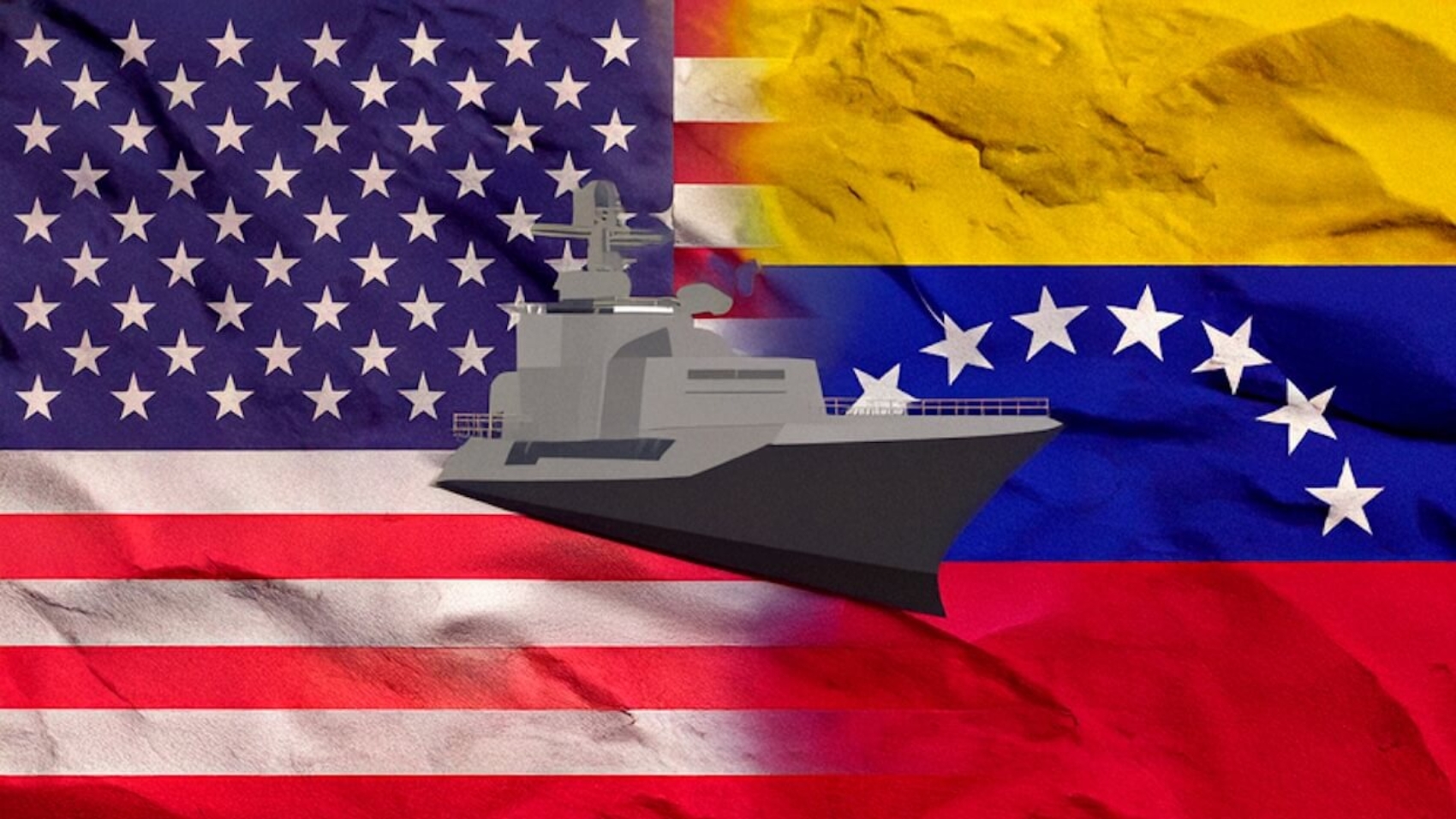
In this sharp geopolitical analysis, Dr. Imdat Oner examines the far-reaching implications of Operation Southern Spear, the Trump administration’s unprecedented shift from counternarcotics interdiction to direct military attrition across Latin America. Dr.Oner argues that the new strategy—marked by lethal maritime strikes, FTO designations, and carrier-led patrols—reflects far more than drug policy. It fuses domestic political messaging, America First security rhetoric, and a renewed push to reclaim hemispheric dominance amid Chinese and Russian encroachment. As Washington mobilizes a coalition of regional partners and intensifies pressure on Venezuela, Dr. Oner warns that this emerging “neo-Monroe Doctrine” could redefine US–Latin America relations for years to come.
By Imdat Oner*
When Defense Secretary Pete Hegseth announced “Operation Southern Spear” earlier this month, the language was typically martial, but the implications were far more profound than the standard Pentagon briefing. Hegseth did not just promise more patrols; he declared a mission to “remove narco-terrorists from our hemisphere.”
If there was any doubt about what “remove” meant, the wreckage of smuggling vessels in the Caribbean and Eastern Pacific makes it clear. Since September, US forces have carried out more than 20 lethal strikes against suspected drug boats, killing over 80 people. This is no longer a law enforcement mission. It marks a shift in Washington’s approach to Latin America, one that combines domestic politics, great-power competition, and the reassertion of regional primacy into a single, forceful strategy.
The most significant change in Operation Southern Spear is the move from interdiction to outright attrition. For decades, the US approach relied on Coast Guard vessels chasing fast boats, arresting crews, and bringing cases to federal court. Now, US forces are authorized to neutralize targets on the spot.
The administration insists these groups can no longer be treated as ordinary criminal networks. By designating them as “Foreign Terrorist Organizations” (FTOs), Washington has reclassified them as armed adversaries. What was once a judicial process has now been militarized. Smugglers are no longer suspects entitled to due‑process rights; they are cast as enemy combatants, comparable to Middle Eastern terror groups, and subject to the laws of war.
The consequences are already visible. The deployment of carrier strike groups, including the USS Gerald R. Ford, to the Caribbean signals a new operational posture. These assets bring the surveillance reach and strike precision of a full military campaign, enabling US forces to detect and destroy targets in real time. Some allies, notably the UK, have pulled back intelligence cooperation over legal concerns. Yet Washington presses forward, wagering that the American public cares more about stopping fentanyl and cocaine than parsing the fine points of international law.
Low-Cost Abroad, High Reward at Home
The expansion of US activity in Latin America is not just about drug interdiction, it is about domestic politics. For the Trump administration, counternarcotics operations deliver a message that resonates deeply with the MAGA base: toughness on crime, border security, and sovereignty. Unlike distant wars in the Middle East, which drained resources and eroded public support, operations in the Caribbean and Pacific are geographically closer, politically safer, and far less expensive.
Latin America provides a theater where Washington can project military strength without massive deployments, nation-building, or trillion-dollar costs like those seen in Iraq and Afghanistan. Strikes against drug boats are framed as defending American communities from narcotics and illegal flows, tying directly into the administration’s America First agenda. For Trump’s supporters, this is not abstract geopolitics, it is a fight that connects directly to domestic concerns about drugs, immigration, and security.
Counternarcotics is therefore more than a foreign policy initiative. It is a domestic political tool, a way to demonstrate action on issues that matter most to the MAGA base while avoiding the political toxicity of “forever wars.” By shifting the line of defense from the border wall to the open seas, the administration has turned Latin America into the frontline of its domestic security narrative: low cost, high reward, and central to sustaining its political appeal.
But this approach is not cost‑free. Precision strikes and carrier deployments may be cheaper than ground wars, yet they still require billions in defense spending, expanded surveillance, and long‑term naval commitments. Legal challenges, strained alliances, and the risk of civilian casualties already sparked discussions at home. What looks like a low‑cost, high‑reward strategy abroad may prove politically and financially demanding at home.
The Neo-Monroe Doctrine in the Hemisphere
Operation Southern Spear should not be understood narrowly as a counternarcotics initiative or a maneuver in domestic politics. It represents Washington’s delayed response to a strategic vacuum in Latin America that persisted for two decades, a vacuum that China and Russia systematically exploited.
Between 2000 and 2020, Beijing and Moscow pursued complementary strategies that reshaped the geopolitics of the hemisphere. China adopted an economic statecraft approach, expanding trade with the region from $12 billion in 2000 to more than $315 billion by 2020. Through the Belt and Road Initiative, Beijing extended over $130 billion in state-backed loans, securing long-term stakes in critical infrastructure such as ports, energy grids, and mining concessions from Ecuador to Brazil. This economic entrenchment was not merely commercial; it was designed to translate into political leverage and strategic dependency.
Russia, by contrast, sought to erode US security primacy directly. Leveraging the “Pink Tide” of leftist governments, Moscow became the leading arms supplier in the region, providing Venezuela alone with more than $20 billion in advanced systems including Su‑30 fighter aircraft and S‑300 missile defenses. Russian Tu‑160 nuclear-capable bombers flying sorties over the Caribbean in 2008, 2013, and 2018 underscored Moscow’s intent to contest US dominance in its own near abroad.
For US policymakers, these developments constituted not a marginal nuisance but a sustained strategic encirclement. Operation Southern Spear must therefore be read as an effort to reassert hemispheric control. The recent designation of Venezuela’s Cartel de los Soles, a network allegedly embedded within the Venezuelan military, as a Foreign Terrorist Organization is central to this recalibration. By reframing Venezuela from a diplomatic irritant into a national security threat, Washington lowers the threshold for coercive measures and broadens the toolkit available.
This designation opens the door to cyber operations, tougher financial sanctions, and possible military strikes. It marks a clear doctrinal shift: Washington now views Latin America as a strategic theater, not a peripheral concern. The United States is moving to reassert dominance in its own hemisphere, even if that means greater confrontation with China and Russia.
A New Neighborhood Watch
Operation Southern Spear comes at a moment when regional politics are shifting in Washington’s favor. Argentina is aligning more closely with US security frameworks. Ecuador is recalibrating in similar fashion. Bolivia is engaging more constructively with US initiatives. Several Caribbean states are also moving toward Washington. Together, these shifts give the United States the foundation for a coalition designed to isolate Venezuela.
Argentina under Javier Milei has embraced a pro‑Washington agenda. It has signed trade and investment frameworks that bind its economy to US markets while distancing itself from Beijing and Moscow.
Ecuador has recalibrated in similar fashion. It is reducing reliance on Chinese loans and deepening cooperation on counternarcotics and security.
Bolivia, once a stalwart of the “Pink Tide,” now engages more constructively with US initiatives. This shift signals the erosion of the leftist bloc.
The Caribbean adds strategic depth. Guyana, buoyed by its oil boom, has welcomed US energy firms and defense cooperation, positioning itself as a bulwark against Venezuelan claims. Trinidad and Tobago, a regional energy hub, has expanded counterterrorism and maritime security ties, anchoring Washington’s presence in the southern Caribbean.
Together, these moves give Washington real support. They build a coalition that isolates Venezuela both diplomatically and militarily. Operation Southern Spear is not a unilateral show of force. It is the core of a broader strategy of punitive containment, treating the Caribbean and northern South America as one theater of operations.
Yet, it’s also important to note that this is not an Iraq‑style invasion. President Trump has little interest in a ground war that could bog down his administration. The strategy instead points to a blockade enforced by precision strikes, supported by regional partners that give US action legitimacy.
Operation Southern Spear is more than a tactical campaign. It signals a new phase in which US influence must be defended with force, rival powers contained, and the region’s trajectory actively shaped. The question is not whether Washington will stay engaged in Latin America, but how far it will go to redefine the balance of power. Judging by the smoke rising over the Caribbean, the Trump administration’s answer is clear: as far as necessary.
(*) Dr. Imdat ONER is a Senior Policy Analyst at the Jack D. Gordon Institute for Public Policy at Florida International University (FIU). He holds a Ph.D. from FIU, where he completed a dissertation titled “Great Power Competition in Latin America Through Strategic Narrative.” Prior to joining FIU, he served as a Turkish diplomat, most recently at the Turkish Embassy in Caracas, Venezuela, where he was the Deputy Head of Mission and Political Officer. His expertise lies in International Relations, with a primary focus on Latin American politics. Dr. Oner has published extensively on Venezuelan politics and Turkish foreign policy, with articles appearing in War on the Rocks, The National Interest, Americas Quarterly, Foreign Affairs Latinoamérica, and the Miami Herald. He is also a frequent contributor to Global Americans. His analyses have been featured in international media outlets, including Bloomberg, Al Jazeera, Miami Herald, and Agencia EFE.
In this compelling VoY essay, Emmanouela Papapavlou confronts the uncomfortable truth behind society’s yearly cycle of remembrance on November 25th. Drawing attention to the gap between public displays of solidarity and the everyday normalization of gender-based violence, Papapavlou argues that symbolic outrage too often gives way to collective amnesia. She highlights how cultural attitudes, institutional responses, and pervasive biases continue to silence women long after the awareness campaigns fade. This powerful reflection challenges readers to rethink what it truly means to remember—and what it would take to break the cycle of forgetting that enables violence to persist.
By Emmanouela Papapavlou*
Every year, on November 25th, the International Day for the Elimination of Violence Against Women, we collectively remember. Or at least, we pretend to. We speak about statistics, about bruises that never made it to the news, about women whose names became hashtags only after their lives were taken from them. We speak about abuse as if it were an unexpected tragedy instead of a structural reality. And, on this day, we suddenly remember surveys and studies that have been sitting on desks and websites for months. They resurface not because something changed, but because today, the world feels obligated to look at them.
One of these reports, brought back into the spotlight once again, reminds us that one in three women over the age of fifteen has been subjected to domestic or sexual violence. A number repeated so often that it risks becoming meaningless, yet behind every “one” is a life permanently split into “before” and “after.” Tomorrow, not metaphorically, literally tomorrow, this report will be forgotten. We know this cycle. We’ve lived this cycle.We will slide right back into the comforting loop of what we call “normality.” And that is the most devastating truth: the empathy of today, no matter how intense, rarely survives beyond these twenty-four hours. We talk, we post, we condemn. We temporarily allow ourselves to feel. But the next morning the world resets. Outrage fades. Commitment dissolves. And we return to a daily life that quietly, steadily, and consistently tolerates violence against women as a background condition of society.
Politicians will step forward to insist that “progress has been made.” They will talk about panic buttons, shelters, hotlines, protocols, committees, and agencies. They will list every tool created over the past decades, as if the presence of infrastructure were equivalent to the presence of justice. But women know better. You know it. I know it. Every woman who has ever hesitated before speaking knows it. Reality does not change just because systems exist on paper. Reality does not change because a country has a handful of shelters while countless women remain too afraid to simply pick up the phone.
Because violence doesn’t hide in the absence of services. Violence hides in the culture that shapes how those services respond. Violence hides in the judgments whispered behind closed doors. Violence hides in the tone of the questions asked by police, by courts, by the media. Violence hides in our normality.
A normality that allows political representatives to make sexist, demeaning remarks publicly and return to their roles a few months later without consequence.
A normality that allows television panels to sneer at, interrupt, belittle, or humiliate women while the audience laughs or scrolls on. A normality that allows courtrooms to ask, “What were you wearing?” or “Why didn’t you leave sooner?” instead of asking the only question that matters: “What was done to you?” A normality that allows lawyers, people responsible for upholding justice, to be perpetrators of intimate partner violence while society digs for ways to blame the woman. A normality where a terrified woman can call for help and hear the phrase: “A police car is not a taxi.” A normality that teaches women every day, in every small way, that they must endure, justify, or hide what has happened to them.
And so, many women choose silence, not because they lack strength, but because they know exactly what comes next if they dare to speak. They know they will be interrogated, doubted, scrutinized. They know their character, their clothing, their tone, their past relationships, their mental health, their messages, their behavior, everything except the behavior of the perpetrator, will be put on trial. They know he will be offered excuses: stress, alcohol, jealousy, passion, misunderstanding. And they will be offered judgment.
We keep talking about panic buttons as if technology can solve what culture refuses to confront. But violence does not end because a button exists. Violence ends when a society refuses to tolerate the conditions that make that button necessary in the first place. And the truth is uncomfortable: We tolerate these conditions. We normalize them. We teach them, sometimes without noticing.
Every November 25th, we post, we share, we mourn, we “raise awareness.” And then, quietly, predictably, we forget. Reports will continue to be published. More women will become statistics before they become stories. More anniversaries will arrive to remind us of what we collectively failed to address.
The real question, the painful question, is not whether violence will continue. It is whether we will continue to look away. Whether we will continue to allow tomorrow to erase today’s conscience. Whether we will continue to slip back into a normality built on silence, excuses, and selective memory. So the question remains: Will we continue to forget? Or will we finally demand a world where remembering is not limited to a single day?
(*)Emmanouela Papapavlou is a high school student from Thessaloniki, Greece, deeply passionate about social and political issues. She has actively participated in Model United Nations and other youth forums, serving as a chairperson in multiple conferences and winning awards in Greek debate competitions. Writing is her greatest passion, and she loves using it to explore democracy, civic engagement, and human rights. Her dream is to share her ideas, inspire action, and amplify the voices of young people who want to make a difference. Email: emmanpapapavlou@gmail.com
In this ECPS Voices of Youth contribution, Kader Gueye examines how European populist movements are transforming genuine agrarian grievances into political capital. From Dutch nitrogen protests to French mobilizations against the EU–Mercosur deal, Gueye shows how populist actors amplify farmers’ discontent by framing it as a moral struggle between “ordinary people” and “distant elites.” While such narratives generate visibility and significant institutional leverage—as illustrated by the rise of the BBB in the Netherlands and the far right’s support for French blockades—they rarely address the structural drivers of rural hardship, such as volatile markets, supply-chain imbalances, and climate pressures. Gueye argues that without constructive long-term solutions, populist exploitation risks deepening divisions and leaving farmers’ core challenges unresolved.
By Kader Gueye*
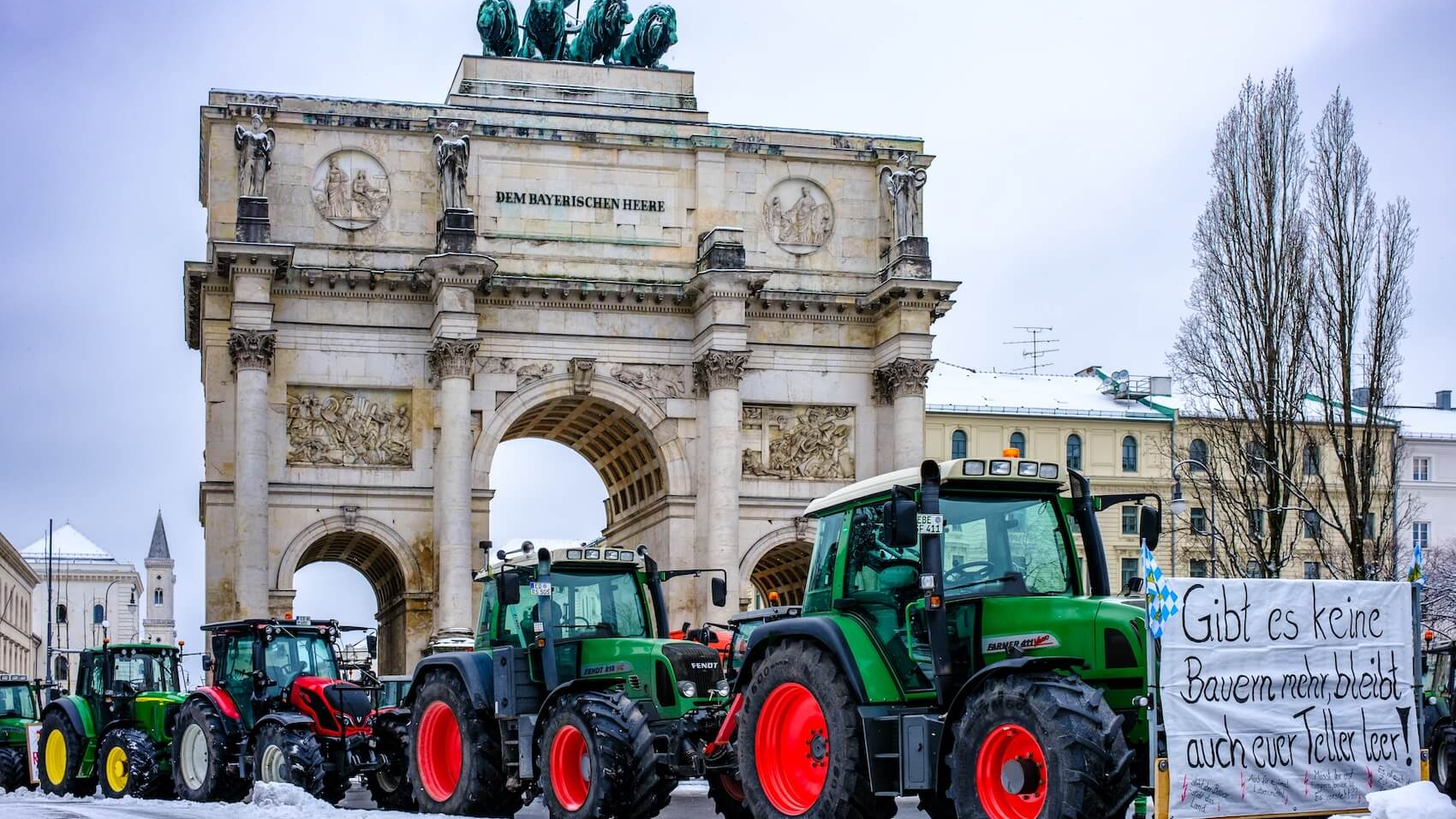
Across Europe, images of tractors lining highways have become quite familiar. Farmers block roads, dump manure at ministry gates and brandish placards about survival and “fair competition.” Falling incomes, volatile markets, and increasingly demanding environmental and trade rules have defined their grievances. The political environment that has grown around these protests is not solely about farm policy, but how populist actors have turned agrarian discontent into leverage without offering credible plans to solve the underlying crisis.
Political farmer mobilization has become politically decisive not simply because of their scale, but because populist parties and their allies translate and diffuse their genuine grievances into a simplistic narrative of “the people” versus “distant rule-makers,” and convert that narrative into institutional power. Notably, the Dutch Farmer-Citizen Movement (BoerBurgerBeweging — BBB) and the French debate over the EU-Mercosur trade deal illustrate this translation and provide an example onto why farmers’ structural problems are often left unresolved.
Populism and Agrarian Discontent
Political scientists usually describe populism as a “thin” ideology that divides society into two camps: a virtuous people and a corrupt elite, and that insists politics should express the general will of those people (Mudde, 2004). Because it is “thin,” populism needs a host ideology or a concrete issue to attach to. Agrarian discontent has become one of those issues in Europe.
Farmers are often portrayed as the most authentic part of “the people,” especially in countries with a strong rural identity. When farm incomes stagnate, or when new rules arrive from, say, Amsterdam or Paris in the name of environmental protection, it becomes easy to cast farmers as victims of remote decision-makers who may not truly understand life outside the cities.
However, real agrarian grievances are complicated. Farmers face pressure ranging from large supermarket chains, extremely volatile export markets and rising input costs, all while they are being asked to cut emissions, protect biodiversity and adapt to extreme weather linked to climate change (Henley & Jones, 2024). Populist actors rarely talk about all of these drivers at once. They select the parts that fit their story about out-of-touch elites and elevate those parts into a moral conflict. That is the “translation” this article will focus on.
Agrarian Populism in the Netherlands
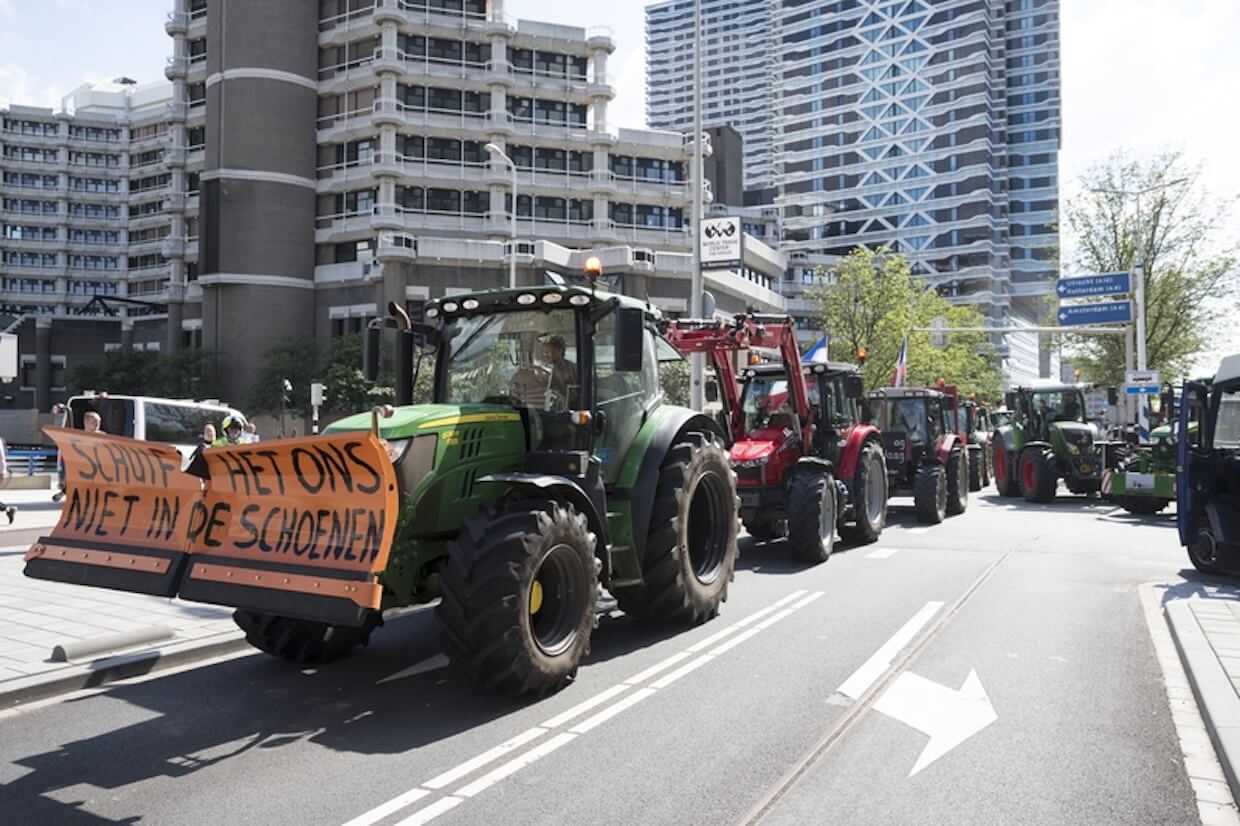
Dutch farmers protest against measures to reduce nitrogen emissions in the city centre of The Hague, the Netherlands, on June 28, 2022. Photo: Dreamstime.
The BoerBurgerBeweging (BBB) was founded in 2019 by journalist Caroline van der Plas and agrarian advocates. The party initially presented itself as a voice for farmers and rural citizens who felt left behind by the urban political elites. Its platform opposed compulsory farm buyouts and demanded a slower transition on nitrogen regulations, with an increased emphasis on technological solutions and voluntary change (Hendrix, 2023).
During the nitrogen protests, BBB politicians regularly appeared at demonstrations, amplified farmers’ slogans and insisted that ministers and unelected EU bureaucrats did not understand rural life. The core message of the BBB was that the government was threatening food producers, while protecting abstract environmental goals. That narrative connected easily with populist language about “ordinary citizens” versus “climate elites.”
The crucial step came during the 2023 provincial elections. BBB transformed the visibility of road blockades into electoral support and won more seats than any other party across all provinces. Because provincial councils elect the Dutch Senate, the party also became the largest group in the upper house (Reuters, 2023).
In that position, BBB gained significant bargaining power. With its newfound power, it could support, amend or stall national laws, including those related to nitrogen emissions. Analysts at the Clingendael Institute describe this as a shift from street protest to “institutionalized leverage” that changed how the entire party system talked about rural concerns (van der Plas & Candel, 2023).
Yet the deeper policy problem remains. Court rulings still require substantial reductions in nitrogen emissions in sensitive nature areas, and new permits for construction are constrained as long as the problem is not resolved (Candel, 2023). BBB has pushed for looser targets and slower timelines but has not presented a comprehensive plan that both satisfies legal obligations and gives farmers a clear long-term horizon.
In practice, this means farmers continue to face uncertainty about land values, future production levels and investment decisions. Populist framing has helped them obtain more political attention, but it has not delivered a stable settlement that combines environmental goals with rural livelihoods.
Tractor Blockades and ‘Fair Competition’ in France
In early 2024, French farmers blocked key highways, encircled Paris with tractor convoys and targeted wholesale markets. where they protested low farm incomes as well as complex regulations. Many of the farmers believed they had to follow much stricter environmental and animal welfare guidelines than did many of their international competitors who exported products into the same markets that the French farmers sold into. (Al Jazeera, 2024)
“Fair competition” was the repeating mantra of these protests. French Farmer’s Associations argued that due to strict environmental and animal welfare laws paired with trade agreements signed by the European Union to allow increased imports from countries with looser regulations, French farmers were at a severe competitive disadvantage.
The main driver of this argument was the European Union-Mercosur Trade Agreement, a proposed deal between the European Union and the Mercosur block composed of Argentina, Brazil, Paraguay and Uruguay. The agreement would lower tariffs and open markets for crucial goods like beef and various industrial products (European Parliament, 2023). French farmers speculated that the increase in imports of beef, poultry and sugar from South America would put pressure on European farmers to compete with unregulated foreign producers whom they viewed as operating under unfair conditions.
Here, far-right populist parties saw a chance to expand their rural base. Marine Le Pen, leader of the Rassemblement National (RN) party, openly expressed her support of the farmers’ blockades and argued that the protesters were evidence of how the EU’s “green bureaucrats” and “globalists” were harming the interests of French farmers and ultimately threatening the native French way of life (Harlan, 2024). Le Pen and the RN leadership described themselves as champions of the “Real France,” defending its people against technocratic elites in Brussels and disconnected elite groups in Paris, a theme that is often repeated by populists.
What Are the Consequences?
Across these two examples, the populist translation of farmer grievances into policy leverage had a number of consequences, the first of which was the simplification of the intricate causes of farmers’ issues. Global market dynamics, domestic policy decisions, corporate concentration, and environmental constraints all contribute to agrarian hardship. Populist narratives, however, focus more on the role of Brussels or environmental regulations and less on the domestic supply chain power or the climate crisis itself (Henley & Jones, 2024; van der Ploeg, 2020). This selective focus makes it easier to mobilize anger, but it restricts the range of solutions that are politically thinkable.
This phenomenon also makes long-term transition planning more challenging. For instance, populists in the Netherlands claimed that any attempt to establish legally binding emission reduction pathways was evidence that the elites were attempting to “shut down” family farms and any trade agreements are viewed as betrayals of the rural populace in France. These populist portrayals leave little room for negotiated packages that can combine stricter rules with strong support for innovation and major diversification (Hendrix, 2023; van der Plas & Candel, 2023).
The last, and perhaps most apparent effect of this framing is the deepening of social divisions. Here, farmers are pitted against urban consumers and environmental activists, despite the fact that both groups may be interested in a more resilient and sustainable food system. The differences among farmers themselves get blurred as well. Large and intensive operations and small farms have very different capacities and interests, yet populist discourse typically frames them as a monolith, a single, unified “people of the land.”
Towards More Constructive Leverage
Cows grazing on a green pasture in rural Brittany, France. Photo: Elena Elisseeva.
None of this implies that populist parties never raise legitimate concerns or that farmer protests are illegitimate. The demonstrations show genuine worry about rural futures as well as genuine dissatisfaction with the way trade and environmental policies have been presented and organized. The question is how to turn this mobilization into leverage that produces lasting solutions rather than recurring crises. In the current policy discussions, a few options stand out.
Combining comprehensive rural transition contracts with environmental targets is one strategy. For instance, policy analysts in the Netherlands have proposed packages that combine investments in non-agricultural rural jobs, incentives for nature-inclusive farming, and targeted buyouts. The aim being to give farmers a predictable route as opposed to a string of brief shocks (Candel, 2023).
Another approach is to address power imbalances in the food chain. More transparency in pricing, support for producer organizations, and stricter regulations on supermarket purchasing practices could put some pressure on big retailers and processors, who currently hold a significant portion of value added, rather than individual farms (Henley & Jones, 2024).
Lastly, democratic actors require narratives that link rural justice with biodiversity and climate goals. This entails acknowledging that rural areas have historically been neglected, valuing farmers’ knowledge, and incorporating them early in the policy-making process. It becomes more difficult for populists to claim that the countryside can only be protected through complete resistance when transitions are co-designed rather than imposed (European Center for Populism Studies, n.d.; Van der Ploeg, 2020).
As European societies struggle with issues like food security, climate targets, and shifting trade patterns, farmer protests are likely to continue. The key issue is not whether or not farmers voice their dissatisfaction, but rather who uses it as political leverage and for what purposes. Currently, populist actors are adept at turning rage into visibility and temporary power. When it comes to providing reliable, widely accepted roadmaps for the future of European agriculture, they are far less persuasive.
(*) Kader Gueye is an IBDP student at Upper Canada College in Toronto and an aspiring diplomat. He has contributed to briefing work in a federal office and organized student programming on global child protection and civic engagement. His current work examines how institutions stay resilient when politics are under strain.
Chile’s November 16, 2025 presidential vote has produced an unprecedented runoff between José Antonio Kast and Jeannette Jara, crystallizing what Assoc. Prof. Manuel Larrabure calls a historic ideological rupture. Speaking to ECPS, he warns that Chile’s shift must be understood within a broader continental realignment: “A new right-wing alliance is emerging in Latin America—and democracy will take a toll.” According to Larrabure, this bloc is not restoring old authoritarianism but “reinventing democracy—and it’s working.” Kast’s coalition embodies a regional “Bolsonaro–Milei playbook,” powered by what Larrabure terms “rule by chaos,” amplified by compulsory voting and disinformation ecosystems. Meanwhile, the Chilean left enters the run-off severely weakened—“the final nail in the coffin” of a long cycle of progressive contestation.
Chile’s first-round presidential election on November 16, 2025 has produced one of the most consequential political realignments in the country’s post-authoritarian history. For the first time since return to democracy, voters are confronted with a stark extreme-right–versus–Communist runoff between José Antonio Kast and Jeannette Jara—an outcome that crystallizes the profound fragmentation and ideological polarization reshaping Chilean politics. Against this backdrop, the European Center for Populism Studies (ECPS) spoke with Associate Professor Manuel Larrabure, a scholar of Latin American Studies at Bucknell University, whose research on Latin American political transformations offers a critical vantage point on Chile’s current trajectory. As he notes, the 2025 election marks not merely a national turning point, but a regional one: “A new right-wing alliance is emerging in Latin America—and democracy will take a toll.”
Dr. Larrabure situates Chile’s sharp bifurcation within a wider continental pattern of right-wing recomposition, one increasingly linked across Argentina, Ecuador, Bolivia, and beyond. This emergent bloc, he argues, is not driven by nostalgia for past authoritarianism but by a more adaptive and experimental form of illiberal governance. “They are not trying to destroy democracy,” he stresses. “They are trying to reinvent it—and it’s working.” Kast’s coalition, he suggests, fits squarely within this “Bolsonaro–Milei playbook,” but is tempered by Chile’s more conservative political culture. Still, the danger is clear: the right is forging a novel repertoire of power in an era defined by global monopolies, weakened party systems, and disoriented progressive forces.
One of Dr. Larrabure’s most striking insights concerns what he calls the right wing’s mastery of “rule by chaos.” Rather than relying solely on repression, the contemporary right activates social anxieties—around crime, immigration, and insecurity—to mobilize working-class discontent. This dynamic has been amplified, he argues, by Chile’s reintroduced system of compulsory voting, which “absolutely turned out working in favor of the right wing” during the failed constitutional plebiscite of 2022. Social media ecosystems have further strengthened the right’s influence by “creating an atmosphere of general misinformation and chaos, communicational chaos and informational chaos, in which they can operate with ease.”
By contrast, the Chilean left enters the 2025 runoff severely weakened. Dr. Larrabure describes the election as “the final nail in the coffin of a cycle of contestation” that began with the 2006 school protests, peaked in the 2011 student movement, and culminated in the aborted constitutional process of 2019–2022. Progressive forces, he contends, have struggled to translate grassroots innovation into institutional power, hampered in part by diminished capacities for popular education and an unresolved tension between participatory democratic ideals and party-led governance.
Looking ahead, Dr. Larrabure foresees intensified social conflict but also the latent possibility of democratic renewal. Chile’s constitutional debate, he argues, is effectively over; yet social movements will continue to respond. Ultimately, the question is whether they can forge a transformative project capable of “learning from the mistakes of the past” amid an increasingly securitized and polarized political landscape.
Here is the edited transcript of our interview with Associate ProfessorManuel Larrabure, slightly revised for clarity and flow.
Not Pinochet Reborn—but Something New
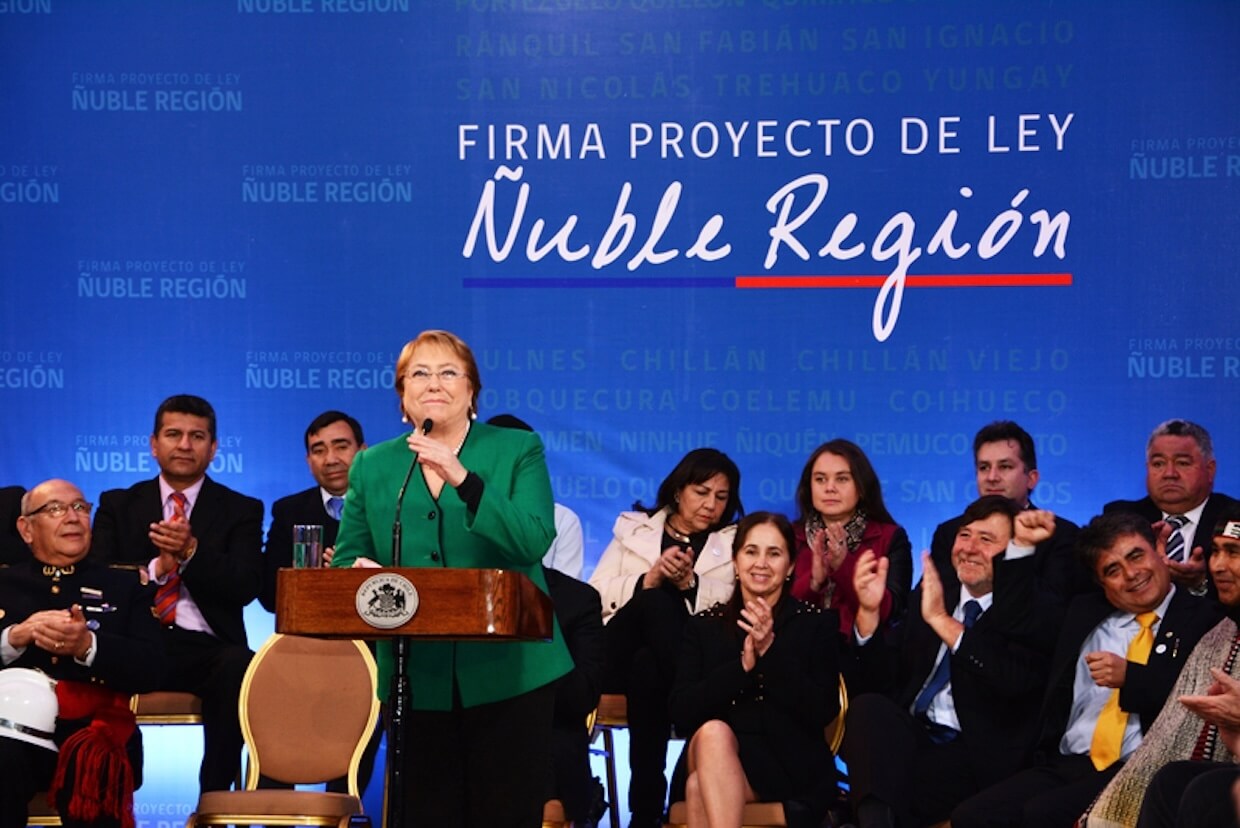
Chilean President Michelle Bachelet signs the bill creating the Ñuble Region on August 20, 2015. Photo: Marcelo Vildosola Garrigo.
Professor Manuel Larrabure, thank you very much for joining our interview series. Let me start right away with the first question: Chile’s first round of presidential elections on November 16, 2025, produced an extreme-right-versus-Communist runoff unprecedented since the transition to democracy. How do you interpret this sharp ideological bifurcation in light of your work on the fragmentation of both left and right coalitions in Latin America?
Assoc. Prof. Manuel Larrabure: This is a very interesting question, and indeed, there is a bifurcation—a gap—between the Communist Party candidate, Jeannette Jara, and the right-wing candidate. But we need to unpack some assumptions here, because we can easily fall into narratives that are not quite accurate. So let me start with the Communist Party first, and then I’ll talk about the right wing.
The Communist Party has a very long tradition in Chile. It is, in fact, the oldest Communist Party in the entire region. It is very well established, very well institutionalized, and it has long-standing practices. However, it has undergone various changes throughout decades.
If we focus on the changes it experienced beginning with the run-up to the transition to democracy in 1989 and afterward, the Communist Party began to take a much more center-left position. It developed either direct or indirect alliances with what became the center-left governing coalition at the time, the Concertación. You might recall it was led by Michelle Bachelet and Eduardo Frei—some of the key leaders of that coalition. The Communist Party largely supported that center-left coalition, which brought us the kind of neoliberalism that has grown in Chile since those decades.
From that perspective, it would be difficult to call the current Communist Party a far-left party. It really is more of a center-left party. Indeed, if you look at some of the social contestation cycles that began in 2006 with the so-called Penguin Revolution—a social movement of high school students who were called penguins because they wore black-and-white, or dark-blue-and-white, uniforms—these young students were demanding better access to the educational system.
That movement started a cycle of contestation that lasted a few years and then transformed into something we will probably talk about a little later. But many of those early youth movements had a strong critique of the Communist Party precisely for being too timid, lacking imagination, and lacking democratic accountability. In many ways, the progressive cycle that began during that period had a strong critique of the Communist Party for not standing up strongly enough for various social rights.
So that’s the Communist Party; we shouldn’t think of it as a far-left party. Far from it. It can be very timid, and in some cases, even quite conservative in certain respects.
On the other hand, we have Kast and this coalition of right-wing groups and parties. And here, we can also fall into a problematic narrative, because when we say ultra-right-wing or hard right-wing, very quickly that evokes things like fascism or neo-fascism. But the right wing in Chile is actually quite forward-thinking, and has been so for a very long time. By this, I don’t mean progressive in any way, but forward-thinking in the sense that it has been able to successfully adapt to changing conditions on the ground, particularly given that Chile is one of the countries that has inserted itself into global cycles of capitalism, perhaps more so than many others in the region. So it is forward-thinking in that sense. It is willing to adapt, and it is quite pragmatic. It is willing to adjust to changing conditions that it cannot itself fully control.
Yes, they have a strong right-wing agenda on a number of topics that I’m sure we’ll talk about, and indeed many of the people who participate in this right-wing coalition probably have some ideas about Pinochet—nostalgia about Pinochet. In some cases, they even make public remarks supportive of people in the Pinochet regime. But in reality, pragmatism is their horizon—obviously with a right-wing tint to it.
You might recall that although Pinochet himself was a brute, a simpleton brute, the reality—and maybe precisely because he was that—is that he looked elsewhere for ideas. And where did he look for ideas? At the vanguard of American economic thinking at the time, which of course became Milton Friedman. And, this became the neoliberal project, which at the time was very marginal. So within the Pinochet story, there is also a story of looking outside and looking for new ideas to support a right-wing project.
I think this is the light in which we should see this right-wing coalition, rather than seeing it as nostalgic for some kind of European fascism or even Pinochet himself. That nostalgia is there, but it is counterposed with a strong sense of pragmatism.
The Rise of ‘Rule by Chaos’ in Chilean Politics
With José Antonio Kast receiving unified backing from libertarian, conservative, and ultra-right actors, do you see a consolidation of a “new right” coalition akin to the regional patterns you and Levy describe in the “Pink Tides, Right Turns” special issue?
Assoc. Prof. Manuel Larrabure: Yes, it is a consolidation of the right wing. The right wing will undoubtedly win the upcoming elections in December. The outcomes of the current elections were disastrous for the left, even though it maintained some control over the Chamber of Deputies and the Senate. However, it’s truly a defeat for the left. If you think about the percentage of the vote that Jara received—approximately 24–25%, I think it was—and compare it to the number of people who voted to approve that progressive constitutional reform project, that was 38%. Only about 24% support Jara, and that’s a big decrease in that respect. It’s undoubted that this is a very difficult situation for the left, and that the right wing will be able to consolidate.
What is it consolidating? That’s the interesting question, and there are many concepts one can use to describe this new right wing. In fact, the very existence of so many of these different concepts—neoliberal authoritarianism, for example—shows that something is changing and has been changing for a long time. To throw yet another concept into the mix, one that I discuss in some of my work, there is the notion of an anti-bureaucratic authoritarian state. Many others could also be valid in terms of the discussions and debates.
But the key novelty in this right-wing coalition—and we’ve seen this with the case of Bolsonaro and Milei—is that it introduces, more than in other situations, the concept of rule by chaos. In the past, the right wing has been accustomed to ruling by pacifying subordinate classes and subordinate groups and repressing them. That will still happen under this new right wing, but it will now have a new dose of attempting to introduce chaos into the mix. That means actually activating the popular classes, activating subordinate sectors, manipulating them, and having them engage with politics, which is something different from what we have seen in the past.
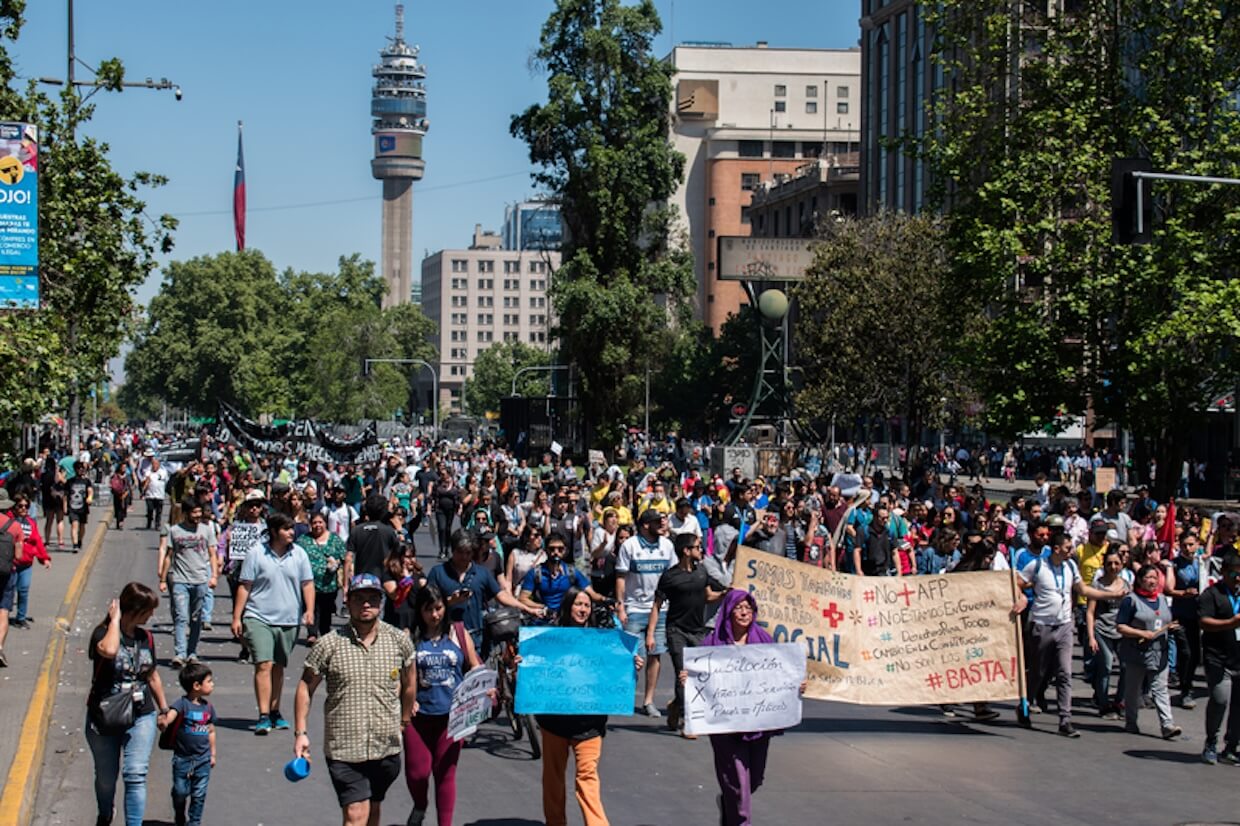
Civil protest for a dignified life in Plaza Italia, as the government deploys military force to repress demonstrations in Santiago de Chile, October 23, 2019. Photo: Dreamstime.
How Mandatory Voting Backfired on Chile’s Left
How do compulsory voting rules—reintroduced in Chile—reshape the dynamics of right-wing populist mobilization, particularly among disaffected working-class male voters in the mining regions?
Assoc. Prof. Manuel Larrabure: Compulsory voting was introduced in 2022 for the final constitutional plebiscite. It turned out to be a big mistake. It surprised everybody, and most people attribute many of the reasons why the constitutional process was not successful to this compulsory voting. An interesting backstory here is that it’s hard to know who introduced it exactly. Some people will say it was actually Boric himself who introduced it, thinking they were in a strong position at the time and that introducing it would lead to a resounding success in the 2022 plebiscite. Others, depending on who you talk to, will tell you it was introduced by someone in the right wing as part of a negotiation with Boric, and that Boric went ahead with it naively, thinking it would work.
It absolutely turned out to work in favor of the right wing, because it forced people to vote on a document that had very little connection to the constitution process itself, about which they knew very little, and from which they were already quite alienated. Their instinct was to vote against it rather than in favor. And that dynamic will continue. Compulsory voting in the context of social media, and in the context of manipulation campaigns of all kinds, actually benefits the right wing in this case.
Crime, Migration, and the Limits of Progressive Narratives
Crime and immigration have eclipsed social rights and constitutional reform as the dominant electoral issues. What does this shift tell us about the vulnerabilities of post-neoliberal political projects in the face of moral panics and securitized narratives?
Assoc. Prof. Manuel Larrabure: It tells us about some of the challenges that progressive movements have had with these issues. If there’s a moral panic about immigration, the best the left has been able to do is cry xenophobia—which, of course, is right. But this kind of moralistic approach is not enough. There are other dimensions that need to be discussed and addressed by the left: psychological dimensions, emotional dimensions, and it’s not as easy as simply saying it’s just wrong. There has to be some other kind of response to that.
On the issue of crime, similarly, the typical answer to rising crime from the left has been to provide jobs, provide economic stability, provide support for citizens, and this will reduce crime. But in practice, this hasn’t necessarily panned out as one might expect. I looked at the case of Venezuela for a while—I still do—and at the height of some of the progressive tendencies in the Chavista project, you had the coincidence of lowering unemployment but higher crime. So you can have higher crime and lower unemployment at the same time, suggesting that there are other things going on beyond these simplistic narratives that the left sometimes uses. Not that that’s wrong—I strongly believe that if you provide a strong, supportive system that allows people to engage in work rather than criminal activity, that’s going to help. But, there are other things going on that the left must think about.
Why Kast’s Securitarian Agenda Isn’t a Return to Pinochet
Kast’s proposals—border walls, mass expulsions, militarization of public security—mirror global far-right repertoires. Do you interpret these as a populist securitarianism, or as an authoritarian neoliberalism in line with Pinochet-era legacies?
Assoc. Prof. Manuel Larrabure: Yes, there are legacies to Pinochet—undoubtedly, and we should be aware of them. But I think we would be mistaken to assume that the right wing is fundamentally nostalgic. Much of the new security-securitization proposals and projects they are advancing also contain an element of creating a new social terrain of chaos—injecting agitation into the population. Many of the things they propose will never actually be implemented, but simply articulating them, simply placing them in the public debate, generates an atmosphere of unrest. And that is precisely the atmosphere in which the right wing thrives.
What label to use—you can choose among several. But it is not a return to a classic authoritarian pattern. It is something different, and it’s important to understand the new terrain they are constructing. That terrain centers on how to concentrate power—how to exercise power—in a context of limited market competition at this particular moment in global capitalism, marked by the rise of extremely powerful monopolies at both global and national levels. They are trying to work out how to wield power under these conditions, and that is a novel context they are adapting to. They are shaping the conditions in which they can then operate with ease. That, I think, is their project.
Checks and Balances vs. Getting Mugged
How does Kast’s explicit admiration for Bukele’s carceral model fit into regional trends you have tracked regarding punitive or penal populism and the erosion of democratic checks and balances?
Assoc. Prof. Manuel Larrabure: At the popular level—and this is something I want to emphasize—the right wing is deeply attuned to everyday sentiments in a way the left simply isn’t. The right understands how people in poor and working-class communities are thinking. If you’re a working-class Chilean, or you have a precarious job, or you’re a low-income person, you’re already struggling to make a living, and you’re heavily indebted. That high level of indebtedness was actually introduced by the center-left, not the right; it was a center-left invention that expanded across broad sectors of the population.
So you’re in debt, you’re struggling to find stable work, your job is precarious, and on top of that, you’re getting mugged regularly in your own community. And what you hear from the center-left is: “we need democracy, checks and balances, human rights.” People think: “What good are checks and balances if I’m getting mugged? They feel, “I can do without all that if it means I’ll be safer.” The right wing is tapping directly into those feelings. Many people feel that under the center-left they didn’t gain much—and they’re still getting mugged. At least the right promises them they won’t.
There is a strong push by the right to activate and amplify those emotions. That’s the dynamic at play. Whether they will build prisons of the kind Bukele is constructing, I doubt it—but it’s possible. What matters far more is the growing resonance between right-wing discourse and popular sectors. That connection is very strong right now.
Democratic Backsliding Without Dictatorship: Chile’s New Risk
Poster of Augusto Pinochet on display at the La Moneda Cultural Center beneath Citizenry Square in Santiago, Chile. Photo: Dreamstime.
Given Kast’s Pinochetist lineage and the rehabilitation of authoritarian nostalgia among sections of the electorate, how serious is the risk of democratic backsliding if he wins the presidency?
Assoc. Prof. Manuel Larrabure: The issue of nostalgia—the right wing has elements of it, but it is actually far more forward-looking. It is the left that primarily lives in the space of nostalgia. As for democratic backsliding, I very much doubt that this will produce a classic authoritarian scenario. It is more likely to generate something novel—different—something that carries some of the flavors of past authoritarianism but operates on entirely different registers. And there are reasons for this. Chilean capital is among the most internationally and globally integrated in the region, and as a result, it has had to remain forward-looking. We need to understand the right wing in this light. The left is far more nostalgic—and unfortunately, that is a problem we still have not resolved.
After the Constitutional Defeat, the Left Has No Path to Hegemony
Jeannette Jara’s campaign reactivates a Communist Party tradition within Chilean democracy. From your research on grassroots movements and the limits of institutional leftism, do you see her as capable of reconstituting progressive hegemony—or is the left structurally weakened after the failed constitutional process?
Assoc. Prof. Manuel Larrabure: Unfortunately, there is no chance of her being able to reconstruct any kind of progressive hegemony. In fact, I see this election as the final nail—there have already been a few “final nails,” but this one truly feels definitive—in the coffin of a cycle of contestation that began in 2006. It continued in 2011 with the university student movements, out of which Gabriel Boric emerged, and eventually transformed into the creation of the Frente Amplio, a new coalition that for a brief period became a kind of hegemonic force. They then led a constitutional reform process that ultimately failed, for a number of interesting reasons we could discuss.
But the point is the opposite of what the question suggests: this moment does not mark the reconstitution of progressive hegemony—it marks the end of a long cycle that started many years ago. And if the best that progressive movements can offer at this point is a very mild center-left alternative to the right wing, then we are in serious trouble.
Why Chile’s Movements Struggle to Become Institutions
How does the collapse of the 2019–2022 constitutional movement resonate with your earlier work on the Chilean student movement (2011), particularly regarding the translation of contentious politics into institutional transformation?
Assoc. Prof. Manuel Larrabure: This is one of the great dilemmas of progressive movements: how to take the combative spirit and the innovations that emerge from social movements on the ground and translate them into effective political institutions capable of contesting government and leading change. This was the case in Chile during the student movement, and later as well. How to make that translation remains an open question. It has been a very difficult challenge in many contexts, and Chile is no exception. It points to the need to reimagine democracy in some way, and I think this is precisely where these movements struggle.
The right wing is very comfortable with the way it operates, with very strict hierarchies. Progressive movements are not. They try to reinvent how to engage with each other in democratic ways, but this is often messy, and many mistakes are made along the way. The Chilean student movements certainly experimented with different kinds of democracy. There were some really interesting experiences with public neighborhood meetings in the run-up to the 2019 movement—people coming together in public parks to discuss politics and engage in new democratic practices.
But moving from those experiments to establishing similar logics within larger parties is very difficult. It has proven extremely challenging. This is where the left needs to focus specifically. And there is some good news in the failure of this long cycle of contestation: it allows us to see more clearly than before that we need to focus on understanding the relationship between leaders and followers. Progressive movements have a strong discomfort with these questions. We like to imagine that everyone can be a leader, and sometimes that is simply not possible. Who should lead? What makes a good leader—and just as importantly, what makes a good follower—are questions we need to discuss more openly in the context of translating social movements into political institutions.
Chile’s Election Marks the End of the Pink Tide Illusion
In your view, does this election signify the exhaustion of the second-generation Pink Tide, or merely a recalibration within a longer regional cycle punctuated by commodity dependence, political volatility, and institutional fragility?
Assoc. Prof. Manuel Larrabure: It is true that there has been a kind of renaissance of different left political projects in the region that have come to power—Colombia for a moment, and also Peru. Many people began to see these developments as a sort of second coming of the Pink Tide. But we need to be careful with this. There have been some interesting experiments within some of these governments, but the context in which they emerged is completely different from that of the original Pink Tide, which began back in the late 1990s.
The circumstances now are entirely different: we are looking at economic volatility, economic crisis, and a highly fragmented left. This is simply not a context that allows any kind of strong, progressive wave—a Pink Tide 2.0—to sustain itself for very long. So that’s the first point. I really don’t see this second Pink Tide as being anywhere near as substantial as the first one. In that sense, what is happening in Chile right now feels like yet another final nail in the coffin of the idea that a second Pink Tide is emerging. We should not think of it as analogous to the first one.
Disinformation as a Tool of Chile’s New Right
Illustration: Shutterstock / Skorzewiak.
How do you assess the role of corporate media and disinformation ecosystems—topics raised in the Pink Tide literature—in shaping anti-progressive sentiment and facilitating the rightward shift in Chilean public opinion?
Assoc. Prof. Manuel Larrabure: Social media has been a very fertile terrain for the right wing, which has moved into that terrain very quickly and very enthusiastically. It has hired an army of trolls to influence public opinion, and they are very effective at it. They have done a really impressive job of targeting some of the weaknesses of left or progressive discourses and planting doubt in large swaths of the population about what it means to support the rights of citizens. Basic things are coming into question for the very first time precisely because of how effective they have been in the realm of social media.
In particular, they have been good at creating a narrative—the narrative of fascist versus communist—which really works in their favor. People on the left are too defensive about this topic, and people can see it. And when people see that kind of defensiveness, they sense that something is wrong. The right wing has been very effective at pushing those triggers within progressive sectors that reveal to the broader population that they are not fully comfortable with some of the things they are saying.
And this has been the job of the right wing: to seed doubt, to plant doubt, to create an atmosphere of general misinformation and chaos—communicational chaos and informational chaos—in which they can then operate with much ease.
Why Chile’s Left Can’t Bridge Streets and Institutions
Considering your argument that participatory and prefigurative movements often produce tensions with state-centric left governments, does the recent election reflect unresolved contradictions between movement-based radicalism and party-led governance?
Assoc. Prof. Manuel Larrabure: No doubt—and it clearly reflects deep contradictions. It’s striking to think about the movements born in 2006 and 2011, out of which emerged the demand for constitutional reform, and how difficult it was to translate that demand into practice—to convince large parts of the Chilean population that changing the Constitution was necessary. This is why it was such a shock that only about 38% of people voted in favor of the new draft.
This outcome reflects many of the tensions between formal politics and street politics, or extra-parliamentary politics. It is very difficult to bridge these spheres, and we haven’t really built the kinds of organizations capable of making that translation possible. This remains an ongoing task for progressive movements.
In particular, the process exposed lost capacities in the realm of popular education. It is one thing to demand or imagine a very different constitution—as was the case in Chile. Social movements carry what they call “horizons of change”: visions of an alternative society they hope to realize. Sometimes these horizons are explicit, sometimes implicit, but they are always there.
The challenge arises when these horizons of change drift too far from the movements’ capacity to engage in popular education and materially advance those visions. That gap inevitably creates problems. And from my perspective, the real motor of this entire process is the question: can progressive movements carry out effective popular education? This is especially difficult today, when people are tied to their phones and immersed in social media debates rather than substantive collective discussions in other forums.
So the major challenge for progressive movements now is how to engage in popular education in a way that narrows thisgap. In Chile, the gap grew so wide by 2022 that people simply stopped believing in the project of constitutional change.
A New Right-Wing Axis—and Its Democratic Costs
Kast’s openly pro-Trump positioning aligns Chile with an emergent right-wing axis in Argentina, Ecuador, Bolivia, and potentially Colombia and Peru. How does this recomposition of hemispheric alliances affect prospects for democratic deepening and autonomous development in the region?
Assoc. Prof. Manuel Larrabure: This is definitely a new right-wing alliance—a regional alliance—that is emerging. Democracy will take a toll, without a doubt. What they are trying to do is not destroy democracy; they are trying to reinvent it—something the left should be doing but has struggled to do. And they are succeeding. They are actively reinventing democracy, and it’s working.
Of course, there are elements that recall past authoritarianism; those elements are there. But, as I mentioned earlier, there are also strong elements of novelty. This is a Bolsonaro–Milei political playbook, though not as intense in Chile. Chile has a much more conservative, even stoic political culture compared to those countries. So you won’t see the more outlandish shenanigans of figures like Milei or Bolsonaro, but you will see a small taste of that in Chile—perhaps for the first time.
Indeed, they are consolidating into what I think is an experiment in how to exercise power in a context marked by very strong global monopolies, limited market competition, and a totally fragmented left. For that, you don’t need a dictatorship. You need something different—and that is what they are trying to figure out. It’s not good, but it’s also not a return to the Pinochet era.
Democratic Resilience Beneath the Surface
Chilean presidential runoff at Instituto Presidente Errázuriz in Santiago. Voters cast ballots in the December 19, 2021 election between José Antonio Kast and Gabriel Boric. Photo: Dreamstime.
And finally, Professor Larrabure, what scenarios do you foresee for Chile’s medium-term political trajectory—particularly regarding (a) democratic resilience, (b) the future of the constitutional question, and (c) the ability of social movements to intervene in an increasingly securitized, polarized political field?
Assoc. Prof. Manuel Larrabure: The constitutional question is over. I don’t think that’s on the table anymore. The question of social movements intervening in the political terrain—yes, they’ll intervene. There’s no doubt there will be responses from social movements throughout this period of the new right that’s emerging in the country. That’s been the case in Latin America for a very long time; movements do respond to these kinds of attacks. The question is, how are they going to respond exactly? What new repertoires are they going to use? Are they going to learn some of the lessons of the previous cycle of contestation, or are they simply going to repeat what they did? And I think this is a very important question.
Is this going to lead to challenges to democracy as we know it? Yes, it will. But Latin America has a strong record of democratic resilience; democratic movements are always there, just beneath the surface. And I don’t doubt for a second that they will respond. I hope that through that process—and no doubt a new wave of contestation will begin at some point—they can articulate progressive politics, a political transformation, a social transformation that is more effective and able to learn from the mistakes of the past.
In his interview with ECPS, Professor Richard Youngs (Carnegie Europe; University of Warwick) offers a sharp assessment of today’s democratic crisis. Highlighting a “qualitative shift” in autocratization, he points to two transformative forces: digital technologies and a rapidly changing international order. As he observes, “we are in an interregnum between the liberal global order and whatever comes next.” Professor Youngs warns that democratic erosion is driven not only by structural pressures but by the “incremental tactics” of illiberal leaders who steadily undermine checks and balances—often learning directly from one another. Looking ahead, he argues that mere institutional survival is insufficient: democracies must pursue renewal and resilience, noting that “it is much easier to undo democracy than to reassemble good-quality democratic norms.”
In a wide-ranging and analytically rich interview with the European Center for Populism Studies (ECPS), Professor Richard Youngs—Senior Fellow in the Democracy, Conflict, and Governance Program at Carnegie Europe and Professor of International Relations at the University of Warwick—offers a compelling diagnosis of the global democratic landscape at a moment of profound uncertainty. Reflecting on accelerating autocratization, shifts in global power, EU democratic dilemmas, and the prospects for democratic renewal, Professor Youngs provides both conceptual clarity and sobering realism. As he puts it, “we are in an interregnum between the liberal global order and whatever comes next”—a liminal period in which the rules, norms, and institutional anchors of the past three decades no longer hold firm, even as no coherent alternative has yet emerged.
Professor Youngs identifies two forces that make the current wave of democratic regression qualitatively distinct from earlier cycles: the disruptive role of digital technologies and far-reaching structural changes in the international order. Both realms, he argues, remain fluid, capable of generating either deeper democratic decay or future sources of resilience. Although digital platforms currently “carry very negative implications for democracy,” ProfessorYoungs reminds us that past expectations of their democratizing potential need not be abandoned entirely if regulation becomes more effective. Similarly, while rising non-democratic powers are reshaping global geopolitics, there remains “many democratic powers that might coordinate more effectively in the future” to safeguard liberal norms within a reconfigured global system.
This transitional moment is further complicated by the rise of radical-right populism, the diffusion of illiberal tactics across borders, and democratic backsliding in core Western states. Professor Youngs emphasizes that the potency of contemporary autocratization stems not from structural shifts alone but from the “very skillful way in which many leaders have deployed incremental tactics to undermine democratic equality.” Autocrats, he notes, actively learn from one another—sometimes “copying and pasting” repressive legal templates—creating a transnational ecosystem of illiberal innovation.
The interview also probes dilemmas within the European Union, from the risks of technocratic overreach in “defensive democracy” measures to the strategic tensions posed by engaging or isolating radical-right parties. Professor Youngs is clear-eyed about the difficulty of balancing pluralism with the defense of liberal norms, describing the EU’s predicament as a “catch-22.”
Looking ahead, Professor Youngs argues that scholarship and policy must shift from diagnosing democratic decline to theorizing and cultivating democratic resilience. Yet this resilience must go beyond “pure survival” and involve deeper processes of reform, renewal, and societal empowerment. As he cautions, “it is much easier to undo democracy than to reassemble good-quality democratic norms,” and the work of rebuilding will require sustained, coordinated effort at both national and international levels.
Here is the edited transcript of our interview with Professor Richard Youngs, slightly revised for clarity and flow.
The Global Order Is in a State of Uncertainty
Photo: Dzmitry Auramchik.
Professor Richard Youngs, thank you very much for joining our interview series. Let me start right away with the first question: How should we analytically distinguish the present cycle of democratic regression from previous waves of autocratization? Does this moment represent merely a quantitative intensification, or a qualitatively novel form of democratic decay tied to identity conflict, digital transformation, and transnational illiberalism?
Professor Richard Youngs: I think you answered your own question there with the last two factors, which are really the distinguishing features of the current phase of autocratization. Not every factor is new. These things move in political cycles, and many of the strains affecting democracy have been fairly constant across time. We shouldn’t overly idealize previous periods when democracy seemed to be on the rise. Many of these problems are long-standing, but the two factors you identify do seem to herald a qualitative shift: the role of digital technology and the structural changes in the global order, and how these developments impinge upon national-level politics. I would say that both factors—the digital sphere and the international order—remain quite fluid, and their impact may be complex over the medium term.
The digital sphere, as we know, currently carries very negative implications for democracy, and most attention is on those negative aspects. Yet if one looks back a few years, there was hope that digital technology might also have democratizing effects. If governments manage to adequately regulate the online information space, some focus may return to the more positive potential of digital technologies. The same applies to the international order. Most experts agree that we are in an interregnum between the liberal global order and whatever comes next, and it is not at all clear what form that future order will take.
Clearly, the emerging international order will give greater weight to non-democratic powers. But there are still many democratic states that may, in time, coordinate more effectively to ensure that democracy retains a meaningful place in the newly reshaped global order.
Leadership Strategy Matters More Than Structural Cleavages
To what extent is the rise of radical-right populism in Europe driven by structural cleavages—cultural, socio-economic, geopolitical—versus strategic agency on the part of populist entrepreneurs? How should we interpret this ascent within broader theories of party-system realignment?
Professor Richard Youngs: This is a long-standing debate, but again, the answer is implicit in your question. I would say that the strategic agency deployed by illiberal policy entrepreneurs is the most significant factor. The underlying structural issues—the technological shifts, changes in global politics, economic pressures, identity dynamics—are all clearly present. I don’t think there is a single factor that applies uniformly across all cases, and the balance between these drivers varies from state to state.
But if we recognize that no overarching structural explanation captures these developments in a uniform way, then the focus shifts, as you suggest, to strategic agency: the leadership tactics and the very skillful ways in which many leaders have used incremental measures to erode democratic equality. Even without moving politics fully into authoritarianism, they have steadily chipped away at the quality and robustness of democratic checks and balances.
So I would say it is a combination of underlying structural features and political agency—and, as you intimate, it is the interaction between these two levels that has made the current wave of autocratization so potent.
Illiberal Alliances Are Real but Highly Fluid
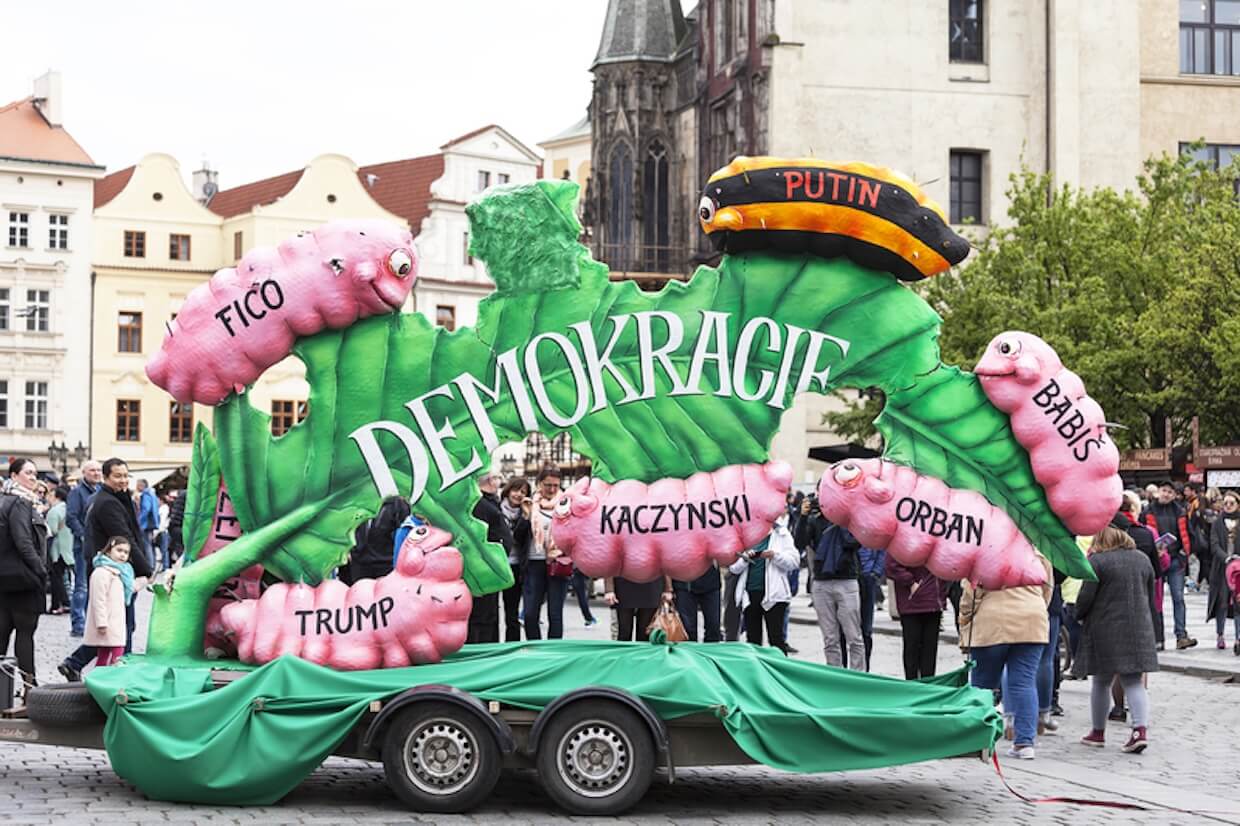
A banner depicts democracy as a leaf eaten by “caterpillars” named Putin, Kaczynski, Orban, Babis, Trump, and Fico on Labour Day, May 1, 2017 in Old Town Square, Prague. Photo: Jolanta Wojcicka.
You have written about an emerging “Illiberal International.” Are today’s authoritarian and illiberal leaders (Putin, Erdoğan, Orbán, Trump) converging around a coherent ideological project, or are we observing a more fluid assemblage of mutually reinforcing but heterogeneous illiberalisms?
Professor Richard Youngs: The alliances are more fluid, again, as you suggest. Many books and articles have examined this emerging coordination among authoritarian regimes, and there is a general consensus that these regimes are indeed coordinating more effectively. Part of that coordination involves their pushback against liberal or democratic norms in many parts of the world, but they do not share a uniform agenda. Many illiberal projects are quite distinctive—quite different in their ideological precepts and the kinds of policies they prioritize.
These differences do not, at the moment, preclude some degree of coordination, but there clearly isn’t a single, well-coordinated policy of autocracy promotion in the way that democracies have sought to coordinate in previous years. So it is clearly significant and an important emerging aspect of global politics. But I think we need to be careful not to overestimate how coherent a bloc non-democratic regimes have established, at least so far.
Trump Is an Intensification, Not a New Phenomenon
What does the partial autocratization of the United States under Trump imply for global democratic theory? Does it signal the end of the assumption that consolidated democracies are inherently resilient, or does it reflect deeper path dependencies in presidential, majoritarian systems?
Professor Richard Youngs: I don’t think Trump, in himself, shows that consolidated democracies are not inherently resilient. That fact has been emerging and becoming clear for quite some time over the last decade. His impact is another lurch in that direction—perhaps the most dramatic and worrying to date—but still an intensification of a trend we have already been witnessing rather than something qualitatively new.
What could represent a real game changer, however, is the United States’ shift internationally—from serving as an anchor of democratic order to, in some cases, supporting forms of authoritarian government. Not everywhere, of course, but as the US steps back in many places from defending democratic norms, this could change the balance in the global contest between democracy and autocracy and become a significant factor working against democratic reform in many countries.
We should not overestimate the influence of what is happening in the US. In many parts of the world, the fate of democracy will continue to depend on deeply rooted local factors, not on developments in Washington. But this shift is nonetheless significant and will have important implications, especially for the international dimensions of democratic theory.
Institutional and Cultural Illiberalism Reinforce Each Other
How do you assess the relative weight of institutional capture (courts, media regulators, security agencies) versus cultural-political radicalization in driving democratic deconsolidation? Is one a precursor to the other, or do they typically evolve in mutually reinforcing spirals?
Professor Richard Youngs: Again, you answer your own very good question. I think both the formal institutional level and the more social-cultural level are significant, and it is their increasing reinforcement of each other in recent years that has given so much momentum to the current illiberal wave. In some countries, it is the institutional side that comes first and drives changes at the social level. In other countries, it is the other way around, so there is no uniform pattern across cases. But it seems to me that the coexistence of these formal institutional dynamics and the simultaneous evolution of social and cultural dynamics is what is so interesting—and what represents such a powerful trend.
Flag of Finland and the European Union flag displayed in the European Council offices in Brussels, Belgium, on April 10, 2024. Photo: Alexandros Michailidis.
Given the EU’s increasing reliance on counter-disinformation, surveillance resilience, and digital shields, do you see a danger that “defensive democracy” morphs into a form of technocratic securitization that paradoxically narrows democratic space?
Professor Richard Youngs: I think the danger is there. Of course, your question is very topical at the moment, because the EU has just agreed on its European Democracy Shield and, only last week, launched a European Center for Democratic Resilience. You are right that, for now, the priority focus appears to be on shielding European democracy in a very defensive way—from Foreign Information Manipulation and Interference (FIMI) operations, from foreign influence, and from manipulation by external actors. At the same time, European policymakers do, at least rhetorically, acknowledge that this is only one part of what is needed to reinforce democratic norms.
The remit of the shield has shifted somewhat, with a slightly stronger emphasis emerging on civic engagement and media pluralism than was initially evident. This shift reflects concerns, as you suggest, that the EU itself might drift toward a somewhat illiberal technocratic securitization in the name of defending liberal democracy. That warning is clearly on the EU’s agenda, and policymakers seem aware of the risk.
Hopefully, the Democracy Shield and the new center will evolve into a broader democracy strategy that balances, on the one hand, the regulations and laws genuinely needed to protect European democracy from harmful online and external influences, and, on the other, a more positive dynamic of civic empowerment, on which democratic quality depends over the medium to longer term.
Illiberal Regimes Learn Faster Than Democracies Respond
What evidence do we have that autocratizing incumbents actively learn from one another’s tactical repertoires—judicial interference, NGO restrictions, electoral manipulation—and how should the EU conceptualize this diffusion of illiberal techniques?
Professor Richard Youngs: There is a lot of evidence, as you know and as you have worked on in the center, that regimes are learning from one another on these tactics. In some cases, they are almost copying and pasting the same kinds of repressive laws taken from other countries into their own legislation. There is ample evidence of this. This is not a new issue; it has been going on for about 15 years. We are now almost in the second or third iteration of these repressive laws, and the international dynamics—the lessons that regimes are learning from each other—are clearly stronger than they were some years ago.
I think the lesson for actors like the EU is that this assault on democratic space around the world is no longer simply a matter of trying to protect individual civil society organizations in a select number of cases. It exists at a more systemic, international level, and it needs to be understood and addressed at that level. The EU has begun to move in that direction, but it still has quite a way to go to grasp the truly order-level significance of this kind of anti-democratic learning across borders.
Europe Faces a Genuine Democracy Catch-22
You have described a tension whereby insulating the EU from radical-right influence risks constraining pluralism, while integrating them risks legitimizing illiberalism. How should scholars and policymakers evaluate this “democracy catch-22” in light of the long-term risks to both the polity and the party system?
Professor Richard Youngs: I don’t have an answer to this. I conceptualized it as a catch-22 situation, as have many other people, because I just don’t think there’s a good, a perfect option for European policymakers. Engagement with far-right parties clearly risks normalizing such parties to an undue extent, but on the other hand, ostracizing them completely risks actually increasing their appeal for a significant part of the population.
We’re in a gray zone at the moment, where the fact that in many countries these parties have gained such a significant part of the vote makes it not so easy to ignore them completely anymore, but most mainstream parties are still reluctant to build them in formally into any working partnerships, and the far-right parties, the radical parties themselves, now have to juggle with a difficult strategic decision themselves, whether to engage in normalized politics or whether to hold themselves outside the system and retain their appeal as extra-institutional challenger parties, and we see some of these difficulties, for example, in the Netherlands over the last four or five months.
So, at the moment, I would conceptualize it as a rather uneasy, gray area of adjustment, somewhere between far-right parties being left out and ostracized completely and other parties wanting to deal with them as completely normal parties. It’s a very uneasy combination. It’s a kind of implicit attempt to get around this catch-22, but I’m not sure we can expect really dramatic results from this, and I think mainstream parties will continue to struggle with how to deal with this phenomenon at the moment.
Democracy Support Persists, Yet in a Weakened Form
Is Europe’s push for “strategic autonomy” compatible with maintaining a robust external democracy-support agenda, or does the logic of autonomy inevitably push the EU toward transactional geopolitics and away from normative liberalism?
Professor Richard Youngs: I don’t think it pushes the EU inevitably toward purely transactional geopolitics, but there are clearly significant signs at the moment that the EU is prioritizing other policy issues over democracy support. European democracy support is still there—it still exists, and it has not collapsed dramatically. Yet there are indications that many member states, or at least some, are cutting their democracy budgets and prioritizing more strategic alliances with non-democratic regimes.
So, once again, we find ourselves in a rather uneasy balance: some aspects of the democracy agenda are being strengthened in the name of the EU’s geopolitical interests, while many others are being weakened because of a shift toward more realpolitik-style geopolitics. It is an uneasy balance, and it is likely to persist. The EU will likely emerge from this period of adjustment with some degree of commitment to democracy support still intact, but the agenda will look quite different from what it was 5 or 10 years ago.
A New Global Coalition of Democracies Is Needed
Students from public universities in São Paulo protested against cuts in education budgets made by the government of former President Jair Bolsonaro (PL) in São Paulo, Brasil on November 8, 2022. Photo: Isaac Fontana.
With US democracy assistance dramatically reduced, is the EU institutionally and ideationally equipped to serve as the central node of a reconfigured global democracy-support ecosystem—or does this require a paradigmatic rethinking beyond “funding substitution”?
Professor Richard Youngs: The latter. And we have just written about this with my Carnegie colleagues. The US cuts in democracy support—although some aid has since been partially reconstituted—remain very significant and severe, and they are acting as a catalyst for other democracies around the world to rethink their policies, including many European donors. There is growing recognition that a broader set of alliances needs to be built with democracies outside Europe. The EU is not going to step up on its own to fully compensate for the reductions in US democracy assistance. Many member states are also cutting development assistance for their own reasons, which is prompting them to explore alternative ways of supporting democratic reformers that are not so heavily dependent on standard project aid, as has traditionally been the case.
The democracy agenda will still exist, but it will have to do so in a significantly transformed way. For the EU, this means the debate cannot simply revolve around how far it can compensate for the cuts in US aid. What we are seeing in the United States presents a broader challenge: the democracy community as a whole needs to think afresh and recognize that the democracy agenda will need to become more selective and pursued through different means. It will not have the same kind of primacy in global politics that it once enjoyed, even if it does not disappear entirely.
Three Agendas, One Challenge: Europe Needs Integrated Policy
Your work on the “triple nexus” highlights interlocking vulnerabilities. Should democratic governance now be treated as a central security variable in EU climate and conflict policy, rather than a parallel track? What institutional reforms would this require?
Professor Richard Youngs: Exactly, and again, you have posed the policy imperative very well. We have the democracy agenda, the conflict agenda, and the climate agenda—all three growing in complexity. The challenges emerging from each are becoming more severe, yet they are still pursued largely as parallel tracks in European policy. These are very difficult, thorny issues to integrate, but it is essential to understand how conflict intersects with climate change, how climate intersects with governance challenges, and how governance dynamics intersect with conflict. The EU needs to pursue policies, initiatives, and projects on the ground that encompass all three dimensions together.
The EU rhetorically acknowledges that this integrated approach is necessary. It has introduced several strategy documents emphasizing its importance. But institutionally, the funding structures and foreign-policy and security structures are not yet configured in a way that enables governments and EU institutions to approach these different challenges as a single, coherent policy challenge.
Resilience Requires Renewal, Not Just Defense
In your recent work, you suggest moving from analyzing autocratization to theorizing democratic resilience. How should resilience be conceptualized so that it does not simply mean institutional survival but also normative renewal, adaptability, and democratic deepening?
Professor Richard Youngs: Again, that’s exactly the answer. Lots of people are now writing on democratic resilience. For more than a decade, the focus has mainly been on democratic backsliding and autocratization. More people are now trying to understand why some democracies have managed to survive in reasonably good shape despite all the challenges of the last decade; in a small number of cases, some countries have even made democratic improvements. That is why the concept of resilience has become more prominent. It means different things to different people. Part of it is about pure survival—fending off very overt authoritarian dynamics. But the second layer, as analysts increasingly recognize, is that to survive, democracy cannot simply fend off Chinese, Russian, or other external threats; democracy needs to reform itself. There are ongoing debates about what kinds of democratic reforms can provide the most resilience over the longer term. These debates are still quite embryonic, but they are beginning to filter into policy discussions.
The degree of resilience we see remains quite fragile and tentative, but I think that in future years we will need a much tighter learning process between these emerging analytical debates about democratic resilience, on the one hand, and the design of better resilience strategies by the EU and other actors, on the other. There is some overlap and some progress, but it is still quite limited. Even though much of the policy focus will continue to be on dealing with ongoing trends in authoritarianism, there will also need to be, in parallel, a more systematic focus on democratic resilience.
Rebuilding Democracy Is Far Harder Than Dismantling It
Israelis protest in Tel Aviv against Netanyahu’s Judicial Coup in Israel. Photo: Avivi Aharon.
Your research identifies patterns in democratic recoveries (Brazil, Poland, Zambia, Senegal). What distinguishes successful “recovery trajectories” from cases where post-authoritarian openings stagnate or relapse? Which factors—elite coalitions, civil society autonomy, constitutional design—matter most?
Professor Richard Youngs: So you refer to a big report that we’ve just done, presenting a number of cases that seemed to offer a particular moment—an opportunity for democratic recovery. The sobering reality is that when these moments of democratic opportunity opened up, relatively few countries then experienced a truly far-reaching, definitive process of re-democratization. Most struggled to implement full democratic reforms, and there was often pushback against attempts to re-democratize. The whole challenge of re-democratization is extremely difficult, because it requires newly empowered democratic regimes to regain control of state institutions that have been captured by anti-democratic forces.
I don’t think there’s any single factor—because there have been so few cases of absolutely resounding success, it’s hard to isolate variables and say that democratic recovery really depends on A, B, or C. But we have noticed that, in general, where there is strong societal mobilization and pressure linked with reformers within the political sphere—through competitive political parties—and supportive institutional conditions, momentum toward democratic reform after sustained autocratization does seem to be stronger.
But I would also say that these cases of potential positive turnaround show us something important: it is much easier to undo democracy than to reassemble good-quality democratic norms. Rebuilding democracy is a very hard enterprise, and even governments with the strongest will in the world to redemocratize—institutionally and socially—often find this extraordinarily difficult to do.
Not All Illiberal Agendas Are Inherently Anti-Democratic
And lastly, Professor Youngs, your proposal for a European Democracy Pact aims to separate political-system norms from policy disputes. What would constitute a sufficiently rigorous and enforceable set of democratic red lines to test parties’ commitment to liberal pluralism without collapsing into moralism or partisan exclusion?
Professor Richard Youngs: That’s what needs to be defined. It’s very complicated, but what is needed is to prise apart the rather illiberal policy agendas of far-right parties in Europe—policies one may profoundly disagree with but that might not, in themselves, be inherently anti-democratic—from what are genuine threats to the core institutional norms of democracy. At the moment, those two things tend to get conflated. At one extreme, some argue that these parties are inherently and unavoidably anti-democratic. At the other, some claim they simply hold views liberals may dislike but pose no danger to democracy. The truth is probably somewhere between those extremes.
What is needed is a clear agenda outlining what constitutes anti-democratic behavior at the institutional level, separating the issue of illiberal social values on the one hand from the core practices of democratic politics on the other. There will inevitably be some grey areas in making this distinction. But what I suggested with the proposal for a democracy pact is an attempt to prise away certain conservative areas of rising conservatism—whose policies may be illiberal and objectionable—while still encouraging them to join in a shared commitment to core democratic norms.
In her sharp analysis of the COP30 summit, Dr. Heidi Hart,an environmental humanities researcher and guest instructor at Linnaeus University in Sweden, captures the surreal moment when an exhibition pavilion in Belém caught fire—an unsettling metaphor for a world already burning. Despite tense negotiations and an extra day of talks, petrostates secured a final text that completely omitted fossil fuels, leaving UN Secretary-General Guterres to warn of a widening gap between science and policy. Dr. Hart situates this failure within a shifting global landscape marked by illiberal regimes, climate denial, and powerful petro-interests. With geopolitical turmoil and corporate greenwashing shaping outcomes, her commentary underscores a stark truth: on a “spaceship” with finite resources, political paralysis is accelerating us toward irreversible tipping points.
The defining image of the COP30 climate summit flashed around the world: fire in an exhibition pavilion at the meeting site in Belém, Brazil, flames spreading up the tent’s walls and forcing evacuations. No one was injured beyond smoke inhalation, but the “world is on fire” adage took a literal turn as delegates wrestled to find consensus. The summit spilled over into an extra day, with a win for petrostates like Saudi Arabia, as the final agreement ceded more funding to at-risk countries but failed to include any language about fossil fuels.
On Saturday, COP30 President André Corrêa do Lago announced a forthcoming “side-text” about fossil fuels and forest protections, also a hot topic among Indigenous protesters who had pressed into the secure COP “Blue Zone” on Friday evening. The UN Secretary-General António Guterres’ assessment after the summit was grim, despite acknowledging some progress on “adaptation” funds: “The gap between where we are and what science demands remains dangerously wide … The reality of overshoot is a stark warning: we are approaching dangerous and irreversible tipping points.” The lack of even a mention of fossil fuels in the final agreement, let alone the “deep, rapid emission cuts” Guterres acknowledges are necessary to keep the planet below overshoot carbon levels, is not just the result of Saudi and Russian delegates’ bully tactics (Al Gore has referred to the agreement as an “Opec text”) but also a symptom of profoundly shifting political realities around the world.
The notable absence of US delegates, while the Trump administration slashed environmental protections at home, was the source of relief for some at the summit but also pointed to the normalization of climate denial amid illiberal regimes’ growing influence and far-right pressures in green-aspirational countries like Germany. Even Norway, known for its own sustainable, egalitarian culture, has no plans to sacrifice its oil wealth for the larger planetary good. Meanwhile, costly wars and deep political divisions in countries like the US and Brazil distract from efforts to forge coherent climate policy. Finally, the sheer scale of petrostates’ and billionaire technocrats’ influence cannot be overstated in watering down and even – in this case – completely avoiding action on carbon emissions cuts. Bill Gates’ recent essay diminishing the dangers of climate emergency has not helped; though “civilization” will likely not be wiped out in a sci-fi doomsday scenario, the suffering of millions and the loss of innumerable nonhuman species are hardly points to be glossed over in the name of “innovation.” Neoliberal optimism sounds increasingly tone-deaf in a time when the limits of human progress are becoming palpably clear around the world.
The idea of “Spaceship Earth,” popularized by Buckminster Fuller in the late 1970s, portrays the planet as a closed system with limited resources. Though this idea has informed many efforts toward more sustainable living, greenwashing for the sake of profit has become the norm among large corporations. The comforts of petrocultures, the material, cultural, and economic manifestations of decades of cheap oil, are so embedded in privileged countries, there are limits, too, to how much individuals can do to shrink their carbon footprints.
On the political level, Saudi and Russian influence is only one part of the picture; lack of concern or climate denialism (often cast as denial of the human cause) is growing in countries like Indonesia, Mexico, India, and Australia, places where the risks from global heating are high. In the formerly stable if systemically inequitable US, the lurch toward anti-science authoritarianism has been so swift as to induce a kind of vertigo. In his recent book Impasse: Climate Change and the Limits of Progress, Roy Scranton writes, “We can recognize the Earth as a closed system in which we all depend on each other, but the political reality within that system resembles gang warfare more than it does a unified crew,” (91). The deep lack of consensus at COP30, when the risks of climate collapse are clearer than ever, shows how much more difficult the problem is to address in today’s chaotic political landscape.
Nearly ten years ago, in her essay “What Is the Anthro-political?”, culture theorist Claire Colebrook engaged with the already contested Anthropocene term to argue that, in light of ecological destruction, “the political” as a norm can no longer be taken for granted. This provocative stance is worth revisiting today. Especially with the rise of populist tendencies that tap into human “affect and corporeality,” the political no longer appears as a regulating modality of human-being but rather as a contingent aspect of human culture that, once that culture destroys its own “milieu” or literal environment, will go down with it. In Colebrook’s more elegant terms, “What if what we know as politics … were possible only in a brief era of the taming of human history?” (115).
This geologic-scale perspective on last week’s pitting of the EU’s and other climate-sympathetic delegates against fossil-friendly regimes (with the absent US in the background noise) does not diminish the stakes at COP30 but shows how vast and planetary those stakes are. With our closed system threatening to burn beyond livable thresholds, the responsibility of one global gathering to stave off one local disaster after another becomes painfully clear.
In a penetrating interview with ECPS, Professor Barry Sullivan warns that “the separation of powers does not function as the Framers anticipated,” offering one of the starkest legal assessments yet of America’s constitutional crisis. Drawing on the Supreme Court’s ruling in Trump v. United States, he argues that “the constitutional doctrine and the man have met the moment,” producing a presidency with “virtually total control, without suffering any consequences.” Sullivan traces this shift to a revival of a “Nixonian” view of executive authority—summarized in Nixon’s infamous claim, “If the President does it, it is not illegal.” Such developments, he cautions, create “enclaves of unaccountable power” and dramatically heighten the risk of democratic backsliding, especially amid polarized parties and eroding constitutional conventions.
In a wide-ranging and incisive interview with the European Center for Populism Studies (ECPS), Professor Barry Sullivan—the Raymond and Mary Simon Chair in Constitutional Law and the George Anastaplo Professor of Constitutional Law and History at Loyola University—offers one of the most sobering legal assessments to date of the United States’ ongoing constitutional transformation. As he warns, “the separation of powers does not function as the Framers anticipated,” and the consequences for American democracy are profound.
Speaking against the backdrop of the Supreme Court’s landmark decision in Trump v. United States, Professor Sullivan argues that “the constitutional doctrine and the man have met the moment.” Over the last fifteen years, the Supreme Court has steadily expanded presidential authority, culminating in an immunity doctrine that grants the President “virtually total control, without suffering any consequences.” This shift, Professor Sullivan notes, aligns disturbingly well with Donald Trump’s populist narrative of a personalized leader whose will supersedes institutional constraint.
Calling this new jurisprudence a revival of a “Nixonian” conception of executive power, Professor Sullivan underscores the danger. If the Court has effectively embraced the claim that “if the President does it, it is not illegal,” then the risk of democratic backsliding—especially when paired with the pardon power—becomes “very great.” This combination, he stresses, allows a President not only to immunize himself but “in effect, to grant immunity to those whose efforts on his behalf he needs,” creating what constitutional theorists call enclaves of unaccountable authority.
Throughout the interview, Professor Sullivan situates these developments within broader populist dynamics: the weaponization of “retribution” narratives, the erosion of constitutional conventions, and the increasing collapse of the administrative state under a muscular unitary executive model. His warning is stark: under the Court’s interpretation, the President possesses “virtually unlimited power,” and recent behavior shows “there is nothing that is too great or too small to capture his imagination,” from foreign policy decisions to symbolic renovations of federal buildings.
Crucially, Professor Sullivan emphasizes that the Framers never anticipated the rise of disciplined, polarized political parties—developments that have hollowed out checks and balances. As he notes, the Founders “would be absolutely aghast” at how party alignment now disables Congress and the courts from restraining executive overreach.
Finally, Professor Sullivan stresses that reversing democratic backsliding will require not only judicial recalibration but also broader political and civic reform. The core problem, he argues, is “not a constitutional problem but a political problem” rooted in polarization, unified government, and the abandonment of institutional good faith.
This interview offers an essential window into how constitutional design, judicial interpretation, and populist leadership together shape the current crisis of American democracy.
Here is the edited transcript of our interview with Professor Barry Sullivan, slightly revised for clarity and flow.
This Is Not How the Framers Envisioned Executive Power
Frontal view of the U.S. Supreme Court Building in Washington, D.C., on February 10, 2024. Photo: Gualberto Becerra P.
Professor Barry Sullivan, thank you very much for joining our interview series. Let me start right away with the first question: In “Trump’s Court, Nixon’s Constitution,” you argue that the Supreme Court’s immunity ruling represents a profound judicial reimagining of the presidency. How does this expanding conception of presidential immunity—articulated inTrump v. United States—intersect with Donald Trump’s populist vision of a personalized, extra-legal leader whose “will” is portrayed as overriding institutional and constitutional constraints?
Professor Barry Sullivan: I think that the constitutional doctrine and the man have met the moment. For the last 15 years, the Supreme Court has been expanding the constitutional power of the presidency vis-à-vis the other branches of government. And with the immunity the President now has, along with the power to pardon those who assist him in the work of government—even if they commit crimes on his behalf—he has virtually total control without suffering any consequences.
The expansion of executive power has been justified, in part, by the idea that the primary check on the President is Congress’s impeachment power. But if we consider the current situation, where both of the politically accountable branches of government are in the hands of the same party—and where that party is tightly structured, not a broad ideological tent but one very much aligned with the President—then the President effectively has near-total control. The separation of powers simply does not function as the Framers anticipated.
So, given the proclivities of the President and the latitude the Court has now provided, the President possesses extraordinarily broad powers at this moment.
Trump Now Holds Power Nixon Could Only Claim
To what extent does the Court’s new approach to presidential immunity signal a structural shift toward what you describe as a “Nixonian” theory of constitutional authority, and how might that shift accelerate democratic backsliding in the US?
Professor Barry Sullivan: The Nixonian theory of the presidency was articulated by President Nixon at the time of Watergate, when he instructed his lawyer, who was arguing in the Supreme Court on his behalf, to tell the Court that the President of the United States had all the power of Louis XIV, except for four years at a time. In other words, there was no check on the President except re-election. He further stated, after he left the presidency, in an interview with David Frost, that if the President does it, it is not illegal—meaning it is legal simply because the President does it.
So, if I’m correct that the decision in Trump v. United States gives the President power similar to the power that Nixon claimed—which I believe it does—then the opportunity for democratic backsliding is very great. And when you combine the President’s very broad powers with the pardon power—which allows him not only to be immune himself but, in effect, to grant immunity to those whose efforts on his behalf he needs in order to do what he wants to do—the risks become even more significant.
Populist leaders often frame legal accountability as partisan persecution. How do judicially expanded immunity doctrines reshape the balance between democratic legitimacy and the rule of law—especially in the face of populist claims to majoritarian or plebiscitary authority?
Professor Barry Sullivan: That’s an interesting question. I think that the President—speaking in terms of populism—repeatedly used the expression in his last campaign for the presidency, “I am your justice, I am your retribution.” And he didn’t say retribution for what or against whom, but I think it was pretty clear that he was suggesting that he had been persecuted during the four years he was out of office, and that he had been persecuted on behalf of his supporters. So, when he returned to power in January of this year, one of the first things he did was to pardon all the people who had been involved in the January 6th invasion of the Capitol.
The Framers Would Be Absolutely Aghast
Mount Rushmore National Memorial featuring Roosevelt, Jefferson, and George Washington — the Founding Fathers carved in granite. Photo: Dreamstime.
Does the Court’s emerging immunity jurisprudence risk creating what constitutional theorists describe as “enclaves of unaccountable power?” In your view, how would the Framers—particularly those most concerned about executive aggrandizement, such as Madison and Wilson—have understood a doctrine that shields a president from criminal liability for “official acts”?
Professor Barry Sullivan: This opinion—unless it is substantially narrowed in the future by the Court, which of course is possible—but as it stands now, does create an enclave of unaccountable power. We’ve seen the use of that power in many ways over the last, well, almost a year now.
What would the Framers have thought of it? I think the Framers would be absolutely aghast that the constitutional structure they created was susceptible to this kind of democratic—or Republican, they would say—erosion. The Framers put a great deal of faith in the structure of government: the separation of powers and the checks and balances they built in. And we’ve seen that those checks and balances don’t work in the way they anticipated.
One thing the Framers did not foresee, of course, was the rise of political parties. They thought that political parties—standing parties, not just temporary coalitions of interests—were a bad thing, and that the United States could function without them. That turned out to be wrong. By the end of President Washington’s time in office, political parties had already begun to form.
Over time, parties became more ideologically coherent—really in the last 40 or 50 years—so that you no longer had a broad range of views within the Democratic or Republican parties. The parties became more unitary, in a sense. I think this is something the Founders didn’t anticipate and—if they were around today—would want to address, because the development of strong, ideologically unified parties means the system of checks and balances and the separation of powers simply doesn’t work the way they intended it to.
Independent Agencies No Longer Independent
Your work on“Expert Knowledge, Democratic Accountability, and the Unitary Executive”highlights tensions between technocratic governance and populist distrust of expertise. How does the Court’s embrace of a muscular unitary executive model empower populist presidents to override scientific, technical, or bureaucratic judgment?
Professor Barry Sullivan: I think it does, in the sense that the unitary executive theory—as the Court has interpreted it—means that the President has absolute control over the executive branch. Moreover, the President must have control over all those who exercise executive power in some sense. So, if we assume, as I think we should, that independent agencies exercise executive power in some sense, then the President has the power to overrule whatever an independent agency decides.
We created independent agencies—and they’ve been around since the beginning of the Republic, although they became more important in the 20th century, especially with the New Deal—because we thought there were some areas of governance that shouldn’t be totally dependent on the political will of the President.
To the extent that the Court has now said the President should have power over these agencies—and we’ll probably see before the end of this term how far the Court will go, because there are a couple of pending cases about the President’s removal power over members of these agencies—the President has the ability to dictate what independent agencies or departments of government do, down to the smallest detail. And that is a problem for scientific and other forms of expertise.
We saw in the first Trump administration—and I detailed this in that article—that the weekly morbidity and mortality report the government publishes, which has long been considered the gold standard for reporting on health in the United States and was largely immune from political oversight, had been the domain of medical scientists. During the pandemic, however, non-scientifically trained people were given the opportunity to edit that report, not to reflect the latest scientific evidence but to mirror the President’s political strategy and political interests. And if the Court is truly going to say that the President has that power, then that’s very dangerous for the credibility of supposedly expert determinations by the government.
Policy Was Sold as Science And That Undermined Trust
Coronavirus pandemic in the United States — New Yorkers on the streets of NYC. Photo: Dreamstime.
During the pandemic, you emphasize failures not only of political leadership but also of scientific bureaucracy. How do these failures complicate the conventional narrative that populist erosion is purely anti-expert, and what constitutional reforms might restore calibrated relationships between science and law?
Professor Barry Sullivan: During the pandemic, there were policy determinations that were made by medical experts, but the reasons for some of those determinations—or the real reasons—were not made public. For example, there was a determination by the government that people shouldn’t wear masks at the beginning of the pandemic. It turned out that this really wasn’t based on scientific evidence; it was based on the fact that there weren’t enough masks to go around. The medical authorities decided that priority should be given to medical personnel. So, in a sense, maybe that was the right decision from a policy point of view, but we were being told that it was a medical determination, not a policy determination.
I think those kinds of situations reflected badly on the scientists involved. And these questions of what proper policy is and what is good science, to a large extent, overlap. We have to be told to what extent one or the other is being relied on. I think that’s important. I’m not sure that it is, by itself, a constitutional problem, but it is certainly a legal and administrative law problem—making sure that we separate those things to the extent that they can be separated.
Not Just Law but Good Faith: What’s Disappearing in American Governance
In the landscape of democratic backsliding, how does the Supreme Court’s revival of the unitary executive—combined with skepticism toward independent agencies—reshape the administrative state’s ability to resist authoritarian tendencies?
Professor Barry Sullivan: That’s a wonderful question. I would add to that picture, or to the hypothetical, the fact that the separation of powers between the executive and the legislative branches also is not working.
But the unitary executive, combined with skepticism about administrative or independent agencies, certainly has an impact on the government’s overall ability to withstand authoritarian tendencies. Under the unitary executive theory, the President has virtually unlimited power. And this President has demonstrated an incredible amount of energy. There is nothing that is too great or too small to capture his imagination—whether it is deciding that we need to go to war, in effect, against Venezuela; subsidizing the friendly government in Argentina; painting the Executive Office Building white because he doesn’t like the natural gray color of the stone; or tearing down the East Wing of the White House. There’s virtually nothing to stop him.
Moreover, I would add to that the erosion we’ve seen in what I would call constitutional conventions—not necessarily law, at least in the sense of hard law, but soft law. The idea that there are some things the President could legally do but that would not be within the spirit of the law. I liken constitutional conventions to the ligaments and muscles that propel us, in addition to bones. We can’t run with bones alone; we need these other things. And just as the rule of law doesn’t depend exclusively on law, it also depends on a spirit of good faith and fair dealing that characterizes the relationships among the branches of government.
When Transparency Fails, Authoritarianism Flourishes
US President Donald Trump speaks at a White House press briefing after a Black Hawk helicopter collided with American Airlines Flight 5342 near DCA Airport in Washington on January 30, 2025. Photo: Joshua Sukoff.
Drawing on“Executive Secrecy,” how do secrecy practices, especially when coupled with expanded presidential immunity, contribute to the erosion of public accountability and provide fertile ground for authoritarian-style governance?
Professor Barry Sullivan: I’ve written extensively on the need in a democratic society for access to government information. I think that access to government information is absolutely critical to any kind of citizenship, or citizen oversight of government.
I gave a lecture a couple of years ago in Bayreuth, and I put up on the board a drawing of the three branches of government—each in its own little box—and then I drew a big box around those three boxes. The big box was meant to represent the people. It’s ultimately the people who have responsibility for government. Without information, the people cannot monitor the government in the way that Madison, in particular, anticipated they would and should in order to sustain a democratic government.
Populist leaders frequently weaponize secrecy, disinformation, and institutional opacity. How should courts conceptualize transparency obligations in an era where executive power is increasingly asserted as a personal mandate rather than an institutional responsibility?
Professor Barry Sullivan: As a general principle, the courts have to insist that executive power must be exercised as an instrument of institutional responsibility rather than as a personal mandate. I think that is one of the essential duties of a constitutional court in a constitutional system: to maintain—or to ensure—that the government acts truthfully and does not wield executive power for personal purposes or personal benefit, but rather fulfills its institutional responsibilities.
Opaque Courts Feed Populist Distrust
In “The Supreme Court and the People,” you stress the Court’s communication failures. How does the persistence of opaque, fractured, and elite-oriented judicial writing exacerbate the populist narrative that courts are disconnected from “the people,” and what risks does this pose for judicial legitimacy?
Professor Barry Sullivan: In that article, my co-author and I compared the way in which the Supreme Court of the United States communicates its decisions to the public. And the article is a little dated at this point because, in addition to what we perceived as the Court’s problems at the time—namely that it didn’t provide meaningful press access or user-friendly summaries of its opinions—we’ve also seen, in the last year or so, the Court increasingly issue decisions in emergency situations without the normal process of adjudication: without extensive briefing, without time for deliberation, and often without any explanation at all. I think this shift toward deciding many important issues in such a summary way—with the justices given little opportunity to do anything other than rely on their predispositions—is problematic from the standpoint of judicial legitimacy.
Justice Robert Jackson, one of the great justices of the Court and the lead US prosecutor at Nuremberg after the Second World War, once said that the door you enter by often determines the door you leave by. In other words, if judges bring certain predispositions into a case, those predispositions often shape the outcome unless a robust adjudicative process intervenes. The normal process of adjudication does everything possible to counteract that tendency. But when judges must decide cases based on very little briefing, a thin record, minimal deliberation, and limited discussion among the justices about what the outcome should be and why, then the likelihood increases that the door you enter by will indeed be the door you exit by.
Canada and Germany Show How Courts Can Reconnect with the Public
Given comparative examples such as Canada or Germany, how might improved judicial communication practices help inoculate the Court against populist attacks that portray it as unaccountable or politically captured?
Professor Barry Sullivan: I think this goes back to my last answer about the way in which the Court has started to decide really important questions summarily. But in addition to that, these other courts have taken steps with respect to the ordinary docket—the ordinary cases—to make sure that the people are given the means to understand what the Court has decided and why. For example, in Canada, the Supreme Court of Canada has created a position, usually held by a law professor, who is available to speak with the press on the day decisions are issued, to advise them about the meaning of the decisions, and to answer their questions.
Moreover, in Germany, there is a similar procedure—a lockup—where reporters who follow the Court are given the opportunity to review the opinion before it is officially released, so that they can be more mindful in the way they discuss it for the public. I think there is a recognition in both Canada and Germany that the press has an important role to play, because most people learn about Supreme Court decisions not from reading the decisions themselves but from reading what reporters say about them.
So, it isn’t just the length or complexity of the opinion. In Germany, the opinions are perhaps even more complex and lengthy than in the US, but other mechanisms exist to provide information to the public about the significance, importance, and meaning of the opinion.
Reversing Backsliding Requires Fixing Congress, Not Just the Court
And lastly, Professor Sullivan, across your writings, there is a through-line stressing how institutional arrangements can unwittingly facilitate populist or authoritarian trajectories. What combination of judicial, legislative, and civic reforms do you believe is most essential for reversing democratic backsliding in the US, particularly in a context where the Court itself is increasingly central to the transformation?
Professor Barry Sullivan: Obviously, a difficult situation. Given the fact that, as you say, the Court has been central to the creation of the problem through this unitary executive theory, I’m not sure how much hope we should hold out that the Court is going to back off of the unitary executive theory. And it’s really a product of the last 20 years. It’s a product of the Roberts Court.
The unitary executive theory really came into prominence during the Reagan administration. Obviously, the seeds of it were sown in the Nixon years because of Nixon’s views of the power of the President. But as a constitutional theory, it really came into its own during the Reagan administration, and Attorney General Meese, in particular, furthered this theory.
I don’t think it is really based in the founding; I think it is principally based in the reaction that some people in government had to the reform measures introduced to limit executive power after the Nixon–Watergate scandal. And virtually from the time of the Ford administration—Ford was Nixon’s last vice president and succeeded to the presidency when Nixon resigned—President Ford kept on many of Nixon’s advisors during his term in office. Many of those advisors, from the beginning, thought that Congress was taking too much power away from the President.
So, this unitary executive theory saw its genesis then and really came into its own in the Reagan administration. But it did not capture the imagination of the Court as late as 1988, in a case called Morrison v. Olson, where the unitary executive theory was being advanced as a way of concentrating power in the presidency. The Court rejected it. There was only one vote in favor of the unitary executive theory, and that was Justice Scalia, who was one of the people in the Ford administration who thought that Congress had gone too far in reforming the presidency.
But once Justice Roberts became Chief Justice, and a group of people joined the Court—Justice Alito, for example, and Justice Thomas—who were very influenced by that theory as young lawyers, we see by this year a complete turnaround on the Court, so that what was essentially a marginal theory in 1988 has now become the majority theory.
As I say, I don’t hold out a lot of hope for the Court changing its mind about that in the near future. Clearly, if we had a Democratic president, and that president made nominations to the Court, perhaps that theory wouldn’t be quite so popular in the Court.
I think the real problem is not a constitutional problem but a political problem: having a unified government, and the separation of powers not working the way the Framers intended because political parties have become extremely polarized. Members of Congress are putting party affiliation above all other affiliations in terms of their governmental duties. And until we can have a more balanced Congress, I think we’re not going to see a lot of progress.
Now, one thing that we need to talk about before we end is the fact that President Trump has managed to persuade people that he won by a landslide. In fact, he won with less than 50% of the vote. Yet, he has been acting as if he did win in a landslide. And, in a sense, he did—but only because he controls Congress as well as the presidency.
In an interview with the ECPS, Professor Patricio Navia underscores a defining paradox of Chile’s 2025 election: “Chileans ended up voting for two radical candidates in the first round, but they want them to govern as moderates.” He stresses that the apparent right-wing surge is less ideological than punitive, describing the first round as “a punishment vote against the left-wing ruling party.” Professor Navia highlights how insecurity reshaped the campaign, noting that the right “successfully turned the migration issue into an issue of insecurity and crime,” yet simultaneously embraced moderate positions on social rights. While Kast’s discourse may appear Trumpian, Professor Navia cautions that “Trump is a protectionist; Kast is a free-market advocate.” Ultimately, he argues, Chileans remain centrist in expectations: “They expect those candidates to govern as moderates.”
In a wide-ranging interview with the European Center for Populism Studies (ECPS), Professor Patricio Navia — Full Professor of Liberal Studies and Adjunct Assistant Professor in the Center for Latin American and Caribbean Studies at New York University — offers a penetrating analysis of Chile’s 2025 presidential election, an election defined, paradoxically, by radical electoral choices and enduring moderate expectations. As Professor Navia succinctly puts it, “Chileans ended up voting for two radical candidates in the first round, but they want them to govern as moderates.” This apparent contradiction lies at the heart of his interpretation of Chile’s shifting political dynamics, voter psychology, and institutional constraints.
Professor Navia begins by challenging simplified readings of the first-round results. While over 70% of voters opted for right-wing presidential candidates, he warns that this does not signal a deep ideological realignment. Rather, it reflects what he calls “a punishment vote against the left-wing ruling party,” noting that legislative voting patterns remained more balanced. This reflects a chronic feature of Chilean politics: electorates punish incumbents but do not necessarily embrace the ideological alternatives they vote for.
A central axis of Professor Navia’s argument is the politicization of insecurity. The right has, in his words, “successfully turned the migration issue into an issue of insecurity and crime,” capitalizing on fears that have intensified alongside Chile’s unprecedented migration influx. Yet even here, the story is not one of unbounded radicalization. Professor Navia notes that right-wing candidates simultaneously “promised to keep the social rights and the growing welfare system” and signaled restraint on moral issues—evidence of a moderated right adapting to a centrist electorate.
In discussing José Antonio Kast’s rise, Professor Navia cautions against superficial comparisons to Donald Trump. “Trump is a protectionist; Kast is a free-market advocate,” he argues, stressing both the distinct historical context of Chilean immigration and the ways Kast has fused crime-control narratives with nativist appeals. Still, he highlights the limits of this strategy: policy promises such as deporting large numbers of undocumented migrants are unrealistic and risk generating “discontent against this government that promised easy solutions.”
Crucially, Professor Navia emphasizes the resilience of Chile’s institutions. Despite concerns about authoritarian drift, he argues that “Congress will curtail the president significantly,” given its growing assertiveness and Kast’s lack of a congressional majority. For that reason, he sees no scenario in which Kast successfully expands executive power or revives Pinochet-era nostalgia: “If he says Pinochet was good, then he’s going to lose popular support.”
Ultimately, Professor Navia’s analysis underscores the stability of Chile’s political center—less visible electorally, but palpable in voter expectations. Voters may choose radicals, he argues, but “they expect those candidates to govern as moderates.” This tension will shape not only a Kast administration but the trajectory of Chilean politics in the years ahead.
Professor Patricio Navia is a Full Professor of Liberal Studies and Adjunct Assistant Professor in the Center for Latin American and Caribbean Studies at New York University.
Here is the edited transcript of our interview with Professor Patricio Navia, slightly revised for clarity and flow.
Punishment Vote, Not Ideological Shift
Professor Patricio Navia, thank you very much for joining our interview series. Let me start right away with the first question: Given that the combined vote for right-wing candidates exceeded 70% in the first round, how do you analyze the process of vote consolidation behind José Antonio Kast in the runoff, and what does this transference suggest about the strategic flexibility and ideological cohesion of the right-wing bloc in Chile’s two-round system?
Professor Patricio Navia: If we look at the presidential election, there is clearly a punishment vote against the left-wing ruling party or ruling coalition government of President Gabriel Boric. And if we look at the legislative election results, we see that candidates from left-wing parties performed better than the presidential candidates of the same coalition. So, while it is true that 70% of voters in the presidential election supported a right-wing candidate, the picture is more nuanced in the legislative vote, where left-wing candidates did better. This suggests that many voters chose a left-wing legislative candidate and a centrist or right-wing presidential candidate. Now, among the right-wing presidential contenders, only three explicitly defined themselves as right-wing. But there was another candidate, Franco Parisi, who ended up in third place. He campaigned as an opposition figure but also actively criticized the right-wing candidates. He attempted to position himself as a centrist opposition alternative. So, in that sense, I would qualify the idea that right-wing candidates collectively received 70% of the vote.
Crime Politics Eclipse Social Rights
Your work has explored the powerful role of the perception of insecurity on vote choice. To what extent has the political salience of crime and immigration, which the far right has successfully framed as a crisis, fundamentally eclipsed the progressive, social-rights agenda that characterized the recent elections and the ‘estallido social’?
Professor Patricio Navia: The right tends to do better whenever the main issue is insecurity and crime, and the right has successfully turned the migration issue into an issue of insecurity and crime. Migration used to be more of a labor issue, and it has now become an issue of crime. So, migration and crime go together. And that favors the right, which usually campaigns on Iron Fist, law-and-order policies, and that tends to attract more voters under those conditions.
But I would underline the fact that right-wing candidates made sure that, in their campaign, they also promised to keep the social rights and the growing welfare system that Chile has created over the past few years. Even on moral issues, right-wing candidates were very careful to commit themselves—and to signal clearly—that they would not change existing legislation on women’s access to abortion, for example. So, we do see a shift to the right, but that shift is moderated by the fact that, on many dimensions, right-wing candidates actually embraced more moderate positions. They remained far right on crime and immigration, but on other issues, they moved significantly toward more moderate stances.
A ‘Trumpian Feel’ with Chilean Characteristics
Is Kast’s “Trumpian feel”—manifested in slogans like “put Chileans first” and the emphasis on a “Border Shield”—primarily a strategic, populist communication style intended to mobilize an “angry electorate,” or does it reflect a deeper, more permanent ideological mutation of the Chilean far right?
Professor Patricio Navia: That’s a great question. I think this trend of trying to make every right-wing candidate everywhere into a Trumpian candidate can lead to some misconceptions. Trump is a protectionist; Kast is a free-market advocate. Trump has embraced some conservative values; Kast has always lived by those conservative values. So, there are some significant differences.
The issue of migration in the US has been around for a long time, whereas in Chile it is a much more recent phenomenon. About 20 years ago, only 1 or 2% of Chile’s population consisted of migrants; now it is more than 10%. So, migration has become a major social issue in Chile over the past few years, precisely because so many migrants have arrived.
Kast has successfully connected the issue of migration with the issue of insecurity, and thus the border-protection message he promotes is associated with insecurity more than with migration itself. It is not that Chileans don’t want migrants; it is that they don’t want criminals coming through the border. So, I would qualify that statement a bit.
However, it is true that as the two issues become intertwined, an anti-crime platform also becomes an anti-immigration platform, and it becomes more nationalist and more nativist. That merging of crime and migration is what makes Kast’s policies feel Trumpian, because Trump—and the broader far right—advanced the idea that migration and crime are essentially the same thing.
But some of Kast’s border-protection proposals are actually more sensible, given that Chile had never really dealt with such a large migration wave. The country needed a policy update to address massive, and especially undocumented, migration. Some of the measures Kast proposes are similar to those proposed by the left. There are aspects of his agenda that are clearly far right, but others are far more reasonable.
Mandatory Voting Reshapes Chile’s Electorate
Chileans wait in line to vote in the October 25, 2020 national plebiscite in Chillán, deciding whether to replace the Pinochet-era Constitution. Photo: Marcelo Vildósola Garrigó.
Your research has analyzed the explanatory power of ideology and economic perceptions, particularly among moderates and non-aligned voters. How has the reintroduction of compulsory voting impacted the distribution of this “elastically” voting segment, and to what degree is the far right’s current success a function of this institutional change?
Professor Patricio Navia: That’s a great question, because participation rates in Chile were about 45–50% in previous elections, but with mandatory voting in this election, participation increased to about 85%. And most of the new voters are people who do not identify themselves on the right–left scale, or the left–right scale. These are voters who don’t really care that much about politics. They’re discontent, and they can be mobilized on an anti-elite platform. That probably explains why one of the candidates, Franco Parisi, ended up in third place as the anti-elite, anti-establishment candidate.
So, these voters are not well defined by the left–right scale, but they are discontent with the elites. It is important to keep that in mind, because discontent with the elites often manifests itself as discontent with the incumbent government. So, as soon as Kast wins the election, if he does win in the runoff, he will become the personification of the elites. These people who have voted against the elites will end up voting against Kast. So, this is not a case of the Chilean electorate moving to the right; the Chilean electorate is punishing those in power. When Kast becomes the president in power, that electorate will turn against him just as it has turned against the left-wing president, Gabriel Boric. So, those who think that Chileans have now become rightist, and will support a right-wing president, will probably be in for a surprise, because the same voters who threw the left-wing administration out of power—or are about to—are the voters who will later disapprove of President Kast when he personifies the political and business elite.
Why the Crime–Migration Link May Backfire
The dominance of law-and-order issues, security, and immigration has marked the 2025 campaign. How does the far right’s ability to seamlessly link transnational crime with undocumented migration reinforce a nativist, anti-elite populist narrative, and how does this challenge establish theories of issue ownership in comparative politics?
Professor Patricio Navia: That’s also a great question, because the right has campaigned on a strong anti-crime platform. But given the globalization of criminal networks and given the ease with which you can access weapons in Chile and other countries, it is not altogether clear what the right can actually do to reduce levels of crime and the perception of insecurity. Even if the right were to enforce policies that restricted individual liberties, it wouldn’t be easy to control crime, because crime responds to other phenomena, including technological developments, the ease of accessing weapons, and globalization.
So, I think that by promising they will solve the economic issue and the crime and insecurity issue, right-wing candidates are setting themselves up for a task that will not be easily accomplished—and that will eventually lead to a punishment vote against them. That doesn’t mean that the left will necessarily return to power; it might be that a populist left comes to power instead. But we know that governments should not promise things they cannot deliver.
One of the issues here is that the right has promised things that cannot be delivered. I mean, President—soon to be president, I suppose—Kast has suggested that he will ask undocumented immigrants in Chile to pay for their own plane tickets to return to their home countries. We know that’s not going to happen. But he is generating this expectation that you can pretty much kick out of the country 10% of the population, or half of them, or a third of them, who are undocumented immigrants. Many immigrants do have documents and have the right to stay in Chile. But this idea that you can easily solve problems will eventually channel the discontent against this government that promised easy solutions—solutions that are not materializing.
Sociotropic Anxiety and the Right’s Advantage
Protesters chant against President Sebastián Piñera during the October 22, 2019 demonstrations following Chile’s social uprising. Photo: Marcelo Vildósola Garrigó.
Given your findings on the economic vote in the 2021 election, when no incumbent candidate was running, how does the economic performance under the Boric government shape the socio-tropic and ego-tropic perceptions of voters deciding between two ideologically extreme opposition candidates in the 2025 runoff?
Professor Patricio Navia: I’ve been thinking about that point exactly over the past few days. We know that people who have positive ego-tropic perceptions normally think they will do better than the country. So, they are more optimistic about what will happen to them personally, as opposed to what happens to the country. But people with negative economic perceptions, particularly socio-tropic perceptions, tend to vote against the incumbent government. I think that favors all the right-wing candidates, including Franco Parisi, who positioned themselves as opposition candidates. So, when people are dissatisfied with the direction of the country, they vote for the opposition, and that’s exactly what happened this time around.
But people also want hope. So, they ended up voting for an opposition that offered a way out—or a way forward—for Chile in the coming years. That distinction matters, because people care about the economy, they look back and reward or punish the government, but they also look forward and decide which of the available options they find more convincing. Now, right-wing candidates in general have very similar economic policy proposals. So, the main difference between them ended up being their views on crime, not their economic proposals about how to put Chile back on the right track economically.
Kast Navigates Pinochet’s Legacy—Carefully
Poster of Augusto Pinochet on display at the La Moneda Cultural Center beneath Citizenry Square in Santiago, Chile. Photo: Dreamstime.
Your work has mapped the incidence of authoritarian values on vote choice in the constitutional process. Has Kast’s repeated electoral performance effectively mainstreamed the defense of Augusto Pinochet’s economic or public-order legacy, or is this defense still a liability that can be mobilized by the left to curb the far right’s potential?
Professor Patricio Navia: I think time does have an effect. It’s now been almost 40 years since the end of the military dictatorship. Pinochet died in 2006, and even though there is still a Pinochet legacy—and, in general, Chileans don’t want to support somebody who defends Pinochet—Chileans have come to terms with the positive aspects of the economic reforms that Pinochet implemented during military rule. Chileans are strongly against the dictatorship’s human rights violations and authoritarian legacy, but they are supportive of the economic model implemented under military rule. And they are now somewhat more favorable toward law-and-order policies, as Pinochet is perceived to have been tough on crime. So, there is some support for tough-on-crime policies.
But Kast has been very careful not to express support for the Pinochet dictatorship. He will normally say, “I support the economic reforms that Pinochet implemented, but I oppose human rights violations.” In this way, he seeks to differentiate the two things. The fact that he is relatively young—he was just an adolescent during the Pinochet years—makes it easier for him to distance himself from Pinochet, because he entered politics after Pinochet had left office. So, time helps him a bit. Some of the other right-wing candidates, particularly Evelyn Matthei, were much closer to the military dictatorship than Kast was, and that makes it more difficult for her to distance herself from the Pinochet legacy. But the one positive thing about this is that not even the most right-wing candidate today has good things to say about Pinochet, and I think that is good for democracy in Chile. Kast has good things to say about the economic reforms Pinochet implemented, but not about the other aspects of the Pinochet legacy.
How the Far Right Mastered New Media
Given your research on political participation and online efficacy, how has the far right, in particular, leveraged digital media to bypass traditional gatekeepers and translate specific patterns of “online efficacy” into real-world political mobilization, particularly among first-time or “angry” voters?
Professor Patricio Navia: This is very important, because a lot of people continue to fight over legacy media—traditional media and access to traditional media. But I think one of the strategies that Kast tried very successfully, and that other people like Parisi or Johannes Kaiser, the other far-right candidate, also used, was to bypass legacy media and go straight to new media, online media, to reach voters, particularly discontented voters. One of the problems of the traditional right-wing candidates, like Evelyn Matthei, is that she relied way too much on traditional media and didn’t do nearly as well on online media.
Now, most people who don’t care about politics don’t pay attention to traditional media, particularly political programs. So if you want to reach those voters—especially the discontented, and even those who might be economically successful but still indifferent to politics—you have to use online media and work around issues of internal efficacy (how people feel about the political system) and external efficacy (how people perceive the political system responding to them).
And there’s an important side note: Chile grants permanent residents the right to vote if they have lived in the country for at least five years. So, what’s fascinating is that many of the immigrants at the center of the campaign also had the right to vote. José Antonio Kast therefore had to criticize undocumented immigrants or criminal migrants on the one hand, while on the other hand catering to new immigrants who do have the right to vote—offering them economic policies and proposals promising employment opportunities and social inclusion.
The advantage of online media is that you can tailor different messages to different audiences if you understand how the algorithms work. One big lesson is that if you want to win elections, you have to understand new media. The left understood new media well in the 2021 election; this time around, they also performed well online, but it was difficult because discontent with the outgoing government was very high. So, even if they reached those voters, convincing them that the country was on the right track was very difficult, because people perceive every day that the country is not on the right track.
Kast, Bolsonaro, Milei: Similar Style, Different Substance
The news links Chile’s shift to the right with regional trends. How does the specific architecture of the populist discourse employed by Kast (combining social conservatism, nativism, and Pinochet nostalgia) structurally compare to the neo-populism of figures like Bolsonaro or Milei, particularly regarding the role of economic vs. cultural grievances?
Professor Patricio Navia: Bolsonaro was not a free-market advocate in the way that Milei or Kast are. In style, Kast is far more conservative and traditional than Milei. You don’t see Kast with a chainsaw. Kast is not a former member of the military, as Bolsonaro is, but they do share this anti-woke discourse—this idea that the far left has captured the cultural debate in the country and that the country has to go back to traditions and to a kind of simpler moral order where there is good and there is bad. So, in that dimension, the cultural anti-woke discourse is where Kast and the other right-wing candidates in Chile connect with this nativist international right in ways that are truly concerning for the rights of different minorities. In that sense, I think there is a lot of similarity, but they are all anti-woke. Yet Kast is pro-market, Kast is pro–law and order, and Kast is certainly not against globalization in many other dimensions. He is probably against the idea of globalization in that cultural dimension—what they define as wokeism.
Moderate Congress to Block Kast’s Social Conservatism
Given your findings on gender-affinity voting in legislative elections, how might the gender cleavage (and the mobilization of women voters) impact the legislative support for Kast’s socially conservative agenda, particularly in a potentially polarized Congress?
Professor Patricio Navia: In the short run, I don’t think Kast can advance his conservative social agenda simply because he’s just not going to have the votes in Congress. There is significant representation for moderate right-wing parties, and those parties are not going to embrace that socially conservative agenda. So, I don’t see that as a big threat. I do see the government, in the public discourse, going against wokeism and against what they define as gender ideology that grants rights to gender or sexual minorities. I do see them going in that direction from the executive branch, but not legislatively.
Now, part of the problem—or the advantage—for the right-wing parties in Chile today is that during the constitution-writing process, the push to go to the other extreme in terms of gender identity was perhaps a bit too much. So, Chileans are now more supportive of gradual changes rather than radical ones. In Chile, historically, the notion of gender issues or a gender perspective is associated with the left. And now the right is offering a different take on gender views. Traditional gender roles are also gender views, and they are saying that when you talk about gender, you are not necessarily talking exclusively about feminism—you can also talk about traditional gender roles for women. So, I think we’re going to see a significant intellectual and cultural debate about what gender roles actually mean in today’s society.
Kast’s Victory Depends on Moderation, Not Radicalism
If Kast wins, what are the irreversible consequences for the moderate/traditional Chilean center-right? Will the far right become the new, dominant ideological center of the right-wing bloc, or are there historical and institutional mechanisms that could force a moderation of the far right’s most extreme stances?
Professor Patricio Navia: I think that for Kast to win in the runoff, he’s going to have to embrace more moderate views in many areas. He has already done so. I mean, we just had the first-round vote, and he has adopted the more moderate economic policies of the traditional right-wing candidate. So, I think Kast understands—particularly after the Boric administration—that if he wants to maintain a majority, he has to become somewhat more moderate.
The lesson from the Boric administration is that every time the outgoing president took far-left positions, he lost support. And when he adopted more moderate left-wing positions, he regained support. So, I think Kast is going to have to learn from that as well, because Chileans ended up voting for two radical candidates in the first round, but they want them to govern as moderates. That is one of the ironies of Chilean politics: voters choose a radical left-wing candidate, and when he starts governing as a radical leftist, they abandon him and push him toward more moderate positions.
I think the same will happen with Kast. If Kast tries to govern as a radical right-wing leader, people will abandon him, and they will push him into more moderate positions. That means that, in the end, the right-wing parties that Kast represents will probably end up competing with the traditional right-wing parties for moderate right-wing support, because there are far more voters in centrist positions in Chile than in radical positions.
Kast Faces Constitutional Walls, Not Blank Checks
National Congress of Chile Building, Valparaiso. Photo: Luis Sandoval Mandujano.
If a Kast administration were to implement authoritarian-leaning security measures, what is the most critical risk to Chile’s democratic stability: the specific policies themselves (e.g., military deployment, mass incarceration), or the normalization of executive power expansion justified by the populist mandate of public security?
Professor Patricio Navia: I think that in Chile, institutions are strong enough. I don’t see the president taking power over Congress. In fact, over the past years, we have seen Congress becoming more powerful than the president, relative to what the Constitution prescribes. The Constitution is very presidentialist, but over the past decade Congress has exerted a great deal of control—even beyond what the Constitution formally grants—over the president.
So, I don’t see how Kast could move outside of that framework, because he is not going to have a majority in Congress. In the US, President Trump was able to push boundaries because he had a majority in both chambers of Congress. But in Chile, Congress will significantly curtail the president, and he is not going to be able to accumulate more power.
The president will certainly take on some of the anti-crime agenda in order to deliver on the promises he has made. But I don’t think he will be able to go beyond what the Constitution allows, simply because he won’t have the necessary support. He will win the runoff—but he received only 24% in the first round, so he will win the runoff because the alternative is worse for many voters. Chileans are going to vote more against the Communist Party candidate than for Kast. So, I don’t see a power grab as a plausible scenario for José Antonio Kast.
I also don’t see him bringing back Pinochet nostalgia, because Chileans are simply not supportive of Pinochet. If he were to say that Pinochet was good, he would lose popular support. He will try to implement a strict law-and-order agenda, but Chileans are also very much in favor of private property and individual freedom. So, I think there will be a tension there. Everybody wants to be safe, but nobody wants to have police officers searching them. There will have to be a balance between this promise of law and order and the well-established demands of Chileans for individual freedom and liberty.
Rebuilding the Center: A Supply Problem, Not Demand
If the election results demonstrate the weakness of the political center (with the runoff between the two extremes), what long-term mechanisms—perhaps drawing on the history of political stability you studied—must Chileans rely upon to rebuild a viable and moderate political center?
Professor Patricio Navia: I don’t know how you can rebuild a political center. The problem is more a problem of supply than of demand. We just don’t have strong enough centrist political parties that attract voters. But polls do tell us, time and again, that voters are far more moderate than the choices they make in presidential elections. So, even though it looks as if Chile is deeply polarized between a far-left and a far-right presidential candidate, most voters remain significantly moderate. They defend market-friendly values; they also defend individual rights and a strong system of social protection. So, voters, in their preferences, are far more moderate; they may vote for radical left- or right-wing candidates, but they expect those candidates to govern as moderates.
As to whether political parties will emerge that represent moderate voters, I don’t know, and I think the electoral rules are not really conducive to moderates winning elections. But I do know that once a president comes into office, the electorate exerts centripetal pressure that pushes the president toward more moderate positions. Four years ago, Chile elected a far-left president who had promised he would destroy the neoliberal economic model, and here we are, four years later, with everyone saying the president was mostly a moderate center-left—though he didn’t start out that way. Voters ended up pushing him in that direction. I think the same will happen with José Antonio Kast.
No Majority, No Radicals: The Limits of a Kast Presidency
Chilean presidential runoff at Instituto Presidente Errázuriz in Santiago. Voters cast ballots in the December 19, 2021 election between José Antonio Kast and Gabriel Boric. Photo: Dreamstime.
If a Kast presidency faces a hostile or fragmented Congress, how might the use of the partial presidential veto—which you analyzed as an executive-legislative bargaining tool in the post-Pinochet era—be employed to push forward security and immigration legislation, potentially exacerbating confrontations between state powers?
Professor Patricio Navia: I don’t think there will be much confrontation, precisely because the president has the veto. Most of the bills that pass are presidential bills, so the president is going to send bills to Congress. Congress will water those bills down, because they will need to be moderated in order to achieve a majority. But if legislators go too far, the president will threaten to issue a veto on a bill he doesn’t like. And yes, he might be able to veto some bills introduced by legislators.
But for the most part, there will have to be negotiation between Congress and the president, and the median voter in Congress is a centrist senator or a centrist member of the Chamber of Deputies. So, even if the president wanted to pass more radical right-wing proposals, he’s not going to be able to. The same happened with President Boric. He sent bills that were far to the left, and Congress moderated them. We will see pretty much the same dynamic this time around. We do have a fragmented Congress, but the decisive legislator in each chamber is a centrist. So, if you want to pass bills, you’ll have to rally the support of centrist legislators to get them through.
Chile Won’t Choose Between the US and China
Given Chile’s vital economic importance (copper/lithium) and its trade balance with China, how would a Kast presidency—which seeks closer “Trump-style” alliances in the region—navigate the inevitable geopolitical tension between its security and trade partners?
Professor Patricio Navia: I find that to be the most fascinating challenge for President Kast—or for any president in Chile. Because Chile has historically been an ally, at least for the past 35 years, of the United States. But our main trade partner is China. So, every time we see Chile, or the United States and China, sort of going at each other, Chileans are like: please, please stop. Because you are my friend, and you are my main trade partner, so I want you to get along, because I cannot and will not take sides.
And the same thing happened with Argentina with President Milei. President Milei is really pro-Trump, but the main trade partner for Argentina is still China, and it will continue to be. So, Chile’s main trade partner is going to be China, and that will likely remain the case. Chile will tell the US: look, if you want to engage more in trade, we’ll be happy to do it with you, but we live off the trade we have with China, so we cannot abandon China. We want to be friends with you and with China. Don’t force us to take sides, because if you do, we’re going to have to really think about it—because we truly depend economically on the goods that China buys from us.
And lastly, Professor Navia, should the term “populism” in the Chilean context be redefined to more explicitly account for the unique synthesis of Pinochet-era nostalgic authoritarianism with modern, “Trumpian” nativist and anti-globalist communication, rather than relying solely on traditional models of economic clientelism or personalistic charismatic leadership?
Professor Patricio Navia: Populism is always a disputed concept. I think the most appropriate way to understand populism in Chile today is really the opposition against the elites, the anti-elite sentiment, and the perception that the population is abused by this corrupt elite. So, it’s not really about Pinochet or not Pinochet. The authoritarian component is more about conservative views than about populist views. We see populism on both the left and the right offering people this idea that “we are going to get rid of these corrupt elites so that you can be free.” In that dimension, Kast was probably far less of a populist than Kaiser, the other far-right candidate, or Parisi. So, the one piece of good news about Chile is that even though there is still a lot of support for populism, the non-populist candidates ended up doing a bit better.
I wouldn’t consider Kast a populist. I would probably consider him a religiously conservative, somewhat authoritarian, nostalgic-authoritarian leader, but not a populist. He campaigns on cutting the budget by 6 points of GDP. He campaigned on tightening social spending. He didn’t campaign on increasing services and subsidies for people. So, in that sense, he’s more of an authoritarian and very conservative figure than, in the traditional sense, a populist candidate. He won the vote among foreigners in Chile—foreigners who have the right to vote. So, he uses a nativist discourse, but not against immigrants. He frames the issue as being against criminals—many of whom are immigrants and come from other countries—but he also catered to the immigrant community, winning a majority of the immigrant vote in Chile.
In this incisive interview for the ECPS, Professor Axel Klein offers a nuanced assessment of Japanese Prime Minister Sanae Takaichi’s ideological profile. While her blend of nationalism, anti-feminism, and strong-leader rhetoric has led some observers to categorize her as a populist, Professor Klein cautions against this simplification. As he notes, “nationalism and anti-feminism… are trademarks of a conservative or right-wing politician, but they are not necessarily populist phenomena per se.” Instead, he situates PM Takaichi within Japan’s broader political culture—one shaped by nostalgia, stability-seeking voters, and the enduring dominance of the LDP—arguing that her conservatism reflects continuity more than populist rupture.
Sanae Takaichi’s rise to the premiership marks one of the most significant ideological shifts in Japanese politics in recent decades. Her ascent has sparked debates not only within Japan but also among scholars of comparative populism who are examining whether her blend of nationalism, anti-feminism, and assertive leadership constitutes a new populist moment in East Asia. In this wide-ranging interview with the European Center for Populism Studies (ECPS), Dr. Axel Klein— Professor for Social Sciences of East Asia / Japanese Politics at Institute of East Asian Studies and Faculty of Social Science, University of Duisburg-Essen and one of Europe’s leading specialists on Japanese politics and populism—offers a nuanced interpretation of her leadership style and ideological positioning.
Reflecting on the definitional complexities of populism, Professor Klein begins by cautioning against the automatic classification of PM Takaichi as a populist merely because she deploys rhetoric familiar from global right-wing movements. As he notes, “I think you would find it difficult to label her a populist… nationalism and anti-feminism… are trademarks of a conservative or right-wing politician, but they are not necessarily populist phenomena per se.” This observation forms the conceptual backbone of the interview. It foregrounds a tension between PM Takaichi’s affective, backward-looking appeals and the analytical criteria political scientists typically use to identify populist actors.
Several sections of the interview explore the symbolic and strategic dimensions of her conservatism. PM Takaichi’s frequent invocation of Margaret Thatcher, for instance, is not simply an ideological alignment but part of a deliberate performance of decisiveness and moral clarity. Professor Klein situates this “Thatcherian” posture within Japan’s evolving political culture, noting that a significant segment of the electorate has come to desire a strong, assertive leader capable of cutting through bureaucratic inertia. Her rejection of feminist policy is similarly framed as part of a broader moral and nostalgic project rather than a carefully structured ideological program.
The interview further scrutinizes PM Takaichi’s positioning in domestic and international contexts: her recourse to economic protectionism toward China, her appeal to Japan’s aging conservative base, and her relationship to emergent right-wing actors such as Sanseito. Professor Klein’s long-term analysis of Japanese democratic institutions raises critical questions about whether her brand of conservative moralism represents a stabilizing force or a potential risk for democratic quality. While Japan’s electoral patterns and party system differ markedly from Western cases of democratic backsliding, Professor Klein argues that structural conservatism, low youth engagement, and a dominant-party landscape may create conditions in which moralizing politics can flourish without substantial opposition.
Taken together, the interview provides an analytically rich and contextually grounded assessment of PM Takaichi’s leadership, situating her not as a straightforward populist but as a figure whose political significance lies in the interplay between nostalgia, nationalism, and Japan’s institutional continuity.
Axel Klein is a Professor for Social Sciences of East Asia / Japanese Politics at Institute of East Asian Studies and Faculty of Social Science, University of Duisburg-Essen and one of Europe’s leading specialists on Japanese politics and populism.
Here is the edited transcript of our interview with Professor Axel Klein, slightly revised for clarity and flow.
Takaichi’s Nationalism and Anti-Feminism Don’t Make Her a Populist
Professor Axel Klein, thank you very much for joining our interview series. Let me start right away with the first question: In your work on East Asian populism, you describe Japan’s populist movements as “muted” compared to their Western counterparts. How does Sanae Takaichi’s ascent complicate this framework? Does her blend of nationalism, charisma, and anti-feminism mark a new populist phase in Japanese politics?
Professor Axel Klein: I think it depends a bit on your definition of populism. In political science, we have three or four dominant concepts of populism, and if you applied these concepts to Mrs. Takaichi, I think you would find it difficult to label her a populist. There are also a number of less well-known concepts, and perhaps she would meet some of those criteria here and there, but personally, I find it difficult to call her a populist. That is because nationalism and anti-feminism, or a marked disregard for any feminist agenda, are trademarks of a conservative or right-wing politician, but they are not necessarily populist phenomena per se.
Takaichi’s Strong-Leader Persona Reflects Voter Desire, Not Ideological Thatcherism
PM Takaichi frequently invokes Margaret Thatcher as a role model. To what extent does this “Thatcherian populism” reflect a fusion of neoliberal economics and patriarchal conservatism unique to Japan’s political culture?
Professor Axel Klein: If you consider simple messaging and clear-cut language as a populist trait, then that’s probably something Mrs. Takaichi tries, and in that sense, she may appear similar to Margaret Thatcher. She has referred to her, as you rightly said, and the image of the Iron Lady may be something Mrs. Takaichi wants to project. But she hasn’t really had enough time to prove that she can be such a hardliner. The Japanese political system, especially the power structure within the LDP, doesn’t necessarily allow someone to push through a reform agenda. Thatcher did that with a neoliberal reform agenda, and she had Ronald Reagan at her side—these two were, so to speak, the neoliberal pioneers of that era. I don’t see that context in the case of Takaichi.
What I find interesting, despite many commentaries to the contrary, is that while some argue Japanese culture doesn’t allow for a strong leader, my experience observing Japanese politics over the last 30 or 40 years suggests that a large share of the population actually wants one. People want someone who can take decisive action. Mr. Ishiba, who was of course Mrs. Takaichi’s predecessor, tried the opposite approach. He was very considerate, spoke to many involved parties, and tried to take numerous views into account—but this slowed him down and made it difficult for people to see any progress. Mrs. Takaichi seems to try to convey the image of someone who can make decisions and push them through. And that may be exactly the kind of strong leadership many people in Japan are looking for, because they have seen that a more considerate, slower approach may not deliver the results they want, especially lowering consumer prices.
As long as people expect Mrs. Takaichi to be a decisive leader, I think her support rates will stay high, and as long as they stay high, the LDP will follow her. So, the comparison with Mrs. Thatcher may be sustained by the fact that Mrs. Takaichi is a female leader, lacks feminist motivation, and had to push aside many male competitors. But regarding tough decision-making, we are still waiting. She hasn’t had much time yet, so we need to be a bit patient.
Takaichi’s Gender ‘Takes a Backseat’ in Conservative Japan
How does PM Takaichi’s gender—combined with her rejection of feminist policy—function symbolically within a patriarchal political order? Is her leadership likely to reinforce or subtly reconfigure Japan’s gendered hierarchies of power?
Professor Axel Klein: If you look at Angela Merkel in Germany and Mrs. Thatcher in Britain, and the same is true for Mrs. Meloni in Italy, gender takes a backseat. The issue is not particularly relevant to these leaders. There are many other characteristics that matter more when trying to understand how they function and why they do what they do. And I think with Mrs. Takaichi it’s exactly the same. There may have been some naïve expectations among observers that, because Mrs. Takaichi is a woman, that alone would be reason enough for her to push issues like gender equality. But I’m afraid she may disappoint those expectations. She may instead show that Japan is not so much a patriarchal order as a very conservative one, dominated by people who have risen through the system and are willing to defend it against progressive ideas. And if you take that view, then you will see that the gender or sex of the leader isn’t really important.
Nostalgia, Not Populism, Defines Takaichi’s Leadership Style
In the comparative perspective you have applied to European and Asian populisms, how might we situate Takaichi’s brand of leadership alongside figures such as Giorgia Meloni or Marine Le Pen—female leaders who combine nationalist populism with anti-feminist discourse?
Professor Axel Klein: Let’s leave the question whether Mrs. Takaichi is a populist or not aside for the moment. First of all, she is someone who represents the wish to return to the good old days. And that, again, is indeed something that populists sometimes refer to. And when I say the good old days, I mean the time maybe in the 1980s, when Japan was economically really doing well, the 1970s, when it was economically growing, the 1960s, of course, when the LDP was still the dominant political force, running the country all by itself from 1955 to 1993, so almost four decades of LDP rule, and where everything seemed to be more predictable, stable.
And that was before, of course, there was political upheaval in Japan in the sense that other parties took over government, even though just for a very short period of time, but that created some instability. And then, of course, about 20–25 years ago, we had Prime Minister Koizumi, who introduced a number of neoliberal ideas and carried out major reforms. His key project was the privatization of the postal services. So if you are now a conservative leader who claims to protect the country and its people from many of these progressive, neoliberal ideas—also on a social level—you can argue that such reforms have made life more difficult for ordinary people.
What Mrs. Takaichi would probably refer to is more of what Abe Shinzo, former prime minister, referred to as beautiful Japan. He had this book published, he was the author, and he described a Japan that was a Japan of the good old days. Of course, Mrs. Takaichi also represents the hope of the LDP to return to that dominant position that the party was in 30 years ago.
‘Sanaenomics’ Is More PR Than Populism
Japan’s former Prime Minister Shinzo Abe. Photo: Dreamstime.
You have written extensively about the nexus between populist rhetoric and technocratic governance in Japan. How does PM Takaichi’s economic policy—her so-called “Sanaenomics”—use populist language of protection and prosperity while maintaining elite continuity within the LDP?
Professor Axel Klein: Mrs. Takaichi claims to revive Japan, which is something that a couple of prime ministers before her have also done. Reviving Japan—that’s more or less her slogan. Looking from the outside, and as you can see, I’m not a Japanese voter, I’ve always wondered who has actually been in power over the last 30 years, because the LDP has always claimed to know how to solve the crisis Japan is in. And most election campaigns over the last decades really looked a bit like this: there is a huge crisis, only we know how to deal with it. Don’t try any experiments, Mr. or Mrs. Voter. Choose the LDP, and we will take care of it.
But what the LDP has never addressed is the question: who is in charge? Who is responsible for this crisis? Isn’t the government of the day, or the governments of previous years, also responsible for what is happening? Yet the LDP has always portrayed the crisis as something coming from the outside, caused by external factors beyond its control.
So Mrs. Takaichi speaks to what is possibly the most important wish of voters, which is stability. That’s a term that comes up a lot in the LDP’s election campaigns. If you are looking for one red line running through all LDP governments over the last decades, it is this: stability, security, and, in a way, the promise of a carefree life. By the way, that’s what Mrs. Takaichi also emphasized in her speech in Parliament—that in order to stabilize politics, she agreed to form a coalition with the Japan Restoration Party or Japan Innovation Party, whichever English translation you prefer.
This is interesting because this coalition between the LDP and the Restoration Party does not even have a majority. They are one seat short. They don’t have a majority in the lower house, and they don’t have a majority in the upper house. So if you look at it closely, you may ask yourself: where is the stability?
Takaichi’s Economic Agenda Echoes Abenomics
But anyway, leaving that aside—Sanaenomics? To me, it’s like Abenomics. It’s a PR term that professional advertisers have come up with. It may be wise not to spend too much time discussing this, because we should judge or assess her performance as prime minister by what she does, not what she says. That is universally true. And I’m not an economist, so I don’t know whether there is some secret recipe behind what she says she wants to do as prime minister.
But in preparation for this conversation with you, I have a little quotation here from her speech, and please bear with me—I’ll read it, and then you’ll see what I’m driving at. Mrs. Takaichi said in Parliament: “We endeavor to raise incomes, transform people’s mindsets regarding consumption, and boost tax revenues without raising tax rates as business earnings increase, all in keeping with our approach of responsible and proactive public finances.”
So it’s a bet on economic growth that will pay more taxes or produce more tax revenue, and all of this will supposedly be driven by domestic consumption. If that is a viable option, I wonder why the LDP hasn’t done anything like this before. And it’s a bit like promising everything to everyone. So, again, maybe we shouldn’t look at what she has announced and what she has said, but wait for what she will actually do.
Takaichi’s Hard Line Plays Domestically but Complicates Diplomacy
Photo: Dreamstime.
How do you interpret PM Takaichi’s invocation of sovereignty and economic independence from China in the context of populist “economic nationalism”? Does it resonate domestically as protectionist populism, or as pragmatic geopolitics?
Professor Axel Klein: The relationship with China has always been difficult and on thin ice. It’s easily disturbed. Since 1999, when Komeito joined the LDP as a coalition partner, Komeito acted as a stabilizing factor. For several reasons, it has very close relations with China, and I remember a very tense period between the two countries when then Prime Minister Abe sent the leader of Komeito to Beijing to mend the relationship. But now that Komeito is no longer part of the coalition, options for communication between the two governments—sometimes even discreet, below-the-surface channels that are crucial in diplomacy—have become more limited.
Mrs. Takaichi has already provoked significant protests from China. We know about the Chinese diplomat who made an inappropriate remark about her, and we have seen the usual reaction in China, especially among the public, where people cancel flights to Japan and say they no longer want to visit. So, a remark meant to signal Japan’s stance toward Taiwan brought about all these consequences.
It may be that Mrs. Takaichi still has hawkish instincts that make it difficult for her to stay consistent in her foreign policy agenda. And if she cannot control these impulses, it will be difficult to achieve more harmonious relations with China. But this is not only because of her own views; it is also because China tends to react very strongly to such statements from foreign leaders.
‘Good Old Times’ Conservatism Drives Takaichi’s Moral Appeal
Takaichi’s rhetoric fuses anti-feminist appeals with nationalist morality. Does this align with the moral populism you’ve analyzed in Japan’s right-wing discourse—where the “moral majority” is mobilized against both foreign and liberal domestic elites?
Professor Axel Klein: That’s a very important question. Mrs. Takaichi, as I said before, represents the good old times. So she clearly doesn’t stand for a socially progressive agenda. The good old times also featured a very weak political left, sometimes none to speak of, and what is generally referred to as a convoy economy—where everyone in Japan, at least those who worked in certain industries and companies and their families, joined a national effort to grow the domestic economy. And that, of course, included women staying home to take care of the family and children, and the single breadwinner model, where husbands went out to work. Everyone was supposed to benefit from this arrangement. That was the general idea.
This convoy economy doesn’t exist anymore and hasn’t for quite some time. But it remains part of the nostalgic image people have of the good old days, and foreign influences and liberal forces are seen as obstacles to returning to that ideal. In the upper house election last July, we saw a right-wing party grow—Sanseito, which translates itself into English as the Do-It-Yourself Party. This refers to their idea: if there is no political party you like and want to support, then create one yourself. That was their basic message. They emerged out of the pandemic, with many people sitting at home in front of their computers, and the man who founded the party gathered enough support and followers on YouTube and other social media platforms. Then he—or they, since it wasn’t his work alone—created Sanseito.
‘Japanese First’ Spiral Pushes LDP Rightward
Poster for the Sanseito political party featuring its leader Sohei Kamiya and the slogan “Japanese First” in Tokyo, Japan on October 9, 2025: Photo: Hiroshi Mori.
But no one really cared about them at first. They had a supporter base of around 1.5 million people, which is a lot, but not enough to make decisive inroads into Japanese politics. In the lower house general election last October, they were not very successful; they had not much more than those 1.5 million supporters. But then in June this year, they started campaigning with the slogan “Japanese First.” Their agenda combined anti-liberal ideas and strong skepticism toward anything coming from abroad. And because “Japanese First” sounded like what Trump and his MAGA movement do with “America First,” the mass media picked up the story. And the mass media—and we’ve done research on this at my university—really were the ones who made Sanseito widely known.
Then you have this spiral, where the party is discussed in major newspapers and on TV, and foreign journalists also pick up the story: “Oh, finally, we have a right-wing populist party in Japan—the Sanseito—and they’re xenophobic, they don’t like foreigners.” You saw stories about tourists misbehaving, about people on social welfare without Japanese citizenship, etc. All of this reinforced itself. It was like a spiral that kept growing, and more and more people learned about Sanseito. By the upper house election last year, the result was that they gained far more seats than they would have with normal media coverage.
I think that frightened many people in the LDP. They thought a new force might overtake the LDP from the right, so they needed to move rightward to prevent that. That may have been another reason why not only Mrs. Takaichi was elected president of the LDP, but also why her policy agenda is now shifting the country further right than under Ishiba and previous prime ministers.
I don’t know if that will be enough to stop Sanseito. Sanseito, in my view, is a very immature party. It has many proposals that obviously do not work. And based on analyses of voter behavior, it seems many people who usually have little interest in politics saw a new party saying “Japanese First” and superficially liked the idea of a party that claimed it would take care of ordinary Japanese. They may not have taken it as a message against foreigners—only as a good idea: “Let’s take care of the ordinary Japanese, not big companies or banks or other elite groups,” which they think the LDP has favored for too long. And that’s why they voted for Sanseito.
But I’m not sure this success can be sustained. And I’m not very good at predicting the future, so I’ll leave it at that.
Confucian Norms Shape Japan’s Hesitation on Equality Policies
How do you assess the relationship between Japan’s deep-rooted Confucian patriarchy and the populist rejection of gender equality reforms, such as same-sex marriage or separate surnames?
Professor Axel Klein: That is a difficult question for me to answer. Since I’m in Germany, I often compare what is happening in Japan with developments here, and to a certain extent, I also look at other European countries. I observe how their societies evolve and how the legal frameworks governing these communities change. And every now and then, I’ve thought that Japan is following a similar trajectory—only, in some respects, it does so later than European countries. I don’t mean this as negative criticism; I’m simply saying that issues like the ones you raise—same-sex marriage and separate surnames—will probably eventually come.
I think Japan will, at some point, pass legislation allowing same-sex marriage, and it will also change the family-name system, but it will take a little longer. And again, I don’t know whether that is good or bad. I have a personal opinion, of course, but from an academic perspective, all I can really say is that the process takes more time. Currently, couples in Japan do have the option, when they marry, to choose which of the two family names—the husband’s or the wife’s—will become the family name. But I can clearly see why this is not sufficient for people with established careers or simply those who want to keep their own names.
I think pressure within Japanese society is building to the point where these reforms will happen, and even a prime minister like Mrs. Takaichi will not be able to prevent them.
Moral Populism in Japan Runs on Sentiment, Not Structure
A right-wing speaker delivers a public address in the Asakusa district in Tokyo, Japan on December 27, 2015. Though small in number, Japan’s right-wing groups are known for highly visible demonstrations. Photo: Sean Pavone.
To what extent is her moral populism driven by affective nostalgia—an emotional politics of loss centered on family, nation, and purity—rather than coherent ideological reasoning?
Professor Axel Klein: Very much so. As I said before, I think she speaks to a desire felt by many—especially those from their fifties onward, the senior citizens of Japan. There is this idea that in the old days things were better, and objectively, consumer prices, for example, were much lower than they are now. And I think we observe this in many countries: people seem increasingly overwhelmed by the complexities of contemporary life, and many wish to return to how things were 30 or 40 years ago. Of course, there is a great deal of nostalgia in this, and life may not actually have been as easy then as some remember it today.
But it is this deep-rooted longing that Mrs. Takaichi is drawing on, just as Abe did. It’s a kind of promise that cannot really be fulfilled—you can’t turn back time. But I agree: I would rather try to explain Mrs. Takaichi’s policies from this perspective than from any coherent ideological reasoning.
Youth Apathy, Not Populism, Is Japan’s Democratic Weak Point
And lastly, Professor Klein, from your long-term perspective on Japan’s democratic institutions, do you see Takaichi’s populist conservatism as a stabilizing corrective within Japan’s party system—or as a potential source of democratic backsliding under the guise of moral renewal?
Professor Axel Klein: Let me answer that with a question first. Where does Japan slide back to? You may ask how democratic a state can be when it has been run by one dominant party for 65 of the last 70 years. We cannot ignore the fact that Japan’s democracy, even though it is the oldest in Asia, is in this respect quite different from other industrialized countries you might use for comparison. For 65 of the last 70 years, the LDP has been in power, and for most of that time it has governed alone. And when it didn’t, it usually had just one coalition partner.
So, that’s one important characteristic of Japanese democracy. A second is that Japanese voters are overwhelmingly conservative. This is reinforced by the enormous disinterest of young people in politics. Voter turnout among those under 30 is a little over 30%, meaning that two-thirds of young people do not vote. This is a remarkably high number. I actually consider it a disaster for a democracy. You need to get young people involved and interested. I think young people in Japan are not taught what it means to be politically active, what it means to vote. And then, of course, when they grow older, they realize that many things they encounter in daily life—rules, taxes, regulations—are being decided somewhere, and they are being decided by the government. So they should get involved in politics.
I have many Japanese exchange students in my courses here at my university, and it is really frustrating to see how little they care about Japanese politics and how little they know. So my point is this: if young people are so disengaged, and senior citizens want stability and safety, and politics that promise a carefree life, then national politicians may feel they can pursue this moral renewal. But I don’t think voters care much about these ideas. What they care about right now are other problems. High consumer prices, as in most countries. The price of rice is a very symbolic issue that affects everyone in Japan.
And returning to what I said earlier, when you hear what Mrs. Takaichi has said in Parliament about how she intends to tackle these problems, I’m very curious to see whether she will succeed—because personally, I have my doubts.
In a compelling interview with ECPS, Professor Jan Kubik challenges one of the most persistent assumptions about Central and Eastern Europe: that right-wing populism is primarily a legacy of communism. Instead, he argues, its roots lie in far older social hierarchies. “Many people say populists are stronger in East-Central Europe because of communism. I think that misses the point. It is much deeper. It is actual feudalism… long before communism,” he explains. Professor Kubik outlines how these deep-seated structures—traditional authority patterns, weak middle classes, and historically delayed modernization—interact with neo-traditionalist narratives deployed by parties like PiS and Fidesz. The result, he warns, is a durable populist ecosystem requiring both organic civic renewal and, potentially, a dramatic institutional reset.
In this wide-ranging and analytically rich conversation, Distinguished Professor Jan Kubik—a leading scholar of political anthropology and Central and Eastern European (CEE) politics—offers a profound rethinking of the foundations of right-wing populism in the region. Drawing on insights from two major European Commission–funded projects, FATIGUE and POPREBEL, Professor Kubik challenges one of the most enduring explanations for the region’s democratic backsliding: the legacy of communism. Instead, he underscores that the roots run far deeper. As he succinctly puts it, “Many people say populists are stronger in East-Central Europe because of communism. I think that misses the point. It is much deeper. It is actual feudalism, in a sense, and the structural composition of these societies… which started forming long before communism.”
The interview traces how this neo-feudal inheritance—characterized by hierarchical authority structures, traditionalist cultural norms, and weakly developed middle classes—interacts with the neo-traditionalist narratives mobilized by contemporary right-wing populists. Professor Kubik describes neo-traditionalism as a deliberate attempt to revive or manufacture tradition, often through cultural engineering, to legitimize a new political–economic order. In this context, parties like Fidesz and PiS sacralize national identity through education, religion, heritage, and memory politics, exploiting societies in which, as he notes, “authority is… male-chauvinistic… and that person simply belongs there… because this is how it is.” These deeply rooted cultural logics, he argues, help explain why symbolic interventions resonate so powerfully in Poland and Hungary, but far less in an urbanized and secularized Czech Republic.
Professor Kubik also provides conceptual clarity on the interdependence of political and economic power in right-wing populist regimes. POPREBEL identifies a “neo-feudal” regime type marked by weak business actors, strong political actors, and legitimation through neo-traditionalist, anti-market narratives. Programs such as Poland’s 500+—which “dramatically reduced childhood poverty”—are not merely economic interventions but cultural–political tools for consolidating authority.
A significant part of the interview concerns the durability of these systems. Professor Kubik warns that entrenched cultural substructures and polarized value systems make right-wing populism unusually resilient. This resilience is reinforced institutionally through the capture of courts, media, and cultural institutions—producing distinct patterns in Poland, Hungary, and Czechia.
Finally, the interview concludes with a discussion of democratic renewal. Professor Kubik’s twin proposal combines “organic, society-wide work”—especially civic education from an early age—with, on the other hand, “a dramatic institutional reset.” While the latter may sound radical, he argues that moments of deep crisis sometimes require systemic reinvention, citing Charles de Gaulle’s 1958 constitutional overhaul as precedent.
Taken together, Professor Kubik’s insights offer a compelling and ambitious reframing of populism in CEE—not as a post-communist aberration, but as a twenty-first-century expression of far older structural legacies.
Professor Jan Kubik co-supervised two major European Commission–funded projects: FATIGUE, which trained 15 doctoral researchers, and POPREBEL, which developed new interpretations of the rise of right-wing populism.
Here is the edited transcript of our interview with Professor Jan Kubik, slightly revised for clarity and flow.
Two ‘Neos’ That Define a New Populist Order
Professor Jan Kubik, thank you very much for joining our interview series. Let me start right away with the first question: Neo-traditionalism and neo-feudalism feature centrally in your recent work. How do these concepts refine or challenge the dominant ideational and strategic approaches to populism, and to what extent do they constitute a genuinely new regime type in Central and Eastern Europe?
Professor Jan Kubik: First of all, thank you for having me. I’m delighted to be able to share some of our work. As for the question, this project really emerged through a dialogue between our regional expertise and broader theoretical debates. When I began the project, I was directing the School of Slavonic and East European Studies at UCL in London, and when we were writing the grant, we were approaching it explicitly from the perspective of Central and Eastern Europe. At the same time, several of us were already immersed in the literature on populism, so the project developed—perhaps in the best possible way—through a conversation between theory and deep regional knowledge.
From the very beginning, like many others, I was fascinated by the question of what drives these developments: is it culture or economy? A number of major studies suggested that both matter, but that cultural factors seem somewhat more decisive—people often felt their worlds were being disrupted or threatened by modernity. Importantly, it wasn’t only those in dire economic straits; sometimes people who were economically comfortable still felt profoundly unsettled.
So, we were always thinking about how to combine these elements. I come from anthropology, trained in both symbolic and economic approaches, so I’ve always believed we need explanations that are complex—multi-factoral but not overly complicated.
We then began looking closely at tradition as a key resource for right-wing populists and came across the concept of neo-traditionalism. We took this to mean two things: first, the revival of a tradition that had been lost or weakened, and second, the deliberate top-down manufacturing of tradition—less organic than is often assumed, involving a form of cultural engineering.
As the project developed, we brought in a group of economists from Corvinus University in Hungary, and we began studying Hungary as an extreme case of tight interdependence between political and economic actors. This soon led us to literature on neo-feudalism. Suddenly we had two “neos”—a nice symmetry, as it turned out—and then the idea came together.
I’ve always been interested in legitimacy: how systems, including economic ones, are justified through cultural constructs. And we had a kind of eureka moment: neo-feudalism describes a specific arrangement of political and economic power, and neo-traditionalism is what legitimates it—a deliberate revival or construction of national tradition. In Poland, for example, this is deeply intertwined with a particular vision of Catholicism.
Hungary and Poland were especially valuable cases because right-wing populists were fully in power, allowing us to observe what they actually do once governing. The Czech Republic offered a different configuration—populist, but less aggressive and often described as “technocratic populism.”
So, drawing on what I know best, these three countries form a sort of analytical triangle. And that, in brief, is how the project took shape.
Culture Is Built—But Never Free From Material Conditions
Your framework draws on “embedded constructivism” and Weberian cultural–materialist analysis. How does this interpretive tradition alter the way scholars should conceptualize the relationship between populist discourse, historical memory, and everyday meaning-making among citizens?
Professor Jan Kubik: I come from anthropology, and I studied sociology and even some philosophy in Krakow before I left for the United States. I’ve always been a constructivist, but I have continually tried to understand more deeply what is really meant by that. The idea, of course, is that humans create those entities we then take for granted as natural—nations, genders, ethnicity, and all those things, including populism in some sense. And that’s fine, but I always had a kind of residue of materialism. Perhaps my studies of state socialist systems and the political economy of state socialism—which I even taught for a while—made me sensitive to the economic dimension. It is obviously central to human societies.
Weber was also a lasting influence, and he was always stretched, as he put it, between explanation and interpretation, which I found important and evocative. Eventually, I came across—or perhaps coined—the concept of being a “materialist constructivist,” based on reading other scholars. The idea is clearly present, for example, in the work of Michèle Lamont, the Harvard sociologist. When she writes about differences between working-class cultures in the United States and France, she reminds us that while we may be focused on culture, we cannot forget the material base of the situation: different economic systems, different types of capitalism, and so on.
So, I thought, yes, this is exactly what we want to do as well. Our expertise—except for our economic colleagues—is mostly on the cultural side, but we should never lose sight of the economic dimension. This concept is simply another way of bringing those two elements together.
Polarized Subcultures as Engines of Persistence
Traditional catholic event in Poland – First Holy Communion for eight year old children. Photo: Sebastian Czapnik.
In your POPREBEL conceptual architecture, you rely on three analytical oppositions (supply/demand, culture/economy, challengers/incumbents). How do these axes interact in explaining the durability—not merely the rise—of right-wing populism in CEE?
Professor Jan Kubik: Here, I am still a bit on thin ice. We are not fully there yet, but it is a great question—thank you for it. I don’t think I have ever articulated it so clearly to myself as you just did. But here are my hunches, based on several years of work—so these ideas may evolve, but for now I would say this:There is much more to be done on the demand side. There are cultures or subcultures in these societies that are conservative, traditional, traditionalist—however you would call them. And the supply side consists of political entrepreneurs, activists, intellectuals, and even some artists who lean conservative and at some point realize: oh, society is not entirely liberal, left, or centrist—there is a huge chunk of people who will listen to us because they already think this way, more or less spontaneously, due to historical circumstances.
So, I would say that this existing demand, these existing subcultures, indicate a certain durability of the phenomenon. Once this process gets going, it may be more difficult to change than we assume. In practice, this means that in Polish society—and to a large degree in American society as well—you have tremendous polarization. What emerges from this culture war is more polarization. We may be stuck with societies polarized not only politically but also culturally, at a deeper level. That is the key factor on the demand side.
Culture and economy I already explained, so I will just add that because the question of legitimation is at stake, cultural mechanisms need to be carefully observed. Whenever right-wing populists come to power—this is empirically clear—they are interested not only in taking over elements of the political system, such as the judiciary, but also in controlling institutions of cultural production: school programs, museums (I have done a lot of work on historical memory and museums), and not only historical museums but all kinds of them. They try to control theater productions, and they move into film production to ensure that more “patriotic” movies are created, and so on.
As for incumbents versus challengers—yes, we need to examine both, but for us, incumbency is crucial because in our region we have the best cases of these political formations holding full political power. We can actually observe what they do once in office. In other places, throughout Western Europe and elsewhere—India may be somewhat similar—you have parties entering coalitions and sometimes mellowing down, as observers say is happening with Meloni: once in government, she tones things down a little. Orban did not tone anything down, nor did Kaczynski. Modi does not tone down much.
Then there is Brazil, a fascinating case, because Bolsonaro never managed to get control over the judicial system—particularly the Supreme Court—which produces an interesting and somewhat scary parallel with the United States, where the court is not at the end of a telephone line from the White House, but is, everyone would agree, much more sympathetic to the president than it was under previous administrations.
Populism as a Product of Long Cultural Trajectories
In “Populism Observed,” you argue that Czech and Polish populisms are “tantalizingly different.” To what extent do these divergences stem from long-term political-cultural trajectories as opposed to variations in political agency, party organization, or media ecosystems?
Professor Jan Kubik: This is my favorite part of the project at the moment, because of my interest in history and the fact that I see myself as a historical institutionalist, so I always want to understand longer trajectories—how different institutions or cultures and subcultures emerged over time. I also have some personal links: my mother was born in Prague, and my great-grandfather was Czech, so I always felt somewhat comfortable between Czech and Polish cultures, and now I have a chance to work on it more systematically.
When you dig into the basic trajectory—and the main interest for us, because we accept, as you said, the ideational definition of populism—the thing of great interest, starting from the Polish side, is the role of religion, in this case Catholicism. But when you cross the mountains to the Czech side, you are in a completely different reality, going back to the 14th and 15th centuries—five centuries of a completely different trajectory in the interaction between religion and other cultural and political factors, mostly because of Hussitism and Jan Hus, a kind of proto–Martin Luther about a century earlier. This sets the whole field of what I call national self-understanding—who are we as Czechs versus who are we as Poles?—on very different trajectories over time.
The story is more complex, but every bit of evidence we look at adds to the picture. I am a believer in falsification—I would be happy to find evidence that contradicts my hypothesis—but almost everything falls into place, one bit after another. A quick example: in the Polish case, Romanticism in the first half of the 19th century is central. Poland is partitioned, disappears from the political map, and everyone agrees that Romanticism is at the center of Polish self-understanding: the heroic imagination, always fighting, always on the barricades, having a mission—messianic or, as one of my professors called it, “missionic”—the idea that we can save Europe from itself. Kaczynski says such things: that true Catholicism exists in Poland, that the West is decadent and has forgotten its true roots in Christianity, and that Poland can rescue Europe from itself. There is nothing like that in the Czech case.
The Czech trajectory leads to, in two words, more moderation and stronger liberalism. So, Babiš, the Czech populist who is back in power again, is much more restrained. He is much more attuned, shrewd in that sense. He is a good politician; he knows he cannot go too far. He cannot go as far as Kaczynski or Orbán and remain credible. I think he understands that will not work. And just two days ago, one of my Czech colleagues sent me a short Czech text—an interview with Orbán, who said something like: Look at the Czechs; they are less crazy than we Hungarians, but they also have doubts about supporting Ukraine. The first part of the sentence shows that Orbán recognizes that these more sober-minded Czechs also share some positions with him, but it comes from a very different cultural background.
Why Czech and Polish Populisms Reshape Institutions Differently
Participants march through the streets during Prague Pride, a major LGBTQ+ parade and celebration, in Prague, Czech Republic, on August 12, 2017. Photo: Madeleine Steinbach.
Your analysis highlights the personalistic nature of Czech populism (embodied by Babiš) versus the ideational, party-driven nature of Polish populism (PiS). How do these distinct modalities shape patterns of institutional transformation, particularly in relation to state capacity and judicial independence?
Professor Jan Kubik: I can only say something about correlations—and yes, we keep reminding our students that correlation is not causation. I do not understand the mechanism, honestly, yet. But if you observe that the Polish judiciary is decimated and cannot recover even now, two years after the defeat of PiS, there is no good way of doing that. I follow the debates among scholars of the law, activists, and people who are now in charge of the legal part of the system in the new government. And still the Supreme Court, to some degree—and the Constitutional Tribunal completely—are controlled by PiS appointees. You hit that famous dilemma: should we use undemocratic methods to undo damage to democracy done by undemocratic forces? The idea is that maybe we shouldn’t, because then we behave like them—and so on; this is a well-recognized dilemma. In the Czech case, Babiš never attacked, never tried to take over the courts. He did attack them rhetorically, but he didn’t create anything like the situation that exists in Hungary, where Orbán completely controls them, or in Poland.
So, the one thing that I can say is that now that we have quite a bit of data, one thing I know for sure is that Czechs think about the map of the political, socio-political reality in very personalistic terms. In our analysis, in Poland, Jaroslaw Kaczyński doesn’t come up, even. You have to be a bit of an expert—everybody in Poland knows—but people seem to accept his preferred way of existing in the public domain, which is behind the scenes. So, in the Polish case, it is, as you said, PiS—the Law and Justice Party—that people associate with the center of the system. And then you see this difference in the situation when it comes to, say, the judiciary.
I don’t know what the link is. I just observe that this is how the two systems are different. Maybe the answer is simply that the reformist program of Polish right-wing populists is more ambitious and more comprehensive. The Czech project is more self-constrained. It’s a hypothesis.
Why Polish and Czech Resentments Diverge
How might the conceptual networks emerging from online ethnography and semantic network analysis help explain why anti-elite resentments in Poland crystallize around specific institutions (PiS, the Church, PO), while in Czechia they coalesce around abstract concerns such as manipulation or state incompetence?
Professor Jan Kubik: This analysis is based on about 140 very long interviews in Czechia and in Poland. We use this sort of custom-made method of semantic network analysis, which allows us to create visualizations of networks of concepts, with the intensity of connections marked. This method was developed in collaboration with mathematicians, and it was a great kind of multi-method situation where they were saying, “Look, we know how to do those abstract things, but we need to know the context.” It was really refreshing to hear that from mathematicians: you are the experts on the region; we have to keep going back and forth between the data, your reading of the interviews in the original languages, and our modeling. So, this was great, and that is the product of it.
If I go back to the interviews: in both the Czech and Polish cases, one thing that is very clear is that people’s concerns are, to a large degree, divorced from the heated, polarized political–ideological war that we often observe on the front pages of newspapers—observed by people coming from abroad or even internally by those who study these things. From what we got in our interviews—and here is the very important thing—we didn’t ask, “What do you think about X?” or “What do you think about Kaczyński?” or “What do you think about populism?” Nothing like that. We assumed we would talk about life and see what comes out organically. Eventually, we decided to tighten it a bit, and the slogan organizing the interviews was well-being, which very quickly led people to talk about problems. And I think it’s very useful. We don’t tell them how something is related to populists or not. Then sometimes it pops up—whether populists can help them or not.
But what comes across is this pervasive sense that the state—its institutions, particularly when it comes to healthcare—is very, very poor. The service is very poor. People are very unhappy. And they are unhappy across the board with every political formation in some cases—quite a few of them. They look critically at the previous government, Donald Tusk’s government (which is now back in power). They look critically at PiS’s government. They seem to be very much concentrated, as people have observed from time to time in other studies, on their everyday problems.
I was thinking about what happened in the United States now, with that Democratic wave a week ago or so—particularly Mamdani. He was so effective because he talked to people about everyday problems. Affordability. That was very much what we found in those interviews.
So, at this point, I’m thinking—because this analysis is not closed; the project is still in progress—that there is an interesting disjoint, some kind of discrepancy, between the layer of national political discourse and what is really in people’s heads, what really bothers them. And there are, of course, moments of connection, and there are some influences, but the most striking feature for me is this disconnect between those two layers of culture, however you would call it.
Mapping the Political–Economic Fusion Behind Populist Power
The POPREBEL work suggests that right-wing populist regimes fuse political and economic power in a neo-feudal pattern. How does this pattern differ from classical patronalism in post-communist states, and what empirical indicators best capture it?
Professor Jan Kubik: Let me go into a bit of splitting hairs, because I’m very proud of this. This is not me; this is our colleagues—economists, particularly one, István Kollai, but also others. I was involved, though; those were fascinating discussions.
We started with the basic idea—there is a huge literature on the relationship between the business or economic domain and the political domain. So, we started with the basic logical typology: you have the situation where business is dominant and politicians are subordinate; you have the situation where they are equal; and then you have the situation where it is the other way around. So those are the three possible types.
Then we looked at—and this is what the economists came up with—the second dimension, which you can describe as the form of legitimacy. So again, what returns is this kind of culture–economy combination. And they divide it into three again. There is the kind of secretive private interest—there is no effort to produce any form of legitimacy by whoever is in power. Second, there is the situation where there is justification through invoking market competitiveness, which is a kind of neoliberal solution or developmental state, or something like that. And then the third one is legitimacy through, by and large, neo-traditionalism combined with anti-market—what they called anti-market counter-movement.
And this you see clearly in Poland with Kaczyński, where they increased their distribution dramatically, this famous program, 500 plus for every child and then the second child, which dramatically reduced childhood poverty. So PiS has a serious success on its hands. And of course, Orbán is doing the same thing through other specific methods.
So, if you take those 3 by 3, then you generate nine types, which is maybe a little bit too much, but I don’t want to go through all of them. But here’s where feudalism, neo-feudalism, or as we sometimes call it, feudal capitalism, sits: it is weak business actors and strong political actors—one of those three types of the relationship—and legitimation is through neo-traditionalism and counter- or anti-market movement.
You can imagine that if you look logically at those nine cells, you will have different combinations of those features. Some are purely abstract, logical categories, but some are very much in existence. Just one more example: if you have strong business actors and weak political actors and a secretive tendency toward private interests, this is what is often called crony capitalism.
How do you interpret the interplay between economic insecurity (transition fatigue, inequality, regional dualization) and the moral/cultural appeals mobilized by right-wing populists? To what extent is the economic dimension still under-theorized in populism studies?
Professor Jan Kubik: Yes—this first emerged in our discussions across the whole team, which ranges from economists to people doing theater studies and similar fields. Again, the significance of cultural production came up repeatedly. And also resistance to thriving populists often comes through cultural institutions.
It actually came from the economists first that much of the economic interpretation of the rise of right-wing populism focuses on inequality. They quickly said, early in the project, that we need a concept broader than that. We do not deny the significance of inequality, but insecurity is a broader concept. Insecurity can be generated by malfunctioning political institutions, or the perception that institutions are malfunctioning, or certainly by invoking cultural fears. What is interesting is that economists—not only our economists, but others studying these phenomena—are increasingly taking seriously not just material interests, but also interpretations of the world. The stories about the world matter.
So that’s when the concept of insecurity emerged, and right-wing populism enters with its story of neo-traditionalism. A story many people tell—it’s just that ours uses slightly different words. This is the story that if we go back to our genuine culture, back to our roots, we will make our country great again. We will return to our normal state of being. It was disrupted by liberalism, by modernization, by ideas about gender equality, equality for LGBTQ+ people, the existence of more than two genders—all of this.
You can clearly see the reactions to those developments. The return to “two genders”—the president issuing a document declaring that there are only two genders, against everything we know from anthropology, my own discipline. Many cultures clearly recognized more than two genders. And I don’t even know what to do with that. Because in American universities today, people get fired for saying the president may be wrong on that.
So, yes, bringing back traditions to increase security—that’s the essence. Again, it’s not very original; many have noticed it. But we are trying to show how it works in some detail.
Deep Social Hierarchies—not Communism—Explain Populist Resonance
Tourists visit the medieval wooden church during the Easter Festival in Hollókö, Hungary, a UNESCO World Heritage village, on April 12, 2009. Photo: Attila Jandi.
Your chapters on education, religion, and heritage document a systematic attempt by populists to ‘sacralize’ national identity. What structural conditions allow these symbolic interventions to resonate so deeply, particularly in Poland and Hungary?
Professor Jan Kubik: By structural conditions we mean a certain state of society. I see pretty strong differences between Poland, Hungary, and the Czech Republic. So, let’s put the Czechs aside quickly, because this is the society that is most urbanized and among the most secular in the world, which has a historical explanation. Structurally, this is a society with many people who do not belong to any organized religion and who are situated in the middle range of the class structure. It’s a very middle-class society—by and large. It is a little bit like England. You don’t have those classical East European landscapes of very poor villages, but rather a lot of small towns—little urban spaces—a bit like England, which, of course, has its historical roots.
And then in Poland, you have a very different story. Until World War II, this was a very peasant society, and then you have an enormous change in social structure after the war with the total elimination of the Jews, who were important in the middle range of society, and the movement of the country 300 kilometers or so to the west, and then the influx of many people from the east—more of a peasant society. Long story short, some sociologists use the term peasantism or neo-peasantism, which I take as an anthropologist and sociologist to mean attachment to a specific, rich, but distinct culture based on, for example, a very different notion of authority. That authority is kind of male-chauvinistic; “samodzielny” (autocrat) is usually the man at the center—like in extensive kinship systems—at the top of the local social pyramid.And that person simply belongs there. If you ask people, “Why is this person there?” the answer is, “Because this is how it is. This is how things should be.” So, it is a very different idea than the liberal one. In Weberian terms, it is traditional versus bureaucratic, instrumental, or rational. Liberal democracy is based on transparency, clear criteria. It’s boring, dull, mechanistic—but it is a system that generates much more accountability and transparency. In this traditionalistic system, no, this is not the concern.
And if you describe it like that, it is very close to the populist idea of the volonté générale. Once you recognize what people want, and you are with them—one of them—then that’s it. A few more steps, and we are in paradise.
In Hungary, the way I understand it, it is somewhat similar to Poland, but there are studies showing that during the interwar period, Hungary was strongly leaning fascist. It had a very strong fascist movement—also in Poland, but not as strong. Studies show a very strong tradition in the countryside. Hungary is also very polarized: you have the massive agglomeration of Budapest—very urban culture—and then countryside with a few smaller towns. And that culture is somewhat similar to the Polish culture of traditionalism, traditional forms of authority, traditional gender norms, and so on.
So, that’s the structural precondition. Many people say populists are stronger in East-Central Europe because of communism. I think that misses the point. It is much deeper. It is actual feudalism, in a sense, and the structural composition of these societies, historically, which started forming long before communism. If modernity is defined by the emergence of a middle class and specific upper classes—experts, specialists, bourgeois layers—all of this came to this part of the continent much later than in the West. And that happened much earlier than communism.
Renewal Requires Both Organic Education and Institutional Reset
And lastly, Professor Kubik, in your forthcoming work on countermeasures, you discuss possible remedies for democratic erosion. What forms of democratic renewal—institutional, economic, or cultural—are most promising in reversing neo-feudal and neo-traditionalist tendencies in CEE?
Professor Jan Kubik: The Anatomy of Right-wing Populists was based on the work of 15 doctoral students who we trained in the program. So, this is something we’re proud of—that there’s a younger generation of scholars working through this. That final chapter in the book comes from their work.
But in brief, I think there are two main avenues of reform or re-democratization. One is—and no matter how I approach it, I always end up in the same place—education. But then the question is, what kind of education? Well, civic education, and it needs to be organic. My obsession is that “organic” means really embedded in society, with a lot of people engaged in it, and it has to start early. My wife teaches kids at various levels, and she always tells me that the kids are very attuned to descriptions of social justice, democracy—they have a sense of fairness. There’s fertile ground for teaching the basics of democracy very early on. But that requires a large, massive program.
On the other hand, and at another level, you have to find a way to reform the institutions that have been damaged—maybe as quickly as possible. Poland is a perfect case. I’m trying to write about it now, time permitting. You have the Prime Minister from liberal-conservative center; that’s what PO is under Tusk. It’s a complex coalition which is a problem in itself. On the other hand, this popular right-wing populist formation. They are divided roughly as follows: the Prime Minister is a liberal democrat; the President is a right-wing populist; and the Supreme Court, along with parts of the legal system, remains dominated by right-wing populist appointees. What do you do with that after two years?
It is very difficult to change things through reform using regular democratic methods. The price you pay is a very unhappy society. Particularly women—young women—because women, and rightly so, brought Tusk to power. I mean, not only them, but they were very instrumental. They mobilized against the most draconian abortion law in the EU. And Tusk cannot do much for them, because part of his coalition is a conservative party—anti-radical populist, right-wing populist, but conservative. So, he is stuck; nothing happens. His approval rating is dismal. In some polls, it was 30% or something. It’s even lower than Trump.
And I had this somewhat crazy idea—I even tried to raise it with some people at meetings in Warsaw. It didn’t go very far, because it does sound extreme, but it came out of sheer desperation. What do you do after eight years of right-wing populist rule that has so thoroughly damaged the institutions? You have to restart the system. Begin with a new Constitutional Convention—literally reboot the entire framework. Practically, it doesn’t seem doable, but when I looked for historical precedents, I turned to Charles de Gaulle in 1958, when he shifted France from the Fourth to the Fifth Republic. It was a moment of deep crisis—the Algerian War, multiple political breakdowns—and the parliament was, in his view, ungovernable. He won a referendum decisively and created the system France has today, a strongly presidential republic. He reset the system—if the word “reset” means anything, that was it.
So, my idea is: organic, society-wide work on the one hand, and, on the other, a dramatic institutional reset. But that didn’t happen, and the system simply muddles through.