In this commentary, Dr. Hafza Girdap offers a compelling comparative analysis of populism, law, gender, and freedom across two authoritarian contexts. Bringing Shirin Ebadi’s “The Golden Cage” into dialogue with transnational feminist theory, Dr. Girdap examines how populist regimes in Iran and Turkey moralize “the people,” narrow citizenship, and weaponize law to discipline dissent—particularly women’s dissent. Drawing on her original framework of contextual gendered racialization, she shows how gender governance operates through both patriarchy and racialized belonging. The article foregrounds women’s resistance as a form of epistemic, legal, and care-centered praxis, redefining freedom not as order or security, but as memory, accountability, and collective struggle beyond the confines of the “golden cage.”
This piece offers a condensed commentary drawn from a broader, ongoing project of mine that seeks to trace a coherent trajectory bridging sociology, feminist theory, and human rights practice. Centering the experiences of racialized and marginalized women, my project examines how women actively reclaim voice, produce knowledge, and build solidarities across borders. By integrating scholarship with activism, it aims not only to interpret structures of oppression but also to intervene in them—amplifying marginalized women’s voices, reshaping public discourse, and contributing to justice-oriented social change at both local and global levels.
Within this framework, the article examines populism, gendered repression, and resistance in Iran and Turkey by bringing Shirin Ebadi’s The Golden Cage into dialogue with transnational feminist theory and my conceptual framework of contextual gendered racialization.
Across both cases, populism constructs a moralized vision of “the people,” narrows plural citizenship, and weaponizes law to discipline dissent, particularly women’s dissent. Read together, Iran and Turkey reveal a shared trajectory from revolutionary or reformist promise to authoritarian consolidation, where legality becomes an instrument of domination, intimacy is reorganized by fear, and women’s resistance redefines freedom not as comfort or order, but as accountability, memory, and collective care (Shabnam, 2016).
Populism and the Moral Community
In post-1979 Iran, Islamist populism intertwined anti-imperialism with religious moralism, deifying state power as the authentic voice of the ummah and framing dissent as moral deviance or foreign betrayal. Hardship, repression, and top-down governance are justified as ethical sacrifice, while sovereignty is equated with the regime itself (Qaderi et al., 2023; V for Human, 2025; Bottura, 2024).
In Turkey, the populism of ruling Justice and Development Party (AKP) of President Recep Tayyip Erdogan evolved from counter-Kemalist majoritarianism into a religio-nationalist project that performs unity through slogans such as “one nation, one flag, one religion,” increasingly centralizing authority in the figure of the leader. While initially framed as democratizing, this project narrowed citizenship through moral conformity, loyalty, and cultural homogeneity (Yalvaç & Joseph, 2019; Yabancı, 2022).
Ebadi’s metaphor of the “golden cage” captures the populist bargain in both contexts: material security, national pride, and moral certainty are offered in exchange for silence. Belonging becomes conditional, and pluralism is redefined as threat. Populism thus does not merely mobilize “the people”; it redraws their boundaries.
From Rule of Law to Rule-by-Law
Ebadi’s central assertion, “law without justice is violence,” resonates powerfully across both cases. In Iran, juridical language legitimates repression through moralized penalties, surveillance, and gender policing. Courts, decrees, and security forces recode dissent, especially women’s défiance, as disorder, immorality, or national betrayal. Following the Woman, Life, Freedom uprising, intensified surveillance technologies and punitive legislation targeted women’s everyday presence in public space (V for Human, 2025, Makooi, 2025).
In Turkey, a shift from institutional reform to rule-by-law recalibrated the judiciary, media, and religious institutions to executive power. Gender governance became a central showcase of this transformation. The withdrawal from the Istanbul Convention via presidential decree exemplified how formal legality can be used to hollow out rights while projecting a moralized policy turn. In both contexts, legality masks authoritarian consolidation, transforming law into a technology of control rather than protection (Girdap, 2021; Sarac et al., 2023).
Family, Fear, and Everyday Life
The Golden Cage demonstrates how authoritarianism penetrates the most intimate spaces of life. Ebadi’s family narrative traces siblings forced into divergent ethical trajectories; revolutionary idealism punished by imprisonment or execution, loyalist complicity pursued for survival, exile chosen at the cost of belonging. Love and loyalty become calculations of risk under surveillance.
Ebadi’s family members function as ethical projections under coercion: the revolutionary idealist destroyed by the system, the loyalist navigating compromise at psychological cost, and the exile living with safety and loss. Ebadi herself stands as the ethical center, a jurist-witness insisting that memory is a civic duty and that law must be reclaimed for justice. Her feminism is not abstract; it is anchored in accountability, testimony, and refusal to forget.
Contemporary Turkey echoes this intimate violence. Employment bans, travel restrictions, stigmatization of dissidents, and criminalization of speech ripple through households. Families become sites of risk management; ordinary communication is shaped by caution. The political becomes domestic, and repression is lived not only through spectacular events but through everyday self-censorship and fractured trust.
Gender as the Authoritarian and Democratic Measure
Gender emerges as both the primary target of authoritarian control and the most sensitive measure of democratic erosion. In Iran, women led the Woman, Life, Freedom movement following the death of Mahsa (Jina) Amini. Despite lethal repression, mass arrests, and intensified surveillance, women’s everyday practices, particularly in urban spaces, signal irreversible shifts in presence, visibility, and refusal (European Parliament, 2022; Blout, 2025).
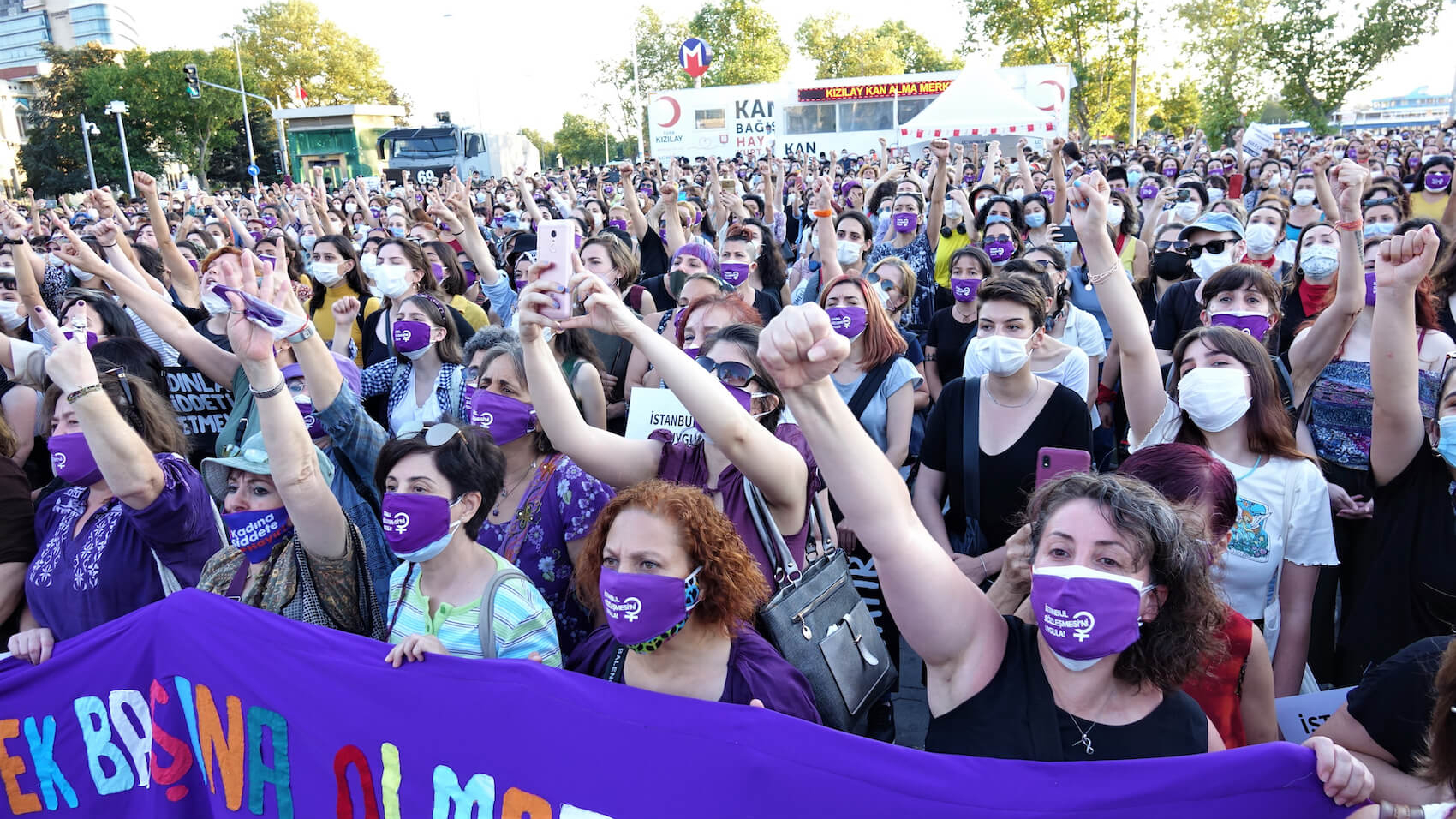
In Turkey, women’s citizenship is increasingly restricted into motherhood, family duty, and moral loyalty. Feminism and LGBTQI+ activism are framed as moral and foreign threats, while patriarchal governance is legitimated through religious and nationalist discourse. The Istanbul Convention withdrawal galvanized resistance, making gender a central site through which democratic backsliding and civic resilience are simultaneously revealed.
My framework of contextual gendered racialization sharpens this analysis by showing how Sunni Turkishness is privileged through an ethno-religious “Turkishness Contract,” producing double marginalization for Kurdish, Alevi, Armenian, and dissenting women. Gendered governance thus operates through both patriarchy and racialized belonging (Unlu, 2023).
Transnational Racialization and Migration
Racialization travels across borders. In Turkey, difference is marked through proximity to dominant Sunni Turkish identity rather than skin color; minority women are symbolically racialized as deviant or suspect. In the United States, Muslim women become hyper-visible within Islamophobic regimes of surveillance, legally white, socially brown (Aziz, 2020). Hijab, accent, and names trigger institutional scrutiny across immigration, healthcare, education, and labor.
Women respond through strategic identity management: negotiating visibility, silence, and speech; altering dress or disclosure; cultivating selective belonging. These practices constitute feminist praxis rather than mere adaptation, resisting both authoritarian repression and reductive Western feminist frames. Situated feminisms emerge from lived negotiation rather than abstraction (Girdap, 2025).
Law, Memory, and Care as Resistance
Across Iran and Turkey, women deploy diverse resistance strategies that transform opposition from episodic protest into durable institution-building. Ebadi’s ethic of defending rights even within captured institutions finds parallels in feminist lawfare and documentation practices in Turkey. Litigation, femicide databases, survivor testimonies, and non-enforcement audits preserve public memory and sustain accountability even when legal victories are limited. As national protections erode, opposition-led municipalities expand shelters, hotlines, training, and care infrastructures, producing constituent feminism beyond electoral cycles. Campaigns such as #İstanbulSözleşmesiYaşatır(#IstanbulConventionSavesLives) and recurring protests after femicides sustain public scrutiny and agenda pressure. Groups like Mor Dayanışma link gender violence to labor precarity, militarism, ethnic repression, and anti-LGBTQI+ moral panics, expanding coalitions and articulating care-centered, class-conscious feminist praxis (Mor Dayanışma, 2025; Najdi, 2025; Şeker & Sönmezocak, 2021).
Conclusion: Freedom Beyond the Golden Cage
Bringing Ebadi’s ethic of law, memory, and freedom together with a transnational feminist analysis clarifies the stakes of the Iran–Turkey comparison. In both contexts, populism narrows [established] citizenship into a moral community, and gender becomes the key nexus of belonging. Yet women’s epistemic and practical resistance, through legal advocacy, documentation, care spaces, migration, and transnational solidarity, takes a huge step to widen citizenship back into rights, pluralism, and accountability.
Freedom, in this sense, is not comfort or order. It is collective remembering, feminist institution-building, and sustained struggle against normalization. The golden cage is broken not by silence, but by women who insist on memory, justice, and shared political futures across borders.
References
Aziz, Sahar F. (2020). “Legally White, Socially Brown: Racialization of Middle Eastern Americans.” In: Routledge Handbook on Islam and Race (ed. Zain Abdullah), Rutgers Law School Research Paper No. Forthcoming, https://ssrn.com/abstract=3592699 or http://dx.doi.org/10.2139/ssrn.3592699
Bottura, Beatrice. (2024). “Theocracy, Radicalism and Islamist/Secular Populism in Iran, Afghanistan & Tajikistan.”European Center for Populism Studies (ECPS). October 18, 2024. https://doi.org/10.55271/rp0089
European Parliament. (2022). Protests in Iran over the death of Mahsa Amini.https://www.europarl.europa.eu/RegData/etudes/ATAG/2022/733671/EPRS_ATA%282022%29733671_EN.pdf
Girdap, H. (2025). “Racialization and Response Through Embodied Identification.” In: From a Shadow to a Person: A Gender Studies Assessment of Women in the Middle East, edited by Shilan Fuad Hussain, Routledge, manuscript in preparation.
Holliday, Shabnam J. (2016). “The legacy of subalternity and Gramsci’s national–popular: populist discourse in the case of the Islamic Republic of Iran.” Third World Quarterly, 37:5, 917-933, DOI: 10.1080/01436597.2015.1113872
Qaderi, H.; Delavari, A. and Golmohammadi, A. (2023). “Populism and Politics in Iran after the Islamic Revolution: Content Analysis of Presidential Speeches from 1989 to 2017.” Political Strategic Studies, 12(44), 9-58. doi: 10.22054/qpss.2022.66333.3002
Sarac, B. N.; Girdap, H., & Hiemstra, N. (2023). “Gendered state violence and post-coup migration out of Turkey.” Women’s Studies International Forum, 99, 102796. https://doi.org/10.1016/j.wsif.2023.102796
Şeker, Berfu and Sönmezocak, Ezel Buse. (2021, June). “Withdrawal from the Istanbul Convention: War on Gender Equality in Turkey.” Freedom House. https://freedomhouse.org/sites/default/files/2021-06/06292021_Freedom_House_Turkey_Policy_Brief-2-Withdrawal-from-the-Istanbul-Convention.pdf
Unlu, B. (2023). “The Turkishness contract and the formation of Turkishness.” In: F. M. Gocek & A. Alemdaroglu (Eds.), Kurds in Dark Times. Syracuse University Press.
Yalvaç, F. & Joseph, J. (2019). “Understanding populist politics in Turkey: a hegemonic depth approach.” Review of International Studies, 45(5), 786–804. https://www.jstor.org/stable/26843268
In his incisive analysis, Dr. Amir Ali, examines how the 2025 Bihar Provincial Assembly elections have reinvigorated Prime Minister Narendra Modi’s populist dominance in Indian politics. Situating Bihar’s results within India’s shifting electoral landscape, Dr. Ali shows how the BJP-led coalition’s victory undermines expectations of anti-incumbency following the party’s 2024 parliamentary setback. He critically engages controversies surrounding the Election Commission of India, welfare-driven electoral strategies, and the shrinking space for opposition politics. Drawing on his broader scholarship on populism, democracy, and sovereignty, Dr. Ali warns that the consolidation of power from “Parliament to Panchayat” raises serious concerns for institutional autonomy and democratic accountability in what V-Dem has termed an “electoral autocracy.”
Amir Ali*
The recently concluded election in the eastern Indian province of Bihar in early November 2025 was a shot in the arm for Prime Minister Narendra Modi. Bihar is one of the poorest provinces of the country with a per capita income that is a mere fraction of richer provinces. High unemployment levels result in outflux of unskilled workers. Among the controversies that plagued the Bihar assembly elections was the running of special trains carrying Bihari workers from the northern province of Haryana that abuts the national capital Delhi, back to their native province, to ensure they could vote.
Despite its economic backwardness, Bihar is politically very important. The ruling Hindu nationalist Bharatiya Janata Party (BJP) is today the dominant political party in the country. It has replaced the earlier one-party dominant system of the Indian National Congress, that led India’s freedom struggle against British colonial rule. The BJP is at the center of the ruling coalition called the National Democratic Alliance (NDA). In the province of Bihar, the coalition partner of the BJP is the Janata Dal United JD(U) whose party boss, Nitish Kumar has been Chief Minister since 2005. Nitish Kumar is a leader whose political origins lie in samaajwaad or Indian socialism. Mr. Kumar is also known for his constant political flip-flops as he has constantly switched sides to continue in power. Back in 2015 he successfully fought the election in alliance with the Rashtriya Janata Dal (RJD). This time the RJD was competing against him, winning only 25 seats.
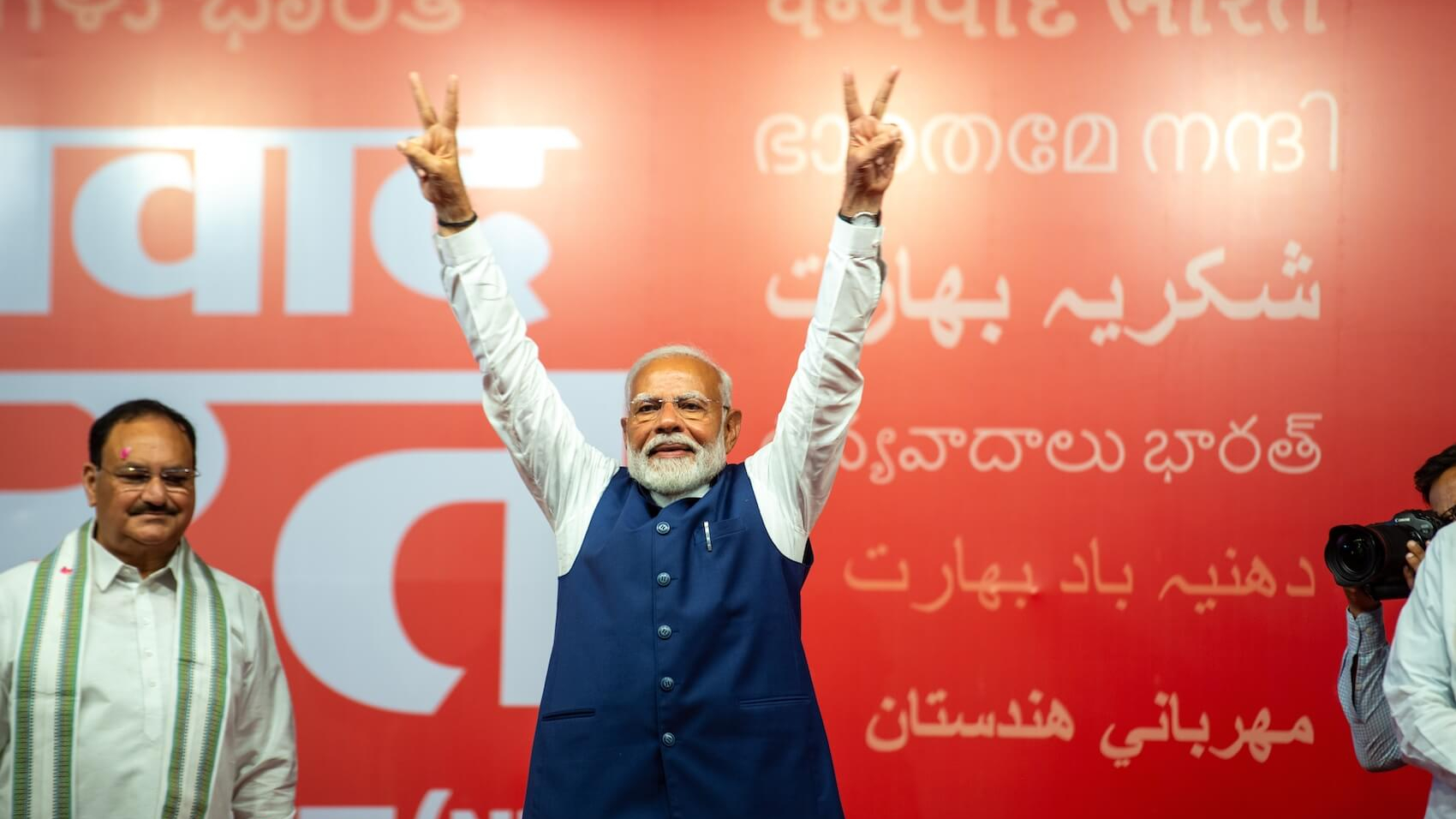
The alliance between the Bharatiya Janata Party (BJP) and the Janata Dal United JD(U) performed surprisingly well, winning together with other smaller allied parties, 202 seats in the 243-seat legislative assembly. The result was a major blow for the opposition I.N.D.I.A alliance that includes the once powerful Congress Party. The resounding victory of the ruling BJP led alliance means a further political consolidation, captured in a stated desire to prevail over Indian politics from ‘Parliament to Panchayat’ (the lowest tier of local self-governance at the level of the village). The ruling BJP has also expressed an intent to rid the country of the supposed baleful presence of the Congress that is captured in the Hindi expression of a Congress mukt Bharat (India/Bharat rid of the Congress).
The shrinking of the opposition becomes a cause for concern, especially as India has been characterized by the V-Dem institute as an ‘electoral autocracy.’ The provincial assembly election in Bihar needs to be seen in the backdrop of the 2024 parliamentary elections in which the ruling BJP suffered a setback as its numbers declined from 303 in 2019 to 240, forcing it into relying on significant support from coalition partners. This was viewed by the opposition as signaling a waning of the electoral dominance of the BJP.
Two Developments in the Run-up to the Election
The run up to the Bihar assembly election in early November 2025 was marked by two developments. The first was the announcement by the Election Commission of India (ECI) to conduct a Special Intensive Revision (SIR) of electoral rolls, four months prior to the elections. This became controversial on account of the onerous demands of documentation put on voters to ensure their names were on the voters’ list. The opposition immediately protested and appealed to the Supreme Court of India, which did not stop the SIR exercise, but demanded lenient consideration in terms of the documents that voters were required to produce. The opposition had hoped to make the revision of electoral rolls an issue in the elections, suggesting in their campaigns that the ruling BJP was conniving with the Election Commission of India to ‘steal’ votes.
The aspersions cast on the Election Commission of India are unfortunate. It is a constitutional body that under Article 324 of the constitution is guaranteed autonomy from the executive to conduct free and fair elections. The Election Commission of India has generally been above board in terms of its conduct with a succession of Chief Election Commissioners, who head the institution, taking independently assertive positions against ruling governments. If the opposition’s allegations about lack of autonomy of the Election Commission are true, then this would tend to underline the anti-institutional element, characteristic of much populist politics that while exaggeratedly elevating the purity of the people, excoriates the very institutions that mediate the people’s will. The leader of the opposition, Rahul Gandhi of the Congress party has conducted a series of explosive press conferences where he has displayed proof of the Election Commission of India’s ‘conniving’ with the ruling BJP to ensure the latter’s electoral victory.
The second significant development in the run up to the elections was the decision taken by the Nitish Kumar government in Bihar to announce the disbursal of ten thousand rupees (95.75 Euros) for women voters under a scheme to promote women’s self-employment. Analysts felt that this was decisive in terms of winning the elections for the ruling NDA coalition. Opponents of the ruling coalition cried foul at the decision announced in late September 2025. This was just before the model code of conduct came into place. Such announcements are seen as an infringement of the model code of conduct as they may induce votes in favor of the ruling party.
Whither Anti-incumbency?
The election results from Bihar impart momentum to the ruling BJP led coalition as the year 2025 closes. Next year in early 2026, provincial assembly elections are due in two more states further to the east of Bihar, in the provinces of West Bengal and Assam. The elections result in Bihar, especially considered in the light of the electoral setback that the BJP suffered in the parliamentary elections at the federal level in early 2024, seem to put paid to the phenomenon of anti-incumbency which refers to the uphill task that an incumbent party experiences as it seeks re-election. The BJP’s dominance seems to defy what in India is called the law of anti-incumbency.
(*) Dr. Amir Ali is a faculty member at the Centre for Political Studies, Jawaharlal Nehru University (JNU), New Delhi. Prior to this he taught at the Department of Political Science, Jamia Millia Islamia University. He was Agatha Harrison Memorial Visiting Fellow at St. Antony’s College, Oxford between the years 2012 to 2014. He has authored two books South Asian Islam and British Multiculturalism (Routledge, 2016) and Brexit and Liberal Democracy: Populism, Sovereignty and the Nation-State (Routledge, 2022). His areas of teaching, research and writing are political theory, multiculturalism, group rights, British politics and political Islam. His regularly written political commentary on Indian and global politics has appeared in the Economic and Political Weekly, Al Jazeera English, the Indian periodical Outlook and in Indian broadsheet newspapers such as The Indian Express, The Hindu, and The Telegraph.
In this interview with the ECPS, Dr. Robert Butler, Senior Lecturer at the University of Lorraine, examines how far-right actors in France and the UK construct legitimacy amid crisis and geopolitical uncertainty. Drawing on critical and multimodal discourse analysis, Dr. Butler explores authorization, crisis narratives, and moral evaluation in the rhetoric of Marine Le Pen, Jordan Bardella, and Nigel Farage. Reflecting on Trump’s return to power, he cautions against simplistic readings of transatlantic influence, arguing that framing Europe as “weak and vulnerable” may have concrete political effects. As Dr. Butler strikingly notes, “non-intervention itself becomes a form of intervention,” reshaping sovereignty, responsibility, and counter-mobilization across Europe.
Giving an interview to the European Center for Populism Studies (ECPS), Dr. Robert Butler, Senior Lecturer in the Faculty of Arts and Languages at the University of Lorraine (Nancy) and editor of Political Discourse Analysis: Legitimisation Strategies in Crisis and Conflict, offers a nuanced comparative analysis of far-right discourse in France and the United Kingdom. Drawing on critical discourse analysis and multimodal approaches, Dr. Butler examines how contemporary populist and far-right actors seek legitimacy in what he characterizes as a “de-legitimized political world.”
Across the interview, Dr. Butler emphasizes that far-right actors such as Marine Le Pen, Jordan Bardella, and Nigel Farage rely heavily on authorization as a legitimization strategy, combining appeals to the personal authority of leaders with increasing references to impersonal authority, particularly “the rule of law.” As he notes, “we see authorization at work: the personal authority of leaders, alongside reliance on impersonal authority.” This dual strategy allows far-right actors to distance themselves from overt radicalism while positioning themselves as credible governing alternatives.
A central theme of the interview is the discursive construction of crisis. In the UK context, Dr. Butler explains that Reform UK frames crisis as systemic collapse, encapsulated in the slogan “Britain is broken,” while in France, the National Rally (NR) increasingly portrays crisis through the lens of economic sovereignty, borders, and protection of domestic production. These crisis narratives are not only rhetorical devices but also serve to justify policy claims that move “beyond moral evaluation” toward what Dr. Butler calls “the realm of substance.”
The interview’s headline theme emerges most clearly in Dr. Butler’s reflections on international crises and Donald Trump’s return to power. Addressing whether Trump acts as a catalyst for far-right normalization in Europe, Dr. Butler cautions against linear assumptions. Instead, he highlights how Trumpian discourse increasingly frames European leaders as “weak and vulnerable,” raising fundamental questions about sovereignty, protection, and authority. Crucially, Dr. Butler argues that a politics of disengagement may carry unintended consequences, noting that “non-intervention itself becomes a form of intervention.”
This insight anchors the interview’s broader contribution: far-right legitimization does not rely solely on overt alignment with radical allies but often involves strategic distancing, ambiguity, and moral labeling. As Dr. Butler puts it, describing states as weak may function as “a form of moral evaluation” that lacks substance yet reshapes political expectations and responsibilities.
By combining close discourse analysis with comparative political insight, this interview sheds light on how far-right actors navigate legitimacy, crisis, and authority—both domestically and internationally—at a moment when the boundaries between intervention, sovereignty, and normalization are increasingly blurred.
Here is the edited transcript of our interview with Dr. Robert Butler, slightly revised for clarity and flow.
Delegitimizing Elites, Authorizing Leaders
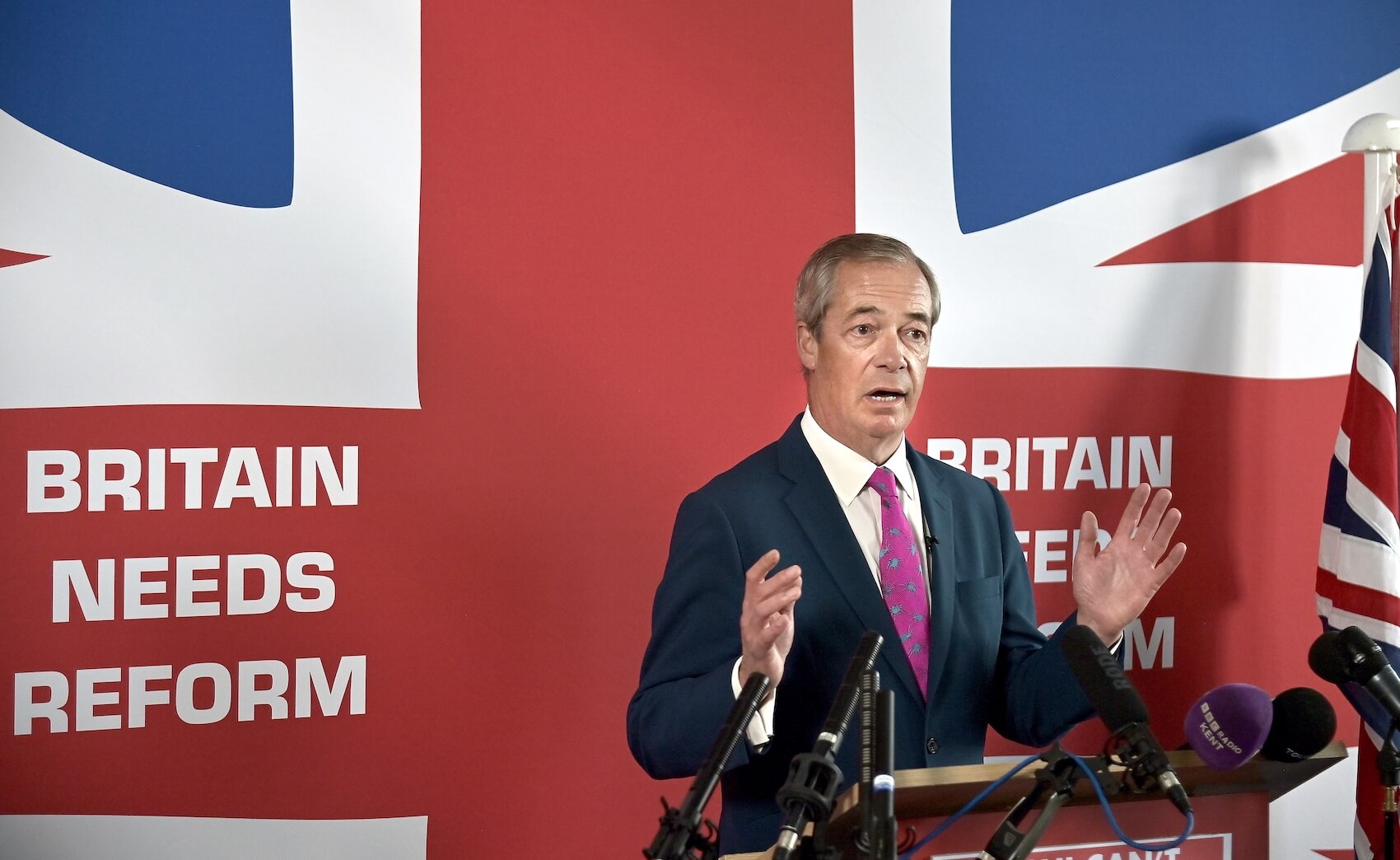
Nigel Farage speaking in Dover, Kent, UK, on May 28, 2024, in support of the Reform Party, of which he is President. Photo: Sean Aidan Calderbank.
Dr. Robert Butler, thank you so very much for joining our interview series. Let me start right away with the first question:From your perspective as editor of“Political Discourse Analysis: Legitimisation Strategies in Crisis and Conflict,” how would you characterize the dominant legitimization strategies used by Marine Le Pen and Nigel Farage when they present themselves as defenders of “the people” against distant elites? Do these strategies converge across France and the UK, or are they embedded in quite distinct national political cultures?
Dr. Robert Butler: I haven’t done specific research on the situation in France, so I’ve looked, to some extent, at developments in the UK, particularly Reform UK. What I would say is that there is a clear delegitimization of the establishment and the parties in power in both countries.
In terms of the actual legitimization strategies used, I think they do, in both contexts, draw on what Theo van Leeuwen refers to in his seminal 2007 article on legitimization and legitimation—namely, authorization. There is a strong emphasis on the personal authority of leaders: Marine Le Pen and Jordan Bardella in France, and Nigel Farage, the leader of Reform UK, in the UK.
There is an appeal to personal authority, but I also think there is a growing appeal to impersonal authority, particularly the rule of law—emphasizing the need to respect the law and to operate within its parameters.
So, very much in terms of legitimization strategies, and following Van Leeuwen’s approach, we see authorization at work: the personal authority of leaders, alongside reliance on impersonal authority, namely the rule of law.
Performing Insecurity Through Multimodal Authority
In your work on authority and multimodal discourse, you stress how gesture, intonation, and visual framing help construct political identity. How do you see these multimodal resources operating in the performances of Farage and Le Pen (and now Jordan Bardella) when they dramatize insecurity, crisis, or loss of control?
Dr. Robert Butler: I would say that, again, my focus has been on Reform UK rather than on the Rassemblement National in France, the National Rally. That said, what we can observe in both cases is a significant use of gesture, with gestures playing an important role alongside discourse.
In particular, with Farage, we see frequent use of what we call open-hand supine gestures, where the hands are held with the palms facing upwards, often accompanied by outward and upward movements. These gestures can serve a pragmatic function, signaling uncertainty—conveying a sense of “I don’t know” or “what is there?”—and suggesting that the situation is difficult to interpret.
This is a significant gesture because it contributes to the audience’s impression that the situation is politically untenable, that there is a broader social situation that needs to be managed. Accordingly, open-hand gestures appear frequently, often with a wide space between the hands.
From what I have observed, we also see this with the National Rally in France: broader gestures and extensive use of the hands. Visually, this reinforces the audience’s impression that something needs to be done, that there is uncertainty about what that should be, and that the situation they face is untenable.
From Slogans to Substance in Far-Right Legitimation
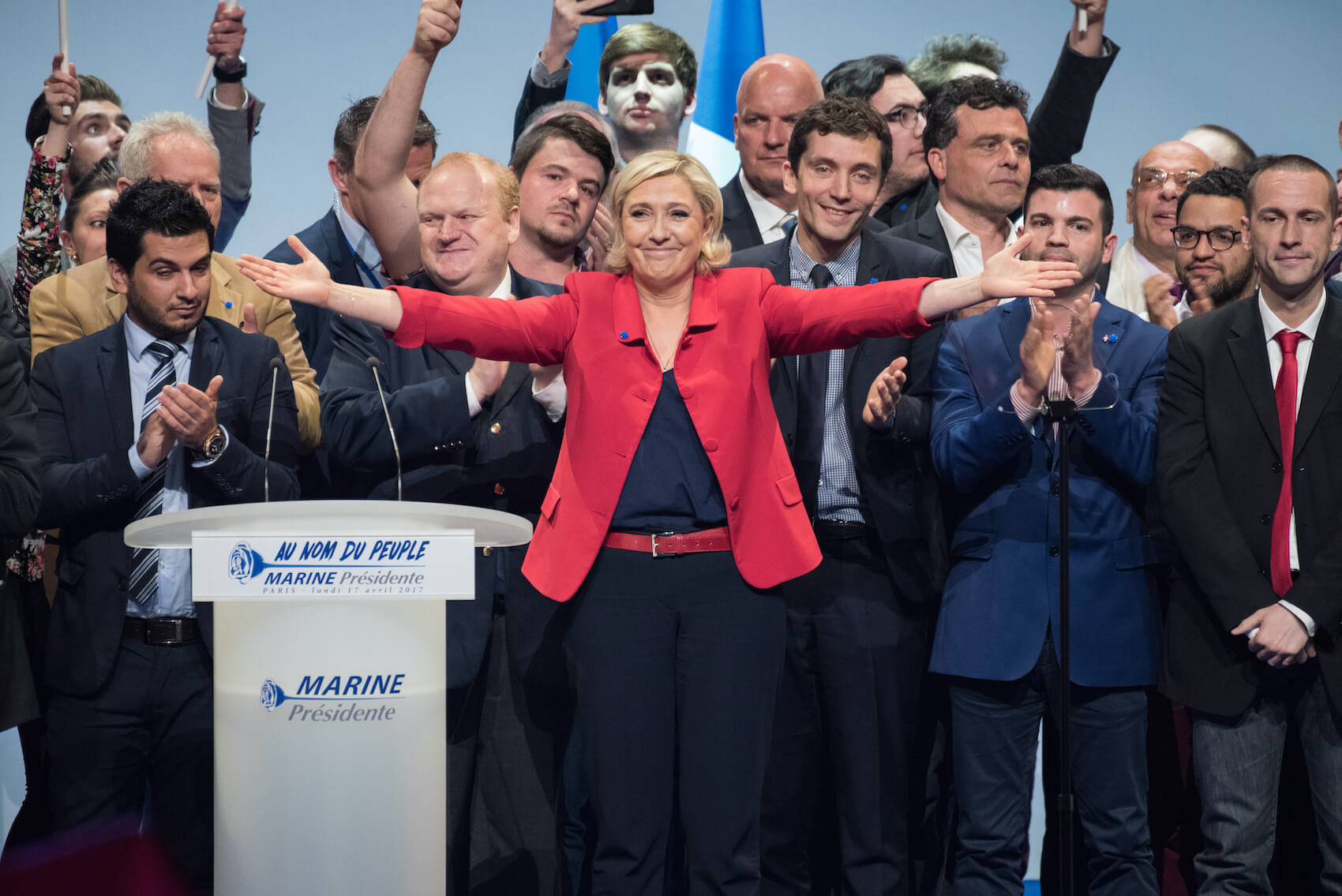
Marine Le Pen, from the Front National, a national-conservative political party in France in meeting for the presidential election of 2017 at the Zenith of Paris on April 17, 2017. Photo: Frederic Legrand.
One of the core themes of your edited volume is the challenge of sustaining legitimacy in a “de-legitimized political world.” To what extent has the far right in France and the UK successfully exploited this legitimacy deficit—especially the erosion of trust in parties, media, and expert authority—and what limits do you see to this strategy?
Dr. Robert Butler: There has been a significant challenge to the legitimacy of established political parties—particularly catch-all parties—in power in both the UK and France. Again, drawing on Van Leeuwen’s 2007 article on legitimization and legitimization strategies, the challenge has been to move beyond what he calls moral evaluation—that is, the use of words or slogans that carry little meaning beyond statements such as “we are democratic” or “we believe in freedom,” where values are not supported by substantive action. The parties—what we refer to as the far right—have themselves moved beyond moral evaluation and are increasingly operating in the realm of substance when justifying their positions.
This can be seen, for example, in an interview Bardella gave several months ago, in which he called out the Ministry of the Economy and Finance’s claims that businesses should be patriotic. He frames this as a form of moral evaluation—without stating it explicitly—suggesting that it amounts to little more than words. Here, we see something that can be assimilated to moral evaluation being directly challenged by the National Rally.
So, I think they are attempting to expose moral evaluation strategies, move beyond them, and instead rely on authorization.
In Power or In Office? Leverage Without Government
Comparative research has often treated the Rassemblement National (RN) in France as a party on the cusp of governmental power, and Reform UK—despite its recent surge in influence—as an “outsider” shaping the agenda from the margins. Using the distinction between being “in power” and “in office,” how would you assess the current leverage of Le Pen and Farage over mainstream parties and policy in their respective systems?
Dr. Robert Butler: In France, the National Rally has not obtained an absolute majority in the Assembly. There was some discussion about waiting and only seeking to govern with a majority; that is how I understood the situation. There has also been discussion about whether there might be a primary across the right in French politics. However, certain parties further to the left within the right have indicated that they do not share common ground with the RN, the National Rally. So, in terms of being in office and in power, the RN is seeking new elections in order to try to secure that majority.
In the UK, various opinion polls have suggested that Reform UK would, if an election were called today—even though one is not due immediately—emerge as the largest party. It might not secure an overall majority, and this could result in a hung parliament. There is a portrayal of Reform UK as being on the outside, looking in at a UK that is collapsing or imploding, reflected in the slogan “Britain is broken” and in its emphasis on public services being unable to cope and being overwhelmed. In terms of being empowered in office, Reform UK is neither in office nor in power, but it is positioning itself around what is needed to take power. However, it is doing so very much from the outside, observing those in power and a situation that it portrays as collapsing and imploding.
When ‘Britain Is Broken’ Meets Economic Sovereignty
Your work highlights how crisis narratives are central to legitimization. How do far-right actors in France and the UK differently construct “crisis”—migration, cost of living, Europe, Islam, climate—and what does this tell us about the socio-economic and historical specificities of each case?
Dr. Robert Butler: Following on from what I’ve just said, I think that in the UK, Reform UK frames crisis in terms of systemic failure, emphasizing that Britain is broken. At his conference last year, Mr. Farage, for example, asked the audience, “Who has an NHS dentist in the room?” So, the crisis is constructed around the idea that Britain can no longer cope and that the system is under strain.
By contrast, from what I have followed with the National Rally in France, and from what I have observed in their speeches and interviews over the past few months, the situation is portrayed more as one in which France is seen as a system that needs to change—particularly a system of exchange in which goods are produced abroad rather than in France, and which must be reoriented to favor domestic production. Accordingly, crisis is increasingly framed as the need for barriers, especially to protect French goods and their quality. In an interview, Marine Le Pen refers to frontiers or borders as a means of protecting the quality of products coming into the country.
Populism as Process, Not Outcome
In recent years, French and British political language has seen an inflationary use of the term “populist” as a weapon of de-legitimation. Building on contributions in your volume that ask “who calls whom a populist?”, how has this labelling battle shaped the public perception and normalization of Le Pen’s RN and Farage-style projects?
Dr. Robert Butler: The term populism is better understood as a process—a means rather than an end in itself. I see it as a way of working toward a different political outcome in the future, rather than as an end product. Populism, in this sense, is not the outcome but the process. It is a process of placing more people on the side of “us” as opposed to “them,” where elites—frequently identified as such in interviews given by the National Rally—are positioned as “them,” and “the people” are increasingly placed on the side of “us,” meaning those who support these political parties.
I also think—and this is something I may not have mentioned earlier—that the concept of moral outrage plays an important role. This is another legitimization strategy identified more recently. An article published about five years ago by Rebecca Williams addresses moral outrage, and I think populism is closely linked to a certain degree of social outrage, where particular actions can be justified by expressions of disgust or dissatisfaction with the current situation.
In this sense, the term populism functions as a means of bringing people onto “our” side, presenting the United Kingdom and France as countries that need to do better, while simultaneously associating the nation and the people with the party. Populism, then, is a process of mobilizing support by drawing people in, rather than aligning them with the opposing side, which is constructed as those currently in power or other parties seeking power.
Moral Outrage, Media, and Knowledge Claims
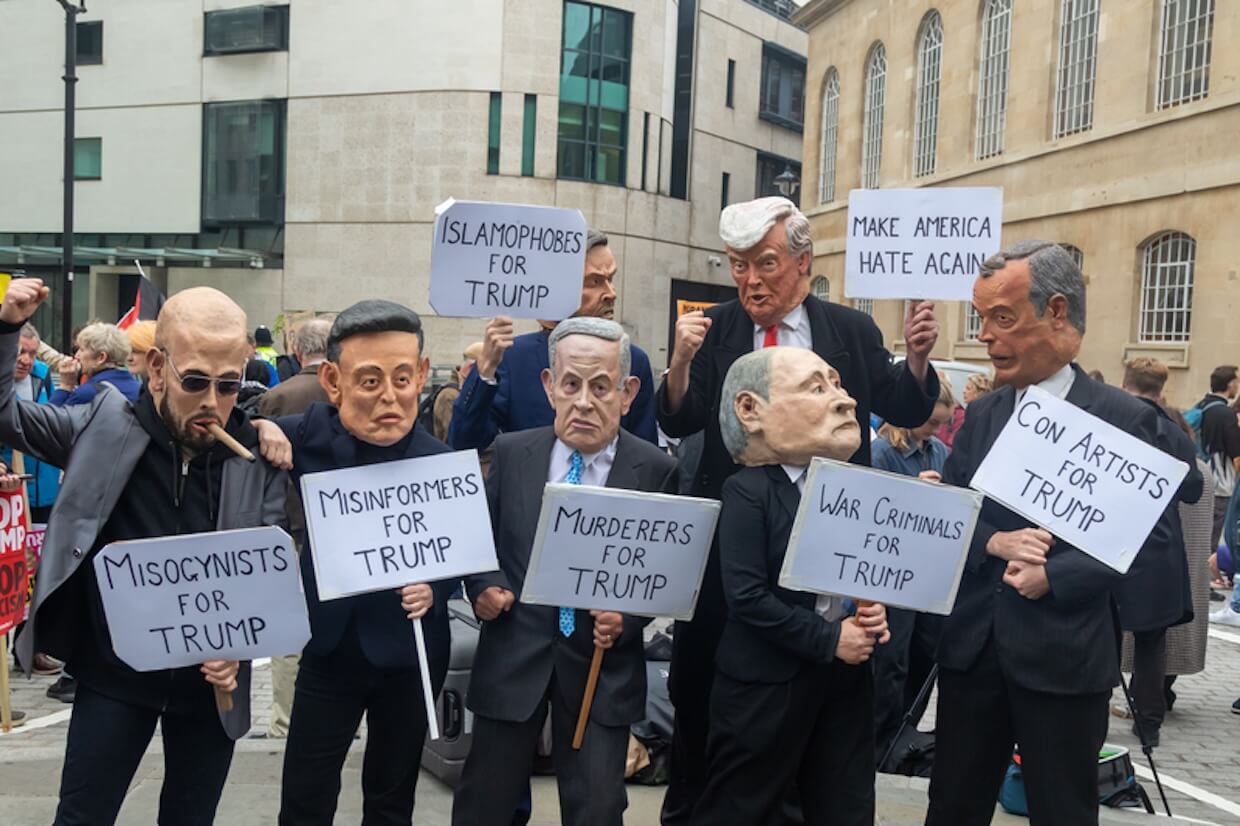
Stop Trump Coalition march, Central London, United Kingdom, September 17, 2025. Protesters dressed as Musk, Farage, Vance, Putin, Trump, and Netanyahu. Photo: Ben Gingell.
You emphasize “epistemic vigilance” and post-truth conditions in contemporary politics. How do far-right entrepreneurs in France and the UK negotiate this environment—do they primarily undermine factual authority (“fake news,” “media system”), or do they also try to re-establish alternative epistemic authorities such as patriotic experts, “common sense,” or online influencers?
Dr. Robert Butler: I haven’t done much work on influencers as such; my focus has been more on YouTube as a social media outlet. I think certain media outlets have popularized the idea of common sense, and this notion has, in effect, become a form of legitimization—legitimizing actions when they can be framed as common sense. This is an area where more work needs to be done and further research is required.
With Reform UK, in particular, it is less about the issue of fake news and more about adding a certain level of moral outrage to claims that the NHS, the National Health Service, cannot cope, and that certain social mechanisms appear to be broken. In terms of common sense, I am not entirely sure; I think there is still much more work to be done on this notion, and further research is needed.
Mainstream Right Parties in a Reactive Phase
Looking at internal party dynamics, what similarities and differences do you see between the ways in which the French Republicans and the British Conservatives have responded discursively to the rise of the far right? Have their legitimization strategies tended to contain, converge with, or further empower RN and Reform-style actors?
Dr. Robert Butler: Thank you for your question. There has been some splintering of the traditional right in French politics toward the far right. In the UK, there have been several defections, mainly of former Conservative MPs, to Reform. There has been a noticeable number of such defections. I think there has been quite a lot of delegitimization of the policies of Reform UK and the National Rally by both the French Republicans and the British Conservatives.
Reform UK is often seen as having an alternative agenda, whereas the National Rally is perceived as having little or nothing in common with other mainstream political parties. That appears to be the prevailing view. In recent days, there was discussion, as I mentioned earlier, of a large primary ahead of the 2027 elections—either presidential, legislative, or both—but this seems to have been ruled out, suggesting that there is limited common ground with the RN, the National Rally.
Overall, there has been a strong emphasis on delegitimization. However, over time—perhaps over the next year or two—I expect we will see both the Conservatives and the Republican Party develop alternative legitimization strategies to justify their own positions. At present, they appear to be in a reactive phase in response to the rise and growing success of the RN and Reform UK.
From Negation to Affirmation
In your multimodal analysis of Farage and Reform UK, you show how negation and modality help define what a party “is” and “is not.” If we apply this lens to Le Pen/Bardella, how do denial, distancing, and disavowal (“not extreme right,” “not racist”) function in their efforts to render the RN a credible party of government?
Dr. Robert Butler: Again, my work has focused on Reform UK rather than on the RN, the National Rally. However, based on what I have observed, I think there is a growing emphasis on asserting what the party stands for. There appears to be less focus on defining what the RN is not, and more on clearly articulating what it represents. In a recent interview, Le Pen acknowledged that for around 30 years there had been considerable emphasis on the negative way the party was treated by the media and by other parties. I think there is now a shift toward emphasizing what the party stands for, rather than relying on negation—denying that it is this or that. There is a reason for this shift.
The context is different from that of Reform UK, where Nigel Farage stepped back from mainstream politics for a period and then, over the last 12 to 18 months, had to explain why he was returning. This is why, in my recent article, I observed extensive use of negation by Farage, as he justified his return to mainstream politics by explaining what he could not do or why he rejected certain principles.
By contrast, the situation is somewhat different for Le Pen and Bardella. They appear to be in a phase of asserting, through affirmative terms, what they actually stand for.
Re-Legitimizing Europe: Borders, Sovereignty, and Reform
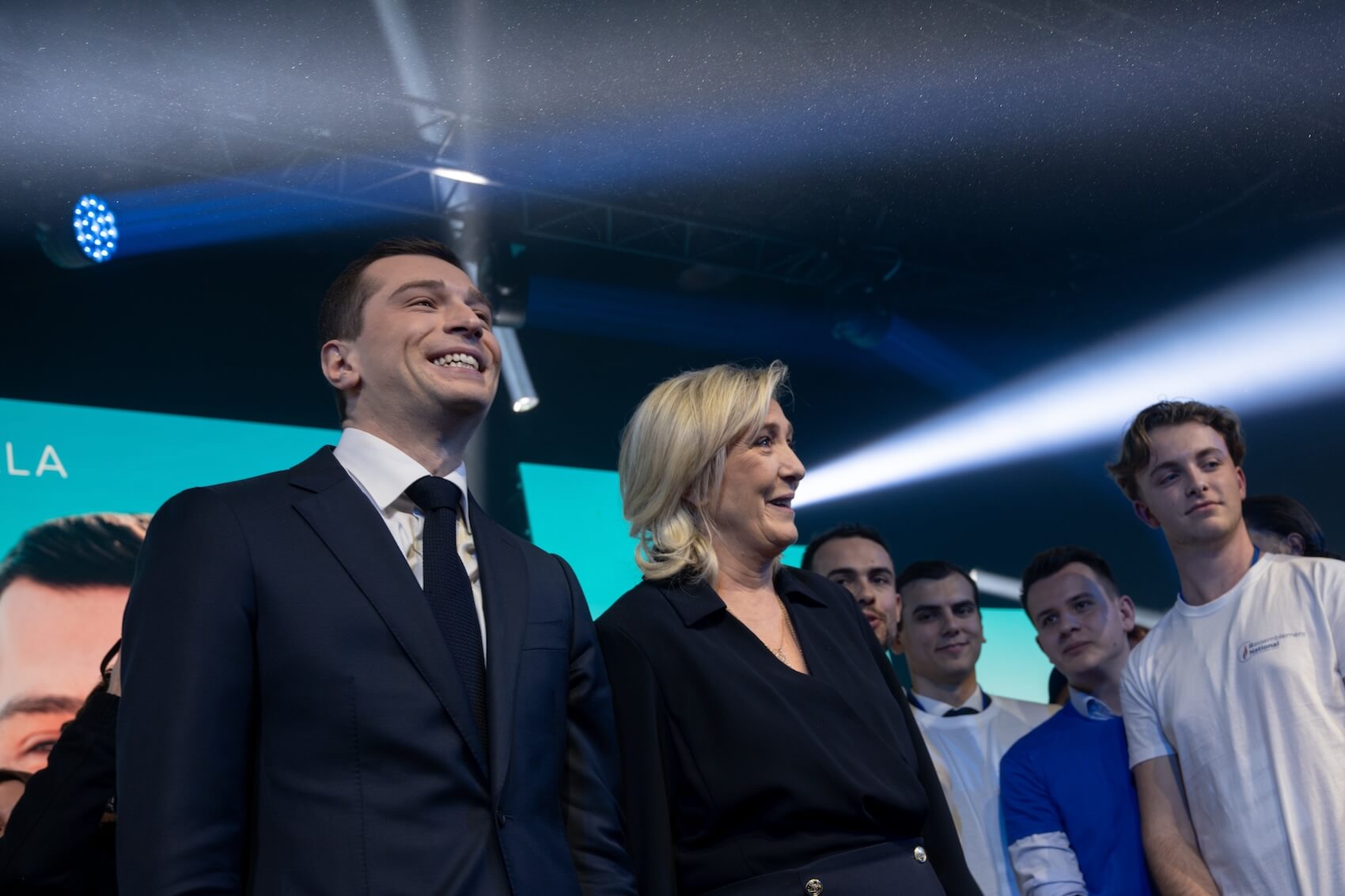
Marine Le Pen and Jordan Bardella are seen at the conclusion of a political meeting for the Rassemblement National party in Marseille on March 3, 2024. Photo: Obatala-photography.
At the European level, how do you interpret the far right’s attempt to re-legitimize the EU not as a technocratic polity but as a vehicle for “civilizational” or “sovereigntist” politics? Do you see France and the UK as following parallel or diverging trajectories in this respect, given that one is inside and the other outside the Union?
Dr. Robert Butler: The notion of Frexit—France leaving the European Union—has been present in public debate over the last two or three years. More recently, the plight of farmers, allegedly linked to Mercosur, has become a topic of debate and is very much in the news in France this week. In contrast, the UK has focused more on controlling borders, particularly on who is coming into and going out of the country, and especially who is entering the UK. As a result, the European Union has become less of a direct feature in Reform UK’s discourse, with greater emphasis placed on fixing the UK’s infrastructure and protecting its borders. By contrast, the RN, the National Rally, appears more concerned with reforming the EU, first and foremost in ways that it argues would benefit France.
Your editorial work stresses the importance of multimodal critical discourse studies. How have social media formats—short clips, memes, influencer-style videos—transformed far-right communication in France and the UK, and are there noteworthy differences in platform use or visual rhetoric between Le Pen/Bardella and Farage/Tice?
Dr. Robert Butler: As I mentioned earlier, I haven’t focused specifically on the RN in my research, so it is difficult for me to provide a detailed answer with regard to the National Rally. However, if we take YouTube as an example, there are currently many clips of Mr. Farage commenting on the situation in the UK, for instance on immigration.
In some of his own clips, he also incorporates footage from other users’ videos to illustrate his points. This creates a kind of mise en abyme, if you like—a clip within a clip.
In several instances, the Union Jack flag is visible, either behind him in a car or on the screen, and there are also many clips of him seated at a desk. This produces a very formal, official setting, which again connects to the idea of being in power or in office—not actually holding office, but simulating a scenario in which one might be looking at a future leader in office.
By contrast, if we look at Marine Le Pen’s YouTube account—having discussed Farage’s account—you see many clips of her speaking in the Assemblée Nationale or being interviewed by mainstream media outlets. This is a key difference. There are many more clips of Le Pen in clearly official settings, such as major media interviews or parliamentary contexts. This points to a clear difference in the use of context.
From ‘Britain Is Broken’ to Paths to Power
Looking ahead to the next decade, what scenarios do you consider most plausible for the far right in France and the UK: full governmental incorporation, permanent “blackmail” power over center-right parties, or gradual demobilization as issues and generations change? What indicators should researchers monitor to distinguish among these trajectories?
Dr. Robert Butler: Thank you for asking this question, because one of the main slogans—or narratives—of Reform UK is “Britain is broken.” At some point, it will need fixing, and I think it is important to pay attention to metaphors related to rebuilding, fixing, and redoing. From a linguistic perspective, in addition to metaphors, we should also look for what are known as force-dynamic strategies, where interaction between entities involves overcoming difficulty and crisis, and observe whether these strategies are actually put into practice. In terms of language it will be particularly interesting in the UK to see how Britain is discursively framed as moving from being “broken” to being “fixed,” and how problems are presented as being overcome.
In France, the far right’s objective is to win the Assembly and secure a majority in 2027, as well as to win the presidential elections that year. It will also be important to observe the results of the municipal elections scheduled for 2026.
Focusing on the UK, a coalition involving Reform UK and another party—most likely the Conservatives, if it were to be any party—would probably be more attractive to Reform UK than holding an overall majority. We have a precedent for this in the Liberal Democrat–Conservative coalition from 2010 to 2015, in which the Liberal Democrats were the junior partner.
In that situation, the Conservatives were able to take advantage of certain Liberal Democrat policies, such as raising the tax threshold, while also seeking to maximize credit for the junior partner’s policy initiatives. At the same time, there was an abstention campaign for changes to the electoral system which was put forward. Meanwhile, the Liberal Democrats were largely left to deal with the fallout from the rise in tuition fees, which, as we can agree, was not a particularly popular policy.
If Reform UK were in a hung Parliament but emerged as the main coalition partner, it would be in a position to offload some responsibility for policy outcomes. Then, perhaps in ten years’ time, it could aim for full majority power.
Overall, I think we could see some very interesting political as well as discursive strategies. It is quite conceivable that Reform UK could be involved in a coalition arrangement similar to that of 2010, with both political and discursive strategies unfolding in parallel.
Legitimizing Authority Through Strategic Distancing
Donald J. Trump, the 47th President of the United States, at his inauguration celebration in Washington, D.C., on January 20, 2025. Photo: Muhammad Abdullah.
Given your interest in how authority is discursively constructed, how do international crises—Russia’s war in Ukraine, the US democratic crisis, or Middle East conflicts—influence the legitimization strategies of far-right actors in France and the UK? Are these crises used mainly to normalize their positions, or also to distance themselves from more radical allies?
Dr. Robert Butler: I think that at conferences held by Farage last year, in 2024, there was some clear distancing from the leader of Russia. This distancing was definitely observable in the discourse.
In France, more recently this year, interviews with the RN have reflected an acknowledgement of US sovereignty in relation to what is unfolding there, alongside an emphasis that US priorities are not necessarily France’s priorities. This again represents a defense of France’s national interest. There also appears to be support for the rule of law.
I’m not sure I have much more to add to this question, but I think there is an acknowledgement of other countries combined with a certain degree of distancing, allowing both the UK and France to assert and defend their own national policies.
Trump, Europe, and the Politics of Non-Intervention
In light of the recently released Trump National Security Strategy, to what extent has the Trump presidency provided ideological validation or strategic inspiration for far-right actors in France and the UK? Do you see Le Pen, Bardella, or Farage consciously drawing on Trumpian rhetoric, political style, or governing practices, or is the transatlantic influence more diffuse and symbolic?
Dr. Robert Butler: From what I have observed, there appears to be some distancing from Trumpian rhetoric. Again, this reflects what I have noted previously. In France, the emphasis is very much on defending national interests at the level of the nation-state and on asserting France’s sovereignty. The RN, in particular, places strong emphasis on the rule of law. In the UK, the picture is perhaps more complex. There does seem to be some aversion to the language used in the US context, but I am not sure I have observed enough to comment on this in greater detail.
And lastly, Dr. Robert Butler, looking beyond national cases, do you see that the Trump presidency accelerates a broader European shift toward sovereigntist and civilization-based politics, or do European systems remain resilient and path-dependent? In other words, might Trump act as a multiplier for far-right normalization across the EU—or does his return instead provoke counter-mobilization among mainstream parties and institutions?
Dr. Robert Butler: Thank you for your question. I think it is difficult to know and much depends on what the remainder of the Trump presidency offers to European leaders. If European leaders are framed as weak and vulnerable—and we have seen some of this in recent discourse—and if they continue to be framed in this way, then there may be a tendency to seek protection, perhaps in exchange for greater influence or possibly reduced sovereignty. The notion of weakness in European leadership does appear to be entering Trumpian discourse at the moment. Again, the question is whether this framing is simply a moral label—a form of moral evaluation—where countries are described as weak. What does that actually mean, and is it backed up by substantive claims?
In terms of counter-mobilization, I think it depends on what, exactly, is being countered. If the discourse emphasizes non-intervention—leaving countries alone and withholding the financial, logistical, or other forms of support that may be required—then it becomes difficult to mobilize against any particular actor or policy.
The question then becomes how other countries—such as Russia, China, or other states—respond in relation to Europe. There is therefore a broader issue of whether non-intervention itself becomes a form of intervention. If one ceases to intervene, even rhetorically, and frames this as “leaving countries alone,” there is a risk that such a stance could weaken or undermine potential counter-mobilization.
In this timely and powerful Voice of Youth (VoY) essay, Emmanouela Papapavlou reframes migration not as a crisis or threat, but as a defining human reality of the twenty-first century. Moving beyond populist slogans and fear-based rhetoric, the piece exposes the gap between political discourse and the lived experiences of migrants—marked by legal precarity, exclusion, and everyday vulnerability. It critically interrogates the selective use of “legality” in public debates and highlights how populism redirects anger away from power and toward the powerless. Importantly, the article identifies Generation Z as a potential counterforce, emphasizing its everyday engagement with diversity and its rejection of xenophobic narratives. Published on the occasion of International Migrants Day, the essay is a compelling call to restore dignity, humanity, and ethical responsibility to migration politics.
By Emmanouela Papapavlou*
In an age of global instability, migration is not an exception and not some marginal social phenomenon, it is a defining feature of the modern world. Wars, political persecution, economic collapse, environmental disasters and inequality push millions to leave their homes in search of safety, opportunity, and a sense of dignity. Within this reality, the 18th of December, International Migrants Day, is not just another “awareness day,” it is a powerful reminder that migration is one of the most central human experiences of the twenty-first century, and that the way we talk about it in public spaces has real consequences on real lives.
Despite its profoundly human dimension, migration has become one of the most polarized subjects in global politics. Populist rhetoric, flourishing across Europe, the United States, and beyond, finds in the “migrant” the perfect target, an “other” onto whom fears, insecurities, and imagined threats can be projected. Migrants are framed as a faceless mass, as an economic burden, as a cultural threat, or even as enemies of national security. Yet the reality of migration is dramatically different from these oversimplified narratives.
For millions, migration is not a choice, it is a necessity. And for those who manage to reach countries of arrival, the journey does not end, it begins. Access to legal documents, endless visa backlogs, the slow and often arbitrary asylum process, and the requirements for work authorization create a system that is frequently insurmountable. In the United States, for example, hundreds of thousands of people live for years without papers, not because they refuse to comply, but because the system is designed to delay, discourage, and exclude. Even proving that you qualify for asylum often requires documents that no one could possibly rescue while fleeing a bombed home or a collapsing life.
While political discourse focuses obsessively on “flows” and “invasions,” what almost never gets discussed is the actual everyday reality of migrants, the labor exploitation, the lack of access to healthcare or education, the constant uncertainty of “will I be allowed to stay tomorrow,” the threat of deportation, the social stigma, the ghettoization, the absence of meaningful integration. Many states treat migration as a problem that must be “controlled,” not as a social fact that must be understood, integrated, and addressed with humanity.
International Migrants Day exists precisely because of this gap, the gap between rhetoric and reality, between what is said and what people live. It is a day dedicated to rights and dignity, to the fundamental right to move and to the right to live without fear. It is also a reminder that societies do not show their humanity in how they treat the powerful, but in how they treat the vulnerable.
Here we see another dimension of populism, the selective invocation of “legality.” Public debate suddenly fills with people who appear deeply committed to the rule of law when the conversation turns to migrants. “They came illegally,” they say, as if respect for the law were a consistent personal value and not something invoked only when convenient. Because the same people who express moral outrage at a refugee are often the same people who consider underage drinking normal, who speed on the highway, who drive under the influence, who use recreational substances, who pirate movies, music, and games without a second thought. In those cases, the law becomes a “technicality,” and strictness evaporates.
Yet when the “offender” is someone who ran from war, when it is a mother holding a child in a boat, when it is a young person who left everything behind just to survive, then suddenly the law becomes absolute and unforgiving. And even worse, we almost never see the same outrage when the offenders are powerful, corrupt politicians who steal public funds, evade taxes, exploit systems for personal gain, or embezzle compensations. In those situations, anger disappears. Outrage fades. “Illegality” becomes almost invisible.
This contradiction has nothing to do with the law. It has everything to do with control, with fear, and with the political function of populism, which is to divert collective anger away from those who cause injustice, and direct it instead toward those who are least able to defend themselves.
Yet within this landscape, there is a source of hope, and it comes from Generation Z. Gen Z is the first generation in history to grow up fully online, exposed every day to the lives of people across the world, from every background and every context. Diversity is not perceived as a threat; it is an intrinsic part of reality. For this generation, multiculturalism is not an ideological position, it is the texture of daily life in schools, universities, neighborhoods, and digital spaces.
Young people do not see migrants as outsiders, they are classmates, friends, coworkers, neighbors. They are the stories shared on social media, the voices heard without intermediaries, the people facing the same universal anxieties, work, education, safety, rights. Take the example of someone like Zohran Mamdani, who arrived in the United States as a child refugee and eventually became an elected representative in New York. His story is not an exception, it is a sign of a new era in which identity is shaped not by where you were born, but by who you are and what you contribute to your community.
What becomes clear is that Gen Z, through everyday contact with diverse cultures and people, rejects fear based rhetoric. They are not easily persuaded by politicians who weaponize xenophobia, and they do not accept narratives of “threat” without question. They see migration as a human reality, not as a tool for propaganda. And this generational shift carries enormous political weight for the future.
If we truly want to honor International Migrants Day, it is not enough to acknowledge its existence. We must promote policies that allow for safe, legal, and humane migration, support integration programs that go beyond survival and lead to participation and dignity, reform asylum and legalization systems so they do not trap people in bureaucratic limbo, and build societies that recognize diversity not as a danger but as a collective strength.
Because at the end of the day, the question we must ask is simple, and its simplicity is what makes it so revealing: How can a human being be considered “illegal” on an earth we were all born into? How can anyone be treated as worthless simply because they were born a few kilometers away?
If we cannot answer that clearly, then perhaps International Migrants Day exists to remind us that before borders, politics, and identities, we are, above all, human.
(*)Emmanouela Papapavlou is a high school student from Thessaloniki, Greece, deeply passionate about social and political issues. She has actively participated in Model United Nations and other youth forums, serving as a chairperson in multiple conferences and winning awards in Greek debate competitions. Writing is her greatest passion, and she loves using it to explore democracy, civic engagement, and human rights. Her dream is to share her ideas, inspire action, and amplify the voices of young people who want to make a difference. Email: emmanpapapavlou@gmail.com
In this incisive analysis, political scientist Professor Cengiz Aktar examines Ankara’s latest initiative toward the Kurds, arguing that what has been presented as a peace process is instead a populist performance of reconciliation. Professor Aktar shows how Turkey’s government frames “brotherhood,” “national unity,” and “terror-free Turkey” as harmonious goals, even though such populist language masks structural inequalities and omits democratic guarantees for Kurdish identity. With Abdullah Öcalan’s call for dissolution of the PKK left unreciprocated, and no mechanisms for Disarmament, Demobilization, and Reintegration (DDR), truth-seeking, or legal reform, Professor Aktar warns that the process risks being symbolic rather than transformative. He suggests that populism here functions not as conflict resolution, but as political containment — strengthening autocratic power while offering no durable settlement.
Turkey’s long-running conflicts with its ethnic and/or religious groups have been on the permanent agenda for more than a century. Various attempts by successive rulers to suppress or resolve these conflicts have drawn the attention of Turkey watchers and international public opinion throughout this period.
Interestingly, the latest initiative by the Ankara regime toward the Kurds—although seemingly ground-breaking at first glance—has largely gone unnoticed by global media outlets, and even more so by the wider public abroad. Only Western governments have, rather unenthusiastically, welcomed the developments.
Why such a lack of interest? Most likely because there is no serious or lasting peace perspective visible at the end of the process.
The genocide in Gaza, Russia’s aggression against Ukraine, and the massacres and famine in Sudan are now almost entirely dominating the headlines. Nevertheless, a genuine “Kurdish peace” would normally contain—at least partially—the seeds of region-wide normalization. Yet no one seems to detect such a dynamic in Ankara’s initiative, and rightly so.
Let us briefly recall the background.
Since the surprise launch of the so-called “process” on October 1, 2024, a highly unusual modus operandi has been underway to address this decades-old military conflict.
First, contrary to well-established conflict-resolution practices, the parties involved are not on equal footing. The Kurdish leader remains in prison and is not free in his movements or actions. That asymmetry alone speaks volumes about the genuineness of the process.
Since his capture and imprisonment twenty-five years ago, Ankara has approached Abdullah Öcalan three times with the same objective: to pressure him to end the armed struggle and push for the PKK’s dissolution. This time, it appears to have worked.
Indeed, on February 27, Öcalan declared that the rebel group had “completed its life cycle” and called for its dissolution, potentially signaling the end of a decades-long conflict that claimed at least 50,000 lives—around 40,000 of them Kurdish.
His “Call for Peace and a Democratic Society” was broadcast to the public at a hotel in Istanbul. In return, the plea for “legal and political regulations for dissolution and disarmament,” which was not included in the written call, was later added verbally.
Compared to the previous “peace” initiative of 2013, there is a clear regression. At that time, Öcalan linked the resolution of the Kurdish issue to the PKK’s demobilization, while proposing a broader, holistic framework. Today, there is no longer any connection between the dismantlement of the PKK and a lasting political solution to the Kurdish question. Öcalan’s major unilateral concession thus clearly signals that the entire scenario is being crafted by the authorities.
Second, in line with this fundamental imbalance, the scenario assumes that the Kurdish issue will be resolved within a vague framework of “national solidarity, brotherhood, and democracy,” falling far short of the structural changes required for equal citizenship and the recognition of Kurdish identity. Yet it aligns perfectly with a populist rhetoric that casually pairs concepts that in fact cancel each other out, such as “brotherhood” and “democracy.”
In the regime’s daily populist rhetoric, the process is laconically labeled “terror-free Turkey”—and nothing more. Worse, Öcalan now seems to echo this line by consistently promoting a “brotherhood” narrative in which Turkishness clearly takes precedence.
Within this framework, the regime may make symbolic gestures of goodwill but will never undertake ground-breaking reforms that would establish the constitutional, legal, and political foundations of an equal citizenship.
Kurds, under this logic, can only become full-fledged citizens on the condition that they dissolve into the Turkish magma. Accordingly, since the Öcalan call on late February, not a single meaningful step has been undertaken by the regime toward the Kurds.
Third, established conflict-resolution mechanisms and expert involvement are entirely absent from the Turkish process—whether in the form of joint commissions or specialized bodies within relevant public institutions.
Disarmament, Demobilization, and Reintegration (DDR)—the return of ex-combatants to civilian life through weapons collection, disbandment of armed groups, and social and economic reintegration—is not part of the process. Likewise, no provision has been made for truth and reconciliation.
All in all, within this unusual conflict-resolution architecture, the only concrete step taken by Ankara has been the establishment of an advisory parliamentary commission until the end of 2025, which meets behind closed doors and in which regime parties hold an absolute majority. Its agenda does not include, for example, a crucial Kurdish demand: the official recognition of the Kurdish language.
As for the opposition—including the main opposition party, the Republican People’s Party (CHP)—the prevailing view seems to be that the process would automatically trigger broader democratization. As if history had ever shown a non-democratic regime transforming into a democracy through the smooth management of peacebuilding with an ostracized people—in this case, the Kurds. Simply because such a management requires as a pre-condition, a functioning democracy.
The negative consequences of this clumsy process are already looming. While PKK circles have complied with the call of their “supreme leader” Öcalan, the Kurdish street remains profoundly skeptical. People welcome the official end of the armed struggle for its potential to spare the lives of their children—but no more than that.
Overall, the process is likely to strengthen Erdoğan and the regime bloc, allowing it to reap the political benefits of a “terror-free Turkey,” while weakening if not dismissing the Kurdish Political Movement. This carries the risk of a violent rejection of Kurdish “surrender” by radical—or less radical—segments of Kurdish polity.
Beyond this unfolding drama, Ankara’s ultimate objective remains the dissolution of the Autonomous Administration of North and East Syria (AANES) in Syrian Kurdistan (Rojava), led by Syrian Kurds and backed by a 100,000-strong, NATO-trained and equipped military force.
Nevertheless, the integration of this force into the nascent Syrian army appears to be the only realistic option for Damascus, for the AANES, and for the international coalition supporting the entity, which includes the United States, the United Kingdom, France, and Saudi Arabia. Negotiations among all actors are underway despite Turkey’s stubborn opposition.
The Turkish state has never viewed the Kurdish issue as anything other than a security problem—whether inside Turkey or in neighboring countries. That reflex will not change unless Ankara is forced to accept the Rojava fait accompli, thereby swallowing both the empowerment and the legitimacy of a Kurdish-led polity in its immediate neighborhood and across the wider region.
In this in-depth interview for ECPS, Professor Tim Bale offers a sharp assessment of Reform UK’s rise and Nigel Farage’s polarizing leadership. Farage, he argues, is “a Marmite politician — people either love or hate him,” making him both Reform’s engine and its constraint. Professor Bale suggests that Farage exemplifies “a classic populist radical-right leader” who channels anti-elite sentiment, yet risks alienating voters beyond his base. He links Reform’s surge less to ideological realignment than to Conservative decay, marked by Brexit fragmentation, leadership churn, and “over-promis[ing] and under-deliver[ing] on migration.” While Reform may reshape the political terrain, Professor Bale warns its ceiling remains visible—especially if questions of competence, Russia, and generational change intensify. Reform’s future, he concludes, is possible, but far from inevitable.
Giving an interview to the European Center for Populism Studies (ECPS), Professor Tim Bale—Professor of Politics in the Department of Politics and International Relations at Queen Mary University of London—offers a wide-ranging analysis of Nigel Farage, Reform UK, and the structural realignments reshaping British party politics. His insights are grounded in decades of scholarship on party evolution, populist rhetoric, and leadership psychology, making his perspective essential for understanding the United Kingdom’s shifting electoral landscape.
Throughout the interview, Professor Bale situates Nigel Farage as both emblem and engine of Britain’s contemporary radical right. As he puts it, “Nigel Farage is, in many ways, a classic example of a populist radical-right leader,” one who mobilizes support through a moralized confrontation between “the people” and supposed elite betrayal. Yet Farage’s strength is also his constraint. Professor Bale memorably describes him as “a Marmite politician,” a figure voters “either love or hate,” noting that this polarization “probably places a limit on Reform’s appeal.” Farage, therefore, embodies both populist vitality and electoral risk—“the ideal leader” in the eyes of his base, yet “a figure of suspicion” for many beyond it.
This duality frames Professor Bale’s central contention: that Reform UK’s rise must be understood not only in ideological terms but as an artefact of Conservative decay. Years of intra-party conflict, Brexit-driven fragmentation, and “over-promis[ing] and under-deliver[ing] on migration” have opened political space for Farage’s insurgency. Yet Professor Bale cautions against assuming an irreversible realignment. The Conservative Party remains “rooted in the middle-class political culture of the UK,” with institutional depth and internal veto points that make any “reverse takeover” more difficult than populist narratives imply.
Focusing on the structural and sociological conditions that shape political possibility, Professor Bale further highlights a widening generational divide. While education and age have become stronger electoral predictors than class, cultural conflict alone cannot explain support for Reform. If public priorities shift back from national issues to personal ones—from immigration to “the cost of living, [and] the state of public services”—Reform’s momentum may plateau. Moreover, its perceived softness on Russia remains “an Achilles’ heel,” one that stalled its surge when public attention sharpened in 2024.
Across this interview, Professor Bale neither exaggerates inevitability nor discounts volatility. Instead, he offers a sober framework for evaluating whether Reform represents a durable transformation or a protest cycle with a ceiling. Britain, he suggests, now faces a future where polarization, demographic turnover, institutional vulnerability, and charismatic leadership converge—precariously. This conversation, therefore, is not only timely, but analytically consequential.
Here is the edited transcript of our interview with Professor Tim Bale, slightly revised for clarity and flow.
Farage Is a Classic Populist Radical Right Leader
Nigel Farage speaking in Dover, Kent, UK, on May 28, 2024, in support of the Reform Party, of which he is President. Photo: Sean Aidan Calderbank.
Professor Tim Bale, thank you very much for joining our interview series. Let me start right away with the first question: In your work with Cristóbal Rovira Kaltwasser on the mainstream right’s strategic squeeze between Inglehart’s “silent revolution” and Ignazi’s “silent counter-revolution,” how should we interpret the rise of Reform UK? To what extent does Nigel Farage embody a classic mobiliser of counter-revolutionary sentiment, and to what extent do the Conservative Party’s specific organizational, ideological, and reputational vulnerabilities make the UK an outlier in the broader pattern of West European party-system transformation?
Professor Tim Bale: I think you would have to say that Nigel Farage is, in many ways, a classic example of a populist radical-right leader. He constantly draws a distinction between the wisdom of “the people” and their alleged betrayal and condescension by elites. As for the Conservative Party, there has always been a strain of populism and nationalism—indeed, some would say jingoism—within its tradition. In recent years, particularly under Boris Johnson and during the Brexit campaign, this tendency has come to the surface. In that sense, the party has reached back into its more populist and nationalist heritage as a way of competing with Farage and the political space he has claimed.
The Tories Are Hard to Capture — But Not Impossible
Farage’s rhetoric about a prospective “reverse takeover” foregrounds questions of party permeability and factional capture. Drawing on your analyses of Conservative factionalism and recurrent leadership crises, what structural, ideological, and organizational conditions render the Conservative Party susceptible to colonization by a radical-right challenger? Conversely, what features of party culture, elite networks, or institutional veto points might inhibit such a takeover?
Professor Tim Bale: When you look at the Conservative Party, there are features that, while not necessarily inoculating it from the challenge Farage poses, do make such a takeover more difficult than some people imagine, in the sense that it is a party rooted in the middle-class political culture of the UK. It is a party that has existed for 200 years, and it has a strong sense of entitlement, as it were, and a strong belief that it is the natural party of government, and therefore will be able to resist, in some ways, any challenge from a newcomer.
Having said that, however, one feature of the Conservative Party that always has to be borne in mind is that it is very strongly a leadership-driven party, and that should a leader take over who is more receptive to the kinds of overtures that Nigel Farage and others are making, then it would be quite easy for that person to convert the party to taking a much more hospitable attitude to that development. So, on the one hand, the fact that the Conservative Party is old, has a brand, and has an infrastructure makes it quite difficult for somebody to take it over. On the other hand, it can be taken over quite easily from within, because it is so reliant on the leader to show it the way in terms of policy and organization.
Farage Is Reform’s Greatest Asset and Its Weakest Link
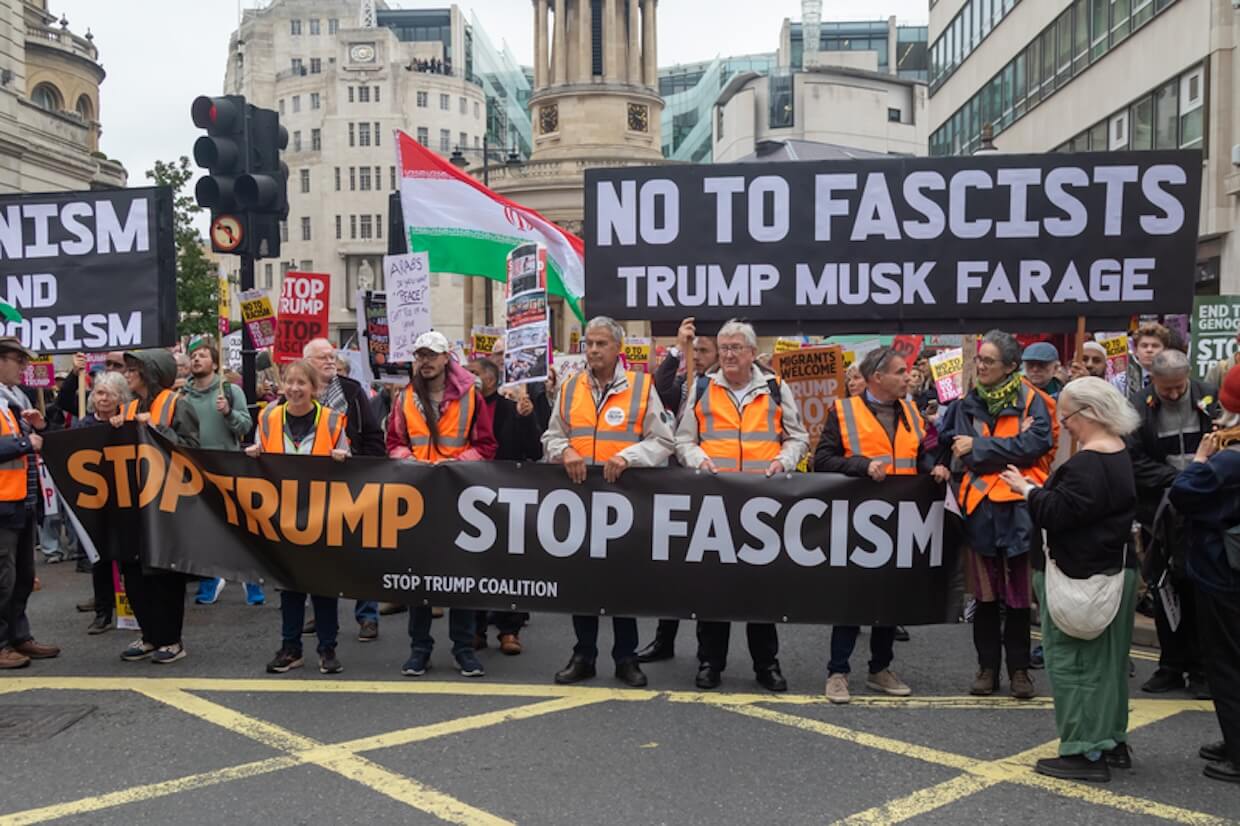
Stop Trump Coalition march, Central London, United Kingdom, September 17, 2025. A protester holds a sign reading “No to fascists — Trump, Musk, Farage.” Photo: Ben Gingell.
Your recent interview on Reform UK emphasizes Farage’s dual status as both the party’s central mobilizing force and its principal liability. How does this tension map onto broader theories of charismatic leadership, affective polarization, and “anti-system” appeal? In an increasingly fragmented multi-party context, does Farage’s polarizing image constrain the party’s governability narrative to the point of limiting its credible path to No. 10?
Professor Tim Bale: Nigel Farage is what we call, in England, a Marmite politician, which refers to a yeast-based spread that people put on their toast in the morning. People either love or hate that particular spread, and that’s very true of people’s attitudes to Nigel Farage. I think the fact that he is such a polarizing figure probably places a limit on Reform’s appeal. At the moment, it seems to be polling around 30% in the opinion polls, and I think that reflects the fact that he finds it difficult to appeal to voters who hate him, obviously, but also that ambivalent voters may be wary of the polarization he represents. So, I do think that is something of an obstacle to Farage’s progress. The anti-system appeal you mention is clearly attractive to some voters — people fed up with the two mainstream parties who want to smash the system. Anyone like Nigel Farage, who seems to offer a more radical alternative, is an appealing option for them. However, there is still a strong streak of small-c conservatism in the British electorate that would regard that as too radical, and that would like change — but not at the cost of dismantling a parliamentary, liberal, representative democracy that, in many ways, has served Britain well over the last couple of hundred years.
Reform’s Rise Is Built on Tory Collapse as Much as Ideology
Your research on Conservative leadership instability highlights the compounding effects of leader unpopularity, policy incoherence, and internal disunity on electoral performance. How much of Reform UK’s current momentum should be understood through the lens of “opportunity structures” created by Conservative decay, rather than any substantive ideological realignment toward radical-right policy demand?
Professor Tim Bale: As always, what we’re seeing is a combination of both. I mean, there is some genuine appeal of Reform UK’s policies and pitch to the electorate. But obviously, what has gone wrong with the Conservative Party has opened up avenues for Reform in a way that we haven’t seen before. In particular, the fact that the Conservative Party has really, since 2010, over-promised and under-delivered on migration has made it much easier for Farage to suggest that somehow it has failed voters and that it has not been able to, as it were, live up to their expectations.
Also, you would have to say that the way the Conservative Party has lost its organizational coherence, the way Brexit, for example, tore the party apart and made parliamentary discipline something of a fiction, hasn’t helped—nor has the party’s tendency to cycle through leaders so quickly. That has led to a feeling that the Conservative Party, oncea sort of solid, respectable governing party, has to some extent lost its way, even lost its mind, according to some voters. And I don’t think that has helped the Conservative Party, but I do think that’s helped Nigel Farage and Reform UK.
Many Tory MPs Would Be Comfortable in a PRR Party
In “Populism as an intra-party phenomenon,” you analyzed how Corbynism reconfigured Labour’s organizational dynamics and membership incentives. Do you observe analogous intra-party populist dynamics emerging within the Conservatives today—particularly in the struggle between traditional conservatives, post-liberal cultural conservatives, and those advocating rapprochement or fusion with Reform UK?
Professor Tim Bale: There are definitely, if not factions, then certainly groups within the Conservative Party who are battling it out for the party’s soul. You can see that there is very clearly a bunch of MPs who, if not wanting a merger with Reform UK, would actually be quite open to the idea of some kind of electoral pact with Farage’s party. I think that partly is instrumental opportunism on their part, in the sense that they think the Conservative Party is in trouble, and it needs an alliance of some kind with Reform UK to recover its fortunes.
But, there are MPs within the Conservative Party who, to be honest, would be quite comfortable belonging to a populist radical right party. They believe that Britain needs shaking up economically, and that the only way for that to happen is actually to get a greater level of support from the electorate, based on cultural concerns—concerns around immigration, woke issues, and green policies. That’s the only way of getting the kind of government that they want to actually dismantle some of the welfare state and some of the regulation that they think is holding Britain back. So, you have a strange situation in the Conservative Party where there are many advocates of a much more neoliberal conservatism who are prepared to adopt a more authoritarian stance on cultural concerns in order to get into government and implement the kinds of economic policies that they think are absolutely vital.
The Tories Are Now Moving on Migration in Farage’s Direction
Photo: Dreamstime.
Your comparative work on UKIP/Brexit Party and Australia’s One Nation highlights how radical-right “outsiders” can generate policy payoffs without executive power by reshaping the strategic environment of mainstream parties. How is Reform UK already influencing Conservative rhetoric, agenda-setting, and internal factional alignments—especially on immigration, welfare, and ECHR withdrawal?
Professor Tim Bale:You put your finger on a phenomenon that occurs throughout the world, and we’ve seen it all over Western Europe, when parties with little hope of actually governing—and certainly of joining a coalition—are capable of, as it were, moving the center of gravity in a system towards the populist radical right. When you look at the Conservative Party’s policy-making since 2024, and even actually before that, in response to the threat that Nigel Farage’s various parties—be it UKIP, be it the Brexit Party, be it Reform UK—you can clearly see that the Conservative Party has moved very much in his direction.
So, on migration, we now have a Conservative Party that has suggested—though there is some debate over whether it was intended seriously—withdrawing the indefinite right to remain granted to some non-citizens, and even opening up the possibility of them eventually being encouraged or indeed deported. That kind of mass-deportation approach is something previous Conservative governments would never have considered, and it reflects a direct response to some of Nigel Farage’s arguments.
Welfare is more complex. Farage is very aware that many of his supporters rely on the welfare state, and certainly on the National Health Service, so the Conservative Party must be cautious not to move too far toward his ambivalence on those issues. Instead, it tends to fall back on its more familiar low-tax, low-spend reputation.
On migration, that is the obvious one, where we’ve seen the Conservative Party move, just as we’ve seen parties, whether they be Christian Democrat or Conservatives across the continent, move very much towards a rather more kind of radical policy. You’d also have to look at environmental politics here, and it’s very clear that over the last few years, a Conservative Party that actually pioneered the move towards net zero—when Theresa May was Conservative Party Premier—is now really talking about winding back that commitment. I think, again, that is in response to Nigel Farage and Reform, and their promotion of the fossil fuel industry and its arguments.
Local Failures Might Not Dent Reform as Much as Opponents Hope
Reports of dysfunction in Reform-run local authorities raise questions about statecraft and institutional capacity. Given your longstanding argument that perceived competence ultimately constrains populist breakthroughs in Britain, do you anticipate that these governance shortcomings will erode Reform’s credibility? Or, alternatively, might anti-establishment narratives inoculate the party from such accountability?
Professor Tim Bale: That is a great question. We have seen Reform take over local authorities since spring of this year, and many of those councils have made rather a mess of things. They’ve fallen out with each other, they’ve found it much harder to make savings than they originally suggested, and in fact, they’re going to have to raise taxes rather than reduce them for local people. While the problems in those local authorities actually gain quite a lot of amused coverage in the media, I’m not sure how much the electorate in general pay attention to them if they’re not happening in their particular part of the country.
You raise a very good question here about the extent to which, if you criticize Reform UK, you actually strengthen, in some ways, the support for it among its die-hard advocates and voters. So, one would like to think that the example of local councils actually gives people pause for thought about whether it would be a good idea to elect Reform to the government of the country as a whole. But I rather doubt that it will have as big an impact as some of Reform’s opponents hope.
Hardline Accommodation Risks Alienating Supporters While Boosting the Radical Right
Your scholarship has shown that center-right parties often pre-empt or accommodate radical-right positions under competitive pressure. Should we expect Labour or the Conservatives to adapt their stances on immigration, welfare conditionality, or international legal obligations in response to Reform’s pressure? What do cross-national patterns suggest about the risks and limits of such accommodation?
Professor Tim Bale: We are already seeing in the UK the Labour government take a much harder line on migration than many of its supporters would like. It’s clear that that is a response by the government to losing votes to Reform. Current polling suggests that around 10% of people who voted for Labour in 2024 are now intending to vote for Reform, and Labour is desperate to get some of those people back, and by pursuing a more authoritarian stance on migration, they hope to do that.
You also point, however, to the fact that this has gone on all over the European continent. We’ve seen center-left parties as well as center-right parties pursuing a harder line on migration, and Denmark is often the country pointed to in this respect, perhaps as a successful example. But when we look across the continent as a whole, we don’t find that it is a particularly useful response for center-left parties to take. It ends up doing two things: first, alienating many of their more obvious supporters—in other words, people who have more liberal or left-wing values; and second, it tends to prove counterproductive or futile, in the sense that all it does is raise the salience of issues like migration in the minds of most voters, causing elections to be fought and debate to be conducted on terrain that actually favors populist radical right parties.
So, I personally wouldn’t advocate that as a response by the center-left, but it’s one that is still often mooted and taken by center-left parties, unfortunately.
Farage’s Sympathy for Putin Is an Achilles’ Heel
Stop Trump Coalition march, Central London, United Kingdom, September 17, 2025. Protesters dressed as Musk, Farage, Vance, Putin, Trump, and Netanyahu. Photo: Ben Gingell.
Your work on leadership perception underscores how trait attributions shape political choice. How electorally damaging is the perception that Reform UK is “soft on Russia,” particularly given polling indicating its unusually high association with pro-Russia sentiment? Does this reputational liability limit its potential to broaden its coalition beyond anti-establishment voters?
Professor Tim Bale: Reform’s support, Reform’s support, and certainly Farage’s apparent sympathy for Putin’s justification of the invasion of Ukraine, is something of an Achilles’ heel for him. To be clear, Farage has been careful not to appear as a superfan of Vladimir Putin, but he has repeatedly suggested that Russia’s invasion has been influenced by NATO “poking the Russian bear” and extending its influence into Ukraine in ways that allegedly threatened Moscow.
Polling from the 2024 election shows that the moment public attention focused on Farage’s more accommodating stance toward Putin and Russia, Reform’s upward trajectory stalled. This position is deeply unpopular in Britain, and it is something Farage will have to address seriously, especially ahead of the next election. After all, the country will be choosing a government and prime minister in a highly unstable geopolitical moment, and Russia is viewed by the overwhelming majority of Britons as the aggressor.
So, I think it is a limit to his appeal unless he begins to resile from it. At the moment, however, it doesn’t look as if he wants to do that. I should add a caveat here: when we look at other populist radical-right parties, and indeed more extreme variants of the radical right in Europe, there does not appear to be anything like the same level of enthusiasm for Russia and for Putin within Reform as we see in some of their continental counterparts.
Reform Voters Favor Leaders with ‘Dark Triad’ Traits
Your “What Britons Want in a Political Leader” study reveals stark divergences between the traits valued by Reform/Conservative members and those preferred by the broader electorate. What does this asymmetry imply about Reform’s sociological and psychological ceiling of support, and what does it reveal about the electorate segments most susceptible to Farage’s appeal?
Professor Tim Bale:What we find in our research is that supporters—and certainly members of Reform—have much more positive views about leaders who exhibit what psychologists would call dark triad qualities. In other words, those are Machiavellianism, for example, psychopathy, for example. That is a marked contrast with the supporters of other parties, although slightly less so with supporters of the Conservative Party, who are rather more like Reform.
I think this comes down, once again, to Nigel Farage’s appeal. For his supporters, he is, in some ways, the ideal leader: he exhibits the kind of ruthless and sometimes manipulative, clever qualities that they so admire. But those very same qualities are actually quite off-putting to a large segment of the British electorate. So once again, if we’re talking about limits to Nigel Farage’s appeal, the kind of leadership qualities that he has—the leadership that he demonstrates—make him intensely popular with his own supporters, because they are psychologically predisposed to like that kind of leadership. Whereas for many in the electorate, they make him a figure of suspicion rather than someone they would like to see leading the country.
The Greens, Not Corbyn, Pose the Greater Danger to Labour
Jeremy Corbyn, former Labour leader, during a visit to Bedford, United Kingdom, May 3, 2017. Photo: Dreamstime.
Reform appears to be peeling off older, culturally conservative, economically insecure voters, while recently founded socialist Your Party seems poised to attract younger, urban, progressive activists disillusioned with Labour. How vulnerable is Labour to a “two-front erosion,” and do Starmer’s strategic concessions on immigration and public order risk replicating the center-left dilemmas seen elsewhere in Europe?
Professor Tim Bale: You’ve seen recently Your Party try to get its act together. This is the party being set up by, among others, Jeremy Corbyn, who used to be the very left-wing leader of the Labour Party, and Zara Sultana, an ex-Labour MP. There is an extent to which this does threaten Labour’s hegemony on the left. There are many left-wing voters who are very disappointed with the Labour government, not least on its attitude to migration, but also on its attitude to tax and spend.
What I would say, however, is that I’m not sure Your Party is actually the biggest threat to Labour on that front. I think what we’ve seen recently is that the difficulties that Your Party have had in actually getting its act together, as I said before, mean that the Green Party has seized the moment. It’s elected a new so-called eco-populist leader, Zach Polanski, who appears to be saying and doing the kinds of things that people disillusioned with Labour would actually like—so, for example, wealth taxes, and a much more aggressive attitude to Nigel Farage and Reform UK.
So, if there is a kind of two-front war being fought by Labour—Reform on the one hand, and then a left-wing party on the other—it’s probably not Your Party; it’s probably the Greens that are the biggest threat on its left flank.
First-Past-the-Post May Save Labour
Drawing on your prior analyses of organizational dysfunction within left-of-center parties, how serious a threat is Your Party’s emergence—given its early factional disputes and resource constraints—to Labour’s ability to consolidate progressive voters? Might it institutionalize a structural cleavage on the British left akin to Podemos–PSOE or Mélenchon–Socialist Party dynamics?
Professor Tim Bale: There is a risk. There We talked about some of the problems that Your Party have had. There is a risk that if they can actually surmount some of the early difficulties that they have, then we do see a party on the left—whether it be Your Party or the Greens—actually draining support from Labour. Current opinion polling does suggest that around 10–15% of former Labour voters have drifted off and might drift off in that direction.
However, there’s always the constraining factor of our electoral system. It is always going to be possible for Labour, successfully or unsuccessfully, to argue that under a first-past-the-post system a vote for either the Greens or Your Party is a wasted vote, particularly if they are able to conjure up the possibility of a Reform government under Nigel Farage, which may frighten sufficient numbers of people who might otherwise be tempted to use their vote expressively and to vote for Your Party or the Greens. They may wonder whether that is a good idea and, actually, in the end, come back home to the Labour Party. Probably that is the Labour Party’s strategy at the moment.
Keir Starmer, Prime Minister of the United Kingdom, attends a joint press conference with Ukraine’s President Volodymyr Zelenskiy in Kyiv, Ukraine, on January 16, 2025. Photo: Vladyslav Musiienko.
Conservatives Misread 2019 as Permanent Shift, Ignoring Voters’ Economic Priorities
In “Hopes Will Be Dashed,” you argued that Brexit negotiating strategies were deeply shaped by a pervasive “Merkel myth.” Do you see contemporary Conservative or Reform elites relying on analogous political myths—such as a presumed majority demand for “uniting the right,” a belief in the inevitability of populist realignment, or a misreading of public appetite for hard-liner sovereignty politics?
Professor Tim Bale: That is a great question. I think one of the problems that the Conservative Party in particular had was a misreading of the 2019 election result as proof of what they called the realignment. In other words, the sense that working-class voters in this country had moved very much to the right on social questions, on cultural questions, and therefore there was some kind of permanent change of which the Conservative Party would be the beneficiary—when in fact that election was, in some ways, a rather more contingent affair, influenced very much by Brexit, influenced very much by the personality of Jeremy Corbyn, and indeed, Boris Johnson.
That myth—the idea that somehow there has been this incredibly profound change, and that cultural politics is now the dominant factor in elections—is still something that the Conservative Party holds onto, much to its detriment. It’s very interesting when you look at the leadership election in the Conservative Party following the 2024 general election. All the talk was about the Conservatives’ failure on migration, rather than the Conservatives’ failure to provide the country with adequate economic growth and adequate public services.
So, there is a kind of fixation on cultural politics and on this so-called realignment that the Conservative Party still has, which makes it actually quite difficult for it to realize that there is more to life than migration and woke, and indeed net-zero—that, in fact, the British public are not that different in the sense that they still want a government that hopefully provides them with peace, prosperity, and public services that actually work.
Britain Is Slowly Becoming More Liberal
You have frequently noted the role of media ecosystems in amplifying or constraining radical-right actors. To what extent is Reform’s surge a product of media-driven agenda-setting, and to what extent does it reflect deeper structural and sociological realignments within British politics? How should we disentangle these forces analytically?
Professor Tim Bale: That is a great question, but it’s also a very complicated one. Having shed doubt on this idea of a realignment, it is definitely the case that class features much less as a driver of people’s voting in this country, and that, in fact, education and age, to some extent, now seem to be the best predictors of which way people are going to vote. I do think cultural questions have come up in the mix, but I would want to say that the economy—while it’s not the only thing, the only game in town—is still actually very important as a driver of the way that people vote.
If you step back and look at cultural change in this country, clearly there are many voters who are uncomfortable with that, but they tend to be in older generations and, of course, will eventually disappear from the electorate. Now, that’s not to say that the center-left will somehow come into a kind of inevitable inheritance, because younger voters are rather more liberal and more tolerant in their attitudes. But it is to say that the center-right has to be very careful that it doesn’t end up on the wrong side of history, to coin a cliché, and fails to recognize that, for all the turmoil going on in British politics, underneath that, voters are becoming rather more liberal, more tolerant, and—despite media-driven polarization—more comfortable with a multicultural, multi-ethnic Britain.
So how long politics and political parties can thrive by exploiting differences, concerns, and anxieties is an open question.
If Living Costs Top Immigration, Reform Could Stall
UK economic crisis concept illustrated with the Union Jack and forex market data trends (AI-generated). Photo: Yuliya Rudzko.
And finally, you have cautioned that a Reform-led government is “not inevitable.” What empirical indicators—electoral, organizational, reputational, or demographic—would persuade you that (a) Reform UK is on a trajectory toward executive power, or (b) its rise represents a cyclical protest mobilization likely to dissipate before the next general election?
Professor Tim Bale: You have to look at support for Nigel Farage in particular, and the extent to which people think he will or won’t make a good Prime Minister. In the end, people know that they are voting not just in protest against something but are actually having to elect a government that’s going to make some very important decisions, and Nigel Farage is so central to Reform’s appeal that what people think of him is extremely important.
You also have to look at the extent—and obviously this, to some extent, involves prediction as to which issues are going to be most important for people at the next election. At the moment, immigration seems to be top of the list, but it’s only top of the list when you ask people what is the most important problem facing the country. When you ask people what’s the most important problem facing you and your family, immigration drops down the list, and the cost of living, the state of public services, comes right up.
So, I would probably look at the extent to which that is changing. If people think that migration is making a difference to them and their family, then perhaps that bodes well for Reform. But if the current disjunction between what people think is important to the country and what people think is important to them and their families continues, Reform is less likely to gain in strength.
Then, you’d have to take account of the kind of geopolitical situation, given we’ve already talked about Russia being something of an Achilles’ heel for Reform UK. If you were to see any extension of Russia’s aggression in Europe, then that would make it very difficult for Reform UK to make a convincing case for government.
I’d also look at what’s happening to the Conservative Party to bring it full circle. If the Conservative Party continues to stay in the doldrums—in other words, if it can’t recover itself and it can’t get anywhere near 25–30% of the vote—then there are many people who would normally vote Conservative who might be prepared to vote Reform, and that would give Reform a chance of government.
One final thing to throw into the mix is that our electoral system is not really very well suited to the party system that we now have. We now have a five-party—maybe six, seven, eight-party—system in this country, operating alongside an electoral system that is suited only to two parties, which means that it could be possible that a party on just under 30% of the vote could get a majority in Parliament next time around, and that would be a very unstable situation for the UK.
Trump’s National Security Strategy marks a sharp break from post-Cold War US diplomacy: it portrays Europe, not rival powers, as the core site of Western civilisational decline. Warning of “civilisational erasure” through migration, demographic change and secularisation, it urges support for “patriotic European parties” resisting this shift. In this framing, the danger to the West is internal, not external, and the US becomes guardian of authentic Western identity—aligning more closely with Orbán, Meloni and PiS than with many elected governments. This leaves Europe facing a strategic dilemma: remain reliant on Washington or assert its own civilisational narrative. Europe must choose—adapt, resist, or define itself.
The release of its National Security Strategy shows the Trump Administration to be especially concerned with the decline of Western civilization. One passage in the document drew considerable international attention. It warned that Europe now faces the risk of “civilisational erasure” driven by migration, cultural and religious change, low birthrates and the loss of historical identity. Unless Europe “corrects its current trajectory,” the document claims it could become “unrecognisable in 20 years or less.” The United States, it argues, should help by supporting the “patriotic European parties” resisting this shift.
This language marks a significant break with post-Cold War US diplomacy, and signals that Washington intends to treat its relationship with Europe as an arena of ideological struggle. Throughout the document, Europe appears both as an ally and as a civilisation in decline. Moreover, European governments are portrayed as having adopted values and migration policies that undermine the foundations of the West itself. As a result, the document implies, the United States has no choice but to ‘correct’ Europeans and essentially force them to reconnect with their traditional and authentic Christian-based civilization.
Fears of Western decline are not new. Even in the year 2000, which may have been the high point of Western power and influence, American writer Jacques Barzun argued in his surprise bestseller From Dawn to Decadence that the West had entered a period of decadence. Barzun meant cultural exhaustion and the fading of artistic and intellectual ambition, not geopolitical weakness. He was not concerned with demography or the strategic balance of power. A generation later the picture is different. The sense of Western decline is no longer limited to cultural pessimists. Analysts now describe American relative decline, a stagnant Europe, and a China confident enough to present its rise as civilizational renewal.
This raises an important puzzle. The National Security Strategy presents Europe as a civilisation in decline but does not treat Russia, China or India in the same civilizational terms, even though these states are the United States’ principal strategic competitors. This is especially surprising insofar as those nations often position themselves as ‘civilization-states’ at odds with Western culture and avowed enemies what of what they view as American imperialism. Yet the document reserves its sharpest language for European societies that, in its view, have abandoned the cultural and religious foundations of the West. Why, then, should the Trump Administration attack allies in explicitly civilizational language while avoiding it with rival powers? The answer is that the Trump administration sees the main threat to Western civilisation as internal rather than external. In their view, the West is being weakened by its own governments and its own cultural choices. Europe therefore becomes the object of correction. The United States, as they understand it, must pressure Europe to return to the values that once defined Western civilisation rather than treat Europe as an equal partner in managing global competition.
The National Security Strategy places the United States at the centre of Western civilisation. In this narrative America becomes the core state responsible for restoring the cultural confidence that Europe has supposedly lost. Trump and Vance describe themselves as defending the West, however what is immediately obvious in the document is that the object of defence is not the geopolitical order that linked the United States and Europe throughout the Cold War. Rather, it is a set of cultural and religious markers that they believe Europe has abandoned. Civilisational rhetoric therefore becomes a tool for a nationalist project. The document justifies pressure on European governments, portrays right-wing populist parties as cultural allies, and reframes transatlantic relations as a struggle over the meaning of the West rather than as a partnership between democratic states.
While we should not overstate its importance, it is significant that an American strategic document now aligns the US more closely with Europe’s populist right than with many of Europe’s elected governments. Indeed, the Trump Administration appears to divide Europe in two. One Europe consists of liberal governments, EU institutions and political leaders committed to secular cosmopolitanism. The other Europe is defined by Christianity, firm borders, and inherited Western values and is represented above all by Viktor Orbán’s Hungary, Giorgia Meloni’s Italy, and Poland’s PiS opposition, right-wing populists who share the Trump Administration’s concerns over Europe’s civilisational decline. In their National Security Strategy, the Trump Administration presents the former as pushing Europe toward collapse and the latter as Western civilisation’s last remaining defenders.
Although the Trump Administration positions itself and America as the arbiter of authentic Western values, the National Security Strategy contains an unresolved tension insofar as many of the social and cultural trends it critiques in Europe also exist within the United States. The United States is itself experiencing demographic change, declining Christian affiliation, and widening cultural diversity, which complicates claims that Europe alone is departing from the Western tradition. This raises a definitional problem because if the West is understood in civic terms Europe and America remain Western despite cultural change, but if it is defined by racial or religious identity, then the pressures described in the National Security Strategy are shared on both sides of the Atlantic. Moreover, several of the identity debates the administration portrays as corrosive in Europe originated in American academic and activist contexts, suggesting that the cultural dynamics it attributes to Europe are partly American in origin. This is why the Macron government in France ‘wages war’ on ‘wokeness,’ something they perceive to be a form of unwanted American cultural imperialism spreading throughout French institutions.
The National Security Strategy therefore confronts Europe with a strategic and conceptual dilemma. Should Europe define Western culture on its own terms, and can it articulate a political and cultural identity that differs from the one now promoted by Washington? European governments speak of strategic autonomy, but their nations remain dependent on American security guarantees, particularly in defence and intelligence. European publics remain divided on migration and identity, which complicates any attempt to articulate a coherent cultural and political narrative. Furthermore, EU institutions prefer to define Europe as a legal and political project grounded in universal rights rather than as a civilisation with a particular religious or ethnic foundation. This makes it difficult for Europe to respond to the NSS, which casts it as a civilisation in decay and implies that its renewal requires a return to Christian cultural markers.
This tension has led some analysts, such as Aris Roussinos, to argue that Europe must either consolidate around its own values or accept a subordinate position in a Western order increasingly defined in Washington. Emmanuel Macron has attempted to present Europe as a civilisational actor capable of independent strategic judgement, yet it remains unclear whether this project can succeed given institutional fragmentation and the absence of a shared European cultural story. The National Security Strategy highlights that uncomplicated civilisational unity with the United States is no longer plausible. Such unity would require Europe to adopt a civilisational narrative aligned with American right-wing populist thought, something most European governments are unwilling to do.
The future of transatlantic relations may depend on the outcome of the next American Presidential election. A J.D. Vance victory would almost certainly deepen civilisational language in US strategy, increase pressure on the EU project and expand American support for right-wing populist parties in Europe. Europe shows little capacity to respond to this approach because it remains structurally dependent on American security and politically divided on issues of identity. Continued subordination would leave European governments reacting to American preferences rather than shaping their own strategic environment.
A Democratic victory would return the United States to its traditional support for the European Union. Civilisational rhetoric would recede, and Washington would again treat Europe as a partner in a rules-based and liberal international order. Yet this scenario also carries risks for Europe. A return to the status quo would still leave Europe reliant on American power and vulnerable to future political shifts in Washington. In the long term, Europe may need to assert greater strategic and political autonomy if it wishes to avoid oscillating between two competing American visions of the West.
In an interview with the ECPS, Professor Joseph Wright (Penn State University) warns that the most alarming development of “Trump 2.0” is the rapid personalization of the state’s coercive apparatus. “The most troubling aspect… is the personalization of the security forces. That is the single most damaging thing that can happen to a country,” he cautions. Professor Wright notes that ICE has evolved into “a fully militarized internal security organization,” now poised to become one of the world’s largest such forces—capable, he warns, of being deployed “to seize ballot boxes” or “shoot protesters.” While federalism still offers partial safeguards, Professor Wright argues the United States is witnessing early signs of institutional capture characteristic of personalist regimes worldwide.
In a wide-ranging and sobering interview with the European Center for Populism Studies (ECPS), Professor Joseph Wrightof Penn State University offers a stark assessment of the United States’ democratic trajectory under a second Trump administration. Drawing on his extensive comparative research on personalist rule, bureaucratic erosion, and autocratization, Professor Wright argues that the defining danger of “Trump 2.0” lies in the accelerating personalization of the state apparatus, and especially of the coercive arms of government. As he warns, “What appears to me to be the most troubling aspect of the personalization of the government [is] the personalization of the security forces. That is the single most damaging thing that can happen to a country.”
Professor Wright situates his analysis within a broader global pattern in which elected strongmen—figures such as Erdoğan, Orbán, and other personalist executives—transform political parties, bureaucracies, and security institutions into instruments of personal power. Applying these insights to the contemporary United States, he identifies three markers of personalist party consolidation: a leader’s control of financial resources, control over candidate nominations, and the elevation of loyalists who depend entirely on the leader for their political survival. “He controls the money… he controls nominations, and… he appoints loyalists,” Professor Wright explains, noting that together these dynamics render party elites “basically unwilling to stand up to him.”
While the United States remains far from the fully consolidated autocracies seen in Turkey or Hungary, Professor Wright warns that early signs of bureaucratic hollowing and selective purges have already emerged. The Department of Justice, he argues, is the clearest example, where loyalist appointments and the abandonment of legal enforcement norms have created “a green light to lots of actors to be able to break the law.” Particularly concerning is the rise of a militarized internal security force centered on ICE, which he describes as “a fully militarized internal security organization” now positioned to become one of the largest coercive bodies in the world. Such a force, he cautions, could be deployed “to seize ballot boxes, to shoot protesters… or deter people from showing up at the voting booths,” mirroring patterns observed in autocratizing regimes elsewhere.
Yet, Professor Wright also emphasizes the continued importance of federalism as a barrier to total centralization. Local law-enforcement autonomy and decentralized election administration remain crucial buffers. Still, he stresses that the danger is not hypothetical but unfolding: “We don’t know where it’s going to go… things have progressed rapidly.”
Taken together, Professor Wright’s analysis offers one of the clearest comparative warnings to date: the durability of American democracy now hinges not only on electoral outcomes, but on whether the country can resist the deepening personalization of its most powerful state institutions.
Joseph Wright is a Professor of Political Science at Penn State University and serves also as the co-Director of the Global and International Studies (GLIS) program.
Here is the edited transcript of our interview with Professor Joseph Wright, slightly revised for clarity and flow.
The GOP’s Transformation: Money, Nominations, and Loyalists
Professor Joseph Wright, thank you very much for joining our interview series. Let me start right away with the first question: Your book titled“The Origins of Elected Strongmen: How Personalist Parties Destroy Democracy from Within” shows that personalist parties centralize nominations and sideline experienced elites. In the wake of the 2024–25 US political cycle, what indicators most clearly demonstrate that the GOP has consolidated into a personalist party rather than a traditional programmatic organization?
Professor Joseph Wright: That’s a great question. There are three indicators of personalist parties that we can observe across many different cases, and that vary between parties. When we apply those indicators to the current Republican Party, it becomes easier to see how they pop out and show that the party is increasingly personalist.
The first indicator is simply that Trump and his family appear to control the party’s funding apparatus. For example, during the 2024 campaign, his daughter-in-law controlled the Republican National Committee, which basically runs and distributes money to candidates in legislative elections. The current head of that same group is a close ally of Trump who owes his political career to him—a politician who lost multiple elections in Florida before Trump boosted him to a victory a couple of years ago.
That funding organization, the main one in the party, is actually small peanuts compared to the war chest Trump himself has gathered in MAGA Inc. It’s his personal election funding mechanism, which currently has over $200 million in it, even though he is constitutionally barred from running for president again. No president has ever had this after their second term: a personal vehicle for funding the political party they lead after their last presidential election, and certainly nothing of this scale.
So, he controls the money, and that gives him the power within the party to pick candidates to run under the Republican label. That’s a second key feature of the party that stands out as highly personalist right now. Trump has the power to decide who runs in primary elections in his party, and he often picks the primary winner ahead of time. That is, he controls candidate selection within the party. That’s very different from what the Republican Party—and US parties in general—have historically been like.
A good illustration of this nomination power is that legislators and elites in the party don’t want to stand up to Trump because they fear he may finance a candidate to run against them in a primary. So, they often back his policies even when they don’t like him. A good example is when one legislator did stand up to Trump—during the Epstein files vote in the US legislature. Marjorie Taylor Greene, a Trump backer and prominent elite in the Republican Party, stood up to him. When she did, others followed, which would normally be a sign that this isn’t a very personalist party. But after successfully pressuring him—Trump backed down—she immediately announced that she was quitting the party because she didn’t want to fight Trump next year in a primary to retain her seat. So that’s the second thing: he controls nominations, and through that control, he influences the behavior of legislators.
The last characteristic is that most of the senior elected elites in the party, and nearly all appointed elites in the executive branch, are loyalists. These are people who would have no political power without Trump. They are not individuals who worked their way up through the party by winning local, then national elections, and then being selected for higher office once they had demonstrated political strength. Rather, these are people who perpetually lose elections, and he picks such candidates because they are more dependent on him for their power, making them highly motivated to do his bidding.
So it’s these three factors—Trump’s control over funding, his control over nominations, and his appointment of loyalists—that make elites in the party basically unwilling to stand up to him.
We can look at a couple of elites who have stood up to him, at least on the margins. John Thune, a senior party leader in the Senate, and John Roberts, the head of the Supreme Court, both first won office well before Trump was on the scene. They gained political power without him and will probably still have it after he is gone. That gives them very different incentives to stand up to Trump.
Whereas if your political career is completely dependent on Trump, then you’re always going to do what he wants. And so, looking at these three features of personalist parties that we see around the globe, I see them increasingly present in the United States within the Republican Party.
Why 2025’s State Races Don’t Predict National Trends
Zohran Mamdani at the Dominican Heritage Parade on 6th Ave in Manhattan, New York City, August 10, 2025. Photo: Aleksandr Dyskin.
State-level election results in 2025—particularly in Virginia, New Jersey, and New York—show mixed reactions to Trumpist politics. Do these outcomes represent meaningful resistance to personalization, or are they short-lived fluctuations within an increasingly captured party system?
Professor Joseph Wright: These elections are off-cycle, and where they take place—and certainly when they take place—means they’re not very informative in the US electoral context for understanding how national-level elections will transpire.We look at places like New York City, which is completely unrepresentative of the rest of the United States, and Northern Virginia. Northern Virginia is a place where the local economy has taken a huge hit from the government shutdown and from Trump’s efforts to fire tens of thousands of government workers.
A lot of those people live in Northern Virginia, and so the local economy has really been hurt by Trump’s policies. These two places, Northern Virginia and New York City, are just not good places to look for broader national political trends. I would take these as important victories for the Democratic Party, but nonetheless not very informative about what’s going to happen in the next congressional elections.
The Growing Personalization of America’s Security Forces
Your work with Erica Frantz and Kendall-Taylor suggests personalism erodes bureaucratic impartiality. Which US administrative arenas—civil service, regulatory agencies, or security services—appear most resilient, and which show signs of politicization consistent with personalist capture?
Professor Joseph Wright: That’s a good question. I wish I had good data on it. That’d be a great data collection project, in real time, using the US case.The bureaucratic civil service—obviously Trump has largely gutted parts of that. But parts of it are still going, and parts of it are still providing public services to American citizens throughout the country. Certainly the Justice Department is the one Trump has the most control over, insofar as he has put loyalists in charge, sometimes without following the rules. Judges have had to basically throw out some of his appointees. His appointees are probably breaking the law, and so there you see a clear sign of personalization.
It’s harder to see it in the security sector, and the reason for that is we just don’t have very good information, and there are no mechanisms for people in the military—aside from resigning. There are no mechanisms for them to register their dissent to these moves. People who work in the civil service oftentimes have unions, and those unions can sue the government. Soldiers don’t have a union, and they don’t sue the government when the government asks them to do illegal things or purge them. So, the only recourse people in the security sector have is basically to quit, and we have seen some of that.
What appears to me to be the most troubling aspect of the personalization of the government is the personalization of the security forces. That is the single most damaging thing that can happen to a country, because it creates a basically partial group that is loyal to certain segments of the population, and that is the main armed force.In the United States, this is happening most clearly with the internal militia that Trump is forming, essentially out of the border guard unit. Immigration enforcement and the Customs Enforcement Agency—what in the United States is called ICE—used to be housed in a department that managed land. But then in 2001, after the al-Qaeda attacks on the United States, the Republican Party formed an entirely new security branch within the United States called Homeland Security. Then they put border guards and immigration enforcement under that larger security branch.
This shift in the structure of the security apparatus came in the same decades that police enforcement in the United States became militarized. They began accepting a lot of used military equipment. So, police officers in the United States oftentimes look like what soldiers in other countries look like, and that’s certainly true of ICE. ICE has become a fully militarized internal security organization that Trump has deployed in Democratic strongholds to hunt unarmed residents of the US and to lock them in prison camps. Perhaps as troubling as what has happened to this point is actually what will happen in the future, as this militia is now going to receive hundreds of millions of dollars in funding.
This is a militia that appears to be breaking the law, attacking basic civil liberties such as the right to movement, the right to protest, the right to private property. They’re destroying people’s private property without compensation. They’re detaining people, they’re breaching people’s religious freedom, people can’t go to places of worship, they’ve attacked religious leaders—openly attacked them. So, they’re destroying individual liberties in the United States, and they’re about to become the 15th largest security organization in the world. The amount of funding that Congress has appropriated for this militia is the 15th or 16th largest military in the world—roughly the same size as the military of Turkey or Canada. And that’s not the US military; that’s this internal security organization called ICE that appears to be breaking the law on behalf of Trump. So, that’s the thing that’s most concerning to me about the personalization of the government and the civil service—actually this internal security organization.
And it has the potential to really disrupt free and fair elections in the United States if Trump decides to deploy that security service to seize ballot boxes, to shoot protesters who protest against electoral abuse, or basically to deter people from showing up at the voting booths. We see that in lots of countries, a lot of dictatorships. We see internal security services deployed precisely at times when they can be disruptive to elections to keep the ruling party in power.
Border Patrol agents monitor an anti-ICE protest in downtown Los Angeles, June 8, 2025. Demonstrators rallied against expanded ICE operations and in support of immigrant rights. Photo: Dreamstime.
Can Federalism Still Contain Trumpist Centralization?
Federalism has been viewed as a structural buffer against democratic erosion. Based on current GOP centralization, do you see subnational institutions serving as genuine counterweights, or are personalist dynamics penetrating state-level politics as well?
Professor Joseph Wright: I think both are happening, actually. And federalism, in a large country like the United States, has worked quite well to restrain excesses of executive power. That’s what it was designed to do, and historically it’s done a pretty good job of that, even if there are downsides to it—like the dictatorship that ruled the US South for about a century during the Jim Crow period. But it is, today, working as a check on the ruling party’s power to repress its citizens and undermine basic civil liberties. So, for example, the main internal security forces up to this point in the United States have actually been local police forces, and the United States does not have a national police force or a set of interior troops outside of border enforcement, unlike most other countries. This means that internal security is mostly provided by local police units. They are controlled by subnational governments.
What that means is that the most proximate armed security service in opposition strongholds—no matter what party holds power in the United States—is controlled by the people in that subnational unit. For example, in Chicago, a large city in the United States, the Democrats control that. It’s an opposition stronghold that has resisted Trump’s attempts to undermine civil liberties in the United States. The local police there are controlled by the local Democratic politicians. So they don’t work for Trump; they work for those local politicians, which means that they have mostly not followed Trump’s orders to do his bidding and work alongside Trump’s militia. So, that’s a good thing. And that’s an example of how federalism works in practice as a check on the ruling party’s power. In fact, one of the reasons why the Trump administration has failed to detain so many US residents en masse—he wants to detain millions of people, and he hasn’t come close to that—is precisely because he doesn’t have control over local security forces.
The second way in which federalism works well in the United States is actually election administration. This is a local event in the US, where local elected officials administer elections. There’s no national election board that administers and counts votes. It’s done as a local affair; they report it up the food chain. It happens at the county level, and the county goes up to the state level. Again, in opposition areas, those election counts are controlled by people in the opposition party. So whether the Democrats are president or the Republicans are president, there are Republicans and Democrats all over the country who are counting votes, and it’s not simply an election administration group that’s appointed by the ruling party. So, this is a really good thing.
The downside right now—the place where the Republican Party is interfering in local politics—is that local elections themselves have increasingly been based on national issues. So, many people now vote in local elections based on how much they like or dislike Trump. That’s a big factor, when the local elections really have nothing to do with Trump himself. If Trump increasingly controls local politicians because he controls the party, this is going to prevent constitutional Republicans—people in the ruling party, local politicians in the ruling party who still believe in the rule of law and the protection of civil liberties—from having a voice. They’re going to have less voice within the party if Trump is able to control nominations at a very local level.
How Backsliding Fuels America’s Polarization Loop
Your recent research argues that democratic backsliding itself generates polarization rather than simply resulting from it. How does this insight help explain the entrenchment of Trumpist support even amid institutional damage and declining democratic norms?
Professor Joseph Wright: It is important, in answering this question, to restate what political scientists have long understood. Voters tend to interpret basic economic facts and broader economic realities through a partisan lens. This occurs because citizens rely heavily on cues from partisan elites to evaluate whether the economy is performing well or poorly. We observe this consistently: Democratic voters often shift from a positive assessment of the economy when a Democrat holds the presidency to a negative one when a Republican wins, and Republican voters exhibit the same pattern in reverse.
In other words, most voters perceive economic conditions in ways shaped by their partisan identities and the interpretive cues they receive from party leaders. Given this dynamic, there is little reason to expect that voters would suddenly abandon these partisan cues when assessing basic political facts—particularly when judging whether an action taken by the leader of their own party constitutes a violation of democratic norms or practices.
So, our take on this, building on theories of motivated reasoning, is that when partisan voters see their own party’s leader doing something that is ostensibly and objectively bad for democracy, they don’t necessarily justify it by saying it’s not a violation of democracy. They interpret it as a milder violation, but they continue to justify their support for their own party by hating the other party more. This increased antipathy toward the other party, when their own party is doing harmful things to democracy, is the individual-level mechanism by which attempts to undermine democracy—actions of executive power that are unconstitutional, for example—can breed further polarization.
So, every time Trump does something to undermine democracy, it makes Democrats mad, and it doesn’t necessarily make Republicans happy, but it does make Republicans hate Democrats more. And so, for Trump, he’s often doing something and then justifying it by basically saying, “well, the Democrats are even worse, and we have to do this to get at the Democrats.” It’s this kind of messaging that transforms what he’s doing into not necessarily a good thing, but something people will tolerate precisely because now they have to hate the other team more. That’s what breeds polarization.
Trump’s Digital Machine: Power Without a Party
In this photo illustration, a smartphone screen displays an image of U.S. President Donald Trump’s Truth Social app on July 8, 2024, in Washington, D.C., United States. Photo: Charles McClintock Wilson.
You argue that leaders today do not need traditional party organizations to win—they can build personalist electoral vehicles using social media. Which US developments most clearly illustrate this shift, and what regulatory approaches could protect democratic competition without empowering state censorship over online mobilization?
Professor Joseph Wright: Obviously, Trump can get his own message out because he runs his own social media platform. It’s not the biggest social media platform, but it’s a big one. One of his biggest political allies does run the biggest media platform, and so Twitter—what is now called X—certainly can censor on his behalf and use its algorithms to promote certain views over others.
Of course, Trump was actually brilliant at this. He used Twitter masterfully in 2016, not just to get his own message out but to win free and pretty much nonstop coverage from the mainstream media. Most candidates in US elections would have to buy time in the media and work to earn coverage, but he was able to circumvent that by talking on Twitter and saying outrageous things, and then every newspaper journalist in the country wanted to cover it. So, you can just bypass that infrastructure. Actually, we saw that with the newly elected mayor of New York City, who used a somewhat similar strategy. He basically got his start not because he had a lot of money, not because he had the backing of the political establishment in his party, not because senior elites in his party wanted him there, but because he was effective at using TikTok and knew how to craft a low-resource message—you didn’t need a lot of resources to do it.
These are good examples of how you do not necessarily need a lot of resources to run an effective campaign and ultimately do not need the backing of a strong political party to do that. Trump continues to rule in that way. There are surrogates on social media, in the manosphere, on TikTok, and these guys come cheap. They don’t get their money from Trump. They get paid by the platforms so long as they get eyeballs. All Trump has to do is give them an occasional nod to keep them working for him and on his behalf to carry out his message, and his message gets amplified—from whatever he says on his own platforms to the mainstream media and to all these surrogates on other platforms.
I think social media has a big impact on that. Individuals’ controlling either media platforms or media companies is certainly not new. An early personalist strongman leader who was elected multiple times was Berlusconi in Italy. He owned his own media company before entering politics. So, being effective on social media to circumvent the need for resources, or having your own media company—or the combination of both, in Trump’s case—is really quite helpful.
What can be done about it? I wish I had a silver-bullet answer. I’ll throw some stuff out there. I’m not going to say these solutions would work, but they are intuitions I’ve had, mostly based on ideas from others. I certainly don’t think state censorship of public discourse is the way to go. Laws banning disinformation, for example, give a big advantage to governments—and they do in countries where governments use them—and make it very difficult for citizens to express or mobilize dissent.
Instead, I’d argue that the state could give more property-rights protections to citizens’ data. So, you’d give individuals and voters the right to their own data and ultimately force media companies, including social media companies, to pay individuals for that data. A company—rather than retaining the rights to data every time I use a platform like Gmail or any social media service—would have to pay me for that data. It may mean I’d have to pay nominal fees to use some services, just like I pay for a subscription to a streaming platform. But those companies would not be able to collect data on me unless they paid for it. That’s the first thing—reconfiguring the property-rights regime throughout the Western world to give property rights to individuals that are now retained, without meaningful legal constraint, by media companies. The lifeblood is the data, and if you give that right to individuals, companies won’t have so much economic power, because they wouldn’t own that data unless they paid for it.
The second intuition, based on others’ ideas, is enforcing competition laws. We know large corporations in the social media and data sphere are able to gobble up lots of sources of data and merge to become information oligopolies—what we now call media companies. So, enforcing competition—assigning individuals property rights to their data and applying basic free-market principles that we’ve drifted away from in the digital world.
MAGA Inc. and the Rise of Personalist Party Finance
Personalist parties rely on personalized funding networks rather than institutionalized party finance. To what extent has Trump succeeded in subordinating Republican fundraising channels to his personal control, and how significant is this shift for long-term democratic resilience?
Professor Joseph Wright: He’s been pretty successful, and I alluded to that when answering an earlier question. He has this organization—I think it’s called MAGA Inc.—a large, $200 million operation that’s essentially a pot of money he’s waiting to deploy in elections to fund the next round of Republican campaigns. My guess is that something like that will continue going forward, and what it will do is give Trump control over the party even if he leaves the presidency in 2028. He and his family may not relinquish control over that funding mechanism.
Of course, they’re amassing a ton of private wealth now through corruption, and they may deploy that wealth in future elections as well, in an effort to influence who controls the Republican Party. That’s not any different from what happens in other countries, where oligarchs, political tycoons, and economic tycoons dominate politicians by controlling financial resources.
This would mark a significant shift from how parties in the United States have traditionally been funded. Historically, most of that influence has come through large corporations. The government gives corporations limited liability, and the Supreme Court has granted them free speech rights that the Constitution assigns to individuals. The Republican Supreme Court extended those rights to limited liability companies that can make a profit and are shielded from certain legal liabilities, giving them a substantial government-conferred benefit.
So, while the last few decades of American politics have been dominated by large corporate donors, we may now see the Trump family exerting substantial control over political financing. That would be a departure for the United States and would make the system resemble places like Ukraine before the invasion, Indonesia, Malaysia, or the Philippines, where oligarchs and political families dominate politics through their financial power.
Where Trumpist Personalization Threatens US Institutions Most
Frontal view of the U.S. Supreme Court Building in Washington, D.C., on February 10, 2024. Photo: Gualberto Becerra P.
Your recent article shows personalist parties undermine impartial state administration but not necessarily fiscal capacity or territorial control. Which elements of the US state—central bank, federal agencies, law-enforcement structures—face the greatest vulnerability to personalized politicization under the Trumpist GOP?
Professor Joseph Wright: The two that I see—he’s making attempts to do this all over the place, and some of the agencies are able to fight back better than others. As I mentioned earlier, the Justice Department and its lawyers have been a major target. Trump has largely purged people who followed the rule of law and appointed loyalists to those positions, who don’t seem particularly interested in upholding the rule of law anymore. We see that prominently; that’s what a lot of the news is about. And while some of it looks like Trump trying to get revenge, it could also serve the longer-term goal of using the Justice Department to interfere in elections, to ensure the opposition party can never win again—essentially preventing elections from being free and fair.
Another very problematic aspect is that when the Justice Department stops enforcing the rule of law, it effectively gives a green light to many actors to break the law. We’re seeing this in at least two ways right now. Armed members of American security forces—whether in the military or the ICE militia—are breaking the law, and there seems to be complete impunity for that, aside from a few isolated cases. The government is essentially not enforcing its own laws when groups within the government break them on behalf of the president.
Second, bribery and corruption laws are no longer being enforced, which gives wealthy people a powerful incentive to engage in corruption, accumulate economic power, and rig property rights in their favor. It also encourages many wealthy individuals to avoid or cheat on their taxes because Trump has signaled he won’t enforce tax law for rich people. That’s problematic for revenue. It’s part of the long-term Republican strategy to shift the US revenue base from income taxes to consumption taxes. That’s what the tariffs are about—funding the government by taxing consumption, which is regressive, and effectively eliminating the progressive income tax, even if they can’t change the law, by simply not enforcing it. We see that as well.
As for the central bank, there has been more resistance there, partly because undermining the Federal Reserve’s independence has huge ramifications for capital owners. When central bank independence erodes, capitalists get very nervous, since it makes long-term investments much more precarious. So, there has been pushback within the broader Republican coalition, especially from economic elites—capital owners—pressuring Trump not to completely destroy the Federal Reserve’s independence.
Another institution that has retained some autonomy and has not been extensively purged is the judiciary, particularly the federal judiciary. It’s decentralized—there’s a degree of decentralization in the US system—but even at the federal level there hasn’t been a total purge yet. Trump has faced real resistance there, even—and this is important—from judges who are elites within his own party. That’s extremely important.
America vs. Turkey and Hungary: How Far Has Personalization Gone?
Turkish President Recep Tayyip Erdogan in Ankara, Turkey on August 30, 2014. Photo: Mustafa Kirazlı.
In your cross-national work, leaders like Erdogan and Orbán used personalization to degrade bureaucratic professionalism. Does the United States exhibit early signs of bureaucratic hollowing resembling these cases, or are US institutions still fundamentally differentiated?
Professor Joseph Wright: I don’t think we’re anywhere near what’s going on in Turkey or Hungary, for sure. I mean, within a matter of months in 2016, Erdogan had purged something like 100,000 civil servants. That’s a lot in a country that size. The United States doesn’t come close to purging that many.
One issue is simply hollowing out the government so that it stops doing basic things—like enforcing the law or providing public goods. The other is transforming the bureaucracy into a personal vehicle that can exert power over citizens to keep the ruling party in power indefinitely.
That’s essentially state capture—where the merger of the state and the ruling party becomes complete, and the state’s primary function is to preserve the ruling party in power. That’s certainly what we see in a place like China.
We don’t know where this is going to go. We’re not even 12 months into the Trump administration. Things have progressed rapidly, but they’re nowhere near the scale we’ve seen elsewhere. Erdogan was in power for well over a decade before he carried out his major purge, and Orbán was also in power for quite some time before he fully transformed the civil bureaucracy.
The other possibility is not just hollowing out, but turning the bureaucracy into a vehicle to preserve the ruling party’s power.
In her interview with ECPS, Professor Susan Stokes explains how rising inequality and polarization create fertile ground for democratic backsliding. “There’s a kind of direct, almost organic effect of income inequality on polarization,” she notes, adding that the United States is “a very unequal country—and the oldest democracy—yet being an old democracy does not protect us from backsliding.” Despite these vulnerabilities, Professor Stokes rejects fatalism. Civil society mobilization and the courts, she emphasizes, have been “major blocks in the way of autocratization under the second Trump administration.” Ultimately, she remains cautiously optimistic: “There are lots of reasons to be hopeful that democracy will survive and can be rebuilt in a more robust way.”
In this wide-ranging interview, Professor Susan Stokes—Tiffany and Margaret Blake Distinguished Service Professor and Director of the Chicago Center on Democracy at the University of Chicago—offers an empirically grounded and conceptually rigorous analysis of democratic erosion in the United States and beyond. Speaking with the European Center for Populism Studies (ECPS), she underscores the structural forces propelling contemporary backsliding, most notably rising inequality and partisan polarization. As she succinctly puts it, “there’s a kind of direct, almost organic effect of income inequality on polarization. Then backsliding leaders… benefit from operating in a polarized polity. Therefore, once in office, they do what they can to exacerbate partisan conflict.”
A core insight from her recent work is that inequality—rather than classic institutional safeguards—best predicts democratic decline. Drawing on extensive comparative research, Professor Stokes highlights that “being an older democracy offers no more protection against backsliding than being a younger democracy.” The United States, therefore, faces a distinct vulnerability: “We are a very unequal country, and we are the oldest democracy. Being very unequal raises our chances of experiencing backsliding, and being an old democracy does not protect us from it.” These findings challenge long-standing institutionalist theories that assumed democratic age alone could inoculate systems from erosion.
At the same time, Professor Stokes emphasizes that democratic decline is never uncontested and rarely linear. Civil society resistance—particularly through mass mobilization—remains a crucial barrier to autocratization. Reflecting on recent US cases, she notes that “protests, as well as the courts, have been a major block in the way of autocratization under the second Trump administration.” Even when repression intensifies, the protest–voting linkage proves resilient, reinforcing democratic engagement rather than severing it.
Yet Professor Stokes ultimately insists that the current moment, while perilous, is not predetermined. She resists fatalist narratives that portray autocratization as inevitable or unstoppable. Instead, she stresses the multiplicity of democratic resources that persist even under considerable strain: electoral accountability, civil society activism, independent media, and crucially, the lower federal courts. As she concludes, “there are lots of reasons to be hopeful that democracy will survive and can be rebuilt in a more robust way.”
This interview explores these themes in depth—from inequality and polarization to institutional attacks, populist rhetoric, and the prospects for democratic renewal. Professor Stokes’s analysis combines empirical precision with comparative breadth, offering a clear-eyed but ultimately hopeful assessment of democracy’s capacity for resilience and reconstruction.
Here is the edited transcript of our interview with Professor Susan Stokes, slightly revised for clarity and flow.
Inequality, Polarization, and the New Backsliding
St. Patrick’s Cathedral with pedestrians, pigeons and a homeless man outside in Manhattan, Fifth Avenue on September 11, 2023. Photo: Dreamstime.
Professor Susan Stokes, thanks very much for joining our interview series. Let me start right away with the first question: Your recent analyses suggest that Trump’s second-term agenda—including regressive fiscal policy, attacks on universities, and intensified politicization of state institutions—accelerates inequality and democratic erosion simultaneously. How do these US-specific dynamics compare to earlier episodes of backsliding you have studied in India, Hungary, or Turkey?
Professor Susan Stokes: It’s such a pleasure to be here. Thank you so much for the invitation. We don’t yet have systematic evidence about the impact of backsliders on inequality. The research I’ve done that is in my book, as well as in a co-authored article with Eli Rao that appeared in the Proceedings of the National Academy of Sciences, looks at the impact of inequality on the probability of a backsliding leader coming to power. But there is some evidence—some of it systematic, some of it more anecdotal—about the behavior of these kinds of leaders with regard to social spending, fiscal policy, and the like. I make a distinction between right-wing ethno-nationalist backsliding leaders and left populist ones, and the left populist ones do have incentives to decrease inequality, address inequality, and improve social spending and the material conditions of people at the bottom.
So, leaders like Andrés Manuel López Obrador in Mexico were left populists who increased and made retirement benefits more generous, raised the minimum wage, and also undermined democratic institutions. There is evidence from European research—I’m thinking about a study by Russell Dalton and Carl Berning—that shows that far-right parties in Europe tend to take a position that is more pro–social spending than the traditional right. And in the US, I think the country is a bit exceptional in that we have a right-wing backsliding leader, a right-wing ethno-nationalist, who has stuck with fairly traditional conservative policies: lowering taxes on the wealthy and cutting social spending rather drastically. I think that has to do with a conflict in the Republican Party between a populist subgroup and a more traditional subgroup.
We think of Donald Trump as utterly dominating the Republican Party. In some respects, he does, but he hasn’t been fully successful—he hasn’t always; he’s ambivalent himself on this. In some ways, his preferences tend toward a small state, low regulation, and so forth. But he does respond to electoral incentives to try to improve social conditions, and some of the party doesn’t go along with that, so you see that conflict playing out. What it has added up to thus far is a leader who is rhetorically populist, but whose policies have been fairly straightforward, traditional anti-state, anti-regulation policies of the conservative party.
Why Autocrats Fear Independent Universities
In your writing on Trump’s assault on epistemic institutions, you argue that universities pose a threat to autocrats because of their independence. How does the targeted dismantling of academic autonomy reshape the informational environment through which citizens evaluate inequality, trustworthiness, and democratic legitimacy?
Professor Susan Stokes: That’s certainly the case—that it’s the independence of institutions of higher education, especially their capacity to challenge the factual basis of governments’ claims, that is part of what we do in producing independent information and knowledge. None of that is particularly welcomed by these kinds of governments. And it’s interesting: we think of the ideological conflict between these governments and universities, but in fact, whatever ideology the government embraces, they tend to have the same conflicts. So, you know, Erdogan attacks Boğaziçi University and says that it’s too secular and anti-national, Trump attacks American universities because they’re too woke, and López Obrador in Mexico attacks elite universities on the grounds that they are “too neoliberal and too conservative.” So, whatever the ideology, there seems to be something more structural going on.
What’s the effect? I would say that, again, we don’t have great systematic evidence, but it does seem that—especially in situations where a prominent university like the Central European University when it was in Budapest, or in Nicaragua, where higher education has been almost erased and replaced by very pro-regime forces—there is a real narrowing of the scope of information: solid information and counter-narratives that are available to people.
Students gather for graduation ceremonies on Commencement Day at Harvard University, Cambridge, Massachusetts, May 29, 2014. Photo: Dreamstime.
Big Money, Racial Politics, and America’s Autocratic Drift
You note that Trump is unusual among autocrat-leaning leaders in refusing to adopt redistributive or pro-poor policies. What explains this deviation from the global pattern—seen in AMLO, Modi, or Erdoğan—and what does it reveal about the class, racial, and ideological coalitions sustaining backsliding in the US?
Professor Susan Stokes: That’s a wonderful question, and I think there are two parts to the answer. One of them has to do with the rather extreme role of capital in democratic politics in the United States—small-d democratic politics. For more than a century we’ve had a great deal of involvement—whether it was the railroads once upon a time, or big oil, or today, Elon Musk—an extraordinary level of direct involvement by large corporations and very affluent individuals in our politics. Some of that has to do with the highly decentralized nature of American electoral politics. Elections are run at a very local level, and our equivalent of a national election administration body, the Federal Election Commission, is very weak. So, very decentralized elections create a lot of room for involvement and distortion by big money. And while this is an old pattern, it was made much worse by the 2010 Citizens United decision of the US Supreme Court, which made it very difficult to regulate campaign contributions—or limited our ability to regulate them. So, that’s part of the story which is that, partly through elections but also through other forms of influence, the ability to make substantial donations gives big capital a major impact and constrains what political parties and governments can do. Mostly that impact affects the Republican Party, but it has significant effects on the Democratic Party as well.
The other part of it, as your question suggested, is the long-standing racialization of politics in the United States, where racial conflict—some of it organic and some of it encouraged by interested parties—allows conservative forces to gain more support for an anti-state, anti-regulatory position. A lot of people think of the welfare state as equivalent to benefits for minorities, particularly for Black people. So, you get large numbers of people who don’t think of welfare and social spending as benefiting them but benefiting somebody else—our tax dollars going to these other people who are supposedly cutting in line, and so forth. Of course, none of that is based on reality, but that’s the discourse, and that’s one reason our politics look a bit different from the politics of other advanced democracies in this regard.
When Partisanship Makes Voters Excuse Autocracy
Your work links widening inequality to declining trust in the judiciary, Congress, and the press. To what extent does affective polarization mediate this link—transforming socioeconomic grievance into a willingness among partisans to condone norm violations and executive aggrandizement?
Professor Susan Stokes: It does have an effect, for sure. The argument in my book is that when societies are more income-polarized—that is, when there are bigger gaps between the wealthy and the rest, both in wealth and in income—that in itself feeds into polarization and partisan polarization. That’s not actually my own original research; other people have shown that to be true, and it probably has to do with the sense that the stakes are very high when one party or the other comes to power. So, there’s a kind of direct, almost organic effect of income inequality on polarization. Then backsliding leaders, autocratizing leaders, benefit from operating in a polarized polity. Therefore, once in office, they do what they can to exacerbate partisan conflict.
They say all kinds of terrible things about the other party. They demonize the other party. They try to marginalize parts of the country or cities controlled by the other party. The reason they benefit from operating in a polarized setting, as your question suggested, is that when people operate in a polarized, highly partisan, affectively polarized environment—when they think that if the other party comes to power, it’s the end of the world—they are more willing to look the other way at incursions into democratic practices and attacks on democratic institutions.
There is very good research in this regard. Milan Svolik at Yale has done truly groundbreaking work, as has Jennifer McCoy and her co-authors at Georgia State. So, this is well established. It’s theoretically quite intuitive, and it has been shown empirically that, other things being equal, the more somebody believes the sky is going to fall if the other party comes to power, the more willing they are to say to themselves: well, I’m not crazy about the fact that he’s always attacking the courts or the press, or that he seems to be politicizing the military, or what have you, but if that’s the price we have to pay for keeping the other terrible side out, then so be it.
Electoral College Inversions and the Fragility of Democratic Legitimacy
Man reading Le Figaro featuring Hillary Clinton and Donald Trump in Paris on November 12, 2016 after Trump’s election win. Photo: Dreamstime.
How do repeated electoral inversions in the US Electoral College—combined with rising inequality—affect democratic consent and citizens’ tolerance for anti-democratic appeals, and what do your legitimacy experiments suggest about the durability of these effects?
Professor Susan Stokes: Thank you for that question. So, for people who are interested, I’m part of a group that founded an organization called Bright Line Watch, which we started as a small collaboration among several universities. All our publications and the original data from our surveys are available online. Anyone who wants to take a look or use the data is more than welcome to do so—just Bright Line Watch.
We did a study based on experiments examining the effect of inversions on legitimacy—the legitimacy of the winning candidate. Just to explain, inversions occur when who wins an election depends not only on how many votes they get but also on the geographic distribution of those votes. When votes are tallied in subnational districts, like states, and the geographic distribution of votes matters as much as their number, you can end up with an inversion in which the loser of the overall popular vote becomes the winner. The Electoral College in the United States has produced that outcome several times. It has also occurred in other countries—the UK, New Zealand, Canada—but in the US we saw it in 2000, when George Bush first won the presidency, and again in 2016, when Hillary Clinton won the popular vote and Donald Trump won the Electoral College vote and became president.
That’s a side effect of systems in which the distribution of votes matters. The reason parties like the Democratic Party tend to lose out in these situations is that their voters are much more geographically concentrated. They tend to be in big cities and are not spread across the national territory to the same extent. What we found is that politicians who lose the popular vote but win the election—becoming the president or the prime minister—do take a hit in terms of their legitimacy. We looked at this in the US, and the effect is driven by Democrats. Republicans are less troubled by inversions; Democrats are more troubled. And that probably has to do with people’s intuitive or basic understanding that Democrats are more likely to suffer under this system because of their geographic distribution.
It’s a pretty powerful effect, even though it’s driven primarily by Democratic respondents. Interestingly, it isn’t much affected by the margin of victory. Any loser of the popular vote who gets into office—whether that person loses (hypothetically) by a large or small margin—takes a substantial hit in legitimacy. We see the inverse of that in the 2024 election. Unlike in 2016, when Trump won via the Electoral College but not the popular vote and was seen as much less legitimate, for a period there was a kind of aura around his second-term presidency because he had won the popular vote—and won not a landslide (he claims it was a landslide) but reasonably decisively. So, you see the opposite effect in that case.
How Populist ‘Trash Talk’ Weakens Democratic Defenses
Drawing on your research on Manichean populist rhetoric with Çınar and Uribe, how does the escalation of zero-sum, anti-institutional language in the US accelerate the shift from inequality-induced distrust to permissiveness toward democratic norm erosion?
Professor Susan Stokes: I would just add that Ipek Çınar and Andres Uribe are co-authors of that paper, which appeared in the journal Comparative Political Studies, and another co-author is Lautaro Cella—I don’t want to forget him. So, what we observe in that study… let me back up a little bit. Returning to the issue of polarization, a polarized population is good for would-be autocrats because their own followers will be more willing to support them when they violate democratic institutions, since they say to themselves, “God forbid that the other side come to power.” On the other hand, what politicians do to exacerbate that polarization is to say really terrible things about the opposition party, and my book has lots of piquant examples of that. You can see Jair Bolsonaro saying that the military should have gone ahead and killed 30,000 people when they were in power, of the opposition types. Donald Trump calls the Democrats the party of lawlessness, says they hate the country, want to destroy the country, want no borders, and so on and so forth.
That kind of rhetoric can be very effective if you put yourself in the position of a MAGA Republican voter. If they hear that message and believe it, they are going to be more firmly in support of their leader. But put yourself in the position of an opposition voter who hears that message, is offended by it, and doesn’t think it’s true—they might be more likely to turn out for elections and to encourage others on their side to turn out. So, there is a potential downside to a polarizing strategy for some leaders.
What I spend quite a bit of time on—and present quite a bit of evidence for—in my book is that another strategy backsliding leaders have at their disposal is to attack institutions and what I call “trash talk democracy.” That is, take institutions—say the courts or election administration bodies—and say, “hey folks, you shouldn’t worry about my gutting these institutions or weakening them; they’re really terrible institutions anyway. They are corrupt, full of corrupt people, ineffective, expensive,” and so on. That is a way of getting people to go along with, or at least not resist, an autocratizing project, even if at heart they really do support democracy.
So, it’s not actually an attack on democratic norms; it’s more an attack on institutions as falling short of democratic norms. What’s interesting in my book is that I show evidence that they do use this strategy, and they use it in ways that are quite effective in the sense that their followers—that is, opposition party followers—are actually somewhat won over by the negative things these leaders say about the institution. In our Mexican samples, respondents who supported opposition parties and did not support López Obrador’s party were, to some degree, influenced by the negative things he said about the courts or the election administration body. And at the very least, there was no backlash. They didn’t turn around and say, “hey, he’s saying these terrible things about these institutions, I’m going to rally in their defense.”
Inequality Fuels Modern Democratic Erosion
Your finding that high inequality significantly raises the probability that voters will elect would-be autocrats challenges institutionalist theories emphasizing democratic age and rule-of-law strength. How should existing regime stability theories be revised to incorporate distributive conflict as a core causal driver?
Professor Susan Stokes: I would say that some of the older literature was studying an older reality in which the military coup was the main source of instability for democracies. There has been a lot of theorizing—it’s been an obsession of comparative politics, and I’ve been part of this literature as well—aimed at explaining the causes of regime dynamics. Why do democratic governments fall apart and get replaced by autocratic ones? Why do autocratic governments fall apart and get replaced by democracies? That has been a very important theme in comparative politics and political economy for 60-70 years.
The older literature focused on a period when military coups were the primary threat to democracies. Studying democratic instability in that era was essentially equivalent to studying the probability of a military coup—a coup that would come to power, boot out a democratic regime, send its leaders into exile, imprison them, sometimes execute them, and close down the constitution, all at once. Now we are in a world in which, although military coups still happen, the greater numerical threat to democratic stability is democratic erosion or backsliding.
These are two quite different processes involving different actors. Military coups are carried out by military leaders who deploy force; democratic backsliding is carried out by civilian leaders—elected civilian leaders—and usually unfolds much more slowly. It is a gradual process. The objectives of these leaders are quite different from those of military officials who carry out coups. So, these are fundamentally different phenomena, different dependent variables, requiring different theories. We should not be surprised that factors important in predicting coups do not necessarily play as much of a role in predicting democratic backsliding.
Now, inequality actually has played a big role in theories of democratic breakdown and regime transitions in an era when instability was linked to military intervention. There were strong theoretical reasons put forth—Carles Boix, and my colleagues James Robinson and Daron Acemoglu, for example—emphasizing income inequality as an important factor in democratization and in support for military regimes. But the empirical evidence wasn’t very strong. There were theoretical reasons to think inequality mattered, but the empirical support was weak. Empirically, income per capita appeared to play a more important role in determining how likely a democracy was to be destabilized.
Now we’re in a different world. When we sat down to identify the predictors—structural, economic, and other kinds—that increase or decrease the probability of a country experiencing democratic erosion, we expected income inequality to play a role. We were also interested in income per capita because of its historical importance in earlier theories of democratic instability.
We were surprised to find inequality such a prominent factor. It is really robust and strong—by far the most powerful factor we could identify. We subjected our findings to all kinds of statistical models, controls, different ways of measuring inequality (wealth inequality, income inequality, different operationalizations), and we really couldn’t get rid of the inequality effect.
Let me say a word about the age of democracy, which you also mentioned. That, again, was a consistent and robust factor in the probability of a democracy falling—how long it had been a democracy without interruption. There was a nice paper from the early 1990s by Adam Przeworski and Fernando Limongi that showed that poverty, or income level, was an important factor in whether a country would experience a coup, and another important factor was how long it had been since the last coup. Like cancer: if you’ve had it, gone into remission, and stayed in remission for a certain number of years, your probability of recurrence is no higher than someone who’s never had it. They found that if a country was coup-free for six years, it was no more likely to have another coup than a country that had never had one. That’s an age-of-democracy kind of consolidation effect.
We did not find that with democratic backsliding. Being an older democracy offers no more protection against backsliding than being a younger democracy. And the twin facts—that income inequality is a major predictor, and that democratic age does not protect you—help resolve the puzzle of why the United States is experiencing democratic erosion. We are a very unequal country, and we are the oldest democracy. Being very unequal raises our chances of experiencing backsliding, and being an old democracy does not protect us from it.
US President Donald Trump at a rally for then-VP nominee J.D. Vance in Atlanta, GA, on August 3, 2024. Photo: Phil Mistry.
Many autocrat-leaning leaders strategically redistribute to shore up mass support, while Trump intensifies regressive inequality. How does this divergence shape the prospects for long-term authoritarian consolidation versus potential coalition fracture in the American case?
Professor Susan Stokes: There are a lot of people in this country scratching their heads over those questions. As I mentioned earlier, there’s a sort of conflict within the Republican Party between populists who would like to be spending more and doing more to address inequality, and the more traditional Republican conservatives who favor the smallest state possible. The famous quip of a Republican activist from the Reagan era was that they wanted to shrink the size of the state to the point where you could drown it in a bathtub. That wing of the Republican Party remains very strong.
So, populist leaders within the Republican Party include people like J.D. Vance, the Vice President, and Josh Hawley, an important senator from Missouri. They’re pushing for a more populist agenda in terms of economic populism. I mentioned before that Trump himself seems to be ambivalent but does respond to pressures. At the moment, Trump would like to reach some sort of deal on the Affordable Care Act, on Obamacare, that would avoid the steep increases in the cost of health care for many Americans, which is a big electoral liability—and Trump understands electoral liabilities. He’s not a deep thinker, but he does know that he can get himself in trouble in electoral terms. His approval ratings are really tanking, and his approval on economic performance is really tanking.
So, his instinct is to push for these more populist measures, but that hasn’t happened, and so this tension within the party does undermine the longer-term viability of the MAGA project. You see that conflict play out a bit more in the US for some of the reasons we talked about earlier than in other cases. Either there are left-wing populists who have every reason to try to address inequality, or there are right populists where, somehow, the barriers to that kind of more populist economic policymaking have been lower.
Delegitimization and Tear Gas Can’t Stop Democratic Mobilization
Your studies of protest show that protesters are often more likely to vote than non-protesters. In a backsliding democracy where protest is increasingly criminalized, how do autocrats’ repressive strategies attempt to sever this protest–voting linkage?
Professor Susan Stokes: It’s a wonderful question. I’m not sure that they’re trying to sever that linkage. I think that linkage is a natural social phenomenon. It’s harder to protest—it’s costlier, it takes more planning, more time, more commitment. You usually face more risks for protesting than for voting. So typically, people who are willing to pay the costs of protesting are quite willing to pay the costs of voting. That’s why 10 to 1 is a kind of rule of thumb.
So, I’m not sure they’re trying to sever that link, and I don’t think they could, but they definitely are trying to suppress and delegitimize both protesters and decrease turnout among opposition voters. The protest side has been very interesting, and I have to say, being here in Chicago, I’ve had a sort of front-row seat to the efforts at both delegitimizing protesters and repressing them—kind of old-fashioned, not quite Gezi Park levels, but heading in that direction.
We’ve had an enormous incursion of ICE and the Border Patrol—deportations, measures, efforts at mass deportation here in Chicago—and that sparked enormous protests and activism, initially among Hispanic communities, but it really spread more broadly. It became a major confrontation in which the government side used tear gas and sound bombs and all kinds of so-called less lethal tactics to suppress protesters, with many arrests and many accusations and attempted prosecutions that have not held up in court. And it really didn’t work.
I would say the protesters won and the government lost. They left town. Of course, they arrested a ton of people and deported a ton of people, but it’s well known that those they deported did not fall into the category of criminals and so forth that the Trump administration claimed. They were pretty much normal people, and it has been a real black eye for the administration. They’re now facing similar strategies in other cities, and there is a lot of communication among protest organizers and activists across these cities.
So, they’re trying to do that, but it’s complicated for them. And delegitimization is also a big part of it—claiming that protesters are Antifa, or that they just don’t matter. You know, 7 million people across the country protested—joined the No Kings demonstrations last month—and still the claim was, or I guess it was in October, that they tried to shrug it off. But I would say protests, as well as the courts, have been a major block in the way of autocratization under the second Trump administration.
Affordability, Inequality, and the Next Chapter of Democratic Survival
Supporters celebrate the Supreme Court’s decision to uphold Obamacare in Washington, DC on June 28, 2012. Photo: Richard Gunion.
And lastly, Professor Stokes, looking ahead, what empirical indicators—economic, institutional, or behavioral—would you consider most predictive of either continued backsliding or democratic recovery in the US and globally? And what time horizon do comparative cases suggest for policy interventions (e.g., social democracy, redistribution) to meaningfully rebuild trust?
Professor Susan Stokes: It’s a big and very important question, and so I’ll take the last part of it first. Our finding, again, is that income inequality is a big part of the background of democratic backsliding in individual countries, and it also helps explain the uptick at this particular moment in history. So, why is it that the early 21st century has been a period of backsliding? It has to do with accumulated increased levels of income inequality across the globe in the 20th century, exacerbated during the period of globalization.
So, addressing income inequality is going to be really important for pro-democracy forces in these countries. And I think that we here in the United States are sort of stumbling toward that understanding. There has been a lot of attention recently—the popular word of the day is affordability. What is affordability? Affordability doesn’t just mean nominal prices need to be stabilized or come down. It means that the cost of living, taking into account people’s incomes—incomes need to go up at the bottom and that makes things more affordable. Furthermore, in some markets, income inequality makes it tougher for people who live at the bottom.
Think about housing. There’s a housing crisis in the United States; there’s a housing crisis in many European countries. It means that there is not a sufficient supply of housing, rental or for purchase, that is accessible for people with low incomes. That’s partly because the profit margin for housing oriented toward high-income people is vastly greater, so resources tend toward the high-end market, and there’s no perfect market mechanism for increasing supply at the low end. So that means that, everything else being equal, you’re better off in terms of housing costs living in Sweden than in the United States. Apart from whatever programs there might be to make housing more affordable in Sweden—and I’m sure it’s not particularly affordable for many people—but if you were going to be dropped down on planet Earth into a democracy and had a choice between going to a more equal or a less equal one, you would choose the less unequal one because it’s just going to be more affordable. So, affordability is a term that also contains a message about income inequality.
Those things have to be addressed, and they have to be addressed quickly. One of the things that we learned in the United States in 2024 is that you have to pay attention to what political scientists call retrospective economic voting, which basically means people look at what’s going on with the economy and they vote—and they look at what’s going on with their pocketbooks and their family financial situation in the very short term, the last six months. And they will kick out governments that are overseeing what they view as bad economies, whether they’re good governments or bad governments. So, you still have to pay attention to good performance on those basic measures. So, long-term projects to deal with important problems like climate change, or even longer-term issues having to do with income inequality, have to be included alongside short-term attention to people’s basic economic situations.
Democracy Endures: How Societies Push Back Against Autocratization
I think the other part of your question has to do with how we are going to respond to the rise of authoritarianism, and what is going to need to be done. I’ve been talking about addressing income inequality as one of the things that must be done, but there are other things as well. In the United States, we’ve had a big debate about how much attention political parties—pro-democracy campaigns and political parties—should pay to the problem of democratic erosion as opposed to economic issues. What we’re learning now is that when things really go off the rails to a sufficient degree—when a government acts extremely autocratically—ordinary people start paying attention.
So, the situation here is that you have a government that acts as though we live in an autocracy, and you have a civil society and a population that still acts as though we live in a democracy. Our expectations are that we will have freedom of speech and assembly, and that we won’t have a society in which people can be picked up off the streets by masked men, taken away, and end up in a terrible prison in El Salvador. And that’s a message that’s getting through more and more to people who, when things were less acute—when we had less fully autocratic behavior by the government—didn’t pay as much attention to those things.
The last thing I’ll say on this is: autocratic governments like to give off the impression that either everybody supports what they’re doing or, even if a lot of people don’t support them, what they’re doing is inevitable, unstoppable, and that there’s nothing we can do about it. That’s really incorrect. We see in many countries that there are a lot of obstacles to autocratization. Sometimes autocratic governments have been voted out of office; sometimes they’ve been removed from office by their own political parties when they become a liability. Autocratic governments tend to be bad decision-making machines because autocrats favor loyalists over competent people, and so they get no feedback or bad feedback, and they make big mistakes.
Therefore, there are all kinds of reasons to continue to act as though we live in democracies, and to continue to hold governments to account any way that we can—through the ballot box, through protests, through the independent press. The courts in the United States below the level of the Supreme Court have been amazing. The federal courts have been amazing blocks on autocratic behavior. So, there are lots of reasons to be hopeful that democracy will survive and can be rebuilt in a more robust way.
In an interview with ECPS, Dr. Lisa Zanotti—Assistant Professor at Diego Portales University and researcher at COES and Ultra-Lab—offers a sharply focused analysis of the far right’s accelerating rise in Latin America and its implications for Chile’s 2025 election. She underscores a crucial structural insight: “presidential systems ease populists’ rise to power in Latin America,” helping figures like José Antonio Kast gain rapid executive influence. While Chile’s rightward shift appears dramatic, Dr. Zanotti cautions that it is driven less by ideological conversion than by strong anti-elite and anti-incumbent sentiment. She also highlights the authoritarian core of the Latin American PRR, warning that “when the far right remains in power for an extended period, democratic backsliding occurs.”
Giving an interview to the European Center for Populism Studies (ECPS), Dr. Lisa Zanotti—an Assistant Professor at Diego Portales University in Santiago, an adjunct researcher at the Center for the Study of Social Conflict and Cohesion (COES), and a researcher at the Laboratory for the Study of the Far Right (Ultra-Lab)—offers one of the most analytically rich and empirically grounded assessments of Chile’s rapidly shifting political landscape. Her comparative research on democratic backsliding, authoritarian value orientations, and the ideological evolution of the Latin American populist radical right (PRR) provides an indispensable framework for understanding the stakes of Chile’s 2025 presidential contest. As she succinctly puts it, “presidential systems ease populists’ rise to power in Latin America,” a structural insight that defines the broader context in which José Antonio Kast is poised to ascend.
In this interview, Dr. Zanotti situates Chile within the region’s accelerating rightward turn, connecting domestic dynamics to a fourth wave of radical-right expansion across Latin America. While acknowledging the ideological coherence of certain far-right constituencies, she emphasizes that Chile’s electoral realignment is driven less by ideological conversion than by powerful anti-elite and anti-incumbent sentiment. As she notes, “there is clearly a shift occurring, but I would not describe it primarily as an ideological one… Ideology plays a role, but it does not fully account for this transformation.”This perspective helps illuminate the surprising convergence of voters behind right-wing candidates in the first-round results, as well as the immediate endorsements Kast received from figures such as Johannes Kaiser and Evelyn Matthei.
A central theme in Dr. Zanotti’s scholarship—and in her interpretation of Kast’s rise—is the distinctively authoritarian character of the Latin American PRR. Chile, she argues, represents a partial exception due to Kast’s unusually explicit anti-immigrant discourse, yet his worldview still fits squarely within an authoritarian framework. “Those who disrupt that order must be punished severely,” she explains, underscoring Kast’s fusion of conservative moral hierarchies, punitive security policies, and anti-liberal social views.
Dr. Zanotti also challenges conventional assumptions about digital populism. While acknowledging the role of disinformation, she cautions: “I don’t think there is compelling evidence that far-right or populist radical-right leaders use digital media… significantly more than other parties.” Instead, disengaged voters gravitate toward whichever camp dominates the agenda—this year, Kast on crime and immigration, and Franco Parisi on anti-establishment appeals.
The conversation concludes with a sobering reflection on democratic erosion. Drawing on comparative cases such as Hungary and Poland, Dr. Zanotti warns: “when the far right remains in power for an extended period, democratic backsliding occurs.” Chile’s future therefore hinges on the durability of its institutions, the fragmentation of its party system, and the evolving attitudes of an electorate increasingly shaped by insecurity and disaffection.
Here is the edited transcript of our interview with Assisstant Professor Lisa Zanotti, slightly revised for clarity and flow.
Programmatic Far Right Meets Anti-Establishment Discontent
Citizens of Valparaíso during a riot on October 27, 2016. Valparaíso is one of the most protest-active cities in Chile. Photo: Dreamstime.
Professor Lisa Zanotti, thank you very much for joining our interview series. Let me start right away with the first question: The first-round results of the Chilean presidential elections revealed a striking 70% combined vote for right-wing candidates, despite only 24% going directly to José Antonio Kast. From a supply- and demand–side perspective, how do you interpret this extraordinary consolidation behind the far right? Does this reflect programmatic proximity among right-wing actors, or an anti-incumbent “punishment vote,” as seen in previous Chilean cycles?
Asst. Prof. Lisa Zanotti: I believe it’s both. There are certainly some far-right voters who are strongly programmatic—meaning they align closely with José Antonio Kast’s policy proposals.But there are probably more voters who are more of an— I wouldn’t exactly call it anti-establishment, but rather an anti-incumbent vote, which represents the majority of voters right now. We would make a mistake by interpreting, for example, all the votes for Evelyn Matthei as right-wing votes. A significant share of those who supported Matthei do not really identify with the right but were unhappy with the left-wing candidate from the Communist Party.So yes, I do think there is a mix of programmatic voters and dissatisfied voters.
Given that Johannes Kaiser and Evelyn Matthei endorsed Kast almost immediately, does the 2025 election signal the emergence of a more cohesive radical-right bloc, or does it instead reflect strategic coalitioning that may fracture once governing begins?
Asst. Prof. Lisa Zanotti: As I was saying before, there’s a difference between the ones who voted for Kaiser, who I do think are very much in line with Kast’s proposals. Kast and Kaiser are quite similar candidates from an ideological point of view; the only difference between them is their style. Kast is much more of a traditional conservative candidate, closer to a Marine Le Pen–type style, while Kaiser is more of a Donald Trump–type candidate—also much more performative.
With respect to Evelyn Matthei’s voters, there is a percentage of them aligning with the center or the center-left who were dissatisfied with the Harač candidate. (Harač is a colloquial Chilean term used to criticize a proposed “tax on the wealthy” introduced by Daniel Jadue, the Communist Party (PC) candidate—a measure his opponents framed as excessive and punitive. S.G.)
And in the case of a José Antonio Kast government, Kaiser would align with him in backing all his policy proposals. It is difficult to say what the future of the center-right in Chile is because, yes, it’s true that Evelyn Matthei backed José Antonio Kast very quickly but it’s difficult to predict how the parliamentary bloc would behave.
Order, Punishment, and the Authoritarian Logic Behind Kast’s Rise
Crime and immigration became the dominant issues of the presidential election campaign, mirroring your findings that the Latin American Populist Radical Right (PRR) often substitutes authoritarianism for classical nativism. How does Kast’s fusion of transnational crime and undocumented migration fit within—or challenge—your framework of “authoritarian but not primarily nativist” radical-right parties in Latin America?
Asst. Prof. Lisa Zanotti: When we wrote that article, a small caveat is that Chile was not in the sample, and Chile is something of a partial exception in the sense that Kast has a distinctly anti-immigrant discourse. Some studies have found that anti-immigration views are indeed determinants for voting for Kast. But in general, the authoritarian view—in the sense of conceiving society as structured in a certain normative way—also fits Kast’s framework. It’s enough to mention his anti-liberal positions, which essentially restrict the rights of certain civic minorities, such as sexual minorities or women. In his view, married women are positioned above, for example, feminist women, single women, or women who don’t have children.
I also see authoritarianism in Kast’s approach to security, where society is understood as needing to be ordered in a specific way, and those who disrupt that order must be punished severely. So in his extremely conservative positions, and in his views on crime, punishment, and the kinds of policies he wants to implement to stop violence on the streets, I would say that I do indeed see an authoritarian view.
To what extent does the PRR’s issue ownership on crime depend on perception gaps rather than objective crime rates, and how does this extend your research on authoritarian value orientations and their relationship to vote choice?
Asst. Prof. Lisa Zanotti: I would say quite a lot—a short answer to your question. First of all, we know that, in comparative terms, Chile still has decent crime numbers compared to other countries in the region. But clearly, people don’t care about that. People care about the fact that the situation has worsened. And there is a strong perception that the country has become really unsafe. Kast and his sector did a pretty good job of putting this at the center of the agenda, and the left didn’t manage to put their issues—the issues they care about—at the center of the debate, such as housing, which is a big problem here, not just in Santiago but throughout Chile, and in other South American countries as well. They didn’t manage to make these issues central, and we ended up talking almost exclusively about immigration and crime.
Disengaged Voters and the New Foundations of Chile’s Rightward Shift
Chileans at a polling station in Las Condes, Santiago, on November 16, 2025, voting to elect the next president. Photo: Dreamstime.
Compulsory voting raised turnout to over 80%, activating a large pool of previously disengaged voters. Do your demand-side findings suggest that these “new” voters are especially susceptible to anti-elite, populist, or authoritarian appeals, and how might this reshape Chile’s longer-term political demography?
Asst. Prof. Lisa Zanotti: I would say that these voters are clearly disengaged. I would also say that they are clearly anti-establishment and do not care much about politics. They tend to vote for the candidate they think “owns” the agenda, basically. So, as I was saying before, we ended up talking a lot about immigration and crime, and the right—and Kast specifically—is believed to be more competent and reliable on these kinds of issues. So people who are disengaged and don’t really care much about politics are drawn toward the more visible candidate, and in this case, it’s been Kast. But I would add that it’s not just Kast. The anti-establishment component of these voters also resulted in a large vote share for Franco Parisi, who was the third candidate in the election.
How should we understand Franco Parisi’s unexpected third-place performance—despite his anti-establishment, techno-populist profile—in relation to your comparative work on negative partisanship, identity cleavages, and dissatisfaction with democracy?
Asst. Prof. Lisa Zanotti: As I was saying before, these people were drawn toward Franco Parisi’s candidacy because of his anti-establishment posture. He repeated constantly that he was neither a fascist nor a communist. So he didn’t play into this communism-versus-fascism cleavage. He deliberately avoided positioning himself in that political and cultural battle. His discourse was strongly anti-establishment, and he was able to attract the votes of many people who hadn’t voted before, as well as people who disengaged from other parties. So I think it wasn’t despite his anti-establishment discourse; it was because of it that he managed to attain third place in the competition.
Trading Liberty for Order: Understanding Support for Democratic Backsliding
Kast’s platform includes Bukele-inspired measures such as mass incarceration and military deployment. Based on your research on “Why Citizens Support Democratic Backsliding,” what psychological or affective mechanisms make such proposals attractive to voters in an otherwise democratic and institutionally robust polity like Chile?
Asst. Prof. Lisa Zanotti: As always, it comes down to perceptions. People perceive the Bukele model as successful—which, in some respects, it is—but they clearly don’t see the other side of it, namely the human rights violations. In El Salvador’s case, there are many studies showing that people who consider themselves democratic are still willing to trade certain democratic principles for greater security, because they see being secure—being safe on the street—as part of the democratic promise. Kast did a very good job convincing people that this model is somehow exportable to Chile. But we know it is not the case: studies show that the criminal organizations operating in El Salvador are very specific and not comparable to those in Chile, and that the kinds of deals Bukele reached with the Mara Salvatrucha (MS-13, an El Salvador–origin transnational criminal gang known for extreme violence, drug trafficking, and organized crime activities. S.G.), simply aren’t possible here. People don’t see that. What they see is the appeal—because from the outside, the model looks successful.
Do you see the 2025 election as strengthening or weakening Chile’s democratic “guardrails,” especially considering the constitutional memory of authoritarianism and the preventive strength of its party system?
Asst. Prof. Lisa Zanotti: It’s hard to say, but we do know from comparative experience that the far right, when in government, erodes democratic principles and institutions from within. Just look at Hungary or Poland, for example: years of far-right governance have steadily weakened institutional safeguards. So it’s not that today we are in a democracy and tomorrow we suddenly find ourselves in an authoritarian regime. Rather, if the far right comes to power and remains there for a long period, comparative experience clearly shows that some degree of democratic erosion follows.
Pinochet’s Shadow in 2025 Elections
Poster of Augusto Pinochet on display at the La Moneda Cultural Center beneath Citizenry Square in Santiago, Chile. Photo: Dreamstime.
Kast has increasingly softened his explicit references to the Pinochet era while mobilizing nostalgia for “order” and “discipline.” Does this represent a strategic moderation, a normalization of authoritarian signifiers, or a deeper reframing of Pinochet’s legacy within contemporary right-wing identity politics?
Asst. Prof. Lisa Zanotti: I would say the first one. Kast was very effective in not talking too much about Pinochet and his regime. I do think—and we know—that he endorsed it. And I also think Kast was helped a lot in being seen as more mainstream and moderate by Kaiser’s candidacy, which is much more visible and performative, and Kaiser sounds much more radical than Kast. Again, they’re ideologically very similar; it’s just a performative act that may lead voters to think that Kast is more moderate and help him attract more votes, basically.
In your work on classifying Latin American PRR parties, you note that the resonance of nativism varies regionally. Could Pinochet-era “order” nostalgia function as a functional substitute for stronger nativist frames in the Chilean radical right?
Asst. Prof. Lisa Zanotti: Yes, there are some voters who are basically authoritarian, who believe that a strong candidate—as Kast is presenting himself—would restore the old order, as in the Pinochet era. But I also think there is a more pragmatic voter, especially in the middle class, who is not necessarily nostalgic but does want more order, less immigration, and better economic performance. We are underestimating the economic vote and the perception that the current government has performed very poorly in the economic realm. So, especially among the lower middle class, the economic vote is strong, and it is a pragmatic vote rather than a nostalgic one.
Conservatism Meets Neoliberalism: The PRR Formula in Chile
Kast’s discourse mixes populist anti-elite messages with strongly conservative moral rhetoric and market orthodoxy. Does this hybridization indicate an emerging Latin American variant of PRR populism, or does it remain closer to a European-style ideological triad (authoritarianism–populism–nativism)?
Asst. Prof. Lisa Zanotti: The Latin American far right—or populist radical right—tends, in the economic realm, to be neoliberal. I wouldn’t say that every PRR leader in Latin America is neoliberal, but the right in the region has a clear trajectory where neoliberalism is a strong ideological pillar for the right in general.
I also wouldn’t say this is only a Latin American variant, because if we look at Vox in Spain, for example, it has pretty much the same ideological mix. They’re strong on conservative values and also heavily neoliberal. So, this is a sub-variant of the PRR: very strong conservative values combined with neoliberal economic positions. And we do see that some PRR parties in Europe don’t really care about social values in the same way.
Moreover, the PRR in Latin America is much less interested in immigration—Chile being an exception. But this is because the Great Replacement Theory doesn’t really work here, since the kind of immigration the region receives is pretty much homogeneous in a national sense. So you cannot say that they are “ruining our culture.” Even for Kast, the anti-immigration discourse is largely economic: the idea that “we don’t have enough jobs, and we don’t want outsiders coming here and stealing jobs from Chileans.” The exclusion is based more on civic values rather than ethnic ones. Venezuelans come here with a different way of life, and that is framed as the reason for exclusion. So, I wouldn’t say it’s completely a Latin American variant.
Why Presidential Systems Accelerate Far-Right Power in Latin America
How do you evaluate the movement-building capacity of Kast’s coalition, given the relatively weak institutionalization of right-wing parties in Chile compared to the long-lived PRR parties in Europe?
Asst. Prof. Lisa Zanotti: But in Latin America, it all happened really quickly. The first Latin American far-right leader to get elected—Bolsonaro—was just seven years ago. So from 2018 up until now we have a lot of PRR or far-right leaders in power. We also have some countries in which the far right is strong electorally but not yet in power.
So, with the presidential system, it’s much quicker, and the far right can gain a lot more executive power. With respect to Europe, with parliamentary democracy, it takes more time to build a coalition for the far right, and if we look at Western European countries, in most cases the far right is the minority partner in government, except Italy. Italy is the main exception, where the far right is basically in power with two parties, and there is a small center-right mainstream party in government, but really the government is a far-right one.
So in Latin America, with the presidential system, it is much easier, at least in the executive branch, for these leaders to take power.
Kaiser, Franco Parisi, and Kast all relied heavily on digital mobilization, bypassing legacy media. How does this expansion of online efficacy relate to your findings on political participation and disaffection? Does digital populism systematically empower the radical right more than other actors?
Asst. Prof. Lisa Zanotti: I don’t think there is compelling evidence that far-right or populist radical-right leaders use digital media for campaigning significantly more than other parties. What we do know is that they sometimes rely on misinformation and disinformation—spreading content that is factually false—which certainly plays a role in their communication strategies.
However, in the case of the Chilean election, particularly regarding Parisi, most of his support came from politically disengaged voters: people who were not active on social media, not following political news, and generally uninterested in politics, but who held strong anti-establishment sentiments. For this reason, I don’t believe digital media was a decisive factor for either Parisi or Kast.
Chile Joins Latin America’s Far-Right Surge
Chilean presidential runoff at Instituto Presidente Errázuriz in Santiago. Voters cast ballots in the December 19, 2021 election between José Antonio Kast and Gabriel Boric. Photo: Dreamstime.
The rightward turn in Chile parallels broader regional shifts—in Argentina, Bolivia, Colombia, and potentially Peru. How should we interpret Chile’s first-round election outcome within the “fourth wave” of radical-right diffusion you analyze? Does Chile confirm or challenge regional patterns of PRR emergence?
Asst. Prof. Lisa Zanotti: Chile fits squarely within the broader trend we are observing in many countries toward the rise of far-right governments. At this point, Kast is poised to win the second round and would join the growing roster of far-right leaders already in power. Next year, Peru will also hold elections, and its far-right candidate is currently leading the polls. There is clearly a shift occurring, but I would not describe it primarily as an ideological one. Rather, it is driven by strong anti-elite sentiment and widespread rejection of incumbents—many of whom, in Latin America, have been left-leaning. Ideology plays a role, but it does not fully account for this transformation in the region.
And lastly, Professor Zanotti, if Kast wins the presidency, do you expect Chile to experience episodic, contained, or structural democratic backsliding? Which institutional, social, or attitudinal variables—based on your research—will be most decisive in shaping Chile’s trajectory over the next decade?
Asst. Prof. Lisa Zanotti: As I was saying before, I don’t think the erosion will happen in a short period of time. First, we need to see if the far right is going to come to power, which seems possible, and then for how many years it is likely to remain in power. Parliamentary support is also crucial; we already know that Congress is quite divided. We know that the center-left and the left performed better in the parliamentary elections than in the presidential election, so again, it would depend on different variables. But based on the comparative experience we have, when the far right remains in power for an extended period, democratic backsliding occurs.