African american gamer girl surprised after winning online competition on gaming pc. Photo: Shutterstock.

ECPS COMTOG Project – Interview with Moyra Turkington on gaming and women fighting on the front lines of history

Historical game studies is a young, slowly expanding interdisciplinary field which must address the challenges of designing games about the Holocaust and conflict, as well as being a woman in the gaming industry. Only 30 percent of game designers are female which results in on-screen female characters which are underrepresented, have fewer lines, have stereotypical gender roles and are over-sexualised, while nearly half of the people who are playing video games are women and these women play games as well as men do.

By Anita Tusor*

In line with this year’s Women’s History Month theme, “Celebrating Women Who Tell Our Stories,” our first The Collective Memory Through Online Games (COMTOG) interview not only focused on youth radicalisation and its platforms, contemporary antisemitism, online hate and gaming, and historical memory of the Holocaust; but closely examined educational, roleplaying games with stories about women in WWII designed by an international team of women and non-binary writers led by Moyra Turkington.** 

The 21st century has seen an impressive and considerable evolution in the capability and popularity of gaming. With the expansion of its market, quality, and audience, COMTOG aims to uncover analog- and video games’ potential to raise historical consciousness. Nonetheless, the depiction of historical events in certain games has recognizable flaws. A common thread of criticism lies in the representation of war – most notoriously, World War Two – and how most games glorify conflict while neglecting the victims’ perspective, especially first-person shooter games (Glouftsis, 2022). Alternatively, some games avoid the mention or existence of tragedies from historical conflict. In this way, these games appear to contribute to misshaping and misconstruing the collective memory of the period.

However, it must be noted that a growing number of games published in the last decade have broached the topic of war and conflict in a far more nuanced and considerate fashion. These projects tend to stem from smaller game-publishing houses, where the artistic and creative choices undertaken by the game developers are often well-researched, portraying the historical past and conflict in such a way that does not obscure the horrible realities of war while remaining instructive but considerate to the victims’ experience. Turkington and her team’s project, War Birds, provides an anthology of games about women in World War II and a fine example of how to approach Holocaust game designing issues. 

Turkington’s latest publication (2021) addresses game-designing techniques to bypass serious issues in Holocaust-related historical role-playing games, such as the potential trivialisation of the Holocaust or players learning to blame the victims. Game design challenges are exemplified through the description of Rosenstrasse, a role-playing game in which players adopt the roles of Jewish and non-Jewish Germans in mixed marriages in Berlin between 1933 and 1943. In our conversation, Turkington mentioned Rosenstrasse as an explicitly transformational game specifically designed to be a deep emotional experience. Testplays and qualitative research study with eighteen subjects proved it to be a highly effective experience (AJS Perspectives, 2019).

Historical Game Studies and Women

Historical game studies is a young, slowly expanding interdisciplinary field which must address the challenges of designing games about the Holocaust and conflict, as well as being a woman in the gaming industry. Only 30 percent of game designers are female (Guardian, 2020), which results in on-screen female characters which are underrepresented, have fewer lines, have stereotypical gender roles and are over-sexualised, while nearly half of the people who are playing video games are women (Yee, 2017) and these women play games as well as men do (Shen et al., 2016). 

Furthermore, there is an existing and serious concern about the toxicity of not only how and by whom games are developed but the player cultures as well, not to mention the marginalisation of whole groups of people (namely women, LGBTQA+, people of colour) (Wright, 2022: 177; Heron et al., 2014). Women often feel uncomfortable, maybe harassed or excluded from communal gaming spaces (Fishman, 2022). Gaming girls and women are more likely to hide their gender using voice-changing headsets than their male counterparts (Hetfeld, 2021). Abusive players face few consequences; female players are more prone to withdraw from playing certain games (Fox & Tang, 2016).

The gaming industry’s refusal and slow progress in addressing misogyny and extremism (Compton, 2019) have resulted in a dire report by the leading anti-hate organisation; ADL (2022). The latest survey shows gender was the most frequently cited reason for identity-based abuse. “In broader national movements, it is typically antisemitism that lies at the root of white supremacy movements; in games, it is misogyny” (ADL, 2022: 9). The concept of “geek masculinity and networked misogyny” (EGRN, 2021) shows similarities with populism as it is “being entrenched in heteronormative and patriarchal ideas of gender and sexuality, and is threatened by the presence of those deemed to be ‘others’” (Peckford, 2020: 67). Pöhlmann (2021) coins the term ‘ludic populism’ while investigating video games that undermine their own populist aesthetic and argues that video games can both reinforce and challenge the idea of a unified group of “the people” by using populist imagination, often through implicit or explicit essentialist means.

Live-action role-playing games (LARPs) may also utilise populist imagination, as well as perpetuate and foster misogyny and antifeminist hate speech narratives. Karner (2019) and others (Moriarity, 2019, PuzzleNation, 2018) stress that inclusiveness and acceptance of female players are gradually moving in the right direction. However, it is only possible if change begins at the game development level. Games made by women include creative, political minds who “can help break the tide of prejudicial game design and writing” as well as may enable “roleplaying to become the next stage of feminist storytelling” (Cross, 2012: 84).


(*) Anita Tusor is a recent graduate of the Double Master’s Program of King’s College London and Renmin University of China in Asian and European Affairs. She also holds a M.A. in Applied Linguistics and a B.A. in Hungarian and Chinese Studies. Previously, she has worked with different think tanks and is currently working as a Research Assistant at the ECPS and the International Institute of Prague. Anita’s research interests include the processes of democratisation and de-democratisation, populist constitutionalism, political parties and their systems, and foreign malign influence operations.

(*) Moyra Turkington is an award-winning Canadian larpwright, game designer and theorist with a background in Cultural Studies and Theatre. She is also the founder of the indie studio Unruly Designs and the leader of the War Birds Collective — an international community designing political games about women fighting on the front lines of history. Turkington is interested in immersive, transformative and political games, particularly in creating a multiplicity of media, design, representation and play.


ECPS’ Never Again initiative and COMTOG project

Our collective history offers stories of war, resistance, intolerance, and perseverance. ECPS’ Never Again initiative prompts us to look back at these memories of conflict and democratic backsliding so that we, citizens, can be better informed of their causes and realities. A wealth of research has highlighted how mainstream media, i.e., TV, film, radio & news, have shaped the collective memory of these conflict narratives. However, as media technology evolves rapidly, the research studying collective memory must evolve with it.

The Collective Memory Through Online Games (COMTOG) project has emerged under this Never Again initiative to showcase the educational and social potential of serious, transformative gaming (video games, LARPs, tabletop roleplaying games) relaying the realities of conflict through a nuanced, well-researched, and empathetic lens. COMTOG is set to publish a series of interviews exploring the research process, artistic direction, and dissemination of these conflict-centred games. The game creator’s insights are included in interviews alongside the experience of diverse experts in the field (i.e. historians, policymakers, activists), thus creating a resource improving historical serious games’ ability to aid active remembering.

Moreover, serious gaming can provide the population with an immersive experience that can be used for educational purposes such as raising awareness, boosting ethical values, and preserving collective memory. Existing research has found their integration into educational programmes promising and positively impactful. We aim to understand how serious games discussing and portraying the victims of the conflict were researched and developed to stimulate interest in creating similar kinds of games.

ECPS-MEP7-Video

Mapping European Populism – Panel #7: Populist parties/actors and far-right movements in the Baltic countries and Belarus

Moderator

Dr Andres Kasekamp (Professor at Munk School of Global Affairs and Public Policy).

Speakers

“The legacy of the post-communist transformation in the agenda of Lithuanian populist parties,” by Dr Jogilė Ulinskaitė (Researcher at Institute of International Relations and Political Science).

“A blossoming tree: The origins and present-day of the Estonian populist radical right,” by Dr Mari-Liis Jakobson (Associate Professor of Political Sociology at Tallinn University).

“What attracts people to populism in Latvia?” by Dr Aleksandra Kuczyńska-Zonik (Head of the Baltic Department at the Institute of Central Europe / Catholic University of Lublin). 

“Is populism in decline in Belarus?” by Dr Tatsiana Kulakevich (Assistant Professor at the University of South Florida’s School of Interdisciplinary Global Studies).

ECPS-MEP6-Video

Mapping European Populism — Panel #6: Populist radical right/left parties and far-right movements in Benelux countries and Switzerland

Moderator

Dr Hans-Georg Betz (Professor of political science at the University of Zurich).

Speakers

“The state of the far right in Belgium: a contrasted situation” by Dr Benjamin Biard (Researcher at the Center for socio-political research and information (CRISP) and guest lecturer at the Catholic University of Louvain).

Right-wing populism in Luxembourg: An exception to the rule?”  by Dr Paul Carls (Researcher at the Luxembourg Institute of Socio-Economic Research).

The mainstreaming of populism in the Netherlands,  by Dr Carola Schoor (Programme Leader for Public Affairs at the Centre for Professional Learning (CPL), Leiden University).

“Populist discourses in Switzerland,” by Dr Alina Dolea (Associate Professor in Strategic Communication and Public Diplomacy, Bournemouth University).

ECPS-MEP-Video-Panel8

Mapping European Populism – Panel #8: Populism, gender and sexuality in Europe

Moderator

Dr Agnieszka Graff (Professor at the American Studies Center, University of Warsaw, and a feminist activist). 

Speakers

“Explaining the relation between populism and gender in Europe,” by Dr Elżbieta Korolczuk (Associate Professor in sociology at Södertörn University, Sweden).

“Language of reaction: European populist radical right and LGBTQA+ rights,” by Dr Eric Louis Russell (Professor in the Department of French & Italian and affiliated with the Program in Gender, Sexuality and Women’s Studies at the University of California, Davis).

“Gender & Sexuality in Dutch populist voter profiles,” by Nik Linders (PhD candidate at Radboud Social and Cultural Research for Gender & Diversity Studies).

Populism and the backlash against gender equality: Feminist responses to right-wing populism in Europe,” by Dr Pauline Cullen (Associate Professor in sociology at Center for European and Eurasian Studies, Maynooth University, Ireland).

MEP5-VideoCover

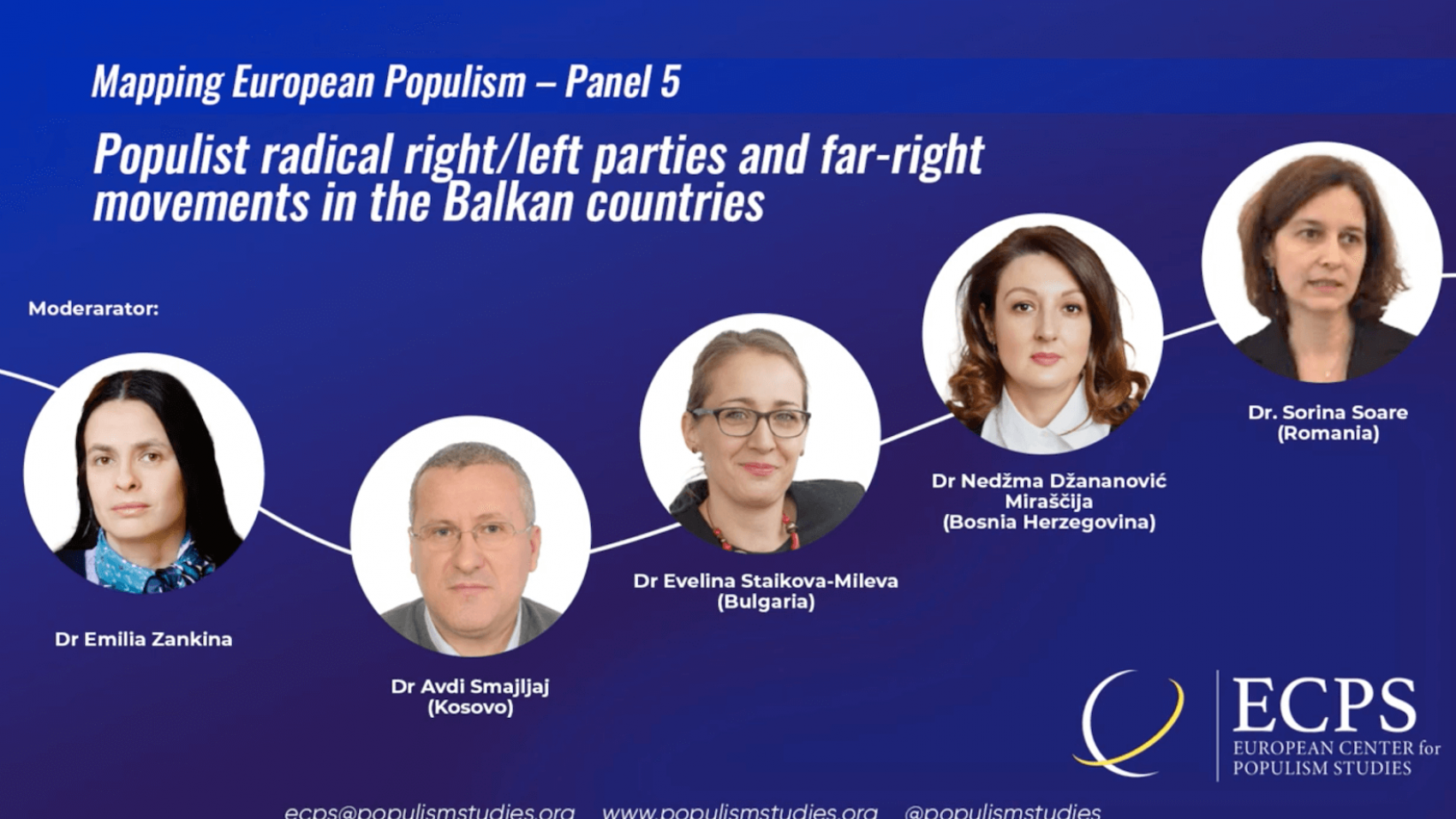
Mapping European Populism: Panel V —Populist radical right/left parties and far-right movements in the Balkan countries

Moderator

Dr Emilia Zankina (Dean of Temple University, Rome).

Speakers

“Normalization and radicalization: the paradoxes of populism in Bulgaria,” by Dr Evelina Staikova-Mileva (Associate Professor of political science at New Bulgarian University).

“Speaking for the transnational people: the Alliance for the Union of Romanians,” by Dr Sorina Soare (Researcher at the University of Florence).

“The trends of the Radical Right in Bosnia and Herzegovina,” by Dr Nedžma Džananović Miraščija (Professor and researcher at the University of Sarajevo’s Faculty of Political Science).

“Populists in government in young democracies, normalizing the defects of the young establishment: the case of Kosovo,” by Dr Avdi Smajljaj (Associate Professor in the department of Political Sciences and International Relations at Epoka University in Tirana, Albania).

YouthSeminar4

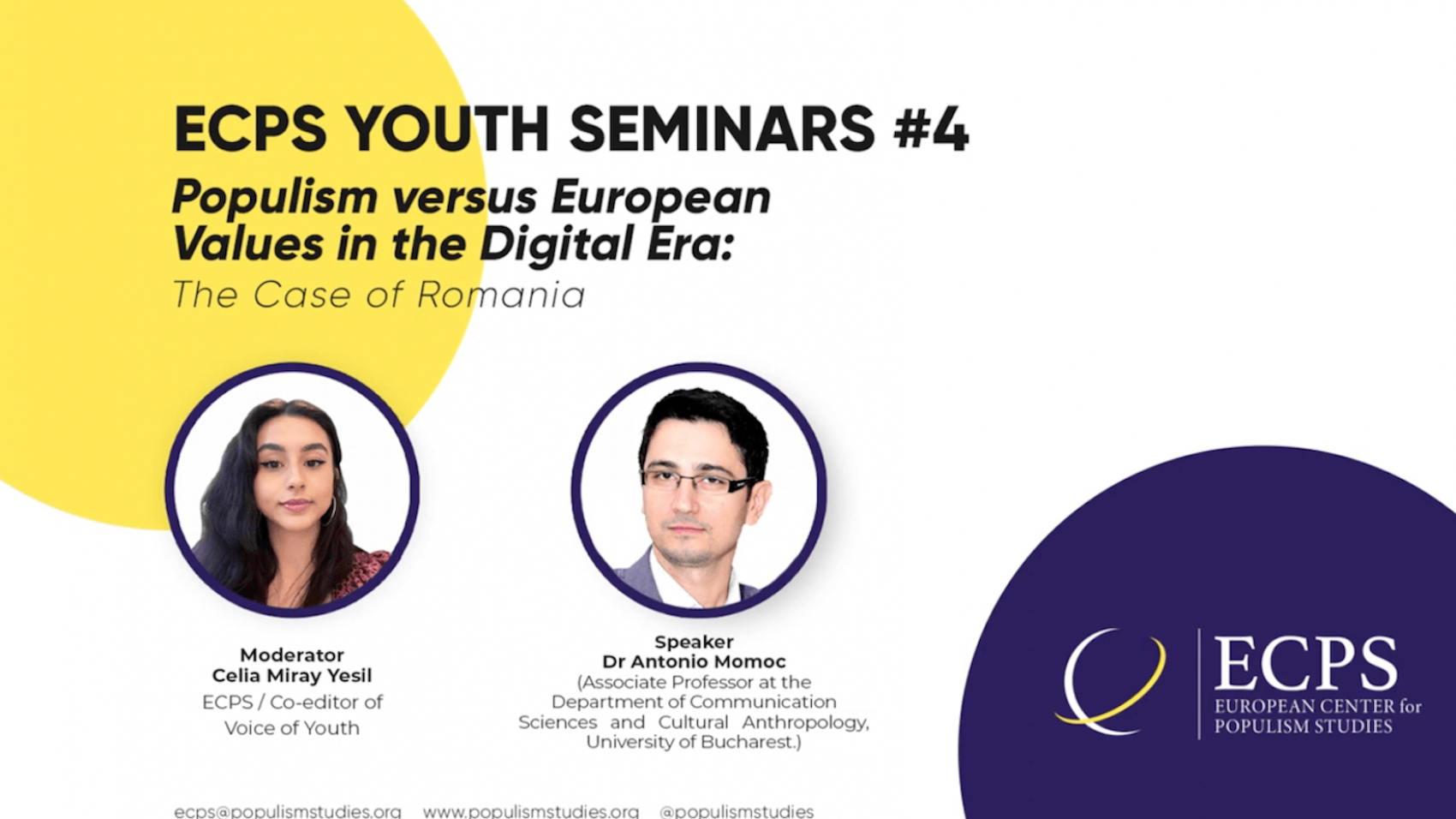
ECPS Youth Seminars #4 —Populism versus European Values in the Digital Era: The Case of Romania

The decline of trust in the political institutions of liberal democracy and in traditional journalism (print, radio, television) has been fueled by populists and anti-liberal ideologies. The rise of digital populism has especially generated “a cultural chaos of fake news” that is tremendously damaging the democratic culture. Populist leaders accused conventional media of generating fake news or of “being fake news.” In Central and Eastern Europe (CEE), the people’s loss of trust in the media amplified as they became poorly financed, unprofessional, increasingly politicised, and partisan. Meanwhile, digital populists successfully convince these people of possible opportunities created by direct democracy thanks to the online environment. At this ECPS Youth Seminar Dr Antonio Momoc speaks on “Populism versus European Values in the Digital Era: The Case of Romania.”

Dr. Antonio Momoc is an Associate Professor at the Department of Communication Sciences and Cultural Anthropology. He is also the Dean of the Faculty of Journalism and Communication Sciences at the University of Bucharest. Dr. Momoc teaches various aspects of communication and media, the new media theories and political communication, fashion, branding and politics, and electoral campaigns.

Moderator Celia Miray Yesil is a master’s student of International Political Economy at Warwick University. Her undergraduate degree was in European Politics at King’s College London, where she studied the historical background of Europe in the global context. Miray is interested in the impact of far-right populism on foreign policy, the political language of populist leaders, and its political economy.

ECPSYouthSeminar3

ECPS Youth Seminars #3 —The Others of Europe: Migrants, Refugees, Minorities and LGBTQ+ on the Eyes of Right-Wing Populists

At this ECPS Youth Seminar, Dr Koen Slootmaeckers speaks on “The others of Europe: The migrants, refugees, minorities and LGBTQ+ on the eyes of right-wing populists” and beyond. 

Dr Koen Slootmaeckers is a Senior Lecturer in International Politics at the Department of International Politics at City University of London. He has a multidisciplinary background and combines insights from sociology and political science into his work. His research focusses on gender and sexuality politics in Europe and is particularly interested in analysing hierarchies within the international system. More specifically, Koen has studied the EU accession of Serbia and how this process affects LGBT politics and activism. And his more recent project is interested in the transnational politics of LGBT Pride Parades. His work has been widely published, including a (co-)edited volume ‘EU Enlargement and Gay Politics’ (Palgrave 2016; with Heleen Touquet and Peter Vermeersch), and articles in, amongst others, East European Politics, Politics, Contemporary South-eastern Europe, Journal of Homosexuality, and Europe-Asia Studies. 

Moderator Celia Miray Yesil is a master’s student of International Political Economy at the Warwick University. She gained her undergraduate degree in European Politics at King’s College London, studying the historical background of European nations and its relationships with the rest of the world. Miray is considering focussing more on the impact of far-right populism in foreign policy, particularly looking at the political language and communication of populist leaders in the international political economy. 

ECPS-MEP-Panel4-Video

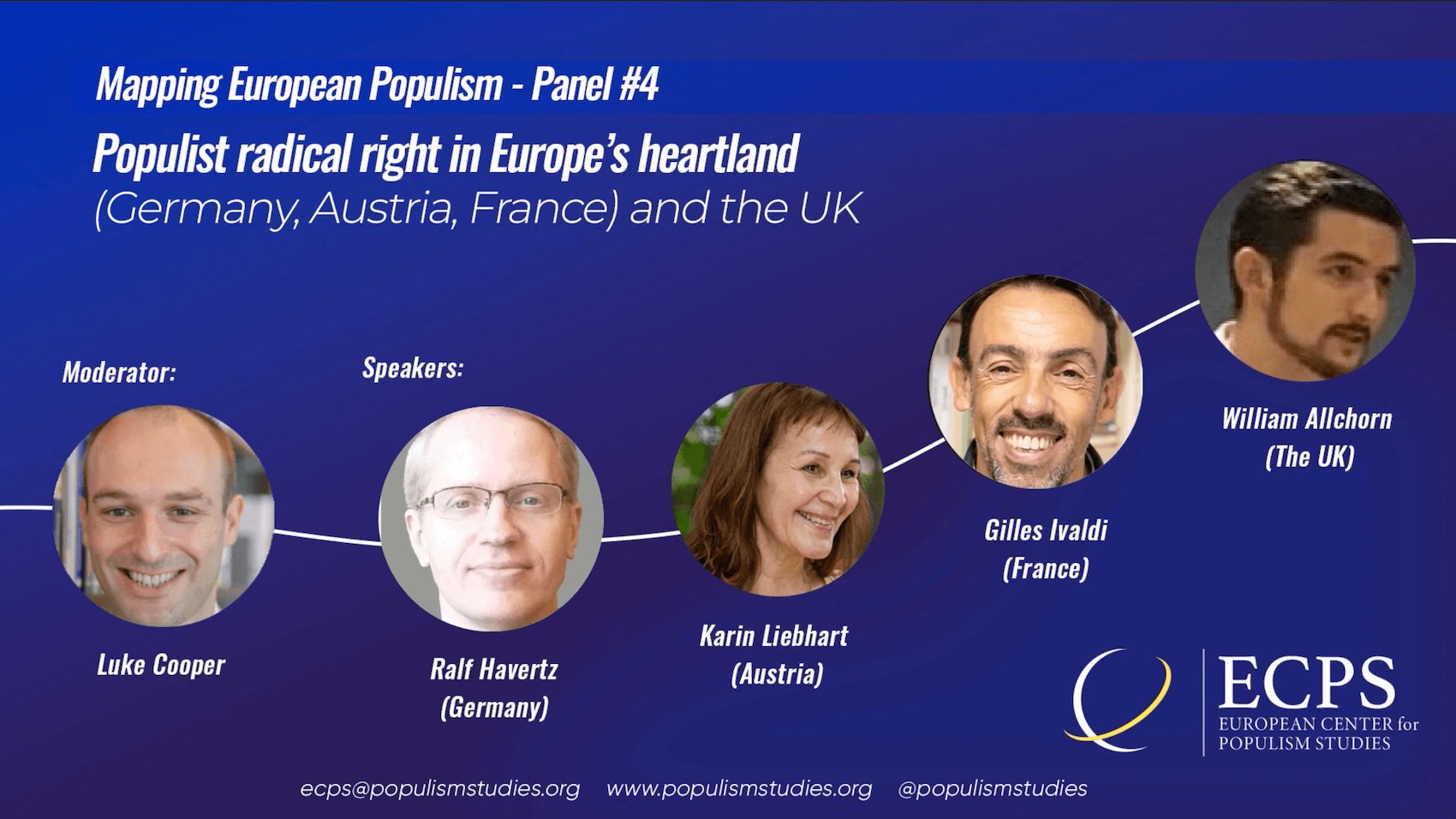
Mapping European Populism: Panel IV —Populist radical right in Europe’s heartland (Germany, Austria, France) and the UK.

Moderator

Dr Luke Cooper (Member of the Conflict and Civil Society Research Unit at the LSE).

Speakers

“The Rise of Radical Right Populism in Germany,” by Dr Ralf Havertz (Associate Professor of International Relations at Keimyung University in South Korea).

“Right-wing Populism and the New Right in Austria — Recent Trends and Manifestations,” by Dr Karin Liebhart (Professor at the Department of Political Science, the University of Vienna).

“The Populist Radical Right in the 2022 French Presidential Election: Party Fragmentation and Electoral Outcomes,” by Dr Gilles Ivaldi (CNRS researcher in political science at the Centre for Political Research at Sciences-Po, Paris).

“From the Margins to the Mainstream: The UK Populist Radical Right at a Time of Transition,” by Dr William Allchorn (Postdoctoral Researcher and Associate Director at the Centre for the Analysis of the Radical Right at the University of Leeds).

MEP-Panel3

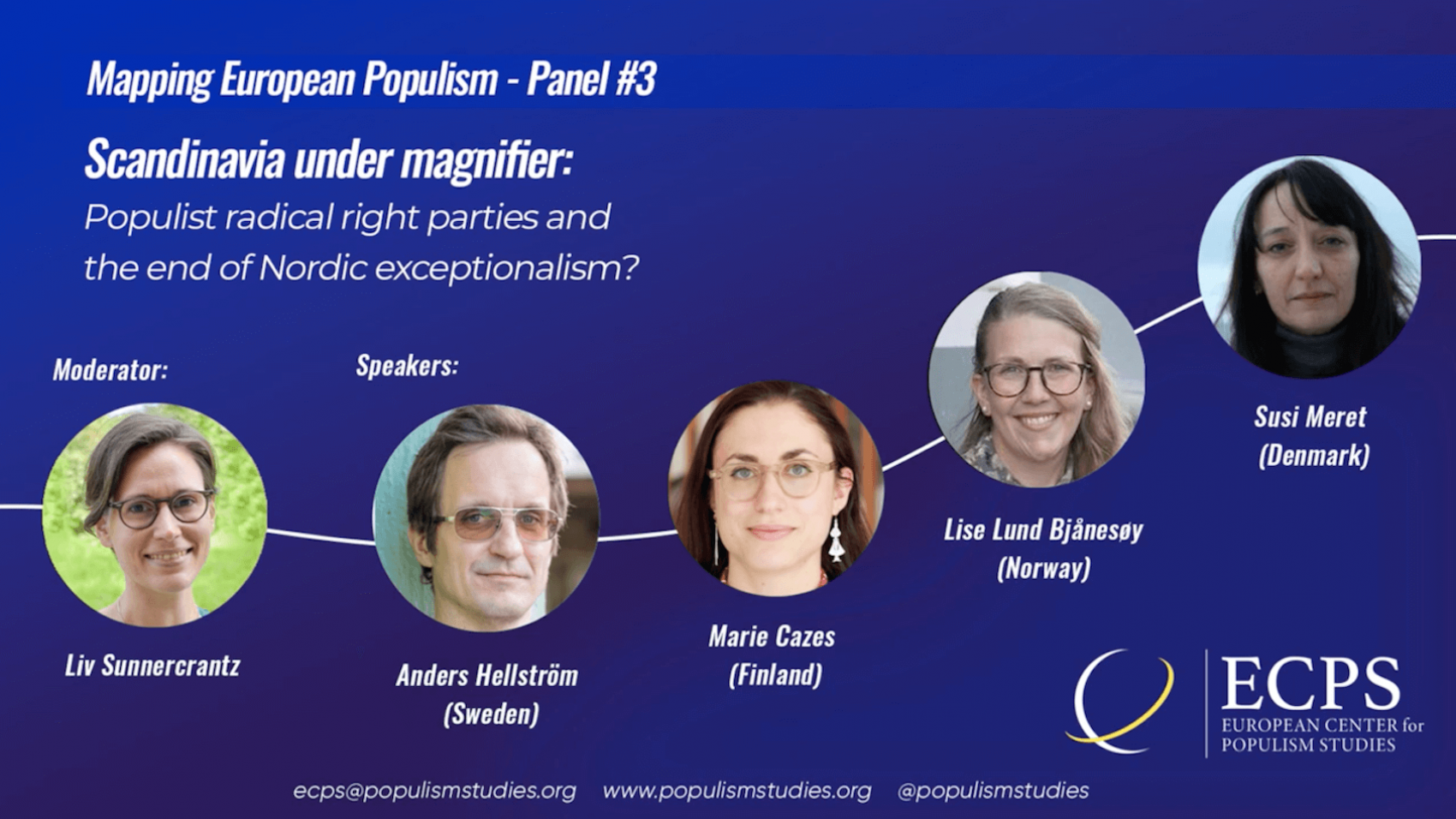
Mapping European Populism: Panel III — Scandinavia under magnifier: Populist radical right parties and the end of Nordic exceptionalism?

Moderator

Dr. Liv Sunnercrantz
(Department of Media and Social Sciences, University of Stavanger, Norway)

Speakers

“The Sweden Democrats in Swedish politics – the mainstreaming of extremism,”
by Dr. Anders Hellström (Department of Global Political Studies, Malmö University, Sweden).

“From rural to radical right: a brief perspective on Finnish populism,” by Marie Cazes (Doctoral Researcher, University of Jyväskylä, Finland).

“Public perceptions of the populist radical right in Norway,” by Dr. Lise Lund Bjånesøy (Department of Administration and Organization Theory, University of Bergen, Norway).

“From success to failure? The recent developments of the radical and populist right in Denmark,” by Dr. Susi Meret (Department of Politics and Society, University of Aalborg, Denmark).

Gerbadaou

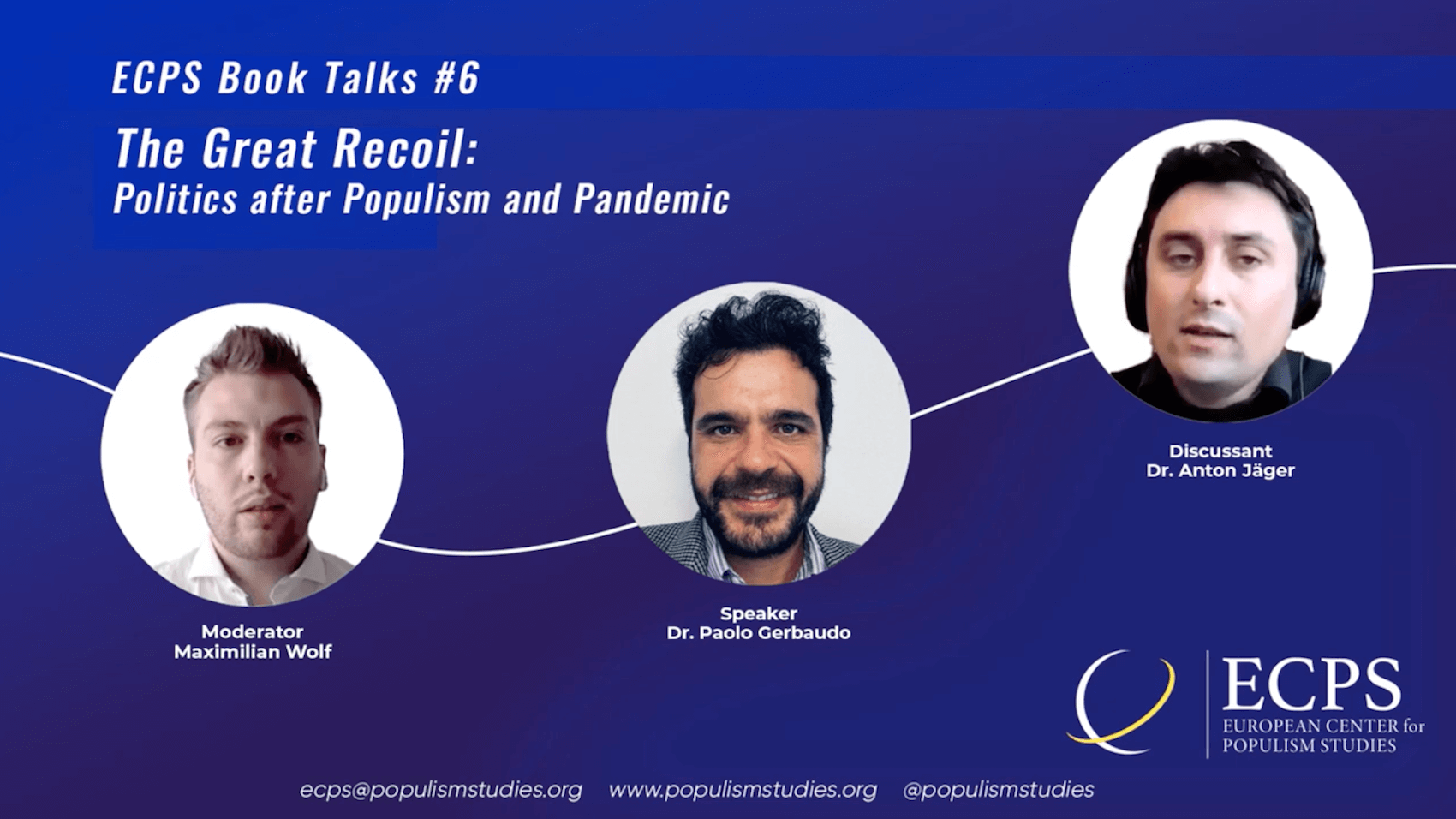
The Great Recoil: Politics after Populism and Pandemic

Author Dr. Paolo Gerbaudo will discuss his book The Great Recoil: Politics after Populism and Pandemic (Verso, 2021) with Dr. Anton Jäger of KU Leuven.

The Great Recoil focusses on the political and ideological transformations of the last two decades that have seen a turn away from the triumphalist, universalist attitudes towards globalisation and free trade, fuelled by a shift towards nationalist and nativist attitudes in a number of Western democracies, often called the ‘populist moment’ of the 2010s. Gerbaudo’s contention is that, while the appeal of such inward-focussed discourses was growing for over a decade, the Covid-19 crisis produced the perfect storm for what he terms the exopolitics of globalisation; in his eyes, the coming decades will be dominated, instead, by the endopolitics of a new ‘neo-statist’ impulse.

Examining the origin and changes in the three ‘master signifiers’ of this Great Recoil, sovereignty, protection and control, he argues that the success of populist radical right parties over the past decade was due to their recognition of the growing salience for this endopolitical discourse, fuelled by what he calls a ‘global agoraphobia.’ Gerbaudo then, in the final part of the book, argues for a strategy of progressive contention, re-capture and re-articulation of the signifiers of sovereignty, protection and control, arguing for a ‘progressive nationalism’ that re-engages the nation and its signifiers external both to nativist impulses and its ‘withering away’ amid a globalised cosmopolitanism. Instead, the nation must become a ‘protective structure’ that actively combats agoraphobia and drives reinstates feelings of control among the population.