Bangladesh’s 2026 election—the first since the 2024 uprising that toppled Sheikh Hasina—has been widely framed as a democratic turning point. Yet in this interview with the ECPS, Samzir Ahmed, a Bangladeshi politics expert, argues that the moment should be interpreted more cautiously. Rather than a democratic restoration, he describes the upheaval primarily as “a restoration of politics itself,” following what he calls a long period of depoliticization. Ahmed contends that the institutionalization of actors such as Jamaat-e-Islami represents a critical turning point, emphasizing that “institutionalization is an acid test for populist politics.” While populist and Islamist movements often thrive outside formal power structures, their integration into institutional politics may fundamentally reshape their strategies—and expose new constraints on their influence.
Bangladesh’s February 2026 general election marked the country’s first national vote since the Gen Z–led uprising of August 2024 that toppled Prime Minister Sheikh Hasina after fifteen years in power. The uprising followed a violent crackdown on protesters that, according to UN reporting, left around 1,400 people dead and precipitated the collapse of one of South Asia’s most entrenched hybrid regimes. Widely viewed as a test of whether Bangladesh could transition from revolutionary protest to institutional politics, the election unfolded largely peacefully. Turnout approached 60%, and many voters described the moment as an opportunity to cast ballots “without fear” after years of elections marred by intimidation and allegations of manipulation.
The results reshaped the country’s political landscape. The Bangladesh Nationalist Party (BNP), led by Tarique Rahman—who returned to Bangladesh in December 2025 after seventeen years in exile—won a sweeping victory with roughly 212 parliamentary seats, returning the party to power after two decades. The Islamist Jamaat-e-Islami–led alliance secured about 77 seats, marking its strongest parliamentary showing and establishing it as the principal opposition. Alongside the parliamentary vote, citizens also endorsed the reform-oriented “July Charter” in a referendum, which proposes significant constitutional reforms, including term limits for the prime minister, bicameralism, and strengthened judicial independence. Yet the broader political transition remains contested: the Awami League was barred from contesting the election, Sheikh Hasina remains in exile in India following a war-crimes conviction, and debates over justice, accountability, and political inclusion continue to shape Bangladesh’s fragile post-uprising order.
Against this volatile backdrop, the incoming BNP government faces daunting challenges: rebuilding institutions weakened by years of authoritarian consolidation, restoring law and order after a turbulent transitional period, reviving an economy strained by inflation and youth unemployment, and navigating complex regional diplomacy as India, the United States, and Pakistan recalibrate relations with Dhaka. These overlapping pressures raise a deeper question about whether the 2026 election represents a genuine democratic turning point—or merely the beginning of another cycle in Bangladesh’s long history of majoritarian power and polarized politics.
In this interview with the European Center for Populism Studies (ECPS), Samzir Ahmed, Lecturer at the Department of Bangla at Netrokona University, offers a sobering interpretation of this moment. Drawing on his concept of the “compromised strongman,” Ahmed argues that the election should not be interpreted as a democratic restoration. Rather, he situates the upheaval within a deeper historical pattern in which Bangladesh oscillates between depoliticization and renewed political mobilization. As he explains, the country had been experiencing “a long trend of depoliticization,” and the July uprising marked a rupture that represents primarily “a restoration of politics itself.” In his words, “democracy, however, remains far away.”
Ahmed also highlights the structural dynamics behind the BNP’s victory and the reconfiguration of Bangladesh’s ideological landscape. While the election signals a rightward shift in political gravity, he notes that such a development reflects a longer process that accelerated during the final years of Hasina’s rule. At the same time, the institutionalization of Islamist political forces—particularly the emergence of Jamaat-e-Islami as the main parliamentary opposition—signals a transformation in how populist and religious movements operate within Bangladesh’s political system. For Ahmed, this transition is crucial because “institutionalization is an acid test for populist politics.” Populist movements, he suggests, often flourish when they remain outside formal power structures but face new constraints once they become embedded within institutions.
More broadly, Ahmed situates the country’s current uncertainties within the unresolved dual nationalist structure that has shaped Bangladeshi politics since independence. With the Awami League banned and its leadership in exile or imprisoned, the political vacuum raises unresolved questions about representation and polarization. Whether secular constituencies will eventually reorganize under a revived Awami League, find accommodation within the BNP, or generate a new political formation remains uncertain.
Moreover, Ahmed reflects on the generational dynamics unleashed by the student-led uprising that triggered the transition. The protests, he argues, reflected “generational frustration with traditional patronist-centric politics.” Yet the digital hyperconnectivity that enabled rapid mobilization against authoritarian rule may simultaneously complicate the creation of durable political alternatives. In one of the interview’s most striking observations, Ahmed captures this dilemma succinctly: “The present is denied, but the future is not invited either.”
Ahmed’s reflections suggest that Bangladesh is entering another phase of intense political contestation rather than a settled democratic transition. Whether the July Charter reforms, ideological reconciliation, and institutional reconstruction can transform this turbulent moment into genuine democratic consolidation remains, for now, an open question.
In this analysis, Dr. Oludele Solaja examines how geopolitical tensions around the strategic oil chokepoint of the Strait of Hormuz transmit economic shocks across the global political economy and disproportionately affect African states. Because many African economies remain highly dependent on commodity exports and imported energy, oil price volatility quickly translates into inflation, fiscal stress, and social pressure. Even oil-exporting countries such as Nigeria face paradoxical effects, benefiting from higher crude revenues while simultaneously suffering from rising domestic fuel costs. These inflationary pressures can fuel economic discontent, weaken government legitimacy, and create fertile ground for populist mobilization. Dr. Solaja argues that recurrent commodity shocks expose deep structural vulnerabilities, underscoring the need for economic diversification, energy transition, and stronger regional integration to build resilience.
By Oludele Solaja*
Geopolitical conflicts rarely stay within their battlefield boundaries. In a world with integrated economy, war in strategic energy corridor would swiftly lead to inflation, political instability and governmental pressures far from conflict. Geopolitical tensions in the strategic energy corridor are central to the functioning of the global political economy. The Strait of Hormuz holds a peculiar important position in the transit routes among all. Some one fifth of the global petroleum liquids passes through the narrow maritime passage in between Iran and Arabian Peninsula (US Energy Information Administration, 2023), hence the perception of armed conflict even if it’s just the rumor of one in the area would lead to an immediate volatility shock in the global oil market.
Not just the physical supply disruptions but the uncertainty itself would create price volatility. Higher cost of insuring the vessels, shifting of the routes and market responses all contribute to the volatility as well. Scholars of energy politics have always acknowledged that oil markets are intrinsically connected with national security and strategic rivalry (Bridge & Le Billon, 2017). As such, conflict occurring in energy producing areas could have economic impact across nations without any boundaries.
The effects on the developing nations would be even worse. World Bank warns that such shocks from the Middle Eastern energy supply chains could push the oil prices beyond $100/barrel, creating inflation pressure and fiscal burden upon developing nations. In an integrated global economy, a geopolitical shock will be transmitted across the commodity supply chain. Energy supply, food production, transportation network and capital flow are all interconnected.
Inflation Transmission and African Political Economy
When energy prices shock happens in African countries, typically there are two related effects: windfall profit to oil exporters, and inflationary pressure to domestic markets.
On one hand, oil exporters like Nigeria, Angola and Algeria could profit from rising crude oil prices through high export revenues and balance of payments surplus. In theory, windfalls can stabilize fiscal conditions and support increase development expenditure. Nevertheless, political economy literature argues that commodity windfalls often reproduce and strengthen existing vulnerabilities of the economies, which fail to transform into sustainable development instead of generating rent-seeking behavior without firm institutions and diversified economies (Auty, 2001; Ross, 2012).
On the other hand, rising global oil prices will transmit inflation through the domestic economies. Transportation costs rise with higher fuel prices, pushing the price up of goods including foods, which need logistics and transportation, as well as costs for manufactured goods and fertilizers for farming. Electricity costs are also higher and so forth.
In Nigeria, this paradox is crystal clear. Despite being one of Africa’s biggest exporters of crude oil, Nigeria needs to import its supply of refined petroleum products as its own refining capacity is insufficient. This creates two divergent effects at the same time: Nigeria has to pay high fuel import costs from imported refined oil, while export revenue is expected to rise with higher crude prices. Informal sector workers who are in the vast majority in Nigerian labor market would experience increasing cost of living.
The consequences for oil-importing African countries are even harsher. Rising costs of fuel import not only leads to greater trade deficit and depreciation of national currency but also increase countries’ exposure to sovereign debt distress.
Commodity Shocks and Politics of Economic Discontent
The macroeconomic impact beyond energy sector can reshape the domestic political landscape by raising costs of living especially in the vulnerable societies. Political scientists have noted that a sudden increase in living costs can cause popular unrest, weaken government legitimacy, and contribute to the emergence of populism (Rodrik, 2018; Kriesi & Pappas, 2015).
In this case, a global economic shock would have translated into domestic political pressure. When confronting with inflation pressures, African governments often are compelled to subsidize the consumption of oil or enforce price caps, which have proven to undermine fiscal positions and postpone necessary structural adjustments. Repeated commodity shocks in institutionally weak economies can reproduce the same vicious cycles of economic discontent and political instability.
Geopolitical conflicts in energy corridors therefore do more than creating turbulence for economies. They challenge domestic political legitimacy by accentuating conflicts between different strata of society about inflation, social welfare, and commodity distribution.
Structural Vulnerability in Commodity-dependent Economies
All of the aforementioned highlights the inherent structural vulnerabilities of commodity-dependent economic systems. Dependency theorists have consistently asserted that countries that depend on exports of primary commodities are exposed to volatility in international commodity markets (Frank, 1967; Amin, 1976). Moreover, the “resource curse” debate emphasizes rent seeking, volatility, and limited industrial development in extracting economies (Ross, 2012).
Energy geopolitical shock can only intensify this vulnerability. Shipping disruptions or higher freight costs resulting from higher insurance fees due to conflict at Persian Gulf can be re-routed around Africa’s Cape of Good Hope, further intensifying the costs borne by all importing nations, especially those relying on food imports, manufactured goods and agricultural inputs. In such cases, the impacts of wars fought at energy corridors are redistributed across the commodity markets that link the Strait of Hormuz to consumers across a faraway land.
Policy Implications: Building Resilience
Mitigating vulnerability of geopolitical commodity shocks requires a long-term perspective beyond ad hoc management strategies. The first thing for African countries is to speed up economic diversification (industrialization and value adding in agriculture), because it will lead to sustainable development not only by reducing dependence on the exports of oil. Secondly, investment in infrastructure and on renewable energies will lead to energy sustainability in African countries and reduces the reliance on imported refined goods. Third, strengthen the social safety net (cash transfers, food security program, etc.) can shield the poorest households from inflationary shocks. Fourth, expand intra-African trade using the African Continental Free Trade Area (AfCFTA) will make the region reduce dependence on unstable international commodity market.
Conclusion
Volatility in strategic energy corridors such as the Strait of Hormuz is a manifestation of geopolitical tensions’ spread across the global political economy. For Africa’s commodity-dependent economies, it amplifies the persistent structural vulnerabilities that are embedded in extraction-based development strategies. Short term export gains associated with rising prices rarely outweigh the subsequent inflationary pressures and fiscal instability in the longer run. Unless these development strategies are actively reformed to emphasize diversification, energy transition and resilience, each commodity shock following every conflict will result in the similar outcomes: temporary windfall gains followed by inflation-induced hardship and fragile development. Geopolitical conflicts in energy corridors, hence, are not just regional security issues; they are fundamentally tests of structural resilience in the development agenda of the Global South.
(*) Dr. Oludele Solaja is a faculty member in the Department of Sociology at Olabisi Onabanjo University in Ago-Iwoye, Ogun State, Nigeria.
References
Amin, S. (1976). Unequal development: An essay on the social formations of peripheral capitalism. Monthly Review Press.
Auty, R. (2001). Resource abundance and economic development. Oxford University Press.
Bridge, G., & Le Billon, P. (2017). Oil. Polity Press.
Frank, A. G. (1967). Capitalism and underdevelopment in Latin America. Monthly Review Press.
Kriesi, H., & Pappas, T. (2015). European populism in the shadow of the Great Recession. ECPR Press.
Rodrik, D. (2018). “Populism and the economics of globalization.” Journal of International Business Policy, 1(1–2), 12–33.
Ross, M. (2012). The oil curse: How petroleum wealth shapes the development of nations. Princeton University Press.
U.S. Energy Information Administration. (2023). World oil transit chokepoints. https://www.eia.gov
World Bank. (2023). Commodity markets outlook. World Bank.
Bangladesh’s 2026 election—the first since the 2024 uprising that toppled Sheikh Hasina—has been widely framed as a democratic turning point. Yet in this interview with the ECPS, Samzir Ahmed, a Bangladeshi politics expert, argues that the moment should be interpreted more cautiously. Rather than a democratic restoration, he describes the upheaval primarily as “a restoration of politics itself,” following what he calls a long period of depoliticization. Ahmed contends that the institutionalization of actors such as Jamaat-e-Islami represents a critical turning point, emphasizing that “institutionalization is an acid test for populist politics.” While populist and Islamist movements often thrive outside formal power structures, their integration into institutional politics may fundamentally reshape their strategies—and expose new constraints on their influence.
Bangladesh’s February 2026 general election marked the country’s first national vote since the Gen Z–led uprising of August 2024 that toppled Prime Minister Sheikh Hasina after fifteen years in power. The uprising followed a violent crackdown on protesters that, according to UN reporting, left around 1,400 people dead and precipitated the collapse of one of South Asia’s most entrenched hybrid regimes. Widely viewed as a test of whether Bangladesh could transition from revolutionary protest to institutional politics, the election unfolded largely peacefully. Turnout approached 60%, and many voters described the moment as an opportunity to cast ballots “without fear” after years of elections marred by intimidation and allegations of manipulation.
The results reshaped the country’s political landscape. The Bangladesh Nationalist Party (BNP), led by Tarique Rahman—who returned to Bangladesh in December 2025 after seventeen years in exile—won a sweeping victory with roughly 212 parliamentary seats, returning the party to power after two decades. The Islamist Jamaat-e-Islami–led alliance secured about 77 seats, marking its strongest parliamentary showing and establishing it as the principal opposition. Alongside the parliamentary vote, citizens also endorsed the reform-oriented “July Charter” in a referendum, which proposes significant constitutional reforms, including term limits for the prime minister, bicameralism, and strengthened judicial independence. Yet the broader political transition remains contested: the Awami League was barred from contesting the election, Sheikh Hasina remains in exile in India following a war-crimes conviction, and debates over justice, accountability, and political inclusion continue to shape Bangladesh’s fragile post-uprising order.
Against this volatile backdrop, the incoming BNP government faces daunting challenges: rebuilding institutions weakened by years of authoritarian consolidation, restoring law and order after a turbulent transitional period, reviving an economy strained by inflation and youth unemployment, and navigating complex regional diplomacy as India, the United States, and Pakistan recalibrate relations with Dhaka. These overlapping pressures raise a deeper question about whether the 2026 election represents a genuine democratic turning point—or merely the beginning of another cycle in Bangladesh’s long history of majoritarian power and polarized politics.
In this interview with the European Center for Populism Studies (ECPS), Samzir Ahmed, Lecturer at the Department of Bangla at Netrokona University, offers a sobering interpretation of this moment. Drawing on his concept of the “compromised strongman,” Ahmed argues that the election should not be interpreted as a democratic restoration. Rather, he situates the upheaval within a deeper historical pattern in which Bangladesh oscillates between depoliticization and renewed political mobilization. As he explains, the country had been experiencing “a long trend of depoliticization,” and the July uprising marked a rupture that represents primarily “a restoration of politics itself.” In his words, “democracy, however, remains far away.”
Ahmed also highlights the structural dynamics behind the BNP’s victory and the reconfiguration of Bangladesh’s ideological landscape. While the election signals a rightward shift in political gravity, he notes that such a development reflects a longer process that accelerated during the final years of Hasina’s rule. At the same time, the institutionalization of Islamist political forces—particularly the emergence of Jamaat-e-Islami as the main parliamentary opposition—signals a transformation in how populist and religious movements operate within Bangladesh’s political system. For Ahmed, this transition is crucial because “institutionalization is an acid test for populist politics.” Populist movements, he suggests, often flourish when they remain outside formal power structures but face new constraints once they become embedded within institutions.
More broadly, Ahmed situates the country’s current uncertainties within the unresolved dual nationalist structure that has shaped Bangladeshi politics since independence. With the Awami League banned and its leadership in exile or imprisoned, the political vacuum raises unresolved questions about representation and polarization. Whether secular constituencies will eventually reorganize under a revived Awami League, find accommodation within the BNP, or generate a new political formation remains uncertain.
Moreover, Ahmed reflects on the generational dynamics unleashed by the student-led uprising that triggered the transition. The protests, he argues, reflected “generational frustration with traditional patronist-centric politics.” Yet the digital hyperconnectivity that enabled rapid mobilization against authoritarian rule may simultaneously complicate the creation of durable political alternatives. In one of the interview’s most striking observations, Ahmed captures this dilemma succinctly: “The present is denied, but the future is not invited either.”
Ahmed’s reflections suggest that Bangladesh is entering another phase of intense political contestation rather than a settled democratic transition. Whether the July Charter reforms, ideological reconciliation, and institutional reconstruction can transform this turbulent moment into genuine democratic consolidation remains, for now, an open question.
Here is the edited version of our interview with Samzir Ahmed, revised slightly to improve clarity and flow.
Strongman Politics Has Always Been a Structural Possibility in Bangladesh
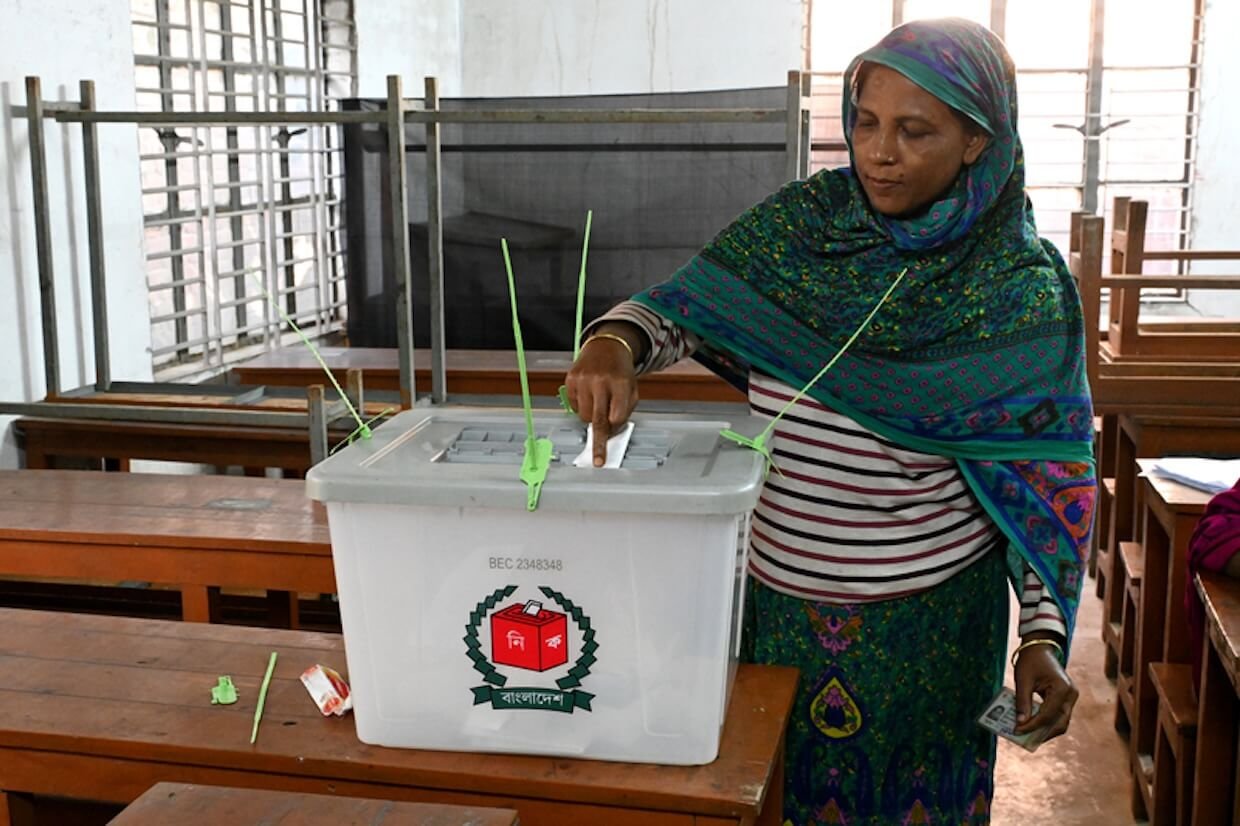
A woman casts her ballot at a polling station during Bangladesh’s general election in Dhaka, January 7, 2024. Photo: Mamunur Rashid / Dreamstime.
The 2026 election has been described as both a democratic restoration and an ideological rightward shift. In light of your concept of the “compromised strongman,” do you interpret the BNP’s supermajority as a democratic reset—or as the beginning of a new configuration of strongman politics under altered ideological conditions?
Samzir Ahmed: I would not describe it as a democratic restoration. Rather, I would say that Bangladesh has been experiencing a long trend of depoliticization. The July upheaval—or uprising—marked a significant break in that trajectory. In this sense, what we are witnessing is, first and foremost, a restoration of politics itself. Democracy, however, remains far away.
I do agree that a rightward shift is taking place, but it is largely a continuation of a process that began several decades ago and gained considerable momentum during Hasina’s time in power. It was the outcome of the compromise that I discussed in my paper. Strongman politics has always been a structural possibility in Bangladesh. The ban on our military’s political activities has also contributed to this dynamic. At this stage, what matters most is the nature and depth of this new form of re-politicization and how it will shape the future trajectory of politics in the country.
Given your argument that democratic erosion in Bangladesh is rooted in unresolved nationalist fractures, how should we interpret the BNP’s two-thirds majority? Does it risk reproducing the same executive centralization that enabled Sheikh Hasina’s consolidation?
Samzir Ahmed: I think the BNP lacks a strong ideological rhetoric. That is a major problem for the party. Their brand of Bangladeshi nationalism, although it sounds inclusive, has always tilted toward the right. For now, the nationalist structure is dormant—albeit very temporarily. However, with the resurgence of Islamist politics, the factional divide is bound to return with greater force. So that would be my take on this.
The Banning of the Awami League Has Created a Political Vacuum in the Secular Bloc
You argue that split nationalist identity has repeatedly destabilized democratic consolidation. How does the banning of the Awami League reshape that dual nationalist structure? Does exclusion deepen polarization or temporarily suppress it?
Samzir Ahmed: Yes, it is going to deepen polarization. The question is: who is going to represent the secular bloc? In this election, they voted for the BNP, but historically Awami movement—at least on paper or during elections—represented them. Their activities have been banned, and their major leaders are either fugitives or in jail. So, there is now a vacuum. The unresolved question, then, is whether the deepening split will make their return inevitable, whether the BNP will serve as a proxy, or whether a new party will emerge. At this moment, however, I am not very hopeful about the third option. So, we are essentially left to choose between the other two possibilities.
With Jamaat-e-Islami emerging as the principal opposition, do we see a normalization of political Islam and Islamist populism within parliamentary competition—or the institutionalization of the religious pole in Bangladesh’s long-standing nationalist split?
Samzir Ahmed: Yes, we are witnessing a normalization of political Islam and its institutionalization. However, I see this as an advancement in a particular sense. For a long time, Jamaat-e-Islami has practiced politics in a rather unpolitical way. They run school programs and try to influence school students. Even when they ask for votes, they tend to present themselves as some kind of Islamic messiah. In universities, they have run campaigns such as “I Hate Politics” or “We Don’t Want Politics on Campus.” Their success is evident in their clean sweep of student union elections.
Now, as they appear more visibly in an institutional political form, the rhetoric of anti-politics is likely to lose its force. This rhetoric— “I hate politics”—served Jamaat-e-Islami very well for a long time. But as they move more openly into the political arena, that narrative is unlikely to remain effective.
So, as they have now formally entered politics in a more visible way, something interesting is really taking shape. I am not saying that they were not formally present in politics before, but their strategy was largely unpolitical. Now they are losing that strategy, which is why I say that something interesting is unfolding.
The Uprising Was Against Something—Not Clearly for Something
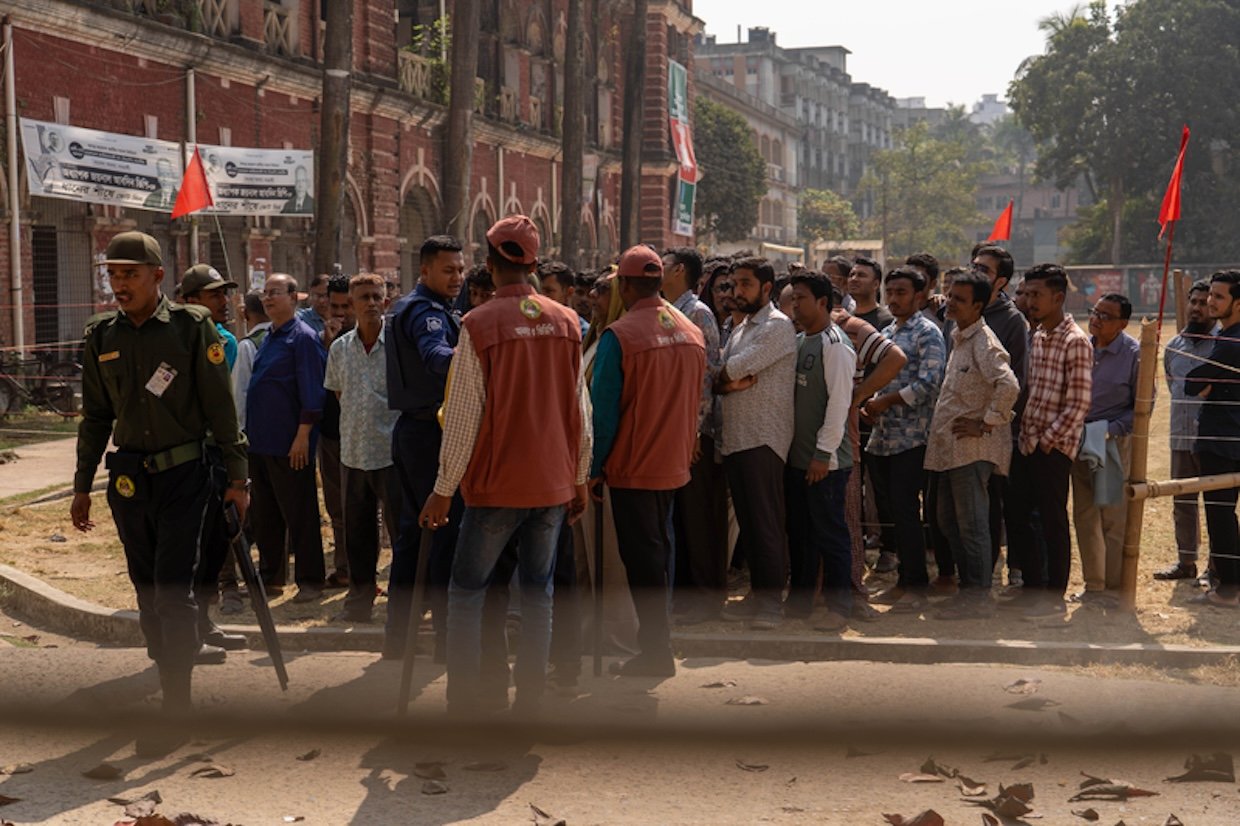
Voters line up outside a polling station in Feni during Bangladesh’s 13th national election on February 12, 2026. The scene reflects the high voter turnout of approximately 59.44% in this historic “Gen Z-inspired” election held under the interim government led by Muhammad Yunus. Photo: Belayet Hossain / Dreamstime.
The student-led uprising that toppled Hasina seemed to signal generational democratic aspirations. Yet the National Citizen Party’s limited electoral success suggests something more complex. Does this reflect ideological fragmentation, populist volatility, or structural resistance to centrist pluralism?
Samzir Ahmed: I think something more complex is at play. The uprising was against something, but not clearly for something. So, the signal should be read as generational frustration with traditional patronist-centric politics, rather than a straightforward aspiration for democracy.
The NCP’s political trajectory suggests that they were never actually prepared for this moment or for the kind of political opportunity they have enjoyed. In the age of digital hyperconnectivity, which facilitates a new wave of populist politics, it is relatively easier to build consensus against power. But this form of connectivity, at the same time, makes it equally difficult to rebuild or reconstruct our polity. The present is denied, but the future is not invited either.
You note that radical right groups in Bangladesh historically function as “kingmakers” despite limited electoral dominance. In the current context, is Islamism transitioning from pressure politics to institutionalized parliamentary leverage?
Samzir Ahmed: Yes, they have gained leverage, but it may work in their favor—or it may risk their future. I think institutionalization is an acid test for populist politics. Populist politics functions really well when such actors are not in power or not operating within an institutionalized setting.
In Bangladesh, although Jamaat-e-Islami is now positioned as the opponent, we have to keep in mind that it has historically been a close ally of the BNP. So, they are likely to enjoy some share of power. In that sense, they will gain leverage, but that leverage also comes with risks.
Opposing Women’s Empowerment Is Politically Counterproductive
Reports of increasing gender-based anxieties and Islamist rhetoric during the election cycle suggest a societal shift. Do you interpret this as an organic religious revival, a strategic mobilization by political elites, or a symptom of nationalist identity re-negotiation?
Samzir Ahmed: I do not think the increasing gender-based anxiety suggests a broader social shift. Jamaat-e-Islami generated controversy by taking a position against women’s leadership and empowerment. They are ideologically bound to produce such controversies unless they prioritize voting strategy over ideology. But this has already proved counterproductive.
Female participation in education and in the labour market is very high in Bangladesh, and women’s political participation is also rising. So, going against women’s empowerment may prove counterproductive for any political party. I am not forgetting that there are other forms of gender identity, but female identity has found a place in populist rhetoric, while others have not.
Institutional Design Alone Cannot Resolve Political Contradictions
If the July Charter’s constitutional reforms (term limits, bicameralism, judicial independence) are only partially implemented, does this reinforce your thesis that institutional design alone cannot overcome foundational nationalist contradictions?
Samzir Ahmed: That’s an interesting question. The future of the July Charter is very unclear at the moment. Foundational nationalist contradictions are political problems, and they cannot be solved simply through institutional design. I myself proposed a design for police reform. But without political resolutions, these reform initiatives are bound to face difficulties. We have some good laws, but the problem is that we are not in any shortage of ways to bypass them.
For example, faculty recruitment in universities is highly politicized. Previously, recruitment was only merit-based. To ensure better accountability, many universities introduced written examinations, but that has become even more problematic. Delays are often created during the written examination stage. Politically biased recruitment can now even find written evidence in its favor. So, I could give any number of such examples. In that sense, I reassert my position that institutional design alone cannot overcome foundational nationalist contradictions, which is fundamentally a political problem.
Public Support for Both Democracy and Sharia Is an Enigma
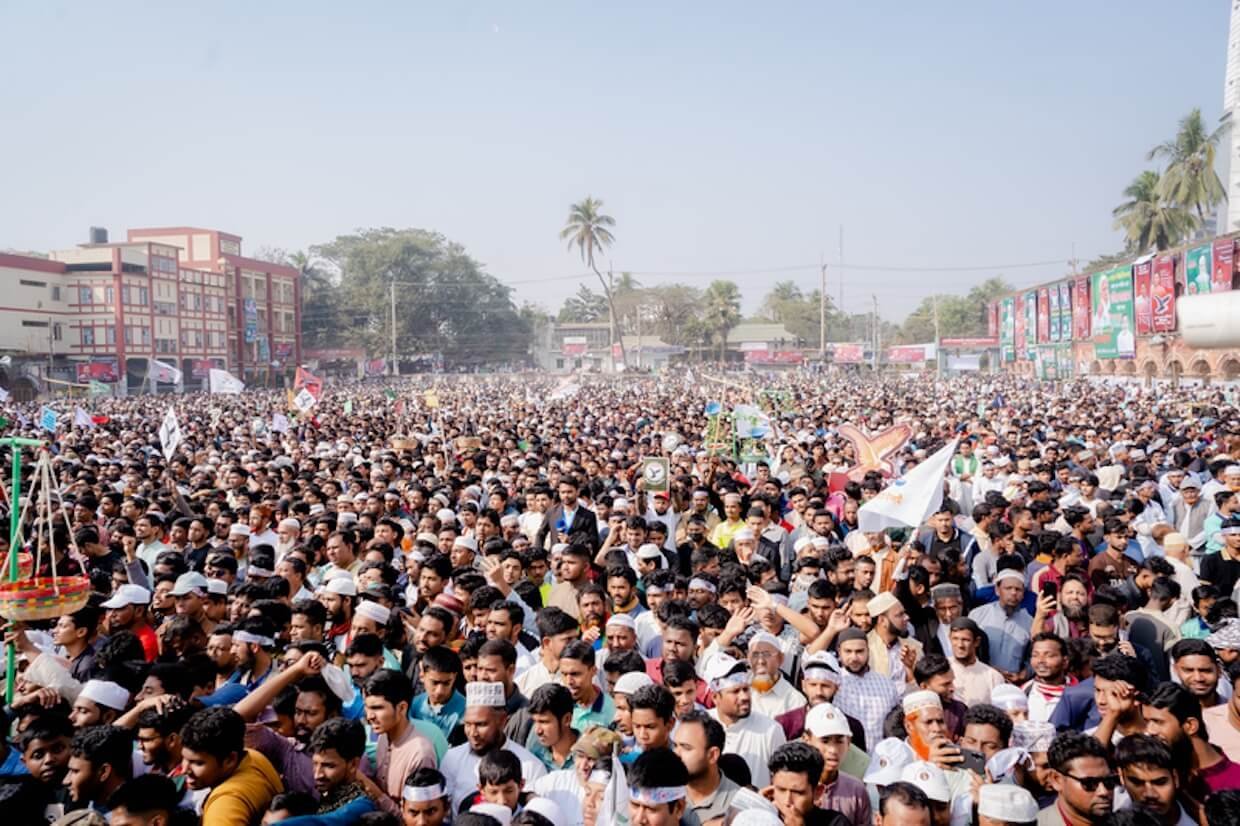
Supporters gather at an election rally of the Jamaat-e-Islami–led alliance in Feni, Bangladesh, on January 30, 2026, ahead of the national elections. Photo: Borhan Uddin Nishan / Dreamstime.
You describe Bangladesh’s democratic oscillation as driven by “anti-incumbency” rooted in split identity. Has the 2026 election broken this cycle, or does it represent another turn in a structurally reactionary political pattern?
Samzir Ahmed: I think it represents another turn in a structurally reactionary political pattern. The BNP-led government has already started receiving serious backlash, at least in the digital sphere. So, I think it is going to be another turn, but it is still early days. We have to wait and see how it unfolds.
In your analysis, strongman leaders have historically sought legitimacy through Islamization. Could the BNP now rely less on populist compromise and more on explicit religious-nationalist consolidation—or would that destabilize its broader electoral coalition?
Samzir Ahmed: It is an interesting scenario. While autocratic leaders have always used varying degrees of Islamic legitimacy, the situation for the BNP is quite unprecedented. Structurally, direct Islamic rule may appear to be the easiest option if they move toward electoral autocracy. However, this time they came to power with substantial secular support. So, this is very new. The future is, therefore, very challenging for the BNP.
Survey data cited in your work suggest simultaneous support for democracy and Sharia-based governance. How should scholars interpret this apparent normative contradiction? Is it cognitive dissonance, layered sovereignty, or alternative conceptions of democratic legitimacy?
Samzir Ahmed: The recent survey by Prothom Alo, the major national daily in Bangladesh, has also shown strikingly similar results, depicting overwhelming support for both Islamic law and democracy. So, this requires serious further research. I would prefer to avoid being speculative here, but it is a kind of enigma that I am genuinely interested in exploring further. Perhaps in the near future.
Bangladesh’s Foreign Policy Direction Remains Unclear
With renewed balancing among India, China, Pakistan, and the United States, how does Bangladesh’s foreign policy reflect its unresolved nationalist duality—particularly between anti-Indian sentiment and pragmatic economic alignment?
Samzir Ahmed: The BNP-led government’s foreign policy is still not very clear. There are some hints, but there are still many things to watch for. At the same time, there is constant pressure from the United States regarding some controversial agreements. However, anti-Indian sentiment has had a rollercoaster trajectory in Bangladesh. It rises whenever the Awami League is in power and declines when its opponent holds power. So, this dynamic is very much connected to the reactionary political pattern.
Comparatively, do you see Bangladesh moving toward competitive authoritarianism, hybrid populism, or another variant of strongman governance? How does your “compromised strongman” framework travel beyond Hasina to the current moment?
Samzir Ahmed: It is still very early to comment on this. I see the election as the institutionalization of another cycle of re-politicization. However, the structural possibility and template for strongman politics are always there. So, autocratic solutions are traditionally available. What a government needs is the right kind of problem. So, yes, I see it in this way.
Democratic Consolidation Requires Reconciliation First
And lastly, your article suggests that the failure to build a cohesive nation of equal citizens underpins authoritarian drift. What would genuine democratic consolidation require in Bangladesh: institutional reform, ideological reconciliation, or a re-founding narrative of national identity?
Samzir Ahmed: Bangladesh needs all three. If I were to rank them, I would put ideological or political reconciliation first. Then, based on that reconciliation, a re-founding narrative of national identity. And finally, institutional reform. Institutional reform, which has been given much emphasis this time, would therefore come last in this order. So, yes, I think Bangladesh needs all three.
This research note introduces high frequency “real-time” Google Trends data as a novel tool for studying public engagement with major political speeches. Unlike traditional dial-testing, which captures emotional reactions, “googling” patterns reveal cognitive engagement—moments when audiences actively seek information about claims, people, or policies mentioned by the speaker. Analyzing the 2026 State of the Union Address by President Donald J. Trump, the study shows that search activity spiked around issues such as TrumpRX, “Trump Accounts,” and D.E.I., as well as narratives tied to culture-war themes like the story of Sage Blair. The findings suggest that policy proposals addressing material needs—combined with culture-war framing—can mobilize significant public attention, echoing strategies seen in contemporary populist politics.
This research note introduces high frequency “real time” Google Trends data as a tool for research on the general public’s engagement with high-profile political speeches. Contrary to the well-known dial-testing – providing data on emotional engagement – “googling” patterns offer glimpse into the cognitive engagement – actual efforts to obtain additional information on the issues introduced in the speech.
The 2026 State of the Union (SOTU) Address by President Donald J. Trump offered promising testing ground for such tool, due to its prominence, extraordinary length, diverse content and involvement of extraordinary invitees personifying the key narratives. The results indicate that TrumpRX and “Trump Accounts” – generated substantial interest among audience – as well as D.E.I. (Diversity, Equity, and Inclusion). Moreover, search data revealed noticeable interest in the history of Sage Blair – an example of engaging framing of the culture war issues. These narratives could be applied in forthcoming campaigns to construct the mix of policies addressing material needs of anti-elitist voters and the culture war narrative – the sort of “bread and circuses” already deployed by Central European illiberals.
Introduction
On 24 February 2026 President Donald J. Trump delivered the first State of the Union (SOTU) address of his second term. The one hour and 47 minutes performance – breaking President Clinton’s 2000 record by over 20 percent (Peters, 2026) – provided unique communication opportunity for president facing tensions among his MAGA fandom as midterm elections approaches.
Staged in the most “presidential” setting imaginable – a joint session of the United States Congress in a year marking 250 years of US independence – President Trump’s spectacle involved proclamation of “the golden age of America,” litany of 47th President’s achievements and bashing on the “craziness” of his opponents. It also featured appearance of extraordinary invitees, personifying President’s narratives on the past, present and future of the United States. Indeed, as noticed by The Economist, the speech was “light on policy and heavy on theatre” as “more than 60% of it made no reference to specific proposals, far more than any other address in the past 50 year.”[1]
According to the Nielsen data, SOTU attracted 32.6 million TV viewers.[2] In a 24 February survey, conducted for CNN via text message using the SSRS Text Message Panel among 482 respondents who watched the speech,[3] 64% reacted positively (of them 38% very positively) and 36% negatively (of them 20% very negatively). Noteworthy, the sample was noticeably skewed towards the right – only 18% of respondents described themselves as Democrats, 41% as Republicans, and 41% as independents or others.
As put by W. Mead, “Trump does not speak in order to convey information to his hearers” but rather say things and then see how they react.[4] Undoubtedly SOTU spectacle offered extraordinary occasion for that, with President spending nearly two hours probing wide array of themes and narratives. In that sense the event can be considered an experiment, and the vast amount of collected data will likely be meticulously crunched in order to develop communication strategies for approaching midterm elections.
On top of surveys, such data can be collected using so called dial-testing – technique developed in 1984 to record real-time reactions of the focus group participants (Kirk & Schill, 2011). For example, Fox News enriched its covering of 2026 SOTU address with dial-testing results from panel made up of 29 Democrats, 30 independents and 41 Republicans.[5]
The goal of this research note is to introduce another data source, that can be applied to elicit real-time reactions audience of such political event – the “real time”[6] high-frequency Google Trends data.
Contrary to the dial-testing, aimed at recording feelings and attitudes (emotional reaction), Google Trends reflects actual behaviour of millions of people engaging in the effort to obtain additional information on the issues introduced by the speaker. That could involve attempts to fact-check or learn more about the piece of information mentioned as a part of the bigger narrative.
The rest of the note is structured as follows. Section II briefly introduces Google Trends as a data source, Section IIIapplies them to the President Trump’s 2026 SOTU address, focusing on people explicitly mentioned by the President, as well as keywords relevant for his key topics. Section IV concludes.
2) “Real Time” Google Trends data
Presented research design is based upon assumption that as of 24 February 2026, “googling” remained sufficiently popular tool for searching factual information in the USA (as compared to alternative search engines or conversations with AI chatbots), that Google Trends data can provide meaningful depiction of this process.
As explained in FAQ about Google Trends data,[7] its aim is to “display interest in a particular topic from around the globe or down to city-level geography.” Search data is normalized “to the time and location of a query … each data point is divided by the total searches of the geography and time range it represents to compare relative popularity … the resulting numbers are then scaled on a range of 0 to 100 based on a topic’s proportion to all searches on all topics.”
Some categories of searches are filtered out, including: (i) searches made by very few people; (ii) repeated searches from the same person over a short period of time; (iii) queries with apostrophes and other special characters as well as (iv) searches made by Google products and services. However, it is admitted that data “can also reflect irregular search activity, such as automated searches or queries that may be associated with attempts to spam our search results.”[8]
Technically, public Google Trends tool produces data using “largely unfiltered sample[9] of actual search requests made to Google.” The “real time” data relies on sample spanning seven days only, however it can be accessed in intervals up to one minute – frequency sufficiently high to trace reactions to the political speech. Unfortunately, reliance on sampling and the “rolling” character of the data diminishes replicability of the results.
Summing up, the search data provided by public Google Trends tool have serious limitations from the scientific point of view. Indeed, users are directly reminded that it is “not scientific and might not be a perfect mirror of search activity.”
However, it offers too many opportunities to be simply ignored, as indicated by application to the topics ranging from macroeconomics (Varian & Choi, 2012), electoral politics (Prado-Román et al. 2021) and pandemic dynamics (Saegner & Austys, 2022).
3) The Results
To gain in-depth insight into the search patterns of US general public during the SOTU address, “real time” Google Trends data for the territory of the United States had been collected with highest available frequency – i.e. with one-minute intervals. The data spanned window from 9:00 PM to 11:00 PM Eastern Time, with SOTU address scheduled at 9:00 PM ET (actually started at 9:11 PM ET).
By design, the values of the search volume index ranged from 0 to 100 – which, in this particular sample, denoted the search volume for “Trump” at 9:42 PM, after President discussed “Trump Accounts”.
3.1. Searches related to the individuals mentioned during the 2026 SOTU address
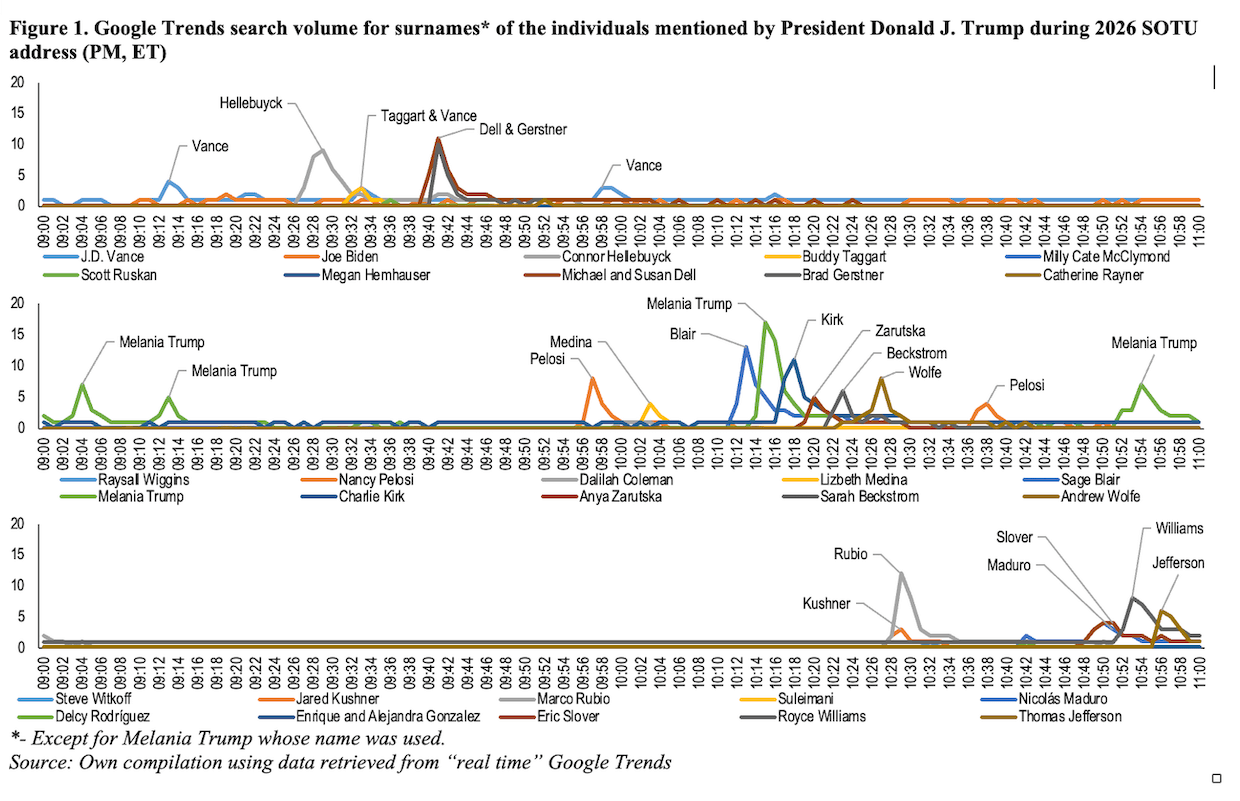
To demonstrate analytical potential of “real time” Google Trends data for analysis high-profile political speeches, search volume for each of the 30 individuals explicitly referred to by the President Trump during 2026 SOTU address (see table 1 for list) had been plotted on figure 1.
Table 1. Summary of individuals mentioned by President Donald J. Trump during 2026 SOTU address
Name
Description based on the President Trump’s address and open sources
Joe Biden
46th US President
Connor Hellebuyck
Ice-hockey goaltender, gold medalist of Team U.S.A.
Buddy Taggart
World War II veteran
Milly Cate McClymond
Survivor of Texas flood of 4 July 2025
Scott Ruskan
Coast Guard rescue swimmer during Texas flood of 4 July 2025
Megan Hemhauser
Beneficiary of President Trump’s tax cuts
M. and S. Dell
Donors of the $6,250,000,000 to fund the “Trump accounts”
Brad Gerstner
Another donor for “Trump accounts”
Catherine Rayner
Beneficiary of President Trump’s drug discounts, undergoing IVF
Raysall Wiggins
Placed bids on 20 homes but lost to gigantic investment firms
Nancy Pelosi
Member of the U.S. House of Representatives
Dalilah Coleman
Victim of a car crash caused by “illegal alien”
Lizbeth Medina
Victim of a murder committed by “illegal alien”
Sage Blair
In 2021 socially transitioned to a new gender
Melania Trump
The First Lady
Charlie Kirk
Assassinated MAGA activist
Anya Zarutska
Ukrainian war refugee, victim of a murder
Sarah Beckstrom
National Guard Specialist killed in the terrorist attack in Washington, DC
Andrew Wolfe
National Guard Staff Sgt., survivor of the terrorist attack in Washington, DC
Steve Witkoff
Special Envoy
Jared Kushner
Special Envoy, Ivanka Trump’s husband
Marco Rubio
U.S. Secretary of State
Suleimani
Iranian Islamic Revolutionary Guard Corps general killed in U.S. attack
Nicolás Maduro
President of Venezuela raided by US forces in 2026
Delcy Rodríguez
Acting president of Venezuela
E. and A. Gonzalez
Venezuelan opposition leader freed from prison and his niece
Eric Slover
U.S. Army Chief Warrant Officer 5, helicopter pilot during Maduro raid
Royce Williams
World War II, Korean war and Vietnam war veteran
Thomas Jefferson
Founder of the USA, Third US President
Source: Own compilation based on transcript by The New York Times[10]
As one could expect, celebrity status of C. Hellebuyck and Melania Trump was reflected in the volume of related searches. Other individuals mentioned by President Trump, who attracted highest search volumes involved: (i) Michael and Susan Dell and (ii) Brad Gerstner – “Trump Accounts” donors, (iii) Nancy Pelosi, (iv) Sage Blair – personifying narrative on risks associated with gender transition, (v) Charlie Kirk – assassinated MAGA activist, (vi) Andrew Wolfe – Washington D.C. terrorist attack survivor , (vii) Marco Rubio – US Secretary of State and (viii) Royce Williams – war veteran awarded with Congressional Medal of Honor.
Undoubtedly the exact reasons for “googling” specific individuals in a given time can differ. To use example of Nancy Pelosi, first peak involved President’s quip on Stop Insider Trading Act, and the second coincided with her appearance in Fox broadcast[11] wearing “Release the Files” button.[12] Despite that, the search volume for “Epstein” remained unaffected (see fig. 2). One can imagine that peak for Thomas Jefferson reflected the attempts to fact-check date of his death provided by the President.
3..2. Search words related to key issues raised by President Trump during 2026 SOTU address
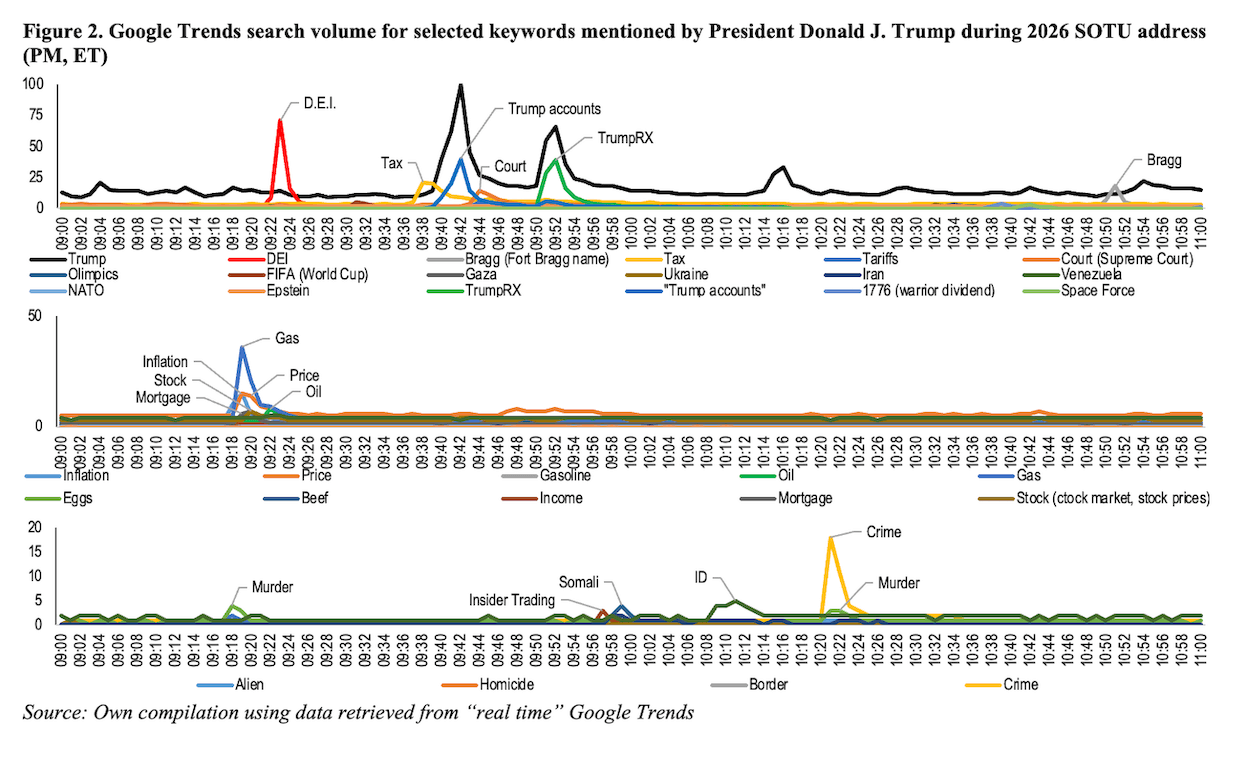
Figure 2 plots second group of keywords examined in this note – those related to the topics raised by the President Trump, selected on the basis of the transcript of the speech.
The top panel illustrates the most-searched keywords, starting with the President himself, D.E.I. and two Trump-named programs – “Trump accounts” (saving vehicle for American children[13]) and TrumpRX (website providing access to large discounts on high-priced medicines[14]). Also, the recent decision of the Supreme Court on tariffs and President’s quip on the renaming of Fort Bragg had been reflected in “googling” data.
The middle panel illustrates primarily keywords referring to the economy and costs of living. Despite President Trump’s references to the inflation data or the remarks on the price of eggs and beef, there is no doubt that “$1.85 a gallon for gasoline” inspired the most factchecking.
Finally, the searches on crime and murder peaked as President Trump urged Congress to pass “tough legislation to make sure violent and dangerous repeat offenders are put behind bars, and importantly, that they stay there” (search volume for murder previously peaked when President proclaimed that the “murder rate saw its single largest decline in recorded history”). Also, President’s references to the insider trading and voter ID legislation – as well as quips on “Somali pirates who ransacked Minnesota” – had been reflected in the respective keywords search volumes.
In a survey conducted for the CNN,[15] 45% of respondents claimed that the President focused too little on the economy and costs of living (according to 53% it was the right amount) and 38% claimed that he focused too much on immigration (according to 56% it was the right amount) – assessment that seems consistent with patterns observed in web searches. As of foreign policy 62% claimed the President devoted the right amount.
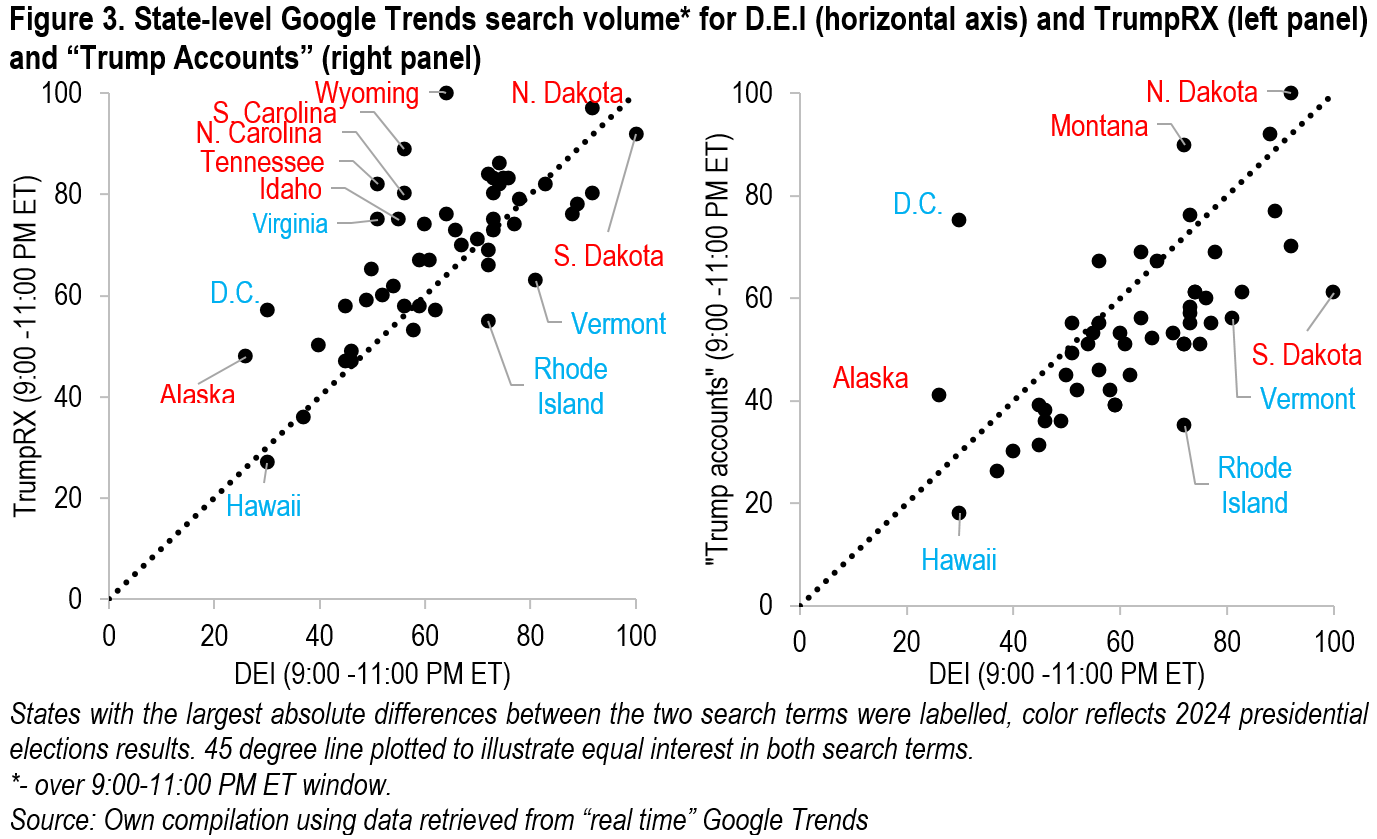
Given substantial search volumes for D.E.I. and two Trump-named programs, it is interesting to explore their state-level differences. The data indicates that in some states D.E.I. was “googled” much more intensely than both Trump-named programs (like Rhode Island and Vermont). TrumpRX attracted considerably more attention than D.E.I. in several Republican states, as well as District of Columbia and Virginia. “Trump Accounts” did so in Alaska, Montana and D.C., but not in South Dakota.
4) Conclusions
The goal of this note was to introduce high frequency “real time” Google Trends data as a tool for examining the general public’s reactions to the high-profile political speeches. Contrary to the well-known dial-testing – providing data on emotional reactions – “googling” patterns offers glimpse into the cognitive reactions – actual efforts to obtain additional information on the issues introduced in the speech. The 2026 SOTU address by President Trump offered promising testing ground for such tool, due to its prominence, length, range of topics and extraordinary invitees personifying the key narratives.
To illustrate its analytic potential, one can compare obtained results with the conventional wisdom on 2026 SOTU. In particular, relatively scant attention is paid to the issue of TrumpRX or “Trump Accounts” – that actually inspired a lot of information searching.
That could indicate, that as of 2026, programmes directed at the material needs of voters – although with distinct, US characteristics, like reliance on market mechanisms and billionaire donations – could resonate among President Trump’s bases. Thereby, their importance in his political strategy could increase.
Moreover, as judged by “googling” patterns, topics like D.E.I., political correctness (like renaming Fort Bragg) still attract attention of US public. The interest in the history of Sage Blair confirmed that her story offered engaging example of framing culture war issues.
If indeed deployed, the mix of policies addressing material needs of anti-elitist voters coupled with the culture war narrative could provide MAGA with the sort of “bread and circuses” already deployed by Central European illiberals, ending what Timothy Snyder called “sado-populism.”
(*) Kamil Joński, Ph.D. is an assistant in the Department of Tax Law at the Warsaw School of Economics (SGH) and an economist by training. He holds a degree from SGH and is currently employed as part of a research project at the institution. Dr. Joński has participated in several research projects funded by the National Science Centre and conducted at the Warsaw School of Economics, the University of Economics in Kraków, and Adam Mickiewicz University in Poznań. His research focuses on the functioning of public institutions—particularly common and administrative courts—as well as public policy formulation and implementation, tax policy, and legislative processes.
References
Peters, G. (2026). “Length of State of the Union Addresses in Minutes (from 1966).” The American Presidency Project. Ed. John T. Woolley and Gerhard Peters. Santa Barbara, CA: University of California. 1999-2026. Available at: https://www.presidency.ucsb.edu/node/324136/ (accessed on February 26, 2026).
Prado-Román, C.; Gómez-Martínez, R.; Orden-Cruz, C. (2021). “Google Trends as a Predictor of Presidential Elections: The United States Versus Canada.” American Behavioral Scientist. 2021;65(4):666-680. doi:10.1177/0002764220975067
Saegner, T; Austys, D. (2022). “Forecasting and Surveillance of COVID-19 Spread Using Google Trends: Literature Review.” International Journal of Environmental Research and Public Health, 2022, Sep 29;19(19):12394. doi: 10.3390/ijerph191912394.
Kirk R.; D. Schill. (2011). “CNN’s Dial Testing of the Presidential Debates. Parameters of Discussion in Tech Driven Politics.” In: Hendricks, J.A., & Kaid, L.L. (Eds.), Techno Politics in Presidential Campaigning: New Voices, New Technologies, and New Voters, Routledge. https://doi.org/10.4324/9780203851265
Footnotes
[1] https://www.economist.com/graphic-detail/2026/02/25/our-language-analysis-of-donald-trumps-state-of-the-union-address (Accessed 2 March 2026).
[2] https://www.nielsen.com/news-center/2026/32-6-million-watch-2026-state-of-the-union-address/ (Accessed 2 March 2026).
[3] https://www.documentcloud.org/documents/27411442-cnn-poll-conducted-by-ssrs-state-of-the-union-reaction/ (Accessed 2 March 2026).
[4] LSE public event “American foreign policy in the age of Trump”, 19 February 2026, available at: https://youtu.be/5OhbCXoJ-kM?list=PLK4elntcUEy3kR3B4Ws8PcKndb1g5a68Y&t=779 11584551 (Accessed 2 March 2026).
[5] https://www.foxnews.com/politics/voters-react-trump-touts-signature-tariff-plan-state-union (Accessed 2 March 2026).
[6] https://medium.com/google-news-lab/what-is-google-trends-data-and-what-does-it-mean-b48f07342ee8 (Accessed 2 March 2026).
[7] https://support.google.com/trends/answer/4365533 (Accessed 2 March 2026).
[8] It is explained that “these searches may be retained in Google Trends as a security measure: filtering them from Google Trends would help those issuing such queries to understand we’ve identified them”.
[9] As explained later: “Providing access to the entire data set would be too large to process quickly. By sampling data, we can look at a dataset representative of all Google searches, while finding insights that can be processed within minutes of an event happening in the real world”.
[10] https://www.nytimes.com/2026/02/25/us/politics/state-of-the-union-transcript-trump.html (Accessed 2 March 2026). See also text and video available at: https://www.presidency.ucsb.edu/node/386357 (Accessed 2 March 2026).
[11] Video recording by LiveNOW from FOX, available at: https://www.youtube.com/watch?v=zF7Vve53z4k (Accessed 2 March 2026).
[12] https://nypost.com/2026/02/24/us-news/democratic-womens-caucus-reps-wear-all-white-attire-epstein-related-pins-to-state-of-the-union-2026-address/ (Accessed 2 March 2026).
[13] https://www.whitehouse.gov/research/2025/08/trump-accounts-give-the-next-generation-a-jump-start-on-saving/ (Accessed 2 March 2026).
[14] https://www.whitehouse.gov/fact-sheets/2026/02/fact-sheet-president-donald-j-trump-launches-trumprx-gov-to-bring-lower-drug-prices-to-american-patients/ (Accessed 2 March 2026).
[15] https://www.documentcloud.org/documents/27411442-cnn-poll-conducted-by-ssrs-state-of-the-union-reaction/ (Accessed 2 March 2026).
Professor Jeffrey Kopstein argues that Trumpism is best analyzed not primarily as populism, but as patrimonial rule—where “the state itself becomes an extension of the ruler’s household” and governance turns into “a family business.” In this ECPS interview, Professor Kopstein distinguishes patrimonialism from classic competitive authoritarianism: rather than merely “tilting the playing field,” patrimonial leaders seek to “own the entire field.” He traces how loyalty tests, selective legality, and the “monetization of office” reshape elite incentives and accelerate institutional hollowing. Drawing on Weberian theory, Professor Kopstein warns that irreversibility arrives when career survival depends on pleasing a patron rather than serving an office—and when the line between public and private interests starts to seem “quaint.” The interview also examines selective impunity, conditional judicial autonomy, personalized coercion, and why democratic resistance must target structural vulnerabilities rather than “waiting for collapse.”
Giving an interview to the European Center for Populism Studies (ECPS), Jeffrey Kopstein, Professor of Political Science at the University of California, Irvine, offers a conceptually rigorous reinterpretation of Trumpism that moves beyond the familiar vocabulary of populism and competitive authoritarianism. Anchored in Weberian state theory and comparative authoritarianism, Professor Kopstein argues that the most analytically precise framework for understanding the contemporary transformation of American governance is patrimonialism—a form of rule in which the state is treated as the personal domain of the leader. As he memorably puts it, under patrimonial logic “the state itself becomes an extension of the ruler’s household,” collapsing the boundary between public authority and private interest and turning governance into what he repeatedly calls “a family business.”
Professor Kopstein’s intervention challenges dominant scholarly narratives that focus primarily on rhetoric, electoral manipulation, or ideological polarization. While competitive authoritarianism“rigs the game,” he contends, patrimonialism seeks something more radical: ownership of the system itself. In his words, the logic is “not simply to tilt the playing field, but to own the entire field.” This shift, he suggests, captures a deeper transformation from constitutional republicanism toward personalized rule structured by loyalty, selective legality, and the monetization of office. Trumpism, he argues, is best understood through this lens because its defining features—“loyalty tests, public humiliation of subordinates, monetization of office, and the personalization of coercive authority”—are not incidental pathologies but the governing principle of the system.
A central theme of the interview is institutional hollowing. Drawing on Max Weber’s theory of modern bureaucracy, Professor Kopstein explains how privileging personal loyalty over professional expertise erodes state capacity from within. When career advancement depends on pleasing the patron rather than serving impersonal offices, information deteriorates, policy becomes erratic, and public goods provision declines. The critical threshold, he warns, is reached when citizens and elites alike lose the ability to distinguish between public and private interests—when that distinction begins to seem “quaint.” At that point, patrimonial consolidation is effectively complete.
Equally significant is Professor Kopstein’s analysis of elite incentives. When public office becomes a revenue stream, neutrality becomes costly and adaptation becomes rational. Economic success increasingly depends not on market entrepreneurship but on proximity to power, reversing the conventional liberal assumption that wealth generates political influence. In patrimonial systems, he notes, the causal arrow often runs in the opposite direction: political power produces wealth. This dynamic helps explain why scandals, legal controversies, or reputational crises frequently fail to weaken such regimes. Surviving scandal without consequences signals immunity and reinforces an aura of invincibility among supporters.
By reframing Trumpism as a patrimonial project rather than merely a populist movement, Professor Kopstein invites scholars to redirect analytical attention from mass ideology to elite control over institutions, resources, and coercive capacity. The interview thus situates contemporary American politics within a broader comparative perspective on personalist rule, offering a sobering account of how democratic systems can be gradually transformed without the overt dismantling of formal institutions.
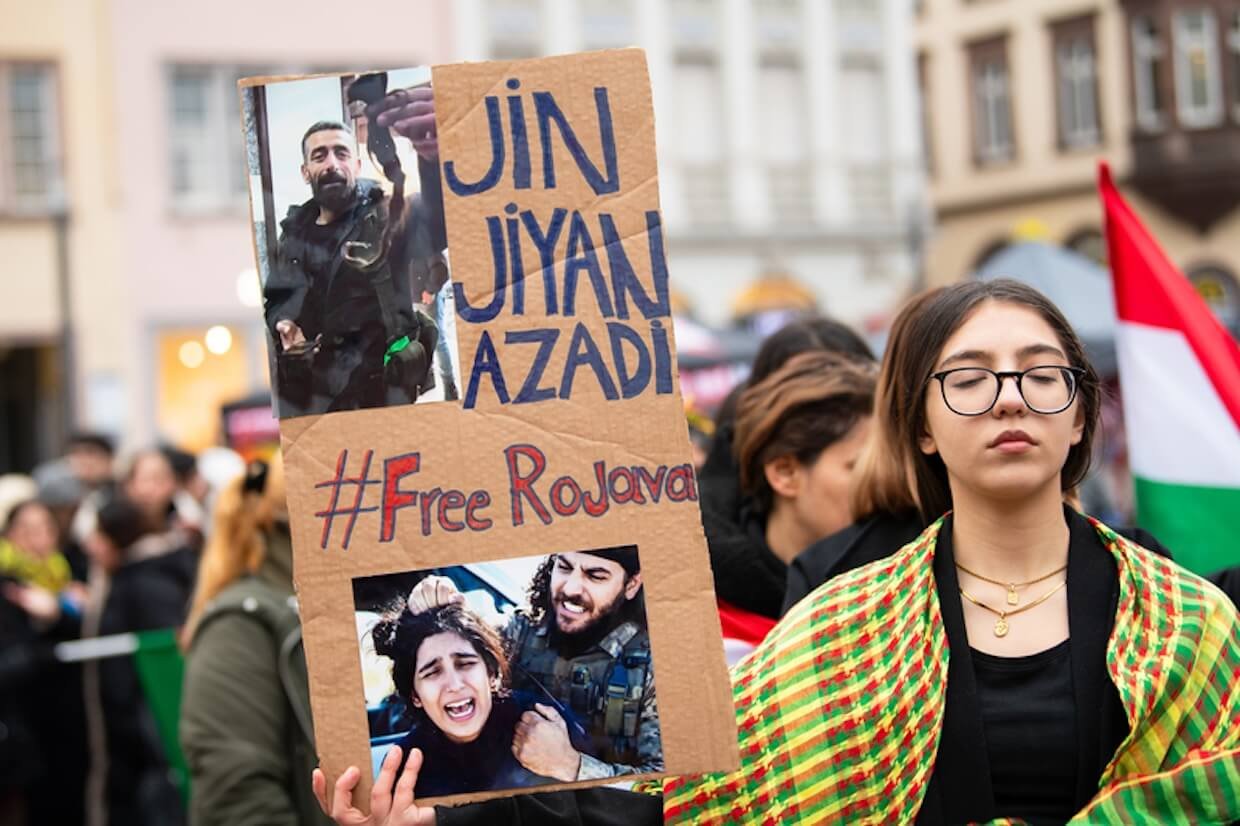
In this ECPS interview, Dr. Soheila Shahriari offers a theoretically grounded diagnosis of Rojava’s most precarious post-ISIS moment. She argues that the Autonomous Administration of North and East Syria should be understood not as a wartime improvisation, but as a long-evolving counter-hegemonic project rooted in democratic confederalism, gender equality, pluralism, and social ecology. Yet Dr. Shahriari underscores a stark geopolitical constraint: without formal recognition and enforceable guarantees from Western actors—especially the EU and the United States—Rojava lacks the diplomatic leverage to secure a durable decentralized settlement with Damascus. The interview explores how instrumental Western engagement, Turkey’s securitization paradigm, and Syria’s recentralization drive converge to endanger non-state democratic experiments. It also examines diaspora mobilization, the global resonance of Kurdish women’s politics, and the fragile future of local partnerships in conflict zones.
Giving an interview to the European Center for Populism Studies (ECPS), Dr. Soheila Shahriari from École des Hautes Études en Sciences Sociales (EHESS) in France offers a wide-ranging and theoretically grounded assessment of the Autonomous Administration of North and East Syria (Rojava) at a moment of profound uncertainty. As shifting regional alignments, great-power bargaining, and Syrian state consolidation converge to narrow the space for Kurdish self-rule, Dr. Shahriari situates Rojava not merely as a wartime anomaly but as a counter-hegemonic democratic experiment struggling to survive in an international system dominated by state sovereignty, realpolitik, and authoritarian resurgence. The interview is organized around a central warning captured in the headline: Without formal recognition and protection from Western actors, Rojava lacks the diplomatic leverage necessary to secure a durable decentralized settlement with Damascus.
Dr. Shahriari argues that the current crisis stems less from military weakness than from structural diplomatic isolation. Despite their decisive role in defeating ISIS alongside the United States, Kurdish-led forces failed to convert battlefield legitimacy into institutional guarantees. The January ceasefire and negotiations over integration into Syrian state structures illustrate the narrowing options available to the Autonomous Administration under pressure from Damascus, Ankara, and shifting US priorities. In this context, Dr. Shahriari emphasizes that external recognition is not symbolic but constitutive of survival: without enforceable guarantees from actors such as the European Union and the United States, any decentralization arrangement risks becoming a temporary tactical compromise rather than a stable power-sharing order.
At the same time, the interview highlights the distinctive ideological and institutional character of the Rojava project. Dr. Shahriari describes it as an anti-statist political paradigm rooted in democratic confederalism, gender equality, pluralism, and ecological principles—an alternative model of governance emerging amid global democratic recession and Middle Eastern authoritarian consolidation. The conversation also explores how women-led institutions function as a “symbolic infrastructure” of resilience, how diaspora activism and transnational networks have reshaped Kurdish political imaginaries, and how the global visibility of Kurdish women fighters transformed international legitimacy. Yet these achievements, she notes, have not translated into formal diplomatic recognition, leaving the experiment vulnerable to geopolitical bargaining among states.
The interview also examines the structural limits of liberal internationalism and the instrumental nature of Western engagement with non-state democratic actors. Dr. Shahriari contends that Western powers’ prioritization of strategic alliances—particularly with Turkey—over normative commitments has undermined both Rojava’s prospects and the credibility of democratic rhetoric. Consequently, the future of Kurdish self-administration depends not only on negotiations with Damascus but on whether Western governments are willing to move from tactical cooperation to institutional protection.
Ultimately, Dr. Shahriari frames Rojava’s predicament as emblematic of a broader tension in contemporary world politics: the clash between innovative democratic experiments and an international order still organized around sovereign states and security competition. Whether Rojava becomes a model of negotiated decentralization or a casualty of regional power politics, she concludes, will depend on the availability of credible external guarantees—without which even the most resilient non-state democracy faces structural vulnerability.
Professor Jeffrey Kopstein argues that Trumpism is best analyzed not primarily as populism, but as patrimonial rule—where “the state itself becomes an extension of the ruler’s household” and governance turns into “a family business.” In this ECPS interview, Professor Kopstein distinguishes patrimonialism from classic competitive authoritarianism: rather than merely “tilting the playing field,” patrimonial leaders seek to “own the entire field.” He traces how loyalty tests, selective legality, and the “monetization of office” reshape elite incentives and accelerate institutional hollowing. Drawing on Weberian theory, Professor Kopstein warns that irreversibility arrives when career survival depends on pleasing a patron rather than serving an office—and when the line between public and private interests starts to seem “quaint.” The interview also examines selective impunity, conditional judicial autonomy, personalized coercion, and why democratic resistance must target structural vulnerabilities rather than “waiting for collapse.”
Giving an interview to the European Center for Populism Studies (ECPS), Jeffrey Kopstein, Professor of Political Science at the University of California, Irvine, offers a conceptually rigorous reinterpretation of Trumpism that moves beyond the familiar vocabulary of populism and competitive authoritarianism. Anchored in Weberian state theory and comparative authoritarianism, Professor Kopstein argues that the most analytically precise framework for understanding the contemporary transformation of American governance is patrimonialism—a form of rule in which the state is treated as the personal domain of the leader. As he memorably puts it, under patrimonial logic “the state itself becomes an extension of the ruler’s household,” collapsing the boundary between public authority and private interest and turning governance into what he repeatedly calls “a family business.”
Professor Kopstein’s intervention challenges dominant scholarly narratives that focus primarily on rhetoric, electoral manipulation, or ideological polarization. While competitive authoritarianism “rigs the game,” he contends, patrimonialism seeks something more radical: ownership of the system itself. In his words, the logic is “not simply to tilt the playing field, but to own the entire field.” This shift, he suggests, captures a deeper transformation from constitutional republicanism toward personalized rule structured by loyalty, selective legality, and the monetization of office. Trumpism, he argues, is best understood through this lens because its defining features—“loyalty tests, public humiliation of subordinates, monetization of office, and the personalization of coercive authority”—are not incidental pathologies but the governing principle of the system.
A central theme of the interview is institutional hollowing. Drawing on Max Weber’s theory of modern bureaucracy, Professor Kopstein explains how privileging personal loyalty over professional expertise erodes state capacity from within. When career advancement depends on pleasing the patron rather than serving impersonal offices, information deteriorates, policy becomes erratic, and public goods provision declines. The critical threshold, he warns, is reached when citizens and elites alike lose the ability to distinguish between public and private interests—when that distinction begins to seem “quaint.” At that point, patrimonial consolidation is effectively complete.
Equally significant is Professor Kopstein’s analysis of elite incentives. When public office becomes a revenue stream, neutrality becomes costly and adaptation becomes rational. Economic success increasingly depends not on market entrepreneurship but on proximity to power, reversing the conventional liberal assumption that wealth generates political influence. In patrimonial systems, he notes, the causal arrow often runs in the opposite direction: political power produces wealth. This dynamic helps explain why scandals, legal controversies, or reputational crises frequently fail to weaken such regimes. Surviving scandal without consequences signals immunity and reinforces an aura of invincibility among supporters.
By reframing Trumpism as a patrimonial project rather than merely a populist movement, Professor Kopstein invites scholars to redirect analytical attention from mass ideology to elite control over institutions, resources, and coercive capacity. The interview thus situates contemporary American politics within a broader comparative perspective on personalist rule, offering a sobering account of how democratic systems can be gradually transformed without the overt dismantling of formal institutions.
Here is the edited version of our interview with Professor Jeffrey Kopstein, revised slightly to improve clarity and flow.
Not Tilting the Field but Owning It: Trumpism as Patrimonial Rule
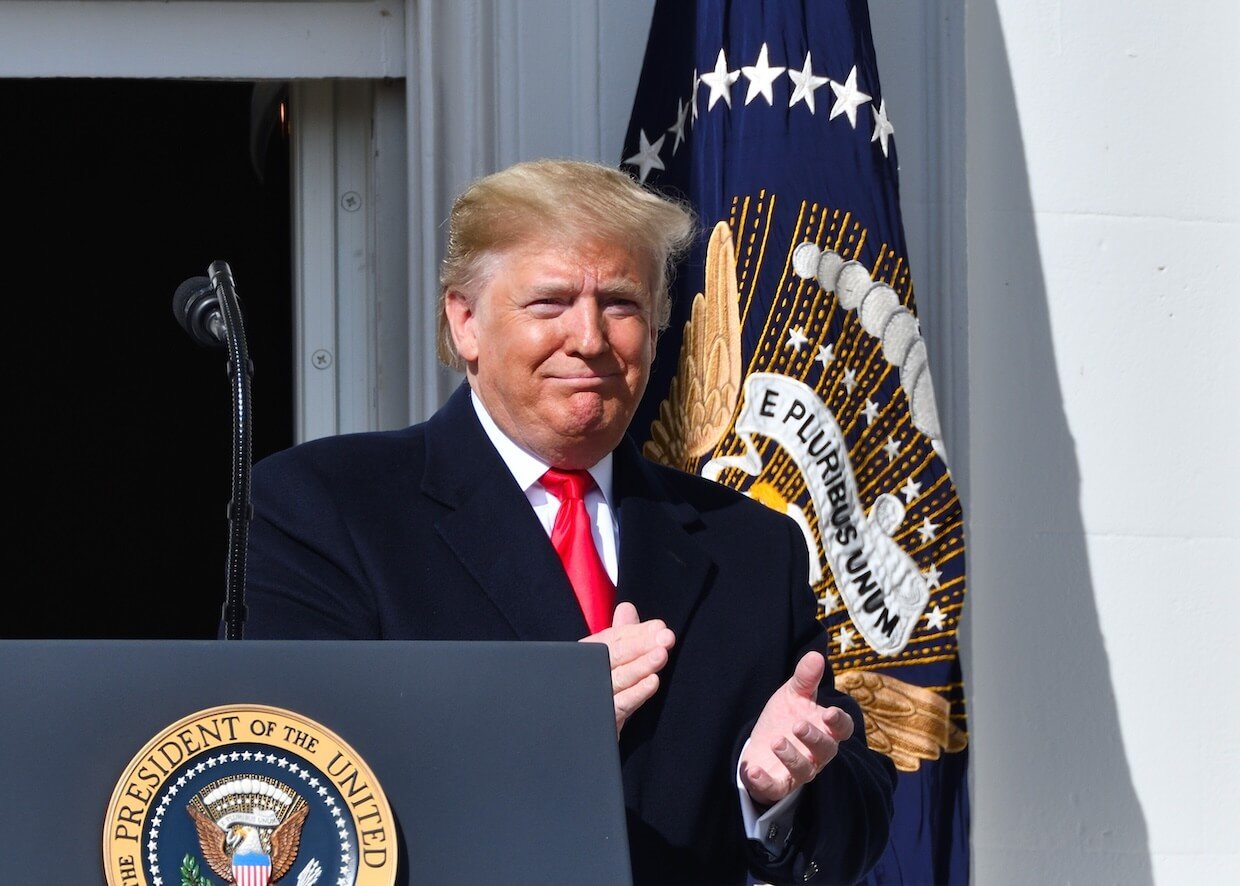
US President Donald Trump delivers a speech to voters at an event in Phoenix, Arizona. Photo: Danny Raustadt.
Professor Jeffrey Kopstein, thank you so much for joining our interview series. Let me start right away with the first question: In yourPersuasionarticle, you argue that Trumpism represents a shift from constitutional republicanism toward patrimonial rule. Conceptually, how does this transformation differ from classic competitive authoritarianism, and why does patrimonialism better capture the logic of power under Trump?
Professor Jeffrey Kopstein: First of all, thanks so much for having me. Competitive authoritarianism—I’m not a specialist on exactly that concept, but I’ve read it, and I know Lucan Way very well—refers to regimes that manipulate electoral competition while preserving institutional arenas as sites of contestation. Elections still matter, courts still operate, and opposition exists, albeit under constraints.
By contrast, patrimonialism treats the state itself as an extension of the ruler’s household. It becomes a family business. Offices turn into instruments of personal loyalty, law is applied selectively, and the boundaries—most importantly—between public power and private benefit collapse. The logic here is not simply, to use their language, to tilt the playing field, but to own the entire field. In this view, the state is a family business.
Stephen Hanson and I argue that Trumpism is better understood in patrimonial terms because its defining features are loyalty tests, public humiliation of subordinates, monetization of office, and the personalization of coercive authority. These are not incidental excesses; they are the governing principle. If I could leave you with a sound bite, competitive authoritarianism rigs the game, whereas patrimonialism claims ownership of the stadium.
When Pleasing the Patron Overrides Serving the Office
Drawing on Weberian theory and your work on modern statehood, how does the systematic privileging of personal loyalty over bureaucratic expertise in the US reshape state capacity—and at what point does institutional hollowing become politically irreversible?
Professor Jeffrey Kopstein: Let’s go back to Weber. It’s always the right thing to do. Weber argued that modern statehood depends on impersonal offices and expertise. When loyalty replaces competence, three things happen: information degrades, exits increase, and compliance becomes politicized. Policies become erratic, feedback loops collapse, and public goods deteriorate.
Irreversibility sets in not in a single legal moment, but when expectations shift—when career incentives depend on pleasing the patron rather than serving the office. At that point, even restoration-minded elites begin to hesitate to act.
So, there is no single point of no return, but it arrives when survival in government depends on loyalty rather than competence. We are not in a perfect patrimonial world yet in the United States. The way I would put it is this: our notion of the state depends on a clear separation between the public interest and the private interest. When we are no longer able to understand that difference, when it seems quaint, then we will know that the patrimonial regime has fully consolidated.
From Market Entrepreneurship to Proximity to Power
Caricature: Shutterstock.
You describe the Trump presidency as collapsing the boundary between public authority and private enrichment. How does this blurring alter elite incentives, especially among business, judicial, and security elites who must decide whether to resist, adapt, or profit?
Professor Jeffrey Kopstein: It’s a really important question. Clearly, Trump has been very busy turning the state into a family business, and as we say in the article, business is booming. When public office becomes monetizable, elites shift incentives toward adaptation and profit rather than resistance. And we see that already. We see that with chip makers; rather than economic entrepreneurship, it’s proximity to power that determines whether you are a rich elite. We just saw that this last week with Anthropic and AI.
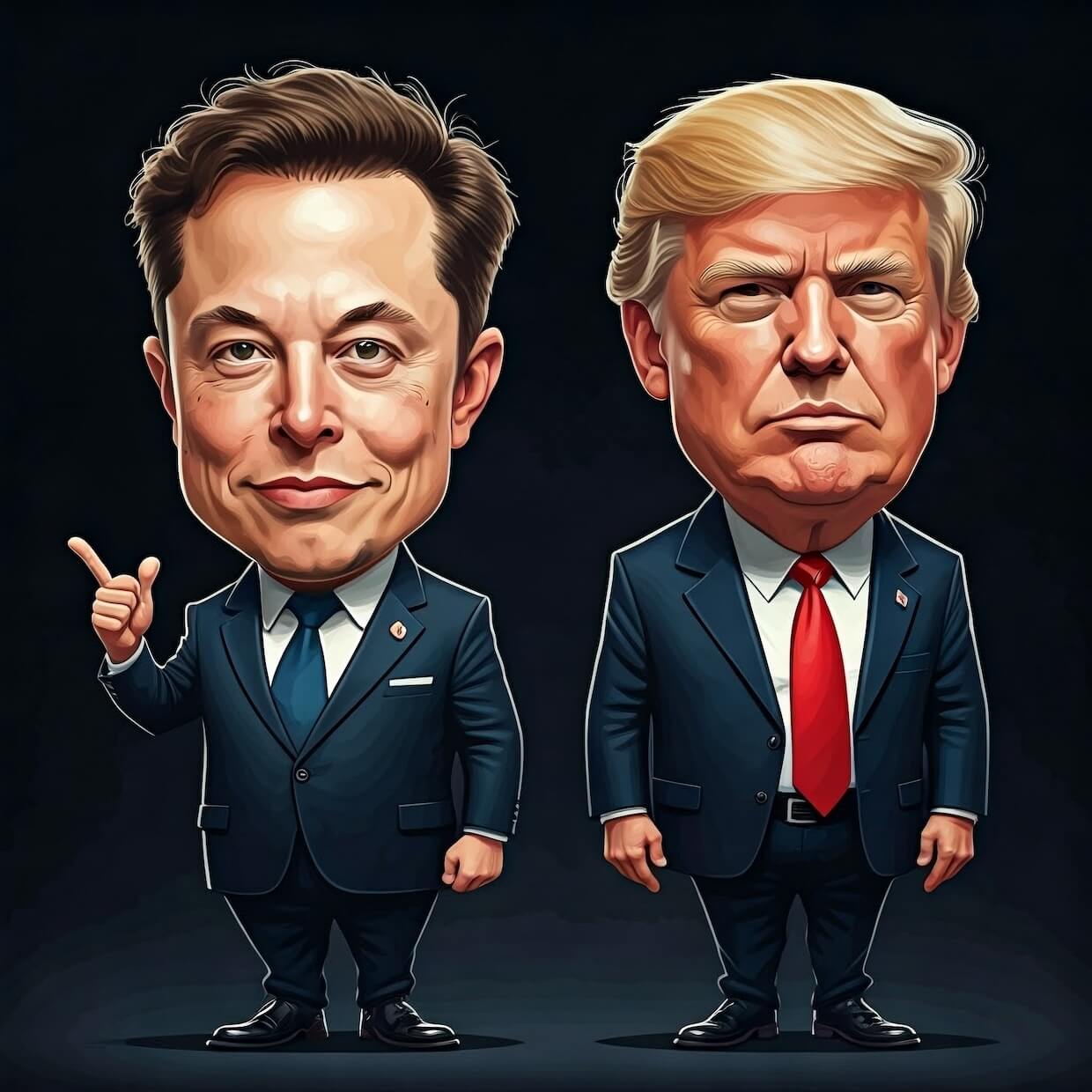
If you’re out of favor with the government, they can, sort of, crush you. Even in that dust-up between Elon Musk and Trump, it’s super interesting. Here you have the richest man in the world versus the most powerful man in the world, and in that fight, my judgment is Trump crushed him like a bug. It was not close. We’re used to thinking in the United States—and basic political science says—that if you’re rich, that gives you power, that economics determines political power. But in many parts of the world, and at many times in history, it’s actually the reverse: great power yields great wealth. And I think we’re starting to see that in the United States. So, the bottom line is that when office becomes a revenue stream, neutrality becomes a liability.
In Patrimonial Systems, Scandals Create an Aura of Invincibility
How should scholars interpret the political effects of the Epstein files and Trump’s alleged proximity to that scandal—not in moral terms, but as a demonstration of selective impunity within a patrimonial system? Under what conditions do scandals cease to delegitimize power and instead reinforce it?
Professor Jeffrey Kopstein: In patrimonial systems, surviving scandal often reinforces power. Scandals cease to delegitimize authority when media ecosystems are polarized, selective enforcement is normalized, and elites expect law to be wielded strategically rather than neutrally.
So, under these conditions, I think proximity to scandal that produces no consequences signals immunity—that they can’t be punished. And everybody understands this. So, people stop thinking in terms of enforcing the law, or in terms of, is Trump competent? Is he crazy? Is he a pervert? I mean, all of those things become sort of uninteresting. It’s not that people won’t continue to try; it’s that each one of those he survives within a patrimonial regime doesn’t weaken him—it actually strengthens him, because it creates this aura of invincibility.
So, the bottom line is that, in a rule-of-law system, the kinds of things that would have disqualified Trump long ago—in a patrimonial system—succeed, at least for his most ardent followers, in creating, to put it in Weberian terms, for the leader and his staff, a kind of image of strength.
Patrimonial Stability Rests on Ambition, Fear, and Beneficiaries
Comparatively speaking, how does Trump’s apparent insulation from reputational or legal consequences resemble patterns observed in other patrimonial regimes, such as Russia, Turkey, or Hungary? Is this best understood as elite coordination failure or as successful authoritarian learning?
Professor Jeffrey Kopstein: Does it have to be either? It could be both. Insulation from consequences reflects both coordination failure and successful authoritarian learning. The fragmentation of opposition enables consolidation, and we see that with the Democratic Party in the United States right now. It’s somewhat of a mess, although they are trying to find their footing.
In Hungary, we’re going to see what happens. Orban has succeeded, in a sense, in playing the opposition like a fiddle. He appears to be threatened right now, and we will see whether he moves toward a full authoritarian route, as opposed to the competitive authoritarian route, though he may. The same dynamic applies to Turkey as well—though you would know much better than I do. My understanding is that it is also in a similar situation. Over time, rulers manage elites through selective reward and punishment, especially through court-politics dynamics. People at the top, if they begin opposing, either leave—or, if the regime is fully consolidated, as in Russia, they may face physical liquidation.
Now, in most patrimonial regimes, it is not like Russia. You can have patrimonialism in both a democracy and a dictatorship; the line runs orthogonal to the distinction between the two. It is not coterminous with it. Patrimonial stability does not require universal support. It relies on individualized ambition and fear. There are large numbers of distributional beneficiaries of Erdogan, of Orban, of Netanyahu in Israel, and now increasingly of Trump in the United States. So, yes.
Courts Persist Under Patrimonialism but Align in Political Cases
The US Supreme Court building at dusk, Washington, DC. Photo: Gary Blakeley.
You note that courts rarely disappear under patrimonialism but instead become conditionally autonomous. How does the high rate of judicial alignment with Trump administration interests reshape expectations about the judiciary as a democratic backstop?
Professor Jeffrey Kopstein: I think you raise a really important point. Even in a patrimonial regime, even in an authoritarian regime, for the most part courts continue to exist. They handle normal matters—inheritance, ordinary criminal behavior, standard criminal law—but here we are really talking about political cases, cases that deal especially with the power of the executive.
Under those circumstances, the courts begin to align with the patron. You see that somewhat in the United States. There are already things that people on the Court want. Those who, for example, are interested in libertarian ideas hope Trump will deliver them, although Trump is not a pure libertarian. Those interested in Christian nationalism in the United States hope he will give them what they want as well. Those interested in enhanced executive authority—there are some on the Court in that camp too—are also aligned with the Federalist Society and want that outcome. They, of course, expect Trump to deliver it.
That said, there are certain issues on which the Court will resist. We saw that in the case of tariffs, where the Court ruled against Trump. They may still allow him to pursue similar goals by other means. Over time, the Court figures out how far it can contradict the great father figure—which is what patrimonialism actually implies—and where it cannot.
From a patrimonial perspective, how does the use of agencies such as ICE—operating with diminished oversight and heightened personal loyalty—alter the relationship between citizens and the state? Does this represent bureaucratic drift or deliberate personalization of coercion?
Professor Jeffrey Kopstein: It could be both, but patrimonialism really highlights the personalization of coercion. If you look at the US budget right now, Trump has, on purpose, cut a huge number of regular bureaucratic jobs, which appears to align exactly with what one would expect Republicans to do. However, the budget has not gone down.
They have actually created this huge new bureaucracy that is personally dependent on Trump, and that’s ICE. And it’s becoming not just a personal empire; it’s becoming something like a real estate empire. They’re acquiring a lot of territory, which, of course, Trump likes—real estate. So this personalization of coercive agencies is deliberate. It takes away not only from legal oversight, but also removes or disempowers people who are not personally dependent on Trump.
Thus, the legal forms remain while the zones of exceptional enforcement expand. When oversight weakens and loyalty is rewarded, enforcement becomes personalized. It becomes somewhat theatrical. The objective is not efficient enforcement, but loyal enforcement. Those two things can overlap, but they can also be very different.
Episodic Force and Symbolic Threat as Tools of Control
Border Patrol agents monitor an anti-ICE protest in downtown Los Angeles, June 8, 2025. Demonstrators rallied against expanded ICE operations and in support of immigrant rights. Photo: Dreamstime.
Unlike 20th-century dictatorships, Trumpism relies less on mass repression and more on episodic coercion and symbolic threat. How much actual violence is necessary for patrimonial consolidation in a mature media democracy?
Professor Jeffrey Kopstein: I’ve written pretty extensively on this. Consolidation does not require mass repression. There has been a lot of discussion of fascism and totalitarianism and all that kind of stuff, Hanson and I worry about it a great deal. But what is probably also true is that selective, visible coercion effectively reshapes expectations. A few exemplary punishments communicate risk pretty broadly. It’s not to say that there won’t continue to be resistance to ICE. We saw that in Minnesota; we’ve seen it in other places. I’m here in California, where we have a pretty active resistance, and our state government—California has 40 million people; it’s a country—has continued to resist. But ICE is still around; it’s in my neighborhood. It doesn’t need to terrorize everyone; it only needs to make everyone calculate as if it could. And that’s the case. It changes expectations.
Succession Anxiety Is the Structural Weakness of Personalist Rule
You argue that succession is the Achilles’ heel of patrimonial regimes. How does Trump’s discourse around a third term function strategically to freeze elite expectations and delay post-Trump realignments?
Professor Jeffrey Kopstein: It’s absolutely crucial. As you said, succession is the Achilles’ heel of a patrimonial regime. Under most circumstances, patrimonialism is the oldest form of government in the world. Under most circumstances, patrimonialism is related to kingship or queenship. It passes on through the royal family. Of course, remaking the state as a family business in the modern world—we don’t have kings or queens anymore—so you would think it would pass through his family. It doesn’t seem all that likely in Trump’s case that the sons are going to be the successors. Interestingly, the daughter Ivanka is probably the most cognitively fit to be the successor. But patrimonial women don’t do very well either.
But the key here is that personalist regimes destabilize when elites anticipate an endpoint. So, signaling negotiable terms that that endpoint may not come freezes expectations and discourages hedging. As the end comes closer, the staff start scrambling like rats on the deck of a sinking ship. And the whole point of this third-term discussion—which he may very well want, and I don’t think he could easily get, but he will try, and it is to be taken extremely seriously as a pressure point against the consolidation of a patrimonial regime—is that it is extremely important that it be opposed, because it’s all about maintaining the leader and his staff. And if the staff see that endpoint, the regime itself becomes destabilized. So, yes, succession anxiety is the Achilles’ heel of a patrimonial regime. All experience shows that.
To what extent does labeling Trumpism as “populist” obscure its deeper patrimonial logic? What analytical errors follow if scholars focus too heavily on mass ideology rather than elite control of resources and institutions?
Professor Jeffrey Kopstein: I think it’s really important. On the one hand, populism—most of political science, most scholars, most social science are very interested in this, and populism is part of it—focuses on how people come to power, the rhetoric, the appeal, and how they stay in power. What patrimonialism looks at is something different: it examines what they do when they come to power, how they actually govern. Governance is extremely important, and populism, we think, obscures patrimonial control. It highlights rhetoric.
Patrimonialism highlights elite control over appointments, enforcement, resources—things that populism doesn’t talk about at all. The two aren’t completely contradictory, but they address really different dimensions. So, populism, or dictatorship versus democracy, is part of a discourse concerned with how leaders come to power and stay in power. Patrimonialism is interested in what they do to the state once they come to power. And that’s just something very different.
Foreign Policy as Regime Maintenance by Other Means
US Army advances during a demonstration at MCAS Miramar, October 5, 2008. Photo: Anton Hlushchenko / Dreamstime.
How does Trump’s coercive, transactional foreign policy—toward NATO allies, territorial revisionism (as in Greenland), and extraterritorial enforcement—serve domestic patrimonial consolidation rather than traditional strategic goals?
Professor Jeffrey Kopstein: As we’re talking about this, of course, the world’s foreign policies are in great flux and turmoil with what’s going on in the Middle East. One of the things about patrimonialism is that patrimonial leaders, because they have a very traditionalist view, no longer see borders as legal; they view them as historical and traditional—fuzzy, if you will—and that really works at odds with the modern world.
Even more important than that, they view their relations with other countries, as you said, as transactional. Transactional diplomacy dramatizes sovereignty and creates distributable rents for loyalists. So, who’s going to control Greenland? Will it be Donald Trump Jr. creating mines for strategic minerals that university professors will be forced to work in like a gulag? I don’t think so, but that’s the idea.
So, foreign policy becomes a sort of regime maintenance by other means. It’s an extension. Traditional international relations tends to ignore the makeup, the regime type, of domestic politics, but we think that foreign policy—and Trump’s foreign policy in particular—is especially driven by this domestic makeup, by domestic politics.
Patrimonial Stability Depends on Cohesion Between Leader and Staff
From a comparative international perspective, how likely is it that sustained allied resistance and strategic balancing against the United States could feed back into domestic regime instability—or do patrimonial rulers generally externalize such costs successfully?
Professor Jeffrey Kopstein: They can. It’s an excellent question, and we don’t have a great answer to that, to be honest. But, on the one hand, foreign wars—and we’re in one right now—can produce a sort of rally-around-the-flag phenomenon, although in the United States right now my understanding is that the war, the bombing of Iran, is not very popular.
But here’s the point: external resistance destabilizes only if it fractures key domestic elites. That’s the point. Again, Weber and patrimonialism tells us, that you need to look at the relationship between the leader and his staff.
And so it only works—it only destabilizes—if it fractures the elites underneath the leader. And why? Because balancing imposes costs. Destabilization occurs when those costs split the coalition. So, that’s how I would answer that, although our emphasis is really not on foreign policy. But it’s an important question.
When the State Becomes a Family Business, Public Goods Deteriorate
You emphasize that patrimonial regimes are structurally bad at providing public goods. What kinds of policy failures—climate disasters, pandemics, financial crises—are most likely to puncture the aura of inevitability surrounding Trumpism?
Professor Jeffrey Kopstein: What you would expect from a patrimonial regime, as you said quite correctly, is that as a bureaucracy based on merit recruitment is degraded and becomes a plaything of the family business, you would see a systematic under-provision of public goods, or only those public goods that serve the interests of the extended household of the leader being provided. So, you’d expect two things to happen. One—and the one you pointed to—is that when we need the state to respond to disasters, and we saw this with COVID, but you can also see it with financial crises and other kinds of public health breakdowns, there is an institutional halt. When we need the state, what the state represents under those circumstances is a hedge against disaster. And so we need the state, and we may not have it.
I’m living here in California. We get earthquakes. If we need the state after a really bad earthquake, if it has been degraded enough, we won’t have it. But there’s a second type of deterioration that is slower moving, and that is the under-provision of public goods for things like roads, bridges, and airports. Over time, what you should see is public infrastructure decaying, and we already have that in the United States, and it’s going to get worse. I live next to the second-largest city in the United States, Los Angeles, and the airport here is like a third-world airport. It’s not really being built up or maintained. That’s called LAX (Los Angeles International Airport). You should expect to see much of the public infrastructure in the United States start to look more and more like LAX.
Effective Opposition Raises the Costs of Loyalty and Lowers the Costs of Exit
“No Kings” protest against the Trump administration, New York City, USA — June 14, 2025. Demonstrators march down Fifth Avenue as part of the nationwide “No Kings” movement opposing President Donald Trump and his administration. Photo: Dreamstime.
And finally, Professor Kopstein, given your critique of “waiting for collapse,” what forms of democratic resistance are most effective against patrimonial rule? Specifically, how can opposition forces exploit structural weaknesses—succession anxiety, declining popularity, and governance failure—without reinforcing siege narratives?
Professor Jeffrey Kopstein: That’s the hardest question you’ve asked yet, but I want to reinforce the assumption we make, and as we wrote in this article, that we should not expect scandal, incompetence, the Supreme Court, nor foreign policy failures to save us. None of those things will probably work. Patrimonial leaders are pretty good at dealing with all of them. The weaknesses of patrimonialism, as we’ve been discussing, are much more structural, as you said quite explicitly. They’re slow-moving. They’re unspectacular. So, we’ve talked about splits, succession failures, institutional hollowing—things that are slow-moving and fly under the radar. That is why it is so difficult for us to deal with this type of regime, to understand it, and to expose it.
So, I think focusing on succession and undermining inevitability is key. That is why each congressional House race matters: if you can show that the Democrats won by more than expected, or that Trump did not win by as much as he expected in a particular district, that punctures the aura of inevitability. Most important is to connect governance failures to institutional hollowing. That is the key weak point here—to connect those two—and to avoid rhetoric that is easily reframed as elite disdain. The bottom line is: don’t wait for collapse. Raise the costs of loyalty, fracture the elite, and lower the costs of exit.
Along Nigeria’s vulnerable coastline, climate change is not a projection but a daily struggle shaping survival, governance, and democracy. In this incisive commentary, Dr. Oludele Solaja reveals how communities—from Lagos to Cross River—are filling critical gaps left by weak institutions, organizing drainage cleanups, mangrove restoration, and informal warning systems to confront flooding, pollution, and shoreline loss. These grassroots practices constitute “climate security from below,” challenging state-centric narratives that equate security with national planning alone. Yet this resilience also exposes deep democratic deficits, as citizens assume responsibilities that should belong to public authorities. The Nigerian case calls for a rethinking of climate security—one that bridges community initiative with accountable governance and recognizes local actors not as substitutes for the state, but as indispensable partners in building sustainable, democratic adaptation.
By Oludele Solaja*
Along the Nigerian coast, climate change is not a distant forecast; it is an everyday reality. Floodwaters inundate homes. Shorelines relentlessly recede. Saltwater contaminates freshwater supplies. Drains choke with plastic refuse, transforming streets into temporary lakes when the rains arrive. For those in the Niger Delta and adjacent coastal areas, climate insecurity is not a concept but a lived experience.
Yet climate security is often discussed in terms of state stability, resource conflicts, or national-level adaptation planning. On the ground, the picture is very different. In many parts of the Nigerian coast, securing the climate is a local endeavor—it is climate security from below.
All along Nigeria’s long coastal belt—from Lagos in the west to Cross River in the east—communities are filling governance gaps caused by weak infrastructure, state absenteeism, and an economy structured around extractive activities. Their everyday efforts to prevent environmental hazards, safeguard livelihoods, and protect daily life from environmental instability constitute a concrete instance of climate security from below.
Climate Risk and Governance Gaps
Among all regions of Nigeria, the coastal zone—characterized by high population density, vital ecosystems, and extensive oil-sector industrial development—is one of the country’s most climate-sensitive areas. Devastating nationwide floods (2012 and 2022) caused massive population displacement (UN OCHA, 2023), while the low-lying areas of the delta region are vulnerable to flooding due to the combined effects of sea-level rise and subsidence. The persistent and serious pollution of marine and coastal areas by oil (UNEP, 2011; World Bank, 2021) is another major challenge to the region’s resilience, in addition to the issue of waste disposal.
However, these climate hazards do not operate independently of existing governance failures: the most basic measures of environmental protection—drainage, waste management systems, shoreline stabilization, and adaptation measures—are still absent from the majority of coastal Nigerian communities even after over half a century of oil production. The institutions responsible for addressing these hazards often exist only on paper rather than being effectively implementable, and are seen by communities as out of reach, lacking sufficient resources, or being overly controlled by industrial corporations (Watts, 2004; Adekola & Mitchell, 2011).
National planning and large infrastructure projects have come to dominate official discourse on climate security. However, daily maintenance tasks—such as unblocking drainage channels and maintaining vegetation cover along coastlines—appear to receive little attention. The resulting governance gaps mean that environmental risks mount even as the ability of institutions to respond to them fails to keep pace. The response? Communities themselves have filled these gaps.
Everyday Climate Security
Across the Nigerian coast, locals organize cleanups of drainage channels in anticipation of the rains. Youth groups remove plastic waste from waterways. Local fishers actively plant mangrove trees that offer protection from storm surges, and some local leaders invest in manually reinforcing shorelines. Informal communication networks are established to disseminate warnings during extreme weather events. These actions perform critical climate-security functions: clearing waterways reduces flooding risks, planting mangroves strengthens coastlines, waste removal enhances public health, and social networks bolster community solidarity during critical moments.
This is climate security lived through everyday practice. It involves the extensive use of local ecological knowledge—the implicit understanding of local tidal systems, sedimentation processes, vegetation cover, and flood dynamics that formal engineering approaches sometimes fail to capture (Berkes, 2018). These efforts are frequently outside state plans, organized through communal labor, volunteers, and community associations (Adger et al., 2005; IPCC, 2022). This form of security has moved from a distant policy objective to a matter of routine—often invisible, often unpaid—maintenance that ensures continued habitation in these communities.
The Politics of Resilience
However, community agency is only one aspect of the story. It reveals deep democratic deficits in Nigeria’s governance landscape. Many communities in Nigeria’s coast have had minimal participation in environmental decision-making and very limited input in planning related to coastal infrastructure (Adekola & Mitchell, 2011). Environmental damage and subsequent exclusion caused by the operations of the oil industry in the Niger Delta continue to fuel local suspicion and resentment of both the state and oil companies (UNEP, 2011).
Dominant narratives about national development tend to focus on megaprojects, especially those involving infrastructure such as new highways and expanding coastal reclamation schemes, instead of the vital work of maintaining drains or planting mangroves. Communities therefore take on tasks that ought to be part of municipal governance. On the one hand, this enhances community resilience; yet, on the other, it may inadvertently normalize state withdrawal and a general lack of commitment from both national and subnational governments. When people do not expect the municipality to respond, self-help becomes the norm, and they may no longer notice the absence of this state function. Climate security from below becomes both a function of and evidence of failed state governance. Understanding this dynamic is critical; the ability of a community to exhibit resilience through its own actions should not serve as justification for abandoning its rights to a participatory state governance structure.
Informality and Legitimacy
A significant proportion of this community-based environmental management along Nigeria’s coast operates informally. There are no municipal plans that document these practices, nor are there official funds allocated to support them, yet they possess strong local legitimacy. The practice of collective labor and a long tradition of shared ownership over local environments continue to be powerful social resources. The application of indigenous ecological knowledge enhances their efficacy, given that local actors may possess more detailed knowledge of flood dynamics than engineers. For instance, locally managed mangrove planting may have higher survival rates than centrally implemented technical solutions that are often not sensitive to local ecology (Berkes, 2018; IPCC, 2022). Nevertheless, informality means that these efforts struggle when faced with widespread industrial pollution or encroaching urban waste. Sustained resilience under such conditions requires not only community initiative but also institutional support and legitimacy.
Rethinking Climate Security
The Nigerian case thus requires a reconsideration of conventional understandings of climate security. Security may not simply entail preventing conflict and safeguarding states but also includes the protection of livelihoods, human health, and natural ecosystems threatened by contemporary climate change processes. In the Global South, resilience is emerging first in informal, grassroots, locally managed communities rather than through national adaptation planning.
To achieve sustainable climate security, bridging grassroots efforts and inclusive state governance institutions must be a priority. Formal acknowledgement of these community-led adaptations within national adaptation frameworks, cooperative frameworks integrating local knowledge and technical capacity, participatory planning mechanisms to overcome democratic gaps, small-scale climate financing to support community projects without over-bureaucratization, as well as the integration of local ecological knowledge into formal assessments are some policy strategies. This reconfigures communities not as a substitute for the state but as legitimate and important partners in governance.
Conclusion
In fact, climate security is already being constructed from below on Nigeria’s coast—with drainage repair, mangrove planting, waste disposal, and vigilant self-policing, communities are managing daily life under accelerating environmental breakdown. This is indicative of both community strength and utter policy collapse simultaneously. The Nigerian case makes clear that strategies for climate security need to consider possibilities beyond the state and engage in discussions around daily security practices if adaptation is to become the practice of democratic, responsive statehood.
(*) Dr. Oludele Solaja is a faculty member in the Department of Sociology at Olabisi Onabanjo University in Ago-Iwoye, Ogun State, Nigeria.
References
Adger, W. N.; Hughes, T. P.; Folke, C.; Carpenter; S. R. & Rockström, J. (2005). “Social-ecological resilience to coastal disasters.” Science, 309(5737), 1036–1039.
Adekola, O. & Mitchell, G. (2011). “The Niger Delta wetlands: Threats to ecosystem services, their importance to dependent communities and possible management measures.” International Journal of Biodiversity Science, Ecosystem Services & Management, 7(1), 50–68.
Berkes, F. (2018). Sacred ecology (4th ed.). Routledge.
IPCC. (2022). Climate change 2022: Impacts, adaptation and vulnerability. Cambridge University Press.
UNEP. (2011). Environmental assessment of Ogoniland. United Nations Environment Programme.
UN OCHA. (2023). Nigeria floods situation report 2022–2023. United Nations Office for the Coordination of Humanitarian Affairs.
Watts, M. (2004). “Resource curse? Governmentality, oil and power in the Niger Delta.” Geopolitics, 9(1), 50–80.
World Bank. (2021). Climate risk country profile: Nigeria. World Bank Group.
In this ECPS interview, Dr. Soheila Shahriari offers a theoretically grounded diagnosis of Rojava’s most precarious post-ISIS moment. She argues that the Autonomous Administration of North and East Syria should be understood not as a wartime improvisation, but as a long-evolving counter-hegemonic project rooted in democratic confederalism, gender equality, pluralism, and social ecology. Yet Dr. Shahriari underscores a stark geopolitical constraint: without formal recognition and enforceable guarantees from Western actors—especially the EU and the United States—Rojava lacks the diplomatic leverage to secure a durable decentralized settlement with Damascus. The interview explores how instrumental Western engagement, Turkey’s securitization paradigm, and Syria’s recentralization drive converge to endanger non-state democratic experiments. It also examines diaspora mobilization, the global resonance of Kurdish women’s politics, and the fragile future of local partnerships in conflict zones.
Giving an interview to the European Center for Populism Studies (ECPS), Dr. Soheila Shahriari from École des Hautes Études en Sciences Sociales (EHESS) in France offers a wide-ranging and theoretically grounded assessment of the Autonomous Administration of North and East Syria (Rojava) at a moment of profound uncertainty. As shifting regional alignments, great-power bargaining, and Syrian state consolidation converge to narrow the space for Kurdish self-rule, Dr. Shahriari situates Rojava not merely as a wartime anomaly but as a counter-hegemonic democratic experiment struggling to survive in an international system dominated by state sovereignty, realpolitik, and authoritarian resurgence. The interview is organized around a central warning captured in the headline: Without formal recognition and protection from Western actors, Rojava lacks the diplomatic leverage necessary to secure a durable decentralized settlement with Damascus.
Dr. Shahriari argues that the current crisis stems less from military weakness than from structural diplomatic isolation. Despite their decisive role in defeating ISIS alongside the United States, Kurdish-led forces failed to convert battlefield legitimacy into institutional guarantees. The January ceasefire and negotiations over integration into Syrian state structures illustrate the narrowing options available to the Autonomous Administration under pressure from Damascus, Ankara, and shifting US priorities. In this context, Dr. Shahriari emphasizes that external recognition is not symbolic but constitutive of survival: without enforceable guarantees from actors such as the European Union and the United States, any decentralization arrangement risks becoming a temporary tactical compromise rather than a stable power-sharing order.
At the same time, the interview highlights the distinctive ideological and institutional character of the Rojava project. Dr. Shahriari describes it as an anti-statist political paradigm rooted in democratic confederalism, gender equality, pluralism, and ecological principles—an alternative model of governance emerging amid global democratic recession and Middle Eastern authoritarian consolidation. The conversation also explores how women-led institutions function as a “symbolic infrastructure” of resilience, how diaspora activism and transnational networks have reshaped Kurdish political imaginaries, and how the global visibility of Kurdish women fighters transformed international legitimacy. Yet these achievements, she notes, have not translated into formal diplomatic recognition, leaving the experiment vulnerable to geopolitical bargaining among states.
The interview also examines the structural limits of liberal internationalism and the instrumental nature of Western engagement with non-state democratic actors. Dr. Shahriari contends that Western powers’ prioritization of strategic alliances—particularly with Turkey—over normative commitments has undermined both Rojava’s prospects and the credibility of democratic rhetoric. Consequently, the future of Kurdish self-administration depends not only on negotiations with Damascus but on whether Western governments are willing to move from tactical cooperation to institutional protection.
Ultimately, Dr. Shahriari frames Rojava’s predicament as emblematic of a broader tension in contemporary world politics: the clash between innovative democratic experiments and an international order still organized around sovereign states and security competition. Whether Rojava becomes a model of negotiated decentralization or a casualty of regional power politics, she concludes, will depend on the availability of credible external guarantees—without which even the most resilient non-state democracy faces structural vulnerability.
Here is the edited version of our interview with Dr. Soheila Shahriari, revised slightly to improve clarity and flow.
Rojava Should Be Read as a Post-National Political Project, not a Wartime Anomaly
Kurdish demonstrators protest Turkey and President Recep Tayyip Erdoğan’s military operation in northern Syria, expressing support for Rojava and the YPG in Prague, Czech Republic on October 17, 2019. Photo: Dreamstime.
Dr. Soheila Shahriari, thank you so much for joining our interview series. Let me start right away with the first question: Your research frames Rojava as a counter-hegemonic democratic experiment emerging amid global democratic recession and Middle Eastern authoritarian consolidation. To what extent should Rojava be understood as a transformative model of post-nation-state governance versus a context-specific survival mechanism born of state collapse, particularly in a regional environment shaped by authoritarian resilience and populist Islamism and nationalism?
Dr. Soheila Shahriari: Thank you for having me. This is a very interesting question. I think reducing Rojava to a context-specific survival mechanism born of state collapse is analytically insufficient. While the collapse of state authority during the Syrian Civil War created the structural opening for Rojava’s institutional experiment, this was, to use Michel Foucault’s terms, a condition of possibility rather than the cause of Rojava’s emergence. These are two distinct things. Many argue that a power vacuum in Syria, combined with the withdrawal of Bashar al-Assad’s forces, explains Rojava’s emergence. But this was merely a facilitating condition, not the primary cause, and it is a somewhat simplistic way of understanding the issue.
Rojava can be described as post-national in some respects, but it differs from structures such as the European Union due to its distinct sociopolitical development and historical contingencies. It is better understood as an anti-state progressive political project grounded in women’s rights, pluralism, and ecological principles, operating within a hostile and authoritarian Middle Eastern environment.
It represents the institutionalization of a political paradigm that evolved over decades within the Kurdish movement, particularly through the theoretical trajectories associated with Abdullah Öcalan. The shift from Marxist-Leninist national liberation to democratic confederalism reflects a deep epistemological transformation—a move away from state sovereignty toward decentralized, council-based, multiethnic self-governance. Its pillars—radical democracy, women’s liberation, pluralism, and social ecology—are therefore not improvised wartime adaptations, but the product of sustained ideological development.
Rojava Transformed the Kurdish Imaginary from Ethno-Nationalism to Gender-Equal Pluralism
In your dissertation, you analyze how the Rojava revolution reshaped the Kurdish national imaginary in the diaspora, particularly through gender equality and pluralism. How has this transnational reconfiguration fed back into political mobilization within Kurdish regions themselves?
Dr. Soheila Shahriari: When we are talking about the Kurdish diaspora, we have to move beyond the conventional understanding of diaspora because of the particular situation of Kurdistan. Kurdistan has a very distinct dynamism in terms of its diaspora community, marked by intensely reciprocal political, cultural, and social engagement and ties between different parts of Kurdistan and the West. Political developments in one area feed directly and immediately into others. They are highly interconnected, forming a transnational political space shaped by the unique circumstances of the Kurdish question.
So, the Rojava Revolution has fundamentally reshaped the Kurdish national imaginary in my research, shifting it from a traditional nationalist framework toward a radically gender-equal and pluralistic new system of being. This transformation affects Kurds as a whole, not just in the diaspora or in the West. Evidence for this claim includes the women-led uprising in Kurdistan, inspired very directly by the slogan “Woman, Life, Freedom” (Jin, Jiyan, Azadi), which was the very first slogan of Rojava’s gender revolution.
This is one clear example of how developments in Rojava have fed back into Kurdistan itself. The influence from Rojava toward diaspora communities in the West, and the domino effect of Rojava across the Middle East, was visible in the women-led uprising in Rojhelat, or Iranian Kurdistan. It also elevated Kurdish actors as agents of democratization across the region, not just in Autonomous Administration of North and East Syria (AANES) but more broadly in the Middle East. Politically, this influence is visible in coalition-building and pluralistic alliances.
By coalition-building, I mean Rojava’s alliances with democratic forces—Arabs, Assyrians, Chaldeans, and other minorities—which have inspired Kurdish actors, especially in Iranian Kurdistan, to build coalitions with other national minorities across Iran against authoritarian central regimes. These are two telling examples of Rojava’s domino effect in the Middle East, especially in Iran: the women-led uprising in Iranian Kurdistan in 2022 and coalition-building with other national minority forces inside Iran, inspired by the same experience.
Women-Led Governance Is the Backbone of Rojava
Protest by Kurdish demonstrators following attacks on Rojava in northern Syria, Trier, Germany, January 24, 2026.
You argue that women-led governance structures in Rojava function as a “symbolic infrastructure” of democratic resilience. How sustainable is this feminist institutional architecture under conditions of militarization, economic blockade, diplomatic isolation, and the surrounding pressures of authoritarian and autocratic regimes?
Dr. Soheila Shahriari: First of all, the sustainability and mobility of Rojava’s feminist institutional architecture rests on its own radical resilience. Women-led governance structures, as you mentioned, are not merely symbolic but constitute foundational pillars of the political project. This is evident in the practical effectiveness of structures such as the co-presidency system, “Jineology” as an intellectual foundation of Rojava, the metamorphosis of the justice system in Rojava, and women-friendly structures like Mala Jin (Women’s Houses), the eco-feminist village of Jinwar, and women’s self-defense initiatives like the Women’s Protection Units (YPJ). These structures have demonstrated durability over a decade of conflict, yet their long-term viability is constrained by a geopolitical zero-sum game.
Again, the engagement of Rojava with Western allies in the fight against ISIS involved immense sacrifices, with 11,000 or 12,000 lives lost in the fight against ISIS, without securing formal international recognition or protection from Western allies. The problem starts here. When we look at the fragility and vulnerability of Rojava today, the crux of the matter is that Rojava made extraordinary sacrifices against the international threat of ISIS, yet this was a zero-sum game for Kurdish actors in Rojava. They did not succeed in securing international recognition or protection from the West.
As you mentioned in your question, the feminist governance model faces severe existential threats from militarization, economic blockade, and the hostility of neighboring states, particularly Turkey, as well as pressure from the central Syrian state of Ahmed al-Shara. In this context, its stability and durability hinge on sustained engagement with Western democracies, which must be held accountable, as a moral necessity, to defend Rojava’s democratic and gender-progressive structures against broader authoritarian and Islamist dynamics.
Decentralization Requires External Guarantees
With the recent military setbacks and integration pressures from Damascus, do you see the Autonomous Administration of North and East Syria (AANES) transitioning from a de facto autonomous entity toward negotiated decentralization, or facing structural dismantlementwithin a re-centralized Syrian state increasingly characterized by autocratic restoration?
Dr. Soheila Shahriari: The most viable path to avoid the worst-case scenario—I mean, the worst case is the structural dismantlement of Rojava within a re-centralized Syrian state—is sustained diplomatic engagement. Again, I emphasize sustained diplomatic engagement with Western countries. The preservation of the autonomous administration heavily depends on the political will of key actors, particularly the EU and the United States, to counter Turkey’s hostility, the Syrian state’s push for recentralization, and ongoing power pressures. Crucial and strategic steps have already been taken in this direction in recent months.
This includes the European Parliament resolution of February 2026, which explicitly calls on Turkey not to interfere in negotiations between the SDF and the central government. Another example is the invitation of General Mazloum Kobani, Commander-in-Chief of the SDF, along with Ilham Ahmed, co-chair of the Department of Foreign Relations of Rojava, to participate in the Munich Security Conference in February. A further example is the invitation of Ilham Ahmed and the Commander-in-Chief of the YPG to hold a press conference at the European Parliament on February 25, 2026.
These actions are essential to ensure that the rights of Kurds, as a collective entity, not only as individuals, are recognized within the Syrian Constitution. Without international backing and pressure, Rojava faces the risk of enforced decentralization under hostile conditions or full structural dismantlement in a centralized, autocratically restored Syrian state. Without such international recognition from Western actors, especially the EU or the United States, Rojava possesses limited diplomatic leverage to compel Damascus into a permanent decentralized power-sharing agreement.
War Conditions Distort Democratic Experiments
Destroyed residential building in a rebel-held area of Aleppo, Syria, February 12, 2013; three children collect firewood amid the rubble. Photo: Richard Harvey / Dreamstime.
Some critics suggest that Rojava’s multiethnic model struggled to maintain legitimacy among Arab populations in eastern Syria. To what degree were these tensions structural limits of democratic confederalism versus consequences of wartime governance conditions?
Dr. Soheila Shahriari: I do not think that democratic confederalism as a theory contains a structural flaw. It is a highly progressive and democratic theory. It is not built on Kurdish supremacy or exclusionary nationalism; rather, it is explicitly anti-ethnic in its political logic. It seeks to transcend ethnicity as the basis of sovereignty and instead centers pluralism, decentralization, and participatory government.
Where tensions emerge is not at the level of theory itself but at the level of implementation. The translation of radical, ideologically dense thought into heterogeneous, war-torn territory—particularly among Arab populations who were not socialized into the PKK-led movement’s democratic and feminist paradigm—inevitably creates friction. These communities had lived for decades under authoritarian rule without meaningful experience of democratic institutionalization, gender parity mechanisms, or participatory governance.
The sudden introduction of a transformative political model such as Rojava under militarized conditions naturally produces uneven incorporation of Arab populations. Thus, the issue is less of a structural flaw of democratic confederalism itself and more of a gap between normative ambition and historically shaped political socialization under conditions of war.
Without Recognition, Vulnerability Persists
How do you assess the long-term viability of non-state democratic models like Rojava in an international system still dominated by state sovereignty and realpolitik, where authoritarian and populist governments increasingly shape regional norms?
Dr. Soheila Shahriari: The long-term viability of non-state democratic models like Rojava within an international system still structured by state sovereignty and realpolitik, as you mentioned, depends largely on their capacity to secure external guarantees for survival. In Rojava’s case, this means convincingly persuading key international actors, particularly, as I mentioned before, the EU and the United States, to recognize and protect its status as a de facto autonomous region. If I put it differently, I would say that Rojava must engage in sustained and intensive diplomatic negotiation with Western powers—not regional powers—in order to transform its considerable transnational soft power—by soft power, I mean the radical democratic structures, the feminist institutions that I mentioned before, and pluralism and tolerance among religious, sexual, and linguistic minorities in Rojava.
As I mentioned, this negotiation must focus on transforming this considerable transnational soft power into formal diplomatic recognition as a legitimate de facto political entity. Without such international diplomatic recognition, the democratic experiment of Rojava remains structurally vulnerable within a regional order increasingly shaped by authoritarian consolidation and populist realignment, especially given the hostile stance of Turkey.
Autonomy Without Safeguards Risks Re-Centralization
The new Syrian leadership continues to frame Kurdish autonomy as separatism. In your view, what institutional arrangements—federalism, asymmetrical decentralization, or cultural autonomy—could realistically reconcile Kurdish self-administration with Syrian territorial integrity?
Dr. Soheila Shahriari: The reconciliation of Kurdish self-administration with Syrian territorial integrity seems very complicated. While the Syrian leadership continues to frame Kurdish autonomy as separatism, the Rojava project is grounded in democratic confederalism, an explicitly anti-centralist political project that seeks to decentralize sovereignty through bottom-up popular organization rather than secession. So, you see that the political language is not the same. The political language of the Kurdish actors is completely different here. It is not easily understandable for Arabs in Syria, especially when it comes to talking about the central government.
Among the possible institutional arrangements that you mentioned, Rojava should work toward the consolidation of its de facto self-governance as a form of federalism or democratic confederalism. We can put it differently: a constitutionally guaranteed form of political, administrative, and security autonomy within a unified Syrian state could, in principle, reconcile self-administration with territorial integrity. But cultural autonomy alone would likely be completely insufficient, in my view, as it would not secure institutional or security guarantees.
However, the viability of any such arrangement depends, again—I emphasize this time and again—on formal constitutional recognition and enforceable guarantees. Without concrete international diplomatic backing, federalism or decentralization in Rojava or in Syria risks becoming a temporary tactical compromise rather than a durable political settlement in a context where the central government may seek to reconsolidate autocratic authority once stabilized. Any agreement lacking structural safeguards could devolve into a zero-sum game for Kurdish actors in Rojava. Therefore, reconciliation is not merely a question of institutional design, but of credible guarantees and power-balancing mechanisms capable of preventing the re-centralization of the Syrian state.
People in London protest against President Erdoğan and alleged war crimes against Syrians and Kurds following the withdrawal of U.S. troops from the area. Photo: Nicoleta Raluca Tudor / Dreamstime.
Turkey’s policy toward Rojava has been shaped by a security paradigm linking the region to the PKK, while unresolved domestic Kurdish issues — despite the ongoing so-called settlement process — reinforce threat perceptions. How might an “ethical-geopolitical repositioning,” combining security with legitimacy, alter Ankara’s strategic calculus, particularly within a political environment marked by populist securitization narratives?
Dr. Soheila Shahriari: A very interesting question. Turkey’s approach to Rojava is anchored in a securitization paradigm, viewing the region as an existential threat because of its structural and ideological link to the PKK. Domestic political imperatives reinforce this framing. The AKP uses the label of terrorism to delegitimize Kurdish political claims and consolidate support among nationalist, ultra-nationalist or jingoistic constituencies.
An ethical-geopolitical repositioning would require Ankara to move beyond this monolithic security-centered view and recognize the legitimacy of the international soft power the Rojava project has generated. This would involve deconstructing the entrenched narrative that equates Kurdish self-governance with inherent terrorism and engaging in political and security arrangements that combine oversight with recognition. But in practical terms, for a state like Turkey, shaped by populist securitization narratives and the persistence of the Sevres syndrome in the mentality and psyche not just of the Turkish state but of the Turkish populace as well, such a shift appears to me highly unlikely, unfortunately.
Nation-State Bias Limits Support for Non-State Democracy
Western, especially American engagement with Rojava has often been instrumental—most visibly during the anti-ISIS campaign—yet politically noncommittal. Does this pattern reflect structural limits of liberal internationalism when confronted with non-state democratic experiments?
Dr. Soheila Shahriari: Western, particularly American engagement with Rojava has been largely tactical and situational rather than strategic or politically committed. This shows the structural limits of liberal internationalism which remains anchored in a nation-state-centric world order and struggles to accommodate or integrate non-state actors, especially democratic experiments like Rojava.
At the same time, Western powers consistently prioritize geopolitical and economic interests over democratic or humanitarian principles. Human rights rhetoric often collapses when it conflicts with the strategic value of allies like Turkey as a NATO member. In practice, realpolitik sets aside commitment to progressive non-state actors, unfortunately.
This pattern also illuminates the broader decline of Western democracies and the rise of populist nationalist leadership. The synergy between, for example, leaders like Donald Trump and regional autocrats like Recep Tayyip Erdogan created an environment in which the law of the jungle replaces internationalist norms, highlighting that even the most progressive and resilient non-state societies like Rojava can be sacrificed very easily for the sake of authoritarian resilience and short-term realpolitik.
Abandonment Erodes Trust in Western Alliances
US President Donald Trump applauds from the White House balcony during a welcoming ceremony for the Washington Nationals baseball team on the South Lawn in Washington, D.C., on November 4, 2019. Photo: Evan El-Amin.
The perceived abandonment of local Kurdish forces after their decisive role in defeating ISIS — alongside growing concerns about a possible resurgence of the organization in the event of instability in northeastern Syria — has raised questions about the credibility of Western alliances. What implications might this have for future local partnerships in conflict zones?
Dr. Soheila Shahriari: The perceived abandonment of the Kurdish forces in Rojava after their decisive role in defeating ISIS raises serious questions about the credibility of Western alliances and the viability of future local partnerships in conflict zones. Such experiences highlight the transactional nature of tactical cooperation and contribute to a broader erosion of trust in Western democratic commitments.
By allowing an authoritarian and Islamist state to challenge a progressive, non-state democratic experiment, Western powers, particularly the United States and, to a lesser extent, the EU, undermine their own moral authority and global leadership. This pattern may push local actors in future conflicts to seek alternative alliances, prioritize defensive nationalism, or act independently, recognizing that even democracies cannot always be trusted or relied upon to protect human rights or progressive governance.
Diaspora Mobilization Reshapes Western Perceptions
Your research highlights diaspora activism aimed at reshaping international perceptions of Kurdish movements, including efforts to de-list the PKK as a “terrorist organization.” How influential has diaspora lobbying been in shaping Western policy debates on the Kurdish question, particularly amid rising populist politics and securitized migration debates in Europe?
Dr. Soheila Shahriari: The Rojava Revolution, and especially the Battle of Kobani, marked a turning point for the Kurdish diaspora, legitimizing transnational political engagement and reshaping Western perceptions of the Kurdish movement. Diaspora activism has intensified and diversified, with efforts to de-list the PKK as a terrorist organization becoming a central focus. While most Western governments maintain the PKK designation under pressure from Turkey, diaspora lobbying has influenced key legal and legislative debates. For example, the Belgium Court of Appeal ruled that the PKK was a party in a non-international armed conflict rather than a terrorist group.
In Sweden and Germany, Kurdish diaspora actors have leveraged parliamentary and public channels to present the Kurdish movement as a vanguard of democratization in the Middle East, advocating for formal cooperation with Rojava authorities. Yet, these efforts face structural limits, as Western states often prioritize realpolitik and Turkey’s strategic value as a NATO ally, maintaining the terrorist label despite democratic claims.
We have two examples of de-listing efforts. One of them is the Belgium Court of Appeal ruling the PKK not to be a terrorist organization. The other was a similar effort at the EU level, which initially moved toward delaying the PKK’s designation as a terrorist organization but, unfortunately, under pressure from Turkey, reinstated the label. So, there has been a clear dynamism in the post-Rojava revolution era within diaspora communities to de-list the PKK.
Feminization Transforms Image, Alliances, and Moral Authority
To what extent has the “feminization” of Kurdish politics—symbolized by the global visibility of Kurdish women fighters and leaders—altered international legitimacy and solidarity networks compared to earlier phases of Kurdish mobilization?
Dr. Soheila Shahriari: Since the Rojava Revolution in 2012–13, the feminization of Kurdish politics has dramatically enhanced the movement’s international legitimacy and expanded its solidarity networks. Earlier phases, particularly in the 1990s and the early 2000s, were dominated by male-dominated nationalist frameworks, with the PKK largely criminalized and marginalized in Western eyes, limiting advocacy and framing Kurds primarily as security threats.
The emergence of the YPJ, the Women’s Protection Units, and their decisive role in the Battle of Kobani in late 2014 and early 2015 marked a turning point. The global visibility of Kurdish women fighters aligned Kurdish political claims with the values of gender equality, secularism, and radical democracy, making the continued terrorist designation of the PKK increasingly incoherent and nonsensical in Western public opinion. Being Kurdish is now associated with supporting progressive governance, women’s rights, and secularism, distinguishing the Kurdish movement from other Middle Eastern actors or movements.
This shift has enabled the Kurdish movement to move beyond traditional ethno-nationalist alliances and cultivate broad intersectional solidarity networks. The transition from a male-dominated nationalist movement to a gender-centered revolutionary project has positioned the Kurds as a recognized driving force for democratization in the Middle East, securing global moral authority and institutional support that were absent in earlier decades.
Self-Determination, Not Statehood, Defines the Kurdish Question
And lastly, Dr. Shahriari, looking ahead, do you foresee the Kurdish political movement evolving toward statehood, a post-state transnational network model, a renewed pursuit of territorial autonomy within existing states, or fragmentation into divergent regional trajectories shaped by Turkey, Iran, Syria, and Iraq?
Dr. Soheila Shahriari: I think it is a very good final question. What I can say is that I will not go into great detail, but the crux of the matter is that the Kurdish struggle over the past century has always centered on one fundamental issue: the right to self-determination. Everything else—the form of governance, whether federalism, autonomous self-rule, radical democracy, democratic confederalism, or full statehood of Greater Kurdistan—is epiphenomenal, or a secondary question.
The fundamental issue is the right to self-determination. These forms are largely, as I said, epiphenomenal and contingent, shaped by regional dynamics, international politics, and the balance of power at a given time. The future of the Kurdish movement will therefore be defined less by ideology and more by the practical ability to secure recognition and exercise collective rights within or across existing state frameworks.
Giving an interview to the ECPS, Professor Oona A. Hathaway reflects on the resilience and fragility of the post-1945 international legal order at what she describes as a moment of both peril and possibility. She identifies the prohibition on the use of force as the “bedrock of the modern legal order,” yet warns that today’s geopolitical climate is marked by “extraordinary instability” and mounting challenges from major powers. International law, she argues, ultimately depends on shared belief: “what makes international law work is that states believe it works.” If repeated unilateral uses of force erode that belief, a “reverse norm cascade” could follow. Yet Professor Hathaway also stresses that crisis can generate renewal—an opportunity to reimagine and reconstruct a more equitable and effective international legal order rather than surrender to fatalism.
Giving an interview to the European Center for Populism Studies (ECPS), Professor Oona A. Hathaway—Gerard C. and Bernice Latrobe Smith Professor of International Law at Yale Law School; Professor of Political Science in Yale’s Department of Political Science; Faculty at the Jackson School of Global Affairs; Director of the Yale Law School Center for Global Legal Challenges; and president-elect of the American Society of International Law—reflects on the resilience and fragility of the post-1945 international legal order at a moment she describes as both perilous and generative. The organizing theme of the interview is captured in the headline, “A Moment of Peril—and Possibility—to Reimagine the International Legal Order.” For Professor Hathaway, the contemporary crisis is not simply episodic noncompliance but a potentially systemic turning point—one that tests whether the prohibition on the use of force, which she calls the “bedrock of the modern legal order,” can endure under conditions of populism, geopolitical rivalry, and eroding rule-of-law commitments.
Professor Hathaway situates today’s tensions within a longer arc of normative transformation. The post-1945 order, she argues, was both a “genuine normative revolution that restrained power” and a system sustained by the strategic interests of dominant states. Yet the present moment raises acute questions about its durability. In her view, “what makes international law work is that states believe it works,” and the danger is that repeated unilateral uses of force could tip the system toward a “reverse norm cascade,” in which states “no longer believe that these rules matter and therefore no longer act as if they matter.” The concern is not only erosion, but the possibility of a broader unraveling in which the rules cease to structure expectations.
Several sections of the interview underscore why “today’s instability is unprecedented in the postwar international legal order.” Professor Hathaway emphasizes that in the post–World War II era “we’ve ever been at a moment of such instability and uncertainty” as when the most powerful state appears “clearly willing to use military force in violation of the UN Charter that it once championed.” This connects directly to another theme: “when rule-makers break the rules, the damage is far greater.” As Professor Hathaway notes, US violations are “particularly destructive,” not least because of the “failure of the international community to respond or push back forcefully,” shaped by entrenched assumptions about US stewardship and deep economic interdependence.
Yet Professor Hathaway also insists that breakdown need not foreclose renewal. “It is a moment of extreme challenge,”she concludes, “but it is also a moment of opportunity and creativity.” The task, she suggests, is to resist fatalism and instead “think together about what a more equitable and effective international legal order might look like”—because “it is up to us to decide which it will be.”