
A woman votes at a polling station on general election day in Palma de Mallorca. Photo: Dreamstime.

Do Muslims Have Different Attitudes and Voting Behaviour Than the Majority Populations of France, Germany and the Netherlands?

DOWNLOAD REPORT

Please cite as: 

van Oosten, Sanne. (2025). “Do Muslims Have Different Attitudes and Voting Behaviour Than the Majority Populations of France, Germany and the Netherlands?” European Center for Populism Studies (ECPS). June 10, 2025. https://doi.org/10.55271/rp00100


Abstract

The political preferences of Muslims are often the source of contention and misinformation. In continental Europe, there is not much data available on political preferences of Muslims due to strict privacy regulations, creating a knowledge lacuna allowing for misinformation to fester. In this report, I focus on three countries where privacy regulations are particularly longstanding: France, Germany, and the Netherlands. I use a novel sampling method that complies with privacy regulations while achieving a large enough sample of minority respondents to conduct statistical analyses. Regarding policy preferences, I find that respondents with a Muslim minority background have more conservative attitudes towards same-sex adoption, while showing very similar attitudes to white majority respondents when it comes to gender equality. Respondents with a Muslim minority background are, however, more progressive on immigration and religious freedoms for Muslims. Regarding voting preferences, Muslims show very similar patterns to their majority counterparts, with a few exceptions (La France Insoumise (FI) in France, and in the Netherlands DENK and Partij voor de Vrijheid (PVV)). This paper seeks to put an end to persistent speculation about the political preferences of Muslims, particularly Muslims, in France, Germany, and the Netherlands.


By Sanne van Oosten (Postdoctoral Researcher at University of Oxford, COMPAS, sanne.vanoosten@compas.ox.ac.uk)

Introduction

The political preferences of Muslims in western countries are the subject of recurring speculation (Turnbull-Dugarte and Lopez, 2024; Turnbull-Dugarte et al., 2025; van Oosten, 2025a; 2025b). Political leaders often claim that Muslims vote for them to present themselves as legitimate leaders of all people, while at the same time, some political leaders claim that Muslims and other minorities have been imported by elites to vote for pro-immigrant parties and change society from within (Bracke and Aguilar, 2022; van Oosten, 2025a). Political actors also often point to the attitudes of Muslims to justify their exclusion from national communities (Glas, 2023; Spierings, 2021; De Lange and Mügge, 2015). These claims focus on issues like opposition to gay rights (Puar, 2013), perceived sexism (Farris, 2017), antisemitism (van Oosten, 2024a) or animal cruelty (Backlund and Jungar, 2022; van Oosten, 2024b). Far-right parties use these examples to argue that Muslims do not share core liberal values, and therefore do not belong in liberal societies (van Oosten, 2024b; 2022). These claims, however, are rarely supported by data. This report examines whether Muslims in France, Germany, and the Netherlands hold different political preferences from their white majority counterparts.

Standard sampling strategies do not yield enough minority participants for statistical analyses (Font and Méndez, 2013). Moreover, strict European privacy regulations limit the availability of sampling frames for racial/ethnic and religious minorities in the European context (Simon, 2017). To overcome these challenges, I surveyed a large sample of Kantar-panellists and used a mini-survey to oversample voters from France, Germany, and the Netherlands with a migration background in Turkey (France, Germany, and the Netherlands), North Africa (France), Sub-Saharan Africa (France), the Former Soviet Union (Germany), Surinam (the Netherlands), and Morocco (the Netherlands). I sampled a high number of minority respondents, with 1889 out of a total N of 3058 respondents having a migration background, of which 649 self-identify as Muslim. I asked these respondents for their propensity to vote (PTV) for all political parties in the French, German and Dutch parliament at the time of data collection, as well as their attitudes towards 8 key policy preferences spanning socio-cultural and socio-economic themes. 

In this paper, I test whether Muslims and other minority groups differ from majority voters in their support for political parties in France, Germany, and the Netherlands. I find that Muslim voters are much less likely to support PVV in the Netherlands but are just as likely to vote for the RN in France or AfD in Germany (all three far right). Minority and majority voters are equally likely to support mainstream left parties, such as PS in France, the SPD in Germany, and PvdA in the Netherlands. Muslim minority voters are more likely to support left-populist parties DENK in the Netherlands and FI in France. In terms of policy preferences, respondents with a Muslim minority background hold more conservative views on same-sex adoption but show similar attitudes to majority respondents on gender equality. They are, however, more progressive on immigration and Muslim religious freedoms.

This report aims to contribute to the debate about the voting behaviour of Muslims in Western Europe, a debate that is often speculative and not based on data from academic scholars. Far right party leaders, thinkers and pundits have fuelled misunderstandings about minority voting patterns. In reality, the political preferences of Muslims, a minority, are very similar to the political preferences of the majority population. This report seeks to provide clarity and offer a data-driven response to counter the narrative that some political leaders might use to exploit the supposed voting behaviours of minorities for their political gain. Through empirical analysis, this study contributes to a more accurate understanding of ethnic minority political preferences and aims to challenge rhetoric with factual evidence.

Sampling Method and Sample Composition

I conducted this research in France (van Oosten et al., 2024a), Germany (van Oosten et al., 2024b) and the Netherlands (van Oosten et al., 2024c), three countries with key differences. In France, there is a strong emphasis on citizenship, secularism and a strong division between church and state (Kuru, 2008). In Germany, Christian political parties have had a longstanding presence (Ahrens et al., 2022) and the approach towards Muslims is characterised by the history of integration of guestworkers (Yurdakul, 2009). The Netherlands has a host of Christian parties (Kešić and Duyvendak, 2019), a tradition of high minority representation in politics (Hughes, 2016: 560), increased by the emergence of a political party run by Muslim parliamentarians and voicing Muslim interests in 2017, DENK (van Oosten et al., 2024d). All three countries have a history of parliamentarians from mainstream and populist radical right parties espousing Islamophobic rhetoric, with France and the Netherlands having a longer and more vociferous history of populist radical right parties and Germany being relatively new to the game and taking on a comparatively less strident tone (Brubaker, 2017).

I oversampled respondents with specific migration backgrounds to make group-specific statistical inferences (Font and Méndez, 2013: 48) and chose minoritised groups: numeric minorities that state experiencing discrimination to the largest extent (FRA: European Union Agency for Fundamental Rights, 2017: 31). In France, the oversampled groups of ethnic minority citizens consist of French citizens with a North-African (Morocco, Tunisia, Algeria), Sub-Saharan African (Niger, Mauritania, Ivory Coast, French Sudan, Senegal, Chad, Gabon, Cameroon, Congo) and Turkish background. In Germany, I oversampled German citizens with a Turkish and Former Soviet Union (FSU) background. In the Netherlands, I oversampled Dutch citizens with a Turkish, Moroccan and Surinamese background. Some groups have come to France, Germany or the Netherlands as a result of the colonial ties between host and home country, some came as guest workers (FRA: European Union Agency for Fundamental Rights, 2017: 93). I also oversampled French citizens with a Turkish background and German re-migrants from the FSU. Some, but not all, of the oversampled migration backgrounds are countries with Muslim-majority populations, making it possible to disentangle whether differences are either religiously or ethnically/racially driven. In this paper, I present data for the Muslim subgroup, but the data also includes other minoritised groups and analyses by these groups are also available for researchers. 

After running pilots and obtaining the ethics approval, (see appendix: van Oosten, 2025c), I gathered data between March and August of 2020 amongst 3058 citizens of France, Germany and the Netherlands, administered by survey agency Kantar Public (for all replication materials and appendices, see van Oosten, 2025b). One important challenge in surveying ethnic/racial minority groups comes from the General Data Protection Regulation (GDPR), a European law legally restricting saving data on race and ethnicity (European Commission 2018). I overcame this challenge by employing a large-scale filter question to the representative Kantar-panels in all three countries. I asked a very large sample to participate in a mini survey. The first and only question of this mini survey asks where their mother and father were born. If either one of their parents were born in a country of origin I wanted to oversample, I redirected this respondent to the full survey. If not, I either terminated the survey or redirected a small percentage to the full survey. This enabled us to form sizable groups of minority citizens for our final survey, ensuring ample diversity, a feature so often missing from survey research (e.g. Coppock and McClellan, 2018). Though there is still a chance of selection bias (see van Oosten, 2025d for a discussion on the selection bias in this sample), I have variables to weight the data on gender, migration background, education, age, urbanisation and region, and the findings are broadly the same with and without weights.

Respondents received so-called ‘LifePoints’ (France and Germany) or ‘Nipoints’ (the Netherlands) for the completion of the survey. With these points, respondents can periodically convert their saved points to an online gift card. The survey took about fifteen minutes to complete, which translated to an equivalent of two euros in gift card value. I ended up with the following number of respondents in each group:

I assessed migration background by inquiring about the birthplaces of respondents’ mothers and fathers. It was necessary to ask this question first for sampling purposes. To minimise potential ordering effects on the data, I randomised the order in which respondents viewed the policy questions and experimental profiles (for the full questionnaire, see appendix in van Oosten, 2025c). To mitigate acquiescence bias, where respondents tend to agree with statements, I randomised the wording of the policy questions. For instance, one half of the sample saw the statement: “the taxes for this rich should be raised” and the other half saw “the taxes for the rich should be lowered” and I recoded the variables accordingly. I prepared the data using R-package ‘tidyr’ (Wickham, 2020, see all code and replication materials here: van Oosten, 2025c).

Minorities’ Policy Preferences

In the following section, I first present the policy preferences of two groups: non-religious ethnic majority respondents and Muslim ethnic minority respondents (for other subgroups see appendix at van Oosten, 2025c). I present the distribution of the responses in a histogram, with a black line indicating the mean score. I asked respondents to indicate their agreement with a series of policy statements using an 11-point scale, ranging from 0 (strongly disagree) to 10 (strongly agree). The statements covered a broad range of topics, including attitudes towards state intervention, immigration, Islam, gender and sexuality. The attitudes towards state intervention are as follows: “The tax rate for the rich must be higher/lower,” “Our government should raise/lower support for the unemployed,” “Our government should do less/more to combat climate change than now,” and “Our government needs to lower/raise fuel prices.” Attitudes towards immigration and Islam are as follows: “Immigrants are a burden/an asset to our country,” “Islam should (not) be restricted by law.” I measure gender attitudes as follows: “That men and women receive equal pay for equal work should (not) be regulated by law,” and sexuality as follows: “Homosexual couples should (not) be allowed to adopt children.” 

I compared the responses of non-religious ethnic majority respondents with those of ethnic minority respondents who self-identified as practicing Muslims. Differences between the groups were negligible for most policy areas, including taxation, unemployment, climate policy, fuel prices, and gender equality. However, Muslim respondents were more likely to oppose adoption rights for same-sex couples, and more supportive of immigration and religious freedoms for Muslims.

Subsequently, I present data for voting preferences. I asked respondents about their willingness to vote for a wide range of political parties in their respective countries using so-called “Propensity to Vote” (PTV) questions. Respondents were asked: “Please indicate the likelihood that you will ever vote for the following parties. If you are certain that you will never vote for this party then choose 0; if you are certain to vote for this party someday, then enter 10. Of course you can also choose an intermediate position.” In France, the list of parties included LREM, LR, PS, MoDem, FI, PCF, RN (formerly Front National), and MR. In Germany, I asked about CDU, SPD, AfD, FDP, Die Linke, Grüne, and CSU. In the Netherlands, the full list consisted of CDA, ChristenUnie, D66, DENK, FvD, GroenLinks, PvdA, PvdD, PVV, SGP, SP, and VVD. 

In the figures below, I present histograms of the responses for two parties per country: FI and RN in France, Die Linke and AfD in Germany, and DENK and PVV in the Netherlands. These pairs were selected to contrast parties often associated with the ethnic majority versus those associated with minority or immigrant support. Full results for all parties are available in the appendix (van Oosten, 2025c). Our findings show that there are relatively few differences in voting propensities between non-religious ethnic majority respondents and Muslim ethnic minority respondents in France and Germany. In France, Muslims are about as likely as non-religious majority respondents to consider voting for both RN and FI. Similarly, in Germany, I find little difference between these two groups in their willingness to vote for Die Linke or AfD. The Netherlands stands out in this regard: Muslim respondents are significantly more likely to consider voting for DENK, a party with strong minority and Muslim support, while being far less likely to vote for the PVV, a party known for its anti-Muslim rhetoric. This suggests that differences in vote propensity by group are more pronounced in the Dutch context than in France or Germany.

Minorities’ Voting Preferences

Conclusion

In terms of policy preferences, the differences between Muslims and non-religious ethnic majority respondents are generally small, except in a few areas. Muslims tend to be more supportive of immigration and Muslim rights and less supportive of same-sex couples adopting children. There are no major differences on issues like gender equality, though. When it comes to voting preferences, there are bigger differences in the Netherlands compared to France and Germany. In the Netherlands, Muslims are much less likely to vote for the PVV, but more likely to vote for DENK. In France and Germany, there are fewer differences between Muslims and non-religious ethnic majorities, with both groups showing similar preferences for parties like RN and FI in France, and AfD and Die Linke in Germany.

This paper addresses the ongoing speculations about the policy and voting preferences of Muslims in France, Germany, and the Netherlands. Political leaders and commentators regularly spread misinformation; possibly unintentionally, possibly deliberately (van Oosten, 2025a). This false information about minority voting habits can mislead the public and fuel xenophobic views. In reality, Muslims often share similar political preferences with the majority population, though not always. This paper presents descriptive statistics to challenge false narratives. Combating misinformation is vital for the health of democracies, as it helps maintain informed discussions and trust in democratic institutions.

References

Ahrens, P., Ayoub, P. M., & Lang, S. (2022). “Leading from behind? Gender equality in Germany during the Merkel era.” In: Leading from behind (pp. 1–19). Routledge.

Backlund, A., & Jungar, A.-C. (2024). “Animal advocacy and the radical right: The case of Sweden.” Journal of Political Ideologies, 29(3), 614–633. https://doi.org/10.1080/13569317.2022.2138292

Bracke, S., & Hernández Aguilar, L. M. (2020). “‘They love death as we love life’: The ‘Muslim question’ and the biopolitics of replacement.” British Journal of Sociology, 71(4), 680–701. https://doi.org/10.1111/1468-4446.12742

Brubaker, Rogers. (2017). “Between Nationalism and Civilizationism: The European Populist Moment in Comparative Perspective.” Ethnic and Racial Studies 40 (8): 1191–1226. https://doi.org/10.1080/01419870.2017.1294700.

Font, J, and M Méndez. (2013). Surveying Ethnic Minorities and Immigrant Populations. Amsterdam: IMISCOE Research Amsterdam University Press. www.imiscoe.org.

FRA: European Union Agency for Fundamental Rights. (2017). Second European Union Minorities and Discrimination Survey (EU-MIDIS II): Main Resultshttps://doi.org/10.2811/902610.

Glas, Saskia. (2023). “What Gender Values Do Muslims Resist? How Religiosity and Acculturation Over Time Shape Muslims’ Public-Sphere Equality, Family Role Divisions, and Sexual Liberalization Values Differently.” Social Forces, Volume 101, Issue 3, March 2023, Pages 1199–1229, https://doi.org/10.1093/sf/soac004.

Hughes, Melanie M. (2016). “Electoral Systems and the Legislative Representation of Muslim Ethnic Minority Women in the West, 2000-2010.” Parliamentary Affairs 69: 548–68. https://doi.org/10.1093/pa/gsv062.

Kešić, Josip, and Jan Willem Duyvendak. (2019). “The Nation under Threat: Secularist, Racial and Populist Nativism in the Netherlands.” Patterns of Prejudice 53 (5): 441–63. https://doi.org/10.1080/0031322X.2019.1656886.

Kuru, Ahmet T. (2008). “Secularism, State Policies, and Muslims in Europe Analyzing French Exceptionalism.” Comperative Politics 41 (1): 1–19. https://doi.org/10.5129/001041508×12911362383552.

de Lange, S. L., & Mügge, L. M. (2015). “Gender and right-wing populism in the Low Countries: Ideological variations across parties and time.” Patterns of Prejudice, 49(1–2), 61–80. https://doi.org/10.1080/0031322X.2015.1014199

Simon, Patrick. (2017). “The Failure of the Importation of Ethno-Racial Statistics in Europe: Debates and Controversies.” Ethnic and Racial Studies 40 (13): 2326–32. https://doi.org/10.1080/01419870.2017.1344278

Spierings, N. (2021). “Homonationalism and voting for the populist radical right: Addressing unanswered questions by zooming in on the Dutch case.” International Journal of Public Opinion Research, 33(1), 171–182. https://doi.org/10.1093/ijpor/edaa005

Turnbull-Dugarte, S. J., López Ortega, A., & Hunklinger, M. (2025). “Do citizens stereotype Muslims as an illiberal bogeyman? Evidence from a double-list experiment.” British Journal of Political Science, 55, e23. https://doi.org/10.1017/S0007123424000437

Turnbull-Dugarte, S. J., & López Ortega, A. (2024). “Instrumentally inclusive: The political psychology of homonationalism.” American Political Science Review, 118(3), 1360–1378. https://doi.org/10.1017/S0003055423000849

van Oosten, S. (2022) “What shapes voter expectations of Muslim politicians’ views on homosexuality: stereotyping or projection?” Electoral Studies, 80(December). Elsevier Ltd: 1–11. https://doi.org/10.1016/j.electstud.2022.102553   

van Oosten S., Mügge L., Hakhverdian A, Van der Pas D. and Vermeulen F. (2024a). French Ethnic Minority and Muslim Attitudes, Voting, Identity and Discrimination. (EMMAVID) – EMMAVID Data France. Harvard Dataverse. DOI: https://doi.org/10.7910/DVN/ULQEAY  

van Oosten S., Mügge L., Hakhverdian A., Van der Pas D. and Vermeulen F. (2024b). German Ethnic Minority and Muslim Attitudes, Voting, Identity and Discrimination. (EMMAVID) – EMMAVID Data Germany. Harvard Dataverse. DOI: https://doi.org/10.7910/DVN/GT4N9J  

van Oosten S., Mügge L., Hakhverdian A., Van der Pas D. and Vermeulen F. (2024c). Dutch Ethnic Minority and Muslim Attitudes, Voting, Identity and Discrimination (EMMAVID) – EMMAVID Data the Netherlands. Harvard Dataverse. DOI: https://doi.org/10.7910/DVN/BGVJZQ

van Oosten, S., Mügge, L., Hakhverdian, A., & van der Pas, D. (2024d). “What explains voting for DENK: Issues, discrimination or in-group favouritism?” Representation, 60(4), 601–623.https://doi.org/10.1080/00344893.2024.2387011

van Oosten, S. (2024a).” Judeonationalism: Calling out antisemitism to discredit Muslims.” ECPR The Loop, 2024(6). https://theloop.ecpr.eu/judeonationalism-antisemitism-for-the-discrediting-of-muslims/ (accessed on April 10, 2025).

van Oosten, S. (2024b). “Animeauxnationalism: ‘They are eating the pets’.” Digressions and Impressions.https://digressionsnimpressions.typepad.com/digressionsimpressions/2024/10/animeauxnationalism-they-are-eating-the-pets-guest-post-by-sanne-van-oosten.html (accessed on April 10, 2025).

van Oosten, S. (2025a). “The Importance of In-group Favouritism in Explaining Voting for PRRPs: A Study of Minority and Majority Groups in France, Germany and the Netherlands.” Populism & Politics (P&P). European Center for Populism Studies (ECPS). January 12, 2025. https://doi.org/10.55271/pp0046

van Oosten, S. (2025b). “The ‘Awkward Alliance’ of the Left and the Right.” European Center for Populism Studies (ECPS). https://www.populismstudies.org/the-awkward-alliance-of-the-left-and-the-right/ (accessed on April 10, 2025).

Yurdakul, Gökçe. 2009. From Guest Workers into Muslims: The Transformation of Turkish Immigrant Associations in Germany. Newcastle upon Tyne.

Guy Ben-Porat

Professor Ben-Porat: Israel’s Rightward Shift Is More Than Political Strategy

In a candid and comprehensive interview with ECPS, Professor Guy Ben-Porat warns that Israel’s political rightward shift is not simply a strategic maneuver, but the product of deeper ideological currents. Describing the current coalition as “a unification of several forces,” Professor Ben-Porat highlights its populist hostility toward liberal institutions, minorities, and judicial independence. He draws direct parallels to Hungary and Poland, identifying a shared authoritarian trajectory. Professor Ben-Porat also reflects on how the October 7 attacks have further racialized political discourse, with Arab-Palestinian citizens facing intensified securitization. Yet, he sees hope in mass democratic mobilization: “Thousands of people have taken to the streets every week… the fact that many Israelis are still fighting for democracy means they haven’t thrown in the towel yet.”

Interview by Selcuk Gultasli

In a period marked by growing polarization, religious populism, and democratic backsliding, Israel’s political landscape has undergone a profound transformation. In a wide-ranging and timely interview with the European Center for Populism Studies (ECPS), Professor Guy Ben-Porat—an expert in comparative politics and political sociology at Ben-Gurion University of the Negev—offers a critical diagnosis of Israel’s sharp rightward turn. “It’s more than strategy,” Professor Ben-Porat asserts, describing the current government as “a unification of several forces that make a very strong right-wing government,” rooted in anti-liberalism, exclusionary nationalism, and religious traditionalism.

At the center of this transformation is a coalition led by Prime Minister Benjamin Netanyahu, flanked by ultra-Orthodox parties and far-right figures such as Itamar Ben Gvir and Bezalel Smotrich. Their political agenda, Professor Ben-Porat explains, has taken aim at core liberal-democratic institutions. “From the get-go, this government was determined to undermine the power of the Supreme Court… What they’re proposing is a majoritarian government that will stamp upon the rights of minorities.”

This encroachment on judicial independence is not merely an Israeli phenomenon. Professor Ben-Porat highlights the striking parallels with populist regimes in Hungary and Poland, noting that “Orbán and what happened in Poland before the last elections were good examples for Israel… this was a copycat.” The broader objective is to reconfigure Israeli democracy into a more ethnocratic and majoritarian model—where Jewish identity increasingly overrides civic inclusion and pluralism.

In a particularly sobering observation, Professor Ben-Porat warns that the October 7 Hamas attacks have only deepened the state’s securitized and racialized posture toward its Arab-Palestinian citizens. “There’s much more securitization of political statements and actions of Arab citizens,” he notes. And yet, despite populist figures like Ben Gvir hoping to use the crisis as justification for repression, Israel’s Arab citizens “did not play the game as expected”—remaining distant from Hamas and at times even risking their lives to protect Jewish compatriots.

Still, Professor Ben-Porat cautions that democratic decline is not inevitable. “Thousands of people have taken to the streets every week. That should not be discounted.” Though the protest movement remains largely focused on “Jewish democracy,” he sees the potential for it to evolve, to challenge systemic inequalities and the ongoing occupation. “It’s hard to be hopeful now,” he concludes, “but the fact that many Israelis are still on the streets, still fighting for democracy, means they haven’t thrown in the towel yet.”

Here is the lightly edited transcript of the interview with Professor Guy Ben-Porat.

Radoslaw Markowski

Professor Markowski on Poland’s President-Elect Karol Nawrocki: Future Statesman or Mere Footnote?

In this compelling post-election interview, Professor Radosław Markowski offers a candid, expert analysis of Poland’s newly elected president, Karol Nawrocki. Backed by PiS and inspired by Trump-style politics, Nawrocki’s narrow win poses serious challenges to Prime Minister Tusk’s pro-European government. Professor Markowski dissects the roots of this upset—calling it the result of a “fantastically prepared campaign”—and warns of potential institutional gridlock and democratic backsliding. While describing Nawrocki as “inexperienced” and lacking policy depth, Professor Markowski holds out a sliver of hope that he may rise above partisan loyalties. With sharp insights into Polish society, EU disillusionment, and the dangers of populist overreach, this interview is essential reading on Poland’s increasingly polarized and uncertain political trajectory.

Interview by Selcuk Gultasli

In the aftermath of Poland’s 2025 presidential election, the political landscape remains fraught with uncertainty, ideological tension, and institutional fragility. Karol Nawrocki, a nationalist conservative backed by PiS and inspired by Trump-style politics, narrowly secured victory with 50.89% of the vote, defeating centrist candidate Rafal Trzaskowski. His win delivers a major setback to Prime Minister Donald Tusk’s pro-European government, which has been striving to reverse judicial reforms enacted under the previous PiS administration. With presidential veto power at his disposal, Nawrocki is expected to obstruct key liberal policies, deepening political gridlock and intensifying concerns about democratic backsliding.

In this timely and probing interview, renowned political scientist Professor Radosław Markowski offers a sharp analysis of Nawrocki’s narrow win, calling it the product of a “fantastically prepared campaign” rather than a sign of a lasting ideological shift. Professor Markowski emphasizes that Nawrocki is “definitely inexperienced,” lacking basic knowledge of international relations and economics. Yet despite these limitations, he entertains a faint hope—perhaps naively—that Nawrocki might rise above his campaign alliances and “act reasonably and become a good politician serving the country and society he represents.”

This cautious optimism is tempered by structural concerns about Poland’s democratic integrity. Professor Markowski draws a direct line between the present moment and the legacy of what he has termed “free but unfair” elections. Referencing his article in West European Politics, he highlights the disproportionality of PiS’s 2015 win—where only 18.8% of eligible voters delivered a 51% parliamentary majority—and the subsequent “eight years of structural lawlessness.” Nawrocki’s victory, Professor Markowski argues, does not signal a visionary mandate, but reflects the effective demobilization of liberal voters and the disciplined overperformance of a conservative-nationalist base.

With his strong nationalist rhetoric and pledges to limit EU influence while promoting Polish sovereignty, Nawrocki’s rise has been cheered by Eurosceptic leaders across Central Europe, including Viktor Orbán and Marine Le Pen. Yet his alignment with this populist-right alliance only heightens fears of further democratic erosion in a country once considered a model of post-communist European integration.

Whether Nawrocki becomes a transformative statesman or a forgettable footnote in Polish political history remains an open question. As Professor Markowski underscores, the new president now faces a choice: to entrench polarization and gridlock, or to rise above partisan constraints and define his legacy in the eyes of future generations.

Here is the lightly edited transcript of the interview with Professor Radosław Markowski.

Billboard reading “The Looting Government,” part of a protest campaign against the conservative coalition's policies in Ra'anana, Israel, May 2023. Photo: Rene Van Den Berg

Professor Ben-Porat: Israel’s Rightward Shift Is More Than Political Strategy

In a candid and comprehensive interview with ECPS, Professor Guy Ben-Porat warns that Israel’s political rightward shift is not simply a strategic maneuver, but the product of deeper ideological currents. Describing the current coalition as “a unification of several forces,” Professor Ben-Porat highlights its populist hostility toward liberal institutions, minorities, and judicial independence. He draws direct parallels to Hungary and Poland, identifying a shared authoritarian trajectory. Professor Ben-Porat also reflects on how the October 7 attacks have further racialized political discourse, with Arab-Palestinian citizens facing intensified securitization. Yet, he sees hope in mass democratic mobilization: “Thousands of people have taken to the streets every week… the fact that many Israelis are still fighting for democracy means they haven’t thrown in the towel yet.”

Interview by Selcuk Gultasli

In a period marked by growing polarization, religious populism, and democratic backsliding, Israel’s political landscape has undergone a profound transformation. In a wide-ranging and timely interview with the European Center for Populism Studies (ECPS), Professor Guy Ben-Porat—an expert in comparative politics and political sociology at Ben-Gurion University of the Negev—offers a critical diagnosis of Israel’s sharp rightward turn. “It’s more than strategy,” Professor Ben-Porat asserts, describing the current government as “a unification of several forces that make a very strong right-wing government,” rooted in anti-liberalism, exclusionary nationalism, and religious traditionalism.

At the center of this transformation is a coalition led by Prime Minister Benjamin Netanyahu, flanked by ultra-Orthodox parties and far-right figures such as Itamar Ben Gvir and Bezalel Smotrich. Their political agenda, Professor Ben-Porat explains, has taken aim at core liberal-democratic institutions. “From the get-go, this government was determined to undermine the power of the Supreme Court… What they’re proposing is a majoritarian government that will stamp upon the rights of minorities.”

This encroachment on judicial independence is not merely an Israeli phenomenon. Professor Ben-Porat highlights the striking parallels with populist regimes in Hungary and Poland, noting that “Orbán and what happened in Poland before the last elections were good examples for Israel… this was a copycat.” The broader objective is to reconfigure Israeli democracy into a more ethnocratic and majoritarian model—where Jewish identity increasingly overrides civic inclusion and pluralism.

In a particularly sobering observation, Professor Ben-Porat warns that the October 7 Hamas attacks have only deepened the state’s securitized and racialized posture toward its Arab-Palestinian citizens. “There’s much more securitization of political statements and actions of Arab citizens,” he notes. And yet, despite populist figures like Ben Gvir hoping to use the crisis as justification for repression, Israel’s Arab citizens “did not play the game as expected”—remaining distant from Hamas and at times even risking their lives to protect Jewish compatriots.

Still, Professor Ben-Porat cautions that democratic decline is not inevitable. “Thousands of people have taken to the streets every week. That should not be discounted.” Though the protest movement remains largely focused on “Jewish democracy,” he sees the potential for it to evolve, to challenge systemic inequalities and the ongoing occupation. “It’s hard to be hopeful now,” he concludes, “but the fact that many Israelis are still on the streets, still fighting for democracy, means they haven’t thrown in the towel yet.”

Professor Guy Ben-Porat—an expert in comparative politics and political sociology at Ben-Gurion University of the Negev.

Here is the lightly edited transcript of the interview with Professor Guy Ben-Porat.

It’s More Than Strategy: A Unified Assault on Liberal Democracy

Professor Guy Ben-Porat, thank you so very much for joining our interview series. Let me start right away with the first question: How do you understand the convergence of neo-Zionist ideology and populist rhetoric in the post-2022 electoral landscape, particularly under the Ben Gvir–Smotrich axis within Netanyahu’s coalition?

Professor Guy Ben-Porat: It’s a big question, with many terms—neo, Zionist, etc.—which I’m not sure I understand or use all of them. It’s a right-wing government that has several elements within it. Likud, Netanyahu’s party, is a populist party which has become an exclusionary populist party in recent years, centered on anti-Arab, anti-immigrant, and anti-liberal sentiments.

Alongside it are the ultra-Orthodox parties, which have a very special perspective on Israel’s future and on church–state relations. You mentioned Ben Gvir and Smotrich. This is a united party combining into an extreme right-wing party—maybe akin to some things you see among the extreme right in Europe. So, major populism is the main theme here. I think it’s a right-wing, religious government with populist elements within it.

To what extent can the recent rightward shift in Israeli politics be interpreted as a populist response to long-standing ethnic and religious cleavages rather than a mere electoral strategy?

Professor Guy Ben-Porat: I think it’s more than strategy. I think the government has a common interest in undermining some of the established democratic features of Israel—namely, the Supreme Court in particular. And if you look at the internal scene, or the internal politics, from the get-go, this government was determined to undermine the power of the Supreme Court and what we call the checks and balances. Now each part of the government has a different take on the Supreme Court. 

For the ultra-Orthodox, the Supreme Court is perceived as liberal and as undermining their coalitional achievements, which they gain—particular gains for their own good—whether it is exemption from military service, whether it’s budgets for religious institutions, etc.

For the extreme right, the Supreme Court is perceived as slowing down the annexation of the West Bank and the territories. The Supreme Court is perceived as putting some blocks on the military and on the settlement movement—which, one could argue, it does not—but that’s the way they perceive it.

And for Netanyahu, being involved in a series of trials, the Supreme Court is perceived—or is depicted—as an attempt to remove an elected leader by the elites.

So each part of this government has its own take on democracy, kind of combining together into this coalition.

Now, what unites them is, first, a very right-wing perspective in terms of Palestinians and Arab citizens; a more religious attitude or more traditional attitude towards religion; and a strong dislike of what they describe as elites and liberal democracy. So all this together makes it more than a fluke, more than a conjecture. It’s a unification of several forces that make a very strong right-wing government.

Religion Is Used to Draw Boundaries—Not Just to Guide Lives

Does the growing prominence of religious populism in Israel suggest a broader transformation in the political culture, where the ethno-religious identity of “the people” overrides civic and pluralistic conceptions of citizenship?

Professor Guy Ben-Porat: I think here it’s a bit more complex, and that’s what we do—Dani Filc and I—in our work. For some of the religious right, religion is about demarcating boundaries. Religion is used as a way to define the Jewish state, to defend Jewish privileges, and to exclude those who are not Jewish. But if you look at their perception of religion as a way of life—as an ethical way of living—then some of them are not religious, or not religious in the way that orthodoxy perceives religion. To make this a bit more clear: if you look at issues like LGBTQ rights or issues about women’s rights within the Jewish camp, they can be somewhat liberal.

So, in this government, there is a clear divide between those for whom religion is a genuine way of life—shaping their daily practices, beliefs, and ethical system—and those who use religion primarily to draw boundaries and assert identity. Take, for example, the policy issue of exempting yeshiva students from military service: for the ultra-Orthodox, this is entirely natural and self-evident. For Likud members, however, it is far less obvious. That’s where you see differences between what religion is for these people.

Ehud Olmert, former Israeli Prime Minister, in his article published in Haaretz/The Guardian recently, warns of Israel’s potential international isolation and prosecution over war crimes, describing a state policy of starvation and indiscriminate violence. How does the normalization of such extreme policies reflect the convergence of populist ethno-nationalism with authoritarian state practices and what are the long-term implications for democratic institutions and minority rights in Israel?

Professor Guy Ben-Porat: I think we need to make a little separation of things. First, Olmert’s warning is true and real. Israel’s actions in Gaza are dangerous. Many civilian lives are lost, and one could say—in very careful terms—without good reason. Not that there’s ever a good reason, but this war has definitely gone to extremes.

Now, why is this war continuing? Well, I think there are some reasons. One: it’s the government’s policy. And for Netanyahu, as long as the war goes on, the government stays intact. It keeps the government together. If the war ends, then some of the more extreme elements of the government might pull it apart, which means that Netanyahu would have to stand trial without the protection of being Prime Minister. It means there’ll be new elections. It means that Jews will begin debating what happened on October 7th—who’s responsible for this debacle. So for the government, the continuation of the war serves several purposes.

For some, the war should be continued because “we should not stop before the final victory,” which I’m not sure what it means—but for them, it’s the annihilation of Hamas. And I’m not sure that’s even possible. For others, maybe we should end the war on better terms for Israel. Again, I have no idea what that means.

But you could say there’s a mixture of ideology—of extreme right-wing ideology—of political interests, and mainly the fact that the government, for reasons that relate to what I said before, has never really introduced a strategy for how to end this war. If you ask Netanyahu: when does this war end? What will be in Gaza? Who will rule Gaza? Where will Israel be? What’s the role of the Palestinian Authority? What’s the role of other countries? What’s going to happen in Gaza once this war ends? What are the goals of this war? What is the strategy? We don’t know.

A Coherent Network of Right-Wing Advocacy Is Shaping Israel’s Future

Protests against judicial reform and religious coercion in Israel. Photo: Dreamstime.

How has the increasing influence of religiously conservative diaspora-funded NGOs and settler movements shaped the neo-Zionist agenda, particularly under populist governance?

Professor Guy Ben-Porat: Within Israel, money from abroad is not a new thing. NGOs—from both the left and the right—are supported from abroad. That’s not a new phenomenon. The same goes for the government. The Jewish diaspora has always maintained strong ties with Israel and influenced Israeli politics.

You can see NGOs on the so-called left and on the right receiving funding from abroad. Now, from the right-wing perspective, it’s the money from abroad that’s financing the left. So if you look at the populist kind of discourse, it’s about international elites supporting leftist, anti-Zionist forces who are opposing the government. It depends on which side is telling the story.

But to be more precise, I think what we’re seeing today is a very strong connection between the Israeli right and the Trump administration, as well as right-wing organizations in Europe. That’s where you see, perhaps, a new development: a more coherent network of right-wing advocacy that also has influence on Israel.

In your analysis of ‘good citizenship’ among new religious movements, how do such actors reframe legitimacy within a populist framework that delegitimizes secular or liberal opponents?

Professor Guy Ben-Porat: There are several ways this is conducted. Begin with “good citizenship” in Israel—the republican equation, as we call it—has often been about military service. Many on the right pride themselves on being the foot soldiers: “We are carrying out the mission of defending Israel. We are paying the price in blood,” whether it’s through settlement in the West Bank or military service. Hence, we are the good citizens.

They blame the other side for not doing as much. By the way, statistics don’t necessarily support that, but that’s the claim. So being a good citizen is framed around military service and combat. That’s how they define good citizenship.

Now, this of course has implications for issues of gender and ethnicity—namely, for non-Jewish citizens. This whole concept of good citizenship is used by populists to describe themselves as the good, contributing, fighting citizens, in contrast to the “detached elites”—those who are global, more fluid, who can use their money to escape responsibility.

Now, this is a myth—a fable. The Israeli center-left has been fighting on the streets for democracy for two years now. So the whole notion of detached elites is complete baloney. But it makes for a compelling narrative on the right: We are the good citizens. We are the ones who sacrifice. We are truly committed to the country, while you—the elites—are global cosmopolitans. This, by the way, echoes classic anti-Semitic tropes once used in Europe against Jews. Put that aside—but the story they tell is that we are the good people, and they are the detached elites with less commitment to the country’s welfare.

A Different Government Might Have Chosen Strategy Over Messianic Dreams

Had a centrist or center-left coalition prevailed in the 2022 elections, how might the Israeli state have handled the aftermath of the October 7 attacks differently—in terms of military response, international diplomacy, and internal discourse?

Professor Guy Ben-Porat: It’s hard to talk about things that didn’t happen. The “what if” is always very difficult. I can say one thing: if the October 7th debacle had happened under a center-left government, the right would have used all its power to force that government out, to place the blame squarely on them, and to sell the narrative that this is what happens when you have a left-leaning government—one that is weak and unequipped to fight. A left-wing government would have been discredited to the bones.

That hasn’t happened with the right. Netanyahu’s government has been fighting for almost two years now to shed responsibility. “It’s not us, it’s the military, it’s the intelligence.” They’ve been working very hard since October 7th—October 8th even—to deflect responsibility.

Now, what would a different government do? Hard to say. But what a sensible one would do is, at some stage early in the war, begin to form a strategy. On October 8th, right after October 7th, we had very strong international support. We could have fought Hamas, brought an alternative government to Gaza, brought back the hostages, and started thinking of a new future for the Middle East. We could have pursued Middle East alliances—with the Saudis, with the Gulf countries. There were opportunities on the table. This government, because of its right-wing, messianic, and ultra-nationalist agenda, simply threw that out the window. What we would have had instead is maybe a strategy—not messianic dreams. A strategy.

Would an alternative government have challenged the securitization logic that you argue has long shaped Israeli-Arab relations, or merely adopted a more technocratic or liberal gloss?

Professor Guy Ben-Porat: Again, hard to tell. I would take anything that improves the current situation. Gloss might become, at some point, substance. But I think the previous government—at least on one issue that I’m researching, internal security—had a different approach.

We have an ongoing crisis within Arab neighborhoods in Israel. Arab citizens make up about 20% of the country’s population, and they account for more than 50% of the murders in this country. The numbers are skyrocketing.

The previous government, through an attempt to create a strategy, was able for the first time to slightly reduce the number of people murdered among Arab citizens. In this government, the police are in the hands of Itamar Ben-Gvir, an extreme right-wing nationalist and, if I may say, a convicted criminal. Under his office, the numbers have doubled since the last government. So yes, a different government could have made a difference.

Copying Orbán: Undermining Democracy in the Name of Sovereignty

To what extent is the judicial overhaul effort by the Netanyahu-led coalition part of a broader pattern of populist institutional capture akin to what we have seen in Hungary or Poland?

Professor Guy Ben-Porat: It’s been mentioned many times, and the comparison has been made by many people. The connection between Orbán and Netanyahu is well known. Netanyahu’s son has been advocating and has become something of a poster child for some of these movements. So there’s a strong relationship between the Israeli right and the right in Europe and the US.

To a large extent, this was the playbook of the right: undermine liberal democratic institutions and give more power to the government. Orbán—and what happened in Poland before the last elections—were good examples for Israel. And I think, to some extent, this was a copycat. Yes, we saw this in Europe; we can do the same things here. It’s a kind of logic that follows its own lead—it doesn’t really need the examples from abroad. Still, I think the fact that this is happening on a global scale has some meaning.

Do you view the weakening of judicial independence in Israel as a calculated step toward majoritarian rule under the guise of popular sovereignty? How does this resonate with your broader work on state-minority relations?

Professor Guy Ben-Porat: They’ve said it explicitly—so it’s not a mystery. Their position is clear: they want to transfer power from the judiciary to the government. That’s not a secret—it’s the stated policy of this government. The Supreme Court may have its faults, and liberal democracy can certainly be debated. But what they’re proposing is a majoritarian government that tramples the rights of minorities. Again, this isn’t hidden. Some members of the government openly declare that Israel is a Jewish state in which Jewish citizens should enjoy privileges over non-Jews.

Israel has long debated how to reconcile being both a Jewish state and a democracy. It’s an ongoing tension—these principles often clash. Liberal Israelis—and one can debate whether they were right or wrong—have tried to argue that the two can be balanced. A Jewish state, they’ve said, can still be fair toward its Arab citizens. It may not be perfect, it may have flaws, but the contradictions can be managed, even if not fully resolved.

Under the current government, however, there is a clear and explicit shift toward prioritizing the Jewish character of the state. If being both Jewish and democratic comes into conflict, their answer is unequivocal: it is a Jewish state, and democracy comes second. For some in this government, that’s not incidental—it’s ideological. That’s what they believe.

Annexation of Gaza Is No Longer a Whisper—It’s a Declared Agenda

Do you see a fundamental shift in the far right’s approach to governing Palestinians under occupation—moving from ‘managing’ the conflict to accelerating irreversible annexation?

Professor Guy Ben-Porat: Absolutely. And again, these are things that are being said explicitly. You don’t really have to search—it’s not hypothetical. These are statements made by Smotrich, Ben Gvir, and others: that it’s time to annex the West Bank. So, it’s almost obvious. The only thing that has prevented it so far is international pressure. But under Trump, they believed the time had come—an opportunity to do what they always wanted: annex the West Bank. They’ve announced plans to build more settlements, to use more force against Palestinians, to expel so-called top terrorists—which can mean many things. So while these ideas are not yet fully implemented as policy, they are being openly discussed.

Thousands march in Jerusalem against judicial overhaul, March 2025. A broad protest fills the streets at night, with demonstrators calling to save Israeli democracy. Photo: Dreamstime.

Given the current political trajectory, do you believe Israel’s liberal democratic elements are in structural decline, or are there still viable pathways for democratic resilience—perhaps through civil society, judicial pushback, or international pressure?

Professor Guy Ben-Porat: I think the jury is still out on this question. For many years, we’ve been lamenting the death of the left-liberal spectrum in Israel. The prevailing notion was that these people were tired—they were busy with themselves, individualistic, global, cosmopolitan. While the right appeared united and committed, the liberal left seemed aloof and less engaged.

However, over the past two years, we’ve witnessed something remarkable: thousands of people have taken to the streets every week. I think that should not be discounted. I’m not sure who will win, but two or three years ago, if you had told Israelis there would be large weekly rallies in defense of democracy, most would have dismissed it as impossible. Yet, when Israelis perceived that democracy was in danger, they rose up.

There is still a question about how far and how open this movement is. For the moment, it is focused on Jewish democracy. It does not yet address the occupation or fully include the rights of Palestinian citizens—that remains on the margins of the demonstrators’ consensus. The movement is centered on defending Israel’s democracy, and to maintain broad support, it has set aside, at least for now, the occupation and non-Jewish rights.

However, once a movement like this begins to grow and starts to confront the deeper implications of occupation and inequality, then maybe there is room for optimism. It’s hard to be hopeful right now—given the war and two years of ongoing struggle—but the fact that many Israelis are still on the streets, still fighting for democracy, means they haven’t thrown in the towel yet.

Fear Is Driving Policy—But That’s Exactly What Ben Gvir Wants

To what extent does the current populist ascendancy reflect a systemic recoding of Israel’s founding ethno-religious cleavages into a majoritarian regime logic, rather than a contingent electoral maneuver?

Professor Guy Ben-Porat: I think it’s more contingent. We’ve had many years of cleavages and schisms that have come to the fore with the last elections, and we are seeing a very strong cleavage between center-left and right. But within those camps, there are divisions. People on both the right and the left can change their opinions.

Especially in the last 18 months—after October 7th—there has also been the fear factor. People are acting out of fear. Let’s look at the Palestinians, or Arab citizens, or the world. There is still a memory of October 7th. This trauma still lingers.

So, I think what needs to happen now is the restoration of hope and the development of a strategy—reaching out to people on the other side of the spectrum and trying to convince them that there is another option. Maybe then there’s room for change.

To answer your question: no, it’s not merely a contingency. It is the result of many years of struggles and cleavages. Netanyahu was able to position himself as a defender of “the true people” in a very populist sense. But the war has also somewhat shattered that image—being Mr. Security and managing the economy. So, while these shifts are, at the moment, tragic, they may in the future provide some room for change.

In the light of your work on the ‘shrinking of citizenship,’ how has the October 7 Hamas attack provided a discursive and policy framework for intensifying the racialized securitization of Arab-Palestinian citizens under the guise of national unity and collective trauma?

Professor Guy Ben-Porat: It’s a good question. And again, it has several layers that we need to look at. To begin with—yes, Israel became more securitized. People are more afraid, which, of course, also shapes opinions and perceptions. When you’re afraid, it’s very hard to think things through and look at the long term. In that sense, it’s become more securitized. For example, political dissent is much less tolerated. There’s much more securitization of political statements and actions of Arab citizens.

At the same time, Ben Gvir was expecting Arab citizens to join in the October 7th events. That would have given him the reason to use more force against them. So, from Ben Gvir’s perspective or hopes, October 7th provided an opportunity to crack down on Israeli Arab citizens. This has not happened. Arab citizens did not play the game as expected. They remained very detached from Hamas. On October 7th, they were saying, “That is not us. We don’t condone these things.” More than that—among the hostages were Arab citizens, Bedouins from the Negev, who were taken by Hamas to Gaza, and some were killed by Hamas. Arab citizens on October 7th, in some cases, saved Jewish citizens.

The whole story became more complex. But now Gaza makes it more difficult—because those citizens are saying, “Those people in Gaza are our brothers.” When people are dying in Gaza in scores, “We can’t stand aside. People are starving in Gaza. We have to speak our mind. We have to protest.” And that’s the test for Israel. Can Jewish citizens be tolerant toward that? Or do their fears make them see those protests as pro-Hamas—which they are not? 

Now we’re in a very difficult situation where Arab citizens who are protesting against the war in Gaza feel themselves threatened by the government. It has not exploded yet. But that’s exactly what Ben Gvir wants. For him, that would be a good day—one in which he can make the connection: Arab citizens, Palestinians, Hamas—they’re all the same, and they’re all here to destroy us. “Now we have legitimacy to use all means.” That’s the scare right now.

Evangelical Backing Fuels Israel’s Right-Wing Populism

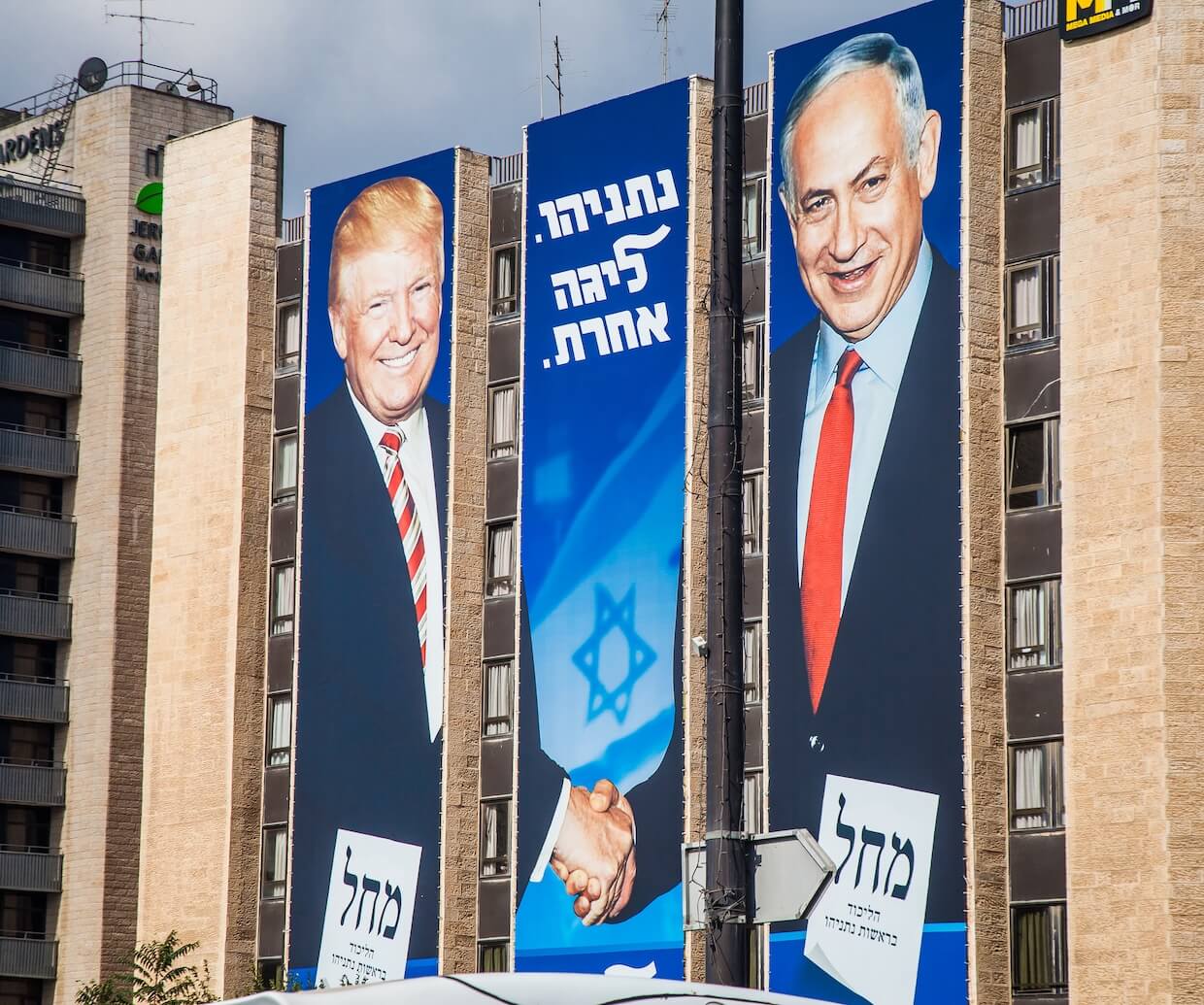
Election billboard showing Netanyahu shaking hands with Trump, with the slogan “Netanyahu. Another League,” in Jerusalem on September 16, 2019. Photo: Dreamstime.

And lastly, Professor Ben-Porat, what role have transnational, religiously conservative, and diaspora-funded networks played in amplifying the settler-theocratic undercurrents of neo-Zionist populism, particularly in relation to territorial maximalism and cultural hegemony?

Professor Guy Ben-Porat: For many years there were relations between settlers and right-wing movements in Israel and similar or supportive movements abroad. As I said before, that is not unique in Israel. All movements—left, right, and center—have often found alliances abroad, whether among Jewish diasporas or liberals in America. So in that sense, what the right wing is doing is not unique.

This transnationality, to be fair, is something used by many groups in Israel for different purposes and reasons. You can say whether it’s good or bad, but the use itself is not unique. Where it is unique is in the US. If you look at Trump supporters in the US, the Evangelicals were a very strong element in his campaign. They provide very strong support for Israel, the right wing, and the settlers. That’s where the connection is important.

It’s more dramatic than it seems—because for many years, Israel was very careful to maintain a bipartisan approach in the US, having support from both Democrats and Republicans. Also remember, the Jewish community in the US is mostly pro-Democratic. So Israel traditionally refrained from taking sides in American politics. Israel was above the Republican–Democratic divide and maintained a relationship with the Jewish diaspora in the US, who are mostly pro-Democrats.

In the last decade or so, things have begun to change. Netanyahu has put his weight on the Republican camp—anti-Obama, anti-Biden, and pro-Trump in the US. His support came in many cases from either right-wing Jews, religious Jews, or right-wing Christians. So, the whole dynamic changes here. Before, it was bipartisan with strong support from the Jewish community. Now, it’s Republican—with support from right-wing Christians and Jews—and an alienation of a large part of the liberal Jewish community.

That’s a strange turn of events. But I think the important religious factor here is the right-wing religious Christians in the US. That’s probably the most important development in Israel’s foreign relations.

Dr. Radoslaw Markowski is Professor of Political Science, Center for the Study of Democracy, Director, SWPS University of Social Sciences and Humanities, Warsaw & Polish Academy of Sciences and Polish National Election Study, Principal Investigator.

Professor Markowski on Poland’s President-Elect Karol Nawrocki: Future Statesman or Mere Footnote?

In this compelling post-election interview, Professor Radosław Markowski offers a candid, expert analysis of Poland’s newly elected president, Karol Nawrocki. Backed by PiS and inspired by Trump-style politics, Nawrocki’s narrow win poses serious challenges to Prime Minister Tusk’s pro-European government. Professor Markowski dissects the roots of this upset—calling it the result of a “fantastically prepared campaign”—and warns of potential institutional gridlock and democratic backsliding. While describing Nawrocki as “inexperienced” and lacking policy depth, Professor Markowski holds out a sliver of hope that he may rise above partisan loyalties. With sharp insights into Polish society, EU disillusionment, and the dangers of populist overreach, this interview is essential reading on Poland’s increasingly polarized and uncertain political trajectory.

Interview by Selcuk Gultasli

In the aftermath of Poland’s 2025 presidential election, the political landscape remains fraught with uncertainty, ideological tension, and institutional fragility. Karol Nawrocki, a nationalist conservative backed by PiS and inspired by Trump-style politics, narrowly secured victory with 50.89% of the vote, defeating centrist candidate Rafal Trzaskowski. His win delivers a major setback to Prime Minister Donald Tusk’s pro-European government, which has been striving to reverse judicial reforms enacted under the previous PiS administration. With presidential veto power at his disposal, Nawrocki is expected to obstruct key liberal policies, deepening political gridlock and intensifying concerns about democratic backsliding.

In this timely and probing interview, renowned political scientist Professor Radosław Markowski offers a sharp analysis of Nawrocki’s narrow win, calling it the product of a “fantastically prepared campaign” rather than a sign of a lasting ideological shift. Professor Markowski emphasizes that Nawrocki is “definitely inexperienced,” lacking basic knowledge of international relations and economics. Yet despite these limitations, he entertains a faint hope—perhaps naively—that Nawrocki might rise above his campaign alliances and “act reasonably and become a good politician serving the country and society he represents.”

This cautious optimism is tempered by structural concerns about Poland’s democratic integrity. Professor Markowski draws a direct line between the present moment and the legacy of what he has termed “free but unfair” elections. Referencing his article in West European Politics, he highlights the disproportionality of PiS’s 2015 win—where only 18.8% of eligible voters delivered a 51% parliamentary majority—and the subsequent “eight years of structural lawlessness.” Nawrocki’s victory, Professor Markowski argues, does not signal a visionary mandate, but reflects the effective demobilization of liberal voters and the disciplined overperformance of a conservative-nationalist base.

With his strong nationalist rhetoric and pledges to limit EU influence while promoting Polish sovereignty, Nawrocki’s rise has been cheered by Eurosceptic leaders across Central Europe, including Viktor Orbán and Marine Le Pen. Yet his alignment with this populist-right alliance only heightens fears of further democratic erosion in a country once considered a model of post-communist European integration.

Whether Nawrocki becomes a transformative statesman or a forgettable footnote in Polish political history remains an open question. As Professor Markowski underscores, the new president now faces a choice: to entrench polarization and gridlock, or to rise above partisan constraints and define his legacy in the eyes of future generations.

Here is the lightly edited transcript of the interview with Professor Radosław Markowski.

Democracy at a Tipping Point

Posters of 2025 Polish presidential candidates Rafał Trzaskowski (KO) and Karol Nawrocki (PiS) in Kuślin, Poland, on April 6, 2025. Photo: Dreamstime.

Professor Radosław Markowski, thank you very much for joining our interview series. Let me start right away with the first question: In the light of Karol Nawrocki’s narrow victory, how do you interpret this outcome within your framework of “plurality support for democratic decay”? Does this mark a deepening of democratic vulnerability in Poland, despite Law and Justice party’s (PiS) 2023 parliamentary loss?

Professor Radosław Markowski: Let’s first try to recall the facts. In 2023, PiS won the elections against Platforma Obywatelska by nearly 4 percentage points—an equivalent of several hundred thousand votes—but it was unable to govern due to its lack of coalition-building capacity. Today in 2025, they won by a significantly smaller margin—just 1.5% effectively. It is a sort of a tie with a slight edge toward one of the candidates. However, the narrative remains consistent.

Polish society—and this is the focus of my ongoing research, soon to be published—is fundamentally liberal, progressive, and cosmopolitan. This stands in stark contrast to the narratives promoted by pundits and public intellectuals who advocate for a nationalist, conservative, and ultra-religious vision of Poland. The proportion of those who support liberal and progressive values over traditional and nationalistic ones is typically three to one, two to one, or at worst, three to two. Across more than 20 dimensions of this cultural divide, I see no evidence of conservative-nationalist dominance.

The problem lies in the fact that these conservative forces, supported by the Polish Catholic Church and representative of a departing world order, have successfully achieved nearly full mobilization in the last decade or decade and a half. Ninety to ninety-nine percent of all available nationalist-conservative voters turn out for elections.

On the other hand, the liberal-progressive side struggles, occasionally succeeding—as in 2023. Compounding this issue is the fact that PiS supporters are notably older, less educated, primarily from rural areas or outside the labor market by choice or by circumstance and are ill-equipped for success in a meritocratic modern world. They are part of society, of course—this is a description, not a judgment. Their mobilization is straightforward, relying on black-and-white imagery, simplifications, and the narrative of stark Manichean good versus evil.

In contrast, the liberal-progressive side comprises highly educated voters—predominantly individuals with high socioeconomic status, capable people who run their own businesses, academics, entrepreneurs, and the middle class. This is a challenging electorate. They are critical readers who verify information coming from politicians and reject simplistic depictions of the world. They ask not only about the goals but also about the means of achieving those goals. They question; they ask about possible side effects. They ask about alternative policies. They are concerned about trade-offs.

More so, they are very capricious in a way and dissatisfied with trivial answers to complicated matters. And this is precisely why it is so tough to attract these liberal, cosmopolitan, progressive voters. They are knowledgeable people who do not buy simplistic propaganda or demagoguery from politicians.

Eight Years of Structural Lawlessness in Poland

Logo and sign of the PiS (Law and Justice / Prawo i Sprawiedliwość) party in Pruszcz Gdański, Poland, on April 11, 2021. Photo: Dreamstime.

You’ve previously described Polish elections as “free but unfair.” Do the 2025 presidential results reflect a continuity of institutional imbalance, particularly with regard to partisan control over historical institutions like the Institute of National Remembrance?

Professor Radosław Markowski: Let me say—this is a subtitle of one of my articles in West European Politics—that the elections were “free but unfair,” with unfair results. What I meant then is that in the 2015 elections, in which PiS won in a free and fair contest, they received 5.7 million votes out of nearly 31 million eligible voters—meaning that only 18.8% of eligible voters supported PiS, yet they gained a 51% parliamentary majority. You know, this kind of miracle almost never happens under proportional representation. But due to 17% of wasted votes and the D’Hondt formula—which eliminated a significant portion of minor votes—it was possible.

There would have been no problem with this kind of translation from 18.8% to 51% parliamentary majority if they had merely run the country in the sense of administrating government affairs. But unfortunately, they behaved after that election as if they had received a qualified majority, and they started changing the constitutional rules of the game.

I like Adam Przeworski’s definition of democracy, which says: democracy is institutionalized uncertainty. There should be frozen, strict, and obeyed rules of the game that never change during the process of electing politicians—but the outcomes of these rules are unknown, and that’s the beauty of democracy.

So, what PiS did illegally since 2015—because they thought this kind of miracle would never happen again—was to bash the Constitutional Tribunal, interfere with the Supreme Court by inventing a new chamber, the “Extraordinary Chamber of Something.” It is “extraordinary” in the sense that nobody in Europe or worldwide recognizes it. We experienced a period of eight years of structural lawlessness in Poland, which excluded us from the community of civilized democracies in the European Union.

We used to enjoy relatively high prestige with people like Jerzy Buzek, former President of the European Parliament, and Donald Tusk, who was President of the European Council. These roles may have even overstated Poland’s influence, but they indicated that Poland was politically important in the EU. That prestige vanished immediately after PiS came to power and began misbehaving in terms of the rule of law and democratic procedures.

Nawrocki’s Win: A Campaign Masterpiece or a Populist Rebrand?

Given Nawrocki’s political inexperience but ideological clarity, how do you interpret his victory as a possible recalibration of Poland’s populist-authoritarian project? Is this a new chapter or simply a rebranding of the PiS legacy?

Professor Radosław Markowski: It’s very hard to say who he is. He’s definitely inexperienced. He lacks basic knowledge about international relations, about economic issues, and so forth. Again, let me reiterate: Poland is a parliamentary democracy in which the executive power lies with the Prime Minister and his government. The president is mainly symbolic in terms of positive policies. He can propose something, but it is up to the parliamentary majority to pay attention to his activities. He, however, has negative powers. He can veto, and this is unfortunately what we expect from him. We’ll talk about that maybe later on.

But back to the campaign, I would say—well, in a way, it is quite interesting, and we’ll probably be teaching students about it in the future. It was a campaign masterpiece by Nawrocki’s electoral team—by the people who managed to craft a serious presidential contender out of almost nothing. Their most notable success was in discouraging turnout for Trzaskowski in the second round. Typically, second-round presidential contests hinge more on demobilizing the opponent’s base than on attracting new voters. In short, this was not a substantial victory in terms of broad public endorsement. Rather, it clearly illustrates how easily a poorly informed segment of the electorate can be—well, if you prefer, persuaded. If you prefer the term manipulated, that works too. Meanwhile, on Trzaskowski’s side, there was a clear failure of his electoral staff.

What does this outcome suggest about the limits of liberal coalition-building in Poland? Could Trzaskowski’s failure be linked to coalition fatigue, perceived elitism, or a lack of emotional mobilization compared to the nationalist right?

Professor Radosław Markowski: I already spoke about mobilization before, so I won’t repeat that here. But yes, the conservative nationalist camp is—quite frankly—astronomically over-mobilized. Virtually everyone in that camp turns out to vote. Unfortunately, the liberal democratic camp is less mobilized, and there are many reasons for that. One contributing factor is the one and a half years of the new government and its difficulties in implementing certain policies. However, it’s important to note that these delays—particularly on issues that matter deeply to many, such as abortion rights and women’s issues—were largely due to the fact that the current president, Andrzej Duda, had already made it clear he would veto such legislation.

So, the government was, de facto, waiting for a new opening—once the president is from their camp, or at least a person who is neutral and capable of reading what are the prerogatives of the president enshrined in the Polish constitution.

So, we have to wait and see. I don’t think I would interpret this win of Nawrocki as anything more than an incident and a fantastically prepared campaign by his staff, rather than something more deeply rooted. But one should also recognize that such victories—unexpected victories of unknown persons—sometimes redefine the political landscape and the political developments, and this should also be taken seriously into account.

Why Trzaskowski’s Campaign Missed the Mark

Rafał Trzaskowski, Mayor of Warsaw and presidential candidate, campaigning in Łódź, Poland, on June 3, 2020. Photo: Tomasz Warszewski.

To what extent did the personalization of the campaign around symbolic figures (Trzaskowski as elite technocrat vs. Nawrocki as populist traditionalist) reinforce identity cleavages over policy-based electoral competition?

Professor Radosław Markowski: Let me reiterate a point about Trzaskowski’s campaign that I mentioned earlier. His team made a fundamental mistake—one I publicly flagged six months ago: they attempted to court the right-wing electorate. This group is a clear minority in Poland and already firmly aligned and mobilized by parties like PiS and Confederacja. The likelihood of swaying voters from that camp was virtually nonexistent.

This approach came at the expense of engaging the left-liberal electorate with progressive, liberal ideas. Trzaskowski is not an ultra-progressive or ultra-liberal, but he is certainly a meritocratic, cosmopolitan liberal—someone who speaks several languages fluently, who comes from an elite Warsaw family. Yet, he and his campaign team decided to pretend he was “one of us”—an average guy. One of the campaign’s obsessions was to ensure that no one mentioned his multilingualism.

This is a typical populist miscalculation—thinking you win elections by downplaying meritocracy. Unfortunately, it backfired. We estimate that around 1.5 million people who voted for the current ruling coalition in 2023 became disillusioned with Trzaskowski due to these mixed signals and overt appeals to the right-wing electorate. It was a real disappointment for them.

In the light of your concept of “Eurodisappointment,” to what extent does Trzaskowski’s loss suggest growing frustration even among pro-European voters with the EU’s perceived ineffectiveness in addressing democratic backsliding?

Professor Radosław Markowski: Together with my co-author, we pointed out in an article in European Union Politics that we began observing, around 2021–2022, a new phenomenon we called “new Euroscepticism” or “Eurodisappointment” among Poles. This isn’t the typical Euroscepticism rooted in xenophobic or nationalist attitudes. Rather, it’s a disappointment driven by frustration with the European Union’s inability to push back against leaders like Orbán and Kaczyński.

That old saying— “Brussels barks but doesn’t bite”— began to resonate, especially among a segment of the Polish population that had long been very enthusiastic about the EU. It fostered a growing suspicion that the EU might not be genuinely committed to upholding its core axiological pillars—democracy, the rule of law, and fundamental values.

Poland’s Populist Path and the Limits of EU Leverage

Has the European Union’s cautious and often delayed response to autocratizing member states like Hungary and Poland amplified the populist portrayal of Brussels as politically impotent? Could Nawrocki’s presidency signal a shift toward a more defiant, nationalist approach to EU engagement—echoing Orbán’s model of selective integration without formal rupture?

Professor Radosław Markowski: It might not be exactly what Orbán has invented, because in Poland—unlike in Hungary—there isn’t a deep-rooted historical sentiment akin to Hungarians’ longing for “Greater Hungary” or resentment over the Treaty of Trianon. In Hungary today, you can walk into nearly any hotel or public space and see maps depicting a pre-Trianon Hungary—three times its current size.

Poland also had its imperial moments in the past, being much larger in both territory and population. But even among nationalists, that imperial history doesn’t serve as a powerful reference point in contemporary politics. So, emulating Orbán isn’t straightforward.

Also, Orbán won a constitutional majority in Hungary’s first free and fair 2010 election. He could legitimately claim the mandate to rewrite the rules—which he did. It’s another matter how he later amended the constitution. But that legitimacy gave him more latitude than PiS or Nawrocki have in Poland.

Back to Polish politics: Nawrocki’s attitude toward the EU is definitely critical. But unfortunately, this is paired with a kind of infantile pro-Americanism—specifically, pro-Trumpism. You hear ideas like Poland leading the Trimarium Pact (Poland, Estonia, Latvia, Lithuania, Moldova, Georgia, North Macedonia, etc.). While maintaining good relations with these countries is important—especially those aspiring to EU membership—this can’t replace engagement with core EU mechanisms.

We should be at the heart of EU decision-making. Poland was recently re-invited by figures like Friedrich Merz and Emmanuel Macron to take a central role in European affairs—particularly because of our prescient warnings about Vladimir Putin and the war in Ukraine. As early as 2005, 2010, and 2014, we sounded alarms about Putin’s ambitions—warnings largely ignored by Angela Merkel and others in Western Europe. Now, Poland is being taken more seriously, and we should seize that moment.

Let me emphasize once again: Poland is a parliamentary democracy. Executive power lies with the Prime Minister and the government. Foreign policy is handled by the Minister of Foreign Affairs. The President can influence foreign affairs symbolically or by refusing to appoint certain ambassadors, which creates problems for individuals and embassies. But in the grand scheme, it’s not a major institutional hurdle.

Nawrocki’s Risky Global Alliances

President-elect Karol Nawrocki campaigning ahead of Poland’s 2025 presidential election in Łódź, Poland, on April 27, 2024. Photo: Tomasz Warszewski.

Nawrocki’s campaign drew symbolic and rhetorical support from leaders like Donald Trump and Viktor Orbán. How do you see Poland’s evolving position in the broader network of global populist-right alliances?

Professor Radosław Markowski: For Poland, this dynamic doesn’t resonate with the PiS electorate—the party’s core support remains around 6 to 6.5 million voters, not the full 10 million who voted for Nawrocki in the second round. While he ultimately secured over 10 million votes, PiS’s true, consistent base is closer to the 29% he garnered in the first round.

Unlike Hungary, Poland—due to its historical experience—cannot accept pro-Russian sentiment. That simply doesn’t resonate here. As PiS and Nawrocki continue aligning with figures like Orbán, Marine Le Pen, Salvini, and even the prime minister of Slovakia, it will become increasingly difficult to justify such alliances to the Polish public. Even on the political right, there is discomfort with someone like Donald Trump, who appears either overly sympathetic to or dangerously naive about Russia.

But again, Polish foreign policy is in the hands of one of Europe’s most talented politicians: Foreign Minister Radek Sikorski. So, I see no immediate cause for concern. External affairs will be shaped by the government and Sikorski, not the president.

Let me also point out something almost comical. Just a week ago, on May 25th, Donald Trump finally declared publicly that “Vladimir Putin is insane.” For Poles, this is hardly news. The average high school student here has known that for the last 15 to 20 years. It’s astonishing that it took so long for the most powerful man in the world—surrounded by the CIA and an array of intelligence agencies—to come to that conclusion.

So, in the long run, I believe Nawrocki will lose credibility and support if he aligns too closely with what I would call Kremlin muppets like Orbán, or with those financially entangled with Russia, like Salvini. It’s a very difficult political position in today’s Poland to be seen as a friend of Vladimir Putin.

Nawrocki’s Test: Rise Above Politics or Deepen the Deadlock?

Considering the veto powers of the presidency, how do you expect the new phase of institutional deadlock to evolve under Nawrocki, and what risks does it pose to executive-legislative accountability in Poland?

Professor Radosław Markowski: Let’s give Nawrocki a chance. He is not strictly a PiS politician. He has made certain agreements and signed deals with Confederacja and others, and he will formally become Poland’s president in early August this year.

Every person—no matter their troubled CV or ethically questionable behavior in the past—who becomes president of a mid-sized country at the heart of Europe has the opportunity to reflect on how they want to be remembered. Will he be just a short footnote—an irrelevant president who did nothing for Poland—or will he attempt to act reasonably and become a good politician serving the country and society he represents?

Let’s give him that chance. Perhaps he will become less dependent on the political actors who backed him during the campaign. It’s a naïve expectation, I know—but there’s still a bit of the child in me. Sometimes, I deliberately want to be naïve to leave room for optimism. I’ve seen people radically change their political biographies before.

But if not—if he ends up blindly vetoing everything based on ideological conviction—then we’re back to what we’ve had for the last two years: a tense standoff between a combative president and a determined prime minister. That’s not good for Poland. Still, it’s the reality we may face. And if that happens, Nawrocki and his camp will ultimately lose, because it will become clear that they are obstructing the work of the government. It will be easy to demonstrate that things are not getting done in this country because of the president’s stubbornness.

Urban graffiti depicting the face of a woman in a hijab, located in an immigrant-populated neighborhood on September 1, 2015. The urban area of Berlin, Germany—home to 4 million residents—ranks as the 7th most populous in the European Union. Photo: Dreamstime.

Evaluations of Female Muslim Politicians in a Populist Era: Measuring Intersectionality Using Interaction Effects and Conjoint Experiments

Abstract
How do voters evaluate female Muslim politicians? The literature mainly approaches voter evaluations of underrepresented groups from a unitary perspective, focusing on either female or minoritized politicians, leaving Muslim politicians out of the picture altogether. I take an intersectional approach and consider a finding intersectional when evaluations of a Muslim woman politician are significantly different from both non-religious women and Muslim men. I test this by running survey experiments amongst 3056 respondents in France, Germany, and the Netherlands and presenting 18,336 randomly constructed profiles of hypothetical politicians varying their religion, gender, and migration background. Voters have a strong negative bias against Muslim politicians. However, voters do not assess female Muslim politicians significantly differently than their male counterparts. These conclusions have implications for researchers studying intersectionality using conjoint experiments and researchers concerned with the electoral consequences of diversity in a political landscape increasingly influenced by populist radical right parties.

Keywords: Intersectionality, Muslims, Islamophobia, Muslim women, Descriptive representation

Please find all replication materials here: https://doi.org/10.17605/OSF.IO/JZYR7

By Sanne van Oosten

Introduction

There are many examples of female Muslim politicians being targeted by politicians of the Populist Radical Right (see Farris, 2017; Oudenampsen, 2016), sometimes leading to female Muslim politicians receiving extraordinary amounts of discursive backlash (Saris & Ven, 2021; van Oosten, 2022). At the same time, Muslim women tend to outnumber Muslim men in politics (Hughes, 2016), especially in contexts where party selectors craft candidate lists: Muslim women tick two diversity boxes while also challenging stereotypes of Muslim women as oppressed, simply by being politicians (Dancygier, 2017). Despite these challenges and the unique positioning of Muslim women in politics, the question remains how voters evaluate them. Does being a female Muslim politician pose electoral challenges, or is there an electoral benefit? In this paper, I test whether intersectionality plays a role in how voters evaluate female Muslim politicians.

An intersectional analysis is distinct from a unitary or multiple one (Hancock, 2007). Where a unitary analysis foregrounds one background characteristic (race or gender) and a multiple analysis adds up the effects of multiple ones (race and gender), an intersectional analysis highlights the interaction between them (race interacts with gender) (idem). In order to study the intersectional position of minoritized women in politics quantitatively, many scholars call the use of interaction effects and candidate experiments viable methodological solutions (Block et al., 2023; Klar & Schmitt, 2021, p. 493, 495). This paper tests the limits of both the method of data collection (candidate experiments) and the method of analysis (interaction effects) by studying what is arguably a most-likely case: female Muslim politicians.

Though there has been much research on intersectionality and politicians in the US (Brown, 2014a, 2014b; Collins, 1998; Holman & Schneider, 2018; Lemi & Brown, 2019; Reingold et al., 2020), intersectionality and politicians in the European context is poorly understood. In Europe, Muslim women play a crucial role in many nationalist debates in western countries such as France, Germany and the Netherlands (Dancygier, 2017; Korteweg & Yurdakul, 2021). The general framing tends to imply that Muslim women are significantly different from both non-Muslim women and Muslim men because being Muslim influences what it means to be a woman and being a woman influences what it means to be Muslim. As Islam and gender are thus “mutually reinforcing”, an intersectional lens is indispensable (Crenshaw, 1991, p. 1283). This is particularly apparent when female Muslim politicians attempt to enter politics (Dancygier, 2014; Hughes, 2016; Murray, 2016). However, whether female Muslim politicians face a “double disadvantage” or a “strategic advantage” (Gershon & Lavariega Monforti, 2021) depends heavily on the specific political and societal context in which they operate. In order to study this, I presented 3056 respondents in France, Germany, and the Netherlands a total of 18,336 short bios of hypothetical politicians while randomizing their religion, ethnorace and gender. I asked respondents to assess these politicians by asking evaluation and choice-questions. Candidate conjoint experiments rarely include Islam as an experimental condition and when they do, intersectional analyses are rarely conducted (one notable exception being Benstead et al., 2015).

In line with Hancock (2007), I analyze the results in a unitary, multiple and intersectional way. In the intersectional analysis I use interactions while controlling for direct (unitary) effects. Although I do not find voters assess women and ethnoracially minoritized politicians negatively, I find robust and consistent evidence that voters have a strong negative and unitary bias against Muslim politicians. However, this analysis did not garner any evidence for intersectional effects of religion and gender. Given the sizable sample and effect sizes, I do not consider a lack of statistical power the cause of these null results. Though I remain confident that interaction effects are the most fitting method of analysis, I argue that conjoint experiments are not the most fitting method of data collection due to the cognitive overload causing respondents to single out one attribute to base their choices on.

Click to Read the Article

Colorful election posters featuring presidential candidate Leni Robredo during the Philippine General Elections 2022, seen in Manila on April 16, 2022. Photo: Jim Kayalar.

The ‘Pink Movement,’ Youth Vote, and the Future of Philippine Politics

The surprising midterm victories of Benigno Aquino IV and Kiko Pangilinan—both underdog candidates backed by the progressive Pink Movement—signal a potential turning point in Philippine politics. Despite polling poorly before the vote, both secured top spots in the Senate race, fueled largely by a mobilized youth electorate and disillusionment with traditional power blocs. The resurgence of the Pink Movement, rooted in civic resistance during the Duterte era, now finds new momentum amid internal fractures in the Marcos-Duterte alliance. While questions remain about the opposition’s long-term cohesion and whether these gains reflect lasting ideological shifts, the current momentum and demographic advantage suggest the Pink Movement—and the youth—could play a decisive role in shaping the 2028 national elections.

By Bernard Allan V. Garcia*

The most recent midterm elections in the Philippines came as a surprise to many. Benigno Aquino IV and Kiko Pangilinan—both seasoned politicians yet widely considered underdogs—secured spots in the Magic 12. Weeks and months before the elections, major polling firms in the Philippines had not projected them to make the cut. Pulse Asia’s final pre-election survey placed Aquino in the 11th–18th range and Pangilinan slightly behind in the 13th–20th range, both outside the winning circle (Pulse Asia Research, 2025). Similarly, the SWS Survey predicted that neither would secure a seat (Cupin, 2025). However, unofficial results revealed a dramatic shift: Aquino placed second and Pangilinan fifth. This unexpected outcome has since sparked widespread discussion on what led to such a turn of events.

The Pink Movement

The ‘Pink Movement’ is not an overnight project established by the opposition; it is a product of years of suppression and human rights abuse. To understand the movement, one must walk down memory lane and go back to 2016 when Rodrigo Roa Duterte was elected to power. Many controversial policies were made, including the infamous Oplan: Tokhang, a systematic government crackdown on illegal drugs that resulted in numerous extrajudicial killings. Most of the victims of this government policy are from the vulnerable sectors of the population, including low to lower-middle-income communities. The administration also made multiple attempts to silence media companies, activists, and educational institutions, while introducing a new systemic plague in the form of propaganda groups that distort truth and facts. In one notable instance, the government targeted activist organizations, and the practice of red-tagging has become a recurring theme in Philippine politics, radio broadcasts, and late-night press conferences.

The Duterte administration also saw a highly controversial shift in foreign policy—from a traditionally American-leaning stance to a China-oriented approach, all under the banner of an “independent foreign policy.” During this uneasy transition, the Philippines found itself in a precarious position: efforts to assert its claims in the West Philippine Sea were frequently met with Chinese aggression, yet the government consistently downplayed the tensions, portraying the Chinese Communist Party (CCP) as a good friend of the Philippines.

However, the worst is yet to come, as the Philippines suffered great losses during the COVID-19 pandemic. At some points during the pandemic and global shutdown, the Philippines had multiple surges of new cases. The evident lack of preparations manifested in sub-standard medical facilities, a lack of manpower, insufficient medical responses, and episodes of late-night press conferences. On top of all these difficulties, the Duterte-backed Congress also revoked the franchise of the local media giant, ABS-CBN Corporation, further dismantling information dissemination in the country. Needless to say, Filipinos had a rough six-year journey, and the power struggles of the vulnerable population were pretty evident. Along the lines of problems and incompetence, the Philippines had a glimpse of a silver lining. 

In 2022, the Pink Movement took fruition, from small numbers of young volunteers to having sectoral branches in almost every local government unit, the movement became a force. Leni Robredo, the then-incumbent vice president, became the face of the Pink Movement. Her presidential candidacy was backed by the youth, advocacy groups, multiple political parties, independents, and many academic institutions. Political rallies related to her campaign were attended by millions of people from different sectoral communities of the Philippines. Celebrities and public figures also shared their support for her candidacy. Despite having the elections during the pandemic, people showed up in support of good governance and to put an end to the return of the Marcoses to power.

Despite gallant efforts, the Pink Movement did not succeed. Robredo lost the presidential seat against Marcos, and Sara Duterte won the vice presidency against Kiko Pangilinan. However, the 2022 loss of the Pink Movement not only planted seeds for the next election but also established a huge demographic advantage – the youth vote. 

Youth Vote and Demographic Advantage

The foundation of Robredo’s 2022 Pink Movement is young. Most of the members of this movement are students, young entrepreneurs, and youth activists. Given that the demographic is young and the most recent 2025 midterm elections were just three years apart from the 2022 national elections, the solid foundation remained strong. Young individuals who were not able to vote in 2022 are now more than eligible to vote. The bulk of the Pink Movement’s foundation was carried over to the next election.

It is also interesting that the Pink Movement, with its hope for a more inclusive society, is backed by academics and student organizations. In several polling surveys conducted in universities, candidates affiliated with the Pink Movement top the surveys. Other left-leaning candidates, who are not necessarily affiliated with the Pink Movement, also top the surveys.

Political Climate and Political Ambivalence

The Pink Movement also benefited from the current political climate of the Philippines. The once uniteam partnership of President Marcos and Vice President Duterte dwindled, and the feud became pretty evident, resulting in a divide in the Congress and Senate. The two camps also introduced their senatorial lineups, both having an incomplete lineup of 12 candidates. It left an open opportunity for Filipinos to choose a better-suited candidate to complete the Magic 12.

It is also important to note that Aquino, in his interviews before the elections, took an ambivalent position on many social issues concerning the political climate of the country. In one instance, when asked regarding his position on Vice President Sara Duterte’s impeachment, he clarified that Filipinos are more interested in more important discussions, such as food, education, and basic services, than the political feud between the two political families (News5Everywhere, 2025). This ambivalent position, which is clearly the opposite of his character from the 2022 elections, is a personal choice. The recognition of the window of opportunity demands a safe and secure way to the goal of getting elected. 

The Challenge of Sustaining the Momentum

Aquino and Pangilinan’s entry in the Magic 12 of the 20th Congress is a celebratory milestone for Filipino voters, more so for the left-leaning political parties in the Philippines. Other than Aquino and Pangilinan, the left also won other seats, including three seats for the Akbayan Party (social democratic party) and one seat for the Mamamayang Liberal (liberal). Despite this win and a demographic dividend on their side, it is still a question whether the left has enough gas to turn the tide in the next national elections set to happen in 2028. It remains a challenge to unite a fragmented opposition, each with a distinct left ideology. A prime example of this is the never-ending debate between the national democratic organisations and the social democratic organisations. 

It is also difficult to say that the opposition has enough gas to succeed in the 2028 national elections because it could be that the win this year is due to the window of opportunity posed by the current political climate and not entirely due to a change in political ideals for many Filipinos. Also, there is not enough evidence on how many of the youth voted for the Pink Movement. Nevertheless, the win today is a statement that the left is gaining momentum, just not clear if it would be enough to push boundaries in 2028.


(*) Bernard Allan V. Garcia has a Master degree in Population Studies at University of the Philippines, Diliman and Early Career Researcher at Scalabrini Migration Center. Email: bvgarcia2@up.edu.ph


References

Cupin, B. (2025, May 8). “May 2025 SWS poll shows tight race for ‘Magic 12’.”  https://www.rappler.com/philippines/elections/senate-race-survey-results-sws-may-2025/

News5Everywhere (Director). (2025, February 11). “Bam Aquino sa VP Sara Duterte impeachment: Hindi siya isyu nung mga kababayan natin.” [Video recording]. https://www.youtube.com/watch?v=AZRuFIP5pG4

Pulse Asia Research. (2025). “April 2025 Nationwide Survey on the May 2025 Elections.”

Pulse Asia Research Inchttps://pulseasia.ph/updates/april-2025-nationwide-survey-on-the-may-2025-elections/

MGP211

The Sectarian Populist Playbook: Populism in Iraq, Syria, and Kurdish Regions

Please cite as:
Stamoglou, Anastasia. (2025). “The Sectarian Populist Playbook: Populism in Iraq, Syria, and Kurdish Regions.” European Center for Populism Studies (ECPS). May 29, 2025. https://doi.org/10.55271/rp0099


This report presents the key insights from the 21st session of the Mapping Global Populism Panel Series, hosted by the European Center for Populism Studies (ECPS). Focused on Iraq, Syria, and the Kurdish regions, the panel examined how populism operates through ethnic and sectarian divisions in societies marked by authoritarian legacies and conflict. Drawing on political theory, field data, and comparative case studies, the session revealed how authoritarian leaders adapt populist strategies to manipulate communal fears, centralize power, and erode democratic institutions.

Report by Anastasia Stamoglou

Introduction

The 21st session of the Mapping Global Populism Panel Series, titled “Ethnic & Sectarian Politics and Populism in Iraq, Syria and Kurdish Regions,” brought together scholars to examine the complex interplay between populist politics and identity-based cleavages in some of the Middle East’s most conflict-affected contexts. Organized by the European Center for Populism Studies (ECPS) and moderated by Dr. Ibrahim al-Marashi (Associate Professor of History, California State University), the panel focused on how populist leaders and movements in Iraq, Syria, and Kurdish regions instrumentalize ethnic and sectarian divisions to sustain power, suppress opposition, and assert exclusionary visions of national belonging. 

Featuring contributions from  Dr. Reda Mahajar (Research Fellow at The Conflict Analysis Research Centre (CARC) at the University of Kent),  Hashim Hayder Khashan Al-Rekabi (Lecturer, University of Baghdad), Dr. Haian Dukhan (Lecturer in Politics & International Relations, SSSHL Department of Humanities and Social Sciences, Teeside University), and Rojin Mukriyan (PhD candidate in the department of Government and Politics at University College Cork, Ireland), the session offered a timely and critical interrogation of memory, fear, gendered politics, and identity formation within the frameworks of populism and authoritarian governance.

Populism and Sectarian Calculations in Iraq and Syria

The panel opened with Dr. Reda Mahajar’s incisive critique of Bashar al-Assad’s regime in a presentation titled “Syrian Sunni Jihadi Chickens Come Home to Roost.” Dr. Mahajar argued that Assad’s support for Sunni jihadist elements in Iraq from 2003 to 2010 was not only deliberate but strategically framed to undermine the US occupation by making Iraq ungovernable. This short-sighted geopolitical gambit, he contended, ultimately backfired. The networks Assad helped empower, most notably al-Qaeda in Iraq, mutated into ideological and military adversaries, including Hay’at Tahrir al-Sham, which would go on to play a central role in Syria’s civil war.

Dr. Mahajar emphasized the historical irony in Assad’s strategy: a secular Alawite regime that presented itself as modern and pluralistic nonetheless perpetuated a Sunni-centric educational framework that reinforced sectarian binaries. These state-sponsored narratives later became fertile ground for jihadist mobilization. By embedding sectarian discourse into national identity, Assad’s regime unwittingly cultivated the ideological terrain upon which its own enemies would rise. The case stands as a stark example of blowback: a regime’s instrumental use of sectarianism ultimately incubated the forces that would threaten to dismantle it.

Expanding on the dynamics of populism in Iraq, Hashim Hayder Khashan Al-Rekabi traced three waves of populist discourse since 2003. The first phase, from 2003 to 2014, was marked by sectarian populism, as Shia, Sunni, and Kurdish parties capitalized on identity politics and the muhasasa (power-sharing) system to consolidate ethno-sectarian blocs. This period saw the institutionalization of communal divisions, with political legitimacy grounded in confessional affiliation rather than policy performance.

The second phase, from 2014 to 2019, saw the rise of anti-establishment populism. Figures like Muqtada al-Sadr employed anti-corruption rhetoric and attacked state institutions, despite being deeply embedded within them. Al-Rekabi noted the paradox of elected officials publicly denouncing the very parliament or ministries they served in, a strategy that blurred the line between opposition and governance. The final phase, emerging after 2019, introduced what he termed “illiberal democracy,” a context in which populist leaders, including al-Sadr, leverage democratic processes not to deepen pluralism, but to centralize authority and marginalize dissent.

Interestingly, Al-Rekabi shared findings from field research indicating that approximately 70% of Iraqis associate democracy not with institutional pluralism or civil liberties, but with the delivery of basic services. This utilitarian understanding of governance fuels nostalgia for authoritarianism and strongman rule, suggesting that democratic legitimacy remains fragile and conditional in post-2003 Iraq.

Kurdish Populism and the Tension Between Ideals and Institutions

Turning to the Kurdish context, Ms. Rojin Mukriyan offered a comparative analysis of populist dynamics in Rojava (northeast Syria) and the Kurdistan Regional Government (KRG) in Iraq. Drawing on Ernesto Laclau’s theory of populism as a discursive construction of “the people” against “the elite,” Mukriyan argued that the Democratic Union Party (PYD) in Rojava exemplifies left populism through its use of unifying signifiers such as “democracy” and “gender equality.” In contrast to conventional state-building models, the PYD’s project, grounded in Abdullah Ocalan’s theory of democratic confederalism, seeks to transcend national borders and ethnonationalist frameworks by promoting decentralized, pluralistic governance.

In Rojava, populism is not merely oppositional but visionary. Its aim is to unite a multi-ethnic coalition including Kurds, Arabs, Assyrians, and others under a shared commitment to local autonomy and egalitarian principles. Mukriyan acknowledged, however, the criticisms of Rojava’s ambiguity and contradictions, especially from within libertarian and anarchist circles who question its simultaneous engagement with state actors like the Assad regime.

By contrast, the KRG in Iraq presents a case of populism devoid of transformative ambition. The dominant parties, the Kurdistan Democratic Party (KDP) and the Patriotic Union of Kurdistan (PUK), continue to operate through clientelist networks and dynastic leadership. Their governance reflects a neoliberal, exclusionary model in which dissent is stifled, and party loyalty is rewarded with patronage. Mukriyan noted that while the rhetoric of reform occasionally surfaces (i.e. during election campaigns) these promises rarely materialize into structural change. The result is a hollowed-out democracy where elite families maintain control, replicating the very state-centric authoritarianism they once opposed.

Memory, Fear, and Sectarianism Among Syrian Christians

Dr. Haian Dukhan’s pre-recorded presentation focused on Christian communities in al-Hasakah, Syria, offering a layered analysis of sectarianism from both “above” and “below.” He argued that Assyrian and Syriac Christians in this region are shaped by collective memory and historical trauma including genocide, marginalization, and displacement. These long-standing fears were reignited during the Syrian civil war, particularly by ISIS’s attacks on Christian villages.

In response, some Christian groups aligned with the Assad regime and joined militias like Sutoro, seeking protection through militarized solidarity. Dr. Dukhan labelled this phenomenon as “sectarianism from below,” a grassroots survival response driven by existential anxiety. Simultaneously, the Assad regime manipulated these fears to reinforce its legitimacy, portraying itself as the only viable guardian of minority rights. This elite-driven manipulation, or “sectarianism from above,” not only entrenched dependency but also deepened mistrust among Syria’s diverse communities. Dr. Dukhan’s analysis underscores how authoritarian regimes weaponize identity and trauma to fragment civil society and maintain control.

Conclusion

Across the cases discussed, three common themes emerged. First, both Iraq and Syria illustrate how populist strategies become institutionalized through sectarian quotas and identity-based governance structures. The muhasasa system in Iraq and the sectarian entrenchment in Syria formalize the very divisions that populists exploit, making political reform deeply challenging. Second, authoritarian leaders in the region have proven adept at adopting the language of populism. Figures like Bashar al-Assad and Muqtada al-Sadr, while operating in different systems, share a similar rhetorical playbook: portraying themselves as defenders of the majority identity against both foreign enemies and domestic “elites.”

Finally, the Kurdish case highlights the limits and possibilities of populist governance. Rojava’s model of inclusive left populism contrasts starkly with the KRG’s elite-dominated politics, raising important questions about the viability of democratization within nationalist movements. Yet even Rojava is not immune to the contradictions of populist nationalism, particularly when faced with geopolitical constraints and regional authoritarian pressures.


Follow-Up Questions

The panel concluded with several pressing questions that warrant further exploration:

  • Can Rojava’s decentralized, inclusive governance model inspire institutional reform in the hierarchical, patronage-driven structures of the KRG?
  • How do external powers such as Turkey and Iran exacerbate or manipulate ethnic and sectarian populism, and how does their influence compare to Russia’s populist interventions in Europe?
Bortun

Dr. Bortun: Economic Insecurity Fuels the Rise of the Far Right in Romania

In the wake of Romania’s high-turnout 2025 presidential election, Dr. Vladimir Bortun offers a powerful analysis of how deep-rooted economic insecurity—fueled by decades of neoliberal reform—has driven support for the far right. Despite a centrist victory, nationalist George Simion’s strong performance underscores a broader post-crisis populist consolidation. In this exclusive ECPS interview, Dr. Bortun explores the AUR’s appeal among the diaspora and rural poor, the ideological vacuum left by the mainstream left, and how Romania exemplifies a wider European shift from democratic to authoritarian neoliberalism. A must-read for anyone interested in the structural dynamics behind Europe’s populist realignment.

Interview by Selcuk Gultasli

Romania’s 2025 presidential election represented a pivotal moment for the country’s democratic trajectory and its place within the broader European political landscape. In a high-stakes runoff, centrist candidate and pro-European reformer Nicușor Dan secured a clear victory over George Simion, the leader of the far-right Alliance for the Union of Romanians (AUR). With the highest voter turnout in a quarter-century and the specter of a previously annulled election looming large, the vote was widely interpreted as a referendum on Romania’s political future—particularly on the tension between liberal democracy and the rising tide of far-right populism. Despite Simion’s defeat, his strong first-round performance and continued popularity signaled a deeper, more durable undercurrent of reactionary politics in Romania.

Against this backdrop, the European Center for Populism Studies (ECPS) spoke with Dr. Vladimir Bortun, a lecturer at the University of Oxford and an expert on European politics, transnational party networks, and left-populist movements. With unique insight into both the structural drivers and class dynamics underpinning political realignments in Romania and beyond, Dr. Bortun offers a compelling analysis of how economic insecurity—rooted in decades of neoliberal reforms, mass emigration, and systemic inequality—has created fertile ground for the rise of the far right.

In this wide-ranging interview, Dr. Bortun reflects on how the socioeconomic legacies of Romania’s post-1989 transition have failed to deliver on their liberal democratic promises, especially for large swaths of the population living in poverty or working precariously. He argues that this deep economic discontent, compounded by the collapse of credible left-wing alternatives and the ideological convergence of the center-left and center-right, has allowed far-right actors like Simion and AUR to present themselves as anti-establishment voices—even as their own policies serve entrenched economic elites.

Crucially, Dr. Bortun situates Romania within a broader European context, where authoritarian neoliberalism is increasingly replacing the post-Cold War liberal consensus. He draws instructive comparisons with Poland, France, and Southern Europe, exploring how the mainstreaming of far-right rhetoric and policy by centrist parties—particularly around immigration and national sovereignty—has reshaped the ideological field.

By examining the rise of AUR’s support among the Romanian diaspora and among marginalized rural voters, Dr. Bortun challenges simplistic narratives about populism and brings attention to the lived realities of class, exclusion, and political abandonment. As he makes clear, the battle over Romania’s future is not only political or cultural—it is fundamentally about economic power, ownership, and whose voices get to shape the nation’s path forward.


Here is the lightly edited transcript of the interview with Dr. Vladimir Bortun.

Riboldi

Dr. Riboldi: State Capture by Big Business Is a Core Threat to Australian Democracy—As Elsewhere

In this compelling conversation with ECPS, Dr. Mark Riboldi unpacks how corporate influence and elite career pathways hollow out democratic representation in Australia. From revolving doors in politics to the marginalization of community voices, Dr. Riboldi warns that without transparency and reform, “the closed loop between politics and corporate power” will persist. He also explores party fragmentation, the Greens’ identity struggles, and the risks of technocratic drift. “Boldness needs legitimacy,” he insists, urging progressive parties to pair vision with credibility. Dr. Riboldi ultimately sees Australia’s electoral system as a “stopgap” against populist capture—but not an immunity. 

Interview by Selcuk Gultasli

In this incisive interview with the European Center for Populism Studies (ECPS), Dr. Mark Riboldi—a lecturer at the University of Technology Sydney and scholar of political communication and civil society—offers a sobering yet constructive account of the structural pressures undermining democratic vitality in Australia. At the center of his critique lies a sharp diagnosis of state capture: “One of the biggest problems in Australia—and I think it’s probably the same in other liberal Western democracies—is the impact of big business on government,” Dr. Riboldi explains, stressing how revolving-door pathways from student politics to Parliament and then into private sector boardrooms bypass “real work experience and meaningful community engagement.”

This theme threads through his broader reflections on the fragmentation of Australian party politics, the rise of independents, and the populist logic animating both left- and right-wing actors. Dr. Riboldi rejects simplistic narratives that frame emotionally charged political messaging as inherently populist, noting instead that such communication has long been central to movements across the spectrum. Still, he warns that populism becomes dangerous when it feeds on legitimacy gaps and places all faith in personalistic saviors: “Let’s talk about a problem—I will fix it,” he says, paraphrasing the demagogic logic of figures like Donald Trump or Nigel Farage.

Dr. Riboldi’s insights into party dynamics are especially sharp in his discussion of the Greens. He views the party’s struggle between institutional respectability and activist roots not as a liability but as a productive tension: “It helps to keep a party like the Greens connected to their roots and accountable to those roots.” Yet he also cautions that technocratic messaging—as seen in their focus on parliamentary influence and minority government potential—can fall flat, especially when voters crave bold but believable visions for the future. “Boldness needs to be connected to legitimacy,” he insists, adding that the Greens’ record on housing and climate action has earned them the political capital to stake out such positions.

Ultimately, Dr. Riboldi remains cautiously optimistic about Australia’s institutional resilience. Compulsory voting, preferential ballots, and a proportional Senate system form what he calls a “stopgap” against populist insurgency. Nevertheless, his core warning remains clear: unless transparency is enforced and the influence of corporate power curtailed, Australian democracy—like others around the world—risks further erosion from within.

Here is the lightly edited transcript of the interview with Dr. Mark Riboldi.