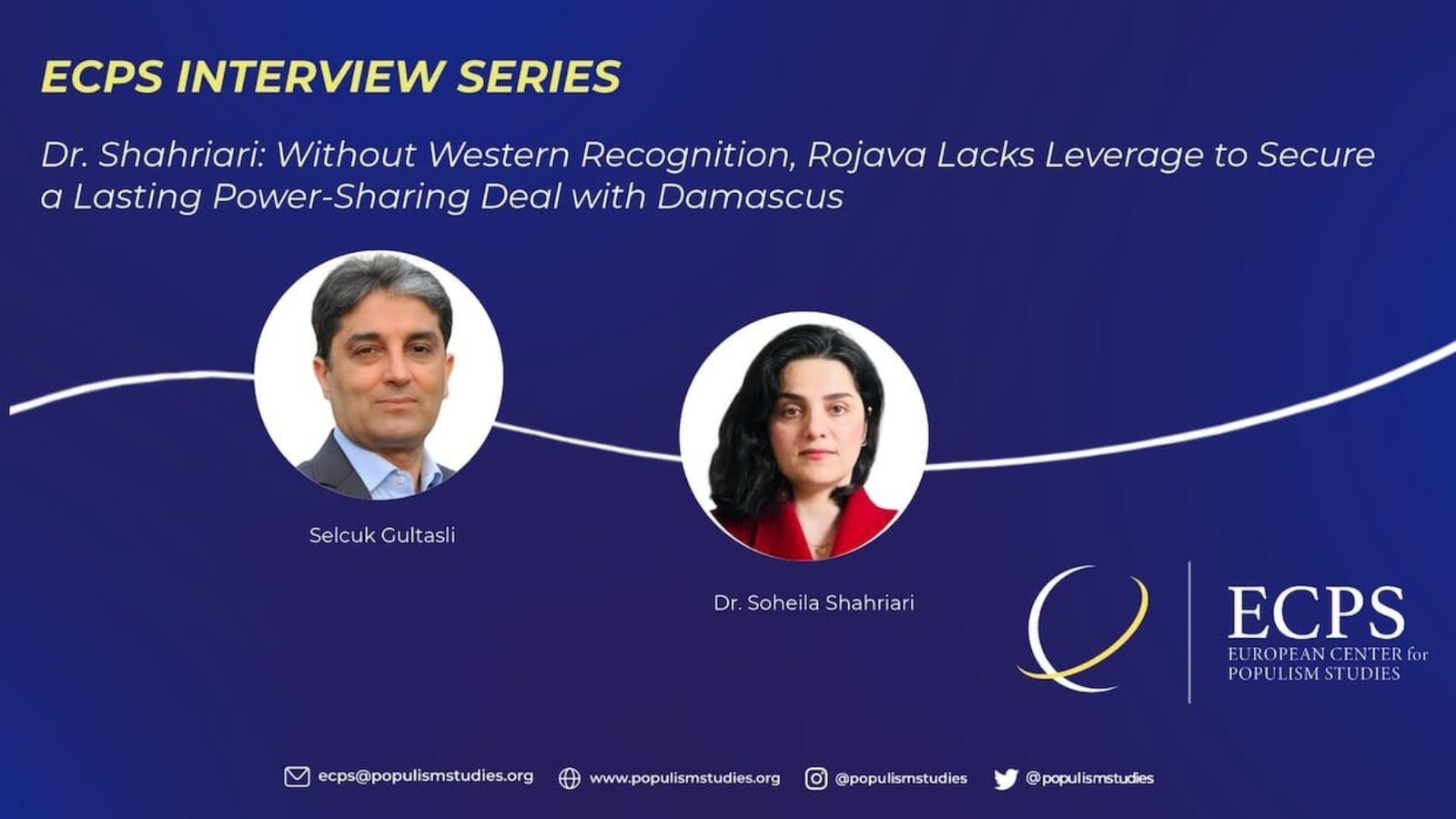
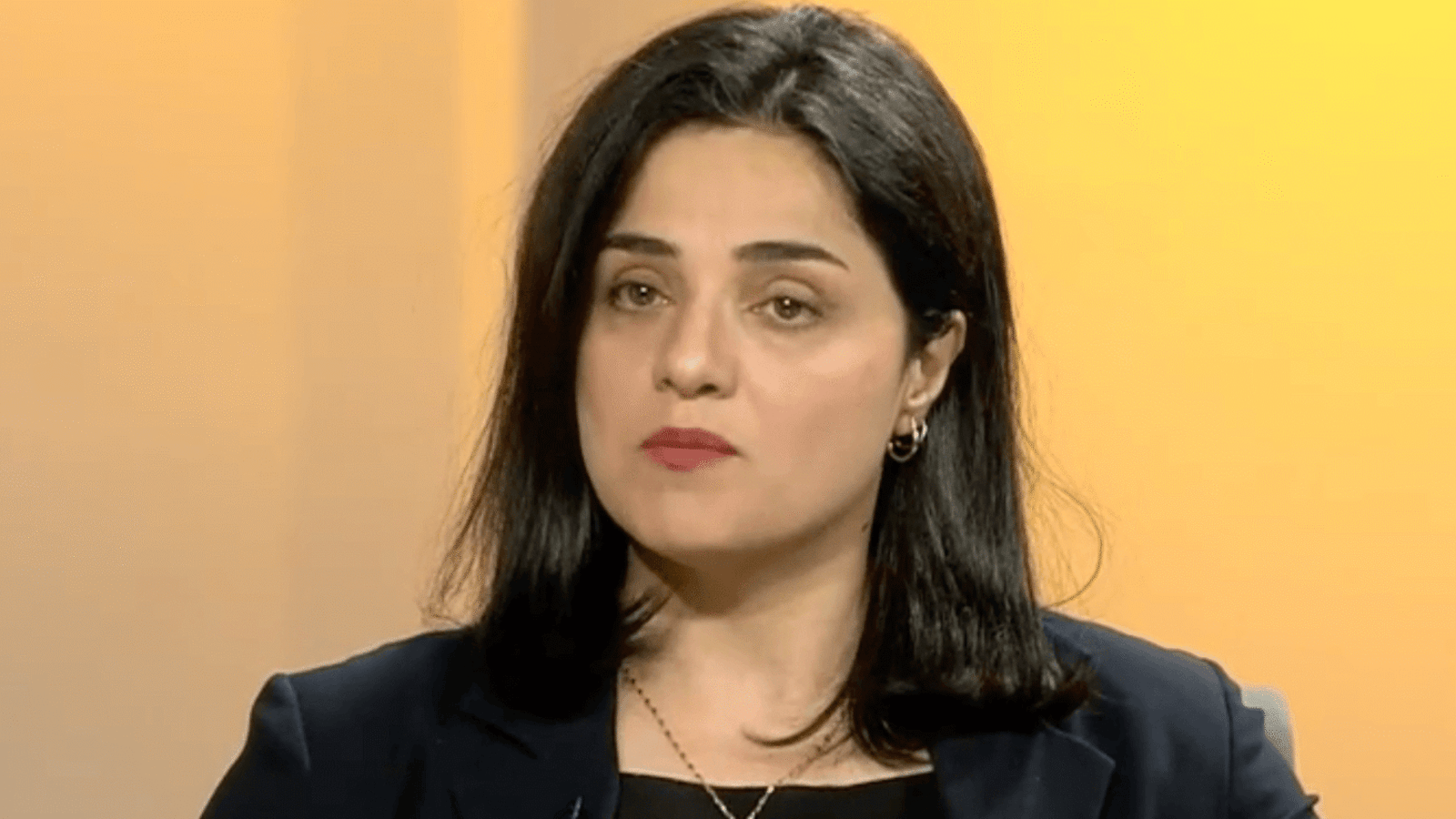
In this ECPS interview, Dr. Soheila Shahriari offers a theoretically grounded diagnosis of Rojava’s most precarious post-ISIS moment. She argues that the Autonomous Administration of North and East Syria should be understood not as a wartime improvisation, but as a long-evolving counter-hegemonic project rooted in democratic confederalism, gender equality, pluralism, and social ecology. Yet Dr. Shahriari underscores a stark geopolitical constraint: without formal recognition and enforceable guarantees from Western actors—especially the EU and the United States—Rojava lacks the diplomatic leverage to secure a durable decentralized settlement with Damascus. The interview explores how instrumental Western engagement, Turkey’s securitization paradigm, and Syria’s recentralization drive converge to endanger non-state democratic experiments. It also examines diaspora mobilization, the global resonance of Kurdish women’s politics, and the fragile future of local partnerships in conflict zones.
Giving an interview to the European Center for Populism Studies (ECPS), Dr. Soheila Shahriari from École des Hautes Études en Sciences Sociales (EHESS) in France offers a wide-ranging and theoretically grounded assessment of the Autonomous Administration of North and East Syria (Rojava) at a moment of profound uncertainty. As shifting regional alignments, great-power bargaining, and Syrian state consolidation converge to narrow the space for Kurdish self-rule, Dr. Shahriari situates Rojava not merely as a wartime anomaly but as a counter-hegemonic democratic experiment struggling to survive in an international system dominated by state sovereignty, realpolitik, and authoritarian resurgence. The interview is organized around a central warning captured in the headline: Without formal recognition and protection from Western actors, Rojava lacks the diplomatic leverage necessary to secure a durable decentralized settlement with Damascus.
Dr. Shahriari argues that the current crisis stems less from military weakness than from structural diplomatic isolation. Despite their decisive role in defeating ISIS alongside the United States, Kurdish-led forces failed to convert battlefield legitimacy into institutional guarantees. The January ceasefire and negotiations over integration into Syrian state structures illustrate the narrowing options available to the Autonomous Administration under pressure from Damascus, Ankara, and shifting US priorities. In this context, Dr. Shahriari emphasizes that external recognition is not symbolic but constitutive of survival: without enforceable guarantees from actors such as the European Union and the United States, any decentralization arrangement risks becoming a temporary tactical compromise rather than a stable power-sharing order.
At the same time, the interview highlights the distinctive ideological and institutional character of the Rojava project. Dr. Shahriari describes it as an anti-statist political paradigm rooted in democratic confederalism, gender equality, pluralism, and ecological principles—an alternative model of governance emerging amid global democratic recession and Middle Eastern authoritarian consolidation. The conversation also explores how women-led institutions function as a “symbolic infrastructure” of resilience, how diaspora activism and transnational networks have reshaped Kurdish political imaginaries, and how the global visibility of Kurdish women fighters transformed international legitimacy. Yet these achievements, she notes, have not translated into formal diplomatic recognition, leaving the experiment vulnerable to geopolitical bargaining among states.
The interview also examines the structural limits of liberal internationalism and the instrumental nature of Western engagement with non-state democratic actors. Dr. Shahriari contends that Western powers’ prioritization of strategic alliances—particularly with Turkey—over normative commitments has undermined both Rojava’s prospects and the credibility of democratic rhetoric. Consequently, the future of Kurdish self-administration depends not only on negotiations with Damascus but on whether Western governments are willing to move from tactical cooperation to institutional protection.
Ultimately, Dr. Shahriari frames Rojava’s predicament as emblematic of a broader tension in contemporary world politics: the clash between innovative democratic experiments and an international order still organized around sovereign states and security competition. Whether Rojava becomes a model of negotiated decentralization or a casualty of regional power politics, she concludes, will depend on the availability of credible external guarantees—without which even the most resilient non-state democracy faces structural vulnerability.
Professor Jeffrey Kopstein argues that Trumpism is best analyzed not primarily as populism, but as patrimonial rule—where “the state itself becomes an extension of the ruler’s household” and governance turns into “a family business.” In this ECPS interview, Professor Kopstein distinguishes patrimonialism from classic competitive authoritarianism: rather than merely “tilting the playing field,” patrimonial leaders seek to “own the entire field.” He traces how loyalty tests, selective legality, and the “monetization of office” reshape elite incentives and accelerate institutional hollowing. Drawing on Weberian theory, Professor Kopstein warns that irreversibility arrives when career survival depends on pleasing a patron rather than serving an office—and when the line between public and private interests starts to seem “quaint.” The interview also examines selective impunity, conditional judicial autonomy, personalized coercion, and why democratic resistance must target structural vulnerabilities rather than “waiting for collapse.”
Giving an interview to the European Center for Populism Studies (ECPS), Jeffrey Kopstein, Professor of Political Science at the University of California, Irvine, offers a conceptually rigorous reinterpretation of Trumpism that moves beyond the familiar vocabulary of populism and competitive authoritarianism. Anchored in Weberian state theory and comparative authoritarianism, Professor Kopstein argues that the most analytically precise framework for understanding the contemporary transformation of American governance is patrimonialism—a form of rule in which the state is treated as the personal domain of the leader. As he memorably puts it, under patrimonial logic “the state itself becomes an extension of the ruler’s household,” collapsing the boundary between public authority and private interest and turning governance into what he repeatedly calls “a family business.”
Professor Kopstein’s intervention challenges dominant scholarly narratives that focus primarily on rhetoric, electoral manipulation, or ideological polarization. While competitive authoritarianism “rigs the game,” he contends, patrimonialism seeks something more radical: ownership of the system itself. In his words, the logic is “not simply to tilt the playing field, but to own the entire field.” This shift, he suggests, captures a deeper transformation from constitutional republicanism toward personalized rule structured by loyalty, selective legality, and the monetization of office. Trumpism, he argues, is best understood through this lens because its defining features—“loyalty tests, public humiliation of subordinates, monetization of office, and the personalization of coercive authority”—are not incidental pathologies but the governing principle of the system.
A central theme of the interview is institutional hollowing. Drawing on Max Weber’s theory of modern bureaucracy, Professor Kopstein explains how privileging personal loyalty over professional expertise erodes state capacity from within. When career advancement depends on pleasing the patron rather than serving impersonal offices, information deteriorates, policy becomes erratic, and public goods provision declines. The critical threshold, he warns, is reached when citizens and elites alike lose the ability to distinguish between public and private interests—when that distinction begins to seem “quaint.” At that point, patrimonial consolidation is effectively complete.
Equally significant is Professor Kopstein’s analysis of elite incentives. When public office becomes a revenue stream, neutrality becomes costly and adaptation becomes rational. Economic success increasingly depends not on market entrepreneurship but on proximity to power, reversing the conventional liberal assumption that wealth generates political influence. In patrimonial systems, he notes, the causal arrow often runs in the opposite direction: political power produces wealth. This dynamic helps explain why scandals, legal controversies, or reputational crises frequently fail to weaken such regimes. Surviving scandal without consequences signals immunity and reinforces an aura of invincibility among supporters.
By reframing Trumpism as a patrimonial project rather than merely a populist movement, Professor Kopstein invites scholars to redirect analytical attention from mass ideology to elite control over institutions, resources, and coercive capacity. The interview thus situates contemporary American politics within a broader comparative perspective on personalist rule, offering a sobering account of how democratic systems can be gradually transformed without the overt dismantling of formal institutions.
Here is the edited version of our interview with Professor Jeffrey Kopstein, revised slightly to improve clarity and flow.
Not Tilting the Field but Owning It: Trumpism as Patrimonial Rule
US President Donald Trump delivers a speech to voters at an event in Phoenix, Arizona. Photo: Danny Raustadt.
Professor Jeffrey Kopstein, thank you so much for joining our interview series. Let me start right away with the first question: In yourPersuasionarticle, you argue that Trumpism represents a shift from constitutional republicanism toward patrimonial rule. Conceptually, how does this transformation differ from classic competitive authoritarianism, and why does patrimonialism better capture the logic of power under Trump?
Professor Jeffrey Kopstein: First of all, thanks so much for having me. Competitive authoritarianism—I’m not a specialist on exactly that concept, but I’ve read it, and I know Lucan Way very well—refers to regimes that manipulate electoral competition while preserving institutional arenas as sites of contestation. Elections still matter, courts still operate, and opposition exists, albeit under constraints.
By contrast, patrimonialism treats the state itself as an extension of the ruler’s household. It becomes a family business. Offices turn into instruments of personal loyalty, law is applied selectively, and the boundaries—most importantly—between public power and private benefit collapse. The logic here is not simply, to use their language, to tilt the playing field, but to own the entire field. In this view, the state is a family business.
Stephen Hanson and I argue that Trumpism is better understood in patrimonial terms because its defining features are loyalty tests, public humiliation of subordinates, monetization of office, and the personalization of coercive authority. These are not incidental excesses; they are the governing principle. If I could leave you with a sound bite, competitive authoritarianism rigs the game, whereas patrimonialism claims ownership of the stadium.
When Pleasing the Patron Overrides Serving the Office
Drawing on Weberian theory and your work on modern statehood, how does the systematic privileging of personal loyalty over bureaucratic expertise in the US reshape state capacity—and at what point does institutional hollowing become politically irreversible?
Professor Jeffrey Kopstein: Let’s go back to Weber. It’s always the right thing to do. Weber argued that modern statehood depends on impersonal offices and expertise. When loyalty replaces competence, three things happen: information degrades, exits increase, and compliance becomes politicized. Policies become erratic, feedback loops collapse, and public goods deteriorate.
Irreversibility sets in not in a single legal moment, but when expectations shift—when career incentives depend on pleasing the patron rather than serving the office. At that point, even restoration-minded elites begin to hesitate to act.
So, there is no single point of no return, but it arrives when survival in government depends on loyalty rather than competence. We are not in a perfect patrimonial world yet in the United States. The way I would put it is this: our notion of the state depends on a clear separation between the public interest and the private interest. When we are no longer able to understand that difference, when it seems quaint, then we will know that the patrimonial regime has fully consolidated.
From Market Entrepreneurship to Proximity to Power
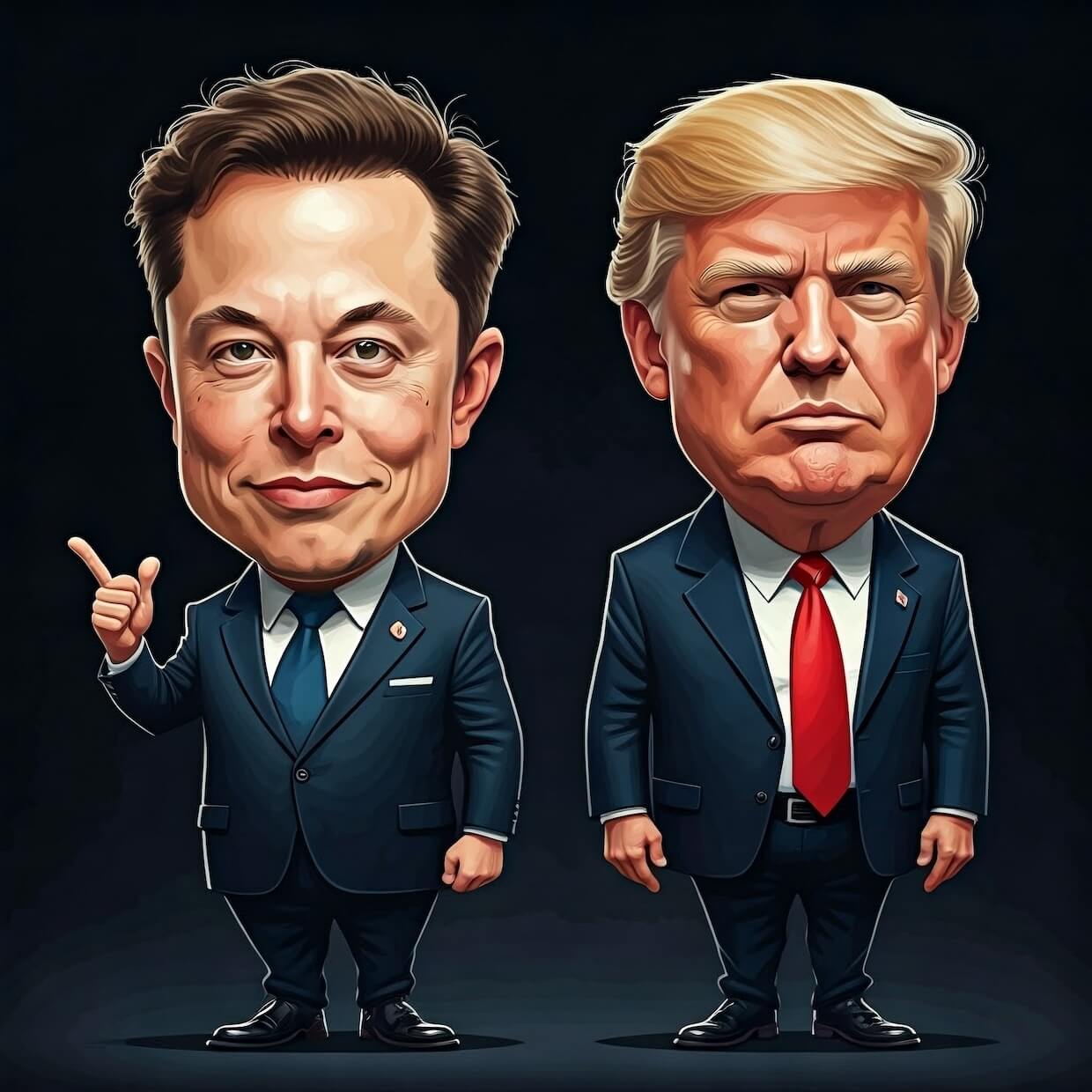
Caricature: Shutterstock.
You describe the Trump presidency as collapsing the boundary between public authority and private enrichment. How does this blurring alter elite incentives, especially among business, judicial, and security elites who must decide whether to resist, adapt, or profit?
Professor Jeffrey Kopstein: It’s a really important question. Clearly, Trump has been very busy turning the state into a family business, and as we say in the article, business is booming. When public office becomes monetizable, elites shift incentives toward adaptation and profit rather than resistance. And we see that already. We see that with chip makers; rather than economic entrepreneurship, it’s proximity to power that determines whether you are a rich elite. We just saw that this last week with Anthropic and AI.
If you’re out of favor with the government, they can, sort of, crush you. Even in that dust-up between Elon Musk and Trump, it’s super interesting. Here you have the richest man in the world versus the most powerful man in the world, and in that fight, my judgment is Trump crushed him like a bug. It was not close. We’re used to thinking in the United States—and basic political science says—that if you’re rich, that gives you power, that economics determines political power. But in many parts of the world, and at many times in history, it’s actually the reverse: great power yields great wealth. And I think we’re starting to see that in the United States. So, the bottom line is that when office becomes a revenue stream, neutrality becomes a liability.
In Patrimonial Systems, Scandals Create an Aura of Invincibility
How should scholars interpret the political effects of the Epstein files and Trump’s alleged proximity to that scandal—not in moral terms, but as a demonstration of selective impunity within a patrimonial system? Under what conditions do scandals cease to delegitimize power and instead reinforce it?
Professor Jeffrey Kopstein: In patrimonial systems, surviving scandal often reinforces power. Scandals cease to delegitimize authority when media ecosystems are polarized, selective enforcement is normalized, and elites expect law to be wielded strategically rather than neutrally.
So, under these conditions, I think proximity to scandal that produces no consequences signals immunity—that they can’t be punished. And everybody understands this. So, people stop thinking in terms of enforcing the law, or in terms of, is Trump competent? Is he crazy? Is he a pervert? I mean, all of those things become sort of uninteresting. It’s not that people won’t continue to try; it’s that each one of those he survives within a patrimonial regime doesn’t weaken him—it actually strengthens him, because it creates this aura of invincibility.
So, the bottom line is that, in a rule-of-law system, the kinds of things that would have disqualified Trump long ago—in a patrimonial system—succeed, at least for his most ardent followers, in creating, to put it in Weberian terms, for the leader and his staff, a kind of image of strength.
Patrimonial Stability Rests on Ambition, Fear, and Beneficiaries
Comparatively speaking, how does Trump’s apparent insulation from reputational or legal consequences resemble patterns observed in other patrimonial regimes, such as Russia, Turkey, or Hungary? Is this best understood as elite coordination failure or as successful authoritarian learning?
Professor Jeffrey Kopstein: Does it have to be either? It could be both. Insulation from consequences reflects both coordination failure and successful authoritarian learning. The fragmentation of opposition enables consolidation, and we see that with the Democratic Party in the United States right now. It’s somewhat of a mess, although they are trying to find their footing.
In Hungary, we’re going to see what happens. Orban has succeeded, in a sense, in playing the opposition like a fiddle. He appears to be threatened right now, and we will see whether he moves toward a full authoritarian route, as opposed to the competitive authoritarian route, though he may. The same dynamic applies to Turkey as well—though you would know much better than I do. My understanding is that it is also in a similar situation. Over time, rulers manage elites through selective reward and punishment, especially through court-politics dynamics. People at the top, if they begin opposing, either leave—or, if the regime is fully consolidated, as in Russia, they may face physical liquidation.
Now, in most patrimonial regimes, it is not like Russia. You can have patrimonialism in both a democracy and a dictatorship; the line runs orthogonal to the distinction between the two. It is not coterminous with it. Patrimonial stability does not require universal support. It relies on individualized ambition and fear. There are large numbers of distributional beneficiaries of Erdogan, of Orban, of Netanyahu in Israel, and now increasingly of Trump in the United States. So, yes.
Courts Persist Under Patrimonialism but Align in Political Cases
The US Supreme Court building at dusk, Washington, DC. Photo: Gary Blakeley.
You note that courts rarely disappear under patrimonialism but instead become conditionally autonomous. How does the high rate of judicial alignment with Trump administration interests reshape expectations about the judiciary as a democratic backstop?
Professor Jeffrey Kopstein: I think you raise a really important point. Even in a patrimonial regime, even in an authoritarian regime, for the most part courts continue to exist. They handle normal matters—inheritance, ordinary criminal behavior, standard criminal law—but here we are really talking about political cases, cases that deal especially with the power of the executive.
Under those circumstances, the courts begin to align with the patron. You see that somewhat in the United States. There are already things that people on the Court want. Those who, for example, are interested in libertarian ideas hope Trump will deliver them, although Trump is not a pure libertarian. Those interested in Christian nationalism in the United States hope he will give them what they want as well. Those interested in enhanced executive authority—there are some on the Court in that camp too—are also aligned with the Federalist Society and want that outcome. They, of course, expect Trump to deliver it.
That said, there are certain issues on which the Court will resist. We saw that in the case of tariffs, where the Court ruled against Trump. They may still allow him to pursue similar goals by other means. Over time, the Court figures out how far it can contradict the great father figure—which is what patrimonialism actually implies—and where it cannot.
From a patrimonial perspective, how does the use of agencies such as ICE—operating with diminished oversight and heightened personal loyalty—alter the relationship between citizens and the state? Does this represent bureaucratic drift or deliberate personalization of coercion?
Professor Jeffrey Kopstein: It could be both, but patrimonialism really highlights the personalization of coercion. If you look at the US budget right now, Trump has, on purpose, cut a huge number of regular bureaucratic jobs, which appears to align exactly with what one would expect Republicans to do. However, the budget has not gone down.
They have actually created this huge new bureaucracy that is personally dependent on Trump, and that’s ICE. And it’s becoming not just a personal empire; it’s becoming something like a real estate empire. They’re acquiring a lot of territory, which, of course, Trump likes—real estate. So this personalization of coercive agencies is deliberate. It takes away not only from legal oversight, but also removes or disempowers people who are not personally dependent on Trump.
Thus, the legal forms remain while the zones of exceptional enforcement expand. When oversight weakens and loyalty is rewarded, enforcement becomes personalized. It becomes somewhat theatrical. The objective is not efficient enforcement, but loyal enforcement. Those two things can overlap, but they can also be very different.
Episodic Force and Symbolic Threat as Tools of Control
Border Patrol agents monitor an anti-ICE protest in downtown Los Angeles, June 8, 2025. Demonstrators rallied against expanded ICE operations and in support of immigrant rights. Photo: Dreamstime.
Unlike 20th-century dictatorships, Trumpism relies less on mass repression and more on episodic coercion and symbolic threat. How much actual violence is necessary for patrimonial consolidation in a mature media democracy?
Professor Jeffrey Kopstein: I’ve written pretty extensively on this. Consolidation does not require mass repression. There has been a lot of discussion of fascism and totalitarianism and all that kind of stuff, Hanson and I worry about it a great deal. But what is probably also true is that selective, visible coercion effectively reshapes expectations. A few exemplary punishments communicate risk pretty broadly. It’s not to say that there won’t continue to be resistance to ICE. We saw that in Minnesota; we’ve seen it in other places. I’m here in California, where we have a pretty active resistance, and our state government—California has 40 million people; it’s a country—has continued to resist. But ICE is still around; it’s in my neighborhood. It doesn’t need to terrorize everyone; it only needs to make everyone calculate as if it could. And that’s the case. It changes expectations.
Succession Anxiety Is the Structural Weakness of Personalist Rule
You argue that succession is the Achilles’ heel of patrimonial regimes. How does Trump’s discourse around a third term function strategically to freeze elite expectations and delay post-Trump realignments?
Professor Jeffrey Kopstein: It’s absolutely crucial. As you said, succession is the Achilles’ heel of a patrimonial regime. Under most circumstances, patrimonialism is the oldest form of government in the world. Under most circumstances, patrimonialism is related to kingship or queenship. It passes on through the royal family. Of course, remaking the state as a family business in the modern world—we don’t have kings or queens anymore—so you would think it would pass through his family. It doesn’t seem all that likely in Trump’s case that the sons are going to be the successors. Interestingly, the daughter Ivanka is probably the most cognitively fit to be the successor. But patrimonial women don’t do very well either.
But the key here is that personalist regimes destabilize when elites anticipate an endpoint. So, signaling negotiable terms that that endpoint may not come freezes expectations and discourages hedging. As the end comes closer, the staff start scrambling like rats on the deck of a sinking ship. And the whole point of this third-term discussion—which he may very well want, and I don’t think he could easily get, but he will try, and it is to be taken extremely seriously as a pressure point against the consolidation of a patrimonial regime—is that it is extremely important that it be opposed, because it’s all about maintaining the leader and his staff. And if the staff see that endpoint, the regime itself becomes destabilized. So, yes, succession anxiety is the Achilles’ heel of a patrimonial regime. All experience shows that.
To what extent does labeling Trumpism as “populist” obscure its deeper patrimonial logic? What analytical errors follow if scholars focus too heavily on mass ideology rather than elite control of resources and institutions?
Professor Jeffrey Kopstein: I think it’s really important. On the one hand, populism—most of political science, most scholars, most social science are very interested in this, and populism is part of it—focuses on how people come to power, the rhetoric, the appeal, and how they stay in power. What patrimonialism looks at is something different: it examines what they do when they come to power, how they actually govern. Governance is extremely important, and populism, we think, obscures patrimonial control. It highlights rhetoric.
Patrimonialism highlights elite control over appointments, enforcement, resources—things that populism doesn’t talk about at all. The two aren’t completely contradictory, but they address really different dimensions. So, populism, or dictatorship versus democracy, is part of a discourse concerned with how leaders come to power and stay in power. Patrimonialism is interested in what they do to the state once they come to power. And that’s just something very different.
Foreign Policy as Regime Maintenance by Other Means
US Army advances during a demonstration at MCAS Miramar, October 5, 2008. Photo: Anton Hlushchenko / Dreamstime.
How does Trump’s coercive, transactional foreign policy—toward NATO allies, territorial revisionism (as in Greenland), and extraterritorial enforcement—serve domestic patrimonial consolidation rather than traditional strategic goals?
Professor Jeffrey Kopstein: As we’re talking about this, of course, the world’s foreign policies are in great flux and turmoil with what’s going on in the Middle East. One of the things about patrimonialism is that patrimonial leaders, because they have a very traditionalist view, no longer see borders as legal; they view them as historical and traditional—fuzzy, if you will—and that really works at odds with the modern world.
Even more important than that, they view their relations with other countries, as you said, as transactional. Transactional diplomacy dramatizes sovereignty and creates distributable rents for loyalists. So, who’s going to control Greenland? Will it be Donald Trump Jr. creating mines for strategic minerals that university professors will be forced to work in like a gulag? I don’t think so, but that’s the idea.
So, foreign policy becomes a sort of regime maintenance by other means. It’s an extension. Traditional international relations tends to ignore the makeup, the regime type, of domestic politics, but we think that foreign policy—and Trump’s foreign policy in particular—is especially driven by this domestic makeup, by domestic politics.
Patrimonial Stability Depends on Cohesion Between Leader and Staff
From a comparative international perspective, how likely is it that sustained allied resistance and strategic balancing against the United States could feed back into domestic regime instability—or do patrimonial rulers generally externalize such costs successfully?
Professor Jeffrey Kopstein: They can. It’s an excellent question, and we don’t have a great answer to that, to be honest. But, on the one hand, foreign wars—and we’re in one right now—can produce a sort of rally-around-the-flag phenomenon, although in the United States right now my understanding is that the war, the bombing of Iran, is not very popular.
But here’s the point: external resistance destabilizes only if it fractures key domestic elites. That’s the point. Again, Weber and patrimonialism tells us, that you need to look at the relationship between the leader and his staff.
And so it only works—it only destabilizes—if it fractures the elites underneath the leader. And why? Because balancing imposes costs. Destabilization occurs when those costs split the coalition. So, that’s how I would answer that, although our emphasis is really not on foreign policy. But it’s an important question.
When the State Becomes a Family Business, Public Goods Deteriorate
You emphasize that patrimonial regimes are structurally bad at providing public goods. What kinds of policy failures—climate disasters, pandemics, financial crises—are most likely to puncture the aura of inevitability surrounding Trumpism?
Professor Jeffrey Kopstein: What you would expect from a patrimonial regime, as you said quite correctly, is that as a bureaucracy based on merit recruitment is degraded and becomes a plaything of the family business, you would see a systematic under-provision of public goods, or only those public goods that serve the interests of the extended household of the leader being provided. So, you’d expect two things to happen. One—and the one you pointed to—is that when we need the state to respond to disasters, and we saw this with COVID, but you can also see it with financial crises and other kinds of public health breakdowns, there is an institutional halt. When we need the state, what the state represents under those circumstances is a hedge against disaster. And so we need the state, and we may not have it.
I’m living here in California. We get earthquakes. If we need the state after a really bad earthquake, if it has been degraded enough, we won’t have it. But there’s a second type of deterioration that is slower moving, and that is the under-provision of public goods for things like roads, bridges, and airports. Over time, what you should see is public infrastructure decaying, and we already have that in the United States, and it’s going to get worse. I live next to the second-largest city in the United States, Los Angeles, and the airport here is like a third-world airport. It’s not really being built up or maintained. That’s called LAX (Los Angeles International Airport). You should expect to see much of the public infrastructure in the United States start to look more and more like LAX.
Effective Opposition Raises the Costs of Loyalty and Lowers the Costs of Exit
“No Kings” protest against the Trump administration, New York City, USA — June 14, 2025. Demonstrators march down Fifth Avenue as part of the nationwide “No Kings” movement opposing President Donald Trump and his administration. Photo: Dreamstime.
And finally, Professor Kopstein, given your critique of “waiting for collapse,” what forms of democratic resistance are most effective against patrimonial rule? Specifically, how can opposition forces exploit structural weaknesses—succession anxiety, declining popularity, and governance failure—without reinforcing siege narratives?
Professor Jeffrey Kopstein: That’s the hardest question you’ve asked yet, but I want to reinforce the assumption we make, and as we wrote in this article, that we should not expect scandal, incompetence, the Supreme Court, nor foreign policy failures to save us. None of those things will probably work. Patrimonial leaders are pretty good at dealing with all of them. The weaknesses of patrimonialism, as we’ve been discussing, are much more structural, as you said quite explicitly. They’re slow-moving. They’re unspectacular. So, we’ve talked about splits, succession failures, institutional hollowing—things that are slow-moving and fly under the radar. That is why it is so difficult for us to deal with this type of regime, to understand it, and to expose it.
So, I think focusing on succession and undermining inevitability is key. That is why each congressional House race matters: if you can show that the Democrats won by more than expected, or that Trump did not win by as much as he expected in a particular district, that punctures the aura of inevitability. Most important is to connect governance failures to institutional hollowing. That is the key weak point here—to connect those two—and to avoid rhetoric that is easily reframed as elite disdain. The bottom line is: don’t wait for collapse. Raise the costs of loyalty, fracture the elite, and lower the costs of exit.
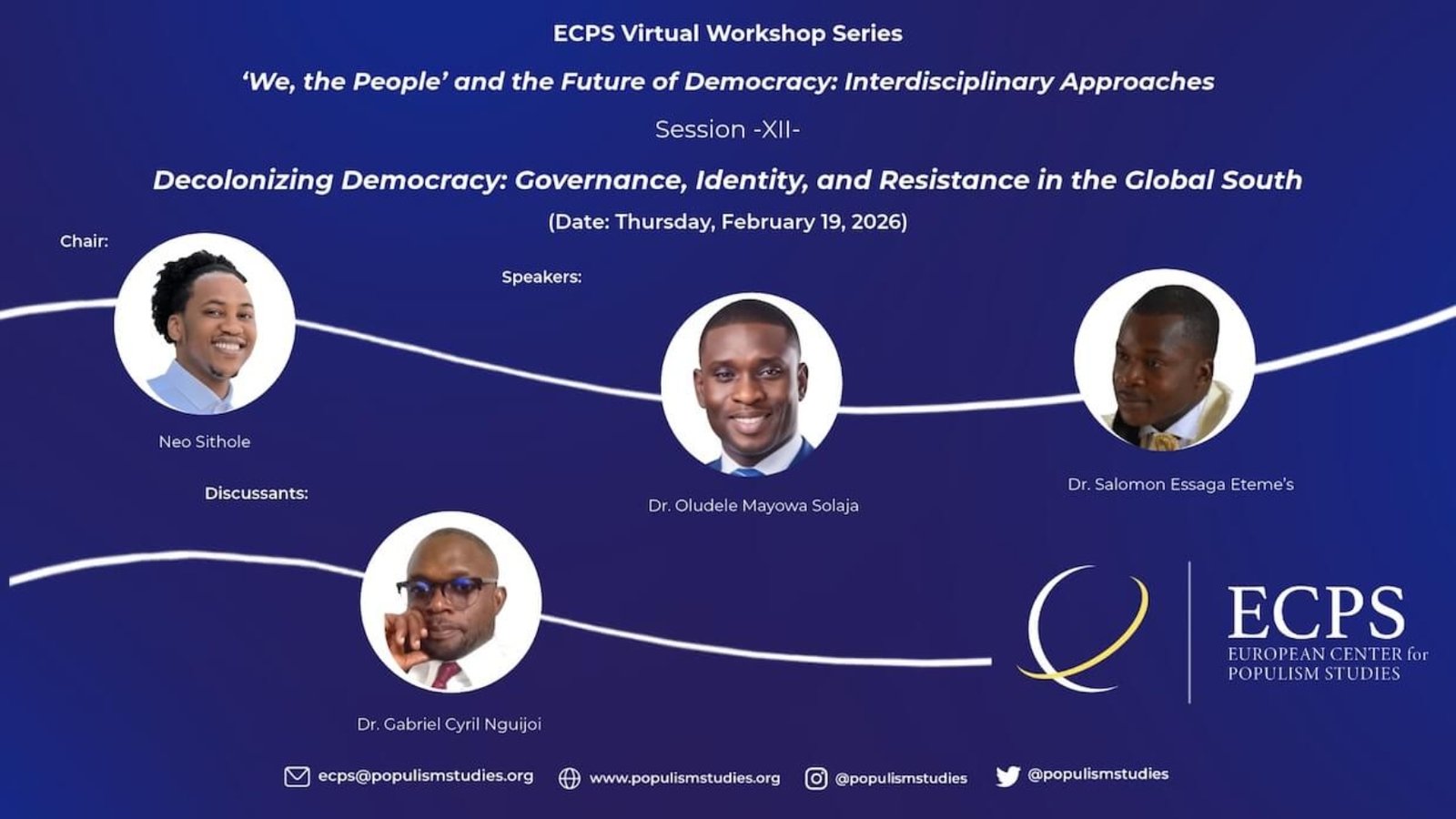
Along Nigeria’s vulnerable coastline, climate change is not a projection but a daily struggle shaping survival, governance, and democracy. In this incisive commentary, Dr. Oludele Solaja reveals how communities—from Lagos to Cross River—are filling critical gaps left by weak institutions, organizing drainage cleanups, mangrove restoration, and informal warning systems to confront flooding, pollution, and shoreline loss. These grassroots practices constitute “climate security from below,” challenging state-centric narratives that equate security with national planning alone. Yet this resilience also exposes deep democratic deficits, as citizens assume responsibilities that should belong to public authorities. The Nigerian case calls for a rethinking of climate security—one that bridges community initiative with accountable governance and recognizes local actors not as substitutes for the state, but as indispensable partners in building sustainable, democratic adaptation.
By Oludele Solaja*
Along the Nigerian coast, climate change is not a distant forecast; it is an everyday reality. Floodwaters inundate homes. Shorelines relentlessly recede. Saltwater contaminates freshwater supplies. Drains choke with plastic refuse, transforming streets into temporary lakes when the rains arrive. For those in the Niger Delta and adjacent coastal areas, climate insecurity is not a concept but a lived experience.
Yet climate security is often discussed in terms of state stability, resource conflicts, or national-level adaptation planning. On the ground, the picture is very different. In many parts of the Nigerian coast, securing the climate is a local endeavor—it is climate security from below.
All along Nigeria’s long coastal belt—from Lagos in the west to Cross River in the east—communities are filling governance gaps caused by weak infrastructure, state absenteeism, and an economy structured around extractive activities. Their everyday efforts to prevent environmental hazards, safeguard livelihoods, and protect daily life from environmental instability constitute a concrete instance of climate security from below.
Climate Risk and Governance Gaps
Among all regions of Nigeria, the coastal zone—characterized by high population density, vital ecosystems, and extensive oil-sector industrial development—is one of the country’s most climate-sensitive areas. Devastating nationwide floods (2012 and 2022) caused massive population displacement (UN OCHA, 2023), while the low-lying areas of the delta region are vulnerable to flooding due to the combined effects of sea-level rise and subsidence. The persistent and serious pollution of marine and coastal areas by oil (UNEP, 2011; World Bank, 2021) is another major challenge to the region’s resilience, in addition to the issue of waste disposal.
However, these climate hazards do not operate independently of existing governance failures: the most basic measures of environmental protection—drainage, waste management systems, shoreline stabilization, and adaptation measures—are still absent from the majority of coastal Nigerian communities even after over half a century of oil production. The institutions responsible for addressing these hazards often exist only on paper rather than being effectively implementable, and are seen by communities as out of reach, lacking sufficient resources, or being overly controlled by industrial corporations (Watts, 2004; Adekola & Mitchell, 2011).
National planning and large infrastructure projects have come to dominate official discourse on climate security. However, daily maintenance tasks—such as unblocking drainage channels and maintaining vegetation cover along coastlines—appear to receive little attention. The resulting governance gaps mean that environmental risks mount even as the ability of institutions to respond to them fails to keep pace. The response? Communities themselves have filled these gaps.
Everyday Climate Security
Across the Nigerian coast, locals organize cleanups of drainage channels in anticipation of the rains. Youth groups remove plastic waste from waterways. Local fishers actively plant mangrove trees that offer protection from storm surges, and some local leaders invest in manually reinforcing shorelines. Informal communication networks are established to disseminate warnings during extreme weather events. These actions perform critical climate-security functions: clearing waterways reduces flooding risks, planting mangroves strengthens coastlines, waste removal enhances public health, and social networks bolster community solidarity during critical moments.
This is climate security lived through everyday practice. It involves the extensive use of local ecological knowledge—the implicit understanding of local tidal systems, sedimentation processes, vegetation cover, and flood dynamics that formal engineering approaches sometimes fail to capture (Berkes, 2018). These efforts are frequently outside state plans, organized through communal labor, volunteers, and community associations (Adger et al., 2005; IPCC, 2022). This form of security has moved from a distant policy objective to a matter of routine—often invisible, often unpaid—maintenance that ensures continued habitation in these communities.
The Politics of Resilience
However, community agency is only one aspect of the story. It reveals deep democratic deficits in Nigeria’s governance landscape. Many communities in Nigeria’s coast have had minimal participation in environmental decision-making and very limited input in planning related to coastal infrastructure (Adekola & Mitchell, 2011). Environmental damage and subsequent exclusion caused by the operations of the oil industry in the Niger Delta continue to fuel local suspicion and resentment of both the state and oil companies (UNEP, 2011).
Dominant narratives about national development tend to focus on megaprojects, especially those involving infrastructure such as new highways and expanding coastal reclamation schemes, instead of the vital work of maintaining drains or planting mangroves. Communities therefore take on tasks that ought to be part of municipal governance. On the one hand, this enhances community resilience; yet, on the other, it may inadvertently normalize state withdrawal and a general lack of commitment from both national and subnational governments. When people do not expect the municipality to respond, self-help becomes the norm, and they may no longer notice the absence of this state function. Climate security from below becomes both a function of and evidence of failed state governance. Understanding this dynamic is critical; the ability of a community to exhibit resilience through its own actions should not serve as justification for abandoning its rights to a participatory state governance structure.
Informality and Legitimacy
A significant proportion of this community-based environmental management along Nigeria’s coast operates informally. There are no municipal plans that document these practices, nor are there official funds allocated to support them, yet they possess strong local legitimacy. The practice of collective labor and a long tradition of shared ownership over local environments continue to be powerful social resources. The application of indigenous ecological knowledge enhances their efficacy, given that local actors may possess more detailed knowledge of flood dynamics than engineers. For instance, locally managed mangrove planting may have higher survival rates than centrally implemented technical solutions that are often not sensitive to local ecology (Berkes, 2018; IPCC, 2022). Nevertheless, informality means that these efforts struggle when faced with widespread industrial pollution or encroaching urban waste. Sustained resilience under such conditions requires not only community initiative but also institutional support and legitimacy.
Rethinking Climate Security
The Nigerian case thus requires a reconsideration of conventional understandings of climate security. Security may not simply entail preventing conflict and safeguarding states but also includes the protection of livelihoods, human health, and natural ecosystems threatened by contemporary climate change processes. In the Global South, resilience is emerging first in informal, grassroots, locally managed communities rather than through national adaptation planning.
To achieve sustainable climate security, bridging grassroots efforts and inclusive state governance institutions must be a priority. Formal acknowledgement of these community-led adaptations within national adaptation frameworks, cooperative frameworks integrating local knowledge and technical capacity, participatory planning mechanisms to overcome democratic gaps, small-scale climate financing to support community projects without over-bureaucratization, as well as the integration of local ecological knowledge into formal assessments are some policy strategies. This reconfigures communities not as a substitute for the state but as legitimate and important partners in governance.
Conclusion
In fact, climate security is already being constructed from below on Nigeria’s coast—with drainage repair, mangrove planting, waste disposal, and vigilant self-policing, communities are managing daily life under accelerating environmental breakdown. This is indicative of both community strength and utter policy collapse simultaneously. The Nigerian case makes clear that strategies for climate security need to consider possibilities beyond the state and engage in discussions around daily security practices if adaptation is to become the practice of democratic, responsive statehood.
(*) Dr. Oludele Solaja is a faculty member in the Department of Sociology at Olabisi Onabanjo University in Ago-Iwoye, Ogun State, Nigeria.
References
Adger, W. N.; Hughes, T. P.; Folke, C.; Carpenter; S. R. & Rockström, J. (2005). “Social-ecological resilience to coastal disasters.” Science, 309(5737), 1036–1039.
Adekola, O. & Mitchell, G. (2011). “The Niger Delta wetlands: Threats to ecosystem services, their importance to dependent communities and possible management measures.” International Journal of Biodiversity Science, Ecosystem Services & Management, 7(1), 50–68.
Berkes, F. (2018). Sacred ecology (4th ed.). Routledge.
IPCC. (2022). Climate change 2022: Impacts, adaptation and vulnerability. Cambridge University Press.
UNEP. (2011). Environmental assessment of Ogoniland. United Nations Environment Programme.
UN OCHA. (2023). Nigeria floods situation report 2022–2023. United Nations Office for the Coordination of Humanitarian Affairs.
Watts, M. (2004). “Resource curse? Governmentality, oil and power in the Niger Delta.” Geopolitics, 9(1), 50–80.
World Bank. (2021). Climate risk country profile: Nigeria. World Bank Group.
In this ECPS interview, Dr. Soheila Shahriari offers a theoretically grounded diagnosis of Rojava’s most precarious post-ISIS moment. She argues that the Autonomous Administration of North and East Syria should be understood not as a wartime improvisation, but as a long-evolving counter-hegemonic project rooted in democratic confederalism, gender equality, pluralism, and social ecology. Yet Dr. Shahriari underscores a stark geopolitical constraint: without formal recognition and enforceable guarantees from Western actors—especially the EU and the United States—Rojava lacks the diplomatic leverage to secure a durable decentralized settlement with Damascus. The interview explores how instrumental Western engagement, Turkey’s securitization paradigm, and Syria’s recentralization drive converge to endanger non-state democratic experiments. It also examines diaspora mobilization, the global resonance of Kurdish women’s politics, and the fragile future of local partnerships in conflict zones.
Giving an interview to the European Center for Populism Studies (ECPS), Dr. Soheila Shahriari from École des Hautes Études en Sciences Sociales (EHESS) in France offers a wide-ranging and theoretically grounded assessment of the Autonomous Administration of North and East Syria (Rojava) at a moment of profound uncertainty. As shifting regional alignments, great-power bargaining, and Syrian state consolidation converge to narrow the space for Kurdish self-rule, Dr. Shahriari situates Rojava not merely as a wartime anomaly but as a counter-hegemonic democratic experiment struggling to survive in an international system dominated by state sovereignty, realpolitik, and authoritarian resurgence. The interview is organized around a central warning captured in the headline: Without formal recognition and protection from Western actors, Rojava lacks the diplomatic leverage necessary to secure a durable decentralized settlement with Damascus.
Dr. Shahriari argues that the current crisis stems less from military weakness than from structural diplomatic isolation. Despite their decisive role in defeating ISIS alongside the United States, Kurdish-led forces failed to convert battlefield legitimacy into institutional guarantees. The January ceasefire and negotiations over integration into Syrian state structures illustrate the narrowing options available to the Autonomous Administration under pressure from Damascus, Ankara, and shifting US priorities. In this context, Dr. Shahriari emphasizes that external recognition is not symbolic but constitutive of survival: without enforceable guarantees from actors such as the European Union and the United States, any decentralization arrangement risks becoming a temporary tactical compromise rather than a stable power-sharing order.
At the same time, the interview highlights the distinctive ideological and institutional character of the Rojava project. Dr. Shahriari describes it as an anti-statist political paradigm rooted in democratic confederalism, gender equality, pluralism, and ecological principles—an alternative model of governance emerging amid global democratic recession and Middle Eastern authoritarian consolidation. The conversation also explores how women-led institutions function as a “symbolic infrastructure” of resilience, how diaspora activism and transnational networks have reshaped Kurdish political imaginaries, and how the global visibility of Kurdish women fighters transformed international legitimacy. Yet these achievements, she notes, have not translated into formal diplomatic recognition, leaving the experiment vulnerable to geopolitical bargaining among states.
The interview also examines the structural limits of liberal internationalism and the instrumental nature of Western engagement with non-state democratic actors. Dr. Shahriari contends that Western powers’ prioritization of strategic alliances—particularly with Turkey—over normative commitments has undermined both Rojava’s prospects and the credibility of democratic rhetoric. Consequently, the future of Kurdish self-administration depends not only on negotiations with Damascus but on whether Western governments are willing to move from tactical cooperation to institutional protection.
Ultimately, Dr. Shahriari frames Rojava’s predicament as emblematic of a broader tension in contemporary world politics: the clash between innovative democratic experiments and an international order still organized around sovereign states and security competition. Whether Rojava becomes a model of negotiated decentralization or a casualty of regional power politics, she concludes, will depend on the availability of credible external guarantees—without which even the most resilient non-state democracy faces structural vulnerability.
Here is the edited version of our interview with Dr. Soheila Shahriari, revised slightly to improve clarity and flow.
Rojava Should Be Read as a Post-National Political Project, not a Wartime Anomaly
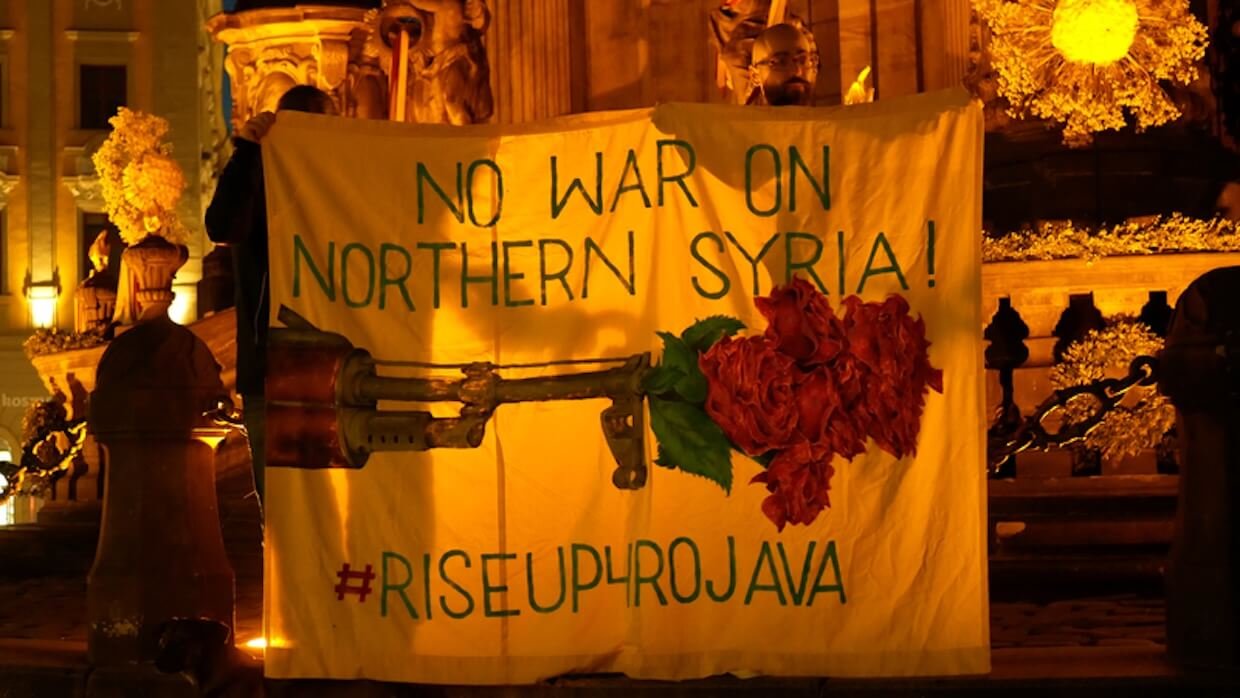
Kurdish demonstrators protest Turkey and President Recep Tayyip Erdoğan’s military operation in northern Syria, expressing support for Rojava and the YPG in Prague, Czech Republic on October 17, 2019. Photo: Dreamstime.
Dr. Soheila Shahriari, thank you so much for joining our interview series. Let me start right away with the first question: Your research frames Rojava as a counter-hegemonic democratic experiment emerging amid global democratic recession and Middle Eastern authoritarian consolidation. To what extent should Rojava be understood as a transformative model of post-nation-state governance versus a context-specific survival mechanism born of state collapse, particularly in a regional environment shaped by authoritarian resilience and populist Islamism and nationalism?
Dr. Soheila Shahriari: Thank you for having me. This is a very interesting question. I think reducing Rojava to a context-specific survival mechanism born of state collapse is analytically insufficient. While the collapse of state authority during the Syrian Civil War created the structural opening for Rojava’s institutional experiment, this was, to use Michel Foucault’s terms, a condition of possibility rather than the cause of Rojava’s emergence. These are two distinct things. Many argue that a power vacuum in Syria, combined with the withdrawal of Bashar al-Assad’s forces, explains Rojava’s emergence. But this was merely a facilitating condition, not the primary cause, and it is a somewhat simplistic way of understanding the issue.
Rojava can be described as post-national in some respects, but it differs from structures such as the European Union due to its distinct sociopolitical development and historical contingencies. It is better understood as an anti-state progressive political project grounded in women’s rights, pluralism, and ecological principles, operating within a hostile and authoritarian Middle Eastern environment.
It represents the institutionalization of a political paradigm that evolved over decades within the Kurdish movement, particularly through the theoretical trajectories associated with Abdullah Öcalan. The shift from Marxist-Leninist national liberation to democratic confederalism reflects a deep epistemological transformation—a move away from state sovereignty toward decentralized, council-based, multiethnic self-governance. Its pillars—radical democracy, women’s liberation, pluralism, and social ecology—are therefore not improvised wartime adaptations, but the product of sustained ideological development.
Rojava Transformed the Kurdish Imaginary from Ethno-Nationalism to Gender-Equal Pluralism
In your dissertation, you analyze how the Rojava revolution reshaped the Kurdish national imaginary in the diaspora, particularly through gender equality and pluralism. How has this transnational reconfiguration fed back into political mobilization within Kurdish regions themselves?
Dr. Soheila Shahriari: When we are talking about the Kurdish diaspora, we have to move beyond the conventional understanding of diaspora because of the particular situation of Kurdistan. Kurdistan has a very distinct dynamism in terms of its diaspora community, marked by intensely reciprocal political, cultural, and social engagement and ties between different parts of Kurdistan and the West. Political developments in one area feed directly and immediately into others. They are highly interconnected, forming a transnational political space shaped by the unique circumstances of the Kurdish question.
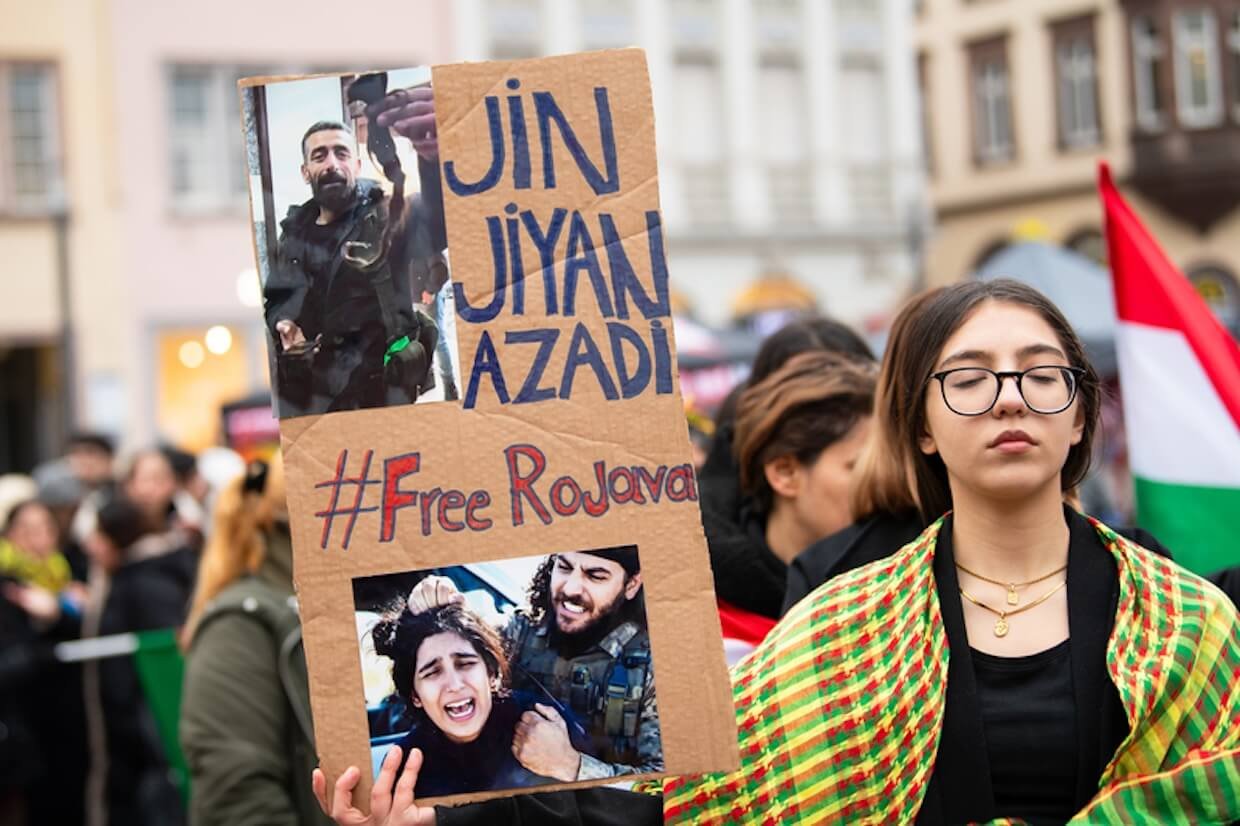
So, the Rojava Revolution has fundamentally reshaped the Kurdish national imaginary in my research, shifting it from a traditional nationalist framework toward a radically gender-equal and pluralistic new system of being. This transformation affects Kurds as a whole, not just in the diaspora or in the West. Evidence for this claim includes the women-led uprising in Kurdistan, inspired very directly by the slogan “Woman, Life, Freedom” (Jin, Jiyan, Azadi), which was the very first slogan of Rojava’s gender revolution.
This is one clear example of how developments in Rojava have fed back into Kurdistan itself. The influence from Rojava toward diaspora communities in the West, and the domino effect of Rojava across the Middle East, was visible in the women-led uprising in Rojhelat, or Iranian Kurdistan. It also elevated Kurdish actors as agents of democratization across the region, not just in Autonomous Administration of North and East Syria (AANES) but more broadly in the Middle East. Politically, this influence is visible in coalition-building and pluralistic alliances.
By coalition-building, I mean Rojava’s alliances with democratic forces—Arabs, Assyrians, Chaldeans, and other minorities—which have inspired Kurdish actors, especially in Iranian Kurdistan, to build coalitions with other national minorities across Iran against authoritarian central regimes. These are two telling examples of Rojava’s domino effect in the Middle East, especially in Iran: the women-led uprising in Iranian Kurdistan in 2022 and coalition-building with other national minority forces inside Iran, inspired by the same experience.
Women-Led Governance Is the Backbone of Rojava
Protest by Kurdish demonstrators following attacks on Rojava in northern Syria, Trier, Germany, January 24, 2026.
You argue that women-led governance structures in Rojava function as a “symbolic infrastructure” of democratic resilience. How sustainable is this feminist institutional architecture under conditions of militarization, economic blockade, diplomatic isolation, and the surrounding pressures of authoritarian and autocratic regimes?
Dr. Soheila Shahriari: First of all, the sustainability and mobility of Rojava’s feminist institutional architecture rests on its own radical resilience. Women-led governance structures, as you mentioned, are not merely symbolic but constitute foundational pillars of the political project. This is evident in the practical effectiveness of structures such as the co-presidency system, “Jineology” as an intellectual foundation of Rojava, the metamorphosis of the justice system in Rojava, and women-friendly structures like Mala Jin (Women’s Houses), the eco-feminist village of Jinwar, and women’s self-defense initiatives like the Women’s Protection Units (YPJ). These structures have demonstrated durability over a decade of conflict, yet their long-term viability is constrained by a geopolitical zero-sum game.
Again, the engagement of Rojava with Western allies in the fight against ISIS involved immense sacrifices, with 11,000 or 12,000 lives lost in the fight against ISIS, without securing formal international recognition or protection from Western allies. The problem starts here. When we look at the fragility and vulnerability of Rojava today, the crux of the matter is that Rojava made extraordinary sacrifices against the international threat of ISIS, yet this was a zero-sum game for Kurdish actors in Rojava. They did not succeed in securing international recognition or protection from the West.
As you mentioned in your question, the feminist governance model faces severe existential threats from militarization, economic blockade, and the hostility of neighboring states, particularly Turkey, as well as pressure from the central Syrian state of Ahmed al-Shara. In this context, its stability and durability hinge on sustained engagement with Western democracies, which must be held accountable, as a moral necessity, to defend Rojava’s democratic and gender-progressive structures against broader authoritarian and Islamist dynamics.
Decentralization Requires External Guarantees
With the recent military setbacks and integration pressures from Damascus, do you see the Autonomous Administration of North and East Syria (AANES) transitioning from a de facto autonomous entity toward negotiated decentralization, or facing structural dismantlementwithin a re-centralized Syrian state increasingly characterized by autocratic restoration?
Dr. Soheila Shahriari: The most viable path to avoid the worst-case scenario—I mean, the worst case is the structural dismantlement of Rojava within a re-centralized Syrian state—is sustained diplomatic engagement. Again, I emphasize sustained diplomatic engagement with Western countries. The preservation of the autonomous administration heavily depends on the political will of key actors, particularly the EU and the United States, to counter Turkey’s hostility, the Syrian state’s push for recentralization, and ongoing power pressures. Crucial and strategic steps have already been taken in this direction in recent months.
This includes the European Parliament resolution of February 2026, which explicitly calls on Turkey not to interfere in negotiations between the SDF and the central government. Another example is the invitation of General Mazloum Kobani, Commander-in-Chief of the SDF, along with Ilham Ahmed, co-chair of the Department of Foreign Relations of Rojava, to participate in the Munich Security Conference in February. A further example is the invitation of Ilham Ahmed and the Commander-in-Chief of the YPG to hold a press conference at the European Parliament on February 25, 2026.
These actions are essential to ensure that the rights of Kurds, as a collective entity, not only as individuals, are recognized within the Syrian Constitution. Without international backing and pressure, Rojava faces the risk of enforced decentralization under hostile conditions or full structural dismantlement in a centralized, autocratically restored Syrian state. Without such international recognition from Western actors, especially the EU or the United States, Rojava possesses limited diplomatic leverage to compel Damascus into a permanent decentralized power-sharing agreement.
War Conditions Distort Democratic Experiments
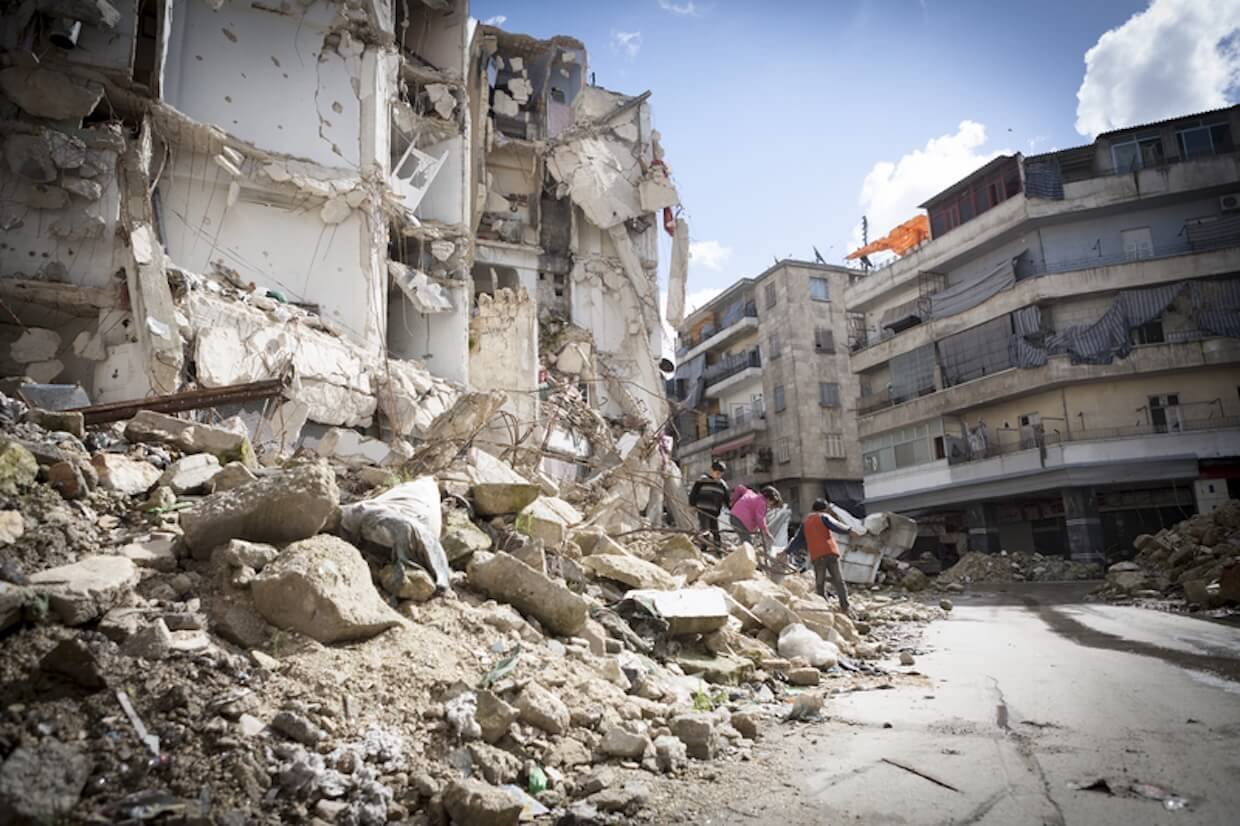
Destroyed residential building in a rebel-held area of Aleppo, Syria, February 12, 2013; three children collect firewood amid the rubble. Photo: Richard Harvey / Dreamstime.
Some critics suggest that Rojava’s multiethnic model struggled to maintain legitimacy among Arab populations in eastern Syria. To what degree were these tensions structural limits of democratic confederalism versus consequences of wartime governance conditions?
Dr. Soheila Shahriari: I do not think that democratic confederalism as a theory contains a structural flaw. It is a highly progressive and democratic theory. It is not built on Kurdish supremacy or exclusionary nationalism; rather, it is explicitly anti-ethnic in its political logic. It seeks to transcend ethnicity as the basis of sovereignty and instead centers pluralism, decentralization, and participatory government.
Where tensions emerge is not at the level of theory itself but at the level of implementation. The translation of radical, ideologically dense thought into heterogeneous, war-torn territory—particularly among Arab populations who were not socialized into the PKK-led movement’s democratic and feminist paradigm—inevitably creates friction. These communities had lived for decades under authoritarian rule without meaningful experience of democratic institutionalization, gender parity mechanisms, or participatory governance.
The sudden introduction of a transformative political model such as Rojava under militarized conditions naturally produces uneven incorporation of Arab populations. Thus, the issue is less of a structural flaw of democratic confederalism itself and more of a gap between normative ambition and historically shaped political socialization under conditions of war.
Without Recognition, Vulnerability Persists
How do you assess the long-term viability of non-state democratic models like Rojava in an international system still dominated by state sovereignty and realpolitik, where authoritarian and populist governments increasingly shape regional norms?
Dr. Soheila Shahriari: The long-term viability of non-state democratic models like Rojava within an international system still structured by state sovereignty and realpolitik, as you mentioned, depends largely on their capacity to secure external guarantees for survival. In Rojava’s case, this means convincingly persuading key international actors, particularly, as I mentioned before, the EU and the United States, to recognize and protect its status as a de facto autonomous region. If I put it differently, I would say that Rojava must engage in sustained and intensive diplomatic negotiation with Western powers—not regional powers—in order to transform its considerable transnational soft power—by soft power, I mean the radical democratic structures, the feminist institutions that I mentioned before, and pluralism and tolerance among religious, sexual, and linguistic minorities in Rojava.
As I mentioned, this negotiation must focus on transforming this considerable transnational soft power into formal diplomatic recognition as a legitimate de facto political entity. Without such international diplomatic recognition, the democratic experiment of Rojava remains structurally vulnerable within a regional order increasingly shaped by authoritarian consolidation and populist realignment, especially given the hostile stance of Turkey.
Autonomy Without Safeguards Risks Re-Centralization
The new Syrian leadership continues to frame Kurdish autonomy as separatism. In your view, what institutional arrangements—federalism, asymmetrical decentralization, or cultural autonomy—could realistically reconcile Kurdish self-administration with Syrian territorial integrity?
Dr. Soheila Shahriari: The reconciliation of Kurdish self-administration with Syrian territorial integrity seems very complicated. While the Syrian leadership continues to frame Kurdish autonomy as separatism, the Rojava project is grounded in democratic confederalism, an explicitly anti-centralist political project that seeks to decentralize sovereignty through bottom-up popular organization rather than secession. So, you see that the political language is not the same. The political language of the Kurdish actors is completely different here. It is not easily understandable for Arabs in Syria, especially when it comes to talking about the central government.
Among the possible institutional arrangements that you mentioned, Rojava should work toward the consolidation of its de facto self-governance as a form of federalism or democratic confederalism. We can put it differently: a constitutionally guaranteed form of political, administrative, and security autonomy within a unified Syrian state could, in principle, reconcile self-administration with territorial integrity. But cultural autonomy alone would likely be completely insufficient, in my view, as it would not secure institutional or security guarantees.
However, the viability of any such arrangement depends, again—I emphasize this time and again—on formal constitutional recognition and enforceable guarantees. Without concrete international diplomatic backing, federalism or decentralization in Rojava or in Syria risks becoming a temporary tactical compromise rather than a durable political settlement in a context where the central government may seek to reconsolidate autocratic authority once stabilized. Any agreement lacking structural safeguards could devolve into a zero-sum game for Kurdish actors in Rojava. Therefore, reconciliation is not merely a question of institutional design, but of credible guarantees and power-balancing mechanisms capable of preventing the re-centralization of the Syrian state.
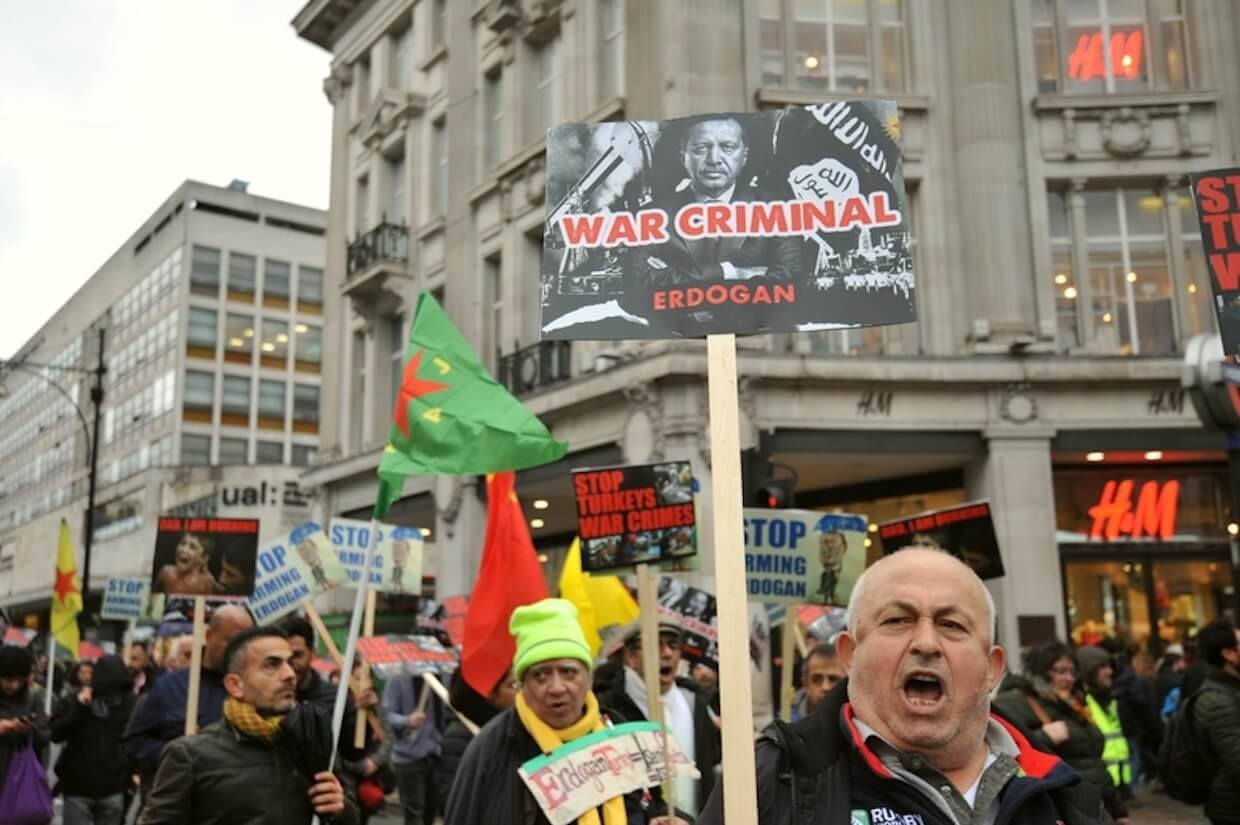
People in London protest against President Erdoğan and alleged war crimes against Syrians and Kurds following the withdrawal of U.S. troops from the area. Photo: Nicoleta Raluca Tudor / Dreamstime.
Turkey’s policy toward Rojava has been shaped by a security paradigm linking the region to the PKK, while unresolved domestic Kurdish issues — despite the ongoing so-called settlement process — reinforce threat perceptions. How might an “ethical-geopolitical repositioning,” combining security with legitimacy, alter Ankara’s strategic calculus, particularly within a political environment marked by populist securitization narratives?
Dr. Soheila Shahriari: A very interesting question. Turkey’s approach to Rojava is anchored in a securitization paradigm, viewing the region as an existential threat because of its structural and ideological link to the PKK. Domestic political imperatives reinforce this framing. The AKP uses the label of terrorism to delegitimize Kurdish political claims and consolidate support among nationalist, ultra-nationalist or jingoistic constituencies.
An ethical-geopolitical repositioning would require Ankara to move beyond this monolithic security-centered view and recognize the legitimacy of the international soft power the Rojava project has generated. This would involve deconstructing the entrenched narrative that equates Kurdish self-governance with inherent terrorism and engaging in political and security arrangements that combine oversight with recognition. But in practical terms, for a state like Turkey, shaped by populist securitization narratives and the persistence of the Sevres syndrome in the mentality and psyche not just of the Turkish state but of the Turkish populace as well, such a shift appears to me highly unlikely, unfortunately.
Nation-State Bias Limits Support for Non-State Democracy
Western, especially American engagement with Rojava has often been instrumental—most visibly during the anti-ISIS campaign—yet politically noncommittal. Does this pattern reflect structural limits of liberal internationalism when confronted with non-state democratic experiments?
Dr. Soheila Shahriari: Western, particularly American engagement with Rojava has been largely tactical and situational rather than strategic or politically committed. This shows the structural limits of liberal internationalism which remains anchored in a nation-state-centric world order and struggles to accommodate or integrate non-state actors, especially democratic experiments like Rojava.
At the same time, Western powers consistently prioritize geopolitical and economic interests over democratic or humanitarian principles. Human rights rhetoric often collapses when it conflicts with the strategic value of allies like Turkey as a NATO member. In practice, realpolitik sets aside commitment to progressive non-state actors, unfortunately.
This pattern also illuminates the broader decline of Western democracies and the rise of populist nationalist leadership. The synergy between, for example, leaders like Donald Trump and regional autocrats like Recep Tayyip Erdogan created an environment in which the law of the jungle replaces internationalist norms, highlighting that even the most progressive and resilient non-state societies like Rojava can be sacrificed very easily for the sake of authoritarian resilience and short-term realpolitik.
Abandonment Erodes Trust in Western Alliances
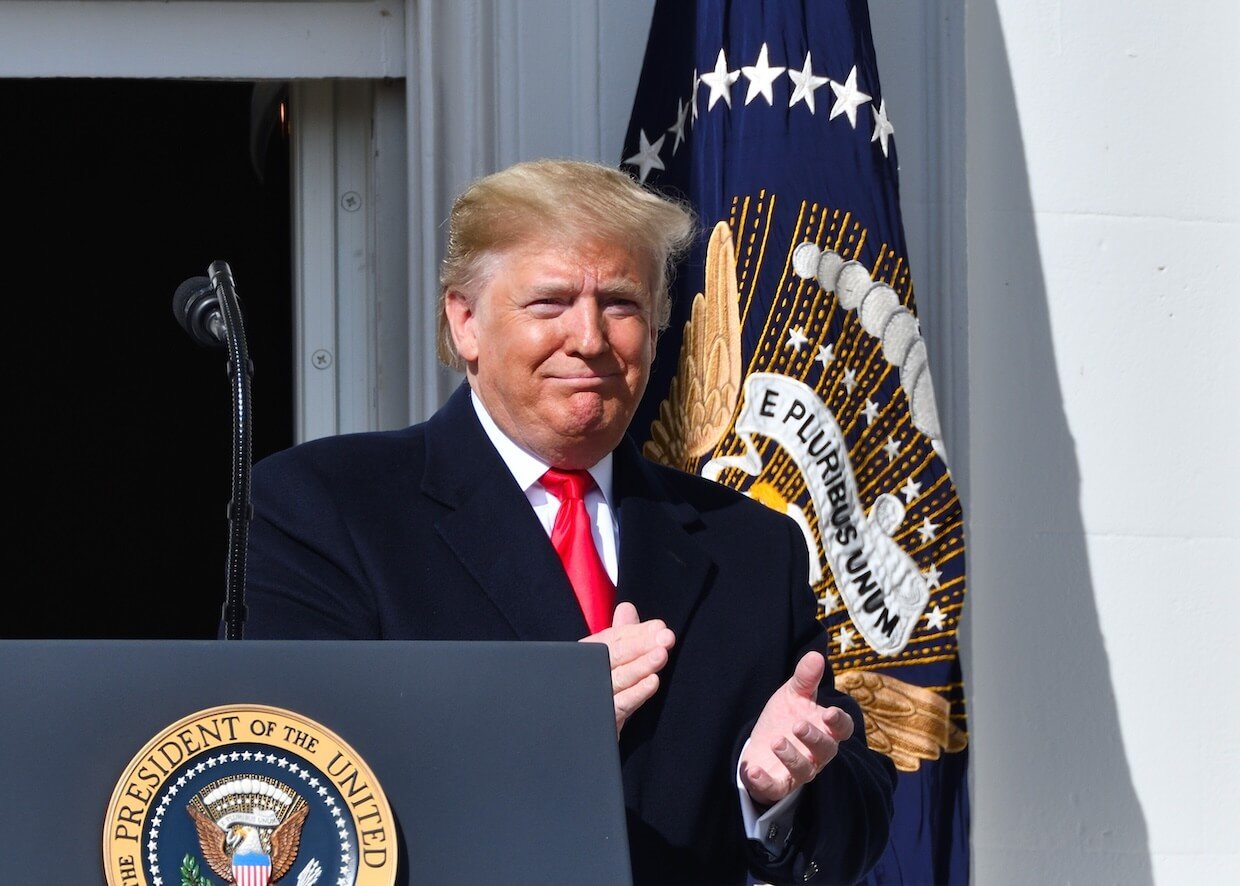
US President Donald Trump applauds from the White House balcony during a welcoming ceremony for the Washington Nationals baseball team on the South Lawn in Washington, D.C., on November 4, 2019. Photo: Evan El-Amin.
The perceived abandonment of local Kurdish forces after their decisive role in defeating ISIS — alongside growing concerns about a possible resurgence of the organization in the event of instability in northeastern Syria — has raised questions about the credibility of Western alliances. What implications might this have for future local partnerships in conflict zones?
Dr. Soheila Shahriari: The perceived abandonment of the Kurdish forces in Rojava after their decisive role in defeating ISIS raises serious questions about the credibility of Western alliances and the viability of future local partnerships in conflict zones. Such experiences highlight the transactional nature of tactical cooperation and contribute to a broader erosion of trust in Western democratic commitments.
By allowing an authoritarian and Islamist state to challenge a progressive, non-state democratic experiment, Western powers, particularly the United States and, to a lesser extent, the EU, undermine their own moral authority and global leadership. This pattern may push local actors in future conflicts to seek alternative alliances, prioritize defensive nationalism, or act independently, recognizing that even democracies cannot always be trusted or relied upon to protect human rights or progressive governance.
Diaspora Mobilization Reshapes Western Perceptions
Your research highlights diaspora activism aimed at reshaping international perceptions of Kurdish movements, including efforts to de-list the PKK as a “terrorist organization.” How influential has diaspora lobbying been in shaping Western policy debates on the Kurdish question, particularly amid rising populist politics and securitized migration debates in Europe?
Dr. Soheila Shahriari: The Rojava Revolution, and especially the Battle of Kobani, marked a turning point for the Kurdish diaspora, legitimizing transnational political engagement and reshaping Western perceptions of the Kurdish movement. Diaspora activism has intensified and diversified, with efforts to de-list the PKK as a terrorist organization becoming a central focus. While most Western governments maintain the PKK designation under pressure from Turkey, diaspora lobbying has influenced key legal and legislative debates. For example, the Belgium Court of Appeal ruled that the PKK was a party in a non-international armed conflict rather than a terrorist group.
In Sweden and Germany, Kurdish diaspora actors have leveraged parliamentary and public channels to present the Kurdish movement as a vanguard of democratization in the Middle East, advocating for formal cooperation with Rojava authorities. Yet, these efforts face structural limits, as Western states often prioritize realpolitik and Turkey’s strategic value as a NATO ally, maintaining the terrorist label despite democratic claims.
We have two examples of de-listing efforts. One of them is the Belgium Court of Appeal ruling the PKK not to be a terrorist organization. The other was a similar effort at the EU level, which initially moved toward delaying the PKK’s designation as a terrorist organization but, unfortunately, under pressure from Turkey, reinstated the label. So, there has been a clear dynamism in the post-Rojava revolution era within diaspora communities to de-list the PKK.
Feminization Transforms Image, Alliances, and Moral Authority
To what extent has the “feminization” of Kurdish politics—symbolized by the global visibility of Kurdish women fighters and leaders—altered international legitimacy and solidarity networks compared to earlier phases of Kurdish mobilization?
Dr. Soheila Shahriari: Since the Rojava Revolution in 2012–13, the feminization of Kurdish politics has dramatically enhanced the movement’s international legitimacy and expanded its solidarity networks. Earlier phases, particularly in the 1990s and the early 2000s, were dominated by male-dominated nationalist frameworks, with the PKK largely criminalized and marginalized in Western eyes, limiting advocacy and framing Kurds primarily as security threats.
The emergence of the YPJ, the Women’s Protection Units, and their decisive role in the Battle of Kobani in late 2014 and early 2015 marked a turning point. The global visibility of Kurdish women fighters aligned Kurdish political claims with the values of gender equality, secularism, and radical democracy, making the continued terrorist designation of the PKK increasingly incoherent and nonsensical in Western public opinion. Being Kurdish is now associated with supporting progressive governance, women’s rights, and secularism, distinguishing the Kurdish movement from other Middle Eastern actors or movements.
This shift has enabled the Kurdish movement to move beyond traditional ethno-nationalist alliances and cultivate broad intersectional solidarity networks. The transition from a male-dominated nationalist movement to a gender-centered revolutionary project has positioned the Kurds as a recognized driving force for democratization in the Middle East, securing global moral authority and institutional support that were absent in earlier decades.
Self-Determination, Not Statehood, Defines the Kurdish Question
And lastly, Dr. Shahriari, looking ahead, do you foresee the Kurdish political movement evolving toward statehood, a post-state transnational network model, a renewed pursuit of territorial autonomy within existing states, or fragmentation into divergent regional trajectories shaped by Turkey, Iran, Syria, and Iraq?
Dr. Soheila Shahriari: I think it is a very good final question. What I can say is that I will not go into great detail, but the crux of the matter is that the Kurdish struggle over the past century has always centered on one fundamental issue: the right to self-determination. Everything else—the form of governance, whether federalism, autonomous self-rule, radical democracy, democratic confederalism, or full statehood of Greater Kurdistan—is epiphenomenal, or a secondary question.
The fundamental issue is the right to self-determination. These forms are largely, as I said, epiphenomenal and contingent, shaped by regional dynamics, international politics, and the balance of power at a given time. The future of the Kurdish movement will therefore be defined less by ideology and more by the practical ability to secure recognition and exercise collective rights within or across existing state frameworks.
Giving an interview to the ECPS, Professor Oona A. Hathaway reflects on the resilience and fragility of the post-1945 international legal order at what she describes as a moment of both peril and possibility. She identifies the prohibition on the use of force as the “bedrock of the modern legal order,” yet warns that today’s geopolitical climate is marked by “extraordinary instability” and mounting challenges from major powers. International law, she argues, ultimately depends on shared belief: “what makes international law work is that states believe it works.” If repeated unilateral uses of force erode that belief, a “reverse norm cascade” could follow. Yet Professor Hathaway also stresses that crisis can generate renewal—an opportunity to reimagine and reconstruct a more equitable and effective international legal order rather than surrender to fatalism.
Giving an interview to the European Center for Populism Studies (ECPS), Professor Oona A. Hathaway—Gerard C. and Bernice Latrobe Smith Professor of International Law at Yale Law School; Professor of Political Science in Yale’s Department of Political Science; Faculty at the Jackson School of Global Affairs; Director of the Yale Law School Center for Global Legal Challenges; and president-elect of the American Society of International Law—reflects on the resilience and fragility of the post-1945 international legal order at a moment she describes as both perilous and generative. The organizing theme of the interview is captured in the headline, “A Moment of Peril—and Possibility—to Reimagine the International Legal Order.” For Professor Hathaway, the contemporary crisis is not simply episodic noncompliance but a potentially systemic turning point—one that tests whether the prohibition on the use of force, which she calls the “bedrock of the modern legal order,” can endure under conditions of populism, geopolitical rivalry, and eroding rule-of-law commitments.
Professor Hathaway situates today’s tensions within a longer arc of normative transformation. The post-1945 order, she argues, was both a “genuine normative revolution that restrained power” and a system sustained by the strategic interests of dominant states. Yet the present moment raises acute questions about its durability. In her view, “what makes international law work is that states believe it works,” and the danger is that repeated unilateral uses of force could tip the system toward a “reverse norm cascade,” in which states “no longer believe that these rules matter and therefore no longer act as if they matter.” The concern is not only erosion, but the possibility of a broader unraveling in which the rules cease to structure expectations.
Several sections of the interview underscore why “today’s instability is unprecedented in the postwar international legal order.” Professor Hathaway emphasizes that in the post–World War II era “we’ve ever been at a moment of such instability and uncertainty” as when the most powerful state appears “clearly willing to use military force in violation of the UN Charter that it once championed.” This connects directly to another theme: “when rule-makers break the rules, the damage is far greater.” As Professor Hathaway notes, US violations are “particularly destructive,” not least because of the “failure of the international community to respond or push back forcefully,” shaped by entrenched assumptions about US stewardship and deep economic interdependence.
Yet Professor Hathaway also insists that breakdown need not foreclose renewal. “It is a moment of extreme challenge,”she concludes, “but it is also a moment of opportunity and creativity.” The task, she suggests, is to resist fatalism and instead “think together about what a more equitable and effective international legal order might look like”—because “it is up to us to decide which it will be.”
Giving an interview to the ECPS, Professor Oona A. Hathaway reflects on the resilience and fragility of the post-1945 international legal order at what she describes as a moment of both peril and possibility. She identifies the prohibition on the use of force as the “bedrock of the modern legal order,” yet warns that today’s geopolitical climate is marked by “extraordinary instability” and mounting challenges from major powers. International law, she argues, ultimately depends on shared belief: “what makes international law work is that states believe it works.” If repeated unilateral uses of force erode that belief, a “reverse norm cascade” could follow. Yet Professor Hathaway also stresses that crisis can generate renewal—an opportunity to reimagine and reconstruct a more equitable and effective international legal order rather than surrender to fatalism.
Giving an interview to the European Center for Populism Studies (ECPS), Professor Oona A. Hathaway—Gerard C. and Bernice Latrobe Smith Professor of International Law at Yale Law School; Professor of Political Science in Yale’s Department of Political Science; Faculty at the Jackson School of Global Affairs; Director of the Yale Law School Center for Global Legal Challenges; and president-elect of the American Society of International Law—reflects on the resilience and fragility of the post-1945 international legal order at a moment she describes as both perilous and generative. The organizing theme of the interview is captured in the headline, “A Moment of Peril—and Possibility—to Reimagine the International Legal Order.” For Professor Hathaway, the contemporary crisis is not simply episodic noncompliance but a potentially systemic turning point—one that tests whether the prohibition on the use of force, which she calls the “bedrock of the modern legal order,” can endure under conditions of populism, geopolitical rivalry, and eroding rule-of-law commitments.
Professor Hathaway situates today’s tensions within a longer arc of normative transformation. The post-1945 order, she argues, was both a “genuine normative revolution that restrained power” and a system sustained by the strategic interests of dominant states. Yet the present moment raises acute questions about its durability. In her view, “what makes international law work is that states believe it works,” and the danger is that repeated unilateral uses of force could tip the system toward a “reverse norm cascade,” in which states “no longer believe that these rules matter and therefore no longer act as if they matter.” The concern is not only erosion, but the possibility of a broader unraveling in which the rules cease to structure expectations.
Several sections of the interview underscore why “today’s instability is unprecedented in the postwar international legal order.” Professor Hathaway emphasizes that in the post–World War II era “we’ve ever been at a moment of such instability and uncertainty” as when the most powerful state appears “clearly willing to use military force in violation of the UN Charter that it once championed.” This connects directly to another theme: “when rule-makers break the rules, the damage is far greater.” As Professor Hathaway notes, US violations are “particularly destructive,” not least because of the “failure of the international community to respond or push back forcefully,” shaped by entrenched assumptions about US stewardship and deep economic interdependence.
Yet Professor Hathaway also insists that breakdown need not foreclose renewal. “It is a moment of extreme challenge,”she concludes, “but it is also a moment of opportunity and creativity.” The task, she suggests, is to resist fatalism and instead “think together about what a more equitable and effective international legal order might look like”—because “it is up to us to decide which it will be.”
Giving an interview to the ECPS, Professor Oona A. Hathaway reflects on the resilience and fragility of the post-1945 international legal order at what she describes as a moment of both peril and possibility. She identifies the prohibition on the use of force as the “bedrock of the modern legal order,” yet warns that today’s geopolitical climate is marked by “extraordinary instability” and mounting challenges from major powers. International law, she argues, ultimately depends on shared belief: “what makes international law work is that states believe it works.” If repeated unilateral uses of force erode that belief, a “reverse norm cascade” could follow. Yet Professor Hathaway also stresses that crisis can generate renewal—an opportunity to reimagine and reconstruct a more equitable and effective international legal order rather than surrender to fatalism.
Giving an interview to the European Center for Populism Studies (ECPS), Professor Oona A. Hathaway—Gerard C. and Bernice Latrobe Smith Professor of International Law at Yale Law School; Professor of Political Science in Yale’s Department of Political Science; Faculty at the Jackson School of Global Affairs; Director of the Yale Law School Center for Global Legal Challenges; and president-elect of the American Society of International Law—reflects on the resilience and fragility of the post-1945 international legal order at a moment she describes as both perilous and generative. The organizing theme of the interview is captured in the headline, “A Moment of Peril—and Possibility—to Reimagine the International Legal Order.” For Professor Hathaway, the contemporary crisis is not simply episodic noncompliance but a potentially systemic turning point—one that tests whether the prohibition on the use of force, which she calls the “bedrock of the modern legal order,” can endure under conditions of populism, geopolitical rivalry, and eroding rule-of-law commitments.
Professor Hathaway situates today’s tensions within a longer arc of normative transformation. The post-1945 order, she argues, was both a “genuine normative revolution that restrained power” and a system sustained by the strategic interests of dominant states. Yet the present moment raises acute questions about its durability. In her view, “what makes international law work is that states believe it works,” and the danger is that repeated unilateral uses of force could tip the system toward a “reverse norm cascade,” in which states “no longer believe that these rules matter and therefore no longer act as if they matter.” The concern is not only erosion, but the possibility of a broader unraveling in which the rules cease to structure expectations.
Several sections of the interview underscore why “today’s instability is unprecedented in the postwar international legal order.” Professor Hathaway emphasizes that in the post–World War II era “we’ve ever been at a moment of such instability and uncertainty” as when the most powerful state appears “clearly willing to use military force in violation of the UN Charter that it once championed.” This connects directly to another theme: “when rule-makers break the rules, the damage is far greater.” As Professor Hathaway notes, US violations are “particularly destructive,” not least because of the “failure of the international community to respond or push back forcefully,” shaped by entrenched assumptions about US stewardship and deep economic interdependence.
Yet Professor Hathaway also insists that breakdown need not foreclose renewal. “It is a moment of extreme challenge,”she concludes, “but it is also a moment of opportunity and creativity.” The task, she suggests, is to resist fatalism and instead “think together about what a more equitable and effective international legal order might look like”—because “it is up to us to decide which it will be.”
Here is the edited version of our interview with Professor Oona A. Hathaway, revised slightly to improve clarity and flow.
A Normative Revolution—and a Strategic Settlement
Photo: Zoia Fedorova| Dreamstime.
Professor Oona Hathaway, thank you so much for joining our interview series. Let me start right away with the first question: Your scholarship traces the historic shift from a world in which war was lawful to one structured by the prohibition on the use of force. How should we understand the post-1945 legal order—as a genuine normative revolution restraining power, or as a contingent equilibrium sustained by the strategic interests of dominant states?
Professor Oona A. Hathaway: I think both, actually. I don’t think they are inconsistent with one another. It was a genuine normative revolution that restrained power. There was the 1928 Kellogg-Briand Pact, which initially outlawed war. It obviously didn’t succeed—we had World War II—but it began a process of both deconstructing the previous legal order and constructing something new that set in motion the creation of a new legal system. That was then reaffirmed in the United Nations Charter, in the prohibition on the use of force in Article 2(4). It was really restating the prohibition on war from the Kellogg-Briand Pact. But it was created by dominant states because they believed in these ideas. They believed in the prohibition on the use of force and that might doesn’t make right, and they had just fought a war with the Nazis over this principle of non-domination and the rejection of using military force to seize territory from other states.
But it was also in their interests, because they had gone through massive territorial expansion. The United States, of course, had acquired what is now the entire continental United States, plus Alaska and Hawaii, and has a number of other islands that are part of it as well, including Puerto Rico. It was therefore in the interest of these states—and, of course, at the time this was created, Britain still had a major empire, and France still had a major empire. China, of course, dominated a vast territory. It was a good time to say you can’t conquer territory through the use of force. It was a good time for these states to say, “let’s stop moving those borders around, let’s firm up these borders, and let’s say no one can take territory from anyone else.” Once you’ve already completed your accumulation of territory, it’s in your best interest to call a halt to the game.
So, it was in their interests, but it was also in their values; it was consistent with the values they fought the war for. They then sustained it both because they believed in the values of the system and because the system served their interests. It made for a much more peaceful and prosperous world. So, I don’t necessarily see the two as inconsistent with one another.
When the Bedrock Norm Is Strained, the Entire System Is at Risk
You describe the prohibition on force as the “bedrock” of the modern international order. To what extent did its success depend less on legal internalization than on the alignment between US hegemony and rule-based constraints, and what happens when that alignment dissolves?
Professor Oona A. Hathaway: You’re right. I do believe that the prohibition on force is the bedrock of the modern legal order. It’s right at the beginning of the United Nations Charter, and in the book The Internationalists, which I wrote with my co-author Scott Shapiro, we talk about how that is the core norm of the system on which everything else rests.
So it depended on internalization, and that process that I described from 1928 to 1945 was a process of thinking through what it means to shift an order on its axis—to change it from a world order where force is permitted, where might makes right, where states can use military force to resolve disputes with one another, as used to be the case before 1928, before war was outlawed, to a world in which that’s no longer allowed, and then everything else has to flip on its head. Conquest was legal; now conquest has to be illegal. Gunboat diplomacy was legal; now gunboat diplomacy has to be illegal. And that requires a massive shift that I think they didn’t fully appreciate in 1928, but that unfolded from 1928 to 1945 and was internalized through the Charter and all the subsequent rules that were adopted.
But it is also the case, again, that this was in the interest of the United States. The United States both believed in these principles, but these principles also served a hegemonic state. It is a good thing if states are not trying to use military force to take territory from one another if what you want is not to have to be running around as a global power intervening to try to put out wars between states. So it is both the case that these were rules that were internalized and that they served US interests.
Now, what happens when that alignment dissolves? I mean, the US has made clear it doesn’t necessarily adhere to those legal principles any longer and has taken actions that are in violation of the UN Charter, most recently the intervention in Venezuela. We might see a military operation in Iran before long that would also be illegal. I think it puts major stress on the system, to the point that I’m not sure the legal order, as it is, can survive it. You know, it’s not just the US; it’s also Russia’s invasion of Ukraine and China’s seizing of islands, rocks, and reefs in the South China Sea. There are a lot of assaults, but in a way the US, because it has been such a critical supporter of the international legal order, turning on that order in the way that it seems to be is a blow that may be hard to recover from.
A Normative Revolution Forged by Power, Values, and Interest
Donald J. Trump, the 47th President of the United States, at his inauguration celebration in Washington, D.C., on January 20, 2025. Photo: Muhammad Abdullah.
Does the contemporary erosion of the prohibition on the use of force—as exemplified by Russia’s full-scale invasion of Ukraine and the United States’ unilateral military operation against Venezuela under the second Trump administration—reflect primarily a failure of international enforcement institutions, a crisis of belief in the legitimacy of international law among major powers, or a deeper transformation in how states conceptualize sovereignty, security, and permissible violence in an era of populism and geopolitical rivalry?
Professor Oona A. Hathaway: I think it’s just too early to say exactly how deep the transformation we’re seeing really is. I’ve written a bit about Russia’s invasion of Ukraine and the Trump administration’s unilateral military operation against Venezuela, as I mentioned before, as truly fundamental challenges to the modern international legal order.
It is the case that international law relies on collective enforcement. And it’s very difficult for that collective enforcement to work when members of the Security Council are themselves violating the rules, because the institutional structures that are in place to enforce them can’t be used. Russia, the US, and China all have veto power and can block any action by the United Nations to enforce the legal rules. At the same time, the states that have traditionally led the charge in enforcing the rules through other means—through what Scott Shapiro and I have called outcasting—have relied on economic and other measures to respond to unlawful action and to encourage collective action, sanctions, and economic pressure. Russia was kicked out of the G8, which became the G7; Russia was expelled from the Council of Europe; and there are many ways in which Russia has been excluded from international institutions it had benefited from as a response to its unlawful actions, in addition to the economic sanctions that have been imposed and the funding and support provided by Ukraine’s allies to help it stand up to Russia. But it is very difficult to do that against a hegemon and a major economic power.
I think you are beginning to see some response by states that may represent the beginnings of an answer to that question, though it is still a little early to tell.
Power Shifts and Populism Are Eroding Restraints on Unilateral Force
How do shifts in global power distribution interact with ideological transformations—particularly nationalism and populism—to weaken constraints on unilateral force?
Professor Oona A. Hathaway: Yes, there are major shifts in global power distribution. There are changes in economic power and changes in military power. You have the rise of China, both as an economic power and as a military power. It’s building a major navy and has become a more significant geopolitical force in a variety of ways. It’s also investing more in international institutions, which is important to note. So it’s not just building up its military; it has also become more active at the UN and other international institutions.
Soi it’s hard to say at this moment where that’s going. Is that going to weaken constraints on unilateral force or not? I think what’s weakening constraints on unilateral force is the use of unilateral force by states like the US and Russia. And it’s not just the use of force, but also the response that you receive. Russia has had a pretty forceful response from the international community. So far, the US has not. There was a relatively modest response to the unilateral intervention in Venezuela.
States are frankly scared of Trump. They’re worried that he’s going to slap tariffs on them if they criticize him. I think the only answer is going to be to act collectively—for states to band together to try to shore up the international system and the prohibition on the use of force in particular. It’s going to be hard for any of them to criticize Trump individually, but acting more collectively and building alternative sources of economic power may be possible. So, for example, what Canada is doing in forming alternative economic partnerships and responding to US tariffs suggests one possible path forward. That is an answer to this problem—maybe the only answer to this problem.
Between the Old World Order and a World With No Rules
The headquarters of the United Nations in New York City. Photo: Dreamstime.
Do contemporary developments signal not merely norm erosion but a structural reversion toward an “Old World Order” in which material power once again functions as a source of legal entitlement?
Professor Oona A. Hathaway: In the book The Internationalists, we talk about the Old World Order as the order in which war was lawful and states could use military force to resolve disputes, and what they took, they could keep—so might made right.
One of the questions is whether we are in a moment of reverting back to that. The book describes both this old legal order and how we rejected it and created a new legal order built on the prohibition on force. And the question that certainly emerges at this moment, where we’re seeing states like the United States unilaterally using force, is: are we going to go back? Are we going to return to a world where military force was lawful and where material power functions as a source of legal entitlement?
It’s possible that we will. It’s also possible that there is something even worse. Scott and I wrote a recent piece in Foreign Affairs that argues there is only one thing worse than going back to something like the Old World Order—a legal order built on the idea that might makes right, where states can resolve disputes and enforce claims through military force—and that is a world with no rules at all, where there is no coherent legal system. The old order, for all its faults, was at least coherent and clear.
One of the problems we see with Venezuela, with the Trump intervention there, is that it was really just about one man’s whim. And that is very disruptive and chaotic, because if it becomes permissible for states to decide to go to war for no clear reason, it becomes very hard for other states to avoid war, because they don’t know what they would need to do to avoid falling afoul of a state that might want to use military force.
I recommend that to your readers if they want to take a look at it. They can find all my work, by the way, on oonahathaway.com. All my work is posted there, so if they want to track down any of these pieces, that’s a good place to go.
Populist Sovereignty Claims Are Challenging International Constraints
How do populist leaders’ claims to embody the “true people” reshape state attitudes toward international law, especially regarding multilateral constraints perceived as external impositions on sovereignty?
Professor Oona A. Hathaway: I think I can speak most authoritatively, perhaps, to the Trump administration’s claims to embody “real Americans” as part of the argument that the United States should resist international law and that these multilateral constraints don’t serve America.
And what people are saying, if you look at his approval ratings, which are in free fall, is that he doesn’t actually represent real Americans. People care about the price of groceries, clothes, and other consumer goods. Those have been going up, and people’s real incomes have not been keeping pace with inflation. He came into office on a promise that he would make things more affordable for people, and he has done the opposite.
People were told at the State of the Union Address that things are better than ever, but most people’s experience is inconsistent with that—they actually feel that things are not better than ever. So, what you’re seeing is a contrast between a claim to speak for a set of people and people’s own experience of the effects of those policies.
I like to believe that, as a result, people are going to see that these policies are not in their best interest—that tariffs are not serving the United States and that wars of choice are not in the best interests of the American people—and reject them. So far, it does seem that people are not approving of what’s happening. I think that strategy is not going to be a winning one for the Trump administration for much longer.
The Impact of Populism Depends on the Resilience of Institutions
Frontal view of the U.S. Supreme Court Building in Washington, D.C., on February 10, 2024. Photo: Gualberto Becerra P.
Is populism inherently destabilizing for rule-based international order, or can populist governments operate within legal frameworks when institutional checks remain robust?
Professor Oona A. Hathaway: Gosh, that’s kind of an impossible question to answer. I don’t know if it’s inherently destabilizing; it depends a little on what one means by populism. Can populist governments operate within legal frameworks when institutional checks remain robust? Absolutely—of course they can.
I think they will respond to the incentives they face. And if there is a major cost to acting in ways that are inconsistent with legal frameworks, it is difficult for populist leaders to sustain violations of international law for long in the face of that. But that’s not uniformly true. This is just a hard question to answer. It is more a case-by-case matter, rather than something that lends itself to a general conclusion about the impact of populism on legal frameworks. It all depends on how strong and how robust those institutional checks remain, and on the nature of those checks. That is highly contingent.
When Law Ceases to Constrain Power, the System Cannot Function
To what extent does democratic backsliding within powerful democracies—through executive aggrandizement and weakened oversight—pose a greater systemic threat to international law than the rise of authoritarian states that never fully internalized those norms?
Professor Oona A. Hathaway: I think that democratic backsliding is a real challenge to international law, in part because what we’re seeing is not just democratic backsliding, but threats to the very idea of the rule of law, both domestically and internationally. When law is no longer a constraint on governmental power—again, whether domestic or international—that obviously makes it impossible for the international system to function.
I don’t know that I would fully accept the idea that authoritarian states never internalized those norms—maybe that’s fair—but they internalized them more than is sometimes appreciated, because the international legal order operates in large part by changing expectations about how others will react to what you do. Authoritarian states see that if they invade their neighbors, there are going to be consequences. Saddam Hussein learned that when he invaded Kuwait and attempted to take it over. The international community responded by rejecting his effort to conquer Kuwait and pushing him back. That was an instance in which an authoritarian ruler learned a hard lesson—that this was a norm the international community was willing to defend.
That was a useful lesson for other authoritarians to observe, and it made a difference in reaffirming the prohibition on the use of force and the idea that states can’t conquer territory, even when they have a dispute with a neighbor—that the way to resolve it isn’t to use military force. So, that authoritarian regimes, too, can be constrained by international law.
The important thing to remember about international law is that you don’t have to think you’re obeying it to obey it. International law works by changing the background norms and expectations that states have. You don’t have to be fully cognizant of the ways in which it is shaping your behavior for it to do so. Even authoritarian states are often abiding by international law in ways they may not fully appreciate or understand, and nonetheless international law remains very powerful in shaping their behavior.
When Rule-Makers Break the Rules, the Damage Is Especially Severe
Stop Trump Coalition march, Central London, United Kingdom, September 17, 2025. Protesters dressed as Musk, Farage, Vance, Putin, Trump, and Netanyahu. Photo: Ben Gingell.
When a historically law-creating state violates the rules it helped design, how does that differ from violations by revisionist powers in terms of precedent, legitimacy, and global imitation effects?
Professor Oona A. Hathaway: This is obviously the question of whether US violations are more destructive than those of other states, given that the US has historically been a significant law-creating power. It wrote the first draft of the UN Charter, championed the United Nations system after the Second World War, and has been a key player—though it has not perfectly observed those rules. It’s important to point out that this is not the first time the United States has failed to play by the rules it helped put in place. But yes, I do think it is particularly destructive, especially when coupled with the broader set of assaults on the legal order from Russia.
What really matters, and what has been especially destructive so far, is the failure of the international community to respond or push back forcefully against the United States. That’s partly because people are used to thinking of the United States as a good actor, as a steward of the system. They also have deep economic ties that make any kind of criticism or economic sanctions against the United States almost impossible for them to contemplate. But, we are starting to see states recognize that what might once have seemed unimaginable is now imaginable, and that they have to begin thinking about how to reinforce the legal order in a situation where the United States can no longer be counted on to be a positive partner or actor.
So, we might begin to see some pushback, but we haven’t yet, and that is part of why this has been such a destructive moment.
Repeated Unilateral Force Could Trigger a Reverse Norm Cascade
Could repeated unilateral uses of force by leading powers generate a “reverse norm cascade,” transforming restraint from expectation into exception and thereby reshaping customary international law?
Professor Oona A. Hathaway: That’s the fear. The fear is that these unilateral uses of force will eventually overwhelm the system. You can sustain a certain number of blows, but at a certain point the system becomes so weakened that it begins to fall apart. And the question is: when do you cross that line? When do we reach a point where we have a kind of reverse norm cascade, as you put it, in which states no longer believe that these rules matter and therefore no longer act as if they matter? What makes international law work is that states believe it works.
If they no longer believe in it, then it ceases to function. So, enough unilateral uses of force could, at a certain point, lead states to conclude that the system is not working very well and to ask why they should abide by the rules if others are not. That’s when you begin to see the whole structure start to fall apart. Are we there yet? I think not. Three more years of this? Maybe.
Expansive Self-Defense Claims Are Eroding the Prohibition on Force
How might expansive interpretations of self-defense—particularly against nonstate actors—gradually alter the legal architecture governing the use of force?
Professor Oona A. Hathaway: I have written about this as well, and I think we don’t talk about it enough as a challenge to the international legal order—this expansive interpretation of the Article 51 right of self-defense in the Charter. It allows states to respond unilaterally; you don’t have to go to the Security Council to defend yourself. But the language of the Charter refers to situations in which a state has been subject to an armed attack.
There have been increasingly expansive interpretations of the Article 51 right of self-defense, including, as you mentioned, extending it to attacks by nonstate actors, which was not understood as falling within the scope of Article 51 at its inception. This interpretation has been adopted particularly in the post-9/11 era, and you see more and more states embracing it after 2014 and the rise of ISIS in the Middle East. I do think this is extremely corrosive to the international system. It has really eroded the prohibition on the use of force, because at a certain point everything becomes self-defense.
The Charter defined this right of self-defense very narrowly, as a response to armed attack, and it did so for a reason. The drafters were very aware that defensive wars and offensive wars were sometimes very hard to distinguish. They wanted to establish a fairly narrow right for states to respond. They had to include the right of self-defense because many states insisted on it—you shouldn’t have to wait for the Security Council to act if you are literally under attack. But they intentionally meant for it to be a fairly narrow right, because once you start talking about wars of defense based on the idea that another state might pose a threat down the road, the distinction between offensive and defensive wars begins to collapse.
So yes, I do think this has been a real problem. And again, if your readers are interested, if you search my website for “self-defense,” you will find an article I’ve written on exactly this issue. It’s a real problem, and it predates the Trump administration; it is a bipartisan problem. Both Democratic and Republican presidents have presided over that erosion, so this is not an entirely new phenomenon.
When Dual-Use Becomes a Justification, Civilians Bear the Cost
Your research on the targeting of dual-use objects highlights the blurring of civilian and military categories. Does this evolution risk transforming international humanitarian law from a protective regime into a justificatory framework for expanded violence?
Professor Oona A. Hathaway: I’d point your readers to a piece that I wrote in the Yale Law Journal on dual-use objects, called “The Rise of Dual-Use Objects,”with Azmat Khan and a third co-author, Mara Revkin, my former student and an amazing legal academic. This piece shows that the US has increasingly been targeting objects that it recognizes as dual-use, meaning both military and civilian use.
We argue in that piece that the rise of targeting dual-use objects has significantly eroded protections for civilians in wartime. We discuss this generally, but we also use evidence drawn from post-strike analyses of US counterterrorism strikes. We analyzed the targets of those strikes, which were gathered by Azmat Khan, a reporter from The New York Times, through Freedom of Information Act requests to the Department of Defense—requests she had to sue to obtain. So we have very specific data in the piece about what kinds of dual-use objects are being targeted, and we can show that civilians are really at risk in the targeting of these objects.
The argument we make is that this practice is blurring the distinction between civilian and military targets that is so critical to protecting civilians in wartime, and that we need to take significant steps to better protect civilians and to clarify this distinction between military and civilian objects, taking into account the impact on civilians of targeting such sites—not just the civilians who happen to be present at that moment, but also the long-term reverberating effects. You blow up a water treatment plant, and it’s not just the civilian workers there who are harmed; it’s everyone who now lacks access to clean water. You blow up an apartment building, and it’s not only the residents who are killed or injured, but also those who are deprived of housing. You blow up a bridge, and there may be civilians present on it, but afterward people cannot get to work, school, or their families because there is no access from one place to another. So, this is a really critical part of our thinking about how to protect civilians in wartime.
The Unraveling Order Also Opens Space to Imagine a More Equitable One
And lastly, Prof. Hathaway, are we witnessing the collapse of the post-1945 legal order or its transformation into a plural system of competing legal regimes—and what institutional or normative developments would be necessary to prevent the “gradual and then sudden” unraveling you warn about from becoming irreversible?
Professor Oona A. Hathaway: This is a reference to my piece in The New York Times titled “The Great Unraveling,”which looks at what’s happening to the modern legal order and argues that we might be witnessing its collapse. The question is whether we are in the midst of a collapse, on the precipice of one, or whether it has already occurred—and what is coming next. I don’t know that anybody really knows the answer to those questions. I think we’re in uncharted waters. In the post–World War II era, I don’t think we’ve ever been at a moment of such instability and uncertainty in the international legal order as we are today, where you have the most powerful nation in the world clearly willing to use military force in violation of the UN Charter that it once championed, and the prohibition on the use of force that is core to the normative legal order.
But we don’t know how aggressive President Trump is going to be. We don’t know yet if other states are going to follow in the United States’ footsteps and use force against their neighbors in ways that would previously have been clearly forbidden. And we don’t know whether something is going to emerge in its place if this system is collapsing.
We see some signs. We see Canada, for instance, trying to rally middle powers to work together to create an alternative economic system, because a lot of states are deeply concerned about the threat of tariffs from the Trump administration, and that has led them not to speak up or respond when the US acts in ways they view as inconsistent with the international legal order. This is going to be an important part of the response, but it hasn’t taken shape yet. So, the short answer is that we don’t know where this is headed. We are in a moment of extraordinary instability.
Let me end on a somewhat more hopeful note. Although this moment of instability is scary and concerning—for someone like me who believes that the core norm of the international legal order is the prohibition on the use of military force, and who sees that norm as uniquely at risk—it is also a moment when we can start to think about how to construct a new legal order. What might a new legal order look like? What new possibilities might emerge? What can we hope for, dream about, or imagine? How can we make the legal order more equitable?
So, it is a moment of extreme challenge, but it is also a moment of opportunity and creativity. We should be careful not to give up or assume that everything is lost, but instead try to think together about what a more equitable and effective international legal order might look like, and whether this is a moment in which the opportunity is opening to do something new and different. That new and different future could be bad, but it could also be a profound improvement. It is up to us to decide which it will be.
In this ECPS interview, Professor Elin Bjarnegård (Uppsala University) argues that gender is no longer a side issue but “a useful, malleable concept for authoritarian leaders”—and will become “an increasingly central fault line” separating liberal democracy from authoritarian populism. Moving beyond a simple backlash thesis, she shows how regimes alternate between ‘genderbashing’ and ‘genderwashing’, weaponizing equality talk for legitimacy at home and abroad. Professor Bjarnegård also links democratic backsliding to gendered intimidation, online harassment, and what she calls “sexual corruption.” Noting that the Epstein files revealed abuses “in the corridors of power” in democratic settings too, she warns that personalistic rule heightens risk—especially the “impunity surrounding them.” She urges resisting polarization, scrutinizing symbols, and asking where gender concretely matters in policy.
In an era marked by democratic erosion and the global rise of authoritarian populism, gender politics has emerged not merely as a cultural battleground but as a strategic axis of regime competition. In this interview with the European Center for Populism Studies (ECPS), Professor Elin Bjarnegård of Uppsala University argues that gender will increasingly function as a defining fault line separating liberal democratic governance from authoritarian populist rule. Moving beyond conventional explanations that frame anti-gender politics primarily as ideological backlash, Professor Bjarnegård emphasizes the instrumentalization of gender as a tool of political survival, legitimacy, and international signaling. As she explains, “gender becomes a useful, malleable concept for authoritarian leaders—a powerful symbol that can be mobilized for regime purposes,” underscoring how strategic deployment rather than doctrinal conviction often drives contemporary gender politics.
This strategic perspective helps explain why gender rights are likely to intensify as a central arena of geopolitical and normative contestation. Professor Bjarnegård anticipates that “gender rights, or perhaps the strategic use of gender, will become an increasingly central fault line,” not only because of ideological polarization but also because gender provides an “easy, simplistic narrative to deploy strategically” in polarized societies. Such narratives enable regimes to oscillate between exclusionary rhetoric and symbolic inclusion, reinforcing domestic authority while communicating selectively with international audiences.
The interview also highlights the darker governance implications of weakened accountability in populist and authoritarian systems, particularly regarding gendered abuses of power. Drawing on her concept of “sexual corruption,” Professor Bjarnegård reframes such abuses as systemic governance failures rather than isolated misconduct. Referencing the recent release of the Epstein files, she cautions against simplistic regime-type explanations, noting that “these gendered abuses of authority have also proliferated in the corridors of power in predominantly democratic contexts in Europe and the United States.” Yet she stresses that personalistic rule and eroded oversight create heightened risks in authoritarian settings, where such systems are “more at risk both of experiencing these gendered abuses and, perhaps especially, of the impunity surrounding them—of people not reporting them, of them remaining unseen, and of not being addressed.” This dynamic speaks directly to the broader vulnerability of populist authoritarian governance to gendered exploitation and unaccountable power.
More broadly, Professor Bjarnegård situates these patterns within a continuum of gendered violence that includes psychological intimidation, reputational attacks, and digitally mediated harassment—forms of coercion that undermine democratic participation without overt repression. Taken together, her analysis suggests that gender politics is becoming a diagnostic lens through which scholars can assess democratic resilience, institutional integrity, and the trajectory of global political competition. The interview thus positions gender not as a peripheral social issue but as a central structural dimension of contemporary struggles between liberal democracy and authoritarian populism.
In this ECPS interview, Professor Elin Bjarnegård (Uppsala University) argues that gender is no longer a side issue but “a useful, malleable concept for authoritarian leaders”—and will become “an increasingly central fault line” separating liberal democracy from authoritarian populism. Moving beyond a simple backlash thesis, she shows how regimes alternate between ‘genderbashing’ and ‘genderwashing’, weaponizing equality talk for legitimacy at home and abroad. Professor Bjarnegård also links democratic backsliding to gendered intimidation, online harassment, and what she calls “sexual corruption.” Noting that the Epstein files revealed abuses “in the corridors of power” in democratic settings too, she warns that personalistic rule heightens risk—especially the “impunity surrounding them.” She urges resisting polarization, scrutinizing symbols, and asking where gender concretely matters in policy.
In an era marked by democratic erosion and the global rise of authoritarian populism, gender politics has emerged not merely as a cultural battleground but as a strategic axis of regime competition. In this interview with the European Center for Populism Studies (ECPS), Professor Elin Bjarnegård of Uppsala University argues that gender will increasingly function as a defining fault line separating liberal democratic governance from authoritarian populist rule. Moving beyond conventional explanations that frame anti-gender politics primarily as ideological backlash, Professor Bjarnegård emphasizes the instrumentalization of gender as a tool of political survival, legitimacy, and international signaling. As she explains, “gender becomes a useful, malleable concept for authoritarian leaders—a powerful symbol that can be mobilized for regime purposes,” underscoring how strategic deployment rather than doctrinal conviction often drives contemporary gender politics.
This strategic perspective helps explain why gender rights are likely to intensify as a central arena of geopolitical and normative contestation. Professor Bjarnegård anticipates that “gender rights, or perhaps the strategic use of gender, will become an increasingly central fault line,” not only because of ideological polarization but also because gender provides an “easy, simplistic narrative to deploy strategically” in polarized societies. Such narratives enable regimes to oscillate between exclusionary rhetoric and symbolic inclusion, reinforcing domestic authority while communicating selectively with international audiences.
The interview also highlights the darker governance implications of weakened accountability in populist and authoritarian systems, particularly regarding gendered abuses of power. Drawing on her concept of “sexual corruption,” Professor Bjarnegård reframes such abuses as systemic governance failures rather than isolated misconduct. Referencing the recent release of the Epstein files, she cautions against simplistic regime-type explanations, noting that “these gendered abuses of authority have also proliferated in the corridors of power in predominantly democratic contexts in Europe and the United States.” Yet she stresses that personalistic rule and eroded oversight create heightened risks in authoritarian settings, where such systems are “more at risk both of experiencing these gendered abuses and, perhaps especially, of the impunity surrounding them—of people not reporting them, of them remaining unseen, and of not being addressed.” This dynamic speaks directly to the broader vulnerability of populist authoritarian governance to gendered exploitation and unaccountable power.
More broadly, Professor Bjarnegård situates these patterns within a continuum of gendered violence that includes psychological intimidation, reputational attacks, and digitally mediated harassment—forms of coercion that undermine democratic participation without overt repression. Taken together, her analysis suggests that gender politics is becoming a diagnostic lens through which scholars can assess democratic resilience, institutional integrity, and the trajectory of global political competition. The interview thus positions gender not as a peripheral social issue but as a central structural dimension of contemporary struggles between liberal democracy and authoritarian populism.
Here is the edited version of our interview with Professor Elin Bjarnegård, revised slightly to improve clarity and flow.
Gender Is a Strategic Resource for Authoritarian Survival
Illustration: Dreamstime.
Professor Elin Bjarnegård, thank you so much for joining our interview series. Let me start right away with the first question: In your scholarship, you argue that authoritarian leaders treat gender not primarily as ideology but as a strategic resource for regime survival. How does this perspective revise dominant interpretations of populism’s relationship to gender politics beyond the conventional “backlash against feminism” thesis?
Professor Elin Bjarnegård: Thank you for that question. I would say that what this perspective really adds is a strategic dimension. It is not that we want to suggest there is no ideology involved—of course ideology plays a role. The relationship between populism and gender politics, and the backlash narrative in particular, still has analytical value. However, what is often overlooked is the presence of a very important strategic component. That is what we seek to foreground by adding this strategic dimension to the equation.
So we are not arguing that ideology is irrelevant, but rather that strategy deserves more attention. In this sense, gender becomes a useful, malleable concept for authoritarian leaders—a powerful symbol that can be mobilized for regime purposes.
From an ideological perspective, one must focus on policy positions and attempts to persuade opponents. A strategic perspective, by contrast, emphasizes negotiation and maneuvering. This is why I believe it is an important lens to introduce. It opens possibilities for collaboration in a polarized world and encourages us to see political opponents as actors with whom dialogue remains possible, particularly when we recognize the strategic component of their actions.
Gender Equality as Both Shield and Weapon in Global Politics
Your work distinguishes between “genderbashing” and “genderwashing” as complementary authoritarian strategies. Under what structural and international conditions do regimes oscillate between these tactics, and how does the global bundling of democracy and gender equality norms enable such strategic manipulation?
Professor Elin Bjarnegård: We see this oscillation, as you say, more clearly now and in recent years because we have had a fairly strong global norm of gender equality for the past three decades or so. That norm is now evaporating, or at least stagnating, and we also see alternative norms emerging. As the global order itself is increasingly questioned, the norm of gender equality is likewise being challenged. In a multipolar world, actors may view gender mainstreaming—as promoted by the UN or the EU—as no longer the only legitimate path. This creates space, particularly for authoritarian actors, to use gender equality as an instrument to portray themselves as modern, progressive, or even democratic, especially since gender equality and democracy have long been bundled together in major democracy-promotion efforts.
At the same time, however, this shift opens the door to a different interpretation, in which gender is used to distance regimes from global institutions such as the UN and the EU by rejecting what they frame as the foreign imposition of values in favor of traditional family norms. What was once a relatively stable landscape—where countries knew their allies, audiences, and signaling targets—has become more fluid. States now communicate simultaneously with multiple audiences. As a result, the same country may present itself as supportive of gender equality and committed to combating violence against women on the one hand, while simultaneously promoting homophobic narratives to justify, for example, military engagement with other countries.
Feminationalism Turns Inclusion Into a Weapon
Photo: Dreamstime.
Many populist actors claim to defend women’s rights selectively — for instance, against migrants or minorities — while undermining broader gender equality. How does this selective emancipation differ from classical authoritarian gender politics, and what dilemmas does it pose for liberal and intersectional feminism?
Professor Elin Bjarnegård: This type of politics—sometimes called feminationalism, or homonationalism, depending on the target group—is also part of the broader package I mentioned earlier about bringing strategy into gender politics and into authoritarian politics. It is a clear illustration of how highly strategic these dynamics can be, because in these narratives, inclusion is deployed, as you say, only selectively or strategically—and ultimately for the purpose of excluding certain groups.
If the intersectional perspective, as originally conceived, aimed to ensure that we identify the most vulnerable groups and recognize multiple systems of oppression so that people do not fall between the cracks but instead benefit from policies designed to protect them, this type of feminationalism—or the selective defense of women’s rights deployed against minorities, for instance—does the opposite: it pits these systems of oppression against each other.
In a way, it draws on our knowledge about intersectional layers of oppression but turns them against one another, claiming, for example, that gender equality and women’s rights are under threat from migration. The dilemma it poses is quite similar to that of genderbashing and genderwashing. Insofar as there is a solution, it requires caution. We need to scrutinize these narratives carefully and be specific—not simply respond to symbolism or easy answers, but examine what is actually being claimed and who is being favored—in order to look beyond the strategy.
Your research on militarized masculinity suggests that patriarchal norms can coexist with formal democratic institutions and fuel political violence. How does the persistence of such masculinist political cultures help explain the gendered appeal of authoritarian populism across diverse contexts?
Professor Elin Bjarnegård: I think masculinist cultures are both persistent, as you say, and increasingly revealing themselves and being strengthened in many places. We can begin with the fact that they coexist with, and also exist within, democratic settings. Democratic institutions were originally built by men, for men, and are imbued with male norms; studies of feminist institutionalism, for instance, have made this argument for a long time. Patriarchal norms have therefore always coexisted, to some extent, with formal democratic institutions. However, they have been challenged in recent decades, and they certainly vary and take different forms across contexts.
Many of us associate the political with masculinity to such an extent that it becomes difficult to pinpoint. While there has been significant focus on women in politics, there has been far less attention to men and masculinity in politics. Several research projects in Europe are now examining political science questions from a masculinity perspective, reflecting the rise of new forms of hegemonic and militarized masculinities that make clear the need for deeper understanding. “Men4Them” is one such project, examining radicalized young men as well as leadership and the spillover effects between the two. As part of this project, we seek both to understand the masculine ideals that politicians and leaders attempt to embody and, importantly, how these ideals can be transformed. We know change is possible: not long ago, in my country, Sweden, party leaders competed to present themselves as feminists, which is no longer the case.
This shift is likely related to the broader global order. We see geopolitical tensions and increasing militarization, alongside a reversal of the movement from soft power toward hard power. Narratives emphasizing traditionally masculine traits—such as strength over cooperation—are returning. Research shows these cultures have always existed, but what is striking today is that they are once again becoming, if not hegemonic, at least highly prominent.
Protection Narratives and the Return of Strongman Politics
Women rally in Istanbul to protest proposed anti-abortion legislation by then–Prime Minister Recep Tayyip Erdoğan, June 18, 2012. Photo: Sadık Güleç.
Relatedly, how do hypermasculine narratives and honor ideologies shape the emotional and symbolic appeal of strongman leadership, particularly among male constituencies experiencing status anxiety in periods of social transformation?
Professor Elin Bjarnegård: This goes back again to the question we have just discussed, because, of course, it is about leadership and about what an ideal leader is supposed to be in a specific context at a particular point in time. But as I mentioned, it is really important to consider the spillover and interaction between leaders and their constituents. There is a constant interplay between the two.
In this context of status anxiety and social transformation, there is a great deal of fear and uncertainty, which tends to favor the presentation of easy solutions to complex problems. I think one of the easiest sentiments to mobilize is a sense of lost entitlement, and looking back at traditional gender roles can provide a feeling of security.
These honor ideologies often build on an idea of protection, which speaks to a basic need for security. At the same time, we need to scrutinize this and critically examine strongman ideology. Protection may be necessary, but the key question becomes who is positioned to protect whom. It also relies on a separation between genders and assigns different values to them. This reflects a return to hard-power narratives that signal traditional strongman characteristics—protection achieved not through collaboration, but through the display of force, coercion, and strength.
You have shown that violence against women in politics often operates along a continuum that includes psychological intimidation and reputational attacks. How does this less visible violence function as an informal mechanism of democratic backsliding even in electoral regimes?
Professor Elin Bjarnegård: Violence against women, as well as violence against political actors in general, operates along this continuum. But we do see that violence against political actors has gendered components.
Specifically, if we look at those gendered components and include the continuum you mentioned, it becomes important to recognize violations that occur not only physically but also psychologically and online, because the types of reputation-damaging slander that women and men encounter are fundamentally different in character. It is not that men are protected online—that is not the case—but if we examine the types of slander campaigns deployed against men and women politicians, we see that, to a much larger extent, women politicians face narratives targeting them as persons, often highly sexualized and directed at their family members, whereas men are more often, sometimes harshly and unfairly, criticized for their policy stances or political positions.
I, therefore, think it is important to demonstrate this continuum and to include psychological intimidation and reputational attacks, because they can be equally damaging to democratic procedures. They reflect a similar readiness to violate democratic integrity as physical forms of violence. Although such actions may not violate bodily integrity to the same extent as physical violence, they certainly violate personal integrity just as much. If we are concerned with threats to democracy and with disrespect for democratic procedures and institutions, I believe that violations occurring online must also be included in that continuum.
Homosocial Recruitment Sustains Male Dominance in Populist Parties
Your feminist institutionalist research highlights how informal party networks and homosocial recruitment reproduce male dominance. To what extent do populist radical right parties intensify these exclusionary mechanisms compared to mainstream parties?
Professor Elin Bjarnegård: It is a difference in degree rather than in kind. In general, what we see in parties and organizations alike is that if you only or primarily network with like-minded people who tend to think, act, and behave like you, and if you mainly recognize competence in those you perceive as similar to yourself, you may be able to shape a very strong and coherent message. Collaboration may be smooth in that group, and you will be surrounded by people who agree with you.
But you will not have broad representation, you will not hear other perspectives, and you will not be challenged by—or learn from—others. Insofar as populist radical right parties tend to build more on loyalties than on representational claims, and more on personal relationships than on bureaucratic recruitment procedures, we can certainly see this type of homosocial recruitment producing male dominance there as well. It becomes a kind of celebration of like-mindedness rather than a reflection of a diversity of ideas. This plays a significant role in the masculine dominance we observe both among constituents and within these parties themselves.
Gender Equality as a Tool of Authoritarian Legitimacy
Giorgia Meloni, Prime Minister of Italy and leader of the Fratelli d’Italia party, speaks at an electoral rally ahead of the national elections in Turin, Italy, September 13, 2022. Photo: Antonello Marangi / Dreamstime.
Authoritarian regimes sometimes increase women’s descriptive representation through quotas while simultaneously restricting civil liberties. Does such symbolic inclusion risk legitimizing illiberal rule by projecting an image of progress without substantive empowerment?
Professor Elin Bjarnegård: That is exactly the risk of what my colleague Per Setterberg and I have come to call autocratic genderwashing, especially when this descriptive representation does not lead to substantive representation, or when it is limited and includes only women affiliated with the government, for instance.
In many places, with Rwanda perhaps as one of the clearest examples, we do see that the introduction of gender quotas really boosts the representation of women. But if we take a closer look, we see that it mainly boosts the representation of government-affiliated women. This then leads to an even stronger electoral dominance of an already dominant authoritarian party, at the same time as it generates goodwill and international prestige, because the country is seen as favoring and promoting gender equality and women’s representation. It can present itself as modern and progressive and, interestingly enough, because of this bundling of democracy and gender, even as a democratic country.
All the while, if we look more closely at what happens behind the scenes, we also know that this is a country that keeps jailing opponents, restricting civil liberties, and remains authoritarian. So it is about taking a closer look and considering what kinds of signals they are able to send and who this reform actually favors. It can be that it favors both. We can end up in tricky situations where a gender equality reform improves conditions for women—perhaps for a select group of women, but nevertheless for women—while at the same time strengthening the hold on power of an autocratic regime.
That is, in a way, an impossible conundrum we are faced with, but we nevertheless have to recognize it. That is really what we hope to spur discussion on: not to see it as one thing or the other, or simply accept the image these regimes want to portray, but to recognize these value clashes, these conundrums, and discuss what we should do in such cases.
Democratization Does Not Automatically Deliver Gender Equality
Your work suggests democratization does not automatically produce gender equality and may even coexist with patriarchal power structures. How should scholars rethink linear assumptions linking democratic transitions to women’s rights advancements?
Professor Elin Bjarnegård: In principle, if you ask most scholars, my guess would be that this linear assumption has been rethought. At the same time, it remains a very relevant question, because versions of it still persist in people’s minds. Even when asked explicitly, people may not believe in a strictly linear progression where one development automatically produces the other. As I have often noted, in democracy promotion and in discussions about how to advance democracy, the inclusion of women has become a core component.
While many would define democracy as something that cannot exist without the proper inclusion of all groups—and the inclusion of women is, of course, necessary and important for a genuine democracy—it does not follow that inclusion can compensate for a lack of competition. This is where we have often gone wrong, allowing inclusion to substitute for the absence of political competition in the eyes of the international community, for instance.
Looking back historically, if we examine the issue more closely, some cosmetic gender-equality reforms—for example, in many communist countries where equality was a prominent ideological principle and women were relatively well represented in parliament—did not make those systems democratic. We have also seen in many contexts that women played crucial roles in democratic transition movements, only to be marginalized once parties and institutions were established. The relationship is therefore far more complex than the linear assumption suggests. At the same time, the connection is not entirely absent, because inclusion remains an important principle of democracy; it is simply not the only one.
Sexual Corruption Is a Systemic, Not Isolated, Problem
Float featuring a caricature of Jeffrey Epstein and the slogan “Everyone protected the criminals and ignored the victims” at the Rosenmontag carnival parade in Düsseldorf, North Rhine-Westphalia. Photo: Elena Frolova / Dreamstime.
Your concept of “sexual corruption” reframes gendered abuses of authority as governance failures rather than isolated misconduct. Do such practices proliferate under populist or authoritarian rule where institutional accountability mechanisms are weakened?
Professor Elin Bjarnegård: Yes, such practices proliferate anywhere institutional accountability mechanisms are weak. But then again, as the recent release of the Epstein files, for instance, has clearly demonstrated, these gendered abuses of authority have also proliferated in the corridors of power in predominantly democratic contexts in Europe and the United States. So it is not as simple as a matter of them and us when it comes to sexual corruption and this kind of gendered abuse of power. The problem exists everywhere.
Interestingly, it has perhaps received the most attention in areas like Sub-Saharan Africa, where there have been significant campaigns against practices such as teachers handing out grades in exchange for sex. But we have to look at different contexts and recognize that they carry different types of risks in different areas.
Insofar as your question concerns populist and authoritarian rule, these systems generally have a greater propensity to overlook institutional accountability mechanisms in favor of, as we discussed earlier, more personalistic loyalties. They are therefore certainly more at risk both of experiencing these gendered abuses and, perhaps especially, of the impunity surrounding them—of people not reporting them, of them remaining unseen, and of not being addressed.
Digital Harassment as a Tool to Exclude Women from Politics
How are online harassment, disinformation, and gendered hate speech transforming the authoritarian toolkit, particularly as methods for discouraging women’s political participation without overt repression?
Professor Elin Bjarnegård: Yes, we talked a bit about this earlier when we discussed the continuum of violence, which of course includes psychological forms of violence, intimidation, and hate speech that increasingly take place online. The use of technology in this type of harassment, disinformation, and hate speech is making an already effective and efficient authoritarian toolkit even more efficient, because it gives it wider reach, causes more harm than before, and can project images and ideas that are simply not true.
The fact that these violations have increasingly moved online, or are also spread online, means that technology is now used both to spread fear and to disseminate propaganda in new ways. It also represents a move away from ideological discussion, because it often disregards ideological stances entirely, relying instead on targeted messaging and algorithms to influence different groups in a particular direction, making it more like marketing than politics in a sense. It is not about convincing people; it is about moving them in a specific direction, even if it means misinforming them. This is an area where the authoritarian toolkit is clearly expanding. For women’s political participation, as well as participation in general, we see a number of new methods emerging here.
Trumpism Normalized Anti-Gender Rhetoric Globally
Woman wearing a red “Make America Great Again” hat prays at a “Stop the Steal” rally in Helena, Montana, on November 7, 2020, in support of Donald Trump and claims that the election was stolen by Joe Biden. Photo: Dreamstime.
From a comparative perspective, how do you evaluate the global impact of Donald Trump’s presidency on gender politics? Did Trumpism normalize gender-based rhetoric and policy rollbacks that other populist leaders subsequently emulated?
Professor Elin Bjarnegård: It is almost hard to overestimate the impact, but nevertheless I think that what we see happening in the US did not come from nowhere. There was already a platform for this kind of discussion. Political leaders like Putin, Orbán, and Erdoğan had already drawn media attention for both sexist remarks and derogatory statements about what they called “gender ideology,” a broad concept often deployed to describe perceived threats to gender equality against traditional family values. So I think that during Donald Trump’s second term in office, he could simply follow these already existing international narratives, and he did so even in his inaugural address. He vowed to dismantle gender mainstreaming and announced an executive order for government agencies to remove statements, policies, and regulations that promote or otherwise incorporate gender ideology.
This is certainly rhetoric he could build on, and we could say that sometimes it functions mainly as a strategy to align himself with certain parts of the population while distancing himself from others. But the potential danger with these narratives, and with genderbashing in general, is that to be a credible leader, one sometimes also has to follow through. We see that in the US: it has not just stopped at rhetoric. We have also seen the dismantling of diversity, equity, and inclusion initiatives across various sectors.
This shows that he had a platform to build on and could follow suit, but when both this rhetoric and these policy rollbacks occur in the US, they also normalize these types of discussions and narratives, portraying gender not necessarily as something positive but as something potentially dangerous and harmful.
The Rise and Fall of Sweden’s Feminist Foreign Policy
Sweden’s feminist foreign policy was widely seen as a pioneering normative project yet was later discontinued. What does this reversal reveal about the resilience — or fragility — of gender-progressive policies amid shifting political coalitions and populist radical right pressures?
Professor Elin Bjarnegård: Sweden’s feminist foreign policy is an interesting case in point because it vividly illustrates how much the world has changed in just a few years. When the feminist foreign policy was first adopted and launched in Sweden in 2014, it was the first of its kind. It was, as you said, seen as pioneering. We were in a world where being feminist was seen as a good thing and where this was something people competed over in Sweden and elsewhere, and we could also see that a lot of countries followed suit. It is a bit difficult to know exactly what constitutes a feminist foreign policy, but at least 15 or 16 other countries declared, in one way or another, that they also wanted to pursue a feminist foreign policy.
But then, just a few years later, in 2022, when we had a new government, the very first thing they did was to withdraw the feminist foreign policy, claiming that they were not against gender equality but against these labels, which were more about showcasing and using the word feminist than about actually doing things. It is interesting that the first country in the world to adopt a feminist foreign policy was also the first country in the world to withdraw it, and it is very symptomatic of the development we are seeing.
I think it goes back to many of the issues we discussed, particularly the potential danger that gender as a word, and gender equality as a norm, has been so all-encompassing. In gender mainstreaming, for instance, it has been something said to apply to all sectors, all policies, and all genders. In the success story of gender equality over the past few decades, we may have run the risk of not being specific enough, of not saying what matters and why it matters. That leaves the door open for interpretations, misinterpretations, and adaptations of what gender as this big concept actually is and could be.
That is what we are seeing now, and it explains why leaders can juxtapose using gender equality as a good thing with using gender ideology as a bad thing, oscillating between the two, because it is not necessarily clear what it is supposed to mean. That is also why it has been difficult, to some extent, to evaluate policies like the feminist foreign policy. But what we did see is that it was, at least, more than a label. It did change the way things were carried out in Swedish foreign policy, even though it was in place for only a few years.
Gender Rights as the Next Global Fault Line
And lastly, Professor Bjarnegård, looking ahead, do you anticipate that gender rights will become an increasingly central fault line in the global contest between liberal democracy and authoritarian populism — and what forms might meaningful resistance and democratic renewal take?
Professor Elin Bjarnegård: That is the million-dollar question. I do, unfortunately, anticipate that gender rights, or perhaps the strategic use of gender, will become an increasingly central fault line. But I also think that this is why the strategic component we are trying to remind people of is important, because it means that we can find areas where it may not be all about sexism, misogyny, and ideological differences, but also about how gender has become a useful, easy, and simplistic narrative to deploy strategically.
If we try to resist not by increasing polarization but rather by finding spaces for negotiation and discussion, it helps—at least it does for me—to think that part of this is strategy, not only ideological conviction. I really think the first step is to be a bit more cautious whenever we see people speaking about gender, either in the form of potential genderbashing—building this large phantasm of so-called gender ideology—or genderwashing, emphasizing all the good things a country or regime has done for gender equality. We should be careful not to fall into the trap of letting gender become a single, overarching symbol, but instead try to be specific: where and how does it matter in a particular policy area?
Sometimes we also have to be clear about the trade-offs and value clashes that are part of politics. We cannot always have everything that is good, and not everything that is good is compatible. At least for me, looking back at the past decades, it has been an unprecedentedly positive era for women’s rights, and it is in many ways remarkable that gender equality achieved such status as a global norm. But that also means we now need to take a second look in this different era and ask where we need to be more careful and more specific about why it matters, focusing on concrete issues rather than treating gender merely as a symbol, because it is important for many other reasons as well.
Session 12 of the ECPS Virtual Workshop Series explored how “decolonizing democracy” requires attention to the material and symbolic structures shaping participation, legitimacy, and representation. The presentations framed democracy not as a settled institutional model but as a contested field shaped by colonial legacies, extractive political economies, and identity-based struggles over inclusion and authority. Dr. Oludele Mayowa Solaja’s comparative study of Nigeria and the United Kingdom showed how environmental governance can produce “participation without power,” where formal inclusion coexists with persistent injustice. Dr. Salomon Essaga Eteme’s analysis of Cameroon highlighted how pluralism has intensified communal claims to state ownership, complicating political alternation. Supported by Dr. Gabriel Cyril Nguijoi’s feedback, the session underscored the value of concepts such as biocultural sovereignty and communocratic populism and emphasized the need for context-sensitive, interdisciplinary approaches to democratic renewal in the Global South.
Reported by ECPS Staff
On Thursday, February 19, 2026, the European Center for Populism Studies (ECPS) convened Session 12 of its Virtual Workshop Series, “We, the People” and the Future of Democracy: Interdisciplinary Approaches, under the theme “Decolonizing Democracy: Governance, Identity, and Resistance in the Global South.” The session foregrounded a core problem in contemporary democratic theory and practice: how democratic institutions—often inherited, transplanted, or externally modeled—are reshaped, contested, and resisted in postcolonial contexts marked by extractive political economies, unequal state–society relations, and enduring struggles over recognition and voice.
Moderated by Neo Sithole (University of Szeged), the workshop approached “the people” not as a stable category but as a contested political project—produced through governance arrangements, mobilized through identity, and asserted through resistance. Across the session, democracy emerged less as an institutional endpoint than as a field of struggle in which colonial legacies, state power, and community agency intersect. Rather than treating decolonization as a symbolic discourse, contributors examined its concrete implications for how participation is structured, how resources are governed, and how legitimacy is claimed in environments where the state’s democratic form may coexist with exclusionary or coercive practices.
The session brought together two presentations that, while distinct in focus, converged on a shared concern with democratic deficit: the gap between formal mechanisms of participation and the effective capacity of communities to shape political and material outcomes. First, Dr. Oludele Mayowa Solaja (Olabisi Onabanjo University) examined environmental governance as a critical site of democratic contestation in a paper jointly authored with Busayo Olakitan Badmos (Olabisi Onabanjo University), titled “Decolonial Environmentalism and Democracy: A Comparative Study of Resource Governance in Nigeria and the United Kingdom.” Positioning environmental politics within the broader architecture of power, he explored how colonial histories and technocratic governance models marginalize local knowledge and produce “participation without power,” while proposing biocultural sovereignty as a pathway toward more inclusive ecological governance.
Second, Dr. Salomon Essaga Eteme (University of Ngaoundéré) analyzed electoral politics and identity mobilization in Cameroon in “Africa at the Test of Populism: Identity Mobilisations, Crises of Political Alternation, and the Trial of Democracy,” jointly authored with Dr. Yves Valéry Obame (University of Bertoua / Global Studies Institute & Geneva Africa Lab). His contribution interrogated how multiparty competition can intensify communal claims to representation, framing elections not as programmatic contests but as struggles over inclusion, alternation, and the symbolic ownership of the state.
The discussion was anchored by Dr. Gabriel Cyril Nguijoi (National Institute of Cartography; ICEDIS), whose role as discussant helped connect the papers’ empirical insights to broader debates on coloniality, accountability, and democratic substance. His interventions highlighted how both contributions disrupt common analytical shortcuts—whether the assumption that environmental injustice is confined to the Global South, or the notion that repeated elections necessarily constitute democratic consolidation.
Taken together, Session 12 offered a layered and comparative exploration of how democracy is challenged—and potentially renewed—through the politics of governance, identity, and resistance in postcolonial settings.