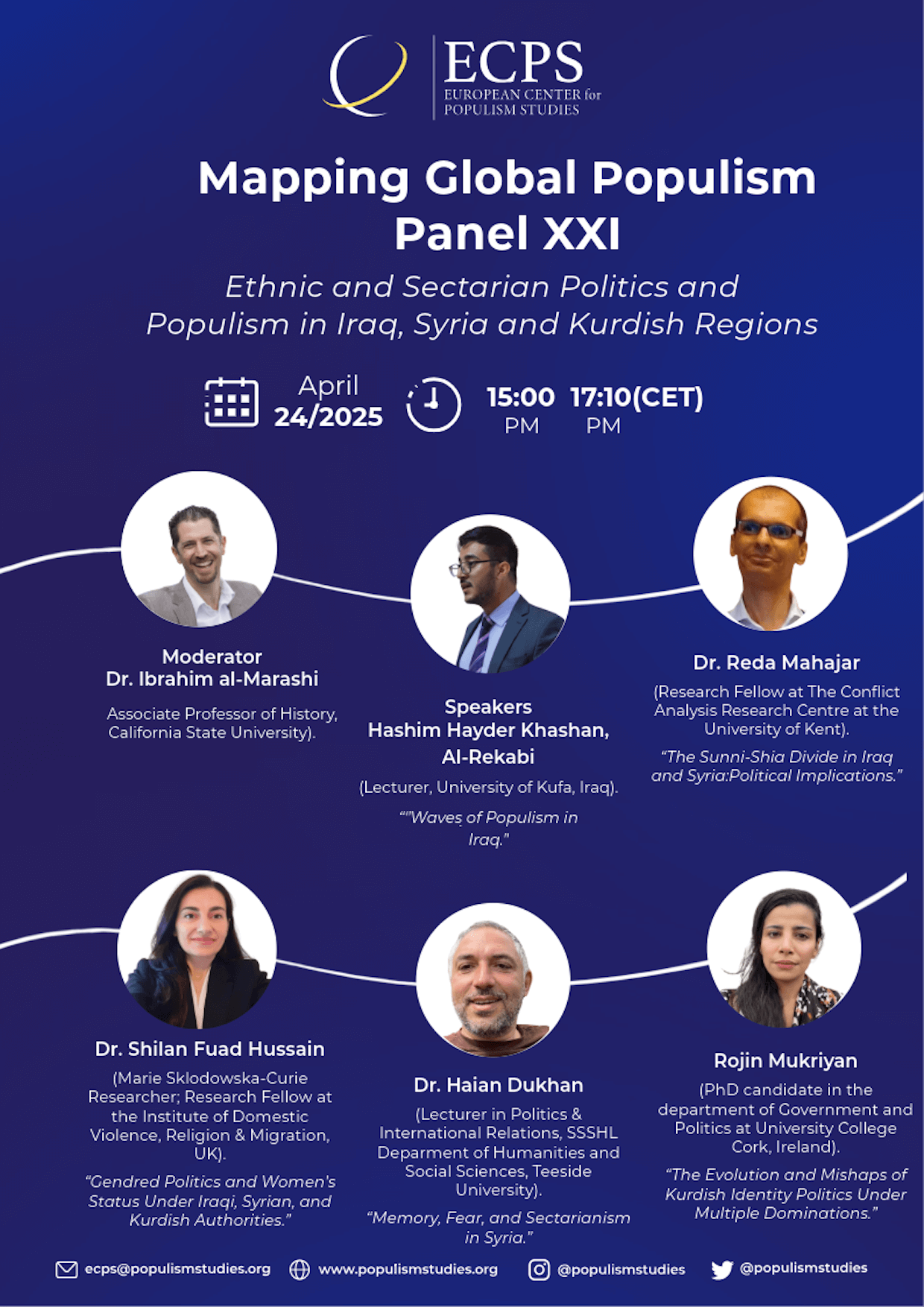
“Syrian Sunni Jihadi Chickens Home to Roost: Assad’s Fatal Gamble in Iraq,” by Dr. Reda Mahajar (Research Fellow at The Conflict Analysis Research Centre (CARC) at the University of Kent).
“Memory, Fear, and Sectarianism in Syria,” by Dr. Haian Dukhan (Lecturer in Politics & International Relations, SSSHL Department of Humanities and Social Sciences, Teeside University).
“Gendered Politics and Women’s Status Under Iraqi, Syrian, and Kurdish Authorities,”by Dr. Shilan Fuad Hussain(Marie Sklodowska-Curie Researcher; Research Fellow at the Institute of Domestic Violence, Religion & Migration, UK).
“The Evolution and Mishaps of Kurdish Identity Politics Under Multiple Dominations,” by Rojin Mukriyan (PhD candidate in the department of Government and Politics at University College Cork, Ireland).
Dr. Ibrahim Al-Marashiis Associate Professor of Middle East History at California State University San Marcos, and an advisory board member of the International Security and Conflict Resolution (ISCOR) program at San Diego State University (SDSU), as well as an adjunct lecturer at its School of Public Health. He is also a visiting lecturer with the University of San Diego’s Department of Political Science and International Relations. Al-Marashi received his doctorate from the University of Oxford. He is the co-author of Iraq’s Armed Forces: An Analytical History (2008), The Modern History of Iraq (2016), and A Concise History of the Middle East (2024).
Syrian Sunni Jihadi Chickens Home to Roost: Assad’s Fatal Gamble in Iraq
Dr. Reda Mahajar is a research fellow at the Conflict Analysis Research Centre (CARC) at the University of Kent. His current postdoctoral research focuses on how the Hajj rituals reproduce the ‘Sunni’ and ‘Shia’ labels as categories of power in Western Europe. Dr. Mahajar earned his PhD in International Relations from the University of Kent. His PhD dissertation, titled “Shialism: The Historical Persistence of the Sunni-Shia Binary,” examines the historical persistence of the ‘Sunni’/‘Shia’ labels as constructs of power in the ‘Arab’ and ‘Muslim’ worlds, as well as in the ‘proverbial West.’Dr. Mahajar’s research interests include exploring the ontological, temporal, and epistemological assumptions that underpin conceptualizations of identities as categories of power in the fields of international relations, migration, Middle Eastern studies, and nationalism studies.
Waves of Populism in Iraq
Mr. Hashim Hayder Khashan Al-Rekabi is a lecturer at Baghdad University, where he teaches courses in behavioral statistics and introduction to political science. He also mentors senior students in drafting their capstone research projects. Additionally, he is the founder of the Platform Center for Sustainable Development (PSDIraq), which aims to establish a policy-oriented youth network to drive positive change through policy work. Al-Rekabi holds a Master’s degree in Comparative Politics from Western Illinois University.
Abstract: My presentation challenges the views that post-2003 Iraq should be studied in isolation and demonstrates that many of the pre-2003 dynamics impacted the post-2003 era, mainly populism. It sheds light on the three waves of populism in Iraq, the authoritarian populism of Saddam’s regime being the first, given that he was the leader of a secular and pan-Arab party but frequently used religion and nationalism strategically and selectively under certain conditions, creating the context of modern populism. The second wave is the ethno-sectarian populism post-2003 that created multiple populist actors who demonstrated their allegiance to parliamentary democracy but undermined it by their practices. The third and final wave this paper examines is the modern populism of post-2014, where insiders nurtured nationalist populism due to the declining appeal of sectarianism, the deep political divisions, and widespread disappointment. This paper is based on a field study measuring popular perception of post-2003 political systems, including populist tendencies, level of trust, and other demographic and democratic factors.”
Memory, Fear, and Sectarianism in Syria
Dr. Haian Dukhan is a Lecturer in Politics and International Relations at Teesside University and a Fellow at the Centre for Syrian Studies, University of St Andrews. He is the author of State and Tribes in Syria: Informal Alliances and Conflict Patterns (Routledge, 2019) and co-editor of Spoils of War in the Arab East: Reconditioning Society and Polity in Conflict (Bloomsbury, 2024). His research focuses on the international relations of the Middle East, with a particular emphasis on the role of non-state actors in armed conflicts. His work has appeared in the International Journal of Middle East Studies, Nations and Nationalism, Small Wars and Insurgency, and others. He has also authored multiple policy reports for USAID, the Konrad Adenauer Foundation, the Middle East Institute, and others on issues related to sectarianism, extremism, and forced migration. Previously, he taught politics and international relations at the universities of Leicester, Edinburgh, and Queen Mary University of London, and held research positions at the Central European University in Austria and Roskilde University in Denmark.
Abstract: The Syrian uprising and subsequent civil war have been extensively studied with a predominant emphasis on sectarianism between the Sunni and Alawite sects. This narrow focus overlooks the profound influence of other religious and ethnic elements within Syrian society. My Presentation aims to broaden the analytical lens by examining the position and attitudes of Christians in the Al-Hasakah governorate regarding the Syrian uprising and opposition forces. My presentation addresses two key inquiries: first, the factors influencing Christians’ position in Al-Hasakah regarding the Syrian uprising, and second, the ramifications of these positions on intercommunal relationships in the region. I will argue that the collective memory of fear experienced by Christians, manipulated by the Syrian regime, has contributed to the emergence of “sectarianism from below” and “sectarianism from above.” The former reflects the construction of sectarian identities by Christians in response to discrimination and marginalization, while the latter pertains to influential institutions perpetuating sectarian identities and divisions. My findings highlight the complex interplay of factors shaping communal attitudes and relations during times of upheaval and conflict.
Gendered Politics and Women’s Status Under Iraqi, Syrian, and Kurdish Authorities
Dr. Shilan Fuad Hussain is dedicated to advancing gender equality and advocating women’s rights. She is a Fellow at the Institute of Domestic Violence, Religion & Migration, and The Integrity Centre. She is an Associate Editor for Brill and Routledge and a Senior Consultant for gender-related societal issues. She is an Associate Fellow of the Higher Education Academy. She was previously a Marie Sklodowska-Curie Postdoctoral Fellow in Gender Studies and Cultural Analysis (UKRI), a Visiting Fellow at the Washington Kurdish Institute (U.S.), and a Doctoral Fellow at the Geneva Centre for Security Policy (Switzerland), where she has published several papers and received tailored training. She holds a Master’s Degree in Middle Eastern Studies from the University of Bologna and a PhD in Cultural Analysis from the University of Urbino (Italy). She has developed a track record in Cultural Analysis alongside Middle Eastern Studies. She is an interdisciplinary academic and works on a variety of topics, including cultural representation, production, and practices; gender-based violence, women’s human rights and empowerment; state policies enhancing female equality. She has published 20 articles in peer-reviewed academic journals, 3 special issues, 4 book chapters, one co-edited book, 12 open-access articles online, 10 op-eds; one single-authored book is forthcoming, and an edited book and edited Volume. Personal website: www.shilanfuadhussain.com.
Abstract: This study examines the intersection of gendered politics and women’s status under Iraqi, Syrian, and Kurdish authorities, analysing how political structures, legal frameworks, and societal norms shape women’s rights and participation in governance. Utilizing a comparative approach, the research draws on legal documents, policy analyses, and interviews with activists, policymakers, and scholars to assess the extent to which state and non-state actors influence gender dynamics. The findings reveal stark contrasts between authoritarian regimes, semi-autonomous governance, and stateless political movements in their approaches to women’s rights. In Iraq and Syria, shifting power structures, sectarian conflicts, and legal pluralism have led to inconsistent protections for women, often subordinating gender equality to nationalist or religious agendas. In contrast, Kurdish-led administrations have promoted more progressive gender policies, though challenges remain in implementation and enforcement. The study argues that women’s status is not only a reflection of legal rights but also of broader political ideologies and power struggles. By situating gender within the framework of state-building and governance, this research contributes to the understanding of how political authority affects women’s agency, representation, and security in conflict-affected and transitional societies.
The Evolution and Mishaps of Kurdish Identity Politics Under Multiple Dominations
Rojin Mukriyan is a PhD candidate in the Department of Government and Politics at University College Cork, Ireland. She has also obtained a BA and MSc from University College Cork after fleeing from Iran for political reasons in 2014. For her BA, she double majored in Philosophy and Politics, and wrote a dissertation on the role of ontological insecurity in Turkey’s treatment of the Kurds. She then obtained an MSc in Government and Politics from UCC with a thesis on the application of classical republican conceptions of domination and political liberty to the Kurds of Rojava (West Kurdistan). Presently, her PhD research project is focused on a thorough analysis of jailed Kurdish leader Abdullah Ocalan’s conceptions of democratic confederalism and democratic civilization.
Rojin’s main research areas are in political theory and Middle Eastern politics, especially Kurdish politics. She has published articles in the Journal of International Political Theory, Philosophy and Social Criticism, and Theoria. Her research has thus far focused on the areas of Kurdish liberty, Kurdish statehood, and Kurdish political friendship. She has published many think tank commentaries and reports on recent political developments in eastern Kurdistan (Rojhelat), or north-western Iran. She has also frequently appeared on a variety of Kurdish and Persian language news channels.
Abstract:This presentation conducts a critical comparative analysis of populism by examining the PYD-led Democratic Autonomous Administration of North and East Syria (DAANES) alongside the PUK and KDP-led Kurdistan Regional Government (KRG). Drawing upon Ernesto Laclau’s conceptualization of populism as a strategy for hegemonic struggle and Jan-Werner Müller’s characterization of populism as a ‘permanent shadow’ over representative democracy, this study refrains from adopting a monolithic definition of populism. Instead, it establishes a set of criteria for assessing whether the DAANES or the KRG can be classified as populist governments. The investigation explores the theoretical and ideological frameworks underpinning both political entities, bolstered by qualitative data derived from their public speeches, publications, and policy documents. The analysis argues that DAANES can be viewed as exhibiting left populist characteristics that challenges both existing state institutions and the rise of Islamist extremism. In contrast, the KRG, dominated by the PUK and KDP, does not exhibit the characteristics of left populism, as it fails to challenge the existing system or promote an inclusive notion of peoplehood aimed at equality and freedom. Although some figures within the KRG may display populist tendencies, the KDP and PUK are predominantly formed and controlled by two elite families, thereby offering no anti-establishment prospects; consequently, they do not embody right-wing populism either. It is likely better to view both parties as exhibiting the expected neoliberal tendencies of parties inclined to use the state as a means for laundering their private interests. In turn, following Chantal Mouffe’s line of argument, this paper asserts that the left populism found in the DAANES could effectively challenge the corrupt and clientelist governance within the KRG if it found support within the Kurdish region of Iraq. This paper aims to contribute to a nuanced understanding of populism within the context of Kurdish politics. By doing so, it enriches the field of Kurdish political studies by offering a comprehensive analysis of populism in a context that has been insufficiently explored, thereby advancing the broader discourse on populism.
In an interview with ECPS, Dr. Samuele Mazzolini argues that Ecuadorian President Daniel Noboa has embraced populism not as a vehicle for transformation, but as a strategy to maintain power amid crisis. Recently re-elected after a snap presidency, Noboa has relied on emergency decrees, militarized crackdowns, and anti-crime rhetoric. “Populism has simply served as a means to cling to power and bolster his personal image,” Dr. Mazzolini asserts. Despite branding himself as a technocrat, Noboa “lacks a coherent national project” and governs through “sheer improvisation.” Dr. Mazzolini warns that Ecuador is entering a “permanent state of exception,” with rising authoritarian tendencies and no clear roadmap for reform.
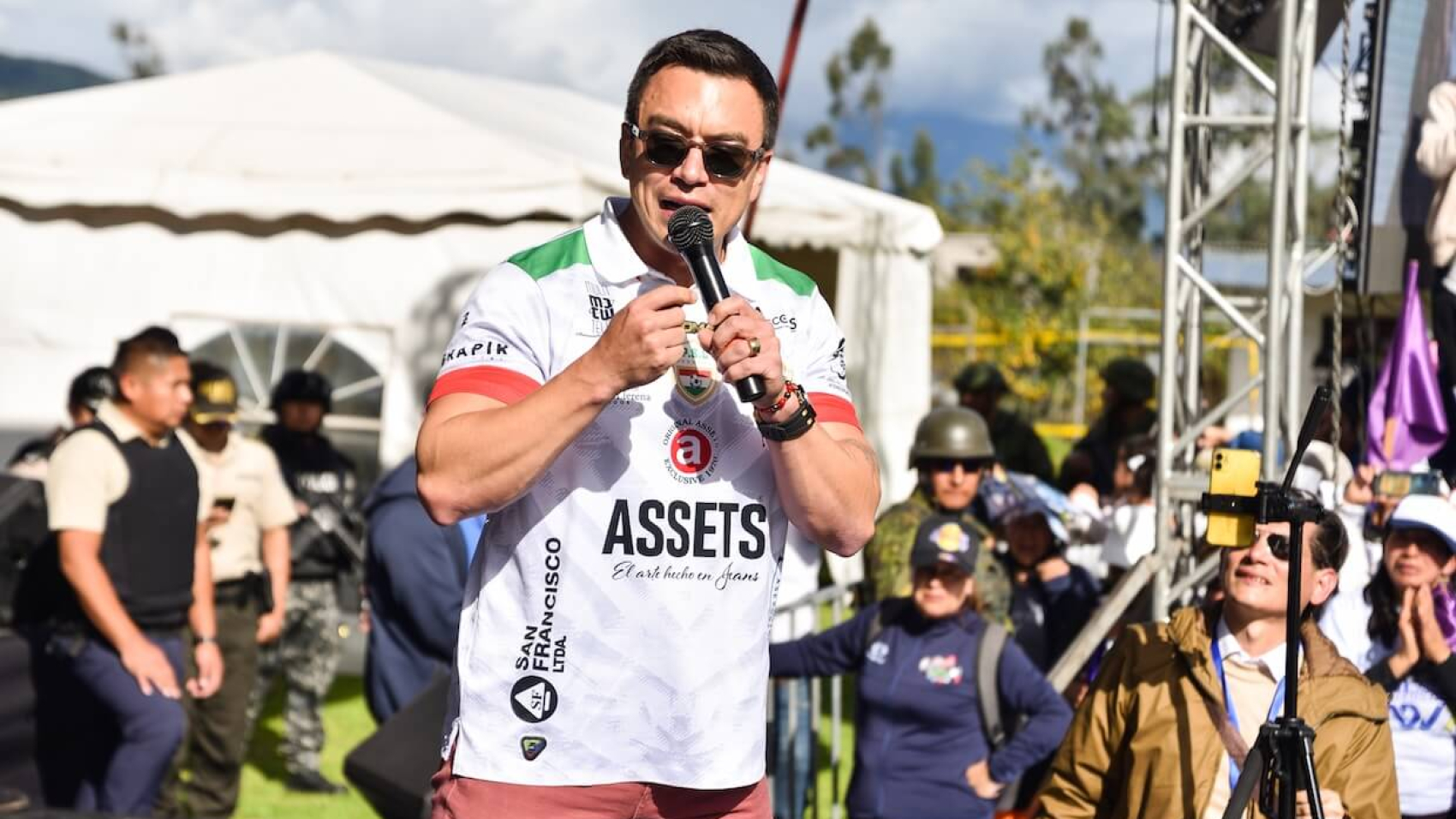
In a sharply observed conversation with the European Center for Populism Studies (ECPS), Dr. Samuele Mazzolini—Adjunct Professor of Political Science at Ca’ Foscari University of Venice—offers a sobering analysis of Ecuador’s evolving political landscape under President Daniel Noboa. Recently re-elected in the April 2025 run-off, Noboa secured a full four-year term after what he called a “historic” victory. He originally came to power in November 2023 through a snap election and has since defined his presidency by launching a militarized crackdown on Ecuador’s powerful criminal gangs—an approach that has dominated his public image as the country became the most violent in the region.
Despite his win, Noboa’s left-wing challenger, Luisa González, rejected the result, alleging fraud without providing evidence. Against this backdrop of tension and insecurity, Mazzolini argues that Noboa’s political style is not grounded in reform, but in survival. “In Noboa’s case, [populism] has simply served as a means to cling to power and bolster his personal image,” he asserts.
Though Noboa projected a moderate and technocratic profile during his initial campaign, his presidency has taken a decisive right-wing populist turn. “He wasn’t the ‘security candidate.’ That was Jan Topić… But the very moment he took office, he took a different turn,” Dr. Mazzolini notes. Noboa’s embrace of penal populism—relying on military force and emergency powers—has so far failed to reduce violence. “Despite tough talk on crime and gangs, the rates haven’t improved,” Dr. Mazzolini observes.
Crucially, Dr. Mazzolini emphasizes the absence of a coherent political vision. “What are his views on industrial relations? Agricultural policy? Same-sex marriage?” he asks. “There are countless areas where he appears to have no defined position.” Unlike Rafael Correa, whose government—though polarizing—pursued a structured national project, Noboa seems adrift, leaning on improvised alliances and securitarian rhetoric.
As Dr. Mazzolini concludes, Noboa’s presidency appears less like a populist transition toward transformation, and more like the entrenchment of a permanent state of exception: “a deliberate effort to take advantage of the situation… because he saw the opportunity was ripe to consolidate his image.”
Dr. Samuele Mazzolini —Adjunct Professor of Political Science at Ca’ Foscari University of Venice.
Here is the lightly edited transcript of the interview with Dr. Samuele Mazzolini.
Securitarian Populism, Not Technocratic Reform
Professor Mazzolini, thank you so very much for joining our interview series. Let me start right away with the first question: How should Daniel Noboa’s recent electoral victory be interpreted within the broader trajectory of populism in Ecuador? Does it signify a new phase in the evolution of populist politics in the country, or a rearticulation of existing populist paradigms under a technocratic-securitarian guise?
Dr. Samuele Mazzolini: There has certainly been a shift toward a kind of penal populism—one that places heavy emphasis on delivering security, increasing national safety, and attempting to curb the unchecked expansion of criminal gangs in Ecuador. So yes, it is clearly a rearticulation of populism under a securitarian guise.
However, I wouldn’t say there’s much technocracy at play. If you look at Noboa’s first year and a half in office, it’s been marked by sheer incompetence, indolence, and a general lack of professionalism. There hasn’t been much evidence of technocratic governance—despite the polished image he projects.
Daniel Noboa is a young figure, fluent in English, US-educated, and he carries himself well. But if you examine his actual decisions and decrees over the past 18 months, they leave a lot to be desired. So, again, I don’t see technocracy; I see a strong security discourse that, in practice, hasn’t delivered. If you look at the numbers, despite tough talk on crime and gangs, the rates haven’t improved. Ecuador remains a very unsafe place, and the population continues to live under the grip of organized crime.
Do you see Noboa’s re-election and hardline tactics as signaling a right-wing variant of the populist-institutional tensions you identified in Rafael Correa’s government?
Dr. Samuele Mazzolini: Certainly. When populist politics is prolonged, it becomes increasingly difficult to construct a stable institutional framework. To put it plainly: unless you succeed in redefining the identity of your adversaries, establishing durable institutions becomes a serious challenge. This requires a transition from a polarizing strategy to one that reintegrates opponents into the emerging order. It’s essential to ensure that the system you build does not unravel or get overturned the moment you leave power.
In that sense, yes, a parallel with Correa can be drawn. Under Correa, there were clear tensions between populist rhetoric and the broader project of institution-building. However, I see two key differences. First, Noboa has been in power for a very short time—just about a year and a half—which is hardly sufficient, even for a populist, to fully articulate a political vision or begin the process of reintegrating adversaries.
Second, and more importantly, Noboa doesn’t appear to have a project for the country. His governance so far seems driven by sheer improvisation. When he was first elected in 2023, I don’t think he expected to win. My impression is that he aimed to perform well to position himself for future elections, but unexpectedly found himself president.
Historically, the Ecuadorian right has lacked a solid, coherent project for the country—aside from capturing the state and bending it to create a more favorable environment for business. In that sense, I doubt he has any clear long-term vision. Let’s see how his plan for a Constituent Assembly develops. He apparently wants to change the current constitutional framework—reversing the progressive constitution drafted under Correa in the early 2000s, which emphasized rights, state planning, and redistribution.
Many fear that his goal is to do away with these provisions and instead draft a new constitution that minimizes rights and reduces the state’s role in planning and redistribution. The intention seems to be to create a more business-friendly climate for both foreign and domestic investors. In short, it looks like a push to take the country back to the neoliberal era.
Noboa’s Populist Signature: Militarization Without Accountability
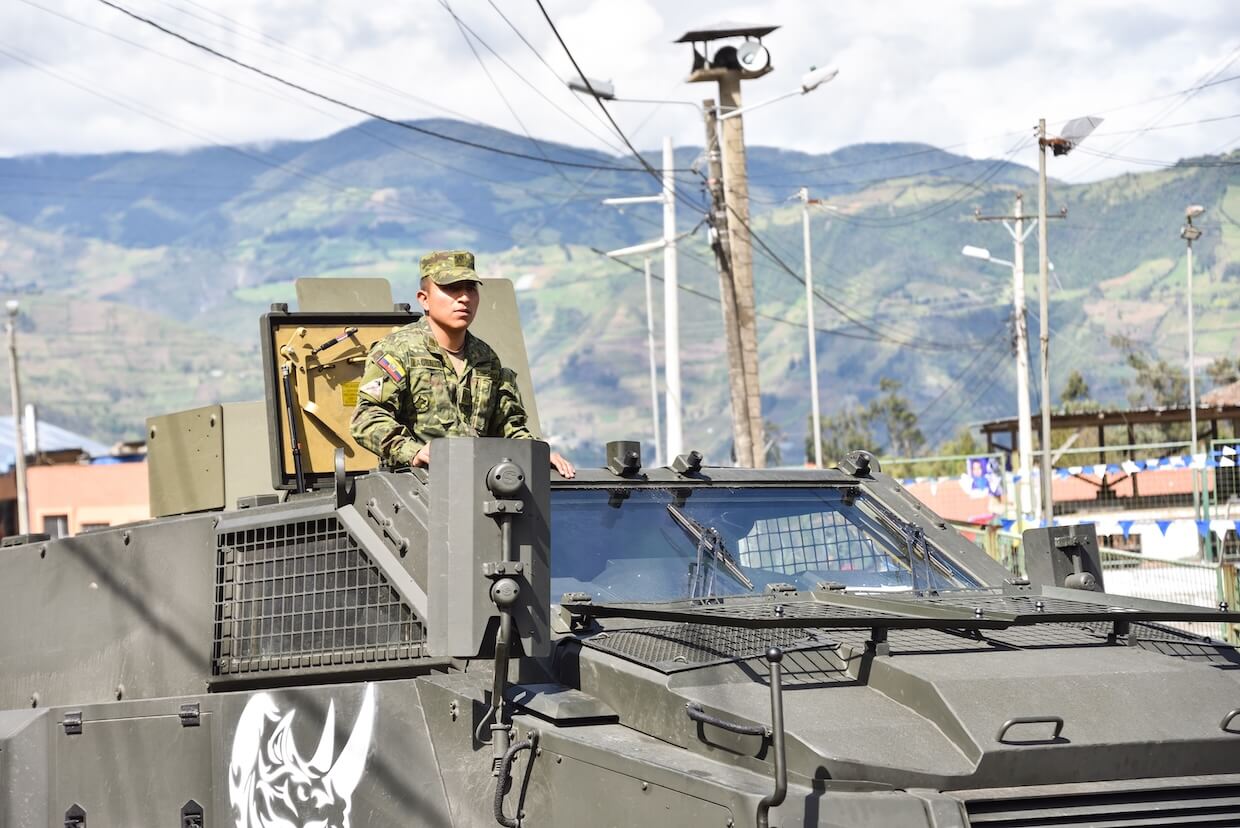
A soldier peers out from a tank outside a campaign event for Ecuador’s President Daniel Noboa. Photo: Miles Astray.
How does President Noboa’s militarized crackdown on crime reflect elements of penal populism, and in what ways does it diverge from traditional Latin American law-and-order populism?
Dr. Samuele Mazzolini: A major difference lies in the involvement of the armed forces. If you recall, from the very beginning of his mandate, he declared a state of conflict—he said there was a war going on with criminal gangs—and brought in the armed forces to collaborate with the police in the fight against organized crime. That’s something new. However, it should be noted that the armed forces are not properly trained for patrolling the streets; their training is very different. So I’m not sure how effective they are in that context, and so far, the statistics do not seem to suggest they’ve been particularly useful.
Another major concern is the blatant disregard for human rights and international law. Take, for instance, the case of the four boys from Las Malvinas, a neighborhood in Guayaquil, who were kidnapped, tortured, and brutally killed by the armed forces. And that is just one example—it reflects a broader climate of impunity for the military and police acting under presidential orders. There have been numerous other reports of abuse and extrajudicial disappearances—people who simply vanish—many of whom have no ties to organized crime. A significant number of these victims are Afro-Ecuadorian or individuals with darker skin tones, introducing a deeply troubling racialized dimension to the violence.
What’s even more alarming and horrifying is the way Noboa’s government has shielded the armed forces and police when such cases have come to light. His handling of the case of the four boys from Las Malvinas reveals a complete disregard for human rights. Now that he has won the election, I believe he will feel even more empowered to continue these measures, while the armed forces are likely to feel increasingly emboldened and protected in carrying out further abuses.
Another example I want to highlight—one that also illustrates how Noboa interprets populism—concerns a serious violation of international law. Take the case of former Vice President Jorge Glas, who had been subjected to lawfare under previous administrations, including the current one. At one point, he was free and sought refuge in the Mexican Embassy in December of last year, after it appeared that Mexican authorities were prepared to grant him asylum. What followed was extraordinary: Ecuadorian police forces stormed the embassy, forcibly removed Glas, and reportedly mistreated embassy personnel. This was a clear and blatant violation of international law. Noboa clearly showed no concern. You might not agree with how the Mexican authorities handled the situation, but there are certain lines that simply should not be crossed. Noboa clearly doesn’t care. By violating international law so blatantly, he presented himself to the public as a leader who doesn’t hesitate to take bold, forceful action. In doing so, he bolstered his image—but in my view, it was a reckless and dangerous step.
Authoritarian Populism Disguised as Emergency Governance
Can Noboa’s extensive use of emergency decrees and military deployments—especially during the election—be seen as a textbook case of authoritarian populism? What democratic vulnerabilities does this strategy expose?
Dr. Samuele Mazzolini: Yes, definitely. We’re witnessing a clear erosion of democratic standards with the emergence of deeply concerning authoritarian tendencies. The continuous state of emergency, the repeated trampling on the rule of law—these are patterns that go beyond Ecuador and are part of a broader trend in Latin American politics. There has always been a tense relationship between populism and the rule of law, that’s for sure. But I think Noboa is taking it a step further.
We’ve seen extensive use of judicial and electoral institutions for his own political ends. As I mentioned earlier, he has guaranteed impunity for the actions of the armed forces and the police. We also saw the strategic use of state-issued vouchers right before the election to secure electoral support—classic clientelist, patronage politics. All of these elements point to a serious erosion of democracy in Ecuador, and it’s something that must be watched very closely.
The only remaining institutional check on Noboa at this point is the National Assembly. He does not have an overwhelming majority there, so he will face resistance in pushing his agenda through formal channels. Still, as we’ve seen many times, there are ways around the Assembly—whether through buying off deputies, forming opportunistic coalitions with new parties, or simply pushing forward presidential decrees.
In short, yes—this is very much a textbook case of authoritarian populism, carried out under the pretext of combating criminal gangs.
Securitizing Crisis to Consolidate Power
Do you interpret Noboa’s invocation of an “internal armed conflict” and the framing of criminal gangs as terrorist threats as part of a broader global trend of securitizing social crises through populist narratives?
Dr. Samuele Mazzolini: Right-wing populism has long prioritized the promise of law and order, placing strong emphasis on crime—whether real or perceived. Often, it is not actual crime statistics but the perception of insecurity, amplified by media narratives, that shapes political responses. In Ecuador’s case, however, the threat is tangible. Crime is a major issue, and the situation has spiraled out of control. The country currently has the highest homicide rate in the region and one of the highest globally. Noboa has taken advantage of this by going a step further—invoking the notion of an “internal armed conflict” and framing criminal gangs as terrorist threats. These groups are indeed violent and organized, but his approach reflects how power is being exercised.
From an analytical standpoint, social crises and security crises are not synonymous, though they often intersect. One may contribute to the other, but the relationship is not automatic. Ecuador has long suffered from poverty and poor economic indicators; these challenges predate the current security crisis. What we are witnessing now is a specific interpretation of how to address security threats—one that cannot be fully explained by social conditions alone. In Ecuador’s case, several additional factors are at play: the partial end of Colombia’s armed conflict, the decision by Mexican cartels to use Ecuadorian gangs as local proxies, and the retrenchment of the state since the Correa era. Following Correa’s departure, state institutions have become less present and less embedded in local territories, creating space for international criminal organizations to establish and consolidate power.
So, as you can see, this is a multifaceted problem that security experts are actively analyzing. Noboa’s brand of right-wing populism has seized upon it to construct a tough-on-crime persona. But, as I’ve already mentioned, the methods he’s employed—particularly the carte blanche given to armed forces and police—don’t appear to have delivered effective results. To address a security crisis meaningfully, you also need to resolve underlying social issues. What’s needed is a far more integrated, comprehensive approach.
Is Noboa’s security offensive more a case of populist responsiveness to widespread public fear, or is it better seen as a calculated strategy for consolidating executive power under the guise of emergency?
Dr. Samuele Mazzolini: It can be seen both ways. One doesn’t exclude the other. What is striking here is that there seems to be a deliberate effort to take advantage of the situation—a sort of “going populist” because he saw the opportunity was ripe to consolidate his image. When he was a candidate in the previous elections, he came across as a moderate—someone who aimed to rise above the cleavage between Correísmo and anti-Correísmo. He presented himself as a centrist, with even some left-leaning ideas, showing particular concern for the poor.
He wasn’t the “security candidate.” That was Jan Topic—a different figure entirely, who boasted about having worked as a mercenary in various war zones. Of course, everyone talked about crime—it’s been a recurring theme in Ecuadorian electoral campaigns over the last five years—but security didn’t appear to be Noboa’s strongest point, nor the reason people chose him over others.
However, the very moment he took office—and after a fleeting parliamentary collaboration with Correísmo—he took a different turn. He adopted a right-wing populist stance, emphasizing a tough-on-crime approach through extensive deployment of the armed forces, the use of emergency decrees, curfews, and similar measures.
Populism Without a Project Becomes a Tool for Survival
You’ve characterized populism as a “transitional device.” In Noboa’s case, is this transition leading toward a reconfigured institutional logic—or is it entrenching a permanent state of exception?
Dr. Samuele Mazzolini: Yes, I have characterized populism as a “transitional device”—but that’s, of course, when you conceive of populism as a strategy tied to a broader project, a vision for steering society in a particular direction. In that sense, populism serves as a transitional mechanism toward a defined societal transformation. However, not all populists understand or employ populism in that way.
In Noboa’s case, it has simply served as a means to cling to power and bolster his personal image. So yes, I do think he is entrenching a permanent state of exception. We’ll see what happens next—I’m particularly curious whether he’ll try to normalize his authority through the Constituent Assembly. But as I mentioned earlier, I don’t see him as someone with a coherent vision for the country. What are his views on industrial relations? Agricultural policy? Same-sex marriage? There are countless areas where he appears to have no defined position.
This stands in stark contrast to Correa’s project. Whatever one may think of it, that administration had a plan. Its implementation had flaws, certainly, but at least it pursued a clear direction. Noboa, by contrast, seems adrift—focused only on defending his own wealth and that of his class.
In your work on Podemos and M5S, you stress how populism’s success depends on context. Does Noboa’s popularity, despite rising violence and economic decline, suggest that right-wing populism thrives better under structural crisis than left variants like Correísmo?
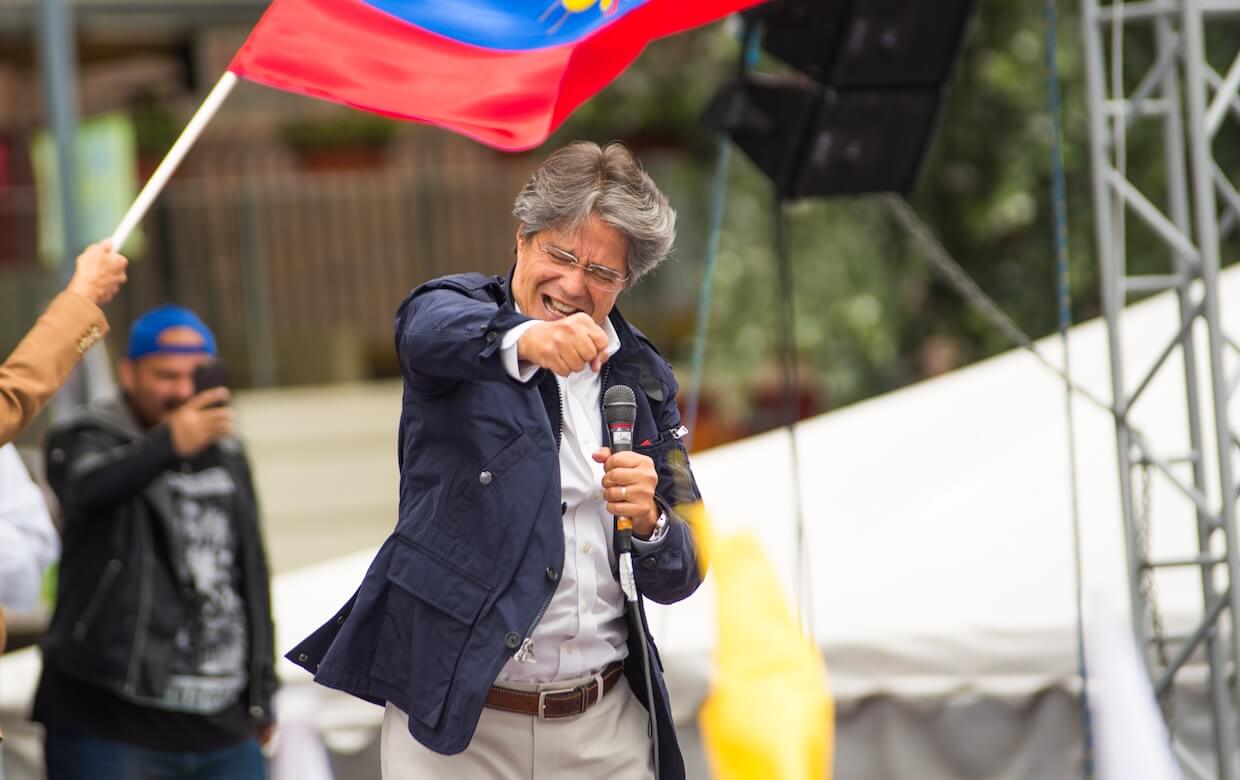
Guillermo Lasso, presidential candidate of the CREO-SUMA alliance, speaks at an election rally in Quito, Ecuador, on March 26, 2017. Photo: Pablo Hidalgo.
Dr. Samuele Mazzolini: It must be noted that right-wing populism benefits from significantly more favorable media coverage. In most cases, powerful interests tend to be far more lenient—and even benevolent—toward right-wing populist actors. The kind of pressure they exert is markedly different from what left-wing variants face. In this sense, right-wing populism is often better equipped to withstand structural crises, constraints, and even blatant shortcomings than its left-wing counterparts.
Additionally, it’s important to consider that Noboa has only been in power for a relatively short time. Many people might think, “He’s only been in office for a year and a half—let’s give him some credit and see how he performs over the next few years.”
Another important point is that, despite Noboa’s poor performance during this period, anti-Correísmo remains a powerful political sentiment. Similar dynamics can be observed in other countries—for instance, strong anti-PT sentiment in Brazil or anti-Kirchnerismo in Argentina. These are not coherent political forces—they’re heterogeneous—but they are united in their strong opposition to former left-wing leaders, for a variety of reasons I won’t delve into here. However, once this broad demographic finds a figure who gains some popularity, they’re often willing to extend that figure a political blank check.
Until Noboa, the right wing in Ecuador was highly fragmented. First, there was Guillermo Lasso, who quickly squandered his initial popularity. In the previous election, multiple right-wing candidates competed for prominence. Now, a single figure has emerged. Interestingly, Noboa has undergone a shift. While he was always opposed to Correísmo, he wasn’t initially a staunch anti-Correísta and didn’t emphasize that stance heavily. Now, however, it has become a central theme of his rhetoric. He polarizes the country by framing the political landscape as a battle between good and evil. As he put it the day after the elections: on one side, the good forces; on the other, the evil ones—into which he groups criminal gangs, Correa, his allies, and his candidate, Luisa González. He draws a clear equivalence between them.
That rhetoric has been strongly supported by the media, which has—without any evidence—suggested that Correísmo is tied to drug trafficking and criminal networks. That’s classic populist rhetoric, and it’s paying off. So yes, I do think that, for the time being, even in the face of structural crises, Noboa can maintain high popularity. But let’s see what happens next.
Populists Govern Through Deals, Not Durable Coalitions
Do Noboa’s coalition maneuvers—including fleeting alliances with Correístas—represent pragmatic populist adaptation, or are they symptomatic of Ecuador’s deep political fragmentation?
Dr. Samuele Mazzolini: Populists need to ensure they can actually govern. Remember the example of Alexis Tsipras in Greece back in 2014. The circumstances forced him to form a parliamentary alliance with a right-wing party. Also, as I mentioned before, the initial period of Noboa’s time in power can’t really be considered fully populist. So I think it’s quite typical for populists—especially those without solid backing in parliament—to seek temporary alliances as a way to navigate governance.
Another, much riskier route is what Correa did back in 2007. He didn’t have a majority in parliament—actually, he had no presence at all, since he didn’t run any parliamentary candidates—yet he won the presidency. What he did was call for the election of a Constituent Assembly, which then overrode the National Assembly. In that way, the National Assembly was bypassed. It was a very risky gamble that could have backfired, but in the end, it worked and paved the way for his political rise. However, that’s not something all populist leaders can easily replicate—especially because organizing elections for a Constituent Assembly means you need to win an overwhelming majority.
Let’s see now what happens in parliament and whether Noboa will consider something similar. If he faces significant problems in the National Assembly, he might want to pursue a strategy like Correa’s. I’m just speculating here—there are no current rumors of that sort—but under Correa, the Constituent Assembly took over standard legislative tasks during its term, so that could well be an option.
And lastly, Professor Mazzolini, corruption scandals like Metástasis and Purga have revealed links between state actors and organized crime. How should we understand this intertwinement through the lens of populist governance and criminal co-governance?
Dr. Samuele Mazzolini: To be fair, I’m not so sure populism has much to do with this. If you look at the two scandals, the individuals involved included some politicians, but were mostly state officials—particularly within the judiciary and police—who colluded with organized crime. So I’m not convinced populism is central to this dynamic. It seems more closely tied to weak state institutions, which have historically been fragile and vulnerable to collusion with criminal groups.
Now, the situation is even more dire, as these criminal organizations have become significantly more threatening. Imagine a peripheral judge who is being bribed and simultaneously threatened with violence against himself and his family. If the state lacks the strength to provide protection, if it doesn’t offer stable career paths or a strong institutional culture for its officials, it becomes far more susceptible to this kind of corruption and infiltration.
So again, I wouldn’t necessarily bring populism into the picture here. Honestly, I don’t think it plays a significant role.
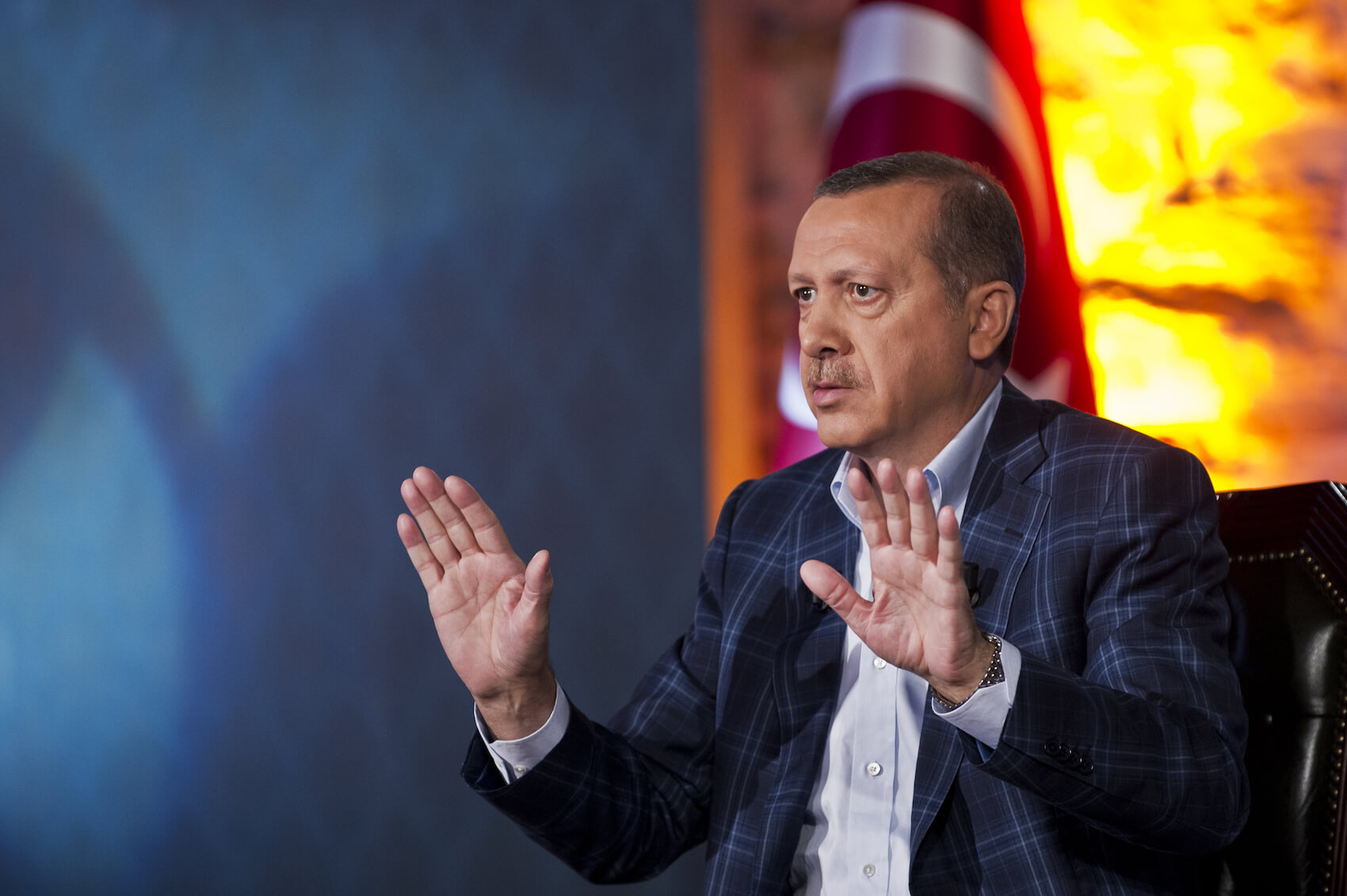
Recep Tayyip Erdogan’s political journey reflects a dramatic transformation—from a reform-minded leader once hailed as a model for Muslim democracies to an autocrat presiding over a deeply polarized and economically fragile Turkey. His consolidation of power, particularly after the 2016 coup attempt, has ushered in a regime marked by institutional erosion, economic mismanagement, and authoritarian repression. Recent mass protests sparked by the arrest of Istanbul Mayor Ekrem Imamoglu highlight growing public resistance, yet the broader trajectory remains one of democratic backsliding. Erdogan has found space to entrench his rule in an increasingly multipolar world, with Western pressure diluted by competing geopolitical priorities. The critical question now is whether domestic mobilization can meaningfully challenge this entrenched authoritarianism.
Populist rhetoric, which denounces the deficiencies of the established order while claiming to embody the will of “the people,” is inherently problematic. Populist leaders typically emerge from within a system of rules, institutions, values, and routines—even if that system is imperfect. Once in power, they frequently seek to undermine the structures that enabled their ascent, engaging in arbitrary and opportunistic governance. Confronted with the inevitable challenges of effective administration, their policies often fail to fulfill their promises and increasingly veer towards autocracy.
The central irony of populism lies in its capacity to mobilize marginalized or resentful constituencies by implying that the prosperity and freedom typically associated with rule-based institutional governance can instead be achieved through contingent modes of rule—marked by unpredictability, uncertainty, and the personalized authority of charismatic leadership.
Even more concerning is the global diffusion of these populist ‘illusions.’ They have gained traction not only in advanced, affluent societies such as the United States and across Europe—despite the historical entrenchment of robust welfare state institutions—but also in major developing countries of the Global South, including Brazil, Hungary, India, Russia, and Turkey, where similar narratives have found fertile ground.
In the case of Turkey, Recep Tayyip Erdogan has at times been cited by social scientists as an exemplar of ‘positive’ or ‘progressive’ populism, particularly in light of the early wave of comprehensive reforms undertaken during his initial years in power. However, his governance trajectory over the subsequent decade has increasingly veered toward a regressive and authoritarian model. Notably, following the 2011 general elections—which secured him a third consecutive term—his reliance on contingent and arbitrary modes of decision-making, marked by repetitive ‘trial and error’ and ‘learning by doing’ strategies, contributed to systemic rent-seeking and widespread corruption. These dynamics, in turn, played a significant role in precipitating a deepening economic crisis.
Multiple independent sources suggest that, following the revelation of widespread government corruption during police investigations between December 17 and 25, 2013, the Turkish state apparatus under President Erdogan orchestrated or capitalized on the failed coup attempt of July 15, 2016. In its aftermath, and under the guise of heightened security imperatives, Erdogan moved to dismantle the constitutional system of checks and balances, culminating in the 2018 transition to a de facto one-man rule. Much like the instrumentalization of the Reichstag fire in Weimar Germany, this episode marked a turning point that ushered in a prolonged era of political instability and economic decline.
From Democratic Leadership to Absolute Authoritarianism: The Political Trajectory of Erdogan
Lord Acton famously observed that ‘absolute power corrupts absolutely,’ underscoring the inherent risks of unchecked authority in enabling corruption and authoritarianism. This insight resonates strongly with the trajectory of the Erdogan regime, which, after eroding its electoral viability through manipulative tactics and the strategic distribution of financial incentives disguised as ‘election bonuses,’ has increasingly moved to suppress direct opposition and compromise the integrity of the electoral process—ultimately at the expense of the public.
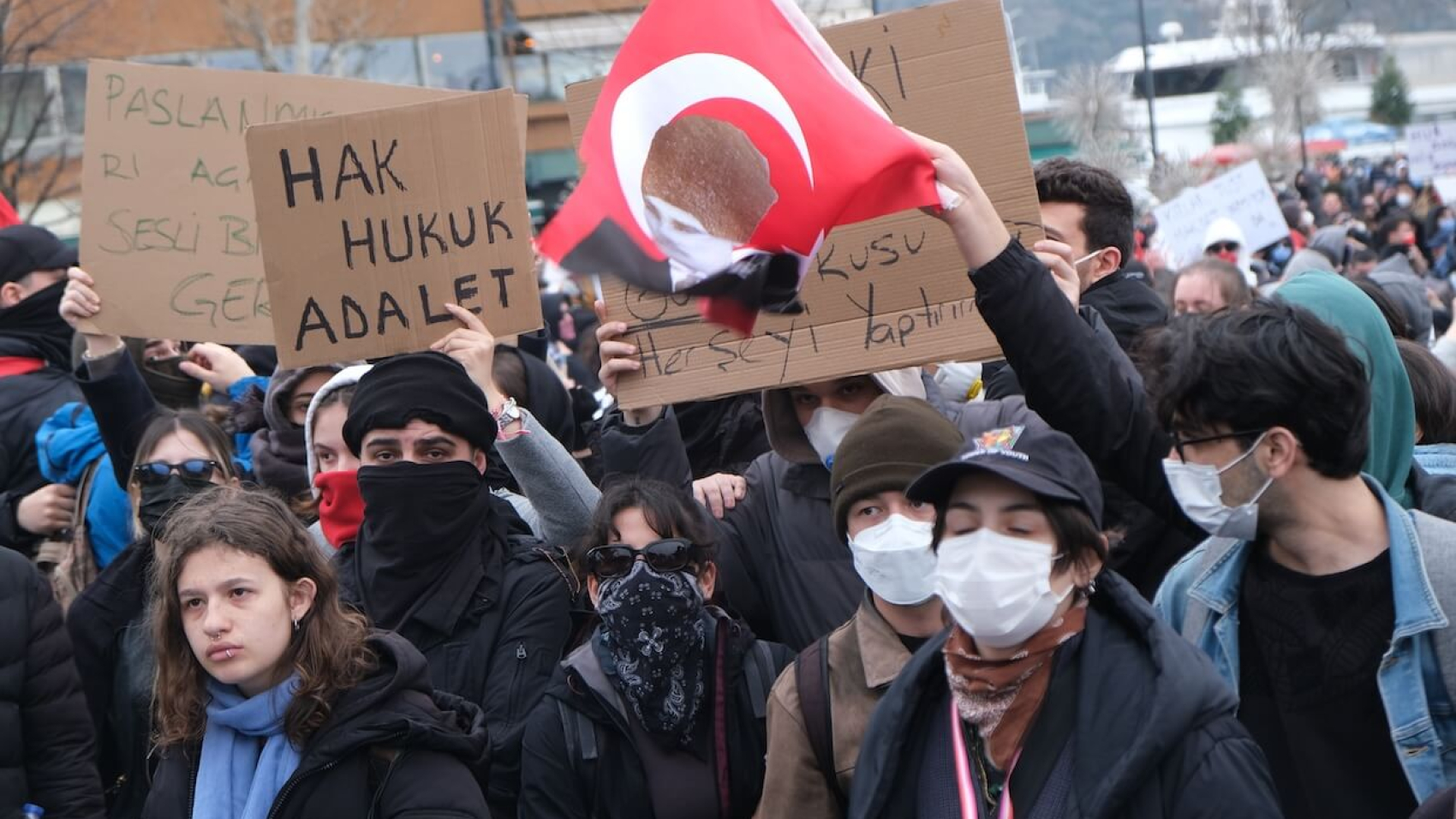
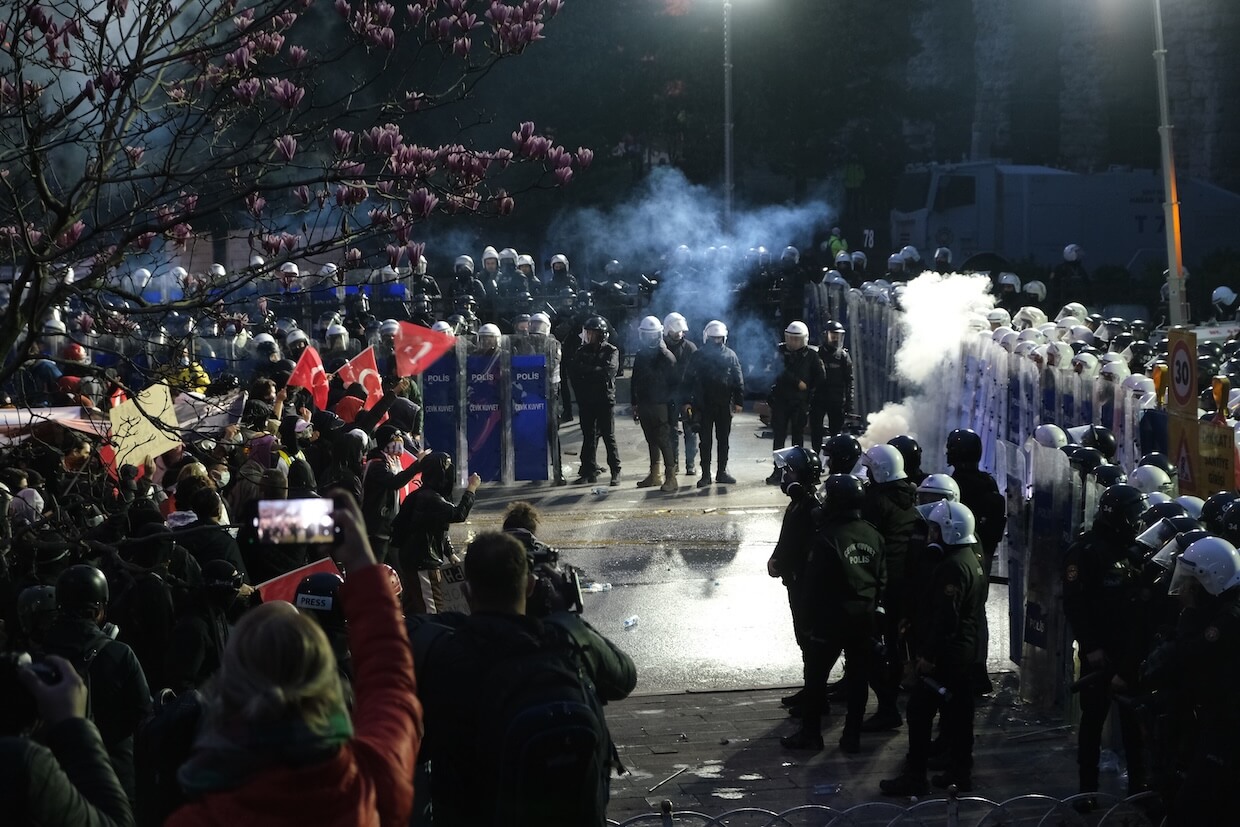
Beyond the prolonged pretrial detention of civil society figure Osman Kavala, attorney Selcuk Kozagacli, and parliamentarian Serafettin Can Atalay, the Erdogan regime has systematically targeted political adversaries across the ideological spectrum—from left-Kurdish leader Selahattin Demirtas to right-nationalist party leader Professor Umit Ozdag—often in the absence of substantive judicial proceedings. The latest escalation—the pretrial detention of Ekrem Imamoglu, Mayor of Istanbul, one of the world’s largest metropolitan centers—has significantly exceeded the limits of societal tolerance, triggering a sharp upsurge in public outrage. Imamoglu’s arrest on March 19, 2025, has provoked widespread condemnation: citizens have flooded the streets of Turkey’s major cities, university students have launched campus protests, and demands for ‘rights, law, and justice’ resonate across all social media platforms.
Let us begin with a set of critical questions: How did the Justice and Development Party (AKP), after a decade of seemingly successful governance between 2003 and 2013, descend into authoritarianism and preside over profound economic and political deterioration? How can we account for the stark contrast between President Erdogan’s two political trajectories—first, as a leader widely hailed as a model for the Islamic world, steering a ‘Muslim yet secular, democratic, modern, and European-oriented’ nation with a liberalizing market economy; and later, as the chief architect of accelerated Putinization, complete authoritarianism, and systemic economic decline?
More critically, the question now is: Where is Erdogan’s trajectory headed, particularly in light of the legitimacy afforded by the global rise of authoritarian right-wing populism—most notably in the United States and increasingly within the European Union—amid escalating challenges related to security and migration? In this context, Erdogan occupies a strategically pivotal position. What values, normative frameworks, and strategic latitude does the emerging multipolar world order afford him? Is Turkey gradually evolving into a new ‘Iron Curtain’ state within a reconfigured Cold War landscape—defined by transactional, interest-based relations with its traditional US and EU allies? As some have suggested, was the centennial of the Turkish Republic, founded by Ataturk in 1923, merely a symbolic intermission—now giving way to a neo-Sultanist order governed by a singular authority, one unrestrained by modern institutional checks or even the fixed doctrinal constraints of Sharia, thus allowing for unprecedented levels of conditionality, contingency, and arbitrariness?
In a comprehensive analysis I authored for Project Syndicate and Al Jazeera following Erdogan’s third general election victory in 2011, I acknowledged his government’s relative ‘economic miracle’ but concluded with a note of cautious skepticism: ‘The big question is how Erdogan will use this increasing power in the coming period.’ In the years since, Erdogan’s governance has offered considerable clarity regarding his long-term ambitions—developments that can be analytically divided into three distinct subperiods.
Episode One (2003–2013): The More Orthodox, the Greater the Success
The two successive analyses referenced above emphasized that during the AKP’s first decade in power (2003–2013), the implementation of comprehensive reforms aligned with the European Union accession agenda—coupled with the oversight of the IMF and World Bank—catalyzed substantial economic growth, largely driven by a notable rise in productivity for the first time in decades. In addition to favorable global liquidity conditions, Erdogan’s strong electoral legitimacy and effective leadership further reinforced this period of economic and political consolidation.
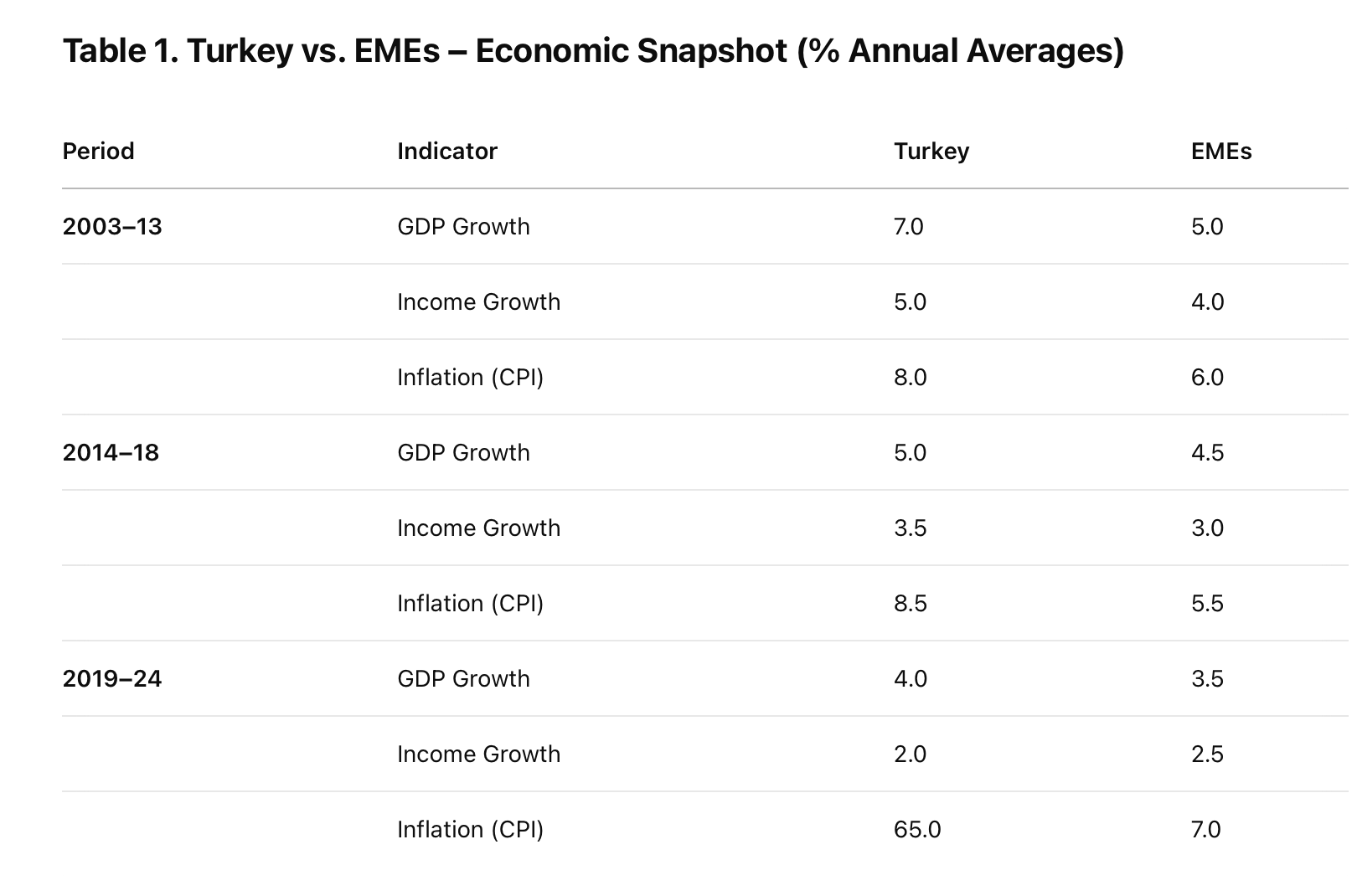
Despite rapid growth, the surge in productivity and currency appreciation—both closely tied to capital inflows—underpinned Turkey’s macroeconomic transformation. Decades of chronic inflation, which had hovered in triple digits in the early 2000s, declined to single digits by 2005, while income distribution improved markedly. Supported by wide-ranging structural reforms and sustained macroeconomic stability, the European Union officially recognized Turkey as a ‘functioning market economy’ in 2006. During this period, Turkey’s performance outpaced that of many peers in emerging markets. Declining risk premiums and an increasingly favorable investment climate ushered in a wave of foreign capital across nearly all categories—from long-term credit to record foreign direct investment (FDI) levels. This capital surge was driven by privatization initiatives, mergers and acquisitions (M&As), and substantial greenfield investments.
Source: World Bank data set.
However, this growth model soon revealed its structural limitations. Turkey failed to consolidate its early gains due to emerging signs of reform fatigue, policy reversals, and a gradual shift away from the European Union accession framework after 2007. Additionally, the model became increasingly reliant on short-term foreign capital inflows and debt-fueled expansion, while economic growth was driven largely by currency-induced consumption booms and a surge in construction and service sectors—rather than high-value-added manufacturing. This pattern of deindustrialization rendered the economy particularly vulnerable to external shocks, as evidenced during the global financial crises of 2008 and 2009. As a result, Erdogan entered his second term amid growing policy uncertainty and strategic drift.
Episode Two: Experimenting with a Sui Generis Model
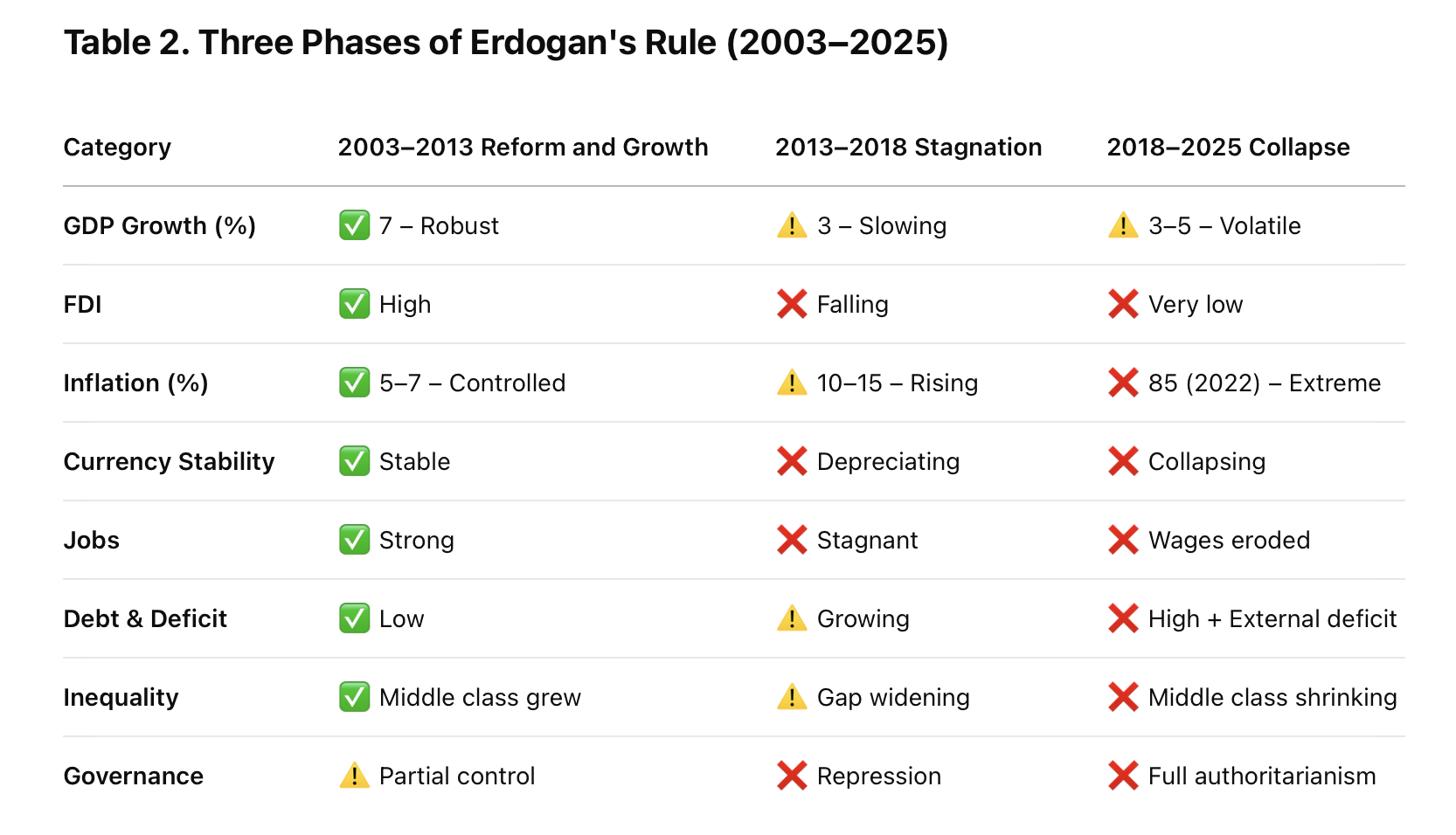
During Erdogan’s second term (2013–2018), a series of significant policy shifts deepened his alignment with loyalist business elites, notably through the preferential allocation of state contracts and the consolidation of crony capitalist networks. The corruption investigations of December 17–25, 2013, exposed the extent of this system, triggering an intensification of political crackdowns and a decisive turn toward authoritarianism. Systematic attacks on institutional autonomy—particularly targeting the judiciary and the Central Bank—undermined the rule of law and eroded policy credibility. Economic growth slowed to a range of 3–5%, while political unrest, exemplified by the mass Gezi Park protests and the controversial 2016 coup attempt (widely seen as orchestrated or exploited by Erdogan), exacerbated instability. Market volatility intensified, compounded by rising US interest rates and Erdogan’s growing interference in monetary and fiscal policy, which together eroded investor confidence, prompted capital flight, and accelerated the depreciation of the Turkish lira (₺). Despite ongoing flagship infrastructure projects—such as the Istanbul Airport and Kanal Istanbul—that remained central to Erdogan’s economic narrative, Turkey shifted from a trajectory of reform-led growth to one of deepening economic and institutional uncertainty, primarily driven by the consolidation of authoritarian governance. This pivotal second period was catalyzed by the revelations of the 2013 corruption investigations.
Despite experiencing his first electoral setback on June 7, 2015, President Erdogan not only obstructed the formation of a coalition government but also exploited a climate of fear—amplified by a series of leveraged terrorist attacks—to regain electoral support under the guise of restoring ‘stability,’ ultimately securing victory in the snap elections of November 2015. This trajectory culminated in the aftermath of the controversial coup attempt on July 15, 2016, which Erdogan leveraged to consolidate his authority further. The event served as a pivotal pretext for the contested and coercively implemented regime transformation of 2018, marking the onset of his third term under a newly centralized executive presidential system.
Source: Author’s compilation from national and international datasets.
Episode Three (2018–Present): Crossing the Rubicon with Heterodoxy
Following the comprehensive dismantling of institutional checks and balances through the formal institutionalization of the presidential system in 2018, President Erdogan departed from conventional economic orthodoxy in favor of what he termed a “homemade indigenous model with a nationalistic outlook,”—a framework rooted in heterodox and highly politicized economic policies. The most prominent indicators of this period in the economic sphere included the politicized capture of key institutions such as the state statistical agencies and the Central Bank, accompanied by sustained political pressure that severely undermined their autonomy. Economic policymaking became increasingly unmoored from rational, evidence-based frameworks and was instead dictated by short-term political imperatives. From 2021 onward, this phase was marked by aggressive currency manipulation, credit rationing, the provision of subsidies through public banks, and a range of direct and indirect rent-transfer mechanisms benefiting political insiders aligned with the ruling elite.
The consequences were severe: hyperinflation, wage erosion, currency collapse, and escalating economic instability. The Turkish lira lost over 90% of its value between 2018 and March 2025. Inflation, which stood at 20% in 2021, soared to 85% in 2022, moderated to 43.5% in 2024, and remained high at 39.5% by March 2025. While these dynamics disproportionately burdened the poor and middle classes, they enriched Erdogan’s political allies through preferential access to state contracts and financial mechanisms, exacerbating wealth inequality. Despite this deterioration, the economy experienced short-term growth, driven by elevated public spending and an export boost facilitated by a severely devalued currency. This third era represents the most acute economic crisis under Erdogan’s leadership—one largely self-inflicted through policy mismanagement and institutional degradation.
In summary, Erdogan’s political trajectory can be delineated into three distinct phases. During his first era (2003–2013), he emerged as a pro-business reformer who modernized Turkey, attracted substantial foreign investment, and lifted millions out of poverty. The middle period (2013–2018) was marked by mounting political instability, decelerating economic growth, and an increasing consolidation of authoritarian control. The most recent phase (2018–present) has been defined by self-inflicted economic turmoil, characterized by hyperinflation, financial mismanagement, and institutional erosion. Over time, Erdogan has shifted from being hailed as an economic success story to assuming the role of a crisis manager. At the core of this transformation lies his unwavering determination to retain power and reengineer the political regime through an experimental economic and governance ‘model’—one that he neither fully comprehends nor implements coherently, operating instead through a framework of disorder, contingency, and arbitrariness.
Governance Tragedy
Erdogan’s somewhat surprising—yet, in retrospect, foreseeable—abandonment of his previously successful economic and political development model following the 2011 elections precipitated a profound governance crisis. Echoing, in form if not in content, Mao’s Cultural Revolution in China, Erdogan embarked on a series of self-declared, large-scale experiments characterized by opaque logic, undefined mechanisms, and uncertain causal relationships. Adopting a ‘learning by doing’ approach, he entrusted critical policymaking to inexperienced party loyalists and ideologically driven militants. Whereas the initial phase of governance was marked by competent technocrats and the strengthening of institutional capacity, the subsequent phase, particularly after 2018, was defined by institutional degradation, as unqualified yet ambitious individuals assumed control over key state structures. This transformation has far-reaching implications for the stability and functionality of the Turkish state apparatus.
The government’s patronage practices have extended well beyond large corporations aligned with the ruling party, encompassing individuals deemed politically loyal through strategic appointments to secure and well-compensated public sector positions. The transformation in the scale and composition of Turkey’s civil service is well documented. As of 2024, the number of public employees stands at approximately 5.3 million—more than double the 2 million recorded in 2002. Between 2002 and 2024, an estimated 3.3 million individuals were recruited into the civil service. Notably, of the 2 million civil servants employed in 2002, roughly 1 million have since retired, bringing the cumulative number of civil servants hired during the AKP era to approximately 4.3 million. This dramatic expansion reflects a broader trend of public sector growth under Erdogan’s leadership, characterized by the politicization of state institutions and the instrumental use of public employment as a means of consolidating political loyalty.
As of January 1, 2025, the national monthly minimum wage in Turkey has been set at a net TRY 22,104.67, while the base salary for civil servants has reached approximately TRY 43,726—nearly double the minimum wage. This stark disparity underscores the material privileges afforded to public-sector employees, a cohort that has increasingly been leveraged as a tool of political patronage. In contrast, individuals outside the ruling party’s patronage networks face systemic barriers to accessing public employment and are disproportionately relegated to the lower-wage private sector, where monthly earnings generally fall within the same range as the minimum wage and civil service floor (TRY 22,104.67 to TRY 43,726).
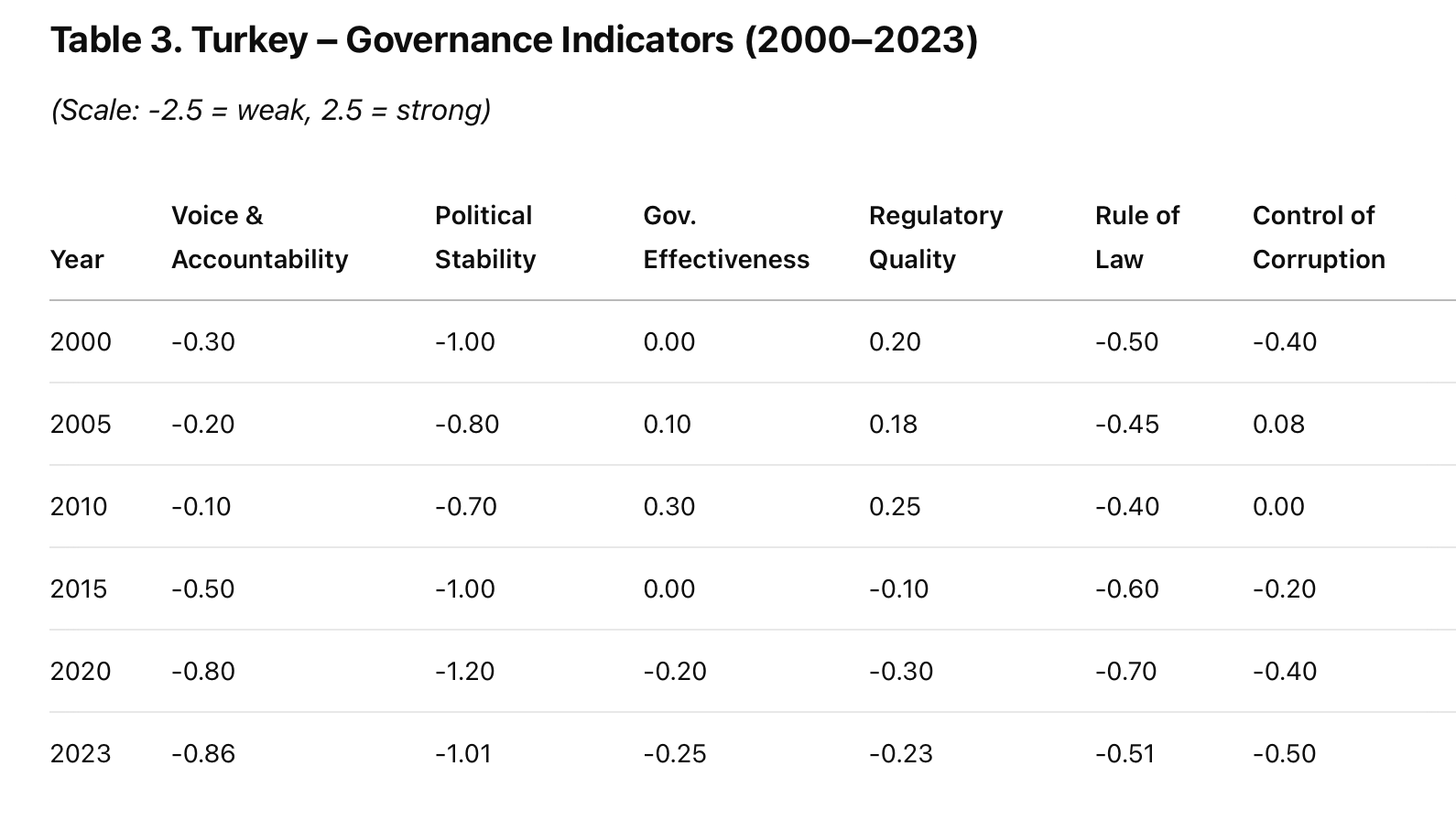
The consequences of Turkey’s governance crisis are clearly reflected across all major governance indicators. According to the Worldwide Governance Indicators (WGI) project, which evaluates six key governance dimensions for over 200 economies between 1996 and 2023, Turkey has experienced a marked and persistent decline in performance. Each WGI dimension is measured on a scale ranging from approximately -2.5 (weak governance) to 2.5 (strong governance). Table 3 summarizes Turkey’s scores across selected years, illustrating the country’s overall trajectory of governance erosion. For example, the ‘Control of Corruption’ indicator improved in the early 2000s, rising from -0.45 in 2002 to 0.08 in 2005, reflecting early reform efforts. However, by 2023, this score had deteriorated to -0.50, signaling a reversal of progress and deepening institutional fragility. Similar negative trends are observable across the other five dimensions, underscoring the systemic nature of Turkey’s governance decline.
This sustained decline in governance indicators reflects a broader erosion of Turkey’s rule of law and civil liberties. The Rule of Law Index, published by the World Justice Project, assesses countries based on factors such as constraints on government power, absence of corruption, and protection of fundamental rights. In 2024, Turkey ranked 117th out of 142 countries, significantly deviating from rule-of-law standards. Similarly, the Freedom in the World Index by Freedom House—which evaluates political rights and civil liberties globally—assigned Turkey a score of 33 out of 100, classifying it as ‘Not Free.’ Further underscoring this deterioration, Transparency International’s Corruption Perceptions Index (CPI), which ranks countries on a scale from 0 (highly corrupt) to 100 (very clean), shows Turkey’s score declining from 50 in 2013 to 34 in 2024. This sharp drop reflects a growing perception of entrenched public sector corruption and declining institutional integrity.
While definitive assessments are best left to subject-matter experts, President Erdogan’s underlying motives for Turkey’s authoritarian turn can be broadly summarized as follows:
📌 The 2008 Constitutional Court case that sought to dissolve the Justice and Development Party (AKP)—posing a direct threat to Erdogan’s political survival—catalyzed a sustained effort to assert control over the judiciary.
📌 Perceptions of European Union double standards, particularly regarding issues such as the Cyprus dispute, the stalled modernization of the EU–Turkey Customs Union, and persistent delays in the EU accession process, contributed to Turkey’s gradual disengagement from reform commitments. The government also strategically instrumentalized these grievances to avoid implementing critical reforms tied to transparency, inclusivity, and fair competition in public procurement, especially in infrastructure investment tenders.
📌 The collapse of the Kurdish peace initiative resulted in a resurgence of violence, further destabilizing domestic politics and hardening Erdogan’s security-focused posture.
📌 The fallout with the Gulen movement, once a close ally of the regime, culminated in a sweeping purge of state institutions following the 2016 coup attempt, consolidating Erdogan’s unchecked authority.
📌 Facing a shortage of qualified technocrats, Erdogan increasingly staffed key institutions with ideologically driven loyalists, while shifting economic focus toward sectors amenable to centralized control—such as construction, tourism, and rent-seeking industries.
📌 Ideologically influenced by the National View (Milli Görüş) movement, Erdogan has pursued the replacement of Turkey’s Kemalist-secular state tradition with a sui generis, neo-Ottoman model of governance marked by centralized power, religious symbolism, and historical revisionism.
Conclusion
Turkey’s recent development trajectory reveals a recurring pattern: periods of economic and political advancement have tended to coincide with phases of openness and integration with the West, while inward-looking, ‘local and national’ strategies have frequently corresponded with stagnation or regression. Given its geostrategic location, Turkey’s engagement with Western institutions and normative frameworks has not been merely opportunistic, but structurally imperative for sustaining reform and modernization. However, shifting global power dynamics have expanded Turkey’s strategic autonomy, simultaneously weakening the external normative pressures that once served as a moderating force on its domestic governance and policy orientation.
Available evidence strongly suggests that President Erdogan has decisively abandoned democratic norms, transparent governance, and the rule of law. The current international environment—marked by growing multipolarity, the global resurgence of populist movements such as Trumpism, and Europe’s acute focus on security and migration—has provided Erdogan with the strategic latitude to expand executive authority with minimal external resistance. Although recent episodes of public dissent may pose temporary tactical constraints, they are unlikely to alter the broader trajectory of authoritarian consolidation that appears poised to define Turkey’s political future.
In this incisive ECPS interview, Dr. Jean-Christophe Boucher, Associate Professor at the University of Calgary, explores how populism is reshaping US foreign policy—from tariffs as symbolic resistance to institutional erosion under Trump 2.0. Arguing that “Trump is not the cause but a symptom,” Dr. Boucher warns that even without Trump, populist forces will endure, backed by media ecosystems, think tanks, and loyalist networks. He emphasizes that “this is not really an economic argument. It’s a political and populist argument,” driving a shift from multilateralism to nationalist retrenchment. A must-read for anyone interested in the ideological drivers behind today’s turbulent geopolitics.
In this timely and penetrating interview with the European Center for Populism Studies (ECPS), Dr. Jean-Christophe Boucher—Associate Professor at the University of Calgary’s School of Public Policy and Department of Political Science—offers a comprehensive assessment of how populist ideology is transforming American foreign policy, institutional norms, and multilateral engagement. Central to Dr. Boucher’s argument is a provocative but sobering claim: “Trump is not the cause but a symptom.” Even if Donald Trump were no longer on the political stage, Dr. Boucher insists, “this movement would remain part of the political conversation,” underscoring the durability and depth of populist forces within American society and institutions.
Dr. Boucher advances the ideational approach to populism, which links belief systems to behavioral patterns. Rather than viewing populist discourse as purely performative or strategic, he argues that “these people really believe in these values and these hierarchies of beliefs, and they’ll start to act upon it.” This perspective, he contends, helps explain the internal coherence of Trump’s policies across domains, including trade, immigration, and foreign relations.
One of the interview’s central themes is the symbolic repurposing of trade tools like tariffs. For Trump and his supporters, tariffs are no longer just economic instruments; they are reimagined as expressions of national sovereignty and resistance against a “globalist elite.” As Dr. Boucher puts it, “this is not really an economic argument. It’s a political and populist argument.” This reframing speaks to broader populist tendencies that elevate identity, emotion, and anti-elite resentment over technocratic expertise and institutional procedure.
Throughout the conversation, Dr. Boucher traces how institutional degradation—accelerated under what he calls “Trump 2.0”—is being enabled by a growing ecosystem of populist actors, from think tanks like those behind Project 2025 to social media influencers and tech elites. He warns that foreign policy institutions like the State Department and Department of Defense are being hollowed out, potentially making way for a more centralized, nativist, and unilateralist foreign policy doctrine.
Ultimately, Dr. Boucher’s analysis is a call to recognize the structural, not merely electoral, nature of the populist threat. “There’s significant support for it,” he reminds us. Understanding this dynamic is essential for those hoping to defend democratic institutions and multilateralism in an era of resurgent populism.
In this incisive ECPS interview, Dr. Jean-Christophe Boucher, Associate Professor at the University of Calgary, explores how populism is reshaping US foreign policy—from tariffs as symbolic resistance to institutional erosion under Trump 2.0. Arguing that “Trump is not the cause but a symptom,” Dr. Boucher warns that even without Trump, populist forces will endure, backed by media ecosystems, think tanks, and loyalist networks. He emphasizes that “this is not really an economic argument. It’s a political and populist argument,” driving a shift from multilateralism to nationalist retrenchment. A must-read for anyone interested in the ideological drivers behind today’s turbulent geopolitics.
In this timely and penetrating interview with the European Center for Populism Studies (ECPS), Dr. Jean-Christophe Boucher—Associate Professor at the University of Calgary’s School of Public Policy and Department of Political Science—offers a comprehensive assessment of how populist ideology is transforming American foreign policy, institutional norms, and multilateral engagement. Central to Dr. Boucher’s argument is a provocative but sobering claim: “Trump is not the cause but a symptom.” Even if Donald Trump were no longer on the political stage, Dr. Boucher insists, “this movement would remain part of the political conversation,” underscoring the durability and depth of populist forces within American society and institutions.
Dr. Boucher advances the ideational approach to populism, which links belief systems to behavioral patterns. Rather than viewing populist discourse as purely performative or strategic, he argues that “these people really believe in these values and these hierarchies of beliefs, and they’ll start to act upon it.” This perspective, he contends, helps explain the internal coherence of Trump’s policies across domains, including trade, immigration, and foreign relations.
One of the interview’s central themes is the symbolic repurposing of trade tools like tariffs. For Trump and his supporters, tariffs are no longer just economic instruments; they are reimagined as expressions of national sovereignty and resistance against a “globalist elite.” As Dr. Boucher puts it, “this is not really an economic argument. It’s a political and populist argument.” This reframing speaks to broader populist tendencies that elevate identity, emotion, and anti-elite resentment over technocratic expertise and institutional procedure.
Throughout the conversation, Dr. Boucher traces how institutional degradation—accelerated under what he calls “Trump 2.0”—is being enabled by a growing ecosystem of populist actors, from think tanks like those behind Project 2025 to social media influencers and tech elites. He warns that foreign policy institutions like the State Department and Department of Defense are being hollowed out, potentially making way for a more centralized, nativist, and unilateralist foreign policy doctrine.
Ultimately, Dr. Boucher’s analysis is a call to recognize the structural, not merely electoral, nature of the populist threat. “There’s significant support for it,” he reminds us. Understanding this dynamic is essential for those hoping to defend democratic institutions and multilateralism in an era of resurgent populism.
Dr. Jean-Christophe Boucher—Associate Professor at the University of Calgary’s School of Public Policy and Department of Political Science.
Here is the lightly edited transcript of the interview with Dr. Jean-Christophe Boucher.
They Don’t Just Talk Like Populists—They Behave Like Populists
Professor Boucher, thank you so very much for joining our interview series. Let me start right away with the first question. How does the ideational approach to populism help us understand the continuity between Trump’s first and second administrations in shaping foreign policy through anti-elitist and pro-people rhetoric?
Dr. Jean-Christophe Boucher: That’s a great question, as it delves into a central debate in populism studies: the distinction between the discursive and ideational approaches. What I appreciate about the ideational approach is its emphasis on the connection between beliefs, values, and behaviors. This perspective posits that populist leaders and their supporters don’t merely articulate anti-elitist and pro-people sentiments—they genuinely hold these beliefs and act accordingly. Thus, when viewed through the ideational lens, populism is seen not just as rhetoric but as a guiding ideology that influences actions across various domains. This framework helps explain the consistency in populist behavior, as individuals internalize these values and implement them in practice.
And this is why I really like the ideational approach to foreign policy—because the argument is that Trump not only holds a thin-centered populist ideology, but also implemented policies aimed at realizing these ideas, targeting elites and advancing pro-people narratives. This approach influenced not only domestic politics but extended into foreign policy as well. When using a discursive approach, it’s harder to explain why a populist would shift across different policy sectors. But if they have an ideology, the assumption is that this belief system extends across various domains—economics, immigration, and, in this case, foreign policy. So, I really believe the ideational approach helps us better understand the consistency in the Trump Administration’s policies.
In foreign policy, for example, the first Trump administration made several decisions closely tied to populist views. There was a strong emphasis on tariffs, as well as on immigration—remember the travel ban and the push for anti-Muslim policies. These moves clearly reflected a blend of populism and ethnonationalism at the core of the administration’s agenda. And we’re seeing similar patterns emerging again in Trump 2.0. I think that’s important to understand.
You’ve written about populism’s impact on foreign policy coherence. In the current environment, can foreign policy institutions remain resilient under populist leadership, or do they inevitably erode?
Dr. Jean-Christophe Boucher: When you sent me that question, I really thought about it, and I’m still kind of debating it in my head. I think there’s a lot of interesting research about populism on how populist leaders go after institutions and try to change or disaggregate them so that a lot of the power centers shift back toward the populist leaders and away from these institutions. In foreign policy, we’re seeing the same thing, especially in Trump 2.0.
In the first Trump administration, foreign policy institutions—the State Department, the Department of Defense, even the Department of Homeland Security—were more or less able to maintain their integrity. A lot of the so-called “adults in the room” at the time came from the national security and foreign policy environment.
But when we look at Project 2025, a lot of the post-Trump reflections suggest that one of the administration’s misgivings about the first term was that these institutions resisted Trump’s agenda. In Trump 2.0, a major focus is on restructuring these institutions—the State Department, the Department of Defense, Homeland Security, even the NSA. There’s a strong push against the elites and a shift toward loyalists.
At the international level, Trump is doing the same thing: pulling the US out of the WHO, expressing skepticism about the G20 and G7, and generally trying to undermine international institutions that might constrain his foreign policy decisions.
What I find interesting is that Trump uses the same kind of discourse to justify what he’s doing domestically and internationally. He talks about elites controlling institutions, about those institutions not representing the will of the people, and about the need to undo them so that the people’s voice is heard. And you see the same thing at the international level, where he argues that globalists and internationalists are controlling those institutions. That’s why, he claims, the United States has to put Americans—the American people—first and, in doing so, take back control from those institutions that influence foreign policy.
Extending the Manichean Divide: From Domestic Elites to Global Conspiracies
How has the Trump administration weaponized populist narratives that portray global trade regimes as elite conspiracies to justify protectionism?
Dr. Jean-Christophe Boucher: This is a question I’m asking myself all the time. I think it really— from an ideational perspective—it’s not just about weaponization. My question always, in my head, is whether populists really believe what they say, or is it just kind of a way to frame their issues? And if you take an ideational approach, you’ll say these populists actually believe that that’s true.
Trump has been very consistent across his career in thinking that tariffs are a good way and a good policy, and much of the argument was that outside actors and the elites were essentially taking over American policies and abusing the American people unfairly. It’s about transposing this kind of anti-elite argument from the domestic environment onto the international level, and saying: “All of these countries in the world and all of these globalists are creating this network that’s abusive to the United States,” and that somehow they have removed the capacity of Americans to make their own policies and decide for themselves—that the American people have lost agency.
Trump really used this kind of language to articulate a protectionist policy that frames outside actors as abusive and corrupt institutions, countries, and people—and that he, as the populist leader, is fighting back and reclaiming these powers for the American people.
So the way I see it, you essentially extend the Manichean view of populism to the international level, where “the people” becomes the American people and “the elites” are reimagined as foreign actors or global institutions seen as corrupt and exploitative. It’s the same framework of a divided world: the corrupt versus the pure people, who are portrayed as disenfranchised and disempowered by those elites.
Your chapter in a recently published book highlights the role of nativist securitization in justifying the travel ban. In today’s context, how might similar nativist framing be deployed in foreign policy debates such as immigration from conflict zones or relations with ‘globalist’ institutions?
Dr. Jean-Christophe Boucher: The paper was written a long time ago, and it’s ironic that it took so long to get published—only for the same kinds of nativist and anti-immigration policies to reemerge. It’s depressing to realize that, in a grim way, we were right. The argument in that paper was that, on immigration issues, ethno-nationalism and populism were structured similarly, creating a framework of outside and inside actors—an idea central to ethno-nationalist thinking.
I thought at the time that it was an interesting way to frame those issues in the populist context. Others have worked extensively on populism, far-right populism, and ethno-nationalism. In this context, what we saw was that Trump’s framing of immigration issues was really centered around the narrative of elites versus the people—with “the people” portrayed as a kind of ethno-nationalist, pure group—and this created an outside/inside actor dynamic. That framing was central to the policy and shaped much of how these issues were understood. That’s how we approached the argument.
Trump Is the Symptom of a Deeper Foreign Policy Shift
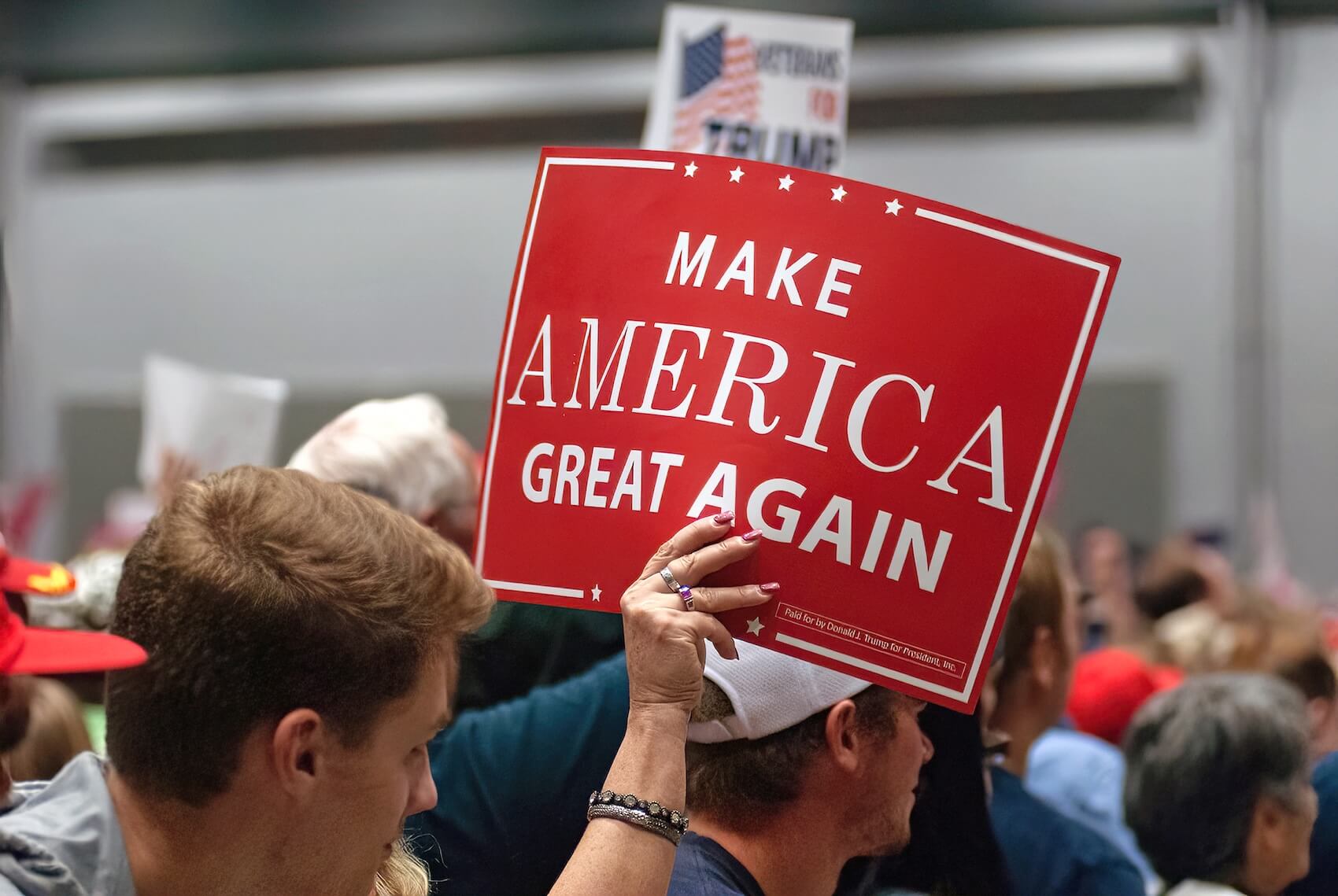
A Trump supporter holds up a “Make America Great Again” sign at presidential candidate Donald Trump’s rally in the convention center in Sioux City, Iowa, on November 6, 2016. Photo: Mark Reinstein.
In the light of the increasing overlap between populism and foreign policy, do you foresee a lasting structural transformation of US foreign policy priorities—away from multilateralism and toward identity-driven narratives of national sovereignty and civilizational conflict?
Jean-Christophe Boucher: I do. I think so. I’m a Canadian, and of course, we’re very close to the Americans. We’ve been witnessing a lot of what’s happening—and as you know, we’re bearing the brunt of much of the United States’ abuse at this time: being called the 51st state and facing challenges to our sovereignty.
What we see from our perspective—and I think this applies to the populist perspective as well—is twofold. On the one hand, we sometimes mistake the leader for the movement. We tend to think that Trump, the populist leader, is the architect of everything. That’s a mistake. What we’re seeing among the American people right now is a real appetite for populist discourse at the grassroots level—at the demand level—and Trump is merely an embodiment of that pressure. Many individuals within American institutions and among the elite also hold populist ideas. Even if Trump were to disappear from the scene, the movement would remain part of the political conversation, and I don’t think it would fundamentally change what’s happening in the US. Trump is not the cause but a symptom. There’s a broader movement that supports the way he behaves, which helps explain why the pushback against his undermining of institutions hasn’t been as strong as one might expect—because there’s significant support for it.
The second part is that systematically, the Trump administration is going after the foreign policy establishments and institutions in the US—State Department, DoD, DHS. At all levels, there’s been a deep dive into these institutions and an uprooting of many programs and checks and balances that had been in place. It’s not just USAID. If you look at what the Department of Defense is doing on DEI and other issues, there’s a deep restructuring underway. So even if Trump moves away in 2028, those institutions will look very different from when he came in. It will take time to rebuild them—if that even happens.
Not only is there an appetite for what Trump represents, but the institutions that once safeguarded against that appetite may no longer exist. We’ll be left with institutions that make it easier for a populist leader to pursue a foreign policy that is more self-centered, more nativist, and more protectionist. And I think that’s the future we’re likely to see in the coming years.
Social Media Lets Populist Leaders Sidestep Institutions and Speak Unfiltered
Given your findings on the use of social media to propagate populist foreign policy, how do you assess the evolution of this communication strategy in Trump’s second term, especially with shifting media platforms and increasing polarization?
Dr. Jean-Christophe Boucher: I think it’s part of the argument. There’s a lot of good research on why populist leaders prefer social media or alternative media as a way to communicate with the people. There are a lot of arguments. One is that mainstream media are portrayed as those of the elites, and somehow populist leaders have a deep-seated obsession about that. But social media also allows the populist leader to have a direct connection with the people and talk to them specifically.
If you look at what the Trump administration is doing, there’s a lot of that. In Trump 1.0, there were all these attacks on mainstream media, on fake news, and all of those were constant. We see it in our data on tariffs, but even on nativism—a lot of the anti-elite discourse coming directly from Trump and from the people is directed against those media institutions that seem to represent the elites.
What I find interesting right now in Trump 2.0 is that Trump is actually going after those institutions directly. You’ve seen, for example, how they’re suing CBS and other institutions, cutting ties with NPR, and really going after a lot of the power centers of mainstream media.
You also see how he’s allowing a lot of alternative media to attend press conferences, giving those outlets a larger impact.
Finally, we see that the Trump administration—like Trump 1.0—really communicates many of its ideas and arguments on social media. On tariffs, for example, policy officials actually learn about new directions in tariff policy through Trump’s posts on Truth Social or X. Social media becomes a really strong way for him to do this.
It also allows the populist leader to sidestep all the checks and balances of institutions—but also internally—where what he can say and how he addresses himself is unrestrained by those actors. And that really makes it an important part of that conversation.
Trump Is No Longer Alone—Populism Now Operates as an Institutionalized Ecosystem
Photo: Dreamstime.
You demonstrate that populist narratives were reinforced by networks of actors beyond political elites, including media and think tanks. How do you see these networks evolving under renewed populist leadership, and what new actors have emerged in this space since 2017?
Dr. Jean-Christophe Boucher: This is one of the things we wanted to highlight. The more I reflect on how we wrote about those issues at the time, the more I realize that our central argument was this: much of the literature focuses on populist leaders but overlooks the broader network that supports them. In fact, if you’re trying to understand a populist movement, you have to consider all the actors who enable and sustain the leader. It’s very difficult for a populist leader to operate in isolation—there’s always a constellation of other actors involved.
When we looked at social media networks and influencers, we found that while the populist leader was the most influential figure, there were many other groups—advocacy groups, think tanks—that supported the environment around him.
Today, you see exactly the same thing. Some of those actors are now part of the Trump administration. For example, Project 2025, which was at the center of a think-tank effort to produce populist ideas on transforming government in a potential Trump 2.0 administration, is now embedded in the administration. Figures like Elon Musk and the tech bros, who pushed populist ideas on social media, were essential to Trump’s reelection and are now part of the governing sphere, helping implement the president’s agenda.
People like Jack Posobiec and other far-right network figures who were once just part of the ecosystem around Trump and the MAGA movement are now in or close to government. So, when we think about the Trump administration, we should stop thinking of Trump as the sole actor—there’s an entire ecosystem that was nascent in Trump 1.0 but is now fully institutionalized in Trump 2.0.
What I saw in 2016–17 was a loose, informal network. Over the last four years, that network has crystallized into a proper movement—with influencers, money, institutions, and architecture that now serve as the base of the MAGA movement. It’s a lot more formalized.
That’s why the Trump administration is now able to move faster on its agenda and more effectively push its populist ideas into the system—because of the support from all these actors. He wouldn’t be able to do what he’s doing without Elon Musk and others backing him. He wouldn’t be able to move without Mike Johnson controlling Congress. Many of those actors who were loosely connected in 2016–2020 are now firmly part of his circle, accelerating and deepening the reach of his agenda into institutions.
How have Trump’s populist politics redefined the symbolic value of tariffs—not merely as economic tools, but as performative instruments of sovereignty and resistance against the ‘globalist elite’?
Dr. Jean-Christophe Boucher: This is where the populist argument comes in—where you mix the economics of it with the politics and belief system behind it. In the US right now, in the conversation around tariffs, there are really two conversations happening at the same time. You have the economic conversation, where a lot of economists are trying to explain why tariffs are a good thing for the US and trying to justify them. I’m less interested in that, because it seems like all the data goes against that argument. The idea that tariffs are economically beneficial is a marginal one.
What I find more interesting and more conducive to explaining what’s happening is this belief system. Trump genuinely believes that tariffs will undo the power of the elites and recreate a structure of economics that refocuses on the good of the American people. And somehow, that’s how it should be. The interesting part is, you can hear it when he talks—he recognizes that this will have deep economic impacts. He says, “This will be difficult. This will produce pain. But this is a good thing for the American people.” We’re going to bring back real jobs for real Americans—for workers—and that matters more.
Despite the economic pain, this is not really an economic argument. It’s a political and populist argument that explains why he supports tariffs. And when you listen to his political rationale, it makes a lot more sense than if you approach it purely from an economic perspective. I also think that’s why trying to argue with the Trump movement on economic terms doesn’t work—because in their view, it’s not an economic argument at all. It’s a political belief system they’re trying to put in place. They really don’t care if some economic pain is produced in that process. What they’re seeking is to re-center economic power around the American people, and not around what they see as the elites and people in the cities who benefit from a global international system.
Tariffs Are Populist Symbols of Sovereignty and Struggle
3D illustration: Lightspring.
You argue that foreign policy is increasingly shaped by emotional and identity-based appeals. To what extent do you see populist trade wars as cultural projects, not just economic or strategic ones? Are we now seeing what you anticipated: the normalization of tariffs as political theatre, rather than as policy tools grounded in economic rationale?
Dr. Jean-Christophe Boucher: Remember that we wrote this paper in 2017–2018—it was a long time ago. What really concerns me is that I was hoping we would be wrong, or that it would turn out to be just a passing moment. But today, it’s becoming more and more about exactly that—and it’s not just within the Trump administration. We’re seeing increasing arguments that trade and protectionism are being framed as formal expressions of the will of the people. I think that’s the important part.
One of the arguments we see in the populist movement is that global trade networks really removed the center of power from the people to these elites—the bankers, the traders—who were able to control global markets, while the people were left behind. And, of course, they characterize these people—these Davos and World Economic Forum elites—as corrupt actors controlling the international economic system.
What I find interesting—and this is why I think it’s an ideology more than just a discourse—is that most populist leaders, from the left and the right, have the same rhetoric. From Marine Le Pen in France to Nigel Farage in the UK to Orban in Hungary, you’re seeing the same kind of argument: that we have to take power away from the globalists, create protectionist policies to protect the people, and disengage from these global economic networks.
I believe that right now we are in that phase. We’re seeing a retrenchment from global politics and a refocusing on national manufacturing and supply-side arguments. Trade will become more sticky, and there will be more friction in international trade than we were used to.
What I find interesting—last point—is that even without Trump, when we listen to the Biden administration, there’s a lot of talk about supply chain management, supply chain security, and bringing back manufacturing jobs and national economic capacities. So even without Trump, you still have this kind of retrenchment from loose international trade and a renewed focus on domestic politics and domestic economics.
Tariffs Aren’t Just Economic Tools—They’re Instruments to Recenter Power on ‘the People
Drawing on your “I, Tariff Man” analysis, how has Trump’s second term intensified the personalization and performative use of trade policy? In what ways does this reflect broader populist tendencies that reject institutional expertise and multilateralism while mobilizing domestic political support?
Dr. Jean-Christophe Boucher: From an ideational perspective, populism—and its Manichean view of the world—shapes how people think and behave. In the trade environment, we see this clearly: tariffs become a tool for constructing a populist framework. Through tariffs, institutions built to manage global trade are effectively weakened or disassembled. Power is taken away from the elites who control international networks and redirected toward “the people,” refocusing economic forces inward.
In the populist literature, there’s always this argument—whether populism is a disease of democratic systems or a correction to a lack of representation in an economic system. And I really think the way a lot of populists think about tariffs reflects the latter. It’s seen as a corrective to brittle trade negotiations that took economic power away from the people and handed it to elites—people in cities, in the service industry, who were able to live well while workers became less powerful. So, retaking that power becomes the goal.
I don’t think it’s just performative. I think they genuinely believe this will recenter power on the people and help recreate a manufacturing base. When you listen to how some economists frame it, they suggest it will make life harder for service industries in cities, reduce their economic influence, and shift that power toward manufacturing and “Middle America,” where more of the population resides. Personally, I don’t think it will work that way—automation and other structural factors have played a major role in the erosion of US manufacturing—but from their perspective, the argument is clear: jobs were exported, elites benefited, and the people suffered. Tariffs are intended to sever those global networks and refocus the economy internally.
It might result in a less productive America. It might hollow out the cities and the service economy. But for populists, that’s probably the point—and they’re okay with that.
We’re Heading Toward a Smaller, Less Open World
With Trump’s renewed disengagement from WTO norms, do you see this as a terminal moment for the postwar liberal trade order, or is there still a path to restoration? What lessons can be drawn from the Trump era about the vulnerability of international economic governance to populist subversion, and what reforms are needed to future-proof institutions like the WTO from nationalist retrenchment?
Dr. Jean-Christophe Boucher: As a Canadian, I think about this all the time—and to be honest, there’s a lot to consider.My first assumption is that the Trump administration is just a symptom. So you’re still going to see a broader retrenchment from free trade, and even if, say, in 2028, a new president were elected, I don’t think this kind of protectionism would simply go away. A lot of international institutions will have a hard time surviving in that kind of system.
What I’m seeing, at least from Canada’s perspective, is that maybe some countries will keep these institutions alive and reduce the dominance of large multinational corporations. My sense is that the future lies in minilateralism—where like-minded countries who still see value in trade will maintain these institutions, but more for their own benefit than for the global system.
At the EU level, I think we’ll see more internal consolidation of trade and governance policies—unless, of course, a far-right government comes to power in a major state like France, which could unravel key aspects of the EU. Countries like Canada still want more trade and strong relationships with institutions like the WTO, but I believe the global trade environment will be significantly smaller than it once was.
Governments like ours can’t replace the United States in terms of global leadership—our prime minister recently said “if the Americans won’t lead, Canada will,” but let’s be honest: no one can replace the US in terms of resources and influence. What we might see is more involvement from China, Russia, and Iran in shaping these institutions—but their vision for the international system is quite different from that of the US and its allies.
So, my assumption is that we’re entering a deeply transformative period. The world will become smaller, more fragmented into blocs of countries defending their own values and interests—and far less open at the international level.
In the end, I think the countries that will suffer most are those in Africa, Latin America, and other regions of the Global South, because they benefited significantly from openness and multilateral institutions. Wealthier nations can still provide many of the services and information gathering that multilateral institutions once offered, but smaller states can’t. If you were a small country in Africa, those institutions were a lifeline.
I guess I’m a pessimist here, but I do believe we’re heading toward a smaller, less open world.
Multilateralism Is No Longer a Principle—It’s a Strategy
And lastly, Professor Boucher, how should policymakers in Canada respond to the dual threat of economic harm and normative erosion posed by populist-driven trade wars? What counter-narratives can be mobilized to restore public trust in multilateralism?
Dr. Jean-Christophe Boucher: Even in Canada, I’d say that—let’s put it this way—there was a movement not that long ago, when I was doing my PhD, that argued multilateralism was more of a practice than a belief. The idea was that what was good was not multilateralism as an end in itself, but as a means—a mode of engagement. The work in practice theory and international relations emphasized that what mattered was the activity of multilateralism, rather than its outcomes.
I don’t think that holds anymore, even in Canada. I think Canadians are now less and less devoted to multilateralism as a principle, and more interested in promoting their own views and strategic interests. What we see here is a sense that the world is retrenching, becoming smaller, and that we need to refocus our attention more narrowly.
The rise of China and Russia has shown how difficult it is for multilateral institutions to adapt. Now that the United States has also joined this retrenchment, I think it signals that those institutions won’t survive in their present form. As a result, a lot of Canada’s foreign policy is moving away from traditional multilateralism and toward more bilateral or minilateral relationships.
For example, if you look at what Canada is doing: we’re deepening ties with key European partners—not just through Brussels, but also through Paris, London, and Berlin. There’s been increasing talk about Canada joining the European Union, and frankly, if there were a referendum today, it might actually pass. Many Canadians feel that makes sense strategically.
Recently, we also published a document formalizing our Indo-Pacific strategy. If you look at where Canada is focusing its efforts, it’s clearly on strengthening relationships with partners in the Pacific—Japan, Taiwan, South Korea, Australia. There’s a renewed emphasis on ASEAN as well.
So we’re moving away from the big, universalist international institutions and focusing more on regional, minilateral partnerships. It’s just easier. The commitment to shared values is clearer, and the conversations are more straightforward than what we often encounter at the global level.
“The more rigid the regime becomes, the more easily it may break,” warns Dr. Spyros Sofos in an illuminating interview with ECPS. Tracing the Erdogan regime’s shift from reformist Islamism to a personalized authoritarianism, Dr. Sofos highlights how the dismantling of institutional checks and grassroots engagement has deepened Turkey’s democratic crisis. He sharply critiques the EU and US for enabling this drift, arguing that their silence—rooted in strategic pragmatism over refugee control and regional stability—amounts to tacit complicity. As Erdogan’s rule grows more centralized and brittle, Dr. Sofos suggests its very inflexibility could be its undoing. Amid repression and international complacency, he insists, spaces for resistance persist—and the next rupture may come from within the regime itself.
In a timely and far-reaching interview with the European Center for Populism Studies (ECPS), Dr. Spyros Sofos—Assistant Professor in Global Humanities at Simon Fraser University—offers a deeply informed and critical analysis of the Erdogan regime’s evolution into an increasingly rigid and personalized form of authoritarian populism. “The more rigid the regime becomes,” Dr. Sofos warns, “the more easily it may break.” Far from being a sign of consolidated power, he argues, the regime’s escalation of repression—most recently with the arrest of Istanbul Mayor Ekrem Imamoglu—betrays deep insecurity and structural fragility within a system that has steadily dismantled institutional checks and blurred distinctions between state, party, and judiciary.
Dr. Sofos traces how the AKP’s early reformist stance, driven in part by strategic engagement with European institutions, gave way to a calculated centralization of power following institutional resistance from the military and judiciary. He explores the AKP’s ideological recalibration—through religious nationalism, neo-Ottoman nostalgia, and pan-Turkic outreach—as a tactical means to expand and solidify its coalition amid economic turmoil and intra-Islamist fragmentation.
Yet just as trenchant is his critique of the European Union and the broader West, whose response to Turkey’s democratic backsliding has been marked by passivity and strategic self-interest. “Effectively, what the EU and the US have been doing is wanting Turkey to ensure that the masses of displaced people within its territory would not move towards the West,” he states bluntly. In prioritizing border control, security cooperation, and transactional diplomacy over democratic principles, Western powers have turned a blind eye to the regime’s authoritarian escalation—signaling tacit approval through their silence. Dr. Sofos calls out this hypocrisy, echoing Imamoglu’s own condemnation of European leaders for abandoning not just him personally, but the very idea of democracy in Turkey.
He also warns that the West’s failure to push back meaningfully against Erdogan’s authoritarian turn—driven by domestic electoral concerns and geopolitical calculus—risks normalizing the erosion of democracy, both in Turkey and beyond. With comparative insights from Hungary, India, and Israel, Dr. Sofos situates the Turkish case within a wider global trend of populist-authoritarian drift, but insists that this is not a one-way trajectory. The regime’s internal contradictions, coupled with mounting grassroots resistance and international hypocrisy fatigue, may yet create opportunities for democratic renewal.
This interview is not only a sobering account of democratic decline in Turkey, but also a compelling indictment of Western complacency in the face of it.
In an in-depth interview with ECPS, Professor Kent Jones warns that Donald Trump’s second-term trade strategy amounts to a “tariff dictatorship,” dismantling WTO norms and centralizing unprecedented power. “Trade has become a populist weapon,” says Professor Jones, “used to stoke anger and identify scapegoats rather than manage the economy.” He explains how Trump’s emotionally charged, anti-globalist rhetoric recasts trade deficits as existential threats while ignoring economic realities. Yet Professor Jones remains cautiously hopeful: “Globalization has faced downturns before. The human impulse to exchange and specialize endures.” As America retreats, he argues, others may step up. “If the US won’t lead, new trade alliances will form. But unpredictability is a burden—not a strength.”
In this timely and wide-ranging interview with the European Center for Populism Studies (ECPS), Prof. Kent Jones—Professor Emeritus of International Economics at Babson College and author of Populism and Trade: The Challenge to the Global Trading System—offers a sobering yet analytically rich critique of the Trump administration’s second-term trade strategy. Drawing on decades of experience and deep institutional knowledge, Professor Jones warns that the United States is no longer the steward of the postwar liberal trade order, but rather its chief saboteur. He argues that President Donald Trump’s erratic and hyper-personalized approach to trade—what he calls a “tariff dictatorship”—has effectively dismantled key pillars of the World Trade Organization (WTO), including most-favored-nation treatment and tariff binding, while concentrating unprecedented power in the hands of one individual.
Professor Jones emphasizes that trade policy, under Trump, has ceased to function as a tool of economic management and has instead become a populist weapon—repurposed to rally a nationalist, anti-elite political base through emotionally charged narratives about foreign threats and national decline. Trade deficits are recast as existential challenges, tariffs are imposed arbitrarily, and America’s longstanding commitments to multilateralism are eroded in favor of bilateral, loyalty-based deals that reflect Trump’s personal brand of grievance politics.
Yet amid this bleak portrait of institutional decay and populist distortion, Professor Jones also leaves room for cautious optimism. He underscores that globalization has weathered cyclical downturns before and that the human impulse to exchange, specialize, and cooperate across borders remains strong. While the US has stepped back, other actors—including the European Union, Canada, and emerging regional blocs—may step forward to rebuild a rules-based trade system, albeit imperfectly and without American leadership. Furthermore, Professor Jones suggests that the very unpredictability and economic pain caused by Trump’s tariffs may provoke renewed public scrutiny, mobilizing calls for Congress to reclaim its constitutional role in trade policymaking.
Ultimately, Professor Jones invites us to consider not only what has been lost, but what might still be recovered—provided that political institutions, civil society, and international alliances respond with resolve. As the world faces growing economic fragmentation, his insights provide a vital lens for understanding what’s at stake and how democratic societies might chart a path forward.
“The more rigid the regime becomes, the more easily it may break,” warns Dr. Spyros Sofos in an illuminating interview with ECPS. Tracing the Erdogan regime’s shift from reformist Islamism to a personalized authoritarianism, Dr. Sofos highlights how the dismantling of institutional checks and grassroots engagement has deepened Turkey’s democratic crisis. He sharply critiques the EU and US for enabling this drift, arguing that their silence—rooted in strategic pragmatism over refugee control and regional stability—amounts to tacit complicity. As Erdogan’s rule grows more centralized and brittle, Dr. Sofos suggests its very inflexibility could be its undoing. Amid repression and international complacency, he insists, spaces for resistance persist—and the next rupture may come from within the regime itself.
In a timely and far-reaching interview with the European Center for Populism Studies (ECPS), Dr. Spyros Sofos—Assistant Professor in Global Humanities at Simon Fraser University—offers a deeply informed and critical analysis of the Erdogan regime’s evolution into an increasingly rigid and personalized form of authoritarian populism. “The more rigid the regime becomes,” Dr. Sofos warns, “the more easily it may break.” Far from being a sign of consolidated power, he argues, the regime’s escalation of repression—most recently with the arrest of Istanbul Mayor Ekrem Imamoglu—betrays deep insecurity and structural fragility within a system that has steadily dismantled institutional checks and blurred distinctions between state, party, and judiciary.
Dr. Sofos traces how the AKP’s early reformist stance, driven in part by strategic engagement with European institutions, gave way to a calculated centralization of power following institutional resistance from the military and judiciary. He explores the AKP’s ideological recalibration—through religious nationalism, neo-Ottoman nostalgia, and pan-Turkic outreach—as a tactical means to expand and solidify its coalition amid economic turmoil and intra-Islamist fragmentation.
Yet just as trenchant is his critique of the European Union and the broader West, whose response to Turkey’s democratic backsliding has been marked by passivity and strategic self-interest. “Effectively, what the EU and the US have been doing is wanting Turkey to ensure that the masses of displaced people within its territory would not move towards the West,” he states bluntly. In prioritizing border control, security cooperation, and transactional diplomacy over democratic principles, Western powers have turned a blind eye to the regime’s authoritarian escalation—signaling tacit approval through their silence. Dr. Sofos calls out this hypocrisy, echoing Imamoglu’s own condemnation of European leaders for abandoning not just him personally, but the very idea of democracy in Turkey.
He also warns that the West’s failure to push back meaningfully against Erdogan’s authoritarian turn—driven by domestic electoral concerns and geopolitical calculus—risks normalizing the erosion of democracy, both in Turkey and beyond. With comparative insights from Hungary, India, and Israel, Dr. Sofos situates the Turkish case within a wider global trend of populist-authoritarian drift, but insists that this is not a one-way trajectory. The regime’s internal contradictions, coupled with mounting grassroots resistance and international hypocrisy fatigue, may yet create opportunities for democratic renewal.
This interview is not only a sobering account of democratic decline in Turkey, but also a compelling indictment of Western complacency in the face of it.
Here is the lightly edited transcript of the interview with Dr. Spyros Sofos.
Ottoman Nostalgia as a Tool of Populist Reinvention
Supporters await the arrival of Turkish President Recep Tayyip Erdogan at a referendum rally in Istanbul on April 8, 2017. Photo: Thomas Koch.
Professor Sofos, thank you very much for joining our interview series. Let me start right away with the first question: How do you interpret the Erdoğan regime’s mobilization of Ottoman nostalgia in both domestic and international contexts as part of a broader populist-authoritarian narrative?
Dr. Spyros Sofos: Thank you for having me. That’s a very interesting question, as there has been considerable discussion about neo-Ottomanism and the broader concept of Ottoman nostalgia. I believe the Erdogan regime needed a narrative that could effectively counter the one developed by the Kemalist regime over the past century. This new narrative serves several purposes.
The first is linked to the regime’s reinterpretation of history—particularly evident in debates around the reconversion of Hagia Sophia and other Christian monuments. Erdogan’s government has framed the Justice and Development Party (AKP) constituency as victims whose sovereignty was denied under the Republic for 100 years. In that context, a return to Ottoman nostalgia becomes a way of reclaiming a past where, ostensibly, there was more sovereignty and the people were heard. This re-imagined past helps construct an alternative vision of popular sovereignty, centered around the AKP’s base—and, I would argue, much of the nationalist constituency as well.
The second reason relates more to the interests the current leadership perceives as central to Turkey’s role both domestically and internationally, as well as to the political elite’s own strategic goals. For example, we see Ottoman nostalgia being used in foreign policy to justify, or at least lend legitimacy to, expanded relationships with countries that Turkey sees as pivotal—not only in its immediate region but also across Africa.
A striking example is Turkey’s presence in the Sahel and West Africa. The invocation of Ottoman-era connections is used to frame Turkey’s involvement in countries like Somalia—not only in humanitarian terms but as part of a broader strategic interest, grounded in a historical narrative of Ottoman reach. This is, of course, a very flexible interpretation of history, but one that the regime has used effectively.
This pattern also applies to Turkey’s outreach in the Balkans—something that began under Turgut Ozal. In countries like Bosnia, North Macedonia, and Albania, there’s a strong emphasis on rekindling historical and cultural kinship, often under the umbrella of shared Ottoman heritage.
Interestingly, the outreach to Central Asia—while unrelated to the Ottoman Empire—is also wrapped into this broader narrative. This connection seems driven either by economic interests or by a pan-Turkic nationalism that predates the AKP. So while neo-Ottomanism features prominently in both domestic and foreign policy, the regime also draws on other strands of historical memory to shape its identity and strategy.
From Reform to Repression: The Strategic Evolution of Political Islam under the AKP
How has political Islamism under the AKP evolved from a reformist or counter-hegemonic force into an ideological tool for authoritarian consolidation and state-led populism?
Dr. Spyros Sofos: I think that’s an important question. Political Islam—broadly speaking—had long been under threat from Turkey’s military, judiciary, and bureaucratic institutions before the AKP’s first electoral victory. In those earlier years, Islamist politicians were cautious in how they criticized the state and its institutions.
In the first five or so years of the AKP government, we saw what some scholars have called a “politics of patience”—a cautious, incremental approach to reform. There were several reasons for this. First, the AKP sought to emphasize its commitment to European institutions and to the broader European integration project. As such, it had to present itself as a genuinely reformist party.
While it may sound a bit cynical to frame it this way, this positioning made it much harder for the military and judiciary to halt the AKP’s political momentum. After all, the AKP was arguably the most pro-European and pro-reform force in Turkish politics at the time. Any attempt to stop it would likely have triggered significant Western backlash, possibly even sanctions. With hindsight, I now see this as a carefully calculated strategy. At the time, I was quite hopeful—thinking that this opening could bridge the divide between the “old regime” and the emerging Islamic-oriented political elite. But in retrospect, it seems it was more about ensuring the survival and viability of Erdogan’s political project.
The so-called “e-coup” during the 2007 presidential election, when Abdullah Gul’s candidacy was being obstructed by military and judicial actors, marked a turning point. This intervention allowed Erdogan and his allies to pivot from their cautious stance to a more confrontational and assertive posture.
So, while the AKP initially positioned itself as reformist out of necessity, the institutional resistance it faced—particularly from the army and judiciary—created an opening for it to strike back sooner than it might have otherwise. And unfortunately, this shift happened at a time when civil society lacked the strength to act as an effective check on power.
Islamist Nationalism Rebranded: Survival Politics in Erdogan’s Turkey
Turkish President Recep Tayyip Erdogan watching the August 30 Victory Day Parade in Ankara, Turkey on August 30, 2014. Photo by Mustafa Kirazli.
Do the regime’s increasingly religious-nationalist narratives reflect a deeper radicalization or strategic recalibration—and to what extent do these still resonate with the AKP’s traditional base amid economic hardship and intra-Islamist fragmentation?
Dr. Spyros Sofos: That’s one of the most interesting and challenging questions I’ve had to think about over the past couple of years. I believe we need to complicate the idea of the AKP as simply an “Islamist” party, full stop. It’s something more complex—and its ideology has evolved, largely in response to shifting constituencies that it needs to mobilize for political survival.
Over the years, we’ve seen alliances like the one with the Nationalist Movement Party (MHP) and Devlet Bahceli, which introduced a significant nationalist component into the AKP’s political orbit. Most recently, in the 2023 presidential elections, we witnessed a major push to win over nationalist voters. While Islam isn’t necessarily incompatible with nationalist currents in Turkey, this required the AKP to recalibrate its discourse in a way that differed substantially from its earlier messaging.
The party continues to promote a form of nationalism infused with Islamic elements, but it’s no longer offering the same vision as in the early 2000s. It’s certainly not a reincarnation of Alparslan Turkes-style nationalism either—but it has shown a willingness to experiment with different formulations of Turkish nationalism in order to appeal to broader political forces and secure electoral dominance.
This ideological flexibility is significant. Some of the intellectual figures in the AKP’s broader sphere of influence now engage with strands of nationalist thought that were previously absent from Islamist political discourse in Turkey.
At the same time, I don’t believe Islam has been displaced from the core of the AKP’s identity. But it has never been the only element. From the beginning, the party positioned itself as a voice for the downtrodden—regardless of their level of religiosity or piety. It’s always sought to build a broader coalition, and I think that remains true today.
In your work on the Gezi Protests, you emphasized the significance of bottom-up resistance. How do the dynamics of current mass protests compare to the 2013 Gezi movement in terms of ideological coherence, regime response, and potential for catalyzing long-term democratic transformation?
Dr. Spyros Sofos: That’s also the million-dollar question. So let me just try to unpack a few things about Gezi. I think Gezi was unique in the sense that it was not a movement that wanted to change a government. It was not aspiring to play a political role in the way, for example, that political parties would. And I think that was the secret behind its success and its failure at the same time. So it was a movement about bringing some sort of freedom into what Habermas would have called the life-world.
It was a movement that was against the policing of everyday life, people’s bodies, people’s relationship with nature, and so on. And of course, it had a political emphasis, which is the element of continuity. So it was a different movement, but there was also an emphasis on change—not necessarily governmental change—that I can see today in the mobilizations that have been taking place, especially after the arrest of Imamoglu recently.
What has changed, I think, and what is quite interesting to bear in mind, is that the mobilizations of today, at least in my reading, have not been as unplanned as the mobilizations of Gezi. You know, most people—I interviewed people—said, “I went there because I felt something was happening, and I needed to be part of it.” Today, many people may be thinking that something is happening and they need to be part of it—but I think Imamoglu himself, who is a very astute politician, had been preparing for this moment, and therefore he had ensured that there would be some sort of planning for what happens after his arrest or incapacitation.
We see that also in the fact that he’s been able to communicate out of jail fairly easily, that he managed to publish in international media quite articulate articles that could not have been scribbled at the last minute. And also, we have a change within the CHP that has allowed the party to be more able to mobilize people in support of democratic change.
I’m not trying to say that there is something sinister about this. I’m trying to say that there is a spirit of Gezi in the air—I can see that—but there is also more of a relationship between the current mobilizations and the political parties of the opposition that want to see democratic change.
Imamoglu’s Arrest Signals the Cracking Façade of Competitive Authoritarianism
To what extent does the arrest of Ekrem Imamoglu mark a definitive rupture in Turkey’s evolution from competitive authoritarianism toward full-fledged autocracy—and does it reflect a broader erosion of political pluralism?
Dr. Spyros Sofos: I was always cautious about Imamoglu, because I really consider him a very astute politician—a politician who is not authoritarian per se, but who has realized that a kind of populism—which I find, I’m always suspicious of populism—was the means of defeating Erdogan. And I was always arguing that Imamoglu may be one of the best hopes of defeating Erdogan, but not populism. But that’s a fine detail we can talk about later.
So, I think that definitely the arrest of Imamoglu, his lawyers, and a lot of his collaborators is an important damage inflicted on the prospects of a more pluralistic political scene in Turkey.
Imamoglu, during his time as Istanbul mayor, has really tried to engage with the grassroots in ways that no other politician has ever done. So I think arresting him is also a kind of condemnation of his political project—of talking with grassroots, of trying to empower and mobilize communities in ways different from the AKP’s.
Therefore, I do believe that it is also an attempt not only at his person, but at the model of politics that could emerge out of a possible victory by Imamoglu. Now we’re seeing a more naked, fully fledged authoritarian move in Turkish politics.
I’ve heard all these discussions about who will succeed Erdogan, and sometimes family appears to be first in these discussions. It indicates that even the fig leaf of competitive authoritarianism is dropping at the moment. But it’s a very fluid situation. The intentions of Erdogan and his advisers may not lead to the results that they want to achieve. I think the regime is the more rigid it is, the more easily it breaks in some ways.
In your view, how has the personalization of power under Erdogan blurred institutional distinctions between the state, the ruling party, and the judiciary? Is the judiciary now operating more as an instrument of regime survival than of rule-of-law governance?
Dr. Spyros Sofos: Let me start from the judiciary, but I will go to the personalization in a minute. We’ve seen that the judiciary was the target of reforms and the target of a lot of meddling. Effectively, what was being planned was to render it less independent. We had all these kinds of promotions of different judges, the retirements of other judges, and so on. There have been pressures from time to time on the judiciary, so definitely the judiciary is no longer a means of checks and balances in the political system.
And this is the problem generally with the hyper-presidential system that Erdogan introduced. In some ways, there is no institution that has the gravitas and authority that the institution of the presidency has. Therefore, it’s not only the judiciary—even the Parliament, in many ways, although there are ways in which it can throw a spanner in the works, as we say—even the Parliament cannot really challenge the presidential dominance in the political system.
Now, if you add the personal charisma and its cultivation by Erdogan, the situation becomes even clearer. It’s not only an institution, but it’s also a president who in the past has spoken out against the courts. When the courts decided against him, he talked about the milletin iradesi—the national will—as superior to the courts’ legal rationale and thinking.
So we can see here that the personalization and the charisma that has been brought into politics is significant, even without the presidential system. But of course, now it is also institutionalized.
A final thought: I had written, when I was writing about Ataturk, that Ataturk had established a two-tier political system, in some ways. I’m simplifying now. One was, of course, the institutions of the Republic—the National Assembly and the party—and then two aborted experiments with the Liberal Party, and so on. And then there was another element—that was his person: the state as a person, and it was the person of Ataturk.
What I meant by this is that whereas the citizen in the villages of the Republic, would be harassed by the jandarma, would be suppressed in a variety of ways, then you would see Ataturk touring the countryside or the cities of the country and being the object or subject of adoration. He would hug kids, and he would talk to people in a charming way. I think Erdogan has done something very similar, and the personalistic element is crucial in that.
So there is a state that is really vicious—it can take passports away, put people into jail—and then you have Erdogan, who cannot do it as well as I think Ataturk did, but on the other hand, he is another facet of the state, unmediated. He talks to people, and he derives authority from this—not from his institutional position only.
Regime Insecurity and Western Complicity Feed Erdogan’s Authoritarian Drift
President of Turkey Recep Tayyip Erdogan arrives at the European Council building in Brussels, Belgium, on May 25, 2017. Photo: Alexandros Michailidis.
Would you frame the current authoritarian escalation as a sign of regime insecurity ahead of critical elections, or as part of a calculated strategy to secure post-electoral permanence through managed democracy and repression?
Dr. Spyros Sofos: I would not distinguish these two because they can work together. So what I would say is that we had seen a calculated attempt already in the autumn, when Bahceli talked about PKK leader Abdullah Ocalan visiting the National Assembly, and he said that he treated him as an interlocutor. At the time, I was arguing—and I had written an article that, however, was published very recently—I was trying to say that this was a sign for me that Erdogan and others were feeling insecurity, as they had seen that the Kurdish movement had supported the opposition tacitly in most elections in the past. Therefore, they needed to ensure that this would not continue—that the Kurdish parties, the Kurdish organizations, the PKK would not continue supporting the opposition—and thus they attempted this Kurdish opening, this attempt to bring Kurdish politicians to the table, while keeping Selahattin Demirtas, who would be a charismatic figure that could challenge this possibility, in jail.
So, I think already at the time we could see that regime insecurity was at the center of the thinking of the current political elite. It’s not only Erdogan, it’s all these people who have made fortunes under Erdogan, and they want to maintain impunity and those fortunes. Therefore, they are also insecure, and they have the ear of people close to Erdogan, maybe Erdogan himself. So that’s the first thing.
The second thing is that this also prompts the political leadership at the moment to think that in order to counter this regime insecurity, a system that would limit the possibility of a challenge—political, electoral challenge—to the current incumbents would need to be in place. And therefore we have this leap from regime insecurity to a more authoritarian system that would allow the durability of the current regime in one way or another, and the impunity of those who have managed to benefit from it.
So both.
Do you interpret the EU’s and US’s muted response to Imamoglu’s arrest as tacit legitimation, strategic pragmatism, or democratic fatigue? To what extent does Western inaction enable further authoritarian entrenchment?
Dr. Spyros Sofos: The West, especially the European Union, has a lot to do with the current situation. Already, in the first decade of the century, they were getting cold feet about engaging with Turkey regarding membership or some sort of closer union with the EU. Now, they are much more cynical. They have been treating Turkey—and Turkey has been treating them—in a transactional way.
Effectively, what the EU and the US have been doing is wanting Turkey to ensure that the masses of displaced people within its territory would not move towards the West. In view of the war in Ukraine and the broader threats coming from Russia, they also want Turkey to be a cornerstone of some evolving security policy. I find it difficult to see how this will happen, but that seems to be the logic within Western political circles.
In this sense, now that Turkey has become strategically important for various aspects of Western European security, there seems to be a willingness to turn a blind eye to what is happening domestically in the country. Imamoglu himself said this very clearly, castigating European leaders for doing nothing—not just for failing to support him personally, but for abandoning the broader hope of democracy in Turkey.
I believe there is a general democratic fatigue in the West, especially as many Western governments are dealing with their own populist challenges. In addition, they are wary of creating a rift with Erdogan. There are several reasons for this, including domestic electoral considerations—such as the influence of Turkish communities in countries like Germany, the Netherlands, and Belgium.
Erdogan has also been actively engaging in the Balkans, including meddling in Bosnian affairs. Western leaders want to mute this influence. At the same time, they want Turkey to feel that it can benefit from supporting the security architecture of the EU and NATO, and to distance itself from closer ties with Russia. As a result, they are largely disinterested in democratic resistance inside Turkey.
Erdogan Leverages East-West Tensions to Shield His Regime from Accountability
Russian President Vladimir Putin and Turkish President Recep Tayyip Erdogan made the opening of the Natural Gas Pipeline (Turkstream) in Istanbul, Turkey on November 19, 2018.
How does Erdogan’s external positioning—on migration with the EU, and regional geopolitics vis-à-vis Iran and Russia—insulate the regime from meaningful international pressure despite ongoing democratic erosion?
Dr. Spyros Sofos: Well, it relates to your previous question, but thank you for this, because it allows me to elaborate a bit more. I think that the positioning of Ankara toward Russia, Iran, and even Syria is quite significant, as it clearly reflects a strategy of leveraging different relationships to insulate the regime—from criticism and possibly even from sanctions. I’m not necessarily talking about economic sanctions.
Erdogan—specifically Erdogan, not necessarily Turkey—has been very skillful in cultivating relationships with both the Iranian leadership, including Khamenei and various conservative politicians, and with Putin. He has also played an active role in the Astana process dealing with the future of Syria, in which Iran and Russia have been central players.
So we can observe a two-pronged strategy here. First, Erdogan ensures that every time Turkey feels under pressure from the West, it can leverage one of these alternative relationships. Second, Turkey is simultaneously helping to develop and participate in institutions that undermine Western international influence.
For example, instead of engaging with the Geneva process on Syria, Turkey remains committed to the Astana process—a trilateral format involving three illiberal regimes deciding Syria’s future. More broadly, we now frequently see Turkey participating in efforts to build an alternative international institutional architecture—one that weakens those institutions capable of holding it accountable.
And lastly, Professor Sofos, how does Turkey’s trajectory under Erdogan challenge or confirm existing theoretical models of populist-authoritarian governance? Are we witnessing a uniquely Turkish path or a globally resonant pattern of democratic decay in hybrid regimes?
Dr. Spyros Sofos: Actually, I’m writing a book at the moment on this, and I am trying to argue that we can see similarities in the cases of Modi in India, Orban in Hungary—to some extent, although Hungary is not an emerging power like Turkey—and even in Israel, where very similar developments are taking place. The judicial reform attempt by Netanyahu could have been written by Erdogan, in many ways.
So what I’m trying to say is that, yes, there is definitely a uniquely Turkish way of building populism. I have struggled in the past to find ways in which the Turkish case can be meaningful for understanding populism, particularly authoritarian populism, more broadly. But leaving aside the particularly Turkish elements—like the century-long divide between those who benefited from the Kemalist reforms and those who were left behind—there is a kind of playbook that we can see being repeated or developed simultaneously in other parts of the world.
Turkey is one of the initiators of a number of political developments that are now being copied by other illiberal actors. But I also see a broader attempt to develop scripts of sliding toward illiberalism—what I would describe as an authoritarian version of populism. I should say, I consider populism—regardless of whether it is left or right—authoritarian in character. So I sometimes find it difficult to use the terms authoritarianism and populism together.
But yes, we can see this happening elsewhere, and therefore we are in for a rough ride. It’s not just one individual country that is affected. I think it’s about the way we are now thinking
In an in-depth interview with ECPS, Professor Kent Jones warns that Donald Trump’s second-term trade strategy amounts to a “tariff dictatorship,” dismantling WTO norms and centralizing unprecedented power. “Trade has become a populist weapon,” says Professor Jones, “used to stoke anger and identify scapegoats rather than manage the economy.” He explains how Trump’s emotionally charged, anti-globalist rhetoric recasts trade deficits as existential threats while ignoring economic realities. Yet Professor Jones remains cautiously hopeful: “Globalization has faced downturns before. The human impulse to exchange and specialize endures.” As America retreats, he argues, others may step up. “If the US won’t lead, new trade alliances will form. But unpredictability is a burden—not a strength.”
In this timely and wide-ranging interview with the European Center for Populism Studies (ECPS), Prof. Kent Jones—Professor Emeritus of International Economics at Babson College and author of Populism and Trade: The Challenge to the Global Trading System—offers a sobering yet analytically rich critique of the Trump administration’s second-term trade strategy. Drawing on decades of experience and deep institutional knowledge, Professor Jones warns that the United States is no longer the steward of the postwar liberal trade order, but rather its chief saboteur. He argues that President Donald Trump’s erratic and hyper-personalized approach to trade—what he calls a “tariff dictatorship”—has effectively dismantled key pillars of the World Trade Organization (WTO), including most-favored-nation treatment and tariff binding, while concentrating unprecedented power in the hands of one individual.
Professor Jones emphasizes that trade policy, under Trump, has ceased to function as a tool of economic management and has instead become a populist weapon—repurposed to rally a nationalist, anti-elite political base through emotionally charged narratives about foreign threats and national decline. Trade deficits are recast as existential challenges, tariffs are imposed arbitrarily, and America’s longstanding commitments to multilateralism are eroded in favor of bilateral, loyalty-based deals that reflect Trump’s personal brand of grievance politics.
Yet amid this bleak portrait of institutional decay and populist distortion, Professor Jones also leaves room for cautious optimism. He underscores that globalization has weathered cyclical downturns before and that the human impulse to exchange, specialize, and cooperate across borders remains strong. While the US has stepped back, other actors—including the European Union, Canada, and emerging regional blocs—may step forward to rebuild a rules-based trade system, albeit imperfectly and without American leadership. Furthermore, Professor Jones suggests that the very unpredictability and economic pain caused by Trump’s tariffs may provoke renewed public scrutiny, mobilizing calls for Congress to reclaim its constitutional role in trade policymaking.
Ultimately, Professor Jones invites us to consider not only what has been lost, but what might still be recovered—provided that political institutions, civil society, and international alliances respond with resolve. As the world faces growing economic fragmentation, his insights provide a vital lens for understanding what’s at stake and how democratic societies might chart a path forward.
Dr. Kent Jones, Professor Emeritus of International Economics at Babson College and author of Populism and Trade: The Challenge to the Global Trading System.
Here is the lightly edited transcript of the interview with Professor Kent Jones.
Trade as a Psychological Tool in Trump’s Populist Arsenal
Professor Jones, thank you very much for joining our interview series. Let me start right away with the first question: How has trade policy been strategically deployed by Donald Trump as a tool of electoral mobilization? To what extent has the administration’s populist trade rhetoric succeeded in forging a durable political coalition that bridges economic grievances and cultural identity politics?
Professor Kent Jones: As I try to communicate in my book, Trump undoubtedly used trade as a strategic element of his electoral platform. However, it must be understood within the broader context of other grievances he exploited—particularly in the most recent election in November—many of which could be described as cultural. Immigration, for instance, was a major concern for many Americans. Inflation was also a key issue, even though it wasn’t as severe as Trump portrayed it; nonetheless, he promised to bring prices down. These issues were part of a larger constellation of concerns, including cultural ones—such as transgender politics—which, in my view, received disproportionate attention.
What Trump effectively managed to do was to construct a political package in which trade plays a central role in identifying a scapegoat—namely, the globalist elite—whom he claims is responsible for many of the country’s problems. To the extent that he succeeded in doing so, he was able to extend his appeal beyond his base of highly enthusiastic and passionate supporters to include individuals concerned with broader issues—such as border security. At the same time, he found it politically expedient to block Congressional efforts to address immigration, ensuring that the issue would remain salient within his campaign platform.
My focus on trade has always been that it’s part of a larger—perhaps psychological—set of issues that allows a candidate like Trump to say: “Look at immigration and what a problem it is. Well, trade is a very similar thing. Globalists have destroyed American manufacturing, just as immigrants have come in and polluted our population with foreign, unfamiliar, non-American elements.” These themes converge. Trade, as it turns out, is a very important part of Trump’s populist agenda. I don’t see this as a general populist tendency. Most of the other countries I studied in my book had governments led by populists, but many of them were small, open economies that did not have the capacity to use trade as a weapon in their populist platforms. For example, Israel, which currently has a populist government, is a small, open economy that remains broadly committed to free trade. You’re not going to see the same railing against the WTO and related institutions from countries like that as you did from Trump.
Now, regarding whether this is a viable coalition—I think that remains to be seen, because Trump has not kept his promises on bringing inflation down. The immigration problem has somewhat subsided, but he now appears to be focusing as much on that issue as on tariffs. For example, deporting Venezuelans to El Salvador—something that is constitutionally very questionable, and probably illegal. The Trump administration is now trying to position itself as being independent of rulings by courts, including even the Supreme Court, in pursuing its policies. There’s a multi-pronged effort by Trump to gain and concentrate more and more power, and trade is playing a role in that. I think this also reveals some weaknesses in his use of trade, because while people may be upset about jobs being sent abroad, they are equally upset about being charged significantly more—for automobiles, clothing, steel, and aluminum—as a result of his tariff plan. So, I see this as a Trump attempt to use trade politically, but not yet a successful one in cementing a durable populist coalition.
Anger as the Engine in Populist Playbook
Have we now entered the phase you previously anticipated, in which economic expertise in trade policy is increasingly eclipsed by emotionally charged populist narratives? Under Trump’s renewed administration, what specific events or discursive strategies are being used to reignite trade as an emotional flashpoint?
Professor Kent Jones: Yes, of course. In the study of populism, the issue of affect is important. If you can make people very angry, you’re more likely to be successful as a populist—and I think Trump has done that to a certain extent. I’m not sure whether this coalition—going back to your previous question—is very stable, but when it comes to trade, this is something that, as an economist, I’ve always lamented: the idea that a trade balance or imbalance is a valid justification for tariffs.
Trump has attempted to weaponize trade by claiming that foreign countries have, as he puts it, “cheated” and “ripped off” Americans over the past decades by causing the US to run a trade deficit. If you take a close look at his tariff formula, economists have thoroughly ridiculed it. It’s essentially a trade balance-based formula that imposes tariffs according to the size of a country’s trade surplus with the United States—purportedly to justify his so-called “reciprocal tariffs.”
But these tariffs aren’t actually reciprocal, because they don’t target foreign tariffs levied against US imports. Instead, they create a system in which Trump can identify grievances—some trade-related, some not—and then use them to pressure countries into negotiating access to the US market. In this way, he is attempting to weaponize trade by consolidating sole decision-making power over market access. I call it a “tariff dictatorship,” and this authority has, in many ways, been enabled by Congress. It is now backed by a Republican majority that refuses to challenge him effectively.
This is the context in which trade is being used as an emotional issue. For example, many people were bewildered when he claimed, “Canadians have been ripping us off for years.” Most people don’t have that view of Canada. It seems like a friendly country, and yet Trump portrays it as a dark force damaging the American economy.
So yes, I agree that the typical populist playbook relies heavily on affect—on stirring voters’ emotions, particularly anger. The angrier people are, the more likely they are to follow you. When I was conducting research for my book, I found that anger motivates voters more than anything else—even more than fear. If you can make them angry, you can get them to the polls. An angry voter tends to be a more reliable populist voter. Maintaining that level of anger is, therefore, key to Trump’s political strategy and success.
But the Achilles’ heel for any populist, in my view, is basic economic performance. Once a populist is in control of the government, he can no longer present himself as the anti-elitist, because he becomes responsible for policy outcomes. I think the danger Trump faces now with his tariff policy is that he’s making a lot of people nervous—and even angry—because their retirement accounts are being eroded, the bond market is collapsing, the dollar is weakening, and interest rates are likely to rise.
He’s tried to point back to Biden as the cause of these problems, but it’s increasingly difficult to do that when you, as a populist, actually control the White House and both houses of Congress.
At Its Core, This Is About Power—Not Policy
Would you argue that the appeal of ‘economic nationalism’ has now overtaken economic rationale as the dominant force shaping US trade policy?
Professor Kent Jones: Well, certainly under Trump it has. The focal point of my book was the impact of all this on institutions. We’ve had tariffs before, and there are actually many Democrats who favor tariffs and may have been more reluctant to criticize Trump in principle for using them.
My argument—ever since these new tariffs began—is that regardless of whether you support tariffs, it is deeply problematic to vest all tariff authority in a single individual who can change them at will, for whatever reason he chooses, under the justification of an emergency economic powers act. Many now argue that this justification is not even legal, because its premise—that there’s a national emergency requiring tariffs as a solution—is questionable.
Just this morning, there was news of a new group of businesses suing the Trump administration over its use of tariffs, claiming it contradicts the very law invoked to support them. What we’re witnessing is the erosion of institutional checks and balances, with trade policy effectively centralized in one person.
There’s also a psychological factor to consider. When you have an individual with a narcissistic personality like Trump, who is used to getting his way, the accumulation of power becomes an end in itself. It enables him to exact revenge on perceived enemies, compel others to seek his favor, or pressure countries into buying more American goods or signing bilateral deals skewed in America’s favor.
So, at its core, this is about power. Trump has managed to concentrate it, and many voices are now calling on Congress to step up and reclaim the authority the Constitution grants it. According to Article I, Section 8, Congress—not the president—has the power to regulate commerce and trade. This is where the institutional battle lies, and it’s where the future of trade governance will likely be contested.
US Trade Has Become a One-Man Operation
Photo: Shutterstock AI.
Are we now witnessing the culmination of what you’ve described as the ‘de–legitimization of trade institutions’ in US politics? If so, what are the broader implications of continued US disengagement from multilateral trade frameworks for global economic stability and governance?
Professor Kent Jones: Well, certainly—as long as Trump is President—we’re not going to see much engagement with the WTO in US trade policy. As I’ve documented in my book, and more recently in my commentaries on his tariff policy, Trump has already done away with key institutional principles of the WTO.
For example, he’s discarded the most-favored nation rule, which is foundational to the WTO framework. He’s also rejected tariff binding, the commitment that countries won’t arbitrarily raise their tariffs. These principles stand in the way of Trump’s pursuit of unilateral power. Once those constraints are removed, he can assign different tariffs to different countries’ products—entirely contrary to the GATT/WTO system—and negotiate individual agreements that maximize his own leverage.
Trump claims there are now 75 countries wanting trade deals with him, meaning he can sit down with each one individually, judge the outcome on his own terms, and adjust tariffs at will. There’s no need for congressional input or legislative approval—just Trump’s personal satisfaction. That effectively turns US trade policy into a one-man operation.
This is the antithesis of what the GATT and WTO systems were designed to prevent. Back in 1947, when the GATT was founded, the memory of the Great Depression and the tariff wars of the 1930s—especially the Smoot-Hawley Tariff Act in the US—was still fresh. The global economic community had learned that trade wars were harmful, and for 70 to 80 years, that lesson held.
Now, Trump has effectively resurrected the notion that “trade wars are good and easy to win.” He justifies this by pointing to America’s trade deficit, claiming that other countries will bear the cost. But in practice, the 145% tariffs on Chinese goods, for instance, are paid by American consumers. People are starting to realize this—whether it’s an iPhone that might jump from $1,000 to $2,000 or $3,000, a house built with increasingly expensive Canadian lumber, or an automobile that now costs $10,000 to $15,000 more due to a 25% tariff.
These developments are creating a growing crisis for Trump. That’s likely why he’s started pausing tariffs and promising “great deals,” and recently announced some product-specific exemptions—such as with Chinese imports and possibly with automobiles. He knows that if Americans can’t afford their cars, it’ll hit both foreign and domestic models hard, and even drive up the cost of used cars—something already affected by COVID-era supply shocks.
All of this contributes to an unpredictable trade environment, largely because Trump has assumed complete control over tariff policy. At this point, no one else is making trade decisions—just Donald Trump.
Tariffs Have Become Symbols, Not Solutions
3D illustration: Lightspring.
In Trump’s second term, how have tariffs been repurposed more as political symbols than as instruments of economic policy? How is the administration using revived trade rhetoric to frame persistent trade deficits as existential threats, and how is it justifying these measures politically despite their mixed economic outcomes?
Professor Kent Jones: Yes, this really gets to the core of the economic critique of Donald Trump’s trade policy. When you use a trade deficit as a justification for imposing tariffs, there is no theoretical basis for that in economics. Economists understand trade deficits as a macroeconomic phenomenon resulting from the imbalance between savings and investment in a country.
In the United States, the persistent trade deficit reflects higher levels of consumption relative to production, and lower savings relative to investment. When consumption exceeds production, the difference naturally comes from imports.
Trump tried to use this logic in his first term to justify a trade war with China, and now he has extended that rationale globally. But this effort was not successful. The tariffs did not significantly reduce the US trade deficit—not even with China. And as long as the structural imbalance between savings and investment persists, the trade deficit will remain.
Moreover, any reduction in imports from China led to trade diversion. Chinese firms simply rerouted production through third countries like Vietnam, Cambodia, the Philippines—even Mexico. For instance, Vietnam’s trade surplus with the US grew substantially. Trump is now using that as justification for imposing global tariffs rather than China-specific ones.
So trade deficits are being repurposed symbolically. Whenever Trump can point to a trade surplus from another country, he frames it as a hostile act against the United States. Many Americans, including politicians in Washington, still believe that having a trade deficit means the US is “losing.”
As I often point out in my classes, the US is not a company with a balance sheet—it’s 300 million individuals making consumption decisions. A trade deficit is like an individual going to the grocery store and spending money. That doesn’t mean the store is cheating you. Likewise, if Americans choose to buy Korean cars or Vietnamese clothing, that doesn’t reflect economic weakness or foreign deception. In fact, it’s often a sign of economic strength—of choice, affordability, and productivity.
Nonetheless, Trump has succeeded in convincing many people otherwise. But eventually, the economic consequences catch up. Americans are now seeing the costs in the form of higher prices—for phones, homes, cars, and everyday goods. The stock market and bond market, both globally integrated, are reacting negatively, and that’s something even Trump cannot control.
He’s trying to de-globalize domestic production, but reshoring takes time. Manufacturing shoes, nails, clothing—these can’t be brought back overnight. He says it’ll take six months or two years, but that’s highly unrealistic.
So people are starting to ask: when does the promised pay-off arrive? When will we see the benefits that justify the current pain—higher prices, falling stock values, a weakening dollar, and a diminished global economic reputation?
This is likely why Trump is starting to pause certain tariff measures and promise relief. The symbolic transformation of tariffs into a nationalist cause has been attempted—but economic realities are hard to avoid, especially when you’re the one in charge and can no longer blame your predecessor.
Uncertainty Is the New Normal for Global Trade and the Vulnerable Pay the Price
What socio-economic burdens are likely to be borne by ordinary citizens—both in the US and globally—as a consequence of the Trump administration’s erratic and politically charged trade and tariff wars? How do these unpredictable policy shifts impact everyday economic security, particularly for vulnerable populations?
Professor Kent Jones: Well, certainly in the United States, one of the most significant developments in trade policy analysis has been the emergence of what we now call “uncertainty analysis.” In fact, indexes of trade policy uncertainty have become an increasingly prominent tool for tracking how markets react to Trump’s trade policies.
The original idea behind the WTO was to create stability. Everyone followed the same rules, and everyone benefitted from that predictability. These rules included non-discrimination and tariff binding—principles that gave businesses the confidence to invest in trade-related activities. If you were exporting to a foreign market, you could count on that market upholding WTO rules. If you were an importer in the US, you could similarly rely on your own government to follow those rules and not change tariffs arbitrarily.
There were, of course, accepted exceptions in the WTO framework—such as anti-dumping measures—but these were limited and rule-bound. That embedded liberalism allowed trade to flourish within a relatively stable system.
What we’re now seeing, however, is the erosion of that system. The socioeconomic consequences will come first through higher consumer prices. We’re already seeing that. Then, likely, through higher interest rates as global confidence in the US economy diminishes. And higher interest rates increase the likelihood of a recession, with all the accompanying hardships—job losses, reduced investment, and economic insecurity for average Americans.
Globally, the situation is equally troubling. We’re seeing punitive tariffs applied even to poor countries like Bangladesh, Vietnam, and Cambodia. In some cases—like Madagascar, which exports vanilla to the US—American trade officials are complaining that these countries don’t import US automobiles, using that as justification for tariffs. The logic is absurd and completely contrary to the idea of comparative advantage. Expecting a country like Madagascar to buy American cars in exchange for sending vanilla exemplifies the irrationality of these policies.
This kind of policy undermines the efficiency and fairness of the global trading system and inflicts economic pain on both developing nations and their trading partners. The decline in global trade efficiency will affect the most vulnerable—both at home and abroad.
As a result, other countries are beginning to rethink their trade strategies. We’re already seeing Canada and the EU discussing deeper trade ties with each other. And there’s emerging talk of building new multilateral frameworks that exclude the United States.
Of course, a global trading system without US leadership won’t be as effective. The US was, for decades, the anchor of global economic order after World War II. But with Trump’s retreat from multilateralism, we’re now seeing a broader pattern—one that also extends to military alliances. NATO, for instance, has been encouraged to think more about European-based defense. The war in Ukraine adds another dimension to this shifting landscape.
Altogether, this reflects a larger withdrawal of the US from global engagement. And that retreat has consequences. American stability and leadership added enormous value to global affairs. Take that away, and others will suffer—but it may also spur efforts to reconstruct international cooperation through alternative means.
Trump’s History Lessons Are More Political Theater Than Economic Strategy
How is trade policy being used in Trump’s second term to reinforce nationalist and anti-elite populist messaging, and what role do ‘chrono-political’ narratives—drawing on selective historical memory and future promises—play in sustaining public support for renewed protectionism?
Professor Kent Jones: We have a president who likes to use history for his own purposes. The more immediate history, of course, is that all of America’s current problems—including those Trump himself has created—are, according to him, really the fault of President Joe Biden. That’s one way he uses history: to convince people that during his first term, everything was a “golden age,” and then when Biden came along, everything fell apart. So, if there are problems now, don’t blame Trump—blame Biden.
Another interesting use of history—particularly for Americans who know their history—is Trump’s fascination with President William McKinley. Actually, not just President McKinley, but also Senator McKinley, a Republican from the 1890s who sponsored a major tariff bill. At that time, tariffs made up about half of US government revenue, since there was little in the way of income tax. Trump has used this historical reference to argue that we could eliminate income taxes altogether and rely on tariff revenue instead.
You may have seen news about Trump wanting to rename the tallest mountain in Alaska—Denali—back to Mount McKinley, because of this admiration. But historically, the McKinley Tariff was highly unpopular. After it passed, the Republicans lost many congressional seats in the next election because the public faced higher prices and increased industrial concentration. Trump doesn’t seem to think this historical lesson applies to him, but it’s already proving to be a similar liability.
So, we see a selective and manipulated use of history. The narrative is: “Look how great America was in the 1890s—look how we were growing, how proud people were to be Americans.” But in reality, that era had deep problems—racism, immigration tensions, and inequality—that tariffs didn’t solve. In fact, the introduction of a broader income tax in 1913 allowed the US to move toward a more liberal and successful trading regime. American economic growth since then has been strong—so why go back?
Trump continues to insist that tariffs are paid by foreigners, not Americans. He argues that this makes tariffs an ideal way to fund the US government—as if foreign countries are footing the bill. His advisors know this isn’t true, but you won’t hear them say so publicly.
In short, Trump is using history in a way that serves his populist message, but not very effectively. If he were a better student of history, he might find stronger justifications for his policies. As it stands, invoking the McKinley era and blaming “woke Democrats” for current issues doesn’t offer a coherent economic argument—especially when you consider that the US economy under Obama and Biden has actually performed quite well.
Trump’s China Policy Turns Trade into a Populist Proxy for National Decline
Photo: Shutterstock.
How does the Trump administration’s hardline stance toward China reflect a broader populist narrative of foreign threats and national decline? In the context of ongoing de–coupling efforts from China, how is this policy being used to mobilize anti-globalization sentiment and reinforce the administration’s appeal to its populist base?
Professor Kent Jones: It’s very interesting the way Trump seems to view China. On the one hand, he appears to admire President Xi as a strong, tough leader—something Trump seems to find admirable. At the same time, he insists that China has been “ripping us off” through its trade practices, largely because of the large volume of imports the US receives from China.
I think Trump has been surprised—and perhaps disappointed—by how assertive Xi has been in responding to US tariffs. Xi has made it clear he won’t back down. Trump would like to portray Xi as someone he can deal with—someone who respects him and will sit down to work out a deal. But if we look back at Trump’s first administration, we see how that played out.
The trade war Trump initiated in 2018, with escalating tariffs against China, did not, in fact, reduce the US trade deficit. By January 2020, Trump declared victory and announced a “Phase One” trade deal with China. This was essentially a countertrade agreement—China would commit to importing a specific value of US goods, and in return, the US would reduce tariffs. The goal was to balance bilateral trade flows.
But such a deal was never feasible. It would require a Soviet-style, government-managed trade system, completely incompatible with a market-based global trading regime. It violated WTO principles such as non-discrimination and the prohibition of quantitative restrictions. And ultimately, it didn’t work—COVID-19 disrupted global trade, and China didn’t meet its import commitments. Trump’s administration could blame COVID, but the agreement itself was flawed from the start.
Now, Trump claims that 75 countries are lining up to negotiate similar deals, and that he’ll finalize them within 90 days. Anyone with experience in trade negotiations knows that’s unrealistic. Bilateral trade deals are complex and time-consuming. My prediction is that we’ll see vague, formulaic agreements—pieces of paper promising balanced trade flows without any serious enforcement or economic logic behind them.
Trump may even try a version of this again with China. But the structural issues remain: we live in a world of complex technological interdependence, and the US cannot simply de-couple from China. Instead of trade wars, what we need is a return to multilateral cooperation. If the US worked with Europe, Canada, and other OECD countries, it could form a united front to pressure China into complying more fully with WTO rules.
China’s state-led economic model makes it difficult to enforce existing trade norms, but a coordinated multilateral effort could make progress. Unfortunately, the US—once the architect and guarantor of the global trading order—is now undermining it. That leadership vacuum is at the heart of the problem.
So to return to your original question: Trump’s framing of China as a threat fits squarely within his broader populist narrative of national decline and foreign exploitation. But his policies haven’t solved the trade imbalance—and now he’s trying to apply the same flawed logic to the entire world. He wants to control all trade through bilateral, Trump-approved formulas for balance, which are economically irrational and unworkable.
In the end, like many populist strategies, these deals may sound good in the abstract but will likely prove disappointing once implemented. The rhetoric may mobilize his base, but the economic outcomes could be far less favorable.
Globalization Is on Ice—But Far From Over
A metaphorical image depicting the US-China trade war, economic tensions and tariff disputes on imports and exports. Photo: Shutterstock.
And lastly, Professor Jones, in light of ongoing debates and speculation about the potential collapse or end of globalization, how do you assess the current trajectory of global economic integration, and what indicators do you consider most critical in evaluating whether globalization is truly in decline?
Professor Kent Jones: Well, certainly globalization is being damaged by President Trump’s policies—there’s no doubt about that. He’s taking the largest economy in the world, the original architect of the WTO and the postwar trade order, and essentially reversing its role. The WTO is now portrayed as the enemy by Trump and his followers.
So yes, globalization has clearly suffered. However, one thing I’ve learned as an economist—particularly from my early training in Geneva—is the value of taking a long historical view of trade. Trade has always gone through waves. Periods of free trade have often been followed by periods of protectionism, and vice versa.
Take Britain’s repeal of the Corn Laws in the 19th century, which ushered in an era of freer trade and economic expansion built around the British Empire. The US came on board later. Then came the Great Depression, which triggered a new wave of protectionism. The post-WWII creation of the WTO system marked another liberalizing wave. Now, with the resurgence of economic nationalism and protectionism, we appear to be in another downward swing.
That said, globalization has always required flexibility. The decline of some industries must be managed so others can emerge. In the 1800s, this adjustment was relatively smooth. But the entry of China into the global economy in the 2000s created a massive shock—its capacity to produce across a wide range of sectors was something even the US struggled to adapt to quickly.
We also cannot ignore the role of technology. Are we really going to return to an economy of cobblers and factory floor workers in an age of robotics, AI, and complex supply chains? It seems unlikely. I think it all circles back to what Adam Smith said about the innate human tendency to “truck and barter.” Even before language, early humans were trading. We’ve always valued specialization and exchange—and I believe that instinct endures.
Suppressing globalization won’t eliminate that fundamental impulse. If the US abandons its leadership role, others will step in. We may see regional trade agreements emerge as partial substitutes for global ones. It’s not a perfect replacement, but it’s better than nothing.
Technological progress is also linked to globalization. If you halt global exchange, you risk slowing innovation. Still, I believe there’s opportunity. Many countries that once focused heavily on trade with the US will begin looking elsewhere. China may try to lead, but many are skeptical of that. Perhaps another leadership structure will emerge—or perhaps we simply wait until 2028, when some hope the US will again elect a president who values multilateralism and stable partnerships.
What Trump doesn’t seem to understand is that unpredictability, which he views as a strength, is actually an economic burden. It erodes trust and undermines investment. The global economy thrives on rules and stability—not arbitrary decisions.
So, to return to your question: Yes, globalization has been put on ice for now. But I don’t think it’s over. There’s still a strong drive—among individuals, firms, and governments—to rebuild trade networks. Even if US leadership is absent, globalization will find ways to adapt and re-emerge.
In this compelling interview with ECPS, Dr. Hakki Tas argues that repression—not legitimacy—has become the Erdogan regime’s default mode of rule. Highlighting the arrest of Istanbul Mayor Ekrem Imamoglu, Dr. Taş contends that Turkey is moving further from competitive authoritarianism toward full authoritarian consolidation. As electoral legitimacy weakens, coercion fills the void, revealing a regime reliant on fear, control, and chrono-political narratives to survive. “Remaining in power,” Dr. Tas says, “is the only survival strategy.” This conversation explores the strategic logic behind repression, the shrinking political arena, and the uncertain future of ailing Turkish democracy.
In an interview with the European Center for Populism Studies (ECPS), Dr. Hakki Tas, Research Fellow at the German Institute for Global and Area Studies, offers a sobering assessment of Turkey’s democratic trajectory under President Recep Tayyip Erdogan. Dr. Tas argues that “coercion has become the Erdogan regime’s default tool of governance,” signaling a shift in strategy where repression, rather than consensus or legitimacy, undergirds the government’s hold on power. This growing reliance on coercive mechanisms reflects not only the regime’s authoritarian drift but also its deepening vulnerability in the face of economic instability and eroding public support.
In Dr. Tas’s view, the political elite in Turkey face a stark reality: “remaining in power is the only survival strategy.” With dwindling economic resources, declining electoral popularity, and limited institutional buffers, Erdogan and his allies find themselves increasingly dependent on repressive tactics to maintain control. The arrest of Istanbul Mayor Ekrem Imamoglu, widely seen as the most viable opposition figure, exemplifies this logic. For Dr. Tad, such moves do more than target individuals; they erode fundamental democratic principles by narrowing the space for political competition and undermining voter choice.
Indeed, Dr. Tas highlights the regime’s systematic efforts to degrade electoral competitiveness. While Turkey has retained the formal trappings of multiparty elections, the conditions required for genuine democratic choice—such as “electoral vulnerability,” “electoral availability,” and “decidability”—have been steadily dismantled. The elimination of high-profile opposition figures like Imamoglu not only tilts the playing field but also challenges the very notion of Turkey as a competitive authoritarian regime. As Dr. Tas succinctly puts it, “calling Turkey’s regime ‘competitive’ is increasingly difficult to justify.”
Beyond specific political maneuvers, Dr. Tas situates these developments within a broader authoritarian logic—one that employs what he calls a “chrono-political strategy” to frame every election as an existential battle for the nation’s soul. Through an intricate weaving of past grievances, present insecurities, and imagined futures, Erdogan casts challenges to his rule as threats to the entire Turkish polity. This blend of populist narrative-building, strategic repression, and institutional erosion has enabled the regime to survive despite mounting internal and external pressures.
This interview explores the implications of Imamoglu’s arrest, the fragility of Erdogan’s political toolkit, and the possible futures of ailing Turkish democracy. At stake is not only the fate of one politician or election, but the broader question of whether Turkey can still lay claim to competitive politics—or whether it has entered a new phase of authoritarian consolidation.
Dr. Hakki Tas, Research Fellow at the German Institute for Global and Area Studies.
Here is the transcription of the interview with Dr. Hakki Tas with some edits.
Calling Turkey’s Regime ‘Competitive’ Is Increasingly Difficult to Justify
How does the arrest of Ekrem Imamoglu fit within the broader trajectory of democratic backsliding in Turkey, and does it signify a critical turning point toward full authoritarian consolidation, or does it remain within the bounds of competitive authoritarianism?
The competitiveness of the regime in Turkey has been in question not only today but throughout the last decade as well. While Turkish elections have long been marked by significant contentiousness, this indeed does not necessarily translate into genuine political competition. True competitiveness requires conditions such as electoral vulnerability (where incumbents can realistically be unseated), electoral availability (where voters are open to changing party preferences), and decidability (where parties offer distinct and clearly communicated platforms).
Nevertheless, by potentially eliminating the most prominent challenger from the electoral arena, the jailing of Imamoglu further undercuts each of these core democratic prerequisites. While Turkey has not yet crossed into fully authoritarian rule, actions like arresting leading opposition figures push the system closer to outright authoritarian consolidation, and the adjective “competitive” to describe the current regime becomes increasingly tenuous.
For Turkey’s Ruling Elite, Staying in Power Is the Only Survival Strategy
To what extent can Imamoglu’s arrest be interpreted as a reflection of Erdogan’s growing political insecurity in anticipation of the 2028 elections, rather than an expression of consolidated authoritarian control?
These two dimensions—growing political insecurity and authoritarian tendencies—often intersect, since remaining in power is the only survival strategy for the current political elite. The insecurity itself is clear: with economic resources depleted, Erdogan can no longer dispense patronage to his base as effectively, nor can he weave compelling narratives that resonate with voters and align with his domestic or foreign policy choices. Consequently, if he cannot win the minds and hearts of the masses, coercion becomes his default instrument. Of course, such reliance on repression highlights the fragility of the regime. Repression may not be the most effective tactic, but it probably is the only remaining path to maintain power.
In the light of Erdogan’s declining popularity and the ongoing economic crisis, to what degree can the regime continue to depend on electoral legitimacy, or is it likely to increasingly abandon the electoral route in favor of more authoritarian mechanisms?
Erdogan faces a fundamental conundrum when it comes to sustaining electoral legitimacy amidst dwindling popularity and deepening economic woes. Unlike many of his autocratic counterparts, he cannot rely on a rentier economy to placate key constituencies, nor can he fully count on a steadfast, loyal military to neutralize dissent. In this context, elections—no matter how constrained—have long served as a principal source of legitimacy. The semblance of competitiveness has permitted Erdogan to maintain at least a façade of democratic governance, preserving his rule without incurring the immediate costs of blatant authoritarianism.
Yet this tactic cuts both ways. Without holding elections, Erdogan risks forfeiting any claim to popular legitimacy, leaving him reliant on repressive mechanisms that are by no means guaranteed to remain loyal. At the same time, the very act of putting his government to an electoral test brings the danger that genuine opposition could mobilize sufficiently to threaten his grip on power.
When Parties Fail, the Streets Speak
Thousands gathered in Istanbul on March 23, 2025, to protest the arrest of Mayor Ekrem Imamoglu. Photo: Sedat Gulec.
How might a potential state-led intervention in the CHP—modeled after kayyum-style trusteeship—reshape the Turkish party system and transform the landscape of opposition politics?
This would only underscore the fact that the traditional institutional mechanisms of political mediation have long been obsolete in Turkey and could further legitimize street-level mobilization. Dismantling the CHP’s autonomy would not only deepen the regime’s authoritarian tilt but also galvanize citizens to challenge the government outside the confines of a party framework, amplifying the prominence of direct action in shaping Turkey’s political future.
Given Imamoglu’s capacity to mobilize broad, cross-ideological support, what are the strategic implications of his removal for the Turkish opposition’s ability to mount a viable electoral challenge?
Imamoglu is one of the Turkish opposition’s most versatile and unifying figures, whose cross-ideological appeal had begun to transcend traditional fault lines; however, this broad support did not necessarily constitute a robust coalition committed to full democracy. Moreover, the regime has strategically sought to keep the political and ideological fissures among the opposition intact—most notably by attempting to reconcile with Kurdish political actors. Nonetheless, Imamoglu’s ability to attract diverse groups demonstrated a tangible path toward a more inclusive opposition discourse, one that could, at least temporarily, bridge political cleavages around a common goal. The opposition leaders have performed well so far.
From Twin Enemies to Universal Threats
How does the post-2016 securitization of political opposition compare to earlier state narratives targeting the Gulen movement, and in what ways is this logic now being extended to opposition figures such as Imamoglu?
The post-coup securitization narrative has intensified and broadened the regime’s ability to label virtually any dissent as a threat to national security, building on earlier campaigns against the Gulen movement and Kurdish groups. Historically, it was relatively straightforward to demonize these constituencies by invoking entrenched suspicions of political Islam and Kurdish nationalism—“twin enemies” in the public imagination.
Compared to its anti-Gulen campaign, the government has deployed similar tactics—such as dehumanizing language, terrorism accusations, and show trials—; extending such rhetoric to figures like Imamoglu, however, proves more challenging, given his secular and broadly appealing profile. The scope of securitization continues to expand, as seen in the Gezi trials, and likely will intensify further, reinforcing polarization, when the support of the majority is not viable.
In what ways is the Erdogan regime deploying chrono-political narratives—fusing past, present, and future—to legitimize authoritarian measures against the opposition in the lead-up to the 2028 elections?
Currently, Erdogan lacks a popular grand narrative to frame recent developments. Instead, he taps into center-right and conservative sentiments with rhetoric about “street terrorism.” Meanwhile, pro-government media and figures recirculate default anti-Kemalist tropes, constantly reminding the AKP base of the 1997 “postmodern coup” and emphasizing the AKP’s role as the champion of an “Anatolian Revolution” against the vestiges of “Old Turkey” represented by the CHP. By melding past grievances with current insecurities, this chrono-political framing casts state crackdowns as the preservation of a people’s revolution rather than an assault on democratic norms, thereby embedding present events in a broader narrative of conflict between a secular Kemalist elite and Muslim Anatolian people.
In a Post-Truth Arena, Victimhood Becomes the Most Potent Political Weapon
What does the political discourse surrounding Imamoglu’s arrest reveal about Turkey’s ongoing shift toward post-truth politics, in which narrative construction increasingly overrides evidence-based governance?
The discourse surrounding Imamoglu’s arrest illustrates Turkey’s deepening post-truth environment, in which the regime’s narratives often eclipse factual evidence through a deluge of fake news, half-truths, and conspiracy theories. Despite its formidable control over media outlets and intensified censorship of opposition voices, the government’s ability to craft a cohesive, persuasive message appears weaker compared to earlier high-stakes moments like the 2013 Gezi Protests or the aftermath of the 2016 coup attempt. This relative disarray in the official narrative highlights the regime’s further reliance on post-truth tactics to obfuscate the truth.
How does Erdogan’s portrayal of Imamoglu align with populist strategies that frame challengers as enemies of “the people,” and how does this dynamic intersect with Imamoglu’s own populist appeal?
Erdogan’s populist messaging has long relied on a Manichean division that pits “the people” against an allegedly subversive elite. Initially aimed at the Kemalist establishment during the 2000s, this rhetoric evolved to target foreign “dark forces” and domestic opponents, situating any threat to the AKP’s dominance within a grand narrative of external conspiracies seeking to weaken Turkey. In presenting Imamoglu as insolent and dismissive of the popularly elected government, Erdogan reinforces this populist framework, albeit in a manner that appears increasingly strained. The irony lies in removing a democratically elected mayor through what many view as politically motivated charges while simultaneously accusing him of undermining democracy—a strategy meant to maintain Erdogan’s self-image as the authentic representative of the public’s will.
Imamoglu, however, employs a form of counter-populism by depicting Erdogan’s regime as the entrenched new establishment and urging disparate groups marginalized under the AKP’s rule to unite. In this sense, he challenges Erdogan on his own turf, effectively turning the populist dichotomy back against the incumbent. Moreover, the very act of arresting Imamoglu grants him the victimhood status that has historically served Erdogan well, endowing Imamoglu with the same potent political currency of victimhood and moral high ground.
How Erdogan Weaponizes Crisis to Sustain Power
Turkey’s President Recep Tayyip Erdogan. Photo: Shutterstock.
To what extent is anti-Western rhetoric being utilized to domestically legitimize the arrest of Imamoglu, and how does this tactic align with the AKP’s broader strategy of politicizing foreign policy?
Despite the AKP’s reliance on anti-Western rhetoric to legitimize controversial domestic and foreign policy moves throughout the 2010s, Erdogan has been more circumspect in explicitly invoking such themes to rationalize Imamoglu’s arrest. Some pro-government outlets have circulated conspiracy theories linking Imamoglu to foreign plots; however, Erdogan currently appears to prioritize pragmatic relations with both the European Union and the United States. This shift partly stems from renewed Western interest in Turkey’s security partnership against Russia, as well as the transactional dynamic that characterized Erdogan’s rapport with US President Donald Trump. In other words, while anti-Western discourse remains a familiar tool in the regime’s arsenal, Erdogan has downplayed it in favor of current diplomatic gains and economic considerations.
Nevertheless, the broader AKP strategy of politicizing foreign policy remains evident in the potential use of external conflicts as a diversionary tactic. Historically, Erdogan has displayed a capacity to refocus domestic anxieties onto external threats, thereby consolidating his base. If Imamoglu’s arrest triggers wider unrest, the regime may revert to stoking regional tensions and rally the public under a unifying, antagonistic narrative. Given the volatile regional landscape—replete with ongoing conflicts—there is ample opportunity to leverage foreign policy crises to overshadow or justify heavy-handed measures at home.
Does Imamoglu’s arrest represent a calculated moment within Erdogan’s chrono-political strategy to frame the 2028 election as an existential national struggle, and how does this timing contribute to the construction of a long-term authoritarian myth?
Erdogan’s repeated depiction of every electoral contest—with remarkable examples such as the December 2015 general elections and the 2017 constitutional referendum—as an existential choice for the nation epitomizes a populist politics of time. In this framework, the present becomes a decisive juncture between a promised utopia of national triumph and an apocalyptic scenario of total annihilation, all hinging on the leader’s continued rule. Imamoglu’s arrest, then, can be seen as another attempt to situate the 2028 election within this broader chrono-political strategy. Erdogan is undoubtedly a master of chrono-populism, a skill that has helped him become one of the longest-serving populist leaders in world history.
However, sustaining perpetual vigilance among the public is costly. If Erdogan cannot deliver tangible rewards beyond the mere avoidance of catastrophe, voter fatigue over these endless existential crises may erode the very support he seeks to reinforce. The timing of Imamoglu’s arrest, therefore, not only reflects a calculated bid to sustain a grand authoritarian myth but also risks overextending the populist device of crisis mobilization—leaving the regime vulnerable to disillusionment from an electorate that grows weary of ever-present emergency narratives.