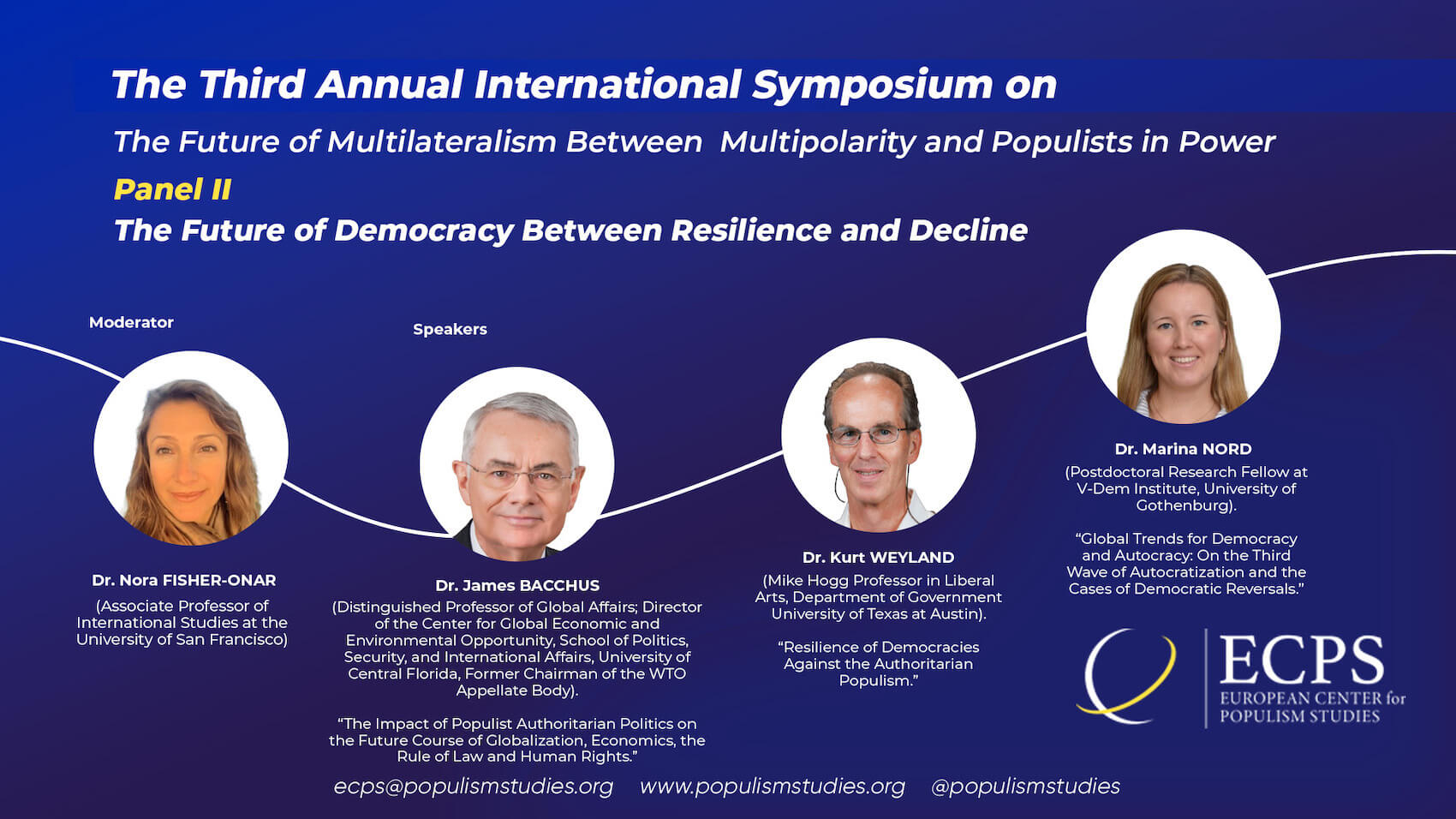
Dr. Nora FISHER-ONAR (Associate Professor of International Studies at the University of San Francisco).
Speakers
“Global Trends for Democracy and Autocracy: On the Third Wave of Autocratization and the Cases of Democratic Reversals,” by Dr. Marina NORD (Postdoctoral Research Fellow at V-Dem Institute, University of Gothenburg).
“Resilience of Democracies Against the Authoritarian Populism,” by Dr. Kurt WEYLAND (Mike Hogg Professor in Liberal Arts, Department of Government University of Texas at Austin).
“The Impact of Populist Authoritarian Politics on the Future Course of Globalization, Economics, the Rule of Law and Human Rights,” by Dr. James BACCHUS (Distinguished Professor of Global Affairs; Director of the Center for Global Economic and Environmental Opportunity, School of Politics, Security, and International Affairs, University of Central Florida, Former Chairman of the WTO Appellate Body).
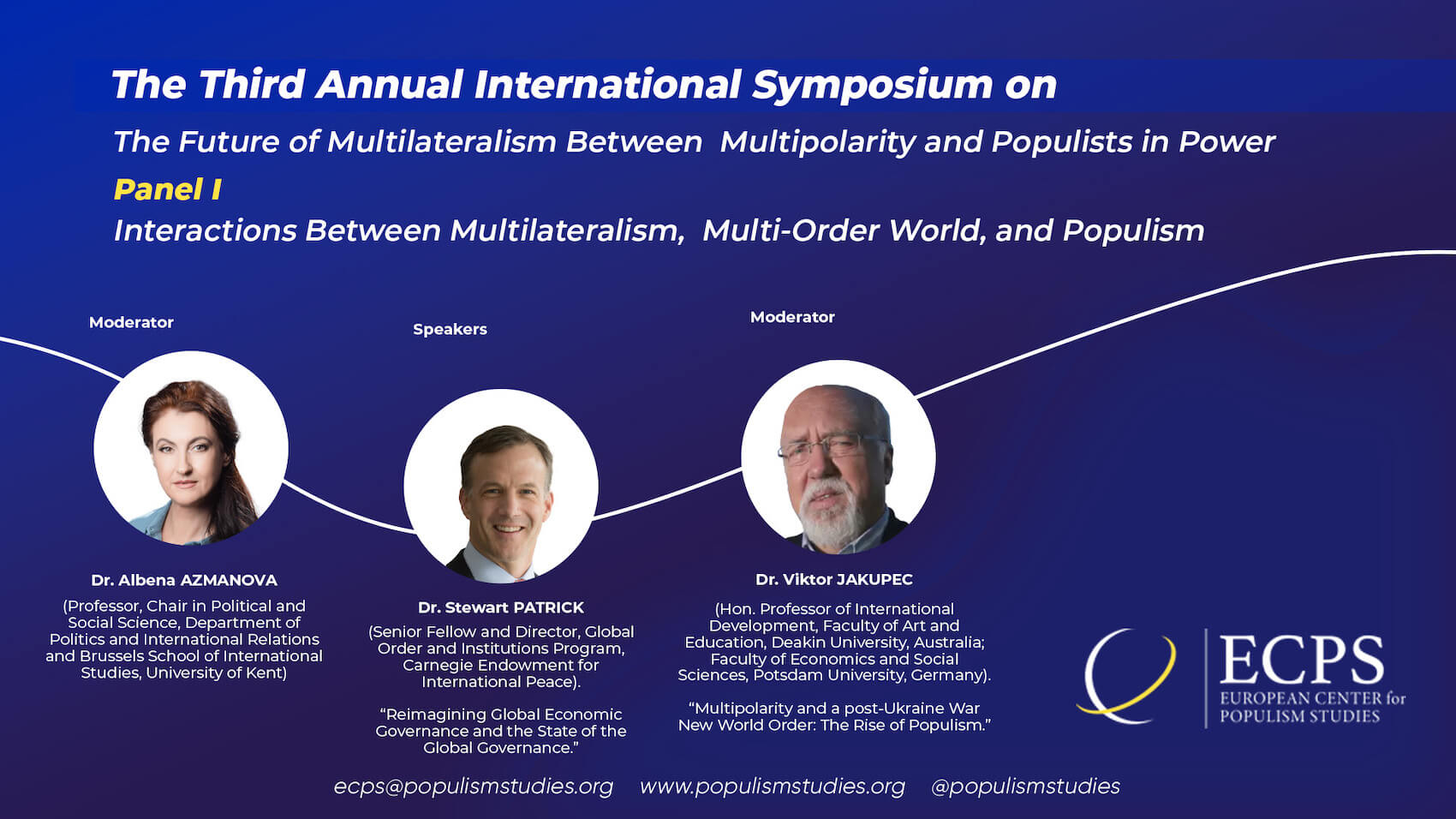
Dr. Albena AZMANOVA (Professor, Chair in Political and Social Science, Department of Politics and International Relations and Brussels School of International Studies, University of Kent).
Speakers
“Reimagining Global Economic Governance and the State of the Global Governance,” by Dr. Stewart PATRICK (Senior Fellow and Director, Global Order and Institutions Program, Carnegie Endowment for International Peace).
“Multipolarity and a post-Ukraine War New World Order: The Rise of Populism,” by Dr. Viktor JAKUPEC (Hon. Professor of International Development, Faculty of Art and Education, Deakin University, Australia; Faculty of Economics and Social Sciences, Potsdam University, Germany).
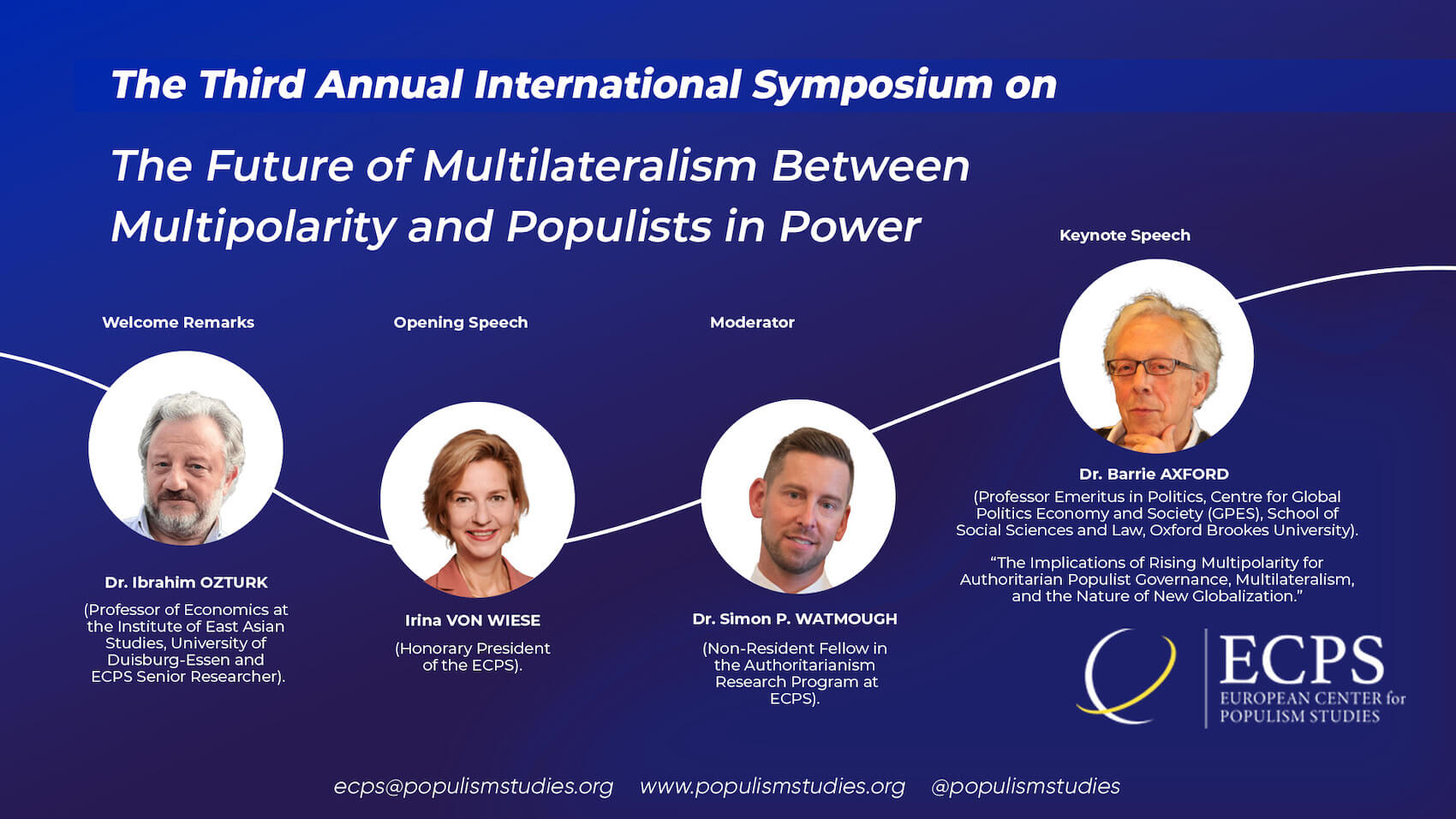
(Non-Resident Fellow in the Authoritarianism Research Program at ECPS).
Keynote Speech
“The Implications of Rising Multipolarity for Authoritarian Populist Governance, Multilateralism, and the Nature of New Globalization,” by Dr. Barrie AXFORD(Professor Emeritus in Politics, Centre for Global Politics Economy and Society (GPES), School of Social Sciences and Law, Oxford Brookes University).
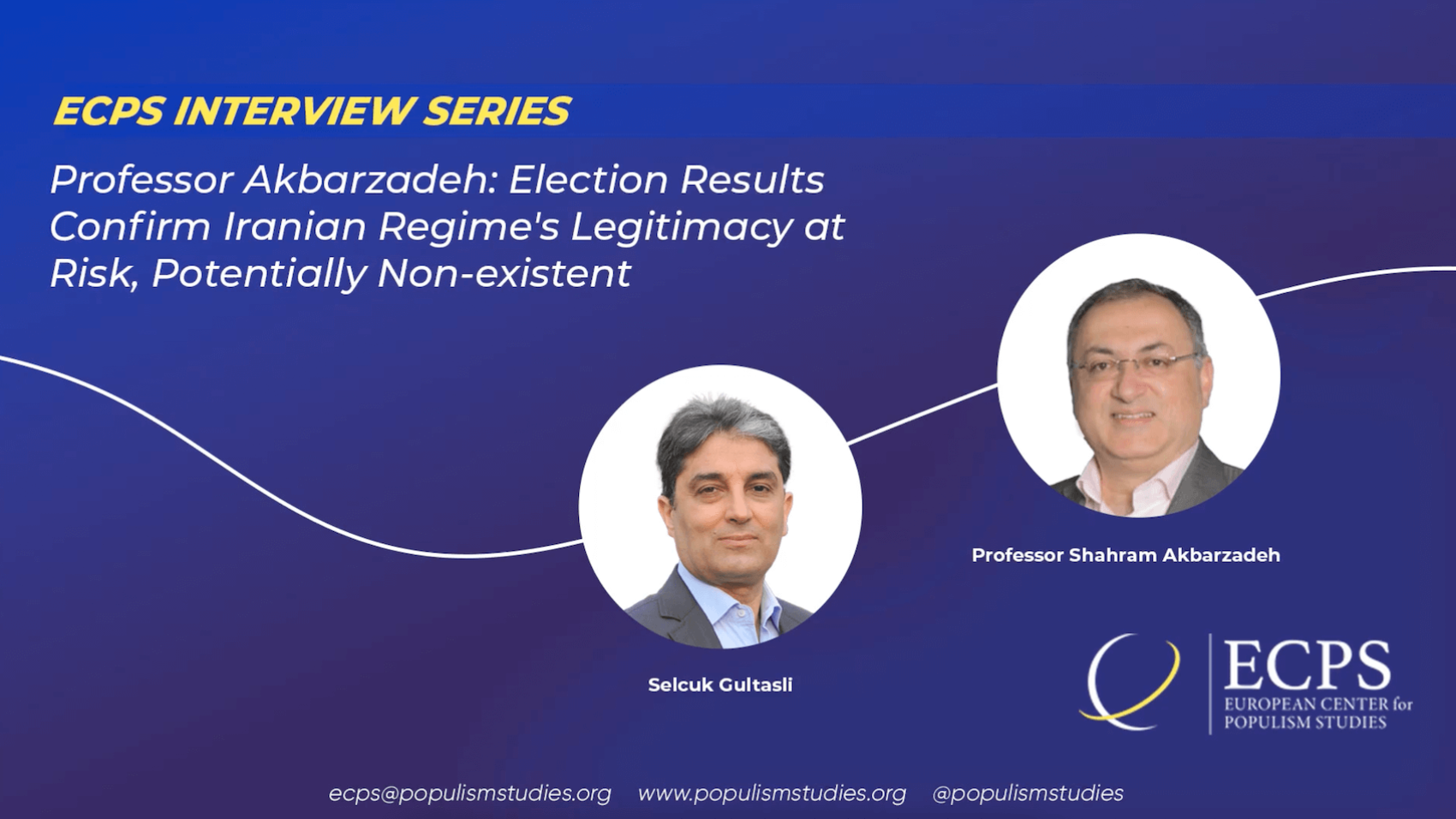
Reminding that elections are pivotal in justifying Iranian religious leadership and sustaining political legitimacy, Professor Shahram Akbarzadeh emphasizes that the recent turnout data from Iran’s elections serves as a stark wake-up call for authorities. He argues that the low turnout raised serious concerns for the regime’s legitimacy and underscores that the Iranian regime has come to recognize that its legitimacy is significantly at risk, perhaps even non-existent.
Professor Shahram Akbarzadeh, a distinguished Research Professor at the Alfred Deakin Institute, Deakin University, emphasizes that the recent turnout data from Iran’s elections serves as a stark wake-up call for authorities. He underscores the significance of Supreme Leader Ali Khamenei’s consistent emphasis on the necessity of voter participation to validate the regime’s legitimacy. “Elections are pivotal in justifying Iranian religious leadership. Despite its reluctance to relinquish control, the Supreme Leader has adamantly advocated for the continuation of elections, emphasizing their importance in sustaining political legitimacy,” underlines Professor Akbarzadeh.
Iran witnessed its lowest voter turnout since the 1979 Revolution during the parliamentary elections held on March 1, 2024. Conservative politicians secured a dominant position in Iran’s parliament, maintaining control over the Islamic Consultative Assembly despite a record-low turnout amid widespread boycott calls. These results unfolded against the backdrop of heightened tensions following the tragic death of Mahsa Amini, sparking widespread protests that directly challenged the legitimacy of the regime. Akbarzadeh notes, “The low turnout raised serious concerns. The national figure of 41% is alarming, but it’s even more concerning when considering urban centers. For instance, in Tehran, the turnout was approximately 25%, significantly lower than the national average. Only a quarter of eligible voters cast their ballots in Tehran. I think the regime has come to recognize that its legitimacy is significantly at risk, perhaps even non-existent.”
In an exclusive interview with the European Center for Populism Studies (ECPS), Professor Akbarzadeh offers a critical analysis of the regime’s response to societal unrest and the evolving dynamics within the women’s empowerment movement against the backdrop of heightened tensions following the death of Mahsa Amini. Despite the regime’s efforts to suppress opposition, particularly in the aftermath of Mahsa Amini’s killing, Professor Akbarzadeh pays homage to the resilience of Iranian women who continue to defy oppressive norms and assert their rights.
Moreover, Professor Akbarzadeh highlights the consolidation of power by hardliners within the Iranian government and parliament, signaling a concerning homogenization of power in the hands of conservative circles. He underscores the regime’s increasing detachment from the electorate, fueled by a lack of responsiveness to popular demands and a narrowing space for dissent within the Parliament.
Looking ahead, Professor Akbarzadeh also warns of a turbulent future characterized by an increasingly hardline Iran and the potential return of the Trump administration in the US. He cautions against the uncertainty surrounding US policy towards Iran, particularly in light of past decisions that destabilized diplomatic efforts, such as the withdrawal from the nuclear agreement. Against this backdrop, Professor Akbarzadeh emphasizes the need for vigilance and foresight in navigating the complex geopolitical landscape, where the interplay between domestic discontent and international relations shapes the trajectory of Iran’s governance structures.
Reminding that elections are pivotal in justifying Iranian religious leadership and sustaining political legitimacy, Professor Shahram Akbarzadeh emphasizes that the recent turnout data from Iran’s elections serves as a stark wake-up call for authorities. He argues that the low turnout raised serious concerns for the regime’s legitimacy and underscores that the Iranian regime has come to recognize that its legitimacy is significantly at risk, perhaps even non-existent.
Professor Shahram Akbarzadeh, a distinguished Research Professor at the Alfred Deakin Institute, Deakin University, emphasizes that the recent turnout data from Iran’s elections serves as a stark wake-up call for authorities. He underscores the significance of Supreme Leader Ali Khamenei’s consistent emphasis on the necessity of voter participation to validate the regime’s legitimacy. “Elections are pivotal in justifying Iranian religious leadership. Despite its reluctance to relinquish control, the Supreme Leader has adamantly advocated for the continuation of elections, emphasizing their importance in sustaining political legitimacy,” underlines Professor Akbarzadeh.
Iran witnessed its lowest voter turnout since the 1979 Revolution during the parliamentary elections held on March 1, 2024. Conservative politicians secured a dominant position in Iran’s parliament, maintaining control over the Islamic Consultative Assembly despite a record-low turnout amid widespread boycott calls. These results unfolded against the backdrop of heightened tensions following the tragic death of Mahsa Amini, sparking widespread protests that directly challenged the legitimacy of the regime. Akbarzadeh notes, “The low turnout raised serious concerns. The national figure of 41% is alarming, but it’s even more concerning when considering urban centers. For instance, in Tehran, the turnout was approximately 25%, significantly lower than the national average. Only a quarter of eligible voters cast their ballots in Tehran. I think the regime has come to recognize that its legitimacy is significantly at risk, perhaps even non-existent.”
In an exclusive interview with the European Center for Populism Studies (ECPS), Professor Akbarzadeh offers a critical analysis of the regime’s response to societal unrest and the evolving dynamics within the women’s empowerment movement against the backdrop of heightened tensions following the death of Mahsa Amini. Despite the regime’s efforts to suppress opposition, particularly in the aftermath of Mahsa Amini’s killing, Professor Akbarzadeh pays homage to the resilience of Iranian women who continue to defy oppressive norms and assert their rights.
Moreover, Professor Akbarzadeh highlights the consolidation of power by hardliners within the Iranian government and parliament, signaling a concerning homogenization of power in the hands of conservative circles. He underscores the regime’s increasing detachment from the electorate, fueled by a lack of responsiveness to popular demands and a narrowing space for dissent within the Parliament.
Looking ahead, Professor Akbarzadeh also warns of a turbulent future characterized by an increasingly hardline Iran and the potential return of the Trump administration in the US. He cautions against the uncertainty surrounding US policy towards Iran, particularly in light of past decisions that destabilized diplomatic efforts, such as the withdrawal from the nuclear agreement. Against this backdrop, Professor Akbarzadeh emphasizes the need for vigilance and foresight in navigating the complex geopolitical landscape, where the interplay between domestic discontent and international relations shapes the trajectory of Iran’s governance structures.
Here is the transcription of the interview with Professor Shahram Akbarzadeh with some edits.
The Iranian Regime Presents Itself as a Trailblazer to be Emulated by Muslims
Islamist populism has been a significant force in various political movements worldwide. In the context of theocratic Iran, how does sectarian Islamist populism manifest, and to what extent does it influence public discourse and policymaking?
Shahram Akbarzadeh: If you’re examining populism, populism in Iran revolves around the concept of the Ummah. The Iranian regime has risen to power with the principle of advancing the interests of the Ummah. While the Ummah is a global concept, within the Iranian context, it primarily refers to the Iranian nation. There’s a persistent notion that the Iranian nation, or the Iranian Ummah, will serve as a blueprint for the global Ummah to emulate. Therefore, when analyzing the rhetoric and messages from the Iranian leadership, it becomes evident that the Iranian revolution has paved the way to demonstrate to the global Ummah the necessary steps to establish an Islamic model of governance and justice.
That consistency has indeed been a cornerstone since the inception of the Revolution in 1979, as the notion of Iran leading the way was codified in the Constitution. This principle heavily influences Iranian foreign policy and continues to do so today. For instance, during the Arab Spring a decade ago, it was evident that the popular movements in many countries weren’t centered around Islam or an Islamic model of governance. Even the Muslim Brotherhood, a prominent player in the region, found itself grappling with how to respond effectively, essentially playing catch-up. However, Iran took a different approach, organizing events and conferences to portray the Arab Spring as an Islamic awakening. In their narrative, they depicted the Arab population as awakening to the model provided by Iran finally, positioning Iran as a trailblazer to be emulated. This narrative often revolves around the idea of representing and leading the Ummah globally, shaping Iranian stances on issues ranging from relations with the United States to Israel and events in Palestine.
Professor Shahram Akbarzadeh, a distinguished Research Professor at the Alfred Deakin Institute, Deakin University.
In the Iranian historical and political context, do differences in populism exist among various actors such as former and current presidents, Ayatollah Khomeini and Ayatollah Khamenei, judiciary and military figures?
Shahram Akbarzadeh: There isn’t a substantial difference among various actors within the Iranian elite. Primarily, they tend to utilize populism in their approach, with the key variance lying between the reformists and the more conservative factions, particularly concerning the religious dimension of populism. Notably, only President Muhammad Khatami sought to distinguish himself by deviating from the prevailing narrative of the Ummah and instead advocating for a dialogue of civilizations, emphasizing mutual learning among peoples. This perspective introduces a civilizational angle, although it does not entirely depart from the Islamic civilization framework. Khatami’s approach represents a nuanced departure from the dominant perspective, allowing for differentiation among various cultures and individuals.
However, with President Ibrahim Raisi assuming office and the Conservatives consolidating power in Iran, there’s been a resurgence of the original four-decade-old perspective on the Islamic Ummah. Iran now positions itself at the forefront of the global Islamic Ummah, portraying itself as the champion of the Muslim nations against the United States and Israel, among other adversaries.
Iran is frequently depicted as a theocratic authoritarian state, where the amalgamation of theocratic principles with sui generis authoritarian governance profoundly shapes both domestic policies and interactions with the international community. Within this framework, the notion of theocratic populism arises as a pivotal aspect of Iran’s political terrain. How does the Iranian government strategically utilize the principles of theocracy in a populist manner to garner popular support domestically and internationally?
Shahram Akbarzadeh: I think this further elaborates on our previous discussion and reinforces prior points. The Islamic Republic portrays itself as the defender of the Muslim Ummah, thereby implicating others as betrayers of this collective identity. Consequently, neighboring states are discredited for their perceived failure to uphold Islam’s interests on a global scale. Iran particularly criticizes Saudi Arabia, its primary regional rival, for allegedly neglecting the Palestinian cause and for entertaining the notion of normalizing relations with Israel through the Abrahamic Accords. This perspective of Iran leading the global Muslim Ummah permeates its actions both regionally and internationally.
Domestically, this perspective enables the leadership to brush aside dissent, opposition to governance, and the interests of women. For instance, women’s rights are often framed as Western imports, lacking indigenous roots or compatibility with the nation’s traditions. This justification is used to enforce compulsory hijab, suppress political opposition, and mandate obedience to Islamic and governmental authorities. The regime dismisses foreign concepts and practices, including women’s rights and individual liberties, to solidify its legitimacy.
The Supreme Leader Has Ultimate Control in Iran
Considering the complex interplay between Islamism, Islamist populism, theocratic populism, and theocratic authoritarianism, what are the main challenges and opportunities for political reform or evolution within Iran, particularly in light of the country’s unique blend of theocratic governance and sui generis electoral politics?
Shahram Akbarzadeh: It’s ironic how Iran boasts about its elections as evidence of the regime’s popularity, citing the participation of citizens at the ballot box. They highlight presidential, parliamentary, and municipal elections, conveniently overlooking the meticulously orchestrated nature of these events. In reality, these elections are more of a carefully choreographed spectacle. The Guardian Council holds significant sway, determining candidates’ eligibility based on their allegiance to the Supreme Leader. This has led to absurd scenarios where sitting parliamentarians critical of the conservative faction, possibly aligned with the Reformists, are barred from running for re-election due to doubts about their loyalty to the Supreme Leader.
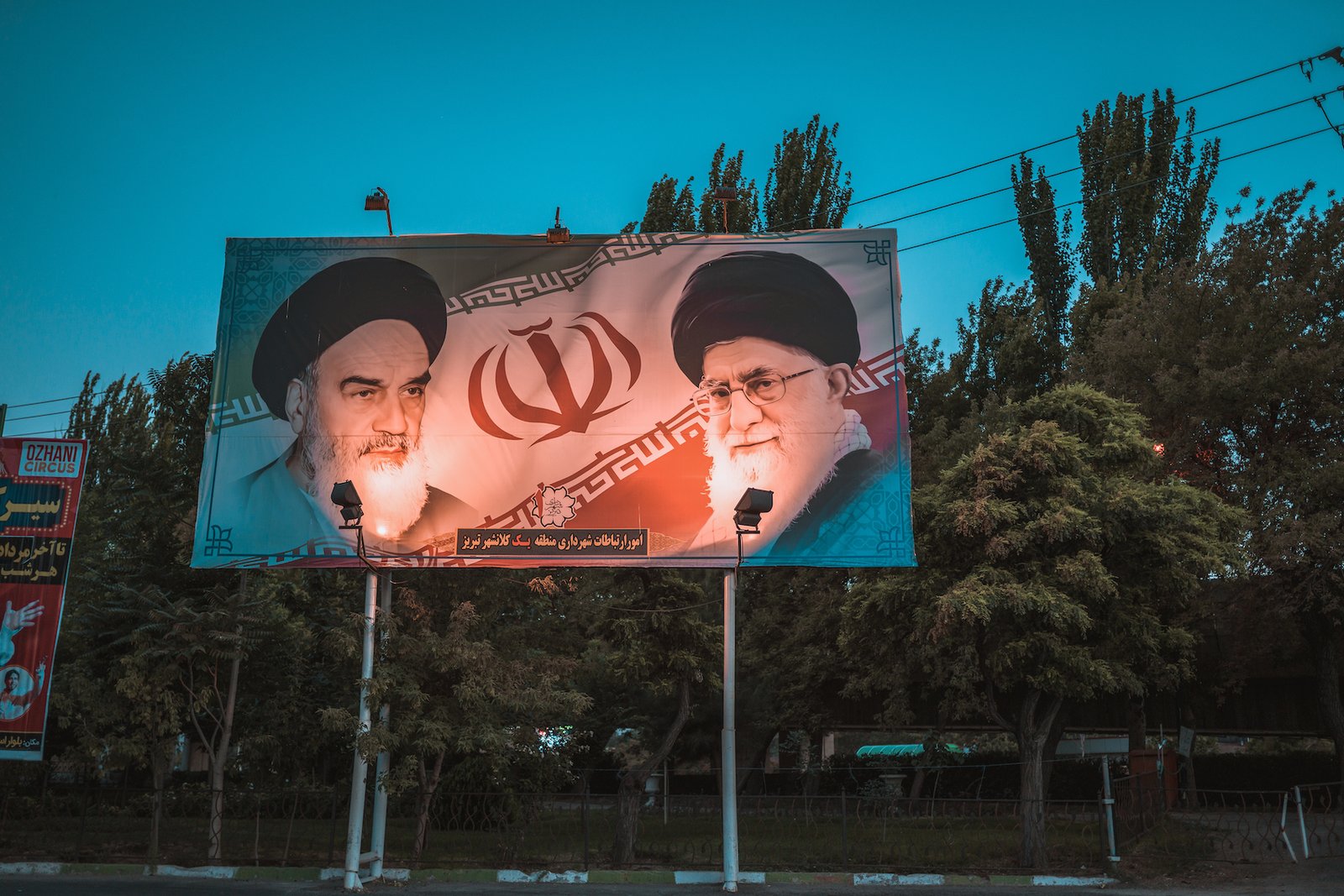
Elections are pivotal in the justification of Iranian religious leadership. Despite its reluctance to relinquish control, the Supreme Leader has adamantly advocated for the continuation of elections, emphasizing their importance in sustaining political legitimacy. Even during the last parliamentary election, the Supreme Leader urged participation, regardless of agreement with his views, recognizing the significance of electoral engagement in validating the regime. However, these elections are carefully managed to maintain control. While they serve as a facade of legitimacy, ultimate authority lies with the unelected Supreme Leader, who wields power over the armed forces, judiciary, and the composition of the Guardian Council, which in turn determines parliamentary candidates. The supreme leader has ultimate control. This orchestration creates the illusion of choice within an authoritarian framework designed to consolidate control.
Internet Emerges as the Next Battleground for the Regime
How does the Iranian regime utilize advanced IT and digital technologies to extend the reach of its repression and authoritarian digital information strategies both domestically and internationally?
Shahram Akbarzadeh: The Islamic Republic of Iran found itself navigating new territory during the Green Movement of 2009. With Facebook emerging as a primary platform for organizing protests, it became evident that social media, Facebook rather than Twitter, played a central role in coordinating dissent. Observing the potential of the internet as a catalyst for opposition, the regime recognized the danger posed by online mobilization. This awareness was heightened by the events of the Arab Spring and similar movements in the region, where social media was instrumental in galvanizing resistance against authoritarian regimes. The regime perceived online activism as a precursor to physical demonstrations, posing a significant threat to its survival.
They embarked on seeking solutions, studying China and other nations’ approaches. They realized the necessity of gaining control over the internet and social media. Consequently, they heavily invested in developing mechanisms to regulate online activity, drawing inspiration from China’s firewall strategy. This culminated in plans for a national intranet, effectively isolating Iranian internet users from the global web. This poses a significant threat to freedom of expression and access to information within Iran, as it disconnects citizens from the outside world. Once implemented, bypassing such restrictions becomes exceedingly challenging. Despite this, Iranian internet users have demonstrated resourcefulness, employing various methods such as VPNs and satellite connections. Nevertheless, the establishment of such controls remains a formidable obstacle to accessing information for Iranian citizens.
The regime has also advanced its surveillance capabilities with sophisticated technologies like facial recognition, strategically deploying cameras in public spaces to monitor the population closely. This allows the regime to swiftly respond to potential protests by deploying security forces and identifying individuals of interest using facial recognition software. Consequently, the internet has emerged as the next battleground for the regime to assert control and stifle dissent. This ongoing struggle presents significant challenges, and while the regime hasn’t definitively triumphed in securing and manipulating the internet, the risks posed by their efforts are considerable.
Iran Relies on Russia and China to Safeguard Its Interests in International Forums
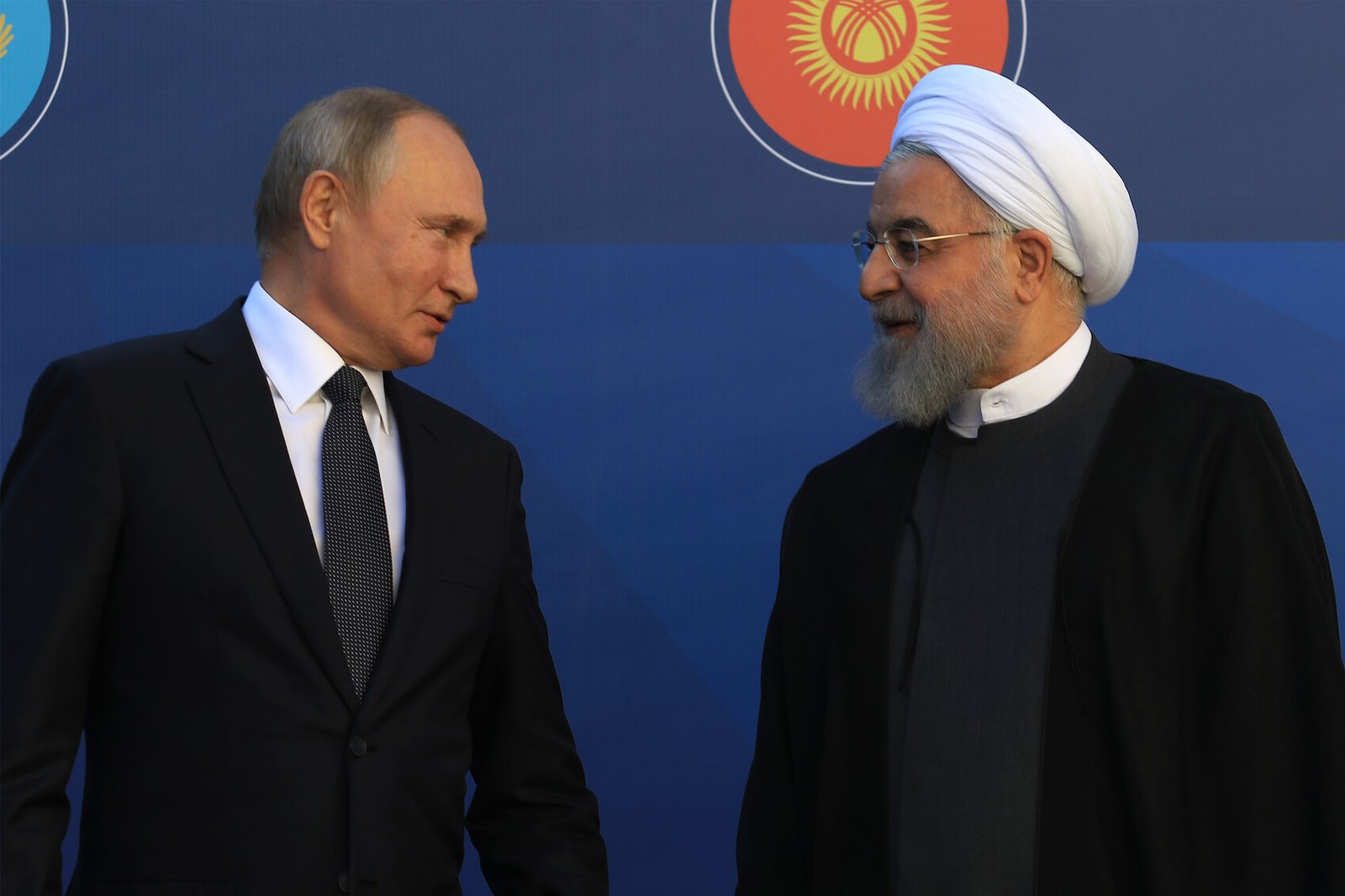
President Vladimir Putin of Russia and then-Iranian President Hassan Rouhani in Yerevan, Armenia, attending the session of the supreme Eurasian Economic Council on October 1, 2019. Photo: Gevorg Ghazaryan.
It is widely acknowledged that authoritarian regimes engage in extensive and intensive collaboration among themselves. In this context, how does the Iranian regime collaborate with countries such as China, Russia, etc., to expand its capacity to enforce its theocratic authoritarianism?
Shahram Akbarzadeh: Iran’s strategic outlook has indeed turned towards China for technological expertise, particularly in internet control and surveillance, as previously mentioned. Additionally, Iran seeks Chinese investment in its infrastructure, facilitated through China’s Belt and Road Initiative (BRI). The Iranian economy has long suffered under sanctions, necessitating external investment and access to Chinese technology to mitigate the adverse effects. Consequently, China emerges as a pivotal player in Iran’s quest to address the economic challenges and bolster its armed forces.
Similarly, Russia holds significant importance for Iran, albeit in a different capacity. While Russia’s role may not primarily involve technological transfers, it provides crucial diplomatic and political protection to Iran. This relationship has intensified due to escalating tensions between Russia and the United States, aligning their interests further. Iran actively demonstrates its commitment to and value for Russia, particularly in countering Western influence and Western hegemony. This convergence of interests is evident during the conflict in Ukraine.
Iran has developed its own drone technology, largely indigenous, which has proven highly effective, especially with low-flying drones capable of evading radar detection. These drones, more cost-effective than sophisticated US models, have demonstrated their utility in overwhelming defense systems. Russia, impressed by their performance in hitting Ukraine, has invited Iran to establish a drone manufacturing base in its territory. This exchange represents a transfer of relatively low-tech capabilities from Iran to Russia, underscoring Iran’s desire to maintain close ties with Russia on the global stage.
Iran relies on Russia and China to safeguard its interests in international forums such as the United Nations Security Council, particularly when facing resolutions or sanctions. However, while Iran expects unwavering support, historical precedent suggests that Russia and China carefully weigh their own economic and strategic interests before fully backing Iran. Nevertheless, from Iran’s perspective, maintaining strong relationships with Russia and China is a prudent move, serving its long-term interests in navigating international politics.
Low Turnout in Elections Raised Serious Legitimacy Concerns
Ruhollah Khomeini and Ayatollah Ali Hamaney on billboard in Tabriz, Iran on August 11, 2019.
The latest Iranian presidential election and recent parliamentary elections saw a historically low turnout, signaling widespread disillusionment with the Mullah regime among the electorate. To what extent do you perceive the record-low turnout of 41% in the recent elections, which was the first in the aftermath of the killing of Mahsa Amini, as indicative of deeper societal shifts and potential challenges to the legitimacy and future of the current regime in Iran?
Shahram Akbarzadeh: This incident served as a significant wake-up call for the authorities. As previously mentioned, Supreme Leader Ali Khamenei has consistently emphasized the importance of participation in elections. He has reiterated, “Even if you disagree with me, exercise your right to vote.” For him, voting signifies the legitimacy of the regime regardless of dissenting opinions. Thus, the low turnout raised serious concerns. The cited national figure of 41% is alarming, but it’s even more concerning when considering urban centers. For instance, in Tehran, the turnout was approximately 25%, significantly lower than the national average. Only a quarter of eligible voters cast their ballots in Tehran.
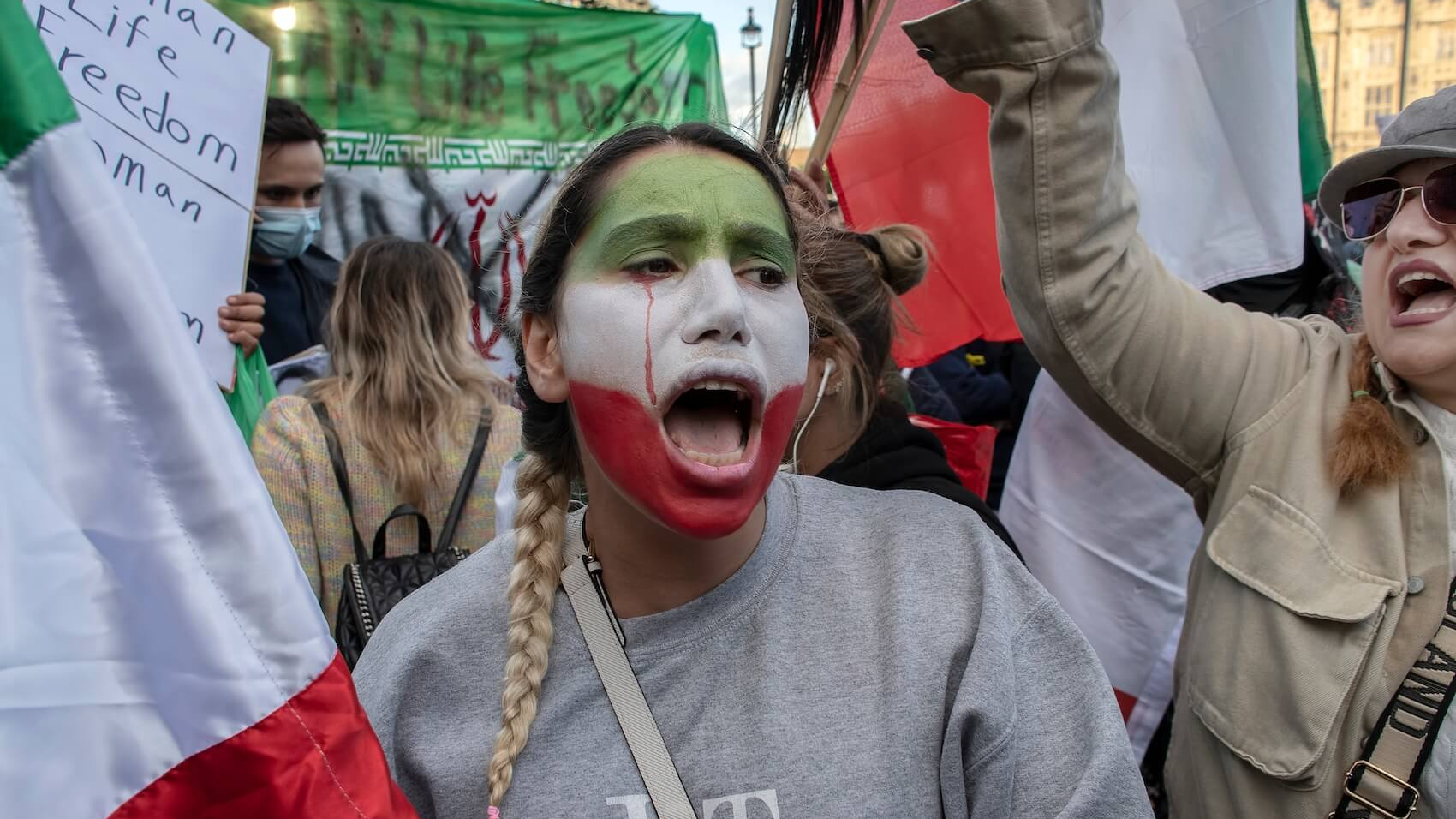
This revelation is indeed shocking, though not entirely unexpected given the sentiments expressed during Mahsa Amini’s tragic death while in custody over an alleged hijab violation. The outcry from women in the streets condemning the Supreme Leader and calling for an end to dictatorship was unmistakable. Their demands extended beyond mere choice regarding the hijab; they contested the legitimacy of the Supreme Leader and the Islamic regime as representatives of the nation. Unfortunately, this protest was brutally suppressed, as authoritarian regimes often resort to brute force to maintain control. They deploy soldiers and security forces to quash dissent, resorting to violence, torture, and imprisonment. Regrettably, this ruthless tactic proved effective once again.
I think the regime has come to recognize that its legitimacy is significantly at risk, perhaps even non-existent. The turnout for the election, with only 41% nationwide and 25% in Tehran, serves as another stark reminder and indicates the depth of the regime’s troubles.
Iranian Parliament Tilts Further Towards Hardline Stance within Conservative Camp
In light of the recent legislative elections held on March 1, could you provide an analysis of the historical significance of these elections within the context of the Islamic Republic of Iran’s political evolution and the broader trajectory of its governance structures?
Shahram Akbarzadeh: We’ve already addressed the issue of lack of legitimacy, which remains a significant factor. What this election has underscored is the consolidation of power by the hardliners across all branches of the Iranian government. The judiciary, the Presidency, and the Parliament are now firmly under their control. In the past, there was some level of diversity and dissent within the Parliament, even if it leaned towards conservatism. However, the current composition of the Parliament lacks that diversity. It’s now a predominantly conservative body, indicating a concerning homogenization of power and personnel in Iran.
Now, with that being said, we’re also observing some differentiation within the conservative faction. Conservatives can now even be categorized into pragmatists and hardliners. For instance, take Mohammad Bagher Ghalibaf, who held a prominent position in the previous Parliament. He’s a conservative, not a reformist. However, he’s not gaining traction in this election, even finding himself sidelined. This shift indicates a consolidation of power within the conservative ranks, leaning more towards the hardline stance. So, what does this indicate? It suggests that the regime is further distancing itself from the population, creating an even wider gap between the government and the people. The leadership is increasingly detached from the electorate.
What does this imply for policy? I believe it has rather dire political implications because of this growing disconnect. They no longer feel compelled to heed popular demands, perhaps even feeling they don’t need to respond due to their increasing isolation. The Parliament has evolved into more of an echo chamber, devoid of internal challenge. With the President, Parliament, and judiciary all aligned with the conservative hardline ideology, it becomes a reinforcing echo chamber for their ideological convictions regarding Iran’s direction and both domestic and international policies.
In the wake of the tragic killing of Mahsa Amini in September 2022, how would you characterize the regime’s response to the perceived erosion of its authority, particularly in relation to its handling of societal discontent, and what insights can we glean from the evolution of the women’s movement regarding advancements in women’s empowerment within Iran?
Shahram Akbarzadeh: In the wake of Masha Amini’s killing and amidst the “Women, Life, Freedom” movement, what became evident was that the grip of fear factor was diminishing, losing its sharpness. The fear factor wasn’t enough to disperse the crowds from the streets. The public rallies couldn’t be quelled solely through suppression. I make this statement with some caution because it did take the authorities about a year or so to suppress the popular movement, which they eventually managed to do. As a result, public rallies are no longer commonplace.
However, I believe this suppression succeeded not merely through brute force, but also due to the absence of organized leadership within the opposition. There was no clear alternative presented to the Islamic Republic. The opposition was fragmented into various groups—leftists, loyalists, liberals, among others—resulting in a lack of a unified voice. Despite everyone being united against the regime, the absence of unity for an alternative significantly weakened the opposition movement.
However, I also want to acknowledge and pay tribute to the women of Iran for their resilience and courage in standing up for themselves over the years. Even now, on social media, one can witness Iranian women walking in the streets, going shopping, going about their daily lives without wearing the hijab or headscarf, displaying remarkable fearlessness. I believe it’s crucial to recognize their bravery.
A Turbulent Ride Ahead with an Increasingly Hardline Iran and Potential Return of Trump in the US
The Iranian leadership appears confident in the prevailing “saner heads” in Washington, leading them to continue grandstanding and goading the United States in the absence of a nuclear deal. With the upcoming elections and possible return of Donald Trump to power in the US, how do you anticipate the shifting political landscape might affect Iran’s strategy and its relationship with the West?
Shahram Akbarzadeh: Iran has mastered the art of brinkmanship. Throughout various negotiations, particularly in the realm of nuclear talks, Iran has consistently pushed to the brink, aiming to extract maximum concessions from its partners, including the United States and Europe. Remarkably, this strategy has proven effective because its interlocutors have generally been rational actors. Iran has engaged with different administrations, finding success because the responses from US administrations have been rational, as have those from European counterparts.
With the possibility of Donald Trump returning to office, it’s uncertain whether the Administration in Washington would act rationally. There’s a strong likelihood of irrational behavior. In fact, the reality of the Trump Administration’s withdrawal from the nuclear agreement, despite years of negotiation and its proven effectiveness for around two and a half years, underscores this concern. The Trump Administration opted to pull out with the promise of securing a better deal, which never materialized. This decision destabilized the nuclear deal and set us on a path of heightened tension and uncertainty. Consequently, with the potential return of Trump to office, we are facing an extremely uncertain future. With conservative hardliners in power in Iran and an unpredictable US administration, we’re in for a turbulent ride. Predicting what will happen next becomes exceedingly difficult in such a volatile scenario.
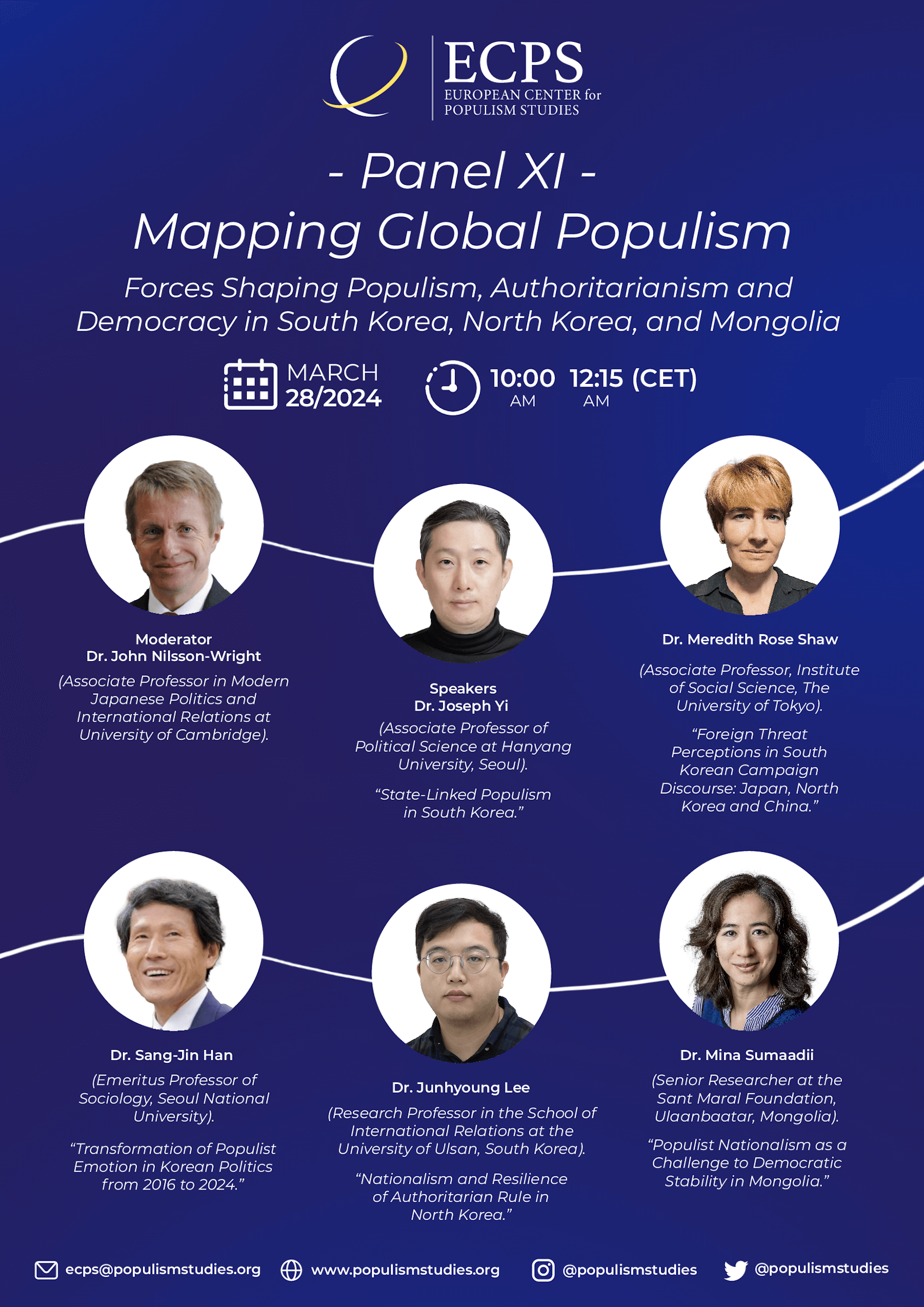
(Associate Professor in Modern Japanese Politics and International Relations at University of Cambridge).
Speakers
“Discourse Regimes and Liberal Vehemence,” byDr. Joseph Yi(Associate Professor of Political Science at Hanyang University, Seoul).
“Foreign Threat Perceptions in South Korean Campaign Discourse: Japan, North Korea and China,” by Dr. Meredith Rose Shaw (Associate Professor, Institute of Social Science, The University of Tokyo).
“Transformation of Populist Emotion in Korean Politics from 2016 to 2024,” byDr. Sang-Jin Han(Emeritus Professor of Sociology, Seoul National University).
“Nationalism and Resilience of Authoritarian Rule in North Korea,” byDr. Junhyoung Lee(Research Professor in the School of International Relations at the University of Ulsan, South Korea).
“Populist Nationalism as a Challenge to Democratic Stability in Mongolia,” by Dr. Mina Sumaadii (Senior Researcher at the Sant Maral Foundation, Ulaanbaatar, Mongolia).
Dr. John Nilsson-Wrightis an Associate Professor in Modern Japanese Politics and International Relations at Faculty of Asian and Middle Eastern Studies, University of Cambridge. In addition to his positions at Cambridge, Dr Nilsson-Wright has also been Senior Research Fellow for Northeast Asia and Korea Foundation Fellow at the Asia Programme at Chatham House which he previously directed as Head of Programme from March 2014 to October 2016. He has been a Monbusho research fellow at Kyoto and Tokyo universities, and a visiting fellow at Tohoku University, Yonsei University, Korea University, and Seoul National University. He has also been a member of the World Economic Forum (WEF) Global Agenda Council (GAC) on Korea, the UK-Korea Forum for the Future, and he is a director of the UK-Japan 21st Century Group. In 2014 he was a recipient of the Nakasone Yasuhiro Prize. Dr. Nilsson-Wright’s recent work has continued to concentrate on the Cold War relationship between the United States and Northeast Asia, with particular reference to the security and political relationships between the United States and Japan and the two Koreas but has expanded to include contemporary regional security issues and political change.
Discourse Regimes and Liberal Vehemence
Dr. Joseph Yi is an Associate Professor of Political Science at Hanyang University in Seoul. He earned his B.A. from U.C. Berkeley and his Ph.D. in political science from the University of Chicago. Dr. Yi’s research focuses on diversity, civil society, and liberal democracy, particularly in North America and East Asia. In 2016, he was selected as one of the top 23 “Excellent Researchers” at Hanyang University, one of only two professors from the Social Sciences.
Abstract: IR theory predicts stable, cooperative relations among liberal-democracies, which respect individual rights, and often vehement relations between liberal and nonliberal states. However, the ruling elites in some established democracies express strong animosity against that of other democracies. To explain, democratic polities increasingly diverge on speech rules and norms (discourse regimes), and such divergence fosters mutual animus (Doyle’s ‘vehemence’). The ruling elites in one discourse regime view that in another as allowing or committing violations of individual rights. They also access different information, as ‘victim-rights’ (VR)-oriented media report selective information that does not offend victimized groups. Information divergence is heightened when one polity follows a VR-hegemonic regime that comprehensively restricts harmful discourse. In Europe and North America, elites from diverging discourse regimes (e.g., California/Florida, Germany/Hungary) frame each other as illiberal. Until recently, animus was particularly severe between South Korea and Japan, with sharply diverging discourse regimes on the colonial past (e.g., comfort women).
Foreign Threat Perceptions in South Korean Campaign Discourse: Japan, North Korea and China
Dr. Meredith Shaw is an Associate Professor in the Institute of Social Science at the University of Tokyo and the managing editor of Social Science Japan Journal. Her work, which has been supported by grants from the Fulbright Foundation and the Korea Foundation, examines cultural politics and state efforts to manipulate culture in East Asia. Her research has been published in Journal of Conflict Resolution, The Pacific Review, and Journal of East Asian Studies, and she has also written for The National Interest, Global Asia and The Diplomat. Dr. Shaw worked for several years as a research assistant and translator at the Korea Institute for National Unification before obtaining a Ph.D. in Political Science and International Relations from University of Southern California. She was a 2019 Korea-US NextGen Scholar and is in the inaugural cohort of the Mansfield-Luce Asia Scholars Network. Since 2017, she has maintained the North Korean Literature in English blog project (http://dprklit.blogspot.com/).
Abstract: Anti-China sentiment is on the rise in South Korea. Several recent polls have shown China for the first-time surpassing both Japan and North Korea as South Koreans’ most disliked neighbor, a trend that appears particularly strong among young people, exacerbated by Covid-19 and a backlash against Chinese migrants. This trend has potential to disrupt the equilibrium partisan divide on foreign policy which had previously been roughly balanced between anti-Japan left and anti-North Korea right.
If China policy becomes a mobilizing issue for South Korean voters, one might expect such sentiments to tip the balance toward right-wing populists, simply expanding on existing threat perceptions of communism and North Korea. But upon closer inspection, South Korean “China threat” rhetoric seems to borrow more from the classic anti-Japan rhetoric of the far left, portraying a great power bully that distorts history and appropriates Korean culture, rather than the anti-communist, human rights-centric imagery used by the far right against North Korea.
Through a discourse analysis of recent anti-China rhetoric in the legislature and on social media, I will examine how the “China threat” discourse is evolving in unique and unanticipated ways within the South Korean context.
Transformation of Populist Emotion in Korean Politics from 2016 to 2024
Dr. Sang-Jin Han is Professor Emeritus at the Department of Sociology at Seoul National University. His research, which often relies on survey data, focuses on the social theory, political sociology, human rights and transitional justice, middle class politics, participatory risk governance, Confucianism and East Asian development. After his retirement, he has been giving lectures as a Distinguished Visiting Professor at Peking University, China. He has lectured as a Visiting Professor at various higher education institutes such as Columbia University in New York, United States, School for Advanced Studies in the Social Sciences in Paris, France, the University of Buenos Aires in Argentina, and Kyoto University in Japan.
Abstract: This presentation is composed of two parts: historical and empirical. The first is a genealogical overview of populist movement in Korea from the last quarter of the 19th century when the Joseon Dynasty (1392-1910) faced systemic crises. This initial stage offers a genuine populist emotion characterized by the high distrust to the ruling elites and the self-awakening perception of the common people as the sovereign actor moving forward to a new world. The second stage is related to the Japanese colonial rule (1910-1945), producing a deep-rooted perception of the Korean people as innocent victim and Japan as evil. The third stage is related to the Korean War (1950-1953) reinforcing the exclusionary drive dictated by the emotion of resentment and hostility. The red regime in the north become fully demonized in the south as the United States in the north. The fourth stage is related to the political democratization led by the college students during the 1980s who, as democratic transformer, criticized the accumulation of wealth by a small number of economic conglomerates and the political oligarchy in the circles of elites. They also sharply blamed the United States’ support for the military regimes in South Korea. The fifth stage deals with digitalized populism culminated in such contrasting forms of candlelight vigil and national flag marches in 2006-2007.
The empirical investigation focuses on the relation between populism and democracy on the basis of the analysis of the survey data collected in 2018. Regression and pathway analysis clearly show that the candlelight vigil is internally associated with the primacy of the people, while the national flag march is associated with distrust of elites, and that the national flag orientation supports for a strong authoritarian leader, whereas the candlelight vigil orientation does not. This means that political distrust, as a definitional component of populism, may pose a threat to democracy via manifestation of such populist emotions as hatred, resentment, and antagonism. In contrast, the primacy of the people tends to promote democracy by advocating the active role of the people as the sovereign actor in democratic politics.
Seen from this perspective, the current situation 2024 is alarming since ahead of the general election on April 10, 2024, both the ruling and opposition parties heavily use the populist emotions of hatred and resentment by demonizing the counterpart. The ruling party accuses the opposition party as North Korean followers jeopardizing the security of South Korea, whereas the opposition party accuses the ruling party as Japanese compradors destroying the pride of sovereign nation.
Nationalism and Resilience of Authoritarian Rule in North Korea
Dr. Junhyoung Lee a research professor in the School of International Relations at the University of Ulsan, specializes in comparative authoritarianism, North Korean politics, and post-communist regimes in East Asia. He earned his Ph.D. from University College Dublin (UCD). X: @leejunhyoung.
Abtsract: In the context of North Korea, nationalism serves as a pivotal instrument for the regime’s survival, intertwining ideological control with authoritarian resilience. This presentation examines the North Korean regime’s historical construction of nationalism, melding familial lineage with national narratives as a mechanism for consolidating power. It scrutinizes the interplay between nationalism and the durability of authoritarian governance in North Korea, drawing upon unstructured data from the Korean Central News Agency (KCNA) regarding nationalistic rhetoric and the higher rank politburo visit of sites emblematic of nationalism. The accentuation of nationalism has notably intensified in frequency, especially under the Kim Jong Un’s rule in 2011. Nevertheless, from a proportional perspective, this emphasis forms part of a multifaceted strategy of legitimacy, intertwining nationalistic rhetoric with assertions of economic prowess to underscore the regime’s resilience. It is at this critical intersection that the constraints of nationalism become apparent, particularly in bolstering the resilience of authoritarian governance in the absence of economic fulfilment. This presentation offers insights into the complexities of authoritarian resilience and the function of nationalism in contemporary North Korean society.
Populist Nationalism as a Challenge to Democratic Stability in Mongolia
Dr. Mina Sumaadii is a Postdoctoral Fellow at the School of International Studies, Sichuan University. She is also a Senior Researcher at the Sant Maral Foundation (SMF), one of the leading polling institutions in Mongolia. During her time at the foundation, she worked on numerous national and cross-national surveys, including Gallup World Poll and World Justice Project. Her major research interests are in democratization, Chinese and Russian foreign policies, research methods, and international development.
Abstract: After Mongolia started its democratic transition, the transitional recession lasted throughout the 1990s. Then in the 2000s the government started to develop its resources sector and chose mining based economic development. By 2010s this has brought unprecedented wealth with a variety of foreign investors. Nonetheless, as quickly as the wealth appeared, it plummeted. Analysts link it to weak institutions of control and an underdeveloped legal framework. These shortcomings were linked to some of the biggest allegations of corruption and related scandals in the next decade. At the same time some of the politicians resorted to populism as an electoral strategy. This study addresses two types of populism found in Mongolia – populist nationalism and populist resource nationalism.
Venga, Luca & Guidotti, Andrea. (2024). Old and New Facets of Populism in Latin America. European Center for Populism Studies (ECPS). March 20, 2024. https://doi.org/10.55271/rp0052
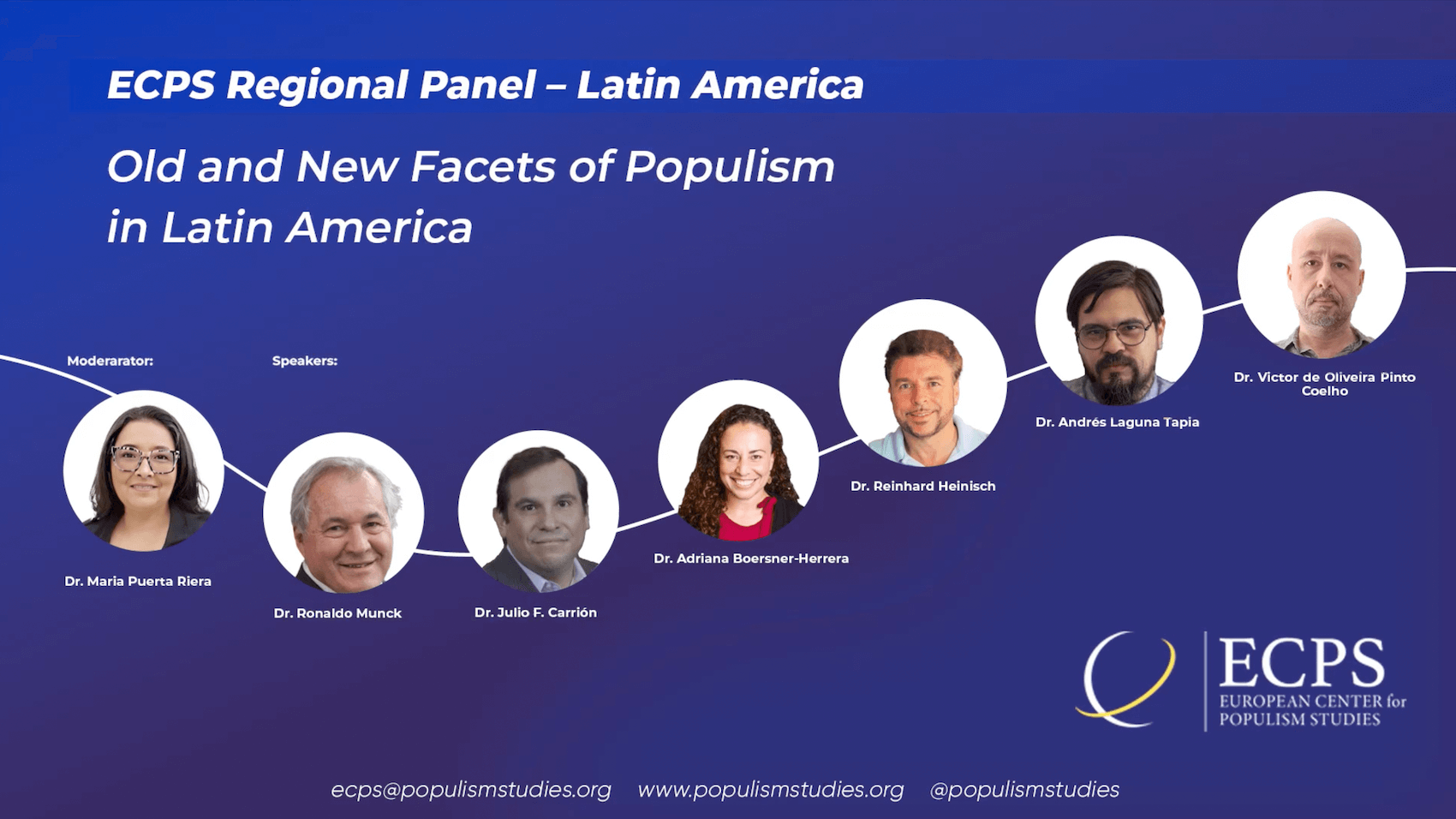
This brief report offers a summary of the first event in ECPS’s Regional Panel series titled “Old and New Facets of Populism in Latin America” which took place online on March 7, 2024. Professor Maria Isabel Puerta Riera moderated the panel, featuring insights from six distinguished populism scholars.
This report provides an overview of the first event in ECPS’s Regional Panel series titled “Old and New Facets of Populism in Latin America” and held online on March 7, 2024. Moderated by Dr. Maria Puerta Riera, Adjunct Professor of Political Science at Valencia College, the panel featured speakersDr. Ronaldo Munck , Professor of Sociology, Dublin City University, Dr. Julio F. Carrión, Professor of Comparative Politics, Delaware University,Dr. Adriana Boersner-Herrera, Assistant Professor of Political Science at The Citadel, The Military College of Charleston,Dr. Reinhard Heinisch and Dr. Andrés Laguna Tapia, respectively Professor of Comparative Austrian Politics at the University of Salzburg and director of the Center for Research in Communication and Humanities and head of Communication Studies at UPB in Cochabamba, and Dr. Victor de Oliveira Pinto Coelho, Professor of History at Universidade Federal do Maranhão.
Introduction
Moderator Professor Maria Isabel Puerta Riera opened the panel by offering an overview of the state of the research on populism, commenting on its existing varieties and on its adaptability to different contexts. She identified an ideological view of populism – one that sees the setting up of a confrontation between two antagonistic, homogenous groups (the “pure people” and the “corrupted elites”) as the crucial element of this phenomenon – and a more pragmatic view, one that sees populism as a strategy for charismatic personalities to dominate national life and break their political exclusion.
Dr. Puerta Riera thus highlighted the flexible nature of the concept, but also pointed at some common, shared trends – chief among them the idea of a radical democracy which dispenses with the formalities of liberal democracy in favour of a direct connection between the people and their leader. She then surveyed the existing varieties of populism in Latin America, distinguishing between populists who rely on ethno-nationalism, anti-imperialism, and on socio economic grievances as the foundations of their discourse.
Dr. Puerta Riera sketched a temporal division of populism in Latin America: After a “first stage” characterized by populist support for a shift away from agriculture and towards industry (at the expense of the landowning elite) came a “second stage” with the advent of neoliberal economics and popular support of shock therapy in the aftermath of the financial crisis. Lastly, she pointed at a “third stage” characterized by the return of socialist populism, which first came to power through democratic elections before turning towards authoritarianism.
In the authoritarian tendencies of many populist leaders, whether on the left or the right of the political spectrum, Dr. Puerta Riera found further evidence of the adaptability of this political phenomenon, paving the way for a discussion of its facets by the various panelists.
Dr. Ronaldo Munck: “Populism and Socio-Political Transformation in Latin America”
Professor Ronaldo Munck underscores that populism usually stems from crisis, as economic failures generate the conditions for populist leaders to emerge and capitalize on the anger of the masses – as evidenced by the waves of populism that followed each major economic downturn. He covered a number of historical examples ranging from Peron to Chavez before raising a number of questions for future reflection.
The first panelist, Professor Ronaldo Munck, opened the discussion by highlighting the negative normative connotations associated with populism in the “western” world, while acknowledging that Latin America is likely to see this phenomenon under a different light, given its peculiar history in this regard. Dr. Munck also distinguished between a kind of socio-economic dimension of populism, centered around the fight against the landed elites of colonial times, a pragmatic view that portrays populism as an opportunistic strategy, and a third perspective, of post-structuralist nature, which focuses on populist discourse and its narratives. He further described populism as an empty signifier, one that is filled with meaning depending on its context and circumstances, adapting to the cleavages that divide society and that depends on the conscious construction of two groups as antagonists.
Dr. Munck added that populism usually stems from crisis, as economic failures generate the conditions for populist leaders to emerge and capitalize on the anger of the masses – as evidenced by the waves of populism that followed each major economic downturn. He covered a number of historical examples ranging from Peron to Chavez before raising a number of questions for future reflection: Firstly, he pondered over a “re-Gramscification” of populism, with an increased emphasis on hegemony and the role it plays in populist politics, and secondly he called for an increased focus on the role of emotions and desires in filling the “empty signifier” with powerful images, myths and ideas that capture popular imagination.
Dr. Julio F. Carriòn: “Varieties of Populism and Democratic Erosion: The Case of Latin America”
Professor Julio F. Carriòn’s general argument is that there are two main varieties of populism, both the product of the political processes and the shape of populist mobilization. The first is ‘constrained populism,’ in which you may see democratic erosion but not generally regime change. The second is ‘unconstrained populism,’ close to forms of authoritarianism and leading most often to regime changes. The general argument is that every populist leader/movement encounters at a point a moment of confrontation vis-à-vis opposite forces that determines or not the creation of power asymmetry – that consequently paves the way for democratic backsliding or regime change.
Professor Julio F. Carriòn offered a speech based on his book ‘A Dynamic Theory of Populism in Power. The Andes in Comparative Perspective.’ The key question of the book is the relationship between populism and the likelihood of regime change, following the comparative strain in the political sciences literature. Populism is then mainly viewed as a strategy to seek and exercise power, with the exhibition of a personalistic style of leadership, an anti-pluralistic and confrontational mentality, and a general distrust of checks and balances.
His general argument is that there are two main varieties of populism, both the product of the political processes and the shape of populist mobilization. The first is ‘constrained populism,’ in which you may see democratic erosion but not generally regime change. The second is ‘unconstrained populism,’ close to forms of authoritarianism and leading most often to regime changes. The general argument is that every populist leader/movement encounters at a point a moment of confrontation vis-à-vis opposite forces that determines or not the creation of power asymmetry – that consequently paves the way for democratic backsliding or regime change. The process can be generally divided in three key moments: A tsunami phase where populism take off, a Hobbesian moment where populists are confronting other forces that can lead either to a re-equilibrations phase or to the desired populist in power moment. The development of power asymmetries during the confrontation phase will also consequently determine whether populist forces will be of a constrained or of an unconstrained type: If asymmetries arise, the political system will favor constrained populism.
To conclude, the second panelist discussed the ways to potentially apply this framework beyond the Andes. There are a few cases of constrained populism accompanied by democratic erosion in the American continent taken more broadly: Alan Garcia in Perù, Collor de Mello in Brazil, Menem and the Kirchners in Argentina, Trump in the US. But we can also argue for cases of unconstrained populism in Latin America and beyond where we can observe major processes of democratic erosion: Ortega in Nicaragua, Orban in Hungary, Erdogan in Turkey, Bukele in El Salvador.
Dr. Adriana Boersner-Herrera: “Global Power Dynamics and Authoritarian Populism in Venezuela”
Dr. Adriana Boersner-Herrera explained how Hugo Chavez used populism in Venezuela as a guiding ideology to build a cut of support around him, making use of old and new tools to channel participation and support, leading to feelings of empowerment while maintaining a rigid top-down control over their priorities and opportunities. Chavez portrayed himself as a champion of the oppressed and an enemy of imperialism, modulating his discourse to diverse settings, while controlling the elites around him and stymieing dissenting voices. Maduro kept using Chavismo as a guiding ideology whilst he increasingly lost public support and repressed dissent within party ranks, and economic conditions worsened.
Dr. Adriana Boersner-Herrera provided a tightly focused presentation on Venezuela, comprehensively surveying the case of this country. She begun by distinguishing between populism and authoritarian populism, as the second is systematic in its rejection of pluralism and its concentration of power in the hands of a leader. The authoritarian populism is the more dangerous form, as it undermines democratic checks and balances and often includes extremist ideological elements – both from the left and the right. She then flagged how populism cannot be studies as a phenomenon bounded by national borders, since global events such as the rise of China or the retrenchment of the United States have important impacts on the trajectories of populist leaders and their ideas.
This allowed her to introduce the case of Venezuela, as Dr. Boersner-Herrera underlined the transnational element of Hugo Chavez’s populist project, constructed in explicit opposition to the United States and in solidarity and cooperation with other allied regimes. A populist approach and discourse were used to capitalize on the divisions between the Global South and the Global North, and eventually to undermine democratic governance in Venezuela.
She offered an overview of the main stages of “Chavismo,” beginning with the drafting of a new Constitution in 1999, moving to the creation of Bolivarian Circles in 2001 and the 2006 address to the United Nations. Dr. Boersner Herrera explained how Chavez used populism as a guiding ideology to build a cut of support around him, making use of old and new tools to channel participation and support, leading to feelings of empowerment while maintaining a rigid top-down control over their priorities and opportunities. He portrayed himself as a champion of the oppressed and an enemy of imperialism, modulating his discourse to diverse settings, while controlling the elites around him and stymieing dissenting voices.
Dr. Boersner-Herrera concluded by remarking on the regime’s economic foundations, and on the transition that led to the inauguration of the new President, Nicholas Maduro. She gave evidence supporting the theory that Maduro kept using Chavismo as a guiding ideology whilst he increasingly lost public support and repressed dissent within party ranks, and economic conditions worsened. Attention was also paid to Venezuela’s global networks, developed by Maduro to shore up his position and reap the benefits of anti-western discourse. Thus, Dr. Boersner-Herrera linked this specific case back to her broader suggestion that populism’s international dimension needs to be better understood and studied.
Dr. Reinhard Heinisch & Dr. Andrés Laguna Tapia: “Libertarian Populism? Making Sense of Javier Milei’s Discourse”
According to Professor Reinhard Heinisch and Professor Andrés Laguna Tapia, Peron is considered the quintessence of populism in Argentina, exemplifying personalistic leadership, anti-institutionalist ideas, and following a redistributive economic agenda. In this sense ‘Peronism vs anti-Peronism’ remains a defining feature of Argentine politics, continuing to shape the nation’s political discourse. Against this backdrop, Javier Milei stands as a divergent figure, especially in the economic agenda layered out during his electoral campaign. Milei can be seen as a sui generis populist, fitting just some populist features and precisely Moffit’s theoretical approach about populist as performers of crisis.
Professor Reinhard Heinisch and Professor Andrés Laguna Tapia gave a speech about Javier Milei’s political discourse. The aim of their presentation was to analyze Milei’s character under the lens of theories of populism in order to better position his figure in the political (populist) spectrum. To them, this is important because the literature describes Milei as a ‘half populist’ leader, in addition to the fact that he considers himself as a liberal libertarian vis-à-vis other populists in Argentina. To do that, Dr. Heinisch and Dr. Laguna Tapia looked at his discourse from three different approaches: Ideational populism, populism as a discursive frame, populism as a strategy, populism as performing crisis. The strategy employed to analyze Milei’s discourse has been to track his position in speeches and postings on the medias collected from the beginning of his campaign to the elections, under a holistic deductive coding methodology.
Dr. Laguna Tapia gave an historical summary of the unique perspective of Argentine populism, recalling the three-phases division of a ‘classical’ phase in the 1940s and 1950s, the ‘neo-populist’ era in the late 1980s and 1990s, and the resurgence phase in the early 21st century. Particularly, Peron is considered the quintessence of populism in Argentina, exemplifying personalistic leadership, anti-institutionalist ideas, and following a redistributive economic agenda. In this sense ‘Peronism vs anti-Peronism’ remains a defining feature of Argentine politics, continuing to shape the nation’s political discourse. Against this backdrop, Milei stands as a divergent figure, especially in the economic agenda layered out during his electoral campaign.
Dr. Heinisch then presented the findings of the research from every angle outlined above. From the ideational approach, Milei doesn’t refer much to the concept of ‘the people’ as opposed to ‘corrupt elites,’ that he spends a lot of time in identifying as enemies. There is also not much Manichean opposition between these two forces, and his host ideology is clearly a libertarian one, with a quasi-religious nature. Therefore, Milei does not fit the ideational pattern.
Moving to the discursive framing approach, ‘the people’ is again not fully defined as a concept, while he focuses a lot on the diagnosis of the problems, without leaning a lot on the prognosis and about what he wants specifically to change. As well as before, he is clearer mostly on the economic agenda. Also here, he thus fails to satisfy this theoretical approach.
Considering the third theoretical pattern, populism as a strategy, Dr. Heinisch argued that is difficult to tell whether populism is in itself a strategy or not, given that every politician has a strategy by definition. Milei is strategic here in the sense that he distances himself mainly from fellow conservatives and the representatives of the government. Hence, this approach is just half satisfactory to tackle Milei’s populism.
Following the last line of investigation based on the performance of crisis, there is more evidence pointing to Milei as a populist. He talks extensively, strongly, and morally about the crisis Argentina is facing, describing enemies and detractors in extremely negative terms, while positioning ‘the people’ as opposed to them. To conclude, Milei can be seen as a sui generis populist, fitting just some populist features and precisely Moffit’s theoretical approach about populist as performers of crisis.
Professor Victor de Oliveira Pinto Coelho: “The Phenomenon of ‘Bolsonarism’ in Brazil: Specificities and Global Connections”
Professor Victor de Oliveira Pinto Coelho offered an overview of ‘Bolsonarism,’ a peculiarly Brazilian phenomenon with a global dimension that is closely connected with populism. He drew comparisons between Bolsonarism and other far-right populist movements, noting similarities such as the reliance on a supposedly ‘outsider’ leader and the use of polarizing language, while also shedding light on the international connections of the Bolsonaro family within the galaxy of right-wing movements, before offering some remarks around the idea of populism and Bolsonarism as a symptom of the crisis of the current liberal-capitalist model.
The last panelist, Professor Victor de Oliveira Pinto Coelho, offered an overview of ‘Bolsonarism,’ a peculiarly Brazilian phenomenon with a global dimension that is closely connected with populism.
Professor de Oliveira Pinto Coelho begun with a general definition of populism, highlighting which elements are necessary for a movement to be labelled as populist. He identified the presence of a strong, charismatic leader, a discursive emphasis on the “us versus them” mentality, and a tension between liberal democracy and the movement’s impulses as the crucial facets of populism, before delving into the intricacies of the ‘people versus elites’ discourse. He underlined how these narratives are not necessarily based on pre-existing societal divisions but are built around ‘empty signifiers’ which act as catalysts to unite the people and construct an enemy to target.
Professor de Oliveira Pinto Coelho then discussed the ways in which the highly publicized Lava Jato scandal was instrumentalized by the far-right to craft an anti-corruption narrative centered around the ideas of a clean, minimal state; a beacon of entrepreneurial freedom juxtaposed with the wasteful, inefficient ‘big state’ promoted by the left. This vision was presented as an apolitical quest in the nation’s interest, but Professor de Oliveira Pinto Coelho pointed at its inherently political agenda and at its ideological undertones.
He then proceeded to explain how former President Jair Bolsonaro took ownership of this anti-corruption discourse, mixing it with a strong anti-communist rhetoric reminiscent of the Cold War and of the years of the military dictatorship. Further, he pointed out how a new moral dimension was added by Evangelical and Neo-Pentecostal supporters of the former president, as corruption became an all-encompassing target in the ‘culture wars.’
Professor de Oliveira Pinto Coelho thus dissected the supposedly apolitical nature of these campaigns, exposing their roots in far-right thinking and in the frustrated aspirations of millions of Brazilians. He explained how the absence of a true national project, the state’s reliance on agribusiness, and the model of ‘consumer citizenship’ all led to a crisis of expectations, as economic conditions worsened, and many Brazilians felt robbed of their future. He placed these trends in the larger, global milieu, linking them with the 2008 financial crisis and with the worldwide neoliberal project, which creates new forms of subjectivation and promotes the rollback of an already absent state.
Finally, Professor de Oliveira Pinto Coelho drew more comparisons between Bolsonarism and other far-right populist movements, noting similarities such as the reliance on a supposedly ‘outsider’ leader and the use of polarizing language, while also shedding light on the international connections of the Bolsonaro family within the galaxy of right-wing movements, before offering some concluding remarks around the idea of populism and Bolsonarism as a symptom of the crisis of the current liberal-capitalist model.
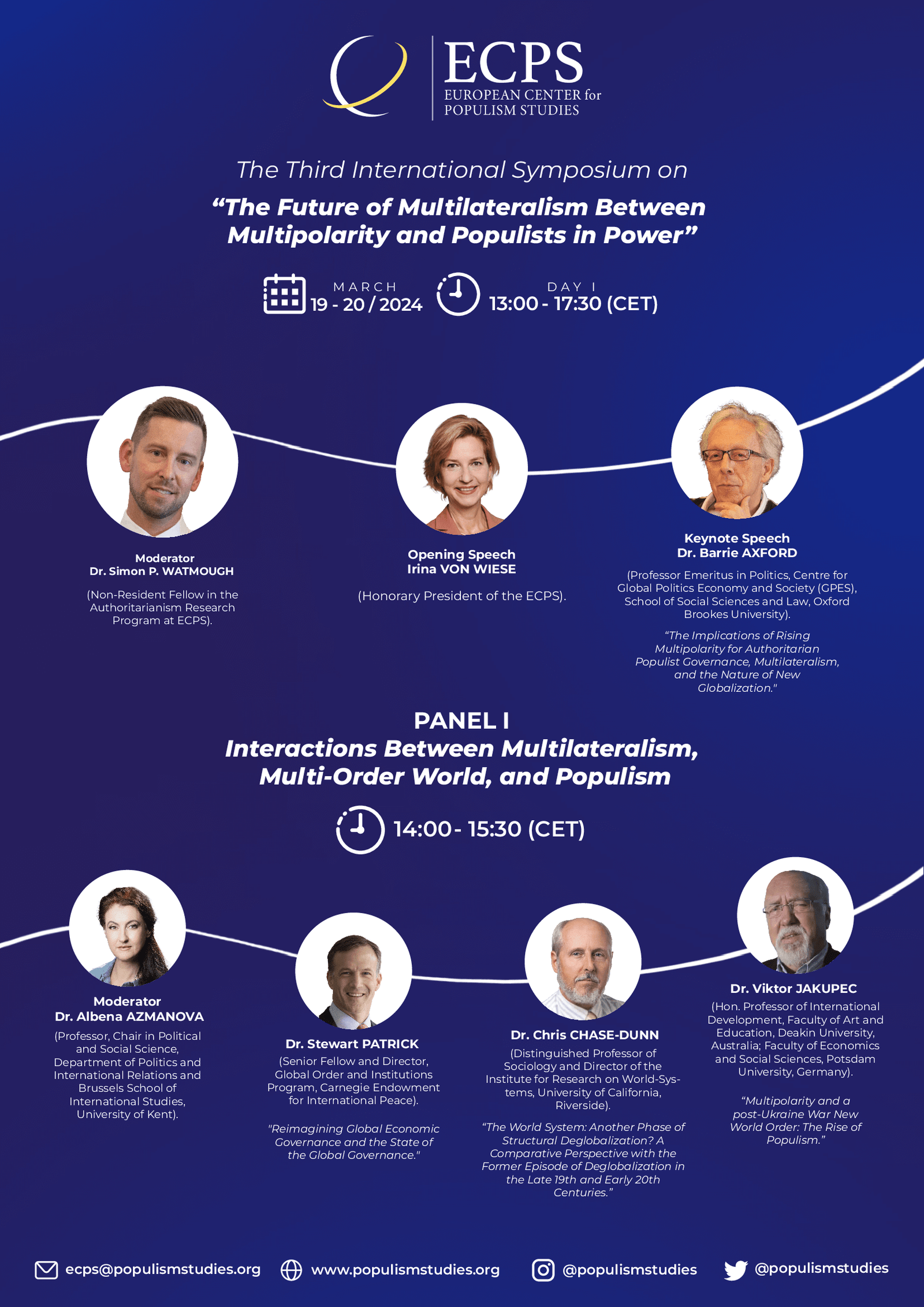
Moderator: Dr. Simon P. WATMOUGH (Non-Resident Fellow in the Authoritarianism Research Program at ECPS).
“The Implications of Rising Multipolarity forAuthoritarian Populist Governance, Multilateralism, and the Nature of New Globalization,” by Dr. Barrie AXFORD(Professor Emeritus in Politics, Centre for Global Politics Economy and Society (GPES), School of Social Sciences and Law, Oxford Brookes University).
Panel -I-
Interactions Between Multilateralism, Multi-Order World, and Populism
14:00-15:30 (Central European Time)
Moderator:Dr. Albena AZMANOVA (Professor, Chair in Political and Social Science, Department of Politics and International Relations and Brussels School of International Studies, University of Kent).
“Reimagining Global Economic Governance and the State of the Global Governance,” by Dr. Stewart PATRICK (Senior Fellow and Director, Global Order and Institutions Program, Carnegie Endowment for International Peace).
“The World System: Another Phase of Structural Deglobalization? A Comparative Perspective with the Former Episode of Deglobalization in the Late 19th and Early 20th Centuries,” by Dr. Chris CHASE-DUNN (Distinguished Professor of Sociology and Director of the Institute for Research on World-Systems, University of California, Riverside).
“Multipolarity and a post-Ukraine War New World Order: The Rise of Populism,” by Dr. Viktor JAKUPEC (Hon. Professor of International Development, Faculty of Art and Education, Deakin University, Australia; Faculty of Economics and Social Sciences, Potsdam University, Germany).
Panel -II-
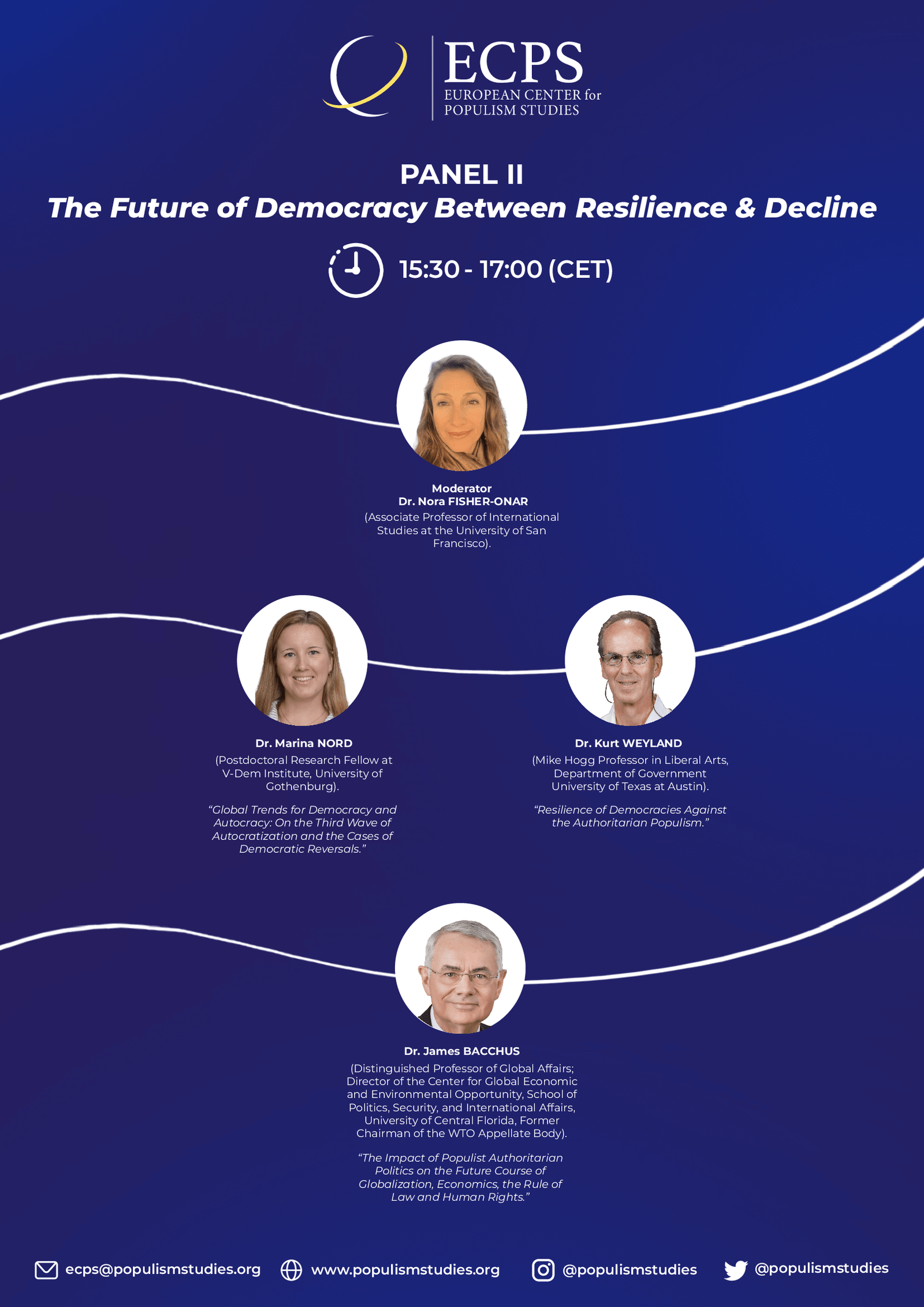
The Future of Democracy Between Resilience & Decline
15:30-17:00 (Central European Time)
Moderator: Dr. Nora FISHER-ONAR (Associate Professor of International Studies at the University of San Francisco).
“Global Trends for Democracy and Autocracy: On the Third Wave of Autocratization and the Cases of Democratic Reversals,” by Dr. Marina NORD (Postdoctoral Research Fellow at V-Dem Institute, University of Gothenburg).
“Resilience of Democracies Against the Authoritarian Populism,” by Dr. Kurt WEYLAND (Mike Hogg Professor in Liberal Arts, Department of Government University of Texas at Austin).
“The Impact of Populist Authoritarian Politics on the Future Course of Globalization, Economics, the Rule of Law and Human Rights,” by Dr. James BACCHUS (Distinguished Professor of Global Affairs; Director of the Center for Global Economic and Environmental Opportunity, School of Politics, Security, and International Affairs, University of Central Florida, Former Chairman of the WTO Appellate Body).
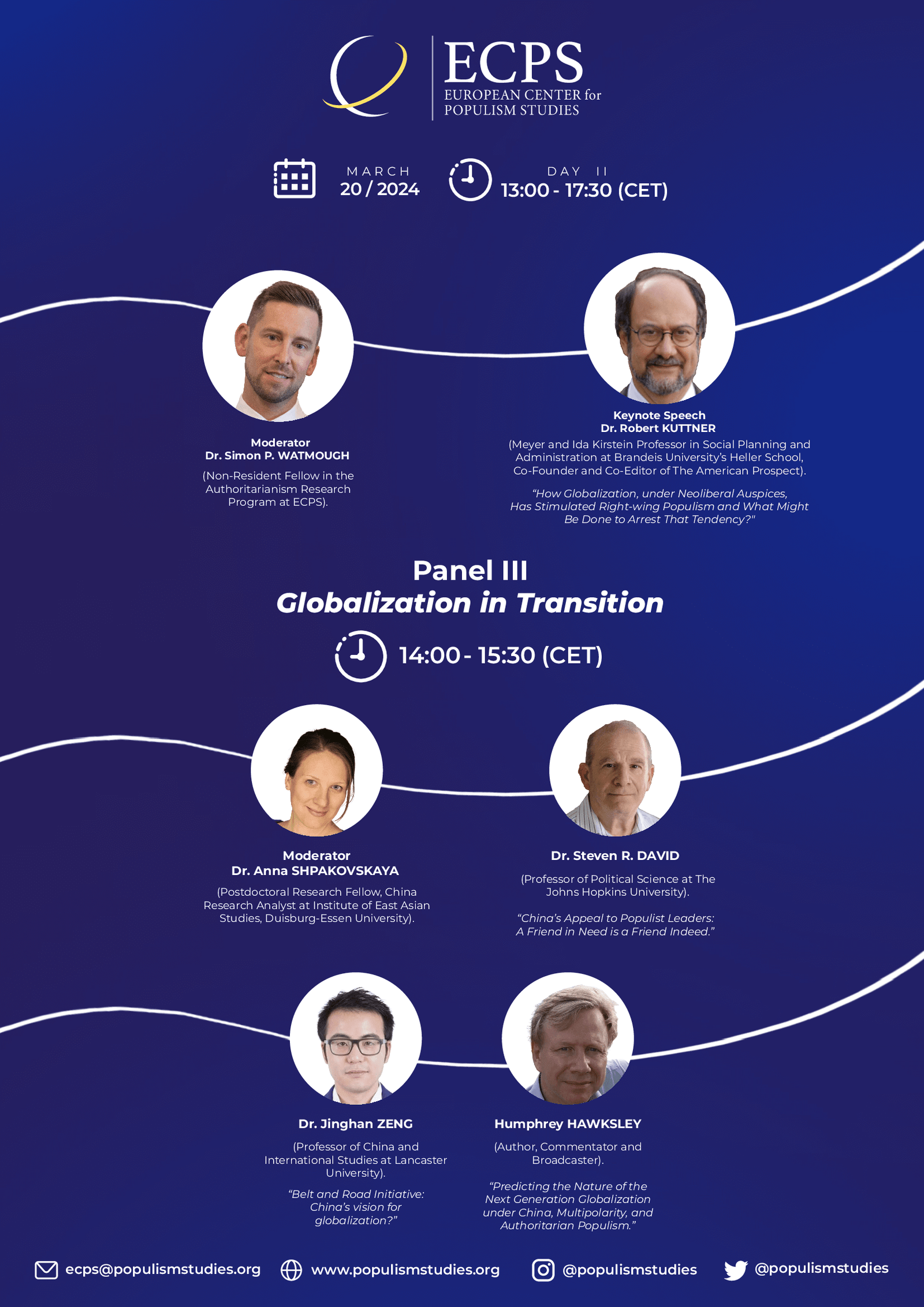
Day II (March 20, 2024)
13:00-17:30 (Central European Time)
Keynote Speech
“How Globalization, under Neoliberal Auspices, Has Stimulated Right-wing Populism and What Might Be Done to Arrest That Tendency?” by Dr. Robert KUTTNER (Meyer and Ida Kirstein Professor in Social Planning and Administration at Brandeis University’s Heller School, Co-Founder and Co-Editor of The American Prospect).
Panel -III-
Globalization in Transition
14:00-15:30 (Central European Time)
Moderator: Dr. Anna SHPAKOVSKAYA (Postdoctoral Research Fellow, China Research Analyst at Institute of East Asian Studies, Duisburg-Essen University).
“China’s Appeal to Populist Leaders: A Friend in Need is a Friend Indeed,” by Dr. Steven R. DAVID (Professor of Political Science at The Johns Hopkins University).
“Belt and Road Initiative: China’s Vision for Globalization?” by Dr. Jinghan ZENG (Professor of China and International Studies at Lancaster University).
“Predicting the Nature of the Next Generation Globalization under China, Multipolarity, and Authoritarian Populism” byHumphrey HAWKSLEY(Author, Commentator and Broadcaster).
Special Commentator Dr. Ho Tze Ern BENJAMIN (Rajaratnam School of International Studies in Singapore, Coordinator at the China Program, and International Relations Program).
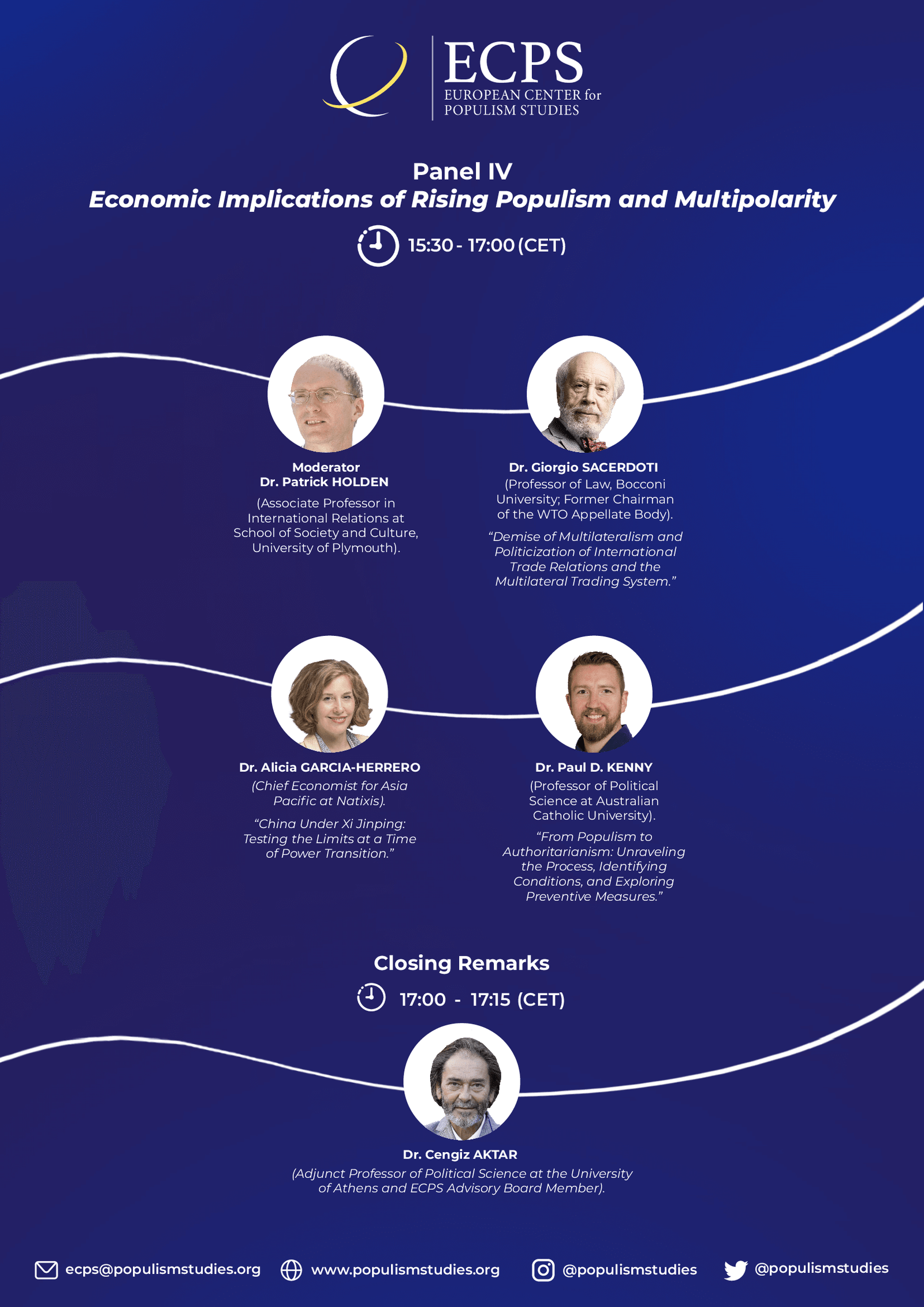
Panel -IV-
Economic Implications of Rising Populism and Multipolarity
15:30-17:00 (Central European Time)
Moderator: Dr. Patrick HOLDEN (Associate Professor in International Relations at School of Society and Culture, University of Plymouth).
“Demise of Multilateralism and Politicization of International Trade Relations and the Multilateral Trading System,” by Dr. Giorgio SACERDOTI (Professor of Law, Bocconi University; Former Chairman of the WTO Appellate Body).
“China Under Xi Jinping: Testing the Limits at a Time of Power Transition,” by Dr. Alicia GARCIA-HERRERO (Chief Economist for Asia Pacific at Natixis).
“From Populism to Authoritarianism: Unraveling the Process, Identifying Conditions, and Exploring Preventive Measures,” by Dr. Paul D. KENNY (Professor of Political Science at Australian Catholic University).
Closing Remarks
17:00-17:15 (Central European Time)
Dr. Cengiz AKTAR (Adjunct Professor of Political Science at the University of Athens and ECPS Advisory Board Member).
Irina von Wiese, Honorary President of ECPS, was born in Germany, the daughter and granddaughter of Polish and Russian refugees. After completing her law studies in Cologne, Geneva and Munich, she obtained a scholarship to study at the Harvard Kennedy School where she gained a Master in Public Administration. Her subsequent legal training took her to Berlin, Brussels and Bangkok, and gave her a first insight into the plight of refugees and civil rights defenders across the globe.
From 1997 to 2019, Irina lived and worked as a lawyer in private and public sector positions in London. During this time, she volunteered for human rights organisations, advising on migration policy and hosting refugees in her home for many years.
In 2019, Irina was elected to represent UK Liberal Democrats in the European Parliament. She served as Vice Chair of the Human Rights Subcommittee and as a member of the cross-party Working Group on Responsible Business Conduct. The Group’s main achievement was the introduction of EU legislation to make human rights due diligence mandatory in global supply chains. During her term, she was also elected to the Executive Committee of the European Endowment for Democracy, whose task is to support grassroots civil society initiatives in fragile democracies.
Having lost her seat in the European Parliament after the UK’s withdrawal from the European Union, Irina returned to the UK, where she was elected to the Council of Southwark, one of London’s most diverse boroughs. Her links to Brussels are maintained through an advisory role at FGS Global, where she works on EU law and ESG issues. In addition, Irina is an Affiliate Professor at European business school, the ESCP, teaching international law and politics (including a course entitled ‘Liberalism and Populism’).
Irina is the proud mother of a teenage daughter.
Keynote Speech
Moderator Simon P. Watmough is a postdoctoral researcher at the University of Leipzig in Germany and a non-resident research fellow in the research program on authoritarianism at ECPS. He was awarded his Ph.D. from the European University Institute in April 2017 with a dissertation titled “Democracy in the Shadow of the Deep State: Guardian Hybrid Regimes in Turkey and Thailand.” Dr. Watmough’s research interests sit at the intersection of global and comparative politics and include varieties of post-authoritarian states, the political sociology of the state, the role of the military in regime change, and the foreign policy of post-authoritarian states in the Middle East and Southeast Asia.
His work has been published in Politics, Religion & Ideology, Urban Studies and Turkish Review. Since 2005, Dr. Watmough has taught international relations, diplomacy, foreign policy, and security studies, as well as Middle Eastern history at universities in Australia and Europe. In 2010–11 he was a research fellow at the Centre for Analysis of Social Exclusion (CASE) at the London School of Economics. He has held Visiting Scholar positions at Boğaziçi University in Istanbul (2012), the University of Queensland (2013), Chulalongkorn University in Bangkok, Thailand (2014) and the University of Graz (2017). In addition to his academic publications, he is also a regular contributor to The Conversation and other media outlets.
The Implications of Rising Multipolarity forAuthoritarian Populist Governance, Multilateralism, and the Nature of New Globalization
Dr. Barrie Axford is professor emeritus in political science at Oxford Brookes University (UK), where he was founding Director of the Centre for Global Politics, Economy and Society (GPES) and Head of the Department of International Relations, Politics and Sociology (IRPOSO). He has been Visiting Professor/Fellow/Academic at the Universities of Genoa, California (Santa Barbara), Warwick and the Middle Eastern Technical University (METU), Ankara. He serves on the International Editorial Boards of the journals Globalizations and Telematics and Informatics and is Senior Research Associate at the consultancy Oxford XX1. He is Honorary President of the Global Studies Association (UK and Europe). His books include The Global System: Economics , Politics and Culture; New Media and Politics (with Richard Huggins); Theories of Globalization; The World-Making Power of New Media: Mere Connection? and Populism vs the New Globalization. His work has been translated into ten languages.
Abstract: What is it about the current phase of globalization that feeds and is fed by the populist zeitgeist? In what follows I will tie the discussion of populism to the changing character of globalization, sometimes called the “new” globalization, though that label does less than justice to the overlapping nature of historical globalizations. The “new” globalization is both a description of the de-centered and multi-polar constitution of globality today and a reflex to safeguard against the roils of an ever more connected and turbulent world. It is a reminder that globalization has always been a multidimensional and contradictory process, moving to no single constitutive logic, and historical variable. The new globalization is the context for the current populist surge and, in turn, that surge is testimony to its emergence as a serious political force, perhaps as an embedded global script. In the same context the much-rehearsed failures of multilateralism are set against a burgeoning multipolarity which are themselves expressions of the changing face of political modernity.
Panel I: Interactions Between Multilateralism, Multi-Order World, and Populism
Moderator Dr. Albena Azmanova is Professor of Political and Social Science at the University of Kent and Honorary Fellow at the Institute for Global Sustainable Development, University of Warwick, and Senior Fellow at OSUN Economic Democracy Initiative, Bard College. In her latest book,Capitalism on Edge (Columbia University Press, 2020) she identifies ubiquitous precarity as the overarching social harm of our times that is at the root of the far-right insurgencies. The book has received numerous awards, among which is the Michael Harrington Award, with which the American Political Science Association “recognizes an outstanding book that demonstrates how scholarship can be used in the struggle for a better world.” Professor Azmanova has held academic positions at the New School for Social Research in New York, Sciences Po. Paris, Harvard University, the University of California Berkeley and the University of Kent’s Brussels School of International Studies. Her writing is animated by her political activism. She participated in the dissident movements that brought down the communist regime in her native Bulgaria in 1987-1990. She has worked as a policy advisor for a number of international organisations, most recently, as a member of the Independent Commission for Sustainable Equality to the European Parliament and as consultant to the European Parliament’s Committee on Civil Liberties, Justice and Home Affairs (see Azmanova, A and B. Howard, Binding the Guardian: On the European Commission’s Failure to Safeguard the Rule of Law [2021]). Professor Azmanova is co-founder and co-Editor in Chief of Emancipations: a Journal of Critical Social Analysis.
Reimagining Global Economic Governance and the State of the Global Governance
Dr. Stewart Patrickis senior fellow and director of the Global Order and Institutions Program at the Carnegie Endowment for International Peace. His primary areas of research focus are the shifting foundations of world order, the future of American internationalism, and the requirements for effective multilateral cooperation on transnational challenges. He is particularly interested in the international governance dilemmas posed by emerging technologies, the planetary ecological crisis, and growing competition in the global commons, including the oceans and outer space.
An expert in the history and practice of multilateralism, Patrick is the author of three books, including The Sovereignty Wars: Reconciling America with the World; Weak Links: Fragile States, Global Threats, and International Security; and The Best Laid Plans: The Origins of American Multilateralism and the Dawn of the Cold War. He has written hundreds of articles, essays, chapters, and reports on problems of world order, U.S. global engagement, the United Nations and other international organizations, and the management of global issues.
A member of the Council on Foreign Relations, Patrick has served on the policy planning staff at the U.S. Department of State. He helped establish the Council of Councils, a global think tank network, and served on the steering committee of the Paris Peace Forum. He appears regularly as an expert commentator in major media, including television, radio, print, an online.
Abstract: Although world leaders and commentators frequently cite the importance and bemoan the decline of the “rules-based international order,” they seldom specify the rules of conduct they are speaking about, much less who should determine their content. In addition, they rarely identify where global attitudes on rules overlap and diverge or clarify the implications for solving practical problems. This is deeply problematic, since normative contestation—including between East and West, and North and South—is a major driving force behind the crises of multilateralism, global economic fragmentation, and surging populism worldwide.
While the crisis of the rules-based order complicates international cooperation in multiple domains, it is particularly noteworthy in the field of global economic governance. Around the world, states and publics are increasingly turning their back on hyper-globalization but have not yet agreed on a post-neoliberal narrative for the world economy. Many are torn by contradictory impulses: a determination to pull back from, and gain some control over globalization to better advance their domestically defined preferences and reassert domestic sovereignty; and a desire to update existing or create entirely new multilateral frameworks to be more globally representative, better address development needs, and address new cross-border challenges from climate change to pandemic disease to financial instability, including through the provision of global public goods.
Constructing a more equitable, inclusive, resilient, and sustainable world economy will require balancing the domestic and global sides of this equation—no small task in a turbulent era racked by populist politics, geopolitical rivalry, stalled development, lackluster growth, yawning inequality, technological disruption, and a planetary-scale ecological emergency.
Multipolarity and a Post-Ukraine War New World Order: The Rise of Populism
Dr. Viktor Jakupec is Hon. Prof. of International Development, Faculty of Arts and Education, Deakin University, Australia and Faculty of Economics and Social Sciences, Potsdam University, Germany. Throughout his academic career, he was affiliated with several universities in Australia, and as a consultant with international development agencies in MENA, Asian, Balkan, and the Asia-Pacific countries. His most recent publications are “Dynamics of the Ukraine War: Diplomatic Challenges and Geopolitical Uncertainties” (Springer 2024) and “Foreign Aid in a World in Crisis: Shifting Geopolitics in the Neoliberal Era” (co-authored with Max Kelly and John McKay, Routledge 2024). He holds a Dr. phil. From FU Hagen and Dr. phil. habil. from Giessen University.
Abstract: This presentation explores the increased shifts away from liberal democratic governance towards multipolar populism. It is argued that people in the Global North are losing faith in liberal and neo-liberal governments and political parties. The voters in the Global North are increasingly turning to national populism and governments in the Global South perceive the geo-political and geo-economic global problems caused by the West.
Turning to the current most prevalent geo-political and geo-economic crisis, namely the Russo-Ukraine war as a catalyst for the shift towards populism, it is argued that much is going wrong for the Western Alliances. This includes the emergence of multipolar alliances in opposition to the USA-led alliances, such as BRICS Plus. Against this background, the discussion turns to the nexus of multipolarity and populism. Concurrently, the surge of populism, driven by diverse socio-political factors, has reshaped both domestic politics and multipolarity. Examining the convergence of these forces unveils the complexities in navigating a post-Ukraine War New World Order, presenting both challenges and opportunities for the global community.
Panel II: The Future of Democracy Between Resilience & Decline
Moderator Nora Fisher-Onaris Associate Professor of International Studies at the University of San Francisco and academic coordintor of Middle East Studies. Her research interests include the theory and practice of international relations, comparative politics (Middle East, Europe, Eurasia), foreign policy analysis, political ideologies, gender and history/memory. She is author of Contesting Pluralism(s): Islamism, Liberalism and Nationalism in Turkey (Cambridge University Press, in-press) and lead editor of Istanbul: Living with Difference in a Global City (Rutgers University Press, 2018 with Susan Pearce and E. Fuat Keyman). She has published extensively in scholarly journals like the Journal of Common Market Studies (JCMS), Conflict and Cooperation, Millennium, Theory and Society, Qualitative and Multi-Method Research, Women’s Studies International Forum, and Middle East Studies. Fisher-Onar also contributes policy commentary to fora like Foreign Affairs, the Guardian, OpenDemocracy, and the Washington Post (Monkey Cage blog), as well as for bodies like Brookings, Carnegie, and the German Marshall Fund (GMF). At the GMF, she has served as a Ronald Asmus Fellow, Transatlantic Academy Fellow, and Non-Residential Fellow.
Global Trends for Democracy and Autocracy: On the Third Wave of Autocratization and the Cases of Democratic Reversals
Dr. Marina Nord is a Postdoctoral Research Fellow at the V-Dem Institute and one of the authors of the Democracy Reports published by the V-Dem Institute. Her research interests cover a broad range of areas pertaining to autocratization / democratic backsliding and democratization processes, with special focus on economic sources of regime (in)stability. She holds a PhD in Political Economy (Hertie School, Berlin), has worked on a number of research projects related to democratic backsliding and economic governance, and is passionate about bridging the gap between academic research and policy domains.
Abstract: This talk will discuss the latest trends for democracy and autocracy in the world and across regions based on the most recent Democracy Report from the V-Dem Institute. Among other things, the speaker will show that 42 countries of the world are now affected by the ongoing wave of autocratization; the level of democracy enjoyed by the average global citizen is down to 1985-levels; less than 30% of people worldwide are now governed democratically; and that autocratization often continues after democratic breakdowns taking countries further into more harsh dictatorships. Rising polarization and disinformation, growing threats on freedom of expression and civil liberties, coupled with shifting balance of economic power make for a worrying picture. At the same time, the speaker will show that historically, almost half of all episodes of autocratization have been eventually turned around. The estimate increases to 70% when focusing on the last 30 years. The vast majority of successful cases of re- democratization eventually lead to restored or even improved levels of democracy. The speaker will also present some important elements uniting the most recent cases of democratic resilience and discuss how they could be critical in stopping and reversing contemporary autocratization.
Resilience of Democracies Against the Authoritarian Populism
Dr. Kurt Weyland is Mike Hogg Professor in Liberal Arts, Department of Government, University of Texas at Austin since September 2014. Professor Weyland’s research interests focus on democratization and authoritarian rule, on social policy and policy diffusion, and on populism in Latin America and Europe. He has drawn on a range of theoretical and methodological approaches, including insights from cognitive psychology, and has done extensive field research in Argentina, Bolivia, Brazil, Chile, Costa Rica, Peru, and Venezuela. After receiving a Staatsexamen from Johannes-Gutenberg Universitat Mainz in 1984, a M.A. from UT in 1986, and a Ph.D. from Stanford University in 1991, he taught for ten years at Vanderbilt University and joined UT in 2001. He has received research support from the SSRC and NEH and was a fellow at the Woodrow Wilson Center in Washington, DC, in 1999/2000 and at the Kellogg Institute, University of Notre Dame, in 2004/05. From 2001 to 2004, he served as Associate Editor of theLatin American Research Review. He is the author of Democracy without Equity: Failures of Reform in Brazil (University of Pittsburgh Press, 1996), The Politics of Market Reform in Fragile Democracies: Argentina, Brazil, Peru, and Venezuela (Princeton University Press, 2002), Bounded Rationality and Policy Diffusion: Social Sector Reform in Latin America (Princeton University Press, 2007), several book chapters, and many articles in journals such as World Politics, Comparative Politics, Comparative Political Studies, Latin American Research Review, International Studies Quarterly, Journal of Democracy, Foreign Affairs, and Political Research Quarterly. He has also (co-edited two volumes, namely Learning from Foreign Models in Latin American Policy Reform (Woodrow Wilson Center Press, 2004) and, together with Wendy Hunter and Raul Madrid, Leftist Governments in Latin America: Successes and Shortcomings(Cambridge University Press, 2010). His latest book, Making Waves: Democratic Contention in Europe and Latin America since the Revolutions of 1848, was published by Cambridge University Press in 2014.
Abstract: After Trump’s election, many observers depicted populism as a grave threat to democracy. Yet my systematic comparative analysis of thirty populist chief executives in Latin America and Europe over the last four decades shows that democracy usually proves resilient. With their power hunger, populist leaders manage to destroy democracy only under special restrictive conditions, when distinct institutional weaknesses and exceptional conjunctural opportunities coincide. Specifically, left-wing populists can suffocate democracy only when benefitting from huge revenue windfalls, whereas right-wing populists must perform the heroic feat of resolving acute, severe crises. Because many populist chief executives do not face these propitious conditions, they fail to suffocate democracy; indeed, their haphazard governance often leads to their own premature eviction or electoral defeat. Given their institutional strength and their immunity to crises and windfalls, the advanced industrialized countries can withstand populism’s threat; even a second Trump administration is exceedingly unlikely to asphyxiate democracy.
The Impact of Populist Authoritarian Politics on the Future Course of Globalization, Economics, the Rule of Law and Human Rights
Dr. James Bacchus is the Distinguished University Professor of Global Affairs and Director of the Center for Global Economic and Environmental Opportunity at the University of Central Florida (GEEO). He was a founding judge and was twice the Chairman – the chief judge – of the highest court of world trade, the Appellate Body of the World Trade Organization.
Professor Bacchus is a former Member of the Congress of the United States, from Florida, and a former international trade negotiator for the United States. He served on the High-Level Advisory Panel to the Conference of Parties of the United Nations Framework Convention on Climate Change during the negotiation of the Paris climate agreement and is on the Leadership Council of the United States chapter of the United Nations Sustainable Development Solutions Network. He has chaired the global Commission on Trade and Investment Policy of the International Chamber of Commerce and the global council on sustainability governance of the World Economic Forum.
Professor Bacchus is a Visiting Fellow at the Lauterpacht Centre for International Law and at Wolfson College and a member of the Advisory Council at Cambridge Governance Labs of the University of Cambridge in the United Kingdom. For more than fourteen years, he chaired the global practice of the largest law firm in the United States and one of the largest in the world, Greenberg Traurig.
Professor Bacchus is the author of five well-received books and is currently writing a new book on the relationship between democracy and sustainable development.
Abstract:Populists, as most commentators acknowledge, come to power on the back of relatively free and fair elections. Yet once in office, populists appear to have a deeply ambiguous, if not hostile, relationship with democracy. Some scholars have argued that populism is inherently illiberal, or even authoritarian. Others have defined populism as a kind of half-way house between democracy and dictatorship. At best, however, this approach simply labels rather than explains the problem. When, why, and how do populists become dictators? In fact, the transition from populist rule to full personalist dictatorship is relatively rare. Drawing from my ongoing research on the long-run implications of populist rule, this talk will examine how populists make the transition to dictatorship, and discuss the conditions that make this more likely.
Keynote Speech
Moderator Simon P. Watmough is a postdoctoral researcher at the University of Leipzig in Germany and a non-resident research fellow in the research program on authoritarianism at ECPS. He was awarded his Ph.D. from the European University Institute in April 2017 with a dissertation titled “Democracy in the Shadow of the Deep State: Guardian Hybrid Regimes in Turkey and Thailand.” Dr. Watmough’s research interests sit at the intersection of global and comparative politics and include varieties of post-authoritarian states, the political sociology of the state, the role of the military in regime change, and the foreign policy of post-authoritarian states in the Middle East and Southeast Asia.
His work has been published in Politics, Religion & Ideology, Urban Studies and Turkish Review. Since 2005, Dr. Watmough has taught international relations, diplomacy, foreign policy, and security studies, as well as Middle Eastern history at universities in Australia and Europe. In 2010–11 he was a research fellow at the Centre for Analysis of Social Exclusion (CASE) at the London School of Economics. He has held Visiting Scholar positions at Boğaziçi University in Istanbul (2012), the University of Queensland (2013), Chulalongkorn University in Bangkok, Thailand (2014) and the University of Graz (2017). In addition to his academic publications, he is also a regular contributor to The Conversation and other media outlets.
How Globalization, under Neoliberal Auspices, Has Stimulated Right-wing Populism and What Might Be Done to Arrest That Tendency?
Robert Kuttner is co-founder and co-editor of The American Prospect magazine and Meyer and Ida Kirstein Professor at Brandeis University’s Heller School. He was a longtime columnist for Business Week, the Boston Globe, and the Washington Postsyndicate. He was a co-founder of the Economic Policy Institute and serves on its board and executive committee.
Kuttner is author of thirteen books, most recently his 2022 book, Going Big: FDR’s Legacy, Biden’s New Deal, and the Struggle to Save Democracy. His other books include Can Democracy Survive Global Capitalism?(2018) and the 2008 New York Times bestseller, Obama’s Challenge: American’s Economic Crisis and the Power of a Transformative Presidency. His best-known earlier book is Everything for Sale: the Virtues and Limits of Markets (1997), which received a page one review in the New York Times Book Review.
His magazine and journal writing, covering the interplay of economics and politics, has appeared in The Atlantic, Harpers, The New Republic, New York Review of Books, The New Yorker, The New York Times Magazine and Book Review, New York Magazine, Mother Jones, Foreign Affairs, New Statesman, Political Science Quarterly, Columbia Journalism Review,Harvard Business Review, and Challenge.
Kuttner has contributed major articles to The New England Journal of Medicine as a national policy correspondent. His previous positions have included national staff writer on The Washington Post, chief investigator of the U.S. Senate Banking Committee, executive director of the National Commission on Neighborhoods, and economics editor of The New Republic.
He is the winner of the Sidney Hillman Journalism Award (twice), the John Hancock Award for Financial Writing, the Jack London Award for Labor Writing, and the Paul Hoffman Award of the United Nations for his lifetime work on economic efficiency and social justice. He has been a Guggenheim Fellow, Woodrow Wilson Fellow, Demos Fellow, Radcliffe Public Policy Fellow, German Marshall Fund Fellow, Wayne Morse Fellow and John F. Kennedy Fellow.
Robert Kuttner was educated at Oberlin College, The London School of Economics, and the University of California at Berkeley. He holds honorary doctorates from Oberlin and Swarthmore. He has also taught at Boston University, the University of Oregon, University of Massachusetts, and Harvard’s Institute of Politics. He lives in Boston with his wife, Northeastern University Professor Joan Fitzgerald.
Abstract: What is Populism? The US origins of the term, in the late 19th century. The original populist movement of the 1880s and 1890s had both a progressive economic dinension, as a farmers’ and workers’ protest against econmic concentration, and a white- racist and anti-immigrant dimension. Both elements were present in the People’s Party, which nearly displaced the Democratic Party in 1896 as one of the two major American political parties. The Democratic Party adopted some of the People’s Party’s program and candidates.
Progressive populism, as a popular revolt against extremes of wealth and poverty and corporate abuses, reached its zenith in the US during President Franklin Roosevelt’s New Deal. At the same time, elements of continuing racism in the US reflected reactionary populism.
In Europe, fascism gained ground in the 1920s and 1930s, to a substantial degree because of the failure of European leaders to pursue a post-WWI recovery program and the infliction of austerity economics not just on defeated Germany but on the continent generally. (See J.M. Keynes, Economic Consequences of the Peace (1919), and Karl Polanyi, The Great Transformation (1944.) The fascist intellectuals of that era, such as Mussolini’s theorist, Giovanni Gentile (The Doctrine of Fascism, 1932), contended that the democracies were doomed because they could solve neither economic nor political problemas, nor the question of national identity. Fascism was built on extreme nationalism as well as authoritarianism.
For the most part the term populism was not used in that era to describe European fascism.
The Postwar Political and Economic Settlement in Western Europe and the US. After the defeat of the Axis powers, both the fascist far-right and the economic libertarian right had been discredited and marginalized. The victorious powers were of the view that mass unemployment in the 1920s and 1930s has been a substantial cause of fascism and war. No influential political parties in Europe in the postwar era were promoting laissez-faire, much less extreme nationalism or authoritarianism.
The postwar European recovery program and the dominant set of policies in the US blended managed capitalism and social democracy. Most leaders of that period in Continental Europe were Christian Democrats. In Scandinavia and Britain, they were social democrats. As a way of preventing a future European war, they promoted full employment, a welfare state, regulation of capital, and steps towards European union as a way both of containing Germany within a larger European whole, and reducing nationalism. In that era, which was one of recovery and increasing shared prosperity, there was virtually no neo-fascism–what some today would call populism.
In my view, it is a conceptual and semantic mistake to conflate neo-fascism with populism. The former has a clear meaning and clear historical antecedents. The latter can refer to far-right authoritarian movements, or to reformist, pro-democratic left movements. The view that something called “populism” is an anti-democratic virus to be resisted confuses more than it clarifies.
Neoliberalism and the End of the Postwar System. The economic crisis of the 1970s brought neoliberals back to power, politically and intellectually. Unemployment increased. So did economic inequality. In most of the West, the neoliberal program included tax cuts, deregulation, privatization, and a weakening of trade unions. After 1989, the rules of the EU gave priority to free movement of capital, goods, services and people. After 1995, the new World Trade Organization enforced rules of liberal trade worldwide.
In these circumstances, the incomes of ordinary working people stagnated or fell, while the income and wealth of economic elites soared. Nominally center-left parties, such as the Democratic Party in the US, the Labour Party in the UK, and the German SPD, embraced much of the neoliberal program. This convergence meant there was no mainstream opposition party; the only opposition to the centrist consensus was on the far-right or far-left.
The economic crisis that began in 2008 raised unemployment rates. The neoliberal leadership governing the EU and the ECB demanded austerity policies, which prolonged the crisis. In this context, immigration, which was now open throughout the EU, increased. With the worldwide economic downturn, extra-European migration, both legal and illegal, also increased. The mainstream parties had no good solutions.
The worsening economic situation of ordinary working people was in drastic contrast to that of the postwar era when there was full employment, broadly shared prosperity, little immigration, and no support for the neo-fascist right because the system enjoyed broad popular legitimacy.
The Rise of the Neo-fascist Right. In the years after 2008, far-right parties became the largest or second largest parties in much of Europe. In some nations, they have been part of coalition governments. In Turkey, Poland, Hungary, and in the United States under Donald Trump, the neo-fascist right has governed.
These parties and leaders have in common an authoritarian undermining of democracy, the use of anti-foreign and ultra-nationalist themes, and personalist leadership. They tend to be disproportionately supported by working-class voters, who have been the disproportionate losers of neo-liberal globalization. Oddly, nominally center-left parties, are increasingly supported by the educated and the affliuent on the basis of social issues, while far-right parties increasingly win the working class vote.
Is there a Cure? If neoliberal globalization has undermined the economic security of ordinary citizens, what is the alternative? There is definitely a far-right version of economic nationalism, but there is also a more benign version that relies on national economic planning and tighter regulation of trans-national capital to restore more balanced economic opportunities. This would take us back to something like the tacit social contract of the postwar era. (For a detailed description, see Dani Rodrik, The Globalization Paradox, 2011.)
There is more than one form of multilateralism. The multilateral system built after World War II laid the foundations for a mixed economy of broad prosperity, which in turn innoculated the body politic against neo-fascist tendencies. The successor system, beginning in the 1970s and 1980s, returned the economy to extreme insecurity and inequality, eventually stimulating a neo-fascist backlash.
In the United States, President Joe Biden has begun moving public policy back towards something more like the postwar social compact, with extensive industrial policies to rebuild domestic supply chains and good jobs. These policies do violate some of the rules of the WTO.
Biden has embraced a salutary economic nationalism, but is a strong defender of democracy and is far from a neo-fascist. Biden has also been an ally of a resurgent trade union movement, which uses frankly “populist” rhetoric against rapacious global corporations; but that brand of “populism” seems to be a necessary antidote the appeals of neo-fascism and has nothing in common with it.
Panel III: Globalization in Transition
Moderator Dr. Anna Shpakovskaya is Associate Researcher at the Institute of East Asian Studies at the University of Duisburg-Essen. Born in St. Petersburg, Russia, she spent ten years in Shanghai and the last 14 years in Duisburg. After receiving her PhD in Political Science with Focus on China in 2017, Anna has worked as China Analyst on several international research projects in Germany. She was an Associate Professor at Goethe University in Frankfurt am Main in 2020-2021. Anna also gives regular lectures at Université Paris-Est Créteil in France.
China’s Appeal to Populist Leaders: A Friend in Need is A Friend Indeed
Dr. Steven R. David is a Professor of Political Science and International Relations at The Johns Hopkins University whose work focuses on security studies, the politics of the developing world, American foreign policy, and turmoil in the Middle East. David’s scholarship emphasizes the impact of internal politics on foreign policy, particularly among developing countries. David introduced the theory of “omnibalancing,” which asserted that to understand the foreign policies of developing countries it was necessary not only to consider external threats to the state, but also internal challenges to regime survival.
Abstract: China is aggressively courting populist leaders throughout the world in an effort to spread its influence and rewrite the rules of the Liberal International Order. The theory of omnibalancing does much to explain the tools China employs in this endeavor and explains why it may succeed. Omnibalancing argues that leaders pursue policies to advance their personal interest (and not the national interest) and their most important interest in remaining in power. This is especially the case for populist leaders whose fall from power my also result in imprisonment or death. As such, these leaders will turn to the outside country who is has the will and capacity to keep them in office. Since most of the threats these leaders face are internal, they will align with the state that can best protect them from the domestic threats (coups, revolutions, insurgencies, mass protests, assassinations) they face. China’s toolkit of digital surveillance technologies, indifference to corruption, and sheer economic power makes it increasingly the partner of choice. At the same time, China has significant weaknesses in attracting clients including resentment over exploitative labor practices, undercutting of local businesses, and racism. In order to wean countries away from China’s embrace, the West should not compromise its principles by backing populist leaders, but instead exploit China’s shortcomings while presenting a more attractive model for the citizenry of states under populist rule. Over time, China’s attraction will wane, populist leaders will lose their appeal, and the West will emerge as the patron of choice.
Belt and Road Initiative: China’s Vision for Globalization
Dr. Jinghan Zengis Professor of China and International Studies at Lancaster University. His current research focuses on China’s AI governance and Belt and Road Initiative. He is the author of several books including Artificial Intelligence with Chinese Characteristics: National Strategy, Security and Authoritarian Governance (2022), Slogan Politics: Understanding Chinese Foreign Policy Concepts (2020) and The Chinese Communist Party’s Capacity to Rule: Ideology, Legitimacy and Party Cohesion (2015). He is also the co-editor of One Belt, One Road, One Story? Towards an EU-China Strategic Narrative (2021).
Professor Zeng has published over thirty refereed articles in leading journals of politics, international relations and area studies including The Pacific Review, International Affairs, JCMS: Journal of Common Market Studies, and Third World Quarterly. He has secured funding from a variety of international sources, including the European Commission, Schmidt Futures (US) and Social Science Foundation of China. Professor Zeng’s research has been covered by the journal Science and major media outlets including Financial Times, The Economist, Forbes and South China Morning Post.
Professor Zeng has testified before the UK Parliament and advised United Nations, Cabinet Office (UK) and Foreign & Commonwealth Office (UK). He regularly appears in TV and radio broadcasts including the BBC, ABC Australia, Al Jazeera, Asharq News, China Global Television Network (CGTN) and Voice of America. He has written op-ed articles for The Diplomat, BBC (Chinese), The Conversation, Nikkei Asia, Policy Forum, Korea on Point among others.
At Lancaster University, Professor Zeng also holds the position of Academic Director of China Engagement and serves as the Director of Lancaster University Confucius Institute. Before embarking on his academic career, he worked for the United Nations’ Department of Economic and Social Affairs in New York City. https://www.lancaster.ac.uk/ppr/people/jinghan-zeng
Abstract: As China’s “Project of the Century,” Belt and Road Initiative represents China’s vision for globalization, Belt and Road Initiative is widely considered as a clearly defined top-down grand strategy of Beijing to build a Sino-centric world order. This presentation will discuss why this view is mistaken. By studying domestic dynamics of Belt and Road Initiative, it will provide an indepth analysis over China’s vision for globalization and the concept of “Belt and Road Initiative.”
Predicting the Nature of the Next Generation Globalization under China, Multipolarity, and Authoritarian Populism
Humphrey Hawksley is an author, commentator and broadcaster, former BBC Beijing Bureau Chief and Asia Correspondent. He is Editorial Director of Asian Affairs and host to the monthly Democracy Forum debates. His latest non-fiction book is ‘Asian Waters: The Struggle over the Indo-Pacific and the Challenge to American Power.’ His current Rake Ozenna thriller series is based in the Arctic which he believes is an unfolding theatre of conflict. His earlier works include the ‘Dragon Strike’ future history series based in the Indo-Pacific, and ‘Democracy Kills: What’s So Good About Having the Vote’ which tied in with his television documentary, ‘Danger: Democracy at Work’ examining wider lessons to be drawn from the Iraq intervention. His television and other documentaries include ‘The Curse of Gold and Bitter Sweet’ examining human rights abuse in global trade; ‘Aid Under Scrutiny’ on the failures of international development. His work has appeared in The Guardian,The Times, The Financial Times, The New York Times and Nikkei Asia, amongst others.
Abstract:Humphrey Hawksley will argue that the Indo-Pacific lies at the cross-roads between what the West categorises as autocracy and democracy. Unlike in North America and Europe, the Indo-Pacific is not united by any one political system or culture. Polarising definitions, therefore are unhelpful. There needs to be change of mindset in the West, an understanding of what drives the vision of a China-influenced Indo-Pacific.
Special Commentator
Dr.Ho Tze Ern Benjaminis Assistant Professor at the China Programme, S. Rajaratnam School of International Studies (RSIS), Singapore. He obtained his PhD from the Department of International Relations at the London School of Economics and Political Science, UK under a RSIS PhD scholarship. He is the author of the book China’s Political Worldview and Chinese Exceptionalism: International Order and Global Leadership (Amsterdam University Press, 2021). He has also published in journals such as China Quarterly, Journal of Contemporary China, East Asia: An International Quarterly,Alternatives: Global, Local, Political, Asia Policy, and the Australian Journal of International Affairs. He was also a Fulbright visiting scholar at the Elliott School of International Affairs, George Washington University between November 2021 and February 2022, and a Taiwan MOFA Fellow between September and December 2022.
Panel IV: Economic Implications of Rising Populism and Multipolarity
Moderator Dr. Patrick Holden is an Associate Professor (Reader) in International Relations at the School of Law, Criminology and Government at Plymouth University. His work explores the link between power, ideas and public policy. His primary research interests focus on the international relations of the European Union, Brexit, International Political Economy and International Development. Recent academic work of his has been published in journals such as The Journal of Common Market Studies, West European Politics, Development Policy Review, Cooperation and Conflict and The Journal of International Relations and Development. His research involves analysing documents and interviewing policy elites and he has done field work in Brussels, Morocco, Egypt and South Africa amongst other places. His current research projects include exploring the future of international development aid and preparing local communities for Brexit. He is on the editorial board of the journal Mediterranean Politics.
Demise of Multilateralism and Politicization of International Trade Relations and the Multilateral Trading System
Dr. Giorgio Sacerdotiis emeritus professor at Bocconi University where he was professor of International Law and European Law (J. Monnet Chair 2004) from 1986 to 2017, focusing on the law of international economic relations, trade and investment, international contracts and arbitration, on which subjects he has published extensively. He was a Member of the WTO Appellate Body from 2001 to 2009 and its chairman in 2006-2007. He is on the ICSID Roster of arbitrators and has served frequently as an arbitrator in commercial and investment disputes under BITS and the ECT.
Abstract: In recent years one of the basic tenets of the multilateral trading system established after WWII by the GATT in 1947, confirmed and reinforced by the WTO in 1995, has been threatened by unilateral actions of several of the main State actors, a sign of mounting geopolitical tensions in a multipolar world. That tenet was the ‘depoliticization’ of trade relations (and, similarly, of investments) in the interest of the development of international trade based on cooperation, non-discrimination, reduction of border barriers, fair competition, and consumers’ benefits, with the ultimate aim to reinforce friendly relations beyond borders.
This liberal approach does not exclude the recognition in the GATT/ WTO system of grounds for unilateral control of trade flows in the interest of economic and non-economic national interests, such as through safeguard measures and recourse to exceptions under Article XX GATT for the protection of non-trade values (morality, human health, environment, exhaustible resources), or in case of international emergencies (Article XXI GATT). Recourse to those actions and countermeasures are, however, in case of abuse subject to impartial rule-based evaluation by the WTO dispute settlement system.
Recently, we have witnessed instead a host of unilateral trade-restrictive measure, both at the micro (enterprise) or at macro (sectoral) levels invoking political commercial and non-commercial (security) reasons, introduction of national industrial policies based on subsidies aiming at protecting national industries well beyond the GATT rules. This has destabilized multi-country supply chains and hampered international economic cooperation. Affected countries have in turn reacted with countermeasures in the form of further restrictions. Basic positive aspects of globalization and multilateralism have been under attack, possibly beyond the intent of the individual actors involved.
An increased attention by States to domestic needs is unavoidable and should not be opposed per se nor labeled protectionism or the poisoned fruit of populism. Attention to protecting employment, ensuring national control of the economy through industrial policies, preserving local manufacturing capability (such as in facing pandemics, a situation that has made this tendency more evident) incapsulates, in any case, the current mood towards deglobalization.
This does not require, however, disregarding existing obligations and commitments, paralyzing global institutions such as the WTO, and brushing away the broader imperative of international cooperation in an interdependent world, lest long-term economic ties, beneficial for all, be seriously disrupted. This is exactly what has happened since 2018 due to policies putting national political objectives first (such as MAGA, workers-centered trade policy, strategic autonomy). This has lead to increased fragmentation of trade relations and supply chains (near- and re-shoring, self-reliance) with dubious benefits to national and global welfare and development.
China Under Xi Jinping: Testing the Limits at a Time of Power Transition
Dr.Alicia García Herrero is the Chief Economist for Asia Pacific at Natixis CIB. She is also an independent Board Member of AGEAS insurance group. Alicia also serves as Senior Fellow at the European think-tank BRUEGEL and as a non-resident Senior Follow at the East Asian Institute (EAI) of the National University Singapore (NUS). Alicia is also Adjunct Professor at the Hong Kong University of Science and Technology (HKUST). Finally, Alicia is and an advisor to the Spanish government on economic affairs, a Member of the Board of the Center for Asia-Pacific Resilience and Innovation (CAPRI), a member of the Advisory Board of the Berlin-based Mercator Institute for China Studies (MERICS), an advisor to the Hong Kong Monetary Authority’s research arm (HKIMR) and a Member of the Council of the Focused Ultrasound Foundation (FUF). Alicia is very active in international media (such as BBC, Bloomberg, CNBC and CNN) as well as social media (LinkedIn and Twitter). As a recognition of her thought leadership, Alicia was included in the TOP Voices in Economy and Finance by LinkedIn in 2017 and #6 Top Social Media leader by Refinitiv in 2020.
Abtsract: For long we have been discussing the increasingly strong strategic competition between the US and China but cracks in both regimes, as well as the rise of India, have pushed the boundaries towards multilateralism. At the same time, growing populism is pushing leaders of middle powers to become more independent instead of relying on the two hegemons. This also means that populism is pushing us away from a cold war towards fragmentation of our economic system. How fragmented trade and investment will become with a multipolar world is still to early to tell.
From Populism to Authoritarianism: Unraveling the Process, Identifying Conditions, and Exploring Preventive Measures
Dr. Paul Kenny is Professor and Director of the Political Science Program at the Institute for Humanities and Social Sciences at Australian Catholic University and a Visiting Fellow at the Australian National University. Dr Kenny is the author of three books, Populism and Patronage: Why Populists Win Elections in India, Asia, and Beyond (Oxford University Press, 2017), which won the American Political Science Association’s 2018 Robert A. Dahl Award, Populism in Southeast Asia (Cambridge University Press, 2019), and most recently, Why Populism? Political Strategy from Ancient Greece to the Present (Cambridge University Press, 2023). He has a PhD in political science from Yale University, and degrees in economics and political economy from the London School of Economics and Trinity College Dublin.
Abstract: Populists, as most commentators acknowledge, come to power on the back of relatively free and fair elections. Yet once in office, populists appear to have a deeply ambiguous, if not hostile, relationship with democracy. Some scholars have argued that populism is inherently illiberal, or even authoritarian. Others have defined populism as a kind of half-way house between democracy and dictatorship. At best, however, this approach simply labels rather than explains the problem. When, why, and how do populists become dictators? In fact, the transition from populist rule to full personalist dictatorship is relatively rare. Drawing from my ongoing research on the long-run implications of populist rule, this talk will examine how populists make the transition to dictatorship, and discuss the conditions that make this more likely.
Closing Remarks
Dr. Cengiz Aktaris an adjunct professor of political science at the University of Athens. He is a former director at the United Nations specializing in asylum policies. He is known to be one of the leading advocates of Turkey’s integration into the EU. He was the Chair of European Studies at Bahçeşehir University-Istanbul.
In 1999, he initiated a civil initiative for Istanbul’s candidacy for the title of European Capital of Culture. Istanbul successfully held the title in 2010. He also headed the initiative called “European Movement 2002” which pressured lawmakers to speed up political reforms necessary to begin the negotiation phase with the EU. In December 2008, he developed the idea of an online apology campaign addressed to Armenians and supported by a number of Turkish intellectuals as well as over 32,000 Turkish citizens.
In addition to EU integration policies, Dr. Aktar’s research focuses on the politics of memory regarding ethnic and religious minorities, the history of political centralism, and international refugee law.
Yilmaz, Ihsan; Bachtiar, Hasnan; Smith, Chloe & Shakil, Kainat. (2024). “Fluctuating Populism: Prabowo’s Everchanging Populism Across the Indonesian Elections.” Populism & Politics (P&P). European Center for Populism Studies (ECPS). March 15, 2024. https://doi.org/10.55271/pp0030
Abstract
This paper introduces an interesting aspect or variant of populism which we call ‘fluctuating populism’ through a case study of Prabowo Subianto Joyohadikusumo, the winner of the 2024 Indonesian presidential election, and a career politician for over three decades in the country. We define ‘fluctuating’ quality of populism as the strategic adjustments made by populist leaders to their rhetoric and ideological messaging across different political campaigns in pursuit of electoral victory. Based on the Indonesian presidential elections of 2009, 2014, 2019, and 2024, the paper demonstrates the dynamic nature of populism. It reveals that over just a decade, Prabowo has undergone shifts in ideological stances, rhetorical appeals, and electoral strategies in each election cycle. He has evolved from an ultra-nationalist, chauvinist, and Islamist populist to a technocratic figure with a much softer side. We also find that within these election periods, he never fully prescribed an ideology or rhetoric, but instead fluctuated according to the political landscape. Prabowo’s success in the 2024 election underscores the effectiveness of ‘fluctuating populism’ in navigating Indonesia’s political landscape. This case study shows that this concept offers a framework for understanding the strategic adjustments made by populist leaders and warrants further examination in comparative studies of political leadership.
Following Indonesia’s tumultuous transition to independence, the early years of the country’s history fell under two successive authoritarian regimes, called the years of “Guided Democracy” (Yilmaz & Barton, 2021). The oppression and silencing of various ethnic, religious, and social groups during these years, together with the 1997 Asian financial crisis, served to exacerbate existing grievances and societal cleavages. The backlash against these developments pushed the country into a new era as President Suharto was forced out of office, and the era of the “New Order” under him came to an end (Yilmaz & Barton, 2021).
Indonesia became a politically important case study of successful democratization in a post-dictatorship country. Since the late 1990s, Indonesia, the most populous Muslim country and one of the largest democracies in the world, has experienced a proliferation of political parties and a significant expansion of civil society-led organizations. It had enjoyed the status of being a “Free” democracy from 2005 to 2013 (Freedom House, 2005; Freedom House, 2013), losing this status in 2014 as “Partly Free” (Freedom House, 2014) since it has not been spared by the democratic backsliding which is being observed around the globe (Haggard & Kaufman, 2021). In 2023, Freedom House ranked the country at only 58 out of 100 points on a scale of freedom, classifying it as “Partly Free” (Freedom House, 2023). This marks a significant decline from 2009 when the country was declared entirely “Free” in a similar report (Freedom House, 2009: 332; Freedom House, 2010). It is important to study countries like Indonesia that are experiencing forms of democratic regression or democratic backsliding including in their governance and political leadership.
This paper focuses on understanding populism in the rapidly changing political landscape of Indonesia, with a specific focus on the years between 2009 and 2024. The case study is based on the latest Indonesian presidential election’s winner Prabowo Subianto Joyohadikusumo. A former general of the special forces (Danjen Kopassus), Prabowo Subianto has become a critical figure in the contemporary context of elections in Indonesia. Known as simply Prabowo, he is a highly controversial former military officer, the son-in-law of former dictator Suharto, and a candidate who ran in the consecutive presidential elections of 2009, 2014, 2019 and 2024.
Fluctuating Populism: A New Concept
Using the case study of Prabowo, this paper introduces the concept of “fluctuating populism.” We define this concept as, “the strategic adjustments made by populist leaders to their rhetoric and ideological messaging across different election cycles in pursuit of electoral victory.” Although there are numerous approaches to defining populism and analysing its phenomena, researchers identify a consensus in populism literature regarding the key features of populism. First, it must claim to speak on behalf of ordinary people (Bryant & Moffitt, 2019), and that the will of these people (‘the people’) is the “cornerstone of political action” (Jawad et al., 2021). Second, these ordinary people must be counterposed to ‘the elites’ (this could be establishments, organisations, governments, political actors etc.) who are preventing them from fulfilling their political preferences (Bryant & Moffitt, 2019; Kurylo, 2022: 129). It is common for minorities and ‘others’ in society to be aligned with ‘the elites’ in populism and are consequently often central to populism’s antagonisms (Kurylo, 2022). Fluctuating populism is closely aligned with Kurt Weyland’s ‘populism as a political strategy’ approach, which focuses on the ability of political actors to interpret the contextual and strategic political environment they inhabit and base their strategy on this assessment (Widian et al., 2023: 365; Weyland, 2017).
Fluctuating populism builds on this understanding but applies it in a different way to explain how populist political actors modify this strategy throughout several electoral campaigns. It specifically highlights the dynamic nature of populism, in which leaders may modify their appeals to capitalize on changing political dynamics, public sentiment, and electoral demands. Fluctuating populism therefore underscores the tactical calculations and pragmatism employed by populist leaders, who may adjust their ideological content and messaging to maximize electoral support and maintain relevance over time. This is congruent with Weyland’s assessment that “the driving force behind populism is political, not ideological” (Weyland, 2017: 70).
Given the fluctuating populism, characterized by shifting ideas, discourses, and self-representation of leaders, as well as political representation of ‘the people,’ we contend that analyzing the discourses and performances of populist leaders is the most effective method for capturing the strategic adjustments made throughout their political careers (Moffitt, 2016; Moffitt, 2020).
Indonesian Presidential Campaigns of Prabowo between 2009-2024
Former Minister of Defense and winner of the February 14, 2024, Presidential election, Prabowo Subianto, pictured at the 77th-anniversary celebration of the Indonesian Air Force in Jakarta on April 9, 2023. Photo: Donny Hery.
Prabowo has contested Indonesia’s consecutive Presidential Elections since 2009, securing his first victory in 2024. In 2009, he ran as vice presidential candidate with Megawati, but was defeated by a retired four-star general, Susilo Bambang Yudhoyono. Megawati-Prabowo received 26.79%, while Jusuf Kalla-Wiranto and SBY-Boediono received 12.41% and 60.08% of the total votes (Komisi Pemilihan Umum, 2009).
In the following elections, he was twice defeated by popular technocrat, Joko Widodo (Jokowi) in the 2014 and 2019 Presidential elections. In 2014, Jokowi-Jusuf Kalla received 53.15%, while Prabowo-Hatta Rajasa received 46.85% of the total votes from the total electorate (Komisi Pemilihan Umum, 2014). Then, in 2019, when Jokowi-Ma’ruf Amin received 55.32% of the votes, Prabowo-Sandiaga Uno lost the election with 44.68% of votes from the total electorate (Komisi Pemilihan Umum, 2019).
The 2024 Indonesian Presidential Elections witnessed Prabowo refine and redefine his political messaging. He allied with his former political opposition leader for 2024 as he chose Jokowi’s son as his running mate – and finally secured an electoral victory. The Prabowo-Gibran team received 58.83% of the total provisional vote count percentage, while Anies-Muhaimin and Ganjar-Mahfud received 24.49% and 16.68% respectively (Komisi Pemilihan Umum, 2024).
The analysis that follows will outline the fluctuating populism Prabowo has demonstrated across these elections, considering the reasons behind – and implications of – his chameleon political persona and strategic alliance building.
Prabowo’s Significant Political Transformation in the Recent Election
Past election campaigns witnessed Prabowo displaying ultra-nationalist, strongly chauvinist and Islamist populist characteristics (Yilmaz, et al., 2024). In the recent election however, Prabowo has re-emerged as a distinctly technocratic, gentler figure who continued to cultivate some populist tendencies – particularly his self-presentation as guardian of the people’s volonté générale, and a reliance on popular communication strategies that sought (and succeeded) in reaching out to Indonesia’s youth.
This transformation is indicative of his fluctuating populism, in which significant strategic adjustments have been made to Prabowo’s political messaging, motivated by his quest for power. This article aims to explore the rationale behind the fluctuating populism of Prabowo and to identify and analyze the different ways Prabowo’s populist messaging and strategies have evolved and been influenced by the exigencies of contemporary political realities.
Prabowo’s 2024 campaigning revealed a clear move away from the more antagonistic elements of populism. Most notably, he let go of chauvinistic messaging, which perpetuates religious-based tensions and hostilities, outrage against minorities, blaming foreign powers, and the scapegoating of elites to gain voters’ appeal (Mietzner, 2020; Yilmaz & Barton, 2021). Prabowo diverted his attention from ideological issues that deepen social polarization (Yilmaz, 2023) and moved away from narratives and rhetoric against Western neo-liberalism and the perceived greed of Chinese corporations (Hadiz, 2017; Mietzner, 2020; Yilmaz & Barton, 2021). Prabowo also distanced himself from religious right-wing groups, most notably the civilizational populist Defenders Front of Islam (the FPI), whom he had aligned himself with in varying manners in the 2019 election (Yilmaz, et al., 2022).
While he shed the exclusionary political messaging of past campaigns, Prabowo has continued to rely on a performative populism that seeks to gain the support of an electoral base via the simplification of his political expressions, his self-representation as one of ‘the people,’ and the use of communicative devices to foster a sense of closeness with his audience (Moffitt, 2016; Moffitt, 2020; Ostiguy, 2017).
For instance, Prabowo abandoned speaking in Sukarno’s (Indonesia’s founding father) rhetorical and commanding language (Mietzner, 2020; Yilmaz & Barton, 2021), adopting instead a more conversational and relatable tone which portrayed a more intimate affinity with his audience. While both are flavors of populism, they seek a different type of connection with ‘the people.’ In the first instance, Prabowo was copying a style that speaks on behalf of the people (Mietzner, 2020) while in the second he focused more on cultivating a perception that he was in close proximity to ‘the people.’ It has also been noted that Indonesia’s new leader simplified complex political problems and their solutions, such as his focus on a program for free lunches and milk to tackle malnutrition and food scarcity – a program that has been criticized for being unrealistic and risks widening the country’s fiscal deficit (Tripathi, 2024; Susilo & Prana, 2024).
In an effort to appeal to youth and shake off his former aggressive persona, Prabowo and his campaign team employed various strategies including rebranding image to reflect a more modern and approachable vibe, engagement through social media, utilizing platforms popular among youth, and creating engaging content. In the most striking example of this rebranding exercise, Prabowo has been portrayed as an adorable, friendly grandpa (gemoy) with a strong presence on social media feeds, and whose online supporters and followers call him handsome (ganteng) or “gemes” which translates as “evocative of the sensation of squeezing the cheeks of a young child” or hugging a puppy (Cook, 2023). This strategy has particularly targeted online and youth communities, where Prabowo is represented in digital spaces with a cartoon photo generated by Artificial Intelligence (AI) (Lamb et al., 2024), and has become known for dancing the Korean Oppa style to disco music and the super hit song “Oke Gas” by the famous rapper, Richard Jersey (Jersey, 2024). It is estimated that millennial and generation Z voters made up nearly 60% of the votes, representing as many as 114 million voters (Cook, 2023). A campaign geared towards attracting youth voters and adapting to the current digital culture was therefore a strong strategic move by Prabowo.
Weyland notes that social media is used by contemporary populist leaders to “create the impression of direct contact” with their followers, and “give the personalistic leader a daily presence in the lives of millions of followers” (Weyland, 2017: 74). He also points out the potency of this communication strategy if the leader “commands charisma” (Weyland, 2017). This charisma, Weyland argues, can help give form to the relationship between the leader and “the people” (Weyland, 2017: 66). Although Prabowo the dancing gemoy and his outspoken campaign rhetoric (which may appear to be unethically mocking his campaign opponents) might not be as immediately charismatic as other populist politicians such as the moralist style performed by Anies Baswedan and Ganjar Pranowo (CNN Indonesia, 2023; Tempodotco, 2023), he has succeeded in capturing the attentions and affections of many through performing a playful persona.
In the following four tables, we aim to visualize these fluctuations as clearly as possible. Each table provides valuable insights into different dimensions of his fluctuating populism, shedding light on key shifts over time.
Table 1 – Political Performance
2009
Constructed a political persona that was pro-‘the people’ and antagonistic towards ‘the elites’ (Sutopo, 2009: 20).A masculine stateman image (e.g. presenting himself like Napoleon, Soekarno, or Barrack Obama) (Tomsa, 2009).
2014
A political outsider heroically trying to save Indonesia from its decaying democracy (Mietzner, 2015: 17-18).Campaigned as a “strongman” e.g. by riding his horse around stadiums and promising a return to the authoritarian model of the New Order (Lindsey, 2024).Maintained his iron-fist image which is rooted in his former military career. Continuing his reputation as a strongman that would defend the nation.
2019
Claimed he was the only leader capable of fixing Indonesia’s many problems (Lam, 2024).Continued to favor large public rallies and protests (Lam, 2024).Perpetuated an image of piety and conservatism (Widian et al., 2023: 15).Maintained his iron-first image but the strongman orientation was to defend the believers (Muslims). Given the Ahok protests foreshadowed the elections.
2024
Adopted a “cuddly” and “avuncular” persona – particularly online (Strangio, 2024).TikTok videos of him petting his cats, performing dance routines at political rallies (Strangio, 2024).Positioned himself as a “patriot ready to serve his people” (pengabdi)/technocratic institutionalist (Lam, 2024).An observable fluidity in his masculinity which is oscillating between the former strongman and the friendly older figure.
Table 2 – Political Communication
2009
Anti-Elite (blaming elites for failure to improve public welfare) (Sutopo, 2009: 14).Anti-foreign powers (e.g. attacked the President Susilo Bambang Yudhoyonoleadership and his support for foreign economic interests) (Mujani & Liddle, 2010: 40).A supporter of the indigenous people (Prasetyawan, 2012: 321).A defender of “the interests of small farmers, fishermen, and petty traders” (Mujani & Liddle, 2010: 40)
2014
Anti-‘the Elite’ (condemnation of political elites and environment of corruption and money politics) (Aspinall, 2015: 1-2).Nationalist (describing Indonesia’s poor economic conditions as product of country’s exploitation by foreign powers (Aspinall, 2015: 1-2).Favored large public rallies during which he would refer to his audience as brothers (saudara) (Lam, 2024).
2019
Enhancement of Islamist narratives (Widian et al., 2023: 364).Aligning himself with Islamic figures and movements (Widian et al., 2023: 364).Used religious populist identity politics and civilizational narratives to create ‘us’ and ‘them’ distinctions. Narratives against the ‘corrupt elite’ and dangerous ‘others’ (minority religio-ethnic groups) were common.
2024
“Keen student and follower” of Jokowi’s leadership, and promotes himself as continuing Jokowi’s legacy, policies, and economic progress (Lam, 2024).Aside from promising continuity, he simplified other political solutions and their solutions (such as the free lunch program).Communication became far more inclusive and open – e.g. by making ‘political courtesy visits’ to rivals that were highly publicized (Lam, 2024).
Table 3 – Target Audience
2009
Mobilizing the poor and marginalized people “because they are fed up with all the lies” of the elites (Sutopo, 2009: 16).Indigenous entrepreneurs, farmers, fishermen (Mujani & Liddle, 2010; Prasetyawan, 2012).
2014
Focus on appealing to the rural poor and low-income workers (Mietzner, 2015: 17-18).Initial integration of Islamic rhetoric to appeal to conservative portion of population (Widian et al., 2023: 361).
2019
Significant signaling to Islamist and conservative figures and organizations.Attempts to mobilize the ‘ummah’ and the pious Muslims who felt threatened by social change.
2024
Prabowo sought to win over Jokowi’s significant support base. Reached out to moderate and mainstream Muslim voters and leaders. Used digital platforms to disseminate content that appeals to Indonesia’s youth and online audiences (Lam, 2024).
Table 4 – Narrative and Rhetoric
2009
Pro-‘the people’
“It is a great honor this afternoon to declare that I am ready to fight alongside Ibu Megawati. I am ready to fight for the people of Indonesia. I am ready to fight for justice and the greatness of the Indonesian nation. We are ready to bring great change for the people of Indonesia. We are ready to return the economy of Indonesia into the hands of the Indonesian people. We will fight for the people, with the people, for justice, for your greatness and welfare. … Do we want to continue the wrong system? Do we want to continue the economic system that has not succeeded in bringing prosperity to the people? Or do we change (the system), we return the Indonesian nation to the Indonesian people? … Let us together reclaim the sovereignty of the people (so that) it returns to the hands of the Indonesian people. … On the coming 8 July (2009), … let us unite, let us fight for the greatness of the nation and the justice of the people,” (Metro TV, 2023).
Pro-the marginalized and the poor
“Are we willing for Indonesia to become a nation of lackeys? A nation of laborers? Always have to be poor, always have to be left behind. Farmers need credit for small capital, not given. I am not advocating hatred for the rich,” (Metro TV, 2009).
Antagonism against the elites
“Our nation was colonized for hundreds of years. I think the influence on our culture is quite big. I see that this has resulted, especially in our elites, in a subconscious sense of inferiority complex. This has resulted in our elites often producing national policies that are detrimental to their own nation,” (Metro TV, 2023).
Condemning the foreign powers
“I think the challenge for both of us is that we do not want to see our nation continue to be a weak nation, a nation that is always subject to foreign powers, a nation that can only ask for foreign assistance, a nation that is always a sweet child in front of world powers. I think this is a cultural challenge for us, can we rise as a sovereign nation, an independent nation?” (Metro TV, 2023).
Anti-the foreign powers/external dangerous others
“We recognize that our culture is the result of influences from everywhere. We don’t need to be afraid; we don’t need to be inferior. We should enjoy that richness. But we should take the good from those foreign influences. … We are a very friendly nation, very open to these foreign influences. But in my opinion, in the competition between nations in this world, which is very hard and very cruel, sometimes that good nature can be abused by foreign powers. The essential nature of our tribes has always been to be hospitable to foreign influences. We always receive guests well. After a while, the guest is no longer a guest. First, he’s a guest, he wants to trade, then he wants to control everything. I think we must look in the mirror, that sometimes we must admit that we are also a naive nation, a nation that is too naive. We assume that other people’s intentions are always good intentions because we have good intentions. … To overcome these weaknesses, … through education. Education is the key to the revival of Indonesian culture and nation,” (Metro TV, 2023).
2014
Nationalism & anti-foreign powers
“We come from a nation that has honor, a nation that has ideals, a nation that wants to live like other nations, we do not want to be a nation of errand boys, we do not want to be a nation of lackeys, we do not want to be a nation that is trampled by other nations,” (Gerindra TV, 2014).
Masculinity
“After our fathers, our predecessors, we valiantly resisted being re-colonized,” (Gerindra TV, 2014).
Anti-elites
“Now the Indonesian nation remains under threat of being re-colonized, … they are smarter, they don’t send soldiers, they just buy and bribe our leaders … our money every year is lost 1000 trillion Rupiah,” (Gerindra TV, 2014).
Populist promise: Change
“… do you want change, or do you want the situation we have now? … it can only come if we eradicate corruption to its roots,” (Gerindra TV, 2014).
2019
Pro-the people
“Thousands of people depend on us, people we never knew… but what we do now will determine what happens to them… perhaps tens of millions of our people, connected to this room with communication technology, because for the next 92 nights will determine the future of Indonesia, this is an election for the entire nation of Indonesia,” (Gerindra TV, 2019).
Pro-the marginalized and the poor & nationalism
“… in Klaten, farmers are sad, because during the rice harvest, rice from foreign countries is flooded. In East Java, sugar farmers are sad, because during the harvest, sugar is flooded from foreign countries. … mothers complain, where prices are already unaffordable, … when salt farmers are also experiencing difficulties, a flood of salt from foreign countries… Is this the country we want? … this is an insult to the founders of our nation,” (Gerindra TV, 2019).
Anti-the elites and foreign powers
“… what we will do is reorient development … from the wrong direction to the right one, which defends the interests of the Indonesian nation, … stop the leakage of money to foreign countries. … infrastructure projects should not be the preserve of certain elite groups,” (Gerindra TV, 2019). “You are the people’s army, you are the people’s police, you cannot defend a handful of people, let alone defend foreign stooges (while banging on the table),” (Gerindra TV, 2019).
Nationalism, element of motherhood, populist promise
“I quote Bung Karno’s speech… the movement was born because of the unbearable suffering of the people… you are here because you understand, you understand because this country is not right, mothers know better this country is sick, there has been a very severe injustice in this republic. … a handful of people control the wealth of hundreds of millions of Indonesians. … the problem is that Indonesia’s wealth is being robbed, stolen, we need to elect a government that can stop this robbery. You vote for 02 to save your children and grandchildren,” (Gerindra TV, 2019).
“Prabowo-Gibran for an advanced Indonesia fights to eliminate poverty from the earth of Indonesia. We fight to bring prosperity to all Indonesians. We continue what the previous presidents have built. We are grateful for all the presidents who have worked for the people of Indonesia. We thank all the fighters, all the patriots, we thank Bung Karno, Bung Hatta, Bung Sjahrir… we thank Presidents Soeharto, BJ Habibie, Abdurrahman Wahid, Megawati, Susilo Bambang Yudhoyono, and we thank President Joko Widodo as well,” (Gerindra TV, 2024).
Pro-the people, populist promise, nationalism
“If Prabowo-Gibran receive the mandate from the people, we will lead the people of Indonesia… I have said many times, that our future is bright, we are now the 16th richest country in the world… we can even become the 5th in the world. The condition is that we must be harmonious, united, peaceful, we must not be pitted again, we must not be divided… Our children are important, isn’t it important to be able to eat and drink milk? Those who say it is not important are not sane people, not people who love the country. Prabowo-Gibran will not hesitate, we will feed the children of Indonesia,” (Gerindra TV, 2024).
Contributing Factors to Prabowo’s Fluctuating Populism
Billboards depicting presidential candidates Prabowo Subianto and Gibran have gone viral on social media because the visuals made by artificial intelligence (AI) in Jakarta, Indonesia. on December 23, 2023. Photo: Toto Santiko Budi.
Several influences likely played a role in the fluctuations observed in campaigns. One significant aspect is Prabowo’s ability to learn from past experiences and adapt his strategies accordingly. Over the years, Prabowo has gained valuable insights into the political landscape and has honed his approach based on lessons learned from previous election cycles. Moreover, Prabowo has demonstrated a keen awareness of evolving societal norms and values, strategically aligning himself with prevailing sentiments and ideologies that resonate with the electorate. Furthermore, Prabowo has made strategic alliances with key political actors, groups, and movements that hold sway in different election cycles. By forging alliances with influential figures and tapping into networks of support, Prabowo has been able to garner broader political relevance and leverage the strength of collective mobilization.
Learning from his past defeats
First, he learned from his defeats in the 2009, 2014 and 2019 presidential elections. In all of his political battles, he operationalized a populist performance, presenting himself as a charismatic leader who was pro-indigenous, defending Islam in Indonesia, and standing up against the corrupt and Westernized elite, and foreign powers and influence (Mietzner, 2020).
Furthermore, in both unsuccessful campaigns, Prabowo proved eager to win the support of various nativist, racist, and hardline groups. For instance, in 2017, hoping to gain Islamist support in the elections two years later, he eagerly supported Anies Baswedan in the quest to defeat Ahok (Basuki Tjahaya Purnama), the incumbent Chinese and Christian governor of Jakarta, in the gubernatorial election. In the process, he went as far as encouraging a severe and dramatic process of minority criminalization and discrimination (Bachtiar, 2023). However, despite receiving the support of civilizational populist leader Rizieq Shihab, the FPI, and other Islamist groups, and despite coming within “striking distance of the presidency” in both elections (Jaffrey & Warburton, 2024), Prabowo faced defeat. The strategic politician is likely to have taken stock and understood he needed a new political strategy to win the 2024 election.
Stepping away from polarizing religious populism
Second, Prabowo did not instrumentalize religion in his recent campaign. In previous elections – particularly the 2019 election – Prabowo attempted to gain popularity by weighing in on the ideological division between Islamist and pluralist worldviews in Indonesian society (Mietzner, 2020). He did this by aligning himself with Islamist groups and movements, performing piety, and using religion to create distinctions between ‘the people’ and the ‘elites’ and ‘others’ (Yilmaz & Morieson, 2021; Yabanci, 2020). Yet although Islamist identity politics and civilizational populism significantly intensified the people’s emotions and populist demands (Yilmaz & Morieson, 2023), it also inspired a wave of resistance from the silent majority: pluralist Muslims. Identity politics succeeded in forming cross-class alliances – evident in the mass rallies against Ahok – but they also provoked resentment, including from leaders of the consequential mainstream Islamic organizations Nahdlatul Ulama (NU) and Muhammadiyah. Both organizations maintain a sharp focus on diversity and national integration (Burhani, 2018; Bruinessen, 2021). By not appealing to – and actively repelling – the pluralist and mainstream Muslims, Prabowo learnt in hindsight that his chances of success had been considerably hindered.
Becoming a technocratic figure and ally of his former opposition
Third, Prabowo went through the important process of becoming a technocrat when he agreed to join the Jokowi cabinet and accepted the role of Indonesia’s Defense Minister. In this context, he built his image as a big-hearted knight with a more inclusive outlook, and this role helped him signal “to both domestic and international audiences that he was fit for high office” and could put aside his own ambition to care for Indonesia (Jaffrey & Warburton, 2024). In taking this role, and in refashioning his political branding, he betrayed his coalition with the previous alliances such as the civilizational populist group, the FPI, who were consequently banned by Jokowi, leading to their dissolution (Power, 2018). Abandoning previous right-wing and Islamist allies, Prabowo was able to focus attention on “aligning with status nationalists who wield control over the state bureaucracy,” (Gultasli, 2024).
Prabowo’s closer affinity with Jokowi also allowed him to enact another key strategy in his 2024 campaign: Winning Jokowi’s support and endorsement. In favorable circumstances for Prabowo, Jokowi had come to a head with Megawati, Soekarno’s daughter, in the camp of his party in power (the Indonesian Democratic Party of Struggle – PDIP). Megawati had insulted Jokowi when she suggested he should submit to party leadership (as a worker/petugas partai), despite his status as President of Indonesia. As a result, Jokowi withdrew his support for Ganjar Pranowo, the governor of Central Java, who had been endorsed by the PDIP as its presidential candidate (Bachtiar, 2023). Aware of Jokowi’s popularity, particularly because of his strong economic performance, Prabowo keenly promoted himself as the candidate who would carry on this legacy (Strangio, 2024).
No longer in coalition with Anies Baswedan – who used to support him but became his rival in the 2024 election, having distanced himself from Islamist civilizational populism and its proponents, and seeing an opportunity in the PDIP’s internal conflict, made joining forces with Gibran a strategic move. Additionally, by forsaking the chauvinistic and polarizing style of political campaigning, eschewing the politics of identity, rebranding himself as a competent technocrat, amping up the duo’s youth appeal, and securing the backing of the ruling elite, (in this case Jokowi et al.), Prabowo-Gibran succeeding in winning the election in the first round.
Responding to changing perceptions of masculinity in society
Prabowo is still seen by many as an authoritarian strongman, which is linked to his background as Suharto’s son-in-law and most loyal elite soldier (Slater, 2023). Suharto himself was a military general who ruled Indonesia in an almost entirely autocratic manner for more than 30 years. Prabowo’s experience in military leadership continued to play a central role; some voters are still likely drawn to an assertive style of leadership and see him as a proficient leader who can effectively attend to the welfare of everyday Indonesians (Gilang & Almubaroq, 2022). Soon after the 2024 election, Prabowo was awarded the four-star general status by the outgoing President (Haizan, 2024). Prabowo likely continued to benefit from the strongman portrayal among segments of the Indonesian society. However, he also succeeded in gaining wider support by outwardly shedding the more hardened and aggressive parts of his image, particularly in communications that would reach younger generations of Indonesians.
The performative public transformation of the former military man speaks volumes about the changing hues of masculinity in Indonesian society. Connell’s work on gender discusses the idea of hegemonic masculinities (Connell & Messerschmidt, 2005) and this can be applied to the fluctuating ideals of masculinity Prabowo has responded to in his political campaigning. For decades, the President-elect of Indonesia maintained a reputation as a classic ‘strongman’ image as an ex-military high-ranking official and also as the son-in-law of a former dictator. However, as discussed, the most recent elections witnessed him performing the role of the ‘cool uncle’ or ‘friendly grandpa’ who plays into more contemporary masculinity norms among Indonesia’s many youth voters (The Economist, 2024).
While various definitions contest what is the ‘ideal’ or ‘the hegemon’ masculinity, there is a clear indication that amongst Indonesian millennials and Gen-Zs, the traditional ideal of a ‘strongman,’ as Prabowo was formerly and widely known as being, does not attract their support. Prabowo’s sensitivity to this change led him to modify his masculinity to become more acceptable in society. A friendlier, gemoy persona has gained him the acceptance of youth in a way that the highly composed military man or conservative religious figure of his past would have been unable to.
Conclusion
Some continue to regard Prabowo as a right-wing populist with an authoritarian agenda detrimental to democracy (Susilo & Prana, 2024; Nurdiansyah, 2024; Testriono & Auliya, 2024; Wejak, 2024; Ramadhani, 2024). Prabowo’s past from the 1990s is tarnished by a legacy of violence against socially marginalized groups in society. Concerns about Prabowo often relate to his record as a special forces officer, a role in which he was accused of involvement in several cases of gross human rights violations, particularly during the democratic transition process (Tan, 2015; Suh, 2016).
There are trepidations about the authenticity of Prabowo’s shift in rhetorical and ideological messaging, and what lies underneath Prabowo’s successful attempt at gaining power and wielding control in Indonesia. How far removed is this softer and more inclusive gemoy character from the strong and masculine, ultra-nationalist and chauvinist described by scholars previously (Hadiz, 2017; Mietzner, 2020; Yilmaz & Barton, 2021). After all, it was only recently that American Indonesianist Slater argued Prabowo is “the sort of ethnonationalist, polarizing, strongman who would scapegoat minorities and ride roughshod to power, as other world leaders recently had,” (Slater, 2023: 103-104). These concerns were also highlighted by The Guardian writers, who claimed that Prabowo’s victory in 2024 was a sign that “winter is coming” for Indonesian democracy (Ratcliffe & Richaldo, 2024). Similarly, Kurlantzick argues that democracy is truly lost with Prabowo’s victory (Kurlantzick, 2024).
Given all these, Prabowo is a crucial political figure to test the concept of fluctuating populism. His transformations across various presidential elections are notable: From 2014 to 2024 he has refashioned his public image from a classic populist ‘strongman’ with authoritarian tendencies and polarizing rhetoric to adopting a strongly conservative and pious Islamist persona and most recently, a soft, cuddly grandpa who attracts youth through TikTok dances and photos with his cats. Along the way he has renewed and shifted his policy promises, political allegiances, public image, and the support bases he appeals to.
A valid question that remains is if the ‘happy grandpa’ now metamorphoses back into the iron-fisted strong man. His pattern of fluctuations suggests he could, although we need to keep in mind that Prabowo is a patient, tactful and pragmatic populist, who adapts in accordance with the expectations of voters and constantly changing socio-political trends. What fluctuating populism does tell us, is that Prabowo is likely be remain an ever-changing mosaic of performances, views, persons, and policies.
Introducing the concept of fluctuating populism prompts further investigations into other case studies. Identifying and analyzing the political maneuvers of other populist actors provides an opportunity to develop and test this concept further in both country-level and comparative studies. Furthermore, this study firmly rooted populism in the recent socio-political history of Indonesia and allowed the authors to examine not only the fluctuating populism of a leader but the fluctuating demands of the electorate.
Funding: This work was supported by the Australian Research Council [ARC] under Discovery Grant [DP220100829], Religious Populism, Emotions and Political Mobilisation.
References
Aspinall, E. (2015). “Oligarchic populism: Prabowo Subianto’s challenge to Indonesian democracy.” Indonesia, Volume 99, pp. 1-28.
Bachtiar, Hasnan. (2023). “Ganjar Pranowo’s Quest: Resisting Islamist Civilizational Populism in Indonesia.” Populism & Politics (P&P). European Center for Populism Studies (ECPS). December 19, 2023. https://doi.org/10.55271/pp0028
Burhani, A. N. (2018). “Plural Islam and Contestation of Religious Authority in Indonesia.” In: N. Saat, ed. Islam in Southeast Asia Negotiating Modernity. Singapore: ISEAS-Yusof Ishak Institute, pp. 140-163.
Gilang, P. L. & Almubaroq, Z. H. (2022). “Leadership Style of the Minister of Defense of the Republic of Indonesia Prabowo Subianto.” International Journal of Research and Innovation in Social Science, 6(3), pp. 617-621.
Hadiz, V. R. (2017). “Indonesia’s year of democratic setbacks: Towards a new phase of deepening illiberalism?” Bulletin of Indonesian Economic Studies, 53(3), pp. 261-278.
Haggard, S. & Kaufman, R. (2021). Backsliding: Democratic Regress in the Contemporary World. Cambridge: Cambridge University Press.
Jawad, R.; Béland, D. & Pavolini, E. (2021). “State of the art: ‘The people’ and their social rights: What is distinctive about the populism-religion-social policy nexus?” Social Policy & Society, 20(2), pp. 267-281.
Jayasuriya, K. (2020). “The Rise of the Right: Populism and Authoritarianism in Southeast Asian Politics.” Southeast Asian Affairs, pp. 43-55.
Kirana, A. D. (2019). “Reproduksi Narasi tentang Kepahlawanan Soeharto: Studi Representasi di Museum HM Soeharto.” Gadjah Mada Journal of Humanities, 3(2), pp. 120-140.
Komisi Pemilihan Umum (2009). Hasil Pemilihan Umum Presiden dan Wakil Presiden Tahun 2009. https://www.kpu.go.id/dmdocuments/angka_97_104.pdf
Komisi Pemilihan Umum (2014). Keputusan Komisi Pemilihan Umum No. 535/Kpts/KPU/Tahun 2014 tentang Penetapan Rekapitulasi Hasil Penghitungan Perolehan Suara dan Hasil Pemilihan Umum Presiden dan Wakil Presiden tahun 2014. https://jdih.kpu.go.id/data/data_kepkpu/535_PENETAPAN_REKAP_PILPRES.pdf
Mietzner, M. (2015). “Reinventing Asian populism: Jokowi’s rise, democracy, and political contestation in Indonesia.” Policy Studies: An East-West Center Series. Honolulu, HI: East-West Center.
Mietzner, M. (2020). “Rival populisms and the democratic crisis in Indonesia: Chauvinists, Islamists and technocrat.” Australian Journal of International Affairs, 74(4), pp. 420-438.
Moffitt, B. (2016). The global rise of populism: Performance, political style, and representation. Redwood City: Stanford University Press.
Moffitt, B. (2020). Populism. New Jersey: Wiley.
Mujani, S. & Liddle, R. W. (2010). “Indonesia, Personalities, Parties, and Voters.” Journal of Democracy, 21(2), pp. 36-49.
Ostiguy, P. (2017). “A socio-cultural approach.” In: C. R. Kaltwasser, P. A. Taggart, P. O. Espejo & P. Ostiguy, eds. The Oxford Handbook of Populism. Oxford: Oxford University Press, pp. 73-97.
Power, T. P. (2018). “Jokowi’s authoritarian turn and Indonesia’s democratic decline.” Bulletin of Indonesian Economic Studies, 54(3), pp. 307-338.
Prasetyawan, W. (2012). “Image Construction in Politics: Political Advertisement in the 2009 Indonesian Election.” Sojourn: Journal of Social Issues in Southeast Asia, 27(2), pp. 310-327.
Testriono & Auliya, A. N. F. (2024). What does Prabowo-Gibran’s win mean for Indonesian democracy?” The Jakarta Post. February 19, 2024. https://www.thejakartapost.com/opinion/2024/02/19/what-does-prabowo-gibrans-win-mean-for-indonesian-democracy.html#Echobox=1708301391
Weyland, K. (2017). “Populism: A political-strategic approach.” In: C. R. Kaltwasser, P. A. Taggart, P. Ochoa Espejo & P. Ostiguy, eds. The Oxford Handbook of Populism. Oxford: Oxford University Press, pp. 48-73.
Widian, R.; Satya, P. A. N. I. P. & Yazid, S. (2023). “Religion in Indonesia’s Elections: An Implementation of a Populist Strategy?” Politics and Religion, 16(2), pp. 351-373.
Yabanci, B. (2020). “Fuzzy borders between populism and sacralized politics: Mission, leader, community and performance in ‘New’ Turkey.” Politics, Religion & Ideology, 21(1), pp. 92-112.
Yilmaz, I. (2023). Civilizational Populism in Democratic Nation-States. London: Palgrave Macmillan.
Yilmaz, I. & Barton, G. (2021). “Political Mobilization of Religious, Chauvinist, and Technocratic Populists in Indonesia and Their Activities in Cyberspace.” Religions, 12(10), p. 822.
Yilmaz, I. & Morieson, N. (2021). “A systematic literature review of populism, religion and emotions.” Religions, 12(4).
Yilmaz, I. & Morieson, N. (2023). Religions and the Global Rise of Civilizational Populism. Singapore: Palgrave Macmillan.
Yilmaz, I.; Nicholas, M. & Bachtiar, H. (2022). “Civilizational Populism in Indonesia: The Case of Front Pembela Islam (FPI).” Religions, 13(12), p. 1208.
Yilmaz, Ihsan; Triwibowo, Whisnu; Bachtiar, Hasnan & Barton, Greg. (2024). “Competing Populisms, Digital Technologies and the 2024 Elections in Indonesia.” Populism & Politics (P&P). European Center for Populism Studies (ECPS). January 2, 2024. https://doi.org/10.55271/pp0029
Professor Luke March, from the University of Edinburgh, underscores that any surprises or intrigues in the upcoming Russian presidential elections are minor curiosities rather than significant events. He argues that these elections will further consolidate Vladimir Putin’s authoritarian rule, possibly securing up to 80% of the vote. According to March, Putin’s underlying message is clear: his dominance remains unassailable in the foreseeable future; any attempt at opposition will be swiftly quashed. March emphasizes his expectation that this pattern will persist without significant deviation.
Professor Luke March, holding a Personal Chair of Post-Soviet and Comparative Politics at the School of Social and Political Science, University of Edinburgh, emphasizes that any surprises or intrigues in the upcoming Russian presidential elections are more akin to minor curiosities rather than significant events. He argues that this election will serve as another milestone in the consolidation of Vladimir Putin’s authoritarian rule, potentially securing as much as 80% of the vote.
The presidential election in Russia is scheduled to take place from March 15-17, 2024, marking the eighth such election in the country’s history. The winner is set to be inaugurated on May 7, 2024. In an exclusive interview with the European Center for Populism Studies (ECPS) prior to the election, Professor March commented, “Should Putin secure 80% or 85% of the vote, it wouldn’t be unexpected, as it effectively leaves no space for opposition. Once again, these elections are poised to reinforce Putin’s status as a central figure and patron of the elite. The message he seeks to convey is one of unchallengeable authority in the foreseeable future; while individuals may attempt to challenge him, they will inevitably face suppression. I foresee no significant deviation from this established pattern.”
By delving into the Kremlin’s tactics in manipulating the opposition, both systemic and non-systemic, Professor March draw attention to the marginalization of dissenting voices, the crackdown on protests, and the co-option of certain figures to maintain control over the political landscape. March addressed the complexities surrounding the conceptualization of Putin’s politics, particularly the existence of a coherent ‘Putinism’ and its ideological syncretism. He highlighted Putin’s employment of paradigmatic pluralism to bridge various ideologies, ultimately fostering a sense of cohesion within his regime.
Assessing the role of populism and nationalism within Putin’s regime, both domestically and internationally, Prof. March discussed how Putin strategically employs populist rhetoric and nationalist sentiments to garner support and suppress dissent, particularly in the context of events like the invasion of Ukraine. However, March acknowledged the vulnerabilities within the Russian political system, such as economic challenges, casualties in warfare, and inflation. Despite these pressures, he noted that current measures are aimed at ensuring that no political entity can capitalize on these grievances, highlighting the Kremlin’s success in maintaining control thus far.