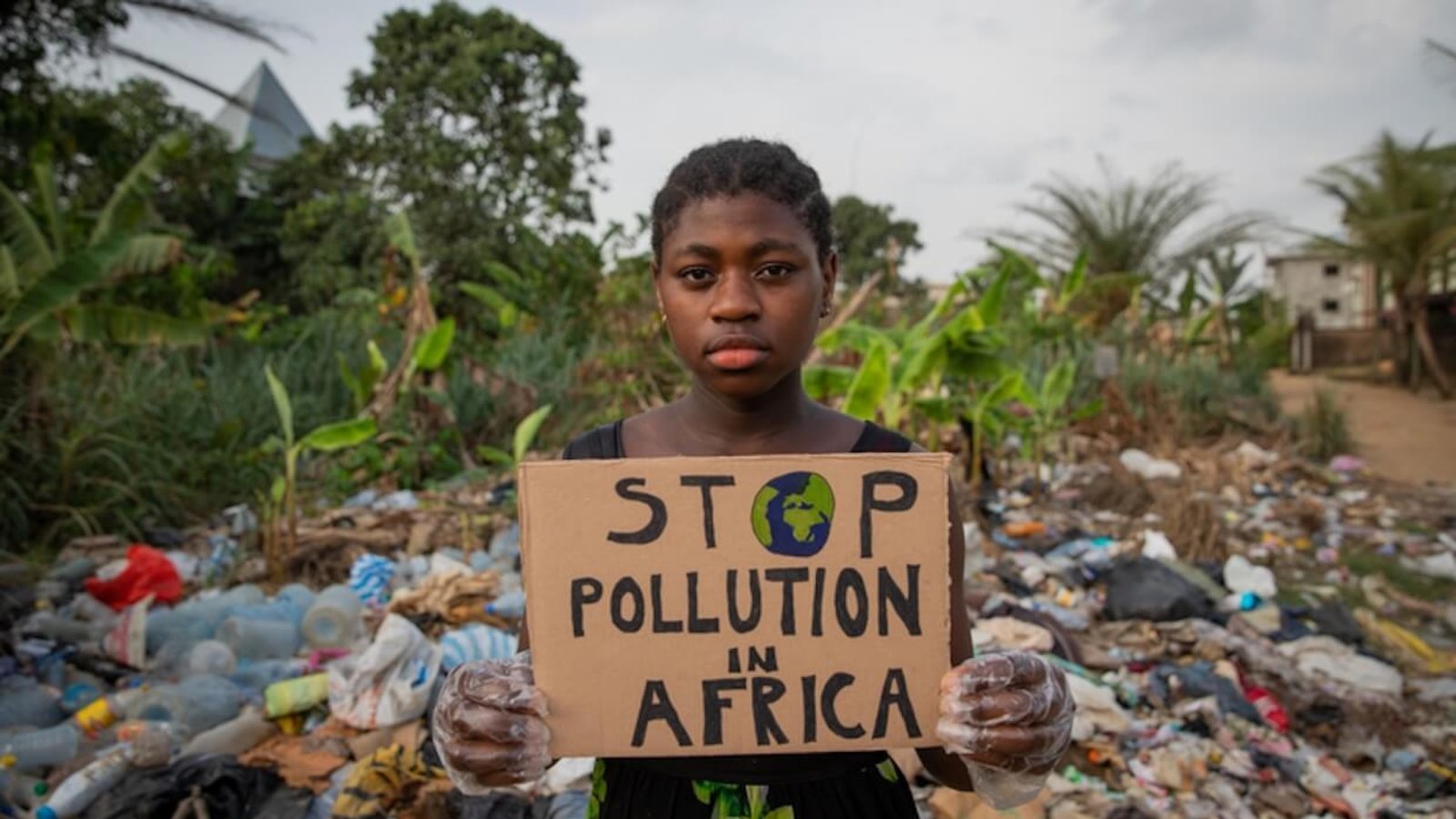
Dr. Oludele Solaja’s analysis introduces the concept of “Algorithmic Environmental Populism” to illuminate how digital platforms are reshaping the politics of waste across African cities. Moving beyond conventional policy-centered approaches, Dr. Solaja demonstrates how environmental degradation—from plastic pollution to urban flooding—has become a site of algorithmically mediated political contestation. In this emerging landscape, complex ecological crises are reframed into morally charged narratives of blame, privileging visibility, outrage, and immediacy over systemic understanding. By linking populism theory with digital governance and environmental politics, the article offers a novel framework for understanding how platform logics transform ecological grievances into potent political forces. It is an essential contribution to debates on populism, digital media, and environmental governance in the Global South.
Environmental politics is now occurring not only at policy and infrastructure levels, but also through algorithms—from the clogged drains of Lagos to flood-prone Accra to landfills in South Africa. Environmental degradation has become a politically charged phenomenon on social media, and the sensational, outrage-driven, and immediate nature of these platforms has created an environment where narratives of blame outpace formal, institutional action. I refer to this new phenomenon as Algorithmic Environmental Populism, and I argue that digital infrastructure has become paramount in the formation, circulation, and contestation of ecological grievances.
The environmental crisis is no longer merely a management problem but a digitally mediated political language across the African continent, in which grievance, blame, and claims to power or moral legitimacy are performed. Plastic pollution, floods, burning dumpsites, and informal recycling have entered platform ecologies within which, according to a range of criteria, the most intense, visible, and confrontational content receives algorithmic attention. From this combination emerges a condition in which the environmental crisis is abstracted from complex systemic causes and reframed as a direct moral confrontation between “the people” and villains: polluters, corrupt elites, those who ship waste to Africa, and absent governments. In this process, platform algorithms prioritize the most engaging framing rather than the most policy-relevant one (Zeng & Schfer, 2023; Heidenreich et al., 2022).
The concept offers a way of extending understandings of populism and digital media, by foregrounding the environmental as a key site of algorithmically mediated political struggle. Classical theory on populism deals with the ideological construction of ‘the people’ and ‘the elite,’ while the infrastructures through which populist rhetoric is dispersed have been historically overlooked. Algorithmic Environmental Populism instead draws focus to platform logics, showing how they shape the contours and narratives of ecological complaint. By this it builds on research on algorithmic governance, the increasing role of algorithms in policy perception and the legitimacy of state power (Parthasarathy & Rajala, 2023).
In African cities the role of algorithms in producing a political context for waste is further amplified by its material presence on everyday life. Clogged drains, plastic-choked lagoons, burning dump sites and litter, produces and feeds readily available data streams, which produce, or a “condition of constant possibility” for data to be recorded and transmitted, resulting in environmental breakdown becoming rapidly politicisable. Take, for example, Nigeria. When the Lagos State government implemented restrictions on single-use plastics in 2025, environmental considerations took a back seat to narratives of bias, and selective policy enforcement. Viral image of floodwater pouring through plastic-clogged drains fed accusatory commentary that blamed the state, turning environmental degradation into a performance of political betrayal.
Although it is true that a massive volume of plastic waste is annually dumped in Lagos State, these digital conversations tend to flatten the systems behind environmental degradation into morally legible pronouncements of blame and victimhood, which are amplified in the digital domain for emotional impact, rather than for systemic nuance (Couldry & Mejias, 2023).
The significance of such arguments for politics in Africa is that these stories become diagnostically central. In such cases, a multiple-layered system of production, consumption, municipal service provision and global trade are collapsed into stark oppositional narratives because it is the only way in which environmental problems can be successfully broadcast within an algorithmic environment, where visibility takes priority over complexity. As digital media research shows, what gets amplified is content that triggers reactions: outrage, pity, and the assignment of blame.
Similarly, we can observe this in Kenya where political activism is closely tied to moral pronouncements. Though debates exist surrounding extended producer responsibility, green economy initiatives, and refill systems; their manifestation in the digital space, in an effort to capture attention and elicit reaction, tends to focus on “blame-allocation” rather than the mechanics of institutional responsibility between citizens, corporations, and the state. Floods in Kenya’s urban centers of Nairobi and Mombasa provided highly visual and charged contexts to exacerbate these dynamics, producing further blame-oriented discourse regarding governmental incompetence and the inadequacy of infrastructure. In essence, the digitally mediated form of this political problem is not merely transmitting it; it is actively transforming it.
Another significant dimension of the digital landscape is how it also creates new forms of political subjectivity. Waste pickers and scavengers, once entirely invisible components of the informal city, are now visible. They challenge their invisibility through interventions in the digital domain, attempting to recover material flows and claim their political agency. They are now recognized as integral parts of urban recycling systems, while remaining ignored in the policy sphere (Njeru & Ochieng, 2025). Their visibility can be attributed to algorithms that amplify their stories, portraying them as overlooked labor fighting back against systemic neglect. Locally based actions, such as coastal clean-ups by youth groups in Kenya, become symbolical performances. The clean-up has the effect of politicizing the environment, either as an assertion of the citizen’s responsibility, as an attack on state incompetence or as a demonstration of collaborative effort. Environmental activism is transformed into a moral battlefield on the digital platform.
In South Africa we see a similar phenomenon of politically charged, algorithmically amplified resistance to landfill expansion and waste siting decisions. In 2026 protests against landfill development in urban periphery settlements, turned into a national narrative of social and environmental injustice through media mobilization; landfill as a continuance of structural violence through spatial inequalities. The discourse produced and amplified across the networks links contemporary exposure to historical environmental inequities through these landfill developments. Here Algorithmic Environmental Populism and environmental justice are closely interwoven, as the narratives attributed to technology and its governance are interpreted through morally loaded systems of victimhood and violence. The broader implications of Algorithmic Environmental Populism in Africa are that the histories of unequally mediated ecological flows, including plastics, second-hand goods and e-waste that flow into African cities and homes as waste from global consumption and production patterns. Such stories tend to produce a framing where the external imposition of blame arises from deeper historical conditions known as waste colonialism – an unequal world where states and their inhabitants bear uneven burdens of waste (Mah, 2024; Dauvergne, 2022).
This links directly into concepts of waste sovereignty – a state of ownership and control over material waste flows, their meanings and governance. In the digital space, sovereignty can now be enacted through the control of narrative. Those able to frame environmental crises in terms of simple, easily accessible, morally legible oppositions, are gaining political ground regardless of their technical knowledge. Environmental politics of waste is no longer a question of physical waste, or of policy-makers’ actions, but increasingly a matter of the visibility of what it is that matters and to whom it matters, a battle of recognition, and control, within platform governed space.
Therefore, I suggest a three-stage process of digitally mediated waste politics: first, visible urban environmental decay; second, morally legible frames of attribution; and third, algorithmically favored amplification. It is in these stages that complexity is simplified and environmental disaster turns into visible, and therefore governable, political matter.
A certain democratizing aspect is that it allows for participation on new grounds, where citizens, informal waste workers and activist groups can join in debates around the environment on the internet. The downside is that these systems allow for a contraction of discourse: immediate visibility takes the form of sensation and outrage over deliberative engagement, bringing together political mobilization and propaganda (Heidenreich et al., 2022). Consequently, the environment has begun to be spoken of in conflicting terms: critical discourse clashes with simplified frameworks of accusation. A street in Accra that floods, or a dirty drainage canal in Kenya, or a burning landfill in South Africa, are instantly turned into evidence against the state, corporations, or the global system, obscuring underlying complexities.
This new discourse dynamic has major implications for environmental governance. Effectiveness is no longer solely about design and capacity but also about how environmental policies are understood, accepted, and engaged with on line. Municipalities and governments, as well as non-profit organizations need to operate in the digital space to manage the material and political aspects of waste. Scholars of environmental data governance agree that algorithms are key in framing environmental information (Gabrys, 2023). This is also significant for populist politics; waste cannot continue to be seen as an auxiliary or an afterthought. Instead, it has to be seen as a key component of the negotiations around citizenship, inequality, sovereignty and state power; the material traces of society that make social tensions visible and open to struggle. Algorithmic Environmental Populism provides an explanatory frame that connects environmental governance, digital media, and populist politics together, and helps to make sense of the way ecological grievance can be translated into potent political force by means of technologically managed visibility.
In short, the environmental politics of waste in Africa is no longer solely regulated by state and international institutions; its regulation is also about what becomes visible and how, within the spaces that platform logics control. What is now at stake is how we see waste, what we make of it in the discourse we construct, and the meaning that it is given within our digitally mediated attention economies. This transformation is an emblem of a broader shift: authority is no longer held by those who convene political discussions in spaces that are free from the influence of amplification. The management of waste, therefore, involves managing its meaning, a task that in the digital age depends greatly on the very politics of platforms.
References
Couldry, N. & Mejias, U. A. (2023). “Data colonialism and the future of social order.” New Media & Society, 25(4), 945–962.
Dauvergne, P. (2022). “Waste, pollution, and the global plastic crisis.” Global Environmental Politics, 22(1), 1–10.
Gabrys, J. (2023). “Digital waste and environmental data politics.” Information, Communication & Society, 26(9), 1785–1801.
Heidenreich, T., et al. (2022). “Populism and digital media: A comparative perspective.” Political Communication, 39(3), 345–362.
Mah, A. (2024). “Waste colonialism and global inequality.” Nature Sustainability, 7(1), 12–15.
Njeru, J. & Ochieng, C. (2025). “Plastic waste governance and informal economies in Africa.” Environmental Politics, 34(2), 256–275.
Parthasarathy, S. & Rajala, R. (2023). “Algorithmic governance and environmental policy.” Regulation & Governance, 17(4), 987–1003.
Zeng, J. & Schäfer, M. S. (2023). “Conceptualizing algorithmic populism.” New Media & Society, 25(8), 2015–2032.
Dr. Sanjeev Humagain offers a nuanced and cautionary reading of Nepal’s post-election moment, arguing that the March 2026 vote should not be seen simply as a democratic breakthrough. While the rise of Balendra “Balen” Shah and the Rastriya Swatantra Party marks a clear rupture in elite continuity, Humagain warns that Nepal’s deeper political logic remains shaped by “institutionalized populism.” He emphasizes that the country is emerging from “a kind of institutionalized gray zone,” yet still faces serious challenges of accountability, parliamentary weakness, and policy incoherence. For Humagain, the election has validated long-standing public questions about corruption, patronage, and ineffective governance—but not yet their answers. Nepal, he suggests, stands at a critical juncture: not at the summit of democratic renewal, but “at base camp,” where the hard work of institutional reform has only just begun.
Giving an interview to the European Center for Populism Studies (ECPS), Dr. Sanjeev Humagain, a political scientist at Nepal Open University, offers a nuanced and theoretically grounded assessment of Nepal’s evolving political landscape in the aftermath of the March 2026 general election. While widely interpreted as a rupture driven by Gen Z mobilization and anti-elite sentiment, Dr. Humagain cautions against overly celebratory readings of the electoral outcome. Instead, he situates the moment within a longer trajectory of institutional fragility, elite circulation, and the deepening entrenchment of populist political practices.
At first glance, the electoral victory of Balendra “Balen” Shah and the Rastriya Swatantra Party (RSP) appears to mark a decisive break with the post-1990 political order. As Dr. Humagain notes, “the rise of the Rastriya Swatantra Party… represents a clear break from that pattern,” emphasizing that “for the first time, we are witnessing an overwhelmingly large number of new members in Parliament.” This influx of political newcomers—many lacking prior ministerial experience—signals a disruption of long-standing elite continuity and suggests the possibility of institutional renewal.
Yet, as the interview unfolds, Dr. Humagain complicates this narrative of democratic transformation. He underscores that Nepal’s political trajectory has long been characterized not by linear democratization but by movement across “a kind of institutionalized gray zone,” where “there was a serious erosion of accountability” and persistent threats to democratic consolidation. In this context, the current electoral moment represents less a definitive transition than a “critical juncture”whose direction remains uncertain.
Central to Dr. Humagain’s analysis is the argument that Nepal’s contemporary politics is shaped by a deeply embedded form of populism. While new actors and generational dynamics have reshaped the electoral arena, they have not necessarily displaced the underlying logic of governance. As he warns, “the other side of the coin is that Nepali politics has already been shaped by populism for at least a decade,” characterized by “the personalization of politics” and the marginalization of institutional mechanisms such as parliament and party structures. This personalization, he argues, has rendered “several key institutions dysfunctional,” raising fundamental questions about the durability of democratic accountability.
Importantly, Dr. Humagain highlights a paradox at the heart of Nepal’s current transformation. While voters have clearly rejected established parties and endorsed systemic critique, they have not yet converged around a coherent programmatic alternative. “The questions have been approved,” he observes, noting that citizens have given new political actors “the mandate to find meaningful and democratic answers.” However, “it is not that a clear direction has already been determined”—a condition he captures through the evocative metaphor that “Nepal is at the beginning of a new journey—we are at base camp, not at the top of the mountain.”
It is precisely within this unresolved space that the central challenge emerges. Despite electoral change, Dr. Humagain expresses concern that “the populism that has already become deeply institutionalized will persist in the coming years.”This persistence, he argues, will generate “ongoing challenges for democratic accountability” and hinder efforts to strengthen parliamentary governance. In this sense, Nepal’s post-election moment is not merely a story of democratic renewal, but a test of whether institutional reform can overcome the enduring legacy of populist political logic.
Here is the edited version of our interview with Dr. Sanjeev Humagain, revised slightly to improve clarity and flow.
The Rise of the RSP Marks a Clear Break from Nepal’s Old Elite Pattern
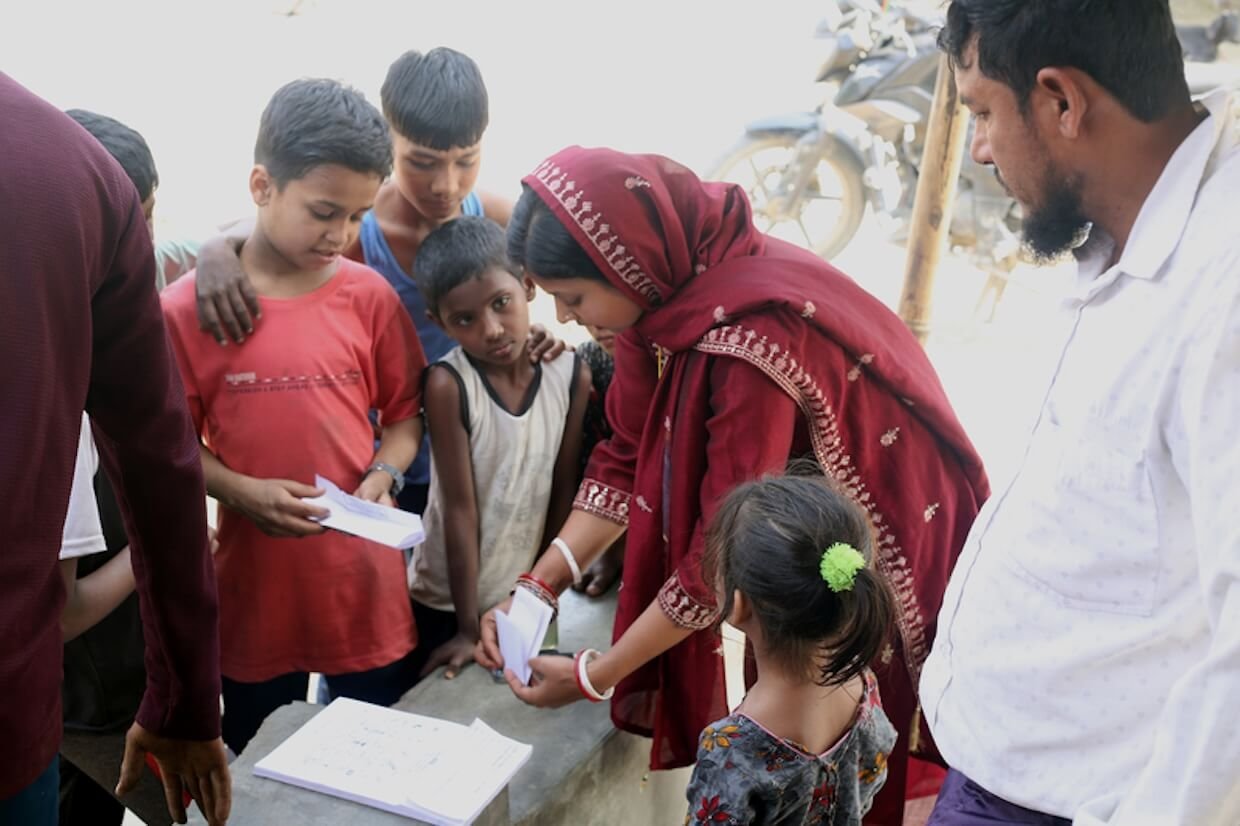
Voter education volunteer instructs residents on using a sample ballot in Ward No. 4, Inaruwa, Nepal, February 17, 2026, as part of a local election awareness program led by the Sunsari Election Office. Photo: Nabin Gadtaula / Dreamstime.
Dr. Sanjeev Humagain, welcome, and let me begin with a foundational question: In your work on “exclusive parliamentary politics,” you argue that Nepal’s democratic system has long been dominated by entrenched elites despite formal electoral competition. To what extent does the rise of independent figures like Balendra “Balen” Shah represent a rupture in this elite continuity, or merely a reconfiguration of elite circulation?
Dr. Sanjeev Humagain: I think there are some fundamental questions we need to address at this moment. Since 1990, as I have argued in my academic work, a very limited group of political leaders has circulated within the cabinet—replacing one another over time, with the same prime ministers repeatedly returning to power.In this context, the rise of the Rastriya Swatantra Party (RSP), as well as the emergence of Balendra Shah, represents a clear break from that pattern.For the first time, we are witnessing an overwhelmingly large number of new members in Parliament, which will inevitably shape the composition of the new cabinet. I expect that nearly 90% of ministers will, for the first time, lack prior ministerial experience.In that sense, this election marks a significant departure from the political continuity we have observed since 1990.
Nepal Has Long Moved from One Gray Zone to Another
You have highlighted the persistence of feckless pluralism and weak democratic performance in Nepal’s post-1990 trajectory. Does the recent electoral volatility suggest a deepening of democratic accountability—or a further erosion of institutional stability?
Dr. Sanjeev Humagain: That’s another important question. Not only I, but also the academic literature—for example Thomas A. Marks in 2002—identified Nepal as an example of feckless pluralism. What has happened here is that, since 1990, there have been several political transitions.
Until 1996, we had three elections. Then came the Maoist civil war, followed by the abolition of the monarchy and the establishment of a republican state in 2008. Another major transition occurred in 2015. In short, there have been numerous changes. However, these shifts were not from undemocratic to fully democratic systems; rather, they moved from one gray zone to another. In that sense, Nepal experienced a kind of institutionalized gray zone, which is deeply concerning. During this period, there was a serious erosion of accountability, and, as you noted, significant threats to the institutionalization of democracy.
I think Nepali politics has now begun to move out of this zone, but it remains to be seen whether it will evolve into a process-oriented, accountable democratic system or drift into another gray zone. Some signs of populism are already visible. Still, this is a critical juncture, as the country has at least started to emerge from that phase.
Gen Z Movement Is the Result of a Long-Term Shift in Political Discourse
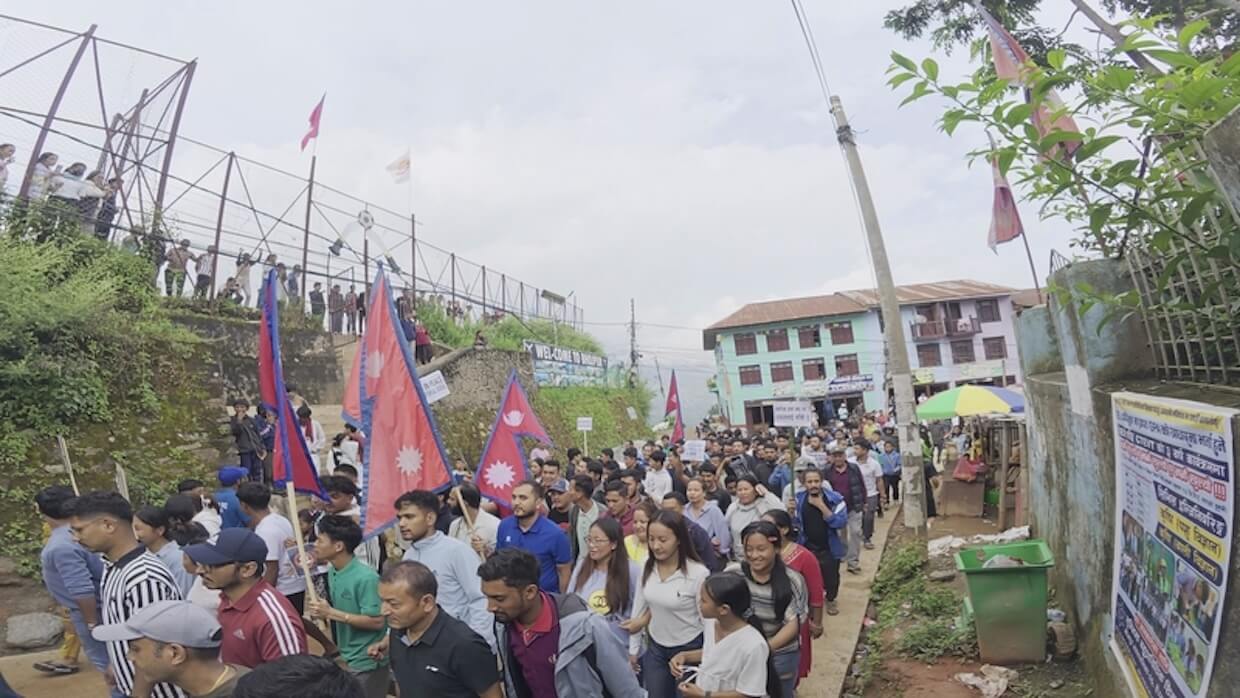
Many Nepali citizens join Gen Z–led protests in Bhojpur, Nepal on September 9, 2025, showing solidarity with nationwide demonstrations. Photo: Dipesh Rai.
Your research on the structural determinants of democratic consolidation suggests that macro-level conditions in Nepal remain unfavorable. How should we interpret the apparent “Gen Z surge” in this context: as a corrective force, or as a symptom of systemic fragility?
Dr. Sanjeev Humagain: I think this reflects a very important particularity of Nepal, which is not common in many countries around the world. When a society undergoes rapid modernization, it typically develops new cities, new media, new educational institutions, and a broad expansion of citizen participation across social and political spheres. This process usually generates social capital and an organized middle class, which can give rise to new political parties and serve as a pillar of democracy. Historically, this pattern has been evident over the last 200–300 years, particularly in Western contexts, as well as in countries such as South Korea and Taiwan.
However, in Nepal, the situation is different. While we do observe key indicators of modernization—improvements in education, strong communication networks, rapid digitalization, and the proliferation of new media—the social base that typically drives democratic consolidation is largely absent domestically. Those who would constitute the middle class in industrialized contexts are often not in the country. Instead, they are working abroad—in places such as Kuala Lumpur, Seoul, and Riyadh.
As a result, these individuals, who contribute economically to modernization, have remained largely absent from direct political participation for an extended period. This has made the Nepali case distinct. As you rightly noted, their engagement is mediated primarily through social media. They express their views not through voting, but through digital platforms, often because they are unable to return home to participate in elections.
At the same time, they are shaping a discourse that tends to prioritize economic development over redistributive or democratic concerns, at least temporarily. Ironically, many Nepalese working abroad are employed in non-democratic countries, and the perspectives they transmit back home often reflect that experience—sometimes questioning the necessity of elections or political contestation.
These dynamics have made them important sources of new political narratives. The Gen Z movement is rooted in this evolving discourse, which has developed over at least a decade. It is not a sudden phenomenon, but rather the result of a long-term shift in how political ideas are formed and circulated in Nepal.
Reform, Not Change, May Be the New Currency of Nepali Politics
In your analysis of party evolution, you identify multiple “waves” of party formation driven by identity, institutional incentives, and political learning. Would you situate the rise of new actors such as the Rastriya Swatantra Party (RSP) and independent candidates as a fourth wave—perhaps defined by digital mobilization and anti-party sentiment?
Dr. Sanjeev Humagain: That is an interesting question—almost like homework for me—because my earlier analysis covered developments up to 2013–15. My concern at the time was that many political scientists tended to place all political parties in the same category. My work aimed to show that they are not the same.
We had strong ideological parties formed in opposition to autocratic rule. At the same time, some parties expanded within parliament during the period when identity politics was prominent in the Constituent Assembly, while others emerged directly from identity-based movements. That was the framework I developed.
You are right that this new party does not fit neatly into those three categories, so it could be seen as a fourth wave. However, we still need to be cautious before reaching a definitive conclusion. I am not entirely certain that we can fully describe it as a completely new party.
There are two points to consider. First, the prime ministerial candidate, Balendra Shah, was previously the mayor of Kathmandu Metropolitan City, the capital of Nepal. Second, the president of the Rastriya Swatantra Party is a former Home Minister and Deputy Prime Minister. Moreover, more than half of the party’s candidates had some form of prior affiliation with other political parties before joining this one. In that sense, can we really call it an entirely new party? This remains a question that requires further observation over time.
That said, you are correct in noting that, until the third wave, political movements were the primary drivers behind the rise of parties. This party, however, did not emerge from such movements or from a broader agenda of systemic change. This is a significant development in Nepalese political history.
Historically, “change” has been the central currency of major political parties in Nepal, dating back to the 1950s. In contrast, this party appears to prioritize reform rather than change. In that sense, for the first time in Nepal’s political history, we may be witnessing the emergence of a kind of conservative party—one that does not emphasize rapid transformation, but instead advocates gradual, step-by-step reform.
If the party continues along this path in government over the next five years, it could generate a new form of political polarization and establish itself as a distinct fourth wave. However, based solely on its formation process and candidate composition, it is still too early to definitively categorize it as such.
A New Polarization Between Reform and Continuity Is Taking Shape
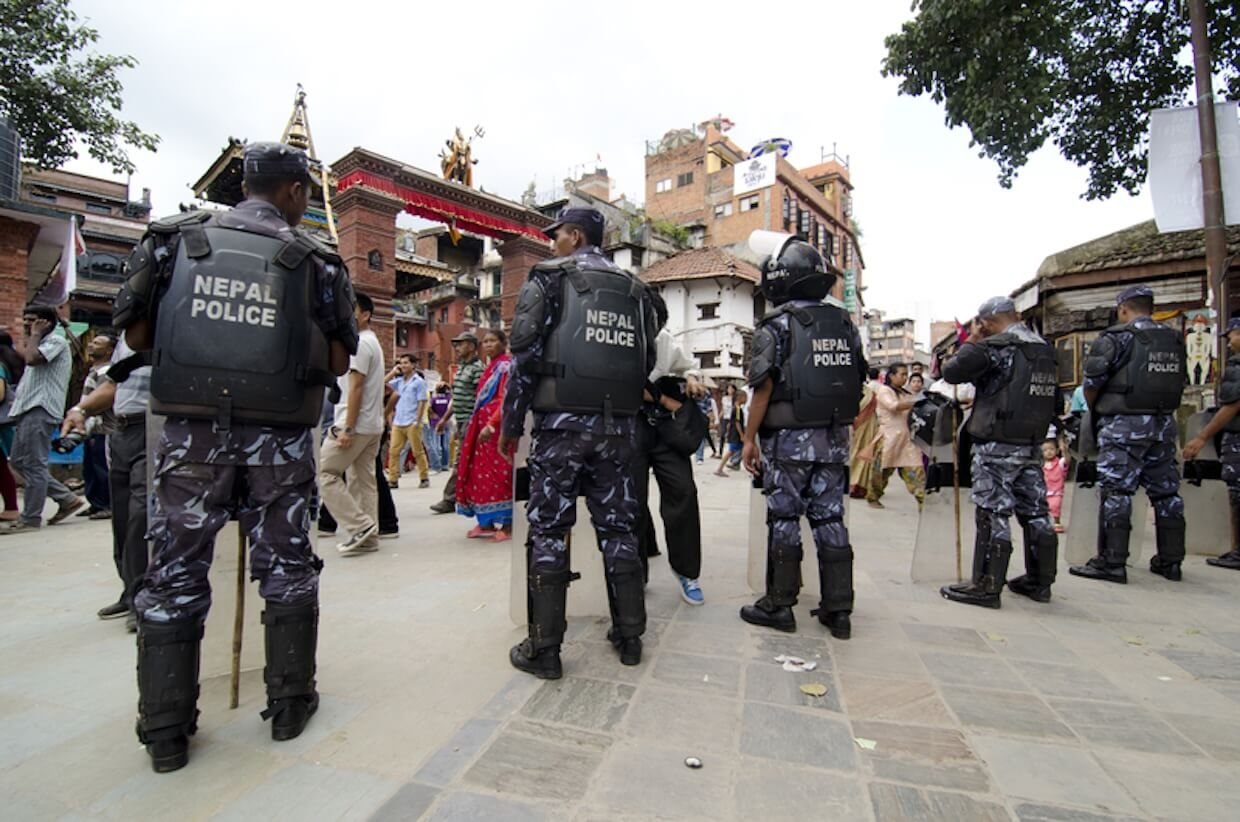
Nepal police during riots in Kathmandu. Photo: Ardo Holts / Dreamstime.
Your Kathmandu Post article questions whether recent elections reflect swing voting or polarization. Given the persistence of party membership networks, is Nepal witnessing genuine dealignment—or simply a reconfiguration of partisan loyalties?
Dr. Sanjeev Humagain: That was the article I wrote two years ago, during the elections, when the Nepalese media were largely suggesting that Nepal had a significant number of swing voters. I argued that this was not swing voting, but rather the emergence of a new kind of polarization. This time, however, the situation appears quite different.
What is notable now is that even the major political parties of the past are questioning why their core members did not vote for them. Connecting this to your earlier question, Nepal seems to be experiencing a high level of dealignment. People are no longer strongly inclined to define themselves through partisan identities, which were quite prominent in the 1990s and the early 2000s.
In that sense, Nepal is undergoing a process of depoliticization. I have recently written in a Nepali newspaper that the results of these elections can be understood through a key lens: the breakdown of party patronage. Party patronage was a central driver of electoral success until the previous elections. Candidates would visit towns and promise tangible benefits—sometimes development projects, sometimes personal favors—in exchange for votes. However, this system now appears to have weakened significantly. At the same time, the fact that nearly half of the voters supported a single party suggests the emergence of a new form of polarization.
As I mentioned earlier, this polarization is structured around reform versus continuity. Established parties argue that they have delivered substantial progress—improvements in infrastructure, healthcare, and education—and that their achievements are underappreciated. In contrast, new political actors contend that existing parties lack sincerity and accountability, and that corruption is pervasive, making reform imperative. So, a new polarization is clearly emerging. Compared to the elections two years ago, there is also a much stronger swing. The deeper implications of this shift are likely to persist, and Nepalese politics may remain unstable for years, perhaps even decades. The long-standing 30-year pattern of competition between communist and liberal forces has now been disrupted.
The key question is how this will evolve into a new form of polarization. In any political system, polarization cannot be eliminated; it tends to develop in cycles shaped by socioeconomic conditions. At times, politics gravitates toward redistribution, while at other times it emphasizes economic growth. In Nepal’s case, the country has moved beyond traditional party patronage, but a new, stable form of polarization has not yet fully consolidated. This will be one of the most important dynamics to watch in Nepalese politics over the coming decade.
Nepal Is at Base Camp, Not Yet at the Summit of Democratic Reform
You note that informal networks remain central to electoral success. How does this reliance on patronage and personalized networks interact with the growing visibility of issue-based, urban, and digitally mobilized voters?
Dr. Sanjeev Humagain: That’s a very interesting aspect of Nepali elections at this time.I think we need to categorize this into three different segments. The first segment is that, from 1990 to the 2022 elections, party patronage dominated. It depended on informal networks; for instance, candidates would count the houses in villages and say, “Okay, I’ll take care of this, I’ll handle this, don’t worry, I will get the votes from there.” These kinds of informal networks were central, and electoral campaigns were mostly based on convincing local allies and influencing voters through them. That remained the norm.
Things started to break down in the last local and parliamentary elections. Balendra Shah himself, as an independent candidate, won the election in Kathmandu Metropolitan City. Similarly, in other sub-metropolitan cities, such as Dharan or Itahari, independent candidates also succeeded. This was the first signal that party patronage would not work in urban areas.
At the same time, the role of new media—particularly social media—became key in shaping voters’ attitudes. The use of social media has become a central strategy for winning votes.
In these elections, another segment has also emerged. The whole of Nepal has, in a sense, accepted fundamental questions about the system. It is not simply about which political party won or who will be the next prime minister. Rather, it is about broader concerns regarding the efficiency, productivity, and accountability of the system, which have been endorsed by voters. However, the important point is that while the questions have been accepted, the answers have not yet been fully articulated. There are no clear solutions so far, even among the new parties. Although they have presented many well-formulated ideas, the broader vision of the new cabinet and the priorities of parliament remain to be defined.
So, my point is that the questions have been approved. Citizens have given the Rastriya Swatantra Party the mandate to find meaningful and democratic answers to the issues that have been on the table for the last three decades. It is not that a clear direction has already been determined. Nepal is at the beginning of a new journey—we are at base camp, not at the top of the mountain. From this base camp, it is now necessary to develop a strategic roadmap to reach the summit.
Institutionalized Populism Will Continue to Challenge Democratic Accountability
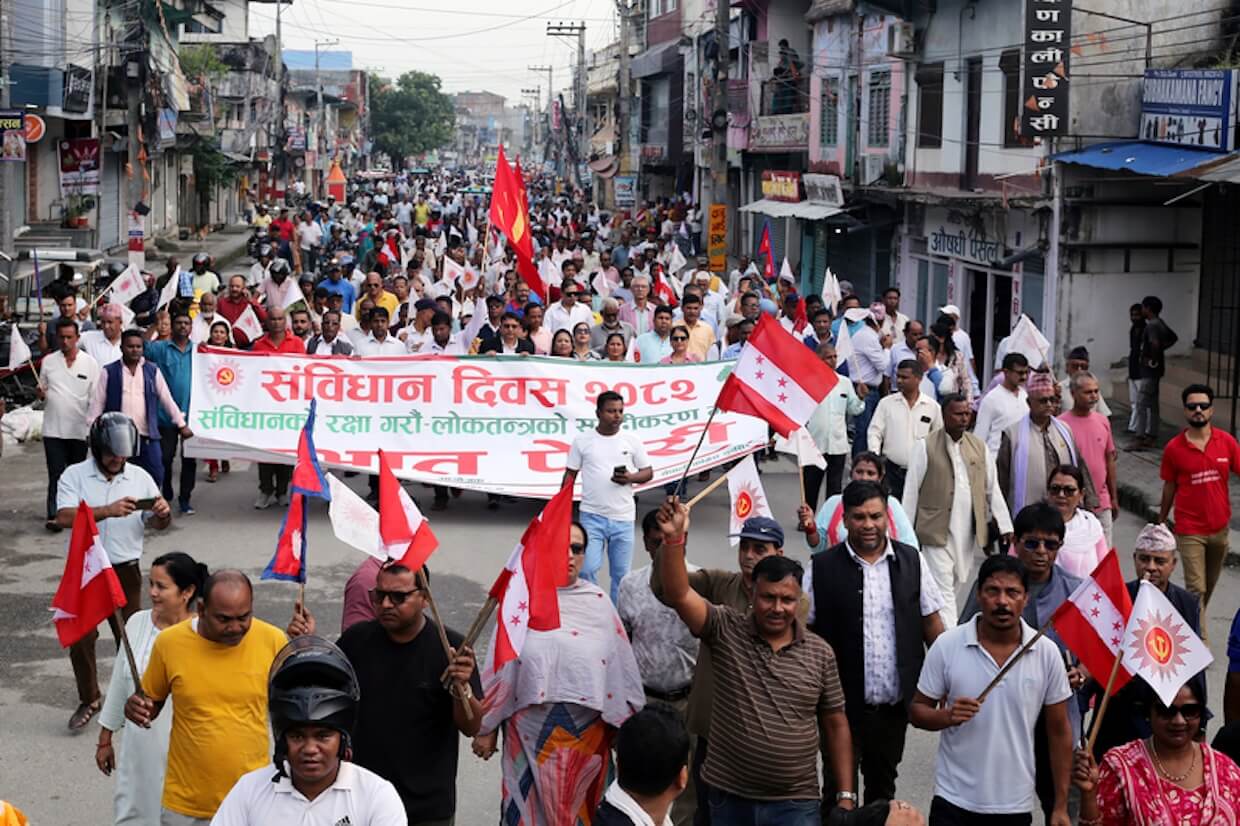
Thousands joined a joint morning procession organized by the CPN-UML and Nepali Congress district committees in Inaruwa Bazaar on September 19, 2025, to mark Constitution Day. Photo: Nabin Gadtaula.
In your recent work, you argue that Nepali populism is increasingly characterized by personalization and utility-based politics, with ideology playing a diminishing role. How does Balendra Shah’s political style fit within this framework—does he embody a new form of technocratic populism?
Dr. Sanjeev Humagain: That’s a very important point to consider—the other side of the coin.Until now, you and I have been discussing one side of the coin, the change dimension, and we have been in a position to suggest that there is significant change in Nepali politics. However, the other side of the coin is that Nepali politics has already been shaped by populism for at least a decade.
The key dimensions of that populism, as you mentioned, are twofold. First is the personalization of politics—meaning the marginalization of institutions such as Parliament, the Cabinet, and the central committees of political parties. The Prime Minister increasingly behaves like an elected president. The Prime Minister’s residence, for instance, has become highly visible in daily news, almost like the White House. This personalization of politics has been one of the most serious threats to Nepali democracy. It has rendered several key institutions dysfunctional, including Parliament, which has remained largely ineffective for nearly two decades.
The second dimension relates to how Nepal has addressed socioeconomic inequality. Since 2006–07, there has been a broad recognition that the country faces deep structural inequalities. It has also been acknowledged that addressing these inequalities requires two things: first, inclusive participation in decision-making processes and institutions; and second, a capability-based approach to empowerment, given that discrimination has persisted for centuries.
In theory, Nepal’s political system was designed along these lines. However, in practice, it has diverged significantly. Political leaders have increasingly emphasized utility—focusing on majoritarian gains and immediate benefits—often at the expense of minority rights and long-term structural reforms.
In this context, the rise of the Rastriya Swatantra Party and Balendra Shah does not necessarily signal a departure from these underlying dynamics. It is difficult to assume that Nepali politics has fundamentally changed. The core worldview and governing logic of the state are likely to remain the same.
I am concerned that the populism that has already become deeply institutionalized will persist in the coming years. This will create ongoing challenges for democratic accountability, as well as for strengthening and institutionalizing parliamentary politics. I think that is the central challenge facing Nepali politics today.
Nepal’s Political Shift Closely Reflects the Global Democratic Recession
You describe populism in Nepal as moving toward a more right-leaning, communitarian discourse that balances order and freedom. How does this shift compare with global patterns of populism, particularly in Europe and South Asia?
Dr. Sanjeev Humagain: Yes, that’s true, and Nepal has almost always moved in line with global waves.If you look at the political trajectory of the country, it closely mirrors broader global developments. Nepal experienced democratization in the 1950s, followed by an authoritarian regime beginning in the 1960s that lasted until the 1990s. Since the 1990s, democratic practices have taken root, and from 2006–07 onward, redistributive policies also began to emerge. These developments have largely followed patterns similar to global trends.
More recently, the global shift toward center-right, leadership-driven politics—particularly characterized by strong, charismatic leaders—has also become visible in Nepal. I see clear parallels with developments in both Western and South Asian countries. The emphasis on growth-first approaches, where economic development is prioritized over other concerns, is also very similar.
I think the experiences of countries like Bangladesh and India—where strong economic growth has been associated with charismatic leadership—have had a significant impact on how people in Kathmandu perceive politics. Larry Diamond has described this broader trend as a democratic recession, and many of its features can be clearly observed in Kathmandu and across Nepal. So, Nepal is not following a distinct path; rather, it is part of the same global wave—the rise of center-right populism and charismatic, leader-centric governance.
Nepal’s Anti-Establishment Voice Has Largely Come from Above, Not from Below
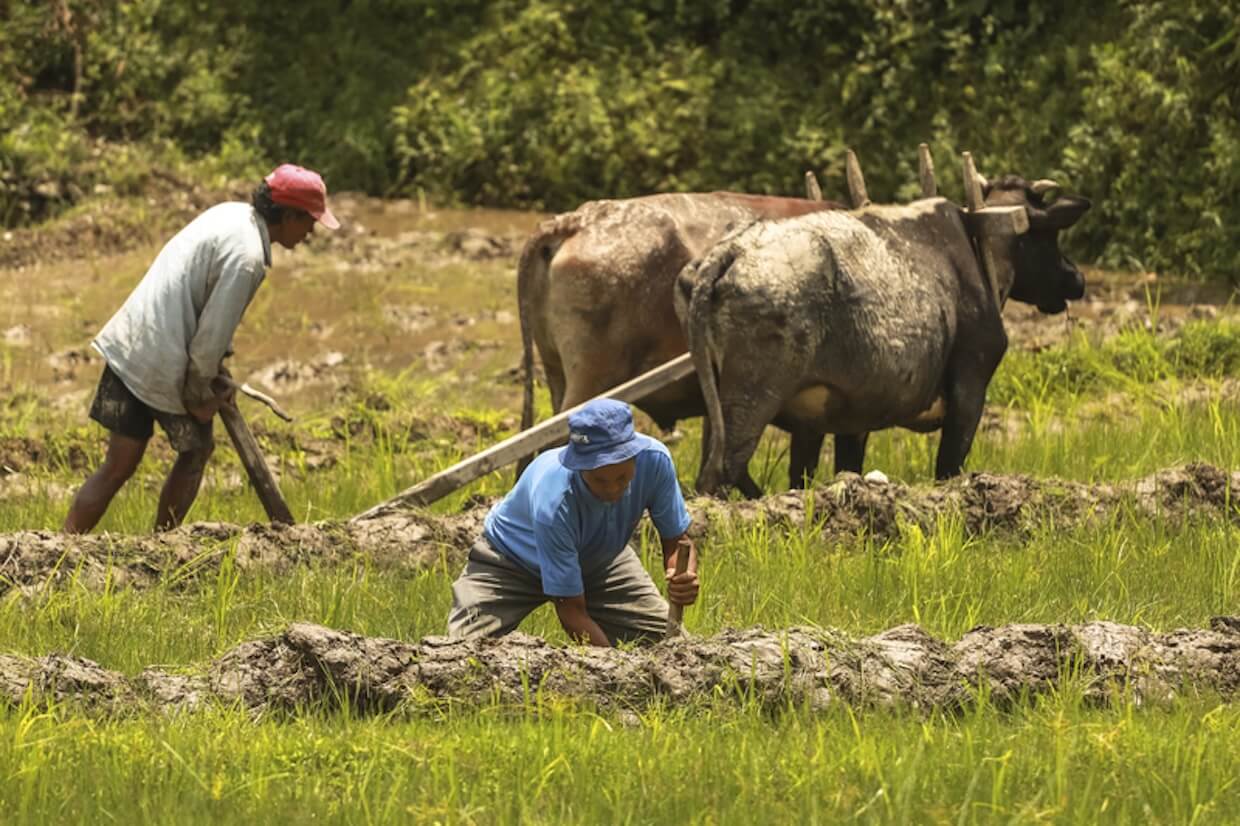
A Nepali farmer at work in a rural field during the monsoon season. As the rains arrive, farmers across Nepal become busy in their fields, though most still rely on traditional farming techniques. Photo: Shishir Gautam.
To what extent should Nepal’s current political moment be understood through the lens of “designer populism from above” versus grassroots anti-establishment mobilization?
Dr. Sanjeev Humagain: That’s a tough question—a very tough one. What I do agree with is that I really like the term you used, “anti-establishment.” People were not simply criticizing political parties; their distrust and questions were also directed toward the media, schools, and universities—in other words, the entire establishment. So, you are right in suggesting that people were questioning the whole establishment.
But the key question is: who was expressing this anger, and who was at the forefront of raising these concerns? Interestingly, many of those in the front line were individuals from the major political parties—such as the Nepali Congress, RSP, and The Communist Party of Nepal (Unified Marxist–Leninist- UML). Even within Parliament, they were pointing to various forms of nexus—sometimes political, sometimes bureaucratic—as underlying causes of low accountability and ineffective governance. So, even leaders from parties in government were raising these questions. In that sense, it is more accurate to understand these dynamics as voices emerging from above rather than from below. As I mentioned earlier, people largely approved these questions silently.
This is my main analytical framework for understanding these elections. It was not the answers that were debated—there was no substantial policy debate. Quite frankly, the electoral campaign was rather muted. What people seemed to do was to acknowledge that the questions being raised were valid.
So, the moment we are witnessing is one in which Nepal is being called upon to generate collective wisdom and provide meaningful answers to long-standing questions. These questions—such as weak intra-party democracy and entrenched networks—were raised from within the political system itself. In that sense, the anti-establishment voice has largely come from above, while voters at the grassroots level have silently—again, I would emphasize silently—endorsed these questions.
This Is Not Just a Generational Shift—It Is a Broader Political Shift
The recent electoral cycle has been widely interpreted as a “Gen Z revolution.” In your view, does this generational shift represent a substantive transformation in political participation—or a temporary protest against entrenched elites?
Dr. Sanjeev Humagain: I think both of your assumptions need some modification.What I believe is that there is a strong alliance between the voices of younger generations and those of senior citizens who fought for democracy. The rise of social media is quite significant in this regard, as it has brought all generations onto the same platform.
The questions raised by young people focus on three fundamental spheres. The first is the quality of education they receive. Many of their peers study abroad, and they hear that education systems are quite different there compared to Nepal.
The second is fairness in the job market. Fairness is not fully present in the private sector. Interestingly, public sector jobs are perceived as more fair, while private sector employment is often shaped by informal networks and personal recommendations.
The third issue is the slow development of infrastructure—especially roads and hydroelectricity. People aspire to better roads and stable energy, and these concerns directly affect their future.
These issues were initially raised by young people, but they have been taken up more broadly in society. Older generations have reframed them in terms of justice, arguing that the lack of attention to both physical and social development is turning Nepal into an unjust society.
In that sense, I would not simply describe this as a generational shift. It is more accurate to see it as a political shift. Previously, ideological divisions defined electoral competition, but now questions of justice have moved to the center and brought different generations together. The Rastriya Swatantra Party received close to 50% of the vote, which suggests that its support extends beyond young voters. While young people were the primary drivers and agenda-setters, their concerns were reinterpreted and amplified across society. This has generated something like a new social contract—perhaps not formally articulated, but nevertheless present as a shared understanding.
So, I think this should be seen as a broader political transformation. It is not just a temporary protest or short-term mobilization; rather, it is likely to have a gradual and lasting impact across the country.
The Challenge Now Is to Turn Electoral Legitimacy into Institutional Harmony
Given your findings on the perils of parliamentarism—particularly the role of dynastic politics and weak institutionalization—what constraints is a figure like Balen Shah likely to face when attempting to translate electoral legitimacy into effective governance?
Dr. Sanjeev Humagain: That’s a very important point, because the parliamentary system is, in many ways, a very good system, and I favor it, especially in the case of Nepal. We have significant ethnic and regional diversity, so the representation of each community in parliament—where laws are made—is essential. Having strong coordination among these representatives in the cabinet is also crucial. If the parliamentary system is used properly, this is a very positive feature.
At the same time, however, there are important challenges. The frequent change of governments, and the resulting inconsistency in policies, have been key concerns. In that sense, I argue that Nepal faces the same problems as other less institutionalized parliamentary systems. I think Balendra Shah has certain advantages in overcoming these challenges. First, his party has secured a majority in parliament, which is happening in Nepal for the first time since 1996. After such a long gap, this majority provides a significant advantage.
Another advantage is that, since this is not a coalition government, there is likely to be greater policy uniformity. Over the past two decades, there has often been policy conflict between the Prime Minister’s Office and key ministries—such as Finance or Home Affairs—because they were controlled by different political parties. Now, there is an opportunity to generate greater harmony.
I believe this creates favorable conditions for a more effective implementation of the parliamentary system in Nepal, similar to how it functioned in Japan after the Second World War, where parliamentary governance was accompanied by policy coherence. So, I do believe that this is a significant opportunity for the real implementation of the parliamentary system under this new government.
Nepal’s Future Depends on Turning Opportunity into Programmatic Reform
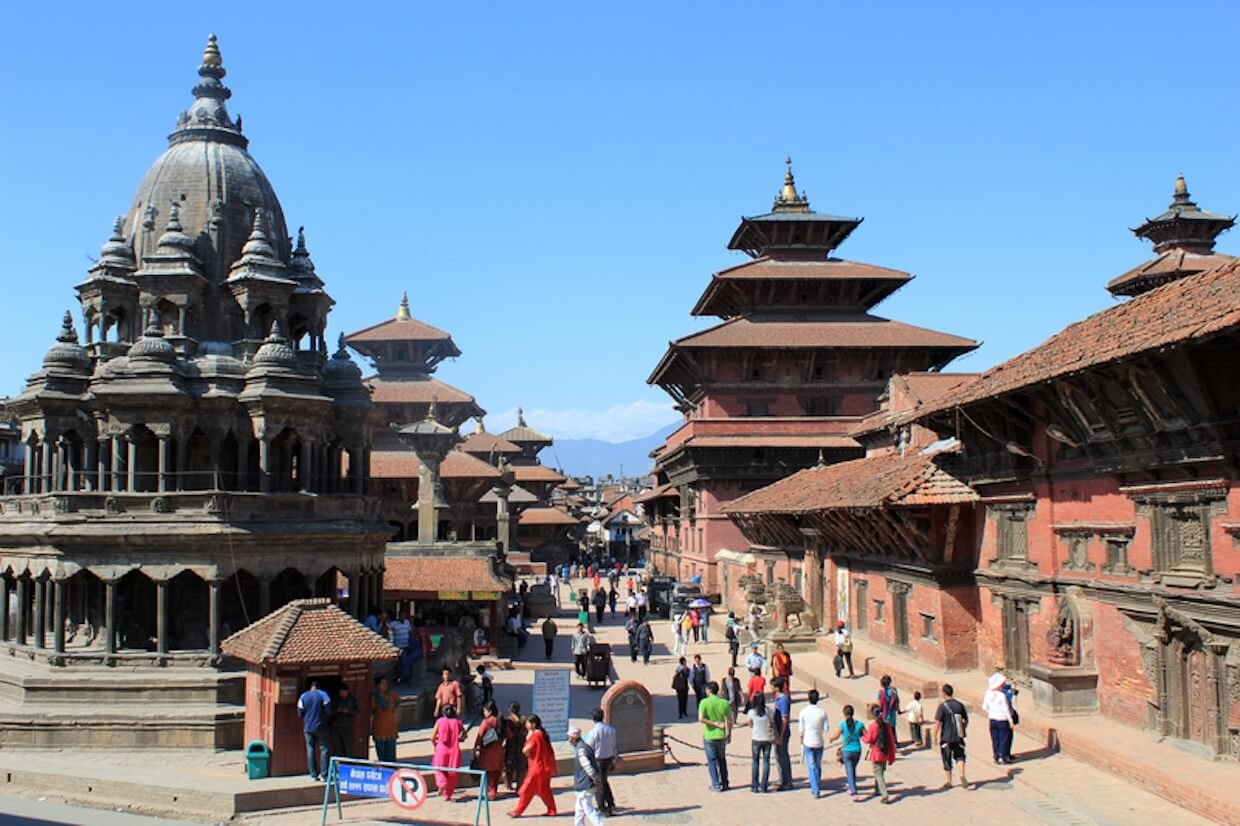
Durbar Square in Nepal on April 2011. Photo: Dreamstime.
And lastly, Dr. Humagain, looking ahead, do you see Nepal’s current moment as the beginning of a more programmatic, issue-based democracy driven by new generations—or as another cyclical phase of populist disruption within a structurally constrained political system?
Dr. Sanjeev Humagain: As a citizen of this country, I do believe that the first option should be our path. As a responsible citizen, it is also my duty to raise concerns and encourage the government and parliament to move in that direction.However, looking at the current public discourse and available analyses—and even the responses of the newly elected party—I am not very optimistic so far. There are still unresolved questions regarding the political agenda. Some important issues have been raised, particularly concerning the effectiveness of federal structures, which have been central to political debate over the past decade.I believe it is essential, and also my responsibility, to encourage the government to adopt a priority-based approach to political, social, and economic agendas—focusing first on issues that can be addressed more immediately, before moving on to more complex, long-term challenges.
This is a crucial moment for Nepal’s future, especially as the new government is about to begin its work this Friday. Hopefully, this will lead, for the first time, to more program-based and programmatic discussions, both in parliament and in society. If such public debates emerge, Nepal will have an opportunity to choose the path that best serves its future. It is our collective responsibility to ensure that this opportunity is used in that direction.
Dr. Sanjay Humagain, thank you so much for your time. I appreciate it.
Dr. Sanjeev Humagain: Thank you very much for your time, and I wish you good luck in all the work you are doing. You are undertaking very important efforts, because, knowingly or unknowingly, the whole world has entered a populist era, which is not beneficial for everyone. It is therefore important to return to a rule-based, liberal order. Your efforts will contribute not only to our country but to the world as a whole, and I am truly glad that you have initiated this work.
Professor Marlene Wind argues that Denmark’s 2026 general election is not only a contest over leadership and crisis management, but also a revealing test of how liberal democracies internalize radical-right agendas. In her interview with the ECPS, Professor Wind contends that mainstream Danish parties have “absorbed, not neutralized, the radical right,” warning that electoral containment has too often meant ideological normalization. Situating the campaign within the wider context of Trump’s pressure over Greenland, Europe’s security crisis, and Denmark’s pragmatic turn toward the EU, she highlights the deeper structural dilemmas facing contemporary democracy: the normalization of restrictive politics, the fragility of liberal institutions, and the growing entanglement between populist forces, geopolitical instability, and weakened democratic boundaries. Denmark, in her view, offers a critical case for understanding these broader European transformations.
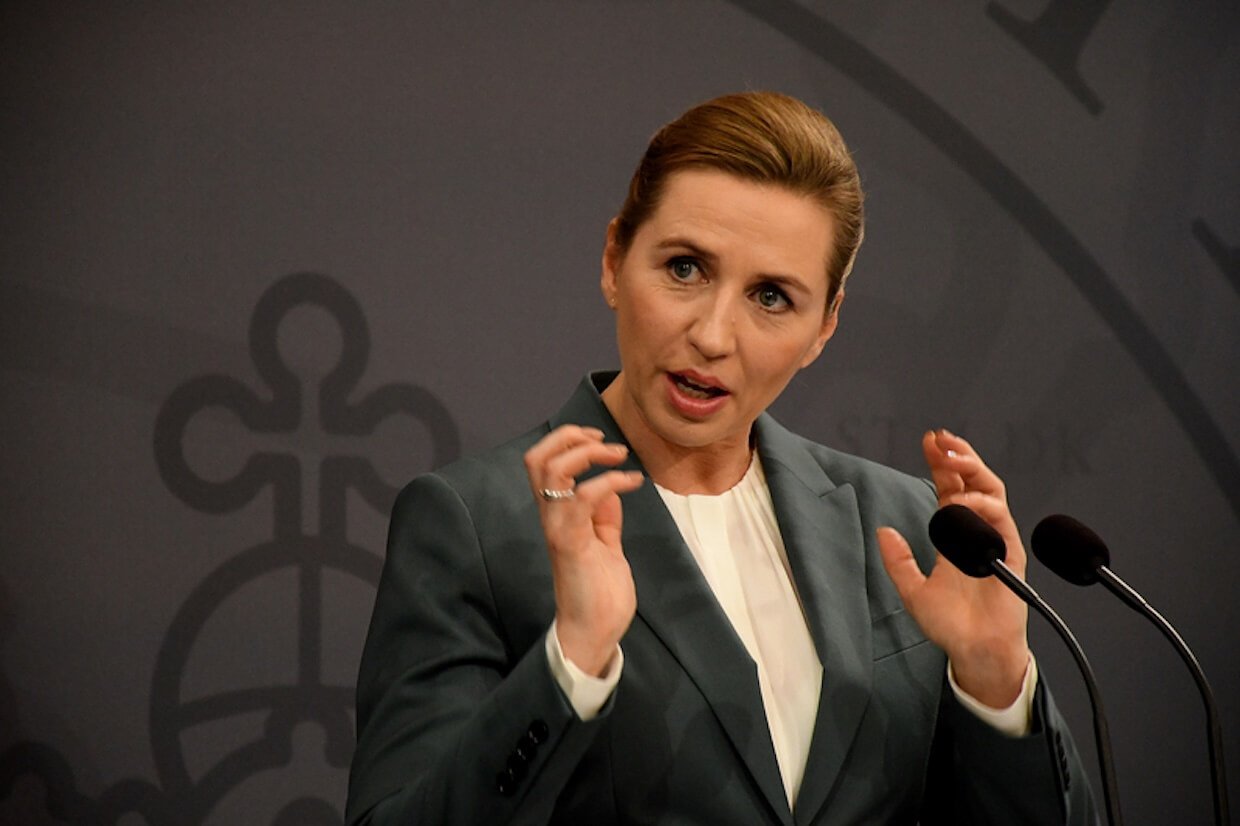
Giving an interview to the European Center for Populism Studies (ECPS), Professor Marlene Wind—Professor of Political Science at the University of Copenhagen and Director of the Centre for European Politics—offers a penetrating analysis of Denmark’s parliamentary election campaign against the backdrop of geopolitical rupture, institutional recalibration, and the longer-term normalization of radical-right politics. As Denmark heads toward the March 24, 2026 general election, the contest has unfolded under the shadow of Donald Trump’s renewed pressure over Greenland, a crisis that briefly revived Prime Minister Mette Frederiksen’s standing after months of domestic political weakness. Reuters reported that Frederiksen’s Social Democrats rebounded from a December polling low of 17% to around 22% in recent weeks, while the broader electoral landscape remained fragmented and without a clear majority for either bloc.
Yet for Professor Wind, the most consequential issue is not simply whether Frederiksen’s crisis management can secure a third term. Rather, the Danish case exposes a more structural dilemma at the heart of contemporary European democracy: how mainstream actors respond when radical-right agendas become embedded within the political center. This concern is captured in the interview’s headline argument: “Mainstream parties in Denmark have absorbed, not neutralized, the radical right.” Professor Wind also cautions that “the argument that we have managed to eradicate the extreme right is simply not accurate,” because “the policies adopted by the majority of politicians and political parties… have effectively incorporated right-wing positions.” The result, she argues, is not democratic containment but ideological normalization.
Professor Wind’s intervention is especially timely because the election has developed at the intersection of two seemingly contradictory dynamics. On the one hand, geopolitics has returned forcefully to Danish politics: Trump’s Greenland posture, Russia’s war against Ukraine, and uncertainty surrounding transatlantic guarantees have elevated questions of sovereignty, territorial integrity, and Europe’s strategic future. On the other hand, the campaign itself has remained anchored in domestic concerns—cost of living, welfare, migration, leadership fatigue, and social trust. As Professor Wind observes, geopolitics has functioned largely as “a background condition for everything else,” not as a fully articulated debate about Denmark’s future in Europe.
Within that setting, her analysis moves beyond the immediate election cycle to a broader diagnosis of European political development. She argues that Denmark’s majoritarian political culture, limited judicial review, and long-standing transactional view of European integration have made it easier to mainstream restrictive agendas without eliminating their social base. Indeed, she notes, aggregate support for right-wing parties remains “roughly 17% to 20%,” even if now dispersed across smaller formations. That continuity leads to her central normative warning: “Adopting the positions of the extreme right is not an effective strategy to counter it.”
In sum, Professor Wind’s remarks present Denmark not as an exceptional success story in containing the far right, but as a revealing case of how liberal democracies may gradually internalize the very forces they claim to resist.
Here is the edited version of our interview with Professor Marlene Wind, revised slightly to improve clarity and flow.
Mainstreaming the Far Right Has Not Reduced Its Support
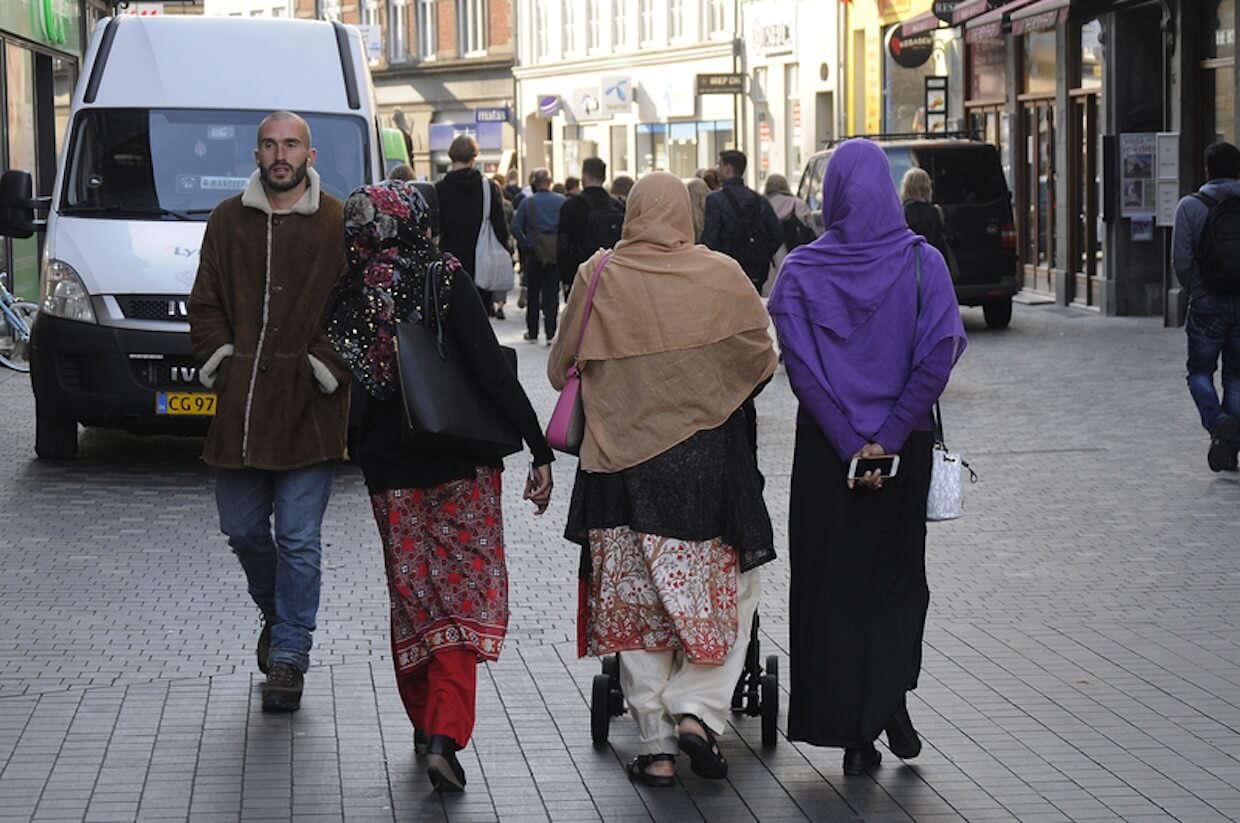
Pakistani or Indian migrants in Copenhagen, Denmark, September 22, 2017. Photo: Dreamstime.
Professor Marlene Wind, thank you very much for joining our interview series. Let me begin with the broad picture. To what extent should the current Danish election be understood not merely as a domestic contest over welfare, inflation, and leadership fatigue, but as a referendum on sovereignty, geopolitical anxiety, and Denmark’s place in an increasingly post-Atlantic Europe?
Professor Marlene Wind: Thank you very much for having me here. I will try to answer as well as I can. I think there was some anticipation that this election would be largely about geopolitics and Denmark’s place in Europe. However, it has actually turned out to be more of a background condition for everything else.It has not been particularly dominant, even though there have, of course, been questions about who we can trust to run the government in times of crisis, and this kind of very broad framing of the situation. There has not really been any detailed discussion about what kind of Europe we should have if we can no longer trust the US after Greenland, and so on. It has remained in the background. I also think this has to do with the fact that journalists covering national elections tend to be quite narrow-minded in terms of what should be debated and asked about, focusing mainly on healthcare, immigration, and similar issues. So, while the international situation and geopolitics are certainly present, they have not displaced other debates.
In your work, you have explored the tension between national constitutional traditions and European integration. How do you interpret Mette Frederiksen’s transformation from one of Denmark’s most sovereignty-conscious and Eurosceptic leaders into a prime minister who now presents deeper European cooperation as a strategic necessity? Does this reflect ideological conversion, geopolitical realism, or a broader restructuring of Danish statecraft?
Professor Marlene Wind: It is really based on national interests. The current government, and in particular the Danish Prime Minister, has realized that everything Danish foreign policy has relied on since the Second World War has been NATO and our alliance with the Americans. This is also one of the reasons why Denmark has approached the EU in a very transactional way. We often accuse Trump of being transactional, but Denmark has also been incredibly transactional in its EU policy—and this is not limited to the current Prime Minister; it has been the case since we joined in 1973.
Our prime ministers and politicians more generally have viewed the European Union primarily as a market for creating wealth in Denmark—a market where we could sell our products—and little more. Every time we have held referendums on the EU over the years, the public debate has followed the same pattern: this will not become a federation, this will not become a political union. Please vote for this treaty; it will not develop into anything beyond a market. This reflects a consistently skeptical approach toward the more political idea of Europe. There has not really been much engagement with that dimension.
What has changed now is the impact of the illegal full-scale invasion of Ukraine, and, in particular, Donald Trump’s return to the White House—questioning support for Ukraine, questioning who is responsible for the war, and even questioning NATO, including whether the United States would honor Article 5 commitments. In response, the Danish Prime Minister has effectively made a U-turn.
Pragmatically, she has turned to her closest allies in Denmark and to civil servants, asking what the wisest course of action is. Europe is there, and it is the only viable option left. That explains this shift.
It is not driven by idealism or sentiment. It is highly pragmatic and transactional. The United States is no longer a reliable anchor in the same way. Geopolitics has fundamentally changed. And now, after 50 years of EU membership, we are finally beginning to see the EU as a more political entity than before—but this shift has emerged out of necessity and national interest, not out of idealism.
Denmark’s European Reorientation Reflects Geopolitical Realism, Not Ideological Conversion
Photo: Marian Vejcik | Dreamstime.
The Greenland dispute has elevated questions of sovereignty to the center of Danish politics. In your view, has Donald Trump’s revived interest in Greenland merely triggered a short-term “rally around the flag” effect, or has it fundamentally altered how Danes think about territorial integrity, alliance dependence, and the fragility of the liberal international order?
Professor Marlene Wind: I thinkit is fair to say that there was a distinct Greenland moment, during which many European leaders—until the threat to invade Greenland emerged—had tried to accommodate Trump and please him; I would even say to cozy up to him. We have seen this across many European governments.
However, when the threat to invade an ally and seize part of the territory of an allied kingdom materialized, both Danes and Europeans more broadly began to realize that we need to stand together and rethink our position. This has brought renewed attention to questions of territory, integrity, and sovereignty—but not sovereignty in the narrow sense of protecting only our own borders. We saw clearly that France, Germany, and even the UK, despite being outside the EU, came to Denmark’s support in this moment.
I also think that Danes have become much more aware of the importance of resisting aggressors who threaten territorial integrity. After all, Europe has effectively been in a state of conflict for four years—not only Ukraine in relation to Russia. The prevailing narrative has emphasized that countries must be able to protect their borders and determine for themselves whether they wish to be democracies.
For that reason, when Trump and the United States began threatening an ally, we quickly realized that such threats could also affect us. It is not only Ukraine that can be targeted by external actors; this is a broader phenomenon and a direct challenge to the liberal international order. The principles of territorial integrity and the right of countries to determine their own political systems must not be undermined by threats of force.
All these elements have converged in the Greenland crisis, and the parallels with Ukraine have been striking. After all, what have Ukrainians been doing for the past four years? They have been defending their territorial integrity. That is precisely the principle at stake when Trump threatened Denmark.
Trumpism as Symptom: The Rise of ‘Designer Populism’ from Above
How should we understand Trumpism in this Nordic context? Is Trump best seen as an external disruptor of Danish politics, or as a transnational amplifier of political tendencies that already exist within Europe—such as executive personalization, nationalist rhetoric, distrust of institutions, and the normalization of coercive sovereignty claims?
Professor Marlene Wind: I have written about this myself in my Tribalization of Europe book, which came out in 2020, that Trump, Brexit, and the erosion of democracy in Hungary, and earlier in Poland, are part of the same story. Even the return of Trump 2.0 has been inspired, to a large extent, by the populism and the extreme right that we have seen rising in Europe since 2010.So, I think Trump is a symptom not only of populism and its rise, but also of a new type of autocratic leadership—leaders who manipulate in order to gain and retain power.
Within the academic literature, there has been an ongoing debate. On the one hand, there is a left-wing analysis of populism that attributes it primarily to inequality. On the other hand, newer strands of research suggest that it is not the poorest who support autocrats, but rather segments of the middle classes who are receptive to narratives about external enemies, “draining the swamp,” and immigrants taking over society.
In my view, both Trump and many right-wing populists in Europe represent a largely top-down phenomenon. What we see is what I would call “designer politics”: political actors who deliberately construct narratives and manipulate conditions in order to secure and maintain power. They generate antagonisms by portraying elites as liberal or “woke,” and by identifying external and internal enemies.
This pattern is evident across Europe—in figures such as Nigel Farage, the AfD in Germany, Marine Le Pen, and previously in the Netherlands, as well as in many Central and Eastern European countries. It is, in fact, less about a dissatisfied citizenry rejecting liberal elites and more about kleptocracy and the concentration of power. If we look at the data, for example in Poland, we see that people have become increasingly affluent, yet still vote for right-wing parties.
A similar pattern can be observed in the United States. In 2016, it was not the poorest voters who supported Trump; many of them voted for Hillary Clinton. This suggests that we should be cautious about reducing these developments to questions of inequality alone. They also reflect the strategies of highly cynical political leaders who actively manufacture dissatisfaction, create antagonism, and construct narratives of threat from which they claim to offer protection.
Why the Far Right Persists in Denmark
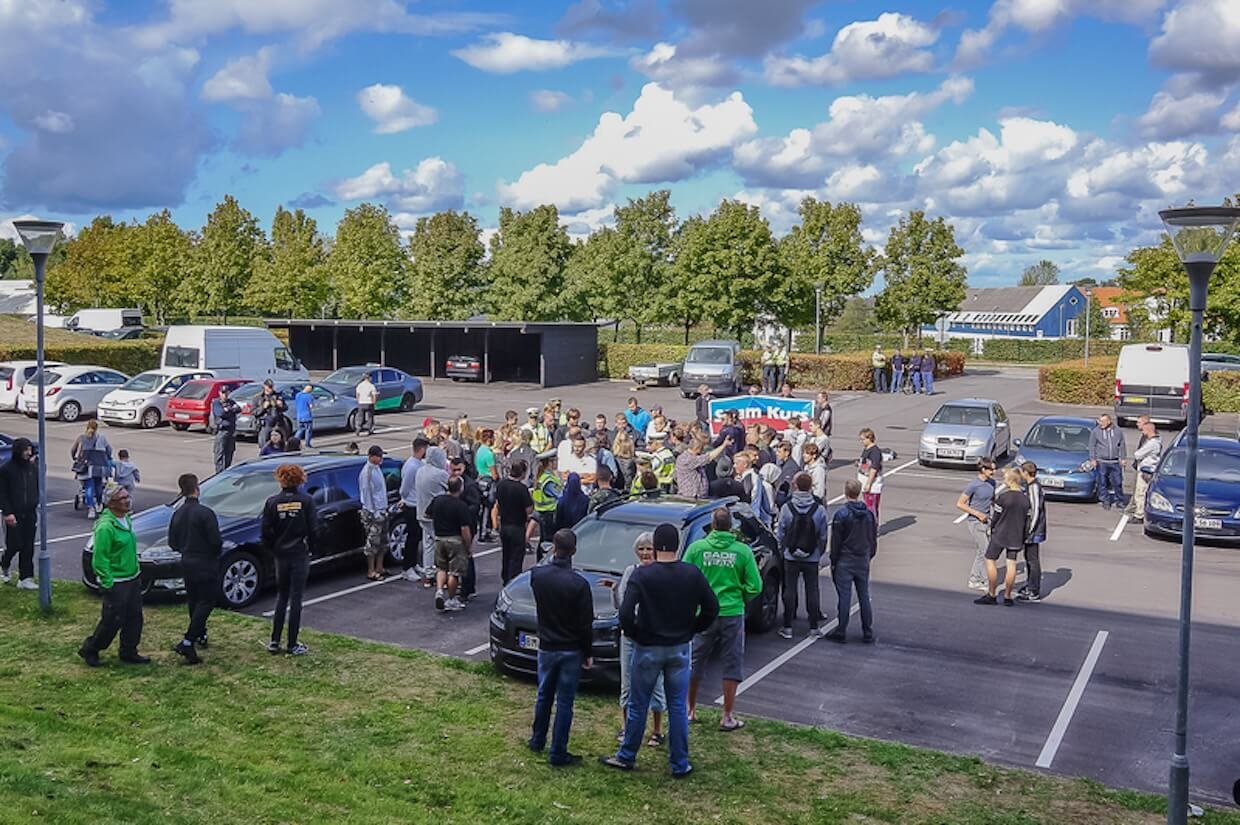
Anti-Muslim demonstration by Stram Kurs and Rasmus Paludan, Frederikssund, Denmark, August 26, 2018. Photo: Stig Alenas | Dreamstime.
Denmark has long been seen as a case where mainstream parties absorbed parts of the anti-immigration agenda, thereby containing the electoral breakthrough of the far right. Do you see this as a successful inoculation strategy, or has it instead normalized core elements of far-right politics by translating them into state policy?
Professor Marlene Wind: To a large extent, it has become normalized in the Scandinavian countries. The reason it has been so easy to normalize is that we are not constitutional democracies; we are majoritarian democracies, where there is very little judicial review, and where there is no strong tradition of minorities challenging majority policies in court against a robust constitutional framework.We have a political culture in which the majority decides. In such an environment, it is much easier to normalize right-wing policies than in constitutional democracies, such as Germany, where minority groups can turn to the courts to assess whether policies are compatible with their rights and protections.
So, it has been easier in Denmark, and this process has been ongoing for many years. The argument that we have managed to eradicate the extreme right is simply not accurate. If you look at the policies adopted by the majority of politicians and political parties, they have effectively incorporated right-wing positions. We also see that support for right-wing political parties remains at similar levels as before; it is simply distributed across smaller parties. If aggregated, this support still amounts to roughly 17% to 20%. Moreover, there is currently a competition within Danish politics over who can adopt the toughest stance on these issues.
I believe it is a misconception in many European countries that this challenge has been resolved. I am not suggesting that the discussion itself is not legitimate—it certainly is. We must uphold our liberal values and firmly reject all forms of intolerance toward women, as well as attempts to promote Islamist and other extreme positions. Protecting liberal democracy remains essential. However, adopting the positions of the extreme right is not an effective strategy to counter it. In fact, the overall level of support for these views remains largely unchanged compared to 20 years ago.
Social Democracy at the Edge of Populist Politics
Relatedly, what does the Danish case tell us about the contemporary relationship between mainstream social democracy and populist political logics? Can restrictive migration politics coexist with a democratic center-left project without eroding the normative distinctions between social democracy and the populist radical right?
Professor Marlene Wind: That is a very political question. If you ask the Social Democrats, they would absolutely say yes. Even the Socialists on the left side of the Danish Social Democratic Party fully support this, so they would argue that it can coexist.This is a clear example of how such positions have become normalized. It is entirely legitimate to raise and debate the major questions and challenges associated with immigration, particularly when it comes to differing values. Where I see a problem, however, is when there is no judicial review of political decisions that sometimes approach the limits of what one would consider the rule of law, and where it becomes difficult to obtain a second opinion on the policies being implemented. That, in my view, is where the real issue lies—not in having an open discussion about challenges that certainly exist.So yes, any Social Democrat in Denmark would say that this is fully compatible, but it remains a highly political question.
Crisis Governance Expands Executive Power While Suspending Accountability
Professor Wind, do you think the incoming election demonstrates that external geopolitical crises can temporarily suspend domestic political accountability? In other words, can international confrontation—whether over Greenland, Ukraine, or transatlantic instability—re-legitimate incumbents whose domestic credibility had previously weakened?
Professor Marlene Wind: This is what happens every time there is a crisis. Political leaders go into crisis mode and argue that they need more power and greater competences to deal with the situation, and as a result, other issues are set aside. This is a very common phenomenon. You can see it in Hungary as well, where there has been a state of emergency since the COVID period. As far as I know, it is still in place. I am not entirely sure whether it has been lifted, but you can certainly observe similar crisis rhetoric in Denmark.
We have a Prime Minister who is highly effective in managing crises. However, the concern is always that more fundamental questions of accountability—democratic accountability in particular—as well as reasonable limits, may be overlooked in such situations. It is certainly open to debate whether we are currently in that kind of scenario.
At the same time, I do agree with the Prime Minister that we are, in a sense, in a state of war—and not only in relation to Ukraine. Europe is facing a very dangerous situation, being pressured from both the East and the West, while struggling to act collectively. This is deeply problematic, and it underscores the need for political leaders who are capable of addressing these challenges. So it is always a matter of balance, and something we must continuously reflect upon: has a given political leader gone too far in this regard? But at this moment, I believe that Europe needs strong and decisive leadership in order to endure as a continent.
The Fragile Foundations of Renewed Public Trust
Denmark’s Prime Minister Mette Frederiksen at a press conference during the COVID-19 crisis, Copenhagen, March 17, 2020. Photo: Francis Dean | Dreamstime.
Much of the current debate revolves around whether Frederiksen’s firmer line toward Washington has restored public trust. But from a democratic-theoretical perspective, how durable is trust that is rebuilt through crisis leadership rather than through institutional responsiveness, social compromise, or policy coherence?
Professor Marlene Wind: That is a big question, which I think can only be answered when we look back in a few years. As citizens and voters, we tend to appreciate when politicians stand up and demonstrate leadership. At the same time, many Europeans were deeply dissatisfied with the initial responses to Donald Trump, when we sought to please him, accommodate him, and turn the other cheek.
The so-called Greenland moment marked a turning point, when we finally rejected his demand to take part of another ally’s territory. This was an important development that fed into a broader European effort to assert itself and say no. We observed a similar dynamic in the Middle East, where European actors emphasized that it was not their war, that they had not been consulted about Iran, and that they could not simply accommodate—even under threats that Trump might withdraw from or dissolve NATO.
In many ways, that phase is over. Europe has, to some extent, been constrained by a sense of inferiority and dependence on the United States. The Greenland crisis made it abundantly clear to many European leaders, and certainly to the Danish Prime Minister, that this approach is no longer sustainable when dealing with an unpredictable partner. A firmer stance became necessary, and we have seen this reflected in the decision to place Greenland within a working group while avoiding further escalation.
It is also worth noting that Mark Carney, the Canadian Prime Minister, was among the first to adopt this approach and openly resist Trump. After being publicly humiliated—referred to as merely a governor, with suggestions that Canada should become the 51st state—and after firmly rejecting such rhetoric, Trump appeared to step back and has not revisited the issue since.
In this context, there is a growing sense that political leaders must be able to stand up to forms of coercion and authoritarian behavior. Such pressures do not emanate from a single source; while they are evident in Russia, similar dynamics can also be observed in the United States at present.
From Opt-Outs to Integration?
You have written extensively on Europe’s legal and political development. In light of recent events, do you think Denmark is now moving from its traditional status as a semi-detached, opt-out-oriented member state toward something closer to the European core? Or is this shift still contingent, fragile, and driven more by fear than by conviction?
Professor Marlene Wind: As I said in the introduction to this interview, where you asked something similar, that at least initially the turn to Europe has been very transactional and very pragmatic—simply a question of, alright, we lost our ally, now we need to find new friends, and therefore we turn to Europe. But I actually believe that this could develop into a closer attachment, in general, to the European project. In fact, that what we are seeing right now could be a more fundamental shift, where Danish politicians have started suggesting that we could move from unanimity to qualified majority voting in foreign policy, that we could build up a European army, that we could even federalize, take on debt in common, and give the EU a bigger budget to create better conditions for business, innovation, and tech companies in Europe.
All these kinds of measures—removing barriers in the internal market that have grown to a rather extreme level, as illustrated in the Draghi report and the Enrico Letta report as well—would require more Europe.
And the Danes, and Danish politicians in particular, are gradually realizing that if Europe is to survive in a new global context with adversaries all around us, and where we strategically have to avoid excessive dependence on any major power and instead “de-risk,” as von der Leyen has said several times, then Europe simply has to become stronger and more independent. It must also become a power that projects its influence outward—not only a union that defends itself and builds military capabilities, whether within NATO as a European pillar or within the European Union itself, but also one that can project power externally.
Danish top politicians are gradually moving in that direction. I could anticipate it, and I think we have seen some signs of it, but again, I would say that there has not really been much public debate about this during the current campaign. There is still a sense among many political leaders that it is somewhat risky to address these issues openly.
But we will see in the coming years whether we are moving closer to Europe and toward the core, possibly by removing our remaining opt-outs. Denmark still has opt-outs in Justice and Home Affairs and regarding the euro, as it is not part of the euro area, even though its currency is pegged to the euro. If the next step is to remove these opt-outs and fully join the European core and its power center, then that would signal a more definitive shift—should this trajectory materialize.
How Economic Interests Shape Transnational Populism
How do you assess the relationship between today’s European far right and Trumpism? Should we think of them as part of a coherent transnational ideological family, or are they better understood as overlapping but ultimately fragmented projects—united by anti-liberal impulses, yet divided by national interests, geopolitical alignments, and competing visions of sovereignty?
Professor Marlene Wind: My analysis is that something much bigger is at stake here. We are dealing with a rather strange combination of populist leaders who are kleptocrats and, as I said earlier, who are designing populism from above, creating tensions and antagonism among the people they lead. I think that is very dangerous. It represents a very different way of understanding populism than in the past.
What we have seen, particularly in the United States, and increasingly also in Europe, is that many figures from Silicon Valley—J.D. Vance, who was supported by Peter Thiel, Musk, Bezos, and other tech oligarchs—are playing a significant role. They are actors who, in different ways, seek to challenge Europe. We also saw in the American foreign and security policy strategy published before Christmas that there is a willingness to support regime change in Europe and to weaken the European Union.
At first glance, one might think this is simply about supporting Orbán and other right-wing groups, such as the AfD, which Musk has also openly supported. But if you look more closely, it is fundamentally about economic interests. It is about control by major tech companies that want access to a less regulated European market.
What is happening in Europe, and why parts of the American administration appear to support the extreme right, is closely tied to the interests of US-based tech giants that seek access to a wealthy European market while opposing EU regulatory frameworks. They resist European regulation of digital platforms and often frame such regulation as censorship. Yet, in reality, the United States has dropped to 57th place in the Press Freedom Index, suggesting that concerns about censorship are not limited to Europe.
This connects to a broader transformation of populism and autocratic leadership, which is increasingly engineered from above, with “tech elites” playing a central role. Their interest in weakening the European Union and empowering far-right actors lies in the expectation that such actors will renationalize power, undermine EU integration, and create fragmented markets that are easier to dominate.
In that sense, the dynamic is not only ideological but also economic and structural. It may sound conspiratorial, but there is a growing body of research pointing to these linkages. The more one examines the connections between far-right populism and segments of the US tech industry, the more concerning the picture becomes.
Unanimity or Fragmentation: The Existential Choice Facing the European Union
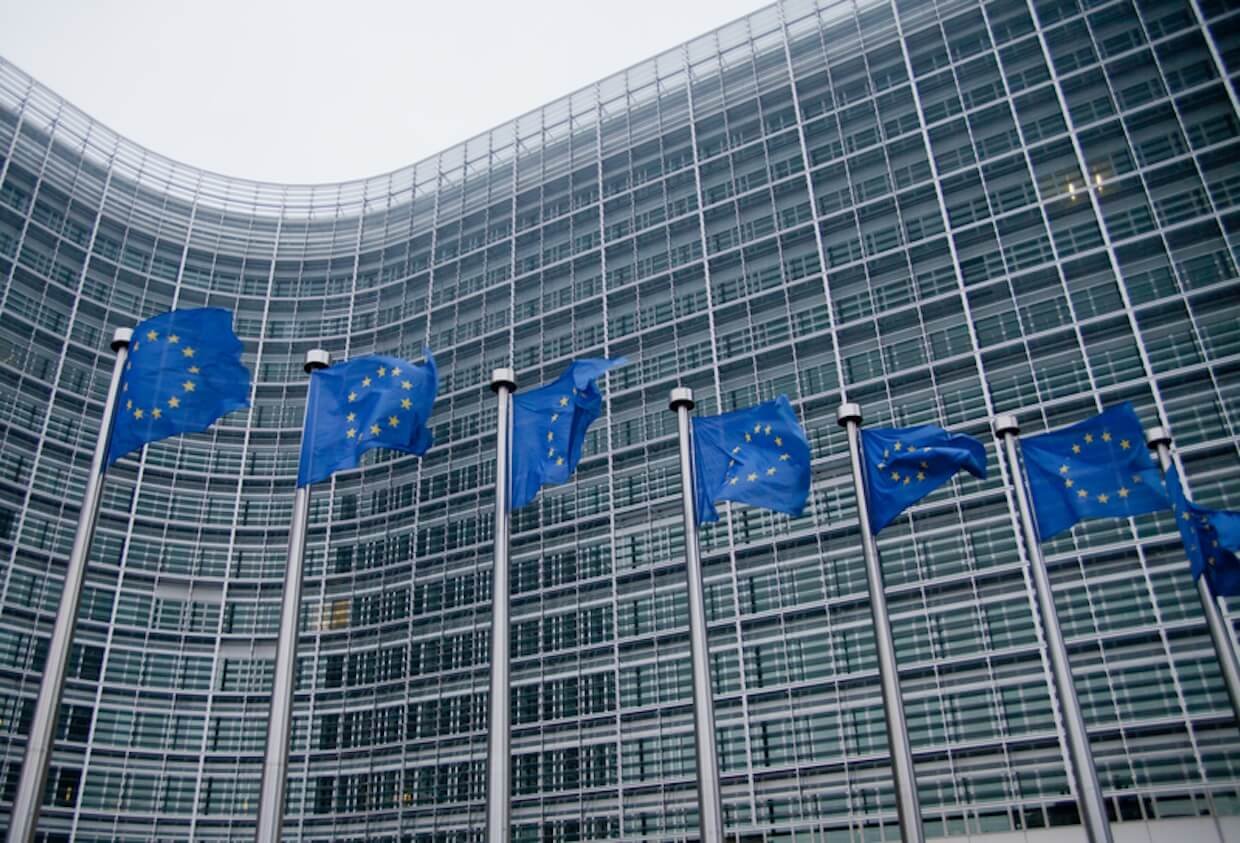
European Commission headquarters with waving EU flags in Brussels. Photo: Viorel Dudau.
Finally, Professor Wind, looking beyond the election itself, what do you see as the most important long-term question for Denmark and Europe: how to defend national sovereignty without collapsing into nationalism, how to deepen European cooperation without reproducing democratic alienation, or how to confront far-right normalization without simply borrowing its political vocabulary?
Professor Marlene Wind: How to strengthen the European Union in the current situation is very difficult because it was built as a market which, over time, developed to 27 or 28 members into a larger and larger union. We want more members; we want Ukraine in the Union. We face many institutional problems in terms of how to ramp up decision-making processes.
Some member states, because they have governments that are very concerned with their sovereignty, including Denmark, have also been very much against transferring further power to the European Union. And you have several countries with nationalist leaders—the Czech Republic, Slovakia, Hungary, and a president in Poland—so we have had, and continue to have, significant disagreement about how to strengthen the European Union. That is what makes me perhaps not so optimistic in the short run, because we currently have a system in the European Union where unanimity is required. When we want to integrate further, we need unanimity. When we want new members, we need unanimity, as you can see with the loan to Ukraine that Orbán is blocking because he is afraid of losing the election on the 12th of April.
So there are some inbuilt weaknesses that are very strong in the European project. We also have an upcoming election in France, where we may see yet another extreme right party enter the Élysée Palace. We are facing very significant institutional problems, and I am almost tempted to say that it can make or break: either we truly feel the pressure from the global stage—not just from the US and Russia, but also China—and get our act together, or we do not.
We need to move from unanimity to qualified majority voting quickly, or perhaps create a new club for those who are willing. I think we already see signs of that in relation to Ukraine. We have this “alliance of the willing,” and that could become an alternative within or alongside the European Union. We even talk about having Canada join, at some point, some of the structures in Europe.
So either we get our act together—the liberal democracies that are still left in the world—and ramp up our cooperation, or the whole thing risks collapsing. If current political leaders are not able to see the dangers of failing to preserve our way of life in Europe, also for our children and grandchildren—protecting democracy and free speech, and being able to defend ourselves and survive in a very competitive global market, perhaps through a more assertive industrial policy—then I am afraid that the entire European project could fall apart.
We know that there are actors, including in the United States, who would welcome such an outcome. Trump, for instance, prefers to deal with individual leaders rather than with the EU as a bloc. But we also have to remember that we are a very powerful bloc. We are almost 500 million Europeans. We are a wealthy continent. We have some of the highest life expectancies in the world. We have free education, welfare systems, and broad access to public goods.
So we have all the opportunities to become a strong, united power on the global stage. But we need political leaders right now who can see this, recognize its necessity, and act accordingly. That is why, despite all the criticism that can be directed at political leaders in times like these, when they do take leadership, I think that is exactly what we need—because the alternative is much worse.
In this compelling Voice of Youth (VoY) contribution, Emmanouela Papapavlou revisits the enduring moral and political legacy of Martin Luther King Jr. in an age of populist authoritarianism, reflecting on the contemporary erosion of empathy, solidarity, and human dignity. Blending personal reflection with normative critique, the piece interrogates how exclusionary attitudes and everyday discrimination have become normalized across societies. It calls for renewed civic courage, emphasizing the role of individuals—especially youth—in resisting injustice and sustaining democratic values. Framed as both a reflection and a call to action, the article underscores that transformative change often begins with principled minorities who refuse to accept injustice as the status quo.
By Emmanouela Papapavlou*
Decades ago, a man stood behind a podium and spoke to a world that was not ready to hear him. He spoke about justice in a time when injustice was normal. He spoke about love in a time when hatred had become routine. He spoke about equality in a society that had learned to live with division. And yet, he spoke anyway. He spoke with a vision that was bigger than the world in front of him.
“I have a dream. I have a dream today. A dream of freedom, a dream of peace, a dream of people walking together, without fear, without hate, without walls in between them. I have a dream that one day, no one will be judged by the color of their skin, but by the kindness in their heart. I have a dream that every child, black or white, rich or poor, will have the same chance to grow, to learn, to dream. I have a dream that love will speak louder than anger, that truth will shine brighter than lies, that hope will be stronger than fear. This dream is not mine. It belongs to everyone who still believes that tomorrow can be better than today. I know the road is long, I know the fight is hard, but I also know that justice always rises, even after the darkest night. So I will keep walking, I will keep believing, I will keep dreaming. These dreams are the beginning of change, and change is the proof that hope is alive. I have a dream, and I will not stop until that dream becomes real.”
Martin Luther King stood on that podium delivering a speech to a world that had grown comfortable with cruelty, a world that had learned to live with hate instead of love.
He knew all those things.
And yet he stood there anyway, standing up for what he believed every person is entitled to: freedom, equality, acceptance, and love, no matter the circumstances.
If you feel something when reading those words, you belong to a community of humans who have risen above the noise of propaganda, power, and profit. You belong to the quiet but powerful group of people who still believe that human rights are not negotiable.
You belong to a community that believes that color, sexuality, ethnicity, or religion do not determine whether a person deserves to be heard, to be accepted, or to be treated as equal.
And let me tell you something, as someone who belongs to that community: it has become incredibly rare.
Today, it is rare to openly stand up for every human being, even the ones you do not know, even when there is nothing to gain from doing so. It is rare to refuse to laugh at the joke made about a woman. Rare to speak up when someone mocks a person of color. Rare to challenge the comment made about someone’s religion, their sexuality, or where they come from.
Somehow, it has become normal to mock people for the very things that make them human. The way they look. The place they were born. The language they speak. The beliefs they hold. And because this behavior has become normal, the people who refuse to participate suddenly appear unusual.
So if you are reading this, and you are someone who stands up for people, even when it is uncomfortable, even when it makes you stand out, then yes, I am talking to you.
You who refuse to shrink your values just to fit in with your age group. You who speak up even when it would be easier to stay quiet. You who defend someone even when it brings you no reward.
You are not naive. You are not unrealistic. You are necessary.
You are part of the reason the world is still capable of changing. Because change has never started with the majority. It has always started with the few people who were willing to look at injustice and say: this is not normal.
People will call you idealistic. They will call you naive. They will call you unrealistic.
But those words are often used by people who have simply grown comfortable with a world that should never have been acceptable in the first place.
Believing in human dignity should not make someone stand out. Defending someone’s humanity should not be controversial. Speaking up for fairness should not be considered radical.
And yet, here we are. So maybe my dream is not just about equality or justice. Maybe my dream is about reaching a world where basic decency is no longer extraordinary. A world where standing up for another human being is not brave, it is simply the standard.
Until that day arrives, the dream still belongs to all of us. And as long as there are people willing to believe in it, to speak for it, and to live by it, hope is still alive.
(*) Emmanouela Papapavlou is a high school student from Thessaloniki, Greece, deeply passionate about social and political issues. She has actively participated in Model United Nations and other youth forums, serving as a chairperson in multiple conferences and winning awards in Greek debate competitions. Writing is her greatest passion, and she loves using it to explore democracy, civic engagement, and human rights. Her dream is to share her ideas, inspire action, and amplify the voices of young people who want to make a difference. Email: emmanpapapavlou@gmail.com
In this incisive analysis, Dr. Oludele Solaja interrogates how AI-driven waste governance reproduces global inequalities under the guise of efficiency. Introducing the concept of “algorithmic populism,” the article reveals how technocratic systems, framed as serving the public good, instead concentrate power within elite infrastructures while marginalizing affected communities. Through empirical insights on global plastic flows and case evidence from Nigeria, the article demonstrates how optimization logics perpetuate “plastic colonialism.” It calls for transparency, participatory design, and updated regulatory frameworks to prevent algorithmic governance from entrenching environmental injustice.
Even though the world was debating about a new global plastic treaty and big multinational companies were developing intelligent AI systems for managing worldwide recycling, nothing actually changed the status quo. The Global South remained the global repository for the world’s plastic waste. Far from being an outcome of ignorance or incompetence, the logic behind this persistent pattern of global environmental injustice could be explained by concepts of algorithmic populism. Algorithms designed to optimize global waste flows were simultaneously creating new forms of global environmental governance that duplicated existing power hierarchies, while ostensibly addressing a global waste crisis (Dauvergne, 2018; Brooks et al., 2018; Vinuesa et al., 2020). Algorithmic optimization, not the solution to our waste crisis, increasingly served as the vehicle for reproduction of the system of plastic colonialism in digitally encoded form.
This problem is conceptualized here by the idea of algorithmic populism. Following Mudde’s influential definition of populism as a moralized political logic that differentiates between “the pure people” and “the corrupt elite” (Mudde, 2004; Mudde & Kaltwasser, 2017), algorithmic populism suggests the new logic of governance through which algorithmic systems are promoted as apolitical tools of expertise serving the ‘people,’ yet control and authority are increasingly concentrated within a small technocratic elite (Beer, 2017; Pasquale, 2015). Within this regime of technocratic management, ‘the people’ have been transformed into data points managed through complex computational infrastructure created and controlled by corporate and institutional entities. This structure of governance presents a facade of democratic and technical efficiency while obscuring significant inequalities in the application of decision-making authority.
This pattern reflects a wider contemporary mode of governance. As Michel Foucault noted (1980), modern power structures are built through the creation of regimes of knowledge through which what can be known and what constitutes rational and efficient behavior are determined. Within the sphere of waste governance, algorithmic systems increasingly produce their own authoritative ‘truths’ about the destinations, treatment processes and the comparative economic efficiencies of exporting or receiving waste. These truths, however, are socially embedded, shaped by a global economy in which cost efficiency may easily override concerns about environmental justice (Kitchin, 2017; Pasquale, 2015). Optimization therefore perpetuates, rather than ameliorates, patterns of global inequality.
An example of this dynamic can be observed in patterns of the global plastic waste trade. Despite international regulations such as the Basel Convention high-income countries continued to export large amounts of plastic waste into countries with limited environmental regulations (Jambeck et al., 2015; Geyer et al., 2017). When China banned imports of plastic waste in 2018, global waste flows rerouted themselves to Southeast Asia and parts of Africa, now managed through an array of global optimization, tracking and tracing algorithms that help to streamline and automate logistical operations (Brooks et al., 2018). Optimization algorithms identifying cheap destinations also naturally target locations with weaker regulatory institutions and environmental controls, typically those in the Global South.
The waste trade in Nigeria provides a clear example of this pattern. Nigeria is one of Africa’s most populous nations and one of the continent’s largest consumer markets; the nation has long faced an overwhelming plastic waste problem and is a destination country for enormous quantities of plastic waste generated both within its own borders and abroad (Dauvergne, 2018). The overwhelming majority of the informal waste picking sector in Lagos operates as an unofficial but fundamental component of waste management systems, where pickers sift through landfills and waterways for materials to recycle under dangerous and precariously employed conditions, and these workers remain completely outside decision-making circles regarding new forms of smart and algorithmic waste management (Beer, 2017; Heeks, 2022). Tools and applications developed in distant corporate and institutional settings serve to create a system of waste management that fails to account for the conditions that workers face at local sites of accumulation.
This exclusion is a manifestation of the contradictions inherent in algorithmic populism. In fact, where algorithmic governance is supposed to create more democratic forms of participation, it often works to obscure power asymmetries and lack of participation; indeed, many contemporary populist movements draw power from precisely the perception of exclusion and lack of voice, a problem increasingly amplified in the digital space (Norris & Inglehart, 2019). Environmental policy, for instance, increasingly relies on information systems and models that make decision-making opaque to even its most implicated stakeholders (Pasquale, 2015; Kitchin, 2017). As such, efficient algorithmic logic may ultimately consolidate rather than alleviate environmental injustices.
The popular circular economy model is itself a perfect illustration of this contradiction; it seeks to build a system of material flows that aims to minimize waste but ends up facilitating global waste flows through optimized systems that reproduce traditional economic and political hierarchies. As has been shown above, this circular logic simply becomes a circular illusion whereby waste continues to circulate globally in the context of unequal power relations, ultimately continuing to accumulate in the countries with weaker environmental and political infrastructure (Vinuesa et al., 2020; Dauvergne, 2018).
This difference is striking when comparing how these technologies are often experienced in different parts of the world. In Europe, AI applications in waste management are presented as “green” technological innovations, part of broader goals for climate-compatible resource consumption; in many parts of Africa, they function to exacerbate waste problems, through the continued accumulation of waste in landfills and waterscapes and increased precarious work in the informal sector (Brooks et al., 2018). Cost efficiency trumped local realities and environmental justice outcomes in Europe, while for Africa continued accumulation resulted in increased environmental degradation and precarity.
This isn’t just about failing to adequately represent the people; algorithmic populism actively digitizes populism itself. What could and should be debated as political issues around the global distribution of waste, through the processes of debate and consensus-building, are reframed and regulated as technical problems solvable through expert-driven algorithmic intervention, de-politicizing them in the process, and ushering in new forms of technocratic rule (Beer, 2017; Pasquale, 2015). Without checks on their operation, optimization-driven technologies risk legitimating environmental inequality.
There are number of solutions required to solve this problem. First, algorithmic transparency should be a central pillar of future governance of waste. Public access should be required to the decision-making logic behind algorithmic choices, including the factors used to identify destinations for waste streams (Kitchin, 2017; Vinuesa et al., 2020). Second, participatory models should be part of future design and deployment of technology systems. Waste pickers in Nigeria, for example, possess unique on-the-ground knowledge of the complex political and environmental ecology of waste that can help to create truly ‘smart’ systems that are ‘fairly smart’ and beneficial to local contexts (Beer, 2017; Heeks, 2022). Third, international governance frameworks need to adapt to address the reality of algorithmic infrastructure as a central force in shaping the contemporary global waste trade.
Existing conventions that regulate waste flows were written prior to the rise of algorithmic systems, and new regulations and standards must be devised in order to guarantee fairness, accountability and environmental justice in technological governance (Pasquale, 2015; Vinuesa et al., 2020). Lastly, environmental technology governance needs to be de-politicized: algorithmic tools must be reconceptualized not as ‘solutions,’ but as socio-technical systems implicated in patterns of power and exclusion (Foucault, 1980). In the absence of such measures, algorithmic governance may become the ultimate tool for disguising environmental inequality as technological progress.
In conclusion, algorithmic populism reveals how ostensibly neutral technologies can entrench, rather than resolve, global inequalities. By depoliticizing waste governance and privileging efficiency over justice, AI systems risk reproducing plastic colonialism in digital form. Meaningful reform therefore requires transparency, participatory inclusion, and updated global regulatory frameworks. Without such interventions, algorithmic governance will continue to legitimize unequal environmental burdens while masking them as technical necessity and progress.
References
Beer, D. (2017). “The social power of algorithms.” Information, Communication & Society, 20(1), 1–13.
Brooks, A. L.; Wang, S. & Jambeck, J. R. (2018). “The Chinese import ban and its impact on global plastic waste trade.” Science Advances, 4(6), eaat0131.
Dauvergne, P. (2018). “Why is the global governance of plastic failing the oceans?” Global Environmental Change, 51, 22–31.
Foucault, M. (1980). Power/knowledge: Selected interviews and other writings, 1972–1977. Pantheon Books.
Geyer, R.; Jambeck, J. R. & Law, K. L. (2017). “Production, use, and fate of all plastics ever made.” Science Advances, 3(7), e1700782.
Heeks, R. (2022). “Artificial intelligence for sustainable development: The new frontier.” Development Informatics Working Paper Series, University of Manchester.
Jambeck, J. R.; Geyer, R.; Wilcox, C.; Siegler, T. R.; Perryman, M.; Andrady, A.; Narayan, R. & Law, K. L. (2015). “Plastic waste inputs from land into the ocean.” Science, 347(6223), 768–771.
Kitchin, R. (2017). “Thinking critically about and researching algorithms.” Information, Communication & Society, 20(1), 14–29.
Mudde, C. (2004). “The populist zeitgeist.” Government and Opposition, 39(4), 541–563.
Mudde, C., & Kaltwasser, C. R. (2017). Populism: A very short introduction. Oxford University Press.
Norris, P., & Inglehart, R. (2019). Cultural backlash: Trump, Brexit, and authoritarian populism. Cambridge University Press.
Pasquale, F. (2015). The black box society: The secret algorithms that control money and information. Harvard University Press.
Vinuesa, R.; Azizpour, H.; Leite, I.; Balaam, M.; Dignum, V.; Domisch, S. & Fuso Nerini, F. (2020). “The role of artificial intelligence in achieving the Sustainable Development Goals.” Nature Communications, 11, 233.
Professor Madhav Joshi argues that Nepal’s recent political upheaval reflects both “anti-elite” mobilization and “a form of generational democratic renewal,” but also warns that the country’s deeper institutional crisis remains unresolved. In his interview with the ECPS, Professor Joshi situates the rise of Balendra “Balen” Shah and the Rastriya Swatantra Party within Nepal’s longer history of structural inequality, elite capture, and democratic frustration. He underscores that legitimacy must be earned through trust in public institutions, not merely through electoral victory. Stressing the centrality of institutional reform, Professor Joshi contends that “depoliticizing the courts, bureaucracy, and police is essential to stabilizing Nepal’s democratic renewal.” Whether this hopeful moment yields durable transformation, he suggests, depends on translating electoral momentum into credible governance.
Giving an interview to the European Center for Populism Studies (ECPS), Professor Madhav Joshi— a Research Professor and Associate Director of the Peace Accords Matrix at the Kroc Institute for International Peace Studies, University of Notre Dame’s Keough School of Global Affairs—offers a deeply grounded and empirically informed analysis of Nepal’s unfolding political transformation in the aftermath of the landmark electoral victory of Balendra “Balen” Shah and the Rastriya Swatantra Party (RSP). Anchored in his extensive scholarship on civil conflict, institutional legitimacy, and post-war transitions, Professor Joshi situates the current moment within Nepal’s longer trajectory of democratic struggle, elite capture, and unresolved structural inequalities.
At the heart of his diagnosis lies a stark assessment of continuity amid apparent rupture. While the recent election signals what he terms both “anti-elite” mobilization and “a form of generational democratic renewal,” it is equally, in his view, “a manifestation of unresolved structural grievances within Nepal’s political economy.” Drawing on his research on the Maoist insurgency, Professor Joshi underscores how patterns of exclusion, patron–client networks, and elite domination have persisted despite formal democratic transitions, leaving large segments of the population—especially youth—disillusioned and economically marginalized.
The interview foregrounds a central theme encapsulated in his headline assertion: “Depoliticizing the courts, bureaucracy, and police is essential to stabilizing Nepal’s democratic renewal.” For Professor Joshi, the current legitimacy crisis is not merely electoral but institutional. He cautions that “legitimacy is not something one possesses simply by being in government; rather, it is earned through trust in public institutions,” a trust that has been severely eroded by systemic corruption and partisan infiltration of state apparatuses. The electoral success of Shah, therefore, reflects not consolidated legitimacy but what Professor Joshi calls an “electoral mandate… to build it by fulfilling promises.”
At the same time, Professor Joshi highlights the transformative role of youth-driven and digitally mediated mobilization. The Gen Z movement, he argues, represents a shift away from traditional party structures toward more fluid, networked forms of political engagement, where “parties with a strong social media presence… are better positioned to gain public backing.” Yet, he remains cautious about overestimating rupture, noting that entrenched institutional networks and political patronage systems may continue to constrain reform efforts from within.
Importantly, Professor Joshi frames the current conjuncture as both an opportunity and a risk. The unprecedented parliamentary majority enjoyed by the RSP creates conditions for meaningful reform, but failure to deliver—particularly in areas such as job creation, governance, and institutional accountability—could accelerate “democratic backsliding,”given the “high level of public expectation placed on this government.”
Ultimately, the interview presents Nepal as a critical case in comparative politics: a post-conflict democracy where populist energies, generational change, and institutional fragilities intersect. Whether this moment evolves into durable democratic transformation or reproduces cycles of instability, Professor Joshi suggests, will depend on the state’s capacity to translate electoral momentum into credible, institutionalized reform.
Here is the edited version of our interview with Professor Madhav Joshi, revised slightly to improve clarity and flow.
The Election Outcome Signals Persistent Economic and Social Frustration
A Nepali farmer at work in a rural field during the monsoon season. As the rains arrive, farmers across Nepal become busy in their fields, though most still rely on traditional farming techniques. Photo: Shishir Gautam.
Professor Madhav Joshi, thank you very much for joining our interview series. Let me start right away with the first question: Your research on Nepal’s Maoist insurgency highlighted how structural inequalities and patron–client networks shaped political mobilization and rebellion. In light of the recent election of Balendra “Balen” Shah, do you see this political upheaval as another manifestation of unresolved structural grievances within Nepal’s political economy?
Professor Madhav Joshi: Thank you very much for this wonderful opportunity and for taking the time to have this conversation in light of Nepal’s recent election.
Let me start with the Maoist conflict, and then I will make the connection as to why that is important here. When the Maoist conflict started in 1996, protesters were largely among rural dwellers in the remote parts of Nepal. Support for the conflict was a reflection of structural inequality propagated by elites who were part of political parties and who were elected in all democratic elections since 1996. I would even say since 1991, which was the first multi-party election after the overthrow of the Panchayat regime. They became members of political parties and then went on to win elections.
The Maoist conflict ended in 2006. It began in 1996 and concluded with the signing of the Comprehensive Peace Agreement. Because of that peace process, a number of institutional reforms were introduced. However, these reforms were again captured by political elites, and they did not deliver good governance. That was one of the major promises of the Maoist conflict, particularly in rural Nepal.
Right now, the gap between the poor and the rich is even wider compared to what it was in 1996. Corruption is widespread, from the health sector to the education sector. Youths have no jobs and no opportunities within the country. Grievances once largely confined to rural areas are now spreading into cities, as young people have moved from villages to urban centers in search of jobs and better opportunities—only to find none. This is largely due to the way the system is run by political parties and elites.
To give you a quick statistic, about 3,000 Nepali youths leave the country every day. An estimated one-third of young people are abroad, doing mostly menial jobs—not even high-paying ones, but basic labor.
So, when you compare the situation during the conflict from 1996 to 2006 with the changes that have taken place since then, it becomes clear that, for many people, nothing has really changed. That is why I personally think the outcome of the election two weeks ago reflects a hope that Nepal can do better.
It is a manifestation of unresolved structural grievances within Nepal’s political economy. There is much that remains unaddressed. Even those who joined the Maoist conflict and served in active combat roles have, in many cases, left the country in search of work abroad. This speaks to the depth of frustration among Nepal’s youth.
This Is Both Populist Revolt and Democratic Rejuvenation
The landslide victory of Shah’s Rastriya Swatantra Party appears to represent a dramatic rejection of Nepal’s long-dominant political elites. From the perspective of comparative politics, would you characterize this outcome as a form of anti-elite populist mobilization, or rather as a generational democratic renewal?
Professor Madhav Joshi: Very interesting question. I would say that it is both anti-elite and a form of generational democratic renewal at the same time. It is not only anti-elite, and it is not only democratic renewal—it is both.
It is anti-elite because Nepal’s politics has been transactional for a long time. A few leaders have found ways to remain in power continuously. If you are not the prime minister and if your party is part of the governing coalition, eventually it becomes your turn to assume the premiership. This position has, in recent years, rotated among three key leaders, which has been deeply frustrating. These days, a term has even been coined-“visual fatigue.” Citizens repeatedly see the same politicians in positions of power, which has created widespread frustration among Nepali society.
There are also elements of populist mobilization, including the nomination of Balen Shah as a prime ministerial candidate by the Rastriya Swatantra Party. Because of the reforms he implemented as mayor of Kathmandu City, many people saw him as a credible candidate to run the country. In populist mobilization, certain public sentiments are captured and translated into political momentum to gain support. You can observe elements of this dynamic in the recent election.
At the same time, it represents a democratic renewal. Nepal’s politics has long been dominated by the same parties and elites over the past 35 years, with little visible change. While the political system is formally democratic—a multi-party democracy—the parties themselves have not been sufficiently democratic in renewing their leadership. The same politicians continue to occupy key positions within parties and government.
This is why the recent election, and its outcome can be seen as bringing youth—who have long been marginalized from Nepal’s politics—closer to the democratic process. This is a significant development, and from that perspective, it represents a democratic renewal.
Performance in Office—Not Pop Culture—Fueled Electoral Success
Voter education volunteer instructs residents on using a sample ballot in Ward No. 4, Inaruwa, Nepal, February 17, 2026, as part of a local election awareness program led by the Sunsari Election Office. Photo: Nabin Gadtaula / Dreamstime.
Balendra Shah first emerged as a rapper whose lyrics sharply criticized corruption, unemployment, and political hypocrisy. How significant is the role of cultural figures in translating public frustration into populist political movements, particularly in societies where traditional parties have lost legitimacy?
Professor Madhav Joshi: We do see cultural figures attempting to translate public frustration into populist political movements, as in Uganda, where Bobi Wine ran against Museveni. We also hear of similar developments in other African countries, where cultural figures have been called upon to step in and play significant roles in national politics.
The case of Balen Shah, however, is somewhat different. Of course, he is a rapper, but I would characterize that as a hobby rather than his primary profession. He is, in fact, a structural engineer by training, which is a serious profession. International media tend to focus on his music, which is understandable, but Nepal’s political transformation cannot be attributed to a single rapper or a handful of cultural figures.
Let me explain the strong public appeal surrounding Balen Shah. He had already established himself as a successful mayor before becoming the prime ministerial candidate of the Rastriya Swatantra Party. During his tenure as mayor of Kathmandu, he implemented a series of reforms that had not been achieved by political parties over the previous 35 years. The contrast is quite striking. As the capital city, Kathmandu draws people from across the country, allowing many to directly observe these changes.
To cite a few examples, he introduced simple yet impactful measures: timely garbage collection, improved traffic management, restoration of cultural heritage, reforms in the public school system, and greater transparency in city governance. These changes were implemented in a capital city of 1.7 million people.
Notably, he was elected as an independent candidate and was not affiliated with the Rastriya Swatantra Party at the time. The reforms he carried out as an independent, despite political opposition, were significant. They generated strong public sentiment and fostered trust in his capacity to govern at the national level.
This also indicates the extent of public trust and support he commands. One could argue that he enjoys a higher level of public trust than any other politician in the country. Such trust is crucial in translating public sentiment into a broader social and political movement, as evidenced in the most recent election.
Gen Z Is Redefining Political Participation in Nepal
The recent uprising and election were strongly driven by Generation Z voters. How does this youth-led political mobilization compare with earlier forms of political activism in Nepal, and does it represent a new form of digitally mediated populist politics?
Professor Madhav Joshi: Thank you for this question. I have been reflecting on this quite extensively lately. In 1959, when Nepal held its first democratic election, many young leaders were elected as representatives in parliament. This followed ten years of a successful social movement that overthrew the Rana regime. However, this was followed by 30 years of the Panchayat regime after the democratically elected government was toppled.
In 1990, another social movement overthrew the Panchayat regime and introduced multi-party democracy. This movement was also led by youth, and in the subsequent election, many young representatives entered parliament. A similar pattern can be observed after the Maoist peace process, which brought the Maoists into the democratic fold. In the Constituent Assembly election in 2008, many young representatives from the Maoist party were elected.
After that, however, the Nepalese political system did not renew itself; the same individuals continued to run for office repeatedly. With the emergence of this Gen Z movement, many people—especially young people—became frustrated and took to the streets. In the March election, we again saw a significant number of younger candidates being elected. In fact, particularly within the Rastriya Swatantra Party, the average age of elected officials is around 40, compared to about 53 or 54 in the previous parliament. This reflects a clear generational shift in political mobilization and representation.
At the same time, we need to be cautious. This moment is distinct, as politics is now centered on Gen Z and their future. It is no longer primarily about the struggle for democracy or institutional reform, as those issues were addressed through earlier democratic movements and the peace process. The focus now is on the future of young people—ensuring they have opportunities, so they do not have to leave the country for work, even for low-paying jobs.
This is why the agenda of the upcoming government is likely to prioritize job creation, economic expansion, tackling corruption, and improving governance. These are the central concerns driving current political mobilization.
Regarding your question on digitally mediated politics, I would say that Nepal’s Gen Z voters are highly educated. Access to education has improved, even if the quality remains uneven. They are technologically savvy and know how to use social media for social change.
As a result, I see a decline in membership-based or traditional political parties that rely on active membership networks to mobilize voters. That model is no longer as effective. Politics has changed: parties with a strong social media presence and digital support are better positioned to gain public backing and translate that support into electoral success. This is precisely what we are witnessing.
So yes, the mobilization of digital platforms is already reshaping Nepal’s politics and is likely to do so even more significantly in the future.
The municipality office in Inaruwa, Sunsari, lies heavily damaged after protesters targeted it during the nationwide demonstrations against corruption and the social media shutdown on September 9, 2025. Photo: Nabin Gadtaula
Legitimacy Must Be Earned Through Governance, Not Elections Alone
Your work emphasizes the importance of legitimacy in shaping political authority and civilian compliance. In your view, what does the electoral success of Shah reveal about the depth of the legitimacy crisis facing Nepal’s traditional political institutions?
Professor Madhav Joshi: I often emphasize that legitimacy is not something one possesses simply by being in government; rather, it is earned through trust in public institutions. This is critically important.
In Nepal, the legitimacy crisis is both deep and widespread. It was already so under the previous government. State institutions are highly corrupt and are filled with political party loyalists. They fail to respond to people’s basic needs and services—such as education, healthcare, and environmental protection—or to facilitate opportunities for individuals to establish new businesses, and so on.
Corruption permeates the system. Processes are slow, and without political connections or networks, individuals are often unable to accomplish even basic tasks.
From this perspective, the electoral success of Balen Shah and his political party clearly reflects a profound lack of trust in traditional political parties and the existing institutional framework. This was the platform on which they campaigned, and it resonated with voters.
Ultimately, legitimacy is earned through the practice of good governance. I remain hopeful that the future government will be able to rebuild legitimacy through effective and accountable performance.
Judicial Independence Is Central to Nepal’s Democratic Renewal
In your recent research, you demonstrate how judicial institutions can be mobilized to manage or suppress political opposition before conflict emerges. In the current moment of political transition, how crucial will independent courts and rule-of-law institutions be in stabilizing Nepal’s democracy?
Professor Madhav Joshi: As I demonstrated empirically in the research you referred to, at the district level, where political opposition was prosecuted—implicated in both civil and criminal cases—those districts were more likely to experience the Maoist conflict sooner than others. The reason it worked that way lies in the infiltration of political parties into the state machinery, including the courts, police, and bureaucracy. As a result, the court system and the rule of law in Nepal are highly politicized and politically paralyzed. This is not a new revelation; it is a widely accepted reality in Nepal’s everyday politics. If you were to randomly ask individuals whether they trust the court system, the bureaucracy, or the police force to act independently and provide support when needed, most would likely respond negatively. Indeed, such responses are very common, and people now openly discuss corruption within these institutions.
For this reason, ensuring the independence of the courts and rule-of-law institutions is essential for stabilizing the democratic renewal currently underway in the country. This requires depoliticizing the court system in Nepal and moving away from what is commonly referred to as the political division of appointments. In practice, through backdoor arrangements, one party may nominate two or three judges, while another secures three or four, depending on its strength in parliament. Depoliticizing the court system, along with the bureaucracy and the police force, is therefore crucial for stabilizing democratic renewal in Nepal at this critical juncture.
State Capture Limits the New Government’s Reform Capacity
Many populist movements emerge as reactions to perceived institutional failures but often struggle once they confront the realities of governing. What institutional constraints—bureaucratic, legal, or political—might shape Shah’s ability to implement his reform agenda?
Professor Madhav Joshi: This is a very important and highly relevant question in Nepal’s current context. The Rastriya Swatantra Party and Balen Shah do not have much support or influence, as of now, within the police force, the courts, or the bureaucracy. We hear from the current caretaker government that they did not receive support from Nepal’s bureaucracy, and that indicates the depth of the problem.
As I mentioned earlier, Nepal’s court system, bureaucracy, and police force require reform. These institutions have lost public trust. The older political parties have their supporters embedded within them, and they have strong incentives to resist the Shah government. This is because they benefit from existing arrangements—they support the old political parties and, in return, are part of networks that sustain those parties, including through informal kickbacks. As a result, they have incentives to undermine this government.
Therefore, the new government cannot implement all the reforms on its agenda unless it first reforms these state institutions. That is absolutely crucial. At the same time, while the established political parties are relatively weak, they still retain these institutional connections, which they can use to challenge the Shah government.
Clientelist Networks Are Weakening—but Not Yet Defeated
Your earlier work highlights how rural patron–client networks historically shaped electoral outcomes in Nepal. Does the success of Shah’s movement indicate that these traditional clientelist structures are weakening, or might they continue to shape politics behind the scenes?
Professor Madhav Joshi: I believe they have been somewhat weakened in this election cycle. The traditional patron–client networks are not in a position to shape Nepal’s politics behind the scenes in the same way, at least for now. That is why I am cautiously optimistic. This is the first election in which we have seen that these patron–client networks did not function as they previously did.
However, we need to observe whether this trend continues in the local elections, which will take place in less than two years, as well as over the next five years, when the next parliamentary election will be held. In comparative democratization, we often say that assessing democratic consolidation requires observing at least two electoral turnovers. So, I am waiting for two such turnovers to see whether this pattern holds.
Conflict and Repression Reshape Electoral Outcomes
Nepal police during riots in Kathmandu. Photo: Ardo Holts / Dreamstime.
The youth uprising that preceded the election involved significant violence and state repression. From the perspective of your research on conflict dynamics, how might such episodes affect the legitimacy of both the outgoing political order and the new government?
Professor Madhav Joshi: It has a profound impact on both public psychology and the broader psyche of the nation. This helps explain why, for example, a rebel party won Liberia’s 1997 election, and similarly in Nepal, where the Maoist party emerged victorious in the 2008 Constituent Assembly election. These outcomes are closely linked to conflict dynamics.
The success of the Rastriya Swatantra Party in the most recent election is also connected to the Gen Z protests. The protests that the state attempted to repress are part of this dynamic, although the relationship is complex. At the same time, some argue that the Rastriya Swatantra Party is not the legitimate representative of the Gen Z movement, since it did not organize or mobilize it. The movement itself was largely spontaneous and fragmented, but that is a separate issue that can be explored further.
What the election outcome clearly demonstrates is that the two main parties in the previous government lost the election and are now at their weakest point in the past 35 years. This is a significant development. However, this does not mean that the new government possesses full legitimacy. Rather, it holds an electoral mandate—not legitimacy per se, but the mandate to build it by fulfilling its promises. Gaining legitimacy will take time and will depend on whether the government can successfully implement the reforms it has pledged.
The ‘Balen Effect’ Unified a Fragmented Electorate
Historically, revolutionary movements often struggle to transform protest mobilization into stable electoral politics. What factors allowed the Gen-Z movement in Nepal to translate revolutionary momentum into an overwhelming electoral mandate?
Professor Madhav Joshi: I can offer three key factors. The Rastriya Swatantra Party, which emerged as the largest party, winning almost a two-thirds majority in parliament, is not itself the party of the Gen Z movement, as I mentioned earlier.
Many Gen Z leaders are involved, and they are supported by numerous Gen Z figures who remain outside formal politics. It is a highly diverse group, with participants coming from different parts of Nepal. Some have joined political parties, while others have chosen to remain outside formal politics and act as watchdogs, holding those in power accountable.
Nevertheless, the Rastriya Swatantra Party (RSP) was able to capture the sentiment of the Gen Z movement and mobilize it during the election. They did this very effectively, and that is the first reason for their success.
The second factor is that RSP candidates are successful professionals in their own fields. They do not depend on politics for their livelihood, which distinguishes them from candidates of other political parties, whose lifelong profession is politics. If you ask many Nepali politicians about their profession, they will say politics, but it is often unclear how they sustain their livelihood through it. This is not the case with RSP candidates, who come from diverse professional backgrounds and are successful entrepreneurs in their own right.
This is the first time in Nepal’s politics that we see many individuals entering parliament whose primary purpose is not to pursue politics as a career. They often state that they are there for one or two terms, aiming to contribute to the country, strengthen the economy, address socioeconomic and political challenges, and then return to their professions. This is another reason why the revolutionary movement was able to translate into electoral success.
Finally, as you rightly pointed out, there is what we call the “Balen effect,” referring to the prime ministerial candidate of the Rastriya Swatantra Party. Nepal is a highly diverse country, with divisions between Madhesh and hill populations. The Madhesh refers to the southern part of the country, while the hills refer to the northern regions. Although the southern region has a larger population, state institutions and political narratives have historically been dominated by those from the hill regions.
In Nepal’s political history, it is rare to see a prime minister emerging from a southern, Madheshi background. Balen Shah is a candidate who comes from the southern part of Nepal while also maintaining connections with hill communities. This has positioned him as a unifying figure capable of bridging these divides.
That is why many people rallied behind him. Beyond his record as a successful mayor, he has been widely perceived as an ideal candidate to bring the country together and lead it forward.
A Moment of Hope—But Also a Test of Democratic Resilience
Photo: Dreamstime.
Finally, looking ahead, do you believe the election of Balendra Shah signals the beginning of a deeper democratic transformation in Nepal—or could it become another episode in the country’s recurring cycle of political upheaval and institutional instability?
Professor Madhav Joshi: Thank you for this question. I think people have a great deal of hope in him and in the Rastriya Swatantra Party. They hold almost a two-thirds majority in parliament, which gives them the capacity to implement many of the reforms they have promised.
As I mentioned, in the last 35 years of Nepal’s democratic history, the country has not had a government with such a majority in parliament. This is perhaps the first time. There was one in 1974, but it did not last—it was a majority formed when communist parties united as a single entity.
If this government fails to deepen democratic transformation, deliver good governance, and address the underlying grievances of the people—which includes creating jobs and expanding the economy—I would argue that Nepal may further descend into democratic backsliding, given the high level of public expectation placed on this government.
At the same time, this is a moment to recognize and appreciate the sense of hope, rather than focus solely on potential negative outcomes. At present, there is a strong sense of optimism, and people are hopeful that meaningful and significant changes will take place in the country.
Environmental crises are increasingly reshaping political conflict across the Global South. In this ECPS commentary, Dr. Oludele Solaja examines the rise of climate populism—a political dynamic in which environmental policies and climate transitions are reframed as struggles between “the people” and technocratic or global elites. As governments implement reforms such as energy transitions, subsidy restructuring, and carbon taxation, the economic consequences—particularly rising fuel and food prices—often generate social backlash under conditions of economic insecurity and political distrust. Drawing on examples from Africa and global energy geopolitics, the commentary shows how climate governance, distributive inequality, and populist political narratives increasingly intersect. Dr. Solaja argues that sustainable climate transitions require integrating environmental policy with social protection, economic justice, and inclusive democratic governance.
Environmental crises are reshaping political conflict across the world. As governments pursue climate-related policy reforms—such as energy transitions, carbon taxes, and subsidy restructuring—the economic consequences of environmental policies, particularly rising fuel and food prices, increasingly turn climate governance into a contentious political arena in many countries of the Global South. Under conditions of economic precarity and political distrust, these pressures create fertile ground for climate populism—a phenomenon that scholars are increasingly examining—where environmental crises and climate policies are framed through narratives that pit “the people” against corrupt, technocratic, or global elites.
The escalating confrontation between Iran, Israel, and the United States is demonstrative of how the geopolitics of energy transition increasingly converges with that of global confrontation. As major oil routes like the Strait of Hormuz continue to form the spine of global energy supply, even limited military escalation can prompt volatility that quickly becomes translated into increases in fuel prices and foodstuffs in import-reliant economies of the Global South. Here, economic disruptions tied to energy geopolitics could potentially consolidate populist discourse framing climate policies and energy transitions as “elite” enterprises imposed on “the people” (Lockwood, 2018; Haas, 2023; Marquardt et al., 2022).
The convergence of climate governance, economic vulnerability, and a populist political logic of “the people vs. the elite” explains why climate populism has become a growing trend. Climate populism describes the tendency to frame climate crises and environmental policies as political struggles between “the people” and elites who, for example, design policies without public input and are insulated from the negative effects. This is not necessarily about rejecting climate science. Rather, it reframes climate politics as an economic issue that affects ordinary people who bear the brunt of climate policy costs. Populism, understood as the political logic that divides society into two antagonistic groups—virtuous citizens versus corrupt elites (Mudde, 2004)—is emerging in an environment where structural transformations, such as energy and climate transitions, threaten citizens’ economic security, while political institutions are perceived as either unwilling or unable to protect it.
Climate Policy and the Politics of Energy Prices
The political conflict surrounding climate policy is closely linked to the politics of energy markets. The distribution of energy resources, particularly fossil fuels, is a key element of social welfare policies in many developing economies. Governments have historically relied on fuel subsidies to alleviate the cost of living and gain political legitimacy. Policy changes toward energy subsidies and price reform, typically introduced either due to fiscal pressure or international environmental commitment, can and have become a source of political backlashes, protest and civil disobedience (Cheon et al., 2013). Fuel prices are not simply a policy instrument but an integral part of the political relationship between governments and citizens. Environmental policy reforms now become political rather than apolitical technocratic measures.
Measures aimed at reducing emissions can be translated by elites as policies that hurt the poor while benefiting elites or distant entities in ways that can be exploited to incite resentment by actors such as the state and other institutions. This happens primarily during times when economic fragility and political distrust are widespread. Norris and Inglehart (2019) note that populist politics is particularly suited for instances where cultural or economic marginalization occur due to structural shifts. This is exactly what climate transition brings about as governments overhaul energy systems and regulate the environment to facilitate the transition, creating anxieties and uncertainty which populist politics is able to exploit.
The Climate Populist Framing of “People vs. Elites”
Climate populism specifically arises when the issue of environmental policy becomes an important element of populist narratives of social and economic injustice, where environmental policy reform and climate transition are depicted as an agenda of distant elites. The issue of climate governance often becomes framed in the Global South as a policy of global governance institutions such as UN, multilateral financial institutions and environmental NGOS whose global agenda does not have legitimacy in local context. It also assumes a populist stance where the people are unable to influence the decisions. Importantly, climate populism should not be seen as a rejection of climate science. Climate politics itself may be reframed to represent a struggle for fairness, economic and distributive justice.
While climate populism may not challenge the underlying science behind climate change, the perception that the policy may disproportionately affect vulnerable or working class population may translate into protest action and populist politics. Climate populism in the Global South takes two main forms: i) anti-environmental populism which reject climate policies on grounds of economic harm or political injustice and ii) environmental justice populism where environmental policy is criticized on the basis that it either is insufficient or has distributive inequalities in how it applies costs and benefits across society. Both types draw on populist logic by invoking the idea that climate policies do not benefit ordinary citizens and serve elites instead. The nexus between climate governance and the politicization of economic hardship often characterizes the Global South. Increased food prices, fuel price hikes, and climate shocks can make room for populist claims based on widespread inequality and lack of trust in government.
Africa and the Politics of Climate Economic Discontent
Examples from various African countries illustrate the politics of climate economic hardship. Subsidy reforms and fuel price changes often trigger significant political mobilization. Nigeria provides one of the starkest cases where the 2012 fuel subsidy removal triggered protests known as “Occupy Nigeria” which halted the economy, forcing the government to reverse parts of the reform (Ogunyemi, 2013). In many of these protests, fuel price hikes were perceived as the product of government corruption and elite mismanagement.
Similar cases of mass protests are visible across African countries in countries such as Sudan where rising fuel prices contributed to the collapse of the regime, as well as Kenya and Ghana where fuel price hikes have become recurrent drivers of political dissent. These instances reflect the convergence of energy politics, climate policy, governance and inequality within African countries. The politics of climate transition is therefore fraught with the risk of triggering widespread opposition through populist political rhetoric on matters of economic injustice. Efforts to implement climate policies while simultaneously seeking to maintain economic stability face heightened risks in such countries.
The Global South and the Politics of Environmental Inequality
The emergence of climate populism in the Global South can also be understood through global inequality of climate impact. Countries in the Global South, while least responsible for climate change, suffer disproportionately. These inequities give rise to global justice claims that can easily translate into political discourse in the Global South. Developing countries also have limited resources and institutional capacity to meet global climate policy demands. The push toward global climate mitigation goals coupled with global policy reforms that carry certain conditions attached with funds may increase the perception of external imposition and lack of democratic processes on climate policy making. In this context, climate populism arises out of these dynamics of unequal distribution of climate impacts, risks and responsibilities. In other words, climate policies can become entangled with questions of state sovereignty, national autonomy, and global power relations.
Climate policy reforms must incorporate social protection in order to be politically sustainable. It has been shown that policy changes regarding fuel reforms face much less resistance when they are accompanied by compensating social protection mechanisms such as targeted cash transfers and welfare support programs that benefit the poor (Scurfield, 2003). The inclusion of ordinary citizens in climate governance can also strengthen public buy-in and resilience. Popular engagement can enhance the legitimacy of climate policy and prevent anti-climate populist narratives from gaining traction.
Conclusion
Climate change impacts ecological systems as well as politics. Environmental crises in developing countries where they intersect with the existing lack of equity and institutional capacity provides conditions for populist politics based on the issues of fuel prices, subsidy reform and climate governance. Climate populism therefore indicates the deep distributive inequalities and challenges associated with climate transition. As more governments move towards a transition toward climate smart economies, contests over distribution of costs and benefits associated with reforms will increase. To respond to climate populism, policy actors will need to integrate climate governance with distributive justice, social protection and equitable policy making at all levels. Failure to ensure social fairness of climate transition will also trigger anti-elite populist backlash.
(*) Dr. Oludele Solaja is a faculty member in the Department of Sociology at Olabisi Onabanjo University in Ago-Iwoye, Ogun State, Nigeria.
References
Cheon, A.; Urpelainen, J. & Lackner, M. (2013). “Why do governments subsidize gasoline consumption? An empirical analysis of global gasoline prices.” Energy Policy, 56, 382–390.
Marquardt, J. (2022). “Climate change and populism.” Environmental Politics, 31(1), 1–23.
Mudde, C. (2004). “The populist zeitgeist.” Government and Opposition, 39(4), 541–563.
Norris, P., & Inglehart, R. (2019). Cultural backlash: Trump, Brexit, and authoritarian populism. Cambridge University Press.
White, J. (2023). “Climate populism: The political consequences of environmental crisis.” London School of Economics Working Paper.
In this long ECPS commentary, Professor Ibrahim Ozturk examines the 2026 US–Israeli strikes on Iran as part of a broader transformation in global power politics rather than an isolated regional conflict. He argues that the confrontation reflects a strategic intersection of energy security, regional military dynamics, and intensifying great-power rivalry, particularly between the United States and China. The crisis surrounding the Strait of Hormuz—through which a substantial share of global oil flows—demonstrates how military escalation, energy markets, and geopolitical competition are increasingly intertwined. Professor Ozturk suggests that contemporary conflicts are being managed through strategic compartmentalization: limited escalation, selective alliances, and narrative control. In this emerging landscape, regional actors and global powers alike seek to reshape influence within a fragmented and increasingly competitive international order.
By Ibrahim Ozturk
The Israeli-US attack on Iran, at this pivotal moment, is more than just another Middle Eastern conflict or a simple prelude to a new oil shock. It should be seen as part of a broader shift in global power, in which regional conflict, energy security, and great-power rivalry are managed together rather than separately. The aim in this deliberately segmented crisis caused by the last military stand-off with Iran is (i) to weaken Iran’s nuclear and missile capabilities to bolster Israel’s regional dominance focused on security; (ii) Washington’s effort to retain strategic control over global energy flows amid rising competition with China; and (iii) in doing so, to keep the conflict politically contained—avoiding the perception of a broader clash of civilizations in the Muslim world, thus preventing them from falling under China’s influence and minimizing the reasons for China’s growing influence in the Global South.
That stance closely aligns with a recent British parliamentary report, which suggests that energy, war, diplomacy, and narrative are no longer separate policy areas. Instead, they are being strategically managed together. The result is a new power dynamic—one that shifts away from crisis management within a liberal international order and toward a more fragmented system characterized by selective coalitions, limited violence, and varying legitimacy.
Beyond Energy and Iran’s Nuclear Capacity
Without any convincing legal justification, UN resolution, or data from American institutions indicating that Iran posed an imminent threat—and launched during ongoing negotiations—these attacks resulted in the “arbitrary” killing of thousands of civilians in Iran, the massacre of schoolchildren, the arbitrary sinking of an unarmed Iranian ship returning from military exercises in India and of a Sri Lankan ship, killing hundreds of soldiers, as well as severe damage to many UNESCO-protected historical monuments in Iran. In such a context, the first and most important task is to correctly situate these attacks by the US–Israel axis.
On February 28, 2026, Israel and the US carried out coordinated strikes on Iran, targeting leadership sites, military forces, and nuclear and ballistic missile infrastructure. The immediate market response was straightforward. After the attacks, global energy markets became extremely volatile, with Brent crude soaring to a peak of $119.50 on March 9, 2026, as the closure of the Strait of Hormuz threatened 20% of global supply. This ‘panic spike’ was followed by a sharp intraday reversal, with prices sliding back toward $90.00 after US officials indicated a quick end to the military operations, ultimately leaving the market stuck in a highly volatile trading range between $85.00 and $105.00 (Figure 1).
The strategic role of the Strait of Hormuz in the global oil supply is beyond discussion. In 2025, nearly 15 million barrels of crude oil per day and about 20 million barrels of total oil transited Hormuz, most of which headed to Asian markets rather than Europe (Figure 2). Any serious disruption, therefore, impacts not just supply but also freight, insurance, and risk premiums across the wider global economy. Therefore, the 2026 assault on Iran has clearly and rightly revived a familiar concern: that the global economy remains vulnerable to disruption at the Strait of Hormuz.
Energy Leverage and the China Factor
The energy dimension gives this compartmentalization broader strategic significance. The IEA reports that China and India together received 44 percent of the crude oil exported through Hormuz in 2025, while Europe accounted for only around 4 percent of those crude flows. The Atlantic Council similarly estimates that roughly 78 percent of Middle Eastern crude exports to China, Japan, South Korea, and Taiwan passed through the Strait in 2025. A crisis involving Iran and Hormuz is therefore not merely a Middle Eastern problem; it is also a point of pressure on Asian industrial power.
China is particularly vulnerable, though not helpless. The Oxford Institute for Energy Studies estimates that about half of China’s crude imports and roughly one-third of its LNG come from the Middle East. According to comprehensive market monitoring and tanker-tracking data, unofficial Iranian oil flows to China reached an average of approximately 1.38 million barrels per day (mb/d) in 2025 (Kpler; Vortexa). While some short-term fluctuations were observed in early 2025, the annual average remained robust, consistently exceeding the 1.3 million marks. Reuters and financial analysts report that China purchased more than 80 percent of Iran’s total shipped crude throughout the year (Reuters; Modern Diplomacy). This volume represents approximately 13.4 percent of China’s total seaborne oil imports, underscoring Iran’s critical, albeit unofficial, role in Beijing’s energy security strategy despite ongoing international sanctions (Energy Policy Research Foundation). In this context, pressure on Iran also indirectly affects a vital part of the Chinese economy. However, the strategic significance should not be overstated. The EIA indicates that China’s crude supply sources are diverse, with Russia and Saudi Arabia remaining its top suppliers in 2024, while the IEA’s Global Energy Review shows China continuing to lead global renewable capacity growth. Blocking Iranian flows can cause friction, uncertainty, and increased costs, but it is unlikely to fundamentally derail China’s rise on its own.
The situation in Venezuela aligns with this perspective. Even before the January 2026 US unilateral and unlawful military strike that led to Nicolás Maduro’s kidnapping, Venezuelan crude oil was not a key element of Chinese energy security. Reuters reported that, in the first half of 2019, China imported around 350,000 barrels of Venezuelan crude daily—about 3.5 percent of its total imports. In 2025, Reuters estimated Chinese imports from Venezuela at approximately 470,000 barrels per day, or roughly 4.5 percent of China’s seaborne crude imports. A later Reuters report stated that Venezuelan supply accounted for only about 4 percent of China’s crude imports. The message is clear: Venezuela has been a useful supplier to China due to its discounts and political convenience, but not a vital part of Chinese energy security. Disrupting one sanctioned supplier may be strategically significant; however, it is not automatically a decisive move.
There is also a broader distribution issue. An oil price spike caused by war would hurt not only Asia but also Europe. The IEA has already warned of renewed volatility in the gas market and ongoing pressure on European competitiveness, while its Electricity 2026 report notes that electricity prices for energy-intensive industries in the European Union remained roughly twice US levels in 2025. In contrast, the EIA indicates that the US has been a net petroleum exporter since 2020, and its world oil transit chokepoints analysis shows that US imports from Persian Gulf countries have decreased significantly over time. The energy situation is real and important—but in the larger power struggle, it appears as a meaningful yet still limited factor rather than a decisive tool of containment.
Despite all these facts and figures, it would be inaccurate to view the current crisis as just a repeat of the 1970s. The main issue is not only scarcity but also how conflict is framed, limited, and strategically handled. The war is better understood as a managed crisis within a larger shift in global order: force is used, but not arbitrarily; escalation is tolerated, but only to a certain extent; legitimacy is not universal but gradually built through temporary alliances and selective diplomatic efforts. In this context, energy is more than just a commodity at risk. It is a vital part of a broader strategic struggle.
Israel’s Security Dilemma and the Logic of Securitization
As R. Gilpin puts it, history suggests that moments of major power shifts or systemic transitions do not simply unsettle small and middle powers; they also redistribute opportunity. Some regional actors use great-power rivalry, imperial retreat, or strategic ambiguity to rise above their original weight—as Piedmont-Sardinia did in the wake of the Crimean War, Meiji Japan under the pressure of Western encroachment, and Ibn Saud amid the collapse of Ottoman authority. Some others, for instance, misread the same fluidity and overreach, as Saddam Hussein’s Iraq did in 1990, when a bid for regional expansion triggered the first major post–Cold War crisis and ended in rapid military defeat. In this sense, periods of power transition rarely leave the regional tier untouched: they create openings for some states to rise and traps for others to collapse. Israel’s conduct in the present phase of global power transition suggests that it is trying to exploit precisely such a window—not merely reacting to uncertainty but attempting to convert it into a regional hegemonic opportunity.
As US primacy becomes more contested and the Middle East is reorganized by overlapping energy, security, and corridor politics, Israel appears to be pursuing a dual strategy of expansion through both partnership and coercion. Besides, on the side of deterrence, its aggressive stance on war also reflects Israel’s recognizable security calculation. For years, Iranian missile capabilities, proxy networks, and nuclear advances have been cast in Israeli strategic discourse as existential or near-existential threats. From that vantage point, the February 2026 campaign is intelligible even if it is not thereby rendered lawful or strategically prudent. Once a hostile regime is defined as a total strategic danger, the political threshold for extraordinary measures falls: Preemptive force, regime-degrading strikes, regional militarization, and external coalition-building become easier to justify.
That said, deepening structured cooperation with states can help establish a favorable regional order. In that context, Israel is using punitive military actions against adversaries such as Iran, Syria, Hamas, and allied armed groups to weaken hostile capabilities, restore deterrence, and expand its strategic maneuvering space. This suggests that Israel is acting less like a besieged small state and more like an aspiring regional poweraiming to secure regional dominance before the emerging multipolar order becomes less accommodating. This also explains why the current conflict setup is not just about immediate battlefield outcomes but about shaping the future political landscape of the Eastern Mediterranean and the broader Middle East.
Rising patterns show that Israel’s Mediterranean strategy is now part of a broader geo-economic vision extending from the Caspian Sea in the Caucasus-Central Asia region to India and Europe. In his February 2026 address to the Knesset, Indian Prime Minister Narendra Modi described India and Israel as sharing “ancient civilizational ties” and called for deeper cooperation through IMEC and I2U2, giving the relationship a geopolitical depth beyond transactional defense ties. This matters because Israel’s partnerships are no longer confined to immediate neighbors; they are increasingly tied to larger corridor projects, technology platforms, and Indo-Middle Eastern alignments. This relationship is anchored in the geopolitical logic of the India–Middle East–Europe Economic Corridor (IMEC), a proposed multimodal route linking India to Europe via the UAE, Saudi Arabia, Jordan, and Israel, with maritime, rail, energy, and digital components converging on Israel’s Mediterranean gateway, and again excluding Turkey. Promoted by its backers as a faster and more resilient alternative to existing routes—and widely read as part of a broader effort to balance China’s Belt and Road Initiative (BRI)—IMEC helps explain why India–Israel ties now extend beyond bilateral cooperation into the strategic architecture of an emerging Indo-Mediterranean order.
At the same time, not every actor moving closer to Israel should be labeled as part of an open pro-Israel bloc. Saudi Arabia still publicly conditionally normalizes relations on Palestinian statehood, yet its strategic interests overlap with Israel’s on issues such as containing Iran, protecting energy supplies, and maintaining a favorable regional balance. The new Syrian leadership’s revived US-mediated security talks with Israel present an even clearer example of pragmatic convergence. These are not full alliances, but they do show that Israel is operating in an environment where former or potential adversaries are increasingly involved in patterns of coordination, deconfliction, or selective accommodation. The broader point is that Israel is trying to transform multipolar disorder into a hierarchical regional order: building networks where possible, managing enemies where necessary, and using both cooperation and calibrated force to expand the sphere within which it can act as the dominant regional power.
Strategic Compartmentalization and the Avoidance of a Civilizational Trap
This is where Samuel Huntington’s Clash of Civilizations thesis becomes relevant—though not in the crude sense often invoked in moments of war. Huntington argued that post-Cold War conflicts would increasingly follow cultural and religious fault lines. Yet the emerging strategy of Washington and its regional allies is not to embrace such a clash outright, but to instrumentalize its logic selectively while containing its broader consequences.
According to SIPRI, Israel is widely recognized to possess a nuclear arsenal. Meanwhile, the International Court of Justice has ruled that Israel’s ongoing presence in the occupied Palestinian territory is illegal, and repeated UN reports under Security Council Resolution 2334 continue to document settlement expansion. At the same time, UN humanitarian reports recorded that, by early December 2025, Gaza’s Ministry of Health reported more than 70,000 Palestinians killed, over 170,000 injured, and mass displacement on a devastating scale. Taken together, these facts make any claim that Israeli actions remain firmly within a stable zone of legal and moral legitimacy highly questionable.
Thus, the US-Israeli challenge has never been limited to threat detection alone. It has also involved managing the political fallout from their responses. From Trump’s and Netanyahu’s perspectives, the operation against Iran needed to be framed in a way that preserved as much international legitimacy as possible, even when a clear legal justification was difficult to establish. At the same time, the conflict had to be prevented from escalating into a civilizational clash that could push Muslim-majority societies toward China and expand Beijing’s strategic influence across the Global South. Here, deeper contradictions become unavoidable.
Iran and Hamas are cast as securitized and containable threats, while Gulf monarchies and other Muslim-majority states are engaged through donor diplomacy, regime-security guarantees, and calibrated alliance management. The objective is not simply to fight an adversary, but to prevent the war from consolidating an anti-Western political identity across the broader Muslim world—especially at a moment when parts of the Global South are drifting toward more China-friendly alignments.
This is precisely where the current war differs from a simple Huntingtonian interpretation. The conflict has not been allowed to evolve into a straightforward “West versus Islam” narrative. Instead, much of the diplomatic framework has sought to confine it to a narrower Iran-Hamas security issue. The Council on Foreign Relations noted that the Board of Peace relied heavily on participation from Gulf Arabs and Central Asians, while excluding direct Palestinian political representation at the highest levels of decision-making. Conversely, the UN Human Rights Office sharply criticized this setup as incompatible with a reparative, rights-based approach to reconstruction. From an analytical perspective, however, the main point is not whether the structure is morally convincing. It is that the structure acts as a mechanism of compartmentalization: some actors are isolated as threats to be disarmed or neutralized, while others are kept within a cooperative framework of reconstruction, stabilization, and donor politics.
The regional response confirms that interpretation. In their extraordinary GCC-EU joint statement, Gulf and European ministers condemned Iran’s attacks on GCC states, emphasized that GCC territories had not been used to launch attacks against Iran, invoked self-defense, and highlighted the importance of protecting maritime routes, supply chains, and energy market stability. Meanwhile, Carnegie noted that Gulf monarchies are caught between Iranian escalation and US recklessness, with their main focus on preserving fragile economic and security systems. This is not the language of a unified civilizational bloc; it is the language of regime survival. Nor did the broader Muslim political field unify into a single anti-Western Front. The OIC’s condemnation of Israeli attacks on Iran coexists with muted and ambivalent official Gulf reactions, while AP reporting emphasized elite anger at the US for exposing Gulf states to retaliation without sufficient warning or protection. As a European Council joint statement states, what emerged was fragmentation rather than bloc unity—and that fragmentation was not accidental but part of the crisis’s strategic outcome.
As a conclusion to this part, Gulf monarchies are neither full participants in an anti-Iran crusade nor members of an anti-Western camp. They are defensive actors seeking to preserve commercial credibility, domestic order, and external security amid a war they did not want. That posture is inherently compartmentalizing. It seeks to prevent regional collapse without fully endorsing the strategic logic that produced the crisis in the first place.
Washington’s Domestic Politics and the Uses of External Crisis
The domestic American context also matters, although it should be approached with analytical caution. While the operational details of the strike on Iran are often examined solely from a kinetic perspective, the decision-making process cannot be separated from the Trump administration’s increasing domestic vulnerabilities. The kinetic action serves as the ultimate “escape forward,” where the smoke of external conflict hides the fire of internal issues. Notably, two factors—the recently disclosed Epstein Scandal and the motivations of Trump’s eschatological cabinet—are significant.
A DOJ/FBI memorandum issued in July 2025 stated that investigators found no evidence of a Jeffrey Epstein “client list.” However, in March 2026, the Associated Press reported that newly disclosed files—previously omitted due to an alleged coding error—contained strong allegations involving Donald Trump. While this may not directly confirm a causal link between scandal exposure and war-making, as the Department of Justice and the Federal Bureau of Investigation note, it nonetheless supports a more defensible argument: a scandal-ridden domestic environment can increase the short-term political value of external escalation by diverting scrutiny, reinforcing partisan discipline, and shifting media focus to security rather than accountability.
Beyond the tactical use of distraction, this pressure is increasingly driven by a fundamentalist-Christian elite that has gained unprecedented influence within the cabinet. The appointment of Christian-Zionist ideologues to key bureaucratic positions in the US and diplomatic roles abroad, especially in Israel and the surrounding region, shows that the administration’s foreign policies are being guided by eschatological beliefs. The recent gathering of prominent pastors to “anoint” the President for a perceived war acts as a strategic response to the Epstein disclosures. By portraying the President as a Cyrus-figure—a flawed vessel chosen for divine geopolitical realignment—this faction provides a moral cover that redefines personal scandal as part of spiritual warfare.
In this context, Epstein’s emergence as a posthumous influence agent suggests that the timing of these disclosures may be less coincidental and more coercive. Trapped between the threat of legal disgrace and the demands of his Dominionist base, the President’s move toward external escalation becomes an expected outcome of survival politics. The combination of these allegations with radical religious rhetoric shows that the administration is being pushed into a policy space where aggression is used as the main tool for maintaining domestic stability and ideological legitimacy.
Europe’s Passive Alignment with Trump’s Vision
Europe now appears less as a strategic leader and more as a sign of Western division. Although it remains an important economic player, its geopolitical influence is diminishing. It is a giant in market size, but surprisingly weak in political unity, strategic direction, and external influence. Its direct reliance on Hormuz crude is lower than Asia’s, but it remains highly vulnerable to energy price shocks, industrial setbacks, and alliance pressures. What is especially notable is that Europe has faced the recent escalation in the Middle East while transatlantic relations are already strained. A recent European Parliament study notes that since early 2025, EU-US relations have been increasingly tense over NATO, Greenland, Ukraine, trade, technology, climate, and China, indicating a deeper split in strategic visions across the Atlantic. A recent ECPS Report concurs, finding that the transatlantic relationship has reached a turning point under Trump-era right-wing populism, with erosion in security, trade, international institutions, and democratic norms. In this context, Europe faces the Iran-Israel crisis not with confidence, but amid broader geopolitical confusion.
Yet this is exactly what reveals Europe’s muted stance on Israel. While Washington has become a source of pressure and unpredictability for Europe, the EU has struggled to develop a clear and independent position on Israel. This silence signifies more a weakness than a deliberate strategy: leadership gaps, the lack of a strong, shared perspective within the Union, and the lingering influence of Cold War-era habits of outsourcing hard security to the US. The ECPS volume is especially useful here because it views the current Atlantic crisis not as isolated turbulence but as a systemic shift that requires greater European agency and strategic independence. Europe’s relative passivity, then, should be seen not just as deference but as a sign of unpreparedness: a wealthy political bloc that has yet to turn economic influence into geopolitical power.
Conclusion
The 2026 war with Iran should be seen as more than just a regional military conflict or a temporary energy crisis. It reveals a broader shift in the global order, in which the lines between war, energy security, alliance politics, and narrative control are increasingly blurred. What is emerging isn’t a return to a stable US-centered system, nor a fully developed multipolar balance, but rather a fragmented and coercive landscape. In this environment, major powers, regional players, and smaller states seek to gain advantages through selective alliances, limited escalation, and compartmentalized crisis management. In this context, Israel has acted with unusual clarity, trying to turn global uncertainty into regional dominance through military deterrence, strategic partnerships, and corridor politics. The Gulf monarchies sit at a crucial middle ground, balancing pressure, exposure, and opportunities. Europe, on the other hand, seems less a driver of outcomes than a reflection of Western fatigue—economically significant, politically hesitant, and strategically unprepared for a world where American leadership has become both less dependable and more disruptive.
The deeper significance of this moment lies specifically here. The crisis isn’t just about Iran, or even about the immediate future of the Middle East. It’s about how power is exercised in an era when the liberal language of rules, institutions, and multilateral restraint persists but increasingly lacks the material cohesion or political authority that once sustained it. Strategic compartmentalization has become the preferred way to manage disorder: adversaries are securitized and targeted, partners are reassured and selectively brought in, and broader civilizational escalation is contained rather than solved. This might bring temporary stability, but it does so by reinforcing a new international logic—one characterized by differentiated legitimacy, asymmetrical coercion, and declining normative consistency. The real lesson of the Iran war, then, isn’t just that energy geopolitics has returned, but that it now functions within a more severe and openly hierarchical struggle over who will shape the regional and global order to come.
International Court of Justice. (2024, July 19). Advisory opinion of 19 July 2024: Legal consequences arising from the policies and practices of Israel in the Occupied Palestinian Territory, including East Jerusalem. https://www.icj-cij.org/index.php/node/204160
International Energy Agency. (2025). Global energy review 2025: Electricity. https://www.iea.org/
International Energy Agency. (2025, February 23). European gas market volatility puts continued pressure on competitiveness and cost of living. https://www.iea.org/
Nolte, D. (2010). “How to compare regional powers: Analytical concepts and research topics.” Review of International Studies, 36(4), 881–901. https://doi.org/10.1017/S026021051000135X
Oxford Institute for Energy Studies. (2026, March 1). Disruption in the Strait of Hormuz: Implications for China’s energy security. https://www.oxfordenergy.org/
Prime Minister of the Hellenic Republic. (2025, January 8). Joint declaration of the tenth Egypt-Cyprus-Greece Trilateral Summit (Cairo, 8 January 2025).https://www.primeminister.gr/en/2025/01/08/35631
U.S. Energy Information Administration. (2025, February 11). China’s crude oil imports decreased from a record as refiners lowered runs. https://www.eia.gov/
Professor Peter W. Klein offers a historically grounded warning against simplistic regime-change narratives in Iran. In this ECPS interview, the Emmy Award–winning investigative journalist and University of British Columbia professor argues that political transformation in Iran may occur, but not in ways the West expects. Drawing on cases such as Hungary in 1956, the Bay of Pigs, Iraq, and Afghanistan, Professor Klein shows how external encouragement of uprising without sustained commitment can produce abandonment, repression, and long-term instability. He stresses that Iran’s history with the United States, the entrenched role of the IRGC, and the country’s internal complexity make any externally driven transition deeply uncertain. At the same time, he warns that escalation could trigger wider regional blowback, making caution, historical memory, and strategic realism indispensable.
Giving an interview to the European Center for Populism Studies (ECPS), Professor Peter W. Klein, an Emmy Award–winning investigative journalist, documentary filmmaker, and full professor at the School of Journalism, Writing, and Media at the University of British Columbia, offers a historically grounded and sobering assessment of regime change narratives surrounding Iran. Drawing on decades of reporting from conflict zones and his scholarship on media, power, and political transformation, Professor Klein cautions against simplistic assumptions that authoritarian systems collapse once a single leader is removed. As he puts it bluntly, the notion that eliminating one figure will transform an entire political order is deeply misguided: “Removing one leader—whether it is Khamenei or Maduro—is enough… [that] everything else will somehow fall into place. But Venezuela is not Iran.”
Professor Klein situates the current debate about Iran within a longer historical pattern in US foreign policy: Rhetorical encouragement of uprisings without sustained commitment. Reflecting on historical precedents—from the 1956 Hungarian Revolution to the Bay of Pigs invasion and the 1991 Shiite uprising in Iraq—he identifies a recurring cycle in which external actors implicitly encourage rebellion but fail to provide protection once uprisings occur. Recalling the Hungarian case, he notes that revolutionary hopes were fueled by signals from the West, yet “when the revolution happened… there was no cover.” The consequences were devastating: The uprising was crushed, and reformist leader Imre Nagy was ultimately executed. These experiences, Professor Klein argues, highlight the moral and strategic dilemmas that arise when “the words don’t match the actions.”
This historical lens also informs Professor Klein’s skepticism toward contemporary discussions of regime change in Iran. While acknowledging that dissatisfaction with the Iranian regime is real, he emphasizes the structural and historical constraints shaping political change. Iranian public attitudes toward foreign intervention remain deeply influenced by historical memory—especially the 1953 CIA-backed coup, which continues to generate suspicion toward US rhetoric about liberation and democracy. Even where domestic frustration exists, external calls for uprising may produce the opposite effect. As Professor Klein explains, “many Iranians may resist calls for regime change if those calls come directly from the United States.”
Beyond historical memory, Professor Klein underscores the institutional resilience of the Iranian state, particularly the central role of the Islamic Revolutionary Guard Corps (IRGC). Far from being an isolated security apparatus, the IRGC is deeply embedded in Iran’s political economy and social fabric. Its integration across military, economic, and political spheres makes the idea of a rapid grassroots overthrow highly improbable. In such contexts, he warns, expectations of swift democratic transition often ignore the realities of authoritarian resilience.
Professor Klein also highlights the dangers of escalation in the broader Middle East. With conflicts already unfolding across Gaza, Lebanon, and other regional arenas, miscalculation could transform localized confrontation into a wider regional war. The stakes, he warns, are immense: “The blowback from a regional conflict would be enormous… the cost of that may simply be too high.”
Ultimately, Professor Klein cautions against confident predictions about Iran’s political future. Transformation may indeed occur, but its direction remains uncertain and may not align with Western expectations. “There may be change,”he concludes, “but it may not be the kind of change that many people in the West would want.”
Here is the edited version of our interview with Professor Peter W. Klein, revised slightly to improve clarity and flow.
The Perils of Promising Liberation Without Commitment
US President Donald Trump applauds from the White House balcony during a welcoming ceremony for the Washington Nationals baseball team on the South Lawn in Washington, D.C., on November 4, 2019. Photo: Evan El-Amin.
Professor Peter Klein, thank you so much for joining our interview series. Let me start right away with the first question: In your article published by the New York Times, you invoke historical precedents—from Hungary (1956) and the Bay of Pigs (1961) to the Shiite uprising in Iraq (1991)—to illustrate the dangers of encouraging rebellion without sustained commitment. In your view, what structural patterns recur across these cases that contemporary policymakers still fail to internalize?
Professor Peter W. Klein: When I saw President Trump making more than one plea to the people of Iran, saying this is your opportunity to revolt and overthrow the regime, there wasn’t—at least as far as I could see—an explicit promise of cover and protection, but it was certainly implicit. And it just resonated for me, which is what led me to write that essay in the Times. It resonated on many levels.
Having been raised by Hungarian refugees, I knew what happened in 1956. I didn’t live through it the way my brother did, but I heard many stories—about listening to Radio Free Europe and the encouragement of revolution, and then what happened when the revolution actually occurred. There was no cover. Of course, you understand the political context. It was the height of the Cold War; the two nuclear superpowers were confronting each other. What followed 1956 was a series of conflicts—both hot and cold—between the United States and the USSR.
But the implication at the time was that if you took to the streets and took over your country, you would be protected. That obviously did not happen. Imre Nagy came in, tried to establish a new government, and the effort was crushed. Ultimately, he was executed.
It also resonated for me because of reporting I had done in Iraq. I was there shortly after the fall of Saddam Hussein and had been sent to report specifically on the Shia population. In 2003, I think for many American audiences the distinctions between Shias and Sunnis, the Baathist system, the subjugation of the majority population, and the complexities of the relationship with Iran were not widely understood.
I went there with my colleague Bob Simon and producer Tricia Doyle for CBS 60 Minutes. We were trying to find the right way to tell the story. We spoke with a number of people. At one point we interviewed the grandson of Ayatollah Khomeini, who had come to Iraq and was saying that it was good America was there. But many people in the Shia community told us he did not have much credibility. They suggested that if we really wanted to understand the mood on the street, we should go on a Friday night to the Imam Ali Mosque in the holy city of Najaf and meet a young cleric named Muqtada al-Sadr.
We met with Sadr, and he was very clear. He said, “Saddam was a small serpent; the United States is the big serpent. You should leave. We don’t want you here.” And this view was rooted in history—specifically the events of the first Gulf War in the early 1990s, when George H. W. Bush had made a very similar appeal to the Shia population, encouraging them to rise up against Saddam. The message was essentially: this is your opportunity to take over your country. And the Shia did revolt.
But they were crushed—brutally crushed. And the Americans essentially watched. They were observing from aircraft as kerosene was poured on people and they were set on fire. It was horrific violence carried out by Saddam’s forces. The pattern of abandonment and betrayal echoed again and again.
I also grew up in Miami among Cuban exiles, so I was familiar with the history of the Bay of Pigs as well. It’s a pattern that we have seen repeatedly. And that is why I thought the historical resonance was worth highlighting.
Why Removing One Leader Rarely Transforms a State
You suggest that rhetorical support for uprisings can become morally problematic when it is not matched by material backing. From an ethical and strategic standpoint, where should the line be drawn between normative support for democratic movements and irresponsible geopolitical signaling?
Professor Peter W. Klein: Powerful countries are always going to try to shape the world and manipulate it to their needs. That is realpolitik. The challenge is that sometimes the words don’t match the actions.
As we have seen in the examples I noted—and many others—I don’t think the intention was necessarily absent. When Eisenhower sent messages to Hungarians suggesting that they should stand up to the Soviet empire and implying that the United States would have their back, I don’t think Eisenhower had ill intentions. He was expressing rhetoric aligned with American policy. But it’s a little like the dog that catches the car: once the revolution actually begins, the question becomes, what are we going to do now? The reality sets in. Are we really prepared to confront another nuclear power?
The same question applies to Iran. If the Iranian people actually listened and launched a full-scale revolution in their country, it is hard to imagine what exactly would happen. Would the United States really intervene, especially after all the rhetoric that this administration is not about regime change and that regime change is not its intention? In this case, it becomes particularly relevant and important to discuss, because the Trump administration has been quite clear from the beginning that regime change is not its philosophy and that it is highly critical of that approach.
Trump has also pointed to what he considers the example of Maduro—removing a bad actor or despotic leader while leaving the broader infrastructure intact. The idea seems to be that if you remove one person, things will somehow fall back into place. But we have seen the opposite in cases like Iraq. When Saddam was removed and deep de-Baathification dismantled the entire governing infrastructure, the country effectively collapsed.
I was in Iraq recently reporting on corruption there. Corruption is so rampant that people often say something striking: Under Saddam there was one corrupt person you had to pay off, but now there are hundreds—hundreds of hands, hundreds of Saddams. People say they don’t even know how to function in the system anymore. You see half-built buildings everywhere, and the oil infrastructure is a mess. The state simply never rebuilt a functioning system to replace what had been dismantled.
Nation-building is extremely difficult to do from the outside. It’s a bit like building a ship inside a bottle—you are trying to assemble something complex from outside the structure rather than letting it develop organically.
Trump has been advancing this idea that removing one leader—whether it is Khamenei or Maduro—is enough, that eliminating one figure will somehow allow everything else to fall into place. But Venezuela is not Iran. The United States can exert influence in places like Venezuela because of economic and political ties. Iran is probably one of the least likely places where the United States can simply step in and impose that kind of outcome, regardless of removing one leader. So, the philosophy itself seems flawed.
Billboard depicting Ayatollah Sayyid Ali Hosseini Khamenei and Imam Sayyid Ruhollah Musavi Khomeini on a building wall in Tehran, Iran, April 2018. The portraits honor the founder of the Islamic Republic, Ruhollah Khomeini (Supreme Leader 1979–1989), and his successor Ali Khamenei (Supreme Leader 1989–2026), whose images frequently appear in public spaces as symbols of the regime’s ideological authority. Photo: Dreamstime.
Why Regime Change in Iran Is Unlikely to Be Imposed from Outside
Your analysis implies that regime change is rarely a spontaneous outcome of external pressure alone. Based on your research into Iran and past US interventions, what conditions would realistically be required for a regime transition in Iran to succeed without producing state collapse?
Professor Peter W. Klein: I’m not an expert on Iran by any means. I’ve reported on Iran, and I have many friends who are Iranian, including Iranian scholars. So, this is very much a cursory view, and if you have audience members with PhDs in political science, my apologies for simplifying this. But my sense is that the grassroots movement of frustration in Iran is, in many ways, more complex than—I’ll compare it to the Hungarian case, which I know better because I grew up among Hungarians, lived in Hungary, and worked there as a reporter.
In Hungary, in 1956, there was genuine frustration with the centralized system and with many of the issues affecting the country. So, when the United States came in and suggested that Hungarians should move in a certain direction, there wasn’t much resistance to that idea. In fact, there was quite a bit of enthusiasm—people felt it was great that America was encouraging them. The United States was also very effective in its propaganda, presenting itself as a place where the streets were paved with gold.
My father believed much of that. When he came to America, he genuinely thought the streets were paved with gold because that was the image people had been given. But he ultimately became a very patriotic American because much of that promise proved true. He was able to buy a house and build a life in ways that would not have been possible for him in Hungary.
In Iran, however, the situation is far more complicated. There is the historical relationship with the United States—going back to the era of the Shah—as well as US support for Israel and the broader conflict between Iran and Israel. So even if many people are frustrated with the regime, and surveys suggest there is widespread dissatisfaction, the United States is not necessarily the actor they want telling them what to do.
It’s a bit like when I tell my kids to do something. Even if it’s a good idea, they might resist simply because it came from me. In the same way, many Iranians may resist calls for regime change if those calls come directly from the United States.
So, it is a very complicated scenario. As you suggested, regime change generally does not come from outside. It can happen if you bomb a country to smithereens, as happened in Iraq, and remove its leader. By definition, that produces regime change. But it is extremely messy regime change—often unsustainable—and it can take decades to rebuild a functioning state afterward.
The IRGC’s Embedded Power and the Limits of Regime Destabilization
You highlight the enduring memory of the 1953 CIA-backed coup in Iran as a source of skepticism toward American intentions. To what extent does this historical legacy still shape Iranian public attitudes toward US rhetoric about liberation and democracy?
Professor Peter W. Klein: It is definitely one of those sore points that continues to linger. So, the idea of the United States coming in and lecturing Iran—after having, in some cases, helped create some of the conditions that contributed to the problems they face today, and given the history of US involvement there—carries a lot of weight. This is not some theoretical issue involving something that happened in Argentina or some distant place. It happened in their own country. So, there is a great deal of sensitivity around it, at least from what I can tell from talking to Iranians. It is clear that there are real sensitivities surrounding that history.
You emphasize the institutional strength of the Islamic Revolutionary Guard Corps (IRGC) as a central obstacle to regime change. How does the IRGC’s political–economic role within Iran complicate external attempts to destabilize the regime?
Professor Peter W. Klein: That’s a tough and a very good question. I think it’s one that people much smarter than me can answer much better than I can. I spent a lot of time dealing with the Rafsanjani regime years ago in Iran, and I got a glimpse of the complexities and the connections between the business elites and the IRGC. Not just the oil industry—although, obviously, the oil industry is huge. There are so many ties there, and of course there is a lot of corruption. So, this is not a stand-alone militia that is independent of the fabric of the country. While there is a lot of frustration with and fear of the IRGC, they are also integrated in many ways. And they are huge—they are powerful. This is not some small force.
Going back to my Hungary example, it required Soviet tanks and Russian soldiers to come in and crush that rebellion. In Iran, however, this is internal. It is an internal security force that is large, powerful, and integrated into many aspects of the economy and society. So again, it makes it very difficult to imagine a grassroots revolution simply changing that regime.
Escalation Risks: How a Localized Strike Could Ignite a Regional War
Photo: Pavel Kusmartsev / Dreamstime.
The current escalation involving US and Israeli strikes against Iranian targets intersects with ongoing conflicts in Gaza, Lebanon, and the broader regional confrontation with Hezbollah. How do you assess the risk that the Iranian theater could evolve into a multi-front regional war?
Professor Peter W. Klein:, That’s the fear that so many people have: where does this go? You think back on how regional or even world wars start—they start small. They begin with some small activity that somehow gets out of control.
I do think that one of the concerns I have is the lack of clear messaging, particularly from the United States. I think Israel’s messaging is quite clear, and their agenda has always been very clear on Iran. The more challenging thing is that the United States’ messaging is very unclear, and part of that may be that Donald Trump and the people around him haven’t aligned their messaging, and Trump himself has been inconsistent in what he has said. In politics and war, messaging is so important. If you are not sending a clear message about what the intention is and where things are going, everyone becomes uneasy. It makes everyone in that region a little bit trigger-happy or gun-shy, depending on which direction they are going in, and it creates the potential for a powder-keg situation.
I’m still hopeful that cooler heads will prevail and that this situation will be quieted down, because I do think that whether some people consciously—or perhaps subconsciously—appreciate it, there is a lot at stake here. This is not, going back to the Venezuela example, one economically powerful country that is somewhat isolated regionally. The implications of what happened in Venezuela carried very little chance of turning into a regional conflict.
Here, however, there is a huge chance of it. So, I’m hoping that the people who are in charge—even including the Israelis—realize that the blowback from a regional conflict would be enormous and that this situation has to be quieted down. As much as there may be aspirations of regime change, the cost of that may simply be too high.
Proxy Networks and the Uncertain Reach of Iran’s Deterrence Strategy
Iran’s strategic influence across the region is often exercised through proxy actors such as Hezbollah, Iraqi militias, and Palestinian groups. In your assessment, how central are these networks to Iran’s deterrence strategy, and how might they respond to intensified military pressure?
Professor Peter W. Klein: That dynamic has been around for a long time. So, I don’t know how much Hezbollah or other proxies factor into this particular conflict. I do know that there are heightened concerns. There are heightened concerns in New York City, and there are heightened concerns elsewhere that the actions being taken in Iran could have broader reverberations. I know people who live in Israel, near the border of the West Bank, and there is genuine concern that there may be activities coming from the West Bank similar to October 7.
Do I think that’s going to happen? Probably not. But I don’t live there, and that’s not my world. The fact that people are genuinely concerned about it is telling. There is a sense that it could have implications and blowback in specific areas and communities. But I don’t know how significant that is on the larger scale when it comes to this war.
Talk Is Cheap: The Political Incentives Behind Rhetoric of Liberation
Your article critically examines the recurring rhetoric of liberation and democratic uprising in US foreign policy. Why does this narrative persist despite repeated historical failures, and what political incentives sustain it?
Professor Peter W. Klein: It comes down to the fact that talk is cheap. Whether it’s telling your partner, your kids, your colleagues, or the people of another country, this is what I want to do, this is what the intention is. If you don’t follow through, you lose credibility. But there can still be a short-term gain from saying you should revolt, or we have your back, or we’re going to protect you.
And it’s also a little bit like one of the challenges of politics. Because if Eisenhower did it, or Kennedy did it, or George H.W. Bush did it, that was a long time ago. People ask, what does that have to do with today? What does that have to do with my administration? So, the sins of the country from the past are often forgotten.
They are also sometimes forgotten by the people who are being encouraged to revolt. The Iranians could have learned lessons from the Cubans and the Hungarians, but they didn’t necessarily look at those historical precedents. Instead, they might think: Great, we’ll just revolt—the United States says it has our backs.
But again, talk is cheap. It’s easy to gain short-term political advantage from it and perhaps even hope that the moment never actually arrives. You can present yourself as a powerful leader who believes in freedom, liberty, and democracy—an American apple-pie version of leadership that projects a positive image.
And then the options are: Nothing happens, and you get credit for your rhetoric without having to act; or something happens and you don’t follow through, in which case you pay the short-term political cost; or, in the rare case, you actually back them up.
Militias, Fear, and Control: The Architecture of Authoritarian Survival
Platoon of Iranian army soldiers carrying the flag of the Islamic Republic of Iran during the international military competition ARMY-2018 in Pesochnoye, Kostroma Region, Russia, June 2018. Photo: Dreamstime.
You argue that authoritarian regimes rarely collapse easily and often respond to threats with intensified repression. In the Iranian context, what mechanisms of authoritarian resilience make the system particularly difficult to destabilize?
Professor Peter W. Klein: This is where the Revolutionary Guard has an advantage. In many of these authoritarian regimes, they are able to maintain their control for a variety of reasons, including ruling with an iron fist.
I’ll give you just a quick sidebar example that I found interesting. Under Saddam, I think it was his nephew who ran the militia there, and he knew that they needed to put considerable effort, money, time, resources, and human power into building a militia—a state militia that could crush rebellions, especially after there had already been a Shia rebellion. So even the fear of that could be enough. People walking around with guns can be enough—you don’t have to shoot people; the threat alone is often sufficient.
What I found particularly interesting was a videotape I obtained after the fall of Saddam. I got it from the palace in Baghdad, in the Green Zone. I had received a number of videotapes that I started going through, and one of them was the strangest thing. It showed Saddam Hussein shortly before the 2003 invasion, sitting with a group of his ministers. They were examining what looked like toys—things like tacks, slingshots, and Molotov cocktails, essentially very low-level weapons.
So, I sat down with a translator and a couple of other people to understand what the conversation was about and what was going on. No one had seen this footage before. I eventually included it in a documentary that aired on the History Channel, and the New York Times did a big story about it. The Daily Show even did a spoof on it.
But what was interesting—the real insight—was that Saddam was essentially telling the people around him that the Americans might invade in 2003 and that there could be another Shia revolt. He said they needed to get the people on their side, but they didn’t want the population to be armed well enough to challenge the regime. So, the idea was to provide low-level weaponry—Molotov cocktails and slingshots—that civilians could use against other civilians, but that would not be powerful enough to challenge Saddam’s forces.
It was somewhat comical. There is a reason The Daily Show used a clip of it, because it was surreal to see Saddam Hussein, this powerful dictator, discussing what looked like toys. But the conversation itself was very serious. The logic was that the regime’s militia could crush civilians armed with low-level weapons, while loyalist civilians—Baathists—could be mobilized to confront and suppress the Shia. And it really gave some insight, at least for me, into how authoritarian regimes think about structuring military power in order to control the public.
The Devil We Know: The Uncertain Consequences of Regime Collapse
You warn that even a successful uprising could produce internal fragmentation or civil conflict. Looking at cases such as Iraq after 2003 or Afghanistan after 1989, what lessons should policymakers draw about the dangers of post-regime power vacuums?
Professor Peter W. Klein: What we keep doing is going into places that are diverse and complex without fully understanding that diversity and complexity. In Iran, I couldn’t even begin to list all the groups—whether it’s the Baluch or others. There are so many different factions within Iran, and you can easily imagine significant factional violence or strife if the whole country were to collapse.
You saw this in Iraq, and Iraq was, frankly, a much simpler place than Iran. You basically had Shias, Sunnis, and Kurds. There were also Turkmen and a couple of other groups, but you still saw huge strife among these different communities. So, this reflects the argument that sometimes it is the devil we know rather than the devil we don’t know. You might have a strongman who runs a country and keeps some of those factions at bay, and at least you know how to deal with that one leader.
Once things break into factional violence, as we saw in Afghanistan, it becomes extremely difficult to control. This is why every world power ends up struggling in Afghanistan, because it’s like trying to fight a marshmallow—you can’t really knock it out. There are so many different factions, and the enemy becomes very undefined. It has been an endless challenge, whether for the Soviets, the Americans, or others.
I’m not saying that Iran is Afghanistan. Iran is obviously a much more organized and economically developed country in most respects. In some ways, that makes the target clearer. But it is still complicated, and if you got rid of the Revolutionary Guard, I honestly don’t know what would happen in that country.
The Fragmented Media Landscape and the Crisis of Trust
London Newspaper stand refects the diverse range of newspapers and languages of modern London. Photo: Dreamstime.
As an investigative journalist and documentary filmmaker, how do you see the role of media narratives and digital information flows shaping global perceptions of the Iran conflict and the legitimacy of calls for regime change?
Professor Peter W. Klein:We have a huge responsibility. Consistently some journalists rise to the occasion and do an amazing job, while many journalists don’t. I mean, it was interesting with Venezuela. All of these journalists who couldn’t find Venezuela on a map before suddenly became experts on Venezuela, and that’s just the reality that many journalists are thrown into: You have to quickly figure out and understand a place that you may never have covered before.
I appreciate the challenge that journalists face. As a journalism professor, it’s something we often talk about—the responsibility, not just the basic ethics, but also the implications of what we do. Journalism has become so bifurcated and complicated. It’s not only that newspaper or that newscast anymore. There’s social media, there are bloggers. Some of the most influential people in media are coming from very non-traditional places, whether it’s Joe Rogan with a podcast or late-night comedians who essentially have journalists on their staff digging in and pushing particular perspectives.
So, it has become even more complicated than just the New York Times, Washington Post, or Guardian reporters shaping the narrative. And the other challenge is that you may try to do a really good job, but obviously we don’t have control over the entire media landscape. There are always going to be people who are either getting stories wrong or pushing false narratives, misinformation, or misguided agendas. And I hear it all the time from the public. Just from talking to people at conferences and presentations I do, people are frustrated and confused. Where should I be getting my news? Who can I trust? Who shouldn’t I trust?
And there isn’t a great solution. One of the solutions we often suggest in the academic world is transparency—being transparent about your positionality and transparent about your political affiliations. There is some real value to that. But then all that means is that we end up having an echo chamber, where people go only to others who share the same political views and values they have, and they’re not exposed to opposing opinions.
So, there really isn’t a great solution, unfortunately. But I think just being aware matters. Your question itself has value, because having these open conversations can have some real, real positive impacts.
Change May Come—But Not in the Way the West Expects
And lastly, Professor Klein, looking beyond the immediate crisis, what scenarios do you see as most plausible for the next decade of Iranian politics—gradual reform, intensified authoritarian consolidation, externally triggered conflict, or eventual systemic transformation?
Professor Peter W. Klein: I’m suspicious of anyone who makes predictions, and I will confess that I am a terrible predictor. I thought Barack Obama would never become president, so I’m not a good person to ask. But I can tell you what my hope is. I hope that gradual transformation happens. I do think there are some very serious problems in Iran that need to be addressed, both internally and externally.
Maybe history will show that this particular attack opened the door for change. But the opposite can happen as well—it could move in the opposite direction. So, there may be change, but it may not be the kind of change that many people in the West would want. There could be a doubling down on the nuclear program, proxy wars, and similar policies.
I personally don’t think there is going to be a huge regional conflict. I don’t think this will open the door to World War III. But it is impossible to know for certain, which is why we really need to be very careful. Policymakers certainly need to be cautious, and in academia and journalism we also need to be careful both in making predictions and in explaining and analyzing the situation, because it is so complicated that most people don’t fully understand it, including myself.
Plastic waste has become one of the defining environmental crises of the twenty-first century—but its politics extend far beyond questions of recycling and waste management. In his commentary, Dr. Oludele Solaja examines how global plastic trade reflects deep structural inequalities between the Global North and the Global South, where environmental burdens are systematically displaced onto poorer regions. Drawing on insights from political economy and environmental justice scholarship, he introduces the concept of waste sovereignty—the claim that states should exercise political control over transboundary waste flows as part of broader struggles for ecological justice and economic autonomy. By examining global waste markets and emerging regulatory responses, Dr. Solaja highlights how plastic pollution has become a key arena of power, sovereignty, and inequality in global environmental governance.
By Dr. Oludele Solaja*
For decades the plastic waste has been travelling through global trade routes and has ultimately landed on waste pickers and informal sector recyclers in developing countries. Although most of the plastic products are consumed in richer economies, the bulk of waste generated through their consumption processes is handled in countries that lack technical capabilities and facilities to do proper recycling. What seems like a technical issue of dealing with waste is, in fact, tied up to the power politics and global asymmetrical relationship between Global North and South resulting in large transfer of environmental risk and pollution to the poorer world, thereby causing rampant pollution.
The first part of the twenty-first century has undoubtedly been defined by an environmental crisis involving plastics. The production of plastic has rapidly escalated to over 400 million tons of material annually since the late 1970s. Despite this, only countries in the Global South have to manage the overwhelming environmental problems related to the processing of this waste, which is mostly generated by more prosperous countries. The flow of plastic waste to the South is a direct result of the export business where more industrialized countries ship their own plastic waste to developing countries for disposal under the guise of recycling markets. Although these movements often disguise themselves as a technical solution to plastic waste disposal, it’s truly about exporting environmental harms to less equipped regions.
According to many researchers and environmentalists, these movements reflect a “plastic colonialism,” where developing nations bear the burden of ecological unequal exchange. As political economist Dani Rodrik describes “globalization is in conflict with democratic politics. A great tension now exists between deep global economic integration and the conditions of domestic political legitimacy.” Plastic has therefore moved beyond being merely an environmental problem; it has become a symbol of global inequality, giving rise to the emerging political concept of waste sovereignty—the argument that nations should have the right to control the transboundary movement of waste as part of broader struggles for environmental justice and economic autonomy.
The Global Plastic Waste Economy
The world economy of plastic involves intricate networks spanning continents that link production, consumption, and disposal, while producing globally distributed yet inequitable environmental impacts. For a long time, China has been a recipient of bulk quantities of plastic waste exported from the US, Japan, and various European countries; this changed in 2018 when China refused to process contaminated waste products. In turn, the export markets shifted, mainly to Southeast Asia and parts of Eastern Europe.
However, these new arrangements are evidence of weaknesses in our recycling infrastructure. In 2017, research from the journal Science showed that only a mere 9% of all plastic waste has ever been recycled. While the remainder of the waste gets dumped, incinerated, or deposited in natural environments. A study from Nature reveals the sheer amount of plastic pollution in our oceans: “275 million tons of plastic, of 4.8 million tons, are drifting across the world’s seas” (Jambeck et al., 2015). The irony of promoting recycling for plastic waste is clear: the recycling industry relies on disposable structures.
Plastic Colonialism and Environmental Inequality
Political ecology and critical political economy inform the notion of plastic colonialism, illustrating that waste is rarely just a result of technical failures in managing waste disposal; rather it is a consequence of wealth disparities, power imbalances, and weaknesses within governmental infrastructure.
In this light, the flow of global waste represents a process of ecological unequal exchange, where waste generated in richer parts of the world results in environmental degradation predominantly in the poorer regions of the world. Thomas Piketty in his study of political economy confirms the persistence of structural disparities within global politics. Moreover, it has been suggested by scholars like Nancy Fraser that environmental problems frequently entail “expropriation,” where marginalized populations bear the ecological costs of production within a globalized world. Plastic waste is therefore not simply about recycling techniques but a critical political struggle between different parties over an issue of environmental justice and unequal resource distribution.
Waste Sovereignty Theory
In an effort to contextualize these issues, Waste Sovereignty Theory introduces the concept of governing waste as an expression of political and environmental sovereignty. Here, governments seek to reclaim ownership over environmental decision making while rebuffing impositions by international markets which place the burden of ecological costs on them. The theory is best understood through the framework of four interconnected concepts representing how states and communities tackle unequal global waste governance.
Territorial Control: States attempt to regulate and control transboundary movements of waste through bans and regulatory checks, with China’s 2018 plastic waste ban being a prime example.
Economic Transformation: Nations are looking to make waste a resource rather than a burden. The creation of circular economy strategies aims to reintroduce waste as part of the production system.
Environmental Justice: Claims for waste sovereignty are primarily derived from accusations that developing nations bear an unjust ecological burden due to the consumption in wealthier nations. These claims call for a new system of waste trade that prevents the unequal distribution of environmental responsibility.
Political Mobilization: The debate over waste governance is often linked to populist and nationalist narratives, which frame these issues as a struggle against oppressive distant powers and an exploitative system where rich nations offload their environmental burdens.
These four pillars, therefore, show how waste politics has become a political and environmental battlefield.
Global Case Studies
Several of the countries across the world exemplify the increasing power of waste sovereignty politics. In Malaysia, a dramatic increase in exports of plastic waste, recently taking place there, is attracting national concern over pollution. Malaysia’s government is trying to regain control of waste streams via a strategy of inspection and sending of suspect materials back to source countries.
Turkey, along with other European countries, is also now dealing with large shipments of plastic waste from Europe, leading to domestic focus on the issues the trade raises in Turkey, and demands for a more responsible waste trading relationship with European countries.
The management of plastic waste across many African countries, presents a multifaceted problem intimately linked to development, and millions survive by waste picking (Ghana). In Kenya, there is a ban on all single-use plastic bags, and in Nigeria research explores avenues for using waste plastic in sectors like textiles.
They all portray a story of nations attempting to address their domestic plastic pollution concerns, while also attempting to retain some control over imported waste streams.
Waste Politics and Populist Narratives
Waste politics and populist ideas are increasingly interconnected. Waste import debates offer powerful evidence that the world’s powerful global players continue to exploit weaker nations. As demonstrated in Naomi Klein’s analysis of environmental crises, these issues can become a part of a larger critique against neoliberalism; the problem of plastic waste is not just a technological issue but also political as it symbolizes the unequal nature of globalization.
Conclusion
The worldwide crisis in plastics unveils a significant discrepancy between the circular economy strategies proposed by global institutions and the ongoing replication of inequality in the sharing of environmental problems that exists in the global waste trade. Plastic colonialism isn’t just an inability to deal with waste, but a structured reflection of the inequality found within the globe, a growing challenge that has sparked protest across the Global South. Waste Sovereignty theory provides an understanding of such developments by framing waste governance as a battle for environmental justice, political sovereignty, and economic autonomy. The international debate surrounding waste governance is likely to play an integral role in the future of global environmental politics and the path towards establishing a more equal world.
(*) Dr. Oludele Solaja is a faculty member in the Department of Sociology at Olabisi Onabanjo University in Ago-Iwoye, Ogun State, Nigeria.
References
Brooks, A. L.; Wang, S. & Jambeck, J. R. (2018). “The Chinese import ban and its impact on global plastic waste trade.” Science Advances, 4(6), eaat0131. https://doi.org/10.1126/sciadv.aat0131
Fraser, N. (2016). Expropriation and exploitation in racialized capitalism: A reply to Michael Dawson. Critical Historical Studies, 3(1), 163–178. https://doi.org/10.1086/685779
Geyer, R.; Jambeck, J. R. & Law, K. L. (2017). “Production, use, and fate of all plastics ever made.” Science, 3(7), e1700782. https://doi.org/10.1126/sciadv.1700782
Jambeck, J. R.; Geyer, R.; Wilcox, C.; Siegler, T. R.; Perryman, M.; Andrady, A.; Narayan, R.; & Law, K. L. (2015). “Plastic waste inputs from land into the ocean.” Nature, 347(6223), 768–771. https://doi.org/10.1126/science.1260352
Klein, N. (2014). This Changes Everything: Capitalism vs. the Climate. New York: Simon & Schuster.