In this timely and thought-provoking interview, Dr. Ibrahim Al-Marashi explores how authoritarianism has become “the new normal” in the Middle East amid a global retreat from democratic norms. Speaking to the ECPS, Dr. Al-Marashi analyzes the region’s complex landscape shaped by imperial legacies, resource politics, and shifting global alliances. He highlights how populist rhetoric, digital platforms, and transactional diplomacy—especially under Trump-era politics—are empowering authoritarian leaders and weakening democratic institutions. While civil society faces mounting repression, Dr. Al-Marashi suggests that digital activism and “artivism” may offer spaces of survival and resistance. This interview provides essential insight into how populism and authoritarianism intersect in the Middle East—and what that means for the future of governance in the region.
In an era marked by the erosion of liberal democratic norms and the global resurgence of authoritarian tendencies, Dr. Ibrahim Al-Marashi—Associate Professor at Department of History, California State University, San Marcos—offers a timely and incisive analysis of the Middle East’s evolving political landscape. In an in-depth interview with the European Center for Populism Studies (ECPS), Dr. Al-Marashi argues that “authoritarianism has become normalized—it’s now the prevailing norm,” particularly in a world increasingly shaped by populist and transactional leadership.
Drawing from historical legacies and contemporary global shifts, Dr. Al-Marashi underscores how imperial interference and resource wealth have long laid the groundwork for authoritarian populism in the region. “Hydrocarbons enable political elites to generate revenue without relying on taxation,” he explains, allowing regimes to distribute wealth in ways that bypass democratic accountabilityand reinforce autocratic control. He connects this dynamic to broader regional patterns, noting that even militant groups such as ISIS have employed populist strategies by attempting to dismantle colonial-era bordersand mobilize transnational support.
Dr. Al-Marashi highlights the impact of shifting global power dynamics, particularly the rise of multipolarity and the influence of Trumpism, in undermining democratic aspirations. With the US retreating from its rhetorical commitment to democracy, populist-authoritarian leaders find renewed legitimacy. “If the US is adopting these behaviors,” he argues, “this is the new norm—this is the future.” This sets a precedent for regimes that increasingly embrace personalistic and sultanistic rule, with little concern for liberal democratic values.
Transactional diplomacy, particularly under Trump, has also reshaped regional alliances. Dr. Al-Marashi notes that such diplomacy empowers authoritarian actors like Netanyahu, while simultaneously emboldening sectarian militias and weakening traditional state structures. “It’s a double-edged sword—quite literally,” he remarks, especially when it comes to balancing regional power plays and proxy conflicts in places like Syria, Iraq, and Yemen.
While the picture appears bleak, Dr. Al-Marashi also points to the resilience of digital resistance. He suggests that civil society and democratizing efforts may survive—if not flourish—through digital activism and what he terms “artivism.” In a region where the state has often failed to provide basic services, digital spaces may serve as the last frontier for democratic imagination and mobilization.
This interview captures the complexity of a region grappling with entrenched authoritarianism amid a globally permissive environment—and offers critical insights into how populist movements and power politics intersect in the 21st century Middle East.
Here is the lightly edited transcript of the interview with Dr. Ibrahim Al-Marashi.
Imperial Legacies and Oil Wealth Laid the Foundation for Authoritarian Populism in the Middle East
Oil pump jack in the desert of Bahrain. Photo: Dreamstime.
Professor Ibrahim Al-Marashi, thank you very much for joining our interview series. Let me start right away with the first question: What historical and socio-political conditions in Iraq and the broader Middle East have laid the groundwork for the rise of populist authoritarianism in the region?
Dr. Ibrahim Al-Marashi: The obvious factors are imperial interference and hydrocarbons—oil and gas. The involvement of foreign powers, whether Britain or the US, consistently provides a convenient enemy to rally against. Meanwhile, hydrocarbons enable political elites to generate revenue without relying on taxation. This, in turn, enhances populism, as the revenues can be distributed directly through large-scale projects that bolster support for figures like Saddam Hussein—or any other authoritarian leader—not only in Iraq but across the region.
How have legacies of colonialism, militarization, and post-conflict governance contributed to the entrenchment of populist and authoritarian leadership styles in the Middle East?
Dr. Ibrahim Al-Marashi: In the case of Iraq, the British were always a convenient target to rally against. In other states ruled by France, for example, populations could similarly rally against the legacy of the colonial power. Even if you look at ISIS as a kind of populist and terrorist group, its goal of dismantling borders was an attempt to mobilize the masses—not just in the Middle East, but across the entire Muslim world. Saddam Hussein framed the invasion of Kuwait as an effort to erase borders established by British colonialism, making it a similarly convenient rallying point. And then, let’s not forget the United States. In the case of the Houthis, for instance, their appeal extends not only beyond Yemen but throughout the region, as they are perceived as one of the last groups seeking agency in a region largely shaped by US control. This is the legacy: there are concrete historical borders that have divided communities, but there is also, in the collective imagination, a persistent target around which to rally.
Authoritarianism Has Become the New Norm—This Is the Future
From a populism perspective, how are shifting global power dynamics — especially the rise of multipolarity and the return of a nationalist, transactional Trump administration — shaping authoritarian resilience and weakening democratic aspirations in the Middle East? In what ways might these trends bolster authoritarian populist movements across the region?
Dr. Ibrahim Al-Marashi: Authoritarianism has become normalized—it’s now the prevailing norm. Even though the US has often behaved in authoritarian ways, it at least used to pay lip service to the promotion of democratic governance around the world. I think that facade has now been abandoned. As a result, populist leaders can more or less say, “Look, if the US is adopting these behaviors, this is the new norm—this is the future.”
Even in the case of Russia, there appears to be, at the very least, a personalistic rapprochement—a relationship based more on the closeness of individual leaders than shared values. The emerging regime type in this multipolar world is personalistic—what you might call sultanistic—drawing on the term “Sultan,” as used by the academic Houchang Chehabi.
If that’s the case, then there is no longer a democratic model to aspire to. This increasingly looks like the wave of the future—the future of governance.
How has the populist rhetoric of the Trump administrations—particularly their framing of “radical Islam” and their regional double standards—impacted the legitimacy of state institutions and non-state actors in Iraq and the broader Middle East?
Dr. Ibrahim Al-Marashi: In this case, there are two dynamics at play. This ties back to your earlier question about transactional foreign policy. If Trump makes a deal with Iran over its nuclear program—well, the Iraqi Shia militias are essentially mass mobilization forces for the Shia population, and much of that mobilization is supported by Iran. If Iran enters negotiations with the US, it would have less incentive to continue backing those militias. That’s one example involving non-state actors.
Then there’s the other paradox: an escalation of the war against the Houthis in Yemen. Iran might choose to rein them in, but if not, the Houthis may continue attacking Red Sea shipping as a consequence of these ongoing tensions. This illustrates how transactionalism, populism, and non-state actors intersect in the region.
Transactional Diplomacy Fuels Sectarian Populism
Shiite fighters take position in the Shia village of Al-Zahra, Syria, amid intense clashes involving Hezbollah. Photo: Ibrahim Khader / Pacific Press.
Could the Trump administration’s emphasis on transactional diplomacy further embolden sectarian and ethnic populism in conflict zones like Iraq, Syria, Lebanon and how?
Dr. Ibrahim Al-Marashi: Not okay—on two levels. Transactional diplomacy with Netanyahu might embolden him to act unilaterally in Syria and Lebanon, and perhaps even as far as Yemen. Israel’s actions in these areas could fuel sectarianism in several ways: it could lead to a resurgence of Hezbollah in Lebanon, embolden the Houthis, and prompt Israel to use the Syrian Druze minority as a proxy. That’s one pathway through which sectarianism might be intensified.
Israel might also be emboldened to target Iraq’s Shia militias, which are part of the so-called “axis of resistance.”
On the other hand, if this transactional diplomacy were to result in a grand bargain with Iran, those same actors might be reined in.
So it’s a double-edged sword—quite literally—in terms of how this foreign policy could shape the region.
In your view, how does the militarization of politics via militias such as The Popular Mobilization Units (PMU) reflect populist strategies of political mobilization in the Middle East, especially in terms of bypassing traditional democratic institutions and appealing to ‘the people’?
Dr. Ibrahim Al-Marashi: The PMU is really a broad body of militias. A good number of them first emerged to resist the US occupation of Iraq. Initially, I don’t think it was about bypassing democratic institutions. Many were mobilized because Ayatollah Sistani was able to rally the masses in response to the ISIS threat.
The way they later contributed to undermining institutions in Iraq was by becoming a parallel force to the Iraqi military, and eventually by playing a role against the protests that called for better governance and technocratic rule.
So it’s complicated. The Popular Mobilization Units emerged in response to the occupation, later served as Iranian proxies, then fought against ISIS, and eventually remained as a force that prevented the Iraqi military from maintaining a monopoly on violence—borrowing from Max Weber’s concept.
Again, we’re at an inflection point. I think it all hinges on a potential deal with Iran: whether these militias will be reined in and subsumed into the army or the security sector, or whether they will continue to act as spoilers to Iraq’s post-conflict governance structure.
When the State Fails, Militias Become the Security Provider
Mahdi Scouts boys during a funeral ceremony in Jannata, southern Lebanon, on February 9, 2017, for a Hezbollah military commander killed in the Syrian war. Photo: Nabil Kassir.
Considering your work on COVID-19 and militia reinvention, how do crises (like pandemics or conflicts) serve as opportunities for populist-authoritarian actors in the Middle East to entrench power under the guise of serving ‘the people’—and how might this intensify under a second Trump presidency?
Dr. Ibrahim Al-Marashi: Take the case of the pandemic—and I’ll give you an example closer to home, where I am in San Diego. When COVID hit Mexico, you had drug cartels, like those formerly under Guzmán (El Chapo), distributing medical kits—such as masks and water—to people affected by COVID-19. In other words, when the Mexican security sector failed and the health sector also failed, these non-state actors filled the void. They became both the security and health sectors.
That’s exactly what happened with COVID-19 in the Middle East—in places like Lebanon, Yemen, and Iraq. It was the Houthis, Hezbollah, and the Shia militias that were disinfecting public spaces, distributing masks, and so on. What these places have in common is the collapse of the security sector. As Max Weber said, when the state no longer holds a legitimate monopoly on violence, non-state actors step in and become both the security and health providers.
This is ultimately an indictment of the weak health sectors in those societies. But the weak health sector is a reflection of a weak security sector—you don’t have an army capable of enforcing the state’s monopoly on violence. When the state is unable to provide basic services—what we call biopower, the ability to keep the population alive—you get necropolitics instead. That’s when the state is too weak to deliver health services, and violent non-state actors—cartels or militias—step in to fill the void.
How do Middle Eastern regimes employ especially Islamist populist rhetoric domestically to justify authoritarian practices, especially in an international environment increasingly tolerant of illiberal governance?
Dr. Ibrahim Al-Marashi: Islamist rhetoric is by definition an attempt to mobilize the masses through faith. When governance fails, you turn to divine governance to justify authority and appeal to the imagination. That’s how I would see it. It’s similar to using anti-colonial rhetoric—it’s more or less an appeal to the masses. When the public has very little faith in the structures that govern them, this is where Islamist rhetoric steps in to fill the gap.
Every Power Is Backing Proxies—Democracy Is No Longer the Goal
What role do you foresee for regional actors (such as Saudi Arabia, Iran, and Turkey) playing in either reinforcing authoritarianism or providing openings for democratic movements under these new global conditions?
Dr. Ibrahim Al-Marashi: You know, in that regional mix, I would also add Israel—and this is a post-October 7th development. I’ll tell you why. In 2011, during the Arab Spring, for the first time in the region’s history, the US more or less refrained from intervening in the fate of regimes. It allowed the regime of Hosni Mubarak, a longtime ally, to fall. In that vacuum, Saudi Arabia and Iran engaged in a regional cold war, with Turkey also entering the mix. It became, in effect, a three-way conflict.
What followed was a regional cold war accompanied by counter-revolutionary dynamics. One of those counter-revolutionary tendencies eventually prevailed. Turkey, Iran, and Saudi Arabia each chose sides—supporting different counter-revolutionary or revisionist forces. These rivalries played out through proxy conflicts.
Now, after October 7th, Israel has entered the fray.
So the region today looks very different from the era of Arab Spring optimism. Every major power is backing proxies to serve its own interests. And this is especially evident in Syria.
If you want to understand how four actors are shaping Syria’s future: Turkey is deeply invested in the current Syrian government; Israel is working to expand its presence; Saudi Arabia is wiping away Syria’s debts; and Iran is trying to preserve the influence it has lost. None of these four powers are interested in a transition to democratic governance in Syria. All are focused on maintaining their respective spheres of influence. In that sense, each is likely to reinforce autocratic tendencies. They are more inclined to back warlords as proxies than to support any meaningful democratic transition.
Given the historical reliance of Middle Eastern authoritarian regimes on external patrons, how might a US foreign policy under Trump 2.0 reshape alliances, especially with regimes facing internal legitimacy crises?
Dr. Ibrahim Al-Marashi: I think the best case in point is how close the Trump administration was to Saudi Arabia.So it might try, in a second term, a strategy of offshore balancing—essentially carving out spheres of influence in a multipolar system and telling Saudi Arabia: “We’re not really concerned about your human rights issues, but you maintain order in the Gulf.”
The US would provide as many weapons as needed, and of course, Trump would say, “You have to pay for them,” to boost his standing domestically. But the message would be: it’s your job to be the policeman in the Gulf. That’s what I mean by offshore balancing.
The same approach would likely apply to Israel. That doesn’t bode well for the future of Palestinian governance, and Saudi Arabia would have little incentive to address human rights issues—as long as it continues to receive a blank check from Washington.
Authoritarianism Is Not Just Tolerated—The Masses Are Seen to Want It
Protest march in Beirut against Lebanon bombing by Israel. Photo: Sadık Gulec.
Could the erosion of liberal democratic norms in the West, accelerated by populist leaders like Trump, provide ideological “cover” for Middle Eastern populist-authoritarian leaders? How?
Dr. Ibrahim Al-Marashi: Absolutely—especially now that the US doesn’t even go through the motions of paying lip service to human rights.
From the perspective of international relations theory—specifically constructivism—a new norm has been constructed: not only can authoritarian governance be tolerated, but the masses actually want it. It’s no accident that the masses elected someone like Trump. Or, to go further, take the case of El Salvador—you have another kind of authoritarian-populist leader who is more or less aligned with the Trump administration’s approach.
And I think that’s become a model for the rest of the world. Regimes can now say: not only does the US want strongman leadership, but you—the people—want it too. Because a strong hand gets things done.
In what ways might regional populist movements exploit global discourses of “national sovereignty” and “anti-globalism,” championed by Trumpism, to consolidate authoritarian rule?
Dr. Ibrahim Al-Marashi: When you talk about discourses and global dynamics, there’s an important element here called digital populism. All of this is enabled because politics now also occurs on a digital plane. More or less, digital platforms have become a way for authoritarian regimes to bypass traditional media structures and appeal directly to the masses—especially in cases where traditional media has not yet been fully co-opted by authoritarian leaders. So, to answer your question, digital populism is the key. It’s the mechanism through which these discourses become normalized and reach mass audiences.
Exclusion, Not Sectarianism, Is the Real Threat
Given the weakening of traditional international pressure for democratization, do you foresee populist movements in the Middle East mutating toward more overt forms of sectarianism, ethno-nationalism, or exclusionary politics?
Dr. Ibrahim Al-Marashi: I would say more toward exclusionary politics. And here’s why: if we look at this in terms of ethno-sectarianism, I wonder if the region has been exhausted by those challenges. Let me explain what I mean. At one point, the so-called “axis of resistance” included Persian Twelver Shia Iran; Arab Twelver Shia militias in Iraq; an Arab Alawite regime in Syria; Arab Twelver Shia Hezbollah; Zaydi Shia Houthis in Yemen; and Arab Sunni Islamist groups like Islamic Jihad and Hamas. Of course, that axis of resistance has been dealt a very heavy blow in recent years. But the fact that such an ideologically diverse coalition could form makes me question whether the ethno-sectarian frame has been over-fetishized. There are other, more complex realities on the ground.
I think ethnic and sectarian identities are securitized—that is, they are instrumentalized when convenient for those in power, and then abandoned when such divisions no longer serve political interests. So, if that’s the case, I see the trajectory more in terms of exclusionary politics. Populism becomes a mask to mobilize the masses—but always at the expense of issue-based politics and inclusive governance. Those who are excluded often include civil society actors, journalists, and ethnic minorities, for example.
In a context where Western powers show declining interest in promoting democracy abroad, is there still space for bottom-up democratization efforts in the Middle East, or are we entering a phase of entrenched authoritarianism?
Dr. Ibrahim Al-Marashi: I don’t think they’re mutually exclusive. We are indeed facing entrenched authoritarianism, but I would also say—thinking back to digital populism—that if authoritarianism is being entrenched through digital means, then perhaps bottom-up approaches can also survive through digital spaces.
I’m thinking, for example, of the digital hacktivist collective Anonymous. During the Arab Spring, when various regimes tried to crush protests, Anonymous hacked into state systems in support of the protesters. That’s just one example.
Because, of course, ideas can’t be killed, right? And the one sphere that hasn’t been fully subsumed by the state is still the digital realm. I think that’s where these democratic ideas and efforts can continue to exist.
Does that necessarily translate into on-the-ground resistance? That has yet to be seen. But at this particular inflection point, I believe that’s where the ideas will, at the very least, find refuge.
If Silence Is Spreading in the US, Imagine How Much Worse It Is in the Middle East
And finally, Professor Al-Marashi, considering the weakening of global democratic norms, how can civil society actors in the Middle East adapt their strategies for resistance and survival amid a more authoritarian-friendly international environment?
Dr. Ibrahim Al-Marashi: Again, I refer to my previous answer. I think, at the end of the day, these groups might survive digitally. They’ll be able to organize online. But to be honest, if you look at how the region has been transformed since 2011, it does not look good. So many of these actors are barely surviving.
At the end of the day, the ideas might persist—through digital activism, through art, through artivism.
But I’m speaking from the US, where even here, the ability to speak openly—on campuses, for example—is being threatened. If I can sense a wave of silence coming here, I can only imagine how much worse it must be in the Middle East.
“The more rigid the regime becomes, the more easily it may break,” warns Dr. Spyros Sofos in an illuminating interview with ECPS. Tracing the Erdogan regime’s shift from reformist Islamism to a personalized authoritarianism, Dr. Sofos highlights how the dismantling of institutional checks and grassroots engagement has deepened Turkey’s democratic crisis. He sharply critiques the EU and US for enabling this drift, arguing that their silence—rooted in strategic pragmatism over refugee control and regional stability—amounts to tacit complicity. As Erdogan’s rule grows more centralized and brittle, Dr. Sofos suggests its very inflexibility could be its undoing. Amid repression and international complacency, he insists, spaces for resistance persist—and the next rupture may come from within the regime itself.
In a timely and far-reaching interview with the European Center for Populism Studies (ECPS), Dr. Spyros Sofos—Assistant Professor in Global Humanities at Simon Fraser University—offers a deeply informed and critical analysis of the Erdogan regime’s evolution into an increasingly rigid and personalized form of authoritarian populism. “The more rigid the regime becomes,” Dr. Sofos warns, “the more easily it may break.” Far from being a sign of consolidated power, he argues, the regime’s escalation of repression—most recently with the arrest of Istanbul Mayor Ekrem Imamoglu—betrays deep insecurity and structural fragility within a system that has steadily dismantled institutional checks and blurred distinctions between state, party, and judiciary.
Dr. Sofos traces how the AKP’s early reformist stance, driven in part by strategic engagement with European institutions, gave way to a calculated centralization of power following institutional resistance from the military and judiciary. He explores the AKP’s ideological recalibration—through religious nationalism, neo-Ottoman nostalgia, and pan-Turkic outreach—as a tactical means to expand and solidify its coalition amid economic turmoil and intra-Islamist fragmentation.
Yet just as trenchant is his critique of the European Union and the broader West, whose response to Turkey’s democratic backsliding has been marked by passivity and strategic self-interest. “Effectively, what the EU and the US have been doing is wanting Turkey to ensure that the masses of displaced people within its territory would not move towards the West,” he states bluntly. In prioritizing border control, security cooperation, and transactional diplomacy over democratic principles, Western powers have turned a blind eye to the regime’s authoritarian escalation—signaling tacit approval through their silence. Dr. Sofos calls out this hypocrisy, echoing Imamoglu’s own condemnation of European leaders for abandoning not just him personally, but the very idea of democracy in Turkey.
He also warns that the West’s failure to push back meaningfully against Erdogan’s authoritarian turn—driven by domestic electoral concerns and geopolitical calculus—risks normalizing the erosion of democracy, both in Turkey and beyond. With comparative insights from Hungary, India, and Israel, Dr. Sofos situates the Turkish case within a wider global trend of populist-authoritarian drift, but insists that this is not a one-way trajectory. The regime’s internal contradictions, coupled with mounting grassroots resistance and international hypocrisy fatigue, may yet create opportunities for democratic renewal.
This interview is not only a sobering account of democratic decline in Turkey, but also a compelling indictment of Western complacency in the face of it.
Here is the lightly edited transcript of the interview with Dr. Spyros Sofos.
Ottoman Nostalgia as a Tool of Populist Reinvention
Supporters await the arrival of Turkish President Recep Tayyip Erdogan at a referendum rally in Istanbul on April 8, 2017. Photo: Thomas Koch.
Professor Sofos, thank you very much for joining our interview series. Let me start right away with the first question: How do you interpret the Erdoğan regime’s mobilization of Ottoman nostalgia in both domestic and international contexts as part of a broader populist-authoritarian narrative?
Dr. Spyros Sofos: Thank you for having me. That’s a very interesting question, as there has been considerable discussion about neo-Ottomanism and the broader concept of Ottoman nostalgia. I believe the Erdogan regime needed a narrative that could effectively counter the one developed by the Kemalist regime over the past century. This new narrative serves several purposes.
The first is linked to the regime’s reinterpretation of history—particularly evident in debates around the reconversion of Hagia Sophia and other Christian monuments. Erdogan’s government has framed the Justice and Development Party (AKP) constituency as victims whose sovereignty was denied under the Republic for 100 years. In that context, a return to Ottoman nostalgia becomes a way of reclaiming a past where, ostensibly, there was more sovereignty and the people were heard. This re-imagined past helps construct an alternative vision of popular sovereignty, centered around the AKP’s base—and, I would argue, much of the nationalist constituency as well.
The second reason relates more to the interests the current leadership perceives as central to Turkey’s role both domestically and internationally, as well as to the political elite’s own strategic goals. For example, we see Ottoman nostalgia being used in foreign policy to justify, or at least lend legitimacy to, expanded relationships with countries that Turkey sees as pivotal—not only in its immediate region but also across Africa.
A striking example is Turkey’s presence in the Sahel and West Africa. The invocation of Ottoman-era connections is used to frame Turkey’s involvement in countries like Somalia—not only in humanitarian terms but as part of a broader strategic interest, grounded in a historical narrative of Ottoman reach. This is, of course, a very flexible interpretation of history, but one that the regime has used effectively.
This pattern also applies to Turkey’s outreach in the Balkans—something that began under Turgut Ozal. In countries like Bosnia, North Macedonia, and Albania, there’s a strong emphasis on rekindling historical and cultural kinship, often under the umbrella of shared Ottoman heritage.
Interestingly, the outreach to Central Asia—while unrelated to the Ottoman Empire—is also wrapped into this broader narrative. This connection seems driven either by economic interests or by a pan-Turkic nationalism that predates the AKP. So while neo-Ottomanism features prominently in both domestic and foreign policy, the regime also draws on other strands of historical memory to shape its identity and strategy.
From Reform to Repression: The Strategic Evolution of Political Islam under the AKP
How has political Islamism under the AKP evolved from a reformist or counter-hegemonic force into an ideological tool for authoritarian consolidation and state-led populism?
Dr. Spyros Sofos: I think that’s an important question. Political Islam—broadly speaking—had long been under threat from Turkey’s military, judiciary, and bureaucratic institutions before the AKP’s first electoral victory. In those earlier years, Islamist politicians were cautious in how they criticized the state and its institutions.
In the first five or so years of the AKP government, we saw what some scholars have called a “politics of patience”—a cautious, incremental approach to reform. There were several reasons for this. First, the AKP sought to emphasize its commitment to European institutions and to the broader European integration project. As such, it had to present itself as a genuinely reformist party.
While it may sound a bit cynical to frame it this way, this positioning made it much harder for the military and judiciary to halt the AKP’s political momentum. After all, the AKP was arguably the most pro-European and pro-reform force in Turkish politics at the time. Any attempt to stop it would likely have triggered significant Western backlash, possibly even sanctions. With hindsight, I now see this as a carefully calculated strategy. At the time, I was quite hopeful—thinking that this opening could bridge the divide between the “old regime” and the emerging Islamic-oriented political elite. But in retrospect, it seems it was more about ensuring the survival and viability of Erdogan’s political project.
The so-called “e-coup” during the 2007 presidential election, when Abdullah Gul’s candidacy was being obstructed by military and judicial actors, marked a turning point. This intervention allowed Erdogan and his allies to pivot from their cautious stance to a more confrontational and assertive posture.
So, while the AKP initially positioned itself as reformist out of necessity, the institutional resistance it faced—particularly from the army and judiciary—created an opening for it to strike back sooner than it might have otherwise. And unfortunately, this shift happened at a time when civil society lacked the strength to act as an effective check on power.
Islamist Nationalism Rebranded: Survival Politics in Erdogan’s Turkey
Turkish President Recep Tayyip Erdogan watching the August 30 Victory Day Parade in Ankara, Turkey on August 30, 2014. Photo by Mustafa Kirazli.
Do the regime’s increasingly religious-nationalist narratives reflect a deeper radicalization or strategic recalibration—and to what extent do these still resonate with the AKP’s traditional base amid economic hardship and intra-Islamist fragmentation?
Dr. Spyros Sofos: That’s one of the most interesting and challenging questions I’ve had to think about over the past couple of years. I believe we need to complicate the idea of the AKP as simply an “Islamist” party, full stop. It’s something more complex—and its ideology has evolved, largely in response to shifting constituencies that it needs to mobilize for political survival.
Over the years, we’ve seen alliances like the one with the Nationalist Movement Party (MHP) and Devlet Bahceli, which introduced a significant nationalist component into the AKP’s political orbit. Most recently, in the 2023 presidential elections, we witnessed a major push to win over nationalist voters. While Islam isn’t necessarily incompatible with nationalist currents in Turkey, this required the AKP to recalibrate its discourse in a way that differed substantially from its earlier messaging.
The party continues to promote a form of nationalism infused with Islamic elements, but it’s no longer offering the same vision as in the early 2000s. It’s certainly not a reincarnation of Alparslan Turkes-style nationalism either—but it has shown a willingness to experiment with different formulations of Turkish nationalism in order to appeal to broader political forces and secure electoral dominance.
This ideological flexibility is significant. Some of the intellectual figures in the AKP’s broader sphere of influence now engage with strands of nationalist thought that were previously absent from Islamist political discourse in Turkey.
At the same time, I don’t believe Islam has been displaced from the core of the AKP’s identity. But it has never been the only element. From the beginning, the party positioned itself as a voice for the downtrodden—regardless of their level of religiosity or piety. It’s always sought to build a broader coalition, and I think that remains true today.
In your work on the Gezi Protests, you emphasized the significance of bottom-up resistance. How do the dynamics of current mass protests compare to the 2013 Gezi movement in terms of ideological coherence, regime response, and potential for catalyzing long-term democratic transformation?
Dr. Spyros Sofos: That’s also the million-dollar question. So let me just try to unpack a few things about Gezi. I think Gezi was unique in the sense that it was not a movement that wanted to change a government. It was not aspiring to play a political role in the way, for example, that political parties would. And I think that was the secret behind its success and its failure at the same time. So it was a movement about bringing some sort of freedom into what Habermas would have called the life-world.
It was a movement that was against the policing of everyday life, people’s bodies, people’s relationship with nature, and so on. And of course, it had a political emphasis, which is the element of continuity. So it was a different movement, but there was also an emphasis on change—not necessarily governmental change—that I can see today in the mobilizations that have been taking place, especially after the arrest of Imamoglu recently.
What has changed, I think, and what is quite interesting to bear in mind, is that the mobilizations of today, at least in my reading, have not been as unplanned as the mobilizations of Gezi. You know, most people—I interviewed people—said, “I went there because I felt something was happening, and I needed to be part of it.” Today, many people may be thinking that something is happening and they need to be part of it—but I think Imamoglu himself, who is a very astute politician, had been preparing for this moment, and therefore he had ensured that there would be some sort of planning for what happens after his arrest or incapacitation.
We see that also in the fact that he’s been able to communicate out of jail fairly easily, that he managed to publish in international media quite articulate articles that could not have been scribbled at the last minute. And also, we have a change within the CHP that has allowed the party to be more able to mobilize people in support of democratic change.
I’m not trying to say that there is something sinister about this. I’m trying to say that there is a spirit of Gezi in the air—I can see that—but there is also more of a relationship between the current mobilizations and the political parties of the opposition that want to see democratic change.
Imamoglu’s Arrest Signals the Cracking Façade of Competitive Authoritarianism
To what extent does the arrest of Ekrem Imamoglu mark a definitive rupture in Turkey’s evolution from competitive authoritarianism toward full-fledged autocracy—and does it reflect a broader erosion of political pluralism?
Dr. Spyros Sofos: I was always cautious about Imamoglu, because I really consider him a very astute politician—a politician who is not authoritarian per se, but who has realized that a kind of populism—which I find, I’m always suspicious of populism—was the means of defeating Erdogan. And I was always arguing that Imamoglu may be one of the best hopes of defeating Erdogan, but not populism. But that’s a fine detail we can talk about later.
So, I think that definitely the arrest of Imamoglu, his lawyers, and a lot of his collaborators is an important damage inflicted on the prospects of a more pluralistic political scene in Turkey.
Imamoglu, during his time as Istanbul mayor, has really tried to engage with the grassroots in ways that no other politician has ever done. So I think arresting him is also a kind of condemnation of his political project—of talking with grassroots, of trying to empower and mobilize communities in ways different from the AKP’s.
Therefore, I do believe that it is also an attempt not only at his person, but at the model of politics that could emerge out of a possible victory by Imamoglu. Now we’re seeing a more naked, fully fledged authoritarian move in Turkish politics.
I’ve heard all these discussions about who will succeed Erdogan, and sometimes family appears to be first in these discussions. It indicates that even the fig leaf of competitive authoritarianism is dropping at the moment. But it’s a very fluid situation. The intentions of Erdogan and his advisers may not lead to the results that they want to achieve. I think the regime is the more rigid it is, the more easily it breaks in some ways.
In your view, how has the personalization of power under Erdogan blurred institutional distinctions between the state, the ruling party, and the judiciary? Is the judiciary now operating more as an instrument of regime survival than of rule-of-law governance?
Dr. Spyros Sofos: Let me start from the judiciary, but I will go to the personalization in a minute. We’ve seen that the judiciary was the target of reforms and the target of a lot of meddling. Effectively, what was being planned was to render it less independent. We had all these kinds of promotions of different judges, the retirements of other judges, and so on. There have been pressures from time to time on the judiciary, so definitely the judiciary is no longer a means of checks and balances in the political system.
And this is the problem generally with the hyper-presidential system that Erdogan introduced. In some ways, there is no institution that has the gravitas and authority that the institution of the presidency has. Therefore, it’s not only the judiciary—even the Parliament, in many ways, although there are ways in which it can throw a spanner in the works, as we say—even the Parliament cannot really challenge the presidential dominance in the political system.
Now, if you add the personal charisma and its cultivation by Erdogan, the situation becomes even clearer. It’s not only an institution, but it’s also a president who in the past has spoken out against the courts. When the courts decided against him, he talked about the milletin iradesi—the national will—as superior to the courts’ legal rationale and thinking.
So we can see here that the personalization and the charisma that has been brought into politics is significant, even without the presidential system. But of course, now it is also institutionalized.
A final thought: I had written, when I was writing about Ataturk, that Ataturk had established a two-tier political system, in some ways. I’m simplifying now. One was, of course, the institutions of the Republic—the National Assembly and the party—and then two aborted experiments with the Liberal Party, and so on. And then there was another element—that was his person: the state as a person, and it was the person of Ataturk.
What I meant by this is that whereas the citizen in the villages of the Republic, would be harassed by the jandarma, would be suppressed in a variety of ways, then you would see Ataturk touring the countryside or the cities of the country and being the object or subject of adoration. He would hug kids, and he would talk to people in a charming way. I think Erdogan has done something very similar, and the personalistic element is crucial in that.
So there is a state that is really vicious—it can take passports away, put people into jail—and then you have Erdogan, who cannot do it as well as I think Ataturk did, but on the other hand, he is another facet of the state, unmediated. He talks to people, and he derives authority from this—not from his institutional position only.
Regime Insecurity and Western Complicity Feed Erdogan’s Authoritarian Drift
President of Turkey Recep Tayyip Erdogan arrives at the European Council building in Brussels, Belgium, on May 25, 2017. Photo: Alexandros Michailidis.
Would you frame the current authoritarian escalation as a sign of regime insecurity ahead of critical elections, or as part of a calculated strategy to secure post-electoral permanence through managed democracy and repression?
Dr. Spyros Sofos: I would not distinguish these two because they can work together. So what I would say is that we had seen a calculated attempt already in the autumn, when Bahceli talked about PKK leader Abdullah Ocalan visiting the National Assembly, and he said that he treated him as an interlocutor. At the time, I was arguing—and I had written an article that, however, was published very recently—I was trying to say that this was a sign for me that Erdogan and others were feeling insecurity, as they had seen that the Kurdish movement had supported the opposition tacitly in most elections in the past. Therefore, they needed to ensure that this would not continue—that the Kurdish parties, the Kurdish organizations, the PKK would not continue supporting the opposition—and thus they attempted this Kurdish opening, this attempt to bring Kurdish politicians to the table, while keeping Selahattin Demirtas, who would be a charismatic figure that could challenge this possibility, in jail.
So, I think already at the time we could see that regime insecurity was at the center of the thinking of the current political elite. It’s not only Erdogan, it’s all these people who have made fortunes under Erdogan, and they want to maintain impunity and those fortunes. Therefore, they are also insecure, and they have the ear of people close to Erdogan, maybe Erdogan himself. So that’s the first thing.
The second thing is that this also prompts the political leadership at the moment to think that in order to counter this regime insecurity, a system that would limit the possibility of a challenge—political, electoral challenge—to the current incumbents would need to be in place. And therefore we have this leap from regime insecurity to a more authoritarian system that would allow the durability of the current regime in one way or another, and the impunity of those who have managed to benefit from it.
So both.
Do you interpret the EU’s and US’s muted response to Imamoglu’s arrest as tacit legitimation, strategic pragmatism, or democratic fatigue? To what extent does Western inaction enable further authoritarian entrenchment?
Dr. Spyros Sofos: The West, especially the European Union, has a lot to do with the current situation. Already, in the first decade of the century, they were getting cold feet about engaging with Turkey regarding membership or some sort of closer union with the EU. Now, they are much more cynical. They have been treating Turkey—and Turkey has been treating them—in a transactional way.
Effectively, what the EU and the US have been doing is wanting Turkey to ensure that the masses of displaced people within its territory would not move towards the West. In view of the war in Ukraine and the broader threats coming from Russia, they also want Turkey to be a cornerstone of some evolving security policy. I find it difficult to see how this will happen, but that seems to be the logic within Western political circles.
In this sense, now that Turkey has become strategically important for various aspects of Western European security, there seems to be a willingness to turn a blind eye to what is happening domestically in the country. Imamoglu himself said this very clearly, castigating European leaders for doing nothing—not just for failing to support him personally, but for abandoning the broader hope of democracy in Turkey.
I believe there is a general democratic fatigue in the West, especially as many Western governments are dealing with their own populist challenges. In addition, they are wary of creating a rift with Erdogan. There are several reasons for this, including domestic electoral considerations—such as the influence of Turkish communities in countries like Germany, the Netherlands, and Belgium.
Erdogan has also been actively engaging in the Balkans, including meddling in Bosnian affairs. Western leaders want to mute this influence. At the same time, they want Turkey to feel that it can benefit from supporting the security architecture of the EU and NATO, and to distance itself from closer ties with Russia. As a result, they are largely disinterested in democratic resistance inside Turkey.
Erdogan Leverages East-West Tensions to Shield His Regime from Accountability
Russian President Vladimir Putin and Turkish President Recep Tayyip Erdogan made the opening of the Natural Gas Pipeline (Turkstream) in Istanbul, Turkey on November 19, 2018.
How does Erdogan’s external positioning—on migration with the EU, and regional geopolitics vis-à-vis Iran and Russia—insulate the regime from meaningful international pressure despite ongoing democratic erosion?
Dr. Spyros Sofos: Well, it relates to your previous question, but thank you for this, because it allows me to elaborate a bit more. I think that the positioning of Ankara toward Russia, Iran, and even Syria is quite significant, as it clearly reflects a strategy of leveraging different relationships to insulate the regime—from criticism and possibly even from sanctions. I’m not necessarily talking about economic sanctions.
Erdogan—specifically Erdogan, not necessarily Turkey—has been very skillful in cultivating relationships with both the Iranian leadership, including Khamenei and various conservative politicians, and with Putin. He has also played an active role in the Astana process dealing with the future of Syria, in which Iran and Russia have been central players.
So we can observe a two-pronged strategy here. First, Erdogan ensures that every time Turkey feels under pressure from the West, it can leverage one of these alternative relationships. Second, Turkey is simultaneously helping to develop and participate in institutions that undermine Western international influence.
For example, instead of engaging with the Geneva process on Syria, Turkey remains committed to the Astana process—a trilateral format involving three illiberal regimes deciding Syria’s future. More broadly, we now frequently see Turkey participating in efforts to build an alternative international institutional architecture—one that weakens those institutions capable of holding it accountable.
And lastly, Professor Sofos, how does Turkey’s trajectory under Erdogan challenge or confirm existing theoretical models of populist-authoritarian governance? Are we witnessing a uniquely Turkish path or a globally resonant pattern of democratic decay in hybrid regimes?
Dr. Spyros Sofos: Actually, I’m writing a book at the moment on this, and I am trying to argue that we can see similarities in the cases of Modi in India, Orban in Hungary—to some extent, although Hungary is not an emerging power like Turkey—and even in Israel, where very similar developments are taking place. The judicial reform attempt by Netanyahu could have been written by Erdogan, in many ways.
So what I’m trying to say is that, yes, there is definitely a uniquely Turkish way of building populism. I have struggled in the past to find ways in which the Turkish case can be meaningful for understanding populism, particularly authoritarian populism, more broadly. But leaving aside the particularly Turkish elements—like the century-long divide between those who benefited from the Kemalist reforms and those who were left behind—there is a kind of playbook that we can see being repeated or developed simultaneously in other parts of the world.
Turkey is one of the initiators of a number of political developments that are now being copied by other illiberal actors. But I also see a broader attempt to develop scripts of sliding toward illiberalism—what I would describe as an authoritarian version of populism. I should say, I consider populism—regardless of whether it is left or right—authoritarian in character. So I sometimes find it difficult to use the terms authoritarianism and populism together.
But yes, we can see this happening elsewhere, and therefore we are in for a rough ride. It’s not just one individual country that is affected. I think it’s about the way we are now thinking
In this compelling interview with ECPS, Dr. Hakki Tas argues that repression—not legitimacy—has become the Erdogan regime’s default mode of rule. Highlighting the arrest of Istanbul Mayor Ekrem Imamoglu, Dr. Taş contends that Turkey is moving further from competitive authoritarianism toward full authoritarian consolidation. As electoral legitimacy weakens, coercion fills the void, revealing a regime reliant on fear, control, and chrono-political narratives to survive. “Remaining in power,” Dr. Tas says, “is the only survival strategy.” This conversation explores the strategic logic behind repression, the shrinking political arena, and the uncertain future of ailing Turkish democracy.
In an interview with the European Center for Populism Studies (ECPS), Dr. Hakki Tas, Research Fellow at the German Institute for Global and Area Studies, offers a sobering assessment of Turkey’s democratic trajectory under President Recep Tayyip Erdogan. Dr. Tas argues that “coercion has become the Erdogan regime’s default tool of governance,” signaling a shift in strategy where repression, rather than consensus or legitimacy, undergirds the government’s hold on power. This growing reliance on coercive mechanisms reflects not only the regime’s authoritarian drift but also its deepening vulnerability in the face of economic instability and eroding public support.
In Dr. Tas’s view, the political elite in Turkey face a stark reality: “remaining in power is the only survival strategy.” With dwindling economic resources, declining electoral popularity, and limited institutional buffers, Erdogan and his allies find themselves increasingly dependent on repressive tactics to maintain control. The arrest of Istanbul Mayor Ekrem Imamoglu, widely seen as the most viable opposition figure, exemplifies this logic. For Dr. Tad, such moves do more than target individuals; they erode fundamental democratic principles by narrowing the space for political competition and undermining voter choice.
Indeed, Dr. Tas highlights the regime’s systematic efforts to degrade electoral competitiveness. While Turkey has retained the formal trappings of multiparty elections, the conditions required for genuine democratic choice—such as “electoral vulnerability,” “electoral availability,” and “decidability”—have been steadily dismantled. The elimination of high-profile opposition figures like Imamoglu not only tilts the playing field but also challenges the very notion of Turkey as a competitive authoritarian regime. As Dr. Tas succinctly puts it, “calling Turkey’s regime ‘competitive’ is increasingly difficult to justify.”
Beyond specific political maneuvers, Dr. Tas situates these developments within a broader authoritarian logic—one that employs what he calls a “chrono-political strategy” to frame every election as an existential battle for the nation’s soul. Through an intricate weaving of past grievances, present insecurities, and imagined futures, Erdogan casts challenges to his rule as threats to the entire Turkish polity. This blend of populist narrative-building, strategic repression, and institutional erosion has enabled the regime to survive despite mounting internal and external pressures.
This interview explores the implications of Imamoglu’s arrest, the fragility of Erdogan’s political toolkit, and the possible futures of ailing Turkish democracy. At stake is not only the fate of one politician or election, but the broader question of whether Turkey can still lay claim to competitive politics—or whether it has entered a new phase of authoritarian consolidation.
Dr. Hakki Tas, Research Fellow at the German Institute for Global and Area Studies.
Here is the transcription of the interview with Dr. Hakki Tas with some edits.
Calling Turkey’s Regime ‘Competitive’ Is Increasingly Difficult to Justify
How does the arrest of Ekrem Imamoglu fit within the broader trajectory of democratic backsliding in Turkey, and does it signify a critical turning point toward full authoritarian consolidation, or does it remain within the bounds of competitive authoritarianism?
The competitiveness of the regime in Turkey has been in question not only today but throughout the last decade as well. While Turkish elections have long been marked by significant contentiousness, this indeed does not necessarily translate into genuine political competition. True competitiveness requires conditions such as electoral vulnerability (where incumbents can realistically be unseated), electoral availability (where voters are open to changing party preferences), and decidability (where parties offer distinct and clearly communicated platforms).
Nevertheless, by potentially eliminating the most prominent challenger from the electoral arena, the jailing of Imamoglu further undercuts each of these core democratic prerequisites. While Turkey has not yet crossed into fully authoritarian rule, actions like arresting leading opposition figures push the system closer to outright authoritarian consolidation, and the adjective “competitive” to describe the current regime becomes increasingly tenuous.
For Turkey’s Ruling Elite, Staying in Power Is the Only Survival Strategy
To what extent can Imamoglu’s arrest be interpreted as a reflection of Erdogan’s growing political insecurity in anticipation of the 2028 elections, rather than an expression of consolidated authoritarian control?
These two dimensions—growing political insecurity and authoritarian tendencies—often intersect, since remaining in power is the only survival strategy for the current political elite. The insecurity itself is clear: with economic resources depleted, Erdogan can no longer dispense patronage to his base as effectively, nor can he weave compelling narratives that resonate with voters and align with his domestic or foreign policy choices. Consequently, if he cannot win the minds and hearts of the masses, coercion becomes his default instrument. Of course, such reliance on repression highlights the fragility of the regime. Repression may not be the most effective tactic, but it probably is the only remaining path to maintain power.
In the light of Erdogan’s declining popularity and the ongoing economic crisis, to what degree can the regime continue to depend on electoral legitimacy, or is it likely to increasingly abandon the electoral route in favor of more authoritarian mechanisms?
Erdogan faces a fundamental conundrum when it comes to sustaining electoral legitimacy amidst dwindling popularity and deepening economic woes. Unlike many of his autocratic counterparts, he cannot rely on a rentier economy to placate key constituencies, nor can he fully count on a steadfast, loyal military to neutralize dissent. In this context, elections—no matter how constrained—have long served as a principal source of legitimacy. The semblance of competitiveness has permitted Erdogan to maintain at least a façade of democratic governance, preserving his rule without incurring the immediate costs of blatant authoritarianism.
Yet this tactic cuts both ways. Without holding elections, Erdogan risks forfeiting any claim to popular legitimacy, leaving him reliant on repressive mechanisms that are by no means guaranteed to remain loyal. At the same time, the very act of putting his government to an electoral test brings the danger that genuine opposition could mobilize sufficiently to threaten his grip on power.
When Parties Fail, the Streets Speak
Thousands gathered in Istanbul on March 23, 2025, to protest the arrest of Mayor Ekrem Imamoglu. Photo: Sedat Gulec.
How might a potential state-led intervention in the CHP—modeled after kayyum-style trusteeship—reshape the Turkish party system and transform the landscape of opposition politics?
This would only underscore the fact that the traditional institutional mechanisms of political mediation have long been obsolete in Turkey and could further legitimize street-level mobilization. Dismantling the CHP’s autonomy would not only deepen the regime’s authoritarian tilt but also galvanize citizens to challenge the government outside the confines of a party framework, amplifying the prominence of direct action in shaping Turkey’s political future.
Given Imamoglu’s capacity to mobilize broad, cross-ideological support, what are the strategic implications of his removal for the Turkish opposition’s ability to mount a viable electoral challenge?
Imamoglu is one of the Turkish opposition’s most versatile and unifying figures, whose cross-ideological appeal had begun to transcend traditional fault lines; however, this broad support did not necessarily constitute a robust coalition committed to full democracy. Moreover, the regime has strategically sought to keep the political and ideological fissures among the opposition intact—most notably by attempting to reconcile with Kurdish political actors. Nonetheless, Imamoglu’s ability to attract diverse groups demonstrated a tangible path toward a more inclusive opposition discourse, one that could, at least temporarily, bridge political cleavages around a common goal. The opposition leaders have performed well so far.
From Twin Enemies to Universal Threats
How does the post-2016 securitization of political opposition compare to earlier state narratives targeting the Gulen movement, and in what ways is this logic now being extended to opposition figures such as Imamoglu?
The post-coup securitization narrative has intensified and broadened the regime’s ability to label virtually any dissent as a threat to national security, building on earlier campaigns against the Gulen movement and Kurdish groups. Historically, it was relatively straightforward to demonize these constituencies by invoking entrenched suspicions of political Islam and Kurdish nationalism—“twin enemies” in the public imagination.
Compared to its anti-Gulen campaign, the government has deployed similar tactics—such as dehumanizing language, terrorism accusations, and show trials—; extending such rhetoric to figures like Imamoglu, however, proves more challenging, given his secular and broadly appealing profile. The scope of securitization continues to expand, as seen in the Gezi trials, and likely will intensify further, reinforcing polarization, when the support of the majority is not viable.
In what ways is the Erdogan regime deploying chrono-political narratives—fusing past, present, and future—to legitimize authoritarian measures against the opposition in the lead-up to the 2028 elections?
Currently, Erdogan lacks a popular grand narrative to frame recent developments. Instead, he taps into center-right and conservative sentiments with rhetoric about “street terrorism.” Meanwhile, pro-government media and figures recirculate default anti-Kemalist tropes, constantly reminding the AKP base of the 1997 “postmodern coup” and emphasizing the AKP’s role as the champion of an “Anatolian Revolution” against the vestiges of “Old Turkey” represented by the CHP. By melding past grievances with current insecurities, this chrono-political framing casts state crackdowns as the preservation of a people’s revolution rather than an assault on democratic norms, thereby embedding present events in a broader narrative of conflict between a secular Kemalist elite and Muslim Anatolian people.
In a Post-Truth Arena, Victimhood Becomes the Most Potent Political Weapon
What does the political discourse surrounding Imamoglu’s arrest reveal about Turkey’s ongoing shift toward post-truth politics, in which narrative construction increasingly overrides evidence-based governance?
The discourse surrounding Imamoglu’s arrest illustrates Turkey’s deepening post-truth environment, in which the regime’s narratives often eclipse factual evidence through a deluge of fake news, half-truths, and conspiracy theories. Despite its formidable control over media outlets and intensified censorship of opposition voices, the government’s ability to craft a cohesive, persuasive message appears weaker compared to earlier high-stakes moments like the 2013 Gezi Protests or the aftermath of the 2016 coup attempt. This relative disarray in the official narrative highlights the regime’s further reliance on post-truth tactics to obfuscate the truth.
How does Erdogan’s portrayal of Imamoglu align with populist strategies that frame challengers as enemies of “the people,” and how does this dynamic intersect with Imamoglu’s own populist appeal?
Erdogan’s populist messaging has long relied on a Manichean division that pits “the people” against an allegedly subversive elite. Initially aimed at the Kemalist establishment during the 2000s, this rhetoric evolved to target foreign “dark forces” and domestic opponents, situating any threat to the AKP’s dominance within a grand narrative of external conspiracies seeking to weaken Turkey. In presenting Imamoglu as insolent and dismissive of the popularly elected government, Erdogan reinforces this populist framework, albeit in a manner that appears increasingly strained. The irony lies in removing a democratically elected mayor through what many view as politically motivated charges while simultaneously accusing him of undermining democracy—a strategy meant to maintain Erdogan’s self-image as the authentic representative of the public’s will.
Imamoglu, however, employs a form of counter-populism by depicting Erdogan’s regime as the entrenched new establishment and urging disparate groups marginalized under the AKP’s rule to unite. In this sense, he challenges Erdogan on his own turf, effectively turning the populist dichotomy back against the incumbent. Moreover, the very act of arresting Imamoglu grants him the victimhood status that has historically served Erdogan well, endowing Imamoglu with the same potent political currency of victimhood and moral high ground.
How Erdogan Weaponizes Crisis to Sustain Power
Turkey’s President Recep Tayyip Erdogan. Photo: Shutterstock.
To what extent is anti-Western rhetoric being utilized to domestically legitimize the arrest of Imamoglu, and how does this tactic align with the AKP’s broader strategy of politicizing foreign policy?
Despite the AKP’s reliance on anti-Western rhetoric to legitimize controversial domestic and foreign policy moves throughout the 2010s, Erdogan has been more circumspect in explicitly invoking such themes to rationalize Imamoglu’s arrest. Some pro-government outlets have circulated conspiracy theories linking Imamoglu to foreign plots; however, Erdogan currently appears to prioritize pragmatic relations with both the European Union and the United States. This shift partly stems from renewed Western interest in Turkey’s security partnership against Russia, as well as the transactional dynamic that characterized Erdogan’s rapport with US President Donald Trump. In other words, while anti-Western discourse remains a familiar tool in the regime’s arsenal, Erdogan has downplayed it in favor of current diplomatic gains and economic considerations.
Nevertheless, the broader AKP strategy of politicizing foreign policy remains evident in the potential use of external conflicts as a diversionary tactic. Historically, Erdogan has displayed a capacity to refocus domestic anxieties onto external threats, thereby consolidating his base. If Imamoglu’s arrest triggers wider unrest, the regime may revert to stoking regional tensions and rally the public under a unifying, antagonistic narrative. Given the volatile regional landscape—replete with ongoing conflicts—there is ample opportunity to leverage foreign policy crises to overshadow or justify heavy-handed measures at home.
Does Imamoglu’s arrest represent a calculated moment within Erdogan’s chrono-political strategy to frame the 2028 election as an existential national struggle, and how does this timing contribute to the construction of a long-term authoritarian myth?
Erdogan’s repeated depiction of every electoral contest—with remarkable examples such as the December 2015 general elections and the 2017 constitutional referendum—as an existential choice for the nation epitomizes a populist politics of time. In this framework, the present becomes a decisive juncture between a promised utopia of national triumph and an apocalyptic scenario of total annihilation, all hinging on the leader’s continued rule. Imamoglu’s arrest, then, can be seen as another attempt to situate the 2028 election within this broader chrono-political strategy. Erdogan is undoubtedly a master of chrono-populism, a skill that has helped him become one of the longest-serving populist leaders in world history.
However, sustaining perpetual vigilance among the public is costly. If Erdogan cannot deliver tangible rewards beyond the mere avoidance of catastrophe, voter fatigue over these endless existential crises may erode the very support he seeks to reinforce. The timing of Imamoglu’s arrest, therefore, not only reflects a calculated bid to sustain a grand authoritarian myth but also risks overextending the populist device of crisis mobilization—leaving the regime vulnerable to disillusionment from an electorate that grows weary of ever-present emergency narratives.
In a comprehensive interview with ECPS, Professor Jenny White calls the arrest of Istanbul Mayor Ekrem Imamoglu “absolutely… a sign of insecurity”—not strength. Professor White warns that this preemptive strike ahead of the 2028 elections reflects “regime fragility,” not confidence, adding: “If this stands… voting ceases to have any real meaning.” Drawing on her concept of “spindle autocracy,” she explains how personal loyalty has overtaken institutional merit, creating a brittle, fear-driven system. With Erdogan’s popularity fading and international pressure weakened, Professor White argues, “This is a line that has now been crossed”—one with dangerous consequences for Turkey’s democratic future.
In a wide-ranging and incisive interview with the European Center for Populism Studies (ECPS), Professor Jenny White—renowned anthropologist and scholar of Turkish politics at Stockholm University—explores the deeper implications of Istanbul Mayor Ekrem Imamoglu’s arrest and what it reveals about the current phase of Turkish President Recep Tayyip Erdogan’s authoritarianism. “Oh, absolutely—it’s a sign of insecurity,” Professor White declares. “And that makes it all the more dangerous, because this is a line that has now been crossed.”
This stark assessment lies at the heart of Professor White’s reflections on how Erdogan has evolved from a populist reformer to an embattled strongman. The arrest of Imamoglu—widely seen as the opposition’s most viable presidential contender in 2028—is not an act of confidence, but of regime fragility. “If this stands… and especially if the party itself is taken over, then voting ceases to have any real meaning,” she warns.
Professor White locates this shift within a broader trajectory of democratic erosion in Turkey. Drawing from her concept of spindle autocracy, she describes a system where loyalty to the leader has eclipsed merit and institutional integrity. “You cannot disagree. If you disagree, you are a traitor,” she says, noting that once individuals fall out of favor, they are discarded—spun out like raw wool from a political spindle.
Far from being the first rupture, Imamoglu’s arrest is a culmination of earlier moves: the post-Gezi crackdown, the co-optation of the judiciary, and the mass purges following the 2016 coup attempt. “At this point, there are really no institutions left around Erdogan that have competence, aside from loyalty to him,” Professor White states.
The sense of insecurity extends beyond domestic calculations. Professor White suggests that global shifts, including the return of Donald Trump, have reinforced Erdogan’s sense of impunity. “Erdogan has nothing to fear from US censure… I’m quite sure Trump would support that kind of move,” she notes. The European Union, too, finds itself in a bind—caught between supporting human rights and preserving strategic ties with Turkey.
Despite Erdogan’s waning popularity, the fear of retaliation—and the AKP’s entrenchment in every layer of society—limits open dissent. As Professor White concludes, “You can’t forget that Erdogan still has a lot of people willing to vote for him—not necessarily because they’re passionately in love with him, but because they’re afraid of what happens if he’s gone.”
This interview sheds urgent light on the authoritarian logic of fear—and what happens when that fear governs.
Professor Jenny White, renowned anthropologist and scholar of Turkish politics at Stockholm University.
Here is the transcription of the interview with Professor Jenny White with some edits.
Turkey Is a Roller Coaster—Who’s on Top and Who’s Not Constantly Shifts
Professor White, thank you very much for joining our interview series. Let me start right away with the first question: In your articles, you describe Turkish political life as a “horizontal topography of action” rather than a vertical model of oppression and resistance. How does this framework help us better understand Erdogan’s consolidation of power post-2016 coup attempt?
Professor Jenny White: Well, I think of politics both in micro terms and over the long term. So, if you think of politics as just what’s happening now, you can try to clarify who’s on top and who’s on the bottom. But if you look at it even in just a slightly longer time frame, you see that the constituents of “Up” and the constituents of “Down” don’t stay the same. They, especially in a place like Turkey, are almost like a roller coaster. For a long time in the 20th century, the secular Kemalists were on top, and they were able to, or they tried to, determine how the rest of the population should live according to their standards. A lot of people went along with that because they also agreed with it. Those who didn’t were, you know, the religious, the peasants, the ones who lived in Turkey and tried to do well for themselves but often found that being religious or from the countryside was a drawback when it came to moving ahead. At some point, I think it was in the 1960s, you weren’t allowed to wear a headscarf in a civil service job or even to visit someone in a state hospital. Eventually, you weren’t allowed to wear a headscarf to go to university.
For many people who had been left out of the nation’s vision of progress, that was the ultimate insult. Not only were they kept down because they were peasants or migrants to the city, but they were also not allowed to practice their religion if they wanted to participate in modern society. There was this profound sense of being disenfranchised, being oppressed by the elites who, at the time, were trying to raise everyone up. So, depending on where you’re looking from, it’s determined by the observer. What’s the position of the observer in making the determination of who is oppressed or who is the oppressor? Then, of course, in the 1980s, the Islamist party started winning local elections and then national elections, representing these disenfranchised people. They came to power, and now we have the AKP. The AKP, in turn, decided to impose on the population their view of how one should live. It’s a different part of the population now.
Again, depending on who the observer is, you could either feel oppressed or say that those are the oppressors. It’s a roller coaster, with who’s on top and who’s not. Then, if you take it down another level, you look at people who are otherwise the same, like the followers of Fethullah Gulen and the members of the AKP. Before that, the Refah Party (RP) consisted of lower-middle-class merchants—not really merchants, but more like business people—and later on, they became wealthy. These were the people who had managed to step up in the new 1980s economy. They felt empowered, believing they were now on top. The Fethullah Gulen followers were heavily involved in all of this. They worked together with the government, had their own version of what they were doing, but in many ways, culturally and religiously, in terms of piety, they were indistinguishable from the AKP followers. So, you would think they wouldn’t be differentiated, but they fell afoul of the AKP, became the “bottom,” were hounded out of existence, and declared terrorists.
The scary thing for a lot of people was that you couldn’t actually know who was in and who was out, who was up and who was down. Your neighbor wore a headscarf, and you wore a headscarf. You were culturally identical and had known each other for years. How do you know who is on the up and who is on the down? There was also a culture of snitching. If you didn’t like your mother-in-law, you could snitch and claim she was a Gulenist, and then watch her fall. This is not the usual up-and-down scenario, which stems from a liberal leftist view that the world is divided into people who are oppressed—the poor, the minorities—and then the oppressors. In reality, the oppressed themselves can oppress others. It’s much more complicated than that.
There Are No Institutions Left—Only Loyalty
In your analysis of “spindle autocracy,” you argue that personal loyalty to a leader has replaced institutional merit. How has this dynamic reshaped Turkey’s political institutions and public trust in them since the executive presidency was introduced?
Professor Jenny White: Thank you. That’s a good question. But all I can think of right now is the US. This is so applicable. You can see the spindle forming, and just the idea of spindle autocracy, or spindle politics, as I ended up calling it, is that you move from being a country where people look at the politicians, and they may like or dislike the politician, but they look at the policies. “I like the policies of this politician, too. I like this politician.” To “I love this politician because this is an incredible outpouring of emotion, a passionate emotion that’s much more than simply liking your politician.” And I don’t really care what his policies are. I go with them because they are things that he wants us to do.
That’s an enormous difference, and the implications of that are also enormous. Because if you have a political leader who is a spindle autocrat, surrounding himself with people who are loyal as the first criterion, whether or not they are competent shouldn’t be beside the point, but often is. In the Kemalist era, there has always been a kind of big-man authoritarianism in Turkey, starting with Ataturk—the love of the leader. Atatürk is the beloved leader throughout, but whenever individuals like Menderes, Demirel, and Ozal, for example, came along, there was this attachment to particular leaders, including leftist leaders who are now icons.
So, I’m not saying this is something new with the AKP. These are old habits of power, big-man autocracy, and authoritarianism. All of this is wrapped up in a kind of patriarchy: “the devlet baba,” the state as your father, which is now personalized as Erdogan, your father figure. Intolerance of difference—people don’t like things that are different, or people who are different—has always been present in Turkey. But what is different now is the character of this central leader, right?
The styling. Another thing that’s been around for a long time is the styling, where the leader presents himself as both a hero and a victim—the heroic victim who is there to take care of you like a father. Erdogan embodies all of this, as did the leaders before him. But the difference now is that he has sort of forgotten the part where he takes care of the family. It’s almost as if remaining the leader has become a purpose in itself. All the pomp and circumstance surrounding the presidency now just feed resources and attention to the central figure. There are really no institutions left around Erdogan that have competence, aside from loyalty to him.
Obviously, not everyone is incompetent, but Erdogan has removed anyone he deemed disloyal. This started happening in the late 2000s. At one point, the Gulen movement, which had significant influence within the police, went after some of Erdogan’s family members for corruption and they wanted to arrest the government’s emissary who was traveling to Europe to negotiate a peace deal with the PKK. Erdogan didn’t like that, which caused a clash within the government.These individuals were part of government institutions, and the Gulen movement was singled out. Erdogan’s government then targeted the Gulen movement, leading to what became almost a feud—back and forth—culminating in the 2016 failed coup attempt. These were the people who had surrounded Erdogan at the beginning, and they moved down on the roller coaster, while the people who moved in were not necessarily known for their competence.
One of the major consequences of a system like this is that nobody can disagree with the leader. In a normal political situation, even in an authoritarian context, you have advisors, right? They can discuss things with you and disagree. But in this case, because the relationships are all personal—based on loyalty and passionate devotion to the leader—you cannot disagree. If you disagree, you are a traitor. “Hain,” or traitor, is a term often thrown around in Turkey, and even though it’s used frequently, it’s always taken very seriously. If you are labeled a traitor in the newspapers, you could be arrested. It’s not something said lightly, but traitors emerge every minute, because people will disagree with what the leader is doing, and then they go down on the roller coaster.
So, it’s a very unstable system, even though it looks like it should be stable because of the strongman structure. But if you look closer at the micro level, there are always people moving in and out. If you think of the spindle, for those who don’t know, a spindle is a stick on a string that twirls, and you take raw wool and spin it until it turns into yarn that you can use to knit a sweater. Think of the raw wool coming from the sheep as the recruits who get involved around the leader, and as they do, they network and become obedient. They get “cooked in,” and then, as inevitable breakups happen, they split off. Even though it looks stable—with this leader who is always there—and if you look back in time, you’ll see many spindles, names of leaders, but you don’t see what was happening around the spindle, the people moving in and out.
Today It’s Gulenists, Tomorrow Someone Else
On 20 July 2016, Turkey’s Islamist-populist President Recep Tayyip Erdogan declared a state of emergency, enabling him and the AKP cabinet to bypass parliament and rule by decree. The crackdown on possible coup plotters has since been turned into an all-out witch-hunt not only against alleged Gulen sympathizers but also leftists, Kurds and anyone critical of the government.
You note that Erdogan’s regime revived the “threat paradigm” once used by Kemalists, but with updated targets like the Gulen movement. How do these manufactured inside/outside enemies influence popular support and the regime’s legitimacy?
Professor Jenny White: I think it’s something that is deeply embedded in the Turkish educational system. Children learn from a very early age that there are enemies. In the Kemalist days, that was quite overwhelming, and the enemies—there’s a whole list of them—were foreigners, the inside enemies. These were the non-Muslim minorities who, because they’re not Muslim, can’t possibly be loyal to the Turkish state and are probably working together with non-Muslim or Christian outsiders to undermine Turkey, as they had done in World War I. Some people call it the Sèvres syndrome.
So this is a serious issue that has affected the population, partly through the educational system but also through the media. It’s always present—it’s in everything, you know, even the soap operas. Even the Ottoman-era soap operas contain this underlying distrust of non-Muslim foreigners, especially Christians.
But again, on a micro level, it takes different forms, right? I’m just thinking of an example. One of the biggest threats to Turkish national unity in the 1980s and early 1990s, according to the Turkish military, was missionaries—Christian missionaries. There were almost no missionaries in Turkey. Why would this even be a thing, let alone one of the biggest threats to national unity?
It’s because it’s not really about the missionaries per se, even though some of them were actually killed or attacked by people. They were a symbol of a Christian West that is believed to be out to destroy Turkey. That’s what people believe. And you could be Jewish, you could be gay, you could be any one of the many categories of “other”—and still be lumped in. Or Armenian, right? So those are all kinds of insults when used in this way—as someone who is out to get Turkey. And they’re interchangeable.
So it’s not the particular people or the particular category that’s a threat. It’s the fact that there is this threat—it’s existential—and the category that belongs to the threat is constantly fungible. So you don’t ever hear about missionaries anymore. It’s as if that never happened, even though it was a serious thing for many years.
Now you hear about Syrians or the Gulenists—another new threat category. They’re considered an even greater threat because they are the enemy within: they are also Muslim and look just like you. So it’s a way to polarize the population. And in polarizing the population and the other political parties—because everyone feels like they have to take a stand on these issues—for many years, the CHP, the main opposition party, was in step with everyone else in demonizing both the external and internal enemies.
Well, they’ve moved away from that. Okay. But they still were—then they got on the bandwagon that everyone else was on, saying negative things about the Syrian refugees or the Kurds. Now there’s an attempt by the AKP to reach out to the Kurds in a way that I’m not sure is believable, because nothing has been given to the Kurds in return for Ocalan’s speech—or request—that the PKK lay down its arms.
But what this does is split the CHP. It also splits the Kurdish party, the DEM Party. It’s like—are they going to support the CHP candidate for president, or are they going to sit it out and see whether they can get anything in return from the AKP for what Ocalan said?
So it’s not really a matter of fearing; it’s a matter of using fear to create division. And division is always useful in politics.
It’s Competitive—Unless There’s No More Competition
How would you characterize the current political regime in Turkey following the arrest of Ekrem Imamoglu? Has the country now fully crossed the threshold into competitive authoritarianism—or something more consolidated?
Professor Jenny White: I think Turkey has been in a state of competitive authoritarianism for a long time now. Competitive authoritarianism means you have elections that are contested—parties like the CHP compete, other parties compete—but it’s not a level playing field.
Ninety percent of the media in Turkey is owned by pro-government businesses. So, if there’s an election, the CHP might—if they’re lucky—get a couple of minutes on TV, whereas the rest is all AKP, all the time. They’re not even allowed to put up posters. So, while technically competitive, the system is heavily skewed.
But it’s still “competitive” in the sense that you could, against all odds—very long odds—still win, as Imamoglu did. And then, of course, we know—was it in 2018? I’m bad with dates—but in the local election Imamoglu won, Erdoğan didn’t like the result, so he had it rerun. And then Imamoglu won again, with an even greater number of votes.
So, it is possible. But if you now arrest Imamoglu—and there’s been talk of appointing a kayyum, or the government effectively taking over the CHP, replacing its leadership with government-appointed trustees—then there’s no more competition.
Right? That’s it. It’s a competitive authoritarian regime—unless there’s no more competition.
Erdogan Will Do Whatever It Takes to Stay in Power
Turkish President Recep Tayyip Erdogan has transitioned from being a model of democratic political Islam to an Islamist populist autocrat. Photo: Mustafa Kirazli.
Erdogan’s authoritarian turn has evolved in phases over the past two decades. What would you say distinguishes this current phase from earlier moments of democratic erosion, such as post-Gezi or post-2016?
Professor Jenny White: You know, I was doing research in Turkey at the time the AKP was elected, and I had already done a lot of work with the previous parties. But when the AKP first came to power, it was a completely different scenario.
There was a lot of talk about what kind of Islam they represented. It was framed as a personalized Islam—practical and pragmatic. The message was: we’re pious Muslims at home, but we make decisions in office based on practical concerns, not Islamic ethics. They emphasized that while their personal ethics might inform their conduct, policy decisions would not be based on religious doctrine.
That was the beginning. And Erdogan also reached out to non-Muslim minorities. There was a sense of progression, a feeling that genuinely heartened people—that finally, we had something different, a new way of doing politics.
It felt like, maybe for once, whoever was at the top wouldn’t force everyone to conform to their lifestyle or their values. That perhaps, finally, there could be some kind of pluralism.
But it didn’t last very long. The first major turning point came with the attempt by the police to arrest people in Erdogan’s close circle on corruption charges. That was a crucial moment—because his response was to essentially co-opt the judicial system. He transferred judges to remote parts of the country where they would be unable to act effectively. He fired prosecutors and lawyers, and replaced them—if I remember correctly, around 5,000 new lawyers were brought in. These were individuals who were, in a sense, in his pocket—closely aligned with him, loyal to the system he was building. They were, as it were, attached to the spindle—being drawn in and reshaped to fit a new judicial order.
So now, you don’t really have a free judicial system, as we see time and again. The same pattern occurred with people accused of being part of “FETO,” the Gulen movement. Once the movement was designated a terrorist organization, many individuals—some with no real connection to Gulen—were swept up in the crackdown.
They went through the process regardless, often without due process. Their passports were confiscated; they became social pariahs. People didn’t want to associate with them—even their own families distanced themselves out of fear of being implicated.
Many lost their businesses, which were taken over by the state. They lost access to social security. They became, in effect, non-people—despite the absence of any fair or reliable judicial process to prove wrongdoing.
Right? So then it just continued down that path. And I think the shift was driven largely by a reaction—a fear on Erdogan’s part that he was going to be overthrown.
If you remember, there was also Tahrir Square and other uprisings happening across the region. So when Gezi Protests happened, he interpreted it as part of the same wave of dissent. And then, of course, in 2016, there was an actual coup attempt.
I think all of this stems from a deep fear of falling—from a fear of being deposed. And so, he’s been willing to do whatever it takes to maintain power. As long as he could keep getting elected—which he did, because he remained quite popular—it wasn’t really a problem.
But now, he’s not so popular—largely because the economy has been in terrible shape for many years, due in part to his own brand of voodoo economics. Of course, some people have become very wealthy under this system, but the majority of Turks—regardless of background—are now at the bottom of the roller coaster.
Even if they haven’t been arrested, many are just barely managing to get by. Right? So I think his popularity has declined to such an extent that he knows if he were to go up against a candidate like Imamoglu, he would lose.
Voting Ceases to Have Any Real Meaning
Istanbul Mayor Ekrem Imamoglu at the Gazi Race award ceremony at Veliefendi Racecourse in Istanbul, Turkey, on June 30, 2024. Photo: Evren Kalinbacak.
Many observers see the arrest of Imamoglu as a ‘preemptive strike’ against opposition in the lead-up to the 2028 elections. Do you see this as a sign of regime insecurity or confidence?
Professor Jenny White: Oh, absolutely—it’s a sign of insecurity. And that makes it all the more dangerous, because this is a line that has now been crossed. If this stands—if Imamoglu, who is the CHP’s candidate (and clearly targeted for that reason), and who would have won or likely will win an election—is arrested and removed from politics, and especially if the party itself is taken over, then voting ceases to have any real meaning.
From the beginning, Erdogan has taken great pride in being the voice of the people. “I am the voice of the people.” He’s long been proud of his popular support—“People love me.”
And again, thinking of the US as a parallel, the size of the crowds matters. The optics of mass support matter. So the fact that he can no longer rely on that is telling. Most importantly, it shows that he knows he can no longer rely on that. There’s no bringing the people back unless something dramatic happens—like an economic miracle.
So the other option is simply not to hold an election. If you can’t win it, don’t have one. But that would be a monumental step for Turkey. It might not seem so dramatic in countries without a strong tradition of democratic elections, but Turkey is different. For years, I’ve observed how proud Turks are of their elections—of having the ability to elect or remove their leaders. It means a great deal to them. It’s not something they could easily give up, and I think that pride is being reflected in the streets right now.
That said, it’s mostly young people who are out there—many others are not. And that’s because young people have nothing to lose. They truly have nothing. They see no future for themselves under this government, under a regime where, unless you know someone in the ruling party, it’s nearly impossible to secure a decent job—even with a good education.
Surveys show that around 50% of young Turks want to leave the country. This was from a couple of years ago, and I remember one survey that even looked at party affiliation—it turned out that many of those young people were AKP-affiliated. So even AKP youth want to leave, because the prospects are so bleak. Put simply: they have nothing to lose.
Their parents, on the other hand, have a lot to lose. Over the past 20 years, the AKP has embedded itself so deeply into the Turkish economy and society that many people’s livelihoods now depend on being affiliated with or supportive of the party.
Whether you’re working as a civil servant or one of the women hired to rake grass—as part of a charity-style initiative distributed by the municipality to earn a bit of money—the AKP is present at every level of interaction between the state and the citizen.
They have also co-opted much of civil society. So the fear people feel is quite realistic—if the AKP falls, if Erdogan loses the election and the CHP comes to power, what will happen to me? Will I still have a job? Will they do what everyone else has done—replace the old people with their own?
For many—especially the poor, who are just barely getting by—it’s an enormous risk. Right? So I think you can’t forget that Erdogan still has a lot of people following him or people willing to vote for him, but not necessarily because they’re passionately in love with him.
The Sense of Impunity Has Emboldened Authoritarians
And lastly, Professor White, how might the return of Donald Trump to the US presidency influence Erdogan’s authoritarian behavior? Would it embolden similar tactics and reduce external democratic pressure on Turkey?
Professor Jenny White: I think it already has. Apparently—though it wasn’t officially confirmed—Erdogan and Trump had a phone call just a few days before the arrest of Imamoglu. I’m almost certain Trump said something like, “Oh yeah, go ahead”—no problem. Why would he object?
This sense of impunity has emboldened authoritarians around the world. Erdogan has nothing to fear from US censure—no expectation that Washington will hold him accountable for his human rights record or for arresting political opponents. In fact, I’m quite sure Trump would support that kind of move.
The European Union is in a different situation. But it’s also connected to Trump—because now that he’s pulling back from the US’s commitments to European defense and traditional economic relations, Europe has to reassess its strategic alliances. It doesn’t have to, but I think it would be smart for Europe to recognize how important Turkey is—not only for European defense and NATO, but perhaps in other ways as well.
If the US is no longer a reliable partner, Europe needs to look elsewhere and build its own strong networks. And Turkey will always be a key player in any such network.
So Europe finds itself in a difficult position. Even though it genuinely cares about human rights, and about Imamoglu—who, for many, represents a liberal democratic future—they’re not in a position to speak out forcefully, because they need Turkey.
And Turkey also holds a very strong position in Syria right now. So, if Erdogan is going to take this kind of action, this is a strategic moment to do it.
In a compelling interview with ECPS, Dr. Salim Cevik argues that Turkey has “crossed the biggest threshold from competitive authoritarianism to full authoritarianism.” Highlighting the arrest of Ekrem Imamoglu, Dr. Cevik sees it as a targeted move to eliminate democratic competition: “He is being arrested because he could potentially defeat Erdogan.” Populism, once central to Erdogan’s rule, is giving way to raw coercion: “Force is the fundamental strategy of Erdogan.” Dr. Cevik also condemns Western silence, especially from Europe and the US, warning that their inaction amounts to complicity. “Erdogan feels very strong… because he has international backing.” Drawing a parallel with past mistakes on Putin, he cautions: “You can’t really trust a personal autocracy for strategic partnership.”
In a wide-ranging and sobering interview with the European Center for Populism Studies (ECPS), Dr. Salim Cevik—Political Scientist and Researcher at the German Institute for International and Security Affairs—offers a critical diagnosis of Turkey’s deepening authoritarian turn under President Recep Tayyip Erdogan. Framing the recent arrest of Istanbul Mayor Ekrem Imamoglu as a pivotal moment in Turkey’s political trajectory, Dr. Cevik asserts that “we’ve crossed the biggest threshold from competitive authoritarianism to full authoritarianism.” While acknowledging that political repression is not new in Turkey, he emphasizes that this particular case marks a critical rupture because it directly targets “the most potent rival of Erdogan” and aims to eliminate any realistic possibility for the opposition to win an election.
Dr. Cevik situates this development within Erdogan’s long-standing strategy of personalizing power and dismantling institutional checks and balances. Over the course of two decades, Erdogan has “sidelined all important political figures,” absorbed the party into his persona, and gradually brought the judiciary, media, business sector, and civil society under his direct control. This personalization of rule has been “formalized” through the switch to a presidential system, which Dr. Cevik sees as a culmination of earlier informal power consolidations.
While Erdogan’s rule was long bolstered by a populist strategy that fused economic provision with religious-nationalist rhetoric, Dr. Cevik argues that this strategy is faltering. Erdogan is now “no longer the popular figure” he once was, as economic decline has eroded his legitimacy among even his core supporters. This, Dr. Cevik suggests, is what pushes the regime to rely increasingly on coercion rather than consent: “Populist mobilization is no longer the key term to understand Turkish authoritarianism… Force is the fundamental strategy of Erdogan.”
Of particular concern is the muted response from Western powers, which Dr. Cevik interprets as tacit approval. He criticizes both the United States and the European Union for enabling Erdogan’s autocratization, noting that “Erdogan feels both very weak because he’s losing popular legitimacy, but he’s also feeling very strong… because he has international backing.” In Europe, especially, strategic interests tied to Turkey’s military capacity and geopolitical location have led to a dangerous silence. “Europe made the same mistake with Putin,” Dr. Cevik warns. “I see no reason why Erdogan should be trusted more than Putin… It’s not only normatively and morally wrong—it’s also strategically blind thinking.”
In this critical conversation, Dr. Cevik calls attention not only to Turkey’s alarming democratic backsliding but also to the global implications of Western complacency in the face of authoritarian consolidation.
Dr. Salim Cevik—Political Scientist and Researcher at the German Institute for International and Security Affairs.
Here is the transcription of the interview with Dr. Salim Cevik with some edits.
Erdogan Regime Is No Longer Competitive—It’s Full Authoritarianism
Dr. Cevik, thank you very much for joining our interview series. Let me start right away with the first question: To what extent does the arrest of Ekrem Imamoglu represent a definitive rupture in Turkey’s transition from competitive authoritarianism to full-fledged autocracy?
Dr. Salim Cevik: Thank you for inviting me, and for the question. I think this marks a major threshold. But to be honest, he is not the first politician to be arrested in Turkey. The country has been on an authoritarian trajectory for more than a decade, which has involved the imprisonment of many politicians—particularly members of the Kurdish political movement, who have been arrested en masse. Some are still behind bars, the most prominent among them being Selahattin Demirtas, who has been in prison for more than eight years. So, in that sense, Imamoglu’s arrest is nothing new in Turkey—but it is new in the sense that it aims to destroy the competitive element of the political regime.
When we talk about competitive authoritarianism, it is an authoritarian system, anyway—but what distinguishes it from full authoritarian regimes is that, in competitive authoritarianism, there is a realistic possibility that the opposition can win an election. Now, why is Imamoglu being arrested and not someone else? I think there is a clear answer to that: he is the most potent rival of Erdogan. He is being arrested because he could potentially defeat Erdogan in the next elections. If you put people who could win elections behind bars, that, by definition, undermines the competitive dimension of competitive authoritarianism. Because if you arrest whoever is going to win, then it’s no longer competitive—it becomes a fully authoritarian system. So, in that sense, I think we’ve crossed the biggest threshold from competitive authoritarianism to full authoritarianism.
Force Is Now Erdogan’s Strategy
University students stage a protest at Beşiktaş Square in Istanbul, declaring a boycott in response to the arrest of Mayor Ekrem İmamoğlu — Istanbul, Turkey, March 24, 2025. Photo: Sedat Gulec.
How has Erdogan’s brand of populism evolved into an instrument of authoritarian consolidation, and how central is the creation of internal “enemies” to this strategy?
Dr. Salim Cevik: Populism and the creation of internal enemies have been central to Erdogan’s authoritarianism. That has been the case over the years—even when he was not yet a fully autocratic leader and when Turkey’s democracy was functioning relatively well. Erdogan has consistently employed a populist strategy for political mobilization, and he has now been in power for more than two decades. The first decade was relatively—or at least acceptably—democratic, and initially even pro-democratic. However, starting with his second term, during his second decade in power, he began to grow increasingly authoritarian.
Over these more than 20 years, he has always created internal enemies, and those enemies have actually changed over time. They have included Kemalists, Gulenists, Kurds, and Turkish nationalists—at different stages of his political career, he has targeted different groups. He managed to establish a minimum winning coalition to defeat each internal enemy. That’s his political style and strategy. In that sense, populism has been integral to the establishment of authoritarianism in Turkey.
However, when we talk about this recent event—this arrest—and Turkey crossing a threshold from competitive to full authoritarianism, I don’t think populism is the right term here. Populism, by definition, is about being popular. Populist autocrats usually mobilize the majority around themselves, and they create internal enemies in order to build this minimum winning coalition—at least to configure a majority. That tactic—creating internal enemies—has been Erdogan’s strategy for more than 20 years.
But as I said in the previous question, we are now crossing a threshold from competitive to full authoritarianism. Erdogan has been a popular politician—he has always been a very popular politician. He consistently managed to create a winning majority, a coalition of a minimum winning majority. He is now crossing that threshold because he believes, and sees, that he can no longer do that. He is no longer the popular figure. He no longer has 51 percent behind him, and that’s why he is crossing this threshold. So, I think populist mobilization is no longer the key term to understand Turkish authoritarianism.
Of course, the process I’m talking about has just started, and we don’t know where it will lead. But if everything goes according to Erdogan’s expectations—and if Turkey becomes a full authoritarian regime rather than a competitive one—then he no longer needs to be popular. It will not be a majority authoritarian regime; it will be an authoritarian regime ruled by a minority. And that means he will be ruling by force, rather than by creating the consent of the majority through populist means. But, this is just the beginning of the process. Where we are heading is that populism is no longer Erdogan’s fundamental strategy. Now on, force is the fundamental strategy of Erdogan.
Populism Dismantled the Rule of Law—Now Erdogan Rules Alone
Would you characterize the current crisis as the culmination of a long-standing populist logic that inherently undermines liberal democratic norms?
Dr. Salim Cevik: Yes. This populist strategy that Erdogan has pursued so far has enabled him to reach this point. It has allowed him to dismantle the rule of law and undermine political liberties. It has enabled him to inflict suffering on individuals and groups he has designated as internal enemies. But, as I mentioned in the previous question, those internal enemies are no longer the minority. Now, he is creating an internal enemy that will likely, by the end of this process, be the majority—making it a forceful authoritarianism. Ultimately, it was populism—and the systematic dismantling of the rule of law and the liberal protections that accompany it—that brought us to this point and enabled Erdogan to cross the threshold we are now discussing.
In what ways has the personalization of power under Erdoğan blurred institutional lines between the state, party, and judiciary?
Dr. Salim Cevik: Well, in very fundamental ways. I mean, when Erdogan came to power, the AKP was a ‘cadre’ movement. It had a number two—Abdullah Gul—a number three, Bulent Arinc. Some would even call Abdullatif Sener number four, and the list would go on. We had a powerful cabinet with very prominent politicians, etc. So, it was a genuine cadre movement. Now, there is no number two within the AKP—let alone a number three or a cadre—and the ministers no longer carry any real weight. Even in this current crisis, we see that Erdogan is, in a way, defending himself. He no longer has credible political allies to speak on his behalf. So, everything is now personalized in Turkey.
But it has first started with the personalization of power within the party. Erdogan initially hijacked the party. It had been a party of prominent figures—a cadre movement with a political ideology, or at least a claim to conservative democracy. But step by step, he personalized power within the party. He sidelined all the important political figures and stripped the party of its political substance. When we talk about the party’s ideology or political beliefs today, there’s really nothing left—because over the past 20 years, Erdogan has continuously shifted his coalitions, leaving no consistent ideological foundation. So, the party became Erdogan.
After that, he personalized other centers of power. He brought the judiciary under his control. He turned the party’s control over the state into personal control—and since the party is Erdogan, this meant bringing the judiciary, the media, the business community, and civil society under his direct influence. So, at the end of the day—with the switch to the presidential system, which in many ways formalized these already existing informal power configurations—the regime became fully personalized. That transformation, already largely complete by 2013–14, was cemented through institutional change. Now, we are talking about a single individual ruling not only over the executive, but also the judiciary, the parliament, civil society, and all segments of power.
Strong Enough to Suppress, Too Weak to Compete
Istanbul Mayor Ekrem Imamoglu addresses supporters during a protest under the banner “The Nation Stands by Their Will” outside the Istanbul Metropolitan Municipality on December 15, 2022. Photo: Tolga Ildun
Is the recent political crackdown a sign of regime insecurity ahead of elections, or a calculated strategy to establish post-electoral authoritarian permanence?
Dr. Salim Cevik: I think it’s both a symptom of weakness and of strength at the same time. It’s a symptom of weakness because Erdogan is increasingly lacking popular support.
What made him so indispensable to his allies for so long was his ability to bring the majority of the public with him. He kept winning elections—or, to put it another way, we can certainly criticize the tactics he used to maintain his popularity—but ultimately, he succeeded in staying popular.
That’s no longer the case. In recent years, those who don’t want to see him as president now form a larger coalition than those who do. This was already true in the previous election two years ago, but he managed to survive using various tactics: he divided the opposition, ensured they backed a candidate who couldn’t unify them, and relied on judicial tools—there was already a court case against Imamoglu at the time. He used other instruments too. The key was preventing the opposition from uniting behind a single figure.
But that’s no longer working. The local elections showed that the CHP is now the central actor in the opposition and capable of building a majority larger than Erdogan’s. So in that sense, he’s very weak in terms of popular legitimacy—and that’s what’s pushing him to take these extraordinary measures.
At the same time, he remains very powerful. He controls the state apparatus, the judiciary, the media, and the security forces. And the international context—perhaps you’ll ask about this later, but I’ll mention it briefly—has emboldened him even further. He knows the US is on his side, and he knows that, for a variety of reasons, Europe will stay silent. In that sense, he’s very powerful.
So it’s a paradox: he’s powerful because he can take these steps, but weak because he has to. He can’t afford to leave the competitive authoritarian game as it is and risk an election—even a highly unfair one—that he might lose. So, he takes measures to avoid that risk. In short, he’s strong in terms of state control, but weak in terms of popular legitimacy—and that combination is exactly what’s driving these moves.
Erdogan Exploits Islam as Rhetoric, Not as Rule
Has political Islamism in Turkey under the AKP shifted from a reformist ethos to a mechanism of ideological legitimation for autocracy? Do you see the regime’s increasing reliance on religious-nationalist rhetoric as signaling a radicalization, or merely instrumental populist recalibration?
Dr. Salim Cevik: Well, as I mentioned in the previous question, political Islam in the early 2000s had adopted a reformist character. At the time, they denied being Islamists. The famous claim was that they had “changed shirts,” and instead labeled themselves as Conservative Democrats. But that was merely a rebranding—because in order to navigate Turkey’s stringent secularist laws, it was not possible to openly identify as a Muslim democratic party. Unlike in Europe, in Turkey you have to use the label “conservative,” even though the public understands that “conservative” essentially refers to Islam and religion.
So, as a Conservative Democratic party, the AKP was indeed a reformist movement in its early years. I have to say that during that period, religious discourse in society also became more pluralistic and democratic—this was part of the cultural conflict in Turkey between authoritarian secularists and the conservative majority. To defeat—or rather, to undermine—the authoritarian secularist powers, who were a minority, Islamist actors adopted the language of democratization and pushed for reform within the system.
But around 2010 to 2012–13—it’s hard to pinpoint an exact moment—once it became clear that Erdogan was no longer under threat, he no longer needed the reformist agenda. At that point, the logic shifted entirely, and Islam became an instrument of authoritarianism, used to justify his populist, majoritarian, and increasingly autocratic actions.
As for the second half of your question, I don’t believe we are witnessing a radicalization. Radicalization would imply a structural transformation of the regime toward a more overtly religious order. If I understand the question correctly, I don’t see that happening—nor has it happened over the past decade. Erdogan has consolidated power, but he has never actually used that power to turn the system into a more theocratic one—he hasn’t changed the legal framework or granted religion greater authority in the functioning of the state.
The only time he explicitly referenced the Quran in policy terms was when he lowered interest rates—an idea that was ill-advised not just from an economic standpoint, but also because it lacked a sound religious basis. Religion prohibits interest altogether—it doesn’t differentiate between high or low rates.
If he had said, “I want to remove interest entirely from Turkey’s financial system because religion requires it,” then we could talk about a genuine turn toward religious rule—where religious texts begin to dictate policy. That would have been a clear move away from secular governance. But instead, he said something else—and I find this very telling. He said, “I’m lowering the interest rates because Islam doesn’t like interest.”
In that moment, it was clear: religion was being instrumentalized to justify a pre-existing policy agenda. He didn’t abolish interest; he didn’t change the institutional rules. He used religion as a rhetorical tool. Religion, in this case, was merely a pawn. And I see no indication that this dynamic will change anytime soon.
Religious Rhetoric Remains, But the Provider Role Is Crumbling
Turkish Islamist President Recep Tayyip Erdogan speaks in Van province of Turkey as holding a holy Quran on April 14, 2015.
To what degree does the AKP’s Islamic narrative still resonate with its core electorate, particularly in light of economic hardship and rising dissent?
Dr. Salim Cevik: It’s difficult to answer this as a simple yes or no. On the one hand, he clearly still commands a degree of popularity. As I mentioned, he has lost the majority and will probably never recover it, but he continues to enjoy the support of—perhaps—30, 40, or even 45 percent of the electorate. I can’t cite precise numbers, but some of that support undoubtedly stems from religious sentiment. Certain segments of society view him as a devout figure. More importantly, they harbor such deep resentment toward secularists that they rally around Erdogan, whom they see as a protective barrier between themselves and the secular elite. So, part of his enduring popularity is still grounded in religion.
On the other hand, that popularity is clearly in decline, and the driving factor is economic hardship. The economy alone may not be sufficient to build a majority coalition, but it is powerful enough to dismantle one. Or let me put it this way: up to now, Erdogan has played a dual role—both as an economic provider and a religious protector. He positioned himself as the guardian of religious values while delivering material prosperity. That balance was key to sustaining his electoral majority. But if he falters on either front, that majority begins to unravel. He continues to lean on the religious narrative, but he’s steadily losing the economic argument—the “provider” role.
So, yes, his base is eroding. But as I said, it’s a gray area. Religion remains a powerful political tool for him. Yet in times of economic hardship, it alone won’t be enough.
Unlike Gezi, This Time the Protest Began with Repression, Not Resistance
How do the current mass protests compare to the 2013 Gezi Park movement in terms of mobilization dynamics, ideological coherence, and regime response? Could the protests catalyze a broader democratic awakening, or will they be contained through increased repression and securitization?
Dr. Salim Cevik: Let me start with the second half of your question. If the mobilization continues and manages to force Erdogan to back down, it could mark the beginning of a new era of democratization in Turkey. That’s possible, but unlikely. The more probable scenario is that Erdogan will suppress the current mobilization and push the system toward an even more authoritarian model. Still, it’s a process in motion—we simply can’t know for sure yet.
Now, if we compare this to the Gezi Park protests, one major difference stands out. As we discussed in the previous question regarding the economy—when the Gezi protests erupted, they were largely a middle-class reaction. People were frustrated with Erdogan’s growing personalization of power—his attitude of “I am the ruler of this country, and I don’t care what you think; everything goes the way I say.” It was a kind of delegative democracy, as political scientists would call it. “I was elected, therefore I have all the power, and I don’t need to answer to anyone.”
That attitude contributed to the uprisings. And if those protests hadn’t been met with such severe repression, I don’t think they would’ve escalated the way they did. Gezi began as a peaceful demonstration—completely legitimate—and Erdogan could have simply let it happen. Had he done so, we might not have seen the full-scale protests or the resulting political crisis.
I don’t know whether he planned it all from the start, but at some point, Erdogan seemed to decide that Gezi wasn’t a threat but rather an opportunity—a way to boost his popularity. He could frame the protesters as urban, middle-class, secular elites. And that’s classic populist strategy: pitting “the elite” against “the people.” He painted Gezi protesters as privileged, urbanites who were safe and comfortable, yet complaining about trivial matters. That framing resonated with his base.
This current wave of protests, however, is different because it started with repression. It didn’t begin as a small demonstration that spiraled into something larger due to state violence—it began with the arrest of Imamoglu. It was repression from the outset. It was an intentional move to dismantle the competitive element of the regime. So, whereas during Gezi Erdogan’s stance was “I was elected and therefore I rule,” now it’s, “You once elected me, and I’ll make sure you never get the chance to unelect me.” That’s the key difference.
This time, it wasn’t police brutality that brought people to the streets. Rather, people were already in the streets, and Erdogan is trying to stop them with police brutality. It’s a different dynamic.
Also, I don’t think this protest is being led by the middle class. It’s being led by urban youth who feel economically crushed, who don’t see a future for themselves, and who are desperate. That’s why they’re protesting. In that sense, this moment feels more radical than Gezi. Back then, protesters were largely middle-class—they had something to lose. They wanted a more responsive government, but they weren’t acting out of despair.
Today’s youth have little or nothing to lose. That’s why even harsh state repression hasn’t stopped them—at least not yet. I was a young academic during Gezi—I was a university assistant, and by Turkish standards, I had a pretty good life. I honestly don’t think even full professors today enjoy the lifestyle I had back then. The economic decline has been dramatic. And I don’t think today’s university assistants, graduate students, or undergrads see much hope in their futures. That, too, fuels their willingness to take to the streets.
So yes, in that sense, there are some fundamental differences between then and now.
Ballots Aren’t Enough—The Opposition Must Mobilize the Streets
University students protest at Beşiktaş Square in Istanbul on March 24, 2025, declaring a boycott in response to the arrest of Mayor Ekrem Imamoglu. Photo: Sedat Gulec
What does the sidelining of Imamoglu suggest about the regime’s tolerance for political pluralism within the current constitutional framework? What risks do opposition parties face in navigating between electoral participation and resistance within an increasingly autocratic system?
Dr. Salim Cevik: Well, the opposition parties are now in a dilemma. I’ve been talking about how the competitive element is disappearing. It’s becoming a fully authoritarian regime, and I’m sure that at some point people will begin to ask: “Is this just theater? Why are we playing our roles in this performative act that only serves to legitimize Erdoğan’s authoritarianism? Why are we even competing in the elections?” I think that would be a trap—the same trap the Venezuelan opposition fell into at one point.
Whatever happens, there will be pressure on the opposition to boycott the elections or withdraw—but I think that would be the wrong path. No matter what, the opposition must go to the ballot box, participate in the elections, and make it clear to the public that they won. I’m not saying the regime can necessarily be unseated through elections—I think we are passing that threshold. I use “passing” intentionally—I’m not saying we’ve already crossed it. It’s a process. But even if we eventually do pass that threshold, and it becomes impossible to remove the regime through elections alone, the opposition must still participate and demonstrate that they hold the popular majority.
At the same time, they have to acknowledge that it probably won’t be enough. You can no longer unseat Erdogan simply through words or ballots. You need to mobilize the streets—through demonstrations and by raising a broad popular demand for change. The opposition must combine both strategies: win at the ballot box and sustain mobilization on the streets.
Europe Made the Same Mistake with Putin—Why Trust Erdogan?
Turkish President Recep Tayyip Erdogan in Ankara, Turkey on August 30, 2014. Photo: Mustafa Kirazlı.
And lastly, Dr. Cevik, how do you interpret the EU’s and US’s muted response to Imamoglu’s arrest? Can this be read as a form of tacit legitimation or geopolitical pragmatism? To what extent does Western inaction amount to a “green light” for Erdogan’s continued autocratization?
Dr. Salim Cevik: I think this is a very important question, and thank you for asking this. And, as I said in one of the previous questions, Erdogan feels both very weak because he’s losing popular legitimacy, but he’s also feeling very strong because he has control of the coercive apparatus of the state, and he also has international backing. And when we say international backing, he has the backing of both Americans and Europeans.
We have to talk about this very briefly, so let me say a few words about both. I mean, if Trump talks with Erdogan, he would probably ask for advice on how to repeat what Erdogan is doing in Turkey in the United States. So obviously there would be no backlash coming from the American side, and all democracy movements in the world have to adapt to the fact that America is no longer ruled by a democrat. I mean, America’s own record for supporting democracies has always been a critical one. It has sold out democrats when it suited its strategic interests—that’s for sure. But it has now come to a point where America is ruled by a president who actually admires autocrats more than democrats. So we’ve left that era behind.
And for the Europeans, I think it’s clear—they will criticize it, and they do criticize it with weak words and sentences, expressions of concern. But nothing will come out of it, and everybody knows that they don’t mean it, because they actually feel that they need Turkey more than ever. Once Trump made it clear that American security guarantees are no longer reliable, Europe began discussing creating its own strategic autonomy, its own defense capabilities—and Turkey emerged as a very crucial actor here, with its strong military, large population, and growing defense industry, as well as its strategic location. So Turkey is a very important partner, potentially, for European security. And Erdogan knows this and hopes that Europe will ignore his authoritarian moves because they need him—and so far, he has been proven right.
But let me finish by saying that it is not only a normative mistake for Europe to allow Erdogan to make this move—hoping that Turkey is strategically important—but it’s also strategically blind thinking. Because once Erdogan removes all the thresholds between himself and full authoritarianism—once Turkey becomes a Putin-like regime—the question for Europeans should be: can a regime like that be trusted for security cooperation? Can it really be a security partner?
Turkish–European relations have been transactional for the last decade, and an authoritarian figure like Erdogan was quite fine for that. Transactionalism allowed for bargaining, and you could prefer to deal with a single individual rather than a state—and that was fine. But once you move beyond that—if you want to create a strategic partnership between Europe and Turkey, if Turkey is to become an important part of European security—then you can’t really trust a personal autocracy.
Europe made the same mistake with Putin. They hoped that by creating economic interdependencies, Russia would never be a threat to European security—and they were proven wrong. I see no reason why Erdogan should be trusted more than Putin in that sense, and why European security should be entrusted to a political system that is ruled by the whims of a single individual.
As I said, it’s not only normatively and morally wrong—it’s also strategically blind thinking on Europe’s part.
In a powerful interview with the ECPS, veteran political scientist Professor Doğu Ergil warns that Turkey has crossed from populist authoritarianism into full autocracy. “Persuasion—which was once the AKP’s greatest success—has evaporated,” he explains. “In its place, coercion has become more prominent, and the instruments of coercion, including the judiciary, have proliferated.” Professor Ergil outlines how Erdoğan’s regime has personalized power, delegitimized the opposition, and dismantled democratic norms. With Istanbul Mayor Ekrem İmamoğlu’s arrest and mass protests unfolding, Turkey, he says, faces a “deadlock” where the state’s legitimacy is crumbling from within. This is a timely and sobering reflection on democracy under siege.
In an exclusive interview with the European Center for Populism Studies (ECPS), veteran political scientist Professor Doğu Ergil delivers a stark assessment of Turkey’s current political trajectory under President Recep Tayyip Erdoğan’s rule. Framing the ongoing turmoil as a crisis of legitimacy and democratic erosion, Professor Ergil argues that the country has moved from a populist-authoritarian hybrid toward a more fully autocratic system. “The ongoing crisis,” he explains, “lies in the growing strength of the opposition and the blurring of the line between persuasion and coercion. Persuasion—which was once the AKP’s greatest success—has largely evaporated. In its place, coercion has become more prominent, and the instruments of coercion, including the judiciary, have proliferated.”
At the heart of Professor Ergil’s analysis is the paradox of populist regimes relying on democratic legitimacy while simultaneously undermining the very institutions that sustain it. “If you demonize, criminalize, and prosecute your opponents, and attack the very institutions that brought you to power,” Professor Ergil warns, “you begin to delegitimize the system—and, in doing so, yourself.” This dynamic, he observes, has led Turkey into a “deadlock,” where democratic procedures are maintained in form but hollowed out in substance.
Professor Ergil traces this degeneration to the AKP’s strategic shift from early reformism to an increasingly nationalist and authoritarian agenda, using political Islam not as a blueprint for governance, but as an ideological tool to legitimize power. He also underscores how the personalization of power around Erdoğan has dissolved the boundaries between state, government, and party—turning the state apparatus into an extension of partisan control.
Professor Ergil’s insights are especially timely in light of the recent arrest of Istanbul Mayor Ekrem İmamoğlu, which he views as emblematic of the broader erosion of the rule of law and the manipulation of the judiciary for political ends. As Turkey experiences historical developments, this interview offers a compelling and sobering diagnosis of a political system teetering on the edge of autocracy.
Here is the transcription of the interview with Professor Doğu Ergil with some edits.
Populism Under Erdogan Becomes Parochial and Authoritarian
Turkish President Recep Tayyip Erdogan watching the August 30 Victory Day Parade in Ankara, Turkey on August 30, 2014. Photo by Mustafa Kirazli.
Professor Ergil, thank you so very much for joining our interview series. Let me start right away with the first question: How would you characterize the evolution of Turkish populism and authoritarianism under AKP’s and Erdogan’s rule, and how has it redefined the boundary between the people and the political elite? In what ways has the ruling AKP’s populist discourse transformed into a vehicle for authoritarian consolidation rather than democratic inclusion?
Professor Doğu Ergil: The nature of the political regime in Turkey has always been populist. The founding party of the Republic is called the Republican People’s Party, and one of the six principles of the regime has been populism. Anyway, I mean, it’s written down as populism rather than being populist. It is populist because the ruling elite wanted to execute a revolution from above, and they found the people not ready for a revolution to join the modern society or the modern world. Hence, to transform a backward society, they took the initiative of a revolution from above—an elitist revolution—and changed the fabric of society accordingly. So, the populist nature of the regime has always been there, ingrained in it. It’s in the DNA of it.
But now, with the incumbent AKP, it has become rather diluted. It’s no longer secular, and it’s less oriented to the world. It’s expressed as localism and nationalism, because in classical populism, there are the good people and the representatives of the good people against an evil, inefficient, and rather alien elite that forcefully wants to change the society—its culture, its identity, and so forth. But this localization and nationalization—rather than westernization and modernization, which were the true assets of the Republican regime at its outset—have made Turkish society and the present regime a rather local, non-elitist, and parochial society. In a virtual sense, more peasant-like, more Eastern, more Middle Eastern if you like, and more religious rather than secular, modern, and world-oriented.
Turkey’s Populism Has Turned Fully Autocratic
Can Turkey’s current political crisis be interpreted as a case study in populism transitioning into autocracy? If so, what distinguishes the Turkish model from its global counterparts?
Professor Doğu Ergil:Of course. The Turkish regime is not only popular but also populist, and increasingly authoritarian. This is largely because the incumbent party has blurred the distinction between the state and society by merging the government with the state apparatus. When this separation erodes, central authority becomes more consolidated and less differentiated, and the division of power weakens as authority becomes more centralized and autocratic.
In the Turkish case, it has become more personalized, and the personification of the government can be identified with the present president Erdoğan. So, all powers accrue in his hands, and he can exercise authority over all aspects of life and all institutions of the government, including the judiciary. The judiciary is now used as an extension of politics and control over society. Thus, Turkish populism has not only become more populist but more authoritarian and autocratic in this sense.
There are similar regimes in the world, but the Turkish one has become overly personalized—concentrating all possible powers—political, judicial, legislative, military, and so forth—in the hands of a single individual. The party that brought this man to power has effectively faded from view; it is no longer visible. What remains is the machinery of state power in the hands of one man—and the rest of society. That society is now split into two: the supporters of the incumbent government and its leader, and those who oppose them.
The ongoing crisis lies in the growing strength of the opposition and the blurring of the line between persuasion and coercion. Persuasion—which was once the AKP’s greatest success—has largely evaporated. In its place, coercion has become more prominent, and the instruments of coercion, including the judiciary, have proliferated.
Islam Became a Tool to Bolster Populist Power
Turkish Islamist President Recep Tayyip Erdogan speaks in Van province of Turkey as holding a holy Quran on April 14, 2015.
How has political Islamism evolved under Erdoğan from a reformist agenda in the early 2000s to a more illiberal and authoritarian governance model today? Is the AKP’s version of political Islamism now functioning primarily as a tool for ideological legitimation, or does it still contain genuine theological, political or societal aims?
Professor Doğu Ergil: The AKP’s political Islamism is one of the contemporary ideologies that found a place in Turkish politics. The political landscape had long been partitioned: there were the socialists, and slightly to further left, the communists—though they were a small minority—followed by the social democrats, liberals, conservatives, and nationalists. Each ideology was represented by a political party with a distinct historical background.
When the AKP emerged and began to take the stage in Turkish politics, it had to anchor itself in something—and it chose religion. Religion served as a supportive mechanism for nationalism and populism. In this context, religion was not used as a foundation for governance per se, but rather as an instrument to bolster a populist, nationalist, and increasingly authoritarian regime.
This strategy was effective for a while. However, it has since lost much of its fervor and effectiveness, as religion is traditionally associated with values such as honesty, integrity, and efficiency.
All these other parties with different ideologies had not made Turkey as great as people expected. So, the Islamic powers’ rhetoric said, “Look, even the name of the party is ‘AK,’ meaning pure white.” They represented themselves as honest, non-corrupt, and also more popular—closer to the people. In that sense, they seemed more empathetic toward the people, more intertwined with their needs, and so forth. But as time passed and the AK Party exposed its weaknesses, it became clear that being religious doesn’t mean being honest. Being in control of everything—ending the tutelary system, at the center of which was the military, as you know—doesn’t mean that democracy would take root or that there would be a more efficient, less corrupt, more responsive society.
As the AKP lost its credibility, the Islamic rhetoric has also become dysfunctional. This is what has happened in Turkey. And because of that, this 23-year rule of the AKP has come to a halt with these apparent street demonstrations and protests, showing that the party and its leadership cannot deliver anymore. It cannot keep its promises. And it cannot do so any further. So, I mean, it has come to a halt.
Islamism in Turkey Has Been a Supportive Value System
To what extent has political Islamism been radicalized under the pressures of regime survival and repression of opposition groups like Kurds, Alawites, Gülen followers, and political figures like Selahattin Demirtas and, most recently, Istanbul Mayor Ekrem İmamoğlu?
Professor Doğu Ergil: Islam could not be radicalized because the entrenched institutions and the majority of believers believe in the general assets of the Republic. Turkey has been—though the founding fathers have been criticized for adopting the Swiss civil code, for example—benefiting from it. People have enjoyed all the advantages it brought, because there is no discrimination in that code. In it, women are much freer, men can act more freely in their daily dealings. Although that code has been criticized as being alien, people have benefited from it for many years, for many decades.
In that sense, people are not opposed to the republican regime, its laws and its values. People expect those to be furthered, to be reinforced, and new advantages and developments to be integrated into society, rather than taking society backward to another century where Islam dominated with its Sharia law. In Turkey, that never happened. Only a minority want Sharia law because they believe the system is not just. But Sharia law does not make a society more just, moral, or egalitarian. People understand that.
In that sense, Islamism in Turkey has been a supportive value system for an insufficient political system that could be improved, rather than bringing an abrupt halt to it and taking society back to another century.
Turkish Politics Has Become Warlike—Not Competitive
Protests sparked by plans to build on the Gezi Park have broadened into nationwide anti government unrest on June 11, 2013 in Istanbul, Turkey. Photo: Thomas Koch.
To what extent has Erdoğan’s populism depended on the construction of internal “enemies”—such as the Kurds, followers of the Gülen movement, and İmamoğlu—to sustain a polarizing narrative and consolidate power?
Professor Doğu Ergil: It didn’t start with Erdoğan. Populism is built on dichotomies and contradictions, as you know—such as the idea of a good society versus a bad elite, or good people rather than bad politicians. These dichotomies help consolidate the supporters of the government, the regime, or even the nation, as envisioned by the founders of the system.
Unfortunately, these contradictions—and the inbuilt conflicts they foster—have been present since the onset of the Republic. The definition of the nation was not an inclusive one embracing all citizens, but rather based on an ethnic identity, mainly Turkishness. This approach has, of course, automatically excluded others—if not legally, then emotionally, and later in practice, including politically.
Erdoğan did not change this, although Erdoğan and his party were non-nationalistic in the beginning, because Islamism transcends nationalism and ethnic boundaries. So, you can have a body of believers coming from different ethnic backgrounds and different nationalities.
But seeing that the bulk of the people are nationalistic, and that the founding ideology of the country is nationalism, the AKP and Erdoğan adopted nationalism and reinforced its Islamic leanings with the rhetoric of religion or Islam—but primarily became nationalistic. And nationalism always needs an enemy—or more than one, always. So, when you define “us” with certain qualities and deny those qualities to others—who are then cast as enemies—you create a conflictual atmosphere in which your supporters are closely knit, while the others become more than opponents; they become enemies. Thus, Turkish politics has become, rather than competitive, warlike.
By Undermining Their Rivals, They’re Undermining the System—and Themselves
What does İmamoğlu’s arrest signify in terms of the erosion of rule of law and judicial independence in Turkey?
Professor Doğu Ergil: The rule of law has been lost for a long time. I mean, we cannot find it anywhere—it has been hiding somewhere. It has been kept in chains or hidden somewhere. But it may reemerge if the incumbent government and its leadership see no other way—then they might return to the rule of law and democracy. Today, they still believe that they can win elections. And all this latest ado—imprisonments, crackdowns on the opposition, the incarceration of anyone who criticizes the government and its leadership—is due to the fact that they are losing hope of winning the next elections.
So, they are clearing the way: first, by removing the supposedly successful competitors, and then by undermining the rules of engagement—that is, democratic rules and norms. But here lies a contradiction—a very substantial, significant contradiction. If you demonize, criminalize, and prosecute your opponents, and attack the very institutions that brought you to power, you begin to delegitimize the system—and, in doing so, yourself. That is, you undermine the very avenue you used to come to power. So, Turkey is now living in this unfortunate deadlock, because the delegitimization of the system through the delegitimization of the opposition is taking place.
The Judiciary Is Now a Tool of Politics
How do you interpret the strategic use of the judiciary to disqualify or imprison political opponents within Turkey’s broader trajectory from competitive authoritarianism toward full autocracy?
Professor Doğu Ergil: It’s so obvious. If you move from competitive authoritarianism to brute authoritarianism, of course the judiciary is either dismissed or becomes a tool of politics. That’s inevitable. This occurs everywhere in the world where the government or the regime becomes more authoritarian. So, this is almost inevitable. This is a choice, and this government and its leadership have chosen the path to autocratization and authoritarianism.
Do you see parallels between the Erdoğan regime’s control of institutions and historical patterns of soft coups in Turkish political history, or is this an unprecedented form of civil authoritarianism?
Professor Doğu Ergil: No, it’s not unprecedented. I mean, the same patterns are visible all over the world. We see it in Russia, Belarus, Latin America, Hungary, and so forth. In that sense, there is nothing unusual. The real question is why people tolerate such a deterioration of the regime. That’s important. I believe that where there is corruption, there is also the consent—at least by part of society—effectively becoming a silent partner in that corruption. In that sense, the people also need greater education in democracy. Rather than giving in to an authoritarian regime in return for favors, advantages, or privileges—rather than insisting on rights, freedoms, and equality—society, unfortunately, ends up deserving the poor governance it supports, at least for a time.
Ongoing Protests Have a Leader and a Clearer Purpose
Following the arrest of Istanbul Mayor Ekrem Imamoglu, protests erupted across numerous cities in Turkey. Citizens took to the streets to voice their opposition to the decision and express growing discontent. Photo: Dreamstime.
How do the ongoing mass protests compare to the Gezi Park movement in terms of scope, motivation, and political potential?
Professor Doğu Ergil: In the Gezi Park demonstrations, it was so colorful, so unexpected, and so detached from any particular political party, social class, or political agenda—it was a wonderful, kaleidoscopic movement, I would say. It had no organization, no leadership, and no ideology. When I say ideology, I mean—if not totally and neatly defined—at least a trajectory for action and its aftermath. What will happen later? How will we proceed, to do what? And what will we do after the moment? That’s a broad definition of ideology. In that sense, Gezi didn’t have this.
But this time, although people erupted into the streets unexpectedly, inadvertently, they found the CHP—the Republican People’s Party—already there protesting and already a victim of oppression and crackdown. So this wave, this popular wave, pushed the Republican Party forward, making it the leader of the movement. And the CHP lived up to that expectation. So far, it has successfully led the opposition. Although we do not know where it will take the movement, to what extent it can lead it, or what the outcome will be, the conditions of leadership and organization have so far been met.
Now, what will happen? How the regime will be transformed—and into what—is still unknown. But it’s clear that corruption must end, oppression must end, democratic institutions must be restored, and Turkey must become more aligned with the world. In that sense, there is no need for a neat ideology or ideological agenda. If these goals can be met, the outcome of these protests can be very productive.
With İmamoğlu sidelined, what implications does this have for the legitimacy of the upcoming local and general elections?
Professor Doğu Ergil: We do not know what will happen—whether the government’s crackdown will continue, and what the response of the people will be. I mean, whether protests will grow and the pressure placed on the government will lead it to change its authoritarian stance, or whether the crackdown will intensify and we will become an absolutely authoritarian regime. And whether the system can endure this much pressure—I mean, the economy, which is on the brink of collapse, may collapse entirely, and conflicts may escalate into outright friction in the streets or elsewhere. So, it’s hard to say. It depends on how events evolve, I think, and on the response of the opposing factions in the process.
Erdogan Regime Is Too Useful to Be Criticized by the West
And lastly, Professor Ergil, how do you think the second Trump administration is affecting Erdoğan and his regime?
Professor Doğu Ergil: Well, it has been rather surprising that the US government—not only Trump and his entourage, but in general the American civil society, and, for that matter, the European Union and European governments—have been rather quiet on the authoritarian ascent of the Turkish government. All these parties—American and European actors—are expecting things from trade. Europe wants to keep all those millions of refugees and migrants in Turkey, so that Turkey would not open the gates of the dam and let the flood into Europe. Europe is very apprehensive on that stance.
Secondly, they don’t want the radicalism that’s simmering in the Middle East to reflect on Europe, and they see Turkey as a barrier to it. And thirdly, now with Russia—after a possible peace deal with Ukraine—being a threat against the security of Europe, and with the US abandoning Europe and making its security rather liable, Europe needs Turkey as a military power—as cheap soldiers—and does not want to antagonize the Turkish government because of this.
As for the US government, as long as Turkey does not threaten the security and interests of Israel—which it doesn’t—Turkey is a good friend of the White House. Secondly, Syria has to be stabilized, and Turkey, as a neighboring country and as a factor that’s present on the Syrian political stage, can contribute to the stabilization of Syria. How? By supporting the transitional government in Damascus and also reconciling the Kurds and others with the incumbent government in Syria.
Thirdly, the US wants Turkey to be in the anti-Iranian axis—to share this with its other allies, at the top of which is Israel. All these combined, the US—meaning the Trump administration—sees Turkey as a rather advantageous ally in this volatile region, and it could serve the purposes of American foreign policy.
In an exclusive interview with ECPS, Professor Cornelia Woll, President of the Hertie School, criticized US Vice President J.D. Vance’s speech at the Munich Security Conference, calling it “quite a hypocritical statement.” She pointed out that while Vance accused Europe of restricting free speech, the Trump administration actively attacks institutions like Wikipedia and NPR. Professor Woll also warned that the US, under Trump, is pursuing policies that align with Russia’s interests, deepening transatlantic fractures. With nationalist rhetoric rising on both sides of the Atlantic, she emphasized that Europe must navigate these challenges to maintain economic stability and security.
In a striking critique of US Vice President J.D. Vance, Professor Cornelia Woll, President of the Hertie School in Berlin and a leading expert on international political economy, described his speech at the Munich Security Conference as “quite a hypocritical statement.” Speaking with the European Center for Populism Studies (ECPS) on Thursday, Professor Woll dissected the contradictions in Vance’s rhetoric, particularly his claims that Europe’s speech restrictions pose a greater threat than military aggression from Russia or China.
“I don’t know if one should even react,” Professor Woll said of Vance’s remarks, pointing out the glaring irony of his accusations. “Everyone in the room—and I was in the room when he gave that speech—was well aware of the hypocrisy.” She noted that Vance’s critique of European policies comes at a time when the Trump administration itself is actively attacking free expression within the US. “This comes at a time when the Trump administration is firing the head of an art institution, the Kennedy Center, attacking Wikipedia, and targeting public radio and NPR,” she explained. “It is a common strategy for the Trump administration to accuse others of doing precisely what they themselves are doing.”
Beyond hypocrisy, Professor Woll argued that Vance’s speech was little more than a domestic campaign statement. “It was a national campaign speech, like many heard during an election,” she said, adding that its delivery at a major security conference reflected “the weakness of J.D. Vance in international discussions.” She suggested that Trump’s broader geopolitical calculations—including talks with Russia and Saudi Arabia—likely influenced Vance’s remarks, forcing him to focus on internal US politics rather than engage in substantive global security discussions.
Professor Woll also raised concerns about the broader implications of US policy under Trump and Vance, particularly regarding Germany. “Let me put it very bluntly: what Elon Musk, J.D. Vance, and Donald Trump are currently doing is supporting Russia’s interests,” she warned. She emphasized that many Germans still see these actions as fundamentally against their country’s security and long-term development, not just because of their history but also due to the risks posed by increasing Russian influence.
This growing divide is not just about rhetoric; it has real consequences for transatlantic relations. Professor Woll pointed out that Europe can no longer count on the US as a reliable partner. “Even though the US is not fully disengaging or explicitly leaving NATO, the uncertainty about whether it can be relied upon is significant,” she said. “Today, who can say with certainty that if Russia attacked a NATO partner, like Finland, the US would intervene. We simply do not know, and that uncertainty is deeply consequential.”
These shifts in US policy are also contributing to a broader geopolitical transformation. Professor Woll noted that a post-Western economic order is already emerging, driven in part by China’s strategic investments and growing sphere of influence. “We already see a stable and strong Chinese sphere of influence, which is now challenging the structure of multilateral institutions established under the Bretton Woods system,” she explained. This raises the question of Europe’s role—whether it will align fully with US interests or attempt to position itself as a third force between China and the US. “In my opinion, the latter would be the better path forward,” Professor Woll concluded.
At the same time, Europe faces internal struggles that could weaken its global standing. The rise of far-right parties like the Alternative for Germany (AfD) has been fueled by economic grievances and anti-globalization sentiments. Professor Woll warned that if the far right gains further power, Europe could see increased protectionism and economic fragmentation. “Every far-right party includes economic protectionism on their agenda, across all domains—whether it is student mobility, economic exchange, or military investment,” she noted.
With nationalist rhetoric gaining traction on both sides of the Atlantic and traditional alliances under strain, Professor Woll’s analysis underscores the fragility of the liberal world order. As the US embraces economic nationalism and European politics become more polarized, the future of global governance remains uncertain. The challenge now is whether European leaders can navigate these fractures while maintaining economic stability and security.
Here is the transcription of the interview with Professor Cornelia Woll with some edits.
The World Returned to an Era of Protectionism
A metaphorical image depicting the US-China trade war, economic tensions and tariff disputes on imports and exports. Photo: Shutterstock.
Professor Woll, thank you very much for joining our interview series. Let me start right away with the first question: In one of your earlier studies, you and Ben Clift differentiate economic patriotism from economic nationalism, arguing that economic patriotism is not inherently protectionist but instead seeks to favor specific actors based on territorial status. You also examine how economic patriotism serves as a tool to balance market liberalization with national political imperatives. How do you see this concept evolving in an era of increasing protectionism, and do you see it as a sustainable strategy in an era of increasing economic fragmentation?
Professor Cornelia Woll: Thank you for that question. When we developed the concept of economic patriotism, Ben Clift and I were interested in how governments defend the interests of their countries in open societies committed to free trade and free exchange while still wanting to protect their national interests.
What I see now is that this is no longer the issue because we have returned to an era of protectionism that is willing to sacrifice an open liberal order with free trade on the altar of national interests. We are essentially back a century ago when countries sought to close their borders, and if their interests were not fulfilled, they would retaliate against trading partners with protectionist measures. To a certain degree, that work is almost outdated because it started with a different premise.
Given the resurgence of state-led economic strategies, do you believe we are witnessing a fundamental shift away from the neoliberal order, or is this merely a cyclical adjustment? In your view, how fragile is the liberal world order today, and do you see a path for its reinvigoration, or are we witnessing its irreversible decline?
Professor Cornelia Woll: I think we are seeing a fundamental shift. It is a break, particularly in the position of the United States, away from multilateral institutions that were built to support a liberal order of the West, one might say. It is also a break away from the political systems that came with that liberal economic order, particularly democracy.
There was this Western combination of democracy and free markets that formed the backbone of the post-war order, which I will refer to as the order of the West. What we see now is a trend in different parts of the world toward more authoritarian systems or illiberal democracies. There is an ongoing debate on the best term for this shift.
I definitely see that it is important for many players, even within Europe—European countries and different political parties—to promote a vision that is quite orthogonal to these ideals. And yes, that is the biggest challenge to the liberal world order and to the governments that support it.
Trump’s Second Term Would Be an Intensified Attack on the Liberal Order
What role did President Donald Trump play in the fragmentation of global governance structures during his first term, and do you foresee a second Trump presidency further accelerating this decline?
Professor Cornelia Woll: I think everyone would agree that Donald Trump did not change his fundamental convictions between his first and potential second term. His approach remains the same and is clearly articulated in the “America First” doctrine—highly self-interested and transactional in nature, both for himself as a person, for the government, and for America’s role in the world.
We saw this during his first term with numerous decisions that opposed multilateral institutions, including his withdrawal from the climate agreements. Now, we see this approach returning even more forcefully because he has learned how to better navigate the system to achieve his goals.
For example, he has become more strategic about avoiding legal challenges. In his previous term, he denied press licenses, whereas now, he simply withdraws access, which is more difficult to challenge in court. Similarly, in dismantling USAID, the development agency of the United States, he is effectively shutting it down without officially closing it—keeping only a handful of staff, making it harder to contest legally.
Everything he is doing in his second term represents an intensified, more systematically executed attack on the liberal order.
Trump to Sacrifice the Liberal Economic Order for His Own Gains
Donald Trump with a serious look as he delivers a speech at a campaign rally held at the Mohegan Sun Arena in Wilkes-Barre, PA – August 2, 2018. Photo: Evan El-Amin.
The Trump administration ushered in an era of economic nationalism, trade wars, and tariff challenges—how much of this shift has been institutionalized within US trade policy, and can it be reversed? Given the protectionist tendencies under the Trump administration, including tariffs on European and Chinese goods, how much do you think Trump’s policies accelerated the erosion of the liberal economic order? Do you see a long-term shift in US trade policy away from multilateralism?
Professor Cornelia Woll:Trump has engaged in an outright tariff war, and as everyone knows, trade wars are retaliatory. If you impose tariffs on goods, you will face tariffs on your own goods from the countries you are trying to exclude from your market. That is what we are currently seeing.
This type of protection for domestic production is one form of defending economic interests. I would say it is a form of industrial policy. We talk about the protection of infant industries, for example, and for a long time, I would have said this is the industrial policy of emerging economies—countries that lack many tools to protect their industries. The US had much sharper, more sophisticated ways of protecting its companies, but now it is reverting to a very crude tariff war, a trade war where one country’s interests are set against another’s.
What will happen next? Most countries have understood that Donald Trump only respects strength and that they must respond in kind and be very clear about where they set their boundaries. As a result, we will see an acceleration of retaliatory measures. However, we have also seen that Trump uses tariffs not just to influence the economy but often as a tool to negotiate deals on entirely different issues.
With Mexico, for example, one of the concessions he secured by threatening tariffs was increased protection of the US-Mexico border. Similarly, regarding the inflow of drugs, particularly fentanyl, the stakes may be different with other countries. Essentially, he uses economic threats to extract concessions on issues that may be related to security, borders, or other policy areas.
This means that, yes, Trump is willing to sacrifice the liberal economic order for his own gains and objectives. The question of what will happen in the medium or long term depends on how extensively he actually enforces these measures. If he primarily uses tariffs as a negotiation tool without fully implementing them, they might prove to be effective bargaining instruments. However, if he puts them into practice and raises the tariffs he has announced, the consequences will be significant.
Since the US is part of an interconnected global economy, these measures will also harm the US economy. For example, American car manufacturers—whom Trump wants to protect—would lose access to steel and aluminum imported from abroad. Technology producers might face disruptions in their supply chains due to components manufactured in China, and the list goes on.
Economists analyzing this issue are now trying to estimate the impact on US GDP, which will translate into economic pain for American consumers and producers. The key political question is: how long will Trump be willing to impose that kind of pain, and at what point will it start to hurt him politically? He knows that if gas prices rise in the US, even his base will be unhappy. He has stated on television that people will tolerate some level of hardship if they believe it serves their interests—but for how long?
At this point, we do not know exactly how long this will continue, because we do not yet fully understand the economic consequences and fallout—but there will certainly be an impact.
We Are Entering a Multipolar World of Fragmented Economic Influence
With the resurgence of mercantilist policies and protectionism, particularly in the U.S. and China, are we witnessing the end of globalization as we know it? What alternative economic models might emerge?
Professor Cornelia Woll: I don’t think an alternative economic model is emerging. What we are seeing instead is an alternative geopolitical model. Simply put, we previously lived in a world where economies were connected through structures created by the West, particularly the US, after World War II. It was a Western-led system of economic interdependence across markets. Today, the US is deeply concerned about the rise of China as an economic superpower and seeks to either shut itself off or at least reduce its rivalry with China by blocking certain aspects of Chinese economic development. This leads to greater fragmentation—both geopolitical and economic. China has been highly effective at forging partnerships and economic interdependencies around the world, creating its own sphere of influence. That sphere has now grown significantly.
The key question is: What kind of economic relationships will exist in a world increasingly dominated by China’s sphere of influence? What portion of global trade will remain within the US sphere of influence? And where will other countries position themselves? What role will Europe play between these two giants? What direction will Latin America take? Will what is sometimes referred to as the “Global South” develop into an independent trade bloc that avoids having to choose between the US and China? We are currently witnessing the emergence of a multipolar world with fragmented zones of economic exchange and influence. That trend is certainly to continue.
How has the EU responded to the deterioration of transatlantic relations under Trump, and do you believe these fractures are temporary or part of a long-term geopolitical shift?
Professor Cornelia Woll: I am quite certain they are part of a long-term geopolitical shift. The news cycle was filled with images from the Munich Security Conference, particularly Vice President J.D. Vance’s speech at the conference, which was a clear criticism of Europe at a time when much is at stake in international security and the global order—Ukraine, the Middle East, and many other issues where the transatlantic partnership is central.
The fact that none of these concerns were addressed in the Vice President’s speech, and that he explicitly criticized European partners, while at the same time the US was organizing peace talks for Ukraine with Russia—without inviting other stakeholders—signals that the EU can no longer count on the US as a reliable partner to support European concerns both on the continent and beyond.
I believe these fractures are real and will persist. Even though the US is not fully disengaging or explicitly leaving NATO, the uncertainty about whether it can be relied upon is significant. In security matters, guarantees and trust are crucial. Today, who can say with certainty that if Russia attacked a NATO partner, like Finland, the US would intervene? We simply do not know, and that uncertainty is deeply consequential.
European leaders have repeatedly stated that they have heard the wake-up call and understand the need to become more self-reliant. The challenge, however, is that this realization has come very late. Organizing military capabilities requires significant investment, is extremely costly, and must account for the diverging opinions of the 27 EU member states. Moreover, Europe has only a limited window—just a few months—to organize itself in response to the ongoing conflict in Ukraine and other potential crises.
This geopolitical shift is real and long-term. Where Europe ultimately positions itself will depend on the ability of European governments to coordinate effectively and forge a united path forward.
Far-Right Parties Turn Economic Grievances Into a Political Weapon
The rise of the far right in Europe, particularly the Alternative for Germany (AfD) in Germany, has been fueled in part by economic grievances and globalization backlash. How much of this is a structural trend versus a temporary political wave?
Professor Cornelia Woll: Economic grievances are always very important to address, and it is crucial to ensure that both mainstream and fringe parties recognize the challenges faced by different parts of the country. Globalization, as we know, has created both winners and losers. There is a highly mobile, urban elite that sees no flaws in global interconnectedness, and then there are other parts of the population—perhaps more disconnected or more concerned about the industries and regions they depend on, such as the automobile sector or others. These concerns must be central to political debate.
The rise of the AfD, in particular, is not solely fueled by economic grievances but also by how political leaders have been able to mobilize around these grievances. There is an element of political entrepreneurship at play—this is, in many ways, a political game. The key question for many countries, including Germany, is to what extent the far right is able to dominate the discourse and shape the terms of debate.
One issue that often emerges alongside economic grievances on the far right is migration. Economic concerns quickly become linked to migration, which in turn leads to discussions about internal security—an issue that currently dominates political debate in Germany.
A central question now is: Are we safe? Following Chancellor Merkel’s decision to welcome a large number of immigrants into Germany, many of whom have not been successfully integrated, some are now being linked to violent incidents in public spaces. How to address this issue is a major challenge.
The most emotionally charged and dominant topics in recent political discourse have been attacks in cities like Aschaffenburg and now Munich, carried out by individuals who initially came to Germany seeking refuge. As a result, migration has become an even more prominent issue than economic grievances. This trend is evident in all countries where the far right has gained significant influence.
In an interview you gave to Greece’sTo Vimanewspaper, you emphasized that protecting democracy in Germany requires centrist parties to focus on economic stability and security rather than engaging with the far-right AfD’s populist rhetoric. How can governments effectively address voters’ economic anxieties—such as deindustrialization, energy costs, and labor market access—without legitimizing the nationalist economic narratives of parties like the AfD?
Professor Cornelia Woll: That’s a good question. I do think it is important to address economic grievances. And, of course, for any government or any party running for office, it is essential to have a clear vision of where they want to take the country and its economy.
What is striking about far-right parties is that their rhetoric is often more focused on social and identity issues rather than purely economic concerns. They link economic grievances to broader themes of migration and national identity.
What I would recommend—because we have seen that it does not work in other countries—is that centrist parties should avoid adopting the identity-based language of populist parties. When centrist politicians begin to frame economic well-being in terms of who should be considered German and who should not, they risk legitimizing the far right’s rhetoric and giving it a more central place in political discourse. Most of the time, this strategy ends up benefiting the far right by increasing their support rather than drawing voters away from them.
This is ultimately a question of the best electoral strategy. My recommendation would be to focus on economic development and well-being: How do you address deindustrialization? How do you ensure energy costs remain manageable? How do you expand and improve access to the labor market for all? These economic issues should take priority over engaging in the identity politics promoted by the far right.
Europe Must Rely on Itself as the Transatlantic Divide Deepens
EU flags in EU Council building during the EU Summit in Brussels, Belgium on June 28, 2018. Photo: Alexandros Michailidis.
With the rise of economic nationalism in the US, Germany, and across Europe, coupled with shifting global alliances, do you foresee a deeper transatlantic divide between the US and the EU on trade and economic governance? How might the world navigate these fractures, particularly as it balances economic autonomy with its reliance on global trade?
Professor Cornelia Woll: Yes, we do see these fractures, and for European countries, it is quite clear that they will be cut off from some of the resources they previously relied on. Take Germany, for example. I may be oversimplifying, but Germany essentially outsourced its defense capabilities to the US and relied on Russia for cheap energy. It structured its economy and investments around the assumption that these needs could be met through external partnerships rather than domestic restructuring.
Now, Germany must find a way to provide for its own defense with less reliance on the US. It has also struggled in recent years to reduce its dependence on cheap energy from Russia, and this process will need to continue. For Europe, it is clear that the only viable scale for addressing these challenges effectively is the European market rather than individual national markets.
It is quite clear that in a world where two giants, China and the US, dominate the game—and where Russia is also an important player—Germany alone is not enough. France alone is not enough. Certainly, Belgium is not big enough. What we can do is leverage the market power of the single European market and use it as a still very important economic space, not only for Europe but also for other countries with which we aim to remain on equal footing.
This means we must move toward a European project that is less focused on overregulating every minor detail and more focused on answering the key question: How do we provide peace and stability within the region? By fostering an integrated economic space, Europe can actively participate in global discussions and remain on par with the world’s major powers.
Given the recent rise of the far right in both Germany and France, the traditional engines of European integration, do you believe these internal struggles will hinder the EU’s ability to advance industrial and defense strategies? Could leadership on these issues shift to other European actors, and if so, what role might Germany still play in shaping the future of European economic governance?
Professor Cornelia Woll: It is certainly true that both Germany and France have struggled domestically to provide leadership for the EU in recent years. Let me be an optimist here. I think France is slowly making progress. They have now passed the budget, even though the government remains fragile. A vote of no confidence is not imminent as it was in the past.
Germany is approaching an election this weekend, and there is still hope that the outcome will be less fragile than the three-party coalition of recent years. Perhaps a two-party coalition will emerge, allowing for a return to more stable leadership. So, I remain optimistic that both Germany and France will regain some footing.
On foreign policy, France has a strong presidency. Emmanuel Macron can take initiatives that are less constrained by internal debates. For example, he recently invited European countries to discuss defense and their position on Ukraine at the beginning of the week. Initiatives like this remain important in the security domain. Europe cannot move forward without France and possibly the UK as key drivers of decision-making.
Germany, meanwhile, remains crucial for any funding decisions. There will need to be significant shifts in how investments are financed, possibly through common borrowing or changes to the European budget. These decisions cannot happen without both France and Germany.
That said, other countries also matter and will take on leadership roles, which is a positive development. The traditional Franco-German axis is certainly less central than it once was, and in the future, forming strong coalitions of willing partners will be key.
Italy and Poland are hugely important players. There has been a divide between Western and Eastern European countries, and bridging that gap is crucial for many of these issues. The Franco-German axis will not necessarily be essential if a coalition of other countries can be built. If another country steps up to take leadership, that would be good news for Europe.
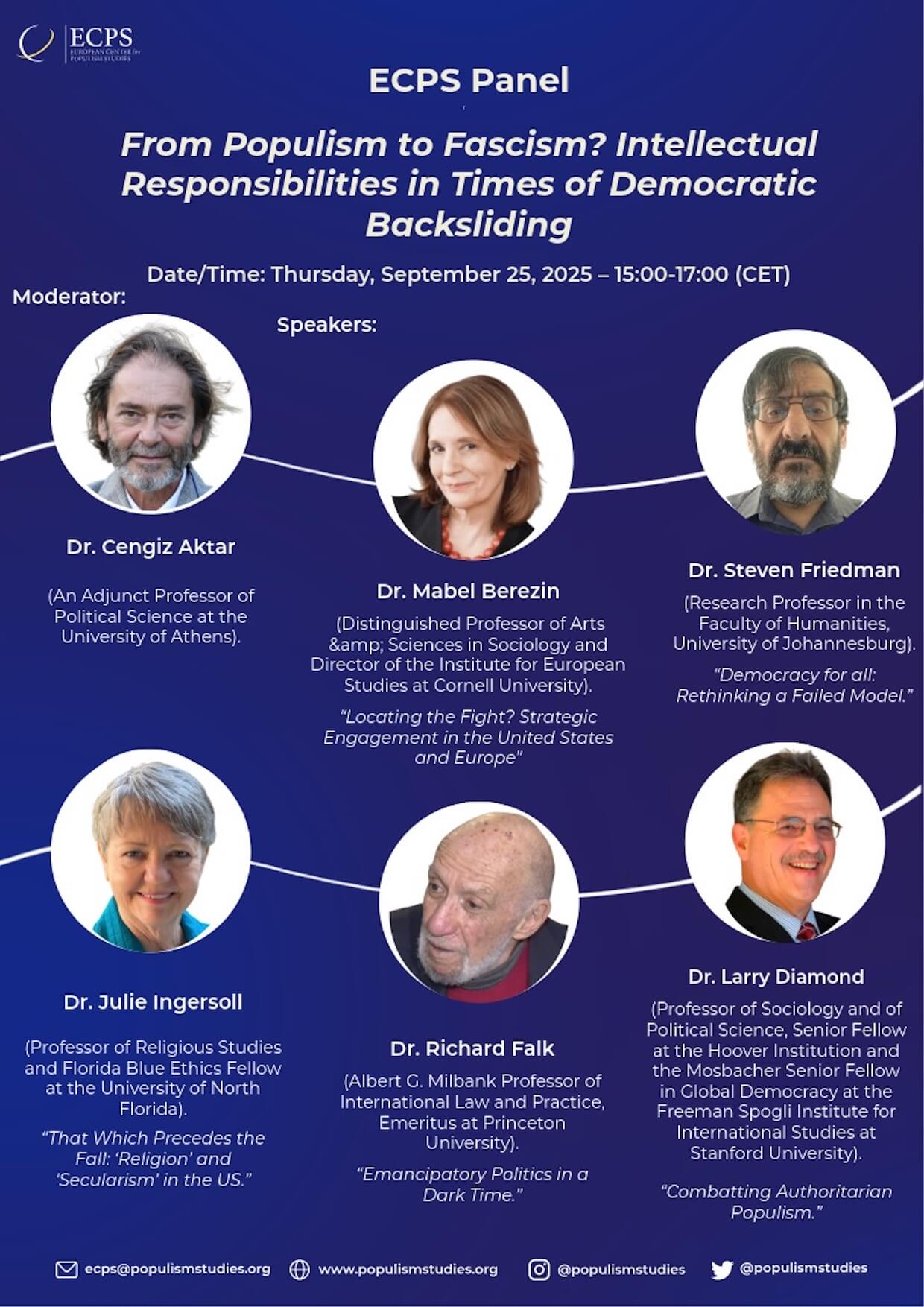
A Far-Right Surge Would Bring Further Protectionism and Economic Fragmentation
What are the economic risks if the far right gains further power in Europe? Could we see increased protectionism and economic fragmentation within the EU itself?
Professor Cornelia Woll: Yes, I think the answer is quite simple—yes. And I’ll give you one example. Every far-right party includes economic protectionism on their agenda, across all domains—whether it is student mobility, economic exchange, or military investment. So, it is quite a clear tendency.
With China, Russia, and other powers seeking to establish alternative economic alliances, do you see the possibility of a post-Western economic order emerging? What role, if any, will Europe play in this transition?
Professor Cornelia Woll: Yes, a post-Western economic order is emerging, and it has been for quite some time—over the past 20 years, I would say. If you look at the economic connections China has built through its initiatives to establish new trade routes across Asia and toward Europe, it is quite clear. The same is true of its investments in Africa and its support for countries struggling with sovereign debt. Many of these nations now turn to China as a lender of last resort, a role previously played only by multilateral institutions.
We already see a stable and strong Chinese sphere of influence, which is now challenging the structure of multilateral institutions established under the Bretton Woods system. As a result, these institutions must be redesigned and revised to continue playing a role in global economic cohesion. However, they are struggling to fulfill the functions for which they were originally created.
What role can Europe play? The reason, for example, that the International Monetary Fund (IMF) is not as inclusive of Chinese interests as it should be is not due to European opposition but rather to opposition from the US. I believe Europe must decide whether to align entirely with US interests, which are strongly anti-Chinese, or to position itself as a third force in the geopolitical struggle between China and the US. In my opinion, the latter would be the better path forward.
Trump, Vance and Musk Are Advancing Russia’s Interests
Matryoshka dolls featuring images of Vladimir Putin and Donald Trump displayed at a souvenir counter in Moscow on March 16, 2019. Photo: Shutterstock.
US Vice President J.D. Vance and Elon Musk have both lent support to the AfD, which is surprising given that they come from the US—a country Germans have long thanked for putting an end to a deeply shameful period in their history. Do you think this approach signals the end of bilateral relations between the US and Germany as we know them?
Professor Cornelia Woll: Well, it certainly makes clear to Germans that the US, even with its capacities in government, will pursue objectives that are contrary to what Germany considers its own security and national interests. Let me put it very bluntly: what Elon Musk, J.D. Vance, and Donald Trump are currently doing is supporting Russia’s interests. I think the majority of Germans still believe that this is not in Germany’s best interest or in the best long-term development of the country. This is not just because of Germany’s own history and the National Socialist period, but also because of what it would mean for Russia’s influence in Germany.
And lastly, Professor Woll, in his speech to the Munich Security Conference, J.D. Vance called Europe’s restrictions on speech a greater threat than a military attack by Russia or China, comparing them to those imposed by the Cold War Soviet Union. What is your reaction to this statement?
Professor Cornelia Woll: I don’t know if one should even react because everyone in the room—and I was in the room when he gave that speech—was well aware of the hypocrisy in J.D. Vance’s declarations about incidents in Europe. This comes at a time when the Trump administration is firing the head of an art institution, the Kennedy Center, attacking Wikipedia, and targeting public radio and NPR. It is a common strategy for the Trump administration to accuse others of doing precisely what they themselves are doing. So, it was quite a hypocritical statement.
Beyond that, his remarks were purely national in scope. It was a domestic campaign speech, similar to many others heard during an election cycle—nothing new.
The fact that he delivered it at a security conference, however, was, I think, a sign of J.D. Vance’s weakness in international discussions. Trump had just stated his intention to negotiate with Russia and was preparing talks with Saudi Arabia. I believe the last thing he wanted was for his Vice President to make any statements that could be considered newsworthy or that might contradict Trump’s own diplomatic efforts. As a result, J.D. Vance had to deliver a speech that was purely focused on domestic politics and did not address the security concerns of anyone else in the room.
As for the content, the attacks were so obviously false that I don’t think it is even worth deconstructing. Free speech is under far greater threat in Russia than in Europe. The anecdotes he cited—half of which may not have been as accurate as he claimed—do not change this reality. I won’t go into the details because doing so would give too much credit to the fake news bubble that J.D. Vance was catering to.
Yilmaz, Ihsan & Morieson, Nicholas. (2024). Authoritarian Populist ‘Civilization-States’ and Their Influence in Africa: Hard and Soft Powers of TRIC. European Center for Populism Studies (ECPS). December 11, 2024. https://doi.org/10.55271/rp0092
Turkey, Russia, India, and China (TRIC) are reshaping the power dynamics in Africa, challenging Western dominance and promoting alternative development models. These nations leverage their untarnished histories with Africa and emphasize shared anti-colonial struggles to position themselves as allies of the Global South. However, their competition is far from altruistic. Beneath promises of “no-strings-attached” aid lies a strategic pursuit of resources, trade, and influence. While they share a common goal of diminishing Western power, TRIC nations also compete fiercely with each other, making Africa a critical battleground in the quest for a multipolar world order.
Africa has become the focal point of a new great power struggle, reminiscent of the Cold War but with a distinctly civilizational dimension. Unlike the colonial powers of the past, today’s major actors—Turkey, Russia, India and China (TRIC)—position themselves as allies of the Global South, presenting alternative paths to modernization that challenge Western dominance. This competition is driven by the pursuit of Africa’s vast natural resources, strategic geographic positions, and potential economic partnerships.
The new great power competition in Africa is reshaping the continent’s political, economic, and security landscape. Unlike the colonial era, this competition is characterized by a narrative of anti-Western solidarity, TRIC states present themselves as alternatives to the Western model of development. Each position itself as a partner of Africa, offering infrastructure investments, trade, and security assistance without the liberal democratic conditions often attached to Western aid. At stake are billions of dollars in trade, access to critical minerals, and influence over strategic regions.
Turkey leverages its Ottoman heritage and cultural ties, combining soft power initiatives like education and humanitarian aid with increasing defense exports. Russia, through its Wagner Group and strategic partnerships, combines military assistance with anti-colonial rhetoric. India emphasizes historical ties and South-South cooperation while expanding its trade and energy partnerships across Africa. China leads this competition with extensive infrastructure projects, debt financing, and its Belt and Road Initiative, offering a model of authoritarian modernization.
These nations share a common goal: diminishing Western influence and promoting a multipolar world order. Their efforts resonate in Africa, where Western powers are criticized for their colonial past and for attaching conditions to aid. However, the involvement of these new great powers is not purely altruistic. Their strategies often involve competing among themselves for resources, markets, and geopolitical influence, with some adopting hard power tactics that echo the imperialism of the past.
This report provides actionable recommendations for policy makers, NGOs, and academics in both liberal democracies and African nations, aiming to navigate this evolving geopolitical landscape while prioritizing Africa’s autonomy and development goals. It underscores the importance of collaboration, transparency, and shared values to ensure a balanced and equitable future for Africa in the global order.
Shared Motivations: Turkey, Russia, India and China seek to diminish Western influence, particularly that of the United States, in Africa. Each nation emphasizes a historical absence of colonial exploitation in Africa, contrasting their engagement with the imperialist history of the West.
Civilizational Narratives: China and Turkey assert the superiority of their civilizational values over Western norms, presenting themselves as models of development without liberal democratic constraints. Russia and India leverage their shared anti-colonial history with Africa, portraying themselves as partners in the broader fight against Western imperialism.
Strategies: Soft Power – All four nations employ development aid, infrastructure projects, and educational programs to gain influence. China leads in infrastructure, while Turkey and India focus on cultural and educational ties. Hard Power – increasing military engagements, such as China’s Djibouti base and Turkey’s defense agreements with African states, demonstrate a willingness to use force to secure interests. Russia’s Wagner Group and India’s naval presence underscore their strategic ambitions.
Opportunities and Risks: These powers offer no-strings-attached aid and economic partnerships, appealing to African leaders wary of Western conditionality. However, their growing use of hard power raises concerns about neo-imperialism, resource exploitation, and authoritarian influence, challenging the narrative of altruistic partnership.
Competing Interests: Despite a shared goal of diminishing US hegemony, China, Russia, Turkey, and India increasingly compete with one another for influence, creating potential flashpoints in regions like East Africa.
The new great power competition in Africa represents a complex struggle involving economics, geopolitics, and ideology. While China, Russia, Turkey, and India align in their opposition to Western dominance, they also vie against each other for strategic advantage. This competition challenges the liberal democratic order, offering Africans alternative development models rooted in authoritarian governance and civilizational narratives.
As these powers expand their presence, the risk of militarization and resource-driven exploitation grows, underscoring the complexity of Africa’s geopolitical landscape. For liberal democracies, this competition highlights the need for a recalibrated approach to African engagement. Transparent partnerships, infrastructure investments, and strengthened support for democratic institutions can counterbalance authoritarian models.
For African nations, this dynamic presents both opportunities and challenges. Leveraging this competition to secure fairer terms for trade, development aid, and security assistance is essential to preserving sovereignty and fostering sustainable growth. Engaging with these emerging powers could accelerate development, but it may also erode democratic governance and foster dependency.
Meanwhile, the United States and its allies must reassess their strategies to remain relevant in a multipolar Africa. This evolving contest reflects a broader global shift toward multipolarity, with Africa positioned as a pivotal arena in the battle to reshape the post-Cold War world order.
Statue of a child slave in Zanzibar. Photo: Shutterstock.
In the 19th century, the competition among Europe’s major powers led to the invasion and colonization of almost the entire African continent. However, drawing a direct analogy between today’s great power competition in Africa and the colonial era oversimplifies the dynamics at play. Unlike the previous scramble for Africa, the so-called “New Scramble for Africa” (The Economist, 2019) might bring tangible benefits to ordinary Africans.
Africa, despite being the poorest inhabited continent, remains a region of immense potential. Its vast oil and mineral wealth, coupled with significant agricultural resources, are juxtaposed with widespread poverty. Yet, there are reasons for cautious optimism about Africa’s future. The continent is increasingly recognized as a region of strategic importance by global powers such as China, Russia, and the United States, as well as regional actors like Turkey and India. Africa’s importance is rooted in its rapidly growing population—projected to be the largest globally by the end of the century—and its abundant natural resources, including minerals essential for emerging technologies like electric vehicles and mobile phones. While much of the developed world grapples with aging populations and declining fertility rates—some, like China, even confronting the paradox of growing old before achieving widespread prosperity—Africa’s demographic trends point to a youthful and dynamic future.
Between 2000 and 2020, African nations experienced stable economic growth (Zajączkowski & Kumar, 2020), a trend that has continued largely uninterrupted in sub-Saharan Africa, except during the COVID-19 pandemic. By the mid-2010s, Africa’s economic performance surpassed that of other developing regions such as Latin America and Southeast Asia (UNECA, 2015; African Development Bank, 2014, 2015). This growth has often been driven by internal demand, including private consumption, public infrastructure investment, and expanding trade ties with emerging markets (African Development Bank, 2019). Projections estimate that by 2060, Africa’s middle class will reach 1.1 billion people—approximately 50% of the continent’s population (UNECA, 2015; African Development Bank, 2012).
Despite these promising trends, Africa currently accounts for just 3% of global trade (African Development Bank, 2012; UNECA, 2013). However, the continent’s youthful population, rapid urbanization, and expanding educated middle class are transforming it into an increasingly attractive destination for foreign investment. Nations such as China, Russia, India, Turkey, the United States, and European powers are deepening their engagement with Africa, driven by a mix of strategic, economic, and geopolitical interests.
The competition among these major powers has the potential to create a win-win scenario for Africans. By leveraging rivalries, African nations could secure better investment deals and improved terms of engagement. However, there are risks. This competition could result in increased external support for corrupt or oppressive leaders as foreign powers prioritize their strategic goals over good governance. Nevertheless, the potential benefits are evident: increased investment can create jobs, improve infrastructure, and enhance Africa’s influence within global institutions. For emerging global powers, Africa represents an opportunity not only to boost national wealth and secure access to critical raw materials but also to expand their global influence and military reach, often at the expense of established powers like the United States.
China, Russia, Turkey, and India, in particular, are deepening their economic, diplomatic, and military ties with African states using a mix of soft power, sharp power, and, occasionally, hard power.
The civilizational populism promoted by emerging powers like Turkey, China, and others provides a distinct alternative to the Western liberal democratic model. These nations seek to position themselves as “civilization-states,” claiming to reconnect with the values and traditions that historically made their societies great. This strategic positioning not only challenges the hegemony of liberal democratic norms but also resonates with African states seeking development paths that reject Western-imposed conditions and values.
In Turkey, the ruling Justice and Development Party (AKP) under Recep Tayyip Erdogan exemplifies this civilizational populism. Erdogan’s leadership employs a dual narrative: domestically, he positions himself as the defender of Islamic values against secularist elites, and internationally, he portrays Turkey as the protector of Muslim interests against Western dominance (Yilmaz & Bashirov, 2018; Yilmaz & Morieson, 2022). By framing Turkey as the heir to Ottoman-Islamic civilization, Erdogan not only consolidates his domestic support but also positions Turkey as a leader of the Muslim world (Yilmaz & Morieson, 2023). Central to this strategy is the AKP’s rhetoric, which invokes collective historical traumas and fears. This securitization narrative portrays Turkey as a nation under constant threat from internal and external enemies, including Western powers, secularists, and minority groups (Yilmaz & Shipoli, 2021). By doing so, Erdogan legitimizes authoritarian measures, silences dissent, and garners support for Turkey’s active role in global anti-Western coalitions (Yilmaz, Shipoli, & Demir, 2021).
In addition, civilizational populism heavily relies on narratives of victimhood. Erdogan’s political strategy has evolved to incorporate both national and manufactured victimhood narratives, which resonate deeply with his base. These narratives amplify historical grievances and create a sense of solidarity among supporters, portraying the AKP and its leader as the only forces capable of defending the “true” Turkish identity (Morieson, Yilmaz, & Kenes, 2024). These strategies extend beyond domestic politics to foreign policy. By aligning with anti-colonial sentiments and emphasizing solidarity with historically marginalized nations, Turkey appeals to African states as a partner that understands their struggles. Unlike the West, which ties aid and investment to democratic reforms, Turkey offers “no-strings-attached” assistance, furthering its influence in regions seeking alternatives to Western conditionalities (Yilmaz & Morieson, 2022). This model of civilizational populism not only undermines liberal democratic norms but also demonstrates the AKP’s ability to adapt its messaging to different audiences. By emphasizing shared grievances and cultural pride, the AKP constructs a narrative of unity and resistance that resonates globally while reinforcing its domestic authority (Yılmaz, 2021).
These civilization-states emphasize anti-colonial solidarity and highlight their success in achieving economic growth without adhering to Western norms. Their strategies are designed not only to challenge American hegemony but also to position their governance models as viable alternatives to liberal democracy.
This report examines the strategies employed by China, Russia, Turkey, and India in Africa, focusing on their use of soft and hard power and their framing of themselves as civilization-states offering alternatives to Western liberalism. By analyzing their approaches, this report seeks to understand how these powers influence Africa’s development trajectories and what this means for the future of global power dynamics.
The Turkish Islamist humanitarian aid foundation IHH serves as one of the key instruments of the Erdogan regime’s policies in Africa. African children participate in activities promoting IHH in Niamey, Niger, on December 20, 2017. Photo: Burak Tumler.
Turkey’s Erdogan-led AKP government has demonstrated unprecedented interest in Africa, establishing 26 new embassies and 12 consulates across the continent since 2010, bringing the total to 44 (The Economist, 2019). This outreach aligns with Erdogan’s increasingly anti-Western national ideology, which portrays Turkey as both a defender of Islam and the downtrodden peoples of the global south (Yilmaz and Morieson, 2023). For Erdogan, Africa represents a region with deep-seated resentment toward Western powers and a positive perception of Turkey and the Ottoman Empire, offering opportunities to cultivate trade partnerships and secure diplomatic support in international bodies, including the United Nations.
Historically, Turkey’s engagement with Africa was limited. While the Ottoman Empire maintained ties with North Africa, the Republic of Turkey largely ignored the continent, focusing instead on Europe until the 1990s (Tepecikliogu, 2017). This neglect was shaped by Africa’s colonial history, Turkey’s pro-European orientation under Kemalist rule, and Cold War dynamics that placed much of Africa under American or Soviet influence.
Erdogan has contrasted Turkey’s approach with that of Western powers, emphasizing solidarity over exploitation. During the COVID-19 pandemic, he criticized Europe’s failure to provide vaccines to Africa, contrasting it with Turkey’s medical aid (Aydın-Düzgit, 2023). He has frequently highlighted Europe’s selective application of universal values, pointing to the neglect of African refugees and Western double standards on human rights. According to Erdogan, “The EU is not in a position to defend all its self-proclaimed universal moral values while it turns a blind eye to sinking boats in the Mediterranean, building wire fences, and adopting a push-back policy” (Aydın-Düzgit, 2023).
Erdogan positions Turkey as a country free from colonial baggage, committed to anti-imperialism, and sharing values with Africa. He frames Turkey’s engagement as rooted in sincerity, brotherhood, and solidarity, rejecting “old colonial practices with new methods” (Aydın-Düzgit, 2023). Erdogan’s rhetoric emphasizes a “unique economic and development model” that Turkey can export to help Africa prosper without adopting exploitative or neo-colonial practices.
This narrative blend promises of mutual economic growth with appeals to shared values and opposition to the West. Erdogan adeptly connects Europe’s colonial legacy with its modern policies, particularly in redistributive justice. For instance, he has contrasted Turkey’s pandemic aid with Europe’s vaccine withholding, presenting Turkey as a genuine partner in Africa’s development (Aydın-Düzgit, 2023).
Turkey’s African policy underwent a significant transformation in the post-Cold War era. After the European Union (EU) rejected Turkey’s membership, Ankara adopted a multidimensional foreign policy, moving away from exclusive Western alignment (Tepecikliogu, 2017). The “Opening to Africa Policy” of 1998 marked the beginning of this shift, with economic priorities playing a growing role. This approach intensified under the AKP government, which, after facing resistance to EU membership, turned to cultivating alliances in non-Western regions, including Africa.
In 2005, Erdogan’s government declared “The Year of Africa,” with Erdogan becoming the first Turkish prime minister to visit Sub-Saharan Africa. Turkey’s economic growth under AKP leadership enabled the country to pursue a proactive foreign policy, focusing on the African continent as a region of strategic importance (Tepecikliogu, 2017). Today, Turkey positions itself as a reliable partner, offering an alternative to Western dominance while strengthening its presence in Africa through economic, cultural, and diplomatic initiatives.
Turkey’s soft power initiatives in Africa have been complex, leveraging humanitarian aid, education, religion, media, and infrastructure development. This aligns with President Erdogan’s increasingly anti-Western national ideology, which frames Turkey as both a defender of its people and Islam, as well as a spokesperson for the downtrodden peoples of the global south (Yilmaz & Morieson, 2023). In Africa, Erdogan perceives a continent harboring understandable resentment toward Western powers and views it as a region where Turkey and the Ottoman Empire are remembered positively. This creates opportunities for Turkey to gain trade partnerships and secure diplomatic support in international organizations such as the United Nations.
Historically, the Ottoman Empire maintained close ties with North Africa, but the Republic of Turkey largely ignored the continent, focusing instead on Europe until the 1990s (Tepecikliogu, 2017). This neglect stemmed from Africa’s colonial history, Turkey’s pro-European orientation under Kemalist rule, and Cold War dynamics that left Africa under American or Soviet influence. However, Turkey’s interest in Africa increased following the Cold War, particularly as its relevance to the US and Europe waned and its bid for EU membership was rejected. In 1997, Turkey adopted a multidimensional foreign policy, diversifying its alliances beyond the West (Tepecikliogu, 2017). This shift included the 1998 “Opening to Africa Policy,” which coincided with the rise of a new Turkish bourgeoisie influencing foreign policy through economic priorities.
Under the Erdogan-led AKP government, which came to power in 2002, efforts to enhance trade and relations with non-Western states, including African nations, accelerated. When it became clear that the EU was reluctant to accept majority-Muslim Turkey, Erdogan sought to build alliances in regions like Africa. Economic growth under AKP rule enabled a proactive foreign policy, and 2005 was declared “The Year of Africa.” Erdogan became the first Turkish prime minister to visit Sub-Saharan Africa, signaling Turkey’s increasing focus on the continent.
In a 2011 speech in Mogadishu, Erdogan underscored Turkey’s commitment to Africa, describing the continent as “the cradle of civilization and one of the epicenters of the future of humanity.” He expressed support for “African ownership of African issues” and highlighted Turkey’s role as a “strategic partner of the rising Continent of Africa” (Ministry of Foreign Affairs, 2011). This rhetoric emphasized Turkey’s distinction from Western powers often viewed as exploitative (Voice of America, 2024). Unlike Western nations, Turkey’s aid comes with few or no conditions regarding governance or human rights reforms, a stance that resonates with many African governments (GIS Reports, 2024). Erdogan has presented Turkey as an alternative to the West, emphasizing sincerity and partnership rather than exploitation (Voice of America, 2024).
Turkey’s engagement in Africa has primarily centered on humanitarian aid and development assistance, which complement its commercial interests (Tepecikliogu, 2017). Selin Gucum of the Observatory of Contemporary Turkey noted that Turkey has capitalized on African efforts to reduce reliance on former colonial powers for aid and security (Voice of America, 2024). Analysts like Teresa Nogueira Pinto highlight that Turkey avoids making its assistance conditional on governance or human rights, a key factor distinguishing it from Western aid models (GIS Reports, 2024).
Education has played a pivotal role in Turkey’s soft power strategy. Initially, the Gulen movement opened schools across Africa, but following the failed 2016 coup, which the AKP blamed on Gulen, these schools were replaced by the Maarif Foundation, which now operates 140 schools in Africa, educating 17,000 students (Daily Sabah, 2021). Additionally, approximately 60,000 African students currently study in Turkey, fostering cultural and educational ties (TRT Africa, 2023).
Religion is another significant element of Turkey’s approach, particularly in Muslim-majority countries or those with sizable Muslim minorities. Turkey-funded mosques and schools promote socially conservative values that resonate with many Africans, especially in opposition to Western liberal norms. Erdogan’s rhetoric against LGBTQ+ rights and his emphasis on traditional family values often find a receptive audience in Africa (Voice of America, 2024).
Media has become an avenue for Turkish influence, with state broadcaster TRT reaching African audiences in multiple languages, including local African dialects. This allows Turkey to promote pro-Turkish narratives and portray itself as a friend to Africa while casting its adversaries as enemies of the African people.
Turkey has also invested in diplomatic training to strengthen ties with African nations. Since 1992, its Diplomacy Academy has trained 249 African diplomats through its International Junior Diplomats Training Program, aimed at capacity building and enhancing human resources upon requests from African foreign ministries (Ministry of Foreign Affairs, 2022).
Infrastructure development further cements Turkey’s presence in Africa. Turkish Airlines (THY), for example, flies to 62 African cities, including Mogadishu, Somalia, where its planes land at an airport built with Turkish funds and expertise. This demonstrates Turkey’s commitment to connecting Africa with global markets and boosting tourism (Němečková & Varkočková, 2024).
Humanitarian aid, particularly disaster relief, has been another cornerstone of Turkey’s soft power. During Somalia’s 2011 famine, Turkey provided substantial aid, with Erdogan himself visiting the country to highlight the crisis and Turkey’s role in alleviating it. This not only improved Turkey’s image but also opened doors for Turkish businesses and NGOs to contribute to Somalia’s reconstruction. Somalia became a litmus test for Turkey’s Africa policy, with Ankara playing a mediating role in the country’s internal conflicts (Tepecikliogu, 2017).
Turkey’s initiatives extend beyond aid. It is exploring oil and gas opportunities off the coasts of Libya and Somalia in partnership with local governments (Daily Sabah, 2024). Like other rising powers, Turkey’s involvement in Africa is driven by both economic ambitions and a desire to expand its influence on the continent.
Erdogan’s rhetoric and policies have effectively positioned Turkey as a unique and reliable partner for African nations, contrasting sharply with Western approaches and emphasizing shared values, solidarity, and mutual growth. Through complex soft power initiatives, Turkey has carved a significant role for itself in Africa’s development narrative while pursuing its broader geopolitical and economic interests.
Turkey’s engagement in Africa extends well beyond disaster and famine aid. Today, Turkey is actively exploring oil and gas opportunities off the coasts of Libya and Somalia in collaboration with local governments (Daily Sabah, 2024). Like the BRICS group and Western powers, Turkey’s initiatives in Africa aim to achieve both economic gains and growing geopolitical influence on the continent.
Turkey has earned a reputation as a reliable partner in delivering major projects on time, which has enhanced its value across Africa. According to the Turkish Ministry of Foreign Affairs, Turkey-Africa trade reached $34.5 billion annually in 2022, up from $5.4 billion in 2003—an extraordinary increase that underscores the economic rise of African nations and Turkey’s expanding interest in the region (Ministry of Foreign Affairs, 2022). President Erdogan’s anti-colonial rhetoric further positions Turkey as a trusted ally of Africa, contrasting its sincerity with the perceived exploitation by Western powers. Erdogan also emphasizes Turkey’s unique economic model as a potential roadmap for Africa’s development (Aydın-Düzgit 2023).
Turkey’s hard power approach became more prominent in the 2010s, particularly during the Arab Uprisings and subsequent conflicts. The 2020 Libyan civil war marked a significant shift in Turkey’s foreign policy, as Ankara supported the Tripoli-based government by deploying unmanned aerial vehicles (UAVs) and naval forces to counter Russian-backed factions. This intervention showcased the effectiveness of Turkish military technology, especially drones, which have since become highly sought after by African nations (GIS Reports, 2024).
The defense industry has been a major beneficiary of improved Turkey-Africa relations. Turkey has increasingly signed arms deals with African governments, leading to a fivefold growth in defense and aerospace exports to the continent—from $82.9 million in 2020 to $460.6 million in 2021 (Ministry of Foreign Affairs, 2022; Demirdirek & Talebian, 2022). While still a small fraction of total arms sales to African states, this growth highlights Turkey’s expanding role as a defense partner. Despite its focus on humanitarian assistance and economic partnerships, Turkey’s security and defense sectors see Africa as a growing market for military goods.
Turkey’s intervention in Libya likely had two main objectives: securing access to the Libyan coast and maritime boundaries, and countering Arab and Russian influence in the region. Turkey’s successful defense of the Tripoli government relied heavily on-air superiority and UAV technology, demonstrating both the effectiveness of its military prowess and the utility of its hardware in modern conflicts.
Following the Libya intervention, Turkish UAVs gained popularity in Africa. Analysts note that Turkish defense products offer significant advantages to African countries—they are affordable, reliable, and battle-tested in Libya, Syria, and Ukraine (GIS Reports, 2024). For nations grappling with insurgent movements, porous borders, and under-resourced armies—such as Togo, Niger, Nigeria, and Somalia—Turkey’s drones and counterterrorism expertise have become especially valuable.
Turkey is primarily a supplier of arms and military training rather than an active combatant in Africa’s wars. It has signed defense agreements with countries including Somalia, Ethiopia, Ghana, Kenya, Nigeria, and Rwanda, with expected agreements in Uganda and Mozambique. These agreements often encompass security provisions, technical support, and arms sales, though some, like the Mozambique deal, also involve sharing military intelligence (GIS Reports, 2024).
Somalia remains Turkey’s closest partner in Africa. In 2017, Turkey established a large foreign military base in Mogadishu and has since provided extensive training to Somali soldiers engaged in the fight against al-Shabaab, a terrorist group linked to al-Qaeda (Atlantic Council, 2024). Such defense agreements serve not only Turkey’s strategic interests but also reinforce its image as a significant ally of African stability. Alper Aktas, Turkey’s ambassador to Somalia, remarked, “[Turkey] never considered Somalia’s stability separately from our own country’s stability” (ADF, 2024). Erdogan describes Turkey as an “Afro-Eurasian” country, sharing common values and interests with African nations (Politics Today, 2022).
Turkey has positioned itself as a reliable alternative to Russia, China, France, and the United States in supplying arms to Africa. Abel Abate Demissie, an associate fellow at Chatham House, observes that “Turkey provides a means of actually purchasing military hardware” (DW, 2022a). African nations are particularly interested in Turkish-manufactured armored vehicles, naval equipment, infantry weapons, and drones (DW, 2022a).
By deepening its defense partnerships and increasing arms sales, Turkey not only enhances its influence in Africa but also pushes back against competing powers like Russia and China. These efforts underscore Turkey’s broader strategy to carve out its sphere of influence on the continent while presenting itself as a reliable and cooperative partner to African states.
T-shirts for sale at Windhoek Market alongside a portrait of Putin in Windhoek, Namibia, on March 26, 2023. Photo: Shutterstock.
Russia developed strong relationships with African states during the Soviet era, competing with the United States to gain influence across the continent and spread its communist ideology. The Soviets offered development aid and, crucially, solidarity with leftist regimes fighting colonialism and Western imperialism, effectively capitalizing on widespread anti-Western sentiment in Africa (Bienen, 1982). After the collapse of communism, however, Russia struggled to compete with the United States in terms of soft and hard power, as it lacked the resources and global reach of its Soviet predecessor. Nonetheless, because Russia had minimal involvement in the colonization of Africa in the 19th and early 20th centuries, it continued to be perceived by many Africans as a friend to their people and an opponent of Western colonialism and exploitation.
In the post-Soviet era, Russia has consistently sought to maintain its influence in Africa, with efforts expanding significantly under Vladimir Putin’s regime. Putin’s government emphasizes Russia’s historic ties to Africa and its opposition to Western colonialism. For instance, at the second annual Russia–Africa Summit held in St. Petersburg in July 2023, Dmitry Medvedev, Deputy Chairman of the Security Council of Russia, declared that Russia would “pursue avenues that would liberate sovereign states from their colonial heritage.” This statement underscored Russia’s ongoing strategy of supporting anti-Western dictatorships and regimes that defy liberal norms. In exchange for Russian development and military aid, these regimes provide diplomatic backing for Russian initiatives in international bodies, including the United Nations Security Council.
In a 2022 speech in Moscow, Putin elaborated on his anti-Western narrative, blaming the “West,” particularly the “Anglo-Saxons,” for colonialism and the slave trade (Meduza, 2022; President of Russia, 2022). He portrayed the Soviet Union and Russia as leaders of the 20th-century anti-colonial movement—a legacy, he argued, that the West has never forgiven. Putin framed Russia’s current opposition to Western liberalism and atheism as a continuation of its historic resistance to colonialism. According to this narrative, the West seeks to eradicate traditional ways of living and religious practices, while Russia, as a civilization-state, stands as a protector of Orthodox Christianity, Islam, and other faiths (Meduza, 2022; President of Russia, 2022).
Putin further claimed that the promises of democracy and wealth from the West have consistently led to poverty, imperialism, and the erosion of cultural and religious traditions in societies they influence. He argued that the West’s quest for “total domination” drives it to eliminate “sovereign centers of global development,” even by force if necessary (Meduza, 2022; President of Russia, 2022). While this rhetoric may not carry the same ideological weight as it did during the Soviet era—when communism provided a compelling alternative to capitalism—it resonates in regions like Africa, where anti-Western sentiments remain strong, and where Western promises of democracy and development often fail to meet expectations.
In Africa, Putin’s anti-Western narrative finds an audience, particularly in areas with strong religious conservatism and enduring memories of colonial humiliation. Russia’s framing of itself as a champion of traditional values and a defender against Western imperialism bolsters its appeal, even as its actual resources and influence remain limited compared to its Soviet predecessor. This narrative continues to shape Russia’s engagement with African states, aligning with its broader geopolitical goals of challenging Western hegemony and asserting its role as a sovereign center of global influence.
The Putin regime does not, of course, rely solely on rhetoric to spread its influence across the African continent. Instead, it employs a range of soft and hard power programs designed to elicit support and back friendly nations in Africa. However, the institutions that Russia builds across Africa consistently promote a narrative blaming the West for Africa’s challenges and portraying Russia as an opponent of Western imperialism.
Russia’s overall strategy in Africa can be summarized as a combination of stabilizing the region to facilitate mineral extraction, opening alternative markets for its energy exports, and leveraging anti-colonial rhetoric and aid to win the support of African nations. While Russia does not actively seek to suppress democracy in Africa, the Putin regime has no qualms about supporting repressive regimes and often prefers dealing with authoritarian governments over democracies. Russia is particularly interested in competing with other global powers, including the United States, France, China, and Turkey, for influence in Africa. To this end, it portrays itself as a long-standing ally of the African people, emphasizing its history of supporting independence movements.
The Putin regime maintains ties with friendly African states by fostering collaboration between Russian and African educational institutions, building schools and training facilities, and assisting in securing mining operations and combating insurgencies. This latter aspect often involves the Wagner Group, whose activities in Africa have a mixed record. In 2024, the Wagner Group’s operations were incorporated into Russia’s Ministry of Defense’s African Corps.
Russia’s soft power efforts in Africa primarily focus on spreading Russian culture and language. Russian cultural centers operate in over 80 countries, including South Africa, Tanzania, and Ethiopia, offering Russian language courses and promoting Russian literature. Since 2019, Russia has expanded its language education initiatives to include 28 nations, with a goal of reaching at least 50. It also aims to follow the lead of China and France in admitting talented Africans to its universities to strengthen Africa-Russia ties.
Although Russia has succeeded in garnering support from some African states, including abstentions during votes condemning Russia’s invasion of Ukraine, it would be misleading to assume uniform support across the continent or consistent alignment with Russia in UN General Assembly voting (Carnegie Endowment, 2023). Russia’s popularity is not universal in Africa. Despite mostly positive relationships with some countries, it faces competition from wealthier nations better equipped to facilitate development.
Since 2003, Russia has established physical Russian language schools in Africa under the Russky Mir Foundation (Russian World Foundation). These schools teach Russian language and culture, often in collaboration with African governments and universities, such as those in the Democratic Republic of Congo, Zambia, and Namibia (African Digital Democracy Observatory, 2024). In return, Russia has pledged to teach African languages in Moscow schools, signaling respect for African cultures and languages (African Digital Democracy Observatory, 2024).
Russia has also increased its engagement with higher education institutions in Africa, launching the Russian-African Network University consortium in 2023. This initiative includes agreements with various Malian institutions, such as the National School of Engineering, the University of Humanities and Social Sciences, and the Private University Ahmed Baba (African Digital Democracy Observatory, 2024). These projects complement earlier Soviet-era initiatives, such as the university established in Egypt in 1960, underscoring Russia’s historical and ongoing interest in African education.
Olena Snigyr argues that Russian educational and cultural initiatives aim to expand a shared knowledge base and foster ideological alignment. Educational cooperation, Russian language and culture programs, and journalist training are central to Russia’s strategy of disseminating its narratives and ideas (FPRI, 2024). According to Snigyr, Russia’s narrative of “modernization with Russia” appeals to African nations struggling with poverty despite resource wealth, offering a partnership model distinct from the conditional aid frameworks of Western countries.
Russia positions itself as a protector of African interests, advocating for fairer representation in international organizations such as the UN, opposing foreign interference in political regimes, and supporting traditional values in African societies (FPRI, 2024). However, its impact remains limited. Only about 35,000 African students are currently enrolled in Russian universities, and the Russian-African Network University involves just 75 Russian and 27 African institutions, with significant participation from Zimbabwe (FPRI, 2024). Nonetheless, initiatives like the Consortium of Universities “Subsoil of Africa” at St. Petersburg Mining University, which includes over 130 organizations from 42 African countries, demonstrate Russia’s ambition to deepen collaboration with Africa on its own terms (FPRI, 2024).
In 2023, Russia diversified its educational initiatives, including courses in religion and journalism. For example, it signed an agreement with Burkina Faso to collaborate on secular and Islamic education to combat radical Islam (Russian Mufties Council, 2023). Additionally, partnerships with Nigeria focus on advanced technological education, such as robotics, microelectronics, and 3D printing, while negotiations with South Sudan involve constructing a refinery (African Digital Democracy Observatory, 2024). Events like robotics and astronomy workshops in Tanzania, which featured a cosmonaut and attracted 800 students, further underscore Russia’s investment in portraying itself as a technological power in Africa (RT, 2023; Daily News, 2023).
These soft power efforts, while not unique to Russia, are integral to its strategy of portraying itself as a non-imperialist, anti-colonial partner to Africa. Russian Foreign Minister Sergei Lavrov has emphasized Russia’s appreciation for African states that resist Western pressure, framing the partnership as one of mutual respect and shared interests (Kornegay, 2023). This rhetoric has helped Moscow persuade some African states to resist Western sanctions imposed on Russia after its invasion of Ukraine. However, many African states continue to trade with Russia out of necessity, as food and energy shortages leave them little choice but to prioritize their immediate needs over geopolitical alignments.
Russian use of hard power in Africa has become increasingly prominent since 2017, largely through the activities of the Wagner Group, a private military company advancing Russian interests across the continent, often in opposition to Western priorities. The Wagner Group has been active in several African states, most notably the Central African Republic (CAR), Sudan, and Libya.
The Wagner Group, founded by Yevgeny Prigozhin, gained prominence during Russia’s 2014 invasion of Ukraine and annexation of Crimea. While commonly referred to as a single entity, it is better described as a complex network of businesses and mercenary groups operating in conflict zones and even in alleged peacekeeping operations worldwide (Council on Foreign Relations, 2023). Before 2023, the Wagner Group operated somewhat independently of the Kremlin. However, following its apparent rebellion against the Putin regime and Prigozhin’s mysterious death in an air crash, the group has operated as an instrument of the Russian state, with much of its operations absorbed into the Ministry of Defense in 2024. Even prior to these events, the Wagner Group was closely aligned with Kremlin objectives, despite its profit-driven motivations.
In Africa, the Wagner Group has approximately 5,000 personnel, including former Russian soldiers, convicts, and foreign nationals (Council on Foreign Relations, 2024). Among its most significant campaigns is its involvement in CAR, where Wagner soldiers were deployed in 2018, initially as military instructors. Their numbers later swelled to 1,500–2,000, transforming into a fighting force tasked with securing the country’s lucrative mining industry and protecting the pro-Russian government from rebels (Granta, 2024).
In 2019, Wagner began stationing forces around gold mines in central and eastern CAR and later expanded its presence to the north. Russian officials claim their operations have brought “peace and security” to CAR, but these claims are contested. The US State Department reports that Wagner has engaged in indiscriminate killings, abductions, and sexual violence in its efforts to control mining areas near Bambari (US State Department, 2024). UN experts further accuse Wagner of harassing journalists, aid workers, and international peacekeepers (OHCHR, 2021).
For instance, in October 2024, Wagner forces reportedly executed at least a dozen civilians in the gold-mining town of Koki, allegedly targeting artisanal miners. Witnesses recounted how Russian paramilitaries arrived by helicopter, indiscriminately opening fire on locals (Al Jazeera, 2024). Such violence is not isolated; it aligns with a broader pattern of Wagner’s operations, where violence often accompanies lucrative mining agreements between Russian companies and the CAR government. For example, the CAR government revoked mining licenses from a Canadian company and awarded them to Midas Resources, a Wagner-affiliated entity (Al Jazeera, 2024).
At times, Wagner’s priorities in CAR appear more focused on securing mineral resources than protecting the government. Wagner reportedly collaborated with the rebel group Union for Peace (UPC) to ensure the safety of its mining operations but later turned against the group, launching a counteroffensive targeting both rebels and local civilians (Al Jazeera, 2024).
CAR’s former Prime Minister Martin Ziguele expressed regret over inviting Wagner into the country, describing the group as a “criminal organization” now dominating CAR’s economic, security, and political spheres (BBC, 2023). Despite these criticisms, many in CAR view Wagner’s presence favorably, believing it has brought a degree of stability. In Bangui, the CAR government erected a monument honoring Wagner forces, depicting Russian troops protecting a woman and her children, accompanied by tributes to Yevgeny Prigozhin (BBC, 2023).
The Wagner Group’s activities in CAR exemplify both the potential and the pitfalls of Russia’s paramilitary strategy in Africa. On one hand, it highlights the failure of US and European initiatives to bring security and democracy to the continent. On the other hand, it demonstrates how Russian soft power effectively garners local support for the presence of its hard power. This growing influence strengthens Russia’s alliances in Africa, securing votes in the UN General Assembly and helping to shield Russia from Western economic sanctions and diplomatic pressures. However, these developments also underscore the precarious balance between Russian objectives and the well-being of African states under Wagner’s shadow.
India’s Prime Minister Shri Narendra Modi greets heads of delegations at the alighting point during the 3rd India-Africa Forum Summit in New Delhi on October 29, 2015. Photo: Shutterstock.
India’s relationship with post-colonial Africa is longstanding and predates that of many other nations, including Turkey. Since the 1950s, India has actively engaged with African nations, with Prime Minister Nehru famously describing Africa as a “sister” continent. The establishment of the Non-Aligned Movement (NAM), which included India and all African nations except South Sudan, further solidified this bond. Shared opposition to European colonialism provided a strong foundation for collaboration, fostering a sense of solidarity and shared purpose.
In the post-World War II period, India and African states were united by their mutual aspiration to chart independent foreign policies, a vision that became even more pronounced during the Cold War era (Kidwai, 2023: 359). During this time, both India and African nations sought to strengthen bilateral and regional ties to advance their collective interests. India has been a consistent partner, offering humanitarian aid, disaster assistance, and cooperating on defense and security matters. For example, as early as 1956, Emperor Haile Selassie requested India’s assistance in establishing a military academy in Harar, marking the beginning of India’s significant security cooperation with African states (Kidwai, 2023: 359).
Since the end of the Cold War, India’s engagement with Africa has deepened, especially under Prime Minister Narendra Modi, who assumed office in 2014. Modi has portrayed himself as a leader of the ‘Global South’ and has positioned India as a steadfast ally of developing nations. This approach has been reflected in Modi’s initiatives, such as his advocacy for the African Union’s inclusion in the G20 during India’s presidency of the group. Modi’s rhetoric underscores the importance of Africa in India’s global strategy. “When we say we see the world as a family, we truly mean it,” Modi stated, emphasizing Africa’s significance in shaping a more inclusive global dialogue (CNN, 2023).
The inclusion of the African Union in the G20 was, according to Modi, a “significant stride towards a more inclusive global dialogue” (X., 2023). While this move demonstrated India’s commitment to amplifying African voices on the global stage, India’s interest in Africa is not purely altruistic. Like other major powers, India seeks to bolster its influence and expand trade relations with Africa to further its own strategic and economic interests.
Africa has become India’s fourth-largest trading partner among global regions. Trade between India and sub-Saharan Africa has grown significantly, rising from $47 billion in 2012 to nearly $90 billion in recent years (African Business, 2023). Total trade with all African nations reached $98 billion in 2024 (Confederation of Indian Industry, 2024). Energy is a cornerstone of this relationship, with African nations supplying roughly a quarter of India’s crude oil imports. Nigeria, in particular, has become India’s largest supplier of oil (African Business, 2023).
This increasing dependency on African energy resources underscores the continent’s importance to India’s economic security and growth. Consequently, the Indian government has prioritized building stronger ties with African nations through trade, security partnerships, and diplomatic initiatives. India’s strategy also seeks to challenge the influence of other powers, such as the United States, China, Europe, and Russia, in the region. Africa’s growing economic potential and its strategic significance make it a focal point for India’s foreign policy ambitions.
India’s soft power in Africa is rooted in a shared history of anti-colonialism, trade, and humanitarian assistance. While India has historically provided aid to African nations, its primary focus has been on neighboring countries or, paradoxically, on receiving aid itself, such as from Great Britain. However, under Prime Minister Narendra Modi, India has increasingly directed aid to African nations, particularly Tanzania, Kenya, and Mozambique—countries where China also has a significant aid presence. This reflects growing competition between India and China for influence in Africa.
Prime Minister Modi emphasizes that India’s engagement in Africa is aimed at fostering cooperation rather than rivalry. He stated, “As global engagement in Africa increases, [India and Africans must work] together to ensure that Africa does not once again turn into a theatre of rival ambitions but becomes a nursery for the aspirations of Africa’s youth” (Ministry of External Affairs, 2020). This sentiment underscores India’s aim to position itself as a sincere partner to Africa, untainted by exploitative motives.
India’s foreign aid to Africa has grown significantly, with a compound annual growth rate of 22% over the past decade. Initiatives like the Indian Technical and Economic Cooperation (ITEC) program exemplify this approach, offering training and education to leaders and scholars from developing countries. With 40,000 alumni globally, ITEC serves as a soft power tool to cultivate goodwill and a generation of leaders with favorable views of India.
India’s soft power also extends to trade. Modi has often emphasized that India’s development partnership with Africa will be guided by African priorities. For example, he remarked that India’s support will “liberate your potential and not constrain your future” (Nantulya, 2023). India seeks to leverage its expertise in areas like the digital revolution to support Africa’s development, including expanding financial inclusion, improving education and health services, and mainstreaming marginalized communities.
Although trade between India and Africa is growing, it remains overshadowed by China-Africa trade. In 2023, China-Africa trade amounted to $282 billion, significantly surpassing India’s $90 billion in trade with sub-Saharan Africa and $98 billion overall (Indian Confederation of Industry, 2024). Nevertheless, certain sectors illustrate the growing depth of India-Africa economic ties. India imports significant amounts of minerals from Africa, while African nations benefit from India’s mining expertise and investment. Conversely, African countries import pharmaceuticals from India, with $3.8 billion worth of medicines and healthcare products purchased in 2020-2021.
India’s trade imbalance with Africa, particularly in manufacturing, is utilized as a soft power advantage. Modi has promised to keep Indian markets open to African goods and to support Indian industries investing in Africa. Furthermore, India is making strides in exporting green energy technology to Africa, positioning itself as a valuable partner in addressing climate change.
One of India’s unique advantages in Africa is the presence of a significant Indian diaspora in countries like Seychelles, South Africa, and Mauritius. Modi’s visits to African countries with large Indian communities underscore this connection. Under Bharatiya Janata Party (BJP) rule, India has sought to engage the diaspora to advance its foreign policy objectives, including addressing security concerns and facilitating trade. However, Modi’s message to African audiences diverges from his focus on Hindu civilizational rejuvenation for the diaspora. Instead, he portrays himself as a leader of the Global South, emphasizing solidarity with Africa in advocating for a “just, representative and democratic global order” (Ministry of External Affairs, 2020).
In sum, India’s soft power in Africa is a mix of historical ties, developmental cooperation, and strategic engagement. While India’s initiatives are dwarfed by China’s influence, they are nonetheless significant in cultivating goodwill and expanding India’s footprint across the continent. Through trade, aid, and a focus on shared aspirations, India positions itself as a genuine partner and advocate for Africa on the global stage.
India is not a major military power in Africa. Instead, its strength lies in its soft power—the perception that India is a trustworthy and benevolent partner to African nations—which gives it an advantage over rivals like China and the United States. Nevertheless, as India’s economic power grows, so too does its military capacity, and it is increasingly likely that India will expand its hard power presence in areas of strategic importance, including parts of Africa.
India’s hard power in Africa is primarily focused on the Indian Ocean region, which acts as a strategic corridor between the African continent and the Indian subcontinent. Indian military facilities have been established in key locations, including Madagascar, which hosts a radar and listening facility; Oman, where Indian Navy vessels have docking rights; Mauritius, where India is constructing an airfield and facilities for stationing soldiers; and the Seychelles, where India has installed a surveillance system to monitor surrounding waters (Military Africa, 2023; Voice of America, 2024; Deccan Herald, 2024; The Geostrata, 2021). These facilities, while modest compared to the expansive presence of the United States or even Russia in Africa, serve critical functions. They help India secure its interests in the region, combat piracy, and contribute to the stability of vital maritime routes.
India’s hard power initiatives are deeply tied to its aspirations as an Indo-Pacific power. The Modi administration has emphasized the importance of securing Indian influence in the region to counter the expanding presence of China and, to a lesser extent, the United States. India’s strategic focus on the Indo-Pacific includes establishing partnerships with African nations along the eastern shores of Africa, particularly in areas near the Indian Ocean.
Indian military engagements in Africa also highlight its collaborative approach to regional security. Prime Minister Modi has underscored India’s commitment to addressing shared security concerns, stating that India will prioritize “strengthen[ing] …cooperation and mutual capabilities [between India and Africa] in combating terrorism and extremism; keeping our cyberspace safe and secure; and supporting the UN in advancing and keeping peace” (Ministry of External Affairs, 2020). Modi’s rhetoric often emphasizes that Indian military activities are driven by the need for stability and collaboration rather than competition, asserting that “the world needs cooperation and not competition in the eastern shores of Africa and the eastern Indian Ocean” (Ministry of External Affairs, 2020).
While India’s military footprint in Africa is currently limited, its actions signal a gradual but deliberate increase in its regional hard power. India’s presence in the Indian Ocean is likely to expand further, as the country seeks to position itself as a key player in global maritime security and a counterbalance to Chinese and American influence in the region. Partnerships with African nations on counterterrorism, cybersecurity, and peacekeeping missions will likely be pivotal in shaping India’s military strategy in Africa.
A Chinese yuan placed on a map of Africa symbolizes trade, tourism, economy, and investment between China and African countries. Photo: Oleg Elkov.
China’s rise is arguably the most consequential event of the late 20th and early 21st centuries. Before the 2000s, it was commonplace in Western capitals to believe that China’s embrace of market capitalism would inevitably transform the country into a liberal democracy. This ahistorical and naïve belief shaped American policy towards China throughout the 1980s and 1990s, which facilitated China’s economic growth by dismantling barriers to trade. However, this approach failed to transform China into either a democracy or a reliable ally of the United States. Instead, following a period of economic reform and relative social liberalization under Deng Xiaoping, Jiang Zemin, and Hu Jintao, Xi Jinping’s leadership has transformed China into a surveillance state governed by an authoritarian populist regime, which portrays itself as the culmination of “5,000 years of Chinese civilization” (Liu Qingzhu, 2023).
China’s growing economic strength, while it has created a large middle class, has not led to its transition into a liberal democracy. Although China’s middle class enjoys economic freedom, it remains either unwilling or unable to demand freedom of expression and other liberal reforms. From one perspective, it would seem irrational for Chinese citizens to challenge a regime that has delivered unprecedented prosperity. Indeed, China is arguably the world’s largest economic powers and its second greatest military power, giving its citizens a sense of prestige and influence not experienced for centuries. The Communist Party of China (CCP) continuously reinforces this narrative of national ascendancy, framing China’s increasingly assertive behavior in Asia—including its claims over maritime territories belonging to Vietnam and the Philippines—as part of a legitimate effort to reclaim territories historically taken from China by imperial powers (Zhang, 2019).
Simultaneously, China positions itself as a model for the Global South and is instrumental in building economic blocs such as BRICS (Brazil, Russia, India, China, and South Africa), aimed at countering the influence of the US and EU in global economic affairs (Char, 2024). For the CCP and its supporters, China’s rise is evidence of the superiority of its civilizational model over Western civilization and proof that modernization can occur without Westernization (Char, 2024). The CCP adopts a deeply civilizational perspective on global affairs and has repeatedly urged the US to respect civilizational differences and cease imposing liberal democratic values on non-Western nations (Brown & Bērziņa-Čerenkova, 2018).
China appears to recognize that liberal democracies tend to act peacefully toward one another but view the rise of non-liberal powers as existential threats, often responding with hostility. Xi Jinping has warned the US not to provoke a “clash of civilizations” by attempting to stifle China’s rise. Instead, he has called for an acceptance of China’s autocratic system and its hegemony in Asia as natural outcomes of its civilizational rejuvenation. To achieve harmony between civilizations, Xi advocates replacing “estrangement with exchange, clashes with mutual learning, and superiority with coexistence” (Zhang, 2019: 19).
China’s rise serves as an inspiration to many developing nations, particularly in Africa, as it demonstrates rapid development achieved without capitulating to Westernization. Aware of this, China leverages its position as a rising non-Western power through soft power initiatives, presenting itself as a non-Western civilization that has risen above the West. The CCP claims that China is inherently more peaceful and civilized, emphasizing that it has never colonized or invaded other nations. While this narrative is not entirely accurate, it resonates with many Africans who continue to feel the historical pain of colonization. China’s claim of never having invaded African territory is particularly appealing, as it contrasts sharply with the history of European colonial powers.
China’s relationship with Africa is shaped by this self-image. The CCP portrays China not merely as a nation-state but as a rejuvenated 5,000-year-old civilization capable of serving as a role model for other developing, non-Western societies. By positioning itself as an alternative to Western imperialism, China fosters goodwill and deepens its influence across the African continent.
Chinese soft power in Africa, particularly in sub-Saharan Africa, is considerable. China has opened more than 50 embassies across the continent—more than the United States—and has become the most significant trade and aid partner for a variety of African nations (Committee on Foreign Affairs, 2022).
China provides infrastructure, including roads and railways, in areas where the US often does not, and facilitates development through aid and debt forgiveness. However, China also offers a different path to development and modernity, one that does not insist on compliance with liberal democratic norms and at times challenges, rather than imitates, Africa’s former colonial masters.
China is heavily involved in infrastructure development in Africa. For instance, in Kenya, China was responsible for the construction of the Nairobi to Mombasa Standard Gauge Railway, a project costing $4.7 billion, with plans to build industrial parks connected by the railway, which was also supposed to extend to Uganda (BBC, 2023). However, the railway is underused and widely considered unnecessary, leading to accusations that China has deliberately trapped Kenya in unmanageable debt to gain influence over the African state (BBC, 2023). Despite this, only 19.4% of Kenya’s debt is owed to China (BBC, 2023).
In Ethiopia, China has invested in hundreds of projects valued at over $4 billion (Cabestan, 2019). China has been instrumental in constructing roads and railways. Beyond infrastructure, China supported the Ethiopian government in December 2021 by voting against a UN resolution condemning human rights abuses in the Tigray region (South China Morning Post, 2021).
China also constructed the African Union headquarters in Addis Ababa, Ethiopia, at a cost of $200 million (South China Morning Post, 2018). Unsurprisingly, the building was reportedly bugged, and its servers were regularly hacked by CCP operatives (South China Morning Post, 2018). Nevertheless, China continues to build critical infrastructure across the continent. In 2018, China announced plans to build the Economic Community of West African States (ECOWAS) headquarters in Abuja, Nigeria (Xinhua, 2022). In 2022, China completed construction of the African Centre for Disease Control Headquarters (CIDCA, 2023). Additionally, Chinese-owned companies have built or financed dozens of presidential, prime ministerial, and other government buildings throughout Africa (Heritage Foundation, 2020).
China is also seeking control over African ports. For instance, Djibouti nationalized its Doraleh Container Terminal in 2018 (Bloomberg, 2018). However, China owns 25% of the port, gaining significant control over regional shipping. Chinese companies have also established large cargo facilities near the port, and hundreds of Chinese soldiers are stationed there. The People’s Liberation Army Navy uses the terminal for anti-piracy and anti-terrorism operations and likely other intelligence and power-projection activities (Bloomberg, 2018).
Reports suggest that China is looking to build a large maritime base, potentially in Malabo, Equatorial Guinea, or Gabon (The Diplomat, 2024). Although these plans have not yet materialized, they indicate China’s intent to expand its military power in African waters to protect its lucrative fishing industry and extend its influence over African states (The Diplomat, 2024).
China has also invested in space programs in nine African states as part of its Belt and Road Space Information Corridor. China launches satellites for African states and trains Africans to work in the space industry (United States Institute of Peace, 2023).
Huawei, a Chinese telecommunications technology company, is thought to provide around 70% of Africa’s telecommunications and information infrastructure (DW, 2022; Feldstein, 2020). Across the continent, Chinese companies build telecommunication networks, including government networks. Nine African countries have adopted Chinese-designed and built surveillance projects as part of China’s “Smart City Surveillance” initiative, involving the installation of vast numbers of cameras. Whether the CCP has access to these cameras remains unclear (Financial Times, 2021; The Wall Street Journal, 2019).
China does not merely build infrastructure in Africa but also invites Africans to live and study in China, often at the Chinese state’s expense. This effort aims to create a generation of educated African elites with favorable opinions of China and its development model. For example, Xi Jinping’s approach to Africa, articulated in an editorial by China’s ambassador to the Seychelles, emphasizes “South-South cooperation” and building a China-Africa community based on “sincerity, real results, amity, and good faith” (Embassy of the People’s Republic of China in the Seychelles, 2023).
China’s efforts to develop relationships with emerging African elites align with its broader goal of exporting the “China model” of development, which emphasizes industrialization and modernization without democratization or the adoption of Western liberal values. Initiatives like the Sino-Africa Political Party Leaders program bring young African politicians to China for training in governance and economic development based on Chinese principles (Brookings, 2016). Additionally, in 2022, the CCP financed the Mwalimu Julius Nyerere Leadership School in Tanzania, which educates political leaders from six Southern African countries (FPRI, 2022).
Confucius Institutes, which aim to teach Chinese language and promote Chinese culture, are widespread in Africa, though they have been criticized for spreading CCP propaganda. China has overtaken the United States in hosting African students, making it the second most popular destination after France for Africans pursuing higher education.
China measures its success in Africa partly by examining voting patterns in international organizations. African states are increasingly aligning with China in the UN, with many voting against resolutions critical of Beijing’s policies, such as its South China Sea claims or human rights abuses in Xinjiang (Committee on Foreign Affairs, 2022).
China’s growing popularity in Africa reflects its strategy of combining infrastructure development, educational outreach, and alignment with African priorities. Despite criticisms of its authoritarian model and accusations of debt-trap diplomacy, many Africans view China as a reliable partner offering an alternative path to development. As African nations increasingly adopt aspects of the “China model,” it becomes evident that China’s influence in Africa is reshaping the continent’s political and economic landscape.
Military relations between the People’s Republic of China and Africa began during the Cold War, as China sought to combat both Soviet and American influence across the continent and portray itself as a fellow non-white society resisting white global power. During this period, China encouraged national liberation and socialist movements in Africa. Although it no longer attempts to foment communist revolutions in Africa, China continues to present itself as a non-white power naturally aligned with and sympathetic to Africans.
Under Deng Xiaoping, China adopted a policy of “hiding our capabilities” and projecting a friendly or benign face to the world. This approach meant that, while China was a significant arms supplier to African nations, it rarely involved itself directly or indirectly in African conflicts. Xi Jinping has broken with this policy, declaring that “China now stands tall and firm in the East” and should “take center stage” in global affairs (Nantulya, 2019).
As a result, China has adopted a more assertive foreign policy, particularly in Southeast Asia and along its border with India, largely driven by efforts to reclaim land and maritime territories that once belonged to the Chinese Empire (e.g., Taiwan and the South China Sea). At the same time, China has long been involved in African conflicts and is eager to assert its military might in support of its national interests, as well as to “protect” ethnic Chinese and Chinese nationals living in Africa. China’s use of hard power in Africa is deeply tied to the CCP’s civilizational rejuvenation project, its conception of all Chinese globally as belonging to the “Chinese people,” and its efforts to restore China to its rightful place at the center of global affairs. For example, Xi (2017) emphasizes China’s “more than 5,000 years of civilized history,” portraying the Chinese as a people who “created a brilliant civilization, made outstanding contributions to mankind, and became a great nation of the world.” Xi claims that the Chinese people are now being “rejuvenated” and will soon achieve a “moderately prosperous society” while becoming a global power.
Expanding its hard power influence in Africa helps China present itself as a global power and a civilization with its own development models and norms, which other nations may follow to achieve similar prosperity. Furthermore, this expansion allows China to protect friendly African regimes, prevent American-led coups or interventions, and secure its strategic interests.
China is also exporting its governance model to African states, most notably to Ethiopia, often referred to as the “China of Africa.” Many African countries, including Angola, Ethiopia, Mozambique, and Tanzania, have made “observable changes to their governance styles and models as a result of these deepening engagements.” These changes reflect the adoption of elements from the Chinese development model, including strong export-led growth, significant state involvement in the economy, and the promotion of labor-intensive industries (Nantulya, 2018). China is also believed to be exporting principles like “democratic centralism,” the establishment of special economic zones, and the concept that the military should remain loyal to the ruling party rather than the state or its citizens (Nantulya, 2018).
Despite considerable attention to China’s military footprint in Africa, it remains relatively small compared to that of the United States, which maintains military bases in 26 African nations under the auspices of the United States Africa Command. In contrast, China has just one military base in Africa, located in Djibouti. Nevertheless, given China’s global ambitions, it is likely to establish additional bases in Africa to defend its interests and challenge US, Russian, and Turkish influence in the region.
Though China has only one base in Africa, it has conducted military drills in Cameroon, Gabon, Ghana, and Nigeria. Its military medical units have collaborated with counterparts in Ethiopia, Sierra Leone, Sudan, and Zambia to improve combat casualty care as part of long-standing relationships involving arms sales and intelligence cooperation (Nantulya, 2019). China is also developing military ties with Burkina Faso, which recently ceased recognizing Taiwan as a sovereign state (Nantulya, 2019).
In 2018, China held a Defense and Security Forum with officials from 50 African nations, resulting in a comprehensive security framework. Through this framework, China pledged to provide military and intelligence support to combat pirates, terrorists, and criminals, as well as to participate in peacekeeping operations. China committed $100 million toward building the African Union Standby Force and the African Capacity for Immediate Response to Crisis and contributed to the China-UN Peace and Development Fund and various training programs (ISPI, 2018).
China’s increasing interest in African security and defense reflects its desire to protect friendly regimes, facilitate trade, ensure the success of the Belt and Road Initiative (BRI), and safeguard ethnic Chinese and Chinese nationals in Africa. While China’s actions often align with African interests, such as infrastructure development and security enhancement, the establishment of Chinese police stations and other security facilities across Africa is also part of projecting China as a civilization-state that protects Chinese people globally and maintains their loyalty to the CCP.
China has openly expressed its intentions in Africa. A 2015 Chinese policy paper emphasized “deepened military engagement, technological cooperation, and capacity building for Africa’s security sectors” (Nantulya, 2019). As a result, China has become sub-Saharan Africa’s largest weapons supplier (SIPRI, 2018). Its exports include not only small arms but also tanks, armored personnel carriers, maritime patrol craft, aircraft, missiles, unmanned aerial vehicles, and artillery (Nantulya, 2019).
China is also deeply involved in educating African military officers. Approximately 2,000 African officers train annually with the People’s Liberation Army (PLA), with an additional 500 attending the PLA Naval Medical University and another 2,000 receiving policing and law enforcement training at China’s People’s Armed Police (PAP) schools (Nantulya, 2023). The PLA and PAP, as extensions of the CCP, advance the party’s ideological and political goals in Africa.
While China avoids direct military intervention in Africa, it increasingly leverages UN Peacekeeping Operations (UNPKOs) to expand its influence. In West Africa, China has steadily increased the number and variety of personnel it contributes, including medics, engineers, and armed infantry. In Mali, China’s involvement in the MINUSMA mission is seen as symbolic but marks a new willingness to deploy combat troops (Merics, 2020). China’s peacekeeping activities are not politically neutral. Instead, they aim to promote a “Chinese approach” to peacekeeping, prioritizing regime stability and economic development while avoiding interventionism and democratization (Merics, 2020).
Not all Africans welcome China’s growing influence. For example, Khalil Ibrahim, leader of Sudan’s Justice and Equality Movement, once complained that “China is trading petroleum for our blood” (Pant & Haidar, 2017). Anti-China violence has occurred in Ethiopia, Mali, and other nations, demonstrating that China’s activities are not universally accepted. Nonetheless, China continues to strengthen its position in Africa, often at the expense of democratic norms. These developments are part of the CCP’s broader civilizational rejuvenation project, aimed at reshaping the global order in favor of a multipolar world with China at its center.
The Debswana Jwaneng Diamond Mine pit in Jwaneng, Botswana, on November 15, 2022. Photo: Bashi Kikia.
The new great power struggle for influence in Africa contains a distinct civilizational element. However, rather than claiming to bring civilization to Africa, each non-African nation involved in this struggle presents itself as a representative of a broader civilization in conflict with the West, offering a new, non-Western path to development. At stake in this competition are billions of dollars in trade revenue, access to vital minerals, and control over key military staging points and geographically strategic areas.
Turkey, Russia, India and China (TRIC) share a common goal: to expand their influence across the African continent and weaken Western—particularly American—power in Africa. Their advantage over the West lies in their relatively untarnished history with Africa, their lack of a colonial legacy tainted by bloodshed, and their ability to point to their own economic successes as evidence that nations can achieve wealth and power without adhering to Western norms and governance models.
Each of these nations offers Africa—often addressing it as though it were a monolithic culture—friendship and ostensibly “no-strings-attached” development aid and direct investment, something the liberal West has traditionally refused to provide. They frequently cite the evils of the colonial period and the West’s insistence that aid be contingent on liberal democratic reforms as examples of Western arrogance and imperialism.
Turkey and China claim that their own civilizations possess values superior to those of the West, demonstrated by their peaceful engagement with Africa. Meanwhile, Russia and India emphasize their shared anti-colonial struggle and present themselves as allies of the Global South in its resistance to Western imperialism. All four nations position themselves as voices for the Global South in its ongoing struggle against the global North.
Yet, these nations are not altruistic actors. They, too, seek Africa’s mineral wealth and view the continent as a key territory for expanding their influence. Although their methods are not as violent or oppressive as those of the European colonial powers, their actions reveal a similar underlying motivation. The increasing reliance on hard power by Turkey, Russia, India and China in Africa highlights that these “new” great powers are not so different from the old ones.
Ultimately, the competition for influence in Africa pits Turkey, Russia, India and China not just against the West but also against one another. Yet, these four nations share a critical objective: constructing a multipolar world in which American power is no longer hegemonic. Winning greater influence in Africa is integral to this project, as is persuading Africans to reject reliance on Western assistance for economic growth and infrastructure development. Instead, the emerging powers argue that Africans should turn away from the values of their former colonial masters and draw on the experiences of rising civilization-states to develop their economies and construct vital infrastructure. Given the West’s failure to facilitate African development and the ongoing challenges faced by liberal democratic societies globally, it would not be surprising if Africans began to distance themselves from liberal democratic norms.
However, the United States remains by far the most powerful foreign nation in Africa, capable of projecting hard power across the continent at a level unmatched by any other nation.
From an Anglo-American—and broadly Western—perspective, the competition between the West and its old and new rivals may appear to be a confrontation between democratic and autocratic regimes. To some extent, the language used by states like TRIC, when presenting themselves as “civilization-states” with unique values, serves to legitimize authoritarianism. However, these regimes perceive the competition differently. They view it as a struggle to construct a new world order in which the US is no longer the central power and the ancient civilizations of TRIC regain the power and prestige they enjoyed before.
These nations are serious about displacing the US and dismantling the liberal norms and global order that have defined the world since the end of the Cold War. They, along with their growing number of allies, believe this shift is desirable, marking the end of Western imperialism and the notion that Western values—such as liberal democracy—are universal. At the same time, they compete with one another in Africa. For instance, if China’s base in Djibouti signals plans to establish further bases in East Africa, India may feel compelled to respond by increasing its military presence to counter Chinese influence, lest it risk an East Africa dominated by China and potentially hostile to Indian interests.
While it is possible that TRIC could find avenues for cooperation in Africa, it is far more likely that their competition will intensify. Despite sharing the common goal of diminishing American power in Africa and globally, their conflicting interests are likely to make Africa a critical arena of rivalry among these new global powers.
– Liberal democracies should emphasize the unique value of transparent, accountable governance and rule of law as part of their development partnerships.
– Shift from conditionality-based aid to partnerships that prioritize mutual benefits without sacrificing democratic values.
Strengthen Infrastructure Investments!
– Compete with China and others by funding large-scale infrastructure projects with transparent terms to counter debt-trap diplomacy narratives.
– Prioritize renewable energy, digital infrastructure, and transport networks to align with Africa’s long-term goals.
Increase Support for Democratic Governance!
– Offer robust support for democratic institutions in Africa through capacity-building programs for judiciary, electoral, and civil society.
– Collaborate with African governments to counter the spread of authoritarian governance models, such as China’s “democratic centralism.”
Develop Cultural and Educational Ties!
– Expand scholarships and exchange programs for African students in liberal democracies to compete with Chinese and Turkish educational initiatives.
– Support local language media and cultural initiatives to counter disinformation and propaganda from authoritarian states.
Enhance Military Cooperation!
– Strengthen military partnerships focused on combating terrorism, piracy, and organized crime while avoiding neo-imperialist optics.
– Support African-led peacekeeping missions and regional security initiatives to offer alternatives to Russian mercenary involvement.
Collaborate with African Nations on Resource Management!
– Promote sustainable development models by partnering with African nations on equitable resource extraction and environmental conservation.
– Ensure that development initiatives include local community benefits to counter the exploitative practices of other powers.
Support Multipolar Engagement!
– Avoid framing the engagement as a “new Cold War”; instead, focus on inclusive global partnerships where African nations have agency in decision-making.
– Advocate for reforms in international institutions (e.g., UN, IMF) to increase African representation.
– Use the competition between great powers to negotiate better terms for aid, trade, and investment agreements.
– Insist on infrastructure projects that prioritize local employment, technology transfer, and long-term sustainability.
Diversify Economic Partners!
– Avoid over-reliance on any single country (e.g., China) by fostering diversified trade relationships with liberal democracies, BRICS nations, and regional blocs.
– Strengthen intra-African trade through the African Continental Free Trade Area (AfCFTA) to reduce dependence on external powers.
Protect Sovereignty and Avoid Dependency!
– Resist pressures to adopt authoritarian governance models in exchange for development aid.
– Develop robust legal frameworks to prevent resource exploitation and ensure fair terms for foreign investments.
Invest in Regional Security Cooperation!
– Strengthen African Union (AU) and regional security mechanisms to reduce reliance on external military support, such as Russia’s Wagner Group.
– Build partnerships with global allies that respect African sovereignty and promote peacekeeping capabilities.
Promote Transparency in Aid and Trade Deals!
– Publicize the terms of agreements with external powers to foster public accountability and prevent corruption.
– Work with civil society organizations to monitor the social and environmental impacts of foreign-funded projects.
Expand Educational and Technological Opportunities!
– Collaborate with all partners to build higher education institutions, vocational training centers, and tech incubators.
– Develop programs to train a new generation of African leaders who can engage strategically with global powers.
Strengthen Civil Society and Democratic Institutions!
– Support NGOs and academic institutions to monitor and counter authoritarian influences from foreign actors.
– Foster dialogue on governance models that prioritize African values while safeguarding individual freedoms.
Build Alliances with Liberal Democracies!
– Partner with liberal democracies to balance authoritarian influences and ensure that Africa’s development aligns with global democratic values.
– Engage in diplomatic efforts to ensure African nations have a greater voice in multilateral forums like the G20 and UN Security Council.
These recommendations aim to balance the opportunities presented by the new great power competition with safeguards against exploitation, authoritarianism, and loss of sovereignty. Both liberal democracies and African nations must work collaboratively to create a mutually beneficial, sustainable, and democratic framework for Africa’s development.
Funding: This work was supported by the Australian Research Council [ARC] under Discovery Grant [DP220100829], Religious Populism, Emotions and Political Mobilisation and ARC [DP230100257] Civilisationist Mobilisation, Digital Technologies and Social Cohesion and Gerda Henkel Foundation, AZ 01/TG/21, Emerging Digital Technologies and the Future of Democracy in the Muslim World.
Aydın-Düzgit, Senem. (2023) “Authoritarian middle powers and the liberal order: Turkey’s contestation of the EU.” International Affairs, Volume 99, Issue 6, November 2023, Pages 2319–2337, https://doi.org/10.1093/ia/iiad225
BBC. (2024). “Wagner in Africa: How the Russian mercenary group has rebranded”. BBC Newsnight & BBC Eye Investigation. Joe Inwood & Jake Tacchi.February 20, 2024. https://www.bbc.com/news/world-africa-68322230.
Bienen, Henry. (1982) “Soviet political relations with Africa.” International Security 6, no. 4: 153-173. https://doi.org/10.2307/2538682.
Brown, Kerry, and Una Aleksandra Bērziņa-Čerenkova. (2018). “Ideology in the era of Xi Jinping.” Journal of Chinese Political Science 23, no. 3: 323-339.
Cabestan, Jean-Pierre. (2019). “China’s Military Base in Djibouti: A Microcosm of China’s Growing Competition with the United States and New Bipolarity.” Journal of Contemporary China. 29. 1-17. 10.1080/10670564.2019.1704994.
Char, James. (2024). “China, the Global South and the Struggle for Hegemony.” In: Braveboy-Wagner, J.A. (eds) Diplomatic Strategies of Rising Nations in the Global South. Palgrave Macmillan, Cham. https://doi.org/10.1007/978-3-031-52629-9_3
Demirdirek, M., & Talebian, H. (2022). “Bolstering the Bromances: Turkey’s and Iran’s Tightening Ties with Africa”. (GIGA Focus Global, 6). Hamburg: German Institute for Global and Area Studies (GIGA) – Leibniz-Institut für Globale und Regionale Studien. https://doi.org/10.57671/gfgl-22062
Liu, Qingzhu. (2023). “Introduction: Interpreting ‘China’s Un-fractured Civilization of 5000 Years’.” In: A History of Un-fractured Chinese Civilization in Archaeological Interpretation, pp. 1-24. Singapore: Springer Nature Singapore.
Maalım, S. A. (2023). “Implications of Realist Defensive Foreign Policy: Towards a Turkish Intervention in Libya During the First and Second Libyan Crises.” Journal of International Relations and Political Science Studies, (8), 27-50. https://dergipark.org.tr/en/download/article-file/3116665.
Morieson, Nicholas; Yilmaz, Ihsan & Kenes, Bulent. (2024). “From National to Manufactured: The Evolution of the AKP’s Victimhood Narratives.”Populism & Politics (P&P). European Center for Populism Studies (ECPS). September 6, 2024. https://doi.org/10.55271/pp0040
Němečková, Tereza, and Martina Varkočková. (2024). “Turkish Airlines: Facilitating Türkiye’s Soft Power in Africa.” Canadian Journal of African Studies / Revue Canadienne Des Études Africaines, 1–23. doi:10.1080/00083968.2024.2353605.
Russian Mufties Council. (2023). “Muslims of Russia and Burkina Faso signed a Cooperation Agreement.” September 23, 2023. https://www.muslim.ru/articles/283/38018/.
Tepecikliogu, Elem Eyrice. (2017). “Economic relations between turkey and Africa: challenges and prospects.” Journal of Sustainable Development Law and Policy (The) 8, no. 1: 1-33. https://dx.doi.org/10.4314/jsdlp.v8i1.2
X. (2023). Narendra Modi on X: “The inclusion of @_AfricanUnion in the G20 underscores its pivotal role in global progress. We stand ready to further collaborate and boost our shared aspirations. We will keep working closely for global well-being.” https://x.com/narendramodi/status/1700692438501990480?s=20.
Yilmaz, I., & Bashirov, G. (2018). “The AKP after 15 years: Emergence of Erdoganism in Turkey.” Third World Quarterly, 39(9), 1812–1830. https://doi.org/10.1080/01436597.2018.1447371
Yilmaz, I., & Shipoli, E. (2021). “Use of past collective traumas, fear and conspiracy theories for securitization of the opposition and authoritarianisation: the Turkish case.” Democratization, 29(2), 320–336. https://doi.org/10.1080/13510347.2021.1953992
Yilmaz, I., Shipoli, E., & Demir, M. (2021). “Authoritarian resilience through securitization: an Islamist populist party’s co-optation of a secularist far-right party.” Democratization, 28(6), 1115–1132. https://doi.org/10.1080/13510347.2021.1891412
Yilmaz, Ihsan, and Nicholas Morieson. 2023. “Civilizational Populism in Domestic and Foreign Policy: The Case of Turkey.” Religions 14, no. 5: 631. https://doi.org/10.3390/rel14050631
Yılmaz, I. (2021). Creating the Desired Citizen: Ideology, State and Islam in Turkey. Cambridge: Cambridge University Press.
Zajączkowski, Kumar, & Kumar, Arvind. (2020). “Prospects of India-European Union Cooperation in Africa.” International Studies, 57(3), 240-258. https://doi.org/10.1177/0020881720934338
Zhang, Feng. (2019). “The Xi Jinping Doctrine of China’s International Relations.” Asia Policy. 14(3): 7–24. https://www.jstor.org/stable/26773952.
Zhang, Ketian. (2019). “Cautious bully: reputation, resolve, and Beijing’s use of coercion in the South China Sea.” International Security 44(1): 117-159. https://doi.org/10.1162/isec_a_00354.
Who do people trust in politics, and why? Our online survey experiment reveals that trust and credibility are driven less by emotional victimization narratives and more by partisanship. Political messages resonate most when they align with the audience’s ideological beliefs, overshadowing the impact of emotional appeals. These findings highlight the power of identity in shaping perceptions and the challenges of bridging partisan divides in today’s polarized landscape. Tailored messaging that speaks to shared values remains key to building trust and engagement.
In today’s hyperconnected world, the arena of political debate has shifted from parliaments and rallies to the digital stage of social media. Here, every post has the potential to build trust or spark outrage, amplifying voices and emotions in ways that redefine public discourse (Huszár et al., 2021; Yarchi et al., 2020). Our study examines this dynamic space, exploring how political affiliation and narratives of victimhood shape perceptions of credibility and emotional engagement.
At the heart of this research lies a fundamental question: “How do people decide whom to trust?” Furthermore, we ask, “How do identity and emotion shape these judgments?” To explore these questions, we conducted an experiment that reflects the digital realities of political communication. Using AI-generated posts, participants were exposed to messages from representatives of two ideologically distinct UK political parties: the right-wing populist Reform UK and the progressive Green Party. Some posts portrayed the communicators as victims of political persecution, while others focused solely on party platforms. By combining new technology with real-world political dynamics, the study examines the intersection of emotion, trust, and identity. As social media increasingly becomes the dominant arena for political persuasion (De Zúñiga et al., 2022a, 2022b), understanding how these factors influence public opinion is essential for addressing the challenges of modern democracy.
The Online Survey Experiment
Imagine scrolling through your social media feed, where political messages compete for attention amid a sea of hashtags and soundbites. This study aimed to replicate that environment by exposing participants to custom-designed posts that mirrored the type of content people encounter daily on platforms like X. After engaging with these posts, participants provided their reactions through a survey, enabling us to measure two critical factors: the extent to which they trusted the messages and their emotional responses.
The experiment was designed to explore the relationship between political affiliation and emotional appeals. To achieve this, we introduced a fictional candidate representing either the Green Party or Reform UK. The fictional candidate either portrayed themselves as a victim of political persecution or focused solely on communicating their party’s agenda, avoiding any mention of personal hardship. This deliberate design allowed us to investigate how the intersection of identity politics, emotional narratives, and party alignment shapes perceptions of trust and credibility in the digital age.
By simulating the dynamics of online political discourse, the study offers insights into how emotional and ideological cues influence the way people perceive and engage with political messaging. In a world where social media serves as the primary battleground for political persuasion, understanding these mechanisms is more critical than ever.
Trust and Emotions in A Polarized World
In the polarized world of politics, trust and credibility are often elusive goals. Our preliminary findings offer intriguing insights into what makes political messages resonate—or fail—depending on the audience. Messages framed as coming from a Green Party candidate consistently inspired higher trust and credibility compared to those attributed to a Reform UK candidate, particularly among our predominantly left-leaning sample. This trend held true regardless of whether victimization narratives were employed. In essence, partisanship outweighs narrative.
Interestingly, our findings suggest that victimization narratives—often a powerful emotional tool in political rhetoric—didn’t significantly influence trust or credibility within the same political frame. Instead, political ideology appears to be an effective barrier to rhetorical strategy, lending credence to the idea of partisans being stuck in echo-chambers, preventing them from accepting opposing messages.
But there’s another layer to this story: political alignment. For left-leaning individuals, the Green Party’s message was consistently rated as more trustworthy and credible than Reform UK’s, across all scenarios. On the other hand, right-leaning individuals were less swayed by the policy frame, though they showed a slight preference for Reform when victimization narratives were included. This dynamic highlights how deeply our ideological beliefs shape the way we perceive political communication, with certain rhetorical strategies being effective for some but not others.
These findings carry a potentially important lesson for political strategists and communicators. Tailoring messages to match the values and priorities of a target audience is not just effective—it’s essential. While the Green Party’s approach seemed to appeal broadly, Reform struggled to build credibility, especially among left-leaning individuals. Furthermore, it seems that relying on victimization narratives alone may not be enough to shift perception among those not already susceptible to such rhetoric. Ultimately, it’s more likely that the strength of the policy message and its alignment with the audience’s worldview could make the real difference.
These preliminary findings are interesting because they remind us that politics isn’t just about policies; it’s about people. To win trust and build credibility, politicians need to understand the hearts and minds of those they seek to persuade. And that means crafting messages that resonate not only with their base but with the broader public.
Implications for Politics and Polarization
In an era of deepening political divides, understanding the dynamics of trust and credibility in communication is essential. This study highlights a key insight: the identity of the messenger often outweighs the content of the message. For political actors, this reality carries significant implications, particularly in creating narratives that resonate across ideological lines.
Reassessing Victimhood Narratives
While victimhood is often portrayed as a powerful rhetorical device (Armaly & Enders, 2021; Hronešová & Kreiss, 2024), this research suggests that its impact on trust and credibility may be overstated, particularly when the core message lacks alignment with the audience’s values. Although victimization can evoke empathy, it is not a panacea for overcoming ideological divides. Rather than relying on emotional appeals, politicians must recognise that the framing of their policies—and their alignment with the audience’s worldview and expectations—plays a far more critical role in shaping (positive) perceptions.
The Polarizing Force of Echo Chambers
The findings also bring to attention the risks of echo chambers. People are far more likely to trust narratives that align with their political affiliations, reinforcing a selective feedback loop that limits exposure to diverse perspectives. This dynamic can deepen polarisation, narrowing opportunities for meaningful dialogue (Bliuc et al., 2024). As trust becomes a partisan commodity, the gap between ideological groups grows, making it increasingly difficult to foster a shared sense of reality.
The Emotional Costs of Division
The emotional divide between ideological camps is another sobering takeaway. Messages from one’s political in-group are often met with admiration and pride, while those from the out-group trigger anger and distrust. This emotional schism exacerbates societal divisions, perpetuating cycles of antagonism (Harteveld, 202; Whitt et al., 2020). Over time, these entrenched emotional responses weaken the potential for compromise, dialogue, and understanding.
A Broader Context of Political Messaging
Beyond immediate political debates, the study hints at broader social trends, including the role of nostalgia and perceived cultural threats. Those who feel their heritage or values are under siege may be particularly vulnerable to messaging framed around urgency or loss. In this context, the study shows a troubling tendency in modern politics: the weaponization of emotion (see also Hidalgo-Tenorio & Benítez-Castro, 2021). When political narratives prioritize emotional impact over substantive discussion, the space for genuine policy debate diminishes.
Concluding Remarks: Toward a Healthier Democracy
If we are to support a more informed and less polarized democracy, we must move beyond strategies that merely stoke division. This begins with critical media literacy: citizens must learn to question not only the content of political messages but also the emotional appeals embedded within them. For political leaders, the challenge lies in promoting narratives that resonate without exploiting emotions or deepening divides. Authenticity, truthfulness, and a commitment to civil disagreement should guide political communication.
Overall, political narratives are likely to achieve their greatest impact when they resonate strongly with a partisan audience by aligning with its values, beliefs, and identity. Such tailored appeals foster emotional engagement and reinforce shared purpose among supporters. Without this initial alignment, narratives will likely fail to mobilize the base or sustain its commitment.
At its heart, this research reflects an increasing complexity of the relationship between emotion, trust, and political identity. It reminds us that our perceptions of credibility are shaped as much by how we feel as by what we hear. To navigate the volatile waters of modern politics, we must prioritize intellectual humility and create spaces for open dialogue. Only by bridging ideological divides can we build a society where trust transcends partisan loyalties, paving the way for a more inclusive and informed democracy.
Funding: This work was supported by the Australian Research Council [ARC] under Discovery Grant [DP220100829], Religious Populism, Emotions and Political Mobilisation and ARC [DP230100257] Civilisationist Mobilisation, Digital Technologies and Social Cohesion and Gerda Henkel Foundation, AZ 01/TG/21, Emerging Digital Technologies and the Future of Democracy in the Muslim World.
(*) Daniel Sebastian Courtney is a PhD candidate in Psychology at the University of Dundee, focusing on the impact of publicly sharing opinions on overconfidence. His research interests include social media behavior, conspiracy ideation, misinformation, polarization, and nationalism. He holds an MSc in Developmental Psychology from the University of Dundee, with a dissertation on nonlinguistic context effects on reading times in social media posts, and an MA in Applied Linguistics from the University of Birmingham, where he explored metaphor and metonymy in English and Japanese. Courtney has published on vaccine hesitancy and collective action, and has extensive teaching experience in psychology and English, including positions at Meiji Gakuin, Sophia, Obirin, and Josai International universities in Japan.
References
Armaly, M., & Enders, A. (2021). ‘Why Me?’ The Role of Perceived Victimhood in American Politics. Political Behavior, 44, 1583 – 1609. https://doi.org/10.1007/s11109-020-09662-x.
Bliuc, A. M., Betts, J. M., Vergani, M., Bouguettaya, A., & Cristea, M. (2024). A theoretical framework for polarization as the gradual fragmentation of a divided society. Communications Psychology, 2(1), 75. https://doi.org/10.1038/s44271-024-00125-1
De Zúñiga, H., González-González, P., & Goyanes, M. (2022a). Pathways to Political Persuasion: Linking Online, Social Media, and Fake News With Political Attitude Change Through Political Discussion. American Behavioral Scientist.https://doi.org/10.1177/00027642221118272.
De Zúñiga, H., Marné, H., & Carty, E. (2022b). Abating Dissonant Public Spheres: Exploring the Effects of Affective, Ideological and Perceived Societal Political Polarization on Social Media Political Persuasion. Political Communication, 40, 327 – 345. https://doi.org/10.1080/10584609.2022.2139310.
Hidalgo-Tenorio, E., & Benítez-Castro, M. (2021). Trump’s populist discourse and affective politics, or on how to move ‘the People’ through emotion. Globalisation, Societies and Education, 20, 86 – 109. https://doi.org/10.1080/14767724.2020.1861540.
Hronešová, J., & Kreiss, D. (2024). Strategically Hijacking Victimhood: A Political Communication Strategy in the Discourse of Viktor Orbán and Donald Trump. Perspectives on Politics. https://doi.org/10.1017/s1537592724000239.
Husz’ar, F., Ktena, S., O’Brien, C., Belli, L., Schlaikjer, A., & Hardt, M. (2021). Algorithmic amplification of politics on Twitter. Proceedings of the National Academy of Sciences of the United States of America, 119. https://doi.org/10.1073/pnas.2025334119.
Whitt, S., Yanus, A., Mcdonald, B., Graeber, J., Setzler, M., Ballingrud, G., & Kifer, M. (2020). Tribalism in America: Behavioral Experiments on Affective Polarization in the Trump Era. Journal of Experimental Political Science, 8, 247 – 259. https://doi.org/10.1017/XPS.2020.29.
Yarchi, M., Baden, C., & Kligler-Vilenchik, N. (2020). Political Polarization on the Digital Sphere: A Cross-platform, Over-time Analysis of Interactional, Positional, and Affective Polarization on Social Media. Political Communication, 38, 98 – 139. https://doi.org/10.1080/10584609.2020.1785067.
How does Erdogan’s populist rhetoric resonate with his supporters? Our study dives into his use of nostalgia, threat, and unity to rally his base. We found that while Erdogan and his followers align on “threat” messaging—framing enemies as existential dangers—supporters amplify this far more than his calls for unity. Nostalgia for Turkey’s Ottoman past adds a powerful emotional pull, fueling his vision of a revived Islamic identity. These findings reveal how populist language not only connects leaders to their base but also reshapes grassroots narratives, driving division and loyalty in equal measure.
Populist movements have reshaped politics worldwide, and language lies at their heart. This study explores how rhetoric may drive these movements by focusing on Recep Tayyip Erdogan, Turkey’s President, and examining three key strategies in his communication style. Crucially, it also looks at how these strategies echo in the voices of his supporters.
Populism is often defined as a specific political communication style that emphasizes proximity to the “people,” takes an anti-establishment stance, and stresses the homogeneity of the people by excluding certain segments or subgroups of the public (Jagers & Walgrave, 2007). Populist communication is typically polarizing (Bliuc et al, 2024) and juxtaposes the virtuous “people” against a “corrupt elite,” portraying the people as the sole legitimate source of political power (Bonikowski & Gidron, 2016). It combines key messages (content) with stylistic devices (form), often using social media platforms rather than traditional media (Engesser et al., 2017; Ernst et al., 2019).
Moreover, populism is often used as a strategic tool by political challengers, particularly those distant from the center of power, to mobilize support by positioning themselves as outsiders (Bonikowski & Gidron, 2016). Populist communication styles can be understood through the dimensions of identity construction, rhetorical style, and media relationship, and they can influence power relations and political actors of both right and left (Block & Negrine, 2017).
Erdogan has long been established as a populist leader. His communication during critical national events from 2013 to 2023 (for example, national and local elections, the 2016 coup attempt, or the 2017 constitutional referendum) provides an opportunity to understand what rhetorical constructions are present in his discourse and how they can be transmitted and reflected among the population.
Nostalgia has been well-documented in populist rhetoric and typically idealizes collective memories from a supposed golden age (Kenny, 2017; Karakaya, 2018; Elçi, 2021; Menke & Wulf, 2021). Threat, or division, is a further rhetorical device that describes external or internal dangers to create solidarity among supporters as well as a sense of urgency, with xenophobia and racism typically supporting such developments (Rydgren, 2003).
This paper investigates how such rhetorical devices manifest in the rhetoric of both Erdogan and his supporters. Using a combination of thematic analysis and machine learning, we analyze speeches from Erdogan alongside interview data from his grassroots supporters. This study uniquely addresses both the supply of political narratives (the leader’s messaging) and the demand for these narratives (the grassroots reception and reproduction). This allows for a direct comparison of how Erdogan’s language resonates with and influences his supporters.
Erdogan’s Populism
Erdogan’s leadership has reshaped Turkey’s political landscape through a distinctive form of populism often referred to as “civilizational populism.” As the leader of the ruling Justice and Development Party (AKP), Erdogan has framed political conflicts as existential struggles between civilizational identities, casting himself and his party as defenders of Islamic values against the perceived encroachments of secular and Western influences (Yilmaz & Morieson, 2022).
Erdogan’s populist narrative constructs a stark dichotomy between the “righteous people” and the “corrupt elite.” The latter, often characterized as Westernized secularists, are portrayed as detached from Turkey’s authentic Islamic identity (Yilmaz, 2021). These narrative leverages historical grievances, particularly the exclusion of religious conservatives during the Kemalist era, to rally support (Morieson et al., 2024). By drawing upon Turkey’s Ottoman-Islamic heritage, Erdogan positions himself within a broader narrative of resistance against Western hegemony and secular modernity, aligning his leadership with the defense of an Islamic civilization (Yilmaz & Morieson, 2023; Morieson et al., 2024).
Central to Erdogan’s rhetoric is the portrayal of Turkey as besieged by both external adversaries and internal subversives. He often attributes domestic challenges to foreign conspiracies and malign influences, framing himself and his administration as the bulwark against these existential threats (Yilmaz & Shipoli, 2021; Yilmaz et al., 2021). This narrative fosters a siege mentality, consolidating support through fear and the promise of protection (Tas, 2020; Yilmaz & Morieson, 2023).
Following the failed 2016 coup attempt, Erdogan framed the incident as a plot by foreign and domestic enemies, thereby justifying widespread purges within the state and society (Yilmaz, 2021). He depicted the AKP as the ultimate safeguard of Turkey’s sovereignty and Islamic values, branding critics and opponents as traitors and adversaries of both the state and religion (Tas, 2020). He emphasizes national unity, urging all segments of society to come together under his leadership to strengthen Turkey’s cohesion. He calls for solidarity against perceived enemies, emphasizing the need to transcend ethnic, sectarian, and ideological divides to protect the “true people” of Turkey led by himself. By framing himself as the sole political force capable of safeguarding this unity, Erdogan consolidates his support base while marginalizing dissenters as disruptors of national harmony (Yilmaz & Bashirov, 2018; Yilmaz & Morieson, 2023).
Erdogan frequently evokes a romanticized restorative nostalgic vision of the Ottoman Empire, portraying it as a pinnacle of Islamic grandeur and cultural richness. This deliberate invocation of the past serves to cultivate a collective yearning among supporters for a return to Turkey’s former glory (Karakaya, 2018; Elçi, 2021; Yilmaz, 2021). By aligning his leadership with this illustrious heritage, Erdogan crafts a narrative suggesting his governance continues the Ottoman legacy, aiming to reestablish Turkey’s prominence on the global stage (Yilmaz & Bashirov, 2018; Yilmaz & Morieson, 2022).
The Study – What We Did
Our study forms part of an Australian Research Council Discovery Grant project, led by Ihsan Yilmaz and Ana-Maria Bliuc. As a component of the broader project, Erdogan’s speeches from 10 significant national events between 2013 and 2023 were systematically collected. Additionally, 52 of his supporters in Istanbul were interviewed using semi-structured format. The interviews were transcribed and translated into English. The data gathered from Erdogan’s speeches and interviews forms the foundation of our study.
The language analysis was conducted in two primary stages. An inductive thematic analysis was first performed to manually identify examples of two a priori rhetorical devices: nostalgia and threat. These two themes were then used as inputs into a seeded sequential Latent Dirichlet Allocation (LDA) model (Watanabe & Baturo, 2024) which was then used to identify language (words) associated with themes in Erdogan’s speeches. This process also revealed a third residual rhetorical device present in his discourse: unity.
Using a dictionary of thematic labels (terms related to each rhetorical device) identified using LDA, zero-shot text classification (Alcoforado et al., 2022) was then used to identify the presence of these key rhetorical sentiments in Erdogan’s speeches and his supporters’ discourse. The analysis used the xlm-roberta-large-xnli classification model (Hugging Face, 2024; Conneau, 2018) to categorize sentences into the predefined themes: Unity, Nostalgia, Threat, or None, depending on their thematic alignment. A confidence threshold of 0.85 was set to ensure classification accuracy whereby sentences above this threshold were deemed to contain these themes. The comparative analysis then identified the thematic alignment between the leader’s rhetoric and his supporters’ discourse, highlighting similarities and differences in the prevalence of the three rhetorical themes.
Results & Implications
This research quantitatively evaluates the rhetorical alignment and divergence between a populist leader and his supporters. The findings reveal that Unity (8735 sentences; 8.41%) and Threat (8500 sentences; 8.19%) were the most prevalent rhetorical devices in Erdogan’s speeches, with Nostalgia being comparatively less prominent (506 sentences; 0.49%).
Examining the sentences identified as Nostalgia, Unity, and Threat over time, it appears that the proportions of all three remained relatively consistent over time, apart from 2016 which had the highest proportion of threat discourse (i.e., during the 2016 coup). See Figure 1 below.
Figure 1. Proportion of Unity, Threat, and Nostalgia discourse within Erdogan’s speeches over time.
Similarly, the interview data from his supporters shows Threat (1563 sentences; 5.51%) as the dominant rhetorical device, followed by Unity (700 sentences; 2.47%) and Nostalgia (52 sentences; 0.18%). These results indicate both alignment and divergence between Erdogan and his supporters, with alignment in the overall prevalence of Threat and Nostalgia, but a notable divergence in the frequency of Unity rhetoric.
The findings suggest that supporters may either amplify threat rhetoric while deprioritizing or underutilizing unity-based messaging. This could reflect a selective resonance with certain aspects of Erdogan’s rhetoric. Threat amplification (i.e., conflict-oriented narratives) may signal the emotional or strategic appeal of threat rhetoric within populist movements, while less emphasis on unity could indicate that it has limited perceived relevance or applicability in grassroots contexts.
This combination of alignment and divergence demonstrates a bit of a dichotomy with respect to rhetorical transmission. On one hand, the alignment demonstrates how populist rhetoric enters supporters’ discourse, and embeds themes of exclusion, moral division, and collective identity into their language. But, on the other hand, the divergence shows that supporters may prioritize certain themes over others based on their own interpretations or circumstances. It could also be the case that unity messaging does not carry the same level of emotional urgency that threat-based rhetoric does. While unity messaging is often framed as positive and affirming, it can lack the intensity that divisive and threatening language provides. Threat rhetoric, on the other hand, inspires more emotional responses such as fear and anger, which are more likely to provoke immediate and powerful reactions. This emotional charge may make threat-oriented messages more compelling and memorable, especially in the context of populist movements where a sense of crisis or danger is central to the narrative.
Through representations of nostalgia, threat, and unity, Erdogan builds a collective identity that contrasts many virtuous “people” with corrupt elites and this method reflects the key themes of populist communication. Our study shows that these themes are not only present in Erdogan’s speeches but are also, somewhat proportionally, internalized and reproduced in the language of his supporters. The language used by political leaders can be viewed as a tool for identity formation, as it can become embedded into the daily speech and thoughts of their followers, as demonstrated within this study. This promotes feelings of solidarity, legitimizes political power, and motivates action.
Overall, our findings show that political leaders can sustain influence over their supporters through carefully crafted rhetorical constructions that resonate with their audience’s values, emotions, and social identities. While far-right populist leaders may claim to promote unity and cohesion, their strategies often involve exploiting social divisions and consolidating national identity in ways that can ultimately reduce social trust and increase tensions between groups (Jay et al., 2019). For example, populism’s rise is closely linked to xenophobia and political violence through mechanisms of power consolidation, symbolic violence, and socio-political grievances. On top of this, nostalgic constructions create a narrative that contrasts a glorified past with a troubled present, which can further cause unrest. Understanding these dynamics is essential for addressing the challenges posed by populist movements and mitigating their impact on society.
Funding: This work was supported by the Australian Research Council [ARC] under Discovery Grant [DP220100829], Religious Populism, Emotions and Political Mobilisation and ARC [DP230100257] Civilisationist Mobilisation, Digital Technologies and Social Cohesion and Gerda Henkel Foundation, AZ 01/TG/21, Emerging Digital Technologies and the Future of Democracy in the Muslim World.
(*) Dr Matthew J. Belanger is a Lecturer in the Department of Sociology, Social Policy, and Criminology at University of Stirling, United Kingdom. He serves on the research advisory board at the Recovery Outcomes Institute and is on the board of directors at Recovery Scotland. He has a BSc in Kinesiology (2017) from the University of Massachusetts – Amherst, an MSc in Brain Sciences (2019) from the University of Glasgow, and a PhD in Addiction Psychology/Data Science (2024) from the University of Dundee, where he studied biopsychosocial factors influencing addiction recovery. Previously, he worked as a research scientist in the Department of Psychiatry and Psychotherapy at Universitaetsklinikum Carl Gustav Carus in Dresden Germany, undertaking research concerning environmental influences on behaviour. Beyond addiction recovery, Belanger’s interdisciplinary research also heavily involves the application of machine learning in sociological and political contexts.
(**) Dr. John Betts is a Senior Lecturer in the Department of Data Science & AI at the Faculty of Information Technology, Monash University, Australia. He holds a PhD in Operations Research from Monash University, alongside qualifications in statistics, mathematics, and education. His expertise lies in computational modeling, optimization, simulation, and data science, with applications spanning social sciences, medicine, and manufacturing. His research has made significant contributions to areas such as online political behavior, prostate cancer treatment, and Just-in-Time (JIT) manufacturing. Noteworthy collaborations include studies on the influence of online influencers in societal polarization and the effects of local socio-political events on far-right online communities.
References
Alcoforado, A., Ferraz, T. P., Gerber, R., Bustos, E., Oliveira, A. S., Veloso, B. M., … & Costa, A. H. R. (2022) ‘ZeroBERTo: Leveraging zero-shot text classification by topic modeling’, International Conference on Computational Processing of the Portuguese Language, pp. 125-136. Cham: Springer International Publishing.
Bliuc, A-M., Betts, J. M. & Yilmaz, I. (2024) ‘Agent-Based Simulation and Linguistic Analysis of Populist vs. Non-Populist Rhetoric: Insights on Polarization and Cohesion’, European Center for Populism Studies. Available at: www.populismstudies.org/ (Accessed: 6 December 2024).
Block, E. & Negrine, R. (2017) ‘The populist communication style: Toward a critical framework’, International Journal of Communication Systems, 11, pp. 178-197.
Bonikowski, B. & Gidron, N. (2016) ‘The populist style in American politics: Presidential campaign discourse, 1952–1996’, Social Forces, 94(4), pp. 1593-1621.
Conneau, A., Khandelwal, K., Goyal, N., Chaudhary, V., Wenzek, G., Guzmán, F., … & Stoyanov, V. (2020) ‘Unsupervised Cross-lingual Representation Learning at Scale’, Proceedings of the 58th Annual Meeting of the Association for Computational Linguistics, pp. 8440–8451. Association for Computational Linguistics.
Elçi, E. (2021) ‘Nostalgia as a Political Tool: The Use of Ottoman Imagery in Turkish Populism’, Middle East Critique, 30(1), pp. 47–62.
Engesser, S., Ernst, N., Esser, F. & Büchel, F. (2017) ‘Populism and social media: How politicians spread a fragmented ideology’, Information, Communication & Society, 20(8), pp. 1109-1126.
Ernst, N., Engesser, S., Büchel, F., Blassnig, S. & Esser, F. (2017) ‘Extreme parties and populism: An analysis of Facebook and Twitter across six countries’, Information, Communication & Society, 20(9), pp. 1347-1364.
Jagers, J. & Walgrave, S. (2007) ‘Populism as political communication style: An empirical study of political parties’ discourse in Belgium’, European Journal of Political Research, 46(3), pp. 319-345.
Jay, S., Batruch, A., Jetten, J., McGarty, C. & Muldoon, O. T. (2019) ‘Economic inequality and the rise of far‐right populism: A social psychological analysis’, Journal of Community & Applied Social Psychology, 29(5), pp. 418-428.
Karakaya, Y. (2018) ‘The Conquest of Hearts: The Central Role of Ottoman Nostalgia within Contemporary Turkish Populism’, Middle Eastern Studies, 54(5), pp. 790–813.
Kenny, M. (2017) ‘Back to the Populist Future? Understanding Retrogressive Politics in the United States and Europe’, American Affairs, 1(2), pp. 58–72.
Menke, M. & Wulf, T. (2021) ‘The dark side of inspirational pasts: An investigation of nostalgia in right-wing populist communication’, Media and Communication, 9(2), pp. 237-249.
Morieson, Nicholas; Yilmaz, Ihsan & Kenes, Bulent. (2024). “From National to Manufactured: The Evolution of the AKP’s Victimhood Narratives.”Populism & Politics (P&P). European Center for Populism Studies (ECPS). September 6, 2024. https://doi.org/10.55271/pp0040
Rydgren, J. (2003) ‘Meso-level reasons for racism and xenophobia: Some converging and diverging effects of radical right populism in France and Sweden’, European Journal of Social Theory, 6(1), pp. 45-68.
Watanabe, K. & Baturo, A. (2024) ‘Seeded sequential LDA: A semi-supervised algorithm for topic-specific analysis of sentences’, Social Science Computer Review, 42(1), pp. 224-248.
Yilmaz, I., & Bashirov, G. (2018). “The AKP after 15 years: Emergence of Erdoganism in Turkey.” Third World Quarterly, 39(9), 1812–1830. https://doi.org/10.1080/01436597.2018.1447371
Yilmaz, I., & Shipoli, E. (2021). Use of past collective traumas, fear and conspiracy theories for securitization of the opposition and authoritarianisation: the Turkish case. Democratization, 29(2), 320–336. https://doi.org/10.1080/13510347.2021.1953992
Yilmaz, I., Shipoli, E., & Demir, M. (2021). Authoritarian resilience through securitization: an Islamist populist party’s co-optation of a secularist far-right party. Democratization, 28(6), 1115–1132. https://doi.org/10.1080/13510347.2021.1891412
Yilmaz, I. (2021). Creating the Desired Citizen: Ideology, State and Islam in Turkey. Cambridge: Cambridge University Press.