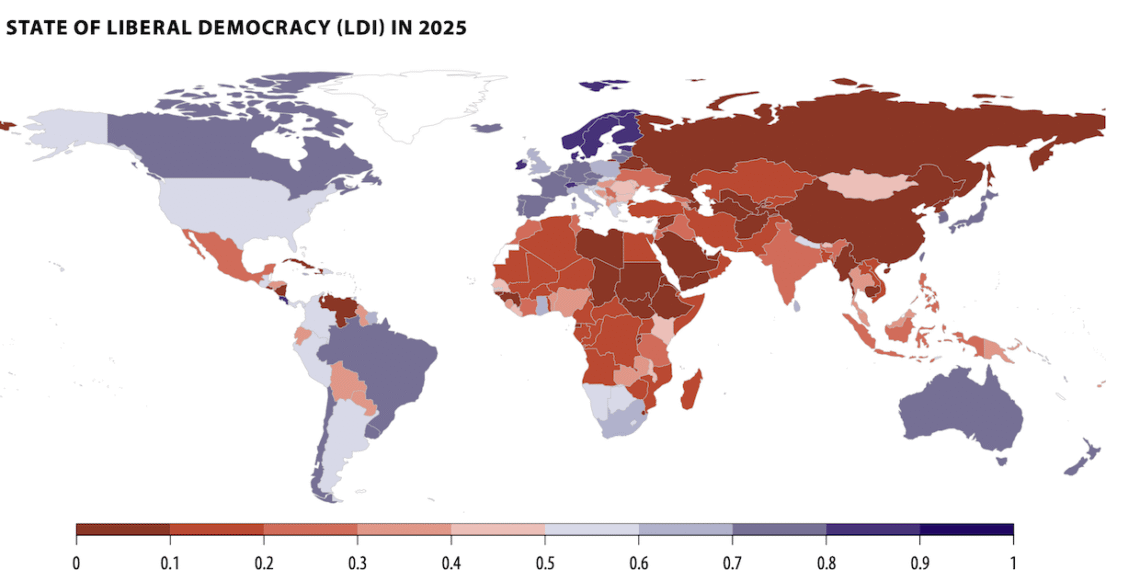
This collection distills the core insights of the ECPS Fifth Annual International Symposium, offering a comprehensive and interdisciplinary assessment of contemporary democratic crisis. Bringing together leading scholars, the symposium interrogates how systemic pressures—ranging from populist mobilization and institutional erosion to algorithmic politics and global economic disruption—reshape the conditions of democratic governance. From the conceptual reframing of anti-pluralism to comparative regional analyses and structural accounts of strongman politics, the contributions collectively move beyond surface-level diagnosis. Instead, they advance a deeper understanding of democratic resilience as a multidimensional project grounded in institutional integrity, civic agency, social cohesion, and transnational cooperation, highlighting both the fragility and the enduring adaptive capacity of liberal democracy.
Compiled by ECPS Staff
This collected file brings together the reports of the ECPS Fifth Annual International Symposium, “Reforming and Safeguarding Liberal Democracy: Systemic Crises, Populism, and Democratic Resilience,” held online on April 21–22, 2026. Across two intellectually rich days, the symposium examined one of the defining political questions of our time: how liberal democracy can be defended, renewed, and reimagined amid accelerating autocratization, systemic crises, populist mobilization, and institutional fragility.
The symposium opened with remarks by Irina von Wiese, ECPS Honorary President, followed by a keynote lecture by Professor Staffan I. Lindberg, who situated the global crisis of democracy within the empirical findings of the V-Dem Democracy Report-2026 and foregrounded anti-pluralism as a central driver of contemporary autocratization. The first panel, “From Grievance to Radicalization,” explored how rhetoric, religion, humiliation, and international institutions shape the transformation of social discontent into exclusionary and anti-democratic politics. The second panel, “Institutions Under Pressure,” turned to courts, executive power, rule of law, bureaucratic autonomy, and coordinated democratic defense.
The third panel, “Normalizing Authoritarian Populism,” examined how authoritarian tendencies become embedded through institutional erosion, algorithmic media environments, and exclusionary political identities, while also considering multicultural nationalism as a democratic alternative. On the second day, Professor Richard Youngsdelivered a keynote on democratic resilience in Europe, assessing the EU’s emerging tools—such as the Democracy Shield, digital regulation, rule-of-law conditionality, civil society support, and participatory mechanisms—while emphasizing their uneven and incomplete character.
Panel 4, “Comparative Regional Pathways of Democratic Backsliding and Far-Right Mobilization,” widened the lens to Turkey, the United States, South Korea, East Asia, and Latin America, underscoring the need for conceptual precision and regional sensitivity. The final panel, “Democratic Resistance in a Hardening World,” addressed structural inequality, private power, neoliberal transformation, strongman politics, penal populism, and weaponized trade policy as core challenges to democratic legitimacy.
Overall, these reports offer a comprehensive scholarly record of a symposium that moved beyond diagnosis toward reflection on democratic renewal. They show that democratic resilience cannot depend on institutions alone; it also requires civic capacity, social trust, economic fairness, inclusive belonging, and transnational cooperation. This collection therefore stands as both an analytical resource and a call for sustained democratic imagination.
Keynote by Professor Staffan I. Lindberg: The Chicken-and-Egg Dilemma — Systemic Crises and the Rise of Populism
The opening session of the ECPS Fifth Annual International Symposium offered a timely and intellectually rigorous entry point into one of the central dilemmas of contemporary politics: how liberal democracy can be defended, renewed, and reimagined amid systemic crisis and accelerating autocratization. Moderated by Professor Ibrahim Ozturk, the session combined normative urgency with empirical depth. In her opening remarks, Irina von Wiese underscored the geopolitical immediacy of democratic strain, while Professor Staffan I. Lindberg’s keynote, grounded in V-Dem data, traced the global scale of democratic erosion and challenged simplistic readings of populism by foregrounding anti-pluralism as a more precise analytical category. The discussion that followed further enriched the session, probing the measurement, lived experience, and reversibility of democratic decline across contexts.
Panel 1: From Grievance to Radicalization — Rhetoric, Ideology, and the International Politics of Populism
This panel offered a concise yet conceptually rich account of how contemporary populism transforms diffuse grievances into structured political radicalization. Bridging discourse analysis, religious studies, international political economy, and historical sociology, the discussion illuminated the multi-layered processes through which democratic erosion unfolds. Rather than locating the problem solely within institutional decline, the panel foregrounded the interplay of rhetoric, identity, and emotional mobilization—particularly the roles of humiliation, status anxiety, and perceived loss of recognition. Contributions by Professors Ruth Wodak, Julie Ingersoll, Stephan Klingebiel, and Benjamin Carter Hett collectively demonstrated that populist dynamics are sustained by both narrative construction and structural change. The session thus advanced a nuanced analytical framework for understanding how anti-pluralist politics emerge, normalize, and gain legitimacy across diverse contexts.
Panel 2: Institutions Under Pressure — Rule of Law, Executive Power, and Democratic Defense
Second panel of ECPS Fifth Annual International Symposium examined how democracies confront coordinated pressures on courts, bureaucracies, electoral systems, and constitutional safeguards. Moderated by Yavuz Baydar, the session brought together Professor Susan C. Stokes, Dr. Robert Benson, Professor Barry Sullivan, and Professor Stephen E. Hanson to analyze both democratic erosion and possibilities for recovery. The panel moved from comparative evidence on how backsliding leaders leave office, to the transnational coordination of illiberal actors, the expansion of executive power under Trump’s second administration, and the patrimonial assault on rational-legal state institutions. Together, the speakers underscored that democratic defense requires coordinated resilience, institutional renewal, civic mobilization, and a renewed commitment to rule-bound governance.
Panel 3: Normalizing Authoritarian Populism — Institutions, Algorithms, and Fascist Drift
The third panel of the ECPS Fifth Annual International Symposium examined how authoritarian populism becomes normalized across institutions, media ecosystems, and political identities. Bringing together perspectives from political science, media studies, and political theory, the session highlighted the interplay between executive overreach, institutional erosion, and algorithmically amplified communication. Contributions by Professor Larry Diamond and Professor Bruce Cain underscored the dynamics of democratic backsliding and “autocratic drift” within the United States, while Assoc. Prof. Ibrahim Al-Marashi demonstrated how AI-driven media and “slopaganda” reshape populist mobilization in a hyperreal digital environment. Concluding the panel, Professor Tariq Modood proposed multicultural nationalism as a unifying alternative to exclusionary populism. Collectively, the panel offered a multidimensional framework for understanding and resisting contemporary authoritarian trajectories.
Keynote by Prof. Richard Youngs: Democratic Resilience in Europe — Can It Be Effective?
Professor Richard Youngs’ keynote examined the European Union’s evolving response to democratic backsliding, populism, and institutional fragility. Professor Youngs argued that the EU has developed important tools—including the Democracy Shield, digital regulation, rule-of-law conditionality, civil society funding, and participatory mechanisms—but that its approach remains uneven and incomplete. He emphasized that democratic resilience must address not only external threats such as disinformation and foreign interference, but also internal dysfunctions, including weakened civic space, far-right normalization, migration politics, and democratic recovery after state capture. The ensuing discussion underscored the need for a more coherent and holistic EU strategy that effectively connects institutional reform, grassroots mobilization, and long-term democratic renewal across member states.
Panel 4: Comparative Regional Pathways of Democratic Backsliding and Far-Right Mobilization
Panel 4 of ECPS Fifth Annual International Symposium examined democratic backsliding as a globally connected yet regionally differentiated phenomenon. Moderated by Professor Reinhard Heinisch, the session brought together comparative insights from Turkey, the United States, South Korea, East Asia, and Latin America. Professor Henri J. Barkey analyzed how personalistic leadership, institutional capture, and politicized law enable authoritarian consolidation in the cases of Trump and Erdoğan. Professor Hannes Mosler challenged the routine application of “populism” to East Asia, arguing that South Korea’s democratic erosion is better understood through far-right mobilization, historical revisionism, anti-feminism, and transnational networks. Professor María Esperanza-Casullo explored Latin American right-wing populism through narratives of grievance, hyper-masculinity, cultural antagonism, and elite collaboration, highlighting the need for conceptually precise and regionally sensitive democratic responses.
Panel 5: Democratic Resistance in a Hardening World — Civic Capacity, Strongmen, and Economic Coercion
Panel 5 of the ECPS Fifth Annual International Symposium, moderated by Professor Jocelyne Cesari, offered a comprehensive examination of democratic resistance amid intensifying global pressures. Bringing together perspectives from political sociology, democratic theory, criminology, and international political economy, the panel illuminated how structural inequality, cultural backlash, institutional erosion, and coercive economic practices converge to sustain contemporary strongman politics. Contributions by Professor Jack A. Goldstone, Professor Steven Friedman, Professor John Pratt, and Professor Kent Jones underscored that democratic backsliding is not reducible to leadership alone but reflects deeper transformations in governance, legitimacy, and global order. The panel ultimately highlighted the urgent need to rethink democratic resilience beyond institutional safeguards toward structural and societal renewal.