In an in-depth interview with the ECPS, Professor Sarah de Lange of Leiden University cautions that “D66’s victory in Dutch elections cannot be presented as a victory over populism.” While the liberal centrist D66 led by Rob Jetten revitalized the political center, Professor de Lange stresses that “the total size of the radical right-wing bloc has not diminished—it’s just more fragmented.” She argues that Dutch politics is shaped less by populism than by nativism, which has “seeped so much into the mainstream.” Despite the PVV’s exclusion from government, Professor de Lange warns that illiberalism remains a significant threat, while the defense of liberal democracy has only recently become “more salient for mainstream parties and more visible to citizens.”
In a wide-ranging interview with the European Center for Populism Studies (ECPS), Sarah de Lange, Professor of Dutch Politics at Leiden University’s Institute for Political Science, offers a sharp and nuanced interpretation of the 2024 Dutch elections, warning that “D66’s victory in Dutch elections cannot be presented as a victory over populism.” While the liberal centrist D66 emerged as the largest party, Professor de Lange argues that this outcome reflects both a revival of the political center and the continuing normalization of populist discourse within Dutch democracy.
According to Professor de Lange, the election results underscore a complex duality: “We can conclude that both things are happening at the same time.” Although centrist and Christian Democratic parties gained ground, the radical right bloc remains as strong as before—only more fragmented. This persistence, she notes, illustrates not the decline of populism but its adaptation: “The total size of the radical right-wing bloc has not diminished; it’s as strong as it was in the 2023 elections—it’s just more fragmented.”
Professor de Lange cautions against the view that the PVV’s losses signal a populist retreat. Instead, she interprets them through “traditional political science theories about governing and negative incumbency effects.” Geert Wilders’ participation in government, she explains, produced electoral backlash, but his influence on mainstream parties remains unmistakable—particularly regarding migration and national identity, now central themes even for the conservative-liberal VVD. “The VVD moved so close to the PVV in the campaign that it even supported some proposals by the radical right that had anti-constitutional implications,” she observes, underlining how populist narratives have reshaped the Dutch mainstream.
What truly defines this political transformation, Professor de Lange insists, is not merely populism but nativism. “It is this nativism that has seeped so much into the mainstream, rather than the populism,” she explains, pointing to the xenophobic nationalism that has become a structural feature of Dutch political discourse.
Reflecting on the broader European context, Professor de Lange rejects the notion that populism has been “domesticated.” Despite Wilders’ exclusion from coalition talks, she warns that illiberalism remains deeply entrenched. “There is still clearly a threat of illiberalism,” she notes, citing violent demonstrations and political intimidation during the campaign. Yet, she also detects a countermovement: “Defending liberal democracy and the rule of law has become more salient for mainstream parties… making citizens more aware of how vulnerable liberal democracy actually is.”
Ultimately, Professor de Lange’s analysis situates the Dutch case within the wider European struggle between liberal resilience and populist endurance, emphasizing that the current equilibrium represents neither populism’s decline nor liberalism’s triumph—but rather, a tense coexistence shaping the future of democratic politics in Europe.
ECPS Staff. (2025). “Virtual Workshop Series — Session 5: Constructing the People: Populist Narratives, National Identity, and Democratic Tensions.” European Center for Populism Studies (ECPS). November 3, 2025. https://doi.org/10.55271/rp00117
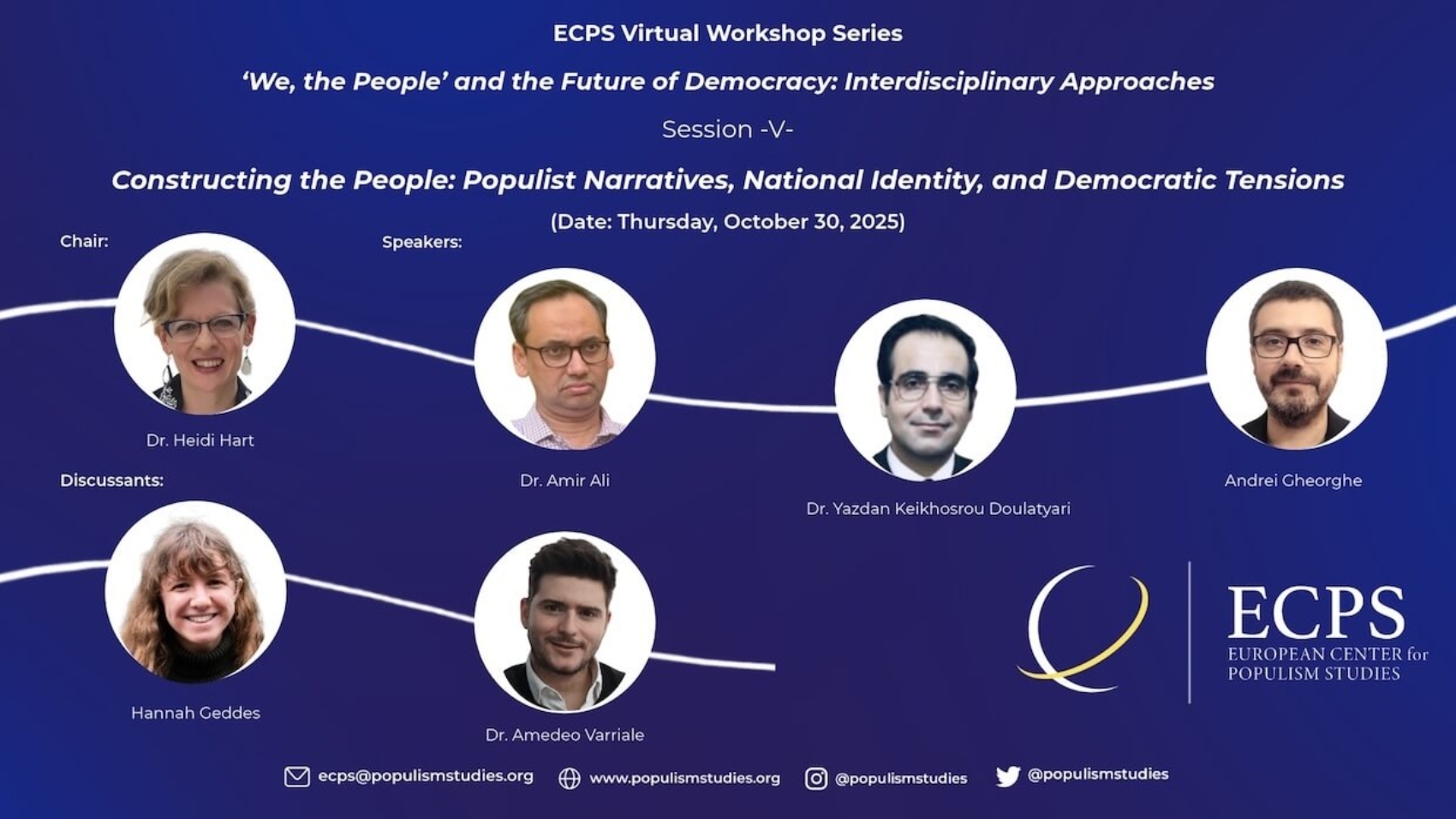
Session 5 of the ECPS–Oxford Virtual Workshop Series examined how populist movements across different regions construct “the people” as both an inclusive democratic ideal and an exclusionary political weapon. Moderated by Dr. Heidi Hart, the session featured presentations by Dr. Amir Ali, Dr. Yazdan Keikhosrou Doulatyari, and Andrei Gheorghe, who analyzed populism’s intersections with austerity politics, linguistic identity, and post-communist nationalism. Their comparative insights revealed that populism redefines belonging through economic moralization, linguistic appropriation, and historical myth-making, transforming pluralist notions of democracy into performative narratives of unity and control. The ensuing discussion emphasized populism’s adaptive power to manipulate emotion, memory, and discourse across diverse democratic contexts.
Reported by ECPS Staff
On October 30, 2025, the European Center for Populism Studies (ECPS), in collaboration with Oxford University, convened Session 5 of its Virtual Workshop Series, titled“We, the People” and the Future of Democracy: Interdisciplinary Approaches. This ongoing series (September 2025–April 2026) explores the cultural, economic, and political dimensions of populism’s impact on democratic life across diverse global contexts.
Titled “Constructing the People: Populist Narratives, National Identity, and Democratic Tensions,” the fifth session brought together scholars from political science, sociology, and linguistics to interrogate how populist movements construct and mobilize “the people” as a moral, cultural, and emotional category. The discussion illuminated the multiple ways in which populist discourse reshapes collective identity, redefines sovereignty, and challenges democratic pluralism.
The session was moderated by Dr. Heidi Hart, an arts researcher and practitioner based in Utah and Scandinavia, whose expertise in cultural narratives and affective politics enriched the workshop’s interpretive lens. Three presentations followed, each approaching the notion of “the people” from a distinct analytical angle. Dr. Amir Ali (Jawaharlal Nehru University, New Delhi) examined the paradox of austerity populism, arguing that fiscal conservatism has become a populist virtue masking economic dispossession. Dr. Yazdan Keikhosrou Doulatyari (Technische Universität Dresden) turned to the linguistic life of democracy in Germany, tracing how words like Volk, Leute, and Heimat encode competing visions of community, inclusion, and exclusion in the contemporary public sphere. Andrei Gheorghe (University of Bucharest and EHESS, Paris) presented a comparative analysis of Romanian and Hungarian populisms, exploring how leaders from Viktor Orbán to Traian Băsescu construct national identity through historical memory and moral dualism.
The session also featured two discussants whose critical reflections deepened the dialogue: Hannah Geddes (PhD Candidate, University of St Andrews) offered comments that emphasized conceptual clarity, methodological coherence, and the comparative breadth of the papers. Dr. Amedeo Varriale (PhD, University of East London) provided incisive observations connecting the economic, cultural, and linguistic dimensions of populism, situating the presenters’ work within wider debates on ideology, nationalism, and discourse.
Throughout the session, Dr. Hart guided the discussion and er moderation fostered an interdisciplinary dialogue among presenters and discussants, drawing attention to the intersections of economy, discourse, and collective memory. Ultimately, Session 5 revealed that the populist construction of “the people” is not merely a rhetorical act but a performative process—one that transforms democratic ideals of equality and representation into instruments of control and exclusion.
In an in-depth interview with the ECPS, Dr. Simon P. Otjes, Assistant Professor of Dutch Politics at Leiden University, argues that the 2025 Dutch elections signaled not the decline but the reconfiguration of populism. “What was previously very strongly concentrated on the PVV has now dissipated into three different parties, representing three different ways of doing politics,” he notes. While JA21 seeks governmental influence and FvD appeals to conspiratorial electorates, the overall radical-right bloc remains stable. Dr. Otjes warns that a broad centrist coalition could “reproduce the very disaffection it seeks to contain,” fueling further populist resurgence. Far from a post-populist era, he concludes, “we’re still very much inside this populist moment.”
In a wide-ranging interview with the European Center for Populism Studies (ECPS), Dr. Simon Otjes, Assistant Professor of Dutch Politics at Leiden University, offers a penetrating analysis of the evolving dynamics of populism, centrism, and democratic governance in the Netherlands and Europe. His reflections, delivered in the aftermath of the 2025 Dutch elections on October 29, illuminate the cyclical nature of populist mobilization and the institutional resilience of liberal democracy in an era of fragmentation and recalibration.
For Dr. Otjes, the Dutch political landscape exemplifies a persistent alternation between “almost technocratic, centrist governments… being interrupted by brief periods of radical right-wing governments,” a pattern visible over the past three decades. He observes that while populist radical-right parties such as PVV, JA21, and FvD have become structurally entrenched, their participation in government remains precarious and short-lived. “Populists enter government, those governments prove to be unstable, and then there’s a response from the center,” he notes, emphasizing that this oscillation does not represent a post-populist phase but rather “an enduring populist moment.”
The 2025 elections, in Dr. Otjes’s view, marked not the decline but the reconfiguration of populism. “What was previously very strongly concentrated on the PVV has now dissipated into three different parties, representing three different ways of doing politics,” he explains. While JA21 seeks policy influence within coalition frameworks, FvD appeals to conspiratorial electorates “in news environments very different from the mainstream media.” This diversification, Dr. Otjes warns, “is the key explanation of why [the radical right] remains so stable—their ability to attract very different electorates by diversifying their offerings.”
At the same time, Dr. Otjes cautions that a centrist grand coalition—combining GroenLinks–PvdA, D66, VVD, and CDA—could inadvertently deepen democratic alienation. Such an arrangement, he argues, would lead to “quite centrist compromises that lack the change these parties promised,” thereby driving dissatisfied voters back to the populist right. While this centrist stability may project pragmatism, it risks “reproducing the very disaffection it seeks to contain.”
On the European front, Dr. Otjes underscores that despite D66’s pro-European rhetoric under Rob Jetten, Dutch European policy is unlikely to shift dramatically. “The Netherlands won’t necessarily be a particularly progressive government on this issue,” he remarks, given the enduring influence of conservative fiscal and migration stances within the coalition.
Ultimately, Dr. Otjes’s analysis situates the Netherlands within a broader European pattern: an ongoing alternation between pragmatic centrism and reactive populism, rather than a linear progression beyond it. In his words, “We’re still very much inside this populist moment.”
In an in-depth interview with the ECPS, Professor Sarah de Lange of Leiden University cautions that “D66’s victory in Dutch elections cannot be presented as a victory over populism.” While the liberal centrist D66 led by Rob Jetten revitalized the political center, Professor de Lange stresses that “the total size of the radical right-wing bloc has not diminished—it’s just more fragmented.” She argues that Dutch politics is shaped less by populism than by nativism, which has “seeped so much into the mainstream.” Despite the PVV’s exclusion from government, Professor de Lange warns that illiberalism remains a significant threat, while the defense of liberal democracy has only recently become “more salient for mainstream parties and more visible to citizens.”
In a wide-ranging interview with the European Center for Populism Studies (ECPS), Sarah de Lange, Professor of Dutch Politics at Leiden University’s Institute for Political Science, offers a sharp and nuanced interpretation of the 2024 Dutch elections, warning that “D66’s victory in Dutch elections cannot be presented as a victory over populism.” While the liberal centrist D66 emerged as the largest party, Professor de Lange argues that this outcome reflects both a revival of the political center and the continuing normalization of populist discourse within Dutch democracy.
According to Professor de Lange, the election results underscore a complex duality: “We can conclude that both things are happening at the same time.” Although centrist and Christian Democratic parties gained ground, the radical right bloc remains as strong as before—only more fragmented. This persistence, she notes, illustrates not the decline of populism but its adaptation: “The total size of the radical right-wing bloc has not diminished; it’s as strong as it was in the 2023 elections—it’s just more fragmented.”
Professor de Lange cautions against the view that the PVV’s losses signal a populist retreat. Instead, she interprets them through “traditional political science theories about governing and negative incumbency effects.” Geert Wilders’ participation in government, she explains, produced electoral backlash, but his influence on mainstream parties remains unmistakable—particularly regarding migration and national identity, now central themes even for the conservative-liberal VVD. “The VVD moved so close to the PVV in the campaign that it even supported some proposals by the radical right that had anti-constitutional implications,” she observes, underlining how populist narratives have reshaped the Dutch mainstream.
What truly defines this political transformation, Professor de Lange insists, is not merely populism but nativism. “It is this nativism that has seeped so much into the mainstream, rather than the populism,” she explains, pointing to the xenophobic nationalism that has become a structural feature of Dutch political discourse.
Reflecting on the broader European context, Professor de Lange rejects the notion that populism has been “domesticated.” Despite Wilders’ exclusion from coalition talks, she warns that illiberalism remains deeply entrenched. “There is still clearly a threat of illiberalism,” she notes, citing violent demonstrations and political intimidation during the campaign. Yet, she also detects a countermovement: “Defending liberal democracy and the rule of law has become more salient for mainstream parties… making citizens more aware of how vulnerable liberal democracy actually is.”
Ultimately, Professor de Lange’s analysis situates the Dutch case within the wider European struggle between liberal resilience and populist endurance, emphasizing that the current equilibrium represents neither populism’s decline nor liberalism’s triumph—but rather, a tense coexistence shaping the future of democratic politics in Europe.
Sarah de Lange is a Professor of Dutch Politics at Leiden University’s Institute for Political Science.
Here is the edited transcript of our interview with Professor Sarah de Lange, slightly revised for clarity and flow.
The Radical Right-Wing Bloc Has Not Diminished—Only Fragmented
Professor Sarah de Lange, thank you very much for joining our interview series. Let me start right away with the first question: The October 29 Dutch elections resulted in a striking balance between D66’s liberal centrism and Wilders’ populist radical right. From a comparative perspective, how should we interpret this outcome—does it mark a recalibration of Dutch democracy or the normalization of populism within it?
Professor Sarah de Lange: I think we can conclude that both things are happening at the same time. On the one hand, we’ve seen in the Dutch elections a revival of the center. Not only has the social-liberal D66 gained a lot of seats, but so have the Christian Democrats, and the two parties will be needed for any coalition government that will be formed. At the same time, we also see that Geert Wilders’ PVV has lost seats due to its government participation, but it has lost those seats to other radical right-wing populist competitors, namely JA21 and Thierry Baudet’s Forum for Democracy. So, the total size of the radical right-wing bloc has not diminished; it’s as strong as it was in the 2023 elections—just more fragmented.
Do you view the PVV’s losses as evidence of a populist retreat, or rather as a transformation of its discourse into the mainstream—particularly given the centrist parties’ increasing emphasis on migration and national identity?
Professor Sarah de Lange: The loss of the PVV should really be seen from the perspective of traditional political science theories about governing and negative incumbency effects. Geert Wilders’ PVV governed together with three other parties in the cabinet, and all four parties have lost to some extent in these elections. The loss of the PVV was significant, but perhaps not as large as one would expect for a party that participated in government. There’s a saying in politics that “the breaker pays,” and in this case, Geert Wilders did indeed pay—he did lose voters—but most of those he lost were voters who had joined his party only in 2023, when the VVD opened the door to the PVV.
Many previous non-voters turned out to support the PVV, given that there was finally a chance that the party would govern. So, it’s the newest voters of the PVV who have left again. But interestingly, although some of them came from the mainstream in 2023, few have returned to the mainstream in these elections. Some have—for example, to the conservative-liberal VVD—but in relatively small numbers, which explains why the radical right populist bloc is as strong as it was in 2023.
There’s also a second way in which Geert Wilders’ PVV has had a significant impact on these elections. All mainstream parties, and especially the conservative-liberal VVD, have taken up migration as the core theme of their campaigns and have advocated for a clear reduction in immigration, meaning stricter immigration regulations.
That has especially been the case for the conservative-liberal VVD of former Prime Minister Mark Rutte, now NATO Secretary General. The party moved so close to the PVV during the campaign that it even supported some proposals by the radical right with anti-constitutional implications. For example, Forum for Democracy, a smaller radical right-wing populist party, proposed during the campaign in Parliament that there should be a motion to designate Antifa as a terrorist organization—very much inspired, of course, by Donald Trump’s proposal to do the same. Even though Dutch legislation is very clear on this point—namely that it is up to the judiciary to designate organizations as terrorist organizations and not to Parliament—the conservative-liberal VVD nevertheless supported this proposal.
So, in that way too, the influence of radical right-wing populist parties in the Netherlands remains significant. What I’ve seen in much of the international press is that the victory of D66 has been presented as a victory over populism, but I certainly do not think it should be interpreted that way.
Nativism, Not Populism, Defines the Radical Right in the Netherlands
Photo: Dreamstime.
To what extent does the Dutch experience illustrate the idea of a “stabilized populism,” where populist rhetoric persists even as its organizational strength fluctuates?
Professor Sarah de Lange: It’s a clear case where we see a potential for the populist radical right that cannot be easily accommodated by the mainstream parties, in the sense that it’s very difficult for mainstream parties to win back voters who, at some point, have turned to the radical right. But I would also highlight that we tend to discuss this very much in terms of populism, while what has really been key to the transformation of Dutch politics—more than populism—is nativism.
What truly defines Geert Wilders’ political platform, as well as those of other radical right parties in the Netherlands, is their nativism, their xenophobic nationalism, and their othering of groups perceived as non-native—which, in the Dutch context, for the PVV, refers mostly to Muslims but more broadly includes anyone with a migration background, even extending to the third generation now living in the Netherlands.
It is this nativism that has seeped so deeply into the mainstream, rather than the populism. In fact, in this particular campaign, populism was not as pronounced in some of the radical right parties. Take, for example, JA21, which picked up a significant number of former PVV voters and could be involved in the coalition negotiations. The party remained clearly nativist in the campaign but was far less outspokenly populist, as a way to be more acceptable as a coalition partner—a serious partner—to mainstream parties.
Populism in Europe Has Not Been Domesticated or Contained
Looking beyond the Netherlands, what do these results reveal about the broader European and global trajectory of populism? Are we witnessing its institutional domestication or the emergence of a new post-populist equilibrium?
Professor Sarah de Lange: What we’re seeing is not its domestication. What was also very clear, already from the start of the campaign, was that Geert Wilders would not be acceptable as a coalition partner to mainstream parties for the next government. Some Dutch mainstream parties have said they don’t want to work with him on principle, because his program contains proposals that are not in line with freedom of religion and that conflict with the rule of law.
Other parties don’t want to work with him again because they don’t find him a trustworthy coalition partner, as he has now toppled two Dutch governments—the last one from which he withdrew, as well as the minority government that ruled the Netherlands from 2010 to 2012 with PVV support. It was therefore very clear to him that he would not be included in the government coalition again, and he immediately reverted to his strong populist and nativist rhetoric. Any moderation that existed during the coalition government—and there was very little of it—disappeared as soon as the coalition collapsed. So, certainly no domestication.
I also don’t necessarily think that we’re in a post-populist age. As I indicated, the radical right in the Netherlands remains as strong as ever, and what was particularly notable in the first survey data from the election is that the group of voters considering support for one of the radical right parties in the Netherlands has actually grown. The potential for the radical right to expand even further in future elections is therefore certainly there.
Wilders’ Personal Control Over the PVV Is Both His Strength and His Weakness
Election posters near the Binnenhof featuring Geert Wilders of the PVV in the foreground, The Hague, the Netherlands, October 12, 2025. Photo: Dreamstime.
Building on your research on party agency and leadership, how do you assess the contrasting political performances of Rob Jetten and Geert Wilders—one mobilizing optimism and inclusivity, the other polarization and grievance?
Professor Sarah de Lange: These are two very different parties, of course, in terms of ideology but also in terms of party organization, and this is a very important part of the story for the Netherlands—one that sets it apart from other countries in Western Europe when it comes to the radical right.
Geert Wilders’ PVV joined the government in 2024, having had no significant experience with governing at the local or regional level. Why is that the case? For two reasons. First of all, Geert Wilders’ party does not have a traditional membership base. It is organized exclusively around the figure of Geert Wilders, who runs the party himself. It doesn’t have a membership base or a cadre. Even the representatives in the national parliament are not members of the party.
This means, first, that it is very difficult for him to participate in many municipal elections. He only participates in a select number of municipal elections, so there is very little opportunity for him to gain experience there. Secondly, it also means that people within the party have no executive experience—no experience with heavy management functions, etc.—and that there is no support staff within the party to assist those who need to take up government responsibility.
It was very evident in the cabinet that the PVV ministers, in particular, performed quite poorly on average. They didn’t know what their role was as ministers or junior ministers, how to deal with the bureaucracy, or how to bring legislation to a successful conclusion—meaning legislation that would be accepted by parliamentary parties and would actually be feasible, without including any anti-constitutional elements. So overall, quite poor performance.
That contributed to the early collapse of the government, because Geert Wilders saw that voters noticed this, and it is plausible that he withdrew from the government to avoid further electoral losses that might occur if voters became even more aware of how weak his pool of ministers was.
This really sets the Netherlands apart from other countries where the radical right can actually govern quite successfully because they have a trained cadre and local or regional experience. In that respect, if we compare the Netherlands to Italy, it is a completely different case.
Jetten’s Positive Campaign Reclaimed Hope and Unity
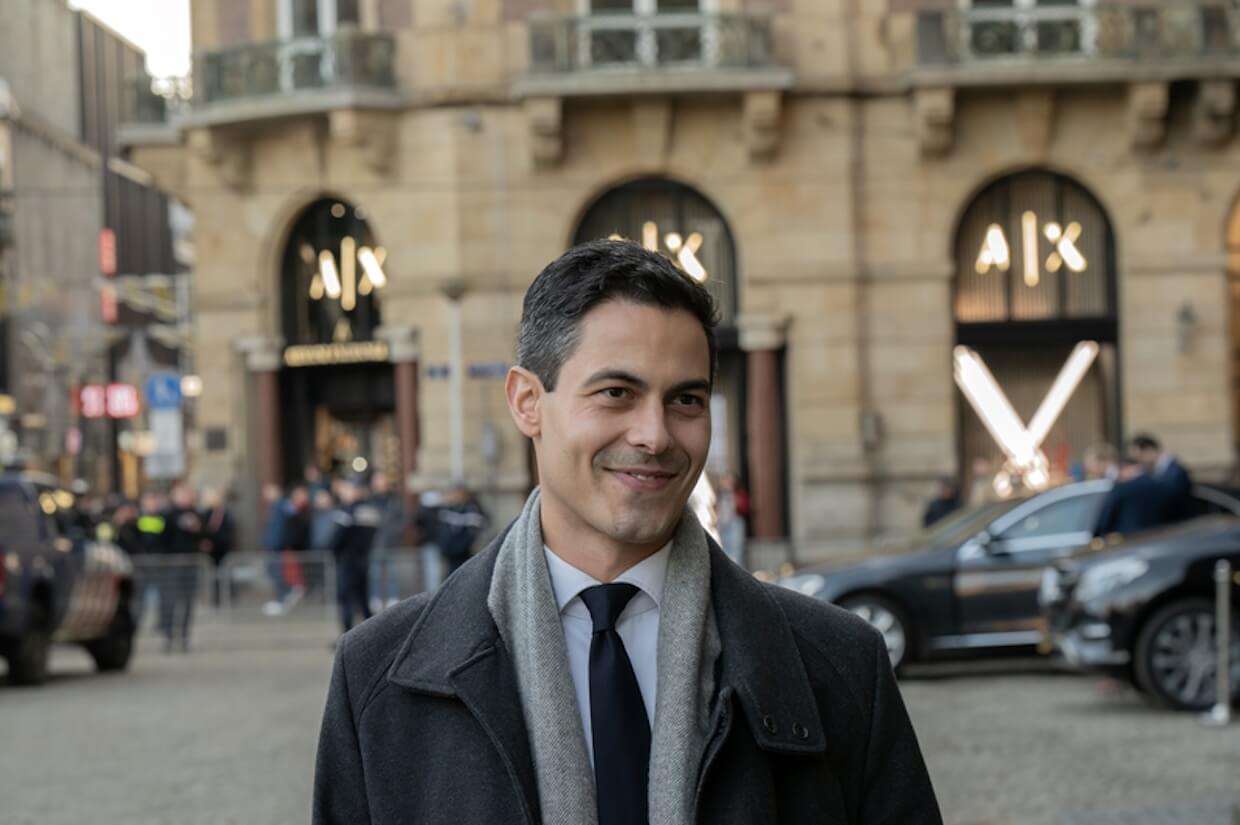
Rob Jetten attends the New Year’s Reception hosted by the King of the Netherlands in Amsterdam on January 3, 2025. Photo: Robert van T. Hoenderdaal.
Jetten’s campaign drew on emotionally resonant, populist-style messaging—“het kan wél” (“yes, we can”)—without embracing populist antagonism. Does this signal that centrist liberalism is learning to compete in the emotional arena that populists once dominated?
Professor Sarah de Lange: Yes, this is a very interesting development that we’ve seen. D66 ran a campaign that was very positive in tone, speaking of hope and unity, and even went so far as to reclaim the Dutch flag as a symbol—quite surprising for a party that, in its stances, is extremely cosmopolitan and progressive, very pro-European Union, for example. It seems that this approach worked, as it drew voters from other left-wing, progressive, and centrist parties. One explanation for this is that research shows having a genuinely positive atmosphere around a party can be beneficial in electoral campaigns.
Has Wilders’ long-standing personalistic leadership become both a strategic advantage and a constraint—particularly in terms of coalition-building and sustaining voter trust?
Professor Sarah de Lange: Yes, as I already explained, it’s certainly a disadvantage in one sense, as it makes it very difficult for the party to be ready for government—to have qualified and experienced people who can take up ministerial and junior ministerial positions. However, at the same time, it also offers him an advantage, in that he has full control over his members of parliament. So even though his parliamentary group grew significantly, since he controls which parliamentarians can speak to the media and on what topics, and in which debates they participate and in which they don’t, his parliamentary group didn’t experience any major scandals despite this massive growth in its size. Of course, one important element made this possible: Geert Wilders was not an acceptable prime minister to the parties with which his PVV governed, and he was therefore forced to stay in parliament as leader of the parliamentary group. Had that not been the case, it would have been much more difficult for him to control his members of parliament.
Current Exclusion of Wilders Is Pragmatic, not a Principled Cordon Sanitaire
In“New Alliances,” you analyze why mainstream parties sometimes collaborate with the populist radical right. Given the refusal of other parties to govern with Wilders, do current coalition negotiations represent a reinvigorated ‘cordon sanitaire’ or a temporary tactical alignment?
Professor Sarah de Lange: This is a very good question, because my research in the past showed that once radical right parties are large enough to help mainstream right parties achieve a majority, those mainstream parties are often inclined to govern with them, even if they might have said in advance that they were not interested or thought the radical right was too extreme to govern with.
What we’re seeing now in some countries—and that’s not only in the Netherlands but also, for example, in Austria—is that, on the basis of previous coalition experiences with the radical right, the picture has become more complex. There are a number of mainstream right parties that have had such bad experiences governing with the radical right that they are no longer willing to do so.
However, I think this is very different from a cordon sanitaire, because a cordon sanitaire is motivated by a principled rejection of the radical right on the basis of its stances—because the manifestos of the radical right contain nativism and proposals that are anti-constitutional or in conflict with the rule of law. What we see here, in both the Austrian and Dutch cases, is that the reluctance is based more on the fact that previous experiences have shown that radical right parties are unreliable partners. And of course, that is a more pragmatic argument, which can also be abandoned—for example, if the radical right gets a new leader who is believed to be more trustworthy, or if the mainstream right changes leadership and feels differently about cooperating with the radical right.
So, in that sense, we should really keep these pragmatic reasons separate from the more principled exclusion represented by a cordon sanitaire.
Exclusion Strengthens Wilders’ Anti-Elite Narrative Among Supporters
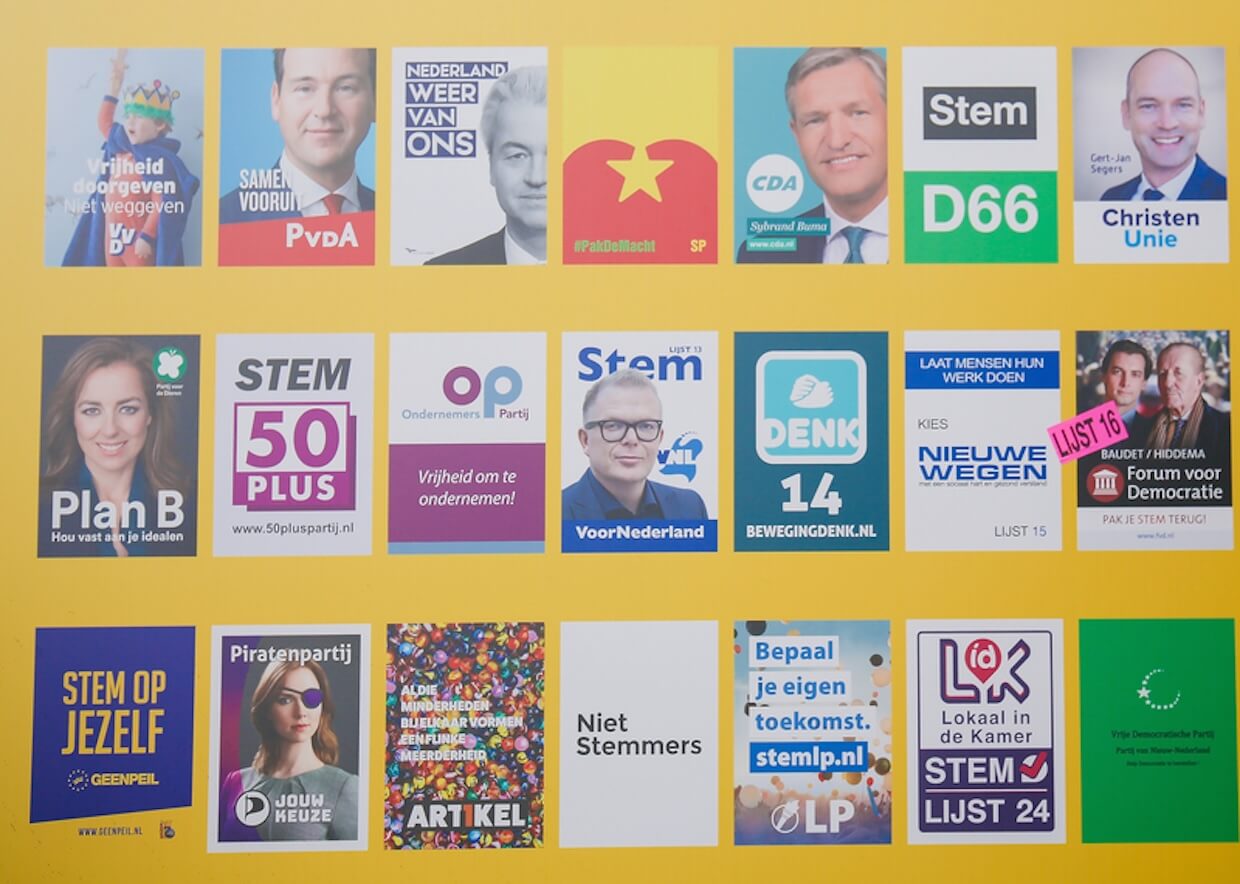
Election posters of all Dutch political parties displayed at the Binnenhof in The Hague, the Netherlands, in March 2017. Photo: Dreamstime.
What are the long-term risks and benefits of excluding the PVV from coalition governance? Could such exclusion paradoxically reinforce its anti-establishment narrative, as observed in other European contexts?
Professor Sarah de Lange: This is a very valid question. Of course, the advantage is that there will be no negotiations about plans that are anti-constitutional. If we look at the previous cabinet, of which the PVV was part, that cabinet tried to declare an asylum crisis in order to introduce emergency legislation that would partially circumvent Parliament. That would have been a clear sign of democratic backsliding if it had happened. Luckily, some of the government parties changed their minds at the last minute, and it never came to fruition—but the idea was clearly on the table. Without the radical right in government, there is, of course, far less likelihood of these kinds of plans being implemented.
The downside, however, is equally clear. Excluding the PVV makes the rhetoric of the radical right more believable—namely, the idea that there is an elite governing the country that is out of touch with what citizens want because it excludes the radical right, which also represents a part of the population. In the Netherlands, this risk is particularly real, because the only four-party coalition capable of securing a majority would be a very broad ideological alliance, ranging from the Green Labour Party to the social-liberal D66, the Christian Democratic CDA, and the conservative-liberal VVD. Such a coalition, both on socio-economic issues and on matters like immigration, would have very different positions and would need to compromise extensively—only reinforcing the PVV’s narrative that it alone stands outside an isolated political elite.
The Netherlands Could Learn from Scandinavia’s Clear Left–Right Blocs
How might a centrist, multi-party coalition led by D66 influence the structure of competition in Dutch politics? Could it serve as a model for containing populist disruption in fragmented systems elsewhere?
Professor Sarah de Lange: I don’t think it’s a model to be emulated; it’s a model that exists only because the Dutch parliament is so fragmented. The largest parties are very small— even D66, which became the largest party in the elections, holds less than 20% of the votes and seats. The same applies to the other parties likely to join the coalition, each of which has around 15% of the vote. This makes the structure of the Dutch party system highly untenable in the long term, as it requires four- or five-party coalitions, which would have been necessary even if the PVV had not been excluded. Such coalitions are very likely to be unstable, leading to short-lived governments and limited policy output.
So, I think it’s actually the other way around. Looking across Western Europe, the Netherlands could benefit greatly from having a structure more like a Scandinavian party system, with a clear left-wing and right-wing bloc, rather than the highly fragmented system it currently has to manage.
Your work on party–civil society linkages shows that strong organizational ties stabilize voter support. Does D66’s success suggest that centrist parties can rebuild civic connections that were eroded by decades of depoliticization? Conversely, how does the PVV sustain long-term voter loyalty despite its limited organizational infrastructure and weak civic embedding?
Professor Sarah de Lange: Let’s start by observing that in the Netherlands, political parties generally have weak linkages to civil society organizations, and this partly explains why Dutch elections are so extremely volatile—they are among the most volatile in Europe. What’s interesting is that the two largest parties in the elections, D66 and the PVV, are both known for lacking many of these traditional ties. This indicates that while they may be very successful in a given election, they could just as easily lose that support again. This applies especially to D66, which has always been a party marked by very high highs but also very deep lows. It has an extremely volatile electorate that also considers many other left- and right-wing progressive parties at election time.
The PVV is slightly different. It has no ties to civil society organizations at all, yet it has a remarkably loyal electorate that remains faithful to the party for several reasons. First, PVV voters genuinely believe that Wilders is the only person who can change immigration policy in the way they want. Election surveys show that 90% of PVV voters view immigration as the biggest social challenge the Netherlands faces, and they see Geert Wilders as the most competent and trustworthy politician to act on that issue. Second, these voters tend to have relatively high levels of political distrust, which makes them unlikely to return from the PVV to mainstream parties.
PVV Support Is Strongest Outside the Cosmopolitan Randstad Region
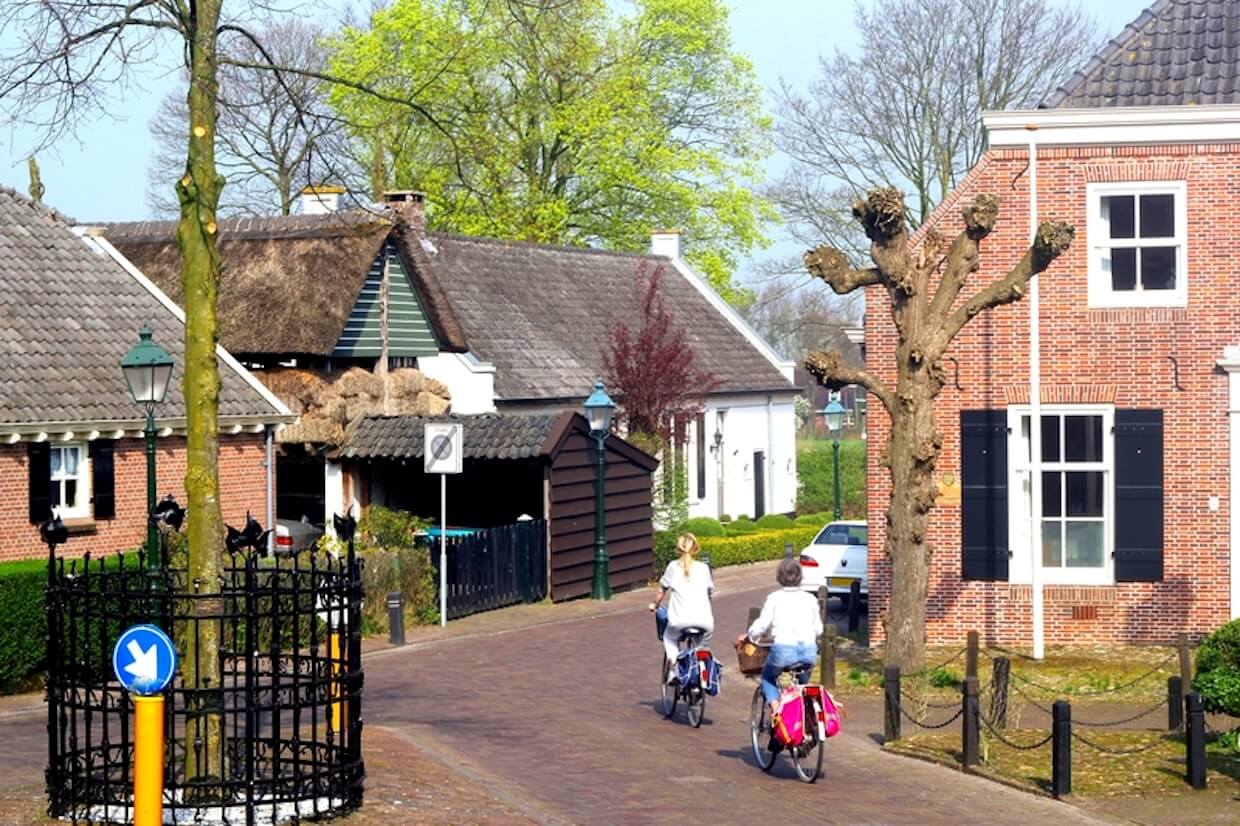
Women cycle through the historic Kerkebuurt (Church District) in Soest, Netherlands, known for its old farms and streets such as Eemstraat. Photo: Inge Hogenbijl.
How much of the PVV’s enduring appeal still stems from regional and class-based resentment, and how much from broader cultural anxieties related to immigration and demographic change?
Professor Sarah de Lange: I think both are connected. We see that Geert Wilders’ PVV is more successful outside the big cosmopolitan cities in the Randstad—the central area enclosed by major cities such as Amsterdam, Rotterdam, and Utrecht. The PVV performs better beyond that region. This is partly due to a sense of regional resentment—the perception that people in areas where the PVV is strong are not being taken seriously by the political, economic, and cultural center of the Netherlands; that they are not adequately represented; and that there is little respect for their norms, values, and traditions.
These feelings are also partly rooted in real developments in these regions, such as economic decline, the out-migration of young citizens, and the erosion of public and private services. So, even though there may not be many migrants in these areas, these socio-economic developments feed into anti-immigrant sentiment—not least because Wilders consistently draws links between immigration and other social problems.
Jetten to Become the Netherlands’ First Openly Gay Prime Minister
In your co-edited volume“Gender and Populist Radical-Right Politics,” you highlight the gendered dimensions of populist leadership. How do you interpret the symbolic contrast between Wilders’ assertive, masculine populism and Jetten’s inclusive liberal masculinity?
Professor Sarah de Lange: That’s a very interesting question, because the Netherlands will, with Rob Jetten, have its first openly gay prime minister, who is about to marry his male partner. He has always been very open about this, and it was an important element in the campaign, where he frequently spoke about his upcoming wedding. This stands in stark contrast to the traditional masculinity promoted by Wilders, and even more so by Forum for Democracy’s Thierry Baudet.
Interestingly, in terms of voter base, we see that the PVV—now that it has become such a large party—is actually quite representative of the Dutch population as a whole, including in terms of gender. We don’t see a strong gender gap among its voters, unlike with the more extreme Forum for Democracy led by Baudet. It therefore seems that female voters are not put off by Wilders’ masculine leadership style, nor by a party program that is not particularly outspoken on gender issues.
LGBTQ Acceptance Is Central to the Dutch National Self-Image
Does the normalization of openly gay political leadership in the Netherlands challenge the gendered and heteronormative foundations of populist radical-right discourse, or does it reflect a uniquely Dutch liberal exceptionalism?
Professor Sarah de Lange: This is quite an interesting question. During the campaign, it was clear that Geert Wilders could not realistically attack Jetten on the basis of his sexuality or the fact that he is marrying his male partner. This is because a core part of the Dutch national self-image is its perceived tolerance toward the LGBTQ community.
That does not mean, however, that PVV supporters share this perspective. They have very mixed attitudes when it comes to LGBTQ issues. Of course, since same-sex marriage has been legal for a long time, there is little resistance to it. But when questions turn to more contemporary sexuality issues—such as trans rights or stances on non-binarity—you can see that these voters tend to hold a very heteronormative outlook.
Radical Right Strength Shows Illiberalism Remains a Persistent Threat
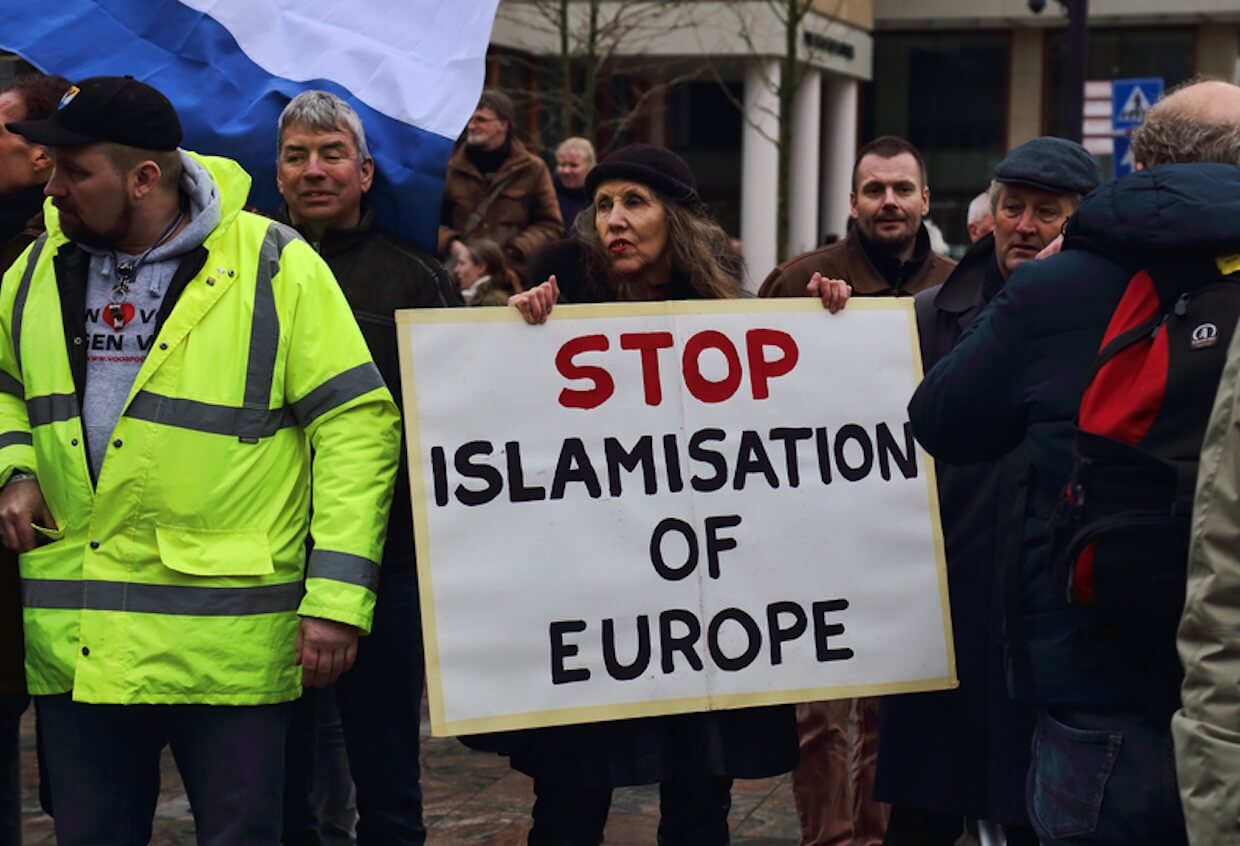
Anti-Islam demonstration in Rotterdam, the Netherlands, on January 20, 2017. Protesters carry signs opposing “Islamization.” Photo: Jan Kranendonk.
And finally, Professor de Lange, does the Dutch election signal that liberal democracies are learning to integrate populist affect without embracing its illiberal impulses—or are we entering a phase of hybrid politics where the emotional grammar of populism becomes a permanent feature of democratic life?
Professor Sarah de Lange: The elections show that, because the radical right remains so strong, illiberalism is still present—and it was very visible in the campaign as well. There were incidents involving extreme-right demonstrations that turned violent, and numerous cases where politicians were threatened by political opponents or ordinary citizens with different political opinions. So, in that sense, there is still clearly a threat of illiberalism.
At the same time, this particular campaign also demonstrated that defending liberalism—or liberal democracy, and the rule of law has become more salient for mainstream parties, especially among more progressive forces. The issue is now more openly discussed, making citizens more aware of how vulnerable liberal democracy actually is, and that it is something that must be safeguarded rather than taken for granted.
In an in-depth interview with the ECPS, Dr. Simon P. Otjes, Assistant Professor of Dutch Politics at Leiden University, argues that the 2025 Dutch elections signaled not the decline but the reconfiguration of populism. “What was previously very strongly concentrated on the PVV has now dissipated into three different parties, representing three different ways of doing politics,” he notes. While JA21 seeks governmental influence and FvD appeals to conspiratorial electorates, the overall radical-right bloc remains stable. Dr. Otjes warns that a broad centrist coalition could “reproduce the very disaffection it seeks to contain,” fueling further populist resurgence. Far from a post-populist era, he concludes, “we’re still very much inside this populist moment.”
In a wide-ranging interview with the European Center for Populism Studies (ECPS), Dr. Simon Otjes, Assistant Professor of Dutch Politics at Leiden University, offers a penetrating analysis of the evolving dynamics of populism, centrism, and democratic governance in the Netherlands and Europe. His reflections, delivered in the aftermath of the 2025 Dutch elections on October 29, illuminate the cyclical nature of populist mobilization and the institutional resilience of liberal democracy in an era of fragmentation and recalibration.
For Dr. Otjes, the Dutch political landscape exemplifies a persistent alternation between “almost technocratic, centrist governments… being interrupted by brief periods of radical right-wing governments,” a pattern visible over the past three decades. He observes that while populist radical-right parties such as PVV, JA21, and FvD have become structurally entrenched, their participation in government remains precarious and short-lived. “Populists enter government, those governments prove to be unstable, and then there’s a response from the center,” he notes, emphasizing that this oscillation does not represent a post-populist phase but rather “an enduring populist moment.”
The 2025 elections, in Dr. Otjes’s view, marked not the decline but the reconfiguration of populism. “What was previously very strongly concentrated on the PVV has now dissipated into three different parties, representing three different ways of doing politics,” he explains. While JA21 seeks policy influence within coalition frameworks, FvD appeals to conspiratorial electorates “in news environments very different from the mainstream media.” This diversification, Dr. Otjes warns, “is the key explanation of why [the radical right] remains so stable—their ability to attract very different electorates by diversifying their offerings.”
At the same time, Dr. Otjes cautions that a centrist grand coalition—combining GroenLinks–PvdA, D66, VVD, and CDA—could inadvertently deepen democratic alienation. Such an arrangement, he argues, would lead to “quite centrist compromises that lack the change these parties promised,” thereby driving dissatisfied voters back to the populist right. While this centrist stability may project pragmatism, it risks “reproducing the very disaffection it seeks to contain.”
On the European front, Dr. Otjes underscores that despite D66’s pro-European rhetoric under Rob Jetten, Dutch European policy is unlikely to shift dramatically. “The Netherlands won’t necessarily be a particularly progressive government on this issue,” he remarks, given the enduring influence of conservative fiscal and migration stances within the coalition.
Ultimately, Dr. Otjes’s analysis situates the Netherlands within a broader European pattern: an ongoing alternation between pragmatic centrism and reactive populism, rather than a linear progression beyond it. In his words, “We’re still very much inside this populist moment.”
Here is the edited transcript of our interview with Dr. Simon P. Otjes, slightly revised for clarity and flow.
Dutch Populism Has Stabilized, Not Declined
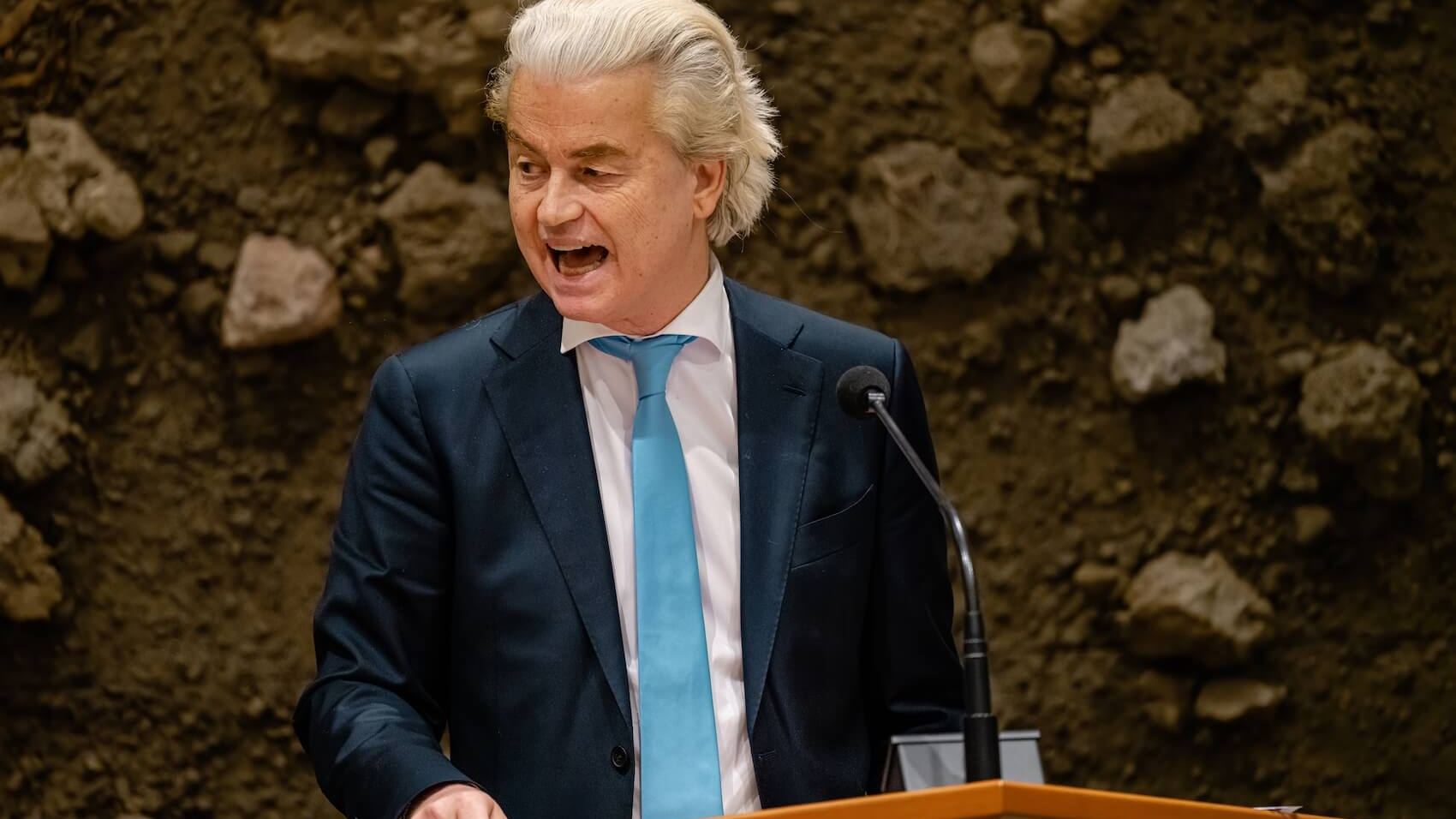
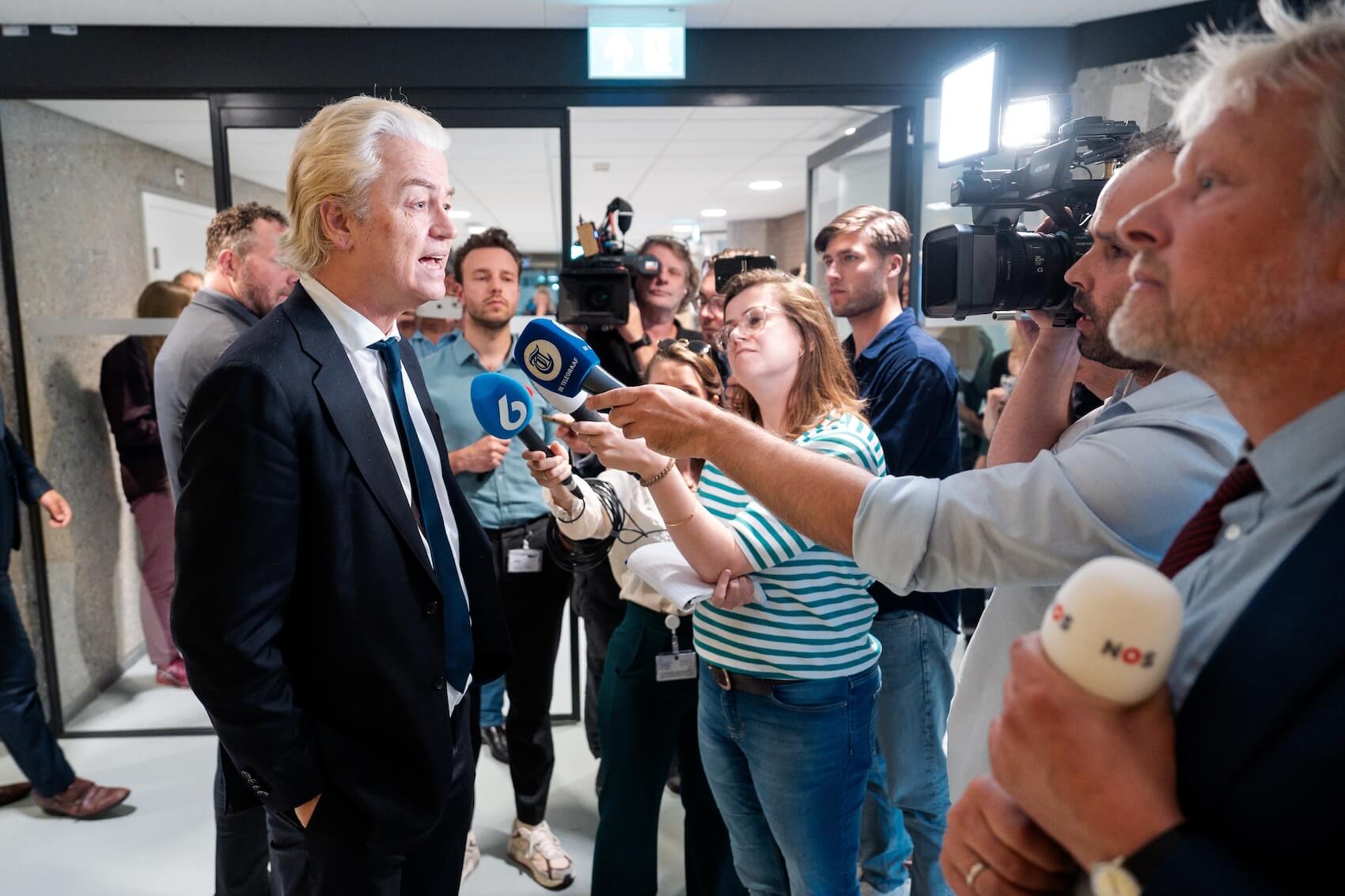
Geert Wilders (PVV) during an interview at the Plenary Debate in the Tweede Kamer on June 4, 2024, in The Hague, Netherlands. Photo: Orange Pictures.
Professor Simon Otjes, thank you very much for joining our interview series. Let me start right away with the first question: The October 29 elections produced a near tie between D66 and the PVV—symbolizing not a populist collapse, but a recalibration of its appeal. From your perspective, does this outcome signify a stabilization of populism within an institutionalized party system, or rather its transformation into a normalized mode of political contestation across Europe?
Dr. Simon Otjes: What I think is very important to note about the election results is that although the PVV lost more than 10 seats, the other populist parties that we have in the Netherlands—we have two other populist radical right-wing parties in the Dutch parliament—both won. So, if you look at the combined share of seats for the populist parties, they have really stabilized. In the previous elections, the votes were heavily concentrated on one party, the PVV, but now they are more evenly spread among the PVV, the radical right-wing populist JA21—which in some respects is more right-wing on economic issues but more moderate in its use of anti-Islamic and anti-elite rhetoric—and Forum for Democracy, a party that, according to specialists, is an extreme-right party bordering on anti-democratic. Some of its members have been sanctioned for inciting violence within parliament, and others have recently been found to be involved in plots to assassinate politicians. In that sense, we can see overall stabilization, but with movements both toward more moderate versions of the radical right and toward more extreme ones.
You have described the Dutch system as one of “fragmented pluralism.” How does this structural fragmentation affect both the endurance and the moderation of populist actors such as the PVV and JA21? Could the Dutch case exemplify how fragmentation simultaneously limits and sustains populist influence?
Dr. Simon Otjes: In the Netherlands, we had a government with populist parties between 2024 and 2025, which fell because of internal instability. But that doesn’t mean populism won’t play a role in the new government formation. There are two possible coalitions that people are discussing. One would be a coalition of all the parties in the center, from the Green Left Labour Party on the center-left to the VVD on the center-right. The other alternative would be what the Liberal Party calls a center-right government, which would involve Jason Sester, a center-left party, the CDA, a center-right party, the VVD, also a center-right party, and then JA21, the more moderate radical right-wing populist party in the Netherlands.
That option is a serious contender—it’s a question of whether they can secure 75 or 76 seats. It’s the first preference of the Liberal Party, their favored option. And that means that even though Rob Jetten proudly declared on election night that he had beaten Geert Wilders and that this was the end of the Wilders era, in reality, there is a strong chance that another radical right-wing populist party will enter government, even governing alongside the social liberals who so proudly claimed to have defeated the populists on election night.
Jetten’s Success Was Built on Progressive Patriotism, Not Populism
Rob Jetten attends the New Year’s Reception hosted by the King of the Netherlands in Amsterdam on January 3, 2025. Photo: Robert van’t Hoenderdaal.
As mainstream parties increasingly adopt affective, emotionally resonant campaign styles—such as Rob Jetten’s “positive populism”—do we witness the diffusion of populist communication logics into liberal centrism, and what might this imply for the future boundaries of populism as a concept?
Dr. Simon Otjes: I would note that I don’t think Jetten is a populist, nor did he really operate with populist rhetoric. What was striking was that he adopted a “yes-we-can” kind of orientation from the Obama campaign, which still resonates deeply with a segment of Dutch voters. But what he did do was position his party much more conservatively on the division between cosmopolitans and nationalists, taking a far more centrist stance compared to his party previously—a change that was more rhetorical than policy-based.
You could see him speaking out against asylum seekers who break the law, while also positioning himself in debates between the far left and the far right on this issue. On election night, the room celebrating his success was filled with little Dutch flags. So, you can see that the system felt the need to adopt a more nativist tone—a less extremely cosmopolitan tone—in its positioning. It’s not necessarily nativist, but more akin to a kind of progressive patriotism.
That was instrumental in how they won, because they were able to appeal to center-right voters by no longer positioning Jetten’s party as a very extreme representative of the cosmopolitan side, but rather as a party that’s centrist on this dimension. This shows that the discussion about immigration and the importance of cultural dimensions in the Netherlands have not been swept away by the defeat of the populists. In fact, the only way the social liberals were really able to win the elections was by co-opting part of the flag-waving and the more anti-immigration rhetoric, particularly when it comes to asylum seekers.
Excluding the PVV Risks Deepening Democratic Dissatisfaction
In your work on government alternation and satisfaction with democracy, you argue that meaningful alternation underpins democratic legitimacy. Given the repeated exclusion of the PVV and its allies from governing coalitions, could this exclusionary dynamic paradoxically reinforce perceptions of elite closure and deepen democratic alienation?
Dr. Simon Otjes: When it comes to the voters of the PVV, they’ve been able to access government only twice in the last 20 years—that is, between 2010 and 2012, when the PVV tolerated a center-right government, and between 2024 and 2025, when they were part of a radical government. In that sense, these voters are largely excluded from government participation, and we know that this is not good for their satisfaction with democracy.
We also know that this means the PVV increasingly attracts people who are dissatisfied with how democracy functions, which, from the perspective of the future of democracy, is seen by political scientists as a very important variable in sustaining legitimacy.
On the other hand, we saw that when they governed, they didn’t necessarily undermine institutions like the courts, but they did undermine coalition cooperation. So, in that sense, it is a very difficult bargain. On one side, co-optation of the radical right into government is a way to signal to their voters that their choice matters, but on the other, their involvement in government also risks undermining democratic principles.
A Grand Centrist Coalition Could Drive Frustrated Voters Back to the Radical Right
Relatedly, your research on coalition governance and “frustrated majorities” suggests that complex multiparty arrangements can generate their own legitimacy deficits. Might a centrist, D66-led coalition risk reproducing the very disaffection it seeks to contain, despite its pluralist intentions?
Dr. Simon Otjes: A centrist government—a government that would include GroenLinks–PvdA, D66, the VVD, and the CDA—although on substance they might be able to negotiate very well, because these are all parties with government experience, carries a danger in terms of what it would mean in the long term for where dissatisfied voters can go.
These parties will need to make compromises, and because they’re so broad, those will end up being quite centrist compromises that lack the change these parties promised in their coalition manifestos. In turn, that would mean that voters will grow frustrated, and in the Netherlands, given that the largest opposition party will be the PVV, frustrated voters will likely flock to the PVV.
So, in many ways, a large government of the center might seem promising now—and it’s certainly what D66 wants, because they want both left-wing and right-wing parties in government—but it’s very unattractive in the long term, because dissatisfied voters can only flock toward the radical right under those conditions. Rather, you would want a situation where at least one of the traditional parties of government is in opposition, because that can attract some of the voters dissatisfied with the government.
An Endless Cycle of Centrist Compromise and Populist Backlash
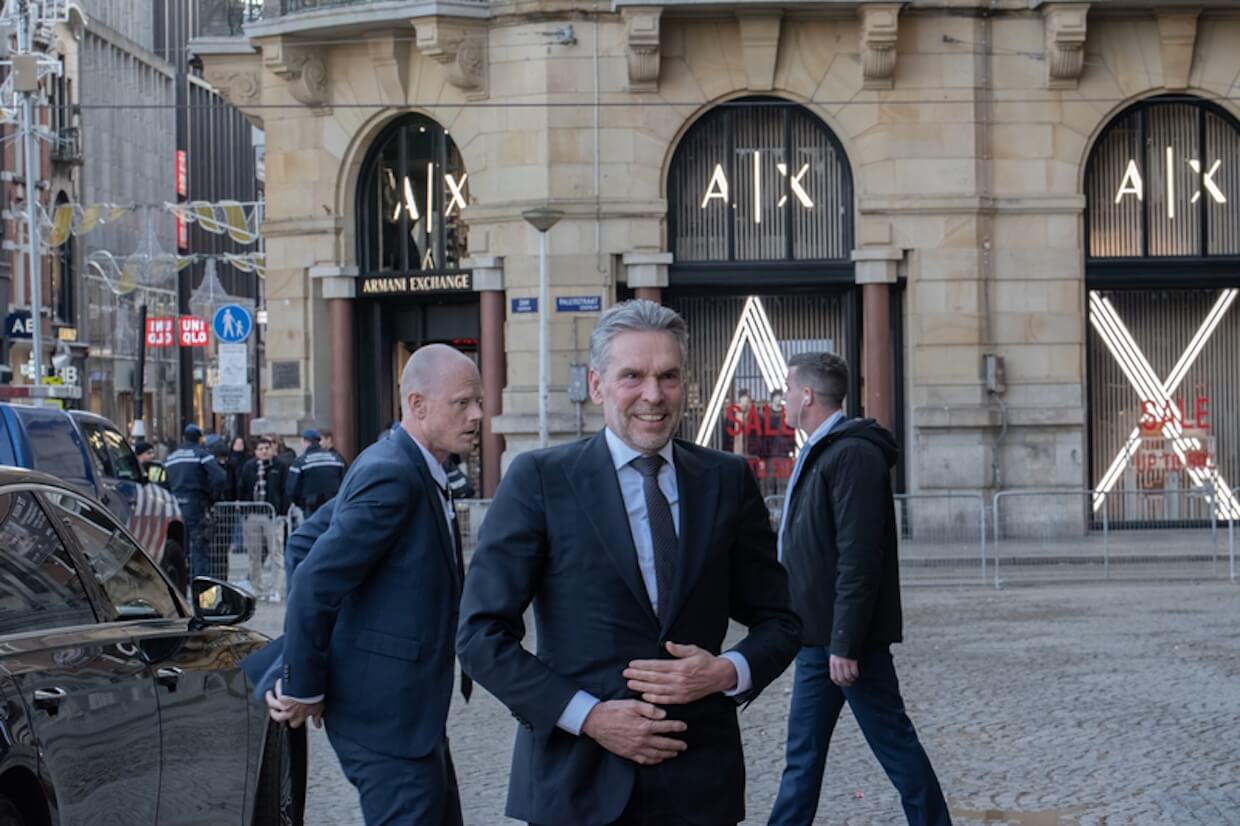
Dick Schoof attends the New Year’s Reception hosted by the King of the Netherlands in Amsterdam on January 3, 2025. Photo: Robert van ’t Hoenderdaal.
Drawing on your findings on anti-elitism and local political space, do the 2025 elections reveal a contest between technocratic centrism—embodied by D66—and localized anti-elitism, expressed through populist and regionalist currents? How do such competing modes of representation reshape the Dutch democratic fabric?
Dr. Simon Otjes: It’s important to note that in the study about localism and populism, we didn’t find—at least at the party manifesto level—that those two were necessarily strongly related. I didn’t find that. So, I want to stay away from a picture where anti-elitism is concentrated in some regions. Rather, what we find is that there is political dissatisfaction both in major cities and in more rural areas. While we do find evidence for specific forms of regionalized dissatisfaction, what seems much more likely now is that general political dissatisfaction played a major role in why voters supported the PVV.
In that sense, I would want to avoid an image where one is more local and one is more national. However, I do agree with the idea that we are seeing two different modes of governance in the Netherlands. One is the centrist governments that end up being quite technocratic, making compromises—quite gray compromises—where all the different colors are mixed together, leaving no clear political expression or policy choices made by the government. These are then alternated by brief periods of radical right-wing populist government.
That would be a good way to describe the Netherlands over the last 30 years: a centrist coalition between 1994 and 2002, followed by a populist moment in 2002 with the LPF (Pim Fortuyn List), which couldn’t govern and fell apart. Then we had different centrist governments until 2010, when the VVD was willing to govern with the PVV in the 2010–2012 minority government, which also collapsed. It was followed by the centrist Liberal–Labour coalition, and then more centrist governments until 2024, when we had the Dick Schoof government.
So, basically, what we have are periods of rather gray, technocratic, centrist government, alternated by radical right participation in 2002, 2010–2012, and 2024–2025—very short periods, because they have so far proven to be unreliable partners. This seems to be the pattern the Netherlands is caught in: an alternation between uninspiring centrist governments and brief bursts of radical right-wing dissatisfaction, which fail to make lasting changes because of their inherent instability.
Voters Shift from PVV to JA21 for Real Policy Impact on Migration
Your research with Green-Pedersen shows how party competition drives issue salience. Have the 2025 elections further diffused the immigration debate across the party spectrum, eroding the PVV’s ownership of the issue? If so, what new issues might sustain populist mobilization going forward?
Dr. Simon Otjes: Although I don’t really have the numbers right now, because students are only going to start coding manifestos for 2025, I don’t think the PVV has lost its issue ownership on migration. Rather, if you asked voters, a large share of them would still say that the PVV has the most credible and promising positions on migration.
Instead, voters shifted to different parties mainly because the PVV was excluded from government, and therefore, voters who wanted to influence government policy could no longer vote for the PVV—it became more of an expressive vote on immigration. That meant that, in particular, JA21, which is much more likely to enter a government coalition than the PVV, was a good alternative for voters who, on one hand, wanted a change in migration policy, and on the other, wanted to have a chance to influence government policy.
So, that is essentially why that party gained support—because of its ability to attract voters dissatisfied with migration policy but still eager to have a real impact on government decisions, something the PVV currently seems unlikely to achieve.
Populism Persists by Adapting to Different Electorates
Election posters near the Binnenhof featuring Geert Wilders of the PVV in the foreground, The Hague, the Netherlands, October 12, 2025. Photo: Dreamstime.
You have observed that populism adapts rather than disappears. Does the simultaneous decline of the PVV and rise of smaller radical-right parties like JA21 and FvD represent ideological splintering, or a strategic diversification ensuring the persistence of the populist bloc?
Dr. Simon Otjes: It would be difficult to really assign a strategy to it, but what we can see is that what was previously very strongly concentrated on the PVV has now dissipated into three different parties, representing three different ways of doing politics. There is JA21, which still has radical right-wing positions, but we can really debate to what extent this party is populist. Does it really use the logic of populism? Does it really appeal to this idea of a united, virtuous population versus a corrupt elite? Rather, these groups want to be part of the government, so they don’t really use this kind of anti-elite rhetoric, but they have very clear anti-immigration stances.
So, that is a party that at least appeals to voters who want to influence government policy. That’s still a large segment. It’s still the second party of the Netherlands, despite their inability to govern. In many ways, that party performed well among voters who were dissatisfied with migration and politics, mobilizing a very traditional radical-right electorate.
And then the third party is FvD, which is much more extreme, as I pointed out at the beginning, and also appeals to a different segment of the electorate—one that has ended up in news environments very different from the mainstream media, where conspiracy theories are much more common. It’s particularly notable and worrying from a democratic perspective that FvD grew this much. They were shunned by traditional media under their previous leader, Thierry Baudet, and then they changed their leadership without changing their manifesto or distancing themselves from, for instance, the MP who was sanctioned for inciting violence. When they changed their leader to a more acceptable face, suddenly the media cordon that Baudet had faced disappeared. That is really worrying. This party has now more than doubled its seat total, despite taking very extreme positions and harboring a membership that seeks to undermine democracy.
So, in that sense, I wouldn’t necessarily talk about strategy here, but I would emphasize that there are different parties on the radical right that appeal to different groups, and that is the key explanation of why they remain so stable—their ability to attract very different electorates by diversifying their offerings.
Religious and Cultural Attitudes No Longer Align in Dutch Politics
In light of your work on religious parties and immigration attitudes, how do you interpret the enduring moral and cultural anxieties that underpin populist narratives in an increasingly secular and urbanized Netherlands?
Dr. Simon Otjes: So, the question is, what is the relationship between religion and these cultural attitudes? And there, I have to be a little bit skeptical, in the sense that in the Netherlands, religious attitudes and cultural attitudes aren’t strongly coherent, and we can also see that in the party landscape. There are three Christian democratic parties currently in Parliament—that is, the SGP, which is a very conservative Protestant party; the CDA, the mainstream Christian democratic party that did quite well in the elections; and the ChristenUnie, a more center-left Christian party, particularly when it comes to environmental and economic issues.
On migration, the SGP isn’t really differentiable from the radical right. They take very clear radical-right positions without being populist—very strongly anti-immigration, anti-Islam, and believing that Christianity is superior to Islam. Then the CDA takes much more centrist positions. They favor measures against migration, particularly citing that the Netherlands can’t really handle that many migrants, without veering into nativist territory, but they are quite conservative when it comes to migration. They, for instance, supported the principles of the far-reaching migration bill that was introduced by the previous government. They voted against it for a few amendments, but not because they disagreed with the principles in it.
And then there’s the ChristenUnie, which is much more progressive on migration. It really is a party of the kind of churches that want to help refugees in this country. So, this diversity shows that in the Netherlands, there isn’t necessarily a strong relationship between migration attitudes and voting for different Christian democratic parties. Rather, Christian democracy shows different shades.
The Netherlands Won’t Necessarily Be a Particularly Progressive Government on EU Issues
In“From Eurorealism to Europhilia,”you trace D66’s evolution toward a more assertive pro-Europeanism. Does Rob Jetten’s victory reflect a genuine societal re-legitimization of the EU in Dutch political discourse, or is it a contingent reaction to populist overreach?
Dr. Simon Otjes: We have to really note here that Jetten didn’t win the election because the population in the Netherlands changed its opinion. Public opinions about migration or about the European Union in the Netherlands are surprisingly stable, and rather, if anything, we can see that Jetten appealed to voters by becoming more centrist on this issue. This traditionally very pro-European party decided to have a big Dutch flag during their party conference, signaling that they wanted to move away from the cosmopolitanism that was associated with them. So, I wouldn’t necessarily see his victory as a change in opinion about the European Union or even about migration. Rather, it’s about a party strategically positioning itself on these issues to appeal to a larger segment of voters.
That doesn’t necessarily mean that Dutch policy on the EU won’t change. We’ve had a very Eurosceptic government—also a government that was really unable to influence European policy because the Prime Minister wasn’t tied to one of the major party families and was an unknown in Brussels. And so, the Netherlands will play a more active role in the European Union.
Depending on how the government formation turns out, it could also play a more positive role, particularly on issues where the Netherlands has been quite conservative, such as budgetary expansion. At the same time, despite D66’s entry into government, it seems very likely that the VVD will also be in government. And a government with the VVD will mean a government that inevitably moves against too large an increase in European budgets or too expansionary policies. They are fighting a rearguard battle against an increasing role for the EU in these matters. So, in that sense, the Netherlands won’t necessarily be a particularly progressive government on this issue.
Your study of Volt highlighted the rise of transnational “Europhile populism.” Could D66’s success, with its emotionally charged yet pro-European message, indicate a broader continental trend toward the hybridization of populism and cosmopolitanism?
Dr. Simon Otjes: I really want to emphasize that both in the study about Volt and in the study about D66, I did not claim that these parties are populist. I wouldn’t necessarily call them populist. They don’t make this differentiation between “the people” and “the elite.” D66 is rather a traditional party of government that was able to mobilize dissatisfaction with the current government, but not necessarily by appealing to broader dissatisfaction with democracy. So, no, I don’t think there’s any basis for calling these parties populist. These parties are—I mean, D66 was quite good at running its campaign and adopted a more patriotic, progressive patriotic message—but there’s nothing about them that makes them populist. The same is true for Volt.
D66’s Appeal Is Governmental, Not Populist
Billboard of D66 featuring Rob Jetten with the slogan Het Kan Wel in Amsterdam, the Netherlands on October 28, 2025. Photo: Robert van ’t Hoenderdaal.
How might the Dutch election reshape the EU’s political equilibrium—particularly in debates over migration, democratic reform, and responses to illiberalism? Is the Netherlands now positioned to play a normative role in defending liberal democratic values within the Union?
Dr. Simon Otjes: We really have to differentiate migration from the debate about liberalism. When it comes to migration, all the parties in Parliament, perhaps with the exception of very small ones, support the European Migration Pact, and that is even seen by the parties of the left, such as D66 and PvdA, as a solution to their migration problem. They really make it a European problem. So, there’s broad support for those kinds of measures, including dealing with refugees in third countries and making deals with third countries—although legal scholars seriously doubt whether those measures comply with refugee conventions. But that’s what they see as a solution to the migration problem.
When it comes to the discussion about illiberalism, the Netherlands doesn’t really play any major role, because the issue is largely shaped by the fact that several countries, particularly in Eastern Europe, are willing to tolerate each other’s illiberalism, and moves against illiberalism within the EU require unanimity. So, in that sense, the change of government in the Netherlands hasn’t really changed anything.
I think the Schoof government might perhaps be a little more accepting of illiberalism than previous governments, but it’s important to note that both NSC and VVD, which are in that government, are parties that favor maintaining the rule of law and supporting actions against illiberalism. So, in that sense, I don’t think a change in government will mean much for these discussions—particularly because this debate really centers on Hungary, Slovakia, and soon also Czechia, and increasingly Poland, which continue to allow an area of illiberalism within the European Union. So, in that sense, I don’t think the change in government will necessarily affect this issue at the EU level.
No Major Democratic Changes Expected
Building on your research with Bedock et al. (2022) on the populist challenge to democracy reform, how do you interpret the PVV’s brief period in power? Has it intensified mainstream reflection on the tension between majoritarian responsiveness and liberal constraint in Dutch democracy?
Dr. Simon Otjes: No, I don’t think that the PVV’s participation in government has really changed views about democracy. What we can see is that the NSC, which was one of the government parties, pushed an agenda of government reform, including changes to the electoral system. The previous government was quite open to the introduction of a referendum in the Netherlands.
The interesting question now is what will happen with those portfolios, particularly because the PVV and the VVD are quite skeptical—especially about freezing the introduction of a referendum. There was quite an ambitious reform agenda that was stalled because the government lasted such a short time, and it really is uncertain what kind of reform agenda they will adopt.
What you can see in the centrist part of Dutch politics is an understanding that democracy needs reform, but there isn’t a clear or united agenda around how to do it. What is notable, particularly about the participation of NSC in the previous government, is that they had a very clear reform agenda, but it is now closely associated with them. So, I don’t expect that the next government will do anything in terms of major changes like electoral reform.
I have sincere doubts about whether the referendum bill that had already progressed to Parliament will move forward—it’s likely to be stalled even longer. So, I don’t think this will lead to any major changes in the way democracy functions in the Netherlands.
Centrist Governments and Radical Right Experiments Will Keep Alternating
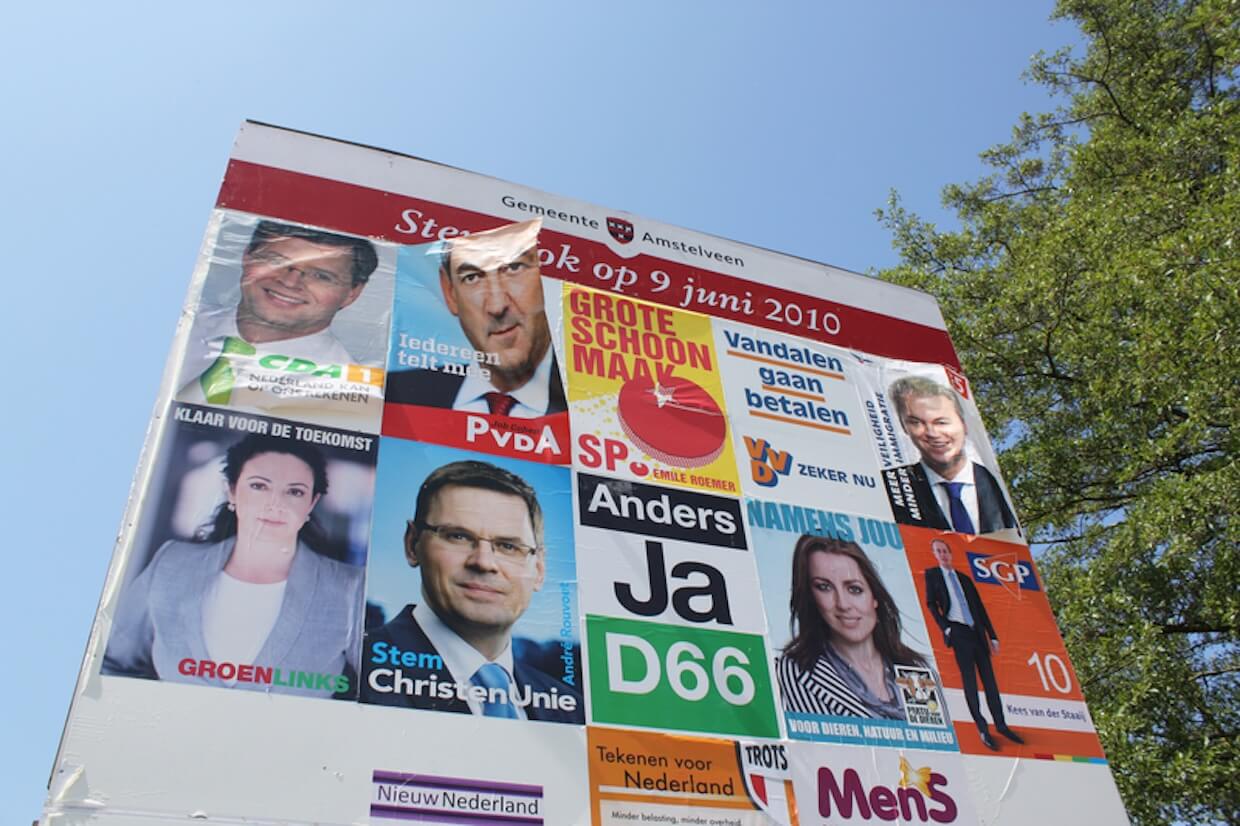
Billboard featuring the main candidates in the Dutch elections on June 9, 2010, in Amstelveen, the Netherlands. Photo: Dreamstime.
Across Europe, we observe a convergence between adaptive liberal centrists and fragmented populist right formations. Do you see this dynamic producing a long-term hybridization of democratic politics—where populist affect and centrist rationality coexist as dual pillars of contemporary representation?
Dr. Simon Otjes: This description, where you have an alternation between almost technocratic centrist governments—often including parties from the center-left and the center-right—having to govern together, leading to compromises where you can’t really see the course of the party anymore, being interrupted by brief periods of radical right-wing governments because the radical right has become governable, is quite accurate. That is a pattern we can now see, at least for the last 30 years. And that seems—I can see no basis for another path than that. You would continually have these centrist governments that try to deal with the issues, but because of their breadth inside the coalition, aren’t really able to deliver very clear either left- or right-wing policy solutions, and then being interrupted by different forms of government with the radical right. We saw the government with the LPF in 2002, the tolerated government in 2010, and now this whole experiment, and we’ll just continue to have this alternation between these two options.
The Netherlands Remains in an Enduring Populist Cycle
And finally, Professor Otjes, when viewed globally—from Trump’s America to Milei’s Argentina and Meloni’s Italy—do the Dutch elections signify the emergence of a post-populist phase characterized by ideological diffusion and strategic normalization, or do they mark merely another turn in populism’s enduring cycle of reinvention?
Dr. Simon Otjes: I don’t think we can talk about a post-populist phase. What we see here fits a pattern that we’ve observed before: populists enter government, those governments prove to be unstable, and then there’s a response from the center, which seeks to govern together again. They do that for a while until, once more, the populists become so large that they can’t be ignored. That’s the pattern I’m seeing, so I wouldn’t call this a post-populist phase—we’re still very much inside this populist moment.
When it comes to diffusion, I really don’t think that populism has spread very strongly among mainstream parties. You could argue that mainstream parties have moved to the center, or sometimes to more conservative positions—as with the VVD on migration. So, we can clearly see that populism, and particularly the radicalizing influence of populist parties, is shaping how other parties make policy.
But that doesn’t mean we’re now in a post-populist phase. Rather, we’ll continue to see this alternation—radical right-supported governments briefly interrupting a more general pattern in which the parties at the center have to govern together.
ECPS Staff. (2025). “Virtual Workshop Series — Session 5: Constructing the People: Populist Narratives, National Identity, and Democratic Tensions.” European Center for Populism Studies (ECPS). November 3, 2025. https://doi.org/10.55271/rp00117
Session 5 of the ECPS–Oxford Virtual Workshop Series examined how populist movements across different regions construct “the people” as both an inclusive democratic ideal and an exclusionary political weapon. Moderated by Dr. Heidi Hart, the session featured presentations by Dr. Amir Ali, Dr. Yazdan Keikhosrou Doulatyari, and Andrei Gheorghe, who analyzed populism’s intersections with austerity politics, linguistic identity, and post-communist nationalism. Their comparative insights revealed that populism redefines belonging through economic moralization, linguistic appropriation, and historical myth-making, transforming pluralist notions of democracy into performative narratives of unity and control. The ensuing discussion emphasized populism’s adaptive power to manipulate emotion, memory, and discourse across diverse democratic contexts.
Reported by ECPS Staff
On October 30, 2025, the European Center for Populism Studies (ECPS), in collaboration with Oxford University, convened Session 5 of its Virtual Workshop Series, titled“We, the People” and the Future of Democracy: Interdisciplinary Approaches. This ongoing series (September 2025–April 2026) explores the cultural, economic, and political dimensions of populism’s impact on democratic life across diverse global contexts.
Titled “Constructing the People: Populist Narratives, National Identity, and Democratic Tensions,” the fifth session brought together scholars from political science, sociology, and linguistics to interrogate how populist movements construct and mobilize “the people” as a moral, cultural, and emotional category. The discussion illuminated the multiple ways in which populist discourse reshapes collective identity, redefines sovereignty, and challenges democratic pluralism.
The session was moderated by Dr. Heidi Hart, an arts researcher and practitioner based in Utah and Scandinavia, whose expertise in cultural narratives and affective politics enriched the workshop’s interpretive lens. Three presentations followed, each approaching the notion of “the people” from a distinct analytical angle. Dr. Amir Ali (Jawaharlal Nehru University, New Delhi) examined the paradox of austerity populism, arguing that fiscal conservatism has become a populist virtue masking economic dispossession. Dr. Yazdan Keikhosrou Doulatyari (Technische Universität Dresden) turned to the linguistic life of democracy in Germany, tracing how words like Volk, Leute, and Heimat encode competing visions of community, inclusion, and exclusion in the contemporary public sphere. Andrei Gheorghe (University of Bucharest and EHESS, Paris) presented a comparative analysis of Romanian and Hungarian populisms, exploring how leaders from Viktor Orbán to Traian Băsescu construct national identity through historical memory and moral dualism.
The session also featured two discussants whose critical reflections deepened the dialogue: Hannah Geddes (PhD Candidate, University of St Andrews) offered comments that emphasized conceptual clarity, methodological coherence, and the comparative breadth of the papers. Dr. Amedeo Varriale (PhD, University of East London) provided incisive observations connecting the economic, cultural, and linguistic dimensions of populism, situating the presenters’ work within wider debates on ideology, nationalism, and discourse.
Throughout the session, Dr. Hart guided the discussion and er moderation fostered an interdisciplinary dialogue among presenters and discussants, drawing attention to the intersections of economy, discourse, and collective memory. Ultimately, Session 5 revealed that the populist construction of “the people” is not merely a rhetorical act but a performative process—one that transforms democratic ideals of equality and representation into instruments of control and exclusion.
Dr. Amir Ali: “Ripping Off the People: Populism of the Fiscally Tight-Fist”
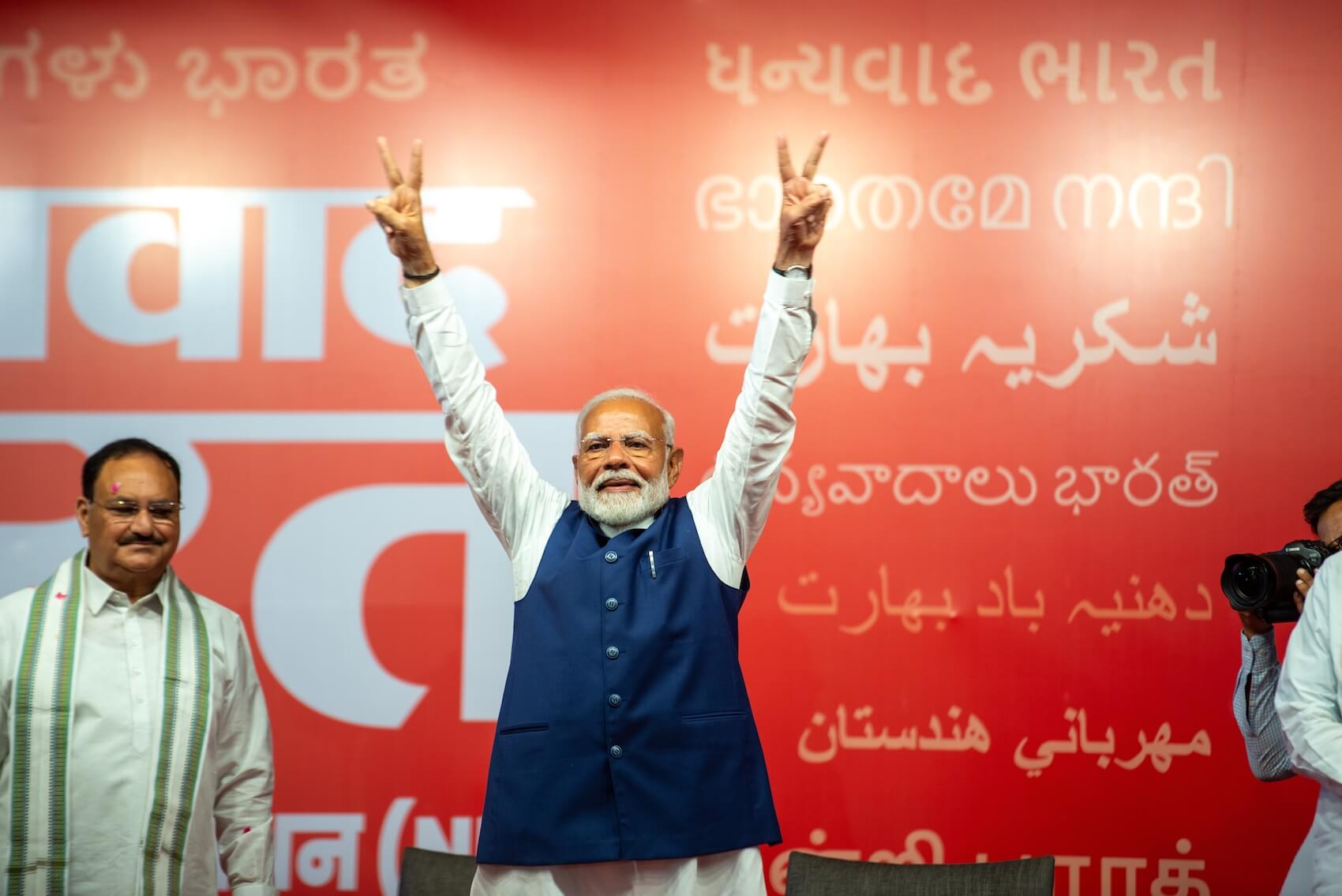
Prime Minister Narendra Modi is showing victory sign with both hand to supporters at Bharatiya Janata Party office amid the results of the Indian General Elections 2024 in New Delhi, India on June 4 2024. Photo: Pradeep Gaurs.
In his insightful and intellectually charged presentation, Dr. Amir Ali of Jawaharlal Nehru University examined the paradoxical relationship between populism and austerity in contemporary politics. With comparative references to India, the United Kingdom, and Argentina, Dr. Ali argued that modern populist regimes—despite their pro-people rhetoric—engage in policies that effectively “rip off” the very constituencies they claim to represent.
Dr. Ali began by framing the core paradox of his paper: while populism ostensibly celebrates and empowers “the people,” its economic manifestations often culminate in policies of fiscal restraint, austerity, and redistribution away from the lower classes. To conceptualize this tension, he introduced the evocative metaphor of “ripping off the people,” signifying the betrayal of the populist promise through the simultaneous glorification and exploitation of the masses.
From Geddes’s Axe to Milei’s Chainsaw: The Genealogy of Austerity
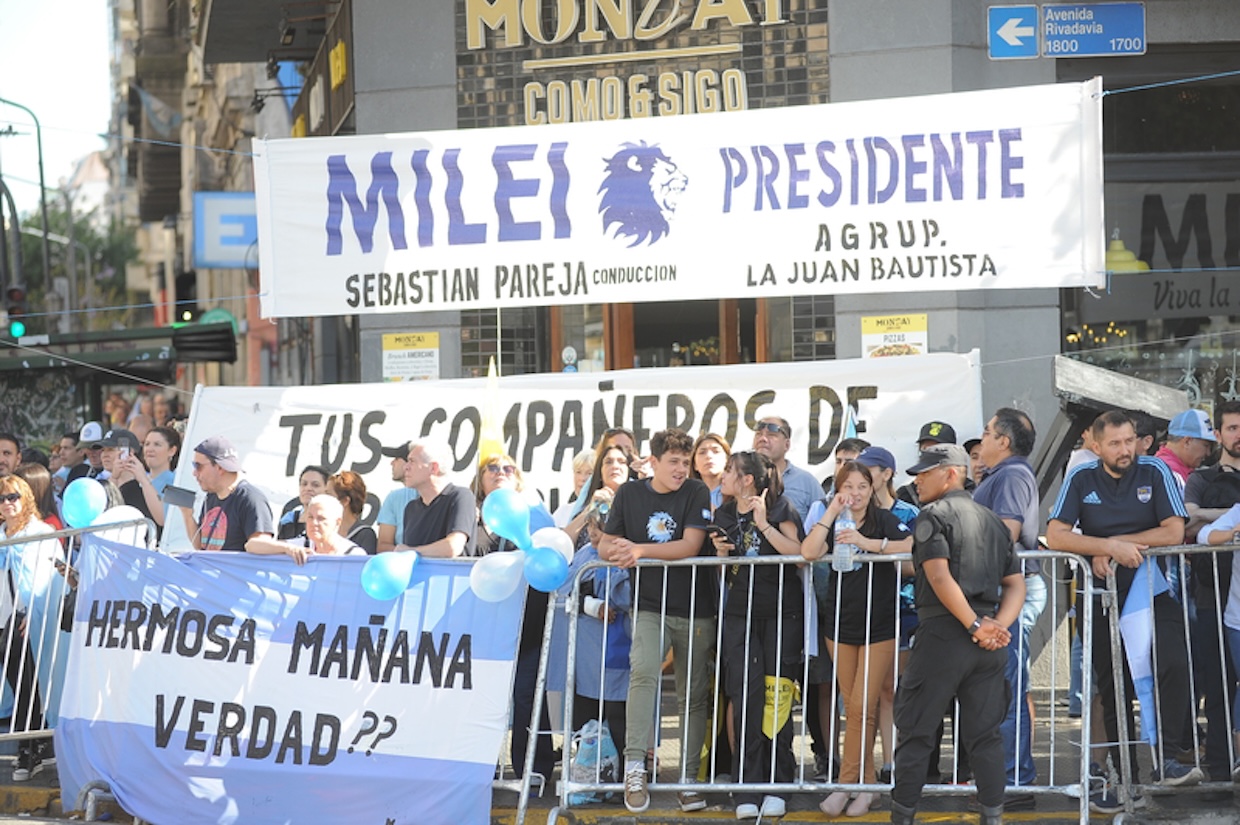
In his introduction, Dr. Ali employed a historical lens to trace the evolution of austerity politics—from the early twentieth-century “Geddes Axe” in Britain to the brutal symbolism of Argentine President Javier Milei’s “chainsaw.” The former, referencing post–World War I budget cuts under British Chancellor Sir Eric Geddes (1921), marked the institutionalization of austerity as a state virtue. The latter, Milei’s notorious use of a chainsaw as a political prop, epitomizes the contemporary radicalization of austerity—an aggressive, performative politics of cutting state expenditure to the bone.
This imagery, Dr. Ali suggested, captures a broader transformation in global political economy: austerity has shifted from being a technocratic policy of restraint to a populist spectacle of destruction. Under this regime, “cut, baby, cut”—echoing Donald Trump’s “drill, baby, drill”—becomes a rallying cry of fiscal violence dressed in popular legitimacy.
Three Faces of Populism: Anti-Elite, Anti-Establishment, Anti-Intellectual
Dr. Ali conceptualized populism through its tripartite oppositional structure: it is anti-elite, anti-establishment, and anti-intellectual. Yet, these negations coexist with an exaggerated pro-people posture, creating what he termed a “caricature of the people.” Drawing from Hannah Arendt’s The Origins of Totalitarianism (1951), he observed that when “the people” are caricatured, they quickly transform into a mob—a collective easily manipulated by demagogues and complicit elites.
In Dr. Ali’s analysis, populism’s anti-elitism is thus inherently deceptive. It dismantles one elite only to enthrone another, often more corrupt and authoritarian. This “frying pan to fire” dynamic exemplifies the central irony of contemporary populism: in purporting to empower the people, it reconstitutes new hierarchies of domination.
Historical and Conceptual Distinctions: Populism Then and Now
A key contribution of Dr. Ali’s presentation was his distinction between twentieth-century populism and twenty-first-century populism—both historically and conceptually.
The populisms of the twentieth century, particularly in Latin America, were fiscally profligate and redistributive. Leaders such as Juan Perón in Argentina or Indira Gandhi in India engaged in state-led welfarism and social inclusion. In contrast, contemporary populism, as witnessed in the regimes of Narendra Modi, the Brexit Conservatives, and Javier Milei, is fiscally conservative. It espouses austerity while deploying populist rhetoric to justify inequality.
In Dr. Ali’s words, the “populism of the fiscally tight-fist” marks a conceptual rupture: it moralizes austerity and sanctifies fiscal prudence, transforming economic cruelty into civic virtue.
Case Studies: India, Britain, and Argentina
To substantiate his argument, Dr. Ali developed a comparative triad of case studies—India, the United Kingdom, and Argentina—each exemplifying a unique variant of austerity-driven populism.
India under Narendra Modi, he argued, exemplifies fiscally conservative populism. Modi’s government, while maintaining strict fiscal discipline, employs targeted welfare schemes—such as direct cash transfers—to cultivate an electorate of Labharthi (beneficiaries). These schemes, though presented as welfarist, are not redistributive in nature; rather, they create a beholden class whose dependence on state largesse ensures political loyalty.
Dr. Ali drew an instructive comparison between India’s Labharthi and the descamisado (“shirtless ones”) of Peronist Argentina. While Perón’s descamisados represented a mobilized working class empowered through redistribution, Modi’s Labharthi are atomized dependents sustained by piecemeal welfare. The former embodied class inclusion; the latter reinforces clientelism. This distinction, he argued, underscores the moral inversion of populism under neoliberal austerity: generosity becomes a tool of subordination.
In the United Kingdom, Dr. Ali turned to the work of economist Timo Fetzer (2019), whose empirical study in the American Economic Review demonstrated a causal link between austerity policies under David Cameron’s government and the 2016 Brexit vote. Fetzer’s data, Dr. Ali noted, reveal how regions most devastated by austerity were disproportionately likely to vote “Leave.” Hence, the populist revolt against elites was, paradoxically, the political offspring of elite-engineered austerity.
Finally, Argentina provided what Dr. Ali termed “the brutal extreme” of austerity populism. Drawing on research by Jem Ovat, Tisabri Anju, and Joel Rabinovich (Economic and Political Weekly), he noted that Milei’s shock therapy has slashed central government expenditure by 27.5% within a single year, producing a budget surplus of 3.3% of GDP—the first in fourteen years. This dramatic fiscal contraction, celebrated as economic salvation, has simultaneously deepened inequality and social precarity.
Together, these cases illustrate Dr. Ali’s thesis that austerity is the economic face of populism’s deceit: it claims to save the people from excess while impoverishing them through scarcity.
Austerity as Virtue and Violence
Dr. Ali engaged critically with two major works on austerity: Mark Blyth’s Austerity: The History of a Dangerous Idea (2013) and Clara E. Mattei’s The Capital Order (2022). From Blyth, he borrowed the notion of austerity as an ideological weapon masquerading as prudence. From Mattei, he adopted the argument that austerity originated as a political technology to discipline labor and preserve capitalist order.
Extending these insights, Dr. Ali argued that austerity today functions as virtue signaling—a moral performance by governments and elites who equate fiscal restraint with righteousness. While austerity may be an admirable personal trait, he warned, its translation into public policy is catastrophic. As a state doctrine, it penalizes the already austere working classes, weaponizing virtue into violence.
The Indian Trajectory: From Anti-Corruption to Authoritarian Populism
Dr. Ali traced the genealogy of India’s populism to the 2011 anti-corruption movement, which, under the guise of civic purification, delegitimized the political class and paved the way for Modi’s ascent. Like Brazil’s anti-corruption crusade that felled Dilma Rousseff, India’s movement transmuted moral indignation into reactionary populism.
Interestingly, Modi’s 2014 campaign was not overtly populist but technocratic—promising efficiency and reform. However, as Dr. Ali observed, over time his regime adopted increasingly populist tactics: emotional appeals, symbolic nationalism, and welfare clientelism. These, combined with austerity policies, have produced a paradoxical populism—economically neoliberal but culturally majoritarian.
Free Speech, Anti-Intellectualism, and the Politics of Hate
Dr. Ali also addressed the anti-intellectual dimension of contemporary populism. In India, institutions such as Jawaharlal Nehru University (JNU) have been vilified by the media as “anti-national.” He likened this to Viktor Orbán’s assault on the Central European University in Hungary—an effort to delegitimize critical thought and replace it with populist orthodoxy.
Linked to this is what he called the fetishization of free speech—exemplified by Elon Musk’s acquisition of X (formerly Twitter). In the guise of free speech absolutism, populist regimes weaponize communication platforms to normalize hate speech and suppress dissent. The result is a paradoxical public sphere: loud with propaganda, silent on inequality.
Silence on Inequality and the Rhetoric of the People
Despite their loquacity, populist leaders share a striking silence on one issue: inequality. Dr. Ali invoked Thomas Piketty’s recent work on the “billionaire raj” to highlight the deepening disparities in wealth and power. While populism mobilizes resentment against elites, it rarely challenges structural inequality; rather, it reconfigures resentment into cultural or religious antagonism.
In India, this silence is particularly pronounced. The populist narrative celebrates national pride and market success while masking the precarity of millions living below subsistence levels. The rhetoric of “the people” thus becomes, in Dr. Ali’s words, “a political caricature”—a manipulated portrait of the masses, drawn by leaders who claim to represent them but instead exploit their vulnerability.
The Populist Caricature and the Politics of Ripping Off
Dr. Ali concluded with a vivid metaphor. The populist leader, he suggested, resembles an artist who asks the people to pose for a portrait—only to render them grotesquely, as a caricature. When the people object to their distorted image, he tears up the paper and discards them. This, for Dr. Ali, encapsulates the moral economy of contemporary populism: it elevates the people rhetorically only to discard them materially.
Drawing on Shakespeare’s Julius Caesar, he cited the line: “He will scorn the base degrees by which he did ascend.” Once the leader rises to power, he abandons the very people who lifted him. Similarly, Dr. Ali evoked King Lear: “Tis the time’s plague when madmen lead the blind.” The metaphor aptly captures a global moment where demagogues, propelled by economic despair, guide nations into deeper crisis.
Ultimately, Dr. Ali’s presentation offered a sobering reflection on the moral contradictions of contemporary populism. The populism of the fiscally tight-fist, he argued, redefines austerity as virtue, dependency as empowerment, and domination as democracy. Beneath its pro-people veneer lies a politics of dispossession—a systematic ripping off of the people in the name of serving them.
Dr. Yazdan Keikhosrou Doulatyari: “The Living Language of Democracy: Folk and Leute in Contemporary Germany”
PEGIDA supporters demonstrate in Munich, Germany, on February 15, 2018. Photo: Thomas Lukassek.
In his thought-provoking presentation, Dr. Yazdan Keikhosrou Doulatyari explored the emotional and political dimensions of two fundamental German words—Volk (“the people” as a symbolic national collective) and Leute (“people” in the everyday, social sense). His research investigates how these linguistic categories shape the lived experience and imagination of democracy in modern Germany, particularly amid the resurgence of right-wing populism in the country’s east.
Dr. Doulatyari opened his talk by situating his research within the long tradition of German philosophical anthropology and sociology, referencing his collaboration with Siegbert Rieberg—one of the last academic assistants to Arnold Gehlen, a founding figure of twentieth-century philosophical anthropology. Drawing on this lineage, he posed a central question: How do Germans today use and feel the words “Volk” and “Leute” when they talk about nation, belonging, and democracy?
Both terms, he argued, carry deep emotional and historical weight. Volk represents a vertical, symbolic notion of unity—“one people, one nation”—while Leute expresses a horizontal sense of community grounded in daily coexistence: neighbors, friends, and ordinary citizens. These linguistic currents embody two distinct emotional orientations of democratic life. The Leute current is inclusive, open, and social, corresponding to everyday democracy; the Volk current is cohesive, symbolic, and often exclusionary, evoking the idea of an authentic or “true” people.
Language, Emotion, and the Grammar of Belonging
Dr. Doulatyari emphasized that these words are not merely lexical choices but emotional and political signifiers. Each term, he explained, constructs a “grammar of belonging” that defines who is included in or excluded from the democratic “we.” By studying how Volk and Leute appear in political speech, popular media, and street demonstrations, his research illuminates how collective identities are linguistically produced and contested in contemporary Germany.
His methodology combines field observation—being present in demonstrations, public gatherings, and social forums—with digital corpus analysis using the Leipzig Corpora Collection. This dual approach allows him to examine both the embodied use of language in real-life contexts and its broader semantic trends in contemporary German discourse, particularly during 2024.
By searching for instances where Volk and Leute occur alongside the pronoun wir (“we”), Dr. Doulatyari identified how Germans imagine collective identity through language. The recurring question, he observed, is not simply who are the people? but who are “we”?
From “Wir sind das Volk” to “Wir sind mehr”
A key part of his analysis focused on two powerful slogans that have defined Germany’s recent political discourse. The first, “Wir sind das Volk” (“We are the people”), emerged in 1989 as a democratic cry during the protests that led to the fall of the Berlin Wall. However, in recent years, this same phrase has been appropriated by right-wing populist movements—most notably the Pegida demonstrations—to advance exclusionary and nationalist agendas. What was once a rallying call for democratic inclusion has been transformed into a slogan of cultural homogeneity and xenophobia.
In contrast, the counter-slogan “Wir sind mehr” (“We are more”) arose in response, expressing solidarity with diversity, inclusion, and democratic pluralism. It embodies the same emotional energy as “Wir sind das Volk” but redirects it toward openness rather than closure. For Dr. Doulatyari, this semantic struggle over we-ness lies at the heart of Germany’s democratic tensions today.
Populism Between Folk and Leute
Dr. Doulatyari observed that right-wing populist politicians have become adept at navigating between these two registers of language. They speak the language of Leute—informal, familiar, and seemingly ordinary—to appear close to everyday citizens. Yet simultaneously, they invoke the symbolic power of Volk to claim moral and political authority, suggesting they alone speak for “the real people.” This rhetorical oscillation allows populists to naturalize exclusion while sounding democratic.
He further noted that in everyday expressions—such as die normalen Leute (“the normal people”)—the term Leute carries emotional warmth and authenticity but is increasingly co-opted by populist discourse to draw boundaries against supposed elites or outsiders, including the European Union or migrants. Thus, populism instrumentalizes linguistic intimacy (Leute) and symbolic unity (Volk) to sustain a politics of division.
The Missing Bridge: Democracy’s Structural Challenge
At the heart of Dr. Doulatyari’s argument lies a structural diagnosis. Beneath both Volk and Leute, he suggested, exists a “hidden wish”—a desire to be seen, to belong, and to participate meaningfully in collective life. Volk seeks stability and rootedness, while Leute seeks recognition and inclusion. The democratic challenge, therefore, is not the existence of emotion but the absence of institutional structures capable of linking these two desires.
Drawing on Siegbert Rieberg’s notion of Raum der Bedeutung—the “space of meaning”—Dr. Doulatyari argued that modern democracies face a profound crisis of meaning-space. When institutions fail to connect the symbolic (unity) and the social (participation), the linguistic field fractures. The result is polarization: emotional belonging turns into frustration, and nationalism replaces solidarity.
Reclaiming the Language of Democracy
Dr. Doulatyari concluded by emphasizing that language itself remains one of the strongest symbolic institutions of democracy. In cultural life, new efforts are emerging to reimagine Volk and Leute in inclusive ways. He pointed to artistic and civic examples such as the Volksbühne theater in Berlin, which has sought to reappropriate Volk through multicultural performances, and to the growing use of Leute in music and popular media that emphasize everyday connection and plural belonging.
Ultimately, he argued, the struggle over these two words mirrors the struggle over democracy itself. Whoever controls the meaning of “we” controls the moral legitimacy of the political order. To revitalize democracy, societies must rebuild trust not through ethnic or cultural homogeneity but through constitutional loyalty and civic inclusion.
In his concluding reflection, Dr. Doulatyari proposed a metaphor of reconciliation: Volk and Leute are not opposites but complementary forces—two sides of the same human story. Democracy thrives only when symbolic unity and social diversity remain in dialogue. Language, therefore, is not a mere reflection of democracy—it is its living heartbeat.
Andrei Gheorghe: “Constructing ‘the People’ in Populist Discourse: The Hungarian and Romanian Cases”
Viktor Orban, Hungary’s prime minister arrives to attend in an informal meeting of Heads of State or Government in Prague, Czechia on October 7, 2022. Photo: Alexandros Michailidis.
In his presentation, doctoral researcher Andrei Gheorghe explored the evolving concept of “the people” in contemporary populist rhetoric, focusing on Hungary and Romania. His analysis examined how populist leaders in both countries, responding to the 2008–2009 financial crisis, redefined the people as a moral and cultural community opposed to liberal elites and supranational structures such as the European Union.
Gheorghe began by recalling the paradox that inspired his study. After joining the European Union and benefiting from substantial economic aid and development funds, Hungary and Romania should have experienced greater trust in European institutions and liberal democracy. Instead, both countries witnessed the rapid rise of national populism. Populist movements began portraying Brussels not as a partner in reconstruction but as a foreign power threatening national sovereignty and identity. To Gheorghe, this paradox—prosperity accompanied by populist rebellion—signaled a deeper crisis of legitimacy rooted in the intersection of globalization, economic vulnerability, and post-communist transformation.
From Economic Transition to Populist Disillusionment
In both Hungary and Romania, the economic crisis exposed the limits of neoliberal reform and the fragility of the newly established democratic institutions. Gheorghe observed that privatization, market liberalization, and dependency on foreign investment constrained the ability of these states to protect citizens from economic shocks. The resulting unemployment, declining public services, and emigration eroded trust in liberal elites and created fertile ground for populist narratives that denounced both domestic and supranational actors as betrayers of the national interest.
This context, Gheorghe argued, explains why populist leaders could claim to speak in the name of the people even in societies that had only recently embraced democracy and European integration. Populism’s success, he suggested, lies not only in economic grievances but also in the symbolic redefinition of the people—from a plural civic community into a morally and culturally homogenous entity.
Theoretical Foundations: Who Are “the People”?
Turning to theory, Gheorghe drew on the works of Pierre Rosanvallon, Jan-Werner Müller, Cas Mudde, Carlos de la Torre, and Ernesto Laclau to situate his analysis within the broader field of populism studies. Rosanvallon famously noted that populism lacks programmatic texts defining its vision of society; instead, it operates through emotional and moral claims about representation. Mudde’s minimalist definition—a thin-centered ideology that divides society into two antagonistic groups, “the pure people” and “the corrupt elite”—provides the foundation for Gheorghe’s conceptual framing.
For populists, Gheorghe explained, the people are not the civic collective of citizens found in liberal democracy. Rather, they are imagined as an organic, pre-political community bound by tradition, religion, and moral virtue. This “monolithic people” is contrasted with an alien elite—cosmopolitan, immoral, and detached from the national culture. Populist discourse, he noted, turns cultural alienation into political antagonism: elites are portrayed not merely as corrupt but as traitors serving foreign interests, “globalists,” or external powers such as Brussels or Washington.
Following Carlos de la Torre and Ernesto Laclau, Gheorghe emphasized the centrality of the populist leader in constructing this imagined community. The leader both embodies and defines the people—deciding who belongs, which grievances are legitimate, and what values constitute the national essence. The people, in this framework, do not pre-exist the leader’s discourse; they are performed and imagined through it.
This process, Gheorghe argued, is both inclusionary and exclusionary. While populist rhetoric unites diverse groups under the banner of a shared national identity, it demands conformity—participants must abandon plural identities in favor of a single, purified “we.” The populist people are thus inclusive in rhetoric but exclusive in practice, denying dissent and diversity.
Emotions, Memory, and the Construction of Unity
A major part of Gheorghe’s argument focused on the role of emotion in populist politics. While emotions are integral to all political communication, populists weaponize them to create a permanent sense of urgency and insecurity. The threats they invoke—loss of freedom, identity, sovereignty, or national dignity—are often vague yet omnipresent, mobilizing a collective fear that demands decisive action from the leader. This emotional climate reinforces dependence on the leader as protector and savior.
A second critical strategy is the manipulation of history and collective memory. Drawing on theoretical insights from memory studies, Gheorghe argued that populist leaders reconfigure the past to legitimize their present political projects. By reinterpreting historical traumas or glorifying national struggles, they produce a narrative of continuity between the “true people” of the past and the “authentic nation” of the present. Such myth-making not only strengthens community identity but also positions the leader as the inheritor of historical missions—defender of the nation, guardian of faith, or restorer of sovereignty.
Methodology and Empirical Focus
Gheorghe’s research is based on a qualitative discourse analysis of approximately seventy speeches and interviews by Hungarian Prime Minister Viktor Orbán and sixteen by Romanian populist leaders between 2010 and 2020. This comparative approach seeks to reveal both the shared logics and contextual differences in how Hungarian and Romanian populists construct “the people.”
One challenge he encountered, Gheorghe noted, was the difference in political stability. In Hungary, Orbán’s continuous rule since 2010 provided a coherent and evolving populist discourse. In contrast, Romania’s frequent leadership changes—between the Social Democrats and Liberals—produced a fragmented populist rhetoric that shifted with each election cycle. Nonetheless, both contexts shared a common reliance on emotional mobilization, historical distortion, and anti-elitist moral dichotomies.
The Hungarian Case: National Salvation and Christian Identity
In Hungary, Orbán’s speeches consistently portrayed the 2008 financial crisis as a civilizational rupture comparable to the First and Second World Wars or the fall of communism. He described the event as a “Western financial collapse” that revealed the decadence of liberal capitalism and the moral corruption of the West. In this narrative, Hungary is recast as a moral beacon—a Christian nation destined to defend Europe’s spiritual heritage against both neoliberalism and migration.
Gheorghe highlighted Orbán’s recurring themes: the “changing world,” the erosion of stable traditions, and the necessity of unity under a strong national leader. The populist discourse of Christian Hungary, he noted, transforms economic insecurity into a moral crusade. By positioning Hungary as the “shield of Europe” against external threats—Muslim immigrants, liberal globalists, or EU bureaucrats—Orbán constructs a homogenous people defined by faith, history, and obedience to the national mission.
The Romanian Case: Sovereignty and Anti-Corruption
In Romania, Gheorghe found a similar moral framing, though less coherent due to political turnover. Populist rhetoric depicted Brusselsand Washingtonas distant centers of control manipulating Romania’s political elites. The European Commission and anti-corruption campaigns launched after 2004 were reframed as tools of domination, undermining the sovereignty of “the Romanian people.”
Leaders accused domestic institutions—such as the Constitutional Court or the judiciary—of serving foreign interests. Gheorghe noted how some populist figures even compared anti-corruption investigations to the repressive tactics of Nicolae Ceaușescu’s communist regime, portraying themselves as victims of political persecution and defenders of national freedom. This rhetorical inversion—turning accountability into tyranny—allowed populist leaders to present themselves as moral saviors resisting external and internal conspiracies.
The Monolithic People and the Populist Savior
Gheorghe concluded that in both Hungary and Romania, populist discourse constructs a dichotomous world divided between the true people and their corrupt enemies. Through emotional manipulation, historical revisionism, and symbolic appeals to sovereignty, populist leaders transform plural democracies into moral theaters where only one voice—the leader’s—can claim authenticity.
The leader’s self-presentation as the savior of the people is central to this process. In Gheorghe’s analysis, the populist leader not only represents the people but creates them—defining their boundaries, their fears, and their identity. This monolithic construction of “the people” legitimizes authoritarian tendencies and weakens democratic pluralism.
Ultimately, Gheorghe’s research underscores how the concept of the people—once the foundation of democratic sovereignty—has been reappropriated as a tool of exclusion and control. In both Hungary and Romania, populism’s emotional and historical narratives reveal not the empowerment of citizens, but their transformation into instruments of moralized political power.
Discussant’s Feedback: Hannah Geddes
As the discussant for Session 5, Hannah Geddes offered a series of insightful, constructive reflections on the three presented papers, focusing on their conceptual clarity, methodological coherence, and potential contributions to the broader study of populism. Her interventions demonstrated both attentiveness to theoretical nuance and an appreciation for the diversity of approaches within the session.
Geddes began by commending the first paper for its eloquence and ambitious scope. The presentation traced the evolution of populism across different temporal and geographical contexts, juxtaposing the populist movements of the twentieth century with contemporary global manifestations. Geddes praised the richness and narrative breadth of this comparative approach but advised caution in managing its analytical scale. She observed that the project’s very strength—its temporal and spatial expansiveness—also posed a risk of diffuseness. To enhance conceptual focus, she encouraged the presenter to identify a single, clear narrative thread or central conceptual relationship to anchor the argument. While she interpreted the paper as a story about austerity and the shifting nature of populism from the last century to this one, Geddes urged the author to articulate explicitly what they wished audiences to take away as the paper’s core insight. She further recommended greater justification for the selection of case studies—given the movement between diverse contexts such as Argentina, the United States, India, and the United Kingdom—suggesting that more explicit criteria would clarify both the comparative logic and the contrasts being drawn.
Turning to the second paper, which explored populism in contemporary Germany through the linguistic lens of Folk and Leute, Geddes found the approach highly innovative. She praised the focus on specific words as a prism for understanding how citizens perceive the nation, democracy, and belonging. This, she noted, provided a compelling bridge between sociolinguistics and political sociology. Drawing from her own background in migration studies, Geddes found the discussion of social integration particularly resonant. She also drew an interesting parallel to civic nationalism in Scotland—an inclusive, left-leaning nationalism that offers a counterpoint to exclusionary nationalisms elsewhere. Methodologically, she encouraged the author to reflect further on how the micro-level linguistic analysis connects to the macro-level story about nationalism and democratic identity.
In her comments on the third paper, which examined the populist construction of “the people” in post-2008 Hungary and Romania, Geddes highlighted the analytical richness of comparing two national cases with differing political dynamics. She noted that while the author regarded Viktor Orbán’s long tenure as a challenge for comparative consistency, it might instead serve as an analytical advantage. The contrast between Hungary’s continuity of leadership and Romania’s frequent leadership changes, she argued, offers a unique opportunity to explore how the cult of personality—a recurrent theme in populism studies—shapes the formation of political legitimacy. This contrast could deepen the study’s comparative contribution by illuminating how populism functions both with and without a stable charismatic figure.
Geddes concluded by commending all three presenters for their originality and intellectual rigor. She emphasized that, collectively, the papers illuminated the many ways populism negotiates identity, representation, and belonging across diverse linguistic, cultural, and political terrains.
Discussant’s Feedback: Dr. Amedeo Varriale
Serving as discussant for the session, Dr. Amedeo Varriale offered a set of insightful, critical, and comparative reflections on the three papers. His comments were characterized by a deep engagement with the economic, ideological, and cultural dimensions of populism and by a commendable openness to perspectives beyond his own regional expertise.
Dr. Varriale began by commending the overall quality of the session, noting that it provided him with an opportunity to engage with case studies situated outside his primary area of specialization, particularly those concerning Romania, Hungary, and India. His observations combined a critical analytical lens with an appreciation for the diversity of methodological approaches and the empirical richness that each presentation offered.
Dr. Varriale’s most detailed feedback concerned Dr. Amir Ali’s paper, which examined the evolution of populism through an economic lens. He praised the work for its originality and relevance, noting that while recent decades have seen a shift from economic explanations of populism toward ideational and discursive frameworks, Ali’s intervention restored analytical balance by foregrounding the economic underpinnings of populist politics.
He summarized the central argument as a contrast between twentieth-century populisms, which tended to be fiscally expansive, and twenty-first-century populisms, which are ostensibly more fiscally prudent and even pro-austerity. According to Dr. Varriale, Dr. Ali compellingly argued that today’s right-wing populists, through appeals to budgetary discipline and ordoliberal rhetoric, have paradoxically expanded inequality under the guise of responsibility. This “save now, spend later” ethos—borrowed from household economics and applied to the state—has, in Dr. Ali’s view, “ripped off the people,” undermining the egalitarian promises populism claims to defend.
Dr. Varriale praised the empirical rigor of the paper, which drew on multiple country examples—Argentina, Britain, and India—and incorporated statistical evidence alongside theoretical insight. He also commended its engagement with leading economists such as Thomas Piketty and political scientists of populism. However, he offered several critical reflections.
He questioned the neat historical division between “fiscally profligate” twentieth-century populisms and “fiscally prudent” contemporary ones. Citing examples such as Alberto Fujimori in Peru, Carlos Menem in Argentina, and Fernando Collor de Mello in Brazil, Dr. Varriale noted that some twentieth-century populists also embraced neoliberal reforms, privatization, and deregulation. Conversely, contemporary populists—both left and right—have often pursued expansive fiscal policies. He cited Italy’s Five Star Movement, whose universal basic income program resulted in massive unaccounted costs, and Matteo Salvini’s League, which simultaneously advocated higher spending and tax cuts. Likewise, Giorgia Meloni’s government has funded large-scale projects—such as repatriation centers in Albania and the proposed bridge between Sicily and mainland Italy—illustrating that fiscal restraint is hardly a defining feature of right-wing populism.
For Dr. Varriale, these examples reveal that populist economic behavior transcends simple ideological categories. Both left- and right-wing populists can be fiscally extravagant or interventionist depending on the political utility of such policies. He observed that many contemporary European populists—including Marine Le Pen and Viktor Orbán—combine leftist economic nationalism with right-wing cultural conservatism, producing a hybrid form of economic populism marked by protectionism, state interventionism, and resistance to supranational fiscal constraints.
Turning to Dr. Yazdan Keikhosrou Doulatyari’s linguistically oriented paper on the German concepts Folk and Leute, Dr. Varriale highlighted its originality and the subtlety with which it linked language, culture, and politics. He found the exploration of these terms as emotional and symbolic markers of inclusion and exclusion within German democracy both innovative and methodologically rich.
Dr. Varriale expressed particular interest in Dr. Doulatyari’s attention to the word Heimat (homeland), noting that the concept carries heavy political and ideological weight in contemporary Germany. He connected it to the far-right’s appropriation of Heimat discourse, citing the emergence of the ultra-nationalist Heimat Party, which draws on neo-fascist traditions inherited from the National Democratic Party of Germany (NPD). In this regard, he suggested that Doulatyari’s linguistic analysis could shed light on how far-right actors strategically reclaim emotionally resonant terms to naturalize exclusionary identities.
In his reflections on Andrei Gheorghe’s comparative study of Hungarian and Romanian populism, Dr. Varriale commended the research for its historical and empirical depth. He appreciated the focus on post-2008 developments and the analysis of how political leaders in both countries manipulated collective memory to construct “the people” as a moral and cultural category.
Dr. Varriale’s central question to Gheorghe concerned the comparative framework. While Gheorghe had described Hungary’s political continuity under Viktor Orbán as a challenge for comparative consistency, Dr. Varriale suggested that this apparent limitation could instead be an analytical strength. The juxtaposition of Hungary’s stable populist leadership with Romania’s fragmented and frequently changing political elite, he argued, offers a valuable opportunity to explore the relationship between charismatic leadership and populist legitimacy.
He noted that such a comparison could illuminate broader questions within populism studies: namely, how populist movements sustain emotional and ideological coherence in the absence of a singular leader, and how the “cult of personality” functions differently across national contexts.
Dr. Varriale concluded his discussant remarks by commending all three presenters for their intellectual rigor, methodological diversity, and capacity to advance the interdisciplinary study of populism. Their combined contributions—spanning economics, linguistics, and comparative politics—illustrated the multiplicity of populist expression across time, geography, and ideology. His reflections underscored a unifying insight: that populism, in its economic, cultural, and discursive forms, remains a fluid and adaptive phenomenon whose contradictions reveal as much about democratic societies as about its self-proclaimed defenders of “the people.”
Presenter’s Response: Dr. Amir Ali
Responding to Hannah Geddes’s question regarding the principal takeaway of his paper, Dr. Amir Ali emphasized that the heart of his research lies in diagnosing the dramatic decline of democracy across both established and emerging democratic systems. He pointed to the erosion of democratic norms not only in countries historically considered stable—such as the United Kingdom and the United States—but also in nations like India and Argentina, where populist politics have increasingly undermined institutional checks and balances.
Dr. Ali situated this decline within a broader pattern of populist-driven democratic backsliding, arguing that the populist invocation of “the people” has been used to justify anti-institutional behavior and to erode procedural democracy. In countries like India, he noted, populism has shifted from mobilizing marginalized groups toward consolidating majoritarianism, producing an authoritarian populism that paradoxically weakens the very democratic institutions it claims to defend. His succinct yet powerful intervention reframed the economic discussion of his earlier presentation within the political consequences of populism’s global ascent.
Presenter’s Response: Andrei Gheorghe
Andrei Gheorghe responded at length to the comments from both Hannah Geddes and Dr. Amedeo Varriale, clarifying how political instability in Romania complicates comparative analysis with Hungary. He acknowledged Geddes’s observation that Hungary’s sustained leadership under Viktor Orbán contrasts with Romania’s revolving-door politics, where party leaders are frequently replaced after electoral losses. This instability, Gheorghe explained, stems from fragmented party structures, internal factionalism, and volatile coalitions that prioritize electoral expediency over ideological continuity.
He described this dynamic as a form of “duplicity”—where Romanian leaders often adopt divergent tones depending on context. For instance, figures like Victor Ponta, the former prime minister and leader of the Social Democratic Party, presented one discourse in official capacities and another in televised populist appeals. This rhetorical inconsistency, Gheorghe noted, reveals the opportunistic and performative nature of Romanian populism, which often relies on theatrical rather than substantive engagement with “the people.”
In response to Dr. Varriale, Gheorghe elaborated on his selection of Traian Băsescu as a central case in his PhD research, rather than newer populists like George Simion of the AUR (Alliance for the Union of Romanians). While acknowledging that AUR represents a rising anti-establishment force, he explained that his project focuses on the 2010–2020 period, examining earlier waves of populism that set the stage for contemporary developments. He drew parallels between Liviu Dragnea’s populist strategy and Orbán’s, noting that Dragnea sought to imitate the Hungarian leader’s anti-globalist and anti-Soros rhetoric. However, unlike Orbán, Dragnea’s approach was largely theatrical and self-serving, aimed primarily at obstructing anti-corruption reforms rather than establishing an enduring populist regime.
Gheorghe concluded by distinguishing between Hungary’s transformational populism, which sought to reshape the political order, and Romania’s performative populism, which functioned as an electoral instrument. His reflections demonstrated a nuanced understanding of populism’s diverse modalities within post-communist Europe.
Presenter’s Response: Dr. Yazdan Keikhosrou Doulatyari
Finally, Dr. Yazdan Keikhosrou Doulatyari responded warmly to the discussants’ observations, expressing appreciation for their engagement and particularly for Dr. Varriale’s comments on the semantic and political weight of the German term “Heimat.” He clarified that in his analysis, Heimat represents not merely a geographical or familial attachment but an emotionally charged concept that encapsulates both belonging and fear of change.
He elaborated that in contemporary Germany, Heimat has reemerged as a politically contested symbol—often invoked in far-right demonstrations by groups such as PEGIDA in Dresden or by nationalist parties seeking to preserve an idealized “German way of life.” The term thus functions ambivalently: for some, it expresses nostalgia and cultural continuity; for others, it becomes a vehicle for exclusion and xenophobia.
By linking this semantic field to collective memory and personal narratives, Dr. Doulatyari underscored how everyday language mediates the boundaries of inclusion in democratic societies. His response deepened the audience’s understanding of how linguistic symbols operate as repositories of national emotion, bridging sociology, linguistics, and political philosophy.
In their collective responses, the three presenters reaffirmed the intellectual depth and interdisciplinary scope of the session. Each, in their own way, illuminated how populism—whether expressed through fiscal policy, historical narrative, or linguistic identity—reshapes democratic life by redefining who “the people” are and what democracy itself means in the twenty-first century.
Q&A Session
The question-and-answer segment that followed the presentations reflected a rich exchange of ideas connecting nationalism, transborder identities, and the populist construction of “the people.” Dr. Bulent Kenes opened the discussion by situating the presenters’ work within a broader transnational frame. He observed that many populist movements across the world invoke the notion of a “greater nation”—an expanded vision of the homeland that transcends current state borders. This rhetoric, he noted, has deep historical roots: from the idea of a Greater Hungary under Viktor Orbán’s Fidesz to parallel visions such as Greater Romania, Greater Serbia, and even the historical Greek Megalidea. Kenes highlighted how these ideological constructs often blur the distinction between national and transnational belonging, with populist leaders positioning themselves as protectors of an imagined community that extends beyond formal state boundaries. He then asked Andrei Gheorghe and Dr. Yazdan Keikhosrou Doulatyari to elaborate on how the idea of transborder nations operates in their respective cases—Hungary and Romania for Gheorghe, and Germany for Doulatyari—and how such rhetoric might extend to the diasporic sphere.
Andrei Gheorghe responded by affirming the centrality of transborder nationalism in Hungarian populist discourse. He explained that Viktor Orbán’s political project draws heavily upon the concept of the Carpathian Basin, a symbolic space encompassing all territories historically inhabited by Hungarians. This notion, he noted, remains deeply rooted in the Hungarian national consciousness, particularly through the trauma of the Treaty of Trianon (1920), which redrew Hungary’s borders after World War I.
According to Gheorghe, Orbán has strategically revived these memories of betrayal by the West—referring to the 1848 revolutions, the Trianon settlement, and the 1956 anti-communist uprising—as recurring episodes in which Hungary was “abandoned” by its Western allies. This narrative of victimhood, he observed, plays a vital role in Orbán’s populist self-image as the defender of the Hungarian nation against foreign interference, whether from Brussels, global capitalism, or multiculturalism.
Gheorghe further noted that Orbán’s 2010 policy granting citizenship rights to ethnic Hungarians abroad exemplifies this symbolic reconstruction of a transborder Hungarian community. This move, while politically strategic, also reinforces a form of exclusionary nationalism grounded in cultural and ethnic homogeneity. In Orbán’s rhetoric, the European Union and its liberal policies are often portrayed as existential threats that “dilute Hungarian blood” and undermine traditional values.
By contrast, Gheorghe explained that Romanian populism during the 2010–2020 period was less preoccupied with territorial nationalism. Instead, Romanian populist leaders focused on anti-liberal and anti-corruption narratives, framing the European Union and domestic liberal elites as agents of foreign control. Figures such as Traian Băsescu and Liviu Dragnea employed populist rhetoric to claim defense of the “Romanian people” against external imposition, but the Greater Romania idea itself was largely marginal during this decade.
Nonetheless, Gheorghe acknowledged that earlier nationalists like Corneliu Vadim Tudor, founder of the Greater Romania Party, had openly propagated territorial revisionism and anti-Western sentiment. His discourse—marked by hostility toward the EU and NATO—served as an early prototype for later nationalist populism. Gheorghe concluded that while Orbán’s project represents a systemic populism of transformation, Romanian populism has been largely performative and reactive, invoking national identity primarily for electoral gain.
Dr. Yazdan Keikhosrou Doulatyari addressed Dr. Kenes’s question by reflecting on how the German concept of Heimat (homeland) functions as both a unifying and divisive symbol within populist discourse. He explained that while many Germans and migrants alike use Heimat positively—to express emotional attachment, memory, and the sense of home—right-wing populist movements have instrumentalized the term to evoke fear of change and resistance to cultural diversity.
Groups such as PEGIDA in Dresden, he noted, have repurposed Heimat as a slogan to defend a mythologized “German way of life” against perceived external threats, especially immigration. Thus, Heimat has become a site of symbolic conflict—a word that simultaneously embodies hope for belonging and anxiety about identity loss.
Speaking from his own perspective as an Iranian member of the diaspora, Dr. Doulatyari added that his personal engagement with German culture and philosophy has given him an empathetic understanding of Heimat as an inclusive emotional category. Yet he acknowledged that for many migrants, the term remains fraught with exclusionary overtones. Some prefer the more neutral Land (“country”) to avoid the nationalist implications of Heimat.
Dr. Doulatyari’s reflections illuminated how linguistic symbols like Heimat mediate the tension between inclusion and exclusion—revealing how populism transforms shared cultural words into battlegrounds of identity politics.
Conclusion
Session 5 of the ECPS–Oxford Virtual Workshop Series illuminated the intricate mechanisms through which populism reshapes democratic imaginaries by redefining “the people.” Across the presentations and subsequent discussions, a unifying insight emerged: populism operates simultaneously as an affective narrative, an ideological strategy, and a performative act that fuses moral claims with political exclusion. Whether expressed through fiscal austerity, linguistic symbolism, or historical reimagining, the populist invocation of “the people” serves as both a promise of inclusion and a technique of control.
Dr. Amir Ali’s examination of austerity populism revealed how economic restraint is moralized as civic virtue, transforming the rhetoric of empowerment into a politics of dispossession. Dr. Yazdan Keikhosrou Doulatyari’s linguistic inquiry demonstrated that words such as Volk and Leute carry profound emotional weight, shaping democratic belonging through competing grammars of unity and diversity. Andrei Gheorghe’s comparative study of Hungary and Romania traced how post-communist populisms mobilize collective memory and moral dualism to construct homogenous national communities opposed to liberal pluralism. Together, these analyses highlighted populism’s ability to blend economic anxiety, cultural nostalgia, and emotional resonance into a coherent—yet exclusionary—vision of the social order.
The discussants, Hannah Geddes and Dr. Amedeo Varriale, underscored the interdisciplinary strength of the session, situating its findings within broader debates about representation, identity, and democratic resilience. Their reflections drew attention to the elasticity of populism as both discourse and practice—a phenomenon that adapts fluidly across linguistic, economic, and political contexts while sustaining its central dichotomy between “the pure people” and “the corrupt elite.”
Ultimately, the workshop underscored that populism’s greatest challenge to democracy lies not in its opposition to elites alone but in its capacity to redefine the meaning of democracy itself. By appropriating the language of popular sovereignty, populist actors transform inclusion into hierarchy and belonging into boundary, reminding scholars that the defense of democracy requires continuous vigilance over the words, emotions, and memories through which “the people” are imagined.
In an exclusive interview with ECPS, Professor Juan Bautista Lucca of the National University of Rosario (UNR) analyzes Argentina’s shifting political landscape under President Javier Milei. He argues that Milei’s project represents “a radicalized hybrid—ultra-neoliberal in economics but ultra-populist in rhetoric.” For Professor Lucca, Milei has transformed neoliberalism into a moral crusade, “sacralizing the market” while turning politics into “a permanent apocalyptic theater.” He views Milei’s alliance with Donald Trump as part of a broader “geopolitics of Trumpism in the Global South,” where sovereignty is redefined through ideological, not strategic, ties. Following Milei’s sweeping midterm victory—with La Libertad Avanza winning 41% of the vote—Professor Lucca warns that Argentina stands in a Gramscian “interregnum,” facing both consolidation and disillusionment.
In an in-depth interview with the European Center for Populism Studies (ECPS), Professor Juan Bautista Lucca, a leading political scientist at the National University of Rosario (UNR) and Independent Researcher at CONICET, offers a comprehensive analysis of the Javier Milei phenomenon, situating it within Argentina’s longer populist tradition while revealing its radical departures from the past.
Reflecting on Milei’s sweeping midterm victory, Professor Lucca rejects the idea that the results represent a referendum on economic policy. Rather, he sees them as “an expression of the president’s capacity to maintain a narrative of radical rupture and moral regeneration.” For Professor Lucca, Milei’s strength lies not in delivering material results but in sustaining an affective narrative of moral renewal, one that continues to mobilize polarized sectors of society while leaving centrist voters disengaged. “People in the center,” he observes, “are not very motivated to vote… participation was one of the lowest in the last 40 years of democracy in Argentina.”
Professor Lucca identifies a deeper “normalization of populist discourse” in Argentina’s political mainstream, in which neoliberal orthodoxy is now “celebrated as an act of moral courage.” Unlike past neoliberal leaders such as Carlos Menem or Mauricio Macri, who concealed their economic programs, Milei “doesn’t want to hide this economic agenda; he even sacralizes it.” This, Professor Lucca argues, represents the sophistication of neoliberal populism, where austerity and moral regeneration are fused into a coherent political language.
Asked whether Milei’s libertarian project fits within existing typologies, Professor Lucca insists it marks a qualitative rupture: “He is ultra-neoliberal in economics but ultra-populist in rhetoric.” Milei’s “libertarian populism,” he explains, blends market maximalism and anti-establishment radicalism with “messianic performativity.” His leadership, characterized by a “rock-star persona and apocalyptic imagery,” transforms politics into what Professor Lucca calls “a permanent apocalyptic theater,” where representation depends less on programs than on emotional intensity.
From a geopolitical perspective, Professor Lucca sees Milei’s alliance with Donald Trump and symbolic alignment with Israel as evidence of a “geopolitics of Trumpism in the Global South”—a transnational ideological coordination that redefines sovereignty through shared cultural codes rather than strategic alliances. In this worldview, “external financial dependence is reframed as liberation,” an inversion of Argentina’s traditional narratives of autonomy and self-determination.
Looking ahead, Professor Lucca warns that Argentina stands “in an interregnum—what Gramsci called the time when monsters appear.” Whether Milei’s Leviathan endures or gives rise to “a Behemoth from populist Peronism” remains uncertain. Yet, he notes, the greatest danger lies in a growing “third Argentina”—a disenchanted electorate that “simply doesn’t want to participate in politics.”
Milei’s midterm triumph underscores the urgency of Professor Lucca’s diagnosis. With La Libertad Avanza capturing nearly 41% of the vote, securing 13 of 24 Senate seats and 64 of 127 lower-house seats, Argentina’s president has consolidated his grip on power. The landslide—hailed by supporters as a rejection of Peronism and condemned by critics for deepening inequality—marks a pivotal moment in Argentina’s democratic experiment: one where chainsaw economics meets populist spectacle, reshaping both the country’s political grammar and its social contract.
In an exclusive interview with ECPS, Professor Juan Bautista Lucca of the National University of Rosario (UNR) analyzes Argentina’s shifting political landscape under President Javier Milei. He argues that Milei’s project represents “a radicalized hybrid—ultra-neoliberal in economics but ultra-populist in rhetoric.” For Professor Lucca, Milei has transformed neoliberalism into a moral crusade, “sacralizing the market” while turning politics into “a permanent apocalyptic theater.” He views Milei’s alliance with Donald Trump as part of a broader “geopolitics of Trumpism in the Global South,” where sovereignty is redefined through ideological, not strategic, ties. Following Milei’s sweeping midterm victory—with La Libertad Avanza winning 41% of the vote—Professor Lucca warns that Argentina stands in a Gramscian “interregnum,” facing both consolidation and disillusionment.
In an in-depth interview with the European Center for Populism Studies (ECPS), Professor Juan Bautista Lucca, a leading political scientist at the National University of Rosario (UNR) and Independent Researcher at CONICET, offers a comprehensive analysis of the Javier Milei phenomenon, situating it within Argentina’s longer populist tradition while revealing its radical departures from the past.
Reflecting on Milei’s sweeping midterm victory, Professor Lucca rejects the idea that the results represent a referendum on economic policy. Rather, he sees them as “an expression of the president’s capacity to maintain a narrative of radical rupture and moral regeneration.” For Professor Lucca, Milei’s strength lies not in delivering material results but in sustaining an affective narrative of moral renewal, one that continues to mobilize polarized sectors of society while leaving centrist voters disengaged. “People in the center,” he observes, “are not very motivated to vote… participation was one of the lowest in the last 40 years of democracy in Argentina.”
Professor Lucca identifies a deeper “normalization of populist discourse” in Argentina’s political mainstream, in which neoliberal orthodoxy is now “celebrated as an act of moral courage.” Unlike past neoliberal leaders such as Carlos Menem or Mauricio Macri, who concealed their economic programs, Milei “doesn’t want to hide this economic agenda; he even sacralizes it.” This, Professor Lucca argues, represents the sophistication of neoliberal populism, where austerity and moral regeneration are fused into a coherent political language.
Asked whether Milei’s libertarian project fits within existing typologies, Professor Lucca insists it marks a qualitative rupture: “He is ultra-neoliberal in economics but ultra-populist in rhetoric.” Milei’s “libertarian populism,” he explains, blends market maximalism and anti-establishment radicalism with “messianic performativity.” His leadership, characterized by a “rock-star persona and apocalyptic imagery,” transforms politics into what Professor Lucca calls “a permanent apocalyptic theater,” where representation depends less on programs than on emotional intensity.
From a geopolitical perspective, Professor Lucca sees Milei’s alliance with Donald Trump and symbolic alignment with Israel as evidence of a “geopolitics of Trumpism in the Global South”—a transnational ideological coordination that redefines sovereignty through shared cultural codes rather than strategic alliances. In this worldview, “external financial dependence is reframed as liberation,” an inversion of Argentina’s traditional narratives of autonomy and self-determination.
Looking ahead, Professor Lucca warns that Argentina stands “in an interregnum—what Gramsci called the time when monsters appear.” Whether Milei’s Leviathan endures or gives rise to “a Behemoth from populist Peronism” remains uncertain. Yet, he notes, the greatest danger lies in a growing “third Argentina”—a disenchanted electorate that “simply doesn’t want to participate in politics.”
Milei’s midterm triumph underscores the urgency of Professor Lucca’s diagnosis. With La Libertad Avanza capturing nearly 41% of the vote, securing 13 of 24 Senate seats and 64 of 127 lower-house seats, Argentina’s president has consolidated his grip on power. The landslide—hailed by supporters as a rejection of Peronism and condemned by critics for deepening inequality—marks a pivotal moment in Argentina’s democratic experiment: one where chainsaw economics meets populist spectacle, reshaping both the country’s political grammar and its social contract.
Professor Juan Bautista Lucca is a leading political scientist at the National University of Rosario (UNR) and Independent Researcher at CONICET.
Here is the edited transcript of our interview with Professor Juan Bautista Lucca, slightly revised for clarity and flow.
Milei’s Victory Is Not an Economic Referendum, but a Moral One
Professor Juan Bautista Lucca, thank you very much for joining our interview series. Let me start right away with the first question: In light of Javier Milei’s surprising midterm victory, how do you interpret this result as a referendum on two years of libertarian governance amid economic contraction, corruption scandals, and low turnout? What does it reveal about the resilience and transformation of right-wing populism in Argentina?
Professor Juan Bautista Lucca: It’s a complex question, so I’ll try to answer as much as I can. First of all, I have to say that it’s not surprising—the number of people who support Milei. But even if I say that, I could also say that this is a kind of referendum for them, or a referendum on concrete economic results. I would say that the result of the last election is more an expression of the president’s capacity to maintain a narrative of radical rupture and moral regeneration.
Even if in the 2023 election he didn’t campaign against Kirchnerism as much, he opposed the idea of la casta. But now, he incorporates the idea of anti-Kirchnerism, and it was very effective in nationalizing the election—turning what was essentially a provincial or local contest into a national one. He was able to make it a national debate. So, it’s not a referendum on economic policy.
I also have to add that the low electoral turnout, in a way, shows that those who went to vote are mostly the highly polarized ones. People in the center, who don’t agree with either side of Argentina’s antinomic populist politics—with Peronism and Kirchnerism on one side, and La Libertad Avanza or Mileism on the other—are not very motivated to vote. People in the center of the ideological spectrum, or those distant from this cleavage, tend to stay home. That’s why participation was so low—one of the lowest in the last 40 years of democracy in Argentina.
Argentina Is Witnessing the Normalization of Neoliberal Populism
To what extent does this electoral outcome signal the normalization of populist discourse within Argentina’s political mainstream—especially when neoliberal prescriptions are wrapped in anti-elitist and moralizing rhetoric?
Professor Juan Bautista Lucca: We are facing an unsettling but truly effective normalization. This normalization started more or less three years ago, when the mainstream right accepted that Milei is not just an outsider, and their debate, discourse, and programmatic perspective—or their ideological propositions on policies—were no longer as radicalized as they had been maybe ten years ago. So, the normalization of Milei’s discourse really began three or four years ago.
During the pandemic period, this discursive operation represented the sophistication of neoliberal populism as we knew it in Argentina with Menem or Macri in the past, because they no longer need to hide their economic program. In the past, we could see that Macri and Menem tried to conceal their programmatic preferences. They didn’t openly express the idea that we were in the midst of a new or renewed Washington Consensus. But now, Milei doesn’t want to hide this economic program; they even celebrate it as an act of moral courage, perhaps.
This is important for Argentina’s political imagination, where Washington Consensus prescriptions were always very unpopular but are now gaining more and more popular legitimacy. That’s why we are witnessing the normalization of this radical discourse. We could see it in the last two elections, this year and in 2023, when the idea of controlling debt and the state deficit was celebrated by all participants in the election—even the Peronist candidate, Massa.
Right now, other candidates on the Peronist side have decided to accept the idea of controlling the deficit and reducing not only social policies but also other kinds of spending—the amount of money wasted on unproductive policies, especially at the provincial and subnational levels. Governors have decided to accept Milei’s neoliberal restrictions on spending for policies, infrastructure, and other kinds of initiatives. And when they accept these ideas and policies, they are normalizing the programmatic perspective of our president.
Milei and Trump Share a Cultural, Not Just Political, Alliance
Protesters march through the streets of Argentina’s capital during demonstrations against the G20 summit in Buenos Aires, Nov. 30, 2018. Photo: Gabriel Esteban Campo.
Given the US bailout and Donald Trump’s open political intervention, how do you evaluate this episode as an instance of transnational populist coordination? Does it point to a new geopolitical articulation of Trumpism in the Global South?
Professor Juan Bautista Lucca: It’s a complex question. Of course, there is a strong link between Trump’s administration and Milei’s administration, but I also have to note that it is a strong relationship between both individuals, not merely an administrative connection. This shows that Trump is not supporting Milei as a conventional geopolitical ally, since in Latin America there are other countries that are more powerful or geopolitically significant—perhaps nations in the Caribbean or Brazil. The link between Trump and Milei is more about companionship within a global and established movement that shares certain cultural codes, symbolic enemies, and a specific vision of the world—particularly the defense of Western civilization.
We could see this in Milei’s administration when he chose Israel as the first country to visit as president, breaking a long-standing tradition in Argentine administrations since the return of democracy. Traditionally, the first country an Argentine president visited was Brazil. Milei broke with that, and this reflects not only his stance toward Israel but also his affinity with Trump. This is not a geopolitical expression but rather a relationship rooted in cultural codes and a shared worldview.
This effectively points toward geopolitics of Trumpism in the Global South, where national sovereignties are paradoxically redefined through transnational ideological alliances. In this case, the alliance is supported not only by ideological affinities but also by shared cultural representations of how they enact their policies. For example, the recent government shutdown in the Trump administration is more or less the same as what has been experienced since the beginning of the Milei administration with the shutdown of the budget—used as a political strategy.
If we look not only at the link between Trump and Milei’s administrations but also at the policies they are implementing in both countries, they are largely similar. This convergence shows how they choose to express their alliance not only at the geopolitical level but also in domestic politics.
Milei Redefines Dependence as Liberation and Sovereignty as Submission
How might such external dependencies—both financial and ideological—reshape Argentina’s historical narrative of sovereignty and national autonomy, central tropes within both Peronist and anti-Peronist imaginaries?
Professor Juan Bautista Lucca: That’s a fantastic question, because it can be answered through the lens of the Milei administration, which is presenting—or perhaps performing—a radical act of resignification. With Trump’s support and the effort to stabilize the financial system, Milei frames external financial dependence as a form of liberation. It’s a contradiction in terms, but it’s highly effective in gaining support from the electorate. He has also reframed integration into the global neoliberal order as an authentic expression of individual sovereignty. It’s a deeply paradoxical move: he presents liberty where there is dependence and defends sovereignty while effectively handing over the keys to the Trump administration on one of Argentina’s most critical issues—the financial question, debt control, and inflation rates.
Milei Doesn’t Defend the Market—He Sacralizes It
Javier Milei casts his vote in Buenos Aires, Argentina, on November 19, 2023. Photo: Fabian Alberto De Ciria.
In your studies of ideological structures in Argentine and Latin American politics, you have discussed how right-wing projects often recode neoliberal rationality through affective populist idioms. How does Milei’s “anarcho-capitalism” fit within, or rupture, that ideological tradition?
Professor Juan Bautista Lucca: We see both continuities and ruptures in the idea that Milei is an anarcho-capitalist. How can we analyze that in relation to your question? It represents continuity because it effectively reintroduces neoliberal rationality through an affective populist medium. Sometimes we saw this in more moderate forms with Menem and Macri. However, the Argentine right has traditionally expressed anti-populism in its discourse while employing populism in its strategy. For example, Macri opposed the populism of Kirchnerism, yet in his strategy, he created a sharp distinction or cleavage between one side and the other—constructing a Manichean narrative that was entirely populist, even if he never admitted to being one.
If we use Pierre Ostiguy’s framework, for instance, Macri’s administration was led by elites at the top, but at the subnational level—in the provinces—it relied heavily on “low culture,” which Ostiguy defines as populist.
In Milei’s case, however, there is a rupture with this tradition because he takes the operation to an unprecedented extreme. He radicalizes it. He doesn’t merely defend the market; he sacralizes it. He doesn’t simply criticize the state, as Macri or Menem did; he demonizes it. He presents a more apocalyptic vision. His anarcho-capitalism functions less as a coherent economic doctrine and more as a political mythology. That’s why he promises redemption through the destruction of the existing order. He often says that we need to “burn Rome once again”—in this case, Argentina.
The idea is to push this populist narrative to its limits, portraying society as living in hell, with him as the only one capable of leading it to paradise. It is framed in a far more apocalyptic and radicalized way than in previous expressions of the right in Argentina, such as those of Menem and Macri.
Milei’s Libertarian Populism Blends Market Maximalism with Messianic Performativity
Can we analytically conceive Milei’s project as a form of neoliberal populism, or does its radical libertarianism, combined with moral anti-statism, constitute a novel ideological hybrid that transcends earlier typologies such as the “New Right” of Menem or Macri?
Professor Juan Bautista Lucca: It is, once again, a very complex question, and I think we need more time—or at least we need to see the full picture of Milei’s administration—to provide a more conceptually precise answer. But if I had to give a quick one, I would say that while the neoliberal populism of Menem and Macri sought a certain pragmatic balance between market logic and popular demands, in Milei’s case, he radicalizes both poles simultaneously. He is ultra-neoliberal in economics but ultra-populist in rhetoric.
His libertarianism is not merely technical; he moralizes it. As I mentioned in the previous question, he presents it as a religious issue. This kind of libertarian populism—if I may use that term—is an ideological configuration that combines market maximalism and anti-establishment maximalism with messianic performativity.
It’s like old wine in a new bottle served in a new kind of cup: something broadly familiar but with a completely different flavor. It is presented as a revelation, almost mythological—something that doesn’t fit easily within earlier categories like the New Right or neoliberal populism. It is genuinely new in the sense that Milei adds this messianic, performative, almost religious dimension to the mix of market ideology and anti-establishment maximalism in his politics.
Milei Reverses the Latin American Populist Tradition
Murals of Eva Perón and Juan Domingo Perón in Buenos Aires, Argentina, on October 30, 2016. Photo: Dreamstime.
Considering your engagement with Torcuato di Tella’s work on national-popular coalitions and Bonapartism, how might Milei’s project be situated within—or against—that lineage of Latin American populisms that sought to reconcile mass incorporation with elite hegemony?
Professor Juan Bautista Lucca: The comparison with di Tella is very productive, because di Tella knew the Peronist strategies intimately and how they evolved over time. He was present at every table where Peronism sought to articulate its power, at least during the last democratic period.
The classical national-popular populism that di Tella analyzed aimed to build coalitions under charismatic leadership that mediated between elites and the masses. It was a kind of reinterpretation of Maurice A. Finocchiaro’s idea of leadership. Di Tella saw this leadership in a positive light, while Finocchiaro viewed it as something negative for democracy.
In Milei’s case, however, he inverts this logic. He builds an anti-distributive coalition under charismatic leadership. He takes di Tella’s framework and completely reverses it—turning it upside down, so to speak. Milei not only inverts the logic that di Tella described but also preserves the Bonapartist structure characterized by concentrated power and a direct, plebiscitary relationship with the people. In this context, he relies heavily on new technologies like social media, which played a far greater role in the 2023 election than in this one.
This is partly because we are now in a midterm election where President Milei himself was not a candidate, so each candidate had to express their allegiance to Milei’s narrative through their own social media channels. As a result, the power and potential of social media became fragmented across multiple actors.
To conclude, Milei’s rise represents both an appropriation and a distortion of the traditional Latin American populist model that di Tella described—pushed toward radically opposite ends, the ultimate outcome and final shape of which remain uncertain.
Milei Turns Politics into a Permanent Apocalyptic Theater
The performative excess of Milei’s leadership—his rock-star persona and apocalyptic imagery—has become central to his political grammar. From your theoretical perspective, how does this form of charismatic performativity reconfigure the populist relation between representation, spectacle, and crisis?
Professor Juan Bautista Lucca: Milei is an outsider from the political elites in Argentina, but he’s also someone who came from the media, and he realized very quickly that in the era of spectacularized politics, representation is not based on programs but rather on affective intensity. The performativity that Milei embodies is not ornamental—it is constitutive of Milei and Mileism itself.
The insults, the rock aesthetic, the apocalyptic references—even the hair, in a kind of Boris Johnson or The Cure singer (Robert James Smith) way—are not simply part of a communication strategy. They are the cornerstone of his political force. His charismatic performativity produces what we could call a politics of permanent event, and he uses social networks to sustain it every day. He sends more tweets and posts than the time he spends sleeping.
He reconfigures populism away from institutional constraints into a logic of pure messianic events. It is a populism—a permanent apocalyptic theater. And Milei, more than anyone, understood that very quickly and very clearly. That’s why it was so effective during the election period.
Milei’s Leviathan May Soon Face a Behemoth from Populist Peronism
The colorful facade of a building in the iconic neighborhood of El Caminito in Buenos Aires, Argentina, featuring figures of Maradona and the Perón couple. Photo: Alexandre Fagundes De Fagundes.
And the last question is: Looking ahead, do you foresee Argentina entering a phase of libertarian-populist consolidation, or are we witnessing the incipient exhaustion of a political model whose moral and economic contradictions may soon reinvigorate a re-articulated Peronism or left-populist alternative?
Professor Juan Bautista Lucca: It’s not easy. If I could see the future, I would say that we are in the middle of a transitional period—an interregnum, as Antonio F. Gramsci might say. And, Gramsci said that in these transitional moments, monsters tend to appear, and Milei is one of those monsters. But the question is what will come after—I don’t know. And whether Milei will be the only monster in town, maybe, I don’t know either. I think we are entering a future where this kind of Leviathan that Milei is now creating will be confronted by a Behemoth from populist Peronism. They are trying to reorganize their forces and establish new leaderships in the absence of Cristina Fernández de Kirchner.
From my perspective, the only critical scenario we could foresee in the near future is if the policies that Milei has presented, expressed, and implemented produce bad results and outcomes. At the moment, there is no antagonistic opposition capable of confronting and defeating Milei. The only one who could defeat Milei is Milei himself. But this is not an unrealistic scenario, because Milei is an outsider. He is not part of la casta, so he must go through a long and complex process of learning—how to debate, how to build consensus, and how to uphold the informal institutions of Argentine political culture. He needs to understand this background and learn to engage with the other elites who have governed Argentina for maybe twenty or more years in every province. The territorial power of governors in Argentina is very strong, so he needs to negotiate and reach consensus with them.
So, I don’t know what’s going to happen, but I don’t anticipate a simple return of traditional Peronism. It’s more likely that we will see the emergence of a new political articulation—perhaps a renewed form of left-wing populism that learns from Milei’s capacity to connect affectively. Because this is key in Argentina right now: polarization is not ideological—it’s affective. People are divided by emotions and feelings that bring them closer to or further from Milei. That’s why, as I said before in your first question, this election expressed a position of fear that is not linked to either pole of this antagonistic populist divide. There is a third Argentina that is not represented in this election. And it is not expressed because these people don’t want to show their hatred or opposition to Milei’s policies—they simply don’t want to participate in politics. This is something completely new in Argentina. Even during the pandemic, when people were angry or opposed to Alberto Fernández’s government and its policies, they still voted for new parties. But now, more than 30% of people don’t want to participate; they don’t want to belong to either pole of Argentina’s polarization. This is a completely new phenomenon that we must interpret and analyze carefully when the time comes.
In this exclusive interview with the ECPS, Professor Ivan Llamazares of the University of Salamanca analyzes Argentina’s shifting political landscape under President Javier Milei, whose recent midterm victory consolidated his power and emboldened his radical austerity agenda. Professor Llamazares argues that while Milei’s libertarian populism intensifies Argentina’s ideological divisions, it does not fundamentally alter them. “It’s a modification, an intensification—but the underlying structure is still there,” he explains. Rejecting comparisons to Bolsonaro’s authoritarianism, he insists that “authoritarianism is very weak in Argentina, whose popular culture is deeply democratic.” For Professor Llamazares, Milei’s experiment embodies an “extreme illustration” of global right-wing populism—yet remains distinctly Argentine, rooted in enduring social cleavages, economic crises, and democratic resilience.
Argentina’s President Javier Milei has consolidated his grip on power after his party, La Libertad Avanza, won nearly 41% of the vote in the midterm elections, securing 13 of 24 Senate seats and 64 of 127 lower-house seats. The landslide victory marks a major political endorsement of Milei’s radical austerity program, dubbed “chainsaw politics,” defined by deep spending cuts, deregulation, and free-market reforms. The results will allow him to advance his agenda more easily after facing frequent legislative resistance in his first two years in office. Supporters have hailed the win as a rejection of decades of Peronist economic management, while critics warn of deepening poverty, unemployment, and inequality as a result of sweeping cuts to education, healthcare, pensions, and social programs. Despite stabilizing inflation and restoring investor confidence, Milei’s reforms have sparked widespread hardship and a risk of recession. Meanwhile, a record-low turnout of 67.9% reflects rising public apathy and disillusionment with Argentina’s political class.
Against this backdrop of economic turbulence and populist consolidation, Professor Ivan Llamazares, a leading scholar of political science at the University of Salamanca, reflects on the deeper ideological and institutional dynamics shaping Argentina’s political transformation in an exclusive interview with the European Center for Populism Studies (ECPS). Known for his research on ideological structuring and party system dynamics in Latin America, Professor Llamazares situates Milei’s rise within Argentina’s longstanding ideological fault lines—the enduring struggle between Peronist interventionism and neoliberal technocracy.
Professor Llamazares cautions against viewing Milei’s ascent as a structural rupture. “It’s a modification, an intensification,” he explains, “but the underlying structure is still there.” In his view, Mauricio Macri’s victory in 2015 marked a more significant political realignment, introducing a coherent center-right, pro-business coalition that shifted the ideological balance of Argentine politics. Milei, he argues, has merely intensified this trajectory, infusing it with “a new rhetoric, a new style,” and a libertarian flair.
While comparisons to Bolsonaro and Fujimori are unavoidable, Professor Llamazares stresses the limits of authoritarianism in Argentina. “Authoritarianism is very weak… even the authoritarian project itself must be very weak,”he observes. This weakness, he suggests, is rooted in Argentina’s deeply democratic popular culture, shaped by the trauma of the last dictatorship and the political learning processes that culminated in the country’s 1983 democratic restoration. Unlike Bolsonaro, Milei “hasn’t taken significant steps toward building authoritarian institutions.”
At the same time, Professor Llamazares acknowledges that Milei represents “an extreme illustration” of a global populist trend that merges moral populism, economic deregulation, and cultural grievance. Yet, he underscores that many aspects of Milei’s project are “very typically Argentine,” reflecting specific socio-economic tensions—between export-oriented elites and protectionist sectors, between dollarization and social protection, and between a cosmopolitan upper class and the working poor.
Ultimately, Professor Llamazares interprets Milei’s moment not as a new ideological paradigm, but as a cyclical populist insurgency within Argentina’s enduring political structure. “Milei represents something new in style,” he concludes, but the deeper ideological foundations of Argentine politics remain intact.
In this exclusive interview with the ECPS, Professor Ivan Llamazares of the University of Salamanca analyzes Argentina’s shifting political landscape under President Javier Milei, whose recent midterm victory consolidated his power and emboldened his radical austerity agenda. Professor Llamazares argues that while Milei’s libertarian populism intensifies Argentina’s ideological divisions, it does not fundamentally alter them. “It’s a modification, an intensification—but the underlying structure is still there,” he explains. Rejecting comparisons to Bolsonaro’s authoritarianism, he insists that “authoritarianism is very weak in Argentina, whose popular culture is deeply democratic.” For Professor Llamazares, Milei’s experiment embodies an “extreme illustration” of global right-wing populism—yet remains distinctly Argentine, rooted in enduring social cleavages, economic crises, and democratic resilience.
Argentina’s President Javier Milei has consolidated his grip on power after his party, La Libertad Avanza, won nearly 41% of the vote in the midterm elections, securing 13 of 24 Senate seats and 64 of 127 lower-house seats. The landslide victory marks a major political endorsement of Milei’s radical austerity program, dubbed “chainsaw politics,” defined by deep spending cuts, deregulation, and free-market reforms. The results will allow him to advance his agenda more easily after facing frequent legislative resistance in his first two years in office. Supporters have hailed the win as a rejection of decades of Peronist economic management, while critics warn of deepening poverty, unemployment, and inequality as a result of sweeping cuts to education, healthcare, pensions, and social programs. Despite stabilizing inflation and restoring investor confidence, Milei’s reforms have sparked widespread hardship and a risk of recession. Meanwhile, a record-low turnout of 67.9% reflects rising public apathy and disillusionment with Argentina’s political class.
Against this backdrop of economic turbulence and populist consolidation, Professor Ivan Llamazares, a leading scholar of political science at the University of Salamanca, reflects on the deeper ideological and institutional dynamics shaping Argentina’s political transformation in an exclusive interview with the European Center for Populism Studies (ECPS). Known for his research on ideological structuring and party system dynamics in Latin America, Professor Llamazares situates Milei’s rise within Argentina’s longstanding ideological fault lines—the enduring struggle between Peronist interventionism and neoliberal technocracy.
Professor Llamazares cautions against viewing Milei’s ascent as a structural rupture. “It’s a modification, an intensification,” he explains, “but the underlying structure is still there.” In his view, Mauricio Macri’s victory in 2015 marked a more significant political realignment, introducing a coherent center-right, pro-business coalition that shifted the ideological balance of Argentine politics. Milei, he argues, has merely intensified this trajectory, infusing it with “a new rhetoric, a new style,” and a libertarian flair.
While comparisons to Bolsonaro and Fujimori are unavoidable, Professor Llamazares stresses the limits of authoritarianism in Argentina. “Authoritarianism is very weak… even the authoritarian project itself must be very weak,”he observes. This weakness, he suggests, is rooted in Argentina’s deeply democratic popular culture, shaped by the trauma of the last dictatorship and the political learning processes that culminated in the country’s 1983 democratic restoration. Unlike Bolsonaro, Milei “hasn’t taken significant steps toward building authoritarian institutions.”
At the same time, Professor Llamazares acknowledges that Milei represents “an extreme illustration” of a global populist trend that merges moral populism, economic deregulation, and cultural grievance. Yet, he underscores that many aspects of Milei’s project are “very typically Argentine,” reflecting specific socio-economic tensions—between export-oriented elites and protectionist sectors, between dollarization and social protection, and between a cosmopolitan upper class and the working poor.
Ultimately, Professor Llamazares interprets Milei’s moment not as a new ideological paradigm, but as a cyclical populist insurgency within Argentina’s enduring political structure. “Milei represents something new in style,” he concludes, but the deeper ideological foundations of Argentine politics remain intact.
Here is the edited transcript of our interview with Professor Ivan Llamazares, slightly revised for clarity and flow.
Milei’s Victory Reflects Fear, Not Consensus
Javier Milei casts his vote in Buenos Aires, Argentina, on November 19, 2023. Photo: Fabian Alberto De Ciria.
Professor Ivan Llamazares, thank you very much for joining our interview series. Let me start right away with the first question: How would you interpret Javier Milei’s midterm victory in light of Argentina’s ongoing economic downturn, corruption scandals, and record-low voter turnout? What does this outcome reveal about the contemporary resonance and adaptability of right-wing populist discourse within contexts of socioeconomic precarity and institutional distrust?
Professor Ivan Llamazares: It’s a very complex issue; there are many interconnected themes, but one has to interpret this victory in the context of Argentina’s economic and political situation and the dynamics of the last decade. First of all, there is an ongoing and deep division in Argentine society in terms of economic and political projects. On the one hand, we have Peronism and Kirchnerism as a particular and dominant current with internal divisions, and on the other hand, a more market-oriented, right-wing approach that focuses on control, authority policies, favoring market mechanisms, integrating the Argentine economy into the world, less protectionism, and so on. This has been the structural basis of Argentine politics over at least the last decade.
Then there is also the current economic situation. All the problems you mentioned are very acute and very important. In fact, they also led to the defeat of Milei’s party in the Buenos Aires elections a few weeks ago. But, on the other hand, there is also fear—particularly among those sectors that endorse a more liberal economic project. There was fear that the defeat of Milei would entail economic collapse, devaluation, and an uncertain political scenario that could even lead to his removal.
That helps explain the solidification of the coalition in favor of Milei. He received 40% of the vote—40% of the 68% of people who voted—so, in total, it’s probably less than 30% of all eligible voters, about 29% of Argentine society. It’s a majority of votes, but that’s the basic picture. There are, of course, other elements. That doesn’t mean, by the way, that everyone in this coalition is happy about Milei, or likes or trusts him, but they may have preferred the continuation of his project to the uncertainties that would follow his defeat. These, in my view, are the basic elements.
Trump’s Support Boosted Milei’s Momentum, But Interests May Diverge
To what extent might Milei’s electoral resilience be contingent upon exogenous political and financial scaffolding, particularly from Donald Trump and the US Treasury? Could this episode signify the emergence of a transnational populist alliance that fuses neoliberal governance with nationalist rhetoric across hemispheres?
Professor Ivan Llamazares: The answer to the first question is “yes”—it has helped Milei very clearly. It has moved him to the upper bound of the survey projections. It is also clear that the situation of the peso, the chances of devaluation, and so on, improved over the last week due to these commitments by the Trump administration. So it has helped. I don’t know exactly how much, but it must have helped reassure people who perhaps had some doubts yet wanted to avoid the victory of Peronism, and they must have thought ‘at least we have the support of the US, which is the major economic player, and that means the project can continue in this way for a time’. So I think it has been important.
In terms of the alliance, I am not so sure. Of course, there are some ideological, personal, and political affinities—they are close to each other in some respects. But I’m not sure this is going to be so important in the future, in the sense that there are the interests of the US government and the interests of the Argentine government. The Argentine government is dependent, of course, on the US government, not the other way around. But in a situation where US policymakers make a different evaluation in terms of their calculations, they can change. Also, in this case, people refer to ideological proximity, but there are also some economic interests that may have played a role in this support. People close to the Trump political coalition, to the Trump government, also had some interests at stake in the devaluation, investments, and so on. So I would expect some connections and affinities, but I wouldn’t overemphasize them. Each government has its own interests, for sure.
The US Rescue Deepens Argentina’s Ideological Polarization
The US-engineered bailout has been widely interpreted as politically instrumental rather than economically rational. How do such interventions reconfigure Argentine imaginaries of sovereignty, dependency, and anti-elitism, which have long underpinned populist mobilizations from Peronism to Milei’s “anarcho-capitalism”?
Professor Ivan Llamazares: This is complex. On the one hand, this basically reinforces the interpretations that both Peronists and anti-Peronists have about the economic world. In the case of people who are pro-market, export-oriented, and anti-protectionist, who want to integrate the Argentine economy into global capitalism, this confirms that it is better to be associated with the major economic powers of the world, with the US market. So, it works well in that respect.
With regard to the ideological core of Kirchnerism and Peronism, in the same way, this shows that the Argentine government—this anti-Kirchnerist, anti-Peronist government—is just a puppet of international capitalism. So it doesn’t defend the Argentine economy or Argentine society, and it puts Argentina in a situation of total dependency. In fact, they could make the point, and it was a strong one, that this government has increased Argentina’s debt and that we will not be able to pay it. This is just short-term reassurance, but in the end, we face huge problems. We are in a mess.
So, in that sense, it reinforces everything. Perhaps, for people who are doubtful, this is somewhat favorable toward the right because, in this case, they have saved us. Perhaps there are some advantages in being close to these people. And that may be a little similar to the Menem situation. Menem changed Peronist policies, adopted a strategy of being very close to the United States, to international markets, privatization, and so on, and for a while, it worked. Menem won the 1995 elections. So, it works well in terms of Argentine narratives. One has to wait until the end to see how this finishes. Let’s see what happens in a year and a half—what will be the situation of the peso, the economy, whether it will be in recession or not.
Milei Won the Election, but Not ‘the People’
Given the severe austerity measures, deep welfare retrenchment, and widening inequality, how do you account for Milei’s capacity to sustain an affective and symbolic identification with “el pueblo” while advancing a project grounded in radical market orthodoxy?
Professor Ivan Llamazares: He has been successful in solidifying his coalition in order to win against the Peronists and other contenders. I don’t think this means he can portray himself as the leader and representative of a unified Argentine people. I don’t think that is possible. I think the anti-elite populist discourse had more credibility in the presidential elections, to some extent.But right now, the situation is clear. He represents a social coalition that is more middle class. If you look at the electoral results by municipality, he has performed much better in districts where income is higher than in those where income is lower, in contrast to Peronism. He has won, but the idea that “I represent the people, and Peronism represents the elite” cannot work very well right now.
Peronism is weak, but it represents many people—poor people, working-class people, those who have informal jobs, and so on. So I don’t think it works very well in terms of political rhetoric. It worked fine to win the election, but the idea of casta or anti-elite discourse doesn’t work so well right now, actually.
A New Rhetoric, not a New Structure
Crowd of protesters during the cacerolazos—the pots and pans demonstrations—against President Cristina Fernández de Kirchner in Buenos Aires, Argentina, on November 8, 2012. Photo: Dreamstime.
In your earlier work on ideological dimensions and spatial models of Latin American politics, you emphasized the structuring role of ideology in mediating citizen preferences. How does Milei’s “anarcho-capitalist” imaginary, with its libertarian anti-statism and anti-political moralism, reconfigure Argentina’s traditional ideological continuum between Peronist interventionism and neoliberal technocracy?
Professor Ivan Llamazares: What he represents is rooted in the existing structure of ideological and programmatic confrontation. He’s not departing from it; he’s transforming it slightly—rhetorically and in terms of the social coalition. But he draws his strength from this division. In that sense, I don’t think he’s a radical transformer. He hasn’t changed the parameters of these conflicts, which have a long history in Argentina and became particularly solidified under the Kirchner governments—both Néstor Kirchner and Cristina Fernández de Kirchner.
He hasn’t altered that dynamic drastically; rather, he has given it a new flavor, emphasizing the freedom associated with the market. He has managed to appeal to young people outside formal markets—self-employed workers, young males. But he hasn’t changed the ideological structuring of the Argentine party system. That’s my impression. In a way, he has intensified everything.
This could also be seen, in a similar way, in the election that Macri won. But Macri had a more moderate profile and was more of an establishment politician or leader. Milei is disruptive, but this also has to do with the depth of the Argentine crisis and the depth of Argentina’s conflicts.
Not a Break, but an Escalation of Neoliberal Populism
Can Milei’s experiment be analytically classified as a form of “neoliberal populism,” or do its discursive, moral, and performative elements constitute a qualitatively distinct libertarian-populist hybridity that challenges conventional typologies of populist economics?
Professor Ivan Llamazares: He fits under the first label, but with a new level of intensity and new rhetorical devices. Clearly, it’s pro-market, pro–export-oriented, and neoliberal in an extreme way, with rhetoric that is much more radical. I don’t think he departs from that, but he gives it a libertarian flavor and a highly ideological tone. He draws on obscure economic theoreticians from the Austrian school, speaks in a vulgar way, is rude and disrespectful, and does not represent the elites—the cultural elites—in that sense.
However, he remains rooted in the same neoliberal populist approach. In some respects, he’s also close to Bolsonaro. So I don’t think it’s a total break with the past. By the way, this trend began before Milei, as during the Néstor Kirchner period there were already segments of the Argentine right clearly moving in this direction.
Global Resonance, Local Specificity: Milei’s Unique Populism
How does the Milei-Trump ideological affinity, which is a fusion of moral populism, economic deregulation, and cultural grievance, reflect broader transformations in the grammar of global right-wing populism, particularly its capacity to reconcile anti-establishment rhetoric with financial globalization?
Professor Ivan Llamazares: He represents this trend in a way; he’s an extreme illustration of it—very powerful in rhetorical terms, for instance. Milei embodies something clear and substantive in international terms. I also have the impression that some of these characteristics are very specific to Argentina. I don’t think this ultra-liberal, pro–financial markets, pro–export-oriented, pro-dollarization approach works as well for the radical right in other contexts. I don’t expect or see anything similar when we look at France, Italy, or Germany and when we focus on the radical right.
In some respects, he reflects a distinctly Argentine situation—for instance, the tension between export-oriented and social protection models, the importance of the dollarization process, and the fact that Argentina is an economy where many Argentines hold billions of dollars and have different concerns. There is also the need for the Argentine upper and upper-middle classes to remain strongly connected to international economic markets in different ways—financially and through exports. That’s very Argentinian.
Some elements are similar—pro-market attitudes, certain liberal ideas, anti-elitism, anti-left sentiment, an emphasis on social order, work ethic, discipline, crime and punishment, and punitive policies. But in terms of economic globalization—anti-tax sentiment, by the way, strongly anti-tax—in this respect, many aspects are very typically Argentine.
A Divided Peronism Searching for Renewal
Large crowds march nationwide in defense of public universities and state education in Argentina — one of the largest demonstrations of President Javier Milei’s government, with attendance estimates ranging from 100,000 to 500,000. The building with the image of Eva Perón can be seen in the background in Buenos Aires on April 23, 2024. Photo: Dreamstime.
Peronism has historically embodied a polyvalent synthesis of populism, nationalism, and social justice. How is the Peronist opposition reconstructing its ideological and discursive identity in the face of Milei’s anti-Peronist moral crusade and his attempt to redefine “the people” as entrepreneurial individuals rather than collective actors?
Professor Ivan Llamazares: A good question. First of all, one has to say that Peronism is in the process of reconstruction. It is deeply divided, and there is no clear national leadership. On the one hand, we have Cristina Fernández de Kirchner; on the other, other possible leaders, in particular Axel Kicillof, the governor of the province of Buenos Aires. And there might be other figures within Argentine Peronism who could move in different directions because Peronism is a very plastic, very flexible political creature. So, we don’t know exactly how it is going to evolve over the next couple of years. It’s clear that it has to change.
Historically, it has been the dominant force in Argentine politics, and it has now suffered a very humiliating defeat. The analysis of why this has happened is very complex. I would say that they will have to stick to the idea of social justice and reject many elements of the Milei platform. They don’t have alternatives in that respect. Otherwise, they will lose their reason for being, because if they are going to defend entrepreneurship and individual economic freedom, for that purpose people already have Macri, Milei, PRO, Libertad Avanza, and others. That is not possible.
They also have to appeal to trade unionists, organized labor, and new social sectors that are now more Peronist than in the past—or to sectors that are close to some elements of the Peronist platform, such as people who work at universities. So, they cannot change dramatically, but they must find a new balance, for sure. And that doesn’t mean that, when the situation is ripe, they won’t win. They could easily win future elections.
It depends on Milei’s economic performance, but it’s also true that they must find an economic platform to make national policy—and that is very difficult. Alberto Fernández totally failed. He was divided between different currents and tendencies and didn’t find an economic balance. It is possible that someone more pragmatic—let’s think, for instance, of Sergio Massa—someone very pragmatic, who might even be close to the center-right in some respects, could eventually win. This person could maintain some elements of Peronism but move in a more orthodox direction. That is possible.
But one must also keep in mind that Argentine economics and politics are highly volatile. We have many experiences of very drastic changes, and Peronism has the structure and the network to build something new on that basis.
Authoritarianism Is Weak in Argentina’s Political DNA
In comparative perspective, do you discern substantive parallels between Milei’s “chainsaw politics” and other neoliberal-populist experiments in Latin America—such as Fujimori’s authoritarian neoliberalism or Bolsonaro’s reactionary anti-globalism? How do Argentina’s institutional legacies and socio-political cleavages inflect these trajectories?
Professor Ivan Llamazares: There are some shared elements, for instance with Bolsonaro, in terms of rhetoric and economic direction. They clearly share certain themes—also with Fujimori, in his attempts to reshape the Peruvian economic framework and redefine the role of the state. On the other hand, there are important differences.
One of them is that authoritarianism in Argentina—and this is just an intuition, as there is not enough empirical evidence to confirm it definitively—is very weak. I would say so. Even the authoritarian project itself must be very weak. In fact, despite all the excesses, problems, and exaggerations, Milei hasn’t taken significant steps toward building authoritarian institutions.
That may have to do with Argentine popular culture, which is deeply democratic. It may also stem from the intensity of the trauma of the last authoritarian experience—the violence, the suffering, and the learning processes that led Argentine society to bid farewell to authoritarianism in 1983. It could also be related to the characteristics of Argentine civil and political society.
So, I don’t think an authoritarian transformation is taking place right now, and I don’t think it’s very likely. Bolsonaro attempted to do this; he failed. He failed, but at least he tried. I don’t imagine Milei doing the same. I’m not sure if he’s powerful enough, structurally speaking, within the broader right. The argument could be made that some social and economic sectors are using him, but they are not very strongly connected to him. The Argentine right is plural—there are other actors operating there—so I don’t see this happening.
A Cyclical Insurgency, Not a Structural Rupture
Inauguration ceremony of President Javier Milei at the National Congress in Buenos Aires, Argentina, on December 10, 2023. Photo: Fabian Alberto De Ciria.
Based on your long-standing research on party system dynamics and ideological structuring in Latin America, does Milei’s ascent represent a critical juncture in Argentina’s cleavage structure—a durable reconfiguration of the left–right and populist–technocratic axes—or rather a cyclical populist insurgency within an enduring Peronist framework?
Professor Ivan Llamazares: I would go for the second interpretation. It’s a modification, an intensification—there are significant changes—but the underlying structure remains the same. In that respect, my impression is that Macri’s victory was more important. Until Macri, you had the Peronists and the Radicals—Alfonsín, a Radical; then the Peronists; then Menem; then De la Rúa, who was a Radical, although he led a broad and plural coalition—and then again, the Peronists. With Macri, you had the emergence of a center-right coalition. It was not Radicalism; it was a new actor, one that was very strongly pro-business, pro-market, and so on.
So, Macri brought about a more important and enduring change, and Milei has intensified this in a way—with a new rhetoric, a new style, representing something different. But the structure of pro-market, pro–export-oriented versus protectionist, social-expenditure-driven, inflationary policies represented by Peronism remains in place. I don’t think that has changed.
Populist Style Loses Credibility Once in Office
How might we interpret the performative and aesthetic dimensions of Milei’s leadership, such as his rock-star persona, symbolic aggression, and social media theatrics, as mechanisms of discursive populist construction, mobilizing affective resonance in a post-institutional political environment?
Professor Ivan Llamazares: They are mechanisms—populist elements, populist styles—and shifts in that direction. I have no doubt about it. These elements are more powerful and usually more effective for politicians who are outside of power. They made much more sense and were more impactful in electoral terms when Milei was an outsider contending for the presidency.
Right now, I doubt that they contribute much to his success. The credibility of these elements tends to erode once a president has been in office for three or four years. So, I don’t think this will add much in the next presidential elections. He represents a different style, but it is not as credible. Now the economic alternatives are clear, and that’s what led to Milei’s triumph—not so much that he gave a concert saying, “I’m the Lion,” and so on. That’s my impression.
And who knows—perhaps in two years we will have a Peronist with a very disruptive style. It’s possible. By the way, in Argentine politics, Peronists are often disruptive in style, while the right and the Radicals tend to be more established figures. Milei has changed that, but Menem was also a disruptor—someone who represented something new in terms of style. Cristina Fernández de Kirchner was as well, in the way she spoke and mobilized. Eva Perón, too, in the past. Peronism has a long tradition in that respect, and it is interesting that Milei has taken it and transformed it in a different way, of course.
Peronism Will Likely Re-Emerge as Argentina’s Next Political Force
Murals of Eva Perón and Juan Domingo Perón in Buenos Aires, Argentina, on October 30, 2016. Photo: Dreamstime.
And the final question is: looking forward, do you foresee a durable transformation of Argentina’s political field toward a libertarian-populist realignment, or will economic contradictions, institutional inertia, and popular backlash catalyze the re-emergence of a renewed progressive or Peronist counter-populism capable of reclaiming “the people” from the right?
Professor Ivan Llamazares: A very ambitious question. We cannot predict the future, for sure. Many things can happen. We could also imagine that Milei is successful—it’s a possibility—that the macroeconomy begins to work in a Chilean way in the future. That’s a possibility. We don’t know.
But if I had to make a bet, I would say that this libertarian coalition will also face strong economic problems. I’m saying that not on the basis of any future anticipation, but on the basis of previous experiences. This might be wrong, but recent experiences since the 1970s suggest that it is very difficult for such complex economic and social systems to function smoothly. That’s why Argentine economists say it is very difficult to find a virtuous balance—a virtuous cycle—in Argentine economics, and that sooner or later governments face imbalances and bottlenecks that lead to reconfigurations.
So, I would expect—though I’m not sure if in two years or in four years—a crucial change, an oscillation. And I would assume that Peronism will play a key role in that change, that it will be able to lead a different coalition, and that coalition will have to represent something quite distinct from Milei’s policies. Will they, in the end, pursue the same policies as Cristina Fernández de Kirchner or Néstor Kirchner? Probably not. They would probably have to find a different policy. But I would expect a change in the next two to four years in Argentina’s economic policy.