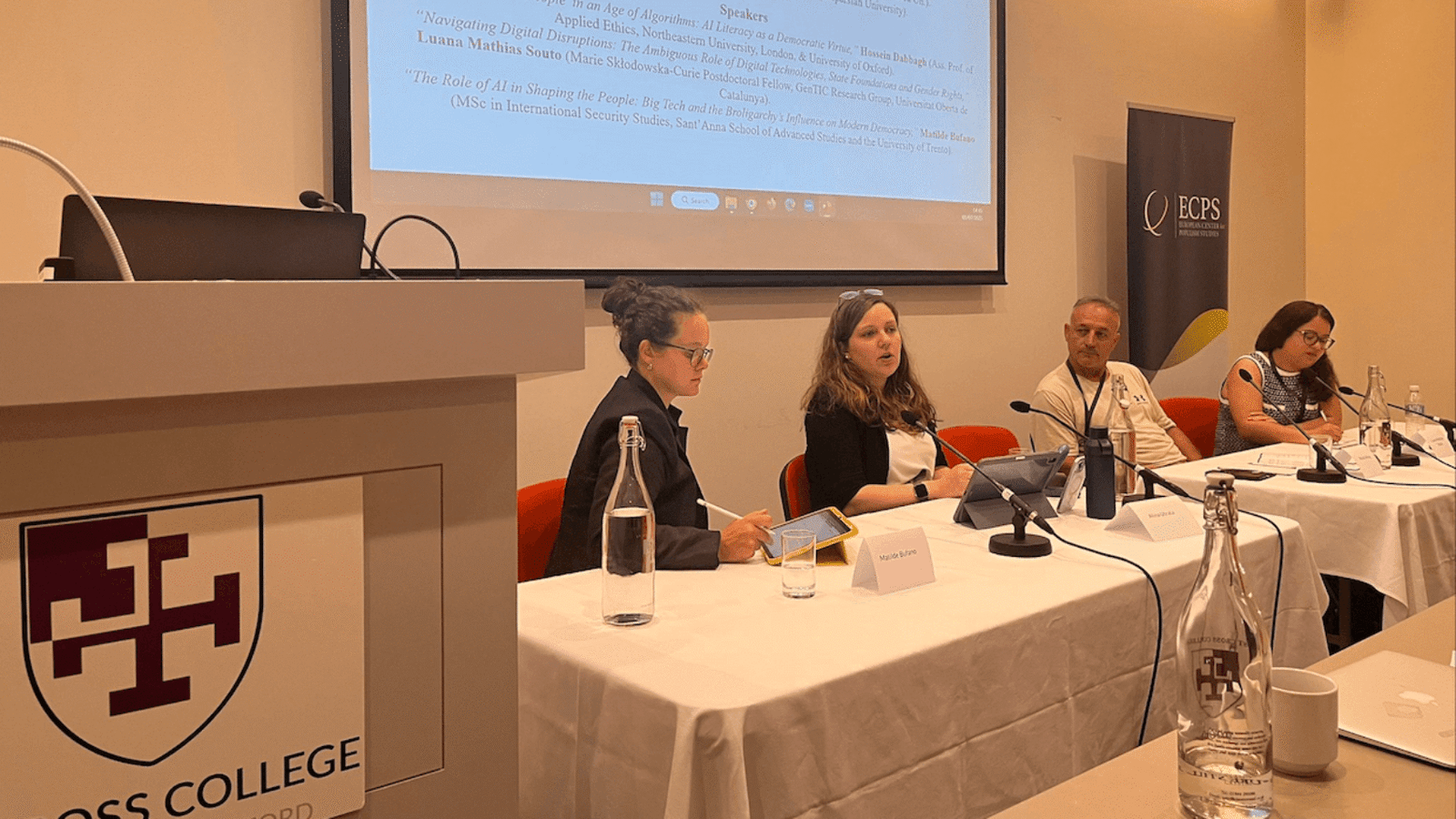
Alina Utrata, Murat Aktaş, Luana Mathias Souto and Matilde Bufano explore how artificial intelligence, digital infrastructures, and Big Tech influence democratic participation, redefine 'the people,' and challenge gender rights and state foundations in the digital age.

ECPS Conference 2025 / Panel 2 — “The People” in the Age of AI and Algorithms

Please cite as:
ECPS Staff. (2025). “ECPS Conference 2025 / Panel 2 — “The People” in the Age of AI and Algorithms.” European Center for Populism Studies (ECPS). July 8, 2025. https://doi.org/10.55271/rp00104


Panel II: “‘The People’ in the Age of AI and Algorithms” explored how digital technologies and algorithmic infrastructures are reshaping democratic life. Co-chaired by Dr. Alina Utrata and Professor Murat Aktaş, the session tackled questions of power, exclusion, and political agency in the digital age. Together, their framing set the stage for two timely papers examining how algorithmic filtering, platform capitalism, and gendered data practices increasingly mediate who is counted—and who is excluded—from “the people.” With insight and urgency, the session called for renewed civic, academic, and regulatory engagement with the democratic challenges posed by artificial intelligence and transnational tech governance.

Reported by ECPS Staff

As our technological age accelerates, democracy finds itself in an increasingly precarious position—buffeted not only by illiberal politics but also by opaque digital infrastructures that quietly shape how “the people” see themselves and others. Panel II, titled “The People in the Age of AI and Algorithms,” explored how artificial intelligence, social media, and digital governance are reconfiguring the foundations of democratic life. Far from being neutral tools, these technologies actively structure political subjectivity, reshape the boundaries of inclusion and exclusion, and deepen existing inequalities—often with little accountability.

This timely and incisive session of the ECPS Conference at the University of Oxford, held under the title “‘We, the People’ and the Future of Democracy: Interdisciplinary Approaches” between July 1-3, 2025, was co-chaired by Dr. Alina Utrata, Career Development Research Fellow at the Rothermere American Institute and St John’s College, Oxford University, and Professor Murat Aktaş from the Department of Political Science at Muş Alparslan University, Turkey. Together, they provided complementary perspectives that grounded the panel in both international political theory and real-world geopolitical shifts.

Dr. Alina Utrata opened the session by noting how technology corporations—many based in the United States and particularly in Silicon Valley—play a crucial role in shaping today’s political landscape. Referencing recent headlines such as Jeff Bezos’s wedding, she pointed to the growing entanglement between cloud computing, satellite systems, and global power dynamics. She emphasized the importance of discussing AI in this context, particularly given the intense debates currently taking place in academia and beyond. Her remarks framed the session as an opportunity to critically engage with timely questions about artificial intelligence and digital sovereignty, and she welcomed the speakers’ contributions to what she described as “these thorny questions.”

Professor Murat Aktaş, in his opening remarks, thanked the ECPS team and contributors, describing the panel topic as seemingly narrow but in fact deeply relevant. He observed that humanity is undergoing profound changes and challenges, particularly through digitalization, automation, and artificial intelligence. These developments, he suggested, are reshaping not only our daily lives but also the future of society. By underlining the transformative impact of these technologies, Aktaş stressed the importance of discussing them seriously in this panel.

The panel brought together two compelling papers that tackled these questions from interdisciplinary and intersectional perspectives. Dr. Luana Mathias Souto examined how digital infrastructures exacerbate gender exclusion under the guise of neutrality, while Matilde Bufano explored the political dangers of AI-powered filter bubbles and the rise of the “Broliarchy”—a new digital oligarchy with profound implications for democratic governance.

Together, the co-chairs and presenters animated a rich discussion about how emerging technologies are not only transforming democratic participation but also reshaping the very concept of “the people.”

Dr. Luana Mathias Souto: Navigating Digital Disruptions — The Ambiguous Role of Digital Technologies, State Foundations and Gender Rights

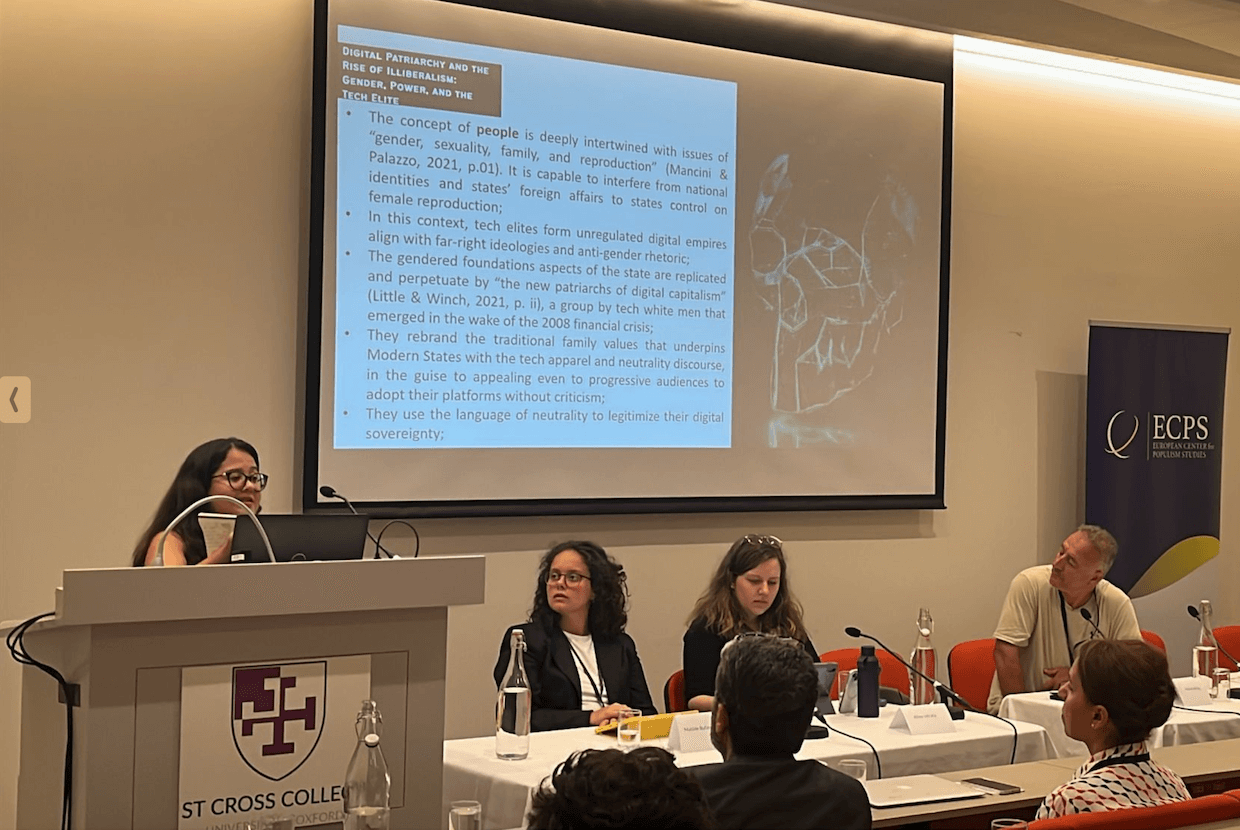
In her powerful presentation, Dr. Luana Mathias Souto (Marie Skłodowska-Curie Postdoctoral Fellow, GenTIC, Universitat Oberta de Catalunya) analyzed how digital technologies, often portrayed as neutral and empowering, are increasingly used as instruments of exclusion, surveillance, and patriarchal control—especially targeting women.

In her compelling presentation, Dr. Luana Mathias Souto, a Marie Skłodowska-Curie Postdoctoral Fellow at the GenTIC Research Group, Universitat Oberta de Catalunya, examined how digital technologies—often framed as neutral tools of empowerment—are increasingly functioning as mechanisms for exclusion, surveillance, and patriarchal reinforcement, particularly against women. Her ongoing research critically interrogates how the foundational elements of statehood—sovereignty, territory, and people—are being redefined by the digital age in ways that intersect with illiberal ideologies and gender-based exclusion.

Dr. Souto opened by historicizing the exclusion of women from the category of “the people,” a structural pattern dating back centuries, and argued that this exclusion is not alleviated but rather exacerbated in the digital era. Drawing from feminist critiques and Global South scholarship, she explored how data flows and digital infrastructures decouple sovereignty from territoriality, complicating legal protections for individuals across borders. The concept of “digital sovereignty,” she noted, allows powerful private actors—particularly US-based tech giants—to co-govern people’s lives without accountability or democratic oversight. This dynamic renders traditional state functions increasingly porous and contested, especially in terms of enforcing regulations like the EU’s GDPR against surveillance practices rooted in the US legal and security regime.

Central to Dr. Souto’s argument is the idea that digital fragmentation not only challenges state sovereignty but also disrupts the cohesion of the political subject—the “people.” This fragmentation is manifested in what she called “divisible individuals,” where digital identities are reduced to segmented data profiles, often shaped by discriminatory algorithms. Despite the proclaimed neutrality of data, these systems encode longstanding social biases, particularly around gender. Dr. Souto emphasized how digital infrastructures—designed predominantly by male, white technocrats—perpetuate sexist norms and deepen women’s exclusion from political recognition.

She devoted particular attention to FemTech (female technology), highlighting apps that track menstruation, ovulation, and sexual activity. While marketed as tools of empowerment, Dr. Souto argued these technologies facilitate new forms of surveillance and control over women’s bodies. With the overturning of Roe v. Wade in the US, data from such apps have reportedly been used in criminal investigations against women seeking abortions. Similar practices have emerged in the UK, where antiquated laws are invoked to justify digital searches of women’s phones. Beyond legal threats, FemTech data has also been exploited in employment contexts, where employers potentially use reproductive data to make discriminatory decisions about hiring or promotions.

Dr. Souto linked these practices to broader alliances between tech elites and anti-gender, illiberal movements. By promoting patriarchal values under the guise of neutrality and innovation, tech companies offer a platform for regressive gender ideologies to take root. This fusion of technological governance with far-right agendas—exemplified by calls for “masculine energy” in Silicon Valley—is not incidental but part of a broader effort to rebrand traditional hierarchies within supposedly apolitical spaces.

In conclusion, Dr. Souto called for a fundamental challenge to the presumed neutrality of digital technologies. She argued that reclaiming democratic space requires recognizing how digital infrastructures actively shape who is counted as part of “the people”—and who is excluded. Without such critical engagement, the digital revolution risks reinforcing the very forms of patriarchal and illiberal governance it once promised to transcend.

Matilde Bufano: The Role of AI in Shaping the People — Big Tech and the Broliarchy’s Influence on Modern Democracy

In a thought-provoking presentation, Matilde Bufano (MSc, International Security Studies, Sant’Anna School of Advanced Studies / University of Trento) explored the complex interplay between AI, social media infrastructures, and the weakening of democratic norms in the era of Big Tech.

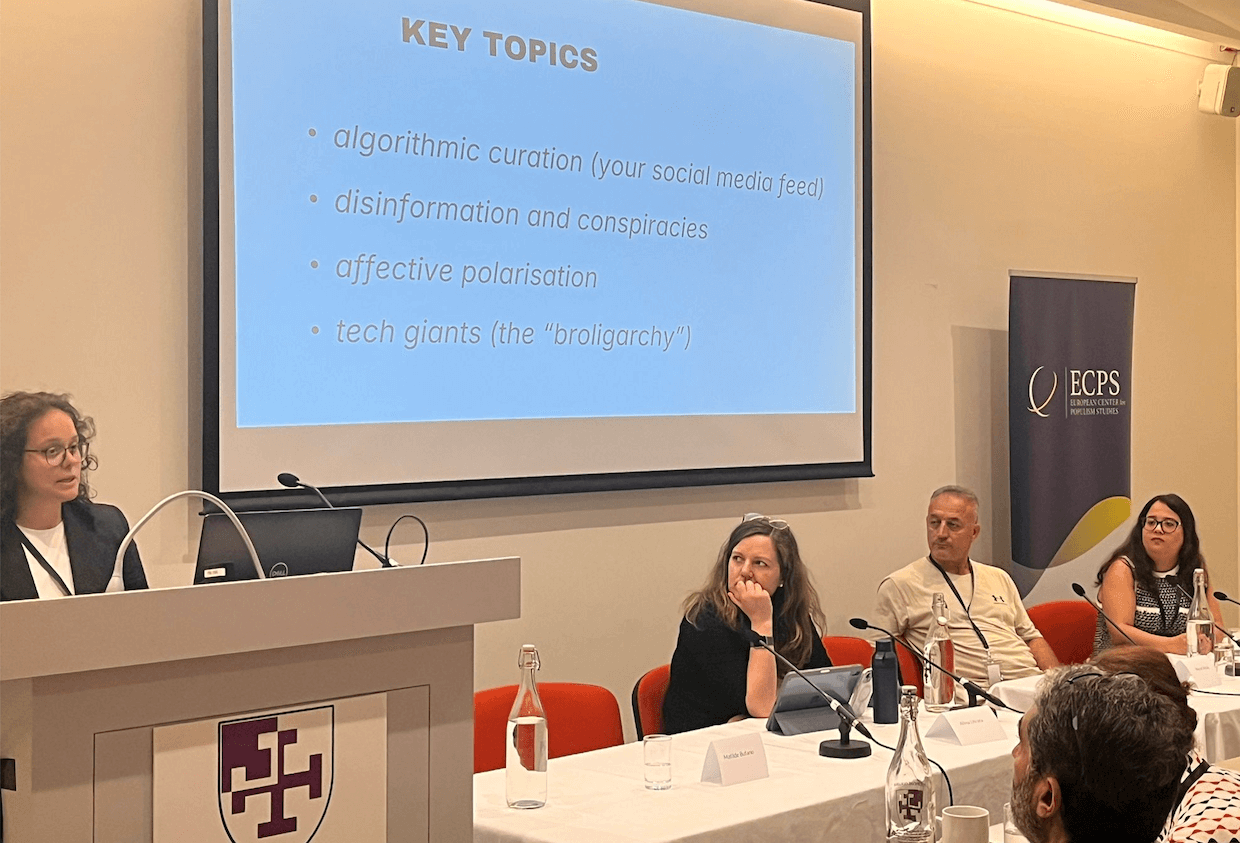
In a sobering and richly analytical presentation, Matilde Bufano, MSc in International Security Studies at the Sant’Anna School of Advanced Studies and the University of Trento, examined the deeply intertwined relationship between artificial intelligence (AI), social media infrastructures, and the erosion of democratic norms in the age of Big Tech. Her paper, “The Role of AI in Shaping the People: Big Tech and the Broliarchy’s Influence on Modern Democracy,” offered a timely, practice-oriented reflection on how algorithmic technologies—far from being neutral tools—play a crucial role in shaping public consciousness, manipulating democratic engagement, and amplifying societal polarization. Drawing from her dual background in international law and digital politics, Bufano delivered a cross-disciplinary critique that challenged both policy complacency and academic detachment in the face of AI-driven democratic disruption.

At the heart of Bufano’s analysis lies a powerful assertion: democracy is not only threatened from outside by illiberal regimes or authoritarian populism, but also from within, through the algorithmic architecture of digital platforms that increasingly mediate how citizens engage with one another and with politics. The COVID-19 pandemic, according to Bufano, marked an inflection point. As physical interaction gave way to a digital public sphere, citizens became more dependent than ever on technology for information, identity, and even emotional validation. This shift coincided with an intensification of algorithmic curation, wherein AI systems selectively filter, promote, or suppress information based on user behavior and platform profitability.

Bufano focused on two key mechanisms underpinning this dynamic: algorithmic filtering and algorithmic moderation. Algorithmic filtering sorts through vast quantities of online content using coded preferences—ostensibly for user relevance, but in practice to optimize engagement and advertising revenue. This results in the formation of “filter bubbles,” echo chambers where users are continually exposed to like-minded content, reinforcing existing beliefs and psychological biases. Bufano distinguished between collaborative filtering—which groups users based on shared demographics or behavioral traits—and content-based filtering, which recommends material similar to what a user has previously interacted with. Both reinforce a feedback loop of ideological reinforcement, generating a form of identity-based gratification that discourages critical engagement and cross-cutting dialogue.

Crucially, this personalization is not politically neutral. Bufano demonstrated how algorithmic design often prioritizes sensationalist and polarizing content—particularly disinformation—because of its virality and ability to prolong user attention. Ninety percent of disinformation, she argued, is constructed around out-group hatred. In this context, algorithmically curated media environments deepen societal cleavages, producing a form of affective polarization that goes beyond ideological disagreement and encourages personal animosity and even dehumanization of political opponents. This is especially visible in contexts of crisis, such as during the pandemic, when scapegoating of Asian communities proliferated through local Facebook groups, or in the use of conspiracy theories and “phantom mastermind” narratives to channel social discontent toward imagined enemies.

The political consequences of this trend are severe. Filter bubbles inhibit democratic deliberation and increase susceptibility to manipulation by foreign and domestic actors. Bufano cited examples such as Russian disinformation campaigns in Romania, illustrating how AI-driven social media platforms can serve as conduits for election interference, especially when publics are already fragmented and mistrustful of institutions. These risks are magnified by a dramatic rollback in fact-checking infrastructures—most notably in the United States, where 80% of such systems were dismantled after Trump’s presidency, and mirrored in countries like Spain.

Bufano introduced the concept of the Broliarchy—a portmanteau of “bro” and “oligarchy”—to describe the growing political influence of a narrow cadre of male tech billionaires who control the infrastructure of digital discourse. No longer confined to private enterprise, these actors now exert direct influence on public policy and regulation, blurring the boundary between democratic governance and corporate interest. She illustrated this with the example of Elon Musk’s acquisition of Twitter (now X), which led to a 50% increase in hate speech within weeks due to weakened content moderation policies. Such developments, Bufano warned, compromise democratic accountability and entrench anti-democratic values under the guise of free expression and innovation.

While Bufano acknowledged the European Union’s recent steps toward regulation—especially the Digital Services Act (DSA), which seeks to promote transparency and safety in content recommendation systems—she emphasized the limitations of regional legislation in a global digital ecosystem. AI remains a “black box,” inaccessible to users and regulators alike. Without global accountability frameworks, national or regional efforts risk being outpaced by platform evolution and cross-border data flows.

In conclusion, Bufano made a dual appeal. First, for institutional and legal reforms capable of subjecting algorithmic systems to democratic oversight, including mandatory transparency in how recommender systems operate. Second, for renewed civic engagement and media literacy among citizens themselves. Democracy, she reminded the audience, cannot be fully outsourced to algorithms or regulators. It requires a culture of critical reflection and active participation—both online and offline. Reclaiming this space from the Broliarchy, she argued, means not only resisting disinformation and polarization, but reimagining democratic communication in ways that are inclusive, pluralistic, and resistant to both technological and ideological capture.

Bufano’s presentation, blending empirical insight with normative urgency, underscored the need for interdisciplinary collaboration in addressing one of the most urgent challenges of our time: how to ensure that digital technologies serve, rather than subvert, the democratic ideal.

Conclusion

Panel II of the ECPS Conference 2025, “The People in the Age of AI and Algorithms,” offered a powerful and urgent exploration of how digital infrastructures are reshaping the foundations of democratic life. As the presenters compellingly demonstrated, artificial intelligence, algorithmic governance, and platform capitalism are not passive tools but active agents that shape political subjectivities, influence public opinion, and determine who is included in or excluded from the category of “the people.” Across both presentations, a clear throughline emerged: digital technologies, while often framed in terms of neutrality and innovation, are in fact deeply embedded in structures of inequality, bias, and elite power.

Dr. Luana Mathias Souto illuminated how digital technologies intersect with patriarchal norms to undermine gender rights and state sovereignty, showing how the global tech ecosystem facilitates new forms of surveillance and control over women. Matilde Bufano, in turn, unpacked the algorithmic logic behind political polarization and democratic backsliding, naming the emergence of the “Broliarchy” as a key actor in this process. Together, their insights revealed a troubling paradox: while democracy should enable broad participation and dissent, the very platforms that now mediate political life often amplify exclusion and entrench concentrated power.

Rather than offering despair, the panel ended on a call to action. Both speakers urged the need for democratic oversight, global regulation, and enhanced digital literacy to reclaim public space and political agency in the algorithmic age. As AI technologies continue to evolve, so too must our frameworks for accountability, inclusion, and democratic resilience.


Note: To experience the panel’s dynamic and thought-provoking Q&A session, we encourage you to watch the full video recording above.

SummerSchool

ECPS Academy Summer School — Populism and Climate Change: Understanding What Is at Stake and Crafting Policy Suggestions for Stakeholders (July 7-11, 2025)

Case Competition Information Pack

Are you interested in global political affairs? Do you wish to learn how to draft policy recommendations for policymakers? Are you seeking to broaden your knowledge under the guidance of leading experts, looking for an opportunity to exchange views in a multicultural, multidisciplinary environment, or simply in need of a few extra ECTS credits for your studies? If so, consider applying to the ECPS Summer School. The European Centre for Populism Studies (ECPS) invites young individuals to participate in a unique opportunity to evaluate the relationship between populism and climate change during a five-day Summer School led by global experts from diverse backgrounds. The Summer School will be interactive, enabling participants to engage in discussions in small groups within a friendly atmosphere while sharing perspectives with the lecturers. You will also take part in a Case Competition on the same subject, providing a unique experience to develop problem-solving skills through collaboration with others under tight schedules. 

Overview

Climate change intersects with numerous issues, transforming it into more than just an environmental challenge; it has developed into a complex and multifaceted political issue with socio-economic and cultural dimensions. This intersection makes it an appealing topic for populist politicians to exploit in polarizing societies. Therefore, with the rise of populist politics globally, we have seen climate change increasingly become part of the populist discourse. 

Populist politics present additional barriers to equitable climate solutions, often framing global climate initiatives as elitist or detrimental to local autonomy. Thus, populism in recent years has had a profound impact on climate policy worldwide. This impact comprises a wide spectrum, from the climate skepticism and deregulation policies of leaders like Donald Trump to the often-contradictory stances of left-wing populist movements. 

We are convinced that this pressing issue not only requires an in-depth understanding but also deserves our combined effort to seek solutions. Against this backdrop, we are pleased to announce the ECPS Summer School on “Populism and Climate Change: Understanding What Is at Stake and Crafting Policy Suggestions for Stakeholders”, which will be held online from 7 to 11 July 2025. This interdisciplinary five-day program has two primary objectives: a) to explore how both right-wing and left-wing populist movements approach the issue of climate change and how they influence international cooperation efforts and local policies, and b) to propose policy suggestions for stakeholders to address the climate change crisis, independent of populist politics. 

We aim to critically examine the role of populism in shaping climate change narratives and policies; provide a platform for exploring diverse political ideologies and their implications for climate action; and foster a deeper understanding of the tension between economic, political, and environmental interests in both right and left-wing populist movements. Critically engaging with the key conclusions from the Baku Conference on climate justice and populism (2024), we will particularly look at the impact of authoritarian and populist politics in shaping climate governance. 

Methodology

The program will take place on Zoom, consisting of two sessions each day and will last five days. The lectures are complemented by small group discussions and Q&A sessions moderated by experts in the field. Participants will have the opportunity to engage with leading scholars in the field as well as with activists and policymakers working at the forefront of these issues.

Furthermore, this summer school aims to equip attendees with the skills necessary to craft policy suggestions. To this end, a Case Competition will be organized to identify solutions to issues related to climate change and the environment. Participants will be divided into small groups and will convene daily on Zoom to work on a specific problem related to the topic of populism and climate change. They are expected to digest available literature, enter in-depth discussions with group members and finally prepare an academic presentation which brings a solution to the problem they choose. Each group will present their policy suggestions on the final day of the programme to a panel of scholars, who will provide feedback on their work. The groups may transform their presentations into policy papers, which will be published on the ECPS website. 

Topics will include:

  • Climate justice: global dichotomy between developed and developing countries 
  • Local responses from the US, Europe, Asia and the Global South
  • Eco-colonialism, structural racism, discrimination and climate change
  • Populist narratives on sustainability, energy resources and climate change
  • Climate migration and populist politics
  • Climate, youth, gender and intergenerational justice
  • Eco-fascism, climate denial, economic protectionism and far-right populism
  • Left-wing populist discourse, climate activism and the Green New Deal
  • Technological advancement and corporate responsibility in climate action.

Program Schedule and Lecturers 

Monday, July 7, 2025

Lecture One: (15:00-16:30) — Far-right and Climate Change

Lecturer: Bernhard Forthchner (Associate Professor at the School of Art, Media and Communication, University of Leicester).  

Moderator: Sabine Volk (Postdoctoral researcher, Institute for Research on Far-Right Extremism (IRex), Tübingen University).

Lecture Two: (17:30-19:00) — Climate Justice and Populism

Lecturer: John Meyer (Professor of Politics, California State Polytechnic University, Humboldt).

Moderator: Manuela Caiani (Associate Professor in Political Science, Scuola Normale Superiore, Italy).

Tuesday, July 8, 2025

Lecture Three: (15:00-16:30) –– Climate Change, Food, Farmers, and Populism

Lecturer: Sandra Ricart (Assistant Professor at the Environmental Intelligence for Global Change Lab, at the Department of Electronics, Information and Bioengineering at the Politecnico di Milano, Italy).

Moderator: Vlad Surdea-Hernea (Post-doctoral Researcher, Institute of Forest, Environmental and Natural Resource Policy, University of Natural Resources and Life Sciences Vienna).

Lecture Four: (17:30-19:00) — Ideology Meets Interest Group Politics: The Trump Administration and Climate Mitigation

Lecturer: Daniel Fiorino (Professor of Politics and Director at the Centre for Environmental Policy, American University). 

Moderator: Azize Sargın (PhD., Director of External Relations, ECPS).

Wednesday, July 9, 2025

Lecture Five: (15:00-16:30) — Art, Climate, and Populism

Lecturer: Heidi Hart (Arts Researcher, Nonresident Senior Fellow at ECPS).

Moderator: João Ferreira Dias (Researcher, Centre for International Studies, ISCTE) (TBC)

Lecture Six: (17:30-19:00) — Populist Discourses on Climate and Climate Change

Lecturer: Dr. Eric Swyngedouw (Professor of Geography, University of Manchester). 

Moderator: Jonathan White (Professor of Politics, LSE).

Thursday, July 10, 2025

Lecture Seven: (15:00-16:30) —Climate Change, Natural Resources and Conflicts

Lecturer: Philippe Le Billon (Professor of Political Geography at the University of British Columbia).

Moderator: Mehmet Soyer (Assistant Professor of Sociology, Utah State University).

Lecture Eight: (17:30-19:00) — Climate Change Misinformation: Supply, Demand, and the Challenges to Science in a “Post-Truth” World

Lecturer: Stephan Lewandowsky (Professor of Psychology, University of Bristol).

Moderator: Neo Sithole (Research Fellow, ECPS)

Friday, July 11, 2025

Lecture Nine: (17:30-19:00) — Populist Narratives on Sustainability, Energy Resources and Climate Change

Lecturer: Robert Huber (Professor of Political Science Methods, University of Salzburg).

Moderator: Susana Batel (Assistant Researcher and Invited Lecturer at University Institute of Lisbon, Center for Psychological Research and Social Intervention).

Who should apply?

This course is open to master’s and PhD level students and graduates, early career researchers and post-docs from any discipline.  The deadline for submitting applications is June 16, 2025. The applicants should send their CVs to the email address ecps@populismstudies.org with the subject line: ECPS Summer School Application.

We value the high level of diversity in our courses, welcoming applications from people of all backgrounds. 

As we can only accept a limited number of applicants, it is advisable to submit applications as early as possible rather than waiting for the deadline. 

Evaluation Criteria and Certificate of Attendance

Meeting the assessment criteria is required from all participants aiming to complete the program and receive a certificate of attendance. The evaluation criteria include full attendance and active participation in lectures.

Certificates of attendance will be awarded to participants who attend at least 80% of the sessions. Certificates are sent to students only by email.

Credit

This course is worth 5 ECTS in the European system. If you intend to transfer credit to your home institution, please check the requirements with them before you apply. We will be happy to assist you; however, please be aware that the decision to transfer credit rests with your home institution.


Brief Biographies and Abstracts


Day One: Monday, July 7, 2025

Far-right and Climate Change

Bernhard Forchtner is an associate professor at the School of Arts, Media, and Communication, University of Leicester (United Kingdom), and has previously worked as a Marie Curie Fellow at the Institute of Social Sciences at the Humboldt University in Berlin (Germany), where he conducted a project on far-right discourses on the environment (2013-2015, project number 327595). His research focuses on the far right and, in particular, the far right’s multimodal environmental communication. Publications include the two edited volumes The Far Right and the Environment (Routledge, 2019) and Visualising Far-Right Environments (Manchester University Press, 2023).

Abstract: This lecture will offer an overview of the current state of research on the far right and climate change (with a focus on Europe), considering both political parties and non-party actors. The lecture will discuss both general trends of and the dominant claims employed in climate communication by the far right. In so doing, it will furthermore highlight longitudinal (affective) changes and will discuss the far right’s visual climate communication (including its gendered and populist dimension).

Reading list

Ekberg, K., Forchtner, B., Hultman, M. and Jylhä, K. M. (2022). Climate Obstruction. How Denial, Delay and Inaction are Heating the Planet. Routledge. pp. 1-20 (Chapter 1: ‘Introduction’) and 69-94 (Chapter 4: ‘The far right and climate obstruction’).

– ‘The far right and climate obstruction’ offers a review of research on the far right and climate change, while ‘Introduction’ provides a general conceptual model of how to think about different modes of climate obstruction.

Forchtner, B. and Lubarda, B. (2022): Scepticisms and beyond? A comprehensive portrait of climate change communication by the far right in the European Parliament. Environmental Politics, 32(1): 43–68.

– The article analyses climate change communication by the far right in the European Parliament between 2004 and 2019, showing which claims have been raised by these parties and how they have shifted over time.

Schwörer, J. and Fernández-García, B. (2023): Climate sceptics or climate nationalists? Understanding and explaining populist radical right parties’ positions towards climate change (1990–2022). Political Studies, 72(3): 1178-1202.

The article offers an analysis of manifestos of Western European political parties, illustrating salience and positioning over three decades.


Climate Justice and Populism

John M. Meyer is Professor in the Departments of Politics and Environmental Studies at California State Polytechnic University, Humboldt. As a political theorist, his work aims to help us understand how our social and political values and institutions shape our relationship with “the environment,” how these values and institutions are shaped by this relationship, and how we might use an understanding of both to pursue a more socially just and sustainable society. Meyer is the author or editor of seven books. These include the award-winning Engaging the Everyday: Environmental Social Criticism and the Resonance Dilemma (MIT, 2015) and The Oxford Handbook of Environmental Political Theory (Oxford, 2016). From 2020-2024, he served as editor-in-chief of the international journal, Environmental Politics.

Abstract: Many have argued that an exclusionary conception of “the people” and a politicized account of scientific knowledge and expertise make populism a fundamental threat to effective action to address climate change. While this threat is very real, I argue that it often contributes to a misguided call for a depolicitized, consensus-based “anti-populist” alternative. Climate Justice movements can point us toward a more compelling response. Rather than aiming to neutralize or circumvent the passions elicited by populism, it offers the possibility of counter-politicization that can help mobilize stronger climate change action. Here, an inclusive conception of “the people” may be manifest as horizontal forms of solidarity generated by an engagement with everyday material concerns.

Reading List

John M. Meyer. (2025).  “How (not) to politicise the climate crisis: Beyond the anti-populist imaginary,” with Sherilyn MacGregor. Politische Vierteljahresschrift.

John M. Meyer. (2024). “The People; and Climate Justice: Reconceptualising Populism and Pluralism within Climate Politics,” Polity.

John M. Meyer. (2024). Power and Truth in Science-Related Populism: Rethinking the Role of Knowledge and Expertise in Climate Politics, Political Studies.

Additional Recent Readings

Driscoll, Daniel. (2023). “Populism and Carbon Tax Justice: The Yellow Vest Movement in France.” Social Problems, 70 (1): 143–63. https://doi.org/10.1093/socpro/spab036 

Lucas, Caroline, and Rupert Read. (2025). “It’s Time for Climate Populism.” New Statesman (blog). February 7, 2025. https://www.newstatesman.com/environment/2025/02/its-time- for-climate-populism 

White, Jonathan. (2023). “What Makes Climate Change a Populist Issue?” Grantham Research Institute on Climate Change and the Environment Working Paper, no. No. 401 (September). https://www.lse.ac.uk/granthaminstitute/wp-content/uploads/2023/09/working-paper-401-White.pdf.


Day Two: Tuesday, July 8, 2025

Delving into European’ Farmers Protests and Citizens’ Attitudes Towards Agriculture in a Climate Change Context: Insights from policy and populism

Sandra Ricart is an Assistant Professor in the Environmental Intelligence Lab at the Department of Electronics, Information and Bioengineering at the Politecnico di Milano, Italy. She holds a PhD in Geography – Experimental Sciences and Sustainability by the University of Girona, Spain, in 2014 and performed postdoctoral stays at the University of Alicante (Spain), Università degli Studi di Milano and the Politecnico di Milano (Italy), Université de Pau et des Pays de l’Adour (France), and Wageningen University and Research (Netherlands). She was an invited professor at the Landcare Research Centre in New Zealand and a visiting scholar at the University of California, Los Angeles. As a human-environment geographer, her research focuses on climate change narratives and behavior from farmers’ and stakeholders’ perspectives, delving into how social learning and behavior modelling can be combined to enhance adaptive capacity, robust decision-making processes and trusted policy co-design. Dr. Ricart co-authored more than sixty publications, attended several international conferences, and participated in a dozen international and national research projects. Sandra serves as Assistant Editor of the International Journal of Water Resources Development and PLOS One journal, and she is an expert evaluator by the European Commission and different national research councils.

Abstract: Though there are national differences, farmers across Europe are generally upset about dropping produce prices, rising fuel costs, and competition from foreign imports, but are also concerned by the painful impacts of the climate crisis and proposed environmental regulations under the new CAP and the European Green Deal. These common challenges motivated, in 2024, a series of protests from the Netherlands to Belgium, France, Spain, Germany and the UK, with convoys of tractors clogging roads and ports, farmer-led occupations of capital cities and even cows being herded into the offices of government ministers. Farmers have felt marginalised as they feel overburdened by rules and undervalued by city dwellers, who tend to eat the food they grow without being much interested in where it came from. In this context, farmers started to receive increasing support from a range of far-right and populist parties and groups, who aim to crystallise resentment and are bent on bringing down Green Deal environmental reforms. This talk will delve into the reasons behind farmers’ protests and the link with populism, providing examples, as well as an analysis of citizens’ perspectives on agriculture and climate change strategies, which will enrich the debate on the nexus between policy and populism.

Reading List

Special Eurobarometer 538 Climate Change – Report, 2023, Available here: https://europa.eu/eurobarometer/surveys/detail/2954 

Special Eurobarometer 556 Europeans, Agriculture, and the CAP – Report, 2025. https://europa.eu/eurobarometer/surveys/detail/3226

Zuk, P. (2025). “The European Green Deal and the peasant cause: class frustration, cultural backlash, and right-wing nationalist populism in farmers’ protests in Poland.” Journal of Rural Studies, 119:103708. https://doi.org/10.1016/j.jrurstud.2025.103708

Newspapers

What’s behind farmers’ protests returning to the streets of Brussels? https://www.euronews.com/my-europe/2025/05/19/whats-behind-farmers-protests-returning-to-the-streets-of-brussels

Rural decline and farmers’ anger risks fuelling Europe’s populism. https://www.friendsofeurope.org/insights/frankly-speaking-rural-decline-and-farmers-anger-risks-fuelling-europes-populism/

From protests to policy: What is the future for EU agriculture in the green transition? https://www.epc.eu/publication/From-protests-to-policy-What-is-the-future-for-EU-agricultre-57f788/

Farmer Protests and the 2024 European Parliament Elections https://www.intereconomics.eu/contents/year/2024/number/2/article/farmer-protests-and-the-2024-european-parliament-elections.html

Neoliberal Limits – Farmer Protests, Elections and the Far Right. https://www.arc2020.eu/neoliberal-limits-farmer-protests-elections-and-the-far-right/

Green policies, grey areas: Farmers’ protests and the environmental policy dilemma in the European Union. http://conference.academos.ro/node/1467

How the far right aims to ride farmers’ outrage to power in Europe. https://www.politico.eu/article/france-far-right-farmers-outrage-power-europe-eu-election-agriculture/


Ideology Meets Interest Group Politics: The Trump Administration and Climate Mitigation

Daniel J. Fiorino teaches environmental and energy policy at the School of Public Affairs at American University in Washington, DC, and is the founding director of the Center for Environmental Policy. Before joining American University in 2009, he served in the policy office of the US Environmental Protection Agency, where he worked on various environmental issues. His recent books include Can Democracy Handle Climate Change? (Polity Press, 2018); A Good Life on a Finite Earth: The Political Economy of Green Growth (Oxford, 2018); and The Clean Energy Transition: Policies and Procedures for a Zero-Carbon World (Polity, 2022). He is currently writing a book about the US Environmental Protection Agency. 

Abstract: The rise of right-wing populism around the world constitutes one of the principal challenges to climate mitigation policies. The defining characteristics of right-wing populism are distrust of scientific expertise, resistance to multilateral problem-solving, and strong nationalism. Climate mitigation involves a reliance on scientific and economic expertise, an openness to multilateral problem-solving, and setting aside nationalist tendencies in favor of international cooperation. At the same time, the Republican Party in the United States maintains a strong affiliation with the interests of the fossil fuel industry. These two factors have led to a Trump administration that is hostile to climate mitigation and participation in global problem-solving. This presentation examines the policies of the Trump administration with respect to climate mitigation and the effects of a right-wing populist ideology when combined with the historical alliance of the Republican Party with the interests of the fossil fuel industry.

Reading List

Fiorino, D. J. (2022). “Climate change and right-wing populism in the United States.” Environmental Politics, 31(5), 801–819. https://doi.org/10.1080/09644016.2021.2018854

Huber, R.A. (2020). “The role of populist attitudes in explaining climate scepticism and support for environmental protection.” Environmental Politics, 29 (6), 959–982. doi:10.1080/09644016.2019.1708186

Lockwood, M. (2018). “Right-wing populism and the climate change agenda: exploring the contradictions.” Environmental Politics, 27 (4), 712–732. doi:10.1080/09644016.2018.1458411


Day Three: Wednesday, July 9, 2025

Art Attacks: Museum Vandalism as a Populist Response to Climate Trauma?

Heidi Hart (Ph.D. Duke University 2016) is a Nonresident Senior Resident (Climate and Environment) with ECPS. She is also a guest instructor in environmental humanities at Linnaeus University in Sweden. Her books include studies of climate grief, sound and music in climate- crisis narrative, and the destruction of musical instruments in ecological context.

Abstract: This lecture explores activist vandalisation of museum artworks, acts that draw attention to the climate emergency as they both subjugate human-made artworks and create new layers of visual and performative aesthetics. “Art Attacks” describes examples of recent art vandalism and subsequent academic responses, most of which remain ambivalent about the effectiveness of art destruction for the sake of ecological awareness. Two questions arise when investigating these interventions: do the actors involved function as environmental populists, as Briji Jose and Renuka Shyamsundar Belamkar have postulated (2024), and are they driven by a sense of climate trauma, a question informed by Katharine Stiles’ work on trauma’s role in destructive forms of art-making (2016)? Answering the first question requires looking at arguments against the convergence of populism and environmentalism and finding places where they do in fact overlap “in unconventional, problematic, and surprising ways” (ECPS Dictionary of Populism). Answering the second question leads to an exploration of how the climate emergency is experienced and mediated as trauma (Kaplan 2016, Richardson 2018). This lecture argues that an embodied sense of present and future emergency can indeed lead to a creative-destructive nexus of climate action, useful even in its ambivalence, in what Bruno Latour has termed “iconoclash” (2002).

Reading List

Jose, Briji and Renuka Shyamsundar Belamkar. (2024). “Art of Vandalism: A Response by Environmental Populists.” In: J. Chacko Chennattuserry et al., Editors, Encyclopedia of New Populism and Responses in the 21st Century. Springer Singapore, 2024, DOI 10.1007/978-981-99-7802-1.

Richardson, Michael. (2018). “Climate Trauma, or the Affects of the Catastrophe to Come.” Environmental Humanities, 10:1 (May 2018), DOI 10.1215/22011919-4385444.

Teixeira da Silva, Jaime A. (2023). “Is the Destruction of Art a Desirable Form of Climate Activism?” Environmental Smoke 6:1 (2023), DOI 10.32435/envsmoke. 20236173-77.


The Climate Deadlock and The Unbearable Lightness of Climate Populism

Erik Swyngedouw is Professor of Geography at The University of Manchester, UK and Senior Research Associate of the University of Johannesburg Centre for Social Change, South Africa. He holds a doctorate from Johns Hopkins University and has been awarded Honorary Doctorates from Roskilde University and the University of Malmö. He works on political ecology, critical theory, environmental and emancipatory politics. He is the author of, among others, Promises of the Political: Insurgent Cities in a Post-Democratic Environment (MIT Press), Liquid Power: Contested Hydro-Modernities in 20th Century Spain (MIT Press) and Social Power and the Urbanisation of Nature (Oxford University Press). He is currently completing a book (with Prof. Lucas Pohl) entitled Enjoying Climate Change (Verso).

Abstract: Over the past two decades or so, the environmental question has been mainstreamed, and climate change, in particular, has become the hard kernel of the problematic environmental condition the Earth is in. Nonetheless, despite the scientific concern and alarmist rhetoric, the climate parameters keep eroding further. We are in the paradoxical situation that ‘despite the fact we know the truth about climate change, we act as if we do not know’. This form of disavowal suggests that access to and presence of knowledge and facts do not guarantee effective intervention. This presentation will argue that the dominant depoliticised form of climate populism can help to account for the present climate deadlock, and will suggest ways of transgressing the deadlock.

My presentation focuses on what I refer to as Climate Populism. We argue that climate populism is not just the prerogative of right-winged, xenophobic, and autocratic elite and their supporters, but will insist on how climate populism also structures not only many radical climate movements but also the liberal climate consensus. I argue that the architecture of most mainstream as well as more radical climate discourses, practices, and policies is similar to that of populist discourses and should be understood as an integral part of a pervasive and deepening process of post-politicisation. Mobilising a process that psychoanalysts call ‘fetishistic disavowal’, the climate discourse produces a particular form of populism that obscures the power relations responsible for the growth of greenhouse gas emissions. I shall mobilise a broadly Lacanian-Marxist theoretical perspective that permits accounting for this apparently paradoxical condition of both acknowledging and denying the truth of the climate situation, and the discourses/practices that sustain this.

Reading List

Swyngedouw E. (2010) “Apocalypse Forever? Post-Political Populism and the Spectre of Climate Change”, Theory, Culture, Society, 27(2-3): 213-232.

Swyngedouw E. (2022) “The Depoliticised Climate Change Consensus.” In: Pellizzoni L., Leonardi E., Asara V. (Eds.) Handbook of Critical Environmental Politics. E. Elgar, London, pp. 443-455.

Swyngedouw E. (2022) “The Unbearable Lightness of Climate Populism.” Environmental Politics, 31(5), pp. 904-925. DOI: 10.1080/09644016.2022.2090636

Jonathan White is Professor of Politics at the London School of Economics.  Books include In the Long Run: the Future as a Political Idea (Profile Books, 2024), Politics of Last Resort: Governing by Emergency in the European Union (Oxford University Press, 2019), and – with Lea Ypi – The Meaning of Partisanship (Oxford University Press, 2016).


Day Four: Thursday, July 10, 2025

Climate Change, Natural Resources and Conflicts

Philippe Le Billon is a professor of political geography and political ecology at the University of British Columbia. Prior to joining UBC, he was a Research Associate with the Overseas Development Institute (ODI) and the International Institute for Strategic Studies (IISS), and worked with environmental and human rights organisations. His work engages with linkages between environment, development and security, with a focus on extractive sectors. He currently works with environmental defenders, including on small-scale fisheries and the ‘green transition’.

 Abstract: This lecture examines how the rise of populist politics is reshaping the nexus between climate change, natural resources, and conflicts. As climate impacts intensify, populist leaders across the political spectrum have exploited environmental anxieties, fueling nationalist rhetoric, weakening environmental regulations, and framing green transitions as elite-driven agendas. This has deepened social divisions and contributed to violent responses to both fossil fuel extraction and climate mitigation projects. The lecture will explore how populist regimes often repress environmental defenders, delegitimise scientific consensus, and stoke resentment against marginalised groups, further aggravating conflict dynamics. Case studies will illustrate how populism can exacerbate resource-related tensions, undermine international cooperation, and stall urgent climate action. The session will conclude with policy recommendations to counteract these trends, including democratic safeguards, support for “leave-it-in-the-ground” campaigns, and stronger protections for environmental activists. Ultimately, this talk highlights the urgent need to confront populist narratives in the pursuit of climate justice and conflict prevention.


Climate Change Misinformation: Supply, Demand, and the Challenges to Science in a “Post-Truth” World

Professor Stephan Lewandowsky is a cognitive scientist at the University of Bristol, whose main interest lies in the pressure points between the architecture of online information technologies and human cognition, and the consequences for democracy that arise from these pressure points.

He is the recipient of numerous awards and honours, including a Discovery Outstanding Researcher Award from the Australian Research Council, a Wolfson Research Merit Fellowship from the Royal Society, and a Humboldt Research Award from the Humboldt Foundation in Germany. He is a Fellow of the Academy of Social Science (UK) and a Fellow of the Association of Psychological Science. He was appointed a fellow of the Committee for Sceptical Inquiry for his commitment to science, rational inquiry and public education. He was elected to the Leopoldina (the German national academy of sciences) in 2022. Professor Lewandowsky also holds a Guest Professorship at the University of Potsdam in Germany. He was identified as a highly cited researcher in 2022, 2023, and 2024 by Clarivate, a distinction that is awarded to fewer than 0.1% of researchers worldwide.

His research examines the consequences of the clash between social media architectures and human cognition, for example, by researching countermeasures to the persistence of misinformation and spread of “fake news” in society, including conspiracy theories, and how platform algorithms may contribute to the prevalence of misinformation. He is also interested in the variables that determine whether or not people accept scientific evidence.
 He has published hundreds of scholarly articles, chapters, and books, with more than 200 peer-reviewed articles alone since 2000. His research regularly appears in journals such as Nature Human Behaviour, Nature Communications, and Psychological Review. (See www.lewan.uk for a complete list of scientific publications.)

His research is currently funded by the European Research Council, the EU’s Horizon 2020 programme, the UK research agency (UKRI, through EU replacement funding), the Volkswagen Foundation, Google’s Jigsaw, and by the Social Sciences Research Council (SSRC) Mercury Project.

Professor Lewandowsky also frequently appears in print and broadcast media, having contributed approximately 100 opinion pieces to the global media. He has been working with policymakers at the European level for many years, and he was the first author of a report on Technology and Democracy in 2020 that has helped shape EU digital legislation.

Abstract: I examine both the “supply side” and “demand side” of climate denial and the associated “fake news”. On the supply side, I report the evidence for the organised dissemination of disinformation by political operatives and vested interests, and how the media respond to these distortions of the information landscape. On the demand side, I explore the variables that drive people’s rejection of climate science and lead them to accept denialist talking points, with a particular focus on the issue of political symmetry. The evidence seems to suggest that denial of science is primarily focused on the political right, across a number of domains, even though there is cognitive symmetry between left and right in many other situations. Why is there little evidence to date of any association between left-wing political views and rejection of scientific evidence or expertise? I focus on Merton’s (1942) analysis of the norms of science, such as communism and universalism, which continue to be internalised by the scientific community, but which are not readily reconciled with conservative values. Two large-scale studies (N > 2,000 altogether) show that people’s political and cultural worldviews are associated with their attitudes towards those scientific norms, and that those attitudes in turn predict people’s acceptance of scientific. The norms of science may thus be in latent conflict with a substantial segment of the public. Finally, I survey the options that are available to respond to this fraught information and attitude landscape, focusing on consensus communication and psychological inoculation.

Reading List

Cook, J., van der Linden, S., Maibach, E., & Lewandowsky, S. (2018). The Consensus Handbook. DOI:10.13021/G8MM6P.

Sinclair, A. H., Cosme, D., Lydic, K., Reinero, D. A., Carreras-Tartak, J., Mann, M., & Falk, E. B. (2024). Behavioural Interventions Motivate Action to Address Climate Change. https://doi.org/10.31234/osf.io/x3wsb

Lewandowsky, S. (2021). Climate Change Disinformation and How to Combat It. Annu Rev Public Health. 42:1-21. Doi: 10.1146/annurev-publhealth-090419-102409. Epub 2021 Dec 23. PMID: 33355475

Hornsey, M., & Lewandowsky, S. (2022). “A toolkit for understanding and addressing climate scepticism.” Nature Human Behaviour, 6(11), 1454–1464. https://doi.org/10.1038/s41562-022-01463-y


Day Five: Friday, July 11, 2025

Populist Narratives on Sustainability, Energy Resources and Climate Change

Robert A. Huber is a Professor of Political Science Methods at the Department of Political Science at the University of Salzburg. He earned his PhD from ETH Zurich in 2018. Prior to joining the University of Salzburg, Robert served as a lecturer in Comparative Politics at the University of Reading. Additionally, he holds the position of co-editor-in-chief at the European Journal of Political Research and the Populism Seminar. Robert’s primary research focus revolves around examining how globalisation poses new challenges to liberal democracy. Utilising state-of-the-art methods, he investigates areas such as trade policy, climate and environmental politics, and populism. His work has been featured in journals, including the British Journal of Political Science, Comparative Political Studies, the European Journal of Political Research, and Political Analysis.

Abstract: With climate change being a central challenge for humankind and far-reaching action being necessary, populists have decided to position themselves against climate change. But what is it about populists that makes them take this stance? And is it just a political show or rooted in their worldview? This lecture scrutinises how populism, thick ideological leaning and contextual factors lead to climate sceptic positions among populist parties. We also reflect on whether this translates to the citizen level.

Reading List

Forchtner, Bernhard, and Christoffer Kølvraa. (2015). “The Nature of Nationalism: Populist Radical Right Parties on Countryside and Climate.” Nature and Culture, 10 (2): 199–224. https://doi.org/10.3167/nc.2015.100204.

Huber, Robert A., Tomas Maltby, Kacper Szulecki, and Stefan Ćetković. (2021). “Is Populism a Challenge to European Energy and Climate Policy? Empirical Evidence across Varieties of Populism.” Journal of European Public Policy, 28 (7): 998–1017. https://doi.org/10.1080/13501763.2021.1918214.

Lockwood, Matthew. (2018). “Right-Wing Populism and the Climate Change Agenda: Exploring the Linkages.” Environmental Politics, 27 (4): 712–32. https://doi.org/10.1080/09644016.2018.1458411.

Zulianello, Mattia, and Diego Ceccobelli. (2020). “Don’t Call It Climate Populism: On Greta Thunberg’s Technocratic Ecocentrism.” The Political Quarterly, 91 (3): 623–31. https://doi.org/10.1111/1467-923X.12858.


Kamil Wyszkowski

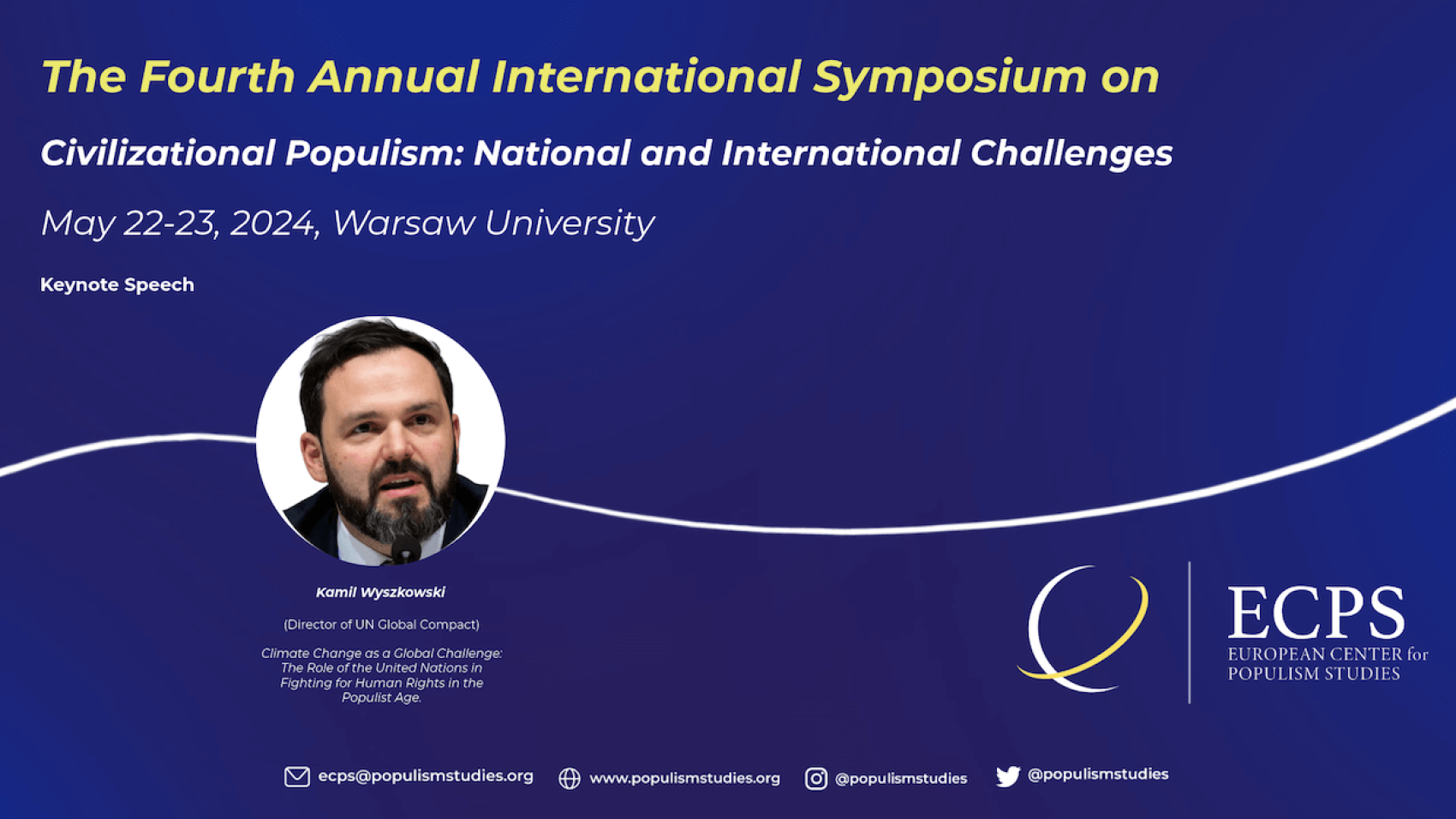
ECPS Symposium 2025 / Keynote Speech II — Kamil Wyszkowski: The Role of the UN in Fighting for Human Rights in This Populist Age

Fourth Annual International Symposium on ‘Civilizational Populism: National and International Challenges’

May 22–23, 2025 | University of Warsaw

Keynote Speech

The Role of the UN in Fighting for Human Rights in This Populist Age,” by Kamil Wyszkowski (Director of UN Global Compact).

Kamil Wyszkowski has been working for the United Nations. He currently serves as the Representative and Executive Director of the UN Global Compact Network Poland and as the Representative of UNOPS in Poland. He is an expert on UN and EU policies, particularly in areas intersecting business and public administration.

From 2002 to 2009, he worked at the United Nations Development Programme (UNDP), where he was responsible for international and multilateral cooperation and for developing programs across Europe and Asia. He has implemented development projects in dozens of countries, including Iraq, India, Thailand, and Romania, drawing on knowledge transfer from Poland. He has also worked at UNDP headquarters in New York and its regional center for Europe and the CIS in Bratislava. From 2009 to 2014, he was the Director of the UNDP Office in Poland. Since 2004, he has been the National Representative and Chair of the Board of the UN Global Compact Network Poland (GCNP), which coordinates cooperation between the UN and business, academia, cities, public administration, and NGOs in Poland. He has also led the Know How Hub (a UNDP Poland initiative, now under GCNP) since 2011.

He lectures at institutions including Central European University (Bucharest), Ukrainian Catholic University (Lviv), Warsaw School of Economics, Kozminski University, Collegium Civitas, SWPS University, the Paderewski Institute of Diplomacy, and the University of Warsaw.

A distressed Black woman professional faces gender discrimination and workplace bullying, as male colleagues point fingers and place blame. The image highlights the emotional toll of inequality and harassment in professional environments. Photo: Dreamstime.

“No One Can Make You Feel Inferior Without Your Consent”: Is Eleanor Roosevelt Right?

Can we truly choose not to feel inferior? In this thought-provoking commentary, Syed Yousha Haider critically examines Eleanor Roosevelt’s famous quote, “No one can make you feel inferior without your consent.” Blending insights from psychology, neuroscience, philosophy, and social theory, Haider explores the limits of agency in the face of trauma, social conditioning, and structural inequality. While celebrating resilience and self-determination, he also challenges oversimplified notions of empowerment. This essay invites readers to reflect on the complex dynamics of self-worth, consent, and resistance in a world where internal struggles are often shaped by forces far beyond the individual.

By Syed Yousha Haider*

Eleanor Roosevelt’s much-quoted maxim—”No one can make you feel inferior without your consent”—has traveled a long way from its origins as a personal empowerment mantra. The quote says that individual choice is more important than what other people think, based on ideas about agency, dignity, and self-concept. But beneath its catchy simplicity lies a philosophical paradox: is it ever in our choice to refuse consent to feelings of inferiority? Are these kinds of feelings, at least in part, caused by social, psychological, and even neurobiological processes that we can’t control? This essay argues that Roosevelt’s maxim, as inspiring as it is, is only partially true. Individual agency is essential to self-perception, but the action of structural forces, psychological conditioning, and automatic cognitive processes complicate the idea that one can simply choose not to feel inferior.

The Appeal of Personal Agency

People still use Roosevelt’s quote because it fits with the liberal humanist idea of the self-governing person. For example, Stoic philosophy heard Epictetus say, “It’s not what happens to you, but how you react to it that matters.” It seems like there is strength inside despite what is going on outside. Cognitive-behavioral therapy (CBT) is probably the most scientifically-based type of psychotherapy. It also believes that how we feel is based on how we think about things, not the events themselves. This view says that changing the way you talk to yourself can help you get over feelings of inferiority and move on.

Also, there are literally countless examples from history of people who have overcome feelings of inferiority even though the system tried to make them feel less important. Viktor E. Frankl, a survivor of the Holocaust, famously said in his book Man’s Search for Meaning that the last of the human freedoms is “to choose one’s attitude in any given set of circumstances.” Many people point to Frankl’s ability to survive extreme dehumanization as proof that accepting one’s inferiority is a choice..

After serving 27 years in prison for refusing to change his beliefs to suit apartheid’s demands, Nelson Mandela came out of prison with his dignity unharmed and guided South Africa through a peaceful transition. The strength of agency against humiliation is demonstrated by the fact that he was able to maintain his dignity despite institutional racism. After surviving a Taliban assassination attempt, Malala Yousafzai transformed personal hardship into a global movement for girls’ education. Her refusal to submit in the face of patriarchal violence is a brilliant illustration of how victims can become empowered..

The idea that people are powerless in the face of hardship is refuted by the resilience philosophy. The study of learned optimism by Dr. Martin Seligman emphasizes how our mental habits can influence how we react to criticism and failure. People can develop what Seligman refers to as “psychological immunity”—a defense against internalized inferiority—by confronting negative internal monologues and redefining failures as temporary and external. Roosevelt’s ideal can then be seen as psychologically realized through the development of optimism and internal locus of control.

Limits of Consent: Neuropsychological Constraints

However, this utopian vision is obscured by current psychological and neuroscientific research. Cognitive processes related to self-worth are not always under conscious control. The Default Mode Network (DMN) is primarily outside of conscious awareness and is active during self-referential cognition and daydreaming. In order to construct a cohesive sense of self, it is known to combine memories, emotions, and imagined situations, maintaining negative self-beliefs without conscious consent.

Furthermore, unconscious bias affects how we view ourselves from an early age. Implicit Association Tests demonstrate how years of exposure to social stereotypes can cause people to internalize group stereotype attitudes toward members of their own group, such as women being biased against women in positions of power. These are kept in the brain areas responsible for moral and emotional judgments, the prefrontal cortex and the amygdala, demonstrating the neurobiological basis of negative self-perceptions.

Though unconscious, the trauma survivors feel ashamed and inferior. It has been observed that distorted self-perceptions, such as guilt and worthlessness, are more potent than logical thought in people with post-traumatic stress disorder (PTSD). These are neurophysiologic reactions rather than choices, and correcting them usually requires a lengthy therapeutic intervention. In these situations, inferiority is more neurologically motivated than widely accepted.

Additionally, early attachment orientations are crucial in determining self-esteem and vulnerability to feelings of inadequacy, according to affective neuroscience research. A child who experiences emotional abuse or neglect may grow up with a persistent internal schema of worthlessness. The internalized, which was solidified during brain-sensitive developmental stages, restricts the person’s capacity to “withdraw consent” from inferiority complexes as an adult.

Second, feelings of inferiority might have adaptive roots, according to evolutionary psychology. Humans were made to live in small communities where access to resources and partners depended heavily on status and belonging. One adaptation that might have developed in order to survive is hypersensitivity to social rejection. However, this evolutionary baggage now shows up as irrational and habitual feelings of inferiority, especially in hierarchical environments like online forums, workplaces, and schools.

Social and Structural Determinants of Inferiority

In addition to the psychology of the individual, social structures also produce and enforce inferiority. Language, the media, and institutions are all infused with heteronormativity, which tends to dictate who is capable, desirable, or deserving. Symbolic violence, as defined by Pierre Bourdieu, describes how dominant social groups impose meanings that are internalized as acceptable. For example, colonial education systems used to portray colonized people as intellectually inferior; this claim is still present in the disparities in academic accreditation around the world.

Erving Goffman studied how stigma, or the discrediting of people for supposedly deviating from the norm, contributes to feelings of shame and undesirableness. According to his theory, the stigmatized individual absorbs society’s scrutiny and agrees to being inferior out of social pressure rather than choice. This consent is not voluntary; it is coerced.

According to the “stereotype threat,” as defined by social psychologist Claude Steele, people perform less well when they are concerned about reinforcing unfavorable stereotypes about their identity category. For instance, when race is emphasized on tests, African American students do worse—not because they think they are less capable, but rather because the cultural script instills fear, which impairs performance. Such scripts can effectively short-circuit the will by altering behavior and thought.

Another sociocultural phenomenon is groupthink. People will repress contradictory self-concepts in order to preserve group harmony, embracing the flawed consensus. Conventional instances, like discouraging women’s aspirations for education or politics, demonstrate how social norms can force internalization of inferiority.

Furthermore, social media has given rise to new channels for the propagation of inferiority. Social media platforms like Instagram and TikTok propagate idealized beauty standards and manufactured lives, creating a culture of comparison that undermines self-worth. Younger generations, particularly teenage girls, are disproportionately targeted by algorithmic promotion of idealized imagery, which contributes to the rise in anxiety and depression. Here, inferiority is fostered by repeated exposure to distorted norms rather than being elected outright.

Such effects are amplified by intersectionality. The accumulation of marginalization experiences is demonstrated by Kimberlé Crenshaw’s intersectional matrix of oppressive systems, which includes racism, sexism, and classism. Black women who are economically marginalized may encounter overlapping social messages that portray them as inferior in multiple ways. These messages, which are delivered through cultural imagery and institutional norms, carry a cumulative psychological burden that is difficult to deny.

Resisting Inferiority: Possibility and Limits

Resistance is evident in opposition to these limits. The recovery of the imposed identity of inferiority has already been demanded by feminist and postcolonial theorists. “Caring for myself is not self-indulgence, it is self-preservation,” as Audre Lorde insists, is a rejection of internalizing the condemnation of the world. Black Pride and LGBTQ+ affirmations are just two examples of grassroots movements that have successfully challenged hegemonic discourses and empowered people to reject internalized oppression.

The solution to this difficulty lies in education. According to Paulo Freire’s Pedagogy of the Oppressed, the oppressed must be able to recognize internalized inferiority brought on by systemic injustice and recover their dignity via critical thinking, or conscientization. Only with time, resources, and support groups—things that not everyone has access to—can it be accomplished.

The ability to challenge hegemonic narratives and reinterpret value on their own terms has been made possible by cyberspace. Default inferiority narratives are countered by discourses like #BlackGirlMagic and #DisabledAndProud. In addition to being empowering in and of themselves, these claims also have a cumulative effect by changing the broader cultural environment.

However, not all attempts at resistance are successful. The enduring resilience of systemic powers is demonstrated by the continued existence of racial profiling, wage inequality, and underrepresentation in leadership positions. One’s identity is typically determined by societal approval, even if you fight valiantly against subordinating ideologies. The internal conflict gets harder to sustain when one lacks acceptance and a sense of belonging.

However, resilience-building programs enable psychological resistance. Education and mental health programs that promote self-advocacy, growth mindsets, and trauma-informed care are essential. Instead of opposing systemic forces, these empower individuals to challenge internalized narratives. Roosevelt’s assertion is interpreted by adults as an invitation to build internal strength in tandem with structural change, rather than as a rejection of putting up with oppression.

The Philosophical Implications of Consent

Roosevelt only used the word “consent” to refer to a deliberate action. However, in ethics and the law, consent must be given voluntarily and free from coercion. Consent to be in a subordinate position cannot be based on psychological conditioning, neurobiology, or societal power dynamics that reduce one’s agency and awareness.

Here, it’s important to distinguish between “responsibility” and “causality.” One can be held accountable for facing their own shortcomings over time, even if they were never the direct cause of them. This nuanced stance maintains the moral requirement of agency while rejecting the all-powerful forces that exist within our inner selves.

The “dialogical self” theory of philosopher Charles Taylor makes consent more difficult to understand. According to Taylor, identity is socially constructed through interactions with other people rather than something that is determined for oneself. Feelings of inferiority could be exogenously programmed rather than endogenously generated if selfhood is relational. Roosevelt’s statement may therefore be exaggerated in light of the extent to which an individual can create their own sense of self-worth.

Jean-Paul Sartre and other existentialist philosophers support radical freedom and self-creation. His theory that “existence precedes essence” holds that people must create their identities consciously since they are not born with predetermined natures. According to this viewpoint, willpower alone is sufficient to overcome inferiority complexes. But Sartre also introduced the idea of “bad faith,” which acknowledges the limitations of volition and refers to people lying to themselves in order to escape the responsibility that comes with freedom. In The Ethics of Belief, philosopher William Clifford makes the case that it is immoral to hold beliefs in the absence of adequate evidence. When used in this context, inferiority complexes that are based on erroneous social or psychological assumptions are illogical and ought to be disregarded. However, Thomas Nagel argues that human subjectivity cannot be avoided; irrational feelings, such as inferiority, are.

Conclusion

A powerful affirmation of human dignity and inner strength is the Eleanor Roosevelt maxim. However, it would be oversimplifying the combined influence of psychological, biological, and social factors on self-perception to claim that no one can ever make us feel inferior if we do not consent. Although agency still functions, it must be understood in the context of limitations. Since Roosevelt’s assertion that reassertion of value is as much a matter of will as it is of struggle against forces of inheritance, the reality is not so much a question of its complete cancellation or confirmation. Therefore, empowerment is more about knowing on what terms to give consent than it is about refusing it.


(*) Syed Yousha Haider is a student with a growing interest in understanding the human mind and behavior. In his own words, he has always been curious about what drives people to think, feel, and act the way they do. This curiosity, combined with his desire to understand himself and others better, naturally led him to explore the field of psychology. While he is still learning, he finds joy in asking questions, noticing patterns in emotions, and reflecting on the deeper reasons behind everyday choices. For him, psychology is more than a subject—it is a way to connect with people, understand their stories, and perhaps even help make sense of his own.

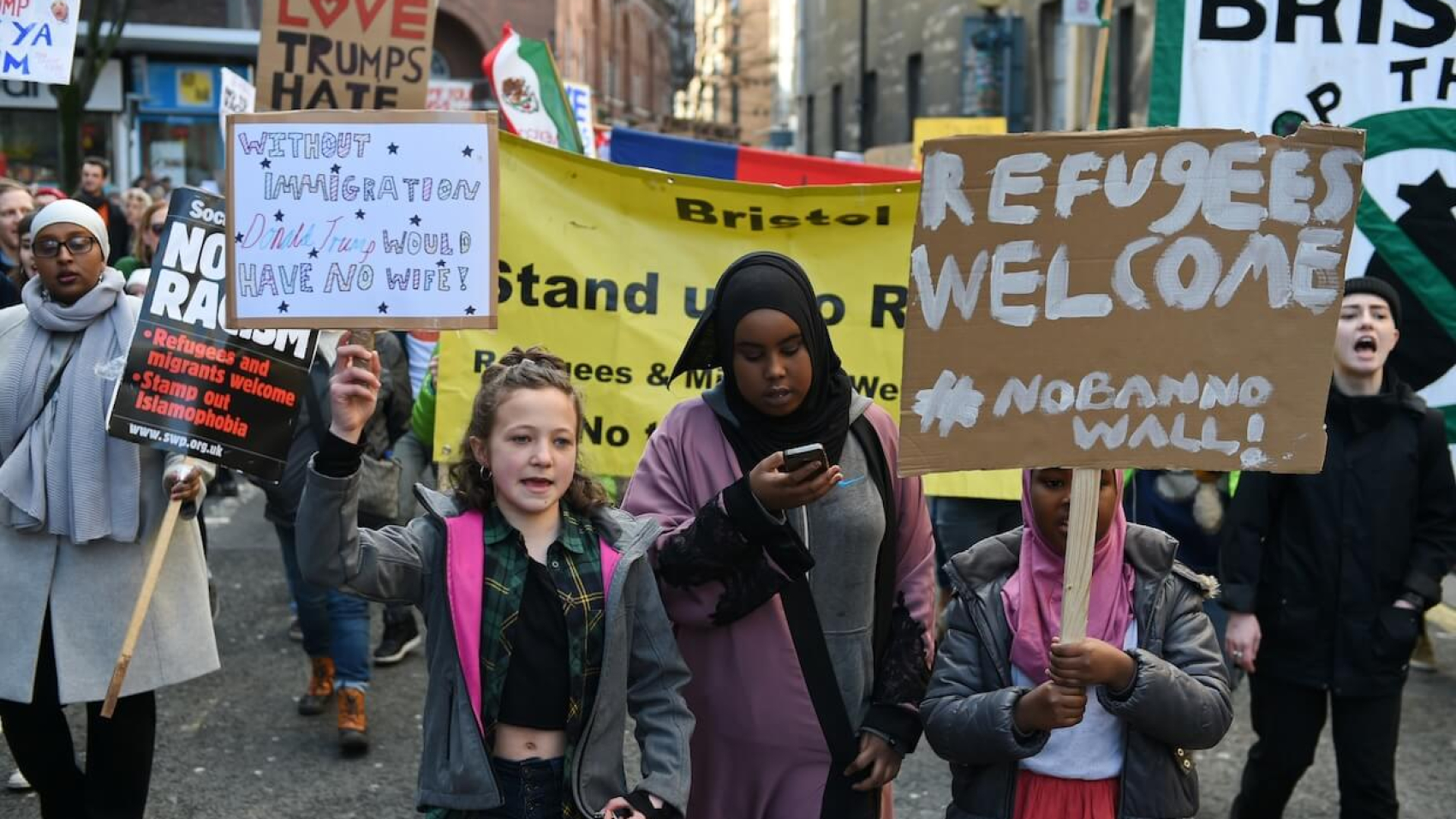
Several thousand protesters marched in Bristol, UK, on February 4, 2017, opposing President Trump's scheduled state visit to the UK and his executive order banning travel to the US from seven Muslim-majority countries. Photo: Dreamstime.

Impact of Civilizational Populism on Intergroup Emotions, Social Cohesion, and Civility in the UK

Please cite as:
Wathtuwa-Durayalage, Sudeshika. (2025). “Impact of Civilizational Populism on Intergroup Emotions, Social Cohesion, and Civility in the UK.”
Journal of Populism Studies (JPS). June 11, 2025. https://doi.org/10.55271/JPS000115


Abstract

This study investigates the impact of civilizational populism on intergroup emotions, social cohesion, and civility in the United Kingdom using quantitative analysis of British Social Attitudes Survey (BSA) 2021 data. The findings reveal significant correlations between exposure to populist rhetoric and heightened negative emotions, such as fear and anger, toward ethnoreligious and political minorities (r = 0.56). While political affiliation demonstrates a weaker direct influence (r = 0.14), perceptions of migration as culturally and economically beneficial are strongly associated with higher social cohesion (r = 0.69). Minority groups report elevated levels of exclusion and fear, yet national pride correlates with inclusive attitudes in some cases (r = -0.64, with prejudicial views). Civil society organizations play a critical role in mitigating divisive effects by fostering inclusivity and dialogue. These insights inform strategies to counteract the polarizing impacts of civilizational populism, emphasizing the importance of inclusive narratives and policy interventions to enhance social cohesion in diverse societies. The study’s limitations include reliance on secondary data and challenges in establishing causality, highlighting the need for further research using more direct measures of populism and contemporary datasets. Despite these constraints, the findings contribute empirical evidence to the growing literature on the social and emotional consequences of populism, offering a foundation for policies aimed at promoting harmony and reducing polarization in the UK.

Keywords: Civilizational populism, intergroup emotions, social cohesion, civility


By Sudeshika Wathtuwa-Durayalage

Introduction

This study investigates the influence of civilisational populism on intergroup emotions and attitudes towards ethnoreligious and political minorities in the UK. Specifically, it examines the effects of civilisational populism on social cohesion and civility at the local and national levels, and how individuals and communities respond to and resist populist rhetoric. Central to this inquiry is an exploration of the emotional responses elicited by civilisational populism, such as fear, anger, and resentment, and the strategies civil society organisations employ to mitigate its divisive effects. 

While there has been extensive research on the general impact of populism on political attitudes and intergroup relations, there is a significant gap in understanding the specific emotional and social consequences of civilisational populism, particularly in the UK context. Civilisational populism differs from other forms of populism by framing political discourse regarding civilisational identities and perceived existential threats to cultural values and ways of life. Current literature inadequately addresses how this form of populism shapes intergroup emotions, such as fear and resentment, and its implications for social cohesion. Furthermore, there is a paucity of research on how communities and civil society organisations respond to civilisational populism, especially in fostering social cohesion and civility in the context of rising divisive rhetoric. 

This research is significant as it aims to provide a nuanced understanding of how civilisational populism influences emotional and social dynamics within ethnoreligious and political groups in the UK. By focusing on emotional responses and community reactions to civilisational populism, this study offers critical insights into how populist rhetoric shapes social cohesion and civility in diverse societies. Additionally, identifying the coping mechanisms and resistance strategies employed by communities will contribute to policy and intervention strategies aimed at mitigating the divisive impacts of populism. Ultimately, this research could inform efforts to strengthen social cohesion and civility in increasingly pluralistic and politically polarised societies.

The research questions are as follows:

How does civilisational populism influence intergroup emotions and attitudes toward ethnoreligious and political minorities in the UK?

What are the effects of civilisational populism on social cohesion and civility in local and national contexts?

How do individuals and communities respond to populist rhetoric, and what coping mechanisms or resistance strategies are employed to maintain social cohesion?

There are three research objectives aligned with this research, as follows:

To explore how civilisational populism impacts the emotional responses (e.g., fear, anger, and resentment) of different ethnoreligious and political groups in the UK.

To analyse the relationship between civilisational populism and social cohesion, focusing on the extent to which it promotes or undermines community trust and cooperation.

To identify the strategies utilised by civil society organisations and communities to counteract the divisive effects of populism and foster civility.

Civilisational populism, as defined in this research, uniquely frames political discourse around existential threats to cultural values, in contrast to general populism that targets the elite. This study explores its significant emotional and societal impacts on social cohesion, particularly among ethnoreligious and political minorities. The central argument posits that civilisational populism exacerbates fear, anger, and resentment toward minority groups, undermining local and national social cohesion. Civil society and communities can mitigate these divisive impacts by fostering civility and employing coping mechanisms. Through a robust quantitative approach utilising British Social Attitudes Survey (BSA) data, this research seeks to empirically establish correlations between populist rhetoric and intergroup emotions.

Click to Read Full Article

A woman votes at a polling station on general election day in Palma de Mallorca. Photo: Dreamstime.

Do Muslims Have Different Attitudes and Voting Behaviour Than the Majority Populations of France, Germany and the Netherlands?

DOWNLOAD REPORT

Please cite as: 

van Oosten, Sanne. (2025). “Do Muslims Have Different Attitudes and Voting Behaviour Than the Majority Populations of France, Germany and the Netherlands?” European Center for Populism Studies (ECPS). June 10, 2025. https://doi.org/10.55271/rp00100


Abstract

The political preferences of Muslims are often the source of contention and misinformation. In continental Europe, there is not much data available on political preferences of Muslims due to strict privacy regulations, creating a knowledge lacuna allowing for misinformation to fester. In this report, I focus on three countries where privacy regulations are particularly longstanding: France, Germany, and the Netherlands. I use a novel sampling method that complies with privacy regulations while achieving a large enough sample of minority respondents to conduct statistical analyses. Regarding policy preferences, I find that respondents with a Muslim minority background have more conservative attitudes towards same-sex adoption, while showing very similar attitudes to white majority respondents when it comes to gender equality. Respondents with a Muslim minority background are, however, more progressive on immigration and religious freedoms for Muslims. Regarding voting preferences, Muslims show very similar patterns to their majority counterparts, with a few exceptions (La France Insoumise (FI) in France, and in the Netherlands DENK and Partij voor de Vrijheid (PVV)). This paper seeks to put an end to persistent speculation about the political preferences of Muslims, particularly Muslims, in France, Germany, and the Netherlands.


By Sanne van Oosten (Postdoctoral Researcher at University of Oxford, COMPAS, sanne.vanoosten@compas.ox.ac.uk)

Introduction

The political preferences of Muslims in western countries are the subject of recurring speculation (Turnbull-Dugarte and Lopez, 2024; Turnbull-Dugarte et al., 2025; van Oosten, 2025a; 2025b). Political leaders often claim that Muslims vote for them to present themselves as legitimate leaders of all people, while at the same time, some political leaders claim that Muslims and other minorities have been imported by elites to vote for pro-immigrant parties and change society from within (Bracke and Aguilar, 2022; van Oosten, 2025a). Political actors also often point to the attitudes of Muslims to justify their exclusion from national communities (Glas, 2023; Spierings, 2021; De Lange and Mügge, 2015). These claims focus on issues like opposition to gay rights (Puar, 2013), perceived sexism (Farris, 2017), antisemitism (van Oosten, 2024a) or animal cruelty (Backlund and Jungar, 2022; van Oosten, 2024b). Far-right parties use these examples to argue that Muslims do not share core liberal values, and therefore do not belong in liberal societies (van Oosten, 2024b; 2022). These claims, however, are rarely supported by data. This report examines whether Muslims in France, Germany, and the Netherlands hold different political preferences from their white majority counterparts.

Standard sampling strategies do not yield enough minority participants for statistical analyses (Font and Méndez, 2013). Moreover, strict European privacy regulations limit the availability of sampling frames for racial/ethnic and religious minorities in the European context (Simon, 2017). To overcome these challenges, I surveyed a large sample of Kantar-panellists and used a mini-survey to oversample voters from France, Germany, and the Netherlands with a migration background in Turkey (France, Germany, and the Netherlands), North Africa (France), Sub-Saharan Africa (France), the Former Soviet Union (Germany), Surinam (the Netherlands), and Morocco (the Netherlands). I sampled a high number of minority respondents, with 1889 out of a total N of 3058 respondents having a migration background, of which 649 self-identify as Muslim. I asked these respondents for their propensity to vote (PTV) for all political parties in the French, German and Dutch parliament at the time of data collection, as well as their attitudes towards 8 key policy preferences spanning socio-cultural and socio-economic themes. 

In this paper, I test whether Muslims and other minority groups differ from majority voters in their support for political parties in France, Germany, and the Netherlands. I find that Muslim voters are much less likely to support PVV in the Netherlands but are just as likely to vote for the RN in France or AfD in Germany (all three far right). Minority and majority voters are equally likely to support mainstream left parties, such as PS in France, the SPD in Germany, and PvdA in the Netherlands. Muslim minority voters are more likely to support left-populist parties DENK in the Netherlands and FI in France. In terms of policy preferences, respondents with a Muslim minority background hold more conservative views on same-sex adoption but show similar attitudes to majority respondents on gender equality. They are, however, more progressive on immigration and Muslim religious freedoms.

This report aims to contribute to the debate about the voting behaviour of Muslims in Western Europe, a debate that is often speculative and not based on data from academic scholars. Far right party leaders, thinkers and pundits have fuelled misunderstandings about minority voting patterns. In reality, the political preferences of Muslims, a minority, are very similar to the political preferences of the majority population. This report seeks to provide clarity and offer a data-driven response to counter the narrative that some political leaders might use to exploit the supposed voting behaviours of minorities for their political gain. Through empirical analysis, this study contributes to a more accurate understanding of ethnic minority political preferences and aims to challenge rhetoric with factual evidence.

Sampling Method and Sample Composition

I conducted this research in France (van Oosten et al., 2024a), Germany (van Oosten et al., 2024b) and the Netherlands (van Oosten et al., 2024c), three countries with key differences. In France, there is a strong emphasis on citizenship, secularism and a strong division between church and state (Kuru, 2008). In Germany, Christian political parties have had a longstanding presence (Ahrens et al., 2022) and the approach towards Muslims is characterised by the history of integration of guestworkers (Yurdakul, 2009). The Netherlands has a host of Christian parties (Kešić and Duyvendak, 2019), a tradition of high minority representation in politics (Hughes, 2016: 560), increased by the emergence of a political party run by Muslim parliamentarians and voicing Muslim interests in 2017, DENK (van Oosten et al., 2024d). All three countries have a history of parliamentarians from mainstream and populist radical right parties espousing Islamophobic rhetoric, with France and the Netherlands having a longer and more vociferous history of populist radical right parties and Germany being relatively new to the game and taking on a comparatively less strident tone (Brubaker, 2017).

I oversampled respondents with specific migration backgrounds to make group-specific statistical inferences (Font and Méndez, 2013: 48) and chose minoritised groups: numeric minorities that state experiencing discrimination to the largest extent (FRA: European Union Agency for Fundamental Rights, 2017: 31). In France, the oversampled groups of ethnic minority citizens consist of French citizens with a North-African (Morocco, Tunisia, Algeria), Sub-Saharan African (Niger, Mauritania, Ivory Coast, French Sudan, Senegal, Chad, Gabon, Cameroon, Congo) and Turkish background. In Germany, I oversampled German citizens with a Turkish and Former Soviet Union (FSU) background. In the Netherlands, I oversampled Dutch citizens with a Turkish, Moroccan and Surinamese background. Some groups have come to France, Germany or the Netherlands as a result of the colonial ties between host and home country, some came as guest workers (FRA: European Union Agency for Fundamental Rights, 2017: 93). I also oversampled French citizens with a Turkish background and German re-migrants from the FSU. Some, but not all, of the oversampled migration backgrounds are countries with Muslim-majority populations, making it possible to disentangle whether differences are either religiously or ethnically/racially driven. In this paper, I present data for the Muslim subgroup, but the data also includes other minoritised groups and analyses by these groups are also available for researchers. 

After running pilots and obtaining the ethics approval, (see appendix: van Oosten, 2025c), I gathered data between March and August of 2020 amongst 3058 citizens of France, Germany and the Netherlands, administered by survey agency Kantar Public (for all replication materials and appendices, see van Oosten, 2025b). One important challenge in surveying ethnic/racial minority groups comes from the General Data Protection Regulation (GDPR), a European law legally restricting saving data on race and ethnicity (European Commission 2018). I overcame this challenge by employing a large-scale filter question to the representative Kantar-panels in all three countries. I asked a very large sample to participate in a mini survey. The first and only question of this mini survey asks where their mother and father were born. If either one of their parents were born in a country of origin I wanted to oversample, I redirected this respondent to the full survey. If not, I either terminated the survey or redirected a small percentage to the full survey. This enabled us to form sizable groups of minority citizens for our final survey, ensuring ample diversity, a feature so often missing from survey research (e.g. Coppock and McClellan, 2018). Though there is still a chance of selection bias (see van Oosten, 2025d for a discussion on the selection bias in this sample), I have variables to weight the data on gender, migration background, education, age, urbanisation and region, and the findings are broadly the same with and without weights.

Respondents received so-called ‘LifePoints’ (France and Germany) or ‘Nipoints’ (the Netherlands) for the completion of the survey. With these points, respondents can periodically convert their saved points to an online gift card. The survey took about fifteen minutes to complete, which translated to an equivalent of two euros in gift card value. I ended up with the following number of respondents in each group:

I assessed migration background by inquiring about the birthplaces of respondents’ mothers and fathers. It was necessary to ask this question first for sampling purposes. To minimise potential ordering effects on the data, I randomised the order in which respondents viewed the policy questions and experimental profiles (for the full questionnaire, see appendix in van Oosten, 2025c). To mitigate acquiescence bias, where respondents tend to agree with statements, I randomised the wording of the policy questions. For instance, one half of the sample saw the statement: “the taxes for this rich should be raised” and the other half saw “the taxes for the rich should be lowered” and I recoded the variables accordingly. I prepared the data using R-package ‘tidyr’ (Wickham, 2020, see all code and replication materials here: van Oosten, 2025c).
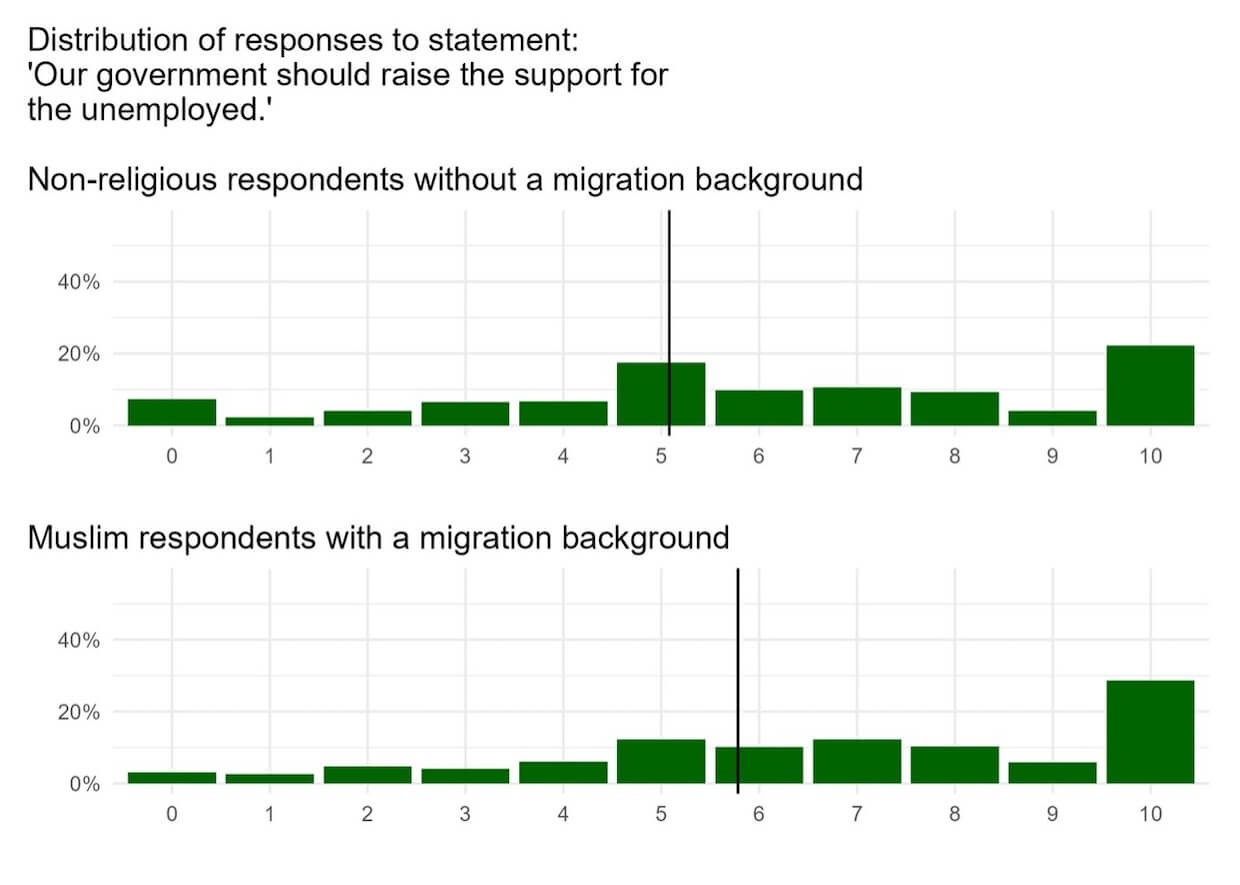
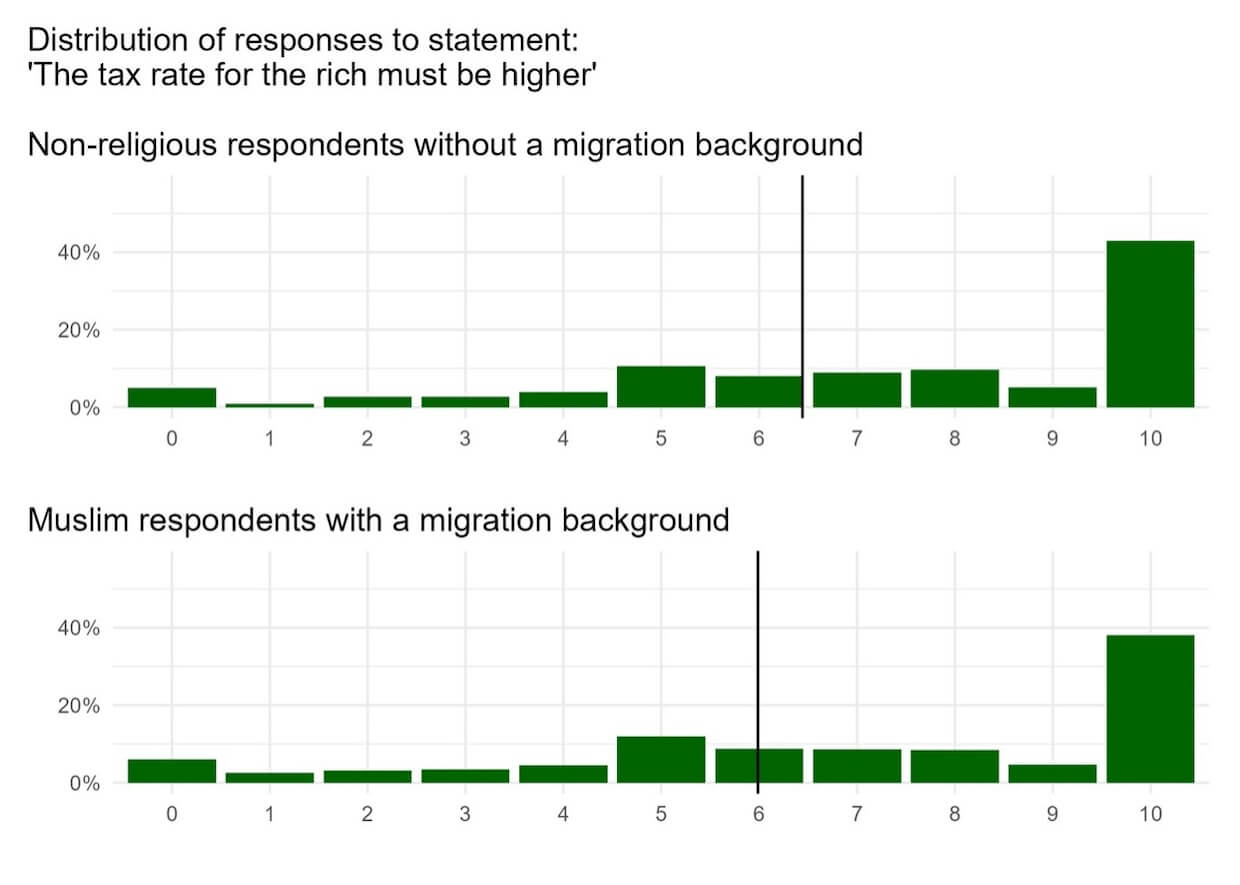
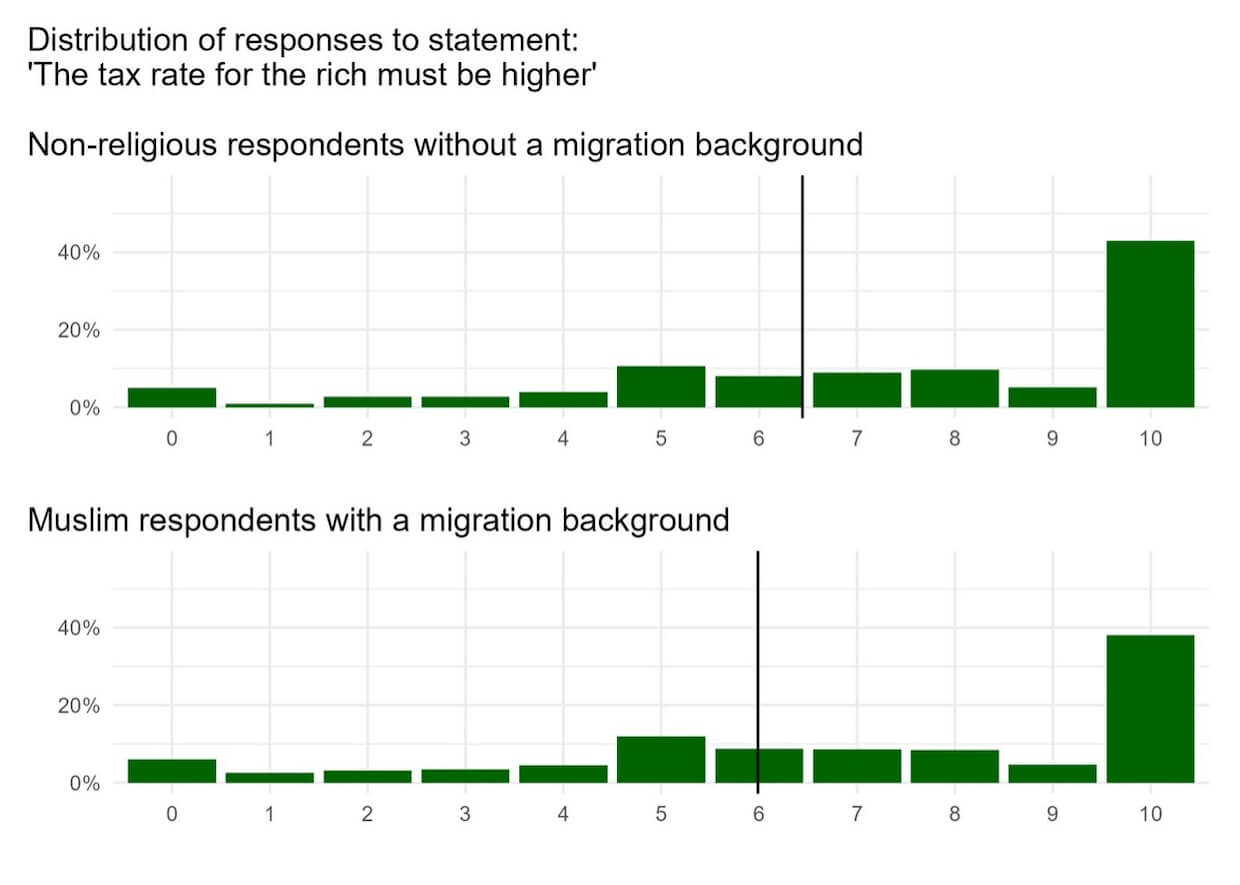
Minorities’ Policy Preferences

In the following section, I first present the policy preferences of two groups: non-religious ethnic majority respondents and Muslim ethnic minority respondents (for other subgroups see appendix at van Oosten, 2025c). I present the distribution of the responses in a histogram, with a black line indicating the mean score. I asked respondents to indicate their agreement with a series of policy statements using an 11-point scale, ranging from 0 (strongly disagree) to 10 (strongly agree). The statements covered a broad range of topics, including attitudes towards state intervention, immigration, Islam, gender and sexuality. The attitudes towards state intervention are as follows: “The tax rate for the rich must be higher/lower,” “Our government should raise/lower support for the unemployed,” “Our government should do less/more to combat climate change than now,” and “Our government needs to lower/raise fuel prices.” Attitudes towards immigration and Islam are as follows: “Immigrants are a burden/an asset to our country,” “Islam should (not) be restricted by law.” I measure gender attitudes as follows: “That men and women receive equal pay for equal work should (not) be regulated by law,” and sexuality as follows: “Homosexual couples should (not) be allowed to adopt children.” 

I compared the responses of non-religious ethnic majority respondents with those of ethnic minority respondents who self-identified as practicing Muslims. Differences between the groups were negligible for most policy areas, including taxation, unemployment, climate policy, fuel prices, and gender equality. However, Muslim respondents were more likely to oppose adoption rights for same-sex couples, and more supportive of immigration and religious freedoms for Muslims.

Subsequently, I present data for voting preferences. I asked respondents about their willingness to vote for a wide range of political parties in their respective countries using so-called “Propensity to Vote” (PTV) questions. Respondents were asked: “Please indicate the likelihood that you will ever vote for the following parties. If you are certain that you will never vote for this party then choose 0; if you are certain to vote for this party someday, then enter 10. Of course you can also choose an intermediate position.” In France, the list of parties included LREM, LR, PS, MoDem, FI, PCF, RN (formerly Front National), and MR. In Germany, I asked about CDU, SPD, AfD, FDP, Die Linke, Grüne, and CSU. In the Netherlands, the full list consisted of CDA, ChristenUnie, D66, DENK, FvD, GroenLinks, PvdA, PvdD, PVV, SGP, SP, and VVD. 

In the figures below, I present histograms of the responses for two parties per country: FI and RN in France, Die Linke and AfD in Germany, and DENK and PVV in the Netherlands. These pairs were selected to contrast parties often associated with the ethnic majority versus those associated with minority or immigrant support. Full results for all parties are available in the appendix (van Oosten, 2025c). Our findings show that there are relatively few differences in voting propensities between non-religious ethnic majority respondents and Muslim ethnic minority respondents in France and Germany. In France, Muslims are about as likely as non-religious majority respondents to consider voting for both RN and FI. Similarly, in Germany, I find little difference between these two groups in their willingness to vote for Die Linke or AfD. The Netherlands stands out in this regard: Muslim respondents are significantly more likely to consider voting for DENK, a party with strong minority and Muslim support, while being far less likely to vote for the PVV, a party known for its anti-Muslim rhetoric. This suggests that differences in vote propensity by group are more pronounced in the Dutch context than in France or Germany.

Minorities’ Voting Preferences

Conclusion

In terms of policy preferences, the differences between Muslims and non-religious ethnic majority respondents are generally small, except in a few areas. Muslims tend to be more supportive of immigration and Muslim rights and less supportive of same-sex couples adopting children. There are no major differences on issues like gender equality, though. When it comes to voting preferences, there are bigger differences in the Netherlands compared to France and Germany. In the Netherlands, Muslims are much less likely to vote for the PVV, but more likely to vote for DENK. In France and Germany, there are fewer differences between Muslims and non-religious ethnic majorities, with both groups showing similar preferences for parties like RN and FI in France, and AfD and Die Linke in Germany.

This paper addresses the ongoing speculations about the policy and voting preferences of Muslims in France, Germany, and the Netherlands. Political leaders and commentators regularly spread misinformation; possibly unintentionally, possibly deliberately (van Oosten, 2025a). This false information about minority voting habits can mislead the public and fuel xenophobic views. In reality, Muslims often share similar political preferences with the majority population, though not always. This paper presents descriptive statistics to challenge false narratives. Combating misinformation is vital for the health of democracies, as it helps maintain informed discussions and trust in democratic institutions.

References

Ahrens, P., Ayoub, P. M., & Lang, S. (2022). “Leading from behind? Gender equality in Germany during the Merkel era.” In: Leading from behind (pp. 1–19). Routledge.

Backlund, A., & Jungar, A.-C. (2024). “Animal advocacy and the radical right: The case of Sweden.” Journal of Political Ideologies, 29(3), 614–633. https://doi.org/10.1080/13569317.2022.2138292

Bracke, S., & Hernández Aguilar, L. M. (2020). “‘They love death as we love life’: The ‘Muslim question’ and the biopolitics of replacement.” British Journal of Sociology, 71(4), 680–701. https://doi.org/10.1111/1468-4446.12742

Brubaker, Rogers. (2017). “Between Nationalism and Civilizationism: The European Populist Moment in Comparative Perspective.” Ethnic and Racial Studies 40 (8): 1191–1226. https://doi.org/10.1080/01419870.2017.1294700.

Font, J, and M Méndez. (2013). Surveying Ethnic Minorities and Immigrant Populations. Amsterdam: IMISCOE Research Amsterdam University Press. www.imiscoe.org.

FRA: European Union Agency for Fundamental Rights. (2017). Second European Union Minorities and Discrimination Survey (EU-MIDIS II): Main Results. https://doi.org/10.2811/902610.

Glas, Saskia. (2023). “What Gender Values Do Muslims Resist? How Religiosity and Acculturation Over Time Shape Muslims’ Public-Sphere Equality, Family Role Divisions, and Sexual Liberalization Values Differently.” Social Forces, Volume 101, Issue 3, March 2023, Pages 1199–1229, https://doi.org/10.1093/sf/soac004.

Hughes, Melanie M. (2016). “Electoral Systems and the Legislative Representation of Muslim Ethnic Minority Women in the West, 2000-2010.” Parliamentary Affairs 69: 548–68. https://doi.org/10.1093/pa/gsv062.

Kešić, Josip, and Jan Willem Duyvendak. (2019). “The Nation under Threat: Secularist, Racial and Populist Nativism in the Netherlands.” Patterns of Prejudice 53 (5): 441–63. https://doi.org/10.1080/0031322X.2019.1656886.

Kuru, Ahmet T. (2008). “Secularism, State Policies, and Muslims in Europe Analyzing French Exceptionalism.” Comperative Politics 41 (1): 1–19. https://doi.org/10.5129/001041508×12911362383552.

de Lange, S. L., & Mügge, L. M. (2015). “Gender and right-wing populism in the Low Countries: Ideological variations across parties and time.” Patterns of Prejudice, 49(1–2), 61–80. https://doi.org/10.1080/0031322X.2015.1014199

Simon, Patrick. (2017). “The Failure of the Importation of Ethno-Racial Statistics in Europe: Debates and Controversies.” Ethnic and Racial Studies 40 (13): 2326–32. https://doi.org/10.1080/01419870.2017.1344278

Spierings, N. (2021). “Homonationalism and voting for the populist radical right: Addressing unanswered questions by zooming in on the Dutch case.” International Journal of Public Opinion Research, 33(1), 171–182. https://doi.org/10.1093/ijpor/edaa005

Turnbull-Dugarte, S. J., López Ortega, A., & Hunklinger, M. (2025). “Do citizens stereotype Muslims as an illiberal bogeyman? Evidence from a double-list experiment.” British Journal of Political Science, 55, e23. https://doi.org/10.1017/S0007123424000437

Turnbull-Dugarte, S. J., & López Ortega, A. (2024). “Instrumentally inclusive: The political psychology of homonationalism.” American Political Science Review, 118(3), 1360–1378. https://doi.org/10.1017/S0003055423000849

van Oosten, S. (2022) “What shapes voter expectations of Muslim politicians’ views on homosexuality: stereotyping or projection?” Electoral Studies, 80(December). Elsevier Ltd: 1–11. https://doi.org/10.1016/j.electstud.2022.102553   

van Oosten S., Mügge L., Hakhverdian A, Van der Pas D. and Vermeulen F. (2024a). French Ethnic Minority and Muslim Attitudes, Voting, Identity and Discrimination. (EMMAVID) – EMMAVID Data France. Harvard Dataverse. DOI: https://doi.org/10.7910/DVN/ULQEAY  

van Oosten S., Mügge L., Hakhverdian A., Van der Pas D. and Vermeulen F. (2024b). German Ethnic Minority and Muslim Attitudes, Voting, Identity and Discrimination. (EMMAVID) – EMMAVID Data Germany. Harvard Dataverse. DOI: https://doi.org/10.7910/DVN/GT4N9J  

van Oosten S., Mügge L., Hakhverdian A., Van der Pas D. and Vermeulen F. (2024c). Dutch Ethnic Minority and Muslim Attitudes, Voting, Identity and Discrimination (EMMAVID) – EMMAVID Data the Netherlands. Harvard Dataverse. DOI: https://doi.org/10.7910/DVN/BGVJZQ

van Oosten, S., Mügge, L., Hakhverdian, A., & van der Pas, D. (2024d). “What explains voting for DENK: Issues, discrimination or in-group favouritism?” Representation, 60(4), 601–623.https://doi.org/10.1080/00344893.2024.2387011

van Oosten, S. (2024a).” Judeonationalism: Calling out antisemitism to discredit Muslims.” ECPR The Loop, 2024(6). https://theloop.ecpr.eu/judeonationalism-antisemitism-for-the-discrediting-of-muslims/ (accessed on April 10, 2025).

van Oosten, S. (2024b). “Animeauxnationalism: ‘They are eating the pets’.” Digressions and Impressions.https://digressionsnimpressions.typepad.com/digressionsimpressions/2024/10/animeauxnationalism-they-are-eating-the-pets-guest-post-by-sanne-van-oosten.html (accessed on April 10, 2025).

van Oosten, S. (2025a). “The Importance of In-group Favouritism in Explaining Voting for PRRPs: A Study of Minority and Majority Groups in France, Germany and the Netherlands.” Populism & Politics (P&P). European Center for Populism Studies (ECPS). January 12, 2025. https://doi.org/10.55271/pp0046

van Oosten, S. (2025b). “The ‘Awkward Alliance’ of the Left and the Right.” European Center for Populism Studies (ECPS). https://www.populismstudies.org/the-awkward-alliance-of-the-left-and-the-right/ (accessed on April 10, 2025).

Yurdakul, Gökçe. 2009. From Guest Workers into Muslims: The Transformation of Turkish Immigrant Associations in Germany. Newcastle upon Tyne.

Billboard reading “The Looting Government,” part of a protest campaign against the conservative coalition's policies in Ra'anana, Israel, May 2023. Photo: Rene Van Den Berg

Professor Ben-Porat: Israel’s Rightward Shift Is More Than Political Strategy

In a candid and comprehensive interview with ECPS, Professor Guy Ben-Porat warns that Israel’s political rightward shift is not simply a strategic maneuver, but the product of deeper ideological currents. Describing the current coalition as “a unification of several forces,” Professor Ben-Porat highlights its populist hostility toward liberal institutions, minorities, and judicial independence. He draws direct parallels to Hungary and Poland, identifying a shared authoritarian trajectory. Professor Ben-Porat also reflects on how the October 7 attacks have further racialized political discourse, with Arab-Palestinian citizens facing intensified securitization. Yet, he sees hope in mass democratic mobilization: “Thousands of people have taken to the streets every week… the fact that many Israelis are still fighting for democracy means they haven’t thrown in the towel yet.”

Interview by Selcuk Gultasli

In a period marked by growing polarization, religious populism, and democratic backsliding, Israel’s political landscape has undergone a profound transformation. In a wide-ranging and timely interview with the European Center for Populism Studies (ECPS), Professor Guy Ben-Porat—an expert in comparative politics and political sociology at Ben-Gurion University of the Negev—offers a critical diagnosis of Israel’s sharp rightward turn. “It’s more than strategy,” Professor Ben-Porat asserts, describing the current government as “a unification of several forces that make a very strong right-wing government,” rooted in anti-liberalism, exclusionary nationalism, and religious traditionalism.

At the center of this transformation is a coalition led by Prime Minister Benjamin Netanyahu, flanked by ultra-Orthodox parties and far-right figures such as Itamar Ben Gvir and Bezalel Smotrich. Their political agenda, Professor Ben-Porat explains, has taken aim at core liberal-democratic institutions. “From the get-go, this government was determined to undermine the power of the Supreme Court… What they’re proposing is a majoritarian government that will stamp upon the rights of minorities.”

This encroachment on judicial independence is not merely an Israeli phenomenon. Professor Ben-Porat highlights the striking parallels with populist regimes in Hungary and Poland, noting that “Orbán and what happened in Poland before the last elections were good examples for Israel… this was a copycat.” The broader objective is to reconfigure Israeli democracy into a more ethnocratic and majoritarian model—where Jewish identity increasingly overrides civic inclusion and pluralism.

In a particularly sobering observation, Professor Ben-Porat warns that the October 7 Hamas attacks have only deepened the state’s securitized and racialized posture toward its Arab-Palestinian citizens. “There’s much more securitization of political statements and actions of Arab citizens,” he notes. And yet, despite populist figures like Ben Gvir hoping to use the crisis as justification for repression, Israel’s Arab citizens “did not play the game as expected”—remaining distant from Hamas and at times even risking their lives to protect Jewish compatriots.

Still, Professor Ben-Porat cautions that democratic decline is not inevitable. “Thousands of people have taken to the streets every week. That should not be discounted.” Though the protest movement remains largely focused on “Jewish democracy,” he sees the potential for it to evolve, to challenge systemic inequalities and the ongoing occupation. “It’s hard to be hopeful now,” he concludes, “but the fact that many Israelis are still on the streets, still fighting for democracy, means they haven’t thrown in the towel yet.”

Professor Guy Ben-Porat—an expert in comparative politics and political sociology at Ben-Gurion University of the Negev.

Here is the lightly edited transcript of the interview with Professor Guy Ben-Porat.

It’s More Than Strategy: A Unified Assault on Liberal Democracy

Professor Guy Ben-Porat, thank you so very much for joining our interview series. Let me start right away with the first question: How do you understand the convergence of neo-Zionist ideology and populist rhetoric in the post-2022 electoral landscape, particularly under the Ben Gvir–Smotrich axis within Netanyahu’s coalition?

Professor Guy Ben-Porat: It’s a big question, with many terms—neo, Zionist, etc.—which I’m not sure I understand or use all of them. It’s a right-wing government that has several elements within it. Likud, Netanyahu’s party, is a populist party which has become an exclusionary populist party in recent years, centered on anti-Arab, anti-immigrant, and anti-liberal sentiments.

Alongside it are the ultra-Orthodox parties, which have a very special perspective on Israel’s future and on church–state relations. You mentioned Ben Gvir and Smotrich. This is a united party combining into an extreme right-wing party—maybe akin to some things you see among the extreme right in Europe. So, major populism is the main theme here. I think it’s a right-wing, religious government with populist elements within it.

To what extent can the recent rightward shift in Israeli politics be interpreted as a populist response to long-standing ethnic and religious cleavages rather than a mere electoral strategy?

Professor Guy Ben-Porat: I think it’s more than strategy. I think the government has a common interest in undermining some of the established democratic features of Israel—namely, the Supreme Court in particular. And if you look at the internal scene, or the internal politics, from the get-go, this government was determined to undermine the power of the Supreme Court and what we call the checks and balances. Now each part of the government has a different take on the Supreme Court. 

For the ultra-Orthodox, the Supreme Court is perceived as liberal and as undermining their coalitional achievements, which they gain—particular gains for their own good—whether it is exemption from military service, whether it’s budgets for religious institutions, etc.

For the extreme right, the Supreme Court is perceived as slowing down the annexation of the West Bank and the territories. The Supreme Court is perceived as putting some blocks on the military and on the settlement movement—which, one could argue, it does not—but that’s the way they perceive it.

And for Netanyahu, being involved in a series of trials, the Supreme Court is perceived—or is depicted—as an attempt to remove an elected leader by the elites.

So each part of this government has its own take on democracy, kind of combining together into this coalition.

Now, what unites them is, first, a very right-wing perspective in terms of Palestinians and Arab citizens; a more religious attitude or more traditional attitude towards religion; and a strong dislike of what they describe as elites and liberal democracy. So all this together makes it more than a fluke, more than a conjecture. It’s a unification of several forces that make a very strong right-wing government.

Religion Is Used to Draw Boundaries—Not Just to Guide Lives

Does the growing prominence of religious populism in Israel suggest a broader transformation in the political culture, where the ethno-religious identity of “the people” overrides civic and pluralistic conceptions of citizenship?

Professor Guy Ben-Porat: I think here it’s a bit more complex, and that’s what we do—Dani Filc and I—in our work. For some of the religious right, religion is about demarcating boundaries. Religion is used as a way to define the Jewish state, to defend Jewish privileges, and to exclude those who are not Jewish. But if you look at their perception of religion as a way of life—as an ethical way of living—then some of them are not religious, or not religious in the way that orthodoxy perceives religion. To make this a bit more clear: if you look at issues like LGBTQ rights or issues about women’s rights within the Jewish camp, they can be somewhat liberal.

So, in this government, there is a clear divide between those for whom religion is a genuine way of life—shaping their daily practices, beliefs, and ethical system—and those who use religion primarily to draw boundaries and assert identity. Take, for example, the policy issue of exempting yeshiva students from military service: for the ultra-Orthodox, this is entirely natural and self-evident. For Likud members, however, it is far less obvious. That’s where you see differences between what religion is for these people.

Ehud Olmert, former Israeli Prime Minister, in his article published in Haaretz/The Guardian recently, warns of Israel’s potential international isolation and prosecution over war crimes, describing a state policy of starvation and indiscriminate violence. How does the normalization of such extreme policies reflect the convergence of populist ethno-nationalism with authoritarian state practices and what are the long-term implications for democratic institutions and minority rights in Israel?

Professor Guy Ben-Porat: I think we need to make a little separation of things. First, Olmert’s warning is true and real. Israel’s actions in Gaza are dangerous. Many civilian lives are lost, and one could say—in very careful terms—without good reason. Not that there’s ever a good reason, but this war has definitely gone to extremes.

Now, why is this war continuing? Well, I think there are some reasons. One: it’s the government’s policy. And for Netanyahu, as long as the war goes on, the government stays intact. It keeps the government together. If the war ends, then some of the more extreme elements of the government might pull it apart, which means that Netanyahu would have to stand trial without the protection of being Prime Minister. It means there’ll be new elections. It means that Jews will begin debating what happened on October 7th—who’s responsible for this debacle. So for the government, the continuation of the war serves several purposes.

For some, the war should be continued because “we should not stop before the final victory,” which I’m not sure what it means—but for them, it’s the annihilation of Hamas. And I’m not sure that’s even possible. For others, maybe we should end the war on better terms for Israel. Again, I have no idea what that means.

But you could say there’s a mixture of ideology—of extreme right-wing ideology—of political interests, and mainly the fact that the government, for reasons that relate to what I said before, has never really introduced a strategy for how to end this war. If you ask Netanyahu: when does this war end? What will be in Gaza? Who will rule Gaza? Where will Israel be? What’s the role of the Palestinian Authority? What’s the role of other countries? What’s going to happen in Gaza once this war ends? What are the goals of this war? What is the strategy? We don’t know.

A Coherent Network of Right-Wing Advocacy Is Shaping Israel’s Future

Protests against judicial reform and religious coercion in Israel. Photo: Dreamstime.

How has the increasing influence of religiously conservative diaspora-funded NGOs and settler movements shaped the neo-Zionist agenda, particularly under populist governance?

Professor Guy Ben-Porat: Within Israel, money from abroad is not a new thing. NGOs—from both the left and the right—are supported from abroad. That’s not a new phenomenon. The same goes for the government. The Jewish diaspora has always maintained strong ties with Israel and influenced Israeli politics.

You can see NGOs on the so-called left and on the right receiving funding from abroad. Now, from the right-wing perspective, it’s the money from abroad that’s financing the left. So if you look at the populist kind of discourse, it’s about international elites supporting leftist, anti-Zionist forces who are opposing the government. It depends on which side is telling the story.

But to be more precise, I think what we’re seeing today is a very strong connection between the Israeli right and the Trump administration, as well as right-wing organizations in Europe. That’s where you see, perhaps, a new development: a more coherent network of right-wing advocacy that also has influence on Israel.

In your analysis of ‘good citizenship’ among new religious movements, how do such actors reframe legitimacy within a populist framework that delegitimizes secular or liberal opponents?

Professor Guy Ben-Porat: There are several ways this is conducted. Begin with “good citizenship” in Israel—the republican equation, as we call it—has often been about military service. Many on the right pride themselves on being the foot soldiers: “We are carrying out the mission of defending Israel. We are paying the price in blood,” whether it’s through settlement in the West Bank or military service. Hence, we are the good citizens.

They blame the other side for not doing as much. By the way, statistics don’t necessarily support that, but that’s the claim. So being a good citizen is framed around military service and combat. That’s how they define good citizenship.

Now, this of course has implications for issues of gender and ethnicity—namely, for non-Jewish citizens. This whole concept of good citizenship is used by populists to describe themselves as the good, contributing, fighting citizens, in contrast to the “detached elites”—those who are global, more fluid, who can use their money to escape responsibility.

Now, this is a myth—a fable. The Israeli center-left has been fighting on the streets for democracy for two years now. So the whole notion of detached elites is complete baloney. But it makes for a compelling narrative on the right: We are the good citizens. We are the ones who sacrifice. We are truly committed to the country, while you—the elites—are global cosmopolitans. This, by the way, echoes classic anti-Semitic tropes once used in Europe against Jews. Put that aside—but the story they tell is that we are the good people, and they are the detached elites with less commitment to the country’s welfare.

A Different Government Might Have Chosen Strategy Over Messianic Dreams

Had a centrist or center-left coalition prevailed in the 2022 elections, how might the Israeli state have handled the aftermath of the October 7 attacks differently—in terms of military response, international diplomacy, and internal discourse?

Professor Guy Ben-Porat: It’s hard to talk about things that didn’t happen. The “what if” is always very difficult. I can say one thing: if the October 7th debacle had happened under a center-left government, the right would have used all its power to force that government out, to place the blame squarely on them, and to sell the narrative that this is what happens when you have a left-leaning government—one that is weak and unequipped to fight. A left-wing government would have been discredited to the bones.

That hasn’t happened with the right. Netanyahu’s government has been fighting for almost two years now to shed responsibility. “It’s not us, it’s the military, it’s the intelligence.” They’ve been working very hard since October 7th—October 8th even—to deflect responsibility.

Now, what would a different government do? Hard to say. But what a sensible one would do is, at some stage early in the war, begin to form a strategy. On October 8th, right after October 7th, we had very strong international support. We could have fought Hamas, brought an alternative government to Gaza, brought back the hostages, and started thinking of a new future for the Middle East. We could have pursued Middle East alliances—with the Saudis, with the Gulf countries. There were opportunities on the table. This government, because of its right-wing, messianic, and ultra-nationalist agenda, simply threw that out the window. What we would have had instead is maybe a strategy—not messianic dreams. A strategy.

Would an alternative government have challenged the securitization logic that you argue has long shaped Israeli-Arab relations, or merely adopted a more technocratic or liberal gloss?

Professor Guy Ben-Porat: Again, hard to tell. I would take anything that improves the current situation. Gloss might become, at some point, substance. But I think the previous government—at least on one issue that I’m researching, internal security—had a different approach.

We have an ongoing crisis within Arab neighborhoods in Israel. Arab citizens make up about 20% of the country’s population, and they account for more than 50% of the murders in this country. The numbers are skyrocketing.

The previous government, through an attempt to create a strategy, was able for the first time to slightly reduce the number of people murdered among Arab citizens. In this government, the police are in the hands of Itamar Ben-Gvir, an extreme right-wing nationalist and, if I may say, a convicted criminal. Under his office, the numbers have doubled since the last government. So yes, a different government could have made a difference.

Copying Orbán: Undermining Democracy in the Name of Sovereignty

To what extent is the judicial overhaul effort by the Netanyahu-led coalition part of a broader pattern of populist institutional capture akin to what we have seen in Hungary or Poland?

Professor Guy Ben-Porat: It’s been mentioned many times, and the comparison has been made by many people. The connection between Orbán and Netanyahu is well known. Netanyahu’s son has been advocating and has become something of a poster child for some of these movements. So there’s a strong relationship between the Israeli right and the right in Europe and the US.

To a large extent, this was the playbook of the right: undermine liberal democratic institutions and give more power to the government. Orbán—and what happened in Poland before the last elections—were good examples for Israel. And I think, to some extent, this was a copycat. Yes, we saw this in Europe; we can do the same things here. It’s a kind of logic that follows its own lead—it doesn’t really need the examples from abroad. Still, I think the fact that this is happening on a global scale has some meaning.

Do you view the weakening of judicial independence in Israel as a calculated step toward majoritarian rule under the guise of popular sovereignty? How does this resonate with your broader work on state-minority relations?

Professor Guy Ben-Porat: They’ve said it explicitly—so it’s not a mystery. Their position is clear: they want to transfer power from the judiciary to the government. That’s not a secret—it’s the stated policy of this government. The Supreme Court may have its faults, and liberal democracy can certainly be debated. But what they’re proposing is a majoritarian government that tramples the rights of minorities. Again, this isn’t hidden. Some members of the government openly declare that Israel is a Jewish state in which Jewish citizens should enjoy privileges over non-Jews.

Israel has long debated how to reconcile being both a Jewish state and a democracy. It’s an ongoing tension—these principles often clash. Liberal Israelis—and one can debate whether they were right or wrong—have tried to argue that the two can be balanced. A Jewish state, they’ve said, can still be fair toward its Arab citizens. It may not be perfect, it may have flaws, but the contradictions can be managed, even if not fully resolved.

Under the current government, however, there is a clear and explicit shift toward prioritizing the Jewish character of the state. If being both Jewish and democratic comes into conflict, their answer is unequivocal: it is a Jewish state, and democracy comes second. For some in this government, that’s not incidental—it’s ideological. That’s what they believe.

Annexation of Gaza Is No Longer a Whisper—It’s a Declared Agenda

Do you see a fundamental shift in the far right’s approach to governing Palestinians under occupation—moving from ‘managing’ the conflict to accelerating irreversible annexation?

Professor Guy Ben-Porat: Absolutely. And again, these are things that are being said explicitly. You don’t really have to search—it’s not hypothetical. These are statements made by Smotrich, Ben Gvir, and others: that it’s time to annex the West Bank. So, it’s almost obvious. The only thing that has prevented it so far is international pressure. But under Trump, they believed the time had come—an opportunity to do what they always wanted: annex the West Bank. They’ve announced plans to build more settlements, to use more force against Palestinians, to expel so-called top terrorists—which can mean many things. So while these ideas are not yet fully implemented as policy, they are being openly discussed.

Thousands march in Jerusalem against judicial overhaul, March 2025. A broad protest fills the streets at night, with demonstrators calling to save Israeli democracy. Photo: Dreamstime.

Given the current political trajectory, do you believe Israel’s liberal democratic elements are in structural decline, or are there still viable pathways for democratic resilience—perhaps through civil society, judicial pushback, or international pressure?

Professor Guy Ben-Porat: I think the jury is still out on this question. For many years, we’ve been lamenting the death of the left-liberal spectrum in Israel. The prevailing notion was that these people were tired—they were busy with themselves, individualistic, global, cosmopolitan. While the right appeared united and committed, the liberal left seemed aloof and less engaged.

However, over the past two years, we’ve witnessed something remarkable: thousands of people have taken to the streets every week. I think that should not be discounted. I’m not sure who will win, but two or three years ago, if you had told Israelis there would be large weekly rallies in defense of democracy, most would have dismissed it as impossible. Yet, when Israelis perceived that democracy was in danger, they rose up.

There is still a question about how far and how open this movement is. For the moment, it is focused on Jewish democracy. It does not yet address the occupation or fully include the rights of Palestinian citizens—that remains on the margins of the demonstrators’ consensus. The movement is centered on defending Israel’s democracy, and to maintain broad support, it has set aside, at least for now, the occupation and non-Jewish rights.

However, once a movement like this begins to grow and starts to confront the deeper implications of occupation and inequality, then maybe there is room for optimism. It’s hard to be hopeful right now—given the war and two years of ongoing struggle—but the fact that many Israelis are still on the streets, still fighting for democracy, means they haven’t thrown in the towel yet.

Fear Is Driving Policy—But That’s Exactly What Ben Gvir Wants

To what extent does the current populist ascendancy reflect a systemic recoding of Israel’s founding ethno-religious cleavages into a majoritarian regime logic, rather than a contingent electoral maneuver?

Professor Guy Ben-Porat: I think it’s more contingent. We’ve had many years of cleavages and schisms that have come to the fore with the last elections, and we are seeing a very strong cleavage between center-left and right. But within those camps, there are divisions. People on both the right and the left can change their opinions.

Especially in the last 18 months—after October 7th—there has also been the fear factor. People are acting out of fear. Let’s look at the Palestinians, or Arab citizens, or the world. There is still a memory of October 7th. This trauma still lingers.

So, I think what needs to happen now is the restoration of hope and the development of a strategy—reaching out to people on the other side of the spectrum and trying to convince them that there is another option. Maybe then there’s room for change.

To answer your question: no, it’s not merely a contingency. It is the result of many years of struggles and cleavages. Netanyahu was able to position himself as a defender of “the true people” in a very populist sense. But the war has also somewhat shattered that image—being Mr. Security and managing the economy. So, while these shifts are, at the moment, tragic, they may in the future provide some room for change.

In the light of your work on the ‘shrinking of citizenship,’ how has the October 7 Hamas attack provided a discursive and policy framework for intensifying the racialized securitization of Arab-Palestinian citizens under the guise of national unity and collective trauma?

Professor Guy Ben-Porat: It’s a good question. And again, it has several layers that we need to look at. To begin with—yes, Israel became more securitized. People are more afraid, which, of course, also shapes opinions and perceptions. When you’re afraid, it’s very hard to think things through and look at the long term. In that sense, it’s become more securitized. For example, political dissent is much less tolerated. There’s much more securitization of political statements and actions of Arab citizens.

At the same time, Ben Gvir was expecting Arab citizens to join in the October 7th events. That would have given him the reason to use more force against them. So, from Ben Gvir’s perspective or hopes, October 7th provided an opportunity to crack down on Israeli Arab citizens. This has not happened. Arab citizens did not play the game as expected. They remained very detached from Hamas. On October 7th, they were saying, “That is not us. We don’t condone these things.” More than that—among the hostages were Arab citizens, Bedouins from the Negev, who were taken by Hamas to Gaza, and some were killed by Hamas. Arab citizens on October 7th, in some cases, saved Jewish citizens.

The whole story became more complex. But now Gaza makes it more difficult—because those citizens are saying, “Those people in Gaza are our brothers.” When people are dying in Gaza in scores, “We can’t stand aside. People are starving in Gaza. We have to speak our mind. We have to protest.” And that’s the test for Israel. Can Jewish citizens be tolerant toward that? Or do their fears make them see those protests as pro-Hamas—which they are not? 

Now we’re in a very difficult situation where Arab citizens who are protesting against the war in Gaza feel themselves threatened by the government. It has not exploded yet. But that’s exactly what Ben Gvir wants. For him, that would be a good day—one in which he can make the connection: Arab citizens, Palestinians, Hamas—they’re all the same, and they’re all here to destroy us. “Now we have legitimacy to use all means.” That’s the scare right now.

Evangelical Backing Fuels Israel’s Right-Wing Populism

Election billboard showing Netanyahu shaking hands with Trump, with the slogan “Netanyahu. Another League,” in Jerusalem on September 16, 2019. Photo: Dreamstime.

And lastly, Professor Ben-Porat, what role have transnational, religiously conservative, and diaspora-funded networks played in amplifying the settler-theocratic undercurrents of neo-Zionist populism, particularly in relation to territorial maximalism and cultural hegemony?

Professor Guy Ben-Porat: For many years there were relations between settlers and right-wing movements in Israel and similar or supportive movements abroad. As I said before, that is not unique in Israel. All movements—left, right, and center—have often found alliances abroad, whether among Jewish diasporas or liberals in America. So in that sense, what the right wing is doing is not unique.

This transnationality, to be fair, is something used by many groups in Israel for different purposes and reasons. You can say whether it’s good or bad, but the use itself is not unique. Where it is unique is in the US. If you look at Trump supporters in the US, the Evangelicals were a very strong element in his campaign. They provide very strong support for Israel, the right wing, and the settlers. That’s where the connection is important.

It’s more dramatic than it seems—because for many years, Israel was very careful to maintain a bipartisan approach in the US, having support from both Democrats and Republicans. Also remember, the Jewish community in the US is mostly pro-Democratic. So Israel traditionally refrained from taking sides in American politics. Israel was above the Republican–Democratic divide and maintained a relationship with the Jewish diaspora in the US, who are mostly pro-Democrats.

In the last decade or so, things have begun to change. Netanyahu has put his weight on the Republican camp—anti-Obama, anti-Biden, and pro-Trump in the US. His support came in many cases from either right-wing Jews, religious Jews, or right-wing Christians. So, the whole dynamic changes here. Before, it was bipartisan with strong support from the Jewish community. Now, it’s Republican—with support from right-wing Christians and Jews—and an alienation of a large part of the liberal Jewish community.

That’s a strange turn of events. But I think the important religious factor here is the right-wing religious Christians in the US. That’s probably the most important development in Israel’s foreign relations.

Urban graffiti depicting the face of a woman in a hijab, located in an immigrant-populated neighborhood on September 1, 2015. The urban area of Berlin, Germany—home to 4 million residents—ranks as the 7th most populous in the European Union. Photo: Dreamstime.

Evaluations of Female Muslim Politicians in a Populist Era: Measuring Intersectionality Using Interaction Effects and Conjoint Experiments

Abstract
How do voters evaluate female Muslim politicians? The literature mainly approaches voter evaluations of underrepresented groups from a unitary perspective, focusing on either female or minoritized politicians, leaving Muslim politicians out of the picture altogether. I take an intersectional approach and consider a finding intersectional when evaluations of a Muslim woman politician are significantly different from both non-religious women and Muslim men. I test this by running survey experiments amongst 3056 respondents in France, Germany, and the Netherlands and presenting 18,336 randomly constructed profiles of hypothetical politicians varying their religion, gender, and migration background. Voters have a strong negative bias against Muslim politicians. However, voters do not assess female Muslim politicians significantly differently than their male counterparts. These conclusions have implications for researchers studying intersectionality using conjoint experiments and researchers concerned with the electoral consequences of diversity in a political landscape increasingly influenced by populist radical right parties.

Keywords: Intersectionality, Muslims, Islamophobia, Muslim women, Descriptive representation

Please find all replication materials here: https://doi.org/10.17605/OSF.IO/JZYR7

By Sanne van Oosten

Introduction

There are many examples of female Muslim politicians being targeted by politicians of the Populist Radical Right (see Farris, 2017; Oudenampsen, 2016), sometimes leading to female Muslim politicians receiving extraordinary amounts of discursive backlash (Saris & Ven, 2021; van Oosten, 2022). At the same time, Muslim women tend to outnumber Muslim men in politics (Hughes, 2016), especially in contexts where party selectors craft candidate lists: Muslim women tick two diversity boxes while also challenging stereotypes of Muslim women as oppressed, simply by being politicians (Dancygier, 2017). Despite these challenges and the unique positioning of Muslim women in politics, the question remains how voters evaluate them. Does being a female Muslim politician pose electoral challenges, or is there an electoral benefit? In this paper, I test whether intersectionality plays a role in how voters evaluate female Muslim politicians.

An intersectional analysis is distinct from a unitary or multiple one (Hancock, 2007). Where a unitary analysis foregrounds one background characteristic (race or gender) and a multiple analysis adds up the effects of multiple ones (race and gender), an intersectional analysis highlights the interaction between them (race interacts with gender) (idem). In order to study the intersectional position of minoritized women in politics quantitatively, many scholars call the use of interaction effects and candidate experiments viable methodological solutions (Block et al., 2023; Klar & Schmitt, 2021, p. 493, 495). This paper tests the limits of both the method of data collection (candidate experiments) and the method of analysis (interaction effects) by studying what is arguably a most-likely case: female Muslim politicians.

Though there has been much research on intersectionality and politicians in the US (Brown, 2014a, 2014b; Collins, 1998; Holman & Schneider, 2018; Lemi & Brown, 2019; Reingold et al., 2020), intersectionality and politicians in the European context is poorly understood. In Europe, Muslim women play a crucial role in many nationalist debates in western countries such as France, Germany and the Netherlands (Dancygier, 2017; Korteweg & Yurdakul, 2021). The general framing tends to imply that Muslim women are significantly different from both non-Muslim women and Muslim men because being Muslim influences what it means to be a woman and being a woman influences what it means to be Muslim. As Islam and gender are thus “mutually reinforcing”, an intersectional lens is indispensable (Crenshaw, 1991, p. 1283). This is particularly apparent when female Muslim politicians attempt to enter politics (Dancygier, 2014; Hughes, 2016; Murray, 2016). However, whether female Muslim politicians face a “double disadvantage” or a “strategic advantage” (Gershon & Lavariega Monforti, 2021) depends heavily on the specific political and societal context in which they operate. In order to study this, I presented 3056 respondents in France, Germany, and the Netherlands a total of 18,336 short bios of hypothetical politicians while randomizing their religion, ethnorace and gender. I asked respondents to assess these politicians by asking evaluation and choice-questions. Candidate conjoint experiments rarely include Islam as an experimental condition and when they do, intersectional analyses are rarely conducted (one notable exception being Benstead et al., 2015).

In line with Hancock (2007), I analyze the results in a unitary, multiple and intersectional way. In the intersectional analysis I use interactions while controlling for direct (unitary) effects. Although I do not find voters assess women and ethnoracially minoritized politicians negatively, I find robust and consistent evidence that voters have a strong negative and unitary bias against Muslim politicians. However, this analysis did not garner any evidence for intersectional effects of religion and gender. Given the sizable sample and effect sizes, I do not consider a lack of statistical power the cause of these null results. Though I remain confident that interaction effects are the most fitting method of analysis, I argue that conjoint experiments are not the most fitting method of data collection due to the cognitive overload causing respondents to single out one attribute to base their choices on.

Click to Read the Article

George Simion

Dr. Bortun: Economic Insecurity Fuels the Rise of the Far Right in Romania

In the wake of Romania’s high-turnout 2025 presidential election, Dr. Vladimir Bortun offers a powerful analysis of how deep-rooted economic insecurity—fueled by decades of neoliberal reform—has driven support for the far right. Despite a centrist victory, nationalist George Simion’s strong performance underscores a broader post-crisis populist consolidation. In this exclusive ECPS interview, Dr. Bortun explores the AUR’s appeal among the diaspora and rural poor, the ideological vacuum left by the mainstream left, and how Romania exemplifies a wider European shift from democratic to authoritarian neoliberalism. A must-read for anyone interested in the structural dynamics behind Europe’s populist realignment.

Interview by Selcuk Gultasli

Romania’s 2025 presidential election represented a pivotal moment for the country’s democratic trajectory and its place within the broader European political landscape. In a high-stakes runoff, centrist candidate and pro-European reformer Nicușor Dan secured a clear victory over George Simion, the leader of the far-right Alliance for the Union of Romanians (AUR). With the highest voter turnout in a quarter-century and the specter of a previously annulled election looming large, the vote was widely interpreted as a referendum on Romania’s political future—particularly on the tension between liberal democracy and the rising tide of far-right populism. Despite Simion’s defeat, his strong first-round performance and continued popularity signaled a deeper, more durable undercurrent of reactionary politics in Romania.

Against this backdrop, the European Center for Populism Studies (ECPS) spoke with Dr. Vladimir Bortun, a lecturer at the University of Oxford and an expert on European politics, transnational party networks, and left-populist movements. With unique insight into both the structural drivers and class dynamics underpinning political realignments in Romania and beyond, Dr. Bortun offers a compelling analysis of how economic insecurity—rooted in decades of neoliberal reforms, mass emigration, and systemic inequality—has created fertile ground for the rise of the far right.

In this wide-ranging interview, Dr. Bortun reflects on how the socioeconomic legacies of Romania’s post-1989 transition have failed to deliver on their liberal democratic promises, especially for large swaths of the population living in poverty or working precariously. He argues that this deep economic discontent, compounded by the collapse of credible left-wing alternatives and the ideological convergence of the center-left and center-right, has allowed far-right actors like Simion and AUR to present themselves as anti-establishment voices—even as their own policies serve entrenched economic elites.

Crucially, Dr. Bortun situates Romania within a broader European context, where authoritarian neoliberalism is increasingly replacing the post-Cold War liberal consensus. He draws instructive comparisons with Poland, France, and Southern Europe, exploring how the mainstreaming of far-right rhetoric and policy by centrist parties—particularly around immigration and national sovereignty—has reshaped the ideological field.

By examining the rise of AUR’s support among the Romanian diaspora and among marginalized rural voters, Dr. Bortun challenges simplistic narratives about populism and brings attention to the lived realities of class, exclusion, and political abandonment. As he makes clear, the battle over Romania’s future is not only political or cultural—it is fundamentally about economic power, ownership, and whose voices get to shape the nation’s path forward.

Vladimir Bortun
Dr. Vladimir Bortun, a lecturer at the University of Oxford and an expert on European politics, transnational party networks, and left-populist movements.

Here is the lightly edited transcript of the interview with Dr. Vladimir Bortun.

Neoliberalism Created the Perfect Storm

Professor Vladimir Bortun, thank you so very much for joining our interview series. Let me start right away with the first question: Given Simion’s stronger-than-expected first-round lead and his continued appeal despite being defeated in the runoff, how would you theorize the durability of far-right populism in Romania beyond the electoral cycle? Can this be conceptualized within a broader post-crisis populist consolidation rather than a mere reactionary surge?

Dr. Vladimir Bortun: That’s a very important question. First of all, thank you again for the invitation. I should clarify that I’m not a professor yet—just a lecturer.

To go straight into the topic: recent academic literature has shed significant light on the key drivers behind the rise of the populist far right across borders. While there are, of course, multiple factors at play—and we will explore some of them—the most consistent driver across all contexts is economic insecurity, rooted in decades of neoliberal globalization.

These conditions have only worsened in the aftermath of the 2007–2008 crisis, which—as you mentioned—took a particularly austerity-driven form in Europe, shaped by how both European institutions and national governments responded. Romania was no exception.

To provide some context on the socioeconomic situation in Romania: after 35 years of neoliberal capitalism and roughly 18 years since joining the European Union—which has brought certain benefits but, for many Romanians (including those who have supported the far right), has failed to fulfill its initial promises—we are now facing deeply concerning indicators.

Approximately 45% of the population lives in poverty or on the brink of it—the highest percentage in the European Union, meaning nearly half the population is affected. Romania also ranks first or second in terms of in-work poverty. Moreover, it allocates the lowest—or among the lowest—shares of GDP to healthcare, education, and social protection.

After Ireland, Romania has the lowest tax collection capacity in the European Union. It also maintains some of the lowest tax rates in the EU. There is a 10% flat income tax, which disproportionately affects workers and employees—particularly because, in addition to this tax, they are also responsible for paying social contributions that were previously covered by employers. These include contributions to healthcare and pensions.

Unsurprisingly, this flat tax structure primarily benefits the wealthier segments of society. In addition, Romania has a corporate tax rate of 16%, one of the lowest in the European Union.

These are clearly the right conditions for economic insecurity—fertile ground for the rise of the far right. But it’s not only the poorest in society that we should consider. Economic insecurity affects various social classes and class fractions.

In Romania, it has had a particularly strong impact on the petty bourgeoisie—small and medium-sized entrepreneurs—who have been closing down their businesses at an increasing rate over the past few years, especially since the COVID-19 pandemic. I believe the pandemic represents another critical crisis that must be factored into any explanation of the far right’s rise. These small and medium entrepreneurs, going bankrupt by the thousands, form a core component of the far right’s social base.

Nationalism Meets Neoliberalism in a Peripheral Economy

People in traditional national costume return from Sunday church service in Maramureș, Romania—a region renowned for preserving its cultural heritage. Photo: Theodor Bunica.

How would you situate the AUR’s electoral messaging—particularly its nationalist-economically neoliberal synthesis—within the wider genealogy of post-2008 far-right formations in Europe? Is there a uniquely Romanian hybrid emerging, or does AUR largely mirror external templates?

Dr. Vladimir Bortun: There are certain similarities with the broader profile of the European far right. There is clearly this populist discourse they employ, which is built on the dichotomy between the “pure people” and the “corrupt elite.”The elite, as in other countries, is portrayed as those who have sold out our country—who don’t represent the interests of our country but rather represent foreign interests, globalist interests. And of course, other undesirable categories in society are targeted as well, such as the LGBTQ community and immigrants from non-European countries, who have started to come to Romania in recent years as cheap labor—these are the usual suspects in far-right rhetoric.

At the same time, there is an element of truth in relation to the domination of foreign interests in Romania. Foreign companies hold a dominant position in key sectors of the economy, such as the energy sector, manufacturing—especially the auto industry—and the banking sector. They make huge profits in Romania, which they then repatriate to their home countries rather than reinvesting, even partially, in the Romanian economy.

Foreign banks, in particular, are guilty of this kind of profit repatriation from Romania, and this has generated a level of dissatisfaction that can also be observed in other countries. For example, in Poland, there is a very interesting study on the role of “comprador bankers” in the rise to power of the Law and Justice Party (PiS), which governed the country for about a decade. These comprador bankers were Polish managers of foreign bank subsidiaries who eventually came to realize that these foreign banks were operating in Poland solely to extract profit—profits that were then repatriated to their home countries, rather than being reinvested in the Polish economy. They did not, for instance, offer affordable or advantageous loans to Polish businesses. In response, some of these managers rebelled against the model and aligned themselves with the national capitalist hegemonic project advanced by PiS.

So, there is an element of what I would call the “comprador professional managerial class” that has served foreign capital in these peripheral Central and Eastern European countries, now fighting back against this foreign capital domination—in coalition with the domestic capitalist class. Particularly, those fractions of the domestic capitalist class that are trying to secure the sectors where they are still dominant—especially in Romania, such as real estate, construction, and hospitality.

The party you mentioned—AUR—led by Simion, who lost the election, is heavily funded by segments of the domestic capitalist class, particularly in the construction, real estate, and hospitality sectors. These actors are seeking to ring-fence and protect their interests from foreign capital, while also attempting to gain state power in order to advance those interests.

This project of the national bourgeoisie reclaiming state power is a common regional feature across Central and Eastern Europe. Hungary, Poland, and now Romania exhibit this pattern. I would even argue that it extends beyond the region—to Turkey, for example. Correct me if I’m wrong, but the Erdogan project seems to share similar characteristics, as far as I understand.

Now, regarding the distinctive features of the Romanian case—since I’ve already outlined some of the common regional characteristics—there are two aspects that stand out about the Romanian far right. I would highlight these two features, and perhaps we’ll focus on one of them in the following questions.

The first is their particular appeal to the diaspora. The diaspora represents a significant portion of their social base, and I’ll elaborate later on why they’ve been so successful in mobilizing this group.

The second distinctive feature is their appeal to farmers. Romania has the highest share of the workforce employed in agriculture in the entire European Union—between 18% and 20% of the total workforce. To give you a sense of how high this is: the second-ranked country in the EU is Poland, with only 10% of its workforce in agriculture. France, despite having a strong agricultural sector, has just 2.4% of its workforce employed in this field.

So, this is a huge sector in Romania, and the vast majority of these people working in agriculture are subsistence farmers. They are small farmers who feel like nobody is looking after their interests. The state is perceived as only overburdening them with regulations and taxation, while favoring the interests of big foreign corporations. And the far right is managing to build inroads into this significant social class in Romania.

A Left in Name, Neoliberal in Practice

Crin Antonescu
Crin Antonescu, the pro-European presidential candidate, speaks during the Social Democratic Party (PSD) Congress in Bucharest, Romania, where he was officially confirmed as the party’s nominee on February 2, 2025. Photo: Dreamstime.

How do you interpret the apparent paradox between widespread socioeconomic grievances and the relative electoral failure of redistributive political platforms, particularly in the light of the Social Democratic Party’s strategic vacillation and policy convergence with the right?

Dr. Vladimir Bortun: That’s the key factor from a subjective perspective. I’ve tried to talk about the objective factors, but in terms of the subjective conditions, clearly the key factor that has facilitated the rise of the far right—not just in Romania, but across the region and beyond—is the lack of a credible left-wing political project.

And the current left party, the center-left party you’ve mentioned—the PSD—is left in name, but not in substance, not in policy. They have actually governed for the majority of these 35 years of neoliberal capitalism—more or less 20 of those 35 years have seen them in government. So, they have implemented some of the very policies I mentioned earlier, which are responsible for the current socioeconomic conditions.

The very minimal social concessions they have made in terms of redistribution while in government have been largely limited to increasing the minimum wage—which is, of course, better than nothing. This partly explains why they remain the most voted-for party in Romania.

However, these measures are far from sufficient. Despite repeated increases over the past six or seven years, the minimum wage remains very low—about 30% below what would be considered a living wage in Romania, that is, the income necessary for a decent standard of living.

Moreover, Romania has the highest share of its workforce earning the minimum wage. Nearly 40% of all workers are on minimum wage—twice the EU average.

So, we are a minimum-wage economy, a low-taxation economy, and a low public spending economy. Romania is pretty much a paradigmatic case of neoliberalism—and the PSD is very much responsible for this. It is arguably the single most responsible political party for this situation.

Proletarians Abroad, Petit Bourgeois at Home

With over 60% of the diaspora backing Simion in the first round, what implications does this have for the dominant narratives that have historically cast diasporic Romanians as liberalizing or pro-European agents?

Dr. Vladimir Bortun: That’s a significant shift indeed! And it started already in 2020, when the party AUR—which, by the way, stands for the Alliance for the Union of Romanians, but the acronym aur also means “gold” in Romanian— from the very beginning targeted its message toward the diaspora. They even called the diaspora “the gold of Romania” that they wanted to bring back to the country.

The party was launched in the diaspora in December 2019, one year before the first elections in which they stood candidates. Their launch meeting took place in the UK, among Romanians living there—not in Romania. So, from the outset, they were oriented toward the diaspora, and they managed to appeal to it in several ways.

On the one hand, this diaspora is not one unified entity; it consists of several diasporas. We’re talking about five million people, which is a quarter of Romania’s total population. They live very different lives in the West of Europe. Some of them live in quite squalid conditions, working very hard jobs for low wages, in poor environments, with little respect and little sense of being treated equally.

There is a widespread feeling among them that Romanians are treated as second-class citizens. Many are temporary or circular migrants—working on a construction site for three or four months, then returning to Romania, or working seasonal jobs picking vegetables on farms in Italy, Spain, the UK, or Germany, and then going back.

They don’t have a favorable context for integration or for deeper socialization in the host countries. But let’s be honest—those host countries themselves have experienced a surge in far-right politics. The far right is now much more mainstream in Western Europe than it was 10 or 20 years ago, when these migrants may have been sending back more liberal kinds of social remittances.

These societies have shifted significantly to the right. Anti-immigration discourse has become more mainstream, normalized, and legitimized—and Romanians living there have internalized some of that discourse.

In my own fieldwork, I often came across people who, despite being migrants themselves and suffering from anti-immigration attitudes and discourse, were nevertheless against other groups of migrants. They distinguished themselves from them—talking about “good migrants” and “bad migrants.” There is a real cognitive dissonance at play here, where migrants adopt anti-migration attitudes and political preferences.

Another aspect is that many feel Romania is a peripheral country that lacks a real voice in the European Union and in the broader global political stage. They perceive Romania as subordinated economically and geopolitically—which is true.

So, when a populist demagogue like Simion comes along and says, “I will make Romania stand tall again in the EU and in the world,” it resonates. It gives them a sense of restored dignity and pride.

Meanwhile, all the other political parties—including the PSD—are utterly uncritical in their allegiance to the EU, NATO, and the West in general. They refuse to acknowledge the real problems Romanians face, both in terms of their living conditions in the diaspora and in terms of Romania’s position within international power structures.

These parties speak only about the benefits and advantages of being part of these institutions, without addressing the contradictions, the challenges, or the structural disadvantages of Romania’s position in the European and international economic and political system. This, of course, creates a window of opportunity for the far right to come in and capitalize on people’s sense of marginalization and humiliation.

One additional point is that many of these migrants, as I mentioned, are circular or temporary migrants. They may be working blue-collar jobs abroad, but they’ve managed to accumulate enough capital to open a small business back home in their town or village of origin. This means they occupy a complex, dual class position: proletarians abroad, petit bourgeois at home. When they return home, after years of hard work abroad to save capital and open a small guesthouse, café, restaurant, or corner shop, they feel the state does nothing for them.

Instead, they feel overburdened by taxation. Increases in the minimum wage are perceived as a burden because they are now small employers who have to pay two, three, or four salaries. They blame the state—but they also blame those below them: people on minimum wage, or on welfare benefits, whom they see as lazy or asking for too much. They see themselves as the real hard-working people who have sacrificed abroad to invest in the Romanian economy—only to be abandoned by the state, which should be protecting their interests.

I think this is very important. I’m not saying it’s unique to Romania, but it is very salient here—and perhaps not as salient a feature in the social base of the far right in other European countries.

A Race to the Bottom Among Migrants

Building on your work on transnational political mobilization, how should we understand the AUR’s success among emigrants in Italy and Spain? Do these cases indicate a diasporic production of illiberal subjectivities shaped by specific host-country political contexts?

Dr. Vladimir Bortun: I think I already touched on this in my previous answer. However, Italy and Spain are particularly illustrative of some of the dynamics I outlined earlier—especially Italy, where the far right has been in power for the past two and a half years.

In that context, migrants often find themselves in a race to the bottom, trying to prove they are more deserving than other migrant groups. I encountered numerous cases of Romanian migrants in Italy—or former migrants who had lived there for many years—expressing very negative attitudes toward Moroccan or Albanian migrants, for example.

Some even told me they had voted for the Northern League, now known as La Lega—Salvini’s party—which was the original far-right populist force before Brothers of Italy surpassed it in popularity. Ironically, this is a party that had made openly anti-Romanian statements in the Italian press. Nevertheless, this became their way of attempting to carve out a place for themselves—by identifying someone “below” them to target as the “bad” migrant.

In Spain, we see a similar surge with the Vox party over the last few years. It is now the third-largest political force in Spain—a country where the far right was outside of Parliament for decades.

Again, we’re talking about a Romanian diaspora that has suffered a lot of discrimination and marginalization. It took a long time for this community to settle. But there is also a split within these diasporas, as I mentioned—between the more settled, integrated diaspora, and the precariously employed, circular, temporary migrants who come and go and who cannot really find a foothold in these countries.

The Center Imitates, but the Far Right Dominates

Comparing Romania’s recent presidential runoff to parallel dynamics in Poland and Portugal, to what extent can we speak of converging or diverging trajectories in the European center-right’s strategy to contain or accommodate far-right surges?

Dr. Vladimir Bortun: I think we see a very strong trend of accommodation of the far right—and not just from the center-right, but also from the center-left. In Denmark, for example—going a bit outside the region—the Social Democratic Party currently in government has adopted one of the harshest anti-immigration policies in Europe. And this trend extends further. Even here in the UK, the Starmer-led Labour Party has adopted many of the talking points not just from the Conservative Party but also from Reform UK. Just the other day, Starmer was speaking about Britain being “a country of strangers,” “an island of strangers” due to mass migration, according to him. Apparently, that makes me a stranger here.

There is a growing body of literature—by scholars like Aurelien Mondon and Aaron Winter—that refers to this as the mainstreaming of the far right: the normalization of reactionary ideas and policies. And this applies not just to rhetoric, but to actual policymaking, with both center-right and center-left parties adopting positions in an attempt to win back voters lost to the far right.

But as the saying goes, “the original is better than the copy.” People who want to vote for the far right for reactionary reasons—because they oppose immigration, for example—are unlikely to switch to the center-left just because it has adopted similar anti-immigration tropes. They will continue to vote for the far right. And we have seen this across the board.

The one Social Democratic party currently in power in Western Europe—in the EU at least—is in Spain. And they have resisted the temptation to go in this reactionary direction on issues like immigration and other topics dear to the far right. On the contrary, in some ways they have been an example of what a progressive government can and should say on key issues of our time, including the atrocities we are seeing in Gaza. They are, of course, not a perfect government—they have many flaws and shortcomings. But they demonstrate that it is still possible to stay true to Social Democratic values and policies and win elections. And that’s just speaking from a pragmatic point of view.

Corruption Isn’t the Cause—It’s the Symptom of a System

Romania protest.
Protesters gather for the 13th consecutive day in front of Victoria Palace, the government headquarters in Bucharest, Romania, on February 12, 2017. Over 50,000 demonstrators rallied against controversial corruption reforms, illuminating the night with their mobile phones and forming the national flag with colored paper and cellophane. Photo: Dreamstime.

What insights might Romania’s 2025 election offer for understanding the evolving relationship between anti-corruption discourse and far-right populism, especially when contrasted with the cases of Poland’s Law and Justice or France’s National Rally?

Dr. Vladimir Bortun: That’s a very interesting question. I think, on the one hand, the far right’s collusion with corrupt and clientelist practices shows that, after all, they are not such a real alternative to the mainstream parties they criticize. They are quite happy to engage in the same kind of bad politics that the mainstream parties are guilty of. 

On the other hand, while corruption is indeed a major issue in Romania—as it is in many other countries—it is often framed in a very legalistic or even moralistic way, as if it’s simply a flaw of character or the result of an inefficient state bureaucracy.

In this sense, corruption is frequently instrumentalized ideologically to justify the further shrinking of the state and additional cuts to public spending. For example, it’s often claimed that there’s widespread corruption in the welfare system—even though Romania already allocates the lowest percentage of its GDP to welfare in the entire European Union.

Nevertheless, this anti-corruption mantra remains highly salient in public discourse.

The anti-corruption discourse has thus been used to legitimize harsh austerity and neoliberal measures. At the same time, when actions are taken against corruption—such as jailing corrupt politicians—they often remain at a superficial, legalistic level.

This approach is ineffective against the far right. In the United States, we saw the democratic establishment spend four years trying to go after Trump through legal channels—and yet Trump still won the election. Le Pen has been barred from standing in elections, and her party continues to grow in the polls. It’s certainly not declining.

In Romania, the Constitutional Court canceled the November election and barred the winning candidate, Georgescu. Yet the person who replaced him—Simion—secured double the percentage in the first round. It didn’t work.

I’m not saying such measures shouldn’t be taken—if there is a legal basis for them, then by all means, pursue them. But we need to recognize that this is not a real solution to tackling the far right.

On the subject of corruption, an important point must be made beyond its ideological instrumentalization. Corruption is a real issue that must be addressed, but it is often decontextualized.

Corruption needs to be understood as a key vehicle for the primitive accumulation of capital—something characteristic of any early stage in the development of capitalism, in any country, at any point in history.

Corruption, along with other violent forms of capital accumulation, has always been present—even in so-called advanced, consolidated democracies that have practiced capitalism for a longer time. Corruption played a massive role in the emergence of capitalism and continues to play a central role in capital accumulation today.

After all, the dirty money of drug cartels, criminal syndicates, and authoritarian regimes around the world is largely laundered through the City of London—the very heart of global capital. So, if we truly want to tackle corruption, we need to go to the root of the problem and understand it as part of a broader structural and systemic issue.

From Democratic Neoliberalism to Its Authoritarian Mutation

Lastly, from a historical-comparative perspective, how does the Dan–Simion runoff recalibrate the ideological field established in the 1990s transition era? Are we witnessing a definitive exhaustion of post-1989 liberal centrism or its tactical reanimation?

Dr. Vladimir Bortun: This is a great question. There have been repeated claims about the death of the neoliberal center over the past 15 years—after the financial crisis, for instance. There were suggestions that neoliberalism was coming to an end, and that we would see a return to a more Keynesian type of economic model. That didn’t happen. Instead, we got more neoliberalism—more austerity, more privatizations, more deregulation, more flexibilization of the workforce.

Then, again, after the COVID-19 pandemic, there were claims that this marked the death of neoliberalism, especially given the forceful intervention of the state to keep societies afloat—or more accurately, to keep the accumulation of capital going. But again, that was temporary. Neoliberalism has returned in full force.

Now we are witnessing the militarization of Europe, with promises of spending cuts on the most important public services in society in order to fund military efforts. So, I’m afraid we are not seeing the end of neoliberal centrism, but rather its transformation into something more authoritarian—still neoliberal, but authoritarian. A shift, if you will, from democratic neoliberalism to authoritarian neoliberalism.

This transformation is being endorsed by the political center, which is increasingly adopting authoritarian measures across Europe. Here in the UK, the so-called center-left government has imprisoned individuals not for taking part in a protest, but simply for holding a Zoom meeting to plan one—specifically, a protest against environmental destruction. They were not punished for blocking a motorway, but merely for discussing civil disobedience in response to the climate crisis. This illustrates a clear shift toward authoritarianism. Yet when it comes to economic policy, there is a striking convergence between centrist parties and the far right.

The far right claims to be an alternative to the status quo and capitalizes on the grievances, socioeconomic anxiety, and insecurity of ordinary people. But if we look at their actual policy proposals—or, in places where they are in power, their actual policymaking—it’s more of the same. They might throw a few crumbs to ordinary people, to the popular classes, in order to maintain their support. But the bulk of their economic agenda still serves the business class and the wealthy—just different factions of the business class and wealthy than those typically represented by centrist parties.

Dr. Maxine Newlands, Adjunct Professor of Political Science at James Cook University in Queensland, Australia, is a leading expert on environmental politics, ocean governance, and media ecosystems.

Dr. Newlands: The Australian Political System Has Stepped Back from Climate Action

In this compelling interview, Dr. Maxine Newlands—an expert in environmental politics and ocean governance—warns that the “Australian political system has essentially stepped back from climate change.” Speaking with ECPS, she highlights how rising polarization and populist denialism have rendered climate policy too risky for major parties. “Politicians avoid addressing it altogether,” she explains, noting that even terms like “climate change” were strategically omitted from campaigns. Dr. Newlands critiques the media’s role in spreading disinformation and urges a more pluralistic approach grounded in community voices, Indigenous knowledge, and the Blue Humanities. Her analysis provides a powerful lens into how populist narratives have reshaped Australia’s environmental politics and what it will take to restore trust and democratic inclusion in climate action.

Interview by Selcuk Gultasli

In this in-depth and timely interview with the European Center for Populism Studies (ECPS), Dr. Maxine Newlands—a leading expert on environmental politics, ocean governance, and media ecosystems—offers a powerful diagnosis of Australia’s political retreat from climate leadership. Drawing on over a decade of research on the Great Barrier Reef, climate denialism, and populist media strategies, Dr. Newlands, Adjunct Professor in Political Science at James Cook University, Queensland, Australia, outlines how environmental discourse has become increasingly politicized in ways that have paralyzed mainstream policymaking.

“Australian political system has essentially stepped back from [climate change],” she states early in the conversation, framing the issue as a casualty of polarization and populist backlash. As climate change rose in political salience over successive election cycles, so too did opposition to it—especially from the populist right, which “either denies climate change outright or downplays its severity.” This dynamic, according to Dr. Newlands, has left the major parties “highly risk-averse,” with climate no longer functioning as a credible electoral issue.

Reflecting on recent electoral patterns in Australian politics, Dr. Newlands underscores how the Morrison government deliberately avoided the term “climate change” during its campaign, fearing it had become a political liability. This conscious rhetorical avoidance, she argues, exemplifies how populist pressure has warped the national conversation, “creating a vacuum” that has since been filled by more radical or issue-specific groups, such as the Greens or environmental NGOs.

Throughout the interview, Dr. Newlands unpacks how this climate retreat has been reinforced by media manipulation, especially from Rupert Murdoch’s syndicates, and disinformation campaigns that have framed environmental regulation as a threat to sovereignty, jobs, and national identity. These narratives are particularly potent in resource-rich regions like Queensland, where “climate becomes intertwined with concerns over foreign influence” and where populist slogans—like “Don’t take my mining job, and I won’t take your soy latte”—gain traction.

Against this backdrop, she calls for renewed, pluralistic approaches to environmental governance—ones grounded in the arts, Indigenous knowledge systems, and the Blue Humanities—to “open up the narrative” beyond the rigid binaries of denial versus technocracy. In her view, it’s not enough to combat populism with more data or more policy: what’s needed is a new cultural imaginary—one capable of re-enchanting the public’s relationship with nature and democracy alike.

Here is the lightly edited transcript of the interview with Dr. Maxine Newlands.

Populist Pressure Has Made Climate Too Politically Dangerous to Touch

Thank you very much for joining our interview series. Let me start right away with the first question: In the light of your work on climate denialism and environmental media, how would you interpret the electoral retreat of both far-right and green populisms in the 2025 federal election? Does this suggest an emergent fatigue with ideological extremes, or a recalibration of populist rhetoric within major party discourse?

Dr. Maxine Newlands: I think it’s worth acknowledging the historical context of where climate change and climate denialism have sat within Australia. There’s been a slow increase over a series of election cycles where climate change has repeatedly been positioned as a key issue. We’ve had many elections branded as the climate change election. In 2019, for example, the narrative from the left focused heavily on net zero targets, climate impacts, and climate mitigation—particularly highlighting the Great Barrier Reef as a central concern.

This buildup has been met with a strong pushback. The conversation became polarized between a populist right that either denies climate change outright or downplays its severity, and a more progressive side where the issue was front and center.

This tension has politicized the debate to such a degree that the Australian political system has essentially stepped back from it. So yes, to an extent, we can ask whether denialism and populism have worked—because climate change has now become such a fraught issue that politicians avoid addressing it altogether. For example, in the election cycle under Scott Morrison, about three or four years ago, his Liberal-National coalition made a conscious decision not to use the term “climate change” at all in their campaign. It had become such a hot-button issue that they feared it would be hijacked or weaponized.

Understanding that landscape is crucial. The constant pressure from the populist movement has made the major parties highly risk-averse regarding climate change as an electoral issue. As a result, that political vacuum has been filled by the Greens, more radical green and environmental groups, and progressive activist and lobbying organizations. So, while there are many engaged stakeholders, the two major parties have adopted a very low-risk appetite when it comes to foregrounding climate change during elections.

Climate Policy Becomes a Battle for Sovereignty in Populist Strongholds

To what extent has the performance of populist environmentalism—particularly among regional independents—relied on symbolic appeals to land, livelihood, and sovereignty? Can these aesthetic registers be disentangled from the exclusionary logics of right-wing nationalism?

Dr. Maxine Newlands: No, is the simple answer. The populist right in Australia is very conservative—protectionist, nationalist—and often views Australia as a self-contained unit, rather than part of a global context. Within that framework, pressures on issues such as UNESCO World Heritage sites, like Kakadu National Park or the Great Barrier Reef, tend to generate highly binary debates.

You’ll see populist groups rejecting the influence of international organizations—typically referencing the UN—insisting that such bodies shouldn’t tell Australia what to do with “our” Great Barrier Reef, for example. This leads to a rejection of external input and turns climate debates into questions of sovereignty and national control.

In this way, the climate conversation becomes intertwined with concerns over foreign influence on domestic policy—particularly on issues like net-zero targets. The “external” becomes an enemy figure for the populist movement, which aligns with a classic populist playbook: identifying an outside threat to rally domestic support.

This tactic is particularly effective in regions like Queensland and Western Australia, both of which are heavily dependent on mining industries. Queensland, notably, is also home to the Great Barrier Reef, making it a focal point for these tensions.

Minor parties such as Pauline Hanson’s One Nation, as well as individual senators, often deploy this narrative, casting environmental policy as a threat to national sovereignty. This frames the issue not as one of ecological stewardship, but as a defense of Australia’s sovereign decision-making over its land, resources, and environment.

Disinformation Turns Reef Policy into a Battlefield of Economics vs. Environment

Coral reef with colorful marine plants in the ocean. Photo: Vitaly Korovin.

Drawing from your research on social media ecosystems, what role did digitally mediated climate disinformation and “blue denialism” play in shaping voter perceptions of reef policy and environmental restoration during the recent electoral cycle?

Dr. Maxine Newlands: This is an interesting one because, as I mentioned earlier, the reef hasn’t played a central role in the election narrative for the last couple of election cycles. In both 2020 and 2022, it wasn’t really part of the core political narrative. In 2019, it featured a bit more prominently, and during that cycle, social media played a significant role—disinformation definitely did as well, as we showed in the paper I co-wrote with my former student.

What we found was that traditional legacy media on the right—particularly Rupert Murdoch’s publications—were central to spreading certain narratives. Many of these are regional outlets, publishing syndicated stories across different communities, and they also produce The Australian, the only national newspaper. These outlets frequently framed stories by questioning environmental policy decisions, particularly focusing on the cost of net-zero policies from the Labor Party to individual voters—essentially promoting an “economics versus the environment” narrative.

This framing is often reinforced by climate denialism from certain political parties. Sometimes it’s outright denial; other times, it’s a refusal to engage with the science around coal burning, CO₂ emissions, or broader human impact.

Social media, in this context, becomes the platform through which these narratives are amplified. That’s where much of the disinformation circulates.

It’s important to note that the media landscape consists of two distinct dynamics: one is the dominant, loud “middle press” or mainstream media echo chamber; the other is a more decentralized network of progressive voices. You essentially get an echo chamber versus a network dynamic.

Because our political landscape is fairly binary, this dynamic tends to favor dominant, populist narratives. Preferential voting does sometimes complicate this, but the arguments remain largely the same—recycled each election cycle.

We hear the same populist talking points echoed in the UK and Europe: that climate change isn’t man-made, that it has nothing to do with coal. Or, if they don’t go down that path, the narrative shifts to fearmongering—claims that electricity bills will skyrocket, the lights will go out, or that renewable energy is unreliable (e.g., “wind turbines only work when it’s windy”). These are classic, well-worn lines used by populist parties everywhere—tried, tested, and repeated in every election cycle.

The Greens’ Paradox of Power in Parliament

How do you interpret the Greens’ simultaneous Senate gains and House losses within the broader context of Australian environmental politics? Does this reflect a strategic misalignment between parliamentary ambitions and the affective terrain of regional constituencies?

Dr. Maxine Newlands: The Greens did really well in the last election—back in 2022—by their standards. They gained two inner-city seats and the seat of Brisbane, which is the capital of Queensland. If you’re not familiar, these seats were heavily affected by flooding caused by heavy rainfall and a cyclone occurring at the same time. That cyclone hit the north of Queensland, and the resulting water flowed southward.

In that context, the Greens performed strongly, winning lower house (House of Representatives) seats. At the time, they already had representation in the Senate, but not as many seats as they do now.

Fast forward to the current cycle, they’ve only retained one of the three lower house seats they previously held in Queensland. This may be partly because people no longer have the same lived experience of those extreme weather events—flooded homes and damaged infrastructure. Voters may have reverted to the major parties: Labor or the Liberal Party.

But as you mentioned, the Greens made gains in the Senate. They now hold 11 Senate seats and, in effect, will hold the balance of power. The Labor Party has the most seats, followed by the Liberal-National Coalition, and then the Greens. If the Greens negotiate effectively with Labor, they could help deliver the 39 or more votes required to pass legislation in the Senate.

This sets the stage for a significant trade bloc—a shift in power. While the Greens have lost ground in the Lower House, where they now hold only one seat, they’ve gained considerable influence in the Senate. Maintaining a working relationship with Labor will be key, especially around contentious climate issues like net-zero targets. Australia has set different emissions targets: one around 2035 and another by 2050. The feasibility of these timelines is under debate.

What I’m trying to say is that, in the last election, Greens benefited more from urban dynamics. Regional factors were less influential. But this time, due to the way Senate seats are allocated—state-wide rather than by individual electorates—regional and preferential votes may have played a bigger role in their Senate success.

We don’t yet have the full data, but it could turn out that this broader, more regional voting base helped the Greens in the Upper House, while they struggled in the urban inner-suburban seats they performed well in last time.

Beyond Technocracy: Reclaiming Ocean Narratives Through the Blue Humanities

Underwater view of the coral reef. Photo: Dreamstime.

Given your leadership in reef restoration policy and blue humanities scholarship, how might populist critiques of technocratic ocean governance—often framed as elite overreach—be constructively re-engaged to foreground environmental justice and democratic inclusion?

Dr. Maxine Newlands: This is an interesting one. Over time, both the Reef Restoration Project and the Blue Humanities have emerged as relatively novel conceptual frameworks. They haven’t been explored or developed to the same extent as broader marine science. We’ve had small-scale reef restoration for quite some time, but at scale—what we’re now attempting—it’s about understanding how ocean systems function together.

It’s important to note that reef restoration has often been framed in binary terms: either we intervene to save the reefs and corals worldwide, or we do nothing and let them die. That binary framing has become problematic, and I think that’s where the perception of elitism comes in. The message becomes: “Either let us do this, or the reef will die.” That kind of either-or position limits the conversation. Initially, around 2017–2018, this was the dominant narrative. But now, there’s growing work focused on reframing our relationship with the ocean—rethinking the narratives around the “blue” and how we interact with it.

For example, in the Reef Restoration Project, one study involved surveys and in-depth interviews with more than 100 people. What they found was that individuals who had direct experiences with the reef—such as snorkeling—developed a stronger connection. They began to see the reef not as a scientific playground but as part of their community.

The Blue Humanities framework opens up this space for dialogue. The goal is to ask: What do we need to do to protect the oceans? How can we address climate change? And crucially, how can we do this without relying solely on science?

There are complementary approaches. The Blue Humanities draw from the arts, social sciences, politics, and history—areas that help people engage with these issues in diverse ways. This helps dismantle elitism and fosters a more participatory action research model, where people can understand and engage based on how their minds work and how they relate to the world.

So yes, I understand your point—it is technocratic, and it can be elitist. And while the scientists working on reef restoration are outstanding, their approach is highly engineered and solution-driven, operating within rigid technocratic systems.

The Blue Humanities—and other interdisciplinary methods—allow us to open up the narrative, create new stories, and still aim toward the same goal: encouraging people to bear witness to what’s happening. The difference is, these stories aren’t confined to foundational or pure science frameworks, like those used within RRAP (Reef Restoration and Adaptation Program).

Restoration Requires Political Will, Not Just Scientific Evidence

What institutional safeguards or communicative strategies would you recommend to inoculate reef science and environmental policy-making against the populist backlash tactics identified in your recent analyses of media manipulation and science skepticism?

Dr. Maxine Newlands: Oh, that’s a PhD in itself—not just a paper. And it’s a hard one, because, as I’ve alluded to, this is part of a global problem. It’s deeply connected to how people receive information and how narratives are framed.

At the end of the day, there is a need for policymakers to recognize that there’s space for restoration and for alternative or complementary methods to more traditional approaches. But it’s a slow process. Regulation can be slow—unless we have a crisis like the pandemic, where we clearly demonstrated that things can move quickly when needed.

Still, this is something that requires political will—and that’s not unique to Australia. It applies globally, whether you’re talking about coral reef restoration or broader ecosystem restoration, including marine and terrestrial systems, which have been studied and implemented far longer than ocean restoration.

I think it’s really about a convergence of efforts and, importantly, about shifting the broader mindset. That includes scientists being honest and realistic about what large-scale restoration can actually achieve—and then crafting policies that support and enable those realistic goals.

Women Wanted to Be on the Front Line—Not in the Kitchen

Photo: Dreamstime.

In your work on gender and environmental activism (e.g., Knitting Nannas and anti-fracking movements), how do you see the gendered performance of care and stewardship contrasting with masculinist populist narratives of control, particularly in climate policy debates?

Dr. Maxine Newlands: There are a couple of things I think of here. It’s very interesting that, in the last election cycle in Australia, we saw the emergence of what some have called the “Teals.” These are independents who prioritize climate change mitigation and adaptation as core policy issues, while also adopting an economically pragmatic approach. Although they are all independents, many began receiving financial support from Climate 200 in 2019. What’s notable is that many of these independents are community-based or city-based—and predominantly women. Not exclusively, of course—there are men in the mix—but there is a gendered dynamic worth highlighting.

There’s a connection here to movements like the Knitting Nannas. In both cases, these women have encountered patriarchal systems that try to define their roles and restrict their participation. In mainstream politics, as well as within broader activist spaces, this has often meant being side-lined or pigeon-holed.

One anecdote from the Knitting Nannas stands out. That group, a female-led anti-fracking movement, emerged partly because women involved in broader environmental groups—such as Lock the Gate—found themselves confined to “traditional” support roles, like cooking at protest camps, instead of being allowed front-line or leadership roles. They wanted to be out there, leading, visible, and equal. So they created a space where they could do that—and the act of knitting became a form of peaceful resistance and identity.

I think we are seeing a broader gender shift, particularly within activism and increasingly within the independent political movement. Women are stepping forward—not because this is solely a gender issue, but because they are reaching a point where their leadership is more visible and impactful.

It’s also important to remember that, since Federation in 1901, Australia has only had one female Prime Minister. But now, things are shifting. The deputy leader of the Liberal Party is Susan Ley, and the Greens’ Senate leader is Larissa Waters, while Prime Minister Anthony Albanese leads the Labor government.

So we’re seeing change, particularly in a political culture as historically conservative as Australia’s. Movements like the Teals, community independents, and the philanthropic and grassroots funding that supports them are helping make that change possible. It feels like we’re witnessing the beginnings of a move toward greater gender parity within the political system.

Time Will Tell If Hyper-Local Politics Can Dislodge Extractive Power

Given the strategic expansion of community independents into regional and rural electorates, how sustainable is their model of hyper-local environmental governance amid the entrenched political economies of extractivism and agrarian populism?

Dr. Maxine Newlands: I think time will tell. I know that’s a very wishy-washy answer, but ultimately, time will be the judge—particularly in Australia. We’ll see whether Australia follows a pattern observed elsewhere in the world, where voters move away from the traditional two major parties and toward independents and minor parties, especially because of hyper-local issues that directly affect them.

These include concerns like healthcare, education, early childhood care, and other day-to-day needs. The community independents tend to frame their approach not through the lens of agrarian politics, but through the broader needs of the community. They present themselves as advocates for the community as a whole, rather than emphasizing any one specific sector.

We’re seeing independents increasingly occupy that space, while, in some states, traditional conservative parties—particularly the Liberals (who are the conservative party in Australia)—appear to be retreating from regional and rural constituencies.

If we look at the last election, for example, the National Party—a right-leaning, rural-focused party—lost only one seat, whereas the Liberals lost many more. The Nationals, with their agrarian populist base, largely retained their support. While there are both progressive and populist factions within that party, they have managed to hold on to their core constituencies.

This suggests that agrarian populism still resonates in regional Australia. Meanwhile, the Liberals are struggling to define their role in these areas, which has sparked ongoing debate about whether the coalition between the Liberal and National parties can or should continue in its current form.

So yes, voters are turning to independents and to the Nationals to represent regional issues—but whether this momentum continues over multiple election cycles or proves to be a one-off anomaly remains to be seen.

The Blue Humanities Help Us Tell Ocean Stories Through Plural Voices, Not Just Science

To what extent can the cultural narratives embedded in the Blue Humanities reconfigure public imaginaries of marine ecologies in ways that resist populist reductionism and foster more pluralistic ocean ethics?

Dr. Maxine Newlands: The key with that would be to have that kind of variety of pluralistic voices. As we talked about earlier, it’s about having a different lens in the way that you tell the story of the ocean. One of the key ways of doing that, I would suggest, is through co-design with Aboriginal and Torres Strait Islander people, particularly in Australia.

They have lived on the land for a lot longer—65,000 years. They understand how the land and the oceans work. They understand the cycles and the way the system functions. And something like the Blue Humanities is not about co-opting or imposing; it’s clearly about understanding different ways of thinking and different ways of looking for solutions.

So it’s certainly not about cultural adaptation of Indigenous knowledge, but being willing to at least understand it and learn about it. And then, you have two different systems running in Australia, particularly around marine science. There are projects by the Australian Institute for Marine Science, for example, where they have a whole division or strand—I’m not quite sure of the technical term—that’s very much around assisting Aboriginal and Torres Strait Islander peoples.

But it’s also about giving them autonomy and support to do their own projects. And at the same time, you have the scientists understanding that when they go onto sea country, when they go on country, respect needs to be shown. And that isn’t something that was happening ten years ago.

So, looking at the Blue Humanities and the cultural components that make up Australia, it’s not about adopting those perspectives, but about recognizing, understanding, accepting, and seeing how those two things can possibly work together—whether side by side or through a process of co-design. And obviously, it’s about collaboration. The Blue Humanities—this is why we have authors from Torres Strait and elsewhere—is to try and explain to people who may not be familiar how you can understand the relationship with water, the ocean, and the marine space in a way that isn’t rooted in that traditional, science-based, pure science, basic science kind of approach.

It’s Either Jobs and Mining or Nothing—That’s the Binary We Must Move Beyond

Active quarry with machinery and gravel, crushing rock to supply the Adani Carmichael mine in Central Queensland, Australia. Photo: Inge Blessas.

How should we understand the electoral backlash in coal-reliant regions as both a repudiation of top-down climate policy and a symptom of deeper socio-economic dislocation? Can climate justice be effectively articulated in such communities without capitulating to extractive populism?

Dr. Maxine Newlands: I think it can. The classic example that comes to mind is Queensland. In Queensland, we have strong senators who have adopted some of those populist strategies. But at the end of the day, those communities have been heavily reliant on the mining industry. The mining industry has been a key source of employment.

The political debate has often been framed around the loss of jobs. But there is just about enough space within those communities for alternatives. So we hear about things like just transition—moving away from those mining industries. And by mining, I mean fossil fuel mining, coal, etc.

I’m looking more specifically at those areas. But we are still mining in Australia—it’s about creating communities that are provided with an alternative, so those communities don’t just die off because the industry has moved away.

By the same token, we still have a lot of coal mining in those areas. For example, what used to be the Adani mines, now operated by Bravus, is a key player in that region.

That’s where the tension and electoral backlash come from. You’ve also got embedded conservative values in that state, which are tapped into by populist narratives that frame things around a North-South divide—“us and them.”

We had a classic campaign run by the Nationals in 2019. Our two biggest cities—Sydney and Melbourne—are south of Queensland. They ran a bumper sticker campaign with a slogan along the lines of, “If you don’t take my mining job, I won’t take your soy latte.” That created a binary opposition—don’t tell us what to do, we need the mines for our jobs and families.

That kind of populist rhetoric around coal was up against significant activism, like the Stop Adani campaign, which aimed to prevent the mine from opening. We’re still trying to find pathways for these communities to transition, but you’re right: the backlash has come because of that binary—it’s either jobs and mining or nothing.

That kind of framing makes the debate difficult. But ultimately, those communities will have to find alternatives—or rather, policymakers and governments must create them. One of the conversations we’ve had recently was around nuclear. Australia has a moratorium on nuclear power; we don’t have nuclear power stations, just one nuclear facility used for research and medical purposes.

They were trying to introduce the debate around nuclear power as an alternative for those communities, but that hasn’t worked. It’s not a viable long-term solution.

So that kind of repudiation is now folded into a broader debate around what we do next. But it’s increasingly becoming a grassroots, community-based debate. These communities are being held up as either the victims or the winners of whatever policy is yet to be decided.

We Haven’t Got That Far-Right Green Appropriation

And finally, Professor Newlands, do you perceive any co-optation of environmental discourse by far-right actors—such as eco-nationalism or green nativism—and if so, how should progressive movements strategically differentiate themselves in such contested semiotic terrain?

Dr. Maxine Newlands: I’m not sure we have that kind of extreme right-wing environmental discourse in Australia. Are you referring to the kind of green anarchism or radical eco-politics sometimes discussed on the far left? If so, not really. We certainly have a wide range of progressive groups—lobby organizations like GetUp, activist networks, and foundations such as the Bob Brown Foundation—but I don’t think any of them operate at the level you’re describing, at least not with significant electoral impact. It’s not something that has featured prominently in recent election cycles. There may be minor parties or independents entertaining such ideas, but that kind of radical or anarchist spectrum doesn’t really factor into mainstream political debate here, including within the Greens.

We have people that are more proactive, and people and organizations that host events. They may put on a protest, they’ll stage a high-profile action, or they’ll take their position to Canberra in order to generate public awareness. I’m thinking of organizations led by former leaders of the Greens, for example, like the Bob Brown Foundation. But to the point of it being anarchic, I would say personally I’m not aware of anything like that—that doesn’t mean it’s not there, but it’s hard to measure.

You’ve kind of got the middle ground. You’ve got Labor, which is progressive to the left on the environment, and they’re introducing their net zero targets. They have a whole suite of regulation and policy under the umbrella of “nature positive,” which includes things like biodiversity credits as well as net zero. Then you have the Greens, a little further left, and maybe a couple of others. But they generally tend to be more activist, lobby, or advocacy groups—things like the Environmental Defenders Office, which is a group of lawyers that help or advise activists like the Knitting Nannas.

But we haven’t got that far-right green appropriation to any significant degree. Let’s see what happens—it’s interesting that the Liberals lost so many seats this time around. It gives Labor, and as I said earlier with the Senate, a much bigger block to get things through.

For example, in the last election there was a bit of caution about whether the whole suite of environmental policy and regulation under “nature positive” would get through, so it was withdrawn. We would probably expect to see a version of that come back now, because there’ll be more confidence in getting those sorts of measures passed—which, of course, naturally negates any of those more far-right amplifiers, because the main political parties are already doing what those voices might be demanding in terms of regulation.