Emphasizing the pressing challenges confronting Indonesian democracy, Professor Hadiz stressed, “The current concern with Prabowo’s election lies in his deep ties to the oligarchy.” He highlighted Prabowo’s track record of human rights violations and his family’s (his brother) involvement in questionable economic activities, resulting in outstanding debts to the state. Additionally, Prabowo’s disregard for democratic processes, principles, and human rights was underscored. Acknowledging Indonesia’s enduring struggle with its oligarchic tendencies, Professor Hadiz warned that Prabowo’s election heralds a new level of danger for Indonesian democracy.
Amidst the global rise of populist movements, Indonesia emerges as a captivating case study, where the intricate interplay between populism, democracy, and Islamism unfolds amidst socio-economic transformations and political contests. The recent electoral triumph of Prabowo Subianto has ignited fervent discussions regarding the trajectory of democracy in the world’s largest Muslim-majority nation. In an exclusive interview with the European Center for Populism Studies (ECPS), Professor Vedi Hadiz, Director and Professor of Asian Studies at the Asia Institute, and Assistant Deputy Vice-Chancellor International at the University of Melbourne, provides insights into the nuanced dynamics of populism, Islamism, and democracy in Indonesia.
Professor Hadiz underscores the prevailing notion that Indonesia is often lauded as a model of successful democratic transformation, a reputation he acknowledges as, in many respects, well-deserved. However, he also draws attention to the darker realities overshadowing Indonesia’s democratic journey. Despite its strides towards democracy, Indonesia has long grappled with deep-rooted issues such as corruption and significant flaws, casting a shadow over its democratic credentials.
Moreover, Professor Hadiz highlights a pressing concern regarding the entrenchment of oligarchic power structures and the erosion of democratic norms, particularly under Prabowo’s possible leadership. He emphasizes that the rights of minorities and vulnerable groups have consistently faced limitations within the Indonesian context. Crucially, Indonesia remains under the sway of what he terms an oligarchy—an alliance between the upper echelons of the state bureaucracy and the bourgeoisie elite. This oligarchy wields influence over virtually all major political parties and exerts dominance over key state institutions and mass organizations, shaping the trajectory of Indonesian politics and governance.
Highlighting the imminent challenges facing Indonesian democracy, Professor Hadiz emphasized, “The current concern with Prabowo’s election lies in his deep ties to the oligarchy.” As the former son-in-law of Suharto, the former dictator, Prabowo epitomizes the entrenched habits of the oligarchy that democratic reforms aimed to mitigate. Professor Hadiz pointed out Prabowo’s history of human rights violations and his family’s (his brother) involvement in questionable economic activities, which have left outstanding debts to the state due to these connections. Furthermore, Prabowo has displayed scant regard for democratic processes, principles, and human rights.
While acknowledging Indonesia’s longstanding struggle with its oligarchic nature, Professor Hadiz warned that Prabowo’s election heralds a new level of danger for Indonesian democracy, amplifying concerns about its future trajectory.
By unpacking the concept of populism and Islamic populism within the Indonesian context, Professor Hadiz also emphasizes its class dimensions and nuanced manifestations in the archipelago. Professor Hadiz elucidates how populism intersects with Islamism, shedding light on the distinctive features of Islamic populism and its historical evolution in Indonesia. Drawing parallels with other Muslim-majority countries, particularly Turkey and Egypt, he navigates through the intricate tapestry of socio-political forces shaping Islamic populism across diverse contexts.
Emphasizing the pressing challenges confronting Indonesian democracy, Professor Hadiz stressed, “The current concern with Prabowo’s election lies in his deep ties to the oligarchy.” He highlighted Prabowo’s track record of human rights violations and his family’s (his brother) involvement in questionable economic activities, resulting in outstanding debts to the state. Additionally, Prabowo’s disregard for democratic processes, principles, and human rights was underscored. Acknowledging Indonesia’s enduring struggle with its oligarchic tendencies, Professor Hadiz warned that Prabowo’s election heralds a new level of danger for Indonesian democracy.
Amidst the global rise of populist movements, Indonesia emerges as a captivating case study, where the intricate interplay between populism, democracy, and Islamism unfolds amidst socio-economic transformations and political contests. The recent electoral triumph of Prabowo Subianto has ignited fervent discussions regarding the trajectory of democracy in the world’s largest Muslim-majority nation. In an exclusive interview with the European Center for Populism Studies (ECPS), Professor Vedi Hadiz, Director and Professor of Asian Studies at the Asia Institute, and Assistant Deputy Vice-Chancellor International at the University of Melbourne, provides insights into the nuanced dynamics of populism, Islamism, and democracy in Indonesia.
Professor Hadiz underscores the prevailing notion that Indonesia is often lauded as a model of successful democratic transformation, a reputation he acknowledges as, in many respects, well-deserved. However, he also draws attention to the darker realities overshadowing Indonesia’s democratic journey. Despite its strides towards democracy, Indonesia has long grappled with deep-rooted issues such as corruption and significant flaws, casting a shadow over its democratic credentials.
Moreover, Professor Hadiz highlights a pressing concern regarding the entrenchment of oligarchic power structures and the erosion of democratic norms, particularly under Prabowo’s possible leadership. He emphasizes that the rights of minorities and vulnerable groups have consistently faced limitations within the Indonesian context. Crucially, Indonesia remains under the sway of what he terms an oligarchy—an alliance between the upper echelons of the state bureaucracy and the bourgeoisie elite. This oligarchy wields influence over virtually all major political parties and exerts dominance over key state institutions and mass organizations, shaping the trajectory of Indonesian politics and governance.
Highlighting the imminent challenges facing Indonesian democracy, Professor Hadiz emphasized, “The current concern with Prabowo’s election lies in his deep ties to the oligarchy.” As the former son-in-law of Suharto, the former dictator, Prabowo epitomizes the entrenched habits of the oligarchy that democratic reforms aimed to mitigate. Professor Hadiz pointed out Prabowo’s history of human rights violations and his family’s (his brother) involvement in questionable economic activities, which have left outstanding debts to the state due to these connections. Furthermore, Prabowo has displayed scant regard for democratic processes, principles, and human rights.
While acknowledging Indonesia’s longstanding struggle with its oligarchic nature, Professor Hadiz warned that Prabowo’s election heralds a new level of danger for Indonesian democracy, amplifying concerns about its future trajectory.
By unpacking the concept of populism and Islamic populism within the Indonesian context, Professor Hadiz also emphasizes its class dimensions and nuanced manifestations in the archipelago. Professor Hadiz elucidates how populism intersects with Islamism, shedding light on the distinctive features of Islamic populism and its historical evolution in Indonesia. Drawing parallels with other Muslim-majority countries, particularly Turkey and Egypt, he navigates through the intricate tapestry of socio-political forces shaping Islamic populism across diverse contexts.
Here is the transcription of the interview with Professor Vedi Hadiz with some edits.
Islamic Populism Replaces “the People” with “the Ummah”
How do you define populism (or Islamist populism) within the context of Indonesia and the broader Islamic world, and what are its distinguishing features compared to other forms of populism? Can you discuss the relationship between Islamist populism and illiberalism & authoritarianism in Indonesia, particularly how these dynamics intersect and influence each other within the political landscape?
Vedi Hadiz: First of all, let’s delve into populism in a broad sense, followed by a discussion on populism within Indonesia, specifically Islamic populism, and its correlation with various forms of illiberalism. At its core, populism can be succinctly defined as a political inclination that frames societal dynamics as a struggle between the elites and the masses, portraying the elite as corrupt, exploitative, rapacious, or culturally detached, while depicting the people as inherently good and virtuous. However, this definition merely scratches the surface, and it’s crucial to acknowledge the contextual nuances inherent in contemporary populisms worldwide. In my analysis, I argue that all contemporary populisms in the world invariably stem from the socio-economic and political repercussions of neoliberal globalization, manifesting differently across diverse societies and impacting domestic social structures in various ways.
The second proposition I advance is that populism contains a class dimension, a facet often overlooked in scholarly discourse. Specifically, within the contemporary framework of neoliberal globalization, populism reflects varying class alliances in different contexts. I posit that these alliances are products of social and historical circumstances intersecting with globalization, resulting in asymmetrical class compositions. For instance, in some contexts, populism may represent the interests of segments of the bourgeoisie, middle class, working class, or peasantry, with power dynamics skewed towards particular classes or class relationships. The asymmetry arises because the driving force within these populist alliances can stem from a specific class or a complex interplay between different classes, where power and influence are not distributed equitably.
In Indonesian populism, there exists an alliance among the classes I mentioned, predominantly comprising individuals from the middle and lower middle classes. These are people with aspirations for upward social mobility yet find themselves hindered by the structures shaped by neoliberal globalization, resulting in widespread social inequalities evident in major economies globally. However, in some instances, such as in America, populist movements receive backing from sections of big business. Nevertheless, the primary social agents driving these movements are often from the lower middle class, whose socio-economic aspirations remain unfulfilled amidst processes of social and economic development. Similarly, aspirations of the lower classes are impeded, albeit with less organization and access to socio-economic and political resources compared to the educated middle classes.
Returning to Indonesia, and focusing directly on the concept of Islamic populism, it presents a distinct form of populism where the notion of “the people” is replaced by the idea of the Ummah, the community of believers. Despite globalization, this concept becomes increasingly nationally defined, as the struggles of the Ummah are framed within national borders. The social agents of Islamic populism in Indonesia typically represent the lower middle classes, whose social mobility has been impeded despite education and efforts at advancement. These individuals articulate their grievances through the lens of social justice, drawing upon Islamic cultural resources rather than liberal or leftist ideologies.
The distinction between Indonesian and Turkish Islamic populism lies in their class dynamics. Indonesian Islamic populism primarily emerges from the middle class, unable to establish alliances with segments of the big bourgeoisie. In contrast, Turkish Islamic populism has been fueled by the Anatolian bourgeoisie—a group of businesses from the provinces challenging the traditional Kemalist elite. This alliance offers resources to uplift the poor, including urban populations, by leveraging the organizational capacity of the middle class and financial backing to implement social welfare initiatives.
Whereas in Indonesia, the challenge arises from the fact that the big bourgeoisie is predominantly ethnically Chinese and not considered part of the Ummah. Consequently, the formation of alliances akin to those in Turkey is considerably restricted. This limitation significantly hampers the ability of the social agents of Islamic populism, primarily concentrated in the urban lower middle class, to uplift the lower classes through initiatives such as social welfare and education. These constraints underscore the broader issue of responses to social inequality and competition stemming from neoliberal globalization in Asia.
Populisms vary in manifestation and expression due to socio-historical disparities and the availability of cultural resources. For instance, in Muslim-majority countries, particularly where the left is either absent or weak, Islam often serves as the framework for political discourse, allowing ideas about social justice to be articulated within an Islamic context. Conversely, in countries like Brazil where Islam does not play a significant role in shaping political discourse, alternative cultural resources are sought to frame a language that can foster the cross-class alliances previously mentioned.
Islamist Populists in Indonesia Are Not Entirely Anti-Democratic
What are the key characteristics of Islamist populist movements in Indonesia since the 1960s, and how have they interacted with democracy in the post-Suharto era? Can you provide a historical overview of the relationship between populism and Islamism in Indonesia, and explain their impact on governance, societal dynamics, political mobilization, policymaking, social cohesion, and identity politics?
Vedi Hadiz: I draw a distinction between what I term as older forms of Islamic populism and newer forms of Islamic populism. The former tends to be rooted in the petty bourgeoisie, traditional traders and small landowners. In contrast, modern Islamic populism is centered around the urban lower middle class and the educated middle class, whose aspirations have been thwarted despite promises of modernity. Unlike the 1960s, Islamic populism in Asia is no longer primarily fueled by these traditional traders and small landowners, but rather by a new segment of society emerging from the modernization process—the urban middle and lower middle classes. Consequently, their aspirations and motivations differ as well.
In older forms of Islamic populism, there typically exists a suspicion of capitalism, rooted in its association with foreign dominance through colonialism and imperialism. However, in newer forms, attitudes toward capitalism can vary. On one hand, there may be strong anti-foreign sentiments, particularly in Indonesia, where anti-Chinese sentiments arise due to the perception of ethnic Chinese control over big business. On the other hand, there’s an acknowledgment that capitalism can offer avenues for upward social mobility, leading to a willingness to compromise with it. This perspective is influenced by examples such as Turkey, where capitalism facilitated upward mobility and access to state power for social agents previously marginalized under Kemalist rule. In Indonesia, however, such outcomes have been limited, if not entirely absent, highlighting a key distinction between old and new Islamic populism.
In Indonesia, the relationship between this new Islamic populism and democracy is also a bit complex. On one hand, some social agents argue that democracy is incompatible with Islam due to the concept of a Caliphate. However, others recognize that, alongside opportunities within the market, democracy offers avenues for upward social mobility and access to state power. Consequently, there are Islamic populists who establish political parties and engage in democratic competition. They are not entirely anti-democratic; in fact, they show sympathy towards democratic mechanisms, acknowledging instances where democracy has facilitated upward social mobility and enabled control over certain aspects of the state.
Islamic Populists in Indonesia Lack Material Resources to Secure Votes of Poor
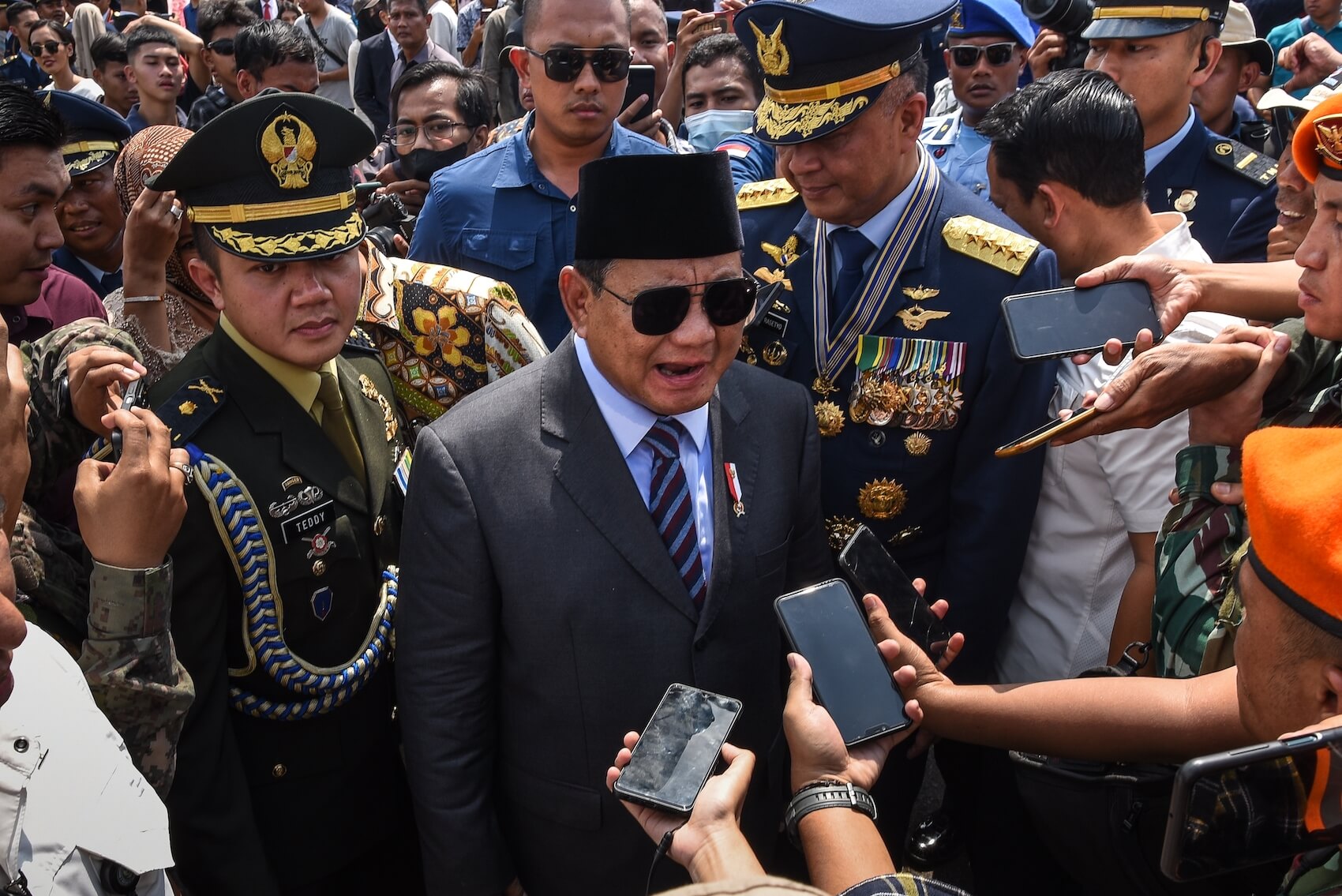
Former Minister of Defense and winner of the February 14, 2024, Presidential election, Prabowo Subianto, pictured at the 77th-anniversary celebration of the Indonesian Air Force in Jakarta on April 9, 2023. Photo: Donny Hery.
How do you assess the role of populist rhetoric and strategies in the recent Indonesian elections, particularly regarding Prabowo Subianto’s victory? What factors contributed to his success, and how significant was the influence of populism in shaping voter preferences?
Vedi Hadiz: This case is intriguing because in the previous elections of 2014 and 2019, there was significant mobilization of popular sentiment from both nationalist and Islamist factions. However, in the 2024 election, the rhetoric was notably restrained. This shift occurred partly because Prabowo, the candidate, abandoned his previous allies within the Islamic populist community in favor of aligning with status nationalists who wield control over the state bureaucracy. This strategic move stemmed from the Islamic populists’ inability to provide Prabowo with the necessary material resources to secure the votes of the poor.
Consequently, there was a concerted effort to distribute social aid such as food and rice to the poor, orchestrated by the state machinery, to portray Prabowo as a nationalist populist. Notably, Anies Baswedan, a former ally of the Islamists, failed to mount an effective Islamic populist challenge against this state bureaucratic-led mobilization effort. Such activation would have necessitated alliances with specific state social agents, including the military and local government, which were mobilized in favor of Prabowo. This highlights the limited influence of Islamic populism in Indonesia compared to Turkey, where its upward and downward connections are stronger.
In Indonesia, Islamic populism requires alliances with particular state social agents to be effective. However, in this instance, those alliances were directed away from Islamic populists toward a more nationalist-oriented form of populism exploited by the winning candidate, General Prabowo.
What implications does Prabowo Subianto’s recent electoral victory have for democracy in Indonesia? Are there concerns regarding the consolidation of populist leadership and its impact on democratic institutions and processes, and how might this victory influence societal divisions, governance structures, and the overall political landscape in the country?
Vedi Hadiz: Indonesia is often hailed as a successful example of democratic transformation, and in many ways that reputation is well deserved. However, it’s crucial to recognize that Indonesia’s democracy has long been plagued by corruption and significant flaws. The rights of minorities and vulnerable groups have been consistently limited. Additionally, Indonesia remains under the control of what I’ve termed an oligarchy—a coalition between the upper echelons of the state bureaucracy and the upper echelons of bourgeoisie. This oligarchy was established during the authoritarian era under Suharto, and despite democratization efforts since 1998, it has persisted and entrenched itself within Indonesia’s democratic and governance institutions. Today, this oligarchy holds sway over virtually all major political parties and dominates key state institutions, mass organizations and so on. Thus, Indonesian democracy has always been characterized by oligarchic domination.
The current concern with Prabowo’s election lies in his deep ties to the oligarchy. As the former son-in-law of Suharto, the former dictator, he epitomizes the entrenched habits of the oligarchy that democratic reforms aimed to mitigate. This includes a history of human rights violations and his family’s (his brother) involvement in questionable economic activities, with outstanding debts to the state due to these connections. Moreover, Prabowo has shown scant regard for democratic processes, principles and human rights. While Indonesian democracy has long grappled with its oligarchic nature, the Prabowo’s election adds a new level of danger.
Indonesian Democrats Should Worry Whether Substantive Democracy Will Endure
The New York Times ran a story right after the elections claiming that ‘Prabowo Subianto’ victory has cast doubts on the future of one of the world’s most vibrant democracies.’ And added that: ‘The era of liberty that followed the ouster of Suharto, critics say, could now be under threat with Mr. Prabowo’s ascent to power.’ Let me ask you bluntly is the biggest Muslim democracy and the third largest democracy in the world in danger?
Vedi Hadiz: The reality is that many rights have regressed over the past decade, signaling a troubling trend. What Prabowo’s rise to power signifies, in my opinion, is an acceleration of this regression—a further erosion of rights and a deepening crisis for Indonesian democracy. It’s reasonable for supporters of democracy in Indonesia to worry whether substantive democracy will endure beyond the mere act of holding elections.
With Subianto in power with nationalist populism and Islamism, are we going to witness a replay of Narendra Modi in India or Donald Trump in US meaning the era of liberal democracy has ended?
Vedi Hadiz: First and foremost, it’s essential not to romanticize Indonesia’s recent past in terms of liberal democracy, as there have never been strong liberal democratic or social democratic parties. The major political forces in Indonesia have typically been nationalist or Islamic nationalist in nature. Thus, Indonesia has never experienced a liberalized democracy that could be dismantled. Instead, what Prabowo’s potential ascension represents is a significant setback. It threatens to extinguish the impulses within Indonesian society that have historically sought to counter the illiberal tendencies of the oligarchy and advocate for the expansion of rights across society despite oligarchic dominance.
Ultimately, Prabowo’s rise would likely signify the oligarchy’s near-total control over Indonesian democracy. This would stifle challenges aimed at securing and broadening rights, achieving greater social equality, and expanding access to power and economic resources.
Preemptive Adoption of Islamic Rhetoric Contributes to Illiberalism in Indonesia
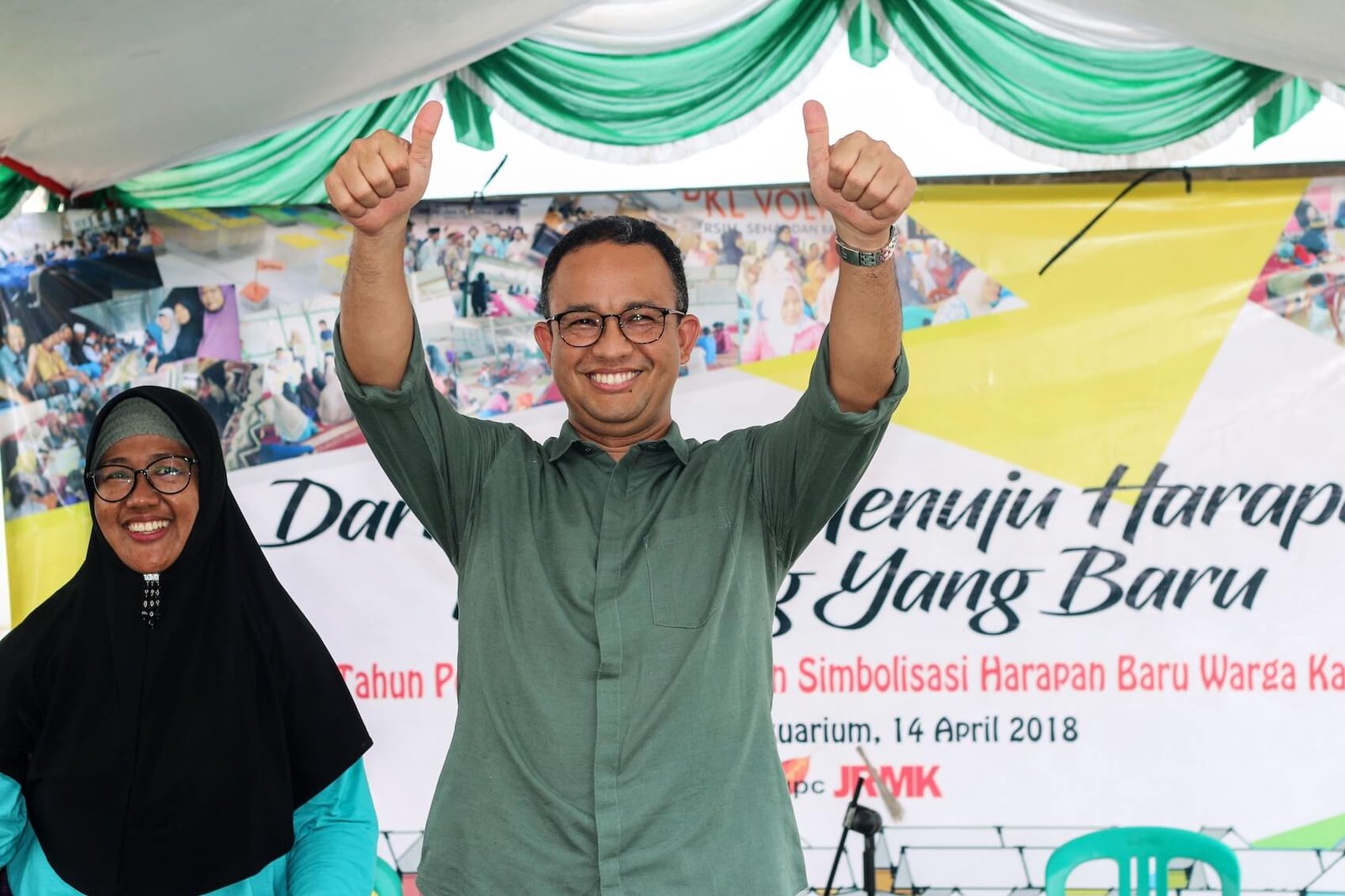
DKI Jakarta Governor Anies Baswedan with residents of Kampung Akuarium in Jakarta, Indonesia on April 14 2018. Photo: Shutterstock.
In your article ‘No Turkish delight: the impasse of Islamic party politics in Indonesia,’ you compare the cases of AKP (The Justice and Development Party) and PKS (The Prosperous Justice Party – Partai Keadilan Sejahtera). Where did PKS fail to achieve where AKP in Turkey succeeded? What results does this comparison between AKP and PKS yield in terms of populisms the respective parties employed?
Vedi Hadiz: It’s evident in Turkish elections that the AKP consistently emerges victorious, while the PKS tends to suffer defeats, including in its support for presidential candidates. This underscores what I mentioned earlier: Islamic populism in Indonesia, although present, has not developed to the extent seen in Turkey. Consequently, it relies on alliances and compromises to exert influence, yet remains largely outside the core of power. However, this doesn’t mean it lacks influence altogether. On the contrary, forces outside Islamic networks often adopt Islamic rhetoric preemptively, as seen in recent legislation incorporating moralistic concerns advocated by Islamists regarding sexual relations.
This preemptive adoption of Islamic rhetoric serves to preempt Islamist forces from using such issues to attack those in power. Yet, despite their electoral losses, the mainstreaming of their ideas contributes to the illiberalism of Indonesian democracy. This is because many of these ideas lean towards the illiberal end of the spectrum, further shaping the political landscape even in their absence from power.
Alright. And the lastly, Professor, how does the phenomenon of Islamist populism in Indonesia compare and contrast with similar movements in other Muslim-majority countries, and what insights can be drawn from these comparative analyses? What are the similarities and differences especially between Islamist populism in Indonesia and the Middle East and North Africa (MENA) region?
Vedi Hadiz: These phenomena have a long historical trajectory, traceable back to at least the early 20th century. However, in the past, they were dominated by older forms of populism, which have since evolved into more modern iterations. This trend is evident in the MENA region as well. For instance, in Egypt, supporters of the now-defunct Muslim Brotherhood included professionals such as doctors, engineers, and lawyers, marking a departure from the provincial figures of the 1950s. Similarly, in Turkey, Islamic populism encompasses a diverse range of individuals. While the social transformations brought about by capitalist development and globalization have impacted the MENA region in a similar manner, the specific histories and interactions with neoliberal globalization have resulted in distinct manifestations in each country.
In Turkey, Islamic populism has largely dominated both the state and a significant portion of civil society. In contrast, in Egypt, Islamic populism once held sway over civil society but failed to extend its influence on the state. In Indonesia, Islamic populism has thus far been unable to exert dominance over either the state or civil society.
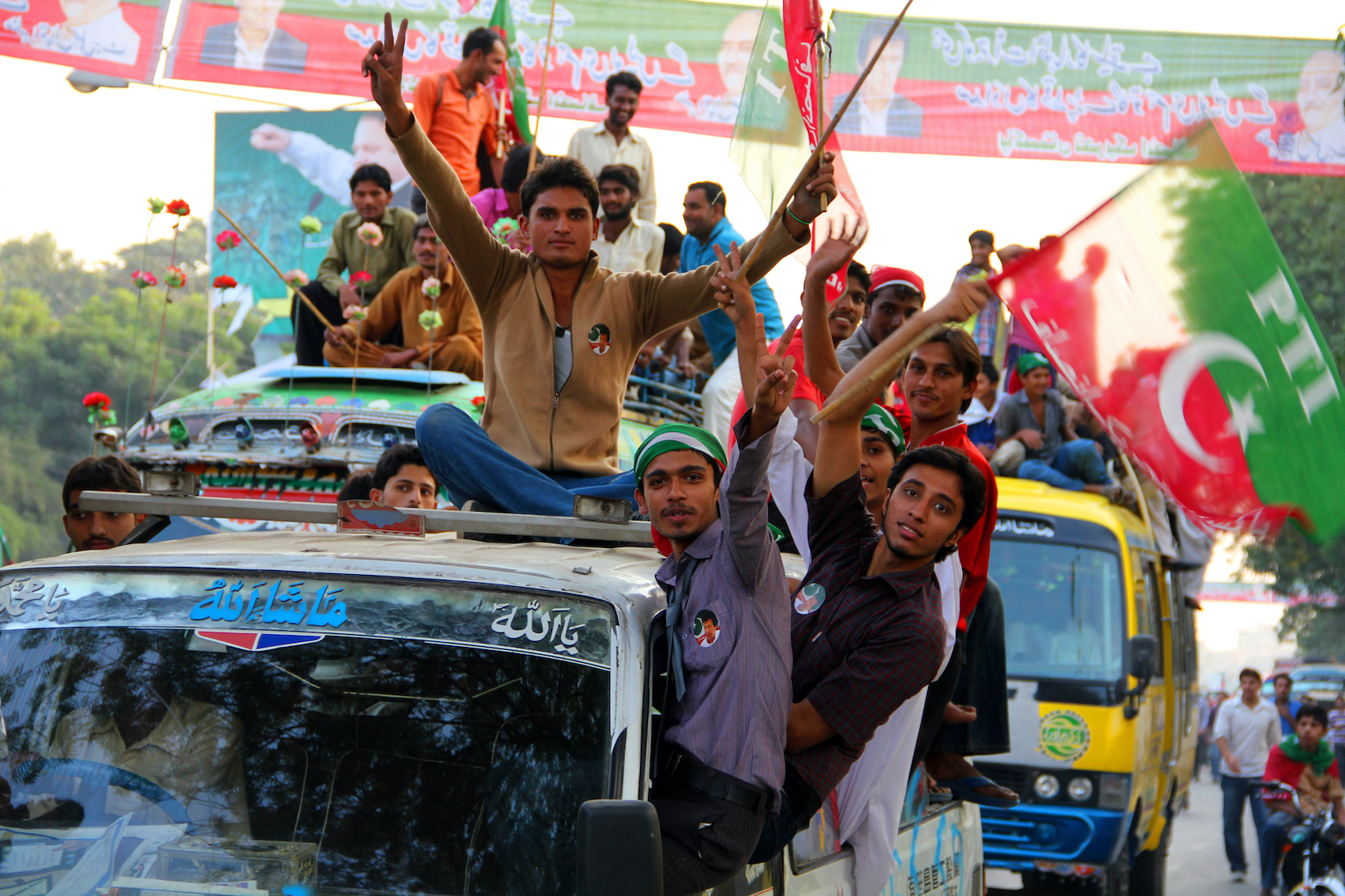
Drawing a comparison between radical Islamism and Islamist populism, Professor Samina Yasmeen emphasized the parallel communication styles utilized by both radical and populist Islamists, highlighting their reliance on simplicity and Islamic references to connect with the populace. However, she pointed out that while radical Islamists aim for a fundamental alteration of the state, populist Islamists, exemplified by figures such as Imran Khan, prioritize the establishment of a “well-governed state.”
In an exclusive interview with the European Center for Populism Studies (ECPS), Professor Samina Yasmeen, the Director of the Centre for Muslim States and Societies at the University of Western Australia, delves into the complex landscape of Pakistani politics, exploring the roots of populism and its intersection with Islamism.
While a coalition consisting of the Pakistan Muslim League-Nawaz (PML-N) and the Pakistan People’s Party (PPP) has agreed to form the next government of Pakistan, thereby preventing the party of former Prime Minister Imran Khan from assuming power despite garnering the most votes in the election, Professor Yasmeen has pointed out that populist Islamism shares certain techniques with radical Islamism in many respects. When asked to differentiate between radical Islamism and Islamist populism, Professor Yasmeen highlighted the parallel communication styles employed by radical and populist Islamists, underscoring their use of simplicity and Islamic references to resonate with the populace. According to her, while radical Islamists seek a fundamental alteration of the state, populist Islamists, exemplified by figures such as Imran Khan, prioritize the establishment of a well-governed state.
Professor Yasmeen begins by shedding light on the historical antecedence and foundational underpinnings of populism in Pakistan, emphasizing the significant influence of the public’s inclination towards charismatic personalities. She attributes the prevalence of populism to the prevailing low level of literacy, creating a susceptibility to external influences and reinforcing the importance of oral transmission in shaping political narratives.
Drawing on historical examples, particularly the emergence of Zulfikar Ali Bhutto’s Pakistan People’s Party in the 1960s, Yasmeen underscores the role of illiteracy and emotional connections in fueling populist movements. She then transitions to the contemporary political landscape, highlighting the disillusionment of a population that feels unheard and a deep connection between populist leaders like Imran Khan and the public.
The interview further delves into the strategies employed by Islamist parties to resonate with the public, with a particular focus on Imran Khan’s use of religious narratives and references. Yasmeen explores the influence of Imran Khan’s populist agenda on elections and his unprecedented success without military backing, analyzing the impact of his narrative on public sentiment.
Discussing the challenges posed by Islamist populism to democratic values, Professor Yasmeen raises concerns about the potential for closed-mindedness and a lack of critical thinking among supporters. She highlights the importance of guiding populist appeal towards constructive messages and fostering a genuine democratic spirit to ensure long-term stability.
Finally, the interview touches on the impact of Islamist populism on the rights and representation of religious minorities in Pakistan. Professor Yasmeen acknowledges the indirect consequences of Islamization, contributing to an atmosphere that may alienate minority communities. She emphasizes the need for a nuanced understanding of the complex relationship between Islamization, democracy, and minority rights.
In addressing the external influence of Indian Prime Minister Narendra Modi’s anti-Islam stance on Islamist populism in Pakistan, Professor Yasmeen notes the shaping of negative perceptions about India’s Hindu-centric policies but emphasizes the overarching focus on internal challenges within Pakistan.
Throughout the interview, Professor Samina Yasmeen provides a comprehensive analysis of the intricate interplay between populism, Islamism, and democratic values in the context of Pakistani politics, offering valuable insights into the historical, contemporary, and geopolitical dimensions of these complex dynamics.
Nguijoi, Gabriel Cyrille & Sithole, Neo. (2024). Civilizational Populism and Religious Authoritarianism in Bangladesh, Sri Lanka and the Maldives. European Center for Populism Studies (ECPS). February 15, 2024. https://doi.org/10.55271/rp0051
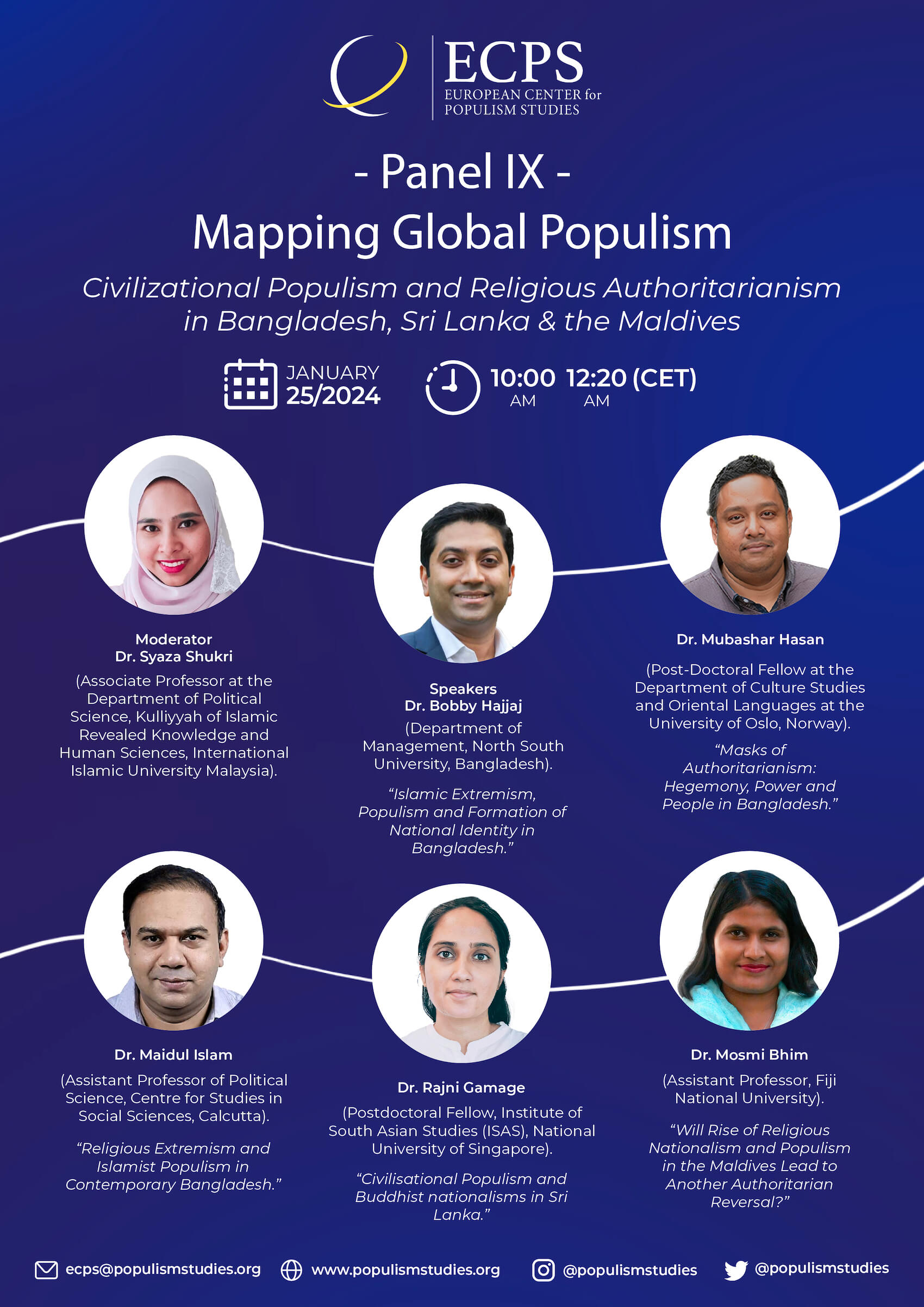
This brief report provides a summary of the 9th event in ECPS’s monthly Mapping Global Populism panel series, titled “Civilizational Populism and Religious Authoritarianism in Bangladesh, Sri Lanka, and the Maldives,” which was held online on January 25, 2024. Dr. Syaza Shukri moderated the panel, featuring insights from four distinguished scholars specializing in populism from the aforementioned countries.
This report gives a summary of the 9th session of the ECPS’s monthly Mapping Global Populism panel series titled “Civilizational Populism and Religious Authoritarianism in Bangladesh, Sri Lanka and the Maldives,” which took place online on January 25, 2024. Moderated by Dr. Syaza Shukri, Associate Professor at the Department of Political Science, Kulliyyah of Islamic Revealed Knowledge and Human Sciences, International Islamic University Malaysia, the panel featured speakers by Mr. Bobby Hajjaj, Department of Management, North South University, Bangladesh, Dr. Maidul Islam, Assistant Professor of Political Science, Centre for Studies in Social Sciences, Calcutta, Dr. Rajni Gamage, Postdoctoral Fellow, Institute of South Asian Studies (ISAS), National University of Singapore, and Dr. Mosmi Bhim, Assistant Professor at Fiji National University.
In her opening speech, Dr. Syaza Shukri provided an overview of populism and authoritarianism in the three South Asian countries under discussion. She emphasized that civilizational populism and religious authoritarianism have become entrenched as a societal process shaping the contemporary geopolitical landscape of the Indian subcontinent. According to her, this phenomenon represents a convergence of populist parties through languages, civilizational narratives, and religious identity.
Dr. Shukri highlights a significant observation: an examination of these three countries suggests similar populist economic statuses and rationales for the effectiveness of civilizational populism and religious authoritarianism. These phenomena are not only domestic political strategies but also significant instruments for regional stability and international relations. This reality is evident in Bangladesh, where the narratives of conservative Islamic elements have at times dominated constitutional obligations and assumed political control.
Dr. Shukri further specifies that the political landscape in Sri Lanka has been characterized by the cultivation of national sentiments, which have exerted significant influence on the government and often resulted in different policies, violent conflicts, civil wars, and communal clashes. Nationalist groups sometimes redefine national identity and frequently marginalize minority groups such as the Tamils, Veddas, and Muslims. This has led to an increase in conservative religious norms, tensions between economic liberalism and religious conservatism, and conflicts between global connectivity and local religious political dynamics.
Bobby Hajjaj: “Islamic Extremism, Populism and Formation of National Identity in Bangladesh”
Bobby Hajjaj highlights the growing possibility of an Islamist populist movement gaining ground in Bangladesh, albeit slowly. Some see this as the sole alternative to Bangladeshi authoritarianism. Nevertheless, many others remain skeptical due to the lack of comprehensive governance and associated agendas within Islamist populism.
As the first speaker of the panel, Bobby Hajjaj’s discussion emphasizes the reasons and nature of national identity formation in Bangladesh, specifically how and why it has been constructed as we perceive it today. Hajjaj began his introduction with a brief overview of the populist configuration in Bangladesh.
For Hajjaj, two main ideas prevail in the construction of this identity, significantly influencing the development of populist movements over the last sixty years in the country. The first is language-based (Bengali), and the second is religious-based (Bangladeshi). Language serves as the foundational element that gave rise to Bangladesh as a nation. However, over the last fifteen years, there has been the emergence of a new kind of populist movement with a significant opposition base: religious extremism. Meanwhile, religious extremism has been influenced by two important elements, both within and outside the mainstream political agenda. Different perceptions and reasons are discussed to illustrate how things are viewed in a certain way in the literature, structured around institutions, historical context, and international developments.
The nature and creation of institutions play a significant role in the development of populist movements in Bangladesh. Institutions often function as top-down mechanisms, reflecting the country’s status as a patrimonial state, which in turn shapes these institutions.
Historically, the Muslim identity in Bangladesh has undergone various transformations over the last sixty years. Initially, there was a Muslim Bengali identity that was portrayed as a cultural identity in the country. The rise of the Bangladesh Liberation Movement also fostered the development of a cultural identity based on Bengali, creating a void where legislative elements were required.
However, since 1977, the new leadership under President Ziaur Rahman attempted to introduce a new form of Islamic nationalism. This occurred during the Cold War era when ideological expansionism was favored. Consequently, Salafist Islamism began to emerge as a significant element in the country, coinciding with a large-scale migration from Bangladesh to the Middle East. This migration contributed to the dissemination of conservative Salafist ideas among Bangladeshis abroad, leading to the rise of conservative Islamism, or political Islamism. Many of these ideas were propagated through the leadership of political parties, resulting in the formation of identity narratives such as “us” versus “them.”
These developments also played a crucial role in the emergence of Islamic extremism in Bangladesh, particularly originating from the middle-class and upper-middle-class families with non-Aliya Madrassa education. These factors significantly influenced identity formation and facilitated the proliferation of radicalized ideas. The interplay of historical and global developments has influenced perceptions of Islamism and extremism, shaping the idea of national identity.
Hajjaj also underscores the polarization of national identities instigated by the Bangladesh Nationalist Party (BNP), the primary opposition party that championed the idea of nationalism and began distancing itself from Islamist parties like the Jamaat-e-Islami. The rise of Bangladeshi authoritarianism has influenced the level of acceptance of Islamism within society today. However, there is a growing compassion for Islamist parties observed. One significant issue is that Islamic parties lack a comprehensive political agenda; instead, they focus on narrow and specific Islamic agendas. Therefore, the emergence of a significant Islamic political movement in Bangladesh poses a challenge for future governments, particularly regarding how the Bangladesh Awami League is creating an authoritarian space. Over the last three consecutive national elections, held every five years, there has been a desire among the populace for a populist movement to challenge the Awami League’s grip on power. This sentiment intensified in the last six months of 2023, with attempts at populist movements seeking to distance themselves from religious political parties, which the BNP attempted but failed to achieve. This failure could be interpreted as a setback for non-Islamist parties, especially considering the secular agenda being promoted in certain areas, such as education policy, by the Bangladesh Awami League. These dynamics are influenced by the global scenario, particularly with the marginalized status of Muslims in Palestine and incidents such as the demolition of a Babri Masjid to build a new Hindu temple in India.
In conclusion, Bobby Hajjaj noted that these factors collectively contribute to the increasing likelihood of an Islamist populist movement gaining traction in Bangladesh, albeit gradually. Some view this as the only alternative to Bangladeshi authoritarianism. However, many others remain skeptical as Islamist populism lacks comprehensive governance and related agendas.
Dr. Maidul Islam: “Religious Extremism and Islamic Populism in Contemporary Bangladesh”
Dr. Maidul Islam reflected on recent developments of Islamic populism in Bangladesh’s political landscape and pondered the future trajectory of Islamist populism in the country. He noted that it remains largely a historical remnant, sporadically manifesting in mobilizations. Currently, there isn’t substantial resonance or favorable response to such surging Islamic populism in Bangladesh.
The second speaker on the panel, Dr. Maidul Islam, took a transversal approach, examining the historical dynamics of Religious Extremism (RE) and Islamist Populism (IP) in Bangladesh. His presentation began with a definition of the two concepts under discussion: RE and IP.
Religious Extremism, as he defines it, involves the use or manipulation of religious sentiments to incite individuals to commit violent acts. It encompasses a range of behaviors, including targeted attacks on religious minorities, persecution of sexual minorities, and involvement in outright terrorist activities. Islamist Populism, on the other hand, represents a peaceful approach to political mobilization within diverse segments of the Muslim population. It leverages the symbolic language of Islam against secular nationalist governments in Muslim-majority countries. This movement frequently participates in democratic elections, mirroring Religious Extremism within the Muslim world.
Dr. Islam highlighted a resurgence of extremist groups such as the Jamaat-ul-Mujahideen Bangladesh (JMB) in contemporary Bangladesh. These organizations operate as religious extremist entities. The presentation underscored the roots of the Islamic Extremism crisis in Bangladesh, which began with the 1960s elections and evolved into a new form of terrorism by 1985, during General Hussain Muhammad Ershad’s dictatorship. Dr. Islam provided statistical insights into the dynamics of Religious Extremism in the country. Notably, the peak periods of RE occurred in the 1990s and between 2013 and 2016. The presentation revealed that Bangladesh witnessed a total of 743 terror-related incidents between 1971 and 2020, attributed to both religious extremist and non-religious extremist entities.
In 1996, the reported number of terrorist incidents was 150, marking a significant increase from 22 incidents in 1990 and 161 in 1996. The trend showed a gradual rise from 42 incidents in 1991 to 71 in 1992, 68 in 1994, and 74 in 1995. The escalation of terrorist activities coincided with the emergence of Islamist populist groups like the Army league, which came into power the same year.
From 1997 to 2012, Religious Extremism activities in Bangladesh remained below 50 per year. However, starting from 2013, these activities began to rise again, reaching 138 incidents in 2013 and 130 in 2014. The peak was observed in 2015, with 479 recorded incidents, the highest in the country’s history. This period coincided with the trial of several Islamic leaders by the International Crimes Tribunal. Subsequently, from 2016 onwards, the incidence of RE started to decline, with 89 incidents in 2016. Since 2017, the number has consistently been below 50 per year, with 41 incidents in 2017, 26 in 2018, 32 in 2019, and 30 in 2020.
Furthermore, Dr. Islam highlighted that the dominance of the Awami League party’s populist policies has posed challenges for political Islamist populist parties like the Bangladesh Jamaat-e-Islami. He clarified that this circular approach of the Awami League should not be equated with the Western model of secularism, which advocates for a clear separation of religion and politics. In Bangladesh, negotiations between political and religious leaders are common, with religious leaders often resorting to religious symbols and accommodation while attempting to promote the principles of Islamic populism. However, such political struggles between Islamist and national populist forces are not unique to Bangladesh but are prevalent throughout the Muslim world. This historical struggle can be traced back to the 1975 elections, which led to the banning of Sheikh Mujib’s Single Party, considered the largest Islamic populist party in the country at that time. Subsequently, in the 1979 elections, the Bangladesh Nationalist Party emerged as a significant political player in the country.
In his conclusion, Dr. Islam reflected on recent developments of Islamic populism in Bangladesh’s political landscape and pondered the future trajectory of Islamist populism in the country. He noted that it remains largely a historical remnant, sporadically manifesting in mobilizations. Currently, there isn’t substantial resonance or favorable response to such surging Islamic populism in Bangladesh.
Dr. Rajni Gamage: “Civilizational Populism and Buddhist Nationalism in Sri Lankan”
Dr. Rajni Gamage, delved immediately into characterizing the concepts of populism and civilizational populism while seeking to contextualize the historical background and contemporary manifestations of Buddhist nationalism in Sri Lanka. She explored the intricacies of the Sinhala Buddhist nationalist discourse, which she identified as the primary vehicle for civilizational populism in the country. Within the Sri Lankan context, this discourse echoes the anti-colonial rhetoric commonly found in the Global South.
The discussion by the panel’s third speaker, Dr. Rajni Gamage, delved immediately into characterizing the concepts of populism and civilizational populism while seeking to contextualize the historical background and contemporary manifestations of Buddhist nationalism in Sri Lanka. Dr. Gamage noted that while populism is not a recent phenomenon, it has garnered increased attention due to its resurgence, particularly in Western democracies. This renewed focus is often attributed to economic disparities and perceived declines in national status, with leaders emerging from outside the political establishment and challenging democratic institutions.
First, Dr. Gamage’s presentation provided a recap of populism and civilizational populism, highlighting how populism mobilizes people around narratives of threat, often framing issues in an “us versus them” paradigm. Dr. Gamage also emphasized the trend of populist leaders coming to power by positioning themselves as ‘outsiders’ to the existing political order but then undermining democratic institutions once in power, leading to a weakening of democracy. Recent populist movements exhibit distinct features in how they frame themselves, typically focusing on economic inequalities and the erosion of democratic norms. These movements capitalize on anti-establishment sentiments and often target minority communities.
Similarly, civilizational populism extends the narrative to encompass perceived threats at a civilizational level, transcending national boundaries. This concept draws on historical discourses of imperialism and domination, particularly evident in post-colonial contexts. In countries like Sri Lanka, civilizational populism intertwines with anti-colonial sentiments, targeting Western values and minority groups. Dr. Gamage highlighted how the historical divide between the Global West and the Global South has contributed to a unique form of civilizational populism. In the Global South, the shared history of colonialism fuels a civilizational populist discourse infused with anti-colonial sentiments.
When discussing how civilizational populism is expressed in Sri Lanka, Dr. Gamage explored the intricacies of the Sinhala Buddhist nationalist discourse, which she identified as the primary vehicle for civilizational populism in the country. Within the Sri Lankan context, this discourse echoes the anti-colonial rhetoric commonly found in the Global South. Dr. Gamage provided an analysis of figures like Anagarika Dharmapala, illustrating how civilizational concepts are employed within Sri Lankan populist discourses. Dharmapala’s rhetoric challenged colonial narratives by portraying Western colonizers as “barbarians” and emphasizing the cyclical nature of history. His ideas laid the groundwork for Sinhala Buddhist nationalism in Sri Lanka, significantly shaping the country’s political landscape.
Dr. Mosmi Bhim: “Will Rise of Religious Nationalism and Populism in the Maldives Lead to Another Authoritarian Reversal?”
Dr. Mosmi Bhim highlighted the characteristics of populism under President Abdulla Yameen, including anti-pluralism and illiberalism, which eroded democratic norms and institutions. Despite losing the 2018 elections to President Ibrahim Mohamed Solih, Yameen’s legacy of religious nationalism and authoritarianism continues to influence the political landscape in the Maldives.
In this final presentation, the audience were introduced to the presence of religious nationalism and populism in the Maldives. Dr. Mosmi Bhim began by providing a contextual overview, sharing a personal experience of visiting the Maldives in 2017. He highlighted the densely populated nature of the capital city, Male, and emphasized how urban density can contribute to political instability during contentious issues or elections. Dr. Bhim also discussed the Maldives’ transition from a Buddhist nation to an Islamic state, its historical reliance on fishing and tourism, and its colonial past under British protection.
During her field trip, Dr. Bhim navigated a delicate situation due to the authoritarian rule of President Abdulla Yameen at the time, emphasizing the risks associated with researching democracy in such an environment. These risks persist despite the Maldives gaining independence in 1965. According to her presentation, the Maldives did not experience democracy following the independence, with power concentrated in the hands of autocratic rulers until the introduction of multi-party elections in 2008.
Dr. Bhim’s presentation focused on the leadership of Presidents, beginning with Ibrahim Nasir, who invoked nationalism to gain independence from Britain, and President Maumoon Abdul Gayoom, who introduced political Islam and laid the groundwork for Islamic nationalism in the Maldives. Under Gayoom’s rule, there was a regression in women’s rights, a focus on re-Islamization, and the stifling of political dissent. Following was a section looking at President Abdulla Yameen, who continued the trend of religious populism and authoritarian rule, aligning himself with Islamic nationalism and forging closer ties with authoritarian regimes. Yameen’s government promoted religious intolerance and undermined democratic institutions, leading to widespread repression and human rights abuses.
Throughout, Dr. Bhim highlighted the characteristics of populism under President Yameen, including anti-pluralism and illiberalism, which eroded democratic norms and institutions. Despite losing the 2018 elections to President Ibrahim Mohamed Solih, Yameen’s legacy of religious nationalism and authoritarianism continues to influence the political landscape in the Maldives. President Solih, while initially signaling a commitment to democracy, has faced challenges from Islamic extremists and political opponents, leading to questions about the future of democracy in the Maldives. In wrapping up, Dr. Bhim discussed recent developments, including Solih’s India-out campaign and the ongoing tensions between religious nationalism and democratic governance.
Guidotti, Andrea. (2024). Report on “Mapping European Populism – Panel 8: Populism, Gender and Sexuality in Europe.” European Center for Populism Studies (ECPS). February 15, 2024. https://doi.org/10.55271/rp0050
This brief report offers a summary of the 8th event in ECPS’s monthly Mapping European Populism panel series, titled “Populism, Gender and Sexuality in Europe” which took place online on January 26, 2023. Professor Dr. Agnieszka Graff moderated the panel, featuring insights from four distinguished populism and gender scholars.
This report provides a brief overview of the eighth event in ECPS’s monthly Mapping European Populism (MEP) panel series, titled “Populism, Gender and Sexuality in Europe” held online on January 26, 2023. Moderated by Dr.Agnieszka Graff, Professor at the American Studies Center, University of Warsaw, and a feminist activist, the panel featured speakers Dr. Elżbieta Korolczuk, Associate Professor in Sociology at Södertörn University, Sweden, Dr. Eric Louis Russell, Professor in the Department of French & Italian and affiliated with the Program in Gender, Sexuality and Women’s Studies at the University of California, Davis, Nik Linders, PhD candidate at Radboud Social and Cultural Research for Gender & Diversity Studies, Dr. Pauline Cullen, Associate Professor in sociology at Center for European and Eurasian Studies, Maynooth University, Ireland.
Panel moderator Professor Agnieszka Graff began her speech with an overall assessment, choosing to define the word “gender” with two distinct meanings. Firstly, she explained its function in gender studies within the field of sociology. Secondly, she addressed the meaning that gained popularity following the rise of anti-gender campaigns across Europe, ascribed to the word by both right- and left-wing populist parties. Specifically, gender is portrayed as something unsettling, casting doubt on liberalism itself and warranting challenge. In essence, it represents excessive individualism, consumerism, and the erosion of communities due to declining fertility rates.
Professor Graff’s speech focused solely on the cultural repertoire amassed by anti-gender campaigns. According to Graff, this repertoire varies across different countries: Italian anti-gender imagery exudes chicness; Polish anti-gender repertoire leans towards raw, peasant-oriented themes; the French anti-gender narrative often incorporates references to the French Revolution. Despite these differences, there are resonances between these images, with recurring motifs such as dissolving families juxtaposed against images of united families often depicted in silhouette. Additionally, there are perverted image of people whose gender is ambiguous and threatening, along with disturbing portrayals of alienated and suffering children, sometimes represented by fetuses but more commonly as four or five-year-olds appearing terrified or even being depicted as for sale with barcodes attached. The underlying idea behind these images is to establish a link between gender equality, sexual rights, and the capitalist system, portrayed in its most menacing form. Consequently, anti-gender propaganda presents itself more as a cultural phenomenon rather than a collection of arguments. It operates in close alignment with populism on various fronts: one being the association of gender with elite versus ordinary people gender conservatism, and another in the economic dimension where both discursive and political-institutional connections come into play.
Professor Graff then presented three significant examples from European countries, each illustrating the collaboration between politicians and ultra-conservative organizations in targeting gender ideology to mobilize electorates. The first example is from Poland, where several local authorities staged protests in response to the mayor of Warsaw signing a declaration against discrimination towards sexual minorities. The second example comes from Spain, where Vox has collaborated with HazteOir, a conservative Catholic community founded by Ignasio Arsuaga. Together, they launched a campaign known as the ‘stop feminazis buses’, arguing that the issue pertains to domestic violence rather than gender violence specifically. The third example is from Hungary, where parliamentary elections coincided with a referendum on children’s education, gender identity, and sexuality. Citizens had to vote on whether to support the implementation of events concerning sexual orientation for minors in public education institutions without parental consent. The referendum aimed to legitimize Viktor Orban and his party as defenders of children. These examples demonstrate that populist actors strategically use anti-gender rhetoric with both long- and short-term objectives: the former to portray themselves as defenders of ordinary people adhering to traditional gender roles against perverse elites, and the latter to intensify campaign efforts to garner a larger share of votes.
The aim of the introductory speech is to not only inquire about the impact of gender on populists but also to explore the consequences when individuals label those parties, often referring to them as illiberal movements, using the concept of populism.
Dr. Elżbieta Korolczuk:“Explaining the Relation Between Populismand Gender in Europe”
The adoption of anti-gender rhetoric enables populist leaders to reinforce the core ideological principles of their rhetoric, thereby delineating boundaries between the ‘authentic traditional citizen’ and the ‘pervert deviant citizen.’ Sexuality is framed as a question of morality in a broader sense, allowing populists in power to depict elites (rather than themselves) as the ones demoralizing children and undermining the country’s integrity.
In her presentation, the first panelist, Dr. Elzbieta Korolczuk began by emphasizing that the rise of the anti-gender movement can be attributed to the alignment of far-right parties with populism, particularly their adept adoption or proposition of a populist version of anti-gender rhetoric. The objective of her speech was to explore the theoretical connection between populism and gender, highlighting the gaps in existing literature on this subject. These gaps stem from the predominant focus of analyses on either the supply or demand side. For instance, some scholars argue that gender is significant for the supply side, as the presence of a charismatic leader is often crucial in populist politics. However, exceptions like the case of the uncharismatic Polish populist leader Jarosław Kaczyński challenge this notion. On the demand side, women have been increasingly identified as more inclined to vote for right-wing populist parties in recent years.
Dr. Korolczuk suggests that the most insightful conceptualizations of the relationship between gender and populism are currently being proposed by scholars engaged in anti-genderism or anti-gender campaigns. Some propose viewing anti-gender rhetoric as a means to sanitize extreme discourses, while others advocate for an engendering approach, focusing on ethnic scandals, the gendered nature of social inequalities, or even the concept of gender colonization. Additionally, scholars discuss populism as a project of masculinist identity politics, underscoring the effectiveness of right-wing parties in identity politics compared to the left.
Another perspective is to examine the common roots of populism and illiberal anti-gender mobilization in both their economic and cultural dimensions. These conceptualizations enable us to recognize similarities between different movements while also cautioning against oversimplifications, advocating for a dynamic and relational approach. In essence, the proposal articulated is not merely to explore how populism is ‘gendered’, but rather to examine the role of gender in shaping relationships and specific discursive structures employed by populist leaders. An important aspect here is also the organizational and financial dynamics of this relationship.
In summary, according to Dr. Korolczuk, the adoption of anti-gender rhetoric enables populist leaders to reinforce the core ideological principles of their rhetoric, thereby delineating boundaries between the ‘authentic traditional citizen’ and the ‘pervert deviant citizen.’ Sexuality is framed as a question of morality in a broader sense, allowing populists in power to depict elites (rather than themselves) as the ones demoralizing children and undermining the country’s integrity. In conclusion, these narratives enable populist leaders and parties to bridge the cultural and economic arenas, as seen in the cases of Hungary, Poland, and Sweden, positioning themselves as protectors of social welfare provisions for children.
Dr. Eric Louis Russell: “Language of Reaction: European Populist Radical Right and LGBTQA+ Rights”
Language should be perceived as a verb, existing in a dynamic manner rather than in the static form we typically envision. The concept involves examining what speakers accomplish when they ‘do’ language, as well as their actions when they ‘do’ ideology. The focus is on the linguistic and discursive output of actors as a manifestation of their actions. Various examples can illustrate this approach: a formal linguistic division based on in-group and out-group framing; a structural linguistic positioning, whether of a populist hero in relation to the ‘true people’ or of the ‘true people’ against others; semantic transitivity associated with an ‘allochthonous Other’; and relational or functional juxtapositions between the ‘true’ and ‘other.’
The panel’s second speaker, Dr. Eric Louis Russell, approached the topic from a slightly different angle, drawing on his background as a critical linguist and his research agenda focused on how language activity reflects Weltansichten, or cognitive contexts. Expanding on this, language should be perceived as a verb, existing in a dynamic manner rather than in the static form we typically envision. The concept involves examining what speakers accomplish when they ‘do’ language, as well as their actions when they ‘do’ ideology. The focus is on the linguistic and discursive output of actors as a manifestation of their actions. Various examples can illustrate this approach: a formal linguistic division based on in-group and out-group framing; a structural linguistic positioning, whether of a populist hero in relation to the ‘true people’ or of the ‘true people’ against others; semantic transitivity associated with an ‘allochthonous Other’; and relational or functional juxtapositions between the ‘true’ and ‘other.’
Regarding discourse, according to Dr. Russel, it can be viewed in various ways: as textual, oral, or multimodal; as the ‘bounded residue’ of language action in a specific domain; and as describable using linguistic methods. Based on this, certain core features of populist discourse can be distinguished: the representation of a ‘strong man’ as a savior; the reframing of modernity juxtaposed with the ‘allochthonous Other’; the portrayal of autochthonous people as under threat; a narrative of role reversal with victims depicted as victimizers, such as LGBTQ+ communities; and complex intersectionalities with hegemonic structures.
A final theoretical consideration is the phenomenon of enregisterment, the process by which a linguistic repertoire becomes associated, within a culture, with particular social practices and individuals engaging in those practices. In this sense, the populist linguistic repertoire serves to connect different cultural domains with various practices. The mechanism operates through the circulation of register, its clasp, relay, and grasp. In other words, it links to areas of social action, connects across different arenas, and ultimately implants into a new arena, often with superficial or contradictory meanings.
The first example presented pertains to Dewinter’s populism in Flemish Belgium and his discourse. The warranting principles rely on superficially pro-LGBTQ+ stances, while in reality being homophobic, thus reinscribing LGBTQ+ people as instruments of both populism and illiberalism. This represents a table-turning strategy, re-articulating them in a manner that can be perceived as homophobic.
Another significant example is Poland, where discourse revolves around using gender to denote an ideologized ‘Other’ by the Law & Justice Party (PiS). The clasping of registers of nationalism and historical victimization is employed to rearticulate traditional discourse formations of sex, personhood, and belonging to the Polish nation. These example illustrates how populist discourse practices ultimately extend into various domains, portraying gender ideology as a threat to Polish existence.
A final example concerns Italy after the election of Georgia Meloni as Prime Minister, which sheds light on key elements of the linguistic landscape surrounding non-binarity and non-binary linguistic interventions in Italy. While the predominant populist reaction denies the potential expansion of identity beyond man/woman binaries, other reactions assert various mechanisms of representation through language. Here, the articulation of language is crucial, as it reflects both the actor’s ideational world and their material reality, including or excluding categories and possibilities.
Dr. Russell also provided some concluding remarks on the issue of futurity. Given the central role of language in populism, there should be greater focus on the ecological systems of meaning-making and how they can be disrupted, as well as on the pathways through which illiberalism hybridizes and grafts onto pre-existing meaning-making processes, and how these can be disrupted.
Nik Linders: “Gender & Sexuality in Dutch Populist Voter Profiles”
While it’s possible that populist leaders have influenced their voters with conservative ideas, the key point is that gender and sexuality may carry similar effective connotations as ideas of nationhood and citizenship. This highlights the interconnectedness of these concepts and their importance in shaping political attitudes and discourse.
As the third panelist, Nik Linders focused on examining the attitudes towards gender and sexuality among the Dutch popular radical right electorate, and how these attitudes intersect with other beliefs often associated with populist radical right politics. Pim Fortuyn, the first Dutch populist radical right politician to gain popularity, positioned himself as a gay politician, arguing that his sexual orientation uniquely qualified him for leadership and presenting a form of progressive radical right-wing populism. While his positions were primarily directed against immigration and Islam, they were also informed by the amalgamation of Dutch identity with what he termed ‘sexual modernity.’ His somewhat progressive stance and legacy on gender and sexuality continue to resonate in parts of the Dutch electorate and contemporary political parties.
Turning to the present and the 2021 elections, we observed three populist radical right parties with varying positions on gender and sexuality: PVV, FVD, and JA21. The PVV is the most progressive among them, consistently supportive of gay and lesbian rights as well as transgender rights, even outside discussions on Islam or immigration. FVD, on the other hand, is the most conservative on the topic, as evidenced by their sarcastic campaign slogan “how many genders do you have today?” However, they still publicly position themselves as pro-gay rights. As for JA21, while they do not explicitly address gender and sexuality, when they do, they appear to be more progressive than FVD.
The speaker discussed how these positions were correlated with the preferences of the Dutch electorate, utilizing nationally representative survey data from the Dutch parliamentary election study and employing latent class analysis. In his study, along with other colleagues, they identified different voter profiles within the populist radical right electorate. They selected respondents who not only claimed to have voted for these parties but also expressed the intention to do so.
The first item extracted from the dataset measures whether the respondent supports adoption by same-sex couples. The second item assesses support for sex change operations, while the third item examines whether the respondent believes there is something wrong with individuals who identify as neither man nor woman. These items serve as pivotal points in the Dutch public political debate and thus act as reliable proxies for gender and sexual preferences.
To complement these measures, according to Linders, other issues such as nativism, colonialism, nationalism, anti-Islamism, and anti-immigration were included. It’s important to note the distinctions between nativism and nationalism: while nationalism refers to the belief that anyone could theoretically assimilate into the national identity through adaptation to the idea of national hegemony, nativism specifically pertains to individuals born in the Dutch context, i.e., in the Netherlands to Dutch parents, who are considered the only ones legitimately entitled to become part of the citizenry.
Linders stated that the researchers identified five profiles of voters: gender-conservative; solely nativist; undecided or divided on gender; gender-moderate; and atypical for the populist radical right, yet gender-moderate. One key finding is that only 9% of the electorate consider voting for parties that are truly gender conservative. Despite some evidence of increasing sentiment in this direction, the majority of people still generally don’t feel threatened. Consequently, an important distinction between progressive and moderately progressive voters can be drawn on three levels.
First, there appears to be an overlap between conservative or orthodox religiosity (Christianity) and the more gender conservative outlook, as evidenced by the relatively higher popularity of the Dutch Orthodox party among the small gender conservative group.
Second, considering that 60% of the profiles are men, it’s notable that the most gender-progressive group consists of 55% women, while the most gender-conservative group is composed of approximately 73% men. This indicates that the anti-gender sentiment remains closely linked with an overrepresentation of men and masculinity.
Third, while all groups consistently exhibit highly nationalist conservative tendencies, only the truly conservative group and the group that is undecided or divided on gender and sexuality attitudes demonstrate ethno-nativist thinking. This suggests that individuals with gender-progressive values are placing less stringent demands on what nationality means to them, and that gender essentialism aligns with traditional ideas about the family and nativist notions about citizenship.
In conclusion, Linders offered an analysis of the relationship between anti-gender sentiment and populism. While it’s possible that populist leaders have influenced their voters with conservative ideas, the key point is that gender and sexuality may carry similar effective connotations as ideas of nationhood and citizenship. This highlights the interconnectedness of these concepts and their importance in shaping political attitudes and discourse.
Dr. Pauline Cullen: “Populism and the backlash against gender equality: Feminist responses to right-wing populism in Europe”
The resistance to gender equality, notably observed in extreme right opposition movements, thrives due to the neglect of gender equality goals by more centrist forces. There is also a concern about a radical flank effect, which allows those seeking cover to hinder progress on gender justice. Moreover, the professionalization of EU feminist civil society organizations, their adherence to certain aspects of EU discourse, and their reliance on EU funding opportunities pose additional risks. These factors can weaken feminist arguments for gender justice and their ability to oppose right-wing parties effectively.
As the final speaker, Dr. Pauline Cullen presented the findings of her paper published in the Journal of European Politics and Society. The central question addressed in the research was how the rise of populism has impacted political opportunities for civil society organizations in the European Union (EU). The study focused on feminist civil society organizations, specifically an urban women’s lobby with a transnational scope, funded by the EU and emblematic of European elite technocrats.
The main argument of the paper is that feminist opposition to anti-gender equality interests and ideas is complicated by the co-optation of constructions of gender justice by right-wing populists, along with the proximity between right-wing populist ideas and feminist critiques of economic governance based on austerity. The findings suggest that while feminist and pro-gender organizations work to counter right-wing populist grievances, they are still constrained by EU imperatives and weakened by multiple crises.
Furthermore, the study highlights that these grievances, along with the ideas, actors, and institutions behind them, benefit from the absence of a strong political commitment to gender equality at the European level, the neoliberal instrumentalization of gender equality, and the lack of tactics from the center-right flank.
From a sociological perspective, European integration can be viewed as a relational ecosystem comprising organized societal groups that often benefit from the financial opportunities provided by the European Commission. This enables these organizations to serve as agents of policy integration and disseminators of EU policy ideas. As a result, women’s and feminist civil society organizations have experienced a decline in influence, particularly in terms of access.
Conversely, populist forces have created a challenging environment for these organizations. Currently, we observe a more crowded and conservative landscape of right-wing competitors operating at the European level and exerting influence across European institutions.
In response to this evolving landscape, according to Dr. Cullen, these organizations have attempted to adapt, drawing on insights from the social movements literature. Strategies include adaptation, exit, abeyance, professionalism, radicalization, and the adoption of new managerial and communication techniques. Furthermore, there are emerging collaborative efforts to establish common frameworks and approaches while maintaining strategic differentiation based on the focus of each civil society group.
The challenge lies in avoiding the reinforcement of right-wing populist anti-feminist frames and staying focused on equality and democracy. This involves minimizing conflict, engaging in less visible front-stage actions, and emphasizing more informal and backstage initiatives, resulting in a general decrease in their formal presence.
Dr. Cullen’s paper also explores the dynamics of the relationship between feminism and populism at the national and regional levels. There is a growing recognition of a backlash narrative, acknowledging the long-term impact of these processes, which have become embedded in the institutional fabric, reinforcing social gender conservatism and nationalism. This perpetuates existing patriarchal power relations through the guise of seemingly reformist agendas.
Ultimately, European civil society groups face challenges when aligning with EU values that are often technocratic and insufficient for their broader scope and goals.
One notable aspect, Dr. Cullen said, is that both European feminist civil society groups and right-wing populist movements share a common critique of the European project, viewing it as undemocratic, disconnected from the realities of European women, and committed to austerity measures. The challenge for feminist organizations is to craft frames that acknowledge the limitations of EU integration for gender equality while avoiding alignment with right-wing populist narratives of Euroscepticism.
Merely employing tactics of vilification, debunking, and frame-saving may not always suffice, as they tend to construct adversaries in a negative light. The central argument suggests that by employing specific framing and counter-framing techniques aimed at depoliticizing gender equality, particularly as a European ideal, and portraying feminism as a project for the common good, it is possible to revitalize a stagnant policy context. This approach can be directed towards EU elites to highlight the link between illiberal threats to gender equality and broader threats to European democracies.
In other words, gender equality should serve as the battleground for shaping Europe’s future. By reframing the discourse and emphasizing the importance of gender equality in safeguarding European democracies, feminist organizations can contribute to a more inclusive and democratic European project.
Dr. Cullen’s conclusion highlights that the resistance to gender equality, notably observed in extreme right opposition movements, thrives due to the neglect of gender equality goals by more centrist forces. Additionally, there’s a concern about a radical flank effect, which allows those seeking cover to hinder progress on gender justice.
Moreover, the professionalization of EU feminist civil society organizations (CSOs), their adherence to certain aspects of EU discourse, and their reliance on EU funding opportunities pose additional risks. These factors can weaken feminist arguments for gender justice and their ability to oppose right-wing parties effectively.
Some current strategic developments include the emergence of “feminist Europe 2.0,” represented by organizations such as the European Institute for Gender Equality. Other strategies involve incorporating gender experts into policymaking, fostering feminist critical voices within EU and national institutions, disseminating feminist critiques through academia and research, and empowering and establishing feminist think tanks.
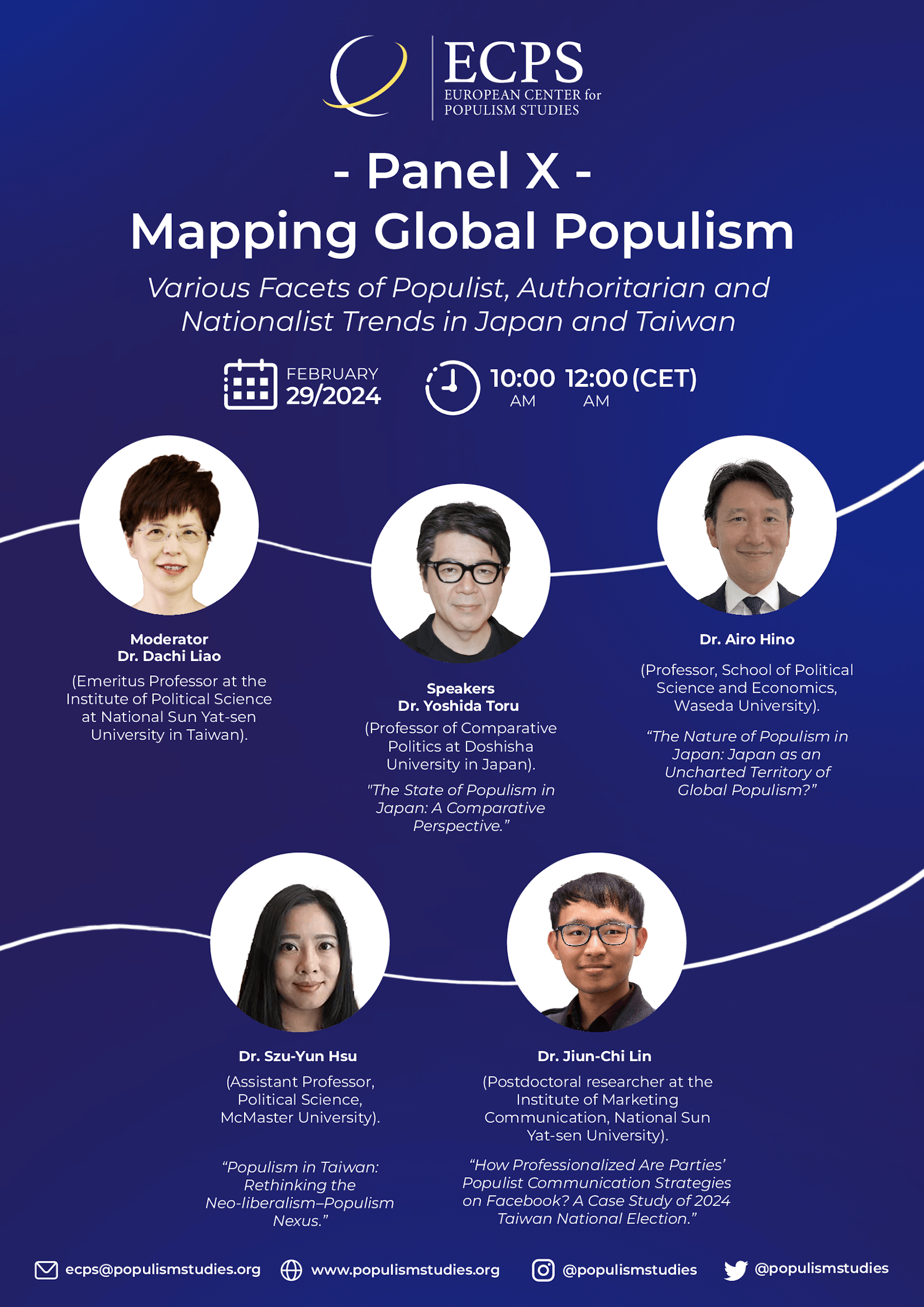
(Emeritus Professor at the Institute of Political Science at National Sun Yat-sen University in Taiwan).
Speakers
“The State of Populism in Japan: A Comparative Perspective,”byDr. Toru Yoshida (Full Professor of Comparative Politics at Doshisha University in Japan).
“The Nature of Populism in Japan: Japan As an Uncharted Territory of Global Populism?” byDr. Airo Hino (Professor, School of Political Science and Economics, Waseda University)
“Populism in Taiwan: Rethinking the Neo-liberalism–Populism Nexus,” by Dr. Szu-Yun Hsu (Assistant Professor, Political Science, McMaster University).
“How Professionalized Are Parties’ Populist Communication Strategies on Facebook? A Case Study of 2024 Taiwan National Election,”byDr. Jiun-Chi Lin (Postdoctoral researcher at the Institute of Marketing Communication, National Sun Yat-sen University).
Dr. Dachi Liao is a Distinguished Professor and leading authority in the field of Comparative Politics, specializing in Comparative Legislatures, Politics, and Information at National Sun Yat-sen University, Taiwan. With an illustrious career, she has served as the Director of the Department of Political Science at Sun Yat-sen University for multiple terms. Her global academic influence extends to prestigious institutions such as the Hoover Institution, Stanford University, and the Department of Political Science, University of Michigan, US, where she has held positions as a Visiting Professor.
In addition to her academic leadership, Professor Liao has played a significant role in shaping Taiwan’s political science landscape. She served as the President of Taiwan Political Science Association and contributed to the development of political education as the Director of the Continuing Education Center at Sun Yat-sen University.
Professor Liao’s comprehensive expertise, spanning research, education, and evaluation, reflects her commitment to advancing political science and shaping the next generation of scholars.
The State of Populism in Japan: A Comparative Perspective
Dr. Toru Yoshida is full professor of comparative politics at Doshisha University in Japan. Specialist on political science, French politics and comparative politics. After served at The Japan External Trade Organization, he owned his master and Ph.D degree at the Tokyo University (social science). He was Visiting Professor at Sciences Po Paris and now associate researcher at Fondation France-Japon (FFJ) EHESS in France. His English publication includes “Populism in Japan: actors or institutions?” in D. B. Subedi et al.(eds.) The Routledge Handbook of Populism in the Asia Pacific, Routledge, 2023; “Parliaments in an age of populism” in C. Benoit & O. Rozenberg, Handbook of Parliamentary Studies, Edward Elgar Publishing, 2020; “Populism Made in Japan: A new species?” in Asian Journal of Comparative Politics, 4(3),2019.
Abstract: While the research on contemporary populism has advanced our understanding for its definition and commonalities, its diversity across countries, regions, and time appears to be insufficiently understood. This may be due in part that Western-centred understandings of populism were on the centre. In this contribution, we take the contemporary Japanese populism as a case study and argue that it arises not only from cultural but also from institutional factors. It concludes that the type of populism can be change through various reasons. We believe that the case study will contribute to research on “the varieties of populism.”
The Nature of Populism in Japan: Japan As an Uncharted Territory of Global Populism?
Dr. Airo Hino is Professor of Political Science at School of Political Science and Economics, Waseda University in Tokyo, Japan. He received his Ph.D from the University of Essex in 2006. After having been a recipient of the Flemish Government Scholarship and worked at the Katholieke Universiteit Leuven and having worked as a FRS postdoc fellow at Université catholique de Louvain, he worked for Tokyo Metropolitan University as Associate Professor and joined Waseda University in 2010. His research on party systems, electoral systems, and voting behaviour has been published in journals such as the Journal of Politics, Comparative Political Studies, International Journal of Public Opinion Research, and Government and Opposition. He is the author of New Challenger Parties in Western Europe: A Comparative Analysis(Routledge, 2012), and a co-author of “How populist attitudes scales fail to capture support for populists in power” (published in Plos One in 2021). He is currently running two JSPS-funded projects on populist attitudinal scales and the database of populist discourse in Japan.
Abstract: The extent to which the phenomenon of populism is found in Japan’s politics is a contested topic on which scholars have asserted positions ranging from claims that it simply does not exist in Japan, to opposing claims that Japan’s most powerful and influential recent prime ministers have been populists. Some of this contestation arises from different definitions of “populism” that were developed in parallel in Japanese and Western literature, both of which also further differ from the vernacular usage of the term in Japanese political and media discourses. With this observation in mind, this talk aims to give a reflection on the notion that “Japan is immune to populism” and to show that Japan has experienced its own populism much earlier than the global trend. The implications that one can draw is that such experiences have prevented the surge of full-fledged populism as seen elsewhere in the world and have made the phenomena subtle.
Populism in Taiwan: Rethinking the Neo-liberalism–Populism Nexus
Dr. Szu-Yun Hsu is Assistant Professor of Political Science at McMaster University, Canada. Her scholarly interests include neoliberalism, international political economy, geopolitics and geoeconomics, with a regional focus on East Asia. Her research tackles issues from trade politics, populism, nationalism, democratization, to developmental state transformation. Dr. Hsu’s latest publication with the Journal of Contemporary Asia, Populism in Taiwan: Rethinking the Populism–neo-liberalism Nexus, employs Gramscian hegemony theory in analyzing the intrinsic dynamics between neoliberalization, social class relations, and populist politics in post-democratization Taiwan.
How Professionalized Are Parties’ Populist Communication Strategies on Facebook? A Case Study of 2024 Taiwan National Election
Dr. Jiun-Chi Lin is postdoctoral researcher at the Institute of Marketing Communication, National Sun Yat-sen University. He received his doctoral double-degree diplomas at the National Sun Yat-sen University (NSYSU, Taiwan) and the Catholic University of Leuven (KU Leuven) in 2022. His research mainly touches upon political communication, internet politics, populism, comparative politics, European politics, and digital methods. Comparing similar and discrepant populist communication patterns in various social contexts, his PhD dissertation examines how political actors in Taiwan and Germany employ populist frameworks on Facebook over campaign periods. His PhD thesis has led to several awards, including the 2022 Best Doctoral Dissertation (Taiwan Political Science Association, TPSA) and the Prize for Excellent Doctoral Dissertation (NSYSU). Dr. Jiun-Chi Lin is also a member of Early Career Researchers Network (ECRN) of the ECPS.
Abstract: On January 13, 2024, Taiwan voters selected their new government in the latest national election (Presidential and Legislative elections). According to the results, William Lai (DPP) wins the majority of votes (5.58 million votes). DPP successfully retains the presidency after President Ing-wen Tsai’s two terms between 2016 and 2024. However, none of the major parties (DPP & KMT) obtain over half of the ballots in the national parliament. TPP (Taiwan People’s Party) is the only small party that maintains its parliamentary seats with eight legislators recommended by the party. It is expected that TPP will exert more political leverage in the future. In contrast, their counterpart NPP (New Power Party), another small party in the current parliament, fails to maintain its political influences in the national parliament. This election gained high international attraction because it is seen as a leading signal that influences the direction of Cross-strait relations. Nevertheless, manipulating China’s threats did not overwhelmingly dominate political debates over the campaign. Instead, political parties had more room to manipulate domestic issues (e.g., housing, corruption). In particular, opposition parties have mainly appealed to anti-elite resentment and voters’ feelings of relative deprivation. It, hence, gives us a chance to scrutinize relationships between party campaign strategies and populist communication. While scholars are concerned about the future of democracy under the grip of authoritarian populism, the recent development of Taiwan’s populism has nothing to do with authoritarianism, rather democratic competition. This presentation aims to guide the audience to understand current Taiwan’s populism from a communication perspective. Following the notion of professionalization of populist communication (Lin, d’Haenens & Liao, 2022), I attempt to outline the populist features of parties’ campaign narratives on Facebook.
Emphasizing that populist parties act as platforms for citizens with more critical perspectives, Professor Ann-Cathrine Jungar argues that these parties can serve as correctives for democracies, amplifying voices underrepresented in mainstream politics, even though not all their proposals may receive universal endorsement. While acknowledging that some supporters of populist parties may hold xenophobic views, she highlights the importance of distinguishing between exclusionary and inclusionary populism. Dr. Jungar notes that populist radical right parties typically fall into the exclusionary category due to their critical stance towards liberal democracy.
In an exclusive interview with the European Center for Populism Studies (ECPS), Dr. Ann-Cathrine Jungar, Associate Professor of Political Science at Södertörn University in Stockholm, explores the intricate dynamics of populism in the Nordic region, focusing on Sweden and the rise of the Sweden Democrats. Dr. Jungar delves into the nuanced nature of populism, distinguishing between exclusionary and inclusionary forms, and highlighting the role populist parties play in amplifying the voices of citizens with critical perspectives.
Dr. Jungar argues that while populist parties, such as the Sweden Democrats, may garner support from individuals with xenophobic views, their voter base is diverse, and these parties can act as correctives in mainstream politics. She emphasizes the importance of understanding the distinctions between different populist movements, particularly in the context of radical right parties that often adopt a critical stance towards liberal democracy.
The interview addresses the specific case of the Sweden Democrats and their journey from isolation to becoming a significant force in Swedish politics. Dr. Jungar provides insights into the failures of the “cordon sanitaire” strategy, examining the complexities of government formation, shifting party dynamics, and the impact of the 2015 migration crisis on mainstream parties’ positions.
Furthermore, Dr. Jungar reflects on her upcoming book, which focuses on the Nordic radical right, tracing the historical development of populist movements in the region. She explores the ideological shifts within these parties, their approach to migration, and the impact of changing voter perspectives on the political landscape.
The discussion extends to the Finns Party in Finland, analyzing its performance in the presidential elections and its evolving positions on NATO membership and foreign policy. Dr. Jungar provides a nuanced assessment, considering the party’s role in Finnish politics and the implications of its leader’s background marked by hate speech convictions.
Dr. Jungar also shares her perspective on the global decline of democracy and the potential challenges facing Sweden’s democratic system. While acknowledging concerns about the populist right, she assesses the current state of democracy in Sweden, highlighting the enduring support for democratic values in the Nordic states.
The interview concludes with a discussion on the influence of right-wing radical parties in the European Parliament, anticipating their impact on decision-making processes and collaborations. Dr. Jungar also offers insights into the potential challenges arising from global political collaboration among right-wing radical parties, particularly in the context of the potential return of Donald Trump to power.
Drawing a comparison between radical Islamism and Islamist populism, Professor Samina Yasmeen emphasized the parallel communication styles utilized by both radical and populist Islamists, highlighting their reliance on simplicity and Islamic references to connect with the populace. However, she pointed out that while radical Islamists aim for a fundamental alteration of the state, populist Islamists, exemplified by figures such as Imran Khan, prioritize the establishment of a “well-governed state.”
In an exclusive interview with the European Center for Populism Studies (ECPS), Professor Samina Yasmeen, the Director of the Centre for Muslim States and Societies at the University of Western Australia, delves into the complex landscape of Pakistani politics, exploring the roots of populism and its intersection with Islamism.
While a coalition consisting of the Pakistan Muslim League-Nawaz (PML-N) and the Pakistan People’s Party (PPP) has agreed to form the next government of Pakistan, thereby preventing the party of former Prime Minister Imran Khan from assuming power despite garnering the most votes in the election, Professor Yasmeen has pointed out that populist Islamism shares certain techniques with radical Islamism in many respects. When asked to differentiate between radical Islamism and Islamist populism, Professor Yasmeen highlighted the parallel communication styles employed by radical and populist Islamists, underscoring their use of simplicity and Islamic references to resonate with the populace. According to her, while radical Islamists seek a fundamental alteration of the state, populist Islamists, exemplified by figures such as Imran Khan, prioritize the establishment of a well-governed state.
Professor Yasmeen begins by shedding light on the historical antecedence and foundational underpinnings of populism in Pakistan, emphasizing the significant influence of the public’s inclination towards charismatic personalities. She attributes the prevalence of populism to the prevailing low level of literacy, creating a susceptibility to external influences and reinforcing the importance of oral transmission in shaping political narratives.
Drawing on historical examples, particularly the emergence of Zulfikar Ali Bhutto’s Pakistan People’s Party in the 1960s, Yasmeen underscores the role of illiteracy and emotional connections in fueling populist movements. She then transitions to the contemporary political landscape, highlighting the disillusionment of a population that feels unheard and a deep connection between populist leaders like Imran Khan and the public.
The interview further delves into the strategies employed by Islamist parties to resonate with the public, with a particular focus on Imran Khan’s use of religious narratives and references. Yasmeen explores the influence of Imran Khan’s populist agenda on elections and his unprecedented success without military backing, analyzing the impact of his narrative on public sentiment.
Discussing the challenges posed by Islamist populism to democratic values, Professor Yasmeen raises concerns about the potential for closed-mindedness and a lack of critical thinking among supporters. She highlights the importance of guiding populist appeal towards constructive messages and fostering a genuine democratic spirit to ensure long-term stability.
Finally, the interview touches on the impact of Islamist populism on the rights and representation of religious minorities in Pakistan. Professor Yasmeen acknowledges the indirect consequences of Islamization, contributing to an atmosphere that may alienate minority communities. She emphasizes the need for a nuanced understanding of the complex relationship between Islamization, democracy, and minority rights.
In addressing the external influence of Indian Prime Minister Narendra Modi’s anti-Islam stance on Islamist populism in Pakistan, Professor Yasmeen notes the shaping of negative perceptions about India’s Hindu-centric policies but emphasizes the overarching focus on internal challenges within Pakistan.
Throughout the interview, Professor Samina Yasmeen provides a comprehensive analysis of the intricate interplay between populism, Islamism, and democratic values in the context of Pakistani politics, offering valuable insights into the historical, contemporary, and geopolitical dimensions of these complex dynamics.
Here is the transcription of the interview with Professor Samina Yasmeen with some edits.
Illiteracy Coupled with Emotional Responses Fuels Populism in Pakistan
What is the historical antecedence and foundational underpinnings of populism in Pakistan, and what are the principal factors contributing to the discerned state of political immaturity?
Samina Yasmeen: First of all, populism in Pakistan is significantly influenced by the public’s inclination to gravitate towards certain personalities and follow them. As these individuals gain recognition for offering something appealing, they evolve into populist leaders garnering widespread followership. However, a crucial factor contributing to this phenomenon, especially in contemporary Pakistan, is the prevailing low level of literacy.
In a society where a purported 40% of the population is considered literate but may possess only basic reading and writing skills, susceptibility to external influences becomes pronounced. The oral transmission of ideas gains prominence in such a scenario. This tendency is further exacerbated when populist leaders strategically align themselves with the public’s perspective, utilizing easily understandable terminologies. While their aim may be to engage in meaningful discussions and influence public opinion, the outcome often creates an environment where imagery, emotive rhetoric, and opinion-based communication take precedence over fact-based discourse. In essence, the conditions created by the combination of limited literacy and effective communication strategies make populism a viable and prevalent phenomenon in Pakistan.
Acknowledging this, populism often arises due to circumstances where individuals feel compelled to rally around a specific personality, and concurrently, other influential figures are willing to endorse this inclination. A pertinent example from the 1960s is Zulfikar Ali Bhutto’s establishment of Pakistan’s People’s Party. Despite his falling out with President Ayub Khan, Bhutto maintained a favorable relationship with the military. As the demand for an independent East Pakistan grew, the military sided with Bhutto, enabling him to mobilize support from specific factions.
Bhutto adeptly engaged with these factions, securing their support, and effectively conveyed his ideas. The question arises: why did people embrace his narrative? The answer involves the role of illiteracy or insufficient literacy, coupled with an emotional element. In situations where individuals feel unheard or perceive institutions as unresponsive to criticism, populist leaders become iconic voices for their sentiments. This emotional connection transcends literacy barriers, contributing to the emergence and popularity of populist figures.
So, delving into history, Zulfiqar Ali Bhutto’s rallies were monumental, capturing the essence of people deeply swayed and influenced by his ideas. The scale was such that attendees, moved by these ideals, willingly donated their jewelry and resources. This phenomenon continues in contemporary Pakistan, where Imran Khan operates within a similar context, fostering a profound connection with the populace.
In the present, we witness a population that believes their voices have been disregarded, their basic needs unmet, and an acute sense that a populist leader provides a voice to their sentiments. Concurrently, both within Pakistan and abroad, there are groups that not only accept this idea but actively support endeavors, such as those of Pakistan Tehreek-e-Insaf (PTI). Their aim is to ensure that the articulated demands resonate widely and gain popular traction.
Imran Khan Is Perceived as a Genuine Islamist
Enthusiastic Youth going towards the venue Minar-e-Pakistan to attend Imran Khan’s political rally on October 30, 2011 in Lahore, Pakistan. Photo: Jahanzaib Naiyyer
How would you define and differentiate between Islamism (or radical Islamism) and Islamist populism in the context of Pakistani politics? Are there specific characteristics that distinguish Islamist populism in Pakistan from broader Islamist movements?
Samina Yasmeen: If I can delve deeper into the realm of Islamist populism in Pakistan, as it aligns with my area of expertise, it’s essential to recognize its longstanding history. This trajectory can be traced back to the very foundation of Pakistan, rooted in the demand for a state created for Muslims. The very name “Pakistan,” meaning “the land of the pure,” embodies an inherent Islamic connotation, derived from combining the initial alphabets of different expected provinces.
Initially, the demand for Pakistan reflected elements of Islamism, and one could argue whether it leaned towards a more progressive or conservative interpretation. However, once Pakistan was established, Islamist groups that actively supported its creation began to assert their vision of Islam, aiming to translate it into reality. This marked the emergence of Islamism in the country.
In its early stages, figures like Maulana Maududi utilized Islamic knowledge to conceptualize and define the idea of an Islamic state. However, as time progressed, particularly in the 1970s and 1980s, Islamism in Pakistan underwent a transformation, evolving into a more radical form. In my perspective, these shifts present intriguing parallels that merit closer examination.
Radical Islamists pursue a distinct agenda, aiming to alter the fundamental nature of the state and reshape the global landscape, with the ultimate goal of establishing an Islamic state in Pakistan. In contrast, populist Islamists in Pakistan, exemplified by groups like PTI or figures like Imran Khan, may not share the same explicit agenda, but their approach bears striking similarities.
Both radical and populist Islamists employ a communication style characterized by simplicity, utilizing straightforward language and expressions. They draw upon Islamic ideas, often quoting verses from the Quran or Hadith, repeating them persistently until acceptance solidifies among the populace. This rhetoric is then seamlessly connected to the everyday lives of the people.
Taking the example of groups like Jamat-ud-Dawa or Lashkar-e-Taiba, their initial foray into public discourse involved picking up Quranic verses and Hadith, conveying what Islam expects, including engagement in jihad. Gradually, this narrative expanded to assert that Pakistan’s existing condition is a consequence of its adherence to a Westernized system, weaving in Islamic references and principles to fortify their arguments. This typifies the approach of a radical Islamist.
Populist Islamists employ a similar strategy, though distinct from radical Islamists, using concise phrases that emphasize their Islamic identity. Unlike the extensive repetition of Quranic verses or Hadith, they rely on smaller phrases to continuously reinforce their connection to Islamic principles.
An illustrative example is found in Imran Khan’s communication style. He often begins by invoking the phrase “Iyyake nabudu ve iyyake nastain.” While this phrase, translating to “We worship You, and we seek Your guidance,” is a recognizable part of Sura Fatiha, the repetition of it in his speeches fosters an association between this specific section of Sura Fatiha and Imran Khan’s persona or worldview. This technique effectively serves to remind people of his Islamic orientation.
This practice serves to convey a powerful message: Imran Khan is perceived as a genuine Islamist, a devout Muslim who not only relies on his personal capacity but also recognizes a higher power, seeking guidance from it. This strategic use of religious phrases, such as beginning speeches with “Iyyake nabudu ve iyyake nastain,” effectively contributes to the framework of populist Islamism in Pakistan.
In this particular context, where people widely identify themselves with the notion of an Islamic or Muslim state, despite the presence of non-Muslims, the majority of the populace interprets such gestures positively. When Imran Khan consistently incorporates phrases like “Iyyake nabudu ve iyyake nastain” into his discourse, it reinforces the perception that he is the right kind of Muslim leader they seek for the country. This alignment with Islamic expressions enhances his credibility and resonance among the population, contributing to the narrative of populist Islamism.
I believe that if you examine the trajectory of my thoughts, you’ll find that populist Islamism in Pakistan shares certain techniques with radical Islamism in many respects. However, the ultimate objectives differ; it’s not centered on jihad but rather the establishment of a well-governed state. One could argue that even jihadists, to some extent, discuss the concept of a ‘good state,’ although their perspective differs from that of populist Islamists. While there is a similarity in their approaches, the outcomes are distinct.
Many Islamist parties in Pakistan claim to represent the voice and will of the people. What populist appeals or strategies do these parties employ to resonate with the public, and how do they incorporate religious narratives into their populist discourse? Do you believe that these dynamics played a role in Imran Khan’s electoral success, despite his imprisonment and recent charges on four accounts?
Samina Yasmeen: I believe what I’ve been discussing aligns precisely with your inquiry. Throughout Pakistan’s history, Islamist parties, not only in the present but also in the past, have consistently employed a technique rooted in Islamic principles. They often draw upon Islamic injunctions, referencing the Quran or Hadith, to position themselves as capable of articulating the issues in Pakistan, the role religion can play, and how they can bring about change. This approach is evident across all Islamist parties, whether they are extremely conservative, moderately conservative, or even those that may not be considered conservative. This includes the somewhat progressive populist movement, such as the Islamist Pakistan Tehreek-e-Insaf (PTI).
The reference to justice in the very name of PTI, Pakistan Tehreek-e-Insaf, underscores the party’s departure from Western democratic ideals and its alignment with Islamic concepts of justice. This nomenclature serves as a starting point, capturing the attention of the populace and signaling that the party operates within the framework of Islamic justice rather than Western democratic principles.
Furthermore, I highlighted earlier how Imran Khan’s use of “Iyyake nabudu ve iyyake nastain” becomes a key element in communicating the party’s identity. This Quranic reference serves as the cornerstone of any discussion initiated by the populist leader. However, it’s essential to note that this is not where the ideological framework concludes.
Examining Imran Khan’s tenure as Prime Minister and his actions afterward, particularly during his time in office, sheds light on his distinctive approach. His emphasis on the vision of establishing a Riyasat-e Medina, akin to the initial Islamic state in Medina, served to differentiate him from his predecessors. Imran Khan stood apart from leaders like Zulfikar Ali Bhutto, who aspired to create an Islamic Socialist state, and General Zia Ul-Haq, whose vision of an Islamic state leaned towards conservatism and didn’t universally ensure justice.
Imran Khan, on the other hand, articulated a desire for a Riyasat-e Medina in Pakistan—a model that reflected the principles of justice, equality, and international standing inherent in the Islamic foundation of the nation. During his term as Prime Minister, his frequent references to Riyasat-e Medina, in my evaluation, significantly contributed to his identity as a populist leader and populist Prime Minister. And then, he is ousted from power.
A noteworthy shift lies in Imran Khan’s consistent use of Quranic references and his pursuit of Riyasat-e Medina. Those collaborating with external or internal forces are perceived as steering Pakistan away from this righteous path. During this process, Khan not only invokes Quranic verses but also underscores how Islam functioned in South Asia, emphasizing its historical dominance through the Mughal Empire. The empire’s decline, attributed to internal dissent and hypocrisy, becomes a poignant lesson.
Imran Khan builds on the entirety of South Asian and Islamic history, with a crucial focus on the history of the Islamic state in Medina. This highlights a general pattern among Islamists, but when it comes to figures like Imran Khan and PTI, the process is the same. While there are similarities, the distinctive element lies in the communication of these parallels, notably utilizing social media more extensively.
Imran Khan Has Cultivated an Image Akin to a Cult Personality
Tehreek-e-Insaf (PTI) Chairman, Imran Khan addresses to public meeting held at Shahi Bagh in Peshawar, Pakistan on May 27, 2015. Photo: Awais Khan
You characterize Imran Khan as a populist leader. What impact did his populist agenda have on the elections and his success? Meanwhile, Imran Khan’s electoral triumph marks a significant milestone in Pakistani politics. It represents the first instance in the nation’s history where a politician secured victory without the backing of the influential military. How would you interpret and explain this unprecedented development?
Samina Yasmeen: When I say Imran Khan is a populist leader, it’s not a novel assertion. What I want to emphasize is that Khan’s image as someone worthy of emulation didn’t originate with his tenure as the Prime Minister but began when he assumed the role of captain for Pakistan’s cricket team. The foundation solidified with the significant achievement of winning the Cricket World Cup in 1992, a moment of immense pride for a cricket-centric nation like Pakistan.
The charismatic aura around Imran Khan was not solely a result of his cricketing prowess; it extended to his personal life. His appeal transcended boundaries, evident in Lady Diana’s visit to Pakistan on his account and his marriage to Jemima Goldsmith, a wealthy Western, British woman. Imran Khan’s ability to engage with international figures on equal footing further contributed to this enduring image. This notion was ingrained long before his political career took off.
Upon entering the political arena, it’s crucial to acknowledge that initially, Imran Khan did not enjoy widespread popularity as a politician. In fact, there was a time when he secured only one seat in the Parliament. However, a significant shift occurred when the institutions that either gave rise to PTI or supported its inception began backing him.
Imran Khan’s appeal gained momentum as he received support from influential backers, including individuals associated with the military and retired officials. These entities saw PTI as a potential third force, distinct from the established political parties like PMLN, PML, and PPP, which were perceived as failing to address the people’s needs. Imran Khan’s emergence on the political stage marked a turning point, and he gradually garnered traction as a populist leader.
Credit must be given to Imran Khan for the 2013 elections when PTI garnered enough votes to form a government. During this period, he introduced commendable ideas, such as the health card, although there were some implementation issues. Overall, the concepts resonated with the impoverished, creating a perception that he genuinely cared about their well-being.
However, in 2018, when he began implementing these ideas, the party faced challenges due to a lack of sufficient capacity and experience in managing the economy. Consequently, a noticeable downward trend emerged. While it could be argued that pre-existing factors contributed to this decline, it worsened during his tenure.
What intrigues me is the rapid surge in Imran Khan’s popularity and his ability to assert himself as a populist leader the moment the possibility of a vote of no confidence became evident. This phenomenon can be attributed to a combination of factors I initially outlined. In Pakistan, where rising prices prevail and a pervasive sense of being unheard is felt, people began perceiving Imran Khan as their chosen representative, even in their discontent. There’s a prevailing sentiment that decisions about political structures are made externally, outside the democratic space.
Imran Khan effectively capitalized on this sentiment through his narrative. As mentioned earlier, he employed terminology, introduced ideas, and communicated in a way that resonated with ordinary people, especially the youth. While this approach may have temporarily fueled a collective expression of frustration, there is concern that, in the long term, it may impede Pakistan’s progress by not encouraging increased productivity or responsibility. Imran Khan’s success in channeling and amplifying public anger underscores the reality that a leader can emerge when there is widespread discontent, and someone can effectively articulate that discontent. So, Imran Khan’s populist appeal surged after his removal from office due to his narrative.
Another crucial aspect, from my perspective, is that the previous PMLN government and the military might not have fully grasped the extent to which granting Imran Khan an open platform would bolster his ability to mobilize support. They permitted him to conduct rallies consistently, allowing him to reach a wide audience. The PTI’s adept use of social media further amplified his message, disseminating it through both digital channels and oral transmissions. This strategic communication approach played a significant role in transforming Imran Khan into a larger-than-life personality.
Even during his incarceration, he, as you pointed out, successfully altered the political landscape contrary to the preferences of the military or the establishment. Initially, many, including myself, anticipated a coalition government, with the primary choices being PMLN and PPP. Other parties, including PTI, were expected to secure only a few seats. However, the allocation of multiple electoral symbols to PTI suggested that it might not form a cohesive party. There was a prevailing belief that PTI wouldn’t come to power, especially given the numerous legal cases and verdicts delivered just days before the elections. These legal developments sent a clear message that Imran Khan was not welcome in the political arena.
Now, consider this perspective from both the younger generation and those who are not young. What does it signify? Economic conditions worsened further during the 16 months of the PML-N government, leading to widespread suffering. Imran Khan’s narrative, asserting that those who removed him collaborated with external powers and certain sections of the military, resonated strongly with the public. This narrative shaped a perception that Imran was on the right side, while the other side was on the wrong.
Imran Khan has cultivated an image of someone worthy of followership, akin to a cult personality. People genuinely like and trust him. It may be challenging to rationalize, but the upheaval from the pre-election structure to the current state can be explained by the deep trust people have in Imran Khan. Some express this trust to the extent of stating, “if he asks us to lay down our lives, we’ll do that.”
However, the significant support for Imran Khan’s PTI, securing numerous independent seats, should not be solely interpreted as unequivocal approval for Imran Khan. It also reflects a protest vote, fueled by dissatisfaction with the crackdown initiated after the events of May 9th last year. While there have been stories circulating, their accuracy may be questionable, suggesting that law enforcement agencies, particularly the military, have targeted anyone associated with PTI. The image of widespread suppression has influenced public sentiment.
Additionally, there is discontent with PML-N, as people question the perpetuation of dynastic politics. These three factors—unwavering support for Imran, resentment towards military intervention, and frustration with Nawaz Sharif and the PPP for adhering to dynastic politics—all contributed to PTI-supported candidates securing a prominent position. It is evident that Imran Khan’s message, rather than just PTI’s messaging, holds value and resonates with a significant portion of the electorate.
Lack of Critical Thinking and Close-Mindedness Pose a Threat to Democracy
To what extent does Islamist populism, predominantly but not exclusively embodied by Imran Khan, present challenges to democratic values and institutions in Pakistan? Can you identify instances where Islamist populist movements have either bolstered or undermined the democratic process?
Samina Yasmeen: Allow me to refocus on Pakistan, a subject that has consumed much of my attention in recent months. My insights lean towards a more nuanced contribution, honing in on specific aspects rather than broad generalizations. It’s conceivable that others may possess a more comprehensive understanding of the broader context.
Imran Khan’s adept use of populist narratives stands out prominently. His resonance with a significant portion of the youth, as well as individuals beyond the younger demographic, underscores a genuine yearning for a transformative leader who can navigate Pakistan through its current challenges. This widespread acceptance grants him considerable influence. However, the concern lies in whether this influence could potentially undermine democratic norms, as I previously mentioned.
He possesses a certain appeal, which has manifested in various forms over time. However, it is crucial to guide this appeal towards a constructive message for your followers. Encourage them to proclaim, “We are dedicated to the betterment of Pakistan. Our struggle is for a fair and just nation, but achieving this requires every capable citizen to fulfill their responsibilities and strive to be the most productive human beings possible.” Without conveying this message, the risk is promoting mere anger and reactionary responses to perceived adversaries, “the other.” From my perspective, the impact is notably positive when this guidance is provided.
The negative impact that I anticipate in facing these challenges is the tendency to shift the younger generation into a space where they become unwilling to consider alternative arguments. This phenomenon mirrors the divisive political landscape observed in the United States, exemplified by the contrast between Donald Trump and the Democratic representatives. Similarly, I believe that this environment, fostered by certain leaders, encourages the denigration of others, sometimes in ways that are quite embarrassing. Furthermore, there is a lack of responsibility for steering Pakistan in the right direction, beyond merely opposing whatever is in place.
This challenge lies in the fact that it fails to cultivate a genuine democratic spirit; instead, it fosters anger that contributes to long-term instability rather than stability. When I inquire about the reasons behind supporting Imran Khan, the responses often lack a solid rationale, as individuals seem to echo ideas fed to them directly through social media or oral transmission. They unquestioningly adopt these beliefs without critically examining them. This lack of critical thinking and openness to alternative explanations poses a threat to democracy.
In conversations with supporters, the explanations for backing Imran Khan often lack depth, with many simply stating, “because he says so.” However, probing further reveals a dearth of substantive reasoning. It appears that individuals adopt ideas disseminated by Imran Khan without allowing room for independent thought. When a society closes itself off to considering alternative perspectives and collaborating for the greater good, the democratic foundation weakens. This closed-mindedness poses a significant challenge to the democratic fabric of the nation.
On a positive note, the substantial recognition from the public, for whatever reasons, serves as a clear message to the military and all those involved in building structures that cater only to a specific group. It serves as a wakeup call, emphasizing the importance of involving the public in decision-making processes.
Acknowledging that Imran Khan himself has benefited from this system, it’s crucial to accept it and move forward. Despite this, with the aid of his populist narrative, he has successfully created space for 90 plus candidates to be elected independently, even in the absence of a unifying symbol. This doesn’t necessarily weaken democracy but prompts a reflection on whether those constructing these structures bear a responsibility to consider perspectives beyond their own.
The challenge is to question if it’s time for those shaping the nation’s future to engage with the public and broaden their understanding of what Pakistan truly needs. This, in essence, conveys a positive message for democracy.
Islamization Has Become Ingrained in Pakistan’s Identity
Considering Pakistan’s diverse religious landscape, how do Islamist populist movements impact the rights and representation of religious minorities? Are there notable instances where the rise of Islamist populism has influenced policies related to minority communities?
Samina Yasmeen: In my perspective, the impact is not direct, especially when focusing on figures like Imran Khan. However, the broader trend of Islamism or Islamisation in Pakistan, prevalent since its inception and particularly intensified since the 1970s, has created an atmosphere that promotes the notion of Pakistan as a Muslim or Islamic state, sometimes to the exclusion of the minority communities you mentioned. The consequence is a situation where the identity of “we, the Pakistanis” is articulated, inadvertently excludes non-Muslims. This dynamic contributes to a sense among non-Muslims that they are not fully part of the national fabric or project. Thus, one notable negative consequence of Islamization lies in its potential to alienate minority communities.
However, there is other problem associated with Islamization in a country with a low level of literacy. The understanding of “what do Islamic teachings really mean?” becomes subject to the interpretations provided by those articulating them. Essentially, the meanings of religious texts are not derived from their inherent essence but rather from what the communicators or prevailing narratives convey. As observed by me and echoed by many scholars, this trend has led to a reluctance to acknowledge the rights of minorities. Additionally, it has introduced elements of irrationality into religious practices. Anyone can assert, “This is unIslamic, and it shouldn’t be done.” Consequently, if you are a Muslim, you might face threats; however, even simple words or expressions from non-Muslims can be labeled as blasphemous, leading to instances of mob lynching without due consideration, resulting in loss of life. This represents a profoundly negative threat to Pakistan.
Once again, I want to clarify that I’m not implying that all Islamists occupy a particular mindset. The Council for Islamic Ideology, responsible for examining legislation referred to them, has, on occasions, used Islamic teachings to foster a more inclusive environment for minorities. Similarly, various governments, including Imran Khan’s administration, deserve credit for their efforts in engaging with minority communities. However, it’s crucial to differentiate between these positive steps and the overarching space in which Islamization has become ingrained in Pakistan’s identity. This dominant space has the potential to create challenges for non-Muslim minorities, and it requires attention. Perhaps, using his populist narrative, Imran Khan can play a role in raising awareness about this issue among the public.
Pakistan Lost Ground to India Even in Muslim Countries
Indian PM Narendra Modi has recently opened a Hindu temple on the ruins of Babri Masjid and he is pursuing an anti-Muslim rhetoric according to his critics. How has Modi’s anti-Islam stance impacted Islamist Populism in Pakistan?
Samina Yasmeen: It has had a significant impact in shaping the perception of India among Pakistanis, reinforcing the notion that it is predominantly a Hindu state despite its sizable Muslim population. There’s a growing recognition that Prime Minister Modi is intent on erasing the Muslim identity from Indian history, a sentiment particularly evident when media outlets report any critical developments related to Modi.
However, the question arises: does this influence Islamist sentiments within Pakistan? The answer is uncertain. While Iran might exploit these developments, especially after the revocation of Article 370 and the removal of special status in Kashmir, along with the controversial events surrounding the Babri Masjid and the construction of a temple, the focus of the Pakistani system seems more directed inward. The current internal challenges have led to a limited external reaction, with the emphasis on India doing what is expected of Modi rather than a forceful response.
A noteworthy development is Prime Minister Modi’s inauguration of the largest Hindu temple in the United Arab Emirates, marking India’s apparent ability to extend its influence beyond the subcontinent into the Middle East, even in religious spheres. This creates a perception that India has the capability to project its influence globally, whereas Pakistan, despite being a Muslim state, seems to have lost its historical standing in the Middle East. The weakening of Pakistan’s presence and status in Middle Eastern countries may be attributed to India’s economic prowess and its ability to translate that into religious influence beyond its borders.
Nevertheless, the colossal internal challenges faced by Pakistan currently take precedence. External developments may momentarily capture attention, but they don’t linger on the radar for long, given the magnitude of domestic issues.
Emphasizing that populist parties act as platforms for citizens with more critical perspectives, Professor Ann-Cathrine Jungar argues that these parties can serve as correctives for democracies, amplifying voices underrepresented in mainstream politics, even though not all their proposals may receive universal endorsement. While acknowledging that some supporters of populist parties may hold xenophobic views, she highlights the importance of distinguishing between exclusionary and inclusionary populism. Dr. Jungar notes that populist radical right parties typically fall into the exclusionary category due to their critical stance towards liberal democracy.
In an exclusive interview with the European Center for Populism Studies (ECPS), Dr. Ann-Cathrine Jungar, Associate Professor of Political Science at Södertörn University in Stockholm, explores the intricate dynamics of populism in the Nordic region, focusing on Sweden and the rise of the Sweden Democrats. Dr. Jungar delves into the nuanced nature of populism, distinguishing between exclusionary and inclusionary forms, and highlighting the role populist parties play in amplifying the voices of citizens with critical perspectives.
Dr. Jungar argues that while populist parties, such as the Sweden Democrats, may garner support from individuals with xenophobic views, their voter base is diverse, and these parties can act as correctives in mainstream politics. She emphasizes the importance of understanding the distinctions between different populist movements, particularly in the context of radical right parties that often adopt a critical stance towards liberal democracy.
The interview addresses the specific case of the Sweden Democrats and their journey from isolation to becoming a significant force in Swedish politics. Dr. Jungar provides insights into the failures of the “cordon sanitaire” strategy, examining the complexities of government formation, shifting party dynamics, and the impact of the 2015 migration crisis on mainstream parties’ positions.
Furthermore, Dr. Jungar reflects on her upcoming book, which focuses on the Nordic radical right, tracing the historical development of populist movements in the region. She explores the ideological shifts within these parties, their approach to migration, and the impact of changing voter perspectives on the political landscape.
The discussion extends to the Finns Party in Finland, analyzing its performance in the presidential elections and its evolving positions on NATO membership and foreign policy. Dr. Jungar provides a nuanced assessment, considering the party’s role in Finnish politics and the implications of its leader’s background marked by hate speech convictions.
Dr. Jungar also shares her perspective on the global decline of democracy and the potential challenges facing Sweden’s democratic system. While acknowledging concerns about the populist right, she assesses the current state of democracy in Sweden, highlighting the enduring support for democratic values in the Nordic states.
The interview concludes with a discussion on the influence of right-wing radical parties in the European Parliament, anticipating their impact on decision-making processes and collaborations. Dr. Jungar also offers insights into the potential challenges arising from global political collaboration among right-wing radical parties, particularly in the context of the potential return of Donald Trump to power.
Here is the transcription of the interview with Professor Ann-Cathrine Jungar with some edits.
Mainstream Parties Have Adapted to the Sweden Democrats’ Positions
Why did the “cordon sanitaire” fail regarding the Sweden Democrats, whereas it was successful in the initial years of SD’s formation?
Ann-Cathrine Jungar: The isolation was implemented when the Sweden Democrats achieved electoral success in 2010. The Prime Minister and conservative politicians firmly declared that the Sweden Democrats should not influence policymaking, especially on migration. Other parties followed suit at that time. Then, the party secured 5.7 percent of the vote despite not being a relevant party for government formation, the previous majority conservative government, with a parliamentary majority from 2006 to 2010, could still control the plurality of seats and form a viable minority government. In Scandinavia we have had a lot of minority governments, and the isolation was not costly during this period.
However, in 2014 and 2018, the process of government formation became increasingly complex, signaling the gradual dissolution of isolation. The heightened intricacy in the creation of the government marked a shift, making the isolation less sustainable. In 2014, the SD garnered almost 13 percent of the votes, followed by a rise to 17 percent in 2018. By 2022, it had become the second-largest party, trailing only the Social Democratic party.
Unless the right-wing parties—the Conservative party, Moderates, the Liberals, and the Christian Democrats—were willing to collaborate with the Social Democrats, a noteworthy departure from the prevailing bloc politics, creating a viable government would be challenging. Swedish politics traditionally revolved around blocs, with the right pitted against the left concerning socio-economic policies. For a functional government, a cross-block coalition would have been necessary, introducing a complex dynamic. However, such a coalition would have been politically costly, as it would require substantial compromises on various issues and risked backlash from voters engaged in inter-party competition.
Ultimately, research indicates that isolationist pacts tend to unravel when center-right parties, particularly those desiring cabinet positions, grow weary of remaining in opposition and are unwilling to engage in cross-block coalitions. In the case of Sweden, this dynamic has presented a challenging situation, especially considering the strength of the pact against the Sweden Democrats. This pact was robustly formulated, with other parties characterizing the Sweden Democrats as having extremist roots, initially being a neo-Nazi party associated with skinheads. Over time, the Sweden Democrats underwent transformation, but the persistence of radical immigration policies further strained their compatibility with other parties’ stances on migration.
Following the 2015 migration crisis, mainstream parties, including the Social Democrats and the Conservatives, underwent significant shifts in their immigration policies, adopting a more restrictive stance. Notably, it was the Social Democrats, in coalition with the Green party, that implemented border controls in 2015. This marked a departure from the previous system of permanent residence permits, replaced instead by temporary measures along with various restrictions. Over time, these measures were extended and evolved into more stringent legislation within the Swedish context.
The second argument lacks substantial merit, as other parties adjusted to SD positions, albeit without embracing radicalism or employing the same level of nationalist rhetoric regarding the importance of a nationally homogeneous population. Instead, they began framing their immigration policies in a similar vein. Concerns about criminality attributed to immigration and threats against specific welfare institutions, rather than the broader welfare state, became common narratives. This aligning of perspectives with the Sweden Democrats indicates a mainstreaming of their policies and framing on migration.
However, exceptions exist within the left-wing spectrum, specifically with the Green Party and the Left Party, which have not fully embraced or adapted to this discourse. Consequently, the pact’s failure or demise can be attributed to the increasing cost of excluding the radical right party. In such cases, the pragmatic approach became one of inclusion, thus influencing the dynamics of the political equation.
As for the second aspect, the isolation did achieve success in keeping the Sweden Democrats out of the direct governance, but they now play a crucial support role and wielding significant influence. Regrettably, this isolation did not hinder the party’s electoral growth, and it even provided an opportunity for strategic positioning and potential blackmailing. During this period of adaptation, the Sweden Democrats managed to establish themselves as the primary voice on migration policy.
Post-2010, a discernible pattern emerged where other parties shifted towards more liberal positions on immigration policies, prompted by the isolation strategy. Remarkably, the Sweden Democrats remained the sole party advocating for more restrictive integration policies. In recent years, a diverse array of immigration policy positions has emerged among Swedish parties. The efficacy of the isolation strategy remains ambiguous – it neither unequivocally succeeded nor failed. Nevertheless, the Sweden Democrats currently possess issue ownership on matters related to migration. Voters perceive them as the most credible party on migration policies and, notably, criminal policies intertwined with immigration-related concerns.
Populist Parties Have Undergone Transformations That Mirror Trends
Sweden Democrats’ Square Meeting in Umeå. Jimmie Åkesson speaks to the people on the city square where opposition left-wingers have formed a chain and protest in Umeå, Sweden on August 14, 2018. Photo: Shutterstock.
How do you explain the success of populist parties in the ‘North’ namely the Danish People’s Party, Sweden Democrats, the (true) Finns and the Progress Party of Norway?
Ann-Cathrine Jungar: I am currently finalizing a book set to be published by Routledge later this year, focusing on the Nordic radical right. The introductory section of the book highlights the longstanding presence of populist movements in the Nordic region. The initial wave included agrarian populist parties in Finland, as well as tax-based protest parties like the Progress Parties in Norway and Denmark, where the populism was predominantly linked to socioeconomic issues.
The narrative then shifts to the emergence of the second generation of populist parties, notably the Sweden Democrats, founded in 1988. This generation witnessed the transformation of old populist parties, such as the agrarian populist party in Finland evolving into the Finns Party, and the Danish Progress Party giving rise to splinter groups in 1995, all of which adopted Euroscepticism. Importantly, the Danish People’s Party incorporated an anti-immigration stance from its inception, while the Finns Party adopted this position a bit later.
The pivotal moment for the Finns Party occurred in 2008-2009 when they secured their first seats in the European Parliament. Subsequently, in 2011, they experienced a significant electoral triumph, quintupling their vote share from 4% to an impressive 19%.
The Progress Party also shifted its focus to immigration in 1990. These parties have undergone transformations that mirror trends seen in other European political entities, where migration and the EU became pivotal issues. While they have always maintained populist tendencies, a distinguishing factor in Nordic parties is the presence of proportional representation systems. Although Sweden has a higher electoral threshold at 4% compared to other Nordic countries, this alone does not explain the delayed parliamentary breakthrough of the Sweden Democrats.
The ideological legacy of the Sweden Democrats, originating in extremist environments, played a significant role in hindering their legitimacy as a viable party for voters. In contrast, other parties had a reputational shield, often citing their populist nature, and could point to historical precedents such as the predecessor of the Finns Party being in government in the 1980s, and the Progress Parties having different historical roots, which facilitated their electoral breakthroughs.
Examining the Nordic countries’ approach to migration, particularly Sweden, known for hosting one of the highest numbers of migrants, reveals a responsive electorate. The labor migration of the sixties and seventies, along with subsequent forms of migration in Denmark and Norway, shaped the voters’ perspectives. Additionally, growing distrust towards mainstream parties has contributed to the changing political landscape in the region.
Party identification has witnessed a decline, particularly notable in the Swedish case where traditional strong ties between labor voters and the Social Democratic Party weakened significantly over the last 10-15 years, contributing to the breakthrough of other political factions. While there may not be anything inherently unique about the Nordic countries regarding why this shift occurred, there are distinctive characteristics in how these successful parties operate and how they differ from other radical right parties in Europe, especially in their approach to the welfare state.
Despite their general support for the welfare state, observed through various welfare surveys, these Nordic radical right parties frame immigration as a potential threat to the universal Nordic welfare state, which is based on residence. Simultaneously, they have incorporated certain Nordic characteristics into their identity, emphasizing gender equality in terms of socioeconomic factors such as parental childcare and female employment. However, they maintain opposition, to some extent, to LGBTQ rights, not only concerning female and homo-nationalist issues but also encompassing more comprehensive topics like supporting same-sex marriage and adoption rights for gay individuals.
These stances highlight a paradox where these parties, rooted in more secular beliefs prevalent in the Nordic region, particularly in Sweden and Norway, express less acceptance in Finland and Denmark. The latter two countries exhibit comparatively more conservative attitudes in these areas compared to the former.
What is your assessment of the Finns Party’s performance in Finnish Presidential Elections? How has it performed in the elections compared to other populist parties in the ‘North’?
Ann-Cathrine Jungar: Except for Iceland, Finland is the sole Nordic country with a presidential system featuring two rounds of voting. In the recent elections, Jussi Halla-aho
secured 19% of the votes, an outcome that was largely anticipated. Despite the Finns Party’s shift toward accepting NATO membership, a change prompted by the Russian invasion of Ukraine, they remain staunchly opposed to Putin. Unlike certain right-wing parties in Austria, Germany, or France, there is no disagreement on foreign policy and how Finland should respond.
However, as a radical right-wing party aligned with a more nationalist faction, the Finns Party has assumed a prominent role, particularly after the leader, with a background marked by hate speech convictions. This may raise concerns about his suitability as a representative for the entire country.
In the Finnish context, it holds significance for all parties to field their own presidential candidates to assert visibility and convey their policies, particularly in preparation for municipal and national elections. Notably, the Finns Party had a vigorous campaign during the parliamentary elections last year, targeting a younger demographic. Their leader utilized platforms like TikTok, emphasizing a strong presence on social media, especially among the youth branch of True Finns, to engage with and appeal to the younger population.
Populism Poses Potential Threat to Democracy
Krossa rasismen (fight racism) message on sign during demonstration in Orebro city, Sweden on May 1, 2013.
In your 2023 article for Svenska Dagbladet, you note the global decline of democracy and delve into the potential challenges facing Sweden’s democratic system. What key factors do you identify as having the most significant impact on democracy in Sweden? Additionally, how would you evaluate the risk of a democratic breakdown in Sweden in comparison to the global landscape?
Ann-Cathrine Jungar: Populism poses a potential threat to democracy, contingent on the strength of democratic institutions within each country. In the case of Sweden, I don’t perceive an immediate threat to democracy due to the Sweden Democrats’ (SD) role as a support party. While their proposed legislation, particularly concerning migration, may not align seamlessly with constitutional law, regulations, or international agreements Sweden has endorsed, the SD does not exhibit an inherently anti-democratic stance. This contrasts with situations in the United States where representatives for Trump or elements of the alt-right have actively questioned the legitimacy of democracy.
For instance, the SD’s emphasis on saving public funds by targeting public broadcasting companies raises questions about its impact on democracy. While acknowledging the importance of public television and radio in Sweden, the SD’s focus on cost-cutting may not necessarily jeopardize the core functions of public broadcasting. Their engagement in cultural politics, particularly concerning what type of cultural politics should be pursued, is another aspect. They express concern about supporting cultural politics aligned with the state or Swedish identity. Whether this stance is inherently democratic or not remains a question open to debate.
Of course, the Sweden Democrats are anti-liberal, challenging left-wing liberal ideas, particularly in media and traditions. However, I don’t perceive an immediate threat to Sweden’s well-functioning state. Instances of threats towards politicians are more prevalent among extreme right groups and movements in Sweden that resort to violence, seeking an alternative system to replace the democratic one.
While debates circulate about safeguarding certain aspects, such as the ease with which the Constitution in Sweden can be changed, there are various checks and balances within the system. The political landscape also features a broad range of policy alternatives, potentially contributing to what may be termed as polarization. Whether this polarization poses a democratic threat remains uncertain, but it is crucial to acknowledge the enduring support for democracy in the Nordic states, including Sweden.
Notably, trust in societies, historically high in the Nordic states and Sweden, is on the decline. This decreasing trust may be associated with the complex situations surrounding criminality and ongoing war around. However, it remains challenging to pinpoint a specific radical right party as the sole threat to democracy and communities in such a nuanced context.
Given your research focus on right-wing radical parties, how do you assess the influence of parties such as the Sweden Democrats on the core tenets of democracy, particularly in relation to their stances on migration, integration, and law enforcement? How have SD’s role in Swedish politics and their positions affected the political landscape in Sweden?
Ann-Cathrine Jungar: As mentioned earlier, this is the new mainstream and this perspective has become pervasive, with other parties aligning themselves closely, if not entirely, with these positions. The shift in adaptation began after the refugee crisis in 2015, with the government responding to 160,000 asylum seekers arriving in Sweden by the autumn of that year. In response, a temporary law was promptly formulated, leading to modifications in policy positions on migration, integration, and criminal policy by various parties, all trending towards more restrictive measures.
Initially, Denmark held the most restrictive positions among the Nordic countries, but now there is a striking similarity in immigration policies across the region. In collaboration with research colleague Jonas Hinnfors, I’ve authored a report covering the restrictive turn in immigration policies in the Nordic region over the last two decades. There is a prevailing perception among political parties that adopting more liberal migration policies, particularly on integration, might act as a pull factor. Consequently, there has been a race to the bottom, resulting in a convergence of migration policies across the Nordic countries.
The narrative framing immigration as a problem, tied to concerns about criminality and threats to welfare states, has become a pervasive theme in the Nordic countries. The Social Democratic Party, recognizing a perceived failure in their immigration policies, released a report before Christmas acknowledging a mistake in formulating policies that were deemed too liberal. In a recent debate, party leader Magdalena Andersson asserted that the Social Democratic Party has always been in favor of restrictive and responsible immigration policies. While similar debates have occurred cyclically in the past, such as during the collapse of Yugoslavia, the present discourse reflects a broader consensus on the necessity for adopting more restrictive immigration policies.
The underlying issue often cited is labor migration, where Sweden has a surplus of unemployed labor for various reasons. Efforts to balance this situation include adjusting asylum-seeking and family reunification policies and introducing more stringent integration requirements such as language tests, kids have to go kindergarten and societal education. There is a growing consensus among political parties on these issues, with only the left-wing party, the Green Party, and the Center Party maintaining more liberal positions. The rest have shifted in the direction of greater restrictions.
Populist Radical Right Parties Are Commonly Exclusionary
In the Svenska Dagbladet article, you discuss right-wing populist parties portraying themselves as democracy saviors. What is your perspective on this claim? Are there instances where such parties have genuinely strengthened democracy? Populism is often negatively charged. How do you see the interplay between populism and democracy, and can populism serve as a democratic reset?
Ann-Cathrine Jungar: This debate revolves around whether populism, illiberalism, prejudice against migration, and hate speech from radical right-wing parties pose a potential threat to democracy, potentially infringing on basic human rights and questioning certain democratic institutions. These parties often adopt a critical stance towards liberal democracy, promoting their own interpretation of the democratic process. It is important to distinguish between exclusionary and inclusionary populism, with radical right parties commonly falling into the exclusionary category.
In the Nordic countries, particularly Finland and Sweden, where my expertise lies, radical right-wing parties have served as a platform for citizens expressing anti-immigration attitudes. This dynamic has played a role in enhancing political representation, addressing a gap in political discourse and providing a voice for those whose perspectives were not adequately addressed by mainstream parties.
For example, before the emergence of the Finns Party, there was no political entity distinctly voicing skeptical positions during the European Monetary Union (EMU) discussions. In the case of Finland, when the country joined the EMU, there was a five-party coalition, all favoring membership without much criticism—a process largely driven by elites. Populism has stimulated debate and mobilized issues that were not adequately addressed by mainstream parties. The parties in question have responded to a demand for skepticism, particularly during events like the euro crisis and the migration crisis, providing a platform for citizens with more critical views.
While acknowledging that some voters for these parties may hold xenophobic views, it’s essential to recognize that their support base is diverse. Studies on support for democracy, political satisfaction, and perceived influence on political decisions reveal that voters dissatisfied and less trusting of democracy and politicians often find increased support when these parties enter parliament or play a role in supporting the government. In this sense, these parties can act as correctives, amplifying voices that feel underrepresented in mainstream politics, even though not all their proposals may be universally endorsed.
Dynamics of the European Parliament Will Undergo a Change
European Parliament offices and European flags in Brussels, Belgium on July 20, 2020. Photo: Lena Wurm.
There is concern that populist right-wing radical parties may secure a quarter of the mandates in the upcoming EU election. How do you anticipate this impacting the political landscape within the EU?
Ann-Cathrine Jungar: The dynamics of the European Parliament will undergo a shift, contingent on how the parliamentary groups, particularly the Identity and Democracy (ID) and the European Conservatives and Reformists (ECR), are formed. In the Member States, we’ve observed center-right parties cooperating with the radical right, and the question arises whether a similar pattern will emerge in the European Parliament. This could manifest as the European People’s Party (EPP) cooperating with ECR but not with ID, or potentially a collaboration between ECR and ID.
The nature of these dynamics will significantly impact their influence and decision-making within the European Parliament. While it’s expected that their influence will grow, the extent of this progress will hinge on the interplay between these groups. Additionally, radical right parties hold considerable influence in the Council of Ministers due to their participation in various national governments, such as Italy, Finland, and support party in Sweden, and Eastern European nations. The changing dynamics in the European Parliament and the European Union have already become apparent, but the presence of radical right parties will bring a different dynamic, particularly during decision-making procedures and collaborations.
How do you assess the potential impact of global political collaboration among right-wing radical parties, especially in light of the potential return of Donald Trump to power in the upcoming fall? What could be the nature of populist political challenges globally in the wake of a second Trump mandate in the US?
Ann-Cathrine Jungar: We are aware that the European radical right is divided over Russia, creating a potential line of division between Identity and Democracy (ID) and the European Conservatives and Reformists (ECR). Last year, the Finns Party transitioned from ID to ECR after parliamentary elections, driven in part by this division. The Finns Party’s closest international ally is the Sweden Democrats, who have cultivated links with the United States, particularly with Republican think tanks and organizations, aligning closely with Trump supporters.
Trump’s radicalization and his stance towards Russia pose challenges for European right-wing parties in taking a clear position in favor of Trump. The Sweden Democrats, among other Nordic radical right parties, have established connections and learned from these links. However, it remains problematic for the leadership, as evidenced by the Nordic parties condemning anti-democratic practices, including questioning electoral institutions.
When you attend a Sweden Democratic meeting or any Nordic Radical right party gathering, you’ll encounter individuals expressing favorable sentiments towards Trump. There is a grassroots appeal, a sentiment that resonates with a certain demographic. However, it becomes problematic for the leadership. It wouldn’t be accurate to claim an immediate and close connection. The Nordic parties, collectively, have taken a stand against anti-democratic tendencies, particularly rejecting challenges to electoral institutions and discourse around electoral fraud. This stance has not been an easy pill for these parties to swallow, given their dependence on prevailing circumstances.
The Nordic parties have faced difficulty accepting challenges to democratic norms. The potential support for Trump could pose a divisive issue within these parties, further complicating their internal dynamics. While grassroots sentiment may favor Trump, the leadership may find it challenging to navigate this terrain.
Indeed, the dynamics surrounding Trump’s potential support would vary among different radical right parties. Similar to their varying stances on Russia and Putin, supporting Trump would be impractical for Nordic radical right parties, especially those committed to securing European Union support for Ukraine and its stance against the war. This alignment might be feasible for more extreme right-wing parties, but mainstream parties would find it impossible.
We’ve observed a radical shift in Sweden Democrats’ approach to Ukrainian refugees, contrasting with their prior call for a complete halt to refugee immigration. How do you interpret the ideological adaptability of far-right parties adjusting to current circumstances and cultural distinctions? Can SD be characterized as a civilizationalist populist as well?
Nordic radical right parties, despite their anti-immigration stance, may express support for refugees from Ukraine as part of their geopolitical agenda, which revolves around ensuring European Union backing for Ukraine in its conflict with Russia. This backing doesn’t necessarily align with a more inclusive immigration policy but serves their strategic goals within the broader geopolitical context.
Their framing of the question revolves around the perception that refugees from Ukraine are seen as legitimate, fleeing from war, as opposed to what they label as “economic refugees” from the Middle East. Their argument is that Ukrainians are expected to return home when the war concludes, differentiating them from refugees from other parts of the world.
In response to the ongoing crisis, the Swedish Government is preparing a package to help Ukrainians return home when the conflict subsides. There has been a historical lack of support for Ukrainians in Sweden, with restrictions on their access to Swedish education. This may be attributed to integration challenges, including language barriers.
As the situation evolves and the labor shortage becomes apparent, there is a growing recognition of the education and skills of Ukrainian refugees. Civil society organizations and municipalities are stepping in, providing language education and other support to facilitate the integration of Ukrainian refugees.
In an exclusive interview, Professor Albena Azmanova emphasizes that the ascent of populist parties finds its roots in widespread economic insecurity rather than mere inequality. She contends that the fear of job loss affects not only the unemployed but also those with stable jobs and good pay, emerging as the primary catalyst for societal insecurity. She critically examines the term ‘populism,’ expressing reservations about its negative connotations, and advocates for a linguistic shift. Azmanova argues that the term “populism” is misleading, diverting attention from the actual transformations in ideological orientations. Instead, she proposes a reframing of the political divide, suggesting the lens of opportunity versus risk, transcending conventional left-right categorizations.
In an exclusive interview with the European Center for Populism Studies (ECPS), Professor Albena Azmanova, a distinguished academic in Political and Social Science at the University of Kent, underscores that the rise of populist right-wing parties is rooted in widespread economic insecurity rather than mere inequality. The fear of job loss, she contends, affects not only the unemployed but also those with stable jobs and good pay, shaping the primary driver of societal insecurity.
The interview navigates through key themes from Professor Azmanova’s articles, such as the intersection of precarity, populism, and the prospects for a green democratic transformation. She posits that left populism has the potential to counter right-wing populism by focusing on economic stabilization policies that appeal to a broad spectrum of the population. Delving into the intricacies of populism, precarity, and the evolving global political scenario, Professor Azmanova sheds light on her insightful analyses and research and challenges conventional perspectives and offers a nuanced understanding of the socio-political forces at play.
In her exploration of the shortcomings in the left’s response to the rise of populism, Professor Azmanova introduces the concept of ‘democratic prejudice’—a tendency to interpret history as a cyclical progression of democracy and crises. She critiques the left’s focus on combatting inequality, urging a shift towards addressing economic insecurity, which she identifies as the real and enduring issue affecting people across classes. Professor Azmanova introduces the term ‘precarity’ to highlight a distinct form of insecurity politically produced by specific policies. According to her, this form of disempowerment goes beyond general unpredictability and significantly affects people’s livelihoods, lives, and cultural spheres. The discussion unveils the societal implications of precarity, impacting the ability to manage diversity, navigate crises, and govern itself.
The interview further explores Professor Azmanova’s proposition in her book, “Capitalism on Edge,” where she contends that the present state of capitalist democracy holds the potential to subvert capitalism itself. She calls for a recognition that insecurity, politically induced by specific policies, can be politically undone, offering hope for a more resilient and equitable future.
Addressing the term ‘populism,’ Professor Azmanova critiques its negative connotations and advocates for a shift in terminology. She argues that the label is misleading, as it obscures the real changes in ideological orientations. Instead, she proposes framing the political divide as opportunity versus risk, transcending traditional left-right distinctions.
Professor Azmanova addresses her concerns about the surge in support for far-right parties in upcoming European Parliament elections but attributes the trend to the refusal of centrist parties to address popular concerns. She emphasizes the need for a responsive and inclusive political approach to navigate the evolving political landscape.