In Norway’s September 8, 2025, general election, Prime Minister Jonas Gahr Støre’s Labour Party narrowly held on to power — but the real story was the historic surge of the populist Progress Party (FrP), which doubled its vote share to 24% and became the country’s second-largest party. In an interview with ECPS, Dr. Lise Bjånesøy (University of Bergen) explains how FrP converted economic grievances into populist momentum, capitalizing on anger over wealth taxes, cost-of-living pressures, and distrust of “wasteful elites.” FrP also mobilized younger men through social media, a trend Dr. Bjånesøy calls a key driver of Norway’s new political divides.
In the wake of Norway’s September 8, 2025, general election, the country’s political landscape has been reshaped by growing polarization and the unexpected strength of the populist radical right. While Prime Minister Jonas Gahr Støre’s Labour Party narrowly secured another four years in power with 87 out of 169 seats, the populist right-wing Progress Party (FrP) achieved a historic breakthrough, doubling its vote share to 24% and becoming the second-largest party. This surge signals deep currents of economic dissatisfaction and changing voter dynamics, especially among younger men.
In an exclusive interview with the European Center for Populism Studies (ECPS), Dr. Lise Bjånesøy, Postdoctoral Fellow at the Department of Government, University of Bergen, offers insights into how FrP transformed economic frustration into populist momentum. “Economic issues, such as wealth tax and the cost of living, have been central in this election,” explains Dr. Bjånesøy. “FrP has strongly profiled itself against wasting taxpayers’ money, attracting voters dissatisfied with Labour and consolidating support among those frustrated with rising living costs.”
FrP’s success, however, goes beyond economics. Dr. Bjånesøy highlights the party’s strategic mobilization of young voters, particularly young men, driven largely by social media dynamics. “For young men who get their news from social media, there’s a 28% likelihood of voting FrP, compared to just 14% among those who don’t. Social media plays an important role in mobilizing this demographic.”
Despite this populist surge, Norway remains a centre-left outlier in the Nordic region, diverging from Sweden and Finland, where right-wing governments dominate. Dr. Bjånesøy attributes this partly to narrow electoral thresholds and coalition dynamics, as well as Labor’s recovery under Jens Stoltenberg’s return as finance minister, dubbed the “Stoltenback effect,” which boosted Labor’s popularity by 10 percentage points.
Still, she warns against underestimating FrP’s growing influence: “FrP has benefited from reduced stigma around supporting the party and has mobilized nearly all the voters who don’t dislike them. But their ability to expand further will depend on how effectively Labour manages governing alongside four smaller left-wing parties.”
Looking ahead, Dr. Bjånesøy underscores the urgent need for research on social media’s political impact, calling it a “key driver of generational divides” and shifting populist dynamics.
This interview unpacks the interplay between economic grievances, political polarization, and digital mobilization in shaping Norway’s electoral landscape — and what it reveals about the future of populism in Europe.
Here is the transcript of our interview with Dr. Lise Bjånesøy, lightly edited for clarity and readability.
Economic Grievances Fuel FrP’s Surge
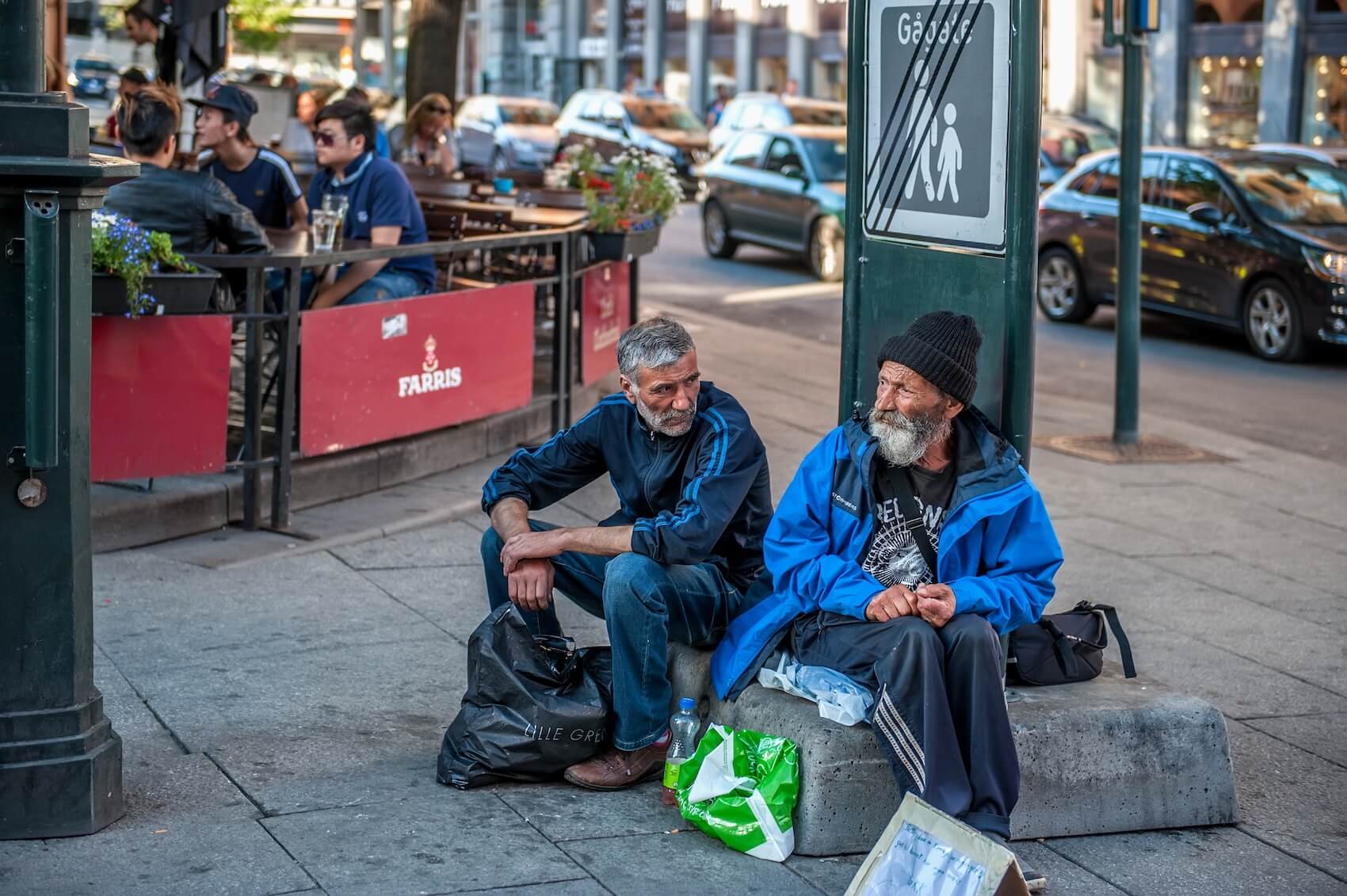
Two elderly men sit on the street in front of a café in Oslo, Norway, asking for alms on August 1, 2013. This image symbolizes the indifference of society and the state toward poverty. Photo: Medvedeva Oxana.
Dr. Lise Bjånesøy, thank you so much for joining our interview series. Let me start right away with the first question: The general elections on Monday (September 8, 2025) saw Labour narrowly retain power while the populist radical right Progress Party (FrP) nearly doubled its vote share to 24%. From your research, what explains FrP’s electoral surge despite being historically the most disliked party in Norway?
Dr. Lise Bjånesøy: It’s a very good question. I think there are quite a few reasons why the Progress Party (FrP) has been doing so well in this election. First of all, it has been the loudest opposition party to the current government, which helps them attract voters dissatisfied with the Labour government as well as generally discontented voters.
Second, economic issues have been a very important part of this election. It’s been a big, salient topic, and the FrP has benefited from that focus. Another significant factor is that they have gained many voters from the Conservative Party. In fact, a lot of people who previously voted Conservative now support the Progress Party. At least that’s what we’ve seen in earlier data. We’ll have to wait, of course, for the post-election data collection, but when we conducted a large survey in June, we found that 50% of those who said they intended to vote for the Progress Party had previously supported the Conservatives.
Another reason is that they attract more young voters, particularly young men, and social media seems to play an important mobilizing role for this group.
Regarding the Progress Party’s reputation as a very disliked party — which it still is within the Norwegian political system — I think this suggests they may now have mobilized almost all the voters they can. In other words, they’ve consolidated support among those who don’t dislike them, but they remain a highly unpopular party overall.
Media analyses describe the rise of FrP as part of the “MAGA-fication” of Norwegian politics, particularly among young male voters. To what extent does FrP’s messaging reflect a broader Americanization of populist rhetoric, and how much is it rooted in domestic Norwegian grievances?
Dr. Lise Bjånesøy:That’s a good question. First of all, I think it’s very interesting how a Norwegian election campaign is perceived in other countries. I’ve not heard the word MAGA-fication in any Norwegian newspapers, and I don’t think we would use that term to describe what is going on in Norway. So, I don’t think we can take it that far as being a MAGA-fication. Although the FrP did very well in this election — historically well, indeed — and they are attracting young men in particular, I still don’t think I would use the word MAGA-fication. I think, as you say, the success of the Progress Party in this election can be explained by domestic Norwegian grievances rather than any Americanization of populist rhetoric.
There has been one incident that perhaps comes a little close to the Americanization of populist rhetoric, and that was just a few days before the election, or very close to election night. There was a televised political debate where the leader of the Progress Party, Sylvi Listhaug, blamed the leader of the AUF, the youth wing of the Labour Party, for being a notorious liar, and she repeated over and over again that he is a liar, ‘you’re lying’. This was based on a relatively normal political statement, and yet she labelled him a liar. The Prime Minister, Jonas Gahr Støre, who was also part of that debate, responded by saying, essentially, “Okay, so you want to become Prime Minister, but you can’t talk like this.” That, he implied, would represent a new turn for Norway.
So, I think that might be one of those rare events that could be described as an Americanization of populist rhetoric. But other than that, we haven’t really seen this pattern; it hasn’t been a major part of the election campaign, at least in my view.
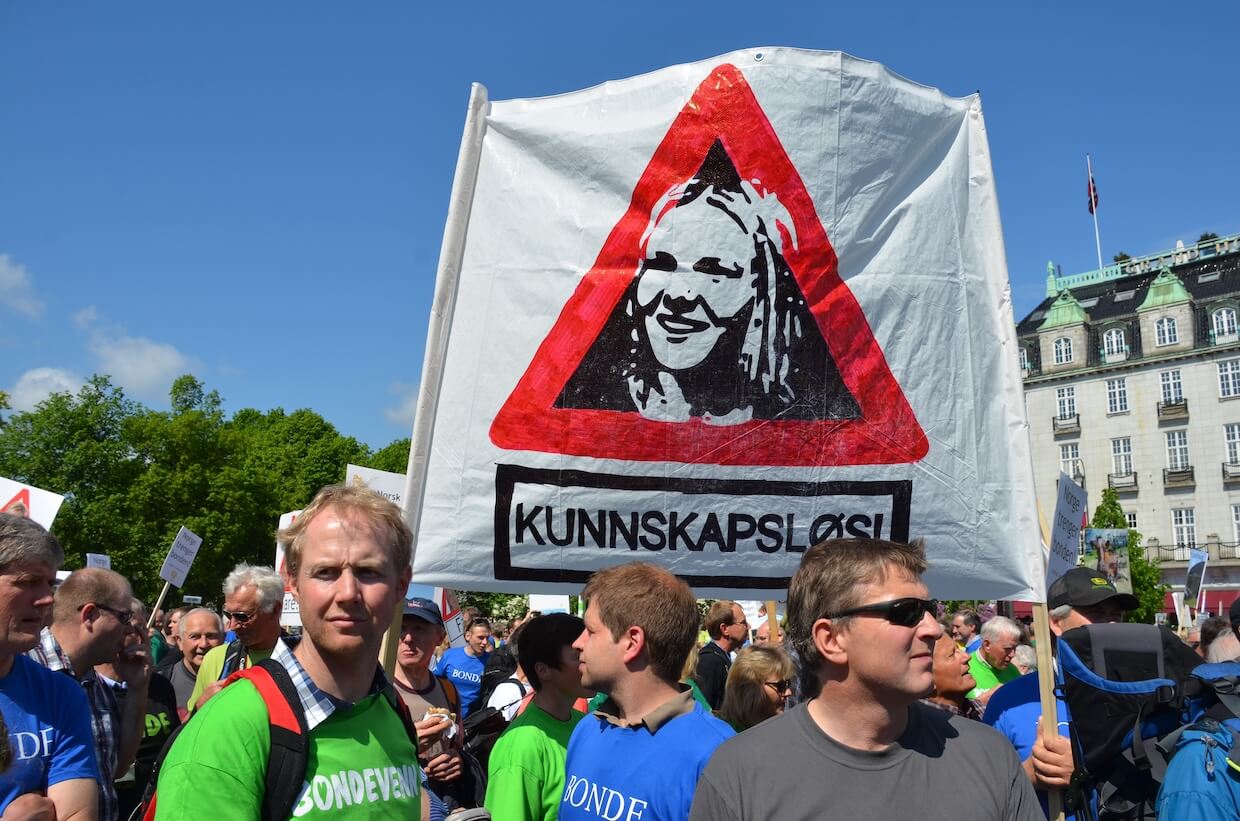
Norwegian farmers protest government agricultural policies outside parliament in Oslo. Banner targets former Agriculture Minister Sylvi Listhaug. Photo: Dreamstime.
FrP Capitalizes on Economic Anger While Labour Leans on Stoltenberg Boost
The campaign was dominated by debates on the cost of living, wealth taxes, the oil fund’s investment in Israel, and relations with Donald Trump. How did FrP successfully own these issues and deploy populist frames contrasting “the people” with “corrupt elites” or “globalist priorities”?
Dr. Lise Bjånesøy: The economic issues you mentioned, such as wealth tax and cost of living, are very important political issues for the Progress Party. They attract voters who are against the wealth tax, for instance. The high salience of this issue can probably help explain some of the gains and some of the success of the Progress Party in this election. Another example is that they have strongly profiled themselves as being against wasting taxpayers’ money. On the cost of living, they argue that the current government spends far too much of the taxpayers’ money and simply wastes it away. These have been two key issues for the Progress Party and their voters.
However, issues such as foreign policy and relations with Donald Trump are among the reasons why Labour did so well in this election. It never became quite clear during the campaign whether Listhaug would be a candidate for Prime Minister. She never explicitly said she wanted to be, but she repeated that it was natural for the party with the highest share of votes to take the Prime Minister position. So, it was never a clear yes or no. This created debate about whether she would do a good job as a potential Prime Minister, especially when it came to foreign policy and representing Norwegian interests in relation to Donald Trump, for example. So, I think some of these issues were very good for the Progress Party, but issues like foreign policy worked in favour of Labour and the current government.
Labour’s rebound has been attributed in part to the “Stoltenback effect,” boosting Labour’s popularity by 10 percentage points following Jens Stoltenberg’s return as finance minister. Do you see this as evidence of leadership personalization countering populist momentum, or does it simply mask deeper structural shifts favouring PRR parties?
Dr. Lise Bjånesøy: There are several reasons that can explain this boosted popularity of the Labour Party. One of the reasons is the one you mentioned — the Stoltenback effect — as we got Jan Stoltenberg back as finance minister. But it’s also important to mention that it was the current Prime Minister, Jonas Gahr Støre, who brought Stoltenberg back. So, it was also a boost in popularity for him, showing good leadership skills by bringing Stoltenberg back.
Another important issue is that the agrarian Centre Party, which had previously been in a coalition with the Labour Party, left the government coalition. So now, the Labour Party holds government power alone. It was a minority government, and I think that was very good for Labour.
A third explanation is foreign policy and Trump, as we just talked about. We want competent and highly experienced politicians to navigate this sort of uncertain political world that we are living in.
Finally, I think it’s quite exceptional how the Labour Party — and the current government — was so unpopular for a long time because the economy was performing poorly, yet they still managed to retain power. It makes this quite an exceptional election. A fourth contributing factor is that while the economy had been doing really badly, it is now performing much better. So, they have managed to turn the economy around to a better situation for people.
Norway Balances Populist Surge with Centre-Left Resilience
Despite FrP’s strong gains, Norway remains a centre-left outlier compared to Sweden and Finland. Based on your work on political tolerance, why has Norway diverged from this broader Nordic trend, and what factors have enabled it to resist a full populist breakthrough despite growing polarization?
Dr. Lise Bjånesøy: It’s important to emphasize that the results of this current election would have looked different if the Green Party, which is part of the left-wing bloc, had not passed the electoral threshold, and if the Liberal Party, which is part of the right-wing bloc, had passed it. In that case, this election could still have been a win for the right-wing bloc. But it ultimately ended up being a win for the left-wing bloc.
One key reason for this outcome is that the Green Party, for the first time, passed the electoral threshold and received what’s called utjevningsmandat — additional seats in the Storting (Norwegian parliament). However, it’s also important to emphasize that the Labour Party, which is now most likely continuing as a minority government, will have to navigate the next four years with four smaller parties. This could prove very challenging and, in fact, represents something of a dream opportunity for the Progress Party, which will likely benefit from Labour having to cooperate with these four much smaller left-wing parties.
Considering how well the Progress Party performed in this election, I don’t think Norway is an outlier, because we see two dynamics unfolding simultaneously. On one hand, there is a clear right-wing wave and a significant boost for the Progress Party; on the other, there is continued support for the current government. These trends coexist, but in the end, the results largely come down to the margins of which parties managed to pass — or failed to pass — the electoral threshold.
In your dissertation, you argue that FrP is both politically tolerated and highly negatively evaluated. How do you reconcile this paradox, particularly in the light of FrP’s breakthrough in the 2025 election?
Dr. Lise Bjånesøy: I think real tolerance is to allow democratic rights and privileges to those you dislike or disagree with. In that sense, it’s perhaps not a paradox; the Progress Party is still disliked, but we still see high tolerance of the party. However, based on these high levels of dislike for the FrP, the Progress Party might have reached its electoral high at this point. Maybe there are no more voters to mobilize. That said, this can change in the next election. We have seen that the levels of dislike for the Progress Party fluctuate. If I remember correctly, the highest levels were above 60%, and now about 55% of voters dislike the party. So, slightly fewer voters now dislike the party than before. A few more also tend to like it, but this can change.
Still, because of these very high levels of dislike towards the Progress Party, it can be hard for them to mobilize even more voters than they already have. Another important point when discussing the dislike of the Progress Party is that they have to collaborate. If the right-wing bloc had won the election, they would have had to work with parties whose voters dislike them. For the Liberal Party, for instance, many of its voters dislike the Progress Party, which makes collaboration difficult, or at least quite challenging, for a potential governing bloc. For some voters, it would be hard to accept cooperation with the Progress Party. Especially if we go back to the example where Listhaug called the youth wing leader of the Labour Party a liar, a notorious liar — that kind of rhetoric is very difficult for the Liberal Party to accept.
Less Stigma, Digital Mobilization, and a Generational Shift
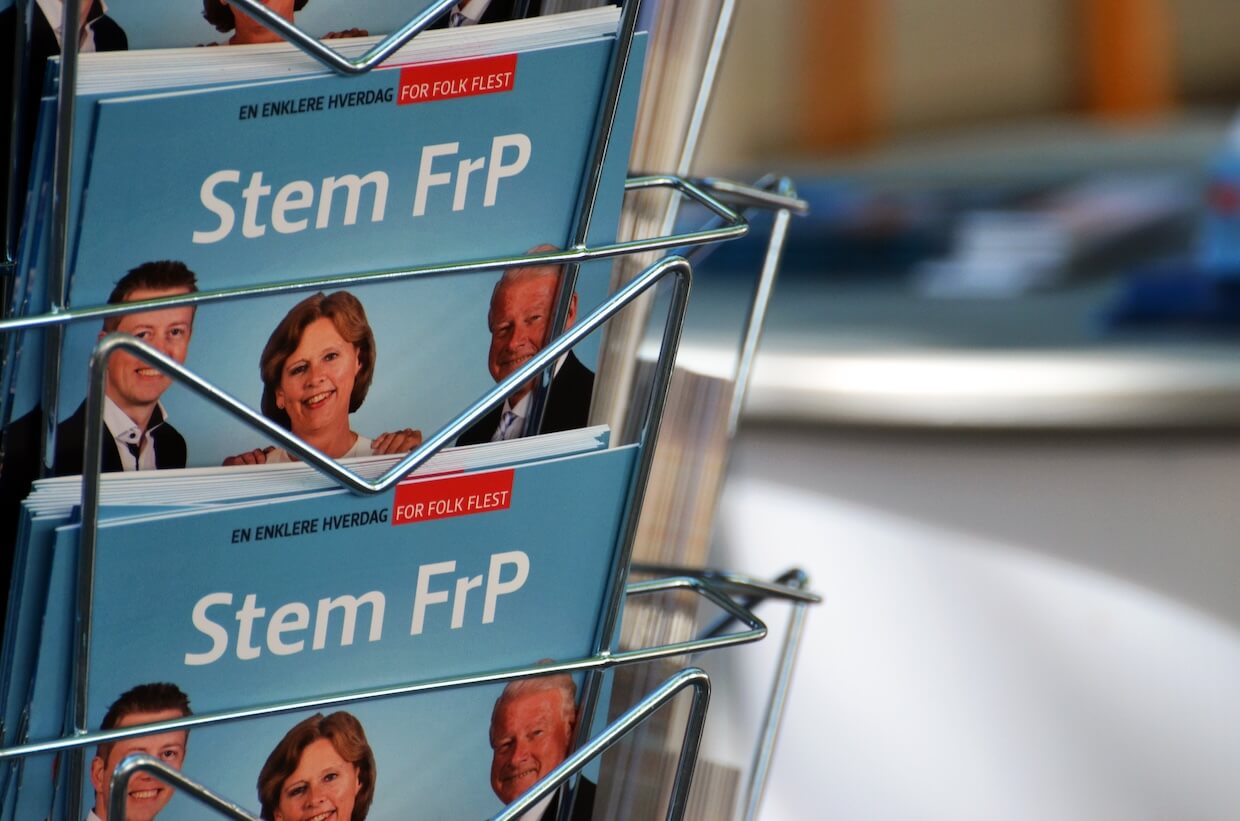
Norwegian Progress Party (FrP) campaign booth. Photo: Dreamstime.
Your findings show that party institutionalization influences public tolerance of the populist radical right. Given FrP’s long-standing presence in Norway’s political system, does this institutional legitimacy insulate it from the broader backlash against far-right parties elsewhere in Europe?
Dr. Lise Bjånesøy: This might actually be another reason why the Progress Party did very well in this election. There has been less stigma connected towards voting FrP in this election compared to elections before. It seems like it’s more acceptable to say that you are a Progress Party voter than it has been before. This is not based on data — this is just my hunch — and we haven’t seen this in the data yet, but my hunch says that there is actually less stigma directed towards being a Progress Party voter than there has been before.
One reason might be that the party has moderated itself, particularly after the past government experience. The government experience that they have had might also contribute to less stigma towards them. However, voters still didn’t want Sylvi Listhaug as Prime Minister. That was part of the political debate in this election — whether she was going to be a Prime Minister or not — and most voters didn’t want her as Prime Minister.
So, I don’t think that any political parties are immune to backlash. But I think that the Progress Party benefits a lot from the current political situation, when the Støre government will have to cooperate with these four smaller parties on the left. I think the next election in four years will be extremely exciting. It will be very interesting to see how well the Progress Party does then. Maybe they will get an even better boost of votes — we’ll have to see.
With FrP performing especially well among younger male voters, do you see signs of a generational realignment in Norwegian politics, or is this a temporary reaction to specific economic and identity-based issues?
Dr. Lise Bjånesøy: In this election, we have seen that young men turn to FrP, while young women turn to the left. That’s a sign of increased polarization among young people — men go one way, and young women go the other. One of the things we’ve seen in our data — we’ve analysed data from the Norwegian Citizen Panel, where we have around 10,000 participants — is that we can look in more detail at how young men and young women vote.
What we’ve found using those data is that both young women and young men actually have an increased likelihood of voting for the Progress Party if they get their news from social media. For young men, there is a 28% likelihood of voting FrP if they get their news from social media. And if you are a young man who does not get your news from social media, there’s only a 14% chance that you will vote for the Progress Party. It’s a huge boost in the likelihood of voting FrP if you are a young man and get your news from social media.
We find the same pattern among young women as well, but it’s a much weaker relationship, so it’s particularly strong among young men. We also find that young men who get their news from social media tend to place themselves further to the right, and they are more dissatisfied with the economy. So, in that case, we can say they’re not being “tricked” into voting for the Progress Party — they genuinely agree with them.
Of course, it might be that those who place themselves further to the right and want to vote for the Progress Party are also those who tend to get their news from social media. But still, I think there’s something going on with social media that is an important explanation for what’s happening among young men.
I also don’t think this is just a temporary shift. But I think we need to learn more about what’s going on, particularly in this case, and also study more closely what’s happening on social media. We’ll just have to wait — we need a lot more research on this particular topic — but there are definitely some very interesting dynamics unfolding among the young.
Positive Views on Immigration Hold
In your 2019 article, you found that public attitudes toward asylum seekers shifted after the 2015 refugee crisis. Has the 2025 campaign, particularly debates on Gaza and Ukraine, triggered similar shifts in threat perceptions and migrant-related framing?
Dr. Lise Bjånesøy: Immigration issues were not a big part of this election campaign. So, in that case, there was no particular reason to expect any shift in public attitudes based on the campaign itself. But I think it’s interesting how we still remain quite positive towards immigration after receiving a large number of refugees from Ukraine, especially. This means that we did not see the same shift in public attitudes as we did during the 2015 refugee crisis when Norway also received a significant number of refugees.
Looking at trends and opinion data collected in the Norwegian Citizen Panel, we see that 51% of respondents think that immigration is an advantage, which is actually exactly the same level as in 2014. Back then, 51% also said that they viewed immigration positively. So, while the trend fluctuates somewhat over time, at this point, it stands at the same level as when we first started measuring it in 2014.
However, on some other questions we examine, more people today say that they think it should be more difficult to get asylum. We also see an increase in people who believe that the conditions for integrating refugees in Norway are bad, or at least not very good. So, there is some movement and some shifts in attitudes towards immigration and asylum seekers, but I haven’t seen anything specific related to this current election.
Social Media’s Role Needs Deeper Investigation
Illustration by Ulker Design.
Your research suggests media framing can normalize exclusionary populist narratives. To what extent did the Norwegian media in 2025 amplify FrP’s populist discourse, and does this signal a shift toward mainstreaming radical right rhetoric?
Dr. Lise Bjånesøy: That’s a whole research question in itself. Based on what I’ve seen, we had quite a fair election campaign, where the various political parties participated in debates and were given the same opportunities on the same media platforms to debate. But we have been very interested, both in research and in the media, in what’s going on with young men in this election. However, I haven’t seen the same level of interest in young women. So, we have some shifts in the media that affect our focus, I guess. Maybe I would like to see more attention paid to what’s going on with young women as well.
FrP has gained a lot of media attention, particularly because they were doing very well in the polls, so it was natural to be interested in that, but also because they were performing strongly among young men. So, we’ve seen this increase in media attention, but I do think that, if anything, we should pay even more attention to what’s happening on social media. And that would be my hunch, based on your question.
And lastly, looking ahead, what research agenda do you see as most urgent for understanding the evolving relationship between populist radical right parties, public opinion, and democratic resilience in Norway and across Europe?
Dr. Lise Bjånesøy: I’ve probably also given away what I think is one of the most important areas to focus on now. One of the key research agendas going forward is to learn more about what is happening on social media — how we are affected by it, or not affected by it, and how our experiences on these platforms differ. The algorithms give us more of the content that we already like, and we need to understand what effects this has on political participation, both in Norway and across Europe. I believe this is a very important research agenda, as we currently know too little about the effects of social media on politics.
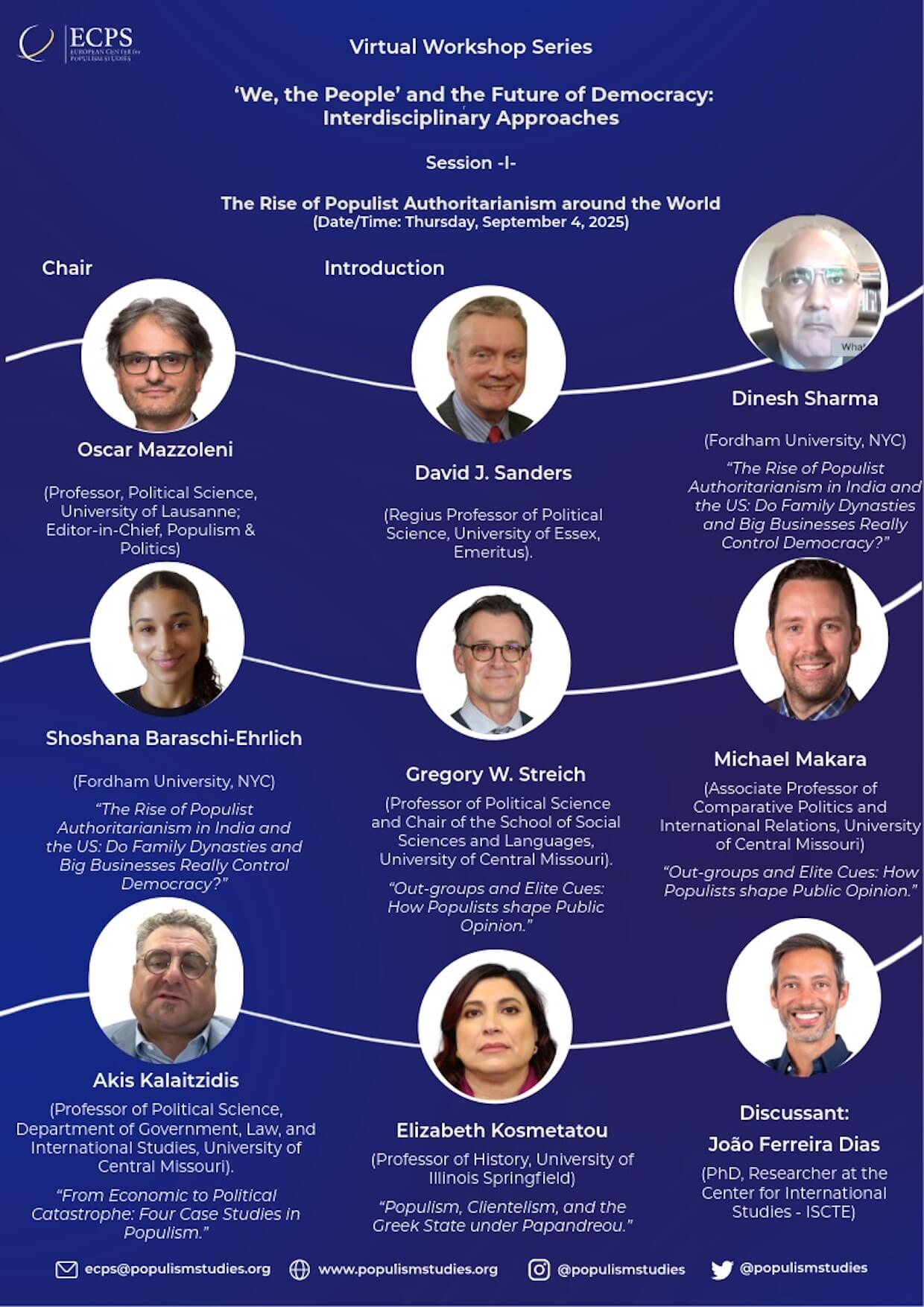
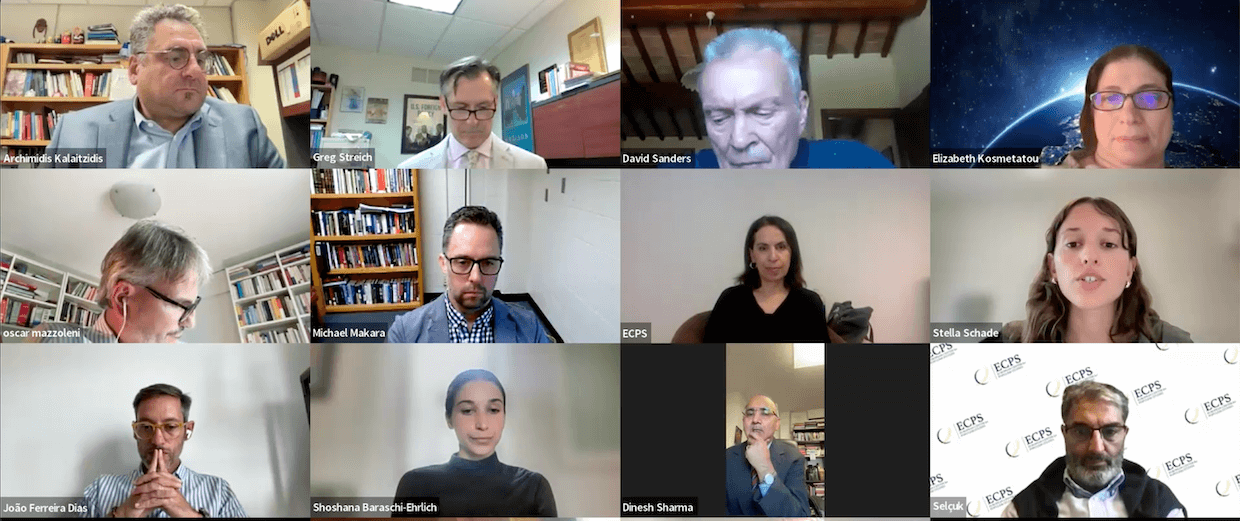
The ECPS, in collaboration with Oxford University, launched its Virtual Workshop Series on “The Rise of Populist Authoritarianism around the World” on September 4, 2025. Spanning 16 sessions through April 2026, the series examines how populist strategies reshape democracy across diverse contexts. Chaired by Professor Oscar Mazzoleni, the opening session featured Professor David Sanders’ keynote on six structural drivers fueling populism and its growing threats to liberal democracy. Case studies explored populist dynamics in the US, India, Greece, Thailand, and Argentina, highlighting intersections of dynasties, corporate power, elite cues, and economic crises. Discussant Dr. João Ferreira Dias emphasized three takeaways: populism as performance, polarization over persuasion, and the enduring impact of national political cultures.
Reported by ECPS Staff
The European Center for Populism Studies (ECPS), in collaboration with Oxford University, inaugurated its Virtual Workshop Series with the opening session, “The Rise of Populist Authoritarianism around the World,” held on Thursday, September 4, 2025. Spanning 16 sessions from September 2025 to April 2026, the programme brings together leading scholars to examine the contested meanings of “the people” and their pivotal role in shaping the trajectory of democracy across diverse political, cultural, and institutional settings. Designed as a continuation of the successful three-day in-person conference at St. Cross College, Oxford University (July 1–3, 2025) — “‘We, the People’ and the Future of Democracy: Interdisciplinary Approaches,”— the series deepens and extends those debates, fostering comparative, cross-disciplinary dialogue on democratic backsliding, resilience, and transformation in a rapidly shifting global landscape.
Opening on behalf of ECPS, Stella Schade outlined the series’ comparative and cross-disciplinary ambition: to move beyond regional silos and examine how populist projects travel, adapt, and entrench themselves within distinct political and media ecologies.
Chaired by Professor Oscar Mazzoleni (University of Lausanne), a leading authority on populism and party systems, the session framed populist authoritarianism not as a single doctrine but as a repertoire of strategies—discursive, organizational, and institutional—deployed under diverse conditions.
Professor David Sanders (University of Essex, Emeritus) set the analytical agenda with a wide-ranging keynote that argued populism poses greater risks to liberal democracy today than in earlier cycles, owing to transnational diffusion of tactics and the erosion of shared standards of truth. He identified six structural drivers—declining left–right anchors, post-truth dynamics, politicized immigration, identity fragmentation, globalization’s discontents, and norm subversion through strategic learning—and outlined five fronts for democratic response, from inclusive immigration policy and rebalanced rights discourse to retooled economic governance, renewed state capacity, and robust platform regulation.
The panel that followed translated these themes into concrete case studies. Dr. Dinesh Sharma and Shoshana Baraschi-Ehrlich (Fordham University) traced the entanglement of family dynasties, corporate finance, and “outsider” populist narratives in India and the United States, highlighting the paradox whereby leaders mobilize anti-elite sentiment while constructing elite power networks of their own.
Professor Gregory W. Streich and Dr. Michael Makara (University of Central Missouri) examined how elite cues and out-group framing shape opinion formation, showing that populist endorsements polarize more than they persuade and exert greatest influence on low-salience issues where prior beliefs are weak.
Professor Akis Kalaitzidis (University of Central Missouri) offered a comparative analysis of Thailand, Argentina, Greece, and the United States to argue that economic dislocations catalyze distinct populist trajectories, each filtered through national political cultures and institutional constraints.
Professor Elizabeth Kosmetatou (University of Illinois Springfield), in joint work with Kalaitzidis, revisited the Papandreou era to illuminate how charismatic leadership, clientelism, and European integration jointly reconfigured Greece’s political economy, leaving a durable imprint on state capacity and party competition.
Serving as discussant, Dr. João Ferreira Dias synthesized the contributions around three cross-cutting claims: populism functions as performance more than program; polarization, not persuasion, is its primary mass effect; and national political cultures mediate how populist styles are institutionalized. His commentary linked micro-level mechanics (elite cues, media incentives) to macro-level outcomes (executive aggrandizement, clientelist normalization), underscoring the session’s central lesson: understanding populist authoritarianism requires attention to both the technologies of mobilization and the structures that enable their entrenchment.
As the series unfolds, ECPS and its partners will continue to probe these dynamics comparatively, asking not only how democracies backslide, but also how they can be renewed.
In an exclusive interview with the ECPS, Aryeh Neier — founding Executive Director of Human Rights Watch and former President of the Open Society Foundations — delivers a powerful assessment of Gaza, free speech, and international accountability. Neier argues that criticism of Israeli policies must not be conflated with antisemitism, stressing that “even antisemitism constitutes protected speech.” He further asserts that “Israel is engaged in genocide,” citing systematic obstruction of humanitarian aid and disproportionate force in Gaza. While the ICC remains “the only viable path” for justice, he warns that political barriers persist. From US policy dynamics to global human rights challenges, Neier offers rare insights into one of today’s most divisive debates.
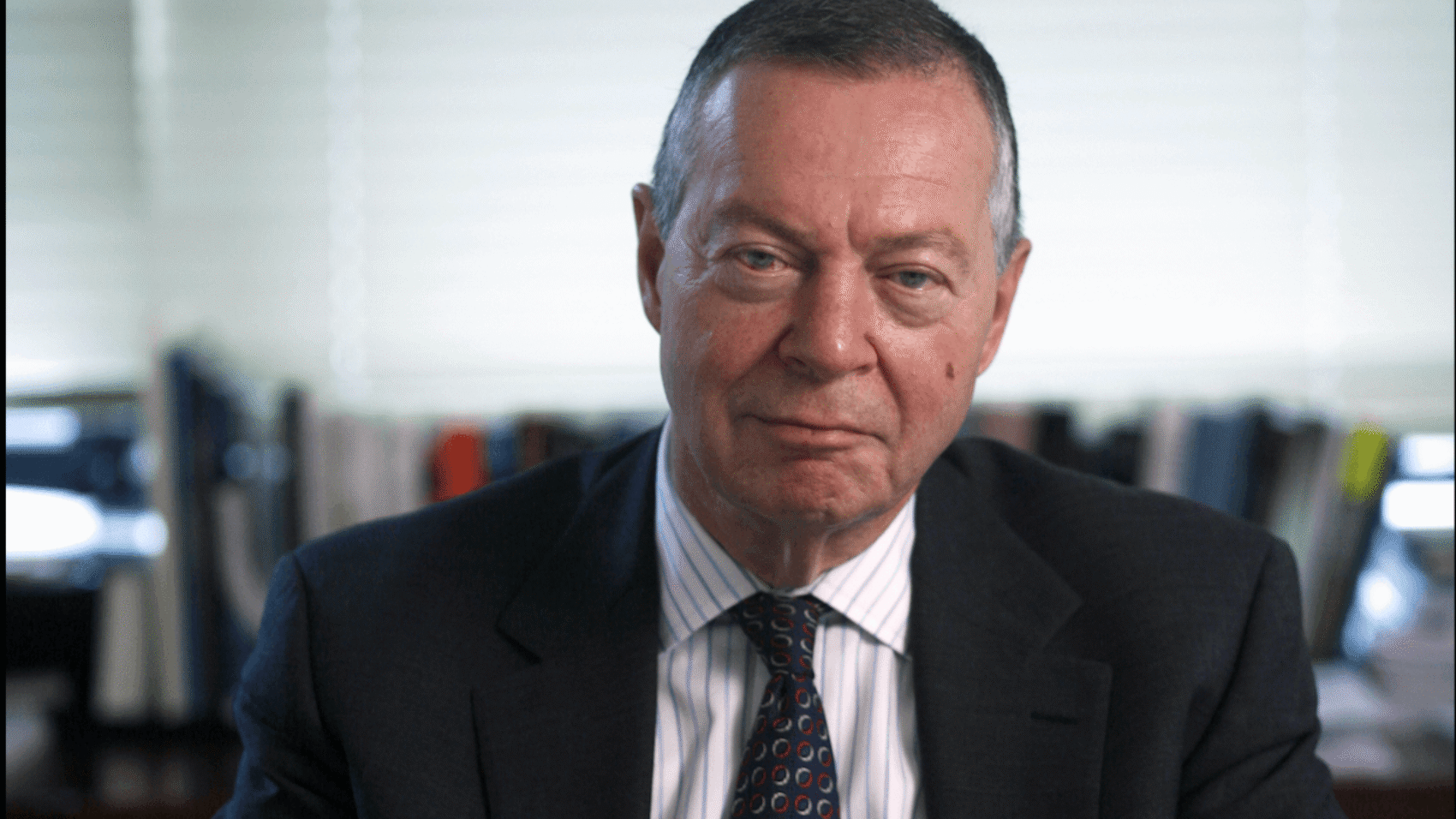
Giving an interview to the European Center for Populism Studies (ECPS), iconic human rights defender Aryeh Neier — former Executive Director of the American Civil Liberties Union (ACLU), founding Executive Director of Human Rights Watch (HRW), and former President of the Open Society Foundations — reflects on Israel’s war in Gaza, free speech controversies, and the challenges of international accountability. With a career spanning more than six decades and seven honorary degrees, Neier brings unmatched authority to one of today’s most polarizing debates.
At the heart of the conversation lies his assertion that criticism of Israeli policies must not be conflated with antisemitism. “Differentiating antisemitism from anti-Israel speech is something that the Trump administration has failed to do,” Neier argues, highlighting how US political discourse has blurred the lines between prejudice and legitimate dissent. He warns against undermining free expression on American campuses: “Even antisemitism constitutes protected speech,” he insists, while adding that universities must balance academic freedoms with preventing disruption to institutional activities.
Turning to Gaza, Neier presents a grave legal assessment: “Israel is engaged in genocide,” he says, grounding his conclusion in the 1948 Genocide Convention. He points to two central factors: Israel’s sustained obstruction of humanitarian aid and the use of disproportionate force. “Starvation, as a method of warfare, is forbidden under the First Protocol of the Geneva Conventions,” he stresses, adding that the denial of food, water, and medical supplies, combined with the use of 900-kilogram bombs in densely populated areas, “seems to me to amount to the crime of genocide.”
Aryeh Neier also emphasizes the limitations of international mechanisms. While the International Criminal Court (ICC) remains the most viable forum for prosecutions, enforcement will require political shifts. Drawing parallels to the former Yugoslavia, he notes, “Slobodan Milosevic never imagined he would face trial, yet years later he was sent to The Hague.”
On US policy, Neier identifies Evangelical Christian groups, not AIPAC, as a dominant influence shaping Washington’s stance toward Israel, complicating responses to international legal rulings. He also warns of growing generational divides within US politics, with younger voters increasingly critical of Israeli policies — a factor he believes may eventually reshape policy debates.
This interview offers a profound exploration of the intersection between human rights, international law, free speech, and accountability. From Gaza to US campuses, Neier challenges political distortions and underscores the urgency of protecting both humanitarian principles and civil liberties in an age of polarization.
In an exclusive interview with the ECPS, Aryeh Neier — founding Executive Director of Human Rights Watch and former President of the Open Society Foundations — delivers a powerful assessment of Gaza, free speech, and international accountability. Neier argues that criticism of Israeli policies must not be conflated with antisemitism, stressing that “even antisemitism constitutes protected speech.” He further asserts that “Israel is engaged in genocide,” citing systematic obstruction of humanitarian aid and disproportionate force in Gaza. While the ICC remains “the only viable path” for justice, he warns that political barriers persist. From US policy dynamics to global human rights challenges, Neier offers rare insights into one of today’s most divisive debates.
Giving an interview to the European Center for Populism Studies (ECPS), iconic human rights defender Aryeh Neier — former Executive Director of the American Civil Liberties Union (ACLU), founding Executive Director of Human Rights Watch (HRW), and former President of the Open Society Foundations — reflects on Israel’s war in Gaza, free speech controversies, and the challenges of international accountability. With a career spanning more than six decades and seven honorary degrees, Neier brings unmatched authority to one of today’s most polarizing debates.
At the heart of the conversation lies his assertion that criticism of Israeli policies must not be conflated with antisemitism. “Differentiating antisemitism from anti-Israel speech is something that the Trump administration has failed to do,” Neier argues, highlighting how US political discourse has blurred the lines between prejudice and legitimate dissent. He warns against undermining free expression on American campuses: “Even antisemitism constitutes protected speech,” he insists, while adding that universities must balance academic freedoms with preventing disruption to institutional activities.
Turning to Gaza, Neier presents a grave legal assessment: “Israel is engaged in genocide,” he says, grounding his conclusion in the 1948 Genocide Convention. He points to two central factors: Israel’s sustained obstruction of humanitarian aid and the use of disproportionate force. “Starvation, as a method of warfare, is forbidden under the First Protocol of the Geneva Conventions,” he stresses, adding that the denial of food, water, and medical supplies, combined with the use of 900-kilogram bombs in densely populated areas, “seems to me to amount to the crime of genocide.”
Aryeh Neier also emphasizes the limitations of international mechanisms. While the International Criminal Court (ICC) remains the most viable forum for prosecutions, enforcement will require political shifts. Drawing parallels to the former Yugoslavia, he notes, “Slobodan Milosevic never imagined he would face trial, yet years later he was sent to The Hague.”
On US policy, Neier identifies Evangelical Christian groups, not AIPAC, as a dominant influence shaping Washington’s stance toward Israel, complicating responses to international legal rulings. He also warns of growing generational divides within US politics, with younger voters increasingly critical of Israeli policies — a factor he believes may eventually reshape policy debates.
This interview offers a profound exploration of the intersection between human rights, international law, free speech, and accountability. From Gaza to US campuses, Neier challenges political distortions and underscores the urgency of protecting both humanitarian principles and civil liberties in an age of polarization.
Here is the transcript of our interview with human rights champion Aryeh Neier, lightly edited for clarity and readability.
Why Gaza Meets the Genocide Threshold
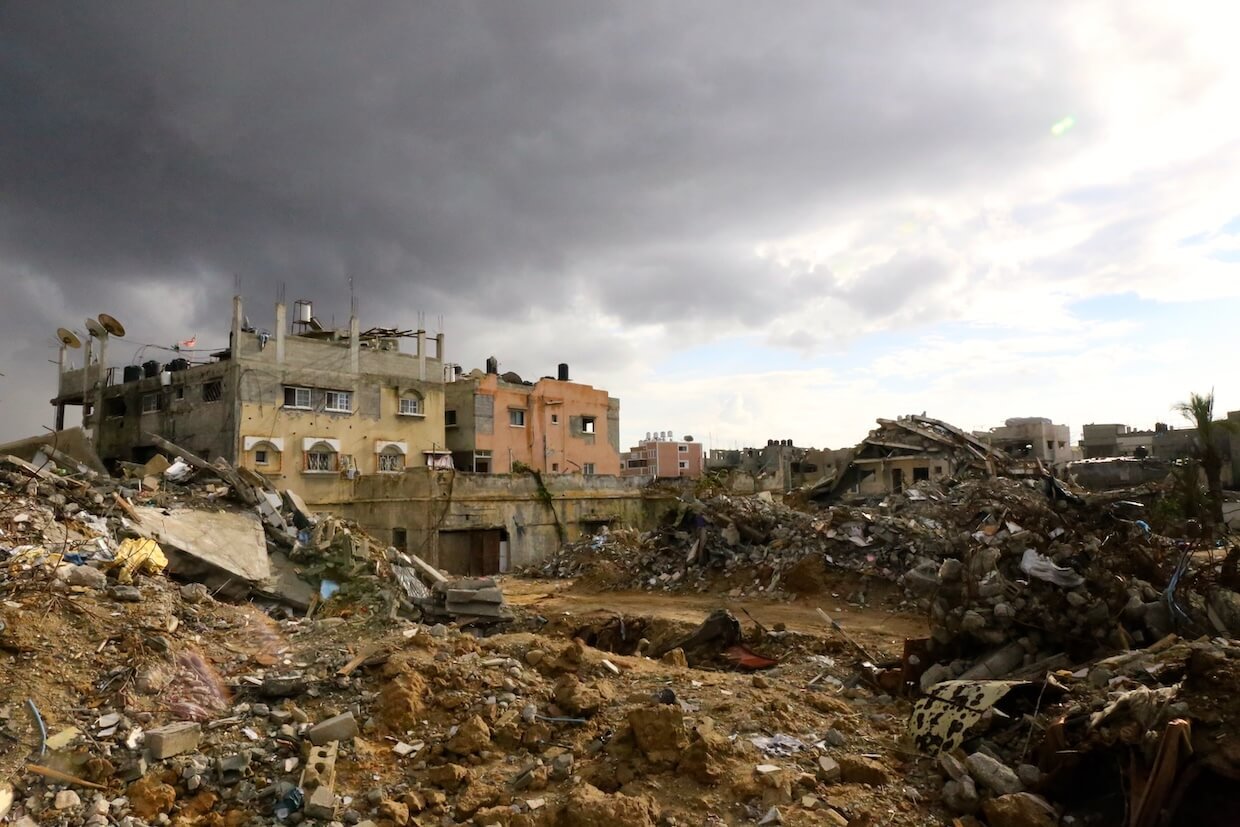
Destruction in Shejayia, Gaza City, Gaza Strip. Photo: Dreamstime.
Mr. Aryeh Neier, thank you very much for joining our interview series. Let me start right away with the first question: As one of the most influential human rights defenders in modern history, you have stated that you are persuaded Israel is “engaged in genocide” in Gaza. How do you define genocide in this context under international law, and how do Netanyahu’s increasingly populist and authoritarian coalition policies — particularly regarding humanitarian aid, military conduct, and civilian protections — factor into your conclusion that the legal threshold has been crossed?
Aryeh Neier: As far as the legal definition of genocide is concerned, it is the 1948 Genocide Convention that defines the crime under international law. The crime consists of destroying a national, racial, ethnic, or religious group, in whole or in part. This destruction can occur through direct killing or by creating conditions of life intended to bring about the death of such a group, in whole or in part. The attempt to commit genocide is also a crime under international law, just as the actual commission of genocide is. Regarding those who organize the effort, I’m less focused on the coalitions they may form. To me, the guilty parties are those who possess both the authority and the intent — and intent is the crucial factor under international law in defining the crime of genocide.
You have linked your conclusion primarily to Israel’s sustained obstruction of humanitarian aid. From a legal perspective, do you interpret starvation as a method of warfare here as evidence of specific genocidal intent to destroy a population, in whole or in part? To what extent does Netanyahu’s populist-nationalist rhetoric and reliance on far-right coalition partners signal deliberate policy intent rather than reckless disregard?
Aryeh Neier: Again, I’m not concerned with the coalition that may be supporting Netanyahu. The issue is whether they exercise the authority that makes them guilty participants in the crime of genocide. Starvation, as a method of warfare, is forbidden under the First Protocol of the Geneva Conventions. It is absolutely prohibited, and those who act with intent to cause starvation should be considered to have participated in the commission of genocide.
Although I focus heavily on the denial of humanitarian assistance — including food, water, and medical supplies — to the population of Gaza, I would also include, as part of the crime of genocide, the use of disproportionate force by the Israeli government. For example, the Israeli government used 900-kilogram bombs in its attacks on Gaza, particularly in the early months. Bombs of that size can kill people within 200 meters and are utterly inappropriate for use in a densely populated area like Gaza.
While such weapons might have legitimate uses in warfare — for example, destroying a naval base or a military factory producing large amounts of armor — their use in crowded urban areas inevitably means that a very large number of civilians will be killed, and that is what happened in Gaza. Therefore, the combination of the way these attacks were carried out and the denial of humanitarian assistance, including food, water, and medical supplies, seems to me to amount to the crime of genocide.
From Blockades to Bombing Patterns
Based on your experience at Human Rights Watch and the Open Society Foundations, which forms of evidence are most critical for establishing war crimes liability in Gaza — convoy interdictions, caloric deprivation, bombing patterns, or policy directives?
Aryeh Neier: All of the above are factors that can be considered as evidence. If there were to be a criminal trial in the International Criminal Court (ICC), there would need to be clear evidence showing what the defendants actually did. There would have to be witnesses who could testify to their actions, as well as an examination of any available documents, along with testimony from observers who were present. The Israeli government has done as much as it could to limit the possibility of such testimony by preventing international journalists and human rights groups from entering Gaza. Therefore, the witnesses would most likely have to be people from Gaza who experienced these crimes, along with some Israelis who are knowledgeable about the practices and could testify before the ICC.
Given the populist pressures within Netanyahu’s coalition, which levels of command responsibility appear most salient — cabinet-level policy decisions, directives from the defense establishment, or field-level operational orders? How should investigators document the causal link between strategic blockade policies, child malnutrition, and elevated civilian mortality?
Aryeh Neier: I don’t think one can specify in advance how a prosecution would proceed. It would be up to the prosecutors to determine what evidence they are able to obtain. If they can secure military directives, they would use those. But if they are not able to access such directives, testimony from individuals who were present when decisions were made would become important. If that is also unavailable, they would need to examine patterns of action by those who committed the crimes. They would look at actions taken, for example, to destroy farms and greenhouses in Gaza, which provided some of the food. They would examine those who obstructed trucks attempting to deliver assistance and review the orders that limited the number of trucks entering Gaza. All of these would be factors. It’s impossible to specify in advance what evidence the prosecutors would rely upon.
ICC Remains the Only Path for Gaza War Crimes Accountability
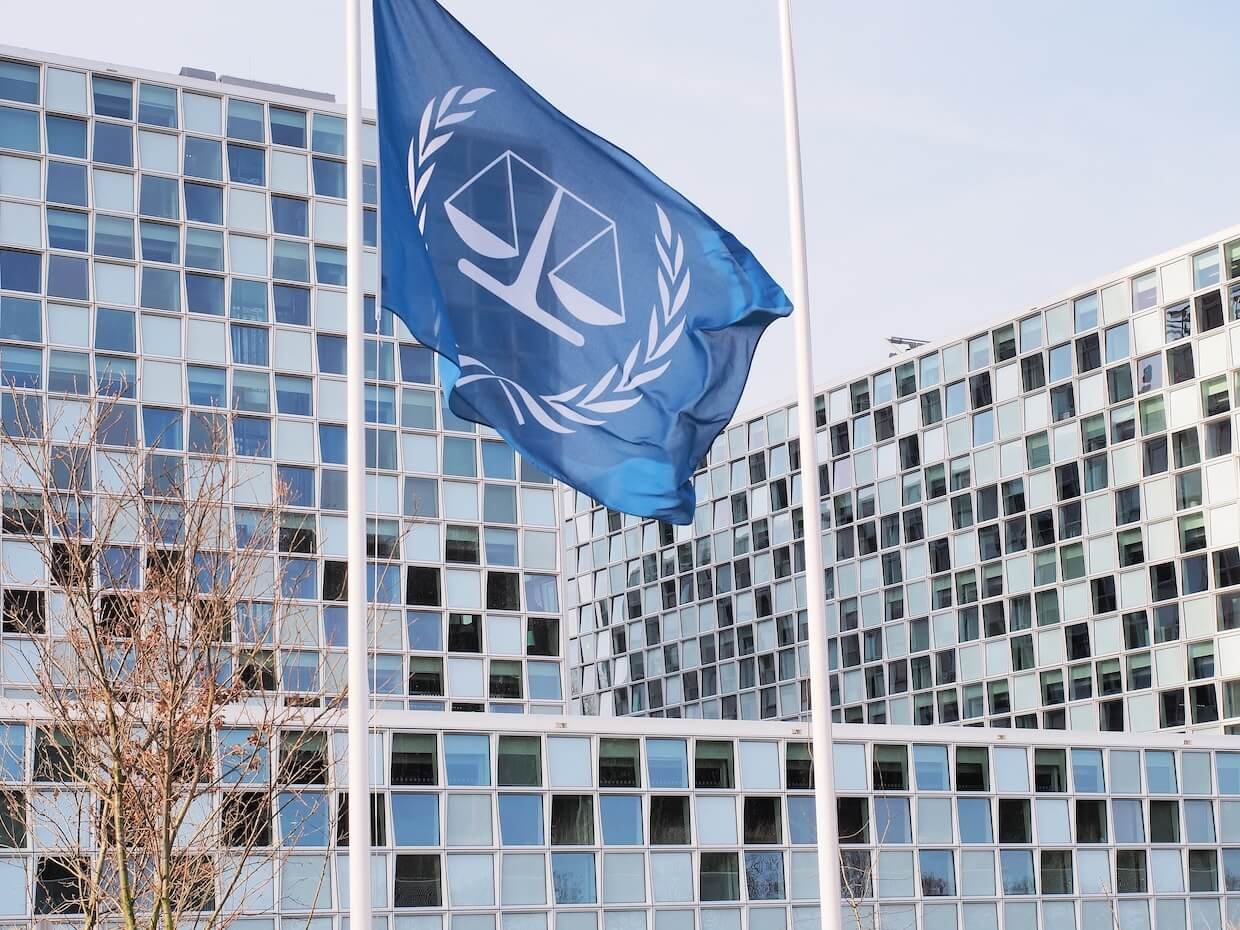
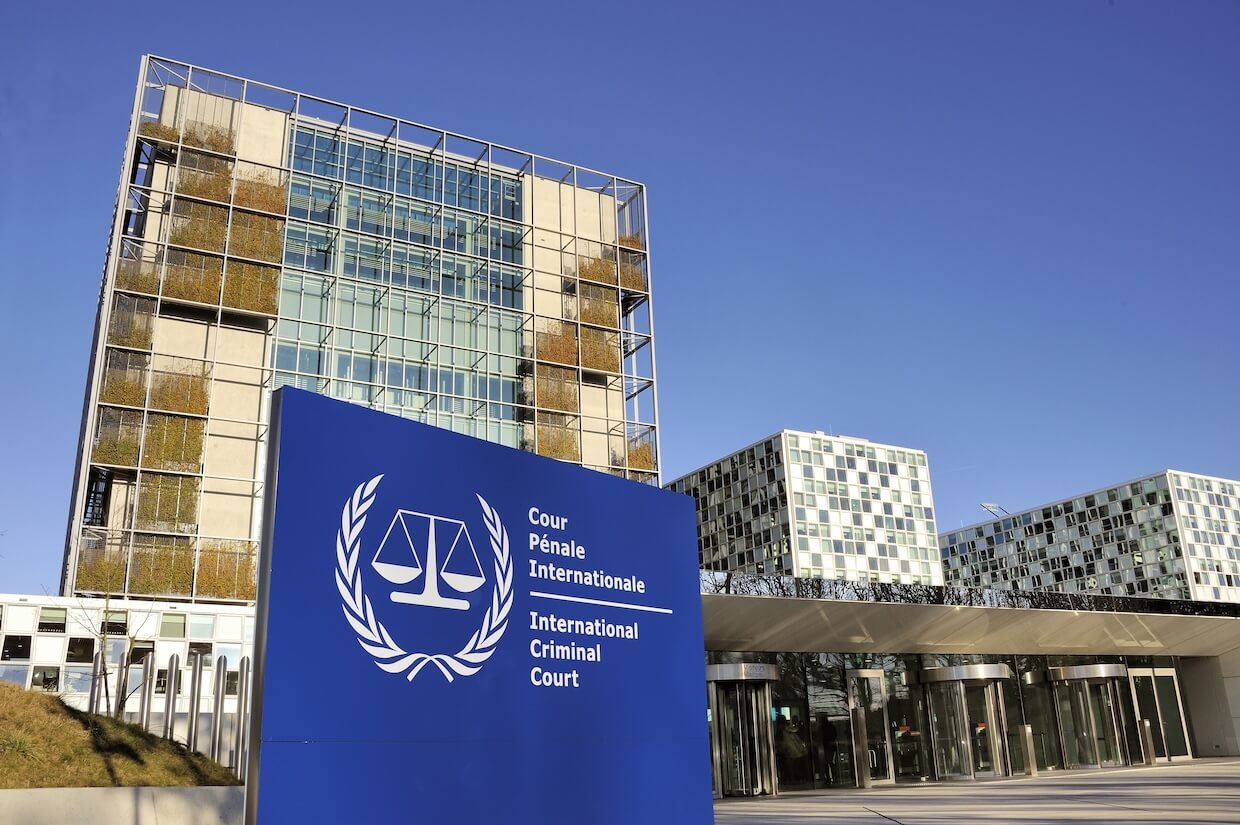
The flag in front of the International Criminal Court in The Hague, Netherlands on March 27, 2016. Photo: Dreamstime.
You once critiqued the UN Human Rights Council’s bloc politics and selective scrutiny. How should advocates leverage UN mechanisms on Gaza while mitigating the reputational drag of perceived selectivity and ensuring even-handed standards?
Aryeh Neier: The UN Human Rights Council is a political body. The various governments that serve on the Council at any given moment have their own political interests. They often form blocs, and, to some extent, those blocs protect the countries that are members of them. So, if one is dealing, for example, with crimes committed in Sudan, there may be African countries that have alliances with Sudan or obtain oil from it, and those countries may be protective of the Sudanese government. Similarly, when addressing Russia’s crimes in Ukraine, there may be countries from the former Soviet Union that still maintain alliances with Russia and would shield it from scrutiny. It is, therefore, impossible to rely on the UN Human Rights Council as a fully neutral body capable of making impartial decisions on crucial human rights matters. One tries, as much as possible, to mitigate that factor, but it cannot be entirely eliminated.
Having been a key advocate for the International Criminal Tribunals for the former Yugoslavia (ICTY) and Rwanda (ICTR), how do you compare the feasibility of creating a similar ad hoc tribunal for Gaza versus relying on the International Criminal Court (ICC)? What lessons from Bosnia and Rwanda are relevant here, and which pitfalls should be avoided?
Aryeh Neier: The reason it was possible to create the tribunals for the former Yugoslavia and for Rwanda is that the five permanent members of the United Nations Security Council all accepted the establishment of those bodies. None of them exercised their veto power to block their creation. Unfortunately, if there were an attempt to create an ad hoc tribunal along the lines of the International Criminal Tribunal for the former Yugoslavia or the International Criminal Tribunal for Rwanda, the United States would almost certainly exercise its veto to prevent the formation of such a body. Therefore, I don’t think we can expect that there will ever be a special tribunal for Gaza. I believe the International Criminal Court, which is not subject to such veto power, remains the only possibility for criminal prosecution for the crimes committed in Gaza.
European Courts May Pursue Cases Against Israeli Officials
If Israel were to initiate domestic investigations into alleged violations, how should the ICC evaluate their credibility under complementarity rules? In the absence of genuine proceedings, should European states more aggressively invoke universal jurisdiction to pursue accountability?
Aryeh Neier: One could evaluate whether Israel is acting in good faith in prosecutions in the same way one evaluates any other situation in which there could be prosecutions. That is, is there a genuine investigative process, and does the investigative process actually lead to indictments? If Israel were to claim that it is engaged in an investigation and its performance does not inspire credibility, then I think the International Criminal Court should proceed on the basis that Israel is not doing what it should, and therefore only the International Criminal Court is capable of bringing such a prosecution.
I think it’s entirely possible that some European countries will, at some point, exercise universal jurisdiction with respect to crimes committed in Gaza. It is likely that Israelis will travel to various European countries. The countries that have condemned the crimes taking place in Gaza may become aware that someone who was a military figure is traveling within their borders, and in those circumstances, one could imagine that universal jurisdiction would take place.
There have been, for example, a number of prosecutions in European countries of Syrian officials who traveled in different European countries — in Switzerland, for example — and Switzerland used universal jurisdiction to bring such persons to trial. I don’t imagine this would involve the highest-level Israeli officials, the people who have the most significant responsibility for the crimes committed in Gaza. But I think it could well happen that there will be such cases, and we won’t know until it actually happens whether there will be such trials.
There are a couple of organizations. There’s an organization based in Switzerland, for example, called Trial, which specifically looks for such cases and tries to ensure prosecutions take place. I don’t know whether they’re looking at any cases right now; they might be, they might not be. I think most of the Israeli officials who have a high level of responsibility for the crimes in Gaza are avoiding travel to European countries.
Future Political Shifts Could Open Door to Prosecutions
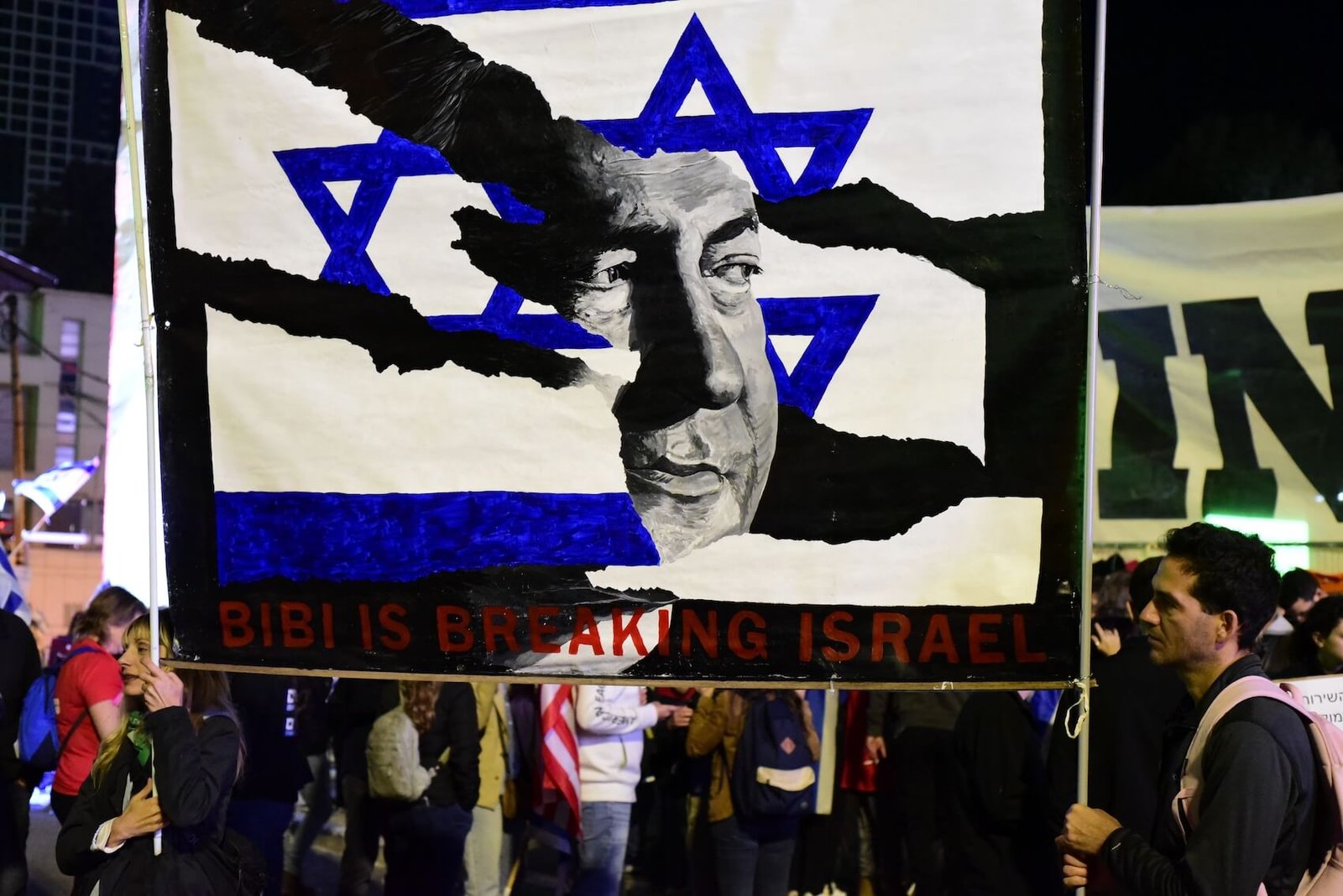
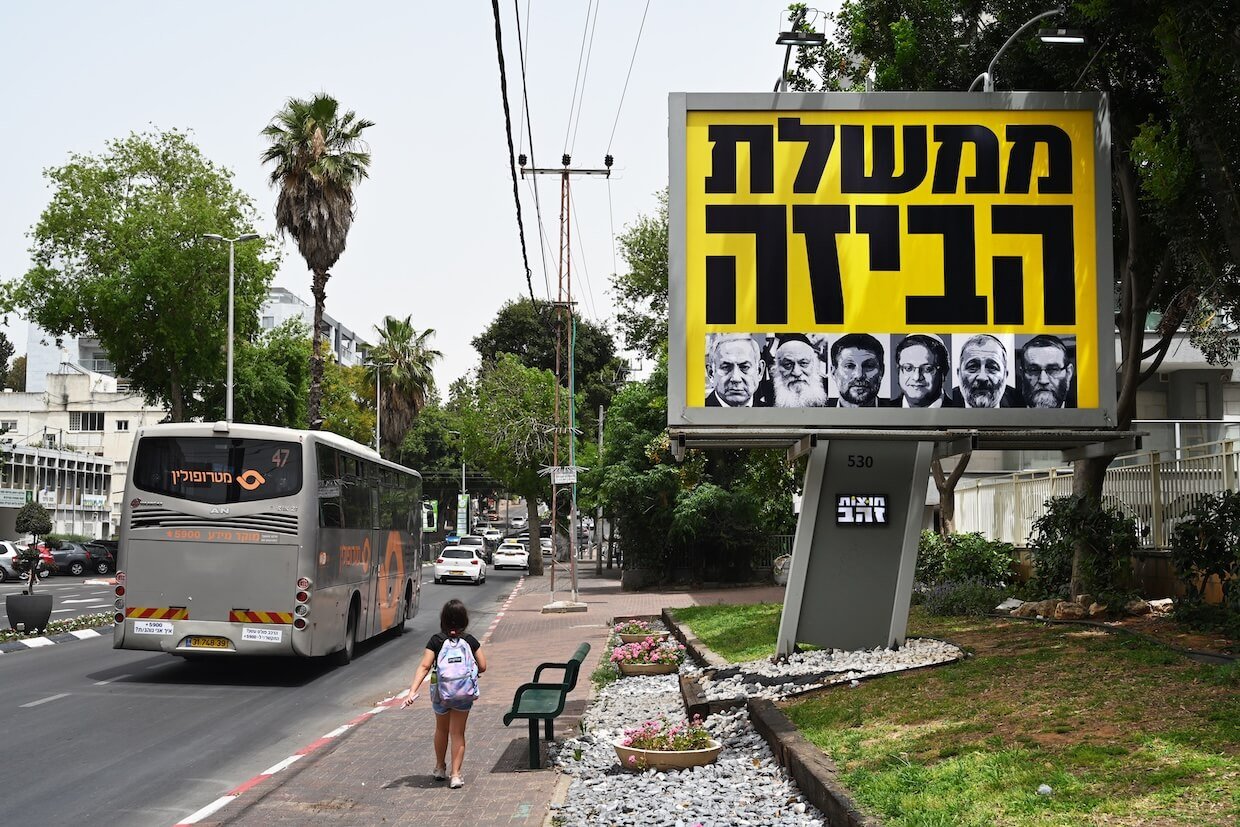
Israelis protest at Tel Aviv against Netanyahu’s anti-democratic coup on April 1, 2023. Photo: Avivi Aharon.
You have noted that both the International Court of Justice (ICJ) and the ICC lack direct enforcement powers and rely on state cooperation. What realistic regional or transnational coalitions, in your view, could translate court rulings into tangible protection or material relief for civilians in Gaza?
Aryeh Neier: I’m not sure that an international coalition could achieve that. I think the critical step is to try to bring a case before the International Criminal Court. The ICC has jurisdiction over individuals, not countries. And if, at some stage, it was possible to bring top officials responsible for the crimes in Gaza before the ICC, that would be the way to secure some form of accountability.
When the wars in the former Yugoslavia took place, the officials responsible for major crimes never imagined they would face the International Criminal Tribunal for the former Yugoslavia. Yet, eventually, Slobodan Milosevic was sent to the court by other officials in Serbia, and Radovan Karadzic and Ratko Mladic were ultimately captured and brought before the tribunal.
It took many years. It may also take many years in the case of Gaza. But it cannot be ruled out. It is possible that, over time, there could be political change in Israel and that future leaders might seek to ensure some form of accountability. One cannot predict how this will develop.
According to numerous expert assessments, the US administration may be violating both domestic and international law by supplying arms to Israel despite documented restrictions on humanitarian aid to Gaza. Based on your experience with US accountability mechanisms, do you believe American officials could face future legal challenges under the Arms Export Control Act or under aiding-and-abetting doctrines in international law?
Aryeh Neier: I think I would give the same answer to the question of whether Israeli officials might, at some stage, face accountability and eventually be held responsible. One cannot predict how matters will develop politically in the United States. It is unlikely that the Trump administration would pursue the prosecution of those who may be complicit in the genocide taking place in Gaza. However, one cannot know who the officials will be in the United States 10, 15, or 20 years from now, and it is possible that, at some stage in the future, there might be a willingness to prosecute American officials. I would not say it is likely, but it’s possible.
Evangelical Influence Shapes US Policy Toward Israel
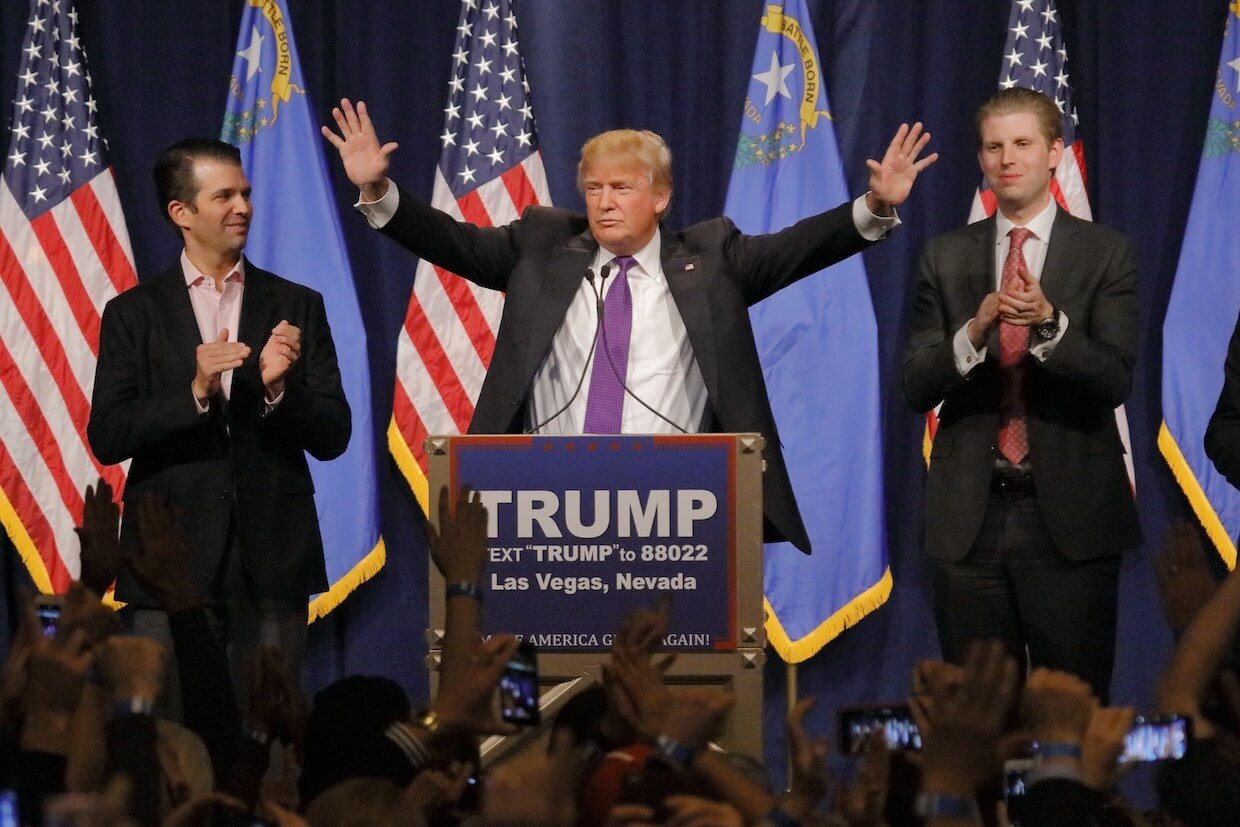
A man clasps his hands in prayer during the opening ceremonies of President Donald Trump’s “Keep America Great” rally at the Wildwoods Convention Center in Wildwood, New Jersey, on January 28, 2020. Photo by Benjamin Clapp.
You have emphasized that Evangelical Christian groups, rather than AIPAC, exert disproportionate influence on US policy toward Israel. How does this ideological alignment affect Washington’s responses to ICJ and ICC proceedings?
Aryeh Neier: Certain evangelical groups in the United States have managed to incorporate Israel and its prospects into their theology. These groups are particularly strong in the southern states, creating a powerful political bloc that is immensely supportive of Israel. A prominent figure within that bloc is Mike Huckabee, a former governor of Arkansas, whom the Trump administration has designated as its ambassador to Israel. Placing someone like that in such a key diplomatic position highlights both the strength of this bloc within the United States and the political difficulty of overcoming its influence.
You had warned that President Biden risks losing young voters over his handling of Gaza. To what extent do you see US domestic politics colliding with international humanitarian law — and could electoral considerations meaningfully shift US policy?
Aryeh Neier: There has been a generational division in the United States. Among other things, older members of the Jewish community have tended to be very supportive of Israel, whereas many younger Jews, particularly those attending universities, are often highly critical of the Israeli government’s policies. I believe this divide extends beyond the Jewish population to the broader American public. The generational gap is quite wide, but how it will ultimately play out is uncertain. It may become a significant factor in shaping US policy in the years to come, or it may not.
Refusing to Buy Israeli Weapons May Pressure Policy Change
In your work on sanctions and human rights, you have argued that targeted measures can drive behavioral change. In Gaza, which tools — such as asset freezes, travel bans, or conditionality on arms transfers — would be most effective in influencing policy without exacerbating civilian suffering? Looking at past cases such as Myanmar and South Africa, sanctions’ effectiveness often depends on timing and international coordination. What benchmarks should be used to assess whether external pressure is genuinely shaping Israel’s policy on humanitarian access?
Aryeh Neier: It’s very difficult to answer that question. I would not have imagined, before the sanctions were placed on South Africa, what would be most effective. But I think that, in the case of South Africa, for example, the international sports ban had a significant effect. South Africans, like the people of many countries, were very supportive of their athletes and eager to see them succeed in international competitions. When South African athletes were excluded from such events, it had a considerable impact. Economic sanctions also had a significant effect.
My guess is that, in the Israeli situation, the most significant kinds of sanctions would be those that impose limits on military support for Israel. Israel is itself a significant manufacturer of arms, and much of its international revenue comes from arms sales to various countries. So, I think that if sanctions were imposed, there should be two kinds: one, a sanction on the delivery of weapons to Israel, and the other, a sanction on the purchase of Israeli weapons.
I once spoke to an Israeli official about limiting the sale of certain weapons to other countries that were engaged at that time in very serious human rights abuses. He explained that, for Israel’s arms manufacturing to produce the weapons Israel believes it needs, the country must achieve economies of scale by manufacturing far more weapons than it actually requires for its own purposes. Therefore, it has to sell those weapons to other countries. Selling weapons internationally, he said, was crucial for Israel’s own military needs.
My guess is that this is probably still the case. Therefore, if sanctions involved refusing to purchase Israeli weapons, that might be as effective as refusing to sell certain weapons to Israel.
Anti-Israel Speech Shouldn’t Be Confused with Antisemitism
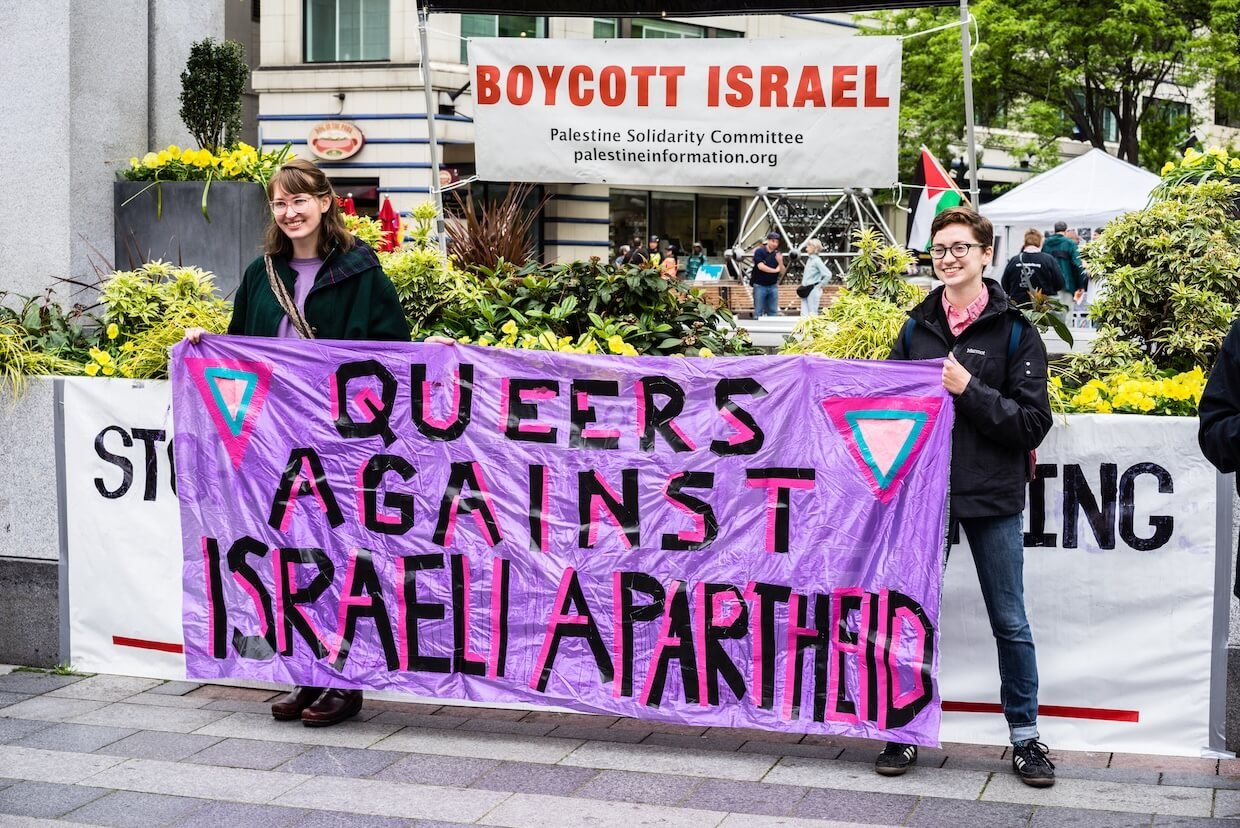
Pro-Palestinian protesters hold signs. Photo: Oliver Perez.
As someone who defended free speech in the Skokie case, how do you distinguish between antisemitism and legitimate criticism of Israeli state policies — especially in today’s polarized academic, civic, and political environments?
Aryeh Neier: Differentiating antisemitism from anti-Israel speech is something that the Trump administration has failed to do. It has attacked many universities in the United States, accusing them of allowing antisemitism to flourish on their campuses. Very often, however, the protests that have taken place on American campuses are directed against Israeli practices rather than being antisemitic in character. From a free speech standpoint, my view is that even antisemitism constitutes protected speech.
It isn’t the case, however, that many universities in the United States are public institutions where the First Amendment’s free speech guarantees apply. Many of the universities accused of allowing antisemitism on their campuses are private universities, like Harvard University and Columbia University, and they are not required to adhere to First Amendment protections. Nevertheless, in general, they do try to protect freedom of speech.
I believe they can and should protect freedom of speech, even for antisemites, but they should not allow such individuals to disrupt university activities, such as classes, graduations, or other events. So, one needs to look at each of those situations and see whether the university has acted appropriately. But the Trump administration, by confusing antisemitism and anti-Israel positions, has made the whole situation a mess.
Truth Commissions Won’t Deliver Justice in Gaza
And lastly, looking ahead, what model of transitional justice would best address violations committed by all parties — a hybrid court, ICC-led prosecutions, or a regional truth and reconciliation commission with prosecutorial powers? How can victim-centered justice remain central in the face of deep political deadlock?
Aryeh Neier: I think the only possibility of accountability is prosecutions before the International Criminal Court. I don’t imagine that there would be a Truth and Reconciliation Commission that could function effectively because it would have to involve both the Israelis and the Palestinians, and it’s very difficult to imagine that they would collaborate on a Truth and Reconciliation Commission.
Moreover, a Truth and Reconciliation Commission would not itself have prosecutorial powers. In the case of the South African Truth and Reconciliation Commission, there was legislation which provided that those who did not disclose their crimes and acknowledge their crimes still could be prosecuted. But the prosecution was separate from the Truth and Reconciliation Commission itself, and in practice, not that many persons who had committed crimes during the apartheid regime were actually prosecuted in South Africa, even when they refused to acknowledge and disclose the crimes that they committed.
So, I’m not at all inclined to think that a Truth and Reconciliation Commission could play a useful role in the situation of Gaza. I think, as difficult as it may be, one should try to see to it that the International Criminal Court is able to function with respect to the crimes committed in Gaza.
As Russia’s invasion of Ukraine reshapes Europe’s security landscape, the EU faces a “watershed moment” demanding unprecedented defense spending and strategic autonomy. The “ReArm Europe Plan” allocates €800 billion for defense modernization, while EU states’ military expenditure has already surged 30% since 2021. Yet, this security buildup comes at a profound human cost: since 2022, over 1.3 million soldiers have been killed or wounded, with tens of thousands more facing lifelong trauma. While Europe seeks to safeguard territorial integrity and independence, the article questions whether spiraling militarization undermines humanitarian priorities, deepens instability, and perpetuates cycles of suffering rather than ensuring lasting security.
Europe faces a serious threat to its territorial integrity, unprecedented since the Cold War. It is going through a “watershed moment in its security.” “Business as usual approach of underinvestment and fragmentation” is no longer viable given the Ukraine-Russia war and the American President Donald Trump’s frequent calls for the EU to take greater responsibility for its own defense.
Recent calls for increased defense spending by NATO members, predominantly including EU states, along with US Vice President J.D. Vance’s emphasis on “Europe’s threat within” at the last Munich Security Conference, signal the potential for tectonic shifts in the transatlantic relationship. It requires the EU to adopt a holistic and horizontal approach integrating defense and security dimensions of the continent. Nevertheless, questions remain regarding how far the EU can go, particularly within the milieu of historic transatlantic connections between the EU and the US, and the internal divergences concerning security within the EU member states. Since the wider debates have been taking place in this regard, the article will examine how a resurgence of traditional security concerns on the backdrop of Russia-Ukraine War, is going to affect the human cost of war.
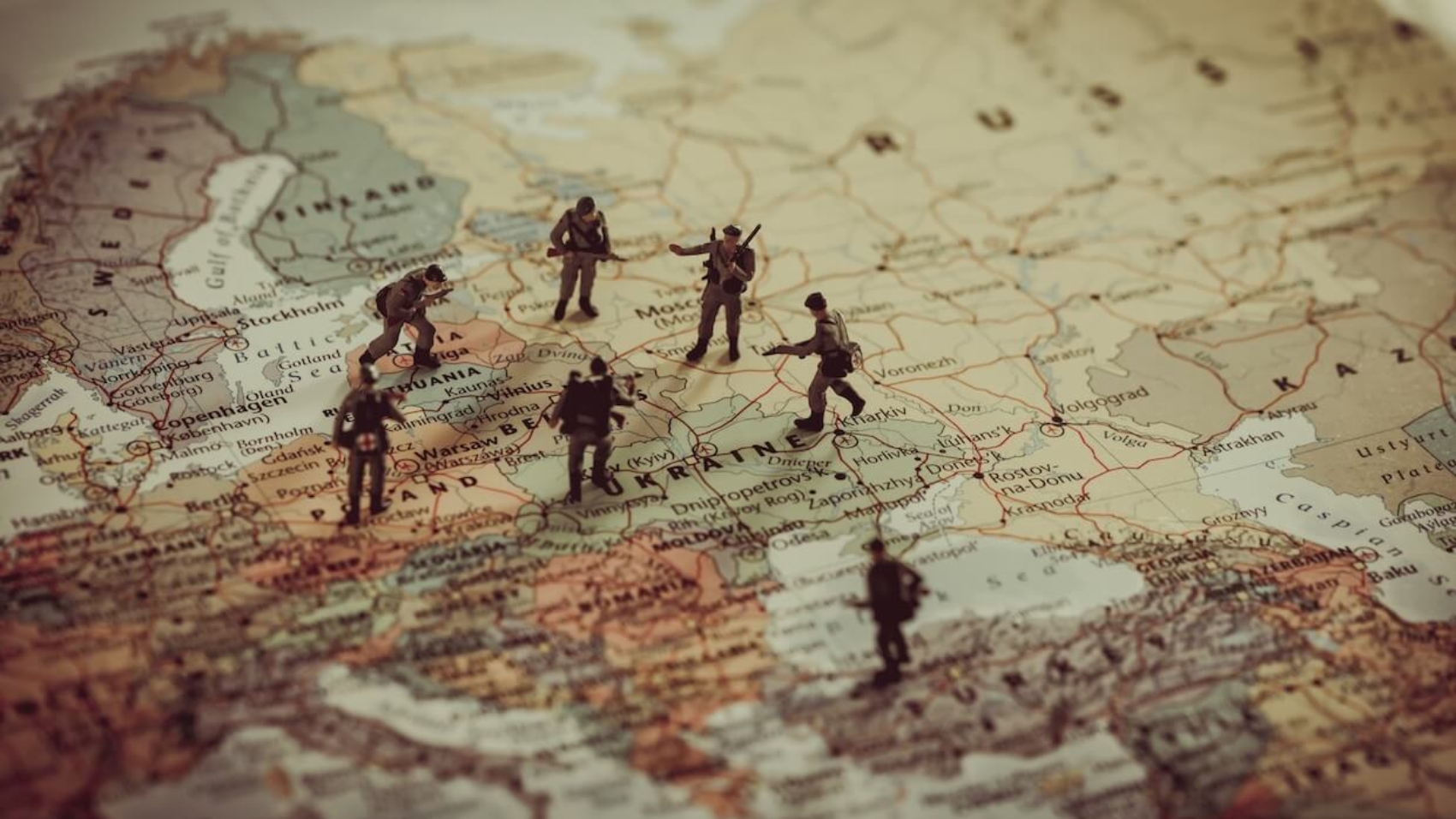
The Russian invasion of Ukraine has changed the European defense landscape since February 2022. European Commissions’ “White Paper for European Defense –Readiness 2030” proposed a vision to rearm Europe by enhancing the indigenous defense production and rapid deployment of military troops and assets across the EU. It clearly signifies the European Union’s maneuver to protect its citizens and consolidate its defense capabilities. “Readiness Plan,” also known as “ReArm Europe Plan” presented in March 2025 suggests leveraging over €800 billion in defense spending. As a matter of time, EU clearly understands the importance of strategic independence in the chaotic world.
Following the Russian invasion, EU leaders adopted the Versailles declaration pledging to enhance investment in defense sector. It aimed to boost the defense industry and gain strategic independence. Between 2021 and 2024, EU member states overall defense expenditure stood at €326 billion, marking an increase of 30%. The expenditure is expected to increase by more than €100 billion in real terms by 2027. It correlates with the defense investments too. In 2023, compared to the preceding year, defense investment increased by 17%, setting a record high of €72 billion. In 2024 alone, €102 billion was invested, in which beyond €90 billion was used for defense equipment procurement. Nevertheless, it raises questions regarding the utility of these enormous amounts in terms of enhancing the conditions of citizens, even those of soldiers engaged in deadly conflicts. Eventually, border defense and territorial integrity comes at the cost of losing lives, undermining the cost of human lives.
Throughout history, the recurring military conflicts and wars have brought devastating damage and countless destruction to both the lives and the physical environment. It is estimated that more than 37 million combatants have died in wars since 1800. If we take civilian deaths into consideration, the number of deceased will pile up. In the Second World War alone, which spread across much of the globe, 21 million soldiers died. Based on the data provided by the Uppsala Conflict Data Program (UCDP), 3.9 million people, including both civilians and combatants, have died in the armed conflicts between 1989 and 2024. Europe and America witnessed the fewest deaths, with around 370,000 and 230,000 deaths, respectively.
Parallels have been drawn comparing the casualties of the Second World War and the ongoing Russia-Ukraine war. Based on the issue brief by Center for Strategic and International Studies (CSIS), over 950,000 Russian soldiers have been killed or wounded since the war began between Russia and Ukraine. Most of these soldiers belong to Russia’s Far North, Far East, and prisons. On the Ukrainian side, a total of 400,000 have been killed or wounded, and between 60,000 and 100,000 combatants have lost their lives. The severe injuries may have taken the well-being of the remainder of their life. Defense spending with its strong emphasizes on defense production and modernization makes these lives and their relatives futile. It may hinder the post-war reconstruction, especially in addressing long-term psychological trauma. Along with that, there are apprehensions that this increased spending could waste resources and cause political instability without delivering real security for the citizens.
Overall, the resurgence of traditional security threats in Europe due to the Russia-Ukraine war is accompanied by sharply increased defense spending and military preparedness. This, however, comes with a high human cost in terms of lives lost and wounded, reminding that the price of safeguarding territorial integrity and security continues to be profound human suffering and loss. Human cost of war may hinder the post-war reconstructions. This needs to be taken into consideration in policy circles.
In sum, Europe’s renewed focus on defense and security — marked by unprecedented spending, strategic realignments, and calls for autonomy — reflects an unavoidable response to the Russia-Ukraine war and shifting transatlantic dynamics. Yet, this militarization entails profound trade-offs. While €800 billion in planned defense investments aims to safeguard territorial integrity, the staggering casualties — over 1.3 million killed or wounded since 2022 — highlight the immense human cost of security. Without balancing strategic preparedness with humanitarian priorities and post-war recovery, Europe risks undermining the very values it seeks to defend, perpetuating cycles of suffering and instability.
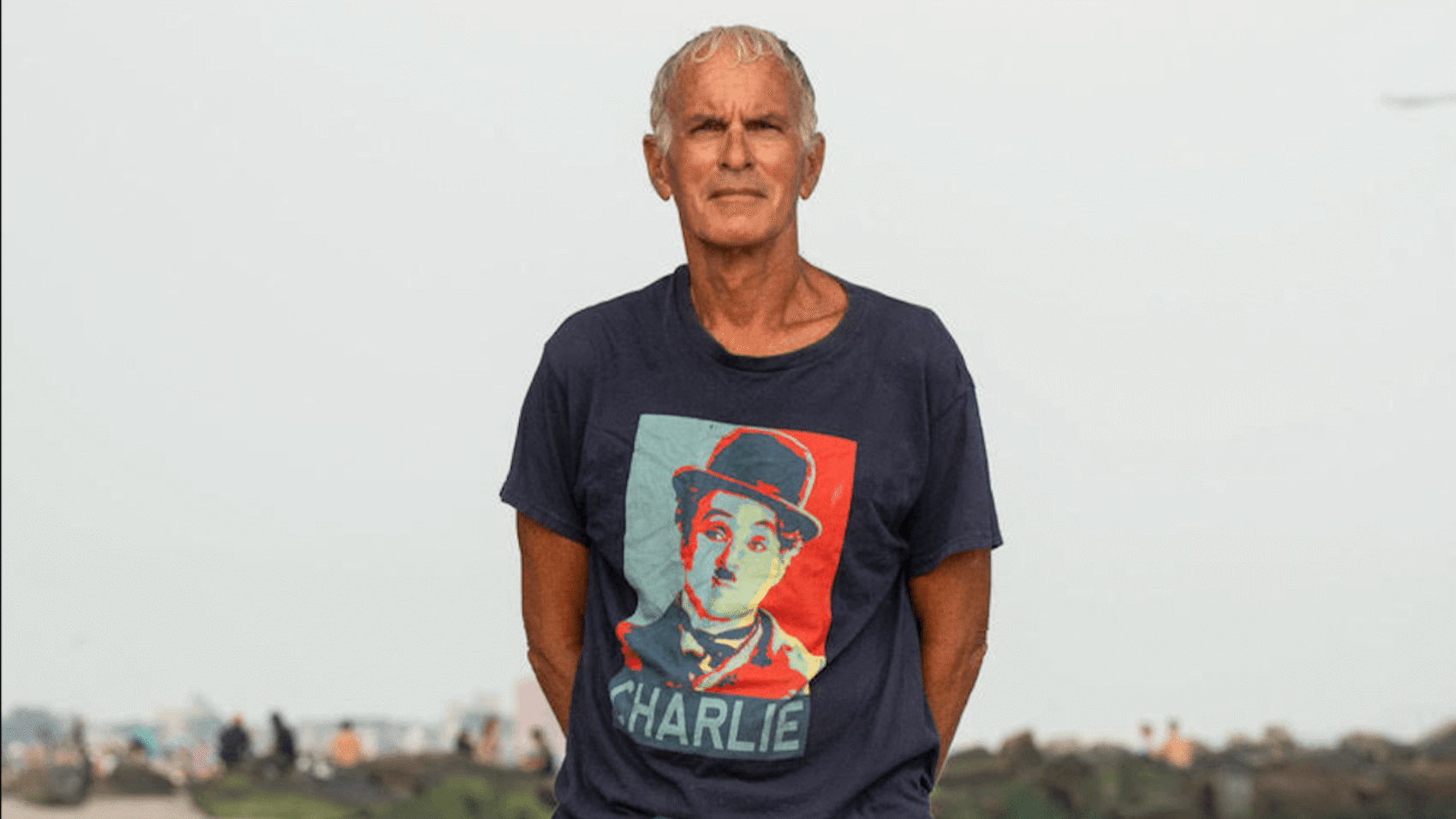
Professor Norman Finkelstein—NYC-born to Holocaust-survivor parents and, in 2020, ranked the world’s fifth most influential political scientist—tells ECPS that “Israel will mass Gazans at the border, bomb relentlessly, and force Egypt’s hand.” Professor Finkelstein forecasts pressure on Cairo amid “images broadcast worldwide,” frames today’s war as a qualitative break aimed at depopulation (“stay and starve or leave”) and argues that “an imposed famine…constitutes clear proof of genocide.” He argues that, while procedural workarounds to a US veto exist at the UN, they are politically improbable in practice; hence he looks to EU trade leverage instead—though that, too, is stalled by a ‘lack of political will.’ Downplaying doctrinal debates over Zionism, he casts Israel as a ‘Jewish supremacist state’ analogous to apartheid-era South Africa, and notes collapsing Democratic support alongside generational GOP splits.”
Giving an interview to the European Center for Populism Studies (ECPS), Professor Norman Finkelstein—born in New York City to Jewish Holocaust-survivor parents and, in 2020, named the fifth most influential political scientist in the world—states the core claim that frames this conversation: “Israel will mass Gazans at the border, bomb relentlessly, [and] force Egypt’s hand.”
The interview that follows situates Professor Finkelstein’s analysis within a stark forecast of prospective mass displacement. While he cautions that “I don’t think it’s easy to predict where this will lead,” he argues that Israel is “trying to amass the entire population of Gaza on the southern border,” after which “they will… begin bombing it relentlessly.” The intended effect, he suggests, is to compel Cairo under unbearable humanitarian pressure—“images broadcast worldwide… with desperate civilians screaming to be allowed into Egypt”—to open its frontier. Whether Egypt can resist that pressure, he adds, “I’m not sure.”
Professor Finkelstein frames the contemporary campaign as a qualitative break from earlier cycles of “mowings of the lawn.” The methods are not new, he says, but their magnitude is: destruction that once shocked humanitarian observers now approaches comprehensive urban pulverization. As to intent, he maintains that the objective is depopulation: “the people of Gaza will be given two choices—stay and starve or leave.” In his view, exterminatory violence functions as instrument as well as outcome—driven by “pure bloodlust,” by a desire to re-establish deterrence (“if the thought crosses your mind that there is a military option against us, just look at Gaza”), and by the aim to break both Gazan and international will.
On proof, Professor Finkelstein argues the evidentiary bar has already been met through rigorous humanitarian monitoring and legal dossiers. He points to a “voluminous documentary record,” including a South African memorial at the ICJ, and insists that “we’ve already reached the highest threshold of accuracy in documentation when it comes to Gaza.” For him, the decisive element is engineered deprivation: “an imposed famine—a human-made famine—constitutes clear proof of genocide.”
Institutionally, he sees impunity less in legal design than in political inertia. While acknowledging UN tools that can bypass a US Security Council veto, he judges them unlikely to be activated and locates leverage instead in Europe’s trade ties—frustrated, he says, by a “lack of political will.” In the domestic US arena, he notes collapsing Democratic grassroots support for Israel and a sharp generational split among Republicans, concluding that “it’s very difficult right now to defend Israel.”
Analytically, Professor Finkelstein downplays doctrinal debates about Zionism, preferring a structural diagnosis: Israel as a “Jewish supremacist state” enforcing regional dominance through periodic “mass death and destruction,” a pattern he analogizes to apartheid-era South Africa. Read against that backdrop, the title’s forecast is not a provocation but, in his account, a logical extension of means toward an end.
Professor Norman Finkelstein—NYC-born to Holocaust-survivor parents and, in 2020, ranked the world’s fifth most influential political scientist—tells ECPS that “Israel will mass Gazans at the border, bomb relentlessly, and force Egypt’s hand.” Professor Finkelstein forecasts pressure on Cairo amid “images broadcast worldwide,” frames today’s war as a qualitative break aimed at depopulation (“stay and starve or leave”) and argues that “an imposed famine…constitutes clear proof of genocide.” He argues that, while procedural workarounds to a US veto exist at the UN, they are politically improbable in practice; hence he looks to EU trade leverage instead—though that, too, is stalled by a ‘lack of political will.’ Downplaying doctrinal debates over Zionism, he casts Israel as a ‘Jewish supremacist state’ analogous to apartheid-era South Africa, and notes collapsing Democratic support alongside generational GOP splits.”
Giving an interview to the European Center for Populism Studies (ECPS), Professor Norman Finkelstein—born in New York City to Jewish Holocaust-survivor parents and, in 2020, named the fifth most influential political scientist in the world—states the core claim that frames this conversation: “Israel will mass Gazans at the border, bomb relentlessly, [and] force Egypt’s hand.”
The interview that follows situates Professor Finkelstein’s analysis within a stark forecast of prospective mass displacement. While he cautions that “I don’t think it’s easy to predict where this will lead,” he argues that Israel is “trying to amass the entire population of Gaza on the southern border,” after which “they will… begin bombing it relentlessly.” The intended effect, he suggests, is to compel Cairo under unbearable humanitarian pressure—“images broadcast worldwide… with desperate civilians screaming to be allowed into Egypt”—to open its frontier. Whether Egypt can resist that pressure, he adds, “I’m not sure.”
Professor Finkelstein frames the contemporary campaign as a qualitative break from earlier cycles of “mowings of the lawn.” The methods are not new, he says, but their magnitude is: destruction that once shocked humanitarian observers now approaches comprehensive urban pulverization. As to intent, he maintains that the objective is depopulation: “the people of Gaza will be given two choices—stay and starve or leave.” In his view, exterminatory violence functions as instrument as well as outcome—driven by “pure bloodlust,” by a desire to re-establish deterrence (“if the thought crosses your mind that there is a military option against us, just look at Gaza”), and by the aim to break both Gazan and international will.
On proof, Professor Finkelstein argues the evidentiary bar has already been met through rigorous humanitarian monitoring and legal dossiers. He points to a “voluminous documentary record,” including a South African memorial at the ICJ, and insists that “we’ve already reached the highest threshold of accuracy in documentation when it comes to Gaza.” For him, the decisive element is engineered deprivation: “an imposed famine—a human-made famine—constitutes clear proof of genocide.”
Institutionally, he sees impunity less in legal design than in political inertia. While acknowledging UN tools that can bypass a US Security Council veto, he judges them unlikely to be activated and locates leverage instead in Europe’s trade ties—frustrated, he says, by a “lack of political will.” In the domestic US arena, he notes collapsing Democratic grassroots support for Israel and a sharp generational split among Republicans, concluding that “it’s very difficult right now to defend Israel.”
Analytically, Professor Finkelstein downplays doctrinal debates about Zionism, preferring a structural diagnosis: Israel as a “Jewish supremacist state” enforcing regional dominance through periodic “mass death and destruction,” a pattern he analogizes to apartheid-era South Africa. Read against that backdrop, the title’s forecast is not a provocation but, in his account, a logical extension of means toward an end.
Here is the transcript of our interview with Professor Norman Finkelstein, edited lightly for readability.
Quantity Has Turned into Quality: Gaza’s Destruction Is Now a Different Phenomenon
Destruction in Shejayia, Gaza City, Gaza Strip. Photo: Dreamstime.
Professor Finkelstein, thank you very much for joining our interview series. Let me start right away with the first question: Drawing on “Gaza: An Inquest into Its Martyrdom,” how do you conceptualize Gaza today—blockade, occupation, siege, apartheid, genocide—and how do you explain Israel’s persistent impunity despite extensive documentation of International Humanitarian Law and International Human Rights Law (IHL/IHRL) violations?
Professor Norman Finkelstein: There’s an expression in English: there’s nothing new under the sun. For those who have studied the history of Gaza, in particular since 1967, it can’t be said that Israel has pioneered new methods since October 7th, 2023. What has changed—and changed very significantly—is the magnitude of the Israeli repression in Gaza. There is also another expression: at some point, quantity turns into quality. That is to say, if the magnitude of the Israeli death and destruction in Gaza has significantly increased, then qualitatively we’re talking about something new. So, even though the methods are not new, the quantity is of such an altogether different magnitude; then we’re talking about a qualitatively different phenomenon.
What does that mean in practice? Let’s take one simple comparison. During the last of Israel’s massive killing sprees in Gaza, Operation Protective Edge—that was in July–August 2014—it lasted approximately about 51 days. During Operation Protective Edge, about 18,000 homes were destroyed, and about 550 children were killed. The head of the International Committee of the Red Cross, Peter Moorer, when he toured Gaza after Operation Protective Edge, said that in his entire career he had not ever seen such a magnitude of destruction. Well, compare that with today. Then it was 18,000 homes; now the estimates are 200,000 homes destroyed. And the estimate is about 92 or more percent of all the housing in Gaza has been pulverized. Then it was 550 children; now the estimates are 20,000-plus children have been killed. So, it’s quantitatively at an altogether different magnitude, and so it’s qualitatively a different phenomenon. Now, what does that mean practically?
Practically, that means that Israel, in the past, has carried out what it calls “mowings of the lawn” in Gaza. That is to say, these are high-tech killing sprees, basically to remind the people in Gaza who is in charge. In this case, Israel. But after October 7th, the Israelis realized that they had not just a crisis, but they had an opportunity. The opportunity flowed from the crisis. The opportunity was to resolve the Gaza question once and for all. In effect, that meant implementing the final solution to the Gaza question. And the final solution to the Gaza question basically meant, one way or another, to empty out Gaza. It could be ethnic cleansing. It could be making Gaza uninhabitable, so the people of Gaza, by hook or by crook, would figure out a way to leave. Or it could also mean mass extermination.
The Israeli policy over the past two years has been a combination of those 3 things. Ethnic cleansing—that was the goal at the very beginning, to empty out the population into the northern Sinai. That didn’t work for various reasons. Then, the massive destruction of Gaza, to make it uninhabitable. What they’re doing right now in the last habitable spot of Gaza, which is Gaza City. They will reduce it to what they have reduced the north of Gaza and Rafah to; now they will do it in Gaza City, and there will be nothing left. It will just be a wasteland of rubble. In order to break the backs of the people of Gaza, in order to soften the target so that they will leave once and for all, they’re engaging in a policy of mass famine and mass extermination.
The second part of your question was: why have they been able to get away with it with impunity, despite the massive documentation? Well, during all of Israel’s previous operations, there was massive documentation. After Operation Cast Lead in 2008–9, there was the voluminous Goldstone Report, which was authored by a South African Jew who also called himself a Zionist, and it was a devastating report on what Israel had done to Gaza—just collected dust. That report was commissioned by the Human Rights Council. There was another report after Operation Protective Edge, commissioned by the Human Rights Council. It was also devastating. It also just ended up collecting dust. So, however much documentation is accumulated, turning these commissions of inquiry, or human rights documentation, into an actual implementation of a law is, as is pretty obvious at this point, not easy.
Engineered Famine Is Proof of Genocide
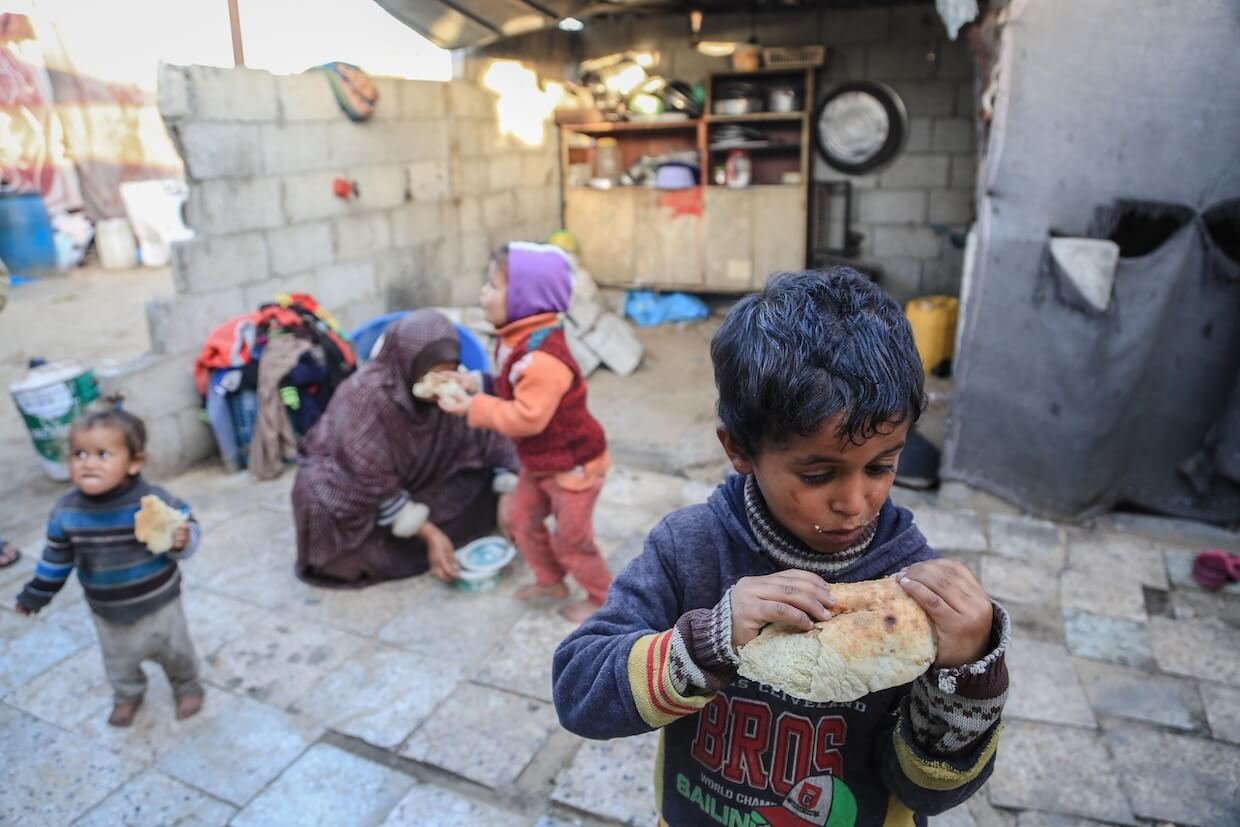
Besieged Gaza’s decades-long socio-economic collapse has tipped into famine—under what critics call genocidal Israeli policies. Photo: Mohamed Zarandah.
On the genocide claim, which probative elements (specific intent, patterns of destructive acts, official statements, engineered humanitarian deprivation) do you judge strongest or weakest, and how should advocates avoid both over- and under-pleading?
Professor Norman Finkelstein: That’s a very good question. In my view, the goal is to empty out Gaza. That, to me, is the central objective. They don’t care much where the people of Gaza end up—Tahiti, Samoa, the Solomon Islands, Nauru, Tuvalu—it makes no difference, as long as the “Gaza question” is resolved. You should bear in mind that this was also Hitler’s view. Until the late 1930s, and perhaps even into the early 1940s, the plan was to transfer Europe’s Jews out of Europe, and there were all sorts of schemes underway in different parts of the world to relocate them. That goal, however, became unviable after World War II broke out, when the seas were no longer open for free travel. It was then that they shifted to the extermination plan.
Similarly, I believe Israel’s aim is to depopulate Gaza, and one way to achieve that is by making it unlivable. As Israeli officials have repeatedly stated: the people of Gaza will be given two choices—stay and starve or leave.
Secondly, the mass extermination is a component of the plan, because there are three aspects to the mass extermination. Aspect number one is pure bloodlust. The Israelis were outraged—and that’s really a euphemism. They were enraged by what happened on October 7th and were determined to exact blood: an eye for an eye, a tooth for a tooth. Except, in the case of the Israelis, judging by what was recently said by a former senior Israeli official—I believe it was the former head of Israeli intelligence—the ratio was set far higher: for every Israeli killed, fifty Gazans must be killed. So, there was the bloodlust component. That, in significant part, explains not just the scale of the killing in Gaza but also the jubilation with which it is carried out, the fact that they broadcast it all over their social media, showing how they are wreaking death and destruction on Gaza. So, the extermination, in part, springs from bloodlust.
A second aspect of the extermination is what Israel calls restoring its deterrence capability after October 7th. The idea began circulating in parts of the Arab world: maybe there is a military option against Israel. If a ragtag guerrilla force assembled by Hamas could inflict so much damage, perhaps others could as well. Israel, therefore, felt compelled to send a message: if the thought crosses your mind that there is a military option against us, just look at Gaza. In this sense, the mass extermination was also intended to restore what Israel calls its deterrence capability—that is, the Arab world’s fear of Israel. That’s what they mean by deterrence capability.
The third aspect of the mass extermination is to break the will of the people of Gaza—and also that of the international community. While the international community speaks of ceasefires and rehabilitation, the goal of the mass extermination is to send a clear message: there will be no ceasefire, and there will be no rehabilitation. The people of Gaza must leave, and one way to convince them of that is to kill them en masse and deprive them of the basic necessities required to sustain life.
There is nothing left in Gaza now. I don’t know where people get these ideas about reconstruction. If you look at the official reports, they estimate it would take 50 years to rebuild Gaza. The place has been pulverized; there’s nothing left—it’s a vast wasteland.
So, I believe the extermination has been a means to the end of resolving the Gaza question. But even if it is a means to an end, it is still genocide. Using genocidal methods to achieve the goal of “resolving” the Gaza question does not make it any less so. The fact that extermination serves as a means, rather than an end in itself, does not negate its genocidal nature. They are employing genocidal means to achieve their objective.
The Record Is Voluminous; The Crime Is Clear
What standards of sourcing, chain-of-custody, and methodological transparency should scholars/NGOs adopt to pre-empt “disinformation” rebuttals while remaining legible to courts and broader publics?
Professor Norman Finkelstein: I don’t think, unlike others who seem to believe, that the key to gaining authoritative information about Gaza is admitting journalists. First of all, we have met much higher standards of proof than journalistic evidence. From the superfluity of human rights and humanitarian UN-affiliated organizations, they have been transmitting information on, literally, a daily basis, to prove that Gaza has crossed the threshold of famine.
There is this very subtle system of accounting by international humanitarian groups. There’s food deprivation, there’s starvation, and there’s famine — these are different degrees. In order to discern at which threshold you stand, it requires very precise information. When they came to the conclusion that about a million people in Gaza are now in famine conditions, they needed very precise accounting, because these are very rigorous, stringent organizations. They need very precise accounting to validate the claim of famine, or starvation, or extreme food deprivation.
There are so many organizations working in Gaza — Save the Children, the World Food Programme, UNICEF, UNESCO, Doctors Without Borders, UNCDA, the UN Commission on Trade and Development, the World Bank, the International Monetary Fund — all of them are on the ground. We have a voluminous documentary record.
Just to give you one example: the South African delegation to the International Court of Justice (ICJ) submitted what’s called a memorial, which is its main documentation of the genocide in Gaza. It hasn’t yet been released to the public, but you know how long it is? It’s 700 pages with 4,000 pages of documentation. There’s no dearth of documentation. Frankly, as against the organizations I’ve listed, journalistic reportage is the least reliable. These are just people who fly in and fly out. They have very little knowledge of the situation in Gaza. The journalists are highly partisan. They basically have to report what their editors want them to report when it comes to Israel and Palestine.
So, in my opinion, we’ve already reached the highest threshold of accuracy in documentation when it comes to Gaza. We don’t need any more. As you know, all the major human rights organizations have reached the same conclusion: Amnesty International has concluded that Israel is committing genocide in Gaza; Human Rights Watch has concluded that Israel is committing genocidal acts in Gaza; and the Israeli Information Center for Human Rights in the Occupied Territories, B’Tselem, has likewise concluded that Israel is committing genocide in Gaza.
The overwhelming majority of recognized experts on genocide agree as well. In a recent poll of an organization with about 500 scholars specializing in genocide studies, 28% responded, and of those, 86% stated that Israel is committing genocide in Gaza.
So, I don’t think the problem at this point is documentation. I believe that an imposed famine — a human-made famine — constitutes clear proof of genocide.
Mass at Rafah, Bomb Relentlessly, Force Egypt’s Hand
How do you assess the likelihood, modalities, and timelines of large-scale displacement from Gaza to Egypt (or beyond)? Which regional veto players (Egypt, Hezbollah, Gulf states) most credibly deter or enable such outcomes, and why?
Professor Norman Finkelstein: I don’t think it’s easy to predict where this will lead. Israel is trying to amass the entire population of Gaza on the southern border. At some point, President Trump has given them the green light, but he’s also signaled that they need to get this job done quickly, as pressure on the US is steadily increasing. My guess—and I must emphasize that I have no military knowledge whatsoever—is that they will gather as many people as possible at the southern border and then begin bombing it relentlessly.
The resulting pressure will inevitably fall on Egypt: you have to let them in. Because nobody is stopping Israel. How Egypt will respond to that remains an open question. There will be images broadcast worldwide of Israel relentlessly bombing two million people, with desperate civilians screaming to be allowed into Egypt. Whether Egypt will be able to resist that pressure, I’m not sure.
Not Law but Will Is the Chokepoint
United Nations Headquarters in New York, USA. Photo: Diego Grandi.
Which institutional pathways—US Security Council shielding, lawfare, diplomatic narrative management—most decisively sustain Israeli impunity, and where are the most realistic chokepoints for pressure?
Professor Norman Finkelstein: The US has been an obstacle, but it’s not entirely accurate to call it an insurmountable one. There are various UN mechanisms for bypassing the US veto in the Security Council, including what’s known as the “United for Peace” option in the General Assembly. I won’t go into the technical details, as they’re not particularly relevant, since it’s unlikely to happen.
Secondly, the Europeans can exert significant influence. Europe—not the US—is Israel’s main trading partner, through the EU. They have many potential avenues of leverage. The issue, however, is not institutional or bureaucratic obstructionism. The real problem is a lack of political will.
What could be done now? I don’t believe much can be done. I don’t like to be the bearer of bad news. On the other hand, I believe in treating adults like adults: if we’re at an impasse, we’re at an impasse. If people were willing to escalate their resistance, then I do believe there are options.
For example, there are possibilities to shut down the Israeli terminals at major airports if you can amass enough people willing to go there and be arrested. I think many people would be willing to get arrested. The problem, however, is organizational—I don’t want to use big words, but it really comes down to organizational vision.
There are potential avenues. For instance, there was an announcement by the dock workers in Genoa—they’re sending over a flotilla to Gaza. If the Israelis attack that flotilla, there will be a price to pay in terms of commerce on the seas. Whether that’s just talk or whether there’s an action plan behind it, I don’t know.
There are things that can be done, but they require both will and organization.
Corruption and Coercion Shape the Annex
The entrance sign of the International Criminal Court (ICC) at its headquarters in The Hague, Netherlands, on February 14, 2018. Photo: Robert Paul Van Beets.
You’ve criticized UN handling of conflict-related sexual violence. What does the Annex controversy (Israel/Hamas) reveal about the political economy of UN norm-setting, evidentiary thresholds, and great-power leverage?
Professor Norman Finkelstein: The UN, as anybody who works in it will tell you, is a profoundly corrupt organization. On the other hand, it does a lot of good things, and you have to balance both those factors. I think there’s a lot of corruption in the UN and affiliated bodies like the ICC.
I’ve just completed a new book called Gaza’s Gravediggers: An Inquiry into Corruption in High Places, which speaks to specific individuals and specific events where, in my opinion, individuals are either being bribed or blackmailed by Israel.
I mentioned earlier in this conversation the Goldstone Report. The Goldstone Report was a devastating indictment of Israel’s conduct during Operation Cast Lead. Within a few months of its issuance, Goldstone retracted the report, and in my opinion, he retracted it because he was blackmailed. If you read the record, as I have, there’s no other explanation.
The former chief prosecutor of the International Criminal Court, Fatou Bensouda, was responsible for handling the case of the Mavi Marmara, a flotilla of ships that went to Gaza on May 31, 2010, which came under attack by Israel, resulting in 10 passengers killed. There is no question in my mind that she was blackmailed into giving Israel a pass.
The former president of the ICJ, Joan Donoghue, was an American. As you know, in January 2024, the ICJ, the main legal arm of the United Nations, found that Israel was plausibly committing genocide. In April 2024, Joan Donoghue appeared on a BBC program called HardTalk and blatantly lied, claiming that the ICJ did not find Israel was plausibly committing genocide. It was the most flagrant, outrageous lie.
The current vice president of the ICJ, Judge Julia Sebutinde, is clearly a fanatic—I believe she’s a Christian evangelical fanatic—but beyond that, it’s my opinion that she is either being bribed or blackmailed by Israel and has been delivering outrageous dissents in ICJ jurisprudence. In my forthcoming book, I have a 100-page chapter documenting her lies and dissents.
And then there’s the most recent case. Without going into detail, which can’t be done over a broadcast, there is no evidence—in the traditional sense of evidence: medical, forensic, or digital—that Hamas weaponized rape on October 7th. There is none. They admit it. There isn’t an issue there. There is no digital evidence of rape. There is no medical-legal evidence of rape. The only thing there is consists of so-called “witnesses.” That’s it.
Whereas on the other side, there is voluminous evidence that Israel is committing rape, threatening rape of men, threatening rape of women, and engaging in massive sexual violence.
In the face of that, every year the UN puts out a report on sexual violence in conflict situations called Conflict-Related Sexual Violence (CRSV). There was a lot of pressure put on Guterres, the Secretary-General, to list Hamas in the appendix to the report as a perpetrator of sexual violence and to exclude Israel. That’s what Guterres did: he listed Hamas and excluded Israel. That was another blackmail.
Israel Acts As a Jewish Supremacist State, Not a Zionist One
Billboard reading “The Looting Government,” part of a protest campaign against the conservative coalition’s policies in Ra’anana, Israel, May 2023. Photo: Rene Van Den Berg
Does contemporary Zionism now shape Israeli military doctrine in Gaza toward openly eliminationist aims, marking a shift from settler-colonial control to population destruction, ethnic cleansing, or permanent incapacitation?
Professor Norman Finkelstein: I don’t think that’s true. I don’t believe it has much to do with Zionism. I wrote my doctoral dissertation on Zionism, so I can claim a certain amount of expertise on the subject. This has little to do with Zionism. Israel is a Jewish supremacist state, and it is acting in a way not unlike apartheid-era South Africa.
Remember, South Africa, beyond its system of white supremacy, was engaged in a series of neighboring colonial wars with Mozambique and Angola. The South Africans killed around a million people during the 1970s and 1980s in the course of the anti-colonial wars along South Africa’s borders and, of course, in Namibia as well. They waged a colonial war against SWAPO, the Southwest African People’s Organization, and it resulted in a massive bloodletting. Literally, I believe it was more than a million people. You can check and correct me if I’m wrong.
That’s Israel. Israel is a Jewish supremacist state determined to maintain a Jewish supremacist state within its borders and to crush any resistance on its periphery. It’s similar to what South Africa did. But in South Africa, there was Mozambique, where FRELIMO, led by Samora Machel, was in power. Machel was probably assassinated by the South Africans; it’s not known for sure, but he was killed in a plane crash. Then there was FRELIMO in Mozambique and, in Angola, the MPLA—the Popular Movement for the Liberation of Angola.
In the same way that South Africa fought to preserve its regional dominance, Israel faces Hezbollah, Iran, and Syria on its periphery and has periodically carried out mass death and destruction to maintain its regional hegemony. Like South Africa, Israel has committed similar kinds of massacres to uphold what I would describe as a system of Jewish supremacy and regional dominance.
This has something to do with Zionism, but not as much as some might think. Zionism’s goal was to create a Jewish state, just as South Africa’s white nationalists sought to create a white state. However, invoking ideologies like Zionism can confuse the reality of the current situation, especially for people who haven’t, like myself, spent several years studying every detail of Zionism to write a dissertation.
If you frame it more plainly—as a Jewish supremacist state determined to maintain a population that is more or less purely Jewish while preserving its hegemony and dominance in the region, much like apartheid-era South Africa—the picture becomes much clearer.
Democrats Support Israel in Single Digits; GOP Split by Age
And lastly, Professor Finkelstein, how do right-wing and liberal US populisms intersect to normalize Gaza’s suffering—e.g., via identity-based mobilization, security mythologies, and the bipartisan “fortress democracy” frame?
Professor Norman Finkelstein: The Democratic Party, at its base, is composed of people belonging to minorities and those who are generally liberal in their persuasions. These two constituencies are not going to support a genocide in Gaza. Right now, support for Israel within the Democratic Party may already be in the single digits—I believe it’s around 9%—and it has dropped drastically.
In the Republican Party, support for Israel has also declined significantly among younger Republicans, but among older Republicans, particularly supporters of Trump, it remains considerably high.
I think it’s very difficult right now to defend Israel. To do so, you’d have to come across as either a psychopath or a moron; otherwise, it’s impossible to defend.
Please cite as: ECPS Staff. (2025). “Virtual Workshop Series — Session 1: The Rise of Populist Authoritarianism around the World.” European Center for Populism Studies (ECPS). September 6, 2025. https://doi.org/10.55271/rp00113
The ECPS, in collaboration with Oxford University, launched its Virtual Workshop Series on “The Rise of Populist Authoritarianism around the World” on September 4, 2025. Spanning 16 sessions through April 2026, the series examines how populist strategies reshape democracy across diverse contexts. Chaired by Professor Oscar Mazzoleni, the opening session featured Professor David Sanders’ keynote on six structural drivers fueling populism and its growing threats to liberal democracy. Case studies explored populist dynamics in the US, India, Greece, Thailand, and Argentina, highlighting intersections of dynasties, corporate power, elite cues, and economic crises. Discussant Dr. João Ferreira Dias emphasized three takeaways: populism as performance, polarization over persuasion, and the enduring impact of national political cultures.
Reported by ECPS Staff
The European Center for Populism Studies (ECPS), in collaboration with Oxford University, inaugurated its Virtual Workshop Series with the opening session, “The Rise of Populist Authoritarianism around the World,” held on Thursday, September 4, 2025. Spanning 16 sessions from September 2025 to April 2026, the programme brings together leading scholars to examine the contested meanings of “the people” and their pivotal role in shaping the trajectory of democracy across diverse political, cultural, and institutional settings. Designed as a continuation of the successful three-day in-person conference at St. Cross College, Oxford University (July 1–3, 2025) — “‘We, the People’ and the Future of Democracy: Interdisciplinary Approaches,”— the series deepens and extends those debates, fostering comparative, cross-disciplinary dialogue on democratic backsliding, resilience, and transformation in a rapidly shifting global landscape.
Opening on behalf of ECPS, Stella Schade outlined the series’ comparative and cross-disciplinary ambition: to move beyond regional silos and examine how populist projects travel, adapt, and entrench themselves within distinct political and media ecologies.
Chaired by Professor Oscar Mazzoleni (University of Lausanne), a leading authority on populism and party systems, the session framed populist authoritarianism not as a single doctrine but as a repertoire of strategies—discursive, organizational, and institutional—deployed under diverse conditions.
Professor David Sanders (University of Essex, Emeritus) set the analytical agenda with a wide-ranging keynote that argued populism poses greater risks to liberal democracy today than in earlier cycles, owing to transnational diffusion of tactics and the erosion of shared standards of truth. He identified six structural drivers—declining left–right anchors, post-truth dynamics, politicized immigration, identity fragmentation, globalization’s discontents, and norm subversion through strategic learning—and outlined five fronts for democratic response, from inclusive immigration policy and rebalanced rights discourse to retooled economic governance, renewed state capacity, and robust platform regulation.
The panel that followed translated these themes into concrete case studies. Dr. Dinesh Sharma and Shoshana Baraschi-Ehrlich (Fordham University) traced the entanglement of family dynasties, corporate finance, and “outsider” populist narratives in India and the United States, highlighting the paradox whereby leaders mobilize anti-elite sentiment while constructing elite power networks of their own.
Professor Gregory W. Streich and Dr. Michael Makara (University of Central Missouri) examined how elite cues and out-group framing shape opinion formation, showing that populist endorsements polarize more than they persuade and exert greatest influence on low-salience issues where prior beliefs are weak.
Professor Akis Kalaitzidis (University of Central Missouri) offered a comparative analysis of Thailand, Argentina, Greece, and the United States to argue that economic dislocations catalyze distinct populist trajectories, each filtered through national political cultures and institutional constraints.
Professor Elizabeth Kosmetatou (University of Illinois Springfield), in joint work with Kalaitzidis, revisited the Papandreou era to illuminate how charismatic leadership, clientelism, and European integration jointly reconfigured Greece’s political economy, leaving a durable imprint on state capacity and party competition.
Serving as discussant, Dr. João Ferreira Dias synthesized the contributions around three cross-cutting claims: populism functions as performance more than program; polarization, not persuasion, is its primary mass effect; and national political cultures mediate how populist styles are institutionalized. His commentary linked micro-level mechanics (elite cues, media incentives) to macro-level outcomes (executive aggrandizement, clientelist normalization), underscoring the session’s central lesson: understanding populist authoritarianism requires attention to both the technologies of mobilization and the structures that enable their entrenchment.
As the series unfolds, ECPS and its partners will continue to probe these dynamics comparatively, asking not only how democracies backslide, but also how they can be renewed.
Prof. Oscar Mazzoleni, Prof. David J. Sanders, Dr. Dinesh Sharma, Shoshana Baraschi-Ehrlich, Assoc. Prof. Dr. Michael Makara, Prof. Gregory W. Streich, Prof. Akis Kalaitzidis, Prof. Elizabeth Kosmetatou, and Dr. João Ferreira Dias are seen on the workshop’s Zoom screen.
Introductory Speech by Professor David J. Sanders: From Post-Truth to Power—Risks and Remedies
The session began with a keynote intervention by Professor David Sanders(Regius Professor of Political Science, University of Essex, Emeritus), a renowned scholar of political behavior and public opinion. Framing the discussion for the subsequent panel presentations, Professor Sanders delivered a wide-ranging and analytically rich lecture on the global rise of populist authoritarianism, examining its causes, dangers, and potential counterstrategies. Speaking in an urgent yet measured tone, Professor Sanders argued that populism has always posed risks to democratic stability, but it is “more dangerous now than ever before.” He attributed this heightened threat to the increasing transnational interconnectedness of populist actors, who share strategies, rhetoric, and institutional models across borders, accelerating the erosion of democratic norms. His lecture was structured around three central questions: Why has support for populism grown so dramatically? Why is populism especially dangerous for contemporary democracies? What can be done to contain its advance?
Explaining the Rise of Populism: Six Structural Drivers
Professor Sanders identified six interrelated drivers behind the global surge of populism, focusing primarily on Europe and North America but emphasizing broader international patterns.
The Decline of Left-Right Political Anchors: Professor Sanders argued that traditional left-right ideological cleavages have eroded, especially since the collapse of Soviet communism in 1990. With voters less able to situate themselves within stable ideological frameworks, political affiliations have become fluid, creating fertile ground for populist appeals. “Without these anchors,” Professor Sanders noted, “voters are far more susceptible to movements promising simple answers to complex problems.”
The Rise of Post-Truth Politics: The fragmentation of epistemic authority has, in Professor Sanders’ view, created a “post-truth environment” where empirical evidence is devalued and “multiple truths” proliferate. This shift, exacerbated by social media platforms, has empowered “liars, conspiracists, and fantasists” while weakening evidence-based policymaking. Populists thrive in this environment by framing facts as opinions and dismissing scientific consensus as “elitist bias.”
Immigration and Political Avoidance: ProfessorSanders highlighted immigration as a critical yet mishandled political issue in Western democracies. For decades, mainstream parties feared being perceived as illiberal, leading to a reluctance to engage substantively with public concerns. Populists, by contrast, capitalize on voter frustrations, using immigration narratives to construct “us vs. them” dichotomies and mobilize distrust toward elites.
Identity Fragmentation and Social Cohesion: The digital era has amplified group-based identity politics, reducing the sense of common national belonging. As shared civic identities weaken, Professor Sanders warned, populists exploit social fragmentation, scapegoating out-groups and deepening polarization.
Globalization and Economic Discontent: Populism has also gained traction from the failures of mainstream economic discourse to address the negative externalities of globalization. While global integration benefited elites, many communities experienced declining living standards and job precarity. Populists seize on these grievances, positioning themselves as defenders of “ordinary people” against globalist elites.
Norm Subversion and Strategic Learning: Finally, Professor Sanders underscored the willingness of populist leaders to bend or break constitutional norms, often learning from one another across contexts. He cited Donald Trump’s attempts to undermine US democratic institutions and Boris Johnson’s efforts to sidestep parliamentary constraints, framing these as part of a “global playbook of democratic erosion.”
Why Populism Is Uniquely Dangerous Today
Professor Sanders then turned to the three main dangers posed by contemporary populism:
Erosion of Social Cohesion: By demonizing minorities, populists heighten intergroup conflict and weaken the foundations of inclusive citizenship.
Authoritarian Drift: Populist leaders often centralize power, eroding judicial independence and institutional checks, leading to counterproductive repression against dissent.
Policy Failure and Disillusionment: Populists typically offer simplistic solutions to complex problems. When these fail, public disillusionment deepens, further undermining confidence in democratic governance.
“Populists,” Professor Sanders warned, “rarely solve the problems they promise to address, but they succeed in leaving democracies weaker than they found them.”
Countering Populist Authoritarianism: Five Strategic Priorities
In the final part of his lecture, Professor Sanders outlined five strategic pathways for safeguarding democratic resilience:
Addressing Immigration Through Inclusive Policy: Mainstream parties must reclaim the immigration debate with evidence-based, humane policies that both uphold human rights and ensure adequate state support for newcomers. Failing to do so, Professor Sanders cautioned, “hands the narrative to populists by default.”
Reframing Human Rights Discourses: Professor Sanders advocated a shift from purely individualistic frameworks toward a balance that also emphasizes collective and community rights, countering populist narratives that depict liberal values as detached from social realities.
Reforming Globalization and Economic Governance: To undercut populist grievances, governments should restructure trade and investment rules to prioritize domestic employment and social protections, using multilateral cooperation rather than unilateral disruption.
Restoring Trust in State Capacity: Democracies, Professor Sanders argued, must “talk up the role of the state” in solving collective problems — from infrastructure and education to social security and environmental resilience — demonstrating the state’s relevance to everyday wellbeing.
Regulating Social Media and Combating Disinformation: Finally, Professor Sanders called for draconian reforms to social media governance, including penalties for platforms that facilitate misinformation. Without systemic regulation, he warned, populists will continue to weaponize digital ecosystems to bypass accountability.
Conclusion: A Call for Interdisciplinary Action
Professor Sanders closed by emphasizing the urgency of collective scholarly engagement. Combating populist authoritarianism, he argued, requires interdisciplinary collaboration across political science, sociology, communication studies, and law. The ECPS Virtual Workshop Series, he noted, offers an ideal platform to generate context-specific solutions, enabling comparative insights into how different democracies resist or succumb to populist pressures.“Populism,” Professor Sanders concluded, “is not merely a passing disruption but an existential challenge. Our intellectual and civic responsibility is to confront it directly — with evidence, clarity, and democratic resolve.”
Donald Trump delivers a victory speech after his big win in the Nevada caucus at Treasure Island Hotel & Casino, flanked by his sons Eric (right) and Donald Jr. (left) in Las Vegas, NV. Photo: oe Sohm.
Dr. Dinesh Sharma and Ms. Shoshana Baraschi-Ehrlich: “The Rise of Populist Authoritarianism in India and the US: Do Family Dynasties and Big Businesses Really Control Democracy?”
The session featured a joint presentation by Dr. Dinesh Sharma and Shoshana Baraschi-Ehrlich (Fordham University, NYC), of a work done with contributions from Britt Romagna, Ms. Ayako Kiyota, and Amartya Sharma. Their talk, titled “The Rise of Populist Authoritarianism in India and the US: Do Family Dynasties and Big Businesses Really Control Democracy?” examined the interplay between political dynasties, corporate power, and populist narratives in shaping democratic governance across two of the world’s largest democracies.
Drawing on material from Dr. Sharma’s forthcoming book The Orphan Paradox (Bloomsbury, forthcoming), the presentation explored the historical weight of inherited political capital, the growing influence of corporate financing, and the paradoxical rise of populist “outsiders” who simultaneously mobilize anti-elite sentiment while forging their own elite power structures.
Dynastic Politics and Democratic Capture
Dr. Sharma began by situating India and the United States within a comparative framework, emphasizing both convergences and divergences in their democratic trajectories. In India, dynastic politics remains deeply entrenched. Since independence, the Nehru-Gandhi family has dominated national electoral politics, holding power for more than half of the country’s post-1950 history. Beyond the national level, numerous regional dynasties — such as the Yadav family in Uttar Pradesh, the Thackerays in Maharashtra, and the DMK in Tamil Nadu — wield significant influence over state and local politics, shaping party structures and patronage networks.
In the United States, Dr. Sharma noted, dynastic influence has historically been less centralized but nonetheless persistent. Families like the Kennedys, Roosevelts, Bushes, Clintons, and, more recently, the Trumps, have leveraged name recognition, financial networks, and inherited legitimacy to secure enduring political influence. While American political culture celebrates self-made leaders, Dr. Sharma observed that brand recognition and elite networks remain powerful assets in electoral politics.
Corporate Power, Campaign Financing, and Policy Capture
A key theme of the presentation concerned the growing role of big business and corporate lobbying in shaping democratic outcomes. Dr. Sharma highlighted the landmark US Supreme Court ruling Citizens United v. FEC (2010), which effectively removed limits on corporate spending in political campaigns, institutionalizing the dominance of corporate financing. In India, similar trends emerged under the now-invalidated electoral bond scheme, which allowed opaque funding streams that disproportionately benefited ruling parties backed by large corporations.
According to Dr. Sharma, these developments represent a global convergence in which wealthy donors, multinational corporations, and media conglomerates exert outsized influence on electoral agendas, policy priorities, and political narratives. Media ownership — from the Ambani empire in India to the Murdoch network across the US, UK, and Australia — amplifies populist messaging, channels public anger, and fosters resentment toward elites while simultaneously serving elite interests.
The Populist Outsider Paradox
Perhaps the most striking insight in Dr. Sharma’s presentation concerned what he termed the “orphan paradox”: the tendency of voters to support leaders who position themselves as political outsiders or underdogs, even when they later consolidate their own elite power bases.
In India, Narendra Modi has long fashioned his public image as a “self-made son of the soil,” rising from modest beginnings outside the Nehru-Gandhi establishment to challenge entrenched dynastic power. In the United States, figures like Donald Trump similarly leveraged outsider narratives — despite being deeply embedded within elite business and political networks.
Dr. Sharma argued that this paradox reveals a deep tension in democratic psychology: voters oscillate between skepticism toward entrenched elites and admiration for disruptive figures who claim authenticity and independence from the system. Yet, as Dr. Sharma noted, many of these “outsiders” eventually replicate the same patterns of institutional capture they campaign against.
Resistance, Institutions, and the Future of Democracy
While dynasties and corporations exert significant influence, Dr. Sharma emphasized that democratic capture is not inevitable. Countervailing forces — from civil society movements and grassroots protests to independent courts, election commissions, and free media — remain critical in constraining elite dominance. Historical examples such as India’s anti-corruption mobilizations and the US civil rights movement demonstrate that organized citizen activism can challenge concentrated power, though sustaining such momentum remains difficult.
Dr. Sharma concluded by underscoring the fragility of democratic institutions in both contexts. In India, the Supreme Court and Election Commission face mounting pressures, while in the United States, corporate lobbying, partisan polarization, and media fragmentation undermine public trust. Populist leaders like Modi and Trump amplify this institutional strain, mobilizing resentment against “elites” while consolidating their own networks of influence.
A Psychodynamic Drama of Rivalry, Mourning, and Repetition
In her contribution, Ms. Shoshana Baraschi-Ehrlich (Fordham University) offered a distinctive literary-theoretical and psychoanalytic perspective on political succession, exploring how leadership transitions in authoritarian and revolutionary contexts can be interpreted through Freud’s Oedipus complex and trauma theory. Her analysis framed political power as a psychodynamic drama marked by rivalry, mourning, and repetition.
Ms. Baraschi-Ehrlich argued that succession crises often involve a form of symbolic “patricide,” where the paternal figure — whether a dynastic leader, revolutionary founder, or state authority — must be displaced or replaced. Yet paradoxically, successors frequently reproduce the very structures they sought to dismantle, perpetuating cycles of control. Drawing on trauma theory, particularly the work of Cathy Caruth and Dominick LaCapra, she explained that unresolved historical wounds resurface belatedly and repetitively, shaping patterns of political instability and repression.
Her analysis was grounded in three illustrative cases. First, revolutionary movements — such as the Cuban Revolution — often enact an Oedipal rupture against paternal authority, only to reconstruct new patriarchal orders, as seen under Castro. Second, in North Korea, dynastic succession is framed as filial devotion, yet marked by anxiety over legitimacy and loss, with citizens participating in rituals of mourning that sustain authority. Third, leaders like Lenin and Mao cultivated images of rupture while demanding absolute loyalty, embodying the ambivalence of rejecting and replicating paternal power.
Contrastingly, Ms. Baraschi-Ehrlich highlighted that democratic systems can mitigate these dynamics, enabling peaceful transitions that transform rivalry into continuity rather than trauma. Concluding, she underscored that political authority is haunted by unresolved loss — revolutions often reproduce the structures they oppose, dynasties rely on filial rituals, and democracies, at their best, offer pathways to healing through institutional stability.
Conclusion
Dr. Dinesh Sharma and Shoshana Baraschi-Ehrlich’s presentation offered a multifaceted exploration of the forces reshaping democratic governance in India and the United States, highlighting the intertwined roles of political dynasties, corporate power, and populist narratives. Sharma demonstrated how inherited political capital and opaque corporate financing create structural advantages that enable elites to shape policy agendas and electoral dynamics, even as populist leaders mobilize resentment against these very systems. Yet, as he underscored, the “outsider” paradox reveals a deeper democratic tension: figures like Narendra Modi and Donald Trump ascend by presenting themselves as authentic disruptors, but frequently replicate the same networks of influence they claim to oppose.
Baraschi-Ehrlich’s psychoanalytic lens added a distinct theoretical depth, framing leadership transitions as a “psychodynamic drama” marked by rivalry, mourning, and repetition. By invoking Freud’s Oedipus complex and trauma theory, she illuminated how unresolved historical wounds shape cycles of rebellion and restoration, particularly within authoritarian and revolutionary contexts. Her comparative insights revealed why revolutions often reproduce hierarchical structures and why dynasties rely on rituals of loyalty to sustain authority, contrasting these patterns with democracy’s potential to transform rivalry into institutional continuity.
Together, their analysis situates the rise of populist authoritarianism within a broader global challenge: resisting elite capture while navigating voter ambivalence toward power, authenticity, and belonging. The question, they concluded, is whether democratic institutions and civic movements can still provide pathways to resilience in an era where populism both contests and consolidates authority.
Donald Trump’s supporters wearing “In God We Trump” shirts at a rally in Bojangles’ Coliseum in Charlotte, North Carolina, on March 2, 2020. Photo: Jeffrey Edwards.
Professor Gregory W. Streich and Dr. Michael Makara: “Out-Groups, Elite Cues, and Populist Persuasion: How Populists Shape Public Opinion”
In their joint presentation, Professors Gregory W. Streich(Professor of Political Science and Chair of the School of Social Sciences and Languages, University of Central Missouri) andDr. Michael Makara (Associate Professor of Comparative Politics and International Relations, University of Central Missouri) explored the mechanisms through which populist leaders influence public opinion, focusing on the interaction between elite cues, perceptions of out-groups, and the salience of policy issues. Their research, presented under the title “Out-groups and Elite Cues: How Populists Shape Public Opinion,” forms part of a broader project examining how voters reconcile competing influences when forming political attitudes, especially in the context of Donald Trump’s presidency.
Competing Theories of Public Opinion Formation
Professor Streich started presentation by framing the research within two dominant theories of opinion formation:
Social Attributes Theory — Individuals’ policy preferences are shaped by their demographic identity and attitudes toward specific groups. For example, support or opposition to immigration policy often depends on whether voters perceive certain ethnic, religious, or socio-economic groups as beneficiaries or threats.
Elite Cues Theory — Also called the “follow-the-leader effect,” this perspective argues that voters align their policy preferences with cues from political leaders or parties they trust. When elites endorse a policy, their supporters are more likely to back it, even when it contradicts long-standing ideological positions.
The research seeks to understand what happens when these forces pull voters in opposite directions. Do citizens defer to elite endorsements, or do their social identities dominate? This question becomes especially salient under populist leadership, where leaders like Donald Trump often adopt positions that diverge sharply from traditional party orthodoxy.
Populism, Partisan Realignment, and Donald Trump’s Role
Professor Streich highlighted Trump’s ability to reorient Republican priorities, often in ways that defy the party’s historical platforms. For example:
Trade Policy: Trump’s tariffs represented a stark departure from Republican free-trade orthodoxy.
Immigration: Whereas Ronald Reagan framed America as a “shining city on a hill” and signed limited amnesty measures in 1986, Trump’s rhetoric emphasized exclusion and restriction.
According to Professor Streich, Trump’s deviations highlight his populist strategy: positioning himself as the authentic voice of “the people” against “corrupt elites,” while simultaneously forging new ideological coalitions. The study aimed to test empirically how persuasive this strategy has been across different issues.
High-Salience vs. Low-Salience Issues
Dr. Michael Makara expanded on the theoretical framework by introducing the concept of issue salience — the degree to which voters already hold well-formed, emotionally charged opinions on a topic.
High-Salience Issues — Highly visible, polarizing debates such as immigration evoke strong ideological divides.
Low-Salience Issues — Less publicly debated policies, such as trade, generate weaker prior attitudes and are thus more open to elite influence.
Their central hypothesis predicted that elite cues — in this case, endorsements by Donald Trump — would exert greater influence on low-salience issues (e.g., trade) than on high-salience issues (e.g., immigration), where voters’ views are already entrenched.
Research Design and Methodology
The researchers conducted a national survey in September 2025, using two factorial experiments. Respondents read short policy vignettes describing fictional immigration and trade proposals and were randomly assigned different conditions:
Endorsement Cues: Some were told Donald Trump supported the policy, while others received no elite cue or were told it was backed by generic officials.
Framing Effects: In the immigration vignette, immigrants were alternately described as “illegal aliens” or “undocumented immigrants” to test whether language influenced responses.
Respondents indicated whether they supported or opposed each policy. Logistic regression analyses measured the interaction between ideology, Trump’s endorsement, and issue salience.
Key Findings
Strong Elite Cues Effect
Trump’s endorsement significantly shaped conservative opinion across both policy areas:
Immigration Policy: Conservatives informed that Trump supported a proposal were four times more likely to support it compared to those receiving no cue.
Trade Policy: Trump’s endorsement similarly increased conservative support, demonstrating the persuasive power of elite cues even when policies contradict traditional Republican priorities.
Elite Cues and Polarization
While Trump mobilized conservatives, his endorsements also intensified liberal opposition. In both vignettes, liberals exposed to Trump’s support were significantly less likely to back the policy.
Salience Moderates Influence
Consistent with the authors’ hypothesis, elite cues proved more influential on low-salience issues like trade: On immigration, voters’ pre-existing ideological commitments dominated, limiting Trump’s persuasive reach. On trade, where voters lacked strong priors, Trump’s endorsement created substantial opinion shifts.
The Role of Information Gaps
Dr. Makara emphasized that voters with limited knowledge about trade policy were especially susceptible to elite influence. This finding suggests that populists thrive in policy domains where uncertainty is high and narratives can be shaped more freely.
Implications for Populist Mobilization
The study highlights how populist leaders leverage elite cues and out-group framing to reshape political landscapes:
Redefining Party Orthodoxy — By combining contradictory policy stances, populists like Trump create hybrid ideological platforms that mobilize cross-cutting constituencies.
Targeting Out-Groups — Populists amplify fears around immigration and cultural threats, using emotionally charged narratives to reinforce group identity and deepen divides.
Exploiting Low-Salience Issues — Populists strategically mobilize opinion on less familiar policy domains where facts are contested, and leaders’ cues carry disproportionate weight.
Future Directions
Professor Streich and Dr. Makara noted several areas for ongoing research:
Cross-Leader Comparisons: Testing whether similar elite cue effects emerge when policies are endorsed by other figures, such as Joe Biden or state-level leaders.
Media Ecosystems: Examining how different information sources shape susceptibility to elite cues.
Out-Group Framing: Integrating more detailed measures of identity-based threat perceptions.
Conclusion
Professor Streich and Dr. Makara’s findings illuminate the psychological and informational mechanisms through which populist leaders mobilize public opinion. While elite cues strongly shape attitudes, their influence is conditional: populists are most persuasive when voters lack strong priors, allowing leaders to frame issues and define narratives unchallenged.
In high-salience contexts, such as immigration, polarization constrains persuasion, reinforcing existing divides rather than shifting positions. By contrast, in low-salience policy domains like trade, populists wield significant power to shape voter attitudes and reconfigure partisan alignments.
The broader implication is sobering: populist influence thrives where knowledge gaps are greatest and where leaders exploit identity-based divisions alongside uncertainty. As the authors concluded, understanding these dynamics is critical for explaining not only Trump’s continued hold over Republican politics but also the global rise of populist-authoritarian movements.
Fans wave flags during Alexis Tsipras’s final public speech before the elections in Athens, Greece on September 18, 2015: Photo: Vassilis Anastasiou.
Professor Akis Kalaitzidis: “From Economic to Political Catastrophe: Four Case Studies in Populism”
In his insightful presentation, Professor Akis Kalaitzidis, a political scientist from the University of Central Missouri, analyzed how economic crises in Thailand, Argentina, Greece, and the United States catalyzed the rise of distinct forms of populism. Drawing on comparative analysis, he argued that financial dislocations—from collapsing currencies to sovereign debt defaults—create fertile ground for populist movements, but the resulting forms of populism diverge significantly depending on cultural values, institutional structures, and historical trajectories.
Professor Kalaitzidis’s central thesis is that economic catastrophe often triggers political catastrophe, dismantling established political orders and reshaping governance models. Across the four cases, populist leaders capitalized on social grievances, deploying a mixture of policy populism, rhetorical populism, organizational strategies, charismatic leadership styles, and media mobilization techniques. Yet, despite their contextual differences, these cases reveal a common pattern: populism thrives by framing “the people” against entrenched elites while promising rapid relief to the most vulnerable sectors of society.
Thailand: Rural Populism and the Thaksin Model
Professor Kalaitzidis began with Thailand, which he described as the most challenging case due to language barriers and limited direct research. Following the 1997 Asian financial crisis and the collapse of the baht, Thaksin Shinawatra, a billionaire businessman, rose to power by forging a coalition between rural farmers and urban working classes.
Thaksin’s policy populism centered on concrete economic benefits: Universal healthcare via a symbolic “30 baht” ($1) hospital fee, direct cash transfers of one million baht per rural village, and debt relief for farmers, enabling significant poverty alleviation. His rhetorical populism framed the struggle as “rural masses versus Bangkok elites,” positioning himself as the defender of marginalized communities against urban dominance. Institutionally, he created the Thai Rak Thai Party, a personal political vehicle, consolidating control through charismatic CEO-style leadership and media dominance.
Despite repeated military coups and Thaksin’s exile, his political network remains influential. As Professor Kalaitzidis noted, “the populist version of the Thai Rak Thai Party continues unabated,” reflecting the enduring power of rural-based populism in Thailand.
Argentina: Kirchnerism and Anti-IMF Populism
In Argentina, the 2001 economic collapse—marked by sovereign default and skyrocketing unemployment—triggered another form of populism. Néstor Kirchner and, later, Cristina Fernández de Kirchner led Kirchnerismo, a political project combining expansive welfare policies with defiant anti-IMF rhetoric. Their policy populism included: Increased social spending on pensions and welfare, subsidies for energy and public transportation, and aggressive debt renegotiations with international creditors.
Cristina Fernández de Kirchner’s leadership style was symbolically confrontational, presenting herself as the “defender of Argentina against foreign exploitation.” Professor Kalaitzidis highlighted a revealing interview with her former economics minister, who told him directly: “Don’t believe the IMF—they’re lying.”
Media strategy further amplified their narrative: while state-controlled outlets promoted Kirchnerism, opponents were framed as neoliberal agents undermining Argentine sovereignty. Even as Argentina later elected Javier Milei, an exclusionary populist, Kirchnerism remains deeply entrenched, reflecting the enduring centrality of anti-IMF populism in Argentina’s political identity.
Greece: Syriza and the Anti-Austerity Movement
Professor Kalaitzidis next turned to Greece, where the 2008 global financial crisis and EU-imposed austerity created fertile ground for Syriza’s left-wing populism. Led by Alexis Tsipras, Syriza built a broad anti-austerity coalition of pensioners, students, and social movements demanding relief from EU-imposed fiscal constraints. Key policy populism measures included: Promising debt relief and pension restoration, halting privatizations mandated by the “Troika” (IMF, EU, and ECB), and holding a national referendum on whether Greece should remain in the Eurozone.
Tsipras cultivated an anti-establishment image, symbolized by his refusal to wear a tie, signaling resistance to EU norms and domestic elites. His rhetorical populism framed the conflict as “Greeks versus the Troika,” appealing to national sovereignty amid external economic pressures.
However, Syriza’s eventual concessions to EU demands fractured its base and weakened its populist momentum. Today, Greece hosts a fragmented populist landscape, where multiple exclusionary and inclusionary movements—from the far left to the far right—compete for influence, illustrating populism’s institutional diffusion even after Syriza’s decline.
United States: Trumpism and Permanent Campaign Politics
The final case focused on the United States, where Donald Trump’s presidency (2017–2021) redefined populism in a highly polarized democracy. Professor Kalaitzidis characterized Trumpism as a right-wing, exclusionary populism rooted in white working-class, rural, and disaffected conservative constituencies. Trump’s policy populism emphasized: Tax cuts and deregulation, protectionist tariffs under “America First” trade policy, and restrictive immigration measures framed as defending “real Americans.”
His rhetorical populism weaponized the narrative of “real Americans versus corrupt Washington elites,” encapsulated in the slogan “Drain the Swamp.” Meanwhile, his organizational strategy involved capturing the Republican Party via the MAGA movement, transforming it from Reagan-era conservatism into a personalist political vehicle.
Trump leveraged social media mastery to bypass traditional gatekeepers, embracing a “permanent campaign” style based on real-time polling, online mobilization, and conspiratorial counter-narratives. Professor Kalaitzidis stressed that Trumpism’s influence extends beyond Trump himself, reshaping electoral rules, redistricting strategies, and policymaking for the foreseeable future.
Populism’s Legacy: Structural Shifts and Unresolved Tensions
Professor Kalaitzidis concluded by emphasizing that populism is not merely rhetorical performance but a structural response to globalization’s disruptions. In all four cases, populists emerged as mediators between national sovereignty and global economic pressures, but their methods and outcomes diverged: In Thailand, rural-based populism survives despite elite pushback; in Argentina, populism remains central to political identity, whether inclusive or exclusionary; in Greece, Syriza’s decline fragmented but did not extinguish populist forces; in the United States, Trumpism has permanently reshaped party politics and electoral norms.
Yet, across these contexts, populism’s strategies—mobilizing “the people,” rejecting establishment elites, and exploiting economic dislocation—share a common DNA. As Professor Kalaitzidis observed, “Economic crises highlight the tensions between national democracy and global markets, and populism thrives in this gap.”
Greek postage stamp depicting Andreas G. Papandreou, circa 1997. Photo: Sergei Nezhinskii.
Proefessor Elizabeth Kosmetatou:“Populism, Clientelism, and the Greek State under Papandreou”
In her detailed and engaging presentation, Professor Elizabeth Kosmetatou(Professor of History, University of Illinois Springfield) examined the political trajectory, leadership style, and enduring legacy of Andreas Papandreou — one of Greece’s most charismatic yet polarizing leaders. Drawing from archival research, declassified CIA documents, and historical accounts, she explored how Papandreou’s populism and clientelist practices reshaped Greek politics during his premierships (1981–1989, 1993–1996) and left a lasting imprint on Greece’s democratic institutions, political culture, and economic trajectory.
Professor Kosmetatou framed Papandreou as a transformative yet controversial figure, whose governance combined populist mobilization with entrenched patronage networks. His leadership marked a critical juncture in Greece’s modern history, defined by democratization after the fall of the junta, accession to the European Economic Community (EEC), and struggles over modernization and European integration. Yet, she argued, Papandreou’s blend of charismatic authority, populist narratives, and systemic clientelism simultaneously empowered marginalized groups while deepening structural vulnerabilities that still shape Greek politics today.
Early Life, Political Formation, and Exile
Born in 1919 into a prominent political family, Andreas Papandreou was the son of George Papandreou, one of Greece’s most influential liberal statesmen, nicknamed “the Old Man of Democracy.” Despite growing up under his father’s towering shadow, Andreas forged his own path, first as a Harvard-trained economist and later as a professor at elite US universities including Minnesota, Northwestern, and Berkeley, where he chaired the economics department.
Papandreou’s early political experiences were shaped by Greece’s turbulent mid-20th century history: authoritarianism under Metaxas (1936–1941), the Greek Civil War (1946–1949), and the deep polarization between left and right. Arrested in 1939 for links to a Trotskyist group, he fled to the US and reinvented himself academically before returning to Greece in 1963 to enter politics under his father’s Center Union Party.
By the mid-1960s, Papandreou had already cultivated an image as a radical reformer within the establishment. However, the 1967 military coup disrupted his rise: he was arrested, imprisoned, and later exiled to Sweden and Canada. It was during this exile that he founded PASOK (Panhellenic Socialist Movement) in 1974, marking a decisive ideological break from his father’s centrist tradition. Six years later, in the 1981 elections, PASOK surged from 13% to 48% of the vote — an unprecedented transformation in Greek political history.
Charismatic Leadership and Populist Narrative
Professor Kosmetatou emphasized Papandreou’s mastery of charismatic authority, placing him within the Weberian framework of “extraordinary leaders” who derive legitimacy not from institutions but from personal magnetism. His style combined academic intellect with performative populism, making him both an elite economist and a fiery nationalist orator.
His political discourse blended anti-elitism, social justice, and sovereignty. Papandreou portrayed Greece as a “dependent country” shackled by foreign powers, casting “the people” against corrupt domestic elites and imperialist outsiders — first the United States (blamed for supporting the junta and mishandling Cyprus) and later Germany (associated with austerity and economic conditionality).
One of Papandreou’s slogans, “Η Ελλάδα στους Έλληνες” (“Greece belongs to the Greeks”), became emblematic of his populist framing. He called for “change” (αλλαγή), promising to restore national dignity, expand welfare protections, and empower ordinary citizens. His rallies drew hundreds of thousands — sometimes over a million attendees — turning politics into mass performance. His speeches, delivered in simple, emotive language infused with slang, created a sense of collective ownership over history, epitomized by PASOK’s iconic slogan: “Ραντεβού με την Ιστορία” (“Appointment with History”).
Professor Kosmetatou argued that Papandreou’s charisma and mobilization techniques placed him within a global tradition of populist leadership, comparable to Perón in Argentina, Chávez in Venezuela, or Narendra Modi in India. However, his brand of populism was distinctly Greek, rooted in historical grievances, cultural narratives, and the lingering trauma of civil conflict.
Clientelism, Patronage, and Institutional Transformation
A central theme of the presentation was Papandreou’s use of clientelism — the exchange of public resources for political loyalty — as both a tool of governance and a mechanism of populist inclusion.
Papandreou’s governments expanded the public sector dramatically, appointing thousands of loyalists to state jobs, often bypassing competitive exams. Subsidies, pensions, and direct resource allocations were distributed along patronage networks spanning unions, rural constituencies, and marginalized groups historically excluded from power.
While this empowered underrepresented communities, Professor Kosmetatou stressed, it also entrenched dependence on the state and weakened institutional autonomy. Ministries became politicized, bureaucratic turnover soared, and policymaking increasingly relied on informal personal networks rather than transparent procedures. Papandreou frequently handpicked ministers and dismissed them abruptly — most famously firing Deputy Foreign Minister Asimakis Fotilas in 1982 for diverging from his directives at a European Community meeting.
Over time, clientelist governance blurred into systemic corruption. Major scandals, such as the Koskotas affair, implicated senior officials and eroded public trust. By normalizing patronage, Papandreou reshaped Greek political culture: all major parties adopted similar practices, embedding clientelism as a defining feature of the Greek state well beyond his premiership.
Economic Policy, European Integration, and Fiscal Vulnerability
Professor Kosmetatou situated Papandreou’s populism within Greece’s shifting economic and European context. After joining the European Economic Community in 1981, Greece received massive inflows of EU structural funds with minimal oversight. Papandreou used these resources to expand welfare spending, subsidize key sectors, and support clientelist distribution — while maintaining low taxation levels. Public debt, however, escalated sharply: In 1981, debt was 23% of GDP, by 1991, it had risen to 71%, and by 2002, when Greece entered the Eurozone, it stood at 117%.
Professor Kosmetatou highlighted how populist fiscal policies, combined with persistent trade deficits and weak administrative controls, laid the groundwork for Greece’s 2010 sovereign debt crisis. Declassified CIA reports from the 1980s had already warned of structural vulnerabilities, citing unsustainable populist spending and limited regulatory oversight.
Despite his anti-European rhetoric, Papandreou pragmatically kept Greece within the EEC and NATO, using nationalist themes to negotiate aid and favorable military balances, especially vis-à-vis Turkey. This dual strategy — radical discourse paired with pragmatic diplomacy — epitomized Papandreou’s political adaptability.
Reforms and Contradictions
Papandreou’s governments were not solely defined by patronage and debt; they also enacted significant social reforms that reshaped Greek society: Establishing a National Health Service to expand hospital access; liberalizing family law, strengthening women’s rights in marriage and divorce; introducing student participation in university governance, transforming academic culture; and officially recognizing the Greek Resistance during the German occupation, granting symbolic justice to excluded generations. Yet these reforms coexisted with instability and scandals. Between 1981 and 1989, his cabinets reshuffled 13 times, reflecting the fragility of decision-making within an intensely personalized political system.
Professor Kosmetatou argued that Papandreou’s contradictory legacy—progressive reforms alongside deepened clientelism and fiscal imbalances—continues to shape Greece’s governance and economic trajectory today.
Legacy and Polarization
Nearly three decades after his death in 1996, Papandreou remains one of Greece’s most polarizing figures. To admirers, he was the liberator who brought αλλαγή (“change”), consolidated democracy after the junta, and gave voice to marginalized groups. To critics, he was the architect of systemic corruption, unsustainable debt, and institutional decay.
Nevertheless, Professor Kosmetatou stressed, Papandreou’s mastery of populist charisma fundamentally transformed Greek political culture. His ability to mobilize mass enthusiasm, personalize governance, and redefine national identity created a template for subsequent Greek leaders, including Alexis Tsipras of Syriza, who consciously modeled aspects of his style on Papandreou’s performative populism.
PASOK’s decline after Papandreou’s death underscores the personalized nature of his power. Without his leadership, the party fragmented, highlighting the structural risks of politics built on charismatic authority rather than institutional strength.
Conclusion
Professor Kosmetatou concluded that Andreas Papandreou’s legacy embodies the paradox of populism: it can simultaneously democratize and destabilize. Through charisma, clientelism, and mass mobilization, Papandreou transformed Greek politics, empowered excluded constituencies, and reoriented the nation’s relationship with Europe and the global order. Yet, his fiscal policies, personalized governance, and embedded patronage systems created enduring vulnerabilities — economic, institutional, and cultural — that continue to shape Greece’s trajectory well into the 21st century.
Papandreou’s story illustrates a broader lesson about populism’s dual edge: while it can energize democratic participation, it often weakens institutional capacity, leaving states exposed to future crises. As Professor Kosmetatou concluded, understanding Papandreou’s era is essential not only to explaining Greece’s recent past but also to grappling with the long-term consequences of charismatic populism in contemporary democracies.
BJP supporters celebrate Narendra Modi’s victory during the 2019 assembly elections in Bhopal, India. Photo: Dreamstime.
Discussant Dr. João Ferreira Dias: Is Populism Offspring of Crisis—or Accelerant?
Dr. João Ferreira Dias offered a brisk, conceptually grounded set of remarks that stitched the panel’s papers into a broader argument about what populism is and how it works. He opened by defining populism less as a doctrine than as a discourse and performance that can be grafted onto multiple ideologies. In his view, it thrives amid social and political polarization and is frequently entangled with ethno-nationalism, his own area of research. Populist drama, he suggested, often promises a kind of psychological or spiritual renewal for the nation.
On Dynasties, Big Business, and Outsider Rhetoric
Responding to the first paper, Dr. Dias praised the conceptual pairings—“orphans,” “patricians,” and “entrenched elites”—as analytically fertile. The “orphan” posture lets leaders claim proximity to “the people,” while elite lineage can be reframed as stability, experience, and success. He urged the authors to sharpen the paradox of Trump and Modi: both channel anti-elite narratives while forging tactical alliances with powerful political and economic actors (e.g., tech and corporate lobbies). Historically, dynasties are part of the democratic “furniture”; what is new, he argued, is the coincidencia oppositorum—the coupling of oligarchic networks, family power, and anti-establishment populism—that uses national drama to claim, and then consolidate, power.
On Out-groups and Elite Cues
Turning to the second paper, Dr. Dias underscored the centrality of in-group/out-group framing in populist strategy, noting how leaders in the US and Europe defend a supposed “biocultural identity” against migrants and minorities. He welcomed the distinction between “follow-the-leader” (elite cues) and “social attributes” effects, but argued they often operate together. Drawing on Portugal, he described how André Ventura is portrayed as a “weather vane,” echoing bottom-up talk from taxis, taverns, and social media, even as top-down moral panics about migration are manufactured by elites and amplified by media competition for audience share. He found the study’s results striking: Trump’s cues polarize rather than persuade—conservatives rally, liberals recoil—implying that the real mechanism is mobilization and polarization, not cross-cutting persuasion. A qualitative agenda, he added, should test whether “follow-the-leader” is the DNA of MAGA, a coordinated reaction to social change, economic anxiety, and migration pressures that Trump effectively orchestrated.
On Economic Crisis and Divergent Populisms
Addressing the comparative paper on Thailand, Argentina, Greece, and the US, Dr. Dias lauded its robust design, showing how economic dislocation yields different populist species: military intervention in Thailand, Kirchnerismo in Argentina, left-nationalist forms in Greece, and Trumpism in the US. He suggested extending the arc to Milei’s libertarian populism in Argentina, which flips the economic script (anti-state, radical market) while retaining the populist grammar of “the people” vs. “the caste.” Populism, he argued, is reshaped by successive crises rather than produced once and for all. Likewise, the post-2008 surge of Europe’s radical left often subsided as party systems re-sorted (he cited Portugal’s sharp contraction from a 19-seat bloc to a single deputy). He floated Brazilian parallels (Collor’s campaigning among the “shirtless” and urban poor) to show how stylistic outreach can reposition populist appeals. The larger theoretical question he posed: Does populism require economic crisis, or do crises simply accelerate latent cultural and socioeconomic grievances that populists voice and mobilize?
On Papandreou: Charisma, Clientelism, and Executive Populism
Dr. Dias called the historical reconstruction excellent and asked whether charisma mainly legitimized clientelism or constituted an independent source of appeal. He proposed reading Andreas Papandreou as an instance of “cabinet” or “executive” populism: not merely oppositional rhetoric, but a mode of governing—concentrating power, distributing state resources, and embedding patronage. Comparing Portugal, he noted how the Socialist Party lost voters amid perceptions of clientelism and corruption, illustrating how left populisms that once represented “the people” can later cede ground to the right. His key questions for Greece were pointed: To what extent did Papandreou strengthen democracy while simultaneously entrenching clientelist practices? And how did European integration and EU funds help mask or magnify the paradox of populism plus clientelism?
Cross-cutting themes and closing provocations. Across the papers, Dr. Dias returned to three through-lines:
Performance over program: Populism is stylistic and strategic, injected into left, right, or libertarian projects as needed.
Polarization over persuasion: Elite cues rarely convert opponents; they harden camps and energize bases.
National political cultures matter: Populism travels, but local institutions, histories, and media ecosystems shape its form, targets, and durability.
He encouraged further work on media logics (how competition and virality make charismatic leaders “fashionable”), on the feedback loop between grassroots talk and elite cue-setting, and on the institutional afterlives of populist governance—especially where clientelist distribution becomes routine statecraft. His final challenge to the panel distilled his critique: Is populism the offspring of crisis, or the accelerant that turns smoldering cleavages into open fire?
Overall Conclusion
Session 1 underscored a clear, sobering consensus: populist authoritarianism is less a fixed ideology than a flexible toolkit that exploits uncertainty, identity conflict, and institutional weakness. Across cases—from India and the US to Greece, Thailand, and Argentina—speakers showed how leaders fuse outsider performances with insider alliances (dynasties, corporate finance), mobilize elite cues to polarize rather than persuade, and convert economic shocks into durable political change. Professor Sanders’ structural diagnosis (eroded left–right anchors, post-truth dynamics, migration politics, identity fragmentation, globalization’s losers, and strategic norm-bending) aligned with panel evidence that national political cultures filter these pressures into distinct, yet rhyming, trajectories.
The session also pointed toward remedies. Reclaiming immigration with humane, evidence-based policy; rebalancing rights discourse to include community goods; rewiring globalization to protect social contracts; rebuilding state capacity; and enforcing platform accountability emerged as mutually reinforcing priorities. Methodologically, participants called for comparative, mixed-methods research that links micro-level opinion formation and media incentives to macro-level patterns of executive aggrandizement and clientelist governance.
As the series proceeds, ECPS will move from diagnosis to design: testing what institutional guardrails, civic coalitions, and communicative strategies actually bend polarization downward and restore democratic problem-solving. The challenge is long-term, but the session showed a path—empirical, interdisciplinary, and resolutely comparative.
In a wide-ranging ECPS interview, Ben-Gurion University scholar Halleli Pinson argues that Israel’s Gaza policy is intertwined with an illiberal turn at home. “The polarization we saw before October 7 around judicial reform,” she notes, “is now translated into how people understand the war and the hostages,” adding that “the continuation of the war serves this broader agenda… to reconstruct the Israeli regime into an illiberal one.”Dr. Pinson details how curricula sideline liberal democracy while NGOs and academics face a shrinking space for dissent. Media framings and social media echo chambers deepen an “epistemic polarization.” Though anti-war discourse is growing, she warns that animosities are hardening: “It may take a generation to shift the discourse toward a more liberal, mainstream orientation.”
The ongoing Gaza war has not only reshaped regional geopolitics but has also profoundly transformed Israel’s political culture, educational discourse, and democratic institutions. In this exclusive interview with the European Center for Populism Studies (ECPS), Associate Professor Halleli Pinson, a political sociologist of education at Ben-Gurion University of the Negev, provides a compelling analysis of the interplay between right-wing populism, illiberalism, and knowledge production in Israel, revealing how the conflict intersects with broader ideological projects.
At the heart of her argument lies a critical assessment of the government’s use of the war to advance structural political changes. As Dr. Pinson observes, “The polarization that we experienced in the year and a half before October 7th around the judicial reform is, in a sense, translated into how people understand the government’s policy regarding the war and the hostages.” She highlights a direct link between the government’s attacks on democratic institutions — such as the Supreme Court and the Attorney General — and its broader populist strategy: “The continuation of the war serves this broader agenda, attempting, in a way, to reconstruct the Israeli regime into an illiberal one.”
For Dr. Pinson, this illiberal turn is deeply embedded in Israel’s educational and discursive transformation. Over the past decade and a half, she argues, populist discourse has profoundly reshaped curricula, civic education, and public understanding of democracy. Discussions of liberal values, multiculturalism, and human rights are increasingly sidelined, while “illiberal democratic models” are emphasized. As she explains, Israel is being redefined “as primarily Jewish first and democratic only when it aligns with that identity,” a shift that has normalized the erasure of the Green Line and reframed settlements as integral parts of Israel.
The interview also delves into the shrinking space for dissent in both schools and universities. NGOs like Breaking the Silence and other human rights groups are excluded from classrooms, while academics face growing pressures under proposed legislation that would allow universities to dismiss professors “accused of supporting terrorism” — a definition so vague, Dr. Pinson warns, that “saying that there is starvation in Gaza or standing with photographs of children who lost their lives could be considered as support for terrorism.”
Finally, Dr. Pinson reflects on Israel’s fractured society and the growing epistemic polarization intensified by the war. While public criticism of the government has increased, she is concerned about entrenched animosities: “The level of hatred being cultivated between camps is deeply concerning… I’m not very optimistic, and I believe it’s going to take a generation to shift the discourse toward a more liberal, mainstream orientation.”
This conversation offers an essential lens for understanding how the Gaza war intersects with Israel’s democratic backsliding, populist rhetoric, and societal divides.
In this incisive conversation, Brookings scholar Professor William A. Galston argues that America’s decentralized system remains a crucial brake on executive overreach. While warning of real risks, he maintains, “We’re not there yet,” distinguishing the US from harder cases of institutional capture abroad. Professor Galston spotlights federalism and the courts as the decisive arena of resistance—urging institutions to defend their prerogatives through litigation, “not street protests but the law.” He assesses the influence of Project 2025, redistricting fights in Texas/California, and the politics of immigration, crime, and DEI, noting potential backlash among centrist voters. The result is a clear-eyed appraisal of democratic resilience—and the legal contests that will shape whether the US moves toward or away from competitive authoritarianism.
Giving an in-depth interview to the European Center for Populism Studies (ECPS),Professor William A. Galston — senior fellow and the Ezra K. Zilkha Chair in the Governance Studies program at Brookings Institution and a leading authority on American governance, populism, and institutional resilience — provides a comprehensive analysis of the evolving dynamics of US democracy under President Donald Trump’s second administration. Drawing on his deep expertise in political institutions and constitutional law, Professor Galston examines how federalism, legal contestation, and civil society remain central to safeguarding checks and balances amid mounting executive centralization.
As the title emphasizes, “US. Federalism Slows the Shift Toward Competitive Authoritarianism,” Professor Galston underscores that America’s decentralized political structure continues to serve as a buffer against executive overreach. He stresses that, despite concerns about democratic backsliding, the US is not yet on par with countries such as Hungary, Turkey, or India, where institutional capture has been far more extensive. “We’re not there yet,” Professor Galston explains, “and I am hopeful that we’ll never get there.”
A recurring theme throughout the interview is the growing role of law as the principal arena of political struggle. Professor Galston argues that the resilience of US democracy increasingly depends on institutions defending their legal prerogatives: “Pushing back, using not street protests but the law, will be the most important venue of contestation.”
This dynamic is vividly illustrated in his discussion of a recent legal battle involving Harvard University, which challenged the Trump administration’s attempt to withhold federal research funds. A federal judge sided with the university, ruling that the administration’s actions were unconstitutional. For Professor Galston, this episode demonstrates that institutions “with the will to defend their legal rights can push back — and push back effectively.”
The interview also delves into the strategic influence of Project 2025 and the Heritage Foundation in shaping Trump’s second-term agenda. Professor Galston notes that the initiative has successfully translated its ideas into both institutional frameworks and personnel appointments, allowing the administration to pursue expansive interpretations of executive authority while testing the limits of constitutional constraints.
Additionally, Professor Galston examines redistricting battles, such as those in Texas and California, highlighting how federalism enables both parties to counterbalance each other’s maneuvers, thereby slowing the concentration of power at the national level.
Finally, Galston reflects on the broader trajectory of US democracy, warning that the coming years will be decisive in determining whether constitutional norms can withstand mounting pressures. Yet he remains cautiously optimistic, noting that state governments, universities, professional associations, and civil society are “waking up” to the importance of defending democratic principles.
This interview offers a nuanced, scholarly perspective on the complex interplay between institutional resilience and executive ambition, providing crucial insights into America’s democratic future.