In anticipation of the upcoming 2024 European Elections, let’s take a closer look at the political landscape of Europe. The rise of populism has steadily gained momentum since the 2014 elections. The 2019 European Elections demonstrated the sustained growth of populism, which is associated with Euroscepticism. How will this trend influence the 2024 elections? This analysis explores the implications of populism for the 2024 elections within the broader context of Euroscepticism, the COVID-19 pandemic, and migration pressures. It will argue that Euroscepticism is linked to reactionary emotional responses to global challenges and changes. The psychological drivers of populism, such as fear, anger, and mistrust, have influenced the political climate, exacerbated by social media. The article underscores the need for EU member states to address these issues and strive for political consensus to foster trust in democratic institutions and counter the populist wave.
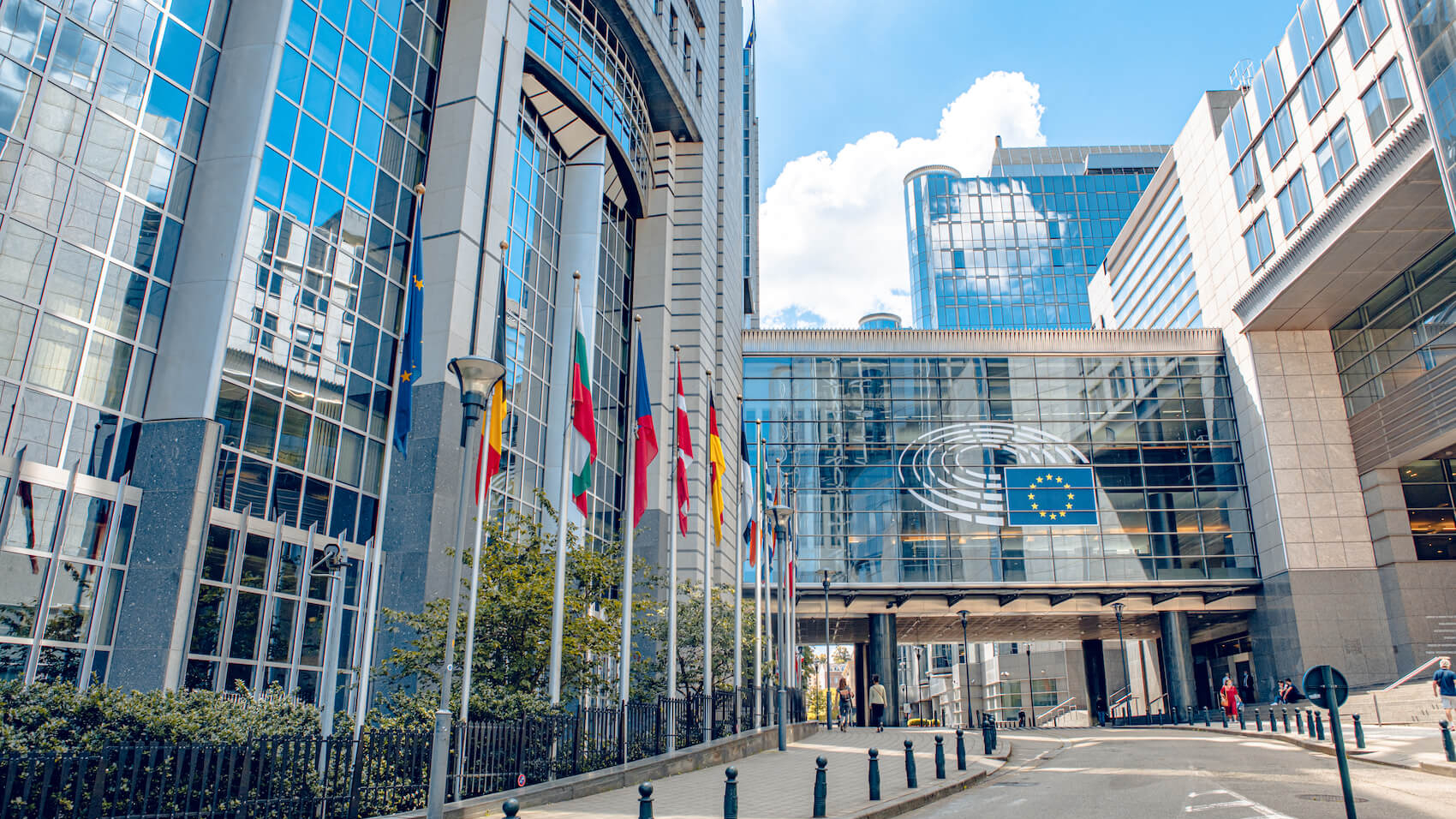
The European elections are approaching, with the date set for June 6-9, 2024. They are one of the most critical procedures for the European Union (EU), producing MEPs of the European Parliament, who participate in revising the regulations proposed by the European Council and are also responsible for electing the Head of the European Commission. European Parliament is the only institution directly elected by the people of the Union’s member-states and, therefore, monitors compliance with the EU’s Charter of Fundamental Rights and highlights problems and violations in Member States (European Parliament, 2020).
In light of the upcoming elections in 2024, it is helpful to reflect on what is taking place in Europe today and what could be done. The 2019 European election showed that populism, which seemed to be established in the 2014 elections, has not ceased, but on the contrary, has risen significantly since. Thus, it is of great interest to better understand how this trend will be in the upcoming 2024 European elections, as populism is not only a European tendency but is a phenomenon that progressively spreads around the globe.
Within the European structure, populist parties are closely linked to Euroscepticism. Euroscepticism is a broad sense, it’s as vague as populism. It emerged as a term to describe those who were sceptic about the governing model of the EU – those who opposed the further integration of their countries (ECPS, 2020). However, Majistorovic (2022) argues that Euroscepticism became a broad term used as a reference for hostile sentiments and actions against democracy. Hence, observing Eurosceptic rhetoric expressed by parties and party members will help us measure populism in Europe.
According to Treib (2021), there was a rise in Eurosceptic parties (who previously emerged in the 2014 elections) in the 2019 elections. While in 2019, there were some concerns about the size of the populist parties in the European Parliament, as results showed, there was no significant change. In 2019, more than 28 percent of MEPs belonged to populist/Eurosceptic parties (Treib, 2021: 177). Within the European Parliament, there are two major party groups, which have traditionally been in the lead – the EPP (European People’s Party (Christian Democrats)) and the S&D (Progressive Alliance of Socialists and Democrats in the European Parliament). Smaller party groups are Renew Europe, ID, Greens, ECR, GUE/NGL and NI (non-attached). The two major groups (European Parliament, 2019), the EPP and the S&D in the previous elections sustained some damage in the last elections, but the populist parties did not benefit from it. Interestingly, though, populist parties seemed to turn further to the right than the left. In total, in the 2019 European elections, after Brexit, 185 populist MEPs were elected, from whom, 112 were in the radical-right sphere – a number significantly bigger than the radical left populists which have 20 seats in the European Parliament (Treib, 2021: 177-179).
In 2023, after the Covid-19 pandemic and its restrictions, along with refugee pressures and inflation plaguing the world, there seems to be a concerted shift of Europe to the right, with the rise of right-wing coalitions with far-right parties across Europe (Lynch, 2023). Silver (2022) presents an extensive graph showing that since 2000, the populist trend from Greece to Sweden has progressively grown. Bergmann (2020) argues that nationalist populism emerges after a major crisis. The above is verified in Silver (2022), as especially after the economic crisis in 2008, there is a simultaneous upward trend in most European countries, but also the emergence of populist parties, such as Syriza (Greece), and Podemos (Spain). Populist parties, according to both Silver (2022) and Bergmann (2020), appeared after the migration flows in 2015. So now, after a major crisis, it is “natural” for populist parties to gain more strength and spread, especially since many countries have been unable to “recover from the shock” of 2015.
Populism in Member States
The top five radical right populist parties (by MEPs) are Lega (Italy), National Rally (France), Fidesz (Hungary), AfD (Germany) and Brothers of Italy (Treib, 2021: 178). Lega is the now ruling party of Italy, National Rally is the second party in France, and Fidesz is still the government of Hungary. On the national level, according to Silver (2022), AfD in Germany, as well as SYRIZA in Greece, for example, dropped dramatically since the previous national elections. However, in Germany, the most critical country in the European Union (in terms of administration), there seemed to be a twist, as the AfD came third in the state elections in Bavaria and Hesse, behind the CDU and CSU (Burchard and Angelos, 2023). The trend for AfD is upwards as polls show the party leading in the former East Germany with 28 percent. It is also expected to come first in the upcoming parliamentary elections in Brandenburg Thuringia and Saxony (Angelos, 2023).
In Greece, for example, SYRIZA is the opposition party but lost a fair share of votes. In the 2023 national elections, it’s the first time that three far-right populist parties made their way into the Greek Parliament. The first of them is a party named Spartans – which is a successor to the Nazist party Golden Dawn (which was in the European Parliament as well in 2014). Second came the Greek Solution – a party already in the parliament since the 2019 elections, and third came Victory (NIKI in Greek). The three combined are over 10 percent of the parliamentary seats (34 out of 300) (Ministry of Interior, 2023).
In 2023, in the elections held in the Netherlands, the populist BBB (Farmer – Citizen Movement) party, was the big winner, as it got 19 percent of the votes, securing seats in the parliament (Henley, 2023). Netherlands’ economy is based on the farming industry, as the agricultural sector exports around €65 billions of agricultural produce per year (Ministerie van Economische Zaken, 2023). The rise of BBB is due to Rutte’s government, which wanted to pass a law to reduce nitrogen emissions by 50 percent by 2030, as the Dutch soil is severely polluted by nitrous oxide, ammonia or nitrate emission (Vallet, 2022). Farmers felt attacked and started protesting shortly after the announcement of the new policy. In the Netherlands’ case, it is evident that anger and resentment towards the government were the cause of the BBB party’s rise in the elections.
Psychology of Populism
The above cases serve as examples, to show two things. First, it provides evidence that populism is a growing phenomenon within the European Union. Second, the Netherlands example shows that the emergence of BBB is due to negative feelings in a significant portion of the population. Maybe the case of the Netherlands can explain the rise of populism in other EU countries.
Fear and anger are powerful emotions, believed to be the primary emotions fueling support for populist parties (Rico et al., 2017). Fear is a means for populist leaders, according to Müller (2022), but also, to some extent, it seems to be the raison d’être of their social and political existence. Anxiety stems from insecurity or rapid social and economic change. Due to the fear of the unknown, people turn to populist movements, which keeps the vicious cycle of populist tendencies and trends running (Rico et al., 2017). Nowadays, fear and anxiety are systemically being cultivated in societies, mainly via social media.
According to Rico et al. (2017: 446): “The basic principle of evaluation is that people’s reactions to stimuli depend largely on the conscious and preconscious interpretations that each individual makes of a situation. [..] the way in which people appraise the environment in connection with their personal goals ultimately determines which particular emotion is aroused.” After a long period of economic instability within the euro area, which also caused intra-EU migration, the refugee influxes of 2015 brought the situation to a head. In the same period, terrorist attacks in Paris and Spain, for example, did not work in favor of the difficult situation created, as the European Asylum System proved problematic in managing the situation.
Migration is a topical issue within the EU and inevitably a main factor in favor of populism. In the past few days, the EU tried to settle the irregular migration. In the pre-agreed text of the deal that was about to be sealed in Granada, Spain, on the 5th and 6th of October 2023, Poland and Hungary opposed the hosting of migrants from Middle East or Africa, while Slovakia, Czech Republic and Austria abstained in the final vote (Baczynska, 2023). In Granada, Hungary and Poland refused to sign the final text, forcing the EU to drop the migration deal (Caulcutt et al., 2023).
Thoughts on the Upcoming Elections
A general view of the hemicycle during of a plenary session on BREXIT vote of the European Parliament in Brussels, Belgium on January 29, 2020. Photo: Alexandros Michailidis.
The preceding analysis and examples serve as an indicator which based on comparative analysis. Thus, it shows how the populist parties of the 2019 elections are holding up today. The only way to predict the results of the European elections is to observe the political trends and results of the national elections. The results of the national elections usually indicate the results of the European elections, as there are no significant discrepancies as to which parties will enter the European Parliament.
The aftermath of the pandemic and war fueled fear, anger, and anxiety, promoted even more via social media. Social media can have a positive impact on politics, as a venue to transmit information and exchange opinions. On the other hand, it can undermine democracy by spreading mistrust about democratic institutions and civil society. This was evident, in social media about growing public opinion against the governments and their policies to tackle the pandemic, especially during the Covid-19 restrictions. Mistrust towards democratic institutions is a fuel that keeps populism going.
Mistrust can also be transformed into anger. Anxiety and insecurity first appeared among the left-wing populist parties in the countries most heavily affected by the 2008 economic crisis (Podemos – Spain, SYRIZA – Greece). Populist parties after 2015 were mainly right and far-right parties due to a need for shielding and securing European societies from refugees and migrants. This “second wave” grew in northwestern Europe (France, Netherlands, Germany, etc.), but also, in Greece and Italy, for example, more right-wing populist parties began to rise, as both countries suffered the heaviest pressures with the 2015 flows.
All in all, it seems that in these elections, populist parties will not cease. Either the number of populist parties will remain the same, or increase. If the Member States and the EU don’t work towards stabilizing societies, the turmoil will continue to benefit the populist parties. On one hand, it seems almost impossible for the EU to achieve such a goal within the next six months. On the other hand, the sooner states start developing a political consensus to sort out their problems and differences, the sooner the EU will prove that citizens should trust the institutions and their governments – that a proper democratic solution can be found.
Müller, J. W. (2022). “The Politics of Fear Revisited.” In: Schapkow, C., and Jacob, F. (eds), “Introduction.” In: Nationalism and Populism: Expressions of Fear or Political Strategies. pp. 11 – 21. De Gruyter Oldenbourg. https://doi.org/10.1515/9783110729740.
Rico, G., Guinjoan, M. & Anduiza E. (2017). “The Emotional Underpinnings of Populism: How Anger and Fear Affect Populist Attitudes.” Swiss Political Science Review. August 2017. Vol. 23. No. 4. Pp. 444 – 461. DOI: 10.1111/spsr.12261.
Treib, O. (2021). “Euroscepticism is here to stay: what cleavage theory can teach us about the 2019 European Parliament elections.” Journal of European Public Policy. Vol, 28. no. 2. pp. 174-189. March 9, 2021. DOI: 10.1080/13501763.2020.1737881
“This process of a declining Liberal West, along with its increasing inability and unwillingness to promote democracy, presents a significant challenge in the world. Unfortunately, I don’t believe we can return to the world of 1990 to 2003 when democracy was, in many respects, almost the only game in town. Those days are over, and we now face a much more complex and challenging world,” says Professor Steven R. Levitsky.
Dr. Steven R. Levitsky, the David Rockefeller Professor of Latin American Studies and Professor of Government at Harvard University, stated that “the process of a declining Liberal West, along with its increasing inability and unwillingness to promote democracy, presents a significant challenge in the world.” In an exclusive interview with the European Center for Populism Studies (ECPS), Professor Levitsky analyzed the state of liberal democracy worldwide, saying, “Unfortunately, I don’t believe we can return to the world of 1990 to 2003 when democracy was, in many respects, almost the only game in town. Those days are over, and we now face a much more complex and challenging world.”
Primarily discussing the article jointly written by him and Professor Lucan A. Way for the Journal of Democracy on October 4, 2023, titled “Democracy’s Surprising Resilience,” where they emphasize that authoritarianism has a hard time consolidating power in countries with weak states, Levitsky argues that democracy promoters exaggerate democratic backsliding and criticizes those scholars for doing so because they want to highlight the degree of autocratization in the world. “I’m concerned that there has been an almost a rush to declare the world in a democratic recession, with an excessive focus on cases of backsliding, which are undoubtedly real. But they’re not the only thing happening in the world… Our assessment indicates modest backsliding over the last 15 years, rather than dramatic backsliding,” underlined Dr. Levitsky.
Here is the transcription of the interview with Professor Steven R. Levitsky with minor edits.
“The Record of Democracy Is Actually Quite Impressive”
The first question is about Hungarian Prime Minister Viktor Orban and the leader of PiS in Poland, Mr. Kaczynski, who have been shaping their versions of illiberal democracies for over a decade. With Italy governed by the far-right-winger Georgia Meloni, Slovakian populist Robert Fico scoring a victory in recent election, and the far-right Alternative for Germany (AfD) party rising fast in the polls, the signal is that right-wing populism is gaining strength across Europe. Do you not see a looming danger for democracies in Europe?
Steven R. Levitsky: It’s important to note that among the cases you’ve listed, only one could be argued to have seen a significant breakdown of democracy, which is Hungary. Poland has experienced some democratic backsliding, and there is a very competitive election next week in which PiS could find itself without a majority. It is not as if democracy has been extinguished in Poland.
In the other cases, Robert Fico governed for four years in Slovakia without breaking democracy, and he won 23 percent of the vote and needs to form a coalition. So, it is not like seeing a Hugo Chavez-style takeover in Slovakia. In Italy, I don’t like the Brotherhood, and there is obviously much to worry about. However, it’s a coalition government that doesn’t pose an immediate threat to democracy.
The far-right is pretty illiberal in Europe, and of course, there is much to worry about. But in terms of democracy breaking down, the record is actually quite impressive. The only place in all the list that you just named, where democracy is arguably broken down is Hungary. So, my main point is, there’s a difference between being worried about a changing scenario and declaring that democracy is breaking down. We need to be clear about that difference.
Despite the arguments presented in your article, “Democracy’s Surprising Resilience,” we are witnessing the rise of far-right populism in almost every European country. How do you explain this rise of populism in Europe, given the terrible historical experiences with leaders like Hitler, Mussolini, and Stalin?
Steven R. Levitsky: First of all, I am not an expert on far-right populism in Europe. I primarily study political parties in Argentina; I’m a Latin Americanist. I think there are pretty good, persuasive explanations suggesting that a combination of economic anxiety resulting from the 2008-2009 financial crisis and broader economic changes globally, coupled with the increasing ethnic diversity brought about by migration, has generated reactions among segments of the electorate, particularly among non-college-educated, rural, white Christian sectors in Europe. This phenomenon has occurred across the industrialized world, including the United States.
In various places, typically between 15 and 30 percent of the electorate, which is often non-college-educated, residing in small towns, more frequently male, and predominantly white, has supported right-wing populist parties. However, this doesn’t necessarily mean that fascism is imminent. Most far-right parties in Europe, while certainly holding illiberal views, have, for the most part, adhered to democratic norms. Golden Dawn in Greece is a significant exception. Therefore, we should be cautious about jumping from the rise of far-right parties to declaring an immediate threat to democracy, let alone the imminent arrival of fascism in the region. Frankly, I don’t see that on the horizon.
As a Turk, I would like to ask: You list Turkey as one of the three well-known backsliders, along with Hungary and Venezuela. President Recep Tayyip Erdogan has recently announced his desire to draft a new constitution, and most pundits believe this desire stems from his wish to be re-elected for a third term, which is currently prohibited by the existing constitution. Do you foresee any danger to Turkish democracy if Erdogan succeeds in being elected for a third term?
Steven R. Levitsky: The danger to Turkish democracy is already present. Turkey hasn’t been a democracy for very long. Prior to the late 1990s, military power and restrictions on religious parties made Turkey less than democratic. It briefly achieved full democracy in the early 2000s during the early years of the AKP. However, democratic backsliding began in the first decade of the 21st century and escalated significantly after the failed coup attempt in 2016. Today, Turkey can be characterized as a competitive authoritarian regime, with Erdogan acting as an autocrat.
(However) he has not fully consolidated authoritarian rule, and it doesn’t surprise me that he is continuing to try to perpetuate himself in power. What’s interesting feature of Turkey is the degree of democratic pushback and Erdogan’s inability to prevent the opposition from winning power in the major cities even in elections with tilted playing fields that Erdogan had created. I have a very smart former graduate student who tells me if the opposition had nominated the mayor of Istanbul as its candidate, it probably would have won the recent election although Erdogan would almost certainly have tried many shenanigans to try to stay in power. There’s a good chance that Erdogan would have had to cede power. So, on the one hand, Turkey is a competitive authoritarian regime and on the other hand, the democratic pushback is such that elections remain really competitive. So, I don’t think the question is well framed in saying there’s a danger to Turkish democracy. The danger’s been there a long time and Turkey is not a democracy. But I think that the opposition stands as good a chance as of removing Erdogan in the coming years. It’s a pretty sort of evenly matched battle between an autocratic President and a pretty robust opposition.
“American Democracy Is Heading for Some Rough Times”
Turning to the United States, Professor Levitsky, if Donald Trump is re-elected in the US, what kind of strains do you anticipate for democracies worldwide? After Speaker Kevin McCarthy was ousted by the far-right Republicans, what do you foresee for American democracy?
Steven R. Levitsky: American democracy is heading for some rough times. Given the strength of opposition forces, I find it highly unlikely that we will witness the consolidation of an autocracy in the United States, akin to Russia or even Hungary. However, it’s very probable that we will observe what we used to call an unconsolidated democracy—a very unstable regime teetering on the brink of constitutional crises and possibly experiencing periods of weak authoritarianism. I wouldn’t be surprised to see a considerable amount of political violence, considering the level of extremism and the prevalence of firearms in the country.
The most significant problem lies with the Republican Party, which has largely abandoned democratic rules of the game. We see this in its willingness to continue supporting Donald Trump, even though he attempted to overturn the results of an election. If Trump wins, the US will undoubtedly slide into another democratic crisis, with the possibility of an authoritarian attempt. This time, it could be much more severe than before because Trump didn’t anticipate becoming President previously. He didn’t have a comprehensive plan for purging and packing the state as Erdogan and Orban did. However, if he succeeds this time, he will likely make a much more concerted effort to purge state institutions, pack them (with loyalists), and politicize them—similar to what we’ve seen in other cases of elected authoritarianism.
Such a scenario would send a terrible signal and have a detrimental impact on democracies worldwide. We’ve already witnessed this between 2016 and 2021 in countries like El Salvador, Honduras, and even Nicaragua, where autocrats perceived autocratization processes as tacit approval, not being opposed by the United States. Emerging autocrats, feeling emboldened by Trump’s actions, started copying his style by attacking the press and denying election results, which closely followed Trump’s rejection of the election outcome. Similar copycat efforts emerged in Peru and Brazil.
What transpires in the United States has global implications in two ways. First, people worldwide look at the United States as a model, so if it’s acceptable to be an autocrat in the United States, it will embolden autocrats elsewhere. Second, US foreign policy will change. While the Biden Administration could do more to promote democracy, it has at least been relatively active behind the scenes in opposing autocratic behavior. For example, we saw this in Guatemala recently and in Brazil after the election, where the Biden Administration pressured autocratic forces to step back. If Trump regains office, these efforts will likely diminish, and there may even be open support for autocrats in some cases. Consequently, a Trump re-election would have profoundly negative consequences for democracy worldwide.
May Weak State Institutions Be a Chance?
How does the presence of weak state institutions in low- or middle-income countries with authoritarian tendencies hinder the consolidation of authoritarian rule? Can you explain the role of these same weak state institutions, which have been observed as key factors contributing to insufficient democratic resilience against authoritarianism in cases like Turkey, Serbia, and Hungary, in contrast to the cases of the US and Brazil?
Steven R. Levitsky: Well, Turkey doesn’t have such weak institutions. Turkey possesses relatively strong institutions. Hungary also boasts quite robust institutions. When I refer to weak institutions, I’m mentioning countries like Ukraine, Albania, Benin, Honduras, Zambia, and Malawi. These are countries with weak state institutions. Turkey and Hungary, on the other hand, have relatively strong institutions. Serbia has slightly weaker institutions but is not excessively weak either. When we discuss the failure of democracies and the third wave of democracies, we have extended electoral politics to places where democracy had never previously existed, and where sustaining it is quite challenging. These are very poor countries, marked by high levels of inequality and very weak state institutions, such as Nicaragua, Benin, Albania, Mali, and Malawi. These are nations where almost every existing social science theory would predict that democracy would have a hard time to survive. Indeed, democracy has had hard time in such countries. However, the point we emphasize in the article is that authoritarianism has a hard time in consolidating power in countries with weak states, primarily for two reasons.
First of all, where the state is weak, governments have a hard time getting state officials to do what they want them to do so. That’s a problem for democracies, because democratic governments have a hard time implementing, enforcing their policies and providing public goods. But it’s problematic for autocrats, too. Because, when they want to steal an election, for example, they have a hard time getting bureaucrats and low-level state officials to go along with them. Similarly, when they want to repress or spy on opponents, they have a hard time getting state institutions to go along with them. We’ve seen that notoriously, for example, in Ukraine where, as my co-author Lucan Ahmad Way has shown, autocrats repeatedly have failed to consolidate power. I’m talking about people like Yanukovych, precisely because they couldn’t get the state to go along. So, when the state is weak, autocrats have a hard time enforcing their power.
Secondly, weak states result in poor governance. Governments govern ineffectively when state institutions are weak, and they have trouble ensuring security and implementing policies that matter to people. So, what does it mean for autocrats? It means that autocrats become unpopular. It means people turn against autocratic governments in the same way that they turn against democratic governments in response to poor performance. As long as elections are held, autocrats are going to have hard time to secure victory in countries with weak institutions. We have witnessed this trend in countries like Sri Lanka, Nepal, Honduras, Peru, Ecuador, Bolivia, Ukraine, Zambia, and Malawi. Governments leaning towards autocracy fail, lose elections, and even lose unfair elections because people are dissatisfied with the government’s poor performance. This poor performance is rooted in the weakness of state institutions. Therefore, while democracy remains vulnerable in lower and middle-income countries, particularly those without significant oil resources, autocracies also prove vulnerable in many of these nations. Autocratic regimes often last for about 7-10 years before they collapse.
You have extensively analyzed the influence of internal factors and the general international political climate on democratic backsliding and democratic resilience. Do you believe that the well-coordinated efforts of authoritarian states such as Russia, China, and Iran to export their authoritarian or illiberal governance style through various economic, political, diplomatic, and technological means and projects play a significant role in these processes?
Steven R. Levitsky: I believe that the claim you just made is overstated. I don’t think there is much effective coordination among China, Russia, and Iran. These are three very different states with distinct interests and activities. While it’s true that all these states oppose the Liberal West and seek to counterbalance the power of the United States, they do work together at times and share an interest in limiting and thwarting US power. There’s no question about that and they have at times supported autocratic governments, but they’re not particularly well coordinated. They’re not particularly affective. Russia, in particular, has largely failed in its efforts, even in neighboring countries like Ukraine or Georgia, to prop up authoritarian allies.
Nonetheless, I completely agree with an element of your argument, which is that there is shift in the global balance of power away from US and European hegemony in the 1990s towards a more multi-polar world, in which the US and Europe are weaker and less influential, China and Russia and other powers are more powerful, pose a significant challenge for democracy. This shift limits the US’ willingness and ability to promote democracy in the global South and almost certainly will lead to some erosion of global democracy. However, it’s important not to overstate the extent of coordination among these states. Despite the substantial geopolitical changes that have been unfavorable to liberal democracy, we have only seen a relatively modest decrease in the number of democracies, namely 5-6 fewer democracies that we had 15 years ago. So, while it’s a real threat, we should be cautious not to overstate it, and the actual consequences of this threat have been surprisingly limited thus far.
“Democracy Promoters Exaggerate the Degree of Autocratization in the World”
Is it possible that the experience of democratic backsliding is different in various contexts? A small change in data might have a more significant local and global impact in certain geographic regions. So, even though the data shows resilience, is it possible that the experience of civilians in everyday life has changed catastrophically?
Steven R. Levitsky: Yes, it is possible. However, the term “catastrophically” may be an overstatement. To persuade me, you would need to provide evidence of catastrophic changes. Nevertheless, it is possible that the situation is worse than the data suggests. I believe we should begin with the data and address my critique of many democracy promoters, particularly V-Dem, in recent years. They have tended to overstate the case. For instance, V-Dem previously classified India as an electoral autocracy. I think they made this change in 2017 or 2019. Before that, they focused on the number of democracies and downplayed per capita figures, i.e., the number of people in the world living under democracy. However, when India shifted to electoral autocracy, V-Dem began emphasizing per capita numbers. Why are they doing that? They’re doing that because they want to highlight and even exaggerate the degree of autocratization in the world. We need to exercise caution and balance when interpreting the data. I’m concerned that there has been an almost rush to declare the world in a democratic recession, with excessive focus on cases of backsliding, which are undoubtedly real. But they’re not the only thing happening in the world. To answer your question, yes, it is possible that the situation may be worse than the data suggests. However, we should approach the data in a serious and balanced manner. Our assessment indicates modest backsliding over the last 15 years, rather than dramatic backsliding.
You suggest that if wealth, education, and urbanization continue to grow, authoritarian vulnerabilities may intensify. However, we have observed a different outcome in both the Russian and Chinese contexts, as well as in regimes supported by them. Could these cases be considered exceptions to the general trend you have discussed?
Steven R. Levitsky: When evaluating regimes, I consider their capacity to monopolize resources and control society. I’ve written a book arguing that regimes born of violent revolution, like China, tend to be very durable. It has also been shown that regimes sustaining high levels of economic growth (while China’s economy has changed, it remains a reasonably strong performer) are likely to survive. Revolutionary regimes overseeing economic growth, such as Vietnam and China, are in relatively good shape in the medium term.
Regimes with abundant energy resources, like oil and gas, as in the case of Russia, are also likely to be in good shape because they can monopolize resources, countering the impact of modernization. In Russia, despite it being a relatively wealthy and a relatively educated country, civil society is incredibly weak due to state control over many resources. Thus, Russia and China are relatively easily explained. Our focus is primarily on countries in Africa, Asia, and Latin America, where urbanization and transitioning into lower-middle-income status are occurring. They are no longer considered poor. Some countries like Burundi and Mali remain very poor. However, countries like Kenya, Senegal, Ghana, and others are experiencing significant modernization, which makes autocratization more difficult.
In Central Europe, Southern Europe, and South America, we see countries graduating into upper-middle-income status with large civil societies, developed private sectors, and robust opposition. This doesn’t make authoritarianism impossible, but it makes it much less likely. In these regions, despite some autocratization, the conditions make it much harder for authoritarian rule to solidify.
We’re seeing in Central Europe, Southern Europe and in South America the graduation of countries into sort of upper middle-income status with large civil societies, developed private sectors and robust opposition that doesn’t make authoritarianism impossible, but it makes it much less likely.
In the cases of South America, Central Europe, and Southern Europe, autocratization is evident primarily in Venezuela, which has abundant oil resources, and Hungary, which is a real outlier. Hungary is a case that theory predicts should not be an autocracy. The fact that the regime doesn’t lock up anybody, doesn’t kill anybody, doesn’t ban anybody and the fact that elections are still competitive suggest that this regime also may not consolidate long-term.
There are valid reasons why China and Russia are authoritarian, and we are not predicting global democratization in the short or medium term. Especially in countries with highly statist economies, impoverished societies, or revolutionary legacies, there are valid reasons to expect stable authoritarianism. However, in much of the world, from the Baltics to Central Europe, South America to parts of East Asia, levels of economic development provide democrats with a fighting chance in many more places than during the beginning of the third wave of democratization.
Lastly, in your famous book “How Democracies Die,” you wrote, “The 1990-2015 period was easily the most democratic quarter-century in world history—partly because Western powers broadly supported democracy. That may now be changing.” Do you still think so? How is that change unfolding?
Steven R. Levitsky: Unfortunately, but inevitably, the Western dominance of the initial third wave period—the extraordinary liberal Western hegemony from the fall of the Berlin Wall or perhaps even the era of Perestroika to the Iraq War, spanning the first decade of the 21st century—that era, the extraordinary liberty of 1989 to 2003 is gone, it is eroding, and will continue to erode. Both the United States and Europe, especially the United States, have accelerated the decline of Western liberalism through their own errors, internal conflicts, and strife. US democracy has become almost dysfunctional, making it extremely difficult to promote or defend liberal democracy globally.
This process of a declining Liberal West, along with its increasing inability and unwillingness to promote democracy, presents a significant challenge in the world. Unfortunately, I don’t believe we can return to the world of 1990 to 2003 when democracy was, in many respects, almost the only game in town. Those days are over, and we now face a much more complex and challenging world.
Sithole, Neo & Nguijol, Gabriel Cyrille. (2023). “Report on Mapping Global Populism — Panel 4: The Role of Populism, Radicalization and Hindutva in India.” European Center for Populism Studies (ECPS). October 10, 2023. https://doi.org/10.55271/rp0043
This report is based on the fourth panel of ECPS’s monthly series, entitled “Mapping Global Populism: The Role of Populism, Radicalization and Hindutva in India,” which took place online on August 31, 2023. The panel featured renowned scholars on populism from India. As a by-product of this fruitful panel the report consists of brief summaries of the speeches delivered by the panelists.
This report summarizes the fourth panel of ECPS’s monthly series, entitled “Mapping Global Populism”: The Role of Populism, Radicalization and Hindutva in India, which took place online on August 31, 2023. The panel was jointly organised by the ECPS, The Alfred Deakin Institute for Citizenship and Globalisation (ADI), and the Department of Politics and International Relations, University of Adelaide. The panel, which featured renowned scholars on populism from India, was moderated by Dr Priya Chacko, Head of the Department of Politics and International Relations at the University of Adelaide, Australia, and the speakers are by Dr Ajay Gudavarthy (Associate Professor at the Centre for Political Studies, Jawaharlal Nehru University, New Delhi), Maggie Paul (PhD candidate in Politics and International Relations at the University of Adelaide, Australia), Dr Anuj Bhuwania (Professor at the Jindal Global Law School in India & currently Senior Visiting Fellow at the SCRIPTS ‘Cluster of Excellence’ at Freie University Berlin), Dr Monika Barthwal-Datta (Senior Lecturer in International Security at the University of New South Wales, Sydney) and Dr Shweta Singh (Associate Professor of International Relations at the South Asian University, New Delhi, India).
During the introductory remarks, Dr. Priya Chacko provides a much-needed overview of the profound impacts that authoritarian populism has had on Indian political life. These effects range from stifling organizational work, where NGOs and research centers have had their licenses revoked, to constraining critical thought and free speech. Scholars, journalists, and students have faced charges of sedition and languished in jails, while the few remaining independent media houses have been threatened with tax investigations or defamation lawsuits. Additionally, laws related to religious freedoms are under threat, taking the form of laws that restrict interreligious marriages or the consumption of beef, with one of the more troubling developments being the revocation of the constitutional autonomy of Jammu and Kashmir. Furthermore, the introduction of religious-aligned citizenship laws, along with anti-Muslim actions, has raised concerns. Opposition parties have often been portrayed as opposition elites backed by Western authorities, depicting them as enemies of Hindu and thus Indian advancement. All of these are just a few developments that have taken place over the last decade; the following report provides a brief outline and description of the presentations and arguments shared by the presenters during the panel.
Dr. Ajay Gudavarthy: “Politics, Ethics, and Emotions in ‘New India’”
Dr. Gudavarthy posits that nationalism emulates faith-based religions through symbols like the national anthem, flag, and other national symbols, and as such, stands itself as a contemporary civic-based religion. The Hindu narrative offers a porous concept that ties into this civic religion, based on inclusive narratives that unite Indians with Hindu identities, generating a form of hyper-nationalism for Hindu identities. This, in turn, fosters a sense of belonging but also translates into toxic majoritarianism, which undermines institutions.
In this opening presentation, Dr. Ajay Gudavarthy draws inspiration from his new book entitled: “Politics, Ethics, and Emotions in ‘New India.’” The book delves into the hypothesis of whether populism can achieve this through appeals to everyday ethics and latent emotions, exploring how Hindu populism manages to accomplish both objectives simultaneously.
Dr. Gudavarthy sets the tone of the panel well, kicking off by briefly going over Laclau’s conceptual approach to populism, recounting the equivalence drawn between fragmented social demands used to create an authentic people’s group and the inherent antagonism between them and the elites, in a thorough political manner before globally emphasizing the relationship between traditional authoritarianism and social solidarity in India. To better develop his thoughts, he started by asking a main question: “Does Indian politics continue to remain authoritarian, or does it have elements that continue to reinforce social hierarchy?” The answer to this question was divided into two main narratives that Hindutva is adopting: the intercultural nation between caste and religion that tries to re-inscribe the traditional hierarchy and the adoption of nationalism as a new or civic religion.
The presentation emphasizes the Indian context where Hindu-aligned politics is emerging as a new form of civil solidarity that transcends caste divisions and has extended its appeal across religious and linguistic groups, even making appeals to Pasanda Muslims. Given the vibrancy of Indian society, it’s no small feat for populism to generate such majoritarian consciousness. However, the study highlights the contradictions within populist manifestations as they often maintain and operate along conservative lines, preserving social hierarchies and serving the interests of the established social powers and elites. Nonetheless, they have successfully appropriated the normative universality of cultural registers.
Dr. Gudavarthy articulates the growing sharpening of conflicts between subclasses and linguistic conflicts, or a resurgence of social conflicts triggered by these populist ideologies. Hindu populism challenges earlier notions that suggested the impossibility of a confessional majority in the Indian context, based on the enduring fragmentation of latent caste differences. What is happening today can be precisely characterized by the emergence of such a confessional majority made possible through the reinterpretation of caste and religion, not in terms of traditional religious identities, but rather as a way of life. Part of this stems from the heterogeneous interpretations based on Gandhi’s approach which emphasizes the preservation of collective living and cultural life aimed at dismantling the caste system from within, rather than relying solely on external liberal state measures and economic changes.
The ease of narrative restructure in the Indian case is made possible using populism’s lack of explicit critique, which allows for the reinterpretation of hierarchies and divisions as a unified collective supporting authoritarian constructions. By ‘re-signifying’ caste and religion as a way of life instead of rigid cultural identities, lower segments of society, such as Dalits, identify with these narratives and show little drive to change the oppressive societal structure. It also sheds light on the rejection of leftist liberal secular scholars who view it as an authoritarian top-down project.
When speaking on the adoption, or rather reformation of nationalism as a new civic religion, Dr. Gudavarthy posits that nationalism emulates faith-based religions through symbols like the national anthem, flag, and other national symbols, and as such, stands itself as a kind of contemporary civic-based religion. The Hindu narrative offers a porous concept that ties into this civic religion, based on inclusive narratives that unite Indians with Hindu identities, generating a form of hyper-nationalism for Hindu identities. This, in turn, fosters a sense of belonging but also translates into toxic majoritarianism, which undermines institutions.
In conclusion, we are exposed to thought-provoking findings from the results of a survey conducted by Pew Research 2021 on religious tolerance and segregation, reportedly the largest post-independence survey in India that includes a cross-section of castes, religions, and regions. Dr. Gudavarthy’s breakdown mentions how it highlights that 70 percent of respondents believe diversity is vital for democracy and value secularism. However, when asked about concrete living arrangements, 65 percent of respondents expressed a belief in segregated living, symbolizing the concept of living separately, which vindicates their position of how the narratives of Hindu majoritarian populism have successfully reinforced ethnic and caste divides.
Maggie Paul: “Ram Rajya 2.0: How Nostalgia Aids the Populist Politics of Neo-colonial Hindutva Futurism”
In the review of populist nostalgia, Maggie Paul introduces us to the concept of “futurist nostalgia,” describing how, based on Indian populism, futurist nostalgia is centered on drawing inspiration from past glory to paint a picture of an equally glorious future. This is exemplified by the reverence for figures like Lord Ram and the concept of Ram Rajya. Indian populism operates within an affective economy of optimism, confidence, duty, freedom, pride, and self-confidence. Its purpose is to generate a cross-religious and cross-class identity that transcends the segregated diversity of identity.
This presentation is informed by a paper that is still in development, which articulates the role of nostalgia in populist discourses through the retrieval, valorization, and recovery of ‘golden age symbols,’ both historical and mythological, which have been central in contemporary Indian populist politics.
The aim of the paper and presentation, according to Maggie Paul, was to identify the frequent and growing force of nostalgia in Indian populism used as a mobilization force for electoral means and then to draw out the links between nostalgia, affect, and populism, thereby better theorizing the affective politics of authoritarian populism in India and contributing to the burgeoning literature on nostalgia and populism. Pivotal to this conversation is the idea that in populist studies, ideational approaches are prevalent, and in these approaches, the importance of emotions is stated as crucial but is not given much in terms of theorization. Also, the study outlines the scope as being limited to Europe and Turkey; the work on Turkey, in particular, focuses on religious sentiment.
Opening the presentation is a quote from Prime Minister Narendra Modi given at the inauguration of the new parliament in May 2023, where Modi evokes an image of a glorious past when India was heralded as the most prosperous and splendid nation of the world, and how after centuries of slavery and colonization, India is turning that glorious stream of ancient times towards itself, filling the Indian people with pride. Following this, the presentation goes over how nostalgia is associated with the ‘recent past,’ like times when political correctness was not present or rife, a time when society was more homogeneous, or a time of the welfare state, especially amongst right-wing ideologies. Different types of nostalgia, like restorative or reflective, are more dominant in right-wing populism, taking a more ideational approach.
Her framework is based on the idea that populism is analyzed as a logic of political articulation according to Ernesto Laclau, and emotions, according to Sarah Ahmed, are considered as cultural practices. However, Maggie Paul highlights the limitations of Laclau in adequately addressing the emotional aspects of populism, with an emphasis on collective grievances and antagonism in generating collective identities; this is weak, but collective identities require strong collective emotions. In addition to things like fear and hate, love and happiness are also needed within identity. In doing so, we are made alert to the importance of understanding how emotions work to create groups and form collective identities.
In the review of populist nostalgia, Maggie Paul introduces us to the concept of “futurist nostalgia,” describing how, based on Indian populism, futurist nostalgia is centered on drawing inspiration from past glory to paint a picture of an equally glorious future. This is exemplified by the reverence for figures like Lord Ram and the concept of Ram Rajya. Indian populism operates within an affective economy of optimism, confidence, duty, freedom, pride, and self-confidence. Its purpose is to generate a cross-religious and cross-class identity that transcends the segregated diversity of identity. Ram Rajya is articulated as a pinnacle of morality, ethics, and good governance, in line with the principles of the Constitution. However, it also encompasses aspects that may involve restricting religious minorities like Islam, such as introducing Ramayana into school syllabi, declaring Thursday as the official weekly day off, and observing a national Hindu day. Additionally, it mentions efforts against religious conversions, the banning of Madrassas, and the removal of reservations for minorities.
Building on the presentation given by Dr. Gudavarthy, Maggie Paul discusses how the populist co-opting of Ram Rajya aims to unite different groups and create a vision of a glorious future. However, it’s worth noting that this sometimes involves the reinterpretation of religious mythology as actual history, despite pushback from the scientific community.
Continuing the presentation elaborates on how cultural infrastructure plays a significant role in invoking cultural and religious unity and futurism and the antagonistic frontiers that emerged at certain moments in Indian history when discussing figures like Lord Ram was avoided, which in turn led to infrastructural decay tied to religious places and cities—a decay that Indian populists argue can only be rectified through a politics and political state infused with the character and lessons of Lord Ram. It also emphasized how the willpower and determination associated with Lord Ram can lead the country to new heights, promoting values based on unity, development, and faith.
Before ending, the cultural dimensions of Indian populism and cultural renaissance were expanded upon and shown to involve monumental infrastructural projects aimed at promoting the coexistence of past and present India. This includes the restoration of temples, the creation of mega corridors with modern amenities, and the incorporation of local deities, gurus, and indigenous warriors to foster a unified cultural resurgence. This cultural revival serves to create a sense of heritage and identity while simultaneously fostering a sense of hatred for past invasions and destruction of cultural sites by Muslim invaders, with the dual aim of creating an enduring Hindu identity that dismisses the existing diversity and pluralism within Hinduism.
Dr. Anuj Bhuwania: “Constitutional Roots of Judicial Populism in India”
According to Dr. Bhuwania, the Indian constitution was drafted with a disregard for entrenchment, which is unusual because a constitution typically entrenches provisions that cannot be changed by the electoral majority. Through the highlighting of various articles found in the Indian constitution, it’s evident that these articles are being weaponized by the current government, which points to the problem of centralization of power within the political majority. Therefore, the Indian constitution can be seen as part of the problem. The procedure in Indian constitutional making has also enabled Modi to do what he does now.
This presentation shifts the panel’s focus from the religious aspects and behaviors of populism in India towards the implications of populist endeavors on the judiciary, taking an interesting spin on normative discussions around the institutional erosion caused by populists, particularly in relation to the courts and legal autonomy.
Seminally, Dr. Bhuwania suggests that in India, the reverse is true: Courts act as populist actors themselves. Central to this argument is the notion that constitutionalism has been less of a stumbling block on the path to Hinduism in the past decades than what populist scholars might have thought. Currently, global populist discourse often turns to countries like Poland or Hungary when analyzing what populism means for democratic backsliding, often noting that these regimes paired their populist discourses with constitutional changes, which then enabled populist leaders to chip away at the liberal foundations in those countries. What stands out from this ‘norm’ is that India, in comparison to other populist regimes, has experienced relatively minor changes to its constitution, a phenomenon that indicates that Prime Minister Modi has been able to advance his political agenda without introducing major alterations to India’s fundamental legal document. The study highlights the surprisingly high level of compatibility between the Hindu majoritarian agenda and the Indian constitution.
Dr. Bhuwania articulates the ability of the Indian constitution to be used as a populist tool, attributing it to the constitution’s inherent malleability, which allows India’s religious populism to make use of it with arguable ease. In some ways, this malleability also substantiates political claims made by Indian populist actors of wanting to uphold and seek to advance the Constitution, embracing the political legitimacy that comes with India’s constitutional pliability.
In displaying how the Indian constitution lends itself to the populist forces, Dr. Bhuwania refers the audience and panel to the ongoing matter related to the constitutional status of Kashmir, currently being heard before the Indian Supreme Court. This matter revolves around the changes brought about in August 2019 when the Government of India revoked the special autonomous status granted to Jammu and Kashmir by Article 370 of the Indian constitution, essentially facilitating their conversion into territories of India. This was done through the vote of a simple majority, a fact that is central to this part of the presentation. Dr. Bhuwania begins to unravel the dangers of the current state of the Indian constitution by reviewing how the constitution allows for unilateral changes to the very structure of states through a simple majority. Adding that it’s important to note that India has already become a Hindu majoritarian state, electorally speaking, meaning there is little standing in the way of allowing the Indian government currently to alter territorial lines without the need for constitutional changes.
Dr. Bhuwania also discusses India’s peculiar federalist nature, calling it a quasi-federalist state, considering the looseness of the federal characteristics. In addition, it is argued that India, through its federalist constitution, became a model for federalism for most multiethnic countries, with this idea peaking in the concept of the state-nation that became prevalent in 2012. The Indian Union’s ability to accommodate the demands of various ethnic communities displayed the flexibility and strength of the federal system by forging new states in the North-East of India. This underscores the importance of design choices when it comes to federalism.
The Indian constitution was drafted with a disregard for entrenchment, which is unusual because a constitution typically entrenches provisions that cannot be changed by the electoral majority. Through the highlighting of various articles found in the Indian constitution, it’s evident that these articles are being weaponized by the current government, which points to the problem of centralization of power within the political majority. The presentation also attempts to provide an understanding of why key provisions in the Constitution were not entrenched. One explanation is that the constitution, at least at the time of drafting, was a wartime constitution, likely referring to the height period of conflict in India, from independence movements to the Indo-Pakistani war.
Before closing, Dr. Bhuwania unpacked how being a single-party majority/dominant constitution breeds a threat to constitutional growth through change, noting the fact that in most single-party dominant systems, a single party dominant constitution sees no possible future of having any other party dominating the constitution, which means they have little cause to change the constitution. This also interestingly gives stability to the Indian constitution as well, as the usefulness means there is little reason to further align themselves with the global populist right and generate unwanted attention by attempting to introduce massive changes to the constitution. The constitution can be seen as part of the problem. The procedure in Indian constitutional making has enabled Modi to do what he does now.
Dr. Shweta Singh and Dr. Monika Barthwal-Datta: “India’s Refugee Policy Towards Rohingya Refugees: An Intersectional Approach to Populism”
The presentation outlines and analyzes shifts that have taken place since 2014 regarding refugee policy under the Modi Government in India. Firstly, there has been an institutional legislative shift involving amendments to domestic legislation used to govern refugees and foreigners in India. Secondly, it addresses the absence of an actual legal framework dedicated to governing refugees and foreigners in India, with states resorting to three different acts to monitor and control the movement of refugees, encompassing aspects like housing, detention, and deportation.
In this joint presentation, Dr. Shweta Singh and Dr. Monika Barthwal-Datta showcase their interest in the interconnection between populism and foreign policy, specifically concerning the issue of refugees. They are working on a draft paper on the subject that is still in the process of completion. Central to their contribution is their focus on the relationship between populism and domestic refugee policies, which have international implications. Their research centers on how populism affects the foreign policy preferences and outcomes of governments in power.
To begin the final presentation, Dr. Singh outlines the novelty of their work, emphasizing its contribution to the international dimension of populism studies related to refugee policy. Central to the argument presented by Dr. Singh is that in the context of populist studies, the issue of refugee politics/policies stands out as a marginalized discourse globally, referring to how we look at refugee policy and foreign policy and how we see this policy about populism internationally. The presentation recounted how few studies investigate the link between population and foreign policy shedding light to review three gaps found in current foreign policy-aligned populist literature while asking how these gaps relate to the issue of refugees seen as foreign policy, and how is it connected with the case of India? She mentions that while populism literature has covered the international ramifications of populism, the issue of refugee politics and policies remains a marginalized discourse in global populist studies. The presentation identifies three gaps in current foreign policy-aligned populist literature and explores how these gaps relate to the issue of refugees in India.
The first gap is related to the conceptualization of populism, particularly its application in non-Western contexts like India. It’s important to note that many studies that view populism as a thin-centered ideology face limitations when applied outside Western contexts. Additionally, a continuation of this initial gap pertains to the process of signification by referring to Laclau’s approach, which defines populism as a political logic centered on empty signifiers, most studies acknowledge the antagonistic relationship between the people and the elite. However, where they often fall short is in defining the category of “the people.”
Expanding upon Laclau’s work, Dr. Singh delves into the concept of populism as a political logic based on discursive identity assemblages. These assemblages are characterized by various constellations, which in this context refer to societal groupings. The presentation briefly touches on what makes Modi’s populism effective—namely, the existence of overlap in the discursive language used to bridge gaps across race, ethnicity, religious divisions, as well as class and caste. This overlap provides valuable insights into the complex formation and categorization of “the people,” taking into account the diversity of sub-groups within this broad and multifaceted term.
The second gap concerns the narrow conceptualization of foreign policy, which has primarily focused on bilateralism and multilateralism, largely neglecting issues related to refugees. Dr. Singh and Dr. Dr. Monika Barthwal-Datta aim to review how refugee policy affects both conflict outcomes and cooperative relations among states in South Asia, such as India-Bangladesh, India-Pakistan, and India-Afghanistan. For these researchers, refugee policy is a foreign policy.
The third gap discussed pertains to the lack of contextualization of populism and foreign policy. Dr. Singh explained that when examining the conceptualization of foreign policy, it’s essential to consider how contextual specificities related to various global variants of populism are taken into account. This approach offers the potential for an intersectional analysis. The focus on refugees arises from the argument that migration is a core function of a state’s foreign policies and is implicated in international agreements that recognize the rights of refugees through international treaties. In the context of South Asia, where many states, including Pakistan, India, Sri Lanka, and Bangladesh, have led South Asian countries to adopt different positions on global refugee protection instruments, our understanding of refugees becomes influenced by the extent of populist narratives present in government.
In her concluding remarks, Dr. Barthwal-Datta discusses how the paper outlines and analyzes shifts that have taken place since 2014 regarding refugee policy under the BJP Modi Government. Firstly, there has been an institutional legislative shift involving amendments to domestic legislation used to govern refugees and foreigners in India. Secondly, it addresses the absence of an actual legal framework dedicated to governing refugees and foreigners in India, with states resorting to three different acts to monitor and control the movement of refugees, encompassing aspects like housing, detention, and deportation. These legislative changes have been accompanied by shifts in discourse, with BJP leaders and other senior officials framing refugees, particularly Rohingya refugees, as threats. In conclusion, Dr. Barthwal-Datta emphasizes the significance of considering the various identity constellations at play, such as race, ethnicity, and religion, which influence the creation and approach to refugees. This aspect is crucial when attempting to adopt an intersectional approach to international populism and refugee-related issues.
(*) Neo Sithole is an intern at the European Center for Populism Studies (ECPS).
Bachtiar, Hasnan. (2023). “Indonesian Islamist populism and Anies Baswedan.” Populism & Politics (P&P). European Center for Populism Studies (ECPS). October 9, 2023. https://doi.org/10.55271/pp0025
Abstract
Anies Baswedan emerges as a pivotal figure in Indonesian Islamist populism, notably for his role in defeating Basuki Tjahaya Purnama (Ahok) in the 2016 Jakarta gubernatorial election and his involvement in the criminalization of Ahok’s blasphemy case. His influence has fueled the rise of Islamist populism in the post-reform democratization era. Anies’s recent announcement as the National Democratic Party’s (Nasdem) presidential candidate for the 2024 election positions him against Ganjar Pranowo and Prabowo Subianto. This article scrutinizes Anies’s prospects in the 2024 presidential election, exploring whether he continues to employ identity politics and Islamist ideologies to attack political opponents and what his overall stance is regarding Islamist populism. It raises pertinent questions about the impact of these developments on Indonesian democracy, pondering whether the looming challenges will culminate in storms or pave the way for clearer skies in the nation’s democratic landscape.
By Hasnan Bachtiar*
Scholarly discourse on the future of democracy in Indonesia frequently paints a grim picture, characterized by regression (Hadiz, 2017; Warburton & Aspinall, 2019; Aspinall & Mietzner, 2019). Thomas P. Power (2018) even confidently highlights the emergence of authoritarian tendencies within the Joko Widodo (Jokowi) administration in response to a conservative shift and the concurrent rise of Islamist populism that threatens his authority. Jokowi’s argument revolves around the notion that economic development necessitates social and political stability, akin to the approach adopted during the Suharto regime. In the name of stability, that era witnessed the emergence of the ‘Reformasi 1998’ political style and people power, ultimately leading to the downfall of authoritarianism. However, the contemporary global context presents additional challenges, as countries worldwide grapple with the economic fallout of the Covid-19 pandemic.
A year later, as economic recovery seemed promising, the Russian-Ukrainian conflict further exacerbated the global economic crisis. Consequently, the government shifted its focus from economic development to crisis management. To safeguard the success of Jokowi’s development initiatives, diverse strategies have been employed to secure investment programs, including the contentious Omnibus Act, designed to offer added protection to investors (Mahy, 2022). These laws, which are imperfect and often detrimental to the populace, have faced critical opposition, particularly from people involved in populist movements. This unfolding situation occurs within a complex political landscape marked by the influence of oligarchic actors and persistent corruption. Consequently, the government has engaged in various negotiations, formed coalitions, and employed repression tactics tailored to the specific context, resulting in limited access to freedom for individuals and interest groups.
This intricate process also implicates various political actors and Islamist populism. Notably, Hizbut Tahrir Indonesia (HTI) and the Islamic Defenders Front (FPI) have swallowed bitter pills and faced government bans due to their perceived threat to state ideology and security. Both Islamist populist movements espouse anti-diversity and anti-minority religious ideologies. The FPI is further entangled in acts of intolerance, religious-based persecution, intimidation, often accompanied by violence and vigilantism. Its existence poses a challenge to democracy, albeit its dissolution raises concerns of repressive measures.
Anies Baswedan emerges as a key figure in Indonesian Islamist populism, propelled by his role in defeating Basuki Tjahaya Purnama (a.k.a. Ahok) in the 2016 Jakarta gubernatorial election and his involvement in Ahok’s blasphemy case (Mietzner and Muhtadi, 2018). He is a catalyst for the rise of Islamist populism, which has found particular expression in the post-reform democratization. Anies has been announced as the National Democratic Party’s (Nasdem) presidential candidate, poised to challenge Ganjar Pranowo and Prabowo Subianto in the 2024 presidential election (Shafira, 2022). This article delves into Anies’s prospects in the 2024 election, examining whether he still employs identity politics exploiting emotions and Islamist ideology to attack his political opponents, while also assessing his overall attitude towards Islamist populism. Ultimately, this article contemplates whether the looming clouds over Indonesian democracy will lead to rainstorms or yield clear skies.
Who is Anies Baswedan?
Jakarta Governor Anies Baswedan spoke about data on people infected with the Corona virus in City Hall on March 23, 2020 in Jakarta, Indonesia. Photo: Wulandari Wulandari.
Anies Baswedan, born on May 7, 1969, in Kuningan, West Java, is the son of Rasyid Baswedan (father) and Aliyah Rasyid (mother). Notably, he is the grandson of Abdurrahman Baswedan, a national hero, Masyumi figure, populist, and leader of a political movement that harnessed the power of Arab descendants to fight for Indonesian independence (Siallagan, 2022).
He commenced his undergraduate studies in economics at Gadjah Mada University, Yogyakarta, in 1995. Two years later, he completed his master’s degree in International Economic and Security Policy at the School of Public Affairs, University of Maryland, US. In 2005, he obtained his PhD in the field of politics from Northern Illinois University, with a thesis entitled “Regional Autonomy and Patterns of Democracy in Indonesia.”
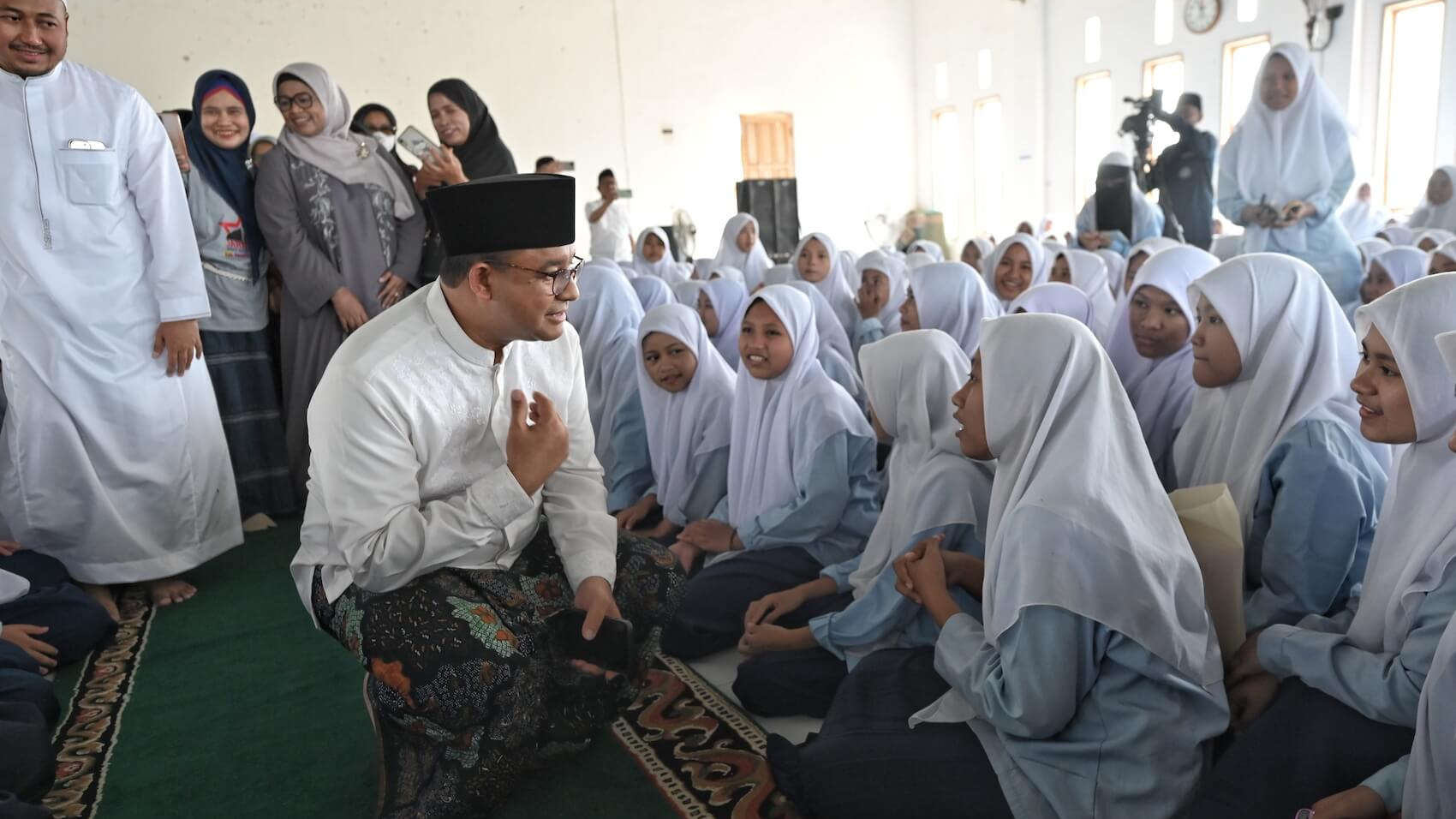
Armed with this impressive academic background, Anies embarked on a teaching career at Paramadina University. This institution, guided by Indonesia’s esteemed figure of pluralism and tolerance, Nurcholish Madjid, instilled the values of virtue in higher education. Anies excelled in his role, ultimately becoming the most influential figure on campus. He served as the university’s rector and initiated the ‘Indonesia Mengajar’ program, renowned for inviting top volunteers from across the nation and deploying them to the farthest and most remote areas to serve as teachers in foundational schools.
Subsequently, Anies was appointed as the Minister of Education and Culture in Jokowi’s cabinet, although his tenure was interrupted by a reshuffle. Nevertheless, his career continued to flourish. He contested the 2016 Jakarta gubernatorial election, securing victory over the incumbent Governor Ahok and Agus Harimurti Yudhoyono (AHY), the son of former Indonesian President Susilo Bambang Yudhoyono (SBY). Leveraging his experience as the head of the capital, Anies emerged as a presidential candidate for the 2024 election under the Nasdem party ticket.
Anies and the 2024 Presidential Election
Poster in Yogyakarta, Indonesia supporting Anies Baswedan to become president on September 1, 2023. Photo: Mbah Purwo.
Anies could be portrayed as one of the intellectual actors who mobilized Islamist populism in the lead-up to the 2016 gubernatorial election and the 2019 presidential elections. He is often characterized as a figure involved in the intricate realm of politics, where space is provided for intolerant and discriminatory political actions. By employing the identity politics of Islamism, he advocated for the general will of the Muslim majority to stand against an unjust ruling regime. His political maneuvers were shaped by invoking the religious primordialism of the Islamist masses in their struggle against corrupt elites.
However, people tend to overlook his role as a political spokesperson for Jokowi in the 2014 presidential election (Akuntono 2014). He stood by Jokowi’s side and eventually assumed a prominent position in the cabinet, serving as Indonesia’s Minister of Education and Culture. In this context, Anies was aligned with the same political group that presents itself as the defender of diversity. Nevertheless, his political shift in 2016 led to a significant victory as the Governor of Jakarta, alongside his deputy, Sandiaga Uno. In 2019, he threw his support behind Prabowo Subianto and Sandiaga Uno, who were challenging Jokowi’s presidency. Despite their eventual defeat, both eventually found a place in Jokowi’s cabinet, as Minister of Defense and Minister of Tourism respectively.
As we approach the 2024 election, Anies’s electability has surged. According to Drone Emprit data, which analyzes the frequency of certain political figures’ names on Twitter using the keyword “Anies Baswedan,” he is the most discussed figure among the public (Rahman, 2022). However, it’s essential to assess what proportion of voters and Twitter users actively engage in campaign-related discussions, debates, and political discourse. Similarly, in polls conducted by various institutions, Anies consistently secures a place in the top three positions, competing with Prabowo and Ganjar Pranowo. With strong electability, Anies has been nominated as a presidential candidate by the Nasdem party.
Naturally, announcing his candidacy early, before other candidates are officially revealed, carries risks, particularly concerning the formation of coalitions with other parties. Currently, Nasdem is in a coalition with the Prosperous Justice Party (PKS) and the National Awakening Party (PKB). However, their former partner, the Democratic Party (Demokrat), withdrew from the coalition, feeling betrayed when Anies was instead paired with PKB chairman Muhaimin Iskandar as the vice-presidential candidate. The Democratic Party advocates for Anies to be paired with AHY.
Without the Democratic Party in the Anies-Muhaimin coalition, it appears to have surpassed the parliamentary threshold of 25 percent based on previous votes in the House of Representatives (DPR). Nasdem holds 10.26 percent of the seats in the DPR, PKS holds 8.7 percent, and PKB holds 10.09 percent (Huda, 2023). Their combined coalition share reaches 29.05 percent. In contrast, their rival Ganjar, under the Indonesian Democratic Party of Struggle (PDIP) umbrella, commands 22.26 percent support and is backed by the United Development Party (PPP), which holds 3.30 percent (totaling 25.56 percent). Meanwhile, Prabowo’s Great Indonesia Movement Party (Gerindra) has 13.57 percent support, with backing from Golongan Karya (Golkar) at 14.78 percent, the National Mandate Party (PAN) at 7.65 percent, and the Democratic Party at 9.39 percent (totaling 45.39 percent).
Currently, Anies’s political coalition holds a higher percentage of DPR seats than Ganjar’s coalition but still falls significantly short of Prabowo’s alliance. If Anies is able to win the vote in the first phase of the election, the political map may change. Anies faces a challenging path forward, as does his political coalition. The Anies-Muhaimin coalition is expected to secure substantial votes from followers of Nahdlatul Ulama (NU), Indonesia’s largest Muslim organization. PKB, a political party founded by prominent NU figure Abdurrahman Wahid (Gus Dur), plays a pivotal role in this regard. Interestingly, during the NU’s centenary celebrations in Sidoarjo on February 7, 2023, numerous state officials associated with the PDIP were prominently featured. Concurrently, Muhaimin Iskandar, with a ‘Nahdliyyin’ (NU follower) background, appeared to be absent. However, there was a so-called PKB-ization of the NU, a party with a large mass that he wrested from its founder Gus Dur.
With all these complexities, Anies still has a chance to win the battle against Ganjar and Prabowo, provided he secures the votes in Jakarta, West Java, and a substantial number of votes in East Java. To secure the major voting pockets, he needs to convince the parties that have endorsed him. On September 27, he met with the FPI’s Grand Imam, Rizieq Shihab, in an attempt to secure the support of the Islamist populist group. Concurrently, the leader of the NU, KH Yahya Cholil Staquf, declared that he would never support a political coalition that included religious groups threatening the nation’s unity.
Anies is making efforts to convince his Islamist populist followers that he won’t betray them, emphasizing pluralism, kindness to minorities, and opening doors to Chinese conglomerates and oligarchs—a formidable and almost impossible task. This is what was discussed during Anies’s interview with ABC News (2023). He asserted that his work in Jakarta demonstrates his leadership for all, characterized by non-discrimination, non-intolerance, and service to people regardless of their backgrounds.
It will be a gamble for him, unless he adopts a pragmatic approach to secure his political position first, recognizing that in the political arena in a political battle, betrayal can be both normal and tolerable. His experience with Jokowi has enabled him to counteract Islamist populism and mitigate the trend toward religious conservatism.
Anies’ Political Maneuver and Islamist Populism
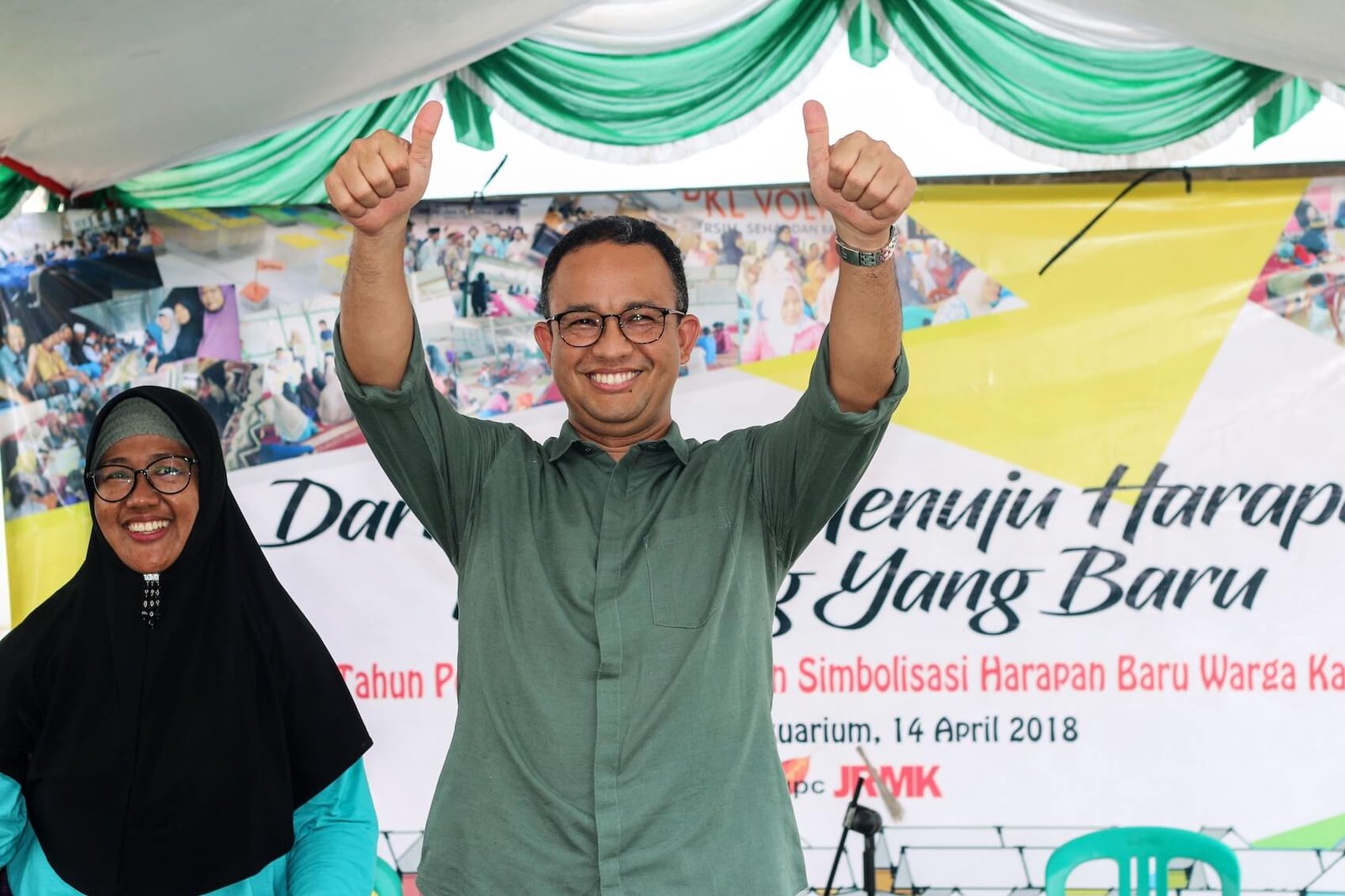
DKI Jakarta Governor Anies Baswedan with residents of Kampung Akuarium in Jakarta, Indonesia on April 14 2018. Photo: Shutterstock.
The greatest fear of a nation whose motto is unity in diversity is disintegration. The possibility of disintegration can result from fragmentation. Social fragmentation within society encourages the sharpening of differences, ultimately leading to various social and political frictions. Frictions that escape government control can escalate into conflicts. This becomes a serious problem when not adequately and properly managed. The problem is that Indonesia has faced significant polarization in electoral politics, particularly exacerbated when religious symbols, especially Islam as the majority religion, become embroiled.
In 2016, a year seen as preparatory for the 2019 realpolitik contest, religious symbols indisputably became a catalyst for intense social and political polarization. During the Jakarta gubernatorial election, incumbent governor Basuki Tjahaya Purnama, known as Ahok, faced off against Anies Baswedan. This contest sadly involved the influence of identity politics (Islamism) and a substantial mobilization of supporters for Anies. Ahok faced accusations of blasphemy and was ultimately sentenced to prison. His supposed blasphemy occurred when he criticized political figures who invoked Surat al-Maidah in their election campaigns, aiming to expose the use of religion for political gain. In response, Anies, as part of a broader strategy, mobilized Islamist populism to protest against his political opponent, orchestrating a large-scale mass action known as Islamist populism.
In this context, populism assumes the form of resistance to Ahok, who is perceived as a political symbol aligning with corrupt ruling elites. These elites are viewed as corrupt because populists argue they often disregard or violate the general will of the people. Ahok, a political figure belonging to both religious and racial minorities (Christian and Chinese), is seen as a powerful minority who has not favored the Muslim majority. He stands accused of undermining justice and the welfare of the people from the perspective of Anies’ group.
Therefore, the populism unfolding is primarily characterized by criticism, resistance, the struggle of the majority (Muslims and the oppressed) against an elite minority (Ahok) seen as oppressors, foreign lackeys, servitors of the West and China, and a perceived threat to the development of the ummah’s civilization (Yilmaz, Morieson & Bachtiar, 2022). In this narrative, realpolitik actors like Anies are portrayed as champions of Muslim civilization, with Anies even being likened to Abu Bakar al-Shiddiq (a friend of the Prophet Muhammad), a figure described as patient, wise, and possessing good leadership qualities (Kumparan, 2017). This form of populism typically exploits rhetoric centered on civilization, which starkly contrasts ‘us’ with ‘them,’ emphasizing cultural and religious differences (Yilmaz & Morieson, 2023).
Following Ahok’s defeat, Anies assumed the influential position of ‘Jakarta 1,’ symbolizing the capital’s most prominent figure. However, Rizieq Shihab, the founder of the Islamic Defenders Front (FPI), faced a different fate. He became a target of the government, accused of being an intellectual actor of Islamist populism posing a threat to national security. In 2016, he managed to mobilize masses from cross-class alliances to enter the political arena against the corrupt elites and others. He then fled to Saudi Arabia. Upon his return to Indonesia, he was arrested for organizing a mass rally during the Covid-19 pandemic, which resulted in the shooting of his six supporters by the police and the banning of the FPI.
Upon his release on parole, Rizieq Shihab reconnected with Anies. In a baptism-like ceremony, in the presence of Rizieq Shihab’s recitation congregation, Anies was hailed as a leader who had fulfilled his promise as a governor favoring Muslims (Kumparan, 2022). He was contrasted with typical political figures who often renege on their commitments once in power. Rizieq asserted that Anies was different and deemed him a potential candidate for the presidency in Indonesia’s 2024 election, indicating that Anies had become the preferred choice of Islamist populists. However, as of October 2023, the Islamist populist movement has shown no signs of emerging as a large-scale political maneuver involving mass mobilizations.
Anies was respectfully dismissed by President Joko Widodo on October 16, 2022, based on Presidential Decree No. 100/P of 2022. Since then, Anies has begun mobilizing political forces to secure victory in the forthcoming 2024 presidential election. On October 3, 2022, Anies was officially declared a presidential candidate by Nasdem’s leader, Surya Paloh. When asked why Anies Baswedan was chosen, Surya Paloh responded, “Why not? He is the best,” during a press conference at the Nasdem Tower in Jakarta (Savitri, 2022). Additionally, before party officials, Surya Paloh emphasized, “There is no time for us to think and give intolerant thoughts, tolerance is for those who give tolerance. True nationalism, true national thoughts are associated with attitudes that are full of tolerance and that is what Nasdem is fighting for,” (Savitri, 2022).
Subsequently, other parties, including PKS, PKB, and Demokrat, initially voiced their support for Anies, although Demokrat later withdrew. It’s worth noting that Nasdem had previously aligned itself with the victorious PDIP. This means that Nasdem’s stance opposes the Islamist populist movement. In contrast, PKS favors populism and had disassociated from the coalition with Gerindra, the party of another presidential candidate, Prabowo. This shift toward emphasizing tolerance and nationalism, as opposed to Islamist populism’s rhetoric, is indicative of Anies’ evolving political maneuvering style. Nasdem’s expectation is for Anies to win the battle by winning the sympathy of voters outside the Islamist populist group. This does not mean that voters from Islamist populist circles or those who sympathize with identity politics of Islam should be ignored. The goal is for these voters to rally behind Anies rather than Prabowo.
Previously, both Anies and Prabowo had employed Islamist populism as a tool to challenge the ruling government, whether it was Ahok or Jokowi. However, shortly after Prabowo’s defeat in the 2019 presidential election, he accepted Jokowi’s offer to join his cabinet, assuming the pivotal role of Minister of Defense. While this move may have appeared rational, it somewhat eroded the trust of Islamist populist groups in Prabowo. Consequently, these groups shifted their support from Prabowo to Anies. With the additional votes from a diverse electorate less concerned with identity politics, Anies has a chance to outperform Ganjar. The Islamic populist movement may continue to play a role in Anies’ political strategy, albeit with a reduced emphasis on Islamist identity politics, if not its complete elimination.
The change in Anies’ political maneuvering style is evident in an interview with Solo Pos. When asked, “Can Pak Anies ensure that he will be a leader for all Indonesian people when he becomes president?” Anies responded, “I have worked in Jakarta for five years. Can you show me Anies’ policies that are intolerant, discriminatory, not inclusive, that reflect partisan views? So don’t ask about the future, because anyone can boast in front of you. Ask about the track record. …I can show you that in Jakarta we have the best democracy index, the best tolerance… even in cohesiveness (also the best). This is based on a study by Nanyang Technological University. In Jakarta there is no polarization, there is cohesiveness. Where is the polarization? On social media. There is no polarization in the community,” (Baswedan 2023).
Clearly, Anies’ real identity still remains uncertain. He may indeed be a pluralist, but it is also possible that he is ideologically aligned with staunch defenders of Islamism. As an academic and the rector of Paramadina University, a campus influenced by the progressive Muslim scholar Nurcholish Madjid, Anies understands the importance of fostering Indonesian pluralism. However, in politics, ideologies can change and adapt to serve one’s political interests. What the public can comprehend in this context is an adherence to an ideology that advances personal political ambitions. Anies’ moderation of Islamism, his role as a defender of diversity, and his efforts toward a more pro-equality, anti-discrimination, and tolerant form of Islamism may be driven by pragmatic political considerations rather than a fundamental shift to democratic post-Islamism, as proposed by Asef Bayat (2013). What is certain is that his ultimate goal appears to be securing practical political victories.
Conclusion
The public views Anies Baswedan not only as a potential presidential candidate but also as a prominent figure who played a crucial role in the Islamist populist movement during his bid for the governor’s seat in the Jakarta gubernatorial election. He was a central figure in the process that led to Ahok’s imprisonment, a symbol of political elites from religious and ethnic minority backgrounds. However, as the 2024 election draws near, Anies’ style of political maneuvering has undergone a transformation. Acting upon the advice of Nasdem, the party that endorsed him as a presidential candidate, Anies now presents himself as a figure committed to upholding the values of equality, tolerance, and nationalism.
In his recent article titled “Meluruskan Jalan, Menghadirkan Keadilan (Straightening the Path, Presenting Justice)” in Kompas (February 17, 2023), Anies expressed, “The essence of democracy is to provide equal space for all. Presenting legal certainty and security by guaranteeing the rights of citizens, especially safe spaces for women, children, people with disabilities, indigenous peoples and marginalized groups. … healthy democracy and legal equality that will drive equitable economic progress. Economic progress without the prospect of social justice will feel false.”
This change allows us to consider the post-Islamist thesis with an optimistic tone. Through Anies, the political style of Islamist populism appears to be evolving into a more democratic form. Anies presents himself as a democratic Muslim. Nevertheless, the post-Islamism thesis has faced significant criticism, particularly because Islamist figures, parties, and social and political movements have rarely advocated for substantive democratization. In this context, post-Islamism often seems more like a political expression that embraces democracy while engaging in Machiavellian political pragmatism that may disregard religious morality. In essence, it can employ various means, including instrumentalizing religion, to attain and maintain the status quo.
However, political reality unfolds dynamically. It is this dynamism that offers an opportunity for the development of a vibrant democracy, as argued by Dan Slater (2023). His thesis is, of course, far more optimistic than Thomas P. Power’s (2018) diagnosis and similar views, emphasizing that Islamist populism and state authoritarianism can lead to a regression of democracy in the country. We shall see—will Anies emerge victorious? And if he does and has to lead all ethnic groups, will he continue to present himself as a Pancasilaist or will he adopt a more populist approach, catering primarily to the majority?
The extent of these political shifts remains uncertain. Will it be as Kartini (2014) suggested, “Habis gelap terbitlah terang (Out of darkness comes light),” or will the darkness, as Power (2018) and his associates fear, usher in a continued regression of democracy? Nevertheless, Anies (2023) expressed in his article that “State administrators need to be humble, avoiding monopolization of the truth, and instead, providing comfortable spaces for citizens to come together and participate.” If he assumes the role of a state administrator, will he monopolize the truth as he did when aligning with Rizieq Shihab, the FPI, and other Islamist populist figures against Ahok? The future trajectory of Indonesian politics will provide answers to these questions.
(*) Hasnan Bachtiar is a lecturer at the Faculty of Islamic Studies, University of Muhammadiyah Malang (UMM), Indonesia. Additionally, he is pursuing his Ph.D. in the Faculty of Arts and Education at Deakin University, Burwood, Australia.
— (2022). “Habib Rizieq ke Anies: Terima Kasih Telah Pimpin Jakarta dengan Baik.” Kumparan. October 22, 2022. https://www.youtube.com/watch?v=wTHZ7S-3mJs (accessed on October 8, 2023).
— (2023). “Why Anies Baswedan has been gaining traction in Indonesia’s Presidential race.” ABC News. March 8, 2023. https://www.youtube.com/watch?v=7wmyhU_ysMY (accessed on October 8, 2023).
Baswedan, A. (2023). “Anies Bapak Politik Identitas?” Interview with Solo Pos. YouTube. January 14, 2023. https://www.youtube.com/watch?v=Bjp0J0lg5U8 (accessed on October 8, 2023).
Bayat, A. (2013). Post-Islamism: the changing faces of political Islam. Asef Bayat (ed.). New York: Oxford University Press.
Kartini & Coté, J. (2014). Kartini: The complete writings 1898-1904. 1st ed. Clayton, Victoria: Monash University Publishing.
Mahy, P. (2022) Indonesia’s Omnibus Law on Job Creation: Legal Hierarchy and Responses to Judicial Review in the Labour Cluster of Amendments. Asian journal of comparative law. [Online] 17 (1), 51–75.
Mietzner, M. & Muhtadi, B. (2018). “Explaining the 2016 Islamist Mobilisation in Indonesia: Religious Intolerance, Militant Groups and the Politics of Accommodation.” Asian Studies Review. [Online] 42 (3), 479–497.
Power, Thomas P. (2018). “Jokowi’s authoritarian turn and Indonesia’s democratic decline.” Bulletin of Indonesian Economic Studies, 54(3), 307-338. https://doi.org/10.1080/00074918.2018.1549918
Slater, D. (2023). “What Indonesian Democracy Can Teach the World.” Journal of Democracy, 34(1), 95-109. doi:10.1353/jod.2023.0006.
Yilmaz, I.; Morieson, N. & Bachtiar, H. (2022). “Civilizational Populism in Indonesia: The Case of Front Pembela Islam (FPI).” Religions (Basel, Switzerland ). 13 (12), 1208–.
This panel is jointly organised by The European Center for Populism Studies (ECPS) and The Alfred Deakin Institute for Citizenship and Globalisation (ADI) .
Moderator
Dr Susan de Groot Heupner (Associate Research Fellow at the Alfred Deakin Institute for Citizenship and Globalisation in Melbourne, Australia).
Speakers
“Imran Khan’s Populist Narratives: An Analysis,” by Dr Samina Yasmeen (Professor, Head of Department of International Relations, Asian Studies and Politics in University of Western Australia’s School of Social Sciences).
“The Land of Pure: Islamic Populism in Pakistan’s Identity Project and the Rise of Radical Islam,” by Dr Fizza Batool(Assistant Professor of Social Sciences at SZABIST University, Karachi, Pakistan).
“Military and Populism in Pakistan,”by Dr Raja M. Ali Saleem (Associate Professor of Public Policy at the Centre for Public Policy and Governance at Forman Christian College in Lahore, Pakistan).
“‘I Am Democracy’: The Appeal of Imran’s Khan’s Populism for Pakistani Women,” Dr Afiya Shehrbano Zia (Pakistani feminist researcher on gender and social development).
Yilmaz, Ihsan; Akbarzadeh, Shahram & Bashirov, Galib. (2023). “Strategic Digital Information Operations (SDIOs).” Populism & Politics (P&P). European Center for Populism Studies (ECPS). September 10, 2023. https://doi.org/10.55271/pp0024a
Abstract
In this paper, we introduce the concept of “Strategic Digital Information Operations” (SDIOs), discuss the tactics and practices of the SDIOs, explain the main political goals of state and non-state actors in engaging with SDIOs at home and abroad, and suggest avenues for new research. We argue that the concept of the SDIOs presents a useful framework to discuss all forms of digital manipulation at both domestic and international levels organized by either state or non-state actors. While the literature has examined the military-political impacts of the SDIOs, we still don’t know much about societal issues that the SDIOs influence such as emotive political mobilization, intergroup relations, social cohesion, trust, and emotional resonance among target audiences.
By Ihsan Yilmaz, Shahram Akbarzadeh* and Galib Bashirov**
Introduction
In recent years, the convergence of the digital realm and political sphere has created a dynamic environment where a wide range of state and non-state actors try to leverage digital platforms to pursue their political goals. This trend includes diverse cases, spanning from the continual targeting of autonomous media establishments in nations like Egypt and Turkey to the deliberate manipulation of electoral processes in democratic countries such as the United States (US) and the United Kingdom (UK), while also extending its reach to include extremist groups such as ISIS who use digital platforms for their propaganda endeavours (see Ingram, 2015; Theohary, 2011). These “Strategic Digital Information Operations (SDIOs),” as we call them here, refer to efforts by state and non-state actors to manipulate public opinion as well as individual and collective emotions by using digital technologies to change how people relate and respond to events in the world. As such, SDIOs involve deliberate alteration of the information environment by social and political actors to serve their interests.
We use this term – SDIOs – because it combines several facets of digital manipulation at both national and international levels. “Information Operations” is a term social media companies like Facebook have adopted to describe organized communicative activities that attempt to circulate problematically inaccurate or deceptive information on their platforms. These activities are strategic because rather than being purely communicative, they are driven by the political objectives of state and non-state actors (see Starbird et al., 2019; Hatch, 2019). We add the concept ‘digital’ to emphasize the distinction between the old ways of information operations and the new ones that operate almost specifically in the digital realm and use much more sophisticated tools such as artificial intelligence (AI), machine learning, and algorithmic models to disseminate information. Of course, some aspects of digital information operations have been carried over from the non-digital environments that have been mastered over the past century. Nonetheless, the affordances of the digital environment have provided not only radically new and sophisticated tools but also an opportunity for much wider dissemination and reach for strategic information operations.
The SDIOs involve various tactics used by political groups who try to shape the online environment in their favour. Their goal is to control the flow of information, where politics and social actions meet. We note that these tactics can cross borders between countries: these operations don’t just target people within a country; they also aim to reach people in other nations. In this article, we briefly discuss the tactics and practices of the SDIOs, explain the main political goals of state and non-state actors in engaging with SDIOs at home and abroad, and present venues for new research.
Tactics and Practices of SDIOs
As researchers started to examine the many ways in which state actors have tried to manipulate domestic and foreign public opinion in their favour, disinformation has become the main focus of their analysis with an emphasis on spreading fake news, conspiracy theories, and outright lies. Various forms of disinformation have been used in order to create doubt and confusion among the consumers of malign content. Spreading conspiracy theories makes people doubt the truth, which weakens trust in social and political institutions. Moreover, sharing fake news or other fabricated stories weaves a web of lies that shapes what people think. While the latter has certainly been effective in manipulating public opinion, observers have noted recently a shift in emphasis from disinformation to more sophisticated and less discernable means of manipulation.
The aforementioned shift has taken place due to the growing awareness of the fake news and lies in digital environments on the part of both users and digital platforms. As platforms such as Twitter and Facebook have increased their clampdown on such content and as users have become more capable in spotting them, state and non-state actors have moved to more sophisticated means of digital manipulation where content is carefully designed to change how people see things. For example, instead of outright lies or fake news, strategic actors have started to spread half-truths that create a specific version of events by conveying only part of the truth (Iwuoha, 2021). Moreover, these actors have made massive investments on smart public relations messages and clever advertisements to prop up their messages. An important tactical goal has become not simply to deceive the audience but more so to ‘flood’ the information space with not just false, but also distracting, irrelevant, and even worthless pieces of information with the help of trolls and bots, hired social media consultants and influencers, as well as genuine followers and believers (Mir et al., 2022).
For example, observers noted how a prominent strategy of the Chinese domestic propaganda is to ‘drown out’ dissident voices through incessant propagation of the government messaging, a campaign called ‘positive energy’ (Chen et al., 2021). The Orwellian campaign involved not only the use of a massive influencer and troll army to promote government messaging but also the forceful testimony of the Uyghur people. In one instance for example, seven people of Uighur descent were brought to a press conference to share their stories of “positive energy” and made-up hype against China to disprove allegations of mistreatment by the Chinese government (Mason, 2022). As such, SDIOs encompass all these tactics and practices rather than merely focusing on means of disinformation that have so far dominated the research into digital manipulation. It also shows the ability of SDIOs to adapt and change over time based on the operational context. While disinformation through direct messages remains a consistent approach, actors increasingly move towards using subtler tactics to create distractions and cause confusion among their audience, which weakens the basis of well-informed political discussions. For example, the Egyptian government has flooded the information space with the news of the ‘electricity surplus’ and the future of Egypt as ‘an electricity carrier for Europe’ amidst an ongoing economic crisis in the country that has left millions of Egyptians without access to reliable electricity (Dawoud, 2023).
At the heart of discussions about strategic digital information operations lies the creation of narratives carefully designed to connect with their intended audiences. These narratives aren’t random; instead, they’re tailored to match how the recipients think. The interaction between these narratives and their audiences involves psychology, culture, and emotions. How the audience reacts depends not only on how convincing the content is, but also on their existing beliefs, biases, and cultural contexts (Bakir and McStay, 2018). While some people might approach these narratives with doubt, others could be drawn into self-reinforcing cycles, giving in to confirmation bias and manipulation. This back-and-forth underlines the close link between creators and consumers of strategic narratives in the digital era.
Among the many narrative tropes that SDIOs use, we want to note the increasing role ascribed to historical and religious notions to influence public opinion and political discussions. SDIOs mix past grievances and religious beliefs to make their stories more impactful and believable. Bringing up old injustices can stir up strong patriotic feelings or strengthen shared memories. At the same time, using religious stories can tap into deeply held beliefs, making people think there is divine approval or a connection to common values. This blend of history and religion makes their stories powerful and emotional, making them more effective. In Turkey, for example, the state authorities have disseminated victimhood narratives that largely rested on conspiracy theories and half-truths in order to legitimize their rule and quash dissent (Yilmaz and Shipoli, 2022). Research has noted that Islamic religious ideas and the reconstructed history of the Ottoman collapse have been strategically inserted into such narratives to elevate their influence among the Turkish masses (Yilmaz and Albayrak, 2021; Yilmaz and Demir, 2023).
Finally, it’s important to stress that these information operations aren’t always coordinated by automated bots or pre-planned campaigns. Sometimes, they happen naturally through implicit coordination among various participants, which makes the situation even more complex. Starbird et al.’s (2020) research demonstrates that online information operations involve active participation by human actors. The messages these operations spread are disseminated by utilizing online communities and various sources of information. As such SDIOs can be ‘cooperative’ endeavours in that they do not always rely on mere “bots” and “trolls,” but also encompass the contribution of online crowds (both knowingly and unknowingly) in the propagation of false information and political propaganda. For example, during the Russian information operations in the wake of the 2016 US Presidential elections, agents of the Internet Research Agency (RU-IRA) based in St. Petersburg worked together through the operation of more than 3.000 accounts that presented themselves as people and organizations belonging to the American political spectrum (such as the Black Lives Matter and the Patriotic Journalist Network). While undertaking such ‘orchestrated’ activity, the RU-IRA also managed to integrate organic communities by impersonating activists within those online communities, building networks within those communities, and even directly contacting ‘real’ activists. In some cases, RU-IRA agents directly collaborated with activists to organize physical protests in the US (see Walker, 2017).
Goals of SDIOs
Illustration: Shutterstock.
SDIOs span both national and international contexts, targeting domestic and foreign audiences through an array of tactics to achieve the political goals of their organizers. Looking at the domestic realm, SDIOs have influenced the functioning of the government and social and political institutions. In many instances, authoritarian governments use digital platforms to influence individuals’ opinions through stories, emotions, and viewpoints that are carefully designed to resonate with specific groups of the population. Their toolkit includes a range of elements, such as conspiracy theories that legitimize a government policy or deflect attention from a government failure, or that create doubt on the arguments of the opposition parties and social actors. Governments may also present narratives where they portray themselves as victims, manipulate facts, and spread distorted statements. For example, in Egypt, the government’s digital narratives have portrayed independent media outlets as agents of Western conspiracies designed to infiltrate and destroy the Egyptian social and political fabric. Similarly, the civilian presidential candidates against President Sisi have been labelled Western puppets created to destabilize Egypt (Michaelson, 2018). In China, the CCP government has used media management platforms such as iiMedia to control public opinion, including providing early warnings for ‘negative’ public opinions and helping guide the promotion of ‘positive energy’ online (Laskai, 2019).
It must also be noted that these narratives, particularly those that employ victimhood tropes, are strategically employed to trigger various emotions among the masses. In Turkey, for example, the Erdogan regime has consistently abused a victimhood claim that rested mainly on the already-existing emotions of the masses such as envy, disgust, humiliation, hatred, anxiety, and anger (Yilmaz, 2021). These emotions are triggered and aroused by government elites as well as government-controlled media in order to legitimize the Erdogan regime’s authoritarian rule and deflect attention from its failures (see Yilmaz, 2021; Tokdogan, 2019).
While both sets of actors pursue political goals through digital manipulation, there are certain differences between state and non-state actors when it comes to utilizing the SDIOs. On the one hand, the state actors tend to be well-resourced and possess good infrastructure of human and technological capital. They tend to have access to a range of digital tools to be used in domestic and foreign contexts, whether to silence the critics and legitimize their rule at home or destabilize their adversaries and extend their geopolitical influence abroad. They tend to carefully plan campaigns to infiltrate foreign information systems, reshape stories, and generate social conflicts, all of which take long-term thinking and strategic foresight. On the other hand, non-state actors, including hacktivist groups and extremist organizations, may lack resources but they tend to be more adaptable to new environments. They use digital platforms to promote their causes, attract supporters, and amplify their voices. These players manoeuvre through the digital world with agility, reflecting the changing nature of the medium.
Research has noted the implications of information operations for democratization as authoritarian and populist governments have leveraged digital media’s features to advance their political objectives. The calculated manipulation of digital platforms by these actors serves as a conduit for amplifying narratives that bolster their policies, worldviews, and perspectives. Authoritarian governments utilize digital censorship and surveillance to suppress dissenting voices and exert control over digital narratives. Populist leaders, in turn, harness the immediacy and interactive nature of social media to establish direct, emotional connections with their constituents, bypassing traditional gatekeepers (Perloff, 2021). By capitalizing on the resonance of online platforms, these actors perpetuate narratives that exploit societal grievances, positioning themselves as advocates for the marginalized while vilifying opposing viewpoints (Postill, 2018).
A Specific, International SDIO: Sharp Power
SDIOs undergo a transformation into tools of geopolitical orchestration and influence projection. In this context, digital strategies manifest as instruments designed to strike a chord with international audiences. They sow seeds of social and political division in target countries that perpetrators try to destabilize. These efforts generate support for both domestic and foreign policy objectives of the perpetrators, often exceeding the boundaries of the conventional notion of soft power and giving rise to what is termed “sharp power” (Walker, 2018). This variant of influence extends beyond the benign strategies commonly associated with “soft power,” taking on a more coercive character where “it seeks to pierce, penetrate, or perforate the political and information environment” (Walker, 2018: 12; Fisher, 2020; Elshaw and Alimardani, 2021).
The emergence of “sharp power” has denoted a significant shift in the dynamics of external influence, as digital platforms are being used to coercively reshape geopolitical interactions between major powers such as the US, China, and Russia, as well as middle powers such as Australia, Turkey, and Egypt. For example, over the last decade, Australia, its public authorities, media entities, and civil society organizations have been systematically targeted by Chinese sharp power operations that included lavish donations to campaigns of useful political candidates, harassment of journalists, and spying on Chinese students in university campuses (The Economist, 2017).
Social Impacts of SDIOs
The study of strategic information operations is not new as scholars noted the US and Soviet attempts at influencing each other’s information environment since the start of the Cold War (see Martin, 1982). Nonetheless, we note that the strategic information operations have been used mostly in two fields of study: military influence and social media analysis, with the political science literature mostly discussing the elements of the concept without fully operationalizing it.
On the one hand, scholars working within military studies have rightly pointed out the strategic reasoning of information operations for international politics (see Rattray, 2001; Kania and Costello, 2018). For example, Kania and Costello (2018: 105) showed how the creation of the Strategic Support Force within the Chinese army structure was aimed at “dominance in space, cyberspace, and the electromagnetic domain,” thus generating synergy among these three domains, and building capacity for strategic information operations. States have also been manipulating the information environment to influence the internal affairs of their adversaries for decades. This has led to discussion of information operations as a potential threat to national security and stability (Hatch, 2019).
On the other hand, those working on social media analysis have tried to explain how these information operations have been carried out in social media environments. Researchers have identified technical means through which sophisticated tools of manipulation have been put in place in platforms such as Twitter and Facebook that led to the spread of dis/misinformation (see Starbird et al., 2019). Among other things, this literature has also helped us to understand why certain pieces of information resonate with users and generate a response (such as those that are more surreal, exaggerated, impressive, emotional, persuasive, clickbait, and shocking images tend to generate better results).
The political science literature has noted various ways in which specific forms of mis/disinformation have affected political discussions in mostly democratic countries without utilizing the SDIOs as an umbrella term. In democratic contexts, the rapid dissemination of misinformation and divisive narratives poses a substantial threat, corroding informed decision-making and hindering the robust exchange of ideas. Trust, a cornerstone of functional democracies, becomes fragile as manipulation proliferates, eroding institutional credibility and undermining the fundamental tenets of democratic governance. For example, in the US, the Russian information operations around the 2016 Presidential Elections targeted key political institutions such as the political parties, the Congress, and the Constitutional Court through hacking, manipulative messaging, and social media campaigns, leading to erosion of trust among American citizens on these institutions (see Benkler et al., 2018).
While the literature covered such issues, we note that social aspects have not received as much discussion so far. We have seen that the SDIOs create significant social impact in terms of social cohesion, polarization, intergroup relations, and radicalization just to name a few. However, the literature’s discussion of these concepts has been limited to technical or political aspects. For example, when the literature examines polarization, they either try to demonstrate how these operations polarize the discourse on the internet, or they focus on political polarization (e.g. between the left and the right, or the majority and the minorities) (e.g., Howard et al., 2018; Neyazi, 2020) while overlooking the wider societal polarization and corruption. Moreover, we need further investigations into how social media platforms amplify the impact of information operations on group dynamics, specifically, whether the content on social media exacerbates polarization and reinforces group identities. This is premised on the fact that the impact of SDIOs extends beyond individual psychology, permeating the collective fabric of societies and democratic institutions. By exploiting digital platforms, these operations can foster polarization, exacerbate existing divisions, and undermine the foundations of social cohesion.
Impacts of SDIOs on Individual and Collective Emotions
Illustration: Shutterstock / Vchal.
In the context of social issues, an important underexplored aspect is the emotional dimension. The SDIOs aim to provoke a wide range of emotions among their targets, including negative, positive, and ambivalent feelings. They aim to generate these emotional responses to achieve various political goals such as gaining support for their political causes, undermining opposing groups, eroding trust in society, marginalizing minority groups, and making people question the credibility of independent media outlets. These operations are usually planned to trigger specific emotional reactions that align with the intentions of the perpetrators. For example, Ghanem et al. (2020) found that the propagation of fake news in social media aims to manipulate the feelings of readers “by using extreme positive and negative emotions, triggering a sense of ‘calmness’ to confuse the readers and enforce a feeling of confidence.” However, we need further research to understand how such emotional responses generate social impacts such as intergroup resentment, xenophobic fear, and anger, potentially leading to societal dissent and upheaval. Conversely, positive emotions like empathy and camaraderie can foster social unity and rally support around social causes. Therefore, the strategic coordination of emotional experiences stands as an important dimension of SDIOs that needs further research.
The final underexplored area we want to emphasize pertains to the content of strategic narratives, including the social and political reasons behind their resonance within target societies. For example, in addition to the content of conspiracy narratives, new research needs to identify why and how certain narratives work in specific social contexts and not in others. Research needs to investigate how historical events, cultural norms, and collective memories shape the reception and resonance of strategic narratives. For instance, narratives that invoke historical grievances might gain traction in societies with unresolved historical conflicts. Further research can explore how strategic narratives tap into individuals’ sense of identity and belonging. Narratives that align with or reinforce a group’s identity can gain more resonance, as they validate existing beliefs and foster a sense of unity.
Conclusion
In this paper, we introduced the concept of the Strategic Digital Information Operations (SDIOs), discussed the tactics and practices of the SDIOs, explained the main political goals of state and non-state actors in engaging with SDIOs at home and abroad, and presented avenues for new research. We highlighted that the concept of the SDIOs present a useful framework to discuss all forms of digital manipulation at both domestic and international levels organized by either state or non-state actors. We noted that while the literature has examined military-political impacts of the SDIOs, we still don’t know much about societal issues that the SDIOs influence such as intergroup relations, social cohesion, trust, and emotional resonance among target audiences.
Understanding how audiences perceive and react forms the foundation for generating effective countermeasures against the harmful impacts of SDIOs. Initiatives aimed at promoting digital literacy, critical thinking, and the ability to discern media authenticity will empower individuals to navigate the potentially deceptive terrain of manipulated information. Additionally, creating transparency and accountability in algorithms that digital platforms use and rely on, along with dedicated fact-checking initiatives, will enhance the tools necessary to distinguish between truth and deceit. Furthermore, collaborative efforts involving governments, technology companies, and civil society entities can serve as a strong defense against the corrosive effects of manipulation, safeguarding the integrity of democratic discourse and the informed participation of citizens.
Finally, we note that the examination of SDIOs demands a comprehensive range of methodologies that arise from various disciplines including, quantitative and qualitative analysis that aims at revealing patterns of engagement and shifts in emotions, tracing the pathways of information dissemination, and mapping the networks of influence. Ethnographic investigations that delve into the personal experiences of participants can provide a human-centred perspective, showing the psychological, emotional, and cognitive dimensions of manipulation. Effective collaboration among technology experts, academic scholars, and policymakers can foster a deeper understanding of digital operations work and generate influence.
Funding: This research was funded by Gerda Henkel Foundation, AZ 01/TG/21, Emerging Digital Technologies and the Future of Democracy in the Muslim World.
(*) Dr. Shahram Akbarzadeh is Convenor of Middle East Studies Forum (MESF) and Deputy Director (International) of the Alfred Deakin Institute for Citizenship and Globalisation, Deakin University (Australia). He held a prestigious ARC Future Fellowship (2013-2016) on the Role of Islam in Iran’s Foreign Policy-making and recently completed a Qatar Foundation project on Sectarianism in the Middle East. Professor Akbarzadeh has an extensive publication record and has contributed to the public debate on the political processes in the Middle East, regional rivalry and Islamic militancy. In 2022 he joined Middle East Council on Global Affairs as a Non-resident Senior Fellow. Google Scholar profile: https://scholar.google.com.au/citations?hl=en&user=8p1PrpUAAAAJ&view_op=list_works Twitter: @S_Akbarzadeh Email: shahram.akbarzadeh@deakin.edu.au
(**) Dr Galib Bashirov is an associate research fellow at Alfred Deakin Institute for Citizenship and Globalization, Deakin University, Australia. His research examines state-society relations in the Muslim world and US foreign policy in the Middle East and Central Asia. His previous works have been published in Review of International Political Economy, Democratization, and Third World Quarterly. Google Scholar profile: https://scholar.google.com/citations?user=qOt3Zm4AAAAJ&hl=en&oi=ao Email: galib.bashirov@deakin.edu.au
Bakir, V. & McStay, A. (2018). “Fake news and the economy of emotions: Problems, causes, solutions.” Digital Journalism, 6(2), 154-175.
Benkler, Y., Faris, R. & Roberts, H. (2018). Network propaganda: Manipulation, disinformation, and radicalization in American politics. Oxford University Press.
Chen, X., Valdovinos Kaye, D. B. & Zeng, J. (2021). “#PositiveEnergy Douyin: Constructing “playful patriotism” in a Chinese short-video application.” Chinese Journal of Communication, 14(1), 97-117.
Elswah, M. & Alimardani, M. (2021). “Propaganda Chimera: Unpacking the Iranian Perception Information Operations in the Arab World.” Open Information Science. 5(1), 163-174.
Fisher, A. (2020). Manufacturing Dissent: The Subtle Ways International Propaganda Shapes Our Politics (Doctoral dissertation, The George Washington University).
Ghanem, B., Rosso, P., & Rangel, F. (2020). “An emotional analysis of false information in social media and news articles.” ACM Transactions on Internet Technology (TOIT), 20(2), 1-18.
Hatch, B. (2019). “The future of strategic information and cyber-enabled information operations.” Journal of Strategic Security, 12(4), 69-89.
Ingram, H. J. (2015). “The strategic logic of Islamic State information operations.” Australian Journal of International Affairs, 69(6), 729-752.
Iwuoha, V. C. (2020). “‘Fake News’ and ‘Half-truths’ in the Framings of Boko Haram Narrative: Implications on International Counterterrorism Responses.” The International Journal of Intelligence, Security, and Public Affairs, 22(2), 82-103.
Kania, E. B., & Costello, J. K. (2018). “The strategic support force and the future of Chinese information operations.” The Cyber Defense Review, 3(1), 105-122.
Martin, L. J. (1982). “Disinformation: An instrumentality in the propaganda arsenal.” Political Communication, 2(1), 47-64.
Mir, Asfandyar, Tamar Mitts and Paul Staniland. (2022). “Political Coalitions and Social Media: Evidence from Pakistan.” Perspectives on Politics, 1-20.
Neyazi, T. A. (2020). “Digital propaganda, political bots and polarized politics in India.” Asian Journal of Communication, 30(1), 39-57.
Perloff, R. M. (2021). The dynamics of political communication: Media and politics in a digital age. Routledge.
Postill, J. (2018). “Populism and social media: a global perspective.” Media, culture & society, 40(5), 754-765.
Rattray, G. J. (2001). Strategic warfare in cyberspace. MIT press.
Starbird, K., Arif, A. & Wilson, T. (2019). “Disinformation as collaborative work: Surfacing the participatory nature of strategic information operations.” Proceedings of the ACM on Human-Computer Interaction, 3(CSCW), 1-26.
Theohary, C. A. (2011). Terrorist use of the internet: Information operations in cyberspace. Diane Publishing.
Tokdoğan, N. (2020). “Reading politics through emotions: Ontological ressentiment as the emotional basis of current politics in Turkey.” Nations and Nationalism, 26(2), 388-406.
Walker, C. (2018). “What Is ‘Sharp Power’?” Journal of Democracy, 29, 9.
Yilmaz, I. (2021). Creating the Desired Citizen: Ideology, State and Islam in Turkey. Cambridge University Press.
Yilmaz, I. & Albayrak, I. (2021). “Instrumentalization of Religious Conspiracy Theories in Politics of Victimhood: Narrative of Turkey’s Directorate of Religious Affairs.” Religions, 12(10), 841.
Yilmaz, I. & Demir, M. (2023). “Manufacturing the Ummah: Turkey’s transnational populism and construction of the people globally.” Third World Quarterly, 44(2), 320-336.
Yilmaz, I. & Shipoli, E. (2022). “Use of past collective traumas, fear and conspiracy theories for securitization of the opposition and authoritarianisation: the Turkish case.” Democratization, 29(2), 320-336.
This article argues that there is a distinctive populist approach to the built environment. Populists claim that they alone represent what they often call “the real people.” Hence, there is a need for them to specify who “the real people” are. If they have sufficient power (and time) while in government, they will reshape the built environment – architecture, no less than urban and rural environments more broadly — in line with their understanding of “the real people.” In particular, they will create spaces (some obviously political, some not so obvious, such as football stadiums) that can serve as sites for the collective affirmation of a particular understanding of peoplehood. The article also asks how post-populist governments should relate to a built environment reshaped by populists.
By Jan-Werner Müller*
In the run-up to the momentous parliamentary and presidential elections in Turkey in spring 2023, one part of Recep Tayyip Erdoğan’s record received special scrutiny: the building boom over which his AK Party had presided for the past two decades. The earthquake on February 6 – in which more than 50,000 people perished – made many Turks painfully aware of the dark side of that boom: not just shoddy buildings, but also wide-spread corruption and the creation of construction industry oligarchs ready to cement the power of the ruler (Bechev 2022).
However, Erdoğan is not the only right-wing populist leader who has relied crucially on the building business: Hungary’s Viktor Orbán and Indian prime minister Narendra Modi are others. One little-noticed side-effect is that such long-ruling figures have systematically transformed the built environment – especially city centers, but also small towns and villages – in line with their understanding of who the “real people” are.[1] If such populists lose power – a big if! – new governments will face many urgent tasks. But on their agenda must also be the question whether they should dismantle the symbolic landscapes populist leaders have constructed.
This article investigates what I shall describe as an elective affinity between populism and a particular approach to the built environment (I take the latter to include architecture and urban as well as rural planning). My approach differs from previous attempts to think about architecture in conjunction with populism; such accounts rely on an understanding of populism as “giving people what they want,” or as egalitarian housing policies, or as somehow relating to popular culture (Robert Venturi and Denise Scott Brown’s attempts to “learn from Las Vegas,” and postmodern architecture more broadly, have often been described as “populist”) (Venturi, Brown and Izenour 1972; Lefaivre and Tzonis, 2006; Frausto and Szacka, 2021).[2]
Instead, I shall first offer an approach to populism that identifies the phenomenon with a particular claim by leaders and parties uniquely to represent what populists often call “the real people” or also “the silent majority” (Müller 2017). Clearly, every populist has to say something about “the people” – the people needs to be demarcated somehow (which also shows why those who call a particular policy “populist” – for instance economists criticizing an economic approach for supposedly being inflationary or protectionist – are really making a value judgment; they are not describing anything specifically related to a claim about the people).[3] In a second step, I shall argue that populists with sufficient power (and time) in government will try to reshape the built environment in line with their conception of “the real people.” Put differently, they will seek to establish cultural hegemony (an effort not unique to them, of course) in a distinctly anti-pluralist manner.[4] Needless to say, building is not the only way of doing so; there are also films, soap operas, museums, textbooks in schools, etc.[5]
I shall suggest further, drawing on a number of contemporary examples, that spaces created by populists often serve as sites for affirming a particular understanding of peoplehood. While populism, as I conceptualize it, has an inbuilt authoritarian tendency qua being anti-pluralist, the approach to generate consent through culture by populists in the twenty-first century is notably “softer” than what we know from the experience of twentieth-century dictatorships. Hence this article also confirms recent theories in comparative politics about the peculiarities of today’s authoritarianism. These theories highlight systematic differences between twentieth-century “fear dictatorships” and twenty-first century “spin dictatorships,” with the latter being demonstrably less violent and primarily focused on manipulating public opinion (Guriev and Treisman, 2022): particular artists and architects (and styles and symbols) might be shunned; monuments and buildings might be dismantled — but nobody is sent to prisons or camps. Finally, I want to suggest some ways in which governments that come to power after populist regimes have transformed the built environment might address the question how to relate to that particular populist legacy. Here I shall claim that much depends on the specifics of transitions back to democracy (which is not to suggest that all democracies before populists came to power were perfect!). But it can be said that, in general, post-populist governments should resist the temptation of iconoclasm, which is to say: simply erasing edifices built by populists. There are some important exceptions to this suggestion, though.
According to the World Economic Forum’s 2020 Gender Gap Index, Turkey ranks 129th out of 146 countries surveyed. This ranking takes into account factors such as women’s participation in the workforce, access to education and healthcare, involvement in politics, and the prevalence of femicide within the nation. The deliberate targeting of the Istanbul Convention underscores how populist and authoritarian leaders adeptly utilize gender-related discourse to create stigmatization, eventually leading to state-sanctioned discrimination, violence, and oppression.
The parliamentary and presidential elections in Turkey were held in May 2023, representing a pivotal moment amid concerns of a democracy in decline, eroding rule of law, and a worsening state of gender equality. On May 14, 2023, President Erdogan secured 49.52 percent of the vote, while his opposition rival Kemal Kilicdaroglu received 44.88 percent. The subsequent runoff election saw Erdogan’s share increase to 52.18 percent, with Kilicdaroglu holding 47.82 percent. The electoral process was marred by numerous controversies, including allegations of interference, leading Turkey to depart from its international legal commitments.
During the 2023 parliamentary and presidential elections, the ruling AKP secured 268 seats out of the 600 available in the assembly. Leading the People’s Alliance, the AKP and its coalition partners captured 322 seats in total. Meanwhile, the main opposition Republican People’s Party (CHP) under Kilicdaroglu obtained 169 seats, further reinforced by an additional 212 lawmakers from its Nation Alliance coalition. The pro-Kurdish Peoples’ Democracy Party (HDP), running as the Green Left Party (YSP) due to a court closure case, managed to secure 61 seats. While not formally aligned with Kilicdaroglu’s alliance, the HDP strongly opposes Erdogan and provided unwavering support to the CHP leader.
As a member state of NATO, Turkey currently witnesses the incarceration of prominent political and social figures, severe restrictions on media freedom, and the persistence of self-censorship, despite judgments from the European Court of Human Rights. Criticism at home and substantial reports from international and intergovernmental organizations collectively assert that Erdogan’s government has stifled dissent, eroded civil and human rights, and exerted control over the judiciary and other state institutions, leading the country towards both democratic and economic repercussions. In the face of an economic crisis spurred by Erdogan’s unconventional economic strategies, the Turkish lira has plummeted to record lows against the dollar. Additionally, Turkey, under Erdogan’s leadership, has showcased its military influence in the Middle East and beyond, forged closer ties with Russia, and experienced increasingly strained relations with the European Union and the United States.
With this background of Turkey’s 2023 elections and the ongoing democratic regression in mind, it is important to underscore the gender-related aspects and consequences of this situation. Erica Chenoweth and Zoe Marks elucidate: “Aspiring autocrats and patriarchal authoritarians have good reason to fear women’s political participation: when women participate in mass movements, those movements are both more likely to succeed and more likely to lead to more egalitarian democracy. In other words, fully free, politically active women are a threat to authoritarian and authoritarian-leaning leaders—and so those leaders have a strategic reason to be sexist.”
Rasim Ozgur Donmez and Fazilet Ahu Ozmen emphasize in their book that “the Turkish Republic has been rooted in hegemonic masculinity,” where hegemonic masculinity denotes the patriarchal dominance of the mainstream class or ethnic group, as well as the dominance of men over women.[1] Against this backdrop, a critical analysis of the results of the recent pivotal election reveals that the Green Left Party holds the highest proportion of gender representation, boasting 48 percent female deputies among its total seats. Among the 600 parliamentary members, 50 female members were elected from the AKP, 30 from the CHP, 30 from the Green Left Party, 6 from the İYİ Party, 4 from the MHP, and 1 from the TİP, making up slightly over 20 percent of the total with a collective of 121 women MPs.
Nilden Bayazıt, the General Director of the Ben Seçerim (I Elect) Women’s Platform, interprets these results as a reflection of the fact that “political parties generally do not prioritize women’s inclusion in their candidate lists.” Berrin Sönmez, the Spokesperson of the EŞİK platform (Women’s Platform for Equality), concurs, stating that “in a period focused on elections and alliance negotiations that concern women’s rights and lives, candidate lists should have unequivocally favored equal representation.”
Didem Unal, a postdoctoral researcher at the University of Helsinki, underscores that “AKP’s election campaign demonstrated that anti-genderism was a useful rhetorical tool for the party to reinforce populist antagonisms juxtaposing ‘us’ versus ‘them.’ ‘Anti-genderism’ here denotes an ideological and strategic opposition to a broad spectrum of feminist principles and socio-political reforms and a construction of fears and anxieties around gender in the name of protecting ‘national values’.”
In light of these ideas, it becomes evident that not only the discourses during political campaigns but also the more prolonged language and strategies employed by the AKP have set the groundwork for the state’s transition towards increasingly authoritarian actions and policies, alongside perpetuating gender-based inequalities and injustices. The oscillation between prohibition and subsequent allowance of headscarves in public positions serves as an illustration of how Turkey’s political history, marked by its gendered nature, is further highlighted by a security-oriented perspective. This perspective manifests through matters linked to women, attributing distinct significance and connotations to their roles, status, and lived experiences.
Amidst the gender-focused discussions and measures of the current conservative ruling party deeply rooted in Islamic principles, the AKP, the decision to lift the ban on headscarves arrived after years of restrictions imposed on their use within state institutions. Nonetheless, the gender-related policies implemented by the party did not result in a genuine expansion of freedoms and rights for women. Instead, these policies exposed persistent patriarchal frameworks within the party’s leadership, projecting the archetypal conservative woman as primarily a mother, homemaker, and caregiver. Consequently, the removal of the ban essentially became insignificant in terms of advancing women’s rights.
Following a September 2010 referendum that curtailed the authority of both the judiciary and the military, while concurrently augmenting President Erdogan’s influence in judge appointments, Turkey has increasingly steered towards an authoritarian form of governance. At present, the Turkish government is employing an Islamist narrative to consolidate its backing among the predominantly conservative populace—comprising the majority of voters—by fomenting public discontent against progressive movements linked to Westernization and democratization. Over the past decade, opposition to women’s perspectives, notably those aligned with feminism, has undergone a pronounced surge. Women’s societal roles have gravitated towards more traditional paradigms, with the government deeply enmeshed in shaping personal choices and behaviors. Significantly, areas such as family size, abortion rights, public displays of female laughter, and even childbirth methods have come under state control, frequently in collaboration with influential figures, including male religious leaders. These discussions have persistently framed women’s roles within the context of traditional and Islamist ideologies. Manifestly, a substantial segment of Turkey’s populace endorses this approach, believing that the country as a notable regional power is countering Western imperialism while upholding Islamic conservatism.
The ruling party and government have consistently disregarded calls for the implementation of gender quotas in the political sphere, and their efforts to address gender-related disparities and discrimination, particularly concerning sexual orientation, have proven insufficient. This ultimately culminated in Turkey’s withdrawal from the Istanbul Convention in 2021. As the influence of the AKP government solidified, individuals with diverse ideologies and political stances found themselves subjected to various forms of organized and societal aggression.
According to the World Economic Forum’s 2020 Gender Gap Index, Turkey ranks 129th out of 146 countries surveyed. This ranking takes into account factors such as women’s participation in the workforce, access to education and healthcare, involvement in politics, and the prevalence of femicide within the nation. The deliberate targeting of the Istanbul Convention underscores how populist and authoritarian leaders adeptly utilize gender-related discourse to create stigmatization, eventually leading to state-sanctioned discrimination, violence, and oppression.
In 2022, 334 women lost their lives due to femicide in Turkey, and in 2021, the number was 280. The significant rise in femicide cases is largely attributed to the issue of impunity. This underscores the critical impact of the mindsets, language, and discourses employed by state representatives on women’s tangible engagement in politics and decision-making roles within society. This extends to encompass the actual implementation of laws and actions that influence women’s participation and status.
[1] Dönmez, & Özmen, F. A. (2013). Gendered identities criticizing patriarchy in Turkey. Lexington Books.
The intertwined dynamics of the ‘patriarchal trifecta’—forced marriages, female genital mutilation (FGM), and so-called honor killings—create a symbiotic relationship, reinforcing each other’s harmful effects. For example, a woman compelled into a marriage against her will not only faces the trauma of forced marriage itself but also a heightened vulnerability to marital abuse due to a lack of communal and societal safeguards. Similarly, a woman subjected to FGM, whether in her youth or later in life, faces an increased likelihood of being coerced into an arranged marriage against her wishes. Her limited social agency and societal constraints make it difficult for her to resist such pressure.
As researchers, especially on topics related to gender studies and cultural analysis, we must constantly decide the degree to which our investigations will inform and/or transform the world we are studying. Considering this, I have decided to investigate issues surrounding Kurdish women which are both personally and professionally important to me.
My research, which is connected to my Marie Curie Fellowship and ongoing, looks at the status of women in the Kurdistan Region of Iraq (KRI), or what could equally be defined as Southern Kurdistan or Bashur. The more specific focus of my exploration, connected to this issue of women in the KRI, investigates how gender equality and gender-based violence (GBV) – such as honor killings, female genital mutilation (FGM), and marital or familial violence – form an intertwined relationship. Which is not just true for the KRI, but everywhere in the world. As these specific assaults on women, seem to go hand-in-hand with places that lack institutional protections and structural barriers to lessen their occurrence.
As part of my postdoctoral fellowship research, I have begun exploring what I deem to be the ‘patriarchal trifecta’ of forced marriages, FGM, and so-called honor killings – which should more accurately be called “misogynistic murder,” but for the purposes of this topic I will utilize the commonly accepted term. It seems this trifecta forms a symbiotic relationship, in which they reinforce one another.
So, for instance, a woman who is forced into a marriage against her will, is more likely to also lack the communal or societal protections to ensure that she is then not abused by her husband, so in some of these situations there is a correlation, if not an outright causation – which is up to us as scholars to seek out.
Moreover, a woman who experiences FGM either in her youth or later years is also disproportionately likely to be forced into an arranged marriage against her will and lack the social agency or societal flexibility to refuse. Likewise, in the case of honor killings, a woman who is murdered by her father or brothers, is also more likely to both have had FGM carried out on her or be in a situation where she is likely to be placed into arranged or forced marriage.
I believe understanding this trifecta of oppression against women globally, but in particular in the KRI regarding women, is of utmost and critical importance. My research thus far aims to do that, and by its full completion, will hopefully have achieved this goal.
To this point, my literature review and interviews I have conducted so far paint a picture on the topic which is nuanced and contains both positive developments and work that still needs to be done. For instance, it is important when analyzing the state of women in the KRI, to understand it in the context of the region historically, and at the present time. Often times, I believe researchers, particularly in or from the West, arrive in “exotic” new environments, and expect that all of the cultural norms they are used to are universal.
These presumptions then also usually fuel the foreign NGOs and institutions that have considerable funding but tie those resources to the quote “natives” fixing their outdated ways of living. So, while these drives to increase human rights globally can have positive gains, they can also begin to resemble the colonial ethnographies of the past, where Europeans showed up to observe and then speak for those they observed, while critiquing from a place of privilege.
In my case, as a woman from the KRI, I am not investigating a foreign place that I do not understand, but my own community, and I am able to do so with the understanding of the many overlapping cultural complexities that inform these phenomena. For instance, my early investigations have shown the role that religion, tribe, political persuasion, and rural versus urban geography can play in these issues. In this, there seems to be a discrepancy in the prevalence of this trifecta, based on if the individuals live in the main urban centers of the KRI – Hewler (Erbil) and Slemani (Sulaymaniyah) or if they derive from a village or smaller city.
I am also looking at the role that faith plays and if there is a difference in how religious a woman’s family is. This in turn, is connected to the role that upbringing can sometimes be fate, so I investigate how much formal education a woman has had and if she is allowed to work outside of the home. As again, there seem to be certain factors that begin to appear so frequently together, that they appear to form the words of a song. And what my research on these issues has shown me thus far is revealing. But as with any research, each ‘answer’ only begets another question.
For example, it seems that the constraints of religious conservatism are blunted by women gaining access to formal education, but is this really a case that more open-minded families are likely to allow their daughters to get education in the first place? Or is economic class connected, as wealth seems to have a similar progressive effect, and wealthy families are also more likely to allow their daughters to seek formal education? The tangled web of causality it seems is never fully discovered and I acknowledge that no research is ever fully complete – but blocks built atop one another.
You also cannot study women’s equality in the KRI, without looking into the governmental policies there. So, for example, there have certainly been some gains for women in the KRI based on laws passed by the Kurdistan Regional Government (KRG) since their de facto autonomy was established in 2003. These gains are particularly present when compared to the rest of Iraq, which has actually been backsliding on women’s rights, since Baathism ended. Which is ironic, as Saddam’s rule was particularly brutal and oppressive for Kurds and especially women, but overall, the Arab women of Iraq, have seen their personal freedoms decrease in many ways under the new less-secular post-Saddam regimes.
In contrast, the KRG governing the KRI for instance, has made some legal gains and set in place protections on the recommendation of the UN and other world bodies, for several reasons. The most generous answer would be that it is because they are the right thing to do and the majority of men in society are ready for such progress. And the strategic or perhaps cynical answer would be that they are the prescriptions demanded from the international bodies that I mentioned earlier, who give their resources to the KRI and then uphold the place as a quote beacon of women’s rights in the Middle East.
The geopolitical motivation for upholding the KRI in this way, also serves Western interests as it can potentially justify Western intervention in other places, who still do not guarantee their women full freedoms. But that is more an aside and would be a research study in itself.
However, my research thus far also displays worrying trends. For instance, the other side of this beacon of equality argument, is that the KRI still features cases of women desperately self-immolating and far too many honor killings or presumed honor killings which can often be reported as suspected suicides. The methods of violence deployed against women, either from their husbands, scorned men wishing to marry them, or their fathers or brothers to protect the family’s name before the community, often are brutal methods of shooting, suffocation, or stabbing. You also have cases of suspicious burning, which are reported as suicides, but often could be murders set up to appear as such.
What my research so far also displays to me, is that this gender-based violence, and these honor killings are based on a range of personal beliefs from the men committing the violence. For instance, I am interested in the views of men who hear of honor killings and whether they agree that it can ever be justified. Because a man might say he theoretically does not agree with a stranger being honor killed but would support such a reality if their sister carried out certain sexual acts, which they deem to be an attack on their entire family’s dignity.
Also, the views of women on the periphery are crucial, so I look at the views of women on honor killings, and whether they become accomplices, as you can sometimes see in the case of mothers or aunts, who fail to push back against the issue, or lack the freedom and protections to ally with the victims of it.
In the same way that historically a colonized people would always have members of the population who would collaborate with their oppressors, in the case of gender this is also a possibility. That is of course not to blame women, because those who lack structural power, will often do what they deem necessary for short term survival.
This trifecta is also upheld by a combination of variables, including beliefs that are justified as “tradition” or “our culture”, as if denying women their full rights is in itself an act of cultural preservation. This dishonest claim can be particularly potent, because Kurds historically have had their language and cultural rights banned by repressive states, so by packaging patriarchal control as inherent to “Kurdishness,” it makes freeing these women a betrayal against an identity that many men are proud of and trying to preserve.
Of course, there are other variables as well. Such as social class and economics. It seems that since poverty does not allow for many material comforts, people will seek out to at least own and hold on to their family “reputation” and “good name.” Again, like with the argument that it is cultural, since even men in the KRI who own relatively very little, take solace in the fact that they supposedly possess some invisible “honor.” As a result, it can be difficult to ask a rural impoverished family of men who own nothing, to give up the only thing of value that they believe they possess.
There are also philosophical questions at the heart of these issues. Such as the idea of “freedom” and importance of “love.” Both concepts can be complicated and overlapping. For instance, many men in the KRI will agree with that idea that Kurds should be free from occupation by the Iraqi State, and even get angry with the idea of the Baghdad government mistreating women. But some of those same men will then defend Kurdish wives being occupied inside of their own home, or Kurdish sisters having their dating life being policed by their brothers. This is why the idea and Kurdish slogan of Jin, Jiyan, Azadi (Women, Life, Freedom) in neighboring Iran and Rojhilat (Eastern Kurdistan) I believe has been so potent of a concept, is it addresses this paradox.
And to the idea of love, my research is also interested in whether women who enter arranged or forced marriages loved their husbands at the time of marriage or love them now. Although this may seem like a basic idea, I feel it is fundamental. Because if you remove the idea of love from these marriages, then they often become either desperate economic arrangements to survive, or agreements between fathers and perhaps even mothers, to essentially barter off their daughters. In some ways, the perception or idea of freedom is also tied to the issue of FGM as well. As some of the reasoning behind FGM can be the belief of men that a woman without FGM would be overly lustful and that she cannot handle the responsibility of such freedom.
As you can see, there are many variables to consider with such a large topic. But it is my hope that by the completion of my fellowship research, that I will have a fuller picture of how all these issues tie together in the KRI. With the hope being that there may also be some universal issues that would be applicable to the outside world as well. Because women cannot have life and freedom – jiyan and azadi – if they are preventing from controlling their own bodies or romantic lives.
(*) Dr Shilan Fuad Hussain is currently a Marie Curie Postdoctoral Fellow and a consultant on gender related issues and society. Previously, she was a Visiting Fellow at the WashingtonKurdish Institute and a Doctoral Fellow at the Geneva Center for Security Policy. Alongside her research in Middle Eastern and Kurdish Studies, she is an interdisciplinary academic and works on a variety of topics such as cultural production, gender-related issues and society, gender empowerment. Her current work sits at the intersection of sociology and cultural analysis, and its symbiotic relevance to modern society.
Former MEP Irina von Wiese replaces Sir Graham Watson as the honorary president of ECPS. Sir Watson is stepping down after almost 4 years as president.
Sir Graham Watson is stepping down as the honorary president of ECPS to start a new career as an academician in Canada. Irina von Wiese who served as a British MEP in the European Parliament before the Brexit will replace Sir Watson. Watson who has been the founding honorary president of ECPS since 2020 said ECPS has grown to become a well-rooted and respected institution on the European scene. ‘Never in living memory has its work been more needed… Millennial citizens inherit a world in which skies have darkened and the storm clouds swirl. Thus, the work of ECPS is lent extra urgency and importance,’ said Sir Watson. Sir Watson will continue to support ECPS as a member of the Advisory Board.
We are, as ECPS, grateful to Sir Watson for all the work he has done for our think-tank and happy to welcome Irina von Wiese as our new president. Von Wiese who is involved in local politics in Britain and also teaching in France will certainly contribute a lot to the work of ECPS. “It is a great honor to be appointed Honorary President of the European Center for Populism Studies (ECPS). Stepping into Sir Graham Watson’s shoes is not easy, and I owe him a huge Thank You for all his work as ECPS Honorary President during the past years,” said von Wiese. She underlined that the work of ECPS was more relevant than ever adding that national populist leaders rule not just in far flung countries without democratic tradition, but they have risen to power in the heart of Europe, and on its periphery, from Hungary to Turkey, Belarus, and Russia. “From Sweden to France, there is no European country that has been immune from the influence of national populist parties,” said she.
Statement by Sir Graham Watson, FormerHonorary President of ECPS
It has been a privilege and a pleasure to have been able to serve the European Center for Populism Studies as its first Honorary President.
I am pleased to say that during my time in office – thanks largely to the work of the dedicated founders and staff of the Center – the ECPS has grown to become a well-rooted and widely respected institution on the European scene.
Never in living memory has its work been more needed. The continued erosion of democracy and the rule of law in Europe and beyond is of growing concern to those who seek to live in freedom and in peace. Millennial citizens inherit a world in which skies have darkened and the storm clouds swirl. Thus, the work of the European Center for Populism Studies is lent extra urgency and importance.
As I gravitate from the world of active politics to that of academia, I am increasingly conscious of the importance of fact-based research and the fight against ‘fake news.’ It is probably not an exaggeration to suggest that humankind risks entering a new dark age. Thus, I impress upon my successors the need to redouble their efforts. If we can muster the courage and the determination – the guts and the grit – we may yet ensure that the bloody wars and dictatorships of the 20th century are succeeded by a 21st century in which the good will, compassion and common humanity of concerned citizens can be harnessed to the creation of a more just, democratic, and happier global demos.
I am pleased that you have chosen a person of the caliber of Irina von Wiese to succeed me. I am sure that together you will go on to achieve even greater impact.
Statement by Irina von Wiese, Honorary President of ECPS
It is a great honour to be appointed Honorary President of the European Center for Populism Studies (ECPS). Stepping into Sir Graham Watson’s shoes is not easy, and I owe him a huge Thank You for all his work as ECPS Honorary President during the past years, as well as his personal friendship and support during my time at the European Parliament. Graham will continue to advise the ECPS and provide his deep well of experience and wisdom to the Center.
Sadly, the work of the ECPS today is more relevant than ever. National populist leaders rule not just in far flung countries without democratic tradition: they have risen to power in the heart of Europe, and on its periphery, from Hungary to Turkey, Belarus, and Russia. Many of these leaders emerged from democratic elections and continue to use the semblance of democracy as legitimization for their autocratic regimes.
Where populists haven’t quite grasped power, they have put noticeable pressure on governments. From Sweden to France, there is no European country that has been immune from the influence of national populist parties.
In 2023, the ground is fertile for populists: perceived or real socio-economic decline, political polarization and the omnipresence of increasingly sophisticated disinformation combine to instill a sense of disenfranchisement. Migrants, ethnic and religious minorities, LGBT people, and vaguely defined ‘metropolitan elites’ serve as the usual scapegoats in this quest for power. In my own country, the United Kingdom, the divisive Brexit referendum exacerbated these threats.
The war of aggression unleashed by Vladimir Putin against Ukraine has brought into focus where this slippery slope can lead. On paper, Putin was elected, but in absence of resilient democratic structures, his stronghold over the Russian people allows him to rule as a dictator. As happens so often, journalists became the first victims of his quest to dismantle democracy. Once the free press was shut down, they coast was clear to eradicate any opposition and brainwash the population through a steady stream of disinformation. Without paving the way in his own country, Putin would not have been able to start and sustain his war against Ukraine.
It is time to fight back.
The ECPS, based in the heart of Europe, has gathered a group of world experts to advise policymakers, support human rights defenders, inform the public and teach young people about the threats of populism around the globe. It is unique in its role building a bridge between academia and policy, theory and practice. To fight toxic populism, we need to reach people, and give them access to the most efficient antidote: knowledge.
In this crucial time for the future of Europe, it is more important than ever to understand the roots and evolution of populism. The educational and analytical work undertaken by the ECPS is an invaluable resource. It is my privilege as Honorary President of the Center to support and enable this work going forward.