Dr. Henning Melber (Extraordinary Professor at the Department of Political Sciences/University of Pretoria and the Centre for Gender and Africa Studies/University of the Free State in Bloemfontein and a Senior Research Fellow at the Institute of Commonwealth Studies at the University of London).
Dr. Palesa Nqambaza (Postdoctoral fellow in the Department of Political Studies at the University of the Witwatersrand and a Visiting Research Fellow in the School of Philosophy, Religion, and History of Science at the University of Leeds).
Organizator and Presenter
Neo Sithole (Non-resident Research Fellow at ECPS Foreign Policy Research Group. Ph.D. researcher at the University of Szeged, Hungary).
Objective
In a time when democracies are being tested, understanding how peace-building and democratic transitions succeed is more crucial than ever to remember and think collectively about the democratisation process, ECPS invites you to join the talk to explore Dr. Liz Carmichael’s Peacemaking and Peacebuilding in South Africa: The National Peace Accord, 1991-1994.
The case of South Africa in negotiating peace and democracy teaches us about resilience and unity and has global significance, especially in today’s world. Thus, this book is more than a historical account. It provides timeless insights into how diverse communities, including businesses, civil groups, religious organizations, and political parties, overcame political violence and fostered a shared vision of national peace. Carmichael shows that even in deeply divided societies, peace and democratization are only possible when carried by the people and not as top-down government projects.
Brief Biographies
Revd. Dr. Liz Carmichael MBE is an Emeritus Fellow at St John’s College, Oxford. Born in England, Liz was a doctor at Baragwanath Hospital, Soweto 1975-1981, then studied Theology at Oxford and worked in the Anglican Diocese of Johannesburg 1991-1996, being ordained priest and serving on peace committees under the National Peace Accord. She was Chaplain and Tutor in Theology at St John’s College 1996 -2011, and then held an Emeritus Research Fellowship, 2011-2023, which enabled her to research and write Peacemaking and Peacebuilding in South Africa. The National Peace Accord 1991-1994.
Dr. Henning Melber is an Extraordinary Professor at the Department of Political Sciences/University of Pretoria and the Centre for Gender and Africa Studies/University of the Free State in Bloemfontein and a Senior Research Fellow at the Institute of Commonwealth Studies at the University of London. Melber came to Namibia as a son of German immigrants in 1967, where he joined the anticolonial movement SWAPO in 1974. He was Director of The Namibian Economic Policy Research Unit in Windhoek, Research Director of the Nordic Africa Institute and Director of the Dag Hammarskjöld Foundation, both in Uppsala/Sweden.
Dr. Palesa Nqambaza is a scholar specializing in gender studies, political theory, and African philosophy. She is currently a postdoctoral fellow in the Department of Political Studies at the University of the Witwatersrand and a Visiting Research Fellow in the School of Philosophy, Religion, and History of Science at the University of Leeds. Dr Nqambaza’s research engages deeply with contemporary South African politics through cultural expressions, particularly the Amapiano music genre, which she explores as a lens for understanding the socio-political perspectives of young South Africans post-1994.
Neo Sithole is a non-resident research fellow at ECPS Foreign Policy Research Group. His Ph.D. at the University of Szeged, Hungary, examines the history and trends of populism and political communication in sub-Saharan Africa. Sithole has contributed to publications on democracy, the influence of populism on Western liberal democracies, democratic legitimation and populism possibilities for alternative kinds of democratic imaginings. His academic interests span African and European populism, Afro-European diplomacy, foreign policy, regional and global security, and promoting international solidarity. Sithole also serves as an ambassador for the Doktoranduszok Országos Szövetsége (DOSZ), the Hungarian Association of Doctoral Students, working to foster an inclusive and integrated scientific community.
Please cite as: Bottura, Beatrice; O’Keeffe-Johnston, Paris; Gkampeta, Pinelopi; Malai, Ludmila; Lynch, Matt; Park, Joon & Gräf, Leon. (2024). “Anticipating the Trump Effect: Strengthening the EU Pact on Migration and Asylum Amid Populist Pressures.” Policy Papers. European Center for Populism Studies (ECPS). October 24, 2024. https://doi.org/10.55271/pop0001
This policy paper analyzes the potential effects of the 2024 US presidential election on EU politics, particularly the EU Pact on Migration and Asylum. A Trump victory may intensify Euroscepticism and lead to more restrictive migration policies among his European allies. Conversely, a Trump defeat could fuel distrust in electoral processes, potentially triggering events similar to the 2021 Capitol attack. The paper recommends regular in-depth country reviews (ICRs) to develop tailored migration strategies, anticipating that either election outcome could increase fragmentation and populist influence within EU member states, though with varying degrees of impact.
Authored by Beatrice Bottura, Paris O’Keeffe-Johnston, Pinelopi Gkampeta, Ludmila Malai, Matt Lynch, Joon Park & Leon Gräf
As the “Common Implementation Plan” for the EU Pact on Migration and Asylum was adopted by the European Commission in June 2024 (European Commission, 2024a), the European and international political landscape was changing. The results of the EU 2024 parliamentary elections revealed a rise of Right-wing populist parties (RPP) on the European scene, a trend which mirrors recent national electoral results (Europe Elects, 2024; Europe Politique, 2024). This right-wing shift is causing a tightening of migration policy across EU countries and affecting the viability of the EU Pact on Migration, with almost half EU countries openly contesting its initiatives and some countries even considering an opt-out, following the Netherlands’ recent opt-out request (Carlson, 2024; Liboreiro, 2024). Simultaneously, former president Donald Trump is running for office once again.
This policy paper examines how the results of the 2024 presidential election might affect EU politics, especially in regard to the EU Pact on Migration and Asylum. Though a horizon scanning methodology, the paper found that Trump’s previous presidency coincided with a period of increased Euroscepticism within member countries (Langlois, 2021; Löfflmann, 2019). Additionally, Trump has built strong connections with RPP leaders which, in the past, have become more vocal as Trump gained power (Fusiek & Marconi, 2021). Given Trump’s stance on political elites, supra-national organizations and migration, the paper predicts that:
– in the case of Trump’s victory: Eurosceptic sentiments and restrictive migration policies might increase across the EU, especially among Trump’s European supporters
– in the case of Trump’s loss: events similar to the 2021 Capitol attack might occur (Abramowitz, 2024) which could further distrust in electoral processes both in the US and the EU. This could be leveraged by populist actors, which, to a lesser extent compared to a Trump victory, could still increase fragmentation across EU member states
Finally, given these findings, the paper provides policy options for the European Commission to take into consideration for a successful implementation of the plan. Among these, the paper focuses on the introduction of regular in-depth country reviews (ICRs) which are aimed at creating country-tailored implementation strategies for the Pact. In practice, by shedding light onto nation-specific issues when it comes to migration and asylum, these ICRs would allow national leaders to have more control over the actual implementation of the Pact. This should increase the willingness to cooperate of RPPs as it brings together both national sovereignties, an important value to these parties, and European policy.
1. Introduction
Migration is one of the most discussed political and security challenges today. Worsening conflicts, natural disasters, and the hopes of better economic opportunities bring people from across the world to migrate to other areas that are deemed more prosperous or can offer something their homeland cannot. The nature of migration is transboundary, often exacerbating geopolitical issues among countries that are expected to share the burden. This can be illustrated by Trump’s abandonment of the EU during the refugee crisis, leaving Europe alone in dealing with the issue (Koppa, 2017).
As of 2022, there are 46.1 million migrants in the US (Geiger, 2024). Anti-migration and its link to nationalism are core aspects of Trump’s political campaigns and of his past presidency (Löfflmann, 2019). Indeed, during his past campaigns, Trump had made promises for stricter migration policies. Quotes such as “America First” and “Make America Great Again” were commonplace in his speeches and rallies (Lacatus, 2021; Löfflmann, 2022; Magcamit, 2017; Mirza et al., 2021). Unlike other populists, Trump succeeded in passing several anti-migration policies while in office (Table 1).
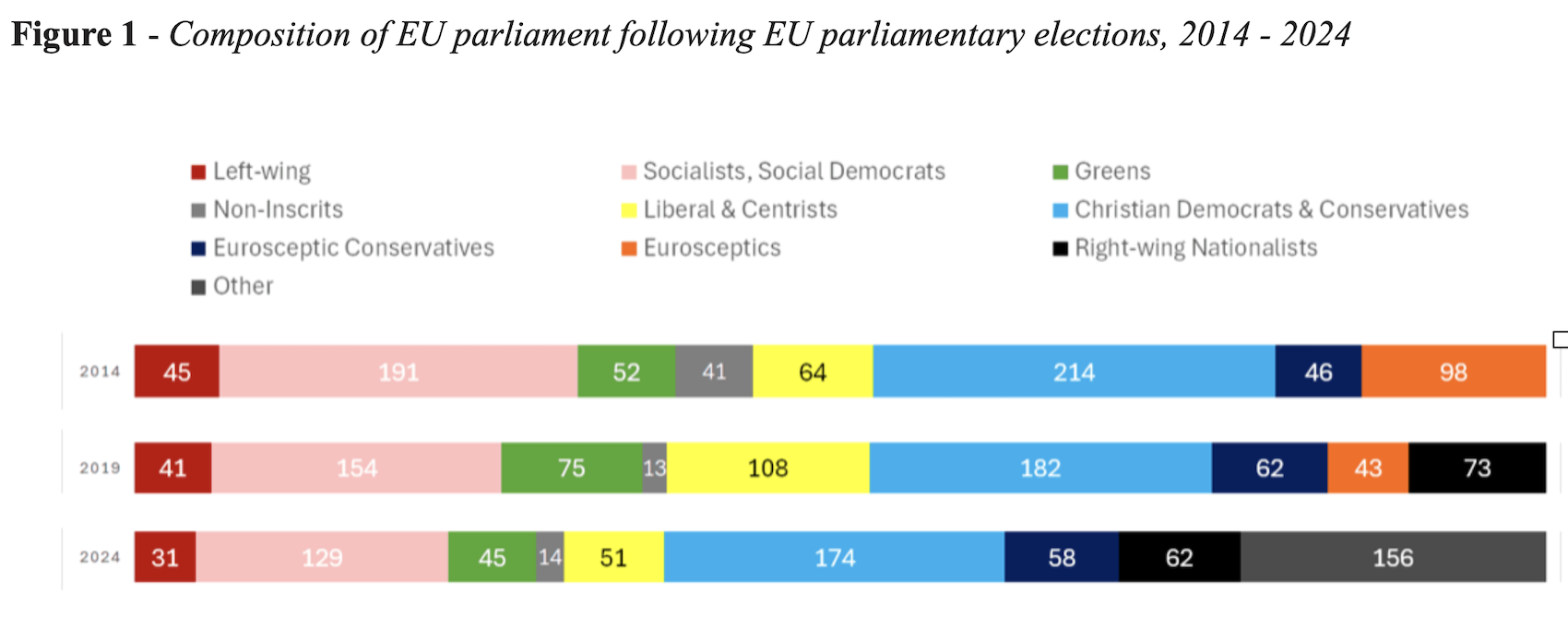
Europe has also faced difficulties controlling the increasing numbers of its migrant population. According to the International Organization for Migration (McAuliffe & Oucho, 2024), there are approximately 87 million migrants living in Europe. In the context of migration crises, which often disproportionately impact EU member states, balancing European cohesion has fragmented the Union. Additionally, in recent years, Western politics has witnessed a trend of a right-wing shift (see Figure 1) and increased support for populist leaders, which exacerbates this fragmentation (Europe Elects, 2024; Europe Politique, 2024).
Trump’s US presidency coincided with a period of EU instability which saw the rise of right-wing populist parties (RPP) in Europe and the significant decision for Britain to leave the EU, with migration a core topic for the Leave campaign (Langlois, 2021; Löfflmann, 2019). Authors such as Fusiek & Marconi (2021) argue that the popularity of a nationalistic populist in the US gave confidence to populist political actors in Europe to become more vocal and gather support. In the face of EU fragmentation, the Union must be prepared for leniency with its Pact on Migration and Asylum if it wishes to maintain cohesion.
Note: Data sourced from European parliament election 2024, by Europe Elects, 2024 (https://europeelects.eu/ep2024/). Data sourced from Parliament Européen (2019, 2014, 2009, 2004, 1999, 1994, 1989, 1984, 1979), by Europe Politique, 2024.(https://www.europe-politique.eu/parlement-europeen.htm).
This paper delivers policy suggestions for the successful implementation of the Pact, especially in the context of the 2024 US Presidential elections and of its possible repercussions. To do so, the paper briefly delves into the 2024 EU Pact on Migration and Asylum, focusing on its strengths, its weaknesses, and how it is perceived by EU member states. Following, the paper conducts a horizon scanning methodology to discuss the possible outcomes of the 2024 US elections and how they could affect international politics and the implementation of the Pact. Finally, the paper provides recommendations to the European Commission to ensure readiness and resilience in the implementation of the Pact in any scenario deriving from the result of the upcoming US elections.
2. The EU and Migration
The EU has faced difficulties in dealing with migration, especially as the issue disproportionately affects certain member states. In dealing with this issue, the EU has developed the EU Pact on Migration, for all EU member states to adhere to.
2.1 The Pact on Migration and Asylum
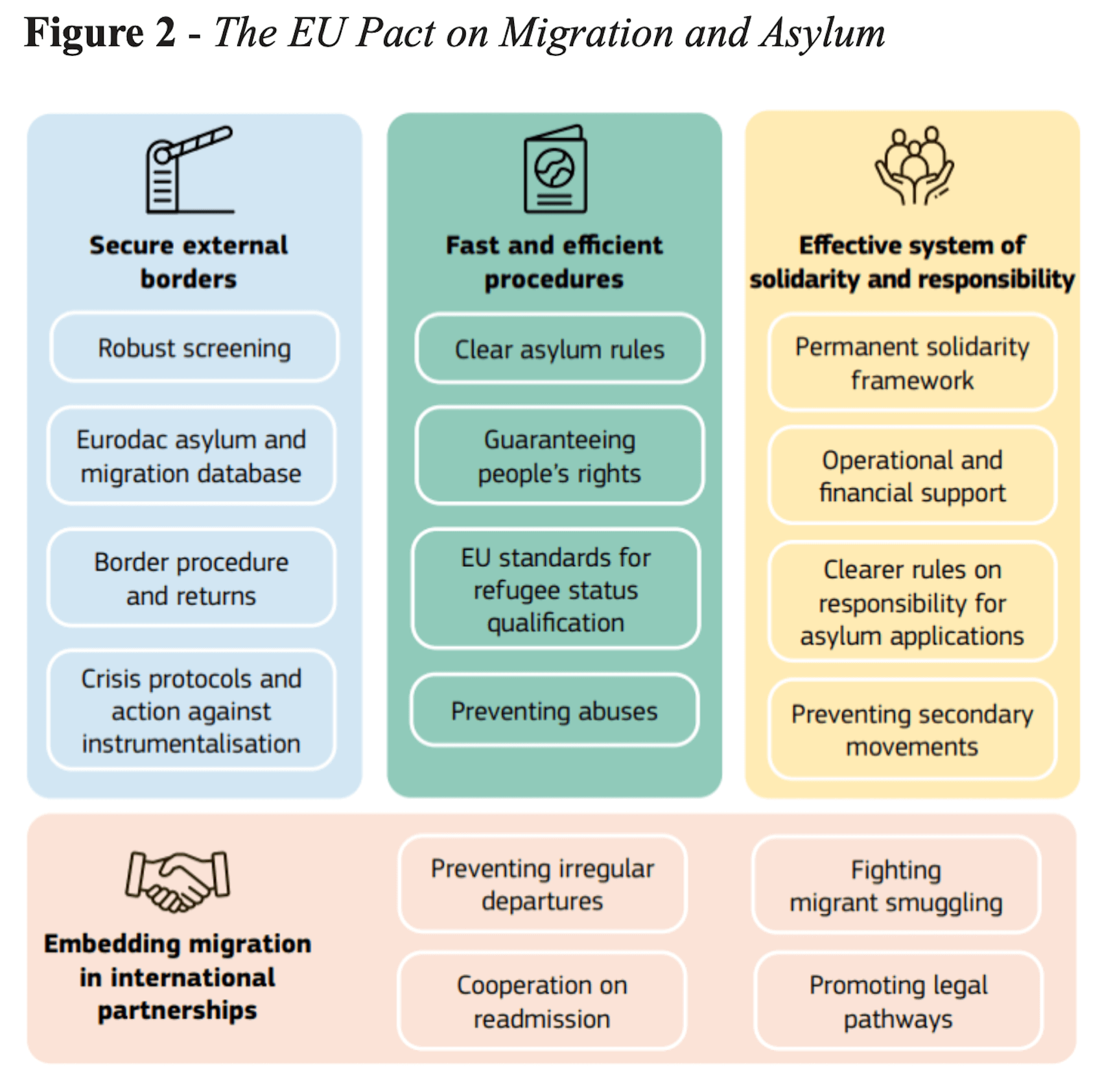
The 2024 EU Pact on Migration and Asylum establishes a comprehensive and flexible framework that addresses border management, asylum processes, and migrant integration while introducing a mandatory yet adaptable solidarity mechanism (European Commission, 2024b). This framework, as shown in Figure 2, aims to distribute responsibilities more fairly among member states, allowing contributions through relocations, financial support, or alternative measures (Ibid.). However, the Pact faces significant challenges, including bureaucratic complexity, varying political will, and potential conflicts with member states resistant to migration, such as those of the Visegrád Group (V4: Poland, Czechia, Slovakia, and Hungary), which will be discussed in section 2.2 of the paper.
Note: From Pact on Migration and Asylum, by European Commission, 2024b. (https://home-affairs.ec.europa.eu/policies/migration-and-asylum/pact-migration-and-asylum_en). Copyright 2024 by the European Union.
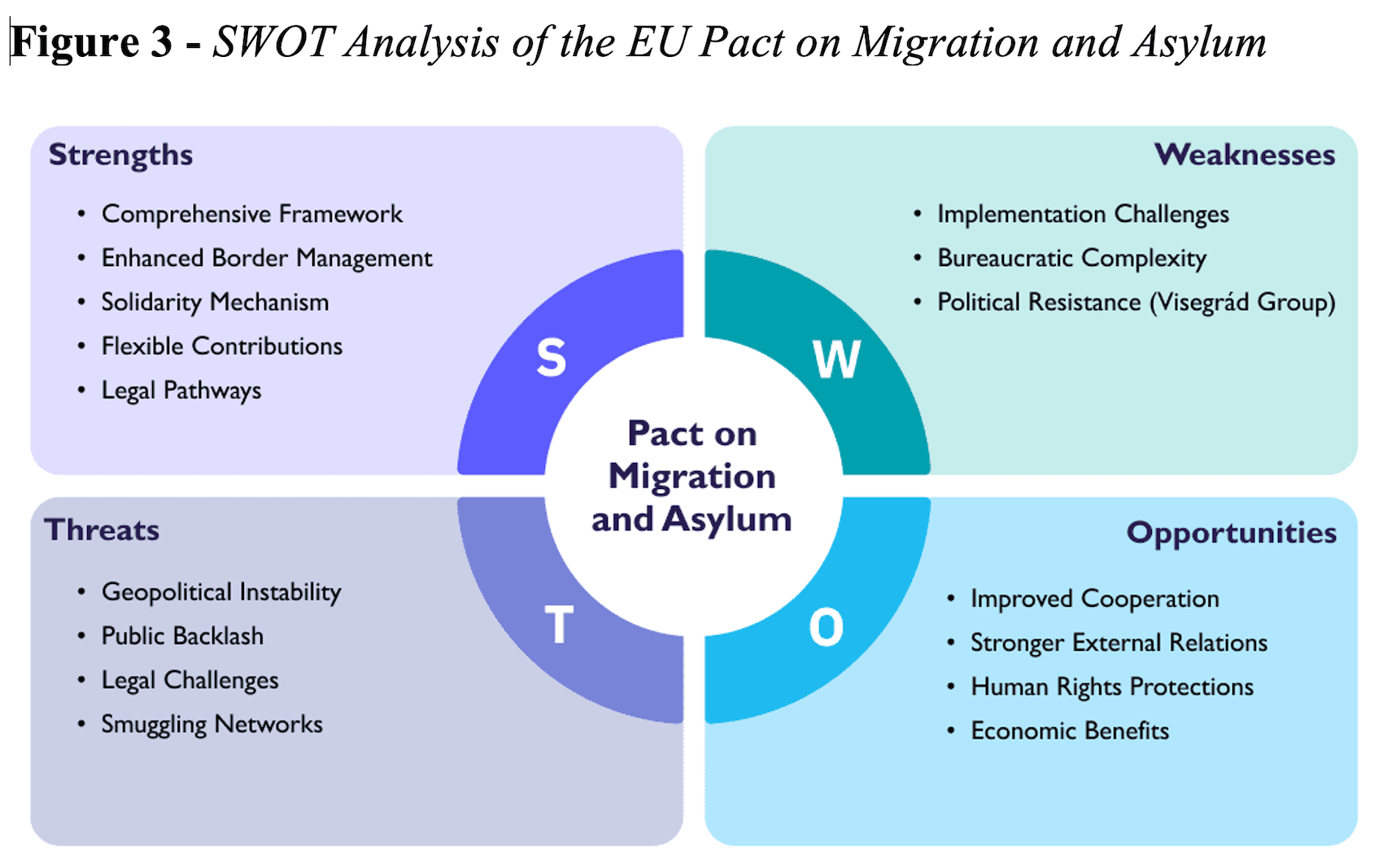
A SWOT analysis of the Pact (Figure 3) was made by the authors which found that the resource-intensive nature of the Pact may strain member states’ capacities, particularly amid shifting political priorities. Nonetheless, it offers opportunities for enhanced cooperation, stronger external partnerships, and economic benefits through managed migration. These potential gains are counterbalanced by threats such as geopolitical instability, rising anti-immigration sentiment, legal disputes within the EU, and the risk of migrants resorting to more dangerous routes due to increased border controls. The success of the pact will depend on its ability to navigate these complexities while ensuring the protection of human rights and fair distribution of responsibilities.
Note: Authors’ creation.
2.2 Backlash from Member States
The Pact has received severe backlash from a number of actors within the EU for very different reasons. On the one hand, due to its attempt at regulating and partially restricting immigration, many on the political left view the Pact as giving too many concessions to the far right, and failing to protect fundamental rights (Griera, 2024). For example, the German Left MEP Cornelia Ernst called the pact “a pact of shame and disgrace,” while other MEPs from Left and Green parties considered the Pact to be a model for a fortress of Europe and a victory for the far-right (Ibid.). Many NGOs also criticized the Pact, with Amnesty International attesting a “surge in suffering” for asylum seekers, if the Pact was to enter into effect (Nattrass, 2024). On the other hand, right-wing governments and parties across the EU also greatly criticized the Pact.
However, contrary to the above-mentioned examples, their main concern is that the Pact is not strict enough on immigration regulation and forces every EU member state to contribute and show solidarity, hence overruling national sovereignty (Nattrass, 2024). The Visegrád countries in particular – namely: Poland, Czechia, Slovakia, and Hungary – heavily criticized the Pact and its solidarity mechanisms, with Polish Prime Minister Donald Tusk promising that Poland will “find ways so that even if the migration pact comes into force in a roughly unchanged form, we will protect Poland against the relocation mechanism” (Nattrass, 2024), while the Hungarian government also pledged to find ways to avoid taking in immigrants and called the Pact “another nail in the coffin of the European Union” (Nattrass, 2024).
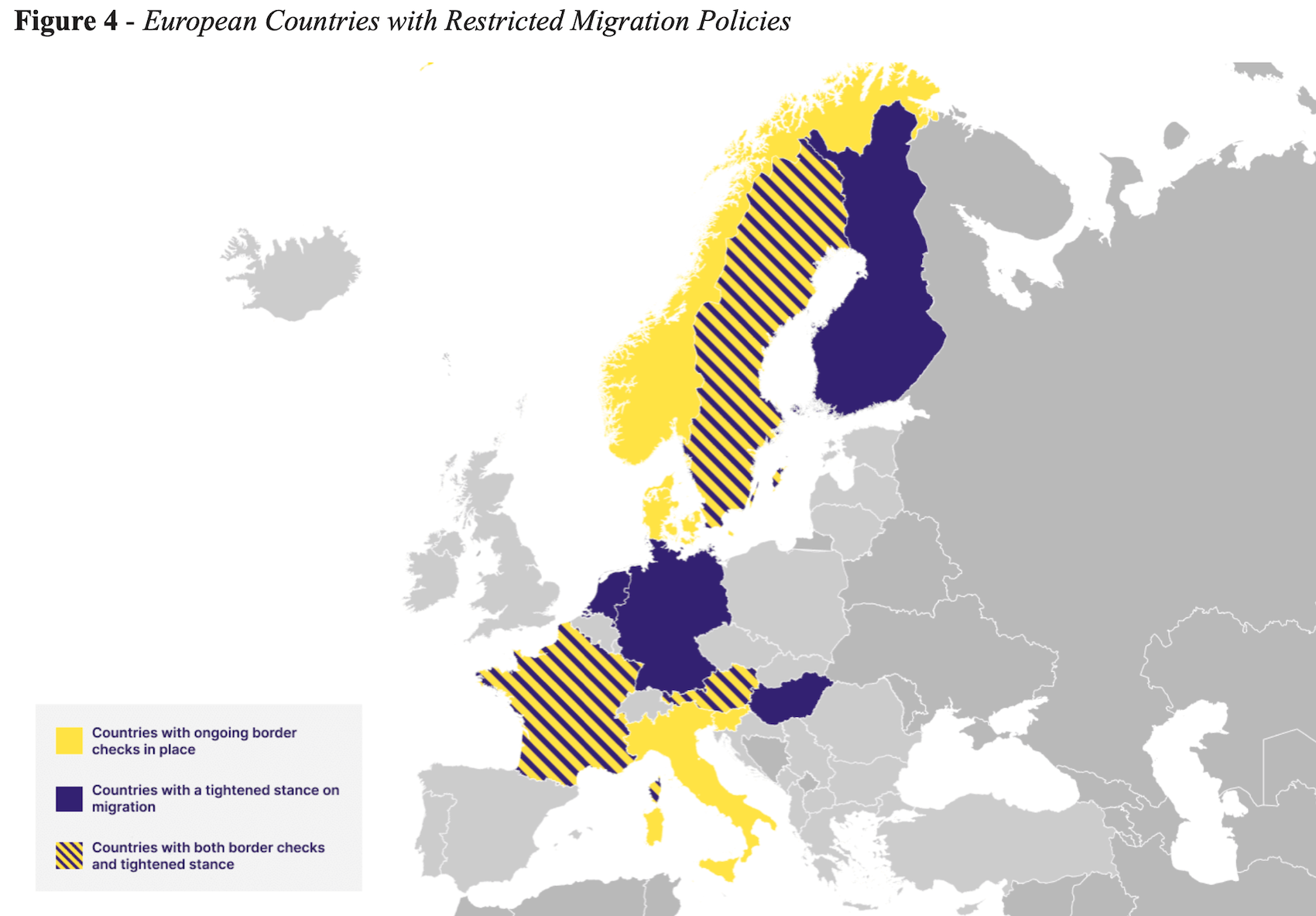
In addition to the Visegrád Group, an increasing number of member countries is expressing its discontent with the Pact, a trend tied to the rise of RPPs throughout Europe (Vinocur et al., 2024). In particular, this is manifesting through a push for tighter deportation and border control measures across Europe (Vinocur et al., 2024). 17 countries in the Schengen area – Austria and the Netherlands and endorsed by Croatia, the Czech Republic, Denmark, Finland, France, Germany, Greece, Italy, Luxembourg, Malta, Slovakia and Sweden. Norway, Switzerland and Liechtenstein – have recently signed an appeal to the EU executive to toughen return policies when asylum applications are rejected as well as increasing European coordination when it comes to deportations (Carlson, 2024; Liboreiro, 2024). Additionally, numerous countries in the Schengen area – i.e. Austria, Denmark, France, Italy, Norway, Slovenia, and Sweden (Dell’Anna, 2024) – are increasing border controls, which hinders the right to freedom of movement. In addition to these general trends, in countries where RPPs are gaining executive positions, the stance on migration policy is toughening even more (Carlson, 2024; Stekić, 2024; Vinocur et al., 2024). Recent examples of this trend – including the extreme example of the Netherlands’ request to opt-out of the Pact – are shown visually in Figure 4 and a full table is available in Appendix A.
Note: Authors’ creation.
This restrictive stance appears also at the European level where, as illustrated in section 1, right-leaning groups have gained more influence (Vinocur et al., 2024). In particular, members of the European Conservatives and Reformists (ECR) and of the European People’s Party (EPP) support the toughening of deportation mechanisms, the increase of asylum-seeker reception centers outside of the EU, and the funding for extra EU border control (Ibid.).
In sum, the Migration Pact, which is supposed to offer a compromise, is seen negatively by both sides of the political spectrum for respectively leaning too much into the opposite political spectrum, a trend that has led countries to push for a re-draft of the pact (Vinocur et al., 2024). In this context, the main challenge to the successful implementation of the Pact remains to satisfy parties and voters on the left-wing and pro-immigration side and on the right-wing anti-immigration side concurrently. This challenge will be addressed in section 5 of this policy paper, where policy options and recommendations are provided.
3. Methodology
Horizon scanning is used by building on early warning signs and predictions based on current events, by analyzing political discourse. Geopolitical issues are increasingly complex and interconnected. With such challenges, the use of horizon scanning is crucial to prepare and inform policymakers and decision-makers about potential opportunities and threats (Amanatidou et al., 2012). There are two core aspects of horizon scanning: alerting and creating. Alerting includes the early identification of emerging issues, whereas the creative aspect refers to the reassembly of current issues into a prediction for what might develop into a policy problem. Current political discourse in Europe has centered around a migration debate and discontent towards failing solutions to handle the issue, simultaneously the US Presidential debate has Donald Trump potentially returning for a second term.
4. Examinations of Findings: The US 2024 Presidential Elections
As a two-party system, there exists only two possible results of the US Presidential election – a Trump victory, or a Harris victory. Regardless, there shall be a possibility of outcomes in either scenario. Having conducted horizon scanning, there are two possible scenarios that may impact European politics on migration: whether Trump should achieve victory, or whether Trump reacts poorly and encourages disruption in the event of a loss.
4.1 A Trump Victory
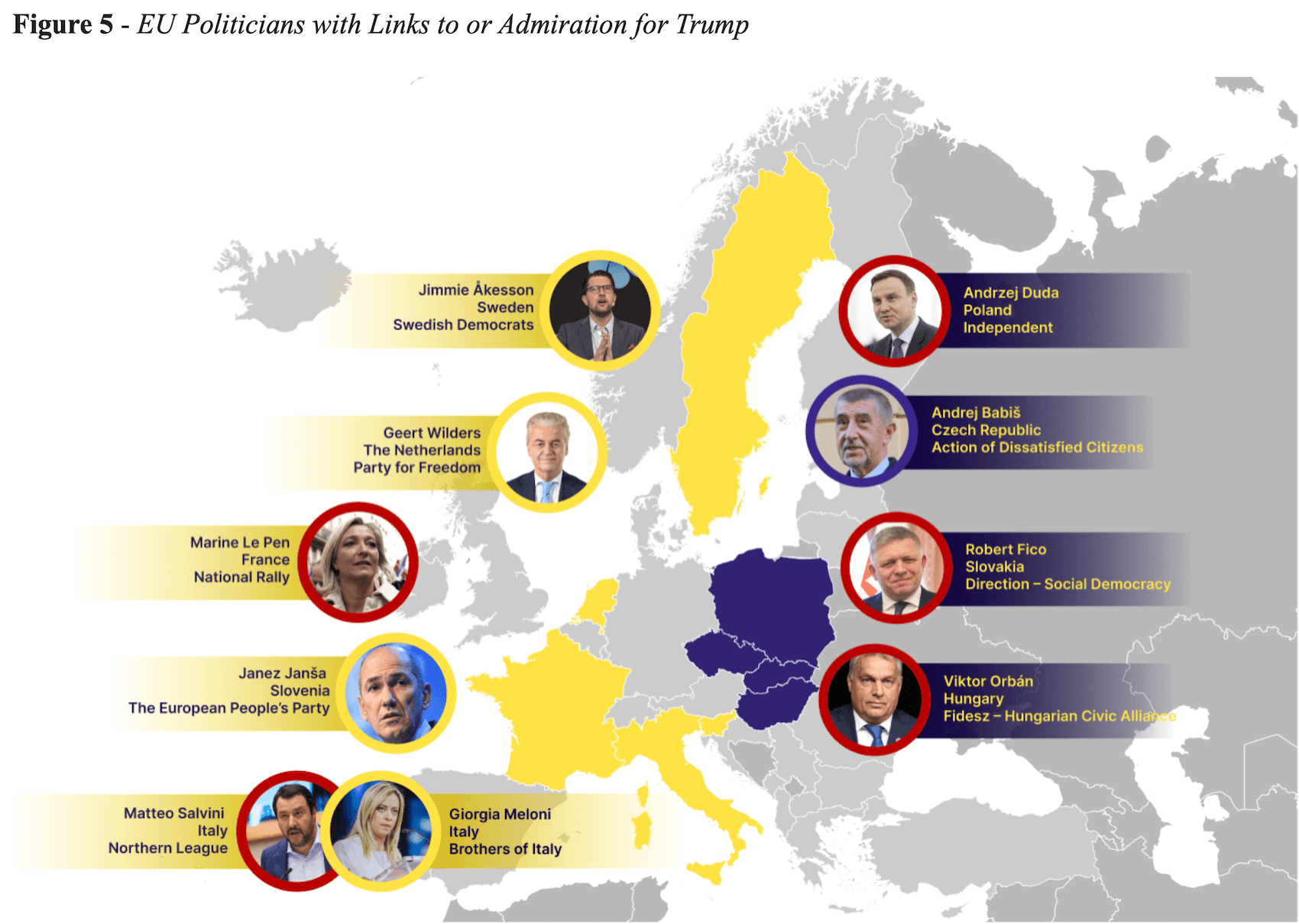
In the event that Trump achieves victory, there are two core aspects that will shape the political landscape around migration. Trump has demonstrated an ability to influence and encourage populists in the EU to be more vocal and gather support, as illustrated in Figure 5 (Fusiek & Marconi, 2021). In this regard, it can be expected that the political landscape in Europe will continue to favor populism during a revival of right-wing shift while Trump would have his second term. A second Trump presidential term would likely embolden European populist leaders such as Viktor Orbán, Marine Le Pen, Matteo Salvini, Jarosław Kaczyński, and even populist parties such as the Alternative for Germany (AfD) or Austria’s Freedom Party (FPÖ) by validating their nationalist, anti-EU, and illiberal policies (Naughtie, 2024). During his first presidency, Trump openly praised some of these leaders, especially Viktor Orbán, Trump was quoted saying “Let me just say about world leaders, Viktor Orbán, one of the most respected men, they call him a strong man” and undermined multilateral bodies, sending a clear signal that illiberal governance and nationalist policies are able to thrive without any significant repercussions from the US (Euractiv, 2024).
Note: Authors’ creation. Purple shows the Visegrád Group countries and yellow shows Western European states. Politicians who have a direct link or friendship with Trump are highlighted in red.
Trump’s alignment with right-wing ideologies would also likely embolden these leaders to promote policies that further marginalize minority groups, restrict immigration, and consolidate political power by undermining judicial independence and press freedoms. In a second term, Trump’s open disdain for international organizations like NATO and the EU would likely reduce pressure on these populist leaders to adhere to democratic norms (Stekić, 2024). By downplaying concerns over democratic backsliding and encouraging isolationist policies, Trump would create an EU environment where these leaders and parties continue to push their nationalist agendas further, almost completely free from the fear of diplomatic or economic consequences.
Further issues that may surface from a Trump victory is the implementation of Project 2025: a Republican policy mantra with strict consequences for migration (The Heritage Foundation, n.d.). Core proposals of the project include continued and increased funding of the ‘Border Wall’, the deportation of migrants, and the removal of visa categories for victims of crime and human trafficking (Wendling, 2024). The project calls for the dissemination of the Department of Homeland Security to be replaced with stronger immigration enforcement bodies for stricter border control (Ibid.). Legal migration would also face stricter measures, through increased fees for visa applications (Ibid.). Donald Trump, as a form of populism, has been linked to the Brexit debate and fueling the “politics of anger”, a concept which some believe has contributed to euroscepticism across the Union (Smorag, 2020; Wind, 2017). If Trump were to be re-elected, it could be expected such sentiments may become prevalent in European political discourse again.
Should Trump win and implement Project 2025, the EU could mirror a restrictive stance again. This prediction is increasingly plausible (Vinocur et al., 2024), especially given the latest trends highlighted in section 2b. Overall, Trump’s influence has the power to destabilize democracies through the use of disinformation which causes greater distrust. Trump may prompt RPP leaders and their parties to entrench their power through policies aimed at curbing media freedom, overhauling the judicial system and the rule of law both at the national and supranational level, and even denouncing opposition parties.
4.2 Reactions to A Trump Loss
On the contrary, should Harris be elected as the first woman President, implications will lead to different roads. It is possible that the post-election events of January 2021 – i.e. the Capitol attacks – could have a sequel (Abramowitz, 2024). Many EU leaders took to the media to condemn the attack on the Capitol, denouncing the use of violence in any form of democratic process. Most were outright with their criticism of Trump’s handling of the situation and the consequences of his words. Common responses from RPP leaders and members – i.e. Marine Le Pen, Giorgia Meloni, and Victor Orbán- were to include a condemning of violence, protecting democracy, whilst simultaneously illustrating Trump in a positive light, often as a ‘peacemaker’ for his limited calls to avoid violent attacks during the protest, whilst others excused Trump of any wrongdoing (Herszenhorn et al., 2021). Should a similar situation arise, where Trump would instigate a protest after losing the election, it is expected that the previously mentioned EU leaders would follow similar actions as before. In this scenario, European leaders are likely to hold a consensus view that democracy is the forefront of our political system, not to be undermined. Likewise, it is expected that Harris would share the same sentiments for democracy and condemn his final attempt at power.
Regardless of the outcome of the 2024 US presidential election, Europe is undeniably fragmented politically, which significantly impacts the practical implementation of the EU Migration Pact. In recent months, in Germany, the far-right party Alternative for Germany (AfD) has been vocal about its opposition to migration. It further supports a “remigration” implementation (Hockenos, 2024) that has surged in federal elections. In Austria, the Freedom of Austria Party (FPÖ) won in the recent election. The FPÖ is expected to push a hardline stance on immigration and resist EU-level initiatives. The FPÖ will likely join forces with other mainstream populist parties (Cameron & and Goldstein, 2024).
In addition to the success of far-right parties across Europe, the ongoing war in Ukraine continues to drive a wedge between nations more friendly and dependent on Russia to take a harder line on accepting Ukrainian refugees, let alone migrants from the Middle East or North Africa. Nations such as Greece and Italy continue to deal with the Mediterranean migration crisis, which is expected to continue for years. These existing crises continue to be a launch pad for far-right populist parties’ rhetoric.
5. Policy Options
At the time of writing, there was around one month remaining until the 2024 US Presidential election would be held. Three policy options were created for the European Commission to consider for a smooth and coherent implementation of the 2024 EU Pact on Migration and Asylum.
The European Commission must organize a commonly managed and coordinated European asylum systemcentered around the wellness of human beings: the EU should work on the defense of fundamental human rights, immigrants’ safety and dignity. It is also suggested that the Union ought to use the reservation of migrants as a last resort and try to create other effective solutions, like open reception centers, since prolonged detention results in devastating effects on migrants’ mental health (International Rescue Committee, 2023).
The European Commission should strengthen the resettlement of refugees in the Union Resettlement Framework (URF): this includes timely and just handling of the reception and integration of refugees and immigrants from day one. More specifically, the Union must offer decent reception conditions throughout the EU, such as providing education and healthcare. Moreover, the Union ought to worry about the progress with an organized and transparent mechanism for monitoring the fundamental rights of asylum seekers.
The European Commission should fund and conduct regular in-depth country reviews (ICRs) to track the impact of the Pact on Migration and Asylum at a national level and allow for country-tailored implementation strategies:similar reviews are already conducted by the Commission such as European Semester reports, the Environmental Implementation Review and economic IDRs annually. These reviews would provide a mechanism for member states to detail the impact of migration in areas that are core concerns for countries. Each country review should conclude with action points and priorities at the member state and EU-level.
Though all three policy options are of equal importance to ensure the successful and coherent implementation of the plan, this paper proceeds to focus on the last policy option as a strong recommendation to the European Commission, in order to ensure preparedness for the ongoing implementation of the Pact in this time of political uncertainty. The reasons and specifics behind this recommendation follow in the next subsection.
5.1 Recommendations
The recommendation of ICRs within the context of the implementation of the Pact acts as a preventative method which focuses on three areas and values that are important for European RPPs with the aim of ensuring their increased cooperation in the implementation of the Pact. First, the country-specific analyses yielded by the IDRs would allow national leaders to suggest implementation strategies tailored to each nation’s socio-economic needs and capabilities. These tailored solutions will preserve national sovereignty. Second, through these country-specific analyses and implementation strategies, it would be possible to put a specific attention on a proper cultural integration of migrants, ensuring their wellbeing within society whilst preserving national traditions. This possibility could strengthen social cohesion, hence appeasing any anti-immigration sentiments that are likely to be strengthened by Trump’s influence. Finally, IDRs would strengthen national agencyand allow for national interests to be at the heart of policy implementation whilst EU’s core objectives and values are upheld.
In particular, to ensure their above-mentioned purpose, we envision ICRs to present key sections as follows. First, an Economic Contributions and Challenges of Migration section of the review would report statistics relating to the economy, workforce and their welfare states. This will allow member states to further detail shortages in the job market where migration of people with work experiences related to the field are required. For example, countries experiencing shortages of agricultural workers, healthcare, or otherwise may request that their migrant quota includes those able to contribute to those sectors. Migration is often talked about as a burden by RPPs, highlighting the skills and benefits migrants can bring to suffering industries should mitigate this issue.
Second, a section dedicated to reporting on Social Dynamics and Community Integration would allow states to report statistics related to socio-cultural data, such as attendance to language courses, educational attendance, and integration into society through work or social programmed. This would address the common concerns of RPP tied to the erasure of national identity and traditions due to immigration. It is hoped that providing member states an avenue to report on socio-cultural impacts of migration will demonstrate an effort to protect national identity whilst promoting integration
Finally, a section for Impacts Not Otherwise Stated is proposed. This would allow member states to flag any additional issues they are facing in the implementation of the Pact to EU institutions. Such issues could include difficulties in processing of incoming migrants, including manpower, biometrics, and service availability. Overall, this should help with national governance for the Pact.
All ICRs ought to conclude with a plan for the future. Plans should enable co-working between the Commission and Member States to come up with priorities and action points for each stakeholder going forward with the Pact, as similar EU reports conclude with. With this recommendation, member states can agree with the EU on what is most important and applicable to the individual country, rather than having a “one size fits all” method applied to all EU members.
Due to the politically sensitive nature of migration, the importance of impartiality was noted. It is recommended that the ICRs are conducted independently, with assistance from the Eurostat peer-review team. The EU has six funding pools that it may draw from that can achieve this recommendation feasibly: (1) Asylum, Migration and Integration Fund, (2) Internal Security Fund, (3) European Social Fund Plus, (4) European Regional Development Fund, (5) Neighborhood, Development and International Cooperation Instrument, and (6) Emergency Assistance and Other Ad Hoc Funding.
6. Conclusion
At this stage, the result of the American elections is ambiguous. The scenario of Trump’s re-election to power will bring about unfavorable results both at the overall EU level and on the immigration issue, as a Trump presidency would entail significant disruptions in US-EU relations (Frangeul-Alves & Weber, 2024). Trump’s troubled relations with the EU and his pursuit of isolationism, as well as his apparent apathy towards immigrants and refugees, mean that the former president will once again leave the Union alone on the issue that plagues it. Therefore, the developments in the field of immigration will differ greatly depending on the US election results.
In any case, the EU should not be complacent, regardless of the election result, as the migrant – refugee crisis plagues Brussels. Migration is one of the most important policy issues (Lovato, 2021) and it has turned into a geopolitical issue. Immigration is a labyrinthine for the EU and a complex problem, thus the solution will not be easy, especially given EU member states’ diverse opinions on the matter (Donceel, 2024).
To conclude, this policy paper delved into the implementation of this Pact, focusing on how it is susceptible to the rise of populism both in Europe and abroad. In particular, after conducting a SWOT analysis of the Pact and providing an overview of how it is perceived across Europe, the paper focused on how the implementation of the Pact could be affected by the results of the upcoming US presidential elections. Based on previous cases, it is expected that in case of victory Trump will incentivize his EU “allies”, such as Hungary’s Orban, Italy’s Meloni, and Slovakia’s Fico (Naughtie, 2024), resist the Pact in the name of national sovereignty and anti-elitism. In the case of Trump’s loss however, the likely scenario is that the former president would encourage them to challenge the election outcomes and attempt to undermine democratic processes. This could deepen the public’s distrust in representative institutions across the US and the EU, ultimately furthering the disengagement from electoral processes (i.e. increasing voter absenteeism).
The authors of this paper believe that the recommended introduction of periodic in-depth country reviews (ICRs) would serve as a preventative measure in anticipation of Trump influencing RPPs in Europe. Of course, whilst future outcomes are uncertain due to the vivacity of the electoral campaigns in the US as well as worsening international orders, we are confident that as the European Commission sustains the cooperative nature of the Pact across political spectrums – which we recommend doing by ensuring tailored implementation strategies across member states’ government – its implementation will be successful.
(*) This policy paper is based on research conducted by Beatrice Bottura, Paris O’Keeffe-Johnston, Pinelopi Gkampeta, Ludmila Malai, Matt Lynch, Joon Park and Leon Gräf during the ECPS Case Competition “US Foreign Policy and Populism,” held as part of the ECPS Summer School from July 1-5, 2024.
Authors’ Biographies
Beatrice Bottura is a Sciences Po master student in Public Policy, specializing in Social Policy and Social Innovation, and a Central European University (CEU) graduate in Philosophy Politics and Economics. Her research interests revolve around the crisis of democracy and how it relates to political attitudes and policymaking. She has explored this in her bachelor thesis “Ethnopopulists’ reaction to crises: the case of Fratelli D’Italia”, from which she derived an article for the Horizon Europe project “AuthLIB – Neo-Authoritarianisms in Europe and the Liberal Democratic Response”, which she is involved in as a research assistant. For this project she has worked with CEU’s Democracy institute and Sciences Po’s Centre d’Études Européennes (CEE). Particularly, she conducted discourse analyses for the working paper “Illiberalism and Social Policy: A Four-Country Comparison”, is authoring an upcoming publication on varieties of illiberalism across policy areas with CEU and has coded speech for the CEE’s work measuring “Ideological configurations”.
Joon Park is a third-year student at George Washington University, pursuing a bachelor’s in international Affairs and Finance with a minor in Economics. Born to Korean immigrants and raised in Germany, her academic focus spans EU economics, German domestic and foreign politics, U.S. foreign policy, and East Asian geopolitical strategy. She is currently researching the rise of right-wing populism in Europe in collaboration with the Center for Faith, Identity, and Globalization in Washington, D.C. Joon’s passion lies in exploring how global political systems and economic dynamics intersect to shape international relations and policy.
Matthew Lynch is a Master of Science candidate in Global Studies and International Relations at Northeastern University in Boston. He received a Bachelor of Science in Supply Chain Management from the University of Massachusetts Dartmouth. With a background in international business, his current research focuses on how populism creates vulnerabilities in EU defense and security, particularly the potential for external actors to exploit these weaknesses. He also researches German foreign and defense policy.
Leon Gräf holds a BA in Political Science and Philosophy, University of Heidelberg, Germany and an MA in Political Science, University of Mannheim, Germany. He is currently working as Research Fellow at the Max Planck Foundation for International Peace and the Rule of Law, and as a Research Assistant at the Chair of Empirical Macrosociology at Heidelberg University. Additionally, is has been working as a researcher at the Heidelberg Institute for International Conflict Research (HIIK) since 2021. His MA thesis focused on mediator characteristics and their effect on ceasefire success across different regions.
Pinelopi Gkampeta is a graduate student in the Advanced M.Sc. in “European Integration” in Brussels School of Governance (VUB) and she currently lives in Brussels. Furthermore, she has obtained a master’s degree in “International and European Governance and Politics” from the National and Kapodistrian University of Athens and a bachelor’s degree in “Philosophy” from the same university. She has taken part in the Erasmus+ Program “Maritime Security Common Module “by European Security and Defence College and Hellenic Naval Academy. Moreover, she is a research intern in the Institute of International Relations (Athens, Greece) and also an editor and analyst at the Association of International and European Affairs. Pinelopi worked as a research assistant for the Identity and Conflict Lab (Yale University) for some months. Her areas of interest and research are EU as a Global Actor, EU External Relations, EU Security and Defense Policy, Maritime Security and Immigration Policy.
Paris O’Keeffe-Johnstonholds an MA in International Relations, Conflict & Security from Northumbria University. Her research focuses primarily on societal security, with an emphasis on digital threats. Her dissertation explored how EU policy documents framed cybersecurity as an existential threat. Currently, her research interests have expanded to include the societal risks posed by AI. This includes how populists may use generative AI to either gather support or create the illusion of widespread backing, as well as to drive disinformation campaigns. By investigating this area, she aims to uncover how algorithms could be leveraged for early detection and mitigation of polarizing content ahead of elections.
Ludmila Malaiis an experienced EU Project Manager at the Intercultural Dialogue Platform, with a diverse academic background in Economics, Administration, Politics, Diplomacy, and Conflict Resolution. She holds a Master’s in International Law and Security Studies from the Free University of Brussels and is fluent in English, French, Russian, Italian, and Romanian. Over the past six years, Ludmila has specialized in writing and coordinating European projects focused on CVE/PVE, radicalization, combating racism, Antisemitism, Islamophobia, the security of places of worship, women’s empowerment, and youth civic engagement.
Amanatidou, E., Butter, M., Carabias, V., Konnola, T., Leis, M., Saritas, O., Schaper-Rinkel, P., & van Rij, V. (2012). “On concepts and methods in horizon scanning: Lessons from initiating policy dialogues on emerging issues.” Science & Public Policy, 39(2), 208–221. https://doi.org/10.1093/scipol/scs017
European Commission. (2024b). Pact on migration and asylum. Migration and Home Affairs. https://home-affairs.ec.europa.eu/policies/migration-and-asylum/pact-migration-and-asylum_en
Frangeul-Alves, A. & Weber, G. (2024). The United States’ EU policy after 2024. GMFUS. https://www.gmfus.org/news/united-states-eu-policy-after-2024
Fusiek, D. A., & Marconi, C. (2021). “Trumpism and the European far right: An analysis of Trumpism’s impact on the post-2016 AfD, Lega Nord, and Fidesz.” Środkowoeuropejskie Studia Polityczne, 4, 61–84. https://doi.org/10.14746/ssp.2021.4.5
Lacatus, C. (2021). “Populism and President Trump’s approach to foreign policy: An analysis of tweets and rally speeches.” Politics, 41(1), 31–47. https://doi.org/10.1177/0263395720935380
Langlois, L. (2021). “The Brexit Vote and The Trump Vote: A comparative study of the common trends and factors that led to a populist radical right vote in Britain and the United States.” Revue LISA / LISA e-Journal, 19(51). https://doi.org/10.4000/lisa.13054
Löfflmann, G. (2022). “‘Enemies of the people’: Donald Trump and the security imaginary of America First.” British Journal of Politics & International Relations, 24(3), 543–560. https://doi.org/10.1177/13691481211048499
Magcamit, M. (2017). “EXPLAINING THE THREE‐WAY LINKAGE BETWEEN POPULISM, SECURITIZATION, AND REALIST FOREIGN POLICIES: President Donald Trump and the pursuit of “America First” doctrine.” World Affairs, 180(3), 6–35. https://doi.org/10.1177/0043820017746263
McAuliffe, M., & Oucho, L. A. (2024). “Report overview: Migration continues to be part of the solution in a rapidly changing world, but key challenges remain.” World Migration Report, 2024(1). https://doi.org/10.1002/wom3.33
Mirza, M. N.; Ali, L. A. & Qaisrani, I. H. (2021). “Populism in the United States: Binary constructions by Donald Trump in the domestic and foreign policies.” Global Social Sciences Review, VI(III), 59–71. https://doi.org/10.31703/gssr.2021(vi-iii).07
Wendling, M. (2024, June 12). “What is Project 2025? Wish list for a Trump presidency, explained.” BBC. https://www.bbc.com/news/articles/c977njnvq2do
Wind, M. (2017). “Brexit and Euroskepticism: Will ‘Leaving Europe’ be Emulated Elsewhere?” In: F. Fabbrini (Ed.), The Law & Politics of Brexit (pp. 221-246). Oxford University Press.
Populist radical right parties (PRRPs) have been gaining votes in recent decades, votes that were once almost exclusively given to mainstream parties. At the same time, voter turnout has declined. Regardless of the analytical reasons, mainstream parties are losing ground and are not convincing as many people as they once did. While it’s easy to blame external factors like misinformation or divisive rhetoric, that’s not enough in a democratic system. Our system is straightforward: parties and politicians need to win votes. If people aren’t convinced, they will shift their support to other parties. Blaming factors beyond their control will only further harm liberal democratic mainstream parties.
The issue of radical right populism (RRP) has exploded onto the political science scene in the last two to three decades. Naturally, this was to be expected after the success of these parties in elections across western democracies. As a result, a flurry of different opinions on the causes of the success of RRP parties have emerged, some mutually inclusive others less so.
Much of the focus has been on the voter, the so-called demand-side. Here the big divide is generally between those who believe that RRP parties succeed because of economic reasons, while others believe the main driver to be cultural issues (Engler & Weisstanner, 2020; Bornschier, 2018: 213). Some other researchers have focused specifically on the supply-side: the parties (Mols & Jetten, 2020; Russo & Brock, 2024). In this case the focus is generally on the role of the radical right parties themselves (Mols & Jetten, 2020), or in rarer cases, the way in which other parties have interacted with RRPs (Russo & Brock, 2024). By focusing too much on the phenomenon of RRP itself, students of this discipline have forgotten much of what surrounds it. Because, while RRPs do influence voter decisions, voters do not only vote for RRPs they also vote against those parties that they, and the generations before them, trusted for decades – mainstream parties. To avoid lengthy definitions, we will consider mainstream parties as those broadly situated in the middle of the political spectrum and encompassing the country’s political establishment. In the EU, these parties are generally affiliated with the S&D, EPP, Renew, or the Greens.
Since the onset of the liberal democratic model, mainstream parties have been central actors of the system – parties played an important role in simplifying the political process, representing a large amount of people and pulling people into the political process (Stokes, 1999: 243-244). Of course, the system of parties is imperfect, but the division of the political system into segments of society that were more or less adequately represented by said parties made for a stable system (Lipset, 2000: 50-51). Generally, left-wing parties represented the poorer working class while richer, middle- and upper-class voters opted for right-wing parties. Some systems also had a divide along race lines or religious beliefs (Lipset & Rokkan, 1967; 2000: 50) Yet, in recent years, the decline of these parties has been apparent (Casal Bértoa & Rama, 2021: 37). At times, the green or liberal parties attracted voters away from the mainstream. Increasingly, though, as the latter have been integrated into the political establishment (Burchell, 2014), it has been the radical right that has taken over many of the votes previously held by mainstream parties. One of the main reasons for why this has happened, is due to political disaffection (Ziller & Schübel, 2015: 382; Söderlund & Kestilä‐Kekkonen, 2009: 174, Hooghe et al., 2011).
The first strong indicator of such disaffection emerged in the decades around the end of the cold war: declining rates of voter turnout (Hay, 2007; Mair, 2011). Today, this issue is still at the heart of many political debates despite slowing down and even showing some signs of improvement (IDEA, 2024). In its stead, in the last 20 or so years we have seen votes for the radical right populists increase drastically across the board (Ivaldi, 2024).
Political Disaffection
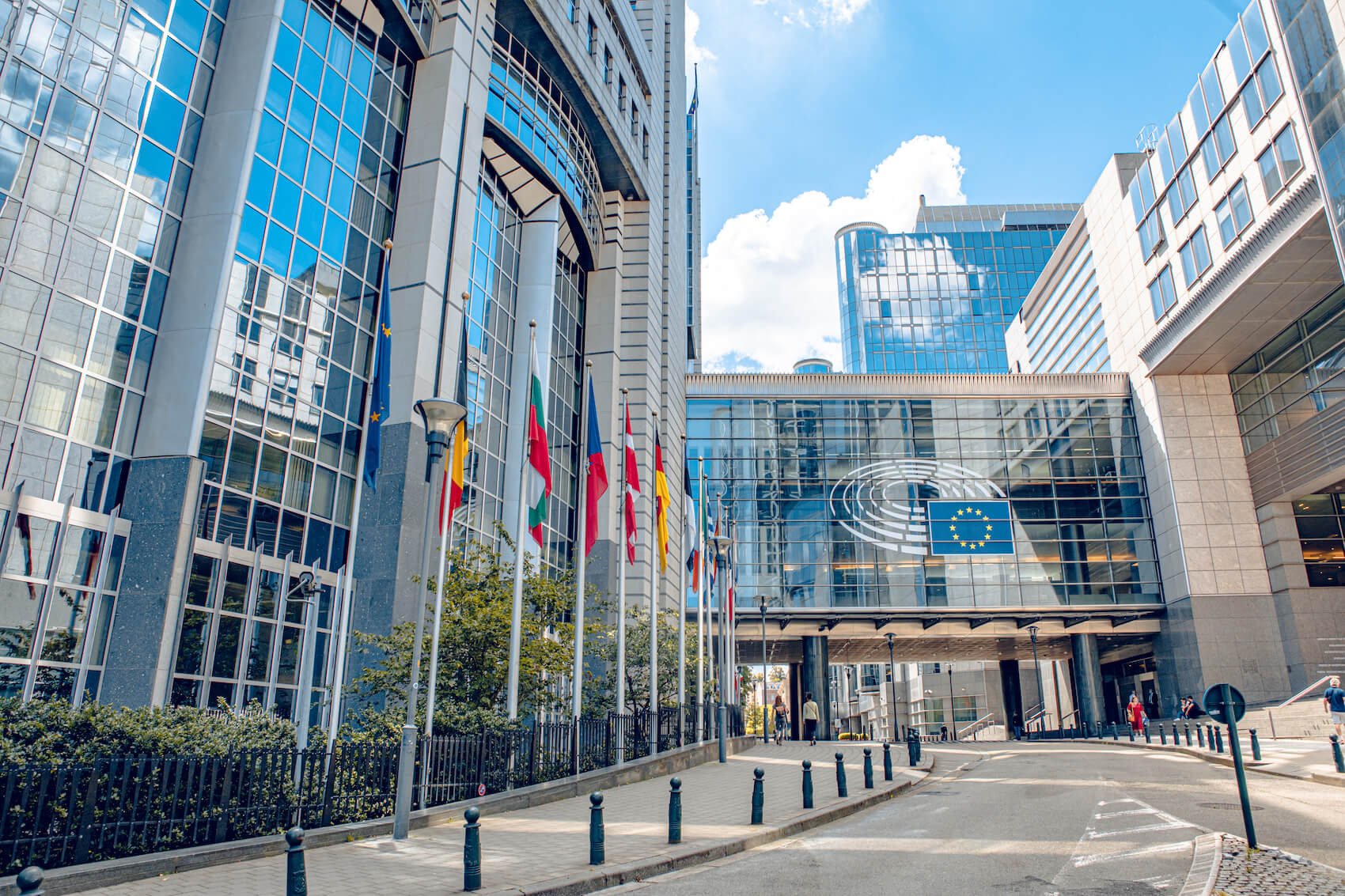
European Parliament offices and European flags in Brussels, Belgium on July 20, 2020. Photo: Lena Wurm.
Let us first analyze what has driven political disaffection before turning to how voter turnout and the success of RRPs are linked.
There are multiple drivers for political disaffection. What is clear is that for people to feel implicated in a system and for that system to be of interest to them, they must feel like they have some power within it (Harder & Krosnick, 2008: 538). Thus, drivers of disaffection would cause people to doubt their importance within the political system and abandon it or look for ways to regain this power. Yet, increasingly, mainstream parties have taken steps to decrease the power of the people (Mair, 2011).
First, is the convergence of mainstream parties on policy issues. Some might be surprised by the claim that parties are “converging” when we are constantly being told that our democracies and societies are becoming increasingly polarized (Nguyen & Vu, 2019). But one must not automatically exclude the other. A convergence can exists on policy issues even when political rhetoric is as divided as ever. Additionally, the attention here is specifically on mainstream parties.
For decades, a body of literature has argued that the more political parties converge to the center, the better they will perform electorally (Spoon & Klüver, 2019: 1023). The theory holds merit and cannot entirely be dismissed. Yet, while maximizing their votes in order to win over the ‘median voter,’ mainstream parties have failed to represent those with more radical values. This creates a more volatile political arena that is more inclined to turn to the extremes (Bartolini & Mair, 1990: 1).
As some have remarked, Germany might be the best example for this in Western Europe. For decades now, the CDU and the SPD have moved towards the center (Berman & Kundani, 2021: 23). The former – a family and Christian-oriented party – increasingly moved left on social issues, while the latter – a left-wing workers’ party – increasingly moved to the right on certain economic issues. Both forming a ‘Grand Coalition’ and working together across most of the beginning of the 21st Century (Berman & Kundani, 2021).
But even France, an oftentimes divided society with historically strong labor movements, experienced a neoliberal transformation that transcended party politics. As some of the biggest neoliberal decisions were taken by socialist Presidents François Mitterand and François Hollande (Masquelier, 2021; Pinçon & Pinçon Charlot, 2014). Other countries have seen similar trends within their borders as well. Tony Blair’s Labor Party and Bill Clinton’s democrats both became important drivers of neo-liberalization in their respective countries, with little protest from opposition parties on that particular matter (Rieger, 2021: 113; Meerpool, 2019).
Today, as Mair (2011: 72) notes, the question between state-controlled and market-controlled economies has been answered: the winners are market-controlled economies. The left-right divide on this issue has thus eroded and the current positions present a far less clear distinction. Therefore, mainstream parties attempt to find distinctions somewhere else: they insist on personalities, character traits and rhetorical differences. But these significantly impoverish the possible policy changes once in power and thus deprives electors of a feeling of potential change (Hay, 2007: 56-58).
In parallel to party convergence, a similar but distinct phenomenon has also been changing Western European societies: the depoliticization of many issues and the rise of the regulatory state. The effect of this is that many decisions which once lay with elected politicians – and thus by extension with the people – have been removed from the political sphere and into the bureaucratic and/or the market-controlled sphere.
For example, a case of this is Central Bank independence. Central Banks originally emerged in very different circumstances depending on the countries and their history – some were private, others independent, and some were dependent on the national treasury (Wachtel & Blejer, 2020). But today, the idea that these institutions must be independent has been dominant for decades and remains almost entirely unchallenged. This idea was first formulated in 1962 by Milton Friedman (Wachtel & Blejer, 2020), an economist dubbed by Krugman (2007) as an “ideologue [and] the great popularizer of the free-market doctrine.” He was incidentally the man who went on to advise Raegan and Thatcher for their economic policies. While he remains one of the most influential and knowledgeable economists ever to live, he can hardly be described as neutral or apolitical. Yet, his long-term fight to make Central Banks independent has today been made to seem exactly that: neutral and apolitical. In turn, this has justified the depoliticization of central banks and its removal from public decision-making.
In the UK, the Bank of England was one of the last Central Banks to remain under the responsibility of the treasury, but in 1998, under Tony Blair’s Labor government, this changed, and the Bank was granted independence to set interest rates (Burnham, 2001). In a more global study encompassing 155 countries, Romelli (2024: 3), found that out of 370 reforms to central bank designs between 1923 and 2023, over 75 percent of them increased the bank’s independence. In the European Union (EU), the Maastricht treaty required EU countries to have an independent Central Bank. This was in addition, of course, to the European Central Bank (ECB) which is also independent and covers all 27 EU countries (Bruni, 1997).
The EU has not only pushed the depoliticization of central banks, but it has also brought about many depoliticizing policies within its member states. In the early 1990s, the European Commission began heavily banking on regulation and became a powerful actor in restraining an increasingly privatized market; thus began the regulatory state in Europe (Majone, 1994).
Regulation became a way for a Commission with a low budget to increase its decision-making powers without changing the rules of the game. At the beginning, this did not really pose too many problems. The Commission played a role which, in other democracies, was often taken on by independent agencies and this role was limited in scope (Majone, 1994). But with years passing, the Commission became more powerful, and the roles it took on, outgrew those that made it possible to overlook the institution’s undemocratic nature (Majone, 2014: 1217). Because after regulation came financial control. Of course, member states signed up to this. For example, they agreed to adhere to the so-called ‘Fiscal Stability Treaty’ in 2012 which significantly restrained individual state’s fiscal policies. States must for example avoid excessive public debt and must also submit their budget plans to the Council in order for them to be scrutinized (and possibly asked to be altered). This constrained governments’ actions and put more power into the hands of those with little to no accountability (Majone, 2014: 1220).
While it may seem that the blame is being shifted onto the EU and away from mainstream parties, this is not entirely accurate for two main reasons. First, as Mair (2011: 127) rightly argues, the EU did not grow organically, instead it was built by its architects. These architects were primarily the foreign ministers and leaders of European countries and thus members of the political establishment. Second, critique of the EU has been very constrained, especially in Western Europe. When governments disagree with EU policies, they blame Brussels without calling for real change. When they are happy with these policies, they take credit for them. The only real critics of the EU have been populist parties from both the left and the right (Grzymala-Busse, 2019: 43). Thus, anyone who does not entirely agree with the European project or with the direction it has taken, has to either accept it or vote for populists.
Some other factors can also be named which originate from the political establishment and foster disaffection. Some examples of this are globalization which has deeply affected western societies but has been regarded by the political establishment as the only way forward (even though, in recent years, this enthusiasm has been curtailed slightly); as well as the metamorphosis of mainstream parties, going from ones representing specific groups and interests to catch-all parties with a hugely eroded identity (Mair, 2011: 79-85).
Consequences of Political Disaffection
Photo: Shutterstock.
Having established the factors of political disaffection, we can move our focus to attempting to understand its consequences.
As mentioned earlier, lower voter turnout has been one of the main symptoms of political disaffection in the last few decades. The direct impact of the latter onto the former is of course hard to assess analytically because it contrasts a subjective state (disaffection) with a phenomenon that is directly and objectively quantifiable (turnout).
Whether the existence of a link between low turnout and political disaffection needs to be “proven” is debatable. One could argue that the theoretical framework of representative democracy is sufficient to establish this connection. After all, the election of politicians to represent us is fundamental to the functioning of our system. This does not mean that those who do not vote are necessarily apolitical, indeed, many other ways to express one’s opinions exist. Yet, within the formal system, voting is the only universal way of making one’s opinions heard. Choosing not to vote – whether out of apathy or out of protest – can thus be seen as a symptom of disaffection from the present political system.
Based on this though, a vote for radical right populists must not necessarily be a sign of disaffection. And this is true, it is not per se a vote of disaffection, many other reasons exist to vote for RRPs, from authoritarian tendencies to a simple agreement with the party’s policies (Tillman, 2015). But what is of interest to us is specifically the rise of RRPs and why people today are far more likely to vote for such parties than they were 40 years ago. Here, it seems extremely likely that the disaffected have played an important role.
Not all scholars agree on the idea that those who are more dissatisfied will vote for RRPs. This is in large parts because those academics seem to associate disaffection with the idea of ‘protest votes,’ the latter of which is seen as an extension of ‘non-ideological votes’ (Arzheimer, 2008; Van der Brug et al. 2000). Yet, a protest vote must not necessarily be non-ideological. Voters can feel dissatisfaction with a political system because the parties that once represented them do not align with them anymore and thus their ideology is not represented anymore. In this case, an ideological vote simultaneously becomes a protest vote.
In addition, in the likely case that parties do truly influence political opinion (Slothuus & Bisgaard, 2021), voters who might once have felt only some affinities to RRPs are likely to have developed a stronger ideological overlap over time – Thus distorting studies based on ideological overlap.
It thus seems obvious that when defined right and seen from a broader angle, disaffection from the political system and distrust of its main actors is a central driver of this political movement. People are more likely to vote for the radical right when politicians lose their trust and in turn radical right voters trust mainstream politicians less (Ziller & Schübel, 2015: 382; Söderlund & Kestilä‐Kekkonen, 2009: 174). We know from Germany for example that “turnout surges benefit the populist right ‘Alternative für Deutschland’ (AfD) in contexts of widespread political distrust” (Schulte-Cloos & Leiniger, 2022: 431) meaning that those who did not go out to vote in past elections and were dissatisfied with the system voted in large parts for the AfD. Additional research such as Hooghe et al.’s work (2011: 265) in Belgium also showed how those who are dissatisfied or distrustful are more likely either not to vote or to vote for populist radical right parties.
More simply though, radical right parties have been winning over votes in recent decades, votes that once were almost exclusively given to mainstream parties. Additionally, turnout has dwindled. Whatever the analytical reason, mainstream parties are losing ground and are not winning over or convincing as many people as they once were. One can always blame external factors such as misinformation or divisive rhetoric for this but that is not sufficient in our democratic system. Our system is simple, it requires parties and politicians to win votes. People thus need to be won over and convinced, if they are not, they will defect to other parties. Blaming elements out of their control will only make matters worse for liberal democratic mainstream parties.
Conclusion
Having established a link between mainstream parties and disaffection with the political system in a first instance, and then between disaffection and radical right votes in a second; one can see a clear link between the mainstream’s failures and the success of RRPs. This link is important to make for a number of reasons. Firstly, simply because it has been overlooked by researchers. Secondly because it shifts a part of the responsibility from the voters onto the political establishment. This matters because the often-used argument that those who vote for RRPs are simply ill-informed or racist is analytically and politically rather unhelpful and oftentimes overlooks important components of the RRP vote. Lastly, establishing this link gives mainstream parties the tools to recenter their fight against the radical right. Many have attempted to fight this fight, but a misunderstanding of the causes seems to have led most of these efforts to failure. To truly fight RRPs, mainstream parties must know their voters, aim to truly represent them, and ensure that their policies – rather than their rhetoric – truly stand out and distance themselves from their political opponents and rivals.
Bartolini, S. & Mair, P. (1990). “Policy competition, spatial distance and electoral instability.” West European Politics. 13(4), 1–16. https://doi.org/10.1080/01402389008424816
Bornschier, S. (2018). Globalization, cleavages, and the radical right. The Oxford handbook of the radical right, 212-238.
Bruni, F. (1997). Central bank independence in the European Union. In Towards More Effective Monetary Policy (pp. 341-386). London: Palgrave Macmillan UK.
Burchell, J. (2014). The evolution of green politics: development and change within European Green Parties. Routledge.
Burnham, P. (2001). New Labour and the politics of depoliticisation. In The British Journal of Politics & International Relations, 3(2), pp.127-149.
Harder, J. & Krosnick, J. A. (2008). “Why Do People Vote? A Psychological Analysis of the Causes of Voter Turnout.” Journal of Social Issues, 64(3), 525–549. https://doi.org/10.1111/j.1540-4560.2008.00576.x
Hooghe, M.; Marien, S.; & Pauwels, T. (2011). “Where Do Distrusting Voters Turn if There is No Viable Exit or Voice Option? The Impact of Political Trust on Electoral Behaviour in the Belgian Regional Elections of June 2009.” Government and Opposition (London). 46(2), 245–273. https://doi.org/10.1111/j.1477-7053.2010.01338.x
Arzheimer, Kai. (2008). “Protest, Neo-Liberalism or Anti-Immigrant Sentiment: What Motivates the Voters of the Extreme Right in Western Europe?” Zeitschrift Für Vergleichende Politikwissenschaft. 2(2), 173–197. https://doi.org/10.1007/s12286-008-0011-4
Lipset, S. M. & Rokkan, S. (1967). Cleavage Structures, Party Systems and Voter Alignments. New York: Free Press.
Mair, P. (2013). Ruling the Void: The Hollowing-Out of Western Democracy. London: Verso Books.
Masquelier, C. (2021). “Theorising French neoliberalism: The technocratic elite, decentralised collective bargaining and France’s ‘passive neoliberal revolution.” European Journal of Social Theory. 24(1), 65–85. https://doi.org/10.1177/1368431020915855
Meeropol, M. (2017). Surrender: How the Clinton administration completed the Reagan revolution. University of Michigan Press.
Mols, F. & Jetten, J. (2020). “Understanding Support for Populist Radical Right Parties: Toward a Model That Captures Both Demand-and Supply-Side Factors.” Frontiers in Communication. 5. https://doi.org/10.3389/fcomm.2020.557561
Pinçon, M., & Pinçon-Charlot, M. (2014). La violence des riches: chronique d’une immense casse sociale. La découverte.
Rieger, Bernhard. (2021). “British varieties of neoliberalism: unemployment policy from Thatcher to Blair.” In: The Neoliberal Age? (pp. 112-). UCL Press. https://doi.org/10.2307/j.ctv1smjwgq.13
Romelli, D. (2024). Trends in central bank independence: a de-jure perspective. BAFFI CAREFIN Centre Research Paper, (217).
Russo, L., & Schulze Brock, P. (2024). “Mainstream partisans’ affective response to (non) cooperation with populist radical right parties.” West European Politics. 1–39. https://doi.org/10.1080/01402382.2024.2336436
Schulte-Cloos, J. & Leininger, A. (2022). “Electoral participation, political disaffection, and the rise of the populist radical right.” Party Politics. 28(3), 431–443. https://doi.org/10.1177/1354068820985186
Slothuus, R. & Bisgaard, M. (2021). “How Political Parties Shape Public Opinion in the Real World.” American Journal of Political Science. 65(4), 896–911. https://doi.org/10.1111/ajps.12550
Söderlund, P. & Kestilä-Kekkonen, E. (2009). “Dark Side of Party Identification? An Empirical Study of Political Trust among Radical Right-Wing Voters.” Journal of Elections, Public Opinion and Parties. 19(2), 159–181. https://doi.org/10.1080/17457280902799014
Spoon, J.J. and Klüver, H. (2019). “Party convergence and vote switching: Explaining mainstream party decline across Europe.” European Journal of Political Research. 58(4), 1021–1042. https://doi.org/10.1111/1475-6765.12331
Tillman, E. (2021). “Authoritarianism and support for populist radical right parties.” In: Authoritarianism and the Evolution of West European Electoral Politics (pp. 115–144). Oxford: Oxford University Press.
Van der Brug, W., Fennema, M., & Tillie, J. (2000). “Anti-immigrant Parties in Europe: Ideological or Protest Vote?” European Journal of Political Research. 37(1), 77–102. https://doi.org/10.1111/1475-6765.00505
Wachtel, P. & Blejer, M. I. (2020). “A Fresh Look at Central Bank Independence.” The Cato Journal, 40(1), 105–132. https://doi.org/10.36009/Cj.40.1.7
Ziller, C. & Schübel, T. (2015). “‘The Pure People’ versus ‘the Corrupt Elite’? Political Corruption, Political Trust and the Success of Radical Right Parties in Europe.” Journal of Elections, Public Opinion and Parties. 25(3), 368–386. https://doi.org/10.1080/17457289.2014.1002792
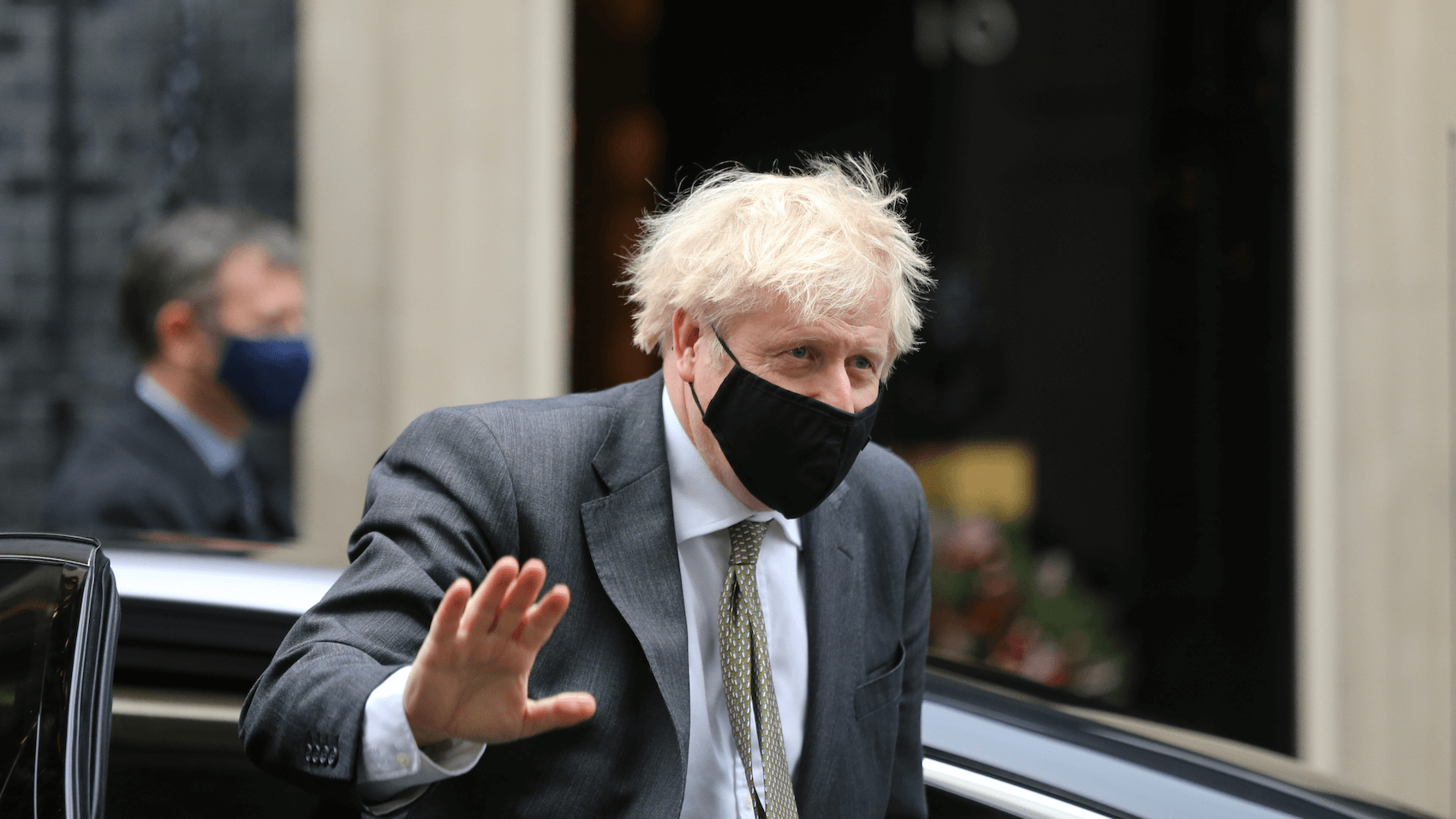
The traditional British political style and rhetoric were utilized by both former Prime Minister Boris Johnson and Nigel Farage of UKIP as tools to communicate their approaches to managing the COVID-19 crisis. This demonstrates the resilience of established political traditions while highlighting the volatility and ambiguity of populist strategies. Notably, populist narratives varied significantly depending on whether the leader was in power or in opposition, which influenced their responsibility towards citizens and their ability to connect populist grievances with pre-existing political arguments in the context of the pandemic. In particular, Johnson’s actions reflect a ‘government knows best’ approach to the crisis, blending epistemic and political authority in determining the necessary measures to address the pandemic.
This paper analyzes the role and significance of the Covid-19 pandemic in the development and behavior of British populist parties. It aims to observe how and when the so-called British Political Tradition (BPT) has been used by these parties as a guiding principle warranting the actions and policies implemented during the Covid-19 crisis in the UK. First, it will briefly introduce medical populism from a general perspective and within the specific situation of the Covid-19 pandemic. Second, it will analyze the overall actions taken by the two main British (right-wing) populist parties at the time and their leaders: the Conservatives in power under Prime Minister Boris Johnson and Nigel Farage’s UKIP party. This piece is not intended to be a theoretical discussion regarding the populist status of the considered parties and assumes that both can be meaningfully characterized as consistently (but differentially) populist on a variety of issues – such as health, immigration, economics or Brexit. The final section discusses the relationships between populists’ responses to the pandemic and the BPT. It evaluates if populists’ attitudes towards COVID-19 and its political management are positively affected by the BPT.
Populism and the Pandemic
One must first understand what kind of crisis the COVID-19 pandemic was and, thus, what kind of phenomena populists were dealing with at the time. Some scholars conceive a crisis as a moment of saliency for systemic contradictions and a consequent perceived need for structural change and strong interventions to take place. In such a situation, political agents are overwhelmed by the unfolding events and there is no common recognized rationality for handling the crisis-driven situation (Bobba & Hubé, 2021: 3).
Under a dynamic conception of crises, populist actors may be better conceived not just as passively reacting to given external shocks, but “as actors that actively perform and spread a sense of crisis” (Bobba & Hubé, 2021: 6). This is a general characterization of an endogenous crisis, where all the contradictions are generated within the political system, and in which political agents are acting. In other words, when confronted with such a scenario, populists from all over the political spectrum usually tend to at least trigger or even manufacture the crisis themselves to gain some leverage in the political system (Ringe & Rennó, 2023: 4). Being an exogenous crisis with respect to populism, the pandemic is harder to politicize than other political shocks or events that are at least partially originated inside the system itself. In addition, it should also be noted that the pandemic has a peculiar nature: as a public health crisis, no one is free from its consequences and implications.
Bobba & Hubé (2021: 9-10), drawing from other authors, use the following general framework to better understand health crises such as Covid-19. Health crises are thought to be divisible into three parts: (a) an initial phase in which you are confronted with the emergence of the problem; (b) a confrontation phase in which some actors blame other actors for being responsible for what is happening; (c) a managing phase in which who is blaming responsibility upon others generally tries to propose and claim its solutions.
Moving to populism to connect it with the pandemic, a meaningful characterization of the term in the context of public health crises is needed. Following Gideon Lasco’s argument (2020: 1), one could say that “medical populism” is “a political style based on performances of public health crises that pit ‘the people’ against ‘the establishment’.” Different examples of medical populism can be given, going from Jair Bolsonaro downplaying the threat of the virus and pitting the economy against public health policies, to Donald Trump paving the way for conspiracy theories about the virus’ creation and blaming illegal immigrants for its spread around the country.
With specific reference to Covid-19, we can distinguish some main features of populist strategies acting within such a crisis: (i) the simplification of the pandemic, offering the simplest (and most simplistic) solutions to the problems that the health emergency is posing; (ii) the dramatization, distortion and spectacularizing the threats posed by the crisis; (iii) the forging of societal divisions claiming to be on the side of the ‘real people’ quite often opposed to an unspecified ‘otherhood’; (iv) the invocation of knowledge claims: for example with regards to the virus’ origins, about the most appropriate methodologies to prevent its spreading or on how to treat it consistently (Lasco, 2020: 2-3).
Investigating the second feature of populism (ii), we can add the fact that populist actors must not be obscured by the coverage of the pandemic itself. They need to spectacularize the crisis with their messaging, a strategy that allows them to stand out as relevant and influential figures in the public and online media to claim reliability and legitimacy properly (Ringe & Rennó, 2023: 5).
Regarding the third feature (iii), it is difficult to frame the populist concept of the ‘real people’ alongside the strategy of pitting them against other groups or entities when the virus indiscriminately affects everyone. Being aware of this problem, “‘the people’ are imbued with various characteristics, biomedical and otherwise [with populists] claiming that their citizens are less susceptible to the virus” (Lasco, 2020: 4-7). Thus, the ‘others’ against which populists claim to fight in representation of the “real people” during the pandemic are generally international and supranational actors such as the WTO or other states such as China – if not intellectual elites such as academics, journalists or public health experts (Bobba & Hubé, 2021).
Points (i) and (iv) are strictly intertwined in that simplification goes hand in hand with false claims and controversial scientific statements. In other words, we observe a “widespread deployment of scientific language and imagery – and a selective deployment of scientific consensus” (Lasco, 2020: 8).
British Populism and Covid-19
To better connect British populism with the case of the pandemic, it is useful to get a brief and general background of the previous relationships between populism and healthcare policies in the UK before Covid-19. There is a distinction between healthcare systems that are more or less resistant to populist performances. The former are well-resourced, present a developed network-based model of governance, and involve professions in the policy processes. On the contrary, the latter are poorly financed, present high levels of command along the line of the New Public Management-type (NPM) governance model and display low trust in healthcare providers (Speed & Mannion, 2020: 3).
But the most important thing to recall regarding the evolution of the British healthcare system (NHS) and populism is the BREXIT process. During those years, right-wing populists argued that by leaving the European Union (EU) more funds could be allocated to better finance the NHS. Specifically, they framed the unsustainability of the NHS and its underdevelopment (mostly in terms of funds and available high-skilled personnel) as a problem of immigration, as the blame was directed towards immigrants enjoying health services paid for by British citizens (Speed & Mannion, 2020: 8).
Johnson and the Conservatives
The Conservatives, led by then Prime Minister Boris Johnson, were in power when Covid-19 became a global medical problem, and remained so until the end of the pandemic. For some authors (Sahin & Ianosev, 2021), the first wave of the pandemic, from February 2020 to roughly July 2020, can be divided in three phases. The ‘breakout’ phase was characterized by state authorities acting in a relaxed way, without invasive governmental control over people’s freedoms. This moment corresponds to the public’s response to the news about the virus’ spreading. During the ‘confrontation’ phase, the virus’ infection began widely spreading, and the number of people testing positive to Covid-19 began to grow exponentially. The final, ‘managing,’ phase is characterized by attempts to stabilize the situation and enforce measures in order to cope and coexist with the virus while waiting for the development of vaccines.
During the first two phases the Conservative Party did not take the risks seriously and showed a libertarian way of thinking, arguing against a strict and hard response to the crisis in terms of closures and restrictions. In particular, Prime Minister Johnson did not attend the meetings dedicated to the government’s response to the pandemic in early February 2020 and criticized some warnings made by the British Scientific Advisory Group for Emergencies (SAGE) (Bale, 2023: 69-70). An explanation for that could be that his actions and public statements were influenced and warranted by ‘misplaced optimism’ and regressive and nationalistic ideas, historically speaking, of the British role in the world – stressing the narrative around the exceptionality and efficiency of the NHS (Sim & Tombs, 2022: 6).
Starting from the end of March and the beginning of April, things became more dramatic, and the Prime Minister Johnson’s attitude changed. Around this time the first lockdown was issued, disregarding the idea of ‘herd immunity’ where the virus is left to spread in the population to lower its virulence (Sahin & Ianosev, 2021: 21). In general, the government stressed conventional public measures and followed international guidelines along other major Western and European states (Bale, 2023: 70). Additionally, Johnson’s Cabinet avoided using tropes potentially contributing to the politicization of the crisis, and attempted to emphasize the importance of scientific guidelines (Sahin & Ianosev, 2021: 26).
Analyzing the rhetorical repertoire that has been used, the governmental discourse historically situated Covid-19 in mainly three different ways. To do so, the Cabinet used so-called ‘temporal claims,’ as defined in narrative discourse theory. Following the construction of a (i) radically discontinuous time, the virus has been described as a moment of generational significance. The pandemic was to be seen as an unprecedented event disrupting people’s habits and usual social behavior, in order for new economic, social and political initiatives to be ruled and legitimized. From another point of view, events have been plotted with a (ii) linear timeline, positing a unidirectional and cumulative development. Here, a descriptive account of some sequences and a principle of evaluation of the events and by which to assess the correctness of the action leading to their unfolding have been invoked. Lastly, the construction of a (iii) cyclical time helped the government to depict everyday life after the pandemic in a radically different way. In this respect, narratives were prospecting and sketching the idea of a ‘new normalcy’ bringing the emergence of new habits for everyone (Jarvis, 2021: 27-31).
To conclude this investigation of Johnson’s political communication during the pandemic, it is notable that he also employed daily governmental press briefings, using so-called the ‘numbers arms race’ and more broadly the already cited ‘war language.’ Both of them served as an enforcement to the claim of fighting for Britain in a once in a lifetime event. The key mantra has been the following statement: “Stay Home, Protect the NHS, Save Lives” (Sim & Tombs, 2022: 9-10).
Farage and the UKIP
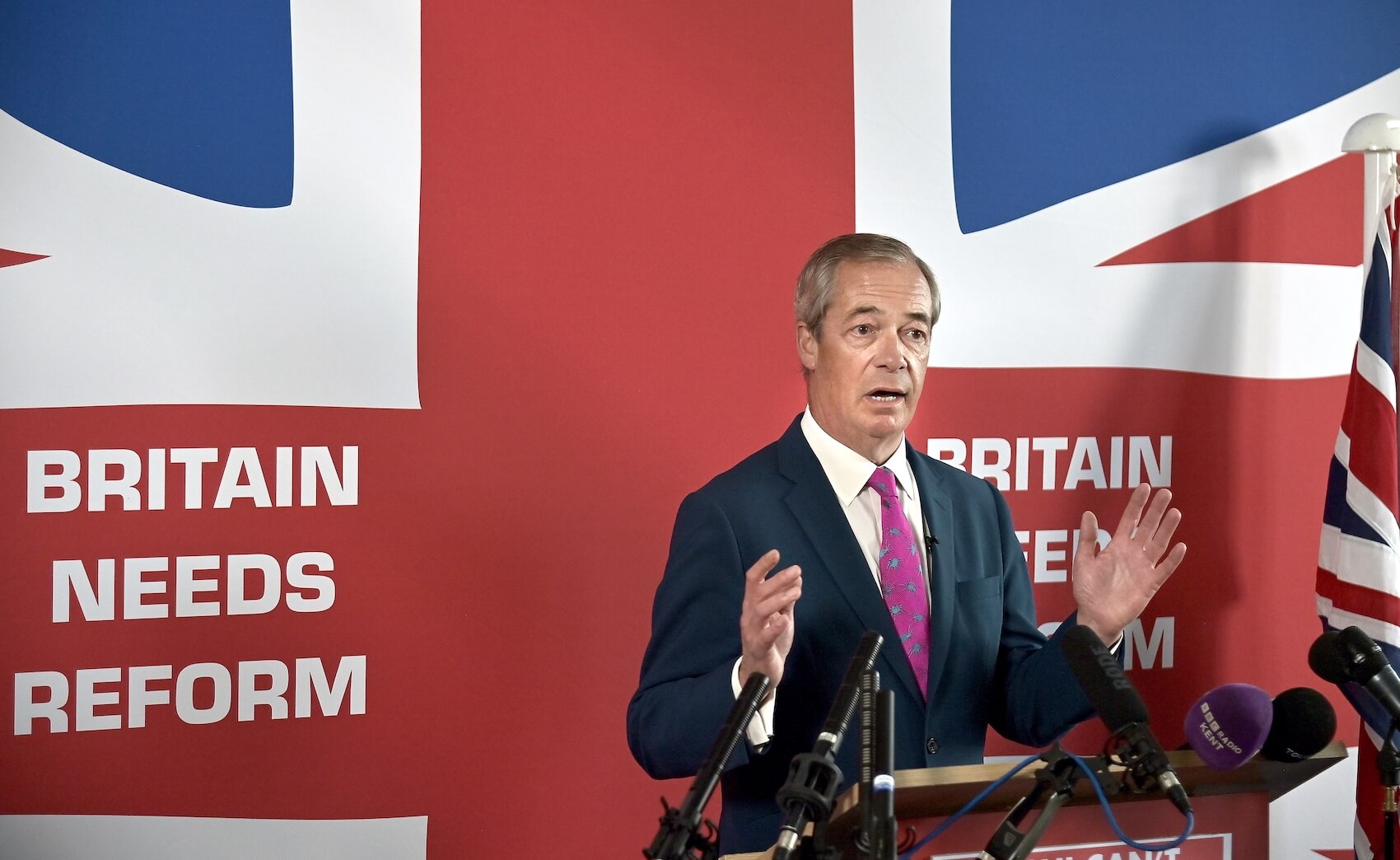
Nigel Farage speaking in Dover, Kent, UK, on May 28, 2024, in support of the Reform Party, of which he is President. Photo: Sean Aidan Calderbank.
In contrast to Johnson, who avoided politicizing the pandemic, Nigel Farage opted to fully utilize a populist political communication style typically associated with right-wing parties. Despite taking a cautious stance at the beginning of the breakout, he started acting as a radical libertarian, opposing public health restrictions and showing his open skepticism about government actions towards the pandemic (Bale, 2023).
Two major critiques can be identified. The former critique strictly concerns the governmental actions taken when the health situation started being very problematic. Farage accused Johnson’s government of incompetency and indecisiveness in dealing with the crisis, framing his actions as a lack of leadership on the side of the Prime Minister (Sahin & Ianosev, 2021: 27). His arguments are composed by a mixture of “support for draconian measures on ‘law and order’ and ‘Britain’s borders’,” and “its essentially libertarian opposition to ‘political correctness gone mad’ as well as ‘red tape’ and the ‘faceless bureaucrats’” (Bale, 2023: 71). Resorting to well-known populist grievances, alongside other world leaders such as Trump, he adapted the issue of immigration and the concerns associated with it in claiming that migrants could enter and spread the virus if police enforcement on British borders were not sufficiently severe or incoming international flights were to be easily allowed for foreign travelers coming from high-risk countries (Sahin & Ianosev, 2021: 23). He also denounced the ‘herd immunity’ strategy initially sought to be pursued by the government, although he maintained a libertarian posture by stressing the fact that measures taken to stop the virus’ transmissibility were not meant to become a “house arrest” for the entire nation (Bale, 2023: 72).
The latter part of his narratives, and the second critique he posed, is about the role of the UK in the world and the attempt to identify responsible actors for the pandemic to occur. In other words, he blamed China for not telling the truth about Covid-19’s emergence in the first place and for its deliberate suppression of key information and the intentional delaying of their communication to the international community (Bale, 2023: 71). Concisely: “While the government undermined the seriousness of the crisis mostly because of economic concerns, Farage opportunistically used the COVID-19 crisis to suggest a scale down to the UK’s relations with the EU and China” (Sahin & Ianosev, 2021: 26).
The British Political Tradition in Times of Crisis
According to Lijphart (1999), the British Westminster Model presents nine core tenets: (1) the concentration of the executive power in one party; (2) cabinet dominance; (3) a two-party system, where parties produce manifestos and seek a mandate to govern; (4) a majoritarian electoral system; (5) a unitary and centralized government; (6) interest group pluralism; (7) the concentration of legislative power in Parliament; (8) constitutional flexibility; (9) the central bank is controlled by the executive. Following Hall (2011: 9-10) and Richards and Smith (2002) we can add two more tenets: (10) the doctrine of ministerial responsibility; (11) a permanent, neutral, and anonymous civil service.
What is important to us here is the fact that the Westminster Model emphasizes some peculiar aspects. First, a linear and gradual development of the British political system and its institutions. Second, it stresses a great degree of British exceptionalism, and the superior nature of its system compared to other Western ones. Third, it is warranted by the idea that power is to be concentrated and exercised with a top-down approach. Warranting this system, according to Hall (2011: 124-125), the British Political Tradition (BPT) could be characterized as presenting the following main themes: (i)A discourse that stresses a limited liberal notion of representation and the elitist view that politicians are best suited to make decisions on behalf of the populace […] and are willing to act against the expressed will of the public or in the face of substantial public opposition; (ii) A discourse that stresses a conservative notion of responsibility and the view that a strong, decisive government is the most effective, efficient and desirable form of government. […] (iii) A discourse about change which emphasizes the virtues of continuity, gradualism, flexibility and stability. […] (iv) A discourse concerning a sense of British distinctiveness and superiority politically (Hall, 2011: 124-125)
Regarding discourse (i), it must be added that the BPT is sustained by an elitist conception of democracy, particularly the famous ‘Westminster and Whitehall know best’ statement, which itself reflects the interest of the political elite, thus reinforcing their status and power (Marsh & Hall, 2016: 128). The BPT reifies over time already existing inequalities and asymmetries in the British political system between citizens. Therefore, these ideas and beliefs have been mostly supported by most of the population. This results in the populace developing a somewhat deferential attitude towards politics, where politicians are seen as the best holders of the right to take the most important and crucial decisions for all (Hall, 2011: 159). Moreover, Marsh and Hall rightly highlight that the BPT not only served the interest of the political elite, but also of the socio-economic one. Specifically, regarding discourse (ii) above, the climax of political conservatism made it easier for the working class to accept the status quo. Furthermore, the dominance of the executive power helped political elites to enact policies more favorable to the socio-economic ones without too much opposition (Marsh & Hall, 2016: 135).
Johnson and the BPT
The discussion seems to beg the question: Has the BPT influenced the populist (Johson and Farage) behavior described above? Following Finlayson et al. (2023), we can observe the employment of several traditional tropes dating back to the language and discourse of the BPT. Particularly, Prime Minister Johnson’s behavior indicates the presence of a ‘government knows best’ approach to the crisis, merging epistemic and political authority over the actions needed to cope with the pandemic. For example, the invocation of the concept of ‘the people’ is used to hide the public’s limited political agency and retain the rights and legitimacy over the enactment of the counteracting measures. All of this is also related to the low participatory governance tradition inherent in the British State, but also shows how Johnson proved to strategically build its narrative of the pandemic to advance and increase the further legitimization of past policy decisions, and in particular the ones connected with the Brexit process (Wellings et al., 2023: 238). The former British premier revitalized the concept of the ‘British people’ within the public imagination, employing the sustainability and functioning of the NHS and other health issues as an element of continuity in his narratives from the beginning of the ‘Leave Campaign’ for Brexit to their management during the pandemic (Welling et al., 2023: 242).
To better understand the British government’s communicative repertoire, the authors identify four main figurations of ‘the people’ (Finlayson et al., 2023: 344). First, we have ‘statistical realities.’ Here, ‘the people’ are represented and aggregated numerically, thus appearing more as abstract elements that legitimize the quest for acquiescence from the government (Finlayson et al., 2023: 345-346). Put another way, this kind of framing not only confers to the Cabinet epistemic authority because numbers don’t need further explanations, but also certifies its tight cooperation with the scientific community (Massidda & Sacca, 2023: 222).
Second, we have the figuration of ‘suffering families.’ This narrative aims to develop a public ‘ethos’ via which it can acquire the rights and legitimacy required to advance its policies. The BPT here is involved and works when this communicative strategy properly connects governmental instructions with people’s feelings, needs, and emotions – knowing what is best to accomplish them (Finlayson et al., 2023: 347).
Third, ‘the people’ are framed as responsible individuals. This one is seen as a rule follower, encapsulated in a hierarchical structure that crystallizes a top-down and vertical conception of the people/state relationships. Once again, the BPT widens the divide between the elites and the public. ‘The people’ are required to follow the moral claims encouraged by the elite to fulfill their individual and collective responsibilities and duties towards resolving the crisis. The individual responsibility regards the task that people are assigned to complete, such as wearing protective masks in public spaces while avoiding unnecessary contact with strangers. The collective responsibility is rooted in utilitarian reasoning: complying with the rules means a faster crisis resolution (Finlayson et al., 2023: 348-349).
The second and third depictions help understand the way in which Johnson tried to preserve its populist-driven consensus from the backlash of its unpopular decisions during the crisis. He tried not only to highlight the community as a collective as the real protagonist of the effort to fight against the virus’ infection, but also to present himself as a transparent and compassionate leader (Massidda & Sacca, 2023: 209-215).
The fourth and final depiction utilized is ‘freedom-loving citizens.’ This time, citizens are represented as rights holders and interests to be appropriately recognized. Consequently, the government has a duty to protect these fundamental freedoms and, by showing the truth about them, affirm the legitimacy of its guidelines (Finlayson et al., 2023: 350).
Farage and the BPT
The case of Farage is different. Being an oppositional force during the COVID-19 pandemic breakout, it was much easier for him to resort to typical and proven to be more effective populist grievances. However, the BPT resonates consistently in Farage’s discourses during the crisis: I’m convinced that its influence is evident when the UKIP’s leader blamed Johnson for his lack of leadership and inefficient management in the initial months of the crisis development. Specifically, Farage used his oppositional platform on health policies to rally against the government and exploit the newly achieved consensus to fuel support around the rebranding of UKIP in ‘Reform UK’ (McManus, 2021: 148-150).
Relating to discourse (ii) presented before, I argue that Farage somewhat recalls the necessity for the executive to be strong and decisive in its actions on behalf of the State. Second, and about discourse (iv) discussed above, I argue that Farage recalls the BPT when he stresses the role of the UK in the world vis-à-vis the actions and warnings undertaken towards China by other Western leaders. Put another way, he tried to point out the distinctiveness and peculiarity of the British political system as opposed to others, especially in the Western World, while asking for a different resolution path for the crisis (Bale, 2023; Sahin & Ianosev, 2021).
Overall, even if Farage was not in a position that favored traditional forms of British political thinking, the BPT proves to have (at least) partially influenced his claims and actions during Covid-19’s unfolding.
Conclusion
To recall the main points of the argument above, there is clear evidence that the British Political Tradition (BPT) still influences how politicians behave in ordinary British political life and their policy-making choices. Even in the face of essential shifts and changes caused by the Covid-19 crisis, many political actors tried to adapt these new challenges to the long-standing historical and common way of interpreting political actions and decision-making in the UK (Hall et al., 2018: 15).
The aim of this article was to check for the influence of the BPT on populist leaders. As we observed, the British traditional political style and tropes served both Johnson and Farage as a means to instill their ideas about how to manage the crisis. This proves the resilience of established political tradition and clarifies the volatility and ambiguity of the populist repertoire and strategies. Regarding the latter point, populist narratives varied a lot depending on two factors: (i) the position of the leader – being in charge or standing as an oppositional force – and hence its responsibility towards citizens; (ii) the ability to legitimately connect populist grievances in the context of the pandemics with already existing lines of political reasoning. Some examples exemplifying the second point are the case of migration and the issue of border control regarding the likelihood of importing and spreading the virus uncontrolled.
(*) Andrea Guidottiis a master’s student at the University of Pavia and an intern at the ECPS.
References
Bale, T. (2023). “The United Kingdom: The Pandemic and the Tale of Two Populist Parties.” In: Ringe N. & Rennó L. (Eds.), Populists and the Pandemic: How Populists Around the World Responded to COVID-19. Routledge Studies in Extremism and Democracy. https://doi.org/10.4324/9781003197614
Bobba, G. & Hubé, N. (2021). “COVID-19 and Populism: A Sui Generis Crisis.” In: G. Bobba & N. Hube (Eds.), Populism and the Politicization of the COVID-19 Crisis in Europe. Palgrave Macmillan. pp. 17-30. https://doi.org/10.1007/978-3-030-66011-6
Finlayson, A.; Jarvis, L. & Lister, M. (2023). “COVID-19 and ‘the public’: U.K. government, discourse and the British Political Tradition.” Contemporary Politics. 29(3). pp. 339-356. https://doi.org/10.1080/13569775.2022.2162206
Hall, M.; Marsh, D. & Vines, E. (2018). “A changing democracy: contemporary challenges to the British political tradition.” Policy Studies. 39(4). pp. 365-382. https://doi.org/10.1080/01442872.2018.1451504
McManus, I. (2021). “The Case of the United Kingdom Independence Party (UKIP).” In: Falkenbach, M., Greer, S.L. (eds). The Populist Radical Right and Health.Springer, Cham. https://doi.org/10.1007/978-3-030-70709-5_8
Marsh, D. & Hall, M. (2015). “The British Political Tradition and the Material-Ideational Debate.” The British Journal of Politics and International Relations. 18(1), 125-142. https://doi.org/10.1111/1467-856X.12077
Massidda, L. and Selva, D. (2023). “Correction to: Boris Johnson’s Approach to the Pandemic, In: European Political Leaders and the Social Representation of the Covid-19 Crisis.” Palgrave Studies in European Political Sociology. Palgrave Macmillan, Cham.https://doi.org/10.1007/978-3-031-38380-9_13
Jarvis, L. (2022). “Constructing the coronavirus crisis: narratives of time in British political discourse on COVID-19.” British Politics. 17. pp. 24-43. https://doi.org/101057/s41293-021-00180-w
Lijphart, A. (1999). Patterns of Democracy. Government Forms and Performance in Thirty-Six Countries. Yale University Press: New Haven. https://doi.org/10.12987/9780300189124
Richards, D. & Smith, M. (2002). Governance and Public Policy in the UK, Oxford University Press.
Ringe, N. & Rennó, L. (2023). “Populists and the Pandemic: How Populists Around the World Responded to COVID-19.” In: Routledge Studies in Extremism and Democracy, Routledge: New York. https://doi.org/10.4324/9781003197614
Sahin, O. & Ianosev, B. (2021). “UK: Between Managed Moderation and Far-Right Conspiracy Theories.” In: G. Bobba & N. Hube (Eds.). Populism and the Politicization of the COVID-19 Crisis in Europe, Palgrave Macmillan: London. pp. 17-30. https://doi.org/10.1007/978-3-030-66011-6
Sim, J. & Tombs, S. (2022). “Narrating the coronavirus crisis: state talk and state silence.” UK, Power and Resistance. 5(1-2). pp. 67-90. http://dx.doi.org/doi:10.1332/xfuq5523
Speed, E. & Mannion, R. (2020). “Populism and health policy: three international case studies of right-wing populist policy frames.” Sociology of Health & Illness, 42(8), pp. 1-15.https://doi.org/10.1111/1467-9566.13173
Wellings, B.; Bonotti, M.; Rublee, M. R. & Zech, S. T. (2024). “Correction to: Narrative fusion and layering: statecraft and the shaping of Boris Johnson’s pandemic narrative, 2020–2021.” British Politics. 19(2), 253–253. https://doi.org/10.1057/s41293-023-00241-2
ECPS organized its fourth virtual Summer School on July 1-5, 2024, focusing on the relationship between populism and foreign policy. The five-day program offered young participants a dynamic, engaging, and interdisciplinary learning environment. Presented by world-class scholars of populism, this intellectually stimulating program helped participants develop as future academics, intellectuals, activists, and public leaders. It also provided an opportunity to gain valuable cross-cultural perspectives and foster knowledge exchange beyond European borders, preparing them for future endeavors.
ECPS organized its fourth virtual Summer School on July 1-5, 2024, focusing on the relations between populism and foreign policy. The goal was twofold: to examine the theories related to the influence of populism on international relations and analyze case studies such as the US, Turkey, India, Brexit, and Israel to see how leaders use populist instruments in external politics.
Populism has often been studied as a subject of political science and investigated as a topic of domestic affairs, namely party politics and elections. Nevertheless, a growing body of literature suggests that this phenomenon is not confined to the borders of nation-states; it interferes with international relations thanks to populist leaders’ desire to shape foreign affairs with a populist and mostly revisionist view. Trump’s threats to withdraw the US from NATO, Modi’s handling of India’s relations with Pakistan, Erdogan’s diaspora politics towards European countries, Orbán’s instrumentalization of migration in the EU, Netanyahu’s approach to the Israeli-Palestinian conflict, Johnson’s management of the Brexit process and numerous attempts by populist leaders to undermine or subvert international or supranational organizations, such as the UN, WTO, and EU, are among many examples that showcase how external relations can be blended with populism.
Considering the current political landscape in which the number of populist figures is on the rise, we may witness more similar instances in the international political arena in the period to come. Populism in international relations has the potential to complicate existing problems, create new ones and bring about repercussions for the multilateral liberal global system. In this light, this year, the summer school examined the theoretical background of the interplay between populism and foreign affairs and examined a number of case studies from different parts of the world with a view to see similarities as well as differences between the ways populist leaders craft external politics.
The lecturers for this year’s summer school were Professor Sandra Destradi, Associate Professor Angelos Chryssogelos, Associate Professor Jessica Greenberg, Dr. Thorsten Wojczewki, Dr Georg Loefflman, Professor Cengiz Aktar, Professor Emeritus Louis Kreisberg, Professor Bertjan Verbeek, ECPS President Irina Von Wiese, Professor Craig Calhoun and Professor Joanna Dyduch. Each session was moderated by a scholar. Hence, the moderators were Dr Rubrick Biegon, Dr Gustav Meibauer, Dr Jonny Hall, Professor Ana E. Juncos Garcia, Professor Franco Zappettini, Professor Allison Carnegie, Dr Ajay Gudavarthy, Dr Aleksandra Spancerska, Professor Alexandra Homolar and Dr Andrei Zaslove.
The opening lecture by Professor Destradi examined the international implications of populism, first by outlining how populism has been conceptualized in comparative politics and political theory. It also introduced the current state of research on the global effects of populism, particularly its potential impact on foreign policy, international disputes, contributions to global public goods, participation in multilateral institutions, and the formation of partnerships with authoritarian and populist governments. The following lecture by Dr Angelos Chryssogelos examined the global rise of populism and how it sparked debate about its impact on the liberal international order. He argued that a deeper understanding of populism is needed to appreciate its varied effects on the international system.
On the second day, the first lecture by Dr Jessica Greenberg explored the paradox of increasing reliance on international legal institutions to address conflict and bolster governance while populists use these same institutions to authorize antidemocratic policies. The lecture discussed the conditions under which this paradox emerged and how to address it, examining the relationship between populism and the rule of law and how populists subvert the law from within.
The following two lectures by Dr Georg Loefflman and Dr Thorsten Wojczewski examined the practical manifestations of populism on foreign policy in the cases of the United States and India.
On the third day, Professor Cengiz Aktar examined another practical populist case, namely Turkey. The following lecture by Professor Louis Kriesberg examined populism as non-governmental actions aimed at changing the conduct of resistant groups, often influencing established institutions. The presentation also examined such actions in the US, Europe, and other countries, assessing their constructiveness or destructiveness based on conflict resolution research, including factors like persuasion, promised benefits, and coercion.
On the fourth day, Professor Bertjan Verbeek and Irina Von Wiese’s lectures examined the role of populism in the EU’s foreign policy and what the EU could do as a foreign affairs actor.
On the final fifth day, the opening lecture by Professor Craig Calhoun examined Britain’s withdrawal from the EU in the context of populist politics and argued that it stemmed from contingent circumstances, mobilizations, and deeper political shifts, notably influenced by national conservatism and English nationalism prioritizing ethnonationalist identity. The final lecture by Professor Joanna Dyduch gave insights on populism and foreign policy based on the example of Israel, distinguishing between ‘liberalist’ and ‘historicist’ orientations, highlighting how historical memory drives state actions, with ‘Foreign Policy Historicism’ emphasizing a hawkish, emotionally charged approach tied to national identity and othering.
This year’s program was enriched by the participation of around 60 attendees from diverse backgrounds and various parts of the world. They found the opportunity to engage in discussions with the lecturers on the topics mentioned, and they networked with each other in small groups and practiced peer-to-peer learning in a truly international environment.
The Summer School also featured a unique learning opportunity in the form of a case competition, held over five days from 1-5 July. The competition was designed to help participants transform their academic knowledge into practical policy suggestions, providing a hands-on learning experience.
The competition tackled a real-life problem within the broad topic of populism, specifically populism and US foreign policy. The groups were expected to focus on a specific foreign policy or action Trump has carried out during his past presidency, or that he may carry out if he were to be re-elected in Autumn. These included the withdrawal from the Paris Climate Accord, the renegotiation of NAFTA to USMCA, the trade war with China, immigration policies and the border wall, North Korea diplomacy, the withdrawal from the Iran Nuclear Deal (JCPOA), NATO relations and defense spending, the response to the Syrian civil war, and US relations with Russia.
The participants could position themselves as think tank members preparing policy suggestions for the US Department of State, the EU, or NATO; advisors to the Secretary of State, the Secretary of Defense or the Vice President; lobbyists aiming to change a policy in a particular direction; or academics drawing policy suggestions from their research on a specific foreign policy topic.
Participants were divided into teams to work together on solving the case and were expected to prepare policy suggestions. The proposals of the participants were then rigorously evaluated by an assessment committee composed of scholars and experts. The committee assessed the proposals based on criteria such as creativity, feasibility, and presentation skills, ensuring a high standard of competition. On the first day of summer school, ECPS provided the groups with an information pack that included documents and sources that outlined the case and its context. Moreover, each day, a one-hour-long consultation session was arranged for the competitors when the teams could discuss their progress and partake in the case-solving activity together. On the final day of the competition, short presentations were carried out and thoroughly evaluated by the assessing committee, which gave valuable feedback to the attendees.
The participants were divided into ten working groups, each named after a US state, and examined the various populist policies enacted by Trump. Two teams, the Texas group and the Utah-Kansas group, finished with the same number of points. Utah-Kansas group (Chiara Cerisola, Martina Micozzi, Muhammad Muhammad, Junsoek Lee, Adriana Duthon, Mohammad Shakib, Sana Akhter, Syed Waqas Bokhari) positioned themselves as a think-thank, examined the populist aspects of US migration policy and designed national and regional policy suggestions to address migration issue and brought recommendations to ensure the continuity of policies across different administrations. Texas group (Anton Miguel De Vera, Olivia Gheyselinck, Giada Pasquettaz, Reka Koleszar, George Kutty, Viktoriia Hamaiunova, M. Fahmi Asshidgy, Sara Torabian) brought suggestions for the EU to strengthen its technology security resilience in light of US technology policy towards China during Trump administration. Taking this opportunity, ECPS congratulates the teams for their diligence and professionalism in research and great talent in presenting their policy suggestions.
All in all, our five-day schedule provided young people with a dynamic, engaging, and interdisciplinary learning environment. This intellectually challenging program, presented by world-class scholars of populism, allowed them to grow as future academics, intellectuals, activists, and public leaders. Participants had the opportunity to develop invaluable cross-cultural perspectives and facilitate a knowledge exchange beyond European borders, empowering them for their future endeavors.
Are you passionate about global politics and understanding the dynamics that shape it? Are you looking for a way to expand your knowledge under the supervision of leading experts, seeking an opportunity to exchange views in a multicultural, multi-disciplinary environment, or simply in need of a few extra ECTS credits for your studies? Then, consider applying to ECPS Summer School.The European Center for Populism Studies (ECPS) is looking for young people for a unique opportunity to assess the relationship between populism and foreign policy in a five-day Summer School led by global experts from a variety of backgrounds. The Summer School will be interactive, allowing participants to hold discussions in a friendly environment among themselves in small groups and exchange views with the lecturers. You will also participate in a Case Competition on the same topic, a unique experience to develop problem-solving skills in cooperation with others and under tight schedules.
Overview
Populism has often been studied as a subject of political science and investigated as a topic of domestic affairs, namely party politics and elections. Nevertheless, a growing body of literature suggests that this phenomenon is not confined to the borders of nation-states; it interferes with international relations thanks to populist leaders’ desire to shape foreign affairs with a populist and mostly revisionist view. Trump’s threats to withdraw the US from NATO, Modi’s handling of India’s relations with Pakistan, Erdogan’s diaspora politics towards European countries, Orban’s instrumentalization of migration in the EU, Netanyahu’s approach to the Israel-Palestinian conflict, Johnson’s management of the Brexit process and numerous attempts by populist leaders to undermine or subvert international or supranational organizations, such as the UN, WTO, and EU, are among many examples that showcase how external relations can be blended with populism.
Considering the current political landscape in which the number of populist figures is on the rise, we may witness more similar instances in the international political arena in the period to come. Populism in international relations has the potential to complicate existing problems, create new ones and bring about repercussions for the multilateral liberal global system. This outlook urges scholars and policy-makers to understand the interwoven relationship between populism and external relations more deeply and take into account the populist dimension of problems while crafting solutions to interstate issues.
Against the background explained above, at the ECPS Summer School this year, we would like to look at populism from an international relations perspective. To this end, we will discuss the theoretical background of the interplay between populism and foreign affairs and examine a number of case studies from different parts of the world with a view to see similarities as well as differences between the ways populist leaders craft external politics.
The lecturers for this year’s Summer School are:
Professor Sandra Destradi
Associate Professor Angelos Cryssogelos
Associate Professor Jessica Greenberg
Dr. Thorsten Wojczewski
Assistant Professor Georg Loefflman
Professor Cengiz Aktar
Professor Emeritus Louis Kreisberg
Professor Bertjan Verbeek
Irina Von Wiese
Professor Craig Calhoun
Professor Joanna Dyduch
Sessions will be moderated by:
Dr. Rubrick Biegon
Assistant Professor Gustav Meibauer
Associate Professor Jessica Greenberg
Dr. Jonny Hall
Professor Ana E. Juncos Garcia
Professor Franco Zappettini
The program will take place on Zoom, consisting of two sessions each day. Over the course of five days, interactive lectures by world-leading practitioners and experts will discuss the nexus between populism and foreign policy. The lectures are complemented by small group discussions and Q&A sessions moderated by experts in the field. The final program with the list of speakers will be announced soon.
Moreover, as last year, the Summer School will comprise a Case Competition on a real-life problem within the broad topic of populism and foreign policy. Participants will be divided into teams to work together on solving the case and are expected to prepare policy suggestions. The proposals of the participants will be evaluated by a panel of scholars and experts based on criteria such as creativity, feasibility, and presentation skills.
Our five-day schedule offers young people a dynamic, engaging, and interdisciplinary learning environment with an intellectually challenging program presented by world-class scholars of populism, allowing them to grow as future academics, intellectuals, activists and public leaders. Participants have the opportunity to develop invaluable cross-cultural perspectives and facilitate a knowledge exchange that goes beyond European borders.
Schedule
Monday, 1 July 2024
Populism and International Relations: A Theoretical Overview
Lecture One: (15:00–16:30) – Populism and International Relations: Introducing a Dynamic Research Field
Lecture Eleven: (17:30–19:00) –Populist Foreign Policy: The Israeli Case Study of Hawkish- Historicist Foreign Policy
Lecturer: Dr. Joanna Dyduch (Professor at the Israel Institute, Jagiellonian University-Institute of Middle East and Far East).
Who should apply?
This unique course is open to master’s and PhD level students and graduates, early career researchers and post-docs from any discipline. The deadline for submitting applications is June 21, 2024. The applicants should send their CVs to the email address ecps@populismstudies.org with the subject line: ECPS Summer School Application.
We value the high level of diversity in our courses, welcoming applications from people of all backgrounds. Since we have a limited quota, we suggest you apply soon to not miss this great opportunity.
Evaluation Criteria and Certificate of Attendance
Meeting the assessment criteria is required from all participants aiming to complete the program and receive a certificate of attendance. The evaluation criteria include full attendance and active participation in lectures.
Certificates of attendance will be awarded to participants who attend at least 80% of the sessions. Certificates are sent to students only by email.
Credit
This course is worth 5 ECTS in the European system. If you intend to transfer credit to your home institution, please check the requirements with them before you apply. We will be happy to assist you; however, please be aware that the decision to transfer credit rests with your home institution.
Brief Biographies and Abstracts
Day One: Monday, July 1, 2023
Populism and International Relations: Introducing a Dynamic Research Field
Dr. Sandra Destradi is a Professor of International Relations at the University of Freiburg, Germany. She currently serves as a DAAD long-term guest professor at Reichman University, Israel. Together with Johannes Plagemann, she leads the project “Populism and Foreign Policy”, funded by the German Research Foundation.
Abstract:The lecture will introduce into the research field that studies the international implications and effects of populism. It will start by outlining how populism has been variously conceptualized in comparative politics and political theory. Second, it will introduce into the state of the art on the international effects of populism, a dynamic research field that has developed tremendously over the past few years. The third part of the lecture will outline some hypotheses on how populism might impact foreign policy, focusing on the escalation of international disputes, contributions to global public goods provision, participation in multilateral institutions, and the formation of alternative partnerships with authoritarian and other populist governments. The presentation will build on insights from a project funded by the German Research Foundation.
Reading List
Destradi S and Plagemann J (2019). Populism and International Relations: (Un)predictability, personalisation, and the reinforcement of existing trends in world politics. Review of International Studies 45 (5), 711–730.
Lacatus C, Meibauer G and Löfflmann G (eds) (2023), Political Communication and Performative Leadership: Populism in International Politics (Cham: Palgrave Macmillan).
Plagemann J and Destradi S (2019). Populism and Foreign Policy: The Case of India. Foreign Policy Analysis 15 (2), 283–301.
Spandler K and Söderbaum F (2023). Populist (De)legitimation of International Organizations. International Affairs 99 (3), 1023-1041.
ModeratorDr. Rubrick Biegon was appointed Lecturer in International Relations in 2018. He has convened modules on US foreign policy, international political economy, international security, terrorism and political violence, and foreign policy analysis, among other subjects.
Prior to coming to Kent to complete his PhD, Biegon worked as an analyst and consultant with several organisations in Washington, DC. He holds a BA in Political Science from the University of Minnesota and an MA in International Politics from the American University’s School of International Service. He currently serves as the lead editor of Global Society, an interdisciplinary journal of international studies published by Taylor & Francis.
Biegon’s main areas of research explore the political violence and political economy of US power in international relations. He is the author of US Power in Latin America: Renewing Hegemony (2017). He is currently working on two book projects: a co-authored history of the US War on Terror (with Agenda publishing); and a research monograph on remote warfare and American hegemony (with McGill-Queen’s University Press).
Populism and the Challenge to the International Order
Dr. Angelos Chryssogelos is Reader in Politics and International Relations in the School of Social Sciences of London Metropolitan University. He has worked in the past at LSE, King’s College London, Weatherhead Center of Harvard and SAIS Johns Hopkins. In 2020-21 he was Jean Monnet fellow at the Schuman Centre of the EUI in Florence.
Abstract: The global rise of populism as a major political force has given rise to the debate about its international repercussions and whether it constitutes a threat to the ‘liberal international order’. While this assessment is not wrong as such, it underappreciates the variety of populist phenomena around the world and the ability of populists to engage and even usurp elements of the LIO. This talk will argue that only a thorough conceptual understanding of populism can allow us to appreciate consistently its effects on the international order; and that the international impact of populism is less uniform and linear than often assumed, but no less important.
Reading List
Chryssogelos, A (2021) Is there a Populist Foreign Policy? London: Chatham House
Chryssogelos, A (2020) State transformation and populism: From the internationalized to the neo-sovereign state? Politics, 40(1), 22-37.
Chryssogelos, A et al (2023) New Directions in the Study of Populism in International Relations, International Studies Review, Volume 25, Issue 4, viad035, https://doi.org/10.1093/isr/viad035
Moderator Dr. Gustav Meibauer is an Assistant Professor, Radboud University. Meibauer has research interests in foreign policy analysis, security studies and international relations theory. His research focuses on muddled state behavior, decision-making and the political dynamics of foreign policy choice, especially with regards to tools such as no-fly zones and buffer zones. Meibauer has published on the theoretical contributions of neoclassical realism to foreign policy analysis and international relations theory, as well as on the role of political ideas, rhetoric and communication in decision-making processes. He contributes to on-going projects on gender & diversity representation in academia as well as on novel approaches to experiential and active learning. Meibauer holds degrees from the London School of Economics, the Fletcher School of Law and Diplomacy, and the University of St Gallen.
Day Two: Tuesday, 2 July 2024
Populism, Conflicts and International Courts
Dr. Jessica Greenberg is An Associate Professor of Anthropology at the University of Illinois, Urbana-Champaign. Prior to coming toUIUC, Greenberg was an Academy Scholar at the Harvard Academy for International and Area Studies, and an assistant professor in Communication Studies at Northwestern University. She recently earned a Master of Studies in Law at the College of Law, University of Illinois. She is also currently the Co-Editor of the Political and Legal Anthropology Review (PoLAR). Her research interests include anthropology of democracy, legal studies, youth, social movements, revolution, Serbia/Balkans, Europe, Human Rights.
Populist Foreign Policy: The Israeli Case Study of Hawkish- Historicist Foreign Policy
Dr. Joanna Dyduch is a Professor at the Institute of the Middle and Far East of the Jagiellonian University, and head of the Department of Israel. Visiting scholar at the: University of Oxford (2023-2024), University of Potsdam (2022), Matej Bel University in Banská Bystrica (2019), University of Vienna (2017). In 2018 she was a research fellow at the German Institute for International and Security Affairs (SWP). Prof. Dyduch is an author of several scientific articles and books on foreign policy and other public policies (e.g. energy policy), recently her research interest has focused on European-Israeli relations, as well as Israel’s foreign policy. She has been also engaged in several research projects, among the most recent ones, there are: OPUS project funded by Poland’s National Science Center (NCN) entitled: “Energy security and the growing international interdependence. Israeli energy policy in the process of transition” (2022-2025). HORIZON-CL2-2021-DEMOCRACY – project entitled: “Rethinking and Reshaping the EU’s Democracy support in its Eastern and Southern Neighbour”, (contractor in the project. Project implemented in 2022-2025.COOPERATION financed by the European Commission; PARTNERSHIPS IN HIGHER EDUCATION (KA220-HED) titled: “Jews, Muslims and Roma in the 21st Century Metropolises: Reflecting on Polyphonic Ideal and Social Exclusion as Challenges for European Cohesion carried out in cooperation with the Charles University in Prague (project leader) and the Moses Mendelssohn Center for European-Jewish Studies (University of Potsdam).
Abstract:Building on existing literature, the paper tries to bridge and integrate scholarly insights on the causalities between populism and foreign policy. Against this backdrop, the paper suggests distinguishing between the two types of foreign policy ideological orientations: 1. ‘liberalist’ and 2. ‘historicist’ (Bjereld and Demker 2000), where the differentiating variable is the engagement of historical memory in the process of national identity construction and policy strategies conceptualisation and operationalisation. Consequently, the historical memory becomes a specific framework and driver of state international activity. In light of the above consideration, the paper introduces and utilises the concept of ‘Foreign Policy Historicism’ (FPH), (Reynolds 1999). FPH, contrary to the liberalist variant is identified with a hawkish approach, emphasising national values and interests – very often fuelled and empowered by emotions (national pride, fear, victimhood, etc.). This specific approach is strongly tied to the process of ‘othering’ as a key element of national identity formation, and therefore very much influences foreign bilateral and multilateral relations.
Reading List
Wajner, Daniel F., and Philip Giurlando. (2024) Populist Foreign Policy: Mapping the Developing Research Program on Populism in International Relations. International Studies Review, https://doi.org/10.1093/isr/viae012
Sharon Pardo, Dani Filc (2012). EU–Israeli relations. Geopolitical perspectives in the wake of nationalist populism. In: Routledge Handbook of EU–Middle East Relations, Routledge.
Joanna Dyduch (2021) “Israel and East-Central Europe: Case Studies of Israel’s Relations with Poland and Hungary.” Israel Studies Review, vol. 36, no. 1, spring 2021.
Joanna Dyduch (2024) Israel and Poland. [in]: Routledge Handbook on Israel’s Foreign Relations, Routledge.
Day Three: Wednesday, 3 July 2024
Populism, Peace and Security
Showcase: United States
Dr. Georg Loefflman is Assistant Professor at Queen Mary University of London. Previously, he was Assistant Professor in War Studies and US Foreign Policy at the Department of Politics and International Studies (PAIS) at the University of Warwick (until March 2023). Before that, he undertook a three-year Early Career Fellowship (2018-2021) funded by the Leverhulme Trust with a research project on the interlinkage of security discourses and populist rhetoric in the United States under the Trump presidency.
His other academic appointments include his role as research fellow working with Nick Vaughan-Williams on his project ‘Everyday Narratives of European Border Security and Insecurity’ (2016-2018) and a one-year PAIS teaching fellowship in American politics and US foreign policy (2015-2016). Between 2011 and 2014, He undertook his PhD studies the University of Warwick. His PhD thesis is titled: ‘The Fractured Consensus – How competing visions of grand strategy challenge the geopolitical identity of American leadership under the Obama presidency,’ and was supervised by Prof. Stuart Croft and Prof. Nick Vaughan-Williams. The thesis was nominated for the 2016 Michael Nicholson Prize for best doctoral thesis in International Studies. Before his PhD, he studied International Relations in Germany at the FU Berlin, the HU Berlin, and the University of Potsdam, and Social Sciences and History at the University of Erfurt in Germany.
Moderator Dr. Jonny Hall is a Lecturer at Department of International Relations at London School of Economics. Prior to being an LSE Fellow, he was a Lecturer in Politics and International Relations at the University of Surrey. He previously completed his PhD in the International Relations department at LSE before spending a year as an IRD Fellow.
Showcase: Turkey
Dr. Cengiz Aktar is an adjunct professor of political science at the University of Athens. He is a former director at the United Nations specializing in asylum policies. He is known to be one of the leading advocates of Turkey’s integration into the EU. He was the Chair of European Studies at Bahçeşehir University-Istanbul.
In 1999, he initiated a civil initiative for Istanbul’s candidacy for the title of European Capital of Culture. Istanbul successfully held the title in 2010. He also headed the initiative called “European Movement 2002” which pressured lawmakers to speed up political reforms necessary to begin the negotiation phase with the EU. In December 2008, he developed the idea of an online apology campaign addressed to Armenians and supported by a number of Turkish intellectuals as well as over 32,000 Turkish citizens.
In addition to EU integration policies, Dr. Aktar’s research focuses on the politics of memory regarding ethnic and religious minorities, the history of political centralism, and international refugee law.
Populism, Constructive and Destructive
Dr. Louis Kriesberg is the Maxwell Professor Emeritus of Social Conflict Studies and Professor Emeritus of Sociology at Syracuse University. He has published widely on diverse areas of sociology and social conflicts, including the US-Soviet Cold War, Israeli-Palestinian-Arab relations, non- governmental organizations, and social movements. His recent work focuses on constructive ways of fighting, conflict transformation, and conflict resolution methods. Kriesberg has been highly active in regional, national, and international associations of sociology, conflict resolution, and international peace, for which he has received numerous awards. He was also the founding director of the Program on the Analysis and Resolution of Conflicts (PARC) at Syracuse University. He received his PhD in Sociology at the University of Chicago in 1953.
Abstract: Populism is variously defined. For the purposes of this analysis, it refers to non-governmental people taking direct actions trying to change the conduct of some other resistant group. They are in conflict. In all human societies there are procedures to pursue and settle many such conflicts – the procedures are embodied in legal and political institutions. However, members of one or more contending parties often choose to take actions which are deemed populist. Often, the actions are intended to influence the conduct of members of established institutions. In this presentation, I will examine the actions of people engaged in conflicts resorting to populist conduct. I will discuss cases in the United States, in European states, and in other countries. In accord with work in the field of conflict resolution, I will assess their degree of being constructive or destructive. This is based on my many years of research and publications on this matter. Constructiveness varies in the nature of the inducements employed in a conflict, persuasion, promised benefit, and coercion. Usually all are employed in varying degree over time. Persuasion varies in different degrees of presumed effectiveness. Promised benefits relate to the terms of settlement being sought. Coercion varies in severity and therefore destructiveness, in varying degrees of violence and denial of benefits. Constructiveness also varies by the conception of each side has of itself and of its antagonists. Finally, constructiveness varies with the degree of differences each side has about the terms of a conflict settlement. In addition to assessing varying degrees of constructiveness, I will discuss how conflict destructivity can be reduced.
Reading List
Cas Mudde and Cristóbal Rovira Kaltwasser, Populism: A Very Short Introduction, New York, Oxford University Press, 2017 Louis Kriesberg, Realizing Peace: A Constructive Conflict Approach, NY: Oxford University Press, 2015.
Louis Kriesberg, “Interactions among Populism, Peace, and Security in contemporary America,” S&F Sicherheit und Frieden; Security and Peace, 37 (1) pp. 1-7, 2019.
Louis Kriesberg, Fighting Better: Constructive Conflicts in America, New York: Oxford University Press, 2023.
Moderator Dr. Alexandra Homolar is Professor of International Security at the University of Warwick. Homolar has taught and researched at universities in Germany, the US, and the UK. She currently holds a Leverhulme Research Fellowship for her project ‘Populist FantasylandLink opens in a new window‘ (RF-2021-527/7), and from 2013-2017 she was the Principal Investigator of the ESRC Future Research Leaders project ‘Enemy Addiction‘ (ES/K008684/1). At Warwick, Homolar is the academic lead of Speaking International Security at Warwick (SISAW) and the co-lead of the interdisciplinary Research in Global Governance Network (RiGG NetLink opens in a new window) as well as the organizer of the Annual Masterclass in CSS/IR. She served as Director of Research Degrees and on the PAIS Senior Management Team in 2018-2020. Homolar received her Diplom [BA Hons., MA] in Political Science, Law, History, and Empirical Research Methods as well her Dr. phil [PhD] from J.W. Goethe University Frankfurt.
Day Four: Thursday, 4 July 2024
Populism and the EU Foreign Policy
EU’s External Relations: Do Populists Propel It, Or Does It Propel Populists?
Dr. Bertjan Verbeek is a Professor of International Relations at the Department of Political Science at Radboud University, Nijmegen, the Netherlands. He publishes on the impact of populism on foreign policy; on crisis decision making; and on the role of intergovernmental organizations in contemporary world politics.
Abstract:In this seminar we will discuss the interrelationship between populism and the external relations of the EU. On the one hand, the stronger the presence of populists in EU member states governments and the EU’s institutions, the more likely it is that the EU’s external relations are reflecting populists’ foreign policy preferences. However, this requires us to first discuss whether such a thing as a populist foreign policy preference exists in the first place. On the other hand, the EU’s external relations may have an impact on the position of populist parties within its member states. We will address these topics by focusing on the EU’s worldwide promotion of democracy as well as on the impact of the Russian-Ukrainian war on populism’s strength within the EU.
Reading List
Bertjan Verbeek & Andrej Zaslove, “Populism and Foreign Policy” in Cristóbal Rovira Kaltwasser, Paul A. Taggart, Paulina Ochoa Espejo, and Pierre Ostiguy (eds) Oxford Handbook of Populism, Oxford: Oxford University Press, 2017, pp. 384-405.
Buzogány, Aron, Oriol Costa, and Magdalena Góra. “Contesting the EU’s external democratization agenda: an analytical framework with an application to populist parties.” Cambridge Review of International Affairs 35.4 (2022): 500-522.
Ivaldi, Giles & Zankina, Emilia. (2023). “Conclusion for the report on the impact of the Russia–Ukraine War on right-wing populism in Europe.” In: The Impacts of the Russian Invasion of Ukraine on Right-wing Populism in Europe. (eds). Gilles Ivaldi and Emilia Zankina. European Center for Populism Studies (ECPS). March 8, 2023. Brussels. https://doi.org/10.55271/rp0035
Moderator Dr. Ana E Juncos Garcia is Professor at the University of Bristol. Her primary research interest lies in European foreign and security policy, with a particular focus on the development on the EU’s conflict prevention and crisis management capabilities and its role in conflict resolution. Her previous research project examined the EU’s intervention in the Western Balkans since the dissolution of the Yugoslav Federation in 1991. This study looked into the coherence and effectiveness of EU foreign policy over time and assessed the EU’s contribution to post-conflict stabilisation and peacebuilding in Bosnia. In other work, she has examined EU security sector reform and the institutionalisation of EU foreign policy, in particular, in relation to the newly created European External Action Service. Her current research examines EU peacebuilding in the neighbourhood, including the shift towards resilience approaches at the EU level.
Populism and the EU Foreign Policy
Irina von Wiese, who is Honorary President of ECPS, was born in Germany, the daughter and granddaughter of Polish and Russian refugees. After completing her law studies in Cologne, Geneva and Munich, she obtained a scholarship to study at the Harvard Kennedy School where she gained a master’s in public administration. Her subsequent legal training took her to Berlin, Brussels and Bangkok, and gave her a first insight into the plight of refugees and civil rights defenders across the globe.
From 1997 to 2019, Irina lived and worked as a lawyer in private and public sector positions in London. During this time, she volunteered for human rights organisations, advising on migration policy and hosting refugees in her home for many years.
In 2019, Irina was elected to represent UK Liberal Democrats in the European Parliament. She served as Vice Chair of the Human Rights Subcommittee and as a member of the cross-party Working Group on Responsible Business Conduct. The Group’s main achievement was the introduction of EU legislation to make human rights due diligence mandatory in global supply chains. During her term, she was also elected to the Executive Committee of the European Endowment for Democracy, whose task is to support grassroots civil society initiatives in fragile democracies.
Having lost her seat in the European Parliament after the UK’s withdrawal from the European Union, Irina returned to the UK, where she was elected to the Council of Southwark, one of London’s most diverse boroughs. Her links to Brussels are maintained through an advisory role at FGS Global, where she works on EU law and ESG issues. In addition, Irina is an Affiliate Professor at European business school, the ESCP, teaching international law and politics (including a course entitled ‘Liberalism and Populism’).
Abstract: In an increasingly bipolar world, marred by two wars on Europe’s doorstep, the geopolitical influence of the EU is at risk. Accused of double standards in its response to Russia’s invasion of Ukraine compared to other conflicts, under pressure from populists in virtually all member states and unable to rid itself of an autocracy within its own borders, does the EU still have moral and political capital to spend? The lecture will explore this question and investigate, in particular, the EU’s powers in the areas of foreign policy and security and defence, and its record in conflict intervention. It will also discuss the ‘soft’ power of the EU as the world’s biggest single market. Economic tools include direct mechanisms such as sanctions, tariffs and industrial policies such as ‘friend-shoring’, but also more subtle tools like free trade negotiations, supply chain monitoring and the involvement of private actors (e.g. large companies) exerting political pressure. I will draw on my experience as vice-chair of the European Parliament’s human rights subcommittee and my work at Liberal International.
Dr. Craig Calhoun is a Professor at Arizona State University. Craig Calhoun is a comparative and historical sociologist, social theorist, and scholar, known for his interdisciplinary work in anthropology, communications, economics, history, international studies, political science, philosophy, and science and technology studies. His latest book, “Degenerations of Democracy,” co-authored with Charles Taylor and Dilip Gaonkar, was published by Harvard University Press in 2022. He edited “The Green New Deal and the Future of Work” with Benjamin Fong (Columbia University Press, 2022) and has collaborated with former students to create widely used anthologies covering classical and contemporary sociological theory. Calhoun has authored nine books and published over 150 peer-reviewed papers, articles, and chapters.
Calhoun currently serves as the University Professor of Social Sciences at Arizona State University. Prior to joining ASU, he served as president and director of the London School of Economics and Political Science (LSE), president of the Social Science Research Council (SSRC), and president of the Berggruen Institute. Calhoun has taught at Columbia University, NYU, where he founded the Institute for Public Knowledge, and the University of North Carolina at Chapel Hill, where he also served as dean of the graduate school and directed the University Center for International Studies. In addition, he has been a visiting professor at universities and institutes in the U.S. and abroad, including in Asmara, Beijing, Bristol, Khartoum, Oslo, and Paris, and as an Einstein Fellow in Berlin.
Calhoun’s research focuses on contemporary transformations, possible futures, and the political economy of the modern world-system. He is also committed to studying universities and knowledge institutions, democracy, and shifting structures of social solidarity. In his philosophical pursuits, Calhoun explores the relationship between transformation and transcendence in understanding human existence.
Calhoun is actively engaged in advancing political, economic, and social democracy locally, nationally, and internationally. Calhoun serves on the board of the MasterCard Foundation, the American Assembly, the Center for Transcultural Studies, the Pulaski Institution, and Reset Dialogues. Calhoun is also active in speaking and supporting programs for a range of organizations and communities in Arizona, elsewhere in the US, and internationally.
Moderator Dr. Franco Zappettini is a Lecturer in the Department of Communication and Media at the University of Liverpool (where he is also the current Director of the PhD Programme). He previously held the post of Adjunct Professor of English at the Faculty of Education, University of Genoa, Italy and was Honorary Researcher Associate at Royal Holloway, University of London. He is the Book Review Editor at the Journal of Language and Politics edited by John Benjamins Publishing.
Showcase: India / Populism, Hindu Nationalism and Foreign Policy in India
Dr. Thorsten Wojczewski is a Lecturer in International Relations at Coventry University. Previously, he was a Leverhulme Early Career Fellow in the School of Global Affairs, King’s College London. His research interests are foreign policy analysis, populism and the far right, world order, poststructuralist IR and critical security studies. His research has been published or is forthcoming in International Affairs, International Relations, International Studies Review, Foreign Policy Analysis, and Journal of International Relations & Development, among others. He is the author of the books ‘The Inter- and Transnational Politics of Populism: Foreign Policy, Identity and Popular Sovereignty’ (Cham: Palgrave, 2023) and ‘India’s Foreign Policy Discourse and its Conceptions of World Order: The Quest for Power and Identity’ (London: Routledge, 2018).
Abstract: This lecture discusses the relationship between Populism, Hindu Nationalism and Foreign Policy in India. It unpacks the major ideological themes and issues of Hindu nationalism and outlines the Hindu Nationalist foreign policy outlook. Drawing on discourse-theorical approaches to populism and nationalism, it then shows how populism and nationalism are related and can be used to construct and mobilize collective political identities such as ‘the people’ in the realm of foreign policy. It discusses how the Bharatiya Janata Party (BJP) and Prime Minister Narendra Modi used foreign policy issues for the purpose of political mobilization and rallying ‘the people’ behind their political project. At the same time, it discusses the impact of Hindu Nationalism and populism on India foreign policy. Finally, the lecture looks at Modi’s outreach to fellow populist radical right politicians in the United States and Europe and sheds light on the rationale and effects of this international collaboration.
Reading List
Shani, Giorgio. 2021. Towards a Hindu Rashtra: Hindutva, religion, and nationalism in India. Religion, State and Society 49(3), 264–280. https://doi.org/10.1080/09637494.2021.1947731
Kinnvall, Catarina. 2019. Populism, ontological insecurity and Hindutva: Modi and the masculinization of Indian politics. Cambridge Review of International Affairs 32(3), 283–302. https://doi.org/10.1080/09557571.2019.1588851
Wojczewski, Thorsten. 2020. Populism, Hindu Nationalism, and Foreign Policy in India: The Politics of Representing “the People”. International Studies Review 22(3): 396–422. https://doi.org/10.1093/isr/viz007
As proven by a 2021 European Parliament Youth survey, which supported that people rely primarily on the web, whether this is social media or online news outlets to be informed for political and societal developments. This ultimately explains why politicians gradually turn to social media – it broadens their electoral base as they attempt to connect to younger voters but has the negative consequence of popularizing populism.
Social media has become integral to our lives, profoundly influencing our political landscape. While its pervasive presence is undeniable, there is often little analysis of how it shapes electoral campaigns, which are increasingly prevalent across Europe. Political advertisements and activities are widely disseminated on social media platforms, subtly and overtly shaping public opinion. This article delves into the complex interplay between contemporary politics and social media, drawing inspiration from Bickerton and Invernizzi Accetti’s (2021) work, Techno-populism — The New Logic of Democratic Politics. It explores how this dynamic interaction (sub)consciously affects our political preferences and contributes to rising populist parties and figures globally.
Almost 400 million people all over Europe were eligible to vote in the 2024 European Elections. Several parties across Europe have tried their best to engage longtime supporters and attract new ones, securing their votes either way, under the light of the pressuring events that have surrounded Europe for the last two years. However, the most complex war is fought during the pre-electoral period on social media platforms, where parties, party leaders and candidates try to engage the most difficult-to-convince audience – the youth. For years, the younger generations proved challenging to engage with as it was widely believed that they abstained from politics, yet some researchers claim this was never the case. More specifically, they support the idea that the youth has always been politically engaged. Still, this engagement is taking many forms, with one notable case being social media (Del Monte, 2023: 3). According to Flew and Iosifidis (2020), the internet allows social, political or cultural movements to form alliances and communities internationally (For example, BLM, and the equal rights movement), as people now exchange opinions and experiences with other people from across the globe which helps shape opinions about situations and problems that appear in different parts of the world.
Social media users, as of 2024, were estimated to be roughly around 5.17 billion globally, with the most active users being the youngest generation (Shewale, 2024). The significant number of users and the popularity of some social media platforms decisively reshaped political communication. As proven by a 2021 European Parliament Youth survey, which supported that people rely primarily on the web, whether this is social media or online news outlets to be informed for political and societal developments (Del Monte, 2023: 3). This ultimately explains why politicians gradually turn to social media – it broadens their electoral base as they attempt to connect to younger voters but has the negative consequence of popularizing populism. This turn of events in the political reality is of enormous interest as it shows a dismissal of the traditional political divide of the left/right axis, which now, according to Bickerton & Accetti (2021), was transformed into a dipole between populism and technocracy which are better understood as “modes of political action” rather than solid ideological systems.
Techno-populism is “the new logic of political action based on the combination of populist and technocratic traits,” somehow like the definition of techno-populism by Lorenzo Castellani, who defines the latter as a “political regime” characterized by “an interaction between global capitalism, technocratic institutions and new polarizing populist political movements” (Bickerton & Accetti, 2021: 18). Techno-populism is also a relatively new phenomenon, as there has been a steadily growing appeal to the concept of the “people” during recent years, that did not exist during the 20th century. Political parties, especially after World War II, had their target group (For example, the Christian Democrats, the Socialists, etc.) and therefore did not appeal to the masses in general. Compared to contemporary politics, more and more politicians claim to represent the people, as in mainstream political parties, there wasn’t a notion of the “people” as we know it, but society consisted of different groups and classes that each party represented (Bickerton & Accetti, 2021: 7).
Many scholars argue that populism is a mainstream phenomenon. Roitman et al. (2023) argue that: “The rise of populist discourses in many countries in the last decades may have been due to changes in political communication.” This argument is strongly supported by data that show the rise of political and party participation on social media platforms. As argued by Bickerton and Accetti (2021: 21), this shift in political communication is an attempt for parties to become more attractive towards the youth, helping themselves to secure more votes, as the sole goal of political competition in all electoral democracies is the rise to power (Accetti & Bickerton, 2021: 21).
A strong case of this trend is presented in the work of Cervi et al., (2021: 269 – 270), who examined the interplay between TikTok and political communication. As a primary example, the Spanish populist parties, Vox and Podemos, seem to have claimed the most significant gains out of the other mainstream established parties, as most of their supporters come from the youngest generation. Podemos is the most followed (191.400 followers) and the most active party on social media, having gathered more than 3.1m likes. The youngest generation represents the bulk of the supporters gathered on the platform.
In Podemos’ case, social media is tightly interwoven into the very existence of the party, as they broadly use it as a means in its political strategy – mobilizing its audience both online and offline (Cervi et al., 2021: 271). Similarly to Podemos is the case of the Five Star Movement (M5S) in Italy. The M5S, undoubtedly classified as a populist party, claims to have an unmediated relationship with the people, especially by utilizing the internet. By accessing the internet and mobilizing the citizens by creating cyberspaces in which they interact with their electoral base, the M5S claims that it can offer more efficient government by utilizing the “collective intelligence” it gathers through the web. M5S use the internet to access ordinary citizens’ competence, making the web a means to provide a better quality of public policy. This is described by Accetti and Bickerton (2021) as: “techno-populism from below” (Bickerton & Accetti, 2021: 4).
Another case that proves the rising power of social media in politics is the example of Ireland, where the current Prime Minister (Irish term: Taoiseach) of the Fine Gael party, Simon Harris, is characterized as the first TikTok Prime Minister of the country, and coincidently also the youngest leader of the nation, rising to the chair of the party thanks to his TikTok popularity (Pogatchnik, 2024). Such cases can be observed in every established democracy in the Western world – not exclusively by populist leaders but also by the traditionally established parties’ leaders, who try to expand their electoral base to the young electorate.
Social Media and the New Reality of Politics
As mentioned above, politics have been transformed since the mid-20th century, and society catalyzes this change. Bickerton & Accetti (2021: 35) argue that society is far more complex than in the 20th century when society seemed more homogenized. This complexity makes societal formations more fragile and fluid than they used to be, therefore making the electoral appeal of contestants for office harder than before. Perhaps due to this fragmentation and fragility, it is more effective for political contestants to appeal to emotion and, therefore, adopt post-truth tactics than to rely on the old ways of political communication to secure people’s support. According to data, 97% of world leaders use Twitter, being the first and leading social media platform for political communication (Munoz, Ripolles, 2020).
The importance of social media is also reflected in the enormous sums of money parties have spent advertising on social media during this European Electoral Campaign. Based on Google and Facebook data, such examples are Fidesz with €60.000 spent on one single ad; the separatist Flemish party Vlaams Beelang spent around €50 – 60.000 as well; and Macron’s party seems to have spent approximately €50.000 (Shickler, 2024). However, the most shocking numbers come from Greece, where the governing right-wing party New Democracy (Νέα Δημοκρατία) has spent €192.000 on Google ads alone, while the total amount of spending of the country is €321.800 for 5.753 digital ads (Μπογιόπουλος, 2024a). New Democracy’s spending on Facebook accounts for €31.430, while €17.276 of this was spent on the advertisement of Prime Minister Kyriakos Mitsotakis (Μπογιόπουλος, 2024b). Such amounts show that the presence on social media is now necessary, as parties won’t survive in the new political reality without them since society now prefers to be more active than passive news consumers (Putmans, 2017: 2).
Post-Truth, Propaganda and Skepticism
Although one use of social media platforms is for advertisement, for most, social media serves primarily as a source of information and the exchange of opinions, which shapes everyday life. Yet, social media has a “dark side” as they are closely linked to the spread of fake news and post-truth politics (Flew & Iosifidis, 2020). Misinformation and post-truth political rhetoric are commonalities and apply firmly to pre-electoral campaigns. The BBC found plenty of misleading content on social media platforms during the pre-electoral campaign in the UK. The content is AI generated (Spring, 2024) and could be passed as accurate, especially by people who are not so familiar with the newly introduced technologies.
Post-truth politics is widely associated with populist parties and personas. According to ECPS’ (n.d.) dictionary of populism, post-truth is: “a political culture in which debate is framed largely by appeals to emotion disconnected from the details of policy, and by the repeated assertion of talking points to which factual rebuttals are ignored.” Taş (2021: 169) further supports that post-truth politics are in fact: “a reliance on assertions that ‘feel true’ but have no basis in fact” – therefore minimizing the importance of facts in the process of shaping the public opinion. As social media lacks supervision or strict political guidelines, which is more likely to happen to television, radio or press, communication among peers is loose and emotionally charged, as they mostly share their opinions and experiences. This makes social media the most appropriate medium for “disseminating” meta-truth, affecting politics and everyday life.
In the Western sphere, the truth can be explained – proved scientifically, so the truth is perceived as objective. However, since the 20th century, the perception of truth has changed again taking Nietzsche, or the post-structuralists like Foucault as an example – who highlighted the relevance of truth, making it a subjectivity and therefore contradicting the previous perception of truth as objectivity. Finally, the digital era reshaped the perception of truth, as misinformation and fake news became a common incident in our era (Youvan, 2024: 4). Post-truth, therefore, comes directly in contrast with the primary perception of “the truth” being objective, as it is based on the 20th-century revision on the objectivity of the truth highlighting the subjective nature of it. This, combined with the rise of social media, made people in advanced democracies more skeptical towards democracy and governments and even questioned the integrity of the press industry, which overall is boosted by a generalized discontentment created by the declining quality of life.
For many political and social analysts, social media is a reason of high significance that democracies are in decline. According to research conducted in 19 countries by the Pew Research Center in 2022, social media seems to be perceived overall as a good thing for democracy, with the exception being the US, where the survey concluded that social media are perceived as a bad thing for democracy with 64%. This trend seemed popular among Republicans and Republican-leaning supporters, as they proved to be the social group more likely to be critical and negative towards social media (Wike et al., 2022).
Additionally, 84% of the questioned people across the 19 countries believe that social media and the internet made people more accessible to manipulate with false information and/or news. 70% of them support that fake news is the second biggest threat globally, just after climate change. Another interesting finding is that across the 19 countries that participated in the Survey, people agree that social media had a positive impact on people in terms of information about worldwide and domestic events, which is believed to make people good citizens of the world – and work in favor of acceptance of different races and religions. Yet, they find that they contribute negatively to how people talk about politics, finding that 46% of individuals believe social media makes people less civil in the way they talk about politics. Maybe this is related to the fact that 65% support the idea that social media has made people divided on their political opinions (Wike et al., 2022).
In this framework of division, confusion and growing disappointment are where the populists flourish the most. If we were to hypothesize that fear is constantly generated within our societies, through our everyday lives, then a feeling of powerlessness may occur. According to Müller (2022), fear is a medium for populist leaders, who invoke fear to provoke a revolt against the “corrupt establishment.” However, he finds that fear must not exceed a certain point, for populist leaders do not want their societies to live in fear. If this happens, populist personas will betray their promise of “being better democrats.” Wike et al. (2022) found that social media can affect people’s psychological stance, making them feel less powerless as they grow more informed about international and domestic situations. Maybe here, the fact that social media are a place where people can form alliances and exchange their views and experiences is the most critical factor contributing to a growing feeling of empowerment.
This empowerment may stem from consumption and people’s identification with populistic agendas promoted on social media, leveraging the dissatisfaction of the masses. As populism is traditionally based on the emotional stance of society, post-truth political rhetoric is the most efficient medium to secure support and broaden their electoral base. This trend has been evident since the 2016 US Presidential election when people seemed to believe and identify more with fake news than facts. As Dan (2023) supports, populism is a force that can change the collective memory and shape peoples’ opinions and ideas, which in this case is the primarily exclusionary right-wing populism stands for identity. It promotes the protection of the mass identity, which is being attacked by various factors such as economic, class, or alternative ethnicity. Hayes defines identity politics as: “a phrase that has come to signify a wide range of political activity and theorizing founded in the shared experiences of injustice of members of certain social groups. Rather than organizing solely around belief systems, programmatic manifestos, or party affiliation, identity political formations typically aim to secure the political freedom of a specific constituency marginalized within its larger context” (Heyes, 2020).
Even from the definition, it shows that identity politics is a phenomenon of a strong psychological and emotional background that is the backbone of its very existence (Dan, 2023). Maybe that’s an essential factor that makes people in the Western sphere more critical of social media and democracy. It’s found that nativists are the most skeptical among citizens. Usually, they are dissatisfied with electoral outcomes, regardless of being on the winning or losing end of the electoral process (Kokkonen & Linde, 2022).
Conclusion
Political reality has been drastically transformed over the past years, and populism can be considered both the result and the cause of the new political reality, which depends on the latest technologies for the political actors to secure support from their peers. To this progress and change of political reality, Bickerton & Accetti’s book is a perfect and realistic approach to the new way of political action, as techno-populism seems to be a phenomenon that explains precisely the current state of politics, with people growing dissatisfied with democracy due to the existing economic struggles and with populism, that will not cease.
This transformation could be the outcome of the “win” of capitalism at the end of the Cold War Era, which established capitalism as the dominant, unchallenged system and gradually made the distinction between left and right irrelevant and outdated. It’s not a coincidence that populist figures have continuously risen and taken over globally since the 2000s. However, the most critical factor lies in this societal transformation of recent years that made society more fragmented and fragile than before, making the electoral appeal of contestants for office harder than it was during the 20th century.
To the latter, social media are an essential factor, as they shape the opinions and dissatisfaction of the masses because they provide them with the opportunity to have almost complete access to everything. This free flow of information can also justify the rising skepticism of people towards their governments, as nowadays, it is more feasible to identify aberrant and reprehensible actions, such as institutional corruption. Also, with the free flow of experiences and opinions, people grow even more critical of their political, social or economic situation, as they can easily compare their reality with the reality of citizens from different parts of the world and are more susceptible to populistic agendas. Most importantly, on many occasions, social media presents the truth compared to television. In many instances, there is proof that television is under governmental or special interests’ control, contributing to the growth of skepticism inside liberal democracies.
Politically speaking, this may be a strong reason why social media seem to have such overwhelming approval overall, as people see it as a positive asset for democracy, with the only exception being the US, where mostly the conservatives were more prone to rejecting social media as a beneficial factor for democracy. While people generally agree that social media made them more accepting towards different cultures and races, there is an explicit acknowledgement that social media generates a lot of negative emotions and affects people’s way of expressing political opinions, as there is a consensus that social media makes people politically divided. This could be attributed to the success of populism, which penetrated society, and the accessibility to information provided by the internet. This is the combination that Bickerton & Accetti discussed. In contemporary politics, the fight over political power doesn’t revolve around the traditional divide between right and left, but how the already established political parties with either the left or right use both populism and technocracy to their benefit.
It’s sensible that people feel vulnerable to fake news, as the populist mode of communication seems to be the predominant one, with post-truth politics spreading steadily over the internet. Their anger and frustration can be amplified or soothed, and due to the structure of social media platforms, they can be controlled and guided in a specific direction. This controlled environment makes a “safer” framework for the contestants to power to survive and adapt. Youth engagement seemed to be the ulterior motive for political personas to turn to the web for promotion. Still, this move is undoubtedly populistic, as it builds rapport with the base, creating the illusion of closeness to the people. However, the youth is committed and politically active, and with all the necessary equipment, they seem ready to claim the change for a better tomorrow.
Bickerton, J. C., & Accetti, I. C. (2021). Technopopulism – The new logic of democratic politics (1st ed.). Oxford University Press.
Cervi, L.; Tejedor, S. & Marín Lladó, C. (2021): “TikTok and the new language of political communication: The case of Podemos. “Cultura, Lenguaje y Representación, XXVI. 267-287. DOI: http://dx.doi.org/10.6035/clr.5817
Dan, P. (2023, May 18-20). “The Consequences of Populism: Truth Decay and the Fact Free Society.” [Conference Paper]. ASN Convention. Columbia University, New York. Available at: https://www.researchgate.net/publication/370934507_Truth_decay (accessed on June 15, 2024).
Flew, T. & Iosifidis, P. (2020). “Populism, Globalization and Social Media.” International Communication Gazette. 82:1. 7 – 25. DOI: https://doi.org/10.1177/1748048519880721.
Heyes, C. (2020). Identity Politics (Stanford Encyclopedia of Philosophy). [online] Standford Encyclopedia of Philosophy. (Originally published: July 16, 2002; substantive revision July 11, 2020). https://plato.stanford.edu/entries/identity-politics/ (accessed on June 15, 2024).
Kokkonen, A. & Linde J. (2022). “A nativist divide? Anti-immigration attitudes and diffuse support for democracy in Western Europe.” European Journal of Political Research. European Consortium for Political Research, 62: 3. 977-988.https://doi.org/10.1111/1475-6765.12551
Müller, J. W. (2022). “The politics of fear revisited.” In: Nationalism and Populism: Expressions of Fear or Political Strategies? Berlin. Boston: De Gruyter Oldenbourg. 11–21 https://doi.org/10.1515/9783110729740
Muñoz, A. L. & Ripollés C. A. (2020, August 7). “Populism Against Europe in Social Media: The Eurosceptic Discourse on Twitter in Spain, Italy, France, and United Kingdom During the Campaign of the 2019 European Parliament Election.” Media Governance and the Public Sphere. Frontiers Communication. Frontiers. 5. https://doi.org/10.3389/fcomm.2020.00054
Roitman, M.; Bernal, M.; Premat, C. & Sullet-Nylander, F. (2023). “Introduction: Populism, political representation and social media language.” In: M. Roitman, M. Bernal, C. Premat, & F. Sullet-Nylander (Eds.), The new challenges of populist discourses in romance speaking countries (pp. 1–9). Stockholm University Press. https://doi.org/10.16993/bcj.a
The 2024 EU parliament election polls show the populist right and far-right as the main winners. The tendency of voters to choose populist parties could push the populist agenda of the left to compete with the far-right. This could be an attempt to transform xenophobic tendencies by the right into inclusionary populism, which describes the conservative elite as the other and creates further social conflicts. Therefore, we need to ask ourselves how populism (both left and right) impacts EU legislation now.
The mostly expected European Parliamentary elections results and the next presidency of the Council of the EU, Hungary, will likely be contentious issues for the European Community (Henley, 2024). The 2024 EU elections and the Hungarian presidency polls have indicated a rise of right-wing and anti-Europe populist parties. These tendencies fuel the transformation of the EU towards the right and conservativism (Wax & Goryashko, 2024).
The 2024 EU parliament elections has showed the populist right and far right as the main winners. The fact that voters tend to choose populist parties could increase the populist agenda of the left to compete with the far right as an attempt to transform xenophobic tendencies by the right into inclusionary populism, which describes the conservative elite as the “other” and creates further social conflicts (Henley, 2024; Suiter, 2016; Stavrakakis & Katsambekis, 2014). Therefore, we must ask ourselves how populism (both left and right) impacts EU legislation and what predictions can be made for the post-2024 elections.
In this essay, it will be argued that recently adopted EU legislation—the Green New Deal (including the Nature Restoration Regulation and Deforestation Regulation) and the New Pact on Migration and Asylum—is influenced by populist rhetoric and identity politics, which ultimately harms the EU. In connection with this, populist candidates driven by identity politics will be shown to threaten the future of the EU.
Theoretical Framework
Populism is a thin ideology comprising three key elements: the people, the general will and the elite, (Zulianello & Larsen, 2021; Mudde, 2004). Additionally, it incorporates the dimension of the “dangerous others,” often represented by migrants, positioned in contrast to the people (Rooduijn & Akkerman, 2015).
Previous research suggests that populism, taken as a framework for populist communication and rhetoric (Aalberg et al., 2017), is also used by mainstream parties to improve their relationship with voters on social media (Lin et al., 2023). Key themes identified are people-centrism, anti-elitism, restoring popular sovereignty and exclusion (Aalberg et al., 2017; Engesser et al., 2017). Additionally, specific negative and emotional populist communication styles on social media correlate with a positive increase in relationships between mainstream parties and their voters (Lin et al., 2023, p. 608). This analysis will use populism as a guide for identifying potential populist rhetoric.
Even though populism in Western Europe is often associated with the right, the left has increasingly adopted populist strategies, specifically in the aftermath of the 2008 financial crisis, which was covered in the media as “the rise of leftist populism” (Gross, 2022). The negligence of academic research about the populist left could be responsible for the recent findings. This seems even more relevant when we consider the electoral performance of populist left parties compared to populist right parties for the elections of the European Parliament in 2019, such as Podemos in Spain, Syriza in Greece, and Sinn Féin in Ireland (Bernhard & Kriesi, 2021; Statista, 2024). For example, the Greek Syriza Party (founded in 2004) and the Irish Sinn Féin Party (founded in 1905) were only recognized as left-wing populist parties in 2014 (O’Malley & Fitzgibbon, 2014;Stavrakakis & Katsambekis, 2014). Nevertheless, Syriza’s populism has been questionable throughout its government term and recent opposition in 2021 (Markou, 2021). Recently, the focus on populism in Western countries shifted again towards right-wing populist parties (Bartel, 2023; Morison, 2023).
Identity is a set of labels describing persons distinguished by attributes (Noury & Roland, 2020). Identity politics is the belief that identity is a fundamental focus of political work, which can be connected to lifestyle and culture (Bernstein, 2005). Politicizing immigrants as the “other” is an example of that. In Europe, identity politics is referred to as the protection of the “silent majority” from harmful consequences of immigration, which is used by right-wing populists (Noury & Roland, 2020).
The effect of rising populism within the EU on the right- and left-wing can be recognized by looking at EU-party campaigns or populist candidates for the recent EP elections. Similar to the right-wing, the left-wing populists also employ identity politics. Leftist-populism can be seen promoting marginalized identities, such as racial and ethnic identities and seeking to transform the shame previously associated with these identities into a point of pride (Salmela & Von Scheve, 2018). Accordingly, these protests generate “others,” including people who abide by a different value system and also the privileged “elite” who overlook intersectional identities as a threat. While promoting human rights, advocacy for intersectional identities can also fall into the trap of populism among leftist groups and other advocates (Stavrakakis & Katsambekis, 2014). However, intersectionality may not be the only advocacy that can turn into a populist movement in the name of advocacy. Climate and human rights activists can also be politicized and positioned as polarized identities (Mackay et al., 2021).
Inherent Populism in EU Legislation
Environmental politics presents a point of contention for both the right- and left-wing parties. Both sides instrumentalize newly adopted legislation to increase the public appeal of voters (European Commission, 2023). This can be exemplified in the recent regulations. The newest adopted legislation, the European Green New Deal, including its Deforestation Regulation and its Regulation on Nature Restoration, and the New Pact on Migration and Asylum, have elements of this otherization and marginalization of identities.
A closer examination of de jure analysis and how these laws, as portrayed in political language, unearths the need for more interest in realizing the general goals of protecting nature. It looks like nature is wiped of its identity within the hands of humans who instrumentalize nature as a theme broadly advocated by large swaths of society. Therefore, identity politics exploiting nature must be identified and widely discussed to protect nature and the shared values of humanity, not to sacrifice basic human dignity for politics.
The European Green New Deal
The European Green New Deal, including the Deforestation Regulation, entered into force on June 29, 2023, and the provisional agreement for the Regulation on Nature Restoration was accepted on November 9, 2023. These legislations gaining the left’s support have also been instrumentalized to boost the attention and sympathy of left-wing parties.
The populist rhetoric surrounding the Nature Restoration Regulation can be approached as a case exemplifying populist politics appealing to the left (The EU #NatureRestoration Law, 2023). The left uses advocacy of this legislation, especially the Greens/EFA, in the elections for greenwashing purposes and voter accumulation. However, this law focused more on economic benefits than actual environmental protection and lost its progressiveness throughout the legislative procedure. Therefore, it is based on the misconception that this regulation substantially improves nature restoration and indigenous rights protection (Pinto, 2023). Moreover, the conservative European People’s Party (EPP) claims this law increases the financial burden for the forestry, fishery, and farming sectors (Weise & Guillot, 2023). However, these realities are dismissed in the political language of environmental advocacy.
We can assess that the Greens-European Free Alliance (Greens/EFA) campaign for 2024 EP elections utilised populist rhetoric by defining the people as the “citizens, farmers, fishers and business in the EU;” The elite as “the conservatives, far right and some liberals” who “try to tear down a new EU law to restore nature;” and The general will of the people could be characterized as focussing on tackling biodiversity and the climate crisis (Greens/EFA, 2023b). The campaign by the Greens/EFA for this regulation played into identity politics as the party used a language claiming to advocate for the protection of marginalized Indigenous and local communities. While this claim remains to be only a discourse, regardless, it boosts the popularity of the Greens. Examined closely, the ostensibly evergreen legislation advocating biodiversity protection promotes local cartels and exploitative companies that benefit and take advantage of the EU partnerships (Euronews, 2023). The hypocrisy and the tact in the use of language can be seen in the advocacy language of the party, which left these cartels out intentionally.
Deforestation Regulation
The Greens/EFA campaign for the Deforestation Regulation shows characteristics of populist rhetoric (European Commission, 2023). The Greens/EFA emphasize the importance of “the people,” for example, by the quote “The rights of people and nature must always come before profit,” which could be interpreted as people-centrism (Greens/EFA, 2023c).
Another example of anti-elitism could be identified by emphasizing the misinformation and fake news campaign against the nature restoration law in a video by the Greens/EFA (Greens/EFA, 2023d). The misinformation campaign was conducted before the 2024 EP elections in multiple EU countries, including Germany, Belgium, the Netherlands and Poland by political parties, Member of the European Parliament (MEP)-candidates and farming groups such as the Dutch National Farmers Party (BoerBurgerBeweging-BBB), the Dutch far-right fringe party (Forum voor Democratie) and the polish Earth farmer’s support foundation (Greens/EFA, 2023d; Carlile, 2023).
The MEP negotiator for the nature restoration law, Jutta Paulus, mentions the agriculture lobby as a factor that made the legislation less progressive and ambitious and prevented meaningful, sustainable EU laws, such as laws regarding agricultural goods (Paulus, 2023a). Paulus mentions in another video about the nature restoration law that, specifically, the conservatives and the far-right are responsible for preventing and decreasing the effectiveness of the new legislation (Paulus, 2023b). Those examples do not mention misinformation campaigns by politicians, farming groups, the agriculture lobby, or the far-right elite. However, it can be argued that this language and framing emphasizing the element of conspiring groups could be interpreted as populist rhetoric.
This connects to other findings that suggest that left parties connect political anti-elitism to economic anti-elitism and the argument that hardworking, ordinary citizens are betrayed by the political-economic power elite (Rooduijn & Akkerman, 2015). Additionally, the new regulation on deforestation will only prevent EU customers from buying products derived from deforestation. However, deforestation and sales of deforested products to other customers worldwide can continue (Greenpeace, 2021). The regulation also lost its progressive and ambitious character throughout the legislation procedure (Fairtrade.net, 2022).
New Pact on Migration and Asylum
The left and the right used identity politics as a tool to increase sympathy for the EP elections through the usage of marginalized identities such as “migrants” and “asylum seekers” (Greens/EFA, n.d.). The recent pact on migration can be shown as an example of populist identity politics transcending the right and left binary, uniting the voters around the so-called threat posed by the influx of migrants and asylum seekers.
The New Pact on Migration and Asylum reinforces the topic of illegal migration and thus supported the right-wing campaigning for the European Elections 2024. The political language on this regulation is laden with populist elements. Firstly, the right-wing European Peoples Party defines “the people” as “European citizens” or “our citizens” who deserve security, safety and protection in times of migration (EPP Group, 2023; EPP, 2016). Secondly, von der Leyen specifically points out in her New Pact on Migration statement that smugglers and traffickers control illegal migration (Press Statement von der Leyen, 2023). This can be understood as a symptom of a “corrupt elite” in government that allows smugglers and traffickers to run unhampered (Rusev, 2013). Thirdly, a comment by the leader of the EPP, Manfred Weber, could give insight into how his party wants to respond to the “general will” of the people (including the voters for the EP elections). He said the EPP would be “crystal clear about its desire to reduce immigration in the campaign for European elections” (O’Carroll, 2024). The populist language forebears the identity politics around migration, appealing to both the right and the left. The New Pact and statements by the EU Commission play into identity politics through the terminology of the “bad migrants,” positioning them as “dangerous others.” Unfortunately, the New Pact has been under debate in the EU since 2020 and was used as a promotional tool for the EP elections to attract voters on both the left and right (Georgian, 2024).
The New Pact has also been used by the Greens/EFA populist campaign for the European Elections 2024, reinforced the idea of a unified peace union. In this instance, we can deduce that “the people” could be defined as “us and the migrants and asylum seekers, that we do not leave behind;” “the general will” could be characterized as ” upholding human rights and international law” (Greens/EFA, 2023a).
The Greens/EFA shadow rapporteur for the new asylum and migration management regulation (which is part of the New Pact on Migration and Asylum), Damien Carême, emphasized in a post on his social media that EU interior ministers and the European Commission adopted vocabulary regarding migration that pleases the far right only to gain popularity and votes for the EU elections (Carême, 2024). In his view, this rhetoric compromises the truth and neglects migrants (Carême, 2024). Another post criticizes the former director of the European Border and Coast Guard agency (FRONTEX), Fabrice Leggeri, for spreading fake news and lies about the new pact on migration (Carême, 2024b). Those examples do not specifically mention politicians or the far-right as elites. However, it can be argued that this language and framing emphasize an element of conspiring groups spreading fake news to increase distrust. This could be interpreted as constituting populist rhetoric, which characterizes an “elite.”
Additionally, another shadow rapporteur of the Greens/EFA responsible for the crisis and force majeure regulation (also part of the New Pact on Migration and Asylum), Damian Boeselager, emphasizes yet more rhetoric element connected with populism – the element of populist sovereignty. In one of his posts, he claims that the EU asylum system can only be tackled on the EU level if the EU regains its sovereignty (Boeselager, 2024). Moreover, he claims that if “we” want to win sovereignty back, we must do this at the EU level (Boeselager, 2024). Concerning the New Pact on migration, specifically migration agreements with Tunis, Libya and Egypt are increasingly scrutinized in the media and by the Greens/EFA (Greens/EFA, 2023e; Carême, 2024c).
Another interesting element is that research suggests that an “emotional” populist communication style positively increases the relationship between mainstream parties and their voters. By looking at postings by the Greens/EFA and their MEPs, it can be argued that dramatic music, pictures of migrants in boats at sea, in refugee and asylum camps and centers used by Carême, as well as the main Greens/EFA page could be identified as emotional communication style. Additionally, the new Migration Pact favors the reinforcement of border controls, returns and re-admissions over legal migration opportunities. Those stay symbolic, vague, and distant policy goals. Recent reviews of policy documents show that the EU prioritizes regulating irregular migration, and despite its rhetoric for “strengthening legal migration,” concrete action is missing (Sunderland, 2023).
Identity Politics and Candidates
Introducing inexperienced candidates tailored to resonate with particular social groups was a common strategy employed by both left and right populist parties to garner support. This practice is another instance of identity politics shaping the European political landscape. Following in the footsteps of their forerunners, like Marie Le Pen or Hugo Chávez from the past, these charismatic political figures engage in populist rhetoric, addressing a diverse range of social and legal issues in their political discourse—from environmental protection to EU identity and migration (Serra, 2017).
Examples for the European Parliament elections 2024 included Nicola Gehringer, promoted by the German right-wing party CSU (Christian Social Union), on place nine. Gehringer is a successful executive assistant of a big corporation, “Neoloan AG,” with the potential to attract successful business owners. Another figure is the farmer and agriculture expert Stefan Köhler, who run for the CSU on place six to attract farmers (Zeit Online, 2023). Farmers have become increasingly crucial in the European discourse, with the recent increase in farmer protests in Germany, France, and the Netherlands (Trompiz & Levaux, 2024).
Legal and security experts also run with public appeal to the voters across political divides. Carola Rackete, the German candidate for “Die Linke,” a leftist Party, is a human rights activist fighting for better refugee rights and asylum laws, run for the second position (MDR.DE., 2023). The human rights activist as a candidate were expected to increase the number of radical voters from the left. The German Green Party was heading with a policeman on place eighteen in the EP elections, tried to include more right-leaning social groups in the Green voter repertoire since police officers tended to vote for conservative and right-wing parties (Papanicolaou & Papageorgiou, 2016).
In Austria, the first candidate for the Greens party was Lena Schilling, a climate activist of “Fridays-for-future.” Schilling had a high chance of attracting young voters as she was the only young female top candidate among all running top party candidates in Austria (Völker, 2024). The second place was Thomas Waitz, a sustainable and organic farmer who aimed to attract sustainable farmers in Austria (Waitz, 2023; Schweighofer, 2024).
The references to the people vs. lying or misinformation-spreading groups blurred the lines between right and left ideologies and connected these figures around a shared sentiment: fighting for the people against a designated other.
Conclusion
The increasing populist rhetoric of left and right parties in the EU and the fanatism of those who want to increase their share of voters for the EU elections are responsible for the outcomes of recent EU legislation. The populist rhetoric before and after the adoption of new EU legislation shows how parties instrumentalize the outcomes of EU legislation procedure instead of trying to find real compromises and long-term, future-oriented solutions for the problems of unregulated migration and the climate crises.
Regulated migration is still almost not touched upon in the New Pact on Migration and Asylum, which has been part of discussions in the EU since 2020. The Green New Deal, especially with the Nature Restoration and Deforestation Regulations, was a proper start to increase sustainability, environmental protection, and indigenous rights. However, both proposals lost their progressiveness and lacked ambition and actual help for developing countries outside of the profit-making fetishism of the EU. If the upward trend of populist communication persists on both the left and right, EU politics and legislation may increasingly adopt populist and voter-driven approaches, potentially jeopardizing the democratic and compromise-oriented decision-making process within the EU. This heightened polarization between parties could further contribute to a bashing climate and hinder cooperative efforts.
Remarkably, identity politics has not only permeated the populist rhetoric of EU party politics but also extended to the selection of candidates for the EP elections. If identity politics continues to embed itself deeply within the strategic political framework of EU parties, the shift towards prioritizing short-term voter turnout and popularity contests over substantive and long-term democratic considerations seems inevitable. This trend risks undermining EU values by leveraging EU legislation for immediate political gains rather than establishing enduring goals for the European Community. It is imperative to educate voters about this form of political manipulation that compromises EU values for short-term advantages. No political gain should supersede long-term EU objectives, as such a scenario would entail the erosion of EU values and identity.
Aalberg, T., Esser, F., Reinemann, C., Strömbäck, J., & Vreese, C. H. (Eds.). (2017). Populist political communication in Europe.
Bartels, L. M. (2023). Democracy Erodes from the Top: Leaders, Citizens, and the Challenge of Populism in Europe.
Bernhard, L. & Kriesi, H. (2021). “Populism in election times: a comparative analysis of 11 countries in Western Europe.” In: Varieties of Populism in Europe in Times of Crises (pp. 48-68). Routledge.
Engesser, S., Ernst, N., Esser, F., & Büchel, F. (2017). “Populism and social media: How politicians spread a fragmented ideology.” Information, communication & society, 20(8), 1109-1126.
Gross, S. G. (2022). Understanding Europe’s populist right: the state of the field. Contemporary European History, 32(3), 489–497. https://doi.org/10.1017/s0960777322000261
Lin, J. C., d’Haenens, L., & Liao, D. (2023). On mainstream parties’ professionalized use of populist communication on social networking sites: an analysis of party Facebook contents in Taiwan’s 2020 national election. Media Asia, 50(4), 596–615. https://doi.org/10.1080/01296612.2023.2212502
Mackay, C. M.; Cristoffanini, F.; Wright, J. D.; Neufeld, S. D.; Ogawa, H. F. & Schmitt, M. (2021). “Connection to nature and environmental activism: Politicized environmental identity mediates a relationship between identification with nature and observed environmental activist behaviour.” Current Research in Ecological and Social Psychology, 2, 100009. https://doi.org/10.1016/j.cresp.2021.100009
Papanicolaou, G. & Papageorgiou, I. (2016). “The police and the far right in Greece: a case study of police voting behaviour in Athens.” Crime Law Social Change 66, 397–419. https://doi.org/10.1007/s10611-016-9633-7
Serra, G. (2017). “The electoral strategies of a populist candidate: Does charisma discourage experience and encourage extremism?” Journal of Theoretical Politics, 30(1), 45–73. https://doi.org/10.1177/0951629817737860
Suiter, J. (2016). “Ireland: The rise of populism on the left and among independents.” In: (Eds) Toril Aalberg, Frank Esser, Carsten Reinemann, Jesper Strömbäck, and Claes H. de Vreese, Populist Political Communication in Europe on July 26, 2016. Routledge eBooks (pp. 137–147). https://doi.org/10.4324/9781315623016-18
Wulff, Jan-Denis. (n.d.). Unsere Vielfalt ist Europas Stärkehttps://www.jandeniswulff.de/ (accessed on February 5, 2024).
Zulianello, M. & Larsen, E. G. (2021). “Populist parties in European parliament elections: A new dataset on left, right and valence populism from 1979 to 2019.” Electoral Studies, 71, 102312. https://doi.org/10.1016/j.electstud.2021.102312
Statistics on the EU migration crisis indicate that over 3,000 lives have been lost in the Mediterranean Sea, with 60% of the deaths linked to drowning. However, these figures are not precise, many ‘ghost boats’ disappear from radar with no record of the number of migrants on board. Indeed, the majority of migrant deaths worldwide go unrecorded.
In recent years, Europe has witnessed a large number of migrants risking their lives in search of better life and opportunities. Tragically, this search sometimes results in death. The danger of this route is too great to ignore, and this paper aims to examine the intersection between migration policies, populism, human rights, and the escalating number of deaths.
In the last decade, Europe has faced an unprecedented number of migrants attempting to cross its borders, particularly via the Mediterranean Sea, which is infamous for being the deadliest migration route. The number of deaths is alarming; in 2023, the total number increased by 20%, making it the deadliest year for migrants since the International Organization for Migration (IOM) began keeping records (IOM Report, 2024). Statistics on the EU migration crisis indicate that over 3,000 lives have been lost in the Mediterranean, with 60% of the deaths linked to drowning. However, these figures are not precise, as the IOM explains, many ‘ghost boats’ disappear from radar with no record of the number of migrants on board. Indeed, the majority of migrant deaths worldwide go unrecorded (Migration Data Portal, 2024).
Populist Migration Policies to Blame for Increasing Death Tolls
To understand the reasons behind the rising death toll and the increasing number of migrants taking more dangerous routes, it is necessary to examine the interaction between these deaths and populist migration policies. The growing popularity of populist politics across Europe has dramatically impacted migration policies. Populist policymakers are known for their nationalistic rhetoric, which fosters fear of the unknown and of those who are different. Border protection policies are a central element of populism, prioritizing border security over human lives. This results in policies that focus on protecting borders rather than saving the lives of those fleeing unstable states, poverty, or wars (Osuna, 2022). When countries restrict legal routes for refugees, they force individuals to undertake even more perilous journeys to reach safety (Oxford, 2024).
The externalization of border control by populist governments often involves proposing migration deals to improve partner countries’ border management and migrant interception capabilities. Examples of these policies include the recent bilateral agreement between Italy and Albania signed by Italian populist Prime Minister Giorgia Meloni, and a similar agreement with Libya, primarily signed by former populist Prime Minister Silvio Berlusconi (Martini & Megerisi, 2023). These agreements shift the responsibility of handling migrants to third-party states, which do not always respect fundamental human rights or adhere to the Geneva Convention. Populist migration policies are frequently criticized by international human rights organizations for violating international laws and agreements on asylum and refugee rights (Muižnieks, 2017).
The migration policies followed by populist governments, which often result in more deaths, include measures such as refusing docking rights to rescue ships. A notable example of this was the ‘Sea Watch Case’ in Italy. The then Italian Interior Minister, Matteo Salvini, did not permit the docking of the NGO “Open Arms” rescue ship. However, the ship’s captain, Carola Rackete, defied his orders and docked anyway, sparking a legal dispute about the interpretation of humanitarian aid for migrants with sanitary needs. The policy of denying docking rights to ships in the European Union after a long and perilous journey often leads to more deaths in the Mediterranean Sea due to delayed responses from authorities. It is crucial to highlight the dangerous situations that delayed responses create for migrants arriving in the EU on illegal boats. Late actions by the European Border and Coast Guard Agency (FRONTEX) or national authorities can result in shipwrecks, such as the one that occurred in Cutro, Italy, on the night of February 25, 2023.
Border States’ Responsibility to Save Lives: The Italian Example
Populist parties in Mediterranean countries such as Spain, Italy, and Greece are known by the EU Commission (Triandafyllidou, 2013) for emphasizing migration issues more strongly than other EU states, as these border countries are more affected by the illegal arrival of irregular ships. The increase in deaths is linked to the inadequate response of these states often lacking the resources and infrastructure to cope with the influx of arrivals. For example, the Italian approach to the migrant crisis has gained significant attention and generated controversy, with their closed-border policies raising critical humanitarian concerns. Italy has been a primary destination for migrants coming from North Africa and the Middle East.
The new regulations, which are part of the migration policy followed by Italian PM Meloni to prevent irregular migration, reduce the possibility of multiple rescues and introduce sanctions and administrative measures for violations. These measures have consequently led to an increase in deaths on the Mediterranean Sea. By closing ports and restricting rescue operations, Italy has effectively left thousands of migrants stranded at sea in dangerous conditions, as seen in the Cutro catastrophe. This fatal incident occurred just three days after the approval of the restrictions on NGO rescues. The cause of this shipwreck was Italy’s delayed response following the FRONTEX report of a ship needing rescue. The Italian authorities approached the situation as a police operation to stop irregular migration, not as a humanitarian mission (Pons, 2023). Despite the application of this new regulation, in 2023, Italy experienced a 50% increase in migrants arriving by sea compared to 2022.
Conclusion
As noted in the analyzed example of Italy, populist governments justify stringent migration policies as necessary for their national security and sovereignty. However, they often do not respect international refugee and migration law and fundamental human rights. The protection of borders, fueled by populist agendas, perpetuates and maintains a lack of empathy towards the deaths during the migration process, reducing these tragedies to mere numbers in European newspapers. Furthermore, populist agendas create and perpetuate a narrative of “us versus them,” neglecting the ethical imperative to protect human rights. This undermines European credibility as an exemplar of human rights advocacy on the global stage. The escalating number of deaths at EU borders is a stark reminder of the human cost of racist and restrictive migration policies driven by populist agendas. To prevent further deaths, the EU must adopt an approach that prioritizes protecting human rights, human lives and fosters international cooperation to avoid casualties.
Osuna, J. J. O. (2024). “Populism and Borders: Tools for Constructing ‘The People’ and Legitimizing Exclusion.” Journal of Borderlands Studies, 39(2), 203–226. https://doi.org/10.1080/08865655.2022.2085140
Black, J.; Warner, K.; Manke, M.; Borja, M.G.; Abdelazim, M. & Sigman, Z. (2024). A Decade of Documenting Migrant Deaths: Data analysis, and reflection on deaths during migration documented by IOM’s Missing Migrants Project,International Organization for Migration. Berlin. https://missingmigrants.iom.int/MMP10years (accessed on May 15, 2024).
Muižnieks, N. (2017). Populism? Human Rights Regression and the Role of the Ombudsman. Keynote Speech at IOI Europe Conference, Barcelona. https://rm.coe.int/16807095ff (accessed on May 20, 2024).
The Ventotene Manifesto beautifully weaves together the aspirations for a united Europe with the principles of (federalist) liberalism. Its legacy should encourage European citizens to ponder the significance of European values and to defend them. How? By promoting a system both market-based and social; that rejects collectivism and embraces individualism; that prompts personal responsibility and denounces populism; that promotes transparent, efficient, and democratic governance; that acknowledges liberal democracy’s flaws but knows that the authoritarian pathway – fostered by populist forces – is ruinous. This is federalist liberalism.
The European Union (EU) has historically been seen as a beacon of peace, cooperation, and shared values. However, in recent years, there has been a noticeable rise in populist movements – from the right to the left – across several EU countries. The use of nationalist discourse, the unabashed use of demagogy and populism as a method of political offer, and the recourse to the “protection” of the state, are elements which demonstrate today’s crisis in the EU. These elements typically belong to the populist discourse and weaken the EU as a whole. In particular, the surge in right and far-right movements has led to increased polarization in the member states (Roberts, 2022), with political discourse becoming more confrontational. Alongside the rise of far-right ideologies, euroscepticism has also gained momentum. Eurosceptics often criticize the EU’s institutions for being bureaucratic, undemocratic, and infringing upon national sovereignty.
A general sense of dissatisfaction concerning the economic conditions in some EU countries, immigration, the post-Covid-19 pandemic, and the Russian war in Ukraine are among the conditions that enable right- and left-wing populism and anti-Europeanism to gain popularity. Growing eurosceptic sentiment fuels debates about the EU’s future, with traditional debates on supranationalism – that is, supranational actors promote integration through the spillover effect – and intergovernmentalism – that is, member states, following national interests, dictate control (Schmidt, 2016). Modern Europe has a decade-long legacy of fighting against totalitarian regimes and defending democratic values; and this should remind the EU about its determination to overcome internal divisions and continue to promote peace, prosperity, and solidarity.
The 80th anniversary of the Ventotene Manifesto, penned by Altiero Spinelli and Ernesto Rossi (2006 [1944]) is being celebrated this year and continues to stand as an inspirational cornerstone text of the EU and its values. However, it is also a useful guide for dealing with the multiple crises plaguing the EU. Conceived in 1941 while the two authors were confined on the island of Ventotene, the document was initially distributed covertly. Eugenio Colorni later published it, adding a preface. Secretly printed in Rome in January 1944, it was later complemented with two essays by Spinelli, “The United States of Europe and the Various Political Tendencies” (1942) and “Marxist Politics and Federalist Politics” (1942-1943). While Richard Coudenhove-Kalergi’s Pan-Europe (1997 [1923]) advocated for a European union steered by technocrats (thus more functionalist), the Manifesto proposed a European Federation with a parliament and a government wielding substantial powers in areas like economics and foreign policy.
While this article reviews Spinelli’s and Rossi’s work, it starts from the Manifesto and its legacy to outline some priorities for the EU to return to the federal spirit and the renewal of liberal ideas in a federalist key considering the EU’s current political context. The Manifesto proposed the creation of a “United States of Europe” as a solution to avoid future conflicts on the continent and to promote peace and prosperity through greater political and economic integration between European nations (D’Auria, 2011). The document, which has had a major impact on the federalist movement (Vayssière, 2005), is still a roadmap towards an unfinished project in today’s EU, threatened in its cohesion and unity by internal – populists – and external actors – autocrats. The Manifesto’s principles and ideals might serve as a guide to strengthen the European integration process and face the current challenges with determination and common vision.
In his preface, anti-fascist Italian philosopher Eugenio Colorni cautioned against merely rearranging populations after the Second World War, advocating instead for a genuine European Federation, more advanced than the ineffective League of Nations. Mindful of the 1930s they experienced, Spinelli and Rossi argued that an integralist principle of non-intervention among European nations was absurd; and no country should freely opt for an authoritarian regime – as this would have, as it had, dramatic consequences for its neighbors. Thus, they emphasized the need to establish a new transnational political entity, a European Federation. Colorni called for the establishment of a unified federal army, a single currency, the elimination of customs barriers and migration restrictions between states, representation of citizens in federal institutions, and a cohesive foreign policy.
There is little point in listing the Manifesto’s achieved and unachieved policies, as the world today is significantly different from the mid-1940s’. It is rather useful instead to focus on the major insights set out by the authors and to understand how these can be adapted today and how they can benefit the European governance. At the Manifesto’s core lies the principle of freedom and the four liberties – free movement of goods, people, capitals, and services. For Spinelli and Rossi, a free and united Europe represented the path to rekindling the development of modern civilization oriented on liberal democracy. They envisioned a federal union enhanced by the close cooperation among member states, democratic representation for European citizens, and an unwavering respect for the continent’s cultural diversity.
The authors started by proposing to overcome territorial selfishness, both at the national and European levels, and to eliminate obstacles to the free movement of people and goods. They aspired to a reduction of state interference in citizens’ lives, openly criticizing authoritarian approaches (2006 [1944]). A significant section of the Manifesto addresses economic issues. The authors argued that given the global economic interconnectedness, the entire world has become the living space for people eager to maintain a modern way of life. In an age of economic interdependence, the authors argued, trade wars are counterproductive and unnecessary. Rossi and Spinelli highlighted how the total nationalization of the economy was seen as a liberating utopia by the working classes; however, once realized, it did not lead to the desired goal, but rather to a system in which the population is subservient to the bureaucratic managerial class.
A Europe that is truly free and ready to face future challenges is also one that values the free market and assigns the state an appropriate role, one that does not see it as a protagonist in the lives of citizens. On these notes, without mentioning it, the Manifesto was to designate federalist liberalism as the way forward for a future European construction – not by chance, both federalism and liberalism champion individual freedom, advocate for the autonomy of local communities, checks and balances. Federalist liberalism aims to strike a harmonious balance between the sovereignty of member states, and prioritizes safeguarding individual rights, while fostering economic growth and welfare. Within this framework, European federalism emerges as an indispensable system for securing peace, stability, and progress across the continent, harmonizing the individual nations’ autonomy with collaborative efforts at the European level.
The federalist vision of a united, free, and democratic Europe shines as a beacon of hope, and serves as both compass and inspiration. The Manifesto’s relevance endures today for several reasons, each aligning with five EU’s key priorities: an effective European Federation, the emphasis on peace and democracy, the spirit of solidarity, the quest for a shared European identity, and the promotion of democratic governance.
The vision of a European Federation has seen significant realization with the gradual formation of today’s EU. Given today’s global challenges, there’s an amplified need for increased integration and cooperation among EU member states. But most of all, there is still much to be done in terms of the EU’s efficiency and integration (Schimmelfennig et al.,2023) – for example fiscal union, cooperation in the energy sector, policies for high-tech companies. Today’s EU needs Spinelli’s and Rossi’ enthusiasm to reinvigorate, enhancing cohesion and cross-collaboration among its member states. It is in times of change that the concept of a European Federation might renew its significance. While deepening integration in key areas like defense, health, and foreign policy will pave the way for more effective EU as local and global actor. Just as in the early days of the European Community, when nations pooled coal and steel within the supranational organization European Coal and Steel Community (Glockner-Rittberger, 2012).
Secondly, the Manifesto underscored the pivotal role of peace and democracy in averting conflicts and ensuring the citizens’ welfare. Peace in Europe is not a given; and it is indispensable for forging a united and prosperous Europe. However, geopolitical tensions, regional crises, and autocratic and terrorist threats still test the continent’s security. Thus, upholding democratic values and fostering unity among European nations remain crucial for peace and stability. There cannot be peace without rule of law. European-style democracy is not merely a political system; it embodies a set of values, principles, and rights safeguarding well-being and freedom. But again: without the rule of law, democracy is also vacuous. It is from freedom that peace and democracy are achieved, not the other way around. See, for example, the accession of some former Warsaw Pact countries to the European Community in 2004: only under conditions of freedom they were able to develop a modern economy and liberal democracy, thus true peace, and welfare.
Solidarity is emphasized in the Manifesto as a vital principle binding the peoples of Europe together and it continues to resonate in today’s European political discourse. Solidarity – an ethical guideline and element of integration – is a hidden principle of federalist liberalism: the better-off helps the weaker – not only out of a spirit of charity, but because it may be in its interest to deal with partners in the best conditions to cooperate. Effective solidarity transcends national divisions. A unified response from EU member states, solidarity is also sharing responsibility in the current challenges. It encompasses respecting human rights, but it is also pivotal in the economic sphere as well, fostering also growth, dignity, and prosperity.
The Ventotene Manifesto advocated for a European identity rooted in shared values, cultures, and a common historical legacy. Federalist liberalism would preach that fostering European identity might be an answer to rising nationalism. The concept of European identity is not necessarily at odds with the idea of nationhood and national identity. It offers a pathway to a united yet open and uncertain future, complementing – and not substituting – national identities. It offers a shared platform where diverse European cultures and traditions coexist, fostering mutual enrichment and collaboration. While the European identity has been and still is object of debate (Wallace-Strømsnes, 2008), the European identity is an identity among other global identities. It is on this common ground that European states came together and federated; and today it needs further integration via a new European governance model (Kaplan, 2018).
A fifth element is a governance system grounded in democratic principles and transparency. Amid ongoing critiques of EU bureaucracy, the Manifesto – again – offers valuable perspectives on this. The transparency of European institutions cannot only be a matter of fact but must also be perceived by the population (Brandsma, 2019, Font-Pérez-Durán, 2022). Such a governance framework would prioritize European citizens’ democratic representation and their interests, ensuring that European-level decisions resonate with people’s interests and values. Transparency empowers citizens with access to information and involve them in decision-making processes, expanding their rights, bolstering the legitimacy and efficacy of European institutions to get the new European governance more efficient and accountable.
Today the Manifesto underscores the significance of a free and open society, a fundamental framework cherishing individual freedom, market economy, and the rule of law. The Ventotene Manifesto beautifully weaves together the aspirations for a united Europe with the principles of (federalist) liberalism. Its legacy should encourage European citizens to ponder the significance of European values and to defend them. How? By promoting a system both market-based and social; that rejects collectivism and embraces individualism; that prompts personal responsibility and denounces populism; that promotes transparent, efficient, and democratic governance; that acknowledges liberal democracy’s flaws but knows that the authoritarian pathway – fostered by populist forces – is ruinous. This is federalist liberalism. Spinelli and Rossi could not have imagined today’s EU, which has made huge strides from post-World War Two Europe, but they wanted a transnational and social, open, and transparent European federalist movement.
The Manifesto stands as a symbol of the quest for a European identity anchored in cooperation, unity, and solidarity. Federalist liberalism not only represents a perfect synthesis between supranationalism and intergovernmentalism, but it might reinvigorate the current EU. Spinelli and Rossi envisioned a federation as the output of a new governance. However, the realization of this project has been gradual, and the journey remains unfinished. The Ventotene Manifesto is not only a historical reference point, but also a source of inspiration and a call to action for who believe in the European project. It is a reminder of the need to overcome national divisions and to work together to enhance a united, free, and prosperous Europe. It offers both a history lesson and a roadmap for the future. Its federalist viewpoint, rooted in liberal and democratic principles, is still valid today for us to recognize the compatibility of cooperation and freedom.
References
Brandsma, Gijs J. (2019). “Transparency of EU informal trilogues through public feedback in the European Parliament: promise unfulfilled.” Journal of European Public Policy, Volume 26, Issue 10, pp. 1464-1483, DOI: 10.1080/13501763.2018.1528295
Coudenhove-Kalergi, Richard Nicolaus. (1997 [1923]). Pan-Europa. Un grande progetto per l’Europa unita. Rimini: Il Cerchio Iniziative Editoriali.
D’Auria, Matthew. (2011). “The Ventotene manifesto: The crisis of the nation state and the political identity of Europe.” In: Spiering, Menno; Wintle, Michael (Ed.). European identity and the second world war. Basingstoke: Palgrave Macmillan.
Font, Nuria; Pérez-Durán, Ixchel. (2022). “Legislative Transparency in the European Parliament: Disclosing Legislators’ Meetings with Interest Groups.” Journal of Comon Market Studies. Volume 61, Issue 2, pp. 379-296, 10.1111/jcms.13371.
Glockner, Iris; Rittberger, Berthold. (2012). “The European Coal and Steel Community (ECSC) and European Defence Community (EDC) Treaties.” In: Laursen, Fin (Ed.). Designing the European Union. London: Palgrave Macmillan.
Kaplan, Yılmaz (2018). “(Re)considering sovereignty in the European integration process.” Asian Journal of German and European Studies. Volume 3, Issue 1, DOI: 10.1186/s40856-017-0023-4.
Roberts, Kenneth M. (2022). “Populism and Polarization in Comparative Perspective: Constitutive, Spatial and Institutional Dimensions.” Government and Opposition. Volume 57, Issue 4, pp. 680-702, DOI: 10.1017/gov.2021.14.
Schimmelfennig, Frank; Leuffen, Dirk; De Vries, Caterine. E. (2023). “Differentiated integration in the European Union: Institutional effects, public opinion, and alternative flexibility arrangements.” European Union Politics. Volume 24, Issue 1, pp. 3-20, DOI: 10.1177/14651165221119083.
Spinelli, Altiero; Rossi, Ernesto. (2006 [1944]). Il Manifesto di Ventotene. Milan: Mondadori.
Vayssière, Bertrand. (2005). “Le manifeste de Ventotene (1941) : acte de naissance du fédéralisme européen.” Guerres mondiales et conflits contemporains. Volume 217, Issue 1, pp. 69-76, DOI: 10.3917/gmcc.217.0069.
Wallace, Claire; Strømsnes, Kristin. (2008). “Introduction: European Identities.” Perspectives on European Politics and Society. Volume 9, Issue 4, pp. 378-380, DOI: 10.1080/15705850802416762



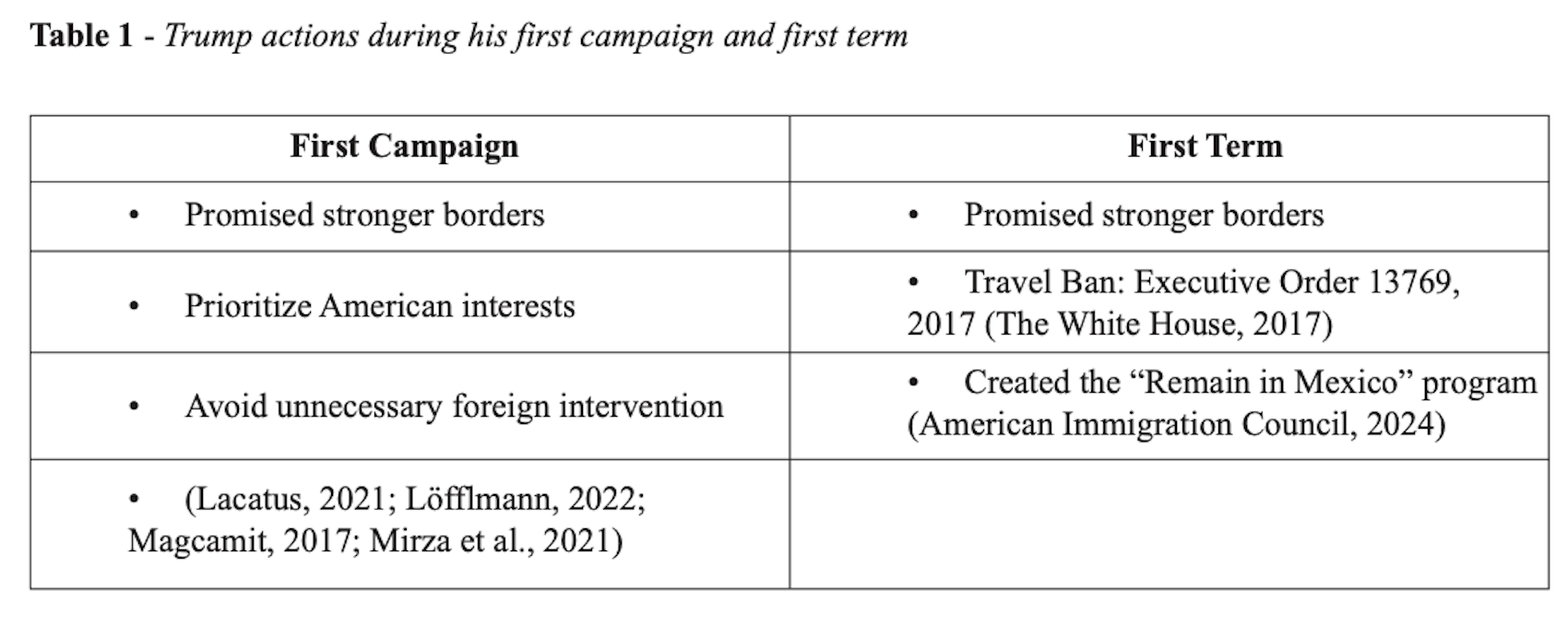 Europe has also faced difficulties controlling the increasing numbers of its migrant population. According to the International Organization for Migration (McAuliffe & Oucho, 2024), there are approximately 87 million migrants living in Europe. In the context of migration crises, which often disproportionately impact EU member states, balancing European cohesion has fragmented the Union. Additionally, in recent years, Western politics has witnessed a trend of a right-wing shift (see Figure 1) and increased support for populist leaders, which exacerbates this fragmentation (Europe Elects, 2024; Europe Politique, 2024).