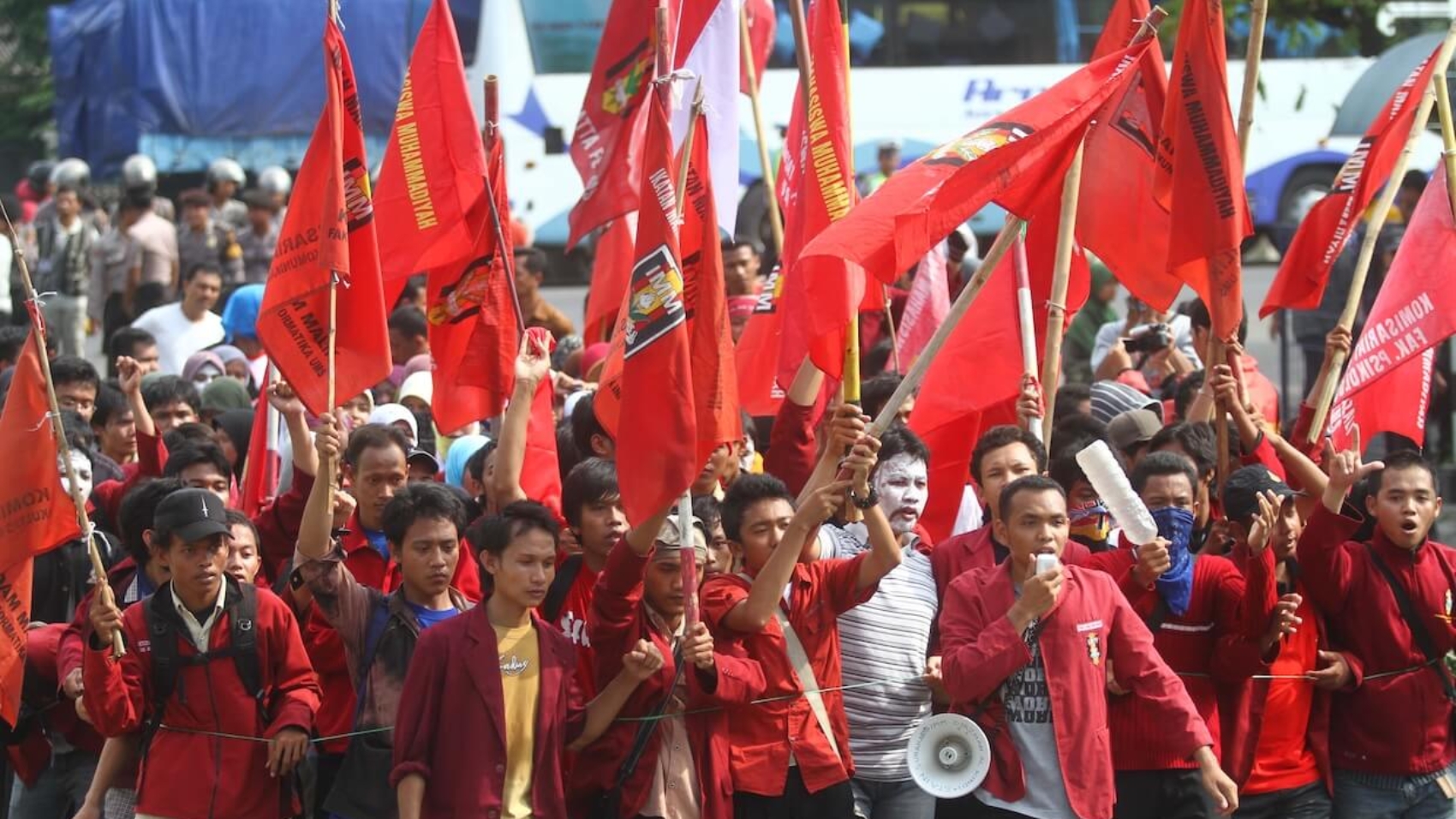
Protests in Turkey.

Dr. Cevik: Turkey Has Crossed the Critical Threshold from Competitive to Full Authoritarianism

In a compelling interview with ECPS, Dr. Salim Cevik argues that Turkey has “crossed the biggest threshold from competitive authoritarianism to full authoritarianism.” Highlighting the arrest of Ekrem Imamoglu, Dr. Cevik sees it as a targeted move to eliminate democratic competition: “He is being arrested because he could potentially defeat Erdogan.” Populism, once central to Erdogan’s rule, is giving way to raw coercion: “Force is the fundamental strategy of Erdogan.” Dr. Cevik also condemns Western silence, especially from Europe and the US, warning that their inaction amounts to complicity. “Erdogan feels very strong… because he has international backing.” Drawing a parallel with past mistakes on Putin, he cautions: “You can’t really trust a personal autocracy for strategic partnership.”

Interview by Selcuk Gultasli

In a wide-ranging and sobering interview with the European Center for Populism Studies (ECPS), Dr. Salim Cevik—Political Scientist and Researcher at the German Institute for International and Security Affairs—offers a critical diagnosis of Turkey’s deepening authoritarian turn under President Recep Tayyip Erdogan. Framing the recent arrest of Istanbul Mayor Ekrem Imamoglu as a pivotal moment in Turkey’s political trajectory, Dr. Cevik asserts that “we’ve crossed the biggest threshold from competitive authoritarianism to full authoritarianism.” While acknowledging that political repression is not new in Turkey, he emphasizes that this particular case marks a critical rupture because it directly targets “the most potent rival of Erdogan” and aims to eliminate any realistic possibility for the opposition to win an election.

Dr. Cevik situates this development within Erdogan’s long-standing strategy of personalizing power and dismantling institutional checks and balances. Over the course of two decades, Erdogan has “sidelined all important political figures,” absorbed the party into his persona, and gradually brought the judiciary, media, business sector, and civil society under his direct control. This personalization of rule has been “formalized” through the switch to a presidential system, which Dr. Cevik sees as a culmination of earlier informal power consolidations.

While Erdogan’s rule was long bolstered by a populist strategy that fused economic provision with religious-nationalist rhetoric, Dr. Cevik argues that this strategy is faltering. Erdogan is now “no longer the popular figure” he once was, as economic decline has eroded his legitimacy among even his core supporters. This, Dr. Cevik suggests, is what pushes the regime to rely increasingly on coercion rather than consent: “Populist mobilization is no longer the key term to understand Turkish authoritarianism… Force is the fundamental strategy of Erdogan.”

Of particular concern is the muted response from Western powers, which Dr. Cevik interprets as tacit approval. He criticizes both the United States and the European Union for enabling Erdogan’s autocratization, noting that “Erdogan feels both very weak because he’s losing popular legitimacy, but he’s also feeling very strong… because he has international backing.” In Europe, especially, strategic interests tied to Turkey’s military capacity and geopolitical location have led to a dangerous silence. “Europe made the same mistake with Putin,” Dr. Cevik warns. “I see no reason why Erdogan should be trusted more than Putin… It’s not only normatively and morally wrong—it’s also strategically blind thinking.”

In this critical conversation, Dr. Cevik calls attention not only to Turkey’s alarming democratic backsliding but also to the global implications of Western complacency in the face of authoritarian consolidation.

Dr. Salim Cevik
Dr. Salim Cevik—Political Scientist and Researcher at the German Institute for International and Security Affairs.

Here is the transcription of the interview with Dr. Salim Cevik with some edits.

Erdogan Regime Is No Longer Competitive—It’s Full Authoritarianism

Dr. Cevik, thank you very much for joining our interview series. Let me start right away with the first question: To what extent does the arrest of Ekrem Imamoglu represent a definitive rupture in Turkey’s transition from competitive authoritarianism to full-fledged autocracy?

Dr. Salim Cevik: Thank you for inviting me, and for the question. I think this marks a major threshold. But to be honest, he is not the first politician to be arrested in Turkey. The country has been on an authoritarian trajectory for more than a decade, which has involved the imprisonment of many politicians—particularly members of the Kurdish political movement, who have been arrested en masse. Some are still behind bars, the most prominent among them being Selahattin Demirtas, who has been in prison for more than eight years. So, in that sense, Imamoglu’s arrest is nothing new in Turkey—but it is new in the sense that it aims to destroy the competitive element of the political regime.

When we talk about competitive authoritarianism, it is an authoritarian system, anyway—but what distinguishes it from full authoritarian regimes is that, in competitive authoritarianism, there is a realistic possibility that the opposition can win an election. Now, why is Imamoglu being arrested and not someone else? I think there is a clear answer to that: he is the most potent rival of Erdogan. He is being arrested because he could potentially defeat Erdogan in the next elections. If you put people who could win elections behind bars, that, by definition, undermines the competitive dimension of competitive authoritarianism. Because if you arrest whoever is going to win, then it’s no longer competitive—it becomes a fully authoritarian system. So, in that sense, I think we’ve crossed the biggest threshold from competitive authoritarianism to full authoritarianism.

Force Is Now Erdogan’s Strategy

Turkey, Protest
University students stage a protest at Beşiktaş Square in Istanbul, declaring a boycott in response to the arrest of Mayor Ekrem İmamoğlu — Istanbul, Turkey, March 24, 2025. Photo: Sedat Gulec.

How has Erdogan’s brand of populism evolved into an instrument of authoritarian consolidation, and how central is the creation of internal “enemies” to this strategy?

Dr. Salim Cevik: Populism and the creation of internal enemies have been central to Erdogan’s authoritarianism. That has been the case over the years—even when he was not yet a fully autocratic leader and when Turkey’s democracy was functioning relatively well. Erdogan has consistently employed a populist strategy for political mobilization, and he has now been in power for more than two decades. The first decade was relatively—or at least acceptably—democratic, and initially even pro-democratic. However, starting with his second term, during his second decade in power, he began to grow increasingly authoritarian.

Over these more than 20 years, he has always created internal enemies, and those enemies have actually changed over time. They have included Kemalists, Gulenists, Kurds, and Turkish nationalists—at different stages of his political career, he has targeted different groups. He managed to establish a minimum winning coalition to defeat each internal enemy. That’s his political style and strategy. In that sense, populism has been integral to the establishment of authoritarianism in Turkey. 

However, when we talk about this recent event—this arrest—and Turkey crossing a threshold from competitive to full authoritarianism, I don’t think populism is the right term here. Populism, by definition, is about being popular. Populist autocrats usually mobilize the majority around themselves, and they create internal enemies in order to build this minimum winning coalition—at least to configure a majority. That tactic—creating internal enemies—has been Erdogan’s strategy for more than 20 years.

But as I said in the previous question, we are now crossing a threshold from competitive to full authoritarianism. Erdogan has been a popular politician—he has always been a very popular politician. He consistently managed to create a winning majority, a coalition of a minimum winning majority. He is now crossing that threshold because he believes, and sees, that he can no longer do that. He is no longer the popular figure. He no longer has 51 percent behind him, and that’s why he is crossing this threshold. So, I think populist mobilization is no longer the key term to understand Turkish authoritarianism.

Of course, the process I’m talking about has just started, and we don’t know where it will lead. But if everything goes according to Erdogan’s expectations—and if Turkey becomes a full authoritarian regime rather than a competitive one—then he no longer needs to be popular. It will not be a majority authoritarian regime; it will be an authoritarian regime ruled by a minority. And that means he will be ruling by force, rather than by creating the consent of the majority through populist means. But, this is just the beginning of the process. Where we are heading is that populism is no longer Erdogan’s fundamental strategy. Now on, force is the fundamental strategy of Erdogan.

Populism Dismantled the Rule of Law—Now Erdogan Rules Alone

Would you characterize the current crisis as the culmination of a long-standing populist logic that inherently undermines liberal democratic norms?

Dr. Salim Cevik: Yes. This populist strategy that Erdogan has pursued so far has enabled him to reach this point. It has allowed him to dismantle the rule of law and undermine political liberties. It has enabled him to inflict suffering on individuals and groups he has designated as internal enemies. But, as I mentioned in the previous question, those internal enemies are no longer the minority. Now, he is creating an internal enemy that will likely, by the end of this process, be the majority—making it a forceful authoritarianism. Ultimately, it was populism—and the systematic dismantling of the rule of law and the liberal protections that accompany it—that brought us to this point and enabled Erdogan to cross the threshold we are now discussing.

In what ways has the personalization of power under Erdoğan blurred institutional lines between the state, party, and judiciary?

Dr. Salim Cevik: Well, in very fundamental ways. I mean, when Erdogan came to power, the AKP was a ‘cadre’ movement. It had a number two—Abdullah Gul—a number three, Bulent Arinc. Some would even call Abdullatif Sener number four, and the list would go on. We had a powerful cabinet with very prominent politicians, etc. So, it was a genuine cadre movement. Now, there is no number two within the AKP—let alone a number three or a cadre—and the ministers no longer carry any real weight. Even in this current crisis, we see that Erdogan is, in a way, defending himself. He no longer has credible political allies to speak on his behalf. So, everything is now personalized in Turkey.

But it has first started with the personalization of power within the party. Erdogan initially hijacked the party. It had been a party of prominent figures—a cadre movement with a political ideology, or at least a claim to conservative democracy. But step by step, he personalized power within the party. He sidelined all the important political figures and stripped the party of its political substance. When we talk about the party’s ideology or political beliefs today, there’s really nothing left—because over the past 20 years, Erdogan has continuously shifted his coalitions, leaving no consistent ideological foundation. So, the party became Erdogan.

After that, he personalized other centers of power. He brought the judiciary under his control. He turned the party’s control over the state into personal control—and since the party is Erdogan, this meant bringing the judiciary, the media, the business community, and civil society under his direct influence. So, at the end of the day—with the switch to the presidential system, which in many ways formalized these already existing informal power configurations—the regime became fully personalized. That transformation, already largely complete by 2013–14, was cemented through institutional change. Now, we are talking about a single individual ruling not only over the executive, but also the judiciary, the parliament, civil society, and all segments of power.

Strong Enough to Suppress, Too Weak to Compete

Ekrem Imamoglu
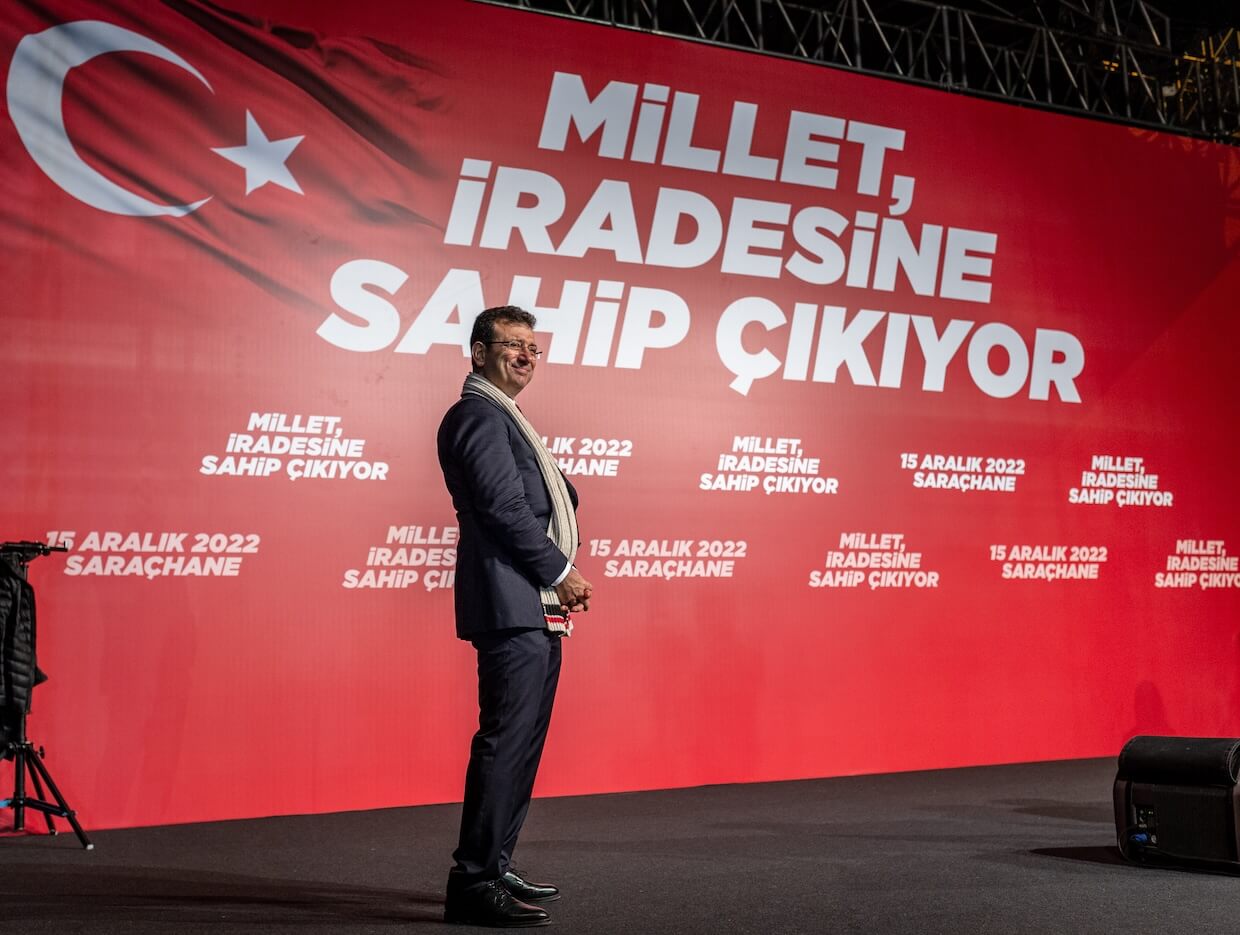
Istanbul Mayor Ekrem Imamoglu addresses supporters during a protest under the banner “The Nation Stands by Their Will” outside the Istanbul Metropolitan Municipality on December 15, 2022. Photo: Tolga Ildun

Is the recent political crackdown a sign of regime insecurity ahead of elections, or a calculated strategy to establish post-electoral authoritarian permanence?

Dr. Salim Cevik: I think it’s both a symptom of weakness and of strength at the same time. It’s a symptom of weakness because Erdogan is increasingly lacking popular support.

What made him so indispensable to his allies for so long was his ability to bring the majority of the public with him. He kept winning elections—or, to put it another way, we can certainly criticize the tactics he used to maintain his popularity—but ultimately, he succeeded in staying popular.

That’s no longer the case. In recent years, those who don’t want to see him as president now form a larger coalition than those who do. This was already true in the previous election two years ago, but he managed to survive using various tactics: he divided the opposition, ensured they backed a candidate who couldn’t unify them, and relied on judicial tools—there was already a court case against Imamoglu at the time. He used other instruments too. The key was preventing the opposition from uniting behind a single figure.

But that’s no longer working. The local elections showed that the CHP is now the central actor in the opposition and capable of building a majority larger than Erdogan’s. So in that sense, he’s very weak in terms of popular legitimacy—and that’s what’s pushing him to take these extraordinary measures.

At the same time, he remains very powerful. He controls the state apparatus, the judiciary, the media, and the security forces. And the international context—perhaps you’ll ask about this later, but I’ll mention it briefly—has emboldened him even further. He knows the US is on his side, and he knows that, for a variety of reasons, Europe will stay silent. In that sense, he’s very powerful.

So it’s a paradox: he’s powerful because he can take these steps, but weak because he has to. He can’t afford to leave the competitive authoritarian game as it is and risk an election—even a highly unfair one—that he might lose. So, he takes measures to avoid that risk. In short, he’s strong in terms of state control, but weak in terms of popular legitimacy—and that combination is exactly what’s driving these moves.

Erdogan Exploits Islam as Rhetoric, Not as Rule

Has political Islamism in Turkey under the AKP shifted from a reformist ethos to a mechanism of ideological legitimation for autocracy? Do you see the regime’s increasing reliance on religious-nationalist rhetoric as signaling a radicalization, or merely instrumental populist recalibration?

Dr. Salim Cevik: Well, as I mentioned in the previous question, political Islam in the early 2000s had adopted a reformist character. At the time, they denied being Islamists. The famous claim was that they had “changed shirts,” and instead labeled themselves as Conservative Democrats. But that was merely a rebranding—because in order to navigate Turkey’s stringent secularist laws, it was not possible to openly identify as a Muslim democratic party. Unlike in Europe, in Turkey you have to use the label “conservative,” even though the public understands that “conservative” essentially refers to Islam and religion.

So, as a Conservative Democratic party, the AKP was indeed a reformist movement in its early years. I have to say that during that period, religious discourse in society also became more pluralistic and democratic—this was part of the cultural conflict in Turkey between authoritarian secularists and the conservative majority. To defeat—or rather, to undermine—the authoritarian secularist powers, who were a minority, Islamist actors adopted the language of democratization and pushed for reform within the system.

But around 2010 to 2012–13—it’s hard to pinpoint an exact moment—once it became clear that Erdogan was no longer under threat, he no longer needed the reformist agenda. At that point, the logic shifted entirely, and Islam became an instrument of authoritarianism, used to justify his populist, majoritarian, and increasingly autocratic actions.

As for the second half of your question, I don’t believe we are witnessing a radicalization. Radicalization would imply a structural transformation of the regime toward a more overtly religious order. If I understand the question correctly, I don’t see that happening—nor has it happened over the past decade. Erdogan has consolidated power, but he has never actually used that power to turn the system into a more theocratic one—he hasn’t changed the legal framework or granted religion greater authority in the functioning of the state.

The only time he explicitly referenced the Quran in policy terms was when he lowered interest rates—an idea that was ill-advised not just from an economic standpoint, but also because it lacked a sound religious basis. Religion prohibits interest altogether—it doesn’t differentiate between high or low rates.

If he had said, “I want to remove interest entirely from Turkey’s financial system because religion requires it,” then we could talk about a genuine turn toward religious rule—where religious texts begin to dictate policy. That would have been a clear move away from secular governance. But instead, he said something else—and I find this very telling. He said, “I’m lowering the interest rates because Islam doesn’t like interest.”

In that moment, it was clear: religion was being instrumentalized to justify a pre-existing policy agenda. He didn’t abolish interest; he didn’t change the institutional rules. He used religion as a rhetorical tool. Religion, in this case, was merely a pawn. And I see no indication that this dynamic will change anytime soon.

Religious Rhetoric Remains, But the Provider Role Is Crumbling

Turkish Islamist President Recep Tayyip Erdogan speaks in Van province of Turkey as holding a holy Quran on April 14, 2015.

To what degree does the AKP’s Islamic narrative still resonate with its core electorate, particularly in light of economic hardship and rising dissent?

Dr. Salim Cevik: It’s difficult to answer this as a simple yes or no. On the one hand, he clearly still commands a degree of popularity. As I mentioned, he has lost the majority and will probably never recover it, but he continues to enjoy the support of—perhaps—30, 40, or even 45 percent of the electorate. I can’t cite precise numbers, but some of that support undoubtedly stems from religious sentiment. Certain segments of society view him as a devout figure. More importantly, they harbor such deep resentment toward secularists that they rally around Erdogan, whom they see as a protective barrier between themselves and the secular elite. So, part of his enduring popularity is still grounded in religion.

On the other hand, that popularity is clearly in decline, and the driving factor is economic hardship. The economy alone may not be sufficient to build a majority coalition, but it is powerful enough to dismantle one. Or let me put it this way: up to now, Erdogan has played a dual role—both as an economic provider and a religious protector. He positioned himself as the guardian of religious values while delivering material prosperity. That balance was key to sustaining his electoral majority. But if he falters on either front, that majority begins to unravel. He continues to lean on the religious narrative, but he’s steadily losing the economic argument—the “provider” role.

So, yes, his base is eroding. But as I said, it’s a gray area. Religion remains a powerful political tool for him. Yet in times of economic hardship, it alone won’t be enough.

Unlike Gezi, This Time the Protest Began with Repression, Not Resistance

How do the current mass protests compare to the 2013 Gezi Park movement in terms of mobilization dynamics, ideological coherence, and regime response? Could the protests catalyze a broader democratic awakening, or will they be contained through increased repression and securitization?

Dr. Salim Cevik: Let me start with the second half of your question. If the mobilization continues and manages to force Erdogan to back down, it could mark the beginning of a new era of democratization in Turkey. That’s possible, but unlikely. The more probable scenario is that Erdogan will suppress the current mobilization and push the system toward an even more authoritarian model. Still, it’s a process in motion—we simply can’t know for sure yet.

Now, if we compare this to the Gezi Park protests, one major difference stands out. As we discussed in the previous question regarding the economy—when the Gezi protests erupted, they were largely a middle-class reaction. People were frustrated with Erdogan’s growing personalization of power—his attitude of “I am the ruler of this country, and I don’t care what you think; everything goes the way I say.” It was a kind of delegative democracy, as political scientists would call it. “I was elected, therefore I have all the power, and I don’t need to answer to anyone.”

That attitude contributed to the uprisings. And if those protests hadn’t been met with such severe repression, I don’t think they would’ve escalated the way they did. Gezi began as a peaceful demonstration—completely legitimate—and Erdogan could have simply let it happen. Had he done so, we might not have seen the full-scale protests or the resulting political crisis.

I don’t know whether he planned it all from the start, but at some point, Erdogan seemed to decide that Gezi wasn’t a threat but rather an opportunity—a way to boost his popularity. He could frame the protesters as urban, middle-class, secular elites. And that’s classic populist strategy: pitting “the elite” against “the people.” He painted Gezi protesters as privileged, urbanites who were safe and comfortable, yet complaining about trivial matters. That framing resonated with his base.

This current wave of protests, however, is different because it started with repression. It didn’t begin as a small demonstration that spiraled into something larger due to state violence—it began with the arrest of Imamoglu. It was repression from the outset. It was an intentional move to dismantle the competitive element of the regime. So, whereas during Gezi Erdogan’s stance was “I was elected and therefore I rule,” now it’s, “You once elected me, and I’ll make sure you never get the chance to unelect me.” That’s the key difference.

This time, it wasn’t police brutality that brought people to the streets. Rather, people were already in the streets, and Erdogan is trying to stop them with police brutality. It’s a different dynamic.

Also, I don’t think this protest is being led by the middle class. It’s being led by urban youth who feel economically crushed, who don’t see a future for themselves, and who are desperate. That’s why they’re protesting. In that sense, this moment feels more radical than Gezi. Back then, protesters were largely middle-class—they had something to lose. They wanted a more responsive government, but they weren’t acting out of despair.

Today’s youth have little or nothing to lose. That’s why even harsh state repression hasn’t stopped them—at least not yet. I was a young academic during Gezi—I was a university assistant, and by Turkish standards, I had a pretty good life. I honestly don’t think even full professors today enjoy the lifestyle I had back then. The economic decline has been dramatic. And I don’t think today’s university assistants, graduate students, or undergrads see much hope in their futures. That, too, fuels their willingness to take to the streets.

So yes, in that sense, there are some fundamental differences between then and now.

Ballots Aren’t Enough—The Opposition Must Mobilize the Streets

Turkey, Protest
University students protest at Beşiktaş Square in Istanbul on March 24, 2025, declaring a boycott in response to the arrest of Mayor Ekrem Imamoglu. Photo: Sedat Gulec

What does the sidelining of Imamoglu suggest about the regime’s tolerance for political pluralism within the current constitutional framework? What risks do opposition parties face in navigating between electoral participation and resistance within an increasingly autocratic system?

Dr. Salim Cevik: Well, the opposition parties are now in a dilemma. I’ve been talking about how the competitive element is disappearing. It’s becoming a fully authoritarian regime, and I’m sure that at some point people will begin to ask: “Is this just theater? Why are we playing our roles in this performative act that only serves to legitimize Erdoğan’s authoritarianism? Why are we even competing in the elections?” I think that would be a trap—the same trap the Venezuelan opposition fell into at one point.

Whatever happens, there will be pressure on the opposition to boycott the elections or withdraw—but I think that would be the wrong path. No matter what, the opposition must go to the ballot box, participate in the elections, and make it clear to the public that they won. I’m not saying the regime can necessarily be unseated through elections—I think we are passing that threshold. I use “passing” intentionally—I’m not saying we’ve already crossed it. It’s a process. But even if we eventually do pass that threshold, and it becomes impossible to remove the regime through elections alone, the opposition must still participate and demonstrate that they hold the popular majority.

At the same time, they have to acknowledge that it probably won’t be enough. You can no longer unseat Erdogan simply through words or ballots. You need to mobilize the streets—through demonstrations and by raising a broad popular demand for change. The opposition must combine both strategies: win at the ballot box and sustain mobilization on the streets.

Europe Made the Same Mistake with Putin—Why Trust Erdogan?

Turkish President Recep Tayyip Erdogan in Ankara, Turkey on August 30, 2014. Photo: Mustafa Kirazlı.

And lastly, Dr. Cevik, how do you interpret the EU’s and US’s muted response to Imamoglu’s arrest? Can this be read as a form of tacit legitimation or geopolitical pragmatism? To what extent does Western inaction amount to a “green light” for Erdogan’s continued autocratization?

Dr. Salim Cevik: I think this is a very important question, and thank you for asking this. And, as I said in one of the previous questions, Erdogan feels both very weak because he’s losing popular legitimacy, but he’s also feeling very strong because he has control of the coercive apparatus of the state, and he also has international backing. And when we say international backing, he has the backing of both Americans and Europeans.

We have to talk about this very briefly, so let me say a few words about both. I mean, if Trump talks with Erdogan, he would probably ask for advice on how to repeat what Erdogan is doing in Turkey in the United States. So obviously there would be no backlash coming from the American side, and all democracy movements in the world have to adapt to the fact that America is no longer ruled by a democrat. I mean, America’s own record for supporting democracies has always been a critical one. It has sold out democrats when it suited its strategic interests—that’s for sure. But it has now come to a point where America is ruled by a president who actually admires autocrats more than democrats. So we’ve left that era behind.

And for the Europeans, I think it’s clear—they will criticize it, and they do criticize it with weak words and sentences, expressions of concern. But nothing will come out of it, and everybody knows that they don’t mean it, because they actually feel that they need Turkey more than ever. Once Trump made it clear that American security guarantees are no longer reliable, Europe began discussing creating its own strategic autonomy, its own defense capabilities—and Turkey emerged as a very crucial actor here, with its strong military, large population, and growing defense industry, as well as its strategic location. So Turkey is a very important partner, potentially, for European security. And Erdogan knows this and hopes that Europe will ignore his authoritarian moves because they need him—and so far, he has been proven right.

But let me finish by saying that it is not only a normative mistake for Europe to allow Erdogan to make this move—hoping that Turkey is strategically important—but it’s also strategically blind thinking. Because once Erdogan removes all the thresholds between himself and full authoritarianism—once Turkey becomes a Putin-like regime—the question for Europeans should be: can a regime like that be trusted for security cooperation? Can it really be a security partner?

Turkish–European relations have been transactional for the last decade, and an authoritarian figure like Erdogan was quite fine for that. Transactionalism allowed for bargaining, and you could prefer to deal with a single individual rather than a state—and that was fine. But once you move beyond that—if you want to create a strategic partnership between Europe and Turkey, if Turkey is to become an important part of European security—then you can’t really trust a personal autocracy.

Europe made the same mistake with Putin. They hoped that by creating economic interdependencies, Russia would never be a threat to European security—and they were proven wrong. I see no reason why Erdogan should be trusted more than Putin in that sense, and why European security should be entrusted to a political system that is ruled by the whims of a single individual.

As I said, it’s not only normatively and morally wrong—it’s also strategically blind thinking on Europe’s part.

Professor Dogu Ergil

Professor Ergil: Turkey’s Crisis Stems from Eroding Line Between Persuasion and Coercion

In a powerful interview with the ECPS, veteran political scientist Professor Doğu Ergil warns that Turkey has crossed from populist authoritarianism into full autocracy. “Persuasion—which was once the AKP’s greatest success—has evaporated,” he explains. “In its place, coercion has become more prominent, and the instruments of coercion, including the judiciary, have proliferated.” Professor Ergil outlines how Erdoğan’s regime has personalized power, delegitimized the opposition, and dismantled democratic norms. With Istanbul Mayor Ekrem İmamoğlu’s arrest and mass protests unfolding, Turkey, he says, faces a “deadlock” where the state’s legitimacy is crumbling from within. This is a timely and sobering reflection on democracy under siege.

Interview by Selcuk Gultasli

In an exclusive interview with the European Center for Populism Studies (ECPS), veteran political scientist Professor Doğu Ergil delivers a stark assessment of Turkey’s current political trajectory under President Recep Tayyip Erdoğan’s rule. Framing the ongoing turmoil as a crisis of legitimacy and democratic erosion, Professor Ergil argues that the country has moved from a populist-authoritarian hybrid toward a more fully autocratic system. “The ongoing crisis,” he explains, “lies in the growing strength of the opposition and the blurring of the line between persuasion and coercion. Persuasion—which was once the AKP’s greatest success—has largely evaporated. In its place, coercion has become more prominent, and the instruments of coercion, including the judiciary, have proliferated.”

At the heart of Professor Ergil’s analysis is the paradox of populist regimes relying on democratic legitimacy while simultaneously undermining the very institutions that sustain it. “If you demonize, criminalize, and prosecute your opponents, and attack the very institutions that brought you to power,” Professor Ergil warns, “you begin to delegitimize the system—and, in doing so, yourself.” This dynamic, he observes, has led Turkey into a “deadlock,” where democratic procedures are maintained in form but hollowed out in substance.

Professor Ergil traces this degeneration to the AKP’s strategic shift from early reformism to an increasingly nationalist and authoritarian agenda, using political Islam not as a blueprint for governance, but as an ideological tool to legitimize power. He also underscores how the personalization of power around Erdoğan has dissolved the boundaries between state, government, and party—turning the state apparatus into an extension of partisan control.

Professor Ergil’s insights are especially timely in light of the recent arrest of Istanbul Mayor Ekrem İmamoğlu, which he views as emblematic of the broader erosion of the rule of law and the manipulation of the judiciary for political ends. As Turkey experiences historical developments, this interview offers a compelling and sobering diagnosis of a political system teetering on the edge of autocracy.

Here is the transcription of the interview with Professor Doğu Ergil with some edits.

Populism Under Erdogan Becomes Parochial and Authoritarian

Turkish President Recep Tayyip Erdogan watching the August 30 Victory Day Parade in Ankara, Turkey on August 30, 2014. Photo by Mustafa Kirazli.

Professor Ergil, thank you so very much for joining our interview series. Let me start right away with the first question: How would you characterize the evolution of Turkish populism and authoritarianism under AKP’s and Erdogan’s rule, and how has it redefined the boundary between the people and the political elite? In what ways has the ruling AKP’s populist discourse transformed into a vehicle for authoritarian consolidation rather than democratic inclusion?

Professor Doğu Ergil: The nature of the political regime in Turkey has always been populist. The founding party of the Republic is called the Republican People’s Party, and one of the six principles of the regime has been populism. Anyway, I mean, it’s written down as populism rather than being populist. It is populist because the ruling elite wanted to execute a revolution from above, and they found the people not ready for a revolution to join the modern society or the modern world. Hence, to transform a backward society, they took the initiative of a revolution from above—an elitist revolution—and changed the fabric of society accordingly. So, the populist nature of the regime has always been there, ingrained in it. It’s in the DNA of it.

But now, with the incumbent AKP, it has become rather diluted. It’s no longer secular, and it’s less oriented to the world. It’s expressed as localism and nationalism, because in classical populism, there are the good people and the representatives of the good people against an evil, inefficient, and rather alien elite that forcefully wants to change the society—its culture, its identity, and so forth. But this localization and nationalization—rather than westernization and modernization, which were the true assets of the Republican regime at its outset—have made Turkish society and the present regime a rather local, non-elitist, and parochial society. In a virtual sense, more peasant-like, more Eastern, more Middle Eastern if you like, and more religious rather than secular, modern, and world-oriented.

Turkey’s Populism Has Turned Fully Autocratic

Can Turkey’s current political crisis be interpreted as a case study in populism transitioning into autocracy? If so, what distinguishes the Turkish model from its global counterparts?

Professor Doğu Ergil: Of course. The Turkish regime is not only popular but also populist, and increasingly authoritarian. This is largely because the incumbent party has blurred the distinction between the state and society by merging the government with the state apparatus. When this separation erodes, central authority becomes more consolidated and less differentiated, and the division of power weakens as authority becomes more centralized and autocratic.

In the Turkish case, it has become more personalized, and the personification of the government can be identified with the present president Erdoğan. So, all powers accrue in his hands, and he can exercise authority over all aspects of life and all institutions of the government, including the judiciary. The judiciary is now used as an extension of politics and control over society. Thus, Turkish populism has not only become more populist but more authoritarian and autocratic in this sense.

There are similar regimes in the world, but the Turkish one has become overly personalized—concentrating all possible powers—political, judicial, legislative, military, and so forth—in the hands of a single individual. The party that brought this man to power has effectively faded from view; it is no longer visible. What remains is the machinery of state power in the hands of one man—and the rest of society. That society is now split into two: the supporters of the incumbent government and its leader, and those who oppose them.

The ongoing crisis lies in the growing strength of the opposition and the blurring of the line between persuasion and coercion. Persuasion—which was once the AKP’s greatest success—has largely evaporated. In its place, coercion has become more prominent, and the instruments of coercion, including the judiciary, have proliferated.

Islam Became a Tool to Bolster Populist Power

Turkish Islamist President Recep Tayyip Erdogan speaks in Van province of Turkey as holding a holy Quran on April 14, 2015.

How has political Islamism evolved under Erdoğan from a reformist agenda in the early 2000s to a more illiberal and authoritarian governance model today? Is the AKP’s version of political Islamism now functioning primarily as a tool for ideological legitimation, or does it still contain genuine theological, political or societal aims?

Professor Doğu Ergil: The AKP’s political Islamism is one of the contemporary ideologies that found a place in Turkish politics. The political landscape had long been partitioned: there were the socialists, and slightly to further left, the communists—though they were a small minority—followed by the social democrats, liberals, conservatives, and nationalists. Each ideology was represented by a political party with a distinct historical background.

When the AKP emerged and began to take the stage in Turkish politics, it had to anchor itself in something—and it chose religion. Religion served as a supportive mechanism for nationalism and populism. In this context, religion was not used as a foundation for governance per se, but rather as an instrument to bolster a populist, nationalist, and increasingly authoritarian regime.

This strategy was effective for a while. However, it has since lost much of its fervor and effectiveness, as religion is traditionally associated with values such as honesty, integrity, and efficiency.

All these other parties with different ideologies had not made Turkey as great as people expected. So, the Islamic powers’ rhetoric said, “Look, even the name of the party is ‘AK,’ meaning pure white.” They represented themselves as honest, non-corrupt, and also more popular—closer to the people. In that sense, they seemed more empathetic toward the people, more intertwined with their needs, and so forth. But as time passed and the AK Party exposed its weaknesses, it became clear that being religious doesn’t mean being honest. Being in control of everything—ending the tutelary system, at the center of which was the military, as you know—doesn’t mean that democracy would take root or that there would be a more efficient, less corrupt, more responsive society.

As the AKP lost its credibility, the Islamic rhetoric has also become dysfunctional. This is what has happened in Turkey. And because of that, this 23-year rule of the AKP has come to a halt with these apparent street demonstrations and protests, showing that the party and its leadership cannot deliver anymore. It cannot keep its promises. And it cannot do so any further. So, I mean, it has come to a halt.

Islamism in Turkey Has Been a Supportive Value System

To what extent has political Islamism been radicalized under the pressures of regime survival and repression of opposition groups like Kurds, Alawites, Gülen followers, and political figures like Selahattin Demirtas and, most recently, Istanbul Mayor Ekrem İmamoğlu?

Professor Doğu Ergil: Islam could not be radicalized because the entrenched institutions and the majority of believers believe in the general assets of the Republic. Turkey has been—though the founding fathers have been criticized for adopting the Swiss civil code, for example—benefiting from it. People have enjoyed all the advantages it brought, because there is no discrimination in that code. In it, women are much freer, men can act more freely in their daily dealings. Although that code has been criticized as being alien, people have benefited from it for many years, for many decades.

In that sense, people are not opposed to the republican regime, its laws and its values. People expect those to be furthered, to be reinforced, and new advantages and developments to be integrated into society, rather than taking society backward to another century where Islam dominated with its Sharia law. In Turkey, that never happened. Only a minority want Sharia law because they believe the system is not just. But Sharia law does not make a society more just, moral, or egalitarian. People understand that.

In that sense, Islamism in Turkey has been a supportive value system for an insufficient political system that could be improved, rather than bringing an abrupt halt to it and taking society back to another century.

Turkish Politics Has Become Warlike—Not Competitive

Protests sparked by plans to build on the Gezi Park have broadened into nationwide anti government unrest on June 11, 2013 in Istanbul, Turkey. Photo: Thomas Koch.

To what extent has Erdoğan’s populism depended on the construction of internal “enemies”—such as the Kurds, followers of the Gülen movement, and İmamoğlu—to sustain a polarizing narrative and consolidate power?

Professor Doğu Ergil: It didn’t start with Erdoğan. Populism is built on dichotomies and contradictions, as you know—such as the idea of a good society versus a bad elite, or good people rather than bad politicians. These dichotomies help consolidate the supporters of the government, the regime, or even the nation, as envisioned by the founders of the system.

Unfortunately, these contradictions—and the inbuilt conflicts they foster—have been present since the onset of the Republic. The definition of the nation was not an inclusive one embracing all citizens, but rather based on an ethnic identity, mainly Turkishness. This approach has, of course, automatically excluded others—if not legally, then emotionally, and later in practice, including politically.

Erdoğan did not change this, although Erdoğan and his party were non-nationalistic in the beginning, because Islamism transcends nationalism and ethnic boundaries. So, you can have a body of believers coming from different ethnic backgrounds and different nationalities.

But seeing that the bulk of the people are nationalistic, and that the founding ideology of the country is nationalism, the AKP and Erdoğan adopted nationalism and reinforced its Islamic leanings with the rhetoric of religion or Islam—but primarily became nationalistic. And nationalism always needs an enemy—or more than one, always. So, when you define “us” with certain qualities and deny those qualities to others—who are then cast as enemies—you create a conflictual atmosphere in which your supporters are closely knit, while the others become more than opponents; they become enemies. Thus, Turkish politics has become, rather than competitive, warlike.

By Undermining Their Rivals, They’re Undermining the System—and Themselves

What does İmamoğlu’s arrest signify in terms of the erosion of rule of law and judicial independence in Turkey?

Professor Doğu Ergil: 
The rule of law has been lost for a long time. I mean, we cannot find it anywhere—it has been hiding somewhere. It has been kept in chains or hidden somewhere. But it may reemerge if the incumbent government and its leadership see no other way—then they might return to the rule of law and democracy. Today, they still believe that they can win elections. And all this latest ado—imprisonments, crackdowns on the opposition, the incarceration of anyone who criticizes the government and its leadership—is due to the fact that they are losing hope of winning the next elections. 

So, they are clearing the way: first, by removing the supposedly successful competitors, and then by undermining the rules of engagement—that is, democratic rules and norms. But here lies a contradiction—a very substantial, significant contradiction. If you demonize, criminalize, and prosecute your opponents, and attack the very institutions that brought you to power, you begin to delegitimize the system—and, in doing so, yourself. That is, you undermine the very avenue you used to come to power. So, Turkey is now living in this unfortunate deadlock, because the delegitimization of the system through the delegitimization of the opposition is taking place.

The Judiciary Is Now a Tool of Politics

How do you interpret the strategic use of the judiciary to disqualify or imprison political opponents within Turkey’s broader trajectory from competitive authoritarianism toward full autocracy?

Professor Doğu Ergil: 
It’s so obvious. If you move from competitive authoritarianism to brute authoritarianism, of course the judiciary is either dismissed or becomes a tool of politics. That’s inevitable. This occurs everywhere in the world where the government or the regime becomes more authoritarian. So, this is almost inevitable. This is a choice, and this government and its leadership have chosen the path to autocratization and authoritarianism.

Do you see parallels between the Erdoğan regime’s control of institutions and historical patterns of soft coups in Turkish political history, or is this an unprecedented form of civil authoritarianism?

Professor Doğu Ergil: No, it’s not unprecedented. I mean, the same patterns are visible all over the world. We see it in Russia, Belarus, Latin America, Hungary, and so forth. In that sense, there is nothing unusual. The real question is why people tolerate such a deterioration of the regime. That’s important. I believe that where there is corruption, there is also the consent—at least by part of society—effectively becoming a silent partner in that corruption. In that sense, the people also need greater education in democracy. Rather than giving in to an authoritarian regime in return for favors, advantages, or privileges—rather than insisting on rights, freedoms, and equality—society, unfortunately, ends up deserving the poor governance it supports, at least for a time.

Ongoing Protests Have a Leader and a Clearer Purpose

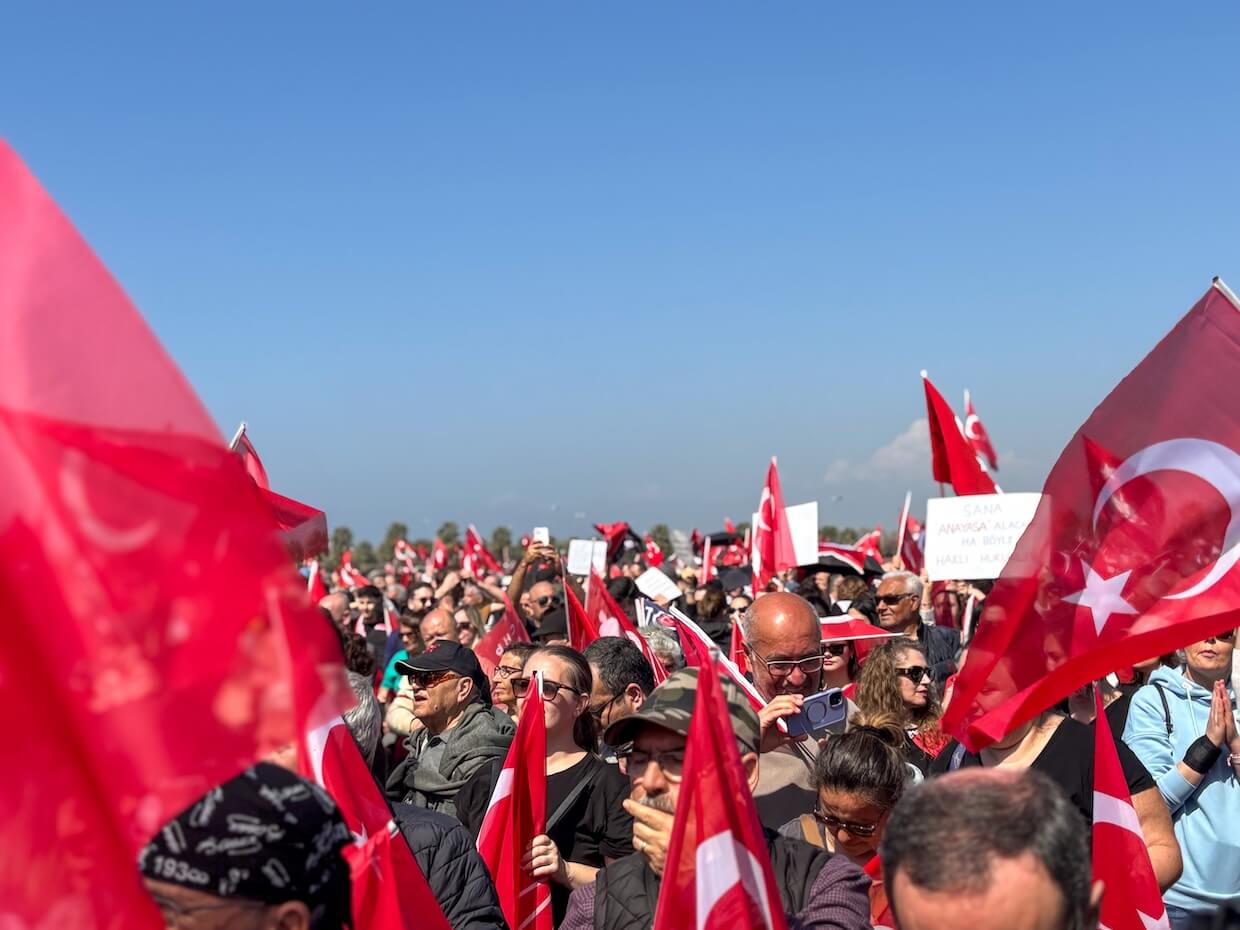
Following the arrest of Istanbul Mayor Ekrem Imamoglu, protests erupted across numerous cities in Turkey. Citizens took to the streets to voice their opposition to the decision and express growing discontent.
Photo: Dreamstime.

How do the ongoing mass protests compare to the Gezi Park movement in terms of scope, motivation, and political potential?

Professor Doğu Ergil: In the Gezi Park demonstrations, it was so colorful, so unexpected, and so detached from any particular political party, social class, or political agenda—it was a wonderful, kaleidoscopic movement, I would say. It had no organization, no leadership, and no ideology. When I say ideology, I mean—if not totally and neatly defined—at least a trajectory for action and its aftermath. What will happen later? How will we proceed, to do what? And what will we do after the moment? That’s a broad definition of ideology. In that sense, Gezi didn’t have this.

But this time, although people erupted into the streets unexpectedly, inadvertently, they found the CHP—the Republican People’s Party—already there protesting and already a victim of oppression and crackdown. So this wave, this popular wave, pushed the Republican Party forward, making it the leader of the movement. And the CHP lived up to that expectation. So far, it has successfully led the opposition. Although we do not know where it will take the movement, to what extent it can lead it, or what the outcome will be, the conditions of leadership and organization have so far been met.

Now, what will happen? How the regime will be transformed—and into what—is still unknown. But it’s clear that corruption must end, oppression must end, democratic institutions must be restored, and Turkey must become more aligned with the world. In that sense, there is no need for a neat ideology or ideological agenda. If these goals can be met, the outcome of these protests can be very productive.

With İmamoğlu sidelined, what implications does this have for the legitimacy of the upcoming local and general elections?

Professor Doğu Ergil: We do not know what will happen—whether the government’s crackdown will continue, and what the response of the people will be. I mean, whether protests will grow and the pressure placed on the government will lead it to change its authoritarian stance, or whether the crackdown will intensify and we will become an absolutely authoritarian regime. And whether the system can endure this much pressure—I mean, the economy, which is on the brink of collapse, may collapse entirely, and conflicts may escalate into outright friction in the streets or elsewhere. So, it’s hard to say. It depends on how events evolve, I think, and on the response of the opposing factions in the process.

Erdogan Regime Is Too Useful to Be Criticized by the West

And lastly, Professor Ergil, how do you think the second Trump administration is affecting Erdoğan and his regime?

Professor Doğu Ergil: Well, it has been rather surprising that the US government—not only Trump and his entourage, but in general the American civil society, and, for that matter, the European Union and European governments—have been rather quiet on the authoritarian ascent of the Turkish government. All these parties—American and European actors—are expecting things from trade. Europe wants to keep all those millions of refugees and migrants in Turkey, so that Turkey would not open the gates of the dam and let the flood into Europe. Europe is very apprehensive on that stance.

Secondly, they don’t want the radicalism that’s simmering in the Middle East to reflect on Europe, and they see Turkey as a barrier to it. And thirdly, now with Russia—after a possible peace deal with Ukraine—being a threat against the security of Europe, and with the US abandoning Europe and making its security rather liable, Europe needs Turkey as a military power—as cheap soldiers—and does not want to antagonize the Turkish government because of this.

As for the US government, as long as Turkey does not threaten the security and interests of Israel—which it doesn’t—Turkey is a good friend of the White House. Secondly, Syria has to be stabilized, and Turkey, as a neighboring country and as a factor that’s present on the Syrian political stage, can contribute to the stabilization of Syria. How? By supporting the transitional government in Damascus and also reconciling the Kurds and others with the incumbent government in Syria.

Thirdly, the US wants Turkey to be in the anti-Iranian axis—to share this with its other allies, at the top of which is Israel. All these combined, the US—meaning the Trump administration—sees Turkey as a rather advantageous ally in this volatile region, and it could serve the purposes of American foreign policy.

Faded USA vs Germany vs Japan national flags icon isolated on broken weathered cracked wall background, abstract US Germany Japan politics relationship divided conflicts concept texture wallpaper.

The Future Course of German and Japanese Capitalism in a Multipolar World under Trump 2.0

In his compelling analysis, Professor Ibrahim Ozturk explores how “Trumpism 2.0” and a multipolar world order are challenging the foundations of German and Japanese capitalism. As the US shifts toward protectionism, economic nationalism, and corporate oligarchy, both countries—once revitalized by American support after WWII—must now reassess their strategic and economic futures. Ozturk examines how trade wars, supply chain disruptions, and declining US cooperation threaten their export-driven models. From demographic decline to digital transformation, Germany and Japan face urgent structural reforms. This timely commentary not only maps the common and unique risks confronting these two economic giants but also outlines actionable strategies to maintain resilience in a fragmented world. 

By Ibrahim Ozturk 

I argued in my commentary that “Trumpism 2.0” marks a fundamental shift in global capitalism, blending nationalist protectionism, corporate oligarchy, and digital feudalism. The United States (U.S.) is transitioning from ‘neutral’ state capitalism to a model where government policies explicitly serve dominant private entities, eroding economic democracy and consolidating monopolistic power. This transformation deepens domestic inequality while driving international economic fragmentation, trade wars, and strategic decoupling. Meanwhile, the Global South is asserting greater autonomy, challenging Western dominance, and reshaping economic alliances. If these trends persist, escalating geopolitical tensions, supply chain disruptions, and financial instability may define the coming decades. Yet, this period of turbulence—reminiscent of the 1930s—also presents an opportunity for systemic change, though it raises the risk of large-scale global conflict.

This process will also challenge German and Japanese capitalism, distinct derivatives of America’s preferences after World War II and shaped by the demands and constraints of the Cold War context and the mentalities and cultural dynamics of German and Japanese societies. 

Considering new challenges, this commentary reveals a potential roadmap for German and Japanese capitalism. First, the article compares the characteristics of American and Japanese capitalism. Next, it examines the role of the US in revitalizing the struggling German and Japanese economies. The third section addresses the common and unique issues these countries face, along with the effects of the Trump Administration and a US-less world. The fourth section summarizes the possible responses from Germany and Japan.

Three Models of Capitalism under Flux

To compare Japanese, German, and American capitalism, one must examine their economic structures, government-business relations, corporate governance, labor markets, and cultural influences. As Robert Gilpin puts it, American, German, and Japanese capitalism embody distinct models shaped by historical, cultural, and institutional contexts. American capitalism, a Liberal Market Economy (LME), is highly market-driven and individualistic, characterized by minimal government intervention, shareholder-focused businesses, a flexible labor market, and a strong entrepreneurial culture, fostering innovation and financial dominance but also leading to corporate volatility, weaker social safety nets, and economic instability. 

On the other hand, German capitalism, a Coordinated Market Economy (CME), follows a stakeholder-oriented model with strong labor unions, long-term investment strategies, and an export-driven manufacturing sector, ensuring stability, high-quality production, and social welfare, though facing challenges in labor market rigidity, trade dependency, and adapting to disruptive technologies. 

Similarly, Japanese capitalism, a form of Developmental State Capitalism, is rooted in state-business coordination, the keiretsu corporate system, lifetime employment traditions, and a focus on incremental innovation, enabling industrial stability and technological leadership but struggling with an aging population, stagnant wages, and slow digital transformation.

Each capitalist model has distinct strengths and weaknesses: US capitalism is highly dynamic, fostering innovation and financial dominance but prone to volatility and inequality; German capitalism offers stability and social equity but lacks flexibility; and Japanese capitalism prioritizes long-term stability and industrial coordination but adapts slowly to change. While each system has trade-offs, nations often adjust their models over time. On the other hand, in the modern era, American influence played a significant role in shaping the German and Japanese models, and it is exerting pressure for change in another direction now.

America’s Revival of Japan and Germany

Germany’s assertive expansionism in Europe and Japan’s in Asia, driven by an obsession with becoming a leading global powerhouse during the first half of the 20th century, led both countries into the catastrophe of World War II. However, despite having inflicted severe defeats on them and initially signing humiliating surrender agreements that deeply restricted their rights to self-governance, independence, and sovereignty, the US, which emerged as the new hegemonic power—replacing Britain—did not choose to “punish” these nations after the war, due to the new global power contestations. Throughout the Cold War, the US considered the spread of communism the greatest threat to its hegemony and democracy, capitalism, and the free market economy. In response, it took steps to rebuild Europe, particularly Germany, and in Asia, Japan. By doing so, the US provided both nations a lifeline after the most devastating destruction in their histories, fundamentally changing their fate in favor of democracy and economic development.

Both countries were rebuilt through American economic aid, market access, and security guarantees, which allowed them to focus on economic growth rather than military spending. In terms of Japan, the US contributed to its economic development and industrialization via its post-war economic reconstruction through Marshall Aids, the war boom that came with the Korean War, and access to the US market with a Most Favored Nation status (MFN).

Starting with Japan, first under US occupation, led by General Douglas MacArthur’s SCAP (Supreme Commander for the Allied Powers), Japan’s economic reconstruction period (1945–1952) involved

🛑 Structural reforms like the demilitarization and restructuring of its economy.

🛑Land reforms that redistributed land from landlords to tenant farmers improved agricultural productivity.

🛑 The dissolution of Zaibatsu, large conglomerates that supported Japanese atrocities in Asia, aimed to dismantle industrial monopolies; however, later, keiretsu networks emerged, but this time, contributed to the development of a civilian and trade-oriented economy through the formerly well-established discipline and perseverance.

🛑 Labor reforms promoted unionization and strengthened worker rights. However, that measure was reversed after Japan’s alliance with the US against the expansion of communism in Asia.

🛑 Implementing the Dodge Plan 1949 aimed at fiscal austerity to manage inflation and stabilize Japan’s currency. As a result, the plan established a fixed exchange rate (1 USD = 360 yen), making Japanese exports competitive.  

Second, the measures’ first significant and advantageous outcome emerged during the Korean War Boom (1950–1953), when the US war effort in Korea turned Japan into a vital supply base, leading to rapid industrial growth. In this context, heavy industries (steel, machinery, textiles) thrived as Japan became a supplier of military goods. Moreover, US military protection under the US-Japan Security Treaty (1951) freed Japan from defense spending, allowing it to focus entirely on economic growth.  

Third, the expansion of the Japanese production economy, characterized by a strong export focus, extended beyond the market established by the Allied forces in Korea. Notably, the MFN status allowed Japan access to the US market and supported its economic integration from the 1950s to the 1970s. In addition to full access to American markets, which enabled companies like Toyota, Sony, and Honda to grow globally, technology transfers and guidance from US firms helped Japan modernize its industries. Substantial US investment in Japanese sectors facilitated technological upgrades, and by the 1980s, Japan had become the world’s second-largest economy, challenging even the US in some areas. With government-industry coordination (MITI—Ministry of International Trade and Industry), Japan’s Economic Miracle (1955–1980s), focused on export-led growth and high-quality manufacturing, emerged prominently. 

In the case of Germany, first, American support for the war-thorned German economy included the Marshall Plan(1948–1952), which envisaged the disbursement of $1.4 billion (part of Europe’s $13 billion US aid package). The fund helped rebuild factories, roads, and energy infrastructure destroyed during the war. Like Japan, currency reform (1948) helped introduce the Deutsche Mark, replacing the unstable Reichsmark and stabilizing inflation.  

Second, West Germany’s membership in NATO (1955) allowed a US military presence and security umbrella, which meant Germany could spend less on defense and more on industry. The Cold War made West Germany a key US ally, ensuring sustained economic and military aid.  

The third significant contribution stemmed from Germany’s access to the U.S. market. The US encouraged trade with Europe (EEC in 1957, which later became the EU), integrating West Germany into global markets. Moreover, US investments in the German industry strengthened the growth of advanced manufacturing (e.g., Siemens, Volkswagen, BASF).  

Consequently, technological advancements and innovations enabled Germany to become an export powerhouse in manufacturing. They fueled GDP growth at 8–10% annually during the 1950s, culminating in the so-called West German Economic Miracle (Wirtschaftswunder, 1950s–1970s). This era, along with Ludwig Erhard’s free-market policies and US support, led to rising wages and improved living standards. By the 1970s, Germany had emerged as the world’s third-largest economy, boasting robust automobile, machinery, and chemical sectors.

Key Similarities & Differences in US Support for Japan and Germany.


The US Impact on specific industries in Japan and Germany

Automobile industry: After World War II, the US played a crucial role in rebuilding and shaping the economies of Japan and West Germany, particularly in industries like automobiles, technology, and finance. This support was driven by Cold War strategy—strengthening allies against communism—and economic pragmatism, ensuring both nations became stable markets and production hubs.  

Technology transfers, quality management, and access to the U.S. market were the three most critical contributions to the automotive industry. Among other factors, introducing modern management and production techniques, such as W. Edwards Deming’s quality control principles, formed the backbone of the Japanese Total Quality Management (TQM) revolution, which enabled Japanese automakers to dominate the global market. Additionally, the US opened its market to Japanese cars, allowing brands like Toyota and Honda to thrive with fuel-efficient, high-quality vehicles, particularly after the 1973 Oil Crisis when American consumers looked for alternatives to fuel-hungry domestic cars. However, Japan’s MFN status almost culminated with the Plaza Accord (1985), when the US pressured Japan to revalue the Yen, making exports more expensive and prompting Japan to establish factories in the US, which led to direct investment and job creation.  

Like Japan, the precise contribution of the US to the automobile industry in Germany originated from the partnership between Daimler-Benz and Ford. Also, American capital and expertise played a pivotal role in revitalizing companies such as Volkswagen, which had fallen into disrepair after WWII. Through transatlantic trade and global expansion, the US emerged as a crucial export destination, allowing German luxury brands like BMW and Mercedes to dominate the premium segment.  

Technology and Electronics: Japan’s electronics giants, such as Sony, Panasonic, and Toshiba, benefited from US military R&D spillovers and Cold War-era procurement. However, the US-Japan trade war in the 1980s later limited their dominance in the semiconductor market. Meanwhile, Germany’s industrial powerhouses, including Siemens and Bosch, regained global market access through US investment, with NATO and defense contracts fueling demand for their precision engineering.

Financial and Banking Sectors: The US tolerated Japan’s keiretsu system, where conglomerates like Mitsubishi and Sumitomo were linked to banks, enabling rapid industrialization. However, in the 1980s, it encouraged Japan to deregulate its banking sector, contributing to the asset bubble that burst in the 1990s. Similarly, the U.S. supported Germany’s financial reintegration by promoting Deutsche Bank’s global expansion and stabilizing the Deutsche Mark through the Bretton Woods system, aiding Germany’s integration into the international economy.

In conclusion, US economic support was crucial in transforming Japan and Germany into global industrial powerhouses, with Japan benefiting from technology transfers and market access. At the same time, Germany rebuilt its engineering and manufacturing sectors through US aid. Without US assistance, market access, and security guarantees, neither nation could have industrialized as rapidly post-WWII, highlighting a US-driven framework that still influences their economies today.

However, to understand how Trump and the emerging multipolar world—discussed in the next section—might shape the future of German and Japanese capitalism, it is crucial to recognize that the US approach to these economies reflects both global dynamics and America’s domestic interests. Since the 1980s, especially after the collapse of communism, the US has influenced the economic trajectory of these nations, which it began to see as “systemic rivals,” through trade disputes, financial pressures, and currency interventions. In the evolving, leaderless global order—often referred to as the “New Cold War Era”—changes in US strategy seem inevitable, bringing significant consequences for both Germany and Japan.

Germany and Japan under the Trump Administration and US-less World

Some of the problems and challenges facing the German and Japanese economies will be structural, some conjunctural, and some, it seems, will be Trump-related. Thus, the German and Japanese economies face a mix of common and unique challenges. Both countries struggle with similar demographic issues, such as aging populations and declining birth rates, leading to labor shortages, pressure on social welfare systems, and increasing healthcare costs, all of which impede long-term economic growth. Additionally, both nations face obstacles in modernizing their economies through digital innovation, with Germany contending with outdated infrastructure and excessive bureaucracy. At the same time, Japan wrestles with traditional work cultures and the slow adoption of AI and digital technologies. Furthermore, both economies heavily depend on exports, making them vulnerable to global slowdowns and geopolitical risks—Germany’s reliance on China and Japan’s exposure to US-China tensions exacerbate these vulnerabilities.

However, each country faces its distinct challenges. Germany’s energy crisis—from the shift away from Russian energy and delays in renewable infrastructure—has increased costs, impacting its industrial competitiveness. The transition to electric vehicles (EVs) and high manufacturing expenses have weakened Germany’s position amid fierce competition from China and the US. Meanwhile, bureaucracy hampers innovation, particularly in the public sector and among SMEs. In contrast, Japan is dealing with stagnant wages and deflation, which restrict consumer spending and hinder economic growth. The country also faces high debt levels, with government debt exceeding 250% of GDP, raising concerns about long-term fiscal sustainability. Additionally, Japan’s dependence on energy imports and raw materials and supply chain vulnerabilities, especially semiconductor disruptions, put its key industries at risk.

With Trump ascending to the presidency for a second time, Germany and Japan are confronted with significant economic and strategic challenges. Their concerns about the Trump administration stem from worries regarding the effects of his protectionist trade policies, geopolitical unpredictability, economic nationalism, and the sidelining of the rule of law in favor of contingency management. Additionally, there is a tendency to exert power and force while ignoring international norms and values.

🛑Trade wars and tariffs caused key economic fears for Germany and Japan. To remind you, Trump previously imposed 25% tariffs on European and Japanese steel and aluminum under national security grounds (Section 232). He has also threatened new tariffs on European and Japanese cars, which could severely hurt Germany’s auto industry (VW, BMW, Mercedes) and Japan’s car exports (Toyota, Honda, Nissan). He has also criticized US trade deficits with both countries, which could lead to harsher trade barriers.  

🛑 The second fear concerns the disruption of global supply chains. Trump’s “America First” policy prioritizes reshoring manufacturing to the US, which could pressure Japanese and German companies to shift production away from their home countries. If Trump weakens or removes from the World Trade Organization (WTO), global trade could become more chaotic and unpredictable.  

🛑 Security concerns are the most common fear in Japan and Germany. Trump has threatened to withdraw the US from NATO, forcing Germany to increase military spending significantly. If US security guarantees weaken, Germany may have to allocate more funds for defense rather than industrial investment. Russia could exploit this security gap, leading to economic instability in Europe. Similarly, Trump has repeatedly criticized Japan for not paying enough for US military protection. If the US reduces its military presence, Japan may have to massively boost defense spending, affecting government budgets and economic growth. 

Potential Economic Scenarios for Germany & Japan Under Trump

Germany and Japan’s Possible Responses

The problems of German and Japanese capitalism go beyond Trump’s negative impact and the rise of the new Cold War era under multipolarity. Germany faces significant structural challenges, including energy dependence, industrial competitiveness, demographic decline, bureaucratic inefficiencies, and gaps in digitalization. Addressing these issues requires comprehensive reforms, strategic investments, and policy changesto enhance long-term economic resilience and competitiveness.

🛑 The expansion of renewable energy should be accelerated while diversifying LNG and nuclear sources, and industries should support green hydrogen to strengthen energy security and industrial competitiveness.

🛑 Strengthening manufacturing demands increased R&D in AI and semiconductors, support for SMEs and startups, and investment in EV and battery production.

🛑 Addressing labor shortages necessitates streamlined immigration policies, expanded childcare and reskilling programs, and greater adoption of automation.

🛑 Reducing bureaucracy through digital public services, tax reforms, and faster permit approvals will improve business efficiency.

🛑 Finally, accelerating digital transformation with nationwide 5G, AI-driven innovation, and enhanced tech education will elevate Germany’s competitiveness in the global economy.

On the other hand, Japan also faces deep-rooted economic challenges, including an aging population, stagnant wages, deflation, high public debt, slow digital transformation, and supply chain vulnerabilities. Addressing these issues requires structural reforms, policy shifts, and innovation-driven strategies to ensure long-term economic resilience.

🛑 Japan must implement bold reforms to address its structural challenges and ensure long-term economic resilience.

🛑 To combat labor shortages and demographic decline, it should expand childcare support, streamline immigration policies, and invest in automation and AI.

🛑 Breaking stagnant wages and deflation requires tax incentives for wage growth, stimulating domestic consumption, and maintaining moderate inflation.

🛑 Reducing public debt calls for gradual fiscal consolidation, efficient public spending, and pension reforms.

🛑 Accelerating digital transformation through 5G expansion, AI adoption, and corporate modernization will enhance productivity and innovation.

🛑 Lastly, strengthening supply chains by diversifying energy sources, investing in domestic semiconductor production, and securing trade partnerships will improve economic stability. By tackling these issues, Japan can sustain its global competitiveness and long-term growth.

More recently, Trump has introduced new dimensions to these challenges in both countries. His return has resulted in increased tariffs, trade barriers, and geopolitical instability, putting pressure on the export-driven economies of Germany and Japan. Both nations must diversify trade, invest in strategic industries, and strengthen their regional alliances to reduce economic risks. The following measures and policy recommendations are plausible and foreseeable solutionsregarding conjunctural progress under the Trump administration and multipolarity. 

Strengthen Trade Ties with Other Regions.

🛑 Germany could deepen EU-China trade or increase ties with India and ASEAN.  

🛑 Japan could increase trade with Southeast Asia, Australia, and the EU. 

Accelerate Industrial and Technological Independence

🛑 Reduce reliance on US markets by boosting domestic demand and innovation.  

🛑 Invest in digital industries, AI, and green tech to diversify economies.  

Strategic Military and Security Adjustments

🛑 Germany may increase defense budgets and push for greater EU military cooperation.  

🛑 Japan may develop stronger regional security partnerships (e.g., with Australia, India, and South Korea).  

Conclusion

The resurgence of “Trumpism 2.0” and the evolving multipolar world are reshaping global capitalism, posing significant challenges for German and Japanese economic models. Historically shaped by American influence, both nations now face increasing pressure from protectionist policies, geopolitical uncertainty, and domestic structural issues. While Germany grapples with energy dependence, digital transformation, and industrial competitiveness, Japan contends with demographic decline, deflation, and technological adaptation. 

To navigate these shifts, both countries must pursue strategic diversification to navigate these shifts—strengthening trade alliances beyond the US, investing in innovation and industrial resilience, and adapting security strategies to new geopolitical realities. 

The coming years will test their ability to maintain economic stability and global influence amid rising fragmentation. However, this era of disruption also presents opportunities for transformation, pushing Germany and Japan toward greater economic autonomy and leadership in a rapidly changing world.

German Scholars.

ECPS Panel — Discussing Post-Election Germany: Democracy, Populism and the Far-Right Surge

Date/Time: Thursday, March 13, 2025 / 15:00-17:00 (CET)

Moderator

Dr. Cengiz Aktar (Adjunct Professor of Political Science at the University of Athens and ECPS Advisory Board Member).

Speakers

“How Worried Should We Be About the AfD and the Transatlantic Relationship?” by Dr. Eric Langenbacher (Teaching Professor and Director of the Senior Honors Program in the Department of Government, Georgetown University).

“How Can We Explain the Rise of the AfD in the 2025 Election?” by Dr. Kai Arzheimer (Professor of Political Science at the University of Mainz).

“Accommodation or Exclusion? Immigration, the AfD, and Democratic Challenges in the 2025 Election,” by Dr. Hannah M. Alarian (Assistant Professor of Political Science at the University of Florida).

The AfD’s Surge in the 2025 Germany Federal Election: Patterns of Realignment and Political Implications, by Dr. Conrad Ziller (Assistant Professor of Political Science at the University of Duisburg-Essen).

“Germany’s Far Right: Antifeminism Sells,” by Dr. Sabine Volk (Postdoctoral Researcher at the Chair of Political Science and Comparative Politics, Faculty of Social and Educational Sciences, University of Passau).

Photo: Shutterstock.

ECPS Panel — Discussing Post-Election Germany: Democracy, Populism and the Far-Right Surge

Date/Time: Thursday, March 13, 2025 / 15:00-17:00 (CET)


Click here to register!


Moderator

Dr. Cengiz Aktar (Adjunct Professor of Political Science at the University of Athens and ECPS Advisory Board Member).

Speakers

“How Worried Should We Be About the AfD and the Transatlantic Relationship?” by Dr. Eric Langenbacher (Teaching Professor and Director of the Senior Honors Program in the Department of Government, Georgetown University).

“How Can We Explain the Rise of the AfD in the 2025 Election?” by Dr. Kai Arzheimer (Professor of Political Science at the University of Mainz).

“Accommodation or Exclusion? Immigration, the AfD, and Democratic Challenges in the 2025 Election,” by Dr. Hannah M. Alarian (Assistant Professor of Political Science at the University of Florida).

The AfD’s Surge in the 2025 Germany Federal Election: Patterns of Realignment and Political Implications, by Dr. Conrad Ziller (Assistant Professor of Political Science at the University of Duisburg-Essen).

“Germany’s Far Right: Antifeminism Sells,” by Dr. Sabine Volk (Postdoctoral Researcher at the Chair of Political Science and Comparative Politics, Faculty of Social and Educational Sciences, University of Passau).

Click here to register!


Brief Biographies and Abstracts/Outlines

Dr. Cengiz Aktar is an adjunct professor of political science at the University of Athens. He is a former director at the United Nations specializing in asylum policies. He is known to be one of the leading advocates of Turkey’s integration into the EU. He was the Chair of European Studies at Bahçeşehir University-Istanbul. In addition to EU integration policies, Dr. Aktar’s research focuses on the politics of memory regarding ethnic and religious minorities, the history of political centralism, and international refugee law.

How Worried Should We Be About the AfD and the Transatlantic Relationship?

Dr. Eric Langenbacher is a Teaching Professor and Director of Honors and Special Programs in the Department of Government, Georgetown University. His research interests center on political culture, collective memory, political institutions, public opinion and German and European politics. His publications include From the Bonn to the Berlin Republic: Germany at the Twentieth Anniversary of Unification (co-edited with Jeffrey J. Anderson, 2010), Dynamics of Memory and Identity in Contemporary Europe (co-edited with Ruth Wittlinger and Bill Niven, 2013), The German Polity, 10th, and 11th, 12th edition” (2013, 2017, 2021) (co-authored with David Conradt), The Merkel Republic: The 2013 Bundestag Election and its Consequences (2015), and Twilight of the Merkel Era: Power and Politics in Germany after the 2017 Bundestag Election (2019). He is also Managing Editor of German Politics and Society, which is housed in Georgetown’s BMW Center for German and European Studies.

How Can We Explain the Rise of the AfD in the 2025 Election?

Dr. Kai Arzheimer is a Professor of German Politics and Political Sociology at the University of Mainz in Germany. He is particularly interested in European far right parties and their voters.

Abstract: Within just three years, Germany’s Far Right “Alternative for Germany” has managed to double the 2021 result, making them the second largest party in the new parliament. During this period, the party has undergone a bewildering transformation that involved (further) radicalization on the one hand and normalization on the other. In my presentation, I trace this process and will also use (very preliminary) survey data to look into the micro-foundations of the AfD’s meteoric rise.

Accommodation or Exclusion? Immigration, the AfD, and Democratic Challenges in the 2025 Election

Dr. Hannah Alarian is an Assistant Professor of Political Science at the University of Florida, where she is also a faculty affiliate with the Center for Arts, Migration, and Entrepreneurship and the Center for European Studies. Dr. Alarian’s research examines questions of immigration, citizenship, and far-right politics in Europe and the United States. Her research appears in the American Political Science Review, the Journal of Politics, and Comparative Political Studies, among others.

Abstract: The 2025 German Federal Election marked a seismic political shift. Voter turnout soared to its highest since reunification, the far-right AfD secured 20.8%, becoming the second-largest party in the Bundestag, and the FDP lost all parliamentary representation for only the second time in history. How did Germany reach this moment of far-right ascendence, and what lies ahead? This presentation addresses these pressing questions, examining the democratic challenges posed by AfD. In particular, I examine the expected driver of far-right support (i.e., immigration) and party strategies regarding accommodation or exclusion of the AfD in parliament (i.e., breaching the Brandmauer). I conclude by discussing the democratic challenges facing the next German government and strategies the coalition may employ to stave off further far-right mobilization.

The AfD’s Surge in the 2025 Germany Federal Election: Patterns of Realignment and Political Implications

Dr. Conrad Ziller is an Assistant Professor in the Department of Political Science at University of Duisburg-Essen. His research interests focus on the role of immigration in politics and society, the radical right, and policy effects on citizens, amongst others. More information can be found here: https://conradziller.com/

Outlines: In the 2025 German federal election, the Alternative für Deutschland (AfD) achieved a historic 20.8% of the vote, doubling its previous performance and marking its strongest postwar result. This surge was particularly pronounced in economically disadvantaged regions, especially in the former East Germany, where the AfD secured up to 46% of votes in certain districts. Notably, the party made significant inroads in traditional Social Democratic Party (SPD) strongholds, such as Gelsenkirchen in North Rhine-Westphalia, a constituency long dominated by the SPD. Additionally, the AfD has gained popularity among young men and even attracted votes from immigrant communities, indicating a substantial realignment of voter bases. The implications for German politics over the next four years are profound. With a stronger parliamentary presence, the AfD’s will continue to challenge the traditional party system and influence debates on immigration, economic reform, and Germany’s role in the European Union. While mainstream parties have ruled out coalitions with the AfD, their electoral losses highlight growing societal divisions. Addressing the economic and cultural divisions fueling the AfD’s rise will be crucial for maintaining political stability and democratic cohesion.

Germany’s Far Right: Antifeminism Sells

Dr. Sabine Volk is a postdoctoral researcher at the Chair of Political Science and Comparative Politics, Faculty of Social and Educational Sciences, University of Passau. She is affiliated with the Hub on Emotions, Populism and Polarisation, Faculty of Social Sciences, University of Helsinki. Her research appears in European Societies, European Politics and Society, Frontiers in Political Science, German PoliticsPolitical Research Exchange and Social Movement Studies, as well as in edited volumes. Her research interests include populism and the far right, party politics and social movements in Germany and Europe. 

Abstract: The issue of immigration surely dominated the German federal election campaign. Mainstream parties adopted an increasingly harsh anti-immigration discourse under the impression of AfD’s increasing strength in the polls. This presentation shifts our attention to yet another important issue of far-right politics in Germany and beyond: antifeminism or ‘antigenderism’. Addressing the puzzle of AfD’s lesbian leader Alice Weidel, it examines how AfD successfully fashions itself as Germany’s key antifeminist actor. Among other things, it traces AfD’s radicalization in the issue areas of women’s reproductive rights as well as trans and gender diverse minority rights.

Professor Stephen E. Hanson, the Lettie Pate Evans Professor in the Department of Government at William & Mary University.

Professor Hanson: Trump’s Patrimonial Rule Treats the State as Personal Property and Undermining Impartial Governance

In a thought-provoking interview with the ECPS, Professor Stephen E. Hanson unpacks how US President Donald Trump exemplifies a growing global trend of patrimonial rule. Professor Hanson argues that Trump governs as if the state was his personal property—distributing power to loyalists, undermining impartial governance, and attacking state institutions. Drawing comparisons to Russia, Hungary, and Brazil, he warns of long-term damage to democratic institutions. Professor Hanson stresses the need for renewed public trust in government and a collective effort to counteract the erosion of modern governance.


Interview by Selcuk Gultasli

In an in-depth interview with the European Center for Populism Studies (ECPS), Professor Stephen E. Hanson, the Lettie Pate Evans Professor in the Department of Government at William & Mary University, offers a compelling analysis of the erosion of modern governance under US President Donald Trump. Drawing on his co-authored works The Global Patrimonial Wave and The Assault on the State, Professor Hanson argues that Trump’s presidency exemplifies a broader 21st-century resurgence of patrimonial rule—a system in which leaders govern as if the state were their personal property.

Professor Hanson underscores that “the key features [of Trump’s governance] are that the ruler governs the entire state as if it were his personal possession, viewing the state as a kind of family business. He distributes parts of the state and its protection to loyalists, cronies, and even family members directly. At the same time, he attacks the impersonal and impartial administration of the state as an obstacle to his arbitrary power.” This, he argues, is a defining characteristic of patrimonialism, a governance style that many assumed had been relegated to history but is now re-emerging in modern democracies.

Through the course of the interview, Professor Hanson details how Trump’s administration actively worked to dismantle bureaucratic institutions, a trend he links to similar developments in Russia, Hungary, Turkey and Brazil. He explains that Trump’s refusal to accept the 2020 election results—mirroring tactics used by patrimonial rulers—posed unprecedented risks to American democracy, undermining public trust in institutions like the electoral system and the judiciary.

Professor Hanson also addresses the long-term consequences of Trump’s governance, particularly in how it has fueled distrust in expertise and weakened state capacity. He describes how, under Trump, public service was increasingly devalued, discouraging young professionals from pursuing government careers. “At this moment, no one in their right mind would join the federal government—massive layoffs are happening, and every office is being downsized,” he warns, emphasizing that rebuilding state institutions will be a daunting, long-term challenge.

Yet, Professor Hanson remains hopeful, advocating for a reassertion of the state as a force for public good. He stresses the need for new strategies to counteract patrimonialism, urging scholars, policymakers, and civil society to shift the discourse toward defending democratic governance. His insights offer a sobering but essential perspective on the ongoing assault on the modern state—and what can be done to reverse it.

Here is the transcription of the interview with Professor Stephen E. Hanson with some edits.

How Trump’s Governance Undermined the Modern State

US President Donald Trump speaks at a White House press briefing after a Black Hawk helicopter collided with American Airlines Flight 5342 near DCA Airport in Washington on January 30, 2025. Photo: Joshua Sukoff.

Professor Hanson, thank you very much for joining our interview series. Let me start right away with the first question: In “Understanding the Global Patrimonial Wave,” you discuss the resurgence of patrimonial rule. How does Trump’s presidency fit into this framework, and what long-term effects might his style of governance have on American democracy?

Professor Stephen E. Hanson: Thanks for this question. I want to begin by acknowledging my co-author, Jeffrey Kopstein, who, of course, can’t join us for this interview, but everything we’ve done together is a completely equal collaboration. So I always begin by acknowledging his great work.

We do think, sadly, that our predictions in The Global Patrimonial Wave and The Assault on the State, the book we’ve just published, have unfortunately come true. The Trump administration, in its early weeks, has fulfilled these predictions practically, and we believe that our warning was, unfortunately, quite prescient.

Now, what did we see coming down the road? We argued that this new version of patrimonial rule is really a wave of the entire 21st century and quite unexpected. The old literature on patrimonialism—or neopatrimonialism, as it was often called—assumed it was a relic of traditional society destined to be overthrown by modernity. You might see periods of patrimonial interludes, particularly in the developing world, but nobody had predicted patrimonialism of the 19th-century sort, or even earlier, in countries like the US, Israel, the UK, much of Central and Eastern Europe, and now threatening the world.

So, we’ll discuss more details about the Trump administration in this interview, but the key features are that the ruler governs the entire state as if it were his personal possession, viewing the state as a kind of family business. He distributes parts of the state and its protection to loyalists, cronies, and even family members directly. At the same time, he attacks the impersonal and impartial administration of the state as an obstacle to his arbitrary power.

All of this comes directly from Max Weber, and in a way, we are simply applying Weber’s analysis to these unexpected 21st-century cases.

You highlight how strong bureaucratic institutions played a key role in managing the COVID-19 pandemic. How did the Trump administration’s approach to governance impact the US response to the crisis, and do you see lasting damage to state capacity?

Professor Stephen E. Hanson: We discuss this extensively in both the book and the article. What we argue is that patrimonial-style politics is fundamentally ill-suited for handling global pandemics. The first casualty of patrimonialism is the public good because governance is not about serving the public—it’s about fulfilling the private will of the ruler.

As a result, we see poor performances in countries governed by patrimonial rulers. If we compare data statistically, countries like Russia under Putin and the US under Trump performed very poorly. Patrimonial states tend to foster both distrust in the government—which discourages people from getting vaccinated or trusting experts—and the arbitrariness of the ruler himself. Trump’s public appearances, for example, where he seemingly endorsed sunlight as a cure for COVID-19 or suggested injecting bleach in front of his expert advisors, contributed to the excess death toll in the US compared to countries like Canada, which handled the crisis much more effectively.

Now, there are instances where patrimonial-style rulers managed certain aspects of the pandemic well. For example, Operation Warp Speed under Trump led to the rapid development of the vaccine, and Netanyahu’s vaccination campaigns in Israel were quite effective. However, we argue that these successes were not the result of patrimonial rule itself but rather the legacy of state-building efforts that predated these leaders. They were able to deploy existing state capacity, experts, and institutions in response to the crisis. But, of course, if the state is eroded too much over time, those resources will no longer be available in the future.

Rethinking Regimes: Why the Democracy-Autocracy Divide Is Not Adequate

Elon Musk speaks at the Conservative Political Action Conference (CPAC) at the Gaylord National Resort & Convention Center on February 20, 2025, in Oxon Hill, Maryland. Photo: Andrew Harnik.

Your work discusses the global trend of leaders undermining bureaucratic institutions. How does Trump’s presidency exemplify this, and what challenges does this pose for future administrations attempting to restore trust in expertise?

Professor Stephen E. Hanson: The book is called The Assault on the State, and I think one reason it’s now getting some attention is that the title encapsulates what we expected to happen under Trump. Maybe even we were surprised by the extent of the assault on the state. It’s not just an attack on the so-called “deep state” as a rhetorical device—it’s an actual effort to dismantle the entirety of the US federal government. With DOGE, the agency essentially created out of the blue and directed by Elon Musk in all but name, they are now going into every single state agency in the United States. They have very young people, between the ages of 18 and 25, embedded in agencies, looking at files, personnel issues, and money flows.

While there has been some effort lately to cut that back—largely due to the anger of Trump’s Cabinet ministers—it is still in place. The long-term damage to state capacity is incalculable.

So all of this fits within our framework, but in an extreme form. I’ll add one thing that might actually be a bit surprising—and perhaps even, in a strange way, good for those of us who want to restore the state. This is happening so quickly that the damaging effects will become apparent sooner rather than later. If that happens, maybe public opposition can also be mobilized more quickly.

You argue that traditional democracy/autocracy classifications are insufficient. Given Trump’s attempts to subvert democratic norms, where would you place his presidency within your broader conceptual framework?

Professor Stephen E. Hanson: One of the arguments in the book that has actually been a little bit controversial—and difficult to convey to people—is that we really don’t think the democracy-autocracy divide is adequate to understand this phenomenon. It’s ingrained in how we think about political regimes; it’s the standard framework used by political scientists, social scientists, and journalists alike.

When we talk about regime types in political science, people assume it’s a scale measured by V-Dem (Varieties of Democracy), Polity, or Freedom House. In each case, there’s a line ranging from positive—representing the most democratic—to negative—representing the most autocratic.

One reason we failed to recognize the rise of patrimonialism earlier is that it doesn’t fit into this framework. A patrimonial-style ruler can win free and fair elections repeatedly. In some cases, they even thrive in electoral competition. Trump is a great example of this, as is Boris Johnson. These leaders leverage populist tropes, portray machismo, and rail against the so-called “deep state” bureaucracy or, in the case of Europe, anti-EU politicians in Brussels. This rhetoric has a strong popular appeal, allowing them to win elections handily.

When they do, it becomes difficult to argue that they are anti-democratic, given that they just won an election. So, we argue that the axis needs to change. Our analysis must shift to a second dimension: impersonal versus personalized state governance. This concept is rooted in Weberian sociology.

If this is an independent axis, it implies that there are four regime types, not just two. You can have bureaucratically rational democracies—Denmark or Canada come to mind. You can also have personalized democracies, which are patrimonial—this is the US under Trump. Similarly, you can have personalized autocracies, which are quite common, and bureaucratic autocracies, like Singapore or the 19th-century Prussian Rechtsstaat model.

If this two-by-two framework holds, then we need to recognize that patrimonialism can exist within democratic systems without immediately eroding their democratic nature. In cases like the Philippines, voters essentially choose which patrimonial clan will rule—whether it’s Duterte’s or the Marcos family’s—but the patrimonial style remains constant. These hybrid forms of governance challenge our traditional political science classifications, requiring us to rethink how we analyze regime types.

The Legacy of Trump’s Election Denial

Jake Angeli or QAnon Shaman was among those who participated in the riots initiated by former US President Donald Trump at the Capitol, Washington D.C. on January 6, 2021. Photo: Johnny Silvercloud

Trump’s refusal to accept the 2020 election results mirrors tactics used by patrimonial rulers. How does this compare to other historical or global cases, and what risks does it pose for future US elections?

Professor Stephen E. Hanson: Well, connecting to what we just talked about, the January 6th events and Trump’s unwillingness to admit defeat are somewhat unusual in these cases. The reason for that is that, typically, you either have a clear-cut electoral victory—like Orbán in Hungary, where he wins elections that propel him to absolute power, securing a parliamentary supermajority that allows him to amend the constitution over time—or you have leaders who reluctantly step aside without outright denying their defeat. In Orbán’s case, the space for democratic competition clearly erodes, but it happens through legal mechanisms. He doesn’t need to claim the election was fake because, in fact, he won.

There may be some elements of this with Boris Johnson’s departure, where he was reluctant to step down and continued to complain that his downfall was somehow orchestrated by others. However, he never actually claimed he deserved to be the permanent ruler, and, of course, he exited through parliamentary means rather than an election dispute.

In this respect, Trump’s insistence that he never lost the election, that it was all rigged, and that the so-called “deep state” blocked his victory is somewhat unusual in the annals of these regime types. However, it has played a significant role in further undermining trust in US state institutions—particularly in voting systems, ballot counting, and electronic voting machines.

This poses a serious issue going forward. While, as I mentioned earlier, you can have a patrimonial democracy that remains competitive, it does erode the quality of democracy over time. If the public becomes convinced that the ballot box is rigged and that votes are fake, then eventually, supporters can be persuaded that their candidate won even when they actually lost. This, of course, can lead to even worse regime outcomes.

Western Democracy in Crisis

Your research connects US political shifts to broader global patterns. Does Trump’s rise signal a deeper systemic failure in Western democracies, and how can the US counteract these trends moving forward?

Professor Stephen E. Hanson: It’s definitely a bad situation. And we should add—Jeff and I are definitely in favor of democracy. Sometimes we get asked this question: “You’re so concerned about the State. Would you rather have a Reichstadt with no democracy than a democracy that’s patrimonial in some ways?” And the answer to that question is that we don’t have to make that choice.

The reality right now is that there’s no Reichstadt or a Singapore-style uncorrupted autocracy on offer. The only options available are populism in a democratic context and patrimonialism in the state context versus the old forms of liberal, rational-legal order, to use Weber’s terminology.

So part of our goal is to reclaim the State as a positive entity. We’ve seen it is bashed for so long from both the left and the right. Libertarians argue that the State is a block to liberty. On the left, critics see the military-industrial complex and the surveillance state as suppressing the people’s will. Religious nationalists believe the State is too secular and is stamping out religious life—and this isn’t just in the US but also in places like Russia. It’s different religious traditionalisms, but with the same kind of complaint.

The idea that the secular modern state is a good thing, that it helps protect the public welfare, is often missing from our political discourse. When you defend the State, you sound like you’re upholding an old, discredited status quo. But we should recognize that it’s not actually the status quo—that’s the whole problem.

This also connects to another issue. We are definitely in the camp that says neoliberalism has a lot to answer for over the last 30 years. The notion that the State should be reconstructed solely in service of markets, that it should be downsized as much as possible to become more efficient, or that the old welfare state was bloated and ineffective—those arguments, we believe, did significant damage. The financial crises of 2008 and then 2010–11 convinced many that the so-called meritocrats were not meritocratic, that the experts weren’t actually experts, that they didn’t know what they were doing, and that they didn’t care about ordinary people.

So now the task is to clarify that what failed was not the welfare state, nor the old establishment—it was a new group who came in, believing the establishment was inefficient and trying to dismantle the State. In some ways, returning to the State as a source and defender of public goods does not take us back to neoliberalism. It takes us further back—to the idea that the people can own the State, that the State can be democratic, and, ironically, that it can be truly republican in the sense of being a public institution that ordinary citizens own and connect to.

The Breaking of the Bureaucratic State: Can US Institutions Recover?

In ‘The Assault on the State,’ you argue that modern government is under attack. How does Trump’s presidency exemplify this trend, particularly regarding the erosion of democratic institutions and bureaucratic expertise?

Professor Stephen E. Hanson: What’s happening in my country right now is painful to watch, especially for those of us closely connected to the production of expertise. I’m a university professor, and many of our students and graduate students go on to work in the federal government.

They do things like work on climate change, secure military bases against flooding, prepare for future pandemics, and test new vaccines. Even before the Trump administration, it was sometimes difficult to convince young people to join public service. Many would say, I can make more money in the private sector, or the public sector is too slow, too bureaucratic. But despite these concerns, we still managed to attract a number of brilliant young people every year who were willing to commit their entire careers to public service.

Now, that pipeline is nearly broken. At this moment, no one in their right mind would join the federal government—massive layoffs are happening, and every office is being downsized. But the bigger issue is long-term: How do you convince people that this won’t happen again? How do you get young professionals to invest years in degrees and early-career government positions when they know that the next administration could just come in and fire everyone again?

The damage is much more severe than just a single administration. The US may be the most extreme case, but we see versions of this pattern in every patrimonial system. Take the Tusk government in Poland—they’re struggling to restore trust in the judiciary and undo the changes made by the PiS party. Rebuilding state institutions is incredibly difficult. The old joke applies here: It’s a lot easier to turn an aquarium into fish soup than it is to turn fish soup back into an aquarium.

The destruction of the State leaves behind a mess that takes years, even decades, to repair. So I think we have to be very realistic about the crisis we face. This won’t be fixed with just one or two elections. Those of us who care about democratic states that provide public goods in the modern world—and I hope that’s a lot of people—will have to start with education, collective action, and actively countering this disastrous assault on institutions that truly matter.

Loyalty Is the Most Important Currency in Trump’s America

US President Donald Trump applauds from the White House balcony during a welcoming ceremony for the Washington Nationals baseball team on the South Lawn in Washington, D.C., on November 4, 2019. Photo: Evan El-Amin.

Trump frequently positioned himself against the “deep state,” portraying government institutions as adversaries. To what extent do you see this rhetoric as a deliberate political strategy versus a genuine ideological stance?

Professor Stephen E. Hanson: I don’t think patrimonial rulers are best understood as ideological. That’s the big difference between patrimonialism and fascism—certainly compared to Nazism. Leaders like Hitler and Mussolini had ideologies; they had visions of the future. You could say those visions were crackpot or outright evil, and certainly they were. But their argument was: We know where we’re leading this new empire—it will be racially pure, or it will be a resurrection of Roman virtue. Young people will imbibe this spirit, march in step, and be mobilized.

In contrast, patrimonialism tends to demobilize society. This was true of the old Tsarist style of rule, as well as older monarchies and other non-ideological regimes, which essentially said: Let the ruler take care of the state; it’s his personal possession—gender intended. Ordinary people, the Narod in Russian (the masses), were not supposed to have a direct connection to the state, which is the opposite of fascism and other mobilizational ideologies.

When it comes to Trump himself, there’s clearly no coherent ideology. He has shifted positions on all sorts of issues, but people make the mistake of assuming that means he has no center at all. He does—his center is that he alone can fix it. He sees himself as the anointed leader—now even believing that he is divinely chosen—to govern America’s patrimony.

The consistent theme underlying everything he does is that loyalty is the most important currency. If you’re not perfectly loyal, he will punish you. The deep state, those with expertise in impersonal legal norms, are actually “fakers” who need to be destroyed. And the US itself should be treated as the property of the ruling party, the ruling state, and, ultimately, the ruling household—namely, the Trump family.

We even see echoes of imperial-style patrimonialism here. Historically, patrimonial rulers made claims on territories that were supposedly part of their rightful domain. Putin, for example, asserts that Ukraine is inherently part of Russia. Now, with Trump, we start to see similar rhetoric—claims that Greenland, Canada, or even Panama somehow “belong” to the US. This imperialist mindset, tied to a patrimonial vision of governance, is something to watch closely.

Misinformation Thrives When ‘People Are Not Hearing Both Perspectives in Real Time

Your studies highlight how distrust in government is often fueled by misinformation. How did Trump’s presidency contribute to this, and what long-term effects do you foresee on public trust in US institutions?

Professor Stephen E. Hanson: It really is a big part of the problem—no question. Social media, the internet more generally, the decline of local newspapers, and, again, the decline of trust in the so-called legacy media have made it much more difficult to get a coherent message out. Not everybody would have agreed with it, but at least elites in local politics across each state in the US, in each major city, used to have some common points of reference.

Back in the day, it was impossible to make a completely baseless claim and have it be repeated by media outlets all over the United States. That simply couldn’t have happened because not only did you have professional journalists reporting in each locality, but there was also the Fairness Doctrine—before the Reagan administration eliminated it. Under this rule, if you made one claim, you had to allow equal space for the opposing claim.

These sound like quaint notions now, but we actually need to return to them. Restoring the Fairness Doctrine would go a long way. I don’t know exactly how you would enforce it in today’s environment, but imagine if every podcaster or news show that put out an outrageous claim—say, all the election machines are rigged—had to give equal time immediately after for someone to say, ‘Actually, there’s no evidence for that whatsoever, and the people making this claim have been thoroughly debunked.’ Right now, people are not hearing both perspectives in real time. They are only hearing their point of view, and that clearly makes rebuilding trust difficult.

One last comparative point: If you look at the history of failed democracies, it’s not just social media that causes breakdowns. Weimar Germany famously fell into extreme party polarization, leading to a situation where budgets couldn’t be passed, and the political deadlock ultimately created the conditions for autocracy and Nazism. And all of that happened well before social media or the internet.

So, while misinformation and echo chambers exacerbate these crises today, they are not the only ways societies break down. However, once polarization takes hold, and each side of a divided society finds its own media outlets to reinforce its perspective—while completely distrusting all others—then it becomes incredibly difficult to restore public trust in government institutions.

Putin Is the Starting Point for the 21st-Century Wave of Patrimonialism

Nested dolls depicting authoritarian and populist leaders Vladimir Putin, Donald Trump, and Recep Tayyip Erdogan displayed among souvenirs in Moscow on July 7, 2018. Photo: Shutterstock.

You discuss the global assault on modern governance. In what ways did Trump’s administration mirror or influence similar movements in countries like Hungary, Brazil, or the UK under Brexit leadership?

Professor Stephen E. Hanson: The question of where it began is part of our book, and we make a claim that people found hard to believe but that we really stand by: it started with Putin.

We argue this partly through chronology. If you look carefully at the evidence before the rise of Putin in 2000 and the decades after, you had populism, of course—as you know better than anyone. There were plenty of populist movements in Europe, and they would rise on the far right or far left. They would sometimes gain parliamentary representation and make coalition-building difficult, but they never formed governments.

They were either systematically excluded from governance by pacts among mainstream parties, or they simply never achieved the electoral success to do so. The one breakthrough before Putin was Berlusconi and Forza Italia, where he briefly became Prime Minister in the 1990s. But his quick loss of power proves the rule—only after 2000, with a very close alliance with Putin, did Berlusconi’s leadership begin to take on more familiar patrimonial features.

So we place a lot of emphasis on Putin’s example. We think this is both emulation and direct support. It’s true that the Putin regime has funded pro-Russian parties worldwide, particularly in Europe. They have also pushed disinformation campaigns that serve the interests of the Russian Federation and its increasingly imperial ambitions.

Take Brexit, for example—the UK Parliamentary Commission concluded that Russia’s role in disinformation mattered in the referendum. Moscow has not been passive in this process. But beyond that, we argue the biggest factor was people simply looking at Putin’s model and realizing: “It never occurred to us before that you could build a 19th-century-style state in the 21st century—but look at what this guy has done.”

People thought Russia was finished. To quote a famous 2001 headline, Russia was seen as a laughingstock. International relations realists ignored it. And yet, Putin managed to reassert Russia as a great power, influencing global events—from Syria to US elections. Those who hated the liberal center, mostly on the right, but also some on the left, began saying: “Whatever’s going on in Russia, we need to figure it out. This guy has proven we no longer have to listen to the experts. We can beat the technocrats. We can restore traditional forms of machismo, religious veneration, and hierarchy.”

This emulation factor was very direct—for Orbán, for Netanyahu, and many others. These are empirical links, not speculation. People were surprised by our argument at first. But now, with recent events—including Trump’s presidency and the invasion of Ukraine—more people are asking us: “Did you really say Russia was the starting point for this?” Yes. That’s exactly what we said.

Patrimonialism Is Gaining Momentum—How Do We Stop It?

Even after his presidency, Trump’s influence may remain strong in shaping Republican politics. Do you see the attack on modern government as a continuing movement, and how might a second Trump term escalate these trends?

Professor Stephen E. Hanson: I’m hoping when you say ‘a second Trump term,’ you mean this one—not the one that would come after. There’s already a lot of talk about amending the Constitution in the United States or reinterpreting it in a way that would allow him to serve beyond this term. This is very reminiscent of discussions in Russia in the 2000s, when Putin had to circumvent the official two-term limit in the Russian Constitution—first by installing his Prime Minister and then by changing the Constitution to allow himself to rule indefinitely.

These kinds of discussions matter for your question because, ultimately, these leaders must first be defeated before we can talk about reversing these trends. As long as they remain in power, the patrimonial style of governance will continue to be a dominant force—as everyone in the world can now see.

This is especially problematic when even China under Xi Jinping, while still a Leninist state with Leninist institutions, is increasingly taking on patrimonial features—with Xi posing as the father of the nation and asserting patrimonial rights to territories around China.

When China, the United States, and Russia—and to some extent Turkey, India, and Brazil—all lean in this direction, it becomes extremely challenging for the Macrons, the Scholzes, and the Starmers of the world. The remaining leaders who support modern democratic institutions are now struggling to figure out how to protect what’s left. So, the immediate problem is simply figuring out how to win in an increasingly lopsided world where patrimonialism is gaining momentum.

The longer-term challenge, which we discussed earlier, is about rebuilding a vision for the future—one that defends a modern, liberal state in the US (though, ironically, you can’t even use the word “liberal” anymore without it being dismissed as leftist radicalism or Marxism).

There is an enormous rhetorical and mobilizational challenge ahead—convincing ordinary citizens to resist these trends by making the case that patrimonialism doesn’t serve their public welfare. It doesn’t create a fair society. It fosters corruption, undermines integrity, and ignores public opinion. All of these principles—fairness, accountability, and good governance—depend on the survival of the modern state. Now is the time to spread that message.

The State Itself Is Under Assault—Democracy Comes Next

Demonstrators gather at the US Capitol on President’s Day to protest the actions of President Trump’s administration and billionaire Elon Musk in Washington, D.C., on February 17, 2025. Photo: Rena Schild.

And lastly, Professor Hanson, if modern governance is indeed under siege, what steps can be taken—either by policymakers, scholars, or civil society—to rebuild public trust in democratic institutions and counter the assault on the state?

Professor Stephen E. Hanson: We were beginning to speak about this, and it’s the question that we all really have to engage with together. 

We end the book by saying that proper diagnosis helps on its own. One of the key steps is simply getting people to understand that it is the state itself that is under assault—and, in the longer term, democracy as well. Because if you don’t have a modern state, you eventually can’t run free and fair elections. You don’t have the impersonal procedures necessary to count votes fairly. Instead, you end up with what you see in Russia—political pressure to produce vote totals that show the leader receiving 90% or 80% of the vote, or some other absurd outcome. And that isn’t democracy. So, we are absolutely not saying that democratic erosion isn’t a problem—it is a serious problem. But it is a longer-term issue. The immediate, short-term problem is the destruction of state capacity—something that is already happening in the US and other places as well.

So, what can we do about it?

  1. Diagnosis – The first step is recognizing that this is a political issue that must be tackled directly.
  2. Reviving Public Service – The second is getting people to care about public service as a legitimate and worthwhile career—which is incredibly difficult these days, as I mentioned earlier, given the material concerns of young people. But, at the same time, I see many students at William & Mary every day who genuinely want to do good in the world—who want their lives to be dedicated to service.

And the truth is, there are many people like that around the world—especially in modern democracies—who would agree that if we don’t have the institutional capacity to deal with climate change, the next pandemic, immigration, or any number of existential global threats, then we simply won’t be able to solve them. As a species, we will not succeed.

So, I think another crucial step is getting the rhetoric right. Instead of constantly accusing patrimonial leaders and their supporters of being anti-democratic, which only alienates their voters, we should frame the argument differently. If you tell Trump voters, “Trump is an anti-democrat, and you’re an idiot for supporting him,” they will naturally reject that. They will see it as just another elitist telling them what to think—which only fuels the cycle of resentment. But if you frame the issue as “What’s happening is the destruction of the state’s ability to do good in the world,” you can actually win people over. 

Disembarkation of 300 migrants from Libya from the German rescue ship Sea-Watch 3 in Pozzallo, Province of Ragusa, Italy, on June 9, 2022. Photo: Alec Tassi.

The Role of Populism in Redefining Citizenship and Social Inclusion for Migrants in Europe

DOWNLOAD ARTICLE

Please cite as:
Yogo, Edouard Epiphane. (2025). “The Role of Populism in Redefining Citizenship and Social Inclusion for Migrants in Europe.” Populism & Politics (P&P). European Center for Populism Studies (ECPS). March 4, 2025. Doi: https://doi.org/10.55271/pp0048


Abstract
This research examines the influence of populism on the redefinition of citizenship and social inclusion for migrants in Europe. It explores how populist movements leverage anti-immigrant sentiments to shape political discourse, laws, and societal attitudes. The study combines qualitative interviews with policymakers, activists, and migrants, and quantitative data from national surveys to analyze changes in citizenship laws and social inclusion challenges. Through case studies, it highlights variations in populist influence across European countries. The research concludes with policy recommendations aimed at fostering a more inclusive European society amidst rising populism.

Keywords: Populism, citizenship, social inclusion, migration dynamics, European societies


By Edouard Epiphane Yogo*

Introduction 

The rise of populism in Europe has become one of the most significant political phenomena of the 21st century, fundamentally altering the political landscape and reshaping discussions surrounding citizenship and social inclusion for migrants. According to Arzheimer & Carter (2006), populist movements have emerged across various European countries, characterized by their anti-elite sentiments and a rhetoric that often scapegoats immigrants and minorities for societal issues (Arzheimer & Carter, 2006). As these movements gain traction, they exploit and amplify anti-immigrant sentiments, influencing political discourse, legislation, and societal attitudes toward migrants. This dynamic presents a critical need to explore how populism is redefining citizenship and the concept of social inclusion within the broader context of migration (Muis & Immerzeel, 2017).

At the heart of this inquiry lies a fundamental question: How does populism redefine the essence of citizenship? This question invites us to consider the shifts in legal frameworks, societal norms, and public perceptions surrounding the rights and identities of migrants in Europe (Mudde & Rovira Kaltwasser, 2018). The changing landscape of citizenship laws particularly the principles of jus soli (right of the soil) and jus sanguinis (right of blood) illustrates how populist narratives can reshape notions of national belonging (Varga & Buzogany, 2020). Moreover, the impact of these changes on the social integration of migrants poses significant implications for the cohesiveness of European societies.

To investigate these pressing issues, this research adopts a mixed-methods approach, combining qualitative interviews with policymakers, activists, and migrants with quantitative data derived from national surveys. This comprehensive analysis aims to uncover not only the changes in citizenship laws but also the challenges to social inclusion faced by migrants in various European contexts. By examining the intersection of populism and migration, the study seeks to illuminate how populist movements influence citizenship policies and shape societal attitudes toward migrants.

One of the central themes of this research is the influence of populist narratives on public perceptions of migrants. In today’s polarized political climate, media representations play a crucial role in shaping these perceptions (Giugni & Grasso, 2021). Populist leaders and parties often utilize rhetoric that stigmatizes migrants, framing them as threats to national security, cultural identity, and economic stability (Talani, 2021). Such narratives contribute to the development of negative stereotypes and social divisions, making it increasingly difficult for migrants to achieve social integration in education, employment, and healthcare (Scheiring et al., 2024).

The first section of the study will examine how populist narratives reinforce exclusive notions of citizenship. By analyzing the rhetoric employed by populist movements, the research will highlight the ways in which these narratives seek to define and limit national belonging. Furthermore, it will explore case studies of citizenship policy adjustments in select European countries, illustrating how populism has influenced legislative reforms aimed at restricting migrants’ rights and opportunities.

The second section will focus on the challenges to social inclusion for migrants under the influence of populism. By investigating the critical role of media in shaping public perceptions, the study will analyze the stigmatization of migrants and the resulting impacts on their ability to integrate into society. The research will delve into how negative portrayals in the media can lead to societal attitudes that hinder access to essential services, such as education, employment, and healthcare, ultimately affecting migrants’ social standing and quality of life.

In exploring the consequences of populist policies on social inclusion, the research will address the restrictive measures that impact integration efforts. These policies often prioritize the needs and rights of native citizens over those of migrants, resulting in systemic barriers that prevent meaningful social inclusion. The study will also incorporate case studies that illustrate the differentiated effects of populist policies based on varying economic and historical contexts across European countries. This analysis aims to demonstrate how local conditions shape the outcomes of populist approaches to social inclusion and migration dynamics.

To interpret these dynamics effectively, this research will utilize the phenomenological constructivism framework proposed by Peter Berger and Thomas Luckmann (Berger & Luckmann, 2011). According to Berger and Luckmann (2011), this theoretical approach posits that social reality is constructed through human interactions and is deeply influenced by the contexts in which these interactions occur. By applying this framework, the study will explore how populist narratives and policies are socially constructed and how they influence perceptions of citizenship and social inclusion (Mudde, 2014). This perspective will allow us to examine the processes through which migrants are categorized, marginalized, and included or excluded from the social fabric of European societies.

Using Berger and Luckmann’s insights, the research, based on phenomenological constructivism, will analyze how societal constructs surrounding nationality and belonging are negotiated and redefined in the context of populism (Rannikmäe et al., 2021). It will facilitate a deeper understanding of the ways in which individual and collective identities are shaped by populist discourse, as well as the implications of these construct s for migrants’ experiences of citizenship and social integration. By situating our analysis within this theoretical framework, we aim to highlight the significance of social constructions in shaping the realities of migrants in Europe. In addition to phenomenological constructivism, this research will also employ François Thual’s geopolitical method to provide a comprehensive understanding of the interplay between populism, citizenship, and social inclusion (Rannikmäe et al., 2021). Thual’s approach emphasizes the importance of contextual factors such as geography, history, and socio-political dynamics in shaping political behavior and policy decisions. This method allows us to analyze how populist movements are not only a response to immediate political conditions but are also deeply rooted in historical and geographical contexts that influence their evolution and impact (Thual, 1996). 

Thual’s geopolitical method will guide the exploration of how different European countries experience and respond to populism in distinct ways (Loyer, 2019). By examining the geographical and historical backgrounds of specific case studies, we can uncover the localized factors that drive populist sentiments and how these sentiments manifest in citizenship laws and social inclusion policies (Zajec, 2018). This analytical lens will enhance our understanding of why certain countries adopt more restrictive policies while others may strive for inclusivity in the face of populism. 

As the research unfolds, it will emphasize the need for inclusive policies that can counteract the negative effects of populism on citizenship and social inclusion. By synthesizing the findings, the study will conclude with policy recommendations aimed at fostering a more inclusive European society in the face of rising populism. These recommendations will focus on strategies that promote equitable access to rights and opportunities for migrants, thereby enhancing social cohesion and countering the divisive narratives propagated by populist movements.

In summary, this research seeks to illuminate the complex interplay between populism, citizenship, and social inclusion for migrants in Europe. By examining the influence of populist narratives on public perceptions and legislative reforms, the study will provide valuable insights into the challenges migrants face in achieving social integration. Ultimately, the findings will underscore the importance of developing inclusive policies that address the needs and rights of all members of society, fostering a more equitable and cohesive European community amidst the challenges posed by populism.

The Impact of Populism on the Redefinition of Citizenship

In the current global landscape shaped by the rise of populism, discussions around citizenship and national identity have gained renewed significance. Recent changes in citizenship laws reflect the increasing influence of populist movements that seek to redefine national belonging. This document will examine two key aspects: Changes in citizenship laws and principles under populist influence (A) and the relationship between populism and the concept of national identity (B), highlighting the tensions and redefinitions that arise.

Changes in Citizenship Laws and Principles Under Populist Influence

Discussing on changes in citizenship laws and principles leads us to examine two key areas. Firstly, the shifts in jus soliand jus sanguinis citizenship principles (1) and secondly, the influence of populist discourse on recent legislative reforms (2). 

Analysis of Shifts in Jus Soli and Jus Sanguinis under Populist Influence

The principles of jus soli (right of the soil) and jus sanguinis (right of blood) are long-established frameworks that define how individuals acquire nationality (Retailleau, 2024). Jus soli grants citizenship to those born within a country’s territory, promoting inclusion and diversity, while jus sanguinis bases citizenship on parentage, linking it to lineage and heritage. Many countries have historically blended both principles to accommodate social and political contexts. However, the rise of populist movements has altered how these principles are applied, with significant implications for citizenship laws (El País, 2024).

Populism, characterized by its anti-immigration and nationalist rhetoric, has shifted the conversation toward more restrictive definitions of citizenship, often challenging jus soli by framing it as too inclusive (Giugni & Grasso, 2021; Le Monde, 2024). Populist leaders argue that automatic birthright citizenship allows individuals with no cultural or historical ties to the nation to gain full membership. For example, in the United States, under the Trump administration, jus solicame under scrutiny, with arguments about “anchor babies” used to portray birthright citizenship as a loophole exploited by immigrants (Schmidt, 2019).

Similarly, in Europe, populist movements have pushed for limiting or abolishing jus soli to preserve national identity. Germany, for instance, had integrated jus soli to respond to globalization, but recent populist pressures aim to reverse these changes.

While jus soli face restrictions, populist leaders have embraced jus sanguinis. This principle aligns with their focus on ethnicity, heritage, and national purity, promoting a more exclusionary form of citizenship based on ancestral ties (Le Monde, 2024). In Hungary, for instance, Prime Minister Viktor Orbán’s policies prioritize ethnic Hungarian identity, offering citizenship to ethnic Hungarians abroad while maintaining a rigid stance against immigrants and refugees. Likewise, Italy emphasizes jus sanguinis, granting citizenship to individuals of Italian descent but placing increasing scrutiny on migrants and refugees (Le Monde, 2024; Kymlicka, 2001).

The preference for jus sanguinis reflects a broader trend of ethno-nationalism under populist regimes. By favoring bloodline-based citizenship, populists create a narrower definition of national identity, excluding individuals without ancestral ties to the country (Joppke, 2010). This shift has serious consequences for social cohesion, as it marginalizes immigrants and minorities, potentially deepening societal divides.

The erosion of jus soli particularly affects children born to immigrant families, who may face statelessness or legal obstacles to full integration. Meanwhile, the reinforcement of jus sanguinis perpetuates exclusionary notions of citizenship, creating a tiered system where only those with ethnic or cultural ties to the state are considered full citizens (Le Monde, 2024). This dynamic threatens to alienate large segments of the population, especially in multicultural societies, contributing to increased social tensions.

The changes to jus soli and jus sanguinis driven by populist movements illustrate a shift toward restrictive and exclusionary citizenship policies. These alterations not only affect individuals directly impacted by more rigid laws but also have broader implications for the social and political stability of nations grappling with diversity and globalization (Giugni & Grasso, 2021). As populist ideologies continue to shape political discourse, the future of citizenship laws remains a contentious issue.

Influence of Populist Discourse on Legislative Reforms

Populism has significantly impacted global politics, shaping discourse and driving legislative reforms. Defined by its appeal to “the people” against perceived elites, populism thrives on nationalism, anti-globalization, anti-immigration, and protectionism (Destradi & Plagemann, 2019). Populist leaders push simplified solutions to complex issues, leaving lasting effects on policies related to immigration, citizenship, labor laws, and the judiciary. 

Populism views politics as a battle between the “pure” people and the “corrupt” elites, positioning populist leaders as defenders of the common citizen against established institutions. Exploiting grievances over economic inequality, cultural alienation, or fears of losing national identity, populists advocate for radical reforms (Olivas Osuna, 2020). Their emotionally charged rhetoric resonates with voters who feel marginalized, fostering a political environment that supports swift, often divisive, legislative changes.

One of the most significant areas of populist influence is immigration and citizenship policy. Populists frame immigration as a threat to national identity and economic security, pushing for stricter controls. In the US, Donald Trump’s administration implemented controversial policies such as the Muslim Ban and attempted to end birthright citizenship (Inglehart, 2016). These moves, rooted in populist rhetoric, sought to restrict immigration and tighten borders, casting immigrants as burdens on the system. Similarly, in Europe, populist leaders like Hungary’s Viktor Orbán have championed anti-immigration laws, presenting migrants as threats to national security and Christian identity (Dahlgren, 2006). These legislative changes, shaped by populism, have led to a more hostile environment for migrants and refugees, contributing to growing xenophobia.

Economic protectionism is another key area influenced by populism. Populist leaders, responding to fears of globalization and job displacement, advocate for policies that protect domestic industries. Trump’s “America First” rhetoric resulted in tariffs aimed at protecting American jobs, leading to trade wars with countries like China (Jones, 2019). While these policies offered short-term relief to certain industries, they also raised consumer prices and strained international trade relations. In Europe, populist figures like Marine Le Pen in France and Matteo Salvini in Italy have similarly pushed for economic protectionism, though such policies often hinder long-term growth and international cooperation (Destradi & Plagemann, 2019).

Populists also target the judiciary, portraying it as an elitist institution disconnected from the people. This view justifies legislative reforms that increase executive control over the judiciary, undermining democratic checks and balances (Bauer & Becker, 2020). In Poland, the populist Law and Justice Party (PiS) introduced reforms giving the government greater control over judicial appointments, weakening judicial independence. Turkey’s Recep Tayyip Erdogan similarly used populist discourse to justify constitutional changes that consolidated executive power and diminished the judiciary’s role (Blokker, 2019). These reforms, driven by populist ideals, threaten democratic governance by reducing the separation of powers and weakening the rule of law.

Cultural nationalism is another area where populist discourse drives legislative changes. Populist leaders often promote national culture while resisting multiculturalism. In India, Prime Minister Narendra Modi’s government enacted the Citizenship Amendment Act (CAA) of 2019, which grants citizenship to non-Muslim refugees, marginalizing Muslims and promoting Hindu nationalism (Adamidis, 2021). This, along with the National Register of Citizens (NRC), exemplifies how populist rhetoric can shape exclusionary legislative reforms, reshaping national identity along religious lines (Tushnet, 2020).

Populism’s influence on legislative reforms is profound, particularly in immigration, economics, judiciary control, and national identity. Although populists claim to represent the will of the people, their policies often lead to restrictive, exclusionary measures that challenge democratic principles (Löfflmann, 2022). As populism continues to grow, its influence on legislative processes will likely persist, raising concerns about the future of democratic governance and civil liberties worldwide.

Populism and the Concept of National Identity

This section delves into the relationship between populism and national identity, focusing on two critical aspects: The use of anti-immigrant rhetoric to reinforce exclusive notions of citizenship, highlighting how such discourse seeks to define and limit national belonging (1) and Case studies of citizenship policy adjustments in select European countries (2). 

The Use of Anti-immigrant Rhetoric to Reinforce Exclusive Citizenship

Populist leaders frequently employ anti-immigrant rhetoric to portray immigrants as existential threats to a nation’s cultural, economic, and social fabric. This rhetoric becomes a powerful tool to shape national identity in exclusionary terms, typically casting immigrants as outsiders based on racial, ethnic, or religious differences (Muis & Immerzeel, 2017). Through this discourse, populist movements argue that immigrants dilute national culture, displace native workers, and strain public resources, all while posing threats to national security. By framing immigration in such stark terms, populist rhetoric fosters fear and division, creating a political climate in which restrictive and exclusionary citizenship policies can be justified (Mudde, 2014).

At the core of populist anti-immigrant rhetoric lies the concept of an “authentic” national identity one that is rooted in historical, cultural, and sometimes religious heritage. This identity is portrayed as under siege by foreign influences, particularly immigrants who are seen as incapable of integrating into the national fabric (Rannikmäe et al., 2021). Populist leaders often evoke a sense of nostalgia for a perceived golden age when national culture was more “pure” or homogeneous, untainted by external influences. This idealized past is contrasted with the present, where immigration is depicted as eroding the cultural unity and social cohesion of the nation (Talani, 2021). By appealing to this notion of cultural purity, populist leaders can present themselves as defenders of the nation’s true identity, rallying support from those who feel alienated or threatened by globalization and multiculturalism.

Immigrants, particularly those from non-Western or non-Christian backgrounds, are often depicted as fundamentally different from and incompatible with the values, traditions, and way of life of the host country (Giugni & Grasso, 2021). This portrayal not only amplifies existing prejudices but also legitimizes exclusionary policies. In many populist narratives, immigrants are scapegoated for a range of societal problems from unemployment and housing shortages to crime and the perceived decline of national values. This scapegoating simplifies complex socio-economic issues, presenting immigration as the primary cause of these challenges and offering a convenient target for public anger and frustration (Varga & Buzogany, 2020).

The distinction between “us” (native citizens) and “them” (immigrants) is a central feature of populist rhetoric. This binary division serves to reinforce a sense of national unity among the “native” population while casting immigrants as a threatening “other” (National Academies of Sciences, Engineering & Medicine, 2015). This division is often racialized, with immigrants from non-European or non-Christian backgrounds portrayed as more dangerous or culturally alien. In some cases, populists draw on religious differences, framing Muslim immigrants, for example, as a threat to secular or Christian values (National Academies of Sciences, Engineering & Medicine, 2015). 

These distinctions are used to justify policies that restrict immigrants’ access to citizenship, limit their rights, and reduce their opportunities for social and economic integration (Manatschal et al., 2020). One of the most prominent ways in which this rhetoric translates into policy is through reforms aimed at restricting immigration and tightening citizenship requirements. Populist leaders often advocate for measures that make it more difficult for immigrants to acquire legal status, obtain work permits, or access public services (Varga & Buzogany, 2020). In some cases, they push for the revocation of citizenship for naturalized immigrants who are deemed to have violated national norms or values. These policies are framed as necessary steps to protect the nation’s identity and security, resonating with voters who feel that their cultural heritage and economic opportunities are being undermined by immigration.

This anti-immigrant rhetoric also extends to asylum seekers and refugees, who are often portrayed as economic migrants in disguise, seeking to exploit the nation’s welfare system rather than fleeing genuine persecution (Talani, 2021). By blurring the lines between refugees and economic migrants, populist leaders erode public sympathy for those seeking asylum and create a narrative in which all forms of immigration are seen as illegitimate or dangerous. This narrative provides political cover for policies that deny refugees access to asylum processes, push them back at borders, or place them in detention centers with limited legal rights (Hammar, 1990).

Beyond shaping immigration and asylum policies, populist rhetoric also influences broader social attitudes. By constantly framing immigrants as threats to national security and culture, populist leaders normalize xenophobic and exclusionary attitudes (Löfflmann, 2022). This not only stokes fear and resentment among the native population but also creates an environment in which discrimination against immigrants and minorities is more likely to be tolerated or even encouraged. In some cases, this rhetoric has been linked to increases in hate crimes and other forms of violence against immigrant communities (Varga & Buzogany, 2020).

Moreover, populist anti-immigrant rhetoric undermines the principles of equality and inclusion that are foundational to democratic citizenship. By advocating for policies that exclude certain groups based on their race, religion, or ethnicity, populist leaders challenge the idea of universal citizenship and equal rights for all individuals within a nation (Giugni & Grasso, 2021). Instead, they promote a hierarchical vision of citizenship, where some individuals are deemed more deserving of rights and protections than others based on their cultural or ethnic background.

Anti-immigrant rhetoric serves as a key tool for populist leaders to shape national identity in exclusionary terms. By portraying immigrants as threats to culture, economy, and security, populists legitimize policies that restrict immigration, deny citizenship, and limit the rights of minorities (Talani, 2021). This rhetoric not only fuels fear and division but also reshapes public policy in ways that undermine the principles of equality and inclusion, leading to a more fragmented and polarized society. As populist movements continue to gain traction globally, the challenge of balancing national identity with inclusivity and tolerance remains a pressing issue for modern democracies (Muis & Immerzeel, 2017).

Case Studies of Citizenship Policy Adjustments in Select European Countries

Across Europe, populist movements have played a pivotal role in shaping national identity and citizenship policies, often pushing for more restrictive laws that make it harder for immigrants to gain citizenship or legal residency. This shift reflects the growing influence of populist rhetoric, which frames immigration as a threat to national culture and security. By examining the cases of Hungary, Italy, and France, it becomes evident how populist leaders have redefined national identity and driven legislative reforms that reflect exclusionary views of citizenship.

In Hungary, under Prime Minister Viktor Orbán, the government has adopted a strongly anti-immigrant stance, particularly targeting Muslim-majority countries. Orbán’s administration has positioned itself as the defender of Hungary’s Christian identity, presenting immigration as an existential threat to the nation’s cultural and religious fabric (Varga & Buzogany, 2020). The construction of border fences to block refugees, along with Hungary’s refusal to participate in EU refugee resettlement programs, demonstrates the government’s commitment to preventing the settlement of immigrants (Palonen, 2018). This emphasis on exclusion is further reflected in the tightening of citizenship laws, which aim to maintain a homogenous national identity, rooted in ethnic and religious purity.

A key piece of legislation that encapsulates Hungary’s approach to immigration is the “Stop Soros” law, named after Hungarian-American philanthropist George Soros, who has supported pro-migrant policies (Hutter & Kriesi, 2019). The law criminalizes aid to asylum seekers and organizations working with immigrants, reinforcing the idea that immigrants are unwelcome in Hungary. Orbán’s government has used this law to portray immigrants as threats to the nation, while redefining Hungarian national identity along ethnically and religiously exclusionary lines. By positioning itself as the protector of a pure, Christian Hungary, the government has marginalized anyone perceived as foreign or different, particularly those from Muslim backgrounds (Pappas, 2019).

Italy, another example of populist influence on citizenship policies, has seen significant changes under the leadership of Matteo Salvini, head of the right-wing League party. Salvini, who served as Deputy Prime Minister and Interior Minister, built his political platform around the idea of protecting Italy’s national identity from the perceived dangers of immigration (Varshney, 2021). His “Italians First” campaign emphasized limiting immigration, particularly from Africa and the Middle East, as a way to safeguard Italy’s cultural and economic interests.

Salvini’s government enacted several legislative changes that made it harder for immigrants to gain legal residency and citizenship. For example, the “security decree” introduced during his tenure tightened residency requirements and made it easier for the government to revoke asylum status. These policies were framed as necessary for maintaining public safety and reducing the immigrant population (Mudde & Kaltwasser, 2017). By casting immigrants as criminals or economic burdens, Salvini tapped into public anxieties about national identity and security, securing popular support for more restrictive immigration and citizenship laws. His efforts also extended to children born to foreign parents in Italy, for whom gaining citizenship became increasingly difficult under the new regulations.

France, under the influence of Marine Le Pen and her National Rally party, has similarly witnessed a rise in populist-driven immigration policies. Le Pen has long advocated for a reduction in immigration and the protection of French identity, positioning herself as a defender of the nation’s cultural heritage (Mayer, 2013). Her party has pushed for laws that would end birthright citizenship, making it harder for children born in France to immigrant parents to acquire citizenship (Soffer, 2022). This approach reflects a broader desire to redefine French citizenship in exclusive terms, prioritizing the interests of native-born citizens over those of immigrants.

Le Pen’s framing of national identity is closely tied to the preservation of France’s cultural and historical legacy, often in opposition to immigration from Muslim-majority countries. During her 2017 and 2022 presidential campaigns, Le Pen emphasized the need to protect French values from external influences, linking immigration to issues of national security, cultural erosion, and economic instability (Bonikowski et al., 2018). While she has not won the presidency, her influence has pushed mainstream political parties in France to adopt stricter stances on immigration and citizenship, showing the broader impact of her populist rhetoric.

In all three countries, populist leaders have successfully reshaped public discourse around immigration and citizenship, using anti-immigrant rhetoric to justify more restrictive policies. By framing immigrants as threats to national identity and security, they have fostered a climate of fear and division, where exclusionary measures are seen as necessary to protect the cultural and social fabric of the nation (Mudde & Kaltwasser, 2017). This dynamic not only makes it more difficult for immigrants to integrate and gain citizenship but also redefines what it means to be a member of the nation, often in ways that marginalize racial, ethnic, and religious minorities.

Clearly, populist movements across Europe have significantly influenced citizenship policies by promoting exclusionary definitions of national identity. Whether in Hungary, Italy, or France, populist leaders have used anti-immigrant rhetoric to push for legislative reforms that limit immigration, restrict access to citizenship, and reinforce a narrow conception of national belonging. These changes reflect broader concerns about preserving cultural homogeneity in an increasingly globalized world, where immigration is often framed as a threat rather than a source of enrichment.

Challenges to Social Inclusion for Migrants Under Populism

In today’s polarized political climate, media representations play a crucial role in shaping public perceptions of migrants. These portrayals can significantly influence societal attitudes and policies. This study will explore two key areas: Media representations and public perceptions of migrants (A) and the consequences of populist policies on social inclusion (B), examining how these narratives and policies interact and impact marginalized communities.

Media Representations and Public Perceptions of Migrants

In this section, we investigate the critical role of media in shaping public perceptions of migrants. We focus on two key aspects: first, the influence of populist narratives on the stigmatization of migrants, examining how these narratives contribute to negative stereotypes and social divisions; and second, the impacts of these perceptions on social integration in education, employment, and healthcare, highlighting the challenges migrants face in accessing essential services and opportunities in society.

Influence of Populist Narratives on Migrant Stigmatization

Populist narratives have a powerful influence on the stigmatization of migrants, shaping public perceptions in ways that often fuel fear, division, and hostility. These narratives simplify complex social issues by framing migrants as threats to national identity, economic stability, and security, which amplifies existing societal tensions. In many countries, populist leaders use anti-immigrant rhetoric to galvanize political support, constructing migrants as scapegoats for various social and economic challenges (Abrajano & Hajnal, 2015). This stigmatization has far-reaching consequences, reinforcing negative stereotypes and shaping public policy in exclusionary ways.

At the heart of populist narratives is the concept of “otherness,” where migrants are depicted as fundamentally different from the native population. This otherness is often framed along ethnic, racial, or religious lines, with migrants presented as a homogeneous group that poses a threat to the nation’s cultural identity. In Europe, for instance, populist parties frequently depict Muslim migrants as unwilling or unable to assimilate into Western societies, associating them with extremism or radicalism (Hawley, 2016). This portrayal suggests that migrants are not merely different but incompatible with the nation’s values and way of life. Populist leaders, such as Marine Le Pen in France or Viktor Orbán in Hungary, leverage these fears of cultural erosion to rally support, positioning themselves as protectors of the nation’s authentic identity (Wojczewski, 2019).

Populist rhetoric often goes beyond cultural concerns to frame migrants as economic threats, claiming that they steal jobs, exploit social services, and drain public resources. This portrayal is particularly prevalent during economic downturns, when populist leaders can channel public anxieties about unemployment and financial insecurity into anti-immigrant sentiment (Steele & Homolar, 2019). Migrants are depicted as competitors for scarce resources, pitting them against native citizens in a zero-sum game where the prosperity of one group is seen as coming at the expense of the other. The media plays a significant role in perpetuating this narrative by sensationalizing stories of migrants benefiting from welfare or engaging in criminal activities, often without providing context or balance (Betz, 1994). This selective reporting reinforces the perception that migrants are a burden on society, even when evidence shows their positive contributions to the economy.

In addition to cultural and economic threats, populist narratives often link migrants to security risks, portraying them as potential criminals or terrorists. This is particularly pronounced in countries that have experienced terrorist attacks, where populist leaders frequently draw direct connections between immigration and security (Kubin & von Sikorski, 2021). By framing migrants as dangerous outsiders who pose a threat to national safety, populist leaders can justify restrictive immigration policies and securitization measures. In the United States, for example, President Donald Trump used rhetoric that depicted migrants (Becker, 2019), especially those from Latin America, as criminals and rapists, capitalizing on fears of crime to promote his anti-immigration agenda (Norris & Inglehart, 2019). This rhetoric resonates with portions of the electorate who are already concerned about safety and security, amplifying support for exclusionary policies.

Populist leaders skillfully use media platforms to spread these narratives, particularly in today’s highly polarized media landscape. Traditional news outlets, social media, and even political advertisements become conduits for anti-immigrant rhetoric, allowing populist leaders to reach broad audiences with messages that vilify migrants. In this environment, misinformation and sensationalism thrive (Kubin & von Sikorski, 2021). False or exaggerated stories about migrant crime rates, welfare fraud, or cultural clashes circulate widely, reinforcing negative perceptions of migrants. Social media, in particular, has proven to be a fertile ground for these narratives, where algorithms amplify divisive content and create echo chambers that reinforce preexisting biases (Gidron & Bonikowski, 2013).

The consequences of this stigmatization are profound and far-reaching. As populist narratives gain traction, public opinion shifts toward greater hostility and mistrust of migrants, making it easier for populist leaders to enact exclusionary policies. This shift in public sentiment often leads to increased support for policies that restrict immigration, limit access to citizenship, and curtail the rights of refugees and asylum seekers (Mudde, 2019). For example, in Hungary, Viktor Orbán’s government has passed a series of laws that severely limit immigration and criminalize activities that support asylum seekers, framing these measures as necessary to protect Hungary’s Christian identity. In Italy, Matteo Salvini’s anti-immigrant rhetoric helped fuel the passage of laws that tightened residency requirements and made it easier to revoke asylum statuses, reflecting a broader European trend of hardening immigration policies.

Beyond policy, the stigmatization of migrants has deep social consequences. It fosters an environment where xenophobia and discrimination become normalized, affecting the daily lives of migrants and their ability to integrate into society (Wodak, 2015). Migrants face prejudice in the workplace, in schools, and in public spaces, often experiencing social exclusion and hostility based on their perceived status as outsiders. This stigmatization also fuels tensions between native populations and migrant communities, deepening social divisions and undermining efforts toward inclusion and cohesion.

Impacts on Social Integration in Education, Employment, and Healthcare

The stigmatization of migrants, fueled by populist narratives, significantly impacts their social integration in key areas such as education, employment, and healthcare. These effects not only hinder the ability of migrants to contribute to society but also exacerbate social divisions, perpetuating cycles of marginalization and exclusion (Varga & Buzogany, 2020). By examining these three critical sectors, we can better understand how negative perceptions of migrants shape their experiences and opportunities in host countries.

In the realm of education, migrant children often face significant challenges that hinder their ability to integrate successfully. Populist rhetoric can create an environment of hostility in schools, where migrant students may be perceived as outsiders or even blamed for the struggles faced by the local population (Palonen, 2018). This stigma can lead to bullying, discrimination, and social isolation, significantly impacting the emotional and psychological well-being of these children (Hutter & Kriesi, 2019). Additionally, language barriers and differences in educational backgrounds can further complicate their integration. Schools may lack the necessary resources and training to support non-native speakers, resulting in disparities in academic achievement and engagement (Mayer, 2013). Consequently, many migrant children may fall behind their peers, limiting their educational opportunities and long-term prospects.

Furthermore, the negative perceptions of migrants can influence the attitudes of teachers and school administrators, leading to biased expectations and treatment. In environments where populist sentiments prevail, educators may unconsciously lower their expectations for migrant students, perpetuating a cycle of disadvantage (Soffer, 2022). This systemic bias can result in fewer opportunities for advanced coursework or extracurricular activities, limiting the social networks that are crucial for future success. As a result, the educational system, instead of serving as a vehicle for social mobility, can reinforce existing inequalities, ultimately affecting the broader societal fabric.

In the employment sector, stigmatization often manifests in barriers to job opportunities and professional advancement for migrants. Populist narratives typically portray migrants as competitors for jobs, leading to negative stereotypes that they are less qualified or less committed than native workers (Mudde & Kaltwasser, 2017). This perception can result in discriminatory hiring practices, where employers may favor native candidates over equally qualified migrants. Studies have shown that migrants, particularly those from non-Western backgrounds, often face significant hurdles in securing employment, despite possessing relevant skills and qualifications (Pappas, 2019). They may be relegated to low-wage jobs or sectors characterized by high turnover and job insecurity, limiting their economic mobility and integration.

Moreover, even after securing employment, migrants may encounter challenges in the workplace stemming from stigma. They might face harassment, exclusion from social networks, or limited access to professional development opportunities (Giugni & Grasso, 2021). This can create a hostile work environment that not only affects job satisfaction but also impacts overall mental health and well-being. The lack of upward mobility can lead to a sense of disillusionment and alienation, reinforcing feelings of being an outsider in their host society (Kymlicka, 2001). 

In terms of healthcare, the stigma surrounding migrants can create significant barriers to accessing essential services. Fear of discrimination or negative treatment can deter migrants from seeking medical care, even when needed (Goodman, 2010). Populist narratives often frame migrants as burdens on public health systems, perpetuating the idea that they are undeserving of resources and services. This perception can lead to healthcare providers exhibiting implicit biases, resulting in inadequate treatment or care (Joppke, 2010). Migrants may experience delays in receiving necessary medical attention, contributing to poorer health outcomes.

Additionally, cultural differences and language barriers can further complicate healthcare access for migrants. Many may struggle to navigate complex healthcare systems or communicate their needs effectively, leading to misunderstandings and misdiagnoses. In some cases, these barriers can prevent migrants from receiving preventive care, increasing their vulnerability to chronic health conditions and exacerbating existing health disparities. 

The impact of these challenges extends beyond individual migrants; it affects families and communities as well. When migrants struggle to integrate into education, employment, and healthcare systems, it creates a cycle of disadvantage that can perpetuate intergenerational poverty and marginalization (Bauer & Becker, 2020). Children of migrants may inherit these challenges, facing compounded obstacles in their own efforts to integrate and succeed. This can lead to a lack of social cohesion, where communities become polarized along lines of nationality, ethnicity, or immigration status. 

To end, the stigmatization of migrants, largely driven by populist narratives, has profound impacts on their social integration across education, employment, and healthcare sectors. These negative perceptions hinder the ability of migrants to access opportunities, contribute to society, and achieve their full potential. The consequences of this marginalization are far-reaching, not only affecting the lives of migrants but also undermining the social fabric of host communities. To foster greater social integration, it is essential to combat harmful stereotypes and promote inclusive policies that recognize and value the contributions of migrants. By addressing these barriers, societies can work towards a more equitable and cohesive future, benefiting everyone involved.

Consequences of Populist Policies on Social Inclusion

Exploring the consequences of populist policies on social inclusion compels us to understand the restrictive measures that impact inclusion and integration. Additionally, it invites us to examine case studies that illustrate the differentiated effects of these policies based on varying economic and historical contexts.

Restrictive Policies on Inclusion and Integration

The rise of populist movements across various countries has led to the implementation of restrictive policies that significantly impact social inclusion and integration, particularly for migrants and marginalized communities (Varshney, 2021). These policies are often framed as necessary measures to protect national identity, security, and the interests of the native population, but they frequently create barriers that hinder the full participation of individuals from diverse backgrounds in society.

One of the most significant aspects of restrictive policies is the tightening of immigration laws, which can result in limited pathways for legal residency and citizenship for migrants. Many populist governments have introduced measures that require higher income thresholds, extensive documentation, or language proficiency tests that disproportionately disadvantage less affluent or non-native speakers (Blokker, 2019). Such requirements not only exclude potential immigrants but also create an environment of uncertainty and fear among those already residing in the country (Adamidis, 2021). The fear of deportation or legal repercussions can deter migrants from seeking essential services, including healthcare, education, and employment, thereby exacerbating their marginalization.

Moreover, these policies often reinforce negative stereotypes about migrants, portraying them as potential threats to public safety or as burdens on social services. Populist rhetoric frequently capitalizes on economic anxieties by suggesting that migrants take jobs from locals or strain public resources (Tushnet, 2020). This narrative is particularly powerful during times of economic downturn, where competition for jobs and services is heightened. As a result, policies that restrict access to social benefits for migrants can lead to a situation where these individuals are excluded not only from economic opportunities but also from social protections that are essential for integration (Hammar, 1990).

In many countries, populist leaders have also targeted specific groups of migrants, often based on their nationality, ethnicity, or religion. For example, anti-immigrant laws may specifically affect those from predominantly Muslim countries or refugees fleeing conflict (Schmidt, 2019). This targeted exclusion fosters a climate of division, where certain communities are systematically marginalized. In schools, workplaces, and neighborhoods, this can lead to increased tension and hostility, making it challenging for migrants to form connections with the broader community and hindering their ability to integrate socially (Ruhs & Vargas-Silva, 2015). 

Furthermore, restrictive policies on inclusion are often accompanied by a lack of investment in programs that promote social cohesion and integration. For instance, funding for language classes, job training, and cultural exchange initiatives may be cut or deprioritized in favor of enforcement mechanisms aimed at controlling immigration (Giugni & Grasso, 2021). This lack of support means that even those migrants who wish to integrate and contribute to their new communities face significant obstacles (Rannikmäe et al., 2021). The absence of inclusive policies sends a clear message that diversity is not welcomed, further entrenching social divisions.

In addition to impacting migrants, these restrictive policies can have broader societal implications. By promoting exclusion rather than inclusion, populist policies undermine the social contract that binds communities together (Bonikowski et al., 2018). This erosion of trust can lead to increased polarization within society, where divisions based on nationality, ethnicity, and class are exacerbated. The resultant societal fragmentation can hinder collective action and diminish the capacity for communities to address common challenges, ultimately impacting national cohesion and stability.

To counteract the negative impacts of these policies, it is crucial for governments and civil society to advocate for more inclusive approaches to social integration. This involves not only reforming immigration laws to create fair and accessible pathways to residency and citizenship but also investing in programs that promote understanding and collaboration among diverse communities (Manby, 2018). By fostering an environment of inclusivity, societies can harness the potential contributions of migrants and build resilient communities that thrive on diversity rather than fear.

Case Studies on Differentiated Effects Based on Economic and Historical Contexts

The consequences of populist policies on social inclusion are not uniform; they vary significantly based on the economic and historical contexts of different countries (Mudde & Rovira Kaltwasser, 2017). Examining case studies from diverse regions provides valuable insights into how populism shapes social inclusion and reveals the complexities of these dynamics.

One notable example is the case of Hungary under PM Orbán. Hungary’s historical context, shaped by its post-communist transition and ongoing struggles with national identity, has made it particularly susceptible to populist rhetoric (Norris & Inglehart, 2019). Orbán’s government has employed a narrative that frames immigration as a threat to Hungary’s Christian identity and cultural homogeneity (Becker, 2019). As a result, restrictive policies have been implemented, including the construction of border barriers and the introduction of laws aimed at criminalizing support for asylum seekers.

These measures have had profound effects on social inclusion in Hungary. The narrative of an “us versus them” mentality has resulted in a climate of fear among migrants and refugees, many of whom have faced violence and discrimination (Győrffy, 2018). The historical context of Hungary’s tumultuous past has contributed to a national discourse that prioritizes ethnic homogeneity, leading to the marginalization of diverse groups. Consequently, the restrictive policies have not only limited the rights and opportunities of migrants but have also created a polarized society where fear and hostility thrive (Bugaric & Kuhelj, 2018).

In contrast, the case of Canada illustrates a different approach to populism and social inclusion. While Canada has experienced populist movements, its historical context of multiculturalism and immigration has shaped a more inclusive national identity (Triandafyllidou, 2015). Policies that promote diversity and integration, such as the Multiculturalism Act, have fostered an environment where immigrants are seen as valuable contributors to society (Kymlicka & Banting, 2006). While populist rhetoric has attempted to challenge this narrative, the overall economic and historical framework has led to a more resilient approach to social inclusion.

Canada’s commitment to welcoming refugees and immigrants has resulted in positive economic outcomes, as diverse groups bring varied skills and perspectives that enrich the workforce. However, challenges remain, particularly in addressing the needs of marginalized communities and combating discrimination (Granovetter, 1973). The contrasting experiences of Hungary and Canada underscore how historical narratives and economic conditions influence the outcomes of populist policies on social inclusion.

Another significant case study is Italy, where the rise of populism under leaders like Matteo Salvini has led to restrictive immigration policies that have profoundly affected social integration. Italy’s historical context, marked by economic challenges and high unemployment rates, has fueled a perception of migrants as competitors for scarce resources (UNHCR, 2012). Salvini’s “Italians First” campaign sought to capitalize on these anxieties, leading to policies that restrict access to social services and legal residency for migrants.

The effects of these policies have been particularly pronounced in regions where economic struggles are most acute. Migrants in Italy often face discrimination in the job market, and many are relegated to precarious employment (OECD, 2020). Additionally, populist rhetoric has fostered an environment where xenophobia is normalized, leading to increased violence against migrant communities (ECRI, 2024). This case illustrates how economic conditions, combined with populist narratives, can exacerbate the challenges faced by marginalized groups, resulting in significant barriers to social inclusion.

In summary, the consequences of populist policies on social inclusion are shaped by a complex interplay of economic and historical factors. Case studies from Hungary, Canada, and Italy reveal how these dynamics can lead to divergent outcomes in terms of social integration. Understanding these contexts is crucial for addressing the challenges posed by populism and developing strategies that promote inclusivity and social cohesion in increasingly diverse societies. By recognizing the differentiated effects of these policies, stakeholders can work towards creating environments that foster belonging and participation for all members of society.

Conclusion

In conclusion, the role of populism in redefining citizenship and social inclusion for migrants in Europe reveals a complex and often troubling landscape. The emergence of populist movements has significantly influenced citizenship laws and principles, shifting the focus toward more exclusionary practices that prioritize ethnonational identity over inclusive citizenship. Through an analysis of changes in jus soli and jus sanguinis, it is evident that populist rhetoric has led to legislative reforms that reinforce a narrow definition of national belonging, marginalizing migrant communities and reshaping the fabric of European societies.

The implications of these changes extend beyond legal frameworks to the societal level, where public perceptions of migrants are increasingly shaped by populist narratives. These narratives often stigmatize migrants, portraying them as threats to national identity and social cohesion. As a result, migrants face considerable challenges in accessing essential services, such as education, employment, and healthcare, hindering their social integration and reinforcing systemic inequalities.

Furthermore, the consequences of populist policies on social inclusion are not uniform across Europe; they vary significantly based on historical and economic contexts. Case studies from countries like Hungary, Italy, and Canada illustrate the divergent effects of populism on social inclusion, revealing how economic anxieties and historical narratives shape the experiences of migrants. While some nations adopt restrictive measures that foster division and exclusion, others maintain more inclusive approaches that recognize the contributions of migrants to society.

Ultimately, this exploration underscores the pressing need for a reevaluation of citizenship and social inclusion policies in the face of rising populism. Addressing the challenges posed by exclusionary practices and fostering a more inclusive understanding of citizenship can enhance social cohesion and resilience in diverse societies. To achieve this, it is essential for policymakers, civil society, and communities to work collaboratively in promoting narratives that celebrate diversity, combat discrimination, and advocate for equitable access to rights and opportunities for all individuals, regardless of their background. In doing so, Europe can navigate the complexities of globalization while ensuring that its commitment to fundamental human rights and social justice remains unwavering. 


(*) Dr. Edouard Epiphane Yogo is a lecturer of political science and Executive Director of the Bureau of Strategic Studies (BESTRAT). He teaches at the University of Yaoundé II and has over 20 years of experience as a leading consultant in peace, security, and defense. With 11 books and more than 30 academic articles, his research focuses on security dynamics in Central Africa and the Lake Chad Basin, addressing issues like terrorism and conflict management. His expertise has contributed to numerous international peacebuilding efforts, and he regularly consults for organizations such as the United Nations System. Email: edouardyogo@yahoo.fr  


References

Books

Adamidis, V. (2021). Democracy, populism, and the rule of law: A reconsideration of their interconnectednessRes Publica, 44(3).

Gidron, N., & Bonikowski, B. (2013). Varieties of populism: Literature review and research agenda. Harvard University Press.

Giugni, M., & Grasso, M. (Eds.). (2021). Handbook of Citizenship and Migration. Edward Elgar Publishing.

Győrffy, D. (2018). Trust and crisis management in the European Union: An institutionalist account of success and failure in program countries. Palgrave Macmillan.

Kymlicka, W., & Banting, K. (2006). Immigration, multiculturalism, and the welfare state. Ethics & International Affairs, Wiley Online Library. 

Mudde, C. (2019). The far right today. Polity.

Mudde, C., & Rovira Kaltwasser, C. (2017). Populism: A very short introduction. Oxford University Press.

Norris, P., & Inglehart, R. (2019). Cultural backlash: Trump, Brexit, and authoritarian populism. Cambridge University Press.

Pappas, T. S. (2019). Populism and liberal democracy: A comparative and theoretical analysis. Oxford Academic.

Talani, L. S. (2021). Populism and migration. In The International Political Economy of Migration in the Globalization Era (pp. 325–357). Springer.

Triandafyllidou, A. (Ed.). (2015). Routledge handbook of immigration and refugee studies. Routledge.

Wodak, R. (2015). The politics of fear: What right-wing populist discourses mean. SAGE Publications Ltd.

Articles

Becker, J. (2019). Review of Cultural backlash: Trump, Brexit, and authoritarian populism, by P. Norris & R. Inglehart. International Affairs, 95(5), 1168–1169. 

Bonikowski, B., Halikiopoulou, D., Kaufmann, E., & Rooduijn, M. (2018). Populism and nationalism in a comparative perspective: A scholarly exchange. Nations and Nationalism, 25(1), 58-81.

Bugaric, B., & Kuhelj, A. (2018). Varieties of populism in Europe: Is the rule of law in danger? Hague Journal on the Rule of Law, 10, 21–33. 

El País. (2024). El populismo xenófobo marca el paso en Occidente

Hawley, G. (2016). Review of White backlash: Immigration, race, and American politics, by M. Abrajano & Z. L. Hajnal. Political Science Quarterly, 131(1), 173–175. 

Hutter, S., & Kriesi, H. (2019). Politicizing Europe in times of crisis. Journal of European Public Policy, 26(7), 996-1017.

Le Monde. (2024). “Parce que notre démocratie repose sur la vitalité d’institutions républicaines solides, instaurons les garde-fous nécessaires à sa protection”.

Le Monde. (2024). Comment la gauche peut-elle combattre l’extrême droite ? Les pistes de deux philosophes pour contrer l’essor des nationalismes

Le Monde. (2024). En Italie, la réforme de la citoyenneté au cœur des débats de la coalition de droite

Le Monde. (2024). Présidentielle américaine 2024 : “Trump joue de cette peur ancienne de l’altérité raciale dont le suprémacisme blanc est le débouché”.

Mayer, N. (2013). From Jean-Marie to Marine Le Pen: Electoral change on the far right. Parliamentary Affairs, 66(1), 160–178. 

Mudde, C., & Rovira Kaltwasser, C. (2018). Studying populism in comparative perspective: Reflections on the contemporary and future research agenda. Comparative Political Studies, 51(13), 2027–2051.

Muis, J., & Immerzeel, T. (2017). Causes and consequences of the rise of populist radical right parties and movements in Europe. Current Sociology, 65(6), 933–949.

Retailleau, B. (2024). Sur l’immigration, Bruno Retailleau se pose en pourfendeur d’une société multiculturelle. Le Monde. 

Soffer, D. (2022). The use of collective memory in the populist messaging of Marine Le Pen. Journal of European Studies, 52(1).

Steele, B. J., & Homolar, A. (2019). Ontological insecurities and the politics of contemporary populism. Cambridge Review of International Affairs, 32(3), 1-24. 

Varga, E., & Buzogany, A. (2020). Populism and anti-immigrant sentiment in Central and Eastern Europe: The case of Hungary and Poland. East European Politics, 36(2), 161-178.

Varga, M., & Buzogany, A. (2020). The foreign policy of populists in power: Contesting liberalism in Poland and Hungary. Geopolitics, 26(1), 1-22.

Wojczewski, T. (2019). ‘Enemies of the people’: Populism and the politics of (in)security. European Journal of International Security, 5(1), 1-24. 

Reports and Institutional Publications

European Commission against Racism and Intolerance (ECRI). (2024). Annual report on ECRI’s activities, covering the period from 1 January to 31 December 2023. Council of Europe.

Manatschal, A., Wisthaler, V., & Zuber, C. I. (2020). Making regional citizens? The political drivers and effects of subnational immigrant integration policies in Europe and North America. Regional Studies, 54(11), 1475-1485.

National Academies of Sciences, Engineering, and Medicine. (2015). Sociocultural dimensions of immigrant integration. In The integration of immigrants into American society. Washington, DC: The National Academies Press.

Organisation for Economic Co-operation and Development (OECD). (2020). International migration outlook 2020

United Nations High Commissioner for Refugees (UNHCR). (2012). Hungary as a country of asylum: Observations on the situation of asylum-seekers and refugees in Hungary. UNHCR.

Theses and Other Publications

Dahlgren, P. (2006). The Internet, public spheres, and political communication: Dispersion and deliberation. Political Communication, 22(2), 147–162.

Destradi, S., & Plagemann, J. (2019). Populism and international relations: (Un)predictability, personalization, and the reinforcement of existing trends in world politics. Review of International Studies, 45(5), 1–20.

Inglehart, R. F. (2016). Trump, Brexit, and the rise of populism: Economic have-nots and cultural backlash. HKS Working Paper No. RWP16-026.

Jones, E. (2019). Testing liberal democracy: Populism in Europe: What scholarship tells us. Survival, 61(4), 7–30.

Löfflmann, G. (2022). Introduction to special issue: The study of populism in international relations. The British Journal of Politics and International Relations, 24(3).

Methods and Tools

Loyer, B. (2019). Géopolitique : Méthodes et concepts. Armand Colin.

Rannikmäe, M.; Holbrook, J. & Soobard, R. (2021). Social constructivism: A new paradigm in teaching and learning environment. In Science education in theory and practice (pp. 259–275). Perennial journal of history, 2(2).

Thual, F. (1996). Méthodes de la géopolitique : Apprendre à déchiffrer l’actualité. Relations internationales et stratégiques.

Zajec, O. (2018). Introduction à l’analyse géopolitique : Histoire, outils, méthodes. Éditions du Rocher.

Professor Thiemo Fetzer, an economist at the University of Warwick and the University of Bonn.

Professor Fetzer: Populist Grievances Are More About Perception Than Reality

In an interview with the ECPS, Professor Thiemo Fetzer argues that populist grievances are largely shaped by perception rather than lived experience. “Populism is a phenomenon of information overload,” Fetzer explains. “Many grievances amplified by populists are not grounded in demographic or economic realities but are shaped by narratives, particularly those spread through modern media.” Discussing global trade, economic inequality, and the rise of far-right movements, he warns that misinformation fuels discontent, making societies more vulnerable to populist rhetoric. From the future of the liberal order to the geopolitics of energy, Fetzer offers a data-driven perspective on the forces reshaping today’s world.

Interview by Selcuk Gultasli

In an interview with the European Center for Populism Studies (ECPS), Professor Thiemo Fetzer, an economist at the University of Warwick and the University of Bonn, argues that populist grievances are largely rooted in perception rather than actual lived experiences. However, as he warns, populists are particularly adept at exploiting these narratives for political gain.

“Populism is a phenomenon of information overload,” Professor Fetzer explains. “Many grievances that populists amplify are not based on actual demographic or economic realities but are shaped by narratives, particularly those spread through modern media.” He highlights how, in many cases, communities most resistant to immigration often have little to no firsthand experience with immigrants—a paradox that underscores the role of perception over reality.

Professor Fetzer’s research delves into the economic, political, and social forces driving contemporary populism. In this interview, he explores the dynamics of global trade, industrial policy, economic inequality, and geopolitical shifts, particularly in the wake of a second Trump presidency.

Discussing global trade realignments, he explains that while China has aggressively localized production and built dominance over key supply chains, the US has primarily specialized in financialization, service-sector trade, and digital technology. This has led to geopolitical tensions, as China’s strategic control over minerals and industrial supply chains threatens US economic leadership.

Regarding the rise of far-right movements like the AfD in Germany, Professor Fetzer stresses that economic grievances alone do not fully explain their appeal. Instead, he argues, populist movements often thrive on a combination of perceived cultural shifts, economic anxieties, and declining trust in institutions.

He also critiques the role of digital media in fueling discontent, stating that “the collapse of traditional media landscapes has created an environment where misinformation and sensationalized narratives shape public perception more than facts.”

Finally, addressing the decline of the liberal world order, he challenges the idea that neo-mercantilism and protectionism signal its end. Instead, he suggests that a shift toward industrial policy—particularly in the energy sector—has long been in motion.

With economic nationalism, trade wars, and geopolitical realignments defining today’s global landscape, Professor Fetzer provides a data-driven perspective on the forces shaping modern populism.

Here is the transcription of the interview with Professor Thiemo Fetzer with some edits.

Global Trade and the US-China Rivalry

A metaphorical image depicting the US-China trade war, economic tensions and tariff disputes on imports and exports. Photo: Shutterstock.

Thank you very much, Professor Fetzer, for joining our interview series. Let me start right away with the first question: How would a second Trump presidency reshape global trade dynamics? Given his previous and current tariff policies and confrontational trade stance, which sectors and economies are most vulnerable to renewed trade wars?

Professor Thiemo Fetzer: That is an incredibly complex and intriguing question. One important aspect to consider is the evolution of the international division of labor over the past 10–15 years, which provides context for the US trade policy maneuvers. Of course, this is my interpretation of the data and evidence, and I acknowledge that it may not be entirely accurate.

Over the last 20, or even 30 years, a global division of labor has emerged. The US has largely specialized in financialization, focusing on service sector trade, particularly through its digital tech companies, as well as its expertise in knowledge production and innovation. Meanwhile, China has aggressively localized production and strategically established dominance over key supply chains, particularly in industries that are crucial for global priorities such as climate action.

China is undoubtedly a leading player in decarbonization technologies, including renewable energy, photovoltaics, wind power, and electric vehicles. While the US has specialized in service sector trade, China has strategically developed control over value chains in industries that are not only considered the future of global economies but also essential for addressing climate challenges.

This context is key to understanding the confrontational dynamics and geopolitical rivalry between the US and China. While Europe is also engaged in this contest, it has not deindustrialized to the same extent as the US and has pursued a different specialization path.

A crucial element of this geopolitical contest is control over strategic minerals and supply chains. China holds significant leverage due to its dominance in mineral processing and access to raw materials. In response, the US is now aggressively shifting toward industrial policy, making efforts to secure access to critical minerals and supply chains through a mix of policy initiatives and strategic trade measures.

This is happening alongside increasing disputes over trade governance. Countries that specialize in service sector trade—particularly in knowledge production and innovation—rely heavily on intellectual property protections. However, a key point of contention between the US and China is that not all countries adhere to the same intellectual property governance standards. This discrepancy plays a major role in the US’s more aggressive stance in trade policy.

From a strategic perspective, the US has been outmaneuvered in certain areas by other geopolitical players—one of the most prominent examples being critical minerals. Both the US and Europe have been making efforts to develop alternative supply chains for rare earth elements and other crucial materials needed for technologies such as semiconductors and renewable energy infrastructure.

However, China has weaponized its control over these resources, particularly through its dominance in mineral processing and reserves. One interpretation is that China has deliberately disrupted competitors’ efforts to establish alternative supply chains by strategically releasing mineral reserves to drive down prices, thereby making it economically unviable for private enterprises in market-based economies to compete.

This dynamic mirrors what we observed in the early 2010s, when US shale oil and gas production disrupted global energy markets. Historically, energy-exporting countries—such as Saudi Arabia and the UAE—played a dominant role in setting crude oil prices through export relationships with the US. However, the rise of US shale production significantly weakened their influence by creating a new source of swing production capability.

There is a clear parallel here, highlighting the broader clash between economic and social systems. The primary challenge for the US and Western players is the short-term policymaking horizon within democratic systems, where leaders operate within fixed electoral cycles. In contrast, non-democratic regimes—as we define them within representative democracy frameworks—can pursue long-term strategic planning without the same political constraints.

These tensions are now coming to the forefront, and the US is responding aggressively, using trade policy as a key instrument to counterbalance these structural disadvantages.

The Rise of Protectionism and Economic Realignment

3D illustration: Lightspring.

What are the long-term risks of Trump’s trade policies for global economic stability? With the US not only decoupling from China but also distancing itself from the EU and shifting alliances, how might geopolitical fragmentation and economic realignment unfold?

Professor Thiemo Fetzer: Again, there are ways of trying to think about the future path. And I mean, on average, I would like to think that the US’s specialization in service sector trade, which is actually something that the UK, in particular the Brexiteers, strongly advocated, has made both the UK and the US quite vulnerable.

Service sector trade, particularly in the digital economy, digital goods, and so on, has a relatively high degree of localization potential. At the end of the day, many of the digital services we consume are controlled by global tech platforms like Google, Microsoft, and others. However, we have seen, for example, in Latin America, where language was a barrier, strong and competitive local players emerging and capturing parts of these value chains, preventing them from falling entirely under the control of major US brands. A key example is Mercado Libre in Latin America. Similarly, in China, a big tech ecosystem developed independently because the market never fully opened to major US tech players.

This has been a longstanding political tension, particularly between the EU and the US, well before the first Trump administration. Big tech companies generate enormous revenues from highly scalable products, where a single innovation can reach an infinitely large market. However, global governance frameworks around service sector trade have struggled to adapt to this reality, as tax and regulatory systems were originally designed with goods trade in mind.

This has created a wedge issue in Europe, where big tech firms access large markets but transfer profits to offshore tax havens, leading to disputes over digital taxation. Under Trump’s first presidency, both the UK and France attempted to impose digital service taxes, which challenged the US advantage in service sector trade. Currently, the US exports services, knowledge, and innovation while protecting them through intellectual property agreements and benefiting from transfer pricing mechanisms. Meanwhile, the US also absorbs excess global production, leading to imbalances in both goods and services trade.

Trump challenged this structure in 2016, particularly through aggressive tax cuts. As European countries sought to impose digital service taxes, the US responded with tax incentives that enabled American tech firms to repatriate profits from offshore havens. This disrupted the traditional global division of labor, where Europe and China produced goods while the US dominated services. While US tech firms never gained the same market access in China that they had in Europe, these shifts threatened the existing equilibrium.

With a second Trump presidency, I expect a continuation of Trump-era policies, with service sector trade pitted against goods trade. On average, the US economy could become more balanced by leaning into industrial policy and shifting slightly away from services, which has become somewhat excessive. However, the US may struggle to accept that this rebalancing could also prompt other countries to localize their own tech sectors, leading to the regionalization of digital trade.

We have already seen this trend in Latin America and China, where local tech champions have emerged. This could further encourage tech companies with more geographic focus or even explicit localization mandates, potentially driven by differing regulatory frameworks on private data governance. The regulatory landscape itself could create further friction in global trade.

In addition, the tense security situation in Europe, with Russia’s aggressive actions, could accelerate these trends, particularly if the US is no longer seen as a reliable partner but rather as a potential adversary in certain domains.

Three years ago, I warned that a second Trump presidency could end the NATO alliance, a scenario that would pose serious challenges for Europe given its dependence on the US for security. This shift could also disrupt the international division of labor, as Europe has historically granted US big tech firms market access while simultaneously struggling with taxation issues related to these firms’ profits being transferred offshore.

If this equilibrium is disrupted, I expect significant policy shifts in Europe. However, Europe may struggle with its own contradictions, as it lacks a unified tech ecosystem that could compete with US or Chinese tech giants. Unlike the US, where service sector trade is deeply integrated across states, Europe remains a collection of nations with high trade barriers in services.

This contradiction has been highlighted by figures like Enrico Letta and Mario Draghi, as well as in Brexiteer arguments, which claimed that service sector trade is the future and that Europe struggles with integration in this area. This situation is inherently risky, but at some level, perhaps necessary, if global trade is no longer governed by common standards.

Since 2016, we have seen a clear deterioration in global trade governance, accompanied by escalating trade conflicts. The situation today is highly dangerous and challenging.

All of this unfolds amid climate crises, rapid population movements, the weaponization of illicit migration, and demographic challenges. We are navigating an exceptionally fraught and difficult global landscape.

Populism, Economic Discontent, and the Role of Media

A protester holds a banner demanding economic justice. Photo: Shutterstock.

Your research highlights economic discontent as a driver of populism. How might Trump’s policies—such as protectionism or tax reforms—exacerbate or mitigate this trend globally?

Professor Thiemo Fetzer: When we look at discontent, oftentimes it can be attributed not necessarily to people being materially worse off. I mean, if we zoom out, we are actually in a situation where the world has never been richer than before. People are well-off, and we no longer experience the type of abject poverty that existed in the past. Even in Europe, despite the rise of populism, we have seen a gradual but consistent rise in living standards.

The big challenge with populism is that it is very successful in channeling narratives around discontent. This connects to my past research on austerity in the UK, where we saw the withdrawal of the state from many public functions. There was a wave of technological optimism, similar to what we see now with AI, suggesting that automation could make public services more efficient and reduce the financial burden on the economy.

However, all of this happened amid structural changes in consumption patterns due to the rise of the Internet, which accelerated economic transformation. Many people perceived these changes as a decline in their lived environment and a disruption of the status quo.

Across people’s life cycles, older individuals tend to feel more insecure with rapid change. In the UK, for instance, two key pro-populist voting blocs—particularly strong supporters of Brexit—were older people and those expressing dissatisfaction with the status quo. Populism often unites an unlikely coalition of voters, including those who oppose any type of change.

For example, when the high street declines visibly, when shops disappear, or when routine habits are disrupted, older individuals may struggle to adapt to these changes. We lack strong lifelong learning institutions to help older people adjust to a rapidly evolving world. In this context, simplistic populist messages that blame outsiders—such as immigrants, foreign competitors, or geopolitical rivals like China—become an easy and appealing narrative.

However, we know from hard data that in the communities where populism thrives, there are often no significant immigrant populations. This highlights a disconnect between actual demographic data and perceptions, showing that populist narratives shape public opinion more than lived experiences.

A major missing link in this discussion is the role of the media. I studied this in the context of what I call the media multiplier—a phenomenon that has intensified with the rise of social media and the decline of traditional media. Many older populations, who may not be digitally literate, struggle to differentiate between reliable information and disinformation.

This changing media landscape has been weaponized by geopolitical adversaries to influence public sentiment. As a result, populist grievances are more rooted in perception than in actual lived experiences, yet populists excel at exploiting these narratives.

Looking back at austerity, we can see its role in hollowing out state functions. In the UK, for instance, we saw cuts to youth programs, a visible decline in police presence, and reductions in public services. While these changes may have been made rationally, their perceived impact was significant.

Even if crime rates did not rise dramatically, people felt less safe because they were told they were less safe. Isolated violent incidents—such as terror attacks—further reinforce perceptions of chaos and loss of control, which populists exploit to advocate for border closures and nationalistic policies.

If this trend escalates, we are not far from restricting the flow of information, similar to what we see with China’s Great Firewall. This would directly contradict the foundational principles of Western liberal democracy.

It is crucial to recognize that accelerated structural change has visible and tangible consequences, particularly in societies unaccustomed to rapid transformation. In many developing countries, social and economic shifts happen much faster than in Europe.

Our political and governance institutions, however, have not adapted to this new pace of change. While some nations have moved from extreme poverty to relative wealth in a single generation, Western institutions have struggled to keep up with global transformations. This creates a major point of friction that populists exploit. 

We have people who resist any type of change because it happens so quickly that they struggle to process it. At the same time, our political systems—particularly democratic ones—face the constant challenge of power struggles and the difficulty of explaining complex relationships to the average person. As a result, these complexities are often oversimplified into digestible narratives. This is precisely where populists excel—by reducing intricate issues into simplistic, emotionally charged messages. This, I believe, is one of the major challenges we face today. In many ways, populism is a phenomenon driven by information overload—a reaction to the overwhelming complexity of the modern world.

The AfD’s Success and the Geopolitical Fragmentation of Europe

Co-chairpersons of the populist right-wing Alternative for Germany (AfD) Alice Weidel and Tino Chrupalla at a meeting in Berlin, Germany on July 4, 2023. Photo: Shutterstock.

How much role did economic grievances play in the strong showing of AfD in German elections last Sunday?

Professor Thiemo Fetzer: The country has been in recession for the last two or three years. However, if we consider the scale of the economic challenge and the shock caused by Russia’s invasion of Ukraine, the country has actually performed quite well in the grand scheme of things. It has cushioned these shocks reasonably well, though in a manner that might be irritating to global partners. This is why I suggest that Putin has weaponized a potential hypocrisy—because with the invasion, Europe, while championing global climate action and striving to build coalitions for sustainability, simultaneously expanded energy subsidies for hydrocarbons to help households and businesses absorb the shock.

Setting that aside, both the country and the continent have managed remarkably well in handling this multi-dimensional crisis. From a comparative advantage perspective, there has been a loss of access to cheap energy, which poses a major challenge for the industrial sector. On the other hand, the security shock and the broader disruption of the international security order have further complicated the situation.

To me, it was entirely predictable that a second Trump presidency could begin to question the foundational pillars of Europe’s security and the international division of labor. That’s why I highlighted this more than three years ago. However, in light of and despite that shock, Europe has, on average, managed quite well. That said, the AfD has been highly effective in channeling this narrative, questioning why Europe should position itself as a global leader in climate action and why the EU should advocate for a rules-based free trade system governed by law rather than force. In the broader context, Europe has performed well, and individual member states have managed to navigate these challenges effectively.

The major contradiction and risk at this moment is that individual European countries are being systematically picked apart, one by one, by geopolitical adversaries. It even appears that, in some ways, the US may be playing a role in this dynamic.

However, given the broader context, I remain cautiously optimistic, as this is truly a make-or-break moment for Germany within Europe and for Europe as a whole. To me, it has never made sense—though these numbers are hypothetical, they are probably not far from reality—for Portugal to maintain an independent air force with just four F-35s and a handful of tanks, when in reality, landing troops on the coast would already be a major challenge.

Now, there is a unique opportunity arising from the geopolitical pressure Europe is facing, both from the war in Ukraine and the uncertainty surrounding its security partnerships. This pressure could serve as a catalyst for Europe to build a common, integrated defense capability, something that has been attempted in the past but never fully realized. In this sense, we could be witnessing the emergence of a stronger European statehood.

Since this is happening within a highly challenging security landscape, it will inevitably drive shifts in industrial policy, sovereignty debates, and strategic planning. Europe must not only develop its defense capabilities with international partners beyond the EU, but also focus on building efficient and sustainable supply chains within Europe itself to ensure long-term resilience.

I am beginning to see emerging partnerships in this context, particularly in the Middle East, which holds strategic significance for Europe. The recent Suez Canal blockade, even though accidental, underscored the region’s critical role. Additionally, Turkey could become a key partner in this evolving dynamic. I also believe this shift could potentially bring the UK closer to Europe again, as it has a vested interest in participating in the expanding European defense cooperation. However, the US appears to be actively trying to pull the UK away from deeper European integration in this regard.

This, to me, defines the broader geopolitical context in which the AfD has been able to thrive. The party has successfully tapped into simplistic narratives that resonate with public sentiment, yet the solutions it proposes are entirely incompatible with the actual challenges that Europe faces. And for that, it’s really important.

Again, populist parties tend to make a country seem bigger than it is. The UK experienced this with populism, attempting to reinvigorate the idea of the old empire. However, when the UK then tries to reestablish ties with its former empire—whether with India or Pakistan—these are now emerging powers and significant players in the global division of labor. The Indians respond, “Well, UK, okay, that’s interesting, but you’re a tiny, tiny country in the grand scheme of things.” This reality applies to each individual EU member state. That is why it is crucial for the broader public to reflect on this: if Germany wants to chart a path that is optimal and beneficial for itself within Europe and the world, it is entirely dependent on working in conjunction and in very close partnership with others.

But again, this is a make-or-break moment, a make-or-break situation. Geopolitical adversaries—whether China, Russia, the UK, or even the US—all have an interest in a divided Europe, and to some extent, we are already seeing this play out. This is where Europe must step up and build a form of sovereignty. To me, this begins with establishing a European fiscal capacity, which is a necessary condition to ensure that many of the founding pillars of the European Union, originally intended to drive European integration, are no longer exploited as tools by adversaries. Key areas that require urgent reform include privacy regulation, the incompleteness of tax frameworks, the lack of integration in national tax systems, and information sharing—all of which must be addressed.

I do think that figures like Enrico Letta and the Draghi report have made it clear that the solutions are obvious. The real question now is whether a pan-European movement or a pan-European critical mass can be built to actually implement these solutions. However, this remains extremely challenging and difficult because economic interest groups within each individual nation-state benefit from maintaining exclusive contracting relationships within their own national jurisdictions. This has been the biggest obstacle to service sector integration and, ultimately, could become the very mechanism of its own downfall. If this continues, it could lead to countries becoming increasingly inward-looking, which in turn could result in the unraveling of the European project itself.

Cultural Backlash vs. Economic Factors in Populism

For right-wing populists in the Western world, “the others” primarily include immigrants but also extend to “welfare scroungers,” regional minorities, individuals with “non-traditional” lifestyles, communists, and others. Photo: Shutterstock.

Many scholars argue that cultural backlash, rather than economic factors, drives populism. How does your research challenge or complement this perspective?

Professor Thiemo Fetzer: Culture is a tricky thing. If we look at the data, the immigration topic is a salient and important one to consider here. Societies in Europe—the whole idea of European freedom of movement—is built on creating an integrated European labor market, fostering the emergence of a European identity and a European culture. This is particularly relevant for smaller countries because, geopolitically and globally, they are relatively insignificant in terms of projecting force or influence. It is much more difficult for them to do so, which makes this context particularly important.

To me, the cultural dimension is a very vague concept—it often serves as a catch-all excuse when the underlying economic or societal mechanisms cannot be precisely identified. Earlier, I alluded to this challenge in the context of immigration. The biggest backlash to immigration comes from communities that have no actual experience with immigration. This highlights how perceptions of different social groups—such as immigrants—are often entirely detached from real lived experience. That, to me, is the big challenge. If one wants to call that culture, so be it.

But consider the food system. One of the biggest successes in terms of food is what is commonly known as the Turkish kebab. My sister lives in a small town in the Swabian Alps in southern Germany, and one of the most successful businesses in her town is the local kebab shop. However, the type of kebab you find in Germany does not actually exist in Turkey. It is a product of cultural integration, a fusion that emerged through the blending of different influences.

This illustrates why perceptions, lived experiences, and the extent to which they are grounded in hard evidence are the most critical battlegrounds of all. I believe that media systems, which facilitate the spread of narratives and stories about “the other” or the unknown, play a crucial role here. This is where we, as societies, must take responsibility for investing in the absorptive capacity of our communities—engaging with different cultures, reaching out, and ensuring that the shaping of stereotypes is not left solely in the hands of those who control media reach and influence.

This is one of the major dividing lines emerging between the US under Trump and Europe, particularly in discussions about how to regulate social media and make it function more effectively. Of course, this is a highly complex and controversial topic.

To put it simply, what we often call culture is largely built on stereotypes, rather than lived experience. The vast majority of individuals who advocate for re-migration or the separation of communities do so based on narratives rather than firsthand interactions. This is a key battleground, but it requires investment in a society’s absorptive capacity and clear mandates for those who migrate—to share and participate in the evolving way of life. Culture is not static; it evolves over time and requires investment from both the receiving and the sending sides.

Germany, in particular, has made significant historical mistakes in this context. Turkish guest workers were regarded merely as temporary guests, with the expectation that they would eventually return home. Similarly, in the early 1990s, many Bosnian refugees arrived, yet little effort was made to facilitate their integration. The same applied to ethnic Germans from the former Soviet Union—despite having been entirely socialized in Russia or the Soviet Union, they were presumed to require no language or cultural integration, solely because they possessed German lineage or passports. This was a fundamental fallacy. In more recent years, Germany has invested significantly in improving integration and absorptive capacity, but this primarily benefits medium and large cities, while rural areas remain largely untouched by these efforts.

The same mechanisms that apply to immigration also apply to economic migration trends—entrepreneurial, risk-taking individuals are typically the ones who migrate, while those who prefer stability and familiarity tend to remain in their communities. For individuals in rural areas with limited direct exposure to migrants, the lack of firsthand contact can reinforce perceptions shaped entirely by media narratives rather than real-life experiences.

This is the generational challenge facing every European country. That is why, to me, the term culture is not particularly helpful in these discussions. It often serves as a placeholder for a lack of understanding, when, in reality, there are concrete ways to foster economic integration and investment in assimilation.

Big cities provide excellent examples of how successful integration can work. The real challenge is how to extend these benefits to smaller communities. One potential solution is remote work, which allows individuals to experience the advantages of cultural and economic agglomeration—typically found in diverse urban environments—without the need for physical relocation.

Ultimately, this could help shape a shared future. After all, what we consider German culture today did not exist 200 years ago. Germany was a collection of hundreds of small states and communities, yet over time, a German identity emerged. The same process is now unfolding at the European level, and some even argue that this mechanism should extend to a global level, fostering shared prosperity and understanding in an increasingly interconnected world.

And lastly, Professor Fetzer, the liberal world order, founded on interdependence after the collapse of communism, was once seen as the inevitable future, with Francis Fukuyama declaring the “end of history” and the triumph of liberalism. With the resurgence of neo-mercantilist and protectionist policies, can we now say that history is reasserting itself and that the liberal order has become a relic of the past?

Professor Thiemo Fetzer: What’s implicit in this question is a consideration of the role of the state. Mercantilism, in one interpretation, is based on the idea that the state has a mandate to shape economic development in one way or another. In contrast, the extreme form of liberalism—libertarianism—argues that the state should not exist at all, with everything being guided solely by market forces.

A lot of the tensions we see today, at least from my perspective, revolve around charting a more sustainable future for the planet. We are now realizing that our way of life, particularly in the Global North, imposes negative externalities on communities elsewhere—through global warming, environmental degradation, and the resulting instability. Climate change is already inducing population movements, particularly in Africa, where nomadic communities are struggling to find water for their herds. As they are forced into cities, this disrupts existing societal equilibria, often leading to conflict and instability. Unfortunately, these changes are happening very fast, making adaptation even more difficult.

If we accept this premise, then we must reconfigure how our economies function. This requires a role for the state or supranational institutions to shape incentives and engineer a systemic transition toward a more sustainable equilibrium. Achieving this demands the deployment of a broad economic policy toolkit, often referred to as industrial policy.

Energy Transitions and the Battle Over Industrial Policy

Aerial drone view of a hybrid solar and wind farm in Bannister, NSW, Australia, featuring large wind turbines in the background generating renewable clean energy on a sunny day. Photo: Steve Tritton.

Germany actually pioneered aspects of this transition in the early 2000s, introducing high subsidies for solar and wind energy production. Crucially, these subsidies were designed in a non-discriminatory way, making them compatible with global rules-based trade under WTO regulations. As a result, German subsidies played a key role in creating today’s renewable energy giants in China.

At some level, I find it difficult to view this as a negative development, because it offers a realistic pathway for systemic transition. It presents the possibility of maintaining, or even improving, high living standards, while socializing the benefits of natural resources—such as renewable energy. In the long run, the cost of energy could converge toward the cost of capital, since solar panels and wind farms require minimal ongoing expenses once installed. The world has vast amounts of barren land that could be used for energy production, allowing us to harvest the abundance of the planet. But achieving this required a shift in policy, which, unsurprisingly, faced resistance from economic interest groups.

Traditionally, many would blame oil-rich countries in the Middle East—such as Saudi Arabia or the UAE—for opposing energy transitions. However, in reality, some of the strongest resistance came from hydrocarbon producers with much higher production costs, particularly in the US and other regions.

In the Middle East, the cost of producing a barrel of crude oil is around $10, allowing these countries to continue profiting massively even as global energy markets shift. However, in the US shale industry, production is far more expensive and comes with major externalities, such as methane leakage, which are not properly priced into the system.

For these higher-cost producers, the energy transition poses a major financial threat. The biggest opponents of the transition—originally driven by forward-looking industrial policies in Europe (particularly Germany) and later seized upon by China—were actually mid-tier hydrocarbon producers in Africa, Latin America, and especially the US, where high capital costs create risks of stranded assets.

In contrast, producers in the Middle East are likely to be the last oil suppliers standing, as their low production costs allow them to outcompete higher-cost producers. To me, this transition in the energy system was strategically initiated through industrial policy. However, it was repeatedly disrupted, largely by hydrocarbon interests from mid-cost producers—most notably, those in the US.

This is not an unreasonable conclusion, given the structural nature of the US energy sector. In most countries, oil extraction is a public revenue source or controlled by a state monopoly. However, in the US, landowners hold subsurface mineral rights, a unique legal framework that allows private individuals to profit from oil production. As a result, many small landholders have deeply invested in non-renewable energy and have a strong financial interest in maintaining the status quo. This explains why hydrocarbon interests wield such strong political influence in the US. Meanwhile, oil-rich nations in the Middle East are likely content to let American hydrocarbon interests do the lobbying for them, ensuring continued hydrocarbon production and market stability.

The Future of the Liberal World Order

Stepping back to the broader question—is this the end of history? If we compare liberal economic orders to industrial policy-driven models, we must recognize that hydrocarbon-based industrial policy has always existed. It has simply functioned through market-based mechanisms, where economic interests buy political influence within democratic systems. For this reason, I find it difficult to frame the debate as a binary choice between liberal and non-liberal orders. The key issue is how to engineer a global energy transition in a way that is mutually beneficial, rather than disruptive. This requires strategic global institutional design to create a coalition for action. The goal should be to phase out hydrocarbons in a controlled manner, avoiding economic collapse while simultaneously scaling up renewable alternatives.

To me, industrial policy has always been present in one form or another. The real question is whether this policy should be led by individual nation-states, by regional blocs with shared objectives, or by a truly global framework. What worries me most today is that some key global players are turning their backs on multilateral cooperation, largely because their democratic systems have been captured by powerful special interest groups—particularly hydrocarbon lobbies. This is not merely a debate about liberal versus non-liberal governance. Rather, it underscores the critical need for public intervention to counterbalance vested interests and ensure that policy decisions serve the long-term global good.

Photo: Shutterstock.

Professor Hough: Mainstream Parties Must Address Issues or Risk Strengthening the AfD

In an interview with the ECPS, Professor Dan Hough warns that mainstream parties must engage with voters’ real concerns or risk further legitimizing the far-right Alternative for Germany (AfD). “Ignoring the AfD hasn’t worked, and simply adopting their rhetoric hasn’t either,” Professor Hough explains. Instead, he urges democratic parties to develop credible policies that address the economic and social anxieties fueling AfD support. He highlights how discontent—particularly in Eastern Germany—extends beyond migration, with deeper dissatisfaction driving voters toward populist alternatives. As the AfD continues to shape public debate, Professor Hough argues that mainstream parties must lead with solutions rather than reactionary responses. “The discourse must be smart, and the outcomes must be meaningful.”

Interview by Selcuk Gultasli

In an in-depth interview with the European Center for Populism Studies (ECPS), Professor Dan Hough, a leading expert on corruption and populist politics from the University of Sussex, offers critical insights into the Alternative for Germany (AfD)’s electoral gains and the broader implications for German democracy. As the AfD nearly doubled its vote share in Sunday elections compared to the 2021 elections, mainstream parties now face urgent questions about how to respond to the party’s growing appeal. Professor Hough warns that ignoring the AfD has not weakened it—nor has engagement through policy imitation. Instead, he argues that mainstream parties must confront the real grievances driving voter discontent. “The challenge is to find a language that acknowledges the problems the AfD highlights while offering solutions,” he says. “If they fail to do so, the AfD will continue to benefit, pointing to government inadequacies in dealing with these issues on its own terms.”

While the AfD has thrived on anti-elite and anti-immigration rhetoric, Professor Hough emphasizes that its rise is rooted in broader dissatisfaction with Germany’s political establishment. He points to Eastern Germany, where frustration over decades of economic disparity, social change, and political disillusionment has fueled the party’s success. “Migration is an important issue, but the deeper wells of dissatisfaction run much deeper,” Professor Hough explains. He highlights how, in many cases, AfD voters are not driven purely by far-right ideology but rather by a sense of being ignored by the political mainstream. This is why simply branding AfD supporters as anti-democratic is counterproductive—it alienates them further and pushes them deeper into the party’s ranks.

Professor Hough warns that if mainstream parties continue to avoid these tough discussions—or adopt reactionary rhetoric to compete with the far-right—they risk further legitimizing the AfD. Drawing comparisons to Austria’s Freedom Party (FPÖ), he notes how engaging with populist forces without a clear alternative vision can backfire, as seen in Austria, where the FPÖ has outperformed the AfD. “Ignoring the AfD has not worked. Engaging with them, as Austria has done with the FPÖ, has also not worked. So what do we do?” he asks. Instead of reactive politics, he argues, mainstream parties must lead the debate and provide credible policy responses that resonate with voters before the AfD defines the terms of the discourse.

As the interview unfolds, Hough delves into the role of corruption narratives in populist movements, the paradox of “anti-corruption populism,” and the risks of democratic backsliding if far-right parties continue to reshape public debate. Ultimately, he underscores that Germany’s best defense against the AfD is not exclusion, but better governance and tangible solutions to the concerns that fuel its rise. 

Professor Hough stresses that mainstream parties must acknowledge the grievances the AfD exploits while providing meaningful solutions. “The discourse has to be smart, and the policy outcomes have to be meaningful. If that happens, the AfD’s rise does not have to be unstoppable.” His analysis offers a crucial perspective on the evolving landscape of German and European politics.

Professor Dan Hough, a leading expert on corruption and populist politics from the University of Sussex.

Here is the transcription of the interview with Professor Dan Hough with some edits.

Ignoring the AfD Has Failed—Mainstream Parties Must Find a New Strategy

Professor Hough, thank you so much for joining our interview series. Let me start right away with the first question: How do you assess the far-right AfD’s performance in the German elections, where the party nearly doubled its vote share compared to the 2021 elections? What factors do you think contributed most to this surge?

Professor Dan Hough: I thought their performance was expected. I was predicting around 20%, and that’s what they got. So, in the end, the result was not a surprise. We’ve known for a few years that the AfD was going to do well, and they did. The only question was around the details—would they get more or less than 20% and how would they choose to frame that outcome?

In truth, the more pressing issue for German politics was the performance of the smaller parties because whether they entered Parliament was going to have a much larger impact on the government. And, of course, the German government, like many others around the world, faces significant challenges. So, ensuring that Germany has a functioning government moving forward was crucial, and the AfD has no real role to play in that. For me, the focus was actually not so much on the AfD but rather on the smaller parties and the 5% hurdle.

Do you believe the endorsements of the AfD by Elon Musk and U.S. Vice President J.D. Vance had any measurable impact on the election results? Or were their influences more symbolic than substantive?

Professor Dan Hough: I’m not sure about their influence—we don’t know. We haven’t yet analyzed the data in great detail, but the AfD’s performance was exactly as expected, even before Donald Trump won the election and before Elon Musk took on whatever role he now officially believes he holds in American politics. So, there’s no real evidence that they had any impact. Their endorsements were certainly noted and welcomed by the hardcore AfD supporters, but in terms of influencing the overall results, I would need to see evidence demonstrating that they had any effect at all.

You have argued that immigration and refugee policy has become a key battleground for European center-right parties as they compete with center-left and liberal parties. Given that immigration is also a central theme for far-right parties, to what extent do center-right parties risk legitimizing the far right by adopting similar rhetoric and policy positions?

Professor Dan Hough: The challenge that mainstream democratic parties face is that there is no easy answer to questions about who should be allowed to enter a country, under what circumstances, and how they should be treated. I mean, a country like Germany, which has land borders with nine other states and has taken in a couple of million refugees over the last 10 years, will always face challenges in integrating and processing newcomers. 

So, there isn’t a single “right” answer for the CDU to come up with here. Whatever they do, there will be a significant number of people who are unhappy with it—whether those on the left advocating for a more liberal stance or those on the right pushing for a more restrictive one.

What we do know is that ignoring the AfD has not worked at all. The AfD has risen to 20%. However, engaging with the AfD—if we look at Austria, where the Freedom Party (FPÖ) has been heavily engaged by the center-right over the past 20 years—has also not worked. The FPÖ receives even more votes than the AfD does. So, what do we do? If you engage with the AfD, they seem to grow stronger. If you ignore them, they also seem to grow stronger. Somewhere in between, there has to be another option or set of options.

Friedrich Merz is treading a path where he refuses to talk to the AfD but seeks to engage with potential AfD voters. Now, if I were a political strategist, I’m not sure I would necessarily recommend that approach, but I understand why he is trying to take the sting out of the migration issue. We know that when Germans worry less about migration, they are less likely to vote for the AfD. So, this issue requires a policy response that makes sense and is perceived as effective by the public because it is a highly salient issue today.

That’s the challenge—coming up with answers that actually help manage the issue in practice. The other thing about the AfD is that while migration is a key driver of their support, a lot of it also stems from dissatisfaction, particularly in Eastern Germany. This dissatisfaction is linked to the multiple crises that people there have endured over the last 30 years since the collapse of the GDR. So, while migration is a major issue, the deeper wells of dissatisfaction run even deeper, extending beyond just the debate over who should come to Germany and under what circumstances.

Populist Anti-Corruption: A Weaponized Narrative Rather Than a Solution

European Parliamentary election posters of the FPÖ in Vienna, Austria, on May 15, 2024. Photo: Shutterstock.

The AfD has positioned itself as an anti-elite, anti-corruption party while being embroiled in its own corruption controversies. How does this contradiction affect voter perceptions? How do you explain the relationship between corruption and the rise of far-right movements? What do the German case and the German elections on Sunday tell us about this relationship?

Professor Dan Hough: You’re assuming that people are logical and rational and that if something happens, they will respond in a logical manner. There are plenty of lessons from Austria, a country that is arguably a couple of decades ahead of Germany in dealing with a populist party. We know that some of the scandals the FPÖ has been involved in are truly ridiculous. The Ibiza scandal, for instance, is one that people might want to look into—a truly crazy scandal. But it didn’t really affect the FPÖ in Austria at all, because the main drivers of FPÖ support are general dissatisfaction.

The dissatisfaction of people stems from a government they see as unimpressive and policies they believe are not working. The AfD functions as a vessel for their unhappiness. As long as that dissatisfaction exists, the AfD will be able to get away with much more than people in polite society might imagine. It’s not too different from Donald Trump. Trump says some truly remarkable—let’s put it that way—things. But at this point, it’s factored in. People have gotten used to it, and he can say increasingly outrageous things without changing the opinions of those who either support or loathe him.

The AfD finds itself in a similar position. It’s already factored in that things will not always be logical with them, but they still represent, for enough people, a means to send a strong message to the mainstream elites.

You have written extensively on the role of citizens in anti-corruption efforts. How does corruption—whether real or perceived—fuel support for populist movements, particularly in Europe? How do populist parties, like the AfD, exploit corruption grievances to mobilize support?

Professor Dan Hough: Yeah, and there’s a lot to be said there. Populist parties, of course, like having a dichotomy. They like talking about the elites—how the elites look after themselves but not the people. They thrive on this divide and have a real disdain for the complexities of politics, such as compromise, bargains, and deals. They are not interested in that. For them, there are the good guys—the people—and the bad guys—the elites.

Now, this framework fits very easily onto the issue of corruption: elites look after themselves, they corrupt the political process, and the people are the ones who suffer. So, it’s no surprise that the far right frequently talks about corrupt practices. However, when it comes to actual anti-corruption policies, their stance is much harder to pin down. What they generally end up saying is, “Give us power, and we’ll sort it out,” which, of course, is not really an anti-corruption policy at all.

Many of the things the AfD discusses regarding corruption are not particularly detailed. In fact, they don’t use the word “corruption” as frequently as one might expect. Instead, they heavily rely on the German words for dissatisfaction and disdain. For those who speak German, that is one of their key themes. They argue that the elites have no respect for ordinary people. In this way, they tap into a corruption discourse without being particularly explicit about what they would actually do to fix it—other than saying, “Vote for us, and we will take care of it.”

Citizen-Led Anti-Corruption: A Complex Reality vs. Populist Simplifications

In your work, you discuss the limitations of citizen-led anti-corruption efforts. How do populist parties frame corruption differently compared to traditional anti-corruption movements? How effective are citizen-centered approaches to anti-corruption in countering populist narratives that thrive on corruption scandals?

Professor Dan Hough: Citizen-centered approaches are quite new, and they take very different forms in different parts of the world. In some places, there are websites like ipaidabribe.com in India, where individuals can report instances of bribery they have experienced. However, in countries like the United Kingdom or Germany, such platforms are not really necessary. I have never had to pay a bribe in the United Kingdom, and bribery is not part of the everyday fabric of life here. But, of course, corruption exists in other forms.

The type of citizen-led approach varies depending on the nature of the corruption problem. For example, in the United Kingdom, there are websites where people can see exactly how much politicians earn and how much they receive in donations—down to the last pence—allowing the public to judge whether it is appropriate or corrupt. Because the state functions reasonably well, this data can be collected and made publicly available. Citizens can then decide whether, for instance, Boris Johnson receiving millions of pounds for lecture tours is appropriate or not.

Citizen-led approaches are most successful when they are not isolated. An effective anti-corruption infrastructure requires institutions that can take prosecutions forward and a legal system where the rule of law actually means something—which, in many places, it does not, as it is applied very inconsistently. Without this broader institutional support, citizen-led approaches struggle to make an impact.

Now, all of this is too complex for the far right, which tends to focus on a much simpler narrative. Their arguments center on an undefined elite that supposedly looks after itself at the expense of ordinary people. They use the word corruption as a blunt weapon against that elite, arguing that these people have disdain for the general public. Their message is: Vote for us, and we will change that relationship.

However, the details of how this change would be implemented are rarely well thought out or explained. They do not really propose meaningful citizen-led approaches to anti-corruption. Instead, they talk a lot about direct democracy, which fits into their populist narrative of giving power back to the people—but in practice, not many far-right parties ever reach a position where they can actually implement such measures. As a result, their promises remain quite vague.

Populist leaders often portray themselves as fighters against a corrupt elite. However, many populist leaders claim to fight corruption while simultaneously dismantling institutional checks and balances. How do you assess the paradox of ‘anti-corruption populism’? Based on your research, do such narratives result in actual anti-corruption measures, or are they primarily rhetorical tools?

Professor Dan Hough: They’re not just rhetorical tools; they’re practical tools. But they’re not practical tools to fight corruption. They’re practical tools to empower those who push them forward. Many of the mechanisms that I would call backsliding—which we have seen populist regimes enact—are not really about anything other than dismantling processes that they see as working against them. Instead, they seek to create new processes that do not work against them.

Viktor Orbán is a great example of this in Hungary. His government creates what they argue are institutions that work for the good of the people. However, people like me would argue that these institutions also seem to work really well for him. And that is ultimately where they end up. So, I wouldn’t say this is about anti-corruption at all. It is about empowering those who push these narratives.

Perceived Corruption Outweighs Reality, Fueling Populist Support

AfD demo with slogan Stop Islamization and counter demonstration of the Left in Luetten Klein in Rostock, Germany on May 14, 2018. AfD, Alternative for Germany, is a right wing political party in Germany. Photo: Shutterstock.

Your research suggests that corruption can be a mobilizing grievance, but also that frequent exposure to it can lead to apathy. How does this paradox play out in the context of Germany and the rise of the AfD? To what extent do mainstream parties’ failures in tackling corruption contribute to the rise of far-right parties like the AfD?

Professor Dan Hough: I don’t think the corruption narrative is really that helpful in explaining the rise of the AfD, and it might be a bit odd for me to say that, given that I work in a corruption research center. But for me, anyway, the rise of the AfD is about other things. It’s about dissatisfaction. It’s about disaffection. It’s about people being unhappy with their lot—and often, these grievances are not entirely reasonable. But at the same time, the AfD is very good at speaking to their unhappiness and addressing the feeling that they are not at one with how Germany works.

Now, corruption in any meaningful sense is not really part of that. In a broad sense, there is the argument that elites corrupt the process, they look after themselves, they don’t look after you, but I don’t think corruption in an everyday sense in Germany is a driving force behind this. I believe there are better variables to examine when trying to explain the AfD’s rise.

One of your studies discusses how citizens’ direct experiences with bribery influence their willingness to protest. In Germany, where large-scale bribery is relatively rare, what factors do you think drive the populist anti-corruption discourse?

Professor Dan Hough: Bribery is really rare in Germany, as it is in the UK. But if you ask people whether they think much of it exists, they’ll tell you yes. You often find people saying, “Yeah, there’s a lot of corruption in Germany. Oh, I’ve never experienced it, but there’s a lot of corruption.” So there’s a paradox between what they experience and what they perceive, and this paradox can be really significant and quite obvious when you talk to individuals about it.

I don’t think corruption, in any meaningful sense, is a major theme in German politics. There are simply too many bigger issues dominating the landscape at the moment—whether it be Ukraine, the climate crisis, or the ineffectual government that Germany has just replaced. The anti-corruption narratives tend to appeal more to people who study the subject—people like me, who are interested in the details. I don’t think many Germans are losing sleep over corruption challenges. It’s simply not the primary way they frame the problems they experience.

Ironically, Germany, like many other states, does have corruption problems. They exist, but they’re not visible in everyday life. For example, contracts may be awarded to companies that perhaps shouldn’t receive them, but most people don’t know about that. They don’t read the fine print buried on page 17 of a heavyweight newspaper to find it out. That sort of corruption remains beyond their immediate awareness, and understandably so—they have their own lives to lead.

So, I think the anti-corruption narrative in Germany is rather stilted. It doesn’t have the same dynamic as in other places because there are simply more pressing concerns on people’s minds.

The AfD Exploits Corruption Narratives to Undermine Trust in Democracy

Posters and demonstrators at a protest against the AfD party in Munich on January 21, 2024. Photo: Shutterstock.

In the recent elections, the AfD nearly doubled its support. Unlike in some Southern or Eastern European contexts, Germany has relatively robust anti-corruption institutions. Why do you think the AfD still manages to frame corruption as a central issue?

Professor Dan Hough: I’m not sure it does. It talks about corruption, but what it really doing is finding a way to explain that your problems, your worries, your concerns—those guys over there in Berlin don’t care.

So, it frames corruption as one part of a much bigger narrative about the political process not working for you, and that’s dangerous. Because if that political process isn’t working, they may suggest alternatives that look a bit more like Orban’s model. And it wouldn’t be in Germany’s interest to go down that route.

It’s worth remembering that 80% of people in Germany last week said they would never, under any circumstances, consider voting for the AfD. So yes, they got 20% of the vote, and many people—including myself—find that deeply disconcerting. But it’s important to keep the context in mind: the majority of Germans have no time for the AfD and don’t buy the snake oil they try to sell.

Mainstream parties often struggle with countering populist claims about corruption. Based on your work, what strategies should democratic institutions adopt to maintain trust while effectively combating corruption?

Professor Dan Hough: Getting corruption right takes time and patience. It took Britain about 300 years to go from being very corrupt to being less corrupt. Denmark and Sweden, which followed what the literature calls a Big Bang approach, took 15 years to implement sweeping institutional changes in the 19th century. That’s 15 years—three electoral cycles—and even then, the reforms didn’t work perfectly overnight. It’s now over a century later that we see Denmark and Sweden as frontrunners in anti-corruption efforts.

So, if you’re looking for quick solutions, you’re going to struggle because changing institutional processes takes time. In truth, the best anti-corruption policy is simply to govern well: give people a little bit more of what they want—whether that’s economic security, safety, or the sense that their voices are being heard.

That takes time, but it’s the most effective method. You can establish new anti-corruption commissions or pass stricter laws, and while those might catch some corrupt actors, for most ordinary people, better governance is the real solution. And that’s something I hope Friedrich Merz understands—he’s not going to solve these problems in a month.

Anti-Corruption Policies Can Backfire When Populists Manipulate Institutions

Is there empirical evidence showing that stronger anti-corruption policies lead to a decline in support for Populist parties? Or do such policies risk being weaponized by Populists themselves.

Professor Dan Hough: Oh, they certainly can be. Poland is a really good example. In 2006, a strong anti-corruption commission was introduced, and the populist government used it to go after its enemies. The irony was that many of these so-called enemies had hardly been in power at all, yet they were accused of abusing their positions in government—an almost surreal situation given that many of them had never held office. So, there is a real danger that anti-corruption institutions can be hijacked, and we see this happening all over the world.

Now, Germany is not really in that position. If you asked Germans what their anti-corruption institutions were, I’m not sure many of them would know. But certainly, there is always a risk that populists could use such institutions for their own ends. The best example of this is Donald Trump—he has attempted to use institutions to serve his own interests.

That’s why democracy is not about any one particular institution; it’s about a network, a mosaic of institutions that work together, sometimes constraining each other, sometimes supporting each other. The real challenge is getting that mosaic right—because when it is strong, it becomes much harder for populists to dismantle it and push their agenda through.

With rising political fragmentation in Germany, do you think anti-corruption efforts will become more partisan, and if so, what are the risks of this for democratic accountability?

Professor Dan Hough: Well, partisanship is always an issue, right? And in many ways, I don’t have a problem with that. Parties represent interests, they represent people, and they try to bring those interests into the political process. Corruption is no different in that regard. But I don’t see anti-corruption being a particularly salient issue in German politics over the next legislative cycle at all. There will be issues linked to potentially corrupt practices, but much more of the focus will be on money—where to find the funds to invest in infrastructure, support Ukraine, and finance other priorities like the climate transition and the Energiewende (shift to sustainable energy). All of this revolves around the kind of daily politics we’re used to—debates about money, influence, and competing interests. The corruption narrative is not at the center of that discussion, and I don’t see the next government having much time to devote to it either. That may be good or bad, but given Germany’s financial challenges, I think it’s inevitable.

The AfD’s Strength Lies in Channeling Dissatisfaction, Not Policy Solutions

Looking ahead, do you see the AfD’s anti-corruption narrative evolving further, and if so, how might this impact broader European trends in populism and governance?

Professor Dan Hough: They may evolve. They like using the word “corruption” because it’s a concept people generally think they understand, although I would sometimes disagree with those understandings.

I think the AfD will use the corruption narrative whenever they can because it helps them point the finger at the government and gain political attention. Whether that will have any meaningful effect, I don’t know. Populist right-wing parties have always talked about corruption, but I’m not sure they’ve always truly benefited from it. It has been one small part of their toolkit.

Austria is a really good example for Germans to look at. The success of the FPÖ has come from highlighting Austrian dissatisfaction with mainstream parties. That’s what it has done—it has provided a vehicle for people to express discontent, even if the party itself isn’t particularly good at explaining what exactly they oppose.

That is where the AfD’s strength lies—as a vehicle for protest and dissatisfaction. They have been very effective at using social media to amplify their message and reach a generation that mainstream politicians are struggling to engage.

Despite ongoing controversies, including investigations into AfD figures for extremism, the party continues to attract voters, as evidenced by Sunday’s election results. To what extent has the AfD succeeded in mainstreaming far-right discourse in German politics, and what implications does this have for the broader political landscape?

Professor Dan Hough: One thing they have done is change the way Germans talk about migration. German politicians really didn’t want to talk about migration until about 15 years ago. It was an issue they all agreed to handle in a very sober, technical way, but that, of course, changed—probably about 20 years ago, but absolutely and definitively in 2015, when over a million asylum seekers arrived in Germany from North Africa and the Middle East.

The AfD has been very effective in introducing language into public discourse that wasn’t there before. This presents a real challenge for all mainstream parties, as they now find themselves engaging in debates they previously avoided. Euroscepticism is another example—criticisms of the EU in Germany weren’t really a thing until relatively recently, and now they are. The AfD has played a role in that shift. It’s not the only reason it has happened, but it has contributed.

This presents a challenge. Mainstream parties must find a language that acknowledges the problems the AfD highlights while offering solutions. If they fail to do so, the AfD will continue to benefit, pointing to government inadequacies in dealing with these issues on its own terms.

Populism Thrives on Dissatisfaction—Only Effective Governance Can Counter It

Photo: Shutterstock.

And lastly, with the AfD’s rise, are we seeing an erosion of public trust in Germany’s democratic institutions, or is this simply a reflection of broader European trends in far-right politics?

Professor Dan Hough: Well, it can be both. I mean, Germany has now become a bit more normal. Most countries have a far-right party polling around 20%. This is nothing new—France, the Netherlands, and several other countries have faced similar challenges. Many countries have had far-right parties operating like the AfD for a long time. So, in that sense, Germany is simply aligning with a broader European trend.

However, Germany has a unique history, and most Germans are not particularly happy with this “return to normality.” Moving forward, the AfD is in a position to build on its current success. In the next election, four years from now, it is highly unlikely that the AfD will be anywhere near government, which means they will continue to play the role of opposition—complaining and criticizing. If the German government fails to make progress in solving or at least appearing to address the major issues of the day, the AfD could perform even better next time. That is the real challenge.

Of course, populism is not just present on the far right. Die Linke had a strong election on the populist left, and another party, the Alliance, narrowly missed entering Parliament. So, there is about 13% of the electorate on the left that also leans populist. There is a lot of populism in German politics right now, and the only way to counter it is through effective governance—delivering policies that improve people’s lives.

Simply labeling populist voters as anti-democratic is not going to work. In fact, it will likely backfire, further alienating them and making them more likely to vote against mainstream parties in the future. That is not difficult to understand—if someone insults me, I am hardly going to turn around and agree with them. Human nature does not work that way. The discourse has to be smart, and the policy outcomes have to be meaningful. If that happens, the AfD’s rise does not have to be unstoppable.

Professor Jonathan Olsen, Chair of the Department of Social Sciences and Historical Studies at Texas Woman’s University.

Professor Olsen: AfD’s Growth Faces a Ceiling Despite Eastern Stronghold

Despite the AfD’s strong performance in Germany’s Sunday elections, securing nearly 21% of the vote and dominating in the East, Professor Jonathan Olsen argues that the party faces a ceiling in its growth. “Opinion polls consistently show that around 80% of Germans do not support the AfD,” he notes, emphasizing its high negative ratings. While the AfD has solidified its base in the East, its influence in the West remains limited, requiring a broader appeal to expand further. Professor Olsen highlights that migration and security remain the party’s key mobilization issues, while economic concerns, though present, rank lower in importance for its voters.

Interview by Selcuk Gultasli

In a comprehensive interview with the European Center for Populism Studies (ECPS), Professor Jonathan Olsen, Chair of the Department of Social Sciences and Historical Studies at Texas Woman’s University, offered his insights into the Alternative for Germany (AfD)’s recent electoral performance. While the party’s near 21% result in the 2025 German elections signals strong support—particularly in eastern Germany—Professor Olsen argues that its growth potential may be reaching a ceiling. “Opinion polls have consistently shown that around 80% of Germans do not support the party,” he noted. “The AfD has the highest negative ratings of any political party in Germany.”

Despite its success, Professor Olsen highlights that the AfD’s ability to broaden its voter base remains uncertain. “They remain the largest opposition party, securing nearly 21% of the vote and mid-30% in Eastern Germany. But moving forward, the key question will be: How do they expand beyond their current level of support?” He suggests that, while the AfD has solidified its position in the East, its influence in the West remains limited. “They receive about twice as much support in the East as in the West. If I were advising the AfD, I would recommend they focus on broadening their appeal in the West and refining their messaging to attract a wider voter base.”

One of the more striking aspects of the AfD’s campaign was its issue selection. Professor Olsen describes the party as a “populist issue entrepreneur,” effectively capitalizing on migration and domestic security as central themes. “I don’t see that the AfD mobilized any new issues except for the economy and the performance of the Ampel coalition (Ampelkoalition). Migration was by far the most important issue driving their vote, followed closely by domestic security,” he explained. Economic concerns ranked much lower in priority, though Professor Olsen points out that 75% of AfD voters expressed concerns about rising prices and future financial security.

Despite some international attention, Professor Olsen downplays the impact of endorsements from figures like Elon Musk and J.D. Vance on the AfD’s performance. “There was no discernible bump from Musk’s endorsement or from J.D. Vance’s and Trump’s implicit support. So, I think it had zero effect,” he stated.

Looking ahead, the AfD’s position within both Germany and the broader European far right remains complicated. While it seeks alliances with transnational populist movements, many European far-right parties still consider it too extreme. “Even Marine Le Pen’s National Rally and Giorgia Meloni’s Brothers of Italy have distanced themselves from the AfD,”Professor Olsen noted. As the party continues to grow in the East while struggling to expand in the West, its long-term trajectory remains a crucial question for German and European politics.

Here is the transcription of the interview with Professor Jonathan Olsen with some edits.

The AfD’s Growth Is Strong, but Its Ceiling May Be in Sight

Photo: Shutterstock.

Professor Olsen, thank you very much for joining our interview series. Let me start right away with the first question: You observed the German elections in Germany. How do you interpret the performance of the AfD in the German elections, in which it almost doubled its vote since the last election in 2021? Did its electoral strategy evolve compared to previous elections?

Professor Jonathan Olsen: I think the AfD’s performance can be considered a strong one. The party is certainly pleased with the outcome. They didn’t exceed some expectations—some thought they might reach 21 or 22%—but they ended up just under 21%, so it can’t be characterized as disappointing. This result may suggest that there is a ceiling for AfD support. They remain the largest opposition party, securing nearly 21% of the vote and reaching the mid-30% range in Eastern Germany. It was a very successful election for them, but moving forward, the key question will be: How do they broaden their voter base? How do they expand beyond their current level of support? Because, in my view, there seems to be a limit to their electoral growth.

As for your second question—did their electoral strategy evolve compared to previous elections? I wouldn’t say it changed significantly. However, if you examine their campaign posters—I spent a lot of time walking around the city analyzing different posters, and I previously conducted research with my co-author on AfD election posters in 2017 and 2021—there is a noticeable shift. While I haven’t done a systematic study of the 2025 election, a first glance at their campaign materials suggests a much more mainstream presentation. Their advertising appears more conventional, more in line with other parties, and lacks the provocative posters seen in 2017.

The 2025 campaign placed significant emphasis on Alice Weidel as their lead candidate. When I examined their posters, nothing stood out as particularly different from other parties. Their strategy largely capitalized on the issues that were already prominent in public discourse—migration and domestic security—particularly following high-profile attacks involving asylum seekers in various parts of Germany. These events effectively handed the AfD its key campaign themes. Additionally, the CDU’s response to these issues, which in some ways reinforced the AfD’s position, made it even easier for the party to highlight its main message.

Do you think Elon Musk and J.D. Vance’s endorsement of the AfD had any effect on the party’s performance?

Professor Jonathan Olsen: No, I don’t think it had any effect. If you look at the AfD’s polling over the last year or so, it has stayed pretty steady, right around 20%. There was no discernible bump from Musk’s endorsement or from J.D. Vance’s and Trump’s implicit endorsement of the party. So, I think it had zero effect. It did not have any negative effect that I could tell—that is, I don’t think it drove people away from the AfD, but it certainly didn’t drive people to vote for the AfD either.

AfD’s National Expansion Remains Uncertain

The Alternative for Germany (AfD) booth in Görlitz, Germany, on August 16, 2024. Photo: Shutterstock.

The AfD has seen significant support in the elections, particularly in eastern Germany. How do you interpret their latest electoral performance? Does it signal a deepening of their influence or a potential ceiling to their growth?

Professor Jonathan Olsen: Well, to address your last question first, which I partially answered earlier, I see a potential ceiling to the AfD’s growth. Opinion polls have consistently shown that around 80% of Germans do not support the party. The AfD has the highest negative ratings of any political party in Germany.

If you’re looking at people who didn’t vote for the AfD—not always the best way to gauge their future potential—you still have to consider that 80% of Germans did not vote for the AfD in 2025. As part of this election trip, we had a representative from the AfD speak to us, and I asked him what the party could do to broaden its support. He didn’t have much of an answer. It seems the AfD expects political issues to fall into their lap and assumes that the failure of mainstream parties to address key problems will automatically boost their support. But I’m not convinced that’s the case. I don’t see their support growing dramatically unless they take proactive steps to make themselves more appealing to a broader segment of German voters.

Now, in eastern Germany, the situation is different. This is more of a West German problem than an Eastern German one. In Eastern Germany, the AfD is the largest party. If you look at the first vote election results in East and West, it’s predominantly the CDU and CSU in the West, while in the East, it’s primarily the AfD. They secured 35–36% of the vote in Eastern Germany, making them the dominant party there. It reminds me of the vote totals Die Linke was getting 10–15 years ago, but which they no longer achieve.

The AfD has clearly solidified its base in Eastern Germany. Although they perform relatively well in the West, they still lag significantly behind other parties there. They receive about twice as much support in the East as in the West. I believe the average was 34% in the East compared to around 18% in the West. If I were advising the AfD, I would recommend they focus on broadening their appeal in the West and refining their messaging to attract a wider voter base. That’s how I would approach it.

AfD’s Success Driven by Migration and Security, Not New Issues

Your research highlights the AfD as a “populist issue entrepreneur.” What new issues has the party successfully mobilized in this election?

Professor Jonathan Olsen: This was interesting because I don’t see that the AfD mobilized any new issues except for the economy and the performance of the Ampel coalition (Ampelkoalition). If you look at the issues the AfD was running on and that were important to their voters, it was migration and domestic security. After that, it was the performance of the Ampel coalition, specifically regarding the economy and energy.

Whether they have a coherent answer is another question. I don’t think so, and I know that most German voters didn’t find their answers to economic issues particularly convincing. However, that may not matter much to their core voters. For them, the most important thing is that the AfD continues to stress migration and domestic security issues. Whether they can develop their economic message in the future is an important question for broadening their voter base. Finding a coherent and convincing economic platform will be crucial for the AfD if they want to expand their appeal.

I wanted to look at this because there were some interesting exit polls available on Tagesschau. Looking at the issues that were important to voters overall, domestic security was the top issue, tied with economic and social security. After that came migration, followed by economic growth.

For AfD voters specifically, migration was by far the most important issue driving their vote, followed closely by domestic security. Far behind those were concerns about economic growth, rising prices, and other issues. So, it’s clear that for AfD voters, the party’s primary appeal comes from its stance on migration and domestic security, with much of the security debate tied to migration—curbing violence by asylum seekers, for example. Economic issues rank far lower in importance. Right now, this prioritization works for them, but if the AfD wants to broaden its voter base in the future, they will have to develop more convincing economic solutions.

Far-Right Degrowth: A Mix of Nationalism, Eco-Asceticism, and Climate Skepticism

How does the far right’s concept of “degrowth” differ from the left’s vision, and what role does this play in its political messaging?

Professor Jonathan Olsen: So that’s a real shift in gears, moving from the AfD to the broader far right. The AfD, like most populist far-right parties, is more of an anti-environmental party than an environmental one. While they talk about alternative environmental solutions, their primary concern is denying climate change or denying that it is man-made. They advocate for a return to traditional fossil fuels and are strongly opposed to alternative energy sources. There is nothing in the AfD’s program that suggests any real concern for environmental issues.

However, the broader far-right milieu in Germany and elsewhere takes some of these issues more seriously. Unlike the AfD, some far-right groups do not deny climate change or its human causes. They support some use of alternative energies and acknowledge major environmental challenges. The most the AfD does in this regard is to conceptualize a nationalist environmental policy. They frame themselves as the true environmentalists, arguing that only patriots—those who love their homeland—can truly protect the environment. They mention environmental initiatives, but their proposals are quite limited.

This is where degrowth comes in. Unlike the broader far right, the AfD—like almost all other populist far-right parties—does not question economic growth. Degrowth is a concern primarily for other far-right groups and circles that take environmental issues more seriously. That being said, this remains a relatively small segment of the far right.

Their conception of degrowth aligns with what Bernhard Forchtner and I called “eco-asceticism.” This vision promotes self-renunciation, self-control, and a reduction in consumption. In this regard, it is not entirely different from the left’s vision of degrowth. However, where they diverge is in their views on global capitalism. The left firmly identifies global capitalism as the main driver of environmentally destructive economic growth, whereas the far right is more ambiguous. They are certainly against globalism, but not necessarily against all forms of economic growth.

Another key difference is that some segments of the far right that discuss degrowth also tie it to an ethno-nationalist vision of the nation and a concept of ethnocultural purity. You don’t find this element in the left’s vision of degrowth.

AfD Remains an Outlier but Gains Leverage in German Politics

Photo: Shutterstock.

In your view, has the AfD managed to fully integrate into the German political system, or does it remain an outlier? How has the response of mainstream parties impacted its trajectory?

Professor Jonathan Olsen: Well, it still remains an outlier because no other party is willing to form a coalition with it. The AfD is trying to bide its time—returning to a point I made earlier, the AfD’s strategy at this stage seems to be to wait it out. That is, they are not going to do much differently from what they have done before. They are not actively trying to increase their vote share; instead, they are counting on the decline of mainstream party support, which would eventually leave conservatives with no other option than to form a coalition with the AfD. That appears to be their strategy. So, the AfD is definitely still an outlier in the political system. However, its growing vote totals are making it harder for other parties to form coalitions—both at the national and state levels—and to completely ignore the issues it is raising.

How has the response of mainstream parties impacted the AfD? Well, a couple of weeks before the election, Friedrich Merz tried to push through a non-binding resolution on limiting migration in a particular way, and he had to rely on AfD support to get it passed. He didn’t want to; he had expected other parties to support it, but it turned out to be a miscalculation on his part. Many observers saw that as providing a certain degree of legitimation to the AfD and the far right. People have been discussing the Brandmauer—the firewall against the AfD—as if it is not completely down, but at least damaged.

I think the response of mainstream parties is going to be really important for the AfD’s trajectory in the future. If they can continue to marginalize the AfD—treating it as a non-legitimate party—while at the same time addressing the concerns that matter to AfD voters and a broader segment of the German electorate, then they have a chance of decreasing the AfD’s vote share.

In other words, I believe the next four years will be crucial—assuming the coalition lasts its full term. Whatever government forms next, most likely a CDU/CSU and SPD coalition, it will be essential to address key issues in a way that satisfies German voters. If they succeed, I think we will see a decline in the AfD’s vote totals. If they fail—especially if the new coalition resembles the Ampelkoalition in its inability to resolve basic concerns—then the AfD will likely continue to receive 20% or more of the vote.

AfD Support Driven More by Perceived Decline Than Economic Hardship

Many analysts highlight economic anxieties and globalization backlash as drivers of AfD support. How much of their success do you attribute to economic factors versus cultural or identity-based appeals? To what extent did dissatisfaction with the government’s handling of recent crises, such as the economy or migration, contribute to AfD’s support in Sunday’s elections?

Professor Jonathan Olsen: I’ll answer that last question first, and it contributed a lot to the AfD’s support. Migration, as we’ve discussed, was by far the biggest issue. The economy also played a role, even though it ranked lower on AfD voters’ list of concerns. That doesn’t mean it was unimportant. Certainly, the Ampel coalition’s perceived incompetence and inability to get things done had a significant effect on the AfD’s vote.

Regarding economic factors versus cultural and identity-based issues, I don’t think you can completely separate the two. If you look at AfD voters objectively, the majority are not economic losers. In terms of income levels and other economic markers, they are not primarily drawn from the unemployed or lower-income groups. Instead, the AfD’s support comes from middle- and higher-income levels. So, it is not necessarily their objective economic situation that is driving AfD voters. However, there is a strong sense of anxiety among AfD voters that they are losing—that they are falling behind compared to other groups.

This reflects a distinction between subjective perceptions and objective markers of economic status. Looking at the available data, Tagesschau exit polling showed that domestic security played a far larger role among AfD voters than among any other party’s electorate, with 33% citing it as a top concern. Migration, as expected, was twice as significant for AfD voters compared to supporters of any other party. Conversely, economic growth was a much lower priority for AfD voters compared to other parties.

One particularly interesting finding is that 75% of AfD voters expressed strong concerns that rising prices would make it difficult for them to pay their bills. Similarly, 74% feared that their standard of living could not be maintained in the future, and 71% were deeply concerned about having enough money in old age. So, while AfD voters clearly have economic anxieties—especially regarding globalization—these concerns are not necessarily grounded in their objective circumstances but rather in their subjective perceptions and fears about economic decline.

AfD Seeks Alliances but Remains ‘Too Extreme’ for Europe’s Far Right

Hundreds of people demonstrated against hatred and the AfD at a rally organized by Fridays for Future Cologne in Cologne, Germany, on February 1, 2024. Photo: Ryan Nash Photography.

Given the rise of far-right parties across Europe, do you see the AfD aligning more with transnational populist movements, or is its strategy still largely domestically driven?

Professor Jonathan Olsen: I see the AfD trying to align itself more with transnational populist movements. It does seek out international partners, particularly in Europe. However, interestingly enough, the AfD is still viewed as too extreme by many far-right populist parties—certainly by the National Rally in France, which did not want the AfD as part of its group in the European Parliament. It is also seen that way by Giorgia Meloni’s Brothers of Italy, as the AfD is considered too far to the right. Some of the party’s controversial statements regarding the Nazis, the Holocaust, and the war have contributed to this perception.

As a result, the AfD currently stands somewhat apart from other far-right populist parties in Europe, even though they share many of the same issues. Migration is a central concern for all far-right populist parties, as is globalization. Anti-EU or at least highly EU-skeptical sentiments are common across these parties, as is the cultivation of nationalism and national identity. However, the AfD remains farther to the right than most.

Domestically, the AfD is primarily focused on appealing to East Germans, where some of its more controversial statements on National Socialism have not appeared to harm its electoral support. However, these same controversies have damaged its relationships with other far-right populist parties in Europe.

AfD’s Environmental Stance: Nationalist Framing or Anti-Green Identity?

Farmers and truckers protest against subsidy cuts at the Brandenburg Gate in Berlin, Germany, on January 14, 2024. Photo: Shutterstock.

Does the AfD’s environmental discourse resonate with voters, or is it more of a symbolic strategy aimed at rebranding the party’s ideological image?

Professor Jonathan Olsen: Whatever pro-environmental discourse the AfD has is not really something that resonates with voters. When you look at the AfD’s messaging, it is primarily focused on anti-environmental positions. It advocates for a return to fossil fuels, opposes alternative energy sources like wind power, rejects subsidies for electric vehicles, and promotes climate change denial or skepticism.

The environmental aspects of the AfD’s messaging are mostly framed within a nationalist perspective. This includes rhetoric about protecting the German environment, preserving the homeland, and safeguarding natural spaces. However, this nationalist environmentalism is minimal and does not seem to attract many voters.

The interesting question moving forward is whether the AfD—or other populist far-right parties—will attempt to moderate their stance on environmental issues, climate change, and related policies. It remains to be seen whether they will consider such a shift too risky, as their anti-environmental message is distinct from that of any other party. If they were to embrace more pro-environmental policies, they might lose their unique positioning in the electoral marketplace.

And lastly, Professor Olsen, how has the AfD framed issues like sustainability and environmental protection? Does their rhetoric on ecology differ from traditional far-right parties, and how do they position themselves against the German Greens?

Professor Jonathan Olsen: Well, there has been some great work looking at the relationship between the AfD and the Greens. I think the Technical University of Dresden has written a couple of pieces on this. I remember one article that essentially discusses the AfD as the “anti-Greens.” They position themselves as such because they take very distinct, opposing positions from the Greens and view them as their biggest enemy—not necessarily in terms of electoral strength, but certainly in terms of policies and ideology. The image of the Greens and the image of the AfD are diametrically opposed, and the AfD very much positions itself in direct opposition to them.

Issues like sustainability and environmental protection are, again, wrapped within a German nationalist framework. Their rhetoric suggests that, of course, they want environmental sustainability and to protect the environment, as it is part of the natural basis of life and the German homeland. The argument follows that those who love their homeland will naturally want to protect its environment.

This framing allows the AfD to present some environmental policies—such as reducing the use of pesticides or other forms of environmental protection—as being in line with their nationalist agenda. However, where they truly differentiate themselves and cast themselves as the “anti-Greens” is in their opposition to climate protection and alternative energies, particularly as part of a broader climate policy.