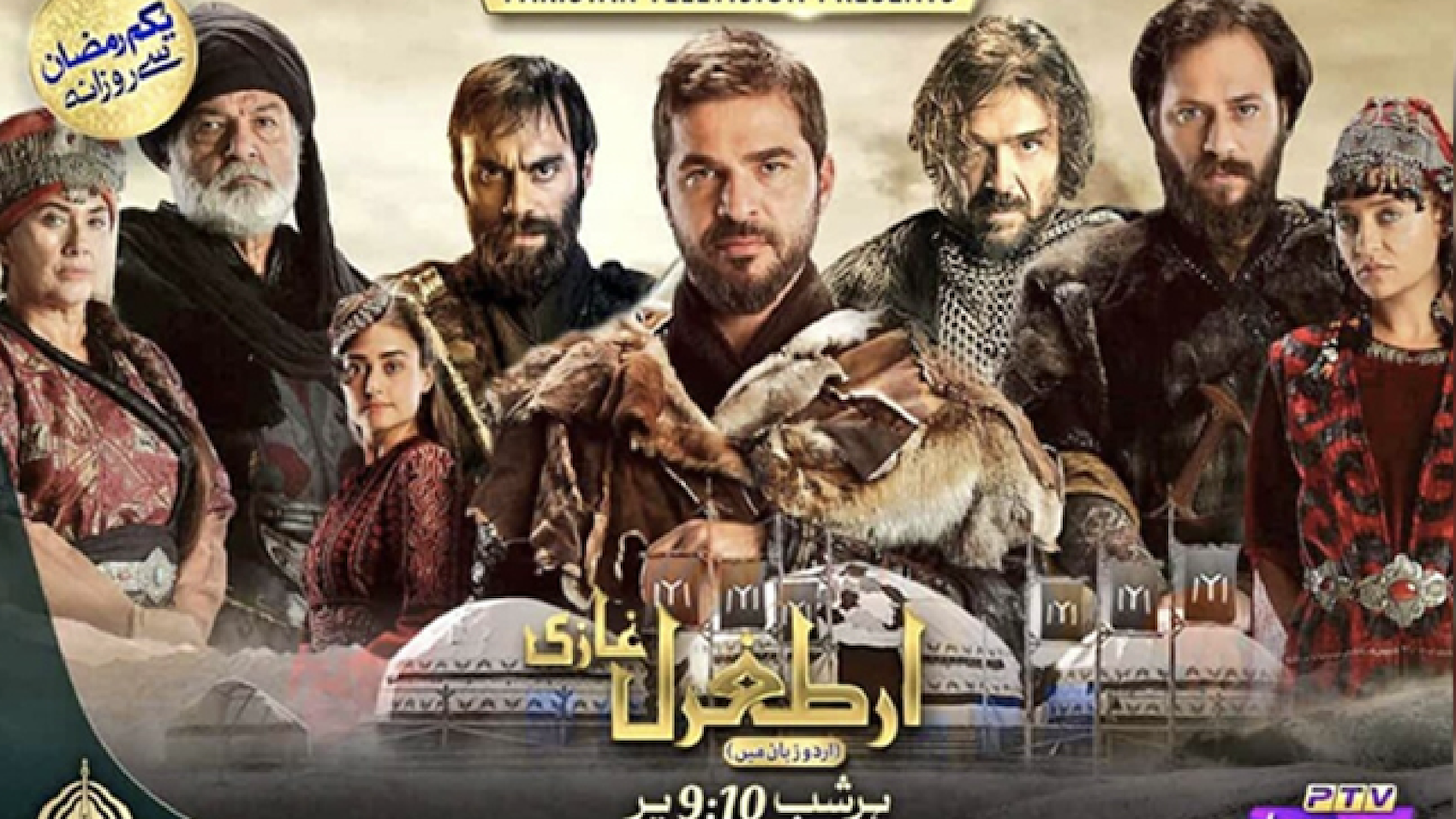
The highly politicized, Ottomanist themes of Ertugrul Ghazi, a Turkish television drama, are a manifestation of Turkey’s desire to expand its cultural borders. The show depicts Turks as the protagonists dealing with contemporary political issues, “settling” accounts with their enemies as they steadfastly practise the faith of Islam. These ideals facilitates the construction of a transnational populist civilizational cultural identity which surpasses nationalism. The show and its themes have resonated with the Pakistani version of Islamist populism.
During Pakistan’s first reluctant Covid-19 lockdown, in the spring of 2020, the normally chaotic streets went quiet. The relative tranquillity of the outdoors was not replicated indoors. Thousands of Pakistanis, forced to stay home, were glued to their television screens and electronic devices, enthusiastically watching a Turkish TV series: ErtugrulGhazi (Dirilis: Ertugrul in Turkish and Resurrection: Ertugrul in English) (Shaikh, 2020; Carney, 2018). The program is an international hit, but it has found unprecedented acclaim and fandom in Pakistan, where it is broadcast in the country’s national language (Urdu) by the state-owned Pakistan Television Corporation (PTV). By fall 2020, the show’s Urdu YouTube channel—called TRT Ertugrul by PTV—had received 10 million subscribers; the show also became a regular feature of the “top ten shows” watched on Netflix in Pakistan (Bhutto, 2020; The News, 2020).
Imran Khan, Pakistan’s Islamist populist Prime Minister (Yilmaz & Shakil, 2021a; Yilmaz & Shakil, 2021b), called the show a “gift” from Turkey that was a token of brotherly exchange between the two countries. He has highlighted the significance of the show for the “Muslim world” because it allows a break from the “Western” content and puts forth “our (the Muslim world’s)” perspectives (Haider, 2020). Khan feels that the medium of films should be used to teach the “aloof” and “West-inspired” younger generations about the Muslim world’s “glorious past,” “triumphs,” and “heroic figures,” so that the “western civilizational hegemony” is “broken” (Haider, 2020). As a counter to “third-hand culture,” Ertugrul Ghazi has gone beyond pop culture to seep into deep fissures with Pakistani society’s imagination and conception of Turkey (Banka, 2020).
The fictional multi-series drama is built around the character of Ertugrul, the father of Osman I (the founder of the Ottoman Empire) and follows Ertugrul’s adventures across Central Asia. The story is a genre of historical fiction that celebrates the “resurrection” of Muslim power in the region during the late 11th century. The series has achieved unprecedented viewership in Pakistan, where the citizens have always felt a close affinity or a sense of “brotherhood” towards Turkey.
Northern India and Pakistan have been heavily shaped by Turkic-Persian culture. Turkish cultural influences in the Indus region—present-day Pakistan—run deep. Five different dynasties hailing from the region of modern-day Turkey and Central Asia, cumulatively known as the Delhi Sultanate, ruled the Indus valley from 1000 to 1556 BC (Avari, 2016). The longstanding connection between the cultures is also visible in the Urdu language. The language was constructed by borrowed vocabulary from the dominant languages within India from the Medieval period (Shaban, 2015). Urdu’s foundational elements include not only Persian, Hindi, and Arabic influences but also Turkish, further proving the transfusion and integration of Turkic elements into the region’s culture (Shaban, 2015).
In contemporary history, the Muslims of South Asia were very deeply involved in efforts to sustain the Ottoman Empire as it reached its twilight during and post-World War I. The Muslims of United India held the Ottoman ruler as the caliph of the Muslim World, and the Ottomans wielded immense religious-cultural power in the region. Thousands of Muslims protested, petitioned, and even enlisted in the British army during WWI with the hopes of negotiating a secure fate for the Ottoman Empire. However, the Treaty of Sèvres (1920) brought an end to these ambitions (Niemeijer, 1972).
During the 20th century, the modern-day nation-states of Turkey and Pakistan maintained cordial ties with one another. To show it supports Turkey—even on the most controversial issues—Pakistan is one of a handful of countries that do not recognize the legitimacy of the Armenian state and deny the Armenian Genocide (Korybko, 2020). Both countries have had numerous high-level state official visits from the other. In the first decades of the twenty-first century, and in particular post-2010, relations between the two countries have only intensified through bilateral trade, military exchanges, diplomatic support, and cultural integration supported by shows such as Ertugrul (Khetran, 2016; Singh & Hickman, 2013; Mushtaq, 2004).
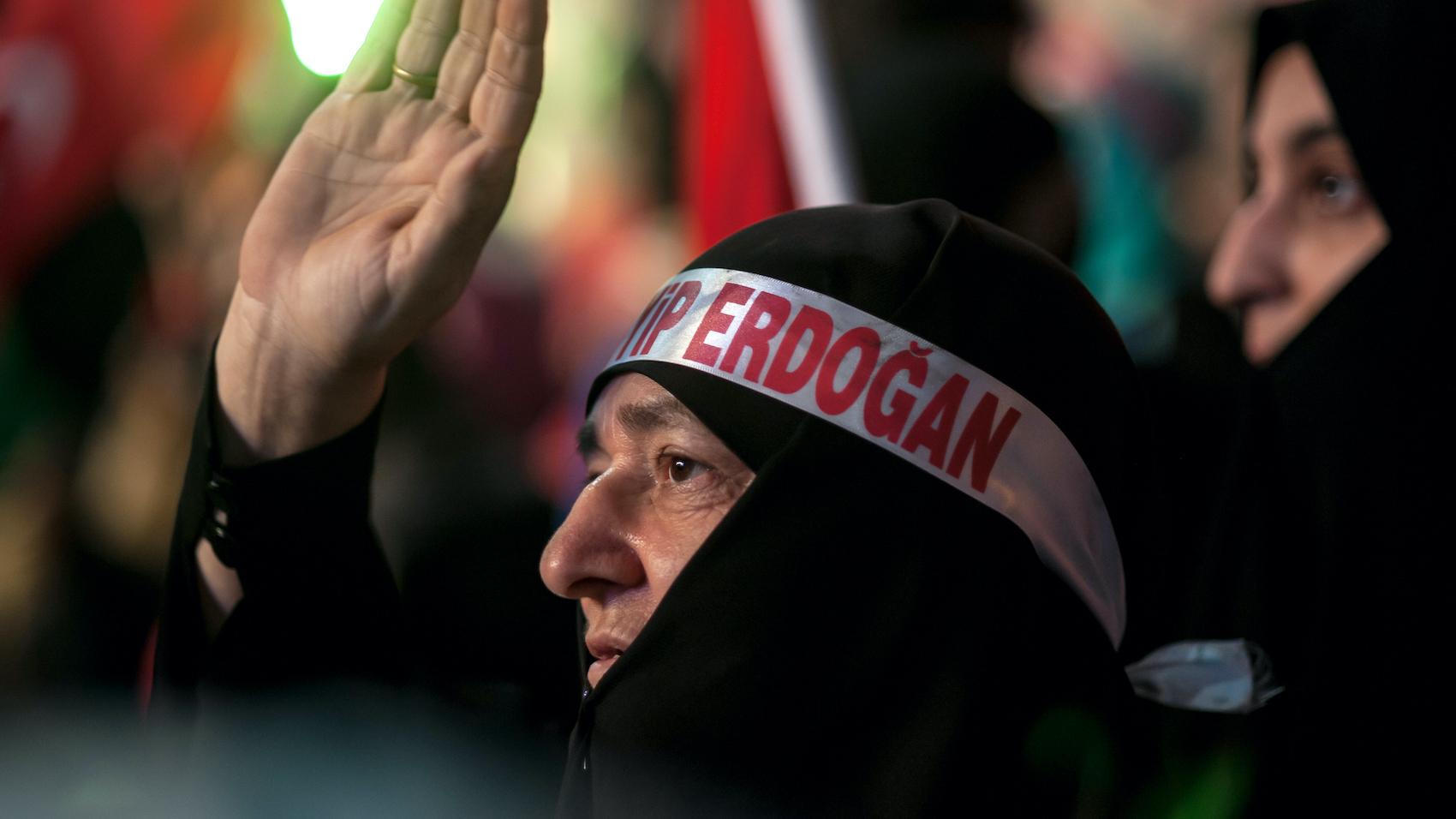
The large audience for the show, in a country already sympathetic to Turkey, makes it a highly useful devise for transmitting the religious populism of Recep Tayyip Erdogan and his political party the Justice and Development Party (AKP). The show is a prime example of the AKP’s soft power, allowing the party to successfully transmit its narrative of “Islamistcivilisationalism” (Yilmaz, 2021), rooted in glorification of the Turkic ethnicity and position as the guardians of the Sunni Muslim world, the show blurs the “distinctions between entertainment and official (state-sanctioned) history” (Smith, 2020; Subramanian, 2020; Carney, 2018; Karataş, 2016).
The drama’s highly politicized themes of Ottomanism are a manifestation of Turkey’s desire to expand its cultural borders. The show depicts Turks as the protagonists dealing with contemporary political issues, “settling” accounts with their enemies as they steadfastly practise the faith of Islam (Sunni Islam) (Bhutto, 2020; Emre-Çetin, 2014). These broadcasted ideals facilitate the construction of a transnational populist civilizational cultural identity, where nationalism is surpassed (Brubaker, 2017). This has resonated with the Pakistani version of Islamist populism (Yilmaz & Saleem, 2021). Khan’s ownership of Ertugrul Ghazi as “our” culture exemplifies this notion.
The hallmark of populism is a dichotomous society, home of two homogeneous and antagonistic groups—“the pure people” versus “the corrupt elite” (Mudde, 2004). The show plays on this dichotomy, allowing Pakistani viewers to feel part of the Muslim ummah—a group that has been victimized by the whims and control of the “Western world”; throughout the show, Ertugrul is busy unmasking the nefarious plans of Crusaders, pagans, and internal traitors. The ummah is only salvaged from the brink of misery and oppression due to their strong Islamist ideals that are imbodied in a jihad of nafs (the inner self) and sword (enemies of Islam, both internal and external).
Erdogan and his party have hooked the willing Pakistani audience, a population suffering a perpetual ontological crisis (Bhutto, 2020 & Shaikh, 2020). The vertical and horizontal divides (Taguieff, 1995) within Pakistan are also cemented through the show’s themes. The vertical dimension of Islamic populism divides the “ummah” versus the “others,” such as Western countries, Jews, Indians, Armenians, etc. While the horizontal dimension marks the ummah as the “true people”due to their celestial superiority (Islamism) against the “evil” or “godless” others. Civilizational populism is intertwined with faith within the drama series. Superseding plain nationalism, civilizationism—especially driven by populist actors—is a highly effective emotional instrument of division and can be used to galvanize popular support in the international arena.
Turkey has used its transnational civilizationism to not only expand its relations with Pakistan but also muster support during the Nagorno-Karabakh war. While Pakistan didn’t officially declare its military involvement in the conflict, troops supported the Turkey-backed army in Azerbaijan. The Pakistani government issued sympathetic statements of support for its Azerbaijani “brothers” (Korybko, 2020). Turkey, Azerbaijan, and Pakistan share a transnational relationship that makes them the ummah against the “infidels.”
On the domestic level, ErtugrulGhazi has made Pakistani and Turkish cultures synonymous. This penetration of civilizational populism is cross-cutting. For now, markets are flooded with fan merchandise, including odd items such Halima Sultan hairpins and Ertugrul themed papads (a snack), with the show’s Turkish cast endorsing brands across Pakistan’s cities. However, there are clear signs of a cultural convergence that are beyond the show and have more permanent features. The long-term cultural ties feature not only telecasting more Islamized Turkish shows such as Yunus Emre[1] but also jointly produced television shows—for example, Lala Turki[2](Rehman, 2021; Siddique, 2020). This show, a sequel to the show Kurulus: Osman, has been dubbed in Urdu by a YouTube channel and is being consumed with great zeal (The News, 2020). Retail brands are not just limiting themselves to the cast of Ertugrul Ghazi; rather, they are using slogans such as “uniting cultures” and “Muslim heritage” to sell their merchandise in a market where Turkishness is the new fad (Saleem, 2020).
A chowk (market area) has always been named the “Istanbul chowk,” but now its connotation has changed for the citizens of Pakistan. The name of Istanbul reminds them of the Hagia Sophia, that was just “reconquered” by the AKP government, when it was re-converted to a mosque (Yilmaz, 2020). Istanbul chowk now represents the land of the “true” and “fierce” Muslims, the land and progenies of Ertugrul Ghazi (the pious warrior Turk) who took on the world to defend his tribe and religion. The drama series has played a key role in solidifying transnational Islamist populism promulgated by the Erdogan regime. The show’s civilizationalism is now part of Pakistan’s collective narrative, identity, and psyche.
References
Avari, B. (2016). Islamic Civilization in South Asia: A History of Muslim Power and Presence. Routledge: New York. (accessed on March 14, 2021).
Brubaker, R. (2017). “Between nationalism and civilizationism: the European populist moment in comparative perspective.” Ethnic and Racial Studies. 40(8), 1191–1226.
Carney, J. (2018.) “Resur(e)recting a Spectacular Hero: Diriliş Ertuğrul, Necropolitics, and Popular Culture in Turkey.” Review of Middle East Studies. 52(1), 93-114. doi:10.1017/rms.2018.6.
Khetran, S. Mir. (2016). “Economic Connectivity: Pakistan, China, West Asia and Central Asia.” Strategic Studies. 36(4), 61-76. doi:10.2307/48535974
Mudde, C. (2004). “The Populist Zeitgeist.” Government and Opposition. 39(4), 541–563.
Niemeijer, A. (1972.) The Khilafat Movement in India 1919-1924. Brill: The Hague.
Shaban, Abdul. (2015). “Urdu and Urdu Medium Schools in Maharashtra.” Economic and Political Weekly. 50(29), 46-51. doi:10.2307/24482034.
Singh, Chaitram & Hickman, John. (2013). “Soldiers as Savior of the State: The Cases of Turkey and Pakistan Contrasted.” Journal of Third World Studies. 30(1), 39-54, doi:10.2307/45198798.
Taguieff, P. (1995). “Political Science Confronts Populism: From a Conceptual Mirage to a Real Problem.” Telos. 103, 9–43. Doi: 10.3817/0395103009.
Yilmaz, Ihsan. (2021). Creating the Desired Citizens: State, Islam and Ideology in Turkey. Cambridge and New York: Cambridge University Press, 2021.
[1] The show is based on the life of the 13th century Sufi mystic. It emphasizes the universal components and yardsticks of Muslimhood.
[2] Abdur Rahman Peshawari (a South Asian Muslim) had gathered funds and men to aid the flailing Ottoman Empire. Lala Peshawari, as he was known at the time, then set off on a ship; upon reaching Turkey, he fought two battles as part of the Ottoman army. He was killed in a battle and thus is revered as a “Ghazi.” The show will be based off this journey to the Ottoman Empire and his sacrifices for the caliphate.
During this ECPS event, Dr. Cathrine Thorleifsson will discuss her book Nationalist responses to the crises in Europe together with Sabine Voss, who researches the political culture of far-right populist grassroots politics in post-socialist eastern Germany.
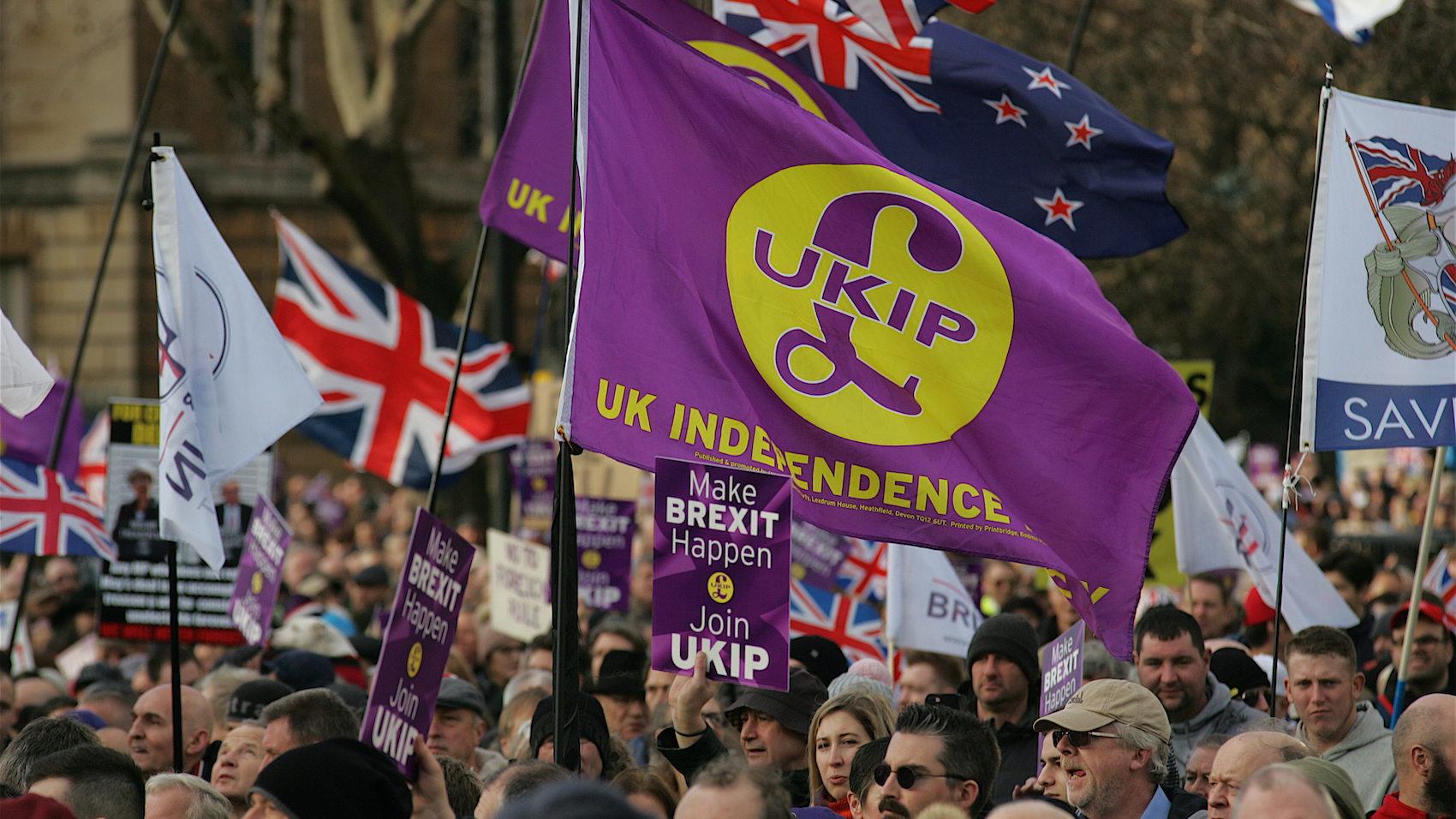
In her book, Dr. Thorleifsson examines the drivers and local appeal of populist nationalism. Based on multi-sited anthropological fieldwork in England, Hungary and Norway, she explores the various material conditions, historical and social contexts that shape resentment of elites, migrants and diversity. Combining analysis of the discourses propagated by radical right parties such as UKIP and Jobbik with an analysis of the hopes and concerns of supporters, Thorleifsson develops wider conclusions about how populist nationalism is enlivened and reconfigured in response to destabilizing crises of economy, culture and displacement.
Cathrine Thorleifsson is a Researcher at the Centre for Research on Extremism at the University of Oslo. Cathrine holds a PhD in Anthropology from the London School of Economics and Political Science (2012). She has conducted extensive ethnographic fieldwork amongst supporters of the populist, radical right in Europe and Israel. The past decade she has been researching and writing on nationalism, belonging, racisms and far right politics. Her recent books include: Nationalist Responses to the Crises in Europe: Old and New Hatreds (Routledge 2019) and Nationalism and the Politics of Fear in Israel (I.B. Tauris 2015). Dr. Thorleifsson has studied Arabic at the University of Damascus and Hebrew at the University of Haifa. Previously, she was a Postdoctoral Research Fellow at the Department of Social Anthropology at the University of Oslo. In addition to her academic pursuits, Dr. Thorleifsson has carried out consultancy work for the UNDP, the World Bank, the European Commission and a number of ministries on the dynamics of far-right radicalization. Dr. Thorleifsson frequently provides expert analysis for policy makers as well as print and broadcast media.
Sabine Volk is a PhD candidate at the Jagiellonian University in Kraków and Early Stage Researcher in the EU Horizon2020 project “Delayed transformational fatigue in Central and Eastern Europe: Responding to the rise of illiberalism/populism (FATIGUE)”. Volk’s dissertation explores the political culture of far-right populist grassroots politics in post-socialist eastern Germany, focusing on dimensions such as ideology, memory, and the ritualization of public protest. She has conducted several months of ethnographic fieldwork in the context of the Dresden-based “Patriotic Europeans against the Islamization of the Occident” (PEGIDA) movement, including online ethnography of virtual protest events. Volk has published in journals such as German Politics and Politique Européenne, and blogs on Open Democracy, LSE Europe, populism-europe.com, amongst others. Prior to her PhD, Volk obtained two MA’s in European Studies: one from the Erasmus Mundus Programme of Excellence ‘Euroculture’ and one from the College of Europe. Previous places of study and research include Tübingen, Groningen, Strasbourg, Indianapolis and Warsaw.
Dr. Eviane Leidig’s presentation situates the rise and success of the far right in India through the lens of Hindu nationalism. It provides a historical overview of the ideology and types of organisations within this far right landscape, focusing in particular on the global aspects of what is commonly portrayed to be an isolated local phenomenon. This talk then turns to the contemporary dynamics of the Indian far right through the ascent of Narendra Modi, widely viewed to be a populist, charismatic leader who will usher in India’s revival and golden age. The presentation sheds light on the far right as both global and transnationally connected through a case study of India, while also proposing new ways of conceptualising far right movements in postcolonial, Global South contexts.
British political scientist Paul Taggart does not regard populism as a “pathology” nor as “evil” and contends that it could be even useful in terms of heralding the problems of democracy. “Populism can be an indicator that something is not working well with democracy. If many people support populists who claim that politics is not working well, then we should take this seriously,” says Taggart.
Prof. Paul Taggart of Sussex University does not agree that populist politics will, in the end, fail, as some of his colleagues argue. In an exclusive interview with the ECPS, Taggart said populist leaders sustain their power by resorting to authoritarian mechanisms. The British political scientist does not regard populism as a “pathology” nor as “evil” and contends that it could be even useful in terms of heralding the problems of democracy. “Populism can be an indicator that something is not working well with democracy. If many people support populists who claim that politics is not working well, then we should take this seriously,” he says.
Stressing that there has been no significant surge in the number of populist leaders around the world, Taggart says populism should be assessed in perspective. He underlines that there is no magic formula to fight populism as populists in power do not all behave the same way. According to Taggart, once in power, populists can pursue several distinct strategies—either moderating their populism, reshaping political institutions to suit their populism, or behaving like an opposition in power. Given there is no single model, Taggart says the response to populist leaders should be tailor-made.
The following excerpts from the interview have been lightly edited for brevity and clarity.
You argue that you do not regard populism as a “disease” or a “pathology” nor as “evil.” How have you come to this conclusion?
This is an assumption and not a conclusion. I think we need to consider populism as objectively as we can. The fact that it is “thin-centered” and fuses with other ideologies means that we need to be careful about generalizing about it without considering whether we are focusing on populism or on the ideas that it attaches to.
You use the term “democratic corrective” in relation to populism. Does this mean populism is useful to a certain extent?
Populism can be an indicator that something is not working well with democracy. If many people support populists who claim that politics is not working well, then we should take this seriously. That does not mean to say that we should uncritically accept whatever populists say. But it also means that we should not automatically dismiss populist critiques of democracy. Instead, we need to be alive to the possibility that populism may be correct to assert that politics is not working well.
You also argue that populism is becoming one of the main challenges to the liberal-democratic regime. Is there a contradiction between this argument and populism being a “democratic corrective”?
Liberal democracy has two elements. On the one hand, it embraces the idea of popular sovereignty, and this means representation and majority rule. But it also stresses the importance of process, the rule of law, and the protection of minorities, and of core rights. There is often, in liberal democracy, a tension between these two aspects. Populism is a challenge to liberal democracy in that it focuses on the first aspect of liberal democracy—popular sovereignty and representation—at the expense of the liberal aspect. Populism rarely talks in terms of rights or minorities. You need both for liberal democracy. Suppose popular sovereignty—and the representative connection—is weak. In that case, populism might be useful to call for that link to be strengthened, and so it can potentially be a corrective for democracy. But if this is at the expense of rights, the rule of law, and minorities, this will undermine liberal democracy.
Is there a magic formula to deal with or contain populist parties once they are in power?
No, there is no magic formula if you want to combat populism in power. Populists in power do not all behave the same way. They tend to pursue one of three strategies —moderating their populism, reshaping political institutions to suit their populism, or behaving like an opposition in power. These different approaches to power mean that any response needs to be tailored to whatever approach is being used.
It seems the EU is not very successful in dealing with populists when they are in power. What is Brussels’ problem?
I am not sure it is the EU’s role to deal with populism. The rise of populism in many European states says as much about those states as it does about the EU itself.
After the fall of the Berlin Wall, there was a flurry of articles predicting that liberal democracy had won and would spread worldwide. Yet we see a surge of populism and populist parties. What went wrong? Why are illiberal democracies gaining ground, in particular in Central Europe?
It was wrong to say that liberal democracy had “won.” Politics is not a sports game in which a result is clear—it is an ongoing process and to expect a clear “score” is naïve. We are seeing a lot of populism around at the moment. But we are also seeing a lot of other forms of politics. Populism is spectacular, which means that it commands attention and that some people tend to over-generalize it.
Looking at the massive surge of populist leaders worldwide, shall we start talking about “the end of liberal democracy” and the “dawning of illiberal ones”?
There is no massive surge of populist leaders. There are a few around the world, but most leaders are not populist. We need to consider populism in perspective.
Populists usually and inevitably fail because they do not know how to govern. However, some populist leaders like Erdogan, Orban, and Putin have kept the power for a long time. How can their extended stay in power be explained?
I don’t agree that populists inevitably fail. Some populists sustain themselves in power by resorting to authoritarian means.
Are there any tested successful ways to fight against populist leaders and populist movements? Will they keep gaining ground?
If you want to fight populism, then there is no magic formula. The one thing that does not seem to work is to pretend it does not exist or completely shun it from political life as this only feeds the idea that populism represents the excluded. Historically, populism has usually had a limited shelf-life. It has not built lasting political families as other ideologies have done. I suspect that it will fade—but that it will also re-emerge later.
Who is Paul Taggart?
Paul Taggart is a professor of politics at the University of Sussex. He has previously served as the Director of the Sussex European Institute, Head of the Department of Politics, and Deputy Head of the School for Law, Politics, and Sociology at Sussex. He has acted as an external examiner for Strathclyde University, Birkbeck College, Aston University, the University of Bath, and Goldsmiths College, London. His focus is on comparative politics, and his research focused primarily on populism and on Euroscepticism, and more broadly on the domestic politics of European integration. He has published six books and numerous articles in these areas.
Professor Taggart is also a former editor of the journal Government and Opposition and is now chairs the journal’s Board of Directors. He is the former editor of the journal Politics and co-Convenor (with Prof. Aleks Szczerbiak) of the European Referendums, Elections and Parties Network (EPERN). He has been a visiting scholar at the University of Gothenburg and the University of Sarajevo, a visiting scholar at the Center for German and European Studies at Georgetown University, and a visiting professor at King’s College London. Taggart is a regular commentator on British, European, and US politics for BBC local radio.
Viktor Orbán has built an extraordinarily centralized strongman regime, which can be described as “Führer Democracy.” Nowadays, Paul Lendvai argues, even the term “Führer Democracy” is no longer valid for Hungary, since the first part of the term [führer] is getting stronger and stronger whereas the second part of the term [democracy] is getting weaker and weaker. Soon, all that will be left is “Führer.”
In 1989, a 26-year-old law student addressed a protest in Budapest’s Heroes’ Square. In his speech, the young Viktor Orbán called for an end to the communist dictatorship, the withdrawal of Soviet troops from Hungary, and the holding of free elections. Later on, Orbán attended Oxford on a scholarship funded by George Soros, and after turning back to Hungary, he founded the political party FIDESZ or the Alliance of Young Democrats. He was hailed as the future of a new Hungary.
Today, Orbán is Vladimir Putin’s closest ally in the European Union. He obsessively attacks George Soros as an enemy of the people and considers China and Turkey as role models. In our interview with Paul Lendvai— a Hungarian-born Austrian journalist who has written extensively on Central and Eastern Europe for more than 60 years—we discussed how Orbán turned into one of the most successful populist autocrats of our times.
Lendvai’s latest book Orbán: Europe’s New Strongman (2018, Hurst and Princeton University Press), has been published in English, German, Hungarian, Slovene, and Polish (and later this year in Croatian). It portrays Hungary as an authoritarian system under the rule of Orbán. Exploring the deterioration of the country’s rule of law, the end of the separation of powers, and mass clientelism, Lendvai succeeds in tracing Hungary’s rapid slide toward authoritarianism in his excellent book.
The following excerpts from our interview with Paul Lendvai have been lightly edited for brevity and length.
Hungarian Prime Minister Viktor Orbán gives a speech to convince his respondents in Szeged on March 4, 2014.
The term “populist” carries negative connotations in current political culture. However, this may not sound valid for a ruthless authoritarian leader who is often referred to as the “Viktator.” Do you think being defined as a “populist” just serves to shadow Viktor Orbán’s more negative features?
Every politician can be called populist, but basically the question is whether it’s claiming to represent people without really paying attention to the issues and does everything to get or remain in power. There is no question that, in this sense, Orbán is a populist. In the early 1990s, he changed his political line because he realized that he could not get elected with his earlier ideals. He left the center-left position and moved then to center-right, then more and more right, and that is how he seized power in 1998. Then, he lost power in 2002, and following that, he showed his ability as a politician by getting re-elected after eight years in 2010. He is often described as right conservative in the international media. But actually, he is a right-wing populist nationalist. Regardless of the adjectives, his only ideology is to use every means to remain in power.
Do you think Orbán inherited much of his ruthlessness and vengefulness from his father, who is a product of “goulash communism” under Janos Kadar? And if we can speak of a sort of Kadarism creating a populist leader like Orbán, what should we expect for the future generations raised under Orbánism?
As a matter of fact, Orbán was a very rebellious person, and it is something of a personal contradiction that someone who was such a rebel could turn into a kind of authoritarian strongman in politics. He rebelled at school and in the army. And he also rebelled against his father, who was a typical product of Kadarism. His father, Gyözö Orbán, was not only a party member, but he was also allowed to go to Libya as an expert. He is now 81 and has become extremely rich. Orbán has luxurious private residences—one is a little bit like Putin’s palace, although not that huge—but it’s all under the name of his father and his son-in-law. His two brothers are also in business.
But turning back to your question, in terms of education and upbringing, Orbán’s father was very ruthless, beating Viktor up even at the age of 16. Perhaps we need a psychological study to fully understand how he became the person he is today.
Very Skillful Politician and A Very Cynical Person
As you note in your book, today, the country’s president, the speaker of parliament, and the author of Hungary’s 2012 constitution all happen to be Orbán’s friends from Bibo College days—indeed, from the very start of FIDESZ, the Alliance of Young Democrats that Orbán and his friends set up in 1988. How do you emphasize the characteristics of this political brotherhood?
It is something exceedingly rare to see this kind of fraternity in the top leadership of a European country. They were a group of young people who were very committed to their ideals. They started their movement in 1988, and, in effect, the critical party positions have been retained by these 20–25 people or their relatives. It is not only the speaker of the parliament or the president but also many other positions. For instance, the chief justice is the wife of a former European MP who wrote the new constitution. She has now become a member of the Supreme Court for ten years. Following his second electoral victory in 2014, Orbán wanted full power over his party, his government, and the country. Therefore, he broke with his close collaborator, Lajos Simicska, the man who had built up the entire business empire of FIDESZ.
Another feature of Orbán is that he gets rid of people who can be potentially dangerous but never kicks them totally out. For instance, the present president [János Áder] was allegedly planning a plot against Orbán in 2006. He was then “exiled” to Brussels when he was elected as a European MP. When the FIDESZ government had the chance to nominate the president in 2010, he was passed over. Only later did Orbán call him back, and he was given a second chance. In 2017, he was re-elected for another five-year term as president. So, Orbán is very clever in the way he deals with potential adversaries. He has complete control over this tightly knit group, making him the most powerful politician in the European Union (EU).
To what extent Orbán’s “plebeian” roots played a role in transforming once liberal, anti-clerical, and anti-nationalist FIDESZ into an illiberal, clerical, and nationalist–populist party? And how do you assess FIDESZ’s policies toward minorities, especially the Roma people, its antisemitism, particularly against Soros, and its Islamophobia?
Orbán is a very skillful politician and basically a very cynical person. Take the Roma issue as an example. In 2011, when Hungary took over the rotating chairmanship of the EU for six months, Hungary promised to do many things for the Roma people (officially numbering 300,000 in Hungary; in reality, probably over 700,000). In practice, they did nothing. They just appointed a figurehead under their control; he was a profoundly corrupt figure. So, it was very cleverly handled without really doing anything essential.
We can see a similar move by Orbán with respect to the 100,000 strong Jewish community. As to antisemitism, no one has ever heard Orbán utter an anti-Jewish statement or remark in public. The point is not whether he personally is antisemitic or not. What really matters is what his politics are. He rewrote Hungarian history in an entirely new constitution, which the youngsters learn at school from the very beginning. It’s all about whitewashing Hungarian history in contrast to Germany or, to some extent Austria for the last 20 years.
Orbán is also deft at splitting the Jewish community or splitting the political opposition. Orbán is on good terms with a Jewish Hasidic Rabbi, who represents perhaps five or eight percent of the Jewish community in Hungary but has many wealthy supporters in the US. And he has excellent relations with Prime Minister Benjamin Netanyahu of Israel. So, if anyone attacks Hungary about antisemitism, then this Rabbi objects to that.
On the other hand, Orbán conducted an antisemitic campaign against the Hungarian-born Jewish billionaire George Soros, who had donated hundreds of millions of dollars to Eastern Europe and Hungary. Still, no one can attack Orbán as an antisemitic; Netanyahu and his Hassidic friends would reject these claims.
Controlling Media and Judiciary Is the First Step Toward Authoritarianism
Drawing necessary lessons from his defeat eight years earlier, Orbán made two bold moves after his triumphant re-election in 2010. First, he took away most of the Constitutional Court’s power, and second, he took over the public and most of the private media. Which one do you see more critical-controlling the judiciary or the media? And do you think that controlling major checks on power is a first step on the way to authoritarianism?
I think they’re both extremely important. The judiciary was the basic steppingstone since they can approve everything [a government does] in contrast to Poland. For instance, the Hungarian centralization of power has always been seen as above board because the Constitutional Court approved most of the measures. FIDESZ started by appointing new judges and bringing the court gradually under their control. It took a certain amount of time, but there is no question that the Constitutional Court of Hungary is no longer a balancing to the executive.
As for the media, the move against the free press and the setting up of his own media, by chance, coincided with Hungary taking over the rotating chairmanship of the EU in 2011. Already after a year in office, it was quite clear internationally that Hungary’s public television and radio had come under government control and the other media outlets were under pressure. In the last years, the media has been subject to near-total pressure by the government. Some 80 percent of the news today is supplied either by government media outlets or by media companies controlled by oligarchs who are very close to Orbán or FIDESZ personally.
Both of these checks are especially important in a democracy and are connected. After all, an independent judiciary is a guarantee of the freedom of the press, and the free press is the guarantee of an independent judiciary. Unfortunately, both of them are under government control in Hungary today. Now the entire justice system will be totally taken over. And, of course, controlling these sectors is the first step toward authoritarianism.
Anti Immigration poster from Viktor Orban government in the streets of Budapest during the 2018 general elections campaign.
Thinking of Orbán’s building a fence on the border with Serbia to keep out refugees and representing himself as the last protector of Europe, how do you assess the relationship between FIDESZ and the EU? Hard- or soft-Eurosceptic or Europhobic? Could you detail how FIDESZ has turned its anti-immigrant and xenophobic policies into an advantage in its relations with the EU?
These are two different but interconnected questions. Number one is the refugee issue, which was used by Orbán to consolidate his power and was unfortunately met with a high degree of approval by the Hungarian public. As a result of the hate campaigns by the government-controlled media, building a fence on the border and the entire anti-refugee policy was approved. But the situation has also changed in Germany and other EU countries.
And the other point of your question is about the EU’s approach toward Hungary. Ever since 2011, Hungary has been a target in numerous resolutions. But, FIDESZ remained a member of the European People’s Party, the EPP, for almost a decade. It was only in March this year that Orbán has recalled his 11 MPs from the EPP.
But it is a different matter regarding Hungary’s membership as a state in the EU. Once you are a member of the EU, it is tough to discipline a country defying the European principles of human rights and equality. Thus, over the next five or seven years, Hungary is in line to receive a minimum of €18 billion in transfers from the EU budget, plus €7 billion from the COVID-19 reconstruction fund.
Orbán Built Up A Kleptocracy For His Friends And His Family
How do you think corruption and kleptocracy paved the way for Orbán’s Hungary to emerge as a mafia state?
There is a significant difference between other countries and Hungary. For instance, in Italy, Silvio Berlusconi was elected prime minister four times. But he had become very rich before he seized the top position. In the case of Hungary, Orbán was a politician who first occupied the top political position and only afterward built up a kleptocracy for his friends and his family. There is the famous case of Lörinc Mészáros, a gas fitter in a small village. Mészáros went to the same elementary school as Orbán. And they met again in this small village of 1,800 people, and he became a close friend of Orbán. Then he became mayor of this little town and then the chairman of the local soccer club. He was running a small firm on the edge of bankruptcy. Today, he is the second richest man in Hungary, with assets of €1 billion across 200 different companies. This man has been accused in parliament by the opposition of being a crony of Prime Minister Orbán. Orbán’s spokesman says that the prime minister has nothing to do with business affairs.
Officially Orbán’s assets are tiny—half of a small flat with his wife in Budapest. Actually, it all works differently. For instance, one of his daughters is married to a young entrepreneur. Suddenly, this man, at the age of 32, became the 33rdrichest person in Hungary. So, this is all done in a very clever way. The people don’t get worked up by abstract overall figures. Several studies on the mafia state in Hungary conclude that were there a real change of government system through free elections and the imposition of a functioning system of rule of law, the group of people at the top would end up behind bars.
Orbán’s cabinet contains quite a few women. Yet he is on record saying he considers women to be insufficiently tough or cut out for politics. How do you see the relationship between populism and gender issues?
Until 2018, there was no woman in his cabinet at all. Proportionately, Hungary has the least number of women MPs in Europe. For instance, there are more women even in the Albanian parliament than in Hungary. In 2018, Orbán appointed two attractive young women; one as Minister of Justice and one as Minister for Women’s Affairs. They speak very good English. So, they can sell the government policies much better than their predecessors. But it doesn’t change the fact that the country has very strict anti-lesbian and anti-homosexual laws, prohibiting same-sex marriages or same-sex couples adopting or fostering children, etc. It is a much more restrictive and conservative society in this sense compared to Western Europe, and gender issues so far have not triggered massive protests.
From Left: Hungary PM Viktor Orban, Poland PM Beata Szydlo, Czech PM Bohuslav Sobotka and Slovakia PM Robert Fico pose prior their meeting in Prague on February 15, 2016.
As a journalist who spent several decades reporting on Central Europe for the Die Presse and the Financial Times, do you think Orbán would export his regime to Visegrad Four (V4)?
Yes, definitely. He uses this Visegrad Four group for this purpose. The four countries—Hungary, Poland, the Czech Republic, and Slovakia—emerged in 1990 mainly as a symbolic group. It became only in 2015 under Orbán’s leadership a kind of protest alliance against the influx of refugees. The turning point was the election of the right-wing PiS [Law and Justice Party] in Poland in 2015. There still exists a so-called Hungary–Poland axis for the moment. But there is one major difference between Hungary and Poland in terms of their relations with Russia. Despite the close collaboration between Budapest and Warsaw, one must not forget that the Poles are very suspicious of Russia and vehemently opposed to the Russian interference in the Ukraine. Whereas Orbán has met Putin at least nine times bilaterally in the last eleven years, and they have excellent relations. The network of corruption also connects the two regimes in Hungary and Russia.
And a newcomer as an Orbán ally is Slovenia, the most developed country in Central Europe, which was the first to join the Eurozone and NATO. It has been run for a year now by Prime Minister Janez Jansa, who in 1990 was a courageous anti-communist but has now become an extremely right-wing and corrupt politician, and above all, a very close friend of Orbán.
Biden Administration Knows What Is Going On In Hungary
The Hungarian leader seeks to be a European figure. Orbán was the first European leader to congratulate Donald Trump after his election victory in 2016, and the US didn’t raise any objection to Orbán during the Trump era. The honeymoon is now over because the new administration has a totally different policy toward Hungary. The new Secretary of State [Anthony Blinken] has close ties with Hungary; his mother is Hungarian, his father served as the US ambassador to Hungary between 1994 and 1998. So, this administration knows what is going on in Hungary.
You settle on the term “Führer Democracy” to emphasize the extraordinary centralization of power in Orbán’s hands. Can you please clarify how we should understand the term “Führer Democracy”?
The term “Führer Democracy” was not invented by me but by the moderate Hungarian political scientist Andras Körösenyi. And, it’s a very apt term. It means he is a führer and has a very strong position that cannot be overthrown by peaceful means like elections. As the great Austro-British political scientist Karl Popper said, democracy is based on the principle that bad rulers can be gotten rid of without bloodshed, without violence, by majority vote. But it is no longer possible in Hungary due to the change of the election system, gerrymandering, and the power positions the Orbán regime has built up.
As a matter of fact, even if there were a change of government in 2022, it doesn’t necessarily mean the system will change immediately. Every key position is in the hands of Orbán loyalists. So, the “Führer Democracy” is basically a strongman regime. It is, however, different from China, which is a führer regime but not a democracy. And, unfortunately, nowadays, this “Führer Democracy” term is no longer valid for Hungary either, since the first part of the term [führer] is getting stronger and stronger whereas the second part of the term [democracy] is getting weaker and weaker. So, in the end, only “führer” will remain. For the moment, the term seems to stick because there is the pretense of a democracy.
Orban Might Resort to Strong-arm Methods
The last chapter of your book is entitled “The End of the Regime Cannot Be Foreseen.” With Orbán as the dominant central power against the two major opposition parties—the post-Communists and the far-right party, Jobbik, which seem unable to unite against the government—how do you predict the future of Hungary?
No regime lasts forever, but you have to take into account several things in addition to the basis of the system like the army, the secret police, the prosecutor’s office, the judiciary, the media, the Constitutional Court, the election system, and so on. In addition to this, Orbán is only 58 years old. I raised eyebrows in Hungary very recently when I said in an interview for US media that he could lead the country for 20 more years. I mean, if you look at Joe Biden, for instance, he is 78 years old.
But you can’t predict anything. Everything is possible in politics. for instance, A combination of economic and social crises could arise. Orbán has no real advisers. Like every strongman, he is also intoxicated by power. If there were to emerge a real strong opposition threatening his power in the elections, then Orbán would take off his gloves and become a naked strongman. We are not yet there, but in the last year or so, state control has been tightened in the cultural and educational fields. Traveling abroad is free, but the state of emergency resulting from the epidemic helps him consolidate the power and tighten his grip. We don’t know what the results will be of the epidemic and the economic downturn. There will be unpredictable consequences. And the EU, despite everything, might tighten the rules. In that sense, everything is possible.
But on the present assumptions, I am rather pessimistic that anything major, dramatic will happen in the foreseeable future. The lack of a real united opposition allows him, for the moment, to do whatever he likes. Actually, Orbán is a very clever political operator. Thus, he pre-empted the right extremist party, Jobbik, through his strict refugee policy, by demagogy, and by helping the most impoverished working families through public works, by cheating, and by corrupting Jobbik MPs as he did with the socialist party.
The big question is whether the opposition parties can ever combine forces. If all the opposition parties were to join forces, they could theoretically win the elections. I don’t exclude the possibility that the opposition could threaten Orbán’s power in future elections. He might then resort to strong-arm methods. For the moment, however, the opinion polls don’t show a dramatic change.
Who Is Paul Lendvai?
Paul Lendvai was born in 1929 in Budapest to Jewish parents. He worked as a journalist but was arrested and jailed in 1953 and banned from the media until the Hungarian uprising. In 1957, he sought political asylum in Austria. He was the Vienna correspondent for TheFinancial Times for 20 years, covering Eastern Europe. He subsequently worked as editor-in-chief of the Austrian state television, again covering Eastern Europe, and director of Radio Austria International, the shortwave broadcasting service. Lendvai is the author of 18 books published in 10 languages.
Demir, Mustafa. (2021). “What Went Wrong in Turkey?” ECPS Book Reviews. European Center for Populism Studies (ECPS). April 6, 2021. https://doi.org/10.55271/br0001
The volume titled Islamism, Populism, and Turkish Foreign Policy, edited by Burak Bilgehan Ozpek and Bill Park (Routledge, 2019), reveals that Islamism and populism have long united forces in Turkey to mobilize the masses from the periphery to the center to capture the state “by” the support of the people, but neither “for” nor “with” them.
What went wrong in Turkey? This was the question in the minds of the contributors who embarked on the intellectual journey that gave birth to Islamism, Populism, and Turkish Foreign Policy. As an observer of Turkish politics, I welcome this work, not only as a contribution to the literature but also as aneffort, concordant with intellectual and scholarly responsibility, to critically contextualize and record another important shift in the life of modern Turkey, one that has been dubbed the “Islamist populist turn” in Turkish history (Yilmaz, 2021).
The book is a collection of articles first published in a special issue of Turkish Studies dealing with Islamism and populism in Turkey and its impact on Turkey’s foreign policy. It consists of six comprehensive articles in which the concepts of Islamism and populism serve as connective tissues.
The book begins with an editorial introduction by Bill Park. He provides a concise contextual background from which the AKP has emerged as a force of democratization and discusses how “a decade and a half later” the AKP has completed its “domination of Turkey’s political life” as an authoritarian regime. Park also explains how the AKP regime masterfully mobilized the “hitherto alienated masses” and captured the secular Turkish state with their help. He highlights how the expected “consolidation of democracy” as an end product of the AKP era has been superseded by the current reality of “centralisation of power, growing authoritarianism… and a purge of all kinds of political opposition.” Park also briefly points out the shift in the country’s foreign policy from a Western-oriented emerging soft power in its region to an aggressive, revisionist actor with worsening relations with the West that reflect the country’s internal shift towards authoritarianism. Following this quick depiction of Turkey’s internal and external picture, Park presents the central question that ties all six articles together: “What went wrong [in Turkey]?”
Burak Bilgehan Ozpek and Nebehat Tanriverdi-Yasar highlight the tension between democracy and secularism in Turkey and explain how the AKP regime has exploited this tension to craft its Islamist populist appeal against the country’s secular establishment. They also discuss how the EU membership process has been instrumentalized/weaponized and used in the marginalization of the Kemalist military and institutions and their depiction as the “internal” enemy of the “real” people of the country. Finally, the authors highlight that all attempts to destroy the Kemalist system are justified in the eyes of the “real” people of the country.
Birol Baskan’s article is also a significant contribution that details the Islamist foreign policy perspective of the AKP. He places the worldview and policies of Turkey’s former foreign minister and prime minister Ahmet Davutoglu under the microscope to lay out what an Islamist foreign policy perspective looks like. Baskan details how a “civilizationist–populism” came to be adopted in forging foreign relations and how — seen through this lens — the world can be reduced to one unified Muslim civilization versus the rest. He also rightly argues that this understanding has shaped “neo-Ottomanism” and informed Turkish foreign policy decisions during the Arab uprisings. Indeed, the author notes how artificiallydemarcated borders and the impact of the Arab uprisings brought forth a millennial opportunity to remedy historical “problems” to create a culturally, politically, and economically integrated region. This understanding also reflects a major departure from Kemalist foreign policy towards the region.
Another article by Mustafa Serdar Palabiyik focuses on post-2010 Turkey. It looks at how the current regime politicizes history to create populist binaries. Here, the Kemalists and their precursors are portrayed as internal collaborators of the Western powers, “the enemy” of the “real” people in Turkey. In this narrative, Kemalists and their historical precursors are cast as the scapegoats for all the losses and defeats the Porte faced before its demise. This revised history has been crucial in the justification of current foreign policies since the regime and its elite are presented as the vanguard of an Ottoman revival.
Mustafa A.Sezal and Ihsan Sezal’s contribution is a critical attempt to analyze the role of Islamist ideology in the AKP. This chapter explains in detail how Islamism as an ideology has empowered the AKP ruling elite and provided them with “efficient” tools to alienate the Kemalist establishment, coding them as a foreign element and presenting them as an enemy of and threat to the “real” people of the country. This chapter argues that Islamism has been the central dynamic shaping the AKP’s worldview from the outset. The authors contend that Islamism has been the core principle of the AKP and has been applied to both its internal and external relations. However, I think this conclusion does a disservice to many former members of the party—like Reha Camuroglu, Ertugrul Gunay, Yasar Yakis, and many others—who waged a genuinely heroic struggle to democratize the country within AKP ranks during its first two terms (2002–2010). All departed the party following its anti-democratic turn and once its authoritarian tendencies became salient after 2010.
Neatly complementing the Sezals’ discussion, Menderes Cinar’s article highlights the transformation of the AKP from a moderate democratic Islamic party to a more populist party with a civilizationist outlook and growing anti-democratic tendencies and practices. I suggest that Cinar’s article be read alongside that of Mustafa Sezal and Ihsan Sezal. Cinar highlights how “the AKP’s nativist practices have aimed at redefining as a Muslim nation by using a civilizational discourse” (p. 8). He also argues that the AKP’s ideology was “unformed” when it was established, after which the party gradually developed a populist authoritarian character.
However, alternatively, I would suggest that when the party first came to power, it was a rather motley coalition of different segments. Only gradually did the Islamist partner come to dominate the other parts, either through cooptation or purges. Thus, it would be beneficial to highlight the internal changes within the party that saw it transform within a decade from a coalition of reformist progressive liberals and former Islamists (who claimed they had become “pro-European conservative democrats”) to an anti-Western, revisionist, and populist Islamist political party.
This point of mine is also endorsed by Park in the introduction. Park says that none of the contributions “in this volume draw attention to the change in the AKP after it assumed power” (p. 5). However, I think this point requires further attention because overlooking transformation within political parties is not specific to the chapters in this volume. It is an understudied topic in Turkey and the AKP era overall. And it requires further research to produce a more complete and nuanced view of the topic.
Turkish academia has long assumed that political parties are “fixed units” that carry certain ideologies. This oversight is a real problem not only for Turkey in the AKP era but in general. For example, without discussing the transformation within the CHP over time, it would be difficult to properly understand the party’s shifting foreign and domestic/security policies towards ethnic and religious minorities and practicing Muslims. It would also do a disservice to the reformist, progressive liberals—like Canan Kaftancioglu, Sezgin Tanrikulu, Ahmet Unal Cevikoz, and many others—who have been championing progressive reformist politics within the party’s ranks in recent years.
The final chapter has been written by Mustafa Kutlay and Huseyin Emrah Karaoguz. It focuses on the economic aspects of recent AKP rule. Although the article seems to stay out of the frame of Islamism and populism, it provides an important account of the lack of “bureaucratic autonomy” in Turkey and an important discussion of the political economy of Turkey’s populist present. Here, the arbitrary authoritarian interference by political forces in the economic sphere (mirroring political interference in civil spheres) is seen as the central driver of Turkey’s recent economic turmoil. The authors contend that this interference—especially in the allocation of funds and resources— “in the formulation and implementation of R&D policies” stems mainly from the regime’s “populist motivations” (p. 123).
Islamism has long served as a sub-strata political ideology in Turkey. Attempts to surface it were retarded by secular state forces up until the end of the 20th century (for further details, see Cizre and Cinar, 2003). However, managed to find a crack in the surface, rising to inundate and subsume the socio-political spectrum in Turkey in the last decade.
By addressing Islamism and populism, the edited volume offers an account of the rise of authoritarianism in Turkey as well. However, instead of dealing with these two terms as separate phenomena, it would have been beneficial to underline the interconnectedness of the authoritarian turn and the rise of Islamist populism under the AKP regime in Turkey. Certainly, some of the articles discuss these notions together. However, given the conceptual discussion on the links between Islamism and populism is relatively shallow, it would have helped to provide a stronger theoretical frame to structure the chapters.
In general, this book reveals that Islamism and populism have been constants in modern Turkey and have been deployed to bring the masses from the periphery to the center (Mardin, 1973) and capture the state and its institutions “by” mobilizing the support of the people, albeit neither “for” nor “with” them. However, neither in the book nor in my observations of Turkish politics in general—and the AKP era in particular—is it clear whether the Turkish populists have combined their “thin-centered” populist ideology with Islamism or if the Islamists in Turkey have used populism as a vehicle and strategy to “conquer” the secular state. This seems to be the “chicken and egg” question of scholarship on populism —namely, whether it best understood as an ideology(Mudde, 2004) or a strategy(Barr, 2009; Moffit, 2017).
References
Barr, Robert R. (2009). “Populists, Outsiders and Anti-Establishment Politics.” Party Politics, 15(1), 29–48.
Cizre, U. & Menderes Cinar. (2003). “Turkey 2002: Kemalism, Islamism, and Politics in the Light of the February 28 Process.” South Atlantic Quarterly. 102(2-3): 309–332.
Yilmaz, I. (2021). “Islamist Populism, Islamist Fatwas, State Transnationalism and Turkey”s Diaspora.” In Akbarzadeh, S (ed), Routledge Handbook of Political Islam. Routledge, Abingdon, Eng., pp.170-187, doi: 10.4324/9780429425165-14.
Mardin, Ş. (1973). “Center-Periphery Relations: A Key to Turkish Politics?” Daedalus, vol. 102, no. 1, pp. 169-190.
Moffit, B. (2017). “Transnational Populism? Representative Claims, Media and The Difficulty of Constructing A Transnational “People”.” Javnost: The Public. 24(4), 409–425. DOI: https://doi.org/10.1080/13183222.2017.1330086
Mudde, C. (2004). “The Populist Zeitgeist.” Government and Opposition. 39(4), 541–563.
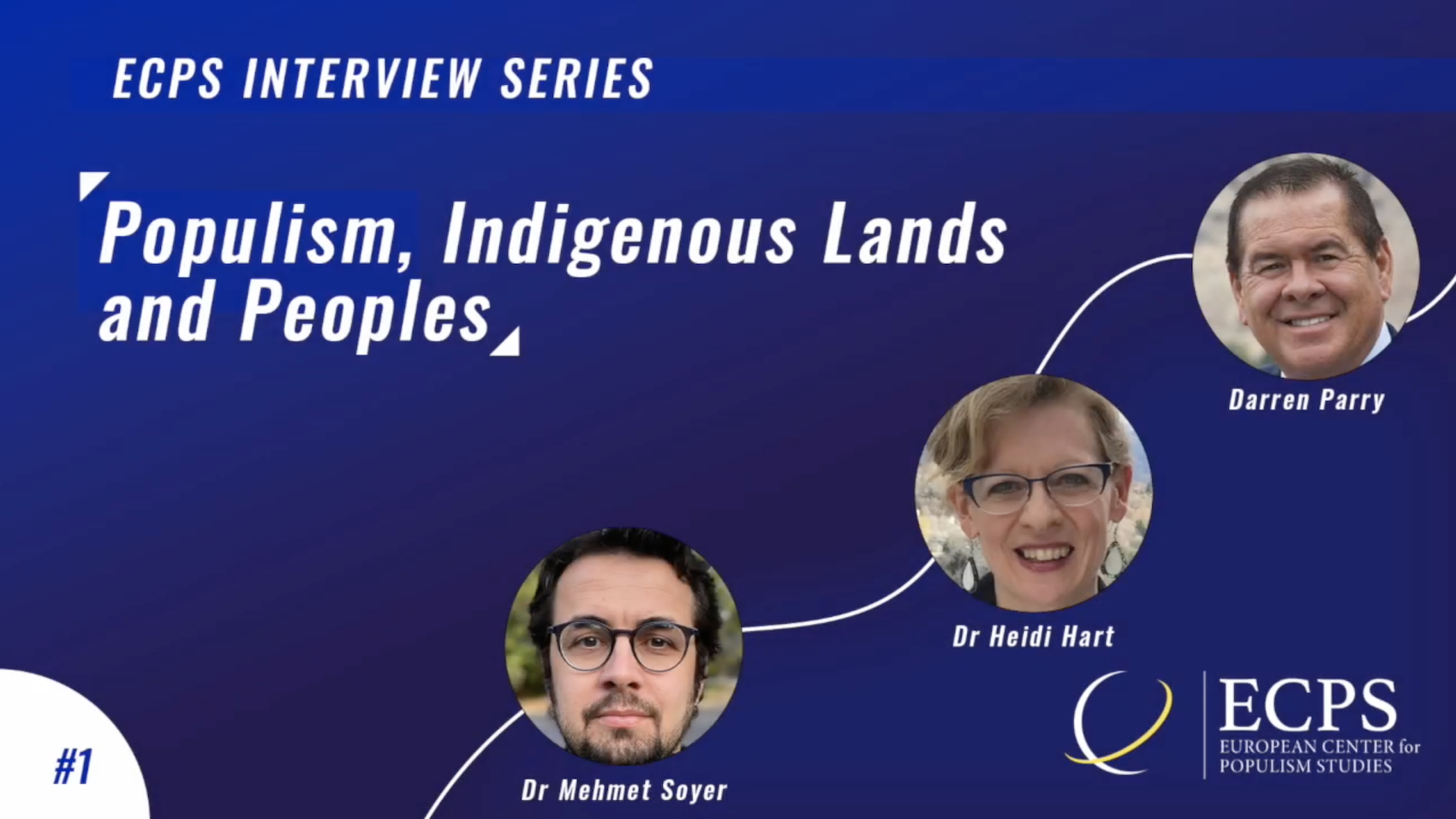
Darren Parry, the Vice-Chairman of the Northwestern Shoshone Nation, a Utah tribe with headquarters in Brigham City, calls for US legislators to take the ideas of the Iroquois People as a model and, in particular, to adopt the “seventh generation” principle. This principle counsels decision-makers not to make any decisions without considering the effects on those living seven generations ahead.
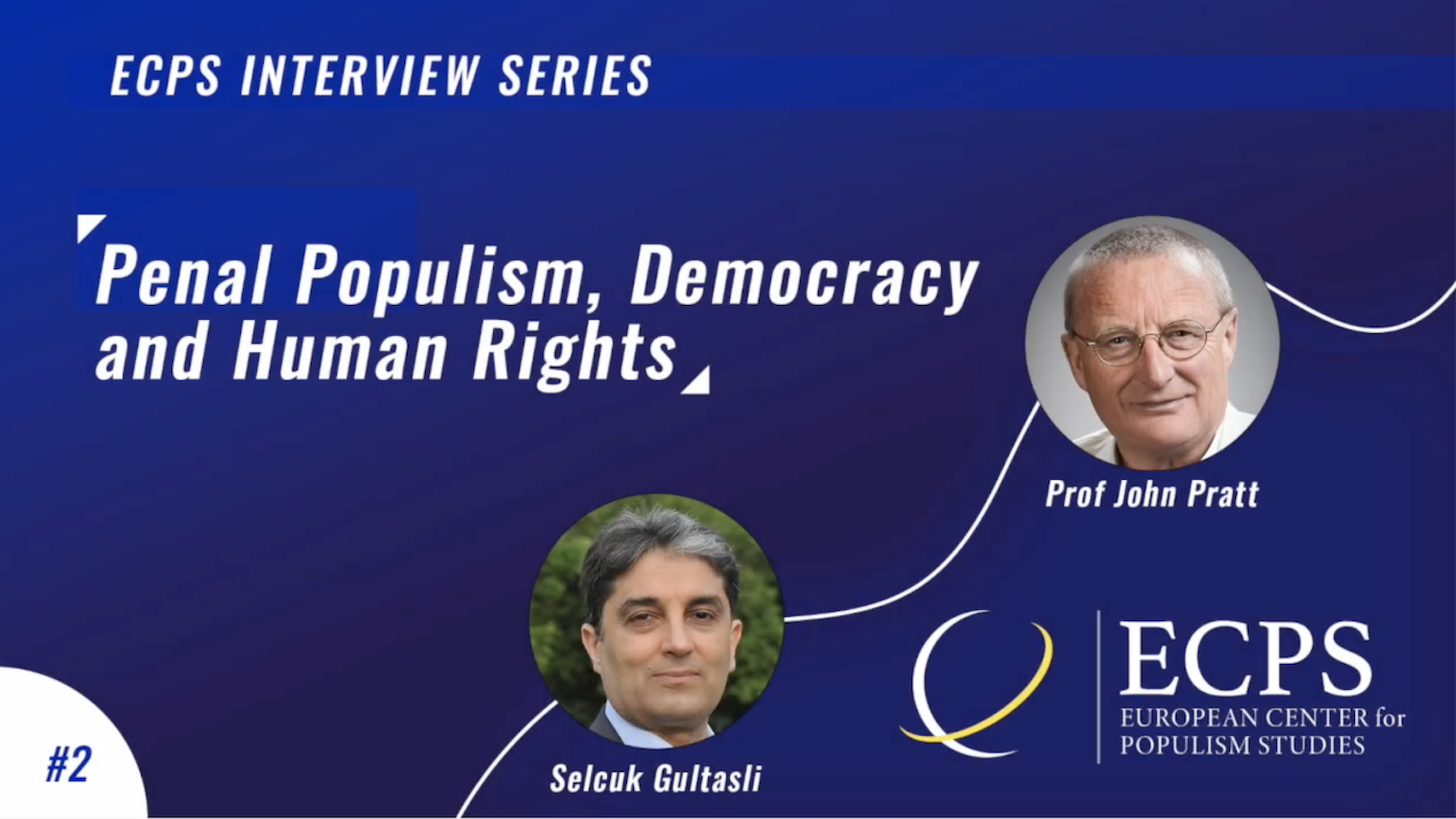
In an exclusive interview with ECPS Prof. John Pratt of Victoria University of Wellington, New Zealand argued that in Western democracies populist leaders who gain power usually have short political lives. Prof. Pratt underlined that the reason for this was populist leaders were quickly shown up to be fraudulent and full of empty rhetoric. He added that the best example was former US President Donald Trump but stressed that the situation in non-Western societies was different. Because democratic institutions were not as strong as in the US, the populist leaders were staying in power for long periods of time.
This commentary considers problems of privilege in climate anxiety and grief, asking which humans have left the deepest marks in planetary history, in the sense of the Anthropocene or “human age,” and who will suffer most as a result.
If far-right populism favors only certain people, in the sense of “Herrenvolk democracy” or populism for the white and preferably wealthy, does the climate-active left risk exclusionary thinking as well? When discussing the Anthropocene, an often contested but still useful term for the human age on earth, which humans’ traces in the geologic record hold most weight? Who has done the most to add untenable amounts of carbon to the atmosphere, and who will suffer most as a result? What about thinking beyond the human, to grieve endangered and already lost species? And whose voices are heard most loudly, asking these questions?
The realities of climate collapse can feel overwhelming, even for those not yet directly affected. I recently came up against a blind spot in my own work, curating a climate grief project involving mostly white women, when I read a thoughtful essay on the “whiteness of climate anxiety.” Sarah Jaquette Ray(2021) asks an even more pressing question than in my list above: “is climate anxiety just code for white people wishing to hold onto their way of life or get ‘back to normal,’ to the comforts of their privilege?” She notes that ecoanxiety (a term the American Psychological Association defines as “chronic fear of environmental doom” (Clayton et al., 2017) can lead to “eugenic thinking” (Wilson, 2018) and other explicitly racist aspects of ecofascism.
This sounds like a dramatic leap, especially for well-meaning environmentalists who may have delighted in Covid-era news of quieting oceans, goats meandering down Welsh streets, or dolphins swimming in Venice canals, however, false many of those reports (Daly, 2020) and who now bemoan the return of carbon-emitting, human-driven machines to the roads, seas, and skies. This seems like an innocent and even virtuous outlook. But when I hear casual comments about “the planet telling us to go away,” I now hear a dangerous implication there, too, one that I have felt myself in fantasies of green growth overtaking highways and the windows of suburban homes. If humans are a part of nature, too, we need to repair and adapt without simply imagining our own demise – or worse, that of those who lack the resources to make art about their fear and grief.
Anxiety about impending floods and wildfires is easier to bear when you can afford to move away. The pang of having to give up transatlantic flights, red meat, or the Instagram excesses of fast fashion is hardly the pain of losing one’s home with nowhere to go, or of having to keep working in dangerous conditions while others enjoy remote work, in a pandemic that is also tied to climate crisis through habitat loss. From this perspective, even grief for lost species, performed in contemplative, virtual art experiences such as Parallel Effect’s Vigil for the Smooth Handfish(2020) begins to feel like something of a luxury. So does the pleasure of watching dystopian films and TV series, designed by corporate media that “gauge the sociopolitical moment and hope to capture audiences who are now sensitized to dangers without taking things so far as to alienate audiences or the conservatives” (Kaplan, 2016: 12).
Superkilen public space in immigrant neighborhood in Copenhagen. Photo: Heidi Hart
When confronted with the problem of art as luxury, I have to step back and remember the motivation for my own curatorial project. During a fall 2020 workshop at the Sixty-Eight Art Institute in Copenhagen, I was faced with the choice between holding onto hope for a return to planetary “normalcy” and accepting that climate collapse is already happening. Even the conceptual move of acceptance led to an embodied reaction (panic, heaviness, confusion about where to turn my attention) and a need for help in the process of grief. I recalled the practice of music thanatology, or improvising harp music in response to a dying human body, and I wondered what would happen if that practice were extended to the collective grief for the world as we humans know it.
Six months later, the project is developing into an international constellation of public events, audiovisual art, and “extinction theatre.” The goal is not to wallow in despair (another critique of “collapsology”) but to face loss – not only of endangered species but also of our own innocence and environmentally costly comforts – in order to move forward into new ideas for the future. As Roy Scranton (2015) puts it, in his influential book Learning to Die in the Anthropocene, “as biological and cultural diversity is threatened across the world by capitalist monoculture and mass extinction, we must build arks: not just biological arks, to carry forward endangered genetic data, but also cultural arks, to carry forward endangered wisdom” (109). Our Climate Thanatology project is an ark of sorts, a holding place for a moment of realization: we are losing the planet we know, and everyone will be affected, as all have been by the pandemic.
Humans and other species are inextricably linked in the “biocultural phenomenon” of extinction (Rose et al., 2017: 5). But because not all will be harmed in the same way, the situation calls for change, too, in individual choices and in institutional power structures. But how to move toward change, a change based on climate justice, not only for endangered plants and animals but for the humans suffering as well? Part of our project is to learn from Shoshone tribal leader Darren Parry (interviewed here last month) to better understand collective grief from the perspective of a descendant of massacre survivors in the American West. Learning how generational grief and restoration can occur, not only in families but also in the land itself, can help us better imagine the long-term process of coming to terms with a damaged planet, and our complicity in that.
We are also questioning “who counts as a witness” (Nixon, 2011: 16) in places struck by climate trauma. Because most of our work takes place in Scandinavia, we are well aware of the uncomfortably hot summers that are quickly becoming a “new normal” (Steinthorsdottir, 2019), but we have not arrived here after fleeing war, fire, drought, or flood. Seeing our arts constellation as a tool and not as an end in itself is helpful. As we prepare for public programs in Copenhagen, learning from refugee communities will be a part of our project, with awareness that they have their own criticality and imaginative work to contribute.
Assistens Kirkegård (Lost Species Walk), Copenhagen. Photo: Heidi Hart
One of our events is a Lost Species Walk in Assistens Kirkegård, the historic welfare cemetery in a part of the city now chafing at “ghetto” status (Achiume, 2020). Participating in a parallel walk through the Refugee Voices Tours project will help us to see the city as an ecosystem that complicates Copenhagen’s “greenest city” reputation and that includes grief over lost homelands. We do not want to be “extractive” as many public programs are, in borrowing from other cultures for their own use, however inclusive they proport to be (Costanza-Chock, 2020: 89). We want to learn what we are missing.
Our collective is also learning from other climate grief projects as they do their own reckonings with privilege. For example, the Remembrance Day for Lost Species project recently hosted a video presentation on their process of understanding terms like “extinction” … “in terms of violence [and] its use in white and Euro-centric discourses to invisibilize, justify and even promote colonial acts” (Mitchell, 2020). As I work to develop a curatorial methodology, I am also learning from museum workers who critique nationalist and exclusionary practices in order to “drop the usual contrast between a supposedly sealed ‘inside’ and a critical ‘outside’” in exhibition spaces (Bayer et al., 2021: 24).
If the Anthropocene has become a “loaded term for the end to the dream/nightmare of a hyper-separated nature” (Rose et al., 2017: 5), this demise is also an opportunity. Naming a geologic age after ourselves risks human hubris, certainly, but it also allows for critical distance. When that space opens up, it is no surprise if grief enters. To see consumer and corporate excesses and their costs to others (human or not) can be painful. I recently came across these lines in a new book on waste published in Denmark (Frantzen, 2021), quoting the poet Inger Christensen (translation mine):
Now we turn on the light. Somewhere we use up
long-concentrated plankton. Humans
consuming a million summers a day.
Clear seeing, however difficult, can lead to clarity in action, too. We can’t get those “million summers” back, but we can grieve the loss and imagine a more responsible future that puts care before consumption and community, for humans and other species, before post-human dreams.
References
Bayer, Natalie; Belinda Kazeem-Kaminski and Sternfeld, Nora. (2021). Curating as Anti-Racist Practice. Espoo, Finland and Vienna: Aalto ARTS Books/University of Applied Arts Vienna.
Costanza-Chock, Sasha. (2020). Design Justice: Community-led Practices to Build the Worlds We Need. Cambridge, MA: MIT Press.
Frantzen, Mikkel Krause. (2021). Klodens Fald. Copenhagen: Laboratory for Aesthetics and Ecology Publications.
Kaplan, E. Ann. (2016). Climate Trauma: Foreseeing the Future in Dystopian Film and Fiction. New Brunswick, NJ: Rutgers University Press.
Nixon, Rob. (2011). Slow Violence and the Environmentalism of the Poor. Cambridge, MA: Harvard University Press.
Rose, Deborah; van Dooren, Thom and Chrulew, Matthew. (2017). Extinction Studies: Stories of Time, Death, and Generations. New York, NY: Columbia University Press.
Scranton, Roy. (2015). Learning to Die in the Anthropocene: Reflections on the End of a Civilization. San Francisco, CA: City Lights.
Professor John Pratt: “I think, democracy has largely held firm. The Netherlands, for example, I think there was an election there just the other week and the populace didn’t vote much for populists. Which isn’t to say that you haven’t got populist leaders and doing well in other countries. You know, the picture is very fluid, obviously. But, I don’t think it’s as gloomy a picture as some people make out of it. I think social democracy by and large, is holding up reasonably well against the thrusts from populists. Often because, once they do come to power, it is shown to be nothing more than ignorant malevolent clowns.”
In an exclusive interview with ECPS Prof. John Pratt of Victoria University of Wellington, New Zealand argued that in Western democracies populist leaders who gain power usually have short political lives. Prof. Pratt underlined that the reason for this was populist leaders were quickly shown up to be fraudulent and full of empty rhetoric. He added that the best example was former US President Donald Trump but stressed that the situation in non-Western societies was different. Because democratic institutions were not as strong as in the US, the populist leaders were staying in power for long periods of time.
Despite the rise of populism and populist leaders worldwide, Prof. Pratt sounded optimistic about the future of Western democracies. Stressing that democracies have largely held firm, he argued that populist leaders were ‘ignorant clowns.’ ‘I think social democracy by and large, is holding up reasonably well against the thrusts from populists, often because, once they do come to power, it is shown to be nothing more than ignorant malevolent clowns,’ said Pratt.
The following are the excerpts from the interview:
Thank you very much Professor Pratt for the interview, my first question is, how do you define penal populism and how popular is it in different countries, and what lies behind it?
Well, let’s take that one step at a time and, first, I think I would define penal populism by first defining what populism is:what it means to me. It refers to the moods and sentiments and voices of distinct and significant sections of the public that feel that they’ve been ignored by governments. They feel there are more favored and less deserving groups. They’ve been left behind or disenfranchised in some way by government policy. These significant sections of the public does speak out against the machinery of government which they judge of being complicit in conspiracies against the worthy members of society that they see themselves as being.
And if you take that on to penal populism, then that refers to the way in which criminals and prisoners are thought to be favored at the expense of crime victims, in particular, and the law abiding public in general. It feeds on expressions of anger, disenchantment and disillusionment with what it sees as the insidious workings of the criminal justice establishment. That is to say senior officials, ministers of Justice and corrections department judges, academics, members of the police and parole boards. It holds these members of the establishment responsible for a much too liberal criminal justice policy which has put ordinary people at risk of crime.
And so, remind me again the second question.
Populist Politics Is a Different Phenomenon From Penal Populism
How popular is it in different countries.And what lies behind it?
Well, I think it’s been particularly popular or virulent in the Anglo American world. Not so much in the other European countries, although they haven’t been free from it, but certainly I think it’s been most strongly experienced in the Anglo American world. It is no coincidence that it’s been in those countries that the conditions necessary for penal populism have been strongest and its effects are being seen with the dramatic rises of imprisonment in most of the Anglo American countries.
What lies behind it, well, I think it emerges out of the neoliberal restructuring that began to take place in these societies during the early 1980s and onwards which produced significant benefits for many in terms of access to wealth and freedom to choose how they spend the money through lower taxes and so on, but which, at the same time left as I’ve said already, a lot of people behind. A lot of people didn’t share the benefits and they only experienced anxiety and uncertainty as the world around them seem to be changing very rapidly due to this restructuring and they struggled to find a legitimate place for themselves in it. How did they then turn their attention to crime and worry about crime in an era when crime itself has been rapidly declining? Well part of that restructuring has involved deregulation of the mass media and privatization of the media.
Up to the mid 1980s in most countries, the TV was terrestrial and consisted of access to just a few channels. With deregulation, with technological development, it’s opened up to a massive 24/7 television network, a lot of those channels are news programs competing with each other. What’s the best way to attract an audience and buy advertising, because they don’t receive funding from the state? Well it’s concentrating on crime and it’s the same to do with the way in which the newspapers have become much more tabloid entity feeding on sensational stories rather than the kind of authoritative statements of government policy that used to find in the broadsheet press.
Social media takes public discourse further away again from control by government and allows all manner of opinions to be expressed, but mostly to do with crime and fear of crime, and you know that’s a very strong theme of talkback radio. So that combination of factors swirling around together with neoliberal restructuring let loose in conjunction with growing distrust of central government and in career politicians and what they can achieve: all these lead to this phenomenon that I’ve referred to as “penal populism.”
Right and what gave birth to penal populism, you already answered this question. Does each populist government has penal populism?
Well, I don’t think it does. Because I think our penal populism, for the most part, as I said, it’s been concentrated primarily in the developed world in the Anglo American society, but now you are getting the rise of populist politics right across Western society. That’s a different phenomenon from penal populism and, in some ways, it uses the same mechanisms that made penal populism more powerful relying on common sense, anecdotes, and downright lies.
If you look at the Scandinavian countries, the Nordic countries, you find right across quite strong populist parties. But, the emphasis is not so much on crime, it’s on fear of immigrants and what they might do to those societies. Populist parties have become very powerful in that region by wanting to keep those Nordic countries as they are with their very strong welfare states, a strongly protective state, for what they see as authentic citizens of those countries. That doesn’t include the wave of immigrants that are headed towards that region over the last 10 years or so, both legal and illegal immigrants.
Populist Politicians AreQuickly Shown Up to be Fraudulentand Full of Empty Rhetoric
After the failed coupin Turkey in 2016 Turkish President has imprisoned tens of thousands of people with flimsy evidence and sacked hundreds of thousands, without any meaningful objection mechanism, how long can a leader use penal populism, to consolidate his power?
It’s a difficult question to answer, and I wish I could give you a definitive answer to that. I think if you look outside of Turkey, you see, in the Western democracies, politicians who try to use populism to gain political power tend to have quite short political lives. Because, they are quickly shown up to be fraudulent and full of empty rhetoric. One of the best examples of that is Donald Trump in the US. Fortunately for American citizens and the rest of the world, the democratic processes were held up against all the efforts he made to undermine them. So there you have very strong tradition of democracy and it takes a much more astute, more intelligent and more clever politician than Trump to undermine it. In Turkey, I think, it is rather different because you haven’t got such a strong tradition of democracy. Your democratic institutions of government are not so firmly embedded and it allows the current president to disregard what we in the West would see as absolutely central elements of the rule of law.
How long, he will last in in power, I can’t give you a prediction. In populism, I think, wherever it takes root usually has a finite life. It may be shorter in some societies, longer in the others.
Professor, why does penal populism decreases when populism increases?
Again, I’m looking primarily at the Anglo American world where those countries that most strongly experienced penal populism and what I’ve argued in some of the work I published is that penal populism was used by neo liberal governments to essentially maintain the status quo, and that is to say, they didn’t think de-structuring programs that neo liberal governments were pursuing despite all the inequalities and divisions that it created.
Having penal populism, as part of the program of government performed a very useful function, because it told the general public that: Look your enemies are criminals and law breakers or people who are putting you at risk. We are prepared to use really extraordinary measures. So look how much we’re taking care of you against those who pose the greatest risk to your well being. So it was a way of maintaining social cohesion and allowing the status quo of neo liberal governments to be pursued. Now, it decreases when populist politics become stronger. Because there comes a point when penal populism wasn’t able to fulfill that function, it wasn’t able to maintain the status quo that neo liberal politicians had hoped for.
And I think there are two reasons for that. First of all, was the 2008 global financial crisis which increased social disadvantage and inequalities and allowed a minority to become even richer, so that those inequalities became more and more glaringly obvious and thereafter as well, it was followed by the high levels of immigration, particularly from the Middle East to the West or South to the North, East to the West. And those who had already been left behind in the Anglo American world, seem to feel threatened even more by immigration. Not only did it seem to be endangering the jobs or their prospects of getting a job, but it seemed to be an endangering on all left to cling to, like national identity.
Because immigrants were bringing different traditions, different cultural values with them into these societies. So,populist politics which are using and exaggerating many of the tactics associated with penal populism was no longer interested in maintaining the status quo. Its appeal to its supporters like Trump supporters, for example, was that you know we’re going to change things, we’re going to have a revolution. We’re going to make America great again by turning the clock back to some sort of dream time or the 1950s when America was ruled principally by white men. With the Brexit campaign in Britain, we want to stop all this collusion with foreign people in Europe, because Britain can make it on its own; sort of replaying themes from Second World War and the days of empire and all the rest of it.
Populist politics in those societies have arisen out of the failure of penal populism to maintian the function that was expected of it. That is, the failure of penal populism, to maintain social cohesion and, which would then have allowed the neo liberal program of government to continue. After the 2008 crash and growth of immigration, populist politics says no, we don’t want to maintain the status quo, we want to dramatically change. And, the way to do that is to trust on strongmen leaders who know best, who know better than the experts, who know better than career politicians and civil servants and bureaucrats people like Trump and (Boris) Johnson in Britain.
In your works, you have quoted Francis Fukuyama. You know he’s famous for the argument that human race has reached at the end of history, and we would witness the universalization of western liberal democracy. However,liberalism seems to lose ground to populism. What went wrong?
Well, I am sure that Fukuyama himself with that knowledge was being wildly over optimistic when making that comment. It was certainly not the end of history, it was the start of a new chapter in history characterized not by the tradition of social democratic post-war governments. “The end of history” that he was talking about i.e. the fall of the Berlin Wall and the collapse of the Iron Curtain already coincided with the growth of neo liberal program of governments. Economic and social restructuring that occurred witnessed a lot of people became winners and enjoyed things they could never previously have dreamed of, but many people who got left behind felt embittered and trapped.
Trapped in what we call in New Zealand: Modern societies’ bargain basement. They had no way out of it for the $2 stores. Outside the $2 stores, they could see all the winners or in these casino economies that’s been created, all the winners gliding up the escalator of success, but they were stuck in the bargain basement.
That was what went wrong with Fukuyama’s prediction. It wasn’t the end of history at all and the continuance of Social Democratic policy came to an end. It was the beginning of neoliberal governments which caused great social divisions.I’ve come home to roost in all kinds of ways in the last few years in western societies.
Specialist in hazmat suits cleaning disinfecting coronavirus cells epidemic in Ukraine.
Things Successful Against Covid–19 Are Antithetical to Populism
Professor, you argue that Covid-19 pandemic has turned into an antidote against populism.Can you please elaborate a bit on this?
It is remarkable in some ways, given all the damage that Covid-19 has done to individuals and societies. But at the same time, I do believe it does act as an antidote to populism and that’s because all the things that have been successful against Covid-19 are at the same time antithetical to populism.
I’ve argued in papers, I’ve written, that the most successful ways to control the virus have been ways which simultaneously contradict and undermine populism. For example, it’s been the way in which science and expertise have come to the fore again and being able to convince governments that they know best.
It’s also been strong central government, but accountable government, who are able to tell the truth to the citizens. Whether it’s bad news or good news they’re conveying to them. They’re not afraid of the truth, unlike populist politicians like Trump or Johnson who feel that they have to tell good news all the time that’s the only way in which they can keep the public on their side. But in New Zealand, we’ve had a very strong central government, which has been absolutely straight with the population, the whole time. So, two things that are anethema to populism: science and expertise. They know more about the virus and how to cure and control it, than the ‘the strongman’ leaders who say ‘I’m a magician. I know best.’ No, you do not know best. People don’t want their snake oil cures. They’d much rather believe in or hear what science and expertise have to offer, and then you got strong democratically accountable government which is able to win the trust of the public.
At the same time, people have been very anxious to find out about the virus and what risks it carries. Many of course turn to social media and listen to all the conspiracy theories i.e. that it is unleashed deliberately by China or it’s a plot by the democrats to undermine Trump and so on. But, most people have turned back to state broadcasting organizations and the BBC, for example, has been enormously popular because it tells people the truth. People trust it much more than social media. Something very similar has happened in New Zealand which has had great success in controlling the virus.
For example, Radio New Zealand’s audience increased dramatically with its news broadcast so people turning back to the state broadcasting because that’s where the truth is. At the same time, I think, despite all the damage that Covid-19 has done to societies it’s actually helped to develop social cohesion, at least in some societies.
One of the reasons why New Zealand has been so successful is because of the very strong social cohesion that exists in this society due to willingness to support the government in the fight to control the virus.
In societies where there has been success against the virus we see very strong compliance with things like wearing a mask, social distancing and so on. And, at the same time, the social cohesion has meant that people are not so distressful or antagonistic towards strangers.
In many ways the homelessness problem is being tackled by governments in many societies, because they recognize if you’re going to control the virus then it’s not a question of dividing societies, you have to unite them and all have to be helped and cured and protected from the virus. If you leave some people out then it’s likely they’re going to spread the virus. Social cohesion have also lead to all kinds of volunteer groups helping the poor and disadvantaged to a much greater extent than before. Then the virus itself is being defeated, but at the same time, this is a different kind of politics and a different kind of social action.
But I get some other examples from this part of the world as well. In our election last October (2020), which was a triumph for the Labour Party and Prime Minister Jacinda Arden because of the successful way she has managed to control the virus and keep New Zealanders safe through these strategies that I’ve just told you about. Meanwhile, the right-wing populist party in this country, New Zealand First, disappeared from Parliament.
There have been similar types of state elections in Australia as well, another success story against the virus where you get the triumph of mainstream political parties and right-wing populist parties have been largely defeated.
Penal Populism Is Essentially Used to Undermine Human Rights
Professor it has been witnessed in many countries, for example in France, that many new criminal statutes have been accepted for their impact on public opinion rather than the actual effectiveness at reducing crime? How do populistsinstrumentalize legislation for the sake of penal populist objectives?
Well, I think, when they do that, it galvanizes public opinion against particular groups in society who may or may not be dangerous, usually, in a not very big way. In so doing, the strategy of penal populism is essentially used to undermine human rights.
Instead of protecting the rights of individuals, caught up in the criminal justice process, penal populism argues that it’s the rights of the public to protection that government should take care of. So, they try to redefine what constitutes human rights and there’s usually as well, a very large bill to pay for these kinds of policies. Because they nearly always involve increases in imprisonment with very damaging economic and social effects and by starting these campaigns, they intensify division between particular sections of the society.
What kind of risks and threats emerge through the politicization of criminal justice because of populist punitive ‘law and order’ tactics in an attempt to gain support from the public?
I think, as I’ve said, they relate to the erosion of human rights, which have been a feature of Western society, particularly in that post-war era from 1945 through to the early 1980s. One of the ways in which Western societies distinguished themselves from other social formations was to say “well look, we have the rule of law here.”
If individuals get into difficulties or in trouble here, then we protect their human rights, and that is what makes us world – at least that is what we used to say. Now, it strikes me that one of the dangers penal populism present is the way in which it erodes that understanding of human rights and tries to substitute a new understanding based around public protection by using measures that involve variously retrospective legislation or hybrid legislation or changing rules of evidence to make convictions easy.
These kinds of strategies that fundamentally undermine the rule of law and allow for initiatives that were previously thought to have no place in democratic world. I’ll give you an example. We have public protection orders in New Zealand which mean that if sex offenders coming to the end of a finite prison term are still judged to be a serious risk to the public. The Court can order that they must be detained in prison at the end of this sentence indefinitely. They don’t call it ‘prison’, because this is the West and we don’t lock people up arbitrarily when they haven’t committed a crime. It’s called ‘civil detention’, but essentially they stay in prison.
Once PopulistsCome to Power, It is Shown to be Nothing More Than Ignorant Malevolent Clowns
Penal populism gives way to harsher mechanisms for social control to address the public’s demand to be tough on crime. How do you assess ties between penal populism and authoritarianism?
Well, I think those who are associated with it, and promote it as strategies, usually say that “We’re doing this, to protect democracy. We are the defenders of democracy against these criminals, law breakers, terrorists who pose such a risk to us.” And, at the same time, they’re very coy with the language they use. I just gave you the example, the way in which post-prison detention in New Zealand isn’t actually called ‘prison,’ it’s called ‘civil detention’ to give it some sort of legitimacy. Whereas in authoritarianism, I would guess, they just don’t bother to pretend they are defending democracy at all. Democracy, in the eyes of authoritarian leaders would seem to be a dangerous exercise all together and it’s much better to have strongman leaders like Trump and do away with democracy, all together. Because, people make the wrong choices, or the wrong people vote. They are more likely to try to involve the military to prop up the rule because they got no particular interest in pretending that they’re defending democracy. So, that is the distinction, I would make between them.
All rightProfessor,my last question:When one talks about penal populism, it is the name of the Philippines’s Duterte that first comes to mind.However, he is not only the one in the world, could you please make a short list of penal populists or law and order populists around the world?
I don’t know how good my geography is and I don’t have knowledge of all the world’s leaders. I mean my knowledge of the world is confined in the mainly to Western Europe and some of the Asian countries. Rather than giving you a list of leaders who have relied on penal populism, to maintain their power, I would give you governments or countries where you’ve had triumph of social democracy against populism and we’ve had that in New Zealand you’ve had that in a number of Western countries like the Czech Republic, Slovakia, Slovenia.
I think, democracy has largely held firm. The Netherlands, for example, I think there was an election there just the other week and the populace didn’t vote much for populists. Which isn’t to say that you haven’t got populist leaders and doing well in other countries. You know, the picture is very fluid, obviously, but I don’t think it’s as gloomy a picture as some people make out of it. I think social democracy by and large, is holding up reasonably well against the thrusts from populists. Often because, once they do come to power, it is shown to be nothing more than ignorant malevolent clowns.
Trump is the best example of that. But, we’ve had other examples. I think, in Italy, the collapse of the populist government is another example of the way in which leaders who rise to power on a populist wave of support quickly get found out and come undone. In Austria, something similar happened. So, I think there should be hope around the world. I think Covid-19, despite everything it’s done and the damages caused, one of its biggest casualties will prove to be populism.
All right, Professor. Thank you so much for your time.
Who is John Pratt?
John Pratt is a Professor of Criminology at the Institute of Criminology, Victoria University of Wellington, New Zealand. His fields of research are comparative penology and the history and sociology of punishment. He has published in eleven languages. He is currently undertaking research on the relationship between risk, populism and criminal justice.