In this commentary, Dr. Bulent Kenes examines the political transformation of Sweden through the rise of the Sweden Democrats (SD) and normalization of far-right. Drawing on his experience of seeking refuge in a country once widely regarded as a “moral superpower,” Kenes contrasts Sweden’s longstanding commitments to liberal democracy, pluralism, multicultural accommodation, gender equality, minority rights, and inclusive citizenship with the SD’s increasingly influential nativist and ethno-nationalist project. He argues that the breaking of the cordon sanitaire and the Tidö Agreement have helped move ideas once confined to the far right into mainstream politics. As Sweden approaches the September 13 election, Kenes asks whether the SD’s promise to “make Sweden Sweden again” ultimately risks dismantling the very values that historically made Sweden distinctive.
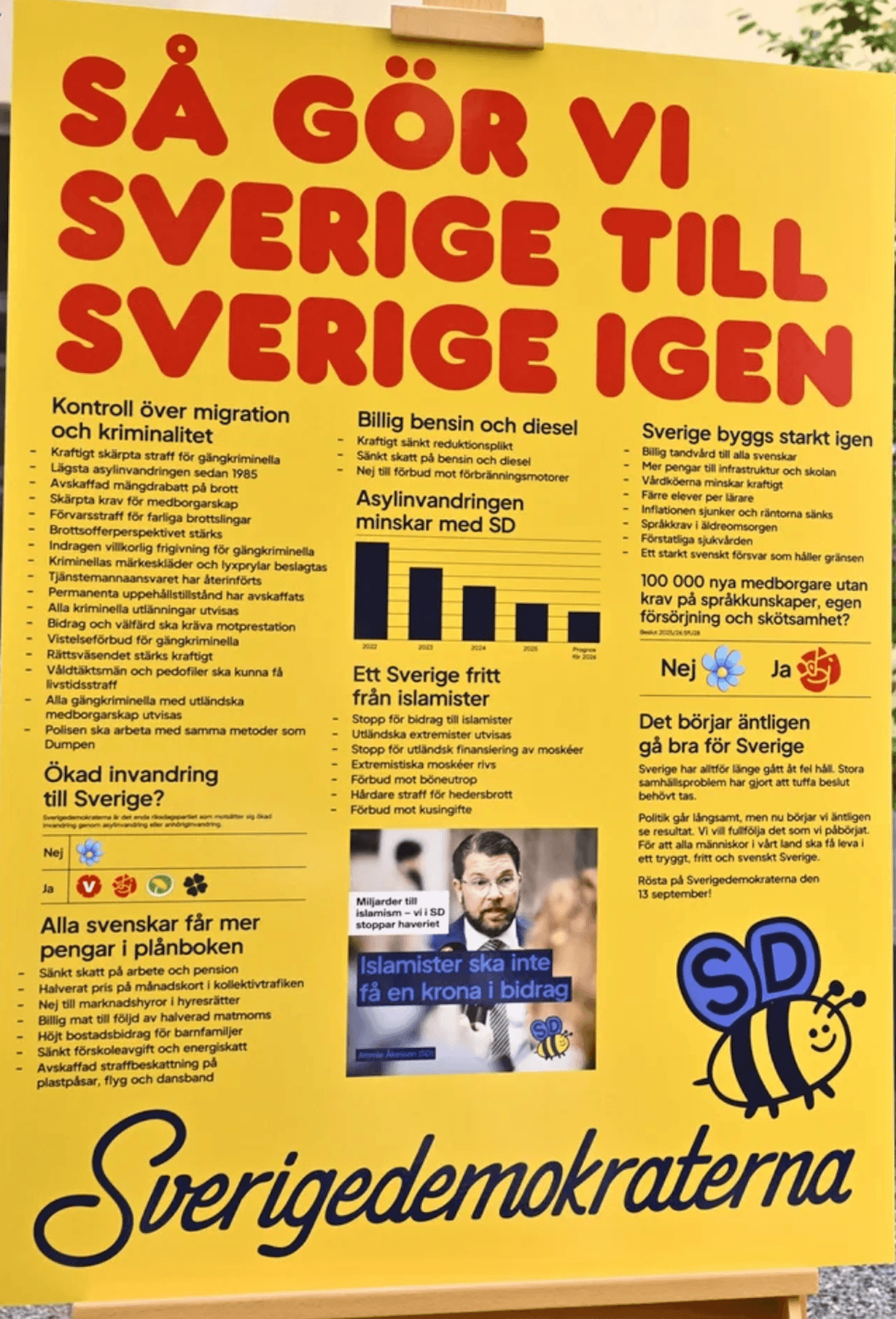
A Sweden Democrats (SD) campaign poster ahead of Sweden’s September 13, 2026 parliamentary elections, featuring the slogan “This is how we make Sweden Sweden again” and highlighting the party’s policies on immigration, crime, Islamism, citizenship, welfare, and the economy.
For as long as I can remember, I have worked for human rights, the rule of law, constitutional and liberal democracy, an egalitarian and just society, and global peace. During my years as a professional journalist and media executive, I likewise sought to defend and advance these values. I vocally opposed every step taken by Erdogan’s government after 2011 as Turkey moved increasingly toward one-man rule and authoritarianism, and I never withheld my criticism. As Erdogan rapidly advanced toward one-man rule and autocracy, as every aspiring dictator does, I became a target of his repression. Because of my criticism centered on democracy, the rule of law, and human rights etc., I was subjected to countless smear campaigns in pro-Erdogan media and on social media, faced dozens of investigations, was repeatedly detained, and was briefly imprisoned.
By 2016, as Erdogan was constructing his autocratic regime step by step and there was no longer room for me to breathe in Turkey, I decided to leave the country. But where should I go? By virtue of my profession, I had by then visited more than 70 countries, including Sweden, and had lived in the United States for several years. Yet the choice for me was not so difficult. I knew that the very values and standards whose absence I had felt in my own country and for which I had struggled—democracy, human rights, transparency, the rule of law, freedom of the press and expression, gender equality, environmental rights and justice, and similar principles—shone most brightly in Sweden, which at the time was widely regarded as a “moral superpower.”
As Turkey fell into the grip of autocracy and Islamofascism, my choice was clear. Sweden stood out as a country in which virtually everything we had struggled, unsuccessfully, to establish and consolidate in Turkey had already become largely institutionalized. If, despite all our efforts, pluralist and liberal democracy, a state governed by the rule of law according to universal standards, an almost exemplary environment for freedom of the press and expression, and similar values would simply not come to us, I believed that it was my most natural right to go to them. Having overcome all the technical obstacles placed in my way by the Erdogan regime, I eventually managed to reach Sweden.
Over the ten years since then, unfortunately, Sweden—like the rest of the world—has changed considerably. Alongside some genuine problems generated by the 2015 migration wave, far-right perceptions of threat were constructed on a scale vastly exceeding the actual magnitude of those problems. In the process, both the social sensibilities that made Sweden the Sweden we knew have been eroded and political actors increasingly influenced by the far right have gradually weakened the country’s once-proud status as a “moral superpower.” Sweden, which one might have hoped would serve as one of the moral barriers against the global drift toward the far right, has itself undergone a far-reaching political transformation in the same direction.
At the center of this transformation are the Sweden Democrats (SD), who increasingly challenge the liberal, pluralist, and inclusive political culture that long underpinned Sweden’s reputation as a “moral superpower.” The ideological core of the SD combines nativism, authoritarianism, and populism, while migration, Islam, national identity, and cultural homogeneity constitute central axes of its political discourse. The party advances a more homogeneous conception of the nation grounded in ethno-nationalism and frames immigrants, particularly Muslims, as potential threats to Sweden’s cultural integrity and welfare state. At this point, however, I should not fail to acknowledge the provocative and highly irresponsible activities of certain Muslim immigrant groups.
Given the SD’s historical roots in Swedish fascism, nazism, white nationalism, and far-right milieus, one of the most consequential changes under Jimmie Åkesson has been the effort to largely free the party from the burden of this past and give it a more legitimate and parliamentary appearance. Yet despite this “normalization” and transformation of its public image, opposition to immigration and Islamophobia have retained their central place in the party’s political discourse. As early as 2009, Åkesson described various phenomena associated with Islam as “the greatest foreign threat to Sweden since the Second World War” and placed Muslims at the center of this threat narrative—one of the most striking manifestations of this ideological continuity.
Although its historical roots extend much further back, in the populist far-right political imaginary represented today by the SD, multiculturalism is portrayed not as a form of pluralism that enriches Swedish society but as a source of social fragmentation and weakening national cohesion. In its place, folkhem—the “people’s home”—is being reasserted. Yet Åkesson’s vision of folkhem differs markedly from Per Albin Hansson’s: it is a tightly integrated society based largely on the ethnic and cultural homogeneity of the native Swedish majority, shared values, and solidarity. Within this understanding, “being Swedish” means more than merely holding Swedish citizenship; immigrants are expected to adapt culturally to “Swedish values” and to the “Christian, democratic world” to which Sweden is understood to belong. The boundary between integration and assimilation consequently becomes increasingly blurred.
Islam and Muslims occupy a distinctive place in this politics of boundary-making. In Åkesson’s discourse, Christianity and its moral values are defined as foundational pillars of folkhem, whereas Islam is frequently portrayed as being in conflict with Sweden’s cultural and social order. The rise of the SD therefore cannot be understood simply as the hardening of immigration policy or the electoral success of a populist radical right party. At a deeper level, it represents a broader political transformation in which Sweden’s “exceptionalism,” built upon consociational democracy, multiculturalism, inclusive citizenship, and pluralism, is increasingly displaced by the normalization of a more closed, assimilationist, and ethno-culturally homogeneous vision of Sweden.
Many racist and far-right positions that were once considered shameful, or even unacceptable, within mainstream politics when the SD was founded have today become substantially normalized. The breaking of the cordon sanitaire surrounding the SD in 2022 did more than open greater political space for the party’s far-right and ethno-populist positions. In exchange for its external support for the coalition government formed by the center-right parties, the extensive policy agenda it secured through the Tidö Agreement gave the SD extraordinary influence over government policy. Discourses once regarded as unacceptable and incompatible with the Sweden we knew have, through the Tidö Agreement, become part of government policy and mainstream political debate. Changes to migration and terrorism legislation over the past four years, measures that have generated debate over press and freedom of expression, and new political orientations concerning gender equality have made the question of whether Sweden is steadily moving away from the Sweden we knew all the more pressing.
It is precisely here that the central irony of the SD’s promise to “making Sweden Sweden again” lies. Sweden’s extraordinary international prestige was not built merely on prosperity and effective governance. It was also grounded in liberal democracy, openness, multicultural accommodation, gender equality, strong minority rights, and an inclusive conception of citizenship. Despite certain notable deteriorations in some international indicators amid initiatives moving in the opposite direction—initiatives spearheaded by the SD—international indices show that significant parts of this institutional architecture, thankfully, remain resilient today.
The Sweden Democrats, however, offer a different answer to the question of what Sweden should be. Their political project places more restrictive immigration policies, assimilation, cultural homogeneity, and the preservation of a particular Swedish national identity grounded in ethnicity at the center of political belonging. Particularly significant is the increasingly hard-line approach toward Islam and Muslims: legitimate debates that need to be conducted about radical Islamism and problems of integration can, at times, become intertwined with broader Islamophobic narratives that treat the very presence of Muslims as a cultural threat. Opposition to multiculturalism similarly imagines social cohesion not through pluralism but through a greater degree of cultural—and implicitly ethnic—homogeneity.
Sweden now heads back to the polls on September 13 after four years of the Tidö experiment and this broader transformation. The latest polling indicates a clear advantage for the opposition. Across the four most recent major surveys, the opposition’s lead over the Tidö bloc ranges from 3.7 to 10 percentage points, while the weighted polling average as of August 27 indicates an opposition advantage of approximately seven points. Together, S, V, MP, and C stand at roughly 52.6 percent, compared with approximately 45.7 percent for SD, M, KD, and L. Moreover, with the Liberals hovering around 2 percent—well below the 4 percent parliamentary threshold—the parliamentary arithmetic becomes even more difficult for the Tidö bloc.
The SD, once excluded behind a cordon sanitaire, is no longer content merely to pull the Tidö parties toward the far right from outside government. It now openly expresses its ambition to enter government directly, demanding key ministerial portfolios. With a Trumpian slogan, it tells voters how, over the past four years, it has “made Sweden Sweden again” from outside government and now seeks a mandate to push its nativist, ethno-nationalist, populist, anti-Islam, and anti-immigration etc. policies even further.
Yet what made the Sweden we knew distinctly Swedish was neither racism, the legacy of neo-Nazi politics, nor opposition to multiculturalism. If there is genuinely an ambition to “make Sweden Sweden again,” the Sweden worth remembering is the Sweden of Per Albin Hansson’s folkhem ideal, Tage Erlander’s democratic welfare state, and Olof Palme’s egalitarian, internationalist, and human-rights-centered political legacy. The question facing Swedish voters on September 13, therefore, is not simply who will form the next government. The more fundamental question is this: “Making Sweden Sweden Again”—but which Sweden? And what will the Sweden the world came to know as a “moral superpower” have to sacrifice for the Sweden that the SD is now seeking to create?
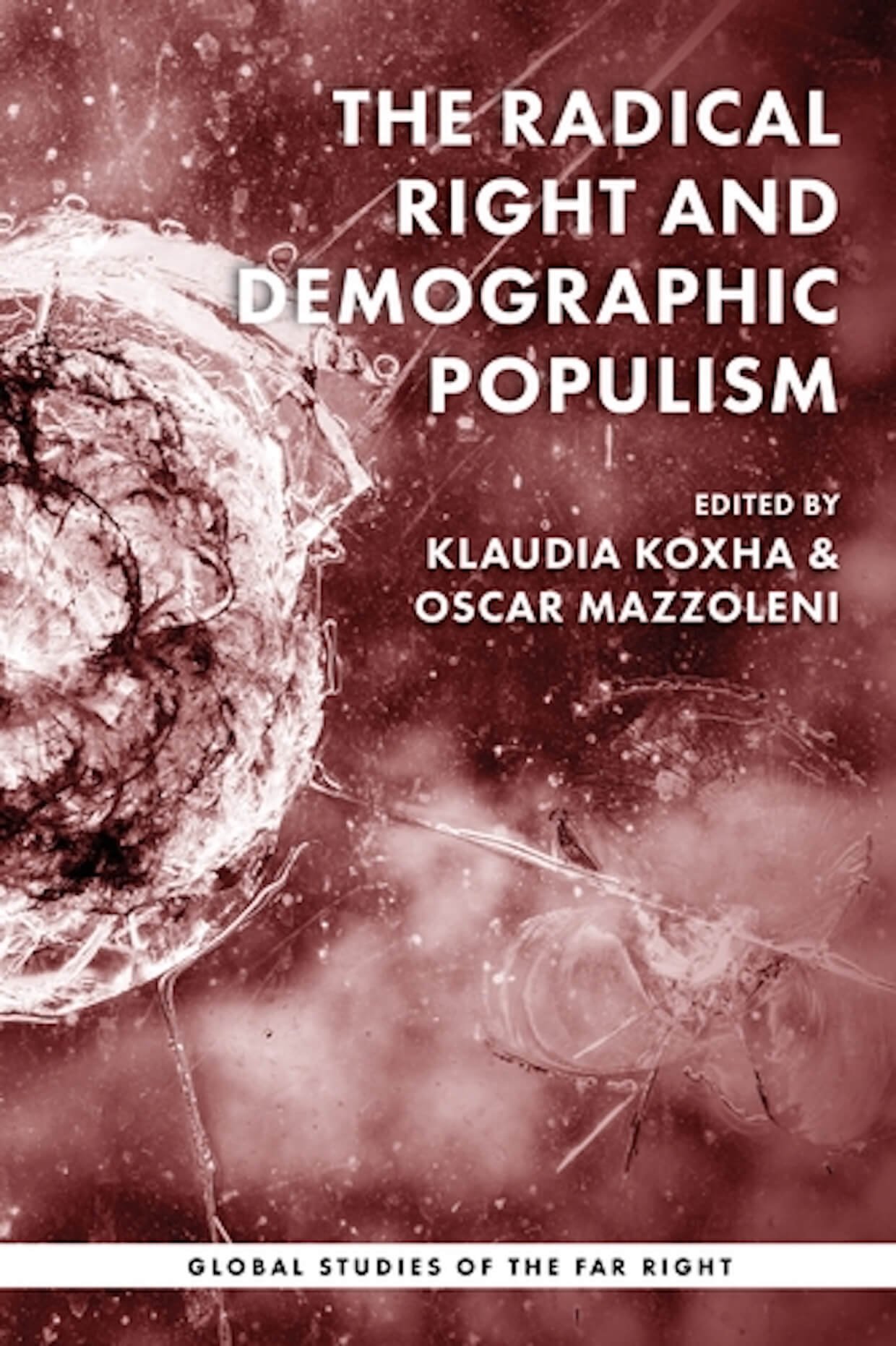
In this interview, Professor Oscar Mazzoleni and Dr. Klaudia Koxha, editors of the recently published volume ‘The Radical Right and Demographic Populism,’ examine how contemporary populist radical right politics increasingly connects immigration, fertility, gender, family, religion, and national identity through the politics of demographic survival. They conceptualize “demographic populism” as a framework linking cultural survival to biological reproduction and transforming demographic change into an existential political struggle. The discussion explores demographic weaponization, conspiracy narratives, Fratelli d’Italia’s calculated ambivalence, and generational adaptations within the Austrian Freedom Party’s youth organizations. Moving beyond Europe, Professor Mazzoleni and Dr. Koxha also address transnational diffusion, political sovereignty, aging, migration, labor shortages, and AI, highlighting how demographic transformations may create new opportunities for populist radical right mobilization while posing significant challenges to democratic resilience.
Contemporary populist radical right (PRR) politics increasingly organizes questions of immigration, fertility, gender, religion, family, and national identity around a common concern: the demographic reproduction of “the people.” In this ECPS interview, Professor Oscar Mazzoleni of the University of Lausanne and Dr. Klaudia Koxha (a Postdoctoral Fellow at the University of Lausanne), editors of the recently published volume The Radical Right and Demographic Populism, explain how this convergence can be understood through the concept of “demographic populism.” As Professor Mazzoleni puts it, issues conventionally treated as separate increasingly converge on a fundamental political question: “Who is entitled to reproduce the true people?” Demographic populism, he argues, reveals how anti-immigration, anti-gender, and pronatalist claims can share “a single Manichean logic of demographic survival versus extinction.” Dr. Koxha sharpens this argument, explaining that “cultural survival” becomes tied to “the biological reproduction of a specific people with specific characteristics.”
The interview begins by developing this conceptual intervention and distinguishing demographic realities from their political weaponization. Aging, declining fertility, and migration are genuine policy challenges, Dr. Koxha stresses; what distinguishes populist radical-right politicization is the question of whose reproduction constitutes the desirable demographic future. This is how demographic change becomes “existential and moralized.” Professor Mazzoleni similarly identifies “demographic weaponization” as central to understanding how statistical and social transformations are reframed as political struggles over collective survival. Their approach consequently bridges populism studies and critical demography, treating demography simultaneously “as a set of conditions and as a political frame.”
The discussion then turns to how demographic populism operates in concrete political settings. Professor Mazzoleni examines Giorgia Meloni’s Fratelli d’Italia, arguing that governmental participation has encouraged not straightforward ideological moderation but “more sophisticated strategies.” Through calculated ambivalence, coded references to “demographic winter,” and a division of discursive labor, radical ideas can be maintained while communication is adapted to broader audiences. In this formulation, demographic populism shifts the perceived threat “from political and economic dispossession to biological and cultural survival,” while immigration becomes embedded within a wider master frame encompassing natality, family, welfare, and religion.
Dr. Koxha’s analysis of the Austrian Freedom Party’s (FPÖ) youth organizations then introduces a generational dimension. While youth branches reproduce core radical-right positions, they adapt them to young people’s concerns and can sometimes “radicalize it further.” Yet Dr. Koxha also identifies greater internal heterogeneity than might be expected, particularly regarding religion, abortion, and LGBTQ+ issues. Crucially, declining religiosity does not necessarily entail rejecting cultural Christianity, which can instead operate “as a marker of national or civilizational identity.”
Finally, the interview broadens comparatively to transnational diffusion, sovereignty, demographic decline, migration, labor shortages, and artificial intelligence. Professor Mazzoleni argues that these transformations “can create a structure of opportunities for radical-right populism,” while Dr. Koxha highlights the political contradiction whereby migration can simultaneously be a practical response to aging and be reframed as evidence of “demographic displacement.” The democratic challenge, she concludes, is to confront the material consequences of demographic transformation without accepting that demographic change necessarily entails “cultural extinction” or that “one group’s security requires another’s exclusion.”
Here is our interview with Professor Oscar Mazzoleni and Dr. Klaudia Koxha, edited lightly to enhance clarity, readability, and overall flow for publication.
Who Is Entitled to Reproduce the True People?
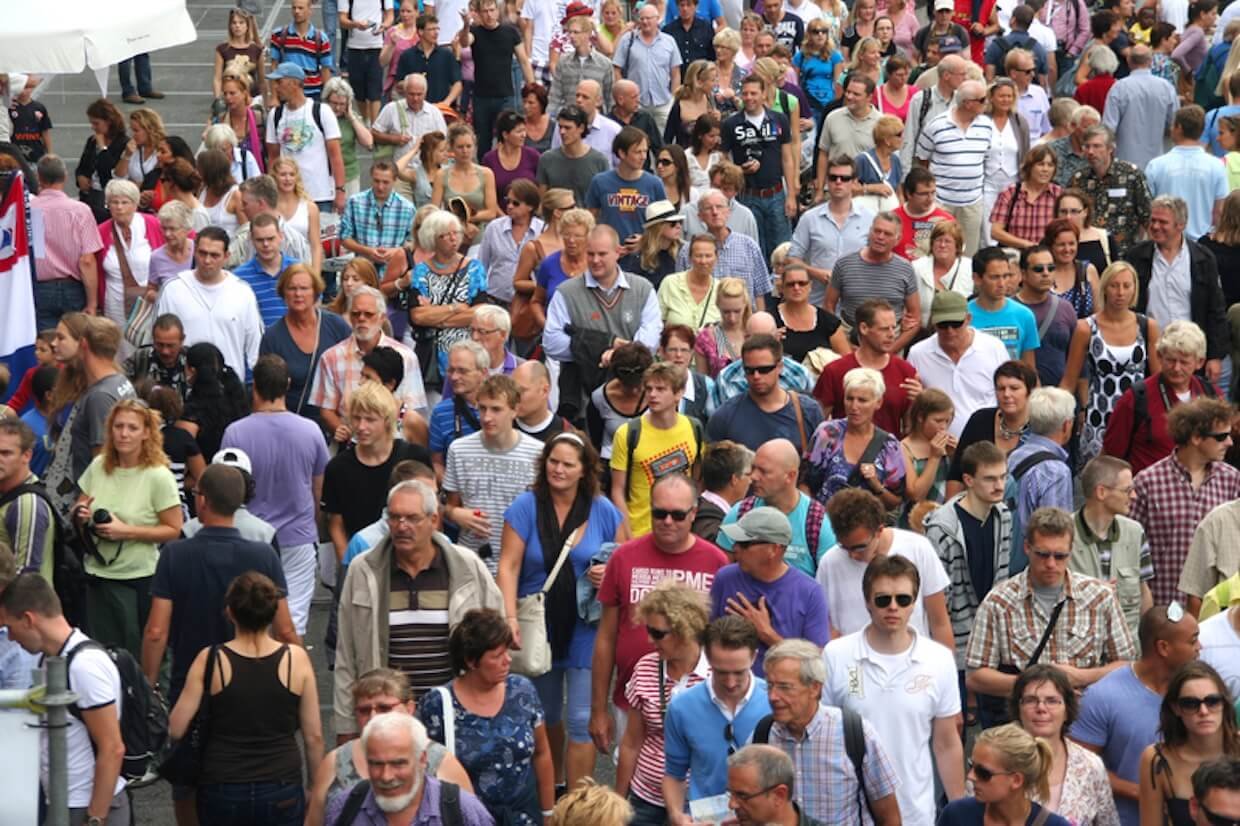
Crowds gather along the quay to visit tall ships during Sail 2010 in Amsterdam, the Netherlands, on August 19, 2010. Photo: Jan Kranendonk.
Professor Oscar Mazzoleni and Dr. Klaudia Koxha, welcome! Throughout the book, you argue that immigration, fertility, gender, religion, LGBTQ+ rights, and family politics should not be studied as separate cultural issues but as interconnected elements of what you call ‘demographic populism.’ What convinced you that existing theories of populism were no longer sufficient to explain these developments, and what analytical blind spots does your concept overcome?
Professor Oscar Mazzoleni: Scholarship usually treated immigration, gender, religion, and family as separate cultural issues, also when we talk about populism, largely because of disciplinary divisions, and read them through the cultural backlash lens alone. What convinced us otherwise was recognizing that all these issues converge on one question: Who is entitled to reproduce the true people? Demographic populism overcomes the blind spot of separating nativism from reproduction, showing that anti-immigration, anti-gender, and pronatalist claims share a single Manichean logic of demographic survival versus extinction.
Dr. Klaudia Koxha: I would just briefly contextualize what this means in terms of the research that we know so far. Exactly as Oscar mentioned, research already tells us about how radical right populist parties engage with these topics separately. They started out with immigration, with these positions against non-native others, the cultural others. Then we learned how their agenda expanded and how gender equality, LGBTQ+ advocates, or advocates of diverse forms of family, of religious tolerance, etc., can become sources for fueling this typical Manichaean logic.
So, the proponents of such diversity become enemies to the people in the populist logic. However, these are not just different sources that fuel the Manichaean logic. If we put them together in one common framework, which is ‘demographic populism,’ they reveal exactly the demographic logic that Oscar just mentioned. In other words, the cultural survival, which is what these parties had been mostly politicizing, becomes tied to the biological reproduction of a specific people with specific characteristics.
Demographic Change Becomes Existential and Moralized
Your framework suggests that demographic change is not politically consequential by itself; rather, it becomes politically powerful once interpreted through narratives of existential threat. How should scholars distinguish between legitimate democratic debates about demographic trends and the populist politicization of demography?
Dr. Klaudia Koxha: The book is really clear that demographic developments are real. So, when we talk about aging, fertility decline, migration, these are legitimate policy questions. We also know that welfare regimes or pension systems depend on such characteristics. Societies try to hold on to these systems by partly relying on migration, a younger population, which is usually the active labor force. Then some of these migrants eventually form families, and this can help to offset aging populations. At the same time, we also see discussions across societies about how to support young working couples to form families, women to reconcile work and family life, so that they can have the means to follow their careers, provide for themselves, for the children. So, we have these different discussions around demographic change, and this is the broader aspect.
But for the populist radical right, these alternatives are not considered as solutions in themselves, because the populist radical right specifically asks: Who are these people, this active labor force that we need to support our welfare regimes, our pension systems, etc.? Who are these prospective families that will support our systems and push back aging populations?
Here we see the continuity for the radical right is on the so-called native population. So, the disagreement isn’t whether aging or fertility decline exists, but we go back to what Oscar mentioned in the first question: Whose reproduction is imagined as the desirable solution? And this is how demographic change becomes existential and moralized.
Professor Oscar Mazzoleni: It’s important to underline the point that demographic weaponization is the key point. So, demography is at the center, it becomes at the center of political battle, in which radical right populism is a clear and an important actor, shaping and reshaping demography as a political issue. Of course, demography is, for demographers, about fertility, about immigration, is about statistics of these dynamics, but this aspect can be demographically framed in a specific way. This is exactly what radical right populism tries to do.
Demography Is Both a Set of Conditions and a Political Frame
One of the book’s most important contributions is its attempt to bridge populism studies with critical demography. Do you see this as the beginning of a new interdisciplinary research agenda, and what questions should future scholars prioritize?
Professor Oscar Mazzoleni: Yes, of course, we try to open an interdisciplinary agenda. Critical demography’s attention to power relations behind births, fertility, mortality, and migration allows us to treat demography simultaneously as a set of conditions and as a political frame. Future research should prioritize the supply-side link between populism and conspiracy, the appeal of demographic weaponization among specific groups—youth, women, rural voters—and its institutional and policy effects on democratic resilience.
Dr. Klaudia Koxha: I don’t have anything to add to that. I guess exactly the last point, particularly, is interesting on the demand side: When and why do citizens of different societal groups accept these otherwise separate issues as parts of one whole demographic thread?
Demographic Populism Is No Longer Confined to the Radical Right
You conclude that demographic populism increasingly connects conspiracy theories with mainstream party politics. Does this suggest that conspiracy thinking has evolved from a fringe phenomenon into a governing logic of parts of the contemporary radical right?
Professor Oscar Mazzoleni: Yes, this is a key point: demographic populism is not just about the radical right. It could be mainstream; it’s part of the contemporary discussion about the demographic winter. It’s not just about the radical right. Conspiracy can be a mediation or a fuel for this kind of increasing interest and use of demographic populism. This is an important point that we try to underline in the conclusion.
Dr. Klaudia Koxha: I think it’s exactly that—the amplification, maybe we could put it. It’s a complementary amplification force for populism. Because what conspiracy does is it adds this intentionality. So it’s not just a populist anti-elite discourse that relies on some sort of elite that looks after its own interests, but the conspiracy also adds this dimension of the elite deliberately undermining the people. So it’s like a deliberate choice, and this is how, like Oscar mentioned, conspiracy becomes an amplifier, in some ways, for populism.
Calculated Ambivalence Allows Moderation and Radicalism to Come Together
A poster for the 2024 European elections featuring Italian Prime Minister Giorgia Meloni in Rome, Italy on May 4, 2024. Photo: Stefano Chiacchiarini.
Dear Professor Mazzoleni, in your chapter on Fratelli d’Italia, you argue that the party has successfully reconciled governmental responsibility with radical-right ideology through ambivalent populist and conspiratorial discourse. Why has ambiguity become politically more effective than explicit radicalism?
Professor Oscar Mazzoleni: Relevant parties in government face a trade-off between demarcation and accommodation, between the capacity to maintain radicalization and to integrate into the system. At the same time, they must retain radical support without losing moderate voters and coalition allies. So, it’s important to consider this trade-off, not just unethical or moral issues. It’s a question of electoral survival and electoral success. So, calculated ambivalence—this concept came from Ruth Wodak, the specialist in sociolinguistics—resolves this by producing, in the discourse, assumed associations between contradictory meanings.
This is not just anecdotal, but it’s based on a strategy, trying to cope with different audiences, decoding that there are different expectations. Because parties are not unitary actors, that’s also important. Intra-party, intra-leader ambivalence lets moderation and radicalism come together, normalizing controversial claims while avoiding public condemnation. Because we have this party needs to be in the system and they sometimes reproduce anti-establishment stances. With this kind of calculated ambivalence, and with many discursive tools, they try to do that. We show that Fratelli d’Italia is able, during the first part of the government coalition period, to achieve this kind of ambivalence strategy.
Fratelli d’Italia Adapts Its Communication While Maintaining Radicalization
Your analysis suggests that Fratelli d’Italia rarely invokes the Great Replacement theory directly, preferring coded demographic language instead. Does this represent ideological moderation, or simply a more sophisticated communication strategy aimed at broader electoral legitimacy?
Professor Oscar Mazzoleni: Primarily, more sophisticated strategies, not ideological moderation. Meloni’s manifesto and speeches drop ethnic substitution in favor of demographic winter, so trying to have a kind of mainstream label, while ministers of Fratelli d’Italia inside the government led by Meloni, such as Lollobrigida, Roccella, and others, voice fuller conspiratorial versions of Great Replacement.
So, they resonate with Great Replacement theory, and it is important to underline this division of discursive labor + de-racialization. This question of Great Replacement theory is strongly connected with racial issues, but also denialism and euphemism allow the Great Replacement, for itself, to survive intact behind a government facade. That’s important in the sense that these discursive tools are able to adapt communication, maintaining radicalization by the party.
Demographic Populism Shifts the Threat to Biological and Cultural Survival
You have written extensively on populism for many years. Compared with earlier waves of European populism, what is genuinely new about demographic populism? Is it primarily an ideological transformation or an adaptation to new electoral realities?
Professor Oscar Mazzoleni: It’s important to say that populism is the defense of the true people, in terms of discursive claims—a true people under threat by different kinds of external powers. This deals with sovereignty, of course, political sovereignty, economic prosperity, and anti-establishment protests. Demographic populism shifts the threat from political and economic dispossession to biological and cultural survival.
In a sense, it’s both an ideological transformation and an adaptation to new electoral realities, trying to cope with new, emerging demands. It’s an ideological revival in which demography becomes the symbolic battlefield of the radical right’s long counter-revolution against LGBT rights, feminism, and so on. At the same time, it’s an adaptation to declining birth rates, aging, and migration, which are part of a broader demographic transformation in many countries, especially European ones, but not only.
In a sense, it’s both an ideological transformation and an adaptation to new electoral realities, trying to cope with new, emerging demands. In this sense, it’s an ideological revival in which demography becomes the symbolic battlefield of the radical right’s long counter-revolution against LGBT rights, feminism, and so on. At the same time, it is an adaptation to declining birth rates, aging, and migration, which are part of a broader demographic transformation in many countries, especially European ones, but not only.
It is interesting to say that, unlike interwar genetics in the past, today’s version is civilizational and culturally racist, rather than openly biological. It’s important to connect this aspect with biology and culture, and try to introduce this kind of demographic populism as able to frame the entire discourse nowadays by the radical right.
The Great Replacement Reframes Anti-Immigration Politics Demographically
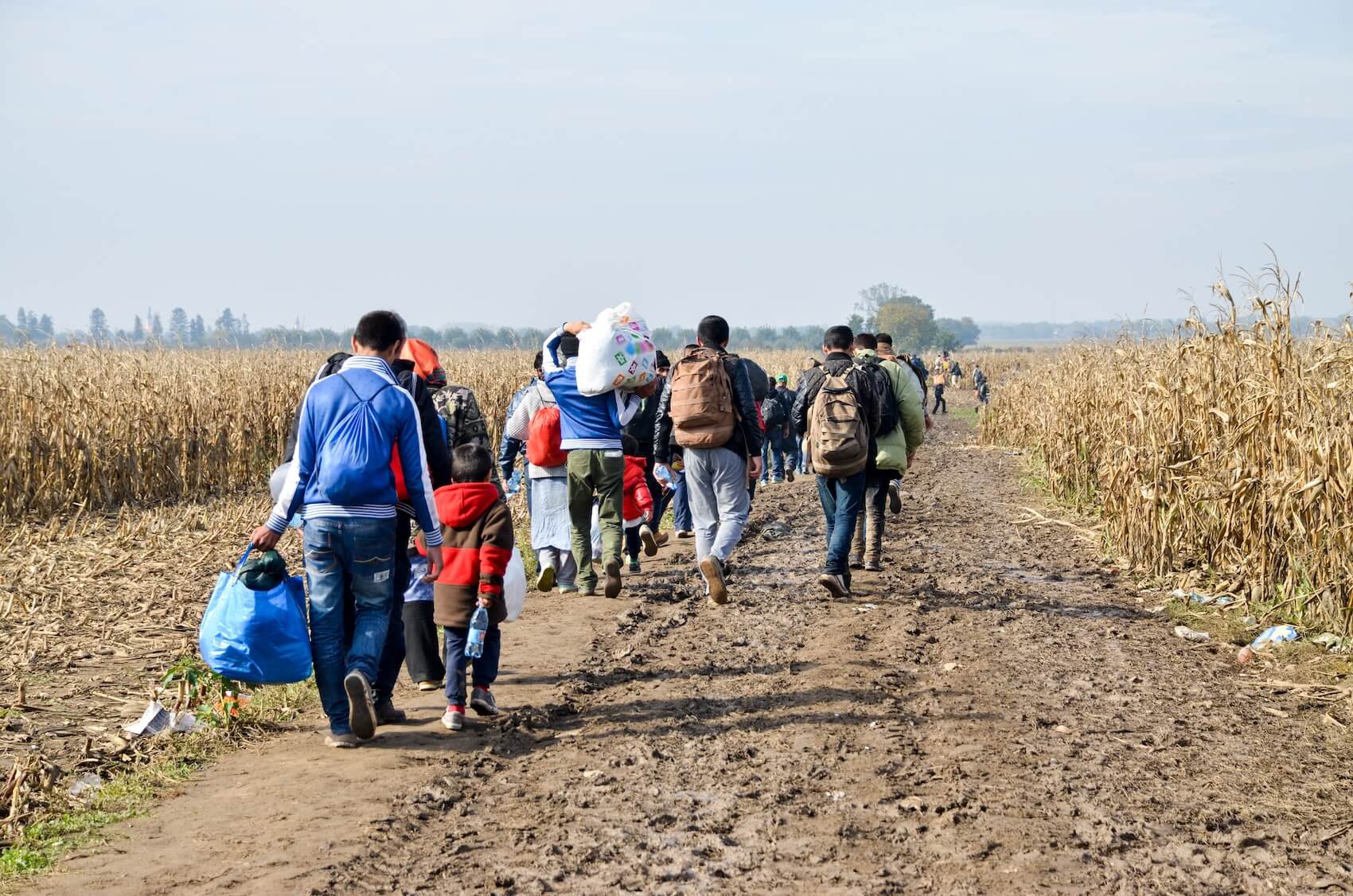
A group of war refugees walks through a cornfield on the Serbia-Croatia border on November 3, 2015, as they seek passage to the EU. Many are Syrian refugees fleeing conflict. Photo: Ajdin Kamber.
Many populist radical-right (PRR) parties increasingly combine welfare protection, national sovereignty, and family policies into one political package. Is demographic populism gradually replacing immigration as the master frame through which these parties organize their broader ideological projects?
Professor Oscar Mazzoleni: Immigration remains central, according to this book, but is increasingly subsumed, integrated within a demographic master frame that links natality, family, welfare, and religion. The Great Replacement is precisely the device through which anti-immigration stances are reframed demographically. So, rather than substitution, we observe absorption, integration. Immigration becomes one variable in a broader ideological project about who reproduces the nation and under what moral authority. The nation is the people, and these people and the nation are to be built under a specific moral authority—of course, the traditional family.
Youth Branches Adapt Radical-Right Politics to Generational Concerns
Dear Klaudia, your chapter examines how the youth organizations of the Austrian Freedom Party reinterpret demographic issues through specifically generational concerns. What surprised you most about the differences—and similarities—between youth activists and the senior party leadership?
Dr. Klaudia Koxha: First of all, the similarities were actually quite strong, because the youth branches do reproduce the FPÖ’s anti-immigration, anti-gender diversity, climate-skeptic positions. The difference is specifically in the generational framing. So, if the senior party tends to emphasize security, sovereignty, civil liberties, economic stability, youth branches emphasize how these issues supposedly affect young Austrians, in particular, and their future.
But to be quite frank, it was not this alignment between the youth branches and the senior party regarding core ideological positions, or this generational framing, that surprised me about the findings. What really, really struck me instead was some intra-youth variation regarding topics such as LGBTQ+ rights, abortion, or the role of the church. Now, I wouldn’t overstate this variation based on the data set, because it’s quite subtle. But it did make me think that there’s probably much more heterogeneity within radical-right youth than we tend to assume.
Being Less Religious Does Not Mean Rejecting Cultural Christianity
Young people are statistically less religious and often more socially liberal than older generations. Yet your research suggests that radical-right youth organizations remain highly receptive to demographic narratives. What explains this apparent paradox?
Dr. Klaudia Koxha: The question ties quite nicely to the point I made in the previous answer regarding this heterogeneity within youth branches. Religion, for instance, is also rather inconsistent across the youth branches. We see, for example, anti-abortion discourse as largely absent, except in Vienna. There are inconsistencies also when it comes to LGBTQ+ issues. Sometimes they’re silenced, sometimes they’re moderated. So, the youth branches don’t simply reproduce every conservative issue equally.
At the same time, they do remain strongly receptive to anti-immigration narratives and can instrumentalize gender equality against Muslim migrants. Regarding your point about the paradox, I think there’s a distinction that might help explain it. Being less religious does not necessarily mean that you reject cultural Christianity or nativist identity politics. Christianity here can also function as a marker of national or civilizational identity, rather than primarily as a religious practice.
Classical Nativism Is Underneath Demographic Populism
Your findings indicate that youth activists frame migration not only as a cultural issue but also as competition over education, employment, and future opportunities. Does demographic populism therefore represent a generational adaptation of classical nativism rather than a fundamentally new ideology?
Dr. Klaudia Koxha: Clearly, classical nativism is underneath it, so I would not claim that demographic populism is this entirely new ideology. But its analytical value is precisely in showing how different issues become connected. As you mentioned, in my chapter, migration is linked to education, to employment, to gender, to family, to youth, and ultimately to demographic survival, by focusing on the so-called native youth as, basically, the agents of reproduction of a specific kind of people. Moreover, Great Replacement also, as a way of thinking, extends beyond migration into gender equality, diversity. In this regard, I would see the analytical value precisely in demonstrating how these different issues can be connected together in the framework of demographic survival.
Youth Branches Can Reproduce Party Ideology and Radicalize It Further
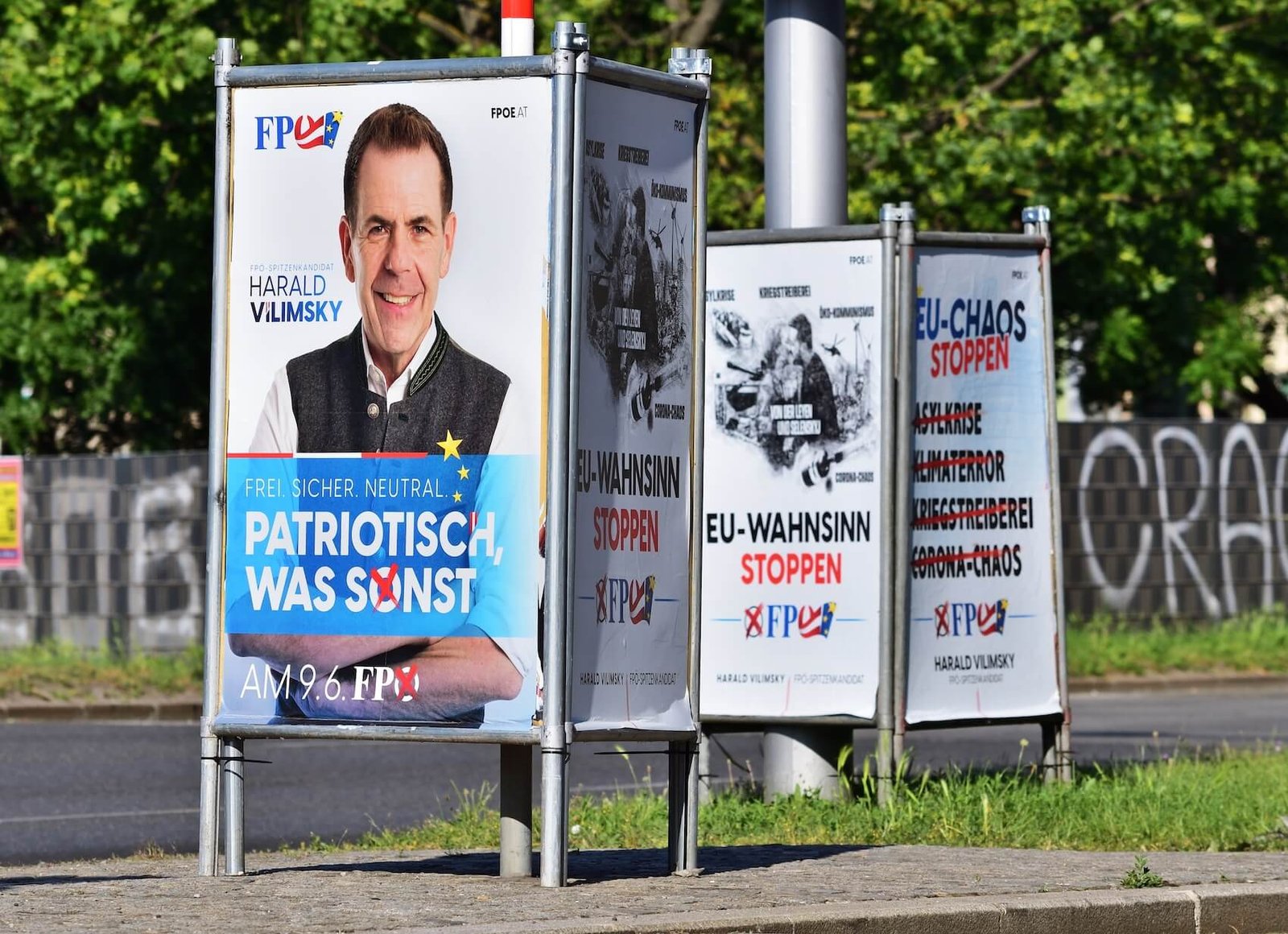
European Parliamentary election posters of the FPÖ in Vienna, Austria, on May 15, 2024. Photo: Shutterstock.
Youth organizations often function as ideological laboratories for future party elites. Based on your research, do you expect today’s demographic narratives to become even more central to tomorrow’s radical-right politics?
Dr. Klaudia Koxha: The chapter in itself does not longitudinally establish that today’s youth discourse becomes tomorrow’s party discourse. That needs to be clear. But it does show that youth branches can and do reproduce party ideology. And what they also do quite well is contextualize it to their cohort and adapt it to generational concerns. Sometimes, even radicalize it further, as we’ve seen in the examples of Vienna or Tyrol, where we saw the most explicit articulations of Great Replacement narratives. For instance, while the central party actually continued to frame immigration more around security rather than these openly conspiratorial framings. This can suggest that youth branches may reproduce party ideology, but also, at times, radicalize it further. This might potentially have an impact on the main party’s discourse over time, but we would have to research that more systematically.
Your volume spans Europe as well as North and South America. Despite these different historical contexts, remarkably similar demographic narratives appear across countries. Are we witnessing policy diffusion between radical-right actors, or do these narratives emerge independently in response to similar social anxieties?
Professor Oscar Mazzoleni: Both, and they reinforce each other. Similar anxieties related to structural transformation, declining fertility, aging, secularization, shrinking white or Christian majorities arise independently. However, they only become politically powerful once framed and mobilized by political actors. So, transnational infrastructures, such as the World Congress of Families, are relevant for the radical right across the world. US-Russia anti-abortion cooperation and social media circulation demonstrate deliberate diffusion, including astroturfing that manufactures the appearance of grassroots demand.
Dr. Klaudia Koxha: I would not have much to add. I think the transnational linkages that Oscar mentioned explain it very well, that these are not credential. Just very briefly on what the comparative question is, I would say it is basically how similar narratives are adapted to different national settings. This could be due to these transnational linkages; it could be due to diffusion through social media messaging. The mechanisms are different, but the core issue is how these similar narratives are indeed adapted across different national contexts.
Sovereignty Is Also Based on the Reproduction of the People Exercising It
One of the most striking themes of the book is that demographic populism links biological reproduction with political sovereignty. Does this represent a shift away from classic economic populism toward what might be called ‘biopolitical populism,’ where the central political question becomes who has the right to reproduce the nation?
Professor Oscar Mazzoleni: Of course, the point here is not just to talk about sovereignty as a political dimension, but sovereignty is also based on the reproduction of the people exercising this sovereignty. The question is not just the capacity of the people to respond to the threat in terms of sovereignty, or political sovereignty, but other political dimensions, in terms of elections, in terms of decision-making, but also about the way by which we reproduce ourselves in terms of cultural belonging, national dimension, religious belonging etc. So, that’s important to frame this aspect, because all these dimensions—all diaspora, religion, cultural, national belonging—pass through biological reproduction and the family. The family is considered a pillar of this reproduction of the good and the true people. In this sense, we can we talk about biopolitical populism.
Dr. Klaudia Koxha: I would just add, regarding your question about which concept could work better, that I would still retain demographic populism because, in the end, demographic populism is broader than reproduction alone. It’s not just about who gets to be reproduced and who gets to reproduce the nation, but also about under what moral authority. So, fertility is not simply about fertility; it becomes about what kind of society should continue, and here there are other mechanisms that come into play, like religion, heteronormative views of family, and so on. Therefore, I still consider demographic populism conceptually better able to capture this dynamic.
AI Can Create New Opportunities for Radical-Right Populism
Photo: Dreamstime.
And lastly, looking ahead, demographic decline, population ageing, migration, artificial intelligence, and labor shortages are likely to reshape democratic politics simultaneously. Which of these developments do you believe will most profoundly transform the future of radical-right populism, and how should democracies respond without reinforcing the very narratives they seek to challenge?
Professor Oscar Mazzoleni: I think all these different aspects—aging, labor shortages, also pushed by artificial intelligence—can create a structure of opportunities for radical-right populism. They, of course, help these kinds of actors connect these developments to immigration and pro-natalist policies. In a sense, they can exploit this kind of structural transformation to propose their own demographic populist message. In this sense, I think the response is, of course, about defending gender and reproductive rights and all liberal democratic values, but at the same time, we have to be aware that this kind of defense should also address the structural transformation that I mentioned before.
Dr. Klaudia Koxha: Again, the question ties back to one of the first questions in this interview. Aging societies do need an active labor force. So far, migration has been one way of responding to that. But as we can see, the radical right can simultaneously take the same migration that comes as a solution to aging societies, transform it, and present it as evidence of demographic displacement. This is how the policy response to one demographic challenge—aging populations—becomes framed as another demographic threat, while at the same time, there are policies that actually try to address it through counteraction by relying partly on migration. So, I think this tension is perhaps the most consequential—the interaction between aging, labor shortages, and migration—precisely because of the political contradiction it creates.
I think democracies need to address the real material consequences of demographic change, so this is something that needs to be talked about and addressed, without accepting the premise that demographic change necessarily means cultural extinction. Or that one group’s security requires another’s exclusion. So, those are points that must enter the public debate to have a constructive discussion around the demographic challenges that societies experience.
Professor Oscar Mazzoleni: Can I say something more about the book? Because you stress the point that the book covers different contexts—not just European, but also American and Russian contexts. I think it’s also important to mention the methodological and disciplinary approaches, because we are political scientists and sociologists, and we also have anthropologists. In the book, we also have supply-side and demand-side approaches to these issues.
It’s important to mention these multidisciplinary, multi-method approaches that converge in the book and also in this proposal about demographic populism. There is also intergenerational scholarship in the book, ranging from PhD students to senior scholars. In this project, we really try to bring together different perspectives and, at the same time, create a convergent and common project in order to explain what is happening today in the transformation of radical-right populism.
In this Voice of Youth (VoY) piece, Emaan Zahra examines the intertwined environmental and developmental costs of the rapid expansion of generative artificial intelligence. She argues that AI’s seemingly immaterial convenience rests on resource-intensive infrastructures whose growing demands for freshwater and electricity can intensify environmental pressures, contribute to greenhouse gas emissions, and affect communities surrounding data centers. At the same time, Zahra draws attention to the implications of habitual AI use for children, particularly when technological assistance substitutes for independent learning, critical thinking, creativity, and problem-solving. Connecting these concerns, she presents AI proliferation as a dual challenge for climate sustainability and the intellectual development of younger generations. Zahra calls for greater responsibility from parents, educators, technology companies, and policymakers to establish boundaries that enable technological progress while protecting environmental resources and children’s capacity for independent thought.
By Emaan Zahra
Today, the use of generative artificial intelligence (AI) is growing very fast. This growth creates many serious problems all over the world. To fix these problems, we must look at how AI works behind our screens. AI has quickly become a normal part of daily life for most people. This has created a habit of overusing technology. This constant use hurts the environment and changes how children grow up. While we enjoy the speed of AI, we ignore its real-world costs. In the end, the convenience of AI harms our planet and weakens the thinking skills of the next generation.
The Hidden Environmental Cost of AI
The computers that power AI search engines and chatbots require a massive physical setup. A decade ago, technology companies used simple liquid cooling systems to keep their computers from overheating. These older systems did not require too many resources. However, as millions of people started using AI, computers had to work much harder and faster. To stop their systems from crashing, big tech companies like Microsoft, Google, and Meta now use huge amounts of electricity and freshwater. These companies need perfectly clean water, so their expensive computers do not rust or break. Because AI is so popular today, the demand for these natural resources has skyrocketed.
How AI Drains Local Water Supplies
The huge amount of water used by AI data centers directly hurts local communities. These centers take water from nearby lakes, rivers, and underground supplies. This is the exact same water that families, neighborhoods, and schools rely on every day. Research shows that asking an AI chatbot just 20 to 50 simple questions can use up to one full liter of water. Over time, this adds up to a massive amount. AI cooling systems waste enough water to fill nine Olympic-sized swimming pools every single day. Even worse, 80% of this water turns into vapor and is completely lost to the air. This causes a real water crisis for the people living near these computer centers.
Energy Pollution and Climate Change
Along with wasting water, AI centers need an incredible amount of electricity to stay turned on. Experts estimate that by the year 2030, AI energy needs will increase by 400%. This is the same amount of electricity that the entire United Kingdom uses in a whole year. For example, Google reported that its push into AI caused its total greenhouse gas emissions to rise by 48% compared to 2019. Because most electricity still comes from burning coal, oil, and gas, power plants have released over 30 billion tons of pollution recently. This pollution traps heat, raises global temperatures, and causes worse hurricanes, floods, and climate change.
The Problems with Proposed AI Fixes
Scientists and tech companies have tried to think of ways to fix these problems, but most ideas are not practical yet. One popular idea is to build data centers underwater so the cold ocean can cool the computers naturally. However, salt water is highly corrosive. It can easily leak into the pods and destroy the delicate technology. Another idea is to launch AI data centers into outer space as satellites. While this would save Earth’s water, it is way too expensive and dangerous right now. Space debris and rocket pollution make this a very distant dream. Because these fixes do not work yet, our local environments continue to suffer.
How Environmental Damage Hurts Children’s Health
This damage to nature directly harms the health and safety of young children. To understand this problem, we have to look at a child’s everyday surroundings. The air pollution from burning fossil fuels for AI electricity has caused a rise in lung illnesses among children. Young bodies are still growing, and their lungs are small. This makes them highly vulnerable to bad asthma and permanent lung damage. In addition, climate change ruins crops and alters weather patterns, which causes food shortages and high grocery prices. The invisible power grids that run our apps are creating a physical health crisis for children.
How AI Weakens a Child’s Thinking Skills
At the same time, easy access to AI tools threatens the mental growth and independent thinking of children. When young students let machines do their schoolwork, their brains do not get the exercise they need to grow. Instead of figuring out hard problems, students use AI chatbots to write essays, read stories, and solve math homework. This habit weakens the brain just like a lack of exercise weakens a muscle. If you stop walking, your leg muscles will waste away. In the exact same way, the human brain gets weaker if it is shielded from challenges. Children who rely completely on AI may never learn how to analyze information deeply.
The Loss of Creativity and Memory
The long-term danger of relying on AI is that children lose the ability to spot lies, think of new ideas, and solve problems creatively. Learning these skills takes years of practice and making mistakes without help. Because AI gives perfect answers in a split second, children learn to accept whatever the computer tells them. They do not double-check facts or think critically. Because of this, their knowledge stays very shallow. They do not truly understand what they are learning. This instant gratification loop also shortens attention spans and makes it hard for children to remember things. Instead of learning to think for themselves, kids are trading their brainpower for fast answers.
A Path Forward
The rapid rise of AI creates a double crisis for our environment and our children’s minds. The hidden computer systems behind AI drain vital water supplies and cause heavy air pollution, hurting local families. At the same time, using chatbots as an academic shortcut stops children’s brains from developing properly. To fix this, parents, teachers, and tech companies must work together. We need to set strict limits on how much power AI uses and how children use it in school. Only by setting these boundaries can we protect our planet and keep the next generation smart and independent.
Emaan Zahra is a 16-year-old aspiring student who believes that that the over and unnecessary consumption of AI is very harmful for our minds and climate. She would like to note that she believes that AI should prosper in medical and industrial fields but in ones day to day tasks it should be used as little as possible or not at all. Email: emaanzahra212@gmail.com
Please cite as: Aslam, Muhammad Faizan. (2026). “Mandate Inflation: How Populists Claim Authority to Challenge Global Constraints.” Journal of Populism Studies (JPS). August 24, 2026. https://doi.org/10.55271/JPS000130
Abstract
Populist leaders often say they are restoring popular sovereignty against treaties, courts, trade rules, migration regimes, expert bodies, and international organizations. Yet their behavior toward international order varies. They may withdraw, renegotiate, obstruct, selectively comply, or perform public defiance while remaining inside institutions. This article explains that variation through mandate inflation: a process of turning a vote into a broader political claim in which an election or referendum is recast from a limited permission to govern into wider authority to challenge constraints in the name of the people. A structured comparison of Trump’s ‘America First’ politics, Brexit’s ‘take back control’ discourse, and Viktor Orbán’s conflict with EU constraints shows four recurrent moves: mandate condensation, construction of ‘the real people,’ reframing of constraints as anti-democratic obstruction, and assertion of special authority to act. The argument does not replace material, institutional, or nationalist explanations. It shows how leaders present these strategies as the will of the people; it does not assume that audiences accepted those claims or that rhetoric alone caused policy choices. The article contributes to recent debates on global populism by showing why exit is only one possible outcome of populist constraint politics.
Keywords: Populism, mandate, global governance, international institutions, sovereignty, Brexit, Trump, Viktor Orbán
By Muhammad Faizan Aslam*
Introduction
Populist leaders rarely challenge international order by saying only that a treaty, court or organization is inefficient. They often say something stronger. They argue that constraints on government action stand between the people and democratic control (Dijkstra & Ghassim, 2025). Trade agreements become “bad deals” made by globalist elites (Finbow, 2023). Courts become “foreign” or “unelected bodies.” Migration rules become “imposed commands.” Expert advice becomes “technocratic obstruction.” The point is not only policy disagreement. The point is authority (Wajner et al., 2024).
This creates a puzzle for international relations as populist leaders do not respond to global constraint in a single way. Some withdraw from agreements. Some seek better terms. Some stay inside institutions while blocking decisions. Some comply with parts of a regime while attacking other parts. Some use defiant language even when policy change is limited. Recent research on global populism has made this variation clear (Pacciardi et al., 2024; Wajner & Giurlando, 2024). It has also shown that populist foreign policy is now a serious research programme rather than a side question for domestic politics (Ozdamar & Yanik, 2024; Wajner & Giurlando, 2024). What remains underdeveloped is the democratic authorization mechanism that makes such varied strategies appear legitimate to supporters.
This article calls that process of turning a vote into a broader political claim “mandate inflation.” Mandate inflation is the process through which a populist leader recasts an election or referendum from a limited permission to govern into a wider claim of authority to challenge, override or rewrite constraints in the name of the people. The concept is deliberately narrow. It is not a synonym for nationalism, anti-globalism, sovereignty talk or ordinary treaty renegotiation. It is present when four claims appear together: a complex vote is condensed into one clear mandate; that mandate is attached to “the real people”; international or EU-level constraints are described as illegitimate barriers to that people; and the leader claims authority to act against those constraints. Mandate inflation is therefore observed in actors’ claims; whether those claims generate public acceptance or independently cause policy outcomes is a separate empirical question.
The argument matters because global constraints are not self-explanatory objects, and their political effects depend on observable factors such as legal form, institutional location, economic impact and domestic visibility. They can be legal commitments, institutional procedures, market pressures, treaty obligations, policy standards, rights regimes or expert rules. Many have been voluntarily accepted by elected governments. Some are popular because they provide security, market access, rights protection or credibility. Others are weakly accountable, socially unequal or politically remote. Populist leaders exploit this mixed character. They do not need to prove that a constraint is legally invalid. They need to make it look democratically suspect (Ecker-Ehrhardt et al., 2025; Tallberg & Zürn, 2019).
This is why the argument avoids a simple defense of global governance. It does not assume that international institutions are always democratically healthy or that popular control is a false problem. Many voters experience international commitments through job loss, austerity, migration pressure, border disputes, legal complexity or distant expert language (Bellodi et al., 2024; Scheiring et al., 2024a). The issue is not whether these concerns should be dismissed. The issue is how a leader turns them into an exclusive claim to speak for the people against constraints that may also have democratic authorization of their own.
This article compares three cases: Trump’s “America First” politics, Brexit’s “take back control” discourse and Viktor Orbán’s confrontation with EU constraints. The cases are not treated as identical. Trump shows presidential mandate inflation in a great power setting, with exit, renegotiation and symbolic defiance. Brexit shows how a referendum can be converted into a mandate to leave a regional legal order. Orbán shows that mandate inflation can also work from inside an institution through obstruction, selective compliance and public defiance. The cases vary by mandate source, institutional location and strategy toward constraint. This variation is useful because the argument does not predict one outcome. It explains how different strategies are justified through a similar claim about the people. The relevant actors are the Trump administration, the Leave-to-government coalition centered on the May government, and the Orbán government; campaign rhetoric, official government claims, legal acts and institutional responses are treated as distinct forms of evidence.
The article makes three contributions. First, it adds a mechanism to recent work on populism and international affairs. Existing scholarship shows that populist governments affect foreign policy, international institutions, trade, migration, security and world order visions in uneven ways (Brusenbauch Meislova & Chryssogelos, 2024; Destradi & Plagemann, 2024; Wajner & Giurlando, 2024). Mandate inflation explains how this unevenness can still share a common democratic grammar. Second, it connects populism research to work on international institutions and unilateral challenges. Institutions face not only legal non-compliance, but also domestic struggles over whether their constraints count as legitimate democratic commitments (Walter & Plotke-Scherly, 2025). Third, it separates voter-side causes from leader-side authorization. Economic insecurity, status grievance, territorial loss and backlash against globalization may help explain why populist appeals resonate(Carter & Pop-Eleches, 2025; Koenig & Mendelberg, 2026; Scheiring et al., 2024b). They do not by themselves explain how leaders turn a vote into authority to contest courts, treaties or international organizations.
The article proceeds in five steps. It first places the argument in recent literature on global populism, foreign policy and international institutions. It then defines “mandate inflation” and its boundary conditions. The empirical sections trace the mechanism in the United States, the United Kingdom and Hungary. The comparative discussion explains why the same authorizing logic supports different strategies toward constraint. The conclusion draws implications for scholars and policy practitioners who face populist challenges to global governance.
In this reflective Voice of Youth commentary marking Rohingya Genocide Remembrance Day on August 25, PS Ayaas, a young Rohingya writer, activist, and community advocate, examines the enduring relationship between genocide, statelessness, exclusion, and political belonging. Drawing on the Rohingya experience, Ayaas argues that the 2017 violence cannot be separated from decades of citizenship restrictions, majoritarian nationalism, and narratives that constructed a minority population as an alien “other.” He connects this history to broader debates on populism, showing how exclusionary definitions of the “people” can normalize discrimination and undermine democratic protections. Moving beyond remembrance, Ayaas calls for accountability, equal rights, recognized education, sustainable livelihoods, meaningful Rohingya participation, and conditions for voluntary and dignified return. His central message is unequivocal: remembrance must become responsibility, and belonging must never be conditional.
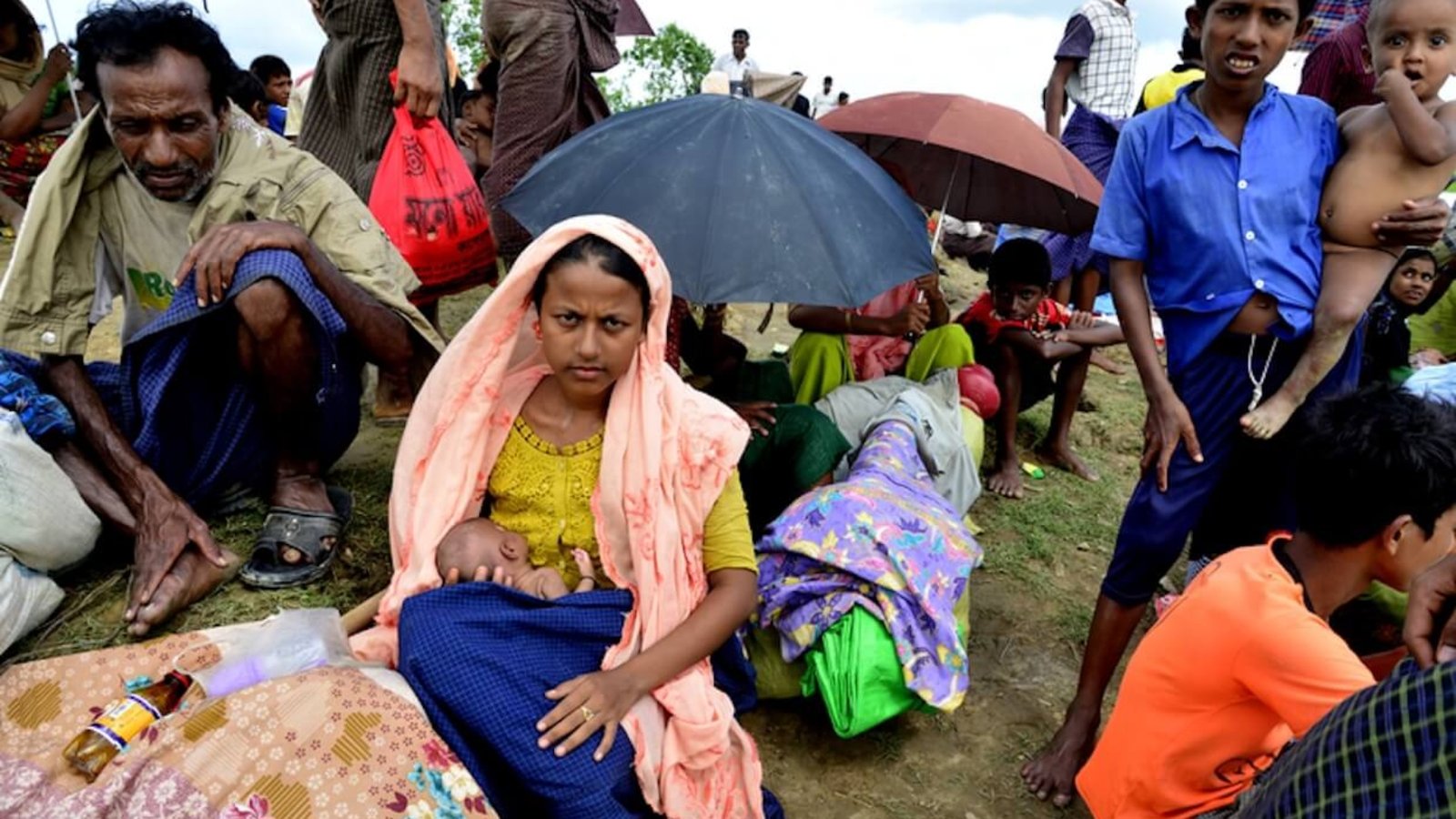
Every August 25, I remember a day that did not end when the gunfire stopped. For Rohingya families, August 25 is not simply a date in history. It is carried in memory: in the stories of parents, in the names of villages, in photographs saved after flight, and in the silence that sometimes follows a question about home. I was still a child when I first understood that leaving home could mean never knowing when, or whether, you would see it again.
Rohingya communities mark August 25 as Genocide Remembrance Day to honor those who were killed, those who survived, and those who continue to live with displacement. But remembrance also asks a harder political question: how did an entire population come to be treated as if it did not belong?
From Violence to Exclusion
The violence of 2017 cannot be understood as an isolated eruption. It emerged from a much longer history of legal, political and social exclusion. Rohingya communities in Myanmar faced restrictions on citizenship, movement, education, marriage and livelihoods long before the mass displacement of 2017.
The UN Independent International Fact-Finding Mission on Myanmar documented the scale and systematic character of abuses committed during the 2017 military operations. It reported that more than 700,000 Rohingya fled to Bangladesh and documented killings, sexual violence and the burning of villages. UN human-rights investigators also recorded patterns of violence and deliberate actions that created fear and drove Rohingya civilians from their homes.
This history matters because genocide does not begin only when the world sees bodies or burning villages. It can be preceded by years of making a population politically disposable: denying people a secure legal identity, portraying them as outsiders, restricting their movement and normalising discrimination.
The 1982 Citizenship Law became a central part of this exclusionary structure. Rohingya were increasingly treated not as a recognised national community but as foreigners in the place many had always called home. The political message was devastatingly simple: you may live here, but you do not fully belong here.
The Politics of “Us” vs “Them”
This is where the Rohingya story becomes relevant to the study of populism. Populist politics often divides society into a morally pure “people” and an allegedly dangerous “other.” The boundaries of the “people” can be constructed through ethnicity, religion, race or nationality. Once a minority is portrayed as an existential demographic, cultural or security threat, exclusion can be presented not as discrimination but as protection.
Myanmar’s experience shows how dangerous this logic can become when it interacts with majoritarian nationalism, state power and organized violence. Anti-Muslim and anti-Rohingya narratives did not remain confined to rhetoric. They helped create an environment in which discrimination could be normalized, and extraordinary violence could be justified. This does not mean that every aspect of the Rohingya crisis can be explained by populism. Military authoritarianism, ethnic nationalism, citizenship policy, colonial legacies, local conflicts and political economy all matter. But the construction of an “authentic” national community while defining a minority as alien offers an important lens.
The danger is not limited to Myanmar. Across the world, migrants, refugees and minorities can be turned into symbols of national decline or threats to social cohesion. When political actors persuade citizens that rights belong primarily to the “real people” and that minorities are outsiders who deserve fewer protections, democratic institutions become vulnerable. The Rohingya experience is therefore not only a humanitarian story; it is also a warning about what happens when belonging becomes conditional.
Remembering What Statistics Cannot Say
More than 700,000 Rohingya crossed into Bangladesh following the 2017 violence. In 2026, UNHCR reported that around 1.2 million stateless Rohingya remained in Bangladesh. Numbers are essential for policy, but numbers cannot tell us what displacement feels like. A statistic cannot describe a mother deciding what to carry when a lifetime must fit into a few possessions. It cannot describe a child growing up knowing the name of a village he or she has never seen. It cannot capture the psychological weight of living in a place that is simultaneously a refuge and a reminder that the original home remains inaccessible.
Nine years after the mass displacement, displacement has become a childhood, an adolescence and, for many young Rohingya, almost an entire lifetime. Humanitarian assistance remains essential, but humanitarian assistance alone cannot constitute a political solution. UNHCR reported in 2026 that limited livelihood opportunities left Rohingya refugees heavily dependent on aid.
This creates a dangerous paradox. The international community says that the future should ultimately be sustainable, while policies surrounding displacement can leave young people with too few opportunities to acquire recognized education, build livelihoods or participate meaningfully in decisions affecting their lives.
Home Is More Than a Location
For many Rohingya, return to Myanmar remains the deepest expression of hope. But “return” cannot simply mean crossing a border. A return that leaves people stateless, unsafe, segregated or without freedom of movement would reproduce the conditions that made displacement possible. A sustainable return requires citizenship or an effective legal status guaranteeing equal rights, physical security, freedom of movement, access to education and healthcare, protection of property and meaningful participation in public life.
International law has already placed important obligations on Myanmar. In January 2020, the International Court of Justice (ICJ) ordered provisional measures requiring Myanmar to take measures within its power to prevent acts within the scope of Article II of the Genocide Convention and to preserve evidence. In July 2022, the Court rejected Myanmar’s preliminary objections and confirmed that the case could proceed. The proceedings are not a substitute for political action, but they demonstrate that the Rohingya question is not simply a matter of humanitarian charity. It is also a matter of international law, accountability and rights. The Rohingya should therefore not be asked to choose between justice and return, or between hope and realism. A genuine pathway home must combine both.
A Future Cannot Be Built in a Waiting Room
The greatest danger of protracted displacement is that waiting becomes normal. A child who has spent nine years in a refugee settlement is not living through a temporary interruption. Those years are education, adolescence, friendships and formative memories. A generation can lose opportunities while governments continue to describe its situation as temporary. Durable solutions must therefore be broader than repatriation alone. First, Rohingya children and young people need meaningful, recognized and continuous education. Second, refugees need safe and lawful opportunities to develop skills and livelihoods rather than being treated as permanently dependent. Third, Rohingya representatives — especially women and young people — must have meaningful roles in discussions about return, protection, education, resettlement and reconstruction.
Third-country pathways should also be discussed honestly where appropriate, without turning resettlement into a substitute for the right to return. Different Rohingya families may have different futures. Some may return when conditions permit; some may pursue resettlement; others may build lives in Bangladesh or elsewhere. A rights-based approach must respect those choices rather than forcing one political solution upon an entire people.
Remembering As Resistance
On August 25, remembrance is more than mourning. It is a refusal to allow political violence to erase political responsibility. To remember is to say that the dead had names. The villages had names. The families had histories. The people who fled were not an anonymous mass. They were citizens, neighbors, students, farmers, teachers, parents and children whose lives were interrupted by violence and exclusion.
It is also to say that the story did not end at the Bangladesh border. The crisis continues in displacement, statelessness, insecurity in Rakhine State, shrinking humanitarian resources and the uncertainty of a generation growing up without a secure relationship to home. Remembrance is therefore a challenge to the international community. If the world recognizes atrocities but allows the political conditions that produced them to remain, remembrance becomes ritual without prevention.
The lesson of August 25 is not simply “never forget.” It is “never normalize.” Do not normalize statelessness. Do not normalize indefinite displacement. Do not normalize political narratives that define minorities as less deserving of rights. Do not normalize a humanitarian crisis that has lasted so long that an entire generation has grown up inside it.
A Future in Which Belonging Is Not Conditional
I still think about home. For my generation, home is sometimes a place we remember through our parents’ stories. It is a landscape inherited through memory. But home should not have to remain only a memory.
The future of the Rohingya should not be decided by the logic that excluded us in the first place. We should not be forced to prove that we deserve to belong. We should not have to choose between dignity and survival.
A meaningful future requires accountability for grave crimes, equal rights, political inclusion, education and livelihoods, and conditions that make return genuinely voluntary, safe, dignified and sustainable. It also requires listening to Rohingya people themselves.
Every August 25, the world is invited to remember what happened. It must do more than remember. It must understand how exclusion was built, how an “other” was created, how violence became possible, and how those patterns can be prevented elsewhere.
Remembrance is the beginning of responsibility. And responsibility means building a future in which no child has to learn that belonging can be taken away.
PS Ayaasis a young Rohingya writer, activist and community advocate based in Cox’s Bazar, Bangladesh. He is the founder of Refugee Wellness Mission, a youth-led initiative supporting community wellbeing, and currently pursuing a Bachelor of Health Science through the University of the People. His writing addresses displacement, statelessness, and the lived experience of the Rohingya community, drawing on volunteer work with organizations including BRAC and Save the Children, and participation in international fellowships focused on human rights, health, and youth empowerment. He speaks English, Bengali, Burmese, Hindi, and Rohingya. His work has previously appeared with the European Center for Populism Studies and Mixed Migration Center. Email: rohingyapubgsquad@gmail.com
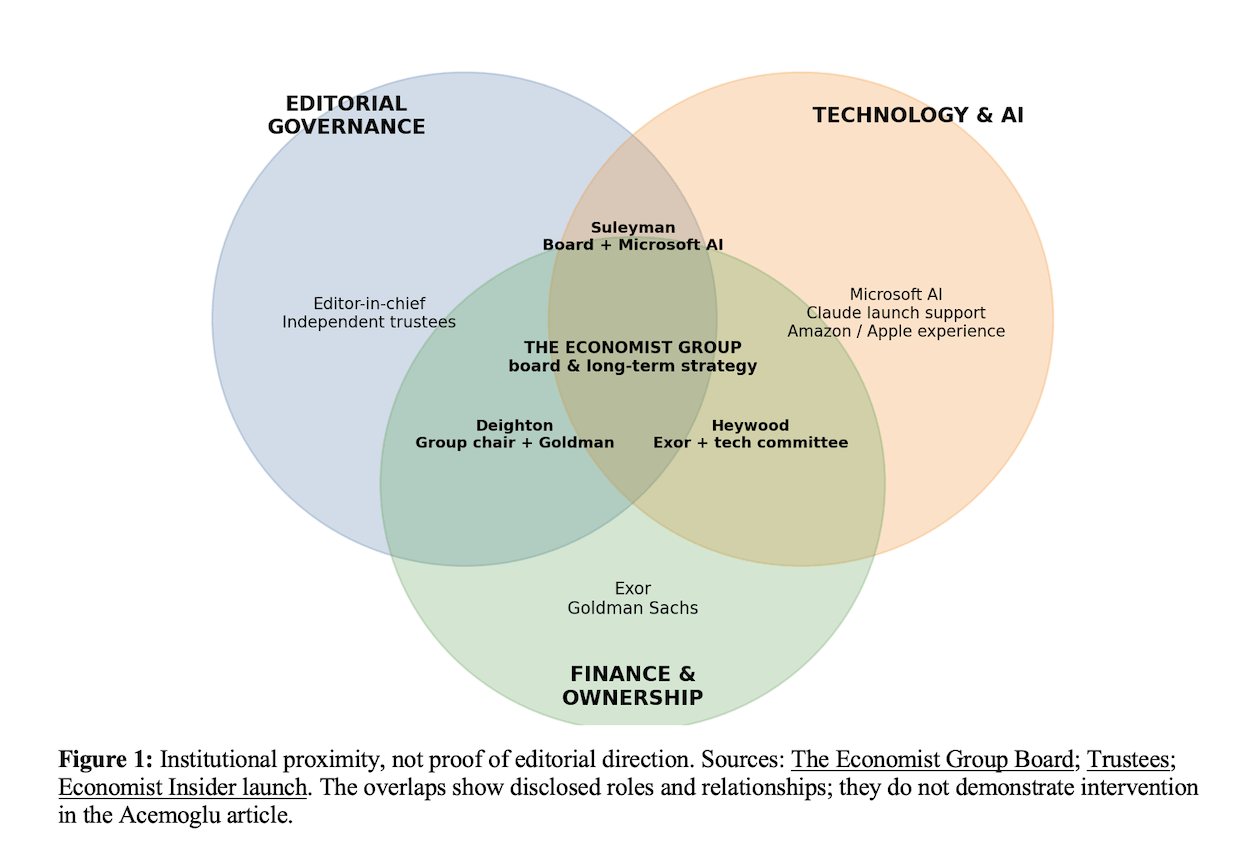
Professor Ibrahim Ozturk examines the deeper political economy behind The Economist’s recent critique of Nobel laureate Daron Acemoglu, arguing that the dispute reaches far beyond disagreements over institutional theory or AI productivity. He situates the controversy within a systemic crisis marked by inequality, weakened labor, technological concentration, declining governing capacity, and the erosion of liberal democracy’s social foundations. Drawing on Acemoglu alongside Polanyi, Rodrik, Stiglitz, Rawls, and Piketty, Professor Ozturk argues that technological progress is inherently political: institutions and power determine who directs innovation and captures its gains. The commentary contends that Acemoglu’s most consequential challenge is his insistence that markets cannot discipline concentrations of power they have themselves created—and asks whether the coming systemic reset will genuinely redistribute power or merely reproduce existing winners under a new institutional settlement.
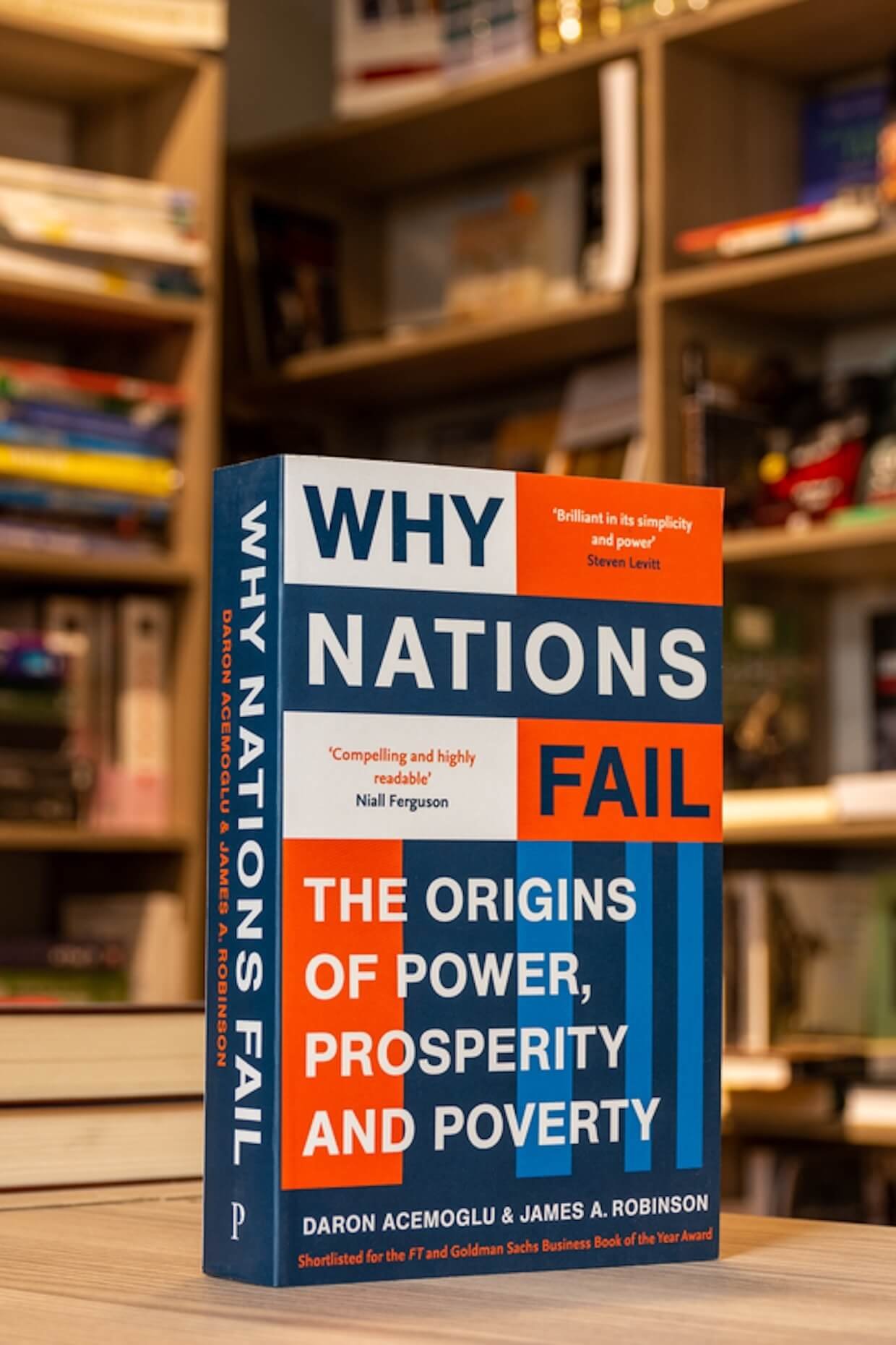
The Economist’s attack on Nobel laureate in economics Daron Acemoglu is more than an academic dispute. It exposes a deeper struggle over who will govern technological change, who will bear the costs of systemic reform, and whether liberal democracy can discipline concentrated economic power. Acemoglu’s real offense is not pessimism. It is his insistence that technological progress is a political choice, that liberal democracy cannot survive without shared prosperity, and that markets cannot discipline concentrations of power that they have themselves created. The dispute is therefore larger than one economist or one disputed estimate. At stake is whether the coming systemic reset will redistribute power as well as losses—or merely reshuffle the cards while leaving ownership of the table in the same hands.
The Political Economy Behind the Acemoglu Controversy
A growing body of research shows that the contemporary crisis of liberal democracy cannot be explained solely by the personalities of populist leaders or the supposed irrationality of their supporters. Its deeper sources lie in systemic disruptions caused largely by the corporate capitalism of the neoliberal Washington consensus that came with unregulated hyper-globalization, widening inequality, weakened labor, financial instability, regional decline, technological concentration, and the diminishing capacity of elected governments to protect citizens from externally generated shocks.
This interpretation belongs to a substantial political economy tradition. Karl Polanyi argued that attempts to disembed markets from society eventually provoke a protective countermovement. But that countermovement need not always be democratic or progressive. If legitimate democratic institutions cannot provide social protection, nationalism, protectionism, and authoritarian populism may offer it.
Dani Rodrik similarly anticipated that advanced economic globalization would provoke a political backlash. Trade, capital mobility and global production networks generated aggregate gains, but the losses were geographically concentrated, socially persistent and inadequately compensated. In Rodrik’s formulation, the problem was not globalization alone but “hyper-globalization”: the subordination of domestic economic and social arrangements to the requirements of international markets.
Joseph Stiglitz has approached the same problem through the failures of neoliberalism. Deregulation, regressive taxation, weakened public services, and the political power of concentrated wealth did not produce the competitive market order that their advocates promised. They produced what Stiglitz calls a crisis of capitalism and democracy. Four decades of policies favoring capital over labor did not remove the state from the economy; they reorganized state power around particular interests.
In my recent works, I argued that unmanaged globalization creates political space for populists, who then weaken the autonomous institutions required for democratic correction. Turkey under Erdogan shows how institutional capture can insulate authoritarian populism from economic failure. Brazil under Lula, by contrast, demonstrates that a broad coalition can defeat an authoritarian-populist project, although its media, patronage and identity networks may survive electoral defeat. My comparative analysis of Lula and Erdogan therefore suggests that democracy must do more than remove populist leaders; it must rebuild the social and economic foundations of representation.
Reverse Convergence and the Crisis of the Western Model
I have placed these national cases within a broader process that I call “reverse convergence.” The post-Cold War expectation was that China’s integration into global capitalism would gradually make it more liberal, more transparent, and more institutionally similar to the democratic West. Markets would create an independent middle class; international integration would strengthen the rule of law; and economic modernization would ultimately generate political liberalization.
That prediction proved deeply misleading. China incorporated markets, global trade, multinational investment, and advanced technology without surrendering authoritarian political control. At the same time, the United States and parts of Europe began adopting practices once associated with illiberal systems: economic nationalism, strategic protectionism, industrial subsidies tied to geopolitical objectives, expanding surveillance, executive discretion, and restrictions on technological exchange.
China did not simply converge toward the West. In important respects, the West began to converge toward China. As I argued in “Capitalist Disruptions and the Democratic Retreat,” this reciprocal movement is rooted in the systemic crisis of corporate capitalism. Liberal regimes are adopting illiberal instruments, while authoritarian regimes maintain repression and selectively integrate into global markets. The institutional and normative distance between the two systems is narrowing from both sides.
This does not mean that China and Western democracies have become identical. Political pluralism, judicial independence, civil liberties, and electoral competition still create fundamental distinctions. Reverse convergence describes a direction of movement, not a completed state. Its warning is that market integration alone does not automatically liberalize authoritarian regimes, while economic insecurity and geopolitical rivalry may progressively illiberalize democratic ones.
The empirical literature on the so-called China Shock strengthens this argument. David Autor, David Dorn and Gordon Hanson showed that communities exposed to Chinese import competition experienced persistent employment and wage losses rather than the rapid adjustment predicted by standard trade models. Their subsequent research connected trade exposure with greater political polarization. These findings do not prove that globalization alone caused Trumpism. They do demonstrate that the distributional and geographical effects of trade cannot be treated as temporary deviations from an otherwise frictionless adjustment process.
Rodrik’s distinction between the demand and supply sides of populism is crucial here. Economic shocks generate insecurity and resentment, but political entrepreneurs decide how these grievances are interpreted. The anger may be directed against financial elites, multinational corporations, and inequality, or diverted towards migrants, minorities, and external enemies. Material dislocation and cultural politics are not mutually exclusive explanations; economic insecurity can be translated into identity conflict.
The transformation of Western party systems reinforces the problem. Thomas Piketty, Amory Gethin and Clara Martínez-Toledano document the emergence of a “Brahmin Left” representing highly educated voters and a “Merchant Right” representing high-income and wealth-owning groups. Sections of the working and lower-middle classes increasingly feel politically unrepresented. They face a cultural elite on one side and an economic elite on the other.
This helps explain why citizens experiencing abandonment may turn to leaders whose economic programs do not objectively serve them. Populism offers what technocratic liberalism no longer provides: a language of belonging, recognition and political conflict. Its solutions may be false and its leadership authoritarian, but its diagnosis begins with a real representational void.
The Global Policy Machine Is Running Out of Room
The world economy is now entering a phase in which national policy responses increasingly neutralize one another. Japan is caught between enormous accumulated public debt, rising financing costs, demographic contraction and a central bank whose policy space has narrowed. The United States combines structural fiscal deficits and high debt-service costs with protectionism and an increasingly explicit effort to preserve technological supremacy. Europe wants greater strategic autonomy, military capacity, green transformation and social protection, but confronts weak growth, high energy costs, fragmented capital markets and restrictive fiscal politics.
Each major economy is trying to transfer part of the adjustment burden elsewhere. The United States uses tariffs, industrial subsidies and the structural power of the dollar. China responds through production scale, export penetration and state-supported technological upgrading. Europe turns to defensive regulation and industrial policy. Emerging economies compete for investment through tax concessions, cheap labor, suppressed wages and regulatory exemptions.
What appears rational for each country separately becomes contradictory at the systemic level. Everyone wants to export more, protect strategic industries, attract capital, subsidize domestic production and prevent unemployment. Not everyone can do so simultaneously.
Monetary policy confronts similar limits. High interest rates may suppress inflation but intensify debt-service pressures, weaken investment and expose financial fragilities. Lower rates may sustain asset prices and indebted governments but revive inflation, encourage leverage and postpone restructuring. Fiscal expansion supports demand but confronts anxious bond markets. Austerity reassures creditors while weakening social legitimacy and accelerating political radicalization.
The world is approaching a point where conventional policies no longer resolve problems. They transfer them across time, borders and social classes. When these contradictions can no longer be postponed, governments will be tempted to reshuffle the cards: recognize losses, rescue selected institutions and transfer the bill to those least able to resist. Workers, taxpayers, small savers, pensioners and younger generations will be required to absorb the consequences of decisions they did not make. Without structural reform, the next major crisis will not be merely another business-cycle downturn. It may become a simultaneous crisis of distribution, political legitimacy and democratic representation.
The questions Acemoglu now addresses are therefore the real questions confronting liberal democracy: Why do governments change while economic direction remains largely fixed? Why can political systems identify their crises yet remain unable to reform the structures that reproduce them? And why does electoral alternation so often rotate the administrators of the system without altering the distribution of economic power, the direction of technological change or the mechanisms through which the costs of crisis are transferred?
United Kingdom offers a revealing example. Prime ministers and governing parties change, yet weak productivity, regional inequality, deteriorating public services, housing shortages, chronic underinvestment and the unresolved consequences of Brexit remain. Political alternation survives, but transformative capacity has weakened. Elections change the system’s managers without necessarily changing its economic direction. Acemoglu is searching, at his own analytical scale, for an explanation of this crisis of reform capacity and for a route beyond it.
This is precisely where The Economist occupies a paradoxical position. It presents itself as an unsentimental analyst of political and economic failure, yet its ideological framework often prevents the causal chain from being followed back to the underlying distribution of power. Governments fail, voters become irrational, institutions deteriorate, and populists advance; meanwhile, the ownership structures, fiscal privileges, financial interests, and technological concentrations that restrict meaningful reform remain less visible. Acemoglu’s recent work is disturbing because it begins to turn the analytical finger towards these protected centers of power.
A Critique with Two Very Different Layers
On August 17th 2026, The Economist published an unusually personal attack under the headline “The world’s most influential economist is oddly unconvincing.” The article acknowledges that Acemoglu is exceptionally productive, intellectually formidable, and generous towards younger scholars. It then devotes the rest of its space to questioning whether his reputation at the summit of the economics profession is justified.
This is a legitimate question to ask about any celebrated scholar, including a Nobel laureate. Acemoglu’s empirical research, institutional theory and estimates of AI’s productivity effects are not beyond criticism. The history of economics is full of influential theories that later proved incomplete, context-dependent or empirically fragile. Yet The Economist’s intervention does not read like a conventional scholarly assessment. Its tone, timing and structure suggest that something else is at stake. For instance, it moves from technical disagreements over colonial mortality data to dismissive judgments about Acemoglu’s political analysis, his account of technological change and his support for pro-worker AI. It does not merely claim that some of his estimates may be wrong. It seeks to diminish the intellectual authority he draws on to challenge today’s concentration of technological and economic power.
The article combines two fundamentally different kinds of criticism. The first is methodological. It revisits the famous 2001 paper by Acemoglu, Simon Johnson and James Robinson on the colonial origins of comparative development. Their argument—those different colonial environments produced different institutional arrangements whose effects persisted—became foundational to contemporary institutional economics. The Nobel Committee recognized the three economists in 2024 “for studies of how institutions are formed and affect prosperity.”
The settler-mortality data used in their original paper have genuinely been disputed. David Albouy questioned observations transferred between territories, the comparability of historical mortality figures, and the robustness of the instrumental-variable estimates. Acemoglu, Johnson and Robinson responded that Albouy’s conclusions depended on removing much of Latin America and Africa from the sample and adding a questionably coded campaign dummy. Their formal reply was published alongside Albouy’s critique.
These are substantial questions, and The Economist is justified in discussing them. Yet the limits of the research program extend beyond one dataset. Adam Przeworski questioned whether endogenous institutions can coherently be treated as the primary cause of development; Edward Glaeser and his co-authors argued that human capital and prior development may themselves generate institutional improvement; and Gareth Austin showed how the reversal-of-fortune thesis compresses African history and underweights colonial political economy and local trajectories. More broadly, the inclusive–extractive distinction risks becoming an ex-post classification if imperial power, war, class conflict, external intervention and variation within countries receive insufficient weight. These objections limit the framework’s claim to a unified explanation; they do not render institutional analysis worthless.
The paper’s influence also extends beyond its precise coefficient. It helped shift development economics away from treating markets, capital accumulation, and technological diffusion as processes operating independently of political power. Institutions determine whose property is protected, whose contracts are enforced, who receives education, who controls the state, and who can organize collectively.
The second layer of The Economist’s critique goes beyond identification strategies or historical evidence and dismisses Acemoglu’s ideas as obvious, gloomy, or insufficiently adventurous. His argument that Trump increases executive power by destroying constraining institutions is met with “Well, obviously.” The magazine’s article characterizes his idea of pro-worker AI as attractive but self-evident. It presents his concern about the social direction of technology as pessimism.
This is not technical refutation. It is rhetorical minimization. A familiar method is at work: acknowledge that an argument is correct, then declare it too obvious to matter. Yet many of the most consequential truths in political economy appear obvious only after somebody has identified their mechanisms and shown why prevailing institutions systematically violate them. If it is obvious that AI should complement workers rather than displace them, why do corporate incentives and tax systems so often favor automation? If it is obvious that executive power must be constrained, why are liberal democracies progressively normalizing emergency powers, politicized administration, and rule by decree? If shared prosperity is an obvious foundation of democratic stability, why has it been so consistently subordinated to asset-price appreciation and capital mobility?
A Magazine Contradicting Its Own Acemoglu Archive
The severity of the 2026 verdict is striking because it does not grow naturally out of The Economist’s own record. When Acemoglu and Robinson were turning a partly Western-centered institutional narrative into a global theory—precisely when its circularity, historical compression and treatment of colonial power most required sustained scrutiny—the magazine largely welcomed the framework. It insisted that “institutions matter, a lot,” reported favorably on research connecting democracy and growth, and applied the Why Nations Fail framework to rebuilding fragile states. Its archive was not uncritical, but it was serious and constructive. The latest article abruptly converts familiar disputes into a personalized verdict on whether Acemoglu deserves his standing at the apex of economics.
Archive searches are imperfect, especially across changed URLs and print editions. The conservative claim is therefore not an exact lifetime total but at least ten identifiable, substantial Economist articles between 2012 and 2026 in which Acemoglu or his co-authored work is central. Passing citations, daily briefings, and Economist events would raise the broader count.
The inconsistency is not that a magazine changed its mind; serious publications should do so when evidence changes. The new verdict neither identifies decisive new evidence nor explains the editorial reversal. Nor has The Economist stopped treating Acemoglu as authoritative: its Antitrust Summit agenda schedules him for a discussion with the magazine on October 28th, 2026. The same institution can market his authority in one venue while attempting to deflate it in another. That tension deserves acknowledgment.
Institutions: Tautology or An Analysis of Power?
Acemoglu’s institutional theory does face a genuine analytical challenge. If successful countries are said to possess “inclusive institutions” and unsuccessful countries “extractive institutions,” there is a risk of circular reasoning. Inclusive institutions produce prosperity, while prosperity becomes evidence that institutions were inclusive.
Tyler Cowen and other critics have questioned whether institutional change is sometimes explained by reference to earlier institutional change, producing an infinite regress. Critics also point to China: how can a politically authoritarian and plausibly extractive system generate decades of extraordinary growth? These objections should be taken seriously. Institutions cannot become a residual category covering laws, norms, culture, political power, state capacity, and every historical event not explained elsewhere. A theory that explains everything after the event may predict very little before it.
Yet China does not automatically disprove Acemoglu’s argument. His claim is not that extractive systems cannot grow. Such regimes can mobilize resources, import technology, suppress consumption, direct credit, and achieve rapid catch-up. The stronger claim is that innovation-driven, broadly shared prosperity becomes harder to sustain when political power remains concentrated and accountability weak. China therefore represents less a decisive refutation than an unresolved test. Its future trajectory will depend on whether centralized control can coexist with innovation, demographic transition, rising debt, entrepreneurial autonomy and the increasingly complex information requirements of an advanced economy.
More importantly, institutional analysis becomes far less tautological when institutions are understood as structured distributions of power. Institutions establish who can veto policy, organize labor, own productive assets, finance political campaigns, control information, and impose losses on others. They are not merely “good rules” producing good outcomes. They are settlements among social forces. This interpretation connects Acemoglu to an older political-economy tradition rather than separating him from it. Polanyi’s embedded markets, Rawls’s fair value of political liberty, Stiglitz’s progressive capitalism and Rodrik’s productivist agenda all ask how economic power can be made compatible with democratic citizenship.
John Rawls insisted that political liberties must possess not only formal existence but “fair value.” Citizens must have a substantively comparable opportunity to influence political outcomes. His later preference for a property-owning democracy over conventional welfare-state capitalism was based partly on the fear that wealth concentrated in a few hands would dominate politics. This is no longer an abstract philosophical concern. Martin Gilens demonstrated that policy outcomes in the United States are far more responsive to affluent citizens than to those on middle or lower incomes. When unequal economic power becomes unequal political influence, liberal democracy may retain elections while losing substantive representation.
The “Old Acemoglu” and the “New Acemoglu”
Some defenders of Acemoglu have interpreted The Economist’s article as retaliation by “the system” against an economist who has become “dangerously radical.” An ideological reaction may be at work, but this interpretation should not be exaggerated.
As a good student of institutional economics, I would argue that Acemoglu is not a socialist revolutionary. He does not advocate abolishing markets or private property. He does not romanticize Soviet planning, Maoism, or Chinese authoritarian state capitalism. His project is reformist: to rescue liberal democracy from the consequences of its political and economic degeneration. His new book, What Happened to Liberal Democracy?, makes this explicit. Acemoglu argues that liberal democracy flourished when it combined individual freedom, political participation, and shared prosperity. It lost legitimacy when post-industrial liberalism abandoned that settlement, let economic and educational elites detach from the rest of society, and failed to manage the disruptions caused by globalization and digital technology. His alternative is “working-class liberalism”: a democratic order centered on shared prosperity, empowered communities, human dignity, and a wider range of legitimate social values. The book’s central argument is the reconstruction of liberalism, not its destruction.
Acemoglu’s criticism of sections of the contemporary left is also important. He argues that progressive politics became too detached from working-class economic interests and too closely associated with highly educated metropolitan groups. That claim corresponds strikingly with Piketty’s “Brahmin Left” analysis. The cultural and educational elite may support minority rights and cosmopolitan values while remaining insufficiently attentive to labor power, regional decline, and economic insecurity. In this respect, Acemoglu is closer to Rawlsian social liberalism or renovated social democracy than to anti-capitalism. Markets should remain, but they must be embedded in democratic institutions. Technology should advance, but society must influence its direction. Capital should invest and innovate, but concentrated private power should not colonize politics, knowledge and public life.
Precisely because this is not a revolutionary program, it poses an uncomfortable challenge to defenders of the status quo. Acemoglu cannot easily be dismissed as an enemy of capitalism. He criticizes capitalism in the language of productivity, competition, opportunity, and liberal democracy itself. His message is not that liberal democracy failed because its enemies defeated it. It is that liberalism damaged its own social foundations.
This recasts the central democratic question. Are liberal democracies being destroyed from outside by populists, or hollowed out from inside by the concentration, dependency and inequality generated under economic liberalism? The alternatives are false if treated as mutually exclusive. Populist leaders are real agents of institutional destruction, but they also accelerate a prior internal decay. When markets concentrate wealth, governments lose governing capacity, work loses bargaining power, and citizens experience elections without economic agency, the constitutional shell remains while democratic substance thins. Trump, Bolsonaro and Erdogan did not invent this vulnerability; they organized and weaponized it. Lula’s return shows that electoral correction is possible, but also that removing a populist is not the same as rebuilding democracy’s social foundations.
The Reform Question Neoliberalism Avoids
For four decades, the dominant policy framework promised that trade liberalization, deregulation, financial deepening, labor-market flexibility and technological innovation would increase aggregate prosperity. Distributional losses could supposedly be handled afterward through education, worker mobility and limited fiscal compensation.
The promised compensation was frequently inadequate or never arrived. Productivity gains were distributed unevenly. Trade unions weakened. Labor lost bargaining power. Financialization expanded. Market and wealth concentration increased. Tax systems often treated capital gains, inherited wealth and multinational profits more favorably than ordinary labor income.
Stiglitz describes the necessary alternative as progressive capitalism: markets combined with strong public institutions, competition, social investment and limits on rent extraction. Rodrik’s “productivism” similarly shifts attention from redistribution after-market outcomes to the organization of production itself. Firms’ investment, employment, and innovation decisions reproduce poverty, inequality, and exclusion daily. Waiting to repair them afterward is both economically inefficient and politically destabilizing.
This is where Acemoglu’s pro-worker technology argument acquires significance. The distributional consequences of technology should be addressed when technologies are selected, designed, and deployed—not only after workers have been displaced.
Technology Does Not Choose Its Own Direction
The Economist presents Power and Progress, written by Acemoglu and Simon Johnson, as an excessively gloomy history of technological change. It responds that technological progress has made the average person vastly richer than people living before the Industrial Revolution.
That statement is true, but it does not answer Acemoglu’s argument. Acemoglu and Johnson do not claim that technology has produced no progress. Their central proposition is that the benefits of innovation are neither automatic nor naturally distributed. Technology creates possibilities; institutions, political organization, and bargaining power determine how those possibilities are deployed and who captures the gains.The MIT summary of Power and Progress states the issue clearly: technological advances can become empowering and democratizing, but not if decisive choices remain concentrated in the hands of a few technology leaders.
The Industrial Revolution eventually raised living standards, but its early decades also produced brutal factory discipline, child labor, unsafe cities, and the destruction of established livelihoods. The eventual social gains were not created by machinery alone. Labor organization, public health, education, political enfranchisement, social insurance, competition policy, and progressive taxation mediated them.
Acemoglu’s critics frequently collapse two different propositions: i) Technology can increase aggregate productivity. ii) Technology will automatically produce broadly shared prosperity.
The first can be true while the second remains false.
The same distinction appears in the economic literature on automation. Acemoglu and Pascual Restrepo distinguish between a displacement effect, through which machines take over tasks previously performed by labor, and a reinstatement effect, through which technological change creates new tasks in which human labor has a comparative advantage. Automation can raise productivity while reducing labor’s share of income if the creation of new human tasks is too weak. The question is therefore not “technology or no technology.” It is what kind of technological trajectory societies encourage.
AI, Labor and Concentrated Power
Photo: Dreamstime.
Artificial intelligence makes this problem more urgent because AI is not merely another machine. It can reorganize the production of knowledge, monitor workers, shape communication, automate administrative judgment and concentrate informational power in companies controlling data, cloud capacity, advanced chips and foundation models.
An AI system may increase corporate productivity while reducing labor’s bargaining power. It may improve prediction while enabling pervasive surveillance. It may create useful information while degrading the shared epistemic environment required for democratic deliberation. It may create new occupations in aggregate while destroying the career ladders through which younger workers acquire expertise.
The International Labor Organization (ILO) finds that transformation and augmentation are more likely than the immediate disappearance of entire occupations. This supports neither technological utopianism nor apocalyptic unemployment forecasts. It supports Acemoglu’s emphasis on institutional choices: outcomes depend on how tasks are reorganized, whether workers participate in deployment decisions, and who captures the productivity gains.
The competition problem is equally serious. An OECD assessment identifies powerful concentration pressures arising from access to computing capacity, data and specialized skills, along with first-mover advantages and vertical integration. In other words, concern about AI oligopoly is not merely an ideological suspicion Acemoglu entertains. It is now a central competition-policy problem.
This connects Acemoglu’s position with Shoshana Zuboff’s concept of surveillance capitalism. Digital business models do not simply sell services. They extract behavioral data, convert human experience into a commercial resource, and acquire capacities to predict or influence behavior. This produces not only market power but a form of private authority over information and social coordination.
The issue is therefore larger than monopoly pricing. When a handful of corporations control the infrastructures through which citizens communicate, work, acquire knowledge and participate in politics, economic concentration becomes constitutional power.
Is Acemoglu Too Pessimistic About AI Productivity?
Here, The Economist has a legitimate point. Acemoglu’s 2024 paper estimated that AI would generate only modest productivity gains over the following decade—no more than approximately 0.66% in total factor productivity under its main assumptions. The calculation was deliberately conservative. It used a task-based model, focused on tasks that could plausibly be automated or assisted, and excluded some speculative future applications. Acemoglu subsequently acknowledged that he did not fully anticipate the speed of agentic AI and may have underestimated its applications in scientific research. That is an important concession. AI may accelerate software development, experimentation, materials science, drug discovery, organizational coordination and decision-making. Agentic systems can combine reasoning, memory, planning and external tools in ways not captured by earlier estimates. If these complementary innovations scale rapidly, Acemoglu’s original productivity estimate may prove too low.
But this argues for revising the quantitative estimate, not abandoning his political economy. Indeed, faster AI progress makes his institutional concerns more important. If AI were only a marginal productivity instrument, its concentration in a few corporations would matter less. If it becomes a general-purpose infrastructure governing production, knowledge and communication, democratic oversight becomes indispensable.
There is also an asymmetry in the dominant technology debate. AI firms and their investors routinely make spectacular claims about productivity, employment and scientific transformation. These claims influence valuations, infrastructure investment, electricity policy, tax incentives and public subsidies. Yet skepticism toward commercially driven forecasts is treated as ideological pessimism, while AI executives’ optimistic claims are presented as neutral technological expertise.
The people predicting an inevitable AI revolution are often the same people raising capital, demanding regulatory exemptions and accumulating political influence from that expectation. Injecting realism into these forecasts is not hostility towards technology. It is an elementary requirement of political economy.
Who Is the “We” That Should Steer AI?
Editorial independence is not the same as institutional neutrality. The magazine’s institutional setting must be discussed with precision. The Economist Group has formal safeguards for editorial independence, including independent trustees charged with protecting the publication’s character and preventing control by any single interest. Those safeguards matter. Yet editorial independence—a prohibition on owners dictating the line—is not the same as institutional neutrality or social distance from the economic sectors under scrutiny.
The Group’s own board disclosures show an unusually dense overlap among media governance, finance, ownership and technology.
Group chair Paul Deighton also chairs Goldman Sachs International and Goldman Sachs International Bank.
Mustafa Suleyman, chief executive of Microsoft AI, has served as a non-executive director of the Group since 2019 and sits on its technology investment committee.
Suzanne Heywood is chief operating officer of Exor—the Group’s largest shareholder—and also serves on that committee.
Diego Piacentini, another committee member, previously held senior roles at Amazon and Apple.
Editor-in-chief Zanny Minton Beddoes is herself a member of the Group board.
The commercial adjacency extends to AI. The October 2025 launch announcement for Economist Insider, the premium video product, said the launch was “supported by Claude—the AI for problem solvers.” It is safer to call Anthropic/Claude the disclosed launch supporter than to infer control over editorial content. The distinction matters: sponsorship or commercial support creates a relationship readers may reasonably examine, but it does not establish that a sponsor selected an article or dictated its conclusions.
Historical board links reinforce the point about proximity, not conspiracy. Eric Schmidt, then executive chairman of Alphabet, left the Group board in 2015. The relevant inference is limited: the publication’s governance network has long overlapped with the commanding heights of technology and finance. It would be wrong to leap from that fact to a claim of editorial instruction. It would be equally naïve to treat institutional location as irrelevant to which assumptions appear normal, which reforms seem excessive and which concentrations of power receive the benefit of the doubt.
No publicly available evidence establishes that Microsoft, Goldman Sachs, Exor, Anthropic or any board member commissioned, edited or approved the August 2026 attack on Acemoglu. This essay does not allege such intervention. Its narrower claim is that the magazine’s authority should not be confused with a view from nowhere. Formal editorial autonomy can coexist with a governing and commercial ecosystem whose members share exposure to the technologies, financial structures and ownership interests Acemoglu wants democratic politics to discipline.
This institutional proximity becomes more consequential when The Economist moves from analysis to explicit policy advocacy. Only three days after attacking Acemoglu’s critique of concentrated technological power, the magazine published a leader declaring that Britain would be “bonkers to ditch Palantir,” thereby urging the government not to exercise the break clause in Palantir’s £330m NHS data-platform contract. The Palantir leader was unrelated to Anthropic’s sponsorship, and no evidence shows Palantir commissioned or influenced it. Nevertheless, it was an unmistakable editorial intervention in favor of maintaining a major public-sector relationship with a controversial American technology contractor—even after a parliamentary committee had warned of vendor lock-in and described Britain’s dependence on Palantir as an “unacceptable point of weakness.” The juxtaposition is difficult to ignore: The Economist dismisses Acemoglu’s warnings about concentrated technological power as gloomy or obvious while deploying its own institutional voice to defend precisely the kind of state–technology dependency his political economy asks democratic societies to scrutinize.
The Economist asks a fair question about Acemoglu’s demand that “we” steer AI in a pro-human direction. Who exactly constitutes this “we”? Governments can be captured. Regulators may lack technical expertise. Trade unions do not represent everyone. Expert committees can become unaccountable. National regulation may encourage investment to migrate towards more permissive jurisdictions. “Pro-worker AI” is not a self-executing program. But these difficulties do not justify leaving technological direction to the market. Markets do not remove political choice; they transfer decision-making to corporate executives, investors, platform owners and venture capital funds.
The absence of democratic governance is not neutrality. It is private governance. The real question is not whether somebody will steer AI. Somebody already does. The question is whether its direction will be determined exclusively by profitability, labor substitution, data extraction and market domination—or also by public purposes such as better employment, education, health care, scientific discovery and democratic resilience.
A credible pro-human AI agenda would therefore require more than a slogan. It would include competition policy, interoperability, public-interest access to computing infrastructure, public research funding, reform of tax incentives that favor automation, worker participation in workplace deployment, limits on algorithmic surveillance, and transparency in high-stakes automated decisions. Acemoglu’s prescriptions may be incomplete. Incompleteness invites us to develop the program, not to return decision-making to the oligopolies creating the problem.
Meanwhile, no publicly available evidence shows that The Economist’s article was commissioned by a technology company or produced as part of a coordinated campaign. Calling it a purchased attack without evidence would weaken the argument. An article does not need to be literally commissioned, however, to perform an ideological function. Its function is to narrow the boundaries of acceptable reform.
For decades, the liberal establishment was comfortable with institutional economics when it explained the poverty of developing countries through corruption, insecure property rights and authoritarian government. It becomes less comfortable when it applies the same analytical framework to Western capitalism and asks whether concentrated corporate power, weakened labor, regressive taxation, and technological oligopoly are themselves extractive institutions.
Acemoglu’s earlier work could be read as a vindication of the liberal order: inclusive Western institutions generated prosperity, whereas extraction explained stagnation elsewhere. His recent work turns the same lens inward. Formerly inclusive institutions can become extractive as wealth concentrates, labor weakens, shared prosperity recedes, and an increasingly consequential alliance forms among AI corporations, capital, and government. This resembles what I callreverse convergence: instead of drawing authoritarian systems towards Western norms, the West begins sacrificing its own restraints, competitive order and democratic commitments. The discontinuity is difficult to miss. The earlier Acemoglu was welcomed when extraction diagnosed failed states; the newer Acemoglu becomes objectionable when he asks whether the Western establishment is producing it from within.
That is the genuinely uncomfortable Acemoglu. He does not merely warn against Trump, Erdogan, Bolsonaro, or other populist-authoritarian leaders. He asks what failures of liberalism made their ascent possible. He does not excuse attacks on democracy, but he also does not let established elites present themselves as innocent guardians of a system they helped discredit.
His argument deprives the liberal establishment of its preferred moral simplicity: enlightened institutions on one side and irrational populism on the other. Between them lies the political economy of abandoned regions, insecure employment, declining mobility, concentrated wealth and citizens who experience democracy as periodic voting without meaningful influence over the forces shaping their lives.
Reform or Systemic Rupture
Acemoglu’s program may not be radical enough for the anti-capitalist left, yet it remains too interventionist for market liberals. That is precisely why it matters. It attempts to construct a reformist route between neoliberal exhaustion and authoritarian rupture.
The world does not lack warnings about populism. It lacks a political economy capable of removing the conditions from which populism draws its power. Democracy cannot survive indefinitely if its defenders offer citizens constitutional lectures while denying them economic security, social recognition and effective representation. Nor can democracy be protected merely by banning movements that attract disappointed voters. Suppressing political symptoms without addressing the economic and institutional disease risks transforming liberal democracy into rule by enlightened guardians—liberal in vocabulary but increasingly illiberal in practice.
This does not require accepting every demand articulated in the name of “the people.” Majorities can violate minority rights, attack judicial independence and empower authoritarian leaders. As Rodrik and Sharun Mukand emphasize, electoral democracy and liberal democracy are not identical. Political rights, civil rights and property rights rest on different social coalitions and may come into conflict. But defending minority rights and constitutional constraints cannot be permanently separated from material inclusion. Liberal democracy needs social and economic foundations—what Acemoglu calls shared prosperity and what Rawls approached through the fair value of political liberties.
The necessary reform must therefore go beyond ordinary regulation. It must reconsider the relationship between labor and capital, public authority and private power, national democracy and global markets. It must confront oligopoly, tax avoidance, the decline of collective bargaining, the privatization of knowledge, financial fragility and the political power accumulated by technology platforms. It must also recognize that efficiency is not the only criterion by which an economic order should be judged. Resilience, dignity, participation, social cohesion and democratic legitimacy are productive assets even when conventional models struggle to price them.
This does not make every Acemoglu proposition correct. His institutional categories can become too broad. His narratives may perform better retrospectively than predictively. His AI productivity estimate may require substantial revision. His reform agenda needs clearer instruments, stronger political coalitions, and feasible international implementation. These are reasons to debate Acemoglu seriously, not to dismiss or deny his contribution.
The Economist instead alternates between technical objections and rhetorical condescension. It asks why institutions matter if institutions emerge from earlier institutions. Yet all social explanation must begin with inherited structures, historical shocks, and political conflict. It describes pro-worker technology as obvious while economic incentives overwhelmingly favor labor substitution. It criticizes Acemoglu for underestimating technology’s benefits while neglecting his central question: who possesses the power to direct those benefits?
So, Whose Voice Is The Economist Speaking For?
Perhaps the answer is simpler than conspiracy. The Economist appears to want Acemoglu the institutional economist, but not Acemoglu the political economist of concentrated power. It was comfortable with the scholar who explained why poorer countries require better institutions; it is markedly less comfortable with the Nobel laureate who argues that the institutions of rich liberal democracies are themselves being captured and must be reconstructed. The archive therefore suggests that what changed is not simply the quality of Acemoglu’s scholarship, but the direction in which his institutional lens is now pointed.
It wants criticism of authoritarian populism without a complete investigation of the economic order that produced populist demand. It welcomes innovation but resists democratic claims over its direction. It accepts limited regulation while remaining suspicious of any project that would redistribute decision-making power from capital owners, digital platforms and credentialed elites towards workers and communities.
This does not mean that the magazine speaks under instruction from a hidden group of technology billionaires. Its voice is more structural than conspiratorial. It expresses the worldview of a liberal-capitalist establishment that recognizes the excesses of the existing order but remains reluctant to reconsider its distribution of power.
This distinction becomes decisive as the available policies and strategies approach their limits. Monetary policy is trapped between inflation and debt; fiscal policy between social demand and bond-market discipline; industrial policy between national security and retaliatory protectionism; democratic politics between electoral competition and declining governing capacity. We can already feel the breath of the next crisis. The central question is no longer whether the cards will be reshuffled, but who will be permitted to reshuffle them – and who will own the table after the reshuffle.
The defenders of the existing order may accept new leaders, a new regulatory vocabulary and even a redesigned institutional facade. What they resist is a settlement in which the groups that absorbed the old system’s losses gain real power over the new one. Their preferred reform redistributes the cards, but the old owners remain the winners: governments change, technologies change, and the language of policy changes, while command over capital, data, knowledge, and political influence remains substantially intact.
From this perspective, the attack on Acemoglu matters not simply because it targets a Nobel laureate. It attempts to weaken one of the intellectual routes leading public attention from the visible failure of governments to the deeper structures that constrain them. Acemoglu encourages us to ask not only why one government failed, but why successive governments confront the same wall; not only why populists win, but why liberal democracy no longer corrects the grievances on which they feed; and not only whether AI raises productivity, but who will control that productivity and appropriate its gains.
It favors reform, provided it does not become a transfer of power. Acemoglu’s real offense is not pessimism. It is his insistence that technological progress is a political choice, that liberal democracy cannot be separated from shared prosperity, and that markets cannot discipline concentrations of power they have themselves created.
The irony is that Acemoglu is trying to save, not destroy, the liberal order that The Economist historically defended. He warns that unless capitalism is disciplined, technology democratized, and prosperity more broadly shared, the next stage will not be a purer liberalism. It will be deeper oligarchy, more aggressive populism and an expanding authoritarian state.
The global system is running out of conventional policy space. Its monetary, fiscal, geopolitical and technological contradictions can no longer be resolved by indefinitely shifting costs onto workers, taxpayers and future generations. Either liberal democracy develops the capacity to reform the structures producing inequality, insecurity and concentrated power, or a future crisis will reform them through disorder.
One may disagree with Acemoglu’s models, historical interpretations, or remedies. But dismissing his central warnings as gloomy or obvious is not an answer. The essential question is no longer whether the existing order needs reform. It is whether reform can arrive before the next crisis—and whether reshuffling the cards will create a genuinely new settlement or merely reproduce the old winners under a new institutional name.
Professor Justin Gest argues that democratic resilience depends not only on institutions but also on the citizens who remain to sustain them. In this ECPS interview, Professor Gest discusses his concept of “democratic drain”—the depletion of liberal democratic political capital through emigration—and explains how large-scale departures can weaken resistance to populist and authoritarian backsliding. He warns that democracies are “highly susceptible to demographic change” and that the phenomenon is spreading beyond its European “poster child” to countries including Turkey, Israel, India, and potentially the United States. Professor Gest also examines immigration politics, demographic ageing, and populist mobilization, arguing that migration should be framed in terms of the national interest and that “the way countries treat their most vulnerable” is indicative of the state of their democracy.
In an era when democratic backsliding is typically diagnosed through institutional erosion—the weakening of courts, legislatures, electoral safeguards, and checks on executive power—Professor Justin Gest directs attention to a less visible but potentially consequential force: the changing composition of the citizenry itself. Professor and Director of the Public Policy Program at George Mason University’s Schar School of Policy and Government and the award-winning author of seven books, including Democratic Drain: Global Migration and the Struggle for Democracy, Professor Gest argues that understanding democratic resilience requires taking demographic change seriously. “What I think has been missing is the human dimension,” he tells the European Center for Populism Studies (ECPS), emphasizing that democracies “are also highly susceptible to demographic change.”
At the heart of Professor Gest’s argument is what he calls a “depletion effect”: when citizens with liberal democratic values leave in large numbers, their departure can diminish the political and civic resources available to resist authoritarianism. Migration remains, he stresses, “an expression of human freedom and human agency,” yet hundreds of thousands or millions of individual decisions to leave can produce “a very significant collective effect.” The result is a provocative reconsideration of emigration not simply as individual mobility, but as a process capable of reshaping the democratic prospects of countries of origin.
This dynamic may also strengthen populist and authoritarian governments. Professor Gest argues that the depletion of democratic human capital can allow “populist governments or authoritarian-leaning governments to get away with the backsliding” that might otherwise have been politically punished. Europe remains “the poster child for democratic drain,” particularly Central and Eastern Europe, but Professor Gest sees the phenomenon broadening to countries including Turkey, Israel, India, and potentially the United States. Indeed, he warns that “we are seeing the beginnings of a democratic drain in the United States,” even as American institutions, civic associations, and the judiciary continue to provide important sources of resilience.
The interview also situates democratic drain within the wider politics of migration, populism, and demographic transformation. Professor Gest argues that immigration politics is “principally driven by political entrepreneurs” and challenges narratives of invasion and chaos, while advocating immigration as a pursuit of the national interest. Most importantly, migration governance itself becomes a democratic test. “The way countries treat their most vulnerable,”Professor Gest argues, including foreigners and ethnic or religious minorities, “is indicative of the state of their democracy”—an observation he says may constitute an indictment of several countries, including the United States.
Here is the revised version of our interview with Professor Justin Gest, edited lightly to enhance clarity, readability, and overall flow for publication.
Democracies Are Highly Susceptible to Demographic Change
People shop in Gamla Stan (Old Town) in Stockholm, Sweden on August 23, 2018.
Professor Gest, welcome! Your recent Journal of Democracy article challenges the conventional literature on democratic backsliding by arguing that scholars have focused too heavily on institutional erosion while overlooking the political consequences of selective emigration. In many ways, you shift the analytical focus from what governments do to who remains within the polity. Do you see democratic drain as a complementary mechanism within existing theories of democratic erosion, or are you proposing a fundamentally new paradigm that requires us to rethink how democratic resilience itself should be conceptualized?
Professor Justin Gest: That’s a great question. No, I see this as complementary rather than a fundamentally new paradigm. There has been some excellent scholarship on the prospects for democratization, the forces that drive it, and the forces that generate backlash. What I think has been missing is the human dimension. Democracies, for all their institutions and their susceptibility to structural change, are also highly susceptible to demographic change.
So, if there is—as I argue and demonstrate—this depletion effect, whereby people with liberal democratic values leave a country in large numbers, that, too, will have consequences. It complements, supplements, and helps contextualize the institutional changes that scholars have traditionally focused on.
Migration Is an Expression of Human Freedom and Human Agency
One of the article’s most original contributions is its reinterpretation of Albert Hirschman’s “Exit, Voice, and Loyalty.” Traditionally, exit has been viewed as an individual response to political dissatisfaction. Your argument suggests that, when aggregated, millions of individual exits become a collective political force with systemic consequences. Does this imply that emigration should no longer be understood merely as a personal freedom but also as a phenomenon carrying democratic externalities? How should liberal democracies reconcile the individual’s right to leave with the collective costs that large-scale democratic exit may impose on countries of origin?
Professor Justin Gest: I certainly don’t think that we should be blaming anyone for making these very personal choices, and I don’t think we should be restricting them from doing so. Ultimately, migration is an expression of human freedom and human agency, of instantiating the democracy, the rights, and the freedoms that people want. But it is certainly complicated because of the effect that it has on the prospects for future democracy in the countries that people leave behind. And, of course, one person, one family, or one household’s decision doesn’t change a country. But when hundreds of thousands or even millions of people make the same choice, then that can have a very significant collective effect.
Your work implicitly treats democracy as something sustained not only by constitutions and institutions but also by what might be called democratic human capital—citizens willing to organize, protest, deliberate, and defend democratic norms. Has political science underestimated the demographic foundations of democratic resilience? Should future democracy indices begin measuring civic composition alongside institutional quality? In other words, can a democracy remain institutionally intact while gradually losing the civic foundations necessary for its long-term survival?
Professor Justin Gest: Yes, it certainly could. And it would be brilliant to be able to measure this. It does take some monitoring, but in many ways, the large-scale departure of people with democratic political values could be a signal of what’s to come in fragile democracies, or even not-so-fragile democracies. So, it would be wise to measure these things. It’s not especially costly. These are data that are collected and can be collected via regular survey research. It can be very predictive of the prospects for democracy thereafter.
When You Have Brain Drain, You’re Also Encountering Some Democratic Drain
Brain drain. Photo: Francesco Scatena / Dreamstime.
Your concept deliberately extends—but also departs from—the classic literature onbrain drain. Highly educated citizens are not necessarily the same people as those most committed to democratic participation. Conceptually, what distinguishes democratic drain from brain drain, and what does each explain that the other cannot?
Professor Justin Gest: That’s a great question. Brain drain is a reference to the phenomenon of the departure and depletion of economic capital when immigrants leave. They take their intellectual capital, their ideas, and their skill set with them when they leave. What democratic drain is looking at is a phenomenon of political capital—the departure of people with certain values and proclivities.
These two very well overlap. People with democratic values tend to have middling levels of education compared to their countrymen. So it is very likely that there’s a lot of overlap—that when you have brain drain, you’re also encountering some democratic drain.
What they predict is really different because brain drain has been shown to be accompanied by what’s called a brain gain, where people can remit the ideas and the things that they learn from abroad, and in some cases the money that they make from abroad, into capital investment, remittances, and social remittances back home. It’s not clear that it’s so easy to diffuse democracy across borders in the same way. Diaspora politics are certainly lively and active, but how impactful they are in actually creating regime changes is really more dubious.
Democratic Drain and Authoritarian Resilience
Your findings suggest that politically engaged, educated, and internationally connected citizens are often the most likely to emigrate from countries experiencing democratic decline. Could this selective emigration unintentionally strengthen populist and authoritarian movements by reshaping not only the electorate but also the broader ecology of civil society? In other words, does democratic drain help explain why some populist governments appear to become electorally stronger even as dissatisfaction with their governance increases?
Professor Justin Gest: The short answer is yes. That’s, in many ways, precisely what I expect and what I observe. Because of that decline of human capital, because of that depletion, it basically allows populist governments or authoritarian-leaning governments to get away with the backsliding that we otherwise would be observing and that would otherwise be punished, potentially, if, in the counterfactual, those immigrants had never left.
One possible criticism is that emigration merely reflects democratic decline rather than contributing to it. How confident are you that democratic drain becomes a self-reinforcing mechanism of authoritarian resilience rather than simply another consequence of poor governance? What evidence would most convincingly establish that causal relationship?
Professor Justin Gest: That’s a really good question. I think it’s likely to be both. You have certain democratic-leaning, liberal-leaning citizens who are very alert to changes and quick to respond when they see that there is further decline in the future, when they anticipate that decline. So, that is possible. That is certainly possible.
In my own research, there’s good evidence to suggest that elections that place people into office who have authoritarian leanings trigger people to want to leave. In that case, we observe that it comes after. However, what I also observe in the book is that there’s everyday migration of people who are not triggered by politics but are actually triggered by economic opportunities, by the opportunity to reunify with family members, loved ones, and relatives, or by people pursuing their educations abroad. Those people are not leaving for political reasons, and they are leaving in large numbers before any authoritarian backsliding might be taking place.
So, it’s likely to be both. It’s likely that more economically driven and family-driven migration is taking place independently of political backsliding. But there are also responses to political backsliding as well.
Nostalgic Deprivation Helps Explain That Backlash
A Trump supporter holds up a “Make America Great Again” sign at presidential candidate Donald Trump’s rally in the convention center in Sioux City, Iowa, on November 6, 2016. Photo: Mark Reinstein.
Across your work—from “Roots of the Radical Right”to your comparative research on nostalgic deprivation—you argue that perceptions of social, political, and economic decline shape populist support. How do these earlier findings relate toDemocratic Drain? Do you see nostalgic deprivation and democratic drain as two sides of the same process: one explaining why citizens embrace populism, the other explaining why others decide to leave?
Professor Justin Gest: That’s a really interesting point. Rarely do I deliberately connect my books together. They are certainly contributing to what we are witnessing, yes. And they are, in some ways, two sides of the same coin, because one of the biggest paradoxes of democratic drain is that when immigrants come over to the destination country, they are bringing with them ostensibly liberal, democratic political capital that they’re removing from their country of origin.
However, they’re not necessarily creating a sort of democratic renaissance in the country of destination. They’re not necessarily seeing those values enrich the democracy where they’re going. Quite the opposite: we have seen in many examples across the world today that immigrants’ arrival actually triggers a populist authoritarian backlash.
And so, yes, I think that nostalgic deprivation, which yearns for an earlier period, helps explain that backlash. But technically we’re talking about two different groups of people. We’re talking about one group of people who are remaining in their country of origin and witnessing the arrival of immigrants, and the other is referring to the immigrants themselves and their countries of origin.
Management, Order, and Control Do Not Prevent a Country from Being Open to Migration
Throughout Europe, mainstream parties have increasingly adopted stricter positions on immigration, often in an effort to contain the electoral rise of the radical right. From a comparative perspective, does this strategy reduce support for populist challengers, or does it instead contribute to the normalization of their political agenda?
Professor Justin Gest: It’s a really good, important question. I think it depends on how it’s being done by mainstream parties. I certainly think that mainstream, and particularly center-left, parties have been very politically vulnerable to attacks and criticism that they are too lenient about migration and that their approaches lead to chaos or, at least, to indiscriminate admissions policies. In some cases that might be fair.
I think that many center-left parties have historically been reluctant to talk about management, control, and order, using words like these on the campaign trail and in the design of their policies. But management, order, and control do not prevent a country from being open to migration. Having managed, controlled, and orderly flows of people coming in and out does not mean that you’re stopping people from coming in and out. It just means that you actually are in control of it. It means that you’re being discriminatory in who you are letting in and whether they support national political and policy goals, and who do not.
So I think that, yes, ostensibly it does legitimize what some of the far-right and populist parties are saying, but not in a way that necessarily obviates or prevents center-left and center-right parties from facilitating the normal flows of immigrants coming in and out of their borders. So, it’s complicated. It really does depend on the governments.
Certainly, there are going to be a lot of lazy politicians that ape what they hear on the far right rather than actually thinking about how to mechanically manage an orderly immigration system. Shame on those lazy politicians. But, it doesn’t have to be that way.
Immigration Is a Very Emotional Political Subject Matter
Your work has consistently shown that demographic change becomes politically consequential when it is interpreted through narratives of identity and belonging. To what extent is the contemporary success of populist movements driven by demographic realities themselves, and to what extent by the political entrepreneurs who frame those realities as existential threats?
Professor Justin Gest: I think it’s principally driven by political entrepreneurs. What research has shown—not my own personal research, but others’—is that the general public is broadly not very numerate when it comes to the extent to which immigrants are arriving at borders, especially in a really big country like Germany, the United Kingdom, France, or the United States.
These are large countries where immigrants can blend in very easily and diffuse across big cities and smaller suburbs. So, it’s largely a feeling. Immigration is a very emotional political subject matter, and far-right political entrepreneurs have told people that their countries are being invaded. They’ve told people of chaos and massive influxes of people coming into the country.
There certainly have been increases, and there certainly has been an upward trajectory in numerous places, particularly when you put it as a share of the national population, which is often declining due to aging and lower fertility rates. But it’s certainly not the chaos and the invasion that people are describing. So, broadly, I would say that this is driven by political entrepreneurs, even if the numbers do have an upward trend.
Immigration Should Be Framed as a Pursuit of the National Interest
A group of war refugees walks through a cornfield on the Serbia-Croatia border on November 3, 2015, as they seek passage to the EU. Many are Syrian refugees fleeing conflict. Photo: Ajdin Kamber.
Recent demographic projections suggest that aging societies across North America, Europe, and East Asia will increasingly depend on immigration to sustain economic growth and labor markets, even as anti-immigration politics continue to gain electoral traction. Migration is therefore often presented either as an economic necessity or as a political and cultural threat. Your scholarship suggests that this binary is overly simplistic. How do you explain the growing disconnect between demographic realities and political demand, and how should democratic societies approach migration if the objective is to preserve democratic legitimacy, social cohesion, and long-term economic sustainability?
Professor Justin Gest: They should really switch to a lens on immigration that is much more directly related to the national interest. I think that so much of the debate around immigration, and in some cases the policy design, has really been framing immigration as a humanitarian act—that immigration systems are rescuing vulnerable, susceptible, and weak people from poorer and conflict-driven societies.
And certainly humanitarian migration is an element of many countries’ immigration programs, and a very important one, I’ll say, and one that I think we ought to expand. However, the vast majority of immigrants do not fit that profile.
Immigrants are some of the most significant contributors to our economies, to the enrichment of our societies, and to the sustainability of our populations. And so, bringing them in is not doing anyone any favors except the country itself. I should say it’s doing everyone a favor, including the country itself. So, framing immigration as a pursuit of the national interest is the best and most accurate way to be pursuing it politically.
How Countries Treat Migrants Is Indicative of the State of Their Democracy
In your work on migrant rights and immigration governance, you argue that migration policy reflects broader democratic values rather than simply border management. Do you believe the treatment of migrants has become an increasingly reliable indicator of the health of democratic institutions?
Professor Justin Gest: To some extent it has been. I think there are exceptions where you have a not very democratic institution facilitating the humane entry and exit of immigrants with minimal violations of their rights. A place like that could be Singapore. I’d say Singapore is more of an exception, though.
Certainly, Singapore’s rights profile is not perfect. It’s not what you’d see in a place like Denmark or France. In Denmark, interestingly, they have an excellent rights profile and a very strong democracy, but their policies towards immigrants have become steadily less generous over time. But they’re not violating anyone’s rights, at least certainly not to the extent that we see in other countries.
So, yes, I do think that the way countries treat their most vulnerable, and treat people who are from other places who are members of ethnic or religious minorities, who are foreigners, is indicative of the state of their democracy. That’s probably an indictment of a number of countries, including the United States and its decline democratically over the last 10 years.
Much of your research emphasizes that public attitudes toward immigration are shaped not only by economic realities but also by political narratives and elite framing. In an era of misinformation and social media, have political entrepreneurs become more influential than demographic realities themselves in shaping public perceptions of migration?
Professor Justin Gest: Without a question, yes.
Immigration Is a Way of Creating a Sort of Population Equilibrium Globally
Across advanced democracies, governments increasingly face a paradox: ageing populations and labor shortages make immigration economically necessary, while anti-immigration politics remain electorally attractive. Is this contradiction becoming one of the defining governance challenges for contemporary liberal democracies?
Professor Justin Gest: It has been one of the most fundamental and intractable challenges, certainly. But my prescription really relates to what I said earlier about reframing this as a national interest. I think that each policy should be framed in such a way that the public understands that when the state is admitting people they’re not doing immigrants a favor without actually pursuing the national interest as well.
Immigration is where these different interests become mutual. They come together. And that’s one of the most wonderful things about this. It’s particularly poignant at this moment in demographic history, because we have Global North countries, fundamentally or primarily, that are experiencing rapid aging and very severe drops in fertility rates. And we have many countries in the Global South, in lower-income countries, that are experiencing population booms that are unsustainable, given their economies and their ability to give people jobs.
So, actually, immigration is a way of creating a sort of population equilibrium globally, while also addressing critical problems for politicians and public officials in both the Global South and the Global North.
We Are Seeing the Beginnings of a Democratic Drain in the United States
Labour Day celebrations at Old Town Square in Prague on May 1, 2017, featuring a banner depicting democracy as a leaf eaten by caterpillars labeled Putin, Kaczyński, Orbán, Babiš, Trump, and Fico. Photo: Jolanta Wojcicka.
Following the 2024 US presidential election, there has been renewed discussion about Americans—particularly academics, journalists, scientists, and young professionals—considering relocation abroad. Is the United States beginning to exhibit early symptoms of democratic drain, or do its institutional resilience and federal structure make it fundamentally different from the countries examined in your research?
Professor Justin Gest: I think both are true. We are seeing the beginnings of a democratic drain in the United States. The phenomenon has clearly reached US shores, and it’s beginning to take place now, even if it’s just in the early days. But at the same time, the United States possesses certain unique advantages in its institutions, civic associations, and judiciary that act as a form of resilience against this creep of democratic backsliding.
Interrupting the Democratic Drain Cycle
Across Europe, several countries that have experienced democratic backsliding—including Hungary, Serbia, and Slovakia—have also witnessed sustained outward migration. Do you see Europe as the principal laboratory for democratic drain, or are similar patterns now emerging across a much broader range of democracies?
Professor Justin Gest: Europe is certainly the poster child for democratic drain, and it’s one of the reasons why I focus so much of my research on Central and Eastern Europe—places like Hungary, Serbia, Poland, etc. However, democratic drain is broadening now, and it surely already has before this. You know, other countries to look at would certainly include places like Turkey, Israel, India, and, as I mentioned earlier, potentially the United States.
Ifdemocratic drainbecomes a self-reinforcing cycle—where democratic decline encourages emigration, which in turn further weakens democratic resistance—what practical steps can democratic governments take to interrupt that cycle? Are institutional reforms, economic opportunities, or renewed civic engagement likely to be the most effective response?
Professor Justin Gest: I’m not sure about the latter question, but certainly in terms of what to do about this at the countries-of-origin level. When you have this steady depletion of people leaving, the most direct solution is to cultivate the regeneration of more people with democratic political values. And so that comes from education and public information campaigns, and supporting movements for democracy that educate people and cultivate an appetite for freedoms and rights, such as those that democracies promise and protect. So, that is the best way: supporting the organizations, the civil society groups, the political parties that are seizing and doing their best to cultivate more liberal and democratic norms in the people that they represent.
The Future of Migration and Democracy
And lastly, Professor Gest, taken together, your scholarship explores the intersections of migration, identity, inequality, populism, and democratic representation. Looking ahead, which emerging development—whether artificial intelligence, demographic ageing, climate mobility, rising nationalism, or growing geopolitical instability—do you believe will most fundamentally reshape the relationship between migration and democracy over the coming decade?
Professor Justin Gest: It’s a strong list you put together. It’s clearly all of the above. Each of the meta-phenomena that you mentioned plays a role. Ultimately, I think that the first step we can take to address the challenges that migration poses for democracy and democratization is to recognize those challenges. I think that more and more public officials are coming to realize that there is this relationship.
There is a relationship, and that means that if you care to protect democracy, but you also understand and recognize the critical benefits of a healthy, orderly, and well-managed immigration system, then you have to work to pursue them both, and you have to be cognizant of their relationship to each other as you make policies.
You also have to recognize that there are actors in this world who do not care about the protection of democracy, who do not care for immigrants—sometimes for very hateful reasons, and others just because they don’t think that they’re necessary. In any case, those actors will seize upon the vulnerabilities of this relationship between migration and democracy.
So, people who want to protect them both have to recognize this relationship and act accordingly. Otherwise, the temptations and the allure of easy solutions, slogans, and disinformation are going to win.
In this commentary, Bernard Allan V. Garcia argues that contemporary populism strategically reframes migration not simply as a policy issue but as a political instrument for redirecting public anger. Rather than confronting structural inequalities such as wealth concentration, housing crises, and labor exploitation, populist leaders shift political conflict from a vertical struggle between citizens and elites to a horizontal conflict between natives and migrants. Garcia demonstrates how this narrative preserves existing economic hierarchies, redefines political enemies, and transforms migrants into convenient scapegoats while leaving the underlying causes of social and economic insecurity untouched. The commentary offers a provocative framework for understanding anti-migration rhetoric as a mechanism of economic elite preservation rather than a genuine response to citizens’ socioeconomic grievances.
By Bernard Allan V. Garcia*
In an era of staggering wealth inequality, stagnant growth, soaring living costs, and decaying public infrastructure, populist leaders often target vulnerable populations rather than addressing systemic shortcomings. The rhetoric of modern populist movements is directed downward, frequently toward migrant populations (Wodak, 2015). This is no coincidence. It is a recurring pattern in countries led by populist governments, albeit with different variations, and has become a core strategy of contemporary populism.
To understand why human migration remains such a controversial issue in contemporary politics, we must look beyond standard and overused explanations (i.e., xenophobia and traditional economic models). The reality in countries governed by populist leaders is more structural: migration and migrants serve as instruments of political distraction and redirection (Rini, 2019). This strategy shifts political conflict from a top-down class divide to a horizontal conflict between citizens and immigrants.
The Elite’s Dilemma
Every sovereign state today has its own deep structural fractures. For ordinary citizens, difficulties such as unaffordable housing, inadequate health insurance, bankruptcy, or industrial decline naturally lead them to search for explanations. Public anger tends to flow vertically upward, toward government institutions, powerful elites, and the corporate structures that, directly or indirectly, shape people’s daily lives.
This places political and economic elites in an equally difficult position, as a society organized around a vertical, top-down understanding of power can become highly volatile. When directed upward, public anger can generate demands for wealth redistribution, higher corporate taxes, and structural reforms that threaten the status quo benefiting those who hold power. To preserve that status quo, political leaders who depend on elite donors face a fundamental dilemma: how can they acknowledge the frustrations of the working class without allowing that frustration to be directed at the elites themselves?
The Art of Anger Redirection
Migration and migrants are, unfortunately, well suited to solving this dilemma (Nayyeri, 2024). By introducing an external group into the political equation, populist leaders can dramatically redirect public attention and redefine the source of public suffering. For example, housing crises in many Western states, where rental prices are skyrocketing, are driven primarily by internal factors such as restrictive zoning laws, low interest rates, and the financialization of housing as an investment rather than a basic human right. Addressing these problems requires significant redistribution of resources and a reordering of policy priorities—measures that may be unpopular with economic elites. Instead, populist leaders attribute the problem to migrants. It is far easier to tell working-class families that housing prices have risen because of the millions of migrants who have arrived in recent years than to introduce policies that might strain relations between the government and economic elites. As a result, the political conflict instantly rotates by 90 degrees, shifting from Bottom vs. Top to Inside vs. Outside.
This substitution offers an immense political advantage. First, the redirection preserves the economic and political status quo because there is no need to raise taxes on wealthy individuals or undertake structural reforms. Second, it provides political leaders and economic elites with an easy villain in a fabricated narrative, as migrants lack both political power and media representation to defend themselves. Finally, it unites a struggling working class and powerful elites around the issue of border control, creating a shared political agenda that can be translated into electoral advantage.
Redefining the “Enemy”
Historically, the elite has consisted of those with economic power, such as business owners, landlords, and corporate executives. However, populist leaders, driven by both the desire to remain in power and the need to preserve their relationships with traditional elites, introduce a revised concept of who constitutes the elite (Mudde & Rovira Kaltwasser, 2017). In the populist narrative, an elite is no longer a billionaire who pays workers minimum wage while benefiting from low corporate taxes. Instead, the elite becomes a progressive liberal politician, university professor, journalist, or anyone who advocates for migrants. Through this lens, those who defend migrants’ rights are portrayed as enemies of the state, while those who oppose migration are celebrated as patriots.
When populist leaders attack migrants and the migration system, they claim to be fighting the established liberal order. Working-class voters may feel a sense of victory in dismantling the so-called migrant establishment, even though their own economic exploitation remains unresolved.
The Paradox of Protecting Local Labor
The hypocrisy of populist politics can be seen in the priorities set by populist governments. One of the most common justifications for anti-migration populism is the protection of local employment opportunities. If populist leaders were truly concerned with protecting local jobs, their proposed policies would follow a logical order. They would champion strict penalties against corporate exploitation, including the abuse of both local and undocumented foreign workers. They would insist that all workers, regardless of their country of origin, be treated fairly and that no employer be allowed to use race or nationality to justify paying below-standard wages. They would also advocate pathways to citizenship or permanent residency to protect migrants’ rights and prevent employers from coercing them into accepting substandard pay.
However, such policies remain far down the list of priorities for populist leaders. Instead of penalizing corporate exploitation, they target workers themselves. The objective is rarely to eliminate the unregulated labor market—including undocumented foreign workers—but rather to preserve a system of permanent insecurity. By keeping migrants in a legal twilight zone while simultaneously using them as political punching bags, populist leaders claim two victories: a source of cheap labor for the economy and an inexhaustible political scapegoat during elections.
Stop Looking at the Border
None of this commentary suggests that migration policy is simple or that sovereign states should not manage their territorial boundaries. Managing immigration is both a legitimate and a necessary function of a sovereign state. However, there is a difference between treating migration as a complex humanitarian challenge and presenting it as an all-purpose solution to domestic political problems.
As long as public scrutiny remains focused on the horizontal conflict between locals/natives and foreigners, the underlying causes of societal inequality will remain unaddressed. The housing market will continue to suffer as long as housing is treated primarily as an asset and investment. Wealth will remain concentrated at the top of the social hierarchy. Public services will continue to deteriorate. Ultimately, despite efforts to militarize state borders, citizens may one day wake up and realize that their lives have not fundamentally improved.
Therefore, whenever political figures attempt to convince you that your main adversary is an immigrant arriving by boat or crossing a border, commentators, journalists, and citizens must remain vigilant and look upward. The central political conflict of our time is not a clash between natives and foreigners; it is a struggle between those who profit from a broken status quo and those left to bear its costs. While public attention is directed toward the border, ask yourself which policies are being quietly buried. When working people compete with one another over scraps instead of demanding a seat at the table, ask who truly benefits.
(*) Bernard Allan V. Garcia is a political demographer having earned degrees in International Studies and Population Studies. He is currently an Associate Researcher at the Asian Institute of Management in the Philippines. Email: bvgarcia@aim.edu
References
Mudde, C. & Rovira Kaltwasser, C. (2017). Populism: A Very Short Introduction. Oxford University Press.
In this commentary, Dr. Kamil Joński examines why Poland remains an exceptional case in contemporary Europe, where high levels of religiosity continue to overlap with strong right-wing political identification. Drawing on data from the 11th wave of the European Social Survey (ESS), he demonstrates that regular church attendance and conservative political identity increasingly reinforce one another, creating a distinctive “churchgoing right” that shapes both political discourse and the Catholic Church itself. Dr. Joński argues that this convergence helps explain Poland’s restrictive social policies, the enduring influence of the Church on public life, and emerging tensions between Polish conservatives and the post-Vatican II direction of the Holy See. The commentary offers fresh insights into religion, polarization, and democratic politics in Europe.
The breakup of the Polish right-wing Law and Justice (PiS) party has inspired numerous analyses, commentaries, and anecdotes. One of them offers intriguing insight into the uniqueness of the Polish right on the European political landscape. The leader of the new initiative, Development Plus, M. Morawiecki (“Law and Justice” Prime Minister from 2017 to 2023), hosted its July 31, 2026, kick-off as a grill event. Among other preparations, he secured a Roman Catholic bishop’s permission to violate the canon law requirement of abstaining from eating meat on Fridays (the day of the Crucifixion), so that his fellow right-wingers could enjoy grilled sausage. Quite a bizarre touch at the gathering of a self-proclaimed modern and pro-development right, led by a former bank CEO? Only at first glance.
Many Poles Remain Religious…
The data collected during the recent (11th) wave of the European Social Survey (ESS) documents the relatively high religiosity of Poles, with nearly 60 percent of respondents describing themselves as religious (“Regardless of whether you belong to a particular religion, how religious would you say you are?”, variable rlgdgr).
…and Maintains Bond with Institutional Church
The theory predicts that “secular transition happens in three steps: first, public ritual participation declines; second, the importance of religion to individuals declines; and third, people shed religious affiliation.” In this context, it is even more important that a substantial share of Poles maintains its bond with the institution of the Roman Catholic Church. Despite the post-COVID drop in religious participation, 40 percent of respondents declare regular, weekly participation in religious services (“Apart from special occasions such as weddings and funerals, about how often do you attend religious services nowadays?”, variable rlgatnd).
The Right-Wing Is Strong…
At the same time, the Polish political landscape is skewed toward the right, with two out of five respondents placing themselves on the right end of the political spectrum (“In politics, people sometimes talk of ‘left’ and ‘right’. Using this card, where would you place yourself on this scale, where 0 means the left and 10 means the right?”, variable lrscale).
… and Overlap Matters
However, the most revealing insight emerges from combining these two dimensions: the bond with the institutional Church, as measured by religious participation, and self-placement on the political spectrum. It turns out that nearly one in four Poles declare both weekly attendance at religious services and right-wing identification.
What makes this situation truly unique on the European political landscape is that this “churchgoing right” constitutes the majority among both churchgoers and right-wingers. In other words, their sensitivities are likely to set the tone for both political rallies and sermons. As a consequence, the Polish throne and the altar remain entangled in ways that are virtually unimaginable elsewhere in contemporary Europe.
The result is, among other things, an extraordinarily restrictive abortion law, a state-enforced de facto blasphemy law (the criminal provision on “offending religious feelings”), and the rejection of same-sex civil unions (not to mention marriages). For the mechanisms of Church influence, see A. Grzymała-Busse (2015), Nations under God: How Churches Use Moral Authority to Influence Policy.
“Post-Secularism” or Anti-Vatican II
The situation seems to affect the Church as well. Back in the early 2000s, when the Polish conservative Pope John Paul II made statements that were interpreted as endorsing Poland’s accession to the EU, the population of churchgoers included self-declared moderate leftists and rightists, with a firm anchor in the center.
As time went by, the mutually reinforcing processes of polarization (not to say radicalization) and secularization (people voting with their feet) shifted the proportion of right-wingers among churchgoers from 30 to nearly 60 percent. According to the 11th wave of the ESS, right-wing hardliners (i.e., those who place themselves at 10 on the ten-point left-right scale) alone account for one-fifth of churchgoers. The median churchgoer in Poland now places herself at 7 on the ten-point left-right scale. There is evidence of similar processes shaping the clergy as well.
If a right-wing churchgoer demands a firm anti-left and anti-liberal group identity (spiced with a sense of divine truth and centuries-old tradition), she is unlikely to be satisfied by Pope Leo XIV’s visit to Lampedusa. Indeed, at Morawiecki’s grill event, the very first panel discussion—entitled “The Right 2027: How to Win Elections and Widen the Supporter Base”—drifted into a discussion of the Holy See’s teaching on migration, with one participant declaring what he called “Pope-skepticism.”
That could be the indication of “post-secularism”, with politicians hand-picking suitable pieces of religious tradition, without particular regard to the religion itself. Alternatively, it could be just a nostalgia to pre-Vatican II Roman Catholic orthodoxy. All the disappointed rightists need to do, is to dust-off the writings of Pope Leo’s XIX-century namesake. In Leo XIII view, humanity is inherently “separated into two diverse and opposite parts, of which the one steadfastly contends for truth and virtue, the other of those things which are contrary to virtue and to truth. The one is the kingdom of God on earth … The other is the kingdom of Satan”.
That could be an indication of “post-secularism,” with politicians hand-picking suitable pieces of religious tradition without particular regard for the religion itself. Alternatively, it could be just nostalgia for pre-Vatican II Roman Catholic orthodoxy. All disappointed rightists need to do is dust off the writings of Pope Leo’s nineteenth-century namesake. In Leo XIII’s view, humanity is inherently “separated into two diverse and opposite parts, of which the one steadfastly contends for truth and virtue, the other for those things which are contrary to virtue and to truth. The one is the kingdom of God on earth … The other is the kingdom of Satan.”
In political life, the latter insists “that marriage belongs to the genus of commercial contracts, which can rightly be revoked by the will of those who made them … all men have the same right … each one is naturally free … power is held by the command or permission of the people, so that, when the popular will changes, rulers may lawfully be deposed … that the State should be without God; that in the various forms of religion there is no reason why one should have precedence over another … Their chief dogmas are so greatly and manifestly at variance with reason that nothing can be more perverse.”
In this commentary, Dr. Oludele Solaja argues that waste is no longer merely an environmental management problem but an emerging question of sovereignty, justice, and environmental security. Underscoring the concept of waste sovereignty, he contends that the central issue is not simply who bears environmental burdens, but who has the authority to refuse them. Using Turkey’s transformation into a major destination for European plastic waste as a revealing case, the commentary demonstrates how the circular economy can shift environmental risks rather than reduce them when accountability is displaced across borders. Dr. Solaja calls for a new framework that links waste governance to political agency, material accountability, and environmental justice, arguing that the future of environmental security depends on empowering communities—not merely managing waste.
The world has a waste problem. But have we been asking the right question? Today, international environmental policy has focused mainly on waste as a management issue – how to collect, recycle, regulate and dispose of waste safely. Yet the growing international movement of discarded materials reveals a more fundamental political question: who has the authority to decide where the environmental consequences of global consumption will go—and who has the power to refuse them? This is not a semantic distinction. It’s about the kind of inequality that is at the core of the current world.
Now commodities, capital, and the waste flow across borders with great ease. Environmental risks do not. They tend to concentrate in specific locales, workplaces and communities — frequently in areas of weak political bargaining power and limited regulatory capacity. Some societies consume; others process; still others live with the pollution, occupational hazards and ecological damage generated along the way. Waste is therefore not simply what remains after consumption. It’s becoming more and more a question of power, sovereignty and security.
A Shipment Can Be Legal Without Being Just
Here comes the concept of waste sovereignty into play. Waste sovereignty is a shift from the question of how poorer countries can deal with the world’s waste, to why should particular countries and communities shoulder environmental risks produced elsewhere? It is about the ability of a state or community to decide what types of waste are brought into their area, how and for whom. More fundamentally, though, it’s about a political right to say ‘no.’
That right is significant because there are not two equally powerful actors conducting international waste transactions. A shipment can be legal without being just. A nation can say ‘yes’ to accepting waste and communities impacted by it have limited real say in the decision. The issue of consent can be particularly complex when the government accepts imports of waste since it benefits from jobs, foreign exchange or investment, but the environmental costs are borne by populations that have little political power.
This asymmetry is apparent in the international trade of plastic waste. Although plastic-waste trade declined between 2017 and 2022, substantial exports from OECD countries to non-OECD countries continued, particularly toward Southeast Asia. The Basel Convention’s new plastic-waste provisions have enhanced global controls, but that is not enough to overcome the issue of political inequality. The problem is not only that waste is moving across the borders in a legal fashion. It is whose interests are protected when it does.
Turkey Shows That Recycling Can Shift, Rather Than Reduce, Environmental Harm
Turkey provides a tell-tale example. It has transformed the country into a big hub for European plastic waste and worries have been raised about microplastic pollution linked to plastic recycling in the Adana area. This case has far-reaching implications beyond Turkey. It reveals a disturbing paradox in the circular economy: recycling is not necessarily good for the environment when it’s referred to as recycling.
Increased movement of the recyclable materials to locations where regulatory oversight, technological ability or environmental protection is less robust can lead to a shift of environmental risk, instead of reduction, through recycling. The questions raised are thus not limited to the question of whether something is recyclable. So, where, by whom, under what conditions and at whose environmental cost are things being recycled?
Politics of waste enters into the politics of circular economy here. While the circular economy can turn waste into resources, and resources do not circulate in neutral systems. They permeate markets, borders, labor relations and regulatory regimes. Circularity can perpetuate the very inequalities it aims to tackle if the environmental impacts of processing are continually passed down to communities who have less bargaining power.
Environmental Insecurity Often Accumulates Quietly Among the Politically Weakest
The African experience makes this even more apparent. Too often, the Global South is represented as the passive destination of unwanted materials around the world. However, in African cities, informal waste workers are collecting usable materials which are not always collected by the formal sector. In Lagos, Accra, Nairobi and elsewhere, informal recyclers perform essential resource-recovery work while often operating without adequate occupational protection, social security or political recognition.
Here lies one of the great paradoxes of contemporary environmental governance: those most excluded from environmental decision-making may be performing some of its most important work. This means that waste sovereignty cannot be reduced to the ability of governments to close borders to imported waste. It must also concern who controls the conditions under which waste is recovered, processed and transformed into economic value. Informal recyclers should not simply be incorporated into global circular value chains as inexpensive labor. A just circular economy must recognize their environmental contribution, protect their livelihoods and give them meaningful influence over the systems in which their labor and environments are embedded.
This broader understanding also changes how we think about environmental security. Environmental security is conventionally associated with climate change, water scarcity, food insecurity, disasters and displacement. Waste reveals another dimension: the insecurity produced when environmental risks are systematically displaced across borders and concentrated among politically weaker populations.
Consider the chain: Consumption → waste generation → international export → processing/recycling → environmental exposure → livelihood disruption → community resistance → political conflict.
A polluted irrigation canal can threaten agricultural livelihoods. A recycling facility can become a source of neighborhood conflict. A landfill can generate political mobilization. Informal waste workers can be criminalized even while providing essential environmental services. Environmental insecurity does not therefore always arrive as a spectacular disaster. Sometimes it accumulates quietly—in polluted waterways, degraded land, unsafe workplaces and communities living with risks generated by decisions made elsewhere.
Waste Sovereignty Asks Who Has the Power to Refuse Environmental Burdens
This is why waste should be understood as an emerging politics of environmental security.The critical issue is not merely whether environmental risks exist. It is whose security is protected and whose security is sacrificed in managing them.
This also requires abandoning the image of the Global South as simply a “dumping ground.” Such language may describe a real historical pattern, but it can obscure something equally important: contestation. The Global South is not merely where waste arrives. It is also where resistance, refusal and renegotiation can begin.
China’s 2018 restrictions on foreign waste imports disrupted established global waste routes and forced exporters to search for alternative destinations. The episode demonstrated that receiving countries are not powerless endpoints in a global waste system. They can restrict imports, renegotiate arrangements, strengthen regulation and demand greater responsibility from exporters. More recent European regulatory developments likewise reflect growing recognition that international waste movements require stronger safeguards and accountability.
But the deeper question is what happens when this capacity for refusal moves beyond governments and becomes a claim made by communities and workers themselves. This is where waste sovereignty extends the environmental-justice tradition. Environmental justice has taught us to ask: Who bears the environmental burden? Waste sovereignty adds another question: Who has the authority to decide where that burden is placed—and who has the power to refuse it? The difference is profound.
The Future of the Circular Economy Depends on Material Accountability, Not Recycling Alone
A society may be protected from environmental harm only when it possesses meaningful authority over the decisions that produce environmental exposure. Security without agency is fragile. Consent without participation is incomplete. Circularity without accountability can become another form of environmental displacement. The future of the circular economy therefore depends on more than increasing recycling rates or reducing the volume of waste sent to landfills. It requires material accountability.
Producer responsibility must extend across borders. Exporting countries should remain accountable for the environmental consequences of materials they send abroad. Importing countries must retain meaningful regulatory and refusal powers. Informal recyclers should be recognized as environmental workers rather than treated merely as obstacles to formalization. And communities living alongside waste facilities must have a meaningful voice in decisions affecting their environments. The principle is simple: No society should be expected to surrender its environmental security in exchange for another society’s convenience. This principle carries implications far beyond waste policy.
Globalization has long been understood through the movement of commodities, capital, technologies and information. Increasingly, however, we must also understand it through the movement of what societies no longer want. Environmental inequality is produced not only through the extraction of resources from poorer territories but also through the geographical displacement of unwanted materials and risks.
When the Global South Says ‘No,’ It Redefines Environmental Security
The Global South is therefore not simply where the world’s waste ends up. It is becoming a political arena in which sovereignty, economic opportunity, environmental justice and security are contested. And this may be the deeper significance of waste sovereignty.
The politics of the twenty-first century will not be shaped only by who controls oil, minerals, land or data. It will also be shaped by who controls the movement of materials that others no longer want—and, crucially, who has the right to refuse them. The question for the coming decades may therefore be deceptively simple: Who has the right to decide where the world’s unwanted materials go? The answer cannot be determined solely by those who generate the waste.
When communities and states begin answering that question for themselves, waste ceases to be merely the end of consumption. It becomes a site of political authority. And when the Global South says “no,” that refusal should not be understood simply as resistance to global trade. It may represent something more consequential: a demand to redefine who counts in the making of environmental security.
The future of environmental security will depend not only on protecting societies from environmental threats. It will depend on ensuring that no society can make itself secure by making another society environmentally insecure. That is the political promise of waste sovereignty.