Associate Professor Guilherme Casarões argues Brazil’s October 4 election marks more than a contest between Luiz Inácio Lula da Silva and Flávio Bolsonaro: it signals a deeper transformation of the country’s democratic order. Assoc. Prof. Casarões contends that “what really died, or what really was defeated on October 4th, was Brazil’s democratic pact itself,” while stressing that this does not mean democracy has ended. He sees Bolsonarism as still fundamentally personalistic, continuing to revolve around Jair Bolsonaro even as Flávio emerges as its electoral standard-bearer. The interview explores identity polarization, Christian nationalism, punitive security politics, Trumpism, and the transnational far right, while also examining Lulism’s growing association with the establishment. Together, these dynamics place Brazil at what Assoc. Prof. Casarões describes as a consequential political “crossroads.”
Brazil’s October 4, 2026 presidential election produced a first-round result that significantly altered the political landscape ahead of the October 25 runoff. Flávio Bolsonaro finished first with about 47% of the vote, ahead of incumbent President Luiz Inácio Lula da Silva on 45.1%, while right- and far-right forces also performed strongly in congressional and gubernatorial contests. The outcome sharpened the confrontation between Lulism and a post-Jair form of Bolsonarism, while also raising broader questions about the resilience of Brazil’s post-authoritarian democratic settlement, the institutionalization of the radical right, and the future of political representation in the country.
In this interview with the European Center for Populism Studies (ECPS), Guilherme Casarões, Associate Professor of Brazilian Studies at Florida International University, argues that the significance of October 4 extends well beyond the immediate electoral competition between Lula and Flávio Bolsonaro. For Assoc. Prof. Casarões, the most consequential development is not simply the continued strength of Bolsonarism without Jair Bolsonaro on the ballot, but what the election reveals about the transformation of Brazil’s democratic order. As he puts it, “what really died, or what really was defeated on October 4th, was Brazil’s democratic pact itself.”
Assoc. Prof. Casarões is careful to stress that this does not mean Brazilian democracy has ended. Rather, he argues that the political pact sustaining democracy since the transition from military rule in the mid-1980s and its constitutional consolidation in 1988 “is now gone, or at least seems to be over for now.” In his view, this makes the 2026 election even more consequential than the watershed contests of 2018 and 2022. Brazil, he argues, has reached “a crossroads,” with the future character of its democratic system increasingly uncertain.
At the same time, Assoc. Prof. Casarões resists interpreting Flávio Bolsonaro’s success as evidence that Bolsonarism has already become fully institutionalized. Despite the son’s electoral rise and the growing importance of the Liberal Party, he maintains that the movement “still gravitates around the image of Bolsonaro the father” and remains “a very personalistic movement.” Ultimately, he suggests, Bolsonarism still resembles “a cult of a person,” and “this person is Jair Bolsonaro himself.”
The interview develops this diagnosis across a wider set of themes: the decline of policy-based competition and the rise of identity polarization; Christian nationalism and the religious-populist radical right; punitive approaches to crime; the transnational circulation of far-right ideas; and the interaction between Trumpism and Bolsonarism. Assoc. Prof. Casarões also examines the contrasting trajectory of Lulism, arguing that Lula has increasingly come to symbolize the establishment itself. Taken together, his analysis presents October 4 not merely as an electoral upset, but as a possible marker of a deeper reconfiguration of Brazil’s democratic and populist politics.
Please cite as: Sofos, Spyros A. (2026). “The Popular, the Populist, and the Plebeian: Mamdani as a Problem for Populism Studies.” Journal of Populism Studies (JPS). October 6, 2026. https://doi.org/10.55271/JPS000132
Abstract
This article develops a framework distinguishing plebeian rupture, populist closure, and plebeian-institutional articulation. It asks how popular agency can endure through institutions while those advancing demands retain the capacity to shape decisions and challenge their representatives. The analysis examines Zohran Mamdani’s New York mayoral campaign from October 2024 to November 2025 through campaign statements, speeches, endorsement records, and organizational materials. Independent demands, endorsement rules, and public disagreement show organized constituencies seeking a continuing role in the project. Their influence over contested priorities and effective constraints on leadership are less clearly documented. The findings support understanding the campaign’s organizational project as plebeian-institutional articulation, alongside a left-populist reading of its construction of a common identity. The framework shifts attention from the presence of organizations to the authority constituent actors retain as popular projects enter institutions.
Keywords: populism; plebeian politics; plebeian-institutional articulation; political mediation; social movements; Zohran Mamdani.
By Spyros A. Sofos
Introduction
On 4 November 2025, New Yorkers elected Zohran Mamdani mayor of New York City with just over 50.2 percent of the vote (New York City Board of Elections, 2025). By election day, the outcome was no longer wholly unexpected: a poll in September had already shown him with a commanding lead, and Bloomberg described him as the clear frontrunner heading into the vote (Quinnipiac University Poll, 2025; Bloomberg, 2025). Yet the victory still defied a coordinated effort to stop him. Anti-Mamdani political action committees enjoyed a substantial financial advantage, while more than twenty billionaires had contributed to efforts designed to block him; Reuters, meanwhile, noted opposition extending beyond the Democratic Party, including Donald Trump’s late endorsement of Cuomo, threatening to cut funds for New York City if Mamdani were to win the mayoral race (Bloomberg, 2025; Time, 2025; Reuters, 2025).
Mamdani’s lead in the polls and its translation into electoral victory was almost immediately interpreted through the familiar idiom of populism. Commentators across progressive, centrist, and conservative outlets described his campaign as “economic populism,” “left populism,” or as proof that people-centered anti-establishment politics had become endemic to the contemporary United States (O’Donnell, 2025; Sirota, 2025; Michael, 2025; Pilkington, 2025; Heer, 2025; Wimbish, 2025; Laleoğlu, 2025; Epstein, 2025). Some cast him as a left-wing counterpart to Donald Trump: a populist, different in content, but comparable in form, tone, and social appeal. Multiple sources framed Trump and Mamdani as structural equivalents in populism. Mechoui argued that “Trump and Mamdani are just as notable for their convergences as their contrasts,” emphasizing that both are “manifestations of the same development: the concentration of executive power” (Mechoui, 2025) as both figures strategically shape voter desires through populist messaging. The Economist similarly observed that “Like Donald Trump, Zohran Mamdani promises ‘a new approach to power,'” noting that despite their ideological opposition, both represent a shared political method focused on executive action over procedural constraints (The Economist, 2026).
Others contended that “ideology matters, but method matters more,” highlighting how both leaders deploy decisiveness, norm-challenging, and narrative clarity as their primary tools, regardless of left-right positioning (CEO Today, 2026). Epstein positioned both Trump and Mamdani within a broader populist tradition, defining populism as rooted in “public distrust of established legal and social institutions” combined with “would-be champions of sweeping reform” (Epstein, 2025), a framework that encompasses both figures despite their ideological divergence. Even more cautious analyses still implied that Mamdani’s politics were populist, stressing anti-elite mobilization, the activation of disaffected voters, and the construction of a new majority coalition out of constituencies alienated from establishment politics (Dionne, 2025; Singh, 2025).
Mamdani’s campaign raises a problem that a populist classification alone cannot resolve. People-centered antagonism and the linking of grievances can occur in projects with different relations to plurality, representation, and institutional mediation. The more important and urgent task is to examine how popular claims are formulated, joined, authorized, and contested: whether a common identity extends constituent actors’ capacity to act together or concentrates authority to speak and decide in their name.
This article makes a theory-building intervention grounded in a bounded interpretive case study. It asks: How can analyses of popular politics distinguish institutional articulation that preserves autonomous voice and contestation from closure around an indivisible popular will, and what does Mamdani’s campaign reveal about that distinction? The argument proposes and develops an analytical typology distinguishing among plebeian rupture, populist closure, and plebeian-institutional articulation.
These three concepts address different questions about the politics of the popular. Plebeian rupture concerns political emergence: people previously excluded or assigned a subordinate position assert their standing as actors entitled to shape collective life. Plebeian-institutional articulation concerns how that agency can endure through organizations, representation, and institutional participation. Its distinctive feature is that those actors retain meaningful opportunities to formulate demands, influence priorities, and challenge their representatives. Populist closure concerns the treatment of disagreement: it develops when a leadership or organization claims exclusive authority to express an indivisible popular will and treats competing claims as illegitimate.
Their relationship involves no necessary sequence. Political emergence need not begin with a dramatic rupture, and a disruptive mobilization may already contain claims to exclusive representation. Institutional articulation can sustain agency and provide protections against closure through independent organizations, accountable representation, and procedures that keep collective priorities open to revision. These protections do not merely depend on the existence of institutions of representation but on their effective function. They require continuing political work. Where they weaken, representatives may increasingly displace the agency of those they represent. Making binding decisions or establishing leadership does not itself constitute closure; what is important is whether those represented retain legitimate and effective means of questioning and redirecting that authority.
Distinguishing these dimensions allows us to examine what happens to popular agency across different moments and relationships within a political project. The emergence of previously excluded actors establishes neither their continuing influence nor the accountability of their representatives. Organizational continuity tells us little, by itself, about whose demands guide the organization. Public disagreement demonstrates independent voice, while its consequences reveal more about the distribution of authority. A project may therefore expand political standing, develop durable institutions, and restrict contestation in different relationships or at different times. The distinction makes those developments visible and allows us to assess how institutional articulation preserves agency, where its protections become ineffective, and whether claims to exclusive popular representation produce closure.
By plebeian-institutional articulation I refer here to a mode of institutionalizing agency from below in which actors contesting unequal political standing retain the capacity to formulate independent claims, challenge representatives, and participate in revising collective priorities. Its defining combination is plebeian political authorship, the pursuit of institutional duration, and autonomous mediation. Populist closure, by contrast, treats an indivisible popular will as authorizing privileged representation and subordinates particular claims and independent contestation to that authority. The distinction concerns what organizational and institutional arrangements enable, not simply whether such arrangements exist.
Mamdani’s campaign is analytically useful in this respect because people-centered antagonism coexists with a dense movement ecology and extensive organizing infrastructures. That combination makes it a boundary case for examining the relationship between popular articulation and mediation. I approach his campaign as a possible experiment in plebeian-institutional articulation whose character must be assessed through the relationships among constituent organizations, campaign leadership, and collective priorities. Neither the presence of intermediaries nor electoral success establishes that those actors retained autonomous voice or effective influence. What is critical conceptually is to distinguish how popular agency acquires institutional duration and how that process may preserve or restrict contestability. Empirically, the article examines Mamdani’s campaign during the 2024–25 election period, focusing on its relationships with the organizations and networks that supported it. This assessment takes the left-populist interpretation seriously. In Mouffe’s account (2018), left populism can accommodate heterogeneous demands and pluralist institutions. Plebeian-institutional articulation may therefore specify relationships that a broader populist classification leaves open.
A democratic concern with plurality and equal political standing runs through the argument. It directs attention to whether participation gives those involved an effective role in shaping collective priorities and holding representatives to account. The article first develops its conceptual framework and research design, then examines Mamdani’s campaign in dialogue with the left-populist interpretation. It concludes by considering how plebeian-institutional articulation might endure and how the framework could apply beyond this case.
Associate Professor Guilherme Casarões argues Brazil’s October 4 election marks more than a contest between Luiz Inácio Lula da Silva and Flávio Bolsonaro: it signals a deeper transformation of the country’s democratic order. Assoc. Prof. Casarões contends that “what really died, or what really was defeated on October 4th, was Brazil’s democratic pact itself,” while stressing that this does not mean democracy has ended. He sees Bolsonarism as still fundamentally personalistic, continuing to revolve around Jair Bolsonaro even as Flávio emerges as its electoral standard-bearer. The interview explores identity polarization, Christian nationalism, punitive security politics, Trumpism, and the transnational far right, while also examining Lulism’s growing association with the establishment. Together, these dynamics place Brazil at what Assoc. Prof. Casarões describes as a consequential political “crossroads.”
Brazil’s October 4, 2026 presidential election produced a first-round result that significantly altered the political landscape ahead of the October 25 runoff. Flávio Bolsonaro finished first with about 47% of the vote, ahead of incumbent President Luiz Inácio Lula da Silva on 45.1%, while right- and far-right forces also performed strongly in congressional and gubernatorial contests. The outcome sharpened the confrontation between Lulism and a post-Jair form of Bolsonarism, while also raising broader questions about the resilience of Brazil’s post-authoritarian democratic settlement, the institutionalization of the radical right, and the future of political representation in the country.
In this interview with the European Center for Populism Studies (ECPS), Guilherme Casarões, Associate Professor of Brazilian Studies at Florida International University, argues that the significance of October 4 extends well beyond the immediate electoral competition between Lula and Flávio Bolsonaro. For Assoc. Prof. Casarões, the most consequential development is not simply the continued strength of Bolsonarism without Jair Bolsonaro on the ballot, but what the election reveals about the transformation of Brazil’s democratic order. As he puts it, “what really died, or what really was defeated on October 4th, was Brazil’s democratic pact itself.”
Assoc. Prof. Casarões is careful to stress that this does not mean Brazilian democracy has ended. Rather, he argues that the political pact sustaining democracy since the transition from military rule in the mid-1980s and its constitutional consolidation in 1988 “is now gone, or at least seems to be over for now.” In his view, this makes the 2026 election even more consequential than the watershed contests of 2018 and 2022. Brazil, he argues, has reached “a crossroads,” with the future character of its democratic system increasingly uncertain.
At the same time, Assoc. Prof. Casarões resists interpreting Flávio Bolsonaro’s success as evidence that Bolsonarism has already become fully institutionalized. Despite the son’s electoral rise and the growing importance of the Liberal Party, he maintains that the movement “still gravitates around the image of Bolsonaro the father” and remains “a very personalistic movement.” Ultimately, he suggests, Bolsonarism still resembles “a cult of a person,” and “this person is Jair Bolsonaro himself.”
The interview develops this diagnosis across a wider set of themes: the decline of policy-based competition and the rise of identity polarization; Christian nationalism and the religious-populist radical right; punitive approaches to crime; the transnational circulation of far-right ideas; and the interaction between Trumpism and Bolsonarism. Assoc. Prof. Casarões also examines the contrasting trajectory of Lulism, arguing that Lula has increasingly come to symbolize the establishment itself. Taken together, his analysis presents October 4 not merely as an electoral upset, but as a possible marker of a deeper reconfiguration of Brazil’s democratic and populist politics.
Here is our interview with Associate Professor Guilherme Casarões, edited lightly to enhance clarity, readability, and overall flow for publication.
Bolsonarism Is Not Yet Institutionalized
Brazil’s former President Jair Bolsonaro poses with anti-riot police agents after cast their ballot in Rio de Janeiro, Brasil on November 29, 2020. Photo: Antonio Scorza.
Professor Casarões, welcome. Let me begin with the transformation of Bolsonarism itself. Brazil’s first-round result appears to represent something more structurally significant than another confrontation between the political camps created around Lula and Jair Bolsonaro. With Jair Bolsonaro himself absent from the ballot and Flávio Bolsonaro not only emerging as the principal candidate of the right but actually finishing first with about 47% of the vote, are we witnessing the transformation of Bolsonarism from a highly personalized populist movement into a more durable political identity? What would distinguish the institutionalization of Bolsonarism from the simple continuation of the Bolsonaro family?
Assoc. Prof. Guilherme Casarões: That’s a great question and let me take a step back just to refer to what I think is the biggest change after the October 4th elections in Brazil. I think that—and this is something that I’ve argued in a very recent piece that I wrote for The Conversation website—what really died, or what really was defeated on October 4th, was Brazil’s democratic pact itself.
By saying this, I’m not implying that Brazilian democracy is over. What I’m trying to say is that the pact that has sustained Brazil’s democracy for over 40 years, starting in the mid-80s, being written into the Constitution of 1988, and sustaining Brazil’s democracy ever since then, is now gone, or at least seems to be over for now. There’s a big change going on in Brazil, therefore making the 2026 elections in the country even more consequential than the 2018 and 2022 elections. This is why we are at a crossroads right now. There’s something going on. We don’t know exactly how to describe what Brazil’s democracy is going to look like in the future, if at all, but this is an important caveat to make.
Now, as for Bolsonarismo, we have other examples around the world of children of very popular politicians who become leaders of movements themselves. That’s the case of Marine Le Pen in France. If we think about the transition between Jean-Marie Le Pen and Marine Le Pen, there’s a big inheritance, but also a big transformation between these two moments of leadership. We also have something along similar lines in Peru, with Alberto Fujimori back in the 1990s and early 2000s, and now we have Keiko Fujimori, who is Peru’s current president. So, this is not very unusual, if you think about it, politics is also hereditary in many ways.
Bolsonarism Is Still a Cult of Jair Bolsonaro
But I don’t think that the case of Brazil really represents a break, or an evolution, for that matter. We are not yet witnessing the institutionalization of Bolsonarismo in Brazil, because everything still revolves very much around the figure of Jair Bolsonaro, the former president who’s now serving 27 years in prison under house arrest for attempting a coup d’état back in 2022. He was convicted in 2025. But the references are almost entirely directed at him. The movement still gravitates around the image of Bolsonaro the father. He was the one, to be sure, who handpicked his oldest son, Flávio, to succeed him on the ballot in 2026.
However, I’m not sure, and I don’t believe that we are at the point of institutionalization of a movement yet. It’s still a very personalistic movement. We are yet to see what Flávio’s going to make of his own party. Flávio ran on the ticket of the Liberal Party of Brazil. Bolsonaro was also affiliated with this party. This has become more and more the party of Bolsonarismo in the country, but the Liberal Party has been around for much longer.
It never really represented Bolsonaro. He used it more than anything else. That was a very recent turn taken by Bolsonaro himself back in 2021 in order to run, because in Brazil you need to be affiliated with a party in order to run, and I think that if it depended entirely on Bolsonaro the father, he wouldn’t really have a party. He tried to create one from scratch, and he couldn’t.
What we have in Brazil, which is a multi-party-political system, is that the Bolsonarista movement captured one of the parties that was just lying there, a party that sees a great benefit in joining the rank and file of Bolsonarismo, and that’s where we are right now. Therefore, we might have to wait for another electoral cycle. Or this is something that’s going to happen along the way between right now and 2030, but the point is that it’s not fully institutionalized yet.
We might see this transition happen at some point down the road, but I still think that, if I could describe Bolsonarismo as a political movement, it really seems to me like a cult of a person, and this person is Jair Bolsonaro himself.
Lulism Became Personalistic, but Lula Remained Institutional
Luiz Inacio Lula da Silva walks among supporters on Augusta Street at São Paulo on the eve of the brazillian election on October 1, 2022. Photo: Yuri Murakami.
Conversely, the first-round result also sharpens the succession problem for Lulism. Lula remains the principal integrative figure of the Brazilian left, yet he finished behind Flávio Bolsonaro despite entering the election expecting to win in the first round. Should Lulism itself be understood as a variety of left populism, and if so, how does its populism differ analytically from the moral polarization, anti-establishment rhetoric, and cultural politics associated with Bolsonarism?
Assoc. Prof. Guilherme Casarões: Let me unpack these points. The first thing readers have to understand about Brazil is that the very same political elites who took power back in the mid-80s, after the end of a 21-year military dictatorship in the country, are the same elites who are still in power today. That’s true for the right and the left. You see, Bolsonaro himself—now he’s in jail—but he was a congressman for 28 years before getting elected president in 2018. Even though he used to depict himself as an outsider, as an anti-establishment candidate, we know for a fact that the same guys who have been around for over 30 years now, they were the ones who, if not established the New Republic, as we call Brazil’s post-dictatorship moment, were there from the get-go.
I don’t think that this is something that a lot of people understand about Brazil. Lula himself has been around for a very long time. He was the founder of the Workers’ Party back in 1979, and he very quickly rose to become one of the most popular politicians in Brazil. He ran for president in Brazil’s first direct presidential elections in 1989. He ran again in 1994 and in 1998, and he was defeated in the first three elections he ran. Then he got elected in 2002, got elected again in 2006. He handpicked his successor, Dilma Rousseff, in 2010, who then won again in 2014.
Lula was about to make a comeback in 2018, but he was put in prison, and he couldn’t run at the end of the day, so he ran again in 2022. We’re talking about so many elections. I mean, six and a half, if we consider 2018 as an election that he could have run, and he ended up not being able to, and now it’s the seventh time. He ran for president. He runs for president. I’m not going to say things in the past because the election is still not decided, but let’s consider that, despite what happens on October 25th, Lula’s going to be a seven-timer when it comes to presidential elections.
People are tired of this. They are tired for many reasons. I mean, Lula is 80 years old. Of course, in today’s world, it’s not unusual to have leaders who are over 80 or over 70, and that’s totally fine. But the fact that he was president for three full terms, the fact that he was able to choose his own successor, who was impeached in 2016—and there are many explanations for the impeachment proceedings—she was very unpopular. She drove, according to many, Brazil to its worst economic crisis in generations.
Because of that, we are witnessing a politician who is very popular on the one hand and, of course, very acclaimed internationally because of all his diplomatic feats, but who’s also very much worn down on the other hand. He doesn’t look tired if you watch his speech at the General Assembly of the United Nations or if you watch Lula in action during the campaign. He doesn’t seem tired, but people are tired of him.
Is he a populist? I don’t think he’s a populist. If you look at the definitions of populism that we work with on a daily basis, it’s mostly about the division between the elite and the people and, of course, claiming that he, or the populist leader, is the only one able to speak on behalf of the people, maybe with a capital P. This is not Lula.
Lula Has Become the Target of Political Dissatisfaction
Let me explain to you why I think it’s not the case. Lula might have been very divisive during campaigns. Indeed, if you go back to 1989, or 1994, 1998, or even 2002, he was always talking about the elites versus the people. And he, being a former metal worker and somebody who came from a very poor background back in the 1950s or 1940s, identifies with the people, and that’s all true. But the behavior of populists must go beyond elections. Elections are naturally moments in which you see some division flourish because you have to draw lines between yourself and your opponents. Populism goes beyond that. A populist has to govern using the same strategies or the same narratives that have allowed this person to get elected in the first place.
This is not Lula. Ever since he was elected for the first time in 2002 and took office the next year, he’s been super institutional. He’s been one of the most institutional presidents that we’ve ever had, and that might explain at least part of his success. So, there is Lulismo in the sense that there was a time, especially with the first corruption scandals that go back to 2005, when we might have seen a moment when Lula detached himself from the Workers’ Party. This is when one very famous commentator in Brazilian politics, André Singer, wrote a book about the rise of Lulismo, or Lulism, as opposed to petismo, or Workers’ Partyism. He was basically describing the opposite trajectory of the far right. The far right moves from the personal to the institutional, and PT and Lula were moving from the institutional to a more personalistic approach to politics. That’s true, but Lula as a president has been something else. He has been very institutional. He has been very willing to make concessions and to cooperate and to negotiate.
You can look at it from a positive perspective and basically say, “okay, this is great.” Lula is a man who’s been able to advance a lot of very important policies regarding the reduction of inequality in the country, the reduction of poverty, and social welfare policies of many different kinds. That was all good, and that was all made through a lot of concession and a lot of negotiation.
But at the same time, because he’s been so willing to negotiate and to make concessions ever since he got elected for the first time, a lot of people identify him as the representative of the establishment. So, whenever there’s a corruption scandal, whenever there’s something that Brazil’s democracy can no longer deliver, people will naturally blame it on Lula himself because he’s the face of Brazil’s democratic pact. He’s the face of Brazil’s establishment in so many ways.
And the more people get frustrated with the establishment, the more people hate everything that’s going on in Brazilian politics, they will look at Lula and say, you are the one to blame because you’ve been around for so long. It’s not populism, but it’s a personalistic identification with the system, which is, by definition, the opposite of populism in so many ways, that has made Lula so popular, but also the preferential target of pretty much every single dissatisfaction we’ve seen in Brazil for the last 20 years or so.
Brazil’s Political Divide Is Now About Identity
Senator Flávio Bolsonaro during a pro-amnesty demonstration in support of former President Jair Bolsonaro in Copacabana, Rio de Janeiro, Brazil, March 16, 2025. Photo: Saulo Angelo | Dreamstime.
The first round now seems to confirm that Brazil is confronting two highly developed political identities: Bolsonarism as a cultural, moral, religious, and anti-establishment formation, and Lulism as a socially redistributive and inclusion-oriented coalition. At the same time, the strength of Bolsonarista candidates in congressional and gubernatorial races suggests that the right’s political identity extends well beyond the presidential contest. Does this mean that Brazilian polarization is becoming more deeply institutionalized even as it becomes somewhat less dependent on Lula and Jair Bolsonaro personally?
Assoc. Prof. Guilherme Casarões: I believe so, and there’s a reason for this. You’ve correctly pointed out that polarization has just grown in Brazil. It’s hard to be super rigorous when it comes to polarization, because there are many different hypotheses about this. Some people just dismiss the idea that there is polarization to begin with. I think there is, and it shows not only in presidential elections, but also in the rhetoric that we have seen politicians embrace over the last eight years. It has become more divisive. It has become more violent and aggressive, especially on the side of the far right.
I would say that the big division, or the big chasm, between the two major political groups in the country today—Bolsonarismo on the one hand, and the left progressives or Lulismo on the other—happens around identity lines. So, it’s not necessarily a matter of policy.
You see, back in the 1990s or the 2000s, the PT, the Workers’ Party, was running against the Social Democratic Party, which was the center-right party of that time, and they were fundamentally disagreeing around policy. I mean, what’s the best policy for our economic adjustment? What is the best policy to tame inflation? What is the best policy to include more and more poor people into the job market or into the schooling system? So those were the conversations back in the day. To be fair, I really miss them because those were programmatic discussions. Those were relevant, tangible policy discussions. What we see today is mostly about identity.
On the one hand, you have a project that’s been around for at least 40 years. This is not the Workers’ Party. That was the consensus that Brazil got to after the end of the military dictatorship. What was this consensus about? Number one, the idea of Brazil being a diverse country. Diversity was part of the idea of what being a Brazilian was. Diversity of race, diversity of religion, even diversity of parties and political positions. This very pluralistic notion of a diverse country is at the base of Brazilian politics. That’s been around for a long time. I would even go as far as to say that even during the times of the military dictatorship, some of the consensus around what the Brazilian identity was already there. That was the identity consensus that the PT embraced and built upon.
What Bolsonaro offers, on the other hand, and he’s been offering this ever since he ran for the first time in 2018, and even more so now, is a very different identity that I could describe in one idea, which is the idea of Christian nationalism. You see, what the Bolsonaro family and movement are trying to push is the notion that you can only be a true Brazilian if you belong to a specific faith. Of course, it’s not just about religious affiliation. You can be a Catholic, you can be an evangelical Christian, a Protestant. You can be a spiritualist of any kind, as long as you think about the world in terms of these conservative culture-war values, you belong.
It was interesting because, just to illustrate this point, back in 2017, Bolsonaro was running. He was in his pre-campaign, and he was at a rally in a state in the northeast of Brazil, and he very explicitly said, unlike what people think, Brazil’s a Christian country. Minorities must bow to the majority of this country. He was basically saying this country belongs to Christians and not to anyone else.
The week after that, he was interviewed by a YouTube channel of the Jewish community in Brazil. There are a lot of Jews in Brazil who’ve supported Bolsonaro from the very beginning because they saw Bolsonaro as the savior of relations between Brazil and Israel at the time. Bolsonaro was the first and the only candidate so far who vowed to transfer the embassy of Brazil from Tel Aviv to Jerusalem. We know that back in the early Trump years, that was something that mattered a lot to many countries. So, basically, he was interviewed by this Brazilian Jewish channel on YouTube, and he got the question: You said that Brazil is a Christian country. What about the Jews? And Bolsonaro then responded, “Aren’t Jews Christians too?”
Christian Nationalism Is Central to Bolsonarista Identity
So, it tells us that it’s not about religion. It’s about something bigger. It’s about the notion of belonging along the lines of identity. Jews can be Christians in this regard. Even some Muslims can be Christians in this regard, depending on your political views, depending on your worldviews in general. So, identity is key to understanding the big divide that we find ourselves in in Brazil right now. But there’s something that goes beyond that.
Brazil’s not the United States. Brazil has always had a multi-party system since the end of the Second World War. And because of that, Brazil’s democracy has always been built around consensus. Of course, consensus can be good and bad. If you pursue a lot of consensuses, then you’re probably not going to get very far. You’re not going to get anywhere, because you’re always trying to build a super-consensual position that’s possibly not going to work fully. But that’s what Brazil’s democracy has always looked like, at least over the last 40 years.
One of the things that Bolsonaro has proposed, and that’s another very important division right there, is a different democracy, not based on consensus, but based on the majority. But we can name this, if you want, the tyranny of the majority. This is, in many ways, what populism is also about: the notion that as long as I’m enabled to speak on behalf of the people, it doesn’t matter if 50% of the country voted for me, or 80%. I will be able to govern only for those who voted for me in the first place.
This divisive notion of democracy, which is certainly not compatible with our own understanding of what a liberal democracy is, is also part of Bolsonaro’s repertoire, is also part of what he’s been standing for. It’s a combination of things, but I think that it goes on a very social dimension and also runs to the institutional dimension along identity lines, which are very different from the ones that we have become used to in Brazil.
Bolsonarism Defines the People by Who Does Not Belong
Your work on populism emphasizes its capacity to divide political space between a morally legitimate “people” and forces portrayed as threatening that community. In the wake of the first round, who exactly constitutes “the people” in the Flávio Bolsonaro version of the Bolsonarista imaginary? Is he reproducing Jair Bolsonaro’s construction of ordinary Brazilians against political, judicial, cultural, and intellectual elites, or has the electoral success of October 4 encouraged a broader and potentially more institutionalized version of this populist identity?
Assoc. Prof. Guilherme Casarões: That’s a good question. Flávio has never really been openly explicit about who the people are. The people are basically those who vote for him, who voted for his father in 2018 and 2022. Of course, he throws some ideas around at times, such as: you got to be conservative. So, the true Brazilian is conservative. The true Brazilian respects family values. The true Brazilian is in favor of individual freedoms and liberties. The true Brazilian is Christian—and again, in a very enlarged, weak definition of what Christianity is, because it’s a Christian nationalist thing, not necessarily a religious thing. This is the people defined by Flávio Bolsonaro.
But most importantly, one of the great abilities of the far right in Brazil—and that’s also true for many other countries, the United States and some Latin American countries as well, but that also includes Europe—is that identity is not only defined by what you project about what the people should be, or what the people are. Identity is also established around the negatives, around what people are not. As important as saying that people are Christian and conservative and pro-family and whatnot, we also have the other side, which is demonizing different expressions of what Brazilian society should be. Of course, if you’re a follower of an Afro-Brazilian religion, it’s going to be very hard for you to fit into this notion of Christianity. If you’re progressive, or woke, as they call it, it’s going to be very hard for you to be part of that idea of society. If you’re LGBTQ, or if you’re a woman—especially a woman who stands for her own right to be autonomous and to do her own things—that doesn’t really sit well with the traditional family idea.
This project of Bolsonarismo as a movement is not so much just about constructing who they think the people are but also defining the enemies of the people. That happens on a regular basis, and it happens as we speak. Those are moving targets because sometimes all it takes is somebody from Bolsonaro’s inner circle to call you a communist. Then you’re going to become a communist in the eyes of whoever’s looking at you. It’s not just about what you do; it’s about how people want to portray you. It’s interesting to see, for example, that in the political world, there were a lot of former Bolsonaro allies who’ve become communists overnight because Bolsonaro said so at some point in the past. This is an interesting thing. We’re talking about identity, and this identity is not yet institutionalized, because it would take maybe a generation of a different education system, a different perspective of history, and different laws to allow this identity to fully reveal itself and to become an integral part of Brazil’s institutions.
But the message is already there. Of course, with a strong presence in both chambers—we’re talking about pluralities, of course, not a majority of 50 plus 1%—Flávio Bolsonaro will probably have, if he gets elected, more than a quarter of the House of Representatives and more than a quarter of the seats in the Senate as well, just about a third, really. So, it’s unprecedented. Never before in Brazil’s 40-year democracy have we had a party with so many seats in both houses of the legislative branch. If they want to start changing laws, if they want to start changing education, if they want to start redefining what Brazil is as a country, now is the time for them to do it.
The Populist Right Turns Fear of Crime into a Promise
Streets of favela Vidigal in Rio de Janeiro, Brazil on May 30, 2015. Photo: Donatas Dabravolskas.
Public security was one of the major concerns of voters in the first round, alongside the economy, sovereignty, and corruption. Flávio Bolsonaro has campaigned on a particularly punitive approach to crime, including proposals to designate gangs as terrorist organizations and create maximum-security prisons modeled on El Salvador. How does security become a specifically populist issue? Does radical-right populism gain traction by transforming legitimate concerns about violence into a broader moral distinction between “honest citizens,” dangerous outsiders, permissive elites, and supposedly obstructive institutions?
Assoc. Prof. Guilherme Casarões: People are afraid, people are scared, and violence plays a very important role in that. Of course, you can use many different scare tactics to bring people to your political camp. You can talk about transgender people using different-sex bathrooms. You can talk about transgender people in sports. You can talk about Muslims being a religious menace to the country.
But in the case of most developing countries out there—that might also be true for the United States, but let’s stick to the Third World for a minute, to the developing world—violence is very real. Violence is deeply structural because it runs on inequality. It runs deep into the big class divides of society. So, people have many reasons to be scared.
It used to be a middle-class problem, maybe back in the 1970s or the 1980s, but nowadays it’s more and more everyone’s problem. Even poor people are having their phones taken away. Even poor people are having their houses broken into. That’s a problem that somehow binds Latin American countries together, because these countries are going through the very same things. Violent crime is on the rise. We have a lot of organized crime groups that promote chaos in many of these countries. Drug trafficking is a real issue, gun trafficking and arms trafficking are real issues, and, of course, mortality rates are also going up because of gun violence in most of these countries.
So yes, I totally understand why people are scared. I also understand that it’s much easier for the right to tap into this fear and turn it into a promise. We don’t know if this promise is going to be fulfilled, and I don’t think it’s going to be fulfilled at all, unless you embrace a model along the lines of Nayib Bukele in El Salvador, which is a very specific thing that might work for a country as tiny as El Salvador, but certainly won’t work for Colombia or Brazil or Argentina or Mexico, which are much bigger countries.
So, I think that we have a problem, because the only example that the right has, when it comes to being tough on crime, is an example of a semi-dictatorial or authoritarian regime at this point. But it’s interesting to see that all the opponents of Lula in this race of 2026 have, at some point, mentioned the Bukele model as something that they looked up to. Flávio Bolsonaro was no exception.
This also serves as a point of identity, because one of the first big divisions that Bolsonaro the father would play out, a couple of years before the presidential race, was between the good citizens and the criminals. So, if you support him, you’re a good citizen. If you support the Workers’ Party, if you support the left or communism, you’re also a criminal. Or at least you’re vouching for criminals all the time.
Populism Offers Simple Solutions to Complex Security Problems
Of course, it doesn’t add up in reality because they say they are against crime, but most of the people who’ve been elected on the right, and even Flávio Bolsonaro himself, have massive charges of corruption and a lot of investigations going around. These guys are not clean at all, and some of them—Flávio Bolsonaro himself—have a very close relationship with organized crime groups in Rio de Janeiro, which is one of the most populous states in the country.
Therefore, it’s a fictitious division, but it’s a division that really resonates with people because what they are basically saying is, if you vote for me, I’m going to prevent you from getting robbed again. I’m going to prevent you from having a gun pointed at you again.
Of course, there’s no magical solution for that. Bolsonaro the father, while he was in office, wasn’t able to change a lot. The only thing that he really changed during his tenure was that he passed a lot of laws deregulating gun control in Brazil, meaning that a lot of citizens now have more access to guns than ever before. It hasn’t really solved the problem of crime or violent crime.
So basically, that’s a good point, because this is extremely populist, if you think about it. Populism is also about coming up with magical solutions, very simple solutions for generally very complex problems. Public security is one of the realms in which the right has been able to offer the simplest of solutions, which is either putting everybody in prison—that’s the Bukele model—or what they believe is the US model, which is basically giving guns away to everyone. Neither of those models really solves the problem. But people still have hope that this is something they can hold on to: maybe Brazil’s going to be better in the future. I don’t think it’s going to be, not with that kind of policy.
Religious Politicization Is on the Rise
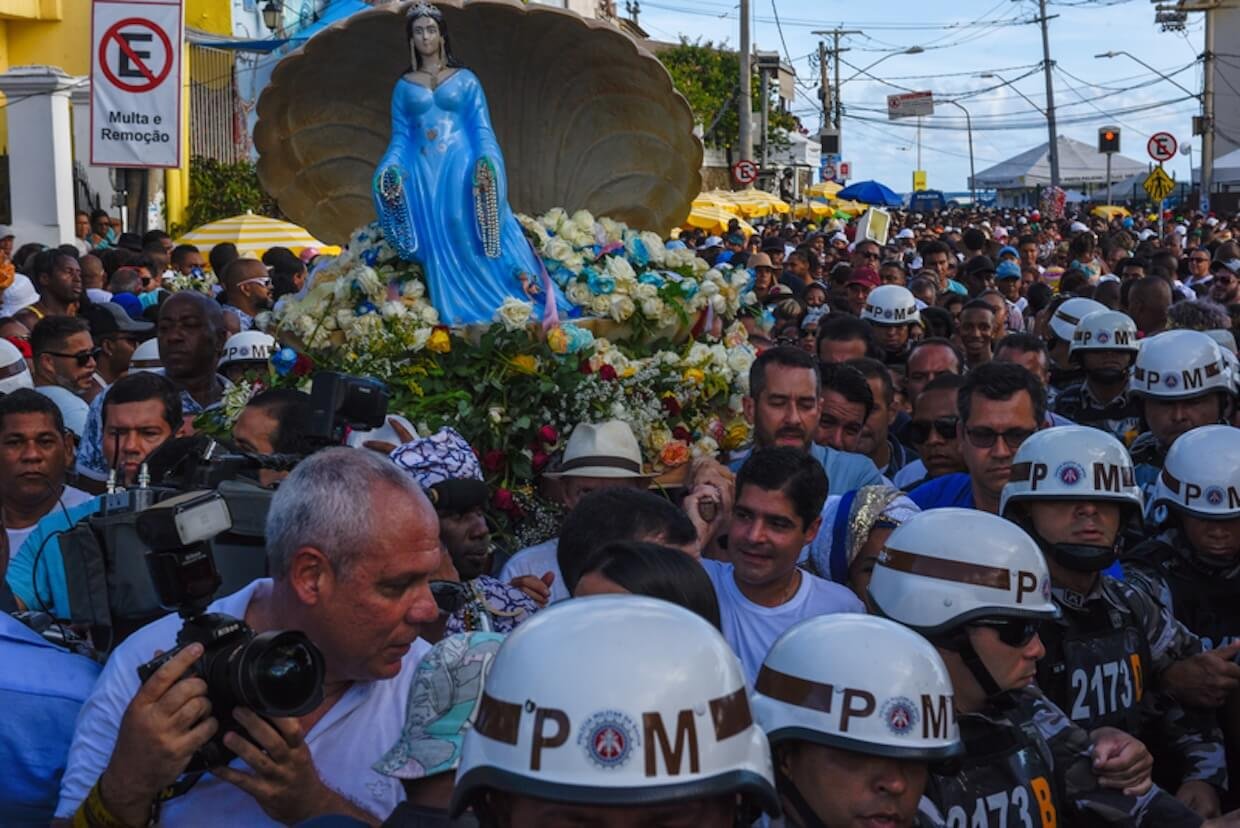
People take part in the celebration of Yemanjá in Salvador, Bahia, Brazil on February 2, 2019. Photo: Ember Stefano | Dreamstime.
Religion is central to your scholarship on Bolsonaro. In your work with Ricardo Barbosa Jr., you propose the category of the “religious-populist radical right,” arguing that religion provides not only ideas but also organizational resources and social power through which the radical right can capture institutions and participate in transnational culture wars. How useful is this concept for understanding the first-round result, particularly given Flávio Bolsonaro’s strength among evangelical Christians and Lula’s continuing advantage among Catholics?
Assoc. Prof. Guilherme Casarões: This is a very interesting paradox, because, as Pippa Norris and other authors have demonstrated very recently, religious affiliation is decreasing worldwide, meaning that we live in a world that’s not as religious as it used to be, certainly not 40 or 80 years ago. The paradox is precisely the fact that even though religious affiliation is declining, religious politicization is on the rise, meaning that those who are trying to hold on to religion are becoming more and more political.
We used to live in a society that had a clear division between what’s religious and what’s political. Of course, it’s impossible to prevent these things from overlapping occasionally. But all in all, secularism had prevailed, and that was the original thought.
Then, as early as 1993, an American sociologist called Mark Juergensmeyer wrote a book called The New Cold War?, in which he defends the idea that what’s new about the end of the Cold War is precisely the rise of religious nationalism. When he wrote this book back in 1993, he was talking about religious nationalism in some parts of the Middle East, religious nationalism in some parts of South Asia, religious nationalism in some parts of Africa, and that was that. He himself even treated that as a peripheral phenomenon.
What we have seen over the last 30 years, however, is the mainstreaming of religious nationalism. If you look at it today, a lot of far-right movements are very closely tied to this new identity of religious nationalism. If you think about Vladimir Putin in Russia, there was a turn at some point between 2012 and 2016 in which he became very close to Orthodox Christianity in Russia.
Erdoğan, in Turkey—he was elected as Prime Minister back in 2002. Of course, the AKP was always very religion-infused, but at the same time, it wasn’t a religious party, strictly speaking, and he has become more and more religious with time. The whole idea of making Russia Imperial Russia once again, or making Turkey Ottoman Turkey once again, these are all very strong religious tropes.
What’s interesting about religious nationalism today, and that’s one of Juergensmeyer’s theses, is that it attaches itself to an idea of civilization as well. No matter if you’re a Catholic, a Protestant, or an Evangelical Christian in Brazil, Argentina, Peru, or, above all, the United States, irrespective of your specific religious affiliation, you have this civilizational notion that has to be preserved. We have to protect what a lot of people across the hemisphere have called the Judeo-Christian tradition.
I could have mentioned other examples, and Israel and India are also very important examples of the mainstreaming of religious nationalism. If you look at Benjamin Netanyahu’s government right now, it’s pretty ethno-religious. It’s even more than just religious. If you look at India’s BJP and Modi, their core ideology is Hindutva, which is basically Hindu nationalism as well.
Religion and Populism Are Formidable Together
What I’m trying to say here, and that’s the reason why Barbosa and I came up with this notion of the religious-populist radical right, is basically that what we see today is precisely the mainstreaming of such religious ideas and the fusion of these religious ideas with populism. If populism is about creating this divide between the people and the elites, now the people are the religious ones. The religion of the people is the fundamental thing that has to be observed and has to be somehow preserved in these countries.
It was born out of a case study about Brazil. But it brings a more universal lesson for what we have experienced in many parts of the world. Religion and populism are formidable together. They are able to produce many important results, especially because they speak not only to the organizational side of things, they speak not only to the money that fuels all these movements, but they speak fundamentally about belonging and about identity. This is what makes it so strong.
Europe might be an exception. I just want to mention this, because I don’t want to elaborate on this, but I think it’s important to make a distinction here. We talk about the far right, treating them as though they were part of the very same set of ideas, and, of course, European far-right movements are also very much civilizational, but it’s not necessarily along religious lines.
France and Germany say little about religion, whereas Spain and Portugal say a little bit more about religion. Europe is a more complicated mosaic that we have to look into, but in Latin America and the United States, the hemisphere has become fundamentally Christian nationalist. That’s an important take on whatever’s going on right now in our part of the world.
Religion Is a Powerful Transnational Force in the Americas
Tourists enjoy the first sunset after a week of rain and thunderstorms from Corcovado Hill, overlooking Rio de Janeiro, Brazil, on March 3, 2013, with the Christ the Redeemer statue above the city. Photo: Kseniya Ragozina / Dreamstime.
Your research also suggests that Christian nationalism under Bolsonaro was not merely domestic but transnational: religious narratives shaped alliances, culture-war agendas, relations with Israel, and participation in conservative international initiatives. To what extent has this transnational religious nationalism survived Jair Bolsonaro’s presidency and become embedded in the broader Brazilian right? Does Flávio Bolsonaro’s first-round victory suggest that this infrastructure can continue shaping Brazilian politics and foreign policy without Jair Bolsonaro personally returning to power?
Assoc. Prof. Guilherme Casarões: Over this summer, I taught a course called Transnational Politics in Latin America. My original idea was to talk about the transnational far right in Latin America. That was my obsession. But it turns out that I decided to take a step back and look at the much bigger picture of transnationalism in Latin America, from colonial times all the way down to today. Basically, it was a course on so many different angles of transnationalism in Latin America.
One of the things that I learned from that course, based on the readings that I put together and the discussions that I had in the classroom, was precisely that religion has been one of the most transnational things connecting countries in Latin America or in the Americas, by and large. Because if you think about the beginning of the colonization of the Americas, especially Spanish and Portuguese America, meaning Latin America in general, it all starts not only with Spain and Portugal, but with the Jesuits, with the Catholics from that time. So, colonization had a very strong transnational component, and this component was the Catholic faith, evangelization, missionary work, and so on and so forth.
What we see during the Cold War is another chapter of the same process. But now, we’re not talking about religion coming out of Europe to change the landscape of Latin America. From the 1960s on, in the middle of the Cold War, we’re talking about the Protestant faith, in a way, trying to challenge not only communist atheism but also, and most importantly, what became known as liberation theology in Latin America.
So, we have to put things in context and remember that in Latin America, the Catholic Church took a turn to the left in the 1960s and 1970s, so much so that Pope John Paul II from Poland went after these bottom-up grassroots movements of the Catholic Church because they were, according to the official doctrine of the church, becoming communists themselves.
Protestantism emerged out of the United States. Of course, Protestantism is also very national. We have national churches being built, or national movements being created in El Salvador, the Dominican Republic, Brazil, Paraguay, and the list is pretty long. But at the same time, there was a very important push by US administrations, by the CIA, by a number of US-based churches, to project this faith transnationally onto Latin America during the Cold War.
This is important because what we see right now—the growth of evangelicalism in Brazil, in Chile, in Argentina, in a lot of Central American countries—is precisely the unfolding of this process. It’s a long shot, of course, but it has paid off. Brazil, for example, when I was born in the 1980s, had around 5 to 7% evangelical Christians. In 2026, Brazil has about 30% of the population as evangelical Christians. It’s a big change.
Some countries have become evangelical-majority countries, as opposed to the Catholic majority that has always dominated the landscape in Latin America. My point is that evangelicals have become more and more consequential.
Evangelicalism Has Helped Turn Conservative Ideas into Policy
Of course, one of the transnational nodes that we can identify is precisely cultural war. One of the things that evangelical churches, movements, and leaders import from the United States, in exchange among them, is the fight against abortion, the fight against LGBTQ rights, the fight against drugs, which is framed in a very specific way, traditional family values, Christian nationalism, Christian Zionism, which is the love for Israel. All these things are, in many ways, the web that connects all these churches and movements around the region.
So, as much as Bolsonarismo as a movement is transnational, and religion plays an important role in that, the far right in Latin America is born out of transnational forces. And, of course, religion is also a very important point of that process.
Now, we have to make a distinction, however, and not treat all evangelicals as the same thing. Not all evangelicals are in favor of Israel. Not all evangelicals are in favor of Bolsonaro, for that matter. Not all evangelicals love the idea of Trump interfering with Brazilian elections. I would say that nowadays, because of religious values or because of even conservative worldviews, evangelicals vote for Bolsonaro, be it Flávio Bolsonaro the son or Jair Bolsonaro the father, at a 70–30 ratio. So, out of the around 60 million evangelicals that we have in Brazil, some 40 million consistently vote for Bolsonaro.
Some people blame the leaders. Some people say it’s just about these leaders of megachurches in São Paulo, in Rio, and in other urban areas. They are the ones who call the shots, and if we are able to defeat these people, then we’re going to be able to change the minds of the followers. That’s fundamentally wrong.
Of course, leaders have a very big influence on how followers vote. Even when they don’t talk about it explicitly, we have a lot of people who go to the services and who listen to the pastors and the leaders, and they fundamentally agree with that. It’s not about an imposition of vote or political positions; it’s just agreement. This is important because it also explains that maybe the role of leaders is limited, more limited than we think.
There’s an American scholar called Amy Erica Smith from the University of Iowa, and she wrote a book about evangelicals in Brazil. She basically says it’s important to consider the role of evangelical leaders, those who own churches, those who replicate churches, even internationally, but we cannot pretend that voters are not agents of their own decisions. Meaning that evangelical Christians might vote for Bolsonaro not because their leader has told them so, but because they believe in what they’re listening to. They believe in the promises. That’s an important thing. And, of course, what evangelicalism has done to countries like Brazil is not that it has transformed voters into more conservative voters. It’s different. Evangelicalism, because it’s a more outspoken faith, as opposed to Catholicism, has allowed these conservative ideas to flourish and to become more open.
It’s not about changing people’s minds. Brazilians, as much as Turks, as much as Argentinians, as much as whoever else you want to name, most people are conservative in one way or another. Religion is there to enable these conservative ideas to become policy. That’s where we are right now in Brazil.
Bolsonarism Began by Emulating Trump
Supporters of Brazil’s former President (2019–2022) Jair Bolsonaro hold signs during a demonstration in São Paulo, Brazil, on September 7, 2025. Photo: Dreamstime.
This brings us to Trumpism. Donald Trump became an explicit issue in the first-round campaign, with Lula accusing the US president of seeking to influence the election in Bolsonaro’s favor, while Flávio Bolsonaro openly advocated a closer relationship with Trump. How should we understand Trumpism’s influence on contemporary Bolsonarism after the first-round result: as imitation, ideological diffusion, strategic borrowing, or participation in a genuinely transnational populist network?
Assoc. Prof. Guilherme Casarões: I think it’s a transnational thing. It starts out with emulation or imitation. In the beginning, when Bolsonaro decided to run for president back in 2016, that was precisely the time Trump was about to get elected in the United States. And the moment Trump got elected, in November 2016, Bolsonaro started calling himself the Brazilian Trump, or Trump of the tropics. That’s another version of the story.
Of course, the beginning was mostly about emulating Trump’s playbook, because we have to concede something to Trump: his playbook was super successful. It was successful because it tapped into identity, it tapped into people’s fears, it tapped into people’s hate—hate for whatever they hate, either racial hatred or religious bigotry, it doesn’t matter. Trump was able to bring all of these things together into one movement, which was not cohesive, it was not super tight, but it was a loose movement that was able to get him elected in 2016. Bolsonaro attempted the very same things, and it worked. Emulation has paid off.
But emulation is not the whole story, because ever since Bolsonaro got elected, or even slightly before that, we could already notice some degree of circulation of ideas among these movements. Brazil and the United States have the two biggest and most important far-right movements in the hemisphere. We’re talking about the two biggest countries anyway.
The American and Brazilian Far Right Borrow from Each Other
It would be naive to say that everything that the Brazilian far right does is just a copy of what the United States did. If you look at the evolution of the two movements side by side, you’re going to see that there’s a lot of interaction between them. There were times when the Trump movement, or the MAGA movement, also borrowed from some of the strategies played out by Bolsonaro in Brazil. For example, the whole “dictatorship of the courts” argument is an old argument in US politics, but it started out with Brazil and then trickled up to the United States. It’s an interesting thing, because if you analyze these two movements closely, you’re going to see a lot of interaction. At this point, we can safely affirm that it’s a truly transnational movement with a lot of back and forth.
These movements talk to each other, they translate each other’s talking points, they resort to each other’s images at times. It wasn’t rare to see Trump, when outside of power in 2022 and 2023, using some images of Brazil and saying, this is what’s going to happen to the United States if Biden stays in power, or something like that. So, in many ways, there is a degree of interaction.
The interesting thing at this point is that it’s not just about the US and Brazil, because a lot of these things have also been incorporated into some other movements around the hemisphere, Argentina, Colombia, etc. Bernardo de la Espriella, Colombia’s new president, has a good relationship with Trump, but also with the Bolsonaro family. They show up at CPAC (Conservative Political Action Conference) together at times. Eduardo Verástegui of Mexico, who is probably the least likely to win, because Mexico is a very much consolidated political system, and now it’s settled on the left. But he’s friends with Flávio Bolsonaro and Eduardo Bolsonaro, who’s Bolsonaro’s son as well. Eduardo Bolsonaro is a very young former congressman who lost his office because he had spent too much time in the United States, and he still lives in the United States, where he has kept lobbying in favor of the liberation of his father from prison ever since last year, and he’s got the ears of a lot of people in the White House as of now.
It’s interesting to see how these things are articulated and how these things circulate. I’m currently working on this, so that’s probably going to be my next paper or something—on the transnational routes of the Latin American far right. So, it’s not just about the mechanism; it’s also about the origin of these movements and the conditions that have enabled these movements to be considerably successful, if you look at them right now, in power in so many countries of Latin America.
The Workers’ Party Has No Alternative to Lula
People shout slogans during an International Workers’ Day demonstration in São Paulo, Brazil, on May 1, 2026. Photo: Dreamstime.
Finally, what does the October 4 first-round result tell us about the evolution of populism in Brazil? With Flávio Bolsonaro leading without Jair on the ballot and Lulism showing signs of weaker electoral dominance, are we moving from charismatic leadership toward more institutionalized populist identities—and what could this mean for Brazilian democracy?
Assoc. Prof. Guilherme Casarões: I don’t think so, and let me explain. Bolsonarism is still very much a populist movement. Of course, the leader now is the son, not the father, but as we’ve mentioned a few times before, the movement still gravitates very much around the image of Jair Bolsonaro. Of course, there might be an evolution, there might be successors outside of the family, and there might be some changes along the way. But the way things are as of right now, it’s a very personalistic and a populist movement in this regard, too.
Meanwhile, the left has a problem in Brazil. Lula might have been a populist very early on. He might have run so many elections, some unsuccessfully, on a populist platform. But Lula can no longer be considered a populist. Because nowadays, when people look at him, what they see is not an agent of transformation, an agent of change. What they see today when they look at Lula is a backward politician, somebody who acts on behalf of a corrupt system, of an outdated model of politics.
So, in many ways, we can draw a comparison between what happened in the United States under Biden and what happened in Brazil under Lula. This is not to say that Lula’s going to lose the second round of elections. Maybe he will, and most likely he will, but I’m not even taking that into account. What I’m trying to say is that what Lula represents today, regardless of whether he gets elected or not, is the establishment. People look at him and they see a failed model right there.
Of course, I understand that some people can be, as we say in Portuguese, chameleons. Some people can just change identities over time; some people can just build new identities from scratch. But Lula has been pretty much the same person ever since the beginning. Now, at 80, people look at him, and they can’t see any expectation of transformation.
Because of that, one of the biggest mistakes that we’ve had, both in the United States and in Brazil—that’s also true for Argentina and perhaps some other countries—is that these countries’ elites on the left, who used to be populist back in the day, or who could have become populist at some point, have failed to construct alternatives.
The Workers’ Party has no alternative to Lula. This is why he’s running for the fourth term. Very worn down, tired, old, but he’s still the only option. We don’t even have, in Brazil, a Kamala Harris option, which would be, maybe, Fernando Haddad, who’s the former finance minister of Brazil, who already ran in 2018 and lost to Bolsonaro’s father.
Brazil Missed the Chance for a Positive Left-Wing Populism
So, what we have today is a left, a progressive movement in Brazil, that has become, to speak directly to your question, so deeply institutionalized that it cannot really detach itself from the bad things people see in the system itself. As much as we see with the Democratic Socialists of America movement and Abdul El-Sayed and Zohran Mamdani, all these guys—AOC, of course, was the first one to come up with that, and Bernie Sanders, of course, enabling the others—this is something that Brazil needs.
We don’t have a two-party system, so this is probably going to happen as a specific partisan movement in Brazil. But the feeling that I have is that, unfortunately, we have missed the opportunity to consider a positive left-wing populism emerging to counter the right-wing populism that we have so dominant in the country right now.
(*) This interview was academically curated and edited by Dr. Bulent Kenes.
Klaudia Koxha(Postdoctoral Fellow at the University of Lausanne).
Speakers
“Populist Strategies of Normalizing Demographic Fears,” by Oscar Mazzoleni (Professor in Political Science and Political Sociology at the University of Lausanne).
“The Scientific Normalization of ‘the Great Replacement’ Conspiracy,” by Alberta Giorgi (Associate Professor in Sociology of Culture and Communication at the University of Bergamo).
“From Demographic Winter to Civilizational Struggle: Anti-Abortion Networks and the Global Radical Right,” by Carol Mason (Otis A. Singletary Chair in the Humanities and Professor at University of Kentucky, US).
“Mestizaje, Backlash, and the Politics of Demographic Populism: Race and Gender in Latin America,” by Carlos de la Torre (Professor at the Centre for Latin American Studies, University of Florida).
“Anti-Muslim Mobilization: Demographic Change and Radical-Right Populism in Austria,” by Reinhard Heinisch(Professor of Comparative Austrian Politics at the University of Salzburg, European Studies Center associate at the University of Pittsburgh and visiting lecturer at Renmin University of China).
In this ECPS interview, Associate Professor Nick Beauchamp of Northeastern University examines the evolving relationship between MAGA, democratic socialism, political communication, and the institutional structure of American politics. Assoc. Prof. Beauchamp argues that MAGA’s dominance of the Republican Party should not be confused with uniform ideological agreement among Republican voters, emphasizing that “there’s a difference between how much the beliefs have spread and how much the ideology or the party has taken over.” He suggests that democratic socialism could exert comparable national influence even without achieving majority support, noting that a progressive or DSA-aligned faction could still have “similar effects nationally.” The interview also explores media selection, institutional trust, polarization, AI-driven political persuasion, and the persistence of anti-establishment politics.
As the United States approaches the November 3 midterm elections, the political landscape is defined by an unusually narrow congressional balance, weak public evaluations of the economy, declining approval of President Donald Trump, and an election increasingly interpreted through attitudes toward Trump himself. At the same time, MAGA has become deeply embedded in the Republican Party, while Democrats remain divided over how far an economically populist and democratic-socialist agenda should shape their response to Trumpism. Against this backdrop of personalized politics, ideological polarization, institutional conflict, and an increasingly fragmented information environment, the relationship between insurgent movements and the established two-party system has become especially consequential.
In this interview with the European Center for Populism Studies (ECPS), Associate Professor Nick Beauchamp of Northeastern University’s Department of Political Science and Network Science Institute offers a structural interpretation of the apparent asymmetry between MAGA’s transformation of the Republican Party and democratic socialism’s more contested position within the Democratic coalition. Rather than treating MAGA as equivalent to the Republican electorate as a whole, Assoc. Prof. Beauchamp stresses that “there’s the MAGA further-right faction and then the center-right faction. Those two things still exist.” He consequently distinguishes between the diffusion of ideological beliefs among voters and the institutional capture of a political party: “there’s a difference between how much the beliefs have spread and how much the ideology or the party has taken over.”
That distinction underpins one of the interview’s most consequential observations. Assoc. Prof. Beauchamp argues that democratic socialism does not necessarily have to become nationally majoritarian in order to acquire transformative political influence. Even if the Democratic Socialists of America (DSA) or the broader progressive left were unable to move substantially beyond their current “core of urban, educated, young, left-leaning liberals,” he maintains that “they could still have similar effects nationally.” There is also, he adds, a possible route toward a broader populist coalition appealing to “economically distressed rural or suburban voters,” although such expansion is “not necessary for having a MAGA-sized effect.”
More broadly, Assoc. Prof. Beauchamp situates both MAGA and democratic socialismwithin the institutional architecture of American politics. Because the presidential and first-past-the-post systems sustain two large parties, he argues, ideological movements operate as factions competing for control within them. Political outcomes therefore depend not only on ideological appeal but also on contingency: “Trump almost lost the primary in 2016, and Sanders almost won the primary in 2016.” Had those outcomes shifted, he observes, “we’d be living in a very different world.”
The interview thus moves beyond a simple comparison of left- and right-wing populismto examine how factional capture, institutional structure, media selection, political communication, AI-driven personalization, and anti-establishment sentiment may shape the next phase of American democracy.
In this ECPS interview, Dr. Mara Nogueira examines Brazil’s 2026 presidential election through the intertwined dynamics of US influence, Bolsonarism, Lulism, religion, labor, and political identity. She argues that the role of the United States—and particularly the alignment between Donald Trump and the Bolsonaro family—has become a consequential new element in the contest, describing the election as “a very important and dangerous one.” Dr. Nogueira also reflects on the durability of Bolsonarism, the increasingly defensive character of Lulism, the political weight of evangelical networks, and the effects of precarious work, entrepreneurialism, and social media. More broadly, she situates Brazil within a transnational landscape of authoritarian and revanchist populism while stressing the importance of class, region, religion, and changing expectations of the state.
As Brazil approaches the October 4, 2026 presidential election, the contest is unfolding amid persistent polarization, a resilient yet more defensive Lulism, the continued strength of Bolsonarism beyond Jair Bolsonaro himself, and increasingly salient cleavages around religion, public security, welfare, and regional inequality. These dynamics are particularly significant in light of the research of Dr. Mara Nogueira, Senior Lecturer in the School of Social Sciences at Birkbeck, University of London, whose work examines the intersections of populism, urban politics, labor, inequality, informality, and political belonging in Brazil, with particular attention to revanchist populism, antipetismo, and the social and spatial foundations of Bolsonarism.
In this interview with the European Center for Populism Studies (ECPS), Dr. Nogueira emphasizes that Brazil’s 2026 election cannot be understood exclusively through domestic political cleavages. Alongside the enduring influence of anti-PT sentiment, regional divisions, gender, class, and religion, she identifies the role of the United States—and particularly the Trump administration—as a new and consequential element in the electoral landscape. “One thing that you didn’t mention in your question and that I think is worth pointing out is the influence of the US in this election,” she stresses, adding pointedly: “They’re not hiding it.”
For Dr. Nogueira, this external dimension became especially visible when President Donald Trump imposed tariffs on Brazil, measures that she interprets as carrying “a very high political element.” She also points to broader American strategic interests in Brazil and argues that political influence should be understood alongside economic considerations, including US interest in Brazilian mineral resources. “There are several interests at play,” she notes, “political influence being one of them.”
The contrast with the 2022 election is, in her view, particularly significant. While Washington inevitably had interests in Brazilian politics under President Joe Biden, Dr. Nogueira argues that the current situation is qualitatively different because “the alignment between Trump and the Bolsonaro family is very well known.” This relationship, she cautions, constitutes “a dynamic there that will need more attention and more scrutiny.”
It is in this context that Dr. Nogueira describes the 2026 election as both unusually consequential and potentially dangerous. According to her, the presence of “one political project that’s very well aligned with American interests”means that, “with Trump in government,” the consequences “could be a very disastrous thing for Brazil and Latin America.”
The interview therefore situates Brazil’s electoral contest not only within the domestic struggle between Lulism and Bolsonarism, but also within a broader transnational configuration linking Trumpism, far-right populism, economic restructuring, religious mobilization, and changing expectations about the role of the state.
Beyond the question of US influence, the interview also explores the changing balance between Lulism and Bolsonarism as political projects. Dr. Nogueira argues that Lulism remains anchored in the Northeast and among lower-income voters, but has become increasingly defensive. She suggests that “Lulism has perhaps become a victim of its own success,” as social mobility has altered popular aspirations and Lula’s political appeal has become more closely associated with defending past achievements than promising transformative change.
Religion is another central theme. Dr. Nogueira stresses that evangelical identity has become deeply embedded in everyday social networks and political value formation, particularly in Brazil’s urban peripheries. At the same time, she cautions against treating “the evangelical vote” as a homogeneous bloc, emphasizing the intersection of religion with class, region, gender, and other identities.
The interview further situates Brazil within broader transformations in labor and political communication. Dr. Nogueira connects precarious employment, entrepreneurialism, and changing expectations of the state to the appeal of authoritarian and revanchist populism, while also highlighting the growing importance of social media and algorithmic echo chambers in shaping political identities and limiting communication across electoral divides.
In this interview with ECPS, Dr. Semir Dzebo, Postdoctoral Researcher at the Centre for Socio-Legal Studies at the University of Oxford, examines Bosnia and Herzegovina’s October 4 elections through the lenses of populism, nationalism, secessionism, and ethnic politics. He argues that Bosnia remains marked by “stable instability”: Dayton secured peace but has struggled to function as a democratic constitution. Dr. Dzebo discusses “populist secessionism,” the erosion of anti-elite appeals under long incumbency, competing constructions of “the people,” Croat and Bosniak representation, foreign influence, disinformation, and the limits of territorial revisionism. Rather than expecting dissolution or a sweeping constitutional settlement, he points toward incremental reform, EU integration, stronger state capacity, desegregated schooling, cross-ethnic electoral incentives, and improved economic conditions.
Bosnia and Herzegovina approaches its October 4 elections amid renewed strain on the political architecture established by the Dayton Peace Agreement. More than three decades after the end of the 1992–95 war, questions of statehood, entity autonomy, ethnic representation, foreign influence, and the legitimacy of shared institutions remain deeply intertwined. Political competition continues to be structured less by a conventional left–right divide than by competing understandings of sovereignty, citizenship, collective rights, and of who constitutes the legitimate political community. Against this fragmented backdrop, the elections are not simply about who will govern Bosnia and Herzegovina, but about the character and durability of the post-Dayton state itself.
In this interview with the European Center for Populism Studies (ECPS), Dr. Semir Dzebo, Postdoctoral Researcher at the Centre for Socio-Legal Studies at the University of Oxford, examines these tensions through the lenses of populism, nationalism, secessionism, and ethnic politics. He argues that electoral competition in Bosnia carries unusually high constitutional stakes because “whatever coalition gets formed after the October 4th elections is, in a way, a choice about the state itself.” In this sense, the election resembles “a de facto referendum” on the country’s future political architecture.
A central theme of the conversation is what Dr. Dzebo conceptualizes as “populist secessionism.” Whereas ordinary nationalism operates along a horizontal axis of competition between national communities, populist secessionism introduces a vertical, moral division between an allegedly authentic people and corrupt or illegitimate elites. In this framework, political disagreement becomes morally charged: as Dr. Dzebo puts it, disputes that might otherwise be negotiated can acquire “this moral dimension that turns them into treason,” making compromise appear as capitulation.
The interview also explores the limits of this strategy. Dr. Dzebo’s research suggests that support for secession in Republika Srpska is driven less by populist attitudes than by ethnonational identification, ingroup bias, deteriorating intergroup relations, and economic grievance. Long incumbency, moreover, can erode the credibility of anti-elitism: voters predisposed against elites may increasingly view Milorad Dodik himself as part of the elite.
The broader diagnosis culminates in Dr. Dzebo’s assessment of Dayton itself. Bosnia, he argues, lives in a condition of “stable instability.” Dayton “has really accomplished the first task” of securing peace, but “has not really been great at the second task” of functioning as a democratic constitution. Yet he rejects both expectations of imminent dissolution and hopes for a sweeping constitutional reset, instead pointing toward incremental reform, EU integration, implementation of Strasbourg judgments, stronger state capacity, desegregated schooling, cross-ethnic electoral incentives, and improved economic conditions as the more plausible path toward a more cohesive democratic order.
Please cite as: ECPS Staff. (2026). “Demographic Populism: Demography as a Political Battleground.” European Center for Populism Studies (ECPS). October 2, 2026. https://doi.org/10.55271/rp00155
The ECPS Panel on Demographic Populism, titled “Demography as a Political Battleground: Migration, Family, Race, Religion, and Radical-Right Populism” examined how demographic change becomes politically meaningful when transformed into narratives of threat, survival, and belonging. Bringing together contributors to the book titled The Radical Right and Demographic Populism, the discussion showed how migration, fertility, abortion, gender, religion, race, and family are increasingly connected through struggles over who constitutes “the people,” who reproduces them, and whose future is imagined as endangered. Across cases from Europe, Latin America, the United States, and Russia, panelists explored the weaponization of demographic data, the role of emotion and transnational networks, and the effects of demographic narratives on party competition, public policy, and social boundaries. The panel underscored that demographic populism is ultimately less about population numbers than about their political interpretation.
Reported by ECPS Staff
Demographic change is often treated as a background condition of political life: a measurable shift in fertility, migration, age structure, religious composition, or family formation. Yet the ECPS Panel on Demographic Populism titled “Demography as a Political Battleground: Migration, Family, Race, Religion, and Radical-Right Populism”, held online on September 30, 2026, demonstrated that demography becomes politically consequential only when such changes are interpreted, narrated, and connected to broader struggles over identity, belonging, reproduction, and collective survival.
Bringing together contributors to the book The Radical Right and Demographic Populism, the discussion examined how demographic developments are transformed from social facts into political threats, how apparently separate issues become articulated within a common ideological framework, and what happens when these narratives gain electoral, institutional, or transnational traction. The panel was expertly moderated by Dr. Klaudia Koxha, Postdoctoral Fellow at the University of Lausanne, whose comparative framing and carefully structured interventions consistently connected the speakers’ cases while drawing out the conceptual links among demographic change, populism, political competition, and belonging.
At the center of the discussion was the concept of demographic populism. Rather than reducing radical-right politics to opposition to immigration or cultural change, the panel explored a broader logic in which “the people” are imagined as a population whose continuity is endangered. In this framework, migration, declining fertility, abortion, LGBTQ+ rights, changing gender norms, religion, race, and family policy can be linked through a common question: who constitutes the legitimate people, who reproduces them, and which groups or institutions are portrayed as threatening their future? Professor Oscar Mazzoleni emphasized that this perspective shifts attention from sovereignty and prosperity toward survival and reproduction, while Associate Professor Alberta Giorgi highlighted the active weaponization of demographic change through fear, discursive articulation, and claims to scientific or cultural authority.
The comparative breadth of the panel revealed that this political logic takes markedly different forms across national and regional contexts. Professor Reinhard Heinisch showed how, in Austria, demographic categories become cultural and civilizational categories through party competition and the construction of Muslims as a threat to national continuity. Professor Carlos de la Torre demonstrated that in Latin America demographic politics cannot be understood primarily through migration, since race, gender, sexuality, mestizaje, and the politics of the family have long been central to populist constructions of “the people.” Professor Carol Mason, meanwhile, traced how anti-abortion movements in the United States and post-Soviet Russia have mobilized the “unborn” as a collective symbol of national and racial futures, showing how demographic anxieties circulate through transnational networks and religious-political alliances.
Across these cases, a central conclusion emerged: demographic populism is not simply about numbers. It is about the political interpretation of numbers and the selective construction of demographic realities. Population statistics, fertility rates, migration flows, and family structures acquire political meaning when they are woven into narratives of decline, replacement, dispossession, or moral disorder. Such narratives may then reshape party competition, public policy, institutional agendas, social alliances, and even definitions of citizenship and belonging. The panel therefore situated demographic populism not as a marginal subfield of radical-right politics, but as a potentially powerful framework for understanding how contemporary struggles over nation, religion, race, gender, and reproduction are increasingly fused into competing visions of the future of “the people.”
Dr. Koxha: Demographic Populism Connects Migration, Reproduction, Religion, Race, and the Politics of Belonging
In her opening remarks, Dr. Klaudia Koxha, Postdoctoral Researcher at the University of Lausanne, introduced the ECPS Panel on Demographic Populism by situating the discussion within the recently published volume The Radical Right and Demographic Populism, which she co-edited with Professor Oscar Mazzoleni and which appeared with Manchester University Press in July 2026.
Rather than presenting the volume as a conventional sequence of chapter summaries, Dr. Koxha explained that the panel was deliberately organized around comparative questions cutting across the book’s diverse cases. This approach reflected one of the volume’s central analytical premises: issues such as migration, fertility, abortion, gender, LGBTQ+ rights, religion, race, and family are frequently discussed as separate domains, yet within radical-right politics they often become interconnected through a broader struggle over population, belonging, and collective continuity. The key questions therefore concern who constitutes “the people,” who reproduces that community, how its composition is understood to be changing, and which actors or developments are represented as threats to its future.
Dr. Koxha emphasized that the concept of demographic populism seeks to move beyond treating demographic developments as objective trends that automatically generate political consequences. Declining fertility, increased migration, changing religious composition, or evolving understandings of gender and family do not in themselves become political crises. What matters analytically is the political work through which such developments are interpreted, connected, dramatized, and transformed into narratives of demographic anxiety and collective threat.
She then introduced the panelists and highlighted the comparative breadth of their contributions. Professor Oscar Mazzoleni examines Fratelli d’Italia and the adaptation of demographic fears and “great replacement” narratives as the party moves from the margins into government. Professor Alberta Giorgi analyzes the online circulation and normalization of replacement narratives in Italy and France, particularly the legitimizing role of statistics, science, and demographic expertise. Professor Carol Mason focuses on transnational anti-abortion mobilization connecting the United States and Russia, showing how reproductive anxieties intersect with gender and broader radical-right projects. Professor Carlos de la Torre contributes a historical Latin American perspective on the incorporation of race, gender, sexuality, and family into different populist waves. Professor Reinhard Heinisch examines the Austrian Freedom Party’s shift from anti-clericalism toward cultural Christianity in constructing Muslims and immigration as questions of national and demographic belonging.
Dr. Koxha concluded by inviting Professor Mazzoleni to elaborate on why these diverse political struggles can productively be understood through the common lens of demographic populism and what this concept contributes to both theoretical and empirical debates.
Prof. Mazzoleni: Demographic Populism Reframes the Politics of “the People” Around Survival, Reproduction, and Belonging
Professor Oscar Mazzoleni framed demographic populism as a form of populist politics in which the central concern is not only the sovereignty or prosperity of “the people,” but their perceived survival and reproduction. While populist discourse often identifies enemies who allegedly undermine popular power or material well-being, demographic populism casts certain actors and social changes as threats to the continued existence of the people understood through national, racial, or religious belonging.
Within this framework, issues such as LGBTQ+ rights, homosexuality, abortion, and changing family structures can be represented as challenges to biological reproduction. The traditional family therefore occupies a central position, whether imagined as Christian, white, or nationally defined. It becomes not merely a cultural institution but a demographic and political pillar through which the continuity of the people is supposedly secured.
Professor Mazzoleni stressed that these claims vary across contexts and actors and should be examined through both demand-side and supply-side dynamics. A key contribution of the concept is to challenge the tendency to treat religion, race, immigration, sexuality, and family as separate cultural issues. Instead, demographic populism connects them through a common logic of population, reproduction, and belonging. From this perspective, radical-right opposition to multiculturalism, cosmopolitanism, and changing gender norms may form part of a broader political project centered on defending the traditional family and preserving an imagined national, religious, or racial community against perceived demographic transformation.
Dr. Koxha noted that Prof. Mazzoleni’s intervention provided the conceptual starting point needed to move the discussion forward. She then shifted the panel from the concept to the cases, asking how demographic change becomes political in the first place. Dr. Koxha stressed the premise that demographic change does not automatically become a political crisis. She pointed specifically to declining fertility, migration, changing religious composition, and changing family structures, and asked what has to happen for such developments to be transformed into political threats. She also asked what the individual cases examined by the panelists reveal about this process. Dr. Koxha then invited Professor Alberta Giorgi to respond first, giving her the floor.
Assoc. Prof. Giorgi: Demographic Change Becomes Political Through Weaponization and Cultural Resonance
Alberta Giorgi is an Associate Professor in Sociology of Culture and Communication at the University of Bergamo.
Associate Professor Alberta Giorgi argued that demographic shifts do not constitute crises in themselves. Rather, they become politically consequential when political actors actively transform them into threats. Drawing on the comparative cases she analyzed, Professor Giorgi identified the active weaponization of demography as a first crucial step. This involves political actors reframing demographic developments through a politics of fear and translating policy challenges into apocalyptic scenarios. Demography therefore becomes politically charged when it is deliberately presented as a source of danger.
A second element concerns discursive articulation. Professor Giorgi emphasized that different narratives must be brought together and connected in ways that make demographic change meaningful within a broader political frame. For such narratives to be effective, however, they must also achieve cultural resonance. She explained that this cultural resonance can be constructed in different ways. In the cases she examined, it is built partly through references to science and figures of authority, but also through longer-term processes of cultural change. These processes gradually reshape what can be said publicly and how it can be said.
Professor Giorgi described this as a long-term metapolitical project. Through such processes, demographic developments are progressively transformed into perceived demographic threats. She summarized the mechanism in two central dynamics: the active weaponization of demography and the transformation of the cultural boundaries of what can legitimately be articulated in public discourse.
Dr. Koxha highlighted one point in particular from Professor Giorgi’s intervention: the importance of discursive articulation. Dr. Koxha emphasized that demographic developments have to be interpreted, narrated, and given political meaning before they can function as political threats. Building on this point, she shifted the discussion to Professor Reinhard Heinisch and the Austrian case. She noted that, in Austria, demographic change intersects particularly strongly with religion and immigration. Dr. Koxha therefore asked how the process of transforming demographic change into a political threat operates in this specific national context.
Prof. Heinisch: Demographic Change Becomes Political When It Is Reframed as a Civilizational Threat
Professor Reinhard Heinisch strongly endorsed the preceding argument that demographic change is not inherently political. Drawing on the Austrian case, he argued that it becomes politicized when demographic categories are transformed into cultural and civilizational categories. Professor Heinisch stressed that this process does not follow automatically from immigration numbers. Austria experienced a significant increase in its Muslim population, yet politicization did not coincide directly with that demographic change. Instead, there was a lag. The issue became politically salient when the radical-right Freedom Party (FPÖ) chose to make it a central theme of party competition and when the Conservative Party subsequently decided to compete on similar terrain.
He noted that earlier opportunities to politicize the growth of the Muslim population had existed but were not taken up. Politicization therefore depended on specific circumstances of party competition and particular political actors. Professor Heinisch explained that demographic change is then reframed as a zero-sum process. An increase in immigrants or Muslims is translated into identity markers, which are subsequently presented as threatening the native population. Populism enters through the construction of a people portrayed as endangered, losing sovereignty, and facing collective decline.
This produces a symbolic distinction between native and non-native Austrians, or between the “real people” and those depicted as not fully belonging. In this way, demographic change is reinterpreted as a threat to the civilization of the native population. Professor Heinisch therefore emphasized the strongly discursive character of this radical-right reframing process.
Dr. Koxha highlighted the recurring themes emerging from the discussion, particularly the role of political parties and party competition in determining when and how demographic issues become politically mobilized. She noted that the Austrian case showed why a topic that had previously remained politically marginal could later become salient under specific competitive conditions. Dr. Koxha also emphasized that this process involved not only the framing and legitimation of demographic fears, but also the construction of religious and cultural difference in connection with migration and immigrants from particular backgrounds.
She then turned to Professor Carlos de la Torre, explaining that his chapter offered an opportunity to complicate the discussion further. Unlike the European cases considered so far, mass migration is not a central organizing political issue in the Latin American cases he examines. Dr. Koxha therefore posed a comparative question: if immigration is not performing the same political function in these contexts, what other processes transform demographic questions into political questions?
Prof. de la Torre: Latin America Shows That Demographic Politics Can Center on Race and Gender Without Mass Migration
Professor Carlos de la Torre situated the Latin American experience within the longer history of populism in the region. He noted that while Latin America has experienced populism in government and as a regime form since the 1930s, 1940s, and 1950s, as well as earlier neoliberal forms of right-wing populism, the newer radical-right populism associated with figures such as Jair Bolsonaro represents a more recent development.
Professor de la Torre explained that, rather than applying categories developed primarily for European cases, his chapter compares contemporary radical-right constructions of race and gender with the ways these issues were articulated in earlier Latin American populist experiences. His central finding is that race, gender, and sexuality have long been politicized in the region, but that the forms and meanings of this politicization have changed considerably over time.
To illustrate this, he turned first to Peronism in Argentina during the 1940s and 1950s. Argentina had historically imagined itself as a predominantly white and European nation. Under Perón, however, race was politicized in a more inclusionary manner, with greater recognition of Indigenous legacies and of a national identity rooted in racial and ethnic mixing. Peronist supporters themselves were often described through racialized labels such as “Black Peronists” or “Cabecitas Negras,” even when they were not Black but Indigenous, Mestizo, or perceived as non-white.
Professor de la Torre emphasized, however, that this model of racial mixing was itself complex because it could obscure the distinct experiences and identities of Indigenous and Black populations. He contrasted this earlier inclusionary construction with contemporary radical-right politics in Brazil. Jair Bolsonaro, he argued, invoked the idea of Brazil as a “racial democracy” to question demands for racial equality by Afro-Brazilians. In this formulation, the very claim that racial mixing has eliminated racial divisions can be used to deny the need for group-based recognition and redistribution.
For Professor de la Torre, the key analytical point is therefore that demographic politics in Latin America cannot be reduced to migration. Race itself has been repeatedly reconstructed and politicized in different ways, shifting from more inclusionary populist narratives of racial mixing toward more exclusionary uses of the myths of racial democracy and mestizaje.
Dr. Koxha noted that questions of race, gender, and sexuality also become sites through which “the people” are constructed and defended, but that this occurs in ways that differ significantly from the European cases discussed earlier. Dr. Koxha highlighted in particular Professor de la Torre’s reference to more inclusionary forms of populist construction in Latin America. She then connected the discussion of race to the question of reproduction itself.
Turning to Professor Carol Mason, Dr. Koxha shifted the focus toward transnational anti-abortion mobilization. She noted that Mason’s chapter addresses questions of who is considered wanted or unwanted in reproductive terms and asked how narratives of demographic change become politically meaningful within this transnational context. Her question therefore introduced a new dimension to the discussion: how demographic anxieties are shaped and mobilized not only within national political settings, but also through transnational linkages in anti-abortion activism.
Prof. Mason: Anti-Abortion Politics Turns Demographic Anxiety into a Struggle Over the Future of “the People”
Carol Mason is Otis A. Singletary Chair in the Humanities and Professor at University of Kentucky, US.
Professor Carol Mason situated contemporary anti-abortion politics within a much longer history of demographic anxiety in the United States. She argued that fears of demographic decline have shaped anti-abortion mobilization for decades and have repeatedly intersected with different currents of the radical right.
Professor Mason traced these anxieties back at least to the 1970s, pointing to anti-abortion figures such as Father Paul Marx, founder of Human Life International. She emphasized that demographic fear within anti-abortion activism has long had an international dimension. In the United States, however, the roots extend even further, to early twentieth-century nativist fears of “race suicide,” which were often framed around the claim that white women were not having enough children at a time of increased immigration.
She noted that such anxieties are frequently expressed through discussions of birth rates, especially declining birth rates among white women. Yet this framing, she stressed, can be misleading if mortality rates are ignored. In a country marked by substantial health disparities, understanding demographic change also requires attention to maternal mortality as well as fertility.
Professor Mason then turned to the role of conservative media in making demographic anxieties emotionally resonant. She highlighted the 2008 film Demographic Winter as a recent articulation of these fears, linking it to an earlier anti-abortion film, Whatever Happened to the Human Race?, featuring Christian intellectual Francis Schaeffer and physician C. Everett Koop. Both films, she observed, combined supposed expert authority with highly emotional visual techniques.
A particularly striking device involved images of children disappearing from otherwise idyllic settings. In one case, a playground swing remains in motion after the child has vanished; in another, children visually dissolve from the frame. For Professor Mason, these images symbolically represent fears that white progeny are being erased.
Her broader argument was that anti-abortion rhetoric helps create a bridge to right-wing populism by presenting the unborn not simply as individual lives, but as a collective embodiment of the future of “the people.” Demographic change can then be framed as imperiling that collective future. In this way, reproduction becomes connected to racialized anxieties, population decline, and broader radical-right narratives about who belongs, who should reproduce, and whose future is imagined as being under threat.
Dr. Koxha reflected on Professor Mason’s discussion by highlighting the concept of the “unborn” as particularly revealing. She noted that, in Mason’s account, the unborn can represent contrasting possible futures: both the baby that is desired and the one that is not. In this sense, Dr. Koxha suggested, the unborn can operate as a kind of floating signifier within demographic and political narratives.
She also emphasized Mason’s distinction between declining birth rates and the omission of mortality rates. For Dr. Koxha, this illustrated how political actors and transnational networks construct selective narratives by foregrounding one part of a demographic story while leaving other dimensions aside. She connected this process to a broader tendency within populism, and radical-right populism in particular, to simplify more complex social phenomena.
Dr. Koxha then turned back to Professor Oscar Mazzoleni and the case of Fratelli d’Italia. She highlighted how demographic anxieties, immigration, and replacement narratives converge within a party-political setting. Her question focused particularly on how demographic developments continue to be transformed into political threats when a party moves from the political margins into government while retaining a strong ideological legacy.
Prof. Mazzoleni: Governing Radical-Right Parties Balance Demographic Radicalization with Strategic Moderation
Professor Oscar Mazzoleni focused on the challenge radical-right parties face once they enter government and gain the capacity to implement policies related to natality, fertility, and demographic change. He argued that this governmental role is crucial for understanding both the impact of demographic populism and the ways demographic transformations continue to be politicized.
Professor Mazzoleni noted that radical-right actors frequently frame demographic change as a threat to the centrality of native, white, and often Christian populations. Yet the form and intensity of this politicization vary according to national context and political actors. In the Italian case, he highlighted the tension faced by a party that must govern while also maintaining a radical ideological identity.
This creates what he described as a form of calculated ambivalence. Political leaders may invoke fears associated with the “great replacement” while simultaneously distancing themselves from the conspiratorial implications of that narrative. In this way, demographic transformation can be presented as a factual or structural concern, while the more explicitly radical-right interpretation is denied or softened. The result is an ability to appear moderate in one register while continuing to mobilize radical themes in another.
Professor Mazzoleni emphasized that this strategy is particularly important in the context of major demographic transformations, including changing balances between younger and older generations. Such structural changes have direct implications for policymaking, but radical-right parties seek to reinterpret them politically in ways that maintain mobilization and ideological continuity.
The broader challenge, he argued, is one of political survival. Radical-right parties in government must remain connected to their core constituencies while also reaching wider audiences. They therefore have to manage what he described as “the two sides of the moon”: on one side, gaining respectability within the political establishment, including at the European level; on the other, preserving a radical identity through discourse and public policy. This tension, he suggested, is central to understanding how demographic populism operates once radical-right parties move from opposition into government.
Dr. Koxha closed the first round by emphasizing the role of political actors and movements in constructing and circulating demographic narratives. She highlighted two mechanisms that had emerged from the discussion: selective framing, whereby only part of a broader demographic story is foregrounded, and what Professor Oscar Mazzoleni described as “calculated ambivalence.”
Dr. Koxha stressed that demographic reality alone does not determine political salience. Returning to a point raised by Professor Heinisch, she noted that similar demographic conditions do not always become politicized in the same way. This, she suggested, raises a broader question about whether similar political narratives can gain traction under very different demographic circumstances.
She therefore underscored the distinction between demographic change itself and its political interpretation, noting that complex demographic developments are often simplified through political narration. With this distinction established, Dr. Koxha introduced the second round of the panel, shifting attention from how demographic developments become politicized to what connects these different political struggles. She then invited Professor Carlos de la Torre to begin.
Prof. de la Torre: Radical-Right Populism Mobilizes Nostalgia to Defend Family, Hierarchy, and an Idealized Social Order
Carlos de la Torre is a Professor at the Centre for Latin American Studies, University of Florida.
Professor Carlos de la Torre argued that what connects many of the political struggles examined across the Americas is a nostalgia for an idealized past. Drawing on both Latin American and United States cases, he described this imagined past as one in which religion occupied a stronger social position, gender roles were clearly defined, and racial and social hierarchies were more firmly established.
Professor de la Torre emphasized that this nostalgia centers on a hierarchical vision of society. Men and women are assigned traditional roles, while racial and other minorities are expected to remain within clearly defined social boundaries. In this sense, the different political struggles are linked by an effort to restore or defend a social order perceived as having been destabilized.
Turning to gender, he identified the defense of the traditional heterosexual patriarchal family as a particularly important source of mobilization. He argued that radical-right actors have constructed “gender ideology” as a common enemy capable of bringing together opposition to sex education in schools, same-sex marriage, adoption by gay and lesbian couples, and non-binary gender identities. These issues are framed as components of a single project allegedly threatening the nuclear family. Professor de la Torre also highlighted the role of Catholic intellectuals and other conservative thinkers in developing and circulating this framework.
On race, he noted that Latin American radical-right narratives often draw on claims that the region possesses its own distinctive racial model, expressed through ideas such as mestizaje and racial democracy. Within this framing, racism is either denied or attributed to activists accused of importing foreign ideologies that divide society. For Professor de la Torre, these narratives converge around a common political logic: opposition to what are presented as alien ideas that divide populations along racial, gender, and sexual lines, combined with the defense of family, hierarchy, and an idealized social past.
Dr. Koxha highlighted how Professor de la Torre’s case showed that defining “the people” also involves ideas about legitimate families, gender relations, and racial identities. She then returned to the European context, inviting Professor Alberta Giorgi to examine how immigration and reproduction become linked through replacement narratives, and how these connections construct the image of a threatened people.
Assoc. Prof. Giorgi: Replacement Narratives Link External Migration and Internal Reproductive Threats
Associate Professor Alberta Giorgi examined how replacement narratives connect immigration, reproduction, gender, and sexuality within a broader demographic framework. Drawing on a comparison between Italy and France, she noted that the specific discourse varies across the two cases, but that the underlying logic of replacement remains similar.
Professor Giorgi explained that society is framed through a nativist perspective in which migration is constructed as an external demographic threat. Migrants are portrayed as having supposedly higher birth rates and, because they are positioned as not fully belonging, their reproduction is represented as contributing to the displacement of the native population.
She added that migrants can also be constructed as a sexual threat. This may involve fears of seduction or sexual relations with members of the native population, introducing an explicitly racialized dimension into the narrative.
Alongside this external threat, Professor Giorgi identified an internal one. LGBTQI+ rights, abortion rights, and other gender-related issues are presented as forces that allegedly weaken the reproductive capacity of society. In replacement narratives, these internal and external threats are therefore connected through a shared concern with reproduction.
Professor Giorgi also highlighted an important shift in the interpretation of demographic data. In the Italian case in particular, figures referring to the population living in Italy may be reinterpreted as if they referred only to Italians. This transformation of meaning allows demographic statistics themselves to be reframed through a nativist lens.
She emphasized that these different strands are brought together through a broader discursive articulation linking external and internal threats to reproduction. Professor Giorgi pointed to the struggle against so-called “gender ideology” as another important mechanism connecting these issues. She traced the origins of the concept to the Vatican and the Catholic Church before its subsequent adoption by political actors. In this sense, the contemporary discourse has a broader genealogy and infrastructure through which ideas about migration, sexuality, reproduction, and demographic decline become interconnected within a common political framework.
Dr. Koxha highlighted the striking connection between who enters a population and who reproduces it from within, linking this dynamic to the broader theme of demographic replacement running throughout the volume. She then turned to Professor Oscar Mazzoleni and Fratelli d’Italia, emphasizing the party’s tension between governing responsibility and its radical-right ideological legacy. Dr. Koxha asked who constitutes “the people” at the center of its narrative and in whose name demographic anxieties are articulated.
Prof. Mazzoleni: Defending the “True People” Against Demographic Replacement
Professor Oscar Mazzoleni identified the people at the center of Fratelli d’Italia’s demographic narrative as the Italian nation imagined in explicitly native terms. The perceived threat of “great replacement,” he explained, is closely connected to immigration and to wider anxieties about Italy’s “demographic winter” and population decline.
Within this framing, the population understood to be at risk is composed primarily of white, Italian, and Christian citizens. The perceived demographic threat is associated particularly with Islam and immigration from Africa. Professor Mazzoleni presented this as part of a broader European pattern in which demographic transformation is politicized through the defense of a native or “true” people. He linked this construction to the familiar radical-right triad of family, God, and nation, through which demographic concerns are incorporated into a broader ideological project of protecting national continuity and belonging.
Professor Mazzoleni also introduced a historical dimension, arguing that contemporary scholarship should look more systematically beyond the present. He noted that similar arguments concerning population, national survival, family, and demographic threat were already prominent in the early twentieth century and were strongly connected with fascist movements. For the Italian case especially, he stressed that understanding contemporary demographic populism therefore also requires attention to these historical continuities.
Dr. Koxha highlighted Professor Mazzoleni’s historical point, stressing that demographic narratives are not entirely new but can recirculate across different periods. She linked this to the earlier question of how political actors selectively use demographic conditions to construct narratives that do not necessarily capture the full complexity of reality.
Dr. Koxha also returned to Professor Alberta Giorgi’s observation about demographic data, emphasizing how statistics about populations can be transformed into claims about specific national communities such as Italians. This showed, she argued, that “the people” are not merely a numerical population but are culturally and normatively defined. She then turned to Professor Reinhard Heinisch, asking how religious and national belonging intersect in Austria, particularly despite the country’s increasing secularization.
Prof. Heinisch: Demographic Populism Defines the Boundaries and Reproduction of “the People”
Professor Reinhard Heinisch is a leading expert on Austrian politics from the University of Salzburg.
Professor Reinhard Heinisch began by reinforcing Professor de la Torre’s emphasis on nostalgia. Referring to a recent Freedom Party (FPÖ) poster proclaiming “the past, just better,” he argued that radical-right politics often constructs an idealized past designed to generate emotional aspiration. He then identified three components linking the different issues discussed in the volume. First, they all concern the boundaries and reproduction of “the people.” Immigration raises questions about who enters the community, while family, fertility, gender, and sexuality concern how the community reproduces itself and preserves continuity.
Second, Professor Heinisch noted that classical populism revolves around an antagonism between “the people” and “the elite.” In the cases examined in the volume, however, a third actor is also present: a constructed cultural “other” portrayed as an enemy or threat.
Third, these dynamics allow demographic populism to extend across multiple political domains. Immigration determines who enters; religion defines cultural belonging; family and fertility shape questions of reproduction; and gender and sexuality become linked to cultural continuity, moral order, and the future.
The Austrian case, Professor Heinisch argued, demonstrates particularly clearly that “the people” cannot simply be equated with citizens. It is a more complex category produced at the intersection of demographic, cultural, religious, and moral boundaries.
He concluded that the radical right’s ability to dominate demographic debates enables it to intervene across all these areas simultaneously. This creates a significant challenge for other political parties, which often struggle to compete on terrain already strongly shaped by radical-right narratives.
Dr. Koxha reflected on Professor Heinisch’s intervention by emphasizing the complexity of belonging across race, religion, and culture. She noted that an immigrant or person of color who is Christian may still be understood as culturally belonging, while a white Muslim may occupy a more ambiguous position. For Dr. Koxha, this showed how racial and religious identities are filtered through broader cultural definitions of belonging. She then extended the discussion to the transnational politics of reproduction, inviting Professor Carol Mason to explain the role of religion, particularly Christianity, in connecting these issues within a common political struggle and in defining the people claimed through that process.
Prof. Mason: The “Unborn” as a Collective Future Linking Anti-Abortion Politics, Racial Anxiety, and Christian Nationalism
Professor Carol Mason focused on the symbolic role of the “unborn” as a representation of “the people” and their imagined future. Rather than treating the unborn solely as an individual figure within anti-abortion rhetoric, she argued that different sectors of the right have deployed it collectively, enabling demographic fears to be articulated through both religious and secular registers.
To illustrate this dynamic in the United States, Professor Mason turned to Randall Terry, founder of the militant anti-abortion organization Operation Rescue in the 1980s. The organization became known for direct-action tactics at reproductive healthcare clinics, including blockading entrances, attempting to dissuade patients from entering, and using forms of physical noncompliance when confronted by police. Although such tactics resembled methods associated with the American civil rights movement, Terry explicitly distanced Operation Rescue from that tradition.
Professor Mason highlighted instead the religious language through which Terry justified such activism. He presented the United States as facing imminent divine punishment because of abortion and described activists as acting on behalf of “our children and their futures.” For Mason, this formulation reveals how the unborn become more than individual fetuses: they operate as a collective symbol of the future of “the people.”
She then drew attention to the striking proximity between this rhetoric and the white-power slogan known as the “14 Words,” written by David Lane during roughly the same period, which similarly invokes securing a future for white children. Professor Mason used this parallel to demonstrate how language concerning children, futurity, reproduction, and collective survival can travel across different sectors of right-wing politics.
She then extended the analysis beyond the United States, arguing that the use of the unborn as a collective representation of the future of a nation or race was exported into post-Soviet Russia. Drawing on an example discussed by Kristina Stoeckl, Professor Mason described a Russian anti-abortion reinterpretation of the socialist slogan “Proletarians of the world, unite!” Through a purported derivation of proletariat from the Latin prolis, meaning offspring, the slogan was recast as if it contained an originally anti-abortion message. This reinterpretation was accompanied by the claim that abortion had been legalized in the Soviet Union by Jewish doctors.
Professor Mason characterized this as an anti-Semitic and revisionist reworking of political language. In her account, it illustrates how the unborn can be mobilized as imagined future offspring in the construction of Christian-national populism, connecting reproduction, religion, nationalism, and demographic survival across transnational political contexts.
Dr. Koxha observed that the discussion had demonstrated how extensively the concept of “the people” operates across the cases. It may refer to a nation, a cultural, racialized, religious, or civilizational community, or even to a population imagined through its future reproduction. Despite these different manifestations, she identified a common political logic: the construction of an “us” and a “them,” accompanied by a sense of incompatibility and competing imagined futures.
Dr. Koxha then introduced the panel’s third round, shifting attention from the construction of demographic threats to their consequences once such narratives gain political traction. She asked how demographic populism shapes political mobilization, alliances, public debate, ideas of rights and belonging, and potentially institutions and policy. She invited Professor Oscar Mazzoleni to begin by reflecting on what his case reveals about these broader political consequences.
Prof. Mazzoleni: Radical-Right Parties Turn Demographic Policy Constraints into Fuel for Permanent Campaigning
Oscar Mazzoleni is a Professor in Political Science and Political Sociology at the University of Lausanne.
Professor Oscar Mazzoleni argued that one of the most important next steps in the study of demographic populism is to move beyond discourse, framing, and political communication toward a more systematic examination of public policy. He explained that the volume opens a broader research agenda by bringing together different national contexts, methodological approaches, and perspectives from both the supply and demand sides of politics. However, he stressed that understanding demographic populism also requires closer attention to whether radical-right parties, leaders, and social movements are actually able to translate demographic narratives into concrete policy.
Professor Mazzoleni underlined that there is no automatic connection between rhetoric and implementation. Political parties may emphasize natality, fertility, family, immigration, and demographic decline in their discourse, but the crucial question is whether they can transform these priorities into effective policy instruments.
He referred to Hungary under Viktor Orbán as an instructive case in which governments have attempted to implement policies explicitly linked to family support and demographic concerns. He also returned to the Italian case, emphasizing the challenge of moving from rhetorical commitments to reforms capable of addressing what radical-right actors describe as the “demographic winter.” This may involve natality policies, financial support for families, and measures intended to place the family more centrally within public policy, alongside restrictive approaches to immigration.
Professor Mazzoleni stressed that implementation itself can become politically significant when such policies fail to produce the expected results or encounter institutional and structural constraints. In these circumstances, radical-right actors may explain the difficulties by identifying external enemies or obstacles, including European institutions, political competitors, or other actors portrayed as preventing them from carrying out their agenda.
In this sense, policy limitations can themselves be incorporated into populist discourse. The inability to fully implement demographic policies may be reframed as evidence that hostile forces are obstructing the will of the people. Professor Mazzoleni concluded that this dynamic contributes to a form of permanent campaigning. Even when radical-right parties hold significant governmental power, they can continue to mobilize supporters by presenting themselves as engaged in an ongoing struggle against forces allegedly undermining their demographic and family-oriented political project.
Dr. Koxha highlighted Professor Mazzoleni’s point that the volume aims to open a broader research agenda. She noted that governing creates opportunities to pursue demographic policies but also exposes parties to institutional constraints, particularly within the European Union. Dr. Koxha then shifted the focus beyond parties in government or opposition, asking what happens when political actors operate through transnational networks and organizations. She invited Professor Carol Mason to examine the political consequences of successfully connecting and circulating demographic narratives across borders.
Prof. Mason: Anti-Abortion Networks Turn Demographic Anxiety into Transnational Political Power
Professor Carol Mason argued that deploying the unborn as the imperiled future of the nation can contribute to major political transformations. In her chapter, she examines this dynamic through the shift from the Soviet Union to the post-Soviet clericalization of Russia, emphasizing the central role of abortion in that process.
Professor Mason noted that the Soviet Union had a complex history of abortion policy. It decriminalized abortion in 1920, later banned it, and then decriminalized it again in 1955. Unlike the 1973 legalization of abortion in the United States through Roe v. Wade, she argued, abortion in the Soviet context had become close to a universal experience for many women and was often treated as a practical necessity rather than primarily as an expression of individual reproductive choice. Debates over abortion policy were also repeatedly framed through demographic concerns.
Professor Mason stressed, however, that accounts focusing on Russian demographic debates often overlook the sustained involvement of the global anti-abortion movement, particularly support from the United States beginning in the 1990s. She identified the World Congress of Families (WCF) as a particularly important institutional vehicle in this process.
Founded in the mid-1990s through cooperation between American and Russian academics concerned with demographic change, the WCF developed recurring international conferences where different right-wing actors could establish connections. Over time, Professor Mason explained, these networks facilitated the circulation of shared ideologies, tactics, and resources linking Russian Orthodox actors with American Republicans, theocratic groups, and white supremacist currents.
She also noted that the WCF has operated beyond Europe and Russia, using populist and sometimes neocolonial language in campaigns against reproductive rights in African contexts. It became part of a broader international network encompassing overlapping ambitions associated with illiberal politics, theocratic governance, and hypercapitalism.
Professor Mason emphasized that the origins of this network should not be understood only through later anti-gender mobilization. Anti-abortion activism, she argued, was present from the outset. Citing Neil Datta’s work, she noted that leaders of national anti-abortion movements were among those who established Christian micro-parties and subsequently sought influence within mainstream center-right parties.
For Professor Mason, this history matters because opposition to abortion has functioned not only as a political objective but also as a mobilizing strategy. By presenting abortion as part of an apocalyptic demographic struggle over cultural survival, transnational anti-abortion networks have helped create political alliances and narratives that have benefited broader repressive right-wing movements.
Dr. Koxha noted that political traction does not necessarily mean electoral success alone. It can also involve building infrastructures, alliances, and repertoires through which ideas travel across movements and political arenas. She then invited Professor Reinhard Heinisch to explain what consequences follow when demographic and religious threat narratives gain traction in Austria and move from party politics into the institutional sphere.
Prof. Heinisch: Demographic Narratives Reshape Party Competition, Policy, and Belonging
Professor Reinhard Heinisch identified three principal consequences when demographic narratives gain political traction: they restructure party competition, transform public policy, and alter public perceptions.
First, he pointed to the Austrian party system, where immigration and Islam became increasingly salient political issues. The Conservative Party had previously regarded Austrian Muslims as potential allies against secularism and had maintained links with Muslim communities. Once the radical right successfully reframed Islam and immigration as demographic and cultural threats, however, conservatives faced pressure to adjust their own political messaging.
Second, Professor Heinisch emphasized the impact on public policy. He referred to debates surrounding headscarves, the teaching of Islam in schools and universities, and broader questions involving security and secularization. These examples demonstrated how demographic narratives can move beyond rhetoric and influence institutional and policy agendas.
Third, he highlighted changes in public perception. Drawing on Austrian survey data over roughly two decades, Professor Heinisch noted an increasing perception that Muslims are not fully compatible with the European way of life. He argued that these shifts parallel changes in public debate and can be traced across successive election cycles.
Professor Heinisch concluded that once demographic narratives become politically successful, their effects extend well beyond elections. They can reshape institutions, public discourse, policy priorities, and the social boundaries through which belonging is defined.
Prof. de la Torre: Demographic Enmity Enables New Religious and Cross-Class Coalitions
Professor Carlos de la Torre emphasized the political consequences of constructing groups as enemies of “the people,” the nation, or the family. He argued that such antagonistic narratives can produce alliances among actors who may previously have been divided or even hostile toward one another. In the Latin American context, he pointed in particular to the convergence of right-wing Catholics and Evangelicals. Religious discourse, he suggested, can provide a common framework through which these groups are brought together around the defense of the family and the nation against allegedly threatening forces.
Professor de la Torre also stressed the class dimension of this process. Historically, he noted, the political right has often struggled to secure the support of poorer sectors of society. However, when political conflict is reframed around the defense of the family, opposition to perceived cultural enemies, or protection of the nation, these issues can help construct a broader coalition that extends beyond traditional middle- and upper-class constituencies.
In this sense, demographic and moral narratives can facilitate the formation of multi-class political alliances. By presenting politics as a struggle against actors said to threaten family, nation, or social order, radical-right movements can transcend older divisions and incorporate poorer voters into coalitions organized around cultural and religious concerns rather than primarily economic ones.
Q&A Session
Dr. Valeria Reggi: The “Natural Family” as a Discursive Boundary of Belonging
Dr. Valeria Reggi (second from right) at the ECPS Civilizational Populism Conference at the University of Warsaw in May 2025. Photo: Muhammed Gemi.
During the Q&A session, Dr. Valeria Reggi drew attention to the role of “naturalness” in the political discourse of Fratelli d’Italia and the League. Speaking from the perspective of linguistics and discourse analysis, she argued that the idea of the “natural family” functions as an important way of defining the legitimate in-group.
Dr. Reggi noted that the traditional heterosexual family—composed of a man and a woman, potentially with children—is frequently represented as natural and therefore commonsensical. In this framing, political discourse constructs a contrast between what is presented as naturally belonging to the national community and what is implicitly positioned outside it.
She suggested that this language becomes particularly significant as radical-right parties seek to present themselves as more moderate and appeal to broader electorates. Rather than relying on explicitly racialized distinctions, political actors may use the language of naturalness as a more indirect or euphemistic way of defining legitimate belonging.
Dr. Reggi connected this discourse to an image of Italy as culturally Christian and predominantly white, while also questioning the stability of such racial categories. Drawing on her own experience of being classified as “white other” while studying in the United Kingdom, she emphasized the ambiguity of what “white” itself means.
Her intervention therefore centered on how categories of family, race, Christianity, and national belonging can be reconfigured through appeals to what is presented as “natural” in a particular place and moment. She invited the panelists to reflect further on how this discourse operates politically.
Prof. Giorgi: Naturalizing the Family and Recasting Radical-Right Claims as Common Sense
Professor Alberta Giorgi agreed with Valeria Reggi’s emphasis on the political significance of “naturalness.” She argued that the normalization of radical-right discourse is closely connected to the naturalization of the family and to presenting particular ideas as simple “common sense.”
In this process, the traditional family is framed as natural, while political claims surrounding it are recast as self-evident and socially normal. Professor Giorgi described this as part of a broader hegemonic strategy through which the boundaries of acceptable discourse are reshaped. She also noted that references to the “natural family” appear across other cases, including formulations associated with the Vatican.
Beatrice Bottura: Can Demographic Populism Extend into Welfare Policy and Redistribution?
During the Q&A session, Beatrice Bottura raised two questions concerning the broader policy implications of demographic populism. First, she connected the discussion to debates over deservingness in social policy, noting that welfare policies associated with right-wing populist parties frequently incorporate nativist and exclusionary principles.
She asked whether demographic populism could therefore be extended analytically beyond policies directly related to natality and reproduction to other areas of social policy, including redistribution. In particular, she invited reflections on cases where radical-right parties have governed, such as Fratelli d’Italia in Italy and the FPÖ in Austria, and whether demographic understandings of belonging influence decisions about who is considered entitled to welfare and state support.
Her second question concerned Germany. Bottura pointed to the relationship between migration and fertility, noting that the country’s total fertility rate ceased declining following a significant migration influx. She asked whether this case complicates radical-right demographic narratives, particularly where migration may counteract demographic decline, and whether such data can nevertheless be politically reframed even as an extreme-right party gains support.
Dr. Koxha: Demographic Populism Extends from Reproduction into Education, Mobility, and Deservingness
Dr. Klaudia Koxha Postdoctoral Fellow at the University of Lausanne.
Dr. Klaudia Koxha responded to Beatrice Bottura’s question by showing how demographic populism can extend beyond policies directly concerned with fertility and reproduction into other areas of social policy. Drawing on her own chapter in the volume, Dr. Koxha referred to her analysis of the youth factions of Austria’s FPÖ and the ways demographic narratives are adapted to a younger generation. She explained that these discourses construct the so-called native youth as increasingly disadvantaged within the education system.
According to the narratives she examined, education is portrayed as being negatively affected by immigration and by what radical-right actors describe as “gender ideology.” Immigrants are presented as supposedly incompatible with the existing educational environment and as contributing to a decline in educational standards, while gender-related changes are likewise framed as undermining the system.
Dr. Koxha emphasized that these concerns are then connected to the future labor-market position of native youth. The argument presented by these actors is that young natives are being prevented from acquiring the skills necessary for future economic success because of broader transformations within education.
What reconnects these claims to demographic populism, she argued, is the portrayal of native youth not only as future workers but as the future of the nation itself. Questions of education, labor-market advantage, and deservingness therefore become tied to demographic continuity.
She noted that similar dynamics can also appear in discussions of mobility. During the COVID-19 period, for instance, some narratives contrasted policies allegedly facilitating the movement of migrants or asylum seekers with restrictions experienced by native youth.
Dr. Koxha stressed that these issues may appear only indirectly related to reproduction. Yet they become connected through a broader chain of meaning centered on who is considered the deserving native population and who is imagined as carrying the nation into the future.
She concluded that demographic populism can therefore reach into education, mobility, and social advantage, expanding beyond fertility policy into wider struggles over resources, opportunity, and national belonging.
Prof. Heinisch: Demographic Populism Moves Beyond Welfare Exclusion Toward Narratives of National Survival
Professor Reinhard Heinisch distinguished between the exclusionary logic traditionally associated with radical-right social policy and the more far-reaching implications of demographic populism. He noted that radical-right parties in countries such as Austria, and historically Germany, have at times moved toward support for certain social policies, but primarily for the benefit of the native population. In this context, welfare exclusion is often justified through arguments about efficiency, limited resources, and the need to restrict benefits to those considered part of the national community.
Professor Heinisch argued, however, that demographic populism goes significantly further. Whereas welfare exclusion can be framed in terms of cost and resource allocation, demographic politics invokes questions of national survival and cultural replacement. This, he suggested, creates the basis for more extensive and potentially more radical political agendas.
He pointed in particular to the growing debate over “remigration” in Germany and Austria. In this context, he described a dynamic in which Identitarian actors and the radical right can operate in a kind of “tag team”: more extreme ideas may initially be articulated by Identitarian movements and subsequently taken up, adapted, or normalized by radical-right political actors.
Professor Heinisch also highlighted an important geographical paradox. In both Austria and Germany, some of the strongest radical-right support can be found in areas experiencing comparatively little demographic change or immigration. In Austria, for instance, such tendencies may be less pronounced in Vienna and stronger in provinces with lower levels of immigration.
For Professor Heinisch, this raises an unresolved causal question. It remains unclear whether radical-right parties become more radical in such areas because they are responding to already existing perceptions of decline and cultural loss, or whether political actors themselves actively produce and intensify these perceptions.
He framed this as a broader research problem concerning the relationship between demand and supply: do radical-right policies respond to pre-existing public attitudes, or do political actors generate the demand to which they later respond? Professor Heinisch concluded that this remains an open and important research agenda.
Prof. de la Torre: When Demographic Radicalization Pushes Populism Toward Post-Fascism
Professor Carlos de la Torre built on Professor Heinisch’s remarks by raising a more fundamental conceptual question. He argued that when demography is intensely politicized and charged with strong emotions, especially against the historical background of Nazi demographic politics, it becomes necessary to ask whether populism is moving toward a form of post-fascism.
Professor de la Torre applied this question to Donald Trump’s second presidency. While he regarded Trump’s earlier phase as populist up to the January 6 Capitol attack, he questioned whether this category remains sufficient amid intensified demographic politics and the use of coercive enforcement structures. His broader question was therefore whether radicalization around demographic issues eventually reaches a point at which the analytical framework of populism itself becomes inadequate.
Prof. Mazzoleni: Demographic Populism, Fascist Legacies, and the Politics of Reproductive Survival
Professor Oscar Mazzoleni responded by stressing that the relationship between populism and fascism is complex and should not be reduced to a simple equivalence. He returned instead to the question of how “the people” are defined and reproduced, asking who counts as the “good people” responsible for reproducing the nation. For Professor Mazzoleni, this remains recognizably populist because it is organized through a Manichean division between the legitimate people and forces portrayed as undermining them. These forces may include political elites, foreigners, and groups seen as threatening the nation, the family, and particularly the Christian family.
At the same time, he acknowledged that some of these components overlap with historical fascist politics. Fascism has itself sometimes been interpreted through populist categories, although Professor Mazzoleni stressed that the term carries a specifically anti-democratic historical meaning. The two traditions therefore should not be collapsed, even if some elements may be articulated together.
He identified demographic claims as one of the points of overlap. The issue concerns not only biological survival but also cultural survival. In many European radical-right narratives, fertility rates among native white Christian populations are contrasted with those of immigrant, particularly Muslim, populations. Professor Mazzoleni connected this directly to “great replacement” narratives. In this framing, immigration is presented not simply as the arrival of outsiders, but as a transformation in the demographic balance of the population. Higher fertility among immigrant communities is then portrayed as threatening the future reproduction of the native nation. He concluded that this connection between demographic reproduction, cultural continuity, and imagined national survival lies at the heart of the book’s broader concerns.
Dr. Andy Knott: Where Exactly Does Populism Enter the Analysis?
Dr. Andy Knott responded to the preceding discussion by questioning how explicitly populism itself had featured in the panel’s analysis. Reflecting on the relationship between fascism and populism, he noted that European scholars have historically had a somewhat different relationship with both the phenomenon and the terminology of populism than scholars working in the Americas.
Dr. Knott pointed to the classic volume edited by Ghita Ionescu and Ernest Gellner, observing that it did not even include a chapter on Western Europe. For him, this reflected the limited use of “populism” as a political signifier in the European context at that time.
While praising the richness of the panel’s analysis, he offered a provocation: much of the discussion, in his view, had centered on civilizationism, nativism, and nationalism, while the classic populist opposition between “the people” and “the establishment” had appeared less prominently. His question therefore challenged the panel to clarify more precisely where populism enters the framework and how demographic populism differs analytically from adjacent radical-right ideologies.
Prof. Mason: Populist Participation, Citizen Enforcement, and “Social Totalitarianism”
Professor Carol Mason returned to the question of how “the people” themselves may become active participants in coercive political projects. Drawing on Chip Berlet and Matthew Lyons’ Right-Wing Populism in America, she highlighted a distinction between the fascism associated with the industrial-era nation-state and a more diffuse form of “social totalitarianism” emerging under conditions of globalization. Professor Mason suggested that this distinction may help explain how citizens can be incorporated directly into systems of surveillance and enforcement. In this model, coercion does not depend solely on formal state institutions; ordinary people may be encouraged to monitor and act against others in the name of defending a threatened social order.
She illustrated this through Texas Senate Bill 8, under which private citizens were enabled to initiate legal action related to abortions prohibited by the law. Mason interpreted this as an example of citizens being effectively deputized to observe, report, and act against those seeking to terminate pregnancies. For her, this produces a form of surveillance and coercion exercised “in the name of the people” and, simultaneously, in the name of the unborn. She argued that demographic fears can therefore fuel a populist form of mobilization in which citizens themselves participate in enforcing moral and reproductive boundaries.
Dr. Koxha: Demographic Populism as an Emerging Political Project
Dr. Klaudia Koxha intervened in the discussion to address two questions raised by the panel: whether demographic populism may be developing into a broader political project, and where exactly the populist dimension lies within this framework.
Referring to the concluding chapter she co-authored with Professor Oscar Mazzoleni, Dr. Koxha explained that the book leaves open the question of whether previously separate struggles over migration, gender, reproduction, family, and identity are now becoming consolidated into a more coherent political agenda. What began as distinct issues mobilized for electoral purposes increasingly appears, she noted, to be connected through a common narrative centered on who is biologically reproduced and who constitutes the future population.
For Dr. Koxha, this inevitably raises historical questions about fascism, since fascist movements placed considerable emphasis on the biological, racial, cultural, and physical characteristics of the population. However, she stressed that the book treats this as an open question rather than a settled conclusion. It also raises the related issue of how effective counter-movements and democratic institutions may be in preventing such dynamics from developing further.
Turning to the question of populism itself, Dr. Koxha argued that the three familiar elements of populism—people-centrism, anti-elitism, and the restoration of sovereignty—remain clearly present in demographic populism. The anti-elite dimension appears, for example, when political establishments and mainstream parties are blamed for permitting immigration or allowing so-called “gender ideology” to enter schools and education systems. In her own chapter, she noted, similar claims depict native youth as disadvantaged by demographic and cultural change allegedly facilitated by political elites.
The sovereignty dimension emerges when radical-right actors argue that the “real people” have lost control over these transformations. In this sense, demographic populism does not merely identify demographic threats; it presents elites as enabling them while portraying the authentic people as deprived of the power to shape their own collective future.
Dr. Koxha then returned the floor to Professor Reinhard Heinisch.
Prof. Heinisch: Elite Culpability and Loose Civilizational Framing Keep the Radical Right Populist
Professor Reinhard Heinisch responded directly to the question of where populism lies within radical-right demographic politics. He argued that the populist dimension remains strong precisely because these actors combine radical-right themes such as nativism and civilization with a clear attack on political elites. Professor Heinisch emphasized that elites are routinely portrayed as responsible for demographic and cultural change. Depending on the narrative, they may be depicted as deliberately causing such developments or as so incompetent that “stupidity alone cannot explain” what is happening. This attribution of culpability, he argued, is central to the populist logic.
At the same time, he distinguished this form of politics from more elaborate ideological traditions. In the Austrian case, the Freedom Party does not offer a deeply developed theory of civilization or ethnic difference comparable to historical fascist movements or to some other contemporary radical-right parties. Instead, its worldview is comparatively eclectic and loosely constructed.
Professor Heinisch contrasted this with Germany’s AfD, which, in his view, has invested more heavily in defining Germanness, national history, and civilizational identity through detailed ideological elaboration. The Austrian Freedom Party, by contrast, operates with a much thinner programmatic framework.
He also stressed that the party’s references to Christianity are largely cultural rather than devotional. Party actors may openly acknowledge that they are not religious or churchgoing, while still defending what they regard as Austrian Christian traditions.
For Professor Heinisch, this ideological thinness is precisely what makes the party’s discourse highly adaptable. Civilizational and demographic themes function less as parts of a systematic doctrine than as flexible tools for reframing political conflict, assigning blame to elites, and defining the boundaries of the legitimate people.
He concluded that this is why the Austrian case remains distinctly populist: the discourse centers on culpable elites, a loosely defined authentic people, and contested boundaries of belonging, even while drawing simultaneously on broader radical-right themes.
Final Reflections
Dr. Klaudia Koxha closed the substantive discussion by asking each panelist to step outside the specialist debate and identify one key point that a non-specialist audience should take away about demographic politics today. The resulting reflections brought together the panel’s central themes while also revealing different analytical emphases.
Professor Reinhard Heinisch offered the most concise formulation. For him, demographic populism is fundamentally the transformation of demographic change into a story about national survival and cultural replacement. The crucial political act lies in this reframing. Once demographic developments are narrated in terms of collective survival, they can generate wide-ranging political consequences that demand further study.
Professor Carol Mason emphasized instead the emotional dimension of populist politics. She described populism as a politics of feeling and encouraged audiences to pay attention to how demographic rhetoric makes them feel. Fear, resentment, sentimentality, and a sense of being overwhelmed can be politically powerful precisely because they do not always require a fully articulated argument. Returning to her earlier discussion of abortion, Professor Mason reiterated that anti-abortion politics can function as a strategy for generating emotional mobilization rather than simply as an end in itself. Demographic talk, in this sense, can promise powerful feelings without necessarily offering policies that produce the outcomes supporters actually seek.
Professor Carlos de la Torre emphasized both commonality and variation across radical-right populist movements. He identified recurring themes such as nostalgia for an idealized past, law and order, hostility toward communism, the left, and progressive politics, and, in many cases, racialized and gendered understandings of social order. At the same time, he stressed that these categories are imagined differently across regions. In Latin America, for example, racial inequality may be denied through narratives of mestizaje or “racial democracy,” while anti-racist claims are portrayed as foreign imports. Similarly, challenges to traditional gender roles and the heterosexual nuclear family may be framed as externally imposed threats associated with “gender ideology,” LGBTQ+ activism, or feminism. His central point was that the emotional and mobilizational power of radical-right populism must be studied comparatively, with attention to how common themes are translated into different national and regional contexts.
Associate Professor Alberta Giorgi drew attention to the politics of knowledge. Her principal takeaway concerned the ways science, statistics, numbers, academic authority, and expertise can be weaponized within demographic narratives. She stressed that demographic politics does not operate only through overt ideological claims; it also depends on how apparently objective knowledge is selected, interpreted, and circulated. The role of science and numbers, she argued, therefore deserves close attention across different national settings.
Professor Oscar Mazzoleni concluded by distinguishing between demographic change itself and the political interpretation of that change. Profound demographic transformations are real features of contemporary societies, but the ways they are framed can vary significantly. He argued that radical-right actors simplify this complexity by defining an authentic or “true” people and grouping together diverse social actors as enemies allegedly responsible for undesirable demographic trends. These may include groups whose ways of living or thinking differ from dominant norms. In this process, complexity is transformed into a simplified narrative of legitimate people versus threatening outsiders.
Dr. Koxha closed the panel by drawing these insights together. She emphasized that demographic politics is not simply about population statistics or demographic trends. It is fundamentally about how such developments are interpreted, connected to questions of identity and belonging, and politically mobilized.
Conclusion
The panel demonstrated that demographic populism is best understood not as a direct political response to demographic change, but as a process through which demographic developments are selectively interpreted, connected, and transformed into narratives of collective threat. Across the cases discussed, migration, fertility, abortion, gender, religion, race, family, and social policy became linked through a recurring question: who constitutes “the people,” who belongs to that community, and who is imagined as securing—or endangering—its future.
The discussion also underscored the comparative flexibility of this political logic. In Austria and Italy, demographic concerns are articulated through immigration, cultural Christianity, and replacement narratives; in Latin America, race, mestizaje, gender, and the heterosexual family occupy a more central place; while in the United States and Russia, anti-abortion politics and the symbolic figure of the “unborn” connect reproduction to national and civilizational futures.
A further insight concerned the consequences of these narratives once they gain traction. Demographic populism can restructure party competition, influence policy agendas, reshape public perceptions, build transnational networks, and redefine deservingness and belonging. It can also sustain permanent campaigning by allowing political actors to reinterpret policy constraints as evidence that elites or external institutions are obstructing the will of the people.
Ultimately, the panel showed that demography is never politically self-explanatory. Numbers acquire meaning through discourse, emotion, institutional competition, and struggles over knowledge. As Dr. Klaudia Koxha emphasized in closing, demographic politics is therefore fundamentally about how demographic developments are interpreted, connected to identity and belonging, and mobilized politically.
In this commentary, Dr. Ana Filipa Joaquim develops a political-marketing framework for understanding the adaptive power of digital populism. Drawing on her book “The Age of Digital Populism,” she argues that populism’s “chameleonic” character lies in its ability to alter themes, leadership images, and audience appeals while preserving a recognizable antagonism between “the people” and their opponents. At the center of the analysis is a nine-P model—People, Polarization, Propaganda, Personification, Performance, Propagation, Precision, Permanence, and Participation—which connects symbolic positioning with the circulation and reproduction of political narratives. The framework highlights how adaptability, repetition, audience segmentation, leadership, and participation interact across digital environments, while distinguishing communicative visibility from persuasion, electoral success, and governing competence.
The book A Era do Populismo Digital: Como a Desinformação e a Propaganda Estão a Transformar a Política [The Age of Digital Populism: How Disinformation and Propaganda Are Transforming Politics] is currently available only in Portuguese and has not yet been published in an English-language edition.
The conceptual diversity of populism research raises a question about how a politically recognizable phenomenon accommodates different ideological commitments and communicative environments. Drawing on The Age of Digital Populism – How Disinformation and Propaganda Are Transforming Politics, this article examines populism through an interdisciplinary political marketing perspective. Its argument is that populism’s chameleonic capacity allows themes, leadership images and audience appeals to change while sustaining a recognizable antagonistic relationship between the people and their opponents.
The nine Ps model identifies the interconnected practices through which this adaptability becomes strategically meaningful: People, Polarization, Propaganda, Personification, Performance, Propagation, Precision, Permanence and Participation. The framework connects symbolic positioning with the circulation and reproduction of political narratives. It offers an interpretative contribution, with European illustrations, while distinguishing communicative visibility from persuasion, electoral success and governing competence.
Conceptual Disagreement and An Interdisciplinary Perspective
Populism occupies a central place in political debate without having acquired a single, universally accepted academic definition. Its frequent use as a term of political criticism compounds the problem: a label employed to discredit opponents can become detached from analytical criteria. In A era do populismo digital, this conceptual difficulty provides the starting point for examining the connections between political meaning, strategic communication and mobilization (Joaquim, 2026: 23–27).
The disagreement concerns the analytical status of populism as well as its defining features. Mudde and Rovira Kaltwasser (2017) conceptualize it as a thin-centered ideology organized around a moral opposition between the people and the elite. Laclau (2007) approaches it through the discursive construction of a collective political subject and the articulation of demands. Moffitt (2016) foregrounds political style, embodiment and performance. Weyland’s (2017) political-strategic approach emphasizes personalistic leadership and its relationship with followers. These perspectives locate populism in different, sometimes competing, dimensions of political life.
Conceptual plurality does not mean that scholarship has failed to identify meaningful patterns. It indicates that ideological content, discourse, leadership and mediated performance cannot simply be treated as interchangeable objects. The question is how to examine their relationships without assuming that one perspective exhausts the phenomenon. Sorensen’s (2021) integration of ideology, performance and mediation supports the relevance of this broader communicative enquiry.
An exclusively classificatory debate can therefore be complemented by a question about strategic practice: how are social grievances translated into recognizable political offers, directed towards particular audiences and sustained through repeated interaction? Moving beyond a narrowly disciplinary reading of populism makes political marketing useful here. This broadens political analysis through attention to audience relationships, symbolic value and communication. It does not require abandoning ideological differences or treating citizens as equivalent to commercial consumers.
There is also an established basis for this connection. Winder and Tenscher (2012) examine populism as a political marketing technique concerned with communicative relationships, organization and mobilization. Lees-Marshment (2011) situates political marketing within strategic engagement with public expectations. The present argument draws these concerns together through the nine Ps model developed in Joaquim (2026). Conceptual disagreement alone does not establish that populism is marketing; the analytical justification lies in the strategic construction, differentiation and circulation of its political offer.
Chameleonic Adaptability as a Strategic Resource
Sign of the right-wing conservative political party Chega, led by André Ventura, in Faro, Portugal, March 16, 2023. Photo: Dreamstime.
The book explicitly identifies populism’s chameleonic nature as a source of political strength (Joaquim, 2026: 55). The metaphor describes adaptation with continuity. Populist actors can change the themes they priorities, the identities they invoke and the opponents they designate while retaining an antagonistic account of legitimate representation. Its flexibility concerns how the political division is expressed and made relevant within particular circumstances.
This interpretation is compatible with the thin-centered ideological approach. A limited ideological core can attach itself to different political projects, helping explain why populism is not confined to a single ideological family (Mudde & Rovira Kaltwasser, 2017). It is also consistent with the book’s distinction between cultural, socioeconomic and anti-establishment configurations. These overlap in practice, allowing identity, material insecurity and institutional distrust to be combined in different proportions (Joaquim, 2026: 67–77).
The European illustrations clarify this flexibility without establishing a uniform strategy. The book discusses national identity in France’s Rassemblement National, or National Rally, and the combination of anti-corruption, cultural and socioeconomic appeals in Portugal’s Chega. The themes differ in emphasis, but both can be organized through a morally charged distinction between a deserving community and those represented as responsible for its predicament (Joaquim, 2026: 76–77, 111–113). These examples illustrate how national specificity shapes political communication.
From a marketing perspective, this adaptability involves the construction of perceived relevance. A political offer acquires value when it gives recognizable expression to grievances, offers belonging and identifies an apparently intelligible response. Positioning distinguishes that offer from established alternatives, while leadership and recurring symbols help maintain recognition. Changing an emphasis from insecurity to corruption need not dissolve the broader narrative if both are presented as consequences of an unresponsive or illegitimate establishment.
Adaptability does not imply the absence of ideology or unlimited freedom to change. As the book stresses, emotion reconfigures the experience of ideology rather than simply replacing it (Joaquim, 2026: 31–36). Historical conditions, institutional arrangements and existing political commitments shape the available appeals. The marketing perspective explains how these materials are organized in relationships with audiences; it cannot, by itself, explain every source of political dissatisfaction.
Chameleonic strength thus rests on a tension between variation and recognizability. Messages must respond to changing concerns while preserving enough continuity to sustain identification. The nine Ps make this relationship analytically accessible by connecting the definition of a political community with the practices through which its narrative is embodied, distributed and repeatedly renewed.
The Nine Ps as an Integrated Marketing Strategy
The model comprises People, Polarization, Propaganda, Personification, Performance, Propagation, Precision, Permanence and Participation. Developed in Chapter 15 of the book, these dimensions constitute an interpretative framework rather than a linear campaign sequence (Joaquim, 2026: 129–150). Their relevance derives from their interdependence. The preceding discussion of political marketing supplies the connection to segmentation, positioning, branding and the construction of symbolic value (Joaquim, 2026: 105–114). The nine Ps reorganize these concerns around the distinctive communicative practices of digital populism.
People identifies the collective subject in whose name the political project speaks. This is a discursively constructed community, endowed with moral legitimacy and boundaries of belonging. Its strategic importance lies in offering citizens a position within the narrative: their experiences become evidence of what has happened to the community. The political offer consequently combines proposed action with recognition. As different grievances gain prominence, the representation of the people can adjust without abandoning the claim to speak for a legitimate collective subject (Joaquim, 2026: 130–132).
Polarization gives that community an antagonistic relationship with its opponents. Differences become moralized, allowing political choices to be experienced as affirmations of identity. Within the model, this concerns a communicative practice of constructing conflict, not an independently measured level of polarization across society. Its strategic function is to distinguish the political offer through an intelligible attribution of responsibility. The relevant analytical question is how disagreement is transformed into a distinction between legitimate representatives and actors presented as undeserving of recognition (Joaquim, 2026: 132–134).
Propaganda organizes the problems through which antagonism acquires urgency. Selection, emphasis and dramatization can turn complex circumstances into emotionally charged interpretations. Entman’s (1993) account of framing clarifies the importance of defining problems and attributing responsibility. The book treats corruption, insecurity and immigration as recurrent themes through which this process operates. Propaganda may involve real grievances interpreted selectively; fabrication is not a necessary condition. Its place within the model is to connect attention with a politically consequential understanding of what is wrong and who should answer for it (Joaquim, 2026: 134–135).
André Ventura of the Chega party speaking during the plenary session of the Portuguese Parliament debating the government’s motion of confidence, March 11, 2025.
Personification concentrates the political offer in a recognizable leader. Image, biography and public conduct become resources through which a complex organization acquires an accessible identity. The book discusses André Ventura’s centrality to Chega as an illustration. The leader can provide continuity across changing themes because audiences recognize the person through whom the project is represented. Yet this concentration also creates dependency: damage to individual credibility can destabilize the wider narrative. Personification therefore combines an opportunity for identification with organizational vulnerability (Joaquim, 2026: 136–138).
Performance concerns how the narrative is enacted through gesture, tone, confrontation and staged proximity. Moffitt’s (2016) analysis of political style helps explain why the form of a political intervention matters to its reception. Informality or an emotionally intense appearance may support a perception of authenticity, even when carefully constructed. In this model, performance means communicative enactment, distinct from electoral results or governing effectiveness. Personification identifies the figure who embodies the offer; performance concerns the experience through which audiences encounter that figure and attach meaning to the message (Joaquim, 2026: 138–140).
Propagation concerns the circulation of messages across platforms, social networks and mediated encounters. Supporters, journalists and other intermediaries can extend the visibility of material beyond its original audience. Sharing also allows messages to be reinterpreted, so strategic circulation is not reducible to organizational control. The book relates propagation to the interaction between emotional engagement and platform visibility, while recognizing the role of informal networks. The dimension identifies how a political offer acquires communicative reach. That reach remains distinct from persuasion or evidence of electoral support (Joaquim, 2026: 140–142).
Precision describes the adjustment of content, tone and framing to particular audiences through segmentation and data use. This provides a direct connection between chameleonic adaptability and marketing practice: different concerns can be addressed through differentiated appeals within a recognizable narrative. Precision concerns the intended fit between a message and an audience; it does not certify targeting accuracy or imply that every campaign has equivalent technical capabilities. Its democratic significance lies partly in visibility, since citizens may encounter different political promises without being able to scrutinize the complete range of appeals (Joaquim, 2026: 142–144).
Permanence refers to sustained narrative presence through repeated themes, symbols and interpretations. The repetition need not be literal. Wording and format may change while preserving a familiar account of political responsibility. Research on illusory truth demonstrates that repetition can influence perceived truthfulness (Fazio et al., 2015), although this does not establish the effects of any particular campaign. Permanence gives the model a temporal dimension: recurring interpretations can become the frame through which subsequent events are understood. Its effectiveness remains conditional, since repetition can also generate saturation and fatigue (Joaquim, 2026: 144–146, 186).
Participation incorporates audiences into the reproduction of political meaning. Reactions, comments, shares and user-generated content can express belonging, extend circulation and supply visible signals of approval. It overlaps with propagation but identifies a distinct relationship: citizens contribute to the visibility and perceived legitimacy of the narrative. Their activity can also provide feedback that informs subsequent communication. Participation may broaden access to political expression while reinforcing homogeneous communities. Interaction counts therefore cannot be treated as measures of informed deliberation or representative public endorsement (Joaquim, 2026: 146–148).
Adaptation and Reinforcement Across the Nine Ps
The model’s interpretative value lies in the relationships among its dimensions. The construction of the people supplies a political identity, and polarization establishes the conflict within which that identity acquires significance. Propaganda selects problems that connect the conflict with recognizable experiences. Personification and performance give the offer an identifiable presence, while precision and propagation concern its adjustment and circulation. Permanence sustains recognition over time, and participation supplies further opportunities for amplification and renewal.
The connection between precision and permanence is particularly important to the chameleonic argument. Differentiated messages need not repeat identical language to sustain the same interpretation of political life. Appeals organized around corruption, economic insecurity or cultural threat can reproduce a common distinction between the community and those held responsible for its difficulties. Adaptation concerns the immediate appeal; continuity can reside in the underlying attribution of legitimacy and blame (Joaquim, 2026: 76–77, 142–146).
Participation helps connect this variation with visible social validation. When supporters share or reinterpret messages, they contribute to their persistence and can make them appear socially endorsed. Further interaction may then encourage additional circulation. This relationship explains why analyzing a single post, leader or engagement total captures only part of the communicative process. The framework directs attention to recurring connections among meaning, audience activity and visibility (Joaquim, 2026: 121–127, 146–148).
Such integration does not require a centrally controlled apparatus. Political organizations make strategic choices, but users and intermediaries can reproduce or modify messages autonomously. The book’s account of decentralized circulation prevents the marketing interpretation from becoming a claim that every manifestation results from deliberate planning. Strategy operates within an environment that political actors can influence without fully controlling.
Disinformation and the Limits of Communicative Success
Illustration: Shutterstock / Skorzewiak.
Disinformation can reinforce several dimensions of this strategy, connecting distorted claims with established grievances, recognizable leaders and repeated circulation. It is therefore examined across the relationships among the Ps. The distinction between deliberate deception and unintentional error remains necessary (Wardle & Derakhshan, 2017). Neither emotional intensity nor the use of marketing techniques is sufficient to classify a message as disinformation. Propaganda, deception and strategic distribution have related but analytically distinguishable functions (Joaquim, 2026: 95–118).
The explanatory limits are equally important. The framework synthesizes the book’s conceptual argument and illustrative European discussions; it does not present a new dataset or a comparative test of the nine dimensions. The available material does not establish the independent contribution of each P to persuasion or electoral outcomes. The analysis concerns strategic organization and plausible relationships among practices, with attention to their contextual conditions.
The book also identifies vulnerabilities associated with communicative success. Leadership dependence can turn personal credibility into organizational fragility; repetition can produce exhaustion; simplified promises can become difficult to sustain when confronted with governing responsibilities (Joaquim, 2026: 185–187). Chameleonic adaptability does not remove these tensions. A capacity to revise a message cannot be assumed to supply the institutional competence required to address the problem it describes.
Democratic assessment consequently extends beyond whether a strategy attracts attention. It concerns whose grievances acquire recognition, whose membership is denied, how differentiated appeals can be scrutinized and whether visible participation supports informed judgement. The book’s discussion of media literacy, platform transparency and political accountability addresses these connected concerns (Joaquim, 2026: 201–207). The analytical task is to understand how communication organizes influence while retaining criteria for evaluating its consequences.
Conclusion
The absence of a single academic conceptualization of populism creates a case for analytical dialogue across disciplines. Its chameleonic capacity makes political marketing particularly useful for examining how varied political contents are organized into recognizable offers of belonging and representation. The nine Ps specify the practices through which this organization acquires communicative form. Their contribution lies in connecting adaptation with continuity, and strategic intention with audience participation. Approached in this way, digital populism can be analyzed as a marketing strategy whose strength depends on sustaining identification across changing circumstances, while its effects remain contingent and its democratic consequences require scrutiny.
Fazio, L. K.; Brashier, N. M.; Payne, B. K. & Marsh, E. J. (2015). “Knowledge does not protect against illusory truth.” Journal of Experimental Psychology: General, 144(5), 993–1002. https://doi.org/10.1037/xge0000098
Joaquim, A. F. (2026). A era do populismo digital: Como a desinformação e a propaganda estão a transformar a política[The age of digital populism: How disinformation and propaganda are transforming politics]. Editora d’Ideias.
Moffitt, B. (2016). The global rise of populism: Performance, political style, and representation. Stanford University Press. https://www.sup.org/books/title?id=25175
Wardle, C. & Derakhshan, H. (2017). Information disorder: Toward an interdisciplinary framework for research and policy making (DGI(2017)09). Council of Europe. https://rm.coe.int/information-disorder/168076277c
Weyland, K. (2017). “Populism: A political-strategic approach.” In: C. Rovira Kaltwasser, P. Taggart, P. Ochoa Espejo, & P. Ostiguy (Eds.), The Oxford handbook of populism (pp. 48–72). Oxford University Press. https://doi.org/10.1093/oxfordhb/9780198803560.013.2
Winder, G. & Tenscher, J. (2012). “Populism as political marketing technique.” In: J. Lees-Marshment (Ed.), Routledge handbook of political marketing (pp. 230–242). Routledge. https://doi.org/10.4324/9780203349908-28
In this ECPS interview, Professor Michael Kazin, a leading historian of American populism, social movements, and the Democratic Party, examines the asymmetrical rise of MAGA and democratic socialism in contemporary US politics. While stressing that the American left can significantly influence Democratic priorities, Professor Kazin argues that it has historically failed to take control of the party and concludes that “the Democratic Party will not become a socialist party anytime soon.” He links this limitation to the decline of organized labor, noting that Democratic class appeals increasingly come “from the top down.” At the same time, Professor Kazin contends that Democrats cannot simply return to the politics of Obama or Biden and must confront inequality, healthcare, housing insecurity, corruption, and distrust in government more fundamentally.
As the United States approaches the November 3 midterm elections, American politics is being reshaped by two powerful but asymmetrical currents: the consolidation of MAGA within a highly personalized Trump presidency and the growing visibility of democratic socialism within a Democratic coalition that remains considerably broader than its left flank. This tension provides the backdrop to the ECPS conversation with Professor Michael Kazin, Professor of History at Georgetown University and Editor Emeritus of Dissent, a leading historian of American populism, social movements, and the Democratic Party. Professor Kazin’s scholarship has long explored the political language of “the people,” the evolution of the American left, and the relationship between social movements, class politics, and party transformation. Georgetown likewise identifies Kazin as a scholar of US political and social movements, while his influential The Populist Persuasion traces recurring conflicts between “the people” and powerful elites across American history.
At the center of the interview is a fundamental question about whether the current revival of democratic socialism can move beyond insurgency and become a durable governing force. Professor Kazin’s answer is deliberately cautious. While the left can exercise substantial influence within the Democratic Party, he stresses that “historically, at least so far, it has not been able to take over the party entirely.” His conclusion is unequivocal: “The Democratic Party will not become a socialist party anytime soon.”
Yet Professor Kazin does not equate this electoral ceiling with political irrelevance. He argues that the contemporary left resembles earlier progressive factions that transformed Democratic priorities without controlling the party. Bernie Sanders demonstrated this dynamic in 2016 and 2020, while the Democratic Socialists of America (DSA) have developed substantial organizational capacity in heavily Democratic cities. For Professor Kazin, their influence illustrates how a faction “does not control the party, but it can have a great deal of influence over it.”
The deeper obstacle, however, is organizational and social. Professor Kazin identifies the decline of organized labor as a critical reason Democrats struggle to construct a persuasive class-based politics. When unions were stronger, working-class appeals came from workers speaking to other workers; today, he argues, “when Democrats make a class appeal, it comes from the top down.”
This diagnosis also shapes Professor Kazin’s understanding of the post-Trump Democratic Party. He argues that Democrats increasingly recognize that they “cannot simply return to some of the policies of Obama or Biden” and must confront long-standing problems including economic inequality, healthcare, housing costs, and distrust of government. In this sense, the interview presents democratic socialism less as an imminent replacement for mainstream Democratic politics than as a persistent force capable of shifting the boundaries of what the party considers politically necessary and possible.