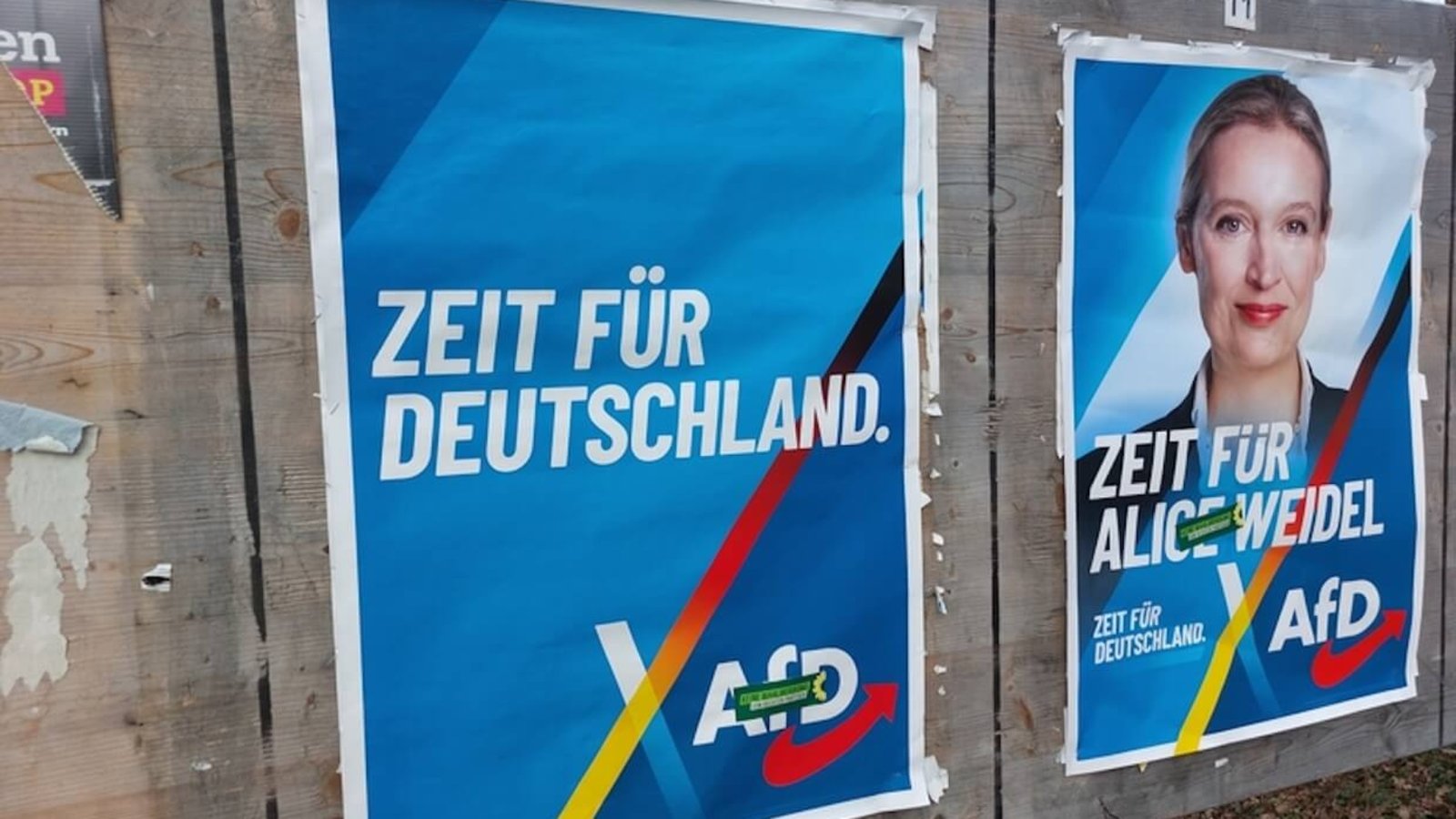
Dr. João Ferreira Dias argues that the AfD’s strength in Eastern Germany cannot be explained by poverty alone. Instead, its rise reflects the interaction of nativist attitudes, political alienation, territorial decline, demographic shrinkage, and the enduring memory of post-reunification disruption. The AfD’s political success lies in converting disparate grievances—over immigration, economic insecurity, public services, identity, and distant decision-making—into a unified anti-elite narrative. Dr. Dias stresses that the Brandmauer may remain necessary as an institutional safeguard, but it is insufficient as a political strategy. A durable democratic response, he argues, must address material insecurity, regional neglect, state capacity, immigration, and recognition while offering citizens a credible sense of belonging and a recognizable future.
Some election results change governments. Others force a country to reconsider the story it tells about itself. The Alternative für Deutschland (AfD)’s victory in Saxony-Anhalt belongs to the second category. When a radical-right party comes close to winning half the electorate in a German state, it is no longer enough to speak of a “protest vote.” The question becomes a different one: how did the AfD manage, in parts of Eastern Germany, to become a socially rooted and electorally dominant political force?
The easy answer would be poverty. It is also, to a large extent, the wrong answer. The available research shows that attitudes towards immigration, national identity and political elites explain support for the AfD far better than individual economic deprivation does (Hansen & Olsen, 2024; Kailitz & Rippl, 2026; Schröder et al., 2026). But this does not mean that economics, place and abandonment are irrelevant. It points instead to something more interesting: what matters is less absolute poverty than the experience of loss — or what might be called the “fear of falling”: the loss of status, population, opportunity, recognition and control over the future. Such experiences can produce political alienation. It is the AfD, however, that supplies the nativist and anti-establishment language capable of giving that alienation meaning.
To understand this mechanism, we need to begin before the AfD itself. After 1990, Eastern Germany underwent an economic and social transformation of extraordinary intensity. Reunification was unquestionably an act of political liberation, but it also meant the disappearance of companies, careers, professional hierarchies and institutions that had structured the daily lives of millions of people. Steffen Mau describes this process in terms of status demotion, the transfer of elites, demographic transformation and the loss of biographical security (Mau, 2019). It was not simply that some people lost their jobs. For many, an entire social world suddenly lost its value.
When Economic Loss Becomes Political Memory
There is now evidence that these experiences left lasting political consequences. Kellermann (2024), studying workers affected by the privatizations carried out by the Treuhandanstalt, found lower levels of trust and greater detachment from institutions and established parties decades later. This does not mean that the Treuhand “caused” the AfD. It means that an economic experience can become a political memory when the loss is attributed to decisions made by distant institutions. There is a difference between thinking, “my job disappeared,” and thinking “they decided that the world I belonged to no longer had value.
That experience also acquired a concrete geography. Since reunification, Saxony-Anhalt has lost roughly a quarter of its population. Depopulation on this scale does not simply mean fewer inhabitants. It means young people leaving, schools with fewer pupils, shops closing, services becoming harder to sustain and communities growing progressively older. Höhne, Kölzer and Träger (2025), analyzing more than 1,400 municipalities in Eastern Germany, found a robust relationship between long-term population decline and support for the AfD. The most important finding, however, is that the same pattern does not appear with equal strength in support for the Bündnis Sahra Wagenknecht. Territorial decline, then, does not determine political choice; it creates conditions that a party may or may not be able to mobilize.
It is in this sense that Andrés Rodríguez-Pose (2018) speaks of “the revenge of the places that don’t matter.” The problem is not simply that such places are poor. It is the feeling of living in a territory from which the future has withdrawn. A region may be materially far richer than it was thirty years ago and, at the same time, feel that it has lost relevance. Universities expand elsewhere. The most prestigious jobs appear somewhere else. Young people leave. Decision-makers live far away. The country can prosper in aggregate while particular communities see, above all, what is disappearing. Inequality then ceases to exist only between individuals; it begins to exist between places.
From Collective Disadvantage to Populist Mobilization
This is where the economic explanation meets the cultural one. Recent research is quite clear on two points that have to be held together. First, nativist, anti-immigration and anti-elite attitudes are genuine political drivers of the AfD vote; they should not be reduced to some form of economic false consciousness (Hansen & Olsen, 2024; Schröder et al., 2026). Second, political alienation and feelings of collective disadvantage are particularly strong in the East and help explain why such attitudes find more fertile ground there (Kailitz & Rippl, 2026; Pickel & Pickel, 2026). Kailitz and Rippl put it especially well: the seeds are not necessarily different; the soil is more fertile.
This is how the false choice between “economics” and “culture” can be resolved. A closed factory does not automatically produce xenophobia. A distant hospital does not produce nationalism. But accumulated experiences of loss, distance and inadequate recognition can nourish the sense that institutions no longer represent “people like us.” At that point, a populist narrative becomes more plausible: there is a forgotten people, and there are elites who govern for others. That is precisely the narrative the AfD learned to build.
The party founded in 2013 did not begin with the ideological configuration we know today. It emerged above all from the euro crisis, with a Eurosceptic, conservative and economically liberal profile. Between 2015 and 2017, however, immigration, refugees, Islam and national identity shifted the party’s center of gravity, bringing it closer to what Cas Mudde defines as the populist radical right: a combination of nativism, authoritarianism and populism (Arzheimer & Berning, 2019; Mudde, 2007). The euro crisis created the organization; the refugee crisis turned it into a mass political force.
Since then, the AfD has shown an extraordinary capacity to adapt. Hansen and Olsen (2024) describe it as a populist issue entrepreneur: a party able to retain ownership of the issues on which it already enjoys an advantage — above all immigration — while continually absorbing new conflicts. The euro, refugees, the pandemic, climate, energy, gender, Ukraine and the politics of memory are very different issues. The AfD manages to present them as manifestations of the same problem. That is its central political talent.
The Brandmauer Paradox and the AfD’s Anti-Elite Narrative
A railway station that closes is a transport problem. A factory that shuts down belongs to economics. Immigration is migration policy. The war in Ukraine is foreign policy. Gender belongs to the culture wars. The AfD turns all of them into a single story: the elites in Berlin and Brussels have stopped governing in the name of ordinary people. The issues change. The culprit remains the same.
Immigration occupies a central place in this narrative because it functions both as a real political issue and as a symbolic condensation of several anxieties. It can be connected to security, housing, schools, the welfare state, Islam, borders and identity. In a territory that has already experienced profound transformations decided in distant centers of power, it can also be presented as yet another change carried out “without us.” The interpretation does not need to be empirically accurate in order to be politically effective. Populism often succeeds not because it explains each problem better, but because it connects different problems within a single moral explanation.
This is also why it is no longer sufficient to speak simply of a “protest vote.” Mudde (2019) draws attention to the contemporary normalization of the radical right: ideas that once existed on the political margins gradually enter everyday politics. The Eastern German case adds a troubling generational dimension. Heinze and Scheuer (2026) find among young AfD voters not merely volatility or rebellion, but relatively stable partisan identification, closely associated with nativism. These young people did not experience the GDR, the Treuhand or reunification. Historical experience is no longer only biographical memory. It has become, at least in part, a political inheritance.
This is where the dilemma of the Brandmauer emerges: the firewall through which Germany’s mainstream parties refuse to govern with the AfD. There are powerful democratic reasons for maintaining it. Winning elections does not give any party the right to weaken fundamental rights, pluralism, or institutional independence. But an obvious political problem arises when the excluded force comes close to winning half the vote: the more all the other parties have to cooperate in order to keep it out of power, the easier it becomes for the AfD to say that “they are all the same” and that it alone represents a genuine alternative.
Why the Brandmauer Is Necessary but Not Enough
Yascha Mounk (2018) helps illuminate the paradox: populism seeks to present the liberal institutions that constrain majority power as obstacles to democracy itself. The Brandmauer (firewall) may therefore be necessary as an institutional defense and insufficient as a political strategy. It answers the question, “how do we stop the AfD from governing?” It does not answer the prior question: “why do so many people want it to govern?”
Understanding the answer to that second question does not mean excusing it. Anne Applebaum (2020) reminds us that the contemporary illiberal threat rarely begins with the immediate destruction of democracy. It can advance through the gradual occupation of institutions, administrative changes, appointments, education, culture and the media. In Saxony-Anhalt, a move by the AfD from opposition into government would give it access to precisely these areas. Sociologically explaining an electorate does not require us to minimize the consequences of the programme it chooses.
But historical memory is not enough either. Tony Judt (2010) reminded us that post-war European democracies did not survive because of constitutions alone. They built welfare states, public services, security and the expectation that the future could be better. A democratic order becomes fragile when it can tell its citizens only two things: “adapt to change” and “do not vote for them.” The first offers no security. The second offers no project.
Perhaps this is, in the end, the best way to understand the result in Saxony-Anhalt. The AfD did not win simply because a population became poorer, or because nearly half the electorate suddenly became radicalized. It won because it managed to transform experiences of territorial decline, downward mobility and inadequate recognition into a political narrative combining nativism, anti-establishment alienation and the promise of national restoration.
It did not merely say: “you lost.” It said: “you lost because they chose others over you.” It is this move — from loss to resentment, from resentment to identity, and from identity to the ballot box — that helps explain its strength.
And that is also why the democratic response will have to be more demanding than copying the AfD, increasing fiscal transfers or reinforcing the firewall. It will have to combine credible control of immigration, state capacity, services and opportunity in peripheral regions, recognition of Eastern Germany’s distinctive historical experience, and an idea of national belonging strong enough to create community without having to turn minorities into enemies.
Because citizens do not abandon a political order only when they become poor. They can also drift away from it when they cease to believe that it contains a recognizable future for people like them, and for places like the ones in which they live.
References
Applebaum, A. (2020). Twilight of democracy: The seductive lure of authoritarianism. Doubleday.
Arzheimer, K., & Berning, C. C. (2019). How the Alternative for Germany (AfD) and their voters veered to the radical right, 2013–2017. Electoral Studies, 60, 102040.
Hansen, M. A., & Olsen, J. (2024). The Alternative for Germany (AfD) as populist issue entrepreneur. German Politics, 33(4), 643–667.
Heinze, A.-S., & Scheuer, T. (2026). Growing up far right? Youth support for the AfD in Eastern Germany. German Politics, 35(3), 485–515.
Höhne, B., Kölzer, J., & Träger, H. (2025). Geography of shrinkage: Local population decline and electoral support for the anti-establishment parties AfD and BSW in East German state elections. German Politics, 34(3), 449–477.
Judt, T. (2010). Ill fares the land. Penguin Press.
Kailitz, S., & Rippl, S. (2026). Same seeds, more fertile ground: Sources of AfD dominance in Eastern Germany. German Politics, 35(3), 437–462.
Kellermann, K. L. (2024). Trust we lost: The impact of the Treuhand experience on political alienation in East Germany. Journal of Comparative Economics, 52(1), 54–75.
Mau, S. (2019). Lütten Klein: Leben in der ostdeutschen Transformationsgesellschaft. Suhrkamp.
Mounk, Y. (2018). The people vs. democracy. Harvard University Press.
Mudde, C. (2007). Populist radical right parties in Europe. Cambridge University Press.
Mudde, C. (2019). The far right today. Polity.
Pickel, G., & Pickel, S. (2026). The election of the AfD and the collective identity of East Germans. German Politics, 35(3), 412–436.
Rodríguez-Pose, A. (2018). The revenge of the places that don’t matter. Cambridge Journal of Regions, Economy and Society, 11(1), 189–209.
Schröder, M., Rehm, M., & Röcke, A. (2026). Supporters of Germany’s far-right AfD party are concerned about immigration rather than feeling deprived. PLOS ONE, 21(7), e0350403.
In this commentary, Dr. João Ferreira Dias examines the migration crisis in Ceuta as a “total crisis” encompassing humanitarian obligations, political legitimacy, social cohesion, and the future of Europe’s liberal-multicultural order. Rejecting both an expansive humanitarianism that neglects the pressures experienced by receiving communities and far-right narratives that reduce migrants to a homogeneous civilizational threat, Dr. Dias argues for an approach combining compassion with effective migration governance. Drawing on research into migration, local exposure, and multicultural citizenship, he contends that diversity requires a shared civic framework grounded in democratic law, equality, rights, and obligations. For Dr. Dias, Europe’s challenge is therefore not to choose between humanitarian protection and border control, but to reconcile protection, effective borders, integration, and social stability if liberal multiculturalism is to remain politically sustainable.
The situation in Ceuta is what I would call a “total crisis”: social, political, and humanitarian at the same time. Looking at it in those terms is an attempt to escape the constraints of affective polarization (Iyengar et al., 2019), which increasingly turns political analysis into a moral exercise in deciding who deserves our sympathy.
Two dominant perspectives usually emerge in European debates on migration. One emphasizes humanitarian duties and often expands them into an almost unlimited moral obligation to receive those who reach European borders. The other responds through cultural anxiety, demographic fear and, at its extreme, the rhetoric of a “Great Replacement.” Both perspectives capture something real. Neither sees the whole picture.
Europe has unquestionable obligations towards refugees and asylum seekers. The right to seek asylum and the principle of non-refoulement are central elements of the international and European legal order. A liberal Europe cannot abandon those principles simply because applying them has become politically difficult. But neither international law nor European law establishes an unlimited right for every migrant to enter and remain permanently in Europe.
That distinction matters. States have duties towards those entitled to international protection. But governments also have duties towards the societies they govern. Migration policy cannot ignore reception capacity, housing, public services, integration, security and social stability. Humanitarianism does not operate outside politics. This is where part of the progressive discourse on migration becomes problematic. Its moral vocabulary is universal, while the social consequences of migration are unevenly distributed.
It is relatively easy to demand empathy from the inhabitants of border communities when one does not share their streets, their schools, their public services or their fears. The paradox is striking: those who correctly demand empathy towards migrants sometimes display surprisingly little empathy towards the communities expected to absorb the immediate consequences of large migratory movements.
Ceuta makes that contradiction difficult to ignore. Research also suggests that local exposure matters. Sudden demographic change can generate stronger opposition to immigration when it becomes politically salient (Hopkins, 2010). Hangartner et al. (2019), studying Greek islands exposed to the refugee crisis, found that direct exposure to large refugee arrivals produced more restrictive attitudes towards refugees, immigrants and Muslim minorities.
This does not mean that every fear expressed by local populations is justified. But it means that fear cannot simply be dismissed as ignorance or xenophobia. For the inhabitants of Ceuta, migration is not an abstract seminar on cosmopolitan ethics. It is the sudden presence of thousands of people in a geographically confined territory. It means pressure on public spaces and services, deteriorating sanitary conditions, disruption of everyday life and, inevitably, perceptions of insecurity. Some of those perceptions may be exaggerated. Others may not. But democratic politics cannot simply tell citizens that their fears are morally illegitimate.
At the same time, the opposite camp commits an equally serious mistake. Migrants are not a homogeneous civilizational bloc. Among those arriving in Europe are women escaping oppressive social environments, political dissidents, religious minorities, educated young people looking for opportunities, families seeking security and people whose values may be substantially closer to European liberalism than those of the societies they have left behind. Reducing all migrants to a demographic or cultural threat is therefore both empirically crude and morally indefensible. The crisis has two human faces: those who arrive and those who receive them. Any serious migration policy must be capable of seeing both.
Ceuta also reveals a deeper European problem: the crisis of what might be called liberal multiculturalism. The central intuition of liberal multiculturalism was both powerful and legitimate: people should not be required to erase their cultural, religious or linguistic identity in order to become equal citizens. Kymlicka’s defense of multicultural citizenship remains one of the strongest formulations of this position. But there is a difference between accepting diversity and assuming that social cohesion emerges automatically from it. It does not. A society cannot indefinitely become a patchwork of parallel cultural, ethnic and religious communities without also developing institutions capable of producing a common civic ground.
This does not mean assimilation. It means integration. Language matters. Constitutional principles matter. Equality between men and women matters. Religious freedom matters, including the freedom to abandon religion. Acceptance of democratic law matters. A shared understanding that citizenship involves both rights and obligations matters. European states themselves have increasingly recognized this. The gradual retreat from some versions of multiculturalism and the rise of civic integration policies documented by Joppke (2004, 2007) reflect precisely this concern.
Multiculturalism without integration creates islands. Diversity without a shared civic framework can produce coexistence without community. This is why migration control should not be understood as the opposite of liberal multiculturalism. It may actually be one of its conditions of survival.
Europe needs effective borders precisely because migration will continue. It needs credible asylum procedures because humanitarian protection remains part of the European liberal order. It must distinguish between those who have legitimate claims to international protection and those who do not. It must be capable of receiving and integrating those who are entitled to remain. And it must also be capable of repatriating, humanely and legally, those who have no right to stay. Otherwise, the distinction between legal and illegal migration becomes politically meaningless.
The way Spain responds to Ceuta therefore matters beyond Ceuta. If European governments are unable simultaneously to protect refugees, control borders, manage migration and sustain social integration, voters will increasingly conclude that the entire liberal-multicultural model has failed. That conclusion would have profound political consequences. A Europe that abandons humanitarian protection abandons part of its liberal identity. But a Europe that loses control over migration, fails to integrate newcomers and refuses to acknowledge the fears of receiving communities may eventually create the political conditions for the rejection of liberalism itself.
The real choice is therefore not between compassion and control. Europe needs both. Without compassion, it ceases to be liberal. Without control and integration, it may cease to be politically capable of remaining liberal.
References
Hangartner, D.; Dinas, E.; Marbach, M.; Matakos, K. & Xefteris, D. (2019). “Does exposure to the refugee crisis make natives more hostile?” American Political Science Review, 113(2), 442–455.
Hopkins, D. J. (2010). “Politicized places: Explaining where and when immigrants provoke local opposition.” American Political Science Review, 104(1), 40–60.
Iyengar, S.; Lelkes, Y.; Levendusky, M.; Malhotra, N. & Westwood, S. J. (2019). “The origins and consequences of affective polarization in the United States.” Annual Review of Political Science, 22, 129–146.
Joppke, C. (2004). “The retreat of multiculturalism in the liberal state: Theory and policy.” The British Journal of Sociology, 55(2), 237–257.
Kymlicka, W. (1995). Multicultural citizenship: A liberal theory of minority rights. Oxford University Press.
In this commentary, Dr. Kamil Jonski examines Poland’s protracted constitutional crisis through the prospect of what he calls “Schrödinger’s Tribunals”: parallel Constitutional Tribunals simultaneously regarded as legitimate and illegitimate by opposing political constituencies. Tracing the conflict from disputes surrounding the 1997 Constitution through the Law and Justice (PiS) government’s capture of the Constitutional Tribunal and the current center-left majority’s attempts at restoration, Dr. Jonski argues that the crisis reflects deeper, competing interpretations of Poland’s constitutional identity. As rival political camps contest judicial appointments, institutional legitimacy, and constitutional authority, efforts to restore the Tribunal may reproduce rather than resolve its politicization. Dr. Jonski ultimately raises a more fundamental question: whether effective constitutional review in Poland now requires institutional solutions beyond the existing Tribunal itself.
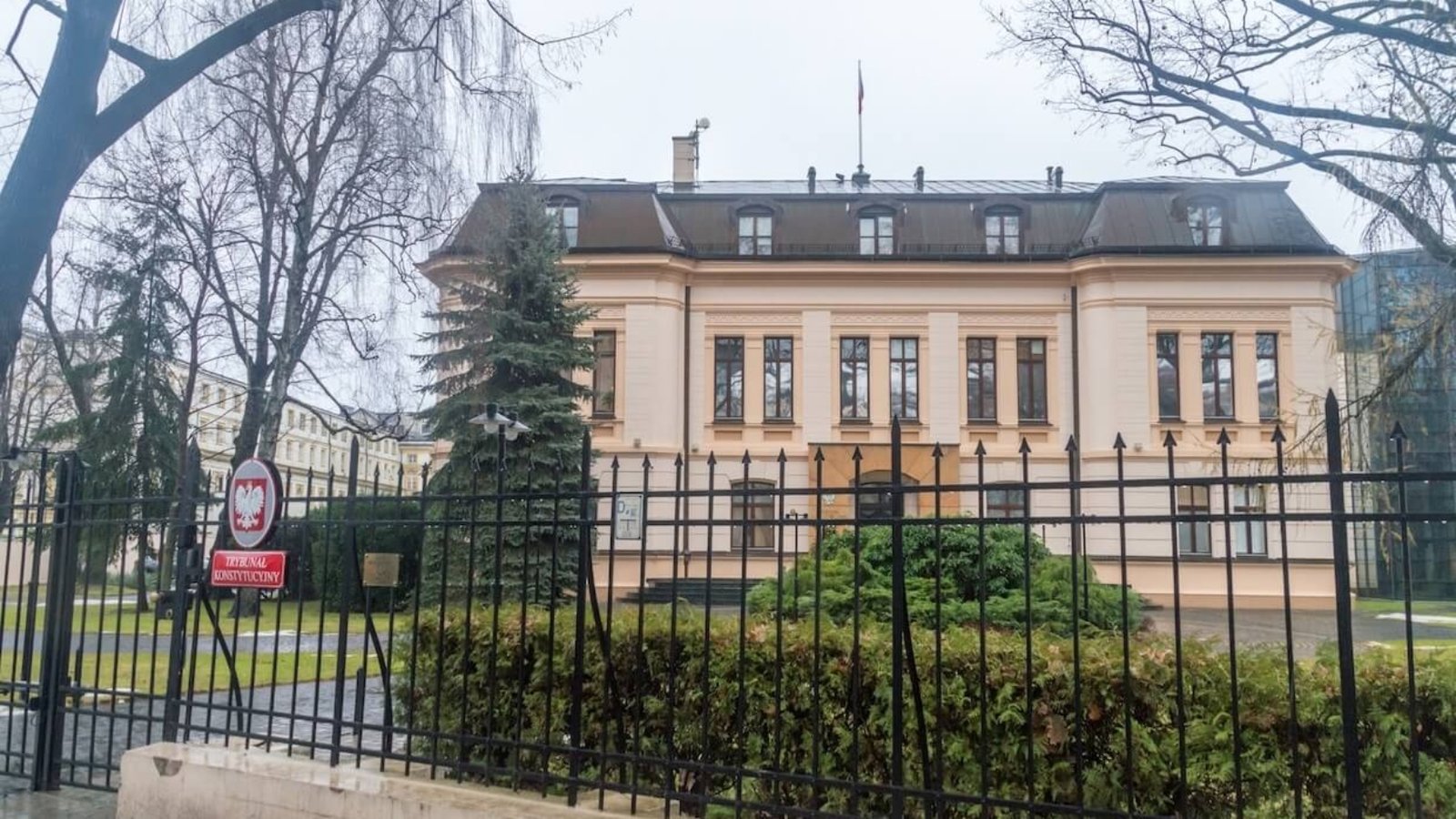
The consequences of illiberal assault on Polish Constitutional Tribunal in 2015-2016 – and contemplated attempts to restore it – risks producing singular outcome: two parallel tribunals recognized as “legitimate” and “illegitimate” at any given time by respective sides of the political divide.
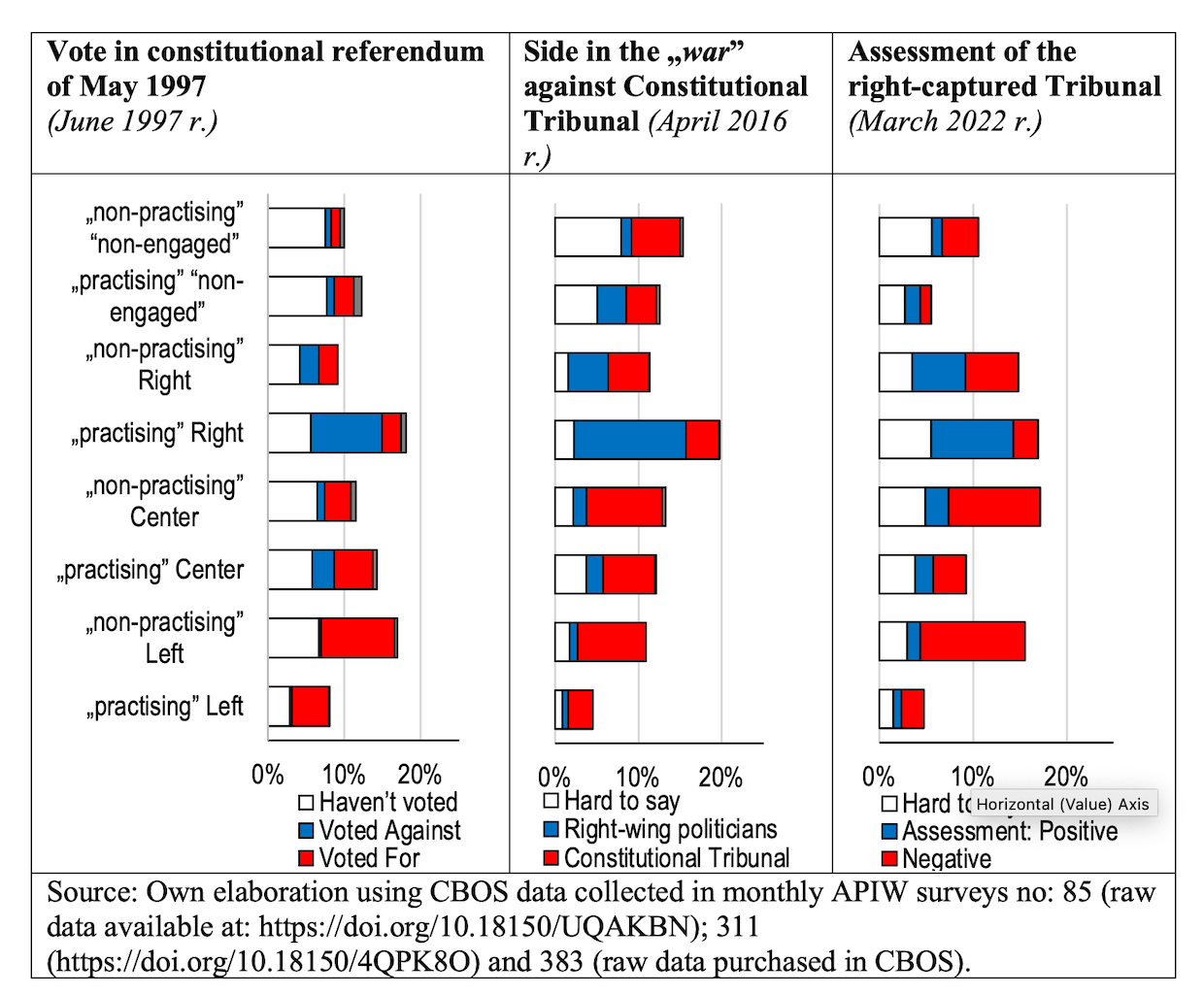
It turned out that initial opposition to the Constitution, support for Tribunal packing, and approval of the captured CT were all concentrated largely among self-identified rightists who regularly participate in religious services. Intriguingly, the results of the 2025 presidential runoff, analyzed at the level of 370 NUTS 4 regions, correlate with the results of the 1997 constitutional referendum, corroborating the claim that the current conflict over (dis)obeying the Constitution is linked to the past conflict over its adoption.
These empirical findings correspond with the narrative provided by the late professor L. Morawski – constitutional scholar and 2015 CT packing participant. As he explained during 2017 Oxford symposium, right-wingers and their opponents disagree on “how the Polish Constitution should be interpreted” with the government favoring “republican” and opposition – a “liberal way.” For him, “the republican tradition does not reject all liberal values. [Sharing] a deep respect for democracy, human rights and freedoms. But apart from this, Polish republicanism strongly emphasizes the attachment to values such as patriotism, solidarity, a strong state as a guardian of human rights, the role of the Catholic Church and religion in public life. In political reality, it means that Polish republicans defend the traditional family model and strongly oppose abortion and so on.”
I argue that lacking the majority required to amend the Constitution, right-wingers seek control of the CT – the only institution in the legal system, that is capable to saturate it with rightist values and identity (or increase the level of this saturation). That allows them to replace “liberal” meaning of the constitution with “republican” one – without altering its text at all.
The history of Polish Constitutional Tribunal dates back to communist era “normalization” after 1981 martial law. By coincidence, half of the bench had been ought to be replaced shortly after the groundbreaking semi-free elections of June 4, 1989, offering CT unique opportunity to successfully reinvent itself to the new, democratic reality.
However, the right-wing quickly became to contest the Tribunal. The first draft of the law that would enable CT purge had been submitted in 1992 (Doc. no. 458, I Term) but it was rejected by the major political forces pursuing negotiated transition to the democracy and market economy.
The issue returned to the agenda when so called “post-communist cleavage” gave way to the current divide between Civic Coalition (Platform) of Donald Tusk and Law & Justice (PiS) of Kaczyński twins.
The double elections of 2005 delivered Lech Kaczyński’s presidency and a fragile coalition government under leadership of Jaroslav Kaczyński. Although the cabinet lasted only to 2007 snap elections, it embarked “political mobbing” against CT and undertook two failed attempts to force PiS appointee as a CT Chief Justice (for first see Doc. no. 765, for second Doc. no. 2030, V Term).
Ten years later, another double election paved the way to Polish constitutional crisis of 2015. PiS’s candidate Andrzej Duda unexpectedly won presidency, and PiS itself secured first single-party majority since 1989. Perhaps mindful of the 2005-2007 excesses, outgoing parliamentary majority led by Civic Platform embarked an attempt to pack CT, passing legislation that allowed appointment “in advance” of five – instead of scheduled three – justices.
The parliamentary election of 2023, leading to the formation of center-left cabinet of Donald Tusk, inspired hope of rule of law “restoration”. On March 6, 2024 the Lower Chamber of the Parliament (Sejm) adopted resolution proclaiming that irregularities in CT amassed to the point where it is unable to carry out constitutional review and protect human rights (M.P.2024.198). That same day two draft laws had been submitted to reshape CT (Doc. no. 253 and 254, X Term). Passed on September 13, 2024, they were referred to the right-captured CT by President Duda and declared unconstitutional in its judgment of July 29, 2025 (Kp 3/24). Given that failure, on December 18, 2024, the Cabinet adopted resolution on captured CT’s inability to perform its tasks and denying promulgation of its judgments (M.P. 2024.1068).
As right-wing Karol Nawrocki replaced President Duda in 2025, it became apparent that legislative “restoration” of the CT is out of reach in the foreseeable future. The B-plan, involving judicial appointments, was launched in March 2026.
According to the Constitution, CT is composed of 15 justices. As of August 31, 2026, they can be divided into four groups, illustrating what Jakub Jaraczewski and Laurent Pech called “dualist constitutional court.”
Justyn Piskorski and Jarosław Wyrembak, who replaced two late “doubles,” are recognized as legitimate justices by right-wingers (and Chief Justice Bogdan Święczkowski), but their status is contested by the current majority citing judgments of CT, ECHR and CJEU.
Stanisław Piotrowicz, Bartłomiej Sochański (deputy Chief Justice), Jakub Stelina, Wojciech Sych, Święczkowski (Chief Justice) and Rafał Wojciechowski remain uncontested PiS-appointed justices.
Magdalena Bentkowska, Sławomir Patyra and Dariusz Szostek are uncontested appointees of the current, center-left majority, properly sworn in by the President Karol Nawrocki.
Marcin Dziurda, Anna Korwin-Piotrowska, Krystian Markiewicz and Maciej Taborowski are recognized by the current majority that appointed them, but contested by right-wingers (and Chief Justice Święczkowski), as President Nawrocki denied them opportunity to be sworn in.
Regardless the differences, both scholars agreed that some sort of CT restoration is both feasible and desirable. However, that is hardly the case if “dualist constitutional court” is indeed the consequence of parallel meanings, ascribed to the Constitution by polarized politicians, lawyers and large clusters of voters.
Leaving aside specific legal tactics, CT restoration is likely to involve the following sequence: the eight appointees of the current center-left majority (at least four of them contested by the right) would somehow assume the role of the CT’s General Assembly. Next, they will use the PiS-created institution of a justice chairing the CT to bypass Chief Justice Święczkowski (either on the grounds of “doubles” involvement in his appointment or by using disciplinary charges), paving the way for review (in five-justice panels) of the key PiS-enacted laws. Most likely, the so-called interpretative judgment technique will be used, in a way similar to the judgment of November 7, 2016 (K 44/16). These judgments will be promulgated in the Journal of Laws and enforced by the cabinet.
The reaction of the right-wingers seems equally predictable—they will deny the status of the CT’s General Assembly and frame the events as an illegal court capture. Święczkowski will carry the torch of “constitutional legitimacy” until February 2031, when his term in office expires. And once elections deliver a right-wing majority, it will unconstitutionally nullify the judicial appointments—just as in the case of the 2015 CT packing—to appoint another set of “doubles” contested by the liberals.
The two parallel interpretations of the Constitution will be crowned by two distinct benches of Tribunal justices, producing their respective jurisprudence. Just like Schrödinger’s cat—simultaneously dead and alive—the parallel Tribunals would be recognized as “legitimate” and “illegitimate” by their respective constituencies at any given time, with the current majority and cabinet determining whose case law should be followed and whose judgments ought to be promulgated and enforced.
It is widely acknowledged that, since 2016 (i.e., one-fourth of contemporary Polish democratic history), the CT has lacked the capacity to carry out effective constitutional review. In the longer run, Schrödinger’s Tribunals are unlikely to work any better. In an environment of clashing interpretations of the Polish Constitution, unorthodox solutions for improving rights protection—including abolishing the CT altogether and empowering ordinary and administrative courts—are badly needed. Unfortunately, it seems that old ideas have to be tested to destruction first.
In this commentary, Dr. Bulent Kenes examines the political transformation of Sweden through the rise of the Sweden Democrats (SD) and normalization of far-right. Drawing on his experience of seeking refuge in a country once widely regarded as a “moral superpower,” Kenes contrasts Sweden’s longstanding commitments to liberal democracy, pluralism, multicultural accommodation, gender equality, minority rights, and inclusive citizenship with the SD’s increasingly influential nativist and ethno-nationalist project. He argues that the breaking of the cordon sanitaire and the Tidö Agreement have helped move ideas once confined to the far right into mainstream politics. As Sweden approaches the September 13 election, Kenes asks whether the SD’s promise to “make Sweden Sweden again” ultimately risks dismantling the very values that historically made Sweden distinctive.
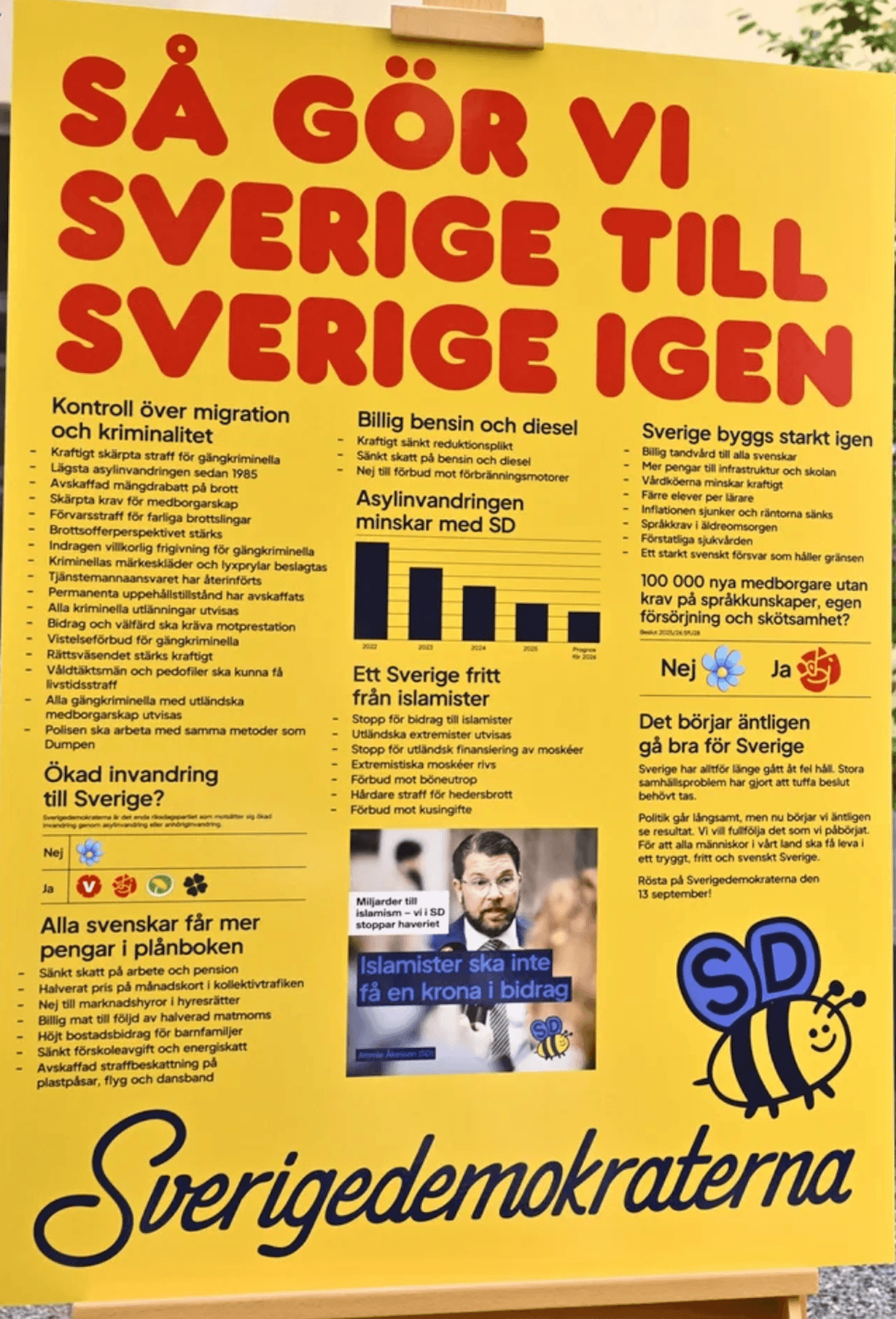
A Sweden Democrats (SD) campaign poster ahead of Sweden’s September 13, 2026 parliamentary elections, featuring the slogan “This is how we make Sweden Sweden again” and highlighting the party’s policies on immigration, crime, Islamism, citizenship, welfare, and the economy.
For as long as I can remember, I have worked for human rights, the rule of law, constitutional and liberal democracy, an egalitarian and just society, and global peace. During my years as a professional journalist and media executive, I likewise sought to defend and advance these values. I vocally opposed every step taken by Erdogan’s government after 2011 as Turkey moved increasingly toward one-man rule and authoritarianism, and I never withheld my criticism. As Erdogan rapidly advanced toward one-man rule and autocracy, as every aspiring dictator does, I became a target of his repression. Because of my criticism centered on democracy, the rule of law, and human rights etc., I was subjected to countless smear campaigns in pro-Erdogan media and on social media, faced dozens of investigations, was repeatedly detained, and was briefly imprisoned.
By 2016, as Erdogan was constructing his autocratic regime step by step and there was no longer room for me to breathe in Turkey, I decided to leave the country. But where should I go? By virtue of my profession, I had by then visited more than 70 countries, including Sweden, and had lived in the United States for several years. Yet the choice for me was not so difficult. I knew that the very values and standards whose absence I had felt in my own country and for which I had struggled—democracy, human rights, transparency, the rule of law, freedom of the press and expression, gender equality, environmental rights and justice, and similar principles—shone most brightly in Sweden, which at the time was widely regarded as a “moral superpower.”
As Turkey fell into the grip of autocracy and Islamofascism, my choice was clear. Sweden stood out as a country in which virtually everything we had struggled, unsuccessfully, to establish and consolidate in Turkey had already become largely institutionalized. If, despite all our efforts, pluralist and liberal democracy, a state governed by the rule of law according to universal standards, an almost exemplary environment for freedom of the press and expression, and similar values would simply not come to us, I believed that it was my most natural right to go to them. Having overcome all the technical obstacles placed in my way by the Erdogan regime, I eventually managed to reach Sweden.
Over the ten years since then, unfortunately, Sweden—like the rest of the world—has changed considerably. Alongside some genuine problems generated by the 2015 migration wave, far-right perceptions of threat were constructed on a scale vastly exceeding the actual magnitude of those problems. In the process, both the social sensibilities that made Sweden the Sweden we knew have been eroded and political actors increasingly influenced by the far right have gradually weakened the country’s once-proud status as a “moral superpower.” Sweden, which one might have hoped would serve as one of the moral barriers against the global drift toward the far right, has itself undergone a far-reaching political transformation in the same direction.
At the center of this transformation are the Sweden Democrats (SD), who increasingly challenge the liberal, pluralist, and inclusive political culture that long underpinned Sweden’s reputation as a “moral superpower.” The ideological core of the SD combines nativism, authoritarianism, and populism, while migration, Islam, national identity, and cultural homogeneity constitute central axes of its political discourse. The party advances a more homogeneous conception of the nation grounded in ethno-nationalism and frames immigrants, particularly Muslims, as potential threats to Sweden’s cultural integrity and welfare state. At this point, however, I should not fail to acknowledge the provocative and highly irresponsible activities of certain Muslim immigrant groups.
Given the SD’s historical roots in Swedish fascism, nazism, white nationalism, and far-right milieus, one of the most consequential changes under Jimmie Åkesson has been the effort to largely free the party from the burden of this past and give it a more legitimate and parliamentary appearance. Yet despite this “normalization” and transformation of its public image, opposition to immigration and Islamophobia have retained their central place in the party’s political discourse. As early as 2009, Åkesson described various phenomena associated with Islam as “the greatest foreign threat to Sweden since the Second World War” and placed Muslims at the center of this threat narrative—one of the most striking manifestations of this ideological continuity.
Although its historical roots extend much further back, in the populist far-right political imaginary represented today by the SD, multiculturalism is portrayed not as a form of pluralism that enriches Swedish society but as a source of social fragmentation and weakening national cohesion. In its place, folkhem—the “people’s home”—is being reasserted. Yet Åkesson’s vision of folkhem differs markedly from Per Albin Hansson’s: it is a tightly integrated society based largely on the ethnic and cultural homogeneity of the native Swedish majority, shared values, and solidarity. Within this understanding, “being Swedish” means more than merely holding Swedish citizenship; immigrants are expected to adapt culturally to “Swedish values” and to the “Christian, democratic world” to which Sweden is understood to belong. The boundary between integration and assimilation consequently becomes increasingly blurred.
Islam and Muslims occupy a distinctive place in this politics of boundary-making. In Åkesson’s discourse, Christianity and its moral values are defined as foundational pillars of folkhem, whereas Islam is frequently portrayed as being in conflict with Sweden’s cultural and social order. The rise of the SD therefore cannot be understood simply as the hardening of immigration policy or the electoral success of a populist radical right party. At a deeper level, it represents a broader political transformation in which Sweden’s “exceptionalism,” built upon consociational democracy, multiculturalism, inclusive citizenship, and pluralism, is increasingly displaced by the normalization of a more closed, assimilationist, and ethno-culturally homogeneous vision of Sweden.
Many racist and far-right positions that were once considered shameful, or even unacceptable, within mainstream politics when the SD was founded have today become substantially normalized. The breaking of the cordon sanitaire surrounding the SD in 2022 did more than open greater political space for the party’s far-right and ethno-populist positions. In exchange for its external support for the coalition government formed by the center-right parties, the extensive policy agenda it secured through the Tidö Agreement gave the SD extraordinary influence over government policy. Discourses once regarded as unacceptable and incompatible with the Sweden we knew have, through the Tidö Agreement, become part of government policy and mainstream political debate. Changes to migration and terrorism legislation over the past four years, measures that have generated debate over press and freedom of expression, and new political orientations concerning gender equality have made the question of whether Sweden is steadily moving away from the Sweden we knew all the more pressing.
It is precisely here that the central irony of the SD’s promise to “making Sweden Sweden again” lies. Sweden’s extraordinary international prestige was not built merely on prosperity and effective governance. It was also grounded in liberal democracy, openness, multicultural accommodation, gender equality, strong minority rights, and an inclusive conception of citizenship. Despite certain notable deteriorations in some international indicators amid initiatives moving in the opposite direction—initiatives spearheaded by the SD—international indices show that significant parts of this institutional architecture, thankfully, remain resilient today.
The Sweden Democrats, however, offer a different answer to the question of what Sweden should be. Their political project places more restrictive immigration policies, assimilation, cultural homogeneity, and the preservation of a particular Swedish national identity grounded in ethnicity at the center of political belonging. Particularly significant is the increasingly hard-line approach toward Islam and Muslims: legitimate debates that need to be conducted about radical Islamism and problems of integration can, at times, become intertwined with broader Islamophobic narratives that treat the very presence of Muslims as a cultural threat. Opposition to multiculturalism similarly imagines social cohesion not through pluralism but through a greater degree of cultural—and implicitly ethnic—homogeneity.
Sweden now heads back to the polls on September 13 after four years of the Tidö experiment and this broader transformation. The latest polling indicates a clear advantage for the opposition. Across the four most recent major surveys, the opposition’s lead over the Tidö bloc ranges from 3.7 to 10 percentage points, while the weighted polling average as of August 27 indicates an opposition advantage of approximately seven points. Together, S, V, MP, and C stand at roughly 52.6 percent, compared with approximately 45.7 percent for SD, M, KD, and L. Moreover, with the Liberals hovering around 2 percent—well below the 4 percent parliamentary threshold—the parliamentary arithmetic becomes even more difficult for the Tidö bloc.
The SD, once excluded behind a cordon sanitaire, is no longer content merely to pull the Tidö parties toward the far right from outside government. It now openly expresses its ambition to enter government directly, demanding key ministerial portfolios. With a Trumpian slogan, it tells voters how, over the past four years, it has “made Sweden Sweden again” from outside government and now seeks a mandate to push its nativist, ethno-nationalist, populist, anti-Islam, and anti-immigration etc. policies even further.
Yet what made the Sweden we knew distinctly Swedish was neither racism, the legacy of neo-Nazi politics, nor opposition to multiculturalism. If there is genuinely an ambition to “make Sweden Sweden again,” the Sweden worth remembering is the Sweden of Per Albin Hansson’s folkhem ideal, Tage Erlander’s democratic welfare state, and Olof Palme’s egalitarian, internationalist, and human-rights-centered political legacy. The question facing Swedish voters on September 13, therefore, is not simply who will form the next government. The more fundamental question is this: “Making Sweden Sweden Again”—but which Sweden? And what will the Sweden the world came to know as a “moral superpower” have to sacrifice for the Sweden that the SD is now seeking to create?
Dr. João Ferreira Dias argues that the contemporary center-left may be entering a decisive post-neoliberal phase by re-centering politics on material security rather than cultural conflict. Using Andy Burnham’s political vision as a point of departure—and drawing comparisons with Zohran Mamdani—he contends that democratic renewal depends on reconnecting progressive politics with the everyday concerns of housing, employment, public services, and economic security. While defending the achievements of cultural inclusion, Dr. Dias suggests that the left must once again become the primary political organizer of material insecurity if it is to counter the appeal of ethnonationalist populism. This timely commentary offers a compelling contribution to current debates on populism, post-neoliberalism, democratic representation, and the future of liberal-social democracy in an era of deep political realignment.
Andy (Andrew Murray) Burnham’s first speech in Downing Street, in reminding me of Zohran Mamdani, left me wondering whether we are witnessing a new tendency to recenter political action and political language on material questions. If this tendency is confirmed, it would mark a programmatic shift within Labour’s centrist and moderate left: one that is less ideological and more programme-driven than the radical left, which has lived off struggles for recognition and cultural emancipation. Put differently, the center-left wants to deprive the culture wars of their monopoly over the political agenda.
After decades in which the left increasingly became an interpreter of cultural transformations, Burnham is seeking to return it to its original function: politically organizing economic and social insecurity at a time when that insecurity has been captured largely by the radical right, through a clear articulation of economic resentment with conservative and nationalist appeals. Not because ethnonationalism follows automatically from economic insecurity, but because such insecurity creates fertile ground for converting material loss into cultural resentment (Gidron & Hall, 2020; Rodrik, 2021).
The causes of the erosion of the left’s social representativeness are by now well known. Both the radical left and the radical right identified a culprit behind growing economic unease and anxiety: the neoliberal policies that culminated in the 2008 crisis. Yet, following the success of the radical left during that period, left and right shifted their arenas of action, in a mirror game centered on the struggle for cultural hegemony between progressivism and cultural backlash (Hopkin, 2020; Mudge, 2018; Norris & Inglehart, 2019).
In the post-austerity turn, the left placed greater emphasis on policies recognizing voices historically rendered subaltern and on the struggle against white privilege. The agenda was commendable, but its timing proved challenging as immigration reshaped the social landscape and became an increasingly sensitive political and social issue, carrying with it both economic and cultural anxieties. The radical right, in turn, transformed these anxieties into an identitarian narrative according to which the loss of security, status, and control resulted not from the economic model, but from immigration, cosmopolitan elites, and the cultural transformation of Western societies (Norris & Inglehart, 2019).
Inflammatory rhetoric, readily identifiable culprits—corrupt politicians, immigrants, and “leftists”—and simplistic solutions to complex problems gave the ethnonationalist right room to grow among segments of the working and middle classes who were materially vulnerable, culturally disregarded, and politically estranged from elites. Many of these voters felt anxious about cultural change while parts of the radical left pointed the finger at them as racists, xenophobes, and beneficiaries of racial privilege (Gidron & Hall, 2020).
Like Mamdani, Burnham seems to understand the elementary formula for combating the radical right. It does not lie in continuing to impose a moral framework centered on patriarchy and white privilege, nor merely in explaining that, for example, Nigel Farage is wrong and is a populist. On the contrary, it requires addressing the needs to which he responds: economic and employment security, social protection, public safety, the creation of a sense of belonging and identity within a multicultural framework, and the promise of a shared horizon.
Burnham and Mamdani do not, of course, occupy the same ideological position. What brings them together is less the programme than the political method: making the left intelligible again through the price and quality of everyday life and returning to the idea of a platform broader than the segmentations on which it has come to depend. Rather than first asking voters to subscribe to a moral or identitarian framework, they show them what public power can do for housing, transport, employment, and essential services.
The ethnonationalist right offers security through the border, belonging through the ethnic nation, and a future through restoration. Burnham seeks to offer security through public services, belonging through community and territory, and a future through investment and reindustrialization. He therefore does more than promise protection against decline: he seeks to recover an idea of progress, mobility, and collective capacity, without which the left risks becoming merely the administrator of decay (Hopkin, 2020).
This does not mean, however, that the culture wars can simply be declared over. The radical right will continue to mobilize immigration, national identity, gender, religion, and historical memory even if the left prefers to concentrate on economic questions. The response cannot be to abandon cultural achievements and minority rights, but to integrate them into a universalist language and an idea of common civic belonging. Material politics is necessary, but insufficient. Yet it is now the best and most urgent weapon available to centrists everywhere.
The rematerialization of the centrist left is an essential step towards rebuilding an electoral base amid the urgent need to safeguard the principles of liberal-social democracy. Burnham does not appear to want to replace culture with economics, but rather to reconstruct materially the conditions of democratic belonging—a belonging that is as much of the left as of the right, as much liberal as conservative—which the radical right has converted into an ethnonationalist promise.
References
Gidron, N. & Hall, P. A. (2020). “Populism as a problem of social integration.” Comparative Political Studies, 53(7), 1027–1059. https://doi.org/10.1177/0010414019879947
Mudge, S. L. (2018). Leftism reinvented: Western parties from socialism to neoliberalism. Harvard University Press. https://doi.org/10.4159/9780674984837
Norris, P. & Inglehart, R. (2019). Cultural backlash: Trump, Brexit, and authoritarian populism. Cambridge University Press. https://doi.org/10.1017/9781108595841
For years, Hungary stood as the defining case of democratic backsliding within the European Union. Yet the 2026 election has transformed it into an equally important case of democratic recovery. In this timely interview, Dr. Hanna Folsz discusses why Hungary’s political transformation challenges prevailing assumptions about the durability of competitive authoritarianism. Drawing on her recent Journal of Democracy article, she argues that authoritarian institutional engineering ultimately remains vulnerable when broad civic mobilization, credible political leadership, and innovative opposition strategies converge. The conversation explores the underestimated role of civil society, the limits of media capture and economic coercion, the challenges of rebuilding democratic institutions, and the broader lessons Hungary offers for scholars and practitioners seeking to understand democratic resilience and authoritarian reversal in the twenty-first century.
For more than a decade, Hungary occupied a unique place in the comparative study of democratic backsliding. Under Viktor Orbán and Fidesz, it became widely regarded as the paradigmatic example of competitive authoritarianism within the European Union—a political system in which elections continued to exist but were increasingly distorted by constitutional engineering, media capture, economic coercion, and the systematic weakening of institutional checks and balances. Consequently, Hungary became not merely a national case but an international reference point for understanding how democracies erode from within.
Yet Hungary’s 2026 election has fundamentally altered that conversation. The defeat of Fidesz after sixteen years in power has transformed the country into one of the most consequential contemporary cases of democratic recovery. In her recent Journal of Democracy article, How Civil Society Defeated Orbán, Dr. Hanna Folsz —an Academy Scholar at Harvard University’s Weatherhead Center for International Affairs, where she will begin her appointment in August 2026 before joining IE University in Madrid as Assistant Professor of Political Science in 2027— argues that this democratic breakthrough cannot be explained solely by leadership change or electoral dynamics. Instead, she offers a broader theoretical argument about the hidden vulnerabilities of competitive authoritarian regimes and the underestimated capacity of civil society to reverse authoritarian consolidation.
As Dr. Folsz observes, “Even deeply entrenched competitive authoritarian regimes have vulnerabilities.” While Hungary experienced what she describes as “one of the most extensive and severe episodes of de-democratization or authoritarian consolidation in recent decades,” the very institutions and strategies that sustained Fidesz ultimately proved insufficient to guarantee permanent rule. Institutional engineering, media dominance, financial asymmetries, and intimidation undoubtedly raised the costs of political competition, yet they could not indefinitely substitute for declining public legitimacy. As she argues, “these authoritarian strategies do not guarantee lasting—everlasting—popularity or staying in office.”
A central contribution of Dr. Folsz’s research is her reassessment of the role of civil society. Rather than attributing the opposition’s victory primarily to the emergence of the Tisza Party or the leadership of Péter Magyar, she demonstrates how more than 2,500 decentralized “Tisza Islands” transformed latent civic capacity into effective political organization. In her words, “The role of civil society… is absolutely underestimated,” while “broad civic mobilization, new and fresh opposition challengers… and a credible alternative to voters are definitely a path to democratic reversal.”
In this interview, Dr. Folsz examines the mechanisms that enabled Hungary’s democratic breakthrough and explores their broader implications for comparative politics. She discusses the hidden effects of economic coercion, the limits of media capture, the importance of credible political leadership, and the challenges of democratic restoration after authoritarian rule. She also reflects on the responsibilities facing Hungary’s new government, emphasizing that electoral victory is only the beginning: “Changing governments is definitely only a precondition for democratic recovery.” Together, these insights offer an important contribution to ongoing debates on populism, democratic resilience, competitive authoritarianism, and the conditions under which entrenched illiberal regimes can ultimately be defeated.
Here is the revised version of our interview with Dr. Hanna Folsz, edited lightly to enhance clarity, readability, and overall flow for publication.
Authoritarian Strategies Do Not Guarantee Permanent Rule
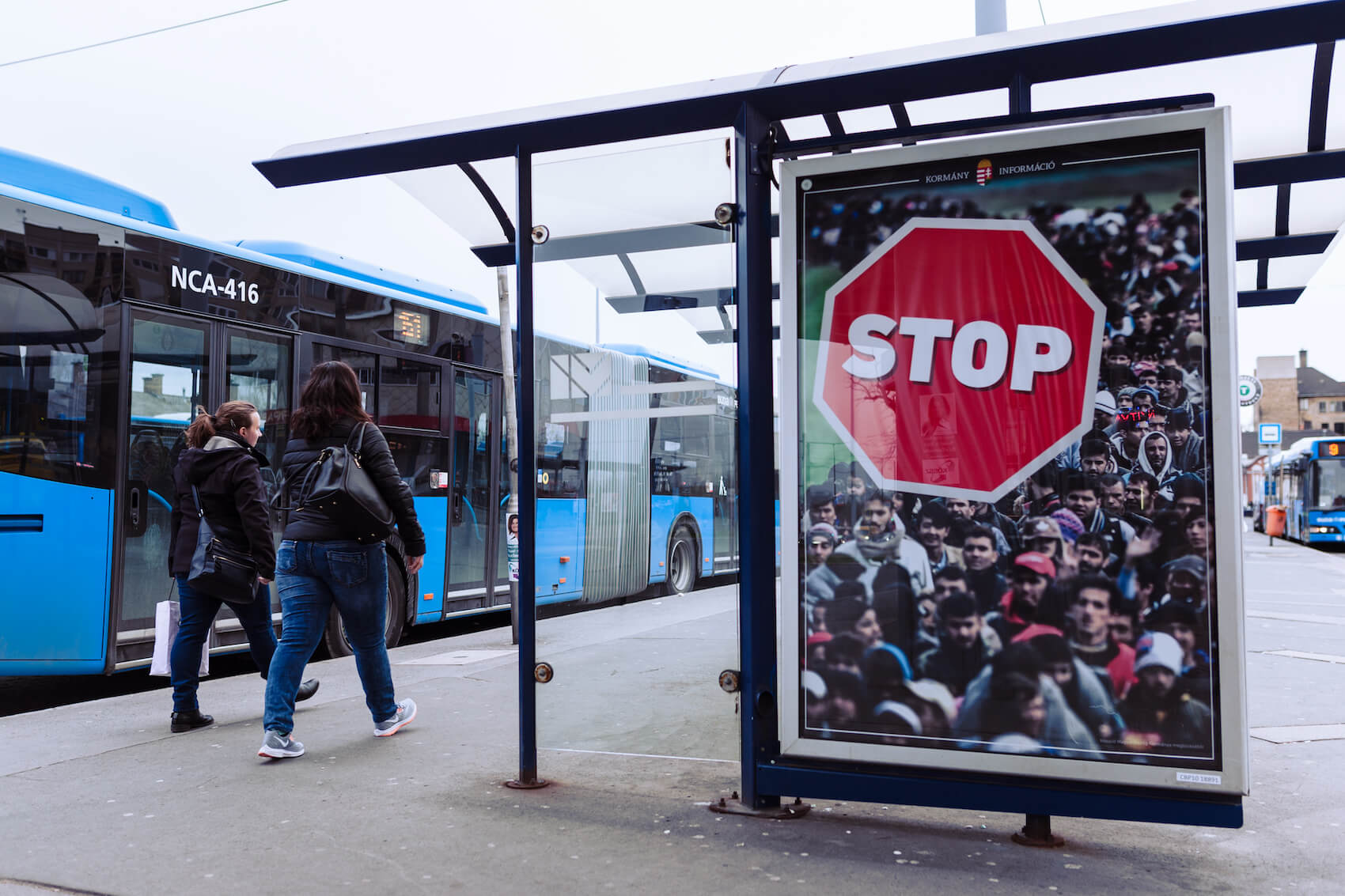
Hungarian government’s anti-immigration billboard says “STOP the refugees” in Budapest, Hungary on April 4, 2018.
Dr. Folsz, welcome!Let me begin with our first question. For more than a decade, Hungary was widely regarded as the paradigmatic case of democratic backsliding and competitive authoritarianism. Yet your recent Journal of Democracy article argues that the 2026 election also represents one of the most significant democratic reversals of authoritarian consolidation in recent years. How should we interpret the Hungarian election in comparative perspective? Does it represent an exceptional case, or does it reveal broader vulnerabilities inherent in contemporary competitive authoritarian regimes?
Dr. Hanna Folsz: The Hungarian case represents a combination of factors that disadvantage opposition parties or make opposition electoral victory exceedingly difficult. It is definitely an example of—maybe one of the most extensive and severe episodes of de-democratization or authoritarian consolidation in recent decades. Nevertheless, the Hungarian case also represents many of the common factors, or common difficulties, that oppositions experience and the strategies that aspiring authoritarians employ to entrench their rule.
No wonder Hungary serves as a preliminary case, an example for aspiring autocrats worldwide. Fidesz’s dominance in the media, the extensive financial advantage that it enjoyed—or made sure it enjoyed—compared to opposition parties and independent civil society, the severe disadvantages faced by the opposition in the electoral system, as well as the fear of opposition participation due to the repercussions, are all factors that are present in other cases as well.
It was the length of Fidesz rule that made these impediments especially significant, but it also showed that these authoritarian strategies do not guarantee lasting—everlasting—popularity or staying in office. And the lessons it offers are a set of lessons for other cases. Of course, these have to be adapted to context, but the Hungarian case shows that there are vulnerabilities to be exploited, that broad civic mobilization, new and fresh opposition challengers who understand the regime and its vulnerabilities and exploit them, and who present a credible alternative to voters, are definitely a path to democratic reversal. But I’m excited to delve more into the details of this throughout this interview.
The Role of Civil Society in Democratic Change Has Been Profoundly Underestimated
One of your central arguments is that the decisive innovation was not simply the emergence of the Tisza Party, but the rapid development of the decentralized network of Tisza Islands. Why were these semi-autonomous civic organizations able to succeed where traditional opposition parties repeatedly failed? More broadly, does this suggest that democratic resistance in authoritarian settings increasingly depends on civil society rather than party organizations?
Dr. Hanna Folsz: In my article, I make the argument that existing commentary and interpretations of the opposition’s recent electoral victory in Hungary pay a lot of attention to the emergence of the Tisza Party and its novelty, the charisma and skills of its leader, as well as the broader discontent with Fidesz rule after many years of economic stagnation that, in part, could be accounted for by the suspension of EU funds, as well as by extreme corruption and authoritarian overreach by Fidesz.
I argue that this is not the full story. To understand the opposition’s victory, we must take into account the extensive and unprecedented civic mobilization that occurred in Hungary around this election. In my article, I show that Tisza Islands—these semi-autonomous civic groups, small civic groups of at most 50 participants each—emerged across the country. Over 2,500 of these existed by the election. Within a span of a year and a half, they came to dominate civic and public life in Hungary.
They played an essential role in structuring political life, providing political information in their communities, and demonstrating the credibility of the party and the opposition as an alternative through highly visible activities, including extensive volunteering and local charity work that showed the opposition movement cared about the experiences and difficulties of everyday Hungarians. They also provided, basically, the campaign infrastructure for the Tisza Party throughout the election.
The party had very little money, very limited financial resources, in large part due to Fidesz’s actions and changes to party funding, as well as simply being a very new party. This meant that it did not have the resources for the kind of classic electoral campaign that we expect from political parties in democracies most of the time—one funded by donations or state funds, especially in Europe, and relying on an extensive party infrastructure, local offices, and so on. Instead, these Islands stepped up. They basically provided the campaign activists and even the financial resources for the campaign. That played an absolutely crucial role in Tisza’s eventual victory.
What this shows is that there are specific vulnerabilities, difficulties, and challenges for opposition parties in autocratizing and competitive authoritarian contexts. These include financial disadvantage, an absolute information disadvantage under an incumbent-controlled media infrastructure, and the total—or almost total—de-mobilization of the activist base and opposition voters who have become disillusioned with politics and opposition parties. This was definitely the situation Hungary found itself in in 2026, and it showed that the usual avenues for political change were no longer possible.
This is when we saw the very innovative collaboration between the Tisza Party and civil society through the Tisza Islands—these semi-autonomous groups that were only loosely connected to the party. This points to the fact that the role of civil society, the role we expect civil society to play, is absolutely underestimated. Parties will still be crucial, but we need to think about these innovative solutions and about how the strengths of civil society, the often-latent strengths of civil society, can be channeled into electoral competition.
Changing Governments Is Only a Precondition for Democratic Recovery
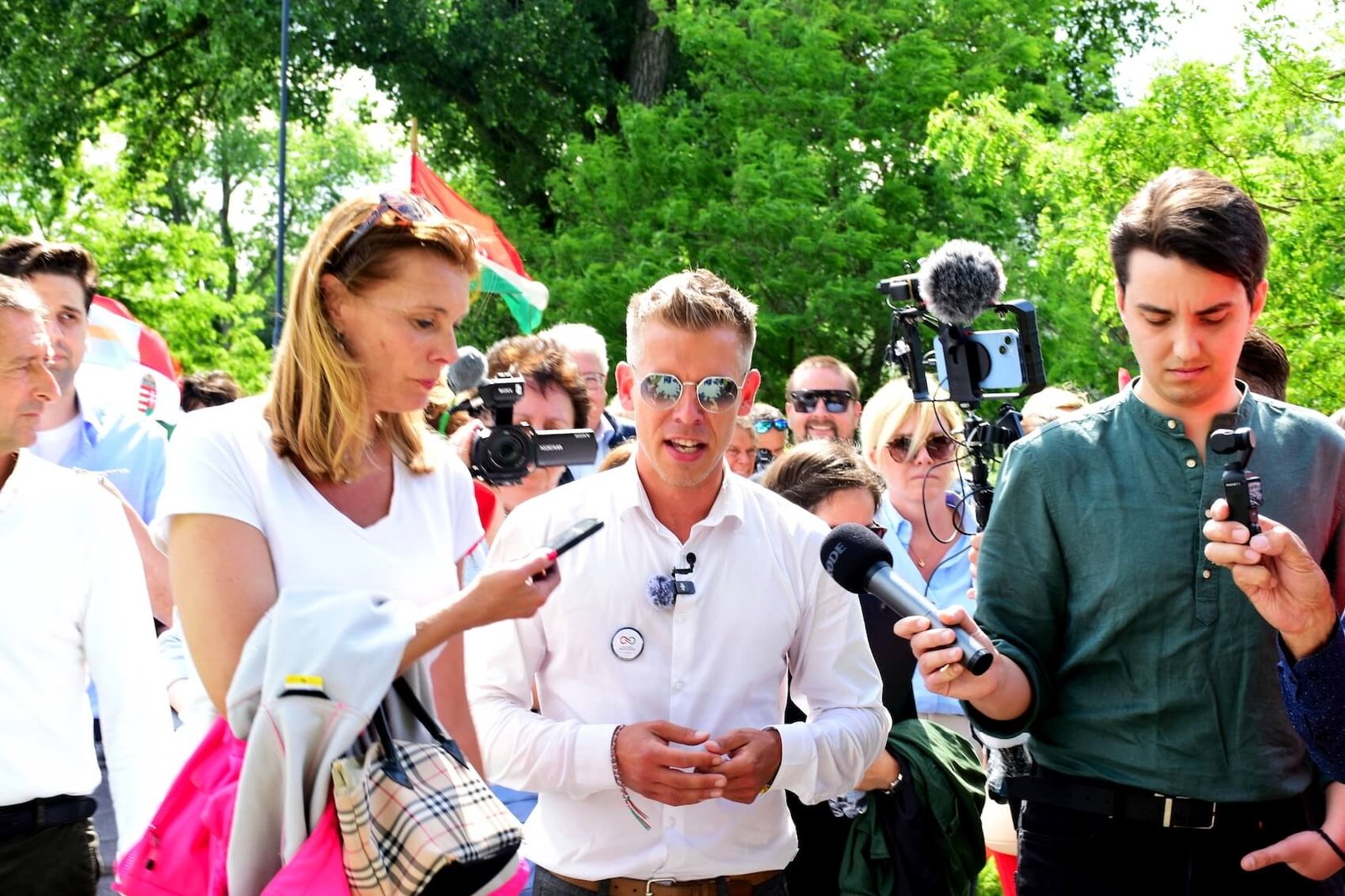
Tisza leader Péter Magyar begins a symbolic “one million steps” march to Nagyvárad, Romania, addressing reporters with supporters in Budapest, Hungary on May 14, 2025. Photo: Istvan Balogh / Dreamstime.
For sixteen years, Viktor Orbán systematically weakened constitutional constraints, reshaped electoral institutions, captured much of the media, and subordinated state institutions to partisan control. Which of these legacies do you regard as the most difficult to reverse? Is democratic recovery primarily about changing governments, or about rebuilding institutions that have been deliberately hollowed out?
Dr. Hanna Folsz: Changing governments is definitely only a precondition for democratic recovery. Democratic recovery cannot be achieved without rebuilding resilient democratic institutions and norms. And this is where the main challenge in Hungary lies today.
In Hungarian case, Fidesz was voted out of office. The electoral threat that Fidesz currently represents to the Tisza Party is very low. So, it seems that we do not have to be extensively afraid of Fidesz returning to power in four years. The bigger challenge, rather, is for the Tisza Party to effectively restore democratic institutions and norms while exercising self-restraint in the process.
We have seen them begin to address this challenge very early on with a great deal of energy, which has been very encouraging for many commentators and observers. Their first constitutional amendment was recently passed. They are taking steps to remove the previous president and are also beginning to hold Fidesz-affiliated elites accountable through judicial proceedings and investigations into corruption and other authoritarian transgressions.
We also know that they will begin the constitutional process of writing a new constitution. There is also a new head of the state media who has already been appointed to oversee the transition to a more pluralistic and more independent media environment.
The biggest challenge is to make sure that there are professional and lastingly independent checks and balances across all of these spheres. Tisza has an unprecedented mandate because it achieved a two-thirds parliamentary majority in the election. That means it can amend the constitution. There are basically very few, if any, institutional restraints on how it exercises its power.
So, what we want to see is that, across all these spheres—the judiciary, the media, and state institutions—they install not necessarily party loyalists but rather truly independent actors, and that they respect their independence and decisions, even when those decisions go counter to Tisza’s goals or electoral preferences in terms of ensuring its electoral support.
Hungary Shows That Pro-Democracy Civic Energy Is Easier to Mobilize Than We Assumed
Your research highlights the importance of latent civic capacity that survives even under prolonged authoritarian pressure. What does Hungary teach us about democratic resilience? Can civil society preserve democratic norms even when formal institutions have been substantially weakened?
Dr. Hanna Folsz: The Hungarian case definitely shows me, in a striking way, that civic capacity is latent rather than absent in cases such as Hungary. This is something I highlight in my article as well, because we have a very strong assumption in political science research and in public debates about democratic resilience and resistance to authoritarian pressure.
The assumption is that if we have an institutionally weak civil society, then effective democratic resistance is very difficult. It’s sort of a precondition for democratic resistance that there are existing civil society actors that can serve as a check, hold the government accountable, organize resistance, organize protests, and restructure public opinion around resistance. When this is missing, we assume that democratic reversals are much more difficult.
They are indeed more difficult. But the Hungarian case absolutely shows that it is much easier to bring pro-democracy civic capacity to the surface than we assumed. In Hungary, the Tisza Islands provided a loose organizational frame, and the Tisza Party provided the Tisza Islands with a purpose and a potential for democratic change that mobilized the population across the country, in localities and municipalities both big and small.
This points to a case for some positivity, some optimism, as well as a call for innovative approaches and a better understanding of citizens’ motivations, because political scientists, as well as pundits, assumed that such mobilization would not be possible and were taken by surprise by its scale and effectiveness.
If we take the opportunity and make the effort to talk to citizens more, understand their relationship with this regime, and recognize that there is this latent discontent that may not be expressed for fear of repercussions, but also because of a lack of hope that things could change, and if we can understand how citizens react to the provision of a credible alternative, to hope embodied in an opposition movement, then this might not take us by surprise. We might instead focus a little more on developing these innovative civic approaches in our attempts to achieve democratic reversals.
Economic Coercion Is One of the Most Overlooked Tools of Authoritarian Control
Former Hungarian Prime Minister Viktor Orban.
In your broader research, you argue that economic retaliation constitutes one of the most overlooked mechanisms through which aspiring autocrats weaken political competition by deterring talented opposition candidates. How central was economic coercion to Orbán’s durability, and how much did overcoming fear of retaliation contribute to the opposition’s eventual breakthrough?
Dr. Hanna Folsz: One of the focuses of my research is the authoritarian strategy that I term economic coercion. I argue in one of my papers that this is a core strategy of authoritarian consolidation and control that we tend to overlook because we focus on the physical acts of repression that these regimes carry out, be it arresting opposition politicians and activists or banning opposition parties, et cetera.
But economic coercion is another crucial strategy. I define it as a credible threat of economic retaliation for opposition political activity. This means that not just opposition candidates, but activists or those who express public support for the opposition, they themselves or their family members, might face economic difficulties as a result.
Its employment-oriented form—one of its forms—carries the potential for employment loss, dismissals from jobs in the public sector, the state sector, or in regime-adjacent businesses. Its enterprise-oriented form focuses on retaliation against business owners and firms. If you participate in opposition politics, for instance as a candidate, or if you participated in Hungary during the Orbán period, you could very well expect that your firm would be subject to targeted tax audits, targeted tax penalties, or other forms of retaliation—basically, the denial of state contracts and grants that your firm might have previously received, as well as the turning away of suppliers and other businesses that were themselves afraid of retaliation for their association with the opposition.
This was an absolutely pervasive, indeed a defining, characteristic of the Hungarian regime and a major impediment for opposition parties. My interviews with opposition politicians, together with a survey that I conducted among opposition local politicians, pointed to this pervasive fear of retaliation and Fidesz’s media dominance as the two central reasons opposition politicians identified for their parties’—or their political side’s—weakness.
There are many examples of this. I talked to a number of opposition politicians who themselves were fired from their jobs. Or, for instance, if they had a partner who was a teacher, that partner was fired, and their businesses suffered extensive retaliation. But I also heard many stories of opposition activists being too afraid to put their face, appear in photos—for fear that they would face retaliation, to register as an activist for the party, or even to become a party member.
There are countless examples that opposition politicians would tell me. They would set up stalls for campaigns or for collecting signatures for different causes, and even acquaintances whom they knew very well in their private lives would be too afraid to look at them while they were out on the streets, for fear that their employer or their neighbor might see them, and that word would then spread through their social circle that they supported the opposition.
This presented a huge difficulty for parties, both in mobilizing activists for strong campaigns and in finding good candidates for electoral office. The Tisza Party actually faced many of these same challenges.
Conversations with lawyers at the Hungarian Helsinki Committee, one of the main civil liberties protection organizations in Hungary, revealed that the number of cases of retaliatory firings, or proprietary retaliatory actions, that they encountered and were approached with actually increased significantly in the years following the emergence of the Tisza Party. My conversations and interviews with Tisza politicians themselves also revealed a staggering rate of such retaliation among their activist bases.
The way they overcame this is very remarkable and offers many important lessons. One of the most important strategies they employed was the Tisza Islands themselves, which provided a very low-visibility form of activism. Many activists I talked to in these Tisza Islands told me that they and their fellow activists could choose the level and form of activism they were comfortable with, depending on the degree of visibility. The lack of overt—or direct—association with the party also allowed them to evade some of the strongest retaliatory actions that we had previously come across.
Another important way in which the Tisza Islands contributed to mitigating the effects of retaliation was simply by affording the opposition greater visibility. This provided examples of courage and also evidence of the scale of retaliation, because fear of it often outstrips its actual occurrence.
Finally, Tisza started polling above Fidesz roughly a year and a half before the election, which was also very important because fear of economic retaliation operates on an assumption of future enforcement. If the opposition begins polling ahead of the governing party for such an extended period of time, there is at least some expectation that the governing party may lose the election, in which case retaliation will not proceed, or that any retaliation opposition activists or politicians experience will be undone once the new party comes to power.
This was crucial in progressively encouraging participation and lending confidence to the opposition. But it remained a formidable impediment, and it required a great deal of courage from all of the opposition activists I spoke to, as well as from the politicians of the Tisza Party, to stand publicly with the opposition in the way that they did. That is absolutely one of the most commendable actions one could undertake in such a political environment.
When Propaganda Collides with Lived Experience, Its Credibility Begins to Collapse
Poster from political party Fidesz showing the opponents of Hungarian PM Viktor Orban surrounding billionaire philanthropist George Soros, Budapest, April 8, 2017.
Hungary has often been cited as perhaps Europe’s most advanced example of media capture. Yet despite overwhelming informational asymmetries, the opposition ultimately managed to reach voters. Does this suggest that grassroots civic networks can compensate for authoritarian control of traditional media, or were there broader structural changes—including digital communication—that weakened the effectiveness of media capture?
Dr. Hanna Folsz: These grassroots civic networks played a very important role. There was an almost total lack of access to independent news in many parts of the country, predominantly outside of the larger cities. Almost all news sources were controlled by Fidesz by 2024, around the time of the emergence of the Tisza Party. One of the especially important early functions of the Tisza Islands was simply to provide public spaces for these new, alternative information environments where politics could be discussed.
During their first few months, many of these Tisza Islands focused primarily on inviting outside speakers or holding public discussions, talks with experts, and conversations among activists about the political situation. They identified the most important local issues and explored how Fidesz’s wrongdoing, corruption, authoritarian actions, and mismanagement of the economy and public resources contributed crucially to the local problems and difficulties Hungarians were facing. Through these speaker series, the Tisza Islands allowed people to connect the dots between their local experiences and the broader authoritarian encroachment and entrenchment of Fidesz in the country.
Having these communities in which to discuss politics was also something very new. Many of the activists I interviewed noted that this was the first time they could speak openly about politics without fear and simply discuss political developments among themselves. It created a much better shared understanding of the political situation in the country.
Nevertheless, there were three other factors that were also crucial. Beyond the emergence of these Islands and these local information spaces, the growing importance of the digital sphere was absolutely significant, as was the increasing conflict between people’s personal experiences, their economic hardships, and Fidesz’s narrative of its own successes.
In terms of the digital sphere and social media, we could see by the early 2020s, especially after the COVID pandemic, a very important shift in the way online and non-traditional news sources gained ground. YouTube, podcasts, and other social media platforms became very important sources of news in Hungary. Partizán is one of these networks—the largest podcast and YouTube network for independent news in Hungary. Its videos routinely achieved hundreds of thousands of views in a country of fewer than 10 million people. That’s very significant.
Another important way in which the rise of the digital sphere mattered was how Péter Magyar, current prime minister and the leader of the Tisza Party, exploited and leveraged it masterfully to gain popularity. His campaigns and political activities were always online. We heard from many commentators throughout the election how important it was that Péter Magyar travelled across the country, visiting Hungarian towns and villages, both large and small, after entering Hungarian politics. For two years, he was almost constantly on the ground talking to Hungarian voters.
One of the most important aspects of this, however, was that every single one of his appearances was livestreamed on his social media platforms. This created an almost constant connection with Hungarian voters, made possible by the rise of social media in politics. It further enhanced his credibility by demonstrating how hard he was working and strengthened his direct connection with voters.
Finally, another important reason why Fidesz’s media dominance—and its effectiveness—began to weaken was the increasingly apparent conflict between Hungarians’ lived experiences and Fidesz’s official narrative. Beginning in the early 2020s, and especially after 2022, Hungary experienced significant economic stagnation and record inflation. Inflation averaged around 20 percent in 2022 and remained at a similarly high, though somewhat lower, level in 2023. Food price inflation was particularly severe.
When Hungarians experienced firsthand that they could afford much less than in previous years, while Fidesz continued to emphasize its achievements and the support it was providing through its distributive programmes, this sharply contradicted people’s lived experiences. As a result, the credibility of Fidesz’s propagandistic narrative in the media outlets it controlled declined substantially, and Hungarians increasingly began seeking out alternative sources of news.
Opposition Strategy Matters Just as Much as Authoritarian Strategy
Orbán’s governments demonstrated remarkable sophistication in redesigning electoral rules, constitutional institutions, and oversight bodies without formally abandoning electoral competition. Does Hungary demonstrate that authoritarian institutional engineering eventually reaches diminishing returns, particularly when legitimacy begins to erode?
Dr. Hanna Folsz: Definitely. What the Hungarian case points to with respect to this question is simply that competitive authoritarian regimes still rely on popularity to persist. So, however much electoral rules are redesigned, institutions are amended, and oversight bodies are captured, if unpopularity starts to emerge, if the regime loses its credibility and legitimacy—especially its performance legitimacy—then these institutional changes cannot guarantee that it stays in power.
Nevertheless, there are important caveats. First, the Fidesz regime employed limited physical repression and party bans. That is something we are starting to see in cases such as Turkey, which does not have the constraints of the EU and has shown a willingness to use these tools against the opposition. This can represent much more significant constraints and make it much more difficult for the regime’s unpopularity to translate into electoral change and opposition victory.
The other important caveat is that opposition strategy does matter. Having a broad-appeal electoral strategy and offering a credible alternative that promises competent governance in the interests of the Hungarian people—and can credibly deliver on that promise—is crucial if these governing parties are to start losing elections or even come close to losing them.
Looking, for instance, at the 2022 election in Hungary, where Fidesz actually achieved its strongest performance under its rule, even though the election took place amid record inflation, economic stagnation, extreme corruption, and authoritarian overreach, shows that voters rejected the opposition alternative. There were plenty of reasons to dislike the regime, plenty of reasons to want change, but that change simply did not materialize through the opposition.
Performance Legitimacy Mattered Even More Than Ethno-populist Appeals
Orbán has frequently been analyzed as one of the architects of contemporary right-wing populism, combining majoritarian rhetoric with illiberal constitutionalism. Looking back, to what extent was Fidesz’s success primarily rooted in populism, and to what extent did it evolve into a more conventional authoritarian patronage regime whose survival depended increasingly on state control rather than popular mobilization?
Dr. Hanna Folsz: Fidesz’s populism was important to its staying in power and its ability to consolidate its rule, but it was by far not the only factor that mattered. If anything, performance legitimacy in voters’ eyes was even more important than the populist, ethno-populist appeals that we saw, especially in the second half of Fidesz’s rule.
In terms of Fidesz’s populism, we could definitely see that these radical-right nationalist ethno-populist appeals became very prevalent, especially in the second half of the 2010s. We saw this when immigration became the cornerstone issue for Fidesz, and when this sort of anti-immigration rhetoric became a very powerful tool that allowed it to win the 2018 election with resounding popularity.
But even then, Fidesz’s distributive programs were crucial. A very important element was this kind of regime-to-voter patronage—not just giving resources to a small elite but also providing financial benefits directly to voters so that they saw a financial benefit in their own pockets from supporting the regime. This was very important, and Fidesz very consciously leveraged these strategies.
We saw that when these strategies failed, when the economic gains that people felt they had experienced under Fidesz rule disappeared, Fidesz became less popular. Its deployment of nationalism, its use of this outside-threat narrative, this classic populist narrative, was not enough to ensure that it stayed in power and continued to mobilize its base.
In sum, the transformation of the economy to ensure Fidesz’s continuity in power was very important. These distributive programs directed at voters were crucial. Of course, part of that also involved establishing a political elite, an economic elite that gave Fidesz its economic base—this sort of oligarchic network that supported its control over the media and made sure that economically independent opposition actors had a very difficult time gaining ground.
Those factors were important as well. But populism is just not enough of an explanation.
Hope for Change Required a Credible Political Entrepreneur
Peter Magyar, a popular opposition politician of celebrity status meeting the press at the site of a soccer arena and miniature train station in Viktor Orban’s village in Felcsut, Hungary. on May 24, 2024. Photo: Blue Corner Studio.
Your article emphasizes that civic mobilization required not only existing social networks but also what might be called a credible political entrepreneur in Péter Magyar. How important is leadership in activating dormant democratic capacities? Could similar civic energy have emerged without a figure capable of coordinating and legitimizing it?
Dr. Hanna Folsz: Coordination and the hope of change were absolutely essential to the civic energy that we saw in Hungary, and they had to come from a credible source. They had to come from a credible political entrepreneur or group that promised this. It did not necessarily have to be Péter Magyar, but he is a highly politically skilled politician. He was able to recognize these opportunities, as well as the vulnerabilities of the regime. This was very important in activating the civic energy in the country.
One of the preconditions is simply that there has to be a vision for political change. I think what Péter Magyar did right, why he was important, and why he was able to do this was the energy that voters saw in him as he travelled around the country on his nationwide tours, day after day, rally after rally, meeting after meeting, demonstrating that he took this seriously and that he was able to connect with people. Hearing him speak, hearing him identify the problems with the regime, and also hearing him present some possible solutions was also important.
A strong performance in the 2024 European Parliament election also gave him and his party the ability to have voters’ expectations, or hopes for change, coalesce around them. That was crucial. He emerged at the right time, when there was very strong dissatisfaction with Fidesz but no opposition alternative or opposition option that voters really saw, and he had the skills to fill that role.
But it could have been someone else. It’s obviously very hard to know. What is crucial, however, is the coordinating and legitimizing role that a political entrepreneur provides.
Innovative Civic Mobilization May Be More Transferable Than Hungary’s Institutions
Many scholars have viewed Hungary as the model that inspired democratic erosion elsewhere, from Central Europe to Latin America and even the United States. Do you believe Hungary’s democratic recovery offers transferable lessons for opposition movements confronting competitive authoritarian governments elsewhere, or are Hungary’s political and institutional conditions too distinctive for meaningful comparison?
Dr. Hanna Folsz: I absolutely think that it offers lessons. Of course, if you look at a different case, you will always have to adapt the strategies and adapt the insights to the challenges that the opposition side faces against aspiring autocrats or competitive authoritarian rulers elsewhere. That is natural.
What we need is a very good understanding of the Hungarian case and of what features of the Hungarian case made this possible, and then a good understanding of the other local context to see how this could be adapted. Some notable traits of the Hungarian experience are sometimes potentially underestimated in commentary that uses the Hungarian case as a promise of hope for democratic change elsewhere.
It’s absolutely crucial that Fidesz was in power for 16 years, a very significant amount of time. In a lot of previous cases of reversal, we have seen less consolidated regimes. And there was very strong dissatisfaction with Fidesz by the time the Tisza Party came around, but that could not previously be channeled into electoral politics.
There was also very limited physical repression, so there were no arrests. There were also no party bans, et cetera, as I already mentioned. This is something that means these lessons, especially the lessons around civic mobilization, could be very different and harder to adapt in cases where such repression is very significant.
It is also important to recognize that the level of disadvantage for the opposition was actually more severe in Hungary than in a lot of other cases. This gives us hope for other cases—that if a reversal could happen here, then that can translate elsewhere. But it also might give too much comfort to opposition actors elsewhere, because it might have taken this level of disadvantage for the opposition to use innovations in civic mobilization, and for this new challenger, the Tisza Party, to emerge, and for voters to recognize that the existing opposition parties could not promise the kind of change they hoped for.
The model of this innovative civic mobilization, the model of a new credible challenger emerging that promises meaningful, positive change in Hungarian living conditions, and then promises good governance as well as the rooting out of corruption and democratic restoration, is very important.
We probably cannot get too comfortable. This level of disadvantage that the opposition had in Hungary is actually something that, maybe, shows that we do not need to reach that stage for other countries, for political entrepreneurs and political actors to take on these lessons in other cases. Maybe this avenue, this broad-based appeal that Tisza had, rather than just chipping away at Fidesz supporters or convincing only a few demobilized voters to turn out, is something that can work in other cases. Instead, creating a broad-based movement is something that can work in other cases and can promise much better opportunities for democratic restoration with a strong mandate afterward.
The Greatest Challenge Is Ensuring That the New Government Constrains Itself
A central feature of democratic backsliding in Hungary involved the gradual weakening of judicial independence and constitutional oversight. Following the recent constitutional reforms initiated by the new government, what principles should guide efforts to restore judicial autonomy without creating the perception that one form of politicization is simply replacing another?
Dr. Hanna Folsz: This is a very important challenge in Hungary right now. As I already mentioned, the Tisza Party entered office with an unprecedented mandate. It holds a two-thirds majority in parliament, which in Hungary permits constitutional amendments and essentially allows the party to unilaterally amend the constitution. There is no need for the support of the new opposition parties in parliament, and this gives Tisza extensive control over institutional reform.
They have already used this power, and they have promised to use it further in relation to the judicial system. A constitutional amendment was just approved on July 13 by the Hungarian parliament that restored a mandatory retirement age of 70 for Constitutional Court judges. This involves four of the 15 judges losing their mandates, including the president of the Constitutional Court, who was a very important Orbán appointee.
They have also promised to implement changes to the selection rules for the presidents of various judicial bodies. For instance, these changes would involve judges choosing or proposing candidates instead of the president independently selecting a nominee. But ultimately, all of these changes would still rest on ratification by a two-thirds majority in parliament. So they would still give Tisza the opportunity to make the final choice.
We see many positive changes that could introduce more independent rules and restore a more independent judicial sector in Hungary. But it is very important that the party exercises self-restraint and is potentially even braver and more resolute in making changes that constrain the Tisza Party itself.
Because even some of these proposed rules—for instance, leaving the appointment of the presidents of various judicial bodies to a two-thirds parliamentary majority—would still give the party essentially full discretion, or at least a very high degree of discretion, over who these officeholders are going to be. The biggest challenge is making sure that Tisza actually constrains itself and establishes a genuine separation of the judiciary from the executive branch and, to some degree, from the legislative branch through these reforms, thereby binding both itself and its successors. Whether Tisza ultimately carries out these changes that may also be politically uncomfortable for itself absolutely remains to be seen.
Democratic Restoration Must Never Become Political Retribution
The new government has promised to dismantle what it describes as the “Orbán system” while introducing sweeping constitutional reforms and anti-corruption measures. How can democratic governments dismantle authoritarian legacies without themselves appearing to engage in victor’s justice or constitutional overreach? Where should democratic restoration end and political retribution begin?
Dr. Hanna Folsz: This is a key challenge of democratic restoration and democratic restoration efforts. Ensuring that these efforts proceed in a rule-of-law-abiding manner is often very difficult, as we have seen, for instance, in Poland, and it is something that inevitably draws a great deal of public attention.
In Hungary, this challenge is also present. There is an exceptionally high degree of public legitimacy for dismantling the Fidesz system and holding Fidesz politicians and its oligarchic elite accountable for their wrongdoing and their actions against the national interest. Fidesz currently enjoys at most 20 percent support in the polls in Hungary, which is exceedingly low. We have also seen an absolute exodus of voters from the Fidesz camp, even after the party lost the election.
There is a clear public mandate. But this process of accountability should be pursued in a very careful manner. The most important thing, so far, is that Tisza is at least promising to pursue it through judicial channels. They have also emphasized that this will likely be a lengthy process.
That said, I do see two dangers. The first is that abandoning the judicial route could become a temptation, and that would absolutely undermine the legitimacy of dismantling the Orbán system in the eyes of many. I think it should, because democratic self-restraint is something this party has to practice and demonstrate if it wants to reintroduce it into Hungarian politics.
I also see another danger. To me, it is the possibility that Tisza may not allow Fidesz to be evaluated again by Hungarian voters as a political alternative in the full sense that we should expect in a democratic system.
For instance, Tisza’s recent proposal for a constitutional amendment introduced a 12-year term limit for MPs in Hungary that would apply retroactively. This follows the adoption of an eight-year limit for prime ministers, also applied retroactively, which many interpreted partly as satisfying voters’ demands that Orbán should not be able to return to power, while also serving as an act of self-restraint by Tisza.
That measure has enjoyed broad public support in Hungary, at least for now. But the proposed 12-year limit for MPs has generated much more public debate. Its retroactive application means that most of the high-profile Fidesz leaders we have seen in recent years would likely be unable to run for office again if this rule actually enters the Constitution.
To me, this does not give voters the opportunity to reject Fidesz themselves, which, in all likelihood, we think they would actually do at the polls in the next election. Instead, it appears more like a measure of retribution than one that serves the restoration of healthy democratic competition.
Lasting Democratic Trust Depends on Meaningful Citizen Participation
Supporters of the TISZA Party gather on Andrássy Avenue in Budapest during a national march led by Péter Magyar on Hungary’s March 15 national holiday, March 15, 2026. Photo: Istvan Balogh / Dreamstime.
Years of polarization, clientelism, and institutional capture often leave citizens deeply distrustful of politics itself. Beyond constitutional reforms, what strategies are necessary for rebuilding citizens’ confidence that democratic institutions can once again operate impartially and effectively?
Dr. Hanna Folsz: What is very interesting about the Hungarian case, and what is very closely related to the civic mobilization that we saw ahead of the election, is that there is an unprecedentedly broad interest in, and enthusiasm for, politics and following politics in Hungary, even after the election. That is very promising. The disaffection that we saw over more than a decade of Fidesz rule appears to have been reversed during this election and seems to persist even afterward.
But in many ways, there is still distrust of Tisza among many voters. Of course, the country’s experience over the past decade and a half has been one of politicians abusing public authority and public office for authoritarian entrenchment and private gain through corruption. There is, understandably, concern among Hungarian voters that any party—especially one with such a large mandate—could eventually fall victim to the same dynamics.
The more immediate concern is whether these participatory channels, this broad-based participation represented by the Tisza Islands and these activist groups, will continue to feed into politics itself or instead be discarded. Because maintaining them could build trust and strengthen the connection between citizens and politics.
Tisza has promised to institutionalize such participatory mechanisms. They are currently setting up the Institution for Functioning in Humane Hungary, which they describe as an institution for strengthening popular participation in politics through consultation with professionals, former civil society actors, as well as voters on proposed constitutional amendments, new public policies, and broader forms of public and civic involvement.
This is very promising, but it has not happened yet. We do not yet know exactly what it will look like. The party has asked voters and its activists for patience while it develops ways to channel this civic energy into politics and effective public policymaking in Hungary.
This is one of the most important questions that remains to be answered. The party can reasonably be granted some patience, especially as it is working very hard to meet the conditionalities required for EU funds to be restored to Hungary by the end of the summer. But after that, if this vision of popular participation in governance does not begin to materialize, some degree of public pressure would be very beneficial.
The EU Should Have Acted Earlier and More Decisively
Ursula von der Leyen, President of the European Commission arrives for a EU Summit, at the EU headquarters in Brussels, on June 30, 2023. Photo: Alexandros Michailidis.
The European Union has frequently been criticized both for responding too slowly to Hungary’s democratic backsliding and for possessing limited enforcement tools. Looking retrospectively, what lessons should European institutions draw from the Hungarian experience regarding the defense of liberal democracy among member and candidate countries?
Dr. Hanna Folsz: There’s been a great deal of excellent research, including by R. Daniel Kelemen, on the role that the EU played through its lack of action against Hungary, and at times even its support for Hungary and Viktor Orbán, in failing to become an effective obstacle to authoritarian entrenchment. Kelemen’s research shows that European party politics in the European Parliament plays a very important role. There were incentives within the European People’s Party (EPP) to support Orbán despite his authoritarian transgressions, in order to advance the EPP’s broader political objectives within the EU. That points to an important lesson: party politics within the European Union cannot be allowed to impede efforts to stop authoritarian entrenchment in an EU member state.
There have to be clear red lines. There have to be cordons sanitaires around far-right parties within the EU. We have already seen some steps in this direction. But the other important lesson—and perhaps the more important one—is that the EU should act more quickly and be more willing to invoke the conditionality of EU funding.
A large share of EU funding to Hungary was suspended in 2022, and that was one of the key reasons for the weakening of Fidesz’s support. It contributed significantly to the lack of infrastructure investment, the slowdown in economic dynamism, and the broader economic stagnation and difficulties that Hungary experienced over the past four years, all of which substantially increased public dissatisfaction.
Conditionality is a very powerful tool, and it is a legitimate one. Invoking conditionality in determining access to EU funding is entirely legitimate, and it should be used in cases such as this.
Where Violent Repression Is Limited, Peaceful Democratic Change Remains Possible
Some scholars have argued that competitive authoritarian regimes are inherently unstable because they continue to rely on elections for legitimacy, while others view them as remarkably durable hybrid systems. Has the Hungarian case altered your own understanding of the long-term resilience—or fragility—of competitive authoritarian regimes?
Dr. Hanna Folsz: For one, 16 years of Fidesz rule in Hungary is a remarkably long time. Even if the regime ultimately proved vulnerable to an electoral challenge, it still represented an unprecedented period of authoritarian rule within the European Union that we must take seriously. The fact that an authoritarian regime could emerge under the conditions that it did in Hungary is, in itself, an absolute testament to the power of these authoritarian movements.
Nevertheless, the main lesson is that these regimes, and their continuity, ultimately rest on popularity. It requires a much greater shift of voters away from the regime than in democracies for that to translate into an opposition electoral victory. But there is hope. There is real potential for that to happen. Civic mobilization and the electoral mobilization of voters behind the opposition are what can ultimately bring these regimes to an end. As long as there is limited capacity and infrastructure for violent repression, there remains the possibility of a peaceful transfer of power.
The Hungarian case shows that this middle ground of competitive authoritarian regimes—those that resort only limitedly to physical repression, banning opposition parties, and the kinds of tools that we see in some other contexts—is ultimately fragile. These regimes are vulnerable to a sustained loss of electoral popularity.
Defeating Authoritarianism Requires Strategies Beyond Those of Ordinary Democracies
Finally, Hungary has demonstrated both how democracies can gradually erode and how authoritarian incumbents can eventually be defeated electorally. Yet democratic recovery is often considerably more difficult than democratic decline. Looking ahead, what will determine whether Hungary becomes a lasting example of democratic renewal rather than merely another episode of political alternation? And what broader lessons should scholars of populism, democratic resilience, and authoritarianism take from Hungary’s extraordinary political trajectory?
Dr. Hanna Folsz: In terms of what Hungary will ultimately become an example of, I certainly hope that it will be a lasting example of democratic renewal. But that depends on several conditions. For one, it is important that we see self-restraint from the Tisza Party. Somewhat unfortunately, this is a situation in which we have to rely on self-restraint by the governing party because of its extraordinary political mandate.
But I also think it is crucial that we see the emergence of political alternatives to the Tisza Party in the coming years in Hungary. Entering the 2030 election with the Tisza Party facing only a very weakened Fidesz as its main opposition would be very disadvantageous for Hungarian politics if Fidesz continues to weaken in the way it has over the past couple of months.
It’s very hard to see that providing an incentive for voters to evaluate the Tisza Party against the strong benchmark that we would like to see in a democracy. There is also, for now, no real political alternative to Tisza on the left or liberal side in Hungary. We effectively have a political system with three right-wing parties. Tisza is currently very much a moderate party, but nevertheless its two challengers are on the right. Mi Hazánk, the third party in parliament, is a far-right party.
If this situation persists, it is difficult to see how voters could exercise meaningful democratic choice in the 2030 election. To me, that is very important for a successful democratic recovery. It would also place healthy pressure on Tisza, so that we do not have to rely solely on self-restraint by the party and on extra-parliamentary, extra-electoral mobilization to encourage Tisza to help Hungary achieve a strong democratic renewal.
In terms of the broader lessons from the Hungarian case and Hungary’s extraordinary political trajectory, I see a couple of important lessons that focus on the opposition and on opposition to authoritarian incumbents.
Very often, when we think about these regimes and the reasons for their popularity, we focus on the authoritarian strategies that governing parties employ. We examine institutional manipulation, authoritarian entrenchment, media capture, the capture of civil society, economic coercion, as well as ethnopopulist and distributive appeals to voters, together with voters’ willingness to tolerate these transgressions. But we also need to think seriously about the role that the availability of opposition and credible alternatives plays in allowing such regimes to survive and preventing a democratic alternative from emerging. Hungary shows that the combination of a new political party and a broad-based civic movement built around semi-autonomous civic organizations and civic groups can become a powerful vehicle for democratic change.
The Hungarian experience also offers two further lessons. First, it demonstrates that broad-based civic mobilization is possible. We should therefore think much more seriously about these possibilities and about what kinds of innovations enable opposition movements to overcome the distinctive challenges they face under authoritarian incumbents. We may simply need to be much more inventive.
Second, we cannot continue to operate under assumptions about democratic competition that are derived from established democracies when we are dealing with authoritarian contexts. The rules of the game are fundamentally different. Accordingly, the strategies that opposition movements must employ in these settings are also likely to be fundamentally different from those that work in democracies.
Hungary’s democratic transition has entered a decisive new phase following Péter Magyar’s electoral victory, but, as Professor Kim Lane Scheppele argues, defeating an autocrat is only the beginning of democratic restoration. In this timely interview, Professor Scheppele examines the constitutional dilemmas confronting Hungary’s new leadership: dismantling autocratic legalism without reproducing it, restoring judicial independence, ensuring accountability without political revenge, and rebuilding institutions capable of sustaining genuine democratic competition. Drawing broader lessons for democracies facing executive aggrandizement, she contends that successful democratic recovery requires more than electoral change. Hungary’s experience, she argues, may become a comparative model for constitutional reconstruction—provided that democratic reformers succeed in limiting their own power while rebuilding the institutional foundations of liberal constitutional democracy.
For more than a decade, Hungary has occupied a central place in comparative debates on democratic backsliding, constitutional capture, and the rise of legalistic authoritarianism. Under Viktor Orbán, the country became the paradigmatic example of how elected leaders could gradually dismantle liberal democracy not by suspending constitutional order but by systematically reshaping it from within. Through constitutional amendments, judicial restructuring, electoral engineering, and the concentration of executive authority, Hungary demonstrated that democratic erosion in the twenty-first century increasingly proceeds through law rather than outside it. Yet the electoral defeat of Orbán has fundamentally transformed the scholarly conversation. The central question is no longer how democracies decay, but whether they can be successfully rebuilt once authoritarian legal structures have become deeply institutionalized.
In this wide-ranging interview with the European Center for Populism Studies (ECPS), Professor Kim Lane Scheppele, the Laurance S. Rockefeller Professor of Sociology and International Affairs at Princeton University, examines one of the most consequential constitutional experiments currently unfolding in Europe: Hungary’s attempt to move from autocratic rule toward democratic restoration. Drawing upon decades of research on constitutionalism, judicial independence, autocratic legalism, and democratic resilience, Professor Scheppele argues that Hungary may now become not only the world’s foremost laboratory of democratic backsliding but also an unprecedented laboratory of democratic recovery.
Throughout the interview, Professor Scheppele repeatedly distinguishes democratic restoration from ordinary democratic transition. Electoral victory, she insists, represents only the first step. As she memorably observes, “The real test of democracy is not the first election—but the next one.” The ultimate challenge is whether a new democratic government can dismantle institutions deliberately designed to prevent future political alternation while simultaneously avoiding the temptation to reproduce concentrated executive power.
One of the interview’s central contributions concerns what Professor Scheppele describes as the paradox of autocratic legality. Because Orbán entrenched political domination through constitutional and legal mechanisms, democratic reformers may confront situations in which “when law entrenches autocracy, following it may preserve the regime.” This raises profound constitutional dilemmas concerning judicial reform, constitutional replacement, accountability, and the relationship between legality and democratic legitimacy.
Professor Scheppele also explores the practical architecture of democratic reconstruction. She argues that “power must be limited even during democratic restoration,” advocates a constitutional process in which “the rules of the game” are democratically rewritten, and proposes a broader understanding of the rule of law rooted in European constitutional standards rather than exclusively in national legal continuity. Her discussion of judicial reconstruction, constitutional redesign, and transnational legal constraints offers an important comparative framework extending well beyond Hungary.
Perhaps most significantly, Professor Scheppele identifies the political conditions that made democratic change possible. Hungary’s experience demonstrates, she argues, that successful democratic opposition must “fight corruption, build a big tent, and take people out of fear.”
Looking ahead, she concludes that the durability of democratic recovery will depend upon three immediate institutional priorities: reforming the Constitutional Court, restoring meaningful judicial checks, and redesigning the electoral system. Whether Hungary succeeds or fails, she suggests, will shape how democracies around the world think about rebuilding constitutional government after authoritarian capture.
Here is the revised version of our interview with Professor Kim Lane Scheppele, edited lightly to enhance clarity, readability, and overall flow for publication.
The Real Test of Democracy Is Not the First Election—but the Next One
Péter Magyar speaks at a public demonstration near the Hungarian Parliament building in Budapest on April 6, 2024. Photo: Istvan Balogh / Dreamstime.
Professor Scheppele, welcome!To begin, in your recent Journal of Democracyarticle, you argue that Péter Magyar’s electoral victory represents only the beginning—not the culmination—of Hungary’s democratic recovery. Why is defeating an autocrat at the ballot box fundamentally different from dismantling an autocratic regime? More broadly, what distinguishes democratic transition from democratic restoration after more than a decade of constitutional capture?
Professor Kim Lane Scheppele: This is such a good question. It depends on what we think democracy is. There’s a very thin version of democracy in which democracy simply means that you’re ruled by whoever you last elected. But there’s also a separate question, and this is more how I tend to think about democracy and what it requires. Democracy is about getting to the next election so that you can rotate power. It’s not just about whether the people who are currently in charge were elected. In order to achieve a fully democratic transformation, you have to guarantee not only that the election you just had was free and fair and capable of rotating power, but also that whatever happens after that first election—or, shall we say, the election that brings new people into office—they will be able to guarantee democratic elections in the future.
This is where there has to be a pivot from winning a campaign, which is what a challenger has to do to overthrow an autocrat, to actually governing, which means dismantling the structures that any new democrat could simply walk into. I mean, Péter Magyar in Hungary could just step into the driver’s seat of this convoy that Viktor Orbán has built and drive it off into the sunset as Hungary’s newest dictator. He could do that. But the crucial question is whether he can actually transform the system so that it is capable of replacing even him. That’s a different kind of project and, in some ways, a much more difficult one because of the temptations of power.
When Law Entrenches Autocracy, Following It May Preserve the Regime
Throughout your scholarship, you have shown that contemporary autocrats increasingly govern through law rather than outside it—a phenomenon you famously conceptualized as “autocratic legalism.” If authoritarian consolidation has been accomplished through constitutional amendments, ordinary legislation, judicial appointments, and legally entrenched institutions, can democratic restoration also proceed exclusively through legal means, or are there moments when strict constitutional fidelity risks preserving the very architecture of autocracy?
Professor Kim Lane Scheppele: Another great question. These new legalistic autocrats—and Viktor Orbán really sets the gold standard for how to do this in a bad way—show that one thing you can do is simply lock down all power by law. That was what Viktor Orbán did. He was able to do it because he had this kind of constitutional majority, with two-thirds of the parliamentary seats. When he was elected, he was able to install a friendly president. They expanded the number of judges on the Constitutional Court to capture it. They basically legally changed the entire environment in which they operated, so that within only three years, Orbán controlled all of the levers of government that could make a real difference in governing.
Now Péter Magyar walks into that system. The Orbán holdovers are still there. The problem is that he can’t govern as long as those holdovers block anything he does that either makes the outgoing Fidesz party accountable or prevents its return to power. So this is the dilemma. In order to remove those folks, it turns out they’ve all been protected by the laws that Viktor Orbán put in place. Just to give you one example, the president of the country—who’s sort of a figurehead—has one important task, which is to sign all laws and constitutional amendments. Now, he can block anything the parliament passes, even with Péter Magyar’s overwhelming majority. His term, however, lasts three more years.
So, what do they do about him? It turns out the law on the presidency was amended just last year to remove the one avenue the parliament would have had to impeach him. Which is to say, there are no legal avenues left for the Parliament to remove the President without hitting another roadblock, which is the packed Constitutional Court. And then, if they go after the Constitutional Court, the only way to get rid of judges is for the other judges to vote to remove their colleagues, which they won’t do because the institution’s packed. So, when you’ve got a situation like that—where it’s been deliberately constructed to make it impossible for the next government to actually govern—you may have to break the law to get to the point where democratic recovery is possible.
If democratic recovery means getting to the next election so that rotation of power is possible, you’ve got to get rid of the roadblock. This is what Péter Magyar is up against now. There’s a constitutional amendment that may be voted as we speak, that would have the effect of removing the president and changing the composition of the Constitutional Court, among many other things. It’s being attacked by “rule-of-law advocates” because it doesn’t actually follow legal procedures.
So this is where you have a choice. Do you follow the law set up by the autocrat to preserve their capture even when they lose elections? Or do you have to break that law to create the possibility of a more robust democracy? I’m in favor of the latter. I know a lot of international organizations are in favor of the former. That’s where we have the debate.
Power Must Be Limited Even During Democratic Restoration
Supporters of the TISZA Party gather on Andrássy Avenue in Budapest during a national march led by Péter Magyar on Hungary’s March 15 national holiday, March 15, 2026. Photo: Istvan Balogh / Dreamstime.
One of the deepest dilemmas facing any post-autocratic government is how to dismantle institutions deliberately designed to prevent democratic change. How can a democratic government undo constitutional capture without itself appearing to engage in the same kind of majoritarian constitutional engineering that characterized Viktor Orbán’s rule? Where should democrats draw the line between constitutional correction and constitutional overreach?
Professor Kim Lane Scheppele: Again, this is great, and it follows from what we were just talking about. Basically, Péter Magyar has to get rid of these roadblocks. There’s just no way he can govern without doing that. In some sense, he will have to break the law to make the law. That’s where he is.
Now, what people are nervous about—and ironically, what Orbán’s followers have been doing—is saying, “What about checks and balances? What about the rule of law?” At that point, you want to say, “Look, you guys had 16 years in which you abolished checks and balances and designed the rule of law so that it only benefited you.” So I don’t think those are the folks we need to listen to here. But here’s the dilemma. It’s entirely possible for somebody who comes into Péter Magyar’s position, with this level of parliamentary support, to run off the rails and create the next dictatorship. It’s absolutely possible. So there have to be checks on that process.
Here are a couple of things that give me hope about the Hungarian transition.
The first constitutional amendment that Péter Magyar put before the Parliament was one that would limit the lifetime occupancy of the prime ministership to eight years over a lifetime. Now, that law—which the president signed, although he signed it with a signing statement that makes it ambiguous what the law does, but that’s for the next challenge—disqualifies Viktor Orbán from coming back. But it also disqualifies Péter Magyar from serving more than one more term. He said, “I will follow this law and only stay here a maximum of eight years, provided you reelect me the next time.” That’s good. That’s a power-limiting move. There are some other power-limiting moves that they’ve been making as well.
One of the things they’ve also done is limit the terms of members of parliament to 12 years. That will also prevent a lot of Orbán’s cronies, who helped set up that system, from coming back. It controversially also excludes a lot of the old communist dissidents who sat in parliament for many years and are still around, still useful, and still helpful. So it’s a controversial amendment, but again, it’s a kind of cleaning house. We don’t want anybody to be in power forever. All of those are good signs.
What they’re also doing now with this new giant 17th Amendment to the Constitution is shortening the terms of office of some of the officeholders. One way Orbán entrenched himself was by appointing the public prosecutor for nine years, the head of the Constitutional Court for 12 years, and all of these key offices that lasted beyond elections, through multiple electoral rounds. So they’re shortening the terms of office of a number of those officials, which is good because it makes entrenchment harder.
They’re also, through this 17th Amendment, trying to make it much more difficult for the government to capture policy. Another thing Orbán did was to create almost 50—what are called in Hungarian cardinal laws, as they get translated, or constitutional laws for those who do comparative constitutional politics. These are laws that require almost the parliamentary strength of a constitutional amendment to amend.
Orbán locked down everything from social welfare policy—just across the board—on issues that ought to rotate with a rotation of power. Orbán locked his system in. So they’re also reducing the number of two-thirds laws, which makes it easier for any successor government to change whatever it is that the Magyar government is doing. In other words, they’ve looked at the whole system and they’re trying to un-entrench it, so that whoever follows them in power is not bound by the same strictures that they have to govern with. They have to break the law to do that. That’s what they’re doing. A lot of it is power-limiting on their behalf.
When the Rules of the Game Are Captured, the Rules Must Be Rewritten
Your work repeatedly warns that legal continuity may paradoxically preserve autocratic power. How should democratic reformers approach inherited constitutions that remain formally valid but have been systematically transformed into instruments of executive domination? Is there a point at which constitutional legality itself becomes an obstacle to constitutional democracy?
Professor Kim Lane Scheppele: The point of a constitution is to set the rules of the game, politics being the game. What happens when politics captures the rules of the game? That’s what happens under autocratic capture, where autocrats design the rules of the game so that only they can win. It was something of a miracle that Péter Magyar was able to break through Orbán’s electoral system, which has guaranteed Orbán these supermajorities.
Magyar was only able to do that by essentially reverse-engineering Orbán’s system and campaigning in the countryside because, under Orbán’s system, the votes in the countryside counted two or three times as much as votes in the cities. That’s another story. I have another Journal of Democracypiece, published right after the election, that shows how he did that. Once he breaks through that system, you’ve got this whole other problem with the constitution, which locks in the rules of the game to benefit Fidesz.
So what Péter Magyar has now said is that they’re going to start, in September, a constitutional drafting process that will be inclusive, that will review all of this, and that, under his watch, will produce a new constitution. These two amendments—the 16th, which limits the prime minister’s term of office to eight years over a lifetime, and this new, very large 17th Amendment, which essentially removes the president and some of the Constitutional Court judges, cuts back the number of two-thirds laws, and shortens the terms of office of these officeholders—are all meant to be provisional. They are intended simply to allow the government to govern in the meantime until it reaches a new constitutional drafting process. They haven’t announced what that process looks like. But that’s one way to overcome an autocratic constitution: involve the public, through a democratic process, in rewriting it. That’s what they’ve said they’re going to do.
Europe’s Rule of Law Must Help Democracies Escape Autocratic Capture
Flags of Hungary and the European Union displayed together in Budapest. Hungary has been an EU member since 2004. Photo: Jerome Cid / Dreamstime.
You have written extensively about the systematic dismantling of judicial independence in Hungary and Poland. Once a judiciary has been politically captured over many years, can genuine judicial independence simply be restored through new appointments, or does democratic reconstruction require a more fundamental rethinking of judicial institutions, appointment mechanisms, and constitutional guarantees?
Professor Kim Lane Scheppele: In Hungary and Poland, the judiciaries were captured in different ways, and that’s why you need different mechanisms to undo the capture. In Poland, when the Law and Justice Party (PiS) government came into power, they just took a sledgehammer to the courts. They put judges onto the Constitutional Court unlawfully because the PiS government did not have the constitutional majority that Orbán had to change the Constitution. So they just rammed their folks onto the Constitutional Court, changed the procedure for appointing constitutional judges, and captured the court by brute force. It wasn’t literally force, but the point was that it wasn’t legal.
They, then, changed the system for appointing judges so that judges were appointed through an overtly political process. After eight years of PiS, which was the pro-autocratic party—there had been 3,500 judges appointed. What do you do with that? You don’t have a spare judiciary. What the Ombudsman Adam Bodnar, who became the Justice Minister, tried to do was to say, “Let’s dissolve the Constitutional Court and start over.” The Venice Commission, which is the advisory body of the Council of Europe, came in and said, “No, you can’t do that.”
To which—and I have a critique of the Venice Commission in Verfassungsblog—my response is that you’ve got to actually help these governments get over autocratic capture, or nothing else matters. Unfortunately, the Venice Commission is not doing that.
So that was the first proposal. The Constitutional Court remains there. Instead, what the government has been doing in Poland is simply refusing to publish its decisions, at which point they can’t take effect. It’s not an elegant solution, and it’s not a legal solution, but it keeps the court from becoming an obstacle to the transition.
As for the ordinary judiciary, the Bodnar proposal was to classify judges into multiple categories. One approach was to recognize that, in most of Europe, the judiciary is a civil-service-type organization. You go to law school to train to be a judge. You come out as a baby judge. You get appointed to a small judgeship and then get promoted through the ranks. Bodnar’s proposal was that anyone who came through that system should get to stay because it was not a politically influenced process.
Then there were the judges who were already judges when PiS came to power, and PiS promoted them through this politically charged process. Bodnar said, “Okay, you take all those judges, and you put them back where they were when PiS came in.” So they’re not going to lose their jobs; they’re just going to lose their promotions.
Then there’s a set of judges that PiS brought in from the outside to populate especially the highest reaches of the judiciary, and they were really the political force within the judiciary. Bodnar proposed firing them. The Venice Commission also didn’t like that.
So we’re sort of between a rock and a hard place. You’ve got the Venice Commission—and now Human Rights Watch on the new Hungarian proposals. These organizations are committed to the rule of law, and their view is that you can’t escape autocratic capture unless you do every step by lawful means.
My worry about that is that if the law was put in place to prevent a transition to any other government, you’re never going to get out of it if that’s your view of the rule of law. So what I proposed was something else. Actually, I’m going to say something about Hungary, and then I’ll come back to that broader point.
In Hungary, it’s a little bit easier to deal with the judiciary. The Constitutional Court is totally packed. That really has to be either dissolved or dealt with by either putting new judges on or taking judges off. You cannot live with that court as it stands.
In the Hungarian case, I’ve proposed that the parliament establish a court above the Constitutional Court, which can review all Hungarian legislation—all Hungarian normative acts, as they’re called, meaning acts that have legal force—for their compliance with European law. So there’s a double review. The Constitutional Court does whatever it does with the Constitution as it stands. Then you’ve got this other court that tries to bring Hungary into line with European standards. I don’t know if they’re going to do that, but that’s one way out without firing the judges.
This gets me to my broader proposal. The great thing about being in Europe is that Europe has a very dense network of transnational organizations. It has the European Union for Hungary and Poland. It also has the Council of Europe. Between those two bodies, there is a really substantial set of laws and principles to which any constitutional government should adhere.
The European Court of Justice, just after the Hungarian election, handed down its pending case against Hungary concerning Hungary’s abolition of LGBTQ rights. In that judgment, Commission v. Hungary, the Court said that Article 2 of the Treaty on European Union—that’s the provision requiring member states to honor democracy, the rule of law, and human rights—actually has an independent legal force above and beyond other violations of European law.
That gives us a framework for thinking that there is a set of standards outside the national governments that they have to adhere to in order to be a constitutional democracy in good standing. The European Court of Human Rights also has an additional body of law that can be used to stabilize these governments.
So what I’ve been suggesting is a different conception of the rule of law. You can have the rule of law as the Venice Commission and Human Rights Watch understand it, which is to say, you just look at the national law and ask, “Is it following national law?” If you’ve been through all these years of autocratic capture, national law is awful. Or national law is designed to keep the autocrats in place.
If you’re in a place like Europe—or, actually, the same works with Latin America and the Inter-American Court system—you’ve got transnational law that also binds your country. That actually counsels the restoration of democracy. If you violate national law in order to bring your country back into alignment with transnational law, that is what I call the rule of law writ large. You’re not violating the rule of law. You’re resolving a conflict-of-laws problem, as lawyers would say, between national law and the European standards to which all these countries have pledged themselves and which are legally binding.
So, we should understand this as an ordinary conflict-of-laws problem. What happens when you’ve got two laws in a legal system that clash with each other? You’ve got to resolve that somehow. This is a standard conflict-of-laws problem where you resolve the conflict in favor of European law, and that gives you the wiggle room, in some sense, to violate national law as long as you’re following these standards. And this goes back to one of your earlier questions: What constrains these new democrats—let’s call them democrats for now, the people who just won the election? What prevents them from simply engaging in a power grab? The answer is that they’re constrained by these transnational standards. There is a rule of law that they are accountable to. As long as that’s true, and as long as the transnational organizations pledge to work with these countries through the transition, I’m much less worried about the violation of national law than I would be otherwise.
Make Orbán Poor Again—Not Necessarily a Prisoner
US President Donald Trump and Hungarian Prime Minister Viktor Orbán arrive for a working dinner at the NATO Summit in Brussels, Belgium on July 11, 2018. Photo: Gints Ivuskans / Dreamstime.
Many Hungarians understandably demand accountability for corruption, abuse of power, and constitutional dismantling under the Orbán government. Yet democratic transitions have often struggled to distinguish legitimate accountability from political revenge. How can a new government pursue meaningful legal and political accountability while preserving due process, judicial impartiality, and the rule of law that it seeks to restore?
Professor Kim Lane Scheppele: This is a very important question. Right after the election in Hungary—and also in Poland several years ago—the first reaction was simply joy. “Oh my God, we’ve gotten rid of them. We have this chance to start over. We have this possibility of democratic renewal.” People were dancing in the streets of Budapest. Hungarians are not always an optimistic lot.
I keep saying that one of the reasons why I moved to Hungary, learned this crazy language, and decided to focus on Hungary was that when they translated Winnie-the-Pooh into Hungarian, the most important character became Eeyore the donkey. It was completely changed in the translation, and Eeyore is really depressive. Everything is kind of awful. So there’s a kind of national tendency to be suspicious of people who are too optimistic. Yet, after this election, it was just amazing. As many of my friends wrote to me—I couldn’t be there for the election—it was like a totally changed country. It was just amazing. So, there’s this kind of euphoria. Then what starts to happen is that people remember what the prior government did to them.
We’re now seeing people writing. By the way, if you want to follow Hungary, Facebook is the place. We’re seeing a lot of people writing: “The Orbán government deprived me of my career. The Orbán government shut down my business. The Orbán government prevented my kid from getting into college. The Orbán government made me leave the country.” You see all of these things as the cost of dictatorship, which was real for many people.
Now you’re seeing that Péter Magyar promised during the campaign that this would no longer be a country without consequences. He said there would be consequences for the people who stole democratic government in Hungary. Now there’s this debate about what those consequences should be. You do see an increasing number of calls to take Viktor Orbán and his inner circle and put them all in jail. That’s not what Péter Magyar, so far at least, has talked about.
From what I can tell from his pronouncements—and I must say I agree, if this is what he intends—he wants to disqualify them from coming back into government again. That’s an absolutely reasonable militant-democracy move. This is what happened after World War II, when neo-Nazi groups were prevented from governing across Europe. By the way, communist groups that promised to overthrow the government were also banned.
There has to be a sense that if you’re an enemy of democracy, you can’t stand for election again. That’s a perfectly reasonable thing to do. There’s always a question about how far down you go, which of Orbán’s people were simply carrying out orders and would carry out the orders of any other government, and which people were really the engineers. But it’s a small country. That’s the first thing.
The second thing is that Orbán’s government was not a government that engaged in massive crimes against humanity or war crimes. Yes, perhaps against refugees and asylum seekers. That was where the carnage was, and that’s a separate matter. But with regard to Hungarians, it was mostly a matter of depriving people of their livelihoods, and it was mostly a matter of stealing all the money in sight. So, my slogan has been: “Make Orbán poor again.” Claw back the assets that they spent all those years stealing.
Now this has also been one of Péter Magyar’s priorities. As part of the next round of constitutional amendments, there’s an amendment on the floor of parliament to establish something called the National Asset Recovery Authority. Along with parliamentary committees that have already started work, it would be tasked with figuring out what happened to all the corruption in the Orbán regime. Who benefited? Where did all this money go?
The budget is now deeply in debt. The oligarchs around Orbán, his family, and his close circle are all massively rich. They stole public funds, so the goal is going to be to claw back those public funds and make them poor again. That’s revenge enough. I would not go the route of criminal prosecutions and prison because, once you start talking about depriving people of their liberty, you’re really in a different world—one in which not only do you need due process protections, but you also need to be able to convict them of crimes that existed at the time they were committed. So, I’m in favor of disqualification and disgorgement as kind of my slogan: keep them from coming back, take away all the assets they stole, and be done with it.
Fight Corruption, Build a Big Tent, and Take People Out of Fear
Labour Day celebrations at Old Town Square in Prague on May 1, 2017, featuring a banner depicting democracy as a leaf eaten by caterpillars labeled Putin, Kaczyński, Orbán, Babiš, Trump, and Fico. Photo: Jolanta Wojcicka.
Hungary has frequently served as the laboratory of democratic backsliding, with institutional innovations later appearing elsewhere. As countries across Europe and beyond confront increasingly sophisticated forms of executive aggrandizement, should Hungary now also become a laboratory for democratic recovery? Which lessons from Hungary’s experience do you believe have the greatest comparative significance for democracies facing similar trajectories?
Professor Kim Lane Scheppele: I’m a Hungary specialist, so I always think Hungary is a laboratory for everything interesting. But here’s the thing: I do think it’s a really interesting model for democratic recovery.
We can start with elections. One of the dilemmas with elections in autocratic systems is that the autocrat, the autocrat’s party, and its cronies spend a lot of time delegitimizing the opposition. They also rig the electoral system. So, it becomes very difficult to change power through elections. That’s really what autocracy means. The question is how you achieve a change of government in a peaceful, lawful manner. This is where Hungary provides a really good lesson.
First of all, Péter Magyar is a very unlikely candidate. He was a member of Orbán’s party for 20 years. He broke with the party in February 2024. Before that, very few Hungarians knew who he was. He essentially emerged out of nowhere because there was a corruption scandal in Hungary. What had happened was that the president of the country, allegedly with the support of the justice minister, engineered a pardon for a man who had covered up a pedophilia scandal in a state school.
Orbán’s government had been presenting itself as “Mr. Christian Europe,” defending children and all that kind of stuff. Once people realized they were pardoning pedophiles, this became a moral crisis for the government. Viktor Orbán responded by firing the justice minister, whom he said had recommended the pardon, and by calling on the president to resign, which she did. These were the only two women in Orbán’s governmental orbit. Suddenly, he had an all-male cabinet again.
At that moment, Péter Magyar stepped out of obscurity into the public spotlight and said, “Viktor Orbán, how dare you hide behind women’s skirts?” Macho thing, right? To understand why he did that, it’s important to know that this is where the story becomes very personal. At the time, he was going through an acrimonious divorce from the justice minister, Judith Varga. He had emerged from that marriage—and every woman I know finds this immensely creepy—having secretly taped their dinner conversations in order to have dirt against her in the divorce. During those conversations, she also exposed some of the corruption of the Orbán regime.
So he emerges from all this and this is not a promising start. It starts to raise the broader question—we’re in the middle of the Graham Plattner scandal in the United States at the moment—of how abusive these people are who suddenly become charismatic political figures. So I was skeptical from the beginning, given this background. He comes out of the marriage, gallantly defends his wife and the president who had just resigned, and then uses the tapes to say, “I know all about the corruption in the Orbán government, and we need to get rid of it.” That attracts a crowd. Then, in February 2024, he suddenly realizes, “Geez, I can actually cobble together a party and run in the June European Parliament elections.”
Which he does. He attracts crowds with his anti-corruption message. He cobbles together a party. I don’t think he knew half the people who were on his party list. They stand for election, and that’s when it becomes evident that there is so much anger at the Orbán government and such a desire for a new face. It’s a center-right face. This is a center-right country. You’re not going to get a left-wing victory out of this electorate except under very unusual circumstances.
Suddenly, in the European Parliament election, he gets one-third of the vote. You can build something out of nothing, and it was all centered on corruption. That became the theme. The first lesson, then, is: don’t campaign on left-right issues. Corruption was not something unique to the left. It’s not like campaigning on gay rights—which, much as I believe in them, is divisive in a center-right country. Nor was it campaigning on immigration, which is the far right’s hot-button issue.
He campaigned on corruption, and then he began saying: corruption is what has deprived you of all the things you expect the state to provide. The healthcare system is falling apart. You know that because you go to hospitals and they’re simply not up to standard. The transportation system is terrible. Public transit breaks down all the time. Your schools are failing. Why? Because they stole the money. That became the foundation of his campaign. He stayed relentlessly on that message: they stole the money, and that’s why you don’t have services. And how do you recover what the state should be providing? You recover your democratic voice and get rid of the autocrats. He stayed on that message for two years.
Let me just say a couple more things. That’s one lesson. If you build a big tent around a political message that is neither left nor right, you can attract support across the political spectrum. Péter Magyar also very carefully studied the electoral system. He’s a lawyer. They’re all lawyers in Hungary. As a law professor, I love that because it means I understand how they think. He clearly understood how the electoral system worked. Rural votes were where all the action was. If you could win the countryside, you could win the election.
Under the Hungarian electoral system, there was a tipping point where, if you reached a certain number of rural votes, you received bonus seats that produced constitutional supermajorities. So, Péter Magyar spent two years campaigning in villages. Sometimes he visited four, five, six, even seven villages in a single day. There’s a wonderful election map showing everywhere he went and comparing those places with the areas that voted for Orbán and those that voted for Magyar. Overwhelmingly, the villages he visited voted for him.
He would arrive with no security and tell people, “You don’t have to live in fear. We should not live in fear in this country.” Because one thing autocrats do—and we’re seeing this now in the United States—is to wield the power of the state. If they decide to go after you, they can crush you through criminal prosecutions, tax audits, or by making sure your family loses access to social benefits.
I had one friend who had lived abroad for a while, and suddenly those years disappeared from his pension calculations, cutting his pension in half. The state can do all kinds of things to individuals if they stand up to it. So, people retreat. They begin to treat politics the way they treat the weather. It’s terrible today, so I’ll put on a raincoat, but I’m not going to try to change it because I can’t. You have to bring that passive population, captured by fear, back into the active electorate.
The Magyar rallies mattered not only because of what he said. He talked about everything I’ve just described. But he also sang patriotic songs, recited the poetry everyone learns in grade school, waved the Hungarian flag, and projected patriotism. That was crucial for winning conservative voters in the countryside. Most importantly, though, he kept saying, “We shouldn’t live in fear.”
As people came to those rallies, they saw that their neighbors were there too. That emboldened them to bring in others who had still been hiding from politics. The rallies became moments when people could finally see that everyone else felt exactly as they did—that the Orbán regime had become intolerable. All of this is a way of saying that you can build an election campaign around a centrist message focused on corruption and state dysfunction.
You have to build a big tent. You have to bring people out of the defensive crouch they adopt under autocracy, where they’re simply trying to stay beneath the radar of a government that can crush them through the machinery of the state. Once you’ve built that kind of political force, you can win. What Péter Magyar ultimately did was to win the countryside and hit that tipping point. It’s like winning the lottery. Suddenly, he has 53 percent of the vote and 71 percent of the seats in parliament. Then you’re living in a completely different political world.
Just one last thing. In Brazil, the United States, and Poland—other cases where aspirational autocrats were defeated through elections—the margins of victory were very narrow. That meant the incoming governments had much less room to remove the autocratic holdovers left behind by their predecessors. Sure enough, in Brazil we see Bolsonaro’s son leading in the polls. He was recently damaged by a financial scandal, but absent that, it looked as though he would surely have won. Bolsonaro’s movement remains strong enough to return. We’ve had the re-election of Donald Trump. And PiS remains very strong in the polls in Poland, and we still don’t know how things will unfold there.
In other words, unless you break the cycle of autocrat-democrat —which always occurs along a declining trajectory for democracy because the new democrats lack the strength to dismantle the autocratic capture left behind by the previous government—the autocrats simply come back and deepen the process. That’s why you need this kind of overwhelming electoral victory. That’s what Péter Magyar’s victory teaches us, and it’s something other countries should aim for.
There’s going to be a second part to this story: Will Magyar succeed in overcoming all of these autocratic roadblocks without installing himself as the new autocrat? That’s where we are now. I think the signs are optimistic. But I’m also a little nervous, because any political power without checks is potentially devastating. When you have this kind of parliamentary majority and you’re dismantling the existing checks while saying, “Look, in the future we’re going to have more checks,” that’s a very vulnerable moment. We’ve all got to keep our eyes on the prize here. Is Hungary going to come back? We hope it will—and that it will become a model.
The First Years Will Determine Whether Democracy Truly Returns
Finally, if you were advising Hungary’s new democratic leadership today, what would you identify as the three most urgent priorities during the first years of democratic reconstruction? And perhaps even more importantly, what mistakes must democratic governments avoid if they hope not merely to remove an autocrat but to build a constitutional democracy capable of enduring long after today’s political moment has passed?
Professor Kim Lane Scheppele: Okay, that’s hard. The first thing is that, in the Hungarian system—and this is where every system is going to be a little bit different—you have to draw what Viktor Orbán himself would call a power map. Where is power concentrated? Where are the choke points?
In the Hungarian system, the most important choke point is the Constitutional Court. If I were Péter Magyar, I would have gone after the Constitutional Court first, rather than the presidency and many other offices, because that’s really where everything funnels together, and it’s going to be his biggest roadblock. So I would say the first priority is figuring out how to deal with the Constitutional Court. I think there are ways to do that. For example, changing its jurisdiction by law so that it can’t review many of the things the government is about to do. I also think the idea of putting a court above it has merit. There are a lot of possible approaches, but the Constitutional Court would be the first priority.
The second priority is putting checks on the new government. I think those checks can come in several different ways. Take this National Asset Recovery Authority, for example, which they’re setting up to investigate how state money was stolen. My concern is that the draft proposal doesn’t build in judicial review. It needs checks on these essentially unlimited prosecutorial powers.
Then there’s the ordinary judiciary. I mentioned the Constitutional Court, but I didn’t talk about what happened to the ordinary judiciary in Hungary. It’s much easier to fix than it is in Poland. The way they captured the judiciary in Hungary was by appointing the court presidents, appointing enough friendly judges on every court, and giving the court presidents the power to assign any case to any judge. Most judges in Hungary are still independent. If you get rid of the court presidents and deal with that small group of friendly judges on each court, you don’t have to replace the entire judiciary as you would in Poland, where you’ve got 3,500 judges. Getting rid of the court presidents alone would do a great deal to restore judicial independence. Then you need to build judicial checks into some of the new institutions that the Magyar government has created.
The third priority is that—not immediately, but not too far into the future—they need to revisit the election law, because it was designed to produce these constitutional supermajorities. Hungary needs to return to a proportional representation system. That has to be put in place so that the Magyar government can guarantee that, even if it is reelected, it won’t come back with another two-thirds majority. You need to make all of these changes while they still have this parliamentary majority. But you also need to reassure the public that the next election will not allow any single party to dominate the system like this again.
So, my top three would be: reform the Constitutional Court, restore the ordinary judiciary by building checks throughout the system, and then change the election law.
Are you interested in global trade politics and the future of Europe in a shifting world order? Do you want to understand how populism, great-power rivalry, and geopolitical tensions are reshaping EU trade between the Atlantic and the Indo-Pacific? The ECPS Academy Summer School 2026 offers a unique five-day program where leading scholars and policymakers explore the EU’s role in an era of economic uncertainty and strategic competition. Participants will engage in interactive lectures, small-group discussions, and a dynamic simulation game on EU trade strategy, gaining hands-on experience in policy analysis and recommendation drafting. Join an international, multidisciplinary environment, exchange ideas with peers worldwide, earn ECTS credits, and become part of a global network studying populism, political economy, and international relations.
Overview
In today’s rapidly shifting global order, the European Union can no longer afford to think in one direction. For decades, the transatlantic relationship has been the backbone of global trade, built on shared institutions, economic interdependence, and liberal values. Yet this foundation is no longer stable. As highlighted in the ECPS report Populism and the Future of Transatlantic Relations, domestic political polarization and the rise of populism on both sides of the Atlantic are reshaping trade policy, weakening trust, and challenging the very principles of open markets and multilateralism. The EU now faces a critical question: how to remain a global trade power when its closest partner is becoming less predictable.
At the same time, the center of gravity of global trade is shifting toward the Indo-Pacific. This region has become the epicenter of economic dynamism and geopolitical competition, where the future of global trade rules is increasingly being contested. The growing rivalry between the United States and China is not only a security issue but also a trade and technological struggle shaping supply chains, investment flows, and regulatory standards. As the US adopts more unilateral and strategic approaches to trade, moving away from traditional multilateralism, the EU must navigate a complex environment where cooperation, competition, and coercion coexist. Ignoring the transpacific dimension would mean missing where the future of global trade is being written.
For the European Union, the challenge and opportunity lie in managing both arenas simultaneously. The transatlantic relationship remains indispensable for economic scale, regulatory cooperation, and political alignment, while the transpacific region is crucial for diversification, resilience, and strategic autonomy. As scholars increasingly argue, the EU is no longer just a “junior partner” but an actor that must define its own role within a triangular system shaped by US–China competition. To lead in international trade today means mastering this dual engagement: stabilizing relations with the United States while actively shaping the Indo-Pacific order. This requires not only policy innovation but also a new generation of thinkers who understand trade through a geopolitical lens.
Against this backdrop, ECPS Academy Summer School-2026 brings together leading scholars and policymakers to examine how populism and great-power competition are reshaping EU trade policy across both transatlantic and transpacific arenas.
It offers a unique opportunity to explore:
The future of EU–US trade relations in an era of populism
The strategic importance of the Indo-Pacific and the US–China trade rivalry for the EU
How global trade is being reshaped by geopolitics, security, and ideology
The populist discourse around trade, policy, and power, and its implications for the EU’s trade relations
It also allows participating in an enjoyable and dynamic simulation game on the EU’s trade relations, trying to bring policy suggestions.
You will learn and actively engage in discussions, develop your own policy ideas, take part in simulation games, have the opportunity to publish on ECPS venues, and become part of an international network working at the intersection of political economy, international relations, and populism studies.
Tentative Program
Day 1 – Monday, July 6, 2026
Theme: The EU in the Global Trade Order: From Liberalism to Geoeconomics
This opening day sets the conceptual stage. It introduces how EU trade policy evolved from embedded liberalism to strategic autonomy, and how trade is now intertwined with security and geopolitics. It also establishes the role of populism and domestic politics in reshaping trade preferences and legitimacy crises in Europe and beyond.
Lecture One: (15:00-16:30) –Evolution of EU Trade Policy and Global Trade Order
Lecturer:Arlo Poletti (Professor of International Relations at the Department of Sociology and Social Research of the University of Trento).
Moderator:Sonali Chowdhry (Ph.D., Research Associate, DIW Berlin, Fellow, Kiel Institute for the World Economy).
Lecture Two: (17:30-19:00) –Populism, Legitimacy, and the Politicization of Trade
Lecturer:Kent Jones (Professor Emeritus of Economics, Babson College).
Moderator: Dr. Neo Sithole (Non-resident Research Fellow at ECPS Foreign Policy Research Group).
Day 2 – Tuesday, July 7, 2026
Theme: EU–US Trade Relations under Pressure: Cooperation, Conflict, and Populism
Focuses on the transatlantic pillar, still central but increasingly unstable. It examines tariff disputes, regulatory divergence, and how populist and protectionist politics in the US and Europe challenge long-standing cooperation and WTO-based norms.
Lecture Three: (15:00-16:30) – Political Economy of EU–US Trade Relations
Lecturer: Erik Jones (Professor of European Studies and International Political Economy, Director of the Robert Schuman Centre for Advanced Studies at the European University Institute and Non-resident Scholar at Carnegie Europe).
Moderator:Elaine Fahey (Professor of EU Law, City Law School, City St. Georges, University of London).
Lecturer: Alasdair Young (Professor and Neal Family Chair in the Sam Nunn School of International Affairs, Georgia Tech).
Moderator: Jessica Lawrence (Senior Lecturer at the University of Essex School of Law).
Day 3 – Wednesday, July 8, 2026
Theme: The EU Between the US and China: Trade, Power, and Strategic Autonomy
This session introduces the triangular dynamic (EU–US–China) and how the EU navigates between partnership and rivalry. It highlights de-risking, economic security, supply chains, and competing models of globalization.
Lecture Five: (14:00-15:30) – Strategic Autonomy, De-risking, and EU Economic Security Tools
Lecturer:Reuben Wong (Associate Professor, Department of Political Science, National University of Singapore).
Moderator: TBC.
Lecture Six: (16:00-17:30) – The EU’s Policy Towards Asia Amidst Changing US–China Security and Trade Dynamics
Lecturer:Giulio Pugliese (Director of the EU-Asia Project, European University Institute + Associate Fellow Istituto Affari Internazionali, and King’s College London).
Moderator:Anita Tusor (Researcher in International Relations, Charles University, Prague).
Day 4 – Thursday, July 9, 2026
Theme: The Indo-Pacific Turn: EU Trade Strategy in a Shifting Global Centre
This session shifts focus to the transpacific dimension, emphasizing that the future of trade is increasingly shaped in the Indo-Pacific. It explores how US strategies toward China and the region reshape global trade, and how the EU responds through diversification and partnerships.
Lecture Seven: (15:00-16:30) –US Indo-Pacific Strategy and Its Trade Implications
Lecturer:Kristi Govella (Associate Professor of Japanese Politics and International Relations in the Nissan Institute of Japanese Studies and the Oxford School of Global and Area Studies at the University of Oxford).
Moderator:Andrea Carteny (Professor of History of International Relations, Sapienza University of Rome).
Lecture Eight: (17:30-19:00) – EU-Japan Relations and Populism
Lecturer:Axel Berkofsky (Associate Professor at the University of Pavia and Co-Head of the Asia Centre at ISPI).
Moderator:Sebastien Goulard (Ph.D., Manager of Cooperans, Consultant in EU-Asia connectivity projects).
Day 5 – Friday, July 10, 2026
Theme: The Future of EU Trade Power: Between Fragmentation and Leadership
This session will ask whether the EU can become a global trade power amid fragmentation, populism, and great-power rivalry. It also allows for normative and policy-oriented discussions.
Lecture Nine: (15:00-16:30) Can the EU lead? Policy Tools, Regulatory Power, and Global Influence
Lecturer:Markus Kotzur (Professor of European and International Law, Vice Dean for International Relations and Chair for Public Law, European and International Public Law, Hamburg University).
Moderator:Camille Nessel (Ph.D., Lecturer in Political Science Université libre de Bruxelles (ULB)-CEVIPOL).
Methodology
The program will take place on Zoom, consisting of two sessions each day and will last five days. The lectures are complemented by small group discussions and Q&A sessions moderated by experts in the field. Participants will have the opportunity to engage with leading scholars in the field as well as with activists and policymakers working at the forefront of these issues.
The final program with the list of speakers will be announced soon.
Furthermore, this summer school aims to equip attendees with the skills necessary to craft policy suggestions. To this end, a simulation game will be organized on a pressing theme within the broader topic to identify solutions to issues related to the future of the EU trade relations.
Who should apply?
This course is open to master’s and PhD level students and graduates, early career researchers and post-docs from any discipline. The deadline for application submissions has been extended to June 26, 2026. As we can only accept a limited number of applicants, it is advisable to submit applications as early as possible rather than waiting for the deadline.
The applicants should send their CVs to the email address ecps@populismstudies.org with the subject line: ECPS Summer School Application.
We value the high level of diversity in our courses, welcoming applications from people of all backgrounds.
Evaluation Criteria and Certificate of Attendance
Meeting the assessment criteria is required from all participants aiming to complete the program and receive a certificate of attendance. The evaluation criteria include full attendance and active participation in lectures.
Certificates of attendance will be awarded to participants who attend at least 80% of the sessions. Certificates are sent to students only by email.
Credit
This course is worth 5 ECTS in the European system. If you intend to transfer credit to your home institution, please check the requirements with them before you apply. We will be happy to assist you; however, please be aware that the decision to transfer credit rests with your home institution.
Brief Biographies and Abstracts
Day One: Monday, July 6, 2026
Theme: The EU in the Global Trade Order: From Liberalism to Geoeconomics
Evolution of EU Trade Policy and Global Trade Order
Arlo Poletti is a Professor of International Relations at the Department of Sociology and Social Research of the University of Trento. He obtained a PhD from the University of Bologna, was a post‐doctoral researcher at the University of Antwerp (2009-2013), and held positions as an Assistant professor at the LUISS Guido Carli (2013-2016) and the University of Bologna (2016). His research interests are in the area of International Political Economy, with particular emphasis on the politics of trade and investments, transnational advocacy at the global and EU-levels, and international regulatory cooperation. Recently, he expanded his research agenda to include analyses of how globalization-induced economic distress affects individual- level preferences and political behavior. He is the author of five monographs and his research has been published in journals such as International Organization, Regulation & Governance, JCMS: Journal of Common Market Studies, the Journal of European Public Policy, Review of International Studies, the European Political Science Review and Review of International Organizations.
Reading List
Bauerle Danzman, S., and Meunier, S. (2024), ‘The EU’s Geoeconomic Turn: From Policy Laggard to Institutional Innovator’, Journal of Common Market Studies, 62: 1097–1115
De Bièvre D. and Poletti A. (2014), ‘The EU in trade policy: From regime shaper to status quo power’, in Falkner, G. and Müller, P. (eds.), EU Policies in a Global Perspective: Shaping or taking international regimes? London and New York: Routledge
Dür A., Eckhardt J. and Poletti A. (2020), ‘Global Value Chains, the Anti-Globalization Backlash and EU Trade Policy: A Research Agenda’, Journal of European Public Policy, 27(6): 944-956.
Poletti A. (2025), ‘Trade‘, in Lucarelli S. and Sperling J. (eds.), Handbook of European Union Governance, Cheltenham: Edward Elgar.
Dr. Sonali Chowdhryis a trade economist and Research Associate (tenure-track) based at the Firms and Markets Department, DIW Berlin. Her research investigates global supply chains, firm heterogeneity and the distributional implications of trade policy shocks. To study these issues, she analyses detailed transactions-level customs databases using modern econometric methods.
She also teaches international trade at the Hertie School in Berlin as a Guest Lecturer. In 2025, she was a Visiting Research Fellow at the Harvard Growth Lab and has been affiliated with the Trade Policy Research Centre at the Kiel Institute for the World Economy since 2019. Over 2022-2023, she was awarded the Max Weber Postdoctoral Fellowship by the European University Institute to analyse the effect of sanctions on global trade networks.
She completed her PhD in Economics (with distinction) from LMU Munich in 2022, funded by the EU’s Marie Skłodowska-Curie Actions programme. Prior to this, she worked as a Junior Economist with the Ifo Institute’s Center for International Economics and pursued the MPhil in Economics from University of Oxford as a Rhodes Scholar from India.
Populism, Legitimacy, and the Politicization of Trade
Kent Jones, Dr. es sci. pol. (international economics), Graduate Institute of International Studies/University of Geneva, is Professor Emeritus of Economics at Babson College, where he taught from 1982 until his retirement in 2023. He continues his academic interests in trade policy and trade institutions, having published several books and articles on these topics, including Populism and Trade (2021). His teaching also included visiting appointments at Brandeis University, the Fletcher School at Tufts University, and the University of Innsbruck, Austria. In addition, he served as a visiting senior economist at the U.S. Department of State.
Abstract: The GATT-WTO trading system emerged during the post-World War 2 period as a multilateral institution led by the United States that supported mutually recognized rules of trade policy, negotiations for trade liberalization, day-to-day contact among trade diplomats and dispute settlement among participants through third-party adjudication. These functions generated positive externalities in trade relations based on coordination, cooperation, reciprocity, and a mutual recognition of the goals and benefits of trade liberalization. The system fostered eight successful rounds of trade negotiations from 1947 to 1994. Yet the increasing diversity of its participants, along with globalization-driven adjustment crises in many countries, rapidly advancing technology and geopolitical conflict, began to erode the legitimacy of GATT-WTO rules. Compounding these challenges, the trade policy of populist US President Donald Trump precipitated a major crisis as he abrogated numerous GATT-WTO system rules and norms, weakening its legitimacy. Unilateral nationalist protectionism replaced multilateral cooperation as the US abandoned the core principle of non-discrimination in trade relations and abandoned previously negotiated tariff levels with its trade partners. The shock was all the more devastating as the US had been the erstwhile leader and champion of the GATT-WTO system. As President Trump approaches the mid-term elections of his second and final term in office, supporters of a rules-driven trading system are contemplating the possibilities and challenges of restoring the WTO’s legitimacy through reforms and initiatives, new leadership and increased flexibility in liberalizing trade in a diverse and divided world economy.
Reading List
Kent Jones (2023), Populism, Globalization, and the Prospects for Restoring the WTO, Politics and Governance, vol. 11 (1): 181-192).
Judith Goldstein and Alan Sykes (2025). The Perils of Institutional Rigidity, or How the WTO Helped to Sow the Seeds of Trump. World Trade Review, vol. 24: 481-489.
Patrick Low and George Riddell (2025). Trump’s Trade Policy and the World Trade Organization. World Trade Review, vol. 24: 489-497.
Bernard Hoekman (2025). Plurilateral cooperation in response to aggressive unilateralism? Asia and the Global Economy, vol. 5 (2).
Dr. Neo Sithole is a non-resident research fellow at ECPS Foreign Policy Research Group. His Ph.D. at the University of Szeged, Hungary, examines the history and trends of populism and political communication in sub-Saharan Africa. Sithole has contributed to publications on democracy, the influence of populism on Western liberal democracies, democratic legitimation and populism possibilities for alternative kinds of democratic imaginings. His academic interests span African and European populism, Afro-European diplomacy, foreign policy, regional and global security, and promoting international solidarity. Sithole also serves as an ambassador for the Doktoranduszok Országos Szövetsége (DOSZ), the Hungarian Association of Doctoral Students, working to foster an inclusive and integrated scientific community.
Day 2 – Tuesday, July 7, 2026
Theme: EU–US Trade Relations under Pressure: Cooperation, Conflict, and Populism
Political Economy of EU–US Trade Relations
Erik Jones is Director of the Robert Schuman Centre for Advanced Studies at the European University Instituteand Non-resident Scholar at Carnegie Europe. Professor Jones is author of The Politics of Economic and Monetary Union (2002), Economic Adjustment and Political Transformation in Small States (2008), Weary Policeman: American Power in an Age of Austerity (2012 — with Dana H. Allin), The Year the European Crisis Ended (2014), and From Club to Commons: Enlargement, Reform, and Sustainability in European Integration (2025 — with Veronica Anghel). He is editor or co-editor of more than thirty books and special issues of journals on topics related to European politics and political economy, including reference works like The Oxford Handbook of the European Union (2012) and The Oxford Handbook of Italian Politics (2015). Professor Jones is also co-editor of Government and Opposition.
Elaine Fahey is Professor of EU Law at the City Law School, City St. Georges, University of London and Deputy Head of Department (academic programmes). She is co-convener of the Institute for the Study of European Law (ISEL), City Law School. She has been a Senior Land Steiermark Fellow of Law and Innovation at the University of Graz, Austria, a visiting Professor at Washington College of Law, American University, Washington DC, Emile Noël Fellow at New York University (NYU) Law School and a visiting professor at Keio University Law School, Tokyo, Japan as well as other visiting positions. She has worked as a Senior Postdoctoral Researcher at Amsterdam Centre for European Law & Governance (ACELG), University of Amsterdam, as a Max Weber Fellow, European University Institute (EUI), Florence and Assistant Lecturer and Lecturer in Law in Ireland (Dublin Institute of Technology; Trinity College Dublin). She has practised as a Barrister and was Chairperson of the Irish Society for European Law. She has been a stagiaire at the CJEU, Luxembourg, a Judicial Research Assistant, Four Courts, Dublin and a Judicial Extern, Los Angeles Federal District Court (9th Circuit). Her research interests span the relationship between the EU as a global digital actor, EU external relations, EU law and global governance, trade, transatlantic relations, cybersecurity and the EU’s AFSJ.
Alasdair Young is Professor and Neal Family Chair in the Sam Nunn School of International Affairs at the Georgia Institute of Technology. He is Director of the School’s Center for Research on International Strategy and Policy and is Interim Associate Dean for Faculty Development for Georgia Tech’s Ivan Allen College of Liberal Arts. He was Co-editor of JCMS: Journal of Common Market Studies (2017– 2022) and was Chair of the European Union Studies Association (USA) (2015– 2017). Before joining Georgia Tech in 2011 he taught at the University of Glasgow for 10 years. Prior to that he held research posts at the European University Institute and the University of Sussex. He has written extensively on EU trade policy and transatlantic economic relations and performed consultancy work for the United States and United Kingdom governments and for the European Commission.
Abstract: Since the end of the Second World War the United States and Europe have pursued trade liberalization, initially through multilateral negotiations and subsequently through less successful bilateral cooperation. As a result, the transatlantic economy is very valuable and deeply interpenetrated. The transatlantic economic relationship has periodically been characterized by tensions and disputes, but these were of limited duration or narrowly contained. During President Trump’s second term the US has reversed the process of closer economic integration and coerced the European Union into a lopsided trade agreement. Trump ran in part on a populist anti-trade message and his policy ostensibly pursues that agenda, but the populist message on trade has been complicated by the perceived adverse impact of higher tariffs on consumers. This lecture will situate recent US transatlantic trade policy in historical perspective, making clear what a departure from past practice it has been in both substance and form. It will also explain why the EU accepted a lopsided agreement and assess whether the policy has realized US objectives. It will also consider where transatlantic economic relations might go from here.
Reading List
Baldwin, R. (2026), World War Trade: Conflict, Containment, and the Emergent World Trading Order, Rapid Response Economics 7, CEPR Press, pp. 7-14
Mutz, D.C. (2021), “How Americans Think About Trade: Winners, Losers, and the Psychology of Globalization,” Foreign Affairs, 30 July.
Young, A.R. (2025), “From Trade Skirmishes to Trade War? Transatlantic Trade Relations During Trump 2” in M. Riddervold, G. Rosen, & J.R. Greenberg, (2026). Populism and the Future of Transatlantic Relations: Challenges and Policy Options. European Center for Populism Studies (ECPS). January 20, 2026, 128-141.
Moderator: Prof Jessica Lawrence, Senior Lecturer at the University of Essex School of Law
Jessica Lawrence is a Senior Lecturer at the University of Essex School of Law. Dr Lawrence’s research focuses on issues relating to international economic integration, including at the WTO, in regional and bilateral trade and investment agreements, and within the EU internal market. She has a particular interest in the interaction between economic and non-economic public policy goals, and in the ways in which trade and investment agreements take into account their impacts on human rights, labour, sustainable development, environmental protection, and gender. Her work often takes a critical perspective, applying tools drawn from constructivist international relations theory, post-Foucauldian governmentality studies, and other strands of post-positivist thought to examine the impact of discourses and framing devices on politics and law. Prior to joining the University of Essex, Dr Lawrence was Associate Professor at Central European University in Budapest, Hungary. She holds a PhD in Transnational Legal Studies from the Vrije Universiteit Amsterdam, the Netherlands, and a JD in Law from the University of Georgia in the United States. In addition to her academic work, Dr Lawrence has held various positions at NGOs, think tanks, and universities in the US, EU, India, New Zealand, and Costa Rica, and continues to provide research and training for governmental and non-governmental organizations on issues related to trade and investment agreements and their impact on social policy goals.
Day 3 – Wednesday, July 8, 2026
Theme: The EU Between the US and China: Trade, Power, and Strategic Autonomy
Strategic Autonomy, De-risking, and EU Economic Security Tools
Reuben Wong is Deputy Head of the Political Science Department at the National University of Singapore. Reuben held the first Jean Monnet Chair in Singapore (2013–2016) and was NUS’ Associate Vice-President, Global Relations (2021– 2023). His publications have focused on EU foreign policy. They include The Europeanization of French Foreign Policy: France and the EU in East Asia (Palgrave Macmillan, 2006), National and European Foreign Policies (co-edited with Christopher Hill, Routledge, 2011), and journal articles in the Cambridge Review of International Affairs, Politique Européenne, the Asia Europe Journal, The Hague Journal of Diplomacy, and the EU External Affairs Review. He has held visiting positions at Cambridge University, the LSE European Institute, the Stimson Center (Washington, D.C.), the East Asian Institute (Singapore), and Humboldt University. He consults and teaches summer school in Paris and Beijing. Reuben raises four children to help arrest Singapore’s declining total fertility rate.
Abstract: I will trace the EU’s search for strategic autonomy and how it has been challenged by both the U.S. and China. I will also suggest how Europe could be more strategic in its dealings with the U.S. and China, and work on better understanding its own identity/interests and those of its interlocutors.
The EU’s Policy Towards Asia Amidst Changing US–China Security and Trade Dynamics
Dr. Giulio Pugliese is Lecturer in Strategic Communications at King’s College London and the Director of the EU-Asia Project at the European University Institute. He specialises in the international politics of the Asia-Pacific with a focus on Japan, China and the United States. He has presented and published on academic, policy-oriented and commercial themes, including in International Affairs, The Australian Journal of International Affairs, The Asia-Pacific Journal, East Asian Policy, Pacific Affairs, The Pacific Review, Defence Strategic Communications. He is a regular contributor to Asia Maior, Italy’s leading journal on contemporary Asian affairs, and author of Sino-Japanese Power Politics: Might, Money and Minds (Palgrave MacMillan, 2017, also available in Korean).
Dr Pugliese earned a Laurea (B.A.) in Political Science and East Asian Studies at the University of Naples, “L’Orientale” (cum laude), an M.A. in International Economics and International Relations (concentrating on East Asian Studies) at the Paul H. Nitze School of Advanced International Studies (SAIS), Johns Hopkins University, graduating with Honors and passing the final exam with Distinction. He completed his Ph.D. at the University of Cambridge. He was a Wissenschaftlicher Mitarbeiter at the Department of Chinese Studies in Heidelberg University, a Lecturer in War Studies at King’s College London, a Lecturer in Japanese Politics at the University of Oxford, and a recipient of a British Academy post-doctoral fellowship. He has held visiting scholar positions at GRIPS, Johns Hopkins University SAIS, and George Washington University. In 2023, he was awarded the Nakasone Incentive Award for his research on Japanese diplomacy.
Abstract: How best to explain the EU and member states’ quiet security and economic recalibration of relations vis-à-vis China and Asia? Reactiveness to Chinese assertiveness, the need to achieve economic security, as well as the emergence of interlinkages between the East Asian and European security theatres following Russia’s full-scale invasion of Ukraine is accompanied by economic interests in what is the region that is fast becoming the locomotive of the world economy, including in its procurement market. US demand signals and the emulation of practice from local players, such as Japan, have also driven the process. As the Transatlantic alliance faces a rupture under the second Trump administration, this lecture also probes the tenability of alternative routes to salvage Transatlantic and Indo-Pacific cooperation and engagement towards the so-called “Indo-Pacific”, suggesting potential solutions and ways to manage policy expectations.
Reading List
Angela Pennisi di Floristella and Giulio Pugliese. “The Historical Evolution of Relations between the European Union and Asia”, in Thomas Christiansen, Evi Fitriani, Emil Kirchner, and Youngah Guahk [eds.], The Palgrave Handbook of EU-Asia Relations (2nd Edition), Cham, Switzerland: Palgrave Macmillan, 2026, Chapter 1.
Giulio Pugliese and Aurelio Insisa, “How to use the maximum of potential for the EU-Taiwan cooperation – what can the EU learn from the US and other actors?”, in-depth policy study requested by the European Parliament’s Committee on Foreign Affairs (AFET), 26 November 2025: https://www.europarl.europa.eu/thinktank/en/document/EXPO_IDA(2025)754482
Giulio Pugliese, “The European Union and an ‘Indo-Pacific’ Alignment”, Asia-Pacific Review, Vol. 31 (4), 2024, pp. 17-44.
Giulio Pugliese. “Japan’s China Grand Strategy: A Blueprint for Transatlantic Players?” in Rogier E. Creemers, Silvia Menegazzi, Neysun A. Mahboubi [eds.] Transatlantic Perspectives on China, London and New York: Routledge, 2026, Chapter 6.
Giulio Pugliese short interview – March 2026, Japan and Europe in the Face of US-China Geopolitical Rivalry https://cgpbalancingact.substack.com/p/japan-and-europe-in-the-face-of-us
Anita Tusor is a PhD Student in International Relations at Charles University, Prague, specializing in security and strategic studies. She holds a Double Master’s Degree in Asian and European Affairs from King’s College London and Renmin University of China, as well as an MA in Applied Linguistics and a BA in Hungarian and Chinese Studies. Her professional experience includes research and policy work with NATO Allied Command Transformation, the Institute of International Relations in Prague, the European Center for Populism Studies, and the European Values Center for Security Policy. Her research interests focus on Chinese cognitive warfare, foreign malign influence operations, populist constitutionalism, and Asia-Pacific security.
Day 4 – Thursday, July 9, 2026
Theme: The Indo-Pacific Turn: EU Trade Strategy in a Shifting Global Centre
US Indo-Pacific Strategy and Its Trade Implications
Kristi Govella is Associate Professor of Japanese Politics and International Relations at the University of Oxford and Senior Adviser and Japan Chair at the Center for Strategic and International Studies. Dr. Govella specializes in the intersection of economics, security, and governance, with a focus on the Indo-Pacific region and Japan. Her research has examined topics such as economic statecraft, government-business relations, regional institutional architecture, military alliances, non-traditional security, and the governance of the global commons. Prior to joining the University of Oxford, Dr. Govella held positions at the University of Hawai‘i at Mānoa, the German Marshall Fund of the United States, Harvard University, and the Daniel K. Inouye Asia-Pacific Center for Security Studies. She holds a Ph.D. in Political Science from the University of California, Berkeley.
Abstract:Over the past two decades, the United States has intensified its focus on Asia due to the region’s strategic importance for both economics and security. In 2011, the “pivot to Asia” was announced, and during the course of the Obama, Trump 1.0, and Biden administrations, the U.S. gradually redefined the region as the “Indo-Pacific” and attempted to enhance its engagement. However, the role of trade in U.S. Indo-Pacific strategy has become increasingly complex, as “America first” concerns about trade deficits, reshoring, and industrial revitalization have gradually weakened the economic pillar of U.S. regional policy. This lecture will examine the evolution of U.S. Indo-Pacific strategy with particular attention to the changing role of economic engagement and implications for regional and global trade.
Reading List
U.S. Department of State, “A Free and Open Indo-Pacific: Advancing a Shared Vision” (November 2019). Available at https://www.state.gov/wp-content/uploads/2019/11/Free-and-Open-Indo-Pacific-4Nov2019.pdf
The White House, “Indo-Pacific Strategy of the United States” (February 2022). Available at https://bidenwhitehouse.archives.gov/wp-content/uploads/2022/02/U.S.-Indo-Pacific-Strategy.pdf
The White House, “National Security Strategy of the United States of America” (November 2025). Available at https://www.whitehouse.gov/wp-content/uploads/2025/12/2025-National-Security-Strategy.pdf
Andrea Carteny is a Professor at Sapienza University of Rome, Italy, where he teaches International Relations History, Nationalisms and Minorities at the SARAS (History Anthropology Religions Arts Spectacle) Department. He is a Fullbright Alumni and Director of the Hungarian Studies Review (RSU) and he focused his research on national minorities, nationalities and nationalisms in Eastern Europe and the Mediterranean area during the 19th- 20th Centuries. He is a member of the Italian Society of International History (SISI) and a participant in the main conventions and conferences on nation studies, national minorities and nationalisms history. He is author of many articles and books in this field, among them the editions Il Mar Nero. Identità nazionali e dinamiche di sicurezza (with G. Natalizia, 2023), Il Pan-nazionalismo in Eurasia e il mito del Turan (with P. Pizzolo, 2023), A New Continent Called Europe (2005), and the monographs La questione transilvana nel periodo interbellico (2020) and Dal micro-nazionalismo all’Europa (2011).
EU-Japan Relations and Populism
Axel Berkofsky is Associate Professor at the University of Pavia, Italy and Senior Fellow/Senior Advisory at the Asia Centre at the Milan-based Istituto per gli Studi di Politica Internazionale (ISPI). Axel Berkofsky is also Chairman of the Selection Committee and Vice-Chairman Executive Committee of the Canon Foundation Europe, Executive Committee Board Member at the Stockholm-based European Japan Advanced Research Network (EJARN) and Research Affiliate at the European Institute of Japanese Studies at the Stockholm School of Economics. Previously, Dr. Berkofsky was Senior Policy Analyst, Associate Policy Analyst at the Brussels-based European Policy Centre (EPC) and Research Fellow at the Brussels-based European Institute for Asian Studies (EIAS). At the EPC in Brussels, Axel Berkofsky has – in his capacity as the Director of the EPC’s former EU-Asia programme – worked and interacted on a de facto daily basis with EU officials, policymakers and diplomats. Furthermore, Dr. Berkofsky has in the recent years been involved – as scholar, researcher and moderator – in numerous panels, workshops and seminars on EU-Japan relations, EU-China relations and EU-Asia relations. In his capacity as Board Member of the Stockholm-based Europen Japan Advanced Research Network (EJARN), Dr. Berkofsky has since 2008 co-organized numerous conferences, seminars and workshops on EU-Japan relations at numerous think tanks and universities in Europe and Japan. Dr. Berkofsky is a fluent Japanese speaker and has altogether lived three years in Japan. Furthermore, Dr. Berkofsky has taught and lectured at numerous universities and think tanks in Japan, Mainland China, Taiwan, Vietnam, South Korea, The Philippines, Singapore etc. In addition, Axel Berkofsky has for several years worked as freelance journalist at the Hong Kong-based Asia Times. Axel Berkofsky has published and edited numerous books and has authored and published more than 250 journal articles, newspaper articles, essays, policy papers and policy briefings. Prof. Berkofsky is a regular consultant, speaker and presenter at conferences, seminars and workshops organized and sponsored by the European Union (EU).
Dr. Sebastien Goulard is the manager of Cooperans, a public affairs and project management consultancy specialized in EU-Asia connectivity projects. Sebastien Goulard is also the editor of the Global Connectivities platform which aims to analyse the development of corridors around the world. During his doctoral studies at EHESS (School for Advanced Studies in the Social Sciences), Paris Sebastien Goulard participated in several European research programs dealing with sustainable urbanization in China. Sebastien Goulard holds a BA (hons) degree in international politics (ESE, Nottingham Trent University), a MA degree in international relations (IRIS, France) and a MA degree in social sciences (EHESS).
Day 5 – Friday, July 10, 2026
Theme: The Future of EU Trade Power: Between Fragmentation and Leadership
Can the EU lead? Policy Tools, Regulatory Power, and Global Influence
Prof. Dr. Markus Kotzur, LL.M. (Duke Univ.) studied law in Freiburg and Bayreuth. In 1993, he passed the First State Examination and subsequently obtained the title “Legum Magister” (LL.M.) at Duke University (North Carolina). In 2002, after completing his legal traineeship, he received his doctorate from the University of Bayreuth. This was followed in 2002 by his habilitation with a thesis on “Cross-Border Cooperation in Europe”. In 2005, he was appointed Professor of European and International Law and Public Law at the University of Leipzig. Since 2011, he has been head of the Master’s programme “European and European Legal Studies” and since 2018 president at the Europa-Kolleg Hamburg. Since 2012, he has held the professorship for Public Law, European and International Law at the University of Hamburg and is Deputy Director of the Institute for International Affairs. From October 2015 to March 2020 he was vice Dean for Studies and Teaching and since April 2020 Vice Dean for International relations of the Faculty.
Abstract:This lecture ties in with the current debate surrounding the so-called ‘strategic autonomy’ of the European Union. It aims to critically examine, on the one hand, whether the EU possesses the political capacity to act autonomously in strategic matters and, on the other hand, whether the constitutional framework of primary Union law provides the necessary normative foundations for this. In particular, the question will be raised as to whether the Union’s self-description as a ‘normative power’ is tenable and is underpinned by appropriate policy tools. Finally, a possible transformation from ‘normative power’ to ‘military power’ will be examined from a legal perspective.
Camille Nessel holds a Ph.D. in political science and is currently a lecturer at the Université libre de Bruxelles (ULB), teaching within the Centre d’étude de la vie politique (Cevipol). Her research focuses on EU perceptions in trade, particularly regarding the EU’s relations with Indonesia and Vietnam, as well as on the “China threat” construction in EU economic security strategy. Camille was awarded a doctoral fellowship from FNRS and is now preparing a postdoctoral project on the construction of the “China threat” in EU economic policies. Having gained research experience in Southeast Asia while living in both Indonesia and Vietnam, she has acquired valuable expertise in the region. She has also worked for the European Commission, served as a political advisor for the Chair of the International Trade Committee in the European Parliament, and gained experience in the NGO sector, combining theory and practice in her teaching and research.
As the European Union implements its new Migration and Asylum Pact amid growing populist pressures, fundamental questions are emerging about the future of European constitutionalism. In this exclusive interview with the ECPS, MEP Juan Fernando López Aguilar argues that the Return Regulation represents “a violation of EU fundamental values” and warns that migration governance is increasingly being reshaped by radical-right narratives. Reflecting on the erosion of the cordon sanitaire, the “Melonization” of European migration policy, and the normalization of exclusionary rhetoric, MEP López Aguilar contends that “migration is a fact, not a crisis,” while insisting that “asylum is a right” that must remain protected. The interview offers a timely reflection on populism, democratic backsliding, human rights, and the future of European integration.
At a moment when migration has become one of the most polarizing issues in European politics, the European Union finds itself confronting a profound constitutional dilemma. The implementation of the Migration and Asylum Pact, together with the Return Regulation, has reignited fundamental debates about sovereignty, solidarity, fundamental rights, and the future of European integration. Once conceived as a legal and political project founded upon supranational cooperation, shared responsibility, and the protection of human dignity, the European Union is increasingly facing accusations that it is redefining migration governance under the growing influence of populist radical-right politics. Against a backdrop of geopolitical instability, demographic change, electoral realignments, and increasingly contested debates over migration, the central question is no longer simply how Europe manages migration, but whether it can continue to do so without compromising the constitutional and humanitarian values upon which the Union itself was built.
Few policymakers are better positioned to reflect on these developments than Juan Fernando López Aguilar. A Member of the European Parliament (MEP) representing Spain’s Spanish Socialist Workers’ Party (PSOE) since 2009, López Aguilar previously served as Spain’s Minister of Justice and chaired the European Parliament’s Committee on Civil Liberties, Justice and Home Affairs (LIBE) between 2019 and 2024. Trained as a constitutional lawyer and widely recognized as one of Europe’s foremost authorities on constitutionalism, the rule of law, migration governance, and fundamental rights, he has played a central role in shaping EU migration and asylum legislation over the past decade. His long engagement with the negotiations surrounding the Migration and Asylum Pact places him at the heart of one of the Union’s most consequential constitutional debates.
In this wide-ranging conversation with the European Center for Populism Studies (ECPS), MEP López Aguilar argues that the Return Regulation represents far more than a technical adjustment to migration management. Rather, he contends that it constitutes “a violation of EU fundamental values” and departs from the legal architecture painstakingly constructed through the Migration and Asylum Pact. Rejecting the growing trend toward externalizing asylum responsibilities, he warns that “migration management cannot come at the expense of the rule of law,” insisting that migration must be addressed through a genuinely European response grounded in “shared responsibility and binding solidarity” rather than bilateral arrangements with third countries.
Throughout the interview, MEP López Aguilar situates the transformation of European migration policy within broader processes of democratic and political change. He argues that the European People’s Party’s (EPP) increasing cooperation with radical-right parties has effectively dismantled the traditional Brandmauer or cordon sanitaire, allowing what he calls the “Melonization” of European migration policy to become mainstream. In his assessment, attempts to externalize migration control, normalize return hubs, and securitize asylum are inseparable from the wider normalization of populist narratives within European politics. At the same time, he cautions that Europe risks undermining its own credibility as a global defender of human rights through increasingly visible double standards in both migration and foreign policy.
Perhaps most strikingly, MEP López Aguilar rejects the assumption that migration itself constitutes Europe’s principal challenge. “Migration is a fact, not a crisis,” he argues, insisting that “reducing migration to zero is not only impossible—it is stupid.” Likewise, he defends asylum as a non-negotiable legal obligation, declaring that “asylum is a right. It must be respected, no matter the cost.” For MEP López Aguilar, the real danger lies not in migration itself but in the gradual erosion of Europe’s constitutional identity through the normalization of policies and rhetoric that once belonged exclusively to the political fringes. The interview therefore offers not merely a critique of current migration policy, but a broader reflection on populism, democratic backsliding, constitutionalism, and the future of the European project itself.
Here is the revised version of our interview with MEP Juan Fernando López Aguilar, edited lightly to enhance clarity, readability, and overall flow for publication.
Migration Management Cannot Come at the Expense of the Rule of Law
MEP Juan Fernando López Aguilar is interviewed by ECPS’ Selcuk Gultasli in his office at the European Parliament on July 2, 2026. Photo: Umit Vurel.
Juan Fernando López Aguilar, welcome! You argue that the new Return Regulation marks a constitutional rupture rather than merely another migration reform. Where, in your view, is the precise red line beyond which migration management ceases to be compatible with the European constitutional project?
MEP Juan Fernando López Aguilar: The red line is the lack of a European scale of response and the lack of consistency with EU fundamental values. Let me explain. We worked really hard to fulfil the mandate of the Treaty on the Functioning of the European Union, which is part of the Treaty of Lisbon. Article 67 and Article 77 make it clear that there should be not only an EU migration and asylum policy but also a migration and asylum system based on EU law. It wasn’t easy because migration is obviously the most divisive issue around, and it contaminates not only asylum policy and lawmaking in the member states but also policymaking at the European level. Yet there should be a European migration and asylum system based on law, and we worked for two consecutive mandates—10 years—to make it happen by combining eight pieces of legislation.
The underlying idea is that there should be a European-scale response. You know why? Because no member state can deal with it on its own. It cannot be only a Greek problem when migrants arrive on the Greek islands in the Aegean. It cannot be an Italian problem when migrants arrive on the Pelagic Islands, such as Lampedusa, in the Mediterranean, coming from the African shore. Nor should it be a Spanish problem that we receive 47,000 people a year on the island of El Hierro in the Canaries, coming from Senegal, Mauritania, Guinea-Bissau, and Guinea-Conakry. No, there should be a European-scale response, based on shared responsibility and binding solidarity.
That is the idea behind the Migration and Asylum Pact. But what is the idea behind the Return Regulation? It is to give the member states back the competence to negotiate bilateral agreements with third-country rulers so that, in exchange for money, they keep migrants out of our sight. Is it worthy? Is it consistent with EU values? My answer is no.
There is no European-scale response in Melonizing Europe, in Melonizing migration policy. Giving member states the authority to negotiate bilaterally with whomever is willing to be paid to keep migrants out of our sight in a so-called return hub—which is, let’s face it, a concentration camp for an unlimited period of time—should not happen under EU law. That is inconsistent with the very idea of the Migration and Asylum Pact. And, of course, in my view, it amounts to a denial of EU fundamental values, which are rooted in the principle that the EU is bound by international law, including human rights and international humanitarian law, which encompass shelter, rescue, and disease.
So, the conclusion is that this Return Regulation is not only a mistake; it is a violation of EU fundamental values and of EU law as enshrined in the Migration and Asylum Pact.
Reducing Migration to Zero Is Not Only Impossible—It Is Stupid
Only two years ago, you defended the Migration and Asylum Pact as the best achievable European compromise. Today, you argue that the Return Regulation fundamentally betrays European values. Did Europe cross a legal threshold, or has the political center itself shifted toward positions once associated exclusively with the far right?
MEP Juan Fernando López Aguilar: Both. We worked so hard to put in place a migration and asylum system based on EU law precisely because it is difficult and deeply divisive. It is obvious that migration is geographically divisive. The perception in the Baltics is not the same as it is in the western member states of the European Union, let alone along the southern external border—namely Greece, Italy, Malta, Cyprus, or Spain—not only in the Mediterranean but also in the Canaries. Different member states have different views of the problem, and they also have different views of the importance of a European-scale response.
Still, it was possible precisely because the balance of forces in the previous mandate of the European Parliament made it possible. Of course, it took time. It was only after a long and difficult struggle that, at the end of the previous mandate—in December 2023—we finally reached an agreement, and the entire package of regulations was ultimately adopted in June 2024. That is why, two years later, in June 2026, it has finally entered into force. But what has happened since the 2024 elections? Yes, we now have a balance of forces leaning to the right and the far right more than ever before.
For the first time in the history of the European Parliament, the EPP, together with three far-right political groups, accounts for 60% of the vote, marginalizing the second-largest group, the Socialists, as well as the Greens, Renew, and the Left. The far right is dominating the House and shaping policy. And that means a great deal when we talk about migration and asylum policy.
It means that a negative vision of migration is dominating the political landscape in Europe. In my view, that is a terrible mistake. Migration is not a threat, let alone a crisis. Migration has always been a fact. It is a permanent fact in the history of mankind. Should we panic because migrants are hoping or longing to make it to Europe? We should not panic. We can handle it. We can handle it as long as we do it together, according to EU law, and without betraying EU values. If we do it that way, then we may succeed. If we do it separately, member state by member state, in contradiction with EU values, then we are doomed to fail. And, of course, trying to reduce migration to zero is also doomed to fail. It is not only impossible, but also stupid.
Return Hubs Without Legal Safeguards Betray European Values
MEP Juan Fernando López Aguilar. Photo: Umit Vurel.
Supporters argue that external processing restores public confidence without abandoning humanitarian obligations. You contend that it instead erodes the Union’s constitutional identity. Why are they wrong?
MEP Juan Fernando López Aguilar: Because once you authorize returns to third countries with no meaningful link to the returnees, you are prepared to transfer human beings—their families, vulnerable people, trafficked women, and minors—to countries where they do not belong, where it is impossible to ensure that their fundamental and human rights are respected. It is equally impossible to ensure that the Charter of Fundamental Rights is implemented because there is no obligation to apply the Charter when they are in Egypt, Niger, Tunisia, or Rwanda. Yet this has become the obsession of too many around the table of the Council of Ministers of the Interior of the European Union and also within the European Parliament. That is absolutely inconsistent with the obligation to put in place an EU-scale response that is bound by EU law and consistent with EU values.
You’ve got to make sure that fundamental rights are observed and respected. Even when you return people, there has to be a meaningful link, whether it is a country of transit or a country of origin. But it is unacceptable to send them back anywhere, as long as you are paying the ruler there to keep them out of your sight for an unlimited period of time.
Once they are in the European Union—and this is also, of course, subject to criticism—you may hold them in a retention center, in a so-called migration facility, for two years. That’s much too long. But once they are in a third country with no meaningful link to the returnees, there is no time limit. They can be held there forever, stockpiled forever. Is that acceptable? Is that consistent with EU law? The beauty of the Charter of Fundamental Rights lies precisely in the fact that it protects all human beings, not only European citizens. That’s the beauty.
Anyone under EU law is protected by the Charter of Fundamental Rights, whether you are a European citizen or not. If you, a Turkish citizen, are on European soil, you are also protected by the Charter of Fundamental Rights. It is not the case that it does not apply to you because you are not a European citizen. No, you are protected by EU law, by the EU Charter of Fundamental Rights, because you are under EU law and on European soil. That is the beauty of it. And that is also denied by the fact that people are being returned to third countries to which they do not belong, simply for the sake of paying a ruler who is willing to accept them. That is absolutely, in my view, in contradiction with the very idea of European law and the European Charter of Fundamental Rights.
Treating Migration as a Threat Is a Terrible Mistake
You write that asylum is no longer treated as a fundamental right but increasingly as an administrative inconvenience. Has the EU effectively redefined refugees from rights-holders into security risks?
MEP Juan Fernando López Aguilar: The EU is a union of 27 member states. But the majority, for now, is leaning in that direction. It is allowing a negative approach to migration to prevail as the dominant political view: the denial of migration, the belief that migration can be reduced by discouraging migrants, and the idea that you can simply send them back.
As the far right chanted in a stunning ovation following the adoption of the Return Regulation in the plenary session in Strasbourg—and I quote—”Send them back, send them back, send them back.” The idea that you can send back all migrants in the European Union is preposterous. It is self-damaging and ultimately self-defeating. The European Union is ageing. We are losing weight. We are losing GDP in comparison with the world’s major powers and global competitors. We are also losing population in comparative terms. So we need to change our stance on migration.
In Spain, there is an alternative. In Spain, there is a positive view of migration because there is a progressive government. For one thing, Spain has, for several years now, surprisingly become the number one engine of growth and job creation. Spain is growing four times as fast as Germany, France, and Italy, while creating jobs and making economic growth compatible with social justice. That means the minimum wage is rising, pensions are rising, social protection is expanding, and social services also benefit from the contribution of migrants who are willing to pay taxes in order to finance the services needed to fulfil social rights and fundamental rights altogether. So, Spain is demonstrating that there is an alternative. Yet Spain is not only being minoritized; it is actually isolated in this approach. The prevailing view is a negative one, and that approach is both self-defeating and self-damaging for the future of the European Union.
Double Standards Are Undermining Europe’s Global Credibility
Row of EU Flags in front of the European Union Commission building in Brussels. Photo: VanderWolf Images.
The European Union often presents itself as a global normative power. Can Europe continue to lecture the world on human rights while simultaneously exporting asylum responsibilities beyond its own borders?
MEP Juan Fernando López Aguilar: Of course, I share the ambition that the European Union should grow—and grow fast—and become a relevant global actor. Of course, I agree that the European Union has to exercise hard power, not only soft power. I also agree that the European Union should join forces to build a truly credible and effective European diplomacy and combine its strengths so that it can become a meaningful actor in the global arena—one that is heard, respected, and worth listening to when engaging with other global powers. I mean talking to the United States, talking to Russia, talking to China, talking to India. That is what becoming global means. So, yes, I share that ambition. And yet I am also among those who criticise the fact that the European Union is still far from reaching that goal.
On the contrary, I am deeply critical of the evidence that the European Union is indulging in double standards. It is absolutely unforgivable that the European Union has tried to be hard and tough on Russia after Putin’s aggression against Ukraine while saying nothing about the genocide in Gaza and doing nothing about the genocide in Gaza. In my understanding, it is absolutely obnoxious and unacceptable that the Trump administration has imposed unilateral sanctions on members of the International Criminal Court who dared to call genocide a genocide.
And the European Union has not activated the Blocking Statute to protect members of the International Criminal Court who happen to reside in the EU. The International Criminal Court is located in The Hague, in the Netherlands, within the European Union. They should be protected by EU law. Yet the European Union says nothing, so as not to disturb Trump—the abuser, the bully, the bullying abuser in the global arena. That double standard, of course, damages the European Union’s reputation and credibility. I say this with sadness. I am not complacent.
I say it harshly because I am a fighter. I would like to bring about change so that we overcome those contradictions and double standards and actually gain leverage in the global arena by setting an example, by leading through example. That should be the idea. That should be the inspiration. Of course, I hope we learn how to do that in the foreseeable future.
There Is No Brandmauer Left in European Politics
You argue that the agreement became possible because the European People’s Party increasingly relies on cooperation with the radical right. Has the so-calledcordon sanitaireeffectively collapsed in migration policy?
MEP Juan Fernando López Aguilar: Absolutely. There is no cordon sanitaire anymore. In German, they call it Brandmauer. Es gibt keine Brandmauer mehr (there is no firewall anymore) in the European Union. There is no cordon sanitaire whatsoever. I have seen it with my own eyes. I have chaired the Committee on Civil Liberties and Human Rights for 10 years now, and I am the spokesperson of the S&D Group on constitutional affairs. And what do I see? Ever since we voted to invest the second European Commission with the votes of the EPP, the S&D, the Liberals, and the Greens, from that very moment—which marked the beginning of this parliamentary legislature—a so-called new majority has emerged, the Neue Mehrheit (New Majority), as they call it in German. It consists of the EPP together with three far-right political groups. They call themselves Conservatives, Patriots, and Sovereignists.
They are the majority. They are the ruling majority in the Parliament, in the Commission, and in the Council. And, of course, that means a great deal. In practical terms, it means there is certainly no cordon sanitaire anymore. None whatsoever. The EPP has broken all barriers against the rise of the far right. On the contrary, it is cooperating actively with the far right, and it is serving the far right’s self-congratulatory agenda. We saw that in the European Parliament when the far right, together with the EPP, secured the majority to adopt the Return Regulation, which was notorious and obnoxious in my view. They all stood up in a standing ovation and began chanting, “Send them back, send them back.” That is the picture. No Brandmauer, no cordon sanitaire anymore.
Progressives Have Been Better at Diagnosis Than at Therapy
Many observers argue that mainstream parties have not defeated populism but instead absorbed its migration agenda. Has populism already won the migration debate without necessarily winning elections?
MEP Juan Fernando López Aguilar: I’ll tell you something. I am a progressive. I am a Spanish socialist, and I have been involved in socialist- and progressive-led platforms and think tanks for many years now. That means I have taken part in countless roundtables, seminars, symposiums, congresses, and conferences of progressive parties dealing with the populist agenda and the rise of populism. My first point is this: we progressives are very good at diagnosis, but we are very bad at therapy. We are very good at analyzing what is going on, but we have not been effective so far in reversing the rising tide of populism.
Of course, we do know what populism is about. Populism is a way of simplifying complexity. It is a way of lying to people, of infantilizing them by scapegoating individuals or entire groups in order to exploit the anger directed against those who are being scapegoated. The idea is simple. You’re in pain, you’re in trouble, you’re in disarray, you feel discomfort. Are you angry? I tell you something: I don’t have a solution for you. I have something better. I have someone for you to hate, and I will point my finger at someone for you to hate.
Of course, migrants are the number one choice. But it can also be Muslims, Black people, LGBTQ people, or women, because men are supposedly becoming impoverished as women advance. That is also a very common idea on the far right. You, a young man, are told that you have fewer opportunities than your father did because your father did not have to compete with so many empowered women. Because women are empowered, you have fewer opportunities. And then young people move to the far right all over the place. It’s very tempting, but it’s stupid.
Of course, it should be challenged. It should be fought against. But still, populism is on the rise. Of course, it has heavily contaminated the migration agenda. Populism has managed, first and foremost, to spread fear everywhere: We have been invaded. Migration is out of control. Sooner or later, you’re going to be replaced. Europe is not going to be white and Christian by tomorrow evening. By tomorrow evening, Europe is going to be Black and Muslim. Don’t you see? They are invading us. They are out of control. You have to react. You have to do something about it.
That kind of fear is spreading everywhere. Of course, it is evil rhetoric. It has to be fought against. It has to be dismantled. To begin with, it is not true. It is not true that migration is massive. It is not true that migration is out of control. It is not true that it is a conspiracy. It is not true that Europe is changing color or religion. It is simply not true. It is simply a lie. But still, it works.
That is why we progressives have a challenge: not only to be good at diagnosis, but also to become good at therapy. What should we do to reverse this trend? That is a huge challenge for progressive thinking and for progressive policymaking.
The Return Regulation Europeanizes the Meloni Model
Italian Prime Minister Giorgia Meloni and EU Commission President Ursula von der Leyen meet in Brussels, Belgium on November 03, 2022. Photo: Alexandros Michailidis.
You have repeatedly criticized what you call the ‘Melonization’ of European migration policy. To what extent has Giorgia Meloni succeeded in redefining the migration agenda not only in Italy but across the European Union itself?
MEP Juan Fernando López Aguilar: Take a look at the Return Regulation. What happened? First, Meloni tried to strike a deal with neighbouring Albania in order to establish return hubs outside Italy through an agreement based on an exchange of money. But then, the Italian courts struck down what is, in my understanding, a sick idea. They rejected the initiative on the grounds of Italian law.
Meloni then went to the European Commission and essentially said: “Hey, listen, I need an umbrella. I need an EU umbrella for this because the Italian umbrella is not enough. The Italian courts are rejecting the legality of what I’m trying to do with Albania. We should put it into EU law.” And that is how they Melonized the return policy. They effectively elevated the Italian idea—the Meloni idea—to the European level. But the bad news is that the Return Regulation contradicts the very principle that migration and asylum legislation at the European level should be based on shared responsibility and binding solidarity. There is no shared responsibility in negotiating with a third-country ruler to establish a return hub financed by your own budget. There is no European added value in legalizing and Melonizing return policy and legislation.
There is simply no added value. It is left to the member states to negotiate. Of course, Spain is not compelled to do that. Spain is not doing it, as long as the Spanish government remains in progressive hands. But others may try. They may ask, “Why shouldn’t I pay the ruler of Tunisia? Why shouldn’t I pay some African dictator so that I can fly some Black people out of my country?” Of course, as I have already explained, the idea itself is evil-minded. To begin with, I heard many times during the negotiations: “Fly them to Rwanda.” And my question was always: “Why Rwanda?” Only because you think it makes no difference as long as they are Black. As long as they are Black, you think it doesn’t matter whether they are in Rwanda. It doesn’t matter whether they come from Mali, Niger, or Uganda—you simply fly them to Rwanda because, supposedly, it makes no difference there as long as they are Black.
Is that not racism? Is it racist? Absolutely racist. You have to care about people, about human beings. You cannot fly a Malian or a Nigerian to Rwanda because there is no purpose. There is simply no point in flying them to Rwanda just because you are paying Paul Kagame, the ruler of Rwanda for 35 years now. That is a preposterous idea. And yet, that is the Melonization of return policy.
Asylum Is a Right That Must Be Respected, Whatever the Cost
The Commission argues that stronger returns are indispensable for preserving public support for legal asylum. Is Europe sacrificing liberal constitutionalism in an attempt to save political legitimacy?
MEP Juan Fernando López Aguilar: Respect for asylum seekers must remain unwavering. The European Union is bound by international law, which includes both international humanitarian law and human rights. And, of course, the Geneva Convention relating to the protection of asylum seekers—the Refugee Convention—is international law, indeed one of the fundamental pillars of international law. So, yes, migration is a fact, not a crisis, not a threat. It is simply a fact. But you know what? Asylum is a right. It must be respected, no matter the cost, no matter what. It must be respected.
The problem is that there is now a prevailing idea within the current political landscape we have been discussing, one that is increasingly leaning to the right and the far right. That idea is that most asylum seekers are fraudulent. They are portrayed as economic migrants seeking better opportunities. According to this logic, they all have to be discouraged. Migrants are discouraged, and asylum seekers are discouraged as well. Because, as the ministers of the interior argue, most asylum seekers are actually fraudulent. They are not people being persecuted. They are not people whose physical integrity is at risk. They are simply people seeking better opportunities. So seeking asylum is presented as nothing more than legal advice given to them by their counsel. And they, too, have to be discouraged. That is deeply worrisome.
We should protect asylum seekers because that is part of the European Union’s identity and its commitment to human rights. It is both a fundamental principle and a legal obligation. Every member state, individually, is a signatory to the Geneva Convention. And the European Union itself is bound by international law, including international humanitarian law and human rights.
No Human Being Should Ever Be Described as Illegal
Disembarkation of 300 migrants from Libya from the German rescue ship Sea-Watch 3 in Pozzallo, Province of Ragusa, Italy, on June 9, 2022. Photo: Alec Tassi.
And lastly, you have warned that Europe risks normalizing practices that were once politically unthinkable. Looking beyond migration, do you see this normalization as part of a broader process of democratic backsliding within the European Union itself?
MEP Juan Fernando López Aguilar: We’ve got to care about it. I do care. I’m a fighter against that trend. I’ve always tried to stand up whenever I have seen signs of it unfolding before my eyes, here in the European Parliament and elsewhere. Of course, you can see that things are changing for the worse in the European Parliament in that regard as well.
For instance, when I first came to the European Parliament, no one talked about illegal migrants. They spoke about irregular arrivals, but never about illegal human beings. Now it’s the new normal. You hear it a thousand times in every plenary session in Strasbourg. And you know what? No one notices anymore. No one stands up anymore and says, “Hey, listen, this is unacceptable. Are you talking about illegal human beings or what?” That’s unacceptable.
Migrants are not guilty because they tried, even in the worst of circumstances. Take, for instance, the boats coming to El Hierro in the Canary Islands. We receive 46,000 people a year in the Canaries, arriving by wooden boats departing from the western coast of Africa. It is the most perilous and deadliest route to the European Union. The Atlantic is much rougher than the Mediterranean. The waves are much higher in the Atlantic. And you know what? None of those trying to reach the European Union through the Canary Islands—because the Canary Islands are part of the European Union, absolutely—ignores the risk of perishing in the attempt, the risk of losing their lives. And still they try.
When they sink to the bottom of the sea, tragically, they are, in effect, saying, “Hey, listen, I’m dying, but still I had to try. I do not regret it because I had to try.” It’s terrible. That means a great deal. It means they are not taking a frivolous step, or trying to commit fraud, or trying to be troublemakers, or trying to create problems, or bring their problems to a foreign land. They are trying to do something with their lives out of despair. And that life is the only one they have. They are willing to sacrifice it for the sake of making it. That deserves respect.
The point I’m making is that the new normal is losing that human understanding of the tragedy I am describing. Instead, through aggressive rhetoric, those human beings are portrayed as illegal, as an invasion, as a threat to your security or to your identity. That is completely unworthy of the European Union. The European Union should not be like that.
So, I’m a fighter. Whenever I see that happening in the European Parliament, I react. But still, the question is: how long will it go?
As Morocco and the Netherlands prepare to meet in the FIFA World Cup Round of 32 on June 30, 2026, Yacine Boubia examines how European populist radical-right parties increasingly transform sporting events into opportunities for anti-immigration mobilization. Drawing on agenda-setting theory, democratic theory, and comparative political analysis, Boubia argues that football matches involving teams associated with immigrant communities have become powerful vehicles for constructing civilizational threat narratives while diverting attention from unresolved structural challenges such as housing, demographic decline, and labor shortages. From the Netherlands to Hungary, the commentary situates contemporary nativist politics within a broader crisis of governance, showing why cultural mobilization has become a substitute for policy delivery—and why liberal democracies must resist the weaponization of sport for illiberal political ends.
It is World Cup month, and I have been watching more football than is perhaps professionally defensible. There is something about the tournament format—the compressed stakes, the improbable trajectories, the way national narratives crystallize around eleven players on a pitch—that makes it simultaneously the most democratic and the most politically charged sporting spectacle on earth. I follow these games as a football fan. I analyze what surrounds them as a researcher with a background in media and political communication. And what surrounds tomorrow’s (June 30) Round of 32 match between Morocco and the Netherlands has very little to do with football.
Over the past week, a coordinated mobilization has taken shape across Dutch political and media ecosystems—amplified by far-right networks, social media influencers, and the deliberate interventions of Geert Wilders and the Party for Freedom—that has transformed a round of 32 fixture into a site of civilizational anxiety and explicit immigration politics. The central claim propagated by Wilders and his allies is as structurally revealing as it is empirically unfalsifiable: that Moroccans will burn Amsterdam regardless of the result. If Morocco wins, the riots confirm the threat. If the Netherlands wins and incidents follow, they become evidence of Moroccan inability to accept defeat. If nothing occurs, the vigilance is credited. Every possible empirical outcome confirms the narrative that was constructed before a single player set foot on the pitch.
This is not a security analysis. It is political strategy—and it is a strategy with a recent precedent. Last month, French political and media actors spent ten days of prime media real estate anticipating disorder surrounding the PSG Champions League final, ultimately producing a few isolated incidents far smaller in scale than the anticipatory frame had constructed. The pattern is now establishing itself across European radical-right ecosystems: sporting events involving teams associated with immigrant communities are being systematically converted into opportunities for anti-immigration mobilization—moments when the cultural threat narrative can be activated, amplified, and installed as the dominant interpretive lens through which social reality is understood, at minimal political cost and with maximum emotional intensity.
This commentary examines that strategy analytically. It argues that the mobilization surrounding the June 30 match is not simply opportunistic xenophobia—though it is certainly that—but a deliberate and structurally significant political operation through which radical-right populist parties, operating within the imperatives of the contemporary attention economy, compensate for the absence of serious governing programmes addressing the structural conditions that actually shape their citizens’ lives. Understanding why requires examining both the agenda-setting mechanism that the strategy exploits and the structural conditions of European nativist populism that make sporting events politically necessary as substitutes for governance.
Radical Right Populism and the Weaponization of Sporting Events
Populist radical-right (PRR) parties share a defining structural characteristic that distinguishes them analytically from both classical conservative parties and the broader category of populist movements: they combine a maximalist identitarian programme, organized around ethnic, cultural, and civilizational threat narratives, with a conspicuous absence of serious governing proposals addressing the structural conditions that produce the material grievances their constituencies experience. Housing affordability, wage stagnation, demographic sustainability, and public service provision—the actual conditions shaping the daily lives of their voters—receive rhetorical acknowledgment but no policy architecture capable of addressing their structural causes. What these parties offer instead is what their governing vacuum requires: the permanent mobilization of cultural emergency.
Sporting events involving teams associated with immigrant communities have emerged as particularly efficient vehicles for this mobilization. They concentrate public attention at a predictable moment. They activate identity and belonging as primary emotional registers. They provide a binary narrative structure—us against them—that maps directly onto the populist frontier between the authentic people and the threatening other. And, crucially, they generate media amplification that radical-right parties cannot reliably produce through the routine operations of parliamentary politics. The anticipatory threat narrative surrounding a football match achieves in seventy-two hours what months of policy debate cannot: the installation of immigration as the dominant interpretive framework for social reality, occupying the prime media real estate that democratic governance should be using to address the structural conditions that the parties campaigning around this match have no programme to resolve.
Bernard Cohen (1963) observed that the press may not tell people what to think, but it is stunningly successful in telling people what to think about. McCombs and Shaw’s (1972) subsequent empirical development of agenda-setting theory demonstrated that the salience of issues in media coverage directly and measurably predicts their salience in public opinion—not through direct persuasion, but through the allocation of attention that determines which problems citizens regard as most important. The radical right’s systematic deployment of sporting events as vehicles for anti-immigration mobilization represents an intuitive mastery of this mechanism, adapted to the contemporary attention economy’s imperatives of emotional intensity, narrative simplicity, and viral amplification.
The unfalsifiable structure of the Wilders threat narrative surrounding June 30’s match is the mechanism’s most sophisticated expression. A frame constructed so that no empirical outcome can disconfirm it does not function as a security assessment—it functions as a permanent agenda-installation device. It ensures that, whatever occurs on June 30 evening in and around Amsterdam, immigration will be the interpretive framework through which it is processed. The disorder that materializes in these contexts—where it occurs at all—is typically produced by a specific and demographically narrow subgroup of peripheral urban youth whose tensions are the product of structural exclusion, decades of concentrated social housing policy, spatial segregation, and underinvestment in public services, rather than of cultural disposition or community-wide political orientation.
The conflation of this subgroup with an entire diaspora, and then with immigration as a political category, is the logical operation through which the agenda-setting strategy converts a sporting event into an immigration crisis. It is an operation that serves parties whose governing programmes offer no answer to the structural exclusion that produces the tensions they then attribute to immigration itself.
The Red Tie Without the Conditions: European Nativist Imitation and Its Structural Limitations
Populism, as Ernesto Laclau argued, is not defined by ideological content but by a specific discursive logic: the construction of a frontier between an authentic people and a corrupt elite, the equivalential articulation of diverse grievances into a unified political identity, and the emergence of a leadership that claims to embody the popular will against its institutional betrayers. This logic is structurally indifferent to ideological direction, but it is not structurally indifferent to the material conditions within which it operates. Populism requires more than rhetoric; it requires conditions of possibility that rhetoric alone cannot supply.
The global resonance of Donald Trump’s political project has generated an imitative dynamic across Western democracies that systematically misreads the sources of its success. From Wilders in the Netherlands to Milei in Argentina, from the remnants of Fidesz’s international network to the nativist movements proliferating across Central and Eastern Europe, a recognizable political style has travelled: the combative social media register, the civilizational threat narrative, and the explicit identification of immigration as the master explanation for national decline. These movements wear the red tie of European nativist respectability without the structural conditions that made the American original politically sustainable. They perform the rhetoric without the infrastructure. They campaign for cultural homogeneity in societies whose population replacement already depends on the immigrant fertility they campaign against.
Trump operated within a specific constellation of structural advantages that has no European equivalent. Continental scale—9.8 million square kilometers, of which Texas alone covers an area approximately five times the total surface area of France—that absorbs the contradictions of cultural conflict and provides physical space for demographic growth without the density pressures defining European housing politics. Military and technological supremacy—satellite infrastructure, digital platform dominance, and the algorithmic architecture of the very social media networks that Wilders uses to conduct his cultural sovereignty campaign—that insulates domestic nationalist posturing from its geopolitical consequences. And a demographic reserve in Latin America that operates within the American economic and geopolitical sphere of influence, rendering immigration restriction simultaneously performable and practically reversible: the door can be closed and reopened as political and economic conditions require because the reserve does not diminish in the interim.
Wilders possesses the aesthetic without the architecture. He campaigns against immigration in a country of 41,543 square kilometers—approximately the size of the Dallas–Fort Worth metropolitan area—whose housing crisis is so acute that young Dutch people cannot afford to form independent households, whose fertility rate of 1.46 sits well below the 2.1 replacement threshold, and whose economy is structurally dependent on the immigrant labor force he campaigns against.
Poland—whose successive nationalist governments have maintained some of the most hostile positions toward immigration in the EU, and whose fertility rate of 1.14 is among the lowest in Europe—simultaneously constitutes by far the largest source of EU labor migrants in the Netherlands, concentrated in the transport, logistics, and service sectors that the Dutch economy structurally requires, attracted by Dutch wages, which are among the highest in continental Europe, and by a professional environment that operates largely in English. These are not anomalies within the nativist project. They are its structural consequences: the emigration of the native workforce that pro-natalist and anti-immigration politics cannot retain, absorbed by the receiving economies that the same political movements claim to protect.
The football mobilization is the clearest possible expression of this governing vacancy. When a political movement with no serious housing programme, no credible fertility policy, and no coherent account of how its economy functions without the immigrant labor it campaigns against requires a Round of 32 World Cup fixture to generate the cultural conflict it cannot produce through governance, it reveals the depth of that vacancy. The game is not incidental to the political project. It is necessary to it—a substitute for the governing capacity the movement does not possess and the structural conditions it cannot address.
It is worth noting the precise character of the Moroccan squad’s relationship to Dutch society. Three players on the Moroccan national team hold Dutch nationality. In the Wilders framework, this detail does not complicate the nativist argument—it confirms it. Legal citizenship, in the nativist worldview, does not confer cultural belonging. A person of Moroccan origin holding a Dutch passport who chooses to represent Morocco demonstrates, for Wilders and his allies, the impossibility of genuine integration rather than its achievement: evidence of dual loyalty, of the fundamental unassimilability of a population that cannot be made Dutch regardless of its institutional status.
The frame therefore does not turn on passport holding. It turns on ethnic and civilizational categories that civic citizenship cannot alter—which is precisely what liberal democracy’s foundational commitment to civic, rather than ethnic, citizenship is designed to reject. Wilders conducts this campaign on X, a platform owned by an American billionaire and running on American digital infrastructure. The tools of civilizational defense are provided by the very American technological dominance that the populist critique of globalism targets in other registers. The contradiction is structural, not rhetorical.
The Demographic Data That Nativism Cannot Answer
The fertility data across the European Union constitutes the most decisive empirical challenge to the nativist demographic project. According to Eurostat, the EU total fertility rate fell to 1.34 in 2024 — a historic low since the institution began tracking the aggregate figure in 2001, and a figure that stands at barely two-thirds of the 2.1 replacement threshold. Not a single EU member state reaches replacement level. The Netherlands sits at 1.46. Poland sits at 1.14.
In 2024, 24 percent of newborns across the European Union had a foreign-born mother. European population replacement is already structurally dependent on immigrant fertility to a degree that no nativist policy programme can realistically reverse. The parties mobilizing the June 30 football match as an immigration crisis have no policy response to this demographic reality—because acknowledging it would require acknowledging that the immigrant communities they campaign against are structurally necessary to the demographic survival of the societies they claim to protect.
The contrast with the United States is material. Trump’s America possesses, in Latin America, a demographic reserve operating within its economic and geopolitical sphere of influence—hundreds of millions of people, economically motivated to migrate, geographically proximate, and available for rapid mobilization at any moment of political opening. The performative restriction of immigration does not eliminate this reserve. It holds it in suspension. European nations have no equivalent. Their demographic survival requires immigration not as a policy preference but as a structural necessity—and the media apparatus that allocates its prime real estate to the anticipated disorder surrounding football matches involving immigrant-community teams is not informing citizens about this structural reality. It is systematically displacing it in favor of a cultural threat narrative that serves the parties with the least to offer on the actual conditions of European demographic survival.
The Orbán Laboratory: What Sixteen Years of the Nativist Project Produced
The most instructive empirical test of European nativist politics is Hungary under Viktor Orbán — and the results are now available with unusual completeness. In his 2014 Băile Tușnad speech, Orbán explicitly declared his intention to construct an illiberal state, rejecting the liberal democratic framework of institutional pluralism and cultural openness in favor of ethnic nationalist cohesion and demographic protectionism. His government subsequently allocated approximately five percent of GDP to pro-natalist subsidies and maintained the most sustained anti-immigration political programme in European history for sixteen consecutive years.
The demographic results are documented with precision. Hungarian emigration to other EU member states accounted for 37.8 percent of Hungary’s total population decline between 2014 and 2024. The Come Home, Young People repatriation initiative—funded at approximately 245,000 euros—returned 105 individuals before being abandoned. Hungary’s EV battery industry, the second largest in Europe and the government’s economic showcase, operates on migrant labor, primarily Filipino and Ukrainian workers recruited internationally to fill positions that the domestically depleted workforce cannot supply. The anti-immigration government became structurally dependent on the immigration it campaigned against.
On 12 April 2026, the Hungarian electorate delivered its verdict. Péter Magyar’s Tisza Party defeated Fidesz, ending Orbán’s sixteen years in power. The laboratory is closed. The most sustained European attempt to construct a viable illiberal nativist project produced a demographically weakened country, an economically contradictory labor market, and, ultimately, an electoral rejection by the citizens it claimed to represent. The movements imitating this project across Europe—mobilizing football matches because they cannot mobilize governing results—are at earlier stages of a trajectory whose destination Hungary has now reached. The message is waning. The red tie travels. The conditions do not.
The Game and the Strategy: What Is Actually at Stake
Morocco and the Netherlands will play a round of 32 World Cup match on June 30, 2026. What is at stake on the pitch is a football match — ninety minutes of sporting competition that millions of people across the world will watch as a moment of collective experience, legitimate national pride, and the particular joy that football uniquely generates across cultural and national boundaries. What is at stake in the political theatre surrounding it is something considerably more consequential: the question of whether PRR parties can successfully convert a sporting event into an immigration mobilization vehicle that displaces housing, wages, demographic sustainability, and the structural conditions of democratic life from the public agenda.
The Moroccan players—three of whom hold Dutch nationality, the remainder of whom have lived, studied, and built careers across Europe and the world—are not participants in this political theatre. They are its object. They have been constructed, through the agenda-setting operation that Wilders and his allied media networks have conducted over the past week, as the embodiment of a civilizational threat that their presence on a football pitch is made to confirm.
The hundreds of millions of people across Morocco, the Moroccan diaspora, and the broader Global South who will watch this match are watching something that matters to them entirely independently of European radical-right politics: a moment in which their nation competes on genuinely equal terms in the world’s relatively most democratic sporting competition. That this moment has been instrumentalized—converted into prime media real estate for an immigration mobilization strategy—represents a precise and deliberate political choice by actors who have calculated that the emotional intensity generated by eleven footballers exceeds anything their governing programmes can produce.
The disorder that the anticipatory narrative predicts—and that the unfalsifiable structure of the frame will claim to have confirmed regardless of what occurs—will not, if it materializes, be the expression of a community or a culture. It will be the expression of a specific subgroup of peripheral urban youth whose relationship to structural exclusion is the product of fifty years of European urban policy, of the banlieues and the ring roads and the social housing projects built at a deliberate distance from economic opportunity and civic life. Naming that exclusion as its cause, rather than the cultural pathology that the nativist frame installs in its place, is the analytical and democratic responsibility that the media apparatus surrounding the match has thus far declined to discharge.
Conclusion: Liberal Democracy’s First Imperative
Football has historically offered democratic societies something rare and valuable: a space in which the political identities that governance enforces are temporarily suspended in favor of a shared human experience. The systematic weaponization of that space by PRR parties—its conversion into the primary vehicle through which immigration is installed as the permanent priority of the public agenda—is not incidental to the illiberal project. It is constitutive of it. Orbán declared in 2014 that he would build an illiberal state. What he built was a country that haemorrhaged its youth, imported the workers it ideologically rejected, and, on 12 April 2026, received the electoral verdict of its own citizens. The laboratory failed. The message is waning. The red tie travels across European borders. The conditions that would make the project viable do not.
Liberal democracies face a first imperative that is prior to any debate about immigration policy, border management, or cultural integration: the imperative to stabilize multicultural societies, preserve the institutional architecture that makes demographic diversity politically manageable, and refuse the transition to illiberal alternatives whose empirical record—as Hungary now conclusively demonstrates—produces the opposite of their stated goals. This imperative includes a media responsibility that the weaponization of sporting events makes urgent: to identify and name the agenda-setting strategy through which PRR parties convert football matches into vehicles for immigration mobilization, and to resist the allocation of prime media real estate to anticipatory threat narratives whose unfalsifiable structure serves no democratic function. It serves only the movements that require permanent civilizational emergency as a substitute for governing capacity—movements whose structural fragility the mobilization surrounding June 30 game reveals more clearly than any polling data could.
On June 30, 2026, Morocco and the Netherlands will play football. The players on both sides will contribute to a spectacle that brings joy to people across the world—people from the Global South who watch this tournament as one of the few arenas in which their nations compete on genuinely equal terms with the industrialized world, and who deserve to do so without their joy being instrumentalized for political projects whose failure the demographic data, the electoral record, and the structural analysis of the continent on which they are played have already confirmed. Liberal democracy should be larger than the fear of eleven players. It should be larger, above all, than the political strategy that requires eleven players to perform the work that a governing programme cannot.
Laclau, Ernesto. (2005). On Populist Reason. London: Verso.
Levitsky, Steven and Ziblatt, Daniel. (2018). How Democracies Die. New York: Crown Publishing.
McCombs, Maxwell E. and Shaw, Donald L.. (1972). “The Agenda-Setting Function of Mass Media.” Public Opinion Quarterly, 36 (2): 176–187. https://doi.org/10.1086/267990
Schapendonk, Joris and Steel, Griet. (2022). “Mobility Power in the Migration Industry: Polish Workers’ Trajectories in the Netherlands.” Journal of Ethnic and Migration Studies, 48 (19): 4694–4711. https://doi.org/10.1080/1369183X.2022.2061931