Professor Javier Corrales.

Prof. Corrales: Even Rigged Elections Can Still Produce Competitive Outcomes

At a time when democratic backsliding, populist polarization, and executive aggrandizement dominate political debate across the globe, Professor Javier Corrales offers a timely challenge to one of the most pervasive assumptions in contemporary political science: that democratic erosion inevitably culminates in consolidated authoritarianism. Drawing on his recent article, co-authored with Susan Stokes, Professor Corrales argues that elections, opposition mobilization, party coordination, and institutional constraints continue to provide viable pathways for removing democracy-eroding leaders. In this wide-ranging interview, he examines why even heavily manipulated elections can remain competitive, how opposition movements can overcome demoralization and fragmentation, why excessive presidential popularity may itself constitute a democratic vulnerability, and how courts, parties, and legal institutions shape democratic survival. His reflections offer both analytical insight and cautious optimism about the resilience of democratic politics in an age of global democratic uncertainty.

Interview by Selcuk Gultasli

Across much of the contemporary world, democratic pessimism has become increasingly pervasive. From Latin America and Eastern Europe to South Asia and the United States, concerns about democratic backsliding, executive aggrandizement, institutional capture, and the erosion of liberal norms have fueled a growing belief that once elected leaders begin dismantling checks and balances, democratic decline becomes almost irreversible. In this climate, elections are often viewed with skepticism, particularly when incumbents manipulate institutions, tilt the playing field, and exploit state resources to entrench themselves in power.

In this wide-ranging interview with the European Center for Populism Studies (ECPS), Professor Javier Corrales challenges this prevailing narrative. As the Dwight W. Morrow Professor of Political Science at Amherst College and one of the foremost scholars of democratic backsliding, populism, and authoritarianism, Professor Corrales has spent decades examining how democracies erode and how leaders concentrate power. Yet his recent work, co-authored with Susan Stokes and published in the Journal of Democracy under the title “How Aspiring Autocrats Exit,” offers a more nuanced and cautiously optimistic perspective. Rather than focusing exclusively on how democracies die, Professor Corrales asks an equally important question: How do aspiring autocrats leave power?

The answer, he argues, is more encouraging than many observers assume. While acknowledging that “there is plenty of evidence that illiberal presidents and hyper-populist presidents can undermine democracy, concentrate power, and erode liberal democracy,” Professor Corrales emphasizes that “they often do not go much farther than that, and they may even get ejected from office.” Indeed, one of the central findings of his research is that the most traditional democratic mechanism remains surprisingly resilient. As he puts it, “the most old-fashioned route is still available, which is defeating them at the polls.”

This conclusion runs counter to widespread assumptions about electoral politics under conditions of democratic erosion. Professor Corrales notes that many backsliding leaders continue to maintain elections even after weakening institutional constraints. Although such contests are frequently marred by irregularities and heavily skewed in favor of incumbents, they often remain meaningful arenas of political competition. “These elections,” he observes, “are very often incredibly rigged in favor of the incumbent. But the election still happens, and there can be enough opportunities for competition.”

The key challenge, according to Professor Corrales, is not merely institutional manipulation but political demoralization. Autocratizing leaders seek to convince citizens, and opposition forces that resistance is futile. Yet the comparative evidence from countries as diverse as Poland, Hungary, Brazil, Zambia, and elsewhere suggests that democratic recovery remains possible when opposition forces overcome fragmentation, mobilize new voters, and maintain faith in electoral competition.

In this interview Professor Corrales discusses the resilience of elections, the importance of opposition unity, the dangers of excessive presidential popularity, the role of courts and parties in democratic survival, and the common authoritarian playbook shared by populist leaders across ideological divides. His reflections offer a timely reminder that democratic backsliding is neither predetermined nor irreversible—and that even under adverse conditions, democratic institutions can still provide pathways to political renewal.

Here is the revised version of our interview with Professor Javier Corrales, edited lightly to enhance clarity, readability, and overall flow for publication.

Many Aspiring Autocrats Can Still Be Removed Through Elections

Then Brazilian President Jair Bolsonaro attends the 74th Anniversary of the Parachutist Infantry Battalion at the Military Village in Rio de Janeiro, Brazil, on November 23, 2019. Photo: Celso Pupo Rodrigues.

Professor Corrales, welcome, and thank you for joining us. Let me begin with your recent research on how aspiring autocrats leave power. In your recent Journal of Democracy article, you challenge the widespread assumption that democratic backsliding inevitably culminates in consolidated authoritarianism. What motivated you to study how aspiring autocrats actually leave office, and what does this tell us about the resilience of democratic institutions in the twenty-first century?

Professor Javier Corrales: Let me preface this by saying that there is plenty of evidence that illiberal presidents and hyper-populist presidents can undermine democracy, concentrate power, and erode liberal democracy. There is ample evidence that this can happen. But they often do not go much farther than that, and they may even get ejected from office.

What prompted this research was Susan Stokes; she has just come out with a fantastic book on backsliding. We would give talks about the process of backsliding and all its dangers, and people always wanted to know: What can we do? So, we started to look at the evidence from cases where it was actually possible to put a stop to it. And we found that, many times, it is indeed possible to stop them and remove them from office. So that is the motivation: answering people’s call for what can be done. The most important point we make is that the most old-fashioned route is still available, which is defeating them at the polls.

The Biggest Mistake Is Believing the Election Is Already Lost

Your research identifies elections as the most common mechanism through which democracy-eroding leaders are removed from power. How do you explain the continued effectiveness of elections even in political systems where incumbents have already weakened checks and balances and tilted the playing field in their favor?

Professor Javier Corrales: This is a trend that we may not have a good answer for, but it is one that we have been able to identify ever since the field of democratic backsliding emerged. Presidents will concentrate a great deal of power and change the rules, but they still maintain elections. Obviously, we know—and this is where the term from Levitsky and Way comes in—about competitive authoritarianism and electoral autocracies. We are not really sure that we have settled the debate as to why they keep elections, but they do.

Now, these elections, of course, are full of irregularities. They are, very often, incredibly rigged in favor of the incumbent. But the election still happens, and there can be enough opportunities for competition. The problem is that many times leaders, as well as voters, give up. They think that the system is so unevenly stacked in favor of the incumbent that they say, “Why bother?”

What we find is that those opposition parties that counteract this tendency among voters to abstain and, of course, form a coalition can actually generate a coalition that is capable of winning an election. It is possible. It happens. But first, you have to overcome the tendency to abstain and also the tendency of the opposition to divide into multiple candidacies.

The First Battle Is Defeating Opposition Demoralization

Many opposition movements become demoralized once democratic backsliding reaches an advanced stage. Based on your findings, what strategic lessons should opposition parties draw from cases such as Hungary, Poland, Brazil, and Zambia regarding electoral mobilization under uneven conditions?

Professor Javier Corrales: Exactly, you’re totally right. One of the main objectives of autocratizing presidents is to demoralize the opposition. There is probably more intentionality behind demoralizing the opposition than behind repressing it, although they do some of that as well. The goal is to get the opposition to feel that the game is set, that they should not even bother. To almost make that perception credible. They almost do not hide the fact that this system—we are never going to admit it, but it is true—is stacked against you. They create this sense that we are invincible, that there is nothing you can do.

Those cases you mentioned, and others, show that the real objective of the opposition is to overcome that demoralization. In fact, in most of these cases, what you get is a surge in voting. So, you cannot simply rely on the conventional electorate that always votes. You have to be able to produce more voters, which means you actually have a very difficult battle in front of you. We find—I find in the vast majority of these electoral successes; the opposition wins only if it generates a voter surge. The number of people registering and voting increases significantly. We know that, many times, that surge tends to favor the opposition in autocratizing environments.

The Rise of Irregularities Is Not a Reason to Give Up

In your work on Venezuela, you have shown how electoral irregularities can coexist with regular elections and gradually contribute to democratic erosion. How can scholars and practitioners distinguish between elections that remain meaningful instruments of democratic accountability and those that have become largely authoritarian rituals?

Professor Javier Corrales: There is a fine line between a system that has a lot of irregularities but can still produce a competitive election and one in which those irregularities become so overwhelming that the situation is almost hopeless. All I can say is that you want to think like an athlete who faces increasingly difficult obstacles. In autocratizing environments, as the incumbent president introduces more and more irregularities, the way to think about this is to act like an amazing athlete. Consider what is happening as a series of new obstacles, and develop the skills needed to overcome them.

I understand that there comes a point when it becomes impossible. You can have an electoral authority that is so biased against you, or a type of malapportionment, or gerrymandering, or misallocation of funding, or attacks on the opposition. Sometimes the obstacles can become insurmountable, but there is a long way to go before you reach that point.

The point is not to feel defeated by the rise in irregularities, but to say, alright, we face a greater challenge—let’s see what we can do.

I know it’s easier said than done when you live in a country like this one. It’s so easy to come to the realization that the game is so rigged against you that you ask yourself, why bother trying? I get that. But the cases of electoral ejection of autocratizing presidents all show that the opposition engaged in effective strategies of voter mobilization.

The Biggest Institutional Challenge Is Opposition Fragmentation

Your research frequently emphasizes the importance of party systems. To what extent does the strength, cohesion, or fragmentation of opposition parties determine whether a backsliding leader ultimately exits through elections or succeeds in consolidating authoritarian rule?

Professor Javier Corrales: Thank you for bringing up that point, because I do think we need to talk about it. In many ways, Susan Stokes and I have been giving answers that have to do with agency. What is it that an opposition leadership ought to do? But in many ways, it also depends on the institutional context. I happen to think that the party system you have makes agency either easier or harder. To me, a crucial variable is what I call the potential fragmentation of the opposition. Other than the tendency of voters to abstain, this is perhaps the biggest institutional challenge facing the opposition.

Many times, we tend to think that a common foe unites. This is like what people say: people come together to defend themselves against a common foe. We assume that in situations of democratic backsliding, the opposition has a common enemy and therefore should reunite. But the central tendency is the opposite. The opposition tends to bicker among itself and engage in enormous disagreements about the right strategy, the right candidates, where to negotiate, what not to negotiate, and so on. This can lead to a splintering of the opposition.

This is probably why I hear people all the time saying, “Oh my God, you have a strongman, but the opposition is split.”Well, that is exactly what you are typically going to get. That is the starting point. The key issue is identifying those cases that manage to reduce the effective number of parties in the opposition. In other words, they lessen what I call the asymmetry of party fragmentation.

It is initially asymmetric because the ruling party is large and coherent and tends to operate like a personalist machine. It is a big tank. The opposition, by contrast, is fragmented. So, you need to restore some balance by reducing the effective number of parties representing the opposition and, ideally, by having unified candidates for every post being contested in an election.

Term Limits Are Often the Last Barrier to Executive Aggrandizement

You argue that term limits remain one of democracy’s most effective safeguards against executive aggrandizement. Yet many contemporary populists seek to weaken or abolish them. What explains the persistent attraction of term-limit removal among aspiring autocrats, and why do such efforts sometimes backfire politically?

Professor Javier Corrales: I started working on term limits before I began focusing on the theory of democratic backsliding, and I was looking at exactly that question: why is it that some presidents, not all of them, want to relax term limits or even abolish them? And I have come to the realization that there are times when term limits are all that works. Not always, because, as you say, the natural tendency of autocratizing presidents is to eliminate term limits. Here’s the logic.

One could argue that, in a liberal democracy, the strongest check on presidential power is the expiration date of an administration. The date that the Constitution says it’s over for you. If you think about it, that is probably the strongest check. This helps answer the question of why illiberal presidents focus on eroding term limits. We know that, by definition, illiberal presidents want to weaken checks on executive power. So, of course, when they encounter term limits, they are going to want to go after them, relax them, and try to circumvent them. As a result, we see many efforts in that direction.

But there are times when they fail to do so. There are times when that is the one thing, they are unable to change. And they end up respecting it. We saw a perfectly good example of this in Mexico in 2024. Andrés Manuel López Obrador (AMLO), the president of Mexico at the time, entertained the possibility of ending term limits. Historically, they have been very firmly established in Mexico. He had the popularity to try it, but he didn’t. He respected the term limit, and so he stepped down.

Term limits simply mean that you are going to bring an end to an illiberal administration. They do not automatically replace it with a new democracy, but they provide a chance for the political system to reset itself.

Popularity Can Become a Populist Tool for Capturing the State

Turkish President Recep Tayyip Erdogan.
Turkish President Recep Tayyip Erdogan watching the August 30 Victory Day Parade in Ankara, Turkey on August 30, 2014. Photo by Mustafa Kirazli.

Your work on presidential re-election in Latin America highlights the role of power asymmetries and presidential popularity. How should we understand the relationship between electoral popularity and democratic vulnerability? Can highly popular leaders become the greatest threat to constitutional constraints?

Professor Javier Corrales:  I think there are two extremes that one could argue are bad for democracy. One is having a democratically elected president who is very unpopular. That always ends badly. So, we should not pray for presidents to become super unpopular. Normally, what leads to that unpopularity is bad news, and the way presidents react to low popularity can also be dangerous. But I would go as far as to say that high popularity may be bad as well.

There was a time when we used to think, “Oh my God, this leader is so beloved, so well-liked. Citizens and voters really love him. He has a lot of popularity.” And we used to think that was great—that it was exactly what a leader needed to achieve. But what we now know is that illiberal presidents can weaponize that popularity. They can use it to create asymmetrical party-system fragmentation and turn it into an instrument for autocratizing the regime.

So now, after the research I have done, I think that if you have a populist president who wins by a very large margin and enjoys a great deal of popularity, rather than representing a triumph of democracy, this may actually constitute a democratic vulnerability. Because it creates an opportunity for the president to weaponize that popularity, capture state institutions, and go after detractors.

For example, this weekend there was a major election in Colombia. It was a close election, perhaps a little too close; it should not have been that close. But it may very well be that the new president, a far-right populist, will come to office with a small margin. Psychologically, it matters for both the president and the opposition to know that we do not have a president who was elected with an overwhelmingly broad mandate.

Voters need to know that, and the president does not need yet another advantage—high popularity—that can be used as an instrument for capturing the state. So, I now feel that these two extremes—an incredibly unpopular president on the one hand and a highly popular president on the other—represent serious democratic vulnerabilities.

There Is a Cost to Impeachment—and a Cost to Not Using It

One of the more surprising findings in your article is that impeachment has rarely succeeded in ending democratic backsliding. Does this suggest that constitutional accountability mechanisms are less effective than commonly assumed, or does it reveal deeper structural advantages enjoyed by incumbents?

Professor Javier Corrales: This point in our paper is still somewhat open to interpretation because there have been cases in which impeachments have worked to stop presidents who were on a path toward autocratization.

The thing is this: in many polarized democracies—and polarization is often even higher in autocratizing democracies—every attempt to remove a president through something other than a vote, namely an election, is immediately portrayed by the president’s defenders as a miscarriage of justice. It is presented as evidence that the other side is not playing by the rules.

As a result, illiberal forces can take full advantage of impeachment and make the case that it is their opponents who are trying to cheat their way into power. The hyper-politicization of the legislature can therefore work to the advantage of the incumbent.

For that reason, impeachment often fails. Presidents manage to secure popular or even legislative support to remain in office. They can create the perception that it is the opposition that is engaging in foul play.

That is why we do not see many cases of autocratizing presidents being removed through impeachment. We saw it in Peru with Pedro Castillo, and we saw it recently in South Korea. But for the most part, many of these presidents survive impeachment attempts. In fact, some autocratizing presidents emerge even stronger. This is what Donald Trump achieved during his first administration in the United States. He came out stronger after each impeachment.

So, while there is some evidence that impeachments can work, I also see considerable evidence that impeachment can backfire in ways that help autocratizing presidents more than they help the cause of democracy.

Now, here is the thing: when a president is breaking rules and norms and violating the Constitution, if you do nothing about it, people begin to think, “Oh my God, you can get away with murder. There are no consequences.” So, there is a cost to not using impeachment. It is important to recognize that. But we may need to understand that this cost is the price we pay for pursuing something that may not work, even if it appears to be the right thing to do from the standpoint of legality.

Polarization Diverts Attention Away from Democratic Erosion

Stop Trump Coalition march, Central London, United Kingdom, September 17, 2025. Protesters dressed as Musk, Farage, Vance, Putin, Trump, and Netanyahu. Photo: Ben Gingell.

In your work on intentional polarization, you argue that backsliding executives often deploy ideological extremism and policy radicalization strategically. How does polarization help aspiring autocrats survive politically, and under what conditions can it eventually undermine them instead?

Professor Javier Corrales: Right, the argument there is that we were trying to study why some presidents who seek to concentrate power end up adopting very radical ideologies, extremist ideologies, and sometimes even extreme policy positions. Not everywhere, but often enough. The argument we make in that paper is that, in many ways, this serves to shift attention away from debates about whether the president should have more power or less power, whether we should scrutinize the president’s illiberal actions, and instead redirect attention toward policy debates. But it is also a way of provoking the opposition—of encouraging the opposition to become more extremist, to scream very loudly, and to do crazy things.

There is, of course, a risk for incumbent presidents when they radicalize. The danger is that their radicalism may not sit well with moderates. So, there is a risk to them. But in the paper, we discuss how they mitigate that risk. In other words, they radicalize themselves while knowing that moderates may become less enthusiastic about them. So, they develop strategies to split the opposition, say bad things about the opposition, and co-opt parts of the opposition so that the other pole never becomes strong enough. Or they encourage the other pole to commit its own excesses. In other words, they provoke the opposition into becoming equally radical in certain ways.

So, you’re right that intentional polarization can backfire on the incumbent president. But we also discuss the strategies that incumbents deploy in conjunction with intentional polarization to protect themselves from those risks.

Populism’s Democratic Sugar Comes with Anti-Pluralist Salt

You have described populism as the “sugar, salt, and fat” of contemporary politics—highly appealing yet potentially toxic for democracy. How does populism interact with democratic backsliding, and why do populist movements often remain electorally resilient even after their leaders leave office?

Professor Javier Corrales: I developed this metaphor while reading about the food industry. Research has demonstrated that the food industry, at least in the United States, creates what are called ultra-processed foods by taking natural nutrients—things like sugar, salt, and fat. These are all macronutrients, and we should consume them. But if you manipulate the dosage—for example, if you make a chocolate bar with a lot more sugar, a lot more fat, and a lot more salt—you can create addiction. In other words, you manipulate the natural elements of food to produce a certain degree of addictiveness. That is what got me thinking that populism is a little bit like that.

Populists take the natural elements of democratic politics: sugar, fat, and salt. Sugar is the desire to do something for the little guys—the crowd-pleasing policies that are always characteristic of populism.

Salt is the condiment that heightens flavor. It is the transgressive speech directed against opponents, oligarchs, elites, and the perceived enemies of the community. It is intense and emotionally charged.

And fat, which is the equivalent of agenda density, comes from populists arriving with the idea that they are going to change everything, rewrite the Constitution, and take over the entire state—packing the system with energy and punch.

So, they oversupply these elements, and this produces followership, not unlike the way junk food produces addiction. It also produces opposition. It creates people who do not like these foods. Now, the point I wanted to make is that many people who continue to defend populism do so by focusing only on the sugar component. The sugar component of populism is the part that seeks to help the little guys, provide assistance to low-income groups if you are on the left, provide security for communities that feel threatened, and amplify the voices of those who are not being heard. All populist movements contain that element. Many people continue to argue that this makes populism democratic.

But what I wanted to emphasize is that populism also comes with a lot of fat and, especially, a lot of salt. The salt component—the high salt content—is the transgressive rhetoric directed at critics, the constant division of the electorate into “we, the good guys” and “you, the bad elites,” the privileged people. It is the notion that we must constantly restrict your rights. This is always part of populism, together with the sugar. They come as a package.

That is what I wanted to convey with this analogy. It helps explain why populism has always been so difficult to study within the context of democracy. It contains a deeply democratic component—the desire to include the little guys, the sugar coating. But it also contains what other scholars, such as Cas Mudde and Cristóbal Rovira Kaltwasser, have described as an inherently anti-pluralistic element—an element that generates antagonism toward those who dissent. That is what that thought piece was about.

When the Referee Is Captured, the Game Is Over

Your scholarship on Venezuela demonstrates that democratic erosion often occurs incrementally through institutional capture rather than dramatic constitutional breakdown. Which institutions are most critical for preventing the transition from democratic backsliding to full authoritarianism, and why?

Professor Javier Corrales: They all matter, of course. But if I had to pick one—if I had to identify the institution whose fall would most concern me, the one that, once fully captured by the executive branch and the ruling party, signals the greatest danger—it would have to be the court system. More broadly, I mean the legal system: the Attorney General’s Office, the Ministry of the Interior, and the Justice Department.

This is not to say that the other institutions matter any less. But this one is especially important because, in a liberal democracy, the name of the game is competition—competition between the government and the opposition. And that competition can be ferocious.

You need an arbiter. You need a referee. It is essential.

The moment that referee becomes partial, becomes rigged, or becomes an instrument of one of the players, it is over.

The court system then gives you permission to engage in what I call autocratic legalism, whereby you begin to apply laws in ways that favor yourself and go after your critics.

Illiberal Leaders Need Institutional Vehicles to Succeed

Modern building of the Supreme Court of Poland in Warsaw, photographed on January 7, 2020. Photo: Dreamstime.

Many observers focus on charismatic leaders when analyzing democratic decline. Yet your research frequently highlights the importance of ruling parties, courts, electoral authorities, and state institutions. Are we still overestimating the role of leaders and underestimating the institutional foundations of autocratization and democratic recovery?

Professor Javier Corrales: In political science we have always had a debate between the role of agency and the role of institutions. Perhaps we should not be trying to choose between them. Rather, we should continue to recognize that agency operates within institutional contexts and that individual choices vary according to those contexts. At the same time, institutions alone, without taking agency into account, may not necessarily provide strong predictive power.

That said, I think the literature on democratic backsliding has come a long way in understanding the role of institutions. Let me give you an example. One of the best books on the subject that I have read recently focuses on whether a president has a ruling party that has become highly personalistic. This is work by Erica Frantz and her colleagues. The argument is that you may have an illiberal president with a great deal of illiberal agency. But that president may not go very far. They may not be able to advance democratic backsliding very far unless they possess the institutional mechanism of a personalized party. Frantz and her colleagues define precisely what they mean by that, and they make a very compelling case that you need a war tank—and that is what a personalistic party provides.

Now, the concept of a personalistic party has a long lineage in political science. We have been studying the rise, role, and institutionalization of parties since Huntington in the 1960s. So, we have long been familiar with the notion that parties can either become highly institutionalized machines or little more than rubber stamps for the leader in office. We are now at a point where important lines of research successfully incorporate both agency and institutional analysis into the study of democratic backsliding.

Corruption and Incompetence Are Authoritarianism’s Greatest Vulnerabilities

Your comparative work suggests that only a small number of backsliding cases ultimately culminate in consolidated authoritarianism. What explains why countries such as Venezuela and Nicaragua crossed that threshold while others, despite serious democratic erosion, eventually experienced electoral turnover?

Professor Javier Corrales: Two words: corruption and incompetence. Let me expand. A natural, almost inevitable tendency of all autocratizing presidents is to engage in a significant amount of corruption. All the evidence I have seen, both from the work of others and from my own research, shows that as soon as you begin to erode the system of checks and balances, corruption proliferates. Corruption damages the popularity of all presidents. It is their greatest vulnerability. They can survive it, but it becomes a very significant weakness. These strongmen eventually become associated with highly corrupt regimes, and voters see it. They see it with their own eyes. So that is vulnerability number one.

The second vulnerability is less inevitable. Not all autocratizing presidents fall into this trap, and that is public-administration incompetence. Obviously, some autocracies are very technocracy oriented. That can happen. But we also know—and this comes from the work of Barbara Geddes in the 1990s—that autocratizing presidents, when deciding how to staff the bureaucracy and public administration, often face a choice between appointing technical experts and appointing loyalists. They choose loyalty. To the detriment of technical competence. Think about it. If you diminish technical competence and elevate loyalty, you may end up with a bureaucracy that always says yes to the president, but public administration is going to suffer.

And so, over time—not immediately—what happens is this: Many autocratizing presidents come to power with a specific problem they want to solve, and often they succeed. People appreciate it, and they get re-elected. But as time passes, that problem recedes and new problems emerge. By then, the bureaucracy has been transformed, with more loyalists and fewer technical experts. As new public-policy challenges arise, the government becomes less equipped to deal with them and increasing levels of incompetence become visible. This is why, over time, many autocratizing presidents lose popularity and electoral advantage.

That does not necessarily mean it is the end of the line for them. They can survive it. But I think those two elements—corruption and incompetence—are natural vulnerabilities associated with autocratization and the move away from liberal democracy.

Orbán and Chávez Followed Remarkably Similar Playbooks

Viktor Orban.
Viktor Orban, Hungary’s prime minister arrives to attend in an informal meeting of Heads of State or Government in Prague, Czechia on October 7, 2022. Photo: Alexandros Michailidis.

Lastly, Professor Corrales, looking beyond Latin America, do you see common patterns connecting the trajectories of leaders such as Hugo Chávez, Viktor Orbán, Recep Tayyip Erdoğan, Narendra Modi, Donald Trump, and Andrés Manuel López Obrador? Or are regional and institutional differences ultimately more important than the shared label of populism?

Professor Javier Corrales: This is really the debate about what matters more. There are policy differences, and those differences can be very significant. There is no question that a far-right populist has policy preferences that appear very different from those of a left-wing populist president. No doubt about it.

Or should we focus instead on their commonalities? The commonality lies in their hostility toward checks and balances, their desire to expand presidential power through executive aggrandizement, and their disdain for pluralism. When we look at policy agendas, a right-wing leader like Orbán and a left-wing leader like Hugo Chávez in Venezuela appear to be polar opposites. But when you examine their approaches to government-opposition relations, they follow a remarkably similar playbook. They seek to do many of the same things: capture the state, engage in autocratic legalism, co-opt the legal system, attack the press, and portray critics as elites or privileged groups. The convergence is striking. They may have very different policy prescriptions for addressing poverty. But when it comes to dealing with the opposition, they converge. 

I spend a great deal of time thinking about democracy—which is fundamentally about regulating relations between governments and oppositions—I personally find the similarities more striking than the differences. It is remarkable that leaders who enter politics with such different ideological perspectives on the policy problems of the day ultimately converge on a very similar governing playbook. That is why the policy differences matter less than these commonalities. So, I would be comfortable saying that, in many ways, an illiberal president like Orbán and a left-wing president like Chávez represent different sides of the same coin.

Professor Beatriz Magaloni

Prof. Magaloni: Democratic Backsliding Is Not Universal; People Still Believe in Democracy, but They Want Better Delivery

Professor Beatriz Magaloni, Graham Stuart Professor of International Relations at Stanford University, argues that contemporary democratic crises cannot be understood solely through institutional erosion or elite manipulation. Drawing on her recent research, she contends that growing dissatisfaction with democracy stems largely from failures of delivery rather than a rejection of democratic values themselves. While citizens remain strongly committed to civil liberties, competitive elections, and democratic norms, many feel that democratic governments are no longer providing security, opportunity, and effective public services. In this wide-ranging ECPS interview, Professor Magaloni examines democratic backsliding, populist leadership, authoritarian resilience, polarization, immigration, and the future of democracy. Her central message is clear: people still believe in democracy, but democracies must deliver better if they are to retain public trust and legitimacy.

Interview by Selcuk Gultasli

At a time when democratic backsliding, populist mobilization, declining institutional trust, and the rise of high-performing autocracies are reshaping political life across the globe, scholars and policymakers are increasingly confronted with a fundamental question: Are contemporary democratic crises primarily the result of institutional erosion and elite manipulation, or do they stem from a deeper failure of democratic systems to deliver tangible benefits to citizens? Few scholars are better positioned to address this question than Professor Beatriz Magaloni, the Graham Stuart Professor of International Relations at Stanford University and one of the world’s leading authorities on democracy, authoritarianism, state capacity, and political development.

Through seminal works such as Voting for Autocracy and a distinguished body of research on authoritarian resilience, electoral politics, governance, and political violence, Professor Magaloni has transformed scholarly understanding of why citizens support political regimes and how both democracies and autocracies maintain legitimacy. In recent years, her research has increasingly focused on the relationship between democratic legitimacy and state performance, arguing that democratic survival depends not only on institutions and norms but also on governments’ capacity to deliver meaningful outcomes.

In this wide-ranging interview with the European Center for Populism Studies (ECPS), Professor Magaloni challenges conventional explanations of democratic decline that focus exclusively on populist leaders or institutional weaknesses. While acknowledging that democratic support remains rooted in principles and freedoms, she argues that scholars have overlooked what she calls “the critical importance of delivery.” Across regions as diverse as Europe, Latin America, Asia, and North America, voters increasingly believe that “democracy is not delivering what they want” and express growing dissatisfaction with democratic governance.

Yet Professor Magaloni rejects the notion that democracy itself is losing public legitimacy. On the contrary, she insists that “democratic backsliding is not universal” and cautions against interpreting dissatisfaction with government performance as a wholesale rejection of democratic values. Drawing on extensive survey research, she emphasizes that citizens remain strongly committed to core democratic principles, particularly civil liberties and competitive elections. “There is still commitment to democratic norms,” she argues. “What people are telling us is: please deliver better.”

The interview explores why citizens increasingly support anti-establishment leaders, how authoritarian regimes cultivate loyalty through performance and selective benefits, why immigration has become a powerful driver of populist radical-right mobilization, and how democratic institutions are being challenged in both established and emerging democracies. Despite expressing concern about contemporary developments—particularly in the United States and parts of Latin America—Professor Magaloni ultimately offers a cautiously optimistic assessment of democracy’s future. Her central message is both sobering and hopeful: citizens have not abandoned democracy, but democratic governments must become far more effective at meeting citizens’ expectations if they hope to preserve public trust and democratic resilience.

Here is the revised version of our interview with Professor Beatriz Magaloni, edited lightly to enhance clarity, readability, and overall flow for publication.

UK PM Keir Starmer

Why Starmer Could Not Outflank Reform UK: Immigration, Culture Wars and the Collapse of Labour’s Anti-Populist Strategy

Why did Keir Starmer fail to neutralize Reform UK despite commanding a large parliamentary majority? In this incisive commentary, Dr. João Ferreira Dias argues that Reform UK’s greatest achievement was not electoral but discursive. By transforming immigration, sovereignty, national identity, and culture-war politics into the central measures of political authority, Nigel Farage’s party compelled Labour to react on terrain it did not control. Drawing on the scholarship of populism and radical-right agenda-setting, Dr. Dias shows how attempts to accommodate populist themes often strengthen rather than weaken their appeal. The result, he argues, was a politics of defensive adaptation that left Labour trapped between technocratic governance and populist mobilization, ultimately exposing the limits of mainstream anti-populist strategies.

By João Ferreira Dias

Keir Starmer did not fall simply because he lacked charisma or because Labour mismanaged government. He fell because Britain’s populist right succeeded in turning immigration and culture-war politics into the central test of political authority, and Labour never found a convincing answer. His resignation exposed a deeper crisis: a parliamentary landslide had not become political hegemony, and one of Europe’s oldest democracies was again being reorganized by forces outside the governing party. 

The paradox of Starmer’s premiership is therefore not that a cautious leader struggled to inspire, but a government with an overwhelming majority found itself reacting to a party that did not hold power. Reform UK did not need to govern in order to discipline the government. It only needed to define what counted as political reality: borders, sovereignty, national identity, crime, “common sense,” and the betrayal of ordinary people by remote elites.

Reform as the Agenda-setter 

There is a long-term debate in academia and the public sphere on how radical-right populist parties influence public debate and mainstream parties’ agendas. This influence is not only electoral. It is also discursive. Populist parties may lose elections, remain outside government, and still force the political system to speak their language (Meguid, 2005; Minkenberg, 2001; Mudde, 2019; Schmidt, 2025; Saldivia Gonzatti & Völker, 2026).

In many circumstances, parties — and especially governments — tend to address topics such as immigration, border control, national identity, and moral panic around Muslim migrants in terms already defined by the populist right (Poynting & Morgan, 2016; Mudde, 2019). This is one of the most important mechanisms of radical-right power: it wins when its opponents accept that its issues are the real issues, and that its vocabulary is the vocabulary of political seriousness.

As Cas Mudde argues, mainstream parties cannot address the radical-right agenda in its original terms. They must face the debate, the problems and public perceptions, but they must do so in democratic and moderate terms. Otherwise, they become contaminated by radical solutions or are perceived as opportunistic copies (Mudde, 2007, 2019).

This was Starmer’s first failure: the temptation to neutralize Reform UK by hardening Labour’s language on immigration and cultural values. The second failure was to do so while failing to recover public confidence, show authority, and offer ideological clarity.

Reform UK did not need to govern to impose its agenda. It shifted the debate to borders, sovereignty, national identity, crime, elites, and “common sense.” It made immigration not just one policy area among others, but the central test of whether the state still controlled the country.

That was the asymmetry. Farage could radicalize. Starmer had to calibrate. Reform could accuse. Labour had to administer. Reform could speak in symbols. Labour answered with management. And in a political moment dominated by anxiety, management was not enough.

Immigration as Reform UK’s Issue Ownership

Reform UK succeeded because it turned immigration into a symbol of state failure. It was no longer only about numbers, visas, asylum backlogs, or labor-market needs. It became a story about control, sovereignty and betrayal. This is why the issue was so powerful. Immigration became a metonymy for everything that seemed broken in Britain: pressure on housing, waiting lists, low wages, crime, cultural change, weak borders, and distant elites. The point was not simply that immigration was high. The point was that immigration could be used to explain almost every other failure.

For Reform UK, immigration was evidence that the state protected others before its own citizens. This is a classic populist grammar. The “people” are presented as abandoned; migrants become the visible beneficiaries of elite betrayal; and mainstream parties are accused of refusing to say what everyone allegedly knows (Mudde, 2007; Poynting & Morgan, 2016; Norris & Inglehart, 2019).

The concept of issue ownership helps explain why this was so damaging for Labour. Once Reform UK became the party most strongly associated with immigration control, any Labour attempt to sound tougher risked confirming Reform’s authority over the issue. Mainstream parties can change their position, but they do not automatically change who voters trust on the issue itself (Meguid, 2005; Bale et al., 2010; Abou-Chadi & Krause, 2020).

Starmer never found a convincing answer to this framing. When he hardened the discourse, he validated Reform’s premise that immigration was the central problem. When he moderated, he looked evasive or weak. He was trapped between moral discomfort and electoral fear.

Culture Wars as a Substitute for an Economic Programme

Reform UK did not need to present a detailed economic programme if it could keep politics focused on immigration, “woke politics,” crime, free speech, gender, patriotism, and resentment against Westminster. These themes worked because they were not just policy topics. They were identity markers.

The advantage of culture-war politics is that it simplifies the political field. It divides the country between those who allegedly see reality and those who hide behind elite language. It allows Reform UK to present itself as the party of “common sense,” while Labour appears as the party of caution, procedure, and institutional restraint.

This was another Starmer problem. Labour answered with competence, seriousness, and technocracy. Reform answered with conflict, identity, and emotion. Starmer promised delivery. Farage offered recognition. Starmer said the state could be repaired. Reform said the state had been captured.

This dynamic fits the broader cultural-backlash argument: radical-right populism does not grow only from material insecurity, but also from conflicts over identity, status, cultural change, and national belonging (Norris & Inglehart, 2019). This does not mean that Reform had better answers. It means that it had a clearer emotional structure. It knew who was guilty, who had been betrayed, and what had to be restored. Labour had policies, but Reform had a story.

The Mainstream Trap

The central mistake of mainstream parties is to believe that they can borrow the radical right’s themes without strengthening the radical right’s authority. But this rarely works. If a mainstream party copies the populist right, it confirms that the populist right identified the real problem first. If it refuses to engage, it looks detached from public anxiety.

This is the dilemma identified in much of the literature on mainstream responses to the radical right. Social-democratic parties, in particular, face a difficult strategic choice: they can ignore the radical right, confront it, or accommodate parts of its agenda. But accommodation often increases the salience of issues owned by the radical right, especially immigration and national identity (Bale et al., 2010; Akkerman et al., 2016; Meyer & Rosenberger, 2015).

This was Starmer’s dilemma. He could not ignore immigration, because silence would have allowed Reform to monopolize the issue. But he could not simply “out-Farage Farage,” because Reform would always sound more authentic on its own terrain.

The result was a politics of defensive adaptation. Labour tried to look tougher, but not too tough; moderate, but not weak; liberal, but not naïve. That balance may work in government documents. It does not work against a populist party that has reduced politics to betrayal, borders, and national decline.

Reform UK won the agenda because it forced Labour to react. And once Labour was reacting, its majority no longer looked like hegemony. It looked like “administration under pressure.”

Conclusion

Starmer’s fall shows that populist parties can shape politics before they capture power. Reform UK’s success was not only that it grew electorally. Its deeper success was that it made immigration, sovereignty, and culture-war politics the measure of political authority.

The lesson is not that mainstream parties should avoid immigration. That would be politically naïve and democratically dangerous. The lesson is that they must address immigration without accepting the populist frame that turns migrants into the master explanation for national decline.

A stronger Labour response would have linked immigration to state capacity, wages, housing, integration, public services and fairness. It would have spoken about control without cruelty, borders without scapegoating, and national solidarity without ethnic resentment.

Starmer could not outflank Reform UK because the contest was already being fought on Reform’s ground. Farage did not need to prove that he could govern. He only needed to prove that Labour was governing within a debate he had already defined.


References

Abou-Chadi, T., & Krause, W. (2020). “The causal effect of radical right success on mainstream parties’ policy positions: A regression discontinuity approach.” British Journal of Political Science, 50(3), 829–847.

Akkerman, T.; de Lange, S. L. & Rooduijn, M. (Eds.). (2016). Radical right-wing populist parties in Western Europe: Into the mainstream? Routledge.

Bale, T.; Green-Pedersen, C.; Krouwel, A.; Luther, K. R. & Sitter, N. (2010). “If you can’t beat them, join them? Explaining social democratic responses to the challenge from the populist radical right in Western Europe.” Political Studies, 58(3), 410–426.

Meguid, B. M. (2005). “Competition between unequals: The role of mainstream party strategy in niche party success.” American Political Science Review, 99(3), 347–359.

Meyer, S. & Rosenberger, S. (2015). “Just a shadow? The role of radical right parties in the politicization of immigration, 1995–2009.” Politics and Governance, 3(2), 1–17.

Minkenberg, M. (2001). “The radical right in public office: Agenda-setting and policy effects.” West European Politics, 24(4), 1–21.

Morgan, G. (2012). Global Islamophobia: Muslims and moral panic in the West. (S. Poynting, Ed.). Routledge.

Mudde, C. (2007). Populist radical right parties in Europe. Cambridge University Press.

Mudde, C. (2019). The far right today. Polity Press.

Norris, P. & Inglehart, R. (2019). Cultural backlash: Trump, Brexit, and authoritarian populism. Cambridge University Press.

Saldivia Gonzatti, D. & Völker, T. (2026). “Far-right agenda setting: How the far right influences the political mainstream.” European Journal of Political Research, 65(1), 101–123.

Schmidt, V. A. (2025). “Populist agenda-setting: Shaping the narrative, framing the debate, captivating the ‘people,’ upending the mainstream, capturing power.” Journal of European Public Policy, 32(5), 1073–1096.

Maasai people.

Decolonizing Climate Governance: Why Indigenous Knowledge Remains on the Margins of Global Climate Action

As climate change intensifies, global climate governance increasingly acknowledges the value of Indigenous knowledge while continuing to marginalize Indigenous peoples from meaningful decision-making processes. In this insightful commentary, Dr. Oludele Solaja examines the paradox at the heart of contemporary climate governance: Indigenous knowledge is celebrated as essential for climate adaptation and environmental stewardship yet remains largely excluded from the institutions that shape climate policy. Drawing on debates surrounding epistemic injustice, decolonization, and democratic inclusion, Dr. Solaja argues that climate governance must move beyond symbolic recognition toward genuine power-sharing and knowledge co-production. The article highlights why the inclusion of Indigenous voices is not only a matter of justice but also a prerequisite for more effective, participatory, and sustainable climate futures.

By Dr. Oludele Solaja

Climate change is increasingly being labeled as the defining challenge of the twenty-first century, and although global climate governance now generally acknowledges the significance of Indigenous peoples and their knowledge systems, their voices still remain marginalized from decision-making bodies. States, scientists, multinational bodies and technical processes, that privilege Western epistemologies, continue to dominate international climate negotiations. The result is that Indigenous knowledge is both celebrated publicly and yet hardly translated into practice in climate policy design, implementation and governance, and consequently raises issues of representation, knowledge justice and climate governance future.

The emerging awareness of Indigenous knowledge in the discourse around climate change is rooted in a widespread understanding that the environmental challenges necessitate plural knowledges to find solutions to climate change impacts. Indigenous peoples manage or hold tenure over approximately one-quarter of the Earth’s land surface, much of which is of critical importance for biodiversity conservation and serves as a significant carbon store (Orlove et al., 2023). Research consistently demonstrates that Indigenous peoples are rich holders of knowledge, possessing profound and extensive understandings of the environment and ecosystems derived from thousands of years of interaction with their local surroundings (Lam et al., 2020; Turner et al., 2022). This knowledge encompasses biodiversity conservation, climate adaptation, sustainable resource use, and the maintenance of ecosystem resilience (Akalibey et al., 2024; Dorji et al., 2024).

However, the inclusion of Indigenous knowledge often remains largely symbolic; the issue is not merely one of inclusion but of power. Climate negotiations generally take place within institutions that, by their very design, determine whose knowledge is considered valid, whose expertise is valued, and whose voices shape policy outcomes. In this context, Indigenous knowledge is frequently treated as a supplement to scientific knowledge rather than recognized as an equally legitimate epistemology for understanding and addressing climate change (Latulippe & Klenk, 2020). This unequal positioning of knowledge has come to be understood as epistemic injustice—a systematic undervaluation of particular forms of knowledge and ways of knowing, as well as of the people who hold them (Byskov & Hyams, 2022). Such injustice occurs when Indigenous environmental observations are ignored, when local knowledge is extracted without meaningful participation and inclusion, or when Indigenous representatives are consulted without being granted decision-making authority. In doing so, it reproduces colonial frameworks of knowledge production and governance, perpetuating the long-standing exclusion of Indigenous peoples from environmental decision-making processes.

There exists a great paradox: while climate agreements increasingly recognize Indigenous knowledge, the governance frameworks that marginalize Indigenous participation remain largely unchanged. Both the Paris Agreement acknowledges the importance of Indigenous knowledge for climate adaptation, and the United Nations Framework Convention on Climate Change (UNFCCC) has established the Local Communities and Indigenous Peoples Platform (LCIPP) to strengthen Indigenous participation. Yet Indigenous peoples continue to receive only limited recognition in terms of meaningful participation in decision-making arenas, often serving merely as observers while states retain ultimate decision-making authority over climate-related issues.

In line with this observation, Carmona et al. (2024) demonstrate significant disparities in the integration of Indigenous rights and knowledge within Nationally Determined Contributions (NDCs), the key instruments of the Paris Agreement, despite references to Indigenous peoples in some countries’ climate plans. This suggests a substantial gap between the theoretical acknowledgment and the practical incorporation of Indigenous knowledge in climate policy and implementation.

This situation is also evident in Canada, where numerous initiatives led by Indigenous peoples draw upon ancestral knowledge alongside modern sustainability measures for environmental conservation. Nevertheless, Indigenous leaders have argued that state climate policy design lacks genuine consultation and power-sharing mechanisms with Indigenous communities (Bell et al., 2025; McGregor, 2021), revealing the extent to which participation does not necessarily guarantee influence in decision-making processes. In contrast, Indigenous knowledge systems in Africa play significant roles in climate adaptation.

Traditional institutions have developed various methods for coping with climate variability, generating knowledge that enables communities to adapt to environmental changes through diverse ecological resource-management techniques. However, this knowledge is rarely reflected in state-level climate adaptation policies, which tend to prioritize externally developed technical solutions (Makondo & Thomas, 2018; Chanza & De Wit, 2016), thereby reflecting ongoing postcolonial epistemological hierarchies (David, 2024).

These dynamics have important implications for policy design, as local climate challenges cannot be effectively addressed through broad scientific models that ignore specific ecological, cultural, and economic contexts. As Orlove et al. (2023) note, the unique understanding Indigenous peoples possess of local environments in the Arctic, for instance, has proven vital for the early identification of environmental changes, including shifts in ice conditions and wildlife migration patterns.

Efforts in the Arctic, along with various similar initiatives led by Indigenous peoples (Bell et al., 2025), further demonstrate the benefits of knowledge co-production—an approach that seeks to bridge scientific and Indigenous knowledge in environmental research and governance. The challenge lies in the fact that these knowledge systems are often treated as separate and incompatible when, in reality, sustainability transformations must draw upon the interaction of multiple forms of knowledge in ways that are equitably structured, as argued by Lam et al. (2020).

However, calls for the integration of Indigenous knowledge into climate governance are not without complications. Critics have raised concerns about the transferability of context-specific Indigenous knowledge within international governance mechanisms, noting that environmental knowledge generated within a particular ecological setting may not be readily applicable to other contexts. Others have expressed concerns about representation, emphasizing the diversity that exists within Indigenous communities and arguing that no single individual or organization can represent the entirety of Indigenous knowledge systems.

Additional controversies arise from the differences between the verification procedures of scientific inquiry and knowledge rooted in oral traditions, cultural practices, and lived human experience. These issues warrant careful consideration and appropriate responses. However, they do not justify the continued marginalization of Indigenous knowledge. Rather, they highlight the need for governance systems that foster communication, mutual learning, and fair access to diverse knowledge systems.

The question is not whether Indigenous knowledge should be incorporated into governance mechanisms, but rather how institutions can create conditions that support knowledge co-production while respecting both scientific and Indigenous ways of knowing.

Decolonizing climate governance represents efforts toward the alteration of institutions, decision-making processes, and knowledge systems that still favor Western scientific approaches and marginalize Indigenous ways of knowing and learning. It is an attempt not only to include but also to redistribute power, authority, and governance over knowledge. Decolonization of climate governance, therefore, is not simply about the participation of Indigenous people at global conferences; it is about how climate knowledge is constructed, validated, and applied. Indigenous representatives must participate in decision-making processes as rights holders instead of mere advisors; climate funds must be allocated to support projects led by Indigenous peoples; intellectual property rights should be respected; and Indigenous knowledge should be recognized as a valid epistemology. 

Calls for the decolonization of climate agreements, such as that of Reed et al. (2024), assert that strengthening Indigenous participation would bolster not only the legitimacy but also the efficacy of climate action and decision-making, among many other positive outcomes beyond what has traditionally been understood. Thus, the matter extends beyond climate issues and deep into questions of democracy, representation, and justice in governance.

The marginalization of Indigenous voices within global climate governance also raises important questions about contemporary forms of exclusionary governance often associated with technocratic and elite-driven policymaking. While climate negotiations increasingly claim to represent global interests, decision-making processes remain concentrated among state actors, scientific experts, and international institutions. This concentration of authority creates a democratic deficit that mirrors broader concerns in populism studies regarding representation, voice, and the exclusion of marginalized communities from policy processes. Indigenous demands for greater participation therefore reflect not only environmental concerns but also broader struggles for recognition, representation, and democratic inclusion.

The increasing magnitude of climate impacts will continue to demand innovative and contextual solutions, and in this regard, Indigenous peoples have proven to be adaptable and capable environmental stewards through millennia of interaction with and knowledge generation about their environments. Thus, for a sustainable future, climate governance must seek to go beyond nominal engagement and move toward true recognition of power-sharing and the pluralism of knowledges. Therefore, the decolonization of climate governance is not simply a matter of justice for Indigenous peoples, but also a necessary condition for creating more effective, participatory, and sustainable climate futures. Indigenous knowledges can no longer remain peripheral actors in the processes that determine climate futures if global climate governance is to be truly transformative.


References

Akalibey, S.; Hlaváčková, P.; Schneider, J.; Fialová, J.; Darkwah, S. & Ahenkan, A. (2024). “Integrating indigenous knowledge and culture in sustainable forest management via global environmental policies.” Journal of Forest Science.https://doi.org/10.17221/20/2024-jfs

Bell, E.; Tremblay, C.; Carodenuto, S.; Downie, B.; Dearden, P.; Kileli, E. O. & McDougall, S. (2025). “Indigenous knowledge-bridging to support ecological stewardship in Canada and Tanzania.” People and Nature, 7, 1139–1150. https://doi.org/10.1002/pan3.70034

Byskov, M. F. & Hyams, K. (2022). “Epistemic injustice in climate adaptation.” Ethical Theory and Moral Practice, 25(5), 1099–1115. https://doi.org/10.1007/s10677-022-10301-z

Carmona, R.; Reed, G.; Ford, J.; Thorsell, S.; Yon, R.; Carril, F. & Pickering, K. (2024). “Indigenous Peoples’ rights in national climate governance: An analysis of Nationally Determined Contributions (NDCs).” Ambio, 53(1), 138–155. https://doi.org/10.1007/s13280-023-01922-4

Chanza, N. & Wit, A. D. (2016). “Enhancing climate governance through indigenous knowledge: Case in sustainability science.” South African Journal of Science, 112, 7–7. https://doi.org/10.17159/sajs.2016/20140286

Dorji, T.; Moktan, K.; Tshering, K. & Wangchuk, T. (2024). “Understanding how Indigenous knowledge contributes to climate change adaptation and resilience: A systematic review.” Environmental Management, 74(3), 456–472. https://doi.org/10.1007/s00267-024-02032-x

Lam, D. P. M.; Hinz, E.; Lang, D.; Tengö, M.; Wehrden, H. & Martín-López, B. (2020). “Indigenous and local knowledge in sustainability transformations research: A literature review.” Ecology and Society, 25(3). https://doi.org/10.5751/es-11305-250103

Latulippe, N. & Klenk, N. L. (2020). “Making room and moving over: Knowledge co-production, Indigenous knowledge sovereignty and the politics of global environmental change decision-making.” Current Opinion in Environmental Sustainability, 42, 7–14. https://doi.org/10.1016/j.cosust.2019.10.010

Makondo, C. & Thomas, D. (2018). “Climate change adaptation: Linking indigenous knowledge with western science for effective adaptation.” Environmental Science & Policyhttps://doi.org/10.1016/j.envsci.2018.06.014

McGregor, D. (2021). “Indigenous knowledge systems in environmental governance in Canada.” KULA: Knowledge Creation, Dissemination, and Preservation Studieshttps://doi.org/10.18357/kula.148

Orlove, B.; Sherpa, P.; Dawson, N.; Adelekan, I.; Alangui, W. V.; Carmona, R.; Coen, D.; Nelson, M. K.; Reyes-García, V.; Rubis, J.; Sanago, G., & Wilson, A. (2023). “Placing diverse knowledge systems at the core of transformative climate research.” Ambio, 52, 1431–1447. https://doi.org/10.1007/s13280-023-01857-w

Reed, G.; Alook, A. & McGregor, D. (2024). “Decolonizing climate agreements strengthens policy and research for all future generations.” Nature Communications, 15, Article 4810. https://doi.org/10.1038/s41467-024-49143-x

Turner, N.; Cuerrier, A. & Joseph, L. (2022). “Well grounded: Indigenous Peoples’ knowledge, ethnobiology and sustainability.” People and Naturehttps://doi.org/10.1002/pan3.10321

Professor Georg Lutz

Prof. Lutz: Population Aging Has Changed the Immigration Debate in Switzerland

Switzerland’s rejection of the Swiss People’s Party’s proposal to cap the country’s population at ten million has been widely interpreted as a crucial test of contemporary European politics. While the referendum exposed persistent anxieties about immigration, housing, infrastructure, and national identity, it also revealed an emerging counter-narrative centered on demographic aging and labor-market needs. In this interview with the ECPS, Professor Georg Lutz examines the referendum’s implications for direct democracy, populism, and the future of liberal democracy. He discusses the resilience of the populist radical right, the role of issue ownership in electoral politics, and the opportunities and limits of direct democracy. Professor Lutz also reflects on political distrust, misinformation, democratic participation, and the evolving relationship between popular sovereignty and constitutional liberalism.

Interview by Selcuk Gultasli

Switzerland is frequently portrayed as the world’s most sophisticated laboratory of direct democracy—a political system in which citizens regularly decide major policy questions through referendums and popular initiatives. Yet the country’s June 2026 referendum on the Swiss People’s Party’s (SVP) proposal to cap the population at ten million revealed that even Switzerland’s celebrated democratic model is increasingly shaped by the same tensions confronting liberal democracies across Europe: migration, demographic change, economic insecurity, national identity, and the rise of the populist radical right.

Although voters ultimately rejected the initiative, the campaign exposed deep divisions over immigration and the future direction of Swiss society. More importantly, it highlighted a significant shift in public debate. As Professor Georg Lutzargues in this interview, discussions about immigration are no longer driven solely by concerns over cultural identity or social cohesion. For the first time, a prominent counter-argument emerged around demographic realities and economic necessity. In his words, “all populations in European countries are aging,” and immigration was increasingly discussed as “something that is also necessary for the labor market.” As he notes, “we see a bit of a shift in this debate compared to what we have seen in previous times.”

In this wide-ranging conversation with the European Center for Populism Studies (ECPS), Professor Lutz—Director of FORS, the Swiss Centre of Expertise in the Social Sciences, and Professor of Political Science at the University of Lausanne—offers a nuanced assessment of the referendum, the resilience of the SVP, and the broader relationship between direct democracy and populism. Rejecting simplistic interpretations, he argues that the referendum result represented both a setback and a success for the SVP. While the initiative failed, “45 percent of the Swiss population voted in favor of limiting the population to 10 million,” a figure substantially higher than the party’s own electoral support.

The interview also explores whether direct democracy serves as a safeguard against populism or inadvertently empowers it. Professor Lutz challenges common assumptions on both sides of the debate. While acknowledging concerns about minority rights and majoritarian pressures, he argues that “the reality is much more nuanced” than many critics suggest. Direct democracy, he contends, is deeply intertwined with representative institutions and often acts as an indirect mechanism of accountability rather than a revolutionary alternative to parliamentary politics.

Perhaps most importantly, Professor Lutz shifts attention away from institutional design and toward what he sees as the more pressing threats facing contemporary democracies: the fragmentation of information systems, the spread of misinformation, growing political distrust, and systematic efforts to undermine confidence in democratic institutions. In an era of polarization and populist mobilization, his reflections offer important insights into both the strengths and vulnerabilities of democratic governance in Switzerland and beyond.

Here is the revised version of our interview with Professor Georg Lutz, edited lightly to enhance clarity, readability, and overall flow for publication.

Professor Beatriz Magaloni.

Prof. Magaloni: Democratic Backsliding Is Not Universal; People Still Believe in Democracy, but They Want Better Delivery

Professor Beatriz Magaloni, Graham Stuart Professor of International Relations at Stanford University, argues that contemporary democratic crises cannot be understood solely through institutional erosion or elite manipulation. Drawing on her recent research, she contends that growing dissatisfaction with democracy stems largely from failures of delivery rather than a rejection of democratic values themselves. While citizens remain strongly committed to civil liberties, competitive elections, and democratic norms, many feel that democratic governments are no longer providing security, opportunity, and effective public services. In this wide-ranging ECPS interview, Professor Magaloni examines democratic backsliding, populist leadership, authoritarian resilience, polarization, immigration, and the future of democracy. Her central message is clear: people still believe in democracy, but democracies must deliver better if they are to retain public trust and legitimacy.

Interview by Selcuk Gultasli

At a time when democratic backsliding, populist mobilization, declining institutional trust, and the rise of high-performing autocracies are reshaping political life across the globe, scholars and policymakers are increasingly confronted with a fundamental question: Are contemporary democratic crises primarily the result of institutional erosion and elite manipulation, or do they stem from a deeper failure of democratic systems to deliver tangible benefits to citizens? Few scholars are better positioned to address this question than Professor Beatriz Magaloni, the Graham Stuart Professor of International Relations at Stanford University and one of the world’s leading authorities on democracy, authoritarianism, state capacity, and political development.

Through seminal works such as Voting for Autocracy and a distinguished body of research on authoritarian resilience, electoral politics, governance, and political violence, Professor Magaloni has transformed scholarly understanding of why citizens support political regimes and how both democracies and autocracies maintain legitimacy. In recent years, her research has increasingly focused on the relationship between democratic legitimacy and state performance, arguing that democratic survival depends not only on institutions and norms but also on governments’ capacity to deliver meaningful outcomes.

In this wide-ranging interview with the European Center for Populism Studies (ECPS), Professor Magaloni challenges conventional explanations of democratic decline that focus exclusively on populist leaders or institutional weaknesses. While acknowledging that democratic support remains rooted in principles and freedoms, she argues that scholars have overlooked what she calls “the critical importance of delivery.” Across regions as diverse as Europe, Latin America, Asia, and North America, voters increasingly believe that “democracy is not delivering what they want” and express growing dissatisfaction with democratic governance.

Yet Professor Magaloni rejects the notion that democracy itself is losing public legitimacy. On the contrary, she insists that “democratic backsliding is not universal” and cautions against interpreting dissatisfaction with government performance as a wholesale rejection of democratic values. Drawing on extensive survey research, she emphasizes that citizens remain strongly committed to core democratic principles, particularly civil liberties and competitive elections. “There is still commitment to democratic norms,” she argues. “What people are telling us is: please deliver better.”

The interview explores why citizens increasingly support anti-establishment leaders, how authoritarian regimes cultivate loyalty through performance and selective benefits, why immigration has become a powerful driver of populist radical-right mobilization, and how democratic institutions are being challenged in both established and emerging democracies. Despite expressing concern about contemporary developments—particularly in the United States and parts of Latin America—Professor Magaloni ultimately offers a cautiously optimistic assessment of democracy’s future. Her central message is both sobering and hopeful: citizens have not abandoned democracy, but democratic governments must become far more effective at meeting citizens’ expectations if they hope to preserve public trust and democratic resilience.

Here is the revised version of our interview with Professor Beatriz Magaloni, edited lightly to enhance clarity, readability, and overall flow for publication.

We Have Missed the Critical Importance of Delivery

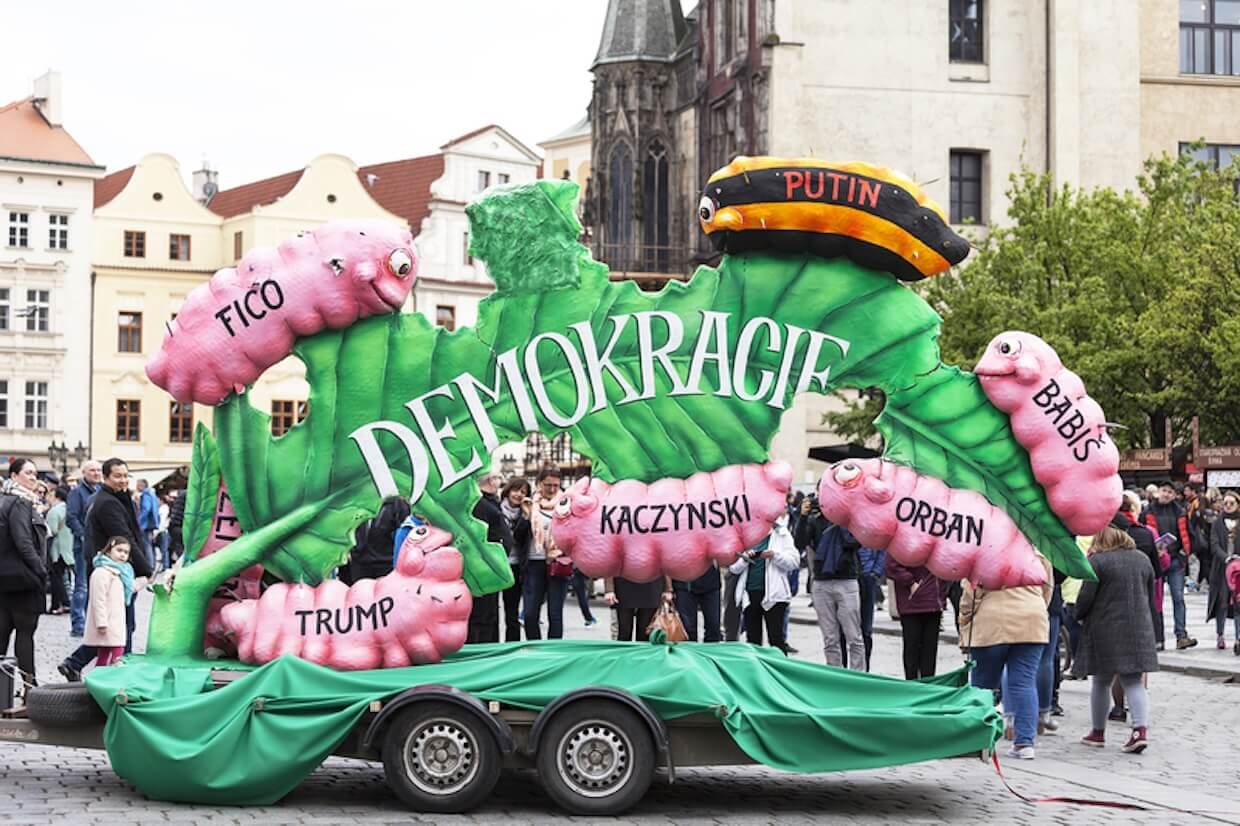
A banner depicts democracy as a leaf eaten by “caterpillars” named Putin, Kaczynski, Orban, Babis, Trump, and Fico on Labour Day, May 1, 2017 in Old Town Square, Prague. Photo: Jolanta Wojcicka.

Professor Magaloni, welcome! To begin, your recent article “Delivering for Democracy: Why Results Matter” challenges the view that democratic backsliding can be explained solely by elite manipulation and institutional erosion. To what extent do you believe contemporary democratic crises are rooted in a deeper failure of democratic systems to deliver security, opportunity, and public goods to citizens?

Professor Beatriz Magaloni: Obviously, the process of backsliding is a complex one, and every country has some unique characteristics. In some countries, it is manifested more through fear of immigration and what that means for culture and also redistribution within a country. But what we have seen is an overarching dissatisfaction with what democracy delivers in many countries. As I argue, it is manifested differently in Europe, Latin America, the United States, Asia, and so on. But there is a common feeling among voters—and we see this in survey after survey—that democracy is not delivering what they want and that they are dissatisfied with the democratic system.

Of course, we see this in surveys with questions that ask whether people endorse democracy, whether they believe democracy is the best form of government, or whether they would be willing to accept a strongman or woman leader who would deliver what they want. We consistently observe a decline in satisfaction across the globe, and that worries us because we have been understanding democratic support as being based exclusively on principles, norms, freedoms, and the substantive normative content of democracy.

Voters are still committed to those things, but we have missed the critical importance of delivery. That is basically the content of that article. We have now extended this work, with other co-authors and myself, to the region of Latin America, asking very specific questions about what type of delivery people feel they are missing from democracies and how far they are willing to go in supporting leaders who would undermine some basic democratic norms in order to achieve economic security, health, and public service delivery that they are not observing. That is the general pattern that we are describing in that article that you just cited.

Voters Turn to Outsiders When Democratic Institutions Stop Delivering

Many scholars emphasize the role of populist leaders in undermining liberal-democratic institutions from within. In your view, why are significant portions of the electorate willing to support leaders who openly challenge constitutional constraints, judicial independence, and pluralism?

Professor Beatriz Magaloni: I think it’s related to what we just mentioned. Often, dissatisfaction leads voters to reach conclusions about the current system. They conclude, for example, that political parties are ineffective. These are very unpopular institutions in the region that I study, but also across the globe. Party identification has declined. Voters also perceive legislators as incompetent. They don’t see legislators responding to what they want. They view the judiciary as something that imposes constraints. They don’t really understand specifically what each institution is doing, but we know that, for example, in Latin America, the least popular institutions, besides the police, are political parties and legislatures. 

So, these strong leaders are able to capitalize on this dissatisfaction and portray themselves as outsiders, people who do not even come from the political class. Often, they are entrepreneurs or people without political experience who are able to use very smart and strategic communication techniques, along with highly curated social media campaigns, to gain the attention and support of voters.

Often, these leaders are real outsiders. For example, in Colombia, in the elections right now—the second round that is going to take place this Sunday—the candidate, Abelardo de la Espriella, is clearly an outsider. He presents himself as a very successful entrepreneur. He even has Italian and US passports, so he has triple nationality. He portrays himself as a successful entrepreneur, very much in the way Trump tried to portray himself. And he is capitalizing on the very strong dissatisfaction among Colombians at the moment with the peace accords and what they have brought for some sectors of society, specifically those located more in the cities and in the peripheral areas of the cities, not so much in the countryside, where the war and human rights violations have been very significant and where he is not popular.

Similarly, Bukele in El Salvador was able to capitalize on a comparable dissatisfaction with the democratic political system, where two parties had alternated in power, left and right, and voters had concluded that neither of these parties had been able to deliver on something that was very dear to them, namely security. El Salvador was, back then, one of the most violent—and often the most violent—countries in the world. Even though homicides had been declining before Bukele took office, he was able to capitalize on that dissatisfaction to gain support and then, little by little, destroy democratic institutions.

We saw a similar process in Brazil with Bolsonaro, although he was not really an outsider. He was a congressman and a member of the military, but he also campaigned using the same language.

Similarly, Trump came to power with that same strategy. We also see that these leaders copy one another and have really figured out which strategies work. And there is also a very powerful dissemination of these messages through social media, and they have been very strategic in reaching across borders through different means.

Citizens Have Not Rejected Democracy

No King Protests.
Demonstrators at The People’s March, an evolution of the Women’s March, NYC, January 18, 2025. A protester holds a sign reading “Presidents Are Not Kings.” Photo: Erin Alexis Randolph.

Across Europe and North America, surveys reveal declining trust in political parties, legislatures, and public institutions. Should this be interpreted as a crisis of liberal democracy itself, or rather as a crisis of state performance and governance capacity?

Professor Beatriz Magaloni: We have to be cautious about saying that voters really don’t like democracy anymore. Also, in our surveys—again, in Latin America, but I can also go back to Europe and the United States—voters understand the value of these principles. So, when we see, for example, people protesting in the United States in the No Kings march, it’s a very well-attended march. Millions of voters, citizens in this case, and non-citizens come out to protest. When you read what they are protesting about, it is often violations of very concrete democratic institutions. That’s the meaning of No Kings. They don’t like that accumulation of power. They don’t like that Trump is concentrating power, going around Congress, dominating the judiciary, and prosecuting his opponents. Also, all the human rights violations that come through the way he’s enforcing immigration.

We see that constantly. We have also been very surprised in Europe—positively surprised—by voters putting a halt to this language and really choosing parties and candidates that are more moderate. So, we have to be cautious about saying, this is just going to happen everywhere. Democratic backsliding is not universal. It’s happening slowly in several countries. We see, surprisingly, attacks on norms and institutions that we have really become accustomed to, as well as the abandonment of the language of protecting these sacred institutions. But I don’t think we can reach the conclusion that there is no normative commitment to democracy at all.

There are very specific things voters are asking for. There is dissatisfaction with economic performance, dissatisfaction with service delivery, and dissatisfaction with immigration and the way countries have dealt with it. Obviously, this creates a great deal of tension in society. Parties on the left have also been able to correct their language and the way they have approached these processes.

However, I am not so pessimistic as to say that we’re going to observe the same backsliding all over Europe. Democracy in Europe has shown itself to be quite solid, although there is obviously space for these leaders, and people are paying attention to them.

Performance Matters—Even in Authoritarian Regimes

In Voting for Autocracy, you demonstrated how citizens may support authoritarian regimes not merely because of coercion but because authoritarian systems create incentives and dependencies that shape political behavior. Do you see similar mechanisms operating today in contemporary electoral autocracies and even in some democracies?

Professor Beatriz Magaloni: Yes, in my work on authoritarianism, I really paid a lot of attention to the meaning of elections and the fact that voters can choose. So, these are electoral authoritarian regimes where there is real choice, although one single party or leader holds power. We see, for example, Venezuela with Chávez and then Maduro. Now what happened in Venezuela is a different story. Staying in power for a long time while having elections—the PRI in Mexico was in power for over 70 years with multi-party elections. There was obviously limited competition, but still those elections were meaningful. We see, increasingly around the world, that this is the modal form of authoritarianism. But we also observe countries like China, for example, where there are no elections.

My work really focused on why authoritarian leaders need to mobilize support from the masses or voters in order to stay in power. Essentially, I discovered that, similarly to democracies, voters and people in authoritarian regimes evaluate leaders according to what they deliver. So, authoritarian countries that are high-performing in terms of economic growth and some redistribution tend to be more solid and more stable than those that do not have economic growth, do not redistribute, do not create public goods, and do not invest in public goods. That’s the main finding of my work: performance matters. I started my work thinking about different ways in which voters evaluate autocracies. One of them is through what I call performance legitimacy, where the more economic growth and better performance you have observed—not only in the current electoral cycle but throughout your entire life cycle—the more loyal to that regime you become.

But obviously not every authoritarian regime can deliver. Some are not that great. For example, when I studied the Mexican PRI, the PRI stopped delivering as it used to with the debt crisis of the 1980s and the economic adjustments that all countries in the developing world had to go through. At that moment, the PRI started to become more strategic in terms of how the party targeted direct benefits to buy off electoral support—what I call clientelism. In that book, I call it the punishment regime, where autocrats reward supporters with benefits, and by that, I mean, for example, the benefits of social programs. Only those sectors of society that support the autocratic regime receive those benefits, while voters who do not support the system are punished. So, I argue that this creates, even in lower-performing autocracies, an incentive for many poorer voters to turn to the autocrat.

That’s the way I explain support for Chávez during his term in Venezuela. He was able to profit from the oil boom and use those profits to create social programs, the misiones bolivarianas, and many other investments that reached sectors of society that had been left out of the democratic system. By capturing that sector of society and punishing those who did not support him, he was able to gain a lot of support through that strategy, as well as through his rhetoric and all the other things we talked about—his anti-institutionalism and his language about revolution: “We are coming here to create a completely new system that democracy never delivered.”

But then, obviously, we saw Venezuela enter a huge economic recession under Maduro, accompanied by an enormous humanitarian crisis. The oil boom was no longer there, and the system started to use more and more coercion to stay in power. So that’s what I discovered: autocrats use multiple strategies to remain in power. But if they have economic performance and effective service delivery, they don’t need so much coercion to keep people supporting them. In fact, there can be genuine support for authoritarian leaders.

Power Sharing Is Essential for Dictators

President Erdogan greeted the citizens who showed great interest after the Friday prayer in Istanbul, Turkey on April 14, 2019. Photo: Mehmet Ali Poyraz.

Your work has shown that authoritarian regimes often survive through sophisticated mechanisms of power-sharing, co-optation, and institutional adaptation rather than brute repression alone. How useful is this framework for understanding the durability of contemporary authoritarian regimes such as those in Turkey, Russia, or Venezuela?

Professor Beatriz Magaloni: Very good question. As I mentioned, autocrats use a combination of strategies. They use coercion, and they have that system in place because, ultimately, they are authoritarian. They are not going to cede power willingly. They are going to repress those who openly challenge the regime. And they can do that selectively rather than massively. They do retain coercion, and that’s very important to emphasize because, ultimately, that’s going to play out in the system. But they can do many other things—and they need to do many other things—to keep themselves in power if they want to succeed as dictators or autocrats.

One of those strategies is what I call power sharing. This is not only my work; other scholars studying authoritarian regimes have also focused on this. These are ways in which autocrats bring political and economic elites into a system of redistribution of benefits, often through institutions. For example, becoming part of the ruling party or the apparatus of government brings benefits, including economic benefits, to their cronies. That’s what I call power sharing. They create incentives for those supporters—very critical supporters at the elite level of the regime—to remain loyal. Because if they don’t, that is going to make the regime very vulnerable. Definitely, that’s essential. They operate through that mechanism, often by creating different institutions that bring different players into the system and allow them to share power. Obviously, these actors do not challenge the leader. Although in some unusual cases, like Mexico, there was alternation of the leader; there was alternation of the president himself. In China, for example, we see that as well. Less often than in Mexico, but there is a system to remove the leader and choose a new one.

That’s the second strategy. And finally, what we’ve been talking about: if they don’t mobilize and maintain some support or loyalty from the masses, what I discovered is that they become vulnerable. There is always a chance that someone within the regime could challenge the leader and the system. The more dissatisfaction there is among the population, the greater the opportunity for leaders, often emerging from within the ruling elite, to challenge the system.

That’s the set of strategies that we have seen—not only in my work. My work, I think, pioneered this line of research, but there has been a great deal of work since then on how these systems combine these strategies. But we have to acknowledge that coercion remains a powerful tool. That tool is used, and it is ultimately what distinguishes autocrats from democrats. That’s what we hope—that in democracies we do not observe this form of coercion. Although we can talk a little bit about that because my current work has moved into the instruments of coercion that are used in democracies and that unfortunately persist. Many of them have to do with the police and the carceral state, which are still used in democracies in ways that no democrat would agree are correct.

But definitely, yes, power sharing is essential for dictators. When we look at Turkey or, as you mentioned, Russia today, that is a very fine balance they have to maintain. One of my co-authors on this paper also argues that delivering very visible public goods is important. My co-auther, who is a PhD student, is writing his dissertation now, has a theory that is very solid: autocrats can signal good performance by delivering very visible public goods. So, investments in infrastructure—big bridges and airports that are highly visible, especially to middle-class voters—become important signals. And autocrats do pay attention to that.

Autocrats Are Becoming Increasingly Sophisticated

One recurring theme in your scholarship is that authoritarian institutions often perform functions that outside observers underestimate. What lessons should democracies draw from the institutional adaptability of authoritarian regimes without sacrificing democratic accountability?

Professor Beatriz Magaloni: Yes, I think that’s where we are underperforming as democracies and democrats. I’ve been studying the regime in El Salvador under Bukele, and I am now paying very close attention to developments in Colombia. I have studied the PRI, and I have studied Venezuela. Clearly, the strategies that autocrats are using are becoming increasingly sophisticated.

As I mentioned, there is also coordination among populist leaders in their language, as well as in their electoral strategies, messaging, and interventions. People are very worried about foreign intervention, for example, from Donald Trump in Latin American elections, signaling who the right candidate is and, interestingly, delivering messages in support of certain candidates. Increasingly, if you look at the elections today in Colombia, for example, the candidate Abelardo de la Espriella, has been incredibly strategic in ways that we did not anticipate would become so popular. His way of communicating with voters—even through performing shows and doing things that excite voters—has been effective in ways that we would not have anticipated before.

So, I think that democracies and democrats around the world have not yet figured out how to respond to these strategies in similarly effective ways that truly reach voters, especially younger generations who have become more disappointed with the system because they have not grown up in a system that has delivered in the way some democracies delivered in the past.

Performance Failures Are Driving Democratic Vulnerability

The rise of high-performing autocracies has revived debates about whether citizens prioritize outcomes over democratic procedures. Is the contemporary challenge to democracy fundamentally ideological, or is it increasingly performance-based?

Professor Beatriz Magaloni: That’s a very interesting question, and there is an ongoing debate in political science. Some scholars argue that democratic backsliding and challenges to democratic institutions often stem from the fact that voters are highly polarized along partisan lines, and especially along ideological lines. There is very important work by Milan Svolik, for example, and his co-authors, which shows that if people are polarized—not only ideologically, but also through what we call affective polarization, where they dehumanize their opponents and no longer see them as legitimate players in the democratic system—this affective polarization drives voters to condone violations of democratic institutions by their preferred leader and party. They would rather vote for a non-democrat than for an opponent who is no longer, in their view, a legitimate participant in the system.

So, we see that playing out very clearly in some political systems, such as the United States. And we observe that elsewhere as well. One could, for example, look at the elections in Colombia today, or even Peru, which recently experienced similarly contentious elections and is now in the process of determining who the next president will be. It looks like Keiko Fujimori is going to be. And there was very intense polarization in both countries.

But I don’t see this as necessarily ideological polarization in either Colombia or Peru. Rather, it is a polarization rooted in how people experience the state in their everyday lives. For example, voters who live in cities and in the peripheral areas of cities experience democracy very differently from voters living in the countryside—indigenous populations and Afro-descendant populations who were severely victimized during the civil war in Colombia.

So that polarization emerges not necessarily because of left-right ideology, but because of these different experiences of what the war meant to them and what the peace accords have meant to them. There is also a very strong anti-incumbent polarization. A large sector of society does not like Gustavo Petro today. They strongly dislike Petro because they see him as someone who negotiates with insurgents and guerrillas and who has brought about changes in society that a large segment of the population does not support. That’s the polarization we observe there. Which is also left and right, so there is polarization on those grounds as well. But I want to emphasize this experiential dimension—the experience people have in their everyday lives that leads them to adopt these positions. It’s not only about policy positions and what we traditionally understood as left and right. That has always been part of democratic politics. That’s what democracies are about. They are about policy debates and competing economic visions, where one party may favor less redistribution and another more redistribution.

What we are observing now is a different set of issues that are deeply dividing voters. So, I would agree with that aspect of Milan Svolik’s work—that polarization is indeed important. But what we are discovering in our own research across Latin America—and it is very expensive to conduct all these surveys across the region; I wish I could do that worldwide—but at least in the seven countries we have studied in great depth, we find that a great deal of the problem has to do with performance in areas that people regard as essential. If a party, or especially a candidate, promises to deliver what voters feel has been missing, they are often willing to go along with that leader, even if it means undermining institutions.

What Happens in the US Shapes Democratic Trends Worldwide

US President Donald Trump and Hungarian Prime Minister Viktor Orbán arrive for a working dinner at the NATO Summit in Brussels, Belgium on July 11, 2018. Photo: Gints Ivuskans / Dreamstime.

In the United States, democratic institutions have proven more resilient than many expected, yet political polarization remains extraordinarily high. Do you see polarization primarily as a symptom of institutional dysfunction, economic grievances, or deeper transformations in political identity?

Professor Beatriz Magaloni: That’s a very important and complex question, and I think that the process in the United States has surprised many scholars. Because the United States has a high level of economic development and a long history of democratic institutions, we never thought that democratic institutions would backslide in the way they have in the United States. And I agree with you that the system has proven resilient because there is still opposition. But, to my surprise, that opposition seems to be coming more from the elites.

There has been incredible success in undermining key democratic institutions, principles, and norms in the system. Part of the reason, as I see it, is that the Republican Party has not put any brakes on what Donald Trump has been doing to the democratic system. They have gone along with him, placing no meaningful constraints on him, and that has allowed President Trump to do things that we would never have predicted could happen in the United States. This includes the way he is enforcing immigration laws today in non-democratic and completely non-humanitarian ways, but also the way he has persecuted his opponents.

For example, we observe lower-level courts putting a halt to anti-democratic actions. But when it comes to the Supreme Court, we have observed the Court surprisingly going along with Trump in ways that we would never have anticipated from a system of checks and balances. So, I do believe that the system is—or at least we hope the system is—resilient, because we are still waiting to see what is going to happen in the coming elections.

We have also observed a very clear intent to manipulate electoral rules at the state level in order to give Republicans an advantage, even when they are not popular. Trump is the least popular president. So, by all means, he should not be able to retain a majority in the House with his current levels of popularity. But we also have to understand that there are many elements in the democratic system in the United States that are not majoritarian, that give a great deal of power to minorities, and the system is designed that way. For example, the Electoral College is one of those institutions in which you can still win the presidency without winning a majority of the vote, and that places considerable power in certain states. For example, I teach at Stanford, so I live in California. If you are pro-Trump, you are really powerless in that state.

So, I am less optimistic, frankly, about what I have observed in the United States. I think the backsliding has gone farther than in any country in Europe. I think Europe has proven to be more solid as a region. Turkey, obviously, is not part of the EU, and it’s different. There is clear backsliding in Turkey. That’s not Europe, but it is part of it. But the United States has really, in my opinion, gone farther than any solid democracy has gone.

Many Voters See Immigration as Both a Cultural and Redistributive Threat

Europe is witnessing the normalization of parties that were once considered outside the democratic mainstream. How should we understand the growing electoral appeal of the populist radical right and far right: as a protest against globalization, a reaction to migration, or evidence of dissatisfaction with democratic governance itself?

Professor Beatriz Magaloni: You just identified the right set of reasons why we observe these parties, which are very anti-system and often employ very non-democratic language, emerging as highly popular alternatives in Europe. I would place immigration as the number one reason, and particularly what it means to European societies. I think immigration has generated a strong reaction among voters because it is perceived as a cultural challenge to their way of life. But it is also because many feel threatened within the system of redistribution. They do not want to share the welfare system with people who are perceived as non-European. So, this is in part rooted in race and culture, and there has been a very strong reaction to that. Some people perceive immigrants as dangerous, not only in terms of security, but also in terms of culture and what immigration means for European societies.

There Is Still Considerable Commitment to Democracy Around the World

Finally, if current trends continue, what do you expect democracy to look like ten to twenty years from now? Are you ultimately optimistic that democracies can renew the social contract and restore public confidence, or are we entering a prolonged period of democratic fragility and authoritarian experimentation?

Professor Beatriz Magaloni: This is a difficult question. I tend to be more of an optimist, and I do see that there is a great deal of commitment to democracy. We have talked a lot about performance and why it matters, and that is a very important aspect for democrats to consider. They have to understand how to deliver better. 

In the surveys and research that I have been conducting, there is still a strong commitment to democratic norms. People remain very strongly committed to civil liberties. They do not want to be denied the right to protest. They want to see open debate. They do not want to see a system where opponents are sent to prison. They remain committed to certain principles. In the studies I have conducted, civil liberties rank first. Competitive elections are the second most important aspect that voters value. People want elections to take place, and they want their voices to be heard. And thirdly—and this is what worries me the most—there is less commitment to the rule of law. Due process and protecting individuals from the coercive apparatus of the state are less firmly supported in the surveys I have conducted. But there is still commitment to democratic norms. What people are telling us is: please deliver better. If democrats receive this message and manage to create a system in which delivery becomes the highest priority, democracies will be okay.

What I want to emphasize, however, is that what happens in the United States plays an important role in shaping global democratic trends. As I have mentioned, President Donald Trump has been directly supporting certain anti-institutional and anti-democratic candidates and has sent very clear signals about who those candidates are. He has sent very strong signals. So, what happens in the United States is going to continue influencing the rest of the world. That is why I am paying very close attention to these elections in November and to the coming years of this presidency in the United States, because it shapes the world in ways that we never expected would be so dramatic.

I want to end on an optimistic note. One example is what happened recently in Hungary, with the electoral defeat of Viktor Orbán by TISZA, and all the mobilization around democracy, the enthusiasm at the local level, and the extensive organizing that was undertaken to finally defeat Fidesz and Orbán in Hungary. I think that is a very important lesson. While these cycles are undoubtedly troubling—I think Latin America is entering a troubling cycle of extreme populist right-wing presidencies—some of these leaders, surprisingly, have not challenged democratic institutions. For example, in Argentina, Milei has been more respectful of democracy, even though he is an extreme-right libertarian leader. But we did not observe the same in El Salvador, where we have really witnessed the destruction of democracy. We are going to be watching Colombia very closely to see what happens there.

But I do want to end with a sense of optimism. These cycles happen and I just want to emphasize that there is still a considerable commitment to democracy around the world. We simply have to be more strategic and more careful about delivering what people want. 

Professor Georg Lutz.

Prof. Lutz: Population Aging Has Changed the Immigration Debate in Switzerland

Switzerland’s rejection of the Swiss People’s Party’s proposal to cap the country’s population at ten million has been widely interpreted as a crucial test of contemporary European politics. While the referendum exposed persistent anxieties about immigration, housing, infrastructure, and national identity, it also revealed an emerging counter-narrative centered on demographic aging and labor-market needs. In this interview with the ECPS, Professor Georg Lutz examines the referendum’s implications for direct democracy, populism, and the future of liberal democracy. He discusses the resilience of the populist radical right, the role of issue ownership in electoral politics, and the opportunities and limits of direct democracy. Professor Lutz also reflects on political distrust, misinformation, democratic participation, and the evolving relationship between popular sovereignty and constitutional liberalism.

Interview by Selcuk Gultasli

Switzerland is frequently portrayed as the world’s most sophisticated laboratory of direct democracy—a political system in which citizens regularly decide major policy questions through referendums and popular initiatives. Yet the country’s June 2026 referendum on the Swiss People’s Party’s (SVP) proposal to cap the population at ten million revealed that even Switzerland’s celebrated democratic model is increasingly shaped by the same tensions confronting liberal democracies across Europe: migration, demographic change, economic insecurity, national identity, and the rise of the populist radical right.

Although voters ultimately rejected the initiative, the campaign exposed deep divisions over immigration and the future direction of Swiss society. More importantly, it highlighted a significant shift in public debate. As Professor Georg Lutzargues in this interview, discussions about immigration are no longer driven solely by concerns over cultural identity or social cohesion. For the first time, a prominent counter-argument emerged around demographic realities and economic necessity. In his words, “all populations in European countries are aging,” and immigration was increasingly discussed as “something that is also necessary for the labor market.” As he notes, “we see a bit of a shift in this debate compared to what we have seen in previous times.”

In this wide-ranging conversation with the European Center for Populism Studies (ECPS), Professor Lutz—Director of FORS, the Swiss Centre of Expertise in the Social Sciences, and Professor of Political Science at the University of Lausanne—offers a nuanced assessment of the referendum, the resilience of the SVP, and the broader relationship between direct democracy and populism. Rejecting simplistic interpretations, he argues that the referendum result represented both a setback and a success for the SVP. While the initiative failed, “45 percent of the Swiss population voted in favor of limiting the population to 10 million,” a figure substantially higher than the party’s own electoral support.

The interview also explores whether direct democracy serves as a safeguard against populism or inadvertently empowers it. Professor Lutz challenges common assumptions on both sides of the debate. While acknowledging concerns about minority rights and majoritarian pressures, he argues that “the reality is much more nuanced” than many critics suggest. Direct democracy, he contends, is deeply intertwined with representative institutions and often acts as an indirect mechanism of accountability rather than a revolutionary alternative to parliamentary politics.

Perhaps most importantly, Professor Lutz shifts attention away from institutional design and toward what he sees as the more pressing threats facing contemporary democracies: the fragmentation of information systems, the spread of misinformation, growing political distrust, and systematic efforts to undermine confidence in democratic institutions. In an era of polarization and populist mobilization, his reflections offer important insights into both the strengths and vulnerabilities of democratic governance in Switzerland and beyond.

Here is the revised version of our interview with Professor Georg Lutz, edited lightly to enhance clarity, readability, and overall flow for publication.

The Result Was Both a Defeat and a Success for the SVP

Switzerland-EU

Professor Lutz, welcome! To begin, Switzerland has just rejected the SVP’s proposal to cap the country’s population at ten million, despite widespread public concerns about immigration, housing, and infrastructure pressures. How should we interpret this outcome: as a defeat for the populist radical right, a rejection of anti-immigration maximalism, or evidence that Swiss voters remain more pragmatic than ideological?

Professor Georg Lutz: It’s probably a mixture of all three. If you looked at the leaders of the People’s Party (SVP) on Sunday when the results came in, you could see that they looked rather disappointed. They had hoped that the proposal could be won, because the party has succeeded with similar anti-immigration votes in the past, and the polls were quite favorable at the beginning. 

On the other hand, the party was also, to some extent, satisfied. After all, 45 percent of the Swiss population voted in favor of limiting the population to 10 million, and that is significantly higher than the party’s own vote share, which is only about 28 percent. So, the party mobilized well, particularly in rural areas, around one of the key issues on which it has been campaigning for more than 30 years now.

Many Swiss Voters Chose Stability Over Uncertainty

The referendum campaign was widely described as a “Swiss Brexit” moment because of its potential implications for relations with the European Union. Why did voters ultimately choose continuity over rupture, and what does this tell us about the limits of sovereigntist populism in Switzerland?

Professor Georg Lutz: It is probably a correct interpretation that, to some extent, the majority voted for stable relations with the European Union and also stability in terms of the labor market. There was a big debate about how limiting migration in Switzerland could potentially harm the labor market in the long term. 

But the campaign against the initiative also warned about the chaos that could result. It argued that it would create a great deal of bureaucracy for regulating the market, as in the health sector, as well as higher crime because of ending the Schengen Agreement. There would also be chaos because asylum seekers could simply come in. So, to some extent, it was a vote against this kind of chaos, which was a defining feature of the ‘No’ campaign.

Few Populist Parties Have the Historical Foundations of the SVP

The Swiss People’s Party remains one of Europe’s most successful right-wing populist parties despite this setback. What explains the long-term resilience of the SVP, particularly when many comparable populist parties elsewhere experience cycles of rapid ascent and decline?

Professor Georg Lutz: For this, it’s important to look a little bit into the history of the party, and you’re right, the Swiss People’s Party is quite unique in this respect. It is the strongest party in Switzerland. It has been the strongest party for many years, and it doesn’t experience as many fluctuations as other populist right-wing parties.

The party was founded around 100 years ago. It used to be an agrarian, more centrist, small-business-owner party and wasn’t a radical right-wing party at the very beginning. The party has also been in the Swiss government for almost 100 years, and that’s a very unique feature of Switzerland. Switzerland has a multi-member government with seven members, and the Swiss People’s Party now has two of these members. So, the party still has a strong foundation in the countryside, along with some more moderate voters.

It then started to transform, turning into a radical right party from the 1990s onward. It lost the more moderate wing and became a party strongly focused on anti-immigration, anti-EU, and anti-establishment sentiments—the classic features of other populist right-wing parties you see across the continent.

The Real Victory Was Keeping Immigration at the Center of Politics

Your research on issue ownership suggests that parties gain electorally when they are perceived as the most competent actors on salient issues. Has immigration become such a deeply “owned” issue for the SVP that even referendum defeats can reinforce its broader political influence?

Professor Georg Lutz: That’s actually not just a unique feature of the SVP; it’s a feature of all radical right parties. That’s something you see in modern campaigns. Modern political campaigns are not so much about positioning a party on all kinds of different issues that might attract voters; rather, they are about pushing the key issues with which a party is identified.

Again, it’s not unique to populist right parties. The same applies to Green parties, which are heavily identified with environmental and ecological issues. Liberal parties are generally aligned with economic issues, and social democrats, at least partially, with social issues. And that’s what the debate is about. That’s also why this vote has been a success for the party. They were able to campaign on a key issue, put it on the political agenda, and they are hoping that it will help them in the next national elections and in the many regional elections that we constantly have.

Migration Is Seen as Both a Cultural and an Economic Threat

Switzerland, immigrants, protest,
Young demonstrators in Zurich call for greater humanity and solidarity toward immigrants. Photo: Michael Müller / Dreamstime.

Across Europe, populist radical-right parties increasingly frame immigration not merely as an economic issue but as a question of national identity, demographic survival, and cultural continuity. How closely does the Swiss case resemble developments in countries such as France, Italy, Austria, Germany, and the Netherlands?

Professor Georg Lutz: I would probably argue that this is not necessarily a new development. It has been the defining feature explaining the success of many right-wing parties: their ability to frame migration as a cultural threat, as a threat to the cultural identity of a country. But I do believe it also goes, to some extent, a little beyond this.

There is also a perceived economic threat among part of the population, mainly those from lower income and educational backgrounds. That’s also usually the type of electorate that votes for radical right-wing parties, and it used to be, in many Western countries, a traditional social democratic stronghold. So, it’s not just cultural; it also has an economic component.

What was interesting in this campaign—and I, maybe, should have mentioned it before—is that there was also, for the first time, quite a strong debate about the need for immigration. All populations in European countries are aging. There is a demographic change. Viewing immigration as something that is also necessary for the labor market was quite prominent in this debate, and it is also one of the features that probably explains the strong opposition, or majority opposition, to this vote. So, we see a bit of a shift in this debate compared to what we have seen in previous times.

The Reality of Swiss Direct Democracy Is Far More Nuanced Than Its Critics Suggest

One of the recurring criticisms of direct democracy is that complex policy questions are often reduced to emotionally charged slogans and binary choices. Does the recent population referendum illustrate the strengths or the weaknesses of plebiscitary democracy?

Professor Georg Lutz: But, coming from Switzerland, we have a fairly relaxed approach to direct democracy. In Switzerland, you don’t find any politician who publicly opposes direct democracy. It’s so strongly embedded in the national identity and political culture, and Swiss people are quite proud of it. On the other hand, if you look abroad, direct democracy is indeed often seen as a threat and as an instrument of populism.

But, I think, the reality is much more nuanced if you look at what’s actually going on. On the one hand, direct democracy in Switzerland is very strongly interconnected with the representative system. The idea that outside political actors somehow dominate direct democracy with a populist agenda is far removed from reality. It is parties—even established parties—that usually launch direct democratic initiatives. They are also part of the campaign. All the major interest groups that intervene in the representative system are likewise part of the direct democratic campaign. So, there is a very strong interconnection.

It’s also important to say that, here, we are talking about popular initiatives—proposals that can be made by citizens with a certain number of signatures. They usually get defeated. Only about 10 percent, or one out of ten, ultimately find a majority. And usually, there is a ‘no’ vote, as was the case with this initiative.

The other thing is that if you assess the outcomes of direct democracy, you also have to assess them against the outcomes of representative democracy. You also see many radical right-wing parties pushing, sometimes successfully, for similar positions on immigration and anti-asylum-seeker policies. They, too, find majorities, and that has nothing to do with direct democracy.

Concerns About Minority Rights Are Real but Often Exaggerated

Switzerland is frequently celebrated as the world’s most advanced system of direct democracy. Yet critics argue that repeated referendums on immigration, asylum, religious minorities, and citizenship can place minority rights at the mercy of majority preferences. How serious is this concern in the Swiss context?

Professor Georg Lutz: It is a recurring concern in the Swiss context, but to some extent it is also kind of exaggerated. If you look at the track record, there have been some votes recently to ban minarets or burqas, and also some anti-immigration votes that found a majority. But they are still quite rare. There are also votes where minority protection is usually quite strong. When it comes to language minorities, there is broad acceptance that these minorities should be protected.

I think the problem is not so much direct democracy as such, but rather the absence of safeguards in the form of constitutional limitations. The constitution can be changed quite easily, and what is in the constitution cannot be challenged by any court. That is a defining feature of how the system is implemented in Switzerland.

But again, what is important is to consider what the benchmark is. Some similar initiatives, such as banning burqas, have passed in France or Denmark through purely representative systems, and these were indeed limitations on minority rights. Similarly, LGBTQ rights have been restricted in Poland and Hungary through purely representative systems. It happens, but it is not specific to direct democratic systems.

There Are Very Few Institutional Safeguards in the Swiss System

Some theorists warn of a potential tension between popular sovereignty and liberal constitutionalism. Can direct democracy become a vehicle through which majorities gradually undermine liberal norms and minority protections while remaining formally democratic?

Professor Georg Lutz: It can happen in theory because, as I just mentioned, Switzerland has very few limitations. Only binding international law—such as prohibitions against genocide or torture—is really excluded from being the subject of a popular vote, and even then, it requires a parliamentary decision. It’s not a court decision. Parliament could potentially decide that a proposal violates binding international law and, as a consequence, cannot be put to a vote. So, there are very few safeguards. As a result, there is, within this system, a kind of hope that voters are wise enough to respect minority rights, which, in fairness, in many cases also happens.

Campaigns Have Always Been About Mobilizing Emotions

Referendum posters in Geneva.
Referendum posters displayed on panels at Plainpalais in Geneva, Switzerland, ahead of the September 20, 2020 popular vote. Photo: Dreamstime.

Your work on turnout and direct democracy suggests that information levels may matter as much as participation rates. In an era increasingly shaped by social media, misinformation, disinformation, manipulation, and political polarization, are contemporary referendums becoming more vulnerable to emotional mobilization and simplistic narratives?

Professor Georg Lutz: I also studied history at some point in my life, and I would argue that campaigns—whether in direct democracy or in elections—have never really been the moment when a sophisticated exchange of arguments and public deliberation takes place. They are always the moment when parties or campaigners try to steer emotions and mobilize people, and that’s something you usually do with emotions rather than with complicated arguments. In fairness, this is not a unique feature of the radical right. Left parties have been doing this for more than 100 years as well, if you look at some campaigns in the early twentieth century.

There is, nevertheless, a big difference in how this is done between left- and right-wing parties. Right-wing parties use a lot of elements of exclusion and construct politics in terms of “us against the other,” and that is typically not what left parties do. They are much more likely to campaign on other dimensions, such as the idea that certain proposals threaten people’s well-being. That is the big difference—not that campaigns are trying to be emotional.

Much of Direct Democracy’s Influence Is Indirect Rather Than Direct

Many populist actors claim that referendums represent the purest expression of “the will of the people.” Do you agree that direct democracy offers a corrective to representative institutions, or does this claim underestimate the complexity and diversity of modern societies?

Professor Georg Lutz: It probably does. As I argued before, the outcomes of direct democratic decisions are often quite similar to the outcomes and decisions you could see in purely parliamentary systems, in any direction. So, in a way, the people are not fundamentally different from what elites choose.

I think that’s a strong argument in Switzerland. A lot of the effects of direct democracy are indirect. In any parliamentary decision and parliamentary deliberation, it is known that any law must potentially pass a majority in the population. So that often leads to oversized majorities in Parliament because it is known that, if there is a narrow result, it may lead to a referendum, and there is a risk that the proposal will be defeated. In that sense, referendums create indirect reality checks all the time. But they also, of course, create quite direct reality checks, because a proposal is either approved by Parliament or not. In terms of initiatives, the people, then, vote in favor of or against them.

Direct Democracy Both Empowers and Constrains Populism

Referendum poster for Switzerland’s September 20, 2020.
Referendum poster for Switzerland’s September 20, 2020 immigration vote displayed at Geneva’s Cornavin railway station. Photo: Dreamstime.

Switzerland’s direct-democratic institutions are often presented as antidotes to populism because they provide citizens with regular opportunities to express grievances. Yet populist parties have also become some of the most successful users of these instruments. Does direct democracy ultimately contain populism or empower it?

Professor Georg Lutz: Again, it’s both. Direct democracy has been used by populist parties on the right and on the left, more so than by centrist parties or interest groups. They use it for agenda setting, and they also use it to try to push their proposals and find a majority in the population.

On the other hand, and this is really interesting, what happens constantly in Switzerland is that whenever there is a protest movement of any kind, it immediately becomes the subject of a public debate. The response is essentially: sure, it’s an interesting proposal—try to find a majority.

What then happens is that these groups start collecting signatures, which is a demanding logistical and, to some extent, financial endeavor. The proposal then enters a parliamentary decision-making process. It cannot be stopped by Parliament or the government, but both Parliament and the government issue recommendations. Sometimes they also formulate counter-proposals.

Then it comes to a vote. So, these kinds of protests are immediately channeled into institutionally embedded mechanisms that form part of the direct democratic decision-making process. Because the process takes so long—usually several years between the launch of an initiative and the final vote—it also modulates and dampens, to some extent, very heated movements.

You Cannot Defeat Populists by Dismissing People’s Concerns

Recent research, including work to which you have contributed, links political distrust, life dissatisfaction, and anti-immigration attitudes to support for right-wing populist parties. To what extent is contemporary populism driven less by ideology than by broader feelings of dissatisfaction and alienation?

Professor Georg Lutz: It’s probably both, assuming that I would call nationalism an ideology, which you could probably argue against. But it has many defining features of an ideology, and it is what right-wing populist parties are capitalizing on. They are trying to mobilize those who are dissatisfied with the establishment and the elite, as well as those who feel disadvantaged in the labor market, also compared to foreigners, and threatened by globalization. These are all issues that these parties put forward.

To some extent, the causality actually goes the other way around. Right-wing populist parties constantly convey the message that voters should be dissatisfied with governments, the establishment, and immigration, so that’s also part of the connection. That’s why some of their voters hold such strong views.

But, in fairness, I would nevertheless argue that there is also a political economy of radical right-wing voting. It’s not just a purely cultural issue. The cultural dimension is what drove the success of these parties, and it remains quite dominant. At the same time, many people feel left behind by the establishment, also economically. So, they have concerns, whether perceived or real is a different debate. Often, especially in Switzerland, which has such a low unemployment rate, it is much more a perception of threat than an actual threat.

But I also think this is important to take seriously. And there is a lesson here for other parties that disagree with this notion of grievance: they need to provide answers to these perceived threats as well. You can’t simply say that populist right-wing parties are wrong. These concerns exist, and you have to offer an alternative if you want to be successful against populist right-wing parties.

Mass Voting Remains the Most Democratic Form of Participation

Looking beyond Switzerland, many governments are experimenting with referendums, citizen assemblies, deliberative mini-publics, and other participatory innovations. Which of these mechanisms do you believe are most promising for strengthening democratic legitimacy without sacrificing minority protections?

Professor Georg Lutz: Overall, a lot of countries would benefit from having more meaningful referenda. A lot of referenda are not simply bottom-up instruments; they are often top-down instruments used by governments to legitimize their own propositions. But, referenda can be a good mechanism if they are well moderated and integrated into the broader decision-making process on key issues. Everybody has become a bit worried since Brexit that things can go wrong—and can go horribly wrong. But there are also cases where referenda work quite well at the national level. To some extent, they are more transparent than parliamentary decision-making, where the influence of lobbies is often enormous and quite well hidden. In direct democracy, that influence comes to light more prominently.

I’m a bit more skeptical about other forms of participatory democracy, such as mini-publics or deliberative citizens’ assemblies. They are very difficult to scale up. They tend to become isolated features, and it is hard to make them a systematic part of decision-making. They also lack the legitimacy needed for decision-making because participation is usually limited to a selected number of people, and that’s not sufficient to make binding decisions.

One thing I am also somewhat skeptical about is that the moment these forms of participatory democracy become truly meaningful, they would likely be hijacked by established political actors. That’s what happens in direct democracy. Direct democracy has very little to do with “the people.” To a large extent, it is an elite instrument used by the same actors who are part of any representative system. I always worry that if these forms of decision-making become meaningful, you would see the same thing happening.

Then there is one final reason why I remain somewhat skeptical. There is a paradox of participatory democracy. The more forms of participation you introduce—and especially when those forms are demanding, as citizens’ assemblies are, requiring people to deliberate for several hours or even days—the more selective they become. As a result, they tend to become biased toward those who are already more interested and engaged.

There is a risk—it does not have to happen, but it is a risk—that new forms of participation simply create additional channels for those who already participate more. It is very difficult to design mechanisms that genuinely give voice to the underrepresented in these forms of decision-making. So, mass decision-making processes, such as voting in elections or referenda, remain by far the most democratic.

Switzerland’s Direct Democracy Was a Historical Accident

Switzerland voting.
Photo: Dreamstime

Some observers argue that Europe is witnessing a gradual transition from representative democracy toward increasingly plebiscitary forms of politics. Do you see this as a democratic renewal or as a development that could unintentionally strengthen majoritarian and populist tendencies?

Professor Georg Lutz: I’m not sure that I can really see a big, strong push in that direction. Referenda are certainly happening, but they were happening in previous decades as well, so it is not as if there has been a massive increase. You also see other forms of participatory democracy emerging, but I have not seen them becoming a systematic part of decision-making processes. I do see potential there, but we also have to be realistic. Political institutions are shaped by elites and political actors, and they always do this in ways that maximize their influence. This is not something new. It has been a defining feature of institutional engineering from the very beginning.

To some extent, the fact that Switzerland has so much direct democracy is a historical accident. It was adopted at a very early stage, when political parties were not yet strong and dominant actors. And once established, the country never got rid of it. That is the key reason why this is not happening in many other countries. Existing elites control decision-making, including decisions about political institutions, and as a consequence, they do not want to give up power—especially power that they cannot easily control. 

As a result, I don’t really see this happening on a widespread scale, neither in the form of referenda nor through any other form of political participation.

Being in Government Has Not Weakened Swiss Right-Wing Populism

Comparative research often finds that voters support populist parties for different reasons across countries. What aspects of the Swiss experience are genuinely unique, and what broader lessons does it offer for understanding the rise of the populist radical right across liberal democracies?

Professor Georg Lutz: What is unique in Switzerland is that you can be a populist right-wing party using direct democracy while being in government. The Swiss People’s Party is the strongest party and has been in government all along. The lesson from this is that there are hopes and ongoing discussions suggesting that, once right-wing populist parties are integrated into government, they become more moderate. There is also an expectation that they will become less popular because they usually cannot deliver on the promises they put forward—which is actually the case for most parties, not just populist right-wing parties. But we don’t see this happening in Switzerland. They remain strong, they maintain their position, they do not become more moderate, and they often do not get blamed for failed policies.

Information Fragmentation and Distrust Are Bigger Threats Than Institutional Design

And lastly, Professor Lutz, looking ahead, how do you foresee the relationship between direct democracy and liberal democracy evolving over the next decade? Are mechanisms of direct citizen participation likely to become safeguards against democratic backsliding, or could they increasingly become instruments through which illiberal and exclusionary projects gain legitimacy?

Professor Georg Lutz: Again, as I just argued, I don’t see a big push toward direct democracy for all the reasons I have already mentioned. As I’ve also tried to highlight, I have a pretty pragmatic view. Direct democracy is not a major threat to representative democratic systems, but neither is it much of a cure. It can certainly become part of a political decision-making system, but it is never going to fundamentally change how decision-making is conducted. In fairness, I also don’t see the greatest threat to our democracies today in the form of decision-making itself.

The biggest threat lies in the fragmentation of the information system, fueled by social media platforms and the algorithms that, to some extent, drive polarization. None of this is transparent, and it is very difficult to understand what is actually going on. There is also the spread of misinformation, increasingly facilitated by AI systems that can produce and distribute it in an automated and controlled way. As a result, we no longer have the common understanding of facts or major trends that existed for a long time.

The other major threat I see is that some parties, particularly on the right, seek to systematically undermine the credibility of and trust in key democratic institutions. You see this most clearly in the United States, where attacks on the media, the courts, electoral integrity, and the electoral system have been extremely systematic.

This creates a climate of distrust toward the foundations of democracy and democratic institutions that will be difficult to repair. Rebuilding that trust will take considerable time and require a strong effort. But again, this is something that is largely disconnected from the decision-making process and from direct democracy itself. It is something we see in Switzerland just as we see it in any other form of democracy.

Professor Marlene Laruelle.

Prof. Laruelle: Liberalism Is No Longer the Only Game in Town as It Was for the Past Four Decades

Professor Marlene Laruelle argues that the contemporary challenge to liberal democracy extends far beyond electoral populism. In this wide-ranging ECPS interview, she contends that illiberalism has evolved into a substantive political project that offers alternative visions of identity, belonging, community, and political order. Rejecting the notion that liberal democracy is merely a victim of external threats, Professor Laruelle emphasizes that many illiberal movements emerge from liberalism’s own contradictions, particularly the socio-economic and cultural consequences of neoliberalism. The interview explores the future of Trumpism, Christian nationalism, Russia’s role in global ideological networks, the rise of alternative epistemic communities, and the cultural foundations of “banal illiberalism.” Despite her concerns, Professor Laruelle sees the current moment as an opportunity to rethink and renew democracy.

Interview by Selcuk Gultasli

Giving an interview to the European Center for Populism Studies (ECPS), Professor Marlene Laruelle, Full Professor in the Department of Political Science at Luiss University in Rome and one of the foremost scholars of illiberalism, ideological contestation, and the global challenges facing liberal democracy, argues that contemporary politics can no longer be adequately understood through the lens of populism alone. Instead, she contends that the rise of illiberalism reflects a deeper ideological transformation—one that challenges the normative dominance liberalism has enjoyed since the end of the Cold War and forces democracies to confront fundamental questions about identity, belonging, and political community.

Drawing on her extensive scholarship on illiberalism, Russia, transnational ideological networks, and democratic contestation, Professor Laruelle maintains that “illiberalism is an alternative political project” rather than merely a reactionary or anti-democratic impulse. While populism functions as a mobilizing framework organized around the opposition between “the pure people” and “the corrupt elite,” illiberalism offers a more substantive worldview that questions the foundational assumptions of the liberal order itself. In her view, understanding why illiberalism resonates requires moving beyond electoral behavior and examining the deeper social imaginaries through which citizens seek meaning, moral order, and collective belonging.

A central theme of the interview is Professor Laruelle’s rejection of the notion that illiberalism is simply liberalism’s external adversary. Instead, she argues that “liberalism is generating its own critics from within.” The social and economic consequences of neoliberal globalization, rising inequality, cultural fragmentation, and the erosion of shared forms of citizenship have created a growing demand for political projects that promise identity, security, and community. As she notes, liberal institutions often respond through procedural neutrality and technocratic solutions, while many citizens increasingly seek “belonging” and “meaningful answers.” This mismatch, she suggests, helps explain the appeal of illiberal movements across the democratic world.

Perhaps the most striking argument advanced by Professor Laruelle concerns the durability of the illiberal challenge. Contrary to interpretations that view Trumpism, Orbánism, and related movements as temporary electoral phenomena, she argues that “the illiberal offer is here to stay.” Electoral defeats may alter political leadership, but they do not eliminate the deeper cultural narratives, moral frameworks, and social aspirations that sustain illiberal politics. Indeed, Professor Laruelle believes that contemporary democracies are entering a new era of ideological competition in which “liberalism is no longer the obvious normative answer” and “no longer the only game in town, as it was for the last 30 or 40 years.”

The interview also explores the transnational circulation of illiberal ideas, Christian nationalism and its challenge to liberal pluralism, Russia’s role as an ideological laboratory rather than a “puppet master,” the emergence of alternative epistemic communities in the digital age, and the growing importance of what Professor Laruelle calls the cultural and everyday dimensions of “banal illiberalism.” Throughout, she emphasizes that the future of liberal democracy depends not only on institutional resilience but also on its ability to recover a compelling moral and social vision.

Yet despite her sober diagnosis, Professor Laruelle concludes on a cautiously hopeful note. The current crisis of liberalism, she argues, should also be understood as an opportunity—an invitation to reopen debates about the social contract, political imagination, and the kind of democratic future citizens wish to build together.

Here is the revised version of our interview with Professor Marlene Laruelle, edited lightly to enhance clarity, readability, and overall flow for publication.

Thomas de Waal

Thomas de Waal: European Support for Armenia Must Be an Endorsement of Process, Not Personality

In this ECPS interview, Thomas de Waal, Senior Fellow at Carnegie Europe and one of the leading scholars of the South Caucasus, examines Armenia’s post-Karabakh transformation following the 2026 parliamentary elections. Reflecting on Prime Minister Nikol Pashinyan’s renewed mandate, de Waal explores the interplay between populist leadership, democratic resilience, geopolitical diversification, and regional peacebuilding. While describing Pashinyan’s political style as remaining “very populist,” he argues that Armenia’s long-term democratic future depends less on charismatic leadership than on the strength of institutions. The interview discusses Armenia’s evolving relationship with Russia, prospects for normalization with Azerbaijan and Turkey, the role of the European Union, and the challenges of constructing a new national identity after the end of the Karabakh era.

Interview by Selcuk Gultasli

The South Caucasus is undergoing one of the most consequential geopolitical transformations since the collapse of the Soviet Union. Armenia’s devastating defeat in the 2020 war, the loss of Nagorno-Karabakh in 2023, Russia’s declining credibility as a security guarantor, and the emergence of new opportunities for regional connectivity have collectively reshaped the country’s strategic outlook. At the center of this transformation stands Prime Minister Nikol Pashinyan, whose government has sought to redefine Armenia’s foreign policy, normalize relations with Azerbaijan and Turkey, and deepen ties with Europe and the United States. Yet these developments raise profound questions about democratic resilience, institutional consolidation, populist leadership, and the risks of excessive personalization in periods of political transition.

To explore these issues, we spoke with Thomas de Waal, Senior Fellow at Carnegie Europe and one of the foremost scholars of the South Caucasus. Through influential works such as Black Garden and decades of research on conflict, democratization, and regional geopolitics, de Waal has established himself as one of the most authoritative interpreters of the region’s complex political landscape.

The interview comes in the wake of Armenia’s June 2026 parliamentary elections, in which Nikol Pashinyan’s Civil Contract party secured a renewed mandate. While many observers interpreted the result as a geopolitical endorsement of Armenia’s movement away from Russia and toward Europe, de Waal offers a more nuanced assessment. The election, he argues, was simultaneously “a kind of referendum” on peace with Azerbaijan and Turkey, on Armenia’s foreign-policy diversification, and on Pashinyan’s domestic record. Rather than representing a simple choice between Russia and the West, Armenia’s evolving strategy reflects what de Waal describes as a broader effort to avoid renewed dependence on any single patron.

A central theme of this conversation concerns the relationship between democratic resilience and personalized leadership. Although de Waal describes Armenia as remaining “a democratic country, if a flawed one,” he warns that troubling trends should not be ignored. In particular, he notes that Armenia’s democratic checks and balances remain weak internally, making external democratic conditionality from Europe and, to a lesser extent, the United States especially important.

It is in this context that de Waal offers one of the interview’s most important observations. Drawing lessons from Georgia’s post-Rose Revolution trajectory, he cautions Western governments against treating Armenia as a geopolitical project centered on a single leader. While welcoming unprecedented European attention to Armenia, he warns that such support can unintentionally reinforce personalized rule. As he puts it, international engagement can “feed the ego of a leader who may begin to feel that he can do no wrong.” Consequently, he argues that “this is not a personal endorsement of one man; it is a broader endorsement of a process,” emphasizing that any durable democratic transformation “needs to be grounded in institutions rather than in personalized government.”

The conversation also examines Armenia’s changing relationship with Russia, the prospects for peace with Azerbaijan, the strategic significance of the TRIPP corridor, Turkey’s role in regional normalization, the growing gap between diaspora nationalism and domestic political realities, and the long-term challenge of forging a new Armenian identity after the end of the Karabakh era.

In an era marked by democratic backsliding, geopolitical fragmentation, and the return of great-power competition, de Waal offers a measured and deeply informed assessment of Armenia’s uncertain future. His reflections remind us that democratic resilience depends not merely on elections or charismatic leaders, but on the gradual construction of institutions capable of surviving political transitions and geopolitical shocks alike.

Here is the revised version of our interview with Thomas de Waal, edited lightly to enhance clarity, readability, and overall flow for publication.

Professor Marlene Laruelle.

Prof. Laruelle: Liberalism Is No Longer the Only Game in Town as It Was for the Past Four Decades

Professor Marlene Laruelle argues that the contemporary challenge to liberal democracy extends far beyond electoral populism. In this wide-ranging ECPS interview, she contends that illiberalism has evolved into a substantive political project that offers alternative visions of identity, belonging, community, and political order. Rejecting the notion that liberal democracy is merely a victim of external threats, Professor Laruelle emphasizes that many illiberal movements emerge from liberalism’s own contradictions, particularly the socio-economic and cultural consequences of neoliberalism. The interview explores the future of Trumpism, Christian nationalism, Russia’s role in global ideological networks, the rise of alternative epistemic communities, and the cultural foundations of “banal illiberalism.” Despite her concerns, Professor Laruelle sees the current moment as an opportunity to rethink and renew democracy.

Interview by Selcuk Gultasli

Giving an interview to the European Center for Populism Studies (ECPS), Professor Marlene Laruelle, Full Professor in the Department of Political Science at Luiss University in Rome and one of the foremost scholars of illiberalism, ideological contestation, and the global challenges facing liberal democracy, argues that contemporary politics can no longer be adequately understood through the lens of populism alone. Instead, she contends that the rise of illiberalism reflects a deeper ideological transformation—one that challenges the normative dominance liberalism has enjoyed since the end of the Cold War and forces democracies to confront fundamental questions about identity, belonging, and political community.

Drawing on her extensive scholarship on illiberalism, Russia, transnational ideological networks, and democratic contestation, Professor Laruelle maintains that “illiberalism is an alternative political project” rather than merely a reactionary or anti-democratic impulse. While populism functions as a mobilizing framework organized around the opposition between “the pure people” and “the corrupt elite,” illiberalism offers a more substantive worldview that questions the foundational assumptions of the liberal order itself. In her view, understanding why illiberalism resonates requires moving beyond electoral behavior and examining the deeper social imaginaries through which citizens seek meaning, moral order, and collective belonging.

A central theme of the interview is Professor Laruelle’s rejection of the notion that illiberalism is simply liberalism’s external adversary. Instead, she argues that “liberalism is generating its own critics from within.” The social and economic consequences of neoliberal globalization, rising inequality, cultural fragmentation, and the erosion of shared forms of citizenship have created a growing demand for political projects that promise identity, security, and community. As she notes, liberal institutions often respond through procedural neutrality and technocratic solutions, while many citizens increasingly seek “belonging” and “meaningful answers.” This mismatch, she suggests, helps explain the appeal of illiberal movements across the democratic world.

Perhaps the most striking argument advanced by Professor Laruelle concerns the durability of the illiberal challenge. Contrary to interpretations that view Trumpism, Orbánism, and related movements as temporary electoral phenomena, she argues that “the illiberal offer is here to stay.” Electoral defeats may alter political leadership, but they do not eliminate the deeper cultural narratives, moral frameworks, and social aspirations that sustain illiberal politics. Indeed, Professor Laruelle believes that contemporary democracies are entering a new era of ideological competition in which “liberalism is no longer the obvious normative answer” and “no longer the only game in town, as it was for the last 30 or 40 years.”

The interview also explores the transnational circulation of illiberal ideas, Christian nationalism and its challenge to liberal pluralism, Russia’s role as an ideological laboratory rather than a “puppet master,” the emergence of alternative epistemic communities in the digital age, and the growing importance of what Professor Laruelle calls the cultural and everyday dimensions of “banal illiberalism.” Throughout, she emphasizes that the future of liberal democracy depends not only on institutional resilience but also on its ability to recover a compelling moral and social vision.

Yet despite her sober diagnosis, Professor Laruelle concludes on a cautiously hopeful note. The current crisis of liberalism, she argues, should also be understood as an opportunity—an invitation to reopen debates about the social contract, political imagination, and the kind of democratic future citizens wish to build together.

Here is the revised version of our interview with Professor Marlene Laruelle, edited lightly to enhance clarity, readability, and overall flow for publication.

Populism Mobilizes, Illiberalism Offers a Vision

Professor Laruelle, welcome! To begin, you have argued that the concept of illiberalism increasingly offers a more useful analytical framework than populism for understanding contemporary political transformations. What does the concept of illiberalism capture that populism cannot, and why do you believe the analytical focus should shift from populist mobilization to illiberal social imaginaries?

Professor Marlene Laruelle: Populism is usually understood in the traditional literature—and there is a huge scholarship on it—as a kind of thin-centered ideology that is primarily organized around a binary opposition between the “pure people” and the “corrupt elite.” It is essentially a mobilizing format that can then be filled with different content, whether on the left or the right.

Illiberalism, by contrast, is a substantive ideological orientation. It frames itself as a challenge to the foundational pillars of the liberal order. It opposes individual rights in favor of more collective rights; it opposes procedural mechanisms in favor of a majoritarian, more executive-power vision of law and order; and it opposes pluralism in favor of a more majoritarian vision. So, it is an alternative political project that captures the current political moment much better than populism has been able to do. The two overlap in many respects, but not in everything.

What I also find interesting is that illiberalism invites us to understand its thickness. Why does it work? It is not only about who is voting for whom and why, but also about why it makes sense to so many people. Why are people looking for belonging and for a new moral order that goes against liberal norms? Illiberalism therefore invites us to revisit social imaginaries and to ask why the liberal democratic order now seems to be marked by a kind of empty social imaginary. I think that is the key question today. For me, illiberalism is the best analytical tool for exploring these questions.

Neoliberalism Produced Winners and Losers

Your work suggests that illiberalism should not be understood simply as liberalism’s external enemy but also as a product of liberalism’s own contradictions. Which failures of contemporary liberal democracies have most significantly contributed to the rise of illiberal movements across Europe and North America?

Professor Marlene Laruelle: I’m not comfortable with this idea that illiberalism has somehow happened to liberal democracy, as if liberal democracy were the victim of illiberalism. I think it’s important to see liberalism as generating its own critics from within, and there are different types of failures that have been producing illiberalism.

Usually, the literature looks at both socio-economic issues, because we have always associated liberalism with economic prosperity. Political liberalism going hand in hand with economic liberalism. Ands now we live, at least in the Western world, in societies where there is a strong feeling that neoliberalism has produced some losers. We have rising socio-economic inequality and a sense that neoliberalism has failed to produce both socio-economic progress and equality. So, that’s the first major source of criticism against liberalism.

The second is more on the cultural side. Liberal progressivism and liberal multiculturalism have been difficult for part of our citizens to receive as a form of shared citizenship. Instead, they have been perceived as a reversal of privileges, a kind of hierarchy of victim narratives. And there is a growing feeling that a shared community is disappearing.

What is also important is that, globally, we now live in a world where we have grown into highly atomized individualities within a social and media environment that has deeply fragmented our communities.

At the same time, liberalism tends to respond through procedural rights by telling us that institutions are neutral. It tells us that it is not there to define what is good and what is not good, but simply to preserve the neutrality of institutions. In a sense, this creates a kind of ideological vacuum, because it offers an answer that is primarily normative and institutional. It sounds like a technocratic answer, while people are looking for belonging and for meaningful answers. And that is what illiberal movements are providing. They offer meaningful answers that speak to identity and security, that provide a sense of purpose, while liberalism tends to respond through institutions, neutrality, and rights. This mismatch is one of the reasons it has become so difficult for liberalism to formulate responses that resonate as common sense for many people.

The Illiberal Offer Is Here to Stay

Many observers continue to interpret Trumpism, Orbánism, and similar movements primarily through the lens of electoral populism. Do these cases represent temporary populist waves, or are they manifestations of a deeper civilizational challenge to liberal modernity itself?

Professor Marlene Laruelle: In a sense, they can be both. You can have a temporary electoral wave and, at the same time, a deep—though I wouldn’t use the term civilizational—social transformation in the way people envision what makes us live together. I think we are witnessing both.

The fact that Orbán lost the election after 16 years in Hungary may indicate that a particular electoral cycle has come to an end. But that does not mean illiberalism has lost. It does not mean that what illiberalism represented has disappeared.

In the same way, Trump may lose the next election, but that would not mean that illiberalism, as a political project in its American version, will disappear. So, the electoral cycle is one thing. The deeper transformation—and the fact that this illiberal offer is now there to challenge liberalism and to argue that liberalism is no longer the obvious normative answer that there are alternative visions of the political order—is something that I believe is here to stay.

This is a long-run phenomenon that will likely remain with us for several decades. Depending on the country, there will be different forms of competition. Sometimes the liberal vision seems to prevail; at other times, the illiberal one appears to gain the upper hand. So, I think we are now living through an interregnum moment in which ideological competition has returned. Liberalism is no longer the only game in town, as it was for the last 30 or 40 years.

Most Illiberal Movements Are Homegrown

Turkish President Recep Tayyip Erdoğan’s supporters listening to his speech in Balıkesir, Turkey on April 6,l 2017. Photo: Thomas Koch.

Together with Christophe Jaffrelot, you have emphasized the transnational dimensions of global illiberalism. To what extent are contemporary illiberal actors consciously learning from one another across borders, and how important are these transnational exchanges in sustaining illiberal politics worldwide?

Professor Marlene Laruelle: The transnational dimension is real, but it is important not to overstate it in terms of organizational coherence. I would resist the idea that there is some kind of coordinated international project, because that would be a mistake of interpretation. The majority of illiberal phenomena are homegrown, operating through local actors who are adapted to their own cultural contexts.

What we see instead is parallel evolution—parallel transformations of societies in different cultural settings that are producing parallel responses and parallel illiberal strategies. At the same time, there is coordination between these different forces through forms of selective borrowing. They look at what works, both in terms of shared narratives and shared techniques for becoming influential.

Of course, social media play a role, but the culture of podcasts, for example, also matters: the kinds of language that are used and the ways certain ideas are repackaged. Concepts such as civilizationalism, gender ideology, and cultural Marxism circulate across borders. And, of course, there is mutual support and solidarity among different illiberal leaders. So, some coordination may exist, and there is certainly intellectual and tactical borrowing. But I still think the domestic context remains the key one, and I would strongly resist the idea that everything is highly coordinated.

When you look closely, we have very often tended to overemphasize, for example, Russian influence or, more recently, Trump’s influence on developments in Europe. When you examine these cases in detail, you still find that domestic influences and domestic mechanisms are the primary drivers, with local actors exercising their own agency. External influence can certainly be present, but it is an additional layer rather than the key structural element.

For Many, Trumpism Will Be Remembered as a Golden Age

You have described Christian nationalism as one of the “deep stories” behind Trumpism. How do you assess the relationship between MAGA politics and broader illiberal trends in the United States? Has Trumpism become a durable ideological project that will outlast Donald Trump himself?

Professor Marlene Laruelle: That’s an important—indeed, a key—question. Trumpism is already a repackaging of many elements that were present on the right and far-right landscape in America long before Trump. It is a repackaging of these ideas around Trump’s personality. One can imagine that once Trump leaves the political scene, many of these elements will continue to exist. Some aspects of the Trump cult of personality may disappear, but much more will remain. Many cultural visions of the world—the conspiracy culture, the broader Americana tradition, and the culture of podcasting—will endure. They may acquire a different hero, or even multiple heroes, but they will persist. For a segment of the American constituency, the age of Trumpism will probably be remembered as a kind of golden age.

So, they may move beyond Trump himself, but they will continue to envision America as a genuine, deep America—a Christian national America fighting against cosmopolitan coastal elites. All of these elements are likely to remain. They may be repackaged, and of course their relationship to institutional democracy could undergo important transformations, but they will endure even after Trump has left the scene.

That is why thinking about the electoral cycle is important, but I do not think it is the most strategic consideration. Even on the day Trump loses an election, I do not think Trumpism as a political culture will disappear.

Christian Nationalism Rejects Neutral Pluralism

A Trump flag waves at a pier on Coden Beach in Coden, Alabama, on June 9, 2024. The flag bears the slogan, “Jesus is my Savior. Trump is my President.” Photo: Carmen K. Sisson.

In your recent work, you argue that Christian nationalism has evolved into an illiberal interpretation of religion. What makes contemporary Christian nationalism particularly consequential for liberal democracy, and how does it differ from more traditional forms of religious conservatism?

Professor Marlene Laruelle: What has been happening in the US with Christian nationalism is precisely that it has become politicized. It is no longer primarily about defending religious practices or institutional church interests; it is really about asserting a kind of civilizational claim over the public order. The claim is that America is a Christian nation and, therefore, that liberal pluralism cannot be neutral. If it is neutral, then it is hostile to the real identity of America. Consequently, the public order, the institutions, and the Constitution must be Christian in order to be in tune, in sync, with the country’s true identity. So, this is fundamentally an illiberal claim because it rejects the liberal premise of equal citizenship regardless of religious identity.

The other element that is really important for understanding Christian nationalism is that it essentializes political conflict. It gives a political-theological reading to every political struggle. If every political conflict is understood as a theological battle between Good and Evil—with capital letters—then, in a sense, you are pushing for your opponents to be defeated in a dramatic way, even through violence, because they represent Evil with a capital E.

So, it is really a way of essentializing political conflict and refusing any form of compromise. In that sense, it runs counter not only to liberalism but even to the basic requirements of a functional democracy. In that respect, it represents a major transformation of American political culture. Even if these elements were always present, they have now assumed a much larger dimension under the Trump administration.

Russia Amplifies More Than It Creates

Western discussions often focus on Russian military power or disinformation campaigns. Yet your scholarship points to Russia’s role as a producer and exporter of illiberal narratives. How should we understand Russia’s place within the global ecosystem of illiberal ideas today?

Professor Marlene Laruelle: I have indeed been working on this issue for years. I do not like the image of Russia as the puppet master behind all illiberal forces in Europe or the United States. Rather, I think Russia has been an incredibly productive ideological laboratory for illiberal ideas since the 1990s, for several reasons linked to the collapse of the Soviet Union. 

Russia has also functioned as a kind of legitimizing mirror. For many illiberal actors, it offered an example of developments they admired: the assertion of civilizational identity, the strong leader, the macho image embodied by Putin, and the narrative of traditional values. All of these elements helped illiberal forces in Europe and the United States feel validated in their own beliefs.

At the same time, I do not think Russia was the only model. For years, Orbán also played a similar role, embodying developments that other illiberal leaders hoped to see emerge in their own countries.

For me, it is important to understand Russia first as a precursor in articulating narratives around sovereignty, civilizationalism, traditional values, and multipolarity. Of course, Eurasianism carries its own distinctive identity and civilizational brand.

Russia should also be seen as a mirror through which illiberal forces could gain confidence in their own vision and seek different forms of support—whether through media recognition, political recognition, or, at times, financial recognition.

However, I do not subscribe to the puppet-master narrative, because I do not believe Russia created the majority of these illiberal forces. It amplifies and validates them, but, as I have emphasized, most of them are local actors with their own agency.

Russian Influence Thrives Through Decentralization

In your work on Russia’s “entrepreneurs of influence,” you challenge simplistic assumptions about centralized Kremlin control. How does this more decentralized model of ideological influence alter our understanding of how illiberal narratives travel across borders?

Professor Marlene Laruelle: Russia has been very effective precisely because it was, or has been for a very long time, a weak and relatively poor state. After the collapse of the Soviet Union, Russia operated through a highly decentralized strategy of rebuilding influence. It allowed various ideological influencers and entrepreneurs of influence to experiment with what could work in the media sphere, in forms of hybrid—or so-called hybrid—or asymmetric warfare, and in the creation of networks of support. 

This decentralization is actually what makes Russian influence more resilient, because it does not depend on a single channel that can be shut down. Instead, it creates a diffuse ideological ecosystem that is much harder to counter. Of course, the research you are referring to was conducted before the full-scale invasion of Ukraine. Since 2022, things have changed considerably, and there has been a much greater closure of the Russian influence system, which has become far more centralized.

That said, if we look at how Russia continues to influence the broader contrarian ideological ecosystem, it still operates through multiple narratives. Russia has the capacity to produce narratives that resonate not only with the European far right but also with some of the contrarian leftist voices in Europe and the United States. It can speak to Muslim constituencies in the Middle East. It can appeal to anti-neocolonial forces in Africa. It can resonate with traditional anti-imperial movements in Latin America. It can also connect with more classic post-communist constituencies in countries such as Vietnam or China.

So, Russia still possesses this ability to frame a contrarian identity in different political and cultural languages, and that capacity remains intact. Of course, each of these audiences is relatively niche. But when all of these niches are taken together, they still constitute a significant network of influence.

Illiberalism Travels Through Demand, Not Design

Your research with Erica Marat argues that China and Russia often act less as exporters of illiberalism than as enablers of pre-existing domestic trends. How should we rethink the relationship between external authoritarian influence and indigenous sources of democratic backsliding?

Professor Marlene Laruelle: Indeed, that is the subject of a book that will be published in a few months by Cornell University Press, titled A Farewell to Liberalism. In it, we examine six countries that have received what we call services for illiberal governance from Russia and China—whether technological services from China or more industrial, economic, and informational support from Russia.

What we try to demonstrate is that the existing literature often interprets these dynamics as cases of Russia and China exporting illiberalism or authoritarianism. Our argument, however, is that local actors are the ones deciding both the level of influence they wish to receive and the specific kinds of imports they are willing to accept from Russia and China. These choices depend on how they position themselves vis-à-vis the West and on how they manage their relationships with domestic civil society and political opposition.

So, this is fundamentally a book about the demand side of so-called democratic backsliding. It seeks to restore agency to local actors and to show that the spread of illiberal values around the world is far more a locally driven process of demand than the product of some grand design orchestrated by Russia and China. We need to restore agency to local actors and recognize that they selectively take from Russia, from China, but also from the United States, whatever they believe serves their interests and needs.

In that sense, the book offers a different reading of the international system—one that is deeply transactional in nature. Countries increasingly pursue strategies of multi-alignment, taking a little from Russia, a little from China, a little from the West, and a little from the United States, while creating their own room for maneuver by playing the great powers against one another.

Russia Was a Model of Successful Illiberalism

The head of the Russian Orthodox Church, Patriarch Kirill and Russian President Vladimir Putin as they attended a ceremony celebrating the 1025 anniversary of the Baptism of Kievan Rus in Kiev, Ukraine on July, 27, 2013. Photo: Shutterstock.

Across Europe and beyond, segments of the radical right have long expressed admiration for Putin’s Russia. What explains this attraction, and how has Russia’s invasion of Ukraine altered—or failed to alter—these ideological affinities?

Professor Marlene Laruelle: Russia was indeed, for a long time, a highly successful model for many European far-right movements, although there were always important nuances. For far-right actors in countries bordering Russia—such as Finland, Romania, Poland, and others with a long experience of Russian domination—the attitude was never particularly Russophile but rather Russophobic.

For much of the Western European far right, however, Russia was seen as a model of a successful illiberal political project: a strong state, sovereignty, the defense of traditional gender and family norms, openly Christian values, anti-globalism, and nationalism. It was a package that resonated with many Western far-right actors and was regarded as genuinely inspiring.

As I mentioned, Orbán’s Hungary also emerged as an alternative model that many found attractive. Already after 2014, it became apparent that, for many Western and American far-right actors, Hungary represented a more appealing model than Russia because it was perceived as less controversial.

After 2022, however, many of these far-right actors were forced to renegotiate how they framed their relationship with Russia. In most cases, they toned down their association with Russia, adopted a more nuanced position, and reframed their interpretation of the conflict. This did not necessarily mean becoming openly pro-Ukrainian. Rather, it meant arguing that too much money should not be spent on Ukraine’s defense or that Russia had its own reasons for launching the invasion.

Each country, depending on its cultural context and the political room for maneuver available to its far-right leaders, adjusted its narrative accordingly. An interesting case is Giorgia Meloni in Italy. She represents a good example of an illiberal leader who has consistently been pro-Western, pro-NATO, and anti-Russian. So, there was always diversity within the broader illiberal camp.

Since 2022, we have indeed witnessed a growing line of division. Some radical far-right groups have become openly pro-Ukrainian, with some individuals even going to fight on the Ukrainian side. Others have continued to maintain a pro-Russian position. The key dividing factor lies in how these actors interpret the broader geopolitical and civilizational divide. Either they adopt a pro-Western orientation, or they embrace a more multipolar worldview. That distinction largely explains whether they take a pro-Ukrainian or a pro-Russian stance.

Shared Rhetoric Masks Deep Geopolitical Differences

Your work on France, Italy, Hungary, and Serbia reveals important geopolitical divisions within the far right. Has the war in Ukraine fragmented the transnational far-right movement, or has it merely reshaped existing cleavages between nationalist actors?

Professor Marlene Laruelle: Indeed, the geopolitical dimension has always generated tensions among different far-right groups, precisely because some have been perceived as too openly pro-Russian, while others have been viewed as too favorable to NATO. These tensions have always been present. If we look, for example, at the way far-right groups have operated in the European Parliament, the geopolitical line of division has consistently been an important factor.

I think this dynamic has been partly reshaped since Trump’s re-election in January 2025, because the relationship with the United States suddenly became part of the equation, not just the relationship with Russia. One of the key questions now concerns attitudes toward Trump: to what extent do Western and Central European far-right actors want to support the United States, and to what extent do they feel the need to distance themselves from it?

We saw this clearly when Trump made very aggressive claims regarding Greenland. There were significant differences among European illiberal leaders in how they interpreted their relationship with Trump. So, the geopolitical line of division is now no longer only about Russia; it also concerns the United States. 

At the same time, what we see emerging is that many of these actors have adopted a narrative that largely originated in the United States: the idea of Western civilization. Whatever their differences, there is a shared belief that Western civilization must be defended. Of course, this notion of Western civilization can have different boundaries and imply different relationships with Russia. But these actors are trying to construct a kind of empty signifier that is flexible enough to provide them with a common geopolitical narrative. In reality, however, they continue to hold quite diverse geopolitical perspectives.

Culture Matters as Much as Politics

The Indian Prime Minister, Shri Narendra Modi, is pictured with the President of the Russian Federation, Vladimir Putin, and the President of the People’s Republic of China, Xi Jinping, in Goa, India on May 25, 2019. Photo: Shutterstock.

You have shown that illiberal ideas circulate not only through parties and governments but also through novels, media personalities, intellectuals, and cultural networks. Are liberal democracies underestimating the cultural dimension of illiberal diffusion?

Professor Marlene Laruelle: Yes, that is something I feel very strongly about. We have looked at illiberalism too much through the lenses of institutions, elections, and disinformation, and in doing so, we have often overlooked the fact that illiberal values circulate through culture. By culture, I mean fiction, music, films, festivals, and the broader wave of patriotism and rediscovery of national or regional histories. Historical reenactments, lifestyles, food habits, clothing, body language, wellness, and health issues all play a role. Especially after COVID, everything related to health and the body became particularly important.

I think many of these elements contribute to shaping both liberal and illiberal cultures. If you look at the vast world of podcasters and influencers, many illiberal voices are not talking about politics in the narrow sense of institutions and parties. They are talking about ways of life. For me, this is the new frontier of research that we need to explore: what I would call ‘banal illiberalism’.

In much the same way that Michael Billig’s concept of banal nationalism captured the everyday, often aestheticized expressions of national identity, we need a concept that captures the everyday expression of a worldview infused with illiberal values. This is important because once illiberal values become embedded in lived experience, they cannot be countered through factchecking alone. The issue is no longer simply one of disinformation or misinformation. It is much more complex than that. It concerns the way people interpret the world and responding to that requires an entirely different set of tools from those we have spent the past decade developing to combat disinformation.

Fact-Checking Misses the Deeper Problem

To what extent have digital platforms enabled the construction of alternative epistemic communities in which illiberal narratives can flourish independently of traditional gatekeepers, experts, and mainstream media?

Professor Marlene Laruelle: That’s a good example of what I was saying. These digital platforms are indeed creating communities with their own authorities, their own validation procedures, and their own sense of what counts as credible evidence. That is why it becomes increasingly difficult to find ways of talking to one another. We find ourselves in a kind of post-trust system in which we have lost a common language for determining what is true and what is not, as well as a shared set of tools for deciding what constitutes reality.

Once you lose this common epistemic ground, it becomes very difficult to rebuild anything collectively. That is why I think factchecking and platform regulation can be useful, but they miss the deeper dynamic. And that deeper dynamic is probably the need to find ways of rebuilding communities that live together. I say that fully aware that it is much easier said than done. But I do think we are now functioning within increasingly closed epistemic worlds, and that reality needs to be taken very seriously.

Moreover, this tendency is likely to intensify as artificial intelligence further separates different perspectives on the world. Each of us may end up living in a more closed informational environment because AI will increasingly read and interpret the world for us in highly individualized ways. So, this is one of the major challenges we face because it directly affects the question of how democracy can survive. If each of us experiences a different reality, then the fundamental question becomes: what do we still share?

Liberalism Must Recover a Moral Language

If illiberalism reflects genuine social grievances and not merely manipulation or disinformation, can liberal democracies successfully counter it through institutional reforms alone, or must they also offer a new moral and cultural narrative capable of inspiring citizens?

Professor Marlene Laruelle: I belong to the group of people who believe that institutional answers alone will not be enough. Everything associated with institutional neutrality—the proceduralism of liberalism—has, to a large extent, lost credibility. It has become associated with technocracy, neoliberalism, depoliticization, and forms of elite control. So, I think that if liberalism is to succeed, it will need to be willing to make substantive normative claims about solidarity, social justice, dignity, and community, rather than relying solely on procedural principles.

Of course, that would be a challenging move and would inevitably create tensions within liberalism itself. But I do not think there is another way for liberalism to answer the fundamental questions people are asking: Why do we want to live together, and what do we want to share together? 

I also think liberalism will need to be willing to engage with the other side and recognize that it is no longer the only political offer on the table. Alternative political projects exist, and liberalism needs to accept being in dialogue with them, even if it tends to regard them as illegitimate.

At the same time, liberalism needs to have a very deep internal conversation about its relationship with neoliberalism. Many of the socio-economic tensions it faces today are rooted in the current political economy.

So, if liberalism is to be rescued, it will have to find a way to loosen or sever its relationship with neoliberalism, one way or another. It is a very difficult discussion, but I believe it is one that liberalism must be willing to confront if it hopes to survive.

The Firewall Strategy May Be Backfiring

Many governments have responded to illiberal challenges through regulation, fact-checking initiatives, and restrictions on foreign influence. Are these defensive measures sufficient, or do they risk reinforcing the very anti-elite narratives that fuel illiberal mobilization?

Professor Marlene Laruelle: That is a difficult question. These measures may sometimes be necessary, but they tend to backfire in the majority of cases. In a sense, they arrive too late. I am thinking, for example, of the election in Romania or the strategy of the firewall against certain European far-right parties—the idea that everyone should unite and vote against them in order to prevent them from gaining access to power. These parties have now become so strong that we may have passed the point at which such firewall strategies could still be effective. I wonder whether they are now primarily backfiring by creating the impression that democracy is refusing to give these actors a voice and refusing to accommodate them.

Of course, if you are a voter of a far right or illiberal party, you may feel that you are being denied the opportunity to test that political offer. As a result, we are caught in a kind of vicious circle that will be very difficult to break. We can see this in the debates surrounding the possibility of banning the AfD in Germany as an extremist party, or in the discussions in France about whether Marine Le Pen should be prevented from running for office. 

These examples illustrate the tensions that are emerging. The tension between democratic legitimacy and a justice system that operates according to its own form of legitimacy is becoming increasingly difficult to manage. Liberalism has traditionally been about managing such tensions. But once liberalism loses credibility, the relationship between democracy and justice itself becomes the problem.

The Illiberal Challenge Is Also an Opportunity

And lastly, Professor Laruelle, looking ahead, do you believe we are witnessing a temporary period of turbulence within liberal democracy, or the emergence of a genuinely post-liberal era in which illiberalism becomes a durable and legitimate alternative model of political order?

Professor Marlene Laruelle: I’m both optimistic and pessimistic. I think the illiberal offer is here to stay for a long time, and we should accept that reality. In a sense, we should view it as an opportunity to reinvent democracy. I am among those who believe that liberalism, as we have experienced it, has reached its limits and has, in many ways, been living off a kind of inherited rent that had become largely empty. What we are witnessing today is an opportunity to renew democracy in a deeper and more meaningful sense.

We should therefore see this moment as a chance to reopen fundamental debates: What kind of social contract do we want? What kind of vision do we have for the future? What kind of political imagination do we want to build together? On that level, I am optimistic. I think it depends on us to seize this opportunity and to put the big questions back on the table.

At the same time, I am pessimistic because I do not think this process will be easy. The challenges are enormous. We are facing multiple crises simultaneously, and the difficulties before us are profound. We are likely to experience several years, perhaps even decades, of turbulent and difficult times. Yet this remains a unique opportunity. In a sense, we have no alternative but to take up the challenge and confront it. So, despite everything, I want to remain optimistic.