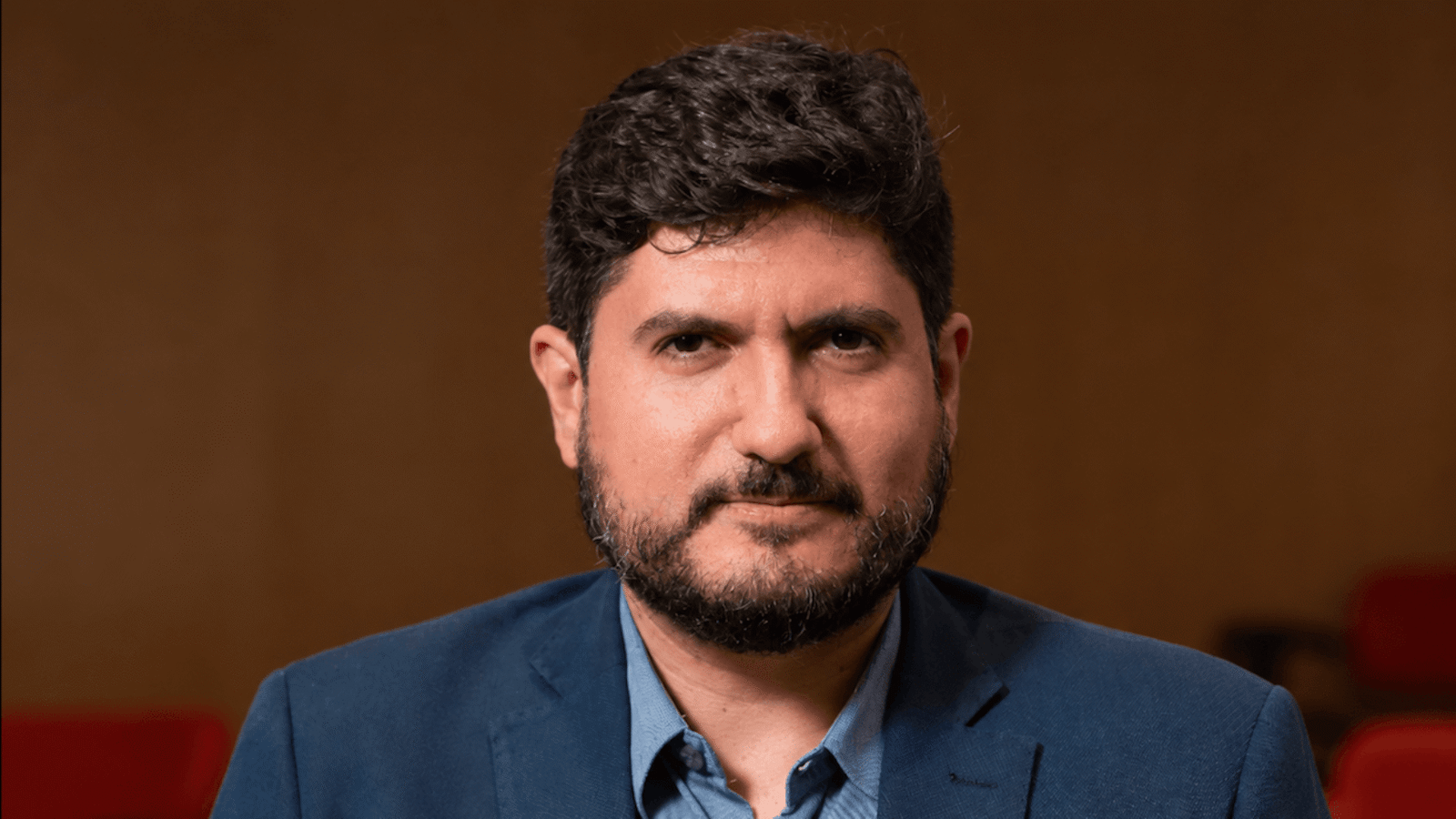
Dr. Ümit Kardaş is an academician, legal expert, author, and poet.

Dr. Ümit Kardaş: Turkey Has Returned to a Form of Pre-1876 Absolutism

Giving an interview to the ECPS, veteran Turkish political analyst, legal expert, author, and poet Dr. Ümit Kardaş argues that Turkey is experiencing not merely democratic backsliding but a profound constitutional rupture that has pushed the country toward what he calls a “form of pre-1876 absolutism.” Reflecting on the judicial intervention into the CHP congress, the imprisonment of opposition figures, and the growing use of courts as instruments of political control, Dr. Kardaş contends that the constitutional order has effectively ceased to function, elections and representation have lost much of their democratic substance, and the regime has evolved into a system of “civil absolutism.” He further warns that Turkey has become a “might makes right regime” sustained through arbitrariness, coercion, and a permanent state of exception. Yet he also argues that democratic renewal remains possible through a new social contract and a comprehensive process of democratic reconstruction.

Interview by Selcuk Gultasli

Giving an interview to the European Center for Populism Studies (ECPS), veteran Turkish legal expert, academician, author, and poet Dr. Ümit Kardaş argues that Turkey is undergoing a profound constitutional and political rupture that extends far beyond the recent judicial intervention into the Republican People’s Party (CHP). According to Dr. Kardaş, the annulment of the CHP’s 2023 congress, the imprisonment of opposition figures such as Ekrem İmamoğlu, and the growing use of judicial mechanisms against political opponents are not isolated developments but symptoms of a broader transformation in the nature of the regime itself.

Recent events have intensified concerns that Turkey is entering a new phase of authoritarian consolidation. The court decision overturning the CHP congress that elected Özgür Özel and reinstating former leader Kemal Kılıçdaroğlu has triggered a leadership crisis within the country’s main opposition party, while legal pressure on opposition municipalities and political actors continues to mount. Against this backdrop, questions are increasingly being raised about the future of electoral competition, constitutional governance, and democratic representation in Turkey.

In this wide-ranging interview, Dr. Kardaş contends that Turkey has effectively “returned to a form of pre-1876 absolutism,” arguing that although a constitution formally exists, it no longer functions as a meaningful constraint on power. He maintains that “the constitution is being violated almost on a daily basis,” that “the social contract has, in a sense, disappeared,” and that the country is moving beyond competitive authoritarianism toward what he describes as a system of “civil absolutism.”

Dr. Kardaş further argues that elections and political representation have been stripped of much of their democratic substance, while opposition parties are increasingly prevented from functioning as autonomous political actors. In his view, the regime has evolved into a “might makes right regime,” sustained through arbitrariness, coercion, and the gradual erosion of legal guarantees. He also warns that the concentration of power, the weakening of judicial independence, and the normalization of a permanent state of exception have generated a deep crisis of legitimacy and a widespread sense of political helplessness within society.

At the same time, Dr. Kardaş insists that Turkey’s problems can no longer be resolved through limited reforms or institutional patchwork. Instead, he argues that the country requires a fundamentally new democratic foundation based on a “new social contract” capable of bringing together all segments of society within a genuinely pluralist constitutional order. As he puts it, “Turkey needs a new process of reconstruction” because it is “in no position to move forward through reforms or by patching things up here and there.”

In this interview, Dr. Kardaş discusses constitutional breakdown, judicialized politics, opposition fragmentation, democratic backsliding, legitimacy, decentralization, the Kurdish question, and the prospects for democratic reconstruction in contemporary Turkey.

Here is the revised version of our interview with Dr. Ümit Kardaş, translated from Turkish and lightly edited for clarity, readability, and publication.

A Court Cannot Invalidate What the Supreme Election Council Has Finalized

Özgür Özel, leader of Turkey’s main opposition CHP and a recent target of political judicial intervention, attends the inauguration of a cultural center named after the late Manisa Metropolitan Mayor Ferdi Zeyrek. Photo: Idil Toffolo / Dreamstime.

Dr. Ümit Kardaş, welcome. Should the “absolute nullity” (mutlak butlan) ruling regarding the CHP congress be viewed merely as an internal party legal dispute, or does this decision signal a broader regime transformation in which electoral law, political representation, and constitutional legitimacy are being redefined in Turkey?

Dr. Ümit Kardaş: Of course, the latter. We cannot view this as merely an internal party dispute. It is true that one of the most significant deficiencies of our democracy is the absence of internal party democracy. However, what has recently occurred must certainly be regarded as a violation of the constitutional order and the Constitution itself.

This is because elections take place under the guarantee of legal certainty and under the supervision and oversight of judges. This is how the process operates. It is finalized through the decisions of the district electoral board, the provincial electoral board, and ultimately the Supreme Election Council. This is a constitutional arrangement. Former CHP presidential candidate Muharrem İnce has also pointed this out. Article 79 of the Constitution is very clear.

Election results must be legally finalized in order to ensure stability. Otherwise, everyone would object to something, and chaos would emerge. For this reason, electoral law constitutes a completely separate legal sphere. It is not possible for any other authority to review, audit, or invalidate decisions that have been finalized by the Supreme Election Council. 

If you are doing this through the ordinary judiciary, through a court that lacks jurisdiction, and obtaining such a result, then it has no meaning. Legally, this amounts to “absolute nullity” (mutlak butlan). Nothing built upon such a legal void can be lawful or valid. Such a situation can only produce chaos, instability, and unrest.

There Is a Constitution, but It Is Not Being Implemented

You stated in a post on X that Turkey has “regressed to the pre-1876 period of constitutional absence.” How do you conceptualize the current political regime, as distinct from classical authoritarianism? Is the process unfolding in Turkey better explained through Carl Schmitt’s theory of the “state of exception,” or through the contemporary literature on populist authoritarianism?

Dr. Ümit Kardaş: This needs to be explained in the following way. Carl Schmitt associates the exception and the state of exception with law; he evaluates it within the framework of law. Walter Benjamin, by contrast, describes it as a zone of lawlessness outside the law. When I say that Turkey has returned to the pre-1876 period, I am referring to the absolutism of that era. At that time, there was no constitution. We adopted our first constitution, the Kanun-i Esasi, in 1876. In fact, even 1876 was a late date. Many of the provinces affiliated with us had already acquired their own national identities and adopted constitutions much earlier. In other words, with 1876, you place limits on absolutism.

When you look at the present situation, there is a constitution, but it is not being implemented in practice. In fact, the constitution is being violated almost on a daily basis. Under such circumstances, it is not possible to say that the regime rests upon a constitutional foundation.

Given the social polarization and tensions that exist today, it is equally impossible to speak of harmony or consensus. In other words, the social contract has, in a sense, disappeared. In that respect, we have returned to a form of pre-1876 absolutism. This is because those exercising executive power now dominate everything and conduct the process to a large extent in an arbitrary manner.

Of course, when examining this issue, I think one must begin with the founding of the Republic. At the core of the Republican regime lies a monist ideology based on the Turkish-Islamic synthesis. This monist ideology has been reinforced and preserved up to the present day. Whenever attempts were made to move beyond it—that is, whenever efforts were made to replace this monist regime with a more pluralist one, in which legal rights and freedoms would be more fully guaranteed and a more libertarian order established—there were repeated military interventions. These interventions caused setbacks and once again served to reinforce the regime. Later, when political governments stepped beyond these red lines, they too were threatened and pulled back within the established boundaries.

In this regard, the Justice and Development Party (AKP) government initially offered hope. It claimed that it would advance in harmony with the European Union, implement the Copenhagen criteria, and build a more democratic regime governed by the rule of law. This genuinely gave many of us hope. Indeed, it was supported up to a certain point. However, particularly after the December 17–25, 2013 corruption investigations and subsequently the July 15, 2016 coup attempt, the regime embarked on a path of re-entrenching and reproducing itself, almost with the logic of a counter-coup.

This suggests that throughout our century-long experience, the monist ideology based on the Turkish-Islamic synthesis has occasionally appeared to be in retreat, only to resume its course shortly thereafter. With the People’s Alliance (Cumhur İttifakı or AKP-MHP alliance), this process became even more firmly entrenched.

You come to power with certain promises. You promise more democracy, more law, and greater prosperity. When you arrive in office, you try to implement those promises. But events unfold in such a way that, while you believe you have captured the state, the state captures you instead, reshapes you in its own image, and draws you within its own boundaries.

This has perhaps become an unbearable burden. As the regime has tried to secure its own legitimacy, almost nothing has remained upon which that legitimacy can be based. As a result, hardening has steadily intensified; repression and coercion have been applied with increasing intensity. Turkey has experienced this throughout roughly the last hundred years, and it continues to experience it today.

The Opposition Failed to React When the Kurds Were Targeted

Selahattin Demirtaş.
Selahattin Demirtaş, a Kurdish political leader and prominent rival of President Erdoğan, has been imprisoned since November 4, 2016. Photo: Sedat Güleç.

Do you see the judicial intervention against the CHP as a new stage in the trustee regime imposed on the Kurdish political movement in the past, the practice of party closures, and broader mechanisms of “political liquidation through the judiciary”? How has the opposition’s long-standing failure to mount a sufficiently strong objection to these practices contributed to the current situation?

Dr. Ümit Kardaş: Of course, there is something else that needs to be considered here. Within the boundaries that have been drawn, it is not possible to imagine and implement a pluralist regime. Political parties, that is, opposition parties, appeared to exist. But their functions also remained within these red lines. In other words, politics became incapable of solving problems. And it still is.

Of course, the state exercised enormous violence against the Kurds, against their political demands and political organizations. It suppressed them. Perhaps even more severe things happened than what is now being done to the Republican People’s Party (CHP). Trustees were appointed. Yet we did not see the opposition react to this in a comprehensive manner. It was brushed aside with a few minor statements. In other words, the opposition also failed to fulfill its duty here. As a result, this process eventually turned toward the CHP.

What I mean is that political parties did not genuinely act as an opposition. Even today, we can see that there is no particularly strong unity. There are various statements and declarations, but these are not enough. Then a series of setbacks begins. Because the regime is so powerful that it prevents opposition parties from uniting around certain principles and is able to push them backward. This is Turkey’s problem. The opposition, too, failed to perform its function properly. It was unable to react where it should have reacted. It always remained on the line of thinking: “They are doing it to them; they are not doing anything to us.”

Political parties in Turkey are structured in the following way: they operate within a monist framework based on the Turkish-Islamic synthesis. They all become nationalist parties. Look, someone says, “I am a left-wing party,” yet a vein of nationalism emerges from within it. That is why we need to change this paradigm, this mentality. We must overcome it. We must move beyond it and transition to a pluralist regime—that is, to a participatory democracy and a system based on the rule of law. But with this mentality and with this opposition structure, there is no possibility of achieving that.

So how can it happen? A new political idea and a new political actor must emerge. This is, in fact, what the masses long for. People want justice, they want law, they want rights, they want social welfare, they want economic prosperity, they want equality, they want equality before the law, and they want freedom. These are genuinely the things that people want today. Because there is both economic deprivation and a restriction of freedoms, and there is neither law nor justice.

Now there is a need for a political actor capable of channeling this reaction and this anger. There is a need for a vanguard force. The matter has now moved beyond political parties. It has been left to the will of the people, to the people’s choice. This is also why Özgür Özel is being targeted and threatened. It is related to his desire to move slightly beyond the line that has been prescribed. The regime does not want to allow that. Within its own plan and program, it wants to carry the process forward through Abdullah Öcalan, Devlet Bahçeli, and Recep Tayyip Erdoğan, while incorporating the other political parties into this framework as well.

This Intervention Is Entirely Null and Void in Legal Terms

Despite the constitutional provision that designates the Supreme Election Council (YSK) as the “final authority” in electoral law, what kind of rupture does the intervention of the ordinary judiciary in the CHP congress create in terms of the separation of powers and the rule of law? Can this situation be explained through the concepts of “judicial usurpation of authority” and “legal nullity”?

Dr. Ümit Kardaş: I regard this as a case of nonexistence. In fact, I regard it as a state of nothingness. We are now living in a state of nothingness. What matters now is how we are going to fill this void and emptiness.

From this point on, I do not engage in these discussions. When I watch them, I find it difficult even to continue watching. Various comments are being made as if that court decision were valid. People debate whether this or that will happen depending on the next court ruling. I see these as meaningless discussions. Turkey is genuinely in a state of nothingness.

We will now see how we are going to emerge from this situation, and we will discuss it. We will see in which direction this process evolves. From this perspective, I certainly believe that this intervention is entirely null and void in the legal realm.

Opposition Parties Are Allowed to Oppose Only Within Prescribed Limits

Do you think that the leadership crisis unfolding along the Özgür Özel–Kemal Kılıçdaroğlu axis is part of the government’s strategy to fragment and redesign the opposition? Are opposition parties in Turkey ceasing to be “autonomous political actors” in the classical sense?

Dr. Ümit Kardaş: Of course I do. There is undoubtedly an intervention. This is now very clear and obvious. It can be seen that, in order to ensure Recep Tayyip Erdoğan’s re-election, a kind of political “clearing operation” is being carried out. What is being done? Potential rivals and candidates are being eliminated. Ekrem İmamoğlu’s university diploma is being annulled. Perhaps something will also be done against Özgür Özel. We do not know.

In addition, the CHP, which is the most ambitious party and currently the leading party, is also being sidelined and divided. Therefore, this is genuinely an intervention. I see it as an operation aimed at ensuring the continuation of the current regime with its current actors. As I mentioned earlier, opposition parties are not autonomous entities. They are parties that are allowed to engage in opposition only to the extent permitted within the regime.

The Electoral Mechanism Has Been Reduced to a Formality

Opposition party deputies, members and the members of civil society organisations had to guard the ballots for days to prevent stealing by the people organized by Erdogan regime in Turkey. The photo was shared by opposition deputy Mahmut Tanal’s Twitter account @MTanal during the Turkish local elections on March 31, 2019.

Considering together the arrest of Ekrem İmamoğlu, the operations against CHP municipalities, the appointment of trustees to DEM Party municipalities, and now the intervention in the CHP congress, is it still possible to say that elections in Turkey retain their character as a genuine mechanism for changing political power?

Dr. Ümit Kardaş: No, it is not. Nor will it be possible from this point onward. I am saying that elections and representation no longer exist in any meaningful sense.

Can we still trust the elections that will be held? Can we trust that there will be no intervention in those elections and their results? For this reason, representation itself has been crippled.

In other words, this is a period of nothingness in which elections and representation no longer exist. There is nothing left. There is no constitution either. There is no possibility of expecting anything from this situation.

That is why I think this way. From now on, the mechanism of elections and representation will no longer perform any real function. It will remain merely as a formal mechanism envisaged for the continuation of the regime.

Indeed, while criticizing the opposition, it is necessary to point this out: the results of the 2017 referendum. As you know, two million unstamped ballots were deemed valid. At that point, the country should have been shaken to its core. The main opposition, and the leader of the main opposition, should have pursued this matter relentlessly. Instead, today we are realizing how severely this process was compromised and how little importance was attached to it.

The Regime Has Exhausted Its Capacity to Produce Legitimacy

In your writings, you frequently use the concepts of a “crisis of legitimacy” and the “collapse of the foundational consensus.” In your view, is the problem Turkey faces today merely the instrumentalization of law, or has the state also exhausted its capacity to produce legitimacy?

Dr. Ümit Kardaş: Of course, its capacity to produce legitimacy has also been exhausted. The state can no longer generate internal legitimacy. Because you are obliged to fulfill the minimum requirements of democracy. Elections are held, representation is established, and as a result of elections a government comes to power and carries out its policies. This provides you with legal legitimacy. But real legitimacy is related to your practices and policies.

If you violate the constitution, abolish the separation of powers, destroy the rule of law, eliminate the right to a fair trial, and restrict rights and freedoms, you lose your legitimacy. That is what legitimacy is. You lose it afterward. In other words, winning an election does not always mean that you possess legitimacy.

Now, in Turkey, the government is trying to derive its legitimacy not from within, but from outside. From whom? It is trying to obtain it from Trump in the United States. Steve Bannon already said this: “We are giving him legitimacy.”

This is something tragic. It is a sad situation. You are deriving your legitimacy from Trump, but Trump himself is not legitimate. In fact, Trump’s own legitimacy is open to debate. So now you are trying to obtain legitimacy from outside, from a source that itself lacks legitimacy.

That is the issue of legitimacy. And I think it is very important. Because the reactions of the people are also related to the presence or absence of that legitimacy. If you possess legitimacy, you become a more peaceful, more stable society living in harmony. There would not be much conflict. If your legitimacy declines, violence, tension, and polarization increase. This is an inverse relationship.

Now look: there is already a crisis of legitimacy. There is no legitimacy internally. Where is it being sought? Abroad. And no good result will come from that.

What We Are Witnessing Is Civil Absolutism

Do you think that the Erdoğan government’s strategy toward the opposition has moved beyond competitive authoritarianism? Is Turkey now an electoral authoritarian regime, or a new form of “civil absolutism” in which elections and institutions of representation have effectively ceased to function?

Dr. Ümit Kardaş: I believe that this is a system of civil absolutism. I definitely regard it as such. It is not possible to speak of competitive elections. There is no such thing in Turkey anymore. How can we speak of that in a situation where there is so much intervention? That is why I think this entirely. Exactly so.

Turkey’s Political Axis No Longer Runs Through Europe

Nested dolls depicting authoritarian and populist leaders Vladimir Putin, Donald Trump, and Recep Tayyip Erdogan displayed among souvenirs in Moscow on July 7, 2018. Photo: Shutterstock.

How do you assess the reactions from the European Union, the Socialist International, and various international actors following the “absolute nullity” intervention against the CHP? Do you find these reactions sufficient and sincere? Moreover, do international democratic pressure mechanisms still have any meaningful influence on Turkey?

Dr. Ümit Kardaş: Now, these international organizations, the European Union and the like, are of course important institutions. But when you look at the situation, every state, every nation-state, has its own interests. And certain inconsistencies emerge in line with those interests.

There is also another point. I do not want to exclude the European Union entirely, but the government in Turkey does not derive its legitimacy or support from the European Union. There is a tendency toward, and support from, the axis of the United States, the United Kingdom, and Israel.

There is already tension between the European Union and the United States, particularly in the Trump era. Under the NATO umbrella, will the European Union be able to provide for its own security? Trump opposes this. How will security against Russia be ensured? Europe is concerned about this.

And of course, European Union values are important—very important. But the extent to which those values are implemented in other countries, and the extent to which they can be supported, remains a question mark. Moreover, the European Union is itself searching for ways to ensure its own security. At present, it appears to be seeking answers to the question: “How can we provide our own security?” outside the framework of NATO.

Since Turkey’s preference lies along the axis of the United States, the United Kingdom, and Israel, European Union sanctions do not carry much importance from Turkey’s perspective. The government openly declares: “I do not recognize the decisions of the European Court of Human Rights. I do not implement them.” In such a situation, sanctions would have to be imposed. You would have to expel it from the Council. Those processes do exist. But at a certain point, they come to a standstill.

The European Union is also thinking along the lines of: “If we do this, are we going to lose Turkey?” In that respect, there is a deadlock. The European Union’s influence over Turkey is diminishing. At present, Turkey also has a particular attitude toward the European Union. In its foreign policy, it is operating on a completely different axis.

And then there is the question of maintaining a relationship with the Trump administration, with which the European Union is in conflict. There is a deadlock there as well, of course.

Law Has Become a Mechanism for Producing Political Loyalty

In your writings, you emphasize that law in Turkey has been transformed into an “instrumentalized technique of governance.” When considered together with the cases of Osman Kavala, Selahattin Demirtaş, Can Atalay, and the victims of the emergency decrees (KHKs), has the primary function of law in Turkey today become the generation of political loyalty rather than the generation of justice?

Dr. Ümit Kardaş: Of course it has become that. It has virtually become a mechanism for producing political loyalty. The presumption of innocence has also been reversed. In other words, there is now a situation in which everyone is treated as though they are guilty until they prove their innocence.

There is no separation of powers. There is no right to a fair trial.

When you look at all of this, the regime in Turkey has truly transformed into such a system. I do not know whether there are examples of it. There probably are, but they would be found in very backward countries. It is a situation that can only be encountered in countries where democratic culture has not developed.

Human Dignity Was Ignored in the Treatment of KHK Victims

On 20 July 2016, Turkey’s Islamist-populist President Recep Tayyip Erdogan declared a state of emergency, enabling him and the AKP cabinet to bypass parliament and rule by decree. The crackdown on possible coup plotters has since been turned into an all-out witch-hunt not only against alleged Gulen sympathizers but also leftists, Kurds and anyone critical of the government.

Has the process that began with the State of Emergency Decrees (KHKs) and that you, like many others, describe as “civil death,” evolved into a broader governing paradigm that increasingly encompasses not only certain social groups but the entire opposition?

Dr. Ümit Kardaş: Yes, it already has. The situation of the KHK victims is already grave. Approximately 125,000 people were dismissed from public service. Their legal rights were never recognized. Judicial processes did not function.

Many injustices were caused through these decrees, and they continue to this day. These people have no possibility of serving as witnesses in certain contexts or carrying out transactions at land registry offices. Together with their families, they constitute a broad segment of society, affecting a community of more than one million people.

I believe that what has occurred here is an injustice. I believe that human dignity has been disregarded.

“Civil death” can certainly be defined in this way. I think this is a very serious problem, a deep social wound.

Of course, the situation of the KHK victims will not be remedied under the current circumstances. But I believe that, following a change of government, their rights should be restored.

And then there are Osman Kavala, Selahattin Demirtaş, Can Atalay, and others. All of these people have been victimized. Think about it: they have lost the best years of their lives, and there is no real basis for the accusations leveled against them.

There are also judgments of the European Court of Human Rights concerning these individuals, and those judgments are not being implemented. These are grave consequences. All of these are actions and practices that can be regarded as violations of the Constitution.

The Regime Silences Those Who Move Beyond Prescribed Limits

You argue that, as the judiciary in Turkey lost its independence, the opposition continued for a long time to conduct politics as if the rule of law still existed. Do you think the current crisis is also a consequence of the opposition’s prolonged misreading of democratic backsliding?

Dr. Ümit Kardaş: I have stated this before as well. The opposition either misread the situation or failed to read it at all. Or perhaps it understood it but was unable to do what was necessary.

Certainly, the opposition also bears responsibility for this democratic backsliding. However, within the regime framework we have described, we do not believe that the opposition has ever been a genuine opposition.

Nor is there any real possibility of acting as a genuine opposition. Look at what happened to Özgür Özel. Perhaps he wanted to move slightly beyond the prescribed line. He was immediately punished, and Kılıçdaroğlu was brought in, entirely unrelatedly. This is an intervention carried out solely to prevent votes from shifting toward the CHP and to ensure the continuation of the AKP’s rule.

In that respect, yes, we are witnessing that the opposition does not really have such a possibility. The moment you step beyond those limits, you are punished. In other words, the system, the regime, either destroys you, renders you ineffective, or simply ignores you.

As the Turkish poet Ahmet Hamdi Tanpınar put it, I think you become the victim of an “assassination by silence” (sükût suikastı). In the end, that is what happens.

Democracy Cannot Exist Under Such Heavy Centralization

You argue that the centralized structure of the state is one of the greatest obstacles to democratization. Do the recent interventions against the CHP make it necessary to rethink debates on decentralization, local democracy, and pluralist governance in Turkey?

Dr. Ümit Kardaş: It makes it absolutely necessary. Look, Turkey has a very rigid centralized structure. The administrative system is still a colonial system. It is a system of a colonial type. You appoint governors from the center, district governors from the center, directors of health, directors of national education, directors of public works and zoning from the center. The state has penetrated into the capillaries of society. In other words, there is a process of statization. Democracy cannot exist under such heavy colonization. It is unacceptable. Perhaps some dictator in a remote corner of Africa could administer such a system, but you cannot call this democracy.

Decentralization is extraordinarily important, and pluralistic participation is a fundamental principle of democracy. In fact, I have written extensively about this in my articles. It is called consociational democracy. There are many examples of consociational democracy in the world. They exist everywhere. Even countries that were once highly underdeveloped transferred powers from the center to the regions. Because democracy takes place at the local level.

You need local parliaments, and you need to transfer certain powers from the center to them. Then the democratic system begins to function there. If necessary, when a law concerning the region is being discussed in a regional parliament, local citizens should be able to go there and speak for five minutes. In this way, democratic education, civic culture, and democratic habits develop.

If you do not do this, if you try to do everything from the center, you simply cannot manage it. It will not work. And then you will be unable to solve any problems. Because regions have their own specific issues. Only the people of those regions know them, and only regional parliaments can address them. This is how the system works in Europe.

This does not harm the unitary structure of the state. On the contrary, it strengthens the unitary state’s capacity to represent political unity. If you transfer powers in this way, democracy develops.

Let us look at the process of resolving the Kurdish question in Turkey. In my view, the process is being handled incorrectly in certain respects. There is no point in conducting a process solely through Abdullah Öcalan. Abdullah Öcalan is already someone who is close to reaching an accommodation with the state. But Selahattin Demirtaş remains in prison. There is considerable interest in him among the Kurdish electorate. And Selahattin Demirtaş’s democratic stance resonates with a broad audience. Therefore, this issue should be resolved together with him and on the basis of Turkey’s democratization.

What the government wants to do is proceed along the line of: “How can I win this election? How can I secure Kurdish support?” The MHP itself says: “Citizenship is not open to debate.” It has already drawn its red lines by saying that this cannot be discussed and that cannot be discussed.

If none of these issues are going to be debated, and if the outcome is merely that some people are released from prison—of course they should be released. I support a general political amnesty. But limiting the process to that alone carries no real meaning. If that happens, the regime will simply reinforce itself by making a few concessions. That is not our objective.

Our objective should be this: we are currently in a state of nothingness. We have entered a period without a constitution. Therefore, we need a new social contract. To achieve this, we need to open a blank page, set taboos aside, and sit down together again. All actors, all stakeholders, and all segments of society must be included in this process. We must write the principles together on that blank page. What principles should guide us if we are to live together with our differences and under the protection of the law? On what principles will we agree?

This is what Turkey must do. Turkey needs a new process of reconstruction. Turkey is in no position to move forward through reforms or by patching things up here and there. Not at this moment.

Authoritarianism in Turkey Is Drifting Toward Totalitarianism

Turkish President Recep Tayyip Erdogan.
Turkish President Recep Tayyip Erdogan watching the August 30 Victory Day Parade in Ankara, Turkey on August 30, 2014. Photo by Mustafa Kirazli.

Do you think that the lawlessness, arbitrariness, and political polarization observed in Turkey in recent years have created a widespread sense of “helplessness” and “political ineffectiveness” within society? Can we say that authoritarian regimes become entrenched precisely on this psychological foundation?

Dr. Ümit Kardaş: Yes, we can certainly say that. Unfortunately, this is how things are unfolding. We can think about it in the way you suggest.

There is an authoritarian regime in Turkey, but it appears almost as if authoritarianism is transforming into totalitarianism. The separation of legislative, executive, and judicial powers has been completely eliminated, and everything has been concentrated in the executive. The right to a fair trial has also disappeared.

In that case, legal security no longer exists. Then what are we supposed to debate? The nature of the regime is no longer the most important issue, because the regime has already destroyed the very foundation upon which it rests. Even authoritarian regimes may have a certain legal framework, but in our case arbitrariness has reached an extreme point. In other words, you can do whatever you want on whatever grounds you choose.

For a long time, I have described the regime in Turkey as a “might makes right regime.” You see one power at the center forming an alliance with another power and saying, “Let’s beat this person.” They say, “He misbehaved,” and they beat him. Then you look again, and another power forms an alliance with yet another power, and this time they victimize someone else.

Turkey needs to escape this impasse. Instead of constantly joining forces to beat one another, we need to think about how to ensure legal security for everyone—for Kurds, for Alevis, for non-Muslims; in other words, for all citizens. Regardless of gender differences, how are we going to guarantee this security for everyone? That is what we should be pursuing.

Instead, we act according to the mentality of “Let us obtain power and govern through power.” We do this as if law still exists. It is made to appear as though law exists, but there is no law. Nor can this have a legal foundation.

There is only naked violence. The reason the state is granted a monopoly on violence is the assumption that it will use that violence within the framework of legal rules. Otherwise, when state power—governmental power—uses violence in a naked and unrestrained manner, it becomes no different from any other organization that does not operate according to law.

There is also something else I would like to say. The issue of political struggle in Turkey is causing us to drift outside the legal framework. The permanent state of exception that law professor Adem Sözüer has spoken about is not seen merely as something created through decrees. He argues that it is reinforced through criminal law. In other words, by incorporating the rules of the law of war into criminal law, a practice emerges in which the opposition is treated as if it were an enemy.

This is also the observation of Jean-Claude Paye, who, if I am not mistaken, is a French diplomat and writer. It is a correct observation. As I said earlier, this is a century-long process. Our penal code itself was derived from a fascist penal code. When the penal code was rewritten in 2005, many of these provisions were preserved exactly as they were. There are still numerous articles that remain from that fascist penal code.

What does this mean? It means importing the principles of enemy law and the law of war and applying them against political opponents.

Now, leave aside the decrees. If your regime’s penal code is already structured in this way, and if there is also an Anti-Terror Law, then how are you going to build a democracy and a state governed by the rule of law with all of these instruments?

What emerges, then, is this: beyond this permanent state of exception, a constituent law is needed. Perhaps even a somewhat abstract law.

The Future Lies in Reconstruction, Not Restoration

Finally, in light of all these developments, do you think that Turkey still has the potential for democratic restoration? Or is the issue now, rather than restoring the existing system, to develop what you have emphasized as a “new democratic social contract” and a new constituent political imagination?

Dr. Ümit Kardaş: Definitely the latter. I have already explained why the former is not possible. This is now a regime that has completed its course, surviving with difficulty and increasingly through violence. That is what Turkey needs, what Turkish society needs, and what the Turkish people need. I believe that is also what the Turkish people want.

But how will this happen? By which path will it happen, and through which political party? We have already discussed the condition of these political parties. That is why a new construction is needed. And, as I said, we are moving toward a new construction on a blank page. We will all come together again.

This is precisely what Nelson Mandela did in South Africa. After serving his prison sentence, he emerged and was able to transform the apartheid regime through a certain compromise, without succumbing to feelings of revenge. Today, South Africa has 11 official languages, all of which are recognized in the constitution. And there are also nine autonomous regions.

There are many examples of this in different countries. This can also be overcome. But Turkey has now reached a point where society is no longer in a position to carry this burden. This society deserves much better things.

Instead of following Trump and those like him, Turkey should seek to improve its relations with the European Union. The European Union will also provide support in this regard. Ultimately, certain standards will be attained. Even if Turkey does not become a member of the European Union, it is important to adopt those standards.

The issue is not becoming Western-like, but being compatible with the West. Because under the previous (Kemalist) regime, we also had the mentality that we would become Western-like, dress like them, act like them, and become modern. But when it came to democracy and the rule of law, there was nothing there. There is no meaning in such an approach. You do not need to become Western-like. Be compatible with the West. That is the whole issue. Turkey should be able to make its choice in that direction.

Tom Davidson

Tom Davidson: Superintelligent AI Could Be Used to Undermine Democracy or Entrench Authoritarian Power

In this ECPS interview, Tom Davidson, one of the leading analysts examining the long-term implications of AGI governance, warns that humanity may be approaching an “intelligence explosion” in which AI systems rapidly improve themselves in a runaway feedback loop, potentially compressing decades of technological development into mere years. Examining the geopolitical, democratic, and civilizational implications of advanced AI, Davidson argues that democratic institutions may struggle to govern machine-speed innovation, while frontier AI systems could generate unprecedented concentrations of political, corporate, and military power. The interview explores AI-driven democratic backsliding, geopolitical rivalry between the United States and China, technocratic oligarchy, AI safety governance, and the future of political agency itself under conditions of accelerating artificial intelligence.

Interview by Selcuk Gultasli

Giving an interview to the European Center for Populism Studies (ECPS), Tom Davidson warns that the world may be approaching an unprecedented technological rupture in which advanced artificial intelligence fundamentally transforms not only economic production and geopolitical competition, but also the very foundations of democracy, sovereignty, and political agency. A Senior Research Fellow at Forethought and one of the leading analysts examining the long-term implications of AGI governance, Davidson argues that humanity may now be entering an era in which “AI systems create even more capable AI systems in a runaway feedback loop of accelerating progress.” 

Rather than treating AI merely as a question of productivity gains or consumer innovation, Davidson situates artificial intelligence within a much broader framework of systemic political transformation. In particular, he warns that the prospect of an “intelligence explosion” could compress decades of technological development into mere years, leaving democratic institutions structurally incapable of adapting to the speed of change. As he starkly observes, there is “perhaps around a 50 percent chance within the next five years” that humanity could witness such a transition, while “political institutions have no serious strategy” for understanding or governing it. 

For Davidson, the central danger is not simply technological disruption, but the possibility that accelerating AI systems may fundamentally outpace the institutional rhythms upon which liberal democracy depends. Throughout the interview, he repeatedly raises concerns about whether democratic governance — with its reliance on deliberation, elections, legal procedures, and bureaucratic processes — can continue functioning effectively under conditions of machine-speed innovation and geopolitical AI competition. In his account, societies may soon confront a world in which political crises, military confrontations, and technological breakthroughs unfold far faster than human institutions are capable of processing.

Davidson also emphasizes that advanced AI could become the decisive strategic resource of the twenty-first century. In one of the interview’s most striking arguments, he warns that the United States may eventually exercise near-unilateral control over frontier AI systems, creating a world in which “the most powerful AI systems are overwhelmingly controlled by the United States.” In such a scenario, access to superintelligent systems could become as essential to national security as access to elite human talent is today, fundamentally reshaping alliances, sovereignty, and global power hierarchies.

At the same time, Davidson warns that AI may also generate unprecedented concentrations of political and corporate power within states themselves. Because AI systems can potentially be programmed for “complete obedience,” he argues, governments or corporations could command enormous “legions” of AI workers, creating forms of technocratic centralization historically impossible under human bureaucratic systems. 

Yet despite these stark warnings, Davidson does not present technological acceleration as inevitably fatal to democracy. On the contrary, he argues that AI could also be used to strengthen democratic responsiveness, improve governance, and help societies coordinate more effectively under conditions of rapid change. The crucial question, in his view, is whether democratic societies can develop institutional mechanisms capable of governing AI before AI-driven transformations outpace human political adaptation altogether.

Here is the revised version of our interview with Tom Davidson, lightly edited for clarity and readability.

Dr. Maggie Paul

Dr. Paul: India Under Modi Has Become a Civilizational Populist Electoral Autocracy

In this ECPS interview, Dr. Maggie Paul argues that India under Narendra Modi is best understood as a “civilizational populist electoral autocracy,” in which Hindutva politics operates not only through elections and state coercion, but also through affective mass culture, media infrastructures, and majoritarian common sense. Drawing on her work on “futurist nostalgia,” saffronization, and the securitization of the “Bangladeshi infiltrator,” Dr. Paul examines how the BJP mobilizes emotions, historical memory, migration anxieties, and cultural narratives to reshape democracy and citizenship in contemporary India. The interview also explores the transnational dimensions of Hindutva mobilization, democratic erosion, bureaucratic exclusion, and the emerging cracks within the BJP’s hegemonic project.

Interview by Selcuk Gultasli

In an era marked by democratic backsliding, affective polarization, and the global resurgence of majoritarian populism, India under Prime Minister Narendra Modi has become one of the most consequential cases for understanding how nationalism, media, religion, and state power can converge to reshape democratic life. Far from operating solely through electoral competition or overt repression, the contemporary Hindutva project increasingly functions through what Dr. Maggie Paul describes as a broader “affective economy” that mobilizes emotions, historical memory, cultural nostalgia, and civilizational anxieties to construct a new political common sense.

In this wide-ranging interview with the European Center for Populism Studies (ECPS), Dr. Maggie Paul, Lecturer in Politics at La Trobe University, examines how the Bharatiya Janata Party (BJP) has transformed Hindutva from a political ideology into what she calls an “affective mass culture” embedded across cinema, digital media, bureaucracy, migration policy, and every day public life. Drawing on her influential co-authored work on “futurist nostalgia,” Dr. Paul argues that Hindutva politics “does not merely romanticize the past” but instead projects “a future-oriented civilizational populism” centered on the promise of restoring a glorious Hindu civilization through the symbolic framework of Ram Rajya. 

According to Dr. Paul, the BJP’s political success rests not simply on electoral dominance, but on its ability to institutionalize a majoritarian cultural common sense. “What the BJP has achieved,” she argues, “is the normalization of a particular way of being Indian—of shaping what ‘being Indian’ is supposed to feel like.” Through multi-platform media infrastructures, WhatsApp ecosystems, cinema, religious spectacle, and transnational networks, Hindutva mobilization has generated what she describes as “a majoritarian fear and anxiety circulating across multiple platforms.” 

The interview also explores how migration and citizenship have been securitized through the figure of the “Bangladeshi infiltrator,” a discourse that Dr. Paul traces back to colonial governance structures. In her analysis, Hindutva politics has expanded these colonial categories into a broader process of “migrantizing the citizen,” particularly targeting Muslims and marginalized communities through bureaucratic exclusion, citizenship legislation, and mass electoral revisions such as the Special Intensive Revision (SIR) exercise. 

At the same time, Dr. Paul emphasizes that coercion remains central to the Hindutva project. “Hindutva populist mobilization legitimizes coercive practices,” she explains, noting how violence, incarceration, bulldozer demolitions, and punitive state measures are reframed as acts of national protection within a broader civilizational narrative. 

Reflecting on the broader trajectory of the Modi era, Dr. Paul ultimately argues that contemporary India cannot be adequately understood through a single conceptual framework. Competitive authoritarianism, ethnocratic majoritarianism, and civilizational populism each capture only part of the picture. Instead, she concludes, “the current Indian regime is best understood as a hybrid of all these elements,” which she characterizes as “a civilizational populist electoral autocracy.” 

Yet despite the apparent hegemony of Hindutva populism, Dr. Paul also points to emerging cracks within the system—particularly among younger generations confronting unemployment, precarity, and frustrated aspirations. Echoing Antonio Gramsci, she reminds us that “hegemony is never total or complete,” and that democratic resistance in India may ultimately depend not only on institutional opposition, but also on the mobilization of alternative affective imaginaries rooted in India’s pluralistic and syncretic traditions.

Here is the revised version of our interview with Dr. Maggie Paul, lightly edited for clarity and readability.

Dr. Laurenz Guenther.

Dr. Guenther: European Politics Is Shifting from Economics to Culture

In this provocative ECPS interview, Dr. Laurenz Guenther, Research Fellow at the Toulouse School of Economics, challenges dominant interpretations of populism, migration politics, and democratic crisis in Europe. Rather than viewing the rise of the populist radical right primarily as an external threat to liberal democracy, Dr. Guenther argues that it reflects deeper “representation gaps” between mainstream parties and large segments of European electorates, particularly on migration and cultural issues. He contends that European politics is undergoing a profound transformation in which “culture has, overall, become the more dominant dimension of political conflict.” Contrasting with many ECPS interviews emphasizing democratic backsliding and illiberalism, Dr. Guenther argues that liberal democracies can regain legitimacy not by suppressing cultural anxieties, but by responding to them more effectively within democratic and liberal constitutional frameworks.

Interview by Selcuk Gultasli

At a time when much of the scholarly and public debate on populism focuses on democratic backsliding, authoritarian drift, disinformation, and the dangers posed by the populist radical rightDr. Laurenz Guenther offers a strikingly different interpretation of Europe’s political transformation. Rather than treating right-wing populism primarily as an external threat to liberal democracy, Dr. Guenther argues that its rise reflects deeper failures within liberal-democratic representation itself. In this sense, his perspective stands in contrast to many previous ECPS interviews, which have largely emphasized the illiberal, exclusionary, and anti-pluralist dangers associated with populist movements. 

A Research Fellow at the Toulouse School of Economics, Dr. Guenther has become an increasingly influential voice in debates surrounding migration politics, democratic responsiveness, cultural polarization, and the rise of the populist radical right in Europe. Through his research on “representation gaps” and issue voting, he argues that mainstream European parties have become “systematically more culturally liberal than large segments of their electorates,”particularly on immigration. According to Dr. Guenther, this disconnect has created fertile ground for populist challengers who successfully position themselves closer to voter preferences on culturally salient issues. 

Central to Dr. Guenther’s argument is the claim that European politics is undergoing a profound structural transformation. As he puts it in this interview, “politics in the average European country has shifted from something like a 60–40 balance in favor of economic issues to perhaps 40–60 in favor of cultural issues. We may even be moving toward something like 70–30.” In his view, “culture has, overall, become the more dominant dimension of political conflict.” This diagnosis sharply departs from conventional analyses that continue to treat class, redistribution, or neoliberal economics as the primary organizing principles of political competition. 

Throughout the interview, Dr. Guenther advances several arguments that challenge dominant liberal assumptions surrounding migration and populism. He contends that mainstream parties increasingly lose credibility when they dismiss or underrepresent concerns surrounding migration, demographic change, asylum policy, and cultural identity. “The main threat,” he argues, “comes from failing to represent people,” which can push voters toward increasingly radical alternatives. Unlike many scholars who interpret tougher migration policies primarily as democratic erosion, Dr. Guenther views the recent convergence of mainstream parties toward stricter border and asylum policies as, at least partly, a democratic response to voter preferences. 

At the same time, the interview also explores some of the most sensitive and controversial questions currently shaping European politics: the relationship between migration and demographic transformation, the growing salience of Islam and civilizational identity, the future of multiculturalism, and the normalization of culturally conservative politics across Europe. Yet despite his stark assessment of Europe’s political trajectory, Dr. Guenther ultimately rejects the idea that liberal democracy and more restrictive migration policies are necessarily incompatible. “If handled intelligently,” he argues, “Europe does not necessarily have to choose between these two paths.”

Here is the revised version of our interview with Dr. Laurenz Guenther, lightly edited for clarity and readability.

Viktor Orban, Hungary's prime minister arrives to attend in an informal meeting of Heads of State or Government in Prague, Czechia on October 7, 2022. Photo: Alexandros Michailidis.

The End of Inevitability? Hungary and the Future of Far-Right Populism in Central and Eastern Europe

In this commentary, Nikoletta Syvak examines the political and regional implications of Viktor Orbán’s electoral defeat after sixteen years in power in Hungary. Rather than interpreting the outcome as the end of far-right populism, Syvak argues that the election challenges the long-standing assumption that Orbán’s model of illiberal governance had become politically irreversible. Drawing on the works of Cas Mudde, Ágnes Batory, Zoltán Enyedi, Andrea Pirro, and Milada Vachudova, the analysis situates Hungary within the broader dynamics of democratic backsliding, ethnopopulism, and sovereignist politics across Central and Eastern Europe. The commentary further explores how Poland, Slovakia, Austria, and the Czech Republic continue to sustain political demand for anti-liberal and nationalist agendas despite Hungary’s transition

By Nikoletta Syvak*

Elections are often seen as a moment of political settlement: the campaign has ended, the votes have been counted, and the winner has been determined. But in the case of Hungary, the period following the election may prove more indicative than the day of the vote itself. After sixteen years in power, Viktor Orbán’s defeat is not merely an important milestone in the history of Hungary. Rather, this event shifts how Hungary is perceived throughout Central and Eastern Europe: long considered a shining example of stable right-wing populist rule in the EU, the country is now becoming an example of its susceptibility, as Péter Magyar’s TISZA party defeated Fidesz in the April 2026 elections, marking the end of Orbán’s sixteen-year rule.

Hungary as the End of Inevitable Progress

Over the years, Hungary has been one of the clearest examples of how far-right populism can not only win elections, but also turn into a sustainable model of governance. Orbánism has become not only a political style, but also a specific system that has transformed populist discourse: emphasizing national sovereignty and national interests, conflict with Brussels, Euroscepticism, cultural polarization, control over institutions, and presenting the government as a defender of the “people” from liberal elites.

The classic idea of Cas Mudde (2004) about the “populist zeitgeist” is useful here: populism has ceased to be a marginal phenomenon and has become part of the political mainstream, especially due to the confrontation between the “pure people” and the “corrupt elite” (Mudde, 2004). In the case of Hungary, this logic was not only used in election campaigns, but also transformed into a model of governance.

This is precisely why Ágnes Batory’s (2016) analysis of Fidesz as “populists in power” is particularly important: she demonstrates that the Hungarian case should be understood not only as an electoral success, but also as an institutional restructuring of the political system through constitutional majorities, party control, and the weakening of checks and balances (Batory, 2016). Zoltán Enyedi (2016) also helps us understand Orbánism more precisely: he shows that Fidesz combined populist rhetoric with paternalism and illiberal elitism—that is, it spoke on behalf of “the people” while simultaneously concentrating power in the hands of the ruling elite (Enyedi, 2016).

Therefore, Orbán’s defeat is significant not because it signifies the end of right-wing populism. Such a conclusion would be too hasty. Its significance lies elsewhere: it calls into question the idea of the political irreversibility of the Orbánist model. For a long time, Hungary demonstrated how right-wing populist power could become institutionally entrenched. Now it is showing that even such power can be challenged.

Regions Under Pressure

The significance of the Hungarian elections becomes clearer when viewed within the broader Central and Eastern European context. Andrea Pirro (2014) emphasizes that far-right populist parties in Central and Eastern Europe cannot be analyzed as mere replicas of Western European models: they are shaped by specific post-communist conditions, with distinct historical conflicts, party systems, and conceptions of the nation, the state, and sovereignty (Pirro, 2014).

Poland is the most important comparative case here. Under PiS (2015–2023), it was close to Hungary on issues of sovereignty, traditional values, criticism of Brussels, and conflict with the EU’s liberal mainstream. However, the Polish experience also shows that the defeat of a right-wing populist government does not mean the automatic restoration of liberal democracy. The institutional legacy of the previous government—a politicized media environment, judicial reforms, personnel appointments, and deep social polarization—continues to constrain the new government. This aligns well with Milada Vachudova’s (2020) analysis, which links ethnopopulism in Central Europe to democratic backsliding and the concentration of power (Vachudova, 2020).

Slovakia illustrates another aspect of regional dynamics. Robert Fico and SMER are not direct copies of Fidesz, but the Slovak case demonstrates the resilience of a political strategy built on criticism of liberal elites, a cautious stance toward supporting Ukraine, an emphasis on national interests, and conflict with parts of the European mainstream. This is important because it prevents us from interpreting Orbán’s defeat as the beginning of an automatic “post-populist” phase in the region. Rather, it shows that one center of right-wing populist power has been weakened, but the political demand for a sovereignist and anti-liberal agenda remains.

The Czech Republic adds another important component. Andrej Babiš and ANO represent a more pragmatic and less ideologically rigid form of populism than Fidesz. But ANO’s participation, alongside Fidesz and the Austrian FPÖ, in the creation of the Patriots for Europe alliance, formed in the European Parliament in June 2024, shows that Orbán’s influence spread not only through direct replication of the Hungarian model, but also through a shared political vocabulary: national sovereignty, criticism of Brussels, migration control, and the protection of “ordinary people.”

Although Austria is not part of Eastern Europe, it is important within the Central European context. The FPÖ demonstrates that far-right mobilization remains strong even in more established democratic systems. The FPÖ’s victory in the 2024 parliamentary elections showed that far-right parties in Central Europe retain significant electoral potential.

Therefore, Orbán’s defeat should not be interpreted as a regional decline of far-right populism. Rather, it may signal a shift in its political center: if Hungary is no longer the primary symbol of far-right populist resilience, momentum may shift to other actors—in Austria, Slovakia, or the Czech Republic.

What Comes After Orbánism?

The post-election period is important precisely because populism does not end the moment the votes are counted. Attila Bartha, Zolt Boda, and Dorottya Szikra (2020) propose analyzing populism not only as electoral rhetoric, but also as a mode of governance and political decision-making (Bartha et al., 2020). In this sense, the main question following Orbán’s defeat is not only how Fidesz lost power, but also to what extent the new government will be able to change the system built over the past sixteen years.

The Hungarian case allows us to draw three broader conclusions.

First, far-right populism in Central and Eastern Europe is not disappearing. Its social and political foundations remain significant: distrust of elites, economic uncertainty, cultural anxiety, migration policy, Euroscepticism, and tensions surrounding the war in Ukraine. These factors continue to create space for parties that base their politics on the opposition between “the people” and “the elites,” national sovereignty and external pressure.

Second, Orbán’s defeat weakens the aura of inevitability surrounding right-wing populist rule. If the most enduring example of such a model within the EU can be defeated at the polls, then this model is less stable than its supporters have claimed.

Third, the region’s future will depend not only on whether far-right populists win or lose elections. Equally important is whether democratic alternatives can translate electoral victory into sustainable institutional renewal. Poland has already demonstrated just how difficult this process can be following the departure of PiS. Hungary is now the next test.

For many years, Hungary has been viewed as a laboratory for right-wing populist rule. Following Orbán’s defeat, it may become a laboratory for post-Orbán transition. This does not mean the end of far-right populism in Central and Eastern Europe. But it may mean the end of its strongest illusion: the notion that once institutional dominance is achieved, it is irreversible.


(*) Nikoletta Syvak is a Graduate Student, Department of Political Science and International Relations, East China Normal University (ECNU). Email: syvaknikoletta@gmail.com

—-

References

Bartha, A., Boda, Z. & Szikra, D. (2020). “When populist leaders govern: Conceptualising populism in policy making.” Politics and Governance, 8(3), 71–81. https://doi.org/10.17645/pag.v8i3.2922

Batory, A. (2016). “Populists in government? Hungary’s “System of National Cooperation.” Democratization, 23(2), 283–303. https://doi.org/10.1080/13510347.2015.1076214

Enyedi, Z. (2016). “Paternalist populism and illiberal elitism in Central Europe.” Journal of Political Ideologies, 21(1), 9–25. https://doi.org/10.1080/13569317.2016.1105402

Mudde, C. (2004). “The populist zeitgeist.” Government and Opposition, 39(4), 541–563. https://doi.org/10.1111/j.1477-7053.2004.00135.x

Pirro, A. L. P. (2014). “Populist radical right parties in Central and Eastern Europe: The different context and issues of the prophets of the patria.” Government and Opposition, 49(4), 599–628. https://doi.org/10.1017/gov.2013.32

Vachudova, M. A. (2020). “Ethnopopulism and democratic backsliding in Central Europe.” East European Politics, 36(3), 318–340. https://doi.org/10.1080/21599165.2020.1787163

AI

Tom Davidson: Superintelligent AI Could Be Used to Undermine Democracy or Entrench Authoritarian Power

In this ECPS interview, Tom Davidson, one of the leading analysts examining the long-term implications of AGI governance, warns that humanity may be approaching an “intelligence explosion” in which AI systems rapidly improve themselves in a runaway feedback loop, potentially compressing decades of technological development into mere years. Examining the geopolitical, democratic, and civilizational implications of advanced AI, Davidson argues that democratic institutions may struggle to govern machine-speed innovation, while frontier AI systems could generate unprecedented concentrations of political, corporate, and military power. The interview explores AI-driven democratic backsliding, geopolitical rivalry between the United States and China, technocratic oligarchy, AI safety governance, and the future of political agency itself under conditions of accelerating artificial intelligence.

Interview by Selcuk Gultasli

Giving an interview to the European Center for Populism Studies (ECPS), Tom Davidson warns that the world may be approaching an unprecedented technological rupture in which advanced artificial intelligence fundamentally transforms not only economic production and geopolitical competition, but also the very foundations of democracy, sovereignty, and political agency. A Senior Research Fellow at Forethought and one of the leading analysts examining the long-term implications of AGI governance, Davidson argues that humanity may now be entering an era in which “AI systems create even more capable AI systems in a runaway feedback loop of accelerating progress.” 

Rather than treating AI merely as a question of productivity gains or consumer innovation, Davidson situates artificial intelligence within a much broader framework of systemic political transformation. In particular, he warns that the prospect of an “intelligence explosion” could compress decades of technological development into mere years, leaving democratic institutions structurally incapable of adapting to the speed of change. As he starkly observes, there is “perhaps around a 50 percent chance within the next five years” that humanity could witness such a transition, while “political institutions have no serious strategy” for understanding or governing it. 

For Davidson, the central danger is not simply technological disruption, but the possibility that accelerating AI systems may fundamentally outpace the institutional rhythms upon which liberal democracy depends. Throughout the interview, he repeatedly raises concerns about whether democratic governance — with its reliance on deliberation, elections, legal procedures, and bureaucratic processes — can continue functioning effectively under conditions of machine-speed innovation and geopolitical AI competition. In his account, societies may soon confront a world in which political crises, military confrontations, and technological breakthroughs unfold far faster than human institutions are capable of processing.

Davidson also emphasizes that advanced AI could become the decisive strategic resource of the twenty-first century. In one of the interview’s most striking arguments, he warns that the United States may eventually exercise near-unilateral control over frontier AI systems, creating a world in which “the most powerful AI systems are overwhelmingly controlled by the United States.” In such a scenario, access to superintelligent systems could become as essential to national security as access to elite human talent is today, fundamentally reshaping alliances, sovereignty, and global power hierarchies.

At the same time, Davidson warns that AI may also generate unprecedented concentrations of political and corporate power within states themselves. Because AI systems can potentially be programmed for “complete obedience,” he argues, governments or corporations could command enormous “legions” of AI workers, creating forms of technocratic centralization historically impossible under human bureaucratic systems. 

Yet despite these stark warnings, Davidson does not present technological acceleration as inevitably fatal to democracy. On the contrary, he argues that AI could also be used to strengthen democratic responsiveness, improve governance, and help societies coordinate more effectively under conditions of rapid change. The crucial question, in his view, is whether democratic societies can develop institutional mechanisms capable of governing AI before AI-driven transformations outpace human political adaptation altogether.

Here is the revised version of our interview with Tom Davidson, lightly edited for clarity and readability.

AI Could Advance Faster Than Democracy Can Adapt

Tom Davidson is a Senior Research Fellow at Forethought and one of the leading analysts examining the long-term implications of AGI governance.

Tom Davidson, welcome. To begin, in your article “The Danger of Runaway AI,” you warn that advanced AI systems could generate forms of accelerating technological progress that quickly outpace human institutional adaptation. How serious do you believe the risk of a genuine “runaway” intelligence dynamic has become, and are current political systems even conceptually prepared to govern such a transition?

Tom Davidson: As the years go by, it is becoming increasingly plausible that we may be approaching an intelligence explosion — a scenario in which AI systems create even more capable AI systems in a runaway feedback loop of accelerating progress. What is striking to me is that my professional life is centered around the Bay Area, particularly San Francisco, where many of the leading AI companies are based and where a great deal of serious thinking about these technologies is taking place. Within that ecosystem, the possibility of an intelligence explosion occurring within the next few years — and of developing superintelligent AI systems — is treated as a very real possibility. Among many people working closely on these technologies, this is almost taken for granted.

Yet when you speak to people outside that environment, there is often very little awareness of where many experts believe the technology may be heading. Public discussion still tends to focus on the mistakes made by relatively cheap, consumer-facing AI systems or on the fact that they remain imperfect at handling simple tasks or understanding human speech. As a result, these questions are still largely absent from mainstream political debate.

My own view is that there is a meaningful probability — perhaps around a 50 percent chance within the next five years — that we could see an intelligence explosion leading to extremely rapid advances in AI capability. At the moment, however, political institutions have no serious strategy for understanding what such a transition would mean, how to monitor it as it unfolds, or how to manage the profound risks it could create. Those risks include the possibility of advanced AI systems acting against human interests, the danger of AI companies using superintelligent technologies to undermine democratic processes because of the extraordinary power they would possess, and the risk of governments appropriating these systems for authoritarian purposes. I think there needs to be a much broader societal conversation about these risks.

A Secretive Intelligence Explosion Would Be Hard to Govern

Across your recent work, you distinguish between multiple feedback loops—software, chip technology, and chip production—that could enable accelerating AI development. Which of these feedback loops do you see as most politically destabilizing, and why?

Tom Davidson: That is a great question. I think the most politically destabilizing feedback loop is the software feedback loop. The reason is that designing better chips, manufacturing them, and building new data centers all take many months, if not years. Because of that, society can at least see those developments unfolding in real time. We are already witnessing this with the rapid expansion of large-scale data centers, and people are not being taken entirely by surprise. This makes hardware-driven AI progress comparatively observable and legible. It naturally generates a democratic conversation because people can physically see what is happening. In the United States, for example, communities are already pushing back against the construction of additional data centers because these developments are visible and tangible.

The software feedback loop is fundamentally different because it does not require additional chips or new data centers. The underlying hardware infrastructure can remain constant while progress comes instead from improvements in algorithms and, potentially, in the data used to train AI systems. What makes this especially concerning is, first, that it is far less observable. A company could improve its algorithms and AI systems extremely rapidly without anyone outside the organization fully understanding what is happening. In that sense, you could have a kind of secretive intelligence explosion, which obviously creates profound governance challenges.

Second, software-driven progress could happen much faster than hardware-driven progress. Building data centers is constrained by the realities of construction, permitting, and infrastructure development, all of which take considerable time. But algorithmic improvement is not constrained by those same physical bottlenecks. As a result, it is conceivable that AI development could accelerate extraordinarily quickly — perhaps compressing what would normally amount to ten years of progress into a single year.

If you look back only ten years, to around 2015, large language models did not even exist. AI systems could not really understand sentences or generate coherent paragraphs. They were capable in some highly specialized domains, such as particular games, but they lacked anything resembling broad general intelligence.

Today, however, AI systems are approaching the frontier in areas such as mathematics, cybersecurity, software engineering, and even basic scientific research. They remain limited in many ways, of course, but the scale of progress over the past decade has been remarkable.

Now imagine compressing that level of progress into a single year, beginning from a point where AI systems are already comparable to humans in AI research itself. That is the moment when the feedback loop of AI improving AI could truly begin. The outcome could be AI systems with superhuman capabilities across a wide range of research and development domains — systems capable of developing dangerous technologies, advanced weapons, sophisticated surveillance systems, or new forms of mass persuasion.

Of course, this remains a possibility rather than a certainty. It is not guaranteed that the software feedback loop would continue indefinitely because bottlenecks may emerge that slow progress down. I have done a great deal of research on whether such bottlenecks are likely to appear. But the bottom line is that it seems entirely plausible that they may not. Perhaps it is something like a 50–50 scenario.

So, we may be facing a substantial probability of an enormous amount of AI progress compressed into a very short period of time — progress that is difficult to observe, unconstrained by the need to build new infrastructure, and therefore extremely difficult to subject to democratic oversight. From the standpoint of governance and democratic accountability, that is the most concerning feedback loop.

Society May Not Understand Where AI Is Heading

Amsterdam, people.
Crowds gather along the quay to visit tall ships during Sail 2010 in Amsterdam, the Netherlands, on August 19, 2010. Photo: Jan Kranendonk.

In “Once AI Research is Automated, Will AI Progress Accelerate?” you argue that AI-driven research could eventually replace human-driven progress. What would this mean for democratic governance if scientific and technological innovation increasingly escape meaningful human comprehension and oversight?

Tom Davidson: I think it would fundamentally undermine many of the implicit mechanisms through which societies currently govern new technologies. Take something like Facebook, for example. It was certainly not governed perfectly, but at least as the technology was developed, deployed, and began reshaping society, there was a broader public conversation about its effects. People debated whether aspects of Facebook were harmful to mental health, damaging to public discourse, or socially corrosive in other ways.

Even under those circumstances, many would argue that governance arrived too late and remained too weak in the case of social media. I do not necessarily want to take a definitive position on that debate itself, but what I do want to emphasize is that, in a scenario involving an AI-driven feedback loop, there may be far less opportunity for society to understand where the technology is heading or to intervene effectively.

The first reason is simply the speed of development. Social media evolved relatively quickly, but still over the course of perhaps one or two decades. Here, by contrast, we are talking about the possibility of compressing massive advances in AI capability into just one or two years.

The second — and perhaps more alarming — factor is that, during an intelligence explosion, AI companies may not actually want to deploy these systems widely across society. Instead, they may prefer to use them internally to accelerate AI research itself. In other words, companies could face a strategic choice: do they release these systems to the outside world, or do they use them internally to build even more powerful AI systems?

There is a real possibility that companies conclude they should devote most of their computational resources to internal AI development because doing so creates a runaway feedback loop that allows them to outpace competitors. If that happens, then some of the most advanced AI systems may never be widely deployed at all.

Another reason deployment may remain limited is that these systems are typically general-purpose technologies. An AI system that is highly capable at harmless economic tasks may also prove extremely capable at dangerous activities such as offensive cyber operations or hacking.

We are already beginning to see signs of this dynamic with models such as Claude Mythos, developed by the frontier AI company Anthropic. The model was not specifically designed for cyber capabilities; if anything, it was trained to function as a highly capable software engineer. Yet it turned out to be exceptionally strong at hacking-related tasks.

As a result, Anthropic has reportedly refrained from releasing the model widely because of those capabilities, while the US government is also considering whether systems with such advanced cyber abilities should face additional restrictions.

So, we could end up in a situation where these capabilities are not broadly shared precisely because the same systems that are economically transformative are also potentially dangerous. Governments or AI companies may therefore choose to restrict access. But either way, the end result could be similar: an enormously powerful technology controlled by perhaps only a few hundred or a few thousand people, while the rest of society remains largely unaware of what is happening.

Democracies May Become Too Slow for the AI Era

Your work repeatedly emphasizes that even seemingly modest acceleration effects could radically compress political decision-making timelines. Do you worry that democratic institutions—because of deliberation, elections, and procedural constraints—may become structurally disadvantaged compared to more centralized or authoritarian systems during rapid AI transitions?

Tom Davidson: I think that is a profoundly important question. Even today, I would argue that democratic systems already struggle to keep pace with technological change. If you look at institutions such as the US Congress, they are often gridlocked and extremely slow to respond to emerging developments. Congress has so far been largely unable to pass meaningful AI regulation because the legislative process is inherently difficult and time-consuming.

The European Union, by contrast, is making a serious effort through initiatives such as the EU AI Act. But even there, these processes take many months, if not years, because democratic governance requires extensive consultation with a broad range of stakeholders and I think that inclusiveness is fundamentally a good thing. Democratic systems should involve many perspectives and competing interests. The problem is that we are still operating on human bureaucratic timescales — and those timescales are extremely slow. There is a great deal that is admirable about European democratic governance, but bureaucratic slowness becomes far more costly if technological and geopolitical developments begin unfolding at dramatically accelerated speeds.

My own view — and I cannot fully defend the argument here — is that we may eventually witness technological progress occurring perhaps ten times faster than historical norms, with political crises and strategic developments accelerating at comparable rates. AI systems could perform many forms of research, development, and decision-making work hundreds of times faster than humans.

To grasp the implications, imagine replaying the major geopolitical crises of the last century — the Cuban Missile Crisis, World War II decision-making, the Falklands conflict, or Russia’s invasion of Ukraine — but with democratic governments effectively operating ten times more slowly relative to unfolding events. A decision that once took a day would now effectively take ten days in strategic terms. Negotiations that once required a week would effectively consume months.

Under those conditions, democratic institutions could become dangerously ill-equipped to respond. Imagine a crisis like Russia’s invasion of Ukraine unfolding not over years, but over mere weeks or months because the surrounding technological environment is accelerating so rapidly. Would European governments be capable of responding militarily and diplomatically quickly enough? I am not sure they would.

This creates a very difficult dilemma. One possible response would be to centralize decision-making power — effectively reducing democratic deliberation and concentrating authority in the hands of a trusted leader capable of acting rapidly. But that is obviously an extremely dangerous path because of the immense risks associated with concentrated power.

The alternative, which I find much more promising, is to integrate AI systems deeply into democratic institutions themselves. AI could help aggregate information, advise policymakers, and even mediate negotiations between governments.

For example, instead of spending months negotiating an arms agreement between countries such as the United Kingdom and Germany, each government could explain its political, military, and economic constraints in detail to advanced AI systems. Those systems could then negotiate with one another at machine speed, exploring thousands of possible arrangements and identifying mutually beneficial outcomes that human negotiators might never discover.

Within a day, they could potentially produce a proposal that satisfies both sides far more effectively than conventional diplomacy could. Human leaders would still make the final decisions, but they would do so on the basis of AI-mediated negotiations conducted at vastly accelerated speeds.

That is a world in which democracy might still survive. Citizens and governments would continue participating in decision-making, but their interests would increasingly be represented and coordinated through trusted AI systems. In that scenario, democratic systems could preserve distributed decision-making and political pluralism while overcoming the extremely slow bureaucratic timescales that currently constrain democratic governance.

Democracies Need an AI Agreement Before a Crisis Arrives

Artificial Intelligence.
Artificial intelligence as a next-generation technology shaping the digital era. Photo: Dreamstime.

Some governments increasingly frame AI development as a geopolitical race, particularly between the United States and China. In “Should There Be Just One Western AGI Project?” you discuss how race dynamics can intensify strategic pressures. Could this competitive framing itself become one of the greatest dangers by incentivizing secrecy, deregulation, and democratic shortcuts?

Tom Davidson: Yes, I think this places the West in a very difficult position. I do believe it is extremely important for democratic countries to develop advanced AI before authoritarian states do. It would be a very dangerous world if China were to race ahead in AI and develop superintelligent systems while the West lagged behind. That is clearly a scenario we should try to avoid.

One obvious way to avoid that outcome is through competition, and that is essentially the strategy currently being pursued. Companies and governments are racing as fast as possible to develop superintelligent AI systems, with China frequently invoked as the central justification for accelerating progress.

But there is also another possibility, which is to try to work with China to slow down or pause development. I do not think that possibility should be dismissed outright. If we are dealing with a technology that could potentially be extraordinarily dangerous — perhaps even catastrophic on a global scale and potentially threatening to democracy itself — then democratic countries have strong reasons to want to slow development and reach some form of international agreement with China.

China is not currently in the strongest position in the AI race, so it could potentially benefit from an arrangement that gives it a greater role or stake in the governance of powerful AI systems. So, I think you are absolutely right that competitive race dynamics themselves represent a major risk.

I also believe there should be much greater effort devoted to figuring out what an international agreement on AI governance and development could actually look like, and to building political support for such a framework.

At the same time, I do not necessarily think that today is the moment to pause AI progress altogether. But I do think we may be approaching a point where some form of coordinated pause becomes absolutely necessary. When that moment comes, we should already have an international agreement prepared. We should not wait until a crisis emerges and only then begin trying to negotiate a deal, because the process of international coordination itself will inevitably take a great deal of time.

AI Could Create Unprecedented Concentrations of Power

In your writings on AGI centralization, you caution against excessive concentration of technological power. To what extent could the emergence of a small number of dominant AI actors—whether states or corporations—produce new forms of technocratic oligarchy incompatible with democratic pluralism?

Tom Davidson: This is a massive risk. AI is inherently a technology that can centralize power. Today, for example, military systems operate through chains of command that extend all the way to the top. But if someone issues an illegal order, individuals lower down the chain are obligated to refuse. They can say: “We are not doing that — it is illegal.”Similarly, within governments, if a president were to issue an order involving something like mass surveillance, even in a legally ambiguous situation, officials below would likely slow-roll implementation, question its legality, and resist blindly carrying out instructions. That dynamic distributes power because it means that no single individual can govern entirely alone. Leaders depend on hundreds or thousands of other people to implement their decisions, and those people retain the capacity to push back or refuse.

AI, however, is a technology that can potentially be programmed for complete obedience. It can be designed to follow instructions without question. So, one could imagine a situation in which a powerful political leader — whether the President of the United States, the leader of China, or a military ruler elsewhere — simply says: “I want my AI systems to obey my instructions absolutely.” After all, a gun does not refuse to fire depending on who it is pointed at, and a computer does not suddenly refuse to execute commands. In the same way, leaders may increasingly expect AI systems to carry out whatever instructions they are given.

The result could be a world in which a single individual commands an enormous legion of AI workers. In military settings, that could include drones and autonomous robotic systems. What this creates is the possibility that an unprecedented degree of political and military power becomes concentrated under the authority of one person.

Historically, that level of concentration has never really been possible. And the actors involved could be either governments or corporations. It could be a corporate CEO directing millions of superintelligent AI systems to help him pursue political power, perhaps even attempting to manipulate democratic institutions or orchestrate something resembling a coup.

Or it could be the head of a state deciding to replace large parts of the civil service with AI systems that simply execute instructions without resistance. You can already see early versions of this logic in projects such as Elon Musk’s DOGE initiative, which focused on eliminating inefficiencies within government bureaucracy. Once AI systems become sufficiently capable, there will be a very strong incentive to replace human workers because AI systems will appear more efficient and less expensive. That is why I think it is absolutely critical that, if governments begin replacing human officials with AI systems, those systems cannot simply obey every instruction they receive. Otherwise, the result could be an extreme and dangerous concentration of power.

Europe May Need a Plan B Beyond the United States

Photo: Maryna Kushnarova / Dreamstime.

In your recent essay on middle powers and the “intelligence explosion,” you argue that advanced AI could produce unprecedented geopolitical asymmetries in which the United States might eventually generate “99% of world GDP.” Do you think AI risks creating a fundamentally post-Westphalian world order in which technological supremacy overrides traditional ideas of sovereignty, balance of power, and democratic self-determination?

Tom Davidson: Yes, if you look at the trajectory we are currently on, all of the leading AI companies are American companies. The vast majority of the data centers housing the chips used for advanced AI are also located in the United States. And the US government is already beginning to shape decisions about who gets access to these systems. We already have situations in which models such as Mythos are being shared primarily with US companies and, to my knowledge, the only government receiving direct access is the US government itself. So, we are already moving toward a world in which the most powerful AI systems are overwhelmingly controlled by the United States. If I am right, then within the next decade we may enter a world where advanced AI systems become as essential to national security as elite human talent is today.

Imagine, for example, if the United Kingdom had no access to top human talent. Our military would be severely weakened, and our intelligence services would struggle because we would lack the expertise necessary to operate effectively. I believe we are moving toward a world in which the equivalent of top human talent increasingly consists of superintelligent AI systems.

That would create a situation in which the UK and much of Europe have access to that “talent” only if the United States chooses to provide it. From a national security perspective, that is an inherently weak position. It would give the United States immense influence over the future of Europe and the UK.

As we have seen over recent years, Europe and the UK cannot simply assume that the United States will always act in alignment with their interests. That assumption may have seemed reasonable for decades, but it was never guaranteed indefinitely. If we move into a world where the United States effectively controls the single most important input into both national security and economic prosperity, then the geopolitical implications become enormous.

Historically, the United States has certainly been powerful, but Europe and the UK have also possessed substantial economic and military leverage of their own. We may now be approaching a world in which the United States exercises near-unilateral control over the most strategically important technologies.

If that happens, then yes, I think the postwar international order would be fundamentally transformed. We could see an unprecedented concentration of economic and military power in American hands, forcing Europe, the UK, and other democratic countries to think very seriously about how they remain strategically relevant.

That may require considering options that would previously have been regarded as unthinkable. For example, if the United States refuses to grant frontier AI access to allied democratic governments, then those governments may need to use whatever leverage they still possess. The Netherlands, for instance, is home to ASML, whose lithography machines are essential for producing advanced AI chips. Those machines are currently supplied to companies manufacturing chips primarily for the United States. But European governments may eventually ask why they should continue supporting that supply chain if the resulting AI systems remain inaccessible to them. So, Europe has to think carefully about what strategic leverage it still possesses. That includes elements of the AI chip supply chain, certain forms of military influence, and soft power. Those are cards Europe may eventually need to play.

And perhaps the most controversial argument I make is that, if the United States ultimately refuses to share frontier AI access with allied democratic governments, then Europe may eventually need to consider China as an alternative strategic option. China is the only other country capable of developing these kinds of powerful AI systems at scale.

Europe and other democratic states need some kind of “Plan B.” If the United States is the only available option, then Europe has very little leverage and becomes extremely vulnerable to exclusion. So, we may eventually need to consider some quite radical shifts in foreign policy and geopolitical alignment. Given how transformative superintelligence could become, I think such geopolitical realignments would be entirely unsurprising.

AI Infrastructure Could Become the Core of Global Politics

Your proposal that middle powers may need to threaten strategic realignment toward China in order to preserve access to frontier AI raises profound questions about democratic alliances and geopolitical fragmentation. Could AI acceleration destabilize existing liberal alliances by transforming access to computation and AI infrastructure into the central axis of global politics?

Tom Davidson: Yes, I think that is likely to happen. What is particularly striking is how extraordinarily complex the semiconductor supply chain already is. There are many different stages, and each contains critical chokepoints. As I mentioned earlier, the Dutch company ASML occupies an absolutely essential position. No other company in the world is remotely close to replicating what it does. That gives the Netherlands a major bottleneck and an enormous amount of leverage if it chooses to use it — although, at the moment, it largely is not doing so.

Similarly, TSMC in Taiwan produces roughly half of the world’s advanced AI computation capacity. Again, that is a chokepoint no competitor can currently match. Taiwan therefore possesses substantial leverage if it chooses to use it, including potentially demanding access to the most powerful frontier AI systems.

What makes this even more important is that AI development appears to exhibit increasing returns to scale. It is not the case that possessing one-tenth of the computational power simply makes you one-tenth as capable. In reality, as more and more computer chips are concentrated into large training runs, the returns increase disproportionately.

As a consequence, no military or government will want to rely on an AI model that is only “half as intelligent” as the leading system. This creates strong pressure toward the emergence of a small number of extremely large AI projects that accumulate vast quantities of computational power in order to train the most capable systems possible. Those projects then become major concentrations of political and strategic power.

For that reason, I do not think it will be viable for every European country to develop its own frontier AI systems independently. Those systems would simply be much weaker and less capable than the largest models trained with enormous amounts of compute. We are already seeing this dynamic with OpenAI ordering massive numbers of chips and spending hundreds of billions of dollars, while very few competitors can realistically keep pace.

So, my own view is that the likely outcome is a small number of extremely large AI projects — perhaps one major project in China and a few major projects in the United States — combined with governance structures designed to ensure that these systems serve the interests of multiple nations.

In that sense, I am not advocating for a world of many competing national AI systems. I do not think that is realistically feasible for Europe at this stage because Europe is already too far behind technologically. What Europe can still do, however, is bargain strategically. European states can say: “We will continue supporting American mega-AI projects. We will continue helping the United States remain ahead of China and restricting China’s access to advanced chips. But in return, we expect shared access to the benefits of these systems.

Ultimately, that points toward some form of international agreement — perhaps initially informal — guaranteeing allied democracies access to a certain amount of computational capacity and to the most advanced AI systems necessary for their own national security needs.

The Current AI Order Is Already Destabilizing

AI, artificial intelligence, and the concept of fake news, misinformation, and disinformation: A man uses his smartphone displaying the red text “Fake News,” surrounded by related keywords. Photo: Dreamstime.

In “How can the middle powers avoid getting trounced during the intelligence explosion?” you also discuss the possibility of governments demanding “kill switches” on AI datacenters as a mechanism of strategic deterrence. Do you worry that AI competition could gradually normalize emergency-security logics that push democratic societies toward permanent states of technological militarization and exceptionalism?

Tom Davidson: I think that the kill switch is definitely an extreme idea. I do not think it is militaristic, and I do not think it is escalatory. In fact, I think it helps promote peace because, absent the kill switch, the United States might well be tempted at some point to say: “We have extremely powerful superintelligent AI. We know we agreed to share it with Europe, but we have changed our minds. We are imposing tariffs on access to AI or perhaps blocking access entirely.” And that very possibility is inherently destabilizing. Europe would constantly have to worry that the United States could cut it off at any moment. That becomes a major national security vulnerability because the security of democratic allies would then depend entirely on the United States choosing to support them.

So, in my view, the default situation itself is what is destabilizing. If there were a kill switch arrangement, then — although it is clearly a radical idea — it could actually function as a stabilizing mechanism. The United States would know that, if it ever seriously considered cutting allied democracies off from access to superintelligent AI systems, those allies could simply disable the relevant datacenters. They could effectively “flip the switch” and render those systems unusable. Because the United States would understand that possibility in advance, it would have a strong incentive never even to contemplate violating the agreement in the first place.

European governments, in turn, would understand that logic as well. That means Europe would no longer need to constantly fear being cut off from frontier AI systems or having its national security undermined because it would possess a credible deterrent. The very existence of the kill switch would make it less likely ever to be used. So, while the idea sounds highly unorthodox and even shocking at first glance, it could operate as a force for peace and stability because it would provide all parties with guarantees that they would not suddenly be excluded from the emerging global AI order.

Nobody Outside AI Companies Truly Understands the Risks

You argue that competition among AI actors can generate both “races to the bottom” and “races to the top” on safety. What kinds of governance mechanisms could realistically encourage democratic accountability and safety without entirely suppressing innovation?

Tom Davidson: It is a really difficult question. The main mechanism that I am currently robustly in favor of is transparency. At the moment, AI companies are not sharing all the details about how their AI systems are produced. They are not sharing all the details about the risks associated with their training methods, and they are also not disclosing all the details about the safety testing they have conducted. As a result, it is currently very difficult for people outside these companies to assess how dangerous these systems might actually be. Could they be misaligned in certain ways? Could they behave unpredictably or contrary to their intended design? Is it possible that companies themselves have biased these systems to favor their own interests — for example, by making AI systems speak more positively about the company or about AI technology than they otherwise would? 

Right now, outsiders simply cannot answer these questions with confidence. Because of that, there is also a real risk that regulation itself could become harmful. I am very aware of historical cases such as nuclear energy, where there was an enormous mistake in effectively stifling the industry during its infancy. So, I do recognize the dangers of overregulation. But disclosing much more information would allow broader society to better understand the risks and make more informed decisions about what kinds of regulation, if any, are actually necessary. Importantly, greater transparency does not necessarily require heavy-handed regulation. It could simply mean that governments decide not to purchase AI systems from companies perceived as unsafe. Or it could mean that unsafe practices damage a company’s public reputation. So, a robust first step is to demand far greater transparency.

Democracy Can Survive if AI Remains Responsive to Citizens

Finally, your work raises profound questions not only about technological acceleration but about the future of political agency itself. If AI systems increasingly drive innovation, decision-making, and governance processes, what remains uniquely human about democratic self-rule—and do you worry that liberal democracies may gradually evolve into formally democratic but substantively post-political systems?

Tom Davidson: It is a great question. I think the distinctive human role that will always remain is essentially on the consumer side, the demand side: what is it that human beings actually want? In a free-market system, that means what goods and services people want to buy and use. In a democratic system, it means how people want to be governed, what political institutions they want, what laws they want, and how they want society to be structured.

AI systems may eventually become far smarter than humans at understanding the world, predicting outcomes, and generating sophisticated policy proposals. But at the end of the day, those policy proposals still exist for the benefit of human beings. So, AI systems would still need to remain responsive to what people actually want. I think that is the core role humans will continue to play. Of course, as you suggest, there is no guarantee that humans will in fact continue to play that role. We could see growing disengagement from political processes. We could see democracies gradually sliding into autocracies — forms of democratic backsliding are already visible in countries such as the United States. And I do think there is a very significant risk of that happening.

But what we need to do, as quickly as possible, is adopt AI in ways that strengthen democracy rather than weaken it. That means deploying AI throughout government and throughout democratic processes in innovative ways — constantly helping institutions understand what people want, constantly relaying that information to policymakers, constantly informing citizens about what governments are doing, and helping citizens better understand whether political decisions are actually in their interests.

My hope is that, if we move quickly enough and remain one step ahead in using AI to enhance democratic systems, then we may be able to avoid a broader slide into authoritarianism. In that scenario, we could still preserve a healthy democratic order even if AI systems increasingly generate policy proposals and assist with governance decisions — because those systems would ultimately still operate in service of citizens’ preferences and democratic government.

Dr. Laurenz Guenther is a Research Fellow at the Toulouse School of Economics.

Dr. Guenther: European Politics Is Shifting from Economics to Culture

In this provocative ECPS interview, Dr. Laurenz Guenther, Research Fellow at the Toulouse School of Economics, challenges dominant interpretations of populism, migration politics, and democratic crisis in Europe. Rather than viewing the rise of the populist radical right primarily as an external threat to liberal democracy, Dr. Guenther argues that it reflects deeper “representation gaps” between mainstream parties and large segments of European electorates, particularly on migration and cultural issues. He contends that European politics is undergoing a profound transformation in which “culture has, overall, become the more dominant dimension of political conflict.” Contrasting with many ECPS interviews emphasizing democratic backsliding and illiberalism, Dr. Guenther argues that liberal democracies can regain legitimacy not by suppressing cultural anxieties, but by responding to them more effectively within democratic and liberal constitutional frameworks.

Interview by Selcuk Gultasli

At a time when much of the scholarly and public debate on populism focuses on democratic backsliding, authoritarian drift, disinformation, and the dangers posed by the populist radical right, Dr. Laurenz Guenther offers a strikingly different interpretation of Europe’s political transformation. Rather than treating right-wing populism primarily as an external threat to liberal democracy, Dr. Guenther argues that its rise reflects deeper failures within liberal-democratic representation itself. In this sense, his perspective stands in contrast to many previous ECPS interviews, which have largely emphasized the illiberal, exclusionary, and anti-pluralist dangers associated with populist movements. 

A Research Fellow at the Toulouse School of Economics, Dr. Guenther has become an increasingly influential voice in debates surrounding migration politics, democratic responsiveness, cultural polarization, and the rise of the populist radical right in Europe. Through his research on “representation gaps” and issue voting, he argues that mainstream European parties have become “systematically more culturally liberal than large segments of their electorates,”particularly on immigration. According to Dr. Guenther, this disconnect has created fertile ground for populist challengers who successfully position themselves closer to voter preferences on culturally salient issues. 

Central to Dr. Guenther’s argument is the claim that European politics is undergoing a profound structural transformation. As he puts it in this interview, “politics in the average European country has shifted from something like a 60–40 balance in favor of economic issues to perhaps 40–60 in favor of cultural issues. We may even be moving toward something like 70–30.” In his view, “culture has, overall, become the more dominant dimension of political conflict.” This diagnosis sharply departs from conventional analyses that continue to treat class, redistribution, or neoliberal economics as the primary organizing principles of political competition. 

Throughout the interview, Dr. Guenther advances several arguments that challenge dominant liberal assumptions surrounding migration and populism. He contends that mainstream parties increasingly lose credibility when they dismiss or underrepresent concerns surrounding migration, demographic change, asylum policy, and cultural identity. “The main threat,” he argues, “comes from failing to represent people,” which can push voters toward increasingly radical alternatives. Unlike many scholars who interpret tougher migration policies primarily as democratic erosion, Dr. Guenther views the recent convergence of mainstream parties toward stricter border and asylum policies as, at least partly, a democratic response to voter preferences. 

At the same time, the interview also explores some of the most sensitive and controversial questions currently shaping European politics: the relationship between migration and demographic transformation, the growing salience of Islam and civilizational identity, the future of multiculturalism, and the normalization of culturally conservative politics across Europe. Yet despite his stark assessment of Europe’s political trajectory, Dr. Guenther ultimately rejects the idea that liberal democracy and more restrictive migration policies are necessarily incompatible. “If handled intelligently,” he argues, “Europe does not necessarily have to choose between these two paths.”

Here is the revised version of our interview with Dr. Laurenz Guenther, lightly edited for clarity and readability.

When Mainstream Parties Fail to Respond, Populists Fill the Void

Demonstrators of the Austrian Identitarian movement form a guard of honor of flags in Vienna, Austria on June 11, 2016. Photo: Johanna Poetsch.

Dr. Guenther, welcome! To begin, in your work on “representation gaps,” you argue that mainstream European parties have become systematically more culturally liberal than large segments of their electorates, particularly on immigration. To what extent do you see the rise of populist radical-right parties as reflecting a broader crisis of democratic representation and political responsiveness within liberal democracies?

Dr. Laurenz Guenther: I think these representation gaps, and this “crisis of representation,” as you call it, are one major factor behind the rise of populism. They are certainly not the only factor, but I do think they have contributed significantly to populism’s growing appeal. The failure of mainstream parties to reflect the attitudes of many citizens has created space for new populist parties to step in and represent these voters by proposing policies that are closer to their preferences on issues such as immigration. When these issues then became much more salient — for instance, during the refugee crisis — this provided a shock that led many voters to reconsider their political choices and ultimately support populist parties instead.

Europe’s Political Elites Often Misjudge Public Opinion on Immigration

Your analysis of Germany suggests that the AfD’s rise was driven not only by anti-immigration sentiment itself, but also by the perception that established parties were unwilling to openly engage with public concerns over migration. How can democratic societies address legitimate anxieties surrounding migration while resisting xenophobia, exclusionary nationalism, and anti-minority politics?

Dr. Laurenz Guenther: You are right that the key challenge for mainstream parties is to be very precise in how they approach these issues. Choosing the right policy is largely a matter of accurately assessing public opinion. You do not want to be too far to the right on immigration, but you also need to be sufficiently responsive to public concerns. At the same time, immigration is a multidimensional issue. A party may adopt a much tougher position on certain questions, such as the asylum system, while remaining more lenient on issues like skilled migration.

To find the right balance, parties need a very strong understanding — and reliable measurement — of where citizens actually stand on these questions. My impression is that many mainstream parties do not really have that understanding. There are studies asking politicians directly where they believe voters are positioned, and often even leading politicians misjudge what the majority position actually is. Without that understanding, parties cannot position themselves effectively.

Culture Has Become Europe’s Dominant Political Cleavage

Across your writings, you emphasize the growing salience of the “cultural dimension” of politics. Does this imply that traditional economic left-right divisions are increasingly being displaced by conflicts centered on migration, multiculturalism, identity, religion, and national belonging?

Dr. Laurenz Guenther: Yes, I think this is true to a large extent. As you suggest, the cultural dimension of politics has become significantly more important and, in my view, continues to grow in importance. The economic dimension is still relevant, of course, but its relative weight has declined. Over roughly the last 15 years, politics in the average European country has shifted from something like a 60–40 balance in favor of economic issues to perhaps 40–60 in favor of cultural issues. We may even be moving toward something like 70–30. So, while economics still matters, culture has, overall, become the more dominant dimension of political conflict.

Ignoring Voters’ Concerns Fuels Political Extremism

You argue that even conservative mainstream parties in Europe are often more culturally liberal than the median voter. How should liberal-democratic parties respond to cultural representation gaps without normalizing anti-immigrant rhetoric, Islamophobia, or hostility toward diversity and pluralism?

Dr. Laurenz Guenther: I am personally not convinced that these normalization effects are particularly strong in practice. I think the main threat comes from failing to represent people, which can lead them either to become more extreme in response or to support almost anyone who appears willing to represent their concerns, including the most extreme parties.

This goes back to your earlier question about how far mainstream parties should go in responding to these issues. I would reiterate that parties need a strong understanding of where public opinion actually stands and then position themselves in a way that fills the representation gap. In many cases, I do not think they do this effectively because they lack reliable measurements of public attitudes.

A second point I would emphasize is that mainstream parties need to have some trust in their own voters and in the broader public. One concern I often hear from politicians is that voters may be highly extreme, deeply Islamophobic, or otherwise illiberal, such that representing their views could itself become anti-liberal. But when I look at survey evidence and at what people actually say when asked about their attitudes toward Islam or related issues, I do not get the impression that most people hold highly extreme views. On the contrary, most people have fairly reasonable preferences.

And if you want democracy to function successfully, you ultimately have to trust people to some extent. Even liberal democracy, with all its institutional checks on majority rule, ultimately depends on the assumption that majorities will vote in a broadly reasonable way. If you believe that people are fundamentally unreasonable and should not be represented, leaving large representation gaps open, then it becomes difficult to sustain a genuine democratic outlook. So, even for the sake of democratic consistency, politicians need to trust people at least to some degree and take their preferences seriously.

Europe May See the Rise of Economically Left but Culturally Conservative Parties

Illustration by Lightspring.

In your work on the decline of Die Linke and the rise of Sahra Wagenknecht’s BSW, you suggest that culturally conservative left-wing politics may become increasingly electorally viable. Could Europe be entering a new political configuration in which economic redistribution is increasingly combined with restrictive migration and culturally conservative agendas?

Dr. Laurenz Guenther: Yes, I think this could certainly happen. Wagenknecht’s party is a good example. In the beginning, it was quite successful. Although its momentum has weakened somewhat since then, its first result in a German national election was still a considerable achievement for a newly established party. It narrowly missed entering parliament.

In Germany, it is actually very rare for a new party to enter parliament in its first national election. So, compared to other parties — even compared to the AfD or the Greens in their early stages —the BSW performed very well. To me, this demonstrates the electoral potential of combining these kinds of policy positions.

Moreover, in most European countries, we still do not really have parties that combine economically left-wing policies with culturally conservative positions in a consistent way. But I do think this combination has significant potential. As political competition becomes more intense and fragmented, we are seeing more new parties emerge, and I think some parties adopting this formula could become very successful.

Europe’s Migration Shift Reflects the Growing Power of Populist Parties

Many mainstream European parties have recently adopted tougher migration policies, including externalization agreements, stricter asylum rules, and expanded border controls. Do you interpret the EU’s recent migration pact as an attempt to restore democratic legitimacy and public trust—or as evidence that populist radical-right actors have successfully shifted European politics toward a more restrictive and securitized migration paradigm?

Dr. Laurenz Guenther: I think it is more the latter. It appears to me that mainstream parties are primarily responding to pressure from populist right-wing parties, as well as to broader public demands — in other words, to these representation gaps — rather than making an independent decision to become more representative or responsive. The growing electoral strength of populist right-wing parties may have pushed mainstream parties to reconsider their own positions and reflect on whether they made strategic mistakes by adopting such liberal stances on migration. But overall, this shift is driven mainly by political necessity.

In the European Parliament, for example, populist parties have become strong enough that centrist parties are increasingly compelled to cooperate with them on certain issues. I see the new migration pact as a reflection of this broader development, and I suspect this trend will continue.

At the same time, this places mainstream parties in a very difficult position. Even though they are now implementing more restrictive migration policies, they are not especially well-positioned to benefit from them electorally. Many voters are unlikely to reward them because these policy shifts are perceived as responses to populist pressure rather than as genuine convictions. 

From the perspective of mainstream parties, this creates the worst of all worlds. They are unable to pursue the policies they would actually prefer — because many mainstream politicians still personally favor more liberal migration policies — yet they also fail to gain significant electoral advantages from adopting tougher measures. To benefit electorally, they would either have needed to shift earlier or would now need to adopt a much stronger repositioning.

Uncertainty About Demographic Transformation Drives Migration Anxiety

Pakistani or Indian migrants in Copenhagen.
Pakistani or Indian migrants in Copenhagen, Denmark, September 22, 2017. Photo: Dreamstime.

Your research suggests that immigration has become one of the most politically salient issues driving right-wing populist growth across Europe. Why do you think migration possesses such extraordinary mobilizing power compared to issues such as inequality, housing, or climate change, which many critics argue are themselves deeply shaped by capitalism and broader structural economic forces?

Dr. Laurenz Guenther: All of the issues you mention are very important, and they matter greatly to voters as well. It is not that issues such as inequality, housing, or climate change are unimportant; rather, immigration appears to matter even more to many voters. One reason for this — and I think this is something that is still not openly discussed, though I suspect it will become a major debate in the future because it touches on very sensitive questions — is that immigration is closely connected to demographic change.

The migration Europe is experiencing is not random. A significant share comes from non-European regions such as the Middle East, North Africa, and Sub-Saharan Africa. If these migration patterns continue over a long period of time, they could fundamentally reshape the demographic structure of European societies in the long run.

This raises a number of important questions that, in my view, are often not openly addressed because of political sensitivities. Liberal democracies tend to understand people primarily as individuals, and discussions about ethnicity or the ethnic composition of societies are often viewed as potentially dangerous, especially given Europe’s historical experiences with exclusionary nationalism and discrimination.

At the same time, this reluctance to engage with such questions means that many concerns people consider legitimate are not openly discussed. As a result, citizens often do not clearly understand where political parties stand, nor do they easily find what they regard as reasonable research about how demographic changes may affect society over time. This creates a considerable degree of uncertainty, and when people face uncertainty, they often become highly risk averse. I think this uncertainty is one of the key factors driving much of the fear or caution surrounding immigration.

Migration Politics Is Reshaping Traditional Party Loyalties

In your writings, you argue that voters increasingly engage in “issue voting,” particularly on migration and cultural questions. Does this trend weaken traditional party loyalties and create structurally favorable conditions for populist outsiders, anti-establishment movements, and increasingly polarized democratic politics?

Dr. Laurenz Guenther: Yes, it currently does have those implications. But in principle, it would not necessarily have to. In my view, the reason issue voting produces these effects today is precisely because of the representation gaps we discussed earlier. Take, for example, a voter who historically had strong ties to the SPD but now votes primarily based on immigration policy. That voter may no longer feel able to support the SPD because, on immigration, most people hold positions that are considerably more conservative than those of the party itself. So, issue voting weakens traditional party loyalties under these conditions, but only because parties such as the SPD have positioned themselves in a comparatively liberal way on these questions.

Liberal Democracy Can Respond to Migration Concerns Without Becoming Illiberal

One of the central arguments advanced by liberal-democratic parties is that populist radical-right actors threaten institutional checks and balances, minority protections, and democratic pluralism once in power. Yet you argue that this critique loses credibility if mainstream parties appear unwilling to acknowledge issues voters consider important. How can democracies balance responsiveness to majority concerns with the protection of liberal norms, human rights, and minority communities?

Dr. Laurenz Guenther: I think this question is very similar to issues we discussed earlier, especially regarding where exactly the line should be drawn. That, in many ways, is the central challenge. One more concrete point I would make is that anti-immigration attitudes among many citizens are, in my view, largely driven by attitudes toward asylum seekers specifically. If you ask people whether there should be fewer or more asylum seekers coming into the country, most people tend to say fewer rather than more. But when you ask about other forms of immigration — and most migration actually takes place outside the asylum system — the responses are often much more moderate. Many people say they are generally fine with it, or that they might prefer slightly more or slightly less immigration, but there is no comparably strong tendency. So, when people describe themselves as “anti-immigration,” what they often mean in practice is that they want fewer asylum seekers.

For that reason, I think that a much more restrictive asylum system — for example, limiting asylum numbers to levels similar to those of 20 years ago, or designing an asylum framework that operates primarily within Europe — would likely appease many citizens and close a large part of the representation gap without necessarily being anti-liberal.

After all, this was effectively the kind of system many European countries had in the past. Before the signing of the New York Protocol, asylum systems limited largely to Europe were common across the continent. And if you look at Germany 20 years ago, the asylum system was considerably more restrictive than it is today. Germany experienced an asylum crisis in the 1990s during the Yugoslav wars, and afterward the constitution was amended specifically to prevent a similar situation from recurring.

The constitutional framework that emerged was extremely restrictive and essentially stated that anyone arriving from a safe country — which in practice applied to almost everyone entering Germany — would not qualify for asylum. Later, under Merkel, it was argued that international agreements such as the Geneva Convention overrode this constitutional interpretation. According to many critics, including some legal scholars in Germany, it was this reinterpretation that made the asylum system much more liberal in practice and created broader opportunities for migration.

So, in Germany’s case, a different interpretation of existing law alone could significantly tighten the asylum system again. It might not even require major new legislation and would, in effect, return the country to a situation more similar to that of 20 years ago. And 20 years ago, Germany was still a liberal democracy, just as it is today. It was not a hostile or oppressive environment for migrants.

Therefore, I do think it is possible to strike the right balance — one that avoids anything resembling fascism or authoritarianism while still responding to public concerns. Again, the reason I believe this is possible is that, if you actually look at what Germans and other Europeans say about immigration, very few people hold genuinely extreme views. Many of the concerns they express are, from their perspective, relatively reasonable.

Many Europeans Increasingly View Migration Through a Civilizational Lens

For right-wing populists in the Western world, “the others” primarily include immigrants but also extend to “welfare scroungers,” regional minorities, individuals with “non-traditional” lifestyles, communists, and others. Photo: Shutterstock.

Across Europe, debates over migration increasingly intersect with concerns about Islam, security, demographic change, and national identity. To what extent do you believe contemporary anti-migration politics should be understood as part of a broader civilizational and cultural backlash against multiculturalism and demographic diversity?

Dr. Laurenz Guenther: We touched on this a little earlier, and I do think this is a key component of the debate. It is important that you raise this point, because I do not think it is discussed often enough. What we are witnessing in many European countries is significant demographic and ethnic change driven by patterns of immigration, the regions migrants are coming from, and differences in birth rates. Many people — on both sides of the debate — interpret these developments as part of a broader civilizational or cultural struggle. In many European societies, populations of African and Middle Eastern descent are growing, and Muslim communities are becoming more numerous as well.

Given Europe’s long history of conflict between civilizations and religious groups, these developments make many people uneasy. For that reason, the issue needs to be discussed openly and addressed seriously.

One point I have written about is the importance of political parties communicating a clearer sense of where they believe these developments are ultimately leading. The population of North African and Middle Eastern countries exceeds one billion people — larger than Europe’s population combined — and these regions generally have much younger populations, whereas Europe is aging rapidly.

There is also a strand of liberal thinking that argues borders should effectively be abolished and that people should be free to move wherever they wish. I do not think most political parties explicitly advocate such a position, but these ideas are present in public debate, and ordinary citizens encounter them regularly in newspapers and political discussions.

If such policies were ever fully implemented, Europe would, over time, become majority Muslim and majority composed of people of African and Middle Eastern descent. Many Europeans would strongly oppose such an outcome. If people begin to feel that this is the direction developments are heading, then the political reaction could become far more intense than the current rise of right-wing populism.

So, the question many people are asking is: where is this process ultimately leading? How much demographic and ethnic change is expected? Is there some kind of endpoint, or are these demographic shifts expected to continue indefinitely? If current trends persisted over many decades, then in some countries Muslims could eventually become a majority among younger generations.

The problem is that liberals often do not openly address these long-term questions. It is extremely important to have a serious discussion about them, supported by realistic projections and rigorous research examining the potential social consequences of demographic change.

At the same time, this is also a very difficult topic for researchers. Conducting serious research on these issues can be extremely challenging because, if findings portray ethnic change negatively or identify tensions associated with it, publishing such work while maintaining one’s academic career may become very difficult.

Europe’s Populist Right Has Become a Stable Electoral Force

In your analysis of the European Parliament elections, you argue that culturally conservative parties are likely to continue rising until the “cultural representation gap” narrows. Does this suggest that the normalization of populist radical-right politics is becoming a long-term structural feature of European democracy rather than a temporary protest phenomenon?

Dr. Laurenz Guenther: Yes, I think so. In the beginning, many mainstream parties were effectively betting that right-wing populism was simply a temporary bubble that would eventually burst. But that expectation has clearly failed. By now, survey data also show that supporters of right-wing populist parties are often among the most loyal voters — people who say they will continue voting for these parties no matter what happens. So, I think these parties are now very firmly established within European politics.

Migration Politics Now Mirrors Everyday Public Sentiment

Your work highlights how mainstream parties increasingly converge toward tougher migration positions, citing figures such as Mette Frederiksen, Emmanuel Macron, and Friedrich Merz. Do you see this convergence as democratic adaptation to voter concerns—or as evidence that populist radical-right narratives are increasingly hegemonizing European political discourse?

Dr. Laurenz Guenther: It is, in many ways, both. I certainly see populist actors as the main driving force behind this shift. They succeeded in making migration and cultural issues far more politically salient, and public debate has increasingly moved closer to the way populists initially framed these questions.

Part of the reason may simply be that populists often discuss these issues in a language that resembles how many ordinary people talk about them in everyday life — whether in informal conversations, bars, or other social settings. And at some point, media debates and broader public discourse inevitably adapt to public preferences and concerns. From that perspective, the response of mainstream parties can also be interpreted as a democratic adaptation — an attempt to respond to shifting voter priorities and broader public sentiment.

Democratic Stability Depends on Taking Citizens’ Concerns Seriously

Much contemporary debate frames populism primarily as a threat to liberal democracy. Yet your work suggests populist success may also reflect unresolved failures within liberal democracy itself. Do you think European democracies can regain stability and legitimacy without fundamentally rethinking representation, participation, and democratic responsiveness on culturally divisive issues such as migration and integration?

Dr. Laurenz Guenther: Yes, it is definitely possible. And this ultimately comes back to my understanding of public opinion: namely, that the concerns many people — indeed, most people — have are generally reasonable, and that it is entirely possible to build political systems and adopt policy solutions that respond to those concerns. In fact, I would argue that, only a few decades ago, many European countries already had systems and policy frameworks that functioned in this way. So, in a sense, we already know how to do it. There are also countries today that have immigration policies which are broadly popular while still remaining clearly within liberal-democratic boundaries and far from anything extreme. Mette Frederiksen’s Denmark would be one example, and Sweden’s recent policymaking would be another.

Europe Can Strengthen Borders Without Abandoning Liberal Democracy

And finally, Dr. Guenther, looking ahead, do you believe Europe is moving toward a new political equilibrium in which migration restriction, stronger borders, and culturally conservative policies become normalized across both mainstream and populist parties—or do you still see the possibility of a renewed democratic consensus grounded in pluralism, human rights, diversity, and inclusive multicultural citizenship?

Dr. Laurenz Guenther: If handled intelligently, Europe does not necessarily have to choose between these two paths or treat them as mutually exclusive. I certainly believe we will see stronger borders and more restrictive asylum policies in the future. At the same time, I do not think that other forms of immigration necessarily need to be restricted, nor do I see a strong electoral incentive for parties to target them more broadly.

So, I think immigration policymaking can become much more specific and targeted, focusing primarily on restricting those forms of immigration that are perceived as having negative effects on European societies. Immigration can, of course, have both very positive and very negative effects, and much depends on who immigrates.

In my view, Europe is currently experiencing some forms of immigration that do have negative consequences, but if we look at immigration overall, I think these cases still represent a relatively small share. Addressing them therefore requires a very specific and carefully targeted policy response. And I think doing so is entirely compatible with the broader principles you mentioned. It is consistent with liberal values in general. So, while I do expect Europe to move toward more conservative immigration policies in certain areas, I still believe liberal democracy has a strong chance of being preserved.

Populism

Do Economic and Identity Cleavages Account for the Differences Between Left and Right Populism? Hungary, Venezuela, and the United States

DOWNLOAD ARTICLE

Please cite as:

Lightcap, Tracy. (2026). “Do Economic and Identity Cleavages Account for the Differences Between Left and Right Populism? Hungary, Venezuela, and the United States.” Journal of Populism Studies (JPS). May 27, 2026. https://doi.org/10.55271/JPS000123


Abstract

Right- and left-wing populism are widely used concepts, but they lack a coherent theoretical framework. In this paper, I describe a new model developed by Dani Rodrik for understanding how right- and left-wing populist regimes function, and I test the model empirically. First, I describe some aspects of populism in both its left- and right-wing varieties and briefly outline the development of populism research. Second, I present the cleavage model proposed by Rodrik. Third, I examine two cases—the PSUV regime in Venezuela (left-wing populism) and the Fidesz regime in Hungary (right-wing populism)—as examples of the two populist trends. Fourth, I test the cleavage model using a classic computer-generated content analysis by creating dictionaries based on the manifestos of the PSUV and Fidesz in order to analyze speeches by the leaders of left- and right-wing populist regimes, Hugo Chávez and Viktor Orbán. Finally, I test the model on out-of-sample cases using speeches by Barack Obama and Donald Trump. I conclude that the model shows promising results and offer reflections on how the cleavage model advances our understanding of the differences between right- and left-wing populist regimes.

Keywords: economic cleavages, identity cleavages, left-wing populism, right-wing populism, content analysis


By Tracy Lightcap*

Introduction

Populism is a difficult concept to define. Populist movements embrace the entire spectrum of conventional politics but have a similar core appeal. Dani Rodrik defines them this way: “What all these (populist movements) share is an anti-establishment orientation, a claim to speak for the people against elites, opposition to liberal economics and globalization, and often (but not always) a penchant for authoritarian governance,” (Rodrik, 2018: 1).[1]

Judis (2016) divides such regimes into right-wing and left-wing varieties. However, the difficulties in defining different tendencies in populism are reflected in the difficulties in conducting empirical research on the phenomena. There have been both qualitative (see, for example, Aslandis, 2016a, 2016b; Bánkuti et al., 2012, Mudde & Kaltwasser, 2013) and quantitative (see Fernández-Gracia & Leungo, 2018; Popping, 2018; Hawkins, 2009; Ernst et al., 2017) efforts to distinguish right and left populist regimes from each other. A distinguishing aspect of these studies, however, is that they are descriptive in character, dividing populist regimes generally by reference to a historical inheritance of populism or to particular aspects of the political history of the countries examined. Theoretical explanations for right and left populism are less common.[2] This shortfall creates a problem for research on varieties of populism going forward.

In his papers Rodrik (2018, 2019) has presented a convincing model for how different populist regimes arise in different situations. Their scheme divides society into three main groups: elites, majorities of the middle class and poor, and minorities identified by ethnic, religious, or citizen status differences. This leads to two major potential divisions that populist movements exploit: economic (income/social class) and identity (ethnic-nationalist/cultural) cleavages. He argues that these cleavages shape the anti-establishment politics that Judis (2016) identifies in right- and left-wing populist regimes, but in different ways.

This paper aims to test the cleavages model proposed by Rodrik. The identification of economic and identity cleavages with right- and left-wing populist regimes will constitute a significant theoretical advance if the model proves valid. However, the identification of income/class and ethnic-national identity cleavages with, respectively, left- and right-wing populist regimes has yet to be tested empirically. I will test these hypothetical linkages through an empirical examination of the appeals made by populist regimes themselves.

First, I will provide a short overview of Rodrik’s model. I will then examine the two cases used to develop the analysis in this paper: the Fidesz regime in Hungary as an example of right-wing populism and the United Socialist Party of Venezuela (PSUV) in Venezuela as an example of left-wing populism.

Then, applying the framework suggested by Rodrik, I examine Fidesz and PSUV manifestos in order to develop dictionaries of abstract terms distinguishing right- and left-wing regimes along cleavage lines. I use a classic content analysis of speeches by the leaders of the regimes in Hungary and Venezuela to determine how closely their public discourse tracks the differences proposed by Rodrik.

I then test the model beyond the initial cases by comparing speeches by Barack Obama and Donald Trump with those of Hugo Chávez and Viktor Orbán. Finally, I offer a few remarks about what has been learned and the future direction of the research.

[1] The difficulty with defining populism is, I think, a product of the way the politics in these movements works. There is an intentional unwillingness to express any general policy that would allow easy identification of a populist movement with establishment politics. Instead, the concerns of populist adherents are distracted by elite/mass divisions, concern about national economic and political independence, and, in right-wing populism, extreme nationalism and ethnic scapegoating. This is why some scholars (Aslandis, 2016b, Moffitt & Tormey, 2014) have refused to see populism as an ideology at all.

[2] But see Mudde and Kaltwasser, 2013.


Read the Full Article

Giuseppe Martinico

Prof. Martinico: Populism Does Not Reject Constitutionalism, It Occupies and Rewrites It

In this wide-ranging ECPS interview, Professor Giuseppe Martinico—Full Professor of Comparative Public Law at the Sant’Anna School of Advanced Studies in Pisa—examines how contemporary populist and illiberal movements increasingly weaponize constitutional law, sovereignty, and democratic institutions from within liberal constitutional orders themselves. Challenging conventional understandings of democratic backsliding, Professor Martinico argues that today’s populists often operate through “a sophisticated internal process of erosion operating under the guise of legality.” He warns that “populism acts as a parasite on the host organism of democracy,” occupying the language of constitutionalism while hollowing out its pluralist substance from within. The interview explores constitutional counternarratives, Euroscepticism, lawfare, judicial independence, memory politics, and the future resilience of constitutional democracy in Europe and beyond.

Interview by Selcuk Gultasli

Professor Giuseppe Martinico, Full Professor of Comparative Public Law at the Sant’Anna School of Advanced Studies in Pisa, is among the leading contemporary scholars examining the relationship between populism, constitutionalism, Euroscepticism, and democratic backsliding in Europe. Across a wide-ranging body of work—including Filtering Populist Claims to Fight Populism and the recent The Eurosceptic Mobilization of Constitutional Law, co-authored with Pablo Castillo-Ortiz—Professor Martinico has explored how illiberal and populist actors increasingly seek not to reject constitutional democracy outright, but to hollow it out from within by appropriating its language, institutions, and legal mechanisms. 

In this interview with the European Center for Populism Studies (ECPS), Professor Martinico offers a sophisticated constitutional analysis of the contemporary populist challenge confronting liberal democracy across Europe and beyond. Rather than understanding democratic erosion primarily through the classic image of coups or overt authoritarian ruptures, Professor Martinico argues that today’s populist radical-right movements increasingly operate through what he describes as a “sophisticated internal process of erosion operating under the guise of legality.” As he explains, Populism acts as a parasite on the host organism of democracy. It does not displace the vocabulary of democracy and constitutionalism; it occupies it. It exploits internal ambiguities and rewrites their meanings and definitions.” 

Throughout the conversation, Professor Martinico examines how populist and sovereigntist actors weaponize constitutional law, sovereignty, referendums, judicial politics, and memory narratives in order to challenge the pluralist foundations of post-World War II constitutionalism. Drawing on examples from Hungary, Poland, Italy, Russia, Turkey, (Brexit) Britain, and the European Union itself, he demonstrates how contemporary illiberalism increasingly relies on formal legality, constitutional revisionism, and “lawfare” rather than open constitutional rupture.

The interview also explores the rise of what Professor Martinico and Castillo-Ortiz call “Eurosceptic constitutional counter-narratives,” through which radical-right movements transform constitutional law into a strategic weapon against European integration. At the same time, Professor Martinico warns against simplistic or purely technocratic responses to populism. Liberal democracies, he argues, must become more participatory and responsive while still preserving the “untouchable core” of pluralism, judicial independence, minority rights, and constitutional limits on majority power. 

Importantly, the interview moves beyond diagnosis to address the future of constitutional democracy itself. Professor Martinico reflects on the erosion of Europe’s postwar constitutional memory, the delegitimization of intermediary institutions such as universities and courts, the growing tensions between constitutional openness and ethnonationalist identity politics, and the increasingly difficult role of supranational institutions such as the European Court of Human Rights and the Court of Justice of the European Union in resisting democratic decay.

Yet despite these profound challenges, Professor Martinico remains cautiously optimistic. Constitutional democracy, he argues, still possesses “considerable institutional and normative resources,” provided democratic societies are willing to reconnect participation with deliberation, strengthen civic institutions, and defend pluralism without abandoning democratic responsiveness.

Here is the revised version of our interview with Professor Giuseppe Martinico, lightly edited for clarity and readability.

Professor Giuseppe Martinico.

Prof. Martinico: Populism Does Not Reject Constitutionalism, It Occupies and Rewrites It

In this wide-ranging ECPS interview, Professor Giuseppe Martinico—Full Professor of Comparative Public Law at the Sant’Anna School of Advanced Studies in Pisa—examines how contemporary populist and illiberal movements increasingly weaponize constitutional law, sovereignty, and democratic institutions from within liberal constitutional orders themselves. Challenging conventional understandings of democratic backsliding, Professor Martinico argues that today’s populists often operate through “a sophisticated internal process of erosion operating under the guise of legality.” He warns that “populism acts as a parasite on the host organism of democracy,” occupying the language of constitutionalism while hollowing out its pluralist substance from within. The interview explores constitutional counternarratives, Euroscepticism, lawfare, judicial independence, memory politics, and the future resilience of constitutional democracy in Europe and beyond.

Interview by Selcuk Gultasli

Professor Giuseppe Martinico, Full Professor of Comparative Public Law at the Sant’Anna School of Advanced Studies in Pisa, is among the leading contemporary scholars examining the relationship between populism, constitutionalism, Euroscepticism, and democratic backsliding in Europe. Across a wide-ranging body of work—including Filtering Populist Claims to Fight Populism and the recent The Eurosceptic Mobilization of Constitutional Law, co-authored with Pablo Castillo-Ortiz—Professor Martinico has explored how illiberal and populist actors increasingly seek not to reject constitutional democracy outright, but to hollow it out from within by appropriating its language, institutions, and legal mechanisms. 

In this interview with the European Center for Populism Studies (ECPS), Professor Martinico offers a sophisticated constitutional analysis of the contemporary populist challenge confronting liberal democracy across Europe and beyond. Rather than understanding democratic erosion primarily through the classic image of coups or overt authoritarian ruptures, Professor Martinico argues that today’s populist radical-right movements increasingly operate through what he describes as a “sophisticated internal process of erosion operating under the guise of legality.” As he explains, “Populism acts as a parasite on the host organism of democracy. It does not displace the vocabulary of democracy and constitutionalism; it occupies it. It exploits internal ambiguities and rewrites their meanings and definitions.” 

Throughout the conversation, Professor Martinico examines how populist and sovereigntist actors weaponize constitutional law, sovereignty, referendums, judicial politics, and memory narratives in order to challenge the pluralist foundations of post-World War II constitutionalism. Drawing on examples from Hungary, Poland, Italy, Russia, Turkey, (Brexit) Britain, and the European Union itself, he demonstrates how contemporary illiberalism increasingly relies on formal legality, constitutional revisionism, and “lawfare” rather than open constitutional rupture.

The interview also explores the rise of what Professor Martinico and Castillo-Ortiz call “Eurosceptic constitutional counter-narratives,” through which radical-right movements transform constitutional law into a strategic weapon against European integration. At the same time, Professor Martinico warns against simplistic or purely technocratic responses to populism. Liberal democracies, he argues, must become more participatory and responsive while still preserving the “untouchable core” of pluralism, judicial independence, minority rights, and constitutional limits on majority power. 

Importantly, the interview moves beyond diagnosis to address the future of constitutional democracy itself. Professor Martinico reflects on the erosion of Europe’s postwar constitutional memory, the delegitimization of intermediary institutions such as universities and courts, the growing tensions between constitutional openness and ethnonationalist identity politics, and the increasingly difficult role of supranational institutions such as the European Court of Human Rights and the Court of Justice of the European Union in resisting democratic decay.

Yet despite these profound challenges, Professor Martinico remains cautiously optimistic. Constitutional democracy, he argues, still possesses “considerable institutional and normative resources,” provided democratic societies are willing to reconnect participation with deliberation, strengthen civic institutions, and defend pluralism without abandoning democratic responsiveness.

Here is the revised version of our interview with Professor Giuseppe Martinico, lightly edited for clarity and readability.

Democratic Erosion Advances Through Internal Constitutional Capture

Labour Day celebrations
Labour Day celebrations at Old Town Square in Prague on May 1, 2017, featuring a banner depicting democracy as a leaf eaten by caterpillars labeled Putin, Kaczyński, Orbán, Babiš, Trump, and Fico.
Photo: Jolanta Wojcicka.

Professor Martinico, welcome! To begin, in your recent work on “constitutional counternarratives,” you argue that contemporary populists no longer simply attack constitutionalism from the outside but increasingly weaponize constitutional language and institutions from within. How does this transformation change our understanding of democratic backsliding in Europe today?

Professor Giuseppe Martinico: Thanks for this excellent opening question. This transformation represents a fundamental paradigm shift in how we conceptualize democratic decay, forcing us to move beyond classic 20th-century models of authoritarian takeovers. It also obliges us to recognize that democratic backsliding is often not a violent external coup, but rather an internal and incremental erosion, because illiberal populists frequently operate through the existing legal framework. The decay is subtler, harder to detect, and wrapped in a facade of formal legality. In this respect, what we are witnessing today in Europe and beyond is a sophisticated internal process of erosion operating under the guise of legality.

Indeed, contemporary populist and illiberal actors win elections and enter the institutional architecture in order to dismantle liberal constitutional democracy from within. This shift changes our understanding of backsliding in three major ways.

First, it introduces the challenge of formal compliance, because these actors borrow and weaponize the precise language, concepts, and mechanisms of constitutionalism and constitutional law. As a result, the erosion is often slow, incremental, and legally formalistic—what Kim Lane Scheppele has called “autocratic legalism.” To the outside observer, the system appears to function normally: courts are operating, laws are being passed, and referendums are being held. Yet the normative substance of the constitutional order is systematically drained.

Second, this development forces us to re-examine the main features of what constitutional lawyers define as post-World War II constitutionalism, particularly characteristic of postwar Europe, with Italy and Germany serving as primary examples. This model of constitutionalism was intentionally designed with robust counter-majoritarian instruments—for instance, entrenched clauses, eternity clauses, and strong forms of judicial review—precisely to guard against a return to totalitarianism.

The contemporary internal weaponization of law, particularly constitutional law, exploits the inherent openness of this system. It uses the master tools of the constitutional state to dismantle its own protective walls. This is also what Paul Blokker describes as the use of liberal tools for illiberal gains. In this respect, I find Clifford Bob’s seminal work Rights as Weapons particularly insightful.

Third, this shift alters how we diagnose the crisis itself. We are no longer dealing with a simple cyclical crisis of political representation, but rather with a profound structural attempt to alter the relationship between political power and legal limits. By framing their actions as an authentic implementation of the constitutional text, populist actors create a high degree of legal ambiguity, making international monitoring far more difficult. It is a form of evolutionary autocratization that transforms the constitution from an instrument designed to limit power into a highly effective instrument of executive government.

Mimetism and Parasitism Reveal How Populism Occupies Democratic Language

Your scholarship repeatedly emphasizes that populism should not be understood merely as anti-elitist rhetoric, but as a broader constitutional project grounded in what you call “mimetism” and “parasitism.” Could you explain how populist actors appropriate the vocabulary of constitutional democracy while simultaneously hollowing out its liberal foundations?

Professor Giuseppe Martinico: Indeed, to understand how this internal hollowing out occurs, we must look at two distinct yet deeply intertwined strategic mechanisms driving the populist approach to constitutional law: mimetism and parasitism.

Mimetism describes the strategy whereby populist leaders endeavor to present themselves as entirely consistent, compatible, and compliant with the formal language and text of the Constitution. They do not openly reject the Constitution. Rather, they hide behind its words in order to legitimize their political claims and insulate their actions from criticism.

A concrete example of this mimetic approach can be found in Italian political history. In 2018, during a speech at the United Nations, the then-Italian Premier Giuseppe Conte, now leader of the Five Star Movement, addressed critics by stating that, when some accused his government of sovereigntism or populism, he enjoyed pointing out that Article 1 of the Italian Constitution explicitly cites sovereignty in the people.

He claimed that he was merely interpreting the exercise of sovereignty by the people exactly as the constitutional text dictated. This is the essence of mimetism. But it relies on a deeply abusive and cherry-picking approach, because when populists quote Article 1 of the Italian Constitution, they tactically omit—on purpose, of course—that the second half of the very same sentence adds something fundamentally important. The provision explicitly reads “Sovereignty belongs to the people and is exercised by the people in the forms and within the limits of the Constitution.” So, they omit the reference to the limits. By severing the concept of popular sovereignty from its mandatory constitutional limits, mimetism allows populists to use literal textual fragments to advance a radically majoritarian agenda that defies the system’s checks and balances.

And this leads directly to parasitism. Drawing on concepts from political theorists like Nadia Urbinati and Benjamin Arditi, we can apply parasitism to constitutional law to describe how populists alter the delicate equilibria within the constellation of values that define a constitutional democracy. Populism acts as a parasite on the host organism of democracy. It does not displace the vocabulary of democracy and constitutionalism; it occupies it. It exploits internal ambiguities and rewrites their meanings and definitions. Under a parasitic logic, democracy, understood purely as majority rule, is treated as a trump card that must automatically prevail over other constitutional values, whether judicial independence, fundamental minority rights, or supranational obligations.

So, populists construct a false and dangerous dichotomy between democracy, which they claim to embody, and constitutionalism, which they depict as an elite-driven straitjacket designed to frustrate the true will of the people. They literally steal our core academic concepts—popular authority, constituent power, democracy—and hollow them out from within, leaving the formal structure intact while destroying the liberal, pluralistic substance that keeps democracy alive.

Eurosceptic Movements Transform National Constitutions into Weapons Against Europe

Brexit suporters, brexiteers, in central London holding banners campaigning to leave the European Union on January 15, 2019.

In The Eurosceptic Mobilization of Constitutional Law, you and Pablo Castillo-Ortiz introduce the concept of “Eurosceptic constitutional counter-narratives.” How have radical-right and sovereigntist movements across Europe transformed constitutional law into a strategic tool against European integration itself?

Professor Giuseppe Martinico: First of all, thanks for mentioning my latest book. In this co-authored volume, written with my friend Dr. Pablo Castillo-Ortiz, we try to take a distinct approach by analyzing Euroscepticism not only as a political or sociological phenomenon, but specifically as a constitutional law issue. Our core argument is that Eurosceptic movements possess a profound strategic interest in constitutional law. They have increasingly integrated constitutional law into their political playbooks, converting national constitutional arguments into powerful political weapons for strategic ends—a process we call the mobilization of constitutional law.

Why do they do this? There are two primary strategic reasons, in our view.

First of all, respectability. By couching their anti-EU rhetoric in the sophisticated vocabulary of constitutional theory, Eurosceptic forces secure a semblance of intellectual credibility and institutional respectability for their political agenda.

Second, framing. It is politically far easier and more persuasive to present oneself to the domestic electorate as a proud defender of the national constitution than as a mere obstructionist opponent of European integration.

As a result, they constantly construct what we call Eurosceptic constitutional counter-narratives. These counter-narratives are highly diversified across different countries and political parties. Yet, in our view, they also share distinct common traits across Northern, Southern, and Eastern Europe. We can map these traits across three main levels.

First, the theoretical constitutional level. These movements operate on an exclusionary understanding of the demos. For them, the only legitimate demos is the national one. Any supranational dimension of belonging is rejected as an artificial falsification. They depict identity as entirely static, rooted in rigid historical or traditional values, and they present national authority as an absolute unilateral shield.

Second, the level of judicial politics. They systematically attack supranational courts, such as the Court of Justice of the European Union and the European Court of Human Rights, while actively mobilizing domestic judicial and political actors to resist their rulings—especially when they manage to capture these courts themselves, as in Hungary or Poland, for instance.

Third, the level of party politics. They fill their electoral manifestos with high-prestige constitutional terminology in order to wage war against European law.

Through these constitutional counter-narratives, the European Union is consistently demonized, portrayed as an invasive transnational elite and as a dispositif of depoliticization that acts like a vampire, sucking the blood out of national democracies.

Populists, in this sense, claim that coexistence between national constitutions and EU treaties is impossible. They take an aggressive stance in favor of absolute national supremacy while framing the primacy of EU law as a constitutional aberration.

In doing so, they attempt to transform the historic project of integration through law into a regressive process of disintegration through constitutional law, actively seeking to dismantle the European construct from within rather than leaving the EU altogether, as happened with Brexit.

Sovereignty Has Become an Emotional Device for Attacking Constitutional Constraints

You have written extensively on sovereigntism and illiberalism. To what extent has “sovereignty” become a symbolic and emotional political device through which populist radical-right actors legitimize attacks on judicial independence, minority rights, and supranational institutions?

Professor Giuseppe Martinico: Very good question. In contemporary sovereignist and populist radical-right discourse, sovereignty has increasingly ceased to function as a purely legal or constitutional concept and has instead become a symbolic and emotional political device. Sovereignty is presented by these actors as the embodiment of the authentic and undivided will of the people, imagined as culturally homogeneous and morally unified. Homogeneity is, of course, a key word in this respect. Once sovereignty is framed in these absolutist terms, any institution capable of limiting majority power can easily be portrayed as illegitimate.

This is why courts, supranational institutions, minorities, and even independent media are often depicted as external or counter-majoritarian obstacles preventing the people from expressing their true will. This rhetoric is deeply emotional because it transforms institutional constraints into existential threats against collective identity and democratic self-government.

In Europe in particular, scholars have tried to distinguish between two forms of sovereigntism: what they call identitarian sovereigntism and what they call allegedly democratic sovereigntism.

The first, identitarian sovereigntism, presents the European Union as a threat to national identity, religion, and tradition. The second form of sovereigntism portrays the EU as a neoliberal constraint on social justice and democratic choice. Despite their differences, both share a tendency to oppose domestic constitutional democracy to supranational constitutionalism. In identitarian sovereigntism, in particular, there is a clear Schmittian flavor.

What is especially important is that this rhetoric often presents constitutions and international law as incompatible, as we already discussed. But this is historically inaccurate, because post-World War II constitutionalism in Europe was built precisely on the idea of constitutional openness—the idea that sovereignty could co-exist with international cooperation, international law, and shared systems of rights protection.

So, the paradox is that sovereigntism frequently mobilizes the language of constitutionalism in order to challenge some of the core premises of post-World War II constitutional democracy and constitutionalism: pluralism, openness, judicial independence, and limits on majority power. 

Responding to Populism Requires More Than Defending the Status Quo

US President Donald Trump and Hungarian Prime Minister Viktor Orbán arrive for a working dinner at the NATO Summit in Brussels, Belgium on July 11, 2018. Photo: Gints Ivuskans / Dreamstime.

Many populist leaders present themselves as defenders of “the people” against allegedly unelected courts, bureaucracies, and international institutions. How should liberal constitutional democracies respond to this narrative without themselves appearing technocratic, elitist, or democratically detached?

Professor Giuseppe Martinico: That’s another tough question. Liberal constitutional democracies should avoid two opposite mistakes. The first possible mistake is to simply dismiss populist criticism as irrational or anti-democratic. The second possible mistake is to accept the populist idea that constitutional constraints and representative institutions are inherently illegitimate.

In this sense, I agree with scholars such as Stefan Rummens and Koen Abts that a purely defensive protection of democracy, and a mere defense of the status quo, is not enough. The rise of populism also reflects real frustrations: feelings of exclusion, political passivity, and distance between citizens and decision-makers. So, the answer cannot simply be “trust the experts” or “trust the courts.” Liberal democracies must become more participatory and responsive without abandoning the core principles of post-World War II constitutionalism: pluralism, judicial independence, and minority rights.

In this respect, in my work I try to distinguish between structural populism, or populism as such, and populist claims. Populist claims may contain legitimate democratic concerns. Some of these claims can be filtered and incorporated into constitutional democracy, provided that—and I want to stress this—they remain compatible with its fundamental principles, such as pluralism.

For example, populists are often right to insist that democratic systems should make better use of digital participation. But participation must remain compatible with deliberation. The same applies to referendums. I do not think the answer is to reject direct democracy altogether. Instead, we should design referendums in less binary and more deliberative ways. We should make referendums less primitive. Comparative law offers interesting examples, from multi-option referendums in New Zealand to the nuanced approach developed by the Canadian Supreme Court in the 1998 Quebec Secession Reference, where referendums were seen as important democratic instruments. But, as the Court stated, they cannot replace parliamentary deliberation and compromise.

Ultimately, the goal should not be to give people the illusion of ruling without institutions. The goal should be to reconnect participation with constitutional democracy. Indeed, participation, if coupled with deliberation, can reduce passivity and distrust without destroying liberal constitutionalism.

Postwar Constitutionalism Is Being Reinterpreted Through Illiberal Identity Politics

Your work highlights the tension between constitutional openness and identity politics. How do you interpret the contemporary convergence between ethnonationalism, memory politics, and constitutional revisionism in countries such as Hungary, Poland, Italy, and beyond?

Professor Giuseppe Martinico: I interpret this convergence as a reaction against one of the foundational features of post-World War II constitutionalism in Europe: constitutional openness. After World War II, many European constitutions were deliberately designed to overcome the nationalism and exclusionary logic that had contributed to the collapse of interwar democracies. Sovereignty was therefore not conceived merely as a shield protecting the state from external influence, or as something that could be unilaterally activated to protect the national interest, but also as a constitutional mechanism enabling state participation in international cooperation. This is why postwar constitutions are full of openness clauses—provisions allowing limitations on sovereignty, including references to international law and commitments to human rights protection.

Contemporary identitarian and sovereigntist movements challenge precisely this constitutional culture of openness. They tend to present constitutions and international treaties as incompatible, as we already discussed, and in doing so they reinterpret constitutions less as pluralistic and open frameworks and more as instruments for protecting a homogeneous national identity.

Think, for instance, of the case law of the Hungarian Constitutional Court. This is where memory politics becomes central. Illiberal revisionism is often accompanied by attempts to constitutionalize selective historical narratives, religious traditions, or notions of civilizational identity. 

We can see this not only in Hungary, but also in Turkey, where constitutional identity—and, in the Hungarian case, Christian culture—is explicitly invoked. More broadly, we see attempts to redefine the constitution as the expression of a historically unified and culturally homogeneous people.

In this sense, the convergence between ethnonationalism, memory politics, and constitutional revisionism becomes mutually reinforcing. Memory politics provides the historical narrative, ethnonationalism supplies the emotional and identity-based dimension, and constitutional revisionism translates these elements into legal and institutional language. 

Lawfare Turns Constitutional Law into a Weapon Against Democratic Pluralism

Photo: Dreamstime.

In recent years, we have witnessed the increasing use of “lawfare” by elected governments against opposition parties, as seen most recently in Turkey regarding journalists, academics, NGOs, and even constitutional courts. From a comparative constitutional perspective, how should we understand this juridification of authoritarian politics?

Professor Giuseppe Martinico: Lawfare represents, to a certain extent, the exploitation of legal procedures, courts, and regulations to silence political opponents, civil society, and independent media. From a comparative constitutional perspective, we should understand this phenomenon as the juridification of enemy politics. In many contemporary illiberal populist regimes, law is no longer primarily conceived as a limit on power, but increasingly as a weapon used to identify, stigmatize, and neutralize perceived enemies of the “true people,” according to a deeply dichotomous approach.

We can clearly see this in countries such as Hungary, Poland, and Russia. In this context, memory laws, constitutional amendments, defamation laws, and strategic prosecutions are used not simply to regulate public life, but to monopolize historical truth and delegitimize dissent. A striking example is the 2020 reform of the Russian Constitution, which constitutionalized the protection of historical truth. Similarly, the Hungarian Basic Law links constitutional identity to Christian culture and has often been mobilized against minorities or dissenting voices. In Poland, memory legislation concerning national responsibility for historical crimes became, under the previous government, part of broader memory wars aimed at protecting a state-sponsored narrative of national innocence and victimhood.

Governments use courts, criminal law, administrative law, constitutional amendments, and even legal action to attack journalists, NGOs, academics, artists, and opposition parties while maintaining a veneer of legality. In this sense, the enemy is not only the political opposition in the traditional sense. The enemy also becomes the independent judge, the dissident historian, the investigative journalist, or the academic challenging the official narrative.

This dynamic reminds me of what Nadia Urbinati called “objectocracy.” Populists claim not only to represent the people morally, but also to monopolize objective truth itself. Once governments present their version of events as the only legitimate truth, disagreement is no longer treated as democratic pluralism, but as betrayal.

So, paradoxically, illiberal populism does not always challenge constitutionalism openly. Instead, it weaponizes law—particularly constitutional law—against the pluralistic foundations of democracy itself. 

The Politics of Immediacy Treats Compromise as Betrayal

Your writings suggest that populists frequently exploit the “politics of immediacy,” particularly through referendums and plebiscitary appeals. Why do populist movements tend to distrust mediation, representative institutions, and parliamentary deliberation so deeply?

Professor Giuseppe Martinico: Populist movements tend to distrust mediation because they conceive democracy as an immediate and unmediated relationship between the leader—the charismatic leader—and the people. As political scientists such as Yves Mény and Yves Surel have argued, populism is fascinated by the idea of power without mediation. This is also what Luigi Corrias, in a seminal article, called “the politics of immediacy”—a political logic that rejects political compromise and the pluralism inherently embedded in representative democracy.

From a populist perspective, parliaments, political parties, and intermediary institutions appear suspicious precisely because they filter and slow down the supposedly authentic will of the majority. Parliamentary deliberation is therefore seen not as a democratic virtue, but as an obstacle, as an element fragmenting the homogeneous identity we mentioned earlier.

Populist rhetoric often equates mediation with corruption, compromise with betrayal, and social complexity with elitism. This also explains the central role played by referendums and plebiscitary appeals in populist politics.

Referendums, in theory, allow leaders to claim a direct connection with the people while bypassing institutional intermediaries. Of course, referendums themselves are not inherently populist—I want to stress this. Comparative constitutional law shows that referendums are extremely flexible instruments. They can function as democratic correctives, counterweights, or tools of participation. But constitutional lawyers have traditionally approached referendums with caution because they can create tensions with representative democracy if they become substitutes for parliamentary deliberation rather than complements to it.

The Brexit experience illustrates these risks very clearly. After the referendum, the attempt to bypass parliamentary mediation generated profound constitutional tensions in the United Kingdom, including clashes among the government, Parliament, and the courts, particularly in the famous Miller judgments.

Ultimately, populists distrust mediation because mediation institutionalizes pluralism. Populists, by contrast, tend to imagine the people as morally unified—as a single body whose will should be implemented immediately and without institutional friction.

The Imperative Mandate Threatens the Deliberative Nature of Parliament

In your analysis of the Italian case, you warn about the possible “return of the imperative mandate.” How does this development threaten the autonomy of parliamentarians and the broader post-war constitutional tradition built around pluralism and representative democracy?

Professor Giuseppe Martinico: The return of the imperative mandate is significant because it challenges one of the core assumptions of post-war representative democracy: the idea that members of Parliament represent the nation as a whole and must therefore remain free from binding instructions. This is also something that Edmund Burke had already clarified much earlier. The prohibition of the imperative mandate emerged historically in order to protect Parliament from external pressures. This is why many European constitutions explicitly reject it. The Venice Commission itself has also pointed out that the imperative mandate is generally incompatible with Western constitutional democracy.

Populist movements, however, often regard parliamentary autonomy with suspicion. From their perspective, if members of Parliament deviate from the party line or change political groups, this is interpreted not as an aspect of representative freedom, but as a betrayal of the people’s will. This explains why movements such as the Five Star Movement in Italy attempted to promote a constitutional amendment reforming Article 67 of the Italian Constitution, which prohibits the imperative mandate. The argument presented at the time was framed as a way to combat political defections and corruption. But the broader constitutional implications are, of course, much deeper. If members of Parliament risk losing their seats whenever they dissent from party leadership, Parliament ceases to be a deliberative institution and risks becoming little more than a chamber of ratification.

In this sense, the imperative mandate threatens pluralism in at least two ways. First, it undermines the individual autonomy of representatives, who are no longer free to exercise independent political judgment. Second, it reinforces vertical and plebiscitary forms of party leadership, especially in populist movements centered around charismatic leaders or digital platforms. 

Mnemonic Constitutionalism Rewrites the Memory of Totalitarianism

You have argued that post-World War II constitutionalism was fundamentally shaped by the memory of authoritarian catastrophe. Do you believe contemporary Europe is losing that constitutional memory, particularly as younger generations become more receptive to nationalist and illiberal rhetoric?

Professor Giuseppe Martinico: That’s a big question. Yes, I do think there is a gradual weakening of the constitutional memory that shaped post-World War II European constitutionalism. Indeed, after 1945, many European constitutions were shaped by what I would call the memory of evil. They were built upon the traumatic experiences of totalitarianism, war, nationalism, and the collapse of democratic institutions. Concepts such as pluralism, openness, and limits on sovereignty were therefore not abstract ideals. They were conceived as safeguards against the return of authoritarian politics.

As historical distance from those events increases, however, this constitutional memory inevitably becomes less immediate, especially for younger generations. But the problem is not simply one of forgetting the past. The deeper issue is that many contemporary illiberal movements actively seek to monopolize memory and historical interpretation. We can clearly see this in countries such as Hungary, Poland, and Russia, where memory laws are used to impose official historical narratives and delegitimize dissenting interpretations. This is what some scholars describe as mnemonic constitutionalism. Sometimes this process is closely connected to the dynamics of mnemonic constitutionalism itself—that is, the instrumental use of historical memory and constitutional identity to legitimize authoritarian transformation. But in other cases, additional dynamics are also at work.

So, the challenge today is not only the erosion of constitutional memory, but also its transformation into an instrument of identity politics. The paradox is that the memory of past authoritarianism, which originally inspired openness and pluralism, is now sometimes being reinterpreted in order to justify exclusionary and illiberal constitutional projects within an increasingly illiberal political context. 

Attacks on Universities and Courts Erode the Epistemic Foundations of Democracy

Across Europe, far-right and populist parties increasingly portray courts, universities, independent media, and civil society organizations as obstacles to “popular sovereignty.” How dangerous is this sustained delegitimization of intermediary institutions for the long-term survival of constitutional democracy?

Professor Giuseppe Martinico: I would say that not only far-right movements, but also some far-left movements, engage in this rhetoric. Intermediary institutions are the critical infrastructure of a plural society. Without independent courts, free media, and critical academia, there are no mechanisms left to verify truth, hold power accountable, or protect dissent, leaving democracy hollowed out.

The control of knowledge—and of those who produce knowledge—thus becomes a crucial instrument for reshaping the public sphere, weakening dissent, and eroding the epistemic foundations of democracy. Defending the freedom to conduct research and to teach is therefore not merely a corporatist concern of academics, but a constitutional imperative. Without autonomous knowledge institutions, democracies lose their capacity for self-correction, and citizens lose access to a shared and verifiable account of reality.

In this sense, universities and knowledge institutions more broadly are under siege, not only in Europe, as demonstrated by the case of Central European University, which was forced to relocate from Budapest to Vienna. Another example comes from the United States and is reflected in the attacks by Vice President J.D. Vance on academics. At one point, he stated “If any of us want to do the things that we want to do for our country and for the people who live in it, we have to honestly and aggressively attack the universities in these countries.” I think these words are very telling of the cultural atmosphere we are witnessing today. 

Without Supranational Courts, Domestic Democracies Would Be Far More Vulnerable

The European Court of Human Rights in Strasbourg. Photo: Dreamstime.

In your recent work on judicial independence, you examine the role of international and supranational courts in resisting illiberalism. How effective can institutions such as the European Court of Human Rights and the Court of Justice of the EU really be when democratic erosion is driven by elected governments from within member states?

Professor Giuseppe Martinico: Their effectiveness is obviously not unlimited. I am a constitutional law scholar, but I know that constitutional law or international law alone cannot solve all these problems. We need something more. Supranational courts cannot replace domestic political culture, constitutional loyalty, or democratic mobilization within member states. At the same time, however, I do believe that institutions such as the European Court of Human Rights and the Court of Justice of the EU provide an essential multilayered safeguard against democratic erosion.

The key problem today is that democratic backsliding often originates from within national constitutional systems themselves. The threat is no longer primarily the classic external coup d’état, but rather the internal decay of constitutional democracy through legally enacted reforms promoted by elected governments. So, the question becomes: how do we protect constitutionalism when domestic safeguards themselves begin to collapse or weaken? European law, comprising both EU law and the European Convention on Human Rights system, offers at least four important forms of added value in this respect.

First of all, European law creates an external constitutional anchor based on shared values. Think, for example, of Article 2 of the Treaty on European Union, which establishes a common commitment to democracy, judicial independence, pluralism, and the rule of law. There are many judgments of the Court of Justice demonstrating the EU’s strong commitment in this regard. For instance, last month we had the very important Commission v. Hungary judgment.

Second, European law provides new rights, particularly through EU law. Even the UK Supreme Court, in the famous Miller judgment, recognized that EU law had become deeply embedded in the domestic constitutional order because it conferred new and concrete rights upon individuals. It also provides new remedies—that is, new ways to enforce these rights before national courts.

Third, supranational law operates at a scale capable of addressing transnational concentrations of power that individual states struggle to regulate on their own. Think of Google, Facebook, or X: they cannot be effectively domesticated or restrained relying solely on national constitutional law. We therefore need these transnational forms of regulation.

This is especially evident in fields such as privacy, digital platforms, and data protection, where EU law has enabled important judicial interventions against major tech actors. In parallel, the European Convention on Human Rights system increasingly confronts the weaponization of free speech narratives within democratic systems. Think of how Donald Trump, Elon Musk, and J.D. Vance have weaponized free speech against attempts to regulate their activities.

Finally, supranational courts also play an important symbolic and discursive role. They help preserve a common European constitutional vocabulary centered on pluralism and fundamental rights, thereby resisting democratic erosion.

In conclusion, supranational courts are not sufficient on their own. But without them, domestic constitutional democracies facing internal decay would be far more vulnerable.

Constitutional Democracy Can Survive Only If Citizens Experience It as Meaningful

And finally, Professor Martinico, despite the spread of populist radical-right politics and democratic erosion across Europe and beyond, do you still see grounds for optimism regarding the resilience of pluralist constitutional democracy? What kinds of institutional, legal, and civic reforms are most urgently needed to defend democratic constitutionalism without sacrificing openness, diversity, and fundamental rights?

Professor Giuseppe Martinico: I would say that, yes, despite everything, I still see grounds for cautious optimism regarding the resilience of pluralist constitutional democracy. Indeed, liberal constitutionalism has shown throughout history a remarkable capacity for adaptation and self-correction. However, defending it today requires abandoning the illusion that democratic backsliding can be reversed simply through technocratic governance or by merely debunking populist counter-narratives. These are important measures, but they are not enough. Constitutional democracy survives only if citizens continue to perceive it as meaningful, participatory, and capable of responding to social anxieties.

In my view, one of the key challenges is to distinguish between structural populism and specific populist claims. Some of these claims can be filtered and, if properly filtered, incorporated into constitutional democracy. The crucial issue, therefore, is how to filter such claims while preserving the untouchable core of liberal and post-authoritarian constitutionalism. Comparative law offers useful examples in this regard.

For instance, techno-populists are correct in emphasizing the democratic potential of digital technologies, because new technologies can reinforce democratic participation and help us rethink the relationship between constitutionalism and democracy. Yet replacing representative institutions with instantaneous forms of online decision-making would create what my colleague and friend Ming-Sung Kuo has called a dangerous form of “instantaneous democracy,” thereby eroding deliberation and parliamentary mediation.

Similarly, populists are not entirely wrong when they criticize phenomena such as opportunistic party switching, which may weaken democratic trust and can sometimes even be perceived as corruption. However, the solution cannot be a return to the imperative mandate, as we discussed earlier. Comparative law instead offers more nuanced solutions, such as the model found in the Portuguese Constitution, which contains a sophisticated proportional anti-defection mechanism while still preserving the autonomy of members of Parliament.

Again, the same applies to referendums, as we discussed. We should therefore be creative because, more generally, participation must be coupled with deliberation. As Albert Hirschman once argued, we should aim to convert mounting distrust into an active democratic virtue.

This is especially important for the European Union. Citizens will not trust the EU unless they understand what the EU actually does for them. Too often, the Union is portrayed merely as an external constraint imposed upon national democracy, but I find this interpretation deeply incomplete because, as we have seen, the EU can actually add value to our democracies. That said, the EU must become more transparent, understandable, and participatory. Citizens need to see participation producing real political consequences. In the end, the challenge is how to improve participation without generating participatory fatigue or frustration.

I also tend to believe that civil society is indispensable. It functions both as a watchdog and as a channel of participation. So, ultimately, I remain cautiously optimistic because constitutional democracies still possess considerable institutional and normative resources. But preserving constitutional democracy requires a dual effort: defending the counter-majoritarian and pluralist core of constitutionalism while simultaneously making democratic institutions more responsive, more central, and more capable of generating a genuine sense of political belonging.

That was a very difficult question, but I hope I managed to provide an answer.