MEP Hanna Gedin argues that the EU’s credibility as a defender of democracy, human rights, and international law is being weakened by political double standards and the growing normalization of radical-right ideas. In this ECPS interview, she warns that “the EU is losing its voice when it comes to upholding international law” and points to inconsistencies in migration policy and relations with Israel and Turkey. Gedin also urges the European left not to adapt to the far right, but to build its own agenda around inequality, housing, energy, and the cost of living. “You need to have your own agenda,” she says, and to “make life a good life without adapting to the far right and their narrative.”
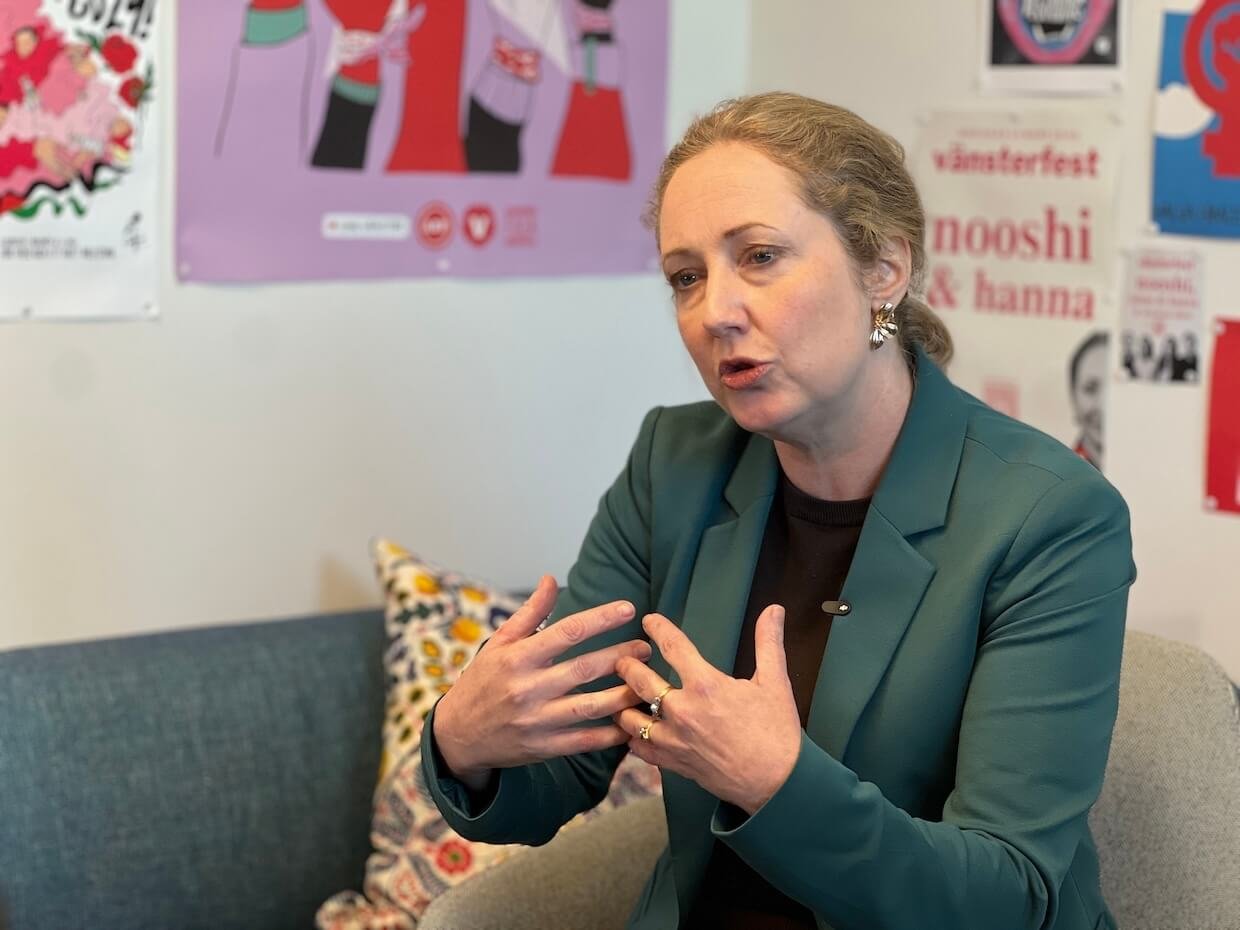
In this wide-ranging interview with the European Center for Populism Studies (ECPS), Hanna Gedin, Member of the European Parliament for Sweden’s Vänsterpartiet (Left Party, V) and Vice-Chair of The Left Group, reflects on Sweden’s post-election political deadlock, the normalization of radical-right ideas in European policymaking, the erosion of international law, and the strategic dilemmas facing the democratic left. Gedin, who works on the internal market, industry, energy, women’s rights, and gender equality, situates these questions within a broader critique of inequality, restrictive migration policy, and the weakening of Europe’s normative credibility.
The interview begins with the struggle to translate Sweden’s new parliamentary majority into a viable center-left government. Gedin rejects the idea that Vänsterpartiet should once again support a government from outside, insisting that “if our votes are needed, if our mandates are needed, of course we should be in the government.” She argues that the Center Party (C) “needs to choose,” because “there is no middle way.” At the same time, she acknowledges the deep economic divide between the two parties but maintains that cooperation remains possible on issues ranging from feminism and climate to international law and support for communities outside major cities.
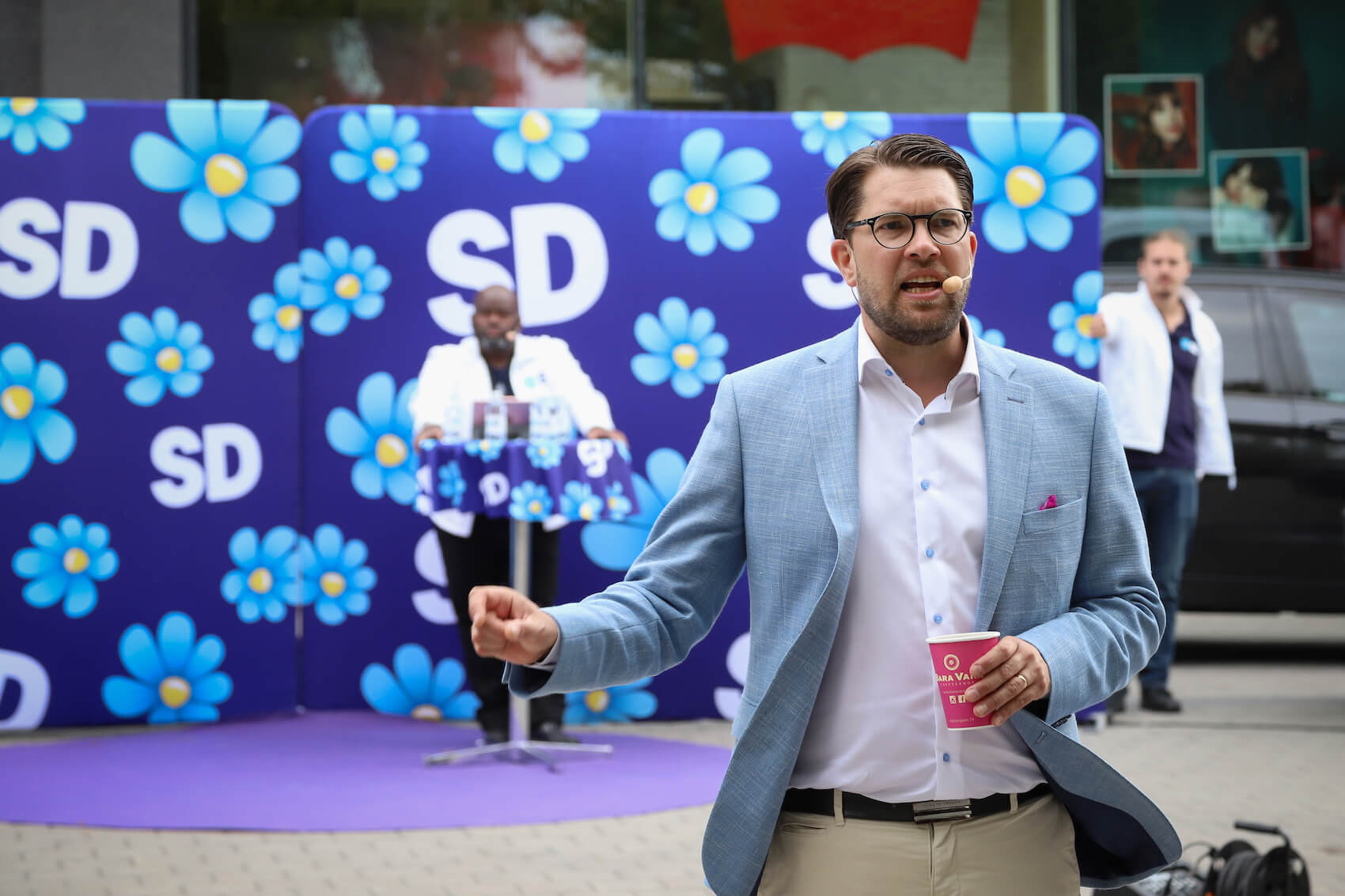
A central theme of Gedin’s remarks is the extent to which the radical right has reshaped mainstream political agendas. She argues that Swedish parties have been “adapting and moving closer to the Sweden Democrats,” while politics has increasingly shifted away from “bread and butter” concerns toward culture-war issues. For Gedin, the answer is not imitation but political differentiation: “For the left, it’s really important not to adapt.” Instead, she insists, “You need to have your own agenda,” centered on the cost of living, inequality, housing, and material security.
This concern extends to migration policy at both Swedish and European levels. Gedin describes a “shift and an adaptation to the radical right” in EU migration politics and recalls far right and right-wing MEPs cheering “Send them back, send them back” during a vote on return hubs. Yet she also points to Sweden’s debate over teenage deportations as evidence that public attitudes can shift when abstract migration categories acquire “names and faces.”
The interview’s sharpest normative critique concerns international law. Gedin argues that “the EU is losing its voice when it comes to upholding international law” and warns of “a complete erosion of international law” driven by double standards. She contrasts the EU’s firm response to Russia’s war against Ukraine with what she sees as a much weaker approach toward Israel, arguing that such inconsistency undermines European credibility globally.
Ultimately, Gedin presents a distinctly materialist response to the rise of the far right. She argues that the left must make politics concrete: reduce inequality, address rents and energy costs, tax the very rich, and “make life a good life without adapting to the far right and their narrative.”
As Brazil approaches its October 25 presidential runoff, Professor Lucio Rennó of the University of Brasília warns of an unusual trajectory of democratic backsliding driven primarily by Congress rather than the presidency. In this ECPS interview, Professor Rennó examines the institutionalization of Bolsonarismo, the consolidation of political polarization, and the persistence of authoritarian enclaves inherited from military rule. Drawing parallels with what scholars call legislative authoritarianism, he cautions that congressional power-grabbing could weaken the Supreme Court and institutions of horizontal accountability. As Professor Rennó observes, “We can identify elements of that same logic in Brazil.” Yet he also emphasizes democratic resilience, highlighting the role of civil society, judicial institutions, and political opposition in resisting institutional erosion and preserving constitutional democracy.
As Brazil approaches the decisive October 25 presidential runoff, the country’s political trajectory raises questions extending far beyond the contest between President Luiz Inácio Lula da Silva and Flávio Bolsonaro. In the October 4 first round, Flávio Bolsonaro secured 47.03 percent of the vote against Lula’s 45.16 percent, while the broader Bolsonarist camp strengthened its congressional presence. ForProfessor Lucio Rennó, Professor at the Political Science Institute of the University of Brasília, these developments illuminate not only the institutionalization of Bolsonarismo but also an unusual transformation in the mechanisms of Brazilian democratic backsliding.
In this wide-ranging interview with the European Center for Populism Studies (ECPS), Professor Rennó, whose research examines populism, authoritarian attitudes, electoral realignment, and democratic resilience, argues that Brazil is witnessing a distinctive concentration of political power. Unlike conventional patterns of democratic erosion, where executives progressively dismantle constitutional constraints, the Brazilian process is increasingly driven by the legislature. As he observes, “What we’re witnessing in Brazil today is a rather unusual process of democratic backsliding, in which power-grabbing and the centralization of power are occurring primarily within Congress rather than the executive branch.”
Drawing on The Crisis of Democracy in Brazil, co-authored with Leonardo Avritzer, Professor Rennó situates this development within the country’s enduring institutional vulnerabilities, particularly the “authoritarian enclaves” inherited from military rule. He identifies a Congress dominated by a pragmatic, clientelistic coalition with conservative policy orientations as a potential vehicle for weakening constitutional checks. Comparing this trajectory with developments in Peru, where scholars have identified legislative authoritarianism, Professor Rennó warns: “We can identify elements of that same logic in Brazil.”
The implications extend directly to judicial independence and horizontal accountability. Professor Rennó anticipates congressional efforts to restrict the Supreme Court’s authority and potentially weaken institutions such as the Public Prosecutor’s Office, the Federal Police, and the Tribunal de Contas. Under a Flávio Bolsonaro presidency, he cautions, executive-legislative alignment could accelerate these developments, weakening oversight institutions “primarily to the benefit of Congress rather than the presidency.”
Yet Professor Rennó’s analysis also emphasizes the resilience of Brazilian democracy. He underscores the constitutional role of the Supreme Court, the mobilizing capacity of civil society, and the potential resistance of the Workers’ Party and congressional opposition.
Ultimately, the interview situates these institutional struggles within a broader political realignment: the consolidation of Bolsonarismo and Petismo as competing national identities. As Professor Rennó explains, Brazil is witnessing “the construction of political identities that transcend politics and increasingly affect our daily lives.” The October runoff therefore represents not merely a presidential contest but a critical moment in the continuing struggle over institutional power, democratic accountability, and Brazil’s political future.
Here is our interview with Professor Lucio Rennó, edited lightly to enhance clarity, readability, and overall flow for publication.
Bolsonarismo’s Strength Now Extends Beyond Jair Bolsonaro Himself
Then Brazilian President Jair Bolsonaro attends the 74th Anniversary of the Parachutist Infantry Battalion at the Military Village in Rio de Janeiro, Brazil, on November 23, 2019. Photo: Celso Pupo Rodrigues.
Professor Rennó, welcome, and thank you for joining us. Flávio Bolsonaro finished ahead of Lula with 47 percent, and the broader Bolsonarist camp also advanced in Congress in the October 4 elections. Does this result confirm your earlier argument that Bolsonarismo has become a durable political alignment rather than a phenomenon dependent on Jair Bolsonaro personally?
Professor Lucio Rennó: Yes, this election is a very important historical event in the sense that it consolidates Bolsonarismo’s strength beyond Jair Bolsonaro himself. What we have been witnessing in Brazil since 2022 is the institutionalization of Bolsonarismo. What was basically a charismatic, leadership-driven alignment with Bolsonaro, based on policy positions on certain issues, has become institutionalized within the framework of a political party, Brazil’s Liberal Party (PL).
The party performed very well in the 2024 municipal elections and has since nationalized the narrative of Bolsonarismo, consolidated it across different regions of the country, and established an organizational structure for the movement that was absent during Bolsonaro’s term in office following his victory in the 2018 elections.
He actually remained without a party until almost the end of his mandate, joining the PL only when he was preparing to run in 2022. Since then, what we have witnessed is this interesting process of an individual leadership becoming institutionalized within the framework of a political party, giving its political agenda much greater reach and scope.
Flávio Bolsonaro and the Continuity of the Bolsonarist Coalition
You have described Bolsonarismo as a multidimensional ideological alignment combining cultural conservatism, punitive politics, economic liberalism, and anti-PT sentiment. Does Flávio Bolsonaro’s performance suggest that this coalition has now survived a successful leadership succession?
Professor Lucio Rennó: Yes, I would say that Flávio Bolsonaro now demonstrates that the movement itself and its multidimensional agenda resonate strongly with significant portions of the Brazilian electorate. Bolsonarismo would not be what it is if it did not reflect the mass attitudes, grievances, and cleavages that characterize Brazilian society today.
A significant portion of the electorate embraces this set of policy positions, if not yet concrete policy proposals, in line with what you have highlighted in your question. These positions are becoming, as I have said, part of the PL’s political platform. So, these issues are at the heart of Bolsonarismo’s continuity beyond Jair Bolsonaro.
Now, obviously, we have to wait for the results of the second round of the election, which is coming up in about 10 days, to see, first, whether Flávio will succeed in winning the election and, if he does, what that would mean for Jair Bolsonaro himself, who will probably be freed and pardoned following his conviction for participation in a coup d’état in Brazil. We also need to understand what Jair Bolsonaro’s return to the Brazilian political scene would mean for Flávio Bolsonaro’s government.
That remains a mystery. We still need to determine whether we are actually witnessing Bolsonarismo beyond Jair Bolsonaro or, potentially, the return of Jair Bolsonaro to the center of Brazil’s political agenda and the far right.
From Charismatic Leadership to Institutionalized Ideological Alignment
Senator Flávio Bolsonaro during a pro-amnesty demonstration in support of former President Jair Bolsonaro in Copacabana, Rio de Janeiro, Brazil, March 16, 2025. Photo: Saulo Angelo | Dreamstime.
Your research identified a “Bolsonaro effect,” whereby voters did not merely select a candidate matching their prior beliefs but moved ideologically toward Bolsonaro during the campaign. Are we seeing a similar process around Flávio Bolsonaro, or is he mainly inheriting an already consolidated ideological constituency?
Professor Lucio Rennó: That ideological shift was largely the result of Jair Bolsonaro’s leadership. What we’re seeing now is the consolidation of this movement around these policy issues, as well as the affective elements of politics that initially helped construct a significant social movement around Bolsonaro, or even a political and electoral alignment centered on him.
This alignment is now evolving into a more consolidated and institutionalized set of policy proposals that, given the results of the legislative elections and the configuration of Congress over the next four years, are very likely to bring significant policy changes in Brazil, as well as changes to institutional design, particularly regarding the Supreme Court.
So, what we’re witnessing is a significant process of consolidation and institutionalization, whereby what initially resembled a social movement or a political alignment built around a charismatic leader is becoming more deeply ingrained in the country’s political framework, strengthening the presidential far right.
Bolsonarismo Is Becoming Hegemonic on the Right
Does the first-round result represent the normalization of the Brazilian far right, in the sense that Bolsonarismo is no longer an insurgent challenge to the party system but one of its principal organizing poles?
Professor Lucio Rennó: I agree with that. Bolsonarismo is becoming hegemonic on the right. Just as the PT, the Workers’ Party, is hegemonic on the left in Brazil, the PL and Bolsonarismo are moving toward a similarly hegemonic position on the right. Since 2018, we haven’t seen any possibility of a resurgence of the moderate right in Brazil.
So, basically, there’s no third way in the country beyond Petismo and Bolsonarismo, beyond the PT and the PL. This election demonstrates that very clearly, as the results were dominated by strong polarization between Bolsonarismo and Petismo. All the other candidates who attempted to enter this space, especially on the right, failed, receiving very little support at the ballot box. So, the votes are concentrated in Bolsonarismo. This represents a hegemonic shift on the right through the consolidation and institutionalization of partizan Bolsonarismo.
The Supreme Court Was the Big Loser in This Electoral Process
Your work argues that Bolsonarismo combines issue-based conservatism with anti-democratic attitudes. How should we interpret the fact that this political identity remains electorally powerful after Jair Bolsonaro’s conviction and the January 8 crisis?
Professor Lucio Rennó: What we have seen among Bolsonarista supporters is essentially a denial of Bolsonaro’s guilt. We have conducted research using surveys and public opinion polls that clearly show that core Bolsonaristas reject the idea that Bolsonaro is guilty. Instead, they see him as a victim of a witch hunt. The narrative that Bolsonaro is being persecuted, or that the system, whatever that means, is unjustly trying to damage his image, has become widely accepted among his core supporters. He has therefore remained politically significant because his followers have embraced the narrative that he is a victim of persecution for confronting the system.
Consequently, the Supreme Court became Bolsonaro’s principal enemy. After Bolsonaro won the presidency in 2018 and took office in 2019, he shifted his focus. This is important for understanding the construction of the populist narrative around Bolsonaro, particularly the “us against them” idea that drives populist rhetoric. The Supreme Court became the enemy.
What this election demonstrated, especially in the legislative arena and particularly in the Senate, is that Bolsonarismo defeated the Supreme Court electorally. Oddly enough, the Supreme Court was the big loser in this electoral process in Brazil. The Senate elections were framed around the narrative that the Supreme Court was corrupt and had unjustly tried to impute guilt to Bolsonaro, who, according to this narrative, was innocent of all accusations. This narrative prevailed among Bolsonaristas and prevented any alternative leadership from emerging.
It is particularly interesting to see how Bolsonarismo was able to consolidate around Flávio Bolsonaro rather than an alternative leader, such as the governor of São Paulo, Tarcísio de Freitas. There was competition over who would become the next Bolsonarista leader, and it is remarkable that Flávio Bolsonaro prevailed despite the support Tarcísio received from Brazil’s financial sector and the major businesses and conglomerates of São Paulo. Flávio was ultimately successful because the Bolsonaro name remains so powerful in Brazilian politics today.
So, I would say that the election also confirmed the electoral strength of the Bolsonarista narrative. By positioning the Supreme Court as an enemy, this narrative significantly facilitated the electoral victories of several Senate candidates, including Michelle Bolsonaro, Jair Bolsonaro’s wife, who was elected senator for Brazil’s Federal District.
Brazil’s Supreme Federal Court (Supremo Tribunal Federal – STF) at night, Brasília, Federal District, Brazil, August 26, 2018. Photo: Diego Grandi.
Brazil Is Divided Along Demographic, Socioeconomic, and Geographical Lines
Lulism remains strongest among lower-income voters, social-policy beneficiaries, Catholics, women, and the Northeast, while Bolsonarism performs strongly among evangelicals, wealthier voters, and parts of the South and Southeast. Is the runoff becoming a contest between two increasingly consolidated social blocs rather than merely two candidates?
Professor Lucio Rennó: Yes, I agree. There is an increasing perception that ideological and policy positions, as well as affective and emotional attachments to Bolsonarismo on the one hand and Petismo on the other, are now dividing the nation along social lines.
What we have today is a country divided along demographic, socioeconomic, and geographical lines. If we look at religion, the data have shown that it is a very important factor behind Bolsonarismo, both directly and indirectly. Evangelicals are more likely to vote for and support Bolsonaro. Religion also plays an indirect role in shaping social attitudes that align with Bolsonaro’s positions, particularly on gender politics and LGBTQI+ issues. There is considerable convergence between religious views and these policy positions among Bolsonaro supporters.
We also see divisions along socioeconomic and demographic lines: wealthier white men are more likely to support Bolsonaro and Bolsonarismo than Black Brazilians and poorer citizens, who are less likely to support the movement.
When we examine the geographical distribution of these populations, the northeastern region of Brazil is much more strongly associated with Lula and the Workers’ Party, while the South and Center-West are much more closely aligned with Bolsonarismo.
So, we see a country divided not only territorially but also along social lines. This adds another layer to the consolidation of Bolsonarismo, rooted in belonging to different social groups.
Brazil Is Now Facing a Highly Conservative Congress
Your research on the Bolsonaro voter found that cultural backlash, law-and-order preferences, economic liberalism, and rejection of redistributive policies all mattered alongside anti-PT sentiment. Which of these dimensions now appears most important to Flávio Bolsonaro’s coalition?
Professor Lucio Rennó: When we look at the convergence between presidential and congressional elections, as well as the population’s issue-based or cognitive alignment with Bolsonarismo, particularly regarding political and policy positions, it becomes clear that we are now facing a highly conservative Congress.
When we examine Bolsonarismo, or the Bolsonaro coalition, if we can call it that, a significant component is ideologically oriented and strongly embraces this policy platform, which we should understand in a broad sense. It is not always defined in terms of specific policy proposals. In some cases, it is, but in others, it reflects a more general political orientation.
What we see ahead is a very conservative Congress, particularly on public security issues. Penal punitivism is going to be at the top of Congress’s agenda during its next mandate because of the conservative turn we have witnessed in the legislative elections, even more so if Flávio Bolsonaro is elected president.
We should therefore expect significant changes in this area, along with the resurgence of anti-democratic beliefs and attitudes concerning the pardoning of Jair Bolsonaro for the crimes of which he was convicted, as well as the pardoning of those who participated in the invasion of the buildings at Three Powers Square in Brasília on January 8.
There will also be a significant attempt to weaken the Supreme Court institutionally, which would affect the balance of powers in Brazil and, consequently, the very essence of horizontal accountability and democracy.
With the support of Congress, these different dimensions of Bolsonarismo are now much more likely to translate into concrete policies and institutional changes than they were during Jair Bolsonaro’s term in office.
Penal Punitivism and the Politics of Public Security
Crime and insecurity have been central to this election, and Flávio Bolsonaro has emphasized punitive policies. Does the continued salience of law-and-order politics show that punitive conservatism remains one of Bolsonarismo’s most durable ideological foundations?
Professor Lucio Rennó: Absolutely. I completely agree with that. This is one of the key issues in this election. While the rejection of the Supreme Court was very important in the legislative elections, public security issues and how to address them remain central to the Bolsonarista agenda. I would also add a certain disappointment with the performance of the economy as another important issue, but we can discuss that later.
Let’s focus on the issue of penal punitivism that you mentioned. Flávio Bolsonaro’s campaign narrative and rhetoric have emphasized a very harsh approach to crime, presenting increased punishment as a solution to criminality in Brazil. As we say in Brazil, “a good criminal is a dead criminal.” This is a claim with which a significant portion of the population agrees, and it is central to Flávio Bolsonaro’s position on public security policy.
It’s a very violent position, centered on combating crime and imposing harsh punishment on criminals, with very little discussion about how to address the financing of crime or human rights. These issues have become much more closely associated with the Workers’ Party’s position, or Lula da Silva’s position, on crime. But for most of the population, penal punitivist rhetoric is much more enticing and resonates more closely with their daily lives than the alternative. That’s why Flávio Bolsonaro has centered so much of his campaign narrative on this particular issue.
The Brazilian Population Is No Longer Satisfied with Its Living Condition
Photo: Shutterstock.
By contrast, Lula has again mobilized around Bolsa Família, income protection, and social inclusion. Does the runoff therefore revive the older cleavage between Lulist redistribution and Bolsonarist individual responsibility, or has that divide been overtaken by cultural polarization?
Professor Lucio Rennó: No, Lula da Silva’s initial approach, the way he organized his government, and the outcomes he sought to achieve were closely linked to improving the material conditions of the Brazilian population. He campaigned vigorously in the 2022 elections, criticizing Bolsonaro for his anti-democratic positions and his conduct during the pandemic, but also promising economic improvement. This remained an important issue in this year’s election.
The PT invested heavily in reducing inflation, increasing employment, and raising incomes, but perhaps without paying sufficient attention to other aspects of the Brazilian economy, particularly the profound levels of debt that significant portions of the population face today. This ultimately contributed to a sense of economic dissatisfaction in this year’s election.
I don’t think the Brazilian population is satisfied with its living conditions anymore, which is why this has been such a difficult election for the incumbent. Living conditions have deteriorated in Brazil over the past 10–15 years, and the overall public mood is very negative. That is always difficult for an incumbent to address.
Although the Workers’ Party and Lula’s government attempted to improve economic conditions and, consequently, the population’s living standards, the situation he inherited was so difficult that recovery has been challenging. Economic growth has not been particularly strong. Inflation is under control, unemployment is low, and incomes have increased, but not as much as the population needed. As a result, purchasing power remains a problem for Brazilians.
The general perception is that Lula has not delivered on his promise to improve material conditions, particularly for Brazil’s poorer population. This dissatisfaction and frustration with living conditions and the overall state of the economy have also worked against Lula.
So, the combination of the penal punitivist narrative and the government’s relatively weak economic performance also favored Flávio Bolsonaro in the election. The PT is now attempting several last-minute policy changes to see whether it can reverse some of these significant problems, including the high levels of household debt in Brazil.
The Resilience of Bolsa Família Under a Bolsonaro Government
Your work on Bolsa Família stresses the resilience of social policy even across changes of government. If Flávio Bolsonaro wins, how much institutional room would he actually have to retrench Brazil’s welfare architecture, given bureaucratic capacity, policy feedback, and electoral dependence on social benefits?
Professor Lucio Rennó: Jair Bolsonaro attempted to rebrand the Bolsa Família program during his last year in government. Bolsonarismo has always maintained an ambivalent position toward conditional cash transfer programs. Its supporters criticized these programs in the past, and once in power, they shifted their focus toward finding exit doors from the program rather than expanding coverage and increasing benefits. They also reduced some of the conditionalities.
We should expect the program to continue under a Flávio Bolsonaro government. Previous attempts to change it significantly failed, partly because rebranding Bolsa Família did not produce substantial electoral returns. However, they will certainly try to re-establish the narrative that the government should seek exit doors from Bolsa Família. This approach would likely return under a new Bolsonaro administration led by Flávio.
So, we should expect changes to Bolsa Família, but not its termination or complete disruption. The program clearly continues to provide significant resources to families who would otherwise lack access to this money. It therefore remains a very important source of support for a substantial portion of the Brazilian population.
The political risk of substantially changing Bolsa Família is very high for anyone attempting to reform the program. It should therefore be maintained. It is difficult to say whether they will try to change its name again and claim credit for it, but we should not expect the program to be terminated altogether.
Democratic Backsliding and Legislative Authoritarianism
Brazilian National Congress at sunset. Brasília, Federal District, Brazil, August 26, 2018. Photo: Diego Grandi / Dreamstime.
In The Crisis of Democracy in Brazil, you and Leonardo Avritzer argue that Bolsonaro activated pre-existing institutional vulnerabilities rather than creating them from scratch. Does Flávio Bolsonaro’s rise suggest that those vulnerabilities remain politically exploitable despite the democratic resistance of 2022–23?
Professor Lucio Rennó: The structural components of the Brazilian political system that led us to a significant crisis of democracy, culminating in the January 8 attacks, are still present. Our institutional framework still contains significant elements inherited from the previous military dictatorship. In the book, we refer to these as authoritarian enclaves: institutional features embedded in the Constitution and in the functioning of executive-legislative and civil-military relations. These remain sources of conflict within the country and represent unresolved dilemmas that we have yet to overcome.
There have been attempts at institutional change to address some of these enclaves, but I don’t think they are helping to strengthen democracy. In fact, they may be counterproductive. What we’re witnessing in Brazil today is a rather unusual process of democratic backsliding, in which power-grabbing and the centralization of power are occurring primarily within Congress rather than the executive branch. This differs from the traditional pattern of democratic backsliding, characterized by the concentration of power in the executive branch and the weakening of checks on executive authority, something we’re seeing elsewhere in the world.
In Brazil, however, we are witnessing the centralization of power within Congress, which is controlled by a highly pragmatic, clientelistic coalition with strong inclinations toward a conservative policy agenda. This represents a different process, although it has parallels with what has happened in Peru, for instance, where some analysts have described the phenomenon as legislative authoritarianism. We can identify elements of that same logic in Brazil.
The military situation also remains unresolved. Military prerogatives persist regarding benefits, salaries, and influence over defense policy, as well as the possibility of military intervention to address civilian problems through the so-called Garantia da Lei e da Ordem (Guarantee of Law and Order, GLO) mechanism, which is embedded in the Brazilian Constitution.
Several of the issues we identify in the book therefore remain unresolved and constitutionally embedded. What may happen in the future is a further strengthening of this process of power-grabbing by Congress and the highly clientelistic, pragmatic, conservative coalition that controls it.
So, if Lula wins the second round of the election, he will face considerable difficulties governing the country, both because of the existing balance of power between the executive and legislative branches and because of the very conservative composition of Congress following the 2026 election.
Congressional Power and the Future of the Supreme Court
You also argue that Brazil’s judiciary became both a source of political conflict and a crucial defender of democracy. If a new Bolsonaro presidency again confronts the Supreme Court, could Brazil enter a renewed cycle of populist conflict between electoral authorization and constitutional restraint?
Professor Lucio Rennó: Yes, this is at the top of Brazil’s reform agenda today, particularly with the new Congress coming into power. Regardless of whether Flávio Bolsonaro or Lula wins, I believe Congress itself will push a strong agenda to reform the Supreme Court, alter the monocratic powers of its justices, and establish greater limitations on what the Court can decide. This is a clear consequence of the results of the Senate and Chamber of Deputies elections in Brazil.
Even if Lula remains in power, Congress will pursue this agenda because it has become so empowered over the past 10 years that it is now the key lawmaking actor in Brazil. I expect some resistance from the Supreme Court and, if Lula holds the presidency, from the executive branch as well. However, if Flávio Bolsonaro wins, this agenda will receive full presidential support.
What we could potentially see under a Flávio Bolsonaro presidency is an alignment between Congress and the executive branch aimed at further weakening the judiciary and institutions of horizontal accountability in Brazil, such as the Public Prosecutor’s Office, the Federal Police, and the Tribunal de Contas, which is responsible for overseeing public accounts. We would therefore be looking at a situation in which these institutions of horizontal accountability are weakened primarily to the benefit of Congress rather than the presidency.
The Supreme Court Became the Primary Target for Retaliation
Flávio Bolsonaro has pledged amnesty for his father and for participants in the January 8 attacks. Should this be read mainly as family loyalty, as movement maintenance, or as a broader populist attempt to redefine accountability as political persecution?
Professor Lucio Rennó: Yes, it has a deeper meaning, as you have suggested. The Bolsonarista narrative all along has been that Jair Bolsonaro has been treated unfairly because of his defiance of the establishment. The Supreme Court, as a representative of this establishment, became Bolsonaro’s and Bolsonarismo’s principal foe, their most important enemy, and the primary target for retaliation.
That is what we should expect. If Flávio wins, we will see Jair Bolsonaro pardoned. Even if Flávio does not win, there is a significant chance that Congress will approve amnesty for Bolsonaro and all those who attacked democratic institutions during the January 8 events.
So, we should expect considerable tension between Congress and the Supreme Court. Depending on who wins the presidency, these attacks against the Supreme Court could receive strong presidential support. If Flávio wins, Jair Bolsonaro will certainly be free by January 2. The same applies to his brother, Eduardo Bolsonaro, who has also recently been convicted of crimes and would likewise be pardoned. We will therefore see clear attempts to challenge legal decisions made under the democratic order. That, in itself, represents an attack on Brazil’s democratic order.
Brazilian Democracy Has Demonstrated Its Resilience
Protesters protest for the freedom of Luiz Inácio Lula da Silva on Avenida Paulista in São Paulo, Brazil on April 7, 2019. Photo: Cris Faga.
Donald Trump’s second presidency has involved renewed efforts to expand executive authority, reshape federal agencies, challenge institutional constraints, and pursue political adversaries. If Flávio Bolsonaro wins, is the relevant Brazilian risk imitation of Trump’s second-term strategy—or would Brazil’s stronger congressional and judicial constraints produce a fundamentally different trajectory?
Professor Lucio Rennó: Up until now, Brazilian democracy has demonstrated its resilience. Lula’s victory was important in this regard, as was the organization of the opposition to Jair Bolsonaro. Civil society has also played an important role, while the Supreme Court has been particularly significant in safeguarding basic constitutional rights and the rule of law in the country.
A return of Bolsonarismo to the presidency, in an environment where Congress is highly favorable to the movement, would pose a serious threat of substantial institutional change. As I mentioned earlier, this could involve weakening oversight institutions and the judiciary, which remain among the last forms of institutional resistance to democratic retrenchment in Brazil.
However, we should not underestimate the role of the opposition in Congress, led by the Workers’ Party as the hegemonic force on the left. We have already begun to see a reaction to Flávio Bolsonaro from the opposition. This past weekend, substantial popular movements and demonstrations in support of Lula and against Bolsonaro took place in the streets of almost all Brazil’s major cities.
The left has also begun to restructure and reorient itself to confront the rise of the extreme right, reflected in the electoral victories of the PL and Bolsonarismo. We should therefore expect resistance from the opposition, just as we witnessed in the period leading up to the 2022 election. The role of the opposition and the left proved fundamental to Jair Bolsonaro’s first defeat.
The election is still open in Brazil. We need to examine the latest polls coming out today and tomorrow to assess whether Lula still has a chance of winning the second round. Regardless of the outcome, the opposition, particularly the left and the Workers’ Party, is already beginning to organize itself as a force of resilience and resistance to shifts in the policy and institutional agenda in Congress.
We should therefore expect a significant struggle within Congress, with the opposition seeking to delay or obstruct decisions that advance this more conservative agenda. Nor should we underestimate the Workers’ Party’s ability to mobilize civil society to remain vigilant and critical of these changes. We have seen this in the past, and we should expect it again if Flávio wins the upcoming second round.
Even leaving the presidential outcome aside, we should expect the congressional minority, composed largely of the Workers’ Party, to demonstrate considerable resilience in resisting institutional and policy changes.
Brazil’s Emerging Two-Bloc Political System
And finally, Professor Rennó, looking toward October 25, is the deeper significance of this runoff simply whether Lula or Flávio Bolsonaro wins—or whether Brazil is consolidating a new party system structured around two durable political identities, Lulism and Bolsonarismo, each offering a competing conception of “the people,” the state, and democracy itself?
Professor Lucio Rennó: These elections are historic in the sense that they consolidate two national political alternatives, leaving very little room for a third way to emerge in presidential elections. We have to bear in mind that Brazil is a multiparty system, with a significant number of effective parties in the Chamber of Deputies and the Senate, giving it a distinct political dynamic compared with, for instance, the United States. In part, Congress is so powerful in Brazil precisely because of our multiparty structure and the way our party system is organized.
What this election demonstrates, and what the 2024 municipal elections had already begun to reveal, is the nationalization of political polarization in Brazil. This polarization has become dominant in the current election, particularly with the growth of the PL, but also with the significant results achieved by the Workers’ Party, especially in the Chamber of Deputies. The party increased its representation in the Chamber and further consolidated its position as the most important political force on the left.
So, this election is symbolic for Brazil because it demonstrates how the country has become polarized between two political forces representing distinct ideological and policy positions. These forces are also dividing the country along emerging political identities that did not previously exist in this form.
This is particularly important because we are now witnessing the construction of political identities that transcend politics and increasingly affect our daily lives. We see something similar in the United States, where Democrats and Republicans often do not mingle socially. We are beginning to see the same phenomenon in Brazil, and these divisions are becoming even stronger in the current election.
MEP Brando Benifei warns that Europe’s struggle for technological sovereignty is inseparable from the defense of democracy. In this ECPS interview, he argues that the EU must strengthen its technological capacity while preserving its regulatory autonomy against external pressure and concentrated corporate power. Benifei stresses that “regulations are decided in Europe, by Europeans, for Europeans” and warns that the extreme right has moved closer to “techno-oligarchs,” forging “a form of alliance and mutual support.” He describes this convergence as “an alliance of interests that is threatening our democracies.” Beyond regulation, Benifei calls for “a democratic reaction” and a “new social contract” capable of making European societies “more equal and freer.”
In an era in which technological power, geopolitical rivalry, and democratic vulnerability are increasingly intertwined, the European Union faces a double challenge: strengthening its strategic autonomy while defending the institutional and normative foundations of liberal democracy. Few policy areas illustrate this convergence more clearly than artificial intelligence, digital regulation, platform governance, and transatlantic relations. In this wide-ranging interview with the European Center for Populism Studies (ECPS), MEP Brando Benifei, Chair of the European Parliament’s Delegation for Relations with the United States and a central parliamentary figure in the development of the EU Artificial Intelligence Act, reflects on Europe’s technological dependencies, regulatory sovereignty, Big Tech power, disinformation, and the growing political relationship between digital oligarchies and the popuplist radical right.
At the center of Benifei’s analysis is the argument that Europe’s struggle for sovereignty cannot be reduced to economic competitiveness or technological capacity alone. It also concerns who has the power to establish the rules governing digital societies. He insists that Europe must develop its own technological capabilities while preserving its regulatory autonomy, arguing that “regulations are decided in Europe, by Europeans, for Europeans” and describing this principle as “an absolute red line.” At the same time, he warns that Europe cannot remain merely a regulatory power without developing the technological infrastructure necessary to sustain that role. As he puts it, the EU “can’t remain a regulatory reference if it doesn’t also develop the technological power that is needed today.”
The interview becomes particularly significant when Benifei turns to the political consequences of concentrated technological power. He argues that the rise of the extreme right is increasingly connected to powerful actors within the technology sector. “The extreme right has been getting closer and closer to these techno-oligarchs,” he says, adding that they have “forged a form of alliance and mutual support.” For Benifei, this convergence now constitutes “an alliance of interests that is threatening our democracies.”
His response is not limited to regulation. Benifei calls for what he describes as “a democratic reaction” and “the proposal of a new social contract” capable of making societies “more equal and freer.” In his account, inequality and declining freedoms can provide “fertile ground” for an alliance between the extreme right and techno-oligarchs and for what he characterizes as a “hateful and democracy-demolishing approach.”
Against this backdrop, the conversation explores the broader implications of AI governance, algorithmic amplification, digital enforcement, disinformation, transatlantic pressure, and European sovereignty. Benifei’s remarks ultimately frame the contemporary digital struggle not merely as a debate over innovation or regulation, but as a deeper contest over democratic authority, economic power, and the institutional capacity of Europe to determine its own political and technological future.
As the United States approaches the 2026 midterm elections, Professor Adolph Reed Jr. offers a critical political-economic interpretation of Trumpism, arguing that the structural contradictions underlying authoritarian nationalism remain fundamentally unresolved. In this wide-ranging interview with the ECPS, Professor Reed examines the tensions between capitalist accumulation and democratic legitimacy, challenges race-reductionist explanations of inequality, and critiques neoliberalism’s displacement of class-based politics. Warning that “the threat of another version of Trumpism will continue to be there,” he emphasizes the limitations of electoral mobilization without durable working-class organization. Drawing on his experience with the Bernie Sanders campaigns, Professor Reed advocates rebuilding solidaristic, universalist politics capable of confronting both economic inequality and authoritarianism through sustained political organization and democratic-socialist transformation.
As the United States approaches the November 3, 2026, midterm elections, fundamental questions persist about the political-economic foundations of Trumpism, the durability of authoritarian nationalism, and the declining capacity of the American left to articulate a transformative alternative. In this wide-ranging interview with the European Center for Populism Studies (ECPS), Professor Adolph Reed Jr., Professor Emeritus of Political Science at the University of Pennsylvania and Distinguished Visiting Professor of Politics at Mount Holyoke College, offers a historically grounded critique of Trumpism, neoliberalism, racial politics, and the erosion of working-class political organization.
One of the most distinctive voices in American political thought, Professor Reed challenges interpretations that privilege political personalities, demographic identities, or ideological labels over the structural contradictions of capitalist democracy. Rather than becoming preoccupied with whether Trumpism should be classified as populism or fascism, he emphasizes its political consequences and underlying material conditions. “Trumpism is clearly a form of authoritarianism,” he argues, while observing that it remains loosely aligned with authoritarian tendencies emerging across Europe and Latin America.
Crucially, Professor Reed cautions against assuming that Trump’s departure would eliminate the political forces associated with his presidency. “The structural contradictions aren’t going anywhere,” he insists, identifying the increasingly fraught relationship between capitalist accumulation and political legitimation as a defining tension within neoliberal democracies. Unless these contradictions are addressed through an alternative political vision capable of providing security and well-being, Professor Reed warns, “the threat of another version of Trumpism will continue to be there.”
The interview also explores Professor Reed’s longstanding critique of race-reductionist explanations of political behavior and inequality. Questioning the treatment of racial categories as coherent political constituencies, he argues that contemporary social science has been “more or less willfully making class and political economy disappear from our understanding of American politics.” His historically specific approach to racism and white supremacy challenges explanations that detach racial ideologies from material interests, institutional structures, and political mobilization.
Turning to democratic socialism, Professor Reed reflects on his involvement in both Bernie Sanders presidential campaigns and the organizational limitations that constrained their transformative potential. “You can’t elect your way to social transformation, at least not without an organizational base,” he observes. Despite these setbacks, he identifies growing skepticism toward capitalism among working people as evidence of changing political possibilities.
Ultimately, Professor Reed argues that confronting authoritarianism and neoliberalism requires sustained organizing beyond electoral cycles. His central message emphasizes the patient reconstruction of working-class solidarity, institutional capacity, and universalist politics. As he concludes, “You’ve got to be able to focus both on what needs to be done to stop the bleeding right now, to keep things from getting worse, and on where we’re trying to go in the long run.”
Here is our interview with Professor Adolph Reed, edited lightly to enhance clarity, readability, and overall flow for publication.
Trumpism Is Clearly a Form of Authoritarianism
National Guard troops on standby during a downtown Los Angeles demonstration against expanded ICE operations and in support of immigrant rights in Los Angeles, US on June 8, 2025. Photo: Dreamstime.
Professor Reed, welcome, and thank you for joining us. Let me begin with how we should conceptualize Trumpism itself. You have recently referred explicitly to the rise of “Trumpist fascism” and elsewhere described Trumpism as the “point of the lance” of a broader fascist international. At the same time, much of the political science literature analyzes Trump through the language of populism, authoritarian populism, or the populist radical right. So, what is obscured when Trumpism is understood primarily as populism rather than as fascism? And what political-economic criteria, in your view, should distinguish fascism from right-wing populism in the contemporary United States?
Professor Adolph Reed: That’s an important question because a lot of ink has been spilled over a debate that, often enough or all too often, shifts the lens away from examining the pragmatic or practical political impacts of the shift and toward a taxonomic exercise, which is academics really like to do. From that perspective, I won’t quibble about whether Trump should most properly or most effectively be understood as a fascist, because that automatically opens up a second-order argument about how we delineate the most important features of fascism.
I would say two things. One is that Trumpism is clearly a form of authoritarianism, politically. While it’s not necessarily directly coordinated, it seems to be more or less loosely aligned with other variants and expressions of authoritarianism that have been rising across the world, not just in Europe, where it’s most conspicuous, but also now in Latin America.
I am concerned about what feels to me like a promiscuous usage of populism, and this is another problem that American social scientists often have. Going back to the 2016 presidential campaign, there was a tendency in public intellectual life, and all too frequently in political science, to define populism in such a way that it would capture any political tendency that’s either somewhat to the right of the conservative coalition or somewhat to the left of the center-left coalition. I found that quite unhelpful and ideological.
Trump’s political persona and performance, as well as the performance of his minions, show characteristics or behaviors that make us think of fascism or other authoritarian movements, past or present. But I’m not really hung up on taxonomizing Trumpism. I’m more concerned with trying to make sense of it within the context of contemporary politics and the dangers it poses to us.
So, it feels a little bit like you may have asked me what time it is, and I gave you a disquisition on how to make a watch. I apologize if that’s true. My son says one of our problems, his and mine, is that we tend to speak in paragraphs.
Trumpism Beyond Trump: Structural Contradictions and Capitalist Interests
Trumpism is frequently interpreted as a highly personalized movement built around Donald Trump’s charisma, grievances, and domination of the Republican Party. Your analysis, however, places much greater emphasis on the destruction of working-class political capacity, neoliberal hegemony, and the absence of an effective anti-capitalist left. How important is Trump himself to explaining Trumpism? If Trump disappeared from American politics tomorrow, how much of the political formation identified with his name would actually disappear with him?
Professor Adolph Reed: That’s a very good question because Trump aspires to be a caudillo, or a dictator, in his fantasy life. Unfortunately, for Trump, the distinction between fantasy life and reality is always blurred. So, I don’t know. Partly because Trump insists on surrounding himself with incompetent sycophants, I don’t think the movement, Trumpism, has institutional constituents so much as a gaggle of free-rider billionaires and hustlers who share with him a mean-spirited take on the world in general, along with no shortage of avarice and a propensity for corruption.
But I don’t know whether Trumpism per se could survive his demise as a movement. That may be wishful thinking, too. But it is also the case that those forces are still going to be out there. To the extent that they have grounded material interests, those interests aren’t going away. Alliances could potentially develop from the affiliations that have come together under the banner of Trumpism, and they could reorganize.
It’s certainly the case that the structural contradictions aren’t going anywhere, especially the increasingly fraught tension between the imperatives of accumulation and political legitimation, principally in neoliberal democracies.
We’re also seeing more and more signs that we’ve come to a point at which the Democratic Party is, by default, more generally favored by large capital and governing elites. I have some friends, like Sam Gindin in Canada, who’ve been stressing this point all along. The Democrats provide a certain stability and seem to be better able, at least on the surface, to navigate the tension between the accumulation and legitimation imperatives than Republicans are, although they aren’t particularly successful either. That, as I’ve argued, is one of the factors that led to the rise of Trumpism in the first place.
So, in a nutshell, I would say that the structural contradictions that have given space for the rise of authoritarian nationalist, fascist, and populist tendencies around the world remain unresolved. Until those are actually addressed, there will continue to be enough dissatisfaction, desperation, and a sense of undesirable or frightening uncertainty among the general population that, unless there’s some political voice offering a different view of the world and a different strategy for realizing security and well-being, the threat of another version of Trumpism will continue to be there.
US President Donald Trump delivers a speech to voters at an event in Phoenix, Arizona. Photo: Danny Raustadt.
Economic Insecurity and Status Insecurity Are Not Really Separable
After the 2024 election, you rejected the widespread claim that Trump had assembled a genuinely “new coalition,” arguing that pollsters and political strategists reify demographic categories into supposedly coherent constituencies. How should we therefore interpret shifts toward Trump among segments of Black, Latino, immigrant, or working-class voters? Do these shifts reveal an ideological realignment, or do they demonstrate the limitations of treating race, ethnicity, gender, and education as ready-made political blocs?
Professor Adolph Reed: That’s a very important question, and some of your readers might consider my response completely off the wall. But I’ve argued that those blocs of voters, defined by the pollsters’ ways of aggregating data, are themselves basically artificial. Black male voters under 40… What sort of category is that? What does that tell us about any set of individuals and what motivates them? Or Hispanic voters, even Hispanic Catholic voters… I think those categories are too idealized and unwieldy to be really useful to us and are more attuned to producing outcomes than to measuring them. That is to say, these formulations of pre-given voting blocs reflect as much an effort to bring those blocs together as meaningful political categories as an effort to help us predict outcomes. They encourage people to understand themselves and their concerns within the taxonomy of those big blocks and act accordingly.
I think that’s the first problem. Over the last 10 or 15 years, I’ve become increasingly impressed by how actively the social sciences, or the various disciplines within them, have been more or less willfully making class and political economy disappear from our understanding of American politics, even making the idea of a working class disappear. I don’t count economics and psychology in this.
One way to punctuate that last point is to note that, for the two or three decades after World War II in the US, my discipline, political science, along with sociology and, to a lesser extent, perhaps anthropology, hinged largely on the invention of a middle class as a baseline category in American politics. The middle class is a notion that defies scientific specificity. It’s all over the place. It’s a category that now has to do with attitudes and social position, but almost never with one’s place in political economy.
That said, going back to the 2024 election, there seemed to be some loss of support among what are categorized as Black or Hispanic constituencies, with some movement from the Democrats to the Republicans. Especially among Black voters, the move toward Trump has always been overstated. What the same pollsters are telling us now is that Black and Hispanic voters who had flirted with Trump seem to have become disaffected with him.
This may seem too tendentious, but I think one of the most meaningful features of this horse-race, post-game handicapping that dominates political interpretation in American life, both in the media and in the academy, is that, consciously or not, it’s more about producing outcomes and constituencies that fit into the abstract categories we’ve made up for them than about understanding what people are actually concerned about.
One other point on this: a former colleague of mine, who’s a very smart, insightful, and talented scholar, contended quite militantly after the 2016 election that the bulk of Trump voters were motivated not by economic insecurity but by status insecurity. I thought about that for a minute and wondered: What part of the solar system do you have to live on not to notice that those two aren’t really separable?
That just suggests to me, as a critical intellectual historian and a student of the history of ideologies, that there’s some ideology at work in that argument. Again, I feel like I’ve gone all around Robin Hood’s barn, as my grandmother would say. I’m sorry if it’s not directly responsive enough.
White Supremacy, Racism, and Historical Explanation
Jake Angeli or QAnon Shaman was among those who participated in the riots initiated by former US President Donald Trump at the Capitol, Washington D.C. on January 6, 2021. Photo: Johnny Silvercloud
One of your most persistent criticisms of contemporary political analysis is that concepts such as “white supremacy” and “racism” are often treated as autonomous causal forces rather than historically specific ideologies embedded in concrete social relations. In your 2020 discussion of socialism and race, you criticized explanations of Trump’s appeal that presume an enduring racial motivation among white workers without sufficient historical or causal specification. How, then, should scholars determine when white supremacy is genuinely explanatory rather than simply descriptive?
Professor Adolph Reed: That’s also a very good question. I don’t think I have methodological advice to offer. But a big step forward would be to pose the question you’ve raised at every step along the way, at every compass point, and to interrogate the notion of an abstraction. First, what does one mean when one says white supremacy? Or, for that matter, what does one mean when one says racism?
I’m a pretty historicist scholar, and I’m always conscious that the same phrase can mean radically different things in concrete terms at different historical moments and in different historical contexts. One facet of a perverse strain in liberal intellectual discourse over the last 20 or 25 years, which I feel is an American export product in the same way that Air Jordans are, but with the heft of foundation money behind it, is the premise that such abstractions as white supremacy or racism, and one could even say sexism, are primordial and, as some sociobiologists would argue, even hardwired or in some ways fashioned on the Pleistocene plains, or whatever.
It seems to me that if we refrain from constructing accounts of the past and its relation to the present that conform to what the sociologist Loïc Wacquant described as the logic of the trial, it might help us jettison an approach to explanation driven by an ideological or moral imperative to demonstrate the existence of racism, whatever we mean by it. Instead, we could start from historical specificity, first trying to root these expressions in their own contexts, to see what they’re responding to and who’s trying to mobilize these ideologies.
The sociologist Rogers Brubaker, whose work is really very important, has made the point that race, ethnicity, and nationality are all basically different labels for the same phenomenon. But he also notes that we all have multiple ethnic or ethnic-like identities that we experience and carry around all the time. They tend to rise to the conscious mind, or come to the foreground, or retreat into the background in response to cultural and contextual stimuli.
For instance, if my postal worker was raised Catholic and I was raised Catholic, then we’re Catholics with each other. Or if someone has family in Cuba and I have family in Cuba, then we’re Cubans together. What’s especially powerful is his argument that ethnic identities, or a particular ethnic identity, are likely to come to the foreground when mobilized by political entrepreneurs who want to pursue agendas that require the support of a population substantially larger than the number of people who would benefit concretely from the realization of those agendas.
If we think about the fantasized notion of ethnic war, to which people revert to provide evidence for the claim that there are ancient, primordial hatreds, that’s a very good illustration of this. So-called ethnic wars are almost invariably prompted by the actions of self-interested elites. The Lebanese Civil War is a classic case of this. You attack another group, which then retaliates by attacking members of your group. You can then put yourself in the position of telling your group that we, the militia, the ethnically or religiously defined militia, are your only hope for salvation. It’s almost like a mafia extortion racket.
So, I’ll draw a line under this by returning to the presumption that there are these primordial identities. To take another illustration, say I have a Polish grandparent, and you have a Polish grandparent, and we’re somehow capable of sensing that we share a Polishness. That kind of thinking, like Afro-pessimism and stories of tragic, primordial, intractable ethnic hatreds, is basically the quintessence of what racism is.
I’d be happy to be a foot soldier in a campaign to eliminate, or at least counter, that form of thinking, which is best done by trying to organize around a different conception of what shared interests are.
Race Is One Species Within a Broader Genus of Ideologies of Ascriptive Hierarchy
You have argued that Marxism’s crucial contribution to understanding race is “demystification”: treating race not as an eternal social substance but as a historically specific ideology that develops within particular relations of production and power. How does this perspective change the way we should understand racial politics under Trump, especially when explicitly racialized rhetoric, immigration politics, and unequal outcomes plainly remain politically consequential?
Professor Adolph Reed: I’ll tell you one thing: during both of Trump’s presidencies, I’ve said to friends that I’ve occasionally wondered what it would have been like to live through the last decades of the 19th century in the American South, not necessarily to have been alive then, but at least to have watched how the wounded Southern planter-merchant capitalist class, weakened by the capital-P Populist insurgency from below in the early 1890s, regrouped, self-consciously constructed a white supremacist ideology, imposed it institutionally through the deployment of as much violence, fraud, and intimidation as necessary, and established it as the hegemonic ideology.
Because it’s clear that while committed white supremacists in the Jim Crow-era South were certainly committed to racial hierarchy and the establishment of a racist regime, and I would never challenge the sincerity of that commitment, white supremacy was simultaneously a discourse of mobilization. It helped divide the potential electorate and the forces that had been arrayed against that dominant class, while deploying scapegoating in much the same way that the Trumpists do now.
Both things are true. The commitment to a white supremacist ideology was genuine, but it was simultaneously a technique for imposing a dominant order that was skewed toward representing only the interests of the upper class. Both things happen in all these movements.
I’m trying to finish a document now, and I may discuss this in the piece you mentioned. What is most helpful is to see race as a subset of, and I’m often inclined toward the evolutionary metaphor here, a species within a genus of discourses and ideologies of ascriptive hierarchy. That is, taxonomies of hierarchy based on what sets of people, who are themselves partly constructed through the discourse, are by nature rather than what they do.
There have been kazillions of these. Christians versus Muslims, for instance, and we could go on with a whole bunch of them. I’ve always found the eugenics era intellectually interesting because the power of this genus of ideologies was so great, for a variety of reasons during that period, that it became basically disconnected even from phenotype. So, you could see the character of constructed ascriptive hierarchy operating a little more clearly.
If you look at race that way, it becomes a little easier to see the historical function of different expressions of this ideological genus over time, rather than focusing on just one species.
Most People Cannot Imagine a Genuinely Egalitarian Society
In your formulation, contemporary anti-racism can function as “a neoliberal alternative to a left” when politics becomes centered on proportional representation within existing hierarchies rather than transforming the structures that generate inequality. How would you apply that critique today, when corporations, universities, liberal institutions, and political parties have simultaneously embraced some forms of diversity politics while economic inequality has remained deeply entrenched? Where is the boundary between necessary opposition to racism and what you regard as race-reductionist politics?
Professor Adolph Reed: That’s the $64 question. There’s a lot of undoing that needs to be done, unfortunately. There’s a much more complex account to be given of the disappearance of a left grounded in a political-economic understanding of inequality. But we all know it’s happened. It’s happened even within social democratic parties in Europe, where those traditions have always been stronger than their counterparts in the US.
There was a brief period when I was fairly close to Die Linke through a North American left dialogue, and it was possible to see, even then, a tendency within that movement toward a division between what could be summarized as a class-based left and an identity-based left.
Frankly, the victory of what we understand as neoliberalism helped establish the hegemony of a notion of actionable inequality that comes down to disparities or disparate outcomes, and the dynamics and practices that produce those outcomes among ascriptively defined groups. This is essentially about their ability to participate in, or take advantage of, equal opportunity under capitalism.
We’ve now reached a point where capitalist class rule is so dominant that it’s not even possible for most people to imagine a genuinely egalitarian way of organizing society that’s actually different from what currently exists. I don’t know why I’m trying to be quiet about this, but that’s what I think the ultimate problem is.
But if you’ll pardon the plug, an online academic journal I’m associated with, nonsite.org, is publishing a three-part symposium called Capitalism 1996 to 2026. The first installment came out just this past week, and I strongly encourage all your readers and listeners to take a look at it. There are four really strong articles.
There Is No Such Thing as Black Wealth and White Wealth
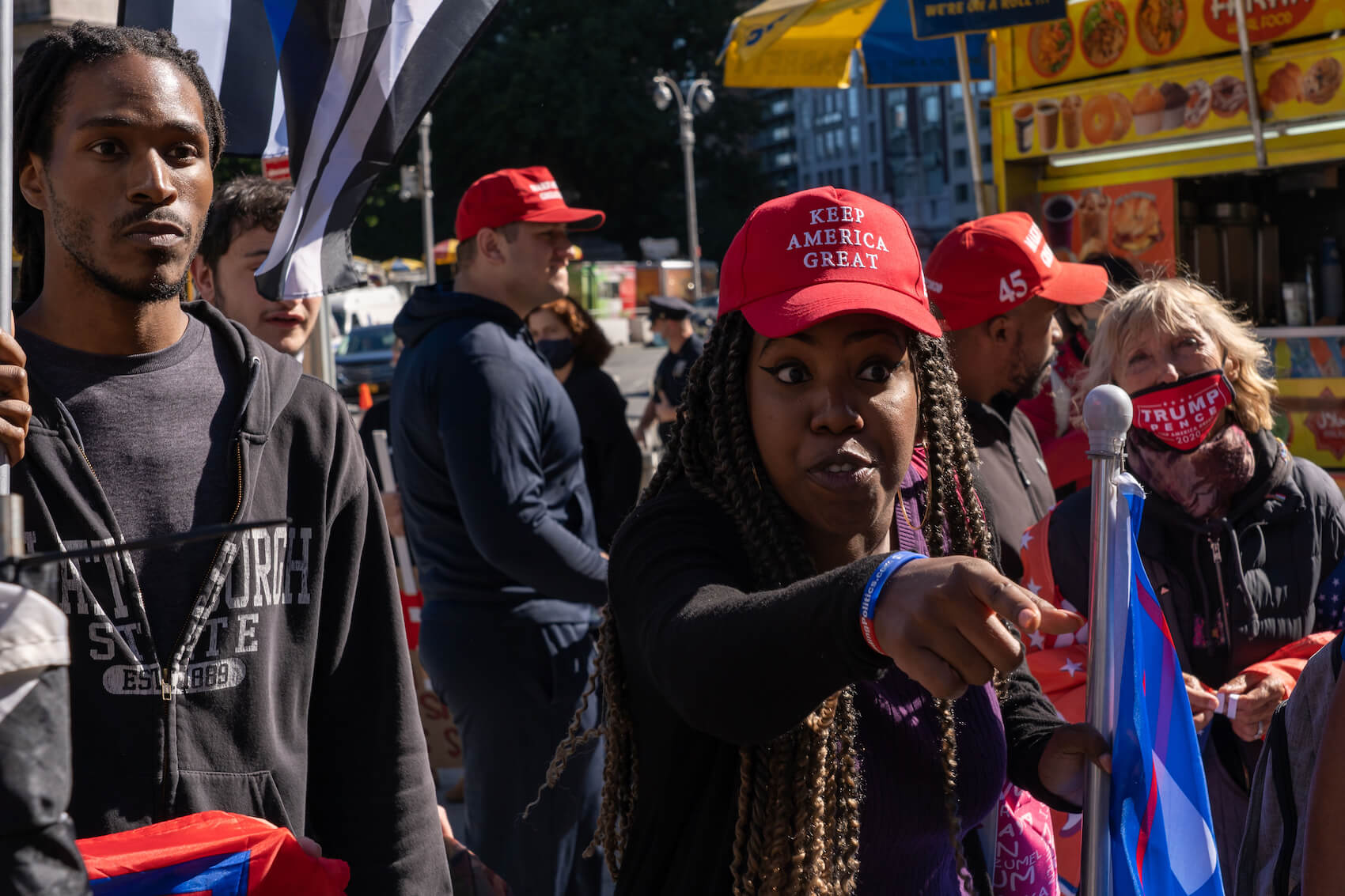
A Trump supporter engages in conversation with a pedestrian at Columbus Circle on October 17, 2020, in New York City. Photo: Ron Adar.
Your work with Merlin Chowkwanyun criticizes a discourse of racial disparity that carefully documents unequal outcomes but can leave their causal mechanisms underspecified. In the current political environment, how should researchers analyze racial disparities in wealth, health, policing, education, or incarceration without either minimizing racism or converting statistical disparities themselves into proof of a singular racial cause?
Professor Adolph Reed: The first step is always to interrogate whether what seems like a racial disparity is, in fact, a racial disparity. Because it could simply be a statistical artifact that conceals other dynamics producing the apparent unequal outcome, which don’t necessarily have anything to do with race.
In the COVID case, for instance, what initially appeared to be massive racial differences in both incidence and morbidity became much more clearly attributable to environmental factors as time went on and more data came in. These included the jobs people have, where they live, the transportation they depend on, and underlying tendencies or morbidity factors. These factors may be racial to the extent that a history of inequality positions some groups as structurally, on average, more vulnerable than others.
But part of our argument was to question what we gain, even in areas like health and criminal justice, including police killings, by defining these outcomes as definitively caused by racial disparity. The typical approach begins by identifying evidence of racial disparity, which often requires goosing the data, as it were, or inflecting its interpretation toward race as an abstraction. This also functions to justify the abstract claim that racism is a political force that needs to be dealt with. But there’s no causal mechanism there. That’s part of the problem.
I also find the emergence of the racial wealth gap as another significant part of this discourse especially fascinating. First of all, roughly 70 to 75 percent of so-called white wealth is controlled by the richest 10 percent of white people. Between 70 and 75 percent of so-called Black or Hispanic wealth is also controlled by the richest 10 percent of Black and Hispanic people. So, what does racial wealth mean in this context?
I’ve said in talks and even in my classes that we’re ideologically predisposed to believe, at least in the United States, that all Black people think with one brain and share every aspiration, and therefore what’s good for any one Black person is ipso facto good for all Black people, for one tortured reason or another.
So, I suggest stepping outside that predisposition. Let’s assume a white female nurse loses her job, has no independent source of funds, and is on the verge of being evicted from her apartment. Where is the pot of white wealth she gets to go to? Where is the teacup, presumably, from which she can get her rent money? When you think of it that way, the idea of racial wealth seems all the more preposterous. So, I’d say there is no such thing as Black wealth, white wealth, or any other group wealth. To that extent, there can’t be a racial wealth gap.
My good friend and colleague Walter Benn Michaels and I started saying, even before we knew each other and quite independently of each other, that when you hear the word race, you should think unicorn, because race is as real as unicorns are. Just as you can taxonomize races, you can taxonomize unicorns in any way you want because you’re not really constrained by having to approximate the empirical reality of the unicorn. Race is the same way. Let’s get that mixed-up stuff straight.
Universalism, Anti-Discrimination, and Working-Class Solidarity
Your work repeatedly returns to the possibility of solidaristic, universalist politics organized around shared material interests. Critics of this approach often argue that universal programs can reproduce racial inequalities unless they are explicitly designed around historically specific forms of disadvantage. How would you answer that objection? What would a genuinely multiracial democratic-socialist universalism look like institutionally rather than rhetorically?
Professor Adolph Reed: It seems to me, frankly, that this argument is a red herring. It’s simply a matter of committing to conscious and active anti-discrimination within the framework of universalist politics. The presumption of essential solidarity is what provides the basis for challenging prejudice, which is, after all, an attitude, as well as discriminatory practices. So, I think it’s a non-issue. It’s a smokescreen, much like the idea that there are people out there called class-first Marxists or whatever.
No Social Transformation Without an Organizational Base
Democratic Senator Bernie Sanders speaks at Presidential Rally at Springs Preserve Ampitheater evening before Nevada Caucus, Las Vegas, NV on February 21, 2020. Photo: Joseph Sohm.
The Sanders campaigns appeared, briefly, to revive mass interest in democratic socialism and decommodified public goods such as universal healthcare and free higher education. Yet the organizational breakthrough many supporters anticipated did not follow. Was Sanders primarily evidence that a latent constituency for social democracy exists in the United States, or did the movement around him reveal how weak the organizational infrastructure necessary for democratic socialism has become?
Professor Adolph Reed: I think both things are true. In the spirit of full disclosure, I worked on both Sanders campaigns. Also, much of the Sanders program actually came straight from the Labor Party in the US, founded in 1996, in which I was also deeply involved.
Very few people believed that Sanders actually had a chance to win either nomination, though some of us thought that if he could somehow win the nomination, he would have a better chance of winning the presidency than Hillary Clinton did. We’ll never know. But many of us also thought it was really just as well that he didn’t win the presidency, because you can’t elect your way to social transformation, at least not without an organizational base.
What we thought the campaigns could do, both times, was publicly dramatize the problem of intensifying inequality and insecurity in the US, show that it was possible to imagine confronting those problems, and stimulate institutionally grounded organizing that could generate another political formation capable of pushing the struggle forward. But I was disappointed.
During the first campaign, seven unions formed a Labor for Bernie group, and they acted in solidarity and coherently throughout the campaign. Interestingly, most of those unions had also been part of the Labor Party 20 years earlier. But for various reasons, some of which had to do with the debasement of American politics already underway, we came out of the 2016 presidential election and went straight into state elections, which were crucial to the unions’ concerns. So, the momentum generated through Bernie’s first campaign dissipated into politics as usual among the left trade unions. That’s one sense in which I say both of the possibilities you mentioned were correct.
Something similar happened the second time. We were a little closer to gaining traction after 2020. Then COVID hit, and the country immediately went into lockdown. I’d been working in South Carolina with my colleagues, trying to build on a grassroots base in support of single-payer healthcare, Medicare for All, on which we’d made a lot of headway during the campaign, notwithstanding the fact that Sanders was badly beaten in the primary. COVID tended to undercut those efforts.
But I’ll say this: I work with the Debs-Jones-Douglass Institute, a nonprofit we created with the Labor Party to undertake worker education, political education, cultural activities, and research on behalf of working-class politics. We’ve been doing this since the early 1990s, and the materials we produced in the 1990s, just a few years after the end of the Cold War, had to tiptoe around even using the word capitalism or being at all critical of it.
That environment has changed radically. I even had to apologize to my undergraduate students for a course I’m teaching this semester because it didn’t assume they were as attuned to criticisms of capitalism as they actually were. The majority of the students in this class are just second-year college students, albeit precocious ones.
One of the quips in the labor movement is that often the best organizer you have is the boss. That’s the case here. Thirty more years of going down the neoliberal road, especially since 2008, have made working people in general more skeptical and more open to critiques that begin by explaining how capitalism works and how those processes are connected to their insecurity.
We Must Stop the Bleeding Now Without Losing Sight of Our Long-Term Goals
And finally, Professor Reed, you have argued that there is “no effective substitute for an anti-capitalist left” and that confronting the far right requires the patient construction of a real working-class constituency rather than episodic mobilization around elections. Whatever happens on November 3, what should democratic socialists, trade unionists, and the broader left actually do the morning after the midterms? What would count, over the next five or ten years, as evidence that an organized political force capable of contesting both neoliberalism and the far right is genuinely being built?
Professor Adolph Reed: I have a pat answer to that: the same thing they did the morning before the election. Let me offer an illustration. During the 2020 campaign, the Sanders campaign sent me on a labor tour of South Carolina. South Carolina is probably the most reactionary state in America, though that changes from day to day, and perhaps often has the lowest trade union density in the entire country.
One of my stops was at a steelworkers’ union hall in Georgetown, South Carolina, on the coast. Among those in attendance were a couple of white rank-and-file members who had come to the hall on either a Saturday or Sunday morning. One of them was a younger guy, maybe 40 at most. He volunteered that he liked the Sanders economic program but couldn’t understand why the Democrats kept getting bogged down in what he called moral issues.
We had a little back-and-forth about what he meant, and it turned out he was referring to same-sex marriage and abortion. I was there as a supplicant, so I wasn’t going to be combative with him in any way. I tried a number of soft-pedaling approaches, like live and let live, or whatever, but nothing worked.
Finally, I asked, what’s more important to you? Having a good, secure job, good wages, benefits, access to desirable housing, adequate healthcare, the ability to provide your kids with a good education, and the opportunity to go back to school if you want? Or ensuring that no two people of the same sex can ever marry and that no woman can ever end an unwanted pregnancy? No, that didn’t convert him, but I didn’t expect it to, because I was just some fast-talking clown from Philadelphia. But it stopped him in his tracks for a few seconds.
I couldn’t help thinking: What if I were his brother-in-law, his kids’ soccer coach, his neighbor, or a co-worker on his shift, someone who had some standing in his eyes and could have this conversation with him repeatedly over time?
No, I don’t think the ideal outcome would necessarily be for him to become a militant advocate of reproductive rights. But at least over time, and on the basis of solidarity, he could come to accept that other people have different ways of seeing these issues, even though they’re committed to the same fundamental program of transforming society in the interests of working people. That’s where real tolerance of difference could come from.
You only get that through building a solidaristic movement over time. We haven’t had anything like that in the US, at least during my adult life. In fact, for most of my adult life, we haven’t even had the benefit of direct connections to people who knew it was possible to have a world like that and who had fought for that solidarity, both inside and outside the trade unions, in the period before World War II.
I may be old-fashioned, but I just don’t see any other way to do it. There’s no other way to get there. Now, that’s not to say that you shouldn’t pay attention to elections at all. I vote in every election.
There’s a phrase the Maoists used to use a long time ago: walking on two legs. You’ve got to be able to focus both on what needs to be done to stop the bleeding right now, to keep things from getting worse, and on where we’re trying to go in the long run. That’s my argument for everybody.
In an interview with ECPS, Professor Natália Sátyro argues that Brazil’s 2026 presidential election reflects a conflict extending far beyond the Lula–Flávio Bolsonaro runoff. At its center is a Bolsonarismo that, she says, “has already become bigger than Bolsonaro himself”—a durable movement combining neoconservative cultural politics, neoliberalism, anti-system mobilization, and competing notions of who deserves state protection. Professor Sátyro examines how family, religion, gender, race, class, and welfare policy have become intertwined in this struggle, contrasting Bolsonarismo’s “familialism by default” with a more state-centered social-protection model. Ultimately, she sees Brazil confronting two competing projects: “one very conservative and neoliberal, and the other more progressive and focused on social justice,” with profound implications for democracy, citizenship, and social rights.
Brazil’s 2026 presidential election has become more than a contest between President Lula and Flávio Bolsonaro. It has developed into a struggle over competing conceptions of democracy, citizenship, social protection, family, gender relations, and the role of the state. The first round placed Flávio Bolsonaro at 47 percent and Lula at 45.1 percent, sending the election to an October 25 runoff. Against this backdrop, Professor Natália Sátyro, Professor of Political Science in the Department of Political Science at the Federal University of Minas Gerais (UFMG), brings to the debate a distinctive perspective grounded in her scholarship on family policy, social protection, institutional change, state capacity, gender, and minority access to welfare.
At the center of Professor Sátyro’s analysis is the argument captured in the headline of this interview: “Bolsonarismo has already become bigger than Bolsonaro himself.” In her view, Bolsonarismo has developed into “a strong movement with neoconservative characteristics” and “a powerful neoliberal appeal,” combining anti-PT and anti-system politics with a differentiated conception of state protection for those considered deserving and undeserving. She argues that its electoral advance has come not only at the expense of the left but also of Brazil’s traditional mainstream right, making Bolsonarismo, in her words, “certainly here to stay.”
The durability of Bolsonarismo, Professor Sátyro suggests, cannot be understood solely through electoral competition. It is embedded in a broader cultural and institutional project in which the family occupies a central place. She describes an “explicit defense of a traditional patriarchal type of family” and emphasizes the political importance of evangelical networks in mobilizing support around family, gender, sexuality, education, and moral order. For Professor Sátyro, the cleavage is therefore not simply between cultural conservatism and redistribution. “What is at stake today,” she argues, “is democracy versus something non-democratic
Her analysis also brings welfare-state politics into this broader conflict. Professor Sátyro characterizes the Bolsonaro project as one of “familialism by default,” in which “the family and the market should be the pillars of social protection in Brazil.” This model, she argues, reinforces gendered caregiving roles and deepens class inequalities because affluent families can purchase care in the market while poorer families depend more heavily on extended family and community networks.
Ultimately, Professor Sátyro sees Brazil as confronting two competing political projects: “one very conservative and neoliberal, and the other more progressive and focused on social justice.” The runoff, therefore, is not merely about presidential succession. It raises a larger question about what kind of citizenship, welfare regime, social order, and democratic state Brazil will seek to consolidate in the years ahead.
MEP Hanna Gedin argues that the EU’s credibility as a defender of democracy, human rights, and international law is being weakened by political double standards and the growing normalization of radical-right ideas. In this ECPS interview, she warns that “the EU is losing its voice when it comes to upholding international law” and points to inconsistencies in migration policy and relations with Israel and Turkey. Gedin also urges the European left not to adapt to the far right, but to build its own agenda around inequality, housing, energy, and the cost of living. “You need to have your own agenda,” she says, and to “make life a good life without adapting to the far right and their narrative.”
In this wide-ranging interview with the European Center for Populism Studies (ECPS), Hanna Gedin, Member of the European Parliament for Sweden’s Vänsterpartiet (Left Party, V) and Vice-Chair of The Left Group, reflects on Sweden’s post-election political deadlock, the normalization of radical-right ideas in European policymaking, the erosion of international law, and the strategic dilemmas facing the democratic left. Gedin, who works on the internal market, industry, energy, women’s rights, and gender equality, situates these questions within a broader critique of inequality, restrictive migration policy, and the weakening of Europe’s normative credibility.
The interview begins with the struggle to translate Sweden’s new parliamentary majority into a viable center-left government. Gedin rejects the idea that Vänsterpartiet should once again support a government from outside, insisting that “if our votes are needed, if our mandates are needed, of course we should be in the government.” She argues that the Center Party (C) “needs to choose,” because “there is no middle way.” At the same time, she acknowledges the deep economic divide between the two parties but maintains that cooperation remains possible on issues ranging from feminism and climate to international law and support for communities outside major cities.
A central theme of Gedin’s remarks is the extent to which the radical right has reshaped mainstream political agendas. She argues that Swedish parties have been “adapting and moving closer to the Sweden Democrats,” while politics has increasingly shifted away from “bread and butter” concerns toward culture-war issues. For Gedin, the answer is not imitation but political differentiation: “For the left, it’s really important not to adapt.” Instead, she insists, “You need to have your own agenda,” centered on the cost of living, inequality, housing, and material security.
This concern extends to migration policy at both Swedish and European levels. Gedin describes a “shift and an adaptation to the radical right” in EU migration politics and recalls far right and right-wing MEPs cheering “Send them back, send them back” during a vote on return hubs. Yet she also points to Sweden’s debate over teenage deportations as evidence that public attitudes can shift when abstract migration categories acquire “names and faces.”
The interview’s sharpest normative critique concerns international law. Gedin argues that “the EU is losing its voice when it comes to upholding international law” and warns of “a complete erosion of international law” driven by double standards. She contrasts the EU’s firm response to Russia’s war against Ukraine with what she sees as a much weaker approach toward Israel, arguing that such inconsistency undermines European credibility globally.
Ultimately, Gedin presents a distinctly materialist response to the rise of the far right. She argues that the left must make politics concrete: reduce inequality, address rents and energy costs, tax the very rich, and “make life a good life without adapting to the far right and their narrative.”
MEP Hanna Gedin. Photo: Umit Vurel.
Here is our interview with MEP Hanna Gedin, edited lightly to enhance clarity, readability, and overall flow for publication.
The Center Party Needs to Choose
Ms. Gedin, welcome. Let me begin with the tension between Vänsterpartiet (Left Party) and the Center Party and the prospects for forming a new red-green government. Sweden’s 2026 election produced a parliamentary majority for S, V, C, and MP, but that majority has so far proved difficult to turn into a government. Vänsterpartiet (V) insists that it must be part of the next government, while the Center Party (C) still refuses to accept V in government. Magdalena Andersson has now received a second opportunity to form an administration, and the four parties have at least begun talking together. Where, concretely, do you see a way out of this deadlock?
MEP Hanna Gedin: I’m not stressed or concerned because we have had this situation before, during the 2018 election, and it took a couple of months before we had a government. My party’s position is quite normal. If they want our votes, if they want our support for the government, of course we should, like every other party, be in the government. That’s a very normal position.
The Center Party has not really done its homework because they have said absolutely no to the Sweden Democrats, while at the same time they say absolutely no to us, and then there is no majority. So, they need to choose. There is no possibility in the middle, as they seem to think.
They have also been very clear and vocal in saying that Magdalena Andersson is their prime minister candidate, just as we have been. Then they need to show that and to choose. There is no middle way, and in the end, we will see this government forming.
V Wants a Stable Center-Left Government
The Center Party says it can support Magdalena Andersson as prime minister but draws a red line against Vänsterpartiet entering government. Why should the Left accept supporting a government from outside after an election in which its votes are indispensable to the new majority? And is there any compromise—cabinet participation, a formal cooperation agreement, budget influence—that V could realistically accept?
MEP Hanna Gedin: I’m not part of the negotiating team; I must start by saying that. But our demand is clear. We have been clear for many years now: if our votes are needed, if our mandates (seats) are needed, of course we should be in the government. We can’t support the government from the outside.
We have seen what that did before, in the 2018 election, when we were supposed to support the government from the outside. It became a very weak government. They did not have a majority for their budgets, and in the end, when they proposed a marketisation of the rent system in Sweden, we actually had to vote the government down. We don’t want that situation. We want a stable center-left government. This is our position.
The Ideological Divide Between V and C
Behind the dispute over cabinet seats lies a much deeper ideological conflict. The Center Party remains economically liberal, while Vänsterpartiet wants stronger welfare provision, greater redistribution, public investment, and tighter constraints on market power. If a red-green government is eventually formed, which of these substantive economic disagreements could become more difficult than the present argument over who gets to sit in government?
MEP Hanna Gedin: It is true that the Center Party and the Left Party have quite opposite economic politics. I would even say that the Center Party is quite extreme when it comes to economic politics. However, I have understood for several years now that they might be needed in the government, and we might sometimes have to undertake some very hard negotiations and find some kind of solution on these issues.
We do believe it’s possible, and we also think that we have a lot of issues that unite us—for example, when it comes to support for communities outside the big cities, feminism, international law, and climate. So, we do think that there are a lot of issues that we have in common.
The SD Is Now Seen as an Establishment Party
Sweden Democrats’ Square Meeting in Umeå. Jimmie Åkesson speaks to the people on the city square where opposition left-wingers have formed a chain and protest in Umeå, Sweden on August 14, 2018. Photo: Shutterstock.
Vänsterpartiet entered the election promising to help remove a government whose policies were heavily dependent on the Sweden Democrats. If the parties that won the parliamentary majority cannot agree on a government, is there a danger that the post-election dispute itself strengthens SD’s argument that the established parties are incapable of governing—and gives the radical right another opening?
MEP Hanna Gedin: What we saw in the Swedish election was that the Sweden Democrats, for the first time since they entered the National Assembly, actually decreased. They had quite a bad election, and this is, in a way, due to the fact that they are now seen as an establishment party. Even though they have not been part of the Tidö government, they have been the biggest party supporting this government.
When it comes to economic issues, they have shown that they are a right-wing party. They support the economic politics of the right-wing parties. So, I don’t think they have a case for saying that they are anything other than an established party nowadays.
I also think that the election results, where our party, the Swedish Left Party, had a very good election and where we can see that the left side actually got stronger, show that people want something else than the politics we have seen from the Tidö government. And I do think that we will be able to form a government.
Mainstream Parties Moving Toward the Sweden Democrats
You argued earlier that the Sweden Democrats, even without formally entering government, exercised enormous influence over migration, crime, and ethnicity, and that ideas once considered politically unthinkable had moved into government policy. After four years of Tidö government, how deeply has SD changed the political center of gravity in Sweden? Is the larger story now less about SD itself than about mainstream parties adopting parts of its agenda?
MEP Hanna Gedin: We have seen in Sweden a lot of parties adapting and moving closer to the Sweden Democrats, and that is something we see in many countries. It’s extremely dangerous. It’s dangerous when politics focuses on things that are not bread and butter. It’s not about the cost of living or what people really feel in everyday life, but about culture-war issues, and what that has done to society in Sweden is very dangerous.
During the Tidö government, the government put forward, and we adopted, snitch laws, so you should snitch on your neighbors or coworkers if they come from a different country. This is quite extreme. We have seen it even when it comes to criminal issues and so on—this kind of obsession that if you are from another country, you should go away, you should go out of Sweden. It’s also linked to the notion of criminality being colored, in a way. It has been quite an extreme development in Sweden.
What the election showed is that people do not want this kind of policy. During the election campaign, we talked about bread and butter. We talked about people’s cost of living. We talked about the skyrocketing rise in rent, for example. We did canvass. We knocked on almost half a million doors, and when we met people, they were not talking about snitch laws or the need to be tougher on criminals. They were talking about things that affected them in their ordinary lives.
A lot of people also said that. I met a woman who said, “You know, I have stomachache. They don’t want me here. They want to throw me out. What this government has done to me and my neighbors is horrible, and I can’t vote for them. I will vote for you.”
So, in a way, it has affected us. But I do think that what we have seen during these four years—this obsession with people of a different color of skin, or criminals, and so on—is not what people want. I really feel a bit like it’s easier to breathe now. It’s like opening a window, and I think a lot of people in Sweden agree with me.
And I think that’s also very important: the first thing these four parties did, even before forming a government, was to stop the deportation of young people that was planned under the Tidö government. We stopped it.
How the Left Should Confront the Far Right
You have described the far right as particularly effective at finding scapegoats, offering simple answers to complex problems, and forcing its issues to the center of public debate. Across Europe, far-right, radical-right, and populist radical-right parties are increasingly shaping policy even where they are not governing. Why has the democratic left struggled to set the agenda with the same effectiveness—and what has it failed to understand about voters attracted to these parties?
MEP Hanna Gedin: In politics, it’s easier to make people vote for something they are afraid of than for something they hope for. If we have been living for several years with this repressive politics and the right-wing agenda, people also forget what solidarity is and what equality is, and you need to be reminded of it sometimes.
But for the left, it’s really important not to adapt, not to only talk about the Sweden Democrats or the right, the extremist parties, and not to adapt to them. What the Social Democrats did in Sweden, mainly during the election campaign—talking about the Sweden Democrats—did not work. You need to have your own agenda, and you need to put forward reforms about the cost of living, for example. That was what we did, and we were rewarded by the election results in Sweden.
Gender, Migration, and the Far Right
Celebrating Sweden’s National Day in Norrköping, Sweden, on June 6, 2014. Immigrants and native Swedes participate together in National Day celebrations. Sweden’s National Day is an official public holiday. Photo: Dreamstime.
The far right increasingly presents itself not only as anti-immigration but as the defender of a particular European cultural order, often combining nationalism with opposition to abortion rights, LGBTQ rights, and gender equality. As an MEP working on women’s rights and gender equality, do you see these struggles as separate policy battles, or as parts of a broader political project to redefine who belongs and whose rights are considered legitimate?
MEP Hanna Gedin: We see these attacks every day in the European Parliament, and you can see them in a lot of countries as well. The struggles are connected, and you can’t just take one struggle; you need to see the fight as a common fight.
In this Parliament, we see attacks from the right-wing parties on trans people and on migrants, for example. We don’t yet see the same number of attacks on abortion rights, but I’m sure it will come if they are successful.
Stopping Teenage Deportations Is a Very Important Step
You recently raised the issue of what you called Sweden’s “teenage deportations”—young people who have grown up in Sweden but face removal when they turn 18. Sweden has moved toward some of Europe’s most restrictive migration policies. If a new Social Democratic-led government takes office, what specific changes would V demand on asylum, deportation, and family reunification, and which policies introduced during the Tidö period should be reversed first?
MEP Hanna Gedin: I’m not a parliamentarian in Sweden, I work mainly with EU policies. But I think it’s very interesting that, in 2015, something changed in Sweden. It was when there was a big migration to Sweden, and we started having these repressive laws.
During the last government, the Tidö government, something changed last year when we first had a mayor in the city of Jokkmokk (a small municipality and town in Norrbotten County, northern Sweden, in Swedish Lapland / S.G.) saying, “I don’t want you to deport my people living in my city,” and a lot of mayors started saying the same: “We don’t accept this kind of very repressive policy.”
Then we had the teenage deportations. As you said, we saw many deportations of teenagers who spoke perfectly good Swedish, who had grown up in Sweden, and who were deported from their families. And the debate started shifting. Instead of saying, “Yes, people should go out, we should send them out, we should have more oppressive laws,” people were saying, “These are my neighbors, these are my coworkers, these are my friends.” They had names and faces, and the debate changed and shifted.
The first thing the four parties—the Swedish Left Party, the Centre Party, the Social Democrats, and the Green Party in Sweden—have been doing, even though we have not yet formed the government, is to stop these deportations. I think this is a very important step.
EU Migration Policy and the Radical Right
Berlaymont Building, headquarters of the European Commission, Brussels, Belgium. Constructed between 1963 and 1969, the building has become the iconic symbol of the European Commission, the executive branch of the European Union. Photo: Wiktor Wojtas / Dreamstime.
At EU level, the Migration and Asylum Pact entered into application in June, while the new Return Regulation creates faster return procedures and opens the possibility of “return hubs” outside the Union. Governments are now discussing even tougher measures. Are we witnessing the normalization at EU level of ideas that only a few years ago were associated primarily with the radical right? And where should the legal and moral limits of European migration policy be drawn?
MEP Hanna Gedin: Yes, we are witnessing a shift and an adaptation to the radical right when it comes to migration, even at the EU level. I was present in the chamber when the return hubs were voted on, and what happened was that the radical right stood up and cheered together with the right-wing parties when they voted this through. They cheered and screamed, “Send them back, send them back.” This would not have been possible a couple of years ago.
This is a situation that we’re actually seeing, and that is why it’s quite hopeful to see what happened in Sweden and how the debate shifted with the teenagers who were deported. I do hope that we will see the same shift in Europe as well.
I also think you need to see the positive things happening in Europe when it comes to the Swedish election, but also the election in Berlin, where you had a very big left-wing party; the election in Copenhagen, a city close to where I live, where the biggest party was the Left Party; and Mamdani in New York. You do have these positive things happening as well.
You have also criticized the prolonged border controls between Sweden and Denmark and warned about allegations of racial profiling. Governments increasingly justify exceptional border measures through migration, crime, or national-security arguments. At what point does a supposedly temporary security measure become a permanent restriction on free movement and equal treatment within the EU?
MEP Hanna Gedin: I live in Malmö, a city close to Denmark. I take the train between Denmark and Sweden almost every week, and there is still this border control that was put in place in 2015. I would say that this is a permanent restriction. It is not allowed according to EU law, and it still goes on and on and on. So, yes, this is a permanent restriction, and that should not be allowed.
The EU Should Show Some Backbone
The EU has traditionally presented itself internationally as a normative power built around democracy, the rule of law, and human rights. Yet critics increasingly point to restrictive migration policies, cooperation with authoritarian governments to stop migration, and inconsistency in the application of international law. Is the EU losing credibility as a normative role model—and how much of that erosion reflects the growing influence of the populist and radical right on mainstream European policy?
MEP Hanna Gedin: Absolutely, the EU is losing its voice when it comes to upholding international law. It’s very important to see that there have always been double standards, in a way, when it comes to the EU, because a lot of countries are still colonial powers.
But now, when you can see the very correct way of handling Russia’s war of aggression in Ukraine—adopting sanction packages and being tough on Russia—that is good. Why do we see this double standard when it comes to Israel? I’m absolutely sure that people see this all around the world, and countries not being part of the EU are then saying, “If the EU does this, why should we adhere to international law?”
We see a complete erosion of international law now, and with the sanctions from the US against the International Criminal Court (ICC), I think the EU should immediately activate the Blocking Statute, show some backbone, and not be as cowardly as we have seen.
One Must Be Critical Toward NATO While Not Being Naive
NATO headquarters and monument in Brussels, Belgium, the political and administrative center of the North Atlantic Alliance. Photo: Dreamstime.
On Ukraine, you have been unequivocal that Russia’s invasion must be resisted, that Ukraine deserves continued support, and that Europe should stop financing Russia through energy purchases. At the same time, Vänsterpartiet historically opposed Swedish NATO membership. How does the European left build a security policy that is credible against Russian aggression without accepting an open-ended militarization of Europe or abandoning its traditional critique of NATO?
MEP Hanna Gedin: I think one must be able to be critical toward NATO while, at the same time, not being naive. Of course, we live in a very dangerous world, and we need cooperation between countries when it comes to defending ourselves.
My party is not against the augmentation that we have seen in Sweden when it comes to military spending. This should not be taken from schools or hospitals and so on, but we want to impose a wealth tax instead. We also want cooperation between countries, the Nordic countries, and parts of the EU.
I don’t think it’s a smart way to militarize the EU as a side project to NATO and then increase military spending there as well. So, one must be able not to be naive while still being able to criticize the notion of building defense on nuclear bombs and so on. You must be able to do both.
Gaza, Israel, and International Law
You have been one of the European Parliament’s most outspoken critics of Israel’s conduct in Gaza and have called for suspension of the EU–Israel trade relationship, sanctions, and support for international accountability. You and Jonas Sjöstedt were also denied entry by Israel in August. What did that episode tell you about Europe’s leverage over Israel—and why, in your view, has the EU struggled to translate its language of international law into a common policy toward Gaza and the West Bank?
MEP Hanna Gedin: I think that the Swedish government and the EU have been too weak when it comes to Israel. As I said earlier, you need to uphold international law wherever you see crimes against humanity, whether it comes to what happens in Ukraine or what happens in Gaza.
What we see in Gaza is actually a genocide, and you can’t just wait for the ICC or the International Court of Justice (ICJ) to say, “This is a genocide.” You have a responsibility, as countries and as politicians, to prevent genocide, and this has not been done at the EU level.
I find it quite appalling that the EU keeps trading with Israel as if nothing has happened and that there are no consequences when you breach international law. Benjamin Netanyahu has an arrest warrant against him. This should, of course, be reflected in EU relations toward Israel.
Economic Cooperation with Turkey Makes the EU Quite Weak on Human Rights
Women and LGBTQ+ activists in İzmir, Turkey, rally for the International Day for the Elimination of Violence Against Women, highlighting femicide and the withdrawal from the Istanbul Convention. Photo: Idil Toffolo.
Your parliamentary work has also addressed repression in Iran, women and girls under Taliban rule in Afghanistan, and the imprisonment of journalists and opposition figures in Turkey. How can the EU demand democratic standards from Iran, Afghanistan, or Turkey while avoiding accusations of selectivity when its economic, migration, or security interests lead it to cooperate with governments accused of serious rights violations?
MEP Hanna Gedin: This is also a problem with double standards. The EU’s economic cooperation with Turkey when it comes to migration, of course, makes the EU quite weak in also pushing for the upholding of human rights in Turkey. So, this is a problem with EU politics that you can see toward many countries—being hijacked when it comes to how to handle these countries.
Focusing on the Cost of Living Is the Only Way
You have repeatedly argued that Europe’s market-liberal framework restricts the public investment needed for the green transition, while rising rents, electricity prices, and living costs have intensified inequality. Radical-right parties have often converted economic insecurity into cultural and anti-migrant grievances. Does the left have to win the material argument—on housing, wages, energy, and welfare—before it can successfully challenge the far right’s politics of identity and resentment?
MEP Hanna Gedin: I think this is the only way, and we saw it in the Swedish election as well. My party, the Swedish Left Party, focused mainly on the cost of living, on issues related to bread and butter, and that is what made us the party that gained the most. That was the biggest success for us. We see it when it comes to EU policies as well. This right-wing environment that we’re living in at the EU level and in many countries, which focuses on cultural issues, makes people poor. You need to be able to focus on the cost of living instead.
In Sweden, during these last years, we have seen an explosion of inequality. We have 46 people in Sweden who own as much as eight million Swedish people, and we have 700,000 poor people in Sweden. The number of poor people has doubled in just a couple of years. This is the reality people are living in, and, of course, for the left, it is about focusing on those real issues—on how to make life nice and good and possible to live, and on reducing inequalities.
Rebuilding a Credible European Left
Finally, the European left faces a strategic dilemma. It wants to confront the radical right without simply reproducing its polarizing style, while also distinguishing itself from centrist parties associated with austerity, market liberalism, and restrictive migration policies. What would a credible European left project look like today—one capable of rebuilding working-class support, defending migrants and minorities, advancing gender equality and climate justice, and at the same time persuading voters who have drifted toward populist and radical-right parties that democratic politics can still materially improve their lives?
MEP Hanna Gedin: I think you need to be very concrete about what you want to change in society. When we talk about taxing the very rich, we get a very good response. For example, we see rising inequalities everywhere, and we need to focus on reducing those inequalities by also focusing on the cost of living, on what people pay in rent, on rising electricity bills, and on the fact that a lot of people are struggling to pay for their food. So, you need to be able to make life a good life without adapting to the far right and their narrative.
MEP Brando Benifei warns that Europe’s struggle for technological sovereignty is inseparable from the defense of democracy. In this ECPS interview, he argues that the EU must strengthen its technological capacity while preserving its regulatory autonomy against external pressure and concentrated corporate power. Benifei stresses that “regulations are decided in Europe, by Europeans, for Europeans” and warns that the extreme right has moved closer to “techno-oligarchs,” forging “a form of alliance and mutual support.” He describes this convergence as “an alliance of interests that is threatening our democracies.” Beyond regulation, Benifei calls for “a democratic reaction” and a “new social contract” capable of making European societies “more equal and freer.”
In an era in which technological power, geopolitical rivalry, and democratic vulnerability are increasingly intertwined, the European Union faces a double challenge: strengthening its strategic autonomy while defending the institutional and normative foundations of liberal democracy. Few policy areas illustrate this convergence more clearly than artificial intelligence, digital regulation, platform governance, and transatlantic relations. In this wide-ranging interview with the European Center for Populism Studies (ECPS), MEP Brando Benifei, Chair of the European Parliament’s Delegation for Relations with the United States and a central parliamentary figure in the development of the EU Artificial Intelligence Act, reflects on Europe’s technological dependencies, regulatory sovereignty, Big Tech power, disinformation, and the growing political relationship between digital oligarchies and the popuplist radical right.
At the center of Benifei’s analysis is the argument that Europe’s struggle for sovereignty cannot be reduced to economic competitiveness or technological capacity alone. It also concerns who has the power to establish the rules governing digital societies. He insists that Europe must develop its own technological capabilities while preserving its regulatory autonomy, arguing that “regulations are decided in Europe, by Europeans, for Europeans” and describing this principle as “an absolute red line.” At the same time, he warns that Europe cannot remain merely a regulatory power without developing the technological infrastructure necessary to sustain that role. As he puts it, the EU “can’t remain a regulatory reference if it doesn’t also develop the technological power that is needed today.”
The interview becomes particularly significant when Benifei turns to the political consequences of concentrated technological power. He argues that the rise of the extreme right is increasingly connected to powerful actors within the technology sector. “The extreme right has been getting closer and closer to these techno-oligarchs,” he says, adding that they have “forged a form of alliance and mutual support.” For Benifei, this convergence now constitutes “an alliance of interests that is threatening our democracies.”
His response is not limited to regulation. Benifei calls for what he describes as “a democratic reaction” and “the proposal of a new social contract” capable of making societies “more equal and freer.” In his account, inequality and declining freedoms can provide “fertile ground” for an alliance between the extreme right and techno-oligarchs and for what he characterizes as a “hateful and democracy-demolishing approach.”
Against this backdrop, the conversation explores the broader implications of AI governance, algorithmic amplification, digital enforcement, disinformation, transatlantic pressure, and European sovereignty. Benifei’s remarks ultimately frame the contemporary digital struggle not merely as a debate over innovation or regulation, but as a deeper contest over democratic authority, economic power, and the institutional capacity of Europe to determine its own political and technological future.
MEP Brando Benifei is the Chair of the European Parliament’s Delegation for Relations with the United States and a central parliamentary figure in the development of the EU Artificial Intelligence Act. Photo: Umit Vurel.
Here is our interview with MEP Brando Benifei, edited lightly to enhance clarity, readability, and overall flow for publication.
Europe Needs to Have a More United Voice
Brando Benifei, welcome! As Chair of the European Parliament’s Delegation for Relations with the United States, you have repeatedly defended a strong transatlantic relationship, while also arguing that Europe must become more capable of defending its own interests. Following renewed US pressure on trade, technology, defense, and digital regulation, has the transatlantic relationship entered a fundamentally more transactional phase? And what would a genuinely more sovereign—but still cooperative—European approach to the United States looks like?
MEP Brando Benifei: I think it’s important to consider that the relationship between the European Union and the United States is based on strong economic integration that has been developing over decades, but also on security, cultural exchange, and social interconnections. In fact, the economic interchange is the biggest between two areas of the world. The EU and the US have not only trade, but also a direct economic presence of EU companies in the US and US companies in the EU. That goes beyond any other similar comparison we could make between the EU and other parts of the world, or the US and other parts of the world, even compared with neighboring South America.
So, this transatlantic relationship is rooted in values and history, but also in economic interests at the moment. We always need to consider that when we look at what has been happening in these last months, where objectively the European Union has been pushed by the US administration to accept certain conditions, for example on trade, based on pressure and on profiting from the fact that the EU is not very united.
The truth is that the European Union is made up of countries that have been divided on issues such as different economic interests. So, the US was able to profit from these divisions to actually push for a relatively punitive regime for trade, which, in the end, was stabilized and ameliorated. It’s not, in the end, what was initially foreseen by President Trump, and it’s something that is viable today, but it’s the result of these pressures. We have also seen pressures regarding environmental legislation and digital legislation.
My point is very clear: we need this relationship. It’s very important that we work in the transatlantic context for various reasons. I tried to mention a few, but we need to demand respect. We need to have a more united voice. The United States doesn’t speak with the voices of its various individual states; it speaks with the federal voice of the United States, the federal administration. The EU should find its own voice, which today is not there.
This is crucial to having a healthier transatlantic relationship, based on respect and equal footing, which today is being put under pressure and called into question by the attitude of President Trump toward the Europeans.
The So-Called Kill Switch Has Already Been Pressed
You have argued that US restrictions on advanced AI chips amount to a direct challenge to Europe’s economic resilience and technological sovereignty, and that dependence on semiconductors, cloud infrastructure, computing power, and critical raw materials can become geopolitical leverage. Does Europe now need to treat AI infrastructure in much the same way it treats energy or defense—as a strategic capability that cannot safely remain overwhelmingly dependent on external powers?
MEP Brando Benifei:It’s crucial that we build more sovereignty on these topics because we have already seen that the so-called kill switch has already been pressed. In fact, the US has restricted the use of advanced models for cybersecurity objectives to the European Union from one day to another, and this was a clear challenge to our sovereignty and our capabilities because we were depending on systems that revealed themselves to be in the hands of another political actor that could really stop us from using them at any moment.
So, today technological sovereignty is one of the crucial points in how we can build a more autonomous EU, which can guarantee the future of its citizens in terms of security and economic prosperity. But this also means using resources today to develop this capability, which means deciding to devote some expenditure to it.
That’s why I support the idea of having a common plan of investment like the one we had after Covid. That’s also the idea in the Draghi report that has not been picked up by the member states, but that’s a very big mistake because we need that leverage today to invest in accelerating innovation for sovereignty and to guarantee that the EU has its own alternatives.
This doesn’t mean we need autarky or protectionism. It means we need the European Union to always be able to have alternatives when it becomes unviable to continue with the existing technological solutions.
Photo: Bustiuc Dumitru / Dreamstime.
Europe Can’t Remain a Regulatory Reference Without Technological Power
In your 2026 report on AI and EU trade, you argue that Europe must combine competitiveness, openness, and strategic autonomy rather than relying on regulation alone. Yet the EU still trails the United States and China in computing capacity, investment, cloud infrastructure, and AI scale. Can Europe realistically remain a global regulatory power if it does not also become a substantially stronger technological and industrial power?
MEP Brando Benifei:My opinion is that it can’t. It can’t remain a regulatory reference if it doesn’t also develop the technological power that is needed today, and this is a crucial point on which a lot of our efforts should be concentrated. In fact, the European Commission has taken some steps with the proposal of a digital sovereignty package, which was something that we could not imagine before. It’s the result of a new situation, and this package addresses important issues like semiconductors, cloud infrastructure, and open-source models. So, it goes deep into our present dependencies and tries to build an alternative.
But to pursue this agenda, we need political resolve. We need the willingness to actually go down a road that will create some tension with the US, with China, and with other powers. We need to know that. We need to be ready to sustain that through dialogue, obviously keeping a door open for discussion with all our counterparts, but having a clear objective of creating more European autonomy and sovereignty.
This is something that our citizens also want. If you look at the polling and surveys, our citizens are saying, “We want a more sovereign Europe. We do not want to depend on foreign technology.” It’s important that our governments listen to our citizens, who are saying this very clearly.
Regulatory Sovereignty as a Red Line
You have criticized US tariff pressure as potentially targeting not only European economic interests but also the regulatory and social model itself. Where should the EU draw the line between legitimate transatlantic negotiation and external pressure to dilute European rules on digital markets, food safety, environmental protection, data, or fundamental rights? Can regulatory sovereignty become one of the defining fault lines in future EU-US relations?
MEP Brando Benifei: Maintaining the principle that regulations are decided in Europe, by Europeans, for Europeans is an absolute red line. We cannot negotiate on legislation that is based on democratic processes. This is something that the US must understand, and I have to say that they have understood it at this moment. They knew that this attempt—to actually convince us to change legislation based only on their pressure—would be difficult for them.
We need to look realistically at the content of these pressures because, in some cases, they reflect existing dynamics in the European political scenario. I give you an example: the pressures to change some of the EU’s environmental legislation were, in fact, already sustained by legitimate political decisions inside the EU by political actors. So, this is a topic where we have seen some things changing in a way that the US liked, but it was, in fact, based on a political positioning inside the EU that was not related to US pressure.
On other topics, like digital legislation, however, there are clearly greater differences between what the US is asking of the EU and what the EU is ready to do based on its regulatory autonomy. This must be understood, this must be accepted, and we need to keep this as a clear red line because we cannot negotiate on our regulatory autonomy.
The Brussels Effect, at Least at the Company Level, Is Already Happening
European Parliament offices and European flags in Brussels, Belgium on July 20, 2020. Photo: Lena Wurm.
You were one of the central parliamentary architects of the AI Act, and you continue to argue that Europe should promote a human-centric, risk-based model internationally. After several years of implementation debates, do you still believe that the so-called “Brussels effect” can shape global AI governance, or are divergent US, Chinese, and other models making regulatory convergence increasingly unrealistic?
MEP Brando Benifei: Clearly, regulatory divergence is an obstacle to this kind of convergence through the so-called Brussels effect. But let’s look at the data. We have researchers from important European foundations who have conducted scientifically sound surveys with American companies, showing that the AI Act has been taken as a reference point for voluntary compliance schemes, including by companies operating only inside the US.
So, the Brussels effect, at least at the company level, is already happening. That’s one of the dimensions of the Brussels effect, because it’s not only governments taking the same stances, but also companies voluntarily adopting ways of acting that reflect legislation that is not present in their internal jurisdiction but is, in fact, taken from the EU.
The decision could be linked to various reasons: operating in a global market or wanting to have easy-to-apply schemes that can be replicated globally. In fact, this is happening with US companies developing and deploying AI. The data are clear, and this shows that our approach has not been very bureaucratic or extremely complex, but rather quite company friendly.
I want to underline that a significant role for self-assessment has been built into the regulatory framework of the AI Act. Companies are entrusted with responsibility, but they are not asked to undergo a lot of third-party assessments, which is instead the case for other product-safety legislation, because we wanted to maintain some flexibility in this AI legislation, considering the quickly changing technological scenario.
So, I see some Brussels effect happening. Obviously, we are also looking more specifically—this is a slower process—at the adoption of similar legislation in other parts of the world. This is also happening. There are many parts of the world that, in recent months, have adopted legislation on AI content transparency, copyright protection, and countering AI abuse for mass surveillance that has been taken quite directly from the EU AI Act.
The AI Act and European Competitiveness
You have warned against presenting deregulation as the principal route to European competitiveness, arguing instead for investment, industrial policy, stronger European AI institutions, and better support for start-ups and Small and Medium-sized Enterprises (SMEs). How do you respond to the growing political argument that the AI Act and other digital regulations have become a competitive burden that Europe can no longer afford?
MEP Brando Benifei: In my opinion, we should listen to those who develop AI in Europe, because otherwise we are talking in a very abstract way. Those who develop AI in Europe tell us what their problems are and why they are not growing enough. One issue is access to capital, so we need an integrated capital market where more risk capital is flowing. They also face a lack of access to computational infrastructure. We are dealing with that through AI factories and AI gigafactories, but we need to accelerate.
They also say they have an issue with regulatory complexity, but this relates mainly to data legislation—the use of data—which is not linked to the AI Act. In general, they recognize that the AI Act protects them from abuses by bigger companies, often non-European ones, that do not want to share information and want to avoid transparency.
In fact, the AI Act is generally supported by those companies. When they look at the regulatory burden, they are more concerned about the overall amount of legislation, and more specifically about data, where they want further reform. This is what we are also working on at the EU level at the moment: simplifying data legislation.
They also want clearer, more harmonized enforcement. The problem today with the EU is very fragmented enforcement, where we still have rules that are too dependent on national implementation. This is something that I see as one of the crucial priorities.
And I don’t understand how we can sustain the argument that the problem would be the AI Act, considering that the AI Act applies to all companies that operate in Europe and sell products in Europe. This means that it is overwhelmingly more applicable to non-European companies, which make up the majority of those operating in the EU today on AI matters.
Open-Source AI and Digital Sovereignty
Image: Wrightstudio / Dreamstime.
You have described open-source AI as a “structural response” to the concentration of compute, cloud, and data in a handful of firms. Could open-source AI become a genuine pillar of European digital sovereignty, or is Europe still too dependent on non-European hardware, cloud providers, foundation models, and capital for open-source ecosystems alone to materially change the balance of power?
MEP Brando Benifei: We are still too dependent on these closed systems, and in fact, we need to build a better balance with open-source and open-weights models. This is something that is now a focus, and the EU’s open-source strategy will also deal with that. We are working on this, starting from the European Commission’s sovereignty package, and the EU is now concentrating more on it.
We are building some alternatives. We are working on this in terms of adoption, but also in terms of development in Europe, and that’s a way we need to pursue to rebalance the situation.
This is also something where we need to build more consciousness, more awareness, and more training on how to deal with this among our operators, our public administrations, and our entrepreneurs, because this is a way to rebalance power and to avoid the concentration of resources and power that we see today. That is an objective risk in how our AI is being developed today.
The Rules Need to Be Applied More Forcefully
Your interventions repeatedly emphasize that rules in the digital sphere will exist one way or another—the question is whether they are created democratically or effectively dictated by large technology companies. Have major digital platforms and monopolistic Big Tech actors acquired a form of quasi-constitutional power over speech, information visibility, political mobilization, and even democratic participation? If so, is existing EU law sufficient to constrain this concentration of private power?
MEP Brando Benifei: Many of the laws of the European Union are already capable of constraining this, but they need to be applied more forcefully. The point is the political will to apply the rules in a way that is not constrained by other political considerations, such as avoiding retaliation or political problems.
This means that we need more independence in how the rules are applied, and this is something we are discussing in the European Parliament. There is a discussion about building a digital enforcement agency that could bring more independent enforcement of the rules and depoliticize their application.
Today, this means overcoming the restraint on applying the rules in the right way and in the strong way needed to actually pursue this objective: having the rules really applied, not only conceived abstractly, but applied by democratic powers, and not decided among themselves by the strongest private actors, mostly non-European.
We Should Tackle Both Disinformation and the Algorithmic Structure
In discussing the European Democracy Shield, you argued that “democracy does not fall in one day” but can be dismantled “one post at a time,” and you stressed that the problem is not only foreign interference but also the platform business model itself, in which algorithms reward anger and polarization. Should Europe therefore stop treating disinformation primarily as a problem of false content and focus more directly on the underlying algorithmic architecture that systematically amplifies polarizing material?
MEP Brando Benifei: I think we should look at both sides because disinformation content can be extremely harmful even if we do not have addictive-design algorithms. So, we need to look at the content, but also, obviously, at the risks of the addictive construction of algorithms, which is being targeted by new legislation: the Kids Act for minors, but also the Digital Fairness Act for adults at large.
The way we are leading on this is extremely important, and this is something where we need this new legislation to be in place and integrated with the existing norms that focus more on disinformation content rather than on the algorithmic structure. The algorithmic structure also needs to be tackled with clear action, like these new proposals that are on the table.
One of them is already there, the Kids Act. The Digital Fairness Act, which is getting through very soon, will deal with these issues and should be an important piece in completing our digital regulation architecture.
Democratic Reaction Needed Against the Alliance Between the Extreme Right and Techno-Oligarchs
Anti-Trump protesters gather across from Trump Tower on Fifth Avenue during the annual Labor Day Parade in Midtown Manhattan, New York City, on September 6, 2025. Photo: Dreamstime.
You have explicitly warned that platform ownership and algorithmic amplification can assist far-right actors, citing Elon Musk’s intervention in German politics as an example. To what extent is the contemporary rise of the populist and radical right inseparable from the transformation of the digital information environment? Are we looking at a political phenomenon that traditional party competition alone can no longer adequately explain?
MEP Brando Benifei: There is clearly a link to these phenomena because we see that the extreme right has been getting closer and closer to these techno-oligarchs, and they have forged a form of alliance and mutual support. This is where we are standing now: an alliance of interests that is threatening our democracies.
I think it’s important that we react not only with rules, obviously, and with actions to tackle the most pernicious practices, but also with a democratic reaction, with the proposal of a new social contract where we are able to allow our societies to become more equal and freer. Because this is the context—with more unequal societies and less free societies—in which we see the nurturing of this hateful and democracy-demolishing approach that has become the fertile ground for this alliance between the extreme right and techno-oligarchs.
AI Companies Don’t Want to Be Regulated
And lastly, Mr. Benifei, populist radical right and far-right parties increasingly frame EU digital regulation, anti-disinformation measures, judicial independence, minority protections, and constraints on majoritarian power as forms of censorship or technocratic control. Is the central struggle now becoming one over the very meaning of democracy—between a liberal-constitutional conception based on rights and institutional restraints and a more plebiscitary or majoritarian conception of popular sovereignty?
MEP Brando Benifei: I find it honestly ridiculous, and I have said it many times, with a frank attitude toward my American interlocutors, that we hear from certain institutions or think tanks, especially American ones, that we are censoring and that there is no freedom of expression in Europe, while we have seen censorship happening very explicitly in the US. At the same time, we haven’t seen any of these kinds of actions and attacks from the US toward countries where there is no freedom of expression, there are no elections, there are limitations on anything that can be said, and you can end up in jail for real.
This has been a clear contradiction in the approach from the US, which makes it clear that, in this very extreme representation of the issue, there is instead a specific economic interest—a specific interest coming from companies that just don’t want to be regulated.
We need to take the discussion about freedom of expression seriously and avoid rules that also create, involuntarily, forms of censorship that are not needed. I take that very seriously. But the way this topic has been framed by American interlocutors, especially by the Trump administration has not been credible, and I’ve been very clear with them that they need to make a better case for us to be convinced of the benefit.
The electoral rise of Eduarda Campopiano illustrates how female political entrepreneurship, antifeminism, and cultural backlash converge in contemporary Brazil. Beyond the contradictions surrounding her public discourse, the case reveals how the radical right transforms moral confrontation into electoral capital, while reviving older narratives of national regeneration and cultural enemies.Dr.João Ferreira Dias situates Campopiano’s success within a broader transformation of right-wing politics in which women are not merely participants but active entrepreneurs of reaction. Her trajectory shows how digital visibility, antifeminist identity, welfare deservingness, and culture-war polarization can reinforce one another electorally. The case also raises a wider democratic question: how liberal institutions can empower actors who use those same freedoms to challenge pluralism, minority rights, and the legitimacy of political opponents.
How does a young woman turn antifeminism into a political career? In October 2026, Eduarda Campopiano, a 23-year-old politician from Jair Bolsonaro’s Liberal Party (PL), was elected to São Paulo’s Legislative Assembly with nearly two million votes. Her political identity has been built around opposition to feminism, abortion, racial quotas, and what she describes as progressive cultural domination. Following her victory, searches about feminism surged across Brazil (UOL, 2026a).
The paradox is evident. Campopiano exercises political freedoms historically expanded through women’s struggles while rejecting a movement associated with those achievements. Yet the contradiction is more complex than it first appears. She explicitly supports women’s suffrage, and opposing contemporary feminism does not necessarily mean opposing female political participation. The question is how antifeminism itself has become a resource for female political emancipation within the radical right.
When Reaction Becomes Political Capital
Campopiano belongs to a generation for whom political participation begins not in party organizations but in the digital marketplace of ideological confrontation. Provocation produces visibility, visibility builds an audience, and an audience can become an electorate. Her election demonstrates that the culture wars are no longer merely symbolic struggles surrounding politics. They can provide a direct route to political power.
Norris and Inglehart’s (2019) concept of cultural backlash helps explain this development. Social transformations involving gender, sexuality, religion, and identity can produce counter-movements seeking to restore familiar moral hierarchies. In Brazil, Bolsonarism has articulated these anxieties through a language combining Christianity, nationalism, anti-communism, and hostility towards progressive cultural movements (Ferreira Dias, in press).
Women are not simply passive participants in this process. Some become prominent entrepreneurs of the reaction itself. The digital environments associated with tradwife culture and pink pilldiscourse illustrate how traditional femininity and antifeminism can be repackaged as personal liberation.
This produces a distinctive political inversion: emancipation becomes the instrument through which the emancipatory project is contested. The conservative woman need not remain confined to the domestic sphere she may idealize. She can become a public figure, accumulate political influence, and exercise institutional authority while advocating more traditional understandings of gender.
There is no need to assume insincerity. Conservative women may genuinely regard feminism as incompatible with their beliefs. Nevertheless, the political marketplace rewards those who transform cultural rejection into an identifiable public persona. What matters is less whether an activist believes her own discourse than how that discourse functions politically.
The Moral Boundaries of Social Protection
A second controversy surrounding Campopiano reveals a related contradiction. In October 2026, Brazilian media reported that her mother had received the Benefício de Prestação Continuada (BPC), a public assistance benefit, since 2019. Campopiano has meanwhile criticized social assistance policies (Folha de S. Paulo, 2026).
The available evidence does not establish improper receipt of the benefit, and having a relative who depends on public assistance does not prevent legitimate criticism of welfare programmes. The political significance lies in the tension between the private need for social protection and public narratives that morally distinguish deserving from undeserving beneficiaries.
Radical-right politics does not necessarily reject the welfare state. It often seeks to redefine the moral boundaries of solidarity. Protection may be legitimate for those considered hardworking, respectable, or culturally deserving, while other beneficiaries are portrayed as dependent or privileged.
The same political grammar operates across apparently different questions. In debates about gender, family, immigration, or welfare, complex institutional problems become conflicts between morally legitimate and illegitimate groups. Political belonging increasingly depends on identification with the supposedly virtuous side.
This is particularly effective in societies experiencing insecurity and distrust. Rather than explaining structural difficulties, the narrative identifies groups whose alleged conduct or values prevent national recovery.
A New Generation, an Old Political Grammar
Brazil has encountered versions of this political language before. In 1964, conservative women’s organizations played an important role in mobilizations against João Goulart, particularly the Marcha da Família com Deus pela Liberdade (Cordeiro, 2021). Appeals to family, Christianity, national salvation, and anti-communism helped create a climate favorable to military intervention.
Contemporary Bolsonarism is not a repetition of 1964, nor does every conservative movement belong to the fascist tradition. Nevertheless, the recurrence of national regeneration, moral purification, and the identification of internal enemies invites historical comparison (Stanley, 2020).
The language of cultural restoration becomes especially troubling when political opponents cease to be treated as legitimate competitors and are instead represented as threats to the nation’s moral existence. This is where conservatism can move towards illiberalism. The distinction matters: defending traditional values is compatible with liberal democracy; denying the political legitimacy of those who reject them is not.
Campopiano’s election therefore represents something larger than the success of an antifeminist influencer. She belongs to a growing category of ideological representatives whose electoral appeal is organized around national cultural conflicts rather than territorial constituencies. Reporting on the 2026 São Paulo elections identified a substantial increase in these so-called deputados de opinião (UOL, 2026b).
Such representatives are democratically elected. Yet when political careers depend upon permanent confrontation, compromise can appear as betrayal and institutional restraint as weakness. The radical right has discovered that it does not need to exclude women from political power to defend traditional gender hierarchies. Women themselves can become some of the most effective representatives of that project.
The central question is consequently not whether Campopiano is personally contradictory, politically ambitious, or ideologically sincere. It is how a political environment has emerged in which antifeminism, moral polarization, and cultural antagonism can generate extraordinary electoral rewards.
Brazil’s challenge is not to prevent conservative women from exercising democratic rights. It is to preserve a political order in which the exercise of those rights does not become a mandate to delegitimize the rights and freedoms of others.The paradox of contemporary reaction may be precisely this: liberal democracy provides the opportunities through which some of its most determined cultural adversaries acquire power.
References
Cordeiro, J. M. (2021). “A Marcha da Família com Deus pela Liberdade em São Paulo: direitas, participação política e golpe no Brasil, 1964.” Revista de História (São Paulo), (180), a01720.
Ferreira Dias, J. (in press). “The struggle for Brazil’s soul: Culture wars and the fight for hegemony.” In: C. Royer (Ed.), Culture wars from a global perspective: Mountain or molehill? Routledge.
Folha de S. Paulo. (2026, October 10). Crítica de programas de assistência, Eduarda Campopiano tem mãe que recebe benefício.
Norris, P. & Inglehart, R. (2019). Cultural backlash: Trump, Brexit, and authoritarian populism. Cambridge University Press.
Stanley, J. (2020). How fascism works: The politics of us and them. Random House Trade Paperbacks.
UOL. (2026a, October 6). Após eleição de Campopiano, buscas sobre feminismo atingem maior patamar desde 2023.
UOL. (2026b, October 11). ‘Deputados de opinião’ crescem 48% na Alesp e regiões ficam sem parlamentar.
In this ECPS interview, Professor Daniel Schlozman examines the 2026 US midterms through the deeper crisis of American party organization. While arguing that “voters are tired of Trumpism,” he cautions that Democratic gains may reflect electoral fatigue rather than durable realignment. The interview traces Trumpism’s roots in long-standing currents on the American right, the centrality of immigration, the accommodation between populism and concentrated wealth, and structural vulnerabilities in the constitutional order. On the Democratic side, Professor Schlozman stresses class dealignment, weakened institutional loyalties, and the limits of policy “deliverism.” His central lesson is organizational: political loyalties are built through lived collective experience, and durable democratic politics ultimately requires renewed institutions, participation, and deep party organization.
As the United States approaches the November 3, 2026 midterm elections, the political landscape is marked by an unusual convergence of electoral fatigue, institutional strain, partisan asymmetry, and organizational weakness. In this wide-ranging ECPS interview, Professor Daniel Schlozman, Joseph and Bertha Bernstein Professor in the Department of Political Science at Johns Hopkins University, situates the midterms within a much longer transformation of the American party system. His central diagnosis is strikingly concise: “Voters are tired of Trumpism.” Yet Professor Schlozman is careful to distinguish electoral fatigue from a deeper realignment. Even if Democrats perform strongly, he argues, such gains may reflect “much more a reaction against an incumbent who’s been around for a long time than the stirring of Democratic forces” capable of generating a durable alternative.
That distinction frames the interview’s broader inquiry into Trumpism, MAGA, and the condition of American democracy. Professor Schlozman emphasizes continuity as much as rupture: Trump, he argues, emerged from “long-standing currents on the American right,” even as anti-immigration became perhaps the most consequential innovation in the contemporary Republican coalition. At the same time, the Republican Party’s transformation cannot be understood solely through ideology. Trumpism combines leader-centered populism, anti-immigration politics, cultural resentment, and alliances with concentrated economic power. As Professor Schlozman puts it, the contemporary tech elite has “basically made its peace with Trumpism,” creating a political configuration in which populist attacks on cultural elites can coexist with plutocratic power.
The interview then turns to the institutional foundations of democratic resilience. Professor Schlozman argues that the vulnerabilities exposed by Trumpism are not wholly new: “the Madisonian system … was always vulnerable.” The Supreme Court, presidential power, the pardon authority, Senate malapportionment, and the difficulty of constitutional amendment all reveal structural weaknesses that make a simple return to the pre-Trump status quo inadequate. For Professor Schlozman, the deeper problem is not merely constitutional design but the erosion of political organizations capable of translating interests into durable loyalties.
This is especially visible on the Democratic side. Working-class voters, he observes, are no longer being politically formed “in the union hall and the clubhouse”; increasingly, “they’re getting educated on TikTok.” His critique of Biden-era “deliverism” follows directly from this diagnosis: material benefits alone cannot generate political attachment when parties lack institutions embedded in voters’ everyday lives. “Political loyalties,” Professor Schlozman insists, “are made through the experiences of voters’ actual lives and the ways they see themselves in political collectivities.”
Across the discussion—from the DNC and party gatekeeping to democratic socialism, Zohran Mamdani, unions, civic associations, and digital political life—Professor Schlozman returns repeatedly to the same institutional imperative. Elections can be won through money, advertising, and mobilization, but durable politics requires something deeper. As he puts it, “If you want a politics that’s more durable than that, you go back to institutions and institution building.” The interview ultimately asks whether American democracy can rebuild those forms of organization before electoral competition becomes ever more personalized, fragmented, and detached from durable collective life.
In an interview with ECPS, Professor Natália Sátyro argues that Brazil’s 2026 presidential election reflects a conflict extending far beyond the Lula–Flávio Bolsonaro runoff. At its center is a Bolsonarismo that, she says, “has already become bigger than Bolsonaro himself”—a durable movement combining neoconservative cultural politics, neoliberalism, anti-system mobilization, and competing notions of who deserves state protection. Professor Sátyro examines how family, religion, gender, race, class, and welfare policy have become intertwined in this struggle, contrasting Bolsonarismo’s “familialism by default” with a more state-centered social-protection model. Ultimately, she sees Brazil confronting two competing projects: “one very conservative and neoliberal, and the other more progressive and focused on social justice,” with profound implications for democracy, citizenship, and social rights.
Brazil’s 2026 presidential election has become more than a contest between President Lula and Flávio Bolsonaro. It has developed into a struggle over competing conceptions of democracy, citizenship, social protection, family, gender relations, and the role of the state. The first round placed Flávio Bolsonaro at 47 percent and Lula at 45.1 percent, sending the election to an October 25 runoff. Against this backdrop, Professor Natália Sátyro, Professor of Political Science in the Department of Political Science at the Federal University of Minas Gerais (UFMG), brings to the debate a distinctive perspective grounded in her scholarship on family policy, social protection, institutional change, state capacity, gender, and minority access to welfare.
At the center of Professor Sátyro’s analysis is the argument captured in the headline of this interview: “Bolsonarismo has already become bigger than Bolsonaro himself.” In her view, Bolsonarismo has developed into “a strong movement with neoconservative characteristics” and “a powerful neoliberal appeal,” combining anti-PT and anti-system politics with a differentiated conception of state protection for those considered deserving and undeserving. She argues that its electoral advance has come not only at the expense of the left but also of Brazil’s traditional mainstream right, making Bolsonarismo, in her words, “certainly here to stay.”
The durability of Bolsonarismo, Professor Sátyro suggests, cannot be understood solely through electoral competition. It is embedded in a broader cultural and institutional project in which the family occupies a central place. She describes an “explicit defense of a traditional patriarchal type of family” and emphasizes the political importance of evangelical networks in mobilizing support around family, gender, sexuality, education, and moral order. For Professor Sátyro, the cleavage is therefore not simply between cultural conservatism and redistribution. “What is at stake today,” she argues, “is democracy versus something non-democratic
Her analysis also brings welfare-state politics into this broader conflict. Professor Sátyro characterizes the Bolsonaro project as one of “familialism by default,” in which “the family and the market should be the pillars of social protection in Brazil.” This model, she argues, reinforces gendered caregiving roles and deepens class inequalities because affluent families can purchase care in the market while poorer families depend more heavily on extended family and community networks.
Ultimately, Professor Sátyro sees Brazil as confronting two competing political projects: “one very conservative and neoliberal, and the other more progressive and focused on social justice.” The runoff, therefore, is not merely about presidential succession. It raises a larger question about what kind of citizenship, welfare regime, social order, and democratic state Brazil will seek to consolidate in the years ahead.
Here is our interview with Professor Natália Sátyro, edited lightly to enhance clarity, readability, and overall flow for publication.
Bolsonarismo Is Certainly Here to Stay
Brazil’s former President Jair Bolsonaro poses with anti-riot police agents after cast their ballot in Rio de Janeiro, Brasil on November 29, 2020. Photo: Antonio Scorza.
Professor Sátyro, welcome, and thank you for joining us. Let me begin with Bolsonarism itself: Flávio Bolsonaro finished the first round ahead of Lula, while Bolsonarist candidates also performed strongly in congressional and gubernatorial contests. Does this suggest that Bolsonarism has become an institutionalized political identity capable of surviving Jair Bolsonaro’s personal leadership?
Professor Natália Sátyro: First of all, it’s important to emphasize that I’m not an expert on elections or political behavior, but I have no doubt that Bolsonarismo has already become bigger than Bolsonaro himself. It’s a strong movement with neoconservative characteristics and certainly a powerful neoliberal appeal. But, as I did show in the book, it embraces two conceptions of the state: one for those deemed deserving and another for those deemed undeserving. Essentially, however, it is an anti-PT—the Workers’ Party—and anti-system movement with strong popular appeal.
In the absence of a satisfactory response from the left over these 20 years, this far-right movement has defeated both the left and the mainstream right at the same time. Traditional and mainstream right-wing parties have shrunk, apparently irreversibly. In this election, even the Centrão, what we call the “Big Center” or broad bloc, which consists of transactional parties has lost ground. So, it’s a massive win for the far right.
We therefore need to understand this powerful movement in our society better and not think that it is unique to the Brazilian political arena at this moment. However, in Brazil, Bolsonarismo is certainly here to stay. It is strongly inspired by fascism. It is no coincidence that its first proposed move is to co-opt the judiciary.
I read recently that what is happening in Brazil and around the world is a far-right cultural revolution. The huge change that we need to study better—that description fits what we are seeing. Each country is identifying its enemies and determining its own setbacks.
There Is an Explicit Defense of a Traditional Patriarchal Type of Family
Your work shows how strongly family policy reflects the ideological project of the government in power. Does the Lula–Flávio Bolsonaro runoff represent two fundamentally different conceptions of the family and its relationship to the state?
Professor Natália Sátyro: Yes, absolutely. There is an explicit defense of a traditional patriarchal type of family, with no room for the diversity of family arrangements that is already part of our society. Bolsonaro has massive support from the Evangelical Church, and there is no doubt that this is one source of his power and broader reach. It is one of the mechanisms used for electoral mobilization.
Yet, this entire defense is deeply contradictory in itself because Bolsonaro, the father, has been married three times, and Flávio Bolsonaro’s running mate—the future vice president—has been accused of raping a five-year-old child. So, we are talking about a hypocritical defense. The fact remains, however, that any non-traditional family arrangement will, at the very least, receive less attention from public policy.
In Brazil today, 52% of households are headed by women. This is equivalent to 41 million female-headed families in a population of 214 million. As I showed in the book, during Bolsonaro’s time in office, all concepts of family other than the traditional one were removed from official documents, as were any references to gender issues. In other words, despite the actual composition of our families, the type of arrangement being defended is already a minority one.
What Is at Stake Today Is Democracy Versus Something Non-Democratic
Supporters of Brazil’s former President (2019–2022) Jair Bolsonaro hold signs during a demonstration in São Paulo, Brazil, on September 7, 2025. Photo: Dreamstime.
You describe the Bolsonaro period as a “neoconservative turn” that elevated the traditional family and gender roles. Is this family-centered cultural politics still one of Bolsonarism’s strongest mechanisms of electoral mobilization in 2026?
Professor Natália Sátyro: Yes, that is the point I tried to make before, because this family-centered cultural politics is very closely linked with the Evangelical Church project. I have no doubt that they are very strongly territorialized in Brazil and that, for sure, this is one of the mechanisms for electoral mobilization. Not only in 2026; since 2018, this has already been mapped in the literature.
Can the second round be understood as a contest between Bolsonarism’s culturally conservative politics of identity and moral order, and Lulism’s emphasis on redistribution and social protection? To what extent is this divide still structured by class, and how far is it now mediated by religion and family values?
Professor Natália Sátyro: Analytically, that is what is happening, but it is more than that, because it is not limited to conservatism versus redistribution. What is at stake today is democracy versus something non-democratic. When Lula won in 2022, his coalition included former rivals from the far right that existed before Bolsonaro and what united that entire spectrum was a commitment to the rule of law.
The election was characterized by a contest between those who defend democracy and democratic institutions and those who openly spoke against the democratic regime, defending military dictatorship, torture, and a coup. That is the scenario once again. Flávio Bolsonaro performed well electorally without talking about his political project itself. Yet there are slogans directed against the Supreme Federal Court and the Federal Constitution of 1988.
That said, I will return to the core of your questions. Yes, there is a cultural war centered on the family and moral issues. The candidate for governor of Espírito Santo, one state in the Southeast, who is expected to win in the runoff now, was the politician who intervened to prevent an abortion for an 11-year-old girl who had been raped and was pregnant.
Amid all this, there is also the interesting ability of Brazilians to make jokes in difficult situations. There is now an online wave of gays and trans people saying that if Bolsonaro wins, they will expose heterosexuals who are not real ones. In some cases, they are already doing so. These are examples of the cultural and moral war that we are living now. Of course, I have just taken two instances, but it is spread across the digital and virtual debate today. It’s not only in the literature, but we can see it even in the cooperative media.
The Entire LGBTQI+ Community Is at Risk
Your research emphasizes that Brazilian governments differ not simply in how much they support families, but in what kind of family they recognize. How politically consequential is this distinction for women, single-parent families, LGBTQ+ citizens, and other non-traditional family arrangements?
Professor Natália Sátyro: As I said, if what we are discussing is democracy rather than competing government programs or projects, we can imagine the imminent risk—in other words, a civilizational setback. In a conservative society, the entire LGBTQI+ community is at risk. The study that I have recently shows how transphobic our society is.
Your recent research finds that transphobia can operate through street-level discretion in social assistance, restricting transgender citizens’ access to rights. How vulnerable are minority protections when political polarization legitimizes competing moral definitions of deservingness and citizenship?
Professor Natália Sátyro: As I said, if what we are discussing is democracy rather than competing government programs, you can imagine the imminent risk—in other words, a civilizational setback. In a conservative society, the entire LGBTQI+ community is at risk. The study in question shows how transphobic our society actually is, while other studies show that it is conservative, racist, hostile to poor people, and now fascist as well. This is cultural. The far right has found fertile ground and, in addition, is better than the left at using social media.
To answer your question directly, I would consider two dimensions. In terms of public policy, the answer is straightforward. I have no doubt that policies for this population have been dismantled and, for the most part, terminated. He has already promised to privatize everything possible and make the deepest cuts he can. So, it’s a very clear project.
But Bolsonaro and Bolsonarism are violent. They want to eliminate the enemy almost literally. That is why I call it fascism, despite the conceptual imprecision. The level of insecurity experienced by minority groups is therefore very high.
In 1968, one of the harshest years of Brazil’s military dictatorship, when Institutional Act Number Five was promulgated, constitutional rights and habeas corpus were suspended. A remark by Vice President Pedro Aleixo became well known. He was the only one who voted against this act, and his words are still quoted today in Brazil. Referring to the act, he said, “The problem with a law like this is not you”—he was addressing the president at the time—“nor those who govern the country. The problem is the policeman on the street corner.”
Thus, a government like the one Flávio Bolsonaro would lead, modeled on his father’s, would authorize everyday violence against these people. I have no doubt that this would be a civilizational setback, together with no protection for them from the government or from the rule of law.
Brazilian Society Has Always Been Conservative
Supporters of Flávio Bolsonaro gather on Avenida Paulista in São Paulo for an Independence Day rally under the slogan “Brazil Will Win.” Photo: Dreamstime.
The Bolsonaro governments promoted a heteronormative, patriarchal conception of family while seeking to roll back rights associated with sexual and gender minorities. To what extent has this become a durable component of Brazilian right-wing populism rather than merely a Bolsonaro-era policy agenda?
Professor Natália Sátyro: Studies from the 1990s show that Brazilian society has always been conservative. Other studies from the 2000s showed that even poor people were conservative, which is one reason Lula took so long to win the presidency. Unfortunately, I do not think this will end easily. To respond directly to your question, these people used to be ashamed, and they are still ashamed. Recent polls refer to a shy vote: voters who do not discuss or talk about their choice but vote for Flávio Bolsonaro.
Brazilian society is deeply marked by slavery, and its traces remain. White people struggle to acknowledge improvements in the well-being of poor people. Recent opinion polls from Quaest, conducted less than a month ago, show that the middle class feels it has not gained much under Lula’s government, although it has not lost either, but they resent improvements experienced by the poor classes. So, it’s a kind of class conflict as well.
The difference between now and 38 years ago is that half of the population now knows its rights, and our minorities have learned during these 38 years because last week the Constitution marked 38 years of our democracy. This part of the population now knows about their citizenship. They know that they are citizens. I can’t say that, at the end of the 80s and the beginning of the 90s, it was so clear what citizenship was for most people.
The other side, however, wants to return to a time that was even close to slavery. I am saying that because elected senators are already saying they will abolish labor laws, that working 16 hours a day is acceptable, and that workers can negotiate such working conditions directly with their employers. This is also a culture war.
It’s a change, but it is also undoubtedly a class and racial conflict. For example, the Northeast votes overwhelmingly for Lula; the white South of the country votes for Flávio Bolsonaro. People in South Brazil see themselves as white and do not see Northeast Brazilians as white, and they see them as undeserving people.
Lula, the Left, and Mobilizing Younger Voters
Luiz Inacio Lula da Silva walks among supporters on Augusta Street at São Paulo on the eve of the brazillian election on October 1, 2022. Photo: Yuri Murakami.
Conversely, the PT governments expanded social participation, women’s rights, racial-equality agendas, and policies directed toward vulnerable groups. Can Lula still mobilize these constituencies as effectively when his present coalition is broader and more politically constrained?
Professor Natália Sátyro: We will find out in two weeks whether he can mobilize enough people to turn the result around. There is no doubt that he mobilized these groups effectively, but the left in general has difficulty communicating with young people specifically. My generation failed to teach them that democracy and social rights can never be taken for granted.
A generation that grew up with universal public health care does not understand what a world without it would be. Research shows that young people are dissatisfied with the well-being produced by redistributive policies. They want more. They want the world of influencers from TikTok—a world of wealth that does not reflect the reality of Brazil.
In addition, the left has not yet gone digital, including in its campaign, as the right and far right have. The Brazilian left uses social media poorly and has not yet understood the power of the virtual world, at least so far, either to mobilize or to understand its impact on people.
The fact is that the PT, the Workers’ Party, has grown old just as Lula has. However, Lula made a very smart move on the eve of the election. He did not attend the debate on the country’s largest television network. It’s a very traditional one. Instead, he gave an interview to a podcast that is more right-wing than left; it’s not a left-wing channel, and it reaches young people outside this left bubble. In his closing remarks, he challenged young people, saying that if they think all politicians are corrupt, they should enter politics and do their part.
I don’t know whether this was the reason, but since Monday, social media has been flooded with messages about how to increase online engagement, and students and young people are taking to the streets across Brazil. There is a different mobilization underway. We will see whether it persuades some part of the 33 million people who do not vote, many of whom are young. The source is Jairo Nicolau, a political scientist who studied this. Nicolau said that most of the people who do not vote are young.
Lula remains particularly strong among poorer voters and beneficiaries of social programs. Does this indicate the continuing resilience of Lulism as a class-based social-protection coalition, or has redistribution become increasingly filtered through cultural and religious identities?
Professor Natália Sátyro: It’s a class-based social protection. Actually, this new religious identity has certainly changed the cultural and political scene in Brazil. It means that changes in culture and in the way, people see public policy are very important explanatory factors.
Evangelicals, Family, and the Seven Mountains
Brazil’s electoral divide also has a strong religious dimension, with Bolsonarism particularly strong among evangelicals and Lula stronger among Catholics. How has the politics of family transformed religious belonging into a broader political cleavage over gender, sexuality, education, and social order?
Professor Natália Sátyro: I am not sure if I can answer that question. It is very sociological for a political scientist. But studies show that evangelicals in Brazil have had a project of political power since at least the year 2000. It seeks to occupy the seven mountains: family, religion, education, politics, media, arts and entertainment, and business. So, your question makes perfect sense. The family is central to this project and is an institution to be preserved. This means that any arrangement that departs from these values is seen as a threat to this project, and every threat must be eliminated. This is the point that I was trying to make before with the LGBTQIA+ and other communities. I think it is on the same page here.
Your work distinguishes “familialism by default” from “supported familialism.” Where would you place the competing social-policy projects represented by the Lula and Bolsonaro camps along this continuum, and what do their differences reveal about the role assigned to the state, the family, and gender relations in Brazil’s welfare regime?
Professor Natália Sátyro: Bolsonaro would be strongly on the side of familialism by default, not the supported one, because of conservatism and the whole project of the Evangelical Church: women as caregivers and men as providers. Therefore, the advances made in recent years will certainly be lost. For example, since 2023, we have had a national care policy. But there will be no retrenchment; there will be termination of this policy, which is so central to social protection. So, it has a very low probability of surviving.
The emphasis among evangelicals and in what is called the far-right project is that the family and the market should be the pillars of social protection in Brazil. However, this brings with it a class divide. Rich people turn to the market, either by hiring a poor woman as a maid—usually a Black one—to care for those who need care, or by using services from the market, such as daycare centers and nursing homes. The poor, meanwhile, have to rely on extended family and community networks.
Public services will become increasingly precarious, and healthcare will be privatized under Bolsonaro. I have no doubt about that.
The Setback Is Therefore Already Looming
Senator Flávio Bolsonaro during a pro-amnesty demonstration in support of former President Jair Bolsonaro in Copacabana, Rio de Janeiro, Brazil, March 16, 2025. Photo: Saulo Angelo | Dreamstime.
Your work on Brazilian social assistance stresses the importance of state capacity and federal coordination. How much would either candidate actually be able to redirect social and family policy given Brazil’s federal structure, congressional constraints, and uneven municipal capacities?
Professor Natália Sátyro: To answer these questions, we need to understand the elections in the first place. The far right has a majority in both houses. To give you an idea, in the Chamber of Deputies alone, the Bolsonaro party, the PL, will now hold 121 seats, representing 24 percent of the total. It’s only this party, and then, together with the others on the far right, they would be able to form a qualified majority relatively easily, which would even allow them to make constitutional amendments. The setback is therefore already looming. But a Lula victory would at least act as a brake because he could work with the judiciary to constrain congressional action. This is one point.
Regarding the policies that are the focus of your questions, it is important to remember how the Brazilian Federation is structured. Federative entities are politically autonomous, so municipalities can independently determine a policy if they want to and have the capacity to do so. The literature shows that they usually cannot. It distinguishes policymaking from policy decision-making because of the level of policy capacity of the municipalities. In other words, most municipalities depend on funding from the federal government.
However, the cited study found that during the presidency of Bolsonaro, the father, municipalities kept social assistance services operating even without federal funding because they are politically autonomous. Thus, to consider what the elected candidate may do, it’s important to consider both the composition of this new Congress and the autonomy of the municipalities and states.
I have no doubt about family policy. I already said that they will terminate it. If we think about conditional cash transfers, they will be different from services. Public services directed to families will survive only if municipalities put in their own financial resources, their own budget.
Thirty-Three Million People Did Not Go to the Polls
Looking toward the second round, which social cleavage deserves the closest attention: class, religion, race, gender, region, or attitudes toward the family—and how do these cleavages intersect rather than operate independently?
Professor Natália Sátyro: Thirty-three million people did not go to the polls, even though voting is compulsory in Brazil. Lula’s campaign is focusing, as I told you, strongly on young people and older adults, since they were the groups with the highest abstention rates. First, people over 70 are no longer required to vote.
I read research from yesterday saying that a huge number of women, poor women, are no longer required to vote and did not go to the polls, but they will certainly be affected by cuts, given that Bolsonaro has said he will change Social Security. So, one of the points is that Lula is trying to reach this part of the population. This would mean not adjusting—these cuts that I told you about mean not adjusting pensions and making it harder to enter the system.
There is also a strong campaign targeting women, who make up the majority of the electorate. The increase in Bolsa Família benefits is due to begin on October 19, before the runoff. The suspension of online betting, which was permitted by Bolsonaro and has now been suspended by Lula by decree, was also a measure aimed at this audience, that is, women.
Bolsonaro, meanwhile, is already speaking as if he had won and has been addressing the market, while emphasizing how he will cut the budget. So, for Lula, his aim is young people, women, and the elderly in the population because of the abstention.
Finally, Professor Sátyro, beyond the question of who wins the runoff, does the first-round result suggest that Brazil is consolidating two competing models of citizenship—one centered on social inclusion and state-backed protection, and another combining conservative family values, market-oriented responsibility, and populist cultural mobilization?
Professor Natália Sátyro: Yes, I have no doubt. I think my previous answers have already addressed that. We are really at a moment when we will choose between these two projects for Brazil. Today, we are a divided society between these two: one very conservative and neoliberal, and the other more progressive and focused on social justice. We will see in two weeks which one of them will win.