Ahead of the 2026 US midterms, Professor Lane Kenworthy argues that Trumpism’s apparent dominance should not be mistaken for permanence. Although the Republican Party has acquired “an entirely new identity,” he stresses that this “could easily change after Trump,” especially if a more appealing political agenda emerges. Professor Kenworthy places MAGA within a longer cycle of ideological realignment, cultural backlash, and generational change, while cautioning against reading election outcomes as durable historical trends. He is equally skeptical that rising billionaire influence necessarily amounts to a new plutocratic order. Instead, he points toward Nordic-style social democratic capitalism—combining markets, public provision, economic security, and liberal democracy—as a more promising long-term model. Politically, however, he reduces the path forward to a simple proposition: “Democrats need to win elections.”
Ahead of the 2026 US midterm elections, the durability of Trumpism—and the political future of the Republican Party after Donald Trump—has become one of the central questions confronting American democracy. In an interview with the European Center for Populism Studies (ECPS), Professor Lane Kenworthy, Distinguished Professor of Sociology and Yankelovich Chair in Social Thought at the University of California, San Diego, argues that the institutionalization of Trumpism should not be taken for granted. His scholarship on inequality, social policy, political economy, and shared prosperity provides the broader framework for a conversation that ranges from MAGA and executive power to plutocratic influence, democratic socialism, and the prospects for social democratic capitalism in the United States.
Professor Kenworthy cautions against interpreting the current Republican transformation as necessarily permanent. Reflecting on the rapid succession from George W. Bush’s “compassionate conservatism” to the Tea Party and then to Trumpism, he stresses how unusually vulnerable the two major American parties are to sudden ideological takeover. “The two major American political parties are so weak, so hollow,” he observes, adding that they are “unusually susceptible to takeover in unpredictable ways.” Although the Republican Party has acquired “an entirely new identity” after a decade of Trump’s dominance, Professor Kenworthy emphasizes that “that could easily change after Trump.”
This uncertainty is even more pronounced when considering whether MAGA can survive its founder. Professor Kenworthy notes the “extraordinary passion” Trump supporters display toward him, but remains skeptical that this necessarily translates into a deeply rooted and durable ideological project. Historical precedents suggest caution: political agendas that once appeared dominant—Bush-era conservatism or the Tea Party—evaporated far more quickly than expected. J.D. Vance and others may attempt to preserve Trumpism, he argues, but its future will depend on whether the movement’s ideological commitments are genuinely deep or merely contingent. “It’s quite possible that it could disappear very easily,” Professor Kenworthy says, “if somebody with a more appealing agenda and a more appealing election campaign comes along.”
Professor Kenworthy also situates Trumpism within a longer cultural transformation. Drawing on the Inglehart-Norris thesis, he suggests that MAGA relies heavily on cultural traditionalists whose relative weight may decline through generational replacement. If that argument is correct, Trumpism “maybe survives another couple of election cycles, but after that, it could simply disappear.”
The interview ultimately places the 2026 midterms within a wider debate over American political economy. Professor Kenworthy questions both alarmist assumptions about an inevitable plutocracy and claims that democratic socialism offers a fundamentally different policy model. Instead, he repeatedly returns to the Nordic-inspired social democratic capitalism he has long advocated: combining markets with strong public provision, economic security, and liberal-democratic institutions. For Professor Kenworthy, the most plausible path toward that model remains politically straightforward, even if institutionally difficult: “Democrats need to win elections.”
Ahead of the 2026 US midterms, Professor Lane Kenworthy argues that Trumpism’s apparent dominance should not be mistaken for permanence. Although the Republican Party has acquired “an entirely new identity,” he stresses that this “could easily change after Trump,” especially if a more appealing political agenda emerges. Professor Kenworthy places MAGA within a longer cycle of ideological realignment, cultural backlash, and generational change, while cautioning against reading election outcomes as durable historical trends. He is equally skeptical that rising billionaire influence necessarily amounts to a new plutocratic order. Instead, he points toward Nordic-style social democratic capitalism—combining markets, public provision, economic security, and liberal democracy—as a more promising long-term model. Politically, however, he reduces the path forward to a simple proposition: “Democrats need to win elections.”
Ahead of the 2026 US midterm elections, the durability of Trumpism—and the political future of the Republican Party after Donald Trump—has become one of the central questions confronting American democracy. In an interview with the European Center for Populism Studies (ECPS), Professor Lane Kenworthy, Distinguished Professor of Sociology and Yankelovich Chair in Social Thought at the University of California, San Diego, argues that the institutionalization of Trumpism should not be taken for granted. His scholarship on inequality, social policy, political economy, and shared prosperity provides the broader framework for a conversation that ranges from MAGA and executive power to plutocratic influence, democratic socialism, and the prospects for social democratic capitalism in the United States.
Professor Kenworthy cautions against interpreting the current Republican transformation as necessarily permanent. Reflecting on the rapid succession from George W. Bush’s “compassionate conservatism” to the Tea Party and then to Trumpism, he stresses how unusually vulnerable the two major American parties are to sudden ideological takeover. “The two major American political parties are so weak, so hollow,” he observes, adding that they are “unusually susceptible to takeover in unpredictable ways.” Although the Republican Party has acquired “an entirely new identity” after a decade of Trump’s dominance, Professor Kenworthy emphasizes that “that could easily change after Trump.”
This uncertainty is even more pronounced when considering whether MAGA can survive its founder. Professor Kenworthy notes the “extraordinary passion” Trump supporters display toward him, but remains skeptical that this necessarily translates into a deeply rooted and durable ideological project. Historical precedents suggest caution: political agendas that once appeared dominant—Bush-era conservatism or the Tea Party—evaporated far more quickly than expected. J.D. Vance and others may attempt to preserve Trumpism, he argues, but its future will depend on whether the movement’s ideological commitments are genuinely deep or merely contingent. “It’s quite possible that it could disappear very easily,” Professor Kenworthy says, “if somebody with a more appealing agenda and a more appealing election campaign comes along.”
Professor Kenworthy also situates Trumpism within a longer cultural transformation. Drawing on the Inglehart-Norris thesis, he suggests that MAGA relies heavily on cultural traditionalists whose relative weight may decline through generational replacement. If that argument is correct, Trumpism “maybe survives another couple of election cycles, but after that, it could simply disappear.”
The interview ultimately places the 2026 midterms within a wider debate over American political economy. Professor Kenworthy questions both alarmist assumptions about an inevitable plutocracy and claims that democratic socialism offers a fundamentally different policy model. Instead, he repeatedly returns to the Nordic-inspired social democratic capitalism he has long advocated: combining markets with strong public provision, economic security, and liberal-democratic institutions. For Professor Kenworthy, the most plausible path toward that model remains politically straightforward, even if institutionally difficult: “Democrats need to win elections.”
Professor Lane Kenworthy is Distinguished Professor of Sociology and Yankelovich Chair in Social Thought at the University of California, San Diego.
Here is our interview with Professor Lane Kenworthy, edited lightly to enhance clarity, readability, and overall flow for publication.
Trumpism, MAGA, and the 2026 Midterms
Professor Kenworthy, welcome! The 2026 midterms are increasingly being framed as a referendum not simply on President Trump’s second administration but on the durability of Trumpism itself. You have argued that the rise of right-wing populism is driven less straightforwardly by economic hardship or inequality than by effective political entrepreneurs who mobilize already-existing cultural and political dispositions. If Republicans suffer substantial losses in November, should we interpret that as a rejection of Trump himself, a cyclical midterm correction, or evidence that the political coalition sustaining Trumpism has reached its limits? Conversely, if Republicans retain control of Congress despite Trump’s low approval ratings, what would that tell us about the depth and institutional durability of the MAGA transformation of the Republican Party?
Professor Lane Kenworthy: Interesting question. My view about the increased electability of right-wing populist parties comes mainly from Larry Bartels’s book from a few years back. I think the story of improved leadership among these types of parties is less about charismatic personalities like Trump—although that certainly played a role in the United States—and more about leaders who are willing to make their parties more acceptable to ordinary voters: shedding ties with neo-Nazis, embracing the welfare state, and taking moderate positions on some other issues.
I don’t think we know how things will play out over the midterms here in the United States. For a while in the early 2000s, it looked as though George W. Bush’s so-called compassionate conservatism was going to become the core Republican identity, replacing Reaganism and the idea that the central goal was to shrink the government. Then the Tea Party came into vogue after the 2010 wave elections, with its obsession with the national debt, the government deficit, and so on. And then came Trumpism, more or less out of the blue.
So, these things are very difficult to predict because the two major American political parties are so weak, so hollow. They are strong in some respects, but they are unusually susceptible to takeover in unpredictable ways, and that is basically the story of what happened with Trump in 2016. Almost nobody saw it coming. He entered the presidential nomination contest somewhat late, ended up winning the nomination narrowly, and then won the general election narrowly. Now we have had 10 years of this, and the Republican Party has an entirely new identity. But that could easily change after Trump. I don’t know if it will, but I think these things are very difficult to predict.
The other thing I would mention is that American elections since around 2000 have been somewhat unusual in that the country has been pretty closely divided—something along the lines of 45% Democrat, 45% Republican, and perhaps 10% of voters who may change their vote depending on what is happening. As a result, a lot of marginal, unpredictable factors can end up swinging election outcomes in ways that are very difficult to predict in advance. I also think it is dicey to interpret those outcomes as long-term trends—ones that are going to last or that are deeply embedded or deeply held among American voters.
Congressional Control and the Limits of Presidential Power
Republicans currently hold only a very narrow House majority, while Democrats need a net gain of four seats to take the Senate. How consequential is the congressional arithmetic for the trajectory of Trump’s presidency? If Democrats capture one or both chambers, would divided government meaningfully constrain what critics regard as Trump’s illiberal or executive-centered tendencies, or has presidential power expanded to the point that congressional control is less consequential than conventional separation-of-powers theory assumes?
Professor Lane Kenworthy: Here too, we don’t really know the answer to this question. Right now, it looks like Democrats will end up with a majority in the House of Representatives, although we’re still a little ways off from the election. Normally, in this kind of situation, when a president’s party holds majorities in both legislative bodies during the first two years, they get some things done but then typically lose one or both chambers in the midterm elections. The party that holds the presidency almost always loses one or both legislative bodies in the United States in the midterms. Then, typically, the president is able to get far less done, so his attention turns to foreign policy, where he has somewhat more autonomy and is able to take more action.
So I suspect that should be our default prediction for what happens in the last two years of this presidency. But this presidency has so far been very different. Trump has been trying much more aggressively to do things outside Congress, even though Republicans hold a majority in both houses. It’s a narrow majority, and Trump wants to do things that many Republicans in the Senate or House of Representatives don’t necessarily favor. So he has been trying to do a great deal through executive actions and concocting all sorts of justifications to get the Supreme Court and other judicial decision-makers to allow them. Sometimes they have; sometimes they haven’t.
My best guess is that he would continue along this path. But at the same time, because he has done so much outside what we have traditionally understood to be the bounds of presidential authority, my guess is that, especially if Democrats win the House of Representatives, they’ll launch a large number of investigations into actions he has taken in this first term, and possibly into things he did even before taking office. A lot of attention and time will be consumed by these investigations, as a great deal of media coverage, and the president—or the administration—will be forced to spend considerable time responding and reacting to them. So both the reality of what the administration will try to do and what it can do, and the narrative ordinary Americans are exposed to and think about, will shift pretty significantly.
But again, we’re in somewhat uncharted territory here with Donald Trump, so it’s difficult to have much confidence in predicting what’s going to happen in these last two years—hopefully the last two years.
Trump cannot constitutionally seek another term in 2028, yet the Republican Party remains organized to an extraordinary degree around his political identity. You emphasize the importance of capable populist leaders in converting latent cultural conservatism into electoral support. Does that imply that Trumpism may prove unusually dependent on Trump as an individual political entrepreneur? Or has he already constructed a sufficiently durable ideological coalition—around immigration restriction, protectionism, nationalism, hostility to liberal elites, and executive power—that figures such as JD Vance could successfully institutionalize Trumpism after Trump?
Professor Lane Kenworthy: Here I’ll go back to what I said in response to the first question, which is that the most important answer is that we just don’t know. It’s very difficult to predict this. Given the seemingly extraordinary passion that Trump supporters—or MAGA supporters—evince for Donald Trump, one might think there is a deep passion not only for him but also for his political project among a sizable segment of the American population.
But my best guess is that, as with almost all ideologies, movements, public philosophies, or whatever you want to call the set of policy proposals and the sort of aggressive approach to the presidency that Trump has pursued in his second term, it’s really difficult to know whether this is deep or lasting. Again, support for George W. Bush’s agenda seemed really strong, and public opinion surveys suggested that in 2001, 2002, 2003, and 2004. But then, when the Iraq War went sour, it evaporated really quickly, and Democrats won a huge election in 2006 and an even bigger landslide in 2008.
The same thing happened with the Tea Party. It was widely thought to represent the overwhelming wave of the future. Members of the Tea Party, or those running on the Tea Party agenda, defeated some of the best-known and longest-serving Republican members of the House of Representatives in Republican primaries. And yet it, too, went away almost overnight in 2016 when Trump came along.
So J.D. Vance will certainly try, because he believes in a number of the same things that Trump does. But whether because of his limited skill as a politician, his limited ability to create the same passion among followers, or simply because commitment to this particular set of policy views is actually fairly thin, it’s quite possible that it could disappear very easily if somebody with a more appealing agenda and a more appealing election campaign comes along.
I should also say that there’s a view espoused most clearly by political scientists Ron Inglehart and Pippa Norris in a book they wrote about five years ago, which offers a long-term perspective on shifts in attitudes, especially on cultural and social issues. It suggests that since roughly the end of World War II, as rich democratic countries like the United States have become richer and richer, we’ve seen a slow but steady process of liberalization in views on all kinds of social and cultural issues. This happens mostly through cohort replacement.
Their hypothesis about the rise of right-wing populism is that we’re at a point in the evolution of this long-term shift where support for more traditionalist views on social and cultural issues is still fairly strong. It has been declining, but it remains fairly strong, and so this backlash against cultural liberalism, or social liberalism, is particularly fervent and particularly strong because we’re right at the point where this view is about to become—not disappear, but become—a clearly distinct minority.
Here too, Trumpism—the MAGA approach to politics—relies very heavily on cultural traditionalists in the United States. It’s not the only thing central to Trumpism, but it’s a really important part of that approach. If the Inglehart-Norris hypothesis is correct, maybe it survives another couple of election cycles, but after that, it could simply disappear. So there are lots of possibilities here, and again, I think we just don’t know.
Plutocracy and the Political Influence of the Rich
In your work on capitalism, inequality, and democracy, you acknowledge that affluent Americans have substantially more political influence than lower-income citizens, but you are cautious about concluding that increasing economic inequality has produced an ever-deepening plutocracy. How should we reassess that argument in the contemporary United States, where billionaire donors, super PACs, private political networks, and extraordinarily wealthy officeholders have become increasingly visible? At what point does disproportionate influence cease to be an inequality within democracy and become something more accurately described as oligarchic or plutocratic rule?
Professor Lane Kenworthy: Here too, I would say this is a possibility, but we don’t know. The problem with trying to draw any firm inference from what has happened during the first two years of this second Trump presidency is that he is a very idiosyncratic elected official. As a businessman, he strongly favored a transactional approach, and he has shown that he favors the same approach to politics. He is very interested in increasing the financial assets of himself and his family. He is also comfortable rewarding supporters and flatterers with positions in his company or, in this case, in his administration.
So, does the apparent rise in the influence of rich Americans and certain corporations in this second Trump administration represent a new era of plutocracy? Or is this simply an aberration, something unique to Trump? We won’t really know the answer until he’s gone.
One other thing to keep in mind is that although Trump has put billionaires in his cabinet and allowed Elon Musk to effectively destroy US foreign aid, the administration’s biggest policy changes have been in immigration and tariffs. And it is not America’s rich who have driven those policy commitments. Rather, it has been Trump himself and a few of his other non-billionaire advisors, such as Stephen Miller.
Tech Billionaires and New Forms of Political Power
The 2026 cycle has seen unprecedented political spending from technology, AI, cryptocurrency, and related sectors, while figures such as Elon Musk, Peter Thiel, and other Silicon Valley billionaires have moved from financing politics to attempting to shape its ideological and institutional direction. Does the emergence of these “tech bros” represent merely another iteration of wealthy interest group influence, or are we witnessing the formation of a qualitatively new political elite whose control over capital, platforms, algorithms, artificial intelligence, and information infrastructure gives it forms of power that earlier industrial magnates did not possess?
Professor Lane Kenworthy: Yes, once again, this is a possibility, but it’s too early to know. One thing that makes me skeptical is that, because the United States is such a large country, the landscape of sources of influence—including mainstream media, social media, think tanks, universities, and more—is quite broad and fairly diverse. Even if a conservative billionaire like Larry Ellison buys a major media outlet such as CBS or Paramount, or Elon Musk buys Twitter, there are still plenty of other sources and alternatives, including new ones that emerge all the time for people to turn to.
So, yes, it is very much possible that we are seeing new forms of influence and new ways—and degrees—in which affluent individuals or companies can exert influence. But it is also possible that they will try and fail, or at least not succeed very much.
Does Extreme Wealth Produce Unlimited Political Power?
Anti-Trump protesters gather across from Trump Tower on Fifth Avenue during the annual Labor Day Parade in Midtown Manhattan, New York City, on September 6, 2025. Photo: Dreamstime.
One of your more counterintuitive arguments is that although money clearly produces unequal political influence, there may be diminishing returns to additional wealth: once affluent actors already possess substantial access and influence, further increases in inequality may not produce proportionately greater political power. Does the extraordinary concentration of wealth at the very top—and the ability of individual billionaires to spend hundreds of millions of dollars on elections—challenge that thesis? Is there perhaps a threshold beyond which wealth ceases to yield merely diminishing returns and instead produces new forms of agenda-setting, institutional capture, and veto power?
Professor Lane Kenworthy: Possibly, yes. Like all the other questions or issues we’ve gone through so far, this is very much an empirical question, and we’ll have to see how it plays out. Here, I would emphasize that income and wealth inequality in the United States have been rising for roughly half a century, and the richest tend to give disproportionately to the Republican Party.
Despite that, and despite the Citizens United Supreme Court decision in 2010, which made it even easier for big money to enter politics—especially elections in the United States—Democrats have so far matched Republicans in campaign contributions and election spending.
It’s also important that a great deal of messaging and advertising now goes through the free channel of social media, so it’s simply not clear. Again, it’s quite possible that things will play out as your question suggests, but I also think there is reason for skepticism. Ultimately, we just have to wait and see how this plays out.
Non-Inclusive Growth and the Rise of Populism
You have described the United States since the late 1970s as a paradigmatic case of “non-inclusive growth,” in which economic growth continued while wages and middle-class incomes stagnated and a disproportionate share of gains flowed to the top 1 percent. How politically consequential is this “great decoupling” today? Even if inequality itself is not the primary cause of right-wing populism, has the failure to translate aggregate prosperity into broadly shared improvements weakened the legitimacy of liberal capitalism and made both Trumpist nationalism and democratic socialism more politically plausible?
Professor Lane Kenworthy: I strongly suspect that it has contributed, but I don’t think we know by how much, because there are so many competing explanations for the rise in support for right-wing populism and left-wing populism more generally, not only in the United States but in other countries as well. In addition to economic inequality, there is income stagnation. There is also regional and local decline—decline in particular cities, areas, and regions—which cannot be reduced simply to incomes or inequality.
There is cultural backlash, the pervasive negativity of social media, and rising loneliness and mental health concerns, especially among teenagers and people in their twenties. There has also been a strong reaction to the inflation of the early 2020s, which was relatively new. Inflation had been very limited for almost a generation, so many people grew up in a world where it simply was not a major concern. Then, all of a sudden, it returned, much as it had in the 1970s.
And then there is the interaction of these factors, perhaps alongside others. So, yes, I do believe economic inequality has contributed, but I’m not at all certain that it has been the main factor driving these political developments.
Inequality Versus Improving Ordinary Lives
Your work repeatedly makes a distinction that is often blurred on the American left: inequality is not necessarily the same problem as poverty, insecurity, weak opportunity, or stagnant living standards. Indeed, your recent framework treats inequality reduction as “sensible but secondary.” In an era of extraordinary billionaire wealth, is that distinction still politically and normatively sustainable? Should progressives concentrate less on how much Elon Musk or other billionaires possess and more on whether ordinary Americans enjoy secure healthcare, housing, education, employment, childcare, and rising incomes?
Professor Lane Kenworthy: In terms of actual policy, I strongly favor focusing on the latter—that is, secure healthcare, housing, and so on: bringing up the bottom and ensuring that as many people as possible have access to these critical components of a good life.
In terms of winning elections, the question may be somewhat separate. It’s possible that the same approach—focusing on particular policies—will also help you win elections. But it’s also quite possible that, especially at this moment in the United States, you’re more likely to win by focusing on inequality, billionaire wealth, and the evils of particular billionaires like Elon Musk.
So it may be that this more extreme or radical approach is better for winning elections. But once you do win, I’m very much convinced that the way forward is to bring up the bottom and expand access to these goods and services, rather than focusing first and foremost on reducing inequality or the income and wealth of billionaires.
Rawls, Billionaires, and the Least Well-Off
St. Patrick’s Cathedral with pedestrians, pigeons and a homeless man outside in Manhattan, Fifth Avenue on September 11, 2023. Photo: Dreamstime.
Your approach to distributive justice draws significantly on John Rawls, particularly the proposition that inequality can be justified if it improves the absolute position of the least well-off. But how should the Rawlsian “difference principle”be applied to an economy in which the wealth of the top has multiplied while many households still struggle with housing, healthcare, childcare, and economic insecurity? Is the relevant Rawlsian question whether billionaires deserve their fortunes, or whether the institutions that permit those fortunes simultaneously generate the best realistically attainable conditions for those at the bottom?
Professor Lane Kenworthy: Good question. My view on this is loosely inspired by Rawls’ emphasis on lifting up the floor first and reducing inequality of outcomes second. If it turns out that the best way to lift up the floor is to prevent people from becoming billionaires, or perhaps to tax away a substantial share of their wealth once they become billionaires, then I’d be in favor of doing that. If, however, a society can allow people to become billionaires—even mega-billionaires—while still doing a very good job of ensuring a high floor and a good life for the rest of the population, then I don’t worry as much about billionaires.
For me, it’s ultimately a pragmatic question. The experience of the Nordic countries in particular, but also some other Western European countries and, in historical comparative terms, even the United States—where things have improved considerably over the past 100 years, even if we are still a long way from performing as well as the best countries—suggests that the latter is possible. It is possible to have a good society even in the presence of individuals or corporations with enormous wealth and power.
But perhaps we are reaching a point where that is changing—where extreme wealth has become so concentrated that it prevents the United States, or perhaps other societies, from achieving good outcomes. Or perhaps the power of these unelected wealthy individuals and corporations will prevent further policy progress. If that is the case, then, again, for purely pragmatic reasons, we would be in a situation where we need to worry much more about inequality.
Democratic Socialism and the Nordic Model
In“Would Democratic Socialism Be Better?”, you argue that democratic socialism would likely reduce inequality but may not outperformsocial democratic capitalismacross most dimensions of well-being. Yet Sanders, AOC, Mamdani, El-Sayed, and others have made democratic socialist ideas increasingly viable. Are they diagnosing the right problems—concentrated wealth, insecurity, weak worker power, and corporate influence—but prescribing too radical a remedy, or does their success suggest that incremental social democracy is no longer enough for much of the Democratic electorate?
Professor Lane Kenworthy: The so-called democratic socialists you mentioned actually favor something very much like the Nordic model in terms of the policies they would like the United States or New York City to adopt and implement. The fact that they call themselves socialists is an idiosyncrasy of American politics. Bernie Sanders came of age in the 1970s, at a time when it was acceptable in parts of the American left to call yourself a socialist, and he has consistently run for election in Vermont, where that has not hurt him politically. So he simply kept doing it. Because he received so much attention and support when he ran for president in 2016, some others followed in his path and called themselves democratic socialists. In some cases, they have not paid a political price for it either.
That has very much been the case with Alexandria Ocasio-Cortez (AOC), and it also turned out to be the case with Mamdani in New York. We’ll see how that plays out with the Michigan Senate election in November. So, for the most part, I think they are prescribing the correct remedy because, in policy terms, they basically favor the Nordic model. Are they diagnosing the problems correctly? Here again, we should distinguish between what will make for effective policy and what will get people elected. I’m not convinced that concentrated wealth and monopolies are the main obstacles to getting better policy enacted in the United States, but focusing on them when you’re running for election might be a very effective strategy for getting yourself into office in at least some districts and states in the US at the moment.
Social Democratic Capitalism as a Democratic Governing Project
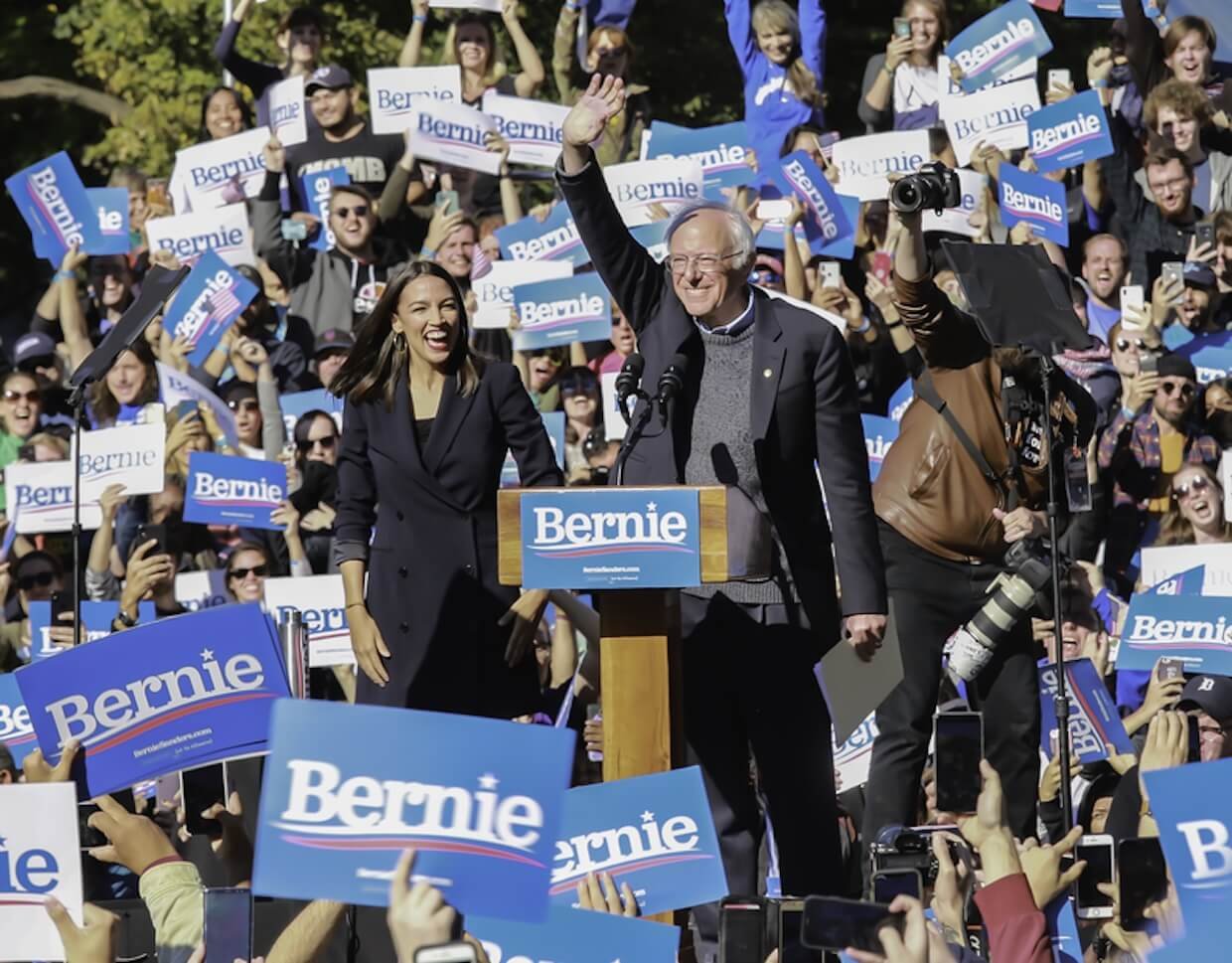
Bernie Sanders and Alexandria Ocasio-Cortez at the “Bernie Is Back” political rally in Queensbridge Park, Queens, New York, on October 19, 2019. Photo: Aleksandr Dyskin / Dreamstime.
You describe“social democratic capitalism”as a democratic polity combined with a mostly capitalist economy, strong education, extensive public insurance, employment-promoting services, and moderate regulation. Could this provide the Democrats with a more coherent post-neoliberal governing philosophy than either technocratic centrism or democratic socialism? And if so, why has the Democratic Party struggled to articulate such a model as a recognizable political project capable of competing emotionally and symbolically with the much clearer identity offered by Trumpism?
Professor Lane Kenworthy: Here too, I think we want to distinguish between the policies that are actually being enacted, implemented, and favored by many who call themselves Democrats, and what seems to resonate with at least a certain share of voters in the country at this moment. I do think movement toward the Nordic model, or what I call social democratic capitalism, is the direction the Democratic Party has been heading in, especially since around 2020, but to some degree even before that.
During the Biden administration, from 2021 to 2024, much of the policy emphasis was on expanding healthcare and childcare, creating a child allowance, and considering other elements of these public services. The administration and its Democratic allies in Congress ultimately chose to emphasize the transition to clean energy over these services, at least in terms of their rhetoric and symbolism, and I think they were right to do so. This is a really important and time-limited policy focus, whereas shifting toward the Nordic model can be done over a longer period.
But there is actually much more support within the party and in adjacent organizations for expanding public services and public goods these days than there used to be. As I just said, this is mainly what so-called democratic socialists are advocating in policy terms. If we look at Democratic Party-dominated states across the country—California, Massachusetts, New York, and some others—we also see real movement in this direction, through the enactment and implementation of these types of public services and public goods, or their expansion where they already exist.
But this policy approach might not have the same emotional resonance for many voters as right-wing or left-wing populism. So it could be that we’ll see more Democrats getting elected as so-called socialists while nevertheless governing as normal Social Democrats.
I would characterize what we see so far in the Mamdani administration as exactly that. He is governing mostly as a normal left-of-center Democrat, or what you might call a social democrat, while rhetorically continuing his commitment to what he calls democratic socialism and to certain issues that resonate strongly, especially with younger left-wing voters. Yet, in policy terms, those issues turn out to be secondary to what he is doing as an executive in a very large and important city.
Predistribution, Public Provision, and the Future of Wages
You have been skeptical that “predistribution” alone—raising wages through market institutions, stronger bargaining power, or labor-market reform—can solve the problem of stagnant earnings, and you have emphasized public insurance and transfers as essential mechanisms for ensuring shared prosperity. Given the long-term weakening of unions and the changing structure of work, should Democrats stop promising to reconstruct the mid-twentieth-century wage bargain and instead build a twenty-first-century social settlement in which government more explicitly socializes the costs of healthcare, childcare, education, retraining, and income security?
Professor Lane Kenworthy: I do think that’s partly true—that Democrats should focus more on the public provision of these services and public goods, and, to some extent, on transfers. As I just said, I do think that’s the direction many who consider themselves Democrats are moving in.
But at the same time, I also think government needs to step in more actively on the predistribution side to try to ensure that wages, as much as possible, rise more or less in sync with the economy. In the absence of strong labor unions and collective bargaining, I think this means using monetary and fiscal policy to keep the labor market tight.
We know that tends to be effective here in the United States. We saw it in the late 1990s, and we’ve seen it in the period since around 2015 or 2016. When the unemployment rate is below 5%, we almost always see wages rise—in many cases, or in fact most cases, faster than inflation. And that’s true all the way down to the bottom of the distribution.
This probably means doing more with minimum wages, and we’ve seen a lot of action at the state and local level in the United States. Going forward, we probably need to think more about shifting toward a system in which, instead of a crude universal minimum wage, we have occupation-specific or sector-specific minimum wages. Here in California, the state government has just enacted a specific minimum wage for the food service industry, and so we probably need to go further in that direction.
The Earned Income Tax Credit is another mechanism that can help. This is a government transfer, but it’s closely tied to wages and pay. There should perhaps also be more support for the widespread adoption of profit sharing.
So yes, I do think predistribution can also be critical. We see movement in this direction in Western Europe as well, with greater emphasis on minimum wages, first and foremost, as labor unions in many countries appear to be weakening. Not quite as dramatically as here in the United States, but nonetheless significantly, and in some cases collective bargaining is weakening as well.
CEO Pay, Bargaining Power, and Corporate Governance
Your comparative work on executive compensation shows that market forces alone cannot explain enormous differences in CEO pay and that the relative power of labor and executives matters significantly. Does this imply that today’s extreme top-end inequality should be understood less as an inevitable reward for productivity and innovation than as an institutional outcome shaped by bargaining power, corporate governance, taxation, and political choices? If so, what reforms would most effectively rebalance power without undermining the dynamism that you believe capitalism can provide?
Professor Lane Kenworthy: Bargaining power, corporate governance, taxation, and political choices have all mattered, and the rise of top incomes and top wealth is not simply a story about the economy or supply and demand.
So, what would help? I’m pretty pessimistic about resurrecting labor union strength. I hope I’m wrong about this, but the fact that union membership has declined so much in nearly all rich democratic countries, not just here in the US, suggests that the story we’ve told for half a century in the United States—that we have bad laws that make it too easy for employers to fend off unions or get rid of them when they exist—no longer seems very compelling, given declining union membership in so many other rich democratic nations.
A shift in corporate governance back toward emphasizing stakeholders rather than only shareholders would be really good, but here, too, I have trouble seeing the path forward. The governance model that was in place in the decades right after World War II was heavily influenced by the fear among business leaders and politicians of a return to economic depression, and especially by the fear of communism becoming more attractive. As a result, they were willing to give workers rising wages and a seat at the bargaining table in order to ensure that the whole system survived. But that is long gone now.
I think policies requiring works councils within firms and allowing employees to elect a third or half of the board of directors would be helpful. To get more money from those at the top, taxes are our main recourse at the moment.
I don’t want to see another world war if that’s what it takes to get business leaders or conservative politicians to say, “Oh yeah, okay, we need to go back to accommodating labor unions.” But in the absence of that, I don’t really see what the path is.
I think the focus probably has to be on these two institutional requirements—work councils and workers being allowed to elect board members—and then on taxes.
Liberalism and the Contemporary Backlash
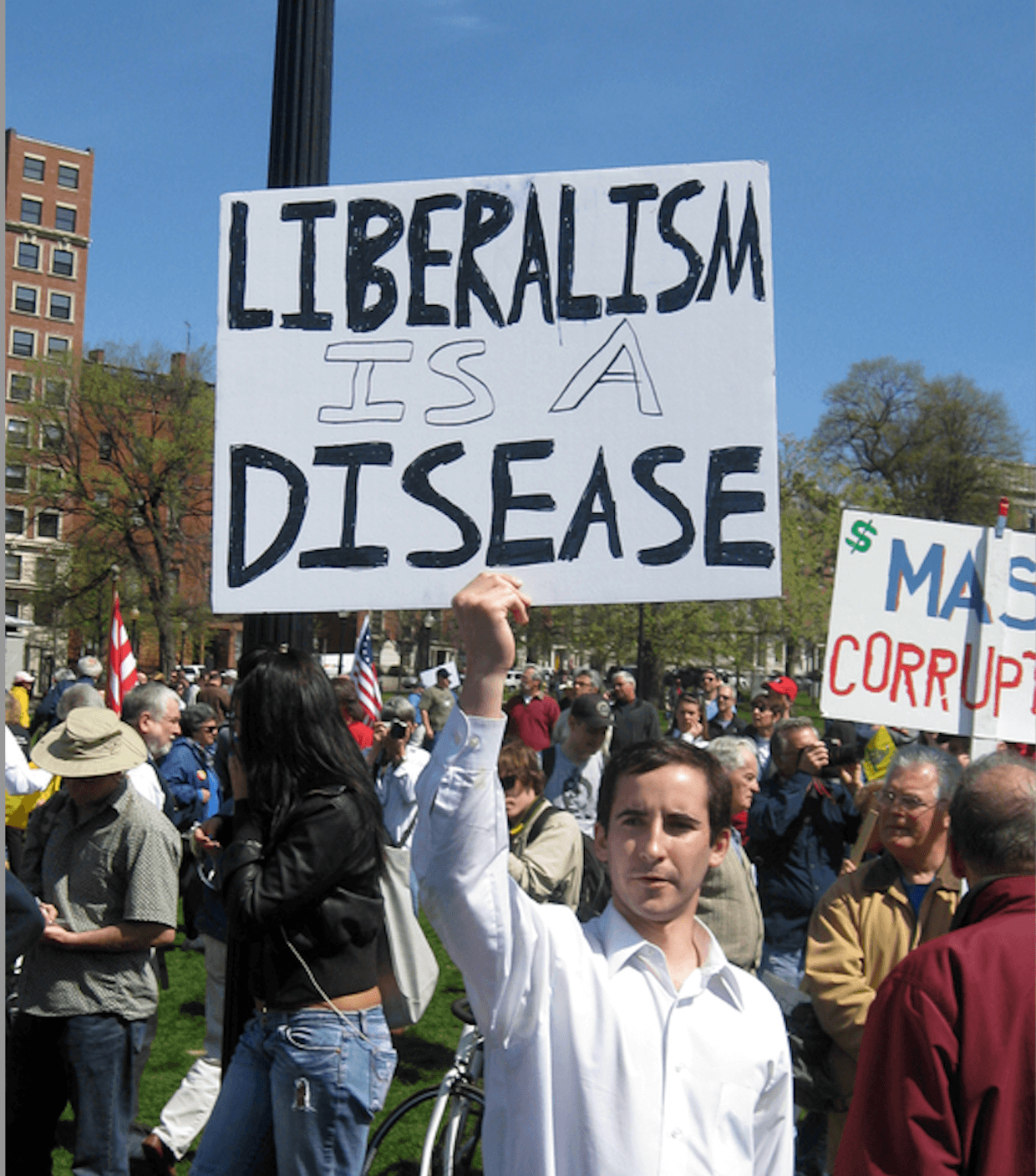
Tea Party protest rally in Boston, Massachusetts. The demonstration, attended by roughly 5,000 people, took place near the historic site of the original Boston Tea Party. Photo: Dreamstime.
Your conception of liberalism places individual well-being, equal moral worth, and evidence-based reasoning at its core. Yet contemporary populists increasingly portray liberalism as an ideology of technocratic elites, cultural cosmopolitanism, weak borders, and indifference to community and national belonging. Does liberalism today suffer primarily from a communication problem, a problem of institutional performance, or a deeper philosophical tension between individual autonomy and citizens’ demands for solidarity, identity, order, and collective membership?
Professor Lane Kenworthy: This is a very difficult question for me, and I don’t have a strong view on it—or, I should say, a confident one. The main point I would make is that liberalism has been criticized and challenged for centuries, and I’m not convinced that the negative views of it today are any more widely or deeply held than they were during previous periods of backlash.
Unlike some people, I’m not fully convinced that liberalism needs a dramatic reappraisal or fundamental shift. It’s possible that, 10 years from now, much of this backlash will have weakened or disappeared, and we’ll look back and say that the period from the mid-2010s through the mid- to late 2020s was simply another episode in a long history of intense criticism, rethinking, and backlash. These things ebb and flow.
I might be wrong. There are quite a number of thinkers making the case for a more dramatic reconsideration. I’ve just been reading Daron Acemoglu’s book, What Happened to Liberal Democracy. It is a very new book and one among many arguing for a significant shift or reappraisal of liberalism, but I’m simply not convinced that such a shift is actually warranted. And I hope I’m right, though I might turn out to be wrong.
Toward an Expanded Rawlsian Conception of Social Justice
A striking implication of your work is that a society can tolerate substantial income or even wealth inequality and still achieve high levels of economic security, opportunity, freedom, inclusion, and subjective well-being—as the Nordic cases suggest. Does that mean the left should reconceptualize social justice away from equality of outcomes and toward what might be called an “expanded Rawlsian” framework: strong basic liberties, genuine opportunity, income security, universal public goods, and steadily improving living standards for the least advantaged? What, then, becomes of the traditional egalitarian aspiration to narrow the distance between the top and the rest?
Professor Lane Kenworthy: Yes, that is exactly my view. I do consider myself an egalitarian, and I think reducing inequality of outcomes remains a goal worth pursuing, especially in a high-inequality nation like the United States. But I do think it should be secondary to the other goals you mentioned.
The Deeper Choice in the 2026 Midterms
And lastly, Professor Kenworthy, stepping back from individual races, what do you see as the deeper political choice represented by the 2026 midterms? Is the United States choosing between Trumpist right-wing populism and a liberal-democratic alternative, between plutocratic capitalism and a more egalitarian political economy, or between competing visions of how capitalism itself should be governed? And if your evidence is correct that social democratic capitalism remains the most successful institutional arrangement yet devised, what would have to happen politically for the United States to move in that direction rather than toward either more radical market nationalism on the right or democratic socialism on the left?
Professor Lane Kenworthy: Because the United States is so large and geographically diverse, and because in our elections we vote for individual candidates rather than parties, I think very few US elections actually pose such a clear, big-picture choice between competing visions of policy, capitalism, liberalism, or democracy. We often over-interpret elections here in exactly those terms. But in most cases, people are voting for many different reasons. It may be about individual candidates, a single issue, or a particular set of issues, or they may simply have picked their party and stick with it no matter what.
Now, if that’s true, then for the United States to move toward something like the Nordic model in policy terms, Democrats need to win elections. It’s more complicated than that, of course, but basically, that’s how we’ve seen the country move historically over the last century in the direction of something like social democratic capitalism.
That’s also what we see at the state and local levels today. I mentioned before that a number of states have moved quite aggressively in this direction. There are limits to what states and cities can do, both because they have limited money at their disposal and because they face institutional constraints. They can’t do certain things that only the federal government can do. But they can do a lot.
When Democrats hold the governorship and both houses of the legislature, as they have in California, Massachusetts, Washington, Oregon, and elsewhere, we see substantial movement in this policy direction. My guess is that this will continue. And if and when Democrats again control all three decision-making bodies at the federal level, they’ll probably move in that direction again, as they did in 2021 when Biden came in, and in 2009 when Obama came in with Democratic majorities.
They’ll make limited progress, but they’ll probably make some real progress, and in most cases that progress lasts. There are no guarantees, of course. But it turns out that this is a pretty simple story, and I think it’s the right one.
Ahead of Sweden’s September 13, 2026 election, Associate Professor Anders Hellström argues that the Sweden Democrats’ influence can no longer be measured only by their vote share. Positions once treated as extreme have increasingly become “the default position, the standard,” while nativist rhetoric has become “a kind of ‘common sense.’” He also warns of growing resistance to the consequences of this restrictive turn, especially the expulsion of people deeply rooted in Swedish society, noting that “many Swedes feel that rejudification has gone too far.” For Assoc. Prof. Hellström, the deeper democratic challenge is whether mainstream parties can construct an inclusive national vision without reproducing SD’s exclusionary understanding of belonging, welfare, identity, and Swedishness.
As Sweden heads toward the September 13, 2026 general election, the country faces a political landscape increasingly shaped by the long-term normalization of the Sweden Democrats (SD) and by a broader mainstreaming of restrictive positions on migration, integration, citizenship, and national belonging. Once treated as a stigmatized outsider, SD has become a central actor in Swedish politics and is now deeply embedded in the governing architecture created through the Tidö Agreement. At the same time, the party continues to compete with the Moderates (M) for leadership of the Swedish right, while its core themes have increasingly influenced the language and policy priorities of mainstream parties.
In an interview with the European Center for Populism Studies (ECPS), Associate Professor Anders Hellström, Senior Lecturer in International Migration and Ethnic Relations at Malmö University and affiliated with the Malmö Institute for Studies of Migration, Diversity and Welfare (MIM), argues that the most important transformation may not be SD’s electoral strength alone, but the extent to which ideas once considered politically extreme have become normalized. According to Assoc. Prof. Hellström, positions on immigration that would have been regarded as beyond the mainstream a decade ago have increasingly become “the default position, the standard.”
This development, he suggests, has altered the political balance between stigmatization and accommodation. SD, once able to mobilize as an excluded underdog, has become part of the establishment. Yet mainstream accommodation has not necessarily weakened the party. As Assoc. Prof. Hellström puts it, from the voter’s perspective, “why should we vote for the copy when we have the original?” He also argues that nativist rhetoric has itself become “a kind of ‘common sense,’” reflecting a deeper transformation in the boundaries of legitimate political discourse.
The interview situates these developments within broader struggles over national identity, political myth, welfare chauvinism, and the meaning of Swedishness. Assoc. Prof. Hellström emphasizes the continuing importance of Folkhemmet as a powerful national narrative whose boundaries can be drawn inclusively or exclusively. He also highlights SD’s restorative vision of Sweden, built around nostalgia for an earlier and more homogeneous society.
At the same time, Assoc. Prof. Hellström points to growing resistance against the consequences of increasingly restrictive policies. He notes that many Swedes are uncomfortable with the expulsion of people who were born in Sweden, speak fluent Swedish, and have contributed to Swedish society, concluding that “many Swedes feel that rejudification has gone too far.”
Against the backdrop of the September 13 election, the interview therefore moves beyond the immediate question of who will govern Sweden. It asks whether the deeper transformation lies in SD entering government—or in the extent to which the political mainstream itself has already been reshaped by SD’s language, assumptions, and conception of national belonging. As Assoc. Prof. Hellström observes, “the Sweden Democrats have already won” in one important sense: Sweden’s major parties now broadly accept the need for a highly restrictive immigration policy.
Ahead of Sweden’s September 13, 2026 election, Associate Professor Anders Hellström argues that the Sweden Democrats’ influence can no longer be measured only by their vote share. Positions once treated as extreme have increasingly become “the default position, the standard,” while nativist rhetoric has become “a kind of ‘common sense.’” He also warns of growing resistance to the consequences of this restrictive turn, especially the expulsion of people deeply rooted in Swedish society, noting that “many Swedes feel that rejudification has gone too far.” For Assoc. Prof. Hellström, the deeper democratic challenge is whether mainstream parties can construct an inclusive national vision without reproducing SD’s exclusionary understanding of belonging, welfare, identity, and Swedishness.
As Sweden heads toward the September 13, 2026 general election, the country faces a political landscape increasingly shaped by the long-term normalization of the Sweden Democrats (SD) and by a broader mainstreaming of restrictive positions on migration, integration, citizenship, and national belonging. Once treated as a stigmatized outsider, SD has become a central actor in Swedish politics and is now deeply embedded in the governing architecture created through the Tidö Agreement. At the same time, the party continues to compete with the Moderates (M) for leadership of the Swedish right, while its core themes have increasingly influenced the language and policy priorities of mainstream parties.
In an interview with the European Center for Populism Studies (ECPS), Associate Professor Anders Hellström, Senior Lecturer in International Migration and Ethnic Relations at Malmö University and affiliated with the Malmö Institute for Studies of Migration, Diversity and Welfare (MIM), argues that the most important transformation may not be SD’s electoral strength alone, but the extent to which ideas once considered politically extreme have become normalized. According to Assoc. Prof. Hellström, positions on immigration that would have been regarded as beyond the mainstream a decade ago have increasingly become “the default position, the standard.”
This development, he suggests, has altered the political balance between stigmatization and accommodation. SD, once able to mobilize as an excluded underdog, has become part of the establishment. Yet mainstream accommodation has not necessarily weakened the party. As Assoc. Prof. Hellström puts it, from the voter’s perspective, “why should we vote for the copy when we have the original?” He also argues that nativist rhetoric has itself become “a kind of ‘common sense,’” reflecting a deeper transformation in the boundaries of legitimate political discourse.
The interview situates these developments within broader struggles over national identity, political myth, welfare chauvinism, and the meaning of Swedishness. Assoc. Prof. Hellström emphasizes the continuing importance of Folkhemmet as a powerful national narrative whose boundaries can be drawn inclusively or exclusively. He also highlights SD’s restorative vision of Sweden, built around nostalgia for an earlier and more homogeneous society.
At the same time, Assoc. Prof. Hellström points to growing resistance against the consequences of increasingly restrictive policies. He notes that many Swedes are uncomfortable with the expulsion of people who were born in Sweden, speak fluent Swedish, and have contributed to Swedish society, concluding that “many Swedes feel that rejudification has gone too far.”
Against the backdrop of the September 13 election, the interview therefore moves beyond the immediate question of who will govern Sweden. It asks whether the deeper transformation lies in SD entering government—or in the extent to which the political mainstream itself has already been reshaped by SD’s language, assumptions, and conception of national belonging. As Assoc. Prof. Hellström observes, “the Sweden Democrats have already won” in one important sense: Sweden’s major parties now broadly accept the need for a highly restrictive immigration policy.
Here is our interview with Associate Professor Anders Hellström, edited lightly to enhance clarity, readability, and overall flow for publication.
The SD’s Views on Immigration Policy Have Become the Default Position
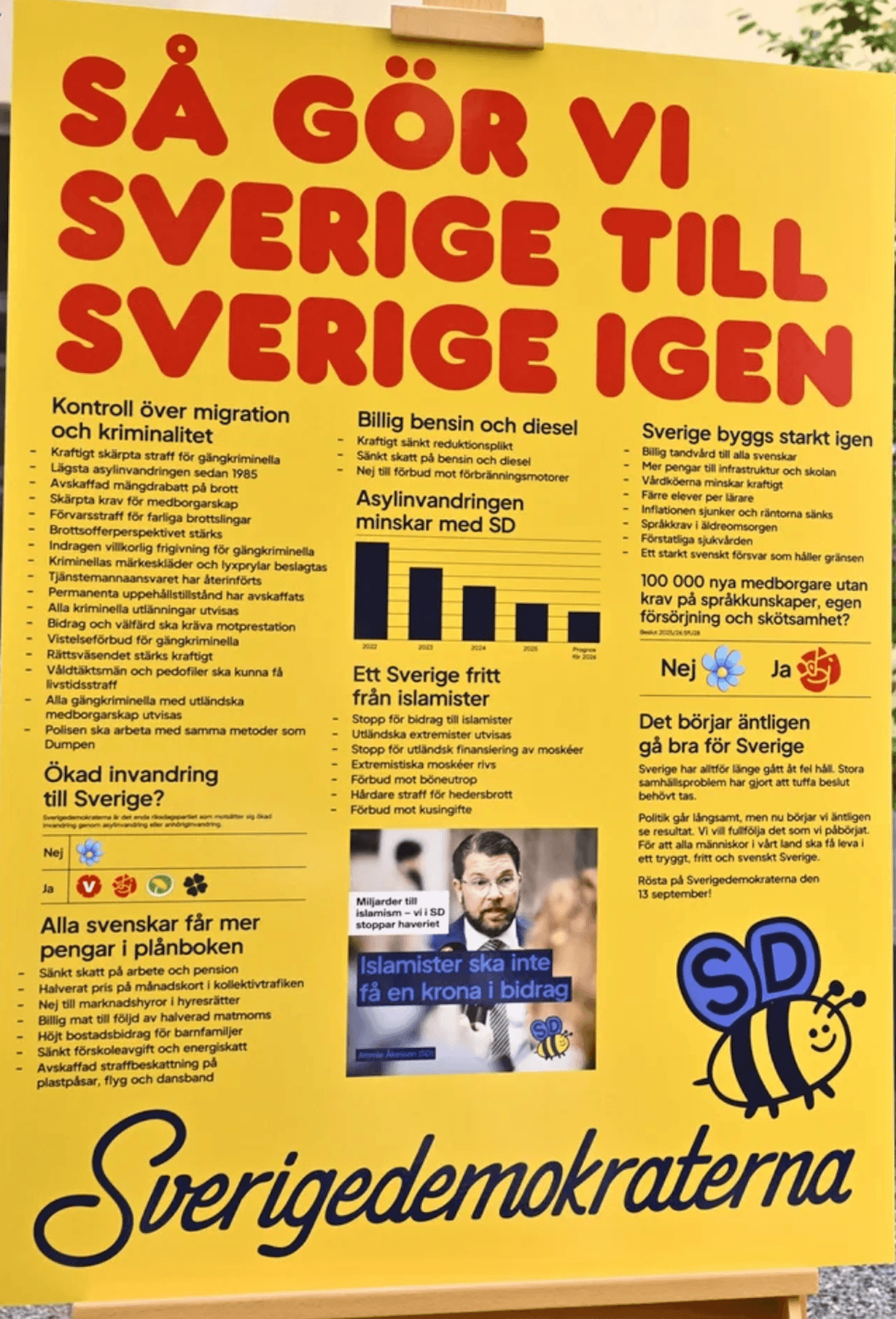
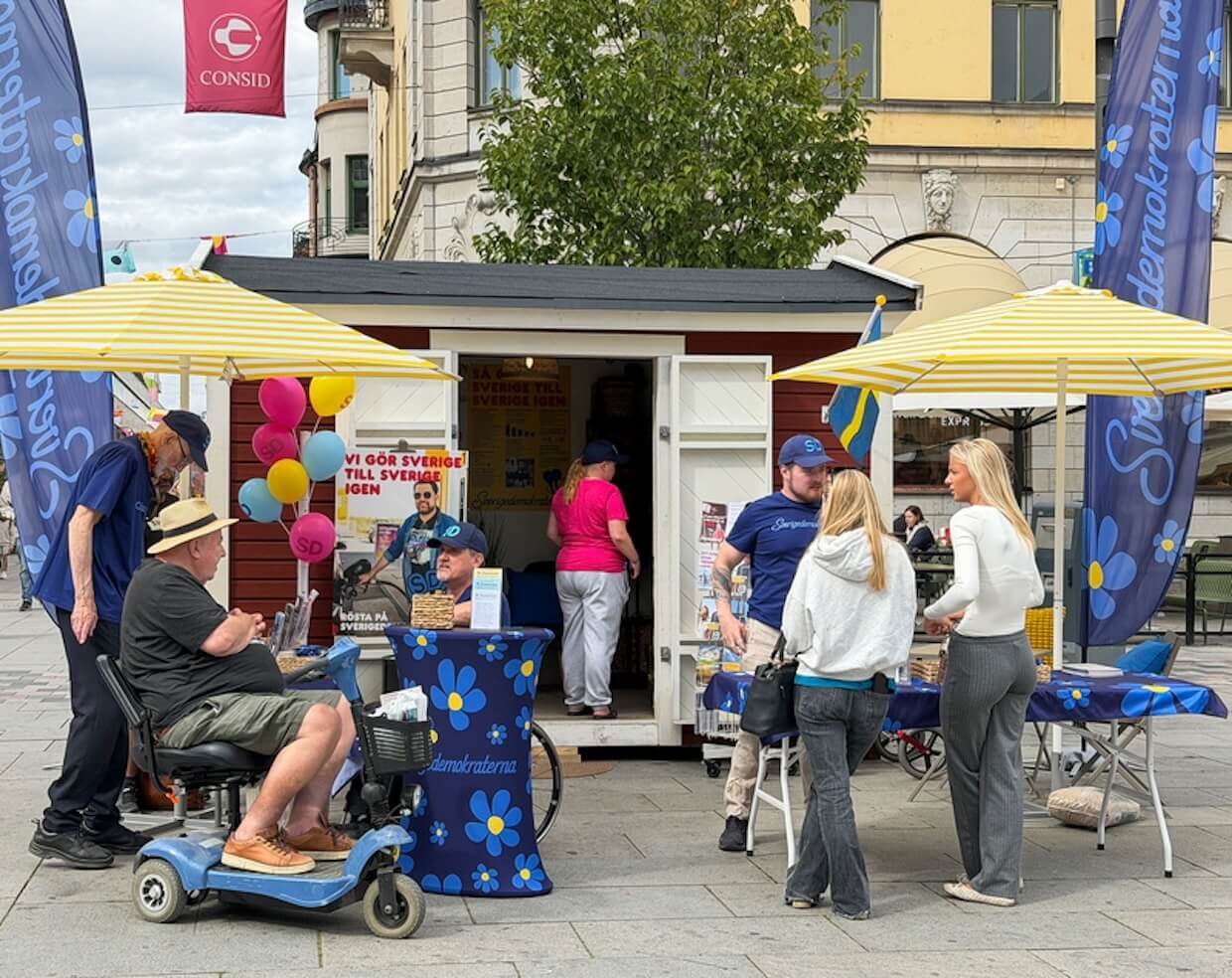
A Sweden Democrats (SD) campaign poster ahead of Sweden’s September 13, 2026 parliamentary elections, featuring the slogan “This is how we make Sweden Sweden again” and highlighting the party’s policies on immigration, crime, Islamism, citizenship, welfare, and the economy.
Professor Hellström, welcome! Just days before the September 13 election, the Sweden Democrats remain close to 20 percent and are again competing with—or polling ahead of—the Moderates for leadership of the Swedish right. More than a decade ago, you described SD as the stigmatized “beast” of Swedish politics, excluded by mainstream parties but able to mobilize precisely through that exclusion. Today, SD is deeply embedded in the Tidö governing arrangement. Does this election mark the completion of SD’s journey from stigmatized outsider to normalized pillar of the Swedish party system, or does some element of its outsider status remain politically indispensable to its appeal?
Assoc. Prof. Anders Hellström: Yes and no. There is a concept we might call the mainstreaming of previously extreme positions. Ten years ago, derogatory statements about immigration and immigrants were regarded as extreme. The Sweden Democrats (SD) said things that the mainstream parties did not. Today, however, SD does not even have to say very much, because other parties—and their leaders—are themselves using very hostile language when talking about immigration and immigrants. They argue that Sweden needs a very restrictive immigration policy, and so forth.
So, what was depicted as extreme 10 years ago has become mainstream today. But you can also talk about a third stage. From the beginning, the Sweden Democrats were regarded as too extreme. Then they came to be seen as more radical challengers of the establishment: you could vote for the Sweden Democrats because they wanted to challenge the government and the establishment. But now something very interesting has happened. The Sweden Democrats have themselves become part of the establishment.
All the other parties are also saying insane things. Of course, the Sweden Democrats are still a little more extreme. But they are no longer seen as the underdog, because their views on immigration policy have become the default position, the standard.
Therefore, of course, I do not know what will happen in the election or how big they will become, but there is a feeling in society that many Swedes think developments toward rejudification have gone too far. Why do we expel people who were actually born in Sweden, who earn a lot of money, who speak fluent Swedish, and send them back to countries where perhaps their grandfather came from, even though they themselves have never been there? Why do you expel people who have done nothing wrong? So there is a tendency for many Swedes to feel that rejudification has gone too far.
‘The Beast’ Has Been Tamed
In “Feeding the Beast,” you and Peter Hervik challenged the idea that anti-immigration sentiment simply accumulates beneath an elite-imposed consensus until it eventually erupts. Instead, you argued that nativist rhetoric itself can make immigration anxieties more salient and thereby nourish radical-right support. Looking at Sweden in 2026, where restrictive migration rhetoric is now common across much of the mainstream, has the political system effectively “fed the beast” by adopting the language and problem definitions that originally distinguished SD?
Assoc. Prof. Anders Hellström: Yes. When we wrote this article, the Sweden Democrats were actually the beast. They were seen as something that should not be part of the establishment—something the cat had dragged in. But now, the beast has been tamed, so it has become, as I said before, something default, something standard. I would say that nativist rhetoric has become a kind of “common sense.”
Why Should We Vote for the Copy When We Have the Original?
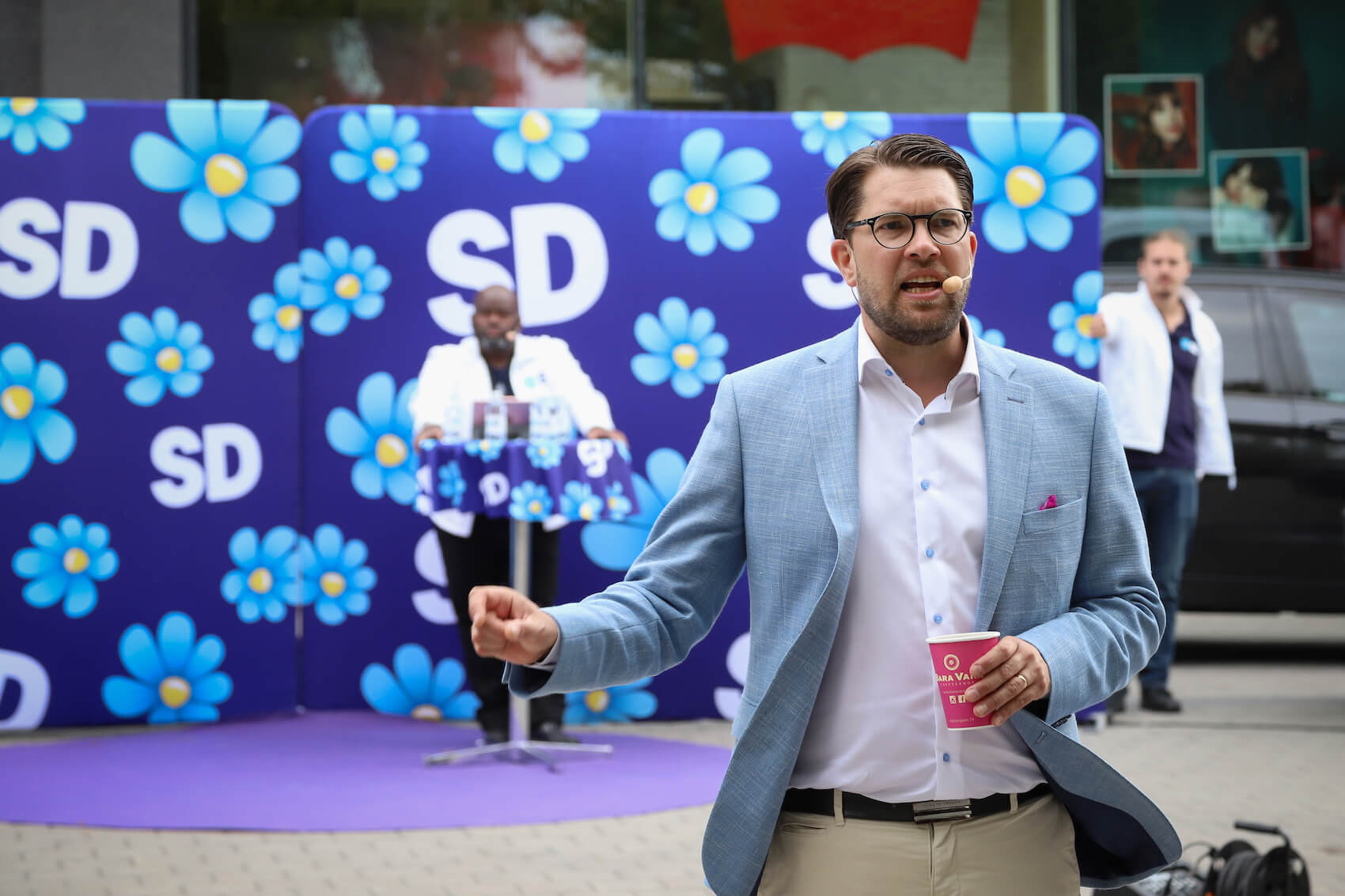
Sweden Democrats’ Square Meeting in Umeå. Jimmie Åkesson speaks to the people on the city square where opposition left-wingers have formed a chain and protest in Umeå, Sweden on August 14, 2018. Photo: Shutterstock.
The Moderates (M), Christian Democrats (KD), and Liberals (L) have progressively abandoned the cordon sanitaire around SD, while migration, crime, citizenship, and integration policies have moved markedly in a restrictive direction. Mainstream parties often justified this shift as a strategy for neutralizing SD by responding to voter concerns. Yet SD remains close to one-fifth of the electorate. Does this suggest a fundamental failure of the accommodation strategy—that mainstream parties can adopt radical-right policies without recovering the voters who originally demanded them?
Assoc. Prof. Anders Hellström: Yes, I would say so, because from the voter’s perspective, you vote for the original, not the copy. So it doesn’t matter if the Moderates and the other parties are becoming more friendly toward SD or if they no longer see SD as a beast. Rather the opposite: they have understood the truth. Then voters say, “Okay, why should we vote for the copy when we have the original?” Therefore, this has actually strengthened their momentum, because, from the voter’s perspective, why should they vote for the copies?
The Stigma—That Tool for Mobilization—Is Gone
Your earlier work showed how the stigma attached to SD could paradoxically be politically productive because the party could portray itself and its voters as unfairly excluded from the legitimate political community. Now that institutional exclusion has largely disappeared, has SD lost an important mobilizational resource? Or has the party successfully transferred the old stigma from itself onto other antagonists—immigrants, Muslims, “liberal elites,” the media, or supranational institutions?
Assoc. Prof. Anders Hellström: It has lost that because there is a potential advantage in being a radical underdog. That can also be attractive to voters—you want to vote for the newcomer. But now, that stigma—that tool for mobilization—is gone. So it is good to be radical, but not to be seen as too extreme. You want to be close to the sum of equations, so to speak.
But now people are saying that maybe they have got too much power. And there may be, as I said, reactions against too many restrictions. But, of course, I don’t know that. Maybe there are a lot of people. We will see. It could be very interesting to see the election results on Sunday. There is a fraction of the Swedish population who actually like the policies that have been suggested by SD, but I don’t know how large that fraction is.
They Want to “Bring Sweden Back”
Your work on Nordic populist radical-right parties shows that the Sweden Democrats have been particularly active in constructing national myths around a lost “golden age” of ethnic homogeneity and social cohesion. How important is this nostalgic structure to SD’s appeal in the 2026 election? Is the party fundamentally mobilizing voters against immigration, or is immigration functioning as a symbol of a broader narrative that Sweden has lost something culturally, socially, and politically valuable?
Assoc. Prof. Anders Hellström: One thing that is important to understand is that SD does not want to create a new niche or anything like that. They want to restore Sweden. They want to bring Sweden back—to make Sweden great again, as Donald Trump says. For them, Sweden was great in the 1950s and 1960s, before the official adoption of multiculturalism in 1997 and before refugee migration.
For instance, an interesting fact is that in 1960, 4% of the Swedish population were foreign-born. Now, the figure is at least 20%. So this kind of demographic shift has created fissures in the population. This strategic appeal resonates with voters because they want to return to the period when they and their parents were young. They remember their childhood as a time when things were easier and society was more homogeneous. That is a fact: Sweden has become more diverse, and some people in the electorate dislike that demographic shift.
The Folkhemmet Has Always Had Both Inclusive and Exclusive Features
You have shown that SD has been unusually successful in appropriating the historical language of theFolkhemmetand linking the Social Democratic welfare-state tradition to a culturally bounded conception of national belonging. Has this appropriation altered the very meaning of the Swedish welfare state—from a universalist social project toward something increasingly conditional on national, cultural, or civilizational belonging?
Assoc. Prof. Anders Hellström: That is, of course, hard to tell. But if you have to remember one thing about the Folkhemmet, it is that it is a myth used strategically by political actors, but it is also a narrative of what Sweden is. Folkhemmet conveys the idea of Sweden as a people’s home. It is deeply embedded in many people’s minds, and the people’s home has always had both inclusive and exclusive features.
So, we welcome everyone—yes, everybody can become Swedish—but there have always been boundaries defining those who are not part of the people. Whether the people’s home becomes more inclusive or more exclusive depends, for instance, on which parties hold power. But the people’s home remains a major historical narrative that binds Swedes together. And it can be both inclusive and exclusive.
Who Actually Has the Right to Welfare Resources?
The concept of ‘welfare chauvinism’ captures the combination of social protection for insiders with exclusion or conditionality for outsiders. As migration politics has moved into the mainstream, do you see welfare chauvinism itself becoming normalized in Sweden—not merely as an SD position, but as an increasingly accepted way of defining solidarity and deservingness across the party system?
Assoc. Prof. Anders Hellström: Welfare chauvinism says that we want to have welfare. But for whom do we want welfare? Welfare for our people. It is the idea that you combine an active welfare state with social cohesion or cultural conformity. That also means having an idea of who is included among “the people.” Are immigrants included, or is it only for native Swedes? Who actually has the right to welfare resources?
And again, what will happen in the future depends very much on who actually leads the country. There are parties and movements representing both regressive and progressive forces in society and within the party-political structure as well. So there is a struggle right now, and I do not know exactly which direction Sweden will take.
For the SD A Muslim Can Never Truly Be Swedish
Jimmie Åkesson speaks to the people on the city square where opposition left-wingers have formed a chain and protest in Umeå, Sweden on August 14, 2018.
In your work on racism as a political activity, you emphasize that political struggles concern not only whether racism exists but also who gets defined as victim and perpetrator. You identify victim–perpetrator reversal as an important feature of far-right discourse. How significant is the growing rhetoric of‘svenskfientlighet’—hostility toward Swedes—in this transformation of Swedish political language? Does it allow majority-group grievance to be recoded as victimhood while simultaneously making structural inequalities affecting minorities more difficult to articulate?
Assoc. Prof. Anders Hellström: Yes, exactly. The victim-perpetrator reversal concerns the question of who the immigrant is. Is he or she a victim, or is he or she actually a perpetrator who threatens our Swedish values and can never become like us? This rhetoric—who is the victim and who is the perpetrator?—can also be applied, for instance, to the Israel-Palestine conflict. Who is the perpetrator, and who is the victim? That makes it important to look at the ideological motives behind such statements. According to the actor, who is the perpetrator and who is the victim? That can actually shift.
For instance, something I am looking at right now is the discussion about whether it is possible to be both Muslim and Swedish. For the Sweden Democrats, you have to make a choice between being a Muslim believer and being a Swede. You have to let go of one of those two identities. For them, a Muslim can never truly be Swedish. Or he or she can, but only by first letting go of the Islamic identity.
The SD Is No Longer Stigmatized
One of the puzzles running through your earlier research was that SD could expand despite overwhelmingly negative treatment from mainstream political and media actors. Your work on the “politics of shame” suggests that stigmatization may help create counterpublic identities in which supporters experience themselves as silenced, morally condemned, or excluded. Has Swedish democracy underestimated the political power of this counterpublic dynamic—particularly the way perceived exclusion can strengthen identification with populist radical-right movements?
Assoc. Prof. Anders Hellström: Yes, in the politics of shame, it is about how stigmatization can be used to create a shared identity. We have been stigmatized together, so we have something in common. They are evil, and we are the good guys. We come together, and that can trigger or stimulate a sense of in-group mobilization. But, as I said before, when SD is seen as part of the establishment, it loses that capacity. The party is no longer stigmatized. Increasingly, the risk SD faces is that it becomes associated with old news.
Liberal Democrats Need to Mobilize People Around a Common Vision
If condemnation and exclusion can reinforce populist counterpublics, but accommodation can normalize their worldview, mainstream democratic parties appear trapped between two strategies that can both strengthen the radical right. Is there a genuine democratic alternative betweenstigmatizationandaccommodation? What would an effective strategy toward SD look like if the objective is neither moral ostracism nor ideological imitation?
Assoc. Prof. Anders Hellström: You’re right: there is probably no single correct answer. But what you can do is focus on your own liberal-democratic institutions and build up their resilience. You also need to articulate clear visions—visions that can bring people together. Perhaps you can focus on other issues around which people can unite, such as fighting climate change, or something else that can mobilize people around a common purpose.
And when it comes to immigration, one-fifth of the Swedish population are immigrants. That is a reality. It is too late to say that immigrants should go home. Instead, you need to mobilize people around a common vision and be secure and confident in your own institutions.
Of course, you can disagree with someone and not share their views, but that does not mean you need to kill or beat them. At least you can talk. It is perfectly legitimate to have different opinions. The key is not to eliminate conflict, because conflict is natural and is part of politics. If you combine that recognition with the understanding that not everyone needs to agree with you, then you can be clear about your own vision—and create a vision that includes more people.
Democracy Necessitates Both Majority Rule and Minority Protection
Sweden continues to rank as a strong liberal democracy, yet democratic resilience is not only about the survival of elections and institutions. It also concerns the boundaries of legitimate political discourse, minority protection, pluralism, and social trust. Should we therefore understand the normalization of nativist language as a form of democratic erosion even when formal institutions remain stable? Or would that stretch the concept of democratic backsliding too far?
Assoc. Prof. Anders Hellström: If you look at what democracy is, Jonathan Bouffe wrote about the democratic paradox. Democracy is a paradox because it involves both majority rule and the protection of minorities. There is always a tension between the two; it is a compromise. There is no final, perfect solution. It is a balance that needs to be discussed continuously. You cannot simply say, “This is the perfect solution; this is how we do it.” That is why we have different people with different opinions.
Regarding your question, yes, problems can arise if you have a democracy that protects only the majority and disregards minorities. That creates a risk of sliding toward a more authoritarian state. You can end up with an illiberal democracy. But in order to have a liberal democracy, you need both majority rule and minority protection.
Sweden Was a Role Model for Integration Policy
Celebrating Sweden’s National Day in Norrköping, Sweden, on June 6, 2014. Immigrants and native Swedes participate together in National Day celebrations. Sweden’s National Day is an official public holiday. Photo: Dreamstime.
The success of SD has often been explained through failures in immigration policy, integration, crime prevention, or political responsiveness. But could the deeper failure of mainstream parties be representational rather than policy-specific—their inability to articulate a persuasive account of national belonging that acknowledges insecurity and social change without translating them into an exclusionary distinction between a virtuous native “people” and threatening outsiders?
Assoc. Prof. Anders Hellström: In a way, it is very interesting that you raised that, because what actually triggered my interest in the Sweden Democrats in the first place, a long time ago when I started, was a big paradox. Everyone, from the left to the right, was talking about the failure of integration. Then I looked at the Migrant Integration Policy Index (MIPEX), and according to it, Sweden was the best in class. So Sweden was a role model for integration policy, while everyone on the street was talking about the failure of integration.
This paradox interested me. If you have this mantra of the failure of integration—and I am not saying that integration has been super successful—I am saying that if you have a population with more than 20% immigrants, of course, you can find examples of very successful integration, and you can also find examples of very poor integration. Because there are so many people, you can find many examples, depending on what you are looking for.
If you have this mantra, it has actually been very good news for the Sweden Democrats, because they can say, “We have an answer to that problem.” And for them, it is like: “don’t let them come here, and for those who do come, give them money so they can leave the country. And we don’t want to spend any money on integration.” But they have a recipe, while all the other parties, or most of the other parties, are talking about how integration has been so bad, so horrible, and that we have to do something. From the voter’s perspective, do you vote for someone who can say, “Okay, we have a solution”? Because everyone agrees that there is a problem.
Apart from that, you can also mention that it is very common in the debate to say that nobody wants to return to 2015, when you had the big reception crisis. I actually wrote a report on that period, and I concluded that it was a window of opportunity for both progressive and regressive forces in society. Yes, it created enormous pressure on municipalities. At the same time, you had a period when people opened their homes, there were language cafés, and there were very strong forces in civil society and in the Swedish Church. Everybody was saying, “Let’s fight together; we want to help the refugees.”
So there you have this tendency: both progressive and regressive forces. It is important to remember that. And when it comes to integration, you have examples of very good integration and also very poor integration. You can have both.
Politics Also Needs Stories
In your scholarship, political myths do not simply falsify history; they provide narratives through which communities establish continuity, belonging, and moral meaning. SD has been particularly effective at constructing a story in which contemporary Sweden represents a fall from an earlier, more cohesive national community. Why have mainstream parties been so much less effective at producing an alternative national narrative capable of combining diversity with social solidarity and a credible sense of collective continuity?
Assoc. Prof. Anders Hellström: That’s a very good question. From my perspective, you need to appreciate the storytelling dimension of representative politics. There is nothing wrong with telling stories that bind people together. In that sense, populism can be seen as a protest against politics as usual. It offers something beyond pragmatism—also a sense of redemption. It says: come together and find this emancipatory glue that can bind us together.
I think the answer—the key to addressing this—is not to reduce politics to technocratic means, because that becomes too rational. Politics also needs stories. For instance, you can tell a story about diversity: Sweden has become a much more exciting country to live in than it was 50 years ago. It is much more interesting, I would say, also from an outsider’s perspective. Yes, it is more exciting these days.
The SD Radicalizes Mainstream Popular Concerns
One of your articles distinguishes different strands within far-right ideology and argues that racism should be understood as a struggle over meaning rather than simply as an individual prejudice. As SD has professionalized and moderated parts of its public language, should scholars pay less attention to explicit racist statements and more attention to the underlying political work performed by categories such as culture, civilization, integration, national values, and “Swedishness”?
Assoc. Prof. Anders Hellström: That is one common distinction between the extreme and the radical. The thing is, if you look at the Sweden Democrats, they no longer use that language—that race-revolutionary language. Maybe they did in the late 1980s and early 1990s. They want to appear like the common man.
And their opponents normally make a mistake. They look at them and say, “No, don’t vote for SD.” Why? Or they portray them as very bad people, as evil guys. But the thing is, the Sweden Democrats do not use this kind of explicit racist rhetoric.
Instead, you can say that they radicalize mainstream popular concerns. And you can say that they rely on an identitarian logic—the logic of difference. It is like: “One people belongs to one country. Yes, those people are very nice, but they should not be here in Sweden. I don’t have anything against you, but you are not welcome in Sweden. It’s only for the Swedes. And the Swedish people are based on an ethnically homogeneous community.”
Politics Is Not Only About Distribution; It Is Also About Identity
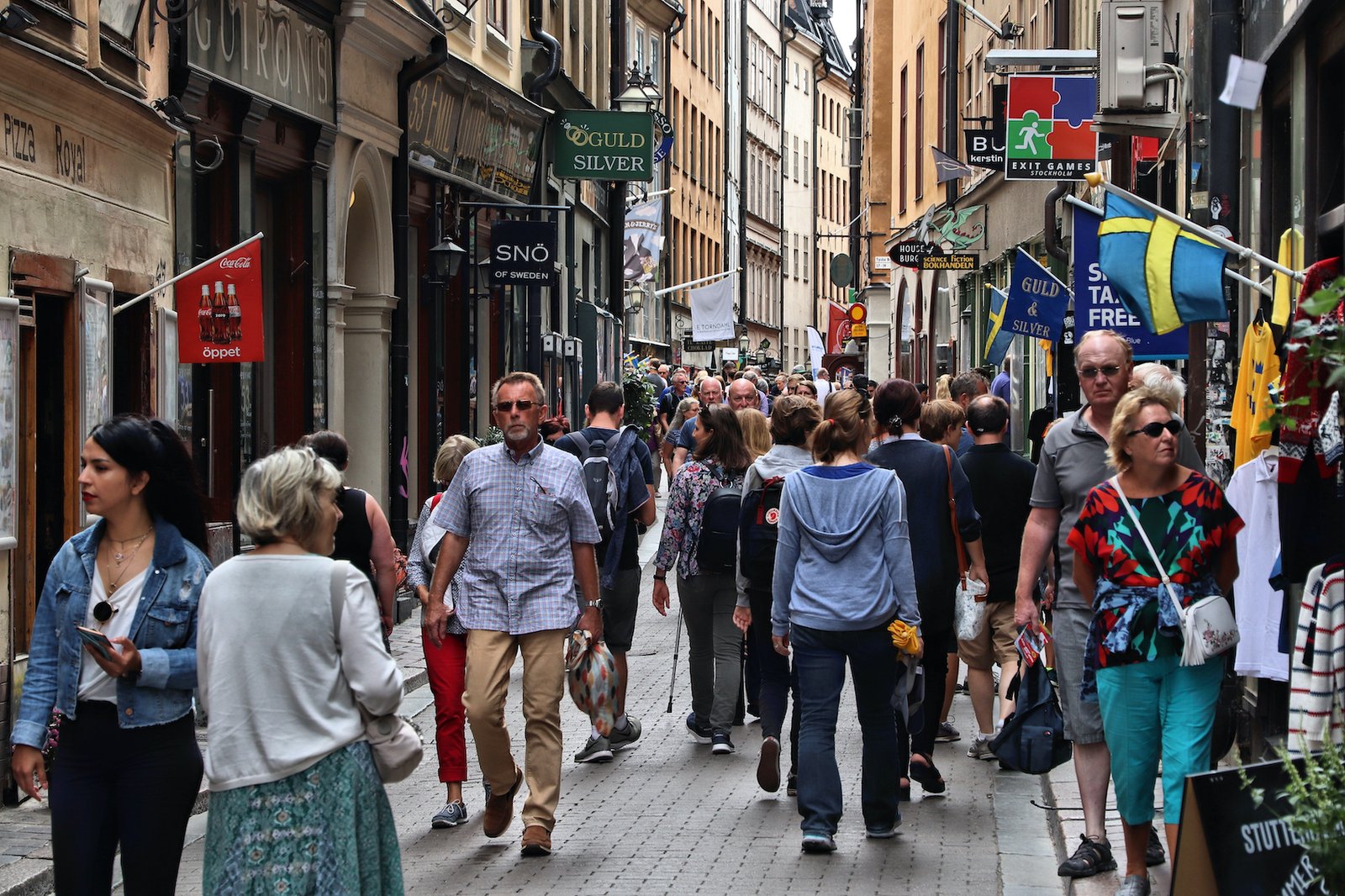
People shop in Gamla Stan (Old Town) in Stockholm, Sweden on August 23, 2018.
The September 13 election appears increasingly structured not simply by a conventional left–right cleavage but by competing understandings of nation, migration, identity, and political community. Are we witnessing a durable transformation of Sweden’s cleavage structure in which the central conflict is becoming less about redistribution and more about who belongs to the nation, who deserves solidarity, and whose version of Swedishness is politically legitimate?
Assoc. Prof. Anders Hellström: I would say that it’s not an either-or question. Questions of distribution are important, and so are questions about identity and other issues. More and more, these have become political issues, so political cleavages are no longer only between the left and the right, but also between good and evil, or some kind of moralization of politics. So, these kinds of identity-related issues matter. But it doesn’t mean that redistribution does not matter. It only says that politics is not only about distribution; it is also about identity.
The Sweden Democrats Have Already Won
And lastly, Professor Hellström, looking beyond the immediate question of who governs after September 13, what would you regard as the more consequential long-term outcome: that SD formally enters government, or that its nativist conception of nationhood becomes sufficiently normalized that the distinction between the Sweden Democrats and the democratic mainstream becomes progressively harder to identify? In other words, is the deeper test of Swedish democratic resilience about keeping the radical right out of office, or about preventing the political mainstream itself from being transformed in its image?
Assoc. Prof. Anders Hellström: The thing is, we don’t know that yet. But both the current Prime Minister and the leader of the largest opposition party (Social Democrats) are talking about the need for a very restrictive immigration policy. So, from that perspective, the Sweden Democrats have already won. The biggest parties—the mainstream parties—agree that Sweden needs a very restrictive immigration policy.
But I can only say that there is considerable resistance to this. People are not very comfortable with it, especially when people who were actually born in Sweden, who may be well known, speak fluent Swedish, and have contributed a great deal to Swedish society are expelled from the country. A lot of Swedish people dislike that development.
What will happen in the future, we don’t know. We can only hope for the best. And it is important to acknowledge the storytelling dimension of representative politics and to build a vision that people can share and believe in.
In this commentary, author Zeynep Temel examines how passport hierarchies and unequal mobility shape not only who can travel, but also who gains the authority to represent the world through digital tourism. Drawing on research on visa regimes, mobility infrastructure, the tourist gaze, and platform-mediated representation, she argues that passport privilege can become representational privilege. Travel influencers do not simply document destinations; they participate in constructing their meanings for global audiences. Yet access to this representational power is structured by nationality, class, wealth, and mobility rights. Temel further shows how such inequalities can feed broader grievances around globalization, exclusion, sovereignty, and dignity, creating discursive conditions in which populist narratives may resonate without claiming that mobility inequality itself directly causes populism.
By Zeynep Temel*
A striking map of the world has circulated repeatedly on social media. Produced by Sightsmap from geotagged photographs uploaded to Google’s former Panoramio service, it visualizes photographic activity as points of light. Europe glows. North America is heavily illuminated. Other parts of the world appear far more sparsely represented. In the ranking associated with the map, New York, Rome, and Barcelona occupied the first three positions among the world’s most photographed cities (Marcus, 2014; Swanson, 2015).
Author-generated visualization inspired by the historical geography represented in Sightsmap. Sightsmap combined crowdsourced digital traces, principally geotagged photographic metadata from Google’s former Panoramio service, with other sources to estimate the popularity of places of tourist interest. The visualization should be understood as an illustrative reconstruction of the unequal geography of visibility represented by this historical digital ecosystem, rather than as a reproduction of the original Sightsmap or a comprehensive measure of global photographic activity (Tammet et al., 2013).
The map is not a contemporary measure of Instagram or TikTok activity. Panoramio itself was discontinued, and the visualization reflects a particular platform, user population, and period of digital photography. It should therefore not be mistaken for a neutral map of where photographs are taken today. Yet this limitation arguably makes the image more interesting rather than less. As an early visualization of digital tourism, Sightsmap raises a question that has become considerably more important in the age of travel influencers: who gets to see the world; and, consequently, who gets to construct its image for everyone else?
Contemporary travel content often makes international mobility appear almost frictionless. Creators move from Bangkok to Paris, spend a weekend in Istanbul, “discover” villages in the Caucasus, or work remotely from Bali. Borders are rarely protagonists in these narratives. Travel appears primarily as a function of curiosity, money, and individual choice. But a British, German, or Japanese travel creator and an Afghan, Pakistani, Nigerian, or Syrian creator do not encounter the same world of borders. They may look at the same map, but the map does not offer them the same possibilities.
This matters beyond tourism. If travel influencers increasingly participate in constructing how destinations are imagined by audiences who may never visit them, unequal access to international mobility also produces unequal opportunities to participate in the production of the global tourist imaginary. Passport privilege can, in other words, become representational privilege.
The Unequal Geography of Global Mobility
The passport is one of the most consequential yet normalized mechanisms through which states distribute international mobility. Research on visa regimes shows that globalization has not produced a uniformly borderless world. Instead, borders have become more permeable for particular populations. Czaika, de Haas, and Villares-Varela (2018) demonstrate the persistent differentiation built into international visa regimes, while Mau and colleagues (2015) describe the resulting hierarchy as a “global mobility divide.”
For holders of powerful passports, this divide can remain almost invisible. International travel may require little advance planning beyond purchasing transportation and accommodation. For others, the same journey can involve consular appointments, proof of employment and income, bank statements, travel insurance, accommodation reservations, substantial fees, and uncertainty over whether permission will ultimately be granted.
The costs of this system are themselves unequally distributed. Recchi, Deutschmann, and Gabrielli (2020) show that visa costs impose disproportionate burdens on travelers from poorer countries. Neumayer (2006) similarly demonstrates how visa restrictions allow states to regulate access to foreign spaces selectively rather than simply opening or closing borders to everyone equally.
Spijkerboer’s (2018) concept of a global “mobility infrastructure” is particularly useful here. International movement depends upon a network of laws, airports, consulates, transportation systems, technologies, financial resources, and administrative categories. This infrastructure enables some people to move quickly and predictably while making movement considerably more difficult for others.
A powerful passport therefore represents more than convenience. It is a form of mobility capital. And in the age of social media, mobility capital can become cultural capital.
Who Constructs the Tourist Gaze?
Urry’s (1990) classic concept of the “tourist gaze” challenged the idea that tourists simply encounter destinations as they are. What travelers consider beautiful, authentic, exotic, romantic, or worth photographing is shaped by representations they have encountered before travelling. The Sightsmap visualization offers an unusually literal illustration of this process. It does not simply tell us where tourists went; it records where a particular population of digitally connected travelers chose to photograph and geotag their surroundings. Research using geolocated tourism data has since demonstrated both the usefulness and the limitations of such digital traces: different platforms capture different tourist practices and populations, meaning that no single dataset can straightforwardly represent tourism itself (Salas-Olmedo et al., 2018).
Social media has nevertheless dramatically accelerated the circulation of the tourist gaze. Before visiting Cappadocia, travelers encounter thousands of images of hot-air balloons at sunrise. Bali appears through temples, beaches, rice terraces, and infinity pools. Paris is repeatedly condensed into a recognizable repertoire of balconies, cafés, streets, and monuments. Travelers subsequently reproduce many of those images themselves.
Instagram therefore does not simply document tourism. Research suggests that it participates in the co-creation of destination image: tourists, residents, tourism organizations, and influencers continuously produce and reproduce visual understandings of places (Iglesias-Sánchez et al., 2020). Influencers occupy an especially interesting position within this process. Their authority depends partly on the appearance of personal experience. Unlike conventional tourism advertising, influencer content often presents itself as an individual encounter with a destination: this is what I saw; this is what I discovered; this is what you should experience.
Yet these narratives necessarily involve selection. Landscapes are chosen, neighborhoods included or excluded, encounters edited, and experiences organized into coherent stories. Research examining influencer representations of destinations such as Iran demonstrates how social-media creators can reshape destination images by foregrounding particular dimensions of everyday life, hospitality, culture, and perceived authenticity. (Saeidi Motahar et al., 2021)
A constructivist perspective makes the significance of this process clearer. Destinations do not possess internationally shared meanings independently of representation. Their identities as “dangerous,” “romantic,” “authentic,” “undiscovered,” or “adventurous” are socially produced and stabilized through repeated narratives and images. Travel influencers increasingly participate in this meaning-making. The important question, then, is not simply what they show. It is who gets to travel enough to become an authoritative narrator of the world in the first place.
When Passport Privilege Becomes Representational Privilege
The connection does not require an assumption that Instagram or TikTok deliberately privileges particular nationalities. The mechanism is more mundane. Consider the conditions necessary to build a career around international travel. A creator able to enter dozens of countries without obtaining visas in advance can respond quickly to cheap flights, tourism-board invitations, brand collaborations, and emerging destinations. Travel can be frequent and spontaneous. Content can consequently be produced at the regular pace demanded by platform economies.
A creator requiring visas for many of those destinations faces a different production environment. Trips may need to be planned months ahead. Applications cost money. Passports may remain at consulates during processing. Bookings can be required before a visa decision is known. An application may simply be rejected. Mobility advantage can therefore become a content-production advantage.
Successful content generates followers and commercial opportunities; those opportunities finance further travel; further travel produces additional content. Passport privilege does not determine who succeeds as an influencer, and creators from the Global South are neither absent nor passive within digital tourism. Wealth, class, language, domestic mobility, and platform access further complicate any simple North–South division.
But nationality still structures the administrative conditions under which cross-border content can be produced. This is also why Said’s (1978) much older question of representational authority remains relevant. Orientalism was concerned not merely with whether Western descriptions of other societies were accurate, but with the unequal power to classify, describe, and produce knowledge about them.
Digital tourism is obviously not equivalent to nineteenth-century Orientalism, and every outsider representation of another society should not be interpreted as domination. Yet the underlying questions remain surprisingly contemporary: Who moves? Who observes? Who narrates? And who appears primarily inside somebody else’s narrative?
From Unequal Mobility to Political Grievance
The political significance of this inequality lies partly in its visibility. Social media places radically different experiences of globalization on the same screen. One person documents spontaneous weekend trips across borders; another spends months assembling documents for permission to visit a single country. Research on passport discrimination suggests that mobility restrictions can be experienced not merely as administrative inconvenience but through questions of dignity, recognition, and unequal treatment. (Yasin et al., 2024)
It would be too strong to argue that these experiences produce populism. Visa rejection does not turn someone into a populist, and travel influencers do not cause nationalist politics. The relationship is more indirect. Populist narratives frequently acquire force by translating complicated structural inequalities into morally intelligible conflicts: ordinary people against privileged elites, the nation against external institutions, or those who are excluded against those perceived to benefit from globalization.
Mobility inequality provides unusually tangible material for such grievances because it exposes one of globalization’s central contradictions. The contemporary international order celebrates openness, connectivity, and circulation while continuing to distribute the practical freedom to move largely according to nationality.
Digital platforms make this contradiction particularly visible. Research on social-media populism has shown how online communication can transform perceived exclusion, foreign influence, and national grievance into politically resonant narratives (Ragragio, 2022). Mobility inequality can enter the same discursive environment, particularly where unequal treatment becomes interpreted through wider debates over Western privilege, sovereignty, globalization, or national dignity. Travel influencers do not create this inequality. They can, however, inadvertently become some of its most visible symbols.
The Politics Behind the Picture
This brings us back to the illuminated Sightsmap. Its brightest areas should not be read simply as a hierarchy of beautiful or interesting places. Nor can they straightforwardly be interpreted as a map of passport privilege: population, tourism infrastructure, platform adoption, wealth, connectivity, and the particular demographics of Panoramio users all shaped what became visible. But that is precisely the point. Maps of digital visibility are produced by social conditions. They do not simply mirror the world.
The same is true of contemporary travel influencing. Calls for greater diversity among travel creators are worthwhile, but representation cannot be separated from the conditions under which representation is produced. If some creators face substantially greater obstacles simply to reach destinations, the imbalance cannot be solved entirely through more inclusive influencer campaigns or changes in platform policy.
Part of the inequality exists before anyone opens Instagram. It exists in visa regimes, consular practices, passport hierarchies, income inequalities, transportation networks, and the broader infrastructure governing international movement.
A constructivist reading of travel influencing brings these elements together. Influencers do not merely reflect an already existing tourist world. Through repeated images, narratives, classifications, and recommendations, they participate in constructing that world; helping determine which destinations become desirable, which places appear dangerous or welcoming, and what counts as an “authentic” experience. But the opportunity to participate in this construction is itself structured by unequal mobility.
The digital tourist gaze therefore tells us something larger about globalization. The freedom to see the world and the power to represent it are not entirely separate privileges. Those who can cross borders most easily are particularly well positioned to narrate what lies on the other side. The question raised by that old map of illuminated photographs is therefore still worth asking: when the world becomes an image, who gets to take the picture?
(*) Zeynep Temel is a PhD candidate in International Political Economy at Marmara University, Istanbul, and is currently based in Shanghai conducting research for her doctoral dissertation. Her research interests span inequality, platform capitalism, popular culture, and gender, with a regional focus on East Asia. She works on how economic and political structures shape everyday practices, identities, and moral expectations, particularly through attention, consumption, and labor under contemporary capitalism.
References
Czaika, M.; de Haas, H. & Villares-Varela, M. (2018). “The global evolution of travel visa regimes.” Population and Development Review, 44(3), 589–622. https://doi.org/10.1111/padr.12166
Iglesias-Sánchez, P. P.; Correia, M. B.; Jambrino-Maldonado, C. & de las Heras-Pedrosa, C. (2020). “Instagram as a co-creation space for tourist destination image-building: Algarve and Costa del Sol case studies.” Sustainability, 12(7), 2793. https://doi.org/10.3390/su12072793
Marcus, L. (2014, November 24). “The most photographed places in Europe.” Condé Nast Traveler.
Mau, S.; Gülzau, F.; Laube, L. & Zaun, N. (2015). “The global mobility divide: How visa policies have evolved over time.” Journal of Ethnic and Migration Studies, 41(8), 1192–1213. https://doi.org/10.1080/1369183X.2015.1005007
Neumayer, E. (2006). “Unequal access to foreign spaces: How states use visa restrictions to regulate mobility in a globalized world.” Transactions of the Institute of British Geographers, 31(1), 72–84. https://doi.org/10.1111/j.1475-5661.2006.00194.x
Ragragio, J. L. D. (2022). “Facebook populism: Mediatized narratives of exclusionary nationalism in the Philippines.” Asian Journal of Communication, 32. https://doi.org/10.1080/01292986.2021.1993943
Recchi, E.; Deutschmann, E. & Gabrielli, L. (2020). “Assessing visa costs on a global scale.” SSRN Electronic Journal. https://doi.org/10.2139/SSRN.3630141
Saeidi Motahar, P.; Tavakoli, R. & Mura, P. (2021). “Social media influencers’ visual framing of Iran on YouTube.” Tourism Recreation Research. https://doi.org/10.1080/02508281.2021.2014252
Said, E. W. (1978). Orientalism. Pantheon Books.
Salas-Olmedo, M. H.; García-Palomares, J. C. & Gutiérrez, J. (2018). “Tourists’ digital footprint in cities: Comparing big data sources.” Tourism Management, 66, 13–25.
Spijkerboer, T. (2018). “The global mobility infrastructure: Reconceptualising the externalisation of migration control.” European Journal of Migration and Law, 20(4), 452–469. https://doi.org/10.1163/15718166-12340038
Tammet, T.; Luberg, A. & Järv, P. (2013). “Sightsmap: Crowd-sourced popularity of the world places.” In: Information and Communication Technologies in Tourism 2013 (pp. 314–325). Springer.
Urry, J. (1990). The tourist gaze: Leisure and travel in contemporary societies. Sage.
Yasin, R.; Ali, Ayesha; Namoco, Sarah. (2024). “Passport discrimination from the lens of critical phenomenological perspective.” International Journal of Sociology and Social Policy.https://doi.org/10.1108/IJSSP-04-2024-0169
As Sweden approaches a razor-thin 2026 election, Professor Andreas Jahrehorn Önnerfors argues that the Sweden Democrats’ significance lies not only in whether they enter government, but in how far they have already reshaped mainstream politics. He describes the Tidö Agreement as giving SD “a huge magnet” that has pulled governing parties to the right, while the collapse of the cordon sanitaire has blurred distinctions between SD and the Moderates. The interview also explores Folkhemmet nostalgia, “white melancholy,” migration, alternative media, conspiratorial narratives, enemy images, and information disorder. Looking beyond election day, Professor Önnerfors warns that Sweden may face prolonged coalition uncertainty and a deeper political realignment, concluding that “we are going to face a very hot autumn.”
Sweden’s 2026 election on September 13 may mark a decisive stage in the normalization of the radical right. With the Sweden Democrats (SD) polling ahead of the Moderates in several surveys and the survival of the Liberals remaining uncertain, the central question is no longer whether SD has entered the political mainstream, but how far its influence has already transformed the structure, language, and ideological center of Swedish politics. In this interview with the European Center for Populism Studies (ECPS, Professor Andreas J. Önnerfors, Full Professor in Intellectual History at Linnaeus University and researcher and project leader at the Fojo Media Institute in Sweden, argues that a formal entry of SD into government would represent a qualitatively new phase—but also that the party has already achieved substantial success in reshaping mainstream political discourse.
Professor Önnerfors traces this transformation to the collapse of the traditional cordon sanitaire. Once the Moderates chose sustained cooperation with SD, he argues, voters were confronted with a simple logic: “Why choose the copy when I can vote for the original?” The result, in his view, has been an increasing convergence between the Sweden Democrats and parts of the traditional center-right, to the point where “in some cases it is indistinguishable whether a minister acts on behalf of the Moderate Party or on behalf of the Sweden Democrats.”
The Tidö Agreement is central to this process. Professor Önnerfors describes SD’s influence through the metaphor of “a huge magnet” that has pulled the governing parties “clearly to the right” on migration, integration, deportation, and criminal policy. This power has allowed SD to remain formally outside government while retaining its anti-establishment posture, even as it exercises substantial influence over policy. Yet this arrangement may be reaching its limits. Professor Önnerfors notes that SD has already declared its ambition to secure ministerial positions if the Tidö bloc wins, a development that would force the party to confront the contradictions between insurgent populismand the responsibilities of government.
The stakes are equally high for the Moderates and the Social Democrats. Professor Önnerfors argues that the former may face a profound identity crisis after drifting toward positions formulated by SD, while the latter must confront the failure of years of triangulation toward both neoliberal and increasingly punitive right-wing positions. In his formulation, “SD has already been successful in transforming mainstream Swedish politics.”
What follows, then, is not simply an interview about whether SD will enter government. It is a diagnosis of a deeper political realignment in which radical-right frames have moved from the margins into the core of Swedish political competition. With only a few percentage points separating the two blocs, Professor Önnerfors concludes that “we really don’t know in which direction it will go.” Whatever the result, he warns, “we are going to face a very hot autumn.”
Professor Niklas Bolin argues that the Sweden Democrats’ most consequential transformation is institutional normalization rather than ideological moderation. As Sweden approaches the September 13 election, SD has become deeply integrated into the political mainstream while retaining a resilient populist configuration centered on people-centrism, anti-elitism, popular sovereignty, and antagonism. Professor Bolin stresses that “institutional normalization does not necessarily mean ideological moderation,” even as SD has gained substantial influence through the Tidö Agreement. He also notes that the party has won “an important ideological battle” as restrictive migration positions have become mainstream. Yet normalization creates a paradox: the more successful SD becomes, the more it becomes part of the establishment it has long defined itself against.
Five days before Sweden’s September 13 parliamentary election, the country enters the final stretch of the campaign with an unusually fluid electoral landscape. The latest Novus/TV4 poll places the opposition at 50.3 percent and the Tidö parties at 47.9 percent, with the gap still within the statistical margin of error. The Liberals (L) have climbed to 4.3 percent—just above the parliamentary threshold—while other recent polls still place them below it, making their survival one of the most consequential variables in government formation. At the same time, the Social Democrats (S) remain the largest party overall, while the Sweden Democrats (SD) continue to challenge or surpass the Moderates (M) for leadership of the Swedish right.
In this interview with the European Center for Populism Studies (ECPS), Professor Niklas Bolin, Professor of Political Science at Mid Sweden University, argues that the most significant transformation of the Sweden Democrats is not necessarily ideological moderation but institutional normalization. As he puts it, “Institutional normalization does not necessarily mean ideological moderation.” A party, he stresses, can become “more professional, more accepted by the other parties, and more integrated into the political mainstream without changing its ideological worldview.”
This distinction is crucial for understanding SD’s trajectory. The party has moved from pariah status to substantial policy influence through the Tidö Agreement, while its core populist configuration—people-centrism, anti-elitism, popular sovereignty, and antagonism—has remained resilient. Professor Bolin therefore cautions that the party’s normalization and growing political influence should not automatically be interpreted as evidence that it has “become less populist” or that “its ideology has changed to the same degree.”
The interview also explores how SD’s success has reshaped the wider party system. Professor Bolin notes that Swedish migration policy has “clearly moved in a more restrictive direction” and that positions considered controversial 10 or 15 years ago are “today almost political mainstream.” In that sense, he argues, “the Sweden Democrats won an important ideological battle.” Yet this mainstreaming produces a paradox: when other parties adopt similar positions, they both legitimize SD and reduce the salience of issues the party once dominated electorally.
Bolin further suggests that SD’s growing success creates a tension between outsider identity and establishment power. The party has benefited from substantial influence without formal governmental responsibility, but “the more successful the party becomes, the more it becomes part of the establishment itself.”
Against this backdrop, the 2026 election is about more than which bloc wins. It tests whether Sweden is consolidating a new party system in which the radical right has not merely entered the mainstream, but helped redefine it.
As Sweden approaches a razor-thin 2026 election, Professor Andreas Jahrehorn Önnerfors argues that the Sweden Democrats’ significance lies not only in whether they enter government, but in how far they have already reshaped mainstream politics. He describes the Tidö Agreement as giving SD “a huge magnet” that has pulled governing parties to the right, while the collapse of the cordon sanitaire has blurred distinctions between SD and the Moderates. The interview also explores Folkhemmet nostalgia, “white melancholy,” migration, alternative media, conspiratorial narratives, enemy images, and information disorder. Looking beyond election day, Professor Önnerfors warns that Sweden may face prolonged coalition uncertainty and a deeper political realignment, concluding that “we are going to face a very hot autumn.”
Sweden’s 2026 election on September 13 may mark a decisive stage in the normalization of the radical right. With the Sweden Democrats (SD) polling ahead of the Moderates in several surveys and the survival of the Liberals remaining uncertain, the central question is no longer whether SD has entered the political mainstream, but how far its influence has already transformed the structure, language, and ideological center of Swedish politics. In this interview with the European Center for Populism Studies (ECPS, Professor Andreas J. Önnerfors, Full Professor in Intellectual History at Linnaeus University and researcher and project leader at the Fojo Media Institute in Sweden, argues that a formal entry of SD into government would represent a qualitatively new phase—but also that the party has already achieved substantial success in reshaping mainstream political discourse.
Professor Önnerfors traces this transformation to the collapse of the traditional cordon sanitaire. Once the Moderates chose sustained cooperation with SD, he argues, voters were confronted with a simple logic: “Why choose the copy when I can vote for the original?” The result, in his view, has been an increasing convergence between the Sweden Democrats and parts of the traditional center-right, to the point where “in some cases it is indistinguishable whether a minister acts on behalf of the Moderate Party or on behalf of the Sweden Democrats.”
The Tidö Agreement is central to this process. Professor Önnerfors describes SD’s influence through the metaphor of “a huge magnet” that has pulled the governing parties “clearly to the right” on migration, integration, deportation, and criminal policy. This power has allowed SD to remain formally outside government while retaining its anti-establishment posture, even as it exercises substantial influence over policy. Yet this arrangement may be reaching its limits. Professor Önnerfors notes that SD has already declared its ambition to secure ministerial positions if the Tidö bloc wins, a development that would force the party to confront the contradictions between insurgent populism and the responsibilities of government.
The stakes are equally high for the Moderates and the Social Democrats. Professor Önnerfors argues that the former may face a profound identity crisis after drifting toward positions formulated by SD, while the latter must confront the failure of years of triangulation toward both neoliberal and increasingly punitive right-wing positions. In his formulation, “SD has already been successful in transforming mainstream Swedish politics.”
What follows, then, is not simply an interview about whether SD will enter government. It is a diagnosis of a deeper political realignment in which radical-right frames have moved from the margins into the core of Swedish political competition. With only a few percentage points separating the two blocs, Professor Önnerfors concludes that “we really don’t know in which direction it will go.” Whatever the result, he warns, “we are going to face a very hot autumn.”
Here is our interview with Professor Andreas Jahrehorn Önnerfors, edited lightly to enhance clarity, readability, and overall flow for publication.
Why Choose the Copy When You Can Vote for the Original?
Swedish Prime Minister Ulf Kristersson campaigns with members of the Moderate Party (Moderaterna) during an outdoor political rally in Uppsala, Sweden, on August 12, 2026. Photo: Krister Hägglöf / Dreamstime.
Professor Önnerfors, welcome! Four days before the election, the polls disagree substantially about the survival of the Liberals but agree on something potentially more consequential: the Sweden Democrats are polling ahead of the Moderates. How should we interpret this transformation of the Swedish right? Are we still looking at a mainstream center-right bloc dependent on a radical-right partner, or has the gravitational center of Swedish conservatism itself shifted toward SD?
Professor Andreas J. Önnerfors: The situation in Sweden is, of course, similar to other situations around Europe. And the simplest explanation is that when the center-right party, Moderaterna (M), decided to enter into more or less a coalition with the Sweden Democrats (SD), voters came to an understanding: Why choose the copy when I can vote for the original? So, that is one reaction that we definitely can see. When Sweden decided against the cordon sanitaire, the cordon that supposedly would keep far-right politics out of the mainstream, that was a dangerous development, because then the two parties with most of the electoral support, the Sweden Democrats and the Moderates, were kind of joining positions, so much so that in some cases it is indistinguishable whether a minister acts on behalf of the Moderate Party or on behalf of the Sweden Democrats.
SD Successfully Appropriated the Social Democratic Ideal of Folkhemmet
SD’s support appears remarkably resilient at around 19–20 percent even amid considerable late-campaign volatility and a sharp decline in Social Democratic support. Does this suggest that SD has moved beyond the classic “protest party” phase and consolidated a durable political subculture and social constituency? If so, what are the deepest drivers of that consolidation—immigration, cultural insecurity, distrust of institutions, welfare concerns, status loss, or something more fundamental about Swedish identity?
Professor Andreas J. Önnerfors: I think it is all of that. The Sweden Democrats have also capitalized on a triangulation pursued by the Social Democrats in relation to the previous Moderate-led governments, which focused much more on new public management, neoliberal solutions, and the economy. Meanwhile, classical Social Democratic themes of societal security—in Swedish, the concept of trygghet—disappeared from the political vocabulary, leaving space for the Sweden Democrats to capture them and connect them to the old Social Democratic ideal of Folkhemmet, the people’s home, which for decades represented the vision of creating a stable society.
This concept was then successfully appropriated by the Sweden Democrats, with all that this implies: policy proposals intended to improve people’s daily lives, but also the broader package of Folkhemmet nostalgia—the idea of a people’s home that supposedly reached its peak in the 1950s and 60s, before the arrival of mass migration. This is something the Sweden Democrats have been able to tap into psychologically and culturally, and we continue to see that to this day.
The Far Right Exploits Imagined Grievances
Your writings engage with the idea of “white melancholy” and with nostalgia for the Folkhemmet, suggesting that radical-right success may be rooted as much in culture and collective self-perception as in material economics. You have discussed nostalgia, melancholy, and “retrotopia” as powerful mobilizing forces, particularly when combined with existential fear and perceived loss. How much of SD’s contemporary strength should therefore be understood as a politics of material grievance, and how much as a politics of imagined loss?
Professor Andreas J. Önnerfors: That ties into the same complex of ideas, doesn’t it? On an objective level, Swedish society is not characterized by huge economic gaps. People are generally well off. It is a prosperous society with good infrastructure and so on. So I would say that, in contrast to other countries—or, for instance, if you were to compare it with Eastern Germany—the grievances people talk about are more imagined than material.
These imagined grievances can then be exploited by the rhetoric of the far right. The immigrant population is portrayed as an internal enemy of the people, as draining resources from society, while the white majority population is depicted as being at risk of replacement in the future by immigrants who are presented as parasiting the Swedish economy. That is the image being sold, and it is successful with parts of the electorate.
The Sweden Democrats Have Won the Agenda-Setting Battle on Migration
A Sweden Democrats (SD) campaign poster ahead of Sweden’s September 13, 2026 parliamentary elections, featuring the slogan “This is how we make Sweden Sweden again” and highlighting the party’s policies on immigration, crime, Islamism, citizenship, welfare, and the economy.
Relatedly, you have argued that immigration can become much more than one policy field because the immigrant “other” provides a screen onto which wider anxieties about social transformation can be projected. Sweden has now adopted substantially more restrictive migration policies across much of the political spectrum. Does this weaken SD by depriving it of issue ownership, or does it demonstrate that SD has already won the deeper ideological struggle by successfully redefining how mainstream Swedish politics understands migration, integration and national belonging?
Professor Andreas J. Önnerfors: I would say the latter. It is absolutely clear that the agenda setting has gone into that field and that SD has been incredibly successful in launching the idea that you can boil down basically any societal problem to immigration, migration, or integration.
You can take the recent PISA results as an example. They came in just the other day and also confirmed a trend that you can see across educated nations globally: that pupils’ reading capacities are decreasing and so on. But the Sweden Democrat framing of the problem is that it is down to the fact that we have an immigrated population that drags down the Swedish picture. So, anything from education to fuel prices to climate change, or whatever, can be boiled down to this entire issue of migration, immigration, and integration.
And with that agenda-setting the Sweden Democrats have really succeeded, which also makes it impossible to discuss big problems, both within the country, such as criminality and its deeper roots, or foreign policy issues, for instance, the war in Gaza and so on. Because if you park these issues on the parking lot of “it has all to do with immigration,” you don’t need to go back and ask your own values what is actually happening here, but you always have a scapegoat upon which you can project the perceived downfall of Sweden and the Swedish people.
The Tidö Agreement Has Given the Sweden Democrats Magnetic Power
The Tidö arrangement represents a remarkable transition from cordon sanitaire to institutionalized cooperation with SD. From the perspective of radical-right normalization, is the most important development of the past four years what SD itself has done, or what the Moderates, Christian Democrats and Liberals have become willing to say and do? In other words, does mainstream accommodation moderate radical-right parties—or does it instead normalize radical-right frames throughout the party system?
Professor Andreas J. Önnerfors: One could use an analogy here and say that, since the Sweden Democrats are not officially part of the government, what they are amassing through the Tidö Agreement is some kind of magnetic power. So, imagine that the Sweden Democrats, with this agreement, have created a huge magnet through which the issues of Swedish politics are framed. And this magnet has dragged the other parties that are part of the Tidö Agreement clearly to the right—in the area of, for instance, critique against immigration and integration, deportation, and things like that; a tough stance against criminality, and so on. That is the power that the Tidö Agreement has shaped. It has given this magnet an incredibly large power that has also made some of the government ministers more or less move over to the other side.
The Tidö Agreement Has Allowed SD to Retain Its Anti-Establishment Role
There is also a paradox here. SD can simultaneously present itself as an anti-establishment insurgent and exercise substantial influence over government policy. How sustainable is populist anti-elitism once a party becomes deeply embedded in policymaking? Can SD continue to depict “the establishment,” bureaucracies, journalists and cultural elites as hostile forces while increasingly becoming part of the governing establishment itself?
Professor Andreas J. Önnerfors: That’s a very good question, and there are, of course, different answers to it. The Tidö Agreement has allowed SD to continue playing that role because they remain formally outside the government, in the sense that they do not appoint their own ministers. Now they have raised the stakes and said that they want to have ministers if the Tidö party family wins the elections. And that will ultimately provide an answer to this question.
At the same time, SD itself has become so powerful that it has been able to expel party members who have behaved well beyond the limits of any reasonable democratic discourse—people with Nazi or far-right sympathies who have been prosecuted and sentenced in court, and so on. Yet they have had so much electoral support that these scandals have had little effect.
The Tidö Agreement has allowed them to retain their role as an anti-establishment party. But we see time and again that SD-appointed politicians, at the local, regional, and national levels, collide with the realities of sound governance. So, if the Tidö party family succeeds in the elections, we will see this trend deepen: the incompetence of populist politicians will become even more visible, and this anti-establishment flair will begin to disappear.
This is, by the way, something that parties even further to the right than the Sweden Democrats have also capitalized on. We have a number of small micro-parties that style themselves as being outside the eight parties currently represented in the Swedish parliament. And they are already framing SD as an establishment party, which you can see in the political propaganda leading up to the elections right now.
The Sweden Democrats’ Politics of Gender Is Deeply Ambivalent
Sweden Democrats’ Square Meeting in Umeå. Jimmie Åkesson speaks to the people on the city square where opposition left-wingers have formed a chain and protest in Umeå, Sweden on August 14, 2018. Photo: Shutterstock.
Your work on “white melancholy” also discusses the perceived loss of white masculinity and the capacity of radical-right politics to mobilize across older class divisions. How important is gender to understanding SD’s electorate today? Should the persistent gender gap in radical-right support be interpreted mainly through attitudes toward immigration and crime, or does it reflect a broader politics of masculinity, authority, family, social hierarchy and resistance to changing gender norms?
Professor Andreas J. Önnerfors: It’s an ambivalent thing because, on the one hand, it’s absolutely clear that the Sweden Democrats belong to the party families in Europe that kind of resist the idea that there would be something like toxic masculinity and so on. When we’re talking about the gender gap, we see a clear gender gap in Sweden between the parts of the electorate that are voting for SD or other parties, where we have a clear gender divide. So, male voters in all age groups are flocking to SD, and female voters are more flocking to the green and red parties.
That is a true gender gap, but beyond the true gender gap, SD also frames itself as LGBTQ+ friendly. Not because they really are, because, on the other hand, they hate Pride and drag queens and things like that, but because it’s a way of framing anti-Muslim positions. They’re highlighting their support for LGBTQI or women’s issues because of the fact that they believe that it’s so provocative for the immigrants. Of course, the projection is that the very moment they would get to power, they would get rid of these positions. They’ve just adopted them to make typical racist arguments against the perceived other.
But it’s really a little bit ambivalent because, on the one hand, they are rejecting the entire idea that there would be something that you could call toxic masculinity, and they are adopting, ambivalently, both feminist and LGBTQI positions, but for the purpose of basically using them in Islamophobic rhetoric. That makes it very difficult to untangle things. Then it’s a party where very many people have been sentenced for domestic violence, which also runs completely contrary to this image that we are the supporters of women’s rights.
The Sweden Democrats Have Captured the Frame of ‘Telling the Truth’
In your work with Emma Ricknell, you examine how Swedish right-wing alternative media contest the authority of legacy journalism by presenting mainstream media as disconnected from ordinary people while constructing their own claims to authenticity and truth. Has this alternative-media ecosystem become an independent driver of radical-right support, rather than merely an amplifier of pre-existing preferences? And does it increasingly allow SD-adjacent voters to inhabit an alternative epistemic environment in which distrust of mainstream institutions continually reproduces itself?
Professor Andreas J. Önnerfors: Yes, an absolutely crucial element of the right-wing surge in Sweden has been the conquest of alternative and social media spaces. This is one area where the established parties have largely failed. The anti-establishment component has been strengthened by the fact that the Sweden Democrats have been very effective at using the affordances and logics of the alternative media sphere. They operate across the full spectrum—from social media, influencers, and YouTube videos to formats that imitate mainstream media, such as morning shows, as well as their own news channel, and the encouragement of so-called citizen journalism. Across this entire spectrum, the media ecosystem has been part and parcel of the right-wing surge in Sweden over the last 10 years.
Moreover, quality journalism has not been able to withstand this development. Even when scandals have been exposed—for instance, a troll factory run more or less by the party headquarters, or behavior that would never be accepted from an independent journalist—such revelations have still largely been accepted by the electorate, because the Sweden Democrats have managed to capture the frame of “telling the truth.” In that sense, the broader media environment has enabled frame capture in Swedish politics and has become an integrated part of the far-right surge.
It is very smart because it works across platforms and media forms. We can even see the Sweden Democrats engaging in popular culture, such as Schlager music in Sweden, with songs that are popular among the population and produced by or involving SD politicians. This has been an important force behind the right-wing surge.
Dog Whistle Allows Conspiratorial Ideas to Enter Mainstream Politics
Your research treats conspiracy theories not simply as bizarre false beliefs but as powerful “meaning-making narratives.” You emphasize their recurring architecture: events are not accidental, everything is connected, hidden actors are malevolent, evidence is supposedly concealed, and society faces existential danger. To what extent has this conspiratorial grammar migrated from Sweden’s political margins into more conventional discussions of immigration, crime, elites, media, EU power and national decline? Where should scholars draw the boundary between radical-right populist rhetoric and explicitly conspiratorial politics?
Professor Andreas J. Önnerfors: The salience of conspiratorial meaning-making in Sweden accelerated during the pandemic, which allowed people to use conspiratorial meaning-making as a frame to conceptualize politics. And this has been used in different ways. The Sweden Democrats have not allowed outright conspiracy theories in the sense of allowing politicians who say that climate change is a hoax, or who promote anti-Semitic or Islamophobic conspiracy theories in an outright manner. They try to separate these things and adopt a language that is much more of a dog whistle language, which implicitly rests on conspiratorial ideas. On the other hand, they have also played with certain terms that are around. For instance, instead of demographic change, they talk about an exchange of the population, which we internationally would call the Great Replacement Theory, this conspiracy theory purporting that some elites are trying to replace the natural national populations of European countries with mainly Muslim immigrants.
The establishment of far-right populism has tried to tone down the outright use of conspiracy theories, but has still been using those frames. They don’t believe in climate science. They don’t believe that immigration is caused by international conflicts, and so on. But they don’t say it openly, and the people within their party who say these things openly are also excluded from the party. But, in the wider far-right ecosystem and among party members, and particularly in social media posts, you can see these conspiracy theories expressed outright time after time, and even more so among the more radical offshoots of the far-right parties. You can see that you have explicit conspiracy theories.
Now, I’m leading a project ahead of the Swedish elections, and what we can see, for instance, on social media is the idea that the Social Democrats are associated with gang criminals, that gang criminals have been admitted to Sweden through Social Democratic policies, and that the Social Democrats have allowed mass migration as a way to create voting cattle and preserve their own power. That is a very strong conspiratorial narrative that is circulating.
Within that same sphere, a much more outlandish conspiracy theory holds that Sweden’s economic powerhouse family, the Wallenbergs, are the wire-pullers behind politics. This is far more conspiratorial and ties into QAnon and deep-state conspiracy theories that remain more on the fringes. I hope that gives you an answer to that question.
A Polarized Information Environment Is a Perfect Target for Manipulation
Illustration by Ulker Design.
You have also shown how conspiratorial narratives can function as vectors of Foreign Information Manipulation and Interference, precisely because they exploit pre-existing grievances and provide emotionally compelling causal explanations. As Sweden approaches an exceptionally close election, how should we distinguish between authentic domestic radical-right mobilization and the external amplification of the same divisions by foreign actors? Is the principal vulnerability disinformation itself, or the pre-existing distrust and polarization that make particular narratives persuasive?
Professor Andreas J. Önnerfors: It goes both ways. In order for conspiratorial narratives to function as vectors of foreign information manipulation, you have to have either existing or imagined grievances that you can exploit among your target audiences. That can be used by a foreign actor in many different ways.
Now, ahead of the elections, we haven’t seen that actually happening straight away, for many different reasons, but we have had a campaign before that targeted Sweden while we were in our NATO accession talks: a legend that Swedish social services are stealing Muslim children and giving them to sexually deviant foster parents. That was a campaign that grew very big in different parts of the world and was amplified through foreign information manipulation and interference, as well as domestic amplification.
Then you can argue that, in certain policy fields, the potential objectives of foreign actors—foreign threat actors—might already be fulfilled, in the sense that there is considerable doubt about the consensus around climate science in Sweden. We recently had a report about wind energy in Europe that shows that Sweden is a hotbed of anti-wind-power disinformation. So, if you were a foreign threat actor that you don’t need to construct a campaign against Sweden, because opinion is so divided on this issue that it already reaches government levels.
So, it’s a tricky one. Then, of course, as you say, we are moving into the absolutely hottest phase of the election now. We are looking at things right now in the information environment where we don’t exactly know who the sender is. Like I was talking previously about this conspiracy theory that the Social Democrats are supported by gang criminals who have been imported to Sweden. They are siding up with the Muslim Brotherhood. They have imported voting cattle from the MENA region to Sweden to stay in power and stuff like that. Who is planting these narratives? Is this really some kind of independent distribution of political opinions ahead of the elections, or is this coordinated? It’s premature; we can’t tell that right now. But of course, if you imagined yourself as a threat actor sitting on this kind of red toolbox of campaigning, then this would be a perfect thing to throw into this very polarized information environment ahead of an election, trying to manipulate the results.
We should also talk about the fact that Sweden, over the last two elections, has had very narrow results that have resulted in very prolonged periods in which we had to find a viable government, and most projections right now point in the same direction for this year. It would be extremely narrow. We are living in a kind of 50% democracy right now, where we don’t know exactly which side will win, and in any case, the formation of a government will be very tricky.
Very Different Political Positions Can Unite in a General Attack on the System
The Swedish LVU (Swedish Care of Young Persons Act) controversy demonstrated that distrust of institutions can also emerge within migrant communities, while your collaborative work has examined emotional mobilization around Swedish social services and the construction of “us” and “them.” Does this complicate the common assumption that conspiratorial distrust belongs primarily to the radical right? Can very different constituencies—anti-immigration movements, marginalized migrant communities and foreign influence actors—converge around a shared narrative of an untrustworthy Swedish state, even when their ideological starting points are completely different?
Professor Andreas J. Önnerfors: Exactly. That gets to the heart of the issue. The LVU campaign, which concerns decisions by Swedish social services to place children in foster care, was framed as something that unfairly targeted migrant communities. The campaign lasted for more than two years. But from our research, we know that an almost identical narrative had already been directed against the Norwegian social services, Barnevernet, this time by Russian actors and amplified in the Russian information space. So the basic storyline remains the same, while the groups portrayed as victims of this supposedly dictatorial welfare state—or, more broadly, the system—can be exchanged.
In the aftermath of the LVU campaign, which primarily targeted Muslim minorities in Sweden, we have also seen the same narrative of a dictatorial welfare state taken up by Catholic extremist groups and, more recently, by American Christian nationalists supporting a Romanian family that wanted to raise its children according to Christian values. So the point of convergence is that very different political positions can be united through a general attack on the system. We are increasingly talking about a form of anti-system, anti-government extremism that questions the very existence of institutions and the expertise of the state.
That said, of course, no system is without failures. Many decisions leading to the foster care of children in Sweden can be questioned on very good grounds. That is not what I am saying. But we have procedures in place for doing so. Many journalists are also working on these cases, and some of them are absolutely preposterous. The distinction, however, is between legitimate criticism of the exercise of governmental authority and the conspiratorial accusation that the system itself is corrupt and that a deep state exists with the sole purpose of manipulating the entire population. In the end, that kind of belief may discourage people from exercising their voting rights or from identifying with society at large.
Enemy Images Have the Potential to Radicalize into Lethal Violence
Black Lives Matters Protest in Stockholm, Sweden on June 3, 2020.
In your work on “enemy images,” the out-group becomes an existential threat and politics is organized around an increasingly unbridgeable distinction between “us” and “them.” How useful is this framework for understanding contemporary Swedish debates about migrants, Muslims, criminal gangs and allegedly disloyal elites? At what point does legitimate political debate about migration, integration or crime cross into the construction of an enemy image that begins to undermine equal citizenship and democratic pluralism?
Professor Andreas J. Önnerfors: We are already seeing this, and, as with most enemy images, they are fueled in particular by conspiratorial imagination. Internal and external enemies are identified, and the figure of the immigrant captures both, because it is a figure that comes from the outside in and asserts itself. Mostly, it is the idea of male immigrants that is perceived as threatening—entering the body politic of Sweden and being seen as a danger. This fantasy can grow so deep and so wide that it leads to lethal violence.
We had two school attacks in Sweden recently. They have not officially been called acts of right-wing terrorism, but if you dig deeper, you see clear connections to the people who were targeted, particularly in the attack in Örebro, where those targeted were almost exclusively of immigrant origin. So, to my mind, that is an absolutely clear example of how these enemy images have the potential to radicalize into lethal violence.
When it comes to internal enemies, it is the same thing. We were talking before about anti-system, anti-government extremism. A couple of years ago, during a Swedish political getaway week, one of the most hated party leaders of the Center Party—which is basically the only Liberal Party left in Sweden—was the target of a planned attack. The attacker could not carry out the attack and instead killed a government health official. Behind that person’s radicalization process was an entire ecosystem of people spreading hatred against “these internal enemies who were destroying Swedish society from inside.” Because the target was an ethnic Swedish government official, that person was accused of colluding with these external enemies and was therefore, in the language of extremist radicalization, cleared to be killed. There you can see that this has real potential, because if you frame people living in your society as enemies, this can have real-life consequences. The construction of the enemy can go so deep that people are also accused of collusion.
Of course, extremist violence is the most radical expression of this, but we also have many everyday expressions of these kinds of enemy images. They frame and reduce the entire problem to one of immigration, which then leads to calls for tougher measures on criminality and deportations, and even to very absurd deportations in Sweden right now, where people who pay their taxes and work are being deported, and post-Brexit British citizens are being expelled from the country because we have to be tough on migration. This means that the enemy image has been adopted to such a degree that it leads to a bureaucratic logic that, at least in my mind, evokes the 1930s in Germany.
High Trust and Deep Suspicion Can Coexist at the Same Time
An intriguing feature of the Swedish case is that high institutional and media trust has historically coexisted with increasingly powerful counter-publics characterized by skepticism toward journalists, experts and political institutions. Your pedagogical work identifies “hot-button issues,” science denial, distrust in democracy and social identity as four domains of conspiratorial imagination. Which of these is most politically consequential in Sweden today, and has the country’s celebrated high-trust model obscured the depth of alienation among certain sections of the electorate?
Professor Andreas J. Önnerfors: That’s a very good question, because it points to one of the inconsistencies. Sweden is frequently placed in the upper-right corner of the World Values Survey, where high levels of self-realization and trust are among the factors that push a country into that very extreme position, even compared with many other countries. Sweden scores very highly on trust, happiness, wealth, and so on. But at the same time, there is also a strand of deep skepticism and a counter-public in the country. That is a strange equation, isn’t it? Sweden had some of the least restrictive anti-COVID public health policies, yet tens of thousands of people still marched through the streets of Stockholm against vaccine mandates that the government was about to introduce.
This is very difficult to explain, but in my book on conspiracy theories, I explore a thesis borrowed from a political psychologist that can be formulated like this: “Don’t control me, but protect me.” That captures the crisis of the modern self in relation to governmental power. It helps explain why people can react with both an authoritarian impulse and a libertarian one. In other words: “I don’t want to be controlled, but if something goes wrong, I want to be protected.” And who is the power that protects me? Somehow, it has to be a strong state.
At the same time, however, you want to be as free as possible in your own choices—driving your car without thinking about the climate, going on holiday without thinking about the climate, or building houses without thinking about the environment. You want to be free to realize yourself. But on the other hand, you also have the authoritarian impulse: you want to be rescued if something goes wrong.
From a psychological point of view, that is a very complicated position for a modern liberal state to accommodate. But it may help explain the popularity of more authoritarian-style politics, because they present themselves as protecting the liberty of the people, which seems like a contradictory element in political psychology. As I said, it is very difficult to pinpoint, but I think this tension in political psychology helps explain how high trust and suspicion can coexist at the same time.
I wish I could have an entire interview about that topic on another occasion, because I think it explains quite a lot. And this applies more broadly to Nordic-style countries. You could go to the Netherlands and ask yourself: why is the right-wing population so large there? You could go to Denmark, Norway, or even Finland and ask: how is it possible that countries with high levels of trust, wealth, happiness, GDP, and infrastructure also contain such extreme political positions? Why do these positions coexist in societies that we perceive as so stable?
Not All Expressions in Democratic Discourse Are Equally Valid
You have been deeply involved in factchecking, verification and efforts to strengthen Sweden’s resilience against information disorder. Yet populists frequently portray fact-checkers, public broadcasters, academics and psychological-defense institutions themselves as components of an elite information-control apparatus. How can liberal democracy defend the integrity of the information environment without inadvertently reinforcing the populist claim that a self-protecting establishment decides what citizens are permitted to regard as true?
Professor Andreas J. Önnerfors: That is yet another of these very deep questions. I frequently make the joke that democracy cannot live with fact-checking, because Socrates was killed by Athenian democracy and forced to drink poison. And if you take Plato’s dialogues at face value, what Socrates did was constantly correct and fact-check people, trying to bring citizens in Greek democracy to a better understanding of concepts by defining things and so on. That made them so upset that, in the end, they said: we cannot tolerate this behavior in a democracy. Because democracy must live on the persuasion of people, not on whether concepts are true or not.
But then, of course, that is also a very uncanny idea of democracy, isn’t it? So, I think the problem here is to strike a balance between allowing democratic discourse that is fair and open and ensuring that it is not poisoned by foreign manipulation, interference, or deceptive actors. What we must allow is a fair and open democratic discourse, while at the same time maintaining this kind of Socratic position: not all expressions in an open and fair democratic discourse are equally valid from the point of view of truthfulness and trustworthiness. And for that, we have methods such as fact-checking and verification.
So, what I want to say is that if a politician honestly, with honest motives, enters a political debate and talks about a vision of society that is not based in reality, he or she might be free to do that, provided it is honest rather than deceptive, disinformation, or conspiracy theory. But, on the other hand, this same open society and its open debate must allow other people to say that what this person claims is actually not true, and that it is also not trustworthy because it has not been tested before. That is a delicate balance that we must uphold. And we have to make clear that many of the people who accuse fact-checking and verification of representing some outgrowth of the censorship-industrial complex are also claiming to represent Western values.
I would say that those of us who argue for fact-checking and verification are actually much more dedicated to Western values, because the ability to separate truth from fiction, and to determine what kind of information is more trustworthy than other information, has always been part of Western thought over the last 2,000 years. That is what many major intellectual movements were about. Not only Socrates; you could go to the Reformation or the Enlightenment and say that these were core issues in the development of Western thought.
Of course, it is also a very naive conception of democracy to think that democracy is a place where everything can be said and is equally valid. That is not true. People who claim that have a mistaken conception of democracy, and we have to make that case. Historically, of course, this has led to different political systems and forms of government. But if you have the super-populist idea that only the will of the people at this very moment is the most valid basis for framing and solving problems, we will end up in very horrible, dire political conditions.
That is the political-philosophical explanation. Of course, if you dig deeper and say that we do not want deceptive behavior in our public discourse, we do not want disinformation, and we do not want conspiracy theories, then verification and fact-checking are absolute virtues for every citizen to have in the digital information environment.
The Narrative Is Transnational, but Its Content Is National
You have described the radical right as increasingly transnational, with political narratives, symbols, conspiracies and strategies circulating across national boundaries. To what extent should SD therefore still be understood as a specifically Swedish phenomenon rooted in the Folkhemmet, the migration crisis and Sweden’s own political history? Or is it now better understood as the Swedish expression of a broader transnational radical-right ecosystem connecting debates over migration, demographic replacement, gender, climate, sovereignty and hostility toward liberal institutions across Europe and beyond?
Professor Andreas J. Önnerfors: I think it is both. We have seen that the broader transnational radical-right ecosystem you are describing, which connects these different debates, always has to be translated into national contexts. What is true in Saxony-Anhalt, the German state where the AfD received 44% of the vote, is not true for Sweden, so the same narrative has to be framed differently depending on the context.
In that sense, the narrative is transnational, but its content is national. The grievances in Sweden are not the same as those in Saxony-Anhalt, France, or Italy. The same elements are present—elite critique, migration, post-industrial society, and nostalgia—but they manifest themselves differently and to different degrees.
For instance, in Saxony-Anhalt, you can connect to grievances rooted in a sense of loss after the German Democratic Republic. That is not something you can exploit in Sweden. In Sweden, however, you can exploit the concept of Folkhemmet, which serves as a parallel form of nostalgic mobilization to that found in other radical-right movements.
So I would say that the frames are shared, but the content of those frames has remained very national.
Whatever Happens, Sweden Is Going to Face a Very Hot Autumn
Sweden’s Social Democrats campaign ahead of the general election in Malmö, Sweden, on September 2, 2022, in support of then-Prime Minister Magdalena Andersson’s bid for a second term. Photo: Francis Joseph Dean / Dreamstime.
Finally, the 2026 election may represent a decisive moment in the normalization of Sweden’s radical right. SD is currently polling above the Moderates across several major surveys, while the Liberals’ survival—and therefore the parliamentary arithmetic—remains exceptionally uncertain. If the election confirms SD as the largest force on the right, what would constitute the more historically significant outcome: SD formally entering government, SD remaining outside government but exercising even greater policy leverage, or the broader transformation of mainstream Swedish politics around themes and diagnoses that originated on the radical right? And looking beyond September 13, are we witnessing the culmination of SD’s normalization—or the beginning of a more fundamental realignment of Swedish democracy?
Professor Andreas J. Önnerfors: These are three very different scenarios. If SD enters government, it would be a very hard blow, almost on the scale of when SD entered the Swedish Parliament for the first time. If SD remains outside government, they are already talking about an election victory in 2030. They will certainly strengthen their image as an anti-establishment party even further, and they will go all in on winning the elections in 2030.
On the other hand, if the Tidö party family does not survive, the Moderate Party will almost certainly face a wipeout on the scale of the CDU in Germany—or in Eastern Germany, at least—in the sense that they will have to seriously redefine themselves. So many of their ministers and party officials have drifted toward positions formulated by this magnet, the Sweden Democrats, that they have become almost indistinguishable from them. That means they will have to go back and do some soul-searching: “If we, as the Moderate Party, want to come back, how are we going to come back? Or will we always be the fifth wheel on the wagon that SD rolls through Swedish politics?” So, in that sense, SD has already been successful in transforming mainstream Swedish politics.
When it comes to the Social Democrats, who over the last few weeks have experienced quite a radical loss of electoral support—several percentage points—they also need to do similar soul-searching. Over the last 10 years, they have been triangulating their own positions toward the neoliberal politics of the Moderate Party and the increasingly right-wing, punitive, authoritarian positions of the new radical right in Sweden, and that has certainly not paid off. So we have seen some gains in the center of Swedish politics right now, particularly for the Center Party, but also for other parties.
And what that means is that, equally, if SD were to enter government, the Social Democrats themselves would have to go back and do some serious thinking about how to reconnect what they stand for with the electorate. I can only think of an analogy with Great Britain, where you can see that movement happening right now, and the contrast between Keir Starmer and Andy Burnham, where the rhetoric of the new Prime Minister is much more geared toward typical social democratic Labour positions. The Social Democrats in Sweden will have to realize that they do not win by jumping on the bandwagon of the mainstreaming of SD positions.
If SD enters government, we may also see a similar wipeout on the side of the Social Democrats as would be the case with the Moderates. That could lead to a collapse. Perhaps they (The Social Democrats) would have to redefine themselves, and my prognosis would be that what emerges from that would be a party much more aligned with Labour under Andy Burnham.
But we don’t know. It is razor-thin right now. Only a couple of percentage points divide the two power blocs in Sweden, so we really don’t know in which direction it will go. Even if the Social Democrats were to win the election, I think Sweden will, as in 2018 and 2022, be trapped in months of debate and negotiation over how a government will be formed. Maybe there will even be a new election that clears the way. So, we are going to face a very hot autumn.
Professor Ibrahim Ozturk argues that Turkey’s 2027–2029 Medium-Term Program is less a credible development strategy than a politically sequenced exercise in economic populism. While promising lower inflation, faster growth, and technological upgrading, the program simultaneously expands current transfers, procurement, interest payments, and fiscal deficits while squeezing productive capital expenditure. Professor Ozturk contends that this structure reproduces a familiar electoral cycle: benefits are front-loaded, while the costs are deferred through inflation, taxation, debt, currency depreciation, and declining real wages. He further warns that Turkey is shifting from a developmental state toward a transfer state in which politically protected rents crowd out productivity-enhancing investment. The ultimate cost, he argues, is not merely fiscal instability but the erosion of Turkey’s long-term productive capacity and competitive advantage.
The classical paradigm of macroeconomic populism, articulated by Rüdiger Dornbusch and Sebastian Edwards in The Macroeconomics of Populism in Latin America, describes a self-defeating political-economic cycle in which governments prioritize short-term growth and redistribution while discounting inflation, fiscal sustainability, productive capacity, and external constraints. These programs generally emerge in societies marked by deep socioeconomic inequality, declining trust in established institutions, and accumulated demands for redistribution. Governments respond by combining expansionary fiscal policies, rapid credit growth, substantial nominal wage increases, administered prices, subsidies, and attempts to suppress exchange-rate volatility. During the initial phase, the resulting demand shock can generate a temporary boom: capacity utilization rises, employment expands, real wages may initially improve, and politically visible consumption increases.
The apparent success of this first phase reinforces the government’s claim that conventional fiscal and monetary constraints can safely be disregarded. Yet the expansion does not necessarily increase productive capacity. When aggregate demand exceeds domestic supply, production bottlenecks intensify, imports rise, foreign-exchange requirements increase, and inflationary pressures accumulate. Attempts to suppress inflation through price controls, subsidized credit, fiscal transfers, or an overvalued exchange rate merely postpone—and often magnify—the eventual adjustment.
As foreign-exchange reserves decline and fiscal and external imbalances become increasingly difficult to finance, inflation accelerates, confidence deteriorates, capital moves abroad or into foreign currency, and the domestic currency depreciates. The government is ultimately forced to adopt stabilization measures involving tighter credit, higher interest rates, fiscal retrenchment, tax increases, and real-wage compression. The central paradox identified by Dornbusch and Edwards is therefore distributive: the social groups whom populist policies initially promise to protect frequently bear the heaviest burden of the subsequent crisis and adjustment.
A second strand of the literature explains why such policies remain politically attractive despite their recurrent economic costs. Acemoglu, Egorov, and Sonin argue that politicians may strategically adopt radical or economically costly positions to signal that they are not controlled by established elites. This signaling mechanism can make policy extremism electorally advantageous even when its longer-term economic consequences are damaging.
Dani Rodrik, in turn, emphasizes that globalization, technological disruption, regional inequalities, and distributional shocks generate genuine grievances that populist actors can mobilize. Populism therefore cannot be understood solely as manipulation from above. It also draws strength from real failures of representation, social protection, and economic inclusion. Once political leaders weaken institutional constraints and subordinate economic policy to electoral survival, however, legitimate grievances can become a mechanism for sustaining increasingly discretionary and unsustainable policies.
The conceptual distinction is crucial. Redistribution is not inherently populist, nor is every expansionary fiscal policy economically irresponsible. Redistribution becomes part of populist macroeconomic management when politically visible benefits are concentrated before an electoral deadline, their financing is concealed or deferred, productive and institutional constraints are disregarded, and the eventual adjustment is transferred to society through inflation, taxation, currency depreciation, public debt, unemployment, and declining real wages.
From the Classical Populist Cycle to Turkey’s Growth-Inflation Trap
Turkey’s recent experience does not reproduce every element of the classical Latin American model mechanically. It nevertheless displays several of its central political-economic mechanisms: the subordination of monetary policy to political objectives, credit-led demand expansion, the erosion of central bank credibility, extensive reliance on administrative interventions, the depletion of foreign-exchange buffers, and the postponement of adjustment until after politically critical moments.
Figure 1 places Turkey’s real GDP growth and officially reported year-end consumer-price inflation side by side. Between 2018 and 2025, inflation rose dramatically without a corresponding durable acceleration in real economic growth. The exceptional growth recorded in 2021 largely reflected the post-pandemic recovery, strong credit expansion via artificially subsidized negative real interest rates, and favorable base effects; it should not be interpreted as evidence that higher inflation generated structurally stronger growth.
Note: 2018–2025 growth figures are annual changes in real GDP, and inflation figures are December year-on-year CPI rates. For 2026, the figure uses Q2 year-on-year GDP growth and June year-on-year CPI inflation. The correlation is descriptive and does not imply causality. Source: Author’s compilation based on TurkStat and CBRT data.
The simple contemporaneous correlation between the two variables is positive but only moderate—approximately 0.44—and does not establish causality. More importantly, the temporal pattern reveals a widening divergence between nominal instability and real economic performance. Inflation exceeded 64 percent in 2022 and 2023, while real GDP growth remained close to 5 percent. As officially reported inflation subsequently declined, growth also weakened, reaching 2.3 percent year on year in the second quarter of 2026.
The central issue is therefore not whether inflation and growth occasionally move in the same direction, but whether inflationary expansion produces sustainable improvements in productivity, investment quality, technological capacity, employment, and household welfare. Turkey’s experience provides little evidence that it does. An inflationary growth strategy can temporarily support consumption, construction, government-directed investment, and politically connected sectors without generating comparable improvements in total factor productivity or long-term supply capacity. Measured GDP growth may consequently coexist with deteriorating income distribution, declining purchasing power, inefficient capital allocation, and eroding institutional credibility.
Turkey’s 2027–2029 Medium-Term Program (MTP) should be read through this conceptual and empirical lens. Although presented as a medium-term framework, its macroeconomic targets, expenditure composition, revenue assumptions, and sequencing of policy measures reveal a considerably shorter political horizon. The central question is whether the program constitutes a credible transition towards price stability, productive investment, institutional normalization, and distributive justice—or another attempt to defer structural adjustment while protecting Erdogan’s immediate political survival.
The Three Tests of an Economic Program
Every serious economic program must answer three elementary questions. First, how will the economy produce more and better goods and services? Second, how will scarce capital, labor, public revenue and foreign exchange be allocated to their most productive uses? Third, how will the resulting national income be distributed across households, firms, regions and generations? Growth, allocation and distribution are not separate chapters. They are a single system.
Analytical Frame: What the MTP Must Demonstrate
Judged by this triad, the MTP fails at a deeper level than forecast inconsistency. It subordinates production to demand management, efficiency to politically protected transfers, and distributional justice to a sequence in which organized beneficiaries receive secure returns while the wider public absorbs inflation, taxation and deteriorating public services.
A Program Without an Institutional Kitchen
The MTP reads less like the output of an autonomous professional planning process than a document assembled backward from a political requirement. The targets appear first; the behavioral mechanisms, policy instruments, implementation responsibilities, risk scenarios and trade-offs needed to make them mutually consistent are either missing or underdeveloped. This is what a program produced under political pressure looks like: arithmetic without architecture.
That weakness is inseparable from institutional history. The State Planning Organization (SPO), which accumulated specialized staff, sectoral memory and a culture of medium-term coordination, was abolished as a distinct organization in 2011 and transferred into the Ministry of Development. In 2018, the Presidency reorganized planning and budgeting functions under the Strategy and Budget Presidency. Formal responsibilities remained, but the center of gravity shifted from relatively autonomous technocratic coordination to a vertically controlled executive structure. The 2018 Presidential Decree establishing the Strategy and Budget Presidency documents these institutional changes. The analytical conclusion follows from the MTP itself: when autonomy, professional challenge, and collective deliberation are weakened, implausible assumptions are less likely to be questioned before publication. The issue is not the personal competence of every civil servant involved. It is the institutional environment in which competence can no longer constrain politics. Merit, teamwork and professional dissent cannot correct a program when the desired electoral conclusion is fixed in advance.
A Medium-term Program with a Short-term Political Horizon
The MTP projects faster growth, lower inflation, falling unemployment, a smaller current-account deficit and—after a temporary 2027 deterioration—a lower budget deficit. None of these outcomes is impossible in isolation. Their simultaneous delivery, however, requires a major productivity shock, stronger expectations, sustained capital inflows and unusually high policy credibility. The MTP states the destination more clearly than the transmission mechanism.
The Fiscal Fingerprint of an Early Election
The program’s political character is clearest in the 2027 budget. Expenditure rises faster than revenue; the budget deficit increases by almost 47 percent; and the already modest primary surplus is nearly halved. The MTP therefore does not begin its disinflation story with fiscal restraint. It begins with fiscal expansion.
The deficit-to-GDP ratio rises from 3.1 percent in 2026 to 3.5 percent in 2027, while the primary surplus almost disappears. In other words, the fiscal stance loosens just as the MTP claims inflation expectations will be decisively anchored.
Against the MTP’s roughly 25 percent 2027 deflator, current transfers rise by about 16 percent in real terms and purchases of goods and services by roughly 15.5 percent, while capital spending falls by about 17 percent in real terms. The contradiction is not rhetorical; it is embedded in the allocation.The MTP’s narrative promises technological upgrading; its budget finances current transfers, procurement and interest.
The 2023 Cycle Is Being Reconstructed
Turkey’s 2023 election cycle combined subsidized credit, public wage and pension increases, retirement arrangements, tax restructuring, energy support and extensive foreign-exchange and credit interventions. After the election came sharp depreciation, higher indirect taxes, tighter monetary policy and declining real purchasing power. The sequencing mattered: the benefit was immediate and politically visible; the correction was delayed and socially dispersed.
The MTP’s 2027–2029 path risks reconstructing the same political technology. The 2027 expansion supplies the distributive moment; the lower deficits and inflation promised for 2028–2029 imply the later correction. This is the classic time structure described by the economic-populism literature.
Distribution: Poverty Is Not a Footnote
The MTP discusses per-capita income and social policy, but aggregate averages conceal the depth of the subsistence crisis. Labor union TURK-IS calculated the August 2026 monthly food-only hunger threshold for a four-person household at TRY 37,388 and the broader poverty threshold at TRY 121,786; the estimated living cost of a single employee was TRY 48,305. These benchmarks show how far ordinary labor income has fallen behind the cost of basic reproduction.
The comparison permits a forceful but precise conclusion: the average household income of the poorest 40 percent is below the TURK-IS hunger threshold, while the average income of the bottom 80 percent is below its poverty threshold. This does not mean every household in those quintiles falls below the relevant line; the figures are quintile averages, and the TURK-IS thresholds refer to a four-person household. (See TURK-IS, August 2026 Hunger and Poverty Threshold. TUIK’s official relative-poverty rate—13.0 percent in 2025—uses an equivalized median-income methodology and therefore answers a different question. The two measures should not be conflated).
The methodological caution does not weaken the substantive conclusion. When the minimum wage is below a food-only threshold for a representative family, and the broader basic-needs budget is multiples of ordinary earnings, distributional stress is systemic. The MTP’s reliance on indirect taxation, inflationary erosion, and delayed adjustment means that lower- and middle-income households finance a disproportionate share of the program.
Economic populism does not correct this injustice. It temporarily compensates selected groups, then recreates poverty through inflation, currency depreciation, taxation, and compressed real wages. It distributes relief politically and distributes the bill socially.
Tax More, Privatize More, Borrow More
The revenue side does not solve the contradiction; it exposes it. In 2027, tax revenue is programmed to grow by 36.5 percent, faster than nominal GDP growth of about 30.3 percent. Tax revenue rises from 17.1 to 17.9 percent of GDP, while the total tax burden, including social-security contributions, moves from 24.3 percent in 2026 to 24.8 percent in 2027 and 25.1 percent by 2029. The MTP therefore couples visible expenditure with a rising social tax burden.
Privatization revenue jumps by roughly 70 percent in 2027, yet the MTP does not identify the assets, valuation logic or economic rationale behind that acceleration. Even if fully realized, the proceeds would finance less than 5 percent of the projected budget deficit. This is not a structural revenue strategy; it is a temporary financing device.Tax more, sell more and borrow more—then channel the proceeds into current expenditure, interest and guaranteed returns.
From a Developmental State to a Transfer State: Interest as Upward Redistribution
The MTP projects approximately TRY 13.9 trillion in cumulative interest payments during 2027–2029, against only about TRY 7.1 trillion in capital expenditure. In 2027 alone, interest is 2.15 times capital spending and close to 20 percent of tax revenue. At TRY 3.98 trillion, interest expenditure even exceeds the projected TRY 3.87 trillion budget deficit.
Interest is not merely a technical cost of debt. Under these conditions, it becomes a distributional mechanism: broad-based taxation and inflation-generated fiscal revenue are transformed into secured financial returns. Resources that could support education, research, technological upgrading, industrial capability and social resilience are transferred to holders of public debt.
Guaranteed Rent Capitalism
A second transfer channel lies outside the interest line: public–private partnership guarantees. For 2026, approximately TRY 136.1 billion was discussed for rent and service payments to 18 city hospitals, while about TRY 101.3 billion was allocated for bridge, motorway and tunnel guarantees. Together, these visible channels approach TRY 237.5 billion. Parliamentary budget proceedings on city hospitals and reporting on transport guarantees illustrate how these obligations are dispersed across rents, availability payments, services, traffic or revenue guarantees and exchange-rate adjustments. The problem is not the Public–Private Partnership (PPP) instrument in principle. It is the allocation of demand and currency risk to the state, the protection of corporate revenue over long horizons, and the limited transparency of effective returns and renegotiation terms. Profit is privatized while risk is socialized.
The MTP repeatedly invokes artificial intelligence, semiconductors, digitalization, green transformation and high-value-added exports. Yet its budget composition crowds out the very capital formation needed to make those ambitions credible. The state’s function shifts: its developmental and social capacities weaken, while its tax-collecting, interest-paying and guarantee-providing roles expand.
This changes incentives throughout the economy. Firms gain more by securing public contracts, guarantees and regulatory privilege than by building capabilities, raising productivity or competing internationally. Connections and rents displace innovation and competitive advantage.
Production: Growth Without Upgrading
The MTP treats a rising GDP growth path as evidence of development. But growth generated by public consumption, protected construction, credit expansion and imported inputs is not equivalent to a durable increase in productive capacity. The relevant question is not only how fast output grows, but what is produced, with which technology, at what import content, and with what learning effect.
The OECD Economic Survey of Türkiye 2025 concludes that future convergence must increasingly come from productivity because the demographic dividend is fading and investment is already high. Yet productivity has slowed, investment has flowed disproportionately into lower-productivity areas such as housing, and intellectual-property investment has been roughly half the European share. High-technology exports have remained around 3.5 percent of manufactured exports, far below comparable upper-middle-income economies.
This is precisely why the MTP’s expenditure composition is so damaging. A country that needs skills, research, digital diffusion and export sophistication cannot treat capital spending as the residual item after interest, transfers and procurement. The program may raise measured demand in 2027 while lowering the economy’s ability to generate non-inflationary supply thereafter.
Allocation: The Destruction of Efficiency
Resource allocation is the bridge between today’s spending and tomorrow’s productive frontier. An efficient system directs finance, land, public procurement, skills and foreign exchange toward firms and sectors capable of learning, innovating and competing. A rent-based system directs them toward political access, guarantees, sheltered markets and balance-sheet protection.
The MTP deepens the second pattern. Interest payments reward the holders of financial claims; public–private partnership guarantees protect selected corporate cash flows; current transfers and procurement grow rapidly; and capital expenditure is squeezed in real terms. The result is not merely waste in a static accounting sense. It is dynamic misallocation: productive firms face high financing costs and uncertainty while politically connected activities enjoy protected returns.
The OECD’s assessment reinforces this diagnosis: productivity is impaired by skill mismatch, barriers to business dynamism, state intervention and weak competition in network sectors. It estimates that pro-competition reforms in infrastructure-dependent sectors could materially raise firm-level productivity (See the OECD’s competitiveness and innovation chapter.) The deepest cost is not this year’s deficit. It is the competitive capability that Turkey fails to build.
Economic Populism as a Strategy of Regime Reproduction
The political logic extends beyond ordinary electoral opportunism. Erdogan needs a renewed coalition, a favorable parliamentary balance and a constitutional or electoral route to reproduce the regime. Article 116 of the Constitution provides that if parliament renews elections during the president’s second term, the incumbent may stand once more. This provision does not prove a 2027 election, but it makes the concentration of fiscal expansion in 2027 politically significant. See the official English text of the Constitution of the Republic of Turkey. The MTP’s timing fits a strategy in which benefits are immediate and attributable, while costs are postponed, fragmented, and depoliticized.
Gambling with Turkey’s Future
The central problem is not that Turkey lacks resources. The program simultaneously damages all three foundations of the economy. It produces growth without sufficient productive upgrading; it allocates capital away from its highest social return; and it distributes income and adjustment costs in favor of organized financial and politically protected interests.
The immediate casualty is distributive justice. The medium-term casualty is fiscal and macroeconomic sustainability. The longest-lasting casualty, however, is competitive advantage. Inflation can eventually be reduced, and a budget can eventually be tightened. Capabilities not built, skilled people lost, firms excluded from finance, technologies not absorbed and export markets surrendered are far harder to recover.
In that sense, the MTP is less a medium-term development program than an intertemporal political bargain drafted inside a weakened institutional order. The Erdogan regime borrows from Turkey’s future to purchase support in its present. It sacrifices not only fairness in distribution, but efficiency in resource allocation and sustainability in production. The recovery can be staged; the underlying model cannot be sustained.The election comes in 2027. The taxes, inflation, debt and lost development arrive in 2028.
Professor Niklas Bolin argues that the Sweden Democrats’ most consequential transformation is institutional normalization rather than ideological moderation. As Sweden approaches the September 13 election, SD has become deeply integrated into the political mainstream while retaining a resilient populist configuration centered on people-centrism, anti-elitism, popular sovereignty, and antagonism. Professor Bolin stresses that “institutional normalization does not necessarily mean ideological moderation,” even as SD has gained substantial influence through the Tidö Agreement. He also notes that the party has won “an important ideological battle” as restrictive migration positions have become mainstream. Yet normalization creates a paradox: the more successful SD becomes, the more it becomes part of the establishment it has long defined itself against.
Five days before Sweden’s September 13 parliamentary election, the country enters the final stretch of the campaign with an unusually fluid electoral landscape. The latest Novus/TV4 poll places the opposition at 50.3 percent and the Tidö parties at 47.9 percent, with the gap still within the statistical margin of error. The Liberals (L) have climbed to 4.3 percent—just above the parliamentary threshold—while other recent polls still place them below it, making their survival one of the most consequential variables in government formation. At the same time, the Social Democrats (S) remain the largest party overall, while the Sweden Democrats (SD) continue to challenge or surpass the Moderates (M) for leadership of the Swedish right.
In this interview with the European Center for Populism Studies (ECPS), Professor Niklas Bolin, Professor of Political Science at Mid Sweden University, argues that the most significant transformation of the Sweden Democrats is not necessarily ideological moderation but institutional normalization. As he puts it, “Institutional normalization does not necessarily mean ideological moderation.” A party, he stresses, can become “more professional, more accepted by the other parties, and more integrated into the political mainstream without changing its ideological worldview.”
This distinction is crucial for understanding SD’s trajectory. The party has moved from pariah status to substantial policy influence through the Tidö Agreement, while its core populist configuration—people-centrism, anti-elitism, popular sovereignty, and antagonism—has remained resilient. Professor Bolin therefore cautions that the party’s normalization and growing political influence should not automatically be interpreted as evidence that it has “become less populist” or that “its ideology has changed to the same degree.”
The interview also explores how SD’s success has reshaped the wider party system. Professor Bolin notes that Swedish migration policy has “clearly moved in a more restrictive direction” and that positions considered controversial 10 or 15 years ago are “today almost political mainstream.” In that sense, he argues, “the Sweden Democrats won an important ideological battle.” Yet this mainstreaming produces a paradox: when other parties adopt similar positions, they both legitimize SD and reduce the salience of issues the party once dominated electorally.
Bolin further suggests that SD’s growing success creates a tension between outsider identity and establishment power. The party has benefited from substantial influence without formal governmental responsibility, but “the more successful the party becomes, the more it becomes part of the establishment itself.”
Against this backdrop, the 2026 election is about more than which bloc wins. It tests whether Sweden is consolidating a new party system in which the radical right has not merely entered the mainstream, but helped redefine it.
Here is our interview with Professor Niklas Bolin, edited lightly to enhance clarity, readability, and overall flow for publication.
SD’s Almost Automatic Growth Is Probably Over
Swedish political parties intensified their campaigning ahead of the critical September 13, 2026 parliamentary election, setting up campaign stands in prominent public squares to promote their platforms and election promises. The image shows party campaign stands in the square connecting the two sections of Åkersberga Centrum in Österåker, Sweden. Photo: Bulent Kenes.
Professor Bolin, welcome! In your analysis of the Sweden Democrats’ setback in the 2024 European Parliament election, you asked whether it was merely a “speed bump” or the beginning of an “uphill journey.” Two years later, with SD polling around 19–20 percent but no longer showing the almost exponential growth that characterized its rise since 2010, how would you answer that question today? Has SD reached a structural ceiling, or is it simply becoming a normalized large party subject to ordinary electoral fluctuations?
Professor Niklas Bolin: I’m not sure that we can talk about a structural ceiling, but the Sweden Democrats have clearly entered a different phase. When you have reached around 20%, it’s obviously much more difficult to continue growing at the same pace. So, we should expect more normal electoral fluctuations. This doesn’t mean that the Sweden Democrats cannot grow further, but this almost automatic growth that we have seen for many years is probably over.
The Sweden Democrats Won an Important Ideological Battle
You explained SD’s poor 2024 European election partly through an “agenda effect”: immigration had declined in salience compared with peace, democracy, and climate. Looking toward September 13, are we reaching the limits of the electoral advantage that anti-immigration politics has given SD? Or has SD already won the ideological battle by pushing restrictive migration policies into the mainstream, even if it no longer monopolizes their electoral benefits?
Professor Niklas Bolin: We need to separate the importance of immigration as an electoral issue from the development of migration policy. When migration is high on the political agenda, this benefits the Sweden Democrats because voters associate the party with this issue. But when other issues dominate, as, for instance, in the European election of 2024, this advantage becomes smaller.
If we, on the other hand, look at policy, the Sweden Democrats have been extremely successful. Swedish migration policy has clearly moved in a more restrictive direction, and positions that were controversial 10 or 15 years ago are today almost political mainstream. In that sense, the Sweden Democrats won an important ideological battle. But at the same time, the political conflict has become less salient, and therefore it becomes less important when voters decide who to vote for.
Other Parties’ Shifts Give Legitimacy to SD
The Sweden Democrats entered parliament as an isolated radical-right challenger, whereas today much of the Swedish center-right accepts positions on migration, crime, and integration once associated primarily with SD. Does this “mainstreaming paradox” strengthen SD by legitimizing its diagnosis of Swedish society, or weaken it by allowing mainstream parties to compete on issues SD once owned?
Professor Niklas Bolin: It does a little bit of both, actually. On the one hand, it has clearly strengthened the Sweden Democrats. When other parties adopt similar positions that the Sweden Democrats have argued for over a long period of time, it gives legitimacy to the party, of course. But this success might also be a problem for the Sweden Democrats. When parties move closer to the party on migration, for instance, and crime, there is less political conflict over these issues. So, this can make voters focus on other issues instead.
Political Mainstreaming Does Not Require Ideological Change
Your recent research shows that although the frequency of SD’s populist statements declined between 2010 and 2024, its underlying populist configuration—people-centrism, anti-elitism, popular sovereignty, and antagonism—remained resilient. Should we therefore distinguish between SD’s institutional normalization and ideological moderation? Has governmental influence made the party more respectable without necessarily making it less populist?
Professor Niklas Bolin: I think this distinction is important. Institutional normalization does not necessarily mean ideological moderation. A party can become more professional, more accepted by the other parties, and more integrated into the political mainstream without changing its ideological worldview. So, although the Sweden Democrats have become, at least to some extent, normalized and have significant political influence, we should not automatically conclude from this that the party has become less populist or that its ideology has changed to the same degree.
Governing Together Is Different from Staying Together in Opposition
The parliament (Riksdag) building in Stockholm, Sweden. Photo: Dreamstime.
The 2022 election fundamentally reconfigured Swedish politics through the mainstream right’s abandonment of the cordon sanitaire and the creation of a government dependent on SD through the Tidö Agreement. Four years later, how should we assess the Tidö experiment? Has it created a durable two-bloc structure, or has governing together exposed deeper contradictions within the center-right?
Professor Niklas Bolin: Many people, including myself, are probably surprised by how well the cooperation between the government and the Sweden Democrats has worked. Before 2022, it was sort of an open question whether the center-right parties and the Sweden Democrats could cooperate closely over a full electoral period, and they have now shown that they can.
But I would still, to some extent, hesitate to describe Sweden as having a stable two-bloc system.
There are also clear tensions on the left side of politics. In particular, the Center Party (C) and the Left Party (V) have very different positions, primarily on economic policy, and may find it very difficult to cooperate after the election.
And I’m not sure that the parties to the right will necessarily stay together if they lose the election. It’s one thing to cooperate in government and another thing to stay together in opposition.
It Is Becoming Harder for SD to Present Itself as an Opposition Party
SD gained unprecedented policy influence through the Tidö Agreement without formally entering government. Has this allowed the party to enjoy the benefits of incumbency without fully bearing its costs? After four years of visible influence, can SD still credibly present itself as an anti-establishment force confronting political elites?
Professor Niklas Bolin: To some extent, yes. This was one of the advantages of this arrangement for the Sweden Democrats. The party has received great influence without taking formal responsibility for government, so if voters are dissatisfied, the party can distance itself from the government while, at the same time, taking credit for policies that it has supported. But I also think that this becomes increasingly difficult over time. Voters know that the Sweden Democrats have been deeply involved in government policy. And it becomes more difficult to say that you are an opposition party when you have this level of influence. So, the party has built much of its political identity on being an outsider and criticizing the political establishment. But the more successful the party becomes, the more it becomes part of the establishment itself.
The Liberals Have Long Struggled to Define Their Political Role
The Liberals may now be the most consequential variable in government formation, with recent polls placing them below the 4-percent threshold. You have written about the party’s conflictual leadership transition and changing political orientation. To what extent is its present crisis rooted in an unresolved identity conflict between its socially liberal, pro-European tradition and participation in a bloc dependent on SD?
Professor Niklas Bolin: The Liberals have, for a long time, had difficulty defining their role in Swedish politics, and the cooperation with the Sweden Democrats has made this problem perhaps even more visible. The party traditionally combined center-right economic policy with social liberalism and strong support for European integration, and, of course, a very critical stance towards the Sweden Democrats. Moving from that position to close cooperation with the Sweden Democrats is obviously a major change. So, voters need to understand why they should vote for a small party rather than one of the larger ones. And that has been a difficult question for the Liberals to answer.
Pro-Tidö and Anti-SD Voters Both Have Larger Alternatives
More specifically, has cooperation with SD contributed to the Liberals’ prolonged position below the threshold? Have they entered a strategic trap in which voters comfortable with the Tidö bloc prefer M or SD, while socially liberal anti-SD voters have moved toward C or the center-left? Has the pursuit of governmental relevance endangered the party’s parliamentary survival?
Professor Niklas Bolin: I wouldn’t say that cooperation with the Sweden Democrats is the only explanation. The Liberals were already struggling before the agreement with the Sweden Democrats, but the current strategy creates a different and perhaps even more difficult electoral position. Voters who strongly support the Tidö cooperation can choose the Moderates or the Sweden Democrats, which are much larger parties. At the same time, voters who identify with the socially liberal tradition but strongly oppose the Sweden Democrats can choose the Center Party or the center-left. So, I guess the Liberals are a bit squeezed from both directions.
Swedish Politics Is No Longer Only About Left and Right
Politicians and campaigners engage with voters at the Sweden Democrats’ election hut in a city square in Uppsala, Sweden, on August 17, 2026, ahead of Sweden’s parliamentary elections. Photo: Krister Hägglöf / Dreamstime.
The Center Party has moved away from cooperation with SD, while the Liberals chose the opposite path and now risk disappearing from parliament. Does the 2026 election therefore signal the dissolution of Sweden’s traditional bourgeois orblå-gulapolitical space? If so, what new structure is replacing it?
Professor Niklas Bolin: For many years, the Moderates (M), the Center Party (C), the Liberals (L), and the Christian Democrats (KD) formed one political bloc, even if there were important differences between these parties. The rise of the Sweden Democrats has changed this drastically. All these parties have made different choices in relation to the Sweden Democrats. The Moderates and the Christian Democrats have accepted close cooperation with the Sweden Democrats, and the Liberals eventually chose the same path, while the Center Party has moved in the opposite direction.
So, Swedish politics is no longer only about left and right. Attitudes towards the Sweden Democrats have also been important for determining which parties can cooperate with each other. As long as the Sweden Democrats remain a large party—and I don’t see anything that suggests this will change in the near future—it’s difficult to see a return to the old bloc system, at least as long as the Center Party maintains its current stance towards the Sweden Democrats.
Kristersson Will Remain the Right’s Prime Ministerial Candidate
Ulf Kristersson, Prime Minister of Sweden, arrives for a doorstep statement during the NATO Eastern Flank B9 (Bucharest Nine) Summit in Riga, Latvia, on June 11, 2024. Photo: Gints Ivuskans / Dreamstime.
Current polls show an unusual asymmetry: the Social Democrats (S) remain the largest party overall, while SD often polls ahead of the Moderates on the right. If the Tidö parties retain a majority, would it remain politically sustainable for M to provide the prime minister while being considerably smaller than SD? At what point would an SD claim to cabinet participation—or eventually the premiership—become difficult to resist?
Professor Niklas Bolin: For this election the situation is quite clear. The parties have agreed that Ulf Kristersson is their candidate for Prime Minister, and also that the Sweden Democrats will enter the government if they win. Even if the Sweden Democrats become somewhat larger than the Moderates, Kristersson will remain Prime Minister. So, the more interesting question is what happens in the longer term, so to speak. I mean, if the Sweden Democrats become larger than the Moderates also in the next election, and especially if this continues, it will become increasingly difficult for the Sweden Democrats to accept that the Moderates automatically get the position of Prime Minister.
C–V Differences Make the Post-Election Equation Difficult
Conversely, if the polling advantage of S, V, C and MP survives election day, what government do you regard as most plausible? Could Sweden sustain a Social Democratic-ledröd-gröngovernment relying simultaneously on V and C, despite their major differences on taxation, labour markets, welfare and economic policy?
Professor Niklas Bolin: A Social Democratic-led government would be the most likely outcome, but it’s quite hard to say exactly what such a government would look like. At the moment, it’s difficult to see how the Center Party (C) and the Left Party (V) would agree, especially on economic policy. I also think it would be difficult for the Left Party to immediately give up its demand to be part of the government. So, forming a government after this election could take time, I guess. It’s possible that one or more proposals will be voted down before the parties are ready to compromise. But in the end, they will find a solution. Few parties would want to risk a new election, and that may make possible compromises that might seem difficult today.
A Change of Government Would Not Mean a Return to Pre-Tidö Policies
Critics of the Tidö period argue that tougher migration and citizenship policies, expanded coercive powers, and increasingly majoritarian rhetoric have altered aspects of Sweden’s liberal-democratic political culture; supporters see them as legitimate responses to crime and failed integration. If a Social Democratic-led government supported by V and C emerges, how much of the Tidö-era transformation could realistically be reversed? Or has Swedish politics undergone a deeper rightward recalibration?
Professor Niklas Bolin: I think much of this more restrictive migration and crime policy will remain, even if there is a change of government. The Social Democrats have moved quite close to the government on many of these issues. One of the reasons for this is that they want to reduce the political conflict over migration and crime and move the focus to their issues.
And I don’t think the Social Democrats want to risk being criticized again for having a migration policy that is sort of too generous. So, it will be difficult for the parties to the left of the Social Democrats to push policy very far in another direction. Some policies may change, but I would not expect a major return to the policies that we had before the Tidö government.
There Is No Single Explanation for Sweden’s Growing Gender Gap
Sweden is also witnessing a striking gender divergence among younger voters: young women increasingly lean toward progressive, green, and left parties, while young men disproportionately support conservative and radical-right alternatives. What explains this widening gap? Are young women and men responding differently to the same social changes, or increasingly inhabiting different educational, social, and digital worlds that generate distinct political outlooks?
Professor Niklas Bolin: There’s probably no single explanation for this gender gap. Education is one important factor. Young women are more likely than young men to go to university, and education is related to political attitudes on issues such as immigration, climate, and gender equality. There are also growing differences between young men and women on some of these political issues. But, we should be careful about explaining too much. The gender gap is clear, but we still need more research to understand why it has grown.
Career-Oriented Youth Members Tend to Be Less Radical
Your research shows that youth wings do not simply reproduce the preferences of senior parties: radicals remain prominent, especially in center-left organizations, while politically motivated members seek to influence their parties more than career-oriented members do. What does this tell us about the generation now entering Swedish politics? Could youth wings reinforce rather than moderate ideological and gender polarization?
Professor Niklas Bolin: It’s difficult to say. There’s not much research on what happens when youth members move on to the senior parties. Our research shows that more radical members are often more interested in influencing policy, while those interested in a political career tend to be less radical. But we do not know what happens when they move on, so to speak. Do the more radical members become more moderate, or do they try to change the party? We need more research to see.
More Women in Politics Does Not Necessarily Mean Ideological Change
Your research on young women in party youth wings finds that women report greater increases than men in their desire to influence party policy and stand as candidates, particularly in center-right youth wings. Could this growing political efficacy eventually transform not only voting patterns but also the gender composition and ideological direction of Swedish party elites?
Professor Niklas Bolin: Many Swedish parties are already quite gender-balanced, at least when we look at candidates and elected politicians. But if participation in youth wings increases young women’s willingness to influence policy and become candidates, this could, of course, help maintain or even strengthen that balance in the future. When it comes to ideological effects, I’m not sure. More women in politics does not necessarily mean that parties move in a particular ideological direction.
A Center-Left Victory Is the Most Likely Outcome
Swedish political parties conducted their final day of campaigning in Malmö ahead of the 2022 general elections. Photo: Francis Joseph Dean.
Finally, just days before the election, the Social Democratic (S)-led side remains ahead, SD is larger than M (Moderate Party) in several polls, and the Liberals hover around the threshold. Taking together the electoral arithmetic, the Tidö legacy, Center Party’s changing position, and SD’s transformation from pariah to pivotal party, what is your projection for the next government? And what kind of party system will emerge: renewed left–right competition, a consolidated two-bloc system centered on attitudes toward SD, or a deeper political realignment?
Professor Niklas Bolin: I’m not sure that we social scientists are very good at making predictions, but if I had to make one, I would look at the polls that indicate that the opposition still has a small lead, at least. So, I would say that a victory for the center-left is the most likely outcome, but I’m not certain, of course.
The more difficult question is what happens after the election. At the moment, it’s hard to see what kind of left-leaning government could get enough support in the parliament. On the other hand, if the center-right wins, the situation is much clearer.
In the longer term, I think the Sweden Democrats will continue to become more accepted as a normal political party. Things that seem impossible today can change quite quickly in politics. We’ve seen that with the Sweden Democrats over the last 10 years.
So, it’s possible that the Center Party, or even the Social Democrats, become less negative towards the Sweden Democrats in the future, even if government cooperation seems quite unlikely today. And we know from the past that once the cordon sanitaire has been broken, it’s very difficult to build it up again.