Content
Foreword
Introduction
Projects
Ongoing Projects …
ENCODE …
UNTOLD EUROPE …
Project Proposals
RE-EMOAR GOVERNOR (Horizon Europe)
INDEX (Horizon Europe – New European Bauhaus)
EQUITY-EU (Horizon Europe)
STANDUP (Horizon Europe)
DISCOPE (Horizon Europe)
INTEGRATE (Horizon Europe)
TRACE (CERV – European Remembrance)
VERITAS (CERV – Citizens’ Engagement and Participation)
HUMANADS-EMPOWER (Creative Europe – Journalism Partnerships)
J4CTZ – Journalism for Citizens (Creative Europe)
EduBridge (Creative Europe MEDIA)
CINEPHONIC (Creative Europe – European Cooperation Projects)
COHESION (IMREG – EU Cohesion Policy Information Measures)
Young EU Guardians of Tomorrow (Erasmus+ KA220-YOU)
Events
Panels
Annual International Symposium
Conference & Post-Conference Virtual Workshop Series
Partnerships with International Conferences
ECPS Academy Summer School
Publications
Journal of Populism & Politics (P&P)
Journal of Populism Studies (JPS)
ECPS Interview Series
Commentaries and Voice of Youth (VoY) Essays
Policy Papers
Reports
Profiles
Conclusion
***
Foreword
It is with great pride and a strong sense of responsibility that I present the European Center for Populism Studies’ (ECPS) Activity Report for 2025. This year marked a further consolidation of ECPS as a mature, internationally recognized center of excellence devoted to understanding, documenting, and confronting the global rise of populism, authoritarianism, and democratic erosion. As democratic norms continue to be challenged across regions, the mission of ECPS—to advance liberal democratic values through rigorous research, public dialogue, and international cooperation—has become not only relevant, but indispensable.
In 2025, ECPS expanded both the depth and breadth of its scholarly output. Our journals, Populism & Politics and the Journal of Populism Studies, published 16 peer-reviewed articles addressing themes such as civilizational populism, climate skepticism, digital authoritarianism, migration, inequality, and democratic backsliding across Europe, the Americas, Asia, Africa, and the Middle East. Beyond journals, ECPS produced a substantial body of non-journal outputs, including about 100 expert interviews beside of analytical articles, commentaries, policy-oriented texts, and long-form research reports. Together, these contributions reflect ECPS’s commitment to bridging theory, empirical research, and real-world political challenges.
Equally significant was ECPS’s role as a convening power in 2025. The Center organized and co-organized academic events, including the Fourth Annual International Symposium in Warsaw, the major interdisciplinary conference at the University of Oxford, multiple Mapping Global Populism panels, the ECPS Academy Summer School on Populism and Climate Change, and the launch of an ambitious virtual workshop series extending into 2026. These events brought together hundreds of scholars, early-career researchers, students, policymakers, and civil society actors, fostering dialogue across disciplines, regions, and generations.
Partnerships remained central to ECPS’s work. In 2025, the Center deepened collaboration with leading universities, research institutes, and civil society organizations, while actively participating in numerous EU-funded and EU-oriented project proposals under Horizon Europe, CERV, Creative Europe, Erasmus+, and related frameworks. These collaborations strengthened ECPS’s institutional capacity, interdisciplinary reach, and policy relevance, even where funding outcomes are still pending.
I am particularly proud of ECPS’s sustained investment in the next generation of scholars. Through the Early Career Researchers Network, the ECPS Youth Group, internships, summer schools, and case competitions, the Center continues to nurture critical thinking, methodological rigor, and civic responsibility among emerging researchers.
This report reflects the collective effort of a dedicated and growing community. I extend my sincere gratitude to the ECPS team, researchers, partners, contributors, and supporters. Together, we remain committed to defending democratic values, advancing critical knowledge, and fostering resilience in an increasingly uncertain world.
Irina von Wiese
ECPS President
***
Introduction
The European Center for Populism Studies (ECPS) further consolidated its position in 2025 as a leading international hub for research, dialogue, and policy engagement on populism, authoritarianism, and democratic resilience. As an independent, nonpartisan, and nonprofit organization based in Brussels, ECPS continued to advance its core normative commitments to liberal democracy, the rule of law, human rights, pluralism, freedom of expression, gender equality, and social and environmental justice. In a year marked by deepening global polarization and democratic strain, ECPS expanded both the scope and the reach of its scholarly and public-facing activities.
Populism in 2025 remained a defining force in global politics rather than a transient challenge. Across Europe, the Americas, the Middle East, Africa, and Asia, populist actors increasingly fused majoritarian rhetoric with authoritarian practices, digital manipulation, and civilizational narratives. Ongoing geopolitical conflicts, accelerating climate crises, economic precarity, and the erosion of trust in representative institutions continued to create fertile ground for populist mobilization. At the same time, democratic backsliding became more normalized, often justified in the name of “the people,” security, or cultural survival. Against this backdrop, the analytical and civic mission of ECPS gained renewed urgency.
Throughout 2025, ECPS responded to these challenges by combining rigorous scholarship with sustained public engagement. Through its ten interrelated research programs, the Center mobilized a wide international network of scholars working on authoritarianism, extremism, political communication, religion, digital politics, foreign policy, gender, climate change, and political economy. This interdisciplinary structure allowed ECPS to move fluidly between theory, empirical research, and policy-relevant analysis, while remaining accessible to broader publics beyond academia.
In terms of publications, 2025 marked another productive year. ECPS journals published 16 peer-reviewed research articles, including 6 articles in Populism & Politics (P&P) and 10 articles in the Journal of Populism Studies (JPS), covering topics such as civilizational populism, climate skepticism, digital authoritarianism, migration diplomacy, intersectionality, and democratic erosion across multiple regions. In addition, ECPS released massive non-journal publications, including expert interviews, analytical articles, commentaries, policy-oriented texts, and long-form research reports. A significant share of these outputs documented and analyzed ECPS events—panels, conferences, summer schools, workshops, and symposiums—transforming live scholarly exchange into durable research resources.
Events and academic convening remained a central pillar of ECPS activity in 2025. Over the course of the year, ECPS organized and co-organized tens of academic events, including the Fourth Annual International Symposium in Warsaw, the major international conference at the University of Oxford, multiple Mapping Global Populism panels, the ECPS Academy Summer School on Populism and Climate Change, a case competition, and the launch of an ambitious 16-session virtual workshop series extending into 2026. These events brought together hundreds of scholars, early-career researchers, students, policymakers, and civil society actors from across continents.
Importantly, ECPS ensured that the knowledge generated through these activities reached audiences well beyond the event rooms. In 2025, the Center systematically published video recordings of all interviews and events on its website and YouTube channels, while simultaneously disseminating articles, reports, visual materials, and announcements through its social media platforms. This integrated dissemination strategy significantly amplified the visibility, accessibility, and long-term impact of ECPS research and discussions.
Alongside its scholarly outputs, ECPS continued to invest in institutional development, training, and collaboration. The Early Career Researchers Network, Youth Group, and internship program remained vital components of the ECPS ecosystem, supporting emerging scholars and fostering intergenerational dialogue. At the same time, ECPS strengthened partnerships with universities, research institutes, and civil society organizations, and remained actively involved in multiple EU-funded and EU-oriented project proposals, further enhancing its research capacity and policy relevance.
Taken together, the activities of 2025 reflect ECPS’s evolution into a mature, internationally recognized center—one that not only diagnoses the dynamics of populism and authoritarianism, but also contributes actively to the intellectual, civic, and institutional resources needed to defend and renew democratic life.
***
Projects
In 2025, the ECPS further consolidated its role as an active and visible contributor to European research, policy, and civic-education initiatives by participating in a broad portfolio of competitive project proposals submitted to the European Commission. Building on the experience and partnerships developed in previous years, ECPS engaged in proposals across major EU funding frameworks, including Horizon Europe, the Citizens, Equality, Rights and Values (CERV) Programme, Creative Europe, IMREG, and Erasmus+. These initiatives brought together universities, research institutes, civil society organisations, media actors, cultural institutions, municipalities, and technology-oriented partners from across Europe and beyond.
The proposals developed and submitted in 2025 addressed a wide range of interconnected thematic priorities central to ECPS’s mission: democratic resilience amid authoritarian pressures; populism, disinformation, and epistemic polarization; media pluralism and journalism sustainability; decolonial perspectives on democracy and climate justice; territorial inequality and the political consequences of green and digital transitions; youth civic engagement; and innovative approaches to cultural and democratic participation. Across these proposals, ECPS contributed its core expertise in populism studies, democratic backsliding, political communication, and civic education, while also expanding into interdisciplinary domains linking democracy research with media innovation, environmental justice, and cultural production.
While funding outcomes varied and many proposals were not ultimately selected, ECPS’s sustained participation in highly competitive EU calls significantly strengthened its institutional capacity, proposal-writing expertise, and visibility within European research and policy ecosystems. The partnerships formed or deepened throughout 2025 have expanded ECPS’s transnational networks and reinforced its reputation as a reliable and conceptually strong partner in impact-oriented consortia.
Through these project-development activities, ECPS continues to invest strategically in long-term collaboration, institutional learning, and future-oriented research agendas that support democratic resilience, social inclusion, and informed citizenship across Europe and the Global South.
Ongoing Projects
ENCODE

The ENCODE project aims to explore and decode the role of emotions in political discourse and their impact on democratic processes. The project’s primary goal is to create new positive narratives that can foster trust and engagement in European democratic processes, thereby counteracting the negative emotions that often dominate political discussions. Through innovative methodologies, including social media sentiment analysis, biometric research, and surveys, ENCODE aims to provide policymakers with better tools and strategies for incorporating citizens’ emotional needs into governance. This will ultimately enhance democratic resilience and foster a more inclusive political environment. This project is funded by HORIZON program. ECPS is rewarded 269.125.00 euro for all activities between June 2024 and May 2027. Project website: https://encodemotions.eu/
UNTOLD EUROPE
The UNTOLD Europe project is built around the need to analyze the implications of the legacy of colonialism on contemporary multicultural European societies in different areas: 1) public policies, 2) narratives of Europe, and 3) the digital world. The Action is aligned with Priority 3 of the Call. It aims to deepen the analysis and raise awareness of how European colonialism operates today, with its different tools, the narratives used in public debates, the digital space, and specific public policies. This project is funded under the Citizens, Equality, Rights, and Values (CERV) program. It will start in 2025, and ECPS will receive 18,500 euros in total. Project website: https://untoldeurope.eu
Project Proposals
RE-EMOAR GOVERNOR (Horizon Europe)
In 2025, the ECPS participated as a consortium partner in the Horizon Europe proposal RE-EMOAR (Applied Neuroscience, Digital Narrative and Immersive Technologies for Bullying Prevention and Social Wellbeing), submitted under the call HORIZON-CL3-2025-01-FCT-02 (HORIZON-RIA), within the Civil Security for Society cluster. Coordinated by Universidade Autónoma de Lisboa (Portugal), the proposal aimed to develop innovative, ethical, and preventive approaches to violence, bullying, and social harm among children and adolescents by integrating applied neuroscience, education sciences, psychology, immersive technologies, and community-based prevention.
RE-EMOAR proposed the development of a comprehensive digital ecosystem—the RE-EMOAR Suite—combining augmented reality (AR), emotional artificial intelligence (E-AI), and an Emotional Data Lab (EDL) to enhance empathy, emotional regulation, and social wellbeing. The project also planned an AI-assisted early detection tool (RE-EMOAR Test) to identify emotional risk factors linked to isolation, aggression, or vulnerability. Pilot implementations were envisaged across European schools, with close collaboration between educators, psychologists, civil society actors, and law enforcement agencies, emphasizing prevention, restorative practices, and child protection.
The consortium brought together 12 partners from Portugal, Belgium, Spain, Ireland, Italy, the Netherlands, Romania, Türkiye, and Luxembourg, including universities, NGOs, schools, technology developers, and public authorities. Alongside the coordinator, partners included ECPS, AMBER Alert Europe, INSIDE EU (Ireland), NARIA Tech (Spain), Inspectoratul de Poliție Județean Satu Mare (Romania), and several education and research organizations, ensuring strong interdisciplinary and cross-sectoral capacity.
The total project duration was planned for 36 months, with a multi-million-euro budget structured under a Horizon Europe Research and Innovation Action. ECPS contributed expertise on societal polarization, prevention of social harm, ethical governance, and dissemination strategies, particularly regarding the social and political dimensions of wellbeing and security.
The proposal was submitted in November 2025, and at the time of reporting, the evaluation process is still ongoing, with no final funding decision announced. Regardless of the outcome, RE-EMOAR has significantly strengthened ECPS’s engagement in Horizon Europe consortia at the intersection of security, social inclusion, digital innovation, and ethical governance, providing a strong foundation for future collaborative applications.
INDEX (Horizon Europe – New European Bauhaus)
In 2025, the ECPS participated as a consortium partner in the Horizon Europe proposal INDEX (INtegration of local communities in the Development of ecological and energy transition: culture and participation to combat the EXclusion of vulnerable groups), submitted under the call HORIZON-NEB-2025-01-PARTICIPATION-02 as a Research and Innovation Action (RIA). The proposal addresses a central challenge of the green transition in Europe: the risk that ecological and energy transformations exacerbate social inequalities and exclude vulnerable populations.
The INDEX project aims to develop a neighbourhood-based, participatory model for socially inclusive ecological transitions. It combines research-action methodologies, cultural and creative practices, and digital innovation to strengthen democratic engagement and community resilience. A core output of the project is the development and validation of a Social and Energy Development Index (INDEX tool), designed to assess and guide inclusive urban transitions. Additional objectives include constructing a “just transition” narrative, analysing multi-level governance barriers, and examining the role of culture and creative industries in fostering participation and inclusion.
The consortium is coordinated by Universidad Antonio de Nebrija (Spain) and brings together 15 partners from across Europe, representing universities, research centres, civil society organisations, municipalities, and creative-industry actors. Partners include institutions from Spain, Italy, Turkey, Ireland, Greece, Serbia, the Netherlands, Luxembourg, and Belgium, among them ECPS, which contributes expertise on social exclusion, democratic participation, populism, and the political dimensions of sustainability transitions. ECPS’s role focuses particularly on the analysis of participation, governance narratives, and dissemination activities.
The proposal is planned for a 36-month duration and follows a Horizon Europe lump-sum budget model, with a multi-million-euro overall budget distributed across research, pilot actions, digital platform development, and dissemination. As of now, the evaluation process is ongoing, and the funding decision has not yet been announced. Regardless of the final outcome, INDEX has significantly strengthened ECPS’s involvement in New European Bauhaus–related consortia and expanded its network in interdisciplinary research on democracy, inclusion, and sustainable transformation.
EQUITY-EU (Horizon Europe)
In 2025, the ECPS participated as a consortium partner in the Horizon Europe Research and Innovation Action EQUITY-EU – Enhancing the Qualitative Understanding of Economic Inequality and Supporting Inclusive Democratic Governance in Europe, submitted under the call HORIZON-CL2-2025-01-DEMOCRACY-08. The proposal addresses the interlinked challenges of economic inequality and democratic fragility across the European Union, examining how structural disparities—economic, spatial, gendered, and racial—shape political participation, institutional trust, and civic engagement.
The project aims to combine large-scale data analysis with participatory and co-creation methods to deliver three main outputs: (1) the Economic Inequality and Democratic Exclusion Mapping Index (EIDEM Index), (2) the Democracy and Inequality Monitoring and Evaluation (DIMENSION) tool for policymakers, and (3) the COMMONS Playbook, designed to support inclusive citizen engagement and trust-building between institutions and communities. A further core component is the Equality and Democracy Enabling Network (EDEN), intended to connect researchers, policymakers, and civil society actors across Europe.
The consortium is coordinated by ASM Research Solutions Strategy (Poland) and brings together twelve partners from academia, civil society, policy support organisations, and local government, including Clever Together Democratie (France), Universität Wien (Austria), University of Turku (Finland), Center for the Study of Democracy (Bulgaria), APRE (Italy), and ECPS (Belgium), among others. ECPS contributed expertise on populism, democratic backsliding, and inequality-driven political disaffection, supporting the proposal’s conceptual framework and dissemination strategy.
The proposal foresees a 42-month duration and a lump-sum Horizon Europe budget (final allocation subject to evaluation). The proposal was submitted on 16 September 2025, and the evaluation outcome is not yet decided at the time of writing. Regardless of the final result, EQUITY-EU has strengthened ECPS’s engagement in large-scale Horizon Europe consortia focused on democracy, inequality, and inclusive governance.
STANDUP (Horizon Europe)
In 2025, the ECPS participated as a consortium partner in the Horizon Europe Research and Innovation Action proposal STANDUP – Standing Up to Autocratisation in the Digital and Global Age, submitted under the call HORIZON-CL2-2025-01-DEMOCRACY-07. The proposal addressed the growing challenge of democratic backsliding and subtle forms of autocratisation in Europe, with a particular focus on digital environments, citizen participation, and early detection of authoritarian risks.
The project aimed to develop an integrated analytical and practical framework to help institutions, civil society organizations, journalists, and citizens detect, resist, and respond to autocratisation processes. Key planned outputs included a conceptual model outlining the “10 Possible Stages of Authoritarianism,” an open-source early-warning digital tool tested in Belgium, Greece, Poland, and Spain, and an interactive global repository of democratic resistance initiatives. The proposal also envisaged pilot participatory strategies, capacity-building activities across multiple countries, and the establishment of a European Observatory on Autocratisation as a long-term knowledge and action hub.
The consortium brought together 14 partners from across Europe, combining academic institutions, civil society organizations, think tanks, and innovation-oriented actors. The project was coordinated by INMARK (Spain), with partners including Political Watch (Spain), University of Coimbra (Portugal), Özyeğin University (Turkey), Cultures Interactive (Germany), Ashoka Belgium, Democracy Reporting International (Germany), Wellbeing Economy Alliance (UK), Inclusive Europe (Belgium), and ECPS (Belgium), among others.
ECPS contributed expertise on populism, authoritarianism, and democratic resilience, particularly in relation to conceptual framing, comparative analysis, and dissemination. The proposal was submitted in September 2025 with a planned duration of 36 months and a lump-sum Horizon Europe budget. At the time of reporting, the evaluation process was still ongoing, and the funding decision had not yet been announced.
DISCOPE (Horizon Europe)
In 2025, the ECPS participated as a partner in the Horizon Europe proposal DISCOPE – Addressing Disinformation in Europe through Global Comparative Lenses, submitted under the call HORIZON-CL2-2025-01-DEMOCRACY-09 (HORIZON-RIA). The proposal responds to the growing challenge of disinformation in Europe and beyond, intensified by geopolitical conflicts, platform deregulation, and the rise of authoritarian actors. DISCOPE aims to combine comparative social science research with technological innovation to better understand how disinformation circulates across media ecosystems and to develop practical tools to counter its spread.
The project is coordinated by Plateforme de Dialogue Interculturel (Belgium) and brings together a broad interdisciplinary consortium of 14 partners from across Europe, including universities, research institutes, civil society organisations, investigative journalism centres, and technology-oriented NGOs. In addition to the coordinator, the consortium includes institutions such as Paris-Lodron University of Salzburg, KU Leuven, University of Leeds, University of Derby, University of Copenhagen, Fundacja Levelflow, Context Romania, Debunk EU, and the ECPS, among others. This diverse partnership ensures strong coverage of media studies, political science, digital methods, journalism, and civic engagement.
DISCOPE is designed as a 36-month Research and Innovation Action with a lump-sum budget (exact allocation determined at grant agreement stage), structured around objectives such as mapping disinformation networks, analysing cross-border narratives, developing AI-driven tracing and fact-checking tools, and strengthening media literacy among citizens, journalists, and policymakers.
The proposal was submitted in September 2025 and is currently under evaluation; no funding decision has yet been communicated. Regardless of the outcome, DISCOPE has further strengthened ECPS’s integration into large-scale Horizon Europe consortia focused on democracy, disinformation, and digital governance, and has laid important groundwork for future collaborative applications in this field.
INTEGRATE (Horizon Europe)
In 2025, the ECPS participated as a consortium partner in the Horizon Europe proposal INTEGRATE – Innovation, Green and Digital Transitions and their Effects on Territorial Inequality and Democratic Resilience in Europe, submitted under the call HORIZON-CL2-2025-01-DEMOCRACY-08 (HORIZON-RIA). The proposal addresses a core challenge of contemporary European democracy: how the green and digital “twin transitions” generate new forms of structural inequality that undermine democratic legitimacy, participation, and resilience across regions and social groups.
Coordinated by the University of Bergamo (Italy), INTEGRATE brings together a multidisciplinary consortium of ten partners from across Europe, combining expertise in economics, political science, regional studies, innovation research, and democracy studies. In addition to the coordinator, the consortium includes Universidad de Castilla–La Mancha (Spain), Gran Sasso Science Institute (Italy), Friedrich Schiller University Jena (Germany), University of Vaasa (Finland), University of Dubrovnik (Croatia), Center for the Study of Democracy (Bulgaria), META Group SRL (Italy), META BE (Belgium), and the ECPS (Belgium).
Designed as a 36-month Research and Innovation Action under a Horizon Europe lump-sum funding model, the project aims to map regional and demographic inequalities in access to innovation, identify causal links between exclusion and democratic vulnerability, analyse citizens’ perceptions of injustice and political disaffection, and develop scenario simulations and policy labs to support more inclusive transitions. ECPS’s contribution focuses on the relationship between populism, democratic backsliding, and perceived inequalities generated by innovation-driven transformations.
The proposal was submitted in September 2025 and is currently under evaluation, with no funding decision yet announced. Regardless of the outcome, INTEGRATE has further strengthened ECPS’s role in large-scale Horizon Europe consortia addressing democratic resilience, territorial inequality, and the political consequences of structural transformation, while opening new avenues for interdisciplinary collaboration and future funding applications.
TRACE (CERV – European Remembrance)
In 2025, the ECPS participated as a partner in the proposal TRACE – Tracing Colonial Legacies in Climate Vulnerabilities, submitted under the CERV-2025-CITIZENS-REM-HISTMIGRATION call within the Citizens, Equality, Rights and Values (CERV) Programme. The project addresses the long-term impacts of colonialism on contemporary climate vulnerabilities and migration patterns, aiming to integrate environmental justice into European remembrance practices. TRACE seeks to connect historical reflection on colonisation with present-day challenges related to climate change, displacement, and intergenerational justice, with a particular focus on youth engagement.
The project is coordinated by Associação EducPro (Portugal) and brings together a multidisciplinary consortium of six partners from five European countries. In addition to EducPro, the consortium includes Sumatra Innovation ASBL (Belgium), the ECPS (Belgium), CREDA Onlus – Centro di Ricerca Educazione Documentazione Ambientale (Italy), Altekio S. Coop. (Spain), and PIC – Legal Center for the Protection of Human Rights and the Environment (Slovenia). Together, the partners combine expertise in education, research, civil society engagement, environmental justice, and human rights.
ECPS contributes its scholarly expertise on colonial legacies, political discourse, democratic vulnerabilities, and public dissemination, supporting the project’s analytical framework and outreach strategy. The proposal foresees participatory workshops, youth-led research, creative productions, and the development of a Youth Charter on Climate Justice and Colonisation.
The project has a planned duration of 24 months and a total requested budget of €248,275, with €15,855 allocated to ECPS. The proposal was submitted on October 1, 2025, and the evaluation process is currently ongoing, with the funding decision not yet announced. Regardless of the outcome, TRACE has strengthened ECPS’s engagement in CERV-funded remembrance and decolonial initiatives and expanded its collaboration with European partners working at the intersection of history, climate justice, and democracy.
VERITAS (CERV – Citizens’ Engagement and Participation)
In 2025, the ECPS coordinated the proposal VERITAS: Verifying Information, Encouraging Responsibility, and Integrity in Transparent Societies, submitted under the CERV-2025-CITIZENS-CIV call. The project was designed to address the growing threat of disinformation in Europe, with particular attention to populist communication strategies, epistemic populism, and the intersection between domestic disinformation and foreign information manipulation. VERITAS aimed to strengthen democratic resilience and media literacy, especially among young citizens aged 18–30, through participatory, co-creative approaches.
The consortium brought together five partners from Belgium, Italy, France, Romania, and Albania, combining complementary expertise in populism research, civic education, investigative journalism, and participatory democracy. In addition to ECPS as coordinator, partners included Centro Internazionale per la Promozione dell’Educazione e lo Sviluppo ETS (Italy), Démocratie Ouverte (France), Asociația Jurnaliștilor de Investigații Context (Romania), and the Albanian Institute of Technology (Albania). Together, the consortium planned to implement living labs, summer and winter schools, workshops, and policy roundtables, fostering collaboration between citizens, journalists, influencers, and media professionals.
The total requested budget amounted to approximately €253,570, allocated across partners according to their roles in coordination, training, dissemination, and evaluation activities. ECPS’s share focused on project coordination, analytical framing, and transnational dissemination.
Although the proposal was not selected for funding, it was positively evaluated and placed on the reserve list, reflecting the project’s relevance and conceptual strength. Despite the outcome, VERITAS significantly reinforced ECPS’s leadership profile in CERV-funded democracy and disinformation initiatives and consolidated a strong, multidisciplinary partnership. The proposal remains a solid foundation for future resubmission or adaptation under upcoming EU funding calls.
HUMANADS-EMPOWER (Creative Europe – Journalism Partnerships)
In 2025, the ECPS participated as a partner in the Creative Europe proposal HUMANADS-EMPOWER (Proposal No. 101241855), submitted under the call CREA-CROSS-2025-JOURPART-COLLABORATIONS. The project aimed to address the growing financial vulnerability of independent European media by developing an ethical, transparent, and sustainable digital advertising ecosystem based on AI-driven optimization and blockchain-enabled transparency. HUMANADS-EMPOWER sought to counter declining advertising revenues, platform monopolization, and public distrust by introducing a decentralized, user-centric revenue model that safeguards editorial independence and media pluralism.
The proposal was coordinated by Acrossmedia 241 Limited (Cyprus) and brought together a multidisciplinary consortium of seven partners from Cyprus, Poland, Greece, Belgium, Czechia, Italy, and Ukraine. In addition to ECPS (Belgium), the consortium included Computools Sp. z o.o. (Poland), Stix Web-Based Solutions EE (Greece), Grant Garant SRO (Czechia), FASI.biz EU Media S.r.l. (Italy), and King Danylo University (Ukraine). ECPS contributed primarily to impact assessment, media pluralism analysis, and the project’s normative alignment with EU democratic and ethical standards.
The proposed project duration was 24 months, with a total estimated budget of approximately €1.94 million, and a requested EU contribution of about €1.55 million under an 80% co-funding rate. Despite its strong technological ambition, policy relevance, and broad European partnership, the proposal was not selected for funding.
Nevertheless, HUMANADS-EMPOWER strengthened ECPS’s experience in Creative Europe journalism and media innovation calls, expanded its collaboration with technology-driven and media-focused partners, and generated valuable groundwork for future applications addressing media sustainability, digital ethics, and democratic resilience in Europe.
J4CTZ – Journalism for Citizens (Creative Europe)
In 2025, the ECPS participated as a consortium partner in the Creative Europe proposal Journalism for Citizens (J4CTZ), submitted under the call CREA-CROSS-2025-JOURPART-PLURALISM (Journalism Partnerships – Pluralism). The proposal aimed to strengthen media pluralism, support independent journalism, and counter disinformation across EU and selected extra-EU countries by combining content production, journalist training, cross-border collaboration, and a regranting mechanism for smaller media organizations.
The project was coordinated by PROGEU – Progress in European Union – Istituto per lo Sviluppo (Italy) and brought together a broad consortium of nine partners representing media outlets, journalist associations, and civil society organizations. Consortium members included MAGYAR ÚJSÁGÍRÓK ORSZÁGOS SZÖVETSÉGE (Hungary), Context RO (Romania), DELFI (Lithuania), EURACTIV Media (Belgium), POD TEPETO (Bulgaria), BIRN Hub (Bosnia and Herzegovina), Etipublica (Italy), and ECPS (Belgium). ECPS contributed its expertise on populism, disinformation, and democratic governance, particularly in relation to media narratives, political polarization, and democratic resilience.
The proposal envisioned a 24-month implementation period with a total estimated budget of approximately €1.45 million, requesting an EU contribution of around €1.30 million under a budget-based Creative Europe action. Key outputs included a monthly policy and democracy magazine, national conferences, transnational workshops, journalist training activities, and financial support to third-party media actors.
The proposal was submitted in February 2025 but was not selected for funding. Despite the unsuccessful outcome, participation in J4CTZ significantly strengthened ECPS’s engagement with European media-focused consortia and expanded its collaborative network with leading journalism organizations. The proposal remains a valuable reference for future Creative Europe applications in the fields of media pluralism, disinformation, and democratic accountability.
EduBridge (Creative Europe MEDIA)
In 2025, the ECPS participated as a consortium partner in the Creative Europe MEDIA proposal EduBridge – Educational Bridge, submitted under the call CREA-MEDIA-2025-AUDFILMEDU (Audience Development and Film Education). The project was coordinated by Art Sans Frontières – Pont de la Paix (France) and aimed to develop an innovative transnational film education model that uses music as an entry point to European cinema, enhancing media literacy, cultural participation, and audience development among young people and educators across Europe.
The consortium brought together five partners from four EU member states, combining expertise in film festivals, audiovisual production, education, and research. In addition to the coordinator, partners included Sauban Film Productions (France), Horatio Film Ltd (Hungary), Animart Ltd (Bulgaria), and ECPS (Belgium). ECPS contributed academic and methodological expertise, particularly in the areas of cultural inclusion, educational design, and pan-European dissemination strategies, supporting the project’s emphasis on accessibility, multilingualism, and social inclusion.
EduBridge proposed a 24-month implementation period and planned activities in at least six European countries, combining a multilingual digital platform with school-based screenings, festival-linked workshops, and educator training modules. The total estimated project budget was approximately €341,000, with a requested EU contribution of around €239,000 (70% co-financing rate). ECPS’s allocated budget focused on personnel costs related to pedagogical oversight, content development, and dissemination.
The proposal was submitted in March 2025 but was not selected for funding. Despite this outcome, EduBridge strengthened ECPS’s engagement with the Creative Europe MEDIA framework and expanded its collaboration with cultural and audiovisual partners across Europe. The proposal remains a valuable reference point for future applications at the intersection of cultural education, audience development, and democratic cultural participation.
CINEPHONIC (Creative Europe – European Cooperation Projects)
In 2025, the ECPS participated as a partner in the Creative Europe proposal CINEPHONIC, submitted under the call CREA-CULT-2025-COOP-1 (European Cooperation Projects – Small Scale). Coordinated by Art Sans Frontières – Pont de la Paix (France), the project aimed to foster cross-border cultural collaboration by bringing together young European filmmakers and composers to co-create short films accompanied by original orchestral scores. The project placed particular emphasis on youth mental health, emotional resilience, identity, and social inclusion through audiovisual and musical creation.
The consortium comprised four organisations: Art Sans Frontières – Pont de la Paix (France) as coordinator; the ECPS (Belgium) as partner responsible for communication, dissemination, and audience engagement; Filarmonica Banatul Timișoara (Romania) as partner leading orchestral mentoring, rehearsals, and recordings; and New Light Foundation, Inc. (United States) as an associated partner contributing to artistic and educational outreach. Together, the consortium combined expertise in cultural management, symphonic music production, public engagement, and transnational dissemination.
The project was designed for a duration of 24 months, with a total budget of approximately €250,000 and a requested EU contribution of around €200,000, complemented by documented in-kind contributions from the partners. ECPS’s allocated budget focused on digital communication strategies, outreach to youth networks, and the dissemination of project outputs across European cultural and educational platforms.
The proposal was submitted in May 2025 and was not selected for funding. Despite this outcome, CINEPHONIC strengthened ECPS’s engagement with Creative Europe cultural consortia and expanded its collaboration with artistic and cultural organisations beyond the social sciences. The experience contributed valuable institutional learning regarding interdisciplinary project design, cultural cooperation, and youth-focused European funding schemes, providing a solid foundation for future Creative Europe applications.
COHESION (IMREG – EU Cohesion Policy Information Measures)
In 2025, the ECPS participated as a partner in the project proposal COHESION – Shared Challenges, Shared Solutions: Investigating Cohesion Policies in Europe, submitted under the call IMREG-2024-INFOME (Information Measures for the EU Cohesion Policy). The proposal aimed to strengthen public awareness, understanding, and engagement with EU Cohesion Policy by combining data-driven analysis, public dialogue, and targeted communication activities across multiple member states.
The project was coordinated by PROGEU – Progress in European Union (Italy) and brought together a transnational consortium comprising Magyar Újságírók Országos Szövetsége (Hungary), Context – Association of Investigative Journalists (Romania), For Citizens – European Institute for Active Citizenship (Portugal), and ECPS (Belgium). The consortium combined expertise in policy research, investigative journalism, civic engagement, and political communication to address declining public awareness of Cohesion Policy, as highlighted by recent Eurobarometer findings.
COHESION proposed a 12-month work programme structured around three core objectives: (1) comparative data collection on the implementation and perception of Cohesion Policy in five countries; (2) citizen-oriented dialogue through local and transnational events; and (3) awareness-raising via multimedia campaigns and audiovisual outputs. ECPS was responsible for overseeing local events and contributing analytical expertise on disinformation, democratic trust, and public narratives surrounding EU policies.
The total estimated project budget amounted to approximately €240,000, with an EU contribution request of around €192,000, reflecting an 80% funding rate. ECPS’s allocated budget was approximately €39,500, primarily covering personnel costs, travel, and dissemination activities.
The proposal was submitted in January 2025 but was not selected for funding. Despite this outcome, the project significantly strengthened ECPS’s collaboration with media and civic actors working on EU governance, public communication, and policy legitimacy. The experience further enhanced ECPS’s institutional capacity in IMREG-type calls and laid valuable groundwork for future initiatives focused on democratic participation, cohesion, and public trust in EU policies.
Young EU Guardians of Tomorrow (Erasmus+ KA220-YOU)
In 2025, the ECPS submitted the Erasmus+ Cooperation Partnerships in Youth (KA220-YOU) proposal Young EU Guardians of Tomorrow, under the Call 2025 – Round 1. The project aimed to strengthen human rights awareness, democratic values, and active citizenship among young people—particularly migrants and refugees—through innovative educational tools combining research, digital learning, and storytelling.
The proposal sought to develop a multilingual e-learning platform on human rights, produce an educational comic book, organize participatory storytelling sessions, and formulate policy-oriented recommendations at the EU level. The project was designed to address key Erasmus+ priorities, including civic engagement, inclusion of marginalized youth, and the promotion of European values.
ECPS acted as the coordinator of the consortium, contributing its expertise in populism studies, democracy, and human rights education. The consortium brought together four partners from across Europe: Diplomatic Coalition (Spain), Diversity & Inclusion Institute (Greece), and Ro Technology srl (Italy). This multidisciplinary partnership combined academic research capacity, youth and civil society outreach, diversity and inclusion expertise, and technological innovation.
The proposal foresaw a 17-month implementation period (September 2025–January 2027) with a total lump-sum budget of €250,000, allocated across five work packages covering project management, research and content development, digital platform creation, creative outputs, and dissemination.
The proposal was submitted on 5 March 2025 but was not selected for funding. Despite the unsuccessful outcome, the project significantly strengthened ECPS’s experience as a coordinating applicant within the Erasmus+ framework, expanded its cooperation with youth-focused and technology-oriented partners, and contributed to institutional learning for future applications in the fields of civic education, human rights, and democratic resilience.
***
Events
In 2025, the European Center for Populism Studies (ECPS) consolidated its position not only as a convening platform, but as a curatorial actor shaping how “populism” is researched, debated, and operationalized across scholarly, policy, and practitioner communities. Across the year, ECPS’s event architecture moved fluidly between diagnosis and design: diagnosing the shifting grammars of populism, authoritarianism, and democratic erosion in multiple regions, while also designing formats that translate research into usable frameworks for resilience, governance, and public reasoning.
The Mapping Global Populism (MGP) series continued to function as ECPS’s comparative engine, staging regionally grounded yet theoretically portable conversations. Panels on Israel and on ethnic–sectarian politics in Iraq, Syria, and Kurdish regions illuminated how populist projects are increasingly articulated through securitization, religious-national narratives, and “civilizational” imaginaries—where identity, threat perception, and institutional contestation become mutually reinforcing. The additional panel on post-election Germany extended this comparative logic into Europe’s contemporary realignments, foregrounding not only party-system change, but also the cultural-political infrastructures—media frames, antifeminist repertoires, and transatlantic anxieties—through which far-right surges normalize themselves.
The Fourth Annual International Symposium in Warsaw, dedicated to civilizational populism, marked a distinctive escalation in ECPS programming: it treated civilizational rhetoric less as mere discourse and more as a governing technology—one that reorganizes emotions, market imaginaries, international alignments, and constitutional boundaries. In parallel, ECPS’s interdisciplinary Oxford conference, “We, the People” and the Future of Democracy, expanded the conceptual horizon of “the people” as a contested political object—tracking its reinvention through algorithmic mediation, broken social contracts, and the interplay between democratic ideals and populist capture.
A notable feature of 2025 was ECPS’s deepening commitment to training and applied scholarship. The Summer School on Populism and Climate Change linked the climate crisis to contemporary political contestation, while the ECPS Case Competition on Populism and Climate Change: COP30 Negotiations invited participants to operationalize theory under real-world constraints—treating multilateral bargaining as a two-level game shaped by domestic populist pressures and geopolitical rivalry.
Taken together, ECPS’s 2025 events program reads as an integrated research ecosystem: empirically expansive, theoretically ambitious, and increasingly method-aware—capable of moving from regional specificity to global comparison, and from critique to actionable political imagination.
Panels
MGP Panel XIX: The Impact of Religious and Nationalist Populism in Israel
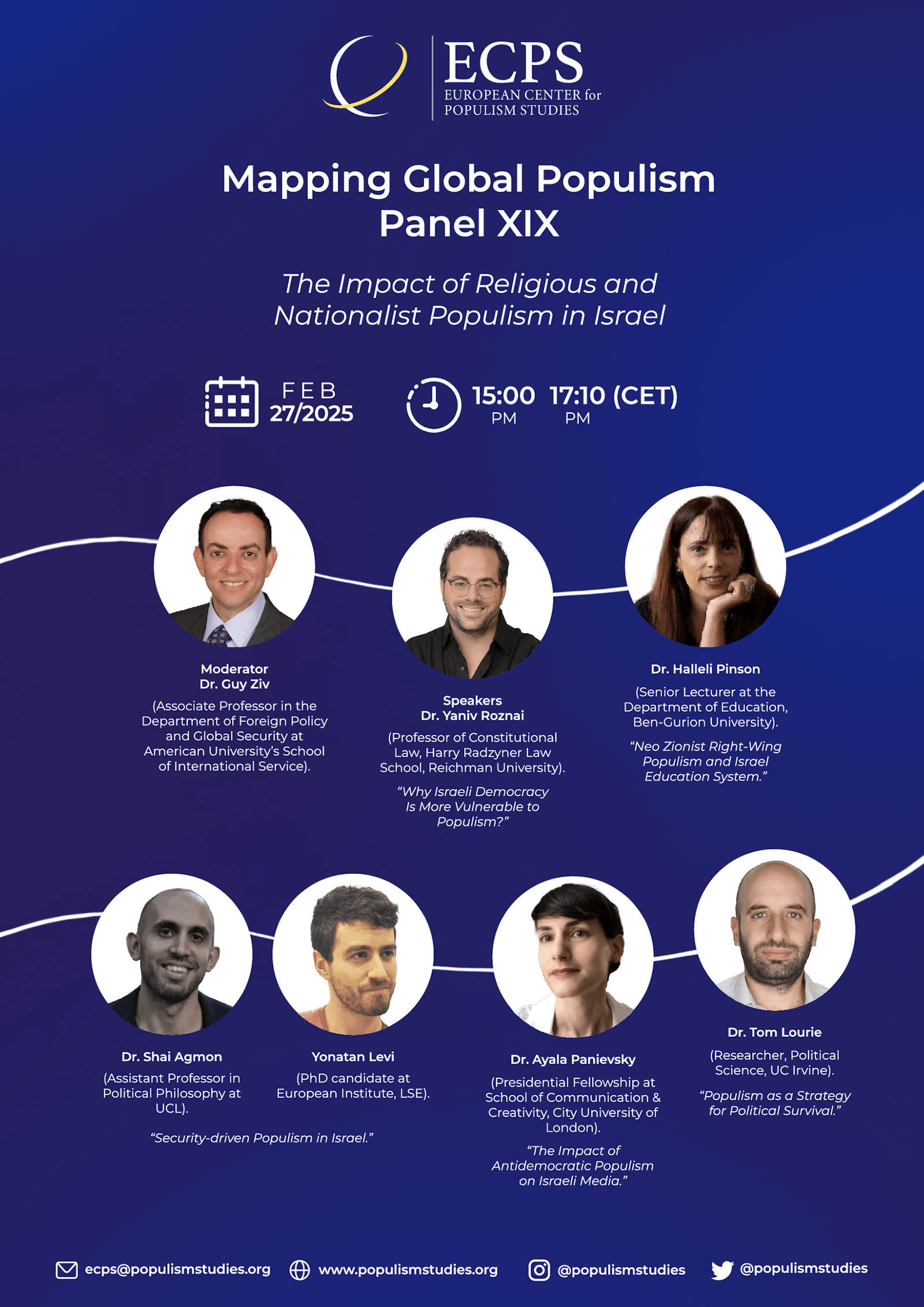
Date/Time: Thursday, February 27, 2025.
Moderator
Dr. Guy Ziv (Associate Professor in the Department of Foreign Policy and Global Security at American University’s School of International Service (SIS)).
Speakers
“Why Israeli Democracy Is More Vulnerable to Populism?” by Dr. Yaniv Roznai (Professor of Constitutional Law, Harry Radzyner Law School, Reichman University).
“Neo Zionist Right-wing Populist Discourse and Its Impact on the Israel Education System,” by Dr. Halleli Pinson(Associate Professor at the School of Education at Ben-Gurion University).
“Security-driven Populism in Israel,” by Dr. Shai Agmon (Assistant Professor in Political Philosophy at UCL) & Yonatan Levi (PhD candidate at European Institute, LSE).
“The Impact of Antidemocratic Populism on Israeli Media,” by Dr. Ayala Panievsky (Presidential Fellowship at School of Communication & Creativity, City University of London).
“Populism as a Strategy for Political Survival,” by Dr. Tom Lourie (Researcher, Political Science, UC Irvine).
MGP Panel XX: Ethnic & Sectarian Politics and Populism in Iraq, Syria and Kurdish Regions
Date/Time: Thursday, April 24, 2025.
Moderator
Dr. Ibrahim al-Marashi (Associate Professor of History, California State University).
Speakers
“Syrian Sunni Jihadi Chickens Home to Roost: Assad’s Fatal Gamble in Iraq,” by Dr. Reda Mahajar (Research Fellow at The Conflict Analysis Research Centre (CARC) at the University of Kent).
“Waves of Populism in Iraq,” by Hashim Hayder Khashan Al-Rekabi (Lecturer, University of Baghdad).
“Memory, Fear, and Sectarianism in Syria,” by Dr. Haian Dukhan (Lecturer in Politics & International Relations, SSSHL Department of Humanities and Social Sciences, Teeside University).
“Gendered Politics and Women’s Status Under Iraqi, Syrian, and Kurdish Authorities,” by Dr. Shilan Fuad Hussain(Marie Sklodowska-Curie Researcher; Research Fellow at the Institute of Domestic Violence, Religion & Migration, UK).
“The Evolution and Mishaps of Kurdish Identity Politics Under Multiple Dominations,” by Rojin Mukriyan (PhD candidate in the department of Government and Politics at University College Cork, Ireland).
Discussing Post-Election Germany: Democracy, Populism and the Far-Right Surge
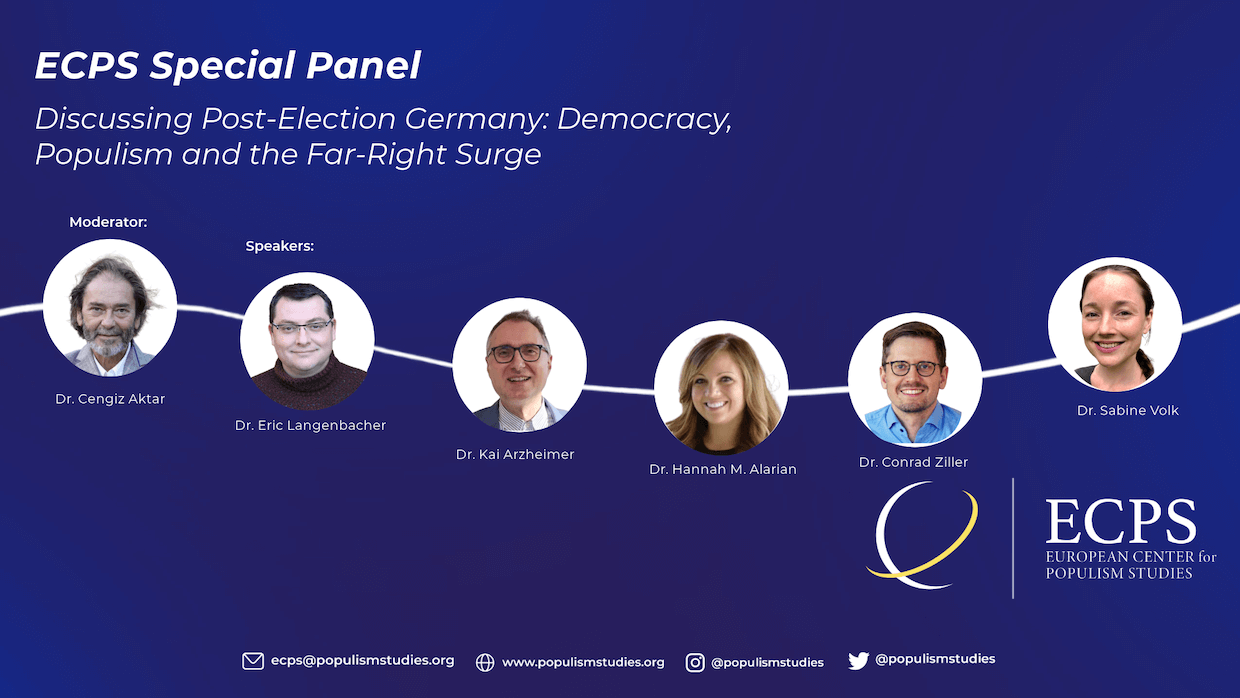
Date/Time: Thursday, March 13, 2025.
Moderator
Dr. Cengiz Aktar (Adjunct Professor of Political Science at the University of Athens and ECPS Advisory Board Member).
Speakers
"How Worried Should We Be About the AfD and the Transatlantic Relationship?" by Dr. Eric Langenbacher (Teaching Professor and Director of the Senior Honors Program in the Department of Government, Georgetown University).
“How Can We Explain the Rise of the AfD in the 2025 Election?” by Dr. Kai Arzheimer (Professor of Political Science at the University of Mainz).
"Accommodation or Exclusion? Immigration, the AfD, and Democratic Challenges in the 2025 Election,” by Dr. Hannah M. Alarian (Assistant Professor of Political Science at the University of Florida).
“The AfD’s Surge in the 2025 Germany Federal Election: Patterns of Realignment and Political Implications,” by Dr. Conrad Ziller (Assistant Professor of Political Science at the University of Duisburg-Essen).
“Germany’s Far Right: Antifeminism Sells,” by Dr. Sabine Volk (Postdoctoral Researcher at the Chair of Political Science and Comparative Politics, Faculty of Social and Educational Sciences, University of Passau).
Annual Symposium
Fourth Annual International Symposium on ‘Civilizational Populism: National and International Challenges’
Date: May 22-23, 2025
Venue: University of Warsaw, Krakowskie Przedmiescie 26/28, 00-927, Warsaw
The Fourth Annual International Symposium on “Civilizational Populism: National and International Challenges,”held on 22–23 May 2025 at the University of Warsaw, marked a significant milestone in ECPS’s sustained effort to advance comparative and interdisciplinary scholarship on populism in an era of democratic uncertainty. Convened as a two-day, fully in-person event, the symposium brought together scholars, policymakers, and practitioners to examine how populism increasingly operates through civilizational, religious, and cultural frames—reshaping political conflict at local, national, transnational, and global levels.
This symposium can be read as both a diagnostic exercise and a conceptual intervention. Rather than treating populism as a uniform or context-bound phenomenon, the programme foregrounded its hybrid character: a “thin” political logic that acquires force when articulated with religion, nationalism, digital technologies, and civilizational narratives. Across keynotes, panels, and workshops, participants explored how these articulations affect plural societies, democratic institutions, market structures, identity politics, and international relations—across both the Global North and Global South.
Organized by the ECPS and hosted by the Centre for Europe at the University of Warsaw, the symposium was realized through close collaboration with a wide network of partner institutions, including Georgetown University, the University of Birmingham, Deakin University, DAAD/Cambridge University, the University of Duisburg-Essen (Institute of East Asian Studies), and the Centre for International Relations (Warsaw). This institutional constellation ensured strong interdisciplinary grounding, drawing on political science, sociology, law, economics, religious studies, and international relations.
Structurally, the symposium combined five thematic panels, high-level keynote addresses, and two specialized workshops, enabling both theoretical synthesis and fine-grained empirical analysis. Taken together, the event reinforced ECPS’s role as a convening platform for global scholarship on populism, while situating civilizational populism as a central analytical lens for understanding contemporary challenges to democracy, social cohesion, and global order.
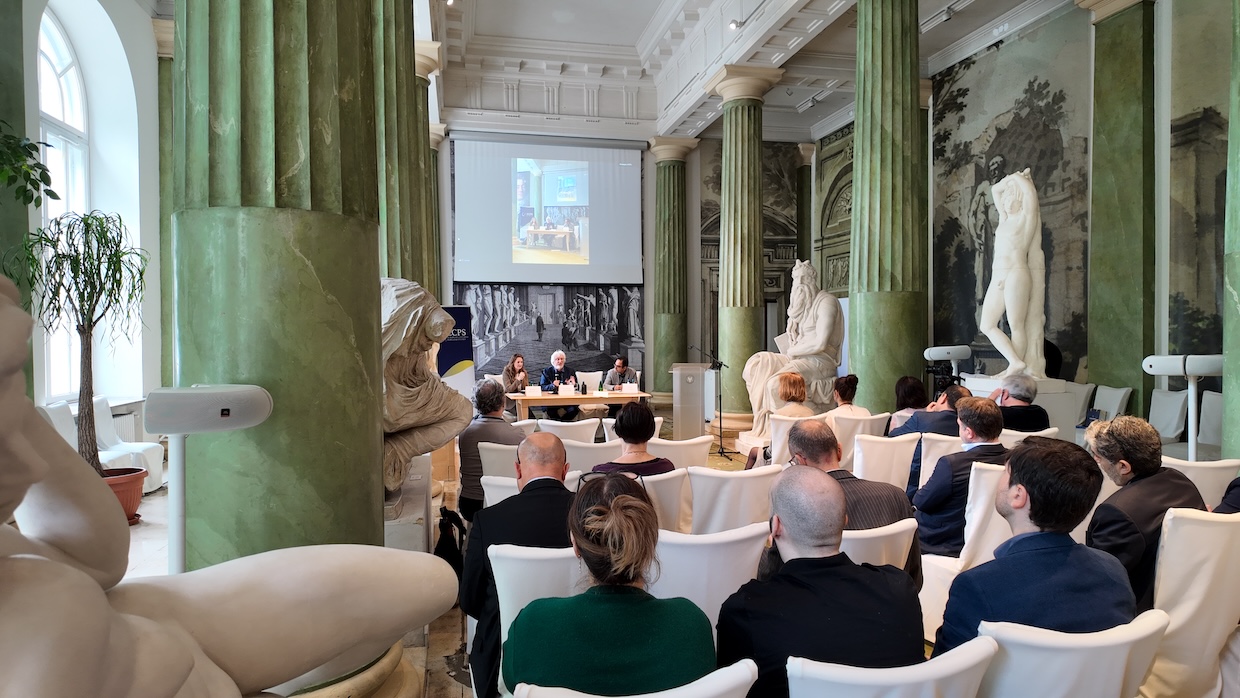
DAY ONE – May 22, 2025
Opening Ceremony
Moderator
Dr. Azize Sargın (Director for External Relations, ECPS).
Welcome Remarks
Dr. Kamil Zajączkowski (Professor of International Relations, Director of the Centre for Europe, Warsaw University).
Irina von Wiese (Honorary President of ECPS, Lawyer, Academic, former MEP, and Councilor in the London Borough of Southwark).
Dr. Malgorzata Bonikowska (Professor of International Affairs and European Studies, President of the Center for International Relations).
Opening Speeches
Dr. Adam Bodnar (Minister of Justice of Poland / (Video Recording).
Dr. Alojzy Z. Nowak (Professor, Rector of the University of Warsaw).
Keynote Speech
“A Relational Approach to Religion and Populism: Recontextualizing Civilizational Narratives in National and Global Contexts,” by Dr. Jocelyne Cesari (Professor and Chair of Religion and Politics at the University of Birmingham, UK, and Senior Fellow at the Berkeley Center for Religion, Peace, and World Affairs at Georgetown University).
Panel 1: Populism: Is It a One-way Route from Democracy to Authoritarianism?
Moderator
Dr. Erkan Toguslu (Researcher at the Institute for Media Studies at KU Leuven, Belgium).
Speakers
"Making Sense of Multiple Manifestations of Alternatives to Liberal Democracies," by Dr. Radoslaw Markowski(Professor of Political Science, Center for the Study of Democracy, Director, SWPS University of Social Sciences and Humanities, Warsaw & Polish Academy of Sciences & Polish National Election Study, Principal Investigator).
“Constitutional Intolerance: The Fashioning of ‘the Other’ in Europe’s Constitutional Repertoires,” by Dr. Marietta van der Tol (Politics & International Studies, DAAD-Cambridge).
Panel 2: Civilizational Rhetoric, Emotions, and Societal Cohesion
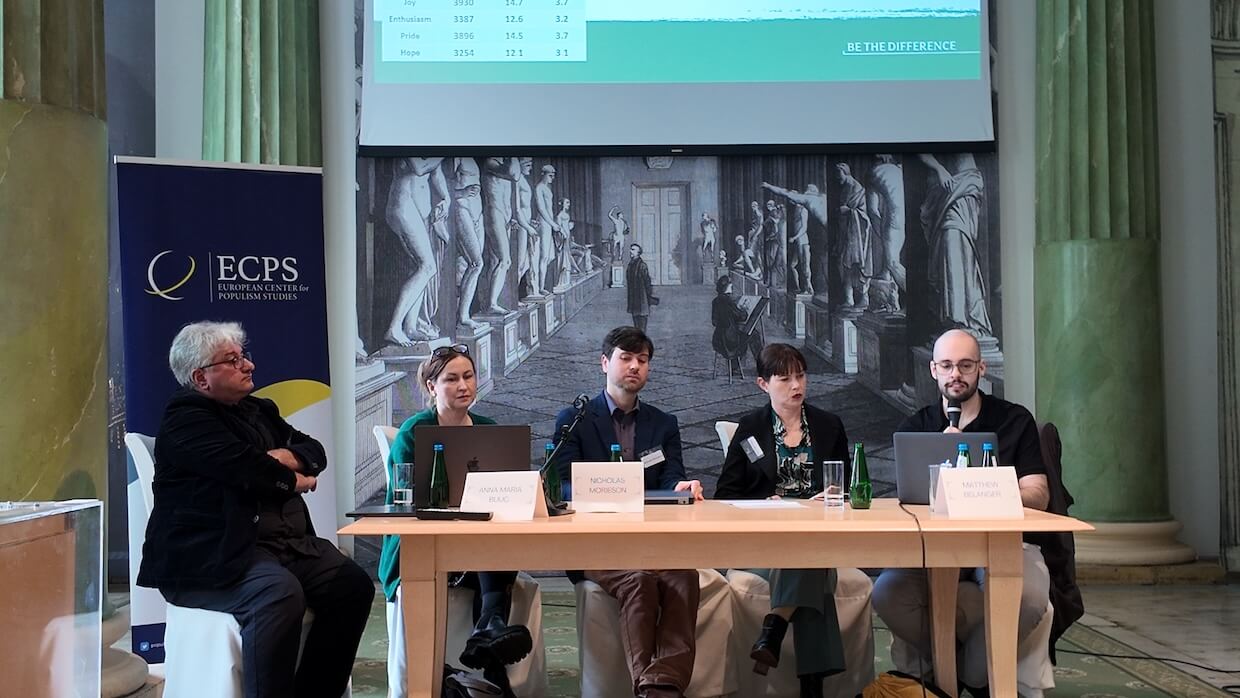
Moderator
Dr. Erin K. Wilson (Professor, Chair of Politics and Religion, the Faculty of Religion, Culture, and Society, University of Groningen).
Paper Presenters
“Populism, Civilization, and Restorative Nostalgia,” by Dr. Nicholas Morieson (Research Fellow, Deakin University’s Alfred Deakin Institute for Citizenship and Globalization).
“Emotional Dimensions of Civilisationist Populism: A Comparative Analysis of Erdogan, Modi, and Khan with Transformer-Based Classification,” by Dr. Matthew Belanger (Lecturer in Substance Use Sociology, Social Policy, and Criminology Faculty of Social Sciences University of Stirling) and Dr. Ana-Maria Bliuc (Reader in Psychology, School of Humanities, Social Sciences, and Law at the University of Dundee).
Keynote Speech
“The Role of the UN in Fighting for Human Rights in This Populist Age,” by Kamil Wyszkowski (Director of UN Global Compact).
Panel 3: Religion and Populism: Local, National, and Transnational Dimensions
Moderator
Dr. Jocelyne Cesari (Professor and Chair of Religion and Politics at the University of Birmingham (UK) and Senior Fellow at the Berkley Center for Religion, Peace, and World Affairs at Georgetown University).
Speakers
“Remember to be Jewish: Religious Populism in Israel,” by Dr. Guy Ben-Porat (Professor of International Relations and Politics, Ben-Gurion University of the Negev).
“Religious Populism and Civilizationalism in International Politics: An Authoritarian Turn,” by Dr. Ihsan Yilmaz (Research Professor of Political Science and International Relations and Chair in Islamic Studies at Deakin University’s Alfred Deakin Institute for Citizenship and Globalization) & Dr. Nicholas Morieson (Research Fellow, Deakin University’s Alfred Deakin Institute for Citizenship and Globalization).
Paper Presenters
“National Populists of Christian Europe, Unite? Civilizations Dimensions of Far-right Populist Alliances in Post-Brexit Britain,” by Dr. Rafal Soborski (Professor of International Politics, The Department of Social Science at Richmond American University and Senior Research Fellow at the Global Diversities and Inequalities Research Centre at London Metropolitan University).
“Anwar Ibrahim’s Civilisational Populism: Between the Muslim World and Malaysia,” by Dr. Syaza Shukri (Assoc. Professor & Head of Department of Political Science, International Islamic University Malaysia).
DAY TWO – May 23, 2025
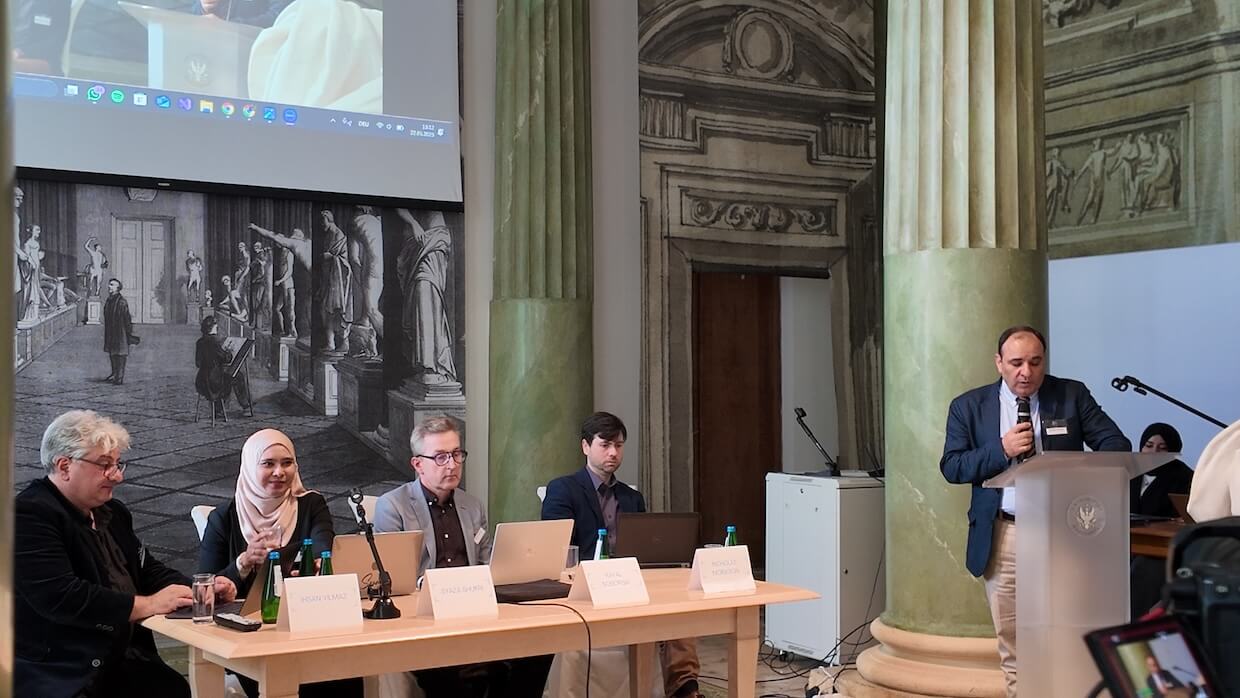
Keynote Speech
Dariusz Mazur (Deputy Minister of Justice of the Republic of Poland).
Panel 4: Impacts of Civilizational Populism on the Market and Globalization
Moderator
Antoine Godbert (Affiliate Professor of Law, Economics & Humanities at ESCP Business School, Paris, and Director of International Affairs at the Rectorat of Île-de-France – Paris).
Speakers
“On the Nature of Economics and the future of Globalization under Civilizational Populism,” by Dr. Ibrahim Ozturk(Professor of Economics, Duisburg-Essen University, Institute of East Asian Studies (IN-EAST), Germany, Senior Economic Researcher at the ECPS, Brussels).
“Populism as a Reaction to Neoliberal Technocratism,” by Dr. Krzysztof Jasiecki (Professor of Economic Sociology at the Centre for Europe, University of Warsaw).
“Far-Right Populism and the Making of the Exclusionary Neoliberal State,” by Dr. Valentina Ausserladscheider(Associate Professor, Department of Economic Sociology, University of Vienna and Research Affiliate, Department of Sociology, University of Cambridge).
Panel 5: Religion and Identity Politics
Moderator
Dr. Ana-Maria Bliuc (Reader in Psychology, School of Humanities, Social Sciences, and Law at the University of Dundee).
Speaker
“Religion and Power in an Age of Identity Politics,” by Dr. Erin K. Wilson (Professor, Chair of Politics and Religion, the Faculty of Religion, Culture, and Society, University of Groningen).
Paper Presenters
“Civilizational Populism and the Making of Sexualized Cultural Christianity,” by Dr. Ludger Viefhues-Bailey(Distinguished Professor of Philosophy, Gender, and Culture, Le Moyne University, NY).
“Imagine No More Small Boats in the Channel’: How Populist Parties and Their Leaders Normalize Polarization in Their Communication on Social Media Platforms, a Multimodal Discourse Analysis,” by Dr. Valeria Reggi (Post-doc Researcher at the University of Venice and Adjunct Professor and Tutor at the University of Bologna).
"Populism from a Double Perspective. Timo Soini and the Finnish Version of Populism," by Dr. Jarosław Suchoples(Centre for Europe, University of Warsaw, Former Polish Ambassador to Finland).
Closing Remarks
Dr. Kamil Zajączkowski (Professor of International Relations, Director of the Centre for Europe, Warsaw University).
Workshops
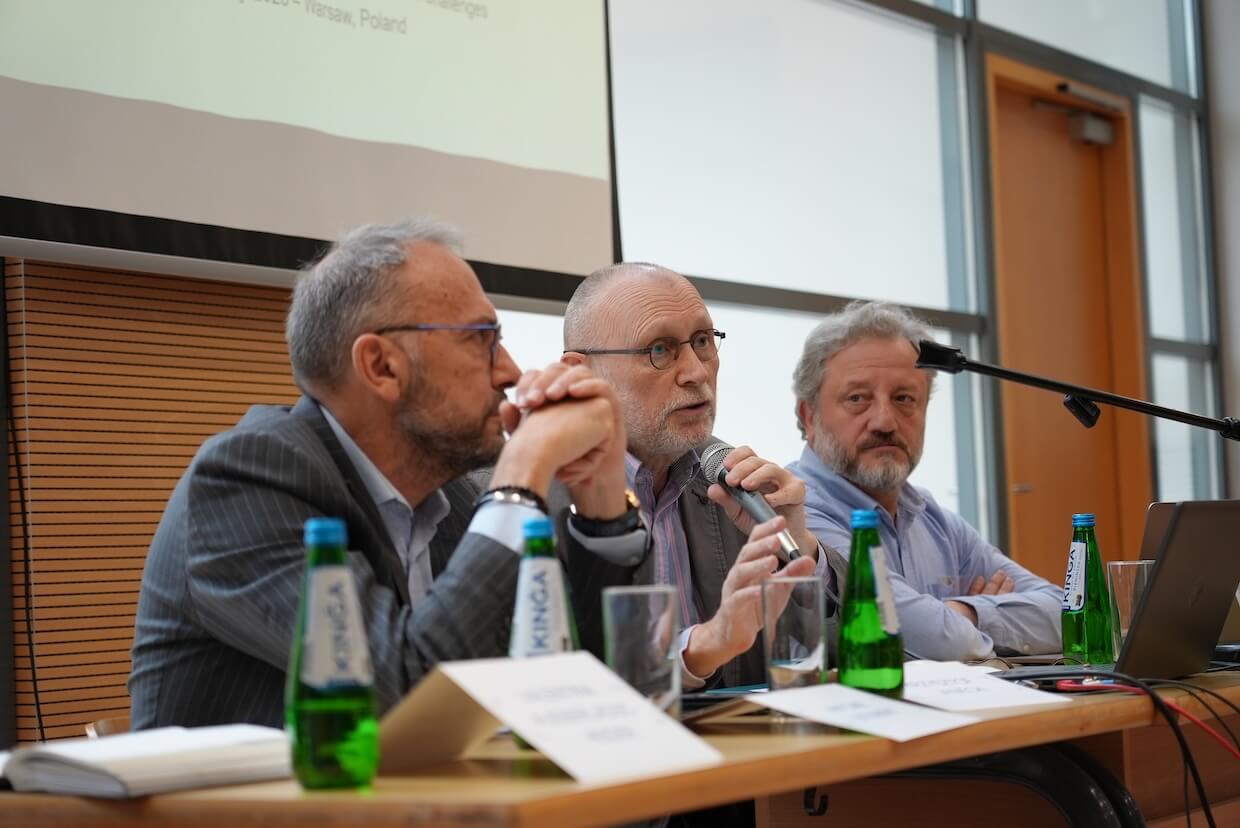
Workshop 1: Populism in Regions
Moderators/ Discussants
Dr. Guy Ben-Porat (Professor of International Relations and Politics, Ben-Gurion University of the Negev).
Dr. Rafal Soborski (Professor of International Politics, The Department of Social Science at Richmond American University and Senior Research Fellow at the Global Diversities and Inequalities Research Centre at London Metropolitan University).
Paper Presenters
“Civilizational Populism and Foreign Policy: Analyzing Italy-Tunisia Migration,” by Dr. Helen L. Murphey (Post-Doctoral Scholar at the Mershon Center for International Security Studies at the Ohio State University).
“Greater Than the Nation: Civilizational Discourse in Orbán’s Hungary,” by Dr. Tamas Dudlak (International Relations, the ELTE Eötvös Loránd University of Budapest, and researcher in the Contemporary Arab World Center, Budapest, Hungary).
“Civilizational Populism in Hybrid Regime: The Case of Serbia,” by Nikola Ilić (PhD Candidate in political science at the University of Belgrade).
“The Return of Kahanism to Israeli Politics – the 2022 Elections,” by Adam Sharon (Ph.D. Candidate, Department of Politics and International Relations, University of Oxford, Somerville College)
Workshop 2: Selected Topics in Populism
Moderators/ Discussants
Dr. Ludger Viefhues-Bailey (Distinguished Professor of Philosophy, Gender, and Culture, Le Moyne University, NY).
Dr. Joanna Kulska (University Professor, Institute of Political Science and Administration, University of Opole)
Paper Presenters
“Turanism, the Great Kurultáj and ‘Eastern Opening’: An Alternative View of Eurasia and the ‘West,’” by Dr. Robert Imre (Associate Professor in Political Sciences at the University of the Faroe Islands).
“Sanitary Segregation Enforced by Big Brother: A Multimodal Critical Discourse Analysis of Grzegorz Braun’s Extreme Anti-Vaccine Rhetoric,” by Dr. Marcin Kosman (Assistant Prof., The University of Economics and Human Sciences in Warsaw, Department of Social Sciences).
“State-led Civilizational Populism: A Comparison of Pakistan and Israel,” by Dr. Fizza Batool (SBAZIT University, Karachi, Pakistan).
“Populism and Traditional Catholicism in the United States: A Convergence of Religious Identity and Political Ideology,”by Tiffany Hunsinger (Ph.D. Candidate in Theology at the University of Dayton).
“The Role of Culture War in Shaping the Alliance Between Christian Conservative Movements and Chega Party,” by Francisco Batista (Ph.D. Candidate and Researcher, Political Science, Universidade Nova de Lisboa).
***
Conference & Post-Conference Workshop Series
‘We, the People’ and the Future of Democracy: Interdisciplinary Approaches
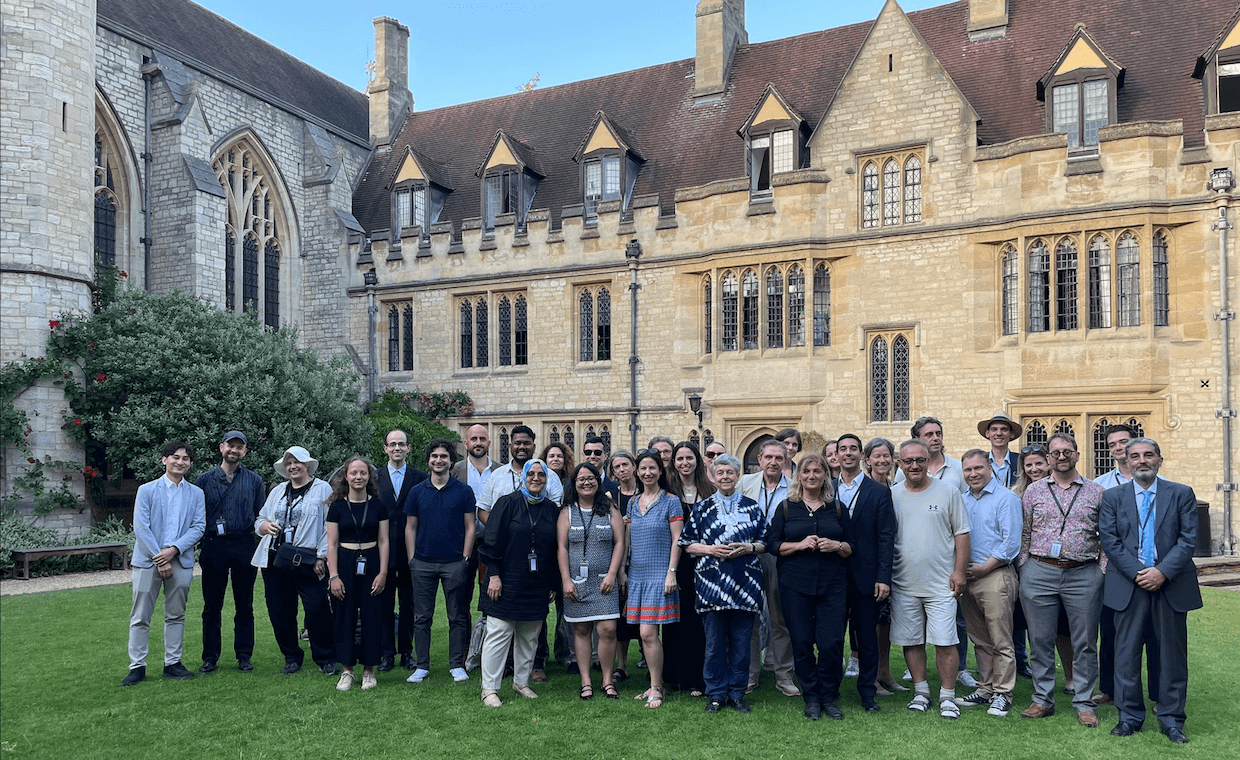
In-Person Programme: July 1-3, 2025. St. Cross College, Oxford University
Virtual Workshops: September 2025 – April 2026 via Zoom
Across three days in Oxford and a longer season of virtual exchange, the conference “‘We, the People’ and the Future of Democracy: Interdisciplinary Approaches” convened a rare cross-disciplinary community around a deceptively simple yet politically decisive question: who gets to speak in the name of “the people,” and with what consequences for democratic life? Against the backdrop of accelerating democratic erosion—where the grammar of popular sovereignty is increasingly mobilized to legitimize exclusion, repression, and institutional capture—the programme approached “the people” not as a fixed referent but as a contested political technology whose meanings, uses, and effects demand sustained critical scrutiny.
Hosted in person at St Cross College, University of Oxford from July 1–3, 2025, the conference brought together scholars from the humanities, social sciences, and policy-oriented research through a rich format combining three roundtables and eight thematic panels. These sessions mapped how claims to popular authority are produced, governed, and resisted across diverse political and social contexts, addressing themes such as constitutional backsliding, identity and belonging, algorithmic mediation, crisis governance, and the shifting architectures of political representation. The roundtables enabled synthetic and normative reflection across disciplines, while the panels foregrounded fine-grained conceptual analysis and empirical diagnostics—tracing how “us versus them” repertoires travel, how social contracts fracture, and how democratic resilience is assembled under pressure.
The conversation extended well beyond Oxford through an ambitious virtual workshop programme (September 2025–April 2026), comprising sixteen sessions, eight of which were successfully delivered in 2025. This online strand widened participation, deepened comparative perspectives, and sustained thematic continuity across the academic year, reinforcing the conference’s role as both an intellectual intervention and a durable infrastructure for collaborative inquiry.
The conference was organized by the ECPS in close collaboration with a network of leading academic institutions at the University of Oxford, including the Humanities Division, the Rothermere American Institute, the Oxford Network of Peace Studies (OxPeace), the European Studies Centre at St Antony’s College, and the Oxford Democracy Network. This multi-institutional partnership ensured strong interdisciplinary grounding across political science, philosophy, history, law, sociology, and area studies, while reinforcing the conference’s mission to bridge rigorous scholarship with policy-relevant debates on democracy, populism, and democratic resilience.
IN-PERSON PROGRAMME
DAY ONE
Introduction
Sumeyye Kocaman (Managing Editor, Populism & Politics, DPhil, St. Catherine’s College, Asian and Middle Eastern Studies, Oxford University).
Opening Address
Kate Lyndsay Mavor, CBE (Master of St Cross College, Oxford University).
Janet Royall (Baroness Royall of Blaisdon, Principal of Somerville College, Oxford University).
Roundtable 1: Politics of the ‘People’ in Global Europe
Chair
Jonathan Wolff (Senior Research Fellow in Philosophy and Public Policy, Blavatnik School of Government, University of Oxford; President of the Royal Institute of Philosophy).
Speakers
“The Reappearance of ‘The People’ in European Politics,” by Martin Conway (Professor of Contemporary European History, University of Oxford).
“The Construction of the Reactionary People,” by Aurelien Mondon (Professor of Politics, University of Bath).
“Christianity in A Time of Populism,” by Luke Bretherton (Regius Professor of Moral & Pastoral Theology, University of Oxford).
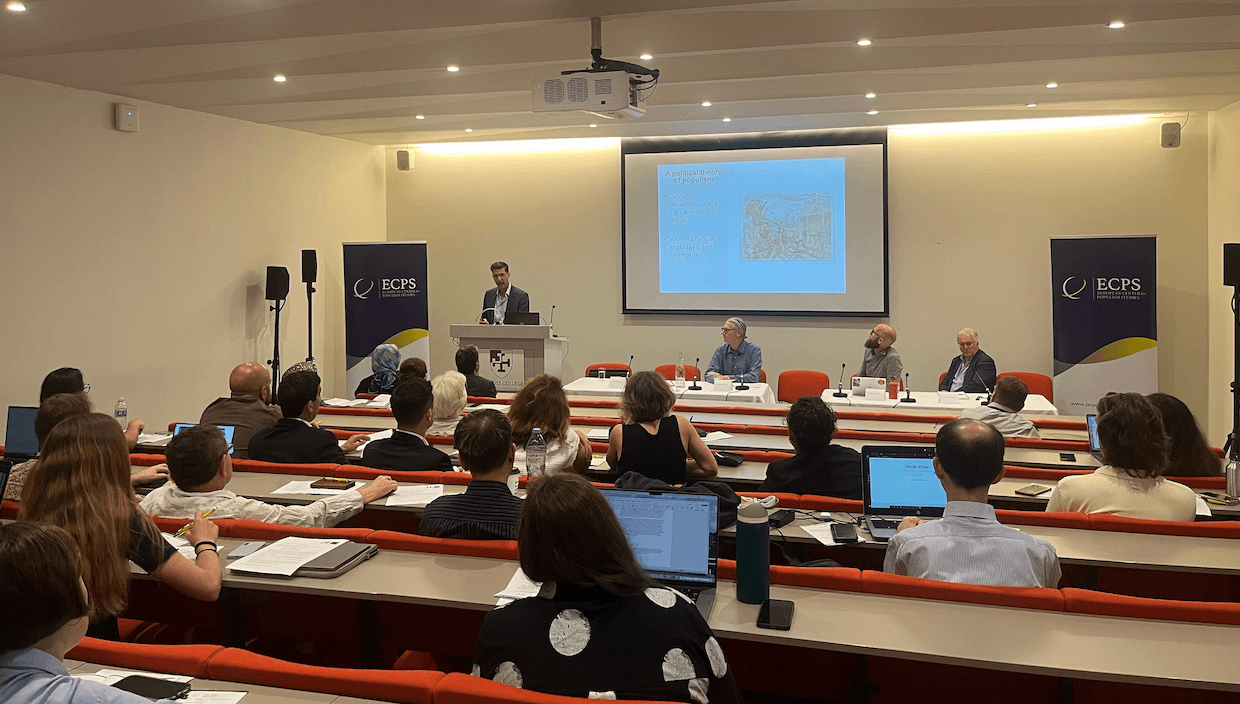
Panel 1: Politics of Social Contract
Chair
Lior Erez (Alfred Landecker Postdoctoral Fellow, Blavatnik School of Government, Nuffield College, Oxford University).
Speakers
“Exploring Human Rights Attitudes: Outgroup Perception and Long-term Consequences,’ by Sabine Carey (Professor of Political Science at the University of Mannheim and Director of the Mannheim Centre for European Social Research); Robert Johns (Professor of Politics at the University of Southampton), Katrin Paula (Postdoctoral Researcher, Technical University Munich) and Nadine O’Shea (Postdoctoral researcher, Technical University Munich).
“Doing Politics Non-politically: Explaining How Cultural Projects Afford Political Resistance,” by Nathan Tsang(Doctoral Candidate in Sociology, University of Southern California).
“From Demos to Cosmos: The Political Philosophy of Isabelle Stengers,” by Simon Clemens (Doctoral Researcher at the Cluster of Excellence “Contestation of the Liberal Script – (SCRIPTS)” and at Theory of Politics at Humboldt Universität zu Berlin).
Panel 2: ‘The People’ in the Age of AI and Algorithms
Chair
Alina Utrata (Career Development Research Fellow, Rothermere American Institute, St John’s College, Oxford University).
Murat Aktaş (Professor, Political Science Department, Muş Alparslan University).
Speakers
“Navigating Digital Disruptions: The Ambiguous Role of Digital Technologies, State Foundations and Gender Rights,”by Luana Mathias Souto (Marie Skłodowska-Curie Postdoctoral Fellow, GenTIC Research Group, Universitat Oberta de Catalunya).
“The Role of AI in Shaping the People: Big Tech and the Broligarchy’s Influence on Modern Democracy,” by Matilde Bufano (MSc in International Security Studies, Sant’Anna School of Advanced Studies and the University of Trento).
Panel 3: Populist Threats to Modern Constitutional Democracies and Potential Solutions: Research Output of the Jean Monnet Chair EUCODEM
Co-Chairs
Elia Marzal (Associate Professor of Constitutional Law, University of Barcelona).
Bruno Godefroy (Associate Professor in Law and German, University of Tours, France).
Speakers
“Theoretical Foundations of Modern Populism: Approaches of Heidegger, Laclan and Laclau,” by Daniel Fernández(Assistant Professor of Constitutional Law, Universitat Lleida).
“Erosion of the Independence of the Judiciary,” by Marco Antonio Simonelli (Assistant Professor of Constitutional Law, University of Barcelona).
“Referenda as a Biased and Populist Tool: Addressing a Complex Issue in a Binary Way," by Elia Marzal (Associate Professor of Constitutional Law, University of Barcelona).
“Pro-Independence Movements as A Populist Way Out in Multinational Contemporary Societies,” by Núria González(Assistant Professor of Constitutional Law, University of Barcelona).
“Potential Solutions: Second Chambers, Demos and Majoritarian Body,” by Roger Boada (Assistant Professor of Constitutional Law, University of Barcelona).
DAY TWO
Panel 4: Politics of Belonging: Voices and Silencing
Chair
Azize Sargın (PhD., Director of External Relations, ECPS).
Speakers
“The Scents of Belonging: Olfactory Narratives and the Dynamics of Democratization,” by Maarja Merivoo-Parro(Marie Curie Fellow, University of Jyväskylä).
“Silent Symbols, Loud Legacies: The Child in Populist Narratives of Post-Communist Poland,” by Maria Jerzyk(Graduate student, Masaryk University in Brno, Czechia).
Roundtable 2: ‘The People’ in and against Liberal and Democratic Thought

Chair
Aviezer Tucker (Director for the Centre for Philosophy of Historiography and the Historical Sciences, University of Ostrava).
Speakers
“Listening to ‘the People’: Impossible Concepts in Political Philosophy,” by Naomi Waltham-Smith (Professor, Music Faculty, University of Oxford).
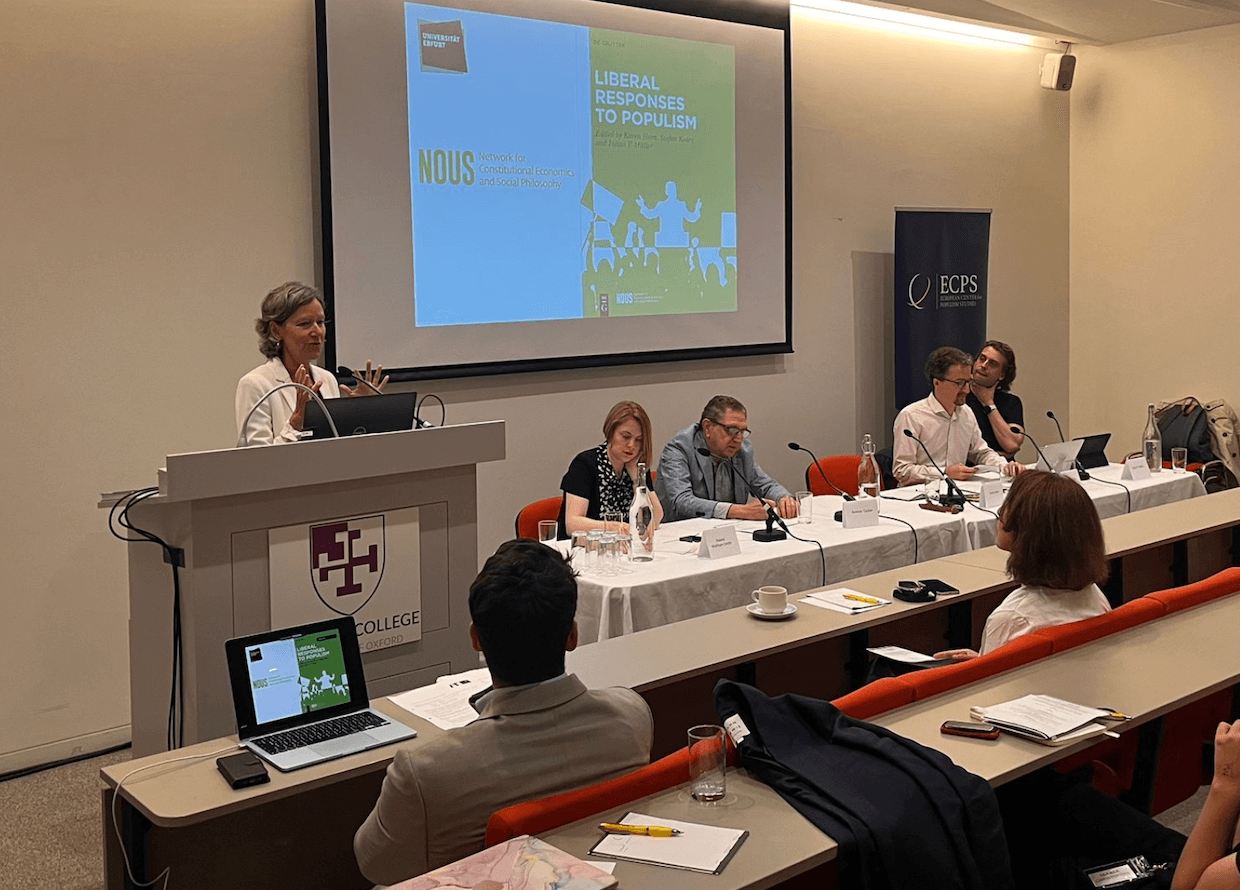
“Liberal Responses to Populism,” by Karen Horn (Professor in Economic Thought, University of Erfurt) & Julian F. Müller (Professor of Political Philosophy, University of Graz).
“The Living Generation – A Presentist Conception of the People,” by Bruno Godefroy (Associate Professor in Law and German, University of Tours, France).
Panel 5: Governing the ‘People’: Divided Nations
Co-Chairs
Leila Alieva (Associate Researcher, Russian and East European Studies, Oxford School of Global and Area Studies, Oxford).
Karen Horn (Professor in Economic Thought, University of Erfurt).
Speakers
“Catholicism and nationalism in Croatia: The Use and Misuse of ‘Hrvatski Narod’," by Natalie Schwabl (Doctoral Candidate, Faculty of Arts, Languages, Literature and Humanities, Sorbonne University).
“‘Become Ungovernable:’ Covert Tactics, Racism, and Civilizational Catastrophe,” by Sarah Riccardi-Swartz(Assistant Professor of Religion and Anthropology, Northeastern University).
“Is There Left-wing Populism Today? A Case Study of the German Left and the Sahra Wagenknecht Alliance,” by Petar S. Ćurčić (Research Associate, Institute of European Studies, Belgrade).
Panel 6: The ‘People’ in Search of Democracy
Chair
Max Steuer (Principal Investigator at the Department of Political Science of the Comenius University in Bratislava).
Speakers
“Between Antonio Gramsci and Erik Olin Wright: Deepening Democracy through Civil Society Engagement,” by Rashad Seedeen (Adjunct Research Fellow in the Department of Politics, Philosophy and Media in the School of Humanities and Social Sciences, La Trobe University, Melbourne).
“Resilient or Regressive? How Crisis Governance Reshapes the Democratic Future of ‘The People’,” by Jana Ruwayha(PhD Candidate, Faculty of Law; Teaching and Research Assistant, Global Studies Institute; University of Geneva).
“The Performative Power of the ‘We’ in Occupy Wall Street and Gezi Movement,” by Özge Derman (PhD., Sciences Po and Sorbonne University).
DAY THREE
Panel 7: ‘The People’ in Schröndinger’s Box: Democracy Alive and Dead
Co-Chairs
Ming-Sung Kuo (Reader in Law, University of Warwick School of Law).
Bruno Godefroy (Associate Professor in Law and German, University of Tours, France).
Speakers
“The Matrix of ‘Legal Populism’: Democracy and (Reducing) Domination,” by Max Steuer (Principal Investigator, Department of Political Science, Comenius University).
“Lived Democracy in Small Island States: Sociopolitical Dynamics of Governance, Power, and Participation in Malta and Singapore,” by Justin Attard (PhD Candidate, University of Malta).
“Russia’s War on Democracy,” by Robert Person (Professor of International Relations and Director of curriculum in International Affairs, United States Military Academy).
Panel 8: ‘The People’ vs ‘The Elite’: A New Global Order?
Co-Chairs
Ashley Wright (Postdoctoral Research Fellow, Minerva Global Security Programme, Blavatnik School of Government, University of Oxford).
Azize Sargın (PhD., Director of External Relations, ECPS).
Speakers
“We: The Populist Elites,” by Aviezer Tucker (Director for the Centre for Philosophy of Historiography and the Historical Sciences, University of Ostrava).
“Reclamations of ‘We, the People’: Rethinking Civil Society through Spatial Contestations in Turkey,” by Pınar Dokumacı (Assistant Professor at the School of Politics and International Relations, University College Dublin) & Özlem Aslan (Assistant Professor in the Core Program at Kadir Has University).
“The Transatlantic Network of Authoritarian Populism: The Rise of the Executive and Its Dangers to Democracy,” by Attila Antal (Associate Professor, Faculty of Law, Institute of Political Science, Eötvös Loránd University).
“The French New Right and Its Impact on European Democracies,” by Murat Aktaş (Professor, Political Science Department, Muş Alparslan University); Russell Foster (Senior Lecturer in British and International Politics, King’s College London, School of Politics & Economics, Department of European & International Studies).
Discussant
Karen Horn (Professor in Economic Thought, University of Erfurt).
Roundtable 3: When the Social Contract Is Broken: How to Put the Genie Back
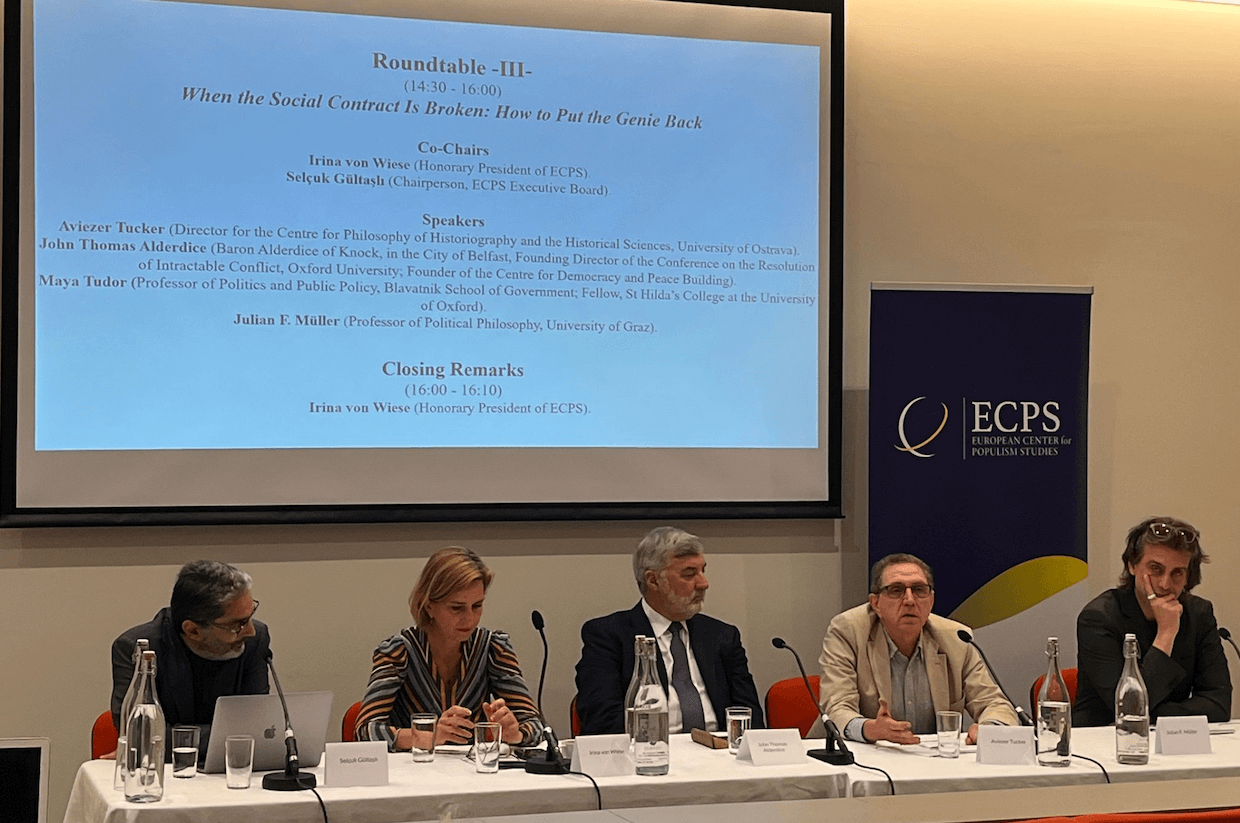
Co-Chairs
Irina von Wiese (Honorary President of ECPS).
Selçuk Gültaşlı (Chairperson, ECPS Executive Board).
Speakers
Aviezer Tucker (Director for the Centre for Philosophy of Historiography and the Historical Sciences, University of Ostrava).
John Thomas Alderdice (Baron Alderdice of Knock, in the City of Belfast, Founding Director of the Conference on the Resolution of Intractable Conflict, Oxford University; Founder of the Centre for Democracy and Peace Building).
Julian F. Müller (Professor of Political Philosophy, University of Graz).
Closing Remarks
Irina von Wiese (Honorary President of ECPS).
POST-CONFERENCE VIRTUAL WORKSHOP SERIES
Session 1: The Rise of Populist Authoritarianism around the World
Date/Time: Thursday, September 4, 2025
Chair
Oscar Mazzoleni (Professor, Political Science, University of Lausanne; Editor-in-Chief, Populism & Politics).
Introduction
David J. Sanders (Regius Professor of Political Science, University of Essex, Emeritus).
Speakers
“The Rise of Populist Authoritarianism in India and the US: Do Family Dynasties and Big Businesses Really Control Democracy?” by Dinesh Sharma, Shoshana Baraschi-Ehrlich, Britt Romagna, Ms. Ayako Kiyota (Fordham University,NYC), Amartya Sharma (Student, George Washington University, D.C.)
“Out-groups and Elite Cues: How Populists shape Public Opinion,” by Michael Makara (Associate Professor of Comparative Politics and International Relations, University of Central Missouri) and Gregory W. Streich (Professor of Political Science and Chair of the School of Social Sciences and Languages, University of Central Missouri).
“From Economic to Political Catastrophe: Four Case Studies in Populism,” by Akis Kalaitzidis (Professor of Political Science, Department of Government, Law, and International Studies, University of Central Missouri).
“Populism, Clientelism, and the Greek State under Papandreou,” by Elizabeth Kosmetatou (Professor of History, University of Illinois Springfield) and Akis Kalaitzidis (Professor of Political Science, Department of Government, Law, and International Studies, University of Central Missouri).
Discussant
João Ferreira Dias (Researcher at the International Studies Centre of ISCTE, in the Research Group Institutions, Governance and International Relations).
Session 2: The ‘Nation’ or just an ‘Accidental Society’: Identity, Polarization, Rule of Law and Human Rights in 1989-2025 Poland
Date/Time: Thursday, September 18, 2025)
Chair
Prof. Mavis Maclean, CBE (St Hilda’s College, University of Oxford).
Speakers
“Varieties of Polish Patriotism: Experience of “Solidarity” 1980-1989 in Context of History and Anthropology of Ideas,”by Joanna Kurczewska (Professor in the humanities, Head of the Sociology and Anthropology of Culture Team at the Institute of Philosophy and Sociology of the Polish Academy of Sciences).
“Single Text, Clashing Meanings: Political Polarization, Constitutional Axiology and the Polish Constitutional Quagmire,” by Kamil Jonski (Economist, PhD in law at the University of Lodz).
“Protection of Human Rights and Its Implications for Women’s and Minority Rights,” by Malgorzata Fuszara (Professor of humanities in the field of sociology, Institute of Applied Social Sciences (IASS), University of Warsaw).
“Who Speaks for Whom: The Issue of Representation in the Struggle for the Rule of Law,” by Jacek Kurczewski(Professor of humanities in the field of Sociology, Lecturer at the Department of Sociology and Anthropology of Customs and Law at the University of Warsaw).
Discussants
Magdalena Solska (Assistant Professor, Department of European Studies and Slavic Studies, University of Fribourg).
Barry Sullivan (Professor, Institute For Racial Justice, Loyola University Chicago School of Law).
Krzysztof Motyka (Professor, Institute of Sociological Sciences, John Paul II Catholic University of Lublin)
Session 3: Populism, Freedom of Religion and Illiberal Regimes
Date/Time: Thursday, October 2, 2025
Chair
Marietta D.C. van der Tol (PhD, Landecker Lecturer, Faculty of Divinity, University of Cambridge; Senior Postdoctoral Researcher, Trinity College)
Speakers
“Religious Freedom as Hungaricum Hungarian iIliberalism and the Political Instrumentalization of Religious Freedom,”by Marc Loustau (PhD., Independent Scholar).
“Religious or Secular Freedom? On Pragmatic Politicization of Religion in Post-socialist Slovakia,” by Juraj Buzalka(Associate Professor of Social Anthropology, Faculty of Social and Economic Sciences at Comenius University).
“Illiberal Theocracy in Texas? The Incorporation of Evangelical Christian Theology into State Law,” by Rev. Dr. Colin Bossen (First Unitarian Universalist of Houston and Harris Manchester College, University of Oxford).
Discussants
Simon P. Watmough (Freelance academic researcher and editor and serves as a non-resident research fellow at ECPS).
Erkan Toguslu (PhD, Researcher at the Institute for Media Studies at KU Leuven, Belgium).
Session 4: Performing the People: Populism, Nativism, and the Politics of Belonging
Date/Time: Thursday, October 16, 2025
Chair
Oscar Mazzoleni (Professor, Political Science, University of Lausanne).
Speakers
“We, the People: Rethinking Governance Through Bottom-Up Approaches,” by Samuel Ngozi Agu (Ph.D., Dean of the MJC Echeruo Faculty of Humanities at Abia State University, Uturu, Nigeria).
“Uses and Meanings of ‘the People’ in Service of Populism in Brazil,” by Eleonora Mesquita Ceia (Professor at the National Faculty of Law of the Federal University of Rio de Janeiro (UFRJ), Brazil).
“The Idea of ‘People’ Within the Domain of Authoritarian Populism in India,” by Shiveshwar Kundu (Jangipur College, University of Kalyani).
“We, the People: The Populist Subversion of a Universal Ideal,” by Mouli Bentman & Mike Dahan (Sapir College, Israel).
Discussants
Abdelaaziz Elbakkali (Associate Professor of Media and Cultural Anthropology, SMBA University, Fes; Post-Doc Fulbright visiting scholar at Arizona State University).
Azize Sargin (Director for External Affairs, ECPS).
Session 5: Constructing the People: Populist Narratives, National Identity, and Democratic Tensions
Date/Time: Thursday, October 30, 2025
Chair
Heidi Hart (PhD, Arts Researcher and Practitioner based in Utah, US and Scandinavia).
Speakers
“The Romanian and Hungarian People in Populist Leaders’ Narratives between 2010-2020,” by Gheorghe Andrei (PhD Student, University of Bucharest and Ecole des Hautes Etudes en Sciences Sociales, Paris).
“The Application of the Concepts of ‘People’ and ‘Nation’ in Recent Political Developments in Germany: Theoretical Sensitivities and Their Implications for Democracy,” by Yazdan Keikhosrou Doulatyari (Researcher at the Institute of Sociology, Technische Universität Dresden).
“Ripping off the People: Populism of the Fiscally Tight-fist,” by Amir Ali (Jawaharlal Nehru University, New Delhi).
Discussants
Hannah Geddes (PhD Candidate, University of St. Andrews).
Amedeo Varriela (PhD, University of East London).
Session 6: Populism and the Crisis of Representation: Reimagining Democracy in Theory and Practice
Date/Time: Thursday, November 13, 2025
Chair
Ilhan Kaya (PhD, Visiting Professor at Wilfrid Laurier University in Canada; Former Professor at Yıldız Technical University in Turkey).
Speakers
“De-Exceptionalizing Democracy: Rethinking Established and Emerging Democracies in an Age of Liberal Backsliding,”by Jonathan Madison (Governance Fellow at the R Street Institute).
“Mobilizing for Disruption: A Sociological Interpretation of the Role of Populism in the Crisis of Democracy,” by João Mauro Gomes Vieira de Carvalho (Member of the Research Committee of Sociological Theory at the International Sociological Association (ISA) and a researcher at LabPol/Unesp and the GEP Critical Theory: Technology, Culture, and Education).
“Daniel Barbu’s and Peter Mair’s Theoretical Perspectives on Post-politics and Post-democracy,” by Andreea Zamfira(Associate Professor with the Department of Political Science, University of Bucharest).
Discussants
Amedeo Varriela (PhD, University of East London).
Amir Ali (PhD, Jawaharlal Nehru University, New Delhi).
Session 7: Rethinking Representation in an Age of Populism
Date/Time: Thursday, November 27, 2025
Chair
Christopher N. Magno (Associate Professor, Department of Justice Studies and Human Services, Gannon University).
Speakers
“Beyond Fairness: Meritocracy, the Limits of Representation, and the Politics of Populism,” by Elif Başak Ürdem (PhD candidate in political science at Loughborough University).
“Memetic Communication and Populist Discourse: Decoding the Visual Language of Political Polarization,” by Gabriel Bayarri Toscano (Assistant Professor, Department of Audiovisual Communication, Rey Juan Carlos University).
“Paradigms of ‘Popular Sovereignty’: Populism as Part of the Transformative History of the Concept,” by Maria Giorgia Caraceni (PhD Candidate in the History of Political Thought, Guglielmo Marconi University of Rome; Researcher at the Institute of Political Studies San Pio V).
Discussant
Sanne van Oosten (Postdoctoral Researcher at the University of Oxford).
Session 8: Fractured Democracies: Rhetoric, Repression, and the Populist Turn
Date/Time: Thursday, December 11, 2025
Chair
Azize Sargin (Ph.D., Director for External Affairs, ECPS).
Speakers
“Charismatic Populism, Suffering, and Saturnalia,” by Paul Joosse (Associate Professor in the Department of Sociology at the University of Hong Kong).
“The Evolution of the Rhetoric of the "Alternative for Germany": A Comparative Analysis of the Election Campaigns for the European Parliament in 2019 and 2024,” by Artem Turenko (PhD Candidate, Political Science at the National Research University Higher School of Economics, Moscow).
Discussants
Helena Rovamo (Postdoctoral Researcher at the University of Eastern Finland).
Jonathan Madison (PhD, Governance Fellow at the R Street Institute).
***
Partnerships with International Conferences
Bureaucratic Populism: Military, Judiciary, and Institutional Politics
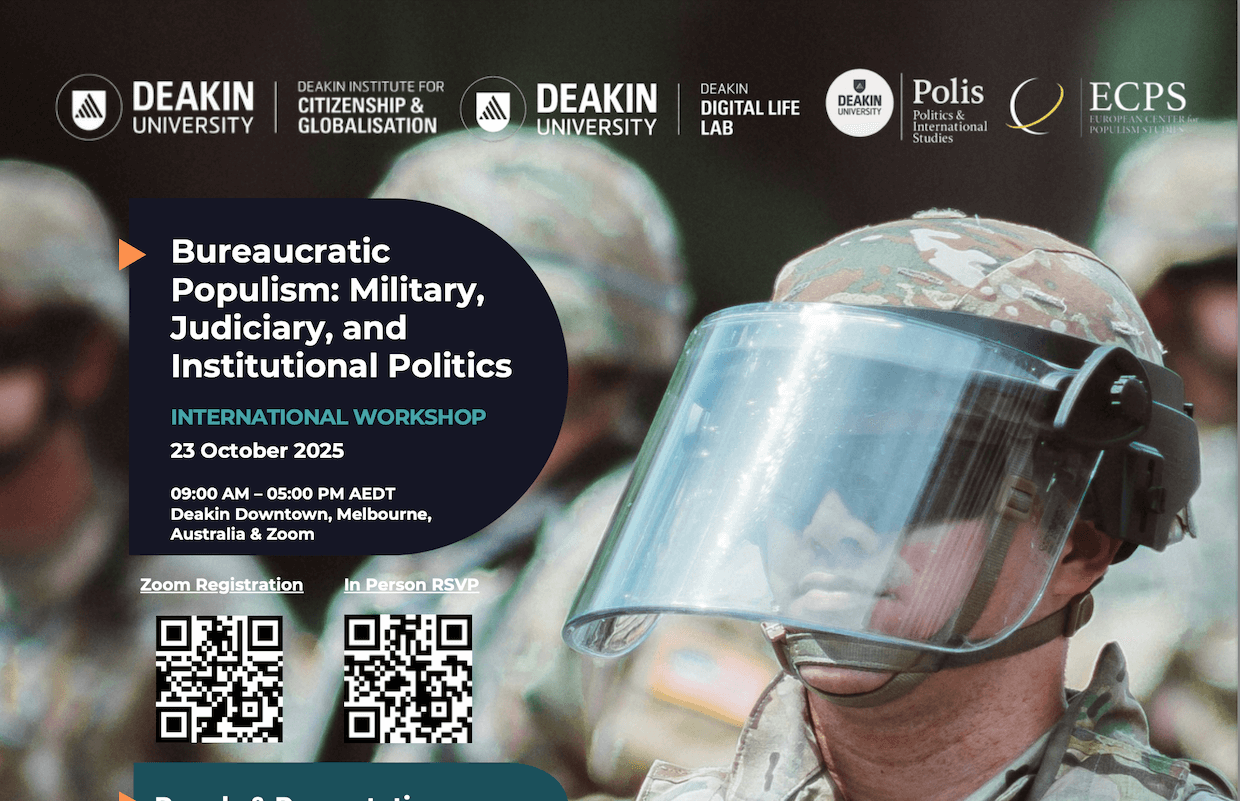
On October 23, 2025, Deakin University hosted the International Conference on “Bureaucratic Populism: Military, Judiciary, and Institutional Politics” at Deakin Downtown, Melbourne, in collaboration with the Deakin Institute for Citizenship & Globalisation, the Deakin Digital Life Lab, POLIS, and the European Center for Populism Studies (ECPS). The event convened leading scholars from across the globe to examine how unelected state institutions—from militaries to judiciaries—adopt populist idioms to claim legitimacy “in the name of the people.” Opening the conference, Professor Simon Tormey reflected on the indeterminacy of populism as both ideology and style, while Dr. Nicholas Morieson’s keynote advanced a framework distinguishing between populism’s exogenous capture and endogenous discourse. Through three thematic panels, participants explored how bureaucratic, military, and judicial populisms reshape governance, authority, and democratic accountability worldwide.
Panel 1: Bureaucratic Populism and its Implications
Paper 1: “No Public Service, No Democracy. Why Populist Administrations are Dismantling the Professional Public Service,” by Mark Duckworth (Co-Director of the Centre for Resilient and Inclusive Societies; a Senior Research Fellow at the Alfred Deakin Institute for Citizenship and Globalisation).
Paper 2: “A Different Populism: Anglophone, New World, Frontier,” by Professor Stephen Alomes (Adjunct Associate Professor at RMIT University).
Paper 3: “Compliance and Capture: Bureaucratic Transformation under Populism in India and Hungary,” by Dr. Nicholas Morieson (Research Fellow at the Alfred Deakin Institute, Deakin University).
Paper 4: “Survival, Sovereignty and Destiny: Centralized Power in Putin’s Russia Through Bureaucratic Populism,” by Lachlan Dowling (Student at Deakin University).
Paper 5: “Bureaucratic Populism and Civil-Military Relations in Pakistan: A Study of Institutional Populism and Hybrid Governance,” by Kashif Hussain (PhD candidate in Peace and Development Studies from the University of New England).
Panel 2: Military Populism in Comparative Perspective
Paper 1: “The Making of a People’s General: Military Populism and the Discursive Legacy of Soedirman in Indonesia,”by Hasnan Bachtiar (PhD candidate at Deakin University), Azhar Syahida (A Researcher at the Center of Reform on Economics (CORE) Indonesia) & Ahalla Tsauro (PhD student at Université Laval, Canada).
Paper 2: “Military Populism in Egypt, Pakistan, and Thailand: An Empirical Analysis,” by Muhammad Omer (PhD Candidate in Political Science at the Deakin University).
Paper 3: “The Re-Emergence of Military-Populist Governance in Indonesia under Prabowo Subianto,” by Wasisto Raharjo Jati (A Researcher at the Center for Politics within Indonesia’s BRIN (National Research and Innovation Agency) in Jakarta).
Paper 4: “Militarized Populism and the Language of Conflict: A Discourse-Historical Analysis of the India–Pakistan May 2025 Standoff,” by Dr. Waqasia Naeem (Associate Professor in School of English at Minhaj University Lahore).
Paper 5: “Hybrid Regimes and Populist Leaders: A Case Study of Imran Khan’s Trajectory from Parliament to Prison,”by Faiza Idrees (Independent Researcher from Pakistan) & Muhammad Rizwan (PhD Candidate in the Faculty of Arts and Education at Deakin University).
Panel 3: Judicial Populism and Competing Narratives of Authority
Paper 1: “How can courts be populist?” by Mátyás Bencze (Former Judge and a Professor of Law at the Universities of Szeged and Győr, Hungary).
Paper 2: “Judging the State of Exception: The Judiciary in the Israeli Populist Project,” by Dr. Elliot Dolan-Evans(Lecturer in the Faculty of Law at Monash University).
Paper 3: “Judicial Populism in Pakistan: Discourse and Authority in the Panama Papers Judgments,” by Muhammad Omer (PhD Candidate in Political Science at the Deakin University) & Prof. Ihsan Yilmaz (Research Professor of Political Science and International Relations, and Chair of Islamic Studies at the Alfred Deakin Institute for Citizenship and Globalisation (ADI), Deakin University).
Paper 4: “Populism and the Noxious Relationship Between Political and Intelligence Elites in Post-Communist Czechia, Slovakia, and Romania,” by Bohuslav Pernica (Lieutenant colonel (ret.), co-editor of the White Paper on Defence, Czechia) & Emilia Șercan (Assistant Professor in the Journalism Department at the University of Bucharest).
Paper 5: “Competing Populisms in Pakistan: Politicians’ Anti-Military Narratives and Bureaucratic Counter-Narratives,” by Zaffar Manzoor (MPhil Scholar at the Department of English Linguistics and Literature, Riphah International University Islamabad, Pakistan) & Dr. Muhammad Shaban Rafi (Professor of English at Riphah International University Lahore, Pakistan).
***
ECPS Academy Summer School and Case Competition
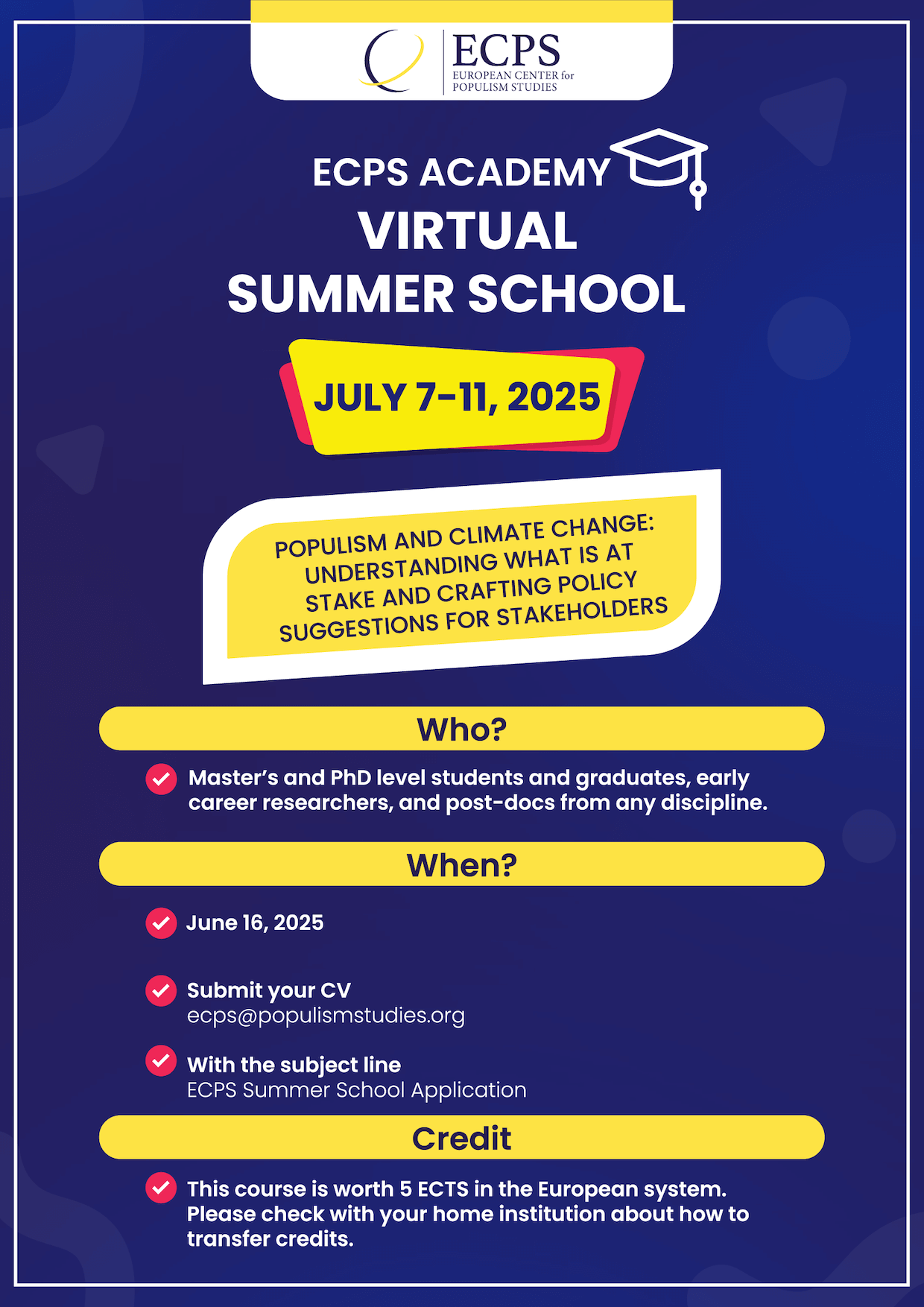
Populism and Climate Change: Understanding What Is at Stake and Crafting Policy Suggestions for Stakeholders
Date: July 7–11, 2025 | Format: Online
Situated at the intersection of pedagogy, policy relevance, and global urgency, the ECPS Academy Summer School and Case Competition 2025 marked a distinctive moment in the Centre’s educational and capacity-building agenda. Against the backdrop of intensifying climate crises and the growing politicization of environmental governance, the programme approached climate change not merely as an ecological challenge, but as a deeply contested political terrain shaped by populism, polarization, and struggles over representation.
Held online between 7–11 July 2025, the Summer School convened emerging scholars and young professionals from diverse regions to critically examine how populist actors—across ideological, geographical, and institutional contexts—reframe climate justice, sustainability, and global responsibility. Through a carefully curated sequence of lectures, discussions, and moderated exchanges, participants were invited to interrogate how climate narratives are mobilized, resisted, or distorted in the populist age, and how these dynamics complicate both domestic policy choices and multilateral cooperation.
The programme’s applied core was the ECPS Case Competition, which translated theory into practice by placing participants in simulated decision-making roles related to the COP30 negotiations. Working in teams under time constraints, participants developed policy proposals attentive to real-world political pressures, including populist skepticism toward international institutions, climate finance, and regulatory frameworks. This exercise foregrounded skills increasingly vital for future policymakers and analysts: strategic thinking, teamwork, feasibility assessment, and persuasive communication.
Taken together, the 2025 Summer School and Case Competition functioned as more than a training programme. They operated as a laboratory for democratic problem-solving—cultivating a new generation capable of navigating the fraught interface between populism, climate governance, and global justice.
Program Schedule and Lecturers
Monday, July 7, 2025
Lecture One: Far-right and Climate Change
Lecturer: Bernhard Forthchner (Associate Professor at the School of Art, Media and Communication, University of Leicester).
Moderator: Sabine Volk (Postdoctoral researcher, Institute for Research on Far-Right Extremism (IRex), Tübingen University).
Lecture Two: Climate Justice and Populism
Lecturer: John Meyer (Professor of Politics, California State Polytechnic University, Humboldt).
Moderator: Manuela Caiani (Associate Professor in Political Science, Scuola Normale Superiore, Italy).
Tuesday, July 8, 2025
Lecture Three: Climate Change, Food, Farmers, and Populism
Lecturer: Sandra Ricart (Assistant Professor at the Environmental Intelligence for Global Change Lab, at the Department of Electronics, Information and Bioengineering at the Politecnico di Milano, Italy).
Moderator: Vlad Surdea-Hernea (Post-doctoral Researcher, Institute of Forest, Environmental and Natural Resource Policy, University of Natural Resources and Life Sciences Vienna).
Lecture Four: Ideology Meets Interest Group Politics: The Trump Administration and Climate Mitigation
Lecturer: Daniel Fiorino (Professor of Politics and Director at the Centre for Environmental Policy, American University).
Moderator: Azize Sargın (PhD., Director of External Relations, ECPS).
Wednesday, July 9, 2025
Lecture Five: Art, Climate, and Populism
Lecturer: Heidi Hart (Arts Researcher, Nonresident Senior Fellow at ECPS).
Moderator: João Ferreira Dias (Researcher, Centre for International Studies, ISCTE) (TBC)
Lecture Six: Populist Discourses on Climate and Climate Change
Lecturer: Dr. Eric Swyngedouw (Professor of Geography, University of Manchester).
Moderator: Jonathan White (Professor of Politics, LSE).
Thursday, July 10, 2025
Lecture Seven: Climate Change, Natural Resources and Conflicts
Lecturer: Philippe Le Billon (Professor of Political Geography at the University of British Columbia).
Lecture Eight: Climate Change Misinformation: Supply, Demand, and the Challenges to Science in a "Post-Truth" World
Lecturer: Stephan Lewandowsky (Professor of Psychology, University of Bristol).
Moderator: Neo Sithole (Research Fellow, ECPS)
Friday, July 11, 2025
Lecture Nine: Populist Narratives on Sustainability, Energy Resources and Climate Change
Lecturer: Robert Huber (Professor of Political Science Methods, University of Salzburg).
Moderator: Susana Batel (Assistant Researcher and Invited Lecturer at University Institute of Lisbon, Center for Psychological Research and Social Intervention).
***
Publications
Articles
In 2025, the ECPS consolidated its role as a hub for high-quality, peer-reviewed scholarship through the sustained publication activity of its two journals, Populism & Politics (P&P) and the Journal of Populism Studies (JPS). Operating under rigorous double-blind peer review standards, these journals continue to serve as core infrastructures for advancing theoretically informed, empirically grounded, and methodologically plural research on populism and its multifaceted political consequences.
The articles published throughout the year reflect the intellectual breadth and analytical depth that increasingly characterize ECPS-affiliated scholarship. Across both journals, contributors engaged a wide range of themes, including far-right voting behavior and in-group favoritism, climate skepticism and rhetorical strategies, migration and citizenship regimes, civilizational populism, digital political communication, and the intersection of populism with war, geopolitics, and global capitalism. Methodologically, the publications span experimental designs, discourse and multimodal analysis, comparative political economy, political theory, and large-scale social media data analysis, underscoring ECPS’s commitment to interdisciplinary dialogue.
Populism & Politics continued to function as a venue for timely, theoretically engaged interventions that bridge academic research and public debate, while Journal of Populism Studies further strengthened its profile as a comprehensive, international journal addressing both established and emerging dimensions of populist politics. Together, the two journals provided platforms for scholars at different career stages and from diverse geographical contexts, reinforcing ECPS’s mission to globalize populism studies beyond Euro-Atlantic confines.
Taken collectively, the 2025 publications demonstrate not only the vitality of populism research but also the importance of maintaining independent, transparent, and methodologically robust publication venues. Through its journals, ECPS continues to contribute to cumulative knowledge production, critical scrutiny of power, and informed debate on the future of democracy in an age of populist contestation.
Articles Published by Journal of Populism & Politics (P&P)
van Oosten, Sanne. (2025). “The Importance of In-group Favoritism in Explaining Voting for PRRPs: A Study of Minority and Majority Groups in France, Germany and the Netherlands.” Populism & Politics (P&P). European Center for Populism Studies (ECPS). January 12, 2025. Doi: https://doi.org/10.55271/pp0046
Lewis, Morgan. (2025). “Understanding Climate Skepticism: A Rhetorical Analysis of Climate Communication by PiS, AfD, and SD.” Populism & Politics (P&P). European Center for Populism Studies (ECPS). February 6, 2025. Doi: https://doi.org/10.55271/pp0047
Yogo, Edouard Epiphane. (2025). “The Role of Populism in Redefining Citizenship and Social Inclusion for Migrants in Europe.” Populism & Politics (P&P). European Center for Populism Studies (ECPS). March 4, 2025. Doi: https://doi.org/10.55271/pp0048
Lahti, Yannick & Palonen, Emilia. (2025). “Populism and EP Elections – Case Finland: Populism Gone Mad from Scissors and Chopping-board to Firing Guns and Latino Rush.” Populism & Politics (P&P). European Center for Populism Studies (ECPS). April 28, 2025. Doi: https://doi.org/10.55271/pp0049
Mancin, Luca. (2025). “Doing Populism with Words: A Philosophical-Linguistic Clarification of Empty Signifiers’ Role in the Post-Laclauian Approach.” Populism & Politics (P&P). European Center for Populism Studies (ECPS). August 04, 2025.https://doi.org/10.55271/pp0050
Ozturk, Ibrahim & Fritsch, Claudia. (2025). “Discursive Violence and Moral Repair: The Promise and Limits of Non-Violent Communication Against Populism.” Populism & Politics (P&P). European Center for Populism Studies (ECPS). November 19, 2025. https://doi.org/10.55271/pp0051
Articles Published by Journal of Populism Studies (JPS)
Ozturk, Ibrahim. (2025). “Unveiling China’s ‘Transnational Populism’ and Sharp Power Politics: The Case of the Belt and Road Initiative.” Journal of Populism Studies (JPS). January 18, 2025. https://doi.org/10.55271/JPS000113
van Oosten, Sanne. (2025). “Evaluations of Female Muslim Politicians in a Populist Era: Measuring Intersectionality Using Interaction Effects and Conjoint Experiments.” Journal of Populism Studies (JPS). June 3, 2025. https://doi.org/10.55271/JPS000114
Wathtuwa-Durayalage, Sudeshika. (2025). “Impact of Civilizational Populism on Intergroup Emotions, Social Cohesion, and Civility in the UK.” Journal of Populism Studies (JPS). June 11, 2025. https://doi.org/10.55271/JPS000115
Ozturk, Ibrahim. (2025). “Capitalist Disruptions and the Democratic Retreat: A US–EU–China Comparison.” Journal of Populism Studies (JPS). September 11, 2025. https://doi.org/10.55271/JPS000116
Su, Yu & Li, Tongtong. (2025). “Diversity, Rationality, and the Diffusion of Online Populism: A Study of Chinese Social Media Discussions.” Journal of Populism Studies (JPS). September 21, 2025. https://doi.org/10.55271/JPS000117
Ben-Porat, Guy & Filc, Dani. (2025). “Authoritarianism Curbed? Populism, Democracy and War in Israel.” Journal of Populism Studies (JPS). September 24, 2025. https://doi.org/10.55271/JPS000118
Shukri, Syaza & Hassan, Isyraf. (2025). “Anwar Ibrahim’s Civilisational Populism: The Gaza War and Malaysia.” Journal of Populism Studies (JPS). October 9, 2025. https://doi.org/10.55271/JPS000119
Reggi, Valeria. (2025). “‘Patriots to Defend Our Identity from the Islamisation of Europe’: How Populist Leaders Normalise Polarisation, a Multimodal Discourse Analysis.” Journal of Populism Studies (JPS). November 16, 2025. https://doi.org/10.55271/JPS000120
Murphey, Helen L. (2025). “Civilizational Populism and Migration Diplomacy: Tunisia, the European Union, and Italy.”Journal of Populism Studies (JPS). November 23, 2025. https://doi.org/10.55271/JPS000121
Andits, Petra. (2026). “Alcoholic Mobsters and Welfare Criminals: Xenophobia, Welfare Chauvinism and Populism in Gyurcsány Ferenc’s Facebook Posts on Ukrainian Citizens Prior to the War.” Journal of Populism Studies (JPS). January 5, 2026. https://doi.org/10.55271/JPS000122
Interview Series
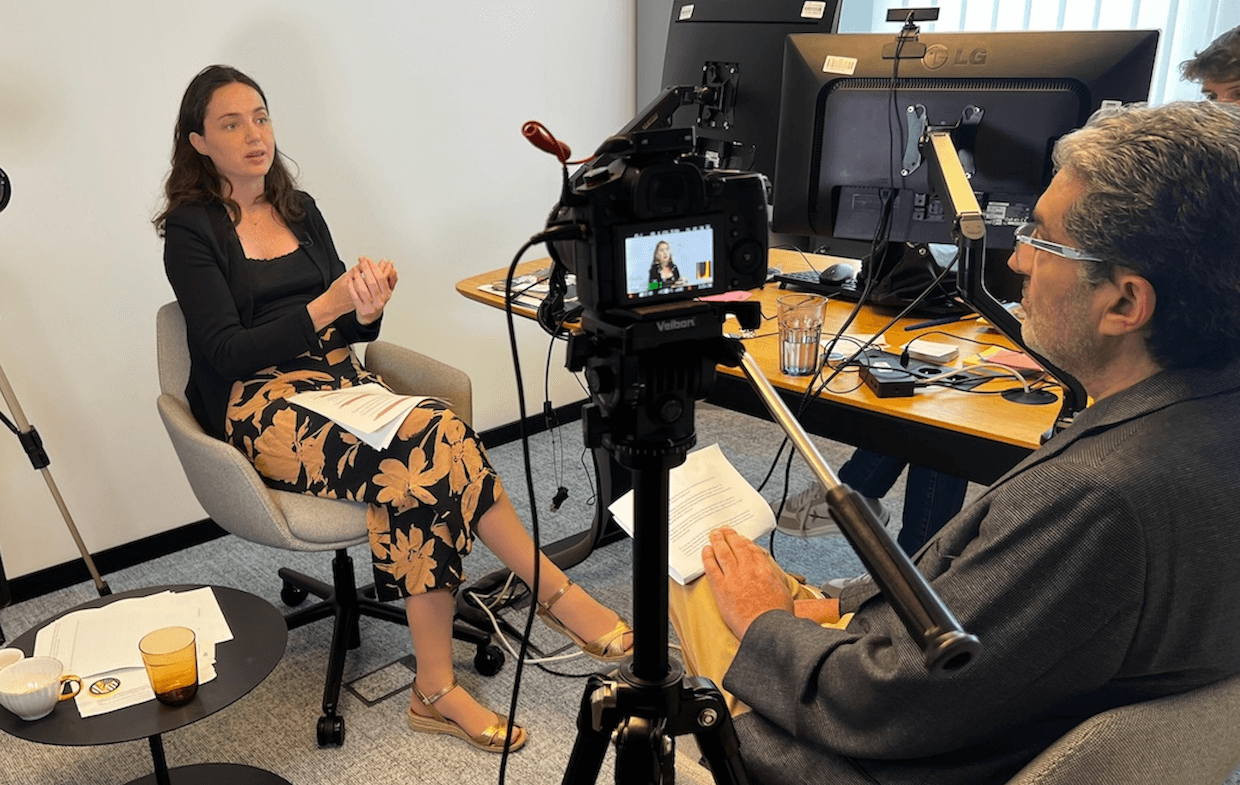
In 2025, the ECPS significantly expanded its Interview Series, consolidating it as one of the organization’s most visible and impactful knowledge-production platforms. Over the course of the year, 98 in-depth interviews were conducted by ECPS’s Selçuk Gültaşlı with leading scholars, public intellectuals, policymakers, human rights advocates, and expert practitioners from across the globe. Together, these conversations formed a living archive of critical reflection on populism, authoritarianism, democratic backsliding, and resistance in an era of profound global turbulence.
The ECPS Interview Series functions not merely as commentary on current events but as a diagnostic instrument—capturing how populist dynamics unfold across regions, regimes, and policy domains. The interviews span an unusually wide geographical and thematic range, covering Europe, North America, Latin America, the Middle East, Africa, South and Southeast Asia, and the Asia-Pacific. They engage with issues including civilizational populism, religion and identity politics, far-right mobilization, migration governance, climate denialism, digital disinformation, state capture, geopolitical realignment, and the erosion—or resilience—of democratic institutions.
What distinguishes the series is its commitment to intellectual depth without sacrificing accessibility. Interviews are structured to foreground analytical clarity, comparative insight, and normative reflection, while remaining responsive to unfolding political developments—from elections and constitutional crises to wars, sanctions regimes, and mass protests. In many cases, ECPS interviews offered some of the earliest expert assessments of rapidly evolving events, providing timely yet rigorous interpretations grounded in long-term scholarship.
Collectively, the 98 interviews published in 2025 reaffirm ECPS’s role as a global hub for critical dialogue on populism and democracy—bridging academia, policy debate, and public engagement at a moment when such connections are more necessary than ever.
Interviews
Dr. Subedi: Majoritarian Populist Politics Marginalizes Minorities in South and Southeast Asia
Dr. DB Subedi highlights how majoritarian populist politics in South and Southeast Asia marginalizes minorities by leveraging identity politics and ethno-religious narratives. He underscores how populist leaders, from Myanmar to India, utilize state apparatuses to consolidate power, often legitimizing exclusionary policies and fostering polarization. With examples like Hindu nationalism in India, Buddhist nationalism in Myanmar, and Islamist populism in Bangladesh, Dr. Subedi examines how these movements exploit historical grievances and global populist trends while adapting them to local contexts. His analysis sheds light on the fragile state of pluralism and democracy in these multicultural societies.
Dr. Petsinis: Populism in the Balkans Shaped by Persistent Ethno-Nationalism and Euroscepticism
The Balkans, a region deeply influenced by historical tensions and sociopolitical complexities, has become a breeding ground for diverse populist movements. Dr. Vassilis Petsinis, an authority on Central and Eastern European politics, dissects the dynamics driving populism in Croatia, Serbia, and North Macedonia. According to Dr. Petsinis, the persistence of ethno-nationalism is a defining characteristic that distinguishes Balkan populism from its Western European counterparts. His analysis explores the interplay of nationalism, Euroscepticism, and historical grievances, shedding light on how populist actors consolidate power and reshape political landscapes, offering insights into the unique challenges populism poses in the region.
Dr. Šelo Šabić: If the US Under Trump Ceases to Be the Anchor of Stability in the Balkans, the Region Will Wake Up to a Different Future
In an interview with the ECPS, Dr. Senada Šelo Šabić discusses the shifting geopolitical landscape of the Balkans, emphasizing the critical role of the United States in maintaining regional stability. She highlights concerns over the potential impact of Donald Trump’s second term, arguing that if the US withdraws from its stabilizing role, the region could face new uncertainties. Dr. Šelo Šabić also explores Croatia’s position within the EU and NATO, the rise of populist leaders, and the influence of Russia and China, offering a comprehensive analysis of the region’s evolving political dynamics.
Dr. Smajljaj: Sunday’s Elections Will Be Decisive for the Future of Democracy in Kosovo
As Kosovo heads into a decisive election, Dr. Avdi Smajljaj warns of its significance for the country’s democratic trajectory. “The upcoming elections this Sunday will be crucial in determining the future of democracy in Kosovo,” he explains, emphasizing the risk of increasing authoritarian tendencies. Meanwhile, tensions with the EU and US complicate Kosovo’s international standing. “Kosovo’s statehood remains heavily dependent on US support,” he adds, particularly with the uncertainty of second Trump presidency. With growing populism and strained foreign relations, Kosovo’s future hangs in the balance, making this election a turning point for its domestic and international course.
Dr. Leukavets: The West Must Maintain Sanctions Against the Lukashenko Regime in Belarus
In an exclusive interview with the ECPS, Dr. Victoria Leukavets highlights the critical role of sanctions in pressuring Lukashenko’s authoritarian regime. She argues, “Sanctions do work, though some have a delayed effect—particularly economic and sectoral sanctions. However, they do have an impact.” Dr. Leukavets also discusses Russia’s deepening control over Belarus, media repression, and the resilience of Belarusian democratic forces in exile. She underscores that continued Western support for independent media and civil society is essential to counter Lukashenko’s grip on power and prevent Belarus from becoming a full extension of Russia’s influence.
Dr. van Haute: The Habits of Consensus Democracy Are Slowly Fading in Belgium
Belgium’s long-standing reputation as a consociational democracy—marked by power-sharing, compromise, and consensus-building—is under strain. According to Dr. Emilie van Haute, the country’s political landscape has undergone a fundamental transformation, with growing polarization and the increasing influence of populist radical parties. In this compelling interview with the ECPS, Dr. van Haute examines the rise of populism on both the left and right, the impact of linguistic divisions, and how mainstream parties are adapting to radical competition. She provides valuable insights into Belgium’s shifting democracy and the challenges ahead.
Professor Ingersoll: The Theocratic Blueprint of Christian Nationalism, Reconstructionism, and Catholic Integralism Behind Trump’s Agenda
In an exclusive interview with ECPS, Professor Julie Ingersoll exposes how Christian Nationalism, Reconstructionism, and Catholic Integralism have coalesced into a powerful theocratic force behind Trump’s second presidency. She explains how these groups reject democracy, embrace authoritarian governance, and aim to reshape American society under biblical rule. “They all seek to make religion the dominant force in shaping society,” she warns, highlighting Project 2025 and figures like Paula White as key players in this movement. This is not a fleeting moment but a systematic, decades-long effort to transform US governance.
Dr. Ziller: Terror Attack in Munich Likely to Sway Voters More Than J.D. Vance’s AfD Endorsement
Dr. Conrad Ziller, Assistant Professor of Political Science at the University of Duisburg-Essen, discusses the key factors shaping voter sentiment ahead of Germany’s elections. In an exclusive interview with the ECPS, he argues that the recent terrorist attack in Munich is likely to have a greater impact on voter behavior than US Vice President J.D. Vance’s endorsement of the far-right AfD. Highlighting the growing openness of radical right parties, Dr. Ziller warns of the AfD’s shifting strategy—from Euroscepticism to consolidating political power through ideological alliances and nationalist rhetoric.
Professor Woll: J.D. Vance’s Speech Was ‘Quite a Hypocritical Statement’
In an exclusive interview with ECPS, Professor Cornelia Woll, President of the Hertie School, criticized US Vice President J.D. Vance’s speech at the Munich Security Conference, calling it “quite a hypocritical statement.” She pointed out that while Vance accused Europe of restricting free speech, the Trump administration actively attacks institutions like Wikipedia and NPR. Professor Woll also warned that the US, under Trump, is pursuing policies that align with Russia’s interests, deepening transatlantic fractures. With nationalist rhetoric rising on both sides of the Atlantic, she emphasized that Europe must navigate these challenges to maintain economic stability and security.
Dr. Desmet: EU Countries Systematically Violate Non-Refoulement with Indiscriminate Pushbacks
The EU’s human rights commitments are weakening as populist movements push restrictive migration policies, warns Dr. Ellen Desmet, Associate Professor of Migration Law at Ghent University. She describes a growing disregard for human rights, stating, “We are witnessing blatant human rights violations that are only increasing.” A 2024 report documented over 120,000 pushbacks at EU borders, violating non-refoulement by forcibly returning asylum seekers without assessing their protection needs. “Some EU countries have even legalized these pushbacks,” Desmet cautions, while the European Commission hesitates to act. She also points to far-right rhetoric shaping restrictive policies, with mainstream parties following suit. Meanwhile, according to Dr. Desmet, Belgium’s new government threatens judicial independence and tightens asylum rules, further escalating human rights concerns.
Professor Arzheimer: AfD’s Surge is a Game-Changer in Post-War German Politics
The Alternative for Germany (AfD) has doubled its vote share in the February 23 elections, marking what Professor Kai Arzheimer calls “a turning point in post-war German politics.” While expected, this surge solidifies the AfD as Germany’s second-strongest party, normalizing far-right rhetoric in mainstream discourse. Arzheimer highlights how economic anxiety, deindustrialization, and anti-immigration sentiment fuel AfD’s rise. He also warns that mainstream parties risk losing credibility by mimicking far-right policies rather than offering bold alternatives. Despite its growing influence, AfD’s radicalization presents both an opportunity and a challenge for German democracy. As political fragmentation deepens, the response of centrist parties will determine whether this shift is temporary—or part of a long-term realignment.
Professor Olsen: AfD’s Growth Faces a Ceiling Despite Eastern Stronghold
Despite the AfD’s strong performance in Germany’s Sunday elections, securing nearly 21% of the vote and dominating in the East, Professor Jonathan Olsen argues that the party faces a ceiling in its growth. “Opinion polls consistently show that around 80% of Germans do not support the AfD,” he notes, emphasizing its high negative ratings. While the AfD has solidified its base in the East, its influence in the West remains limited, requiring a broader appeal to expand further. Professor Olsen highlights that migration and security remain the party’s key mobilization issues, while economic concerns, though present, rank lower in importance for its voters.
Professor Hough: Mainstream Parties Must Address Issues or Risk Strengthening the AfD
In an interview with the ECPS, Professor Dan Hough warns that mainstream parties must engage with voters’ real concerns or risk further legitimizing the far-right Alternative for Germany (AfD). “Ignoring the AfD hasn’t worked, and simply adopting their rhetoric hasn’t either,” Professor Hough explains. Instead, he urges democratic parties to develop credible policies that address the economic and social anxieties fueling AfD support. He highlights how discontent—particularly in Eastern Germany—extends beyond migration, with deeper dissatisfaction driving voters toward populist alternatives. As the AfD continues to shape public debate, Professor Hough argues that mainstream parties must lead with solutions rather than reactionary responses. “The discourse must be smart, and the outcomes must be meaningful.”
Professor Fetzer: Populist Grievances Are More About Perception Than Reality
In an interview with the ECPS, Professor Thiemo Fetzer argues that populist grievances are largely shaped by perception rather than lived experience. “Populism is a phenomenon of information overload,” Fetzer explains. “Many grievances amplified by populists are not grounded in demographic or economic realities but are shaped by narratives, particularly those spread through modern media.” Discussing global trade, economic inequality, and the rise of far-right movements, he warns that misinformation fuels discontent, making societies more vulnerable to populist rhetoric. From the future of the liberal order to the geopolitics of energy, Fetzer offers a data-driven perspective on the forces reshaping today’s world.
Professor Hanson: Trump’s Patrimonial Rule Treats the State as Personal Property and Undermining Impartial Governance
In a thought-provoking interview with the ECPS, Professor Stephen E. Hanson unpacks how US President Donald Trump exemplifies a growing global trend of patrimonial rule. Professor Hanson argues that Trump governs as if the state was his personal property—distributing power to loyalists, undermining impartial governance, and attacking state institutions. Drawing comparisons to Russia, Hungary, and Brazil, he warns of long-term damage to democratic institutions. Professor Hanson stresses the need for renewed public trust in government and a collective effort to counteract the erosion of modern governance.
Dr. Roberto S. Foa: A Democratic Revival Is Always Possible
Despite recognizing the difficulties brought by growing authoritarianism, Dr. Roberto S. Foa of Cambridge University maintains a measured optimism regarding the prospects for democratic renewal. He highlights historical patterns of democratization and shifts in public opinion—such as those triggered by the Russian invasion of Ukraine and the Trump presidency—as indications that democratic principles can regain strength in response to perceived threats. However, he cautions against generalized solutions, stressing that each democracy grapples with distinct institutional and political hurdles that demand context-specific strategies for revitalization.
Prof. Beinhocker: Populist Politicians Exploit the ‘Psychology of Broken Contracts’ to Gain Political Traction
In a time of rising populism, Professor Eric Beinhocker explains how populist leaders capitalize on economic grievances and social distrust to fuel their movements. “When people feel the system is unfair and rigged, they seek someone to blame,” he says, pointing out how populists exploit feelings of broken social contracts to gain political traction. According to him, trade wars and economic nationalism further exacerbate global instability. “No country can make an iPhone alone,” Professor Beinhocker states, stressing that interconnected supply chains make protectionism self-destructive. Tariffs and trade barriers, he warns, will “lower living standards and harm American competitiveness” rather than protect workers. This insightful discussion unpacks the economic forces fueling populism and the fragility of global trade.
Professor Ergil: Turkey’s Crisis Stems from Eroding Line Between Persuasion and Coercion
In a powerful interview with the ECPS, veteran political scientist Professor Doğu Ergil warns that Turkey has crossed from populist authoritarianism into full autocracy. “Persuasion—which was once the AKP’s greatest success—has evaporated,” he explains. “In its place, coercion has become more prominent, and the instruments of coercion, including the judiciary, have proliferated.” Professor Ergil outlines how Erdoğan’s regime has personalized power, delegitimized the opposition, and dismantled democratic norms. With Istanbul Mayor Ekrem İmamoğlu’s arrest and mass protests unfolding, Turkey, he says, faces a “deadlock” where the state’s legitimacy is crumbling from within. This is a timely and sobering reflection on democracy under siege.
Dr. Cevik: Turkey Has Crossed the Critical Threshold from Competitive to Full Authoritarianism
In a compelling interview with ECPS, Dr. Salim Cevik argues that Turkey has “crossed the biggest threshold from competitive authoritarianism to full authoritarianism.” Highlighting the arrest of Ekrem Imamoglu, Dr. Cevik sees it as a targeted move to eliminate democratic competition: “He is being arrested because he could potentially defeat Erdogan.” Populism, once central to Erdogan’s rule, is giving way to raw coercion: “Force is the fundamental strategy of Erdogan.” Dr. Cevik also condemns Western silence, especially from Europe and the US, warning that their inaction amounts to complicity. “Erdogan feels very strong… because he has international backing.” Drawing a parallel with past mistakes on Putin, he cautions: “You can’t really trust a personal autocracy for strategic partnership.”
Professor Marlière: The Far Right Has No Free Pass to Establish a Dictatorship in France
In this timely and incisive interview, Professor Philippe Marlière (UCL) discusses Marine Le Pen’s conviction, the limits of far-right populism, and the resilience of democratic institutions in France. While Le Pen’s narrative frames her disqualification as a “denial of democracy,” Professor Marlière warns against buying into this rhetoric. “Politicians are not above the law,” he asserts, adding, “The far right has no free pass to establish a dictatorship in France.” A must-read on the legal, political, and symbolic stakes of France’s 2027 presidential race.
Prof. White: Erdogan’s Arrest of Istanbul Mayor a Sign of Insecurity—And That Makes It More Dangerous
In a comprehensive interview with ECPS, Professor Jenny White calls the arrest of Istanbul Mayor Ekrem Imamoglu “absolutely… a sign of insecurity”—not strength. Professor White warns that this preemptive strike ahead of the 2028 elections reflects “regime fragility,” not confidence, adding: “If this stands… voting ceases to have any real meaning.” Drawing on her concept of “spindle autocracy,” she explains how personal loyalty has overtaken institutional merit, creating a brittle, fear-driven system. With Erdogan’s popularity fading and international pressure weakened, Professor White argues, “This is a line that has now been crossed”—one with dangerous consequences for Turkey’s democratic future.
Dr. Tas: Coercion Has Become the Erdogan Regime’s Default Tool of Governance
In this compelling interview with ECPS, Dr. Hakki Tas argues that repression—not legitimacy—has become the Erdogan regime’s default mode of rule. Highlighting the arrest of Istanbul Mayor Ekrem Imamoglu, Dr. Taş contends that Turkey is moving further from competitive authoritarianism toward full authoritarian consolidation. As electoral legitimacy weakens, coercion fills the void, revealing a regime reliant on fear, control, and chrono-political narratives to survive. “Remaining in power,” Dr. Tas says, “is the only survival strategy.” This conversation explores the strategic logic behind repression, the shrinking political arena, and the uncertain future of ailing Turkish democracy.
Professor Jones: Trump’s ‘Tariff Dictatorship’ Is Undermining the Global Trade Order
In an in-depth interview with ECPS, Professor Kent Jones warns that Donald Trump’s second-term trade strategy amounts to a “tariff dictatorship,” dismantling WTO norms and centralizing unprecedented power. “Trade has become a populist weapon,” says Professor Jones, “used to stoke anger and identify scapegoats rather than manage the economy.” He explains how Trump’s emotionally charged, anti-globalist rhetoric recasts trade deficits as existential threats while ignoring economic realities. Yet Professor Jones remains cautiously hopeful: “Globalization has faced downturns before. The human impulse to exchange and specialize endures.” As America retreats, he argues, others may step up. “If the US won’t lead, new trade alliances will form. But unpredictability is a burden—not a strength.”
Dr. Sofos: The More Rigid the Erdogan Regime Becomes, the Easier It May Break
“The more rigid the regime becomes, the more easily it may break,” warns Dr. Spyros Sofos in an illuminating interview with ECPS. Tracing the Erdogan regime’s shift from reformist Islamism to a personalized authoritarianism, Dr. Sofos highlights how the dismantling of institutional checks and grassroots engagement has deepened Turkey’s democratic crisis. He sharply critiques the EU and US for enabling this drift, arguing that their silence—rooted in strategic pragmatism over refugee control and regional stability—amounts to tacit complicity. As Erdogan’s rule grows more centralized and brittle, Dr. Sofos suggests its very inflexibility could be its undoing. Amid repression and international complacency, he insists, spaces for resistance persist—and the next rupture may come from within the regime itself.
Dr. Boucher: Trump Is Not the Cause, but a Symptom
In this incisive ECPS interview, Dr. Jean-Christophe Boucher, Associate Professor at the University of Calgary, explores how populism is reshaping US foreign policy—from tariffs as symbolic resistance to institutional erosion under Trump 2.0. Arguing that “Trump is not the cause but a symptom,” Dr. Boucher warns that even without Trump, populist forces will endure, backed by media ecosystems, think tanks, and loyalist networks. He emphasizes that “this is not really an economic argument. It’s a political and populist argument,” driving a shift from multilateralism to nationalist retrenchment. A must-read for anyone interested in the ideological drivers behind today’s turbulent geopolitics.
Dr. Mazzolini: Noboa Turns to Populism Not to Transform Ecuador, But to Survive
In an interview with ECPS, Dr. Samuele Mazzolini argues that Ecuadorian President Daniel Noboa has embraced populism not as a vehicle for transformation, but as a strategy to maintain power amid crisis. Recently re-elected after a snap presidency, Noboa has relied on emergency decrees, militarized crackdowns, and anti-crime rhetoric. “Populism has simply served as a means to cling to power and bolster his personal image,” Dr. Mazzolini asserts. Despite branding himself as a technocrat, Noboa “lacks a coherent national project” and governs through “sheer improvisation.” Dr. Mazzolini warns that Ecuador is entering a “permanent state of exception,” with rising authoritarian tendencies and no clear roadmap for reform.
Dr. Benson on Trump’s Assault: To Resist a Coordinated Attack, We Need a Coordinated Defense
On the 100th day of Trump’s second term, ECPS sat down with Dr. Robert Benson of the Center for American Progress to dissect the anatomy of democratic backsliding. In this wide-ranging interview, Dr. Benson warns of a “coordinated assault” on American civil society and urges a “coordinated defense” in response. Drawing comparisons with Turkey and Hungary, he highlights the early stages of authoritarian consolidation and calls for a “whole-of-society” mobilization. “We’re moving faster in the United States than the AKP ever moved in Turkey,” he cautions. From institutional capture to international instability, Dr. Benson’s insights are a timely wake-up call. “Authoritarians have coordinated,” he says—“now it’s time for democrats to do the same.”
Dr. Ibrahim Al-Marashi: Authoritarianism Is the New Normal and the Prevailing Norm
In this timely and thought-provoking interview, Dr. Ibrahim Al-Marashi explores how authoritarianism has become “the new normal” in the Middle East amid a global retreat from democratic norms. Speaking to the ECPS, Dr. Al-Marashi analyzes the region’s complex landscape shaped by imperial legacies, resource politics, and shifting global alliances. He highlights how populist rhetoric, digital platforms, and transactional diplomacy—especially under Trump-era politics—are empowering authoritarian leaders and weakening democratic institutions. While civil society faces mounting repression, Dr. Al-Marashi suggests that digital activism and “artivism” may offer spaces of survival and resistance. This interview provides essential insight into how populism and authoritarianism intersect in the Middle East—and what that means for the future of governance in the region.
Dr. Tufiş: Simion’s First-Round Success Driven by Voter Disillusionment and Outrage Over Annulled Election in Romania
In an in-depth interview with the ECPS, Dr. Claudiu Tufiş, explains how far-right candidate George Simion’s success in the first round of Romania’s presidential elections on Sunday was driven by widespread voter anger and disappointment following the annulment of the original vote. “Voters were deeply disappointed by the cancellation of the elections,” he notes, “and many reacted with anger, leading to a noticeable erosion of trust in the electoral process.” With no credible democratic opposition and growing anti-establishment sentiment, Simion was able to capitalize on public frustration. Dr. Tufiş’s analysis sheds critical light on the structural and emotional undercurrents reshaping Romanian politics.
Dr. Roose: Election Results Were a Rejection of Trumpist-Style Populism in Australia
In a compelling interview with ECPS, political sociologist Dr. Josh Roose unpacks the 2025 Australian federal election, arguing it marked “a resounding rejection of Trumpist-style populism.” Dr. Roose explores how Liberal leader Peter Dutton’s strongman image backfired, while Labor’s inclusive yet grounded masculinity resonated with urban voters—especially women. He warns, however, of far-right undercurrents and rising generational and economic divides. Reflecting on political masculinities, Islamophobia, and online extremism, Dr. Roose calls for educational and legislative reforms to bolster democratic resilience. A timely deep dive into Australia’s populist landscape—and a must-read for scholars and studenst of global politics.
Dr. Newlands: The Australian Political System Has Stepped Back from Climate Action
In this compelling interview, Dr. Maxine Newlands—an expert in environmental politics and ocean governance—warns that the “Australian political system has essentially stepped back from climate change.” Speaking with ECPS, she highlights how rising polarization and populist denialism have rendered climate policy too risky for major parties. “Politicians avoid addressing it altogether,” she explains, noting that even terms like “climate change” were strategically omitted from campaigns. Dr. Newlands critiques the media’s role in spreading disinformation and urges a more pluralistic approach grounded in community voices, Indigenous knowledge, and the Blue Humanities. Her analysis provides a powerful lens into how populist narratives have reshaped Australia’s environmental politics and what it will take to restore trust and democratic inclusion in climate action.
Dr. Ragragio: Populism in the Philippines Is Enduring and Evolving
In this thought-provoking conversation, Dr. Jefferson Lyndon D. Ragragio—Gosling-Lim Postdoctoral Fellow at the University of Michigan—discusses the resilience and transformation of populism in the Philippines. He explores how symbolic narratives of “pro-people, anti-elite” sentiment continue to drive support for dynastic figures like the Dutertes, despite mounting legal scrutiny. From social media toxicity to youth electoral shifts, Dr. Ragragio argues that populism is “here to stay,” shaped by local patronage networks and reinforced by mediatized political performance. He also highlights the importance of civic education and independent journalism as counterforces. This is a timely, incisive analysis of a political culture in flux.
Dr. Riboldi: State Capture by Big Business Is a Core Threat to Australian Democracy—As Elsewhere
In this compelling conversation with ECPS, Dr. Mark Riboldi unpacks how corporate influence and elite career pathways hollow out democratic representation in Australia. From revolving doors in politics to the marginalization of community voices, Dr. Riboldi warns that without transparency and reform, “the closed loop between politics and corporate power” will persist. He also explores party fragmentation, the Greens’ identity struggles, and the risks of technocratic drift. “Boldness needs legitimacy,” he insists, urging progressive parties to pair vision with credibility. Dr. Riboldi ultimately sees Australia’s electoral system as a “stopgap” against populist capture—but not an immunity.
Dr. Bortun: Economic Insecurity Fuels the Rise of the Far Right in Romania
In the wake of Romania’s high-turnout 2025 presidential election, Dr. Vladimir Bortun offers a powerful analysis of how deep-rooted economic insecurity—fueled by decades of neoliberal reform—has driven support for the far right. Despite a centrist victory, nationalist George Simion’s strong performance underscores a broader post-crisis populist consolidation. In this exclusive ECPS interview, Dr. Bortun explores the AUR’s appeal among the diaspora and rural poor, the ideological vacuum left by the mainstream left, and how Romania exemplifies a wider European shift from democratic to authoritarian neoliberalism. A must-read for anyone interested in the structural dynamics behind Europe’s populist realignment.
Professor Markowski on Poland’s President-Elect Karol Nawrocki: Future Statesman or Mere Footnote?
In this compelling post-election interview, Professor Radosław Markowski offers a candid, expert analysis of Poland’s newly elected president, Karol Nawrocki. Backed by PiS and inspired by Trump-style politics, Nawrocki’s narrow win poses serious challenges to Prime Minister Tusk’s pro-European government. Professor Markowski dissects the roots of this upset—calling it the result of a “fantastically prepared campaign”—and warns of potential institutional gridlock and democratic backsliding. While describing Nawrocki as “inexperienced” and lacking policy depth, Professor Markowski holds out a sliver of hope that he may rise above partisan loyalties. With sharp insights into Polish society, EU disillusionment, and the dangers of populist overreach, this interview is essential reading on Poland’s increasingly polarized and uncertain political trajectory.
Professor Ben-Porat: Israel’s Rightward Shift Is More Than Political Strategy
In a candid and comprehensive interview with ECPS, Professor Guy Ben-Porat warns that Israel’s political rightward shift is not simply a strategic maneuver, but the product of deeper ideological currents. Describing the current coalition as “a unification of several forces,” Professor Ben-Porat highlights its populist hostility toward liberal institutions, minorities, and judicial independence. He draws direct parallels to Hungary and Poland, identifying a shared authoritarian trajectory. Professor Ben-Porat also reflects on how the October 7 attacks have further racialized political discourse, with Arab-Palestinian citizens facing intensified securitization. Yet, he sees hope in mass democratic mobilization: “Thousands of people have taken to the streets every week… the fact that many Israelis are still fighting for democracy means they haven’t thrown in the towel yet.”
Prof. Soborski: The Recent Polish Election Shows That Shifting Right Doesn’t Win Over the Right
In this interview, Professor Rafal Soborski critiques Poland’s liberal democratic actors for mimicking right-wing rhetoric in a failed attempt to broaden appeal. “Shifting right doesn’t win over the right—it alienates the left,” he warns, urging pro-democratic forces to adopt bold, progressive agendas rooted in class justice and social solidarity. Drawing comparisons to political centrists across Europe, Soborski emphasizes that ideological clarity—not cautious managerialism—is key to countering the far right’s emotional narratives and mobilizing mythologies. His insights offer a timely call for a renewed progressive vision amid the turbulent political landscape in Poland and beyond.
Professor Diamond: Fascism Isn’t Back—But Its Features Are
In this timely and wide-ranging interview, Stanford University’s Professor Larry Diamond explores the resurgence of authoritarianism and the global diffusion of fascistic features. “We don’t have the fully formed, classic version of fascism today,” he explains, “but there is a lot of fascistic behavior, organization, and intent spreading worldwide.” Drawing on his democratic theory expertise and recent support for an international declaration warning that “the threat of fascism is back,” Professor Diamond dissects how elected strongmen exploit polarization, subvert institutions, and erode epistemic authority. From Erdoğan to Orbán to Trump, he examines the authoritarian playbook and offers paths forward—through institutional reform, global alliances, and deliberative democracy—to defend liberal norms before they are incrementally strangled into irrelevance.
Professor Richard Falk: The US Is Experiencing a ‘Weimar Moment’
In this urgent ECPS interview, Professor Richard Falk warns that the US is facing a “Weimar moment”—a fragile liberal democracy under siege by a resurgent ultra-right. A signatory of the International Declaration Against Fascism, Professor Falk links today’s “techno-fascist enthusiasts” to a global authoritarian drift. He critiques surveillance capitalism, weaponized nationalism, and soft authoritarianism, highlighting leaders like Trump, Modi, Erdoğan, and Netanyahu as drivers of this ideological mutation. Despite this grim trajectory, Professor Falk calls for renewed “normative resistance”—a defiant civic ethics rooted in critical thinking, international law, and solidarity. This interview is a vital reflection on the future of democracy, authoritarianism, and global justice.
Professor Oran on Turkey’s Erdogan Regime: “Let’s Just Call It a ‘Democratic Administration’—So That No Harm Comes to Anyone”
In an era when even naming an oppressive regime can invite peril, Professor Baskın Oran offers a cuttingly ironic response to a straightforward question: How should we define Turkey’s current political system? His reply—”Let’s just say a ‘democratic administration,’ so that no harm comes to anyone”—encapsulates the climate of fear and repression under Erdogan’s rule. In this wide-ranging interview, the veteran scholar and dissident traces historical fascism’s return through economic crisis, digital dependency, centralism, and xenophobia. With clarity and conviction, Professor Oran explores how Turkey’s authoritarian populism mirrors global patterns while revealing homegrown roots—and why excessive control may ultimately become the regime’s undoing.
Professor Arend Lijphart: Presidentialism Creates a Greater Risk of Democratic Collapse
In a wide-ranging interview with ECPS, renowned political scientist Professor Arend Lijphart warns that the design of democratic institutions plays a decisive role in democratic resilience or erosion. Drawing from over 50 years of comparative research, Professor Lijphart argues that presidential and majoritarian systems—as seen in the US, India, and the UK—enable dangerous concentrations of power. “Some electoral systems make the concentration of power much more likely,” he states. In contrast, parliamentary systems with proportional representation foster inclusion, accountability, and stability. His core message is urgent: consensus democracy is not just more effective—it’s essential in resisting authoritarian backsliding. “Strong governments may decide faster,” he notes, “but they often decide wrongly.”
Professor Kasprowicz: Despite Polarization and Populist Gains, Poland’s Democratic Potential Remains Intact
In an in-depth interview with ECPS, Professor Dominika Kasprowicz of Jagiellonian University offers a measured assessment of Poland’s political trajectory following Karol Nawrocki’s narrow presidential victory. While acknowledging the rise of populism and deepening polarization, she maintains that “there is still substantial democratic potential within the system and society.” Professor Kasprowicz highlights the role of affective campaigning, the normalization of populist narratives, and the growing impact of disinformation as structural challenges to liberal democracy. Yet, she points to the resilience of civil society—especially youth and feminist movements—as a critical bulwark against authoritarian drift. “Civic involvement is one of the most important factors behind societal resilience,” she argues, emphasizing the importance of renewed mobilization in the face of rising illiberalism.
Professor Friedman: We Need to Recognize That the Older Democratic Model Is Being Rejected
In this wide-ranging interview with the ECPS, Professor Steven Friedman critiques dominant liberal democratic paradigms that prioritize constraining state power while ignoring the dangers of unregulated private power. “Private power exists and poses significant challenges,” he argues. Professor Friedman warns against the myth that today’s authoritarian surge simply threatens well-functioning democracies, pointing instead to the alienation of citizens by systems failing to meet their needs. He also critiques the hypocrisy of the so-called “rules-based international order,” emphasizing that “if we do not have international law that applies equally to everyone, then we do not have international law at all.” For Friedman, democratic renewal must address inequality and defend universal principles of participation and inclusion.
EP Rapporteur Ridel: EU Should Expand Sanctions Regime to Effectively Target Transnational Repression
In an exclusive interview with ECPS, MEP Chloé Ridel, rapporteur for the European Parliament’s forthcoming report on transnational repression, underscores the urgent need for the EU to confront transnational repression—state-organized efforts by authoritarian regimes such as Russia, China, Turkey, and Iran to silence critics abroad. Ridel calls for expanding the EU’s Global Human Rights Sanctions Regime to explicitly include transnational repression and highlights the procedural challenge posed by unanimity voting: “The only people we manage to sanction are mostly Russian… we will have difficulties applying the values we believe in.” She stresses that this is a human rights, security, and democratic issue requiring coordination, oversight of enablers, and stronger protection for vulnerable groups.
Professor Modood: A ‘Multiculturalist International’ Needed to Counter ‘Far-Right International’
In this wide-ranging interview with ECPS, Professor Tariq Modood calls for the creation of a “multiculturalist international” to counter the rise of far-right transnational networks and exclusionary nationalisms. Highlighting the dangers posed by xenophobia, Islamophobia, and authoritarian populism across Europe and beyond, Professor Modood argues that multiculturalism is “not simply a reaction to populism… it is a positive vision” that affirms shared citizenship while respecting diversity. He contrasts his model of “moderate secularism” with French laïcité and Hindu nationalist secularism, emphasizing inclusivity and equality. Brexit, he notes, weakened the EU’s capacity for multicultural integration: “We need to create a multiculturalist alliance across countries, in the way that the far right is creating its own transnational network.”
Professor Bartov: Making Life Impossible in Gaza Is a Deliberate Strategy of Slow-Moving Genocide
In a powerful interview with ECPS, genocide scholar Omer Bartov argues that Israel’s military campaign in Gaza amounts to a “deliberate strategy of slow-moving genocide.” Drawing on the legal framework of the UN Genocide Convention and field reports from Israeli human rights groups, Professor Bartov contends that the Israeli government is intentionally making Gaza uninhabitable through starvation, displacement, and destruction of civilian infrastructure. He warns of a broader system of international complicity—what he calls a “diplomatic Iron Dome”—shielding Israel from accountability. As he dissects settler-colonial logic, media self-censorship, and the erasure of Palestinian voices, Professor Bartov issues a clear call: it is time for the world to confront both the scale of the violence and its own enabling silence.
Professor Wodak: Autocracy Has Become a Global Economic Corporation Backed by Oligarchs and Social Media Power
In this powerful interview with ECPS, Professor Ruth Wodak warns that “autocracy has become a global economic corporation”—a transnational network where oligarchs, libertarians, and tech barons control discourse, distort truth, and undermine democracy. From Trump’s incitement of violence to Orbán’s fear-based migrant scapegoating, Professor Wodak outlines how authoritarian populists weaponize crises and social media to legitimize regressive policies. Yet she also defends the vital role of public intellectuals, urging them not to give in to “preemptive fear.” With deep insight into the politics of fear, techno-fascism, and discursive normalization, Professor Wodak’s reflections serve as both an alarm and a call to resistance in our increasingly volatile democratic landscape. A must-read for anyone grappling with today’s authoritarian turn.
Professor Schabas: US, Germany, and Others Could Be Held Liable as Accomplices to Genocide in Gaza
In an exclusive interview with ECPS, Professor William Schabas, one of the world’s foremost authorities on genocide and international criminal law, warns that the Gaza crisis represents a “litmus test” for the credibility of international justice. He argues that the case filed by South Africa against Israel at the ICJ is “arguably the strongest case of genocide ever brought before the Court,” citing Israeli military actions and statements by senior officials as evidence of genocidal intent. Professor Schabas also highlights Prime Minister Netanyahu’s populist rhetoric, framing Gaza’s population as an existential threat, which he links to patterns of incitement fueling atrocities. Crucially, he stresses that third-party states, including the US, Germany, and others risk legal liability as “accomplices to genocide.”
Prof. Cheeseman: Mass Mobilization Is Critical When Institutions Fail to Contain Authoritarianism
In an interview with the ECPS, Professor Nic Cheeseman dissects the global resurgence of authoritarian populism and the uneven pathways of democratic backsliding. Warning against the “temporal fallacy,” he argues that crises unfolding simultaneously do not share a single cause—from Europe’s far-right surge to West Africa’s coups. Professor Cheeseman spotlights the twin pillars of democratic defense: resilient institutions and organized civic resistance. “In countries where institutions are weak, mass mobilization becomes absolutely critical—often the only mechanism left to stop populist or authoritarian leaders from consolidating power,” he says. Citing Ghana, Kenya, and Zambia, he urges context-specific democracy support that amplifies local strengths over one-size-fits-all templates.
Professor Galston: US Federalism Slows the Shift Toward Competitive Authoritarianism
In this incisive conversation, Brookings scholar Professor William A. Galston argues that America’s decentralized system remains a crucial brake on executive overreach. While warning of real risks, he maintains, “We’re not there yet,” distinguishing the US from harder cases of institutional capture abroad. Professor Galston spotlights federalism and the courts as the decisive arena of resistance—urging institutions to defend their prerogatives through litigation, “not street protests but the law.” He assesses the influence of Project 2025, redistricting fights in Texas/California, and the politics of immigration, crime, and DEI, noting potential backlash among centrist voters. The result is a clear-eyed appraisal of democratic resilience—and the legal contests that will shape whether the US moves toward or away from competitive authoritarianism.
Assoc. Prof. Pinson: Continuation of Gaza War Aims to Reconstruct Israeli Regime into an Illiberal One
In a wide-ranging ECPS interview, Ben-Gurion University scholar Dr. Halleli Pinson argues that Israel’s Gaza policy is intertwined with an illiberal turn at home. “The polarization we saw before October 7 around judicial reform,” she notes, “is now translated into how people understand the war and the hostages,” adding that “the continuation of the war serves this broader agenda… to reconstruct the Israeli regime into an illiberal one.”Dr. Pinson details how curricula sideline liberal democracy while NGOs and academics face a shrinking space for dissent. Media framings and social media echo chambers deepen an “epistemic polarization.” Though anti-war discourse is growing, she warns that animosities are hardening: “It may take a generation to shift the discourse toward a more liberal, mainstream orientation.”
Prof. Finkelstein: Israel Will Mass Gazans at the Border, Bomb Relentlessly, and Force Egypt’s Hand
Professor Norman Finkelstein—NYC-born to Holocaust-survivor parents and, in 2020, ranked the world’s fifth most influential political scientist—tells ECPS that “Israel will mass Gazans at the border, bomb relentlessly, and force Egypt’s hand.” Professor Finkelstein forecasts pressure on Cairo amid “images broadcast worldwide,” frames today’s war as a qualitative break aimed at depopulation (“stay and starve or leave”) and argues that “an imposed famine…constitutes clear proof of genocide.” He argues that, while procedural workarounds to a US veto exist at the UN, they are politically improbable in practice; hence he looks to EU trade leverage instead—though that, too, is stalled by a ‘lack of political will.’ Downplaying doctrinal debates over Zionism, he casts Israel as a ‘Jewish supremacist state’ analogous to apartheid-era South Africa, and notes collapsing Democratic support alongside generational GOP splits.”
Human Rights Icon Aryeh Neier: Anti-Israel Speech Is Not Antisemitism
In an exclusive interview with the ECPS, Aryeh Neier — founding Executive Director of Human Rights Watch and former President of the Open Society Foundations — delivers a powerful assessment of Gaza, free speech, and international accountability. Neier argues that criticism of Israeli policies must not be conflated with antisemitism, stressing that “even antisemitism constitutes protected speech.” He further asserts that “Israel is engaged in genocide,” citing systematic obstruction of humanitarian aid and disproportionate force in Gaza. While the ICC remains “the only viable path” for justice, he warns that political barriers persist. From US policy dynamics to global human rights challenges, Neier offers rare insights into one of today’s most divisive debates.
Dr. Bjånesøy: FrP Turns Economic Frustration in Norway into Populist Momentum
In Norway’s September 8, 2025, general election, Prime Minister Jonas Gahr Støre’s Labour Party narrowly held on to power — but the real story was the historic surge of the populist Progress Party (FrP), which doubled its vote share to 24% and became the country’s second-largest party. In an interview with ECPS, Dr. Lise Bjånesøy (University of Bergen) explains how FrP converted economic grievances into populist momentum, capitalizing on anger over wealth taxes, cost-of-living pressures, and distrust of “wasteful elites.” FrP also mobilized younger men through social media, a trend Dr. Bjånesøy calls a key driver of Norway’s new political divides.
Professor Barkey: Turkey Has Become a Full-Blown Authoritarian System
In an interview with the ECPS, Professor Henri Barkey—born in Turkey and one of the leading US experts on Middle East politics—warns that Turkey has crossed a decisive threshold under President Erdogan. “Turkey has now become a full-blown authoritarian system,” he stated, arguing that Erdogan has removed the “competitive” element from competitive authoritarianism by subordinating the judiciary, jailing rivals, and even deciding opposition party leadership. While repression deepens, Professor Barkey sees a paradox: “The system is becoming more authoritarian, but society may be resisting much more than we realize.” He highlights youth-led mobilization, fears over arrested Istanbul Mayor Ekrem Imamoglu’s popularity, and Europe’s limited leverage, concluding that Erdogan’s overreach may ultimately galvanize opposition forces.
Dr. Levene: Dysfunctional International System Enables Israel’s Genocide in Gaza
A new United Nations commission of inquiry has concluded that Israel has committed genocide in Gaza, citing mass killings, forced displacement, the destruction of essential infrastructure, and even measures to prevent births as evidence of genocidal intent. While Israel has rejected the findings as “distorted and false,” the commission underscored that all states are legally obliged to prevent and punish genocide. Against this backdrop, the ECPS spoke with genocide scholar and peace activist Dr. Mark Levene. In the interview, he warns that genocide is not an aberration but “a dysfunction of the international state system,” arguing that Gaza exemplifies how structural failures and powerful alliances allow atrocities to continue unchecked.
Dr. Nogueira: Brazil Did with Bolsonaro What the US Failed to Do with Trump
In an interview with ECPS, Dr. Mara Nogueira (Birkbeck, University of London) argues that Brazil’s decision to convict Jair Bolsonaro for plotting a coup marks a turning point in democratic accountability. “By convicting Bolsonaro, we are doing what the US should have done with Trump and moving in the right direction toward democracy,” she says. Rejecting claims of judicial overreach, Dr. Nogueira stresses: “The Supreme Court is not overstepping but rather fulfilling its role.” She welcomes the unprecedented prosecution of both civil and military senior officers since the 1964–85 dictatorship, while warning that far-right actors are already mobilizing “judicial dictatorship” narratives. For her, the trial sends a crucial signal: “It’s not acceptable to plan a coup d’état—and if you do so, you will face charges.”
Dr. Borges: Brazil Is Becoming More Like American Politics, Where Polarization Normalizes Rule-Breaking
Brazil’s democracy faces one of its greatest stress tests with former President Jair Bolsonaro sentenced to 27 years for plotting a coup. In an interview with the ECPS, Dr. André Borges, Associate Professor of Political Science at the University of Brasília, warns that Brazil is “becoming more like American politics, where affective polarization drives citizens to see opponents as existential threats.” Such polarization, he argues, risks normalizing democratic rule-breaking. Yet Dr. Borges also highlights Brazil’s resilience, rooted in its “institutional mix that deconcentrates authority”—federalism, separation of powers, fragmented parties, and an autonomous Supreme Court. This paradox defines Brazil today: resilient institutions confronting dangerously eroding democratic norms.
Professor Paudel: The Youth Uprising in Nepal Is the Result of Long-Brewing Frustrations
In an interview with the ECPS, Professor Dinesh Paudel argues that the September 2025 youth uprising in Nepal was “the result of long-brewing frustrations.” Far from a sudden outburst, he situates the revolt at the intersection of elite failure, geopolitical maneuvering, and structural economic decline. Young Nepalis, caught in what he calls a “triple disjuncture” of mass migration, precarious labor markets, and digital mobilization, transformed simmering anger into protest. Yet Professor Paudel cautions against viewing it as a revolution: “It will not fundamentally alter the political structure that produced these conditions.” Professor Paudel highlights corruption as the “governing logic of elite power” and signals volatile struggles over Nepal’s political and economic future.
Professor Roth: Israel Exploits Antisemitism Allegations to Silence Criticism of Genocide in Gaza
In an exclusive ECPS interview, Professor Kenneth Roth—former Executive Director of Human Rights Watch and now at Princeton—warns that Israel is cynically using charges of antisemitism to shield what he calls genocide and mass atrocities in Gaza. “Netanyahu and his supporters are not defending Jews worldwide,” Professor Roth stresses. “They are sacrificing them—cheapening the very concept of antisemitism just when it is most needed.” Drawing on three decades of human rights leadership, Professor Roth situates Israel’s narrative strategy within a broader authoritarian playbook: populist leaders tilt elections, capture institutions, and scapegoat minorities while silencing dissent. His central warning is stark: criticism of Israel is not antisemitism, and blurring this line endangers both Palestinians and Jews worldwide.
Dr. DB Subedi Warns: Transitional Nepal May Face Real Dangers from Rising Religious Populism
“Transitional Nepal may face real dangers from rising religious populism,” cautions Dr. DB Subedi, lecturer in Peace and Conflict Studies at the University of Queensland, in an interview with the ECPS. While the September 2025 youth-led uprising signaled a break with entrenched corruption, nepotism, and elite capture, Dr. Subedi warns that Nepal’s weak secularism leaves space for actors seeking to reinstate Hindu statehood. Such a trajectory, he argues, risks fusing populist nationalism with sectarian identity—posing a greater threat than conventional elite dominance. Yet he also sees in Gen Z’s unprecedented mobilization the embryonic signs of a participatory, post-elitist democracy. Much depends, he stresses, on whether Nepal’s interim government can ensure a smooth, accountable transition to elections.
Dr. Bishwakarma: Nepal’s Uprising Has Shaken Institutions, Not Transformed Them
In an interview with ECPS, Dr. Mom Bishwakarma reflects on Nepal’s September 2025 uprising, widely described as a Gen Z revolution. While youth mobilization toppled a government and ignited debates on corruption and “Nepo baby” privilege, Dr. Bishwakarma warns that deeper inequalities remain untouched. “Basically, we can say this has brought some destruction to political institutions, but not real change,” he stresses. Despite promises of inclusion in the 2015 constitution, caste discrimination and elite dominance persist, leaving Dalits marginalized. Drawing parallels with Sri Lanka and Bangladesh, he cautions that without dismantling entrenched structures, Nepal risks repeating cycles of revolt and disappointment rather than achieving a genuine democratic transformation.
Assoc. Prof. Cantir: Moldova’s Election a Victory for EU, Defeat for Kremlin
In an interview with ECPS, Dr. Cristian Cantir (Oakland University) described Moldova’s 2025 parliamentary elections as “a major win for the European Union and a major defeat for the Kremlin.” Despite massive Russian interference—including vote-buying, cryptocurrency transfers, and efforts to incite unrest—Moldovan institutions responded with unprecedented consistency, demonstrating what Dr. Cantir calls a “confirmation of Moldova’s democratic resilience.” Yet, he warns that Moscow remains influential through populist narratives exploiting poverty and weak institutions. The results, he argues, reflect both the enduring popularity of EU integration and the failures of pro-Russian opposition parties. For Dr. Cantir, Moldova offers a striking example of how Russian influence faces diminishing returns when met with institutional strength and sustained Western support.
Dr. da Cruz: Brazilian Society Will No Longer Tolerate Attacks on Democracy
The conviction of Jair Bolsonaro and senior military officers for plotting a coup marks an unprecedented moment in Brazil’s democratic history. For the first time, both a former president and high-ranking commanders have been held accountable for attempting to subvert constitutional order. In her interview with the ECPS, Dr. Tatiana Paula da Cruzcalls this a “historic” cultural shift: “Brazilian society is no longer willing to tolerate such attacks on democracy.” She emphasizes that this resilience stems from institutional maturity and judicial independence. By focusing on concrete evidence rather than rhetoric, Brazil’s Supreme Court set a vital precedent: authoritarian populism meets its legal limit when courts remain credible veto players.
Dr. Locoman: Moldova’s Win Is Real, But Russia Is Not Done Yet
Moldova’s 2025 parliamentary elections mark a pivotal moment in the geopolitical tug-of-war between the European Union and Russia. Despite unprecedented hybrid interference—including disinformation, illicit financing, and the use of new technologies—the pro-European Party of Action and Solidarity (PAS) secured a decisive victory. Dr. Ecaterina Locoman cautions, however, that this success is “more of a temporary setback” for Moscow than a strategic defeat: “Russia will gather its resources again.” In this interview with ECPS, Dr. Locoman analyzes Moldova’s evolving democratic resilience, the adaptive strategies of Russian influence, the role of the diaspora, and the country’s ambitious EU accession goal. She underscores the importance of sustained domestic reform and Western engagement to keep Moldova on its “irreversible European path.”
Prof. Bustikova: Babiš’s Victory in Czechia Is a Big Win for Illiberalism in Europe
On October 4, 2025, billionaire populist Andrej Babiš’s ANO party won the Czech parliamentary elections with just under 35% of the vote, setting the stage for coalition talks with two small right-wing, Eurosceptic parties. In this in-depth interview with ECPS, Professor Lenka Bustikova analyzes the implications of this outcome for Czech democracy and the broader Central European political landscape. Warning that “Babiš’s victory is a big win for illiberalism in Europe,” she explains how this election represents both a consolidation of illiberal forces and a strategic shift in Babiš’s populism—from managerialism to paternalism—raising concerns about democratic backsliding and Czechia’s future orientation within the EU.
Professor Cain: Trump Is Playing the Classical Authoritarian Game
In an in-depth interview with the ECPS, Dr. Bruce E. Cain—Professor of Political Science at Stanford University—analyzes how Donald Trump has reshaped the Republican Party and advanced classical authoritarian strategies. “There’s no question that, whether by instinct or by deliberate strategy, Trump is playing the classical authoritarian game,” Professor Cain asserts. He situates Trumpism within long-term demographic, institutional, and ideological shifts while underscoring Trump’s unique use of crisis narratives, bullying tactics, and federal coercion. Professor Cain also warns that Trumpism has exploited structural weaknesses in party regulation, executive power, and campaign finance, stressing the urgency of reinforcing democratic guardrails to prevent lasting authoritarian consolidation.
Professor Havlík: Babiš’s Government Is Not Good News for the Quality of Czech Democracy
Professor Vlastimil Havlík warns that the incoming Babiš government “is not good news for the quality of Czech democracy.” Although constitutional majorities are “very unlikely,” he predicts “a slower, incremental decrease in the quality of democracy” through politicization of public service media, weakening of liberal civil society, and the conflation of private business and state power. He describes ANO’s victory as “a consolidation of the illiberal space” and emphasizes that probable coalition partners like the Motorists and SPD share “hostile rhetoric toward NGOs” and key democratic institutions. Strategically, ANO now pursues “a soft version of Euroscepticism,” aligning with median voter preferences while maintaining a pragmatic, catch-all profile.
Edward L. Knudsen: Populist Actors Boost State Capacity for Some, While Undermining It Overall
Populist actors often present themselves as defenders of “the people” while strategically boosting state capacity for select groups and undermining it overall, argues Edward L. Knudsen, a doctoral researcher at the University of Oxford and Affiliate Policy Fellow at the Jacques Delors Centre. In an interview with ECPS, Knudsen explains how modern populists “selectively increase governance measures for specific populations while often undermining them in the aggregate,” creating new forms of exclusion and weakening accountability. He highlights fiscal control as the central battleground for populist movements and warns that if democratic actors fail to adapt to the rise of state capitalism, authoritarian forces may fill the void with illiberal governance models.
Dr. Papageorgiou: Russia & China ‘Play Both Sides’ on Social Media to Deepen Political Polarization
In an interview with the ECPS, Dr. Maria Papageorgiou, Leverhulme Early Career Fellow at Newcastle University, examines how digital platforms have transformed both domestic politics and international relations. Drawing on her Leverhulme project on Sino–Russian disinformation synergies, she argues that Russia and China have developed a “division of labor” in online influence operations aimed at destabilizing Western democracies. “They have attempted to amplify both sides of political debates through bots and anonymous accounts—using certain elements to appeal to the right wing and others to the left… In short, they play both sides,” she explains. By exploiting emotional content and deepening polarization, these actors are reshaping democratic discourse and testing the limits of resilience in open societies.
Professor Goldstone: The World’s Descent into Authoritarianism May Trigger a Revolutionary Movement
In this insightful interview, world-renowned revolution scholar Professor Jack A. Goldstone warns that we are witnessing both “a descent into an authoritarian pattern across much of the world” and “the beginning of a revolutionary movement.” Professor Goldstone argues that today’s global instability—rising inequality, elite overproduction, populist anger, and democratic decay—signals the breakdown of the post–World War II liberal order. “The global and national institutions of the last 50 years,” he notes, “are falling apart.” Yet he remains cautiously hopeful: while “the next ten years will be very difficult,” he foresees that by the late 2030s, a new generation will “demand more accountability, more freedom, and use new technologies to build a better world.”
Professor Pildes: Effective Government Is the Forgotten Pillar of Democracy
In an interview with the ECPS, Professor Richard H. Pildes, one of America’s leading constitutional scholars, warns that democracy’s survival depends not only on equality and participation but also on its capacity to deliver effective governance. “Democracy,” he says, “rests on two simple promises: equal voice and better lives. When governments fail in that second task, it profoundly undermines democracy itself.” Professor Pildes argues that excessive focus on participation, coupled with digital fragmentation and weakened political parties, have eroded governments’ ability to act decisively. The rise of “free-agent politicians,” algorithmic outrage, and social media-driven polarization, he cautions, threaten to make democracy less capable of solving problems. “Effective government,” Professor Pildes insists, “is the forgotten pillar of democracy.”
Professor Schumacher: The Netherlands Is Moving into a Post-Populist Era
In an interview with the ECPS, Professor Gijs Schumacher of the University of Amsterdam argues that Dutch politics may be entering a “post-populist era.” As the Netherlands approaches yet another general election, Professor Schumacher highlights growing fragmentation across left, right, and radical-right blocs, noting that “many voters no longer perceive meaningful differences between centrist parties.” While populism’s anti-establishment appeal remains psychologically powerful, he observes that this sentiment is now spreading “more evenly across the political spectrum.” According to Professor Schumacher, the Netherlands’ long tradition of elite cooperation could allow a shift toward “pragmatic governance,” provided that “the mainstream left and right tone down their toxic rhetoric.” The post-populist phase, he suggests, reflects not decline but recalibration.
Dr. Sendra: Milei May See His Victory as a Blank Check to Override Institutions
In a wide-ranging interview with the ECPS, Dr. Mariana Sendra, Postdoctoral Researcher at the University of Deusto, examines the endurance and contradictions of Javier Milei’s populist-neoliberal experiment in Argentina. She interprets Milei’s strong midterm showing as “an endorsement of his government—but not a blank check,” warning that he and his followers “might interpret this electoral support as a green light to override institutional constraints.” Dr. Sendra highlights the exhaustion of Peronism, the influence of US backing, and Milei’s alignment with transnational far-right networks. While his administration remains formally democratic, she cautions that Argentina’s “democratic coexistence” is under pressure from rising intolerance and exclusion, calling on observers to “remain vigilant.”
Professor Wilentz: We’re No Longer Living in a Truly Democratic Regime & the Rule of Law in the US
In an in-depth and sobering interview with the ECPS, Princeton historian Professor Sean Wilentz warns that the United States has moved “beyond a constitutional crisis” into a state of “constitutional failure.” He argues that the Supreme Court’s presidential immunity ruling has “turned the presidency into a potential hotbed of criminality,” effectively dismantling the rule of law. “We’re no longer living in a truly democratic regime,” he cautions. Linking America’s democratic decline to a “highly coordinated global problem emanating from Moscow,” Professor Wilentz calls for a “democracy international” to counter what he terms a “tyranny international.” Despite his grim assessment, he expresses cautious faith that “most Americans will vindicate America itself” before it is too late.
Prof. Llamazares: Authoritarianism Is Very Weak in Argentina, Whose Popular Culture Is Deeply Democratic
In this exclusive interview with the ECPS, Professor Ivan Llamazares of the University of Salamanca analyzes Argentina’s shifting political landscape under President Javier Milei, whose recent midterm victory consolidated his power and emboldened his radical austerity agenda. Professor Llamazares argues that while Milei’s libertarian populism intensifies Argentina’s ideological divisions, it does not fundamentally alter them. “It’s a modification, an intensification—but the underlying structure is still there,” he explains. Rejecting comparisons to Bolsonaro’s authoritarianism, he insists that “authoritarianism is very weak in Argentina, whose popular culture is deeply democratic.” For Professor Llamazares, Milei’s experiment embodies an “extreme illustration” of global right-wing populism—yet remains distinctly Argentine, rooted in enduring social cleavages, economic crises, and democratic resilience.
Professor Lucca: Milei Is Ultra-Neoliberal in Economics but Ultra-Populist in Rhetoric
In an exclusive interview with ECPS, Professor Juan Bautista Lucca of the National University of Rosario (UNR) analyzes Argentina’s shifting political landscape under President Javier Milei. He argues that Milei’s project represents “a radicalized hybrid—ultra-neoliberal in economics but ultra-populist in rhetoric.” For Professor Lucca, Milei has transformed neoliberalism into a moral crusade, “sacralizing the market” while turning politics into “a permanent apocalyptic theater.” He views Milei’s alliance with Donald Trump as part of a broader “geopolitics of Trumpism in the Global South,” where sovereignty is redefined through ideological, not strategic, ties. Following Milei’s sweeping midterm victory—with La Libertad Avanza winning 41% of the vote—Professor Lucca warns that Argentina stands in a Gramscian “interregnum,” facing both consolidation and disillusionment.
Dr. Otjes: The 2025 Dutch Elections Marked Not Populism’s Decline, but Its Reconfiguration
In an in-depth interview with the ECPS, Dr. Simon P. Otjes, Assistant Professor of Dutch Politics at Leiden University, argues that the 2025 Dutch elections signaled not the decline but the reconfiguration of populism. “What was previously very strongly concentrated on the PVV has now dissipated into three different parties, representing three different ways of doing politics,” he notes. While JA21 seeks governmental influence and FvD appeals to conspiratorial electorates, the overall radical-right bloc remains stable. Dr. Otjes warns that a broad centrist coalition could “reproduce the very disaffection it seeks to contain,” fueling further populist resurgence. Far from a post-populist era, he concludes, “we’re still very much inside this populist moment.”
Professor de Lange: D66’s Victory in Dutch Elections Cannot Be Presented as a Victory over Populism
In an in-depth interview with the ECPS, Professor Sarah de Lange of Leiden University cautions that “D66’s victory in Dutch elections cannot be presented as a victory over populism.” While the liberal centrist D66 led by Rob Jetten revitalized the political center, Professor de Lange stresses that “the total size of the radical right-wing bloc has not diminished—it’s just more fragmented.” She argues that Dutch politics is shaped less by populism than by nativism, which has “seeped so much into the mainstream.” Despite the PVV’s exclusion from government, Professor de Lange warns that illiberalism remains a significant threat, while the defense of liberal democracy has only recently become “more salient for mainstream parties and more visible to citizens.”
Assoc. Prof. Truex: We Need the GOP to Reclaim Its Role as a Check on Trump
“We Need the GOP to Reclaim Its Role as a Check on Trump,” argues Associate Professor Rory Truex of Princeton University in a wide-ranging interview with ECPS. He warns that the United States is “in the middle stages of democratic backsliding,” driven by Trump’s effort to “capture the referees” through loyalist appointments across the DOJ, FBI, and Department of Defense. Dr. Truex cautions that framing opponents as “enemies from within” is a classic precursor to authoritarian repression, even as recent mass protests—“the largest in American history”—underscore civic resilience. While electoral results in New Jersey, Virginia, California, and New York signal public fatigue with Trumpism, Dr. Truex maintains that meaningful reversal hinges on Republican elites: “We need the Republican Party to come back to its senses.”
Assoc. Prof. Frantz: The Rise of Personalist Leaders Is Fueling Unpredictable Global Conflict
In an interview with the ECPS, Associate Professor Erica Frantz warns that the growing rise of personalist leaders worldwide is undermining democratic institutions and increasing the risk of international conflict. Personalist systems—where power is concentrated around a single dominant figure—erode checks and balances, distort party structures, and heighten foreign-policy miscalculation. Reflecting on the United States, she notes that Donald Trump has transformed the GOP into a “personal political vehicle,” enabling rapid consolidation of executive power. As domestic constraints weaken, Dr. Frantz cautions, “we are increasingly setting the stage for more volatile and unpredictable conflict behavior in the international arena.” She identifies leader-created parties and media-driven mobilization as critical warning signs of emerging personalist capture.
Dr. de Silva: Anti-Gender Narratives Are Highly Interlinked and Interconnected Across Borders
“Anti-gender discourses are very interlinked and interconnected; we see these floating narratives repeated across countries like Latvia, Poland, and Russia,” says Dr. Monika de Silva. She explains that populist actors strategically exploit linguistic ambiguity around concepts such as gender, transforming technical legal terms into polarizing political symbols. “Language is never neutral… this linguistic openness is used to argue that because gender replaces the word sex, we can no longer talk about men and women,” she notes. The Istanbul Convention—intended to prevent violence against women—has thus been reframed as an LGBTQ+ threat or “radical feminist project.” Yet Dr. de Silva stresses the importance of civic resistance: Latvia’s mass protests “undoubtedly shaped” the president’s decision to return the withdrawal bill to parliament.
Dr. Vossen: The Anti-Islam Core Is the Most Important Part of Wilders’s PVV
In an in-depth interview with the ECPS, Dr. Koen Vossen, political historian and lecturer at Radboud University, analyzes the ideological evolution and endurance of Geert Wilders’s Party for Freedom (PVV). He stresses that “The anti-Islam core is absolutely the most important part of this party,” noting that despite tactical moderation, its fundamental worldview remains unchanged. According to Dr. Vossen, the PVV’s “one-man structure” and lack of internal democracy make it both flexible and fragile. Wilders’s “clash of civilizations” narrative, rooted in his early attachment to Israel, continues to shape his politics. As Dr. Vossen observes, media normalization, cultural anxieties, and declining institutional barriers have allowed the PVV to become a lasting—though polarizing—force in Dutch politics.
Dr. Rovelli: Milei’s Anti-Science and Denialist Policies Undermine Argentina’s Scientific Institutions
Argentina is facing an unprecedented assault on its scientific and educational institutions under President Javier Milei’s libertarian administration. Sweeping budget cuts, halted research careers, and the dismantling of science and human rights agencies have destabilized the country’s knowledge ecosystem. As Dr. Laura Rovelli warns, “the government has deployed anti-science and denialist rhetoric that seeks to discredit and undermine the institutions of science and higher education.” This interview explores how Milei’s radical anti-statist agenda erodes academic autonomy, weakens evidence-based policymaking, and reshapes public education amid growing attacks on universities accused of being “ideologically captured.” Dr. Rovelli also highlights emerging networks of resistance—unions, students, feminist groups, and scholars—mobilizing to defend academic freedom, public knowledge, and democratic life.
Dr. Vieten: Dutch Progressive Liberalism Is Rather Cosmetic as Fractured Far Right Gains
In an interview for the ECPS, Dr. Ulrike M. Vieten offers a sharp sociological reading of the 2025 Dutch elections, arguing that “progressive liberalism appears rather cosmetic, and the Dutch elections reveal a significant win for fractured far-right populist parties.” Despite Geert Wilders’ setback, Dr. Vieten stresses that the far right remains structurally resilient, with PVV, JA21, and FvD together securing 42 seats. She highlights the normalization of anti-immigration rhetoric, the co-optation of far-right frames by centrist actors, and the deepening tensions between state-centered citizenship and post-migrant identities. From femonationalism to coalition politics, Dr. Vieten situates the Dutch results within broader European trajectories of nativism, militarization, and socio-economic neglect—warning that liberal democracy risks privileging cultural cohesion over social justice.
Dr. Linker: Trump Is the Worst Possible Example of a Right-wing Populist
In this interview for the ECPS, Dr. Damon Linker delivers a stark assessment of Trumpism’s place in the global surge of right-wing populism. Dr. Linker argues that Donald Trump is “the worst possible example of a right-wing populist,” not only for his ideological extremism but for a uniquely volatile mix of narcissism, vindictiveness, and disregard for constitutional limits. Central to his warning is Trump’s assault on what he calls the democratic “middle layer”—the professional civil servants who “act as a layer of defense” against executive tyranny. By “uniting the bottom and the top to crush that middle layer,” Dr. Linker contends, Trumpism pushes the United States toward an authoritarian model unprecedented in its modern political history.
Professor Kubik: Populism in CEE Is Rooted in Deep Feudal Structures Rather Than in the Communist Past
In a compelling interview with ECPS, Professor Jan Kubik challenges one of the most persistent assumptions about Central and Eastern Europe: that right-wing populism is primarily a legacy of communism. Instead, he argues, its roots lie in far older social hierarchies. “Many people say populists are stronger in East-Central Europe because of communism. I think that misses the point. It is much deeper. It is actual feudalism… long before communism,” he explains. Professor Kubik outlines how these deep-seated structures—traditional authority patterns, weak middle classes, and historically delayed modernization—interact with neo-traditionalist narratives deployed by parties like PiS and Fidesz. The result, he warns, is a durable populist ecosystem requiring both organic civic renewal and, potentially, a dramatic institutional reset.
Prof. Klein: It Is Difficult to Label Japanese PM Takaichi a Populist, Despite Her Nationalism and Anti-Feminism
In this incisive interview for the ECPS, Professor Axel Klein offers a nuanced assessment of Japanese Prime Minister Sanae Takaichi’s ideological profile. While her blend of nationalism, anti-feminism, and strong-leader rhetoric has led some observers to categorize her as a populist, Professor Klein cautions against this simplification. As he notes, “nationalism and anti-feminism… are trademarks of a conservative or right-wing politician, but they are not necessarily populist phenomena per se.” Instead, he situates PM Takaichi within Japan’s broader political culture—one shaped by nostalgia, stability-seeking voters, and the enduring dominance of the LDP—arguing that her conservatism reflects continuity more than populist rupture.
Professor Navia: Chileans Vote For Radicals, but Expect Moderate Governance
In an interview with the ECPS, Professor Patricio Navia underscores a defining paradox of Chile’s 2025 election: “Chileans ended up voting for two radical candidates in the first round, but they want them to govern as moderates.” He stresses that the apparent right-wing surge is less ideological than punitive, describing the first round as “a punishment vote against the left-wing ruling party.” Professor Navia highlights how insecurity reshaped the campaign, noting that the right “successfully turned the migration issue into an issue of insecurity and crime,” yet simultaneously embraced moderate positions on social rights. While Kast’s discourse may appear Trumpian, Professor Navia cautions that “Trump is a protectionist; Kast is a free-market advocate.” Ultimately, he argues, Chileans remain centrist in expectations: “They expect those candidates to govern as moderates.”
Professor Sullivan: The Separation of Powers in the US Does Not Function as the Framers Anticipated
In a penetrating interview with ECPS, Professor Barry Sullivan warns that “the separation of powers does not function as the Framers anticipated,” offering one of the starkest legal assessments yet of America’s constitutional crisis. Drawing on the Supreme Court’s ruling in Trump v. United States, he argues that “the constitutional doctrine and the man have met the moment,” producing a presidency with “virtually total control, without suffering any consequences.” Sullivan traces this shift to a revival of a “Nixonian” view of executive authority—summarized in Nixon’s infamous claim, “If the President does it, it is not illegal.” Such developments, he cautions, create “enclaves of unaccountable power” and dramatically heighten the risk of democratic backsliding, especially amid polarized parties and eroding constitutional conventions.
Professor Youngs: We Are in an Interregnum Between the Liberal Global Order and Whatever Comes Next
In his interview with ECPS, Professor Richard Youngs (Carnegie Europe; University of Warwick) offers a sharp assessment of today’s democratic crisis. Highlighting a “qualitative shift” in autocratization, he points to two transformative forces: digital technologies and a rapidly changing international order. As he observes, “we are in an interregnum between the liberal global order and whatever comes next.” Professor Youngs warns that democratic erosion is driven not only by structural pressures but by the “incremental tactics” of illiberal leaders who steadily undermine checks and balances—often learning directly from one another. Looking ahead, he argues that mere institutional survival is insufficient: democracies must pursue renewal and resilience, noting that “it is much easier to undo democracy than to reassemble good-quality democratic norms.”
Assoc. Prof. Larrabure: A New Right-Wing Alliance Is Emerging in Latin America—and Democracy Will Take a Toll
Chile’s November 16, 2025 presidential vote has produced an unprecedented runoff between José Antonio Kast and Jeannette Jara, crystallizing what Assoc. Prof. Manuel Larrabure calls a historic ideological rupture. Speaking to ECPS, he warns that Chile’s shift must be understood within a broader continental realignment: “A new right-wing alliance is emerging in Latin America—and democracy will take a toll.” According to Larrabure, this bloc is not restoring old authoritarianism but “reinventing democracy—and it’s working.” Kast’s coalition embodies a regional “Bolsonaro–Milei playbook,” powered by what Larrabure terms “rule by chaos,” amplified by compulsory voting and disinformation ecosystems. Meanwhile, the Chilean left enters the run-off severely weakened—“the final nail in the coffin” of a long cycle of progressive contestation.
Asst. Prof. Zanotti: Presidential Systems Ease Populists’ Rise to Power in Latin America
In an interview with ECPS, Dr. Lisa Zanotti—Assistant Professor at Diego Portales University and researcher at COES and Ultra-Lab—offers a sharply focused analysis of the far right’s accelerating rise in Latin America and its implications for Chile’s 2025 election. She underscores a crucial structural insight: “presidential systems ease populists’ rise to power in Latin America,” helping figures like José Antonio Kast gain rapid executive influence. While Chile’s rightward shift appears dramatic, Dr. Zanotti cautions that it is driven less by ideological conversion than by strong anti-elite and anti-incumbent sentiment. She also highlights the authoritarian core of the Latin American PRR, warning that “when the far right remains in power for an extended period, democratic backsliding occurs.”
Professor Stokes: Democracy Will Survive and Can Return More Robust
In her interview with ECPS, Professor Susan Stokes explains how rising inequality and polarization create fertile ground for democratic backsliding. “There’s a kind of direct, almost organic effect of income inequality on polarization,” she notes, adding that the United States is “a very unequal country—and the oldest democracy—yet being an old democracy does not protect us from backsliding.” Despite these vulnerabilities, Professor Stokes rejects fatalism. Civil society mobilization and the courts, she emphasizes, have been “major blocks in the way of autocratization under the second Trump administration.” Ultimately, she remains cautiously optimistic: “There are lots of reasons to be hopeful that democracy will survive and can be rebuilt in a more robust way.”
Prof. Wright: The Most Troubling Aspect of Trump 2.0 Is the Personalization of the Security Forces
In an interview with the ECPS, Professor Joseph Wright (Penn State University) warns that the most alarming development of “Trump 2.0” is the rapid personalization of the state’s coercive apparatus. “The most troubling aspect… is the personalization of the security forces. That is the single most damaging thing that can happen to a country,” he cautions. Professor Wright notes that ICE has evolved into “a fully militarized internal security organization,” now poised to become one of the world’s largest such forces—capable, he warns, of being deployed “to seize ballot boxes” or “shoot protesters.” While federalism still offers partial safeguards, Professor Wright argues the United States is witnessing early signs of institutional capture characteristic of personalist regimes worldwide.
Prof. Bale: Nigel Farage Is a Marmite Politician — Loved by His Base, Toxic to Many Others
In this in-depth interview for ECPS, Professor Tim Bale offers a sharp assessment of Reform UK’s rise and Nigel Farage’s polarizing leadership. Farage, he argues, is “a Marmite politician — people either love or hate him,” making him both Reform’s engine and its constraint. Professor Bale suggests that Farage exemplifies “a classic populist radical-right leader” who channels anti-elite sentiment, yet risks alienating voters beyond his base. He links Reform’s surge less to ideological realignment than to Conservative decay, marked by Brexit fragmentation, leadership churn, and “over-promis[ing] and under-deliver[ing] on migration.” While Reform may reshape the political terrain, Professor Bale warns its ceiling remains visible—especially if questions of competence, Russia, and generational change intensify. Reform’s future, he concludes, is possible, but far from inevitable.
Dr. Butler on Trump’s European Strategy: Non-Intervention Can Itself Become a Form of Intervention
In this interview with the ECPS, Dr. Robert Butler, Senior Lecturer at the University of Lorraine, examines how far-right actors in France and the UK construct legitimacy amid crisis and geopolitical uncertainty. Drawing on critical and multimodal discourse analysis, Dr. Butler explores authorization, crisis narratives, and moral evaluation in the rhetoric of Marine Le Pen, Jordan Bardella, and Nigel Farage. Reflecting on Trump’s return to power, he cautions against simplistic readings of transatlantic influence, arguing that framing Europe as “weak and vulnerable” may have concrete political effects. As Dr. Butler strikingly notes, “non-intervention itself becomes a form of intervention,” reshaping sovereignty, responsibility, and counter-mobilization across Europe.
Dr. Bianchi: Illiberal Actors No Longer Need to Pretend They Are Liberal
In this wide-ranging interview with the ECPS, Dr. Matías Bianchi offers a powerful diagnosis of contemporary illiberalism. Moving beyond regime-centric explanations, Dr. Bianchi argues that today’s defining shift is normative: “illiberal actors no longer need to pretend they are liberal.” He shows how illiberalism now operates through transnational networks embedded within liberal democracies, sustained by funding, coordination, and discourse originating largely in the Global North. Highlighting the erosion of liberal legitimacy, the normalization of illiberal language, and the structural weakening of the nation-state, Dr. Bianchi underscores why democratic institutions struggle to respond—and what is at stake if they fail to adapt.
***
Commentaries and Voice of Youth (VoY) Essays
In 2025, the ECPS deepened its role as a forum for timely, critical, and pluralistic debate through its Commentaries and Voice of Youth (VoY) series, publishing more than 40 original pieces, including over 30 expert commentaries and 10 Voice of Youth essays. Together, these contributions complemented ECPS’s peer-reviewed scholarship by offering analytically sharp, normatively engaged, and publicly accessible interventions on unfolding political, economic, and social crises.
The commentaries—authored by established scholars, economists, legal experts, and public intellectuals—interrogated the evolving logics of populism, authoritarianism, and democratic erosion across regions. They addressed subjects ranging from Trumpism 2.0, trade wars, and new capitalisms to nativism, civilizational politics, climate governance, gendered authoritarianism, and the normalization of violence in both domestic and international contexts. Many pieces directly engaged with real-time events—elections, wars, protests, court rulings—offering theoretically grounded yet immediately relevant interpretations.
The Voice of Youth (VoY) essays added a distinct and indispensable dimension. Written by students, early-career researchers, and young writers from diverse backgrounds, these contributions foregrounded generational perspectives on migration, memory, gender-based violence, far-right radicalization, digital trauma, and everyday encounters with state power. Rather than echoing dominant narratives, VoY essays challenged them—often combining personal reflection with critical political insight—thereby expanding the epistemic boundaries of populism studies.
Collectively, the 2025 Commentaries and VoY publications underscore ECPS’s belief that understanding populism requires not only academic rigor but also moral clarity, intergenerational dialogue, and intellectual courage—especially at a moment when democratic norms are increasingly contested rather than taken for granted.
Trump 2025: Dystopia and Fascism – The Rise of Authoritarianism in the New Government?
By João Ferreira Dias
Donald Trump’s first campaign and election were not merely a triumph for populism but a “game-changer,” bringing it to the forefront not just as an ideology but as a method of governance. Trump’s rise reshaped Western democracies, fostering a culture where political norms were no longer stable foundations but tools to be discarded when inconvenient. This commentary seeks to analyze Trump’s prospective second administration and its potential to deepen existing fractures in governance. By examining the cabinet figures, controversies, and projected policies, this analysis will explore their implications for the balance of powers, climate policy, immigration, justice, and international relations.
Agent-Based Simulation and Linguistic Analysis of Populist vs. Non-Populist Rhetoric: Insights on Polarization and Cohesion
By Ana-Maria Bliuc, John Betts & Ihsan Yilmaz
Our agent-based simulations show that non-populist rhetoric, exemplified by former New Zealand Prime Minister Jacinda Ardern, fosters societal cohesion through positivity, inclusivity, and broad audience engagement. By maintaining a “middle ground,” it promotes civil discourse and prevents ideological divisions from deepening into polarization. Inclusive language ensures all groups feel recognized, addressing societal fractures. In contrast, populist rhetoric, typified by Turkish President Recep Tayyip Erdogan, reinforces divides through negativity and exclusion. By antagonizing outgroups and amplifying grievances, it fosters conflict and consolidates ingroup loyalty at the expense of societal harmony. This sharp contrast highlights the stabilizing potential of inclusive rhetoric versus the fragmenting impact of populist communication.
The Transmission of Nostalgia, Threat and Unity in Populist Communication: Using AI to Analyze Erdogan and Supporters’ Speech
By Matthew J. Belanger, Ana-Maria Bliuc, John Betts & Ihsan Yilmaz
How does Erdogan’s populist rhetoric resonate with his supporters? Our study dives into his use of nostalgia, threat, and unity to rally his base. We found that while Erdogan and his followers align on “threat” messaging—framing enemies as existential dangers—supporters amplify this far more than his calls for unity. Nostalgia for Turkey’s Ottoman past adds a powerful emotional pull, fueling his vision of a revived Islamic identity. These findings reveal how populist language not only connects leaders to their base but also reshapes grassroots narratives, driving division and loyalty in equal measure.
How Identity Shapes Perception in a Polarized World: Insights from an Online Survey Experiment with AI-Enhanced Media
By Ihsan Yilmaz, Ana-Maria Bliuc & Daniel S. Courtney
Who do people trust in politics, and why? Our online survey experiment reveals that trust and credibility are driven less by emotional victimization narratives and more by partisanship. Political messages resonate most when they align with the audience’s ideological beliefs, overshadowing the impact of emotional appeals. These findings highlight the power of identity in shaping perceptions and the challenges of bridging partisan divides in today’s polarized landscape. Tailored messaging that speaks to shared values remains key to building trust and engagement.
Gouveia e Melo and the Military Messianic Zeitgeist in Portugal
By João Ferreira Dias
Vice Admiral Gouveia e Melo’s rise from COVID-19 vaccination leader to potential presidential contender reflects Portugal’s cultural heritage of military messianism. His disciplined leadership, amplified by media narratives, crafted a savior image transcending political divides. This phenomenon taps into Portugal’s historical archetypes, where military figures with messianic undertones captivate public imagination. While appealing to a public seeking stability, his trajectory highlights the tension between democratic governance and charismatic authority. This case underscores the risks of media-driven political personas overshadowing pluralism and institutional accountability in democratic systems.
The “Awkward Alliance” of the Left and the Right
By Sanne van Oosten
The politics of immigration in the U.S. reveal peculiar alliances on both sides of the aisle. For Democrats, the coalition spans ethnoracial diversity, balancing ideals of equality with the economic and cultural concerns of immigration. This tension often leaves the Left grappling with its own contradictions. For Republicans, an equally uneasy partnership emerges. Grassroots voters, driven by ethnonationalist anxieties, align with capitalist elites who benefit from cheap immigrant labor. This “awkward alliance” pits anti-immigrant rhetoric against the economic realities of business reliance on immigration, fueling policies that prioritize elite agendas while alienating vulnerable voters.
The Economic Meaning and Consequences of Trump’s Trade Tariff Wars
By Eser Karakas
Populist US President Donald Trump’s self-proclaimed favorite word, “tariff,” has far-reaching implications beyond simple taxation. In this insightful analysis, Professor Eser Karakaş dissects the economic distortions and welfare costs associated with protectionist trade policies. He examines how tariffs disrupt relative price structures, reducing efficiency and shifting wealth from consumers to producers, ultimately leading to net societal losses. Drawing on economic theory and Mancur Olson’s “Logic of Collective Action,” Karakaş explains why seemingly irrational tariff policies persist in political decision-making. He further explores Trump’s tariff war with China, its impact on global trade, and how it could weaken the US economy in the long run.
Trump and The New Capitalism: Old Wine in New Bottle
By Ibrahim Ozturk
Trumpism 2.0 marks a fundamental shift in global capitalism, blending nationalist protectionism, corporate oligarchy, and digital feudalism. The US is transitioning from ‘neutral’ state capitalism to a model where government policies explicitly serve dominant private entities, eroding economic democracy and consolidating monopolistic power. This transformation deepens domestic inequality while driving international economic fragmentation, trade wars, and strategic decoupling. Meanwhile, the Global South is asserting greater autonomy, challenging Western dominance, and reshaping economic alliances. If these trends persist, escalating geopolitical tensions, supply chain disruptions, and financial instability may define the coming decades. Yet, this period of turbulence—reminiscent of the 1930s—also presents an opportunity for systemic change, though it raises the risk of large-scale global conflict.
The Future Course of German and Japanese Capitalism in a Multipolar World under Trump 2.0
By Ibrahim Ozturk
In his compelling analysis, Professor Ibrahim Ozturk explores how “Trumpism 2.0” and a multipolar world order are challenging the foundations of German and Japanese capitalism. As the US shifts toward protectionism, economic nationalism, and corporate oligarchy, both countries—once revitalized by American support after WWII—must now reassess their strategic and economic futures. Ozturk examines how trade wars, supply chain disruptions, and declining US cooperation threaten their export-driven models. From demographic decline to digital transformation, Germany and Japan face urgent structural reforms. This timely commentary not only maps the common and unique risks confronting these two economic giants but also outlines actionable strategies to maintain resilience in a fragmented world.
The Erdogan Regime and Its Future Amid Mass Protests: Prospects for Change?
By Ibrahim Ozturk
Recep Tayyip Erdogan’s political journey reflects a dramatic transformation—from a reform-minded leader once hailed as a model for Muslim democracies to an autocrat presiding over a deeply polarized and economically fragile Turkey. His consolidation of power, particularly after the 2016 coup attempt, has ushered in a regime marked by institutional erosion, economic mismanagement, and authoritarian repression. Recent mass protests sparked by the arrest of Istanbul Mayor Ekrem Imamoglu highlight growing public resistance, yet the broader trajectory remains one of democratic backsliding. Erdogan has found space to entrench his rule in an increasingly multipolar world, with Western pressure diluted by competing geopolitical priorities. The critical question now is whether domestic mobilization can meaningfully challenge this entrenched authoritarianism.
From Fraud to Framing: Marine Le Pen’s Trial and ‘Alternative Truth’
By Julie Van Elslander
Marine Le Pen’s conviction for embezzling EU funds might have marked a legal defeat—but politically, it became a narrative victory. In her commentary, Julie Van Elslander explores how France’s far-right leader transformed her trial into a populist spectacle of persecution, mobilizing public anger and institutional distrust. By reframing judicial accountability as elite conspiracy, Le Pen advanced a post-truth strategy that defied factual condemnation and resonated deeply with disillusioned voters. This timely analysis illuminates the broader phenomenon of populist resilience in the face of scandal, showing how legal consequences can be strategically repurposed as political capital by populist actors within Europe’s increasingly contested democratic landscape.
The ‘Pink Movement,’ Youth Vote, and the Future of Philippine Politics
By Bernard Allan V. Garcia
The surprising midterm victories of Benigno Aquino IV and Kiko Pangilinan—both underdog candidates backed by the progressive Pink Movement—signal a potential turning point in Philippine politics. Despite polling poorly before the vote, both secured top spots in the Senate race, fueled largely by a mobilized youth electorate and disillusionment with traditional power blocs. The resurgence of the Pink Movement, rooted in civic resistance during the Duterte era, now finds new momentum amid internal fractures in the Marcos-Duterte alliance. While questions remain about the opposition’s long-term cohesion and whether these gains reflect lasting ideological shifts, the current momentum and demographic advantage suggest the Pink Movement—and the youth—could play a decisive role in shaping the 2028 national elections.
“No One Can Make You Feel Inferior Without Your Consent”: Is Eleanor Roosevelt Right?
By Syed Yousha Haider
Can we truly choose not to feel inferior? In this thought-provoking commentary, Syed Yousha Haider critically examines Eleanor Roosevelt’s famous quote, “No one can make you feel inferior without your consent.” Blending insights from psychology, neuroscience, philosophy, and social theory, Haider explores the limits of agency in the face of trauma, social conditioning, and structural inequality. While celebrating resilience and self-determination, he also challenges oversimplified notions of empowerment. This essay invites readers to reflect on the complex dynamics of self-worth, consent, and resistance in a world where internal struggles are often shaped by forces far beyond the individual.
Does Representative Democracy Still Make Sense?
By João Ferreira Dias
The rise of populism has exposed the fragility of representative democracy, particularly in an era of rapid technological change. The digital age has blurred the lines between the personal and the political, as social media platforms empower populist leaders to claim direct representation of the people. As the public’s trust in institutionalized forms of democracy wanes, this has led to a recalibration of what representation should entail. Beyond mere vote casting, representation is increasingly about ensuring a broader, more inclusive range of voices within political discourse. However, as Peter Mair (2013) and others have noted, this expansion often leads to fragmentation rather than cohesion, making the task of political representation more complex and urgently in need of reinvention in the face of emerging global challenges.
Trump, Trade, and the Fracturing of ‘Western Civilization’
By Nicholas Morieson
Donald Trump once portrayed himself as the guardian of Western Civilization. Yet his second administration has aggressively undermined the very unity it claimed to defend. The recent US-EU trade deal—imposing steep tariffs on European exports while demanding vast investments in American industries—signals a shift from partnership to dominance. This economic blow coincides with a deeper ideological rupture: Trump no longer sees Europe, especially the EU, as a cultural ally but as a bureaucratic adversary. Aligning instead with nationalist and religiously conservative leaders, Trump’s vision of the West excludes liberal, secular Europe in favor of sovereigntist regimes. Civilizational language remains—but it now serves to justify a reordered West where power, not pluralism, defines belonging.
Locked Out, Building In: Refugees in Greece Persevere Amidst Exclusion
By Layla Hajj
Greece has become a critical gateway for asylum-seekers, yet increasingly restrictive migration policies, harsh detention conditions, and reduced aid leave refugees in precarious circumstances. Amid systemic exclusion, NGOs like REFUGYM, Sama Community Center, and El-Sistema Greece foster hope, dignity, and belonging through education, sports, arts, and grassroots initiatives. Drawing on interviews with NGO leaders, refugees, and first-hand field observations, this article highlights both the barriers asylum-seekers face and the community-led solutions redefining resilience. In a climate of tightening borders and rising polarization, refugee-led spaces remain vital for empowerment, solidarity, and imagining more inclusive futures.
People versus Elites, Populist Logics in Indonesia’s 2025 Unrest
By Hasnan Bachtiar
Indonesia is witnessing its largest wave of protests since Reformasi, sparked by the death of Affan Kurniawan during Jakarta’s labor demonstrations. Demands range from fair wages and job security to dismantling elite privileges and revising the controversial Omnibus Law. Drawing on Ernesto Laclau’s theory of populist reason, the article analyzes how heterogeneous grievances converged into a collective identity of “the people” against “the elites,” fueled by widening inequality, institutional distrust, and elite arrogance. It further examines government securitization, social media narratives, and intra-elite rivalries, situating the unrest within Indonesia’s democratic backsliding. Hasnan Bachtiar argues this moment marks a potential turning point — either toward renewed progressive populism or deeper authoritarian entrenchment.
Queerness, Genocide, and International Law – A Look at Palestine
By Izat El Amoor
This commentary examines how queerness intersects with genocide and international law in the context of Palestine. Ass. Professor Izat El Amoor argues that queer Palestinians confront not only Israel’s genocidal violence but also Western pinkwashing narratives that weaponize queerness to justify oppression. By situating pinkwashing and pinkwatching within broader struggles of decolonization, the piece shows how queer analysis exposes the hypocrisy of Western legal and human rights frameworks while offering new tools for resistance. Linking Israel’s use of pinkwashing to global failures of international law—including the ICJ case brought by South Africa—the essay insists that genocide studies must reckon with queerness as central, not peripheral, to understanding both the violence in Gaza and pathways toward Palestinian liberation.
How Should Mainstream Parties Respond to Populism? The Internal Debates of Britain’s Labour Party under Starmer
By Luke Malhi
When Keir Starmer denounced populism as a “snake oil charm” in July 2024, he became the first British Prime Minister to attack it so explicitly in a major parliamentary speech. Yet inside Labour, the strategy is contested. Should populism be called out as corrosive to democracy, or quietly disarmed by fixing everyday grievances? Starmer prefers direct confrontation; his strategist Morgan McSweeney stresses delivery — “potholes, not populism.” Luke Malhi’s interviews with MPs, aides, and journalists reveal a party caught between naming the threat and co-opting parts of its language to blunt Reform UK’s rise. The debate echoes dilemmas across Europe, underscoring a central question: how can mainstream parties defend institutions without alienating the voters populists claim to represent?
From the Tea Party to MAGA – How White Christian Nationalism Is Taking Control of the US
By João Ferreira Dias
In this commentary, Dr. João Ferreira Dias traces the rise of white Christian nationalism from Nixon’s “Southern Strategy” and Reagan’s Moral Majority to the Tea Party and today’s MAGA movement. He argues that what appears as grassroots populism is, in fact, a carefully engineered project to transform fringe radicalism into a national force. Electoral restrictions, demographic anxieties, and evangelical mobilization have converged to produce a politics that is ever more exclusionary, authoritarian, and puritanical. Dr. Dias asks: Is MAGA truly the majority, or is it the triumph of minority rule through strategic manipulation?
Creative Destruction or Destructive Consolidation? Nobel Reflections on Growth Under Populism
By Ibrahim Ozturk
This commentary examines the tension between authoritarian populism and innovation-driven growth, drawing on the insights of Nobel laureates Joel Mokyr, Philippe Aghion, and Peter Howitt. Their research highlights that sustainable prosperity relies on creative destruction, institutional openness, and freedom of inquiry. In contrast, authoritarian populism undermines these conditions by eroding pluralism, legal stability, and academic autonomy. Using comparative cases such as China, Turkey, Hungary, and Poland, Professor Ibrahim Ozturk shows how populist regimes politicize innovation systems, stifling long-term productivity. The essay concludes that innovation is not merely economic—it is institutional, cultural, and democratic. Without inclusive institutions and free knowledge systems, technological progress becomes extractive rather than transformative.
Popular, Not Populist? Imran Khan and the Civil–Military Grammar of Populism in Pakistan
By Afiya S. Zia
In this incisive commentary, feminist scholar Afiya S. Zia dissects the myth that Imran Khan is “popular, not populist.” Drawing on theorists such as Laclau, Mudde, and Moffitt, Zia argues that Khan’s politics exemplify moral populism: a performative style that fuses piety, masculinity, and nationalism while eroding democratic substance. His rhetoric of virtue and victimhood, she shows, mirrors the Pakistani military’s own moral lexicon of sacrifice and honor, blurring the line between civilian populism and authoritarianism. From symbolic austerity to digital disinformation, Khan’s rule delivered moral spectacle but little structural reform. Zia concludes that his populism—like its global counterparts—offers redemption without reform, transforming faith into a tool of power and consuming democracy in the process.
What Is the Ideology That Has Attained Social Hegemony? Let Us Call It Simply “Nativism”
By João Ferreira Dias
In this thought-provoking commentary, Dr. João Ferreira Dias argues that the dominant ideology underpinning contemporary right-wing movements is not populism or illiberalism, but nativism—a worldview centered on defending the “native” population against perceived external and internal threats. Drawing on theorists such as Cas Mudde, Ernesto Laclau, and Fareed Zakaria, Dr. Dias shows that while populism offers the form of political antagonism (“the people” versus “the elites”), nativism provides its substance: the protection of cultural and demographic identity against globalization and multiculturalism. Dr. Dias concludes that nativism’s emotional and existential appeal—rooted in fear of the “other” and longing for cultural homogeneity—has achieved social hegemony across much of the West.
Schrödinger’s Elite: How Populism Turns Power into Moral Performance
By Ihsan Yilmaz & Nicholas Morieson
Brick Lane—London’s most iconic hub for street art and graffiti—runs from Whitechapel to Shoreditch through the heart of the East End, with nearby streets toward Spitalfields and Bethnal Green offering rich artistic stories of their own. Photo: Nicoleta Raluca Tudor.
Populists rise to power by claiming outsider status against a corrupt elite. Yet many—from Erdogan and Modi to Trump—retain legitimacy long after becoming establishment actors. How? Yilmaz and Morieson argue that populist leaders occupy a dual identity they term “Schrödinger’s Elite”: simultaneously insiders and outsiders. They convert privilege into moral performance—projecting humility, purity, and sacrifice while governing as entrenched elites. This performance is not hypocrisy, but strategy. Whether through Trump’s theatrical diplomacy, Imran Khan’s pious nationalism, or judicial populism in Pakistan and the United States, authority is reframed as service to “the people.” The paradox reveals why populism persists despite policy failure: emotional authenticity eclipses institutional accountability, transforming power into virtue.
Can Mamdani’s Municipal Socialism Counter Democratic Backsliding?
By Ibrahim Ozturk
In a period of deepening global democratic recession Zohran Mamdani’s ascent as mayor of New York City poses an important question: Can municipal socialism provide meaningful resistance to authoritarian and oligarchic drift? Mamdani’s redistributive agenda—rent freezes, universal childcare, fare-free transit, public groceries, and a $30 minimum wage—seeks to decommodify basic needs and challenge monopoly power. His platform echoes broader critiques of financialized capitalism and “techno-feudalism,” offering a localized experiment in restoring democratic control over markets. Yet structural constraints—capital mobility, state-level authority, and limited municipal capacity—risk reducing his project to a palliative rather than transformative intervention. Still, Mamdani’s rise signals renewed potential for democratic agency within advanced capitalism and highlights the symbolic power of left urban governance.
COP30: The Spaceship Is on Fire
By Heidi Hart
In her sharp analysis of the COP30 summit, Dr. Heidi Hart, an environmental humanities researcher and guest instructor at Linnaeus University in Sweden, captures the surreal moment when an exhibition pavilion in Belém caught fire—an unsettling metaphor for a world already burning. Despite tense negotiations and an extra day of talks, petrostates secured a final text that completely omitted fossil fuels, leaving UN Secretary-General Guterres to warn of a widening gap between science and policy. Dr. Hart situates this failure within a shifting global landscape marked by illiberal regimes, climate denial, and powerful petro-interests. With geopolitical turmoil and corporate greenwashing shaping outcomes, her commentary underscores a stark truth: on a “spaceship” with finite resources, political paralysis is accelerating us toward irreversible tipping points.
Trump’s New Heavy Hand Strategy in Latin America
By Imdat Oner
In this sharp geopolitical analysis, Dr. Imdat Oner examines the far-reaching implications of Operation Southern Spear, the Trump administration’s unprecedented shift from counternarcotics interdiction to direct military attrition across Latin America. Dr.Oner argues that the new strategy—marked by lethal maritime strikes, FTO designations, and carrier-led patrols—reflects far more than drug policy. It fuses domestic political messaging, America First security rhetoric, and a renewed push to reclaim hemispheric dominance amid Chinese and Russian encroachment. As Washington mobilizes a coalition of regional partners and intensifies pressure on Venezuela, Dr. Oner warns that this emerging “neo-Monroe Doctrine” could redefine US–Latin America relations for years to come.
Why Europe, Not China or Russia, Is the Civilisational Problem in Trump’s NSS
By Nicholas Morieson
Trump’s National Security Strategy marks a sharp break from post-Cold War US diplomacy: it portrays Europe, not rival powers, as the core site of Western civilisational decline. Warning of “civilisational erasure” through migration, demographic change and secularisation, it urges support for “patriotic European parties” resisting this shift. In this framing, the danger to the West is internal, not external, and the US becomes guardian of authentic Western identity—aligning more closely with Orbán, Meloni and PiS than with many elected governments. This leaves Europe facing a strategic dilemma: remain reliant on Washington or assert its own civilisational narrative. Europe must choose—adapt, resist, or define itself.
Peace with the Kurds in Turkey: What about It?
By Cengiz Aktar
In this incisive analysis, political scientist Professor Cengiz Aktar examines Ankara’s latest initiative toward the Kurds, arguing that what has been presented as a peace process is instead a populist performance of reconciliation. Professor Aktar shows how Turkey’s government frames “brotherhood,” “national unity,” and “terror-free Turkey” as harmonious goals, even though such populist language masks structural inequalities and omits democratic guarantees for Kurdish identity. With Abdullah Öcalan’s call for dissolution of the PKK left unreciprocated, and no mechanisms for Disarmament, Demobilization, and Reintegration (DDR), truth-seeking, or legal reform, Professor Aktar warns that the process risks being symbolic rather than transformative. He suggests that populism here functions not as conflict resolution, but as political containment — strengthening autocratic power while offering no durable settlement.
Bihar Provincial Assembly Elections Boost Modi’s Populism
By Amir Ali
In his incisive analysis, Dr. Amir Ali, examines how the 2025 Bihar Provincial Assembly elections have reinvigorated Prime Minister Narendra Modi’s populist dominance in Indian politics. Situating Bihar’s results within India’s shifting electoral landscape, Dr. Ali shows how the BJP-led coalition’s victory undermines expectations of anti-incumbency following the party’s 2024 parliamentary setback. He critically engages controversies surrounding the Election Commission of India, welfare-driven electoral strategies, and the shrinking space for opposition politics. Drawing on his broader scholarship on populism, democracy, and sovereignty, Dr. Ali warns that the consolidation of power from “Parliament to Panchayat” raises serious concerns for institutional autonomy and democratic accountability in what V-Dem has termed an “electoral autocracy.”
Iran and Turkey through ‘The Golden Cage’ and ‘Contextual Gendered Racialization’ Lens: Populism, Law, Gender and Freedom
By Hafza Girdap
In this commentary, Dr. Hafza Girdap offers a compelling comparative analysis of populism, law, gender, and freedom across two authoritarian contexts. Bringing Shirin Ebadi’s “The Golden Cage” into dialogue with transnational feminist theory, Dr. Girdap examines how populist regimes in Iran and Turkey moralize “the people,” narrow citizenship, and weaponize law to discipline dissent—particularly women’s dissent. Drawing on her original framework of contextual gendered racialization, she shows how gender governance operates through both patriarchy and racialized belonging. The article foregrounds women’s resistance as a form of epistemic, legal, and care-centered praxis, redefining freedom not as order or security, but as memory, accountability, and collective struggle beyond the confines of the “golden cage.”
Voting with Freebies: How Direct Welfare Benefits Reshape Electoral Behaviour in India
By Saurabh Raj
In this analytically rich commentary, ECPS Youth Group member Saurabh Raj examines how direct welfare delivery is transforming electoral politics in India. Focusing on the recent Bihar assembly election, Raj shows how visible and targeted benefits—especially cash transfers to women—have become a powerful political language shaping voter participation and choice. Conceptualising this shift as “freebie populism,” the article argues that welfare now operates not only as a developmental tool but as a mode of political mobilisation, mediated through digital infrastructures and personalised state–citizen encounters. While caste, religion, and ideology remain influential, Raj highlights the growing importance of the individual beneficiary as a new axis of political belonging. Situating Bihar within broader interstate patterns, the article raises critical questions about democratic accountability, political reasoning, and the future trajectory of Indian democracy.
Dopamine Detox, Self-Discipline, and the Populist Moralization of Responsibility
By Zeynep Temel
This commentary interrogates the rising popularity of “dopamine detox” as a moralized response to digital overload and burnout, situating it within contemporary populist logics. Rather than challenging the political economy of platform capitalism, the discourse reframes structural problems of attention extraction, inequality, and exhaustion as failures of individual self-discipline. Drawing on political economy and cultural sociology, the piece argues that dopamine detox resonates with a depoliticized form of populism that governs through moral binaries—disciplined versus undisciplined—rather than through explicit elite–people antagonism. By transforming self-control into a civic and economic virtue, the trend normalizes inequality and obscures corporate and regulatory responsibility. Ultimately, the commentary shows how neoliberal self-help cultures intersect with populist moralization to shift blame downward while leaving platform power largely unchallenged.
Law, Order and the Lives in Between
By Emmanouela Papapavlou
In this Voice of Youth (VoY) article, Emmanouela Papapavlou delivers a powerful reflection on state violence, immigration enforcement, and the fragile boundaries of democratic accountability. The article critically examines the fatal shooting of a civilian woman by US Immigration and Customs Enforcement (ICE) agents in Minneapolis on January 7, 2026. Moving beyond official narratives of “self-defense,” Papapavlou situates the incident within broader patterns of institutional violence, racialized enforcement, and the erosion of human rights under the banner of security. By drawing historical parallels to the killing of George Floyd and interrogating the politics of “law and order,” the piece challenges readers to reconsider whose lives are protected—and whose are rendered expendable—in contemporary democracies.
The Humanity of Migration
By Emmanouela Papapavlou
In this timely and powerful Voice of Youth (VoY) essay, Emmanouela Papapavlou reframes migration not as a crisis or threat, but as a defining human reality of the twenty-first century. Moving beyond populist slogans and fear-based rhetoric, the piece exposes the gap between political discourse and the lived experiences of migrants—marked by legal precarity, exclusion, and everyday vulnerability. It critically interrogates the selective use of “legality” in public debates and highlights how populism redirects anger away from power and toward the powerless. Importantly, the article identifies Generation Z as a potential counterforce, emphasizing its everyday engagement with diversity and its rejection of xenophobic narratives. Published on the occasion of International Migrants Day, the essay is a compelling call to restore dignity, humanity, and ethical responsibility to migration politics.
November 25: The Normalization of Violence and the Forgetting That Keeps It Alive
By Emmanouela Papapavlou
In this compelling VoY essay, Emmanouela Papapavlou confronts the uncomfortable truth behind society’s yearly cycle of remembrance on November 25th. Drawing attention to the gap between public displays of solidarity and the everyday normalization of gender-based violence, Papapavlou argues that symbolic outrage too often gives way to collective amnesia. She highlights how cultural attitudes, institutional responses, and pervasive biases continue to silence women long after the awareness campaigns fade. This powerful reflection challenges readers to rethink what it truly means to remember—and what it would take to break the cycle of forgetting that enables violence to persist.
How European Populists Turn Farmers’ Anger into Political Power
By Kader Gueye
In this ECPS Voices of Youth contribution, Kader Gueye examines how European populist movements are transforming genuine agrarian grievances into political capital. From Dutch nitrogen protests to French mobilizations against the EU–Mercosur deal, Gueye shows how populist actors amplify farmers’ discontent by framing it as a moral struggle between “ordinary people” and “distant elites.” While such narratives generate visibility and significant institutional leverage—as illustrated by the rise of the BBB in the Netherlands and the far right’s support for French blockades—they rarely address the structural drivers of rural hardship, such as volatile markets, supply-chain imbalances, and climate pressures. Gueye argues that without constructive long-term solutions, populist exploitation risks deepening divisions and leaving farmers’ core challenges unresolved.
November 17th: The Rise of the Far-Right as a ‘Youth Trend’
By Emmanouela Papapavlou
In this powerful reflection for ECPS – Voice of Youth, high school student Emmanouela Papapavlou warns that the rise of the far right is not a “youth trend” but a symptom of collective amnesia. The memory of the Polytechnic uprising—once a symbol of resistance to dictatorship—has grown hollow through ritual repetition, even as democratic backsliding accelerates across Europe, the US, and Greece. Papapavlou describes how everyday indifference and frustration quietly nourish extremist ideas, while pockets of young people fight back through music, art, and political expression. Her message is urgent: democracy erodes not when violence erupts, but when society forgets what unfreedom feels like. Memory, he reminds us, is not a burden—it is our first line of defense.
Between Security and Suffering: The Human Cost of Europe’s Defense Resurgence
By Mohammed Afnan
As Russia’s invasion of Ukraine reshapes Europe’s security landscape, the EU faces a “watershed moment” demanding unprecedented defense spending and strategic autonomy. The “ReArm Europe Plan” allocates €800 billion for defense modernization, while EU states’ military expenditure has already surged 30% since 2021. Yet, this security buildup comes at a profound human cost: since 2022, over 1.3 million soldiers have been killed or wounded, with tens of thousands more facing lifelong trauma. While Europe seeks to safeguard territorial integrity and independence, the article questions whether spiraling militarization undermines humanitarian priorities, deepens instability, and perpetuates cycles of suffering rather than ensuring lasting security.
Harvested in Silence: The Silent Surgery War on Migrant Bodies
By Umavi Pagoda
While the global community often articulates refugee detention as a banner of humanitarian concern, escalating evidence from Libya and North African regions reveals a deeper systemic failure where stateless refugees and other displaced persons are being subjected to medical procedures and organ removal through coercion masked as border security and health screening. Across these detention zones, a shadow economy thrives thereby transforming stateless refugees into targets of extrajudicial biomedical intervention. This article uncovers the alarming rise of coerced organ extraction and exploitative medical practices presented as humanitarian care, introducing the concept biomedical sovereignty to expose the violent necropolitics at play. To build upon forensic data, survivor testimonies, and policy analysis, the following article calls for an urgent re-evaluation of international ethical obligations toward radically marginalized populations.
The Psychological Toll of Graphic Content in the Israel-Palestine Conflict
By Andrea Castelnuovo
As massacre and starvation content floods social media in the wake of Hamas’s October 7 attack, a new generation of users—especially teenagers—grapples with its psychological toll. In this Voice of Youth commentary, 19-year-old aspiring journalist Andrea Castelnuovo explores how platforms like Instagram, X, and TikTok have become both vital sources of information and sources of distress. Drawing on recent studies from Israel and Jordan, Castelnuovo highlights the anxiety, trauma, and emotional numbness that graphic imagery can induce in young viewers. He also shares his own experience of digital overwhelm and the importance of finding alternative, less triggering ways to stay informed. His article raises a crucial question for journalists: Can we raise awareness without harming those who bear witness?
***
Policy Paper
Violence Against Women: Towards a Policy Understanding of the Patriarchy
By Shilan Fuad Hussain
Violence Against Women (VAW) and girls can take many forms globally, from the absence of personal agency to sexual violence and domestic abuse. To better understand how VAW affects women in the Middle East in particular, this policy brief addresses various instances of violence against Kurdish women in the Kurdistan Region of Iraq (KRI). A particular focus is given to forced/arranged marriages, honour-based violence, and female genital mutilation, which form a ‘patriarchal trifecta’ of oppression: a phenomenon that the author has identified and researched extensively. The policy brief recommendations informed by this research are relevant to policymakers both in the KRI and beyond, including European Union member states that have dealt with troubling cases of violence against women in immigrant communities and are facing similar challenges to women’s rights.
***
Reports
In 2025, the ECPS significantly expanded its reporting activity, using reports not merely as summaries of events, but as analytical instruments that translate collective scholarly exchange into durable, accessible knowledge. Over the course of the year, ECPS produced more than 30 reports, the vast majority of which were event-based, documenting and synthesizing insights from international panels, conferences, symposia, roundtables, summer school lectures, and virtual workshop sessions.
These reports reflect ECPS’s distinctive commitment to knowledge curation. Rather than treating events as isolated moments, ECPS systematically transforms live scholarly dialogue into structured analytical outputs. Panels from the Mapping Global Populism Series, the ECPS Conference 2025 at Oxford, the Fourth Annual Symposium on Civilizational Populism, the ECPS Academy Summer School, and the ECPS–Oxford Virtual Workshop Series generated a substantial portion of the year’s reports. Together, they capture evolving debates on populism, authoritarianism, digital repression, climate politics, religion, identity, constitutional erosion, and democratic resilience across regions.
Alongside these event reports, ECPS also published a smaller but important number of stand-alone research reports, offering in-depth empirical and conceptual analyses on topics such as digital authoritarian diffusion, Muslim political behavior in Europe, and transnational populist strategies. These contributions demonstrate ECPS’s ability to combine real-time scholarly engagement with sustained original research.
Taken collectively, the reports section illustrates how ECPS functions as an intellectual bridge between dialogue and documentation, exchange and synthesis, and academic debate and public understanding. By preserving the substance of interdisciplinary conversations and situating them within broader comparative frameworks, ECPS reports contribute to cumulative knowledge rather than fragmented commentary.
In a year marked by democratic uncertainty and accelerating authoritarian convergence, ECPS’s reporting activity played a crucial role in ensuring that critical insights—generated through collaboration, debate, and pedagogy—were consolidated, contextualized, and made available for future research, teaching, and policy reflection.
What Do the US Election Results Tell Us about the Global Trajectory of Populism?
Report by Neo Sithole
The ECPS panel provided an in-depth exploration of how the 2024 US Presidential Election reflects and impacts global populism. Experts analyzed key dynamics, including economic grievances, cultural shifts, and political polarization. Moderated by Ali H. Aslan, the discussion highlighted the role of evangelical populism, Trumpism’s transatlantic influence, and global democratic erosion. Distinguished panelists emphasized the need for liberal democracies to counter autocratic trends by offering compelling solutions and reinforcing institutions. This timely dialogue shed light on the interplay between economic, cultural, and institutional forces shaping contemporary populist movements worldwide.
Populism and Autocracy in the Gulf Countries
Report by Molly Shewan
On December 19, 2024, ECPS hosted the 18th session of the Mapping Global Populism (MGP) Panel Series, titled “Populism and Autocracy in the Gulf Countries.” This session examined a number of key contemporary dynamics at the intersection of populism and authoritarianism in the Gulf region. A distinguished panel of experts presented on a wide range of topics, including the evolution of social contracts in Gulf states; autocratization processes; the environmental dimension of authoritarian leadership; and the role of religion in shaping both domestic and international politics. The session thus offered many key critical insights into both the nebulous features of populism itself and the importance of bringing the Gulf region into scholarly conversation regarding populism’s impact across the globe.
The Impact of Religious and Nationalist Populism in Israel
This report examines the key discussions from the 19th session of the Mapping Global Populism (MGP) Panel Series, hosted by the ECPS on February 27, 2025. The session explored the influence of religious and nationalist populism on Israeli politics, media, and education. Prominent scholars analyzed how judicial overhauls, security-driven rhetoric, media manipulation, and educational policy shifts contribute to democratic erosion in Israel. The report highlights the increasing concentration of power, the delegitimization of opposition voices, and the broader global implications of Israel’s populist trends. By drawing comparisons with other global populist movements, the discussion underscored the necessity of protecting democratic institutions, ensuring media freedom, and preserving independent education.
Post-Election Germany: Democracy, Populism and the Far-Right Surge
Report by Christo Pretorius
Following Germany’s pivotal 2025 federal election, the ECPS hosted a high-level panel exploring the rise of the far-right AfD, democratic resilience, and the broader political shifts underway. Held on March 13, 2025, the event featured leading scholars, offering critical insights into the AfD’s electoral surge, its normalization and radicalization, and the East-West divide shaping German politics. Speakers examined key voter demographics—especially youth, working-class, and immigrant voters—and dissected issues like immigration, identity, gender, and economic anxiety that have fueled the far-right narrative. The session also addressed the implications for Germany’s transatlantic ties, institutional stability, and future party strategies. This report captures the panel’s core arguments, raising essential questions about how liberal democracies can respond to populist and authoritarian threats without compromising democratic norms or alienating significant voter blocs.
Authoritarian Diffusion in the Cyberspace: How Egypt Learns, Emulates, and Cooperates in Digital Authoritarianism
By Ihsan Yilmaz, Ali Mamouri, Shahram Akbarzadeh, Muhammad Omer
Egypt has emerged as a key adopter and regional diffuser of digital authoritarian practices. Once limited by weak digital infrastructure, the Sisi regime has transformed the country into a technologically repressive state through sweeping legal reforms, censorship mechanisms, and expansive surveillance networks. Drawing heavily from the models of China and Russia—particularly in urban monitoring and information control—Egypt actively emulates their approaches. Crucially, both Chinese and Western technology firms have facilitated this transformation, revealing a broader pattern of global complicity. This report demonstrates how Egypt’s trajectory illustrates the transnational diffusion of digital authoritarianism through mechanisms of learning, emulation, and interdependence—and offers a stark warning to democracies about the rising threat of state-enabled digital repression.
The Transnational Diffusion of Digital Authoritarianism: From Moscow and Beijing to Ankara
By Ihsan Yilmaz, Ali Mamouri, Nicholas Morieson & Muhammad Omer
This report examines how Turkey has become a paradigmatic case of digital authoritarian convergence through the mechanisms of learning, emulation, and cooperative interdependence. Drawing on Chinese and Russian models—and facilitated by Western and Chinese tech companies—Turkey has adopted sophisticated digital control strategies across legal, surveillance, and information domains. The study identifies how strategic partnerships, infrastructure agreements (e.g., Huawei’s 5G and smart city projects), and shared authoritarian logics have enabled the Erdoğan regime to suppress dissent and reshape the digital public sphere. Through legal reforms, deep packet inspection (DPI) technologies, and coordinated digital propaganda, Turkey exemplifies how authoritarian digital governance diffuses globally. The findings highlight an urgent need for international accountability, cyber norms, and ethical tech governance to contain the expanding influence of digital repression.
The Sectarian Populist Playbook: Populism in Iraq, Syria, and Kurdish Regions
Report by Anastasia Stamoglou
This report presents the key insights from the 21st session of the Mapping Global Populism Panel Series, hosted by the European Center for Populism Studies (ECPS). Focused on Iraq, Syria, and the Kurdish regions, the panel examined how populism operates through ethnic and sectarian divisions in societies marked by authoritarian legacies and conflict. Drawing on political theory, field data, and comparative case studies, the session revealed how authoritarian leaders adapt populist strategies to manipulate communal fears, centralize power, and erode democratic institutions.
Do Muslims Have Different Attitudes and Voting Behaviour Than the Majority Populations of France, Germany and the Netherlands?
By Sanne van Oosten
The political preferences of Muslims are often the source of contention and misinformation. In continental Europe, there is not much data available on political preferences of Muslims due to strict privacy regulations, creating a knowledge lacuna allowing for misinformation to fester. In this report, I focus on three countries where privacy regulations are particularly longstanding: France, Germany, and the Netherlands. I use a novel sampling method that complies with privacy regulations while achieving a large enough sample of minority respondents to conduct statistical analyses. Regarding policy preferences, I find that respondents with a Muslim minority background have more conservative attitudes towards same-sex adoption, while showing very similar attitudes to white majority respondents when it comes to gender equality.
Opening Session of the ECPS Conference 2025: ‘We, the People’ and the Future of Democracy – Interdisciplinary Approaches
The ECPS Conference 2025 at the University of Oxford began with a timely and thought-provoking opening session that explored the evolving meaning and political utility of “the people” in democratic discourse. Sümeyye Kocaman offered a nuanced welcome, highlighting how the term has been used across history to empower, exclude, and politicize identity. Kate Mavor, Master of St Cross College, underscored the value of interdisciplinary exchange in addressing democratic challenges, noting how the College’s diverse academic environment aligned naturally with the conference’s aims. Baroness Janet Royall then delivered a compelling keynote, warning of the double-edged nature of “the people” as both democratic ideal and populist tool. Her address emphasized the need for inclusion, institutional integrity, civic renewal, and interdisciplinary cooperation in the face of democratic erosion. The session set the stage for critical and globally relevant dialogue across disciplines.
ECPS Conference 2025 / Panel I — Politics of Social Contract
Panel I – Politics of the Social Contract at the ECPS Conference 2025 brought together diverse approaches to examine how democratic legitimacy, resistance, and pluralism are evolving in the face of global democratic backsliding. Chaired by Dr. Lior Erez (Oxford University), the panel featured Professor Robert Johns and collaborators presenting experimental research on public support for human rights under repression; Nathan Tsang (USC) explored how Hong Kong diaspora communities engage in covert resistance through cultural expression; and Simon Clemens (Humboldt University) introduced Isabelle Stengers’ cosmopolitical philosophy, proposing a radical politics of coexistence over consensus. Together, the presentations reflected on how the idea of “the people” is being contested, reimagined, and mobilized across social, empirical, and philosophical registers.
ECPS Conference 2025 / Roundtable I — Politics of the ‘People’ in Global Europe
Held at the University of Oxford on July 1, 2025, Roundtable I of the ECPS Conference launched the discussions of “‘We, the People’ and the Future of Democracy.” Chaired by Professor Jonathan Wolff, the session explored how “the people” is constructed, contested, and deployed in contemporary European and global politics. Presentations by Professors Martin Conway, Aurelien Mondon, and Luke Bretherton examined the historical resurgence of popular politics, the elite-driven narrative of the “reactionary people,” and the theological dimensions of populism. Together, the contributions offered a nuanced, interdisciplinary account of how populism’s democratic and anti-democratic potentials shape the political imagination and institutional realities of the 21st century.
ECPS Conference 2025 / Panel 2 — “The People” in the Age of AI and Algorithms
Panel II: “‘The People’ in the Age of AI and Algorithms” explored how digital technologies and algorithmic infrastructures are reshaping democratic life. Co-chaired by Dr. Alina Utrata and Professor Murat Aktaş, the session tackled questions of power, exclusion, and political agency in the digital age. Together, their framing set the stage for two timely papers examining how algorithmic filtering, platform capitalism, and gendered data practices increasingly mediate who is counted—and who is excluded—from “the people.” With insight and urgency, the session called for renewed civic, academic, and regulatory engagement with the democratic challenges posed by artificial intelligence and transnational tech governance.
ECPS Conference 2025 / Panel 3 — Populist Threats to Modern Constitutional Democracies and Potential Solutions
Panel III of the ECPS Conference 2025, held at the University of Oxford, gathered five scholars from the Jean Monnet Chair in European Constitutional Democracy (EUCODEM) at the University of Barcelona to explore how populist forces are challenging liberal-democratic norms—and what institutional remedies might resist them. Chaired by Dr. Bruno Godefroy, the session addressed threats to judicial independence, the populist appropriation of secessionist demands, and the theoretical underpinnings of populism as a political strategy. It also examined the role of parliaments and second chambers in preserving constitutional order. Drawing from both comparative and case-specific perspectives—ranging from Spain and Scotland to Canada and the United States—the panel provided a timely and interdisciplinary diagnosis of populism’s constitutional impact and offered potential avenues for democratic resilience in increasingly polarized societies.
ECPS Conference 2025 / Panel 4 — Politics of Belonging: Voices and Silencing
Panel IV of the ECPS Conference 2025, held at St Cross College, Oxford University (July 1–3), explored the theme “Politics of Belonging: Voices and Silencing.” Chaired by Dr. Azize Sargın (ECPS), the panel investigated how belonging is constructed and contested through populist discourse and historical memory. Dr. Maarja Merivoo-Parro (University of Jyväskylä) examined olfactory memory and grassroots aid in Estonia’s democratic awakening. Maria Jerzyk (Masaryk University) analyzed how the figure of the child is symbolically instrumentalized in Polish populism, revealing deep continuities with communist-era narratives. Together, the papers offered rich insights into how identity, exclusion, and affect shape democratic participation in post-authoritarian and populist contexts.
ECPS Conference 2025 / Roundtable II — ‘The People’ in and against Liberal and Democratic Thought
Held at St Cross College, University of Oxford, as part of the ECPS Conference 2025 (“We, the People” and the Future of Democracy: Interdisciplinary Approaches,” July 1–3), Roundtable II offered a wide-ranging philosophical and political interrogation of how “the people” is theorized, invoked, and contested in contemporary democratic thought. Chaired by Dr. Aviezer Tucker (University of Ostrava), the session featured presentations by Naomi Waltham-Smith (Oxford), Bruno Godefroy (Tours), Karen Horn (Erfurt), and Julian F. Müller (Graz). Together, the panel explored the rhetorical, constitutional, and epistemic instabilities surrounding the concept of “the people,” challenging static or essentialist understandings and calling for renewed attention to pluralism, temporality, and audibility within liberal democratic frameworks.
ECPS Conference 2025 / Panel 5 — Governing the ‘People’: Divided Nations
Panel V of the ECPS Conference 2025, “Governing the ‘People’: Divided Nations,” held on July 2 at St Cross College, University of Oxford, explored how contested constructions of “the people” are shaped by populist discourse across national, religious, and ideological contexts. Co-chaired by Dr. Leila Alieva and Professor Karen Horn, the session featured presentations by Natalie Schwabl (Sorbonne University), Dr. Sarah Riccardi-Swartz (Northeastern University), and Petar S. Ćurčić (Institute of European Studies, Belgrade). The panel examined Catholic nationalism in Croatia, American Christian ethno-populism, and the evolving German left, offering sharp insights into the manipulation of collective identity and memory in populist projects. Bridging multiple regions and disciplines, the panel revealed populism’s capacity to reframe belonging in deeply exclusionary and globally resonant ways.
ECPS Conference 2025 / Panel 6 — The ‘People’ in Search of Democracy
As part of the ECPS Conference 2025 titled “‘We, the People’ and the Future of Democracy: Interdisciplinary Approaches,” held at St Cross College, University of Oxford from July 1–3, Panel VI—“The ‘People’ in Search of Democracy”—brought urgent focus to the evolving meaning of democratic agency. Chaired by Dr. Max Steuer (Comenius University, Bratislava), the session opened with a reflection on whether democracy and “the people” can be conceptually disentangled. Rashad Seedeen examined how Gramsci’s war of position and Wright’s real utopias intersect in Indigenous civil society initiatives. Jana Ruwayha analyzed how prolonged emergencies blur legal norms, threatening democratic accountability. Özge Derman showcased how the “we” is performatively constructed in Occupy Wall Street and the Gezi movement. Together, the panel offered sharp insights into the plural and contested meanings of “the people” in contemporary democratic struggles.
ECPS Conference 2025 / Panel 7 — ‘The People’ in Schröndinger’s Box: Democracy Alive and Dead
In 2025, democracy occupies a state of superposition—at once vibrant and eroding, plural and polarized, legal and lawless. Panel 7 exposed this paradox with precision: democracy is not a fixed ideal but a shifting terrain, where power is contested through law, ritual, narrative, and strategy. Whether it survives or collapses depends on how it is interpreted, performed, and defended. The Schrödinger’s box is cracked open, but its contents are not predetermined. As Robert Person warned, authoritarian actors exploit democratic vulnerabilities; as Max Steuer and Justin Attard showed, those vulnerabilities also reveal possibilities for renewal. We are not neutral observers—we are agents within the experiment. Democracy’s future hinges on our will to intervene.
ECPS Conference 2025 / Panel 8 — ‘The People’ vs ‘The Elite’: A New Global Order?
At the 2025 ECPS Conference in Oxford, Panel 8 offered a rich exploration of populism, elite transformation, and democratic erosion. Co-chaired by Ashley Wright (Oxford) and Azize Sargın (ECPS), the session featured cutting-edge scholarship from Aviezer Tucker, Pınar Dokumacı, Attila Antal, and Murat Aktaş. Presentations spanned elite populism, feminist spatial resistance, transatlantic authoritarianism, and the metapolitics of the French New Right. Discussant Karen Horn (University of Erfurt) offered incisive critiques on intellectual transmission, rationalism, and democratic thresholds. Together, the panel underscored populism’s global diffusion and its capacity to reshape both elites and “the people,” demanding renewed theoretical and civic engagement. Democracy, the panel emphasized, remains a contested space—never static, always in motion.
ECPS Conference 2025 / Roundtable III — When the Social Contract is Broken: How to Put the Genie Back
At the ECPS International Conference 2025, Roundtable 3 explored how broken social contracts have fueled populism and democratic disillusionment. Held at St Cross College, University of Oxford, the panel featured Selçuk Gültaşlı’s summary of Eric Beinhocker’s fairness-based model of democratic collapse, Dr. Aviezer Tucker’s critique of elite entrenchment, Lord Alderdice’s focus on emotional wounds like humiliation and disillusionment, and Professor Julian F. Müller’s call for conceptual clarity around populism. Concluding the session, Irina von Wiese grounded abstract theory in lived inequality and called for renewed trust, dignity, and participation. The panel made clear: rebuilding democracy requires more than policy—it demands empathy, fairness, and respect for those left behind.
ECPS Academy Summer School 2025 – Prof. John Meyer: Climate Justice and Populism
In his lecture at the ECPS Summer School 2025, Professor John M. Meyer offered a compelling exploration of the relationship between populism and climate politics. He critiqued authoritarian populism as a threat to equitable climate action while also questioning mainstream climate governance’s elitist, technocratic tendencies. Rather than viewing populism solely as an obstacle, Professor Meyer argued that climate justice movements themselves embody a form of inclusive, democratic populism—centered on equity, participation, and solidarity. Drawing on examples from grassroots activism and Naomi Klein’s concept of “eco-populism,” Professor Meyer proposed that climate action must address material injustices and engage people where they are. His lecture encouraged participants to rethink populism as a political form that, when inclusive and justice-oriented, can help build legitimate, durable, and democratic climate solutions.
ECPS Academy Summer School 2025 – Prof. Sandra Ricart: Climate Change, Food, Farmers, and Populism
Professor Sandra Ricart delivered a timely and insightful lecture on the intersection of climate change, agriculture, and populism in Europe. She explored how structural and demographic challenges, including a declining farming population and economic precarity, have fueled widespread farmer protests across the continent. Prof. Ricart emphasized how these grievances, while rooted in genuine hardship, have increasingly been exploited by far-right populist movements eager to position themselves as defenders of rural interests against European institutions. Her analysis highlighted the pressures created by climate change, policy reforms, and global market dynamics, and she called for more inclusive, responsive, and sustainable agricultural policies. Prof. Ricart’s lecture provided participants with a critical understanding of rural Europe’s evolving political and environmental landscape.
ECPS Academy Summer School 2025 –Prof. Daniel Fiorino: Ideology Meets Interest Group Politics – The Trump Administration and Climate Mitigation
The fourth lecture of the ECPS Academy Summer School 2025 featured Professor Daniel Fiorino, a leading expert on environmental policy at American University. Professor Fiorino examined how right-wing populism—characterized by distrust of expertise, nationalism, and hostility to multilateralism—combined with entrenched fossil fuel interests to undermine climate mitigation efforts in the United States during the Trump administration. He highlighted the geographic and partisan divides that shape US climate politics and explained how Republican dominance in fossil fuel-dependent states reinforces skepticism toward climate action. Professor Fiorino’s lecture underscored the vulnerability of US climate policy to political polarization and partisan shifts, warning that right-wing populism poses an enduring challenge not only to American climate governance but to global efforts to address the climate crisis.
ECPS Academy Summer School 2025 – Dr. Heidi Hart: Art Attacks – Museum Vandalism as a Populist Response to Climate Trauma?
Dr. Heidi Hart’s lecture illuminated the provocative intersection of art, activism, and climate trauma. Through an interdisciplinary lens, she explored why climate activists increasingly target iconic artworks in museums as sites of performative protest, interpreting these acts not as mere vandalism but as symbolic disruptions challenging elitist cultural values amid ecological crisis. Drawing on frameworks from populism studies, art history, and affect theory, Dr. Hart examined how these interventions reflect a passionate response to climate grief and injustice. Her analysis underscored the importance of understanding such protests within broader debates on decolonization, posthumanism, and collective responsibility, encouraging participants to view artistic destruction as both a critique of cultural complacency and a call for ecological transformation.
ECPS Academy Summer School 2025 – Prof. Eric Swyngedouw: The Climate Deadlock and The Unbearable Lightness of Climate Populism
In his compelling lecture, Professor Erik Swyngedouw offered a radical critique of contemporary climate discourse, describing it as trapped in a “climate deadlock” where knowledge and activism coexist with deepening ecological crisis. He argued that mainstream and radical climate narratives mirror the structure of populism, constructing simplistic binaries while displacing attention from capitalism’s core role in driving environmental destruction. Professor Swyngedouw challenged participants to recognize that the environmental apocalypse is not an imminent future but an unevenly distributed present reality for much of the world. His provocative call to dismantle the comforting fantasy of a unified humanity urged a re-politicization of the climate crisis, demanding systemic transformation and solidarity grounded in confronting global inequalities.
ECPS Academy Summer School 2025 – Prof. Philippe Le Billon: Climate Change, Natural Resources and Conflicts
Professor Philippe Le Billon’s lecture critically examined how climate-related conflicts emerge from three sources: the impacts of climate change itself, contestation over climate inaction, and backlash against climate action. He argued that climate change operates as a “threat multiplier,” intensifying pre-existing inequalities and vulnerabilities rather than acting as an isolated trigger of violence. He explored how climate activism—while driven by moral urgency—can be framed as elitist and provoke populist opposition, and how the implementation of climate policy can generate new conflicts when perceived as unjust or technocratic. Professor Le Billon warned that “green capitalism” risks reproducing extractive logics, creating new “green sacrifice zones,” and underscored that climate justice requires confronting colonial legacies, class inequality, and structural power relations.
ECPS Academy Summer School 2025 – Prof. Stephan Lewandowsky: Climate Change, Populism, and Disinformation
The eighth lecture of the ECPS Academy Summer School 2025 was delivered online by Professor Stephan Lewandowsky, a globally recognized expert on misinformation and political psychology. His presentation offered a penetrating analysis of how climate disinformation is fueled by an organized infrastructure of vested interests and amplified by populist politics, which undermine trust in science. Professor Lewandowsky highlighted that ideological commitments—particularly free-market conservatism—strongly shape public acceptance of climate science. He emphasized that communicating the overwhelming scientific consensus on climate change can be a powerful corrective but cautioned that disinformation thrives in an environment where politics and identity outweigh facts. His lecture underscored the urgent need to confront these structural and ideological barriers to effective climate action.
ECPS Academy Summer School 2025 – Prof. Robert Huber: Populist Narratives on Sustainability, Energy Resources and Climate Change
In his lecture at the ECPS Academy Summer School 2025, Professor Robert Huber examined how populist parties across Europe construct climate skepticism, emphasizing that populism’s “thin-centered ideology” (as defined by Cas Mudde) pits “the pure people” against “corrupt elites.” This framing makes climate science and policy institutions prime targets for populist critique. Professor Huber’s expert survey of 31 European countries showed a clear trend: the more populist a party, the more skeptical it is of climate policy and climate science, regardless of its left- or right-wing orientation. He cautioned participants to disentangle populism from related ideologies like nationalism or authoritarianism, underscoring that populism’s challenge to climate politics is complex, context-dependent, and shaped by deeper struggles over legitimacy, authority, and representation.
Virtual Workshop Series — Session 1: The Rise of Populist Authoritarianism around the World
The ECPS, in collaboration with Oxford University, launched its Virtual Workshop Series on “The Rise of Populist Authoritarianism around the World” on September 4, 2025. Spanning 16 sessions through April 2026, the series examines how populist strategies reshape democracy across diverse contexts. Chaired by Professor Oscar Mazzoleni, the opening session featured Professor David Sanders’ keynote on six structural drivers fueling populism and its growing threats to liberal democracy. Case studies explored populist dynamics in the US, India, Greece, Thailand, and Argentina, highlighting intersections of dynasties, corporate power, elite cues, and economic crises. Discussant Dr. João Ferreira Dias emphasized three takeaways: populism as performance, polarization over persuasion, and the enduring impact of national political cultures.
Virtual Workshop Series — Session 2: The ‘Nation’ or just an ‘Accidental Society’: Identity, Polarization, Rule of Law and Human Rights in 1989–2025 Poland
On September 18, 2025, ECPS held the second session of the Virtual Workshop Series — “We, the People” and the Future of Democracy. Chaired by Professor Mavis Maclean (Oxford), the panel examined Poland’s democratic trajectory through themes of patriotism, constitutional conflict, human rights, and representation. Highlights included Professor Joanna Kurczewska’s call to recover Solidarity’s inclusive legacy, Dr. Kamil Joński’s analysis of Poland’s constitutional “quagmire,” Professor Małgorzata Fuszara’s exploration of contested women’s and minority rights, and Professor Jacek Kurczewski’s reframing of judicial representation. Discussants added comparative and moral-philosophical perspectives. The session concluded that Poland’s experience reflects global struggles: reclaiming inclusive traditions, defending institutions, and embedding rights remain vital for democratic renewal.
From Populism to Fascism? Intellectual Responsibilities in Times of Democratic Backsliding
The ECPS convened leading scholars to assess how populist movements are accelerating democratic decay and edging toward fascism. Moderated by Professor Cengiz Aktar, the panel featured Professors Mabel Berezin, Steven Friedman, Julie Ingersoll, Richard Falk, and Larry Diamond. Discussions ranged from Christian nationalism and techno-utopianism in the US, to the failures of Western democratic models, to the global hypocrisy of international law. Panelists warned that populism now serves as a vehicle for authoritarian consolidation with worldwide reverberations. They underscored the responsibility of intellectuals to resist euphemism, speak with clarity, and help reimagine democracy in an age of disinformation, mass manipulation, and systemic crisis.
Virtual Workshop Series — Session 3: Populism, Freedom of Religion and Illiberal Regimes
On October 2, 2025, the ECPS, in collaboration with Oxford University, held the third session of its Virtual Workshop Series, “We, the People” and the Future of Democracy: Interdisciplinary Approaches. Chaired by Dr. Marietta D.C. van der Tol, the session examined how populist and illiberal actors across Hungary, Slovakia, and the United States instrumentalize the language of religious freedom to consolidate power and reshape national identity. Presentations by Dr. Marc Loustau, Dr. Juraj Buzalka, and Rev. Dr. Colin Bossen, followed by reflections from Dr. Simon P. Watmough and Dr. Erkan Toguslu, revealed how religion, once central to pluralism, is increasingly politicized as a weapon in culture wars and transnational illiberal strategies.
Virtual Workshop Series — Session 4: “Performing the People: Populism, Nativism, and the Politics of Belonging”
On October 16, 2025, the ECPS held the fourth session of its Virtual Workshop Series “We, the People” and the Future of Democracy: Interdisciplinary Approaches.” The session examined how political actors construct and mobilize “the people” to legitimize both inclusive and exclusionary political projects. Chaired by Professor Oscar Mazzoleni, the session featured presentations by Samuel Ngozi Agu, Shiveshwar Kundu, and Mouli Bentman & Michael Dahan, each exploring different regional and theoretical perspectives. Abdelaaziz El Bakkali and Azize Sargın provided incisive discussant feedback, followed by a lively Q&A. Concluding reflections by Prof. Mazzoleni emphasized populism’s dual nature as both a political strategy and a symptom of structural democratic crises, setting the stage for future interdisciplinary debate.
Virtual Workshop Series — Session 5: “Constructing the People: Populist Narratives, National Identity, and Democratic Tensions”
Session 5 of the ECPS–Oxford Virtual Workshop Series examined how populist movements across different regions construct “the people” as both an inclusive democratic ideal and an exclusionary political weapon. Moderated by Dr. Heidi Hart, the session featured presentations by Dr. Amir Ali, Dr. Yazdan Keikhosrou Doulatyari, and Andrei Gheorghe, who analyzed populism’s intersections with austerity politics, linguistic identity, and post-communist nationalism. Their comparative insights revealed that populism redefines belonging through economic moralization, linguistic appropriation, and historical myth-making, transforming pluralist notions of democracy into performative narratives of unity and control. The ensuing discussion emphasized populism’s adaptive power to manipulate emotion, memory, and discourse across diverse democratic contexts.
Virtual Workshop Series — Session 6: “Populism and the Crisis of Representation –Reimagining Democracy in Theory and Practice”
On November 13, 2025, the ECPS, in collaboration with Oxford University, held the sixth session of its Virtual Workshop Series, “We, the People” and the Future of Democracy: Interdisciplinary Approaches. Under the skillful moderation of Professor Ilhan Kaya (Wilfrid Laurier University, Canada), the session featured Dr. Jonathan Madison, Dr. João Mauro Gomes Vieira de Carvalho, and Associate Professor Andreea Zamfira, who examined how populism both mirrors and magnifies democracy’s crisis of representation. Their analyses, complemented by insightful discussant interventions from Dr. Amir Ali and Dr. Amedeo Varriale, generated a vibrant dialogue on institutional resilience, digital disruption, and the reconfiguration of democratic legitimacy in an age of populist contention.
Virtual Workshop Series — Session 7: Rethinking Representation in an Age of Populism
Session 7 of the ECPS Virtual Workshop Series offered a compelling interdisciplinary examination of how contemporary populism unsettles the foundations of democratic representation. Bringing together insights from digital politics, the history of political thought, and critical social theory, the session illuminated the multiple arenas—affective, constitutional, and epistemic—through which representation is being reconfigured. Dr. Gabriel Bayarri Toscano revealed how memetic communication and generative AI reshape political identities and moral boundaries within far-right movements. Maria Giorgia Caraceni traced these dynamics to enduring tensions within the conceptual history of popular sovereignty, while Elif Başak Ürdem demonstrated how neoliberal meritocracy generates misrecognition and drives grievances toward populist articulation. Collectively, the session highlighted the necessity of integrated, cross-disciplinary approaches for understanding the evolving crisis of democratic representation.
Virtual Workshop Series — Session 8: Fractured Democracies — Rhetoric, Repression, and the Populist Turn
On December 11, 2025, the ECPS convened Session 8 of its Virtual Workshop Series under the theme “Fractured Democracies: Rhetoric, Repression, and the Populist Turn.” Chaired by Dr. Azize Sargin, the session examined how contemporary populism reshapes democratic politics through affect, moral narratives, and strategic communication. Assoc. Prof. Paul Joosse explored charismatic populism, focusing on suffering, moral inversion, and ritualized transgression in Trumpism, while Artem Turenko analyzed the evolving rhetoric of AfD across the 2019 and 2024 European Parliament elections. Discussants Dr. Helena Rovamo and Dr. Jonathan Madison offered critical reflections on theory, methodology, and causality. A lively Q&A further addressed economic grievance, cultural representation, and the politics of knowledge production, underscoring the session’s interdisciplinary depth and relevance.
***
Profile
Giorgia Meloni’s Brothers of Italy (FdI): Conservative, Populist, or Extreme Right?
By Amedeo Varriale
This study demonstrates that Fratelli d’Italia (FdI) is best characterized as a conservative party with a strong ideological foundation in cultural and socio-economic conservatism. While the party occasionally uses populist rhetoric—particularly anti-elitist and people-centric language—populism plays only a secondary role. The party’s programs from 2018 and 2022 emphasize traditional values, national identity, and limited but socially conscious state intervention, aligning it more with liberal conservatism than with radical right populism. FdI’s relatively moderate stances on civil rights and its pro-European, Atlanticist foreign policy further distance it from the extreme right. Thus, FdI is most accurately described as a populist-Conservative party, where conservatism is dominant and populism serves more as a rhetorical strategy than a core ideology.
***
Conclusion
Viewed in its entirety, the European Center for Populism Studies’ activities in 2025 reveal an organization that has moved decisively from consolidation to strategic maturity. Across research, events, publications, and project development, ECPS did not merely respond to the global surge of populism and authoritarianism; it actively shaped how these phenomena are conceptualized, debated, and made legible to both scholarly and public audiences. The year stands out not only for the scale of output, but for the coherence of its intellectual architecture.
Throughout 2025, ECPS demonstrated an ability to hold together breadth and depth: global coverage paired with conceptual precision; live scholarly exchange transformed into durable research resources; and critical diagnosis complemented by forward-looking engagement with democratic resilience. The Center’s work consistently treated populism not as an isolated pathology, but as a relational political logic embedded in economic insecurity, cultural conflict, digital transformation, and institutional fragility. This integrative approach is visible across its conferences, panel series, summer school, reports, and extensive publication portfolio.
Equally significant is ECPS’s role as an infrastructural actor within the international research ecosystem. Its sustained engagement with EU-funded projects, competitive proposal development, and transnational partnerships underscores a long-term commitment to institutional learning and collaborative capacity building—even where funding outcomes were uncertain. Rather than episodic activity, 2025 reflects a cumulative investment in networks, expertise, and credibility.
From a wider vantage point, ECPS’s work in 2025 can be read as an effort to reclaim analytical clarity and democratic imagination in a political environment increasingly shaped by polarization, disinformation, and authoritarian normalization. By foregrounding interdisciplinary dialogue, nurturing early-career scholars and youth voices, and insisting on public accessibility without intellectual dilution, the ECPS positioned itself as both a critical observer and an engaged participant in contemporary democratic struggles.
As populist and authoritarian pressures continue to redefine political life globally, the record of 2025 suggests that ECPS is no longer simply mapping these dynamics—it is helping to set the terms under which they are understood, challenged, and, where possible, transformed.