Content
Foreword
Introduction
Projects
Completed and Ongoing Projects
VOLUNCITIZEN
ENCODE
UNTOLD EUROPE
Project Proposals
GOVERNOR (Horizon Europe)
CERYS (CERV)
IMN-SEMES (CERV)
GenDrive (CERV)
Mediascope (Erasmus)
Events
Mapping Global Populism (MGP) Panel Series
Other Panels
Annual International Symposium
Partnerships with International Conferences
ECPS Academy Summer School
ECPS Workshops
Publications
Journal of Populism & Politics (P&P)
ECPS Interview Series
ECPS Commentaries
Voice of Youths (VoY)
Policy Papers
Reports
Profiles
Conclusion
***
Foreword
It is with great pride and a deep sense of responsibility that I present the European Center for Populism Studies’ Activity Report for 2024. This year has been one of significant growth, intellectual maturity, and global engagement for ECPS. As the challenges posed by populism and authoritarianism intensify across regions, our mission—to safeguard democratic values through rigorous research, public dialogue, and international cooperation—has never been more crucial.
In 2024, ECPS affirmed its role as a dynamic international hub by producing an exceptional volume of scholarship. Our digital journals published numerous articles, offering cutting-edge analyses on civilizational populism, digital authoritarianism, electoral transformations, and religious mobilization across continents. Beyond the journals, our researchers produced more than 100 additional outputs, including expert interviews, analytical articles, commentaries, and research reports. These contributions have enriched global understanding of political disruptions and democratic backsliding—from India and Indonesia to Europe, Latin America, and beyond.
Equally inspiring has been our expanding engagement with scholars, practitioners, and the public. ECPS organized 29 academic and outreach events, including major international conferences and the highly successful ECPS Academy Summer School, which received over 140 applications. Our Early Career Researchers Network, Youth Group, and internship programs continue to cultivate the next generation of critical thinkers—an investment in democracy’s long-term resilience.
Partnerships remain at the heart of our work. Through collaborations with leading universities, think tanks, and EU-funded initiatives such as ENCODE and UNTOLD Europe, ECPS strengthened its interdisciplinary reach and policy relevance. These alliances amplify our impact and ensure that our research informs both scholarly debate and practical policymaking.
Looking back at 2024, I am immensely proud of what our community has accomplished. ECPS stands today as a vibrant, credible, and globally recognized institution—one committed not only to diagnosing the threats of populism, but also to supporting democratic resilience in constructive and inclusive ways.
I extend my deepest gratitude to our team, researchers, partners, supporters, and young scholars. Together, we will continue to build the knowledge, networks, and civic capacity needed to confront the challenges of our time.
Irina von Wiese
ECPS President
Introduction
The European Center for Populism Studies (ECPS) continued to strengthen its role in 2024 as a young and dynamic international hub for research, dialogue, and policy engagement on the challenges posed by rising populism and authoritarianism worldwide. Established as an independent, nonpartisan, and nonprofit organization based in Brussels, ECPS remains firmly committed to advancing the core values of liberal democracy, including the rule of law, human rights, pluralism, freedom of speech, gender equality, and social and environmental justice.
Populism, once seen as a peripheral phenomenon, has evolved into a central force in contemporary politics. In 2024, its reach remained visible across advanced and developing democracies alike, often intertwined with authoritarian tendencies. The inability of post–World War II institutions to adequately respond to compounding crises—from climate shocks and geopolitical conflict to disinformation, economic instability, and widening social inequalities—continued to fuel mistrust in democratic structures and nourish populist mobilization. Increasingly, leaders and movements employing exclusionary rhetoric, conspiracy narratives, and institutional subversion have challenged democratic norms and global stability.
Yet 2024 also demonstrated the importance of civic and intellectual resilience, and institutional collaboration. ECPS has played an active role in this landscape by producing research-based knowledge, enhancing public awareness, and fostering international cooperation. Through its ten specialized research programs, ECPS mobilizes scholars working on extremism and radicalization, authoritarianism, foreign policy, the digital sphere, gender, economics, climate change, and related fields. This interdisciplinary structure enables rigorous analysis and accessible outputs for diverse audiences.
In 2024, ECPS delivered an exceptionally productive year of scholarship and outreach. The Journal of Populism & Politics (P&P) published 18 peer-reviewed articles, providing cutting-edge analysis on civilizational populism, digital authoritarianism, electoral politics, and religious mobilization across regions including North and South Americas, Indonesia, Turkey, Europe, and China.
Complementing these contributions, ECPS published 51 expert interviews, 20 analytical articles, 9 commentaries, 3 policy papers, and 42 research reports, including extensive multi-country analyses under the Mapping Global Populism initiative and the 2024 European Parliament Elections project.
ECPS continued to prioritize academic networking, training, and capacity building. In 2024, it organized 29 events, including international conferences, regional panels, workshops, and the annual ECPS Academy Summer School, which received over 140 applications, admitting more than 70 participants. The Early Career Researchers Network (ECRN) and ECPS Youth Group, each comprising around 30 young scholars, deepened engagement with emerging researchers, while the internship program provided practical experience to approximately 10 young researchers.
ECPS also strengthened partnerships with leading universities and think tanks, collaborating on research and co-organizing high-impact events. Its continued involvement in EU-funded initiatives—including the ENCODE (Horizon) and UNTOLD Europe (CERV) projects—further expanded its policy relevance and research capacity.
Looking ahead, ECPS remains committed to providing independent, evidence-based scholarship and open dialogue, working to ensure that democratic institutions and civic values remain resilient in the face of global populist challenges.
***
Projects
In 2024, the European Center for Populism Studies (ECPS) significantly strengthened its engagement in major European research, innovation, and civic-education initiatives by participating in numerous project proposals submitted to the European Commission. These proposals were developed under leading funding programmes—including Horizon Europe, the Citizens, Equality, Rights and Values (CERV) programme, and Erasmus+—and brought together universities, think tanks, civil society organisations, municipalities, research institutes, and digital-innovation partners from across the continent. This broad collaborative landscape reflects ECPS’s growing reputation as a key contributor to interdisciplinary research on populism, democracy, governance, and social transformation.
The proposals submitted in 2024 covered a wide thematic spectrum: digital democracy and governance innovation (GOVERNOR); youth Euroscepticism and European historical awareness (CERYS); intergenerational migration narratives and anti-discrimination frameworks (IMN-SEMES); gender equality and work–life balance (GenDrive); and media literacy, disinformation, and civic resilience (Mediascope). These initiatives demonstrate ECPS’s ability to integrate its core expertise—populism, democratic backsliding, political communication, and civic engagement—into broader, multi-sectoral research frameworks addressing Europe’s complex socio-political challenges.
Although funding outcomes varied across calls, ECPS’s participation in these competitive proposals solidified its visibility within European research ecosystems and reinforced its position as a trusted partner in interdisciplinary, impact-driven consortia. The collaborations forged throughout 2024 have expanded ECPS’s academic and policy networks and laid a strong foundation for future applications under Horizon Europe, Digital Europe, and CERV.
Through these endeavours, ECPS continues to contribute to innovative, policy-relevant knowledge production that promotes democratic resilience, social inclusion, and active citizenship across Europe.
Completed and Ongoing Projects
VOLUNCITIZEN

VolunCITIZEN is an online platform that connects civil society organisations, youth, and migrants. Its aim is to increase active citizenship, social participation, and intercultural exchange through these associations. By participating in this project, you can become a valuable volunteer for civil society organizations and contribute to society. This project is funded by the Erasmus + Small Scale program. Its total budget is 60,000 euros, and ECPS was rewarded with 12,500 euros. The project was implemented between 01/10/2023 and 30/09/2024. Project website: https://voluncitizen.eu/
ENCODE

The ENCODE project aims to explore and decode the role of emotions in political discourse and their impact on democratic processes. The project’s primary goal is to create new positive narratives that can foster trust and engagement in European democratic processes, thereby counteracting the negative emotions that often dominate political discussions. Through innovative methodologies, including social media sentiment analysis, biometric research, and surveys, ENCODE aims to provide policymakers with better tools and strategies for incorporating citizens’ emotional needs into governance. This will ultimately enhance democratic resilience and foster a more inclusive political environment. This project is funded by HORIZON program. ECPS is rewarded 269.125.00 euro for all activities between June 2024 and May 2027. Project website: https://encodemotions.eu/
UNTOLD EUROPE
The UNTOLD Europe project is built around the need to analyze the implications of the legacy of colonialism on contemporary multicultural European societies in different areas: 1) public policies, 2) narratives of Europe, and 3) the digital world. The Action is aligned with Priority 3 of the Call. It aims to deepen the analysis and raise awareness of how European colonialism operates today, with its different tools, the narratives used in public debates, the digital space, and specific public policies. This project is funded under the Citizens, Equality, Rights, and Values (CERV) program. It will start in 2025, and ECPS will receive 18,500 euros in total. Project website: https://untoldeurope.eu
Project Proposals
GOVERNOR (Horizon Europe)
In 2024, the ECPS participated as a partner in the Horizon Europe proposal GOVERNOR, submitted under the call HORIZON-CL2-2024-DEMOCRACY-01 (HORIZON-RIA). The proposal, coordinated by ASM – Centrum Badań i Analiz Rynku (Poland), aimed to analyse the crisis of digital democracy in Europe and develop innovative tools to strengthen democratic governance, citizen participation, and institutional resilience across EU member states. The project sought to deliver a Digital Democracy Index, a decision-support tool for public institutions, and a deliberative governance playbook designed to inform policy processes at multiple governance levels.
The consortium comprised ten partners representing research institutions, civil society, local government, and technology-focused organisations. In addition to the coordinator ASM, the consortium included: Clever Together Democratie SAS (France); the European Center for Populism Studies – ECPS (Belgium); Universität Wien (Austria); Maynooth University (Ireland); Tallinn University (Estonia); Major Cities of Europe IT Users Group e.V. (Germany); Center for the Study of Democracy (Bulgaria); Comune di Modena (Italy); and Aalto University Foundation (Finland).
ECPS contributed expertise on populism, democratic backsliding, and digital political behaviour, supporting the proposal’s analytical framework and planned dissemination strategy.
The proposal was submitted on February 7, 2024 and was not selected for funding. Despite the negative outcome, GOVERNOR strengthened ECPS’s engagement in Horizon consortia focused on democracy, governance innovation, and digital transformation. The partnership also expanded ECPS’s collaborations with leading European universities, municipalities, and research organisations, laying groundwork for future joint applications.
CERYS (CERV)
In 2024, ECPS participated as a consortium partner in the CERYS project proposal (Combating Euroscepticism in Young Students), submitted under the CERV Call CERV-2024-CITIZENS-REM (European Remembrance). The proposal (ID: 101196722) was coordinated by PROGEU – Progress in European Union (Italy) and brought together four civil society and research organisations: PROGEU (Coordinator, Italy), Foundation for Entrepreneurship, Culture and Education – FECE (Bulgaria), YouNet APS (Italy), and the European Center for Populism Studies – ECPS (Belgium).
The consortium aimed to address the rising trends of Euroscepticism among young people by designing a transnational programme of educational, cultural, and debate-based activities. The proposal envisioned structured training on EU history and institutions, a guided visit to the House of European History, and a multi-country public debate involving students, experts, and political representatives. ECPS contributed as the research and analytical partner, drawing on its expertise in populism studies and youth engagement to shape the project’s intellectual framework and dissemination strategy.
The consortium structure represented a balanced combination of EU-level civil society organisations with complementary competencies in youth training, cultural education, and academic research. Activities were to be implemented across Belgium, Italy, and Bulgaria, ensuring geographic diversity and transnational participation.
The proposal was submitted on June 6, 2024, successfully passing all administrative checks, but was ultimately not selected for funding. Despite this outcome, ECPS’s involvement strengthened its collaborative ties with European partners and reinforced its strategic commitment to combating disinformation, Euroscepticism, and democratic disengagement among youth.
IMN-SEMES (CERV)
In 2024, the ECPS participated as a partner in the proposal IMN-SEMES – Intergenerational Migration Narratives: Shaping Equality and Inclusion in Multicultural European Societies, submitted under the CERV-2024-CITIZENS-REM (CERV-LS) call (Proposal ID: 101196723). The initiative aimed to explore the historical and contemporary dimensions of migration in Europe through the narratives of intergenerational migrant and local women, situating personal stories within broader legacies of colonialism, racism, and structural discrimination. The project sought to counter rising xenophobia and far-right discourse by promoting inclusive historical understanding, critical thinking among youth, and cross-cultural community dialogue.
The proposal was coordinated by DRAMBLYS (Spain) and brought together ten organisations: DRAMBLYS (Spain), IDEC S.A. (Greece), CESIE (Italy), KMGNE – Institut für Kommunikation und Medien (Germany), Materahub (Italy), ALDA – European Association for Local Democracy (France), CARDET (Cyprus), the Irish Refugee Council (Ireland), Technovation Girls (Belgium), and ECPS (Belgium).
The partnership combined expertise in migration research, gender equality, digital storytelling, youth engagement, and human rights advocacy—ensuring a robust interdisciplinary structure aligned with the aims of the CERV programme. ECPS contributed in its capacity as a research partner, particularly in areas related to populism, discrimination, and democratic resilience.
The proposal was submitted on June 6, 2024 and received a negative funding decision. Despite its rejection, IMN-SEMES represented an important strategic engagement for ECPS, strengthening partnerships within a wide European network and expanding the organisation’s involvement in projects addressing the intersection of migration, identity, and anti-discrimination efforts.
GenDrive (CERV)
In 2024, ECPS participated as a consortium partner in the GenDrive proposal submitted under the CERV-2024-GE call, which sought to promote gender equality through innovative, cross-sectoral tools and collaborative engagement. The project, formally titled “Promoting the Dual Earner Dual Carer Equality Model and Work-Life Harmony Through Innovative Solutions,” aimed to address the persistent gender care gap by advancing shared caregiving responsibilities, combating structural stereotypes, and supporting employers and working caregivers with practical resources and digital tools.
The GenDrive consortium consisted of nine partners representing diverse expertise across Europe: Polska Fundacja Osrodkow Wspomagania Rozwoju Gospodarczego OIC Poland (Coordinator, Poland), G.G. Eurosuccess Consulting Limited (Cyprus), Camera di Commercio Italiana–Barcelona (Spain), FREYR Institute (Denmark), Intellisync Srl (Italy), C.M. Skoulidi & SIA E.E. (Greece), Universidad de Alicante (Spain), Ljudska Univerza Ptuj (Slovenia), and the European Center for Populism Studies (ECPS) (Belgium).
Together, the partners designed a comprehensive framework comprising primary research, an innovative online platform, tailored training modules, capacity-building initiatives, and EU-level dissemination efforts. ECPS contributed its research and dissemination expertise, particularly in Work Package 6, drawing on its strong track record in policy analysis and public outreach.
The proposal was submitted on April 9, 2024 and evaluated later in the year. Despite the consortium’s strong expertise and the project’s alignment with EU gender-equality priorities, GenDrive was not selected for funding in the 2024 CERV call cycle. Nonetheless, the experience strengthened ECPS’s collaborative networks and informed future proposal development.
Mediascope (Erasmus+)
In 2024, the ECPS submitted the MediaScope project proposal under the Erasmus+ Small-Scale Partnerships in Adult Education (KA210-ADU) call. As project coordinator, ECPS led a four-partner consortium composed of: The European Center for Populism Studies (Belgium), Vidipost OU (Estonia), Creative Art Farm in Italy APS – CAFI (Italy), and Young Entrepreneurs Society – YES (Poland). This transnational partnership brought together expertise in digital education, media literacy, youth engagement, and cultural innovation.
MediaScope was designed to address the growing challenge of digital misinformation by promoting media literacy, critical thinking, and responsible digital citizenship among adults and young people. The project proposed three core activities: development of online Media Literacy Courses, a virtual Art-Tech Fair combining creative expression with digital awareness, and an interactive Fake News Game to strengthen critical evaluation skills through experiential learning. These activities collectively aimed to empower citizens to identify misinformation, understand manipulation techniques, and engage more confidently in democratic processes.
The consortium structure ensured strong complementarity: ECPS coordinated research and course development; Vidipost provided technical expertise in digital platform and game development; CAFI led art-based educational activities; and YES facilitated youth outreach and dissemination.
The proposal was submitted on March 4, 2024 and requested a total budget of €60,000, of which ECPS would manage €25,000 as coordinator. Although the project was not selected for funding, MediaScope strengthened ECPS’s collaborative network, expanded its capacity in media literacy initiatives, and laid valuable groundwork for future Erasmus+ and cross-sector partnerships.
***
Events
In 2024, the ECPS organized and co-hosted about 30 major events, reaffirming its role as a leading international hub for research-driven dialogue on populism, authoritarianism, and democratic resilience. These activities—including global and regional panel discussions, academic conferences, high-level policy forums, workshops, and the annual Summer School—brought together hundreds of scholars, policymakers, journalists, and practitioners. With most events attracting 30–100 participants, ECPS sustained a dynamic and diverse platform for critical engagement across continents.
A centerpiece of this year’s programming was the Mapping Global Populism (MGP) series, which provided in-depth analyses of political developments across Asia, Eurasia, Europe, the Middle East, Africa, and Latin America. The sessions explored a wide array of themes, including digital authoritarianism in China, populist autocracy in Russia, democratic fragility in the Caucasus, Islamist nationalism in Turkey, and the growing influence of civilizational populisms. These global perspectives highlighted how populist narratives and strategies transcend borders, adapting to local political, social, and cultural contexts.
Complementing the MGP series were specialized regional panels on Latin America and Africa, the Populism & Politics Workshop at the University of Oxford, and the Third Annual International Symposium on “The Future of Multilateralism Between Multipolarity and Populists in Power.” ECPS also strengthened academic partnerships through two major conferences at Deakin University (Australia), focusing on digital disinformation, democratic resilience, and Indonesia’s 2024 elections.
A notable addition in 2024 was the high-level policy event, “Transatlantic Outlook on Populism in the US and Europe in Light of the ECPS 2024 Report on EP Elections,” held at the European Parliament in Brussels and hosted by MEP Radan Kanev. Featuring keynote speeches by Radan Kanev and Nathalie Loiseau, and a presentation of ECPS’s flagship report by Dr. Emilia Zankina and Dr. Gilles Ivaldi, the event underscored ECPS’s growing relevance in transatlantic policy debates on populism and democracy.
The ECPS Summer School 2024 further expanded the institution’s educational mission, offering interdisciplinary training on populism and foreign policy to emerging scholars worldwide.
Collectively, ECPS’s 2024 events illustrate its commitment to advancing global scholarship, informing public policy, and fostering collaborative research on the most pressing challenges posed by populism today.
Mapping Global Populism (MGP) Panel Series
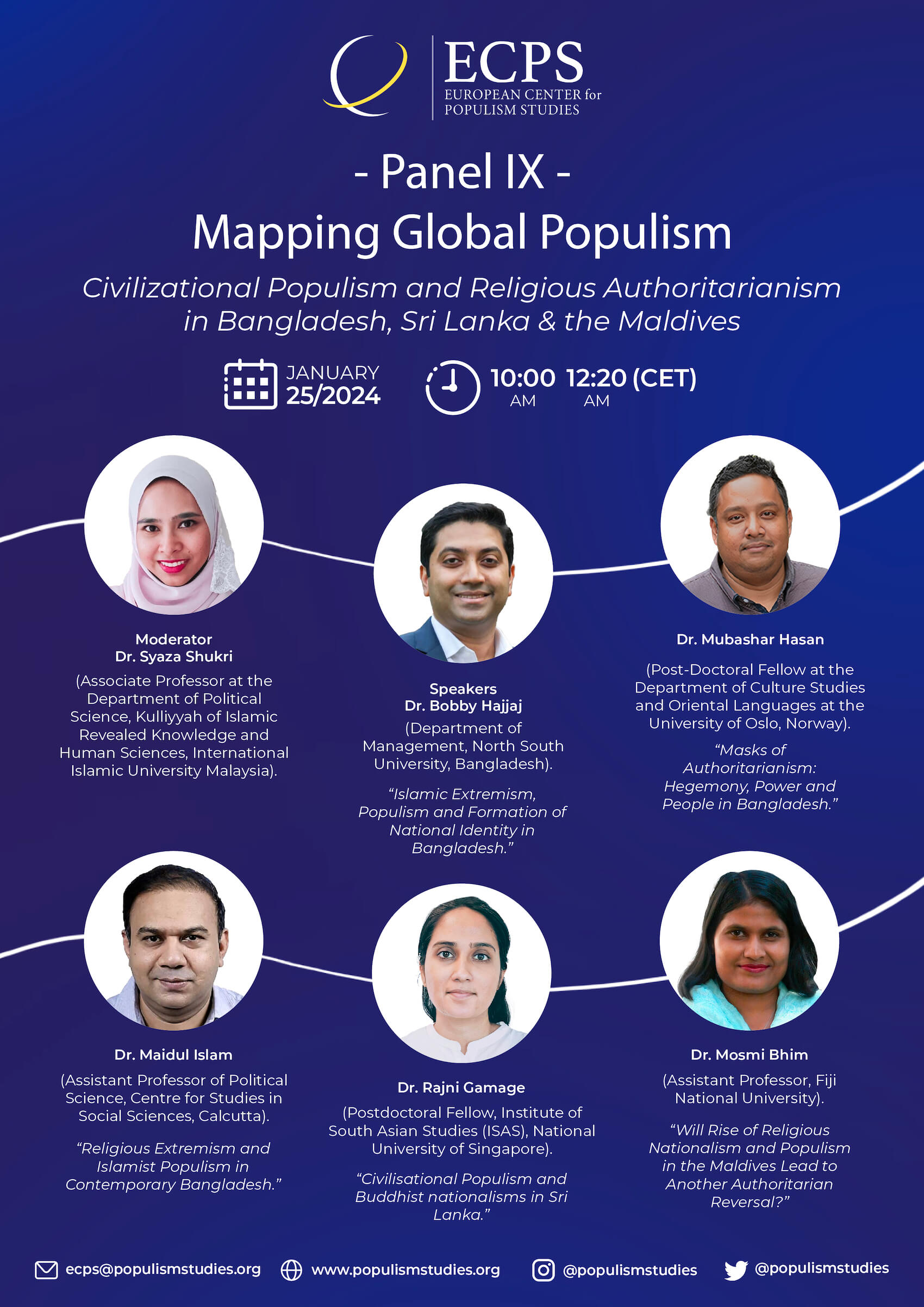
Panel IX: Civilizational Populism and Religious Authoritarianism in Bangladesh, Sri Lanka and the Maldives
Date/Time: Thursday, January 25, 2024 — 10:00-12:00 (CET)
Moderator
Dr. Syaza Shukri (Associate Professor at the Department of Political Science, Kulliyyah of Islamic Revealed Knowledge and Human Sciences, International Islamic University Malaysia).
Speakers
- “Islamic Extremism, Populism and Formation of National Identity in Bangladesh,” by Mr. Bobby Hajjaj(Department of Management, North South University, Bangladesh).
- “Religious Extremism and Islamist Populism in Contemporary Bangladesh,” by Dr. Maidul Islam (Assistant Professor of Political Science, Centre for Studies in Social Sciences, Calcutta).
- “Civilisational Populism and Buddhist Nationalisms in Sri Lanka,” by Dr. Rajni Gamage (Postdoctoral Fellow, Institute of South Asian Studies (ISAS), National University of Singapore).
- “Will Rise of Religious Nationalism and Populism in the Maldives Lead to Another Authoritarian Reversal?” by Dr. Mosmi Bhim (Assistant Professor, Fiji National University).
Panel X: Various Facets of Populist, Authoritarian and Nationalist Trends in Japan and Taiwan
Date/Time: Thursday, February 29, 2024 — 10:00-12:00 (CET)
Moderator
- Dr. Dachi Liao (Emeritus Professor at the Institute of Political Science at National Sun Yat-sen University in Taiwan).
Speakers
- "The State of Populism in Japan: A Comparative Perspective," by Dr. Toru Yoshida (Full Professor of Comparative Politics at Doshisha University in Japan).
- “The Nature of Populism in Japan: Japan as an Uncharted Territory of Global Populism?” by Dr. Airo Hino(Professor, School of Political Science and Economics, Waseda University)
- “Populism in Taiwan: Rethinking the Neo-liberalism–Populism Nexus,” by Dr. Szu-Yun Hsu (Assistant Professor, Political Science, McMaster University).
- “How Professionalized Are Parties’ Populist Communication Strategies on Facebook? A Case Study of 2024 Taiwan National Election,” by Dr. Jiun-Chi Lin (Postdoctoral researcher at the Institute of Marketing Communication, National Sun Yat-sen University).
Panel XI: Forces Shaping Populism, Authoritarianism and Democracy in South Korea, North Korea and Mongolia
Date/Time: Thursday, March 28, 2024 — 10:00-12:15 (CET)
Moderator
- Dr. John Nilsson-Wright (Associate Professor in Modern Japanese Politics and International Relations at University of Cambridge).
Speakers
- “Discourse Regimes and Liberal Vehemence,” by Dr. Joseph Yi (Associate Professor of Political Science at Hanyang University, Seoul).
- “Foreign Threat Perceptions in South Korean Campaign Discourse: Japan, North Korea and China,” by Dr. Meredith Rose Shaw (Associate Professor, Institute of Social Science, The University of Tokyo).
- “Transformation of Populist Emotion in Korean Politics from 2016 to 2024,” by Dr. Sang-Jin Han (Emeritus Professor of Sociology, Seoul National University).
- “Nationalism and Resilience of Authoritarian Rule in North Korea,” by Dr. Junhyoung Lee (Research Professor in the School of International Relations at the University of Ulsan, South Korea).
- “Populist Nationalism as a Challenge to Democratic Stability in Mongolia,” by Dr. Mina Sumaadii (Senior Researcher at the Sant Maral Foundation, Ulaanbaatar, Mongolia).
Panel XII: Populist Authoritarianism in China – National and Global Perspectives
Date/Time: Thursday, April 25, 2024 — 10:00-12:00 (CET)
Moderator
- Dr. Rune Steenberg (Anthropologist Researching Uyghurs and Central Asia, Principal Investigator at Palacký University Olomouc).
Speakers
- “Who Are the People, Populist Articulation of the People in Contemporary China,” by Dr. Kun He (Postdoctoral Researcher at the Computational Linguistics Group within the University of Groningen).
- “Religion with Chinese Characteristics – Regulating Religions under Xi Jinping,” by Dr. Martin Lavička(Visiting Research Fellow at the Centre for East and South-East Asian Studies, Lund University).
- “Unveiling China’s ‘Global Populism’: Sharp Power Politics Along the Belt and Road Initiative,” by Dr. Ibrahim Ozturk (Professor of Economy and visiting fellow at the University of Duisburg-Essen).
- “The Expanding Reach of China’s Authoritarian Influence: Shaping a New Illiberal Digital Order,” by Dr. Yung-Yung Chang (Assistant Professor at Asia-Pacific Regional Studies, National Dong Hwa University, Hualien, Taiwan).
Panel XIII: Resurgence of Expansionist Tsarism: Populist Autocracy in Russia
Date/Time: Thursday, May 30, 2024 — 10:00-12:00 (CET)
Moderator
- Dr. Maxine David (Lecturer in European Studies at Leiden University and Foreign Policy Analyst Specializing in Russian and EU Foreign Policy).
Speakers
- “Why Putin Is Not a Populist, But Worse,” by Dr. Luke March (Professor, Personal Chair of Post-Soviet and Comparative Politics at the University of Edinburg).
- “Katechontintic Sovereignty of Z-Populism in Putin’s Russia,” by Dr. Alexandra Yatsyk (Researcher at IRHIS-CNRS at the University of Lille and a lecturer at Sciences Po, France).
- “‘Traditional Values’: Gendered and (New)Imperial Dimensions in Russia,” by Dr. Yulia Gradskova (Associate Professor, Researcher at Södertörn University, Sweden).
- “The Economic Costs of Autocracy in Putin’s Russia,” by Dr. Dóra Győrffy (Professor of Economy at Institute of Economics, Corvinus University of Budapest).
Panel XIV: Tracing the Pathways of Autocracy and Authoritarianism Across Central Asia
Date/Time: Thursday, June 20, 2024 — 10:00-12:00 (CET)
Moderator
- Dr. David Lewis (Professor of Politics at University of Exeter).
Speakers
- “Autocracy’s Past and Present in Kazakhstan,” by Dr. Dinissa Duvanova (Associate Professor at Lehigh University).
- “Autocracy in Turkmenistan and The Role of Media in Cultivating Personality Cult,” by Oguljamal Yazliyeva(Ph.D. Researcher in International Area Studies at the Department of Russian and East European Studies of the Institute of International Studies, Faculty of Social Sciences, Charles University, Prague).
- “Clan Politics: Kyrgyzstan between Informal Governance and Democracy,” by Dr. Aksana Ismailbekova(Postdoctoral Researcher, Leibniz-Zentrum Moderner Orient).
Panel XV: Theocracy, Radicalism and Islamist/Secular Populism in Iran, Afghanistan & Tajikistan
Date/Time: Thursday, September 26, 2024 — 15:00-17:10 (CET)
Moderator
- Dr. Simon P Watmough (Postdoctoral Researcher at the University of Leipzig in Germany and a Non-resident Research Fellow at ECPS).
Speakers
- “Counter-extremism and Authoritarian Governance in Tajikistan,” by Dr. Hélène Thibault (Associate Professor in the Department of Political Science at Nazarbayev University, Astana, Kazakhstan).
- “Radical Islamism vs Extremist Secular State in Tajikistan,” by Dr. Kathleen Collins (Associate Professor in the Department of Political Science and a faculty affiliate in Islamic Studies at Minnesota University).
- “The Taliban’s Totalitarian Regime: Governance, Extremism, and Control,” by Dr. Zakia Adeli (Deputy Minister of Justice of the Islamic Republic of Afghanistan and a Professor in the Department of Political Science and International Relations at Kabul University (2018-2021) before joining East-West Center).
- “Gender Dynamics and the Plight of Afghan Women under Taliban Rule,” by Dr. Zahoor Ahmad Wani (Assistant Professor at Department of Political Science, School of Liberal and Creative Arts, Lovely Professional University).
- “The Rise of Populism in Iran: Inequality, Class Conflict, and Nationalist Authoritarianism,” by Amir Hossein Mahdavi (Ph.D. candidate at Department of Political Science, University of Connecticut).
Panel XVI: The Challenging Dynamics of Democracy, Authoritarianism & Populism in Caucasus (Armenia, Azerbaijan & Georgia)
Date/Time: Thursday, October 31, 2024 — 15:00-17:30 (CET)
Moderator
- Dr. Cengiz Aktar (Adjunct Professor of Political Science at the University of Athens and Advisory Board Member of ECPS).
Speakers
- “The State of Democracy and Populism in Armenia,” by Dr. Nerses Kopalyan (Associate Professor of Political Science at the University of Nevada, Las Vegas).
- "Populism Against Post-war Armenia’s Democratization and European Integration,” by Dr. Ashot S. Aleksanyan(Professor, Chair of Political Science, Faculty of International Relations at Yerevan State University).
- “Hegemonic Authoritarianism in Azerbaijan,” by Dr. Jody LaPorte (Department of Politics and International Relations, University of Oxford, Oxford).
- “Autocracy in Azerbaijan and Its Regional Implications,” by Thomas de Waal (Senior Fellow with Carnegie Europe, specializing in Eastern Europe and the Caucasus region).
- “From Technocratic Facade to Right-Wing Reality: The Evolution of Populism in Georgia,” by Dr. David Aprasidze (Professor of Political Science at Ilia State University).
- “The Rotating Populist Discourses of the Post-Soviet Georgia – From the Nationalist Populism to the Conservative Populism,” by Dr. David Matsaberidze (Associate Professor at Department of International Relations, Ivane Javakhishvili Tbilisi State University).
Panel XVII: The Rise and Reign of Autocratic Populism and Islamist Nationalism in Turkey
Date/Time: Thursday, November 28, 2024 — 15:00-17:10 (CET)
Moderator
- Dr. Jocelyne Cesari (Chair of Religion and Politics at the University of Birmingham (UK) and Senior Fellow at the Berkley Center for Religion, Peace, and World Affairs at Georgetown University).
Speakers
- “In Search of the ‘Infant People’: Continuity and Rupture in Turkey’s Political Landscape,” Dr. Spyros Sofos(Assisstant Professor, Department of Global Humanities, Simon Fraser University, Vancouver).
- “Populism in Transition: Continuities and Shifts in Turkey’s Political Landscape (2023-2024),” by Dr. Emre Erdogan (Professor of Political Science at Istanbul Bilgi University).
- “Autocratic Practices of The Gendered Regime in Turkey,” by Hafza Girdap (Women’s, Gender, and Sexuality Studies, Stony Brook University, New York).
- “Erdogan’s Media Capture Strategies and Their Role in Founding and Consolidating Autocracy in Turkey,” by Ergun Babahan (Journalist, Former Editor-in-Chief of Sabah daily and Ahval news).
- “Erdogan Regime as Emerging Sharp Power,” by Dr. Aleksandra Spancerska (Research Fellow at the Polish Institute of International Affairs).
Panel XVIII: Populism and Autocracy in the Gulf Countries
Date/Time: Thursday, December 19, 2024 — 15:00-17:30 (CET)
Moderator
- Dr. Courtney Freer (Assistant Professor, Department of Middle Eastern and South Asian Studies, Emory University, Atlanta, GA).
Speakers
- “Key Drivers of Autocratization in the Gulf Region,” by Dr. Thomas Demmelhuber (Professor, Chairholder, Institute of Political Science, Chair of Middle East Politics and Society, the Friedrich-Alexander-University of Erlangen-Nürnberg).
- “The Evolving Social Contract in the GCC,” by Dr. Gail Buttorff (Associate Director of the Center for Public Policy and Assistant Professor at the Hobby School, University of Houston).
- “The New Green Autocrats: How Saudi Arabia and the UAE Redefine Environmental Leadership,” by Dr. Tobias Zumbraegel (Postdoc at Geography Institute, the University of Heidelberg).
- “The Role of Salafism in the National and International Politics of Gulf Monarchies,” by Kardo Kareem Rached(Assistant Professor at University of Human Development, Sulaymaniyah, Kurdistan Region of Iraq).
- “Populism in Gulf Monarchies: Suppression, Cooptation, Adoption,” by Dr. Kristin Smith Diwan (Senior resident scholar at the Arab Gulf States Institute in Washington).
Other Panels
ECPS Regional Panel 1 — Old and New Facets of Populism in Latin America
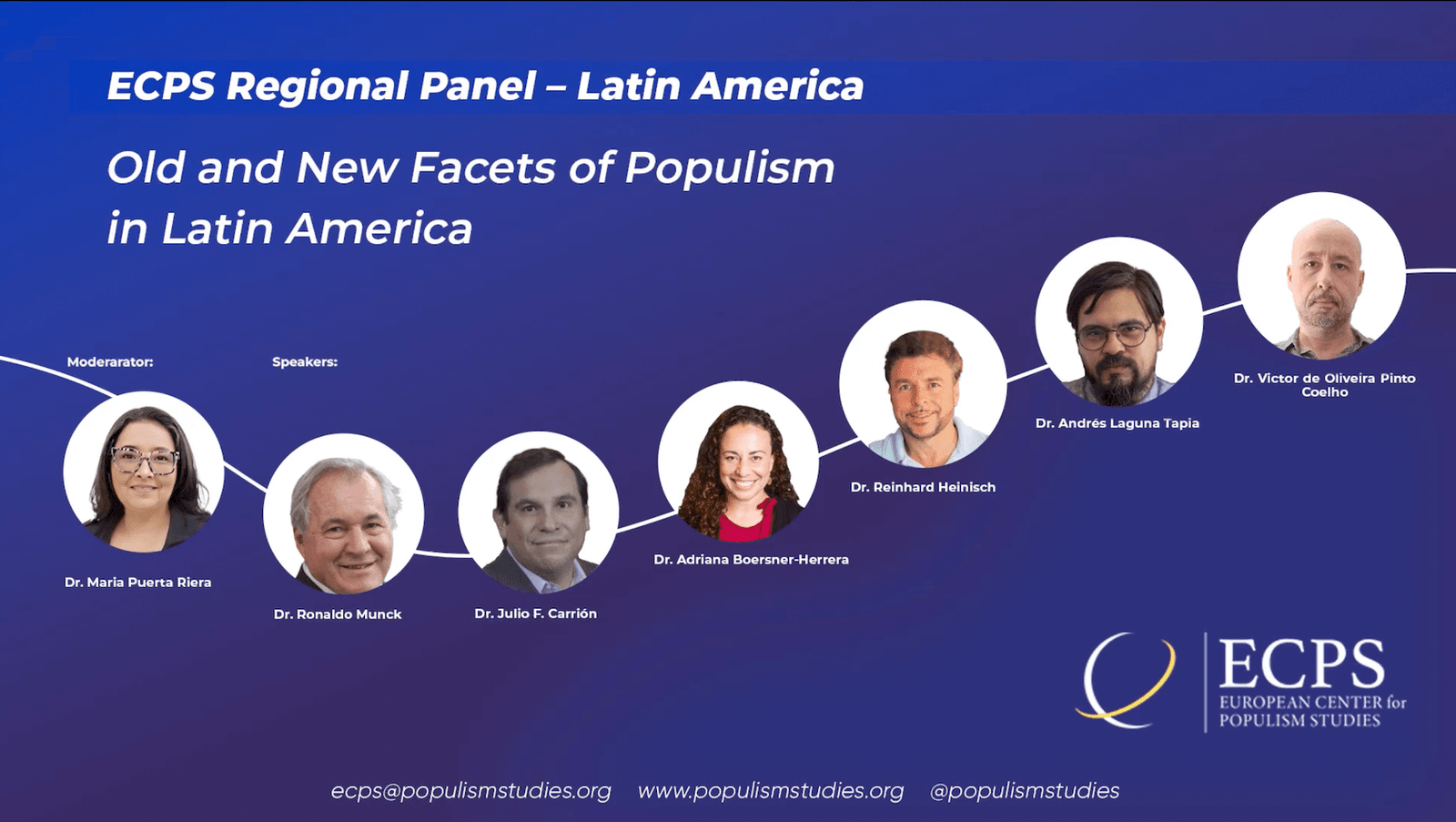
Date/Time: Thursday, March 7, 2024 / 15:00-17:30 CET
Moderator
- Dr. Maria Puerta Riera (Adjunct Professor in the Political Science at Valencia College)
Speakers
- “Populism and Socio-Political Transformation in Latin America,” by Dr. Ronaldo Munck (Professor of Sociology and Director of the Centre for Engaged Research at Dublin City University).
- “Varieties of Populism and Democratic Erosion: The Case of Latin America,” by Dr. Julio F. Carrión (Professor of Comparative Politics, University of Delaware).
- “Global Power Dynamics and Authoritarian Populism in Venezuela,” by Dr. Adriana Boersner-Herrera (Assistant Professor, Department of Political Science, The Citadel, The Military College of South Carolina).
- “Libertarian Populism? Making Sense of Javier Milei’s Discourse,” by Dr. Reinhard Heinisch (Professor of Comparative Politics at the University of Salzburg and Head of the Department of Political Science) and Dr. Andrés Laguna Tapia (Director of the Center for Research in Communication and Humanities and head of Communication Studies at UPB in Cochabamba).
- “The Phenomenon of ‘Bolsonarism’ in Brazil: Specificities and Global Connections,” by Dr. Victor de Oliveira Pinto Coelho (Professor of the Human Sciences at Universidade Federal do Maranhão).
ECPS Regional Panel 2: Crisis of Democratic Political Legitimacy and Emerging Populism in Africa
Date/Time: Thursday, May 09, 2024 — 15:00-17:30 (CET)
Moderator
- Dr. Chipo Dendere (Assistant Professor of Africana Studies at Wellesley College).
Speakers
- “Various Facets of Populist, Authoritarian, and Nationalist Trends in Africa,” by Dr. Henning Melber (Professor, Nordic Africa Institute, Uppsala; Extraordinary Professor at the Department of Political Sciences at the University of Pretoria and the Centre for Gender and Africa Studies at the University of the Free State in Bloemfontein).
- “Democratizing Africa: Navigating Populist Trends, Building Trust in Institutions, and Promoting Stability through Inclusive Governance,” by Dr. Nchofua Anita Nyitioseh (Assistant Lecturer, Department of English Law, University of Bertoua, Cameroon).
- “Taming the Lion: On the Conditions of Possibility of a Progressive Populism in Sub-Saharan Africa,” by Dr. Sergiu Mișcoiu (Professor of Political Science, Director of the Centre for International Cooperation Babeș-Bolyai University).
- “Populism and The Challenges of Democratic Governance in Africa,” by Dr. Edouard Epiphane Yogo(Executive Director and Principal Researcher at the Bureau of Strategic Studies (BESTRAT), University of Yaoundé II, Cameroon).
- “Populism Discourse and the Proliferation of Hate during Elections in Central African Sub-region,” by Dr. Derick Fai Kinang (University of Buea, Cameroon).
- “The Protection of Female Rights and the Rise of Populism in African Democracies: A Need for a Reformed Society,” by Dr. Ama-Ambo Chefor (Senior Lecturer, Department of English Law, University of Dschang, Cameroon).
ECPS Regional Panel 3: Where Is Europe Heading?
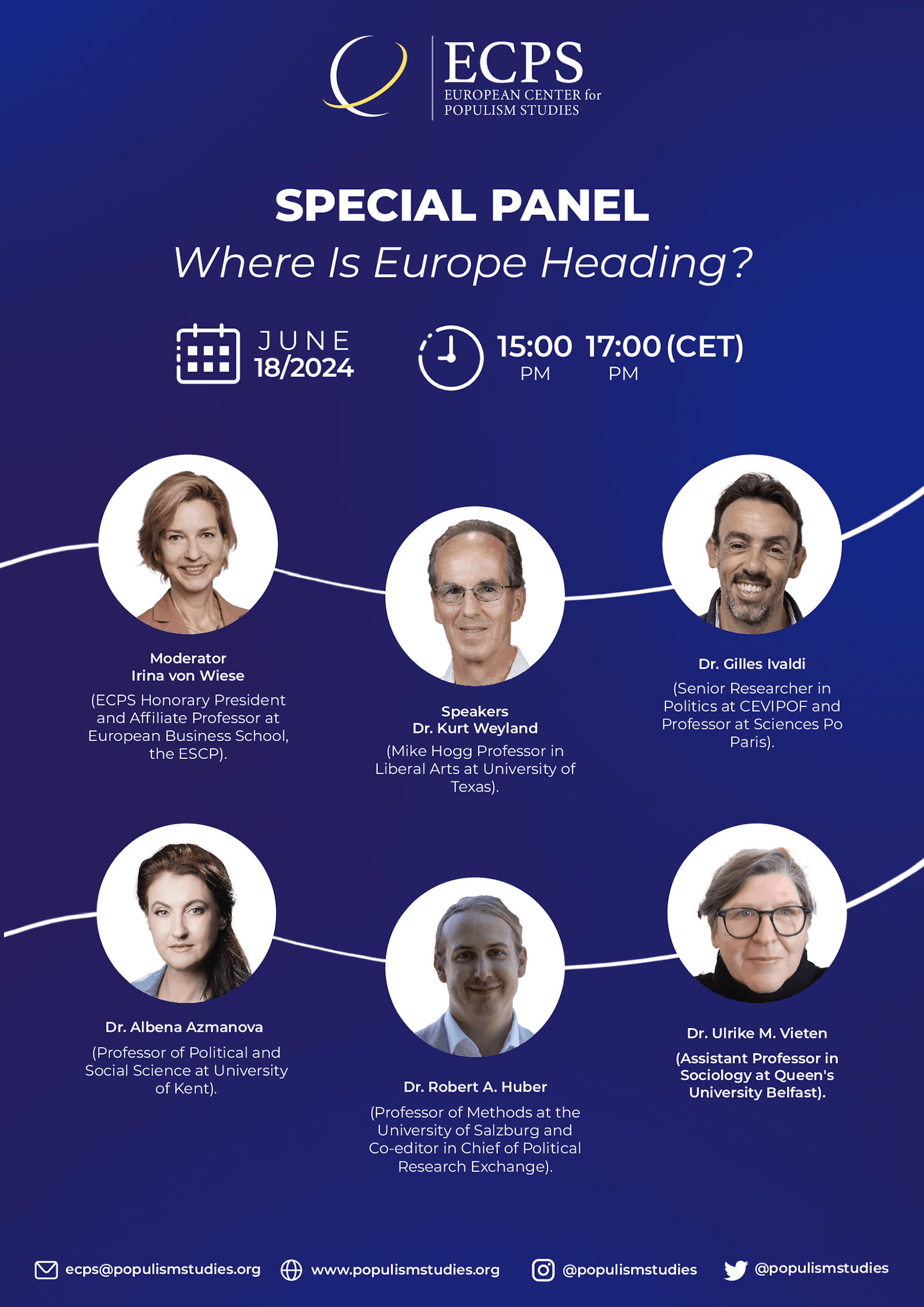
Date/Time: Tuesday, June 18, 2024 / 15:00-17:00 (CET)
Moderator
- Irina von Wiese (ECPS Honorary President; Affiliate Professor at European Business School, the ESCP, and former MEP).
Speakers
- “European Democracy’s Resilience to Populism‘s Threat,” by Dr. Kurt Weyland (Mike Hogg Professor in Liberal Arts at University of Texas).
- “A Far-right Tipping Point? The Impact of the 2024 European Elections in France,” by Dr. Gilles Ivaldi (Senior Researcher in Politics at CEVIPOF and Professor at Sciences Po Paris).
- "The Populist Rebellion of the Young," by Dr. Albena Azmanova (Professor of Political and Social Science at University of Kent).
- "EP Elections in Austria: Between ‘So What’ and the New Normal," by Dr. Robert A. Huber (Professor of Methods at the University of Salzburg and Co-editor in Chief of Political Research Exchange).
- "Beyond the Cordon Sanitaire: Normalization of Far-right and Racist Politics," by Dr. Ulrike M. Vieten(Assistant Professor in Sociology at Queen’s University Belfast).
Annual Symposium
The Third Annual International Symposium on “The Future of Multilateralism Between Multipolarity and Populists in Power”
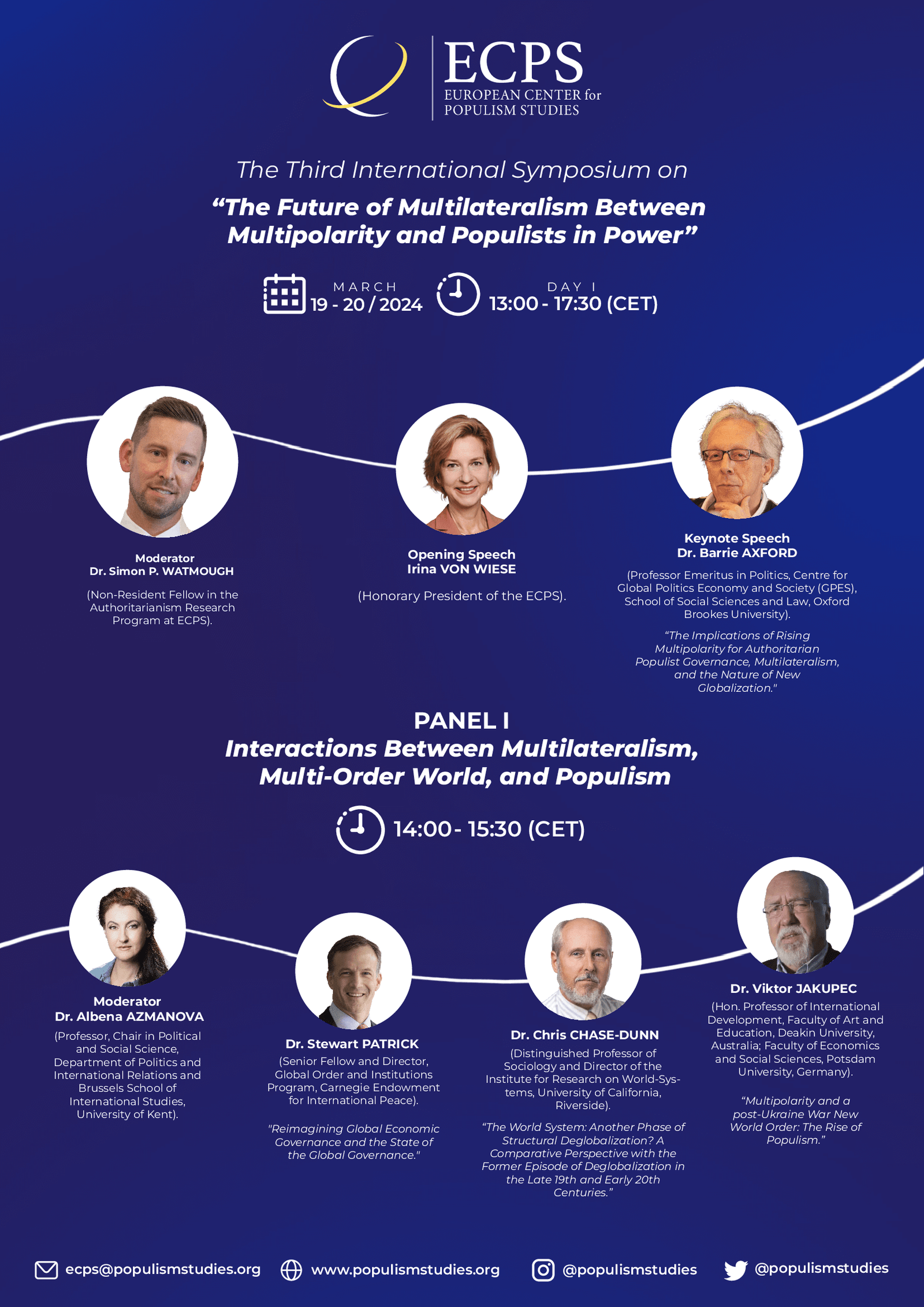
Day I (March 19, 2024)
(13:00–17:00 Central European Time)
Opening Speech
- Irina VON WIESE (Honorary President of the ECPS).
Keynote Speech
Moderator
- Dr. Simon P. WATMOUGH (Non-Resident Fellow in the Authoritarianism Research Program at ECPS).
- "The Implications of Rising Multipolarity for Authoritarian Populist Governance, Multilateralism, and the Nature of New Globalization," by Dr. Barrie AXFORD (Professor Emeritus in Politics, Centre for Global Politics Economy and Society (GPES), School of Social Sciences and Law, Oxford Brookes University).
Panel -I-
Interactions Between Multilateralism, Multi-Order World, and Populism
(14:00-15:30 Central European Time)
Moderator
- Dr. Albena AZMANOVA (Professor, Chair in Political and Social Science, Department of Politics and International Relations and Brussels School of International Studies, University of Kent).
Speakers
- "Reimagining Global Economic Governance and the State of the Global Governance," by Dr. Stewart PATRICK (Senior Fellow and Director, Global Order and Institutions Program, Carnegie Endowment for International Peace).
- “The World System: Another Phase of Structural Deglobalization? A Comparative Perspective with the Former Episode of Deglobalization in the Late 19th and Early 20th Centuries,” by Dr. Chris CHASE-DUNN (Distinguished Professor of Sociology and Director of the Institute for Research on World-Systems, University of California, Riverside).
- “Multipolarity and a post-Ukraine War New World Order: The Rise of Populism,” by Dr. Viktor JAKUPEC (Hon. Professor of International Development, Faculty of Art and Education, Deakin University, Australia; Faculty of Economics and Social Sciences, Potsdam University, Germany).
Panel -II-
The Future of Democracy Between Resilience & Decline
(15:30-17:00 Central European Time)
Moderator
- Dr. Nora FISHER-ONAR (Associate Professor of International Studies at the University of San Francisco).
- “Global Trends for Democracy and Autocracy: On the Third Wave of Autocratization and the Cases of Democratic Reversals,” by Dr. Marina NORD (Postdoctoral Research Fellow at V-Dem Institute, University of Gothenburg).
- “Resilience of Democracies Against the Authoritarian Populism,” by Dr. Kurt WEYLAND (Mike Hogg Professor in Liberal Arts, Department of Government University of Texas at Austin).
- “The Impact of Populist Authoritarian Politics on the Future Course of Globalization, Economics, the Rule of Law and Human Rights,” by Dr. James BACCHUS (Distinguished Professor of Global Affairs; Director of the Center for Global Economic and Environmental Opportunity, School of Politics, Security, and International Affairs, University of Central Florida, Former Chairman of the WTO Appellate Body).
Day II (March 20, 2024)
(13:00-17:30 Central European Time)
Keynote Speech
- “How Globalization, under Neoliberal Auspices, Has Stimulated Right-wing Populism and What Might Be Done to Arrest That Tendency?" by Dr. Robert KUTTNER (Meyer and Ida Kirstein Professor in Social Planning and Administration at Brandeis University’s Heller School, Co-Founder and Co-Editor of The American Prospect).
Panel -III-
Globalization in Transition
(14:00-15:30 Central European Time)
Moderator
- Dr. Anna SHPAKOVSKAYA (Postdoctoral Research Fellow, China Research Analyst at Institute of East Asian Studies, Duisburg-Essen University).
Speakers
- “China’s Appeal to Populist Leaders: A Friend in Need is a Friend Indeed,” by Dr. Steven R. DAVID (Professor of Political Science at The Johns Hopkins University).
- “Belt and Road Initiative: China’s Vision for Globalization?” by Dr. Jinghan ZENG (Professor of China and International Studies at Lancaster University).
- “Predicting the Nature of the Next Generation Globalization under China, Multipolarity, and Authoritarian Populism” by Humphrey HAWKSLEY (Author, Commentator and Broadcaster).
Special Commentator
- Dr. Ho Tze Ern BENJAMIN (Rajaratnam School of International Studies in Singapore, Coordinator at the China Program, and International Relations Program).
Panel -IV-
Economic Implications of Rising Populism and Multipolarity
(15:30-17:00 Central European Time)
Moderator
- Dr. Patrick HOLDEN (Associate Professor in International Relations at School of Society and Culture, University of Plymouth).
Speakers
- “Demise of Multilateralism and Politicization of International Trade Relations and the Multilateral Trading System,” by Dr. Giorgio SACERDOTI (Professor of Law, Bocconi University; Former Chairman of the WTO Appellate Body).
- “China Under Xi Jinping: Testing the Limits at a Time of Power Transition,” by Dr. Alicia GARCIA-HERRERO (Chief Economist for Asia Pacific at Natixis).
Closing Remarks
(17:00-17:15 Central European Time)
- Dr. Cengiz AKTAR (Adjunct Professor of Political Science at the University of Athens and ECPS Advisory Board Member).
Transatlantic Outlook on Populism in the US and Europe in Light of ECPS 2024 Report on EP Elections
Date/Time: November 7, 2024 — 15:00-17:00 CET.
Venue: European Parliament’s Spaak Building in Brussels / Room: P5B001.
This event is hosted by MEP Radan Kanev in cooperation with the European Center for Populism Studies (ECPS)
Moderator
- Dr. Simon P. WATMOUGH (Postdoctoral Researcher at the University of Leipzig in Germany and a Non-resident Research Fellow at ECPS).
Speakers
- “Opening Remarks” by Irina VON WIESE (Honorary President of the ECPS).
- Welcome and Keynote Speech by Radan KANEV (Member of EP, EPP) on “EU Elections and the Fragmentation of the Right-wing Populism: ‘Normalisation’ vs ‘Cordon Sanitaire’.”
- Keynote Address by Nathalie LOISEAU (Member of EP, Renew) on “A Transatlantic Perspective on the New Composition of the EP and Upcoming Administration in the US, Challenges of Populist Politics and Its Repercussions on the Relations between the US and EU.”
Presentation of the ECPS Report
- “2024 EP Elections under the Shadow of Rising Populism,” by Dr. Emilia ZANKINA (Editor of the Report, ECPS Advisory Board Member, Temple University-Rome) and Dr. Gilles IVALDI (Editor of the Report, ECPS Advisory Board Member, Centre de Recherches Politiques de Sciences Po).
Partnership with International Conferences
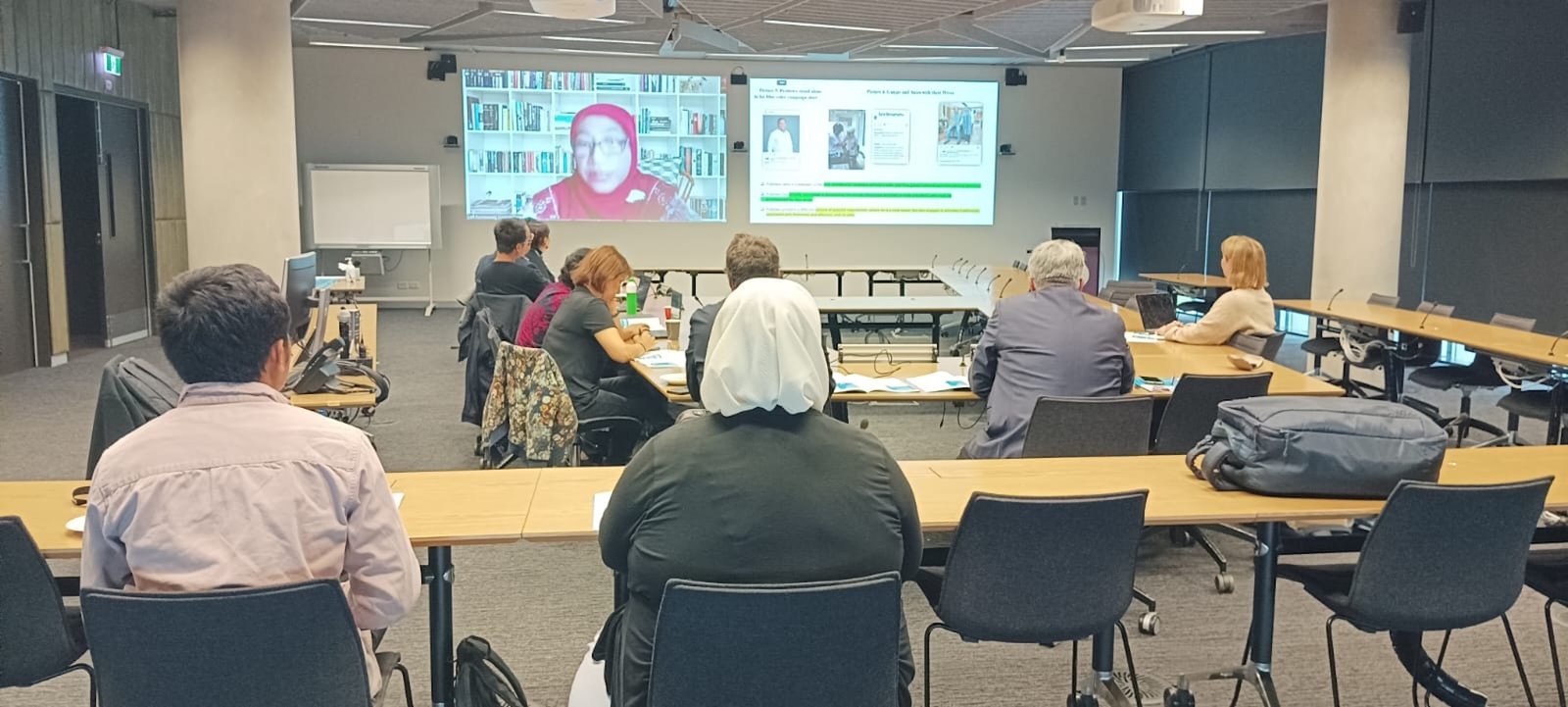
International Conference on Populisms, Digital Technologies, and the 2024 Elections in Indonesia
Venue/Date: Deakin University, Australia | April 17–18, 2024
In April 2024, Deakin University, in collaboration with the European Center for Populism Studies (ECPS), Universitas Indonesia, and Universitas Gadjah Mada, hosted The International Conference: Populisms, Digital Technologies, and the 2024 Elections in Indonesia. Held shortly after Indonesia’s multi-level elections in February, the conference offered a timely and comprehensive examination of the evolving intersections between populism, technology, and democracy.
Organized by the Alfred Deakin Institute for Citizenship and Globalization (ADI), the two-day event featured 31 papers across eight panels, covering a broad range of topics such as populist strategy and communication, gender and youth politics, sharp power and disinformation, and authoritarian and Islamist populism. These discussions provided a nuanced understanding of how digital technologies, artificial intelligence, religion, and collective emotions shape Indonesia’s democratic and political dynamics.
The conference featured two distinguished keynote speakers: Professor Simon Tormey, an internationally recognized scholar of populism theory, and Professor Vedi Hadiz, a leading expert on Islamic populism in Indonesia. Their insights helped frame the debates on the global and local trajectories of populism in the digital age. Generously supported by the Australian Research Council (ARC), ADI, and ECPS, the conference successfully fostered cross-disciplinary collaboration, enriching both academic and policy-oriented conversations about populism’s influence in Southeast Asia and beyond.
International Conference on ‘Digital Complexity and Disinformation in the Indo-Pacific’
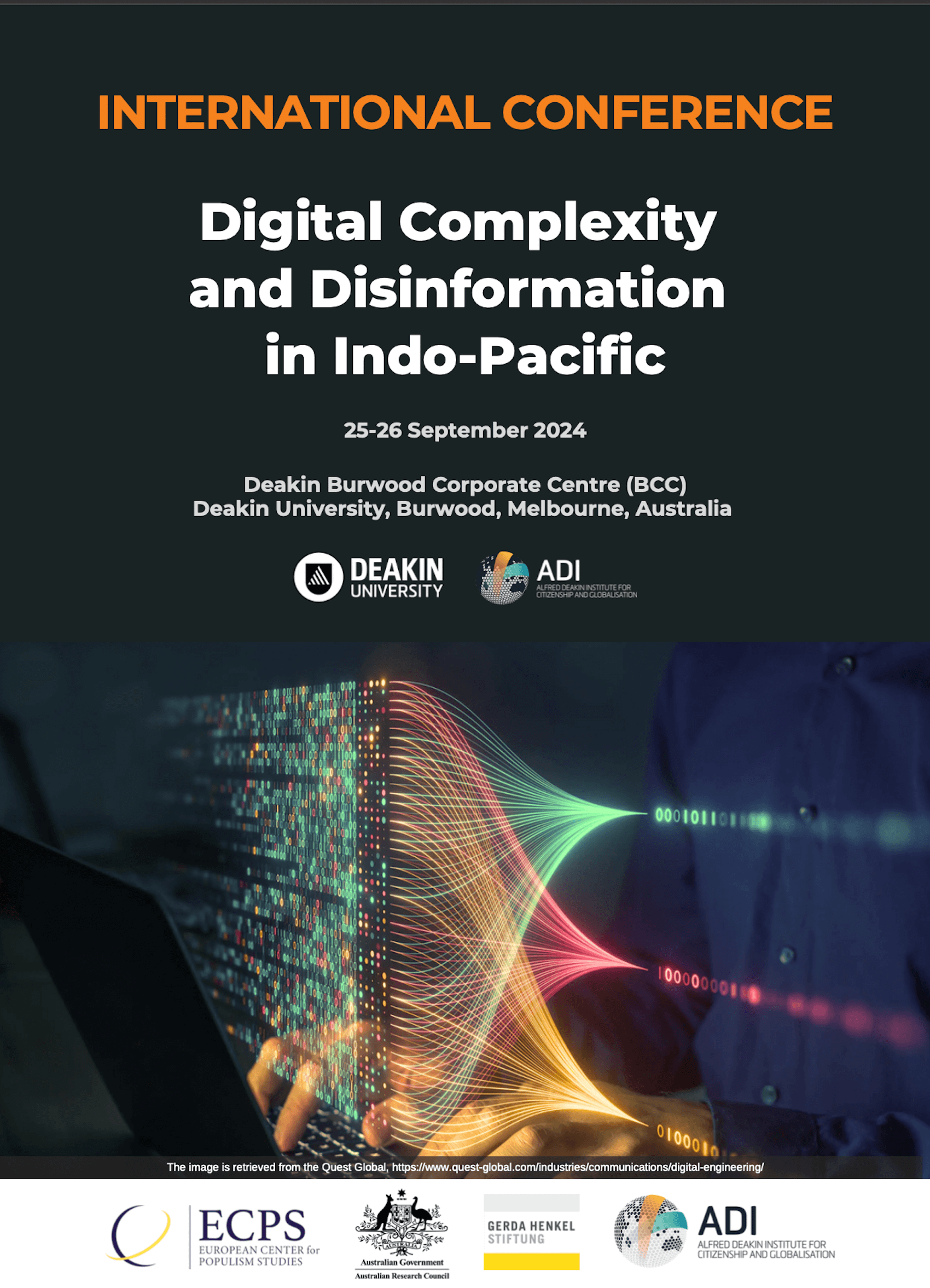
Venue/Date: Deakin University, Melbourne & Online | September 25–26, 2024
In September 25-26, 2024, the International Conference on “Digital Complexity and Disinformation in the Indo-Pacific” convened both online and in person at Deakin University, Melbourne. This high-profile academic event was jointly organized by the Alfred Deakin Institute for Citizenship and Globalisation (ADI), Universitas Indonesia (UI), Universitas Gadjah Mada (UGM), Universitas Muhammadiyah Malang (UMM), International Islamic University Malaysia (IIUM), State Islamic University (UIN) Salatiga, the National Research and Innovation Agency (BRIN), and the European Center for Populism Studies (ECPS).
The conference examined how digital technologies, while promising inclusivity and progress, have also become tools for disinformation, manipulation, and digital authoritarianism. Scholars and practitioners from across the Indo-Pacific explored how misinformation circulating through social media platforms—such as Facebook, X (formerly Twitter), Instagram, Telegram, and WhatsApp—undermines democratic governance, social cohesion, and freedom of expression.
Participants analyzed case studies across the region, highlighting how political actors weaponize digital spaces to silence dissent and consolidate power, while others proposed innovative solutions to counter disinformation and promote digital literacy, accountability, and transparency.
Supported by the Australian Research Council (ARC), the Gerda Henkel Foundation, ECPS, and ADI, the conference successfully advanced international collaboration and critical dialogue on the urgent need to strengthen democratic resilience and ethical governance in the rapidly evolving digital ecosystem of the Indo-Pacific.
Summer School
ECPS Academy Summer School — Populism and Foreign Policy: How Does Populist Politics Influence Foreign Affairs? (July 1-5, 2024)
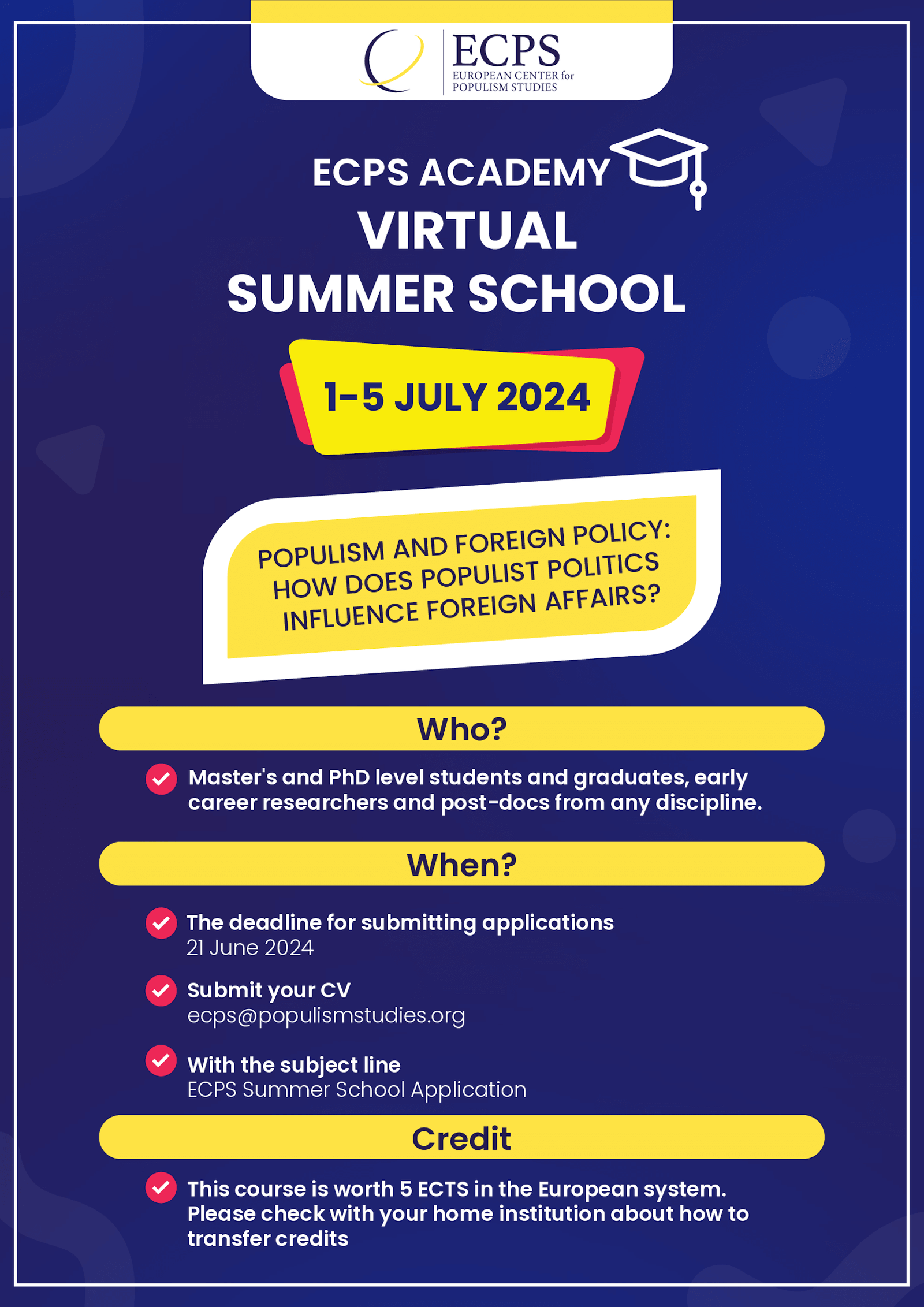
Date: July 1–5, 2024 | Format: Online
The ECPS successfully organized its fourth virtual Summer School from July 1–5, 2024, focusing on Populism and Foreign Policy. This intensive, five-day academic program brought together young scholars, early-career researchers, and graduate students from around the world to explore the growing intersection between populism and international relations.
Challenging the conventional view of populism as a purely domestic phenomenon, the 2024 Summer School examined how populist leaders reshape foreign policy, global institutions, and international norms. Case studies such as Trump’s “America First” diplomacy, Modi’s Hindu nationalist foreign policy, Erdogan’s transnational populism, and Orbán’s Euroscepticism were discussed to illustrate how populist politics affect global cooperation and the liberal international order.
The Summer School featured lectures by globally renowned scholars, including Professor Sandra Destradi, Dr. Angelos Chryssogelos, Dr. Jessica Greenberg, Dr. Thorsten Wojczewski, Dr. Georg Loefflman, Professor Cengiz Aktar, Professor Emeritus Louis Kriesberg, Professor Bertjan Verbeek, Irina von Wiese, Professor Craig Calhoun, and Professor Joanna Dyduch. Each session was moderated by distinguished academics such as Dr. Rubrick Biegon, Dr. Gustav Meibauer, Dr. Jonny Hall, Professor Ana E. Juncos Garcia, and Professor Franco Zappettini, ensuring rich, interactive discussions.
A highlight of the program was the Case Competition, where participants collaboratively addressed real-world challenges in populist foreign policy, developing innovative policy proposals evaluated by experts.
By fostering an interdisciplinary and cross-cultural learning environment, ECPS’s 2024 Summer School empowered participants to critically engage with pressing global issues. It strengthened their analytical, research, and communication skills while building an international network of scholars dedicated to understanding the populist transformation of global politics. The program awarded 5 ECTS credits and continues to serve as a model for academic excellence and civic engagement in populism studies.

Workshops
Populism & Politics Workshop – The Interplay Between Migration and Populist Politics Across Europe Ahead of European Parliament Elections
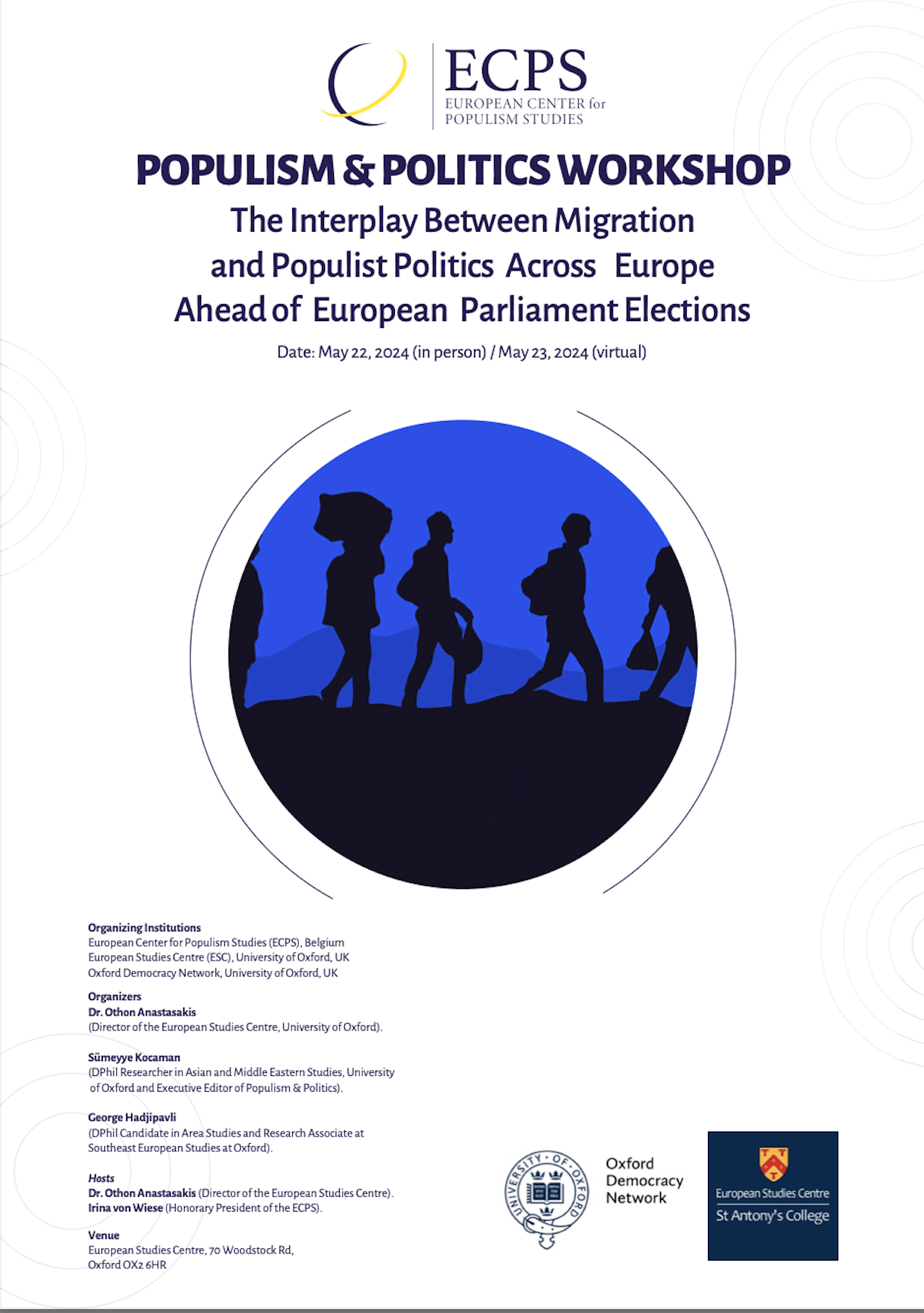
Date: May 22–23, 2024
Venue: European Studies Centre, University of Oxford (in-person) & ECPS Virtual Platform
In May 22-23, 2024, the ECPS, in collaboration with the European Studies Centre (ESC) and the Oxford Democracy Network at the University of Oxford, co-organized the two-day workshop “The Interplay Between Migration and Populist Politics Across Europe Ahead of European Parliament Elections.” This timely event brought together leading academics and emerging scholars to analyze the nexus between migration, populism, and electoral politics across Europe.
Hosted at the European Studies Centre in Oxford and online, the workshop was co-chaired by Dr. Othon Anastasakis (ESC, University of Oxford), Sumeyye Kocaman (University of Oxford & ECPS), and George Hadjipavli (University of Oxford). Opening remarks were delivered by Dr. Anastasakis and Irina von Wiese (Honorary President, ECPS).
Over six thematic panels, participants explored how anti-immigration narratives, diaspora engagement, and populist rhetoric shape European politics ahead of the 2024 European Parliament elections. Topics ranged from political psychology and xenophobia to gendered representations of refugees, diaspora politics, and digital populism. Panels featured contributions from scholars across Europe, including Dr. Filipa Figueira, Dr. Sanne van Oosten, Dr. Márton Gerő, Dr. Tamas Dudlak, Dr. Ezgi Irgil, and Dr. Zeynep Şahin-Mencütek, among many others.
The second day, held virtually, expanded the discussion to encompass the far right’s use of asylum policies, Euroscepticism, and the role of populism in redefining citizenship and social inclusion.
By bridging disciplinary boundaries and fostering collaboration, the event deepened understanding of how migration continues to shape and be shaped by populist discourse across Europe—especially in the run-up to one of the most consequential European Parliament elections in recent history.
DAY ONE
Date/Time: May 22, 2024 / 08:30-17:00 (UK Time)
Opening Remarks
- Dr. Othon Anastasakis (Director of the European Studies Centre).
- Irina von Wiese (Honorary President of the ECPS).
Panel 1 – Supply and Demand Sides of Populism: Political Psychology, Neoliberalism and Xenophobia
Date/Time: May 22, 2024 / 09:00-10:45 (UK Time)
Chair
- Irina von Wiese (Honorary President of the ECPS).
Discussant
- Dr. William L. Allen (British Academy Postdoctoral Fellow, Department of Politics and International Relations, and Nuffield College, University of Oxford).
Presentations
- “Populism, Fast and Slow – A Dual Thinking Approach to Populist Attitudes," by Dr. Filipa Figueira (Lecturer at the School of Slavonic and East European Studies at University College London) & George Hajipavli (DPhil Candidate in Area Studies and Research Associate at Southeast European Studies at Oxford).
- “Recalibration, Not Austerity: The Interplay of Populism, Neoliberalism, and Welfare States in the Struggle for Liberal Values,” by Jellen Olivares-Jirsell (PhD Candidate in Politics at Kingston University).
- “In-group Love Explains Voting for Populist Radical Right Parties amongst Minority and Majority Groups in France, Germany and the Netherlands,” by Dr. Sanne van Oosten (Postdoctoral Researcher, Equal Strength, COMPAS, University of Oxford).
Panel 2: Hungary: A Case Study for Migration, Elections and Diaspora
Date/Time: May 22, 2024 / 11:00-13:00 (UK Time)
Chair
- Dr. Othon Anastasakis (Director, European Studies Centre, Oxford University).
Discussant
- Dr. Márton Gerő (Assistant Professor of Sociology at the Faculty of Social Sciences of Eötvös Loránd University).
Papers
- “You Don’t Even Have to Press It Anymore" – The Moral Panic Button (MPB) and the Road to the 2022 Election in Hungary,” by Dr. Márton Gerő (Assistant Professor of Sociology at the Faculty of Social Sciences of Eötvös Loránd University) & Dr. Endre Sik (Research Professor at the Institute of Sociology – Centre for Social Sciences of the Hungarian Academy of Sciences Centre of Excellence).
- “Migration Challenge and Populist Responses. A Comparative Analysis of Parliamentary Elections in Hungary and Turkey," by Dr. Tamas Dudlak (Researcher at the Contemporary Arab World Center, ELTE Eötvös Loránd University).
- “Diasporas Intertwined: The Role of Kin-State Minorities in the Hungarian State’s Diaspora Engagement," by Judit Molnar (DPhil Candidate in Anthropology at the University of Oxford).
Panel 3 – Anti-Migrant Perceptions and Populist Reactions Across Europe
Date/Time: May 22, 2024 / 14:30-16:30 (UK Time)
Chair
- Rob McNeill (Deputy Director of Migration Observatory, Compas Researcher, University of Oxford).
Discussant
- Jafia Naftali Camara (British Academy Research Fellow, University of Cambridge).
Hannah Geddes (PhD Candidate in Management, University of St. Andrews).
Presentations
- “Nationalist Myths and The Emergence of Anti-Immigration Discourses,” by Luca Venga (Post-graduate Student at St. Antony’s College, University of Oxford).
- “Scandinavian Countries and the Rise of Extremism," by Priscilla Otero Guerra (Postgraduate Student at the University of Oxford).
- "Gendering Conflict: A Comparative Study of How Palestinian Civilians and Arab European Refugees Are Portrayed within Europe Parliamentarian Narratives,” by Arunima Cheruvathoor (MPhil in Global and Area Studies at the University of Oxford).
- “Digital Engagement and Political Voices: A Comparative Analysis of Skilled Immigrant Women in Ottawa and Stockholm,” by Ayshan Mammadzada (PMP, PhD Candidate at uOttawa).
Concluding Remarks
- Dr. Othon Anastasakis (Director of the European Studies Centre, University of Oxford).
- Rob McNeill (Deputy Director of Migration Observatory, Compas Researcher, University of Oxford).
DAY TWO
Panel 4 – Intersection of Populist Politics, Far Right and Asylum Policies
Date/Time: May 23, 2024 / 09:00-11:00 (UK Time)
Co-chairs
- Dr. Ilkhom Khalimzoda (Postdoctoral Researcher at the Department of Language and Communication Studies, University of Jyväskylä, Finland).
- Dr. Sanne van Oosten (Postdoctoral Researcher, EqualStrength, COMPAS, University of Oxford).
Discussants
- Dr. Simon Watmough (Postdoctoral researcher at the University of Leipzig in Germany and a non-resident research fellow at ECPS).
- Dr. Tamas Dudlak (Researcher at the Contemporary Arab World Center, ELTE Eötvös Loránd University).
- Hannah Geddes (PhD Candidate in Management, University of St. Andrews).
Presentations
- “The Victory Party at the Crossroads of Asylum Policies and Populist Discourse in Turkey,” by Dr. Ezgi Irgil(Postdoctoral Research Fellow within the Global Politics and Security Programme at the Swedish Institute of International Affairs – UI) & Dr. Zeynep Sahin Mencutek (Senior Researcher at Bonn International Centre for Conflict Studies).
- “Populist Politics Kills Asylum Policies: How Populist Discourses About Migration in Bulgaria Invent the ‘Refugee Crisis’," by Dr. Ildiko Otova (Assistant Professor in International Migration at New Bulgarian University) & Dr. Evelina Staykova (Associate professor in Political Science at New Bulgarian University).
- “‘The More Refugees, the More Votes’: The Role of Migration on the AfD Growth,” by Dr. Avdi Smajljaj(Assistant Professor and lecturer at the Department of Political Sciences and International Relations, Epoka University, Tirana, Albania).
- “Between Gastfreundschaft and Überfremdung: The Populist Origins of Migration Politics in the Federal Republic of Germany, 1973-1983,” by Simon Ahrens (MPhil in Development Studies, University of Oxford).
Panel 5 – The Influence of Populist Anti-Immigration Narratives on European Self
Date/Time: May 23, 2024 / 12:30-14:30 (UK Time)
Co-Chairs
- Dr. Avdi Smajljaj (Assistant Professor and lecturer at the Department of Political Sciences and International Relations, Epoka University, Tirana, Albania).
- Dr. Marieke van Houte (Assistant Professor for Anthropology and Development Studies, Radboud University).
Presentations
- “Refugees and the Eurosceptics: Understanding the Shifts in the Political Landscape of Europe,” by Dr. Amrita Purkayastha (Assistant Professor at Bangalore, India).
- “Populist Discourse and European Identity: A Poststructuralist Analysis," by Nazmul Hasan (PhD Candidate in the Department of Philosophy and Comparative Religion, Visva-Bharati University, Santiniketan, West Bengal, India).
- “Nationalism and Anti-Immigration Sentimentalism in Europe,” by Sulagna Pal (PhD Research Scholar, Department of Philosophy, University of Delhi, India).
- “A Critique of Eurocentric Conceptualisations of Social Cohesion in Academia, Refugee Policy, and Refugee Settings,” by Basma Doukhi (PhD Candidate in Migration Studies at the University of Kent).
Panel 6 – Diverse Aspects of Anti-Migrant Populism in Europe
Date/Time: May 23, 2024 / 15:00-17:00 (UK Time)
Co-Chairs
- Dr. Tamirace Fakhoury (Associate Professor of International Politics and Conflict, Fletcher School, Tufts University).
- Dr. Zeynep Sahin-Mencutek (Senior Researcher at Bonn International Centre for Conflict Studies).
Discussants
- Dr. Jafia Naftali Camara (British Academy Research Fellow, University of Cambridge).
- Dr. Azize Sargin (Director for External Relations, ECPS).
Presentations
- “Enemies Inside: European Populism and Dimensions of Euroscepticism,” by Dr. Ana Paula Tostes (Senior Fellow at the Brazilian Center of International Relations and Professor at the State University of Rio de Janeiro).
- “Emigration and Political Party Membership in Central and Eastern Europe: Evidence from a Difference-in-Differences Design," by Melle Scholten (PhD Candidate at the University of Virginia).
- “Digital Engagement and Political Voices: A Comparative Analysis of Skilled Immigrant Women in Ottawa and Stockholm," by Ayshan Mammadzada (PMP, PhD Candidate at uOttawa).
- “The Role of Populism in Redefining Citizenship and Social Inclusion for Migrants in Europe,” by Dr. Edouard Epiphane Yogo (Lecturer-Researcher in Political Science at the University of Yaoundé, Cameroon).
Concluding Remarks & Thanks
- Dr. Azize Sargin (Director for External Relations, ECPS).
- Sumeyye Kocaman (DPhil Researcher in Asian and Middle East Studies and Executive Editor of Populism & Politics).
***
Publications
Journal of Populism & Politics (P&P)
In 2024, Populism & Politics (P&P) further solidified its position as one of the interdisciplinary platforms of the ECPS for cutting-edge scholarship on populism, authoritarianism, and democratic resilience. The digital journal continued to foster vigorous academic inquiry across the humanities, social sciences, and related fields, encouraging bold theoretical and methodological innovation.
Reflecting the journal’s mission to explore populism’s multifaceted expressions—from global shifts in democratic governance to localized experiences—P&P published 18 peer-reviewed articles in 2024. These contributions addressed a remarkable breadth of themes, including civilizational populism in Turkey, India, China, and Russia; the role of religion and informal Sharia structures in Indonesian elections; Euroscepticism and transnational diaspora politics in Europe; digital authoritarian practices; and the transformation of nationalist victimhood narratives. Collectively, these studies offered regionally grounded yet globally resonant insights into how populist discourse, leadership, and policy continue to reshape political life.
A defining strength of P&P in 2024 was its emphasis on comparative and cross-disciplinary perspectives, with scholars drawing from political science, sociology, religious studies, international relations, gender studies, and media analysis. The journal maintained its commitment to inclusivity and conceptual diversity by promoting decolonial, gender-sensitive, and Public Humanities–oriented frameworks.
The journal’s rigorous peer-review process, anonymized at every stage, ensured the highest standards of scholarly excellence. Each published article received a DOI, facilitating broad dissemination and citation within the global research community. P&P also encouraged innovative forms of knowledge production and interdisciplinary reflections that expand the conceptual boundaries of populism studies.
P&P’s 2024 portfolio reflects both geographical range and thematic evolution. Special attention to the 2024 Indonesian elections and shifting patterns of populism in Europe’s changing political landscape illustrates the journal’s responsiveness to contemporary developments.
As populism continues to evolve—reshaping identities, governance, and global order—P&P remains dedicated to advancing accessible, original, and methodologically robust scholarship. Through its expanding global authorship and cross-sector engagement, the journal contributes meaningfully to understanding and addressing the most urgent democratic challenges of our time.
Articles Published by P&P in 2024
Yilmaz, Ihsan; Triwibowo, Whisnu; Bachtiar, Hasnan & Barton, Greg. (2024). “Competing Populisms, Digital Technologies and the 2024 Elections in Indonesia.” Populism & Politics (P&P). European Center for Populism Studies (ECPS). January 2, 2024. https://doi.org/10.55271/pp0029
Yilmaz, Ihsan; Bachtiar, Hasnan; Smith, Chloe & Shakil, Kainat. (2024). “Fluctuating Populism: Prabowo’s Everchanging Populism Across the Indonesian Elections.” Populism & Politics (P&P). European Center for Populism Studies (ECPS). March 15, 2024. https://doi.org/10.55271/pp0030
Axford, Barrie. (2024). “The Implications of Rising Multipolarity for Authoritarian Populist Governance, Multilateralism, and the Nature of New Globalization.” Populism & Politics (P&P). European Center for Populism Studies (ECPS). March 30, 2024. https://doi.org/10.55271/pp0031
Morieson, Nicholas & Yilmaz, Ihsan. (2024). “Is A New Anti-Western Civilizational Populism Emerging? The Turkish, Hungarian and Israeli Cases.” Populism & Politics (P&P). European Center for Populism Studies (ECPS). April 4, 2024. https://doi.org/10.55271/pp0032
Yilmaz, Ihsan & Morieson, Nicholas. (2024). “The Rise of Authoritarian Civilizational Populism in Turkey, India, Russia and China.” Populism & Politics (P&P). European Center for Populism Studies (ECPS). April 14, 2024. https://doi.org/10.55271/pp0033
Smith, Chloe; Bachtiar, Hasnan; Shakil, Kainat; Morieson, Nicholas & de Groot Heupner, Susan. (2024). “Appealing to a Religiously Defined ‘the People’: How Religion Was Performatively Operationalized in the 2019 and 2024 Election Campaigns of Indonesia’s President-Elect.” Populism & Politics (P&P). European Center for Populism Studies (ECPS). April 25, 2024. https://doi.org/10.55271/pp0034
Bachtiar, Hasnan; Shakil, Kainat & Smith, Chloe. (2024). “Use of Informal Sharia Law for Civilizational Populist Mobilization in the 2024 Indonesian Elections.” Populism & Politics (P&P). European Center for Populism Studies (ECPS). April 26, 2024. https://doi.org/10.55271/pp0035
Varriale, Amedeo. (2024). “Populism and the Extreme Right in Comparative Perspective: The French Rassemblement National and the Italian Forza Nuova.” Populism & Politics (P&P). European Center for Populism Studies (ECPS). August 12, 2024. https://doi.org/10.55271/pp0036
Kenes, Bulent & Yilmaz, Ihsan. (2024). “Fatwas as Tools of Religious Populism: The Case of Turkish Islamist Scholar Hayrettin Karaman.” Populism & Politics (P&P). European Center for Populism Studies (ECPS). September 1, 2024. https://doi.org/10.55271/pp0037
Erturk, Omer; Yilmaz, Ihsan and Smith, Chloe. (2024). “Blame Avoidance through Necropolitics and Religious Populism: Autocratic Responses to Nationwide Crises in an Authoritarian Islamist Polity.” Populism & Politics (P&P). European Center for Populism Studies (ECPS). September 3, 2024. https://doi.org/10.55271/pp0038
Pretorius, Christo. (2024). “Populism in Ireland: Sinn Féin and the Alternative to Fine Gael and Fianna Fáil’s Political Dominance.” Populism & Politics (P&P). European Center for Populism Studies (ECPS). September 4, 2024. https://doi.org/10.55271/pp0039
Morieson, Nicholas; Yilmaz, Ihsan & Kenes, Bulent. (2024). “From National to Manufactured: The Evolution of the AKP’s Victimhood Narratives.” Populism & Politics (P&P). European Center for Populism Studies (ECPS). September 6, 2024. https://doi.org/10.55271/pp0040
Yilmaz, Ihsan & Morieson, Nicholas. (2024). “How China’s Rise as a ‘Civilization State’ Spurs European States to Challenge US Political Dominance.” Populism & Politics (P&P). European Center for Populism Studies (ECPS). September 10, 2024. https://doi.org/10.55271/pp0041
Kenes, Bulent & Yilmaz, Ihsan. (2024). “Digital Authoritarianism and Religious Populism in Turkey.” Populism & Politics (P&P). European Center for Populism Studies (ECPS). September 14, 2024. https://doi.org/10.55271/pp0042
Tostes, Ana Paula. (2024). “Enemies Inside: European Populism and Dimensions of Euroscepticism.” Populism & Politics (P&P). European Center for Populism Studies (ECPS). December 5, 2024. Doi: https://doi.org/10.55271/pp0043b
Olivares-Jirsell, Jellen. (2024). “Recalibration, Not Austerity: Welfare States and the Struggle for Liberalism.” Populism & Politics (P&P). European Center for Populism Studies (ECPS). December 6, 2024. Doi:https://doi.org/10.55271/pp0044
Molnar, Judit. (2024) “Diasporas Intertwined: The Role of Transborder Hungarians in Hungary’s Diaspora Engagement.” Populism & Politics (P&P). European Center for Populism Studies (ECPS). December 20, 2024. Doi: https://doi.org/10.55271/pp0045
van Oosten, Sanne. (2025). “The Importance of In-group Favoritism in Explaining Voting for PRRPs: A Study of Minority and Majority Groups in France, Germany and the Netherlands.” Populism & Politics (P&P). European Center for Populism Studies (ECPS). January 12, 2025. Doi: https://doi.org/10.55271/pp0046
Interview Series
In 2024, the ECPS significantly expanded its global knowledge base through 51 in-depth interviews with leading scholars, policy experts, and regional specialists. These conversations provided timely, research-driven insights into the evolving landscape of populism, authoritarianism, democratic backsliding, and civil resistance across multiple world regions.
The interview series captured critical developments—from the consolidation of Putinism and authoritarian resurgence in Russia, to democratic fragility in India, Iran, and Georgia; from the rise of radical-right forces in Europe to complex political transitions in Latin America and Southeast Asia. Scholars such as Arjun Appadurai, Christophe Jaffrelot, Kurt Weyland, Kai Arzheimer, Mabel Berezin, Claudia Wiesner, Staffan Lindberg, and Yascha Mounk reflected on the ideological, institutional, and socio-economic drivers behind contemporary populist movements.
Several interviews highlighted urgent democratic concerns: fears of intensified repression under Prabowo in Indonesia; the spread of civilizational populism; growing Euroscepticism and far-right electoral gains; and the potential global impact of a second Trump presidency. Others underscored the agency of citizens, institutions, and international networks in countering authoritarian pressures.
Together, these interviews provided a rich, comparative archive of expert assessments on the global struggle between populist forces and democratic resilience. They remain an essential resource for scholars, journalists, and policymakers seeking to navigate a rapidly changing political order.
Interviews
Professor Kurt Weyland: Democracies Possess Inherent Defensive Mechanisms against Populist Challenges
Professor Kurt Weyland, a political scientist and Mike Hogg Professor in Liberal Arts at the University of Texas at Austin, shared insights into the evolving nature of populist movements and their impact on democracies. The interview covered key aspects of his research, addressing the weaknesses of personalistic plebiscitarian leadership, the comparative analysis of populism‘s impact on democracy in Europe and Latin America, the role of charismatic leadership in damaging political-party systems, and the long-term impact of populist movements on the political landscape.
Professor Kai Arzheimer: Exposed AfD Meeting Echoes Ideologies of 1930s-1940s, Reminiscent of Plans to Exterminate Jews
Dr. Kai Arzhemier, Professor of Political Science at the University of Mainz, assessed the exposure of a meeting involving right-wing extremist AfD politicians and neo-Nazis, where discussions about deporting millions of people with a non-German ethnic background, including citizens, took place. Professor Arzheimer characterize this meeting as echoing the ideologies of the 1930s-1940s, reminiscent of the Nazis’ plans to exterminate Jews. Arzheimer underscores that the meeting adds to the concerns about the AfD’s trajectory over the past few years, aligning with right-wing extremism.
Professor Arjun Appadurai: Ayodhya Temple Opening Heightens Marginalization of India’s Muslims, Transforming Them into a Second-Class Population
Professor Arjun Appadurai, an Emeritus Professor of Media, Culture and Communication at New York University, analyzed the inauguration of the Ayodhya Temple by Prime Minister Narendra Modi in 2024. He expressed concerns about the potential rise of Hindu majoritarianism and its impact on India’s significant Muslim population. Appadurai emphasized that the monumental structure, replacing the Babri Masjid, symbolizes a shift towards the marginalization of India’s Muslims, potentially relegating them to a second-class status. Alongside many analysts, Appadurai predicts that Modi is poised to maintain a formidable grip on power in the Indian elections in April 2024, unless unexpected shifts in the political landscape occur.
Professor Albena Azmanova: Key Driver of Populism Is Insecurity Rather Than Inequality
Professor Albena Azmanova, a distinguished academic in Political and Social Science at the University of Kent, emphasizes that the ascent of populist parties finds its roots in widespread economic insecurity rather than mere inequality. She contends that the fear of job loss affects not only the unemployed but also those with stable jobs and good pay, emerging as the primary catalyst for societal insecurity. She critically examines the term ‘populism,’ expressing reservations about its negative connotations, and advocates for a linguistic shift. Azmanova argues that the term “populism” is misleading, diverting attention from the actual transformations in ideological orientations. Instead, she proposes a reframing of the political divide, suggesting the lens of opportunity versus risk, transcending conventional left-right categorizations.
Dr. Ann-Cathrine Jungar: Populists May Serve as Correctives, Amplifying Voices Underrepresented in Mainstream Politics
Emphasizing that populist parties act as platforms for citizens with more critical perspectives, Professor Ann-Cathrine Jungar, Associate Professor of Political Science at Södertörn University in Stockholm, argues that these parties can serve as correctives for democracies, amplifying voices underrepresented in mainstream politics, even though not all their proposals may receive universal endorsement. While acknowledging that some supporters of populist parties may hold xenophobic views, she highlights the importance of distinguishing between exclusionary and inclusionary populism. Jungar notes that populist radical right parties typically fall into the exclusionary category due to their critical stance towards liberal democracy.
Professor Samina Yasmeen: Radical Islamists and Islamist Populists Employ Similar Tactics, Albeit with Different Objectives
Drawing a comparison between radical Islamism and Islamist populism, Professor Samina Yasmeen, the Director of the Centre for Muslim States and Societies at the University of Western Australia, emphasized the parallel communication styles utilized by both radical and populist Islamists, highlighting their reliance on simplicity and Islamic references to connect with the populace. However, she pointed out that while radical Islamists aim for a fundamental alteration of the state, populist Islamists, exemplified by figures such as Imran Khan, prioritize the establishment of a “well-governed state.”
Professor Vedi Hadiz: Prabowo’s Election Heralds a New Level of Danger for Indonesian Democracy
Emphasizing the pressing challenges confronting Indonesian democracy, Professor Vedi Hadiz, Director and Professor of Asian Studies at the Asia Institute, and Assistant Deputy Vice-Chancellor International at the University of Melbourne, stressed, “The current concern with Subianto Prabowo’s election lies in his deep ties to the oligarchy.” He highlighted Prabowo’s track record of human rights violations and his family’s (his brother) involvement in questionable economic activities, resulting in outstanding debts to the state. Additionally, Prabowo’s disregard for democratic processes, principles, and human rights was underscored. Acknowledging Indonesia’s enduring struggle with its oligarchic tendencies, Professor Hadiz warned that Prabowo’s election heralds a new level of danger for Indonesian democracy.
Tatsiana Kulakevich: Belarusian People Await a Window of Opportunity to Usher in a New Regime
Dr. Tatsiana Kulakevich, Associate Professor at the University of South Florida’s School of Interdisciplinary Global Studies and a research fellow and affiliated faculty at the USF Institute for Russian, European and Eurasian Studies, underscores the resilience of the Belarusian protest movement amidst systematic repression and violence. Despite recent parliamentary elections failing to incite significant dissent, she suggests that future electoral events, especially presidential elections, could ignite substantial change. Despite the challenges ahead, the Belarusian people remain hopeful for a window of opportunity to usher in a new regime and reclaim their rights and freedoms. Kulakevich also draws attention to the plight of political prisoners in Belarus, whose uncertain fate mirrors Navalny’s tragic end.
Professor Luke March: Russian Elections to be Another Milestone in Consolidation of Putin’s Authoritarian Rule
Professor Luke March, from the University of Edinburgh, underscores that any surprises or intrigues in the upcoming Russian presidential elections are minor curiosities rather than significant events. He argues that these elections will further consolidate Vladimir Putin’s authoritarian rule, possibly securing up to 80% of the vote. According to March, Putin’s underlying message is clear: his dominance remains unassailable in the foreseeable future; any attempt at opposition will be swiftly quashed. March emphasizes his expectation that this pattern will persist without significant deviation.
Professor Akbarzadeh: Election Results Confirm Iranian Regime’s Legitimacy at Risk, Potentially Non-existent
Reminding that elections are pivotal in justifying Iranian religious leadership and sustaining political legitimacy, Professor Shahram Akbarzadeh, a distinguished Research Professor at the Alfred Deakin Institute, Deakin University, emphasizes that the turnout data from Iran’s 2024 elections serves as a stark wake-up call for authorities. He argues that the low turnout raised serious concerns for the regime’s legitimacy and underscores that the Iranian regime has come to recognize that its legitimacy is significantly at risk, perhaps even non-existent.
Professor Neil Robinson: Evolution of Putinism as ‘Collective Putin’ Reshapes Russian Politics
Professor Neil Robinson, a distinguished scholar of Comparative Politics at the University of Limerick, expresses his concerns regarding a potential escalation in the crackdown on dissent, heightened control measures, intensified efforts to label domestic opponents as foreign agents or traitors, and increased indoctrination through the education and media systems following Vladimir Putin’s resounding victory in the 2024 election. Additionally, he underscores the notion that Putin does not operate alone at the apex of power but rather is bolstered by a circle of allies. Robinson argues, “While this has always been true, there’s now an effort to transform this ‘collective Putin’ into more than just a hegemonic identity that Russians are expected to adhere to; it’s becoming a true collective, an unquestionable identity. Thus, the expansion of these dynamics may lead us to reconsider Putinism as something distinct from official populism.”
Professor Veljko Vujačić: The Recent Election Doesn’t Strengthen Putin
Emphasizing that winning 87 percent of the vote and handpicking compliant candidates does not constitute a genuine election, Professor Veljko Vujačić, a distinguished scholar of Russian, East European, and Eurasian Studies at Oberlin College and Conservator, argues that such practices do not strengthen Putin’s position; rather, they highlight the regime’s weaknesses. Similarly, the murder of Alexei Navalny does not demonstrate strength; it reveals weakness. He further asserts, “I find the term ‘dictatorship’ more accurately encapsulates the reality of the Putin regime than ‘autocracy’ or ‘authoritarianism’ because Putin’s behavior epitomizes dictatorship, where power is wielded outside the confines of law and constitution. Currently, his regime seems to be veering toward a weak form of totalitarianism.”
Professor Emre Erdogan: Turkish Opposition Must Adeptly Harness Power of ‘Good Populism’
Stating that populism’s appeal has not significantly diminished in Turkey despite the opposition’s win in local elections, Professor Emre Erdogan, Head of the Department of International Relations at Bilgi University, underscores the fact that even leading politicians within the opposition, such as Istanbul Mayor Ekrem Imamoglu, exhibit certain populist characteristics. “Imamoglu’s use of populist rhetoric suggests that populism continues to hold sway in Turkish politics,” argues Professor Erdogan, urging the opposition in Turkey to adeptly harness the power of “good populism” to achieve success in upcoming elections.
V-Dem Director Staffan I. Lindberg: If Trump Is Reelected, Democracy in the US Might Not Survive
Professor Staffan I. Lindberg, Director of the Varieties of Democracy (V-Dem) Institute at the University of Gothenburg, expresses his concern: “I am deeply concerned about the possibility of Donald Trump being reelected. In the current context, I believe that if Donald Trump is reelected, democracy in the US might not survive. He has been explicit about his dictatorial intentions, even going as far as labeling Democrats as vermin, a term that evokes disturbing parallels with Nazi Germany from the late 1930s to 1945. Such statements must be taken seriously, as they could embolden autocrats worldwide.”
Professor Mereddith Shaw: Even Progressive Politicians in South Korea Occasionally Display Authoritarian Tendencies
Professor Meredith Shaw, a research professor at the Institute of Social Science (社研), the University of Tokyo and the managing editor of Social Science Japan Journal, discussed the issue of “autocratization” in South Korea, highlighting concerns about authoritarian tendencies even within progressive political circles. She pointed out that some progressive politicians on the left have at times exhibited authoritarian behavior. For example, they have proposed laws in mimicry of the existing national security law, which aimed to penalize statements perceived as supportive of North Korea. These include recent proposals for laws targeting the misrepresentation of historical events, such as the Japanese colonial rule or the democratic movements, including the Kwangju massacre under the military dictatorship.
Professor Sang-Jin Han: Threat to Democracy in South Korea Doesn’t Come from Populists, but from Neoliberals
When queried about the correlation between populism and democracy and the potential jeopardy to democracy in South Korea, Profesor Sang-Jin Han, Emeritus Professor of Sociology at Seoul National University in South Korea, argues the potential threat to democracy in South Korea does not come from populist citizens, but from neoliberal ones. By sharing insights from his 2018 empirical study, he elucidated, “My research aimed to discern which citizens genuinely endorse autocracy and strong leadership. Surprisingly, the findings unveiled that those meeting specific criteria for populism did not inherently endorse robust autocratic leadership. Rather intriguingly, it was the neo-liberal citizens who exhibited a tendency to endorse such authoritarian leadership.”
Professor Christophe Jaffrelot: India under Modi Shares Similar Patterns with Israel in Their ‘Ethnic Democracies’
Professor Christophe Jaffrelot, distinguished CERI-CNRS Senior Research Fellow who teaches at Sciences Po, notes that under the leadership of Prime Minister Narendra Modi, Hindutva has taken on a distinctly populist and more aggressive posture, marking a shift from the Bharatiya Janata Party’s previously disciplined, cadre-based approach. Modi’s populist influence has further polarized Indian society, rendering his brand of Hindu nationalism more exclusionary and assertive than ever. He also highlights the subtle yet significant similarities between India and Israel in their conceptualization and treatment of minorities. In India, minorities, particularly Muslims, experience systemic exclusion from equal opportunities in employment, housing, and other areas.
Dr. Pawel Zerka: Low Turnout in EP Elections Worries Me More Than the Results
Just three weeks ahead of the 2024 European Parliament elections, Dr. Pawel Zerka, a senior policy fellow at the European Council on Foreign Relations (ECFR), says he is more concerned about low turnout than the election results. Dr. Zerka stated, “Even if the far-right increases its number of seats, it will still be a clear minority. What is much more concerning is the lack of reasons for a high turnout.” Concerning the potential threat to liberal democracy in Europe due to the possible success of the far-right in the EP elections, Zerka said, “There is surely a danger for what the EU will stand for in the coming years. However, the responsibility for that danger lies on the shoulders of not just the far-right, but even more so on the center-right.”
Sir Graham Watson: We Must Persuade Younger People to Go to the EP Polls
As opinion polls indicated a potential surge in support for far-right parties in the European Parliament elections scheduled for June 6-9, Sir Graham Watson, a liberal politician and Advisory Board member of ECPS, emphasized the critical need to persuade younger people to vote. “In recent years, we have seen significant abstention among younger voters. This was a major factor in Brexit,” Watson explains. “We desperately need everyone eligible to vote, especially those over 18 across the European Union, to exercise their democratic rights. Perhaps the younger generation does not fully grasp that freedom must be actively used, or it can be lost. If they do not use their freedom to vote and participate in democratic society, they risk losing that freedom in the future,” he warns.
Professor Tim Haughton on Fico Assassination Attempt: Polarization Boosts Charged Political Climate in Slovakia
Dr. Tim Haughton, Professor of Comparative and European Politics and Deputy Director of CEDAR at the University of Birmingham, offered a concise analysis of Slovakia’s increasingly polarized political landscape. He noted that actors around Prime Minister Robert Fico have advanced narratives characteristic of populist discourse, deepening societal divides and contributing to a charged political climate—one in which an assassination attempt against Fico unfolded. Dr. Haughton highlighted the growing influence of radical-right forces, shifting national identity debates, and contentious immigration narratives. His reflections underscore the challenges facing Slovak democracy and the broader implications of polarization and populist mobilization for politics across Central and Eastern Europe.
Professor Tormey: The World Is in an Era of Economic Liberalism with Great Power Rivalry
Professor Simon Tormey, a political theorist and the Executive Dean of Arts and Education at Deakin University in Australia, stated that great power rivalry is more significant than any new ideology, indicating a shift away from globalization, which suggested diminishing differences between countries. Tormey highlighted that nationalist and nativist power struggles are likely to shape political outcomes for at least the next two decades. He noted the reemergence of great power rivalry, alongside economic interconnectedness and trends of de-globalization and decoupling. Tormey predicted continued regional conflicts and the persistence of populism without evolving into a new form of neo-populism.
Professor Vieten: Individualized Profit and Socialized Risk Fuel Far-Right Populism
Dr. Ulrike M. Vieten, an Assistant Professor in Sociology of Gender, Migration and Racisms, at Queen’s University Belfast, points out that the 2008 economic crisis played a significant role in exacerbating people’s anxieties, highlighting that “profit is individualized while risk is socialized.” This economic instability, coupled with the recent pandemic, has deepened the feeling of insecurity across Europe. These socio-economic factors, she argues, have paved the way for the far-right’s rise, as people seek to channel their distress and anger. Drawing parallels with the normalization of far-right ideologies in the early 20th century, Vieten underscores that this historical context is crucial in recognizing how quickly societal values can shift and the dangers of complacency.
Professor Rodrigo Castro Cornejo: Sheinbaum’s Democratic Background Contrasts with Her Actions That Erode Mexican Democracy
Professor Rodrigo Castro Cornejo, Assistant Professor in the Department of Political Science at the University of Massachusetts-Lowell and Associate Director of the UMass-Lowell Center for Public Opinion, says Claudia Sheinbaum’s government in Mexico is set to begin in October, and it will be a period of significant interest as both the current president and the president-elect navigate this transition. He noted that Sheinbaum has a democratic trajectory, having worked as a scholar and scientist before joining López Obrador’s movement and stated that “Given her background, one might expect her government not to pose a threat to democracy. However, recent signs indicate she supports measures that could further erode Mexican democracy. We will need to wait until her government starts to see if these policies are implemented.”
Dr. Anastasakis: Biggest Risk in the EU is Far-right Parties Deciding to Unite in the EP
From a historical perspective, Dr. Othon Anastasakis, the Director of the European Studies Centre and Southeast European Studies at Oxford (SEESOX) at St Antony’s College, Oxford University, acknowledged that the rise of far-right parties in the European elections does not represent a significant rupture from the past. The mainstream political context still dominates European politics, which he finds reassuring. However, he sees two main risks for the future: the unification of far-right parties within the European Parliament and the potential alliance of center-right parties with far-right elements, which could normalize extremist rhetoric.
Professor Claudia Wiesner: Von Der Leyen and EPP Are Playing a Dangerous Game by Preferring Far-right to Greens
Professor Claudia Wiesner, Jean Monnet Chair and Professor for Political Science at Fulda University of Applied Sciences, voices her concerns regarding the troubling trend of the European People’s Party (EPP) and Ursula von der Leyen, showing a preference for collaborating with populist far-right groups over the Greens. Professor Wiesner argues that this strategy is fraught with risks for the European Union. She questions the strategic interest behind such alliances, emphasizing, “These parties would not support strong European integration. They favor a weaker Europe, whereas the Greens support a stronger Europe. It would be in the interest of a strong European Commission to align with parties favoring a stronger European Union.” Wiesner further highlights the potential legitimacy crisis the EU might face if it continues down this path.
Professor Camus: National Rally’s Electoral Success Goes Beyond Protest Votes
Professor Jean-Yves Camus, a political analyst and Associate Research Fellow at The French Institute for International and Strategic Affairs (IRIS), emphasizes that the social and economic policies of President Emmanuel Macron have driven many voters to the National Rally (NR). However, he cautions against viewing this merely as a protest vote. “When a party remains strong for over 50 years, it cannot be solely due to protest,” he notes. According to Camus, NR’s support base reflects a society grappling with increasing inequalities, where many citizens feel deprived of fair opportunities. This sentiment is compounded by a growing resentment towards foreigners, particularly those from North African, West African and Middle Eastern backgrounds.
Professor Bale: PRR Parties Can Be Beaten at Elections, But They Can’t Be Eradicated
By analyzing the electoral success of Nigel Farage’s Reform UK Party (RUKP) as a representative of European PRR parties, Professor Tim Bale, a renowned scholar from the School of Politics and International Relations at Queen Mary University of London, emphasized that “mainstream parties who oppose them have to learn to live with this fact and realize that while they can be beaten at elections, they can’t be eradicated.” Discussing the broader political climate, Professor Bale warned of the challenges posed by both right-wing and left-wing populism. He pointed out that left-wing populism, while lacking the xenophobic and Islamophobic elements of its right-wing counterpart, often proposes overly simplistic solutions that could threaten good governance and economic stability.
Professor Maria Isabel Puerta Riera: Maduro is Likely the Reason the Chavismo Movement Will Not Survive
Professor Maria Isabel Puerta Riera, a political scientist at Valencia College, US, emphasized that Venezuelan President Nicolás Maduro is unlikely to concede defeat or accept any outcome other than his own reelection. She warned that increasing state-driven violence is probable, while diplomatic efforts by Brazil, Colombia, and Mexico are unlikely to sway the regime. Puerta Riera stressed that the core pillar sustaining Maduro is the military, whose loyalty shields him from prosecution. Because Maduro faces serious international and US legal charges, she argues that he cannot exit power without jeopardizing his personal security—making voluntary transition highly improbable.
Professor Louis Kriesberg: Right-Wing Populism in the US Is Doomed to Failure, Even If Trump Is Re-Elected
Professor Louis Kriesberg, Maxwell Professor Emeritus of Social Conflict Studies at Syracuse University, argues that right-wing populism, as represented by Donald Trump in the US, is ultimately doomed to failure. He draws parallels to past episodes in American history, such as McCarthyism in the 1950s and the Ku Klux Klan’s influence in the 1920s, noting that while these movements caused significant harm, they eventually faded into obscurity as the country moved toward more inclusive and democratic norms. Although Professor Kriesberg expresses deep concern about the potential damage, he remains optimistic about the resilience of democratic institutions and the strength of resistance against authoritarian tendencies. He believes that the majority of Americans do not support Trump’s divisive rhetoric and that the country will ultimately reject right-wing populism in favor of more traditional, constructive political engagement.
Professor Natalia Sátyro: Authoritarian Leaders in Brazil Face Fewer Obstacles to Implementing Harmful Strategies
In her deep analysis of the challenges facing Brazil’s democracy under the influence of authoritarian populism, Professor Natália Sátyro, a professor and researcher at the Post-Graduate Program of Political Science at the Federal University of Minas Gerais (UFMG) in Belo Horizonte, Brazil and editor of the book titled “Social Policies in Times of Austerity and Populism – Lessons from Brazil,” highlights the vulnerabilities within Brazilian social policies and democratic institutions. She notes how these weaknesses have allowed authoritarian leaders to introduce harmful strategies with fewer obstacles. As Brazil navigates its political future, Professor Sátyro warns of the potential consequences if such populist strategies persist. She argues that Brazil’s resilience, while notable, will be further tested if global trends toward authoritarian populism continue to gain momentum, particularly with the possibility of leaders like Donald Trump regaining power in other countries.
Professor Yascha Mounk: Second Trump Presidency Could Be Even More Dangerous Than His First
Professor Yascha Mounk, Professor of the Practice of International Affairs at Johns Hopkins University’s School of Advanced International Studies and founder of Persuasion, observes that many Americans perceive the Democratic Party as being out of sync with mainstream values and believe that Kamala Harris is too progressive, while fewer think Donald Trump is too conservative. He suggests that Democrats should consider making cultural concessions that align with public opinion, particularly where common sense prevails. Mounk presented two very different scenarios in the event of Trump’s victory on November 5, 2024. On one hand, he noted that Trump’s first term, though damaging and chaotic, was perhaps less consequential than some, including Mounk himself, feared in 2016. On the other hand, Mounk offered a sobering analysis of what a second Trump term could mean for the future of the US.
Professor Alan Abramowitz: Signs Indicate Polarization in the US Could Lead to Violence If Trump Loses
Reflecting on the deeply polarized political landscape in the US, Professor Alan Abramowitz, Alben W. Barkley Professor Emeritus at Emory College of Arts and Sciences, warned, “As we approach the 2024 election, there are signals that this polarization could again lead to violence, particularly if Trump loses the election.” His concerns stem from Donald Trump’s rhetoric, where Trump has already suggested that any loss would be due to fraud, effectively claiming the election would be stolen from him. Looking ahead to the 2024 election, Professor Abramowitz predicted a tight race, with Kamala Harris likely to win by a narrow margin. However, he cautioned that the dynamics of the Electoral College could result in a repeat of 2016, where the popular vote and the electoral outcome diverge.
Professor Reinhard Heinisch: If You Don’t Want the FPÖ in Government, Hope They Come in First in Austria Polls
Ahead of the 2024 Austrian elections, Professor Reinhard Heinisch, a leading expert on Austrian politics from the University of Salzburg, argued that “If you don’t want the Freedom Party (FPÖ) in government, you might actually hope they come in first.” He explained this seeming paradox by noting that a first-place FPÖ victory would make it less likely that other parties would join a government led by the radical Herbert Kickl. He emphasized that the Conservative Party (ÖVP) would retain multiple coalition options: partnering with the Social Democrats (SPÖ) and a smaller party, or with the FPÖ. However, he observed that the ÖVP would have little incentive to serve as junior partner under Kickl when it could instead lead a coalition with the SPÖ.
Professor Marcia Pally: Evangelicals Face a ‘Double Loss’—Both Socio-Economic and as a Religious Community—Positioning Them to Find Trump Appealing
In exploring the socio-political dynamics behind white Evangelicals’ support for Donald Trump and right-wing populism in the United States, Professor Marcia Pally of New York University identifies what she calls a “double loss” experienced by this group. She explains that white Evangelicals face both economic and societal losses—challenges shared by many Americans—which are further intensified by their distinct struggles as a religious community. This “double loss,” Pally argues, is coupled with a “double suspicion” of government and “outsiders”: a widespread American distrust of centralized authority, minorities, and new immigrants, paired with a doctrinal suspicion rooted of priestly and other authorities in Evangelical religious beliefs.
Professor Jennifer McCoy: A Trump Victory to Embolden Populist Movements and Authoritarian Regimes Globally
Professor Jennifer McCoy, Regent’s Professor of Political Science at Georgia State University, warns that a Donald Trump victory in the November 5th US presidential elections could embolden populist movements and authoritarian regimes worldwide. Professor McCoy asserts that Trump is unlikely to prioritize reinforcing democracy in countries where leaders are consolidating power or undermining democratic norms. “Instead, his victory will empower authoritarian regimes, particularly in countries like Russia and China,” she explained, highlighting the potential global consequences of another Trump term.
Professor Roesel: FPÖ Will Remain a Permanent and Strong Force in Austrian Politics
Highlighting that the success of the Freedom Party of Austria (FPÖ) is rooted in Austria’s long history of far-right politics, with origins tracing back to the post-World War I period, Professor Felix Roesel, a Professor of Economics, especially Urban and Regional Economics at Technische Universität Braunschweig in Germany, argues that the FPÖ’s presence as a dominant force in Austrian politics is unlikely to diminish, as historical, social, and political factors continue to bolster the party’s influence. He explains that Austria’s far-right movement is unique compared to other European countries, given its established presence both before and after World War II. According to Professor Roesel, the continuity of this tradition, marked by personal and ideological ties to the Nazi era, sets the FPÖ apart from other modern far-right parties in Europe.
Dr. Valentina Ausserladscheider: Austria Is an Exceptional Case Where Neoliberalism Was a Project of Far-Right Politics
Underscoring that Austria represents a unique case where neoliberalism has been driven by far-right politics—a phenomenon not commonly seen in other European contexts— Dr. Valentina Ausserladscheider, Assistant Professor at the Department of Economic Sociology, University of Vienna, reflects on the FPÖ’s historical trajectory. She explains how the party, initially founded by former National Socialists, positioned itself as a pro-business, liberal alternative to the dominant Socialist and Conservative parties. This liberal economic stance was integrated into government policies when the FPÖ gained power, particularly during its coalition government in the early 2000s, introducing neoliberal measures such as deregulation and market liberalization. “What we’ve seen in Austria,” Professor Ausserladscheider notes, “is an unprecedented case of a far-right populist party significantly influencing economic policymaking.”
Professor Tom Ginsburg: The Search for a ‘Strongman’ to Fix Everything Is a Naive Approach
Professor Tom Ginsburg, Leo Spitz Professor of International Law at the University of Chicago, warns against the simplistic notion that a “strongman” can solve complex political and social problems, arguing that such leaders often weaken democratic institutions by eroding trust. He discusses how authoritarian regimes manipulate international law to shield themselves from scrutiny. Despite these trends, Ginsburg remains cautiously optimistic, believing that well-established democracies can endure with vigilance and strong institutions. However, he emphasizes the need for constant global cooperation to prevent the further erosion of democratic norms and institutions.
Professor Francesco Tamburini: The Absence of Ennahda Is a Bleeding Wound for Tunisian Politics
The re-election of Kais Saied on October 6, 2024, has sparked debates about the future of Tunisia’s democracy and the legacy of the Arab Spring. With only 28.8% voter turnout, the result reflects a growing disillusionment among Tunisians. Professor Francesco Tamburini, Professor of Political Science at Department of Political Sciences, Università di Pisa, examines the wider impact of Saied’s actions, drawing comparisons between Tunisia’s path and other post-revolutionary autocratic regimes in the MENA region. He emphasizes that “the absence of Ennahda is a significant loss for Tunisian politics,” noting that the lack of a moderate Islamic voice has left a deep void in the country’s political landscape.
Professor Mabel Berezin: The People Behind Trump Are Scarier Than He Is
The re-election of Donald Trump on November 5, 2024, raises significant concerns for American democracy, according to Professor Mabel Berezin, Distinguished Professor of Sociology at Cornell University. While she acknowledges that Trump is a troubling figure, she emphasizes that it is the individuals surrounding him who are especially dangerous. “What makes him even more dangerous is the group of people around him—J.D. Vance, Elon Musk, and the Project 2025 people. I think American democracy will be in serious danger if these people come into power. They are smart, they have a project, and they’re going to push it through,” she explains.
Dr. Thorsten Wojczewski: Trump Externalizes US Problems, Presenting Them as Originating from Abroad
Dr. Thorsten Wojczewski, Lecturer in International Relations at Coventry University, argues Trump uses foreign policy as a tool to externalize US problems, reframing issues like poverty and unemployment as outcomes of foreign influence. Trump’s “American people vs. Washington establishment” narrative, Wojczewski says, fuels populist-nationalist sentiment by attributing domestic challenges to global elites and immigration, aligning with longstanding US nativist narratives. Wojczewski compares this approach to other populist strategies, contrasting it with left-populists like Bernie Sanders, who emphasize multilateralism and solidarity.
Professor Emilia Zankina: Many Bulgarians Remain Deeply Skeptical of the West
Professor Emilia Zankina, a leading expert in political science and Vice Provost for Global Engagement at Temple University, explains that, despite the financial and mobility benefits of EU membership, “many people remain deeply skeptical of the West” due to Bulgaria’s strong historic ties to Russia. The communist era deeply embedded Russian language, culture, and education in Bulgarian life, and “for many,” Professor Zankina notes, “Russia is still seen as a liberator.” She observes that while the war in Ukraine initially reduced pro-Russian sentiment in the country, as the conflict continued, some Bulgarians have returned to their original views.
Professor David Aprasidze: Ivanishvili Governs Georgia Like His Business Company
Professor David Aprasidze, political science professor at Ilia State University in Tbilisi: In Georgia, the Georgian Dream party exemplifies a technocratic form of populism, treating state governance like corporate management. Founder Bidzina Ivanishvili, a former businessman, brings a non-ideological, efficiency-focused approach, applying principles from his business career to politics. He appoints key officials as “managers” to carry out strategic directives, allowing him to remain distanced while exercising control. This model emphasizes expertise and governance over ideology, with Ivanishvili viewing the state as if it were one of his companies.
Professor Lucan Ahmad Way: I’m Deeply Concerned About How US Institutions Will Respond to Trump’s Autocratic Tendencies
Professor Lucan Ahmad Way, Distinguished Professor of Democracy at the University of Toronto, expressed serious concerns about the durability of American institutions under Trump’s influence. “I am extremely worried about how American institutions might respond to Trump’s autocratic tendencies,” he stated, noting that subtle abuses, like politicized audits or investigations, could escape media scrutiny yet still erode democratic foundations. While US rule of law might limit overt actions, Professor Way emphasized the risk of covert pressures aimed at silencing opposition, highlighting the fragility of democratic safeguards in polarized times.
Professor Paul Levinson: Elon Musk Must Choose Between Government Role and Control of X
Highlighting the dangers of overlapping corporate and governmental powers, Paul Levinson, Professor of Communication & Media Studies at Fordham University, cautioned, “I am deeply opposed to having the person who owns X also hold a high-ranking government position. That kind of overlap means the government could end up controlling communication platforms.” He elaborated on Musk’s ethical responsibility, stating that if Musk were a “true believer in free speech,” he would either divest from X or refuse a government post. However, Levinson expressed skepticism: “I think we both know he’s likely to do neither.” Levinson also voiced his deep concern for American democracy under a potential second Trump administration, describing it as “the worst threat to our democracy since the Civil War.”
Professor Tanweer Fazal: Otherization is a Deliberate Project in India
Professor Tanweer Fazal, a distinguished sociologist from the University of Hyderabad, emphasizes that “otherization is primarily a deliberate process rather than something inherently embedded in a culture.” He explains how this systematic targeting involves mobilizing economic, cultural, historical, and political resources to marginalize specific communities. Reflecting on the state’s role, Professor Fazal critiques its evolving relationship with secularism and justice. He notes a shift in the post-2014 political landscape, observing, “The state has increasingly abandoned its efforts to project a secular or morally incorruptible image,” instead embracing a majoritarian framework.
Professor Anthony J. Nownes: Ceding Too Much Power to Tech Giants Poses a Threat to Democracy
Highlighting Elon Musk’s dual role as a private tech mogul and a potential quasi-governmental leader under elected US President Donald Trump, Professor Anthony J. Nownes, a political science expert from the University of Tennessee, underscored the dangers of unregulated private power intersecting with public institutions. He emphasized that ceding excessive power to any private interest—whether in the tech industry or another sector—poses a significant threat to democracy. Illustrating this concern, Professor Nownes pointed to the proposed “Doge Department,” noting, “Unlike actual government departments with conflict-of-interest rules, such private entities lack safeguards, making them a potential avenue for unchecked influence over public resources.”
Professor Sorina C. Soare: Romania’s Radical Right Populism Reflects Deep-Rooted Socio-Economic Frustrations
Describing Călin Georgescu’s first-round presidential victory as “shocking,” Professor Sorina Christina Soare, Associate Professor of Political Science at the University of Florence, highlights the pivotal role of social media, particularly TikTok, in mobilizing young voters. “TikTok’s visual simplicity and limited regulatory scrutiny allowed candidates to amplify anti-establishment narratives, effectively engaging younger demographics,” she explains. She emphasizes Georgescu’s populist appeal, driven by “simple yet resonant nationalist rhetoric” and a well-executed campaign strategy. “Georgescu’s polished image and reassuring tone contrasted with more vocal populist figures, enhancing his credibility,” she notes. Despite warning of potential instability, Professor Soare remains optimistic that Romania’s semi-presidential system and pro-European coalitions can sustain the country’s European trajectory.
Dr. Rajni Gamage: Buddhist Civilizational Populism Declines Amid Sri Lanka’s Progressive Promises
Dr. Rajni Gamage, a Research Fellow at the Institute of South Asian Studies, National University of Singapore (NUS), highlights the decline of Buddhist civilizational populism in Sri Lanka, noting its diminished public resonance following the transformative 2022 protests. These protests, she explains, challenged both the political elite and Sinhala-Buddhist nationalism, creating a moment of reckoning. However, Gamage warns that if Anura Kumara Dissanayake’s government fails to deliver on its promises of progressive politics and economic recovery, opposition groups may exploit public discontent to revive Buddhist civilizational populism. “This phase of decline,” she says, “could shift if promises remain unmet, fueling alternative populist narratives.”
Dr. Meredith Shaw: Tit-for-Tat Politics Hinder Reforms and Deepen Public Disillusionment in South Korea
As South Korea’s Constitutional Court reviews President Yoon Suk Yeol’s impeachment following his martial law declaration, Dr. Meredith Shaw, a leading expert on East Asian politics, highlights the deep-rooted issues plaguing the nation’s politics. Speaking with the ECPS, Dr. Shaw explains that a “tit-for-tat dynamic” of political retaliation has hindered systemic reforms, while populist appeals during economic crises fuel disillusionment. Drawing on South Korea’s history of authoritarian rule, she emphasizes the need for reform-minded leadership to restore public confidence. “Both sides have behaved in ways that don’t inspire confidence,” Dr. Shaw remarked, urging systemic change to strengthen democratic institutions amid this critical moment for South Korea’s democracy.
Professor Kazin: Right-Wing Populism Is a Morbid Symptom of Political Transition
In a compelling interview with the ECPS, renowned historian Professor Michael Kazin of Georgetown University, explores the rise of right-wing populism as a “morbid symptom” of today’s political transition. Drawing on Antonio Gramsci’s theory of interregnum, Kazin analyzes Donald Trump’s presidency, highlighting its profound impact on American and global politics. From galvanizing his MAGA base by aligning economic grievances with cultural conservatism to forging ties with far-right leaders abroad, Trump’s leadership reflects the challenges of this transitional era. Kazin also envisions the potential for a progressive populism rooted in economic justice to counterbalance these dynamics.
Commentaries
In 2024, the ECPS continued to expand its editorial output through the ECPS Commentaries series, publishing 17 analytical essays that examined the multifaceted evolution of populism across global and regional contexts. Authored by distinguished scholars and experts, these commentaries provided timely, research-informed insights into the intersections of populism with nationalism, religion, gender, and democratic governance.
The year opened with Simon P. Watmough’s comprehensive overview “Populism in 2023: The Year in Review,” which assessed populism’s fluctuating fortunes worldwide, highlighting its uneven electoral performance and enduring ideological appeal. A strong thematic strand throughout the 2024 collection was the growing globalization of populist discourse, illustrated by Ajay Gudavarthy’s and Priya Chacko & Kanchan Panday’s analyses of India’s elections, Junhyoung Lee’s exploration of South Korea’s populist-nationalist dynamics, and Nicholas Morieson’s study of South Africa’s shifting political landscape.
European developments featured prominently, with Emilia Zankina & Gilles Ivaldi assessing the populist radical right’s advances in the 2024 European Parliament elections, while Kai Arzheimer, Hugo Marcos-Marne, and Robert Csehi provided country-specific insights into Germany, Spain, and Hungary. João Ferreira Dias contributed multiple essays exploring the populist right’s entrenchment in Portugal and the cultural polarization transforming Western democracies. Beyond electoral analyses, Hafza Girdap examined gendered Islamophobia through a transnational feminist lens.
Collectively, these commentaries underscored ECPS’s commitment to rigorous, comparative, and interdisciplinary engagement with global populism. They not only documented the persistence of populist movements across continents but also deepened understanding of the structural crises—economic, cultural, and institutional—that sustain them. Through this rich body of analysis, ECPS reaffirmed its role as a leading platform for critical scholarship on populism and democracy in a rapidly transforming world.
Commentaries
Populism in 2023: The Year in Review
By Simon P. Watmough
In 2023, populism continued to shape the electoral landscape worldwide, notably in Europe but also in East Asia and Latin America. And it is clear that 2023 did not see the outright resurgence of populism worldwide as some had predicted but instead produced another year of mixed results, with critical successes and also major setbacks for populists at the ballot box.
Revealing the Intricacies of Gendered Islamophobia and Populism through the Lens of Transnational Feminist Endeavors
By Hafza Girdap
As transnational feminist scholars and activists, it becomes imperative for us to intervene in feminist epistemologies by carefully discerning the nuances among the concepts of anti-Islam, anti-Muslim, and Islamophobia. An essential focus lies in understanding the ongoing transformation of the new transnational anti-Islamic movement from ethnic-based nationalism and oppressive authoritarianism towards a liberal standpoint that advocates equality, justice, and democratic values. This involves active participation in knowledge production through the experiences and agency of the complex subjects central to debates: Muslim immigrant women.
The Changing Populist Performances of Prabowo Subianto: Indonesia’s Incoming President
By Ihsan Yilmaz, Hasnan Bachtiar, Chloe Smith & Kainat Shakil
Prabowo Subianto Joyohadikusumo is the anticipated victor of the 2024 Indonesian presidential election, boasting a political career spanning more than three decades in the country. Over the course of the past decade alone, Prabowo has undergone significant shifts in ideological stances, rhetorical appeals, and electoral strategies. He has transformed from an ultra-nationalist, chauvinist, and Islamist populist into a technocratic figure with a more approachable demeanor, strategically forming and changing alliances in his efforts to secure electoral success.
Chega Emerges as the Elephant in the Room: What’s Next?
By João Ferreira Dias
Chega, a populist radical right-wing party known for its anti-systemic, morally conservative, and securitarian rhetoric, secured 48 MPs, solidifying its position as the most influential third force ever in the Parliament. This marks a substantial transformation in Portuguese politics. Despite warnings from the Left about the imminent threat of fascism, voters persist in seeking straightforward solutions and placing blame on elites and immigrants. Now, the pivotal question arises: “Will the Democratic Alliance break its cordon sanitaire with Chega?”
Towards the Fall of ‘Erdoganism’ in Turkey
By Ibrahim Ozturk
Given the inability of Turkey’s strongman Recep Tayyip Erdogan’s to satisfy Turkey’s 86 million citizens with an economy reliant on corrupt patronage networks and the challenges of implementing a heavy austerity program within a democratic framework, diverting public attention to domestic and foreign disturbances to suspend democracy becomes a realistic expectation. Ultimately, Erdogan’s pursuit seems to lead toward a costly Pyrrhic Victory.
The Role of Populism, Nationalism, and Xenophobia in South Korea’s 22nd General Election in 2024
By Junhyoung Lee
The 22nd general election in South Korea offers a pivotal perspective for examining the interactions of populism, nationalism, and xenophobia within the nation’s political fabric. It sheds light on persistent issues such as confronting authoritarianism, bridging societal divides, and integrating foreign nationals more deeply into the societal framework. This election marks a critical juncture in South Korea’s political development, with implications that extend far into the realms of democratic governance, social unity, and the broader political landscape.
What after Populism? Analyzing General Elections in India, 2024
By Ajay Gudavarthy
The BJP consistently built a mass movement to construct a temple for Lord Ram at his birthplace of Ayodhya. This populist narrative, which framed an imagined majority as the ‘authentic people,’ resonated widely. The temple’s construction became the central issue for the 2024 General Elections. However, soon after the temple’s inauguration in February, the expected exuberance was noticeably absent. Mobilization around the temple fell flat, failing to create the kind of hysteria that Modi expected would secure him a third term in office.
The Rise of Populist Parties in South Africa and End of the ANC’s Parliamentary Majority
By Nicholas Morieson
In the recent national elections in South Africa, the African National Congress (ANC) lost its parliamentary majority for the first time, indicating widespread discontent with its governance. While the ANC remains the ruling party, its ongoing failure to address the nation’s economic woes, violent crime problem, and racial inequalities has made South Africa fertile ground for charismatic populist leaders, like Jacob Zuma and Julius Malema, who make grand promises to solve these issues.
The EP Elections in Spain: A New Composition of the Radical-right?
By Hugo Marcos-Marne
The elections to the EP in Spain largely reflect the broader trends occurring at the European Union (EU) level but also have unique dynamics and consequences. Notably, the evolution of the radical-right space is crucial; it appears divided yet shows potential for growth. The expansion of the Eurosceptic radical-right should concern all pro-European parties. It seems logical for mainstream parties to consider whether incorporating radical-right ideas contributes to their normalization and electoral success.
The Populist Radical Right in the New European Parliament
By Emilia Zankina & Gilles Ivaldi
The 2024 European Parliament elections have justified fears of the rise of the populist radical right (PRR) and a potential shift towards more right-wing policies over the next five years. While pro-European parties will still maintain a majority in the new parliament, the populist radical right has registered significant gains, however with varied performances across countries and regions.
Shifting Political Landscapes: The Rise and Fall of Opposition Parties Amidst Fidesz’s Dominance in Hungary
By Robert Csehi
The EP election results in Hungary indicate interesting dynamics. The governing Fidesz party achieved a somewhat pyrrhic victory. Although it won 44.82% of the votes, making it the winner, this result is the worst the party has ever achieved in its EP election history. The big winner of the EP election is Magyar’s Tisza party, which received 29.6% of the votes and may send seven representatives to the EP. Given that the party practically did not exist in the minds of voters a few months prior, becoming the largest opposition party was a significant success. A big question now is, in which faction of the EP will the Hungarian parties find their political home?
The 2024 General Election and the Future of Authoritarian Populism in India
By Priya Chacko and Kanchan Panday
The 2024 election was the least free and fair election in India’s history. Just days after India’s nationalist-populist Bharatiya Janata Party (BJP) formed a government for the third time, Delhi’s BJP Lieutenant Governor, V.K. Saxena, proceeded to charge the writer Arundhati Roy, a fierce critic of Modi, under the Unlawful Activities (Prevention) Act (UAPA) 2019 for a speech she gave in 2010. The already draconian law was amended in 2019 to allow the government more extraordinary powers to designate individuals and organizations as terrorists without a formal judicial process. BJP leaders accused Roy of being a traitor backed by the Congress party. This strongly indicates that some version of authoritarian populism, with its attacks on dissent, undermining of institutions, and social polarization, will likely continue to shape governance under the new government.
The Far-right’s Success in the 2024 European Election in Germany — What Does It Mean, and What Is Its Impact?
By Kai Arzheimer
While the AfD has contributed to the widely expected shift towards the right in the new European Parliament by winning four additional seats, this is unlikely to make a significant political difference. However, the impact of this result in Germany is difficult to underestimate. Paradoxically, as the AfD has become more radical, it has also become an almost normal part of political life in Germany. Unlike in many other European countries, German mainstream parties still choose to ignore that the radical right “owns” the immigration issue. Any attempts by mainstream parties to publicly take a tough stance on immigration will likely further benefit the AfD.
Right-Wing Populist Backlash: How Bolsonaro’s Brazil Targeted Academics
By Gulsen Dogan
Universities, akin to the judiciary, media, and civil society organizations, assume a vital role in the preservation of democratic principles. Inability to safeguard their independence from external influences like governmental interventions and corporate interests hampers universities’ capacity to uphold the rights of their constituents internally or advocate for public interests outside their precincts. Brazil is among the nations that have witnessed a notable decrease in academic freedom over the past decade. Instances of political turmoil or authoritarian rule, like Bolsonaro’s in Brazil, have resulted in constraints on academic pursuits and the imposition of censorship.
J.D. Vance, Populism, and Culture Wars
By João Ferreira Dias
The entrenchment of populism and culture wars within the Republican Party, exemplified by J.D. Vance’s rise, raises serious concerns about the future of American democracy. This development reflects broader shifts within American conservatism, where cultural and moral issues have become central to political identity and strategy. The implications of this shift are profound, raising concerns about increased polarization and the potential for democratic backsliding. As the Republican Party continues to evolve in this direction, the stakes for the nation’s political and social fabric have never been higher.
Once Dictators Seize Power, They’re Hard to Remove: Venezuela’s Elections
By Imdat Oner
Some observers believe Nicolás Maduro will follow in the footsteps of Nicaragua’s dictator, Daniel Ortega, by transforming his government into an isolated, repressive regime. Like Ortega, Maduro has already intensified his crackdown on the opposition through increased repression, including arrests, expulsions, and even stripping citizens of their nationality to consolidate control. As this authoritarian trend continues, more Venezuelans will likely flee in search of opportunities and freedoms abroad, exacerbating the already severe migration crisis in the region and beyond.
Portugal in Cultural War: Racism, Security, and the Social Contract at Stake
By João Ferreira Dias
Portugal is facing heightened scrutiny after a young, inexperienced policeman fatally shot Odair Moniz, a Black man, under dubious circumstances. This incident has reignited longstanding debates about structural racism and revealed deep-seated cultural and social divides, exposing unresolved issues around race, security, and the state’s role. Reflecting James Davison Hunter’s concept of “culture wars,” these moral conflicts have deepened into societal divisions that erode shared values. Portugal’s colonial legacy further intensifies these tensions, perpetuating systemic racial exclusion and fostering fertile ground for populist narratives.
Voice of Youths (VoY)
In 2024, the ECPS continued to prioritize the inclusion of young scholars’ perspectives through its Voice of Youths (VoY) platform — a key initiative designed to amplify youth engagement in critical debates on populism, democracy, and global governance. With the publication of nine original pieces, this series reflected ECPS’s firm commitment to fostering the next generation of researchers, analysts, and public intellectuals.
The VoY commentaries tackled a wide range of contemporary challenges — from identity politics, digital populism, and activism, to migration, youth participation, and the resilience of liberal democracy. Authored primarily by postgraduate students and emerging scholars from across Europe, these contributions demonstrated analytical sophistication and a strong awareness of the social and technological transformations shaping modern politics.
Among the highlights, Katharina Diebold published several insightful essays analyzing the interplay between populism, activism, and digital media, exploring how movements such as Fridays for Future and Black Lives Matter adopt populist rhetoric to articulate collective demands. Konstantina Kastoriadou examined techno-populism and the growing political influence of social media on the European youth electorate, while Greta Martinez exposed the tragic human costs of the EU migration crisis and the underreporting of migrant deaths in the Mediterranean.
Expanding the intellectual scope of the section, Christo Pretorius provided a historical perspective on participatory governance in ancient Greece, linking classical democratic ideals to contemporary debates about citizenship and rights. Amedeo Gasparini’s reflection on the Ventotene Manifesto revisited the philosophical roots of European federalism and its relevance amid the rise of populism today.
Through Voice of Youths, ECPS not only offers a scholarly platform but also nurtures critical thinking, independent analysis, and civic responsibility among young contributors. By integrating youth voices into its research ecosystem, ECPS reaffirms that democratic renewal depends on empowering younger generations to engage critically with populism, challenge disinformation, and envision more inclusive political futures.
VoY Articles
Connection Between Populism and Identity Politics in the European Union Before the 2024 European Parliament Elections
By Katharina Diebold
The 2024 EU parliament election polls show the populist right and far right as the main winners. The fact that voters tend to choose populist parties could increase the populist agenda of the left to compete with the far right, as an attempt to transform xenophobic tendencies by the right into inclusionary populism, which describes the conservative elite as the other and creates further social conflicts. Therefore, we need to ask ourselves how populism (both left and right) impacts EU legislation and what forecasts we can identify for the elections in 2024.
The Nexus between Activism and Populism Amid Global Protests and Digital Media
By Katharina Diebold
Activist movements such as Black Lives Matter (BLM), MeToo, Fridays for Future (FFF), Extinction Rebellion (XR) and many more use populist frameworks and rhetoric elements that contest the elites and claim the general will of the people. We see BLM standing up against the racist system of white elites. We look at #MeToo fighting against the patriarchal system of male elites. And we watch FFF and XR challenging the neoliberal, capitalist system of big corporate elites. All of these activist movements are supposedly fighting for the general will of the people, similar to populism. But how much of activist rhetoric is coopted from populist ideology, movements, and parties? And how much did populism copy from activist movements in their approach? This is what this article will try answer.
The Contested Relevance of “Populism” in Politics, Law, and Mass Mobilization
By Katharina Diebold
Populism – a term frequently used in the media, politics, law, as well as in academia in social sciences and political science studies – aims to describe a particular concept, ideology, and strategy to explain mechanisms closely related to democracy and the far-right and far-left as well as extremism. Populism is often referred to as a comprehensive and flexible term. But where strictly does it come from, and how is it still relevant?
A Survey on Political Rights of Individuals under Different Forms of Ancient Greek Government
By Christo Pretorius
Although not perfect, as no government form ever is, Athenian democracy allowed citizens to have the greatest say in how they were governed, giving them necessary legal and economic protections to do so. One can see why modern scholars define Athens as having a ‘radical’ democracy, as actions such as changing the surnames of citizens to incorporate the name of their deme, having a highly complex jury selection system, and even paying individuals for public service, were all radical ideas when compared to the oligarchic systems of other city-states and kingdoms such as Macedonia.
Ventotene Manifesto, Europe, and Federalist Liberalism Today
By Amedeo Gasparini
The Ventotene Manifesto beautifully weaves together the aspirations for a united Europe with the principles of (federalist) liberalism. Its legacy should encourage European citizens to ponder the significance of European values and to defend them. How? By promoting a system both market-based and social; that rejects collectivism and embraces individualism; that prompts personal responsibility and denounces populism; that promotes transparent, efficient, and democratic governance; that acknowledges liberal democracy’s flaws but knows that the authoritarian pathway – fostered by populist forces – is ruinous. This is federalist liberalism.
Death Toll Much Higher Than Reported: Rising Casualties Among Migrants Attempting to Reach the EU
By Greta Martinez
Statistics on the EU migration crisis indicate that over 3,000 lives have been lost in the Mediterranean Sea, with 60% of the deaths linked to drowning. However, these figures are not precise, many ‘ghost boats’ disappear from radar with no record of the number of migrants on board. Indeed, the majority of migrant deaths worldwide go unrecorded.
EP Elections and the Connection Between Populism and Identity Politics in the EU
By Katharina Diebold
The 2024 EU parliament election polls show the populist right and far-right as the main winners. The tendency of voters to choose populist parties could push the populist agenda of the left to compete with the far-right. This could be an attempt to transform xenophobic tendencies by the right into inclusionary populism, which describes the conservative elite as the other and creates further social conflicts. Therefore, we need to ask ourselves how populism (both left and right) impacts EU legislation now.
Techno-Populism: The Youth Electorate in Europe and the Interplay Between Social Media and Populism
By Konstantina Kastoriadou
As proven by a 2021 European Parliament Youth survey, which supported that people rely primarily on the web, whether this is social media or online news outlets to be informed for political and societal developments. This ultimately explains why politicians gradually turn to social media – it broadens their electoral base as they attempt to connect to younger voters but has the negative consequence of popularizing populism.
Many Facets of Medical Populism: British Political Tradition (BPT) and Covid-19
By Andrea Guidotti
The traditional British political style and rhetoric were utilized by both former Prime Minister Boris Johnson and Nigel Farage of UKIP as tools to communicate their approaches to managing the COVID-19 crisis. This demonstrates the resilience of established political traditions while highlighting the volatility and ambiguity of populist strategies. Notably, populist narratives varied significantly depending on whether the leader was in power or in opposition, which influenced their responsibility towards citizens and their ability to connect populist grievances with pre-existing political arguments in the context of the pandemic. In particular, Johnson’s actions reflect a ‘government knows best’ approach to the crisis, blending epistemic and political authority in determining the necessary measures to address the pandemic.
The Role of Mainstream Parties in the Success of Radical Right Populists
By Maël Jones
Populist radical right parties (PRRPs) have been gaining votes in recent decades, votes that were once almost exclusively given to mainstream parties. At the same time, voter turnout has declined. Regardless of the analytical reasons, mainstream parties are losing ground and are not convincing as many people as they once did. While it’s easy to blame external factors like misinformation or divisive rhetoric, that’s not enough in a democratic system. Our system is straightforward: parties and politicians need to win votes. If people aren’t convinced, they will shift their support to other parties. Blaming factors beyond their control will only further harm liberal democratic mainstream parties.
Policy Papers
In 2024, the ECPS advanced its policy engagement by publishing four policy papers that addressed critical global and regional governance challenges through evidence-based analysis and actionable recommendations. These papers reflect ECPS’s mission to bridge academic research and policymaking while promoting democratic resilience amid rising populism and technological disruption.
In “EU Employment Law and the AI Act,” Christo Pretorius examined the social implications of artificial intelligence regulation, urging the EU to embed employment security within its human-centric digital policies. Massimo Ronco and Christo Pretorius, in “Revising the Trumpian Legacy in US Foreign Policy towards Latin America,” analyzed the long-term consequences of protectionist policies and proposed strategic alternatives to counter China’s growing influence in the region.
The collaborative paper “Anticipating the Trump Effect,” led by Beatrice Bottura and co-authored by a diverse team of emerging scholars, assessed how US political shifts could shape Europe’s migration governance under populist pressures. Finally, “Future Resilience of European Technology” by Anton Miguel De Vera and colleagues explored vulnerabilities in EU technological infrastructure, emphasizing the need for coordinated policies to bolster digital security and autonomy.
Together, these policy papers underscore ECPS’s vital role in informing public policy debates with rigorous, interdisciplinary research.
EU Employment Law and the AI Act: A Policy Brief Putting the Human Back in ‘Human-Centric’ Policy
By Christo Pretorius
This policy paper analyzes the European Union’s (EU) AI Act, aimed at regulating Artificial Intelligence (AI) through four risk classifications related to data protection, privacy, security, and fundamental rights. While the Act establishes regulatory frameworks, it neglects employment security, a critical factor behind public mistrust of AI. The paper warns that failure to address this issue could deepen socio-economic inequalities and lead to political unrest. Recommendations include promoting collective negotiation between workers and employers, advocating for legislation on redundancies linked to AI, and launching information campaigns to educate workers, thus ensuring fair working conditions and improving trust in AI technology.
Revising the Trumpian Legacy in the US Foreign Policy towards Latin America
Authored by Massimo Ronco & Christo Pretorius; Edited by Angelica Lisa Rossi-Hawkins
This paper revisits the legacy of former US President Donald Trump’s foreign policy towards Latin America and the Caribbean (LAC), with a particular focus on economic policies and their long-term impact. It argues that Trump’s policies eroded US soft power in the region and failed to adequately address China’s expanding influence. Although the Joe Biden administration sought to reset US relations with LAC, it retained the bulk of Trump’s protectionist policies, perpetuating ongoing trade volatility and regional instability. This paper emphasizes the need for a revised US economic strategy in Latin America that both counters China’s influence and fosters deeper economic integration across the region. The authors propose three policy scenarios for the future: a more aggressive protectionist stance under a second Trump administration, a continuation of Biden-era policies under potential future Democratic leadership, or a more integrative approach that enhances regional cooperation and infrastructure development.
Anticipating the Trump Effect: Strengthening the EU Pact on Migration and Asylum Amid Populist Pressures
Authored by Beatrice Bottura, Paris O’Keeffe-Johnston, Pinelopi Gkampeta, Ludmila Malai, Matt Lynch, Joon Park & Leon Gräf; Edited by Beatrice Bottura & Paris O’Keeffe-Johnston
This policy paper analyzes the potential effects of the 2024 US presidential election on EU politics, particularly the EU Pact on Migration and Asylum. A Trump victory may intensify Euroscepticism and lead to more restrictive migration policies among his European allies. Conversely, a Trump defeat could fuel distrust in electoral processes, potentially triggering events similar to the 2021 Capitol attack. The paper recommends regular in-depth country reviews (ICRs) to develop tailored migration strategies, anticipating that either election outcome could increase fragmentation and populist influence within EU member states, though with varying degrees of impact.
Future Resilience of the European Technology
By Anton Miguel De Vera, Viktoriia Hamaiunova, Réka Koleszár & Giada Pasquettaz
This paper explores vulnerabilities in the European Union’s technological security, focusing on Huawei as a case study to illuminate broader security challenges. Amid intensifying US-China tensions, especially under former US President Donald Trump, the EU encountered new risks linked to the strategic positioning of Chinese tech firms within critical European infrastructure. Trump’s "America First" policy targeted China with tariffs and trade restrictions to address perceived unfair practices, triggering disruptions in global supply chains that reverberated through the EU economy. For Europe, heavily reliant on secure, stable trade flows, these events highlighted the urgency of reassessing technological dependencies and reinforcing digital security. The paper presents a series of strategic recommendations for the EU to mitigate such vulnerabilities, emphasizing the need for diversified supply chains, rigorous security standards for tech partnerships, and collaborative policies among EU members to strengthen resilience in the face of geopolitical shifts and technological competition.
Reports
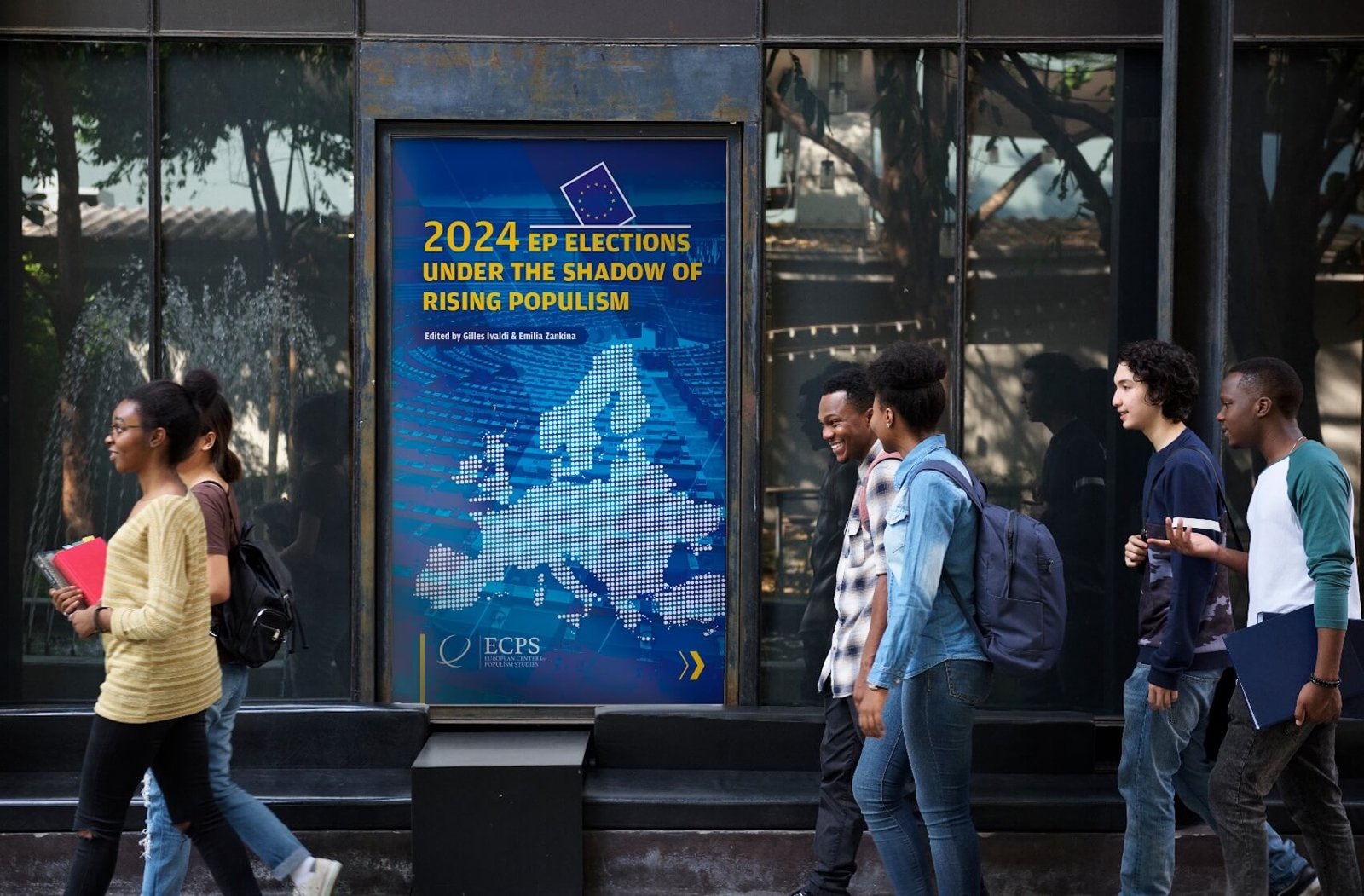
In 2024, the ECPS significantly expanded its research output, publishing 42 reports that included event summaries, annual analytical reports, and thematic sub-reports. Together, these publications form one of the most comprehensive yearly collections ECPS has produced, reflecting the organization’s commitment to documenting and interpreting the rapidly evolving global landscape of populism, authoritarianism, and democratic transformation.
A cornerstone of this year’s output was the Mapping Global Populism (MGP) panel series, which brought together scholars from across the globe to examine populist dynamics in regions as diverse as Southeast Asia, Sub-Saharan Africa, the Caucasus, the Middle East and Central Asia. Each report distilled key insights from these expert discussions, offering accessible yet rigorous analyses of how populist actors, narratives, and strategies shape political behavior, governance, and social conflict.
The 2024 collection also included regional panels, thematic studies, and the ECPS Summer School report, collectively exploring intersections between populism and foreign policy, religion, gender, nationalism, state-society relations, digital authoritarianism, and global governance. This year’s flagship publication—The 2024 European Parliament Elections under the Shadow of Rising Populism—provided a country-by-country examination of the electoral performance and policy influence of Europe’s populist parties, produced in collaboration with leading experts from all EU member states.
Together, the ECPS reports published in 2024 serve as an authoritative record of contemporary populist trends and their implications for democracy worldwide. They not only map where populism is gaining ground but also illuminate the social, economic, geopolitical, and cultural forces driving its evolution. Through these publications, ECPS continues to advance informed debate, support evidence-based policymaking, and foster a global research community committed to understanding and addressing the challenges posed by populism in the 21st century.
Religious Populism and Radicalization in Indonesia
Report by Zhanyl Ashirbekova & Neo Sithole
This report is based on the third installment of the Mapping Global Populism monthly panel series, held online from Brussels on May 25, 2023, under the theme “Religious Populism and Radicalization in Indonesia.” Co-organized by ECPS and the Alfred Deakin Institute for Citizenship and Globalisation (ADI), the event brought together leading scholars from Australia and Indonesia to examine how religious narratives shape populist mobilization and radicalization processes in contemporary Indonesia. The report presents concise summaries of the panel’s presentations, highlighting key insights into the political, social, and ideological dynamics driving religious populism across the country. Moderated by Dr. Ihsan Yilmaz, Research Professor and Chair of Islamic Studies and Intercultural Dialogue at ADI, the panel featured Dr. Inaya Rakhmani (Universitas Indonesia), Dr. Pradana Boy Zulian (Universitas Muhammadiyah Malang), Dr. Kurniawati Hastuti Dewi (BRIN), and Dr. I Gede Wahyu Wicaksana (Universitas Airlangga). Together, their contributions offer a timely, interdisciplinary understanding of Indonesia’s evolving religious and political landscape.
Populism, Gender and Sexuality in Europe
Report by Andrea Guidotti
This report provides a brief overview of the eighth event in ECPS’s monthly Mapping European Populism (MEP) panel series, titled "Populism, Gender and Sexuality in Europe" held online on January 26, 2023. Moderated by Dr.Agnieszka Graff, Professor at the American Studies Center, University of Warsaw, and a feminist activist, the panel featured speakers Dr. Elżbieta Korolczuk, Associate Professor in Sociology at Södertörn University, Sweden, Dr. Eric Louis Russell, Professor in the Department of French & Italian and affiliated with the Program in Gender, Sexuality and Women’s Studies at the University of California, Davis, Nik Linders, PhD candidate at Radboud Social and Cultural Research for Gender & Diversity Studies, Dr. Pauline Cullen, Associate Professor in sociology at Center for European and Eurasian Studies, Maynooth University, Ireland.
Civilizational Populism and Religious Authoritarianism in Bangladesh, Sri Lanka and the Maldives
Report by Dr. Gabriel Cyrille Nguijoi & Neo Sithole
This report gives a summary of the 9th session of the ECPS’s monthly Mapping Global Populism panel series titled “Civilizational Populism and Religious Authoritarianism in Bangladesh, Sri Lanka and the Maldives,” which took place online on January 25, 2024. Moderated by Dr. Syaza Shukri, Associate Professor at the Department of Political Science, Kulliyyah of Islamic Revealed Knowledge and Human Sciences, International Islamic University Malaysia, the panel featured speakers by Mr. Bobby Hajjaj, Department of Management, North South University, Bangladesh, Dr. Maidul Islam, Assistant Professor of Political Science, Centre for Studies in Social Sciences, Calcutta, Dr. Rajni Gamage, Postdoctoral Fellow, Institute of South Asian Studies (ISAS), National University of Singapore, and Dr. Mosmi Bhim, Assistant Professor at Fiji National University.
Varieties of Populism and Authoritarianism in Malaysia and Singapore
Report by Andrea Guidotti
This report provides an overview of the sixth event in ECPS’s monthly Mapping Global Populism panel series, titled "Varieties of Populism and Authoritarianism in Malaysia and Singapore" held online on October 26, 2023. Moderated by Dr. Garry Rodan, Honorary Professor of Political Science and International Studies at the University of Queensland) the panel featured speakers Dr. Ahmad Fauzi Abdul Hamid, Professor of Political Science, University Sains Malaysia, Dr. Syaza Farhana Mohamad Shukri, Associate Professor at the Department of Political Science, Kulliyyah of Islamic Revealed Knowledge and Human Sciences, International Islamic University Malaysia, Dr. Kenneth Paul Tan, Professor of Politics, Film, and Cultural Studies, School of Communication, Hong Kong Baptist University and Dr. Shanon Shah, Visiting Research Fellow at the Department of Theology and Religious Studies, King’s College London.
Theocracy, Radicalism and Islamist/Secular Populism in Iran, Afghanistan and Tajikistan
Report by Beatrice Bottura
The 15th session of the Mapping Global Populism panel series, organized by the ECPS, took place online on September 26, 2024, under the moderation of Dr. Simon P. Watmough(University of Leipzig; ECPS). The session explored the intersections of theocracy, radicalism, and populism in Iran, Afghanistan, and Tajikistan, offering a comparative lens on authoritarian and extremist dynamics in these regions. Dr. Hélène Thibault (Nazarbayev University) examined Tajikistan’s anti-extremism policies as tools of authoritarian control. Dr. Zakia Adeli (former Deputy Minister of Justice of Afghanistan) analyzed the Taliban’s governance structure and its implications for state legitimacy. Dr. Zahoor Ahmad Wani (Lovely Professional University) discussed gender oppression under Taliban rule, while Amir Hossein Mahdavi (University of Connecticut) reflected on Iran’s political trajectory and the emergence of populist actors.
Civilizational Populism and Religious Authoritarianism in Bangladesh, Sri Lanka and the Maldives
Report by Dr. Gabriel Cyrille Nguijoi & Neo Sithole
This report gives a summary of the 9th session of the ECPS’s monthly Mapping Global Populism panel series titled “Civilizational Populism and Religious Authoritarianism in Bangladesh, Sri Lanka and the Maldives,” which took place online on January 25, 2024. Moderated by Dr. Syaza Shukri, Associate Professor at the Department of Political Science, Kulliyyah of Islamic Revealed Knowledge and Human Sciences, International Islamic University Malaysia, the panel featured speakers by Mr. Bobby Hajjaj, Department of Management, North South University, Bangladesh, Dr. Maidul Islam, Assistant Professor of Political Science, Centre for Studies in Social Sciences, Calcutta, Dr. Rajni Gamage, Postdoctoral Fellow, Institute of South Asian Studies (ISAS), National University of Singapore, and Dr. Mosmi Bhim, Assistant Professor at Fiji National University.
Various Facets of Populist, Authoritarian and Nationalist Trends in Japan and Taiwan
Report by Philip Christo Pretorius & Neo Sithole
This report provides a brief overview of the tenth event in ECPS’s monthly Mapping European Populism (MEP) panel series, titled "Various Facets of Populist, Authoritarian and Nationalist Trends in Japan and Taiwan" held online on February 29, 2024. Moderated by Dr. Dachi Liao, Emeritus Professor at the Institute of Political Science at National Sun Yat-sen University in Taiwan, the panel featured speakers Dr. Toru Yoshida, Full Professor of Comparative Politics at Doshisha University in Japan, Dr. Airo Hino, Professor, School of Political Science and Economics, Waseda University, Dr. Szu-Yun Hsu, Assistant Professor, Political Science, McMaster University, Dr. Jiun-Chi Lin, Postdoctoral researcher at the Institute of Marketing Communication, National Sun Yat-sen University.
Old and New Facets of Populism in Latin America
Report by Luca Venga & Andrea Guidotti
This report provides an overview of the first event in ECPS’s Regional Panel series titled "Old and New Facets of Populism in Latin America" and held online on March 7, 2024. Moderated by Dr. Maria Puerta Riera, Adjunct Professor of Political Science at Valencia College, the panel featured speakers Dr. Ronaldo Munck , Professor of Sociology, Dublin City University, Dr. Julio F. Carrión, Professor of Comparative Politics, Delaware University, Dr. Adriana Boersner-Herrera, Assistant Professor of Political Science at The Citadel, The Military College of Charleston, Dr. Reinhard Heinisch and Dr. Andrés Laguna Tapia, respectively Professor of Comparative Austrian Politics at the University of Salzburg and director of the Center for Research in Communication and Humanities and head of Communication Studies at UPB in Cochabamba, and Dr. Victor de Oliveira Pinto Coelho, Professor of History at Universidade Federal do Maranhão.
Forces Shaping Populism, Authoritarianism and Democracy in South Korea, North Korea and Mongolia
Report by Philip Christo Pretorius and Radoslav Valev
This report encapsulates the highlights of the eleventh event hosted by the ECPS as part of its monthly Mapping European Populism (MGP) panel series on March 30, 2024. Dr. John Nilsson-Wright expertly moderated the panel, which boasted insights from five distinguished scholars in the field of populism. The panelists featured in the event included experts such as Dr. Joseph Yi, an Associate Professor of Political Science at Hanyang University, Seoul, renowned for his work on "Discourse Regimes and Liberal Vehemence." Dr. Meredith Rose Shaw, an Associate Professor at the Institute of Social Science, The University of Tokyo, provided valuable insights into the regional context through her research on "Foreign Threat Perceptions in South Korean Campaign Discourse: Japan, North Korea, and China." Dr. Sang-Jin Han, an Emeritus Professor of Sociology at Seoul National University, shared his expertise on sociopolitical trends in South Korea, focusing on the "Transformation of Populist Emotion in Korean Politics from 2016 to 2024." Dr. Junhyoung Lee, a Research Professor in the School of International Relations at the University of Ulsan, South Korea, contributed with his research on "Nationalism and Resilience of Authoritarian Rule in North Korea." Lastly, Dr. Mina Sumaadii, a Senior Researcher at the Sant Maral Foundation, Ulaanbaatar, Mongolia, offered a unique perspective on "Populist Nationalism as a Challenge to Democratic Stability in Mongolia."
The Future of Multilateralism Between Multipolarity and Populists in Power
Report by Neo Sithole, Christo Pretorius, Radoslav Valev, Andrea Guidotti & Hilal Duman
The ECPS convened its Third Annual International Symposium, titled “The Future of Multilateralism Between Multipolarity and Populists in Power,” held online on March 19–20, 2024. The event brought together distinguished scholars, policymakers, and experts to explore how populist governments are reshaping the global order and whether their policies are driving a new era of illiberal multilateralism characterized by economic protectionism, political isolation, and declining institutional trust. Panelists examined how the rise of multipolarity, coupled with populist rule, has weakened traditional institutions such as the UN, WTO, and IMF, while empowering alternative blocs like BRICS and the Shanghai Cooperation Organization. Discussions underscored the challenges of sustaining global cooperation amid increasing nationalism and populist rhetoric that frames globalization as a threat to sovereignty. Speakers also analyzed how populist regimes maintain domestic support despite economic crises—by deflecting blame onto external actors and invoking notions of independence and “the will of the people.” The symposium concluded that understanding these dynamics is essential for devising inclusive, rule-based strategies that strengthen global governance and promote a new generation of equitable globalization resilient to populist disruption.
Populist Authoritarianism in China: National and Global Perspectives
Report by Christo Pretorius & Radoslav Valev
The twelfth session of the ECPS Mapping Global Populism series was held online on April 25, 2024. Moderated by Dr. Rune Steenberg (Palacký University Olomouc), the panel brought together leading scholars to examine China’s evolving political order under Xi Jinping. Dr. Steenberg opened by tracing the rise of populist narratives in China, highlighting their fusion with nationalism, surveillance, and authoritarian governance. Dr. Kun He (University of Groningen) analyzed populism’s distinct linguistic and cultural dimensions, while Dr. Martin Lavička (Lund University) explored the tightening regulation of religion under Xi’s rule. Dr. Ibrahim Ozturk (University of Duisburg-Essen) unpacked the Belt and Road Initiative’s populist and coercive geopolitical logic, and Dr. Yung-Yung Chang (National Dong Hwa University) discussed China’s digital authoritarianism and its global implications. The session underscored China’s unique fusion of populism and authoritarianism, offering vital insights into its domestic and international impact.
Crisis of Democratic Political Legitimacy and Emerging Populism in Africa
Report by Neo Sithole, Gabriel Cyril Nguijol & Martina Micozzi
The ECPS hosted its second regional panel in 2024, “Crisis of Democratic Political Legitimacy and Emerging Populism in Africa,” online on May 9, 2024. Expertly moderated by Dr. Chipo Dendere, Assistant Professor of Africana Studies at Wellesley College, the session brought together leading scholars to analyze the rise, evolution, and implications of populism across the African continent. Dr. Henning Melber (Nordic Africa Institute; University of Pretoria; University of the Free State) opened the discussion by tracing populism’s historical roots in Africa and its role in post-colonial political narratives. Dr. Sergiu Mișcoiu (Babeș-Bolyai University) examined the potential for progressive populism within African politics. Dr. Edouard Epiphane Yogo (University of Yaoundé II) highlighted populism’s destabilizing effects on governance and institutions. Continuing this theme, Dr. Nchofua Anita Nyitioseh (University of Bertoua) analyzed how policy failures and unemployment enable populist mobilization, while Dr. Derick Fai Kinang (Cameroon National Council of Crime Experts) discussed how populist rhetoric exacerbates hate speech and social polarization. Finally, Dr. Ama-Ambo Chefor (University of Dschang) explored how populist movements entrench patriarchal structures, undermining gender equality.
Resurgence of Expansionist Tsarism: Populist Autocracy in Russia
Report by Radoslav Valev
The thirteenth session of the ECPS Mapping Global Populism (MGP) series was held online on May 30, 2024. Moderated by Dr. Maxine David, Lecturer in European Studies at Leiden University, the panel brought together distinguished experts to examine Russia’s evolving populist authoritarianism. Dr. Luke March (University of Edinburgh) argued that although populist elements exist in Russia, Vladimir Putin’s rule is primarily defined by statism, imperialism, and nationalism, prioritizing control over mass mobilization. Dr. Alexandra Yatsyk (University of Lille; Sciences Po) explored how Putinism’s populist rhetoric is amplified by regime-aligned networks and intellectuals. Dr. Yulia Gradskova (Södertörn University) analyzed the regime’s use of “traditional values” to justify anti-LGBTQ+ and patriarchal policies reinforcing militarism and nationalism. Dr. Dóra Győrffy (Corvinus University of Budapest) concluded with an assessment of Russia’s post-war economy and the long-term effects of Western sanctions. The panel provided rich, interdisciplinary insights into Russia’s fusion of populism and authoritarianism and its enduring impact on global political stability.
Tracing the Pathways of Autocracy and Authoritarianism across Central Asia
Report by Radoslav Valev
The fourteenth session of the ECPS Mapping Global Populism (MGP) series was held online on June 20, 2024. Moderated by Dr. David Lewis, Professor of Politics at the University of Exeter, the panel gathered experts to examine the persistence and evolution of autocratic rule across Central Asia. Dr. Aksana Ismailbekova (Leibniz-Zentrum Moderner Orient) analyzed Sadyr Japarov’s consolidation of power in Kyrgyzstan through populist rhetoric and cultural adaptation. Dr. Dinissa Duvanova (Lehigh University) discussed Kazakhstan’s managed populism under President Tokayev, highlighting its function in stabilizing elite power. Oguljamal Yazliyeva (Charles University) explored Turkmenistan’s deeply entrenched personality cults rooted in Soviet and tribal legacies. The panel offered a nuanced understanding of authoritarianism’s hybrid nature in Central Asia, emphasizing informal power networks, populist narratives, and enduring post-Soviet legacies.
The Challenging Dynamics of Democracy, Authoritarianism and Populism in the Southern Caucasus
Report by Stavroula Koskina
The 16th session of the European Center for Populism Studies’ Mapping Global Populism panel series was held online on October 31, 2024, addressing “The Challenging Dynamics of Democracy, Authoritarianism & Populism in the Caucasus (Armenia, Azerbaijan & Georgia).” Moderated by Dr. Cengiz Aktar (University of Athens), the panel brought together leading scholars to analyze current political trends across the region. Thomas de Waal (Carnegie Europe) outlined the deepening autocracy in Azerbaijan and its regional ramifications. Dr. David Aprasidze (Ilia State University) traced the development of populism in Georgia, while Dr. David Matsaberidze (Tbilisi State University) examined the shifting populist discourses in post-Soviet Georgia. Dr. Jody LaPorte (University of Oxford) provided insight into Azerbaijan’s hegemonic authoritarianism. Dr. Ashot S. Aleksanyan (Yerevan State University) discussed post-war Armenia’s democratization and European integration under populist pressures, and Dr. Nerses Kopalyan (University of Nevada, Las Vegas) assessed Armenia’s democratic landscape. The panel underscored persistent democratic fragility across the Caucasus amid rising populism and geopolitical tensions.
The Rise and Reign of Autocratic Populism and Islamist Nationalism in Turkey
Report by Anastasia Stamoglou
The ECPS held the 17th session of its Mapping Global Populism Panel Series on November 28, 2024, titled “The Rise and Reign of Autocratic Populism and Islamist Nationalism in Turkey.” The session examined how Recep Tayyip Erdogan’s leadership has reshaped Turkey’s political and social landscape through intertwined strategies of populism, authoritarianism, and Islamist nationalism. Moderated by Dr. Jocelyne Cesari, a leading scholar on religion and politics, the panel featured Dr. Spyros Sofos, who traced the historical evolution of Turkish populism; Dr. Emre Erdogan, who analyzed contemporary political participation and populist dynamics; Hafza Girdap, who highlighted the gendered impacts of political Islam; Ergun Babahan, who provided insights into media repression and narrative control; and Dr. Aleksandra Spancerska, who examined Turkey’s use of sharp power in international relations. Together, the speakers offered a multidisciplinary assessment of Turkey’s autocratic populist turn, contributing to the series’ broader effort to map global patterns of democratic erosion.
Authoritarian Populist ‘Civilization-States’ and Their Influence in Africa: Hard and Soft Powers of TRIC
By Ihsan Yilmaz & Nicholas Morieson
Turkey, Russia, India, and China (TRIC) are reshaping the power dynamics in Africa, challenging Western dominance and promoting alternative development models. These nations leverage their untarnished histories with Africa and emphasize shared anti-colonial struggles to position themselves as allies of the Global South. However, their competition is far from altruistic. Beneath promises of “no-strings-attached” aid lies a strategic pursuit of resources, trade, and influence. While they share a common goal of diminishing Western power, TRIC nations also compete fiercely with each other, making Africa a critical battleground in the quest for a multipolar world order.
ECPS Summer School 2024 — Populism and Foreign Policy: How Does Populist Politics Influence Foreign Affairs?
Report by Radoslav Valev
The ECPS held its fourth virtual Summer School from July 1–5, 2024, under the theme “Populism and Foreign Policy.” The five-day interdisciplinary program brought together emerging scholars and experts to explore how populism influences international relations, diplomacy, and global governance. The school featured lectures from leading academics, including Professor Sandra Destradi, Associate Professor Angelos Chryssogelos, Associate Professor Jessica Greenberg, Dr. Thorsten Wojczewski, Dr. Georg Löfflmann, Professor Cengiz Aktar, Professor Emeritus Louis Kriesberg, Professor Bertjan Verbeek, ECPS President Irina von Wiese, Professor Craig Calhoun, and Professor Joanna Dyduch. Each session was expertly moderated by Dr. Rubrick Biegon, Dr. Gustav Meibauer, Dr. Jonny Hall, Professor Ana E. Juncos Garcia, Professor Franco Zappettini, Professor Allison Carnegie, Dr. Ajay Gudavarthy, Dr. Aleksandra Spancerska, Professor Alexandra Homolar, and Dr. Andrei Zaslove. Participants analyzed theoretical and empirical dimensions of populism in foreign policy through case studies including the US, India, Turkey, Hungary, Israel, and the UK, deepening their understanding of how populist leaders reshape global norms and multilateral cooperation.
ECPS Report: 2024 European Parliament Elections under the Shadow of Rising Populism
Edited by Gilles Ivaldi & Emilia Zankina
The ECPS released a comprehensive report analyzing the performance and influence of populist parties in the 2024 European Parliament elections, which confirmed the electoral consolidation of populism across Europe. Populist parties won 263 of the 720 seats (36%), coming first in six countries. The report, based on contributions from local experts across all 27 EU member states, highlights the continued rise and mainstreaming of populist movements on both the far-right and far-left. While right-wing populists achieved their strongest results to date—dominating in countries like Italy, Hungary, and Poland—left-wing and centrist populists made fewer gains. ECPS notes that populist influence in the European Parliament is expected to reshape debates on migration, climate policy, and EU enlargement, marking a discernible shift of the Parliament’s center of gravity to the right. Despite their growing numbers, populist parties remain ideologically fragmented across multiple parliamentary groups.
Introduction: The ECPS Project ‘Populism and the European Parliament Elections 2024’
By Gilles Ivaldi & Emilia Zankina
This report analyzes the performances and impact of populist parties in the 2024 European elections. Drawing from the analyses of country experts, we provide an account of how populist parties across the spectrum performed in each of the EU’s 27 member states, looking at the campaign, issues and demand for populist politics in each country separately and the challenges that populist party success more broadly bears for the future of the EU. In this introductory chapter, we briefly define populism, provide a topographic map of populist parties across all EU member states ahead of the 2024 European elections, and review the main drivers of populism identified in the literature. We then turn more specifically to the general context and outcome of the 2024 EP election, assessing the hypothesis of another ‘populist wave’ while also looking back at the 2019 election to compare populist party success over time.
The Populist Radical-right Freedom Party in the Austrian 2024 EU elections
By Eric Miklin
The only competitive populist party running in the 2024 EU elections in Austria, the radical-right Freedom Party of Austria (FPÖ) relied on well-proven recipes that have made it one of the most successful populist parties in (Western) Europe for the last 30 years. It called for cutting down the EU’s competences to half the size of its institutions and budget and harshly criticized its policies concerning migration, the war in Ukraine, the climate crisis and the COVID-19 pandemic. This criticism was combined with a highly alarmist rhetoric that portrayed political opponents as either corrupt, fanatical or insane. While all this met with uniform criticism by other Austrian parties and large parts of the media, this again allowed the party to present itself as the sole party actually fighting for the Austrian interest against a broken system controlled by a single establishment ‘unity party’ (Einheitspartei). Once more, this strategy paid off and the FPÖ landed in the first place for the first time in a nationwide election.
Populist Radical Parties in Belgium and the 2024 European Elections
By Emilie van Haute
In 2024 elections in Belgium were concurrently held for the European, federal and regional levels. For that reason, the European elections were clearly second-order elections. As the main opposition parties at the federal level, populist radical parties of the right (Vlaams Belang, VB) and the left (the Workers’ Party of Belgium, PTB–PVDA) approached the 2024 elections in a strong position. They were portrayed as clear favourites in the polls and the media. From 2019 to 2024 they managed to set the agenda on their issues: migration and law and order for the VB, socioeconomic issues and civil liberties and rights for the PTB–PVDA. Both parties came out of the elections with more votes and seats. Part of the reason for this success is that their program matched with voters’ priorities. Their populist, anti-elite rhetoric also permeated public opinion. Yet they were perceived as having underperformed electorally. Moreover, because they were not politically indispensable, they were quickly sidelined. At the European level, the VB and the PTB–PVDA will likely continue directly pushing their respective populist, Eurosceptic and radical agendas. They are also likely to have a real indirect contamination effect through mainstream parties and public opinion integrating part of their programmatic positions and priorities.
Populism and Polycrisis in Bulgaria on the Eve of the 2024 European Parliament Elections
By Emilia Zankina
The 2024 European Parliament election in Bulgaria took place amidst a prolonged political crisis and economic uncertainty. The EP elections, for the first time, coincided with national legislative elections – the sixth parliamentary elections in just three years. This two-in-one vote led to a complete overshadowing of the debate on Europe by domestic issues and concerns over the composition of the next national parliament and the likelihood of forming a stable government. The centre-populist GERB convincingly won the elections, although the populist radical right increased its representation by one MEP. Like many European countries, Bulgaria has had to contend with the rise of populism and nationalism, in addition to its continued struggle against corruption and, as a result of the war in Ukraine, with a population divided in attitudes towards Russia. This polycrisis has led to continued political fragmentation and polarization with little prospect of stable government and a growing disillusionment among voters.
Between ‘Kingmakers’ and Public Indifference: Croatia’s National Conservative Right in the European Elections of 2024
By Vassilis Petsinis
This report focuses on Croatia and deals with the national conservative Domovinski Pokret/Homeland Movement (DP) party. In the latest European elections, the DP garnered a percentage of 8.82% (65,383 votes and one seat), taking third spot after the ruling (centre-right) Croatian Democratic Union (HDZ) and the ‘Rivers of Justice’ coalition spearheaded by the (centre-left) Social Democrat Party (SDP). I begin the present chapter by sketching a typology of the constituent segments along the broad spectrum of the European right wing and situate the DP within it. I then offer a summary of the DP’s founding principles vis-à-vis further European integration and clarify the extent to which these principles were reflected in the party’s stances and active engagement in the latest European elections. I then identify the main catalysts behind the DP leadership’s success in mobilizing target groups and galvanizing electoral support for the party.
Rising discontent with the EU, the Rise of the Right and the 2024 European Parliament Elections in Cyprus
By Andreas Theophanous
The objective of this report is to discuss the causes of rising discontent in Cyprus and assess the political outcomes. Within this framework we briefly assess how the EU has dealt with various crises in the last few years. Perceptions in Cyprus about the EU have changed over time. In the 9 June European elections, a member of the extreme right-wing party, National People’s Front (Ethniko Laiko Metopo, ELAM), was elected for the first time to the European Parliament. Understanding the circumstances in Cyprus that have gradually led to disillusionment with the national political system and the EU is essential to making sense of these developments.
A Pyrrhic Victory for the Populist Right in Hungary
By Robert Csehi
The 2024 European Parliament (EP) elections brought significant changes to Hungary’s political landscape. While Fidesz, the ruling populist party led by Prime Minister Viktor Orbán, retained first place, it lost two EP seats amid the rise of a new opposition force reshaping Hungary’s political balance. Orbán’s campaign, heavily funded and amplified by pro-government media, revived familiar themes from the 2022 national elections, centering on the war in Ukraine. His slogan — “no migration, no gender, no war” — resonated with Fidesz supporters, though the anti-war message ultimately dominated. Employing fear-based, Manichean rhetoric, Orbán portrayed all opponents, domestic and foreign, as part of a “pro-war” coalition allegedly serving Brussels and Washington. Meanwhile, the radical right-wing Our Homeland (OH) emphasized anti-EU, nationalist narratives, securing one MEP. Although both Fidesz and OH joined newly branded Eurosceptic right-wing groups, their political isolation in the EP persists.
The Race of Populists: The 2024 EP Elections in the Czech Republic
By Vlastimil Havlík & Alena Kluknavská
The report analyses the performance of populist political parties in the 2024 EP election in the Czech Republic. The election ended with a significant increase in support for several populist parties: Action of Dissatisfied Citizens, Freedom and Direct Democracy and the Oath and Motorists. All populist parties used radical-right rhetoric before the election, expressing different levels of criticism of the European Union, strong anti-immigration attitudes and negative attitudes toward the Green Deal. The preliminary data show that the electoral support for the populists was based on a higher level of mobilization in so-called peripheral areas of the Czech Republic, potentially affected by recent inflation and austerity policies pursued by the government. All in all, the 2024 EP election in Czechia significantly increased support for populist political parties.
Denmark’s Populism at the Crossroads: Insights into the 2024 European Parliament Election Results
By Susi Meret
The populist moment that defined Danish politics from 2001 to 2019 has recently transitioned into what can be described as mainstream populism. Two concurrent developments drive this shift: first, the Social Democrats’ strategy to reclaim (white) working-class support by adopting populist right-wing stances on immigration and integration, and second, the existential crisis confronting the Liberals (Venstre, V) and the Conservative party (Det Konservative Folkeparti, KF), whose electoral support reached historic lows. The 2024 European Parliament elections differed significantly from those of 2019, marked by the emergence of new political entities and pressing global issues such as the Russia–Ukraine and Israel–Hamas conflicts, along with the existential threat of climate change and the lingering effects of the post-pandemic time. Traditional populists are exploiting these issues to regain support, advocating for greater national sovereignty and cohesion in the face of perceived global threats. This paper examines the evolving dynamics of Danish politics, focusing on how the intersection of domestic and international changes is reshaping EU-related positions and the role of populism.
Populism in the 2024 European Parliament Elections in Estonia
By Mari-Liis Jakobson
Although past European Parliament (EP) elections in Estonia have witnessed the success of an anti-establishment candidate, Estonian EP elections are not generally fertile soil for populism. Estonian EP elections tend to be dominated by the liberal and progressive parties and candidates with notable foreign policy track records. The 2024 EP elections generally confirmed this pattern but also witnessed the conservative parties running on a second-order election agenda critical of the government and parties both on the right and left-wing edges of the spectrum tapping into the small but nonetheless committed pool of Eurosceptic voters. Moreover, most parties made use of the stylistic repertoires of populism, attempting to perform various crises. While the election results changed little in the overall composition of the Estonian MEP delegation, the events unravelling immediately after the election suggest that the Estonian populist radical right will become more diverse but also more isolated from its sibling parties on the European level.
The Loss of the Populist Radical Right in the 2024 European Parliament Elections in Finland
By Juha Herkman
In the 2024 European Parliament (EP) elections, the populist radical-right Finns Party had a disappointing result; it came sixth nationally and lost 6.2% of the vote and one seat compared to the 2019 elections. The centre-right National Coalition (NC) party won the elections with 24.8% of the vote and four seats, but the real winner was the Left Alliance, which came second (17.3%) and gained three seats. The elections revealed voters’ deep distrust towards the government, in which the Finns Party supported significant austerity measures and cuts to public spending through its leader and finance minister, Riikka Purra. People’s fear of the rising far right in Europe was also a salient theme in campaign debates, which diminished the Finns Party’s support, alongside a low voter turnout.
A Tipping Point for Far-Right Populism in France
By Gilles Ivaldi
The 2024 French European election took place against the backdrop of an economic and cost-of-living crisis in a context marked by global uncertainty arising from the war in Ukraine, social unrest and deep political discontent with President Emmanuel Macron. Marine Le Pen’s Rassemblement National (RN) emerged as the big winner with 31.4% of the vote, while Macron’s Renaissance list trailed far behind at 14.6%. Meanwhile, Jean-Luc Mélenchon’s left-wing populist La France Insoumise (LFI) won 9.9%, reflecting current internal dissent within the party and deep ideological divisions exposed by the Israel–Hamas war. National issues dominated the electoral agenda in June. Populist voting across both sides of the political spectrum was strongly fuelled by political discontent with Macron, making the 2024 European elections primarily a ‘second-order’ national election. A crucial test for Emmanuel Macron, the outcome of the European election led to the decision by the incumbent president to call a snap legislative election. The election confirmed the electoral strength of the RN; however, it showed the revitalization of the Republican Front against the far right, which blocked Le Pen’s party from winning an absolute majority, delivering instead a hung parliament split into three blocks.
Germany’s 2024 EP Elections: The Populist Challenge to the Progressive Coalition
By Kai Arzheimer
The 2024 European parliamentary election in Germany marked a significant shift in the political landscape, with devastating results for the governing coalition of the Social Democrats (SPD), the Greens, and the Liberal Democrats (FDP). Chancellor Scholz’s SPD and the Greens experienced substantial losses, while the opposition Christian Democrats (CDU/CSU) saw a modest increase in their vote share. The most notable gains were made by the populist radical-right Alternative for Germany (AfD) and the newly formed left-wing populist Sahra Wagenknecht Alliance (BSW), a breakaway from the Left (Die Linke), highlighting a growing demand for populist politics in Germany. The Left itself suffered heavy losses. Despite internal scandals and controversies that contributed to a considerable drop in support in pre-election polls, the AfD leveraged anti-immigration sentiments and economic concerns to gain substantial support. Like in previous elections, populist parties were much more successful in the post-communist eastern states. While its impact on the European level is limited, the election sent shock waves through Germany, suggesting a shift in future policy directions, particularly concerning the green transformation and relations with Russia.
Economic Malaise and Political Discontent: An Analysis of the 2024 European Parliament Election in Greece
By Sofia Vasilopoulou
The 2024 European Parliament (EP) election in Greece was held against a background of geopolitical instability in Europe’s neighbourhood. However, domestic – rather than European – issues dominated the campaigns, including the economy, inflation and the cost-of-living crisis. The electoral results were primarily an anti-government protest vote and confirmed a trend of electoral fragmentation across the political spectrum. On the right, three relatively new far-right populist parties received parliamentary representation, i.e., the Greek Solution, Victory and the Voice of Reason. On the left, SYRIZA–PA maintained its second place, although its support declined substantively compared to the previous EP election. Course of Freedom and the KKE, on the other hand, were key electoral beneficiaries in the left-wing space. Younger age groups primarily opted for SYRIZA–PA, whereas older groups were more likely to support New Democracy. That said, far-right parties also received votes from younger generations. Geographically, the far right is more successful in the north of Greece. The key message of this election was political discontent and a general feeling of economic malaise posing dilemmas across the political spectrum.
Ireland After the 2024 EP Elections: The Centre Holds … Just About
By Eoin O’Malley
The 2024 European Parliament elections in Ireland came on the back of a rise in the prominence of immigration as an issue. Although Ireland had seen significant migration in the early to mid-2000s, the large number of migrants at this time had no significant impact on politics or voting. Nor was Ireland a country that saw any significant anti-EU sentiment. Thus, Ireland could be seen as an anomaly in Europe. In the aftermath of the COVID-19 pandemic, there was a sudden rise in the numbers in Ireland seeking international protection (asylum seekers). Most of these came as a direct result of the Russian invasion of Ukraine, and again, Ireland saw a positive reaction to inward migration even though the country accommodated a comparatively high number of Ukrainian refugees per head of population despite the country’s geographic distance. There had previously been ethnonationalist parties on the ballot paper in European and national elections, but they had never really featured. In 2024 none got elected, although some did in the concurrent local elections. The vote for some explicitly populist ethnonationalist parties was greater than ever before. This result occurred partly because Sinn Féin, another populist–nationalist (but not wholly ethnonationalist) party, saw its support drop dramatically. It suggests, however, that Ireland may not remain the anomaly it has been. In all about a third of the voting electorate chose parties or candidates that can be categorized as populist.
The Spectrum of Italian Populist Parties in the 2024 European Elections: A Shift in the Balance of Power on the Right
By Cecilia Biancalana
Italy has historically been one of the strongest proponents of a united Europe. However, recent years have seen a rise in Euroscepticism within the country, with a notable increase in the electoral support for Eurosceptic parties. Have the 2024 elections confirmed or refuted this trend? Italy features a variety of populist parties, both on the right and on the left, each with different Eurogroup affiliations and varying positions on European integration. As a result, during the 2024 campaign, the parties adopted different strategies. The results of the 2024 elections highlight two significant trends: a decrease in turnout and the strengthened influence of Fratelli d’Italia, reflecting a sustained support for right-wing populist ideologies among Italian voters.
Populism and the 2024 European Parliament Election in Latvia
By Daunis Auers
Populism has been a feature of Latvia’s political landscape since the 1990s. New insurgent parties have utilized increasingly anti-establishment rhetoric, often through intensive and innovative use of social media, to win seats in the Latvian parliament and even join government coalitions. However, European Parliament elections in Latvia have been comparatively free of populism. There are two main reasons for this. First, and most importantly, there is a broad pro-European consensus in Latvia. Membership in the European Union and NATO is central to all three Baltic nations’ security strategy in light of growing threats from Russia. As a result, there is no serious Eurosceptic party in Latvia and no explicitly Eurosceptic politicians have ever been elected to the European Parliament from Latvia. Second, Latvia’s voters tend to support serious, experienced politicians in European elections, believing that they are better placed to support Latvia’s national interests in the European system. Party politics take second place in campaigning, with the focus being on the experience of candidates (after all, Latvia elected just nine MEPs in 2024) rather than policy differences. As a result, populist anti-elite rhetoric has less salience. This chapter will explore the extent to which the 2024 European Parliament election in Latvia has continued these trends.
Lithuanian Populist Far-right (In)security Discourse During the European Parliament Elections in the face of Russia’s War Against Ukraine
By Jogilė Ulinskaitė
The full-scale invasion of Ukraine by Russia has disrupted the previously perceived stability in Central and Eastern Europe (CCE) and exacerbated the prevailing sense of insecurity. The evolving circumstances are reshaping the political terrain and presenting avenues to mobilize support for the populist far right. However, to date, the far-right populist parties in Lithuania have not been successful in either national or European Parliament (EP) elections, as they have failed to surpass the required thresholds. However, the most recent European Parliament elections were an exception, with the election of a long-standing far-right politician in Lithuania as an MEP. This study delves into an analysis of the discourse employed by Lithuanian far-right populists throughout the 2024 EP election campaign, with a specific focus on the narratives pertaining to (in)security that they propagated. The investigation seeks to ascertain whether the far right capitalized on the situation to fuel discussions on crisis with the aim of attracting support and identifying the strategies utilized in constructing the narratives surrounding (in)security.
Right-wing Populism in Luxembourg During the 2024 EP Election
By Paul Carls
Right-wing populism in Luxembourg is largely confined to the Alternative Democratic Reform Party (Alternativ Demokratesch Reformpartei, ADR). The name is, however, a bit of a misnomer. While ideologically, the ADR maintains national–conservative positions consistent with other European right-wing populist parties, its views are not as extreme. The party retains relatively constant support, consistently gaining around 10% of the vote in national elections; in the 2023 election for the Chamber of Deputies, it gained 9.3%, while in the 2019 European Parliament election, the party gained 10%, just short of enough to obtain a seat. Given the rise in support for right-wing populist parties in other European countries (e.g., the AfD in Germany or the National Rally in France), the ADR was optimistic about its chances of gaining its first-ever seat in the European Parliament, which would require about 12% of the vote total. This contribution will investigate the results of the European Parliament election in Luxembourg, focusing on the ADR. It will discuss any ideological shifts in the party as well as its positioning on a host of issues where one finds a prominent voice for right-wing populist parties in Europe, including NATO, the war in Ukraine, migration, COVID-19 or the functioning of the European Union. The entry will also address the results of the election to determine how strong support for right-wing populism in Luxembourg is. Other relevant aspects of the election (e.g., campaign events, media coverage) will be discussed if they featured prominently in the campaign.
Dashed Hopes and the Success of the Populist Right: The Case of the 2024 European Elections in Poland
By Artur Lipiński
The European Parliament elections of 9 June 2024 were the next stage in the electoral marathon started by parliamentary elections in 2023 and local elections earlier in 2024 and ended with a good result for the populist Law and Justice Party (Prawo i Sprawiedliwość, PiS) and the radical-right Confederation of Freedom and Independence (Konfederacja Wolność i Niepodległość), confirming the relevance of right-wing populist parties in Poland. The combined electoral outcome of both PiS (36.16%) and Confederation (12.08%) is only slightly below 50%. The hopes of all those who treated the 2023 parliamentary elections in Poland as a victory over populism, paving the way for more victories, were thus dashed. The report aims to highlight the political and social context that led to these results and offer arguments supporting the classification of PiS and Confederation as populist communicators. The subsequent sections analyse the political communication strategies employed by both parties, emphasizing the intricacies of their discursive articulations concerning national and European themes. Lastly, the report explores the correlation between the political agendas of PiS and Confederation and the thematic preferences of their electorate, offering a comprehensive understanding of the dynamics at play.
The 2024 European Elections and Right-wing Populism in Portugal
By Afonso Biscaia & Susana Salgado
Unlike previous European elections, the 2024 European election brought the discussion of European issues to the media and political agendas in Portugal, a country where most voters hold a positive image of the EU. Despite managing to elect its first two MEPs, the European election was not fertile terrain for Chega, as it stopped Chega’s continuous electoral growth since 2019 and its objectives were not fully achieved. Poor candidate selection, overambitious goals, a disconnect between Chega’s soft Euroscepticism and its supporters’ mostly enthusiastic view of the EU, ambiguity about which European party group it would join, and intermittent support from its popular leader, André Ventura, were relevant factors influencing Chega’s campaign and ensuing results. A relatively low turnout and overrepresentation of constituencies that are unlikely to vote for the populist radical right compounded the scenario.
Charting Populist Pathways: Romanian Populism’s Journey to the European Parliament
By Sorina Soare
This report examines the landscape of the far right in Romania within the context of the 2024 European Parliament elections. Two Romanian far-right parties secured seats in the European Parliament: the Alliance for the Union of Romanians (AUR) and SOS Romania (SOS), receiving 14.9% and 5% of the valid votes, respectively. Both parties emphasize the defence of Romanian sovereignty and promote nativist and authoritarian rhetoric. However, over the past year, the AUR has increasingly incorporated neoconservative elements into its platform. Consequently, the 2024 campaign has revealed notable differences in programs, candidates, styles of political campaigning and alliance strategies.
Digital Strategies of Political Parties in the 2024 European Elections: The Case of Slovenia
By Tanja Oblak Črnič & Katja Koren Ošljak
This report offers a systematic analysis of Slovenian political parties in online campaigning during the 2024 EP elections. It draws on a dataset of political parties and their online representations, selected from official party websites and dominant social media platforms, such as Facebook, Instagram and TikTok, in May 2024. The results show that Slovenian parties’ communication during the 2024 EP campaign was quite self-referential, accompanied by images of the candidates, indicating a high degree of personalization of politics. Moreover, the results show the “non-European orientation” of the campaign, as domestic issues dominated the parties’ social media profiles and websites. Furthermore, the content analysis of the parties’ websites revealed five issues where some cross-party differences in attitudes were observed: 1) agreement in party attitudes towards the environment; 2) on Ukraine and Palestine, parties on the right took different positions; 3) the centre-left coalition supported the government’s domestic policy the most; 4) right-wing actors tended to frame migration and minority rights in a restrictive way; actors with a left-wing orientation took a more humanitarian approach; and 5) left-wing actors were most tolerant vis-à-vis gender and reproductive rights. The results, therefore, imply a clear distinction between Slovenian parties of the left and right during the 2024 EP campaign.
Euroscepticism and Populism on Europhilic Soil: The 2024 European Parliament Elections in Spain
By Hugo Marcos-Marne
This report deals with the association between radicalism, populism and Euroscepticism in the context of the 2024 European elections. It first examines the electoral platforms of leading political parties and shows that Eurosceptic ideas, while not highly prevalent, are more common among forces of the radical right. It also suggests that, as second-order theories expect, national issues dominated the electoral campaign for the European Parliament (EP) in Spain. Second, public opinion data is used to describe the general state of attitudes towards the EU and their association with voting for different political parties. The main results from this section are evidence that voters of radical-right parties are more critical of the EU. They also underline a potential reconfiguration of the radical-right space that now includes Vox and a new anti-establishment, outsider formation, The Party is Over (Se Acabó La Fiesta, SALF).
A Speed Bump in the Road or the Start of an Uphill Journey? The Sweden Democrats and the 2024 European Parliament Election Setback
By Niklas Bolin
Leading up to the 2024 European Parliament election, much attention was given to the anticipated gains of populist parties across Europe. While some populist parties made significant advances, the overall outcome was more moderate than expected. Sweden deviated from this general trend, witnessing gains for left-wing parties and a surprising setback for the populist radical right. The 2024 elections marked a historic decline for the Sweden Democrats, the first instance since their formation in 1988 that they regressed in comparison to previous national and European Parliament elections. This decline is particularly notable following their strong performance in the 2022 national elections, where they became Sweden’s second-largest party. This article examines these developments, drawing on existing research, media reports and exit polls, with a focus on the Sweden Democrats’ campaign strategies, election results and voter behaviour. The article concludes with a discussion of the implications of these election outcomes for both Swedish domestic politics and the broader European political landscape.
Waking the Sleeping Populist Giant: The 2024 European Elections and Populism in The Netherlands
By Bertjan Verbeek & Andrej Zaslove
The results of the 2024 European elections for populist parties in the Netherlands are intimately related to the events in national Dutch politics since 2021. The relative success of the Party for Freedom (VVD) since 2023 has been related to its more moderate position on European integration and Islam. This change of tone was part of increasing the party’s credibility at home and abroad. The European elections were presented as a litmus test for the proposed centre-right government in the Netherlands, and they testified to the increased room for the populist vote in general and the increased competition for that vote between various populist parties in particular. The European elections also proved a defeat for populist contenders such as JA21, Forum for Democracy and the left-wing populist Socialist Party. The impact of Dutch populists on European policies is most likely to be felt via the newly formed government, which contains two populist parties. At the level of the European Parliament, its impact will depend on the success of the newly formed Patriots for Europe (PfE) group.
Slovakia: Mixed Results of Populist Parties in the 2024 EP Elections
By Marek Rybář
Since Slovakia’s EU accession in 2004, populist parties have dominated national politics, although they are less influential in European Parliament (EP) elections. While Smer–Slovak Social Democracy led five national elections and Ordinary People and Independent Personalities (OĽaNO) triumphed in 2020, populist parties performed weaker in EP elections. Progressive Slovakia (PS) won in 2019 and 2024, signalling different electoral dynamics. The rise of populism in Slovakia reflects a shared narrative of a virtuous people vs. a corrupt elite, although each party incorporates populism differently. Smer, led by Robert Fico, has shifted towards far-right nationalism, while OĽaNO evolved into Movement Slovakia (MS), with a focus on anti-corruption. The neo-Nazi Kotlebists (ĽSNS), initially successful, has splintered, losing its foothold in national politics. The 2024 EP elections, held amid an assassination attempt on Prime Minister Fico, reflected the political tensions. Smer placed second with 24.8%, while MS and ĽSNS underperformed. These results highlight the varied impact of populist parties on national and EU politics in Slovakia.
Conclusion for the report on 2024 EP Elections under the Shadow of Rising Populism
By Gilles Ivaldi & Emilia Zankina
The reconfiguration of the extreme right in the European Parliament reaffirms prior tendencies and analysis (i.e., that despite the increased representation of radical-right actors, they continue to be divided and unable to act as a united front). Hence, we can expect more ad hoc coalitions on specific issues rather than united positions and policy proposals. What should not be neglected, although is the legitimation of the radical-right discourse and its impact on both European and domestic politics.
Profiles
Since its launch, the ECPS has published over 150 scholarly profiles, covering political leaders, parties, organizations, and countries worldwide. These profiles form a cornerstone of ECPS’s research mission—offering in-depth, evidence-based analyses of populist movements, ideologies, and their global diffusion. In 2024, ECPS added a new Leader Profile authored by Dr. Simon P. Watmough, titled “From Political Pariah to President: Prabowo Subianto and the Perils of Populism in Indonesia.” The study traces Prabowo Subianto’s transformation from a controversial former general to Indonesia’s eighth president, situating his rise within broader global trends of nationalist populism. Dr. Watmough underscores the implications of Prabowo’s victory for Indonesia’s democratic resilience, warning of potential risks to civil liberties, institutional checks, and the return of militarized politics. This profile exemplifies ECPS’s commitment to mapping how populism continues to challenge governance and democratic norms across diverse political systems.
From Political Pariah to President: Prabowo Subianto and the Perils of Populism in Indonesia
By Simon P. Watmough
Prabowo Subianto’s victory in Indonesia’s February 2024 presidential election marks a pivotal moment in the nation’s democratic evolution, echoing a global shift towards nationalist populism. As Indonesia’s eighth president, Prabowo’s political journey and ideological stance have sparked concerns about the future of the country’s democratic institutions. His controversial military past, including allegations of human rights abuses in East Timor and Aceh during the 1990s, continues to raise alarms about the potential for authoritarianism under his leadership. Critics fear his presidency may signal a return to repressive practices, with threats to civil liberties and increased polarization. Prabowo’s background as a former military general adds to concerns about a consolidation of power and the erosion of democratic checks and balances in one of the world’s largest democracies.
***
Conclusion
The activities undertaken by the European Center for Populism Studies (ECPS) in 2024 collectively demonstrate an institution that has significantly expanded its global footprint, deepened its research capacity, and strengthened its role as a key actor in debates on populism, authoritarianism, and democracy. Across research, publication, training, outreach, and policy engagement, ECPS delivered a highly productive year marked by interdisciplinary rigor and international collaboration.
A central pillar of ECPS activity in 2024 was its remarkable scholarly output. With 18 peer-reviewed journal articles published in Populism & Politics, alongside 51 expert interviews, 20 analytical articles, numerous commentaries, and 42 research reports—including major multi-country studies—ECPS provided timely and globally relevant insights on the evolving dynamics of populism. These activities highlight ECPS’s commitment to accessible, high-quality knowledge production across continents and thematic areas.
ECPS also strengthened its convening power, organizing 29 events ranging from international conferences and thematic panels to workshops and its flagship Summer School. The Summer School’s continued growth, with over 140 applications and more than 70 participants, underscores ECPS’s emerging role as a leading center for capacity building in populism studies. Parallel initiatives such as the Early Career Researchers Network, Youth Group, and internship program enriched the Center’s ecosystem by engaging young scholars and fostering an inclusive academic community.
Equally important were ECPS’s efforts to forge international partnerships. Collaborations with leading universities, think tanks, and EU-funded projects—including ENCODE and UNTOLD Europe—enhanced both the policy relevance and the methodological diversity of its activities. These initiatives expanded ECPS’s reach beyond traditional academic audiences, reinforcing its mission to bridge research, practice, and public dialogue.
Across all domains, ECPS demonstrated an ability to respond rapidly to global developments—from democratic backsliding in various regions to shifting electoral landscapes—while maintaining analytical depth and editorial independence. The inclusion of youth voices through the Voice of Youths platform further highlighted ECPS’s commitment to nurturing democratic engagement and critical reflection.
Overall, ECPS’s 2024 activities reflect a dynamic, innovative, and globally engaged institution. With strengthened partnerships, expanding networks, and an increasingly diverse research agenda, ECPS is well-positioned to play an influential role in addressing the challenges posed by rising populism and authoritarianism in the years ahead.